World I
The Machine
How language models work, how agents are built and governed, and what it takes to run them in production.
AI & Machine Learning
Language models, agents, evaluation and the AI Systems collection. Open the shelf →
Written by Rajesh Ranjan Mahapatra
 A Score Is Not a Decision
 Agentic AIFrom First Principles to Production
 Agentic AIThe Unified Edition
 Agentic AI Security and GuardrailsAuthority, evidence and safe action
 Agents That Think and ActLarge Language Model Agents from First Principles
 Applied Language Models
 Controlled Agents
 Deep LearningAn Experimental Journey
 Engineering Reasoning Models
 Inside a GPT-Style Language Model
 Language Models, Piece by Piece
 Learning from Data, from First PrinciplesA visual course in machine learning
 Patterns from First PrinciplesProbability, prediction and machine learning
 Prompts Are Programmes
 Python for Frontier AIFrom First Principles to the Research Frontier
 Reasoning Under Test
 Secure Language Model Systems
 Serving Under Load
 Small Models, Hard Evidence
 The Agent Has No Authority
 The Evidence Is the Product
 The Graph Is a Contract
 The Language Model Workbench
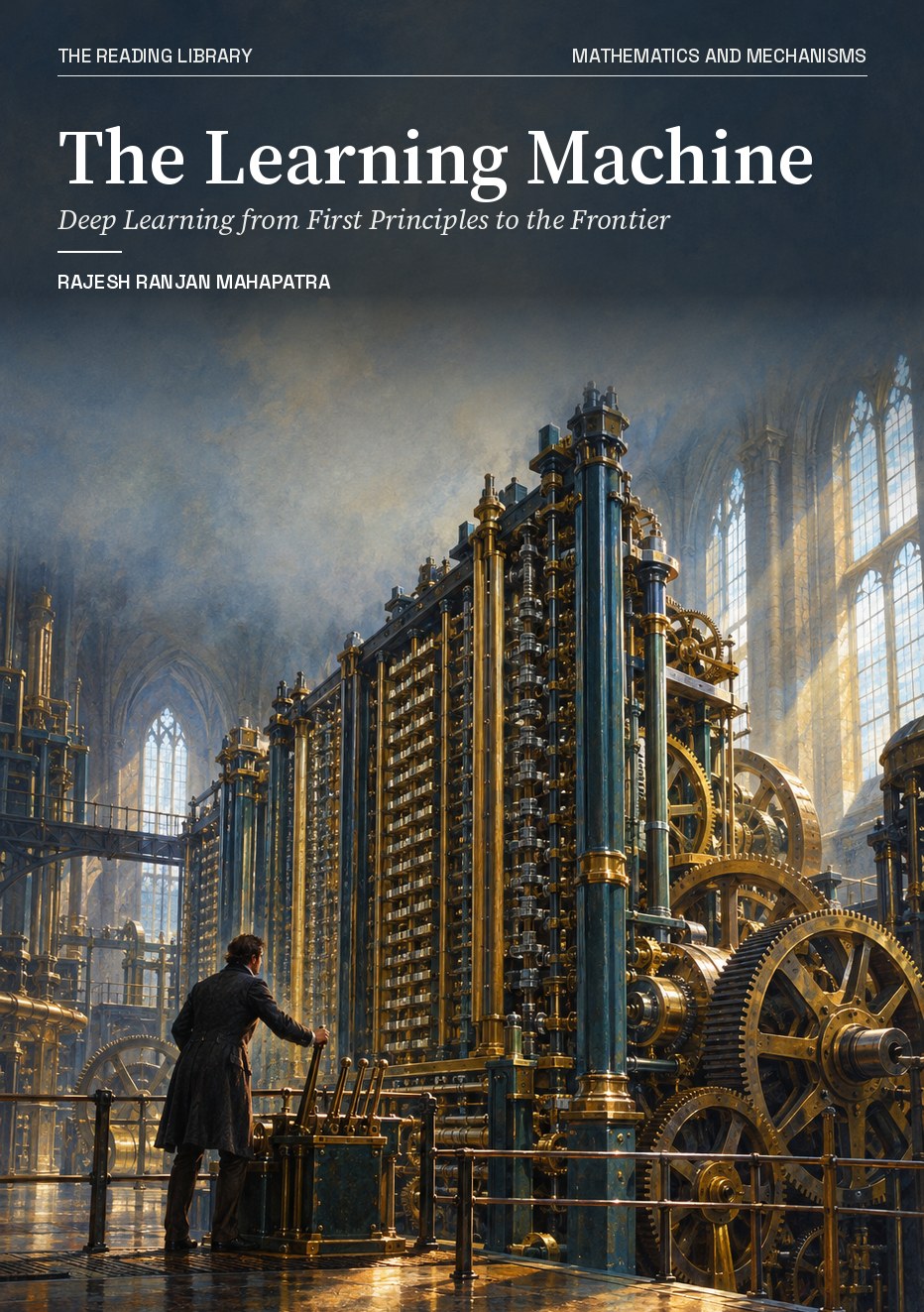 The Learning MachineDeep Learning from First Principles to the Frontier
 The Machine Behind the Sentence
 The Model Is Not the Application
 The Model Is Not the Test
 The Model Must Survive Contact
 The System After the Demo
Essays
176 essays, newest first where the site knows the date.
- Adversarial Search and Strategic IntelligenceMachine intelligenceAn intelligent move is not the action with the highest private score; it is the action whose value survives the strongest credible response,
- Algorithms, Heuristics and Learned ProceduresMachine intelligenceAn explicit algorithm carries guarantees in its control structure; once choice is learned from data, those guarantees survive only where an
- Computation as State TransformationMachine intelligenceA process becomes computational when an adequate state abstraction preserves the distinctions needed for a lawful transition rule to determi
- Eigenstructure and Persistent DirectionsMachine intelligenceRepeated linear transformations select invariant modes by multiplying their components at different rates, so eigenstructure predicts long-r
- Feedback, Control and the Cybernetic LoopMachine intelligencePrediction can describe a future, but only a causal return path from realised consequence to later action can control one.
- From Programme to AgentMachine intelligenceAn agent is a programme placed in a persistent observation-action loop whose choices can change the evidence it receives next.
- Heuristics, a* and the Price of GuidanceMachine intelligenceA heuristic buys speed by changing the order in which search spends effort; the engineering question is when that preference preserves the a
- Knowledge Representation and Logic: The Price of ExplicitnessMachine intelligenceA logic engine can prove only what its vocabulary, facts and closure assumptions allow; its transparency is therefore inseparable from the b
- Learning, Reasoning and Search are not SynonymsMachine intelligenceLearning changes a reusable way of behaving, reasoning transforms one problem's temporary state, and search spends computation across altern
- Matrices as MachinesMachine intelligenceA matrix preserves, amplifies, mixes or deletes distinctions between inputs, and its geometry determines what a learning system can still kn
- Optimisation, Approximation and GuaranteesMachine intelligenceA convergence guarantee becomes useful only when it is joined to an explicit bound linking the optimised surrogate to the decision that matt
- Planning Before ActionMachine intelligenceReliable planning begins when a proposed sequence is converted into explicit state transitions, causal dependencies and decompositions that
- Problems, Tasks and EnvironmentsMachine intelligenceA failed run is jointly produced by the problem, task, environment, system and evaluator, so a model verdict is defensible only after the ot
- Reinforcement Learning and Sequential ChoiceMachine intelligenceReinforcement learning is justified when an action changes later choices and delayed consequences must be propagated back through time.
- Representation Before IntelligenceMachine intelligenceIntelligence can act only on distinctions its representation preserves, so representation design sets the ceiling on what a system can learn
- Search as Structured ExplorationMachine intelligenceBreadth-first, depth-first and uniform-cost search are one exploration loop whose frontier discipline determines what the system notices nex
- The Bitter Lesson and the Neuro-Symbolic ReplyMachine intelligenceScale, search and learning should discover strategies, while explicit symbolic structure should be reserved for narrow boundaries whose viol
- Vectors as Directions, not ListsMachine intelligenceA vector's coordinates change with the basis, while its useful geometry survives only under declared transformations, metrics and normalisat
- What Would Count as Intelligence?Machine intelligenceIntelligence is a causal claim: a bounded system acquired transferable competence under controlled novelty, using declared priors, evidence
- A Board Dashboard for Consequential AI | Rajesh MahapatraResearch essaysA six-panel decision surface that compresses proof without hiding consequence, denominators, missing evidence, concentration or the action r
- A Capability Model for the AI-Augmented Workforce | Rajesh MahapatraResearch essaysA six-layer workforce capability model built from outcome-linked cells, team dependencies, sourcing choices, evidence levels, capacity and r
- A Multi-Model Strategy Without Model Shopping | Rajesh MahapatraResearch essaysA model-role portfolio for admitting, allocating, renewing and retiring the smallest adequate set of enterprise AI models.
- A Vendor Evaluation That Survives the Demo | Rajesh MahapatraResearch essaysAn evidence-led method for testing AI vendor claims through controlled demonstrations, matched operating proof, non-compensable gates and en
- Adoption-Adjusted Value: Why Technical Success Can Be Economically Empty | Rajesh MahapatraResearch essaysA seven-stage adoption-to-capture conversion ledger for finding where technically sound AI capabilities fail to produce captured economic va
- Adoption Is a Property of the Work System | Rajesh MahapatraResearch essaysImagine an organisation that has provisioned an AI writing assistant to every employee. The launch dashboard glows green: licences allocated
- Agent Research 2023–2026: What Held up in ProductionResearch essaysA practitioner's audit of the agent research literature since ReAct, sorted by what actually shows up in production systems today versus wha
- AI for Product Discovery and New Demand | Rajesh MahapatraResearch essays
- AI Governance as Executable Constraint | Rajesh MahapatraResearch essaysA practical design for translating AI governance intent into placed, testable and challengeable constraints without pretending that every ju
- AI Literacy Is Not One Skill | Rajesh MahapatraResearch essaysA role-specific architecture for qualifying people to use, oversee, approve and challenge AI according to authority, consequence and observe
- AI ROI Beyond Labour Arbitrage | Rajesh MahapatraResearch essaysA value-route ledger for tracing AI system behaviour into separately owned cash, capacity, risk, service and option consequences.
- An AI Platform Is Not a Catalogue of Tools | Rajesh MahapatraResearch essaysAn eight-plane Platform Contract Stack and interactive boundary architect for repeatable, governed enterprise AI production journeys.
- Approval Without Fatigue | Rajesh MahapatraResearch essaysA practical operating model for routing agent actions across bounded execution, sampling, batch review, live approval and control redesign w
- Assistant, Copilot or Agent: Choosing the Product Contract | Rajesh MahapatraResearch essaysA grammar for deciding who initiates, what persists, which tools act, how authority accumulates and who must repair a bad outcome.
- Attributing Benefits When Humans and Models Act Together | Rajesh MahapatraResearch essaysA joint-production attribution protocol for estimating whether a human-AI operating policy caused better outcomes without inventing a human-
- Automation, Augmentation or Invention | Rajesh MahapatraResearch essaysA work-recomposition method for deciding whether an AI opportunity should automate a bounded step, augment an accountable human or test a ne
- Before the Agent Acts: Governing Context Acquisition under Cost, Privacy and ConsequenceResearch essaysA practical control architecture for deciding when an AI agent should ask, retrieve, observe, escalate or stop, and for proving that every a
- Build, Buy, Partner or Open Source: A Strategy of Control | Rajesh MahapatraResearch essaysA practical method for allocating AI control rights across build, buy, partner and open-source routes without confusing ownership, access or
- Build Versus Buy at Each Layer of the AI Stack | Rajesh MahapatraResearch essaysA layer control ledger for sourcing each enterprise AI stack capability with explicit retained responsibility, lifecycle economics and exit.
- Calibrated Trust Between Rejection and Automation Bias | Rajesh MahapatraResearch essaysOne planning team sees a forecasting model make a memorable miss and abandons it, even though it outperforms the managers for the population
- Central Platforms, Local Innovation and the Boundary Between Them | Rajesh MahapatraResearch essaysA four-zone federated AI operating boundary for placing enterprise invariants, paved-road services, contracted domain implementations and lo
- Champions, Translators and Local Legitimacy | Rajesh MahapatraResearch essaysA finance programme names an enthusiastic analyst its AI champion. Executives hear that she will mobilise the rollout. Data scientists ask h
- Competitive Differentiation Under Abundant Models | Rajesh MahapatraResearch essaysA practical account of where durable advantage moves when capable AI models become cheap, substitutable and broadly available.
- Compiling Policy Into Technical and Operational Controls | Rajesh MahapatraResearch essaysA loss-sensitive compilation chain from authoritative policy text to testable controls, human decisions, evidence and change lineage.
- Concentration Risk in the AI Supply Chain | Rajesh MahapatraResearch essaysA portfolio method for detecting shared AI dependencies, correlated loss, substitution time and concentration capacity before common-mode fa
- Continuous Reinvention Without Continuous Disruption | Rajesh MahapatraResearch essays
- Contracting for Change, Incidents and Evidence | Rajesh MahapatraResearch essaysA practical operating contract for AI configuration change, incident evidence, reciprocal access, restoration, continuity and exit.
- Controls That Move With the Workflow | Rajesh MahapatraResearch essays
- Cost, Latency and Quality as a Routing Problem | Rajesh MahapatraResearch essaysA constrained production-routing method that eliminates ineligible AI routes before balancing completed-attempt cost, tail latency and task-
- Credentials, Secrets and the Non-Human Workforce | Rajesh MahapatraResearch essaysA fourteen-field credential record, secretless workload path, exposure ledger and orphan test for agents, bots and services.
- Customer Experience When Every Interaction Can Be Generated | Rajesh MahapatraResearch essays
- Data Exfiltration Through Helpful Behaviour | Rajesh MahapatraResearch essaysA thirteen-field Information Release Record, independent release gateway and cumulative Semantic Egress Budget for assistants and agents.
- Data Products as Contracts for Machine Use | Rajesh MahapatraResearch essaysA nine-clause machine-use data product contract, runtime receipt and interactive compiler for reliable enterprise AI consumption.
- Delegation as a Formal Organisational Capability | Rajesh MahapatraResearch essaysA practical framework for turning delegation to people and digital agents into bounded, attributable, enforceable and revocable organisation
- Designing for Model Exit and Architectural Portability | Rajesh MahapatraResearch essaysA capability-level exit design spanning interfaces, behaviour, data, state, tools, controls, skills and tested transition evidence.
- Designing Human-Agent Teams Around Comparative Advantage | Rajesh MahapatraResearch essaysA contribution-level method for composing human-agent teams, testing realised complementarity and reallocating work as evidence changes.
- Designing Interfaces That Reveal Uncertainty | Rajesh MahapatraResearch essaysA seven-layer grammar for showing only the doubt that can change a person's next safe and useful action.
- Desirability, Feasibility and Governability as Separate Tests | Rajesh MahapatraResearch essaysA three-receipt method for testing desirability, feasibility and governability independently before controlled AI delivery.
- Dynamic Pricing Without Dynamic Distrust | Rajesh MahapatraResearch essays
- Evaluation as an AI Product Specification | Rajesh MahapatraResearch essaysWrite the release claim as an executable contract for behaviour, evidence, thresholds, rollback and change.
- Every Agent Needs an Identity | Rajesh MahapatraResearch essaysA fourteen-field runtime identity envelope and delegation gate for verifiable agent workload subjects, mandates, credentials and action attr
- Exceptions Are the Real Process | Rajesh MahapatraResearch essays
- Executive Governance During an AI Incident | Rajesh MahapatraResearch essaysA consequence-led decision cell for containing authority, preserving evidence, reconstructing affected decisions and governing what the orga
- Federated AI Without Fragmentation | Rajesh MahapatraResearch essaysA three-zone federation architecture and versioned boundary contract that preserves local fitness and enterprise coherence simultaneously.
- Feedback Loops That Improve the Product Without Corrupting It | Rajesh MahapatraResearch essaysA feedback provenance loop and interactive Governor for learning from product use without converting exposure, incentives or silence into fa
- From AI Ambition to a Portfolio of Consequential Decisions | Rajesh MahapatraResearch essaysA method for converting broad AI ambition into a governed portfolio of decisions, evidence commitments and staged investments.
- From Copilots to Redesigned Vertical Workflows | Rajesh MahapatraResearch essaysA six-spine redesign contract for choosing between bounded copilots, deterministic support, vertical human-AI workflows, bounded agents and
- Funding AI Products Beyond the Annual Project Cycle | Rajesh MahapatraResearch essaysA five-envelope covenant for persistent but conditional funding of AI products across discovery, build, run, outcomes, change and retirement
- Graceful Degradation Under Model and Tool Failure | Rajesh MahapatraResearch essaysA seven-field Degradation Contract for preserving business and safety invariants while AI capabilities deliberately reduce scope, authority,
- How AI Changes Spans, Layers and Coordination Cost | Rajesh MahapatraResearch essaysA coordination-load method for changing managerial spans and layers after AI enters organisational work.
- How an AI Operating Model Evolves With Capability | Rajesh MahapatraResearch essaysA reversible AI operating-model evolution loop that moves the smallest affected capability or decision boundary only when evidence shows mis
- Human Override Without Interface Theatre | Rajesh MahapatraResearch essaysAn eight-link integrity chain for making intervention capable of changing the real causal path before or after harm.
- Human Oversight That Can Change the Outcome | Rajesh MahapatraResearch essaysA twelve-field intervention contract and counterfactual test for deciding when human oversight can actually change an AI-influenced outcome.
- Incentives That Do Not Reward Blind Use | Rajesh MahapatraResearch essays
- Incentives That Reward Safe Learning | Rajesh MahapatraResearch essaysA practical system for aligning recognition, authority, resources and deferred reward with safe AI learning, verified value and candid evide
- Incident Response for AI Systems That Keep Acting | Rajesh MahapatraResearch essaysA six-plane actuation containment model for stopping continuing AI work, reconciling external effects and recovering from trusted state.
- Inference Economics From Token to Outcome | Rajesh MahapatraResearch essaysAn inference route contract for choosing model, cache, tool, verifier, retry and human paths against verified-outcome, latency, coverage and
- Kill Criteria for an AI Portfolio | Rajesh MahapatraResearch essaysA portfolio operating system for rejecting, expiring, narrowing, replacing, stopping and safely decommissioning AI investments.
- Least Authority for Tool-Using Models | Rajesh MahapatraResearch essaysA fourteen-field Tool Capability Contract and monotonic Capability Budget for bounding every model-proposed enterprise action.
- Marketing Intelligence Without Synthetic Certainty | Rajesh MahapatraResearch essays
- Memory Is Not a Database | Rajesh MahapatraResearch essaysA Governed Memory Object, six-operation control plane and interactive router for deciding what may shape a future enterprise AI decision.
- Migration Without a Flag Day | Rajesh MahapatraResearch essaysA nine-register migration control plane for transferring authoritative AI-enabled work through bounded cohorts, adjudicated dual-running, re
- Model Gateways and the Separation of Policy From Provider | Rajesh MahapatraResearch essaysA provider-neutral invocation contract and gateway policy chain that keeps enterprise rules stable while model providers and capabilities ch
- Model Risk When the Model Can Act | Rajesh MahapatraResearch essaysA model-risk method for governing action-capable AI through authority, trajectories, independent receipts, containment, reconciliation and r
- Monitoring Adoption Without Surveillance | Rajesh MahapatraResearch essays
- Observability for Decisions, Not Just Requests | Rajesh MahapatraResearch essaysA minimum-sufficient Decision Evidence Graph for reconstructing AI-influenced decisions, authority, commitments, delayed outcomes and redres
- Open Models, Closed Models and the Control You Actually Obtain | Rajesh MahapatraResearch essaysAn executive method for choosing hosted, open-weight and internally operated AI models by testing ten control rights, transferred responsibi
- Owning Risk Where AI Outcomes Are Produced | Rajesh MahapatraResearch essaysA seven-object custody chain that keeps AI outcome risk with the first-line owner who can see, control, finance and stop the consequence whi
- Personalisation as a Decision Under Consent | Rajesh MahapatraResearch essays
- Platform Teams, Domain Teams and the Contract Between Them | Rajesh MahapatraResearch essaysA seven-plane product-to-product contract linking AI platform and domain teams across capability, evidence, service, authority, change, econ
- Portability Tests Before Commitment | Rajesh MahapatraResearch essaysA practical pre-commitment method for proving AI export, reconstruction, substitution and operated recovery across data, context, evaluation
- Portfolio Economics for Correlated AI Bets | Rajesh MahapatraResearch essaysA dependency-adjusted portfolio ledger for common-mode AI exposure, resource collisions, shared enablers, substitution and productive interd
- Predicting Churn Is Not Preventing It | Rajesh MahapatraResearch essays
- Pricing AI Products by Value, Risk and Variability | Rajesh MahapatraResearch essaysA seven-layer AI price contract stack and interactive designer for aligning customer value, provider cost, risk and variability.
- Pricing Error, Delay and Irreversibility in an AI Business Case | Rajesh MahapatraResearch essaysA consequence-adjusted decision ledger for pricing asymmetric error, delay, detection, recovery and irreversibility in an AI operating polic
- Process Mining as Evidence for AI Redesign | Rajesh MahapatraResearch essays
- Model-Risk Evidence for Agentic Systems: From Outcome Accuracy to Trajectory AssuranceResearch essaysA model-risk and production-assurance architecture for evaluating an agent's complete decision path: evidence, tools, order, policy, recover
- Procuring a Model Is Not Procuring an Outcome | Rajesh MahapatraResearch essaysA practical framework for buying bounded AI operating capabilities with explicit accountability, acceptance evidence, whole-path cost, chang
- Product-Market Fit for an Uncertain Intelligence Capability | Rajesh MahapatraResearch essaysHow to earn scale one verified customer outcome, task population and recoverable capability envelope at a time.
- Prompt Injection Is an Authority Failure | Rajesh MahapatraResearch essaysAn Instruction Authority Record and eight-stage Authority Firewall that prevent untrusted content from increasing an AI system's power.
- Provenance as a Runtime Property | Rajesh MahapatraResearch essaysAn eight-segment Runtime Provenance Spine, Claim-Action Evidence Graph and interactive router for traceable AI-assisted decisions.
- Psychological Safety When AI Exposes Performance | Rajesh MahapatraResearch essays
- Queue Economics for Human-Agent Operations | Rajesh MahapatraResearch essays
- RAG Platform, Agent Platform or Both | Rajesh MahapatraResearch essaysA workload control-surface map for deciding whether enterprise systems need retrieval, deterministic workflow, bounded agency or distinct se
- Red-Teaming a Business Process, Not Just a Model | Rajesh MahapatraResearch essaysA consequence-backwards method for adversarially testing the complete AI-enabled business process, including authority, tools, people, detec
- Redesigning an End-to-End Value Stream Around Intelligence | Rajesh MahapatraResearch essaysA nine-lane intelligence-bearing value-stream map for redesigning demand, evidence, decisions, queues, controls, capacity and outcomes end t
- Responsible AI Beyond Principles Posters | Rajesh MahapatraResearch essaysA responsibility-to-outcome operating system for governing protected interests, burden distribution, trade-offs, accountability, challenge a
- Retaining Human Judgement When Agents Do the First Draft of Everything | Rajesh MahapatraResearch essaysA judgement-preservation system for routing human-first framing, AI-first drafts, blind parallel work, calibration and capability recovery.
- Retiring an AI Feature Without Orphaning Its Users | Rajesh MahapatraResearch essaysAn eight-obligation retirement continuity contract and interactive planner for migrating users, records, authority and obligations safely.
- Retiring the Old Process After AI Arrives | Rajesh MahapatraResearch essays
- Retrieval Entitlement: Who May Know What, When and Why | Rajesh MahapatraResearch essaysA nine-dimension Retrieval Entitlement Envelope, pre-evidence protocol and interactive resolver for controlling enterprise AI knowledge acce
- Risk-Tiering AI by Consequence and Recoverability | Rajesh MahapatraResearch essaysA scenario-based method for allocating AI controls, evidence and authority from credible consequence and demonstrated recovery.
- Running AI: Incidents, Drift, Change and Retirement | Rajesh MahapatraResearch essaysA six-state AI run control plane joining service, behaviour, workflow and outcome evidence to incident response, recovery, change and comple
- Scoring AI Opportunities Without Manufacturing Precision | Rajesh MahapatraResearch essaysA disciplined alternative to weighted AI opportunity scores, with gates, evidence profiles, dominance, sensitivity and an interactive compar
- Sequencing AI Transformation by Dependency, Not Excitement | Rajesh MahapatraResearch essaysA six-edge transformation dependency graph for sequencing AI commitments through evidence, capacity, shared enablers, reversibility and comp
- Service Agents That Know When to Transfer | Rajesh MahapatraResearch essays
- Straight-Through Processing Versus Consequential Review | Rajesh MahapatraResearch essays
- Strategy Under Model, Regulation and Adoption Uncertainty | Rajesh MahapatraResearch essaysA commitment architecture for learning under model, regulatory and adoption uncertainty without confusing forecasts with authority to scale.
- Targeting Bottlenecks Instead of Automating Visible Tasks | Rajesh MahapatraResearch essaysA system-level method for finding the constraint that governs good throughput before applying AI to a visible task.
- Temporal Truth and the Cost of Stale Context | Rajesh MahapatraResearch essaysA seven-clock Temporal Truth Record, staleness consequence ledger and interactive resolver for versioned enterprise AI context.
- The Adjacency Graph: How One AI Capability Opens the Next | Rajesh MahapatraResearch essaysA practical method for validating whether one AI operating capability genuinely lowers the cost, time or risk of the next business decision
- The Agentic Supply Chain | Rajesh MahapatraResearch essaysA fourteen-class Agentic Bill of Materials, transitive trust graph and change blast-radius query for live agent systems.
- The AI Agent as a Non-Human Insider | Rajesh MahapatraResearch essaysAn intent-agnostic operating model for effective agent access, sponsorship, trajectory monitoring, independent control and rapid restriction
- The AI Assurance Case | Rajesh MahapatraResearch essaysA live, defeater-aware assurance argument for deciding whether a precisely bounded AI capability may be released and remain in operation.
- The AI-Augmented Sales System | Rajesh MahapatraResearch essays
- The AI Exit Plan | Rajesh MahapatraResearch essaysA practical six-runway plan for retiring, reverting, replacing or internalising an AI decision service while preserving continuity, evidence
- The AI Operating Model as a System of Decisions | Rajesh MahapatraResearch essaysAn AI decision operating system that places nine recurring decision families across strategy, design, release, run, value and retirement.
- The AI Request for Proposal That Tests Reality | Rajesh MahapatraResearch essaysAn executable AI RFP design that turns abstract requirements into equal-case tests, operating evidence and traceable contract obligations.
- The CDO Agenda: Data Entitlement, Quality and Reuse | Rajesh MahapatraResearch essaysA data-to-context entitlement graph and context contract for decision-specific quality, lawful reuse and derivative lifecycle control.
- The CEO's AI Thesis | Rajesh MahapatraResearch essaysA falsifiable CEO AI thesis that connects structural change, chosen advantage, commitments, stakeholder settlement and contradiction.
- The CFO Agenda: Value, Capital and Accountability | Rajesh MahapatraResearch essaysA CFO capital-to-capture ledger for staging AI funding, reconciling full cost and enforcing value-capture accountability.
- The Change Network for AI Transformation | Rajesh MahapatraResearch essaysA global AI programme reports that every employee received the launch message. On a night shift, operators discover a recurring exception th
- The CHRO Agenda: Work, Skills and Cognitive Dependency | Rajesh MahapatraResearch essaysGovern the work system that remains after delegation: authority, practice, invisible labour, job quality, independent capability and funded
- The CIO Agenda: Platform, Control and Technical Optionality | Rajesh MahapatraResearch essaysA seven-plane architecture for governing enterprise AI platforms while preserving tested technical optionality.
- The CRO Agenda: Risk That Moves at Software Speed | Rajesh MahapatraResearch essaysA five-clock control architecture for making detection, authorised decision, containment and recovery faster than the path to material harm.
- The Decision Dividend: Valuing Better Judgement | Rajesh MahapatraResearch essaysA decision-dividend ledger for valuing AI-enabled improvements in judgement through changed action and quality-adjusted consequences.
- The Decision Inventory: Finding Where Intelligence Pays | Rajesh MahapatraResearch essaysA practical strategy paper for finding AI opportunity at the level of recurring decisions, with an interactive Decision-Leverage Finder.
- The Evidence Pack for an AI Release | Rajesh MahapatraResearch essaysA fourteen-section evidence manifest, release delta graph and integrity gate for governing one versioned AI production decision.
- The Forward-Deployed AI Engineer | Rajesh MahapatraResearch essaysA bounded operating contract for forward-deployed AI engineering, with authority, evidence, transfer debt and an exit test.
- The Full Cost of an AI TaskResearch essaysA practical unit-economics system for tracing inference, context, tools, review, exceptions, failures and change to one accepted, policy-com
- The General Counsel's Map of AI Liability | Rajesh MahapatraResearch essaysAn issue-spotting and evidence graph for tracing roles, representations, rights, contracts, decisions, consequences and remedies across the
- The Intelligence Moat: Feedback Rights, Context and Learning Speed | Rajesh MahapatraResearch essaysA practical strategy paper on feedback rights, decision context and learning speed as the foundations of a defensible intelligence moat.
- The Labour Economics of Digital Agents | Rajesh MahapatraResearch essaysA production account for digital agents based on verified outcomes, human complements, coordination, risk, demand response and captured capa
- The Lifecycle of an AI-Native Service | Rajesh MahapatraResearch essaysA nine-state service machine and interactive lifecycle controller for qualifying, constraining, recovering and retiring an AI-native service
- The Manager in an Agentic Organisation | Rajesh MahapatraResearch essaysA nine-service portfolio and reallocation method for managerial work in organisations using digital agents.
- The Myth of AI-Ready Data | Rajesh MahapatraResearch essaysAn eight-test decision-conditioned data fitness contract and interactive examiner for determining what enterprise data may support.
- The Option Value of Learning Before Scale | Rajesh MahapatraResearch essaysA learning-option contract for deciding when a bounded AI experiment should precede scale, and when to scale, narrow, wait or stop instead.
- The Organisation as a Multi-Agent System | Rajesh MahapatraResearch essaysA commitment-centred operating model for deciding when organisations should use one agent, several bounded agents, deterministic services or
- The Product Operating Model for Persistent AI Capabilities | Rajesh MahapatraResearch essaysA seven-ledger persistent AI product contract spanning decision promise, evidence, service, authority, change, value and retirement.
- The Reasoning Stack, 2026Research essaysChain-of-thought, tool use, search, RL with verifiable rewards, test-time compute: five layers everyone name-drops and few can rank by evide
- The Responsible AI Architect | Rajesh MahapatraResearch essaysA production architecture for compiling responsible AI obligations into invariants, controls, tests, evidence and owners.
- The Return on Context | Rajesh MahapatraResearch essaysA five-book Context Return Ledger and interactive allocator for funding the smallest governed context change that improves captured decision
- The ROI Denominator Problem: Hours Saved are not Benefits CapturedResearch essaysA practical method for converting AI time savings into schedulable capacity, verified operating outcomes and finance-owned value, without tr
- The Strategic Problem Before the AI Use Case | Rajesh MahapatraResearch essaysA practical method for defining the strategic problem, binding constraint and evidence standard before an organisation commits to an AI use
- The Ten Questions a Board Should Ask About AI | Rajesh MahapatraResearch essaysTen linked questions that turn board AI oversight from dashboard reassurance into a bounded, evidence-backed decision.
- The Three Clocks of AI Strategy | Rajesh MahapatraResearch essaysA practical method for synchronising AI capability change, institutional permission and organisational absorption without forcing them into
- The Total Cost of an AI Capability | Rajesh MahapatraResearch essaysA capability cost constitution for forecasting, allocating, operating and exiting reusable AI capabilities across several consuming workflow
- The Transformation Thesis: What Must Become Structurally Different | Rajesh MahapatraResearch essaysA falsifiable eight-clause operating constitution for deciding what must become structurally different in an AI transformation.
- The Workflow Lens for AI Opportunity Discovery | Rajesh MahapatraResearch essaysA workflow-centred method for discovering applied-AI opportunities at queues, handoffs, exceptions and constraints, with an interactive Work
- Third-Party AI Without Third-Party Accountability | Rajesh MahapatraResearch essaysA capability-level accountability ledger for governing provider chains, evidence rights, change, incidents, customer remedy, concentration a
- Transformation Debt and the Accumulation of Half-Changed Work | Rajesh MahapatraResearch essaysAn eight-class transformation debt register for exposing the service burden, coupling, benefit residue and retirement evidence created by ha
- Translating Regulation Into a Control Crosswalk | Rajesh MahapatraResearch essaysA typed obligation-to-control graph for preserving source authority, applicability, interpretation, evidence, gaps and regulatory change acr
- Trust Is a Product Behaviour, Not a Brand Claim | Rajesh MahapatraResearch essaysA contract for turning every invitation to rely into a bounded behaviour, dated evidence, visible exception and workable remedy.
- Understand the Process Before Choosing the Model | Rajesh MahapatraResearch essays
- Upskilling Through Real Work, Not Course Completion | Rajesh MahapatraResearch essaysA work-embedded system for developing and proving bounded AI capability through real tasks, safe practice, evidence and authority.
- Value Pools Before Features | Rajesh MahapatraResearch essaysA strategy paper on finding applied-AI investments by mapping value pools before selecting features, with an interactive Value-Pool Mapper.
- Vendor Lock-In Across Models, Data, Evaluation and Workflow | Rajesh MahapatraResearch essaysA practical method for mapping AI lock-in, pricing replaceability and proving capability continuity across models, data, evaluation, workflo
- What AI Strategy Means When Models Become CommoditiesResearch essaysWhen capable models are broadly purchasable, durable advantage moves to the rights, routines and feedback loops that turn intelligence into
- What an AI Centre of Excellence Is Actually For | Rajesh MahapatraResearch essaysA five-rung mandate ladder and service contract for an AI Centre of Excellence that removes enterprise constraints, transfers capability and
- What Resistance to AI Is Telling You | Rajesh MahapatraResearch essaysA service team is told to use a new AI assistant. Usage stays low. One manager calls the team resistant, another schedules more training and
- When to Stop Funding an AI Pilot | Rajesh MahapatraResearch essaysA sequential continuation contract for deciding whether to scale, fund once, redirect, stop or replace an AI pilot without rewarding sunk co
- Where an Agentic Workflow Should Begin and End | Rajesh MahapatraResearch essays
- Where Intelligence Changes Industry Structure | Rajesh MahapatraResearch essaysA practical test for deciding when cheaper machine intelligence changes firm boundaries, market power and the location of profit in an indus
- Who Decides What: Rights Across Business, Data, Technology and Risk | Rajesh MahapatraResearch essaysAn AI rights grammar assigning ownership, proposal, specification, challenge, veto and assurance across eight lifecycle decision objects.
- Why the AI Use-Case Factory Produces Activity Instead of Value | Rajesh MahapatraResearch essaysA practical strategy paper on why AI use-case factories select activity over value, with an interactive Use-Case Factory Escape Test.
- Workflow Fit Before User Training | Rajesh MahapatraResearch essaysA customer-service team seldom opens its new AI assistant. Management commissions another confidence course. In the classroom, the assistant
- Zero-Based Workflow Design | Rajesh MahapatraResearch essays
Research papers
40 papers from the research programmes.
- A reliability model for compound AIA first-principles reliability model for compound AI systems that separates route exposure, shared failure causes and containment, with an e
- Active inference as a design hypothesis for agentsA first-principles test of when expected free energy improves artificial agents, how it differs from reward-based control, and where the bio
- Agent plus operational twinA first-principles architecture for letting an AI agent rehearse actions in a stateful operational twin while authoritative systems retain c
- An evidence grammar for artificial mindsA first-principles method for keeping behavioural, report, mechanistic, provenance and replication evidence distinct while composing them in
- Aristotle for artificial intelligence
- Benchmarks, capabilities and construct validityA first-principles method for deciding whether an AI benchmark score measures the intended capability, a shortcut, or the interface to the t
- Causal attribution of consequential tool calls
- Cognitive integrity and retained human intelligenceA practical framework for deciding which human capabilities must remain exercised when AI delegation is faster, based on failure detection,
- Collective intelligence across people and agentsWhy communication sometimes creates knowledge and sometimes creates herding, with a correlation-aware protocol and an executable truth-seeki
- Control theory for guardrailsWhy runtime AI guardrails need measured state, bounded delay, sufficient authority and a verified fallback, with an executable guardrail sta
- Creativity, analogy and human-AI co-creationA first-principles account of when AI-assisted recombination becomes useful novelty, why analogy must preserve causal relations, and how to
- Extended, distributed and coupled intelligenceA causal test for deciding when a tool, team or AI system becomes part of a cognitive mechanism rather than merely assisting it.
- Failure injection as the primary evaluationWhy consequential compound AI systems should be released against typed fault propagation, containment, recovery and proof, with an executabl
- From model to system: scaffolding, memory, tools and agentsA first-principles method for deciding whether an apparent agent capability belongs to model weights, runtime, context, orchestration, tools
- Human-AI joint cognitive systemsA first-principles guide to allocating perception, interpretation, proposal, authority and recovery across human–AI systems, with an executa
- Integrated information and the causal structure of artificial systemsWhy integrated information theory evaluates a physical cause-effect structure rather than an algorithm, and how to build a bounded causal do
- Interventions on artificial minds
- Machine introspection: evidence and contaminationA first-principles test for whether a language model's self-report comes from privileged access to its hidden state or from prompt, output,
- Model-independent containment and property placementA first-principles account of which agent safety properties can be enforced outside the model, where to place them, and how to test a typed
- Moral patients, moral agents and the basis of statusWhy the capacity to be harmed and the capacity to be held responsible require separate evidence, thresholds and governance decisions.
- Neural codes, synapses and plasticityA first-principles account of why neural codes only become explanatory when activity, downstream readout and plasticity are tested together.
- Normal accidents and graceful recovery in agentic systemsA first-principles account of why agentic failures cascade, how causal coupling makes some accidents unavoidable, and how to design firebrea
- Perception as inference, action and correctionWhy perception is a closed-loop hypothesis test in which expectations propose causes, precision-weighted evidence corrects them, and action
- Reasoning, planning and tool use under uncertaintyA causal test for deciding when generated reasoning genuinely guides tool-using action, when it merely narrates a choice, and how to instrum
- Reasoning traces, chain of thought and hidden computationA causal method for deciding when a model's articulated rationale tracks the computation that produced its answer, with an executable TRACE
- Reflexive self-models without infinite regressA first-principles architecture for reflexive control: compress an agent's allocation traces into a bounded causal state, feed that state ba
- Retention, recurrence and machine stateA first-principles account of how caches, recurrent states and state-space dynamics preserve the past, with an executable temporal-preservat
- Retrieval as inference, sufficiency and entitlement
- Self-models, symbols and editable identityWhen self-models improve control, how symbols make identity editable, and why recursive self-description can become confabulation.
- States, contents and neural correlatesWhy neural correlates of consciousness become interpretable only when global state, specific content and the evidence bridge are experimenta
- The artificial neuron, backpropagation and credit assignmentA first-principles explanation of how backpropagation assigns path-conditioned credit, why gradients fail across depth, and how to audit a h
- The end-to-end argument for agent protocolsWhy sound agent protocols cannot carry the full responsibility for intent, present authority, real-world effects and recovery, with an execu
- The human intelligence stackHuman intelligence is a task-specific feasible set created by coupled bodily, cognitive, social, linguistic and cultural constraints.
- Tokenisation and the worlds it makes visibleHow token choice redistributes context, statistical evidence and computational difficulty before a transformer begins to reason, with an exe
- Training a language model end to endA first-principles account of how data, objective, optimiser, scale and measurement jointly create a language model, with a reproducible min
- Training provenance and evaluation validity
- Variational inference and the ELBOHow the evidence lower bound turns intractable Bayesian posterior inference into optimisation, why the projection creates approximation debt
- When multi-agent systems are justifiedA first-principles test for deciding when several agents create real value, when one agent with tools is enough, and how to measure the coor
- Why biological intelligence has stakesA first-principles account of how embodiment, viability control, interoception and valence make outcomes matter to biological intelligence,
- World models that survive interventionWhy predictive accuracy is not enough for a world model, and how to test whether learned dynamics preserve causal structure when actions, me
Insight Editions
16 study editions with covers, PDFs and EPUBs. All editions →
 The Infinity MachineSebastian Mallaby
 The Agentic EnterpriseBabak Hodjat and Antoine Blondeau
 Building AI Agent PlatformsBen O'Mahony and Fabian Nonnenmacher
 Building Applications with AI AgentsMichael Albada
 Hands-On Large Language ModelsJay Alammar and Maarten Grootendorst
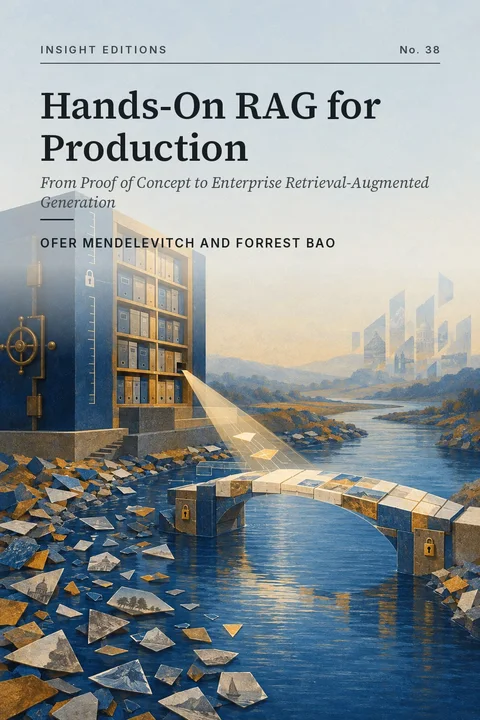 Hands-On RAG for ProductionOfer Mendelevitch and Forrest Bao
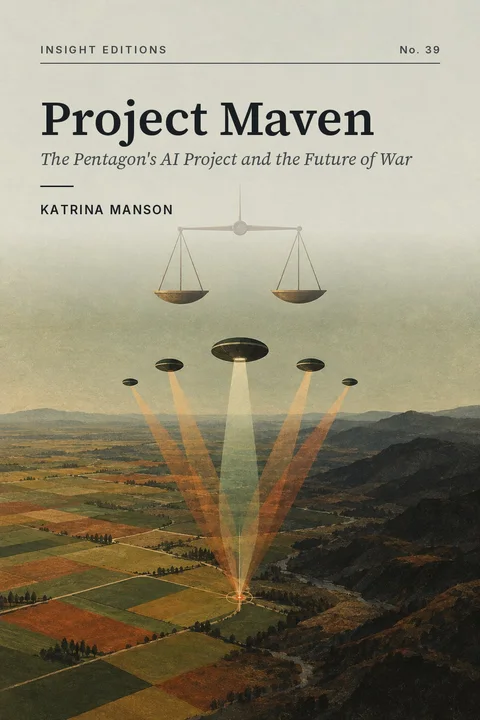 Project MavenKatrina Manson
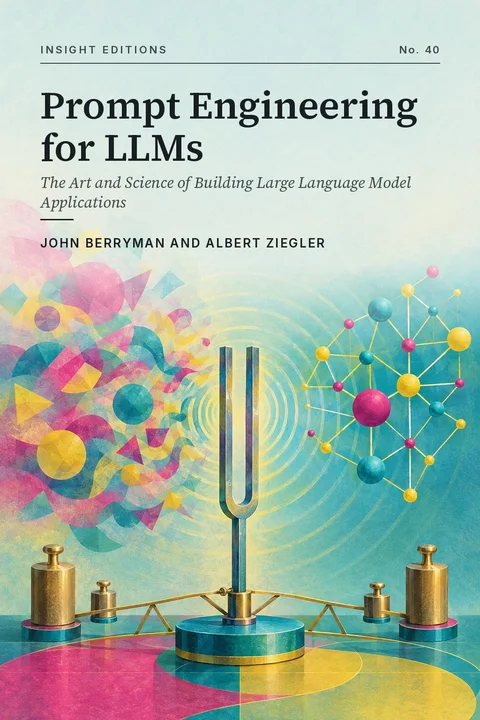 Prompt Engineering for LLMsJohn Berryman and Albert Ziegler
 The Age of Spiritual MachinesRay Kurzweil
 The Future of HumanityMichio Kaku
 Quantum SupremacyMichio Kaku
 VisionsMichio Kaku
 A World AppearsMichael Pollan
 Freak Show of the GodsRobert W. Bly
 The Mind's IDouglas R. Hofstadter and Daniel C. Dennett
 Fluid Concepts and Creative AnalogiesDouglas R. Hofstadter and the Fluid Analogies Research Group