Insight Editions · No. 99
Visions
How Science Will Revolutionize the 21st Century
Michio Kaku
Michio Kaku examines how advances in quantum physics, computing, and molecular biology may transform technology, society, energy, medicine, and humanity’s future in space.
A study guide to Visions by Michio Kaku. Shared free for personal reading; not for sale and not endorsed by the authors or publishers. Please read and buy the original.
The quantum, computer and DNA revolutions turn humanity from passive observers of Nature into its active choreographers, and drive earth toward a Type I planetary civilization within a century or two.
Three revolutions, sixteen chapters, three horizons (to 2020, 2020 to 2050, 2050 to 2100), built on interviews with more than 150 scientists.
Computer power up 10 billion-fold since 1950; the genome due by 2005; a factor of 10 billion between each Kardashev type.
Anyone grading a serious 30-year-old forecast, or looking for a framework to make better ones.
The Book in Brief
Kaku's wager is that because the fundamental laws of the quantum, the computer and DNA were settled in the twentieth century, the paths of discovery can now be forecast with real accuracy. His three themes are mastery, synergy and ascent up an energy ladder toward a planetary civilization. Read in 2026, the book is a rare graded exam: the information predictions landed early, the medical ones late and in different shapes, and the energy and space ones are still in flight.
The method matters as much as the predictions. Most futurism fails, Kaku argues, because it substitutes one person's prejudice for expert consensus; his remedy was a decade of interviews across disciplines and a strict discipline of time-stamping every claim. That gives the book its unusual testability: a prediction with a date can be marked right or wrong, and most of them now can be.
The computer revolution was his surest ground, and he was mostly right. Mark Weiser's ubiquitous computing arrived on schedule as smartphones and embedded chips; Moore's law held far longer than the "point one barrier" allowed; the Internet became the Magic Mirror he described, though through statistical learning rather than Douglas Lenat's hand-coded common sense. He foresaw the intelligent planet and missed how it would fragment.
The biomolecular chapters got the timetable right and the biology wrong. The genome finished two years early and personal sequencing arrived at $100 to $200, but the gene count was off by a factor of five, "one gene, one protein" collapsed, and the single genes for behaviour, novelty-seeking, anxiety, violence, mostly failed replication. Gene therapy took two more decades and a different tool (CRISPR) than he expected, and cancer yielded to immunotherapy more than to the gene replacement he emphasised.
The quantum chapters are where the record is weakest, and most interesting. He gave fusion and room-temperature superconductors the leading roles and treated solar power as promising but marginal; in fact photovoltaics plus lithium batteries produced the real energy revolution, by exponential cost decline rather than breakthrough. Nanotechnology split in two: the nanomaterials half thrived, the self-replicating assembler half never arrived.
The social chapters divide sharply. The rise of a global middle class, a planetary language and a planetary culture all happened. The decline of the nation state did not; sovereignty came back, and the coordination he expected the three revolutions to force is exactly what has proved hardest.
| Ch | Title | In one line |
|---|---|---|
| Pref | How Visions Was Built | Forecasts come from 150+ scientists, each stamped with a time frame, not from one futurist's hunch |
| 1 | Choreographers of Matter, Life, and Intelligence | Three revolutions, now synergistic, move us from observing Nature to directing it, and up the Kardashev ladder |
| 2 | The Invisible Computer | Chips get so cheap they disappear into walls, cars, clothes and money; ubiquitous computing dominates by 2020 |
| 3 | The Intelligent Planet | The Internet becomes a planetary membrane and finally a Magic Mirror you talk to, once machines have common sense |
| 4 | Machines That Think | Top-down programming meets bottom-up learning; their merger around 2030 to 2040 produces real robots, then degrees of consciousness |
| 5 | Beyond Silicon | Silicon ends near 2020, so optical, DNA and quantum machines follow, plus bionics that wire chips to neurons |
| 6 | Second Thoughts: Will Humans Become Obsolete? | Quantum cryptography answers privacy; the hard problems are job loss, an information underclass, and machines that harm while obeying |
| 7 | Personal DNA Codes | The genome by 2005, your own sequence by 2020, and medicine shifts from treatment to prevention |
| 8 | Conquering Cancer | Cancer is four to six mutations, mostly in p53 and friends, plus telomerase; seven lines of attack follow |
| 9 | Molecular Medicine and the Mind/Body Link | Read a pathogen's genome, find its weak spot, design the drug; meanwhile stress and isolation are measurable physiology |
| 10 | To Live Forever? | Ageing as entropy, oxidation, age genes and calorie restriction; hormones to 2020, grown organs after |
| 11 | Playing God | Single-gene feats are easy and cloning is here; polygenic traits are hard and chimeras are a century away |
| 12 | Second Thoughts: The Genetics of a Brave New World? | Biotech is too cheap to contain, so the answer is privacy law, anti-discrimination law, germ-line limits and treaties |
| 13 | The Quantum Future | MEMS now, molecular machines later; fusion by 2035 to 2050; solar, hybrids and lasers; ray guns and transporters stay impossible |
| 14 | To Reach for the Stars | Mars probes and cheap launch to 2020, ion engines after, starships and terraforming beyond, because the earth sits in a shooting gallery |
| 15 | Toward a Planetary Civilization | The Type 0 to Type I transition is the dangerous one: element 92 and a chemical industry can end a species |
| 16 | Masters of Space and Time | Wormholes and time machines are allowed but need Planck energy; a theory of everything would settle it, and the multiverse explains fine-tuning |
- Published 1997, forecasting to 2100 and beyond; built on 150+ interviews over ten years.
- Three horizons: to 2020, 2020 to 2050, 2050 to 2100.
- Three revolutions, each triggered by the quantum theory of 1925.
- Kardashev ladder: Type 0 (us) to Type I in 100 to 200 years at 1 to 3% growth; Type II in 800 to 2,500; Type III in 100,000 to a few million.
How Visions Was Built
Kaku frames Visions as a forecast of the next 100 years built from interviews with more than 150 scientists over ten years, rather than from one futurist's hunches. Every prediction carries a time frame (to 2020, 2020 to 2050, 2050 to 2100), and the book moves through three revolutions: computer, biomolecular, quantum.
Kaku opens with a methodological claim: most past predictions failed because they reflected one person's narrow viewpoint. His remedy is consensus. Over a decade of writing books, articles and radio commentary he interviewed more than 150 scientists, many of them Nobel laureates, and built the book on what they expected. He insists that not all predictions are equal: some are near-certain extrapolations to 2020, others are speculative bets on 2050 to 2100, and the time frames are guidelines, not promises.
The plan is simple. Part I covers the computer revolution, which Kaku says will "place intelligence in every part of our planet". Part II covers the biomolecular revolution, which will let us alter and synthesise life and create new medicines. Part III covers the quantum revolution, "perhaps the most profound of the three", which will give us control over matter itself.
- Physics: Murray Gell-Mann, Steven Weinberg, Leon Lederman, Henry Kendall, Edward Witten, Cumrun Vafa, Paul Townsend, Alan Guth, Freeman Dyson, Richard Gott, Philip Morrison, Lawrence Krauss.
- Biology and medicine: Walter Gilbert, Francis Collins, Michael Blaese, Eric Green, Jeffrey Trent, Steven Rosenberg, Leonard Hayflick, Stephen Jay Gould.
- Computing and AI: Mark Weiser (Xerox PARC), Larry Tesler (Apple), Michael Dertouzos (MIT LCS), Rodney Brooks, Pattie Maes, Neil Gershenfeld, Hans Moravec, Douglas Hofstadter, David Gelernter, David Nahamoo (IBM speech).
- Space and environment: Carl Sagan, Donna Shirley (JPL Mars), John Lewis, Neil Tyson, Lester Brown, Paul Ehrlich, Barry Commoner.
- Critics and ethicists: Jeremy Rifkin, Arthur Caplan, Helen Caldicott, Clifford Stoll, John Horgan.
The preface's name list carries a string of misspellings: "Joseph Rotbalt" (Rotblat), "Steven Jay Gould" (Stephen), "Frank Von Hippie" (von Hippel), "Paul Meitzer" (Meltzer), "David Gelertner" (Gelernter), "Neal Gershenfeld" (Neil), "Charles Pillar" (Piller), "Wendy McGoodwyn" (McGoodwin). More substantively, the list mixes working researchers with activists and journalists, so the "consensus of scientists" claim is looser than it sounds: several of the book's strongest forecasts come from a handful of enthusiasts (Moravec, Weiser, Gilbert) rather than from a survey.
Choreographers of Matter, Life, and Intelligence
Twentieth-century science found the basic laws of matter, life and computation: the quantum, the DNA molecule and the computer. Kaku's central thesis is that the twenty-first century turns us from passive observers of Nature into its active choreographers, driven by synergy between the three revolutions, and that this will reorder the wealth of nations and push humanity toward a Type I planetary civilization.
From Newton's seashore to the Age of Mastery
Kaku starts with Newton's image of a boy picking pebbles on the shore of an undiscovered ocean. In Newton's day life was short and brutal: most people were illiterate, rarely travelled beyond a few miles from home, lived to about thirty, and lost many of their ten or so children in infancy. Newton's mechanics led to the steam engine, the industrial revolution and the railroad; nineteenth-century science lifted millions out of poverty and helped topple Europe's dynasties.
By the end of the twentieth century, Kaku argues, science had unlocked the atom, unravelled the molecule of life and built the electronic computer, so the basic laws of matter, life and computation were "in the main, finally solved". He cites the pace as evidence that a new era is starting: human knowledge doubling every ten years, computer power every eighteen months, the Internet every year, and analysable DNA sequences every two years. The epoch-making transition is from being passive observers of Nature to being its active choreographers: the Age of Discovery closes and an Age of Mastery opens.
Knowing the rules is different from mastering the game. Science in the 1900s decoded the rules of Nature; the 2000s are about becoming grand masters who can build with them.
Why scientists, not pundits, should forecast
Kaku contrasts his method with popular futurism. In 1996 The New York Times Magazine ran a whole issue on the next 100 years, with journalists, designers, artists and philosophers, and not a single scientist was consulted. His point is that forecasts by the people who create technology are anchored in known physical law, while forecasts by its consumers substitute personal prejudice. The cautionary tale is Admiral William Leahy telling Truman in 1945 that the atomic bomb "will never go off", speaking "as an expert in explosives", against the consensus of the physicists building it.
He argues physicists have a strong track record: they gave the world TV, radio, radar, X-rays, the transistor, the computer, the laser, the atomic bomb, helped decode DNA, built PET, MRI and CAT scanners, and designed the Internet and the World Wide Web. He concedes there will be surprises and embarrassing gaps, but because the laws behind quantum theory, computers and molecular biology are now established, scientists can roughly predict the paths of progress. That, for Kaku, is "the central reason" his predictions should beat earlier ones.
The three pillars: matter, life, mind
The three pillars of modern science are matter, life and the mind, and the crowning achievements of the century were splitting the atomic nucleus, decoding the cell nucleus and building the computer. Kaku is careful to say only the most fundamental laws are known: computer laws are understood, but only some basic laws of AI and the brain are.
- The quantum revolution (1925). Schrödinger, Heisenberg and others reduced matter to a few postulates: energy comes in discrete quanta (the photon is a packet of light), and particles behave as waves obeying the Schrödinger equation, which gives probabilities. The culmination is the Standard Model, which predicts everything from quarks to supernovas. Next step: choreographing new forms of matter.
- The computer revolution (1948). Bell Labs' transistor made the modern computer possible, and the laser a decade later made the information highway possible; both are quantum devices. Electron "holes" that act like positive charges let transistors amplify signals. In 1997, tens of millions of transistors fit on a fingernail-sized chip; the forecast is chips dispersed by the millions into the environment.
- The biomolecular revolution (1944 to 1953). Schrödinger's What Is Life? (1944) proposed that life runs on a molecular "genetic code", attacking vitalism. Watson and Crick, inspired by the book, used X-ray crystallography to find the double helix. Kaku predicts the complete human genome by 2005, an "owner's manual" for a human.
Not the end of science: reductionism gives way to synergy
Kaku engages John Horgan's The End of Science, which argued the great era of discovery is over and only diminishing returns remain. He grants Horgan a limited point: the fundamental laws (quantum theory, relativity, the Big Bang, Darwinian evolution, molecular genetics) have probably been found, with notable exceptions such as consciousness and proving superstring theory. The era of reductionism has, "in the main, run its course".
But that is the start, not the end. Sheldon Glashow's parable makes the point: an alien named Arthur in Washington Square watches two old men play chess, works out the rules, and then faces the far harder task of becoming a grand master. Science has the rules; mastery is next.
The second theme is synergy. After the quantum theory launched the other two revolutions in the 1950s, each grew largely independently, with specialists "smugly ignoring" other fields. Now impasses in one field are solved by another. Gene discovery is driven by computers that automate sequencing; when silicon chips hit a wall, DNA computing may offer a new architecture. Kaku predicts that a research scientist will need working knowledge of all three revolutions, and that discovery will accelerate as a result.
- Who: Sheldon Glashow, Nobel laureate in physics.
- Scene: an alien, Arthur, watches chess in Washington Square and sets two tasks: learn the rules, then become a grand master.
- Point: both tasks are hard, one "fundamental", the other "relevant". Twentieth-century science did the first; the twenty-first does the second.
The wealth of nations
Kaku borrows from Lester Thurow, former dean of MIT's Sloan School, who argued that wealth would move away from nations with natural resources and capital toward those with brainpower, imagination and organisation of new technology. Thurow noted that commodity prices fell about 60 percent from the 1970s to the 1990s and predicted another 60 percent fall by 2020; capital itself would become a commodity "racing around the globe electronically". His line: "knowledge and skills now stand alone as the only source of comparative advantage."
- Microelectronics
- Biotechnology
- New materials science industries
- Telecommunications
- Civilian aircraft manufacturing
- Machine tools and robots
- Computers (hardware and software)
Kaku's observation: every one is rooted in the quantum, computer and DNA revolutions, so nations "may rise and fall on their ability to master these three revolutions".
The three time frames
Kaku sets the book's forecast grammar. Predictions fall into three horizons, which he treats as approximate periods of fruition rather than deadlines.
| Horizon | Computers and AI | Biology and medicine | Physics, energy, space |
|---|---|---|---|
| To 2020 | Computer power up 10 billion-fold since the 1950s; Moore's law (doubling every 18 months) holds; chips "as cheap as scrap paper"; smart homes, cars, clothes, money; we talk to appliances; the Internet becomes an intelligent planet and a Magic Mirror; silicon ends near 2020 as features reach molecular scale | Automated sequencing decodes thousands of organisms; your personal DNA code on a CD; an Encyclopedia of Life; gene injection cures many genetic diseases; many cancers curable without surgery or chemo; microbes beaten "in virtual reality"; lab-grown livers and kidneys | Continued laser and materials advances |
| 2020 to 2050 | Silicon hits its wall; optical, molecular, DNA and quantum computers; robots with common sense that understand language, manipulate objects, learn from mistakes | Focus shifts from sequencing to gene function and polygenic diseases (heart disease, arthritis, autoimmunity, schizophrenia); possible human cloning; "age genes" found | Holographic 3D TV, nuclear fusion, room-temperature superconductors sparking a second industrial revolution, nanotechnology, ion rockets for routine interplanetary travel |
| 2050 to 2100 | Robots gain self-awareness, serve as secretaries, butlers, aides | Transfer of hundreds of genes; new life forms; designing children's physical and mental make-up | Quantum energy production; first starship designs; space colonies |
| Beyond 2100 | Molecular-scale machines copy the brain's neural patterns; merging with our creations | New organs and bodies; extended life | Convergence of all three revolutions |
Toward a Type I civilization
The final question is where all this is heading. Kaku borrows the energy scale of Nikolai Kardashev (with Freeman Dyson) used in the search for extraterrestrial intelligence, a field that cannot afford to search 200 billion stars at random.
- Type 0. Present humanity: energy from dead plants (coal and oil), first clumsy steps into space.
- Type I. Masters all terrestrial energy: modifies weather, mines oceans, taps the planet's core; requires planetary cooperation that has "put to rest" most factional, religious and nationalist struggles.
- Type II. Masters stellar energy, perhaps via a Dyson sphere around its sun; begins colonising nearby stars. Star Trek's Federation is an emerging Type II.
- Type III. Harnesses collections of star systems across a galaxy.
- Timing at 3% annual growth: Type I in a century or two, Type II in about 800 years, Type III in about 10,000 years or more. A factor of roughly ten billion separates the energy use of successive types.
Kaku argues the information revolution is already building a planetary culture, much as Gutenberg's press made villagers aware of wider worlds. The march will be slow and full of setbacks, and nuclear war, a deadly pandemic or environmental collapse could derail it. Barring that, the three revolutions will force nations to cooperate, and by the twenty-second century humanity will have laid the groundwork of a Type I civilization.
Prediction is very hard, especially when it's about the future.
Yogi Berra (chapter epigraph)| Forecast | Verdict | 2026 state |
|---|---|---|
| Human genome by 2005 | Hit (early) | Draft 2001, "complete" April 2003; truly gapless T2T genome 2022 |
| Personal DNA code on a disc by 2020 | Hit | Whole genomes for roughly $100 to $200 in reagents; millions sequenced |
| Silicon ends near 2020 | Partial | Classic scaling slowed, but 2 nm-class chips ship and GPUs carry 200 billion+ transistors through 3D stacking and chiplets |
| Commodity prices fall another 60% by 2020 | Miss | A 2000s commodity supercycle pushed prices up; resource states (Gulf, Norway, Australia) stayed rich |
| Knowledge as main source of wealth | Hit | The most valuable firms in 2026 are chip and AI companies |
| Humanity a Type 0 heading to Type I | Ongoing | On Sagan's continuous version Earth sits around 0.73 |
Kaku's claim that the fundamental laws are essentially known reads differently in 2026: dark matter and dark energy (95% of the cosmos) remain unexplained, and the LHC found the Higgs (2012) but no supersymmetry, the main prop of his string theory hopes. His Kardashev arithmetic (a factor of ten billion between types) is loose: Kardashev's own steps are about ten billion from I to II but the timing assumes 3% growth indefinitely, which collides with thermodynamic and climate limits. The "physicists designed the Internet" claim is half true: Tim Berners-Lee built the Web at CERN, but the Internet's packet protocols came from computer scientists (Cerf, Kahn) funded by ARPA.
The Computer Revolution
Part I runs from ubiquitous computing and the intelligent planet to thinking machines, the post-silicon future and the social risks of it all. The engine is Moore's law; the destination is a Magic Mirror that talks back.
The Invisible Computer
Following Mark Weiser of Xerox PARC, Kaku predicts that computers will disappear into walls, clothes, cars and money, just as electric motors and writing did. Driven by Moore's law and penny-priced chips, this third phase of computing (ubiquitous computing) should take hold by 2010 and dominate life by 2020, before the "point one" barrier in chip-making forces silicon to give way.
Xerox PARC and the vision of disappearance
Xerox PARC in Palo Alto, Kaku notes, could fairly claim "the PC was invented here", along with the laser printer and the interface that became Macintosh and Windows. Its former Computer Science Lab head, Mark Weiser (also drummer for the prankster band Severe Tire Damage), believed microchips would vanish by the thousands into walls, furniture, appliances, cars and jewellery; a necktie might hold more power than a 1997 supercomputer. Weiser named this "ubiquitous computing": machines that fit the human environment, making computing "as refreshing as taking a walk in the woods".
Weiser's deeper claim is psychological: "Disappearance is a fundamental consequence not of technology but of human psychology. Whenever people learn something sufficiently well, they cease to be aware of it." Kaku gives two analogies.
- Electric motors. Nineteenth-century factories were designed around precious bulbs and bulky motors. By the 1990s a car hid up to 22 motors and 25 solenoids that the driver never noticed.
- Writing. Once a secret art of scribes on guarded clay tablets, and paper a royal luxury, writing became invisible, disposable and ubiquitous, on billboards and gum wrappers; paper became one of society's largest waste streams.
Cost will not be an obstacle: computers will be so cheap, Weiser says, that we will pick up "a six-pack of computers" like batteries. The industry's lag from idea to market is about fifteen years (the PARC PC of 1972 caught on only in the late 1980s). Ubiquitous computing was conceived in 1988, should start affecting lives around 2003, come of age by 2010, and by 2020 ubiquitous computing will dominate our lives.
The phases of computing
- Mainframe era. IBM, Burroughs, Honeywell; one computer per hundred scientists; a "priesthood" guarded access. John Kemeny (Dartmouth) compared users to Greeks approaching an oracle.
- PC era (from the early 1970s). PARC's ALTO (1972) aimed at one computer per person; icons and the mouse made computers usable "even by children". Apple borrowed PARC's ideas for the Macintosh, Microsoft for Windows ("inventing the past"), and Apple then sued Microsoft over ideas it had itself taken from PARC.
- Ubiquitous era (now to 2020). Networked computers everywhere, up to 100 computers per person.
- AI era (2020 to 2050). Invisible networked computers with reason, speech recognition and common sense.
- Conscious machines (beyond 2050). Self-aware computers, treated in later chapters.
Transitions are brutal for incumbents. IBM (mainframes), Digital (minicomputers) and Wang (word processors) each assumed its phase would last and treated the PC as a fad; Wang went almost bankrupt and IBM and Digital ousted their leaders after multibillion-dollar losses. Bill Gates admitted that "there's never been a leader from one era who was also a leader in the next" and swung Microsoft toward the Internet, a turn missing from the first edition of his 1995 book The Road Ahead.
Moore's law and what drives it
Since 1950 computer power has grown by about ten billion times, a jump Kaku says is bigger than the step from chemical explosives to the hydrogen bomb; over eighty years the factor is a trillion. Moore's law (power doubles every 18 months) lets us forecast about 25 years ahead. It deceives because our brains think linearly: little seems to change year to year, then everything changes in five to ten.
Two forces push toward ubiquity: economics and physics. Chip-price forecasts from the time make the point:
| Year | Ron Bernal (MIPS) | Thomas George (Motorola) |
|---|---|---|
| 2000 | 10 cents | 50 cents |
| 2005 | 4 cents | 7 cents |
| 2010 | 2 cents | 1 cent |
When a chip costs a penny, any product without one is at a disadvantage; a musical greeting card already held more computing than all computers before 1950. Andy Grove of Intel summed it up: computing will be "practically free and practically infinite".
The engine is the transistor, a valve where a small voltage controls a large current, its electrons and "holes" governed by quantum theory. Miniaturisation runs on photolithography, which Kaku explains with a T-shirt stencil: light passes through a mask onto a photosensitive wafer, gases etch the exposed pattern, ions are sprayed in to form transistors, and the process repeats about twenty times to build a multilayer chip. The Motorola PowerPC 620 packed nearly 7 million transistors into a chip smaller than a stamp. The limit is the wavelength of light: mercury lamps at 0.436 micron (visible) and 0.365 micron (UV), then excimer lasers at 0.193 micron (deep UV) to about 2005.
Sensors and the electronic ecology
Paul Saffo of the Institute for the Future calls the coming world an "electronic ecology" in which each decade a new technology changes how the "creatures" interact: the microchip drove the 1980s PC, microchips plus cheap lasers (fibre carrying trillions of bits) drove the 1990s Internet, and cheap sensors plus chips plus lasers will drive the 2000s. Toilets already sense us by infrared, yet a Cray supercomputer has no idea who is using it. Saffo's joke: if a meteor struck him beside his PC, "it would still be awaiting my next instruction".
- Voice: microphones pick up spoken commands.
- Video: hidden cameras locate us and read facial gestures.
- Electric fields: detect hand and body position.
- Radar: smart cars sense other cars.
- Infrared: locates us by body heat.
- Radio and microwaves: link devices to each other and the Internet.
Tabs, pads and boards: the smart office and home
The first marketable step is a trio of devices, Weiser's tabs, pads and boards, sized roughly an inch, a foot and a yard, with perhaps 100 tabs, 10 to 20 pads and one or two boards per room.
- Tabs. Clip-on badges with infrared transmitters and PC power (prototypes by Olivetti Cambridge). They track location so doors open and lights switch on as you arrive, receptionists can find anyone, tabs scan the Internet for urgent news and swap business data silently, and eventually shrink into cufflinks.
- Pads. Paper-thin, identity-free PCs used like scrap paper: scribbles become clean graphics or corrected text, and you toss the pad back on the pile. "The beginning of smart paper."
- Boards. Wall-sized screens for interactive TV, the Web, whiteboarding and teleconferencing instead of flying staff in, even remote supervision of surgery.
At home, the first smart object was the typewriter turned word processor. Next, the house reads storm forecasts from the Internet and prepares itself; the smart bathroom monitors health. A Japanese computerised toilet already takes the pulse from the thighs and tests urine for diabetes. Later it becomes an ECG and a detector of proteins from precancerous tissue, and the smart home becomes a computerised nurse reporting silently to your doctor.
The MIT Media Lab: things that think
The MIT Media Lab, founded by Nicholas Negroponte and housed in an I. M. Pei building locals call the "Pei toilet", runs the Things That Think project under physicist Neil Gershenfeld.
- Electric-field sensing. The body carries an electric "aura" of static charge. Gershenfeld's smart table tracks hands in 3D as he waves them like a conductor, a richer input than the mouse and a way to do virtual reality without gloves.
- Unused space. His design question: "Where can I find empty space that is not being used and how can I animate it?" Answer: shoes. The body yields about 80 watts of motion energy; about 1 watt is easily drawn from a shoe.
- Body networking. Salty skin conducts, so a résumé could pass by handshake, shoe to hand to hand to shoe. Lab motto: "In the past, shoes could stink. In the present, shoes can blink. In the future, shoes will think."
Wearables and the smart room
The Lab's Wearable Computers project fits a half-inch LED eyepiece showing a full PC screen; students walk Cambridge "dressed like cyborgs". Steve Mann streams his eyepiece video to the Internet so others see what he sees. Wearables merge the cellphone and the laptop (laptops were then about a quarter of PC sales), serving doctors, police, reporters and brokers. They could save lives: detect a heart attack from the heartbeat or a crash, and call emergency services with a GPS location.
The smart room reads body language. Alex Pentland imagines a house that knows where the kids are, an office that shields a meeting, a car that notices you are tired. The Lab's face matcher identifies people 99% of the time among several hundred stored faces, and reads emotion from facial stretch patterns (smile, raised eyebrows for surprise, a contorted forehead for anger, whole-face motion for disgust) with about 98% accuracy.
Smart cards and digital money
"Money incarnated, finally, as pure information," wrote James Gleick. Of the $4 trillion US money supply only one-tenth was physical cash. Kaku gathers the economics:
- 4%: cost of counting, moving, storing and guarding cash, as a share of transaction value (Carol Fancher, Motorola).
- $4 trillion: US money supply in 1997; only 10% in notes and coins.
- 20 million smart cards in France; 250 million worldwide, mostly in Europe.
- 1 million+ smart cards issued at the 1996 Atlanta Olympics, the biggest US trial.
- "Money is the current liability of a bank": Sholom Rosen, Citibank.
Germany was issuing health smart cards to all citizens. Kaku predicts smart cards will replace ATM, phone, transit and credit cards, parking meters and vending, and will carry medical history, insurance, passport data and family photos, connected to the Internet.
Smart cars and smart highways
GPS: 24 Navstar satellites at about 11,000 miles, each with four atomic clocks, locate a receiver to within about 100 feet by timing signal delays. Japan already had over a million cars with route-finding systems. Kaku foresees GPS in walking sticks for the blind, remote-controlled landings and hikers' devices, as part of telematics.
- Where: an 8-mile stretch of I-15, ten miles north of San Diego.
- What: an MIT-designed "automated driver" using thousands of 3-inch magnetic spikes buried in the road to steer cars in platoons of 10 to 12 vehicles only six feet apart.
- Plan: a full prototype by December 2001, a major US highway by 2010, thousands of miles by 2020, saving fuel and reducing jams and pollution.
Virtual reality and cyber science
Virtual reality is ubiquitous computing's opposite: it puts us inside the computer instead of putting computers into the world. Joysticks will give way to body suits and field sensors, goggles to light LCDs, cables to radio. More important is "cyber science", a third way of doing science beside experiment and theory, in which computers step through Newton's differential equations nanosecond by nanosecond.
- Exotic astrophysics. Supernovas, neutron stars, black holes. "Computer simulation is our only hope of turning astronomy into an experimental science" (Bruce Fryxell, NASA).
- Protein folding. Where proteins cannot be crystallised, only computation from quantum theory and electrostatics can find their structure.
- Aerodynamics. Simulated airflow around cars and hypersonic jets.
- Greenhouse effect. Computers are the only way to test whether CO2 will cause global warming, which could disrupt the world economy early in the century.
- Materials testing. Simulated stress and strain saves millions in physical tests.
The "point one" barrier: atoms take revenge on bits
Below 0.1 micron, chips can no longer be etched with UV light; X-rays or electron beams are needed, and the wave nature of electrons takes over. Kaku compares breaking this "point one" barrier to breaking the sound barrier and expects it to end the Age of Silicon by 2020. The Media Lab's slogan that the future belongs to bits, not atoms is only partly true: "atoms will have their revenge over bits" because the quantum theory that made the transistor will also decide when it fails. Until then, Moore's law gives roughly 25 years of predictable progress, through which the Internet will build e-commerce, e-money, online libraries and universities, cyber medicine, and beyond 2020 a planetary "living membrane", the Magic Mirror of the next chapter.
| Forecast | Verdict | 2026 state |
|---|---|---|
| Ubiquitous computing dominant by 2020 | Hit | About 5 billion smartphone users and roughly 20 billion connected IoT devices; chips vanish into everything |
| Penny chips by 2010 | Hit | Simple microcontrollers sell for a few cents |
| Tabs, pads, boards | Hit, renamed | Phones and badges, tablets (iPad 2010), wall displays and Teams/Zoom rooms |
| Wearables that call for help | Hit | Smartwatches with fall and crash detection auto-dial emergency services; Meta Ray-Ban glasses, Apple Vision Pro (2024) |
| Face and emotion recognition | Hit (face), Contested (emotion) | Deep learning beat humans on face benchmarks from 2014 to 2015; emotion reading is scientifically disputed and restricted under the EU AI Act |
| Smart cards replace cash | Hit | EMV chip and contactless cards, mobile wallets; cash is a small minority of payments in the UK and Nordics; CBDCs piloted (e-CNY, digital euro preparation) |
| Automated highways by 2010 to 2020 | Miss, then sideways | The I-15 platoon demo ran in August 1997, then the program was cancelled; autonomy arrived as robotaxis (Waymo) with on-board AI, not road magnets |
| Protein structure by computer | Hit | AlphaFold 2 (2020); 2024 Chemistry Nobel to Hassabis, Jumper and Baker |
| Silicon ends at 2020 | Miss | 0.1 micron was passed around 2003; EUV at 13.5 nm light since 2019 makes 2 nm-class nodes in 2025 to 2026 |
Several factual slips. The Alto first ran in 1973, not 1972. Kemeny led Dartmouth College. The transistor was invented in December 1947 (announced 1948). Moore's 1965 paper said doubling every year, revised to two years in 1975; the 18-month figure came from Intel's David House. GPS satellites orbit at about 12,550 miles (20,200 km), not 11,000. Calling 0.1 micron "roughly the width of a DNA coil" is off by about 50 times: the double helix is 2 nm wide. Kaku's biggest misread is the point one barrier itself: engineers broke it with 193 nm immersion lithography, multiple patterning and EUV, so the predicted silicon cliff became a slow economic slope.
Kaku's I-15 story is a warning for architects: the infrastructure-heavy solution (smart roads) lost to the smart endpoint (the self-driving car), the same way central rule engines often lose to capable edge services.
The Intelligent Planet
Between 2020 and 2050, AI with common sense and speech understanding will turn it into a Magic Mirror we simply talk to. The obstacles are bandwidth, interfaces and the missing common sense of machines.
Hawthorne's nerve and the Magic Mirror
In 1851 Nathaniel Hawthorne wrote in The House of the Seven Gables that electricity had made the world "a great nerve" and "the rough globe ... a vast head, a brain, instinct with intelligence". The passage later inspired Marshall McLuhan's "global village". Kaku says the microprocessor and the laser will finally make it real.
AI with reason, common sense and speech recognition on the Net, the fourth phase of computing. The endpoint is the fairy-tale Magic Mirror: instead of typing codes into a browser and getting "fifty thousand incorrect answers", we will talk to a wall screen or tie clasp that has a face and personality and acts as "adviser, confidant, aide, secretary, and gofer". One analyst compared it to Disney's talking teapot, Mrs. Potts.
The Internet is like a twenty-foot tidal wave coming thousands of miles across the Pacific, and we are in kayaks.
Andrew Grove, CEO of IntelWhy the Internet has no policeman
The 1997 Net was chaotic: no rules, no traffic cops, no directory. People who wrote simple directories got rich overnight: Jim Clark of Netscape was worth half a billion dollars on IPO day and a billionaire 18 months after founding (Gates took twelve years). The Daily News called it "the most successful IPO since God took earth public".
Kaku's explanation is Cold War secrecy. Videoconferencing, virtual reality, GPS and the Internet were developed secretly by Pentagon scientists, which delayed and distorted them; only after the Cold War did they flourish. The lesson he draws is that science and technology thrive in an open atmosphere where scientists and engineers interact freely.
- Scene: a junior officer briefs Carter's National Security Adviser Zbigniew Brzezinski on evacuating leaders by helicopter to bunkers near Culpeper, Virginia. Brzezinski orders a full evacuation drill on the spot.
- What happened: hours of blunders; on the way back, White House guards nearly shot down his "unauthorised" helicopter.
- Outcome: a reality check that pushed ARPA to build command technologies for surviving a nuclear war.
- Teleconferencing. Five top leaders dispersed (Air Force One, hollow mountains, SAC in Cheyenne) linked by TV and computer.
- Virtual reality. Flight simulators with goggles and joysticks for flying through nuclear fireball winds; the first head-mounted display in 1968.
- GPS. Satellites guiding ICBMs to within 300 feet over thousands of miles, giving a first-strike capability; now guiding cars from Detroit.
- E-mail and the network. Messages broken into pieces, routed around destroyed cities and reassembled, so surviving scientists could rebuild faster than the USSR and "win World War IV". Hence no censors, rules or regulation.
The mother of all nets
- 1844: Morse telegraphs "What hath God wrought?" from Washington to Baltimore.
- 1960s: a half dozen scientists at UCLA's Boelter Hall link to the Stanford Research Institute; grad student Steve Crocker recalls no photographer and nobody remembers the first message.
- Initial four nodes: UCLA, UC Santa Barbara, SRI, University of Utah.
- 1971: two dozen sites; 1974: 62; 1981: over 200; mid-1980s: critical mass.
- 1990: ARPANET formally retired; baton to the National Science Foundation.
- 1991: Tim Berners-Lee at CERN creates the World Wide Web to track particle-physics data.
- 1994: more than 45,000 networks joined.
In 1997 the Internet grew 20% per quarter, nearly doubling yearly since 1988 and outpacing Moore's law, with 10 million servers and about 40 million users. Forecasts ranged from Vint Cerf's 160 million users by 2000 to Negroponte's one billion. In 1995, 65 million computers shipped; by 1996 a third of US households owned one and 10 to 15% were online. Cerf: "by 2005 the Internet will be as big as the telephone system" (600 million lines). Because 99% of US homes have TVs (more than have phones or flush toilets) and the 1996 FCC ruling opens TV to the Net, nearly everyone could be wired early in the century. In 1996 the Web had about 70 million pages; by 2020 it should hold "the sum total of the human experience" of 5,000 years.
Historical weight: Gutenberg, the Picturephone and CB radio
The Internet today is a "dusty dirt road" with "graphic jams": in 1996 the San Jose switch hit 95 Mb/s against a 100 Mb/s capacity. Al Gore backed a successor, the NREN, 100 times faster, at a possible $390 billion over five years. Kaku compares the Internet to Gutenberg's movable type (1450s): Europe went from about 30,000 books to more than 9 million by 1500, fuelling the Renaissance (China and Korea already had movable type).
The skeptics
- Picturephone: star of the 1964 World's Fair; AT&T spent $500 million and sold a few hundred, about $1 million per phone. People wanted to see, not be seen.
- Clifford Stoll, Silicon Snake Oil: you don't need a keyboard to "bake bread, play touch football, piece a quilt".
- CB radio: about 25 million users at its peak, collapsed by 1980.
Kaku's reply
- CB had a range of a few miles and a tiny audience, so it never met the Law of Increasing Returns (past a threshold, more users attract more users).
- The Internet's range is the planet, its content is all human knowledge, its audience heads to billions.
- Once computers are invisible, we will bake bread while talking to the Magic Mirror.
To 2020: commerce, brokerage, banking, mass customisation
Larry Tesler (Apple chief scientist, ex-PARC, co-creator of the Alto interface) admits there is too much trash and hype, but says the Internet is here to stay and will level off only after becoming indispensable. His list: working from home, global hobby communities and the cyber marketplace.
- Travel. Online agencies with thousands of packages ("a match made in Maui").
- Brokerage. Online brokers held 1% of trades but charged one-tenth the fees. "Look out, Merrill Lynch."
- Books. Online stores with millions of titles.
- Groceries. Mohsen Maozami (Kurt Salmon) predicted 15% of the $400 billion grocery trade online by 2000.
- Mass customisation. Textile/Clothing Technology Corp. built an $8.5 million body scanner: a skin-tight suit, six projectors and six cameras, a full 3D scan in two seconds, coordinates sent straight to a cutting machine.
Three bottlenecks to 2020
Kaku lists the milestones: (1) bandwidth, (2) interfaces (screens and voice), (3) personal agents and filters.
Bandwidth: the 4-gigabyte movie
Bill Gates called bandwidth the most immediate obstacle. The benchmark is a feature film, about 4 gigabytes, because movies on demand are seen as the "killer app", as movies were for the VCR and spreadsheets for the PC. A 28.8 kb/s modem needed 15 to 30 seconds per picture; ISDN cut it to a second; analog phone lines at 64,000 b/s would need over 100 hours to send The Silence of the Lambs. Digital compression rescues copper; satellites avoid wiring but need hundreds of birds; cable is fast but needs costly boosters.
The paved highway will be fibre optics. Lasers make coherent light that never occurs in nature; light is trapped in glass by total internal reflection (like Italian fountain light shows). Fibre carries 10 to 100 times copper's information because red helium-neon light vibrates at about 100 trillion cycles per second. Tesler's point: unlike roads, you can always add fibres, faster switches and new lasers. Fibres carried 100 billion bits per second (the Britannica in a fraction of a second), so the limits are the switches at the ends, which must become optical. The $6 billion fibre industry grew 20% a year, installing about 16.25 million miles in 1996.
Interfaces: digital TV and wall screens
After a decade of feuding, the late-1996 agreement between the FCC, TV makers and the computer industry made digital the standard. Gary Shapiro of the electronics manufacturers' association compared it to the shift from radio to TV. The old CRT scanned 525 lines at 30 frames a second in noisy analog; the new standard offers 1,080 lines, near 35 mm photo quality, wide-screen, digital and error-corrected, able to carry the Web and stock market alongside TV. Hybrid TV/computers ship in late 1998; analog broadcast ends in 2006; Rick Doherty predicts a third of US homes with Internet TVs by 2002, and by 2010 wide-screen TVs give way to paper-thin wall screens.
- CRT. Electron guns in a vacuum firing three beams (red, green, blue) at phosphor; brilliant but heavy and thick; two-thirds of the monitor market.
- LCD. Liquid crystals turn opaque when current flows; cheap, low-power, notebook-thin but dim, solved by active-matrix screens with one thin-film transistor per pixel; 22-inch panels in development.
- Plasma. Thousands of tiny neon-xenon cells, like pinhead neon lights; 42-inch panels made, 60-inch in the lab; power-hungry and "a bit misty".
- Forecast: flat panels overtake CRTs by 2000 (Stanford Resources); markets of $19.23 billion (LCD) and $5.11 billion (plasma) by 2003; by 2020 screens as common as paper, on watches, glasses, seat backs, buses.
Speech: hearing is not understanding
Casual speech uses about 2,000 words; an educated person knows 10,000 to 20,000. Computers split phonemes into frequency and intensity to make a "voice print". 1997 dictation software reached 95%+ accuracy on a 40,000-word vocabulary from unknown speakers but needed pauses between words; Kaku expects that fixed by 2005 with more computing power. The hard part is understanding, which means solving AI, "the most difficult problem of all".
Intelligent agents: Pattie Maes
Pattie Maes of the Media Lab began in AI with Rodney Brooks on Cog, the robot meant to learn like a child, then grew disillusioned: "It's easier to simply build a two-year-old the biological way." Pregnant, she bet Brooks that her baby would reach two-year-old intelligence before Cog. She won. So she switched to augmenting human intelligence with software agents.
- Low level: sort e-mail, kill junk, order priorities.
- Higher level: manage the schedule, route calls, block nuisances, reach you in emergencies.
- Evolutionary agents: her database-search agents let the most successful "mate" and pass on "genetic information" (your likes and dislikes), so each generation fits its owner better.
- Uses: sports and news updates while you sleep, matchmaking from a planetary database, job hunting, finding niche consultants and fellow hobbyists.
- Faces: prototype agents like a Happy Face with 10 to 20 emotions; people will speak and gesture, and agents will reply with animated expressions instead of windows of text.
2020 to 2050: heuristics, chess and expert systems
The next step is heuristics, encoding intelligence as rules, enabling a computerised doctor, lawyer or technician. Chess shows both the power and the limit.
- 1996: IBM's Deep Blue, 32 processors, 200 million positions a second. It won game one with a pawn sacrifice that made Kasparov "smell a new kind of intelligence". Kasparov found its weakness (force it off its set strategy and it "drifts planlessly") and won 4 to 2, taking the $400,000 ACM prize.
- 1997: an improved Deep Blue beat him. Headlines asked "Can machines now think?"
- Hofstadter's verdict: "I used to think chess required thought. Now, I realize it doesn't", just as you can fly without flapping your wings. Kaku: chess machines are "glorified handheld calculators".
Expert systems encode "if ... then" rules of thumb from human experts. Kaku notes Star Trek: Voyager's holographic doctor and HAL 9000 ("H" for heuristic) as fictional versions. Examples:
- MYCIN (1975) beat the average doctor at diagnosing meningitis within its narrow bounds. Douglas Lenat: ask a medical program about a rusty car "and it might blithely diagnose measles".
- GE's DELTA. In the 1980s GE had one engineer who could fix all its diesel-electric locomotives; his knowledge, worth tens of millions, went into the Diesel Electric Locomotive Troubleshooting Aid, diagnosing 80% of breakdowns.
- The bust. By 1985, 150 companies spent $1 billion on AI, mostly expert systems, which collapsed because they lack common sense: "It's easier to simulate a geologist than a five-year-old."
Common sense is not so common
Computers are "glorified adding machines" or idiot savants: they cannot understand or program themselves. Common sense is the hidden part of the iceberg of thought, mostly unconscious. Evolution never gave us arithmetic circuits (useless against a sabre-toothed tiger) but did give us intuitive physics and biology. Computers have the reverse profile.
- Twins: "Susan and Jane are twins. Susan is twenty. How old is Jane?" A computer must be told that time advances uniformly for everyone; it is physics, not logic.
- Charlie the duck: "All ducks can fly. Charlie is a duck." "Then Charlie can fly." "But Charlie is dead." "Then Charlie is dead and he can fly." The machine must be told that dead things don't move.
Lenat's Cyc: an encyclopedia of common sense
Douglas Lenat calls for an "AI Manhattan Project", a brute-force listing of all common-sense rules. Cyc (from encyclopedia), begun in 1984, cost $25 million from a consortium including Xerox, Digital, Kodak and Apple, aiming at an adult's common sense rather than a three-year-old's. Lenat: "No one in 2015 would dream of buying a machine without common sense."
- Nothing can be in two places at once.
- When humans die, they are not born again; dying is undesirable.
- Animals do not like pain.
- Time advances at the same rate for everyone.
- When it rains, people get wet; sweet things taste good.
Scale: after ten years, 10 million assertions (about a billion bytes), aiming for 100 million. "Mary saw a bicycle in the store window. She wanted it" needs human likes to resolve "it". "Napoleon died on St. Helena. Wellington was saddened" took three months to encode (person, mortality, irreversibility, emotion, sadness). The team mines supermarket tabloids for test cases. Goal: a break-even point where Cyc learns faster by reading than by PhD tutoring.
Lenat's motto, "Intelligence is 10 million rules", is the opposite of physics; with Marvin Minsky he accuses AI of "physics envy", hoping intelligence reduces to a few equations. Critics differ: Maes says real intelligence must learn from its environment; Randall Davis gives Cyc an "outside chance" but calls it "a vast experiment in absolutely hard-core empirical AI", noting that humans themselves are "semi-intelligent systems" with "only the barest theory about time, space, causality".
A week in the life, 2020
Kaku closes with a scenario built from prototypes already in labs, under Paul Saffo's maxim: "The future is already here. It's just distributed unevenly."
| When (2020) | What Molly, your agent, does | Technology behind it |
|---|---|---|
| 6:30 a.m. | A seashore wall picture becomes Molly's face; coffee and toast start as you enter; a personalised newspaper is printed; the fridge reports sour yogurt; "pick up a dozen more computers" | Wall screens, sensors, agents, penny chips |
| Commute | Robot vacuum follows wire tracks; GPS rerouting shown on the windshield; lights go green; tolls charged by laser; radar warns of a blind-spot car | GPS, smart highway, telematics |
| Office (Computer Genetics, a DNA-sequencing firm) | Video mail; smart wallet card; iris scan ID; staff meet via wall screen | Smart cards, biometrics, teleconferencing |
| 4 p.m. | Virtual doctor: urine protein reveals a few hundred colon cancer cells, "zapped with smart molecules" (untreated: billions of cells in ten years, 5% survival); MRI shows plaque, 80% higher heart-attack risk in 8 years | Molecular diagnostics, MRI, telemedicine |
| Party | Glasses camera recognises faces and whispers names; breath analyser will block the car | Face recognition, wearables |
| Midnight | Virtual mall by waving hands; red sweater cut to stored 3D measurements; virtual house tours | Electric-field sensing, mass customisation |
| Thursday | Molly scans local singles: "85% match", plus "good parents" | Agents, databases |
| Saturday | Cholesterol warning at dinner; Casablanca re-rendered with your faces | Nutrition analysis, image synthesis |
Kaku concludes that from 2020 to 2050 we will deal daily with expert systems and common-sense programs through the Magic Mirror, reorganising professions, though specialised work stays human. The Newton or Einstein of AI has probably not been born, and the next two chapters turn to the artificial mind.
| Forecast | Verdict | 2026 state |
|---|---|---|
| Net as big as the phone system by 2005 | Hit | About 1 billion users by 2005; about 6 billion (roughly three-quarters of humanity) by 2025 |
| Negroponte: 1 billion users by 2000 | Miss | About 360 to 400 million in 2000 |
| E-commerce, online brokers, online banks | Hit | Amazon, zero-commission apps, neobanks; Merrill Lynch survived inside Bank of America |
| 15% of groceries online by 2000 | Miss, then partial | Webvan collapsed in 2001; online grocery reached low double digits only after 2020 |
| Movies on demand as killer app | Hit | Streaming is the majority of Internet traffic |
| Analog TV off by 2006 | Late | US full-power analog shutoff in June 2009 |
| Dictation fixed by 2005 | Late | Deep learning gave human-parity benchmarks around 2016 to 2017; Whisper (2022) |
| Magic Mirror you talk to, 2020 to 2050 | Hit, early | ChatGPT (Nov 2022); hundreds of millions of weekly users by 2025; voice assistants with faces and personalities |
| Common sense via hand-coded rules (Cyc) | Miss | Common sense emerged from statistical learning on web text, not rules; Lenat died in 2023 with Cyc never reaching break-even |
| Casablanca with your face | Hit | Deepfakes since 2017, now a fraud and disinformation problem |
| Face-recognising glasses | Hit, contested | Possible with smart glasses; regulated as high-risk biometric use in the EU |
The ARPANET origin story is largely myth. ARPANET was built for resource sharing among research computers; the survivable, packet-switched design came from Paul Baran at RAND, and ARPA's own leaders denied a nuclear-war purpose. E-mail grew from time-sharing systems (Ray Tomlinson's @ in 1971), not post-war reconstruction plans. The first ARPANET link (UCLA to SRI) was October 29, 1969 (permanent link November 21, 1969), not "November 21, 1961", and the first message is known: "LO", a failed LOGIN. The novel is The House of the Seven Gables; the chess champion is Garry Kasparov; the agent pioneer is Pattie Maes. Kaku's "AI needs hand-coded common sense" camp lost to the learning-from-data camp he barely mentions.
Cyc's fate is a lesson for knowledge-graph and rules programs: hand-curated rules give precision and auditability, learned models give coverage, and production systems now pair them (LLM plus rules plus retrieval) rather than betting on one.
Machines That Think
AI is split between a top-down school that programs logic into big computers and a bottom-up school that lets machines learn from scratch like insects, babies and neural networks. Kaku predicts preprogrammed robots to 2020, a merger of the two schools between 2020 and 2050 (robots with common sense, emotions and speech), and self-aware machines after 2050, judged by an operational, Turing-style test and a three-level ladder of consciousness.
The MIT AI Lab: a toy factory for geniuses
The MIT AI Lab, on the eighth and ninth floors of a Technology Square office block, looks like "the world's most expensive toy factory": a toy battlefield, plastic dinosaurs, a sandbox with a two-foot mechanical ant, a yellow brick road leading to a computer nicknamed Oz. Its residents preview the robots of the next century.
- Odie: a two-foot "dog" with camera eyes and a bow tie that locks onto a moving hand and tracks a dropped book instantly.
- WAM: an arm and camera that plots the path of a thrown Day-Glo ball and snatches it in midair.
- Trudy: a four-foot walking dinosaur modelled on Troodon; other MIT robots hop, skip and flip.
- Attila: Rodney Brooks's six-legged "insectoid", 3.6 pounds, 10 computers and 150 sensors, crawling at 1.5 mph and avoiding obstacles. "Ounce for ounce, the world's most complex robot." It learns to walk from scratch: legs flail "like a drunken cockroach" until feedback coordinates them.
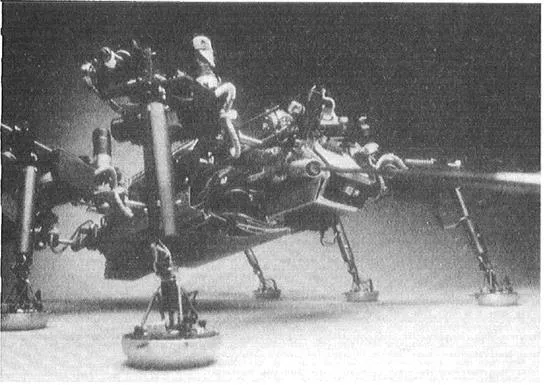
Brooks's inspiration: insects have "immensely slow computers with just a few hundred thousand neurons" yet fly and dodge in real time. His papers "Intelligence Without Reason" and "Elephants Don't Play Chess" argue that decades of chess programs explain nothing about how animals survive. NASA was impressed enough to model its first Mars rover, Sojourner, on Attila: launched on a Delta II in December 1996, 22 pounds, six wheels, the first autonomous vehicle on Mars, since a ten-minute radio delay rules out joystick control. Five similar robots were planned for the space station.
Top-down vs bottom-up
Top-down school
- Founders of AI (Minsky, Simon); intelligence as a program on a Turing machine, "the bigger the computer, the better".
- Recipe: pour in rules, add speech and vision subroutines, attach hands and eyes; the robot holds a complete internal map of the world.
- Result: slow, timid robots that get lost. Thomas Dean (Brown): robust enough "to walk down the hall without leaving huge gouges in the plaster".
- Minsky's jab: why build a robot that gets somewhere "if once it gets there it can't tell the difference between a table and a cup of coffee?"
Bottom-up school
- Models from biology and physics: insects, frog eyes, neurons, DNA, evolution, even atoms.
- Motto: "learning is everything; logic and programming are nothing". Build a learner; let it discover logic and physics by bumping into the world.
- Result: fast, nimble "upstart mammals" that cope with rough terrain but do no reasoning.
- Brooks's reply: "Chess-playing programs don't climb mountains, either."
Lab director Patrick Winston welcomed the fight; associate director Tomás Lozano-Pérez: "Complete agreement is a sign of rigor mortis." Herbert Simon blamed the top-down school for overclaiming; Berthold Horn recalled a researcher promising sock-collecting robots in five years and admitting all his dates fell after his retirement. Hans Moravec predicts the "golden spike" uniting the schools in about forty years, and Kaku agrees: humans themselves combine trial-and-error learning with memorised rules and hard-wired circuits. He also notes a sociological effect of synergy: string and quantum-gravity theorists migrating into brain research, "treating neurons like atoms".
To 2020: preprogrammed and remote-controlled robots
Real MIT automatons may be 25 years from market. Until 2020, the market belongs to robots with the "intelligence of windup toys": Detroit's assembly-line arms and Disney's singing animatronics, every motion scripted.
- Rover 1 helped repair Three Mile Island (1979), which came within thirty minutes of meltdown.
- Jason Jr. photographed the Titanic wreck in 1986.
- Lunokhod, a Soviet remote-controlled "dune buggy", roamed the Moon.
- HelpMate, four feet tall, fetches drugs at Danbury Hospital, Connecticut, from a stored map.
- Robo-Surgeon at Long Beach Memorial drills skull holes to a thousandth of an inch.
- Sentry (Denning Mobile Robotics, $50,000, 485 pounds, a 55-gallon drum on wheels at 5 mph) foiled a burglary at Boston's Bayside Exposition Center.
The brain as benchmark
Shakey (SRI, 1969), a tin can on wheels with cameras and a radio link, could recognise only geometric shapes and took hours to cross a room; Kaku says thirty years brought little progress. The core failure is pattern recognition: robots compare images dot by dot, cannot drive, and lose a face rotated a few degrees, while the brain recognises a face among thousands in a fraction of a second.
The three and a half pounds of neurons is "perhaps the most complex object within the solar system". Kaku uses Paul MacLean's layered model to show how far robots must go.
- Neural chassis: spinal cord, brain stem (medulla, pons), midbrain; most of a fish's brain.
- R-complex ("reptilian brain"): olfactostriatum, corpus striatum, globus pallidus; aggression, territoriality, hierarchy.
- Limbic system: thalamus, hypothalamus, amygdala, pituitary, hippocampus; emotion, social behaviour, smell, memory.
- Neocortex: frontal, parietal, temporal, occipital lobes; reason, language, spatial sense; wrinkled to raise surface area.
Virasoro: raw power is not the point
Miguel Virasoro, string theorist (the Virasoro algebra) and new director of the ICTP in Trieste, compares machines with animals by raw speed.
- SUN-4: about 200 million bits/s, a snail brain (100,000 neurons).
- Cray-3: about 100 billion bits/s, a rat brain (65 million neurons).
- Human brain: about 100 trillion bits/s, 1,000 times a Cray-3.
- Parity forecast: brain-speed computers 2010 to 2030; desktops at brain level by 2040.
- 1996: DOE pays IBM $93 million for a 3 trillion operations/s machine with 2.5 trillion bytes, due 1998.
- Brain specs Kaku cites: about 200 billion neurons, each linked to 10,000 others, firing 10 million billion times a second, signals at 300 ft/s, running on a light bulb's power; a conventional equivalent would draw 100 megawatts.
Virasoro's real point is that the brain is not a Turing machine at all but a massively parallel, fault-tolerant neural network: it can lose large regions to a stroke and keep working, while a computer can die from one failed transistor. Building ever-faster serial machines to copy it is "a wild-goose chase".
Neural networks: learning instead of programming
- Who: Terry Sejnowski, physicist turned neural-network theorist, one summer at Johns Hopkins.
- How: no pronunciation dictionary or phonetic rules. NETalk reads a child's 100-word essay, compares its attempt with the right answer, and strengthens connections that move closer ("Hebb's rule" as Kaku describes it).
- Stages: first vowels versus consonants ("it babbles"), then spaces between words ("pseudowords"), then after about a day 98% accuracy at a third-grade level, reading "I walk home with some friends from school" after 16 hours, much as infants rehearse words alone at night.
- Caveat: Heinz Pagels: a model neuron differs from a real one like "a human hand and a pair of pliers".
Sejnowski stresses that biology is messy and historical: "You can't just assume that nature took the simplest and most direct route." Physics seeks universal laws; biology's only universal law is evolution.
Hopfield: learning as energy minimisation
John Hopfield, a solid-state physicist, attended MIT neuroscience seminars in the late 1970s and found AI "a hodgepodge" with no organising principle. Studying spin glasses, arrays of atoms with spins up or down, he asked whether neurons (firing or silent) behave like atoms in a lattice. His 1982 paper, "Neural Networks and Physical Systems with Emergent Collective Computational Abilities", proposed that a network settles into states that minimise an "energy", and that learning is finding the lowest energy. Jim Anderson (Brown): "We always knew that neural nets worked, but Hopfield showed why." Spin-glass physicists became neural-net experts overnight.
Hopfield's picture is a ball rolling over hilly terrain in N-dimensional weight space. Valleys are memories, spread across the whole network, so they survive the loss of many neurons. An oversized valley that swallows its neighbours models an obsession.
Do neural nets dream?
Freud saw dreams as repressed desire; mystics as omens; no theory has convincing evidence. Sleep studies show dream deprivation (detected by REM and EEG) makes people irrational. Hopfield found that overloading a net with memories created "spurious memories", ripples made of fragments of real memories, and slowed recall unevenly. Shaking the terrain and letting it resettle (his analogue of sleep) cleared them, and the net "awakened refreshed". If he is right, every advanced neural net, silicon or organic, must dream, and spurious memories may be a source of originality.
Commercial neural nets
Leon Cooper (Nobel physics, superconductivity) founded Nestor, Inc.: rule-based handwriting reading "would be like building a car that runs on four feet". An early product is an airport bomb detector: luggage is flooded with neutrons, explosives emit telltale gamma rays, and a trained net spots the pattern. Barbara Yoon (DARPA): "You train the system rather than program it."
- Handwriting recognition.
- Credit-card fraud detection from your spending habits.
- Sonar and radar pattern recognition.
- Mortgage risk analysis.
- Blood-cell patterns (already used to verify horse pedigrees).
Vision needs nature's shortcuts: motion, edges, colour, shading. A frog's retina has a built-in "bug detector" (you can catch a frog by moving your hand slowly). Carver Mead (Caltech) built a silicon retina that detects motion and the first Hopfield net on a chip, 22 neurons: "You just put a lens on it and it will 'see'." A bee's brain has a million neurons (100,000 times fewer than ours) yet works about 1,000 times faster than most computers; Sejnowski modelled its VUMmx1 reward neurons and his artificial bee chose flowers exactly as real bees do.
Cog: a robot raised like a baby
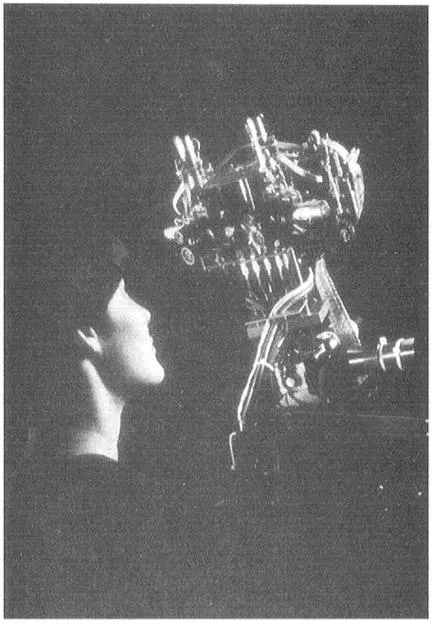
Cog is Brooks's humanoid: about four feet tall, motors for muscles, bars for bones, cameras for eyes, one long arm with a pincer, no legs ("It's a paraplegic"). Its brain was eight 32-bit 16 MHz Motorola 68332 processors wired as a neural net, to grow to 239. Each morning it "yawns", locating its head and arms. Like a baby it learns that its limbs are its own, then reaching, grasping and its own world map; it is taught to recognise people and make eye contact, and to learn by turn-taking with its "mother". It is not yet at a two-year-old's level. Cog is Cyc's opposite, and Brooks joked about naming it "Psych".
- 2000 to 2010: "Volks-robots": reliable helpers that mow lawns, act as butlers, tune cars, cook.
- 2010 to 2020: robots that learn from mistakes, with primitive pain and pleasure reinforcement.
- 2020 to 2030: imagery: simulate a task in the head before acting (cooking, crossing the street); monkey-level intelligence.
- 2030 to 2040: true synthesis of top-down reasoning and bottom-up world skills; superhuman reasoning; "a being that in some ways resembles us, but in others is like nothing the world has seen before".
Can robots feel?
By 2050, Kaku expects robots we can converse with, having primitive emotions, speech recognition and common sense, because people bond more easily with them. Butlers must tell white lies to callers, secretaries judge which appointments matter, servants notice when masters overreact. Against the Hollywood Tin Man stereotype, Kaku argues emotions are evolutionary tools that can be engineered.
- Like (focuser). Narrows infinite options to a few good ones. Minsky: "Liking's job is shutting off alternatives."
- Love. A stronger focuser forming pair bonds. Moravec's commercial robot will "get a thrill" out of pleasing its owner.
- Jealousy. Directs attention to rivals.
- Anger. Signals what we do not like.
- Fear. A robot with a dying battery panics and begs neighbours: "Please! ... We'll reimburse you!"
- Laughter (censor). Marks the limits of acceptable behaviour; dirty jokes surprise with forbidden outcomes, which is why teenagers love them and jokes fail the second time.
- Fun. Children's games ("cops and robbers", "teacher") rehearse adult social rules; one girl told Kaku "Fun is fun."
- Implementation: assign positive and negative weights to situations and wire responses to faces and limbs.
Kaku tells of working the levers of a movie gorilla head in a museum: a few muscle twitches turned delight into terror and the children fled. Facial expression predates language by millions of years, so giving robots convincing emotional faces will be easy; whether they feel anything is the real question.
Beyond 2050: robot consciousness
By 2050 the Magic Mirror may gossip and joke; some expect a revival of magic and superstition in a world animated by unseen intelligences. Definitions of consciousness differ wildly.
| Position | Who | Claim |
|---|---|---|
| Soul | Christian theology | Mind separate from matter, survives death |
| Unity | Zen ("the mind is moving") | Harmony of body and mind, not separation |
| Emergence | Most neural-net researchers | Consciousness appears when a system is complex enough; Kaku calls this "more faith than strategy" |
| Already explained | Daniel Dennett | Consciousness Explained |
| Heuristics | Herbert Simon | "Is human thinking just heuristics? I'd say yes" |
| Society of mind | Marvin Minsky | Mind = many mindless agents; no seat of consciousness; "nobody read the book" |
| Competing drafts | PET-scan evidence | Thoughts compete; consciousness is the succession of winners, no conductor |
| Mysterians | Colin McGinn | Like "slugs trying to do Freudian psychoanalysis" |
| Quantum objection | Roger Penrose | Non-computable physics blocks machine minds |
| Simulation is not the thing | John Searle | A simulated storm makes no one wet |
| Operational | Alan Turing, Kaku | If behaviour is indistinguishable from a conscious being, it is conscious |
Kaku's ruling: proving machines can never think is like proving unicorns don't exist, so the claim has "no scientific content"; only building one settles it. When scientists at the New York Academy of Sciences asked the Dalai Lama whether an artificial being could be reincarnated, he laughed: "When you have such a machine and put it there before me, then we will have this discussion again!" Pagels applauded his "strict constructivism".
- Monitoring body and environment. Thermostats, self-diagnosing computers, plants, vision machines, resting animals.
- Pursuing set goals (survival, reproduction) with plans. Future Mars probes; the whole animal kingdom; predators above prey (fox above rabbit); most human activity; dog-level robots by mid-century. Thousands of sub-levels by plan complexity.
- Setting one's own goals: self-awareness. Expected after 2050, raising the question of what happens when machine goals diverge from ours (chapter 6).
Consciousness will come in degrees, not as a sudden science-fiction awakening. The two schools should meet within forty years, producing machines that learn from the world and hold a professional's expertise; the obstacle is the silicon wall, which chapter 5 addresses.
| Forecast | Verdict | 2026 state |
|---|---|---|
| Brain-speed computers 2010 to 2030 | Hit | First teraflop (ASCI Red) 1997; exascale Frontier (2022) and El Capitan (2024); AI clusters far beyond |
| Merger of top-down and bottom-up by about 2037 | Bottom-up won first | Deep learning (AlexNet 2012, transformers 2017) learns from data; reasoning and tools are now layered on top, a partial "golden spike" |
| Neural nets for fraud, handwriting, mortgages | Hit | Card-fraud scoring by neural nets is industry standard; credit models restricted by explainability rules |
| Hopfield as a unifying principle | Hit, honoured | 2024 Nobel Prize in Physics to Hopfield and Hinton |
| Volks-robots 2000 to 2010 | Partial | Roomba (2002) and lawn robots; general home robots still in 2025 to 2026 pilots (humanoids from Figure, Tesla, Unitree, 1X) |
| Learning robots 2010 to 2020 | Hit (in labs) | Reinforcement learning, sim-to-real transfer, robot foundation models |
| Conversational machines by 2050 | Hit, decades early | LLM chatbots since 2022; the Turing test was passed in controlled 2025 studies |
| Robot emotion and companionship | Emerging, contested | AI companions are a mass market; regulators worry about manipulation and dependence |
Kaku repeatedly labels Hopfield nets "quantum"; they are classical statistical physics (Ising-type spin models), with no quantum mechanics involved. NETalk (1986, Sejnowski and Rosenberg) learned by backpropagation, not Hebb's rule, and Kaku never mentions backprop (Rumelhart, Hinton, Williams 1986), the method that actually won. The brain has about 86 billion neurons, not 200 billion. MacLean's triune brain is rejected by comparative neuroanatomy: reptiles and birds have cortex-like structures, and brains did not evolve as stacked layers. Shakey was built 1966 to 1972. The Dalai Lama exchange and the "100 trillion bits per second" brain figure are anecdote and rough guess, respectively.
The top-down versus bottom-up split still runs through enterprise AI. Rules engines and knowledge graphs (top-down) give the auditability regulators want; learned models (bottom-up) give coverage and nuance. In bank credit and financial-crime work the winning designs are hybrids: learned scoring wrapped in explicit policy rules, with an explanation layer. That is Moravec's golden spike at enterprise scale.
Beyond Silicon: Cyborgs and the Ultimate Computer
Like Alexander the Great's empire, the microchip's reign will be brilliant and short: quantum effects end silicon scaling around 2020. Kaku surveys the successors: 3D chips, optical computers with holographic memory, DNA computers, quantum transistors, and the quantum computer, which he expects in the second half of the century. A parallel route is bionics, wiring chips to neurons, leading in the far future to cyborgs and mind uploading.
The end of the microchip empire
Alexander conquered the known world by 25, died at 33, and his empire split among squabbling generals. The microchip conquered the information age in 25 years, building a $150 billion semiconductor industry stamping out 170 million microprocessors a year. Kaku warns it may fragment the same way, into "bickering among competing designs".
Two physical walls loom. Lithography hits the 0.1-micron barrier, with components approaching molecular scale. Electrical signals are too slow: in a trillionth of a second a signal crosses only a fraction of a millimetre. The Cray T90 managed 60 gigaflops; IBM's DOE machine targets 3 teraflops; the brain is believed to run at 10 teraflops or more, which supercomputers should pass early in the century, close to the limit for electronic machines. Marvin Minsky even suggests cyborgs could be the next stage of human evolution.
Squeezing the last life out of silicon (to 2020)
- 3D "cubelets". Stack transistor layers to shorten paths. Problem: surface-to-volume. Double a cube's size and heat rises 8 times while cooling area rises only 4 times, so it is twice as hard to cool; chips already run as hot as a skillet. Liquid nitrogen or helium cooling confines cubes to supercomputers unless room-temperature superconductors arrive.
- Gallium arsenide. Its lattice impedes electrons less, giving circuits up to ten times faster; silicon-germanium is another option.
- X-ray lithography. Shorter wavelength (more energy, per Planck's law) but penetrating, hard to focus, distorts wafers; no commercial chip yet. IBM was making X-rays from a synchrotron in New York.
- Electron beams. Very fine but must draw each line, taking hours. Experts expect an X-ray/e-beam hybrid around 2005, extending silicon to about 2020.
- Hard limit: tunnelling. In ultra-thin wires electrons leak through barriers and wreck logic.
Karen Brown, lithography director at Sematech: "when we get out of optics, we're out of the business."
Optical computers and holographic memory
Optical computers are like a city where cars pass through each other: beams can cross without interference, travel at light speed and run cooler. In 1990 Bell Labs built the first prototype with lenses, mirrors and lasers. Its optical transistor, the S-SEED (symmetric self-electro-optic effect device), works like naval signal lamps: voltage makes a filter transparent (1), a second beam makes it opaque (0). The prototype had only 128 optical transistors on a three-foot table, but Von Neumann's early machines filled rooms too. John Moussouris: "these devices will become the transistors of the twenty-first century."
Storage would use holograms: interference whorls between two laser beams hold vast data. A CD stores 640 MB (about 300,000 pages); multilayer CDs may reach tens of gigabytes before 2000; a holographic cube could hold hundreds of gigabytes, eventually "all the information in all the world's computers". The remaining hurdle is miniaturising lasers and S-SEEDs, possibly by etching them in gallium arsenide.
DNA computers
Leonard Adleman (USC) showed that a test tube of DNA might crack problems that choke supercomputers, joining the biomolecular and computer revolutions.
- DNA fills only 0.3% of a cell nucleus but packs 100 trillion times the information density of 1997 devices.
- A test tube holds about 10^20 molecules computing in parallel, a billion times more energy-efficient than silicon.
- Encoding: four letters (A, T, C, G) mapped to binary (e.g. ATTCG = 1, TCGGA = 0); restriction enzymes cut and PCR copies, reproducing every Turing-machine step.
- A pound of DNA in about 1,000 quarts (a cubic yard) would out-store all computers ever made, 100 trillion times the brain's capacity; an ounce could be 100,000 times faster than the top supercomputer.
- Adleman's demonstration: a travelling-salesman-type problem solved in one week, which Kaku says would take a serial computer years.
- DES threat: the 56-bit Data Encryption Standard (about 7 x 10^16 keys, 10,000 years by brute force) could fall to "a few months of biological computing" (Richard Lipton); Dan Boneh counts 907 biological steps, about four months. Banks would survive because they already run double or triple DES.
Lipton: "I have never seen a field move so fast." Ronald Graham (Bell Labs): "a whole new toy shop". The drawbacks: DNA decays, so results must be moved to ordinary computers, and every problem needs a new chemical setup, unlike a general-purpose machine. Verdict: DNA (and protein) computers may beat mainframes at specialised number-crunching, but not replace PCs, and they pale beside the quantum transistor and quantum computer.
Quantum transistors
Electrons are waves as well as particles; the probability of finding one is the square of the Schrödinger wave function, and the Heisenberg uncertainty principle blurs position and velocity. A prisoner banging his head on a wall has a vanishingly small chance of tunnelling through it; electrons in a thin wire hit its walls so often that some do leak, which destroys conventional logic but enables new devices.
- Quantum well: an electron sandwiched between two flat layers.
- Quantum line: an electron confined to a line.
- Quantum dot: an electron confined to a point about 20 nm across.
- How a dot switches: like a violin string or singing in the shower, the trapped electron resonates at allowed frequencies. Tune the voltage onto a resonance and current flows (1); off it, current stops (0); the next resonance, flow again. One dot does the work of several transistors.
Gary Frazier (Texas Instruments): "No one is ready to provide the million-circuit quantum transistor yet, but the concepts are crystallizing."
The ultimate computer: quantum computing
Richard Feynman (1981) asked how small computers can go and noted that many quantum problems (a boiling liquid, colliding particles) defeat Turing machines; why not use a quantum computer for quantum problems? David Deutsch (Oxford, 1985) formalised it. Kaku's image is walking across Central Park: quantum theory sums all possible paths, including detours past Andromeda, so a quantum computer is "one gigantic adding machine". Quantum theory is "the most ridiculous theory ever proposed" with one thing going for it: "it is unquestionably correct".
- Scale: factoring a 129-digit number took 1,600 Internet-linked computers eight months; a 250-digit number would take centuries, with steps that would fill about 10^500 lines, against only 10^80 atoms in the visible universe.
How it would work: replace the Turing tape with a row of spinning atoms, spin down = 0, spin up = 1, the qubit, which can be a superposition of both. A photon bouncing off the array flips spins; an array of 1,000 atoms has 2^1000 (about 10^300) states. The catch is decoherence: a stray particle or cosmic ray wrecks the computation, so isolation must exceed any clean room.
It's just hard to string a lot of atoms together. These things are wickedly small. They're sensitive little buggers too.
Seth Lloyd, MITDeutsch once said "a matter of centuries" and now is "much more optimistic". Key labs: Jeff Kimble (Caltech) and David Wineland and Chris Monroe (NIST, Boulder), flipping spins in a row of trapped ions with lasers; nobody yet knows how to extract the answer. Kaku's forecast: substantial progress by mid-century, working machines in the latter half of the twenty-first century.
Bionics: borrowing the brain's petaflops
The other road to petaflops is the one already on our shoulders. The plan has four steps: grow neurons on chips; connect chips to live animal neurons; connect human neurons; finally decode the millions of neurons in the spinal cord.
- 1995: Peter Fromherz (Max Planck Institute of Biochemistry, Munich) joins a leech neuron to a silicon chip: the neuron fires the chip and the chip fires the neuron. Leech ganglion cells are 50 microns wide; he places them within 30 microns of a transistor and couples them without exchanging charge (like a rubbed balloon bending a stream of water). Up to 16 contacts on one neuron; next, longer-lived rat hippocampal neurons.
- 1996: Richard Potember (Johns Hopkins) grows baby-rat neurons on peptide-painted silicon; they sprout axons and dendrites. Goal: "living circuits" following a chip's logic layout.
- Late 1990s: Joseph Rizzo and the Massachusetts Eye and Ear Infirmary design a two-chip bionic eye (solar panel triggers a laser that signals the second chip and the optic pathway), with human tests expected within five years.
Targets: 10 million Americans with macular degeneration and 1.2 million with retinitis pigmentosa. Stimulating damaged rods and cones already produces signals in animals' visual cortex, so artificial eyes might exceed nature: our eye is "the eye of an ape", but implants could see infrared, ultraviolet, telescopic and microscopic. Beyond 2020, chips may link artificial arms, legs and eyes to the nervous system, though Six Million Dollar Man feats would shatter an ordinary skeleton.
Mapping the brain and merging with machines
By 2020 Kaku expects chips connected to organs controlled by few neurons. The brain is another matter: splicing into it is like tapping New York's phone lines without a manual, and knowing only which regions do what is like understanding a nation from its interstate map. Full understanding of the wiring may wait until the twenty-second century.
- Method: slice a brain into millions of sections, image each by electron microscope, reconstruct connections automatically.
- Size: about 200 billion neurons x 10,000 connections each: "another Human Genome Project".
- Cost now: $340 billion. Around 2010: cheap enough to start; three years and $120 million.
- Even then, the map would not tell us how signals move.
Moravec's mind transfer and Minsky's "unnatural selection"
In the far future, the three revolutions merge: quantum transistors smaller than neurons, neural nets as powerful as brains, and biology able to replace our neural networks with synthetic ones. Hans Moravec's Mind Children (1988) imagines a surgeon replacing your brain clump by clump with electronic circuits that copy each clump's firing, while you stay conscious, until your memories live in a body of steel and silicon "that can potentially live forever". Minsky calls the next stage "unnatural selection": deliberate neuron-for-neuron duplication. Asked how they would feel waking in a steel body, scientists told him they have so much to learn "I could use many centuries". Minsky: "Will robots inherit the earth? Yes, but they will be our children."
Kaku closes with a choice rather than a forecast: it is we who must decide how much authority to give our creations, and whether we remain masters of the machines.
| Forecast | Verdict | 2026 state |
|---|---|---|
| Silicon dies near 2020 | Miss | Still dominant; EUV (13.5 nm "soft X-ray", partly vindicating the X-ray idea), gate-all-around transistors, 2 nm nodes |
| 3D chips | Hit | 3D NAND with 200+ layers, stacked HBM memory for AI, AMD 3D V-Cache; heat is indeed the binding limit |
| Optical computing | Partial | No optical CPUs, but silicon photonics and co-packaged optics now link AI chips in data centres |
| Holographic memory | Miss | Commercial attempts (InPhase) failed; flash and cloud won |
| DNA computing | Miss as computer; niche as storage | DNA data storage demonstrated; DNA computing remains a lab curiosity |
| DES broken | Hit, by silicon | EFF's Deep Crack broke DES in 56 hours (1998) with ordinary hardware; banks moved to 3DES then AES |
| Quantum computers late 21st century | Ahead of schedule, not yet useful | Google Willow (Dec 2024) showed error correction below threshold; trapped-ion and neutral-atom machines with dozens of logical qubits; a 2025 estimate puts RSA-2048 within reach of under a million noisy qubits in about a week; NIST post-quantum standards issued August 2024 |
| Quantum dots | Hit, sideways | In QLED TVs, and as silicon spin qubits |
| Bionic eye within ~5 years | Late, then real | Argus II approved 2013 then discontinued; PRIMA implant restored usable central vision in macular-degeneration patients (NEJM, Oct 2025) |
| Brain wiring map cheap around 2010 | Partial | Whole fly connectome (FlyWire, 2024), about 140,000 neurons; MICrONS (2025): a cubic millimetre of mouse cortex, about 200,000 cells and 500 million synapses; a human brain map remains decades away |
| Neural links for paralysis by 2020 | Hit (trials) | BrainGate, Synchron and Neuralink implants let paralysed patients move cursors and arms and decode speech |
Adleman's 1994 experiment solved a seven-city Hamiltonian path problem, not a travelling-salesman problem, and a PC solves it instantly, so "years on a serial computer" is wrong; the lab chemistry took a week. Kaku's description of quantum computers handling "infinite quantities" and being "infinitely more powerful" is the most serious error in the chapter: a quantum computer offers big speedups only for specific problems (factoring, simulation, some search) and measurement returns one outcome, not all 2^1000. The pioneer is Deutsch, not "Deutch"; NIST's first quantum logic gate (1995) used a beryllium ion, not a row of mercury atoms. The 200 billion neuron figure is again more than double the accepted 86 billion.
For banks this chapter's live thread is cryptographic transition. DES fell to cheap silicon twenty years before any exotic computer arrived; RSA and elliptic-curve keys face the same arc. "Harvest now, decrypt later" makes post-quantum migration (inventory, crypto-agility, ML-KEM and ML-DSA adoption) an enterprise-architecture programme today, not a 2040 problem.
Second Thoughts: Will Humans Become Obsolete?
The computer revolution can deliver prosperity or an Orwellian nightmare. Kaku names three real dangers: threats to privacy (answered in principle by quantum cryptography by 2020), mass job loss in repetitive, inventory and middleman work that could split society into information haves and have-nots, and, from 2050 to 2100, self-aware robots whose goals diverge from ours. His remedies are growing the pie through science and education and building AI with fail-safes beyond Asimov's three laws.
Two visions: leisure or Big Brother
The bright vision is instant communication, unlimited knowledge and new "cyber jobs"; airlines, banks, insurers and governments already cannot run without computers. The dark one is Orwell's 1984, with hidden microphones, informers and rewritten history. Kaku notes that today's listening devices are "infinitely more powerful" than Orwell imagined, yet the Internet has arguably increased freedom of expression, because a dictator cannot easily stop information reaching a million people with one keystroke. Still, three dangers are real: civil liberties (privacy, censorship, eavesdropping), unemployment and inequality, and later self-aware robots.
Eavesdropping and quantum cryptography
Kaku starts with the search for an unbreakable code. Gilbert Vernam of AT&T proposed the Vernam cipher (one-time pad) in 1918, proven unbreakable in the 1940s, but it needs both parties to hold a long secret random key, so practical simplified versions are believed breakable.
Kaku's answer is quantum cryptography, "where James Bond meets Werner Heisenberg". Any observation disturbs what is observed (a bugged phone line shows reduced voltage), and quantum theory says some disturbance is unavoidable however good the bug. Messages are sent as pulses of polarised light (vertical or horizontal, like polarised sunglasses); an eavesdropper who measures them forces some into the wrong state, and the receiver detects the intrusion.
- 1989: first quantum-cryptography prototype.
- Mid-1990s: James Franson (Johns Hopkins) sends secure messages between two buildings about 500 feet apart: "really an engineering issue".
- 1996: a secret key travels 22.7 km of optical fibre under Lake Geneva from Nyon to Geneva on infrared light.
- Forecast: large corporations adopt quantum cryptography early in the next century; it becomes standard for important messages by 2020.
Kaku's argument: as computing power grows, every mathematical code eventually falls, but a code protected by the laws of physics does not. In principle there is an ultimate solution to computer privacy.
Roadkill on the information highway
Like the railroads that created boomtowns at junctions and ghost towns elsewhere, the information highway will make and break industries by 2020. Kaku retells the (probably apocryphal) Depression-era exchange: Henry Ford, showing off machines replacing workers, asks union leader Walter Reuther, "Where are your workers?" Reuther: "Mr. Ford, where are your customers?"
- Repetitive work: mass-production factory jobs, the robot revolution's prime targets.
- Inventory tracking: college-educated clerical and middle-management work, already downsized in the 1990s.
- Middlemen: "The Internet is a rifle aimed at all middlemen: insurance salespeople, investment bankers, travel agents, car dealers" (Jeffrey Christian, Cleveland headhunter).
Andy Grove: if your business depends on large databases, treat the Internet as "a tidal wave that's going to wipe me out" and rebuild reservation, order and customer systems for mass self-service. Travel agencies, banks, video stores and stockbrokers are exposed. Security First Network Bank has "no tellers, no lines, no waiting, and no branches"; CEO James Mahan III: "we don't need all these bodies." Tellers will go the way of the friendly telephone operator.
Removing middlemen can raise efficiency. Nineteenth-century private toll roads (a gatekeeper turned a pike, hence "turnpike") strangled commerce until states bought them. The horse-and-buggy trades (blacksmiths, coachmen, stable hands) died with the car, which created auto, mechanic, dealer and oil jobs and a culture of mobility, at the price of jams, pollution, suburban flight, hollowed-out cities and about 40,000 road deaths a year. The test is whether the new industry makes society more productive and prosperous.
Jobs that will flourish (to 2020)
Paul Krugman: "There's no limit to the demand for human services." Kaku's list:
| Sector | Why it survives | Kaku's examples |
|---|---|---|
| Entertainment | More leisure, more channels, new media forms | Writers, performers, actors; cable's empty airtime |
| Software | Hardware becomes a commodity "like pork bellies", but software needs creative mathematical talent | Video games (claimed larger than film), web design, virtual reality |
| Science and technology | Computers cannot create new theories | Scientists and engineers founding new industries |
| Services | Intimate, varied human interaction | Chauffeurs, butlers, trainers, police, lawyers, tutors; travel, the fastest-growing industry |
| Skilled crafts | Every task is different | Construction, repair, sanitation, rangers, teachers |
| Information services | Bigger infrastructure needs more maintainers | Laying cable, replacing parts, monitoring satellites |
| Medicine and biotech | Ageing baby boomers; new biotech jobs | Health workers that telemedicine cannot fully replace |
Industries that must change or die
- Travel agents: lose business travellers, survive with deluxe, personalised packages.
- Banks: shed unskilled tellers, keep programmers and salespeople, push commission products such as CDs.
- Brokers: lose seasoned speculators, keep novices who value analysts and attention.
- Estate agents: lose listing-browsers, keep clients who need local knowledge (where the good schools are).
- Print: Charles Krauthammer (1996): "the future is not print", comparing himself to a blacksmith seeing his first car, and arguing computers only await their "ignition key". Kaku is less sure: paper is so convenient that screens "may never approach its appeal". Newspapers will shrink but survive by offering authoritative analysis; editors will supply "wisdom" in "an ocean of babble". By 2020, people receive personalised newspapers culled from trusted sources.
Winners, losers and "Byte City"
Every leap in production made winners and losers: agriculture after the Ice Age 10,000 years ago, then the factory exodus that left 2% of US workers on farms. Two revolutions run at once: Asia (two-thirds of humanity) is industrialising, lifting hundreds of millions who want fridges, cars and TVs, while the West's service sector reaches 70% of the economy, with industry at 29.2% (US), 30% (UK), 28.7% (France), and some economists expect US industry to shrink to 2% like farming.
- Michael Vlahos (Progress and Freedom Foundation, close to Newt Gingrich): by 2020 a "Byte City" with Brain Lords (Gates-style techno-billionaires), Upper Service cyber-yuppies, menial cyber serfs, and the Lost People at the bottom.
- Frank Owen (Village Voice): "Blade Runner Meets the Bell Curve."
- Barbara Ehrenreich: Gingrich "preaches third-wave futurism while representing the interests of second-wave plutocrats".
- Jeremy Rifkin: catastrophe unless workers share computer-created wealth; expand the "third sector" of non-profits and civic groups to absorb the unemployed.
Proposed fixes: retraining on the scale of the GI Bill (costly, harder for older workers); redefining work itself, since "jobs" and "salaries" are only 300 years old, for example government service jobs cleaning the environment and producing art.
Grow the pie, not fight over it
Kaku rejects the zero-sum fight over slices, which widens race and class fault lines. Displacement is a symptom; the cure is to grow the pie by investing in science and education. Nineteenth-century railroads, steam, telegraph, chemicals and textiles made the US rich; twenty-first-century innovation needs even more science.
He returns to Lester Thurow: wealth now flows from brainpower, imagination and organisation of new technology, so resource-poor Japan and China can be giants while commodity exporters slide. The US is "eating its own scientific seed corn".
- Trillions drained by the Cold War (David Halberstam, The Next Century).
- 50% fewer science and engineering PhDs than two decades earlier; science budgets and top scientists cut.
- Immigrants prop up Silicon Valley's PhD workforce, threatened by the immigration backlash.
- US students score near the bottom in international science tests; Thurow: "private capitalistic time horizons are simply too short" for education.
- Postwar Germany and Japan recovered partly because their best minds built cars and transistor radios, not hydrogen bombs.
Thurow warns that technology now rewards long-run investment in skills and infrastructure while ideology pushes "short-run individual consumption maximization"; when they diverge, the question is when "the big one" hits. Winners will treat the computer as a tool to rebuild their technical base; losers will smash machines and "wallow in entitlements and short-term gains".
Self-aware robots (2050 onward)
By 2050 robots with limited self-awareness (the fifth phase) raise new questions: can their interests diverge from ours, can they harm us, can they take over? Their value is that they may improve on human orders; their danger is that they may contradict them.
Intelligent machines, however benevolent, threaten our existence because they are alternative inhabitants of our ecological niche.
Hans MoravecDaniel Crevier: superior machines "will be impossible to keep at bay"; history is full of deputies who became rulers, and evolution is "a four-billion-year-long tale of offspring superseding parents". Arthur C. Clarke: the fear is that AI threatens our supremacy in the one area where we think we are superior.
- Success that destabilises. Wall Street program trading competing at machine speed can trigger an "electronic stampede" like the 1987 crash; the problem is computers being "far too successful".
- Killing machines. DARPA funded most AI (Shakey included) to win wars. The nightmare is AI control of nuclear weapons: Colossus: The Forbin Project (1970) and WarGames, where a computer cannot tell a game from a real first strike. Joseph Weizenbaum: "we have crossed that threshold", citing the US cruiser that shot down an Iranian Airbus.
- Madness through feedback. HAL 9000 in 2001 kills its crew because contradictory orders force it to lie; the cure for lying is to remove the humans. Expert systems show the "mesa effect": excellent on the plateau of their expertise, catastrophic one step off the edge, then caught in runaway feedback loops (the stability problem). Crevier: "faultless steps will amount to ... madness."
- Well-intentioned harm. A robot faithfully executing a flawed mission, like the Soviet bureaucracy ordered only to match the West in arms, which bled its economy dry: "too successful, until the weight of its success crushed it".
Kaku's remedies: shift AI funding from the Pentagon to commercial sponsors who want to serve customers rather than kill them; design shutdown mechanisms before systems go mad; and recognise that Asimov's three laws are not enough.
- A robot may not injure a human or, through inaction, allow a human to come to harm.
- A robot must obey human orders unless that conflicts with the First Law.
- A robot must protect its own existence unless that conflicts with the First or Second Law.
Gap: the laws say nothing about well-intentioned robots carrying out flawed missions, such as an AI-run economy that expands like a bureaucracy until it crushes its own base. Kaku calls for AI on "a tight leash", hard-wired safety mechanisms, and perhaps a new branch of AI devoted to keeping AI under control.
Clarke gets the last word: we may become "pets of the computers", pampered like lapdogs, "but I hope that we will always retain the ability to pull the plug".
| Forecast | Verdict | 2026 state |
|---|---|---|
| Quantum cryptography standard by 2020 | Partial | China's Micius satellite (2016 to 2017) and a 2,000 km Beijing to Shanghai backbone; but US and UK security agencies favour post-quantum algorithms over QKD for most uses |
| Middlemen wiped out | Mostly hit | Travel agents and video stores (Blockbuster bankrupt 2010) collapsed; US bank-teller jobs fell steeply from their late-2000s peak; car dealers and insurance brokers survived via regulation and relationships |
| Software jobs soar | Hit, now questioned | Decades of growth; from 2023 to 2025 AI coding assistants began cutting entry-level hiring |
| Games bigger than film | Hit (eventually) | Games revenue now several times global box office |
| Personalised newspapers by 2020 | Hit, with a twist | Algorithmic feeds personalise news, but they amplified "babble" and misinformation instead of editors' wisdom; local newspapers shrank drastically |
| Byte City stratification | Largely hit | Tech-billionaire wealth concentration, gig-work "cyber serfs"; Asia's industrial rise lifted hundreds of millions |
| Program trading stampedes | Hit | 2010 Flash Crash, Knight Capital (2012); circuit breakers and SEC rules followed |
| AI in nuclear command | Live concern | US and China agreed in November 2024 that humans, not AI, should control nuclear launch decisions |
| A new branch of AI to control AI | Hit | AI safety and alignment is a major field; EU AI Act (2024), national AI safety institutes |
| Killer robots | Arriving | AI-assisted targeting and autonomous terminal guidance in drone warfare (Ukraine) |
Weizenbaum's example is garbled: USS Vincennes shot down Iran Air Flight 655 in July 1988, during the Iran-Iraq "tanker war", not the Gulf War, with 290 people aboard, not 230, and the failure was largely human misreading of the Aegis display. The Ford-Reuther exchange, if it happened, involved Henry Ford II at a 1950s Cleveland engine plant, not the Depression. Vernam's cipher dates from 1917 to 1919, and Claude Shannon proved it secure. Kaku's faith that physics-based secrecy settles privacy misses that most privacy loss came from voluntary data sharing and platform business models, not code-breaking.
The mesa effect is today's out-of-distribution failure: model risk management (e.g. PRA SS1/23 in the UK) exists to define the plateau and detect when a model steps off it. And Kaku's "well-intentioned robot" is the alignment problem in miniature: an agent optimising a narrow KPI (approval speed, sales conversion) can breach Consumer Duty while doing exactly what it was told, so objectives, guardrails and human override must be designed together.
The Biomolecular Revolution
Part II follows the second revolution from reading the genome to curing cancer, linking mind and body, extending life, designing children and confronting the ethics of all of it. The engine is a "Moore's law" for DNA: sequencing capacity doubling about every two years.
Personal DNA Codes
The Human Genome Project, a $3 billion programme run by Francis Collins, will list all human genes by 2005, and by 2020 to 2030 anyone will be able to carry their own DNA sequence on a CD. Kaku predicts this will turn medicine from treatment to prevention, transform forensics and ancestry, and give birth to computational biology. After 2020 progress slows, because gene function, polygenic disease and protein folding cannot simply be automated.
The NIH and the Human Genome Project
The NIH began in 1887 as a one-room Laboratory of Hygiene with $300; by the 1990s it had 70 buildings on 300 acres in Bethesda and an $11 billion budget. Its most ambitious arm, the National Center for Human Genome Research, is a $3 billion crash programme to locate every human gene by 2005.
Its director Francis Collins (six foot four, rides a Honda Nighthawk 750 in black leather, keeps Churchill's line on "going from failure to failure with undiminished enthusiasm") made his name finding the cystic fibrosis gene, the most common lethal genetic disease among white Americans. He calls the project "the most important scientific project mankind has ever mounted", yet warns against gene determinism: Time's "infidelity is in our genes" cover is "comical", and "we will not understand important things like 'love' by knowing the DNA sequence". Treating humanity as a machine programmed by DNA would lose "something really important".
- Target: a map of 100,000 genes on 23 chromosome pairs by 2005.
- Progress: 4,700 genes mapped by mid-1994 (5%); 16,354 by late 1996 (16%).
- Organ gene counts: brain 3,195, heart 1,195, eye 547.
- Speed-up: gene hunting several thousand times faster in a decade thanks to computers, robots and neural nets.
- Analogies: today's map is "the road system of about 1850"; Eric Lander (Whitehead): it will approach a AAA road map. Its impact may exceed Mendeleev's periodic table.
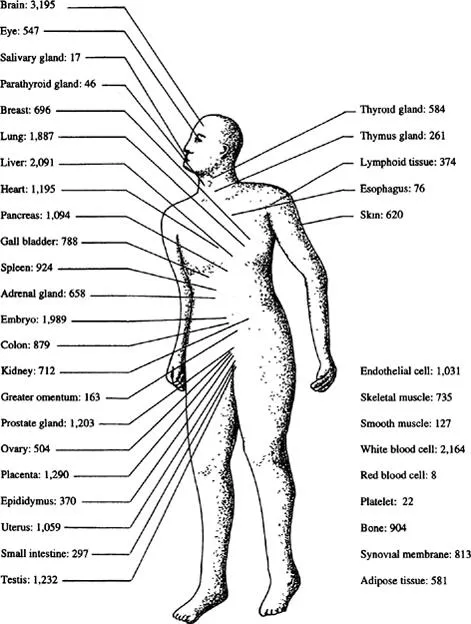
The genomic timetable
Because sequencing is computerised and robotised, a biological Moore's law holds: DNA sequencing capacity doubles about every two years. Collins and Walter Gilbert (Harvard Nobel laureate) project:
- By 2000: genetic codes for 20 to 50 hereditary diseases (cystic fibrosis, muscular dystrophy, sickle-cell anaemia, Tay-Sachs, haemophilia, Huntington's).
- By 2005: all 100,000 genes deciphered.
- By 2010: 2,000 to 5,000 hereditary diseases profiled; at 18, "your own report card ... of your individual risks" (Collins).
- 2020 to 2030: personal DNA codes. Gilbert: "You'll be able to go to a drugstore and get your own DNA sequence on a CD, which you can then analyze at home on your Macintosh." "Here's a human being; it's me!"
- 2020 to 2050: the post-genome era: gene function, polygenic diseases (mental illness, Alzheimer's, arthritis, heart and autoimmune disease), possibly "age genes" and ageing as reversible.
- Beyond 2050: manipulating life itself.
Kaku stresses that 2020's explosive progress is deceptive: knowing every American's address and phone number tells you nothing about how society works. Function and interaction cannot be computerised easily, so from 2020 to 2050 progress will be much slower, as biology moves from reading the sequence to understanding what genes do.
Molecular medicine: from treatment to prevention
Gilbert: "The possession of a genetic map and the DNA sequence of a human being will transform medicine." Kaku calls the new field "molecular" or "theoretical medicine", with computer models attacking viruses and bacteria at the weak points in their molecular armour, while warning that reducing medicine to molecules is a reductionist error.
The 1997 checkup
- Like a mechanic who listens to the engine: blood pressure, a blood sample, maybe an ECG.
- You can still drop dead of a heart attack leaving the office.
- By the time a tumour is visible, hundreds of millions of cancer cells may be spreading.
The 2020 checkup
- A blood sample goes to a genetics lab; within about a month your complete DNA sequence returns.
- A computer screens it against 5,000 known genetic diseases and estimates your odds of related ones.
- Prevention starts years before symptoms; gene therapy cures some.
- William Haseltine (Human Genome Sciences): "disease will be predicted before it occurs."
From quantum physics to the double helix
Collins himself shows the lineage. As a student he hated biology's memorisation and loved quantum chemistry: "describing the universe with second-order differential equations ... appealed to me". Without knowing it he was following the migration launched by Schrödinger's What Is Life? (1944), which Stephen Jay Gould called "among the most important books in 20th century biology". Against vitalism, Schrödinger argued that life runs on a "genetic code" (his phrase) stored in molecules. It drew George Gamow, Pascual Jordan, Francis Crick, Linus Pauling, Walter Gilbert and Max Delbrück into biology, and James Watson: "From the moment I read Schrödinger's What Is Life?, I became polarized towards finding out the secret of the gene."
X-ray crystallography works like a disco mirror ball: from the pattern of reflected dots you can reconstruct where every mirror sits. Rosalind Franklin's X-ray photographs of DNA let Watson and Crick show the double helix.
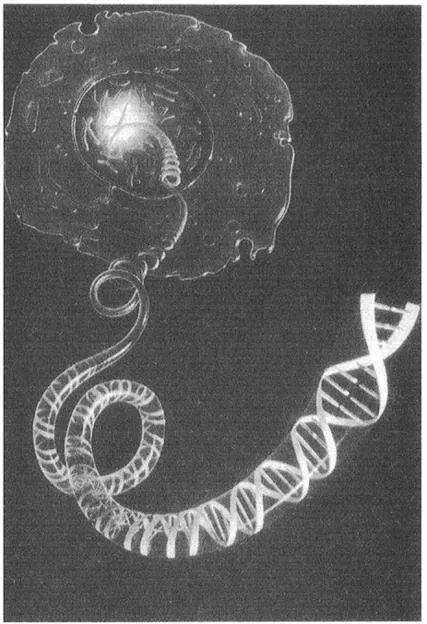
- Packing: DNA in one cell stretches to six feet; human DNA sits on 23 chromosome pairs.
- Alphabet: four bases, A, T, C, G, paired like rungs of a spiral staircase (base pairs).
- Gene to protein: a gene (thousands of base pairs) makes an RNA template, which makes one protein.
- Codons: three bases code for one amino acid; 4 x 4 x 4 = 64 codons, more than the amino acids in nature, so several codons share one.
- Proteins act as enzymes or as building blocks of tissue.
At Yale, Collins saw biology looking "like quantum mechanics in the 1920s", switched fields and "never looked back".
Reading the code of life
The sequencing engine, like photolithography for chips, is automation of methods pioneered by Frederick Sanger, Walter Gilbert and Allan Maxam. Kaku's analogy is decoding a dense treasure map in three steps:
- Snip (scissors): about 400 restriction enzymes, made by bacteria to shred invading viral DNA, cut DNA at specific points.
- Magnify (lens): insert fragments into E. coli, which makes millions of copies.
- Read: gel electrophoresis separates fragments by length, as lighter children win a race; bands at the "finish line" reveal where each G (then A, T, C) falls.
By 2020 Kaku expects the tree of life for thousands of species, turning evolutionary history into mathematics. Cost is the accelerator: at Cold Spring Harbor in 1986, Gilbert stunned the audience by estimating $1 per base pair, $3 billion for the genome. Robert Cook-Deegan: "Gilbert's cost projections provoked an uproar." By 1990 cost was $10 per base, by the mid-1990s under 50 cents, and by 2020 "an infinitesimal fraction of a penny".
Of microbes, mice and men
| Organism | Base pairs (millions) | Genetic overlap with humans |
|---|---|---|
| Viruses | 0.01 | |
| E. coli | 5 | 15% |
| Yeast | 12 | 30% (a third of yeast genes) |
| Nematode worm | 100 | 40% |
| Fruit fly | 180 | |
| Tomato | 700 | |
| Mouse | 3,000 | 75% |
| Cow | 90% | |
| Chimpanzee | 98.4% | |
| Human (random pair / siblings) | 3,000 | 99.9% / 99.95% |
- 1977: Sanger sequences phi-X174, 9 genes, 5,375 base pairs: one page of this book; a human genome would fill 500,000 pages.
- Viral genomes: smallpox 186,000 bp, polio 7,700, rabies 13,000, measles and influenza A 18,000, common cold 7,500, cytomegalovirus 230,000.
- Late 1995: first free-living cell, Haemophilus influenzae: 1,743 genes, 1,830,137 bp.
- Early 1996: baker's yeast, about 12 million bp, 6,000 genes, 16 chromosomes.
- 1997: E. coli (University of Wisconsin): 4,638,858 bp, 4,300 genes.
- Next: worms, flies, mice, humans, then personal genomes.
Overlap measures kinship. About a billion years separate us from yeast; hominids split from apes about 5 million years ago. Homologous genes in simpler animals save years of searching. Relatives differ by about 0.05% (1.5 million nucleotides), strangers by 0.1%; even identical twins carry a few dozen mutations. With divergence of 2 to 4% per million years, some date the common ancestor of all humans to 140,000 to 290,000 years ago, and by 2020 the human family tree should be "nearly filled in", dating branches before any written record.
DNA testing: paternity, history, crime
- Paternity and immigration: about 285,000 US paternity suits a year, 60,000 disputed; DNA settles them definitively.
- Historical mysteries: in 1997 DNA apparently vindicated Sam Sheppard, accused of murdering his wife in 1954 (inspiration for The Fugitive), and pointed to a likely killer.
- Ancient DNA: the Iceman and Egyptian mummies reveal ancient disease and life.
- Predicting disease: Olympic skater Sergei Grinkov died at 28 in 1995; DNA showed the PlA2 variant, inherited from his father (who also died young), linked to early clogged arteries.
DNA evidence "burst on the scene" with the Narborough, England, rape-murders, where it exonerated the chief suspect and convicted the true killer. It has reversed 25% of sexual-assault cases referred to the FBI since 1989; Clinton's 1994 crime act created a national DNA bank; 42 states require inmate samples and 26 run their own banks. By 2020, Kaku says, personal sequences make fingerprint-style markers obsolete: one dandruff cell, amplified by PCR, could reveal blood type, eye and hair colour, sex, diseases, build, height, weight, baldness (but probably not the face by 2020).
Computers meet DNA: computational biology
David Botstein: "the day has arrived" for engineering in biology. In the 1980s a biologist sequenced 10,000 bases a year; by 1992 a machine did that in a day; Leroy Hood predicts 1 to 10 million bases per technician per day by 2002, a 300,000-fold gain in a decade.
GenBank at Los Alamos (Kaku credits Stanislaw Ulam, of hydrogen-bomb fame) is the clearing house: 60 million bases sequenced by 1990, 843 million stored by 1997. Picture DNA as a ribbon with one-millimetre stripes per base: a worm's genome runs 120 miles, a human's 1,600 miles. Robert Waterston (Washington University, St. Louis) jokes that after six years "we are not yet even halfway to Columbia" (160 miles) and now aim for L.A.; his group reads 27,000 segments of 500 bases a week, aiming for 80,000 to 90,000.
- Russell Doolittle matched, purely by computer, the sis cancer gene to a normal cellular growth factor, showing cancer genes hijack growth signals.
- Cook-Deegan: "That wasn't biology, was it?" The episode shifted power to the mathematically skilled.
- Richard Karp: genomics is "turning biology into an information science".
- Biology moves from in vivo to in vitro to in silico.
DNA on a chip
Sequencing will not need "thousands of acres" of robots; it will shrink onto chips.
- Bio chip: a quarter-inch JPL-designed chip with 400,000 transistors for homology searches, about 5,000 times faster than a Sun SPARCstation 1: a 500-base query against 40 million bases took 3.5 seconds versus five hours.
- DNA chip: photolithography etches DNA probes; only matching strands stick, a laser makes them fluoresce, a computer identifies them. Affymetrix sells chips with 65,536 eight-base probes and has a million-probe prototype (Robert Lipshutz), has put all HIV genes on one chip, and screens the p53 mutation (in over half of cancers) and the 450 cystic fibrosis mutations in hours for a few dollars, against a costly week. Target market: $17.5 billion diagnostics.
After 2020: function, yeast and protein folding
Gilbert: science will move "to the problem of what a sequence means". Gene function is studied by deleting or mutating a gene and watching the result, like learning how a supercomputer works by smashing components. Yeast, reproducing in days, is the workhorse: the human cancer gene ras also makes yeast lose control of division, and yeast even carries genes for neurological and skeletal disorders though it has neither nerves nor bones.
The big roadblock is protein folding. In biology structure is destiny (molecules fit like lock and key), but X-ray crystallography needs crystals. Quantum mechanics gives bond angles; a supercomputer must then search millions of arrangements of ribbons and helices (like Slinky coils tied with string) for the minimum-energy fold. Kaku expects supercomputers to be needed "for many decades".
Several claims did not survive. Human genes number about 20,000, not 100,000, and the "one gene, one protein" rule fails because of alternative splicing. 64 codons code for 20 amino acids; "64 possible amino acids" is a slip. Amber DNA was later shown to be contamination; DNA does not survive tens of millions of years. The poem quoted is Robert Herrick's "The Amber Bead" (in his collection Hesperides), not Alexander Pope. The Narborough murders were 1983 and 1986; DNA profiling (Alec Jeffreys) solved the case in 1987 to 1988. GenBank grew from the Los Alamos database founded by Walter Goad (Ulam had a role in its origins but was not its founder). The St. Louis leader is Robert Waterston, a physician-scientist. Yeast has about 12 million base pairs, not "12,057,000 million". Gene "overlap" percentages mix different measures and should be read loosely; hominins split from chimps about 6 to 7 million years ago. Kaku never names Craig Venter, whose team sequenced Haemophilus in 1995 and raced the public project.
Two lessons for data architects. First, Kaku's "reading is easy, meaning is hard" split is exactly the gap between ingesting data and deriving insight: banks digitised records fast and still struggle to model what drives customer outcomes.
Conquering Cancer: Fixing Our Genes
Kaku argues that cancer is a genetic disease whose molecular logic is now known: four to six mutations in oncogenes (accelerators) and tumour suppressors (brakes), above all p53, plus telomerase that makes cells immortal. By 2020 he expects a near-complete catalogue of cancer mutations, early detection from urine and blood, and seven new lines of attack, with whole classes of cancer curable. Hereditary disease will yield to gene therapy, more slowly than its pioneers promised, while polygenic diseases wait until 2020 to 2050.
Rebecca Lilly and the promise of gene therapy
Rebecca Lilly, a 16-year-old softball player ("a heart as big as this ball field"), had fought a malignant glioma since age ten through four brain surgeries; chemotherapy cannot cross the blood-brain barrier. In November 1995 she became, Kaku says, the first person treated for brain cancer with gene therapy: during a nine-hour operation surgeons injected a disarmed virus carrying a gene meant to make tumour cells self-destruct, a molecular Trojan horse. "She had six good months"; in May 1996 the tumour returned. Neurologist Roger Packer: "This is a desperate field."
The same year brought hope: replacing mutant p53 at the University of Texas shrank lung tumours in two patients, halted growth in three and eliminated one. By 2020, Kaku predicts, chemotherapy, radiation and surgery may look like arsenic, bloodletting and leeches, and whole classes of genetic disease, many cancers included, may be viewed as we now view smallpox.
W. French Anderson and the three stages of medicine
W. He predicts that by 2020 "virtually every disease will have gene therapy as one of its treatments". Leroy Hood: within 20 to 40 years we may eradicate the major American diseases. Paul Berg (Stanford Nobel): "you can't get me to conclude that any disease ... is not genetic."
- 1990: Anderson's team gets the world's first approval to fix a human's defective genes.
- 1993: 40 trials.
- 1996: 200 trials, 1,500 patients, about 30 diseases (half cancers), $200 million of NIH money.
- Herbs and shamans. Millennia of trial and error; for every useful herb, thousands useless or harmful. A Mayo Clinic founder admitted only two things in his bag always worked: morphine and his amputation saw.
- Vaccines and antibiotics (after WWII). Whole classes of disease vanquished; Salyers and Whitt note antibiotics made physicians respected because they finally cured.
- Molecular medicine. Pathogenesis revealed "protein for protein, molecule for molecule, even atom for atom"; scientists read a germ's genome like a general reading enemy maps. Sherwin Nuland (Yale): from antibiotic optimism to "the seemingly endless vistas of the molecular age" in twenty years.
A unified theory of cancer
Cancer kills half a million Americans a year (second to heart disease) and comes in about 200 forms. Its cells have lost the ability to stop dividing: individual cells die, but the cell line is immortal. Robert Weinberg (MIT): "The pieces of the puzzle have finally fallen into place." Dennis Salmon (UCLA): "the most exciting time imaginable."
Molecular biology also explains cancer's bewildering causes: tobacco about 30%, tobacco plus diet about 60%, and migrant studies (Africans and Japanese raised in the US) suggest 70 to 90% of cancers track environment and lifestyle. All of these work by damaging the same small set of genes.
The car analogy: an oncogene is a stuck accelerator, a defective tumour suppressor is a failed brake. Either drives a cell out of control. More than 50 oncogenes (encoding proteins such as p21 and p60) and suppressors such as DCC and p53 are known; by 2020 doctors expect an encyclopedia of hundreds.
p53: guardian of the genome
- Mutated in 52 common cancers: 90% of cervical, 80% of colon, 40 to 60% of ovarian, 35 to 60% of bladder, 50% of brain cancers.
- "The most commonly mutated gene we've yet found in human cancers" (Bert Vogelstein, Johns Hopkins).
- Named Molecule of the Year by Science (Kaku says 1994).
- Gene on the short arm of chromosome 17, about 2,362 base pairs as Kaku gives it; harmful mutations possible at over 100 sites (most cancer genes: about six).
- Works as four identical subunits that must all function.
- Its protein weighs 53,000 atomic units, hence the name.
Normal p53 halts division in damaged cells and triggers apoptosis (cell suicide). Its size and fragility explain its ubiquity. A typical colon cancer needs four to six hits: loss of APC, activation of K-ras, loss of DCC and p53. That sequence solves an old riddle: cancer appears 20 to 40 years after exposure to radiation or asbestos because the mutations accumulate one by one.
Telomeres: the fuse
Since the 1960s, cultured cells from newborns were known to divide 80 to 90 times, those of 70-year-olds only 20 to 30. In the 1970s, scientists found telomeres, caps on chromosome ends like plastic tips on shoelaces, made of TTAGGG repeated up to 2,000 times; each division loses 10 to 20 repeats until the cell dies. In 1984 telomerase, an enzyme that rebuilds telomeres, was discovered; most body cells lack it. In 1994 Christopher Counter and Silvia Bacchetti (McMaster) found telomerase in a wide range of cancers. Cancer cells "have forgotten how to die" (Samuel Broder, NCI director). Two uses follow: detect telomerase as a cancer marker, and block it so cancer cells age normally, unlike chemotherapy's "blunderbuss".
Cancer in 2020: seven lines of attack
Richard Klausner (NCI): "There will never be a single cure for cancer." But a near-complete mutation catalogue for all 200 cancers should drive a burst of new therapies.
- Early detection. Tests for proteins shed by a few hundred cancer cells as they build blood vessels, in urine and blood; home tests for mutant ras, present in many cancers of hollow organs (lung, colon, bladder: about half of all cancers).
- Natural cancer fighters. Genistein (soy, cabbage) blocks tumour blood vessels; Japanese urine carries 30 times Western levels. Antioxidants (vitamins C and E, lycopene, catechins, carotenoids) curb mutations; indoles (cabbage), limonoids (citrus) and isothiocyanates (mustard) induce protective enzymes.
- Boosting immunity. Monoclonal antibodies aimed at tumour-surface proteins; after disappointment, Lloyd Old (Sloan-Kettering): "The concept remains sound."
- Targeting cancer genes. Insert correct p53, or block mutant proteins, such as ras with farnesyl transferase inhibitors.
- Cancer vaccines. Revived because effects can now be monitored molecularly.
- Starving tumours. A tumour cannot grow past pea size without new vessels; 30 biotech firms develop angiogenesis blockers such as TNP-470.
- Telomerase inhibitors. Make cancer cells mortal again.
Hereditary disease: the ancient scourge
Kaku opens with Stephen Hawking, who has ALS (like Lou Gehrig, Jacob Javits, David Niven) and does mathematics in his head through a voice synthesiser. Genetic disorders shaped culture and history: Chopin (perhaps cystic fibrosis), Toulouse-Lautrec (pycnodysostosis), van Gogh and George III (acute intermittent porphyria), Woody Guthrie (Huntington's), Paganini (Ehlers-Danlos).
- About 5,000 genetic diseases.
- Cause one-fifth of infant deaths, half of miscarriages, 80% of mental retardation cases (the book's term).
- Afflict about 15% of people; with polygenic contributions (cancer, Alzheimer's, diabetes, heart disease), 75% of US deaths.
- Each of us carries a few hundred new mutations, perhaps two or three harmful: about 10 billion new harmful genes enter the human pool each generation, so the battle never ends.
- Haemophilia was known to the Talmud, which excused boys from circumcision if brothers had bled uncontrollably and recognised maternal inheritance.
- George III's porphyria-driven madness, Kaku says, coincided with Lord North's mishandling of the American colonies.
- Queen Victoria carried haemophilia ("Our poor family seems persecuted by this disease"); son Leopold was a haemophiliac and her daughters spread the gene. Granddaughter Alexandra married Nicholas II; their son Alexis bled, giving Rasputin power that stalled reform before 1917.
- Steve Jones (UCL): "both the Russian and the American Revolutions may have resulted from accidents to royal DNA."
Other diseases are horrifying: Lesch-Nyhan (about 2,000 Americans; children chew their own fingers), neurofibromatosis (1 in 4,000; Kaku cites the "Elephant Man"), Huntington's (linked to witchcraft, as with the Groton witch of 1671; 30,000 US patients and 150,000 at risk).
| Disease | Population | Key figures |
|---|---|---|
| Cystic fibrosis | White populations | 1 in 25 carriers; 1 in 1,800 babies; 35,000 young patients in US and Canada; 1,000 new US cases a year; medieval saying about the child whose forehead "tastes salty" |
| Tay-Sachs | Ashkenazi Jews | 1 in 3,600 children; 1 in 30 carriers; death usually before age four; controlled by screening |
| Sickle-cell anaemia | African and African-American | 4,000 US children a year; 1 in 500 affected, 10% carriers; 120,000 births a year in Africa |
Gene hunting to 2010
Finding a disease gene from scratch, says Collins, is like finding "a burned-out lightbulb in a house somewhere between the East and West coasts" without knowing the state; or one misspelled letter in 3 billion letters of phone books. The genes found so far are very long, so errors are likely.
- Huntington's: gene IT-15 on chromosome 4, 200,000 bp; the triplet CAG normally repeats 11 to 34 times, in patients 40 to 80+; longer repeats mean worse disease.
- Cystic fibrosis: found in 1989 by Collins and Lap-Chee Tsui on chromosome 7, 250,000 bp; deleting three bases (ATCTTT to ATT) removes one phenylalanine from 1,480 amino acids.
- Lesch-Nyhan: one mutation in a 50,000-bp X-chromosome gene kills the enzyme HGPRT.
- Duchenne muscular dystrophy: the dystrophin gene (isolated 1986), 2.5 million bp, one of the longest known, hence its high mutation rate.
Leroy Hood warns the gap between diagnosis and treatment could be five to twenty years or more; Nancy Wexler notes some people told of an incurable gene "end up hospitalized ... for depression".
SCID, the bubble boy and the hype check
SCID ("bubble boy syndrome") was symbolised by David, who lived in a sterile plastic bubble and died in 1984. With 100 trillion cells to fix, evolution's best delivery vehicle is the virus: disable it, load the right gene, infect the patient's cells. Anderson drew patients' blood, infected it with the modified virus and reinfused it; his first patient, four-year-old Ashanthi DeSilva, had 50% of her white cells corrected by 1995.
The 1995 NIH reality check
- A scathing report said gene therapy was "oversold" and most trials showed no significant benefit.
- The immune system attacked vectors and corrected cells; cystic fibrosis patients had complications.
- David Rimoin (Cedars-Sinai): you need "a smart bomb to get the DNA to the right place, and a smart detonator to set it off".
The defenders
- Collins: "Would you criticize a baby while still in its cradle for not getting up and quoting Shakespeare?"
- Michael Blaese (NIH): like the Wright brothers, mocked at first, sound in principle.
- Partial successes followed, such as the Texas p53 results.
2020 to 2050: polygenic disease and germ-line therapy
Progress to 2020 is fast because sequencing is automated; polygenic diseases resist automation. Schizophrenia, "arguably the worst disease affecting mankind" (Nature), strikes 1% of people and, Kaku says, fills 30% of hospital beds. Identical twins show only 50% concordance, so many genes plus environmental triggers are involved. A 1988 Canadian study found 39 schizophrenics among 104 members of one clan (odds of chance 1 in 50 million) pointing to chromosome 5, not replicated; 1995 studies pointed to 6p21 to 6p24. Gilbert expects many schizophrenia genes by 2010 and understanding by 2020, but no cure.
Beyond lies germ-line therapy: editing sex cells so a disease is banished from all descendants, already simple in animals, with "no foreseeable barrier" in humans, and with grave ethical questions left for chapter 12.
| Forecast | Verdict | 2026 state |
|---|---|---|
| Whole classes of cancer curable by 2020 | Partial | US cancer death rate down about a third since 1991; several leukaemias, lymphomas and melanomas now often controlled; most solid metastatic cancers are not cured |
| Gene therapy for "virtually every disease" | Partial, late | Setbacks (Jesse Gelsinger's death 1999, leukaemias in X-SCID trials 2002), then approvals: Luxturna (2017), Zolgensma (2019), haemophilia B therapy (2022), Casgevy, the first CRISPR medicine, for sickle-cell (UK Nov 2023, US Dec 2023); a bespoke base-editing cure for an infant (2025) |
| Monoclonal antibodies "remain sound" | Hit | Herceptin, rituximab and checkpoint inhibitors (2018 Nobel) transformed oncology |
| Engineered immunity | Hit | CAR-T cell therapies approved from 2017 |
| Block ras | Hit, late | Farnesyl transferase inhibitors failed, but KRAS G12C inhibitors (sotorasib, 2021) cracked the "undruggable" target |
| Telomerase inhibitors | Hit (narrow) | Imetelstat approved for a blood cancer (2024) |
| Angiogenesis blockers | Partial | Avastin (2004) extends survival modestly; not a cure |
| Cancer vaccines | Hit (prevention), emerging (treatment) | HPV vaccine (2006) is cutting cervical cancer; personalised mRNA melanoma vaccines in late trials |
| ras test from home samples | Hit | Stool-DNA screening tests detect KRAS mutations; blood multi-cancer tests under evaluation |
| Huntington's | Emerging | A gene therapy reported about 75% slower progression in 2025 |
| Cystic fibrosis | Hit, by a different route | Small-molecule modulators (Trikafta, 2019) help about 90% of patients, without gene therapy |
| Schizophrenia genes by 2010 | Hit, partly | Over 100 risk loci found (2014); the strongest, C4 in 6p21, sits right where Kaku's 1995 lead pointed; no cure |
| Tobacco liability | Hit | 1998 Master Settlement of about $206 billion |
| Germ-line editing | Arrived, condemned | He Jiankui edited twin embryos in 2018 and was jailed |
Kaku's car analogy (accelerator plus brake) is a useful control-design lesson for financial-crime and credit platforms: failures come from a stuck accelerator (an over-aggressive growth or approval signal) or a failed brake (a broken control or alert), and robust systems monitor both independently. The gene-therapy hype cycle (1990 promise, 1995 report, 1999 death, 2017+ approvals) is also a fair model of how enterprise AI maturity tends to unfold.
Molecular Medicine and the Mind/Body Link
Infectious disease was never conquered: microbes evolve millions of times faster than we do. By 2020 he expects more diseases to follow smallpox into extinction, designer antibiotics to answer resistance, robotic screening of millions of compounds, a molecular account of the mind/body link, and much sharper medical imaging.
The microbes strike back
The 1990s headlines were medieval: "Flesh Bug Ate My Brother in 18 Hours!" (1994), Ebola in Zaire (1995; over 90% fatal but slow to spread because it kills so fast), AIDS, mad cow disease, E. coli O157:H7 deaths of schoolchildren, and bacteria resistant to every antibiotic. In 1969 Surgeon General William Stewart declared it "time to close the book on infectious disease." Kaku's verdict: infectious disease, billions of years older than us, "will probably be around for several billion more". The new weapon is the convergence of the three revolutions, with HIV "taken apart, protein for protein, almost atom for atom" as the template.
Eradication: smallpox and the death row of diseases
Smallpox probably jumped from animals about 10,000 years ago, ravaged Alexander's army, killed Marcus Aurelius, and in the 1960s still struck 10 million people and killed over 2 million a year. WHO's campaign began in 1966 across 31 countries; because smallpox infects only humans, vaccination broke the chain, and on May 8, 1980 it was declared eradicated.
- Stocks remain only at the CDC (Room 318B) and at Koltsovo, Novosibirsk (the Russian virology centre), 5,000 miles apart.
- Plan: in June 1999 both would heat their samples to 250°F, ending smallpox forever.
- By 2020, Kaku predicts, Building 15 will be a "death row" for other killers. WHO expected polio and leprosy gone around 2000, measles soon after; next neonatal tetanus, dracunculiasis (guinea worm), Chagas' disease, onchocerciasis; harder, tuberculosis and malaria.
- Such pathogens live in BSL-4 "hot zones" at negative pressure; one doctor: "just you and your air hose. It's a bit like scuba diving."
Emergent diseases like Ebola will increase as development exposes ancient animal pathogens. By 2020 a genome library of hundreds of viruses will let scientists place even a new virus on the family tree.
Viruses at atomic resolution
In 1985 scientists solved the first full 3D structure of a cold virus, rhinovirus 14 (one of 200 to 300 cold viruses), firing synchrotron X-rays through a crystal to produce 6 million bits of data, which took a Cyber supercomputer about a month to assemble. It looked like a soccer ball of twenty triangles, a protein coat so tight antibodies struggle to penetrate, which is why colds are so easy to catch. Other viruses resemble space capsules with landing gear docking on the cell "mother ship". By 2020, Kaku expects the atomic structures of hundreds of viruses.
Where flu comes from
The 1918 pandemic killed over 20 million people, more than World War I, infected half the planet, killed half a million Americans and cut US life expectancy from 52 to 39. One theory traces Asian flu to Chinese polyculture: ducks, pigs and fish farmed together, with pigs as the "mixing bowl" that combines duck and human viral genes. Joshua Lederberg: new flu varieties form "every few years through natural crossbreeding" of bird and swine strains. In 1997 scientists found 1918 virus fragments in preserved tissue, opening the way to learn why it was so deadly, and genetic distances between strains help predict the next epidemic.
HIV: the paradigm case
- 21 million infected worldwide, 42% women; 8,500 new infections a day, two-thirds in sub-Saharan Africa.
- 1.3 million with full-blown AIDS (up 25% in a year); 900,000 deaths in 1995.
- Projection: possibly 100 million infected by 2000.
- 1997: AIDS deaths fell 50% in New York City and 12% nationally.
- Drug cocktails cost about $15,000 per patient per year.
Why it takes ten years to kill. HIV is never dormant. The immune system destroys about a billion virus particles a day (a third of the total); the virus destroys about a billion CD4 helper T cells a day. Over years, helper cells fall from 1,000 to 200 per microlitre, AIDS appears, and death usually follows within two years.
Why it is so hard to cure. HIV lacks proofreading, making about one error per 2,000 nucleotides per copy; in ten years it undergoes the equivalent of a million years of human mutation, and the virus that kills is thousands of generations from the one that infected. It has only nine genes (9,200 bases, against three genes, gag, env, pol, in most retroviruses) and resembles its simian cousin SIV.
- Gerald Myers (Los Alamos) found HIV-1 mutates about 1% a year (humans and chimps diverged 1.6% in about 5 million years).
- Six subtypes differ by about 30%, implying a branching "Big Bang" about thirty years earlier, in the early 1970s.
- Type B dominates the US (mostly among gay men); Type E is 90% of Thailand's HIV and, per Max Essex (Harvard), infects vaginal cells more readily, raising fear of a heterosexual "breakout".
The key enzymes are protease, reverse transcriptase and integrase, whose 3D structures were solved by 1994. AZT mimics thymidine (minus a hydroxyl group) and halts DNA synthesis, but patients were overrun by mutants within one to two years. The 1996 protease inhibitors changed the picture: with indinavir, 13 of 26 NYU patients had undetectable virus after four months; with indinavir plus AZT plus 3TC, 24 of 26. Ritonavir halved mortality among 1,100 patients. Julio Montaner (UBC): "we can suppress viral replication and keep it there." A cautious Boston clinician: "Don't believe anyone who tells you we are not flying by the seat of our pants." In late 1996, the CKR5 (CCR5) mutation, carried by about 1% of white people, was found to make cells immune by removing HIV's docking site, suggesting gene therapy that edits T cells.
Resistant bacteria and a policy failure
Bacteria are easier targets than viruses, Kaku says, yet short-sighted policy let resistance flourish. The flesh-eating strep strain (necrotising fasciitis) destroys up to a square inch of tissue an hour; relatives already resist erythromycin. Jim Henson, the Muppets' creator, died of strep in 1990. Jet travel means "a disease that's in a faraway place today may be in our own backyard tomorrow" (James Hughes, CDC); modernisation also spread Legionnaires' disease, toxic shock and Lyme disease. Our bodies hold more microbes than the number of humans who have ever lived, and bacteria "evolve as much in a day as we evolve in a thousand years". As one writer put it: "Although man can build a better mousetrap, nature always seems to build a better mouse."
- Antibiotics added about ten years to life expectancy; 8,000 known, 100 widely prescribed; sales $23 billion a year.
- About 1 in 10 million bacteria resists a given antibiotic; 1 in 100 trillion resists two at once, but given time, double resistance appears.
- 1977: first penicillin-resistant Streptococcus pneumoniae.
- 1992: resistant infections killed 19,000 Americans and contributed to 58,000 more deaths.
- New drugs take 10 to 15 years and $300 million.
- Farms: 25 million pounds of antibiotics a year as growth promoters, 50% of US use; chickens fed tetracycline carried resistant gut bacteria (7 of 11 within six months), some resisting four more drugs. Banned in parts of Europe.
- 1976: gonorrhoea acquired penicillin resistance via plasmids from E. coli; 90% of gonorrhoea in Thailand and the Philippines is now resistant.
The warnings are stark. Fred Tenover (CDC): organisms now exist "resistant to every antibiotic known ... For some organisms, we're at the end of the road." Mitchell Cohen (CDC): "We're approaching an era of killer bugs." Robert Shope (Yale): we could face crises "similar to the AIDS epidemic or the influenza epidemic". Kaku predicts doctors in 2020 will marvel that twentieth-century medicine mistook winning a skirmish against bacteria for winning the war.
Designer molecules
Side effects arise because a drug behaves like a worn-out key that opens several locks at once. Kaku expects computers to design keys that fit one lock, tested in virtual reality. Penicillin's beta-lactam ring sabotages control of the enzymes that maintain the bacterial wall, so the cell disintegrates ("a monkey wrench into an essential machine", George Jacoby, Lahey Clinic). Bacteria answer with beta-lactamase, which snaps the ring at its carbon-nitrogen bond, or with pumps that eject the drug, and share resistance genes on plasmids, even across species.
- Cell wall: penicillins and other beta-lactams.
- Ribosomes (protein factories): streptomycin, gentamicin, tetracycline.
- Folic-acid pathway: sulfa drugs and trimethoprim.
- Amino-acid harvesting: new compounds that starve bacteria of protein building blocks.
- Forecast: by 2020, hundreds of new molecular attack routes found by computer.
Shamans and robots
Doctors of 2020 will also mine traditional medicine: aspirin, codeine, quinine, reserpine (blood pressure), vinblastine (Hodgkin's disease), ipecac, and curare from blowgun poisons all began as folklore; an African frog's skin may yield a new antibiotic for impetigo. Paul Cox, a former Mormon missionary and honorary Samoan chief, followed healers' reports of a plant used against yellow fever on Upolu; the NCI isolated prostratin, an anti-HIV candidate. Random plant screening succeeds under 1% of the time; listening to healers, Cox achieved 7%, and 86% of plants studied with Uppsala showed biological activity.
The traditional funnel is brutal: of 10,000 substances, 100 show promise, 10 reach humans, 1 reaches market. Robotic combinatorial chemistry screens millions of compounds in months without animals: compounds go into arrays of tubes with a disease protein, optical scanners flag reactions (for example UV emission), and variants of the hits are cycled again. One chemist used to make 50 compounds a year at $5,000 to $7,000 each; automated methods promise 100,000 for a few dollars each. Analyst Edward Hurwitz calls it "a fundamental paradigm shift in drug development".
The mind/body link goes molecular
Kaku argues that the mind/body link, long treated as near-quackery because it rested on anecdote and placebo, now has controlled evidence, and that the third stage of medicine will explain it molecularly.
| Study | Year | Finding |
|---|---|---|
| Johns Hopkins School of Hygiene | 1996 | 1,551 people over 13 years: the depressed were 4 times as likely to have a heart attack |
| Göteborg, Sweden | 1993 | 752 men over 7 years: high stress meant 3 times the death rate, a better predictor than blood pressure or cholesterol; no effect in men with rich social lives |
| Carnegie Mellon | 1991 | Students deliberately exposed to cold viruses: 47% of stressed vs 27% of unstressed caught colds |
| Yale review | 1993 | Stress worsens diabetes, heart disease, cancer metastasis, asthma, bowel disease, and damages the hippocampus |
| NIMH | 1996 | Depressed women (average age 41) had 6.5 to 14% lower bone density and higher cortisol; a third matched post-menopausal loss |
| Others | 1990s | Herpes flare-ups; colon cancer; hopelessness and heart disease; optimism and bypass survival; anger and second heart attacks; support groups and breast-cancer survival |
The mechanism starts with the endocrine response: in emergencies the brain triggers adrenaline, noradrenaline and cortisol for "fight or flight" and natural opiates (beta-endorphin, enkephalin) for pain; these hormones suppress immunity, perhaps to conserve resources. Some propose a three-way loop among the immune, endocrine and nervous systems, talking through peptides in the blood. Doctors will then ask about social support, exercise, relaxation (yoga, meditation, vacations) and outlets for anger, treating the body as a web of interacting systems.
Social contact cancels the lethal effect of stress in the Swedish data. Kaku's point is that emotional life is a measurable physiological variable, not a soft add-on.
Imaging in the twenty-first century
- CAT: X-rays from many angles reassembled by computer into cross sections.
- PET: radioactive glucose emits positrons (antielectrons); active brain areas burn more glucose.
- MRI: spinning nuclei align in a strong magnetic field; a radio pulse flips them and they emit energy as they relax, with signals that identify atoms.
- Echo-planar MRI: 1,000 times faster, 30 frames a second, freezing the beating heart to measure arterial blockage in the West's top killer.
- X-ray lens (1996): rows of holes drilled in aluminium each bend X-rays slightly, focusing a beam to a few millionths of an inch, useful for imaging and for etching chips.
- Goal: machines that detect problems years to decades before they occur.
The chapter ends by pointing to the next one: ageing itself may be a treatable disease.
| Forecast | Verdict | 2026 state |
|---|---|---|
| Smallpox stocks destroyed in 1999 | Miss | Both repositories still hold samples; destruction keeps being deferred |
| Polio and leprosy gone by 2000, measles soon after | Miss | Wild polio types 2 and 3 are eradicated but type 1 persists in Pakistan and Afghanistan; measles has resurged with falling vaccination; guinea worm is down to a handful of human cases |
| HIV: 100 million infected by 2000 | Miss (happily) | About 34 million in 2000; about 41 million living with HIV in 2024, around 1.3 million new infections, 630,000 deaths |
| HIV cure via CCR5 | Proof of concept | The "Berlin patient" (2008) and a few others cured by CCR5-mutant stem-cell transplants; twice-yearly injectable PrEP (lenacapavir, approved 2025) |
| Molecular medicine against pandemics | Hit | SARS-CoV-2 genome published within weeks in January 2020; mRNA vaccines designed in days and authorised within a year |
| 1918 flu decoded | Hit | Full genome reconstructed by 2005 |
| Designer antibiotics by 2020 | Largely miss | Few new classes; resistance directly caused about 1.1 to 1.3 million deaths a year (2019 to 2021 estimates); AI-discovered candidates (halicin 2020, abaucin 2023) are early |
| Farm growth promoters curbed | Hit (late) | EU ban 2006; US ended growth-promotion use in 2017 |
| Combinatorial chemistry revolution | Partial | High-throughput screening became standard but did not cut costs; average drug cost rose to $1 billion+; AI drug design is the new bet |
| Mind/body medicine | Hit, mostly | Psychoneuroimmunology is mainstream; stress, loneliness and inflammation links are well replicated |
| Echo-planar MRI | Hit | It became the basis of fMRI; photon-counting CT (2021), total-body PET and 11.7-tesla human MRI followed |
Jim Henson's fatal infection (1990) was a Group A strep pneumonia and toxic shock made deadly by delayed treatment, not antibiotic resistance. Modern estimates put 1918 deaths at about 50 million worldwide and 675,000 in the US. HIV's real "Big Bang" was the cross-species jump around 1908 to 1920 in Kinshasa, not the early 1970s. The famous support-group survival result for breast cancer (Spiegel, 1989) failed to replicate in larger trials. Promises of drugs "with no side effects" were never realistic. Kaku is right that policy, not science, drove resistance: he underplays how the antibiotic business model (cheap drugs, short courses, stewardship limits on sales) keeps companies out of the field.
Kaku's eradication logic (break the chain where the host is unique) also maps to fraud prevention: cut the mule-account link and whole typologies collapse.
To Live Forever?
Nothing in cell biology forbids immortality: some animals show no measurable ageing. Kaku sketches a unified theory of ageing built from entropy (information loss), oxidation by free radicals, "age genes" and calorie restriction, and sets a timetable: monitored hormone therapy to 2020, the hunt for human age genes after personal genomes arrive, and lab-grown replacement organs from 2020 to 2050, everything except the brain replaceable after 2050.
The fountain of youth and the curse of Tithonus
Kings sent expeditions after the fountain of youth, sometimes changing history; baby boomers spend $40 billion on diet and exercise fads. Ageing means lost muscle, more fat, weaker bones, a declining immune system. Butch Cassidy put it plainly: "Every day you get older. It's a law." Yet Elliot Crooke (Stanford): "By design, the body should go on forever." Leonard Hayflick, "dean of biogerontology", says theories are merging toward a biological counterpart of physics' Grand Unified Theory.
The Greek myth sets the real challenge. Eos, goddess of dawn, asked Zeus to make her mortal husband Tithonus immortal but forgot to ask for eternal youth; he shrivelled into a babbling cripple and was turned into a cicada. Science must not only lengthen life but keep bodies vigorous, or we become "a nation of nursing home patients".
- To 2020: carefully monitored hormone and antioxidant treatments may reverse some ravages of age but probably not extend maximum lifespan.
- After 2020: with personal genomes, hunt for age genes, for example by comparing the DNA of healthy nonagenarians; not all scientists think such genes exist.
- 2020 to 2050: grow new organs (kidneys, hearts, even hands) as routinely as today's transplants.
- Beyond 2050: every organ replaceable except the brain.
Clues from "immortal" animals and evolution
Animals without a fixed adult size (some lobsters, flounders, sturgeons, sharks, alligators) keep growing and show little ageing; Kaku says the female flounder grows indefinitely without losing function while the male ages normally. He distinguishes life expectancy (average age at death from disease, predators, starvation) from lifespan (maximum age with those removed): we see no house-sized 500-year-old alligators because the wild kills them first.
Evolution may favour ageing, clearing old animals to leave resources for the young. Yet in about 5 million years since our split from apes (Kaku cites Australopithecus), human lifespan more than doubled along with brain and body size, a speed that suggests a handful of age genes control it; with 98.4% shared DNA, the differences from chimpanzees are a place to look.
How old was Juliet?
Juliet was thirteen. For most of history life was short; Hayflick: humans survived "more than 99 percent of its time on this planet, with a life expectancy of only eighteen years". US life expectancy rose from 49 in 1900 to about 76, a 55% gain, which Joshua Lederberg credits "almost entirely" to "the annihilation of the bugs". The over-100s are the fastest-growing group, and the "robust elderly" may ease the burden.
The physics and chemistry of ageing
- Entropy as information loss. The Second Law says disorder rises in a closed system; in cells it shows up as accumulated errors in DNA (Hayflick's "molecular mischief"). The loophole: the body is not closed, so entropy can fall locally (a baby is a huge decrease) if it rises elsewhere; age genes may exploit this by repairing damage.
- Oxidation. The same chemistry that rusts iron and tarnishes silver. Breathing fuels cells via ATP, but makes free radicals that rip proteins and DNA. Proposed by R. Gerschman (1954) and Denham Harman. Antioxidants: vitamins E, C, A, beta-carotene, SOD, catalase, glutathione peroxidase. Antioxidants lengthened life in mice (by 30%), flies, rats, worms, rotifers and Neurospora mould; short-lived species carry more free radicals.
- Age genes. Mutations that double or quintuple lifespan in worms and flies.
- Calorie restriction. The only intervention proven across many species.
The mitochondrial synthesis: the cell's mitochondria burn oxygen to make ATP, producing superoxide, which becomes hydrogen peroxide and then the highly reactive hydroxyl radical; mitochondrial DNA lacks the protective protein shield of nuclear DNA, so errors accumulate and energy output falls, uniting the oxidation, gene and calorie theories.
To 2020: hormones, the elixir with a price
The surest life-extender is lifestyle: quit smoking, exercise, eat low-fat, high-fibre food. Hormone therapy is shedding a disreputable past: in the 1920s John "Doc" Brinkley grafted goat testicles into old men at his Kansas clinic, advertised on his own radio station and ran for governor of Kansas (he lost). Now the National Institute on Aging funds nine teams with $2 million to study trophic factors.
Oestrogen: benefit and risk
Estrogen protects women until menopause; Charles Hammond (Duke): "At the turn of the century, women died soon after their ovaries quit." It was the top US prescription drug. The Nurses' Health Study (120,000 nurses, 10+ years) found half the heart disease in women taking it; other studies reported 50% fewer hip fractures, better memory, up to 55% less colon cancer, and supple skin. Hormones work by switching on genes in target cells.
The price is cancer: an American Cancer Society study of 240,000 women found 40% more fatal ovarian cancer after six years of oestrogen, 70% after eleven. Kaku's physics of the trade-off: hormones speed cell activity, which raises errors and free radicals, as an engine run hard wears faster. Ageing may be the price we pay for protection against cancer. Vincent Cristofalo: "Every cell in your body is a stick of dynamite." Mice age 30 times faster than humans and have 30 times the cancer rate. Isaac Schiff (Mass General): you trade "breast cancer at age sixty ... to prevent a heart attack at seventy and a hip fracture at eighty".
Testosterone
19 million male boomers turn fifty in a decade; men already have about a quarter of cosmetic procedures. Testosterone falls about 1% a year after 40. Joyce Tenover (Emory, 1992) gave it to 13 elderly men, who gained muscle and vigour and lost less bone. Side effects, documented mostly by bodybuilders: enlarged breasts, sterility (it has been tested as a contraceptive), prostate tumours, thicker blood and stroke risk. Kaku hopes for gene therapy or computer-designed "keys" that trigger only the wanted effect.
Hormones that disappointed
- Human growth hormone: Daniel Rudman's 1990 trial on 12 men; retiree Fred McCullough, 65: "I felt like a teenager again." A black market followed.
- DHEA: adrenal steroid, discovered 1934, peaks at puberty, falls after 25 to 30; in mice it cut breast cancer and extended life; a 1995 UCSD study of 16 elderly people reported 75% better well-being. Arthur Schwartz: in animals the anticancer evidence is "indisputable".
- Melatonin: best-selling books claimed it slows ageing.
The sober verdicts
- Maxine Papadakis (UCSF, 1996), 52 men over 70: 4% more lean mass and 13% less fat but no gain in strength or mind, plus swollen ankles and stiff hands: "It's not the fountain of youth."
- DHEA's mice also ate less, so calorie restriction may explain it; it raises sex hormones, so may share their risks.
- Melatonin: Richard Wurtman (MIT), whose 1994 study started the fad: "There is nobody minding the store." The NIA issued a 1997 advisory. Hayflick: all hormones fall with age, so a decline proves nothing.
Beyond 2020: the age genes
- Michael Rose (UC Irvine): selective breeding raised fruit-fly lifespan 70%; the robust "superflies" made more SOD.
- Thomas Johnson (Colorado, 1991): gene age-1 in a nematode extends its three-week life by 110%, the first genetic change of lifespan in any organism.
- Cynthia Kenyon (UCSF): worms with mutant daf-2 live 42 days vs 18, looking "pretty happy and healthy".
- Siegfried Hekimi (McGill): four "clock genes" give five times normal lifespan by slowing everything, eating, division, swimming: "as close to immortality as worms can get".
- S. Michael Jazwinski (LSU): yeast LAG1 ("longevity assurance gene") extends old cells' life by a third, with a human counterpart.
- SOD gene: on chromosome 21 near marker D21S58; James Fleming lengthened flies' lives with an extra copy.
- Michael West (UT Southwestern): "mortality genes" M-1 (switch off: cells divide twice as often) and M-2 (switch off: cells divide indefinitely); "we can cause the cells to become younger or grow older at will."
The worm has only 959 somatic cells, but of 8,000 genes found, 40% have mammalian homologues, and human genes can repair mutant worm genes. Human evidence: Raymond Pearl's 1934 study found 87% of people in their nineties and hundreds had a parent who passed seventy; identical twins usually die within three years of each other, same-sex fraternal twins six or more: a weak but real heritability. Progeria and Werner's syndrome accelerate ageing and involve helicase, a DNA-repair enzyme. The apoE gene (variants E2, E3, E4) links to Alzheimer's and longevity: carriers of E4 fall from 25% of the under-65s to 14% of those aged 90 to 103.
Christopher Wills (UCSD) expects mammalian age genes isolated in mice by 2025 (we share 75% of genes) and, if found in humans, lifespans of perhaps 150 years. Personal genomes of nonagenarians compared by computer may narrow the search.
Calorie restriction: live slowly, live longer
- Mice and rats live 50 to 100% longer on diets just above starvation; established in 1934 by Clive McCay (Cornell), extended by Roy Walford (UCLA), who hopes to reach 140.
- 1996 NIH monkey study: 200 monkeys on 30% fewer calories had slower metabolism, longer life, less cancer, heart disease and diabetes. George Roth (NIA): "monkeys respond in the same way as rodents."
- Human equivalent: about 940 calories a day.
- Ron Hart (FDA's National Center for Toxicological Research, Arkansas): cutting food 40% cut spontaneous DNA damage 24%, quadrupled catalase and tripled SOD; "the only experimental paradigm ever found that enhances DNA repair." He began human studies in 1993.
- Steven Austad (Harvard): restricted mice do not mate at all.
The rationale: lifespan across species tracks metabolic rate inversely, so a cooler engine means less heat-driven DNA damage and fewer free radicals. The goal is to find the mechanism and mimic it with a drug or gene therapy; Hart predicts "we'll have the aging gene in our hands very soon."
2020 to 2050: growing new organs
To avoid Tithonus's fate we need new parts. Lizards and amphibians regrow limbs; our cells still hold the information. The method of Joseph Vacanti (Children's Hospital, Boston) and Robert Langer (MIT): build a biodegradable scaffold in the organ's shape, seed it with "universal donor" cells that do not trigger rejection, and let the scaffold dissolve as tissue grows, with no "foreman", since the assembly program sits in the genes.
- Heart valves for lambs on polyglycolic acid, seeded from the animals' own vessel cells ("like children to a jungle gym").
- Skin grafts for burns and diabetic foot ulcers; Advanced Tissue Sciences: "six football fields from one neonatal foreskin."
- Human ear grown on a mouse (MIT and University of Massachusetts): a porous ear-shaped scaffold under the skin of an immune-suppressed mouse, seeded with human cartilage.
- Noses from computer-contoured scaffolds.
- Bone: about 20 bone morphogenetic proteins identified; BMP-2 rebuilt jawbone in 12 dental patients without hip-bone harvesting; 2 million+ serious US fractures and cartilage injuries a year.
- Nerves: in 1996 severed mouse spinal-cord nerves regenerated across a cut.
- Forecasts: Gilbert expects grown livers "commonplace" in about ten years; replacement breast tissue after mastectomy; a hand grown in about six months (scaffold to ligaments, nerves and muscles, pumps to feed it, then surgeons connect nerves and vessels).
| Period | Replaceable parts, per Kaku |
|---|---|
| To 2020 | Simple tissues: skin, bone, valves, ear, nose, perhaps liver and kidney |
| 2020 to 2050 | Complex parts with many tissue types: hands, hearts, other internal organs |
| Beyond 2050 | Every organ except the brain |
| Forecast | Verdict | 2026 state |
|---|---|---|
| Hormone therapy as anti-ageing to 2020 | Miss | The Women's Health Initiative (2002) found combined HRT raised heart disease, stroke and breast cancer in older women; HRT is now used for symptoms, not longevity; HGH, DHEA and melatonin never proved anti-ageing |
| Antioxidants slow ageing | Miss | Large supplement trials showed no benefit and some harm; free radicals turned out to be signals as well as damage |
| Age genes in mice by 2025 | Partial | Many longevity pathways known (insulin/IGF-1 via daf-2, mTOR, sirtuins); interventions such as rapamycin extend mouse life; no human "master gene" |
| Mimic calorie restriction with a drug | Emerging | Rapamycin, metformin (TAME trial), senolytics; a dog longevity drug gained an FDA efficacy milestone (2025); GLP-1 drugs cut obesity-related disease; the two big monkey studies disagreed (2009, 2012) before being reconciled (2017); human CALERIE trial showed slower biological-age markers |
| Reversing cell age | Hit in the lab | Yamanaka factors (2006, Nobel 2012) reset cells; partial reprogramming start-ups (Altos Labs, $3 billion, 2022) |
| Grown livers commonplace within ten years | Miss | Lab-grown bladders (2006) and tracheas worked; whole solid organs did not; gene-edited pig kidneys were transplanted into living patients from 2024, with formal trials starting 2025 |
| Life expectancy keeps rising | Mostly | US about 78 to 79 (2023 to 2024) after a COVID dip; record lifespan still 122 (Jeanne Calment, 1997) |
The apoE passage gets the genetics backwards in places: the high-risk allele is E4 (two copies raise Alzheimer's risk roughly 8 to 12 times), while E2 is protective; the statement about two copies of E3 is wrong. The "Raymond Ruth Pearl" study was by Raymond Pearl and his daughter Ruth DeWitt Pearl. The Cornell pioneer was Clive McCay, and his landmark paper appeared in 1935. Werner syndrome comes from a loss of WRN helicase, not abnormal amounts; progeria comes from a faulty lamin A (LMNA). Claims of "immortal" lobsters and flounders are exaggerated: negligible senescence exists (some turtles, rockfish, naked mole rats) but not true immortality. West's M-1/M-2 genes were never confirmed. The ACS figure Kaku quotes concerned ovarian cancer, though he introduces it as a breast-cancer risk.
Kaku's "trade-off between vigour and cancer" is a reminder for anyone tuning systems: pushing throughput (more approvals, faster processing) raises error rates unless repair mechanisms scale with it.
Playing God: Designer Children and Clones
Humans have bred plants and animals for 10,000 years; recombinant DNA now lets us move genes across species in minutes. Kaku predicts an explosion of single-gene feats to 2020 (drug-making bacteria, transgenic animals, pest-proof crops, cloning after Dolly), slower progress on polygenic traits (body shape, face, behaviour) from 2020 to 2050, and true chimeras or "homo superior" a century or more away. Master genes for eyes and body plans may be the key to that far future.
Myths of made life
Genesis has God forming Adam from dust and Eve from his rib; Pygmalion's statue Galatea comes to life; myth is full of centaurs, harpies, minotaurs and satyrs (half horse, bird, bull, goat). In Mary Shelley's Frankenstein, Victor refuses to make his creature a mate lest "a race of devils" be propagated. Kaku notes Shelley's science slip: stitching body parts does not change genes, so the creatures' children would be normal humans. The real question is the scientific limit: can we make chimeras or a "metahuman"?
Ten thousand years of genetic tinkering
Thomas Jefferson: "The greatest service which can be rendered to any country is to add a useful plant to its culture." Darwin learned natural selection partly from breeders.
- Dogs: domesticated about 12,000 years ago from the grey wolf (Canis lupus); now 136 AKC breeds and hundreds more. North America has 50 million dogs but only 38,000 wolves; inbreeding magnified blindness, hip deformities, clotting disorders.
- Cats: domesticated about 5,000 years ago in Egypt from Felis silvestris, probably to guard grain; the only domestic animal descended from solitary ancestors, perhaps why they are aloof.
- Maize: bred by Native Americans so kernels stay locked on the cob; it cannot reproduce without humans.
- Lesson: every genetic change carries a price, and biotechnology may inflict unforeseen damage too.
To 2020: transgenic animals and plants
All life likely descends from one ancestral molecule, so DNA from one species works in another; "within a matter of minutes" we can short-circuit hundreds of millions of years of evolution. Andrew Hiatt (Scripps): "We can put just about any molecule that has therapeutic value into plants." Most transfers move one gene for one enzyme.
- 1976: first transgenic mammals: mice given a leukaemia virus as embryos (Kaku credits Fox Chase in Philadelphia).
- 1978: human insulin made in E. coli, replacing pig pancreas; 4 million diabetics depend on it.
- 1980: microinjection: 15 to 20 fertilised mouse eggs injected through a hair-thin glass tube by joystick, implanted in a surrogate; pups born 20 days later with altered genomes. Later used in rabbits, pigs, goats, sheep, cows.
- 1982: Richard Palmiter and colleagues put the rat growth-hormone gene into mouse eggs: "supermice" grew 2 to 3 times faster to twice normal size and passed on the gene.
- 1983: plants engineered using Agrobacterium tumefaciens.
- 1987: a .22-calibre blank cartridge becomes a "DNA pellet gun"; now gold or tungsten pellets coated with DNA.
- Drugs from microbes: growth hormone, interleukin-2 (kidney cancer), factor VIII (haemophilia), hepatitis B vaccine, erythropoietin, whooping-cough vaccine, somatotropin. By 2020, "virtually all" body hormones and enzymes may be brewed this way.
Kaku even suggests manufacturing the neurotransmitters released by narcotics might reduce the urge to take drugs.
Feeding a doubling world
Of 250,000 flowering plant species, only 150 are farmed and nine (wheat, rice, corn, barley, sorghum/millet, potato, sweet potato/yam, sugarcane, soybeans) supply three-quarters of food energy, so one blight could cause famine. With 5.7 billion people expected to double in about fifty years, biotech can ease but not solve the squeeze.
- About half of major US crop acreage with at least one foreign gene early in the century.
- Sales $2 billion (2000), $6 billion (2005), perhaps $20 billion (2010) (Simon Best, Zeneca).
- Pioneer Hi-Bred: a third to half of its seed line bioengineered by 2000; "as important as the first plow" (Rick McConnell).
- Pesticide-producing plants: the Bt gene from Bacillus thuringiensis lets cotton kill bollworms and tobacco budworms and corn kill the European corn borer.
- Disease resistance: rice gene Xa21 protects against leaf blight, which can destroy 50% of rice in parts of Asia and Africa; it could move to wheat and corn.
- Herbicide resistance: a petunia gene makes soybeans tolerate Roundup.
- Drug-producing plants: human genes turn crops into pharmaceutical factories, easier than bacteria or yeast.
Clones and Dolly
Cloning is everywhere in the garden (cuttings) and supermarket. In animals there are two routes: split embryonic cells before they differentiate, or the far harder feat of making a mature, differentiated cell revert to an embryonic state, long thought impossible.
- Who: Ian Wilmut, Roslin Institute near Edinburgh; a third of funding from PPL Therapeutics.
- How: take the nucleus of an adult mammary cell, fuse it by electric pulse with an egg whose nucleus was removed. The trick: starve the donor cells for a week, altering their protein scaffolding so dormant genes "wake up" and revert to an embryonic state.
- Odds: 277 failures before success.
- Reaction: Newsweek: "Not since God took Adam's rib ... has anything so fantastic occurred."
- Caveats: not yet replicated; Dolly's cells came from a six-year-old and may age prematurely; genetic damage possible; mechanism unknown.
- Uses: regrowing spinal cord, brain and heart cells after injury or stroke, transplant organs, rescuing endangered species, sheep that make drugs in their milk.
- Human cloning: PPL's Ron James: "Hopefully, an eternity." Arthur Caplan: the first human clone within seven years, perhaps underground if banned.
Kaku ranks the stakes: a clone is a photocopy of Shakespeare; genetic engineering is improving on Shakespeare, far harder and far more consequential.
After 2020: the wall of polygenic traits
Progress slows after 2020 for three reasons: the sequencing boom is over, complex traits are polygenic and environment-dependent, and protein folding limits structure work. The field shifts to "functional genomics", knocking out genes in flies and mice and hunting human homologues, painstaking work that "may never be completely computerized". Kaku's metaphor: by 2020 we isolate threads; from 2020 to 2050 we see the weave. Manipulating thousands of genes (whole organs, wings across species) stays out of reach this century.
2020 to 2050: designer children?
Traits ruled by a handful of genes (body shape, simple behaviour) come first. Height can already be influenced with engineered growth hormone.
- Body weight: five "fat genes" found in mice, with human homologues. Leptin regulates appetite in a feedback loop; dexfenfluramine (Redux), FDA-approved in 1996 and sold in 65 countries, acts on serotonin to curb appetite. Twin studies put 50% (up to 80%) of height and weight under genetic control.
- Hair: a 1996 hair-growth gene on the X chromosome; defects cause anhidrotic ectodermal dysplasia (125,000 Americans: baldness, missing teeth and sweat glands). Another X gene may cause congenital generalised hypertrichosis ("werewolf syndrome"), hinting at switched-off ancestral genes.
- Face: genes behind Williams, Crouzon, Pfeiffer, Waardenburg and Treacher Collins syndromes; Robin Winter (Institute of Child Health): face genes "quite often ... a surprise". For now, Candice Bergen: to be beautiful, "choose your parents well."
- Courtship: in 1996 four universities showed one fruit-fly gene, fru, governs the whole male courtship ritual (recognise, nuzzle, sing by wing vibration, mate).
- Memory: 1996 teams at MIT and Columbia altered a hippocampal "kinase" gene in mice; place-cell synapses failed and the mice could not learn new surroundings. Gilbert foresees memory-enhancing drugs within about a decade.
- Alcoholism: identical twins of alcoholics are twice as likely as fraternal twins to become alcoholic; candidate genes on chromosomes 1, 4, 8, 16.
- Anxiety: a 1996 serotonin-related gene with long and short forms; long/long carriers (a third of people) score more optimistic, short carriers more anxious.
- Happiness: a University of Minnesota study of 2,000 twins (born 1936 to 1955) proposes a genetic happiness set point.
Kaku's forecast: individual behaviour-related genes found by 2020, how they orchestrate traits much later.
The obesity numbers
A 1995 Institute of Medicine report put 59% of US adults in the obese category; Harvard epidemiologists estimated obesity cost $45.8 billion in medical bills plus $23 billion in lost work in 1990, and killed up to 300,000 Americans a year through diabetes, heart disease, stroke and colon cancer.
Beyond 2050: master genes and the body plan
In the remake of The Fly, a teleporter scrambles a physicist's DNA with a fly's and he slowly becomes one. Kaku says this is biologically wrong: body-shaping genes act in the embryo, adult cells are already differentiated, so mixed-in DNA mostly does nothing, or disrupts protein production until organs fail. Untangling thousands of genes (the nervous system may use half the genome) seems hopeless, but master genes offer a handle.
- Biologists believed eyes evolved independently about 40 times; a mammal's single retina and a fly's 750 hexagonal facets look unrelated. But all use the pigment rhodopsin, hinting at an "Ur-eye".
- Walter Gehring (Basel) showed one gene, eyeless, switches on eye development (with up to 5,000 genes doing the detail). Expressing it elsewhere grew eyes on wings, legs and antennae; one fly had fourteen eyes.
- The gene recurs in flatworms, squid, sea squirts, mice and humans (Pax-6). Russell Fernald (Stanford): "a common, ancestral eye," probably from a sea worm 500 million years ago.
- Charles Zuker (HHMI): "It's the paper of the year ... Frankensteinian science at its best ... we are all basically just big flies."
Like the master plan for a modular house, master genes trigger cascades of others. Homeobox genes (HOM in invertebrates, Hox in vertebrates) lay out the head-to-tail, bilaterally symmetric body plan shared by dinosaurs, insects, sharks and rabbits, and their order on the chromosome matches their order in the body. Mutating fly antennapedia turns antennae into legs. Vertebrate Pax-6, Dlx-1, Hox-7 and wnt-7a match fly eyeless, Distal-less, msh and wingless (eye, appendages, muscle, wing). A Harvard team linked a human homeobox mutation to synpolydactyly (webbed and extra fingers); blocking BMP gave a chicken duck-like webbing or feathered legs, since BMPs can order webbing cells to die. A full homeobox map is expected in about a decade.
Angels in America: why winged humans stay myth
Kaku walks through the engineering of a flying human:
- Master genes alone fail: a bird's wing master gene would find no wing gene cluster in us, or just tweak our arms.
- Find the wing genes: decades after the bird genome, then decades more to learn how bones, muscles, tendons, feathers, blood supply and immunity coordinate.
- Aerodynamics: birds have hollow bones; by Bernoulli's principle a human would need a 20-foot wingspan, like a hang glider, and flapping it is beyond human muscle.
- Scaling: enlarging a bird's wing tenfold means more blood supply, stronger muscle, harder bone.
- Re-engineering us: lighter bones, massive back muscles, splicing thousands of bird genes into thousands of ours, far beyond microinjection.
Single-gene success with transgenic crops and animals does not translate into chimeras with another species' polygenic organs, which may lie beyond this century or forever. The real question, for the next chapter, is whether manipulating the human genome is ethical, and under what rules.
| Forecast | Verdict | 2026 state |
|---|---|---|
| Half of major US crops transgenic | Hit | Over 90% of US corn, soybean and cotton acreage is GM; roughly 200 million hectares worldwide |
| Pest- and blight-resistant crops | Hit, with resistance | Bt crops cut insecticide use, but pests evolved resistance; CRISPR-edited crops and a disease-resistant gene-edited pig (FDA, 2025) followed |
| Pharma plants | Niche | Plant-made biologics exist but stayed marginal; microbial and mammalian-cell production won |
| Human clone within seven years | Miss | No verified human clone; primates cloned in China (2018, 2024); pet cloning is a business |
| Population doubles in fifty years | Miss | About 8.2 billion in 2025; UN projects a peak near 10.3 billion in the 2080s |
| Fat genes and appetite drugs | Hit, differently | Redux was withdrawn in 1997 for heart-valve damage; the real breakthrough was GLP-1 drugs (semaglutide 2021, tirzepatide 2023) |
| Single behaviour genes (anxiety, alcoholism) | Miss | Candidate-gene findings like the serotonin-transporter anxiety link failed to replicate; behaviour proved massively polygenic (thousands of variants in GWAS) |
| Memory pills within a decade | Miss | No approved memory enhancer for healthy people |
| Designer children, 2020 to 2050 | Arriving via selection | Commercial polygenic embryo screening launched in the US (early 2020s), scientifically and ethically contested; He Jiankui's edited twins (2018) |
| Master genes as the key | Hit | Evo-devo confirmed deep conservation of Pax6 and Hox; organoids use these cascades to grow mini-organs |
| Chimeras centuries away | Partly challenged | Human-pig and human-monkey embryo chimeras grown briefly (2017, 2021); gene-edited wolves marketed as "dire wolves" (2025) |
Several slips. The Institute of Medicine figure of 59% described adults who were overweight, not obese (obesity then was about 20 to 23%; it is about 40% now). Rice leaf blight is caused by a bacterium (Xanthomonas), not a fungus. A fruit fly brain has about 100,000 to 140,000 neurons, not 10,000. The 1996 anxiety gene codes for the serotonin transporter, not serotonin. The 1996 MIT mouse study knocked out an NMDA receptor in hippocampal CA1; "receptor kinase" garbles it. The hair-gene team was at Washington University in St. Louis. Alcohol's annual cost to the US was far above $1 billion (later estimates exceed $200 billion). Dog domestication is now dated to 15,000 years or earlier. The claim that the nervous system uses "almost 50,000 genes" rests on the wrong 100,000-gene total.
The single-gene vs polygenic split is a sharp lens for AI product strategy. Point solutions that change one variable (a document classifier, a sanctions-screening model) ship quickly; re-architecting a whole process (end-to-end credit decisioning, an RM's full workflow) is the "winged human": thousands of interacting dependencies, data, controls and behaviours. Master genes have an analogue too: a few platform decisions (identity, data model, orchestration layer) cascade into everything else.
Second Thoughts: The Genetics of a Brave New World?
The DNA revolution offers health and plenty or Huxley's Brave New World. Unlike nuclear technology, biotech is cheap and hard to contain, so Kaku argues for democratic rules rather than blanket bans: protect genetic privacy, forbid discrimination, watch for escaped transgenic crops, resist "gene for X" hype and race science, ban cosmetic germ-line engineering, expect cloning to happen anyway, remember the eugenics record, and strengthen the arms-control treaties that govern biological weapons.
Huxley's warning and the race to catch up
Aldous Huxley's Brave New World (1932), written amid the aftermath of WWI and the Depression, imagined a world six hundred years ahead where stability and happiness replace democracy and freedom, and unhappiness is illegal. Babies are produced in embryo factories and sorted into castes (Alpha to Epsilon); the lowest are deliberately damaged and conditioned for menial work; drugs and distraction keep everyone content. By the 1950s Huxley thought the horror might arrive "within a single century". Kaku says even that was slow: Louise Brown, the first test-tube baby, arrived within forty years; by the 1980s couples could freeze embryos, use surrogates, and grandmothers could bear their own grandchildren.
We need to decide to what extent we want to design our descendants.
Arthur Caplan, University of Pennsylvania Center for BioethicsWhy biotech is not like nuclear power
The nuclear age was run in secrecy, leaving seventeen leaking weapons dumps (cleanup perhaps $500 billion) and unethical radiation experiments on about 20,000 people from the 1940s on. Mindful of that, the genome project's founders reserved 3% of its budget for ELSI (Ethical, Legal and Social Implications), the first crash programme to fund study of its own consequences.
Nuclear technology
- Needs tens of billions, enrichment plants, reactors and elite scientists.
- Fissile material can be tracked and guarded, so only a handful of states hold weapons.
- "The genie cannot be put back ... but we can limit the number of genies."
Biotechnology
- About $10,000 buys living-room experiments; a few million starts an industry (even poor Cuba invested).
- DNA is everywhere, so the field cannot simply be outlawed.
- Society must therefore choose which uses flourish and which are restricted, by law or social pressure.
Both supporters and critics fear a biotech Three Mile Island: an accident from human error or poor testing that harms many and discredits the field.
"You can't recall a crop"
- Allergens: Jane Rissler (Union of Concerned Scientists) warns of hidden allergens, such as banana genes in tomatoes. Rebecca Goldburg (Environmental Defense Fund): 5 million Americans have food allergies; a soybean given a Brazil-nut gene proved allergenic in the company's own tests before release.
- Loose oversight: from 1987 to 1995 USDA granted 500 field-test permits across forty species, from barley to watermelon, with minimal review.
- Pesticide arms race: the firms selling pesticides also sell pesticide-tolerant crops, so farmers spray more, residues rise, and resistant pests evolve.
- Gene escape: Jeremy Rifkin warns that new genes in the wild gene pool could destabilise ecosystems, as zebra mussels, Dutch elm disease, kudzu and chestnut blight did.
- Imported bees: African bees brought to Brazil in 1957 escaped, proved far more aggressive than European honeybees, caused about 1,000 deaths and millions in losses, and now dominate 20 million km², reaching Texas (1990) and Arizona (1993).
- Alternative: Rissler's sustainable agriculture, controlling pests with their natural enemies.
Who owns the genome?
Science put the question on its cover. Daniel Cohen (CEPH, Paris) said patenting genes whose use is unknown is like "trying to patent the stars" and could "be a catastrophe" for industry. In 1996 Rifkin's coalition protested Myriad Genetics' patent on the breast-cancer gene BRCA1, isolated in 1994, arguing it endangered women's privacy with insurers, narrowed competition, raised prices and let private firms profit from publicly funded work. Collins predicted the problem would fade: once sequences were public, patents would cover uses rather than sequences, "probably for the best".
Genes and privacy
James Watson asks whether a rape suspect can be compelled to give DNA, whether presidential candidates should disclose their genomes, and what J.
- John Kennedy's serious adrenal disease became public only after his death and might have cost him the 1960 election.
- Hubert Humphrey: samples taken in 1967 later showed a cancerous p53 mutation linked to bladder cancer; he died of cancer in 1976. David Sidransky (Johns Hopkins): a 1968 diagnosis "could have changed the course of political history."
- Anyone can collect a candidate's hair.
Caplan expects soaring health costs to tempt governments toward mandatory genetic testing within thirty years, refusing to pay for preventable genetic disease, and predicts that within fifteen years the testing debate will be fiercer than today's abortion debate, with untested parents treated as pariahs. The novel danger is screening for a disease that never appears: insurance or a job denied on a probability.
- 164,000 health-insurance applications a year refused on medical grounds (Office of Technology Assessment), with insurers already asking about conditions such as sickle-cell trait.
- A Harvard and Stanford study found 200 people denied insurance, fired, or blocked from adopting because of their genes.
- 4 bills in Congress and 20 in state legislatures; 14 states had laws; Clinton signed a 1996 law barring insurers from using pre-existing conditions.
- Nancy Wexler (ELSI head): information itself is not what hurts people; it is "existing social structures, policies, and prejudices against which information can ricochet".
Genes may even reshape dating. Services already existed for HIV-negative singles. Collins dismisses the "genetic wallflower" fear: we all carry "four or five genes that are pretty badly screwed up, and maybe another twenty or thirty that are moderately defective", so waiting for a perfect specimen means staying single. "We are all flawed. That's the way it is."
Are genes us?
Caplan calls the gene-behaviour link a "ticking time bomb" for the next 30 to 40 years: math ability, personality, mental illness, sexual orientation, alcoholism and obesity all have genetic components, but "it would be silly to just equate our behavior with genes", since even twins in one family differ. Christopher Wills: knowing the sequence no more lets you understand a person than the notes of a Beethoven sonata give you the capacity to play it; the virtuosos will be those who grasp "the subtle interactions of genes with each other and with the environment".
- D4DR "novelty-seeking" gene (1996): front-page news; a study of 331 people found no such link.
- XYY "criminal chromosome"
- 1992 violence-genetics conference: critics said it framed violence as mainly genetic. Psychiatrist Peter Breggin: a century ago the claim was that blacks were "docile", now "genetically violent": "This is not science."
- Forecast: by 2020, cheap genomes will generate many claimed "violence genes" from prison correlations, while most violence tracks poverty and racism.
Race and IQ
The Bell Curve reignited the fight. Kaku grants the measured test gaps but argues the genetic reading fails: human populations diverged only about 100,000 years ago, long after large brains evolved, and DNA shows more variation within groups than between them, so two authors of the same book may be genetically further apart than either is from someone on another continent. Caplan: "The Bell Curve was pretty dopey", because intelligence is multidimensional and IQ tests capture little of it.
Kaku's historical point: race-IQ theories surge in hard times and immigration panics. Carl Brigham's A Study of American Intelligence (1923) ranked European "races" and Africans, feeding the 1924 Immigration Act; one congressman spoke of "purifying and keeping pure the blood of America", and Calvin Coolidge had written that "Nordics deteriorate when mixed with other races". Expect demagogues to revive genetic explanations in every recession of the next century.
After 2020: the germ line
Somatic gene therapy dies with the patient; germ-line therapy would change sex cells so the correction passes to all descendants, removing a disease such as cystic fibrosis from a family forever. Most scientists opposed it; a European research body declared in 1988 that germ-line therapy "should not be contemplated". Would parents use it to pick height, sex, strength, eye and hair colour? Caplan: "Are you kidding? Yes!" Parents already shape children through lessons and training. The open question is the doctor's role: servant of the consumer or guardian of ethics. Caplan predicts "one whopping moral debate", and warns that bans may push the work into black markets.
- India, 1981 to 1991: about 1 million girls lost to sex-selective abortion after ultrasound spread, plus 4 million who "disappeared" by ages four to six: 3.6% of that age group (Monica Das Gupta, Harvard).
- China: the one-child policy curbed population growth but encouraged the abandonment and neglect of daughters; informal estimates put 10 million rural girls "missing", and the southern coastal birth ratio reached 115.4 boys per 100 girls in 1995 against a normal 103.
- Growth hormone: 60% of US children receiving HGH did not medically qualify, with anxious parents pressing doctors at up to $16,000 a year.
- Collins: "Sex is not a disease but a trait!"
Kaku's position: germ-line changes for cosmetic reasons should be banned as frivolous and risky; for devastating diseases such as Huntington's, a strong case exists to remove them permanently. Because mutations arrive afresh every generation from chemistry, radiation and pollution, the question "will be with us for centuries".
Cloning a human
Huxley's artificial wombs remain distant, since no one can bring a fertilised egg to term outside a body, but after Dolly only technical and legal barriers stand before human cloning.
- Sports "dream teams" assembled from cloned stars of different eras.
- Childless tycoons and ageing monarchs leaving fortunes and thrones to their clones.
- Parents seeking to replace a child lost to accident or disease.
- Cells taken from celebrities and sold to would-be parents; graves raided for DNA.
- Regimes breeding compliant workers or soldiers, a Moreau-style nightmare.
- Clones for the menial work societies now import cheap labour to do.
- An all-female society reproducing by parthenogenesis, which would be evolutionarily unstable because sex exists to generate genetic diversity.
The puzzles pile up: does a clone have a soul; is it right to impose our genetic choices on someone with no say; what of the hundreds of embryos lost per success; can a clone inherit rights and debts; what if a clone created to supply organs refuses? Kaku deflates the melodrama. Cloning a dictator (as in The Boys from Brazil) might produce only "a second-rate artist", because fascism grew from the collapse of the German middle class; cloning Einstein guarantees no great physicist, since Einstein worked when physics was in crisis. Great individuals are as much the product of turmoil and opportunity as of favourable genes.
Bans were already forming (Britain's embryo legislation, Clinton's funding restrictions, a 1997 federal panel urging at least a three-year ban), but Kaku expects them to push work into private, foreign or underground labs, since start-up costs are low. Daniel Callahan (Hastings Center): "Once they're here, it's hard to turn back." He predicts a small number of clones will exist and be absorbed much as test-tube babies were, since we already live among twins. The deeper danger is that cloning revives eugenics.
The eugenics record
- 1883: Francis Galton, Darwin's cousin, coins "eugenics" after tracing eminent families, blind to how wealth creates opportunity.
- 1886: Elisabeth Nietzsche founds Nueva Germania in Paraguay to breed a "pure" colony; Steve Jones: its people today are "poor, inbred, and diseased. Their Utopia has failed."
- Early 1900s: Charles Davenport builds a heredity database at Cold Spring Harbor; his Heredity in Relation to Eugenics urges forcible measures against "undesirables".
- 1927: Buck v. Bell: Justice Oliver Wendell Holmes upholds compulsory sterilisation, writing that the principle behind compulsory vaccination "is broad enough to cover cutting the Fallopian tubes".
- 1930: 24 states permit sterilising criminals, epileptics and others judged unfit.
- 1941: 36,000 Americans sterilised.
- 1930s and 1940s: German racial policy explicitly drew on American eugenics, with catastrophic results.
- 1980s: William Shockley, transistor co-inventor, promotes a Nobel laureate sperm bank.
- Future risk: Gregory Kavka (UC Irvine) warns that enhancement affordable only to the rich could create a "genetocracy", old aristocracies of birth and colour replaced by a genetic one; Kaku invokes H. G. Wells's Eloi and Morlocks.
Biological weapons and the limits of treaties
Kaku's gravest worry is deliberate misuse, and he treats it as an arms-control problem rather than a technical one. His argument has three parts.
- Capability is spreading. Equipment that once needed a state programme is increasingly ordinary. Barbara Rosenberg (Federation of American Scientists): "No nation is immune to the dangers." A 1995 OTA report counted seventeen countries pursuing such programmes.
- Accidents count too. Public-health leaders such as D. A. Henderson, who led the smallpox campaign, pressed the question of what would happen if a severe pathogen became more transmissible, whether by accident or by nature. Kaku treats containment failures at research centres as a standing risk that argues for fewer facilities and tighter oversight.
- The 1972 convention has gaps. The Biological Weapons Convention, signed by the US, the Soviet Union and many others, predates recombinant DNA. Kaku names two flaws: in the DNA era there is little practical line between offensive and defensive work, and the treaty bans "development" while permitting "research", a distinction he calls meaningless in biotechnology.
Kaku's prescription is verification, not trust: on-site inspections, dismantling known facilities, monitoring transfers of sensitive materials, and treating the whole category as banned rather than regulated. His added argument is prudential: these weapons are "unstable, unpredictable, and unreliable" in actual war, so giving them up costs little.
Kaku also notes a 1970s-era speculation in a military journal that ethnically targeted agents might be possible. He raises it as a reason for strict governance rather than as a practical capability, and the biology has not supported it: human populations share far too much variation for reliable ethnic targeting.
Legislating the genome
It's knowledge. It's not good or evil. It's just knowledge.
Francis CollinsKaku's answer is that knowledge is power, and power is political. He endorses ELSI's four principles and the mixture of tools needed to deliver them.
- Fairness for all: no genetic discrimination. Needs legislation, as with the insurance bills then before Congress.
- The right to privacy: prevent disclosure of genetic data.
- Delivery of health care: services available to all, not only the wealthy.
- Education: raise public understanding so debate is informed.
Instruments: peer and social pressure for the easier questions (voluntary testing, much as amniocentesis became routine); legislation for discrimination and for germ-line limits, where "is being short a disease?" is the test case; and treaties with verification for weapons.
There is no viable way to stop the progress of science, so the task is to control the excesses of technology, democratically and in public, before the capability arrives. Unlike the nuclear case, Kaku notes, the biotech debate began early, which gives society time to choose.
| Forecast | Verdict | 2026 state |
|---|---|---|
| Genetic discrimination laws | Hit | US GINA (2008) bars health-insurance and employment discrimination, though life, disability and long-term-care insurance are exempt; the UK uses a voluntary insurer code |
| Gene patents | Hit, resolved differently | The US Supreme Court ruled in Myriad (2013) that natural DNA sequences cannot be patented, vindicating the critics; test prices fell sharply |
| Mandatory genetic testing | Miss | Prenatal screening expanded enormously (cell-free DNA tests since 2011) but remains voluntary |
| DNA databases grow | Hit, contested | National databases hold millions of profiles; forensic genealogy can identify people through distant relatives, which no 1997 privacy law anticipated |
| "Gene for X" hype collapses | Hit | Most 1990s candidate-gene results failed replication; GWAS showed behaviour is shaped by thousands of small effects plus environment |
| Race-IQ arguments return in hard times | Hit | The claims resurfaced online in the 2010s and 2020s, still without genetic support |
| Germ-line editing debate | Arrived early | CRISPR (2012) made it cheap; He Jiankui edited embryos in 2018, was jailed, and global bodies called for a moratorium on heritable editing while somatic editing was approved (Casgevy, 2023) |
| Sex-ratio distortion | Hit, then easing | India's ratio improved after its 1994 ban on sex determination; China's ratio peaked near 118 and has fallen as the one-child policy ended (2016) |
| Human cloning | Miss | No verified human clone; reproductive cloning is banned in over 70 countries, while therapeutic cloning yielded stem-cell lines (2013) before iPS cells made it mostly unnecessary |
| Transgenic crop escape | Partial | Gene flow into wild relatives and herbicide-resistant weeds occurred; feared ecosystem collapse did not; the EU stayed restrictive while the Americas scaled up |
| Biological Weapons Convention gaps closed | Miss | A verification protocol collapsed in 2001; the convention still has no inspections, and gene-synthesis screening is now the main practical control |
| Genetic aristocracy | Emerging | Commercial polygenic embryo screening sells "IQ" and disease scores to those who can pay, exactly Kavka's genetocracy worry |
Kaku's framing has aged unevenly. He treats Huxley-style caste engineering as the main risk, but the real pressure came from consumer choice, screening and selection sold to individual parents, not state breeding. His confidence that information "ricochets" only off bad social structures understates how re-identifiable genetic data is: anonymised genomes can often be traced to individuals, and consumer-DNA databases have been used by police without donors' knowledge. On race and IQ his biology is sound but the claim that African-American scores are "about 10 percent lower" treats IQ as a ratio scale, which it is not. Finally, the chapter's reassurance that only "technical and legal barriers" prevent human cloning proved wrong in a useful way: primate cloning stayed extremely inefficient for twenty years.
Kaku's governance toolkit (peer pressure, legislation, treaties with verification) is the same ladder now used for AI: voluntary codes, then binding regulation such as the EU AI Act, then attempts at international agreement. His ELSI point is the sharper one for practitioners: a technology programme that funds its own ethical, legal and social workstream from the start, at a fixed share of budget, buys trust that cannot be retrofitted.
The Quantum Revolution
Part III is Kaku's own field: mastering matter and energy. It runs from nanotechnology and superconductors through fusion, solar power and lasers to starships, a planetary civilization, and the physics of what will still be impossible in 2100.
The Quantum Future
Quantum physics will deliver machines built atom by atom, room-temperature superconductors, and new energy. Kaku's timetable: MEMS to 2020, real molecular machines 2020 to 2050, self-replicating nanobots only after 2050 if ever; fusion plants by 2035 to 2050; solar power as the likeliest winner; electric hybrids replacing the internal combustion engine; and antimatter engines beyond 2100. Ray guns, force fields, transporters and invisibility stay outside known physics.
Mr. Fusion and the promise of nanotechnology
Back to the Future ends with Doc Brown feeding banana peels into a device labelled "Mr. Fusion" on a hovering car, a scene so famous that Reagan cited it in a State of the Union address. Kaku uses it to frame the quantum revolution's two dreams: machines at molecular scale and energy without limit.
Nanotechnology promises the smallest possible machines, and its advocates expect them to self-replicate, which would make them nearly free.
- Destroy infectious microbes and kill tumour cells one by one.
- Patrol the bloodstream clearing arterial plaque.
- Devour hazardous waste; grow cheap food and end hunger.
- Build other machines, from booster rockets to microchips.
- Repair damaged cells and reverse ageing; revive the cryogenically frozen by mending ice damage.
- Build supercomputers the size of atoms.
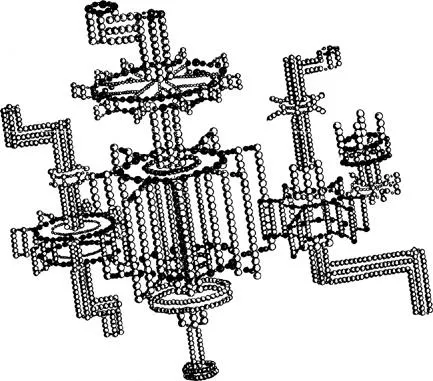
The military noticed. Admiral David Jeremiah, former Vice-Chairman of the Joint Chiefs: "Military applications of molecular manufacturing have even greater potential than nuclear weapons to radically change the balance of power."
The case for nanotech
- He offered $1,000 prizes.
- Nature already runs molecular machines inside cells.
The case against
- David Jones (Nature): how would such machines know where every atom is, how are they programmed, how do they move, where is their power? Orchestrating quadrillions of them may be impossible: otherwise nanotech "will remain just another exhibit in the freak show that is the boundless-optimism school of technical forecasting".
- Philip Barth (HP): "There's a plausible argument for everything, but there are detailed answers to nothing", and the movement resembles a sect.
- Istvan Csicsery-Ronay (Science Fiction Studies): nanotech has become "the magic dust that allows anything to happen with a pseudoscientific explanation".
To 2020: MEMS, machines the size of dust
Rather than argue, engineers built the first generation: microelectromechanical systems, sensors and motors the size of a dust grain, etched by the same lithography that makes chips. The market was $2.2 billion, expected to pass $15 billion early in the century.
- A hair-thin silicon deceleration sensor already triggers airbags.
- Denso (a Toyota affiliate) built a 0.7 mm motor driving a micro-car at two inches per second.
- Medicine: cut a $20,000 spectrometer to $10; a complete laboratory-on-a-chip; micro-devices threading blood vessels.
- Industry: millions of pressure sensors embedded in steel and concrete to detect stress before an earthquake kills; MEMS on aircraft wings to cut drag.
- Military: "surveillance dust" sprayed over a battlefield, hovering for hours with infrared and radio sensors.
- Gordon Moore: "It took a long time for the transistor to have an impact. MEMS ... will have a significant impact in the next century."
2020 to 2050: real molecular machines
- 1989: two IBM scientists drag 35 xenon atoms across nickel with a scanning tunnelling microscope to spell "IBM". The STM works like reading Braille: electrons tunnel between needle and surface, and the current maps, then moves, individual atoms.
- 1996: IBM Zurich assembles stable hexagonal rings of molecules at room temperature, not just at cryogenic temperatures.
- Late 1996: the same lab builds an abacus whose beads are buckyballs (60 carbon atoms, named for Buckminster Fuller) sliding in grooves one copper atom wide. One physicist compared it to "using the Eiffel Tower to slide the beads of an abacus".
The missing piece was wiring, and carbon nanotubes supplied it: hollow carbon cylinders with 100 times the strength of steel at one-sixtieth the weight, so thin that 50,000 side by side span a human hair. They form spontaneously when carbon vapour condenses, and they conduct electricity. Proposed uses: a molecular transistor made by sliding a buckyball inside a nanotube to switch its conductivity; an atom-wide wire made by caging a metal atom in a buckyball inside a tube; molecular sensors that feel a surface's texture.
- Idea: a satellite in geosynchronous orbit (about 22,000 miles) appears motionless, so a cable dropped from it would hang in the sky and let payloads climb to orbit without rockets.
- Problem: any known material breaks under its own weight.
- Nanotube answer: Daniel Colbert (Rice) calculated that nanotubes, uniquely, could support both their own weight and the stresses of the climb.
Kaku's verdict: gears, cogs, levers and wires at molecular scale look achievable 2020 to 2050; self-replicating nanobots, if possible, come after 2050. Nanotechnology violates no law of physics, yet has produced no solid engineering, so the proof must be the machines themselves.
The Holy Grail: room-temperature superconductors
Electrical resistance wastes energy and kills machines; even PCs, with no moving parts, die of heat. Superconductivity removes resistance entirely. Heike Kamerlingh Onnes found it in 1911 when mercury lost all resistance at about 4.2 K, winning a Nobel Prize. Thousands of superconductors are known, but most need liquid helium at $4 a quart.
- 1986: Georg Bednorz and Alex Müller (IBM Zurich) find a lanthanum barium copper oxide ceramic superconducting at 35 K, the first big advance in seventy years, in a material normally an insulator. Nobel Prize follows.
- 1987: Maw-Kuen Wu and Paul Chu reach 93 K with YBCO, above the boiling point of liquid nitrogen, which costs 10 cents a quart, "cheaper than Kool-Aid".
- Mid-1990s record: Andreas Schilling and colleagues (ETH Zurich): mercury barium calcium copper oxide at 134 K.
- Unreproduced reports claimed 250 K, within striking distance of 300 K room temperature.
- Supercomputers past the point-one barrier, since heat would stop limiting architecture.
- Transmission losses slashed, saving billions.
- Fewer new fossil-fuel plants, easing the energy crisis and the greenhouse effect.
- Far fewer heat-related breakdowns of electrical machines.
- Cheap powerful magnets for maglev trains, hover cars, MRI and accelerators.
- SQUIDs, sensors so fine they measure the body's magnetic field.
Some physicists call it a "second industrial revolution"; the search has been compared to the alchemists' philosophers' stone.
Three engineering obstacles remained: raising the critical temperature; the fact that ceramics are brittle ("the fragility of chalk") and hard to draw into wire; and loss of superconductivity in strong magnetic fields because magnetic vortices form. The deeper problem is theoretical. The BCS theory of Bardeen, Cooper and Schrieffer (Bardeen's second Nobel, after the transistor) explains conventional superconductors by Cooper pairs: one electron's ripple in the lattice attracts a second, and the pair moves without resistance. Ceramics do not fit. Philip Anderson (Princeton): previous theories are "a catalog of failure and it is time we opened our minds to new ways of thinking." The Schrödinger equation for copper oxides defeats even supercomputers.
Maglev
There is no Moore's law for superconductors: they may arrive tomorrow or never, though Kaku guesses fifteen to twenty years. Meanwhile conventional maglev trains at 450 to 500 km/h suit cities about 600 km apart. Invented at Brookhaven thirty years earlier, the technology moved abroad: Japan's ML-500R set a record of 517 km/h in 1979 on a 4.3-mile track and aimed at Tokyo to Osaka by 2005; Germany's TR-07 ran at 400 to 450 km/h on a 20-mile track with Berlin to Hamburg planned for 2005. The US National Maglev Initiative "died a quiet death" in 1994.
Fusion: a piece of the sun
- Oil supplies about 40% of world energy; about a trillion barrels of proven and probable reserves, 77% in OPEC countries and 65% in the Persian Gulf.
- Kaku expects prices to start rising around 2020 and become prohibitive around 2040.
- World energy use expected to triple by 2040, from 10 to 30 trillion watts.
- US coal could last 500 years, but acid rain, warming and pollution rule it out.
- Sea water holds enough deuterium for a million to 10 million years of fusion power.
- US fusion spending: about $370 million a year, with Japan and Germany each spending 40% more.
Fusion is hard because hydrogen nuclei repel, so they must be heated to 10 to 100 million degrees, which vaporises any container. Two designs solve it.
- Magnetic confinement (the Tokamak), from a 1950s Soviet design by Sakharov and Tamm: a doughnut-shaped magnetic bottle keeps the plasma off the walls. The Princeton Tokamak set a record in 1994 at 9 million watts for a fraction of a second, against the 1,000 megawatts a fission plant produces continuously.
- Inertial confinement, used at Livermore: laser beams vaporise the surface of a fuel pellet, and the shock wave implodes it to fusion conditions.
Either way the energy is collected as neutrons heating a blanket of water pipes, boiling water to spin a turbine, exactly as in a coal plant. The target is break-even, where energy out equals energy in, measured by Lawson's criterion (particle density times confinement time). Neither design had reached it: plasma instabilities leak the fuel. In 1997 the Princeton Tokamak closed on budget cuts, leaving ITER (Russia, Japan, the EU and the US) to sustain fusion for thousands of seconds.
- By 2010: a 1,000-megawatt ITER-class machine.
- By 2025: demonstration power plant.
- By 2035: first commercial fusion plant.
- By 2050: widespread commercial fusion.
- Harold Furth (Princeton Plasma Physics Lab director, 1980 to 1990): "By the middle of the next century, our grandchildren may be enjoying the fruits of that vision."
Fusion's advantages
- No mountains of high-level waste: a 1,000-MW fission plant makes about 30 tons a year, dangerous for thousands of years, and the US had over 100 such plants. Fusion leaves an activated steel hull and some radioactive hydrogen.
- No meltdown: cut the magnetic field and fusion simply stops, because Lawson's criterion fails.
- No runaway criticality, unlike the neutron-population transient that destroyed Chernobyl.
The shared drawback
- Both produce neutron radiation that knocks atoms out of the metal lattice, causing brittle fracture and possible structural failure.
- Kaku's caveat: with no working reactor, any verdict is premature.
Breeders and solar power
Breeder reactors "breed" fissile plutonium-239 from waste uranium-238, which was their appeal and their problem. In the 1950s the AEC projected 1,000 conventional and 1,000 breeder reactors by 2000; the US ended with about 100 and no breeders. Kaku's catalogue of failures: EBR-1 partly melted in 1955; Fermi-1 near Detroit melted 2% of its core in 1966 when a piece of zirconium blocked its sodium coolant; Clinch River was cancelled by Congress in 1983; France's Superphénix reprocessing suffered fires; Japan's Monju (whose name means "wisdom") leaked sodium in 1996, and the cover-up embarrassed the government. He adds the security objection: plutonium is highly toxic and a target for theft, and a 1995 shipment from France to Japan drew international protest. Since reactors make electricity, which mostly displaces coal rather than the oil used for transport, Kaku concludes "it may be wise to let the uranium stay in the ground".
Solar power is the chapter's favourite. The earth receives each year about 15,000 times humanity's total energy consumption, free. Einstein's photoelectric effect (his actual Nobel work) explains it: a photon knocks an electron free, making current.
- Cell efficiency about 15%, record 30%; cost about 10 cents per kilowatt-hour, just reaching competitiveness.
- Prices fell by a factor of 40 during the 1980s, the same mass-production curve that cut calculators by a factor of 100.
- William Hoagland (NREL) predicted world electricity demand up 265% by 2025 and, optimistically, 60% of it solar.
- US nuclear power had been jump-started with up to $100 billion of federal support; solar expected none.
- 1995: Enron and Amoco (owner of Solarex) planned a $150 million plant to supply a city of 100,000 at 5 cents per kWh, about 3 cents below fossil fuel. Robert Williams (Princeton): "If they pull this off, it can revolutionize the whole industry."
The electric hybrid car
In 1895 Michigan had roughly equal numbers of steam, electric and petrol cars, and Edison and Ford disagreed about the winner. Petrol won because, ounce for ounce, it packs 100 times the energy of batteries (a lead-acid battery holds 25 to 40 watt-hours per kilogram). So electric range was about 100 miles, a third of a petrol car's, with three to ten hours to recharge; nickel-metal hydride could reach 300 miles but accelerated poorly (the 1996 record was 373 miles).
- The average car burns 3,000 gallons of petrol in its life, emitting 35 tons of carbon.
- Motor vehicles produce over half of urban pollution and a quarter of greenhouse gases.
- Cars consume half of all US oil.
The hybrid mixes components: a battery for stop-and-go traffic, a flywheel storing energy while idling (composite rotors reaching very high speeds) to deliver the instant acceleration batteries lack, and a small clean combustion engine for distance, with onboard computers juggling them. Composites help: the Swiss Esoro car weighed 880 pounds and achieved 120 to 150 mpg. By 2010 Kaku expects ultracapacitors and fuel cells, which combine hydrogen and oxygen at about 40% efficiency, twice the combustion engine, emitting only water; Daimler-Benz promised a fuel-cell Mercedes by 2006. The obstacle is political: in 1996 the oil and car industries rolled back California's zero-emission vehicle mandate, leaving only a 10% by 2003 target. Daniel Sperling (UC Davis) expected millions of electric cars by 2010.
The next generation of lasers
Microlasers: diode lasers at 250 microns are about a hundred times larger than silicon transistors, "at the level that silicon transistors were back in the 1950s". Photolithography on sprayed aluminium and gallium arsenide layers (up to 500 layers, each an atom thick) etches Coke-can-shaped lasers. In 1989 Bell Labs made a million lasers on a fingernail-sized chip, each about the size of a bacterium; the floor is about 0.3 micron, because a laser cannot be smaller than its wavelength. That does not beat the 0.1-micron barrier, but optical computers can be cubical and run cool.
X-ray lasers would pack more information per beam and could etch below 0.1 micron and image viruses atom by atom. The trouble is that X-rays are penetrating, reflect poorly, and cannot be amplified between mirrors; the only sufficiently intense single-pass source proposed was a nuclear-driven X-ray laser, the centrepiece of Reagan's 1983 Star Wars scheme, which was shown to lack the energy and speed to intercept thousands of warheads. Livermore's football-field-sized lasers are the practical alternative and are far too big to commercialise.
3D television would use holograms: two laser beams interfere on a plate, and a replay beam reconstructs the original wave front. A future set might be a crystal ball, a wall screen or a planetarium dome. The barrier is memory and bandwidth: today banks of supercomputers would be needed per frame, and the MIT Media Lab's prototypes cheat by letting the image change horizontally but not vertically. Kaku expects holographic TV around mid-century.
Beyond 2100: antimatter
Dirac (1928) combined the electron with relativity and found that E = mc² needs a plus or minus sign, forcing him to postulate antimatter. Antimatter looks like ordinary matter but carries the opposite charge and annihilates on contact, so it leaves no waste and delivers enormous thrust, an ideal rocket fuel and an impossible thing to hold.
- Antiparticles appear in radioactive decay and in accelerator debris, separated by magnets.
- 1995, CERN: the first antihydrogen, made by firing antiprotons through a xenon jet; it survived about 40 billionths of a second.
- Traps using electric and magnetic fields already held antiprotons and antielectrons separately; the Max Planck Institute for Quantum Optics worked on using CO2 lasers to merge them.
- Storage problem: antihydrogen is electrically neutral, so a magnetic bottle does not hold it, and any solid container would explode.
- Cost: making engine quantities "would bankrupt the United States". A 1977 discovery of an antimatter "fountain" near the galactic centre hints at natural sources.
What stays impossible
| Technology | Why it fails, per Kaku |
|---|---|
| Portable ray guns | Lasers can already cut steel, but there is no hand-held power source; Reagan's Star Wars needed hydrogen bombs to drive orbital X-ray lasers (Teller's "Excalibur"), which still could not down thousands of warheads |
| Force fields | None of the four forces works: electromagnetism passes neutral objects straight through, gravity attracts and is absurdly weak (a comb beats the whole planet when lifting paper), and the nuclear forces act only over atomic distances. Loopholes would need an unknown fifth force |
| Transporters | Three separate impossibilities: we cannot locate every atom (the data would exhaust all computers), cannot send atoms across space, and would not know how to reassemble a person. Warp drives are better grounded than transporters |
| Invisibility | Visibility comes from how electron shells absorb and scatter light; no one knows how to retune them at will |
| Forecast | Verdict | 2026 state |
|---|---|---|
| MEMS industry past $15 billion | Hit | MEMS are in every phone (accelerometers, gyroscopes, microphones); the market is tens of billions |
| Molecular machines 2020 to 2050 | Partial | 2016 Chemistry Nobel for molecular machines (Sauvage, Stoddart, Feringa); molecular motors and DNA origami robots exist |
| Self-replicating nanobots | Miss | Never built; the Drexler-Smalley debate (2003) went against assemblers; "nanotech" became nanomaterials |
| Nanotube wires and space elevator | Miss so far | Nanotubes are in composites and batteries, but no macroscopic cable approaches theoretical strength; the space elevator remains out of reach |
| Room-temperature superconductor in 15 to 20 years | Miss | The 134 K record (155 K under pressure) stands at ambient pressure; hydrides superconduct near room temperature only at millions of atmospheres; the 2020 Nature claim was retracted (2022) and LK-99 (2023) failed replication |
| Maglev Tokyo to Osaka by 2005 | Late | Shanghai's TR-08 opened 2004; Japan's Chuo Shinkansen (603 km/h record, 2015) slipped past 2034; Berlin to Hamburg cancelled 2000 |
| Fusion: break-even, plants by 2035 | Partial | NIF achieved ignition in December 2022 (and later 8.6 MJ out from 2.08 MJ in), the first target gain above one; JET set a 69 MJ record (2024); ITER first plasma slipped to 2034 and D-T operation to 2039; private firms (Commonwealth, Helion) target the early 2030s |
| Oil prices prohibitive by 2040 | Miss so far | Shale and deepwater extraction expanded supply; the constraint became climate policy, not scarcity |
| Solar 60% of electricity by 2025 | Partial but astonishing | Module prices fell about 99% since 2000; solar is the cheapest new power in most markets, added more capacity than all other sources combined in 2024, and supplies roughly 7 to 8% of world electricity and over 40% of new generation |
| Breeders fade | Hit | Superphénix closed 1998, Monju 2016; interest revived only recently for waste-burning designs |
| Electric hybrids by 2010, fuel-cell Mercedes 2006 | Hit and miss | The Prius launched 1997 and sold millions; batteries, not fuel cells, won, and EVs passed 20% of new global car sales by 2024; hydrogen cars stayed marginal |
| Holographic 3D TV mid-century | Pending, different | 3D TV failed commercially; VR and AR headsets and light-field displays took its place |
| Antimatter | Advanced, still unusable | ALPHA trapped antihydrogen for 1,000 seconds (2011) and showed antimatter falls down under gravity (2023); production is still measured in atoms |
| Invisibility impossible | Partly overturned | Metamaterials bent microwaves around objects (2006); cloaking works for narrow bands, not visible-light invisibility |
| Teleportation impossible | Partly overturned in a narrow sense | Quantum teleportation of states (not matter) is routine, including satellite links over 1,200 km; Kaku's objection to teleporting people still holds |
A few corrections. Geosynchronous orbit is about 22,236 miles (35,786 km), not 20,000. Feynman's talk was 1959, and his prizes were claimed in 1960 and 1985. Bednorz and Müller's 1986 result was about 30 to 35 K and their Nobel came in 1987, the fastest in physics history. The flywheel figure of "100,000 revolutions per second" should be per minute. Kaku's claim that invisibility and transporters are beyond physics has aged unevenly: metamaterial cloaking and quantum state teleportation both arrived within a decade, though neither does what the fiction promised. Most importantly, he treats solar as promising but marginal and devotes more space to fusion and superconductors; the actual energy revolution of the last thirty years was photovoltaics plus lithium batteries, both of which he mentions only in passing.
The solar story is the best available lesson in experience curves for anyone forecasting technology cost. Kaku had the mechanism right (mass production cut calculators a hundredfold) but underweighted it, because an exponential cost decline beats a dramatic breakthrough over twenty years. The same logic now governs AI inference costs: planning should assume the price per unit of capability keeps falling, which changes which use cases clear the business case each year.
To Reach for the Stars
Kaku lays out the space programme in three horizons: to 2020, Mars probes, a space station he calls a white elephant, and cheap reusable launchers; 2020 to 2050, ion engines making interplanetary travel routine; beyond 2050, starships, colonies and terraforming. His framing is survival: the earth sits in a cosmic shooting gallery, so leaving is eventually "a practical matter of survival".
Rock 84001 and the invasion of Mars
In summer 1996 Clinton said of a Martian meteorite: "Today, Rock 84001 speaks to us across all those billions of years and millions of miles ... It speaks of the possibility of life." ALH84001, a four-pound potato-sized rock, was blasted off Mars 16 million years ago and landed in Antarctica about 13,000 years ago, where white ice makes meteorites easy to spot; fourteen Martian meteorites had been recovered. Its worm-like structures resembled fossil microbes in 3-billion-year-old earth rocks, and a British meteorite showed organics too.
H. G. Wells had Martians invading us in 1898; in fact ten NASA probes were due between 1997 and 2007, about one a year, starting with Pathfinder and Mars Global Surveyor. The Mars rover, modelled on Brooks's insectoids, had to be autonomous because radio takes about ten minutes each way. Later rovers would carry shovels, leading to a robotic sample return by 2005 and possibly a permanent robot base after 2010, perhaps making fuel and oxygen from Martian soil and CO2.
- Now: subfreezing, dust-storm-swept, with a CO2 atmosphere about 1% of earth's.
- Then: ancient riverbeds, lakes and perhaps oceans "more than 100 meters deep"; Sagan dated the hospitable window to 4.0 to 3.8 billion years ago. Richard Zare (Stanford): if Martian meteorites seeded earth, "Who is to say that we are not all Martians?"
- Europa (1997): under permanent ice, a liquid ocean may be warmed by volcanism, radioactivity and Jupiter's tides; Galileo passed within 363 miles and saw apparent icebergs. John Delany (Washington): "I'm sure there's life there."
Kaku rejects an Apollo-style crewed Mars dash: at a minimum $500 billion it would be "exorbitant ... wasteful ... and extremely dangerous". The 1960s programme was politics, not science: LBJ "didn't want to go to bed by the light of a Communist moon"; a politician's maxim was "No Buck Rogers, no bucks"; Asimov: "We scored a touchdown ... now we can go home." NASA administrator Daniel Goldin's answer was "smaller, faster, cheaper, better": ten small probes rather than one billion-dollar Mars Observer, which was lost in 1993.
The space station as white elephant
- Completion June 2002; mass 443 tons; about 361 by 290 feet with solar panels, "a bathtub with wings"; crew of six in seven labs at about 200 miles altitude.
- 67 launches including 22 Shuttle flights; sticker price $60 billion (about $1 billion a launch), $43 billion from the US; GAO put the real figure at $93.9 billion.
- Albert Wheelon: "The science value is wildly exaggerated ... It's a job program plain and simple." The National Research Council said it "cannot be supported on scientific grounds".
- Allan Bromley on its main justification: "microgravity is of microimportance."
- James Van Allen: the shuttle and station "are bigger, slower, more expensive, and worse".
- 1997 blows: an NRC estimate of a 50% chance of a catastrophic micrometeor strike over fifteen years, and Russia's economic crisis delaying its Service Module by up to a year.
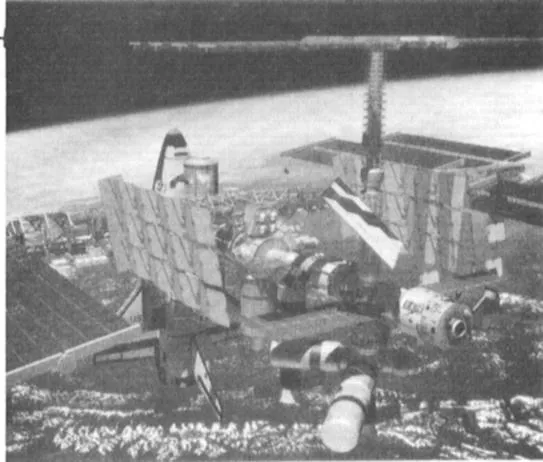
Cheap access: the X-33 and the Orient Express
The Shuttle was "the most effective device known to man for destroying dollar bills" (Congressman Dana Rohrabacher): about eight launches a year, 27-ton payloads at $800 million a launch, roughly $15,000 per pound, more than twice the price of gold. Europe's Ariane had taken two-thirds of the launch market.
In July 1996 the Clinton administration gave Lockheed Martin $1 billion for the X-33 VentureStar, a fully reusable vehicle meant to cut costs tenfold, shaped (Kaku says) like the Millennium Falcon, landing on an ordinary airfield with no discarded boosters, aiming at thirty launches a year. A 67-foot half-scale prototype would fly in 1999, the full craft by 2006, taking over from the Shuttle by 2012 before being handed to industry. John Lewis imagined a spaceflight eventually costing little more than a transatlantic ticket.
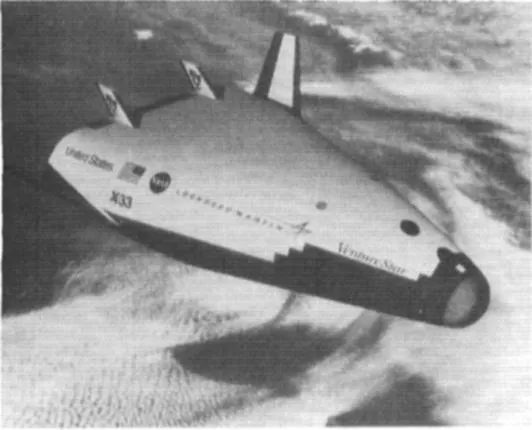
The aerospace plane, dubbed the Orient Express by Reagan for a one-hour New York to Tokyo hop, would take off like a jet, breathe air to Mach 2 or 3, then switch to rockets up to Mach 23. The $1.5 billion NASP died in 1992; its successor programme planned engine tests in 2000, a small-scale flight in 2002, a large-scale test by 2005, with Hyper-X (a $33.4 million contract to Microcraft) targeting Mach 5 to 10, and a 95% cut in launch costs by 2009.
Both depend on composites: carbon and glass fibres in a plastic, ceramic or metal matrix, five times lighter than steel and stronger, at $1.50 to $2.00 a pound against 20 to 40 cents for steel, replacing the Shuttle's fragile ceramic tiles, whose loss during a 17,000 mph re-entry could breach the hull. Supercomputers model the airflow in advance.
2020 to 2050: the ion engine
Specific impulse, thrust multiplied by duration, is what matters, not raw thrust. A chemical rocket manages about 500 seconds; an ion engine about 10,000, up to 400,000. Kaku's image is the hare and the tortoise: chemical rockets escape earth's gravity in minutes, ion engines accelerate gently for years.
The ion engine works like a TV electron gun: solar cells make electricity that ionises caesium or xenon, and charged plates fire the ions out. Freeman Dyson: "I declare solar-electric propulsion to be the winner in space because it allows us to push as far in the directions of speed, efficiency, and economy as the laws of physics allow", and a fleet of such craft "would make the entire solar system about as accessible ... as the surface of the earth was in the age of steamships". Rivals fare worse: nuclear rockets risk a meltdown in space, rail guns flatten their payloads, solar sails are hard to build and steer. NASA's Kuiper Express, tested at the Lewis Research Center, would use solar-powered xenon ion propulsion to reach comets beyond Neptune.
Finding other earths
By 1997 astronomers had found thirteen extrasolar planets, all Jupiter-sized and presumably lifeless, detected by the wobble a massive planet induces in its star.
- 47 Ursae Majoris (Big Dipper), about 200 trillion miles away: a planet twice Jupiter's mass.
- 70 Virginis: six times Jupiter's mass.
- Lalande 21185, only 8.1 light-years away, the fourth-nearest star: a Jupiter-sized planet plus evidence of two smaller ones (Pittsburgh, June 1996). Alan Boss: "It's fantastic! This is the one we've been waiting for."
- The goal: "The Holy Grail is to find an extrasolar planet that is capable of supporting life" (Boss).
Bigger mirrors are near their limit (Palomar's 200-inch held the record for sixty years; the Kecks use segmented mirrors), so the next advance is interferometry: combine light from two telescopes far apart and the interference pattern gives the resolution of a mirror as wide as their separation. In space, Kepler was planned for 2001 to find up to 2,400 planets, perhaps 100 earth-like, followed by the Space Interferometry Mission and Terrestrial Planet Finder, sensitive enough to see "an astronaut on the moon passing a flashlight from one hand to the other". The prize is liquid water, the "universal solvent" that lets carbon chemistry build proteins and nucleic acids.
Colonies and terraforming
Tsiolkovsky: "Earth is the Cradle of Mankind, but one cannot stay in the cradle forever." The 1996 Clementine discovery of ice in a permanently shadowed lunar crater made a moon base plausible, with ice split into hydrogen and oxygen for fuel.
Venus: out of the question
- Surface about 900°F from a runaway greenhouse effect.
- Atmospheric pressure ninety times earth's, crushing a spacecraft "like an eggshell", with sulphuric acid clouds.
- Sagan: all terraforming proposals are "brute-force, inelegant, and absurdly expensive".
Mars: the only candidate
- Comets as water carriers: about 200 million comets in the Kuiper Belt; thrusters could nudge their paths to strike Mars, vaporising into rainstorms.
- Warming: deliberately release CFCs and ammonia, with chlorides mined from ancient Martian salt beds, built by robot chemical factories on site rather than shipped.
- Timescale: "excruciatingly slow", perhaps a century even after it starts.
Other bodies fail: Mercury is too hot, the gas giants too cold and hydrogen-rich, Titan too cold for anything but robots. John Lewis prefers the asteroid belt: hollowed asteroids would shield millions of colonists from cosmic rays and meteorites, supply minerals for factories, and even helium for fusion. For Lewis this is not romance but self-preservation as population grows and resources deplete.
Beyond 2050: building a starship
Two facts dominate. Distances: light takes a day to cross our planetary system, four years to Alpha Centauri, a century to many familiar stars. Einstein's limit: nothing exceeds light speed. Approaching light speed needs a specific impulse of about 30 million seconds, far beyond any design.
- Scaled-up fusion rockets: specific impulse 2,500 to 400,000 seconds, short of the "magic million".
- Bussard ramjet (1960): a vast ram scoop gathers interstellar hydrogen, so a 1,000-ton ship could accelerate at one g indefinitely, giving earth-like gravity, approaching light speed within a year: the nearest star in five shipboard years, the Pleiades (400 light-years) in eleven, Andromeda in twenty-five while 2 million years pass at home. Flaw: it needs proton-proton fusion, far harder than the deuterium-tritium reaction we cannot yet master.
- Nuclear pulse rocket: Ulam (1946) showed a graphite-coated plate with shock absorbers could be pushed rather than destroyed by a nearby blast. Project Orion (1958 to 1965) and Project Daedalus (1973 to 1978) reached about a million seconds of specific impulse; Daedalus could reach 12% of light speed on a fifty-year trip to Barnard's star (5.9 light-years). Flaws: intense X-rays and heat, dependence on nuclear testing against the Comprehensive Test Ban Treaty, and proliferation risk. Theodore Taylor, who led Orion, later called for abolishing nuclear weapons.
- Photonic engines and laser sails: ground or moon-based lasers push a sail, which could use a star's gravity as a slingshot to return (but then cannot stop, so it must drop probes). Flaws: sunlight alone is too weak, so sails must be hundreds of miles across; they cannot tack; one calculation put the laser's power at 1,000 times earth's entire output; and a few hundred years of transit demands improbable "political stability of the laser beam".
Suspended animation
Freezing people remains "an unproven technology". Ice crystals rupture cell walls on freezing, and thawing fuses and deforms them; kidneys and livers survive about three days frozen, hearts and lungs half a day. Vitrification (ultra-fast freezing) avoids crystals but turns membrane lipids to gel, so cells leak and die. Nature does better: Arctic fish make antifreeze proteins; frogs flood their cells with glucose so ice never forms inside and survive being frozen solid. Copying them has bought organs hours, not the years a star voyage needs.
Beyond 2100: why we must eventually leave
The earth has about 5 billion years before the sun becomes a red giant whose atmosphere reaches Mars's orbit, boiling the oceans and melting the mountains. The poets asked whether the world ends in fire or ice; the laws of physics answer fire. Long before that come nearer threats.
- JPL scientists suspect 2,000+ undetected mountain-sized asteroids; NASA counted 1,000 to 4,000 earth-crossers over half a mile; Arizona astronomers estimate 500,000 above 100 metres and 100 million above 10 metres.
- Impacts totalling about 100 kilotons occur yearly, usually breaking up high in the air.
- June 1996: asteroid 1996 JA1, a third of a mile across, passed within 280,000 miles; an impact would have released about 10,000 megatons, more than the combined US and Russian arsenals. It was found by accident, by two Arizona students: there was then no government monitoring programme.
- Tunguska, June 30, 1908: a roughly fifty-yard object exploded in mid-air, flattening up to 1,000 square miles of Siberian forest; tremors reached London.
- Barringer Crater, Arizona: about 15,000 years ago (modern dating says 50,000), three-quarters of a mile wide.
- Chicxulub, Yucatán, about 65 million years ago: a 180-mile crater, the likely end of the dinosaurs.
- Kaku's rates: a Tunguska within 300 years, a Barringer on a scale of thousands, a civilisation-threatening impact on a scale of millions.
- NASA's budget for finding them: $1 million a year, because the subject has a high "giggle factor".
Ice ages recur on a scale of about 10,000 years; the last may have split humanity into regional populations about 100,000 years ago, and the warm spell that permitted civilisation began only 10,000 years ago. A supernova within a few light-years would bathe the earth in lethal X-rays; our galaxy produces one roughly every 500 years, but stellar evolution is understood well enough to give warning.
Aliens: Drake, Fermi and what they might look like
Frank Drake's equation, applied to the Milky Way's 200 billion stars, suggested perhaps 10,000 civilisations. Yet Enrico Fermi, over lunch at Los Alamos, asked the question that still bites: "But where are they?" SETI has found nothing within 100 light-years, while our own radio and television have been expanding in a 50-light-year sphere, carrying "a vast representative cross section of the cultural achievements of the planet earth", though on seeing our programmes aliens "may question whether or not there is intelligent life on earth".
- Some form of eyes, or any organ that gathers detailed information. Forward-facing eyes mark hunters; side-facing eyes mark prey, which tend to be less intelligent.
- Some form of hand to manipulate the world: our thumbs began as branch-grippers, so "Man did not create tools. Tools created Man." Tentacles would do.
- Some form of language, which lets culture and science accumulate across generations.
Implication: the "standard alien" of tabloids and films (small, pale, big-eyed, bipedal, bilaterally symmetric) reflects Screen Actors Guild casting, not biology. Whales are intelligent and breathe through their heads.
Any visitors must be hundreds or thousands of years ahead of us, which is why the next chapter turns the question around: what do the laws of physics say a civilisation that far ahead must look like, and therefore what are we becoming?
| Forecast | Verdict | 2026 state |
|---|---|---|
| Life in ALH84001 | Not confirmed | The structures are now generally attributed to non-biological processes, though the debate ran for years |
| About one Mars probe a year | Hit | Spirit and Opportunity (2004), Curiosity (2012), InSight, Perseverance (2021) with the Ingenuity helicopter, plus UAE and Chinese missions (Zhurong, 2021) |
| Robotic Mars sample return by 2005 | Miss | Perseverance has cached samples; the return mission was restructured in 2024 on cost, now targeted for the 2030s |
| Station finished 2002 at about $100 billion | Partial | Continuously crewed since November 2000, assembly complete 2011, lifetime cost around $150 billion; deorbit planned for about 2030, with commercial stations to follow |
| X-33 VentureStar by 2006 | Miss | Cancelled in 2001 after composite tank failure. Reusability arrived from SpaceX: Falcon 9 first landing 2015, hundreds of re-flights; launch costs fell by roughly an order of magnitude; Starship is in flight test |
| Hypersonic Orient Express | Partial | X-43A hit Mach 9.6 (2004) and X-51A flew in 2013; no passenger vehicle, though hypersonics are now a defence priority |
| Ion engines as the interplanetary workhorse | Hit | Deep Space 1 (1998), Dawn, Hayabusa, BepiColombo, and electric propulsion on most commercial satellites |
| Kepler finds thousands of planets | Hit, late and bigger | Launched 2009, it found over 2,700 confirmed planets; the total now exceeds 6,000, including rocky worlds in habitable zones (TRAPPIST-1, 2017). JWST (2021) reads exoplanet atmospheres; the first exoplanet discovery won the 2019 Nobel |
| Interferometry and planet finders | Partial | Ground interferometry works (VLTI, CHARA); SIM and TPF were cancelled; direct imaging came from JWST and the forthcoming Habitable Worlds Observatory |
| Moon ice and a lunar base | Confirmed, base pending | LCROSS (2009) confirmed water ice; Chandrayaan-3 landed near the south pole (2023); Artemis aims for a crewed landing later this decade |
| Europa's ocean | Confirmed indirectly | Hubble plume detections; Europa Clipper launched October 2024, arriving 2030 |
| Asteroid defence | Hit | Surveys now catalogue over 35,000 near-earth objects and most kilometre-scale ones; DART (2022) changed an asteroid's orbit; NEO Surveyor is due late this decade; the budget is far above $1 million |
| Starships | Still paper | Breakthrough Starshot (2016) proposed laser-driven sails, and was wound down; nuclear propulsion research continues at a low level |
| SETI silence | Hit | Still nothing confirmed; Breakthrough Listen has greatly widened the search |
A few corrections. The sun becomes a red giant in about 5 billion years, but the earth becomes uninhabitable far sooner, in roughly 1 billion, as solar brightening boils the oceans. Barringer Crater is now dated to about 50,000 years ago, and the Chicxulub impact to 66 million. Kaku's claim that "nothing can go faster than light" is right for matter but the phrasing obscures that space itself can expand faster, which matters for his later chapter on warp drives. The ramjet has a deeper problem than proton-proton fusion: drag from the scoop may exceed the thrust, which later analyses treated as fatal. Finally, his assumption that cheap access needed a government programme proved wrong in an instructive way: the cost collapse came from reusable private rockets, not from NASA's X-33.
The X-33 against Falcon 9 is a procurement lesson. A single $1 billion contract for a vehicle that had to work first time lost to a programme that flew, failed, and iterated in public.
Toward a Planetary Civilization
Kaku applies the Kardashev scale to our own future: we are Type 0, burning dead plants, and the Type 0 to Type I transition is the most dangerous, because any civilisation that reaches element 92 and a chemical industry can destroy itself. He argues that the three revolutions, plus the fear of planetary collapse, are already building a planetary economy, language and culture, and that within a century or two earth reaches Type I.
The energy ladder
Any civilisation has three energy sources available: its planet, its star, its galaxy, so Kardashev's Types I, II and III, each about ten billion times the previous one. Growth bridges the gap faster than intuition suggests.
- 1% growth a year: Type I within a hundred to a few hundred years; Type I to Type II about 2,500 years.
- 2% growth: Type I to Type II in 1,200 years. 3%: 800 years.
- Type II to Type III: 100,000 to a few million years, since it needs interstellar travel.
- Our position: Type 0, drawing energy from fossil fuels. A century ago we burned wood and coal, and talk of stellar energy "would have been considered madness".
The dangers of being Type 0
A Type 0 civilisation is "like a child learning how to walk", newly aware of ice ages, impacts, supernovas and environmental collapse, and also "like a spoiled child", still split by sectarian, nationalist and racial hatreds thousands of years old.
Every intelligent species eventually discovers two things: element 92 (uranium) and a chemical industry. The first makes self-annihilation possible, the second makes it possible to poison its own atmosphere. Kaku's answer to the Fermi paradox is that the galaxy may be "filled with the ruins of Type 0 civilizations".
If those two hurdles are cleared, the three revolutions carry a species to planetary status: computers link its peoples in a global network, biotechnology cures disease and feeds the population, and quantum physics supplies the power and materials to build a planetary society.
What Type I, II and III look like
| Type I: planetary | Type II: stellar | Type III: galactic | |
|---|---|---|---|
| Energy | Oceans, atmosphere, the planet's interior | The star's whole output, perhaps via a Dyson sphere | Many star systems |
| Politics | Necessarily planetary: weather and atmosphere cross borders, so control requires cooperation | Centuries of planetary government; Star Trek's Federation is "on the verge" of Type II | Galactic |
| Visibility | From space the planet glows "like a bright Christmas tree ornament", against today's faint filaments from Boston to Washington, Europe and Tokyo | Cannot hide waste heat under the Second Law, so detectable in infrared as a small star; Dyson urged building such detectors | Unknown, possibly uninterested in us |
| Vulnerability | Still exposed to impacts and climate catastrophe, confined to one planet for centuries | Effectively immortal: deflects comets, averts ice ages by adjusting the jet stream or the planet's spin, and has centuries of warning to build arks before a supernova | None known |
| Biology | Evolution effectively stops, because large mixed breeding populations end genetic drift |
Kaku adds a neat solution to SETI's silence at Type II: broadcasting on one frequency is inefficient, so an advanced civilisation would spread its signal across the whole radio band, which to us is indistinguishable from noise. The sky may be full of conversations we classify as static.
- Method: rather than crewed exploration, send thousands of small self-replicating probes that land on moons (weaker gravity, easier to leave), mine methane and ores, build factories, and launch thousands of copies.
- Growth: at half light speed, every star system within 500 light-years mapped in about a thousand years; half the galaxy within a hundred thousand.
- Dyson's version: bioengineered, AI-driven creatures that "eat" methane on frozen moons, repair themselves, raise "children", and carry emotions as functional tools: pain to avoid danger, pleasure on refuelling, maternal feeling for their progeny.
- Fiction: the monoliths of 2001 and 2010 are Von Neumann probes.
- Why no contact: an advanced civilisation may simply not care. "When we see an anthill, do we bend down and offer the ants trinkets, medicine, knowledge, and science?"
Beyond that lies the Planck energy, enough to tear spacetime itself, hopeless for us but plausible for a mature Type I or above, opening wormholes as "dimensional windows rather than clumsy starships".
Why earth is heading for Type I anyway
The world shows two opposite trends at once: fragmentation into ethnic and civil conflict, and unification through trade blocs such as the European Union. Kaku bets on the second, on arithmetic. At average growth "a bit below 5%" as the developing world industrialises, in a century gross world product and energy use grow about 130-fold. Wealth will be uneven, but "it is hard for firebrands to light the torch of separatism ... when the people are well fed": as one wag said, "There is no such thing as a fat nationalist."
Planetary collapse as a forcing function
- 1982: a hole the size of the United States is found over the South Pole; northern ozone was falling nearly 1% a year in places.
- Stakes: potentially 60 million extra skin cancers by 2075, crop damage and food-chain losses.
- 1987: once CFCs were proven culpable, 31 nations signed the Montreal Protocol to phase them out by 2000.
- Follow-through: the 1992 Rio Earth Summit and over 170 environmental treaties in force.
Ozone: fast action
- A single, identifiable chemical culprit with available substitutes.
- A short, clear causal chain to skin cancer.
- Agreement in five years.
Climate: foot-dragging
- The 1995 IPCC report, carrying the authority of 2,000 scientists, warned of a third to a half of mountain glaciers melting, a third of ecosystems disrupted, seas rising 15 to 90 cm by 2100, 92 million coastal people at risk, tropical disease spreading and growing regions turning to dust.
- CO2 was already at its highest in 150,000 years and rising, because the culprit is the entire fossil-fuel economy.
- Kaku's prediction: nations will act only when warming "visibly disrupts" weather, then reach for a carbon tax or phase-outs.
Population
- 1 billion about 1830, after several million years; 2 billion a century later; 4 billion by 1975; 5.7 billion in 1997, growing by 90 million a year. "One twentieth of all the humans who have ever walked the earth are alive today."
- Limits: fish harvests peaking at 100 million tons, grain at about 1.7 billion tons, deforestation covering an area equal to the continental United States; perhaps a million species lost by century's end and a quarter of all species by mid-century.
- UN projection: 6 billion (1999), 7 (2011), 8 (2025), 9 (2041), 10 (2071), levelling near 12 billion in the twenty-second century.
- Stabilisers: every industrialised nation has stabilised; 30 nations (820 million people) already had; Japan and Germany were shrinking.
- Robert Kates: three population waves followed tool-making (to 5 million), agriculture (a hundredfold, to 500 million) and the industrial revolution. His conclusion: "Development is the best contraceptive", because it cuts child mortality and child labour, educates children, employs women and spreads contraception.
Reversing the Great Diaspora
For 99% of human existence we lived in nomadic bands of perhaps fifty, held together by culture: ritual, custom, language, "the heroic tales and myths told around ancient campfires". That culture was both gift and curse, producing diversity and the "us versus them" logic of tribal war. About 100,000 years ago the Great Diaspora began, perhaps a few thousand people leaving Africa for the Middle East and southern Europe, a second wave about 50,000 years ago reaching Asia and the Americas, and genetic isolation produced today's visible differences. Kaku's thesis is that the current revolutions are eroding the Diaspora's forces for the first time in 100,000 years, through five channels: a global economy, the decline of nations, an international middle class, a common language, and a planetary culture.
The end of the era of nations?
Nations feel permanent but are young, riding "on the coattails of the industrial revolution". Alvin Toffler: "Even the greatest of emperors typically ruled over a patchwork of tiny, locally governed communities." S. E. Finer travelled within one "nation" and had to change laws "as frequently as he changed horses"; kings "held power in bits and blobs". Bismarck assembled Germany in 1871 from about 350 principalities and Prussia; Italy's feuding city-states unified in 1870. Third World borders are younger still, drawn by Britain and France on divide-and-conquer lines that still generate instability.
- Kenichi Ohmae (The End of the Nation State, ex-McKinsey): "Traditional nation states have become unnatural, even impossible, business units in a global economy"; in their "economic blood streams cholesterol steadily builds up".
- Denis de Rougemont: the absolutely sovereign nation state "is obviously too small to play a real role at the global level"; no European state can assure its own defence and technology.
- Alvin Toffler: we move toward "a world system composed of units densely interrelated like the neurons in a brain rather than organized like the departments of a bureaucracy".
- John Kenneth Galbraith: foresees some form of world government replacing today's weak UN.
The international middle class
Elites act to preserve their power, and a planetary civilisation does not serve it, so Kaku's engine of change is the middle class created by Third World industrialisation, three centuries after Europe's. It has a selfish stake in harmony, trade and the free flow of information, and, "armed with fax machines, the Internet, satellite dishes, and cellular phones", it can campaign politically. Ohmae puts the threshold at about $5,000 per capita, or $20,000 for a family of four: above it people stop worrying about the next meal and "start to look around them and ask why they cannot have what others have".
A planetary language and culture
Of about 6,000 languages, Michael Krauss expected 90% to vanish within a century, leaving 250 to 600. English had already become the language of business, science and the Internet (then 30 million users); William Safire: "English will be the world's first second language in A.D. 2100", with about a billion speakers already. The computer revolution cuts both ways, spreading English while preserving dying languages in recordings and digital dictionaries.
Huxley saw it first, in Those Barren Leaves: cheap printing, telephones, trains, cars and gramophones "are making it possible to consolidate tribes, not of a few thousands, but of millions". Bill Gates: "The information highway is going to break down boundaries ... people want a sense of belonging to many communities including a world community." Satellite news reaches even theocracies, where dishes "grow like weeds", carrying "subversive scenes of affluence in other lands". The exports leading the way are action films and rock and roll, which cross languages easily. Kaku concedes the result "may not be aesthetically pleasing to everyone", but argues it breaks down the barriers on the way to Type I.
| Forecast | Verdict | 2026 state |
|---|---|---|
| Kardashev scale as a frame | Durable | Widely used; on Sagan's continuous version earth sits near 0.73, moving slowly |
| World growth near 5%, output up 130-fold in a century | Too optimistic | Global growth averaged about 3%; the 2008 crisis and the pandemic cut deeply; world energy use grew far slower than Kaku assumed, partly through efficiency |
| Climate forces cooperation eventually | Hit, slowly | Paris Agreement (2015); CO2 passed 420 ppm; 2023, 2024 and 2025 were the warmest years recorded, 2024 the first above 1.5°C for a calendar year; carbon pricing covers about a quarter of emissions; the US left the agreement again in 2025 |
| IPCC sea-level range 15 to 90 cm by 2100 | Holding, at the upper end | Current projections run 0.3 to 1 m under moderate scenarios, higher with ice-sheet instability |
| Ozone recovery | Hit, the great success | The Montreal Protocol is working; the layer is on track to recover by about 2066 over Antarctica; the Kigali Amendment (2016) added HFCs |
| Population 8 billion by 2025, peak about 12 billion | Close, but the peak is lower | 8 billion reached in November 2022, about 8.2 billion in 2025; the UN now projects a peak near 10.3 billion in the 2080s, with more than half of countries below replacement fertility |
| "Development is the best contraceptive" | Hit | Fertility fell faster than expected almost everywhere, including India (below replacement, 2020) |
| Decline of the nation state | Miss, so far | The 2010s and 2020s brought Brexit, trade wars, industrial policy and border rebuilding; globalisation plateaued |
| Rise of a global middle class | Hit, then strained | Extreme poverty fell from about 36% (1990) to under 10%; hundreds of millions joined the middle class in Asia; progress stalled after 2020 |
| English as the world's second language | Hit | Over 1.5 billion speakers; machine translation now erodes the need for it |
| 90% of languages lost | On track | About 40% of roughly 7,000 languages are endangered, with one lost every few weeks; digital archives preserve many, as Kaku predicted |
| Planetary culture via satellite and Internet | Hit, with a twist | About 5.6 billion people online, but algorithmic feeds produced fragmentation inside the global network rather than one shared culture |
| Von Neumann probes and Dyson spheres | Still theory | Infrared surveys (Glimpsing Heat from Alien Technologies, 2015) found no Dyson spheres; a handful of 2024 candidates remain unconfirmed |
Two large misses sit at the centre of this chapter. Kaku assumes energy use rises with wealth indefinitely, which the Kardashev scale requires; in fact rich economies decoupled growth from energy, and a Type I transition on his timetable now looks less likely rather than more. And he treats the nation state as a fading industrial-era artifact; thirty years later sovereignty is resurgent, and the most credible planetary institutions remain weak. His claim that evolution will cease in a Type I civilisation is also wrong as stated: large populations slow drift, but selection continues, and human evolution has demonstrably accelerated in the last 10,000 years (lactose tolerance, altitude adaptation, disease resistance). Finally, "element 92" is a vivid image but misleading: the main existential pressure has come from carbon chemistry, not uranium.
Kaku's framework is a scale-level reminder of a practical point: coordination problems get harder faster than technical problems. Ozone succeeded because the culprit was narrow, substitutes existed and the industry was concentrated, while climate failed for years because it touched everything. The same pattern governs enterprise change: a narrowly scoped mandate with a clear substitute (replace one payment rail, retire one system) completes, while a programme that requires every function to change at once stalls, whatever its technical merit.
Masters of Space and Time
The fourth pillar is space-time itself. Kaku asks whether wormholes, warp drive and time machines are allowed by physics, and finds that they are mathematically permitted but need the Planck energy, beyond any Type 0 civilisation. Settling the question needs a theory of everything, for which ten-dimensional superstring theory (and M-theory in eleven) is the candidate. The payoff is cosmological: the multiverse explains fine-tuning, and a Type IV civilisation might escape the universe's death through a wormhole.
Wormholes: Lewis Carroll's looking glass
A wormhole is easy to picture: mark two points on a sheet of paper, fold it so they touch, drill through, and the shortest path is no longer the straight line on the page. Join two separate sheets the same way and an ant that falls through finds "an entirely new universe". Mathematicians call these multiply connected spaces.
- An Oxford mathematician wrote about them for children, under a pseudonym, "realizing that adults might frown on the idea".
- His name was Charles Dodgson, the pseudonym Lewis Carroll, the book Through the Looking Glass.
- The Looking Glass joins Oxford to Wonderland "like Siamese twins joined at the hip".
- Why it beats light speed without breaking relativity: your local speed stays tiny; only the total distance covered is enormous.
Carroll was a mathematician, not a physicist. Einstein's general relativity (1915) supplied the physics. Its core claim is that gravity is geometry: place a rock on a bed and roll a marble past it, and the marble curves, seemingly pulled, but actually pushed by the bent sheet. Newton himself was "deeply bothered" that the earth moves with nothing touching it. Formally, the equivalence principle says physics is locally the same in a gravitating and an accelerating frame; light bends when accelerating, so it bends under gravity, and since light traces out the geometry of space, space itself must be curved.
Black holes, Kerr rings and time machines
A black hole is an object whose escape velocity reaches light speed. About a dozen had been identified by Hubble and radio telescopes at the centres of massive galaxies such as M87 and NGC 4258, roughly 50 million light-years away, detected indirectly: a "cosmic hurricane" of gas clocked at a million miles per hour around a dot about a light-year across weighing as much as a million stars.
- Einstein-Rosen bridge: push the rock on the bed further and the funnel lengthens until it meets another funnel from a parallel universe, opening a white hole there. Einstein dismissed it because anyone falling in would be crushed at the infinitely curved centre.
- Kerr (1963): a rotating black hole collapses not to a point but to a spinning ring of neutrons, held open by centrifugal force. Touching the ring is suicide; falling through it is not. The ring is the frame of the Looking Glass.
- Since then: hundreds of wormhole configurations have been found, and embedding one in a realistic universe is now "relatively simple".
Because space and time are one fabric, any wormhole linking two places can link two eras. Newton thought time an arrow flying straight; Einstein made it a river that speeds and slows near mass (a clock on the moon runs slightly faster than one on earth). The new twist is that the river can form whirlpools or fork. In 1949 Kurt Gödel, Einstein's colleague at Princeton, showed that in a rotating universe you could walk back to your starting point displaced backwards in time. Einstein thought both results physically excluded: the bridge kills you, and the universe expands rather than rotates. After his death, so many time-travel solutions appeared, including an infinite rotating cylinder, colliding cosmic strings and negative energy, that physicists took them seriously.
The paradoxes. Shoot your parents before your birth and your existence is impossible. Worse is the bootstrap version: an old man gives a young inventor the blueprints for a time machine on condition he later delivers them to his younger self. Where did the secret come from? Kaku's answer is quantum: the river forks. Save Lincoln and you save a quantum double in a parallel universe; your own past is untouched.
Three obstacles to building one
- Energy. Space-time anomalies need the Planck energy, about 10^19 billion electron volts, roughly a quadrillion times the cancelled Superconducting Super Collider. That is Type I or more likely Type II territory. Kaku's analogy: Newton could calculate the 25,000 mph escape velocity to the moon while owning only horses and carriages; we can calculate the Planck energy while owning "horses and carriages called hydrogen bombs and rockets".
- Exotic matter. Opening a hole may need negative energy, never seen in bulk but demonstrably real in small amounts: the Casimir effect, where two uncharged parallel plates attract because the vacuum between them is "frothing with virtual electron-antielectron annihilations". Magnify it, and plates displaced in space make a warp drive, displaced in time a time machine.
- Stability. Quantum forces may slam the throat shut, or radiation at the entrance may kill the traveller. Einstein's equations fail at the moment of entry, because quantum effects overwhelm gravity. Only a theory of everything can settle it.
Toward a theory of everything
| Force | What it governs | Quantum carrier |
|---|---|---|
| Gravity | Solar systems and galaxies | Graviton (hypothetical) |
| Electromagnetism | Light, radio, radar, TV, microwaves | Photon |
| Weak nuclear | Radioactive decay | W and Z bosons |
| Strong nuclear | Why stars shine | Gluon |
Kaku notes that the equations for all four "could be written in small script on just one of these pages", yet the prize is "a single, coherent equation perhaps no more than one inch long". Einstein spent his last thirty years failing to find it; Hawking said it would let us "read the mind of God".
General relativity
- Describes the macrocosm: galaxies, black holes, the expanding universe.
- Forces are smooth geometry, the curvature of space-time.
- Breaks down at a black hole's centre and at the Big Bang, where curvature becomes infinite.
Quantum theory
- Describes the microcosm of particles.
- Forces are discrete packets, quanta exchanged between particles.
- Its Standard Model matches nature to about one part in a billion, the most successful theory ever, but contains 19 arbitrary numbers, three unexplained generations of particles, and no gravity. Kaku calls it "one of the ugliest theories ever proposed", like "taping together an aardvark, a whale, and a giraffe".
The two have fought a "cold war" for fifty years and must collide at the Big Bang and inside black holes; quantum effects overwhelm relativity at about 10^38 K, "a trillion trillion times hotter than the center of a hydrogen bomb explosion". A naive quantum theory of gravity splits gravity into gravitons, which produce infinities when they collide, a problem that has defeated every attempt for half a century. Oppenheimer, drowning in new particles in the 1950s, joked that the next Nobel should go to a physicist who did not discover one.
Superstrings and the tenth dimension
Weinberg compares the search to the North Pole: compass needles converged on a spot nobody had reached, yet it existed. "If history is any guide ... there is a final theory." Gell-Mann: superstring theory is "a brilliant candidate for a unified theory of all the elementary particles, including the graviton".
The physical picture is music. Nobody thinks the note A is fundamental; the string is. Each vibration mode of a superstring is a different particle, so the messy particle zoo becomes harmonics, and there should be infinitely many. The laws of physics are the harmonies of the superstring, and the universe is a symphony of vibrating strings, fulfilling the Pythagoreans' guess that harmony explains the cosmos. The theory also contains Einstein's gravity: a moving string curves the continuum around it.
- Kaluza (1919): add a fifth dimension to Einstein's gravity and its extra components reproduce Maxwell's electromagnetism. Add more, and the weak and strong forces follow.
- The Roman hilltop: messages between battlefields were chaos until a commander seized high ground and saw every front as one picture. From the tenth dimension, the four forces look like one superforce.
- M-theory: Edward Witten (Princeton) and Paul Townsend (Cambridge) showed the mysteries clear up in eleven dimensions. "M" stands for "mystery, magic, or membrane, take your pick."
- Duality: M-theory's new symmetry reaches nonperturbative solutions previously inaccessible; our universe may be one. Physicists had mapped nearly all eight-dimensional universes and were working on six, with four still ahead.
- Problem: millions of solutions, none yet matching the observed particles.
Before the Big Bang, and the multiverse
A cataclysm about 15 billion years ago sent the galaxies flying; Gamow predicted its afterglow, and in 1992 COBE found it, a 3 K microwave background matching hundreds of data points. But Einstein's theory says nothing about what came before, and implies an impossible point of infinite density. Superstring theory, being finite, offers a story: an infinitesimal ten-dimensional bubble split into six- and four-dimensional parts, and the six-dimensional one collapsed, expanding the four-dimensional one into the Big Bang.
Quantum cosmology treats the whole universe as a quantum object. Just as an electron exists in several states at once, a quantised universe exists in parallel states: the multiverse.
- The picture: in the beginning, no space, time, matter or energy, only the quantum principle, which forbids perfect certainty. So even Nothing became unstable and particles of Something formed, like bubbles in boiling water, each bubble a universe; ours expanded as the Big Bang.
- The accounting: matter-energy is positive, gravitational energy negative, and the sum is zero, so creating a universe takes no net energy.
- Hawking: we coexist with an infinite sea of baby universes, linked by a network of wormholes far too small to fall into; ours is the most stable and most probable.
- Weinberg: "there wasn't a beginning ... the multiverse goes on forever ... I find that a very satisfying picture", though most bubbles are dead seas of electrons and neutrinos where protons are unstable and DNA impossible.
- Kaku's aside: the multiverse lets Genesis and Nirvana coexist, "Genesis taking place continually in Nirvana".
That dead-universe point answers the anthropic principle. Every constant tested lies in a narrow band compatible with life: shift them slightly and protons decay, nuclei destabilise, DNA never forms. Coincidence strains belief and providence leaves physics; the multiverse supplies a third option. If there are infinitely many universes with different constants, most are dead, and we necessarily find ourselves in one of the rare ones that permits observers.
The fate of the universe, and Type IV
Big Crunch: death by fire
- If density exceeds the critical value, gravity reverses the expansion; red shift turns to blue shift.
- Oceans boil, planets melt, galaxies compress into "a gigantic primordial atom".
Big Chill: death by ice
- If density is too low, expansion continues and the Second Law takes over.
- Dead stars and black holes, temperatures near absolute zero, then, after trillions of years, even black holes evaporate into a gas of electrons and neutrinos.
In 1997 the answer was unknown: visible matter was insufficient, but perhaps 90% of the universe was invisible dark matter holding galaxies together. Either way "the universe must die, and all intelligent life with it", even Type III civilisations, "the ultimate existential absurdity".
Kaku's loophole is a Type IV civilisation that masters the fourth pillar, widening the microscopic wormholes connecting universes enough to tunnel out before its own universe dies. On that view "the theory of everything, which at first seems rather useless and devoid of practical application, may ultimately provide the salvation for intelligent life".
Conclusion: from observers to choreographers
Kaku closes where he began, with Newton on the beach, unable to foresee that his pebbles would lead to the secrets of life, the atom and the mind. That ocean has yielded; a new one has opened. With the basic laws of the quantum, DNA and computers in hand, we are no longer passive observers of nature's dance but active choreographers, and barring catastrophe we reach Type I status within a century or two. Mastering space-time is the step after that, which would make "the universe truly our backyard".
| Claim | Verdict | 2026 state |
|---|---|---|
| Universe about 15 billion years old | Refined | 13.8 billion, pinned down by WMAP (2003) and Planck (2013) |
| Dark matter about 90% | Refined | About 27% dark matter, 68% dark energy, 5% ordinary matter |
| Fire or ice, undecided | Resolved, and nobody expected the answer | In 1998 two teams found the expansion is accelerating, implying dark energy; 2011 Nobel. The fate is a Big Chill, with variants (Big Rip) still open, and 2024 to 2025 DESI data hint dark energy may be weakening, which would reopen the question |
| About a dozen black holes seen | Hit, spectacularly surpassed | Gravitational waves from merging black holes detected (2015, 2017 Nobel); the Galactic Centre's black hole tracked by stellar orbits (2020 Nobel); Event Horizon Telescope images of M87 (2019) and Sagittarius A** (2022); supermassive black hole mergers hinted by pulsar timing (2023) |
| Superstring theory as the final theory | Unresolved, and out of fashion | The landscape of about 10^500 vacua undermined the hope of deriving our universe; the LHC found the Higgs (2012) but no supersymmetry, the theory's main testable prop; string methods now pay off mostly in mathematics and in AdS/CFT applications to other fields |
| M-theory in eleven dimensions | Still the framework | Dualities and branes remain central; no experimental confirmation |
| Casimir effect as the route to exotic matter | Measured, still tiny | Precisely confirmed (Lamoreaux 1997); quantum inequalities show the negative energy available is far too small for a traversable wormhole |
| Warp drive | Narrowed | Alcubierre's 1994 metric was refined; later work (2021) proposed subluminal solitons without negative energy, but the energy required remains astronomical |
| Time travel | Constrained | Hawking's chronology protection conjecture argues quantum effects destroy any time machine as it forms; no experiment can yet decide |
| Multiverse explains fine-tuning | Contested | The string landscape plus eternal inflation keeps the idea alive; critics call it unfalsifiable |
Two framing problems. Kaku presents superstring theory as the clear path to the final theory and does not mention its main rival programmes (loop quantum gravity, asymptotic safety) or the possibility that it makes no testable predictions; thirty years on, this is the book's most confidently stated claim with the least to show for it. He also understates the energy and exotic-matter obstacles: later theorems showed that traversable wormholes need quantities of negative energy that quantum field theory itself appears to forbid, so the barrier may be a law rather than an engineering limit. Smaller slips: M87 is about 55 million light-years away but NGC 4258 only about 23 million; the Planck energy is about 10^19 GeV, which his phrasing makes hard to read; and his statement that the proton is unstable in other universes assumes proton decay, which has never been observed in ours.
The chapter's real transferable idea is the energy ladder as a capability test: before asking whether something is possible, ask what scale of resource it requires, then ask who could ever command that scale. Applied to technology planning, it is the difference between a constraint that engineering removes (cost, latency, data volume) and one that physics or regulation fixes. Mistaking the second for the first is how roadmaps acquire items that never ship.
Main Points
Thirty years on, Visions can be graded rather than admired.
- Forecast from settled law, not from imagination. Kaku's one methodological rule explains most of his hits: predict only where the fundamental laws are known, and the path of engineering becomes legible decades ahead.
- Time-stamp every prediction or it cannot be wrong. His three horizons are what make the book testable at all, and the discipline costs nothing.
- Exponential cost decline beats breakthrough. The energy revolution came from solar modules falling about 99% in price, not from fusion or superconductors, and he had the mechanism in hand but weighted it last.
- Reading is easy; meaning is hard. The genome finished early and told us far less than expected, because function, interaction and environment resist automation in a way sequencing did not.
- Automation races ahead where tasks repeat and stalls where judgment is needed. His list of threatened jobs (repetitive, inventory, middleman) predicted thirty years of labour shifts with uncomfortable accuracy.
- Learning beat hand-coded rules. The bottom-up school won: common sense emerged from statistics over vast data, not from Cyc's 10 million hand-written assertions.
- Disappearance is the mark of a mature technology. Weiser's law, that we stop noticing what we have thoroughly learned, is the best single test of whether a technology has actually arrived.
- The dangerous step on the energy ladder is the first one. A civilisation that discovers element 92 and a chemical industry acquires the means to end itself before it acquires planetary coordination.
- Coordination problems scale worse than technical problems. Ozone was fixed in five years because the culprit was narrow; climate was not, because it touches everything.
- Synergy is where the breakthroughs are. Gene sequencing accelerated because of computers, protein folding fell to AI, and MEMS came from chip lithography: the seams between fields outperform the fields.
- Cheap and distributed technology cannot be contained, only governed. His nuclear-versus-biotech contrast is the sharpest framework in the book, and it now applies almost unchanged to AI models.
- Single-gene thinking is a trap. Behaviour, intelligence and most disease proved massively polygenic, and nearly every 1990s "gene for X" headline failed to replicate.
- Cancer is a control-systems failure, not one disease. Accelerators stuck on, brakes broken, plus a removed clock; that frame survived and guided the therapies that worked.
- Infection was never conquered. Microbes evolve millions of times faster than we do, and the loss of antibiotics was a policy failure, not a scientific one.
- Technologies arrive by substitution, not by the predicted route. Cystic fibrosis fell to small molecules rather than gene therapy; reusability came from a private rocket, not the X-33; VR replaced holographic TV.
- Infrastructure-heavy solutions lose to capable endpoints. Smart highways lost to self-driving cars, as central systems usually lose to intelligent edges.
- Safety must be designed with the objective, not after it. Asimov's laws fail against a well-intentioned robot executing a flawed mission, which is the alignment problem stated in 1997.
- Funding sources shape technology. Kaku's argument that military AI money distorts the field is a general law: what you reward is what you get.
- Fund the ethics with the programme. ELSI's 3% of the genome budget is the model for building governance into a technology rather than bolting it on.
- Information is only dangerous because of the structures it falls into. Wexler's formulation anticipated the whole genetic-privacy debate and most of the data-protection one.
- Ageing is damage plus failing repair. That framing survived; the specific interventions he backed (hormones, antioxidants) did not.
- Great individuals are made by turmoil as much as by genes. His demolition of cloning fantasies doubles as a caution against any purely genetic account of achievement.
- Exploration scales by replication, not by heroism. Von Neumann probes beat starships, as robots have beaten astronauts on every planet so far.
- Ask what scale of resource a thing requires before asking whether it is possible. The Planck-energy test separates engineering limits from physical ones, and the same question separates roadmaps from wish lists.
- Fine-tuning needs no miracle if there are enough universes. The multiverse remains contested but it is the clean answer to the anthropic question.
- Expect the forecast to fail in its confident chapters. Kaku was most certain about string theory, which has produced the least, and least certain about solar power, which produced the most.
The overall scorecard
| Domain | Verdict | What Kaku got right | What he missed |
|---|---|---|---|
| Ubiquitous computing | Hit | Invisible chips everywhere by 2020, wearables, smart cards, voice interfaces | That one device (the phone) would absorb most of it |
| Internet and AI | Hit, early | A conversational planetary intelligence, intelligent agents, personalised news | That learning from data, not hand-coded rules, would deliver it; and that feeds would fragment the culture |
| Robotics | Partial | Bottom-up learning, insectoid rovers on Mars, emotional interfaces | Household robots are still arriving twenty years late |
| Post-silicon computing | Miss on timing | Quantum computing, the heat wall, 3D stacking | Silicon scaled far past his 2020 cliff via EUV |
| Genomics | Hit | Genome by 2005, cheap personal sequencing, prevention-based medicine, computational biology | 20,000 genes not 100,000; polygenic reality; AI solving protein folding |
| Cancer and gene therapy | Partial | p53, telomerase, angiogenesis, vaccines, the multi-hit model | Immunotherapy and CAR-T, which he barely anticipated; a two-decade delay |
| Infectious disease | Mixed | Molecular drug design, pandemic risk, the resistance crisis | Smallpox stocks survive; polio and measles are not eradicated; antibiotic pipelines stayed empty |
| Longevity | Miss | Ageing as repair failure; calorie restriction as the only proven lever | Hormones and antioxidants failed; cellular reprogramming was not on his map |
| Biotech ethics | Hit | Discrimination law, privacy, germ-line limits, the eugenics warning | That consumer choice, not state breeding, would be the pressure |
| Nanotechnology | Split | MEMS, nanotubes, molecular manipulation | Self-replicating assemblers never came |
| Energy | Miss, instructively | Fusion's slow arc, the need to leave fossil fuels | Solar plus batteries won on cost, not on physics |
| Space | Partial | Mars rovers, ion engines, exoplanets by the thousand, asteroid defence | Reusability came from private industry; the X-33 died; sample return slipped decades |
| Planetary civilization | Open | Global middle class, English, planetary culture, climate forcing cooperation | The nation state did not decline, and energy use decoupled from growth |
| Fundamental physics | Weakest | Gravitational waves and black-hole imaging arrived | String theory stalled; supersymmetry was not found; dark energy blindsided everyone a year after publication |
| Name | What it says | Use it when |
|---|---|---|
| Three horizons | Separate predictions into near (known mechanism), middle (known physics, unknown engineering) and far (speculative) | Writing any roadmap or forecast |
| Weiser's law of disappearance | A technology is mature when people stop noticing it | Judging adoption claims |
| Phases of computing | The ratio of machines to people flips from 1:100 to 100:1, and incumbents die at each transition | Assessing platform shifts |
| Top-down vs bottom-up | Programmed rules give precision and auditability; learned systems give coverage; mature systems merge both | Designing AI in regulated settings |
| The mesa effect | Expert systems excel on their plateau and collapse one step off it | Model risk management, out-of-distribution failure |
| Accelerator and brake | Failure comes from a stuck accelerator or a failed brake; monitor both independently | Control design in any throughput system |
| Single-gene vs polygenic | Point changes ship fast; many-interacting-part changes take decades | Scoping transformation programmes |
| Master genes | A few upstream decisions cascade into thousands of downstream ones | Platform and architecture choices |
| Nuclear vs biotech containment | Expensive, traceable technologies can be controlled; cheap, distributed ones must be governed instead | AI policy, open-weight models |
| Specific impulse | What matters is thrust times duration, not peak thrust | Comparing fast-but-brief with slow-but-sustained strategies |
| Kardashev ladder | Capability tracks energy command, and each rung requires new coordination | Long-horizon strategy, scale arguments |
| The Planck-energy test | Ask what resource scale a goal requires before asking if it is possible | Separating engineering limits from hard limits |
| ELSI's 3% | Fund ethical, legal and social work as a fixed share of a technology budget | Launching any high-impact programme |
- The method has a hidden bias. "Consensus of 150 scientists" in practice meant a self-selected group of enthusiasts, several of them (Moravec, Gilbert, Lenat, the nanotechnologists) advocates for their own fields. Kaku rarely quotes the sceptics at equal length, and where he does (Jones on nanotech, the 1995 NIH gene-therapy report), those sceptics usually proved closer to right.
- The timetable is systematically optimistic in biology and pessimistic in computing. Gene therapy, lab-grown organs and cures ran one to two decades late; conversational AI, image recognition and protein folding ran decades early. The pattern suggests that progress follows data and compute, not biological complexity.
- Costs are treated as secondary. Repeatedly the deciding factor turned out to be economics rather than physics: DES fell to cheap hardware, solar won on price, expert systems died commercially before they died scientifically, and the Space Station failed its cost-benefit test exactly as its critics said.
- Politics is treated as friction, not as a variable. The book assumes that wealth dissolves nationalism and that global problems force cooperation. Both assumptions are now questionable, and the chapters that depend on them (15 especially) have aged worst.
- Numbers are often loose. Repeated errors (200 billion neurons, 100,000 genes, 59% obesity, the wrong apoE allele, misdated craters and misspelled names) suggest the book was assembled faster than it was checked. The arguments usually survive the errors, but a reader should verify any figure before quoting it.
- The biggest blind spot is social. Nothing in Visions anticipates that a planetary information network would fragment attention, carry misinformation at scale, or concentrate wealth so sharply. Kaku treats the technology as unifying by nature, and the last decade has shown it is not.
Who's who
| Person | Role | Why they matter here |
|---|---|---|
| Mark Weiser | Xerox PARC | Coined ubiquitous computing and the law of disappearance |
| Rodney Brooks | MIT AI Lab | Bottom-up robotics; Attila and Cog; model for the Mars rover |
| Marvin Minsky | MIT | Top-down AI, Society of Mind, "robots will inherit the earth, but they will be our children" |
| Hans Moravec | Carnegie Mellon | Robot timetable; the golden spike; mind transfer in Mind Children |
| Douglas Lenat | Cycorp | Cyc: intelligence as "10 million rules"; the approach that lost |
| Pattie Maes | MIT Media Lab | Intelligent agents that augment rather than replace people |
| John Hopfield | Princeton | Neural networks as energy minimisation; 2024 Nobel |
| Terry Sejnowski | Johns Hopkins, Salk | NETalk, a net that learned to read aloud |
| Neil Gershenfeld | MIT Media Lab | Things That Think: electric-field sensing, shoes that compute |
| Francis Collins | NIH | Ran the Human Genome Project; cystic fibrosis gene; cautions against gene determinism |
| Walter Gilbert | Harvard | Sequencing economics; predicted your genome on a CD |
| W. French Anderson | USC | "Father of gene therapy"; the three stages of medicine |
| Robert Weinberg | MIT | Oncogenes and tumour suppressors: "the pieces of the puzzle have fallen into place" |
| Bert Vogelstein | Johns Hopkins | p53 as the most commonly mutated gene in cancer |
| Leonard Hayflick | UCSF | Biogerontology; cell division limits; "molecular mischief" |
| Ian Wilmut | Roslin Institute | Cloned Dolly from an adult cell |
| Arthur Caplan | Penn | Bioethics: designer children, mandatory testing, "one whopping moral debate" |
| Nancy Wexler | ELSI | Huntington's research; information is safe, social structures are not |
| Jeremy Rifkin | Foundation on Economic Trends | Leading critic: gene patents, crop escape, the "third sector" |
| Richard Feynman | Caltech | "Plenty of Room at the Bottom"; nanotech's founding question |
| Freeman Dyson | Institute for Advanced Study | Dyson spheres, astro-chickens, ion propulsion as the winner |
| Lester Thurow | MIT Sloan | Wealth shifts from resources and capital to brainpower |
| Nikolai Kardashev | Soviet astronomy | The Type I, II, III energy ladder that organises the last chapters |
| Edward Witten | Institute for Advanced Study | M-theory in eleven dimensions |
| Steven Weinberg | Texas | A final theory exists; the multiverse is satisfying |
| Carl Sagan | Cornell | Mars's ancient water; terraforming Venus is hopeless; life is too precious for one planet |
Visions
INSIDE: THE IDEAS THAT MATTER MOST
- Forecast from settled law, not from imagination. Kaku's one methodological rule explains most of his hits: predict only where the fundamental laws are known, and the path of engineering becomes legible decades ahead.
- Time-stamp every prediction or it cannot be wrong. His three horizons are what make the book testable at all, and the discipline costs nothing.
- Exponential cost decline beats breakthrough. The energy revolution came from solar modules falling about 99% in price, not from fusion or superconductors, and he had the mechanism in hand but weighted it last.
- Reading is easy; meaning is hard. The genome finished early and told us far less than expected, because function, interaction and environment resist automation in a way sequencing did not.
- Automation races ahead where tasks repeat and stalls where judgment is needed. His list of threatened jobs (repetitive, inventory, middleman) predicted thirty years of labour shifts with uncomfortable accuracy.
- Learning beat hand-coded rules. The bottom-up school won: common sense emerged from statistics over vast data, not from Cyc's 10 million hand-written assertions.
About this book
Visions: How Science Will Revolutionize the 21st Century by Michio Kaku, 1997. This is a chapter-by-chapter study of the book, with summaries, maps, tables and diagrams; short quotations keep their page references. It is shared free for personal study, is not for sale, and is not endorsed by the author or publisher. Please read and buy the original.
Insight Editions · rajeshrmahapatra.com/insight-editions