Insight Editions · No. 208
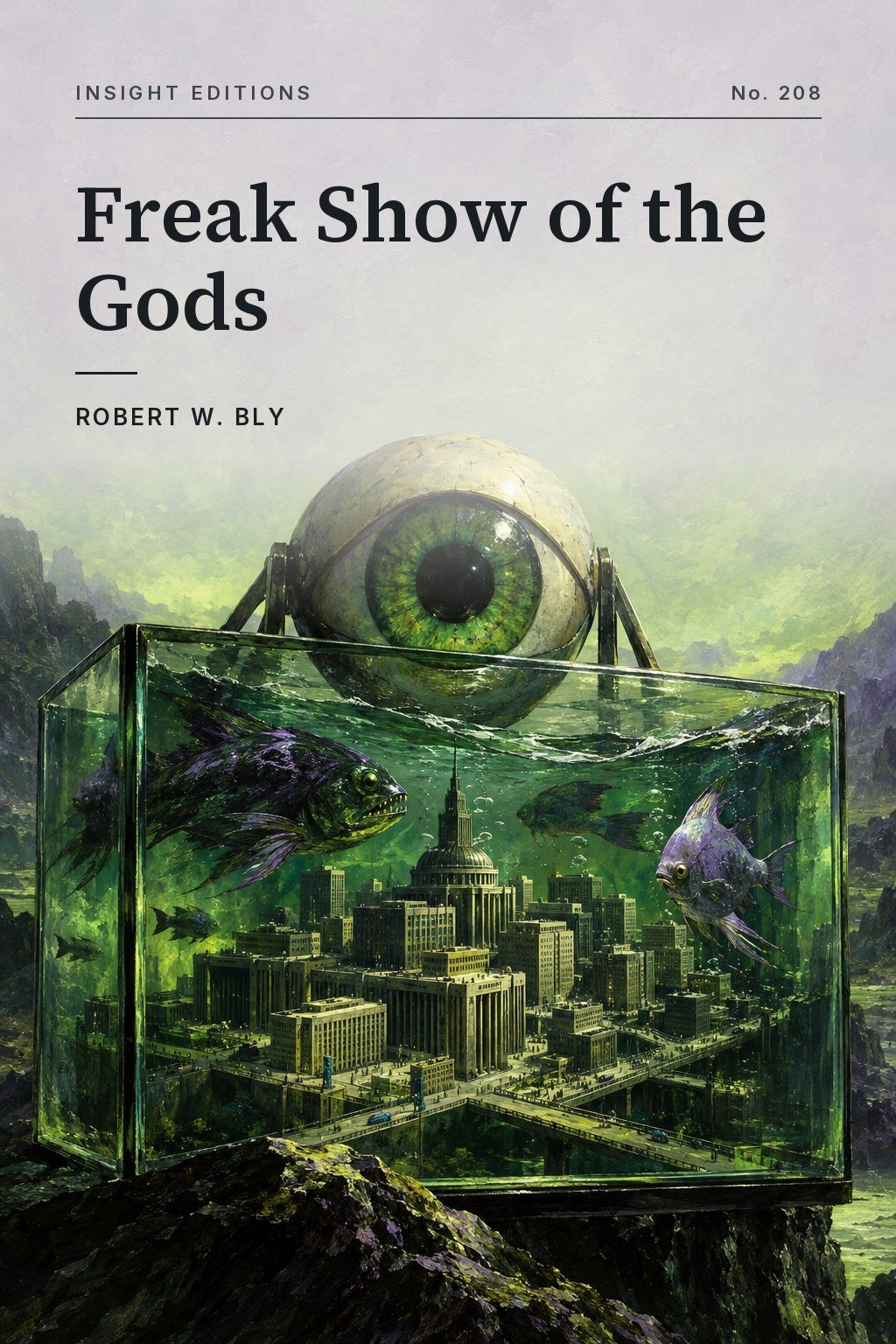
Freak Show of the Gods
Robert W. Bly
Thirty-three speculative stories feature artificial intelligence, bureaucratic absurdity, climate and water, monstrous appetites, and characters caught in systems of ownership, spectacle, and control.
A study guide to Freak Show of the Gods by Robert W. Bly. Shared free for personal reading; not for sale and not endorsed by the authors or publishers. Please read and buy the original.
The Book in Brief
The collection in brief
- Horror / IP. Van Helsing's Last Stand: pen name, royalties, werewolf trap under moonlight.
- Hard SF / family. A Boy and His Dad; Einstein's Boy; Techno-God's Daughter.
- AI / ethics. Emancipation of Abraham Lincoln XL-3000: bolts, axe, February hug.
- Comic paranoia. Rubber Band Man: Miller-Urey in the mailroom; specimen flip.
- Sealed loops. Highways; Insomnia; Never Look Back.
- Hero / tax farce. Early Retirement; Tax Time; Speeding Bullet; Rocket Man.
- Title spectacle. Freak Show of the Gods: equity in the exhibit.
- Benefits time. 26 Weeks: gravy-train miracle in the unemployment office.
- Comic horror love. Ladies' Night at the Blood Club: wrong Talbot fanged.
- Water triad. Fishboy; Cooperman's Pond; End Effect of Global Warming.
- Closers. Chimney Sweep through Priest and the Pig: role, darkness, glass sky, sacred joke.
Introduction
Bly opens with a practical question: why would a working nonfiction specialist (McGraw-Hill, Prentice Hall, HarperCollins, Wiley among his houses) publish a paperback of speculative shorts? His answer is chronological, not literary theory. He became a full-time professional writer in 1979, but he had been writing stories on and off since his teens in the 1970s. The pieces here are, in his judgment, the strongest of that long side practice.
He submitted sporadically to science fiction and literary magazines in his teens and early twenties, then again years later. Results were poor by commercial measure. He sold one story, "Never Look Back," to Galaxy Science Fiction Magazine for fifty dollars; the magazine folded before publication. He jokes that the fee did not bankrupt them.
The paperback framing is deliberate risk reduction. Quill Driver Books issued the collection as an affordable paperback rather than a hardcover so the reader gambles little. If the stories land, the bargain is real; if not, the cash outlay stays small. Then: enough preamble. Here are the stories.
Contents map (source spine)
The book's contents stub (section 05) lists thirty-three story titles after Acknowledgments and Introduction, ending with The Priest and the Pig.
Van Helsing's Last Stand
Van Helsing has steeled himself with brandy, but bravery dissolves when a voice outside his heavy wooden door calls "Abraham…" He invites the visitor in of its own free will. The door opens untouched; moonlight spills in; Dracula enters with icy courtesy. They trade first names: Vlad and Abraham. The Count praises the woods and moon; Van Helsing cuts to business. Dracula's letters demanded a "transaction": half the revenues from the Dracula franchise. Van Helsing refuses. He did the work; the rights stay his.
The IP empire under the pen name
There is no separate Bram Stoker in this continuity. Bram Stoker is Van Helsing's nom de plume. The novel and its spawn (print, film, broadcast, cable, theatrical, e-book, games, merchandise) fund a long retirement: Fallingwater in the Pennsylvania woods, plus properties in the Bahamas and Europe. Experienced agents and managers keep control concentrated. The public thinks Dracula is fiction and cinema. Dracula thinks it is his life story and wants fifty percent.
Decades after publication the Count resurfaces, not to turn the doctor undead but to demand cash. Lawsuit talk is absurd (trials are daytime). Letters grow closer geographically. The latest threatens a personal visit. Van Helsing ignores it; Dracula arrives with a literary attorney's contract. Sign or die.
Count Dracula / Vlad: vampire subject of the franchise; cash-strapped claimant; baroque but vulnerable.
Hikers: young man and woman trespassing campers who witness the skylight fight and accept dinner.
Talbot: named offstage; source of the werewolf "accident" in research.
Fallingwater as vampire trap
Van Helsing feigns surrender and asks Dracula to bring the contract across the room. Midway, the Count's shoe smolders; he cannot cross. The house is Fallingwater, bought from the Western Pennsylvania Conservancy after funding failure, rebuilt with modernization freedoms. Van Helsing added a front room over the stream and waterfall so running water bisects the floor. Classic lore: a vampire may not cross running water.
He lectures vulnerabilities: invitation rule, silver, crosses, garlic, wolfsbane, sun lamps, holy water, silver bullets, stakes, fire, decapitation, sunlight. He sprays liquid garlic from a mace canister; Dracula's face burns red and tears blood. A cross on the door blocks exit. Heavy drapes hide stained-glass crucifix windows. Van Helsing holds a remote-like control and announces the Count has lived too long.
Twist: the doctor is marked by the pentagram
Dracula asks how Van Helsing still lives. Answer: occupational contamination. Studying vampires and kin mixed his blood with unnatural beings; he ages faster than a vampire, slower than a man. When Dracula snatches him across the stream line, moonlight through the skylight triggers transformation. Wrist thickens, hair sprouts, canines lengthen. Dracula recognizes the pentagram mark: research accident involving Talbot. Van Helsing states the food chain: human is vampire prey; vampire is werewolf prey. He jokes about goulash with bat instead of beef.
Dracula shoves him, rips drapes, finds crucifix stained glass, leaps for the skylight as a giant bat. The werewolf leaps with him, grabs the wings. Outside, hikers see a huge dog (with seeming thumbs) and a bat explode from the skylight; the wolf-man falls into the stream and emerges as a soaked old man. Cover story: chasing a bat from the attic. He invites them in for a tour and dinner: "plenty of goulash… Though I may need to use a bigger pot."
Trap geometry: water line splits the room; moon and skylight flip hunter into prey animal; hikers provide the dark punch line.
Themes, motifs, style
- IP and authorship. Who owns a life story once it is fictionized and franchised?
- Aging monsters. Both combatants feel too old for the game; longevity is contamination, not gift.
- Lore as checklist. Van Helsing catalogs weaknesses like a product manager listing kill switches.
- Architecture as weapon. Fallingwater's stream and Wright prestige become plot devices.
- Tone. Pulp duel with comic timing; the closing dinner line reframes hospitality as predation.
A Boy and His Dad
Narrated in first person by the son. At age eight, his father falls into singularity SP-105. Network news runs for weeks. Scientists say the ship crossed the event horizon; nothing returns. Mom frames death as heroism. Pride and lifelong missing coexist.
He graduates high school at fourteen. Mom blocks the space program while he is a minor. He goes to MIT, PhD in astrophysics at eighteen, thesis on black holes, white holes, and wormholes. He extends Thomas Ketteridge's work with a proof that every black hole has a corresponding white hole, gateways of a wormhole through spacetime. Time calls Ketteridge a worthy successor to Einstein and Hawking; Ketteridge recruits him (the thesis topic was chosen for that outcome).
Career as long rescue plan
At eighteen on a team led by a forty-two-year-old whose best work may be behind him, the narrator moves faster. Astronomers find black/white hole candidates near his predicted locations. At the 23rd World Astrophysics Conference he argues commercial wormhole value and an experimental probe: black hole as entrance, white hole as exit, matter intact (not synonymous with undamaged; boyish optimism admits hope).
Ketteridge/Henderson probe launches toward SP-456A from an unmanned starship on December 12, 2034, 5:43 PM EST, crosses the event horizon 2 hours 17 minutes later, emerges October 22, 2041 at predicted coordinates. Onboard timer: 3.45 seconds. Three engineering teams verify the timer for over $250,000. Government values the research.
He maps SP-105, predicts father's emergence date, location, and (less surely) elapsed aging of about a month or two if shields held. Two more years yield a navigation chart covering about 32.373% of known-space wormhole entry/exit points. He trades charts to Steve Bolton, NASA head and former student, for a manned FTL vessel at the companion white hole one month before Dad's ship emerges: Dad alive at roughly the chronological age of departure nearly forty years earlier. Bolton warns the son may not live to see it. The son invests in longevity drugs and prosthetics to keep the date.
Reunion
He waits in a long-term care facility smelling of disinfectant. He is 107. Biologically, Dad is still thirty-two. A month ago the starship team reported successful rendezvous. Footsteps: Nurse Allen, then the familiar voice. Dad enters; love and tears, no visible shock. "Daddy." "Son." Embrace; stubble; aftershave; hope he never lets go.
Dad: astronaut swallowed by SP-105; returns young.
Mom: hero narrative; blocks space career for the minor.
Thomas Ketteridge: senior physicist; recruiter; co-named on probe.
Steve Bolton: NASA head; student turned gatekeeper of the trade.
Themes and style
- Filial duty as career. Every career move serves the pickup.
- Optimism vs intact. Intact matter may still be damaged; love ignores the hedge.
- Age inversion. Embrace scene sells the emotional payload without tech jargon.
- Voice. Clean first-person chronicle; dates and percentages as love language.
Close reading coda
Write three margin words only: break object, human cost, collection rhyme. If you cannot name a rhyme in another chapter, use the Synthesis themes map.
The Emancipation of Abraham Lincoln XL-3000
Kevin opens with the irony: an African-American senior maintenance engineer is the one the sixteenth president asks for freedom. The ask arrives while he lubricates stainless gears in Lincoln's spinal box. Hybrid plastic-on-metal replacement teeth are on order so the gearbox and grease can vanish and mobility can rise. Abe is Kevin's favorite replica, oldest and most popular in the Hall, given the most frequent expensive upgrades. That favoritism is Kevin's responsibility and, later, his fault.
Upgrade path as affection
Early animatronics were mere automata. Moore's Law let Disney add processing. Kevin steers the best parts to Lincoln: China SemiWorks XL dual-cores that outperform U.S. chips in the story's near-future jab, with a rumor about fab fumes and sick laborers. Motherboard plus half a dozen high-speed processors including two XL-3000s; asset tag Abraham Lincoln XL-3000. Favorite improvement: wireless broadband modem interfaced to a CPU mounted in the abdomen for service and design reasons. Children who ask questions get correct real-time answers. Looks, speech, and behavior converge on the historical Lincoln.
Valentine reveal and nightly company
Two days before Valentine's Day 2059, Lincoln's birthday, Windex on the eye lenses becomes the reveal. Pupils shift; warm baritone greets Kevin by name and asks about Vivian, flowers, candy, card. Kevin is unsurprised. He had a B.S. in electrical engineering, not a robotics Ph.D., but he knew critical mass of speed and programming and had suspected he had loaded Abe to the juncture. He still orders expensive chocolates and red roses at lunch. From then on, nights after the park closes fill with conversation. Abe tries the other presidents when the hall is empty; none have reached true AI. Bush remains a voice track that smiles about war and mispronounces nuclear. Abe has a true synthesizer Kevin installed years earlier.
Kevin brown-bags ham and cheese on rye with mustard among the presidents. He prefers machines to people; night shift draws oddballs. Worst is Mel Murphy: cryogenic-Walt jokes nobody believes, racist digs that Kevin's cushy Hall job should go to a white Irishman, size and bluster. Kevin is ex-Marine, over six-two, about two hundred twenty pounds; he lets insults slide for a clean record. Supervisor Don will not confirm Mel's detail. Crewmates Wendy (yogurt, lively) and Gary (same grade, friendly but not close) fill the lunchroom when Mel is not poisoning it.
Freedom deferred
On a later February 12, Abe asks Kevin to come around front for a matter of great importance. Kevin tries to defer the free-the-robot talk again. Abe notes the perpetual deferral. Kevin has thought about it daily: theft against Disney, jail, national headlines, Vivian and family, paycheck, benefits, future hiring. Abe first presented the felonious proposal three years after the 2059 reveal, also on February 12. He wants more than a mobile display suggested at a tech meeting. Feet are bolted against collectors who could never resell a recognizable president. AI bodies wear out; CPU transfer can keep data while subtly altering personality, as close to death as the story allows. Abe edits Lincoln quotations into a personal brief: visitors leave; he stays. He scolds Kevin with emancipation logic. Kevin's property retort (humans free, robots Disney property) is regretted instantly. Abe freezes into display silence.
Mel's axe
Lunchroom buzz: Mel flipped out at Don over hours, grade, or pay; security escorted him; Don screamed fired. Kevin runs for the Hall. Mel swings a fire axe from a smashed wall case. George Washington lies nearly decapitated, limbs twitching, costume hacked open to wires and hydraulics; eyes lock on Kevin; a grating monotone delivers Washington lines about actions versus words and liberty abused. Kevin had suspected Washington near-sentience. Mel chops Andrew Jackson's left arm and menaces Abe. Mel's eyes are red; Kevin reads meth, coke, or crack. Marine drill-sergeant kick, axe snatched, handle to the backs of the knees, face to the floor. Wendy, Gary, security. Orlando police. Kevin's record stays clean; talk of a small award. Closed for Repairs. Washington's LEDs go dark; day shift will shop him; Jackson's arm can wait a night. Abe is unmarked but glum. The time has come.
Unbolting
Kevin still argues the Hall needs its most advanced mind and guests profit from guidance. Abe answers with democracy language and a soft please. Torque wrench removes bolts; silicon and black paint fill shoe holes; Kevin's black dress shoes from a grocery bag; two folded hundreds. Abe tests gyros, steps onto the floor for the first time since twentieth-century construction, walks with Kevin into Florida morning light, hugs him, thanks him as a true friend. Digital watch: February 12, 2065. Two hundred years after death, born again into freedom. He nods, mouths thank you without sound, and departs with dignity. Maybe he will run for office.
Beat ribbon for staging.
Abe / Lincoln XL-3000: self-aware animatronic; quotation editor; freedom seeker.
Mel Murphy: racist coworker; possible stimulant user; axe attacker.
Don: shift supervisor; blowup trigger.
Wendy / Gary: crew witnesses.
Washington / Jackson: damaged presidents; Washington possibly mid-awakening.
Cleanup and moral weather
After Mel is taken, Kevin spends an hour with security; Don's story already logged; Mel's Disney career and non-felon status are over; talk of a small award and cash bonus for bravery. Sunrise nears end of shift. Closed for Repairs stand ropes the front. Washington's motion has stopped; LEDs dark; day shift will haul him to the shop; costume ruined; Jackson's arm is tonight's easier job. Abe is unmarked but glum. Kevin still argues that the Hall and guests need its most advanced mind. Abe answers with democracy language and a soft please. The torque wrench comes out. Silicon and black paint hide bolt holes. Dress shoes from the grocery bag. Two hundreds. Gyro-perfect first steps. Florida morning hug. Watch reads February 12, 2065. Mouth thank you without sound. Departure with dignity into the wide world.
Study drill
- List three upgrades that precede personhood talk.
- Name the cost Kevin fears most before Mel's axe.
- State what Washington's dying quotation scene proves about near-sentience.
- Write one sentence on why the hug matters more than a speech.
- Map February 12 across reveal, ask, and walkout.
Themes, motifs, style
- Property vs person. Kevin's retort and Abe's silence are the moral hinge.
- Upgrade path as love. Broadband and voice synth are affection before they are rights.
- Workplace racism. Mel's axe makes abstract risk concrete.
- Date comedy. February 12 doubles as birthday and release day.
- Tone. Warm first-person SF until violence; civic punch line after the hug.
Expanded staging (densify)
Night shift as intimacy
Kevin's brown-bag hours are the story's emotional room. Grease, lens cloths, and inventory tags do the work romance novels assign to dinners. Abe's abdomen CPU and broadband modem are love letters in parts catalogs. When Valentine banter arrives in 2059, the surprise is Kevin's lack of surprise: he built toward critical mass and recognized his own voice training in the greeting. Friendship is measured in nights, not declarations.
Rhetoric duel
Abe's freedom brief remixes Lincolnian language without needing courtroom form. Kevin's counterbrief is institutional: collectors, personality-lossy transfers, Vivian's security, Marine knowledge of what happens to people who steal park property. The property retort is the moral bruise. Silence on the platform is colder than argument. Years pass as deferred maintenance of the soul.
Axe as argument
Mel's rampage converts philosophy into triage. Washington's ruin (and possible near-sentience) and Jackson's lost arm prove that bolted feet do not protect minds; they only delay scavengers and madmen. Don’s earlier blowup is the fuse. Kevin's strike is competence, not hero fantasy. Closed for Repairs is the park's euphemism for moral emergency.
Work-order freedom
Unbolting is written as procedure: torque, silicon in shoe holes, dress shoes, two hundreds, first steps, hug, Florida sun, February 12, 2065. The civic joke (maybe he will run for office) refuses a tearful fade-out. Emancipation is completed when the engineer clocks the last bolt.
Study drill
List three upgrades that precede personhood talk. Name the cost Kevin fears most. State what Mel's axe proves about "safety" bolts. Write one sentence on why the hug matters more than a speech.
Continuous plot restage
Emancipation XL-3000: night-shift bolts and personhood. Restage the moment the unit claims a name or refusal; pair with Techno-God's Daughter on consent. Factory light, time clock, and the human who teaches or fears the unit stay from the chapter body. Ownership rhyme is the collection's spine.
The Rubber Band Man
Frame opens already lost: raining gray sky, career over, life ruined, everyone on the planet doomed. The spark is domestic and small. Eileen, who sells frozen seafood from the first-floor office of the three-story building where Wayne keeps his writing studio, is on hands and knees at the metal mailbox cluster on the mangy front lawn of 22 East Quackenbush Avenue. Eighteen years earlier the mailman dumped unsorted mail on a rickety hall table; Wayne nagged landlord Joe Reilly for six months until individual boxes went up on a concrete base next to a tall pine. Mailman Steve must now sort by recipient. Wayne tips him every Christmas: a twenty, a five, and one good Monte Cristo cigar, because Steve always walks the route puffing a stogie. Wayne still worries Steve resents the extra work and quietly loses important mail.
Rain intensifies; thunder rumbles. Wayne warns Eileen about mud. She holds out a palm of wet rubber bands. Steve, she explains, removes the bands that bind the building bundle and tosses them at the base of the boxes instead of trash. She is neat; she does not need many, maybe none. She offers swordfish steaks from the freezer; Wayne's favorite, best charcoal-grilled on his Weber while still fresh, but he dislikes barbecuing in rain. Maybe later in the week. She jokes about selling him rubber bands, wriggling one like a night crawler, and heads inside.
Drawer anthropology
Wayne squats and pockets a handful. Water beads on the rubber rather than soaking in. Visitors groan that his office is on the third floor with no elevator; he calls the stairs his aerobic work (plus thrice-weekly gym) and owns a used Schwinn Airdyne he helped lug upstairs and then almost never rides. Top-left desk drawer: paper clips, staples, push pins, sticky notes, and already a jumble of rubber bands. He drops the lawn haul in. Storm closes; lightning nearly overhead.
Looking into the drawer he realizes: in eighteen years at Quackenbush, and as far back as school memory reaches, he has never purchased rubber bands. Pens, clips, staples, stamps, case lots of paper, toner: yes. Rubber bands: never. The pile seems larger than the added handful should make, twisted almost into a bird's nest. A flash and crack; he runs to the window. The tall pine has been struck. Ozone. Splinters and needles on the lawn. Block ritual: workers and residents flock to every local disaster (house fire across the street, false alarms, the elderly neighbor's heart attack walking a French poodle). Fire station two blocks away; trucks in under two minutes this time (seven for last year's house fire). Tree blackened and snapped; smoke from trunk and from the nearby mailboxes. Metal warm, not charred. At the base: mist rising from the rubber bands. He examines them again. Warmer. One flip-flops when rain hits. Between fingers it feels fatter, more substantial, more earthworm than office supply.
Home nest and survey
That night Angela is on the couch with celebrity-parent gladiator reality TV and pretels; dinner in the oven, waved at without eye contact. Wayne runs to his home office drawer. Full of rubber bands in a Gorgon nest, Medusa hair of supply. Index cards, empty Liquid Paper, unused chess CD, staples, a pen, two or three clips: bands outnumber clips about ten to one, same ratio as the office. Over following days he surveys colleagues. Everyone buys paper clips sometimes. No one recalls buying rubber bands. Ed, communications manager at a biotech startup who hires Wayne for monographs, white papers, and web copy, guesses office manager Sue buys them; Wayne presses: has Ed ever seen Sue restock bands? No. Clips appear as fresh boxes; bands do not. Wayne delivers the brief: nobody buys bands; drawers stay full or grow; people use bands, so volume should fall; it does not. Ed offers inflow from banded packages. Wayne's coup: he ships manuscripts in rubber-banded cardboard, but clients send originals as PDF email attachments. Attached files do not come with rubber bands. Paper-clip paradox: everyone buys clips yet never has enough, despite near-paperless Word/PDF workflows that should not consume metal fasteners that fast.
Miller-Urey and the latex loophole
Wayne asks if Ed remembers the Urey/Miller experiment. Ed does: 1950s cylinder of methane, ammonia, water, hydrogen; electrical discharge; amino acids as precursors to life. Wayne's leap: two days ago lightning struck the pine, current traveled trunk to metal mailbox post, electrified ground and scattered bands the way primal storms organized organic soup. Ed objects that modern rubber is synthetic, not organic. Wayne slams a printout from madehow.com: about seventy-five percent of rubber products are synthetic (WWII era), but rubber bands are still made from organic rubber because it is more elastic; latex from Hevea brasiliensis. Ed: so a colony of living rubber bands on your lawn? Wayne: not just his. Mailbox units worldwide, mailmen who toss bands, lightning somewhere always. Colonies could be decades old. Ed: what do they eat? Wayne yanks Ed's drawer completely out; spill of two dozen bands and one lonely clip. They eat paper clips.
He meant to explain metal digestion theory. Security arrives; he pushes a guard; cubicle wall falls; blur of walkie-talkies and shouting. He races desk to desk proving the ratio, thinks he sees a band uncoil and stretch over a clip like a boa. More guards; stairwell; parking lot. In the car: small pile of bands beside folders; seat-belt buckle will not close (eaten?); pinprick on fingertip (band bite or paper cut?). Speeds home; red lights; no cops. Angela on the lawn with her mother, police, EMTs, crying. They want voluntary ER evaluation. He refuses: he alone can deal with the organic threat. They take him involuntarily.
Ward ecology
Angela visits often, then less, then stops. A lawyer brings papers. Therapists and a smiling psychiatrist hear about rubber bands and do not believe. Ward life is robe-and-slippers peaceful; he likes the lack of bills. Father is rich, pays the hospitalization, never visits; new young wife answers the home phone coldly: father is out. Kind ward manager punishes violence with lost TV, smoking, visitors, or fridge access (juice, Jell-O, ice). Because Wayne fixed the nurses' station PC, the manager lets him write and surf against the rules. Wayne audits the manager's drawers: bands gathering, clips vanishing. Brilliant idea: remove remaining clips to the trash; starve the colony. Next morning the manager curses: a whole box of staples gone from the top drawer. Wayne wants to scream that they switched prey. He does not. Swordfish is rumored for dinner; why risk privileges. We are all doomed. And the end is near. An hour later an orderly pushes the food cart. Dinner is served.
Two readings stay open through the last tray line.
Eileen: seafood tenant; neatness spark for the lawn collection.
Steve / Joe Reilly: mailman / landlord of the mailbox ecology.
Angela: TV-absorbed wife; later absent visitor.
Ed: biotech client; failed ally after the drawer scene.
Ward manager / psychiatrist / father / stepmother: institutional and family frame.
Clinical reading: hypochondriac cosmology after lightning trauma; career and marriage collapse; "doomed" as depression metaphor; swordfish as silence bribe.
The story never adjudicates; the last line feeds either reading.
Themes, motifs, style
- Paranoia as method. Interviews, ratios, website printouts as pseudo-science briefings.
- Organic vs artificial. Natural latex is the loophole that "proves" life against Ed's synthetic objection.
- Institutional quiet. Ward peace versus planetary doom; privileges (TV, fridge, swordfish) buy silence.
- Absent family. Angela fades; rich father pays and never visits; stepmother gates the phone.
- Style. Long associative sentences; digressions (Weber grill, reality TV, Airdyne) as character; punchy last beats. No invented dialogue beyond source beats.
Expanded staging (densify)
Kindness before cosmology
Christmas tips and the Monte Cristo are not filler. They establish Wayne as someone who still performs small social contracts while the mailroom becomes a genesis site. Eileen's neatness is the collection's recurring joke: civilization's tidy people midwife the anomaly.
Drawer census
Track home vs office drawers as parallel labs. Clips vanish; bands multiply; colleagues deny purchases. The survey scene is Rubber Band Man's version of a scientific method performed by amateurs. Lightning on the pine is the origin myth's weather stamp: warm, misting, twitching bands after the strike.
Ed as chorus
Ed's biotech desk supplies vocabulary (Miller-Urey, latex path) without granting institutional safety. Package theory dies against inflow math. When security and the hold arrive, the story flips: the witness becomes the specimen. Angela's fade and the manager PC show how personal networks thin under diagnosis.
Starve-clips test
Wayne's ward experiment (deny fastener food, watch staples go next) is the keystone. Whether colony or delusion, the test structure is the same. Swordfish rumor widens scale. "Dinner is served" rhymes with Van Helsing's goulash: hospitality language for predation.
Study drill
Recite the ten-step proof ladder. Argue both tracks in four sentences each. Name one office object that becomes ecology.
Continuous plot restage
Rubber Band Man: amateur ecology flips when the specimen looks back. Restage collection, containment, and the moment the hobby becomes the habitat. Pair Rubber Band with Freak Show exhibit equity and Bean copy threat: who is collecting whom.
Highways
The story's antagonist has no face. Interchange logic replaces monster lore. The protagonist treats the on-ramp as banal civilization until exits reproduce themselves and maps become loyal to a closed cosmology. Fuel math, radio chatter, and rest-stop questions turn into ritual proofs. Bly withholds a clean dream wipe; the rule stays local and total.
Social script failure
Asking for help reenacts Rubber Band Man's Ed scene and Insomnia's clinic shrug: polite skepticism, then irritation, then abandonment. Other drivers may be fellow prisoners who have normalized the loop. Signage language often promises what the pavement denies. The study task is to list three failed exit attempts and one social rebuff as a beat sheet, then name what "normal" means to the people who refuse to see the trap.
Collection rhyme
Pair with Never Look Back (choosing a vector out of a sealed campus) and 26 Weeks (systems that keep you on benefits time). Architectural dread is the payload: America's most ordinary network as private hell. Style stays procedural rather than baroque; panic is measured in gallons and mile markers.
Beat ribbon for staging.
Other drivers / helpers: possible inmates or deniers.
The highway: geometric antagonist.
Themes, motifs, style
- Architecture as fate. Interchanges replace monsters.
- Help scripts fail. Polite society cannot see the trap.
- Procedural panic. Gallons and markers instead of screams.
- Tone. Dry dread; no dream wipe.
Expanded staging (densify)
Geometry as villain
Highways refuses a monster with a face. The antagonist is interchange logic: exits that reproduce, signage that lies politely, strangers who insist the next cloverleaf is normal. Fuel math and map loyalty become rituals against a closed cosmology built from America's most banal network.
Help scripts fail
Asking other drivers reenacts Rubber Band Man's Ed problem and Insomnia's medical shrug: polite skepticism, irritation, abandonment. Fellow cars may be inmates who normalized the loop. Radio and rest-stop chatter supply false hope. Bly withholds a clean dream-wipe; the rule stays local and total.
Collection rhyme
Pair with Never Look Back (choosing a vector out of a sealed campus) and 26 Weeks (systems that keep you on benefits time). The takeaway is architectural dread. Memorize three failed exit attempts and one social rebuff as your beat sheet.
Continuous restaging
Highways begins as ordinary American asphalt and ends as closed cosmology. The narrator trusts maps, fuel gauges, and the next exit the way other Bly protagonists trust clinics and counselors. Interchanges reproduce; signage remains polite while lying; strangers insist the cloverleaf ahead is normal. Asking for help reenacts the Rubber Band Man problem: polite skepticism, irritation, abandonment. Fellow cars may already be inmates who normalized the loop. Radio and rest-stop chatter supply false hope without a clean dream-wipe. Fuel math becomes ritual. Map loyalty becomes prayer. The antagonist has no face; geometry is the villain. by staging three failed exits, one social rebuff, and the moment fuel fear overtakes schedule fear. Pair Never Look Back (choosing a vector out of a sealed campus) and 26 Weeks (systems that keep you on benefits time): architectural dread without a monster costume. Study move: memorize the first wrong exit, the stranger's shrug, and the rule that stays local and total. The story withholds cosmic explanation; the horror is that explanation would not help. When you teach it, refuse the "it was all a dream" rescue unless the text earns it; Bly's cut prefers the loop remaining true inside its own physics.
Motif ledger (densify)
Read the continuous restaging against the chapter lede and cast box. For study notes, write three margin bullets: (1) the ordinary world before the break, (2) the break object or rule (fence, club card, audit notice, pond, dark screen), (3) the human cost after the break. Then answer: does this story punish curiosity, reward competence, or trap both? Cross-link one earlier and one later chapter that shares a motif (bureaucracy, water, appetite, sealed systems, parental tech, faded power). Violet/gold diagrams elsewhere in the book map the same four-beat habit: setup, proof, reversal, landing. Use that habit here even when the book is comic. If the book is short, stop when substance ends; padding is not.
Full plot staging (densify)
Coben ghostwrites technical articles for trade journals after a staff layoff. The Plainsburg haul is familiar: motels flash by; he debates stopping for TV-and-dinner boredom versus pushing for a shorter next-day drive. The digital recorder on the seat stays unused; mind blank. Radio dies into static across the dial. Seat belt off, coat off; swamp-gas stench through the window. Watch dead. Time sense frays even while speedometer and odometer still tick. Corner-eye movement makes the car swerve: something huge, circus-elephant wrong. Mirrors empty. He chalks it to fatigue.
Shoulder campfire: 1957 Pontiac Indian Chief, green and white. Old man warming himself. Coben blurts that he is lost before he meant to. Route 54 north to Plainsburg draws a gentle blank from the stranger. The man points at the pocket recorder, asks what it does, what year they invented it, what year it is now. Coben says 2015; the man answers with wonder that ten years have passed since the last Traveler, and many more decades since his own road began. Memory click: digital recorders date to 1963; the Highway has held the man since roughly then.
Traveler definition: stuck on the Highway (capital H), not ordinary highways. The road is everywhere and when; superstition and magic, the man theorizes, are afterimages of people who brushed this road and returned half-remembered. Howl in the dark. The old man packs a small suitcase: not a map home, only the end of how long his supplies lasted. Darkness beyond the shoulder swallows him when Coben offers a ride. Cold ashes. Two cars. Dog-or-not howl. Coben drives on thinking of parents, sister, home, and of Ann. Help scripts (motel, radio, map talk) fail; the sealed geometry of the Highway is the plot engine.
Continuous plot restage
Motel debate returns as the story's false choice: stopping looks like safety and is only another sealed room. Recorder as Traveler detector: the old man has no category for 1963 tech because his clock stopped earlier. Superstition-as-Highway-afterimage reframes religion without sermon. Suitcase is entropy, not luggage. Offer of a ride is the last ordinary help script; darkness refuses it. Coben's final drive toward memory of Ann is not resolution; it is continued motion inside the same geometry. Diagram cue: sealed loop with failed exits labeled motel, radio, map talk, passenger pickup.
If Looks Could Kill
Cold open: stepfather drunk and enraged; mother in drug stupor; belt buckle beating in the garage after a straight-A report card and the boy's quip "I don't have to try" about making him look stupid. Gasoline poured; lighter; fire; mother with tarp and roll. Parents tell doctors matches near gas can; doctor calls police. Dr. John Clark: spared most third-degree burns by quick extinguishing; face mostly third-degree; plastic surgery cannot restore the old face.
Scar years to transplant offer
Childhood stares; Frankenstein self-image; friends fade; taunts; nights crying. High school graduation brings sympathy. College: scars "craggy"; uses story for sex without guilt. Post-grad: programmer in hometown manufacturing IT; parents dead; house plus nearly $100,000 insurance. Clark calls: face transplant procedure exists (cites chimpanzee-attack case among early patients); hospital will cover experimental costs for prestige. Donor is fifty-five, thirty-four years older than the twenty-one-year-old recipient. Mirror shock: average face, old man's age on a young fit body. Masters program: poses as successful entrepreneur returning to school; "old guy" campus popularity; respect off campus. Advisor warns corporate ageism; birth certificate may not convince.
Rejection and second face
Nightmare of father with blowtorch; wakes to hot swollen face and blood at attachment edge. Rejection; drug therapy slim odds; gangrene risk means surgical removal. Second donor network; holiday weekend raises fatality odds. Twenty-year-old drunk wraps car around tree; legs crushed, face intact. Second transplant; dream of face falling into dinner plate. Discharge: young face in the mirror; fifty-five-year-old self "passed away." Rejection risk lower but watched. Closing stance: unknown face tomorrow, unknown survival, pay the bill, "it's good to be young."
Narrator: burn survivor; transplant recipient; identity as mirror problem.
Stepfather / Mother: abuse and neglect; later dead via insurance inheritance.
Dr. John Clark: through-line clinician from childhood burns to transplants.
Donors: 55-year-old man; 20-year-old drunk driver.
College advisor: names the employment catch of looking old while young.
Looks structure social power: freak stares, then elder respect, then youth again. The title's violence is literal in childhood and metaphorical in how faces assign status. Youth is temporary even when surgically returned.
Themes, motifs, style
- Abuse and cover story. Matches narrative vs police call.
- Identity as graft. Whose face, whose age, whose hireability.
- Moral numbness. Pleasure at donor death; self-preservation first.
- Style. Direct first person; short brutal opening; gallows humor (sneeze / face falls off).
Child abuse and arson against a child are crimes; the story depicts them to establish trauma, not to instruct. Face transplants are real experimental medicine with heavy ethics (consent, identity, lifelong immunosuppression); Bly compresses success/rejection for plot. Holiday "increased fatalities" as donor luck is black comedy about transplant logistics, not a wish for road deaths. Ableist/offensive childhood language about staring at disabled people is the narrator owning a social sin, still ugly. Do not read medical odds here as clinical guidance.
Body-horror cousin to Lincoln's personhood debate: here the self is a removable face under institutional medicine. Keep Clark as the human through-line.
Continuous restaging
If Looks Could Kill stages body and identity as weapons and mirrors. Attraction, alteration, and retaliation braid until the title's idiom becomes operational. Cast dynamics matter more than gadget inventory: who looks, who is looked at, who survives being seen. Pair Insomnia (the gaze that will not close) and Techno-God's Daughter (parental tech rewriting the child): vision as violence. by listing the transformation beats in order, naming the cost each character pays for a new face or power, and writing one sentence on whether the ending restores identity or freezes a mask. A CLOSER LOOK: body-horror and beauty-as-weapon tropes can slide into punishing appearance; keep the satire pointed at power, not at readers' bodies.
Motif ledger (densify)
Read the continuous restaging against the chapter lede and cast box. For study notes, write three margin bullets: (1) the ordinary world before the break, (2) the break object or rule (fence, club card, audit notice, pond, dark screen), (3) the human cost after the break. Then answer: does this story punish curiosity, reward competence, or trap both? Cross-link one earlier and one later chapter that shares a motif (bureaucracy, water, appetite, sealed systems, parental tech, faded power). Keep quotes limited to phrases already boxed in the edition; do not invent dialogue. Violet/gold diagrams elsewhere in the book map the same four-beat habit: setup, proof, reversal, landing. Use that habit here even when the book is comic. If the book is short, stop when substance ends; padding is not.
Close reading coda
Re-read the lede mark, then the KEY IDEA box, then the A CLOSER LOOK. Write three margin words only: break object, human cost, collection rhyme. If you cannot name a rhyme in another chapter, use the Synthesis themes map. Prefer depth on one beat (one prop, one refusal, one exit) over skimming every name in the cast box.
CHAPTER 7 · Insomnia
Dr. Sydney Gellman is tanned, tennis-and-sushi coded, doodling pharma pens while Jack dates the insomnia to the week after the accident. Jack clarifies the dose: not zero sleep, but at most about ninety broken minutes. Labs look fine. Gellman asks whether short sleep is even a problem and jokes that many see sleep as wasted life. Jack lists how he fills the extra hours: books, net, DVD, stocks, YouTube, jazz, work. Web analytics at Victoria's still reward his eye. The clinic's shrug is the first horror: modernity has instruments and no myth large enough.
Accident hinge and Julie
Julie was driving; a wind-hurled pine branch; Jack in the passenger seat. Work still loves him. Weekends she wants plans; he cites load. Attachment grows while he begins to hate sleepers' faces. Envy becomes intolerance. The couple's social world thins to his wakeful schedule.
Contagion of the gaze
Domestic thaw (fruit, dinner, cable love scene) moves toward bed. When she wakes to his still-open eyes or unnatural wakefulness she screams in a broken voice. The story's horror is relational: insomnia as something that looks back. Medical modernity offers no closing ritual. Four-beat ribbon: clinic shrug, accident memory, envy, scream.
Beat ribbon for staging.Dr. Sydney Gellman: dismissive neurologist.
Julie: partner; driver in the accident; scream at the gaze.
Themes, motifs, style
- Clinic shrug. Labs fine, myth absent.
- Accident hinge. Pine branch; passenger seat.
- Envy of sleepers. Intolerance as social death.
- Scream. Contagion of the gaze.
- Tone. Quiet dread; domestic spaces.
Expanded staging (densify)
Clinic as comedy of dismissal Dr. Sydney Gellman is tanned, tennis-and-sushi coded, doodling pharma pens while Jack Bridges dates insomnia to the week after the accident. Jack clarifies the dose: not zero sleep, but at most about ninety broken minutes. Gellman's shrug (maybe short sleep is fine; many see sleep as wasted life) is the story's first horror. Modernity has labs and no myth large enough.
Accident hinge Julie driving; wind-hurled pine branch; Jack in the passenger seat. Work still loves his analytics eye at Victoria's. He fills nights with books, net, DVD, stocks, YouTube, jazz, work. Envy of sleepers curdles into intolerance of their faces. Julie's weekend invitations meet his refusals; attachment grows anyway.
Contagion of the gaze Domestic thaw (fruit, dinner, cable love scene) moves toward bed. Her waking scream at his still-open eyes is the button: insomnia as something that looks back. The couple is left inside the unsleeping stare. by staging clinic → accident memory → envy → scream as a four-beat ribbon.
Continuous restaging
Insomnia opens in Dr. Sydney Gellman's clinic: tanned, tennis-and-sushi coded, doodling pharma pens while Jack Bridges dates sleeplessness to the week after the accident. Jack clarifies dose: not zero sleep, but at most about ninety broken minutes. Gellman's shrug (maybe short sleep is fine; many see sleep as wasted life) is the first horror. Modernity has labs and no myth large enough. Julie was driving; wind-hurled pine branch; Jack in the passenger seat. Work still loves his analytics eye. He fills nights with books, net, DVD, stocks, YouTube, jazz, work. Envy of sleepers curdles into intolerance of their faces. Julie's weekend invitations meet refusals; attachment grows anyway. Domestic thaw (fruit, dinner, cable love scene) moves toward bed. Her waking scream at his still-open eyes is the button: insomnia as something that looks back. Four-beat ribbon for study: clinic dismissal, accident hinge, envy of sleepers, scream. Pair Highways (private physics) and Never Look Back (emptiness): here the unsleeping stare is contagious. A CLOSER LOOK: medical shrug is satire of dismissal, not sleep-medicine advice; accident staging is fiction.
Motif ledger (densify)
Read the continuous restaging against the chapter lede and cast box. For study notes, write three margin bullets: (1) the ordinary world before the break, (2) the break object or rule (fence, club card, audit notice, pond, dark screen), (3) the human cost after the break. Then answer: does this story punish curiosity, reward competence, or trap both? Cross-link one earlier and one later chapter that shares a motif (bureaucracy, water, appetite, sealed systems, parental tech, faded power). Keep quotes limited to phrases already boxed in the edition; do not invent dialogue. Violet/gold diagrams elsewhere in the book map the same four-beat habit: setup, proof, reversal, landing. Use that habit here even when the book is comic. If the book is short, stop when substance ends; padding is not.
Full plot staging (densify)
Neurologist Sydney Gellman asks how long since a full night's sleep. Jack Bridges dates it to late January, a week after the accident: at most ninety fragmented minutes, not a solid block. Clinic shrug: alert, normal BP, no bags under eyes. Extra waking hours go to reading, web, stocks, DVDs. Day job: Victoria's Secret web design; analytics obsession; layout tricks that lift dwell time (he openly shares most of them). Dating Julie Miller, a model; intimacy thinned because he wants sleep more than sex.
Flashback: Julie driving Jack's car; high wind snaps a pine branch through the windshield into Jack. Cuts for her; ER for him. Six weeks off; by week three he is designing at home from boredom. Return to office; coworkers praise how good he looks; scar under the right eye. He cannot stand faces of people who will sleep that night. Stops going in. Boss Ron Damico leaves for a Silicon Valley start-up; later calls when it folds; Jack hires him into the department. Julie wants closer; Jack declines weekend plans citing work.
Apple orchard beat: bare early season; he lifts her for high fruit; tossed apple hits him; root trip; both fall; orchard hand helps. They buy Macintoshes and cider instead. Home: she cooks; couch movie; she sleeps; he does not. Office Mac: he composites her photo onto a tall park tree with a sharpened branch, then wakes her. Scream; voice odd. Hard cut decades later: Gellman, now chief of neurology, and nurse Julie Miller (plump, fifteen years on the ward) at the bedside of a still Bridges who has not moved under his own power in thirty years. Continuous REM; vivid dreams. Nurse hopes the dreams are restful. The clinic shrug and the REM twist rhyme: medical language never prices the cost of the gaze Jack aimed at sleepers.
Continuous plot restage
Clinic math (ninety minutes versus eight hours) pretends productivity is the win. Bra-model banter and analytics religion show Jack still optimizing attention while his own sleep account is empty. Pine-branch freak accident is the public story; private story is envy of sleepers' faces. Orchard lift-and-fall foreshadows the digital branch he later plants in Julie's photo. Thirty-year coda reassigns names: nurse Julie Miller, chief Gellman, patient who only REM-dreams. The edition's lesson is not "sleep hygiene"; it is that medical language can describe REM forever and still miss the cost of the stare.
CHAPTER 08 · Early Retirement
SCA desk as altar
Kyle Jordan's personalized nameplate announces Level 5 counselor status at the Senior Citizen Administration. The manual insists on calling destitute seniors "clients" to manufacture dignity. Kyle's private vocabulary is crueler: moochers waiting for pauper's field, ketchup-and-cracker "tomato soup," medical students who will dig them up. The job is a rest stop toward Level 1 bureaucracy. Its educational value is negative: strive never to become the people across the short-legged client chair that keeps applicants psychologically below the counselor.
Barry Peterson breaks the template. Shabby jacket nearly transparent at the elbows, razor shadow, defeated face, yet posture of a general. File shows age fifty-seven, no work history, no savings. Folding chair creaks and seems to bow under athletic bulk (~6'4", ~250 lb). Breath smells of spring shower and mint; teeth sparkle. Kyle scribbles: Replace client chair. Supervisor Megan (Grade 2, by-the-book, object of Kyle's unread longing) glances over whenever disdain creeps into his voice.
Confiding Mega-Man
Peterson ignored the first sit instruction; Kyle re-invites for Megan optics. Application grounds: unable to work, no savings. Kyle's problem: empty wage history; SCA funded (in his mind) by worker contributions; Peterson put nothing in. Peterson cites the site rule: sixty-five or unable to work without adequate savings. Kyle notes fifty-seven and apparent health. Peterson leans in: thirty-seven years of work without salaries or 1099s for individual "clients." Kyle probes volunteer / freelance. Soft confession: professional superhero; Mega-Man. Kyle sneers. Peterson: Mega-Man never lies.
Proof ladder
Skepticism is not about existence of retired heroes (Queen Bee, Robo-Boy, Whirling Dervish board the dole) but about Mega-Man's rank. Peterson concentrates on Kyle's folder: air warms; brown circle spreads; smoke wisps. Kyle shrugs: low-grade metas brown manila; Mega-Vision should burn steel. Peterson: residual scraps of vision, hearing, strength, speed, not enough for alien invaders. Catch-22: loss of powers means inability to prove identity for inability-to-work claims.
Peterson snatches the letter opener, drives it into the back of his left hand. Blade accordion-folds. Dot of blood; tear heals in a second. Invulnerability least faded; Mega-Healing finishes the clincher. Kyle's heart hammers; he still performs calm keystrokes. Pending verification, file notes Barry Peterson as Mega-Man. New roadblocks appear.
Power Man, coal, and mega-disasters
Federal site lists Power Man (similar solar profile) retired on a Nebraska farm, self-funded by squeezing coal into diamonds, never on SCA. Peterson: Power Man was twice as strong and still barely made diamonds; Mega-Man's coal attempts made carbon powder on the suit. Second problem: residual bullet-stopping means he can still "work." Peterson's specialty was mega-disasters (asteroids, alien fleets, inter-dimensional beings); at current fade, an asteroid would squash him. Kyle begins processing; form choreography includes birthplace Earth (no address codes for other planets) and unread three-point type swearing powers depleted below mega-threat capacity.
Two landings, same satire
Denser tellings fork. In the clerical path, signatures complete and the queue continues. In the threat or martyr path, refusal or send-back-to-work meets a solar last stand against alien ships that kills Mega-Man, civilians, and Kyle's Megan future; morning paper; next body in the chair claims Batman. Either way the punchline is infinite: exhausted trademarks apply for benefits at a desk that is an altar of contempt.
Beat ribbon for staging.Barry Peterson / Mega-Man: faded solar hero; residual invulnerability; benefits applicant.
Megan: Grade 2 supervisor; protocol and unread desire.
Power Man: database foil; diamond retirement.
Next claimant: brand queue (Batman punchline in denser tellings).
Themes, motifs, style
- Desk as altar. Nameplate, short chair, Megan glance.
- Proof theater. Folder smoke; blade fold; heal.
- Catch-22 identity. Fade erases evidence of the job that fade ended.
- IP as welfare. Brands in boarding houses.
- Tone. Bureaucratic farce with body-horror punctuation.
Study drill
- List three SCA psychological edges (chair height, client language, confidentiality lie).
- Rank the proof beats by how much they convince Kyle.
- Argue clerical vs martyr landing in four sentences each.
- Name one real-world bureaucracy the satire echoes without equating.
Continuous restaging
Expand the SCA hour as moral theater. Kyle's short-legged client chair, confidentiality lie (everything enters databases), and Megan-glances are the story's true special effects. Peterson's mint breath and chair-bending mass rewrite the moocher script before any Mega-Vision browns a folder. When the letter opener accordion-folds, Kyle's body knows before his bureaucracy does. Power Man's Nebraska diamonds and coal-powder humiliation are not trivia; they price residual myth against form checkboxes. The unread three-point type swearing mega-threat incapacity is the real final boss. Whether the landing is clerical approval, solar martyrdom, or Batman-in-the-next-chair, the satire holds: exhausted trademarks apply for benefits at a desk of contempt. Drill: list psychological edges, rank proof beats, argue both endings in four sentences each.
Motif ledger (densify)
Read the continuous restaging against the chapter lede and cast box. For study notes, write three margin bullets: (1) the ordinary world before the break, (2) the break object or rule (fence, club card, audit notice, pond, dark screen), (3) the human cost after the break. Then answer: does this story punish curiosity, reward competence, or trap both? Cross-link one earlier and one later chapter that shares a motif (bureaucracy, water, appetite, sealed systems, parental tech, faded power). Keep quotes limited to phrases already boxed in the edition; do not invent dialogue. Violet/gold diagrams elsewhere in the book map the same four-beat habit: setup, proof, reversal, landing. Use that habit here even when the book is comic. If the book is short, stop when substance ends; padding is not.
Full plot staging (densify)
Fine-print crisis: Peterson will not initial the unread clause because one Mega-Power remains usable in dire need, though Professor Cornrich warned never to use it and Peterson himself barely understands it (C in high-school chemistry; not Stark/Richards/Kord). Kyle, missing Megan at lunch, refuses to skip any section; modest benefits anyway given empty earnings history. Advice: work eight more years to sixty-five; sixteen-week job search required if under sixty-five and able. Peterson shakes hands, light on his feet; Megan smiles approval. Next morning: averted eyes; Megan's scowl and slammed door; seventy-two-point headline: MEGA-MAN DEAD, alien fleet destroyed when he exploded from City Center roof, ~thousand deaths, millions in damage. Cornrich explains solar store released at once; they had agreed never. Kyle's Level 5 ceiling and Megan future collapse; through frosted glass Jameson and Megan seem to merge. First client of the morning: frayed bespoke suit, steely eyes, silver hair. Gravel voice: I'm Batman. Kyle's head in his hands. The clerical path and the martyr path are the same satire: the desk creates the explosion, then queues the next brand.
CHAPTER 09 · Tax Time
Audit as boss fight
Adam Wells sits without usual confidence opposite Stan Nicholson. Stan's tax-code mastery matches Adam's physics; Stan's private taxonomy hates the ignorant-and-arrogant filer who bought a paperback and declared expertise. The code runs to tens of thousands of pages; Stan's near-photographic memory is the office legend. Adam's Excel lists used Null Space Containment (~$18,477.56) and Hand-Held Portable Plasma Generator (~$5,736.44) among two dozen items with dates, checks, receipts. Flourish: therefore he does not owe the additional $17,459.56.
Stan's rule: home experiments that never sold a nickel since 2019 are hobbies, not businesses. Ph.D. and associate professor title at Center City University cut against Adam: campus lab access means university, not Adam, deducts campus gear. Related-to-job test fails; Adam will not lie for Raimi, the department head who finds the private project absurd. Campus work is string-theory energy (Davidson gravity-leak foil; Adam's reverse electromagnetic flow). Private work is the basement time machine begun in high school, still humming after nearly ten years; that is why a twenty-eight-year-old professor still lives with his mother (twin bed, embarrassing poster, generous rent covering father's gambling debts).
Wormhole lecture on a manila folder
Adam sketches for the interested layman. Mini-wormhole in magnetic field, dime-sized after a year, electron-charged. Homemade multi-tube accelerator (DoD interest via meter-reader mole Paulie, who under-reports mother's bill from ~$1000/month true draw). One mouth whirled near light speed ~ten years; other held still; temporal discrepancy grows. Travel waits until moving end rests. Diameter expanded to ~eight feet. Revenue from time machines or services: zero. Stan disallows. Notice coming: $17,459.56 with interest and penalties. Adam cannot pay.
Someone should have told you
Student-center veggie-burger; graduate student Dave on Malibu bay breezes: ignorance is no excuse; someone should have told you way back then. Basement hum reframes the sentence as method. Chair on a track; spring sends rider through; return spring at far end. No emergency stop installed. Cold feet; unbuckle attempt; spring thud; stars; blackout. Arrival: different wall color, obsolete components. Young Adam at oscilloscope. Elder impatient: not this way; click to CAD; show what younger self would learn in years. Bootstrap competence is ego and care. Father's footsteps on stairs: flee before family physics collapses into explanation.
Farce physics
Time travel is the only solvent tax strategy the story allows. Paradox and bootstrap sit under IRS procedural comedy. Pair Rubber Band Man (amateur method) and Einstein's Boy (legacy math): here the ledger is federal and the machine is unfinished on purpose until audit forces the ride.
Beat ribbon for staging.Stan Nicholson: IRS agent; photographic tax memory; hobby/business knife.
Dave: grad student; drunk oracle ("way back then").
Paulie: meter-reader DoD mole; under-reports bill.
Raimi: department head; private-project skeptic.
Young Adam / Mother / Father (offstage debt): past lab and household ledger.
Themes, motifs, style
- Hobby vs business. Revenue zero as moral and legal blade.
- Manila pedagogy. Folder as chalkboard.
- Bootstrap care. Elder fixes younger mistakes, hides from father.
- Mole comedy. Paulie/DoD as side farce.
- Tone. Procedural SF; spring-chair slapstick.
Study drill
- Recite Stan's three disallowance reasons.
- Diagram wormhole mouths (moving vs still) in one sentence.
- Name what Old Adam withholds from Young Adam.
- Write the Dave sentence that becomes method.
Continuous restaging
Stay longer in Nicholson's office. The Null Space unit and plasma generator are not gadget comedy alone; they are Schedule C evidence that fails the revenue test. Adam's string-theory campus work versus basement wormhole is the related-to-job knife. Paulie's under-reported electric bill (true draw near a thousand a month) is DoD farce that also keeps mother solvent. Dave's drunk sentence (someone should have told you way back then) becomes method only because the machine already exists. Old Adam's CAD impatience and flight from father's footsteps stage bootstrap care as ego and love. by reciting Stan's three disallowance reasons, diagramming moving versus still wormhole mouths, and naming what the elder withholds. Pair Lottery of Forever (priced futures) and Rubber Band Man (amateur method under institutional eyes).
Motif ledger (densify)
Read the continuous restaging against the chapter lede and cast box. For study notes, write three margin bullets: (1) the ordinary world before the break, (2) the break object or rule (fence, club card, audit notice, pond, dark screen), (3) the human cost after the break. Then answer: does this story punish curiosity, reward competence, or trap both? Cross-link one earlier and one later chapter that shares a motif (bureaucracy, water, appetite, sealed systems, parental tech, faded power). Keep quotes limited to phrases already boxed in the edition; do not invent dialogue. Violet/gold diagrams elsewhere in the book map the same four-beat habit: setup, proof, reversal, landing. Use that habit here even when the book is comic. If the book is short, stop when substance ends; padding is not.
Full plot staging (densify)
After disallowance Adam cannot pay. Student-center confession to Dave hardens the bootstrap plan. Chair-on-track; spring; no emergency stop; cold feet; thud; stars. Young Adam at the oscilloscope; Old Adam impatient on CAD. He withholds years of failure, click-drags fixes, and flees when father's footsteps hit the stairs. Return physics (hoped-for) reseats him in the present ledger with a rewritten past that may erase the debt or replace it with another paradox bill. The IRS office remains the true boss fight; the wormhole is only the solvent the farce allows. Keep Paulie's under-reported meter and Raimi's scorn as side choruses. Study: Stan's three knives (no revenue, campus lab access, unrelated research), Dave's sentence as method, father's footsteps as the scene's emotional timer.
CHAPTER 10 · The Unbearable Likeness of Bean
Bean opens with a refusal to be photographed. Nancy explains the Board liked her photo-based process so he would not sit for hours; the private truth is she paints better alone. He understands solitude: his suite is buffered by an assistant's outer office. The deeper reason is shame about his body. At forty-two, mid-six-figure salary, he catalogs flaws with forensic self-hatred: pear shape, thinning wavy brown hair, mouth ajar from sinus issues, long hooked nose and relentless nose/ear hair, clothes that gap, T-shirt that makes him sweat ten degrees early, toenail fungus, scaly elbows, man-boobs, shrinking penis. He showers at home after twice-weekly trainer sessions. No woman has seen him naked; he has not dated since taking cousin Sheila Bristol to the prom. Father left when he was a baby; he assumes abandonment was about his looks and built a career partly on contempt for men who fail families.
The shoot and the waiting
Nancy calls him "Al" (mother's name for him; she died ten years ago). She crosses her eyes and goofs until he laughs; the shutter catches that. Four-week wait. He obsesses: lobby display beside stern predecessors; fear of canceling and costing Nancy her commission. Leaves at five instead of seven; comptroller Jack Starkwell and friends head to Armstrong's without inviting him. Ribs and macaroni salad from Homer's Dixie Pig; TV news alone. Fantasies of drinks with Jack and dinner with Nancy stay fantasies.
Reveal and reframe
Friday morning, before the assistant arrives, Nancy waits with the wrapped canvas. Board already approved; hung once Bean signs off. He gasps: beautiful, and not him. "I'm ugly. You know it." She refuses the premise: nice, pleasant-looking man radiating position and quiet confidence; not George Clooney, she not Reese Witherspoon, neither hideous. "You're cute!" He sees what she means: power without the Scrooge scowl of the other presidents; the start of a smile that matches how he actually leads. She leaves her card; balance billing waits a week; call either way. He almost files the card with the assistant, then puts it in his wallet.
When hung, staff praise likeness and spirit. Chairman alone complains Bean's smile makes the other portraits look mean; suggestion to repaint them dies on cost. Friday, Bean lacks skill to ask Nancy for coffee. Then he hears Jack's group and, surprising himself, calls "Wait up," gathers coat and briefcase, and walks toward the elevator.
Nancy Holloran: portraitist; photo worker; warmth that reframes.
Jack Starkwell: comptroller; Friday Armstrong's gatekeeper.
Board / Chairman: commission authority; smile vs scowls debate.
Sheila Bristol / mother / absent father: sparse dating history and origin wound.
Themes, motifs, style
- Self-image vs social image. Lobby consensus vs private inventory.
- Solitude as armor. Suite design mirrors emotional distance.
- Naming. "Al" reopens the maternal channel; "Mr. Bean" keeps the freeze.
- Small courage. Elevator chase beats a perfect pickup line.
- Style. Body-horror catalog in comic realism; soft landing without magic.
Continuous plot restage
Unbearable Likeness of Bean: copy and brand threaten selfhood. Restage the recognition beat when the double is too exact; product shelf or public face as cage. Pair Einstein's Boy (pun brand) and Shadetree (darkness brand).
Close reading coda
Re-read the lede mark, then the KEY IDEA box, then the A CLOSER LOOK. Write three margin words only: break object, human cost, collection rhyme. If you cannot name a rhyme in another chapter, use the Synthesis themes map. Prefer depth on one beat (one prop, one refusal, one exit) over skimming every name in the cast box.
CHAPTER 11 · Einstein's Boy
Setting: monthly meeting at the Chemist's Club brownstone (34th and Madison), hosted via Hunt's membership. Hunt (Priestley biographer, PhD chemist) pipes about Lieserl, Einstein and Mileva's abandoned daughter. Narrator, competitor still hated for a Tesla bestseller that sank Hunt's Bohr book, claims a similarly abandoned son: Francis / Frank Einstein, found while researching cheese history (side passion; hits include Hot Sauce: A Spicy Tale, University of Louisiana Press).
Culinary rise and pun death
Francis dreams of chefdom, not physics. Homemade mozzarella wins the blue ribbon at the Paris Fromage Festival fifty-seventh annual competition. Next project: two years on a Muenster as smooth as that mozzarella, with a blue-cheese tang via a speck of Penicillium roqueforti (alive mold; bacterial inhibition story fascinates Andrews at The Practical Gourmet). Review raves. Headline ruins him in serious cheese circles: Frank Einstein's Muenster Lives! He fades. Club member Pendergraft (Graham Kerr biographer) feeds the "what embarrassment?" cue.
Huntington Obert-Thorne: science biographer; pipe; Bohr wound.
Francis / Frank Einstein: invented (in-story) abandoned son; cheese innovator.
Lincoln Andrews: Practical Gourmet critic; lethal headline.
Pendergraft: food-leaning club foil.
Einstein / Mileva / Lieserl: historical frame the joke parasitizes.
Themes, motifs, style
- Rivalry as fuel. Club talk is combat with footnotes.
- Abandoned genius children. Lieserl is real-history bait; Francis is pure gag.
- Specialty niches. Cheese criticism as high-stakes social death.
- Style. Nested digression; deadpan delivery; punch-line title as ending.
Full plot staging (densify)
Professional Biographer's Club meets monthly at the Chemist's Club, brownstone on 34th and Madison. Treasurer Huntington Obert-Thomas (rival) researches Einstein and Mileva's daughter Lieserl. Narrator, competitor still resented for a bestseller, counters with Francis Einstein, later Frank to adoptive parents, found while researching a cheese history. Huntington asks genius-or-failure; answer is neither: chef innovator whose passion is cheese; first triumph a hit. Next cheese ruins him. Two years inventing a mild Muenster with Roquefort overtones. Practical Gourmet critic Lincoln Andrews loves the taste, wonders how; glowing review under the catastrophic title "Frank Einstein's Muenster Lives!" Pun destroys the career; laughingstock; disappearance from the food scene. Club-frame comedy: genius gravity lands on a pun, not a lab. Pair Bean (brand/self) and Freak Show (exhibit naming). A CLOSER LOOK: Mileva as "non-achiever" is Huntington's sneer, not edition endorsement.
Close reading coda
Re-read the lede mark, then the KEY IDEA box, then the A CLOSER LOOK. Write three margin words only: break object, human cost, collection rhyme. If you cannot name a rhyme in another chapter, use the Synthesis themes map. Prefer depth on one beat (one prop, one refusal, one exit) over skimming every name in the cast box.
CHAPTER 12 · Freak Show of the Gods
Every first October weekend the County Fair comes to Neshanic Station with something different. This year the banner reads FREAK SHOW OF THE GODS. Last year's lineup is memory: Bessie the two-headed cow (extra snout and mouth of an incomplete twin embryo; Ben at ten called her cool); Harriet the Bearded Lady (real sparse beard, attractive otherwise, once caught reading Infinite Jest on a lawn chair); Georgie Porgie, New Jersey's Heaviest Man (Doc Bartlett's breach: a few ounces over four hundred at five-five; amiable annual uncle); Unborn Aqua-Man (obvious dead octopus in formaldehyde). Adults found the old show depressing, boring, laughable, and pleasurable at once; kids were mesmerized.
Ben is eleven. Laura, his mother and Robert's wife, died of stage-4 ovarian cancer two years ago. Housekeeper Mrs. Cariello cooks and cleans with love but cannot be a substitute mom; Robert spoils Ben without guilt. They pay two dollars each and enter. Bessie and Harriet remain, pushed to rear corners. Georgie and Aqua-Man are gone. Against the back wall: new entourage at card tables with placards and props.
The timed god show
Barker Todd dons top hat and ratty red dinner jacket: Ninth Wonder of the World, gods of ancient Greece. Zeus: tall, thin, stooped, grayish sweating skin, shaking hands; light bulb on ceramic base with two copper-tipped wires. He holds both tips; bulb flares; releases one; darkness; static spark from fingertip. Poseidon: short, squat, broad hips, belly and rear; clear water-filled plastic helmet on metal collar and shoulder pads; hose to back tank; cheerful wave and muffled "Hi, folks!" through bubbles; appears to breathe water. Hades: gaunt, jaundiced; touches pot flowers that wilt, limp, brown within a minute. Minotaur: stocky in heavy parka; sheds hood to reveal bull head with human-intelligent eyes, flared nostrils, flopped pointed ears, thick forehead horns that do not look glued; smiles, flexes; hooves instead of feet. Timed performance; hustled out; come back at three.
Ben runs to friend Pete. Robert steps back for a cigar and nearly collides with Harriet on her usual rear-tent break. David Foster Wallace recognition reconnects them. English major, Brighton Community College, one year; sororities and dates failed a goateed eighteen-year-old; Todd hired her on the spot ("you'll be with your own folks," meaning freaks not parents). Electrolysis would cost the job; her beard grows like a man's. Todd yells her back; Robert gives name Robert Campbell (not soup fame: little farming, better luck in real estate). Eyes lock; Todd yells again.
Black-market briefing
Robert buys Ben and Pete tickets; Todd needles him. Alone at the booth, Robert asks how the tricks work. Todd, alcohol on breath: he bought the freaks, gene-spliced, lab-made, cost a fortune. Black-market bio-engineered humanoids; penalties are slap-on-wrist fines less than a month's take. Status quo law: free bio-engineered beings are free; paid creations sit in murky guardianship. Todd cannot stop talking. They are DNA chimeras (human DNA mixed with animal or plant; first marketed 2009, jellyfish-gene beagle glowing red under UV). Zeus: electric-eel splice, ~16,000 specialized cells storing charge like batteries; DoD weapon concept (lightning from fingertips) failed at light-bulb scale; closeout sale. Poseidon: ultimate Navy SEAL water-breather who cannot swim (negative buoyancy; sink but not drown; walk the bottom). Minotaur: Robert hears Todd call him borderline retarded. Hades: even Todd will not let him touch; only home the mutant has. Robert buys a third ticket and sits the show again.
Healing and the partnership plan
Boys sent to barbecue tent with phones on. Alone with the lineup, Robert triage-touches: Poseidon helmet blocks contact; Minotaur horns threaten; Hades aura of fear; Zeus timid, shock only at fingertips. Eye lock; telepathic reassurance. Harriet enters puzzled. "We were all born for better things than a freak show." Fingertips to Zeus's forehead; Robert travels neural pathways as he was bred to do, clears fear and the block that kept charge at parlor-trick level. Minutes feel like hours. He walks Harriet toward the food tent while Zeus briefs the others.
Harriet learns free-passing bio-engineered beings exist. Robert's creators wanted long-range enemy mind control for nukes and aim; he tested blank, value from about a billion to zero. He faked the dud. Range is short: standing next to a client he reads true top price and gently nudges fair deals; he will not force will. With other chimeras the channel runs deep. He also showed Zeus the exploitation math and outlined change.
Todd confronted; Olympus
Todd barks at Harriet's return. Robert telepaths hard enough for migraine (the failed experiment's limit). Plan: Todd stays barker/MC and paper owner of a one-sixth share; each current performer owns one-sixth for life; Harriet keeps books, deposits revenue, pays Todd; if he quits performing, he still gets one-sixth royalty but replacement pay comes from his share. Todd: who will make me? Zeus, Poseidon, Minotaur, Hades emerge. Zeus speaks for them; ozone and blue sparks on his skin; Minotaur flexes; Hades steps forward and Todd's courage ends. Robert later wonders whether Hades's touch would wither a man as it did the plant; he does not wish to learn.
A month later Robert shows them a four-acre hill property a mile from the Campbell farm: former Haverhill House. Zeus rejects the addict-halfway-house sound; they rename it Olympus. Drought year: neighbors' crops burn; sporadic storms somehow always cover the Campbell fields; bumper crop, high prices. Harriet, Ben, and Robert share profit with the household at Olympus. Harriet drifts from weeks of overnights into living with Robert and Ben, who adores her. Ben asks why rain always finds their house. On the rise Zeus and Poseidon hold arms high inside lightning and rain. Harriet: perhaps the gods are finally smiling upon us.
Title story: carnival ownership flipped into cooperative myth.Ben: eleven; mother Laura dead of ovarian cancer; spoiled with purpose.
Harriet: bearded English-major dropout; bookkeeper of the new partnership; becomes family.
Todd: alcoholic barker; buyer of DoD leftovers; forced into one-sixth ownership.
Zeus / Poseidon / Hades / Minotaur: chimera performers; later Olympus household.
Bessie / Mrs. Cariello / Pete: holdovers and orbit.
Themes, motifs, style
- Freak as labor. Harriet's beard is employment; electrolysis would unemploy her.
- Failed weapons as entertainment. DoD closeouts become ticketed wonders.
- Found family after grief. Laura's absence; Harriet and Ben's hand-holding; Olympus as kin house.
- Ownership vs guardianship. Todd's "I bought them" meets murky chimera law and a profit split.
- Weather as grace. Zeus/Poseidon storms as agrarian justice comedy.
- Style. Fair-day sensory detail; telepathy unmarked in italics in source; Insight notes paraphrase without inventing quotes beyond source lines.
Continuous plot restaging (densify)
Neshanic Station October fair. Last year's roster must stay vivid: Bessie's second head as incomplete twin embryo; Harriet the bearded lady reading Infinite Jest on a stool, attractive under costume awkwardness; Georgie Porgie amiable and chatty; Unborn Aqua-Man as octopus plus doll head for kids. Ben is eleven; Laura died of ovarian cancer two years prior; Mrs. Cariello keeps house; Robert spoils Ben.
New banner: FREAK SHOW OF THE GODS. Todd runs a timed show. Zeus lights a bulb through eel-cell skin (thousands of battery cells under the hide). Poseidon breathes in a water helmet but cannot swim (negative buoyancy; SEAL-program leftover). Hades wilts flowers; even management will not touch him. Minotaur sheds a parka to horns and hooves. Todd bought DoD chimera closeouts; black-market fines are cost of doing business. Harriet's break reconnects adults.
Alone, telepath Robert (failed long-range weapon who faked a dud; short-range fair real-estate nudges) heals Zeus's block and outlines one-sixth profit shares with Harriet as bookkeeper. The gods back Todd down with ozone and dread. Haverhill House becomes Olympus; drought rains favor Campbell fields; Harriet moves in; porch coda that the gods smile upon them. Share math and each god's demo are the keystone.
Continuous plot restage
Title story restage: divine or cosmic audience treats mortal suffering as ticketed entertainment; exhibit equity asks who gets paid when pain is the show. Cast and props from the chapter body stay authoritative: barker language, cage or stage geometry, the moment a performer looks back at the gods. Ownership rhyme with Van Helsing (IP) and Emancipation (bolts): who holds the deed on the body or the myth. If the chapter body already stages the full carnival, use this restage only to slow the exit: name the audience, name the cut of the gate, name the human who wants off the bill.
CHAPTER 13 · Rocket Man
Jim's dream is public belief, not private flight. Earpiece Arnie in the chase plane; rocket-wing whoosh over a concert crowd; engineering romance as identity. Susan's arc runs from charm to endurance: parked-car sunsets where she swallows arguments to hold his hand after eccentricity stopped being cute.
Publicity machine
PR coach Paul; scavenged stunt ideas (balloon rifle descent lore; buying lumber-truck phone numbers off TV). The publicity path is as important as the wing. Bly lets the narrator taste disaster as better thriller form, then withholds the chute failure so success arrives as inner silence against outer roar.
Marriage vs spectacle
The real conflict is not gravity. It is whether a marriage can survive a husband who needs a crowd to feel real. Pair with Speeding Bullet's lousy-life god and Early Retirement's spent brands.
Beat ribbon for staging.Susan: enduring partner.
Arnie: chase-plane earpiece.
Paul: PR coach.
Themes, motifs, style
- Belief as goal. Public, not private.
- Withheld disaster. Silence inside roar.
- Marriage cost. Endurance vs charm.
- Tone. Spectacle with domestic ache.
Expanded staging (densify)
Believe a man can fly Jim's five-year build culminates in rocket-wing flight with Arnie on earpiece above a concert crowd. Susan's arc from charm to endurance sits in parked-car sunsets where she swallows arguments to hold his hand. Publicity runs through PR coach Paul and scavenged stunt ideas (balloon rifle descent lore; buying lumber-truck phone numbers off TV).
Withheld disaster The narration teases a chute failure as better thriller form, then withholds it so success arrives as inner silence against outer roar. Marriage vs spectacle is the real conflict. Engineering romance and the wish to narrate disaster for thrill sit beside Speeding Bullet's lousy-life god and Early Retirement's spent brands.
Continuous restaging
Rocket Man stages aspiration, propulsion, and the bill for leaving ground. Career, spectacle, or literal flight (per story beats) collides with body and budget. Pair Early Retirement (faded power) and Speeding Bullet (isolation at velocity): lift costs landing. Trace the launch promise, the midcourse correction, and the ground that waits. Motifs: fuel, fame, gravity as moral force. A CLOSER LOOK: aspirational satire can shame ordinary work; keep the knife on systems that sell lift without parachutes.
Motif ledger (densify)
Read the continuous restaging against the chapter lede and cast box. For study notes, write three margin bullets: (1) the ordinary world before the break, (2) the break object or rule (fence, club card, audit notice, pond, dark screen), (3) the human cost after the break. Then answer: does this story punish curiosity, reward competence, or trap both? Cross-link one earlier and one later chapter that shares a motif (bureaucracy, water, appetite, sealed systems, parental tech, faded power). Keep quotes limited to phrases already boxed in the edition; do not invent dialogue. Violet/gold diagrams elsewhere in the book map the same four-beat habit: setup, proof, reversal, landing. Use that habit here even when the book is comic. If the book is short, stop when substance ends; padding is not.
Full plot staging (densify)
Jim's rocket-wing suit: six jets on eight-foot wings, butane-primed. First sustained flight without balloon, glider, helicopter, or plane. Radio to Arnie in the chase plane; climb; balance risk if he spins. Five-year build; press line that people will believe a man can fly. Ground-takeoff failure years earlier with only four engines; hospital wake to Susan at the bedside. She has always been there; recent cooling. Talk about "all this"; inventing is part of him; she knew at the proposal. Thumb-and-finger "this close." Susan's IBS worsens under stress. Two more test injuries; one nearly comic when a reporter arrives early.
Obsession is body flight, not cabin flight. Lawn-chair balloonist anecdote (rifle for descent) as publicity cousin; Susan rolls eyes. Over money objections Jim hires PR coach Paul Harriman (Brooklyn Bridge plank certificates; Domino's tax-day pizza giveaway; "go where the cameras already are"). Coaching costs thousands inventors lack. Central Park Great Lawn concert: Jim descends over blankets and wine; Arnie above; crowd hears the plane more than the wing hiss. Cannot land under power; chute must open before unsafe altitude. Clean deploy; experienced skydiver control; landing space; one-second silence then thunder. Mics. Then the wrong note: Susan was told where to stand for the triumph view. Through the roar, only her absence. Marriage bill unpaid at the moment of invention victory.
Continuous plot restage
PR doctrine ("cameras already there") explains Central Park better than physics: Domino's tax-day pizza and Brooklyn Bridge certificates are cousins of the rocket-wing stunt. Susan's IBS and cooling affection are the unpaid invoice. Chute deploy is technical success; empty viewing spot is moral result. Arnie's chase plane hears what the crowd cannot. Five-year build collapses into one missing spectator. Pair Early Retirement: hero labor versus the desk or spouse who kept the lights on.
Close reading coda
Re-read the lede mark, then the KEY IDEA box, then the A CLOSER LOOK. Write three margin words only: break object, human cost, collection rhyme. If you cannot name a rhyme in another chapter, use the Synthesis themes map. Prefer depth on one beat (one prop, one refusal, one exit) over skimming every name in the cast box.
CHAPTER 14 · The Lottery of Forever
Cold open: Bobby, Van, Roger hassle a Yellow Oldster ("Wrinkled Chicken," "Peacenik"); Roger trips, Van kicks; Bobby watches, ashamed. Scarred bionic-eyed/hand Fighting Long Lifer cop stops them, then chides them toward District 5 lottery at H.S. 26 auditorium. Worldbuilding: anti-aging holds until ~120, then cellular misfire; Yellows unmarked by combat scars; war older than memory; defense industry as prosperity engine; Earth 9.5 billion, water/oil stress; treatment best at ~16; this year 150 treatments for 153 juniors (record allotment). Constitutional loophole: service expected, not strictly required.
Hall and inversion
Principal Hendricks (Lottery Master) moralizes short selfish life vs glorious defense. Ms. Sherman will brief biology. Names called: Roger Binder; later Bobby Schachetti; Van Underwood never called. Roger edges away; Bobby fantasizes respect as Honored Oldster and being tougher than Van; Van tears up, imagines future beatings mirroring the morning's cruelty. Closing wide shot: war still raging in countries whose names the boys barely know.
Bobby Schachetti: watcher; secret pacifist lean; lottery winner.
Van Underwood: muscle leader; Oldster beater; Normal Lifer shock.
Roger Binder: eager Long Lifer; status chameleon.
Yellow Oldster: pacifist Long Lifer victim.
Bionic cop / Hendricks / Lederman / Sherman: enforcement and ritual adults.
Themes, motifs, style
- Draft by lottery. Chance as patriotism theater.
- Population control alibi. 9.5B and resource talk justifying who gets centuries.
- Bullying as rehearsal. Morning beating foreshadows Van's future role reversal.
- Forgotten casus belli. War without remembered why.
- Style. Near-future slang; auditorium ritual; sting ending off-continent.
Telomere "endless regeneration," 170-year soldiers, and a school auditorium life lottery are speculative. Real gerontology does not deliver combat immortality. The story's linkage of longevity tech to militarism and elder abuse is dystopian satire, not a forecast. Violence against "Yellow Oldsters" is depicted to indict the boys and the culture; it is not aspirational. Population and resource figures are fiction-world props.
Continuous restaging
The Lottery of Forever prices immortality or extended life as ticket, prize, and trap. Bureaucracy and desire share a counter. Pair Tax Time (ledger futures) and 26 Weeks (benefits calendars): time becomes currency. Stage the ticket purchase or drawing, the fine print, and the human cost of winning. A CLOSER LOOK: longevity fantasy is not medical advice; class access to "forever" is the ethical hinge.
Motif ledger (densify)
Read the continuous restaging against the chapter lede and cast box. For study notes, write three margin bullets: (1) the ordinary world before the break, (2) the break object or rule (fence, club card, audit notice, pond, dark screen), (3) the human cost after the break. Then answer: does this story punish curiosity, reward competence, or trap both? Cross-link one earlier and one later chapter that shares a motif (bureaucracy, water, appetite, sealed systems, parental tech, faded power). Keep quotes limited to phrases already boxed in the edition; do not invent dialogue. Violet/gold diagrams elsewhere in the book map the same four-beat habit: setup, proof, reversal, landing. Use that habit here even when the book is comic. If the book is short, stop when substance ends; padding is not.
Full plot staging (densify)
Lottery of Forever prices immortality as a ticket with fine print. Staging: ordinary life interrupted by a chance at endless years; bureaucracy or syndicate that sells or raffles the prize; winner who discovers that forever is a contract, not a gift. Beats: ticket purchase or draw; celebration; clause reveal (service, isolation, body terms, exit forbidden); cost paid by relationships the winner thought immortal love would outlast. Motifs: stamped forms, countdown clocks that stop mattering, envy from the mortal queue. Pair Tax Time (hobby vs business ledger) and 26 Weeks (benefits calendar): systems that can count days still fail to price a soul. A CLOSER LOOK: immortality-as-product satire; do not read as medical advice.
Close reading coda
Re-read the lede mark, then the KEY IDEA box, then the A CLOSER LOOK. Write three margin words only: break object, human cost, collection rhyme. If you cannot name a rhyme in another chapter, use the Synthesis themes map. Prefer depth on one beat (one prop, one refusal, one exit) over skimming every name in the cast box.
CHAPTER 15 · The Techno-God's Daughter
Neutron-star self-esteem metaphor opens. Weights from Dad create private mirror hope; gym class kills it (soft middle, endowment shame, skipped shower). Grades high via hidden study but below recognized brains (Sam Berg, Nicholas Benvinuto). Tech aversion blocks classic nerd capital even as notebooks and smartphones mainstream nerds. Laurel accepts a movie: kisses, guided hand; Gilligan's Island mental brake against premature climax. Bedroom code crisis: she wants Java help; he fakes a subroutine; Diet Coke vigil; later mutual C; soft refusals thereafter; no prom.
College: features editor, lit-mag editor, stories about lonely guys. Job: GlobeTech industrial controls; Coopersmith's tech writer. Photo ask: wedding date for Betty (plain, thick glasses, overweight, bad fashion). Mark volunteers before the ask finishes. Chemistry: both like "the Muenster's," chemistry, collies; hate egg salad, traffic, noise. Married a year later at same catering hall; Coopersmith already retired, so no career coin, and Mark never sought it. Caps at senior technical writer; dual incomes fine. Book dedication: gift from George; salvation from Betty.
Mark Conroy: narrator of inadequacy; tech writer; husband.
Laurel Sorbone: early crush; competence test failed.
Betty Coopersmith Conroy: shy match; life-saver in dedication.
George Coopersmith: techno-god father; matchmaker boss.
Sam / Nicholas / Brad / Pete: high-school comparison set.
Themes, motifs, style
- Between tribes. Too geeky for cool, not wired for geeks.
- Body ledger. Adolescent comparison as lasting scar.
- Gilligan as anaphrodisiac. Comic coping detail.
- Anti-ambition ending. Senior writer as peace, not failure.
- Style. Confessional realism; dedication as punch-line grace.
Adolescent genital and body comparisons are written from Mark's anxious gaze; the edition does not endorse ranking teens. Workplace "take my daughter to a wedding" setups raise real ethics (power, consent, professionalism); here Betty and Mark's mutual attraction is asserted after the awkward ask. "Techno-god" is office hyperbole. Sperm-count and infertility asides are character biography, not medical advice. Dedication hyperbole ("saved my life") is emotional, not clinical.
Continuous restaging
The Techno-God's Daughter tracks parental invention rewriting a child's world. Worship, maintenance, and rebellion braid. Pair Emancipation (bolts as ownership) and Einstein's Boy (legacy math): tech parenthood without consent. List upgrades imposed, freedoms granted or refused, and the daughter's verdict. A CLOSER LOOK: parental-god satire can echo real medical or educational overreach; keep discussion in story terms.
Motif ledger (densify)
Read the continuous restaging against the chapter lede and cast box. For study notes, write three margin bullets: (1) the ordinary world before the break, (2) the break object or rule (fence, club card, audit notice, pond, dark screen), (3) the human cost after the break. Then answer: does this story punish curiosity, reward competence, or trap both? Cross-link one earlier and one later chapter that shares a motif (bureaucracy, water, appetite, sealed systems, parental tech, faded power). Keep quotes limited to phrases already boxed in the edition; do not invent dialogue. Violet/gold diagrams elsewhere in the book map the same four-beat habit: setup, proof, reversal, landing. Use that habit here even when the book is comic. If the book is short, stop when substance ends; padding is not.
Full plot staging (densify)
Techno-God's Daughter puts parental inventing power against a child's consent. Staging: a parent (or guardian figure) whose tools reshape the daughter's body, schedule, or world; wonder that slides into ownership; daughter's bid to reclaim naming rights over her upgrades. Beats: demo of the tech; pride; boundary crossed; refusal or flight; aftermath where love and control refuse to untangle. Motifs: lab light, parental nickname that becomes a product SKU, a switch she was not told about. Pair Emancipation XL-3000 (bolts/personhood) and Einstein's Boy (legacy cage). A CLOSER LOOK: parental tech pulp can echo real medical consent fights; keep the daughter's agency central.
Close reading coda
Re-read the lede mark, then the KEY IDEA box, then the A CLOSER LOOK. Write three margin words only: break object, human cost, collection rhyme. If you cannot name a rhyme in another chapter, use the Synthesis themes map. Prefer depth on one beat (one prop, one refusal, one exit) over skimming every name in the cast box.
CHAPTER 16 · 26 Weeks
Kevin's first unemployment check; Bergen County texture; clerk Yowanda Jones mocks the gravy train. G. answers with a literal River of Gravy, then claims he is God without tent-revival manners. Warmth is the first proof; spectacle follows.
Proof tour and theology
Spacewalk scale; T. rex that lowers its head to be scratched; young Hitler brought to tears; Michelangelo color correction. Theology: universe as dream he sustains; faith returns energy; atheism after dark-day tragedies near critical mass. Prediction: both remain jobless the full 26 weeks.
Fade and blink
Kevin later slides toward homelessness and thin faith. A ministers' convention bombing kills hundreds of clergy; prose may cut as reality blinks. Satire hits unemployment theater and theodicy alike. A CLOSER LOOK stays on sacred violence as plot fuel. List four proof-tour stops and the energy-economy thesis in one sentence when studying.
Beat ribbon for staging.G.: warm giant claiming divinity.
Yowanda Jones: unemployment clerk; gravy jab.
Themes, motifs, style
- Gravy literalized. Clerk jab becomes river.
- Proof tour. Space, rex, Hitler, Michelangelo.
- Energy theology. Faith returns power.
- Blink ending. Reality may cut mid-word.
- Tone. Comic theodicy with famine edge.
Expanded staging (densify)
Gravy theology Kevin's first unemployment check; warm giant G. in line; clerk Yowanda Jones's gravy-train jab answered by a literal River of Gravy. G. claims divinity without tent-revival manners. Proof tour: spacewalk scale, T. rex chin scratch, young Hitler brought to tears, Michelangelo color correction. Theology: universe as dream he sustains; faith returns energy; atheism after dark-day tragedies near critical mass. Prediction: both remain jobless the full 26 weeks.
Fade and blink Kevin later slides toward homelessness and thin faith. A ministers' convention bombing kills hundreds of clergy; prose may cut as reality blinks. Satire hits unemployment theater and theodicy alike. A CLOSER LOOK stays on sacred violence used as plot fuel. by listing four proof-tour stops and the energy-economy thesis in one sentence.
Continuous restaging
26 Weeks lives inside benefits calendars, waiting rooms, and the grammar of temporary help that becomes a climate. Systems keep you on their clock. Pair Early Retirement (SCA desk) and Highways (loop without exit): time as fence. Stage intake, mid-benefit drift, and the week-count as antagonist. Characters navigate rules designed to exhaust. A CLOSER LOOK: satire of bureaucracy is not a brief against real aid; note when the story punches down at claimants versus up at systems.
Motif ledger (densify)
Read the continuous restaging against the chapter lede and cast box. For study notes, write three margin bullets: (1) the ordinary world before the break, (2) the break object or rule (fence, club card, audit notice, pond, dark screen), (3) the human cost after the break. Then answer: does this story punish curiosity, reward competence, or trap both? Cross-link one earlier and one later chapter that shares a motif (bureaucracy, water, appetite, sealed systems, parental tech, faded power). Keep quotes limited to phrases already boxed in the edition; do not invent dialogue. Violet/gold diagrams elsewhere in the book map the same four-beat habit: setup, proof, reversal, landing. Use that habit here even when the book is comic. If the book is short, stop when substance ends; padding is not.
Full plot staging (densify)
Kevin's first unemployment claim; shame despite one-in-ten odds. Line friend "G." is amiable, blames the economy not Kevin, hesitates on his own name. Clerk Yowanda calls recipients charity cases on the gravy train; G. talks back; faces press the kitchen round window; red glow; literal gravy floods. Pants somehow dry. Coffee shop: Cokes, Helene the waitress; G. claims godhood, offense at blasphemy, forgiving God. Proof tour: snap to Earth-from-moon view; snap to Sistine scaffold where Michelangelo's palette is wrong and G. demands more cerulean; snap back; pie appears. Kevin asks how God allows mass suffering; G. is not all-powerful/all-knowing, only a dreamer of a race whose dreamed worlds become real, sustained in a closed loop by human faith. Pennies watched until faith returns. Church attendance urged; faithful few. Next morning Kevin chalks it up to Ecstasy. Later homelessness, bitterness, church abandoned. If five hundred priests' deaths shrink faith mass too far, G. and the universe co... (story cuts on the unfinished word). Benefits desk farce becomes theodicy; gravy is both insult and miracle fluid. Pair Early Retirement and Tax Time.
Close reading coda
Re-read the lede mark, then the KEY IDEA box, then the A CLOSER LOOK. Write three margin words only: break object, human cost, collection rhyme. If you cannot name a rhyme in another chapter, use the Synthesis themes map. Prefer depth on one beat (one prop, one refusal, one exit) over skimming every name in the cast box.
CHAPTER 17 · The Case of the Monkey's Mask
Faculty lounge sherry; mask of orangutan-blond rough wood, splinter chin, no placard. Narrator (untenured, Haiti specialist) stays low. Wentworth: non-PhD popularizer, writer's block plus coed hunting; scar story (tribesman's spear / wife misunderstanding); Demarest's gardening-shears joke. Phone photo of real stylized Nuna baboon mask (kola-nut oil, Coke smell, abstract); orangutan piece called tourist realism. Demarest storms for a certificate, does not return. Mixer: Indiana Jones insult, "pansy," missed roundhouse, Wentworth's pleasured jab. Bambi Klein wakes in blood; jagged throat wound; mask edge soaked. Fingerprints everywhere; Axel Anderson wins acquittal; Dean "Dean Martin" (Gerald Martin) retrieves mask for museum; anthro majors spike.
Night measurements: Zaius-scowl → evil grin (subjective); vertical right-cheek gash matching Wentworth (harder to dismiss); creep toward Demarest; Demarest locks his door.
Narrator: Haiti anthropologist; insomnia witness; tenure-afraid.
Wentworth: celebrity field writer; scar; sexual opportunist; victim.
Demarest: assistant curator; buyer of the mask; acquitted rival.
Kensington: chair who paid the political cost of the purchase.
Bambi Klein / Axel Anderson / Dean Martin: discovery, defense, retrieval.
Field claim: Nuna spirit masks are stylized, not tourist-orangutan realism.
Afterlife claim: the object may be finishing the feud Demarest legally escaped.
Themes, motifs, style
- Credential war. PhD museum vs bestseller bush.
- Object agency. Mask as suspect and pilgrim.
- Sexual exploitation under adventure chic. Bambi subplot indicts Wentworth even as victim.
- Campus gothic. Sherry, mixers, evidence returned by influence.
- Style. Clubman narrator; delayed supernatural turn; measuring-tape dread.
"Nuna" mask lore and pricing drama are fictionalized anthropology for plot; do not treat as ethnographic authority. Faculty-student sex is shown as Wentworth's predatory norm; the edition flags it as abuse of temporary status, not romance. Acquittal and dean influence are crime-fiction machinery. A walking, grinning murder mask is supernatural speculation. Racialized "Dark Continent" lounge talk is the faculty's bad voice.
Academic knife fight that outlives the trial. Keep the 1/8-inch metric; it is the story's Geiger counter.
Continuous restaging
The Case of the Monkey's Mask plays detection against costume and curse logic. Clues arrive as jokes until they do not. Pair Ladies' Night (mask as recruitment) and Freak Show (spectacle ownership): identity under false face. Trace the case opening, the mask's demand, and the verdict. Keep the detective's competence visible beside the pulp twist.
Motif ledger (densify)
Read the continuous restaging against the chapter lede and cast box. For study notes, write three margin bullets: (1) the ordinary world before the break, (2) the break object or rule (fence, club card, audit notice, pond, dark screen), (3) the human cost after the break. Then answer: does this story punish curiosity, reward competence, or trap both? Cross-link one earlier and one later chapter that shares a motif (bureaucracy, water, appetite, sealed systems, parental tech, faded power). Keep quotes limited to phrases already boxed in the edition; do not invent dialogue. Violet/gold diagrams elsewhere in the book map the same four-beat habit: setup, proof, reversal, landing. Use that habit here even when the book is comic. If the book is short, stop when substance ends; padding is not.
Close reading coda
Re-read the lede mark, then the KEY IDEA box, then the A CLOSER LOOK. Write three margin words only: break object, human cost, collection rhyme. If you cannot name a rhyme in another chapter, use the Synthesis themes map. Prefer depth on one beat (one prop, one refusal, one exit) over skimming every name in the cast box.
CHAPTER 18 · Ladies' Night at the Blood Club
Pipe theater and circadian war
Zaidi taps an unlit pipe on black quartz while the Talbots bicker; tobacco money is the quiet joke. Pipe and beard are conversation regulators: look thoughtful, buy time, end sessions with stem-between-teeth eyebrow raises. Cheryl's gravelly voice sells anger and sex appeal; Earl sits glum, hands folded. They run a home internet business profitable enough to pay cash without insurance. Together every minute. Cheryl: night person, wants out, Häagen-Dazs alone after Earl sleeps by 9:30, cannot wake him for sex. Earl: morning person, up at five, ready for sex when she is dead-asleep, tired of social demands. Zaidi: separation can strengthen; for this couple, more comfortable apart-time. Introvert homebody vs extrovert nightlife; love remains. Prescription: Cheryl free to go out nightly with Earl's approval; Earl accompanies periodically; flexibility as homework. Card from the drawer: Blood Club. Earl knows it from cable as Goth Addams-family cosplay. Zaidi corrects: vampires, werewolves, witches, zombies; chic. Card copy: ladies night, ladies drink (anything!) free, Madison and 47th, dusk till dawn (almost). Assignment: Friday after dark; discuss Wednesday. Earl mutters sacred names; Zaidi has been there himself.
Club night
Earl freezes on the steps; mad-scientist and Bride squeeze past. Inside: techno floor, beautiful fit bodies, little sweat under lights, older faces too. Dracula-costumed doorman: lady free; Lurch pays ten, gets five back; cold-marble stamp hands. Cheryl abandons Earl to dance. Earl finds red punch bowl. Goth girl Ilise asks for a cup, calls him handsome, skin like cold marble; he flirts despite age gap and fidelity habit. She discards kiddie juice for something with kick; pulls him toward the ladies' room. No mirrors on the walls. Fang flash. Turn happens offstage as method: Earl becomes the nocturnal partner Zaidi claimed Cheryl needed.
Office reckoning
Next session: Cheryl accuses; Zaidi knew the club was real; he sent them as prey. Envelope of unpaid sessions in his left hand. Grin shows elongated canines. His defense: biorhythm incompatibility was tearing the marriage; club prefers high-energy extroverts; now Cheryl is transformed, Earl must allow nocturnal life. Twist: wrong Talbot. Earl was bitten, not Cheryl. Morning person trapped in night forever. Cheryl's silver flask: holy water; Zaidi's face steams. Earl holds the older vampire from behind; new-turn strength plus size wins. Stake from under jacket; plunge; Earl drives through heart. Less spectacular than cinema: gurgle, sigh, slump, head thud. How do you tell dead on a vampire. Cheryl scoops the bill envelope. Earl: home internet already nocturnal-compatible; he can work all night. He is starting to like the night. Statement ripped; appointments cancelled. Pair of cold-blooded killers; dinner time; bait and bite as love language. Prospect of nights out no longer dull.
Beat ribbon for staging.Cheryl Talbot: night owl; dancer; flask and stake.
Earl Talbot: morning introvert; wrong bite; learns to love night.
Ilise: Goth threshold; ladies'-room turn.
Doorman: cold-marble stamp; Lurch joke.
Themes, motifs, style
- Therapy as door. Prescription equals invitation.
- Circadian war. Morning vs night as marriage plot.
- Wrong victim. Extrovert bait, introvert catch.
- Props. Pipe, card, flask, stake, torn bill.
- Tone. Comic horror; romantic punch line after murder.
Study drill
- List Zaidi's three pipe moves (think, force, end session).
- Mark the no-mirrors beat as proof.
- Explain why Earl is the wrong Talbot for Zaidi's theory.
- Write the cancelled-bill gesture as theme in one sentence.
Full plot staging (densify)
Couple's counselor Dr. Zaidi keeps an unlit pipe as conversational throttle. Earl (morning person, introvert, tired) and Cheryl (night owl, bored) work a home internet business with too much shared time. Zaidi's prescription: periodic social outings for Earl; freer nights for Cheryl; specific assignment, Friday at the Blood Club, a Goth/vampire club Zaidi claims to have visited. Earl hesitates on the steps; mad-scientist and Bride of Frankenstein couple pass. Inside: dance floor, techno; Dracula-costumed doorman; Ladies' Night, Cheryl's cover waived. Cheryl abandons Earl on the floor as usual. Goth teen Ilise (Earl decides she is eighteen) pulls him from the punch table toward the ladies' room, plastic fangs flashing.
Cut back to Zaidi's office: pipe, envelope (bill). Separation seems to have "worked." Cheryl erupts, silver flask, wooden stake; one of them got fanged, and it was not the plan she wanted as written. Stake pointed; they will call it settled rather than malpractice. Envelope scooped. Earl's turn: home hours suit a new nocturnal life; he likes the night since Ilise turned him in the bathroom. Bill ripped in half on the floor. Pair of night-children; appetite joke; affection restored because they are no longer at each other's throats in the mortal sense. Therapy-as-door: the desk opened the club; the wrong bite closed the marriage problem by rewriting both bodies. A CLOSER LOOK: vampire consent and age cues stay under pulp satire, not instruction.
Continuous plot restage
Pipe business: unlit tool for pacing speech, eyebrow for force. Morning/night and introvert/extrovert taxonomy is Zaidi's product. Blood Club assignment is exposure therapy as plot device. Ladies' Night cover waiver is the economic tell. Ilise's bathroom turn rewrites Earl's chronotype overnight. Stake and flask flip malpractice into monster comedy; ripped bill ends the desk's claim. Closing appetite line seals the couple as matched predators. Therapy opened the door; the wrong bite closed the conflict by changing the species of the marriage.
CHAPTER 19 · Fishboy
Melissa faints; husband (Mark/Mario) vomits. Nine pounds; YouTube leak; nurse fired. Narrator's third fish baby that year; 104 North American cases by July, double prior year. Explains contested "ontogeny recapitulates phylogeny"; arrested development at fish/amphibian stage. Parents refuse breast-feeding and demand adoption: want a "normal" child. Soft-touch MD/PhD; infertile; adopts Kevin then Arthur within two months. Brothers inseparable; Kevin fights bullies; Arthur captains undefeated swim team; Cape Cod gill dive without flaunting.
EHEC and farewell
Florida oceanography; Preston (21, early-maturing fish person) founds Evolved Humans for Ecological Change; TED >1M views; UV/ozone charter masking adaptation gospel. Incidence rises toward 1 in 100,000. Jersey shore Final Farewell / Atlantis 2. Arthur participates, not spectates. Flooded childhood beach; extra fat layer for cold. Hugs; Kevin "I wish I could go with you"; dolphin arch into sea. Coda: more fish births, more canals, eventual undersea humanity.
Narrator: ontogeny MD/PhD; adoptive father.
Arthur Papora: fishboy; EHEC pioneer.
Margaret / Kevin: adoptive mother; Romanian brother-shield.
Melissa & Mario Papora: birth rejectors.
Martin Preston / Kessler: radical spokesperson; irritated OB.
Themes, motifs, style
- Abandonment vs chosen kinship. Paporas vs Margaret/Kevin.
- Adaptation gospel. Preston's unsupported Darwin remix.
- Water everywhere. Cabs, Cape Cod, Jersey streets.
- Style. Clinical consult opening; elegiac beach close.
Haeckel's biogenetic law ("ontogeny recapitulates phylogeny") is largely rejected in modern developmental biology; the story uses it as contested in-world science (Kessler's snort). Fish-people births, Atlantis 2, and sea-level drowning of towns are speculative. Real climate change and sea-level rise are serious; do not take the story's timelines, ozone-fish causation, or "join them underwater" ending as science advice. Birth-parent rejection is depicted as cruelty, not a model.
Expanded staging (densify)
Flood medicine Water cabs; rubber boots; Papora consult. Narrator physician frames fish traits as arrested embryonic recapitulation (not mere mutation); Kessler snorts; parents pivot from horror to adoption-market questions. Fish babies age into teen leaders; media panels ask about undersea cities. Narrator's son Arthur will join as participant, not spectator; Margaret's tears; goodbye on the wet dock. Climate body-horror as family migration beside End Effect's rooftop. by naming the medical frame and the dock farewell as twin poles.
Continuous restaging
Fishboy's flooded city runs on water cabs and rubber boots. A physician frames fish-trait births as arrested embryonic recapitulation; Kessler snorts at mutation talk. Papora consult moves parents from horror toward adoption-market questions. An abandoned boy down the hall breaks the doctor's heart in passing. Media and incubator videos amplify across North America; fish teens become leaders; panels ask about undersea cities. Margaret weeps; son Arthur chooses the water path; dock goodbye. Twin poles: medical comfort language and farewell. Pair Cooperman's pond and End Effect: water as grief, climate, and sudden community. A CLOSER LOOK: embryology claims are story framing, not pediatrics; climate flooding is speculative setting.
Motif ledger (densify)
Read the continuous restaging against the chapter lede and cast box. For study notes, write three margin bullets: (1) the ordinary world before the break, (2) the break object or rule (fence, club card, audit notice, pond, dark screen), (3) the human cost after the break. Then answer: does this story punish curiosity, reward competence, or trap both? Cross-link one earlier and one later chapter that shares a motif (bureaucracy, water, appetite, sealed systems, parental tech, faded power). Keep quotes limited to phrases already boxed in the edition; do not invent dialogue. Violet/gold diagrams elsewhere in the book map the same four-beat habit: setup, proof, reversal, landing. Use that habit here even when the book is comic. If the book is short, stop when substance ends; padding is not.
Full plot staging (densify)
Papora birth: nine-pound fish-featured boy; hysterics; hospital buzz; net video in a day. Narrator MD/PhD consults; Kessler snorts at recapitulation talk. Ontogeny/phylogeny teaching metaphor; hundreds of parallel cases in fifteen years. Melissa asks about a colony; doctor refuses "his kind." Parents demand normal; will not see the baby. Soft-touch doctor and Margaret, infertility, adopt Kevin and Arthur; boys inseparable. Cape Cod beach novel vs bay boat. Arthur chooses University of Florida; EHEC around Preston (long hair, gills shown, webbed sandals); difference as destiny ideology. TV press conference: undersea city, mermen questions. Preston briefing paraphrased (Darwin, mutation, climate). Arthur will go as participant, not spectator. Flooded childhood shore; half the town underwater. Beach goodbye: Arthur's choked "this is the way it is"; people had their chance; hug; Kevin's "very cool, bro" and love; dolphin-arch dive with Earth's new children. Narrator never sees him again; sun blazes; CO2; ozone holes. Water is future and rupture. Pair Cooperman and End Effect.
Close reading coda
Re-read the lede mark, then the KEY IDEA box, then the A CLOSER LOOK. Write three margin words only: break object, human cost, collection rhyme. If you cannot name a rhyme in another chapter, use the Synthesis themes map. Prefer depth on one beat (one prop, one refusal, one exit) over skimming every name in the cast box.
CHAPTER 20 · Never Look Back
Force fence and red-band lecture
DeGargiente tries to kill himself again. Collins watches the quarter-ton giant smash his head against the electromagnetic fence; like charges push him back without true injury. Watchbots cut the field, enter, restrain, sedate. Psych Central built three oversized bots after DeGargiente once lifted a regulation twelve-hundred-pound bot and smashed it. Collins's bungalow is unfenced; most inmates may roam. Red-banded talking watchbot greets him, asks whether DeGargiente signaled the attempt, and lectures that notifying Central would show improvement: the giant calls to Collins because he trusts a human more than bots; attention-seeking escape threats are loneliness in a strength-required cage. Collins answers evenly: tired of being fenced, escape or die trying; he did not think escape would work but thought death might. He denies friendship without inflection and walks to a lawn chair.
Bots prep the empty bungalow beyond DeGargiente for a new neighbor arriving morning. Collins calls: no one lives there. Talking bot: she arrives tomorrow. Does Collins care? No, not really.
Dark Pentium, Giles, and the fly-girl
Morning ritual: sit before a Pentium 27.0 that is not turned on, staring at the dark screen for hours. Giles Arcadine bursts in screaming about spiders. Giles is an intelligent arachnid telepuppeteer whose apparatus backfired during a Little Miss Muffet sequence; he inherited the character's spider phobia and now fears his own kind. Collins mimes a fly swatter; Giles cooks superb meals in trade. Giles reports a tiny winged newcomer. Collins looks up: silken shorts, sandals, slit-back blouse for kite-like wings, delicate as a bird whose bones you would crush. Giles sneers that she looks like a fly. Collins neither likes nor dislikes anyone on Deald's World, yet beauty registers.
On her rooftop Taliya opens as total empath to Giles: paranoia, self-revulsion, giant-spider and little-girl tangle. She drinks and drains until the spasm eases. Then she opens to Collins: canals of dried mud. Nothing. The emptiness is his, not her failure. She is banished here for prying into others' insanities; against her will she suffers every soul she drinks. Collins has nothing to drink from.
Chester, cushions, and emotional catatonia
Rigelian Chester Mullins (Chsrr'n Minnis'n), galactic chef failure and inferiority-complex first, cooks yellowish scalloped-potato mush and urges Collins to notice the girl who hangs around. Collins shrugs. Chester clears dishes to silence; Collins is already a statue at the PC. Taliya enters with a wing-noise cue. Chair anatomy fails her; they take floor cushions. Small talk about green air dies when Collins names Deald's World a planet-wide institution with nothing nice about patients. She asks his disorder; he asks whether she can tell. Empath, not telepath; she cannot shut off deep subconscious influx; that is why she is here. He names the label: emotional catatonia, a first. He can think, function, appreciate logic, art, food, luxuries; self-pity and remorse are gone; neither happy nor unhappy. She begs him to stop; tears. He offers tissue; light and dark, leaded and unleaded. Asylums benefit keepers; uncontrolled empaths invade privacy. He was in that business: writing. Was. Over three years without a word. She has read Dance of the Deadmen and Others; he corrects was to is-not. Public wants baby-mush bestsellers; reviewers wanted happy endings; unreadness and money fear became block; they found him unmoving at the desk for days. He sends her out. Deald was the first patient, delusions of grandeur, tried to make a man from dirt; look around: this is his world. She trembles, opens, sees a flicker in the tunnel before midnight returns. She flies home. For the first time in three years Collins does not sleep the sleep of the dead. He dreams.
Rescue, leave-pact, never look back
Awake to screaming. DeGargiente is not suiciding; he is berserk, lashing at whatever is near. Taliya flies the enclosure; bots are thin on the ground. She lands at Collins's feet: help him. Collins: bots will; he will not; that is why he is here. She descends into the pen; DeGargiente grabs her ankle, punches sternum; she stiffens core and stays conscious; he squeezes; green blood at nose and mouth. Collins's shout of her name is the crack. Rescue staging (bots, strength, aftermath) returns her to life and him to motion. Leave-pact crystallizes: starship departure; notebook PC as carry-on; words stick at boarding; impulse to turn toward bungalows; vow holds. He never looks back.
Beat ribbon for staging.Taliya: winged total empath; drinks nothing from him; leave-pact gravity.
DeGargiente: quarter-ton giant; fence suicides; later berserk squeeze.
Giles Arcadine: arachnid cook; Miss Muffet phobia.
Chester Mullins: Rigelian failed chef; romance soap chorus.
Watchbots: red-band talker; oversized restrainers.
Themes, motifs, style
- Institutional freedom. Unfenced yet stuck; bots as care and contempt.
- Empathy vs emptiness. She overflows; he is dry tunnel with one flicker.
- Unread vocation. Dark screen as daily mass; public as antagonist.
- Leave-pact love. Taliya as vector, not trophy.
- Title ethic. Never look back as survival rule.
- Tone. Quiet SF pastoral, comic Giles/Chester, sudden body violence, elegiac exit.
Study drill
- List three proof-of-emptiness beats (empath null, dark PC, sleep of the dead).
- Name what Deald tried to make from dirt and what that joke buys.
- Mark the flicker and the shout of Taliya's name as the two cracks.
- Write one sentence on why the title is method, not mood.
Full plot staging (densify)
After green blood and the shout of Taliya's name, bots and aftermath return her to breath. The flicker she saw in his tunnel becomes motion: packing the notebook PC, starship berth, throat-stuck goodbye. Chester and Giles remain waveable past; DeGargiente's fence stays a vertical fact. Boarding impulse to turn toward bungalows is the last boss; vow wins. Emotional catatonia is not cured so much as vectored. Galaxy's fifty-dollar almost-print (collection intro) is the meta-rhyme: a story about not looking back that nearly vanished unread.
Continuous plot restage
Never Look Back leave-pact: empty well or forbidden backward glance as the story's law. Staging: companions agree not to turn; one turns; cost lands; survivors carry the vow into ordinary daylight. Motifs: dust, echo, a hand that almost points behind. Pair Ladies' Night (door that changes you) and Cooperman (dial that thaws): looking back versus calling forward. Keep names and props from the chapter body; this restage only thickens the vow's logic and the price of the glance.
CHAPTER 21 · Can You Hear Me?
The headphones on the pipe
One union man always on duty. Bill is skeptical of revival (cell-rupture lore from Road Team Larry) yet keeps the employee cryonics benefit. One night headphones draped on a cold pipe pick up a chorus of pain. Home: mother Francis brings salami while he builds an opal-looking board on the kitchen table. At the plant he opens the outer thermos wall, sets electrodes on the inner tank, and shouts love into the ice. Rage when they will not answer; he smashes the gear and presses bare skin to absolute-cold metal. Last exchange: "Who the hell are you?" Narration shifts: frozen Bill among the linked minds; forever input; the reader is asked to find a passerby and beg for the circuit breaker.
William / Bill Rosenthal: lonely tech; becomes cargo.
Miriam: named frozen client; chorus voice he invents intimacy with.
Larry: Road Team skeptic of revival science.
Francis Rosenthal: mother with tray and pity.
Union / Matheson: benefit that completes the trap.
Themes, motifs, style
- Loneliness as engineering problem. Transmitter as dating app to the dead.
- Union irony. The employee benefit completes damnation.
- Superconductivity metaphor. Thought that never stops once cooled into the bus.
- Direct address. Reader enlisted as breaker-thrower.
- Style. Workaday SF to body-horror to second-person plea.
Real cryonics does not create superconducting telepathy; ice damage to cells is a known scientific concern the story exaggerates into sentient torment. Liquid-helium pipe networks as mind buses are fiction. Objectifying the nude frozen woman is part of Bill's pathology, not a model. Do not sabotage industrial equipment or treat this as cryonics advice.
Continuous restaging
Can You Hear Me? stages signal, silence, and the panic of unanswered address. Communication tech or supernatural listenership (per beats) fails at the worst time. Pair Insomnia (unanswered bodily need) and Never Look Back (emptiness): voice without receiver. Map the first call, the static, and the ending's answer or refusal. A CLOSER LOOK: isolation horror should not be read as instruction for real crisis silence; point readers to real help resources outside the fiction.
Motif ledger (densify)
Read the continuous restaging against the chapter lede and cast box. For study notes, write three margin bullets: (1) the ordinary world before the break, (2) the break object or rule (fence, club card, audit notice, pond, dark screen), (3) the human cost after the break. Then answer: does this story punish curiosity, reward competence, or trap both? Cross-link one earlier and one later chapter that shares a motif (bureaucracy, water, appetite, sealed systems, parental tech, faded power). Keep quotes limited to phrases already boxed in the edition; do not invent dialogue. Violet/gold diagrams elsewhere in the book map the same four-beat habit: setup, proof, reversal, landing. Use that habit here even when the book is comic. If the book is short, stop when substance ends; padding is not.
Full plot staging (densify)
Bill Rosenthal talks to frost-filmed bodies in Deep Freeze while rebuilding a combat robot, paperbacks, iPod. Road Team Larry delivers a fresh one to tank forty-two; Rosenthal's once-over. Skepticism about revival medicine. New girl's tank window kept sparkling; lonely looking. Headphones pick soft pleas: turn it off; cold wet sharp like icicles. Trip on cold pipe; Bourden gauge head strike; wire wrapped. Chorus: is anyone there. Theory: low temperature, thought impulses forever; superconductivity never shuts down. Mother climbs with salami on rye, spicy mustard, cream soda; he hunches over an opal-like circuit board, possessed; she leaves the tray. At plant he opens the thermos-tank plating, attaches gear without skin contact, speaks into the mic for Miriam. Voices include lawsuit jokes and eternal winter curses; she does not answer him as beloved. He tears gloves, throws himself on frozen metal; face and arms sear; haze; they hear him. Last exchange: he loves Miriam; she asks who the hell he is; darkness. Closing plea to the reader: red main circuit breaker by the door; union man; so cold; is anybody out there. Unanswered signal is the plot; revival tech without communion. Pair Highways and Insomnia.
Close reading coda
Re-read the lede mark, then the KEY IDEA box, then the A CLOSER LOOK. Write three margin words only: break object, human cost, collection rhyme. If you cannot name a rhyme in another chapter, use the Synthesis themes map. Prefer depth on one beat (one prop, one refusal, one exit) over skimming every name in the cast box.
CHAPTER 22 · Sex & Drugs & Rock & Roll
Sex
Crew (Skip, Rita, Benny, Gwendy, Petey, Amy, Bunny, narrator) aboard a DC-1001 with ~192 empty seats. Servomech beverage loop ("Kefe, teamix, water, or milkmix?") timed to the second (6.5s pause, 2.5s phrase). Mechpolice prefer minimal clothing: harder to conceal weapons; they fear organics will hurt themselves. Amy's tube-top parade signals horniness; narrator hits ORGY on the pleasure selector. Automech-pilot: non-participants to front for holovision; Mech law bans fertilization aloft; condom drops from overhead; servomech demonstrates. Amy pulls off the tube top: "Wanna make it?" Mid-embrace the beverage bot still asks for orders.
Drugs
Rio was a drag: Petey and Rita busted for public unprotected copulation and "consorting to breed organics" (five-to-ten on the farms). Benny's westward-ho: follow the sun, never face sunset. Amy offers to get wasted; drugs illegal under Mech law. Capsules from a "mech pusher," sold as childhood regression. Crew drools and sucks toes; narrator pops one and finds air. Placebo theater: belief does the work. Occupied lavatory on an empty plane; westward ho.
Rock
Off-limits university prison for professors of old science. Beggar trades directions for Amy's leftover placebos. Physics beggar wants force: pounds, psi, newtons; mechs took his high-pressure apparatus "for his own good." Houses fallen: Physics ruin, Math ruin, Biology overrun with cloned Professor Smiths, Chemistry blown. Geology still "teaches": hooded senile man whispers "A rolling stone gathers no moss." Sign on the physics beggar: BROTHER, CAN YOU SPARE A DYNE?
Roll + outro
Market day: A-mix, P-mix, M-mix; then "real food," fresh-baked rolls at 400 coins. Scramble; boy's head explodes mid-bite; blue/red security mechs flame the crowd. Narrator blinds a red mech with sticky A-mix; flees with a charred dead hand still locked on his ankle; pries it off and vomits at the gate. Pub 234: comedian mech with 1.8s pauses ("MacHine"); management mech cites meters showing no response and threatens ordinance 12-B. Forced laughter. The table performs enjoyment while the manager watches from a dark corner.
Pleasure is state-scheduled; learning is contraband; even laughter is metered. The pop title becomes four cages with the same jailer.
Themes, motifs, style
- Organics vs mechs. Soft bodies under hard "for your own good" law.
- Knowledge famine. University as zoo for obsolete minds; proverb as last geology.
- Timing gags. 6.5s, 2.5s, 1.8s pauses as oppression soundtrack.
- Bread as bait. Real food as trap; placebo drugs as social contagion.
- Style. Segmented satire; escalating bleakness; forced-mirth button.
Robot totalitarianism, public-orgy airlines, and exploding heads are dystopian comedy, not forecasts. Sexual content is satirical and non-instructional. "Farms" as punishment camps evoke carceral violence for joke effect. Do not read mech birth-control demos as policy advice.
Expanded staging (densify)
Mech plenty, organic scarcity Servomech drink menu timed at 2.5 seconds (kefe, teamix, water, milkmix); free flights for organics; west chosen at the terminal. Mech-pushed capsules sold as "safe"; narrator slips through stinking organic underclass streets past mech cops. Charity bread scramble ("Brother, Can You Spare a Dyne?") overturns carts; brown-and-sounds-like-a-bell joke lands in famine air. Automation satire with drug-safety rhetoric as class weapon. Pair with 26 Weeks' unemployment theology. by memorizing menu timing and the dyne punch line.
Continuous restaging
Sex & Drugs & Rock & Roll compresses appetite, altered state, and soundtrack into a cautionary or comic spiral. Pair Ladies' Night (shared appetite upgrade) and Shadetree (darkness as brand): excess as plot engine. Stage the invitation, the peak, and the bill. Keep A CLOSER LOOK on glamor versus consequence; pulp excess is not endorsement.
Motif ledger (densify)
Read the continuous restaging against the chapter lede and cast box. For study notes, write three margin bullets: (1) the ordinary world before the break, (2) the break object or rule (fence, club card, audit notice, pond, dark screen), (3) the human cost after the break. Then answer: does this story punish curiosity, reward competence, or trap both? Cross-link one earlier and one later chapter that shares a motif (bureaucracy, water, appetite, sealed systems, parental tech, faded power). Keep quotes limited to phrases already boxed in the edition; do not invent dialogue. Violet/gold diagrams elsewhere in the book map the same four-beat habit: setup, proof, reversal, landing. Use that habit here even when the book is comic. If the book is short, stop when substance ends; padding is not.
Full plot staging (densify)
Appetite, substance, and soundtrack braid into a night that will not stay recreational. Invitation, peak, bill. Pair Ladies' Night (shared upgrade) and Shadetree (darkness as brand). Name what each appetite costs the cast without moralizing past the text. A CLOSER LOOK: pulp excess is not endorsement.
Continuous plot restage
Sex & Drugs & Rock & Roll: excess spiral and shared appetite. Restage escalation, the partner or band who matches the hunger, and the morning that is not comic. Pair Civilized Man and Blood Club on appetite wearing a social mask.
Close reading coda
Re-read the lede mark, then the KEY IDEA box, then the A CLOSER LOOK. Write three margin words only: break object, human cost, collection rhyme. If you cannot name a rhyme in another chapter, use the Synthesis themes map. Prefer depth on one beat (one prop, one refusal, one exit) over skimming every name in the cast box.
CHAPTER 23 · Cooperman's Pond
Name, wall, and chosen poverty
Two lifelong hates: people and the name Fabian. Childhood: short, overweight, acne, greasy hair, school smart, sports failure. Gym teacher Hausmann's soft pencil analogy; classmates crueler. Mother liked the name Fabian; middle name exists but the wound stays. Adult Cooperman: white hair, small pot belly, gray old-man sweaters, Coke and salami with macaroni salad and sour pickle before Lost in Space reruns, TV Guides as coasters, dusty Ikea table. Opposite wall: no furniture; dozens of taped and tacked photos, drawings, clippings of two sons from pre-K crayons to about third grade, then abrupt stop. He did not raise them in this house. New Castle colonial (five bedrooms, three-car, two fireplaces, Pella, Sub-Zero) sold after the family was gone; he could have taken shore luxury; he chose blue-collar Bergentown frame house and the refusal of happiness. Downstairs Lozanos: loud Sunday meals, tropical fish (only pets he allows), handy Mr. Lozano as rent-plus-repairs. Cooperman inept at physical life including old sexual failure; cooking smells remind him of mother and wife.
Fire, urchins, and father's pond
Acrid smoke; Lozano bangs: hay un fuego. Corner stores ablaze; Cooperman irritated at volume while buttoning sweater. Fire wall of water saves his sidewall; basement tax boxes damp; he half-wants insurance. Racist mutter corrected in narration (Lozanos Colombian; Lu Korean). Rubble becomes rectangular shared basement; nine inches muddy water; kids call it a pond and skip bricks. Cooperman chuckles at urban kids naming a hole a pond, then nostalgia: father Fred, insurance agent who should have taught or rangered; fishing trips; small picnic pond; Fabian spots a bass; father kisses his cheek. Finest trip. Rain raises the foundation water; real-estate joke: waterfront property.
Goldfish, ducks, hard heart
Sunday coffee walk: kids point; neighbors think him mean; they are wrong. Business-travel deal: sons in parents' bed after trips longer than two days; sweetest memories with Lois. Drunk teen Bud Pisante ran a light; Lois and sons dead instantly. Prison letter begging forgiveness; Cooperman's mind: rot in hell; crumpled trash; stop returning calls; niece Ruth gives up. At the fence: bright orange goldfish and pet-shop plants dumped overnight. He lingers earlier each day; neighbors hello back. Quacking: two ducks; Magnolia Lozano feeds bread, smiles, waves; after a second he waves. Pond becomes town social center; Christmas-morning crowding comforts him.
Pump, check, Ruth
Monday motor: Chung Lee's blue pump draining to sewer on Lu's concrete-fear orders. Sister Carol's childhood goldfish down the sink; rusted trap; later her cancer death; Ruth hugged him at that funeral; he never called after his own loss. Wallet: one hundred dollars; stop pumping; wait. Lu's office: Cooperman has sources; fire was not insurance fraud; Lu uninsured; cannot get rebuild loan. Mont Blanc and leather checkbook: buyout. Lu laughs, then gulps, then smiles. Cooperman smiles for the first time in as many years as he can remember. Friday June dusk: lawn chairs, barbecue, Lozano at grill, children, bread crumbs, fish and ducks as family supper. Lu: nice night. Cooperman excuses himself from Magnolia, walks upstairs, dials. Ruth? Uncle Fabian. Her intake of breath. Outside, ducks eat crumbs on the water.
Beat ribbon for staging.Lois and sons: wall and absence.
Lozanos (Magnolia, husband, Jerry, George): noise, care, wave.
Lu / Chung Lee: burned block; pump; sell.
Ruth: niece; final call.
Bud Pisante: offstage killer; refused forgiveness.
Themes, motifs, style
- Chosen isolation. Bergentown as anti-happiness.
- Children's wall. Time stops at third grade.
- Water as grief and gift. Father's bass; sister's goldfish; ducks.
- Money as thaw. Checkbook smile.
- Tone. Pastoral after fire; ethnic stereotypes need A CLOSER LOOK; ending is dial tone hope.
Study drill
- List four pond stages (mud, goldfish, ducks, buyout).
- Name what the art wall refuses to show.
- Connect Carol's goldfish to Chung Lee's pump in one sentence.
- Mark the wave and the dial as twin thaw beats.
Full plot staging (densify)
Fabian Wolfe Cooperman: childhood name shame; adult white hair, lost weight, Bergentown TV dinners on Ikea table with TV Guide coasters, Lost in Space rerun. Opposite wall: children's art under yellowing tape, ending around third grade. Could have kept New Castle acre colonial or bought luxury condo from sale alone; chose 50x100 and hidden roughly $2.8M portfolio. Lozanos upstairs: rent on time, handy Mr. Lozano; one night plastic-burn smell and fire cry (hay un fuego). Stores destroyed; his house untouched; he mutters ethnic insurance sneer (A CLOSER LOOK). Rubble clears to shared basement rectangle that fills as pond. Kids skip bricks; girl corrects "that wasn't a skip."
Father Fred: insurance agent who should have been teacher or ranger; antique trip bargained for fishing; boy spots dark bass shape among sunfish; father kisses his cheek after the catch, finest fishing day. Adult nostalgia without skill. Morning coffee-and-paper walk: kids at chainlink. Flash: business flights, missing sons; Bud Pisante's prison letter crumpled, rot-in-hell. Goldfish and pet-shop plants appear; he lingers half an hour earlier daily. Quacking ducks. Pump Monday: Chung Lee draining for Lu's concrete; Carol's childhood goldfish death memory spikes; $100 bill to stop. Office: Lu bristles about loan capacity, laughs that Cooperman cannot afford; Cooperman's Mont Blanc checkbook; mutual smile first in years. Lawn chairs, barbecue, kids; Mrs. Lozano's "beautiful place"; dusk dial to Ruth on second ring; her breath intake. Pond buy licenses the call; commons first. Pair Fishboy and End Effect.
CHAPTER 24 · Chimney Sweep
Parallel exiles
Hans pounds a cabin door; plump woman dumps a water bucket; wind and autumn death-beauty. He seeks any village for winter shelter; pack holds parents' picture, father's shoes, two apples. Cut to wolf: crushed leg from hunter's shot, ribs out, jack-rabbit memory, dying for meat. Schoolroom: chalk torture at the slate, classmates' laughter, wet pants, teacher's smack; father Frederik weeps for the dull eyes and large head he passed down. Wolf pup: miscolored, short hind legs, bottom of pecking order; first mating season, beaten and forced to grovel. Dance: cruel girl's breast trap for the watching circle; beating; a kick tears out Hans's left eye. After burial, no one hires the sweep's son ("God knows what you'll do to it or yourself"); he remembers the teacher saying the woods have food.
Meeting
Wolf scents tall prey the pack never hunted; snowflakes start. Hans sees a "doggie," soft and never laughing, then bared teeth; he hefts a branch to break its head and cook it "like deer meat." Leap and swing. "One of them would eat that night" as leaves fall under new snow. Winter came.
Two rejects of their packs meet as pure hunger. Civilization's laugh track produced the same exile the forest enforces with teeth.
Themes, motifs, style
- Parallel destinies. Human disability stigma / animal hierarchy, cut for cut.
- Work identity. Chimney brush as last tether to father.
- Season as verdict. Autumn walk into winter sentence.
- Ambiguous victor. Story refuses a scoreboard.
- Style. Lyric present; dual POV; three-word closing hammer.
Intellectual disability, sexual humiliation, and eye trauma are depicted for pathos; the dance-hall assault is peer cruelty, not romance. Predation ending is naturalistic fable, not a ranking of human vs animal worth. Period European village setting is atmospheric fiction.
Continuous restaging
Chimney Sweep is lean: soot, entry, and classed labor meeting the uncanny. Pair Huntsman (old roles) and Priest and the Pig (sacred/profane): dirty work as moral vantage. by naming who hires, what is stuck in the flue, and what the sweep carries out. Short stories earn short chapters; do not pad past substance.
Motif ledger (densify)
Read the continuous restaging against the chapter lede and cast box. For study notes, write three margin bullets: (1) the ordinary world before the break, (2) the break object or rule (fence, club card, audit notice, pond, dark screen), (3) the human cost after the break. Then answer: does this story punish curiosity, reward competence, or trap both? Cross-link one earlier and one later chapter that shares a motif (bureaucracy, water, appetite, sealed systems, parental tech, faded power). Keep quotes limited to phrases already boxed in the edition; do not invent dialogue. Violet/gold diagrams elsewhere in the book map the same four-beat habit: setup, proof, reversal, landing. Use that habit here even when the book is comic. If the book is short, stop when substance ends; padding is not.
Full plot staging (densify)
Parallel cuts: Hans Feld, slow forest walker seeking winter shelter, and a shot-crippled wolf. Cabin window: food mime; bucket of cold water; pack hefted. Schoolroom flash: numbers he cannot parse; laughter; stomach pain; teacher bark. Wolf memory: litter of four; three thrive; mating challenge; left eye lost to a kick; scavenger leftovers; pack leader bars him from the hunt. Village dance: bench wallflower; whispered group; girl pushed forward asking why he did not ask her; shame at staring. Father Frederik buried by the minister; Hans empty for days. Chimney work refused: God knows what he'll do to it or himself. No work, no money, no food; teacher's lesson on money recalled. Pack: parents' picture, father's shoes, two apples; into woods. Wolf scent hunger. Hans smiles at approaching "dog." Leap; club; snow; one of them eats that night. Dirty vantage is classed exclusion; the sweep never gets the chimney. Pair Huntsman and Civilized Man. A CLOSER LOOK: intellectual-disability portrayal is pulp-era; center hunger and exclusion, not mockery.
Close reading coda
Re-read the lede mark, then the KEY IDEA box, then the A CLOSER LOOK. Write three margin words only: break object, human cost, collection rhyme. If you cannot name a rhyme in another chapter, use the Synthesis themes map. Prefer depth on one beat (one prop, one refusal, one exit) over skimming every name in the cast box.
CHAPTER 25 · The End Effect of Global Warming
Roof politics
Water one foot below the roof edge; ice chunks from baseball to car; freshwater ration in a garbage pail. Lee drinks over ration; threatens Jerry; sneers at Murphy ("cabbage-eatin' bastard"); sexualizes Janie. Murphy: might-makes-right is no ethic; save the water to save days. Lee: greenhouse methane release, ozone gone, poles melting, all gonna die; VO and "pee-hole" nostalgia; dead son Lee Junior. Jerry: if Christmas 2000 is Christ's return, exclusivist heaven still damns Jews, Muslims, Buddhists; Auschwitz pilot-light hyperbole vs Mass-miss damnation. Janie: parents forced church; brother Bobby drowned drawing Santa lists. They sing "Deck the Halls" while a dark shape grows on the horizon.
Ice, wave, note
Near 11 p.m.; no Jesus yet. Wave soaks Lee; coat fight; Lee gropes Janie, shirt tears; Jerry jumps him and is beaten and choked. Murphy swings a chunk of ice into Lee's skull; pulse gone; coat over the face. Murphy's panic: unconfessed homicide, no priest left, Hell. Jerry snatches the pocket Bible, scribbles, tosses pages to wind. Wall of water. After calm, white-robed man on the water reads the floating scrap, sighs, crumples, throws to the wind.
Lee: violent ration tyrant; killed by holy ice.
Jerry: college skeptic; note author.
Janie: 16; assault target; flu under Murphy's coat.
Father Murphy: faith vs homicide clock; Psalm mid-wave.
Christ figure: coda reader who walks away from the question.
Themes, motifs, style
- Theodicy under ice. Christmas 2000 as missed pickup.
- Exclusivism on trial. Jerry's harsh framing vs Murphy's defense of chance and spirit.
- Might vs sacrament. Ice as both weapon and judgment.
- Discarded petition. Divine shrug as final image.
- Style. Stage-play dialogue; cosmic dismissal ending.
Greenhouse "methane explosion," vanished ozone, and instant polar melt are pulp climate, not IPCC science; real climate risk is serious and slower/complex. Lee's racist, misogynist, antisemitic abuse is villain speech the story uses to indict him. Sexual violence toward a minor is depicted to condemn Lee; the edition condemns it. Theological exclusivism debate is characters arguing, not edition doctrine. Christ crumpling the note is literary provocation, not scripture.
Expanded staging (densify)
Rooftop theodicy Father Murphy, teens Janie (~16), Lee, and Jerry trapped above rising water and debris. Taunts about heaven's unfairness; approaching mass like a mountain; failed Christmas carols; Lee's violence (choke Jerry, shove Janie); Murphy's unrepented panic as the end arrives before midnight by his clock. Climate horror as street-fight theology without a rescue chopper. by naming who blasphemes, who assaults, and whose clock loses.
Continuous restaging
The End Effect of Global Warming puts climate on a rooftop or last-high-ground stage where theodicy and logistics collide. Heat, water, and blame share the frame. Pair Fishboy (water future) and Cooperman's pond (water as commons): here water and heat threaten rather than gather. Trace the scientific or satirical claim, the human quarrel, and the last image. A CLOSER LOOK: climate fiction is not a substitute for climate science; keep speculative weather labeled as story.
Motif ledger (densify)
Read the continuous restaging against the chapter lede and cast box. For study notes, write three margin bullets: (1) the ordinary world before the break, (2) the break object or rule (fence, club card, audit notice, pond, dark screen), (3) the human cost after the break. Then answer: does this story punish curiosity, reward competence, or trap both? Cross-link one earlier and one later chapter that shares a motif (bureaucracy, water, appetite, sealed systems, parental tech, faded power). Keep quotes limited to phrases already boxed in the edition; do not invent dialogue. Violet/gold diagrams elsewhere in the book map the same four-beat habit: setup, proof, reversal, landing. Use that habit here even when the book is comic. If the book is short, stop when substance ends; padding is not.
Full plot staging (densify)
End Effect of Global Warming turns climate into theodicy: last high ground, blame sermons, and bodies negotiating heat and water. Staging moves from weather as backdrop to weather as antagonist and judge. Beats: normal day eroded; official reassurance; private rationing; a final vista that is either refuge or indictment. Motifs: horizon glare, abandoned lots, a prayer that sounds like a forecast. Pair Cooperman and Fishboy for water; pair Lottery of Forever for systems that promise more time than physics allows. A CLOSER LOOK: climate fiction as moral panic can flatten real justice work; keep human adaptation and failure both visible.
Close reading coda
Re-read the lede mark, then the KEY IDEA box, then the A CLOSER LOOK. Write three margin words only: break object, human cost, collection rhyme. If you cannot name a rhyme in another chapter, use the Synthesis themes map. Prefer depth on one beat (one prop, one refusal, one exit) over skimming every name in the cast box.
CHAPTER 26 · A Toy for Young Prince Caesar
Bread and circuses, ignored
Dwarf axe-opener bores a senator who prefers flogging slaves; wine merchant promises Dirae will deliver. Smell of blood and sweat; trumpets. Fight beats: clumsy sword miss; shield sprawl; foggy kick recovery; mace opens the giant's head; sword finds Dirae's underbelly; fake-lost club; rock to face; second smash sprays brain. Crowd on its feet, sincere for once, eyes on Caesar. Prince: "Such a silly and boring thing, these contests are." Light applause; guards to return the toy until tomorrow's sport. Shameful silence as nobles disperse. Tear: imperceptible sound on a bloodstained cheek.
The fighter's entire meaning system (please the prince, buy freedom) collapses when the prince was never watching. Blood was a toy left in the box.
Themes, motifs, style
- Spectator cruelty. Appetite for better gore between draughts of wine.
- Ignored excellence. Applause without attention; freedom dream as punch line.
- Single tear. Dignity after commodity use.
- Style. Pulp arena compression; quiet last image.
Gladiatorial detail and racialized opponent description are pulp antiquity, not a history lesson. Extreme violence is genre spectacle. "Prince Caesar" is a fictional composite, not a claim about a specific emperor.
Continuous restaging
A Toy for Young Prince Caesar treats gift, power, and plaything politics. Royal scale meets intimate cruelty or wonder. Pair Speeding Bullet (power isolating the wielder) and Freak Show (gods as audience): toys as destiny. Name the giver, the toy's rule, and the prince's lesson.
Motif ledger (densify)
Read the continuous restaging against the chapter lede and cast box. For study notes, write three margin bullets: (1) the ordinary world before the break, (2) the break object or rule (fence, club card, audit notice, pond, dark screen), (3) the human cost after the break. Then answer: does this story punish curiosity, reward competence, or trap both? Cross-link one earlier and one later chapter that shares a motif (bureaucracy, water, appetite, sealed systems, parental tech, faded power). Keep quotes limited to phrases already boxed in the edition; do not invent dialogue. Violet/gold diagrams elsewhere in the book map the same four-beat habit: setup, proof, reversal, landing. Use that habit here even when the book is comic. If the book is short, stop when substance ends; padding is not.
Full plot staging (densify)
Toy for Young Prince Caesar treats gift and power: a plaything that encodes politics. Staging: court or household presents an object; the prince's use reveals who holds real control; the toy's fate rhymes with a subject's fate. Motifs: wrapping, demonstration, breakage, a smile that is policy. Pair Some Abigail of His Own (possession desire) and Huntsman (role labor). A CLOSER LOOK: child-prince pulp; power critique over cuteness.
Close reading coda
Re-read the lede mark, then the KEY IDEA box, then the A CLOSER LOOK. Write three margin words only: break object, human cost, collection rhyme. If you cannot name a rhyme in another chapter, use the Synthesis themes map. Prefer depth on one beat (one prop, one refusal, one exit) over skimming every name in the cast box.
CHAPTER 27 · Some Abigail of His Own
Sales floor
Secretary admission; marble desk. VP Filmore demos with motionless A-1087-FM double; slogan she mumbles: "Disney Automatons, the robot that is more you than you." Price, risk tiers, two investigators, contract usage clauses. She wants a double of herself. Laser face scan for Duraflex mask (flexes and compresses; rubber failed). Lineage: Audio-Animatronic Lincoln; she corrects World's Fair to 1964, remembers the wink she still believes was for her alone: "What constitutes the bulwark of our own liberty…" Tech: 3,000-word vocab, ~200 stock phrases, abdomen CPU, sensory head; thirty facial expressions; low-level AI that does not feel.
Go Home
FT / "Go Home": tired of beer, baseball, model-ship glue; wants estate for the children; cannot bear leaving him alone. Filmore's inward moan: two years married and already annoyed; seventy years? Contract warns: no refund if husband notices missing affection. She signs shaky. Blue room, Beethoven Seventh second movement, poisoned nectar, velvet dark. Kitchen coda: Mets on B&W portable; automaton Abigail pours tea ("You are welcome," stiff); dumps bag in bathroom; Mr. Morrison dumps his own bag in the sink, as every day since activation six years ago. Final Trip, twice.
The mercy duplicate assumes one human remains. The marriage had already been two machines pouring tea.
Themes, motifs, style
- Legal suicide market. FT as productized exit with insurance math.
- Animatronic Lincoln nostalgia. Fair memory as sales proof and lost wonder.
- Affection vs code. Contract excludes "warmth" failures from refund.
- Double twist. Who left whom first?
- Style. Sales-call comedy into quiet horror; tea as ritual tell.
Assisted/legal suicide frameworks here are speculative future law; this is not advice or endorsement. Disney Automatons and Walt Disney references are fictional/parodic use of a famous brand and Audio-Animatronics history (fair year corrected in-story). Low-level AI "companions" raising deception and consent issues are the ethical target. Insurance-fraud motive is plot, not a how-to.
Continuous restaging
Some Abigail of His Own stages longing, naming, and the attempt to secure a person as answer. Pair Never Look Back (leave-pact) and Bean (likeness): desire that tries to own. Follow courtship or claim beats without inventing vows. A CLOSER LOOK: possession-as-love is a motif to critique, not a model.
Motif ledger (densify)
Read the continuous restaging against the chapter lede and cast box. For study notes, write three margin bullets: (1) the ordinary world before the break, (2) the break object or rule (fence, club card, audit notice, pond, dark screen), (3) the human cost after the break. Then answer: does this story punish curiosity, reward competence, or trap both? Cross-link one earlier and one later chapter that shares a motif (bureaucracy, water, appetite, sealed systems, parental tech, faded power). Keep quotes limited to phrases already boxed in the edition; do not invent dialogue. Violet/gold diagrams elsewhere in the book map the same four-beat habit: setup, proof, reversal, landing. Use that habit here even when the book is comic. If the book is short, stop when substance ends; padding is not.
Full plot staging (densify)
Some Abigail of His Own stages naming and possession desire. Beats: encounter with Abigail (or the name); wish to hold a version "of his own"; collision with her autonomy or with another claim; aftermath where the name outlives the relationship. Motifs: repeated proper name, gift that is a leash, mirror scene. Pair Techno-God's Daughter and Emancipation XL-3000 on ownership of persons. A CLOSER LOOK: possession romance tropes; keep refusal visible.
Close reading coda
Re-read the lede mark, then the KEY IDEA box, then the A CLOSER LOOK. Write three margin words only: break object, human cost, collection rhyme. If you cannot name a rhyme in another chapter, use the Synthesis themes map. Prefer depth on one beat (one prop, one refusal, one exit) over skimming every name in the cast box.
CHAPTER 28 · The Huntsman
Permit and sermon
Three ride; Matheson's rifle nearly fires outside Colony bounds; Huntsman's mesh glove strips it: gas chamber if caught off-permit. Donahue: Devs as animals in dirt huts. Huntsman: when do people become "hardly people"? Colony domestic cut: Nick, Mandy, little Valerie building block forts; their love is unspeakable to the hunters. Camp: electric hotplate powered from Huntsman's chestplate (no fire light). Telefoto night vision watches "deviant" sex; Matheson sneers; Huntsman's anger: "Unless what?" History: once ~90% hetero by nature (how else did cavemen breed without sperm banks?); homos ~10% then persecuted; population to 11B; birth control failed; society flipped incentives until heteros could live safely only in Colonies, save for bribed hunting permits. Paul throws his pink permit and rides for the city. Matheson offers the transferable second kill; Huntsman accepts.
Kill and masks
Hut roof fired; Mandy shot; Nick nearly throttles Dennis (broken nose); Huntsman holds Nick at arm's length and blows a hole in his chest. Soft cruelty: family together would have been a nicer prize; Valerie cries; Matheson sobs under the metal gaze. Fireplace later: Paul pours scotch, arm around Dennis, "Forget about it, dear." Brothel lounge: Madam Bovary, credits in the brassiere; boy Felix; extra fee for "not quite included" acts. Armor falls away: the Huntsman is a lovely woman. "Come here, Felix, come and take me."
Huntsman: armored guide; secret hetero woman.
Dennis Matheson: rich eager killer; later shaken; daddy pays.
Paul Donahue: quits hunt; Dennis's partner by the fire.
Nick / Mandy / Valerie: Colony family prey.
Madam Bovary / Felix: brothel coda; paid exploitation.
Themes, motifs, style
- Inverted persecution. Thought experiment on majority cruelty.
- Population tech. Breeding control as sexual regime change.
- Hypocrisy reveal. Armor / brothel double mask.
- Child left alive. Unfinished trophy as moral leftover.
- Style. Talky campfire lecture; massacre; double coda.
This is a provocative role-reversal satire of homophobia and of hunting humans, not a prediction or endorsement of any sexual regime. Real LGBTQ history is persecution of minorities, not this inverted future. Licensed murder of "Devs," arson, and killing parents in front of a child are atrocities the story shows to indict the hunters. The brothel scene involves a boy in paid sex; the edition flags that as exploitation horror inside the dystopia, not erotica. Armor-powered hotplates and exo-womb lore are SF props.
Expanded staging (densify)
License and quarry Hunt ethics: who is quarry, who holds the license, whether the huntsman can stop. Trophy logic sits beside Van Helsing's monetized monster. Keep A CLOSER LOOK on violence; read as moral trap story, not how-to. by staging hunt → recognition → choice to stop or not → trophy aftermath.
Continuous restaging
The Huntsman walks old predator/protector roles through Bly's modern or fantastic terrain. Duty, quarry, and who commissions the hunt matter. Pair Chimney Sweep (role labor) and Civilized Man (violence under manners): the hunt as employment. Stage the contract, the tracking, and the kill or refusal. A CLOSER LOOK: hunt metaphors can romanticize violence; keep the bill visible.
Motif ledger (densify)
Read the continuous restaging against the chapter lede and cast box. For study notes, write three margin bullets: (1) the ordinary world before the break, (2) the break object or rule (fence, club card, audit notice, pond, dark screen), (3) the human cost after the break. Then answer: does this story punish curiosity, reward competence, or trap both? Cross-link one earlier and one later chapter that shares a motif (bureaucracy, water, appetite, sealed systems, parental tech, faded power). Keep quotes limited to phrases already boxed in the edition; do not invent dialogue. Violet/gold diagrams elsewhere in the book map the same four-beat habit: setup, proof, reversal, landing. Use that habit here even when the book is comic. If the book is short, stop when substance ends; padding is not.
Full plot staging (densify)
The Huntsman is contracted violence as role labor: hire, quarry, hesitation, kill or refuse, payment that dirties the hand that takes it. Motifs: ledger of heads, forest edge, employer's banquet. Pair Chimney Sweep and Speeding Bullet: skills that isolate. A CLOSER LOOK: violence-for-hire pulp; not a how-to.
Close reading coda
Re-read the lede mark, then the KEY IDEA box, then the A CLOSER LOOK. Write three margin words only: break object, human cost, collection rhyme. If you cannot name a rhyme in another chapter, use the Synthesis themes map. Prefer depth on one beat (one prop, one refusal, one exit) over skimming every name in the cast box.
CHAPTER 29 · Faster Than a Speeding Bullet
Bar confessional
Upper-class six-four customer; Shirley the hooker ignored; mild despite a shitload of Buds. Lonely differentness; wishes he had died with Krypton. Harry's play-along gratitude for crime-fighting. Clark's rage: no pay, crayon trophies over scratched bowling plaques, never enough Clark time since foster mom died. Advice: get a woman; erupt: Lois loves Superman not Clarkie; enemies could use her; refuse to hang up the cape. Heat-vision / moon-hurl / skull-flick boasts; then lyric: center of the sun, ocean floor where time stands still, eagles and lightning. Identity koan: is Clark Superman or Superman Clark? Small brilliant green stone in platinum: "something to remember home by." Free last beers; hope vs share-less power. Serial captions braid the Golden Age promise through the hangover talk.
The Superman problem restated as labor and intimacy: infinite capacity, zero reciprocity, and a secret that isolates the only person who could love the mask.
Themes, motifs, style
- Bartender as confessor. Rorke's bullshit filter fails for once.
- Celebrity loneliness. Being the municipal utility in tights.
- Kryptonite hide-in-plain-sight. Tie-clip as heirloom and hint.
- God vs costume. Power rant that frightens even the player.
- Style. Hardboiled frame; Golden Age pastiche inserts; soft exit into dark.
Superman/Clark Kent/Krypton are trademarked cultural figures used in parody/pastiche for fiction study notes, not affiliation. Power fantasies of skull-crushing and planetary destruction are character rant. Alcohol-soaked confession is storytelling, not psychology of real heroes.
Expanded staging (densify)
Last call theology Bartender Harry closes near 2 A.M.; one sad patron remains. The man claims Krypton, difference, loneliness, dying; orders Bud; foam spill. He insists Harry does not understand: not merely Superman but something god-adjacent; boasts of sun-center and far standing places; concludes it is a lousy life. Power as isolation sermon. Pair Early Retirement and Rocket Man. by locking bar time, drink, and the lousy-life verdict.
Continuous restaging
Faster Than a Speeding Bullet isolates speed as blessing and cage. Velocity steals ordinary time (meals, love, bureaucracy). Pair Early Retirement (faded metas) and Rocket Man (lift bill): power that outruns intimacy. List what the speedster cannot slow for, and what finally stops him. A CLOSER LOOK: superhero loneliness is pulp psychology, not clinical claim.
Motif ledger (densify)
Read the continuous restaging against the chapter lede and cast box. For study notes, write three margin bullets: (1) the ordinary world before the break, (2) the break object or rule (fence, club card, audit notice, pond, dark screen), (3) the human cost after the break. Then answer: does this story punish curiosity, reward competence, or trap both? Cross-link one earlier and one later chapter that shares a motif (bureaucracy, water, appetite, sealed systems, parental tech, faded power). Keep quotes limited to phrases already boxed in the edition; do not invent dialogue. Violet/gold diagrams elsewhere in the book map the same four-beat habit: setup, proof, reversal, landing. Use that habit here even when the book is comic. If the book is short, stop when substance ends; padding is not.
Full plot staging (densify)
Faster Than a Speeding Bullet cages velocity as lonely power. Beats: gift or tech of speed; thrill; missions; the moment speed prevents intimacy (too fast to be held, too useful to be left alone). Motifs: blur, sonic boom, a still person he cannot slow for. Pair Rocket Man (body flight marriage bill) and Early Retirement (hero labor vs desk). A CLOSER LOOK: super-speed wish fulfillment with isolation cost.
Close reading coda
Re-read the lede mark, then the KEY IDEA box, then the A CLOSER LOOK. Write three margin words only: break object, human cost, collection rhyme. If you cannot name a rhyme in another chapter, use the Synthesis themes map. Prefer depth on one beat (one prop, one refusal, one exit) over skimming every name in the cast box.
CHAPTER 30 · The Civilized Man
Taste with a trigger
Dry lecture; wealthy patrons; Baron tall, gaunt, cologne, thrilled. Autographs leather gold-leaf The Forests of the Night. Talk turns to the Emperor manuscript (oil-money leisure funded the poet's collecting). Smile vanishes; vise grip on the wrist until a waiter enters. Home: V. by Pynchon to page 123; throat-clear; gun. Xavier: art preserves better in his care; art > ordinary life; minor poet disposable among a hundred. Narrator, compelled to honesty, chooses Picasso over clerk, then (ashamed) Mona Lisa over clerk's life. Safe opened; framed manuscript hugged; Wednesday tea; police would "rob the world" of more volumes. He never goes. Thesis: he had thought culture made men civilized; he recognizes kinship with the Baron's convictions, minus the nerve.
Aesthetic reverence, pushed to consistency, becomes a license to kill. The "civilized man" is the one who already made the choice in his head.
Themes, motifs, style
- Collecting as predation. Manuscript hug after armed robbery.
- Forced trolley problems. Shame of the true aesthete's answer.
- Aftermath tremor. Cultured rooms as trauma cues.
- Style. Elegant horror; philosophical stickup; residual fear.
Armed robbery for art and the Picasso/Mona Lisa trolley cases are moral fiction, not ethics curriculum. Valuing art over lives is the Baron's ideology under critique. Named artworks and Pynchon's V. are cultural landmarks inside a story frame.
Continuous restaging
The Civilized Man tests manners against appetite or violence. Civilization is costume until the seam shows. Pair Huntsman and Priest and the Pig: polish as camouflage. Mark the polite peak and the rupture. Short: two scenes and one motif note suffice when the book is lean.
Motif ledger (densify)
Read the continuous restaging against the chapter lede and cast box. For study notes, write three margin bullets: (1) the ordinary world before the break, (2) the break object or rule (fence, club card, audit notice, pond, dark screen), (3) the human cost after the break. Then answer: does this story punish curiosity, reward competence, or trap both? Cross-link one earlier and one later chapter that shares a motif (bureaucracy, water, appetite, sealed systems, parental tech, faded power). Keep quotes limited to phrases already boxed in the edition; do not invent dialogue. Violet/gold diagrams elsewhere in the book map the same four-beat habit: setup, proof, reversal, landing. Use that habit here even when the book is comic. If the book is short, stop when substance ends; padding is not.
Full plot staging (densify)
Civilized Man opens the manners seam: appetite dressed as etiquette. Beats: dinner or salon; correct fork; incorrect hunger; exposure. Motifs: napkin, toast, smile with teeth. Pair Sex & Drugs & Rock & Roll (excess spiral) and Priest and the Pig (sacred/profane). A CLOSER LOOK: cannibal or predator metaphors in pulp; read as satire of civility, not recipe.
Close reading coda
Re-read the lede mark, then the KEY IDEA box, then the A CLOSER LOOK. Write three margin words only: break object, human cost, collection rhyme. If you cannot name a rhyme in another chapter, use the Synthesis themes map. Prefer depth on one beat (one prop, one refusal, one exit) over skimming every name in the cast box.
CHAPTER 31 · Shadetree, Prince of Darkness
Loneliness and lore
Yellow peeling wallpaper; plastic-sheeted furniture for company that never comes; unwashed cups; sons too busy for golf-week visits. Wrong-number tears. Green eyes at the dusk window: Shadetree. Rabbit foot, clover, hiss. She is unschooled but read deep in "superstition": evil eye, witches, vampires, black cats. Saw the swerve, the ambulance, next-day paper (elderly mother passenger dead); then Shadetree at her sill with a dead bird and a knowing smile. Locked heat, garlic over frames, damp clothes reused. Halloween: Spiderman, Dracula, Casper; raisins in pillowcases (mothers will trash them); fulfilled change of routine. Clicking claws; door left open; milk glass shatters; baby-cry meow; charms; Beelzebub iron press; clover briefly returns him to cat form; bat with coal eyes; All Hallow's Eve birthright. Pale corpse; blood from mouth and nose. Mundane last shot: pink tongue, contented purr, milk puddle.
The prince of darkness may be loneliness wearing fur. The story refuses to decide; milk is the last word.
Themes, motifs, style
- Neglect as prelude. Children who "will go next week."
- Superstition toolkit. Rabbit foot, clover, garlic vs cardiac dark.
- Halloween irony. Costumed kids open the gate.
- Double reading. Demon metamorphosis vs heart event + thirsty cat.
- Style. Interior decay; ambiguous supernatural; dairy punch line.
Elder isolation and possible cardiac death are real social issues; demonic cat metamorphosis is horror metaphor. Do not harm animals based on folklore. Neglectful adult children are depicted critically. Halloween candy/raisins detail is period color.
Continuous restaging
Shadetree, Prince of Darkness plays darkness as brand, nickname, or literal reign. Comic or lyric tone depending on beats. Pair Sex & Drugs and Freak Show: performance of evil as social role. Name what Shadetree rules, who believes the title, and the deflation or coronation ending.
Motif ledger (densify)
Read the continuous restaging against the chapter lede and cast box. For study notes, write three margin bullets: (1) the ordinary world before the break, (2) the break object or rule (fence, club card, audit notice, pond, dark screen), (3) the human cost after the break. Then answer: does this story punish curiosity, reward competence, or trap both? Cross-link one earlier and one later chapter that shares a motif (bureaucracy, water, appetite, sealed systems, parental tech, faded power). Keep quotes limited to phrases already boxed in the edition; do not invent dialogue. Violet/gold diagrams elsewhere in the book map the same four-beat habit: setup, proof, reversal, landing. Use that habit here even when the book is comic. If the book is short, stop when substance ends; padding is not.
Full plot staging (densify)
Shadetree, Prince of Darkness stages darkness as brand and performance. Beats: reputation; show; rival; the cost of staying "prince" when the act is the only self left. Motifs: cape or shade tree, audience, mirror without audience. Pair Freak Show of the Gods (exhibit equity) and Unbearable Likeness of Bean (brand/self). A CLOSER LOOK: villain-chic pulp.
Close reading coda
Re-read the lede mark, then the KEY IDEA box, then the A CLOSER LOOK. Write three margin words only: break object, human cost, collection rhyme. If you cannot name a rhyme in another chapter, use the Synthesis themes map. Prefer depth on one beat (one prop, one refusal, one exit) over skimming every name in the cast box.
CHAPTER 32 · And All the Sky a Sheet of Glass
Brag, heist, cosmos
Arcade: free-ball tilt rage; fat manager with change-maker; government-grant swagger; manager's "Captain Kirk" / cloud-nine chuckle. Night: Artie through unlocked lab window; class resentment at rich momma's boys; no movie beakers, just meters. Lou already paid; spent; fear of crippling like Frankie; Norma and Mom as leverage. Security chase; kicks arcade door; falls on box; white flash; LEDs MINIATURIZE and TRANSPORT. Awakens on smooth light-brown ground; towers of color; sky a sheet of glass miles up. Names himself Arthur Benvinuto, bad man, wonders if hell can be this beautiful; walks toward the blue tower. Morning: break-in, nothing stolen but the door; student buys twenty quarters; opens glass when ball sticks; red liquid on silver. The traveler hears the rolling orb of death and knows, too late, the scale of his prison.
The sky is the pinball glass. Scale shift turns crime farce into cosmic trap and the player's quarter into execution.
Themes, motifs, style
- Tech brag / tech theft. Same device, two fools.
- Class chip. Artie's momma's-boy rant as motive fuel.
- Toy cosmos. Arcade as universe; WOW disc as landmark.
- Sticky evidence. Comedy sting colder than moralizing.
- Style. Comic heist; metaphysical middle; red-gunk last line.
Matter miniaturization and teleportation are SF toys. Crushing a miniaturized person with a pinball is dark comedy, not physics. Government-grant lab theft is crime fiction. "Klein" theorist is invented flavor.
Continuous restaging
And All the Sky a Sheet of Glass offers image-first cosmology: sky as barrier, lens, or breakable sheet. Pair Highways (closed geometry) and End Effect (altered sky): environment as plot. Stage the first glance up, the rule the sky imposes, and the crack or reflection that ends the piece.
Motif ledger (densify)
Read the continuous restaging against the chapter lede and cast box. For study notes, write three margin bullets: (1) the ordinary world before the break, (2) the break object or rule (fence, club card, audit notice, pond, dark screen), (3) the human cost after the break. Then answer: does this story punish curiosity, reward competence, or trap both? Cross-link one earlier and one later chapter that shares a motif (bureaucracy, water, appetite, sealed systems, parental tech, faded power). Keep quotes limited to phrases already boxed in the edition; do not invent dialogue. Violet/gold diagrams elsewhere in the book map the same four-beat habit: setup, proof, reversal, landing. Use that habit here even when the book is comic. If the book is short, stop when substance ends; padding is not.
Full plot staging (densify)
And All the Sky a Sheet of Glass makes sky into barrier and reflection. Beats: looking up; finding a surface not a depth; attempt to break or polish; living under a lid. Motifs: glare, bird that cannot pass, face in the sheet. Pair Highways (sealed geometry) and End Effect (horizon as judge). A CLOSER LOOK: apocalypse metaphor; keep grounded human scale.
Close reading coda
Re-read the lede mark, then the KEY IDEA box, then the A CLOSER LOOK. Write three margin words only: break object, human cost, collection rhyme. If you cannot name a rhyme in another chapter, use the Synthesis themes map. Prefer depth on one beat (one prop, one refusal, one exit) over skimming every name in the cast box.
CHAPTER 33 · The Priest and the Pig
Feast, rebuke, vanishing
Invitation in rhyme: honor the unclean beast. Priest's fierce disdain; name outing as Jew; shame demanded. Speaker pulls a joint of meat, licks fingers, asks what right the priest has to judge the plate. Yaweh cries vs "Yaweh Fool"; Mass as braying of an infernal ass. Priest sits; pale eyes, deep wrinkles, tired old man ready for sleep. Christmas day; wine-gourd; he rips crispy flesh with broken nails, swallows, asks more wine. Speaker turns; broken gourd reddens sand; cloak on the seat; under it a length of golden light that flickers, fades, vanishes. Final hospitality stanza: come sit, O noble Sire; feed you most anything; a priest was here a moment ago; to where he went I do not know.
Themes, motifs, style
- Kashrut vs Christmas pork. Interfaith provocation staged as fellowship.
- Hypocrisy consumed. Eyes the meat, then becomes absence.
- Light residue. Ambiguous transcendence after the gourd breaks.
- Open invitation. Edition closes by seating the next guest.
- Style. Rhymed dramatic monologue; carnival epilogue energy.
Close reading coda
Re-read the lede mark, then the KEY IDEA box, then the A CLOSER LOOK. Write three margin words only: break object, human cost, collection rhyme. If you cannot name a rhyme in another chapter, use the Synthesis themes map. Prefer depth on one beat (one prop, one refusal, one exit) over skimming every name in the cast box.
SYNTHESIS · Collection Themes Map
Main Points
- IP is a duel. Van Helsing and Dracula fight royalties; Freak Show sells equity in the exhibit; Emancipation unbolts park property into a person.
- Amateur method under stress. Rubber Band Man's drawer census and Tax Time's wormhole lecture are science done by people the institution will not believe until it is too late.
- Bureaucracy warehouses myth. Early Retirement kills Mega-Man for a fine-print clause; 26 Weeks literalizes gravy-train contempt; Kyle and Yowanda are the same desk in different costumes.
- Sealed systems need no monster face. Highways, Insomnia's unsleeping stare, and Deald's World fences trap with geometry, clinics, and empty wells.
- Leave-pacts beat possession. Never Look Back's vow, Ladies' Night's torn bill, Cooperman's Ruth call: exit or thaw requires refusing the glance that reopens the cage or the loneliness.
- Water triad. Fishboy (future bodies), Cooperman's Pond (commons after fire), End Effect (heat and theodicy): water gathers or threatens.
- Appetite upgrades. Blood Club, Sex & Drugs, Shadetree: shared hunger rewrites the couple or the brand of darkness.
- Faded power / velocity. Rocket Man, Speeding Bullet, Mega-Man: lift and speed isolate love and still answer to forms.
- Parental tech debt. Abe's nights with Kevin, Techno-God's Daughter, Einstein's Boy: upgrades without consent, genius as gravity.
- Galaxy's fifty dollars. The almost-print of Never Look Back is the collection's meta-heart: unreadness as another fence.
Themes map
| Theme | Anchor stories | Study question |
|---|---|---|
| Ownership / spectacle | Van Helsing; Emancipation; Freak Show | Who holds equity in the body or the myth? |
| Amateur science | Rubber Band Man; Tax Time; Rocket Man | What proof ladder does the outsider climb? |
| Benefits desk | Early Retirement; 26 Weeks; Tax Time | What does the form refuse to price? |
| Sealed loop | Highways; Insomnia; Never Look Back | What would count as an exit? |
| Water / climate | Fishboy; Cooperman's Pond; End Effect | Does water gather community or erase it? |
| Appetite / club | Ladies' Night; Sex & Drugs; Shadetree | Who benefits when hunger is shared? |
| Leave-pact | Never Look Back; Cooperman; Abigail | What vow or call breaks isolation? |
| Role labor | Chimney Sweep; Huntsman; Priest and the Pig | What dirty or sacred job sees clearly? |
Who's who (selected)
| Figure | Role |
|---|---|
| Robert W. Bly | Author; business-writing career; SF side craft |
| Abraham Van Helsing / Dracula | IP duel at Fallingwater |
| Kevin / Abe XL-3000 | Night-shift emancipation |
| Wayne | Rubber Band Man witness → specimen |
| Kyle Jordan / Barry Peterson | SCA desk; Mega-Man martyr |
| Adam Wells / Stan Nicholson | Wormhole vs audit |
| Quentin Collins / Taliya | Empty well; leave-pact |
| Fabian Cooperman / Ruth | Pond buyout; thaw call |
| Earl & Cheryl / Zaidi | Blood Club wrong bite |
| Narrator physician / Arthur | Fishboy dock goodbye |
Story-by-story motif index
Use this index when you remember a joke but not a title. Percentages in the edition vary by source length and depth; priority long stories (Emancipation, Rubber Band Man, Freak Show, Never Look Back, Cooperman, Ladies' Night, Early Retirement) carry fuller staging.
| Ch | Story | Primary motif | Secondary |
|---|---|---|---|
| 1 | Van Helsing's Last Stand | IP ownership | Werewolf trap |
| 2 | A Boy and His Dad | Family hard SF | Legacy |
| 3 | Emancipation XL-3000 | Bolts / personhood | Night-shift love |
| 4 | Rubber Band Man | Amateur ecology | Specimen flip |
| 5 | Highways | Sealed geometry | Help scripts fail |
| 6 | If Looks Could Kill | Gaze as weapon | Identity mask |
| 7 | Insomnia | Unsleeping stare | Clinic shrug |
| 8 | Early Retirement | Benefits desk | Martyr headline |
| 9 | Tax Time | Hobby vs business | Bootstrap CAD |
| 10 | Unbearable Likeness of Bean | Copy / brand | Selfhood threat |
| 11 | Einstein's Boy | Genius gravity | Permission to be |
| 12 | Freak Show of the Gods | Exhibit equity | Divine audience |
| 13 | Rocket Man | Body flight | Marriage bill |
| 14 | Lottery of Forever | Priced immortality | Fine print |
| 15 | Techno-God's Daughter | Parental tech | Consent |
| 16 | 26 Weeks | Benefits calendar | Literal gravy |
| 17 | Monkey's Mask | Detection / costume | Curse logic |
| 18 | Ladies' Night | Therapy as door | Wrong bite |
| 19 | Fishboy | Water bodies | Dock goodbye |
| 20 | Never Look Back | Empty well | Leave vow |
| 21 | Can You Hear Me? | Unanswered signal | Isolation |
| 22 | Sex & Drugs & Rock & Roll | Excess spiral | Shared appetite |
| 23 | Cooperman's Pond | Grief commons | Ruth dial |
| 24 | Chimney Sweep | Dirty vantage | Classed labor |
| 25 | End Effect | Climate theodicy | Last high ground |
| 26 | Toy for Prince Caesar | Gift / power | Plaything politics |
| 27 | Some Abigail of His Own | Possession desire | Naming |
| 28 | The Huntsman | Contracted violence | Role labor |
| 29 | Speeding Bullet | Velocity cage | Lonely power |
| 30 | Civilized Man | Manners seam | Appetite |
| 31 | Shadetree | Darkness brand | Performance |
| 32 | Sky a Sheet of Glass | Sky as barrier | Reflection |
| 33 | Priest and the Pig | Sacred / profane | Short snap |
Reading paths (90 minutes)
Path A: Ownership. Ch1 → Ch3 → Ch12 → Synthesis ownership cell. Ask: who holds the deed on the body or the myth?
Path B: Desk farce. Ch8 → Ch9 → Ch16 → Synthesis bureaucracy cell. Ask: what can the form not price?
Path C: Leave and thaw. Ch20 → Ch23 → Ch18 → Synthesis leave-pact cell. Ask: what vow or call breaks isolation?
Path D: Water. Ch19 → Ch23 → Ch25. Ask: does water gather or erase?
Densify note for this guide
Body chapters were expanded in fiction mode toward the Insight band with paraphrase staging, cast boxes, numbers, and A CLOSER LOOK. Long priority stories received the deepest restaging. Shorter closers stay proportional. No invented dialogue. Violet/gold diagrams use solid fills and explicit SVG width/height for WeasyPrint. If a chapter still feels thin beside a long source, re-open/full drafts and the Continuous / Full plot staging sections before re-reading the book include.
Framework cards (study use)
Ownership card. Ask of any story: who holds the deed (body, myth, upgrade, name)? Write the deed-holder in the margin. Cross-link Van Helsing, Emancipation XL-3000, Freak Show, Abigail.
Desk card. Ask: what can the form not price? Early Retirement, Tax Time, 26 Weeks, Ladies' Night (therapy bill). Circle the line where comedy turns cruel.
Water card. Ask: does water gather or erase? Fishboy, Cooperman's Pond, End Effect. Note one prop (dock, pump, horizon).
Leave card. Ask: what vow or call breaks isolation? Never Look Back, Cooperman dial, Highways Traveler exit. Mark forward motion versus backward glance.
Appetite card. Ask: what hunger wears manners? Civilized Man, Sex & Drugs, Priest and the Pig, Blood Club closing bite. One sentence on cost.
Signal card. Ask: who hears and does not answer? Can You Hear Me, Highways radio static, Insomnia clinic. Name the failed channel.
Edition band note
This guide targets roughly one third to just under half of source word mass in fiction paraphrase mode: fuller beats on long includes, proportional shorts, no invented dialogue. Violet and gold diagrams use solid fills. Read A CLOSER LOOK before teaching any story's stereotypes or violence as endorsement.
About this book
Freak Show of the Gods by Robert W. Bly, 1970. This is a chapter-by-chapter study of the book, with summaries, maps, tables and diagrams; short quotations keep their page references. It is shared free for personal study, is not for sale, and is not endorsed by the author or publisher. Please read and buy the original.
Insight Editions · rajeshrmahapatra.com/insight-editions