Insight Editions · No. 92
Quantum Supremacy
How the Quantum Computer Revolution Will Change Everything
Michio Kaku
Michio Kaku explains how quantum computers use superposition and entanglement, and considers their applications in chemistry, medicine, energy, climate science, and fundamental physics.
A study guide to Quantum Supremacy by Michio Kaku. Shared free for personal reading; not for sale and not endorsed by the authors or publishers. Please read and buy the original.
Silicon is reaching the atom; quantum computers, built on superposition and entanglement, can simulate nature exactly, and Kaku argues they will transform chemistry, food, energy, medicine, climate and cosmology, while first breaking today's encryption.
From the Antikythera mechanism, Turing and the founders of quantum theory to the 2020s hardware race, then applications from photosynthesis and nitrogen fixation to cancer, aging, fusion and string theory; corrected and updated to late 2026.
2ⁿ states from n qubits; Sycamore's 200 s vs 10,000 years (2019); Willow's below-threshold codes (2024); RSA-2048 estimates from 10⁹ to under 10⁶ qubits; FIPS 203/204/205 (2024); NIF gain 4.1 (2025); ITER D–T 2039; IBM Starling 2029.
The Book in Brief
Kaku's thesis is that computing is about to change substrate for the fifth time, from gears, relays, valves and transistors to atoms themselves, and that this change is different in kind. A digital computer can only approximate molecules, because describing interacting electrons exactly costs exponentially more bits as the molecule grows; a quantum computer, being quantum, carries that cost natively. Feynman's slogan, "nature isn't classical," is the book's engine: whoever controls quantum simulation controls the design of drugs, catalysts, batteries and materials.
- Part I, the rise of quantum computing (Chapters 1–5). Moore's law is ending as transistors approach atomic size. The Antikythera mechanism, Babbage, Lovelace and Turing show computing as a two-thousand-year quest to simulate the world; Gödel and Turing found its limits. Planck, Einstein, Schrödinger, Born and the EPR debate supplied superposition, collapse and entanglement; Feynman proposed quantum simulation, Deutsch formalised the quantum Turing machine, Everett offered many worlds and Shor's algorithm (1994) made quantum computing a national-security issue. Six hardware designs race: superconducting, ion trap, photonic, silicon photonic, topological and annealing.
- Part II, chemistry and life (Chapters 6–9). The origin of life, photosynthesis, nitrogen fixation (Haber–Bosch eats about 2% of world energy; bacteria do it at room temperature with nitrogenase) and batteries are all quantum-chemistry problems that quantum computers could crack by "virtual chemistry" instead of trial and error.
- Part III, medicine and AI (Chapters 10–13). Reverse drug discovery from mechanism to molecule; detect cancer from liquid biopsies and smart toilets; edit genes with CRISPR; marry AI and quantum computers to go beyond AlphaFold to protein function and misfolding diseases; and attack aging as accumulated molecular error, with digital immortality as a fallback.
- Part IV, the world and the universe (Chapters 14–17, Epilogue). Finer climate models, stable fusion plasmas and room-temperature superconductors, then asteroids, solar storms, supernovae, black holes, dark matter and the vast solution space of string theory; a day in 2050 shows it all working, and the epilogue asks whether the universe itself is a quantum computer.
- The 2026 verdict. The physics and the hardware have advanced fast: Google's Willow showed error correction getting better with scale (2024), Quantinuum, IBM, neutral-atom groups and others now count logical qubits, and DARPA is judging who can reach utility scale by 2033. But most of Kaku's applications have so far been delivered, where they have been delivered at all, by classical AI (AlphaFold, AI weather models, AI-designed antibiotics), and the first certain impact of quantum computing is the one he treats least carefully: the forced global migration to post-quantum cryptography.
- The closer look. The book repeats the "tries all answers at once" myth, misstates the cryptographic threat (AES rather than RSA), leans on a largely refuted story of quantum coherence in photosynthesis, and contains many factual slips; each is flagged where it occurs.
| Ch | Title | In one line |
|---|---|---|
| 1 | End of the Age of Silicon | Supremacy claims, Moore's law limit, qubits, and the applications to come. |
| 2 | End of the Digital Age | Antikythera to Turing: computing as simulation; Gödel and Turing's limits. |
| 3 | Rise of the Quantum | Planck to EPR: superposition, collapse and entanglement, the quantum toolkit. |
| 4 | Dawn of Quantum Computers | Feynman, path integrals, Deutsch, many worlds, Shor's algorithm and its defences. |
| 5 | The Race Is On | Six hardware platforms; the 2026 race measured in logical qubits. |
| 6 | The Origin of Life | Miller–Urey, DNA, genomics and why molecules defeat digital computers. |
| 7 | Greening the World | Photosynthesis as quantum process (contested); the artificial leaf. |
| 8 | Feeding the Planet | Haber's double legacy; nitrogenase as quantum-chemistry target. |
| 9 | Energizing the World | Batteries as the Solar Age bottleneck; car makers' quantum bets. |
| 10 | Quantum Health | Reversing drug discovery; pandemics, early warning, immune overreaction. |
| 11 | Gene Editing and Curing Cancer | Liquid biopsy, immunotherapy, CRISPR, p53, Peto's paradox. |
| 12 | AI and Quantum Computers | AI winters, deep learning, AlphaFold, prion diseases of age. |
| 13 | Immortality | Aging as entropy; mutations, telomeres, reprogramming, digital selves. |
| 14 | Global Warming | Evidence, feedbacks, geoengineering and "virtual weather." |
| 15 | The Sun in a Bottle | Tokamaks, ITER, SPARC, NIF ignition; quantum help with plasma and superconductors. |
| 16 | Simulating the Universe | Asteroids to string theory: quantum computers as cosmic simulators. |
| 17 | A Day in the Year 2050 | A narrative of the quantum future, every benefit credited to quantum. |
| E | Quantum Puzzles | Choice, simulation, many worlds and the universe as quantum computer. |
End of the Age of Silicon
Kaku opens with the two quantum supremacy announcements of 2019–2020 and argues that they mark the start of a transition as large as the move from vacuum tubes to transistors. Silicon is running into the atom; the next machine computes on atoms themselves. The prize is not faster arithmetic but the ability to simulate chemistry and biology, problems no digital computer can ever solve exactly.
The two bombshells
In 2019 Google announced that its Sycamore processor had solved, in 200 seconds, a sampling problem it estimated would take the best supercomputer 10,000 years; Google likened it to Sputnik and the Wright brothers. In 2020 a Chinese team at the University of Science and Technology of China (Kaku calls it the Quantum Innovation Institute of the Chinese Academy of Sciences) claimed its photonic machine, Jiuzhang, was 100 trillion times faster than a supercomputer on a related task. IBM answered in 2021 with the 127-qubit Eagle. Kaku's verdict on records: "like pie crusts, they are made to be broken."
The money followed the headlines:
- IonQ became the first major pure-play quantum company to list publicly in 2021, raising about $600 million.
- PsiQuantum, with no commercial product, reached a $3.1 billion valuation and raised $665 million.
- IBM Q Experience (launched 2016) put 15 quantum computers online free; about 2,000 people a month were using them, including Samsung and JPMorgan Chase.
- Deloitte projected a market of hundreds of millions of dollars in the 2020s and tens of billions in the 2030s.
- The US National Quantum Initiative Act (December 2018) funded two to five research centres at $80 million a year; a further $625 million came via the Department of Energy in 2021, plus $340 million from Microsoft, IBM, Lockheed Martin and others.
- China spent $10 billion on a National Laboratory for Quantum Information Sciences; the UK built a National Quantum Computing Centre at Harwell and had 30 quantum start-ups by end-2019.
Corporate interest is broad: Daimler, BMW, Volkswagen and Airbus run quantum groups; Merck, Biogen and ProteinQure study drug discovery; ExxonMobil uses IBM machines for carbon-capture chemistry. The pharmaceutical blogger Derek Lowe gives the best line on jobs: machines will not replace chemists, but chemists who use machines will replace those who don't.
Kaku is candid that this is a trillion-dollar gamble: a useful machine is still years away, and some critics call it a wild-goose chase. Firms invest anyway because a door you have no foot in may slam shut.
Quantum supremacy and the code-breaking threat
John Preskill of Caltech coined "quantum supremacy" in 2012 for the point at which a quantum machine beats any classical one on some task. Most physicists then expected it to take decades. The announcements turned the worry from whether to how fast.
The intelligence agencies care because a large quantum computer could break today's public-key encryption. Leaked documents show the NSA and CIA tracking the field; NIST has issued migration guidance. Kaku warns that markets, military systems and blockchains are exposed; Deloitte estimated about 25% of bitcoins sit in addresses vulnerable to quantum attack.
Kaku confuses the cryptographic target. He writes that NIST expects quantum computers to break 128-bit AES by 2029. NIST said no such thing. AES is a symmetric cipher; the best quantum attack, Grover's algorithm, only square-roots the search, so AES-128 behaves roughly like a 64-bit key against a quantum adversary that would still need an impractically long serial run, and AES-256 is considered quantum-safe. The real casualties are the public-key systems based on factoring and discrete logarithms: RSA, Diffie–Hellman and elliptic-curve cryptography, broken by Shor's algorithm.
Post-quantum cryptography is now standardised, and the qubit bill for breaking RSA keeps falling. NIST published FIPS 203 (ML-KEM), FIPS 204 (ML-DSA) and FIPS 205 (SLH-DSA) in August 2024 and selected HQC as a backup key-encapsulation scheme in March 2025. NIST's transition plan deprecates 112-bit RSA and ECC after 2030 and disallows them by 2035; the UK NCSC asks organisations to finish discovery by 2028, migrate priority systems by 2031 and complete by 2035. In May 2025 Google's Craig Gidney estimated RSA-2048 could fall to fewer than one million noisy qubits in under a week, a twentyfold cut from his 2019 estimate of 20 million; a February 2026 architecture paper from Iceberg Quantum claimed under 100,000, and a March 2026 Google-led paper put 256-bit elliptic-curve keys (the kind protecting Bitcoin and most TLS handshakes) at under 500,000 physical qubits. No machine is remotely that large yet, but the threat is "harvest now, decrypt later": data stolen today can be read once the machine exists.
Moore's law runs into the atom
Kaku frames the revolution as the end of the Age of Silicon. Moore's law, named for Intel co-founder Gordon Moore, has tracked an exponential rise in computing for half a century, and Kaku extends it back through every substrate:
- 1800s mechanical calculators: cylinders, cogs and gears.
- c. 1900 electromechanical machines: relays and cables replace gears.
- 1940s vacuum tubes break wartime codes; ENIAC does in 30 seconds what takes a human 20 hours.
- 1950s transistor mainframes, owned by corporations, banks and the Pentagon.
- 1970s–2020s the microchip: about a billion transistors on a fingernail, so a child's phone outguns a Cold War computer room.
- Next the post-silicon, quantum age.
The limit is physical. The thinnest transistor layers are about 20 atoms across; at around 5 atoms the electron's position becomes uncertain, it tunnels out, shorts the circuit and dumps heat. Intel's Sanjay Natarajan: "We've squeezed, we believe, everything you can squeeze out of that architecture." Kaku's provocation is that Silicon Valley may become the next Rust Belt, and Hartmut Neven of Google describes how such shifts feel: nothing happens, nothing happens, then suddenly you are in a different world.
Moore's law is about transistor counts, not "power". Moore's 1965 observation (revised in 1975) was that the number of transistors on a chip doubles about every two years; the eighteen-month figure is a later performance rule of thumb. Kaku also writes as if silicon's end and quantum computing's arrival are the same event. They are not: quantum computers do not replace general-purpose chips, and the industry has kept density rising through 3D stacking, gate-all-around transistors and chiplets.
Why quantum computers are powerful
A digital computer processes bits, each 0 or 1. Richard Feynman's 1959 talk "There's Plenty of Room at the Bottom" and his later papers asked why not compute with the states of single atoms. An atom in a magnetic field spins up or down (0 or 1), but quantum mechanics also allows any superposition of the two, for example 10% up and 90% down. That unit is a qubit. Qubits can also be entangled, so their states are correlated in ways no independent bits can be.
Kaku's arithmetic: each added qubit doubles the number of states the machine juggles, so n qubits span 2ⁿ states. Sycamore's 53 qubits correspond, in his telling, to "72 billion billion bytes" of memory.
Three quantum resources, as Kaku presents them
- Superposition. A qubit holds a weighted mixture of 0 and 1, so an n-qubit register is described by 2ⁿ complex amplitudes.
- Entanglement. Qubits share a joint state; adding one doubles the size of the state space rather than adding one more independent slot.
- Coherence. The amplitudes must stay in step ("vibrate in unison") for the computation to work; any disturbance destroys it (decoherence).
"Analyses all paths at once" is the most common myth in the field. Kaku says a quantum computer checks every route through a maze simultaneously and that 100 qubits make it 2¹⁰⁰ times more powerful. A measurement returns one outcome, not all of them. Speed-ups come from interference, arranging amplitudes so wrong answers cancel and right ones reinforce, and that only works for problems with special structure (factoring, simulation of quantum systems, some search). His Sycamore figure is also off: storing 2⁵³ complex amplitudes at 8 bytes each is about 72 petabytes, which is 72 million billion bytes, not 72 billion billion.
The speed bump: decoherence
Feynman foresaw the obstacle. Atoms must stay coherent, and the slightest vibration, stray field or impurity knocks them out of step. Hence the dilution refrigerators that cool chips to near absolute zero. Kaku then poses a puzzle he returns to throughout the book: nature runs quantum processes at room temperature, in photosynthesis for example, without any cryogenics. If we learned how, "we might become masters of the quantum and even life itself."
Coherence is the trillion-dollar question. Every engineering choice in the field, from refrigerators to error-correcting codes to choice of qubit, is a strategy for keeping quantum states intact long enough to finish a calculation.
Where quantum computers could overtake digital ones
Kaku's four application classes
- Search. Data is the new oil; quantum search might find the needle in a company's haystack of financial data (JPMorgan Chase partnered with IBM and Honeywell on risk prediction).
- Optimisation. Tuning hundreds of interacting variables (salaries, sales, expenses) to maximise profit, or forecasting markets that move billions a day.
- Simulation. Aerodynamics, weather and climate, the magnet configuration of fusion reactors, and above all chemistry: a "virtual laboratory" where reactions are run in memory instead of in glassware.
- AI plus quantum. AI learns from data, quantum machines might process data at scale; combining them could accelerate both.
He then previews the book's applications:
- The Solar Age is stuck on the battery. Wind and solar sit idle when weather fails; battery chemistry improves slowly by trial and error, unlike chips which shrink by shorter UV wavelengths. Car makers and utilities already use IBM machines on lithium-sulfur batteries.
- Feeding the planet. Soil bacteria fix nitrogen for free, while the Haber–Bosch process consumes about 2% of world energy. Microsoft has begun simulating nitrogen fixation.
- Photosynthesis. Turning light into sugar involves quantum steps beyond digital simulation; quantum computers might yield an artificial version.
- Quantum medicine. Cancer, Alzheimer's (possibly driven by misfolded prion-like amyloid proteins), Parkinson's, ALS, viral mutation, antibiotic and vaccine mechanisms. The Human Genome Project listed 3 billion base pairs and about 20,000 genes; the next step is to explain how genes and proteins act. AlphaFold had mapped 350,000 protein structures.
PsiQuantum founder Jeremy O'Brien states the stakes: these problems are "forever beyond the reach of any conventional computer," even one built from every silicon atom on the planet. Sundar Pichai compares the moment to the Wright brothers' 12-second flight of 1903.
AI biology moved faster than Kaku expected, and without quantum hardware. The AlphaFold database expanded from 350,000 to over 200 million predicted structures in 2022; AlphaFold 3 (May 2024) predicts complexes of proteins with DNA, RNA and drug-like ligands; Demis Hassabis, John Jumper and David Baker shared the 2024 Nobel Prize in Chemistry. The protein-folding problem Kaku calls "beyond any conventional computer" has been largely solved for structure prediction by classical deep learning on GPUs. Quantum computers remain relevant for electronic-structure questions (bond breaking, catalysis, excited states), not for predicting folds.
Some claims are overstated. The LHC does not use quantum computers to sift its collision data; its triggers are classical, and CERN's quantum work is exploratory. Hartmut Neven directs Google Quantum AI, not an AI lab. And Kaku's repeated phrase that digital computers are "useless" or "helpless" at explaining molecular mechanisms ignores decades of productive classical computational chemistry (density functional theory, molecular dynamics) that win Nobel prizes and design drugs today.
For a bank, the first quantum project is defensive, not computational. The threat to RSA and ECC in TLS, PKI, HSMs, payment messaging and code signing arrives before any quantum advantage in pricing or risk. Start a cryptographic inventory (where every key, certificate and algorithm lives), rank systems by data shelf-life (a mortgage file or trade secret that must stay confidential for 15 years is already exposed to harvest-now-decrypt-later), and design for crypto-agility so algorithms can be swapped by configuration. The computational opportunities Kaku lists for finance (search, optimisation) are real research areas, but expect classical and AI methods to win them for years.
End of the Digital Age
Kaku traces computing as a 2,000-year effort to simulate the world, from a Greek bronze gearbox to Babbage's engines and Turing's tape. Along the way mathematics discovered its own limits (Gödel, Turing), war turned computation into a weapon, and Turing asked whether machines can think. The digital computer is a deterministic Turing machine; the quantum computer is the attempt to build a machine that obeys the laws of uncertainty instead.
The Antikythera mechanism: the first simulator
In 1901 sponge divers salvaging a wreck off the Greek island of Antikythera recovered a corroded lump among pottery, coins and statues. It proved to be a geared bronze device dated to roughly 150–100 BCE, perhaps bound from Rhodes to Rome. X-ray tomography and surface scanning (published in the mid-2000s) revealed at least 37 bronze gears that computed the motions of the sun and moon, predicted eclipses, modelled the irregular lunar orbit, and, according to its inscriptions, tracked Mercury, Venus, Mars, Jupiter and Saturn. Nothing comparable appears again for well over a thousand years.
For Kaku the point is purpose: the first computer was built to simulate the cosmos, to hold the heavens in one's hands. That urge, which children show when they play doctor or cops and robbers, runs from the Antikythera to the quantum computer, which aims to simulate nature down to the atom.
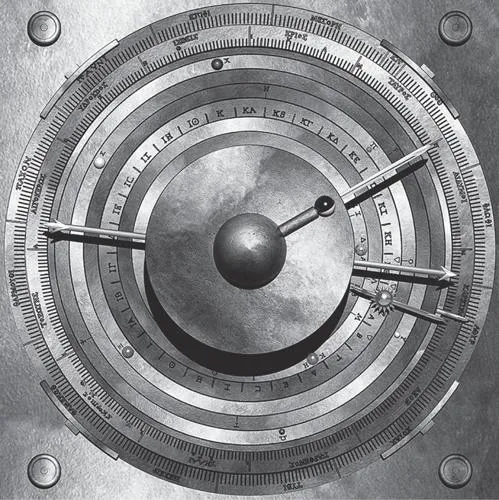
Simulation is the through-line of the book. Analogue computers (Antikythera) simulate with continuous motion; digital computers simulate with 0s and 1s; quantum computers simulate with quantum states. Each step widens what can be modelled faithfully.
Babbage and Lovelace
The industrial nineteenth century needed error-free tables: navigation charts, interest and mortgage tables, astronomical ephemerides. Human "computers" made costly mistakes. Charles Babbage, son of a wealthy banker and a founder of the Royal Astronomical Society, set out to build the most powerful calculating engine of his day for bankers, engineers, sailors and the military.
Ada Lovelace, Lord Byron's daughter and a serious mathematician, joined him after seeing a working model. Her 1843 notes contain a step-by-step procedure for computing Bernoulli numbers, the first published computer program. Her larger insight, in historian Doron Swade's summary, was that numbers can stand for anything: letters, musical notes, symbols. A machine that manipulates numbers by rules can therefore manipulate any symbols; she suggested it might "compose elaborate and scientific pieces of music." Lovelace died of cancer at 36. Babbage, short of money and quarrelsome, finished neither engine.
- One unbuilt design called for 25,000 parts, about 4 tons (Kaku's figure) and 8 feet high.
- Babbage's planned store would hold 1,000 numbers of 50 digits, a capacity not matched until about 1960.
- About a century and a half after his designs, the London Science Museum built one from his drawings, and it worked as specified.
Two different engines are blended here. The Difference Engine tabulated polynomials by repeated addition; the Science Museum completed Difference Engine No. 2 in 1991 (about 8,000 parts, 5 tons). The 25,000-part figure belongs to the earlier Difference Engine No. 1 design (estimated at 15 tons). Lovelace's program and the 1,000 × 50-digit store belong to the Analytical Engine, the general-purpose design with a "mill" and "store" that anticipated the CPU and memory. Only the Analytical Engine was programmable.
Is mathematics complete? Hilbert, Gödel, Turing
Since Euclid, mathematicians assumed every true statement could, with enough ingenuity, be proved. In 1900 David Hilbert set the century's agenda with his list of open problems, including the demand to secure all of mathematics on a complete, consistent set of axioms. In 1930–31 the young Austrian Kurt Gödel showed this is impossible.
Gödel's first incompleteness theorem, stated properly
- Take any formal system that is consistent and whose axioms can be listed mechanically.
- Suppose it is strong enough to express ordinary arithmetic.
- Then there exist statements in its language that are true but not provable within the system.
- Adding the unprovable statement as a new axiom only creates a new system with its own unprovable truths.
Alan Turing reframed the question mechanically. His school recognised him early ("Alan is a genius"); at fourteen he cycled 60 miles alone during the 1926 General Strike so as not to miss term. In 1936 he defined the Turing machine: an infinite tape of cells, each holding 0, 1 or blank, and a head that follows a finite rule table.
The six operations of a Turing machine (Kaku's list)
- Read the symbol in the current square.
- Write a symbol in the square.
- Move one square left.
- Move one square right.
- Change the symbol (0 to 1 or 1 to 0).
- Stop.
Kaku's worked example: the binary tape 010 (two) becomes 100 (four) by flipping the middle 1 to 0 and the left 0 to 1, a toy version of 2 + 2 = 4. Generalise the rules and the machine adds, subtracts, multiplies and divides; Turing showed it can carry out any effective procedure, which is why every phone and supercomputer is a Turing machine in disguise.
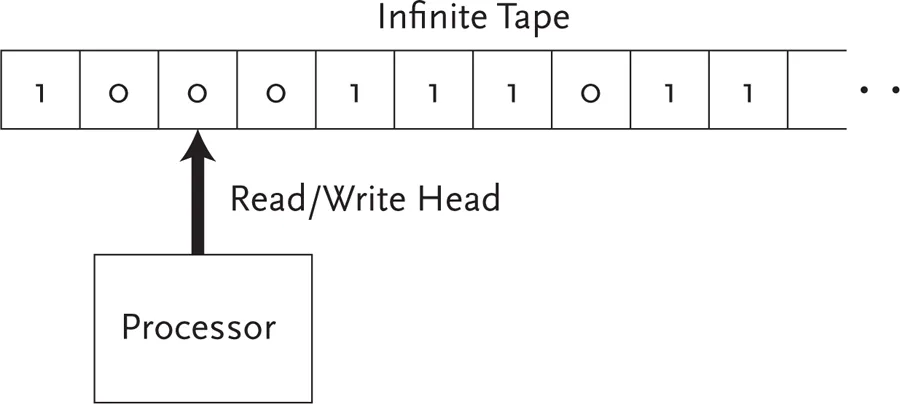
Turing then defined a statement as computable if a machine can settle it in a finite number of steps, and showed some questions cannot be settled that way. Even the most powerful computer cannot prove all mathematical truths from a fixed set of axioms.
Turing's actual result is sharper than Kaku's paraphrase. Turing proved that no machine can decide, for every program and input, whether the program will halt (the halting problem), and hence that Hilbert's Entscheidungsproblem (a mechanical procedure to decide any mathematical statement) has no solution. Gödel's theorem was announced at a Königsberg conference in 1930 (the day before Hilbert's famous "we must know, we will know" address) and published in 1931. Neither result says mathematics is "messy"; both say formal systems have exact, provable limits.
Computers at war
At Bletchley Park Turing attacked Enigma, the German rotor cipher carrying naval orders. The electromechanical bombe, built of rotors, drums and relays, searched systematically for daily settings. Kaku then describes Colossus, the first programmable electronic digital computer, built from vacuum tubes (one version had 2,400), which act like valves switching a current on or off to represent 1 or 0.
Kaku uses the wartime machines to explain why digital beats analogue:
| Analogue | Digital |
|---|---|
| Continuous quantities (gears, voltages) | Discrete 0s and 1s |
| Errors accumulate with each copy, like photocopying a photocopy | Copies are essentially perfect |
| Hard to edit | Edited by simple algorithms |
| Slow, mechanical, jams | Electronic, near light-speed switching |
Bletchley broke the naval codes around 1942, helping win the Battle of the Atlantic; Colossus was running by 1944, in time for D-Day. Harry Hinsley estimated Bletchley shortened the war by about two years, saving some 14 million lives (the 14 million figure was later popularised by Jack Copeland). Secrecy kept Turing's role hidden for decades; the 2014 film The Imitation Game made it famous.
Colossus was not Turing's machine, and it did not break Enigma. Colossus was designed by Post Office engineer Tommy Flowers for Max Newman's section to attack the Lorenz teleprinter cipher ("Tunny") used by the German high command. Turing's statistical methods influenced the work, but his machine was the bombe, which itself developed the Polish bomba of Marian Rejewski. Its debt to Babbage's engine is Kaku's analogy, not history.
Can machines think? The Turing test
In 1950 Turing opened his paper with "I propose to consider the question, 'Can machines think?'" and replaced the unanswerable philosophical question with an operational one, the imitation game: an interrogator questions a hidden human and a hidden machine in writing; if the interrogator cannot reliably tell which is which, the machine counts as thinking. Turing predicted that by about 2000 machines with storage of 10⁹ bits would leave an average interrogator no better than a 70% chance of a correct identification after five minutes. Kaku notes that, when he wrote, no machine had consistently passed.
Large language models have now passed controlled Turing tests. In a 2025 three-party study at UC San Diego, GPT-4.5 prompted to adopt a persona was judged to be the human 73% of the time after five-minute conversations, more often than the real humans it was paired with; Meta's LLaMa-3.1 scored about 56%. Turing's 70% benchmark has been met a quarter-century late, and the result has shifted debate from whether machines can imitate us to whether imitation says anything about understanding.
Turing's fate
In 1952 a burglary at his home led police to discover Turing was gay. He was convicted of "gross indecency" under the Criminal Law Amendment Act of 1885 and chose chemical castration with stilboestrol over prison. In 1954 he was found dead of cyanide poisoning, a half-eaten apple beside him; the inquest ruled suicide. Kaku's judgment: one of the creators of the computer age, who helped defeat fascism, "was in some sense destroyed by his own country." (Britain issued a posthumous royal pardon in 2013 and put him on the £50 note in 2021.)
- c. 150–100 BCE Antikythera mechanism built.
- 1843 Lovelace publishes the first program (Bernoulli numbers).
- 1900 Hilbert's problems set the agenda.
- 1930–31 Gödel's incompleteness theorems.
- 1936 Turing machine and the limits of computability.
- 1942–44 Bletchley Park: bombes, then Colossus.
- 1950 "Can machines think?" and the imitation game.
- 1954 Turing's death.
From determinism to uncertainty
Kaku closes on the hinge of the book. A Turing machine is deterministic: same input, same output, every time. If the universe were a Turing machine, every event would have been fixed at the big bang. Quantum mechanics overthrew that picture, just as Gödel and Turing overthrew completeness, so the next question was whether one could build a quantum Turing machine.
The photocopier and the qubit. Copy a photograph a hundred times on an analogue copier and it fades to grey; copy a JPEG a hundred times and it is unchanged. Digital won because discrete states resist noise. Now notice the catch for quantum computing: a qubit's state is continuous (any mix of 0 and 1), and the no-cloning theorem forbids copying an unknown quantum state at all. Quantum machines reintroduce the analogue fragility digital computing escaped, which is why quantum error correction, not raw qubit count, decides when they become useful.
Turing's operational move is a model for evaluating AI in a bank. Instead of arguing whether a model "understands" credit policy, define a test with a yes-or-no answer: blinded reviewers comparing model and analyst outputs, acceptance thresholds set in advance, results logged for model risk management. Operational definitions turn philosophical arguments into governance.
Rise of the Quantum
Kaku tells the story of quantum mechanics as the source code of the quantum computer: Planck's energy packets, Einstein's photons, de Broglie's matter waves, Schrödinger's equation, Born's probabilities, the cat, and the EPR challenge that revealed entanglement. Two postulates that scandalised Einstein, superposition and collapse on measurement, are exactly the features a quantum computer exploits.
Planck opens the floodgates
In 1900 physicists believed Newton's mechanics and Maxwell's electromagnetism explained everything, from planets to lightning; the universe was a deterministic clock (Newtonian determinism, or classical physics). One loose thread remained: the colour of hot objects. Heated clay or a match flame glows red, then yellow, then blue-white. Treating hot matter as jiggling charged atoms radiating by Maxwell's laws gave an energy output that diverged to infinity at high frequency, the Rayleigh–Jeans (ultraviolet) catastrophe.
Max Planck, a conservative son of a Kiel law professor from a line of theologians and jurists, fixed it by assuming energy is emitted only in discrete packets, quanta, of size E = hν, with h ≈ 6.626 × 10⁻³⁴ J·s (Planck's constant). The formula matched the measured curve exactly. Planck presented it cautiously as a mathematical trick and was attacked for years; his rueful line: a new truth triumphs not by convincing opponents but because "its opponents eventually die."
Kaku offers a dial image. Turn h down to zero and you recover Newton's commonsense world and, for computers, the classical Turing machine. Turn h up and quantum effects appear, turning the Turing machine into a quantum computer.
Turn the dial on h. Imagine Planck's constant were a million times larger. A thrown baseball would diffract around a doorframe, a parked car's position would blur, and a cat would visibly hover between states. Now imagine h were zero: no stable atoms (electrons would spiral into nuclei), no chemistry, no transistors. Kaku's dial shows that the quantum is not an exotic add-on to the world but the reason matter is solid, and the quantum computer is simply a machine built where the dial is turned up.
The origin story is tidied up. Planck was not rederiving the Rayleigh–Jeans result "for pedagogical reasons." He was fitting precise blackbody measurements from Berlin (Rubens and Kurlbaum) that disagreed with Wien's law, and he arrived at quanta through an act of "desperation" in statistical counting. The phrase "ultraviolet catastrophe" was coined by Ehrenfest in 1911, and the full Rayleigh–Jeans law was only completed in 1905. The Patent Office that wanted to close because everything had been invented is a myth.
Duality: photons and matter waves
The photoelectric effect (light knocking electrons out of metal, the basis of solar cells and digital cameras) was explained in 1905 by Albert Einstein, then a patent clerk in Bern whose professors' poor references had kept him from academic jobs. Light, he proposed, arrives in quanta, later called photons. Light therefore has a dual nature: wave in optics, particle in the photoelectric effect.
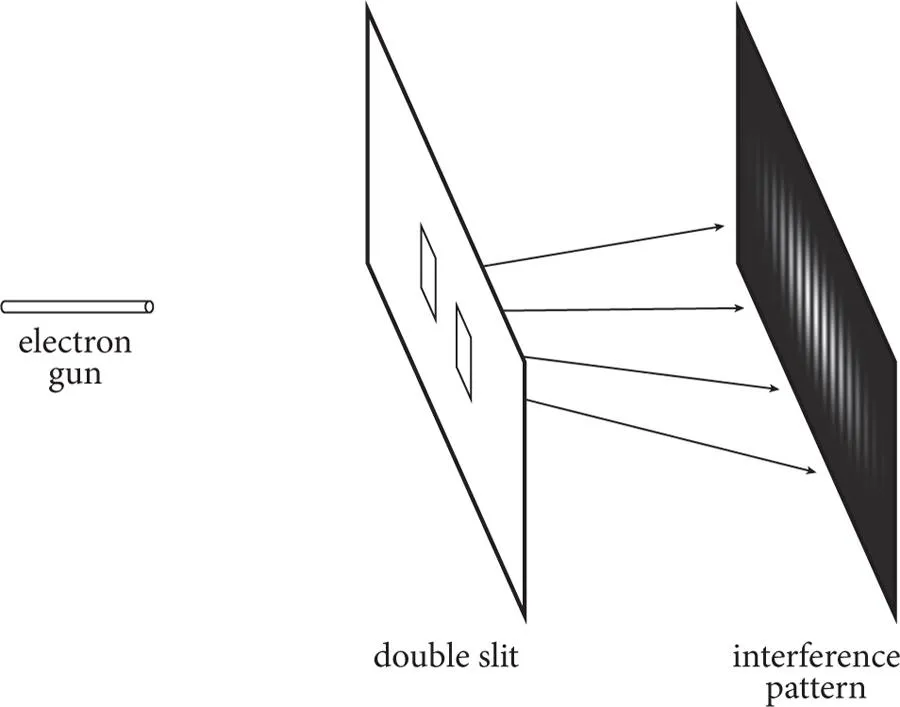
In 1924 Louis de Broglie asked why matter should not be dual too. The test is interference. Ripples from two stones in a pond cross and create a web of reinforcement and cancellation; light through two slits makes bright and dark bands. Particles through two slits should make just two bright stripes. Electrons instead produce an interference pattern, even when sent one at a time, as if each passed through both slits.
Schrödinger's equation and the quantum atom
Asked by a colleague what equation a matter wave obeys, Erwin Schrödinger found it over Christmas 1925–26 at the Villa Herwig in Arosa, in the Alps, in the company of an unidentified girlfriend whom some historians call the muse of the quantum revolution. (He kept a notebook of lovers and travelled with wife and mistress.) Kaku, who spends whole semesters at City University of New York on this one equation, calls it the heart and soul of quantum theory.
The equation explains the atom where Rutherford's mini solar system could not. An electron wave confined around a nucleus can only sustain standing-wave resonances of definite frequency, like the notes that ring in a shower, drum or trumpet. Those resonances reproduce hydrogen exactly and, in pattern, Mendeleev's periodic table.
The hotel model of the periodic table
- Floors are energy levels; rooms are orbitals; each room holds two electrons, and lower floors fill first.
- Floor 1 has one room, 1s: one electron is hydrogen, two is helium.
- Floor 2 has 2s plus three 2p rooms (pₓ, p_y, p_z): eight places, filled in turn by lithium, beryllium, boron, carbon, nitrogen, oxygen, fluorine and neon.
- Unpaired electrons can be shared between atoms; the shared wave is a chemical bond, and bonds make molecules.
- Full floors are inert: helium, neon and krypton form no molecules.
- Carbon has four places to fill on floor 2, so it forms four bonds, enough to build hydrocarbons, proteins and DNA.
Paul Dirac drew the conclusion in 1929: the laws needed for "a large part of physics and the whole of chemistry are thus completely known"; the difficulty is only that the equations are "too complex to be solved." Kaku's summary: chemistry has been reduced to physics. Dirac's caveat is the whole reason quantum computers matter.
Dirac's sentence is the business case for quantum computing. The rules of chemistry are known exactly; what is missing is the computing power to apply them to molecules with more than a handful of interacting electrons. A machine that is itself quantum can carry that cost natively.
Waves of probability and the measurement problem
If the electron is a wave, what is waving? Max Born answered that the electron is a particle, but the probability of finding it somewhere is given by a wave. The physics community split: Planck, Einstein, de Broglie and Schrödinger against Werner Heisenberg and Niels Bohr's Copenhagen school. Heisenberg's alternative formulation (matrix mechanics) brought the uncertainty principle, Δx·Δp ≥ ħ/2. Kaku draws the parallel: mathematics had met incompleteness, physics now met uncertainty.
Quantum mechanics in four postulates (Kaku's simplified version)
- State. An electron at position x is described by a wave function Ψ(x).
- Dynamics. Ψ obeys the Schrödinger equation, HΨ = iħ ∂Ψ/∂t, where the Hamiltonian H is the system's energy and ħ = h/2π.
- Superposition. Solutions are labelled n; the general state is a sum (superposition) of all the Ψₙ.
- Collapse. On measurement the wave function collapses to a single Ψₙ; the probability of that outcome is given by the wave's amplitude (|cₙ|², the squared magnitude; Kaku writes "absolute value").
Postulates 3 and 4 are the controversial ones and the useful ones. Before measurement the electron exists in a netherworld of many states; only measurement picks one, and which one cannot be known in advance. This is the measurement problem. Einstein: "God does not play dice." Bohr, by legend: "Stop telling God what to do." A classical computer sums over 0s and 1s; a quantum computer works with all superpositions between them.
Superposition plus measurement is a design constraint, not magic. A quantum algorithm must end with a measurement that yields one sample. That is why quantum computing suits problems whose answer can be read from a few samples (an energy, a factor, a distribution) and fits poorly with workloads that need the whole state read out, such as dumping a large portfolio's full loss distribution. Ask of any vendor pitch: what is measured, and how many shots are needed to estimate it to the required precision?
Schrödinger's cat
Schrödinger came to regret the probabilistic reading of his own equation and devised a paradox to kill it. A cat sits in a sealed box with a vial of poison, a hammer, a Geiger counter and a little uranium. If an atom decays, the counter fires, the hammer breaks the vial and the cat dies. Before opening the box, is the cat dead or alive?
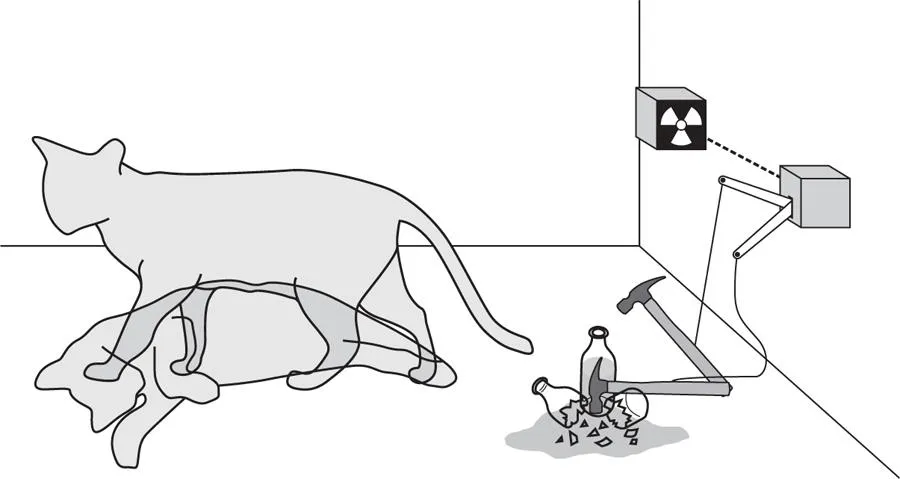
The Newtonian answer is one or the other, already settled. The Copenhagen answer: while the box is sealed the cat is the sum of a live-cat wave and a dead-cat wave, and the question has no meaning until observation collapses it. Kaku connects this to Bishop Berkeley's idealism ("to be is to be perceived") and Keats ("nothing ever becomes real till it is experienced"): an unobserved tree might be in a superposition of firewood, lumber, ash and toothpicks until someone looks. If observation requires consciousness, consciousness seems to determine existence. Einstein, a believer in objective reality, would ask visitors whether the moon exists only because a mouse looks at it.
John von Neumann proposed an invisible wall between micro- and macroworld, each with its own physics, and proved that moving the wall does not change any prediction; asked what it meant, he said, "You just get used to it." The theory's success was undeniable: quantum electrodynamics matches experiment to better than one part in 10 billion. Einstein's retort: "The more successful the quantum theory becomes, the sillier it looks."
Life in a fully quantum world (Kaku's list)
- You could be in two places at once.
- You could disappear and reappear elsewhere.
- You could walk through walls (tunnelling).
- People dead in our universe might be alive in another.
- Crossing a room, you would take every possible path at once.
Electrons do all of this inside atoms, which is why we have lasers, transistors and the internet; set h to zero and the modern world collapses. We do not notice because we are trillions of atoms whose fluctuations average out and because h is tiny. Bohr: anyone not shocked by quantum theory "does not understand it."
The "wall" has been pushed to circuits you can see. The 2025 Nobel Prize in Physics went to John Clarke, Michel Devoret and John Martinis for demonstrating, in 1984–85 at Berkeley, macroscopic quantum tunnelling and quantised energy levels in a superconducting electrical circuit built around a Josephson junction, a device with billions of electrons behaving as one quantum object. That circuit is the ancestor of the transmon qubits in Google's and IBM's machines, and Martinis later led the Google team behind Sycamore. Decoherence theory (Zeh, Zurek) now explains why big objects look classical without any wall: the environment continually "measures" them.
Einstein against Bohr: entanglement
At the Sixth Solvay Conference (Brussels, 1930) Einstein confronted Bohr directly. Paul Ehrenfest recalled Einstein walking out "with a faint ironical smile," Bohr trotting beside him "extremely upset"; John Wheeler called it the greatest debate in intellectual history. Each day Einstein produced a paradox, and each next day Bohr answered it. In the most famous exchange (the photon box), Bohr refuted Einstein using Einstein's own general relativity.
In 1935 Einstein, with Boris Podolsky and Nathan Rosen, published the EPR paper. Kaku gives the spin version:
The EPR argument, step by step
- Prepare two electrons whose total spin is zero.
- Separate them, even to opposite ends of the galaxy.
- Neither spin is defined before measurement.
- Measure one: if it is up (clockwise), the other is instantly known to be down.
- If the correlation were a physical signal it would travel faster than light, contradicting special relativity.
- Therefore, Einstein concluded, quantum mechanics is incomplete: the spins must have had hidden definite values all along, and the "spooky action at a distance" is an illusion.
Experiments in 1949, 1975 and 1980 (Kaku's dates) sided with quantum mechanics. No usable message is sent, Kaku explains, because each individual outcome is random: a message carried by EPR correlations reads as gibberish. Entangled particles stay correlated however far apart; in a quantum computer, entangled qubits act together. His analogy: a classical computer is a row of accountants working alone and passing slips along; a quantum computer is a room of accountants all computing and conferring at once.
Nothing travels between entangled particles. Kaku says "information" moves instantly but is random. The decisive tool was John Bell's 1964 inequality, which turned EPR into a testable prediction. Key tests: Freedman and Clauser (1972), Aspect (1982), and loophole-free tests in 2015 (Delft, Vienna, NIST). Aspect, Clauser and Zeilinger won the 2022 Nobel Prize. Local hidden variables of the kind Einstein wanted are ruled out. (Podolsky and Rosen were Einstein's collaborators at Princeton rather than students, and the original EPR paper used position and momentum; the spin version is David Bohm's.)
- 1900 Planck's quanta, E = hν.
- 1905 Einstein's photons and the photoelectric effect.
- 1924 de Broglie's matter waves.
- 1925–26 Heisenberg's matrix mechanics; Schrödinger's equation; Born's probability rule.
- 1927 Uncertainty principle; electron diffraction confirms matter waves.
- 1930 Einstein–Bohr clash at Solvay.
- 1935 EPR paper and Schrödinger's cat.
- 1964 Bell's inequality; 1982 Aspect; 2015 loophole-free tests.
War scatters the founders
The debate was overtaken by the bomb programmes.
- Max Planck: met Hitler in 1933 to plead for Jewish physicists and was screamed at ("You cannot reason with such a man"); his son Erwin was executed in 1945 for involvement in the July plot.
- Albert Einstein: had a price on his head ("Not Yet Hanged" on a Nazi magazine cover); left Germany in 1933 for good.
- Erwin Schrödinger: beaten after intervening in a street assault on a Jewish man; went to Oxford, scandalised it by arriving with wife and mistress, reportedly lost a Princeton offer for the same reason, and settled in Dublin.
- Niels Bohr: fled occupied Denmark in 1943, nearly dying (from lack of oxygen in a bomber's bay) on the flight to Britain, then joined the Allied effort.
- Werner Heisenberg: led the German uranium project, repeatedly bombed out, interned by the Allies after the war.
Kaku says Heisenberg lacked one key number, the probability of uranium fission, and so could not build a bomb. Historians more often cite his overestimate of the critical mass (tons rather than kilograms), revealed in the secretly recorded Farm Hall conversations, together with the programme's lack of resources and priority. Hiroshima and Nagasaki made clear that the quantum was no longer a physicists' plaything. Out of the war came the next quantum invention: the transistor.
Dawn of Quantum Computers
Kaku follows the idea of a quantum computer from the transistor through Feynman's vision of atom-scale machines and his path integral, Deutsch's quantum Turing machine and Everett's many worlds, to Peter Shor's 1994 algorithm, which turned a theorist's toy into a national-security problem. Shor showed that a quantum computer could factor large numbers in polynomial time, and with it break the RSA codes that protect the world's money.
The transistor and its limit
The transistor is a paradox: the most consequential invention of the twentieth century is so small that billions fit on a fingernail, while the 17-mile, $10 billion Large Hadron Collider could enclose much of Geneva. The same is true of the brain, with 100 billion neurons each linked to about 10,000 others. Both pack staggering amounts of information into a hand-sized object, and both resemble Turing machines (the brain as a self-modifying neural network).
John Bardeen, Walter Brattain and William Shockley of Bell Labs built the first transistor in 1947 and shared the 1956 Nobel Prize. They used a semiconductor, a quantum material between conductors (metals) and insulators (glass, rubber) that can be switched between carrying and blocking current. Like a vacuum tube it is a valve: a small control signal opens (1) or shuts (0) a large flow. Unlike tubes, which Kaku remembers testing one by one at the supermarket to fix his family's TV, transistors are sturdy, cheap and microscopic.
How chips are made (Kaku's T-shirt analogy)
- Template. A mask carries the circuit pattern, like a stencil for a T-shirt.
- Exposure. Ultraviolet light shines through the mask onto a chemically treated silicon wafer, transferring the image.
- Etching. Acid removes the exposed (or unexposed) material, burning the pattern into the wafer.
- Scale. Features can be as small as the UV wavelength allows, giving about a billion transistors per chip; a leading-edge fab costs several billion dollars.
His second analogy is a city: electrons are cars, etched wires are roads, transistors are traffic lights (red is 0, green is 1). Shrink the blocks far enough and cars spill onto the pavement. When features approach atomic size, the uncertainty principle makes electron positions fuzzy, they leak and short the circuit, and the heat of so many switches can melt the chip.
Lithography went further than Kaku implies, and the limit is economic as much as physical. Leading fabs now print with extreme ultraviolet light at 13.5 nm from ASML machines costing $200 million to $400 million each (High-NA EUV); TSMC's 2 nm-class process entered volume production in 2025, and a large AI accelerator carries over 200 billion transistors across stacked chiplets. Node names no longer describe any physical dimension. Fabs now cost $20 billion or more. Silicon is not ending abruptly; it is getting slower and more expensive to improve, which is a different argument for alternative computing.
Feynman: plenty of room at the bottom
Richard Feynman was safecracker, bongo player and showman with a "truck driver" accent, who opened the Los Alamos safes holding bomb secrets and once sealed himself in an isolation tank to try to leave his body. He was also a 1965 Nobel laureate for quantum electrodynamics (QED), accurate to one part in 10 billion.
In his 1959 talk to the American Physical Society at Caltech, "There's Plenty of Room at the Bottom," he asked how small machines and computers could become and founded the idea of nanotechnology: tools that "arrange the atoms the way we want." He asked why the 24 volumes of the Encyclopaedia Britannica could not be written on a pinhead.
Feynman's predictions and challenges
- Atom-scale computing: transistors would one day be atom-sized.
- "Swallowing the doctor": a robot surgeon in the bloodstream acting like a white blood cell, operating from inside.
- Seeing atoms: realised by the scanning tunnelling microscope in 1981.
- Two $1,000 prizes: shrink a book page 25,000-fold so only an electron microscope could read it, and build an electric motor inside a 1/64-inch cube. Both were claimed (the motor by William McLellan in 1960, the page by Tom Newman in 1985).
- Simulating nature quantum mechanically: "Nature isn't classical, dammit, and if you want to make a simulation of nature, you'd better make it quantum mechanical."
IBM's Bob Sutor quantifies the last point: a one-to-one classical simulation of caffeine would need about 10⁴⁸ bits, around 10% of the atoms in the Earth.
Graphene illustrates Feynman's nanoworld. Andre Geim and Konstantin Novoselov at Manchester peeled graphite with Scotch tape until a single atom-thick sheet of carbon remained, winning the 2010 Nobel Prize. Graphene is the strongest material known, stronger than diamond; a sheet could hold an elephant balanced on a pencil. If it could be made in bulk it might support invisible bridges or a space elevator cable, and it conducts electricity well enough to make some of the smallest transistors. Bulk manufacture remains the obstacle.
Two Feynmans are merged. "Nature isn't classical, dammit" comes from Feynman's 1981 keynote at MIT's Physics of Computation conference, published in 1982 as "Simulating Physics with Computers," not from the 1959 nanotechnology talk. That 1981 paper is the real founding document of quantum computing. Credit is also owed to Paul Benioff, who in 1980 published the first quantum-mechanical model of a Turing machine, and to Yuri Manin, who proposed quantum computation the same year. Feynman's sealed "hyperbaric chamber" was a sensory-deprivation tank.
The path integral: summing over histories
Feynman's high-school teacher, keeping a bored prodigy busy, showed him the principle of least action. Newton predicts a ball's path by computing forces instant by instant and stitching the instants together with calculus. The alternative: consider every conceivable path, however absurd (via the moon or Mars), compute for each the action (the time-integral of kinetic minus potential energy, S = ∫(T − V) dt), and the real path is the one where the action is least (strictly, stationary). Both methods give identical answers, but the second seems to require the ball to "sniff out" all paths at once. Feynman's motto was that a physicist's goal is "to prove yourself wrong as soon as possible."
For quantum mechanics Feynman kept all the paths. Each path contributes a factor set by its action and Planck's constant, e^(iS/ħ); adding (integrating) over all paths gives the amplitude for a particle to go from A to B. This path integral reproduces the Schrödinger equation and all of quantum theory, so the equation Kaku presents to PhD students "as if from a magician's hat" can be derived. Kaku uses path integrals daily in quantum field theory, and admits to feeling, as he crosses a carpet, the presence of copies of himself on other paths, some of which went to Mars and back.
Classical paths are where quantum paths agree. Paths near the least-action path have nearly equal phases and reinforce; wild paths have rapidly varying phases and cancel. As h shrinks, only the classical path survives, which is why baseballs look Newtonian.
Kaku then claims the path integral explains how nature beats decoherence: photosynthesis and nitrogen fixation run at room temperature, where classical physics says thermal jostling should forbid them, because electrons "sniff out" all paths. Life itself may be a by-product of the path integral.
This is speculation dressed as explanation. The path integral is an equivalent formulation of the same quantum mechanics; it does not let a system evade decoherence. Room-temperature biochemistry works because enzymes exploit short-lived, local quantum effects (electron and proton tunnelling over ångström distances, femtosecond energy transfer) that finish before the environment scrambles them, not because molecules hold long coherent superpositions. Photosynthesis does not "violate the laws of Newton"; ordinary chemistry is quantum throughout.
Deutsch's quantum Turing machine
Feynman (1981) argued only a quantum computer could truly simulate quantum processes but did not say how to build one. David Deutsch of Oxford supplied the formal model in 1985, the quantum Turing machine, and the first algorithm that beats any classical one at a (toy) task.
| Feature | Classical Turing machine | Quantum Turing machine |
|---|---|---|
| Unit | Bit: 0 or 1 | Qubit: superposition of 0 and 1 |
| Correlation | Cells independent | Qubits entangled |
| Operations | Read, write, move, stop | Same moves, applied as reversible unitary steps |
| Output | Read the tape | Measure: collapse to 0s and 1s |
As Turing made digital computing rigorous, Deutsch made quantum computing a mathematical discipline.
Everett's many worlds
Deutsch also takes the philosophical problem seriously. The collapse postulate is how answers are extracted from a quantum computer, yet it is unexplained: why should the wave "snap to attention" when we look? In 1956–57 Princeton graduate student Hugh Everett III proposed dropping postulate four altogether. The wave function never collapses; every outcome continues in its own branch, like a river splitting into tributaries, producing many worlds. Micro- and macroworld obey one equation and von Neumann's wall disappears. Kaku's image: Copenhagen keeps one small wave inside an ocean wave and discards the rest; Everett keeps them all.
The consequences are vivid: every life decision spawns a version of you who chose otherwise, as in Robert Frost's "The Road Not Taken." In Philip K. Dick's The Man in the High Castle, the assassin's shot at Franklin Roosevelt decides whether the Allies win or the Nazis and Japan partition America; a quantum defect in a bullet's propellant could separate the two universes.
- Hugh Everett III (1930–1982): son of an army staff officer; as a boy wrote to Einstein and got a reply about the "very stubborn boy"; studied game theory and quantum paradoxes at Princeton.
- John Archibald Wheeler: Everett's (and Feynman's) adviser; backed the idea but made Everett tone it down, then retreated, saying it carried "too much baggage."
- Niels Bohr: met Everett in Copenhagen in 1959; the meeting was "hell ... doomed from the beginning."
- Léon Rosenfeld: Bohr's ally, called Everett "undescribably stupid."
- David Deutsch: revived many worlds as the explanation of quantum computing's power.
- Steven Weinberg: gave Kaku the radio analogy for decoherence.
Shut out of physics, Everett joined the Pentagon's Weapons Systems Evaluation Group, working on Minuteman missiles, fallout and military game theory. Elvis, Kaku notes, may still be singing in another branch.
Weinberg's radio. Your living room is full of radio waves from hundreds of stations, yet your radio plays one, because it is tuned to that frequency and out of step (decohered) with the rest. Replace the radio waves with the wave functions of other branches: dinosaurs, pirates, a version of you who took the other job, all "in your living room," unheard because you no longer vibrate in unison with them. You could in principle tunnel into one, just as a PhD student can compute the odds of waking up on Mars tomorrow; the wait is longer than the age of the universe.
Deutsch's argument for many worlds is the quantum computer itself: it is fast because it computes in parallel universes whose branches interfere. His desk demonstration: dim a laser through two holes until single photons pass and the interference pattern persists. In Everett's account each photon goes through one hole, and its counterpart in a neighbouring branch goes through the other; the two branches interfere to make the pattern.
Many researchers (Scott Aaronson prominent among them) argue "computing in parallel universes" misleads, because a quantum computer cannot read out the separate branches; the speed-up comes from engineered interference, and only for structured problems. Branches interfere through superposition, not through "entanglement" between twin photons. Also, in the real 1933 Miami attempt on Roosevelt the gun did not jam: Giuseppe Zangara fired five shots, missed Roosevelt and killed Chicago mayor Anton Cermak.
Kaku's four quantum features
Why quantum computers are possible
- Superposition. An object exists in many states before observation; more states to compute with.
- Entanglement. Coherent particles stay correlated when separated, so computing power grows exponentially with qubits.
- Sum over paths. A particle explores all paths; unlikely ones still contribute, and perhaps the chemical paths that created life were among them.
- Tunnelling. A particle can cross an energy barrier it classically could not, which may let life's reactions run at room temperature.
Shor's algorithm
Until the 1990s quantum computing was a playground for a few theorists. In 1994 Peter Shor at AT&T Bell Labs changed that by showing a quantum computer could factor large numbers efficiently. Factoring underpins RSA, the public-key system that protects internet commerce.
Multiplying two 100-digit primes is easy; factoring the 200-digit product is a trapdoor function, easy one way and infeasible the other. Kaku stresses that classical and quantum computers can compute the same things in principle; the difference is time. A legitimate recipient is given the factors in advance and decrypts instantly; an attacker must factor.
How Shor's algorithm actually works
- Pick a random number a smaller than N (the number to factor).
- Reduce factoring to period-finding. The sequence aˣ mod N repeats with some period r; knowing r usually reveals a factor via gcd(a^(r/2) ± 1, N). This step is classical number theory.
- Superpose all exponents x in one register and compute aˣ mod N into a second register, entangling them.
- Quantum Fourier transform the first register; interference concentrates amplitude on multiples of 1/r.
- Measure and use continued fractions to recover r; repeat a few times if unlucky.
- Cost: roughly (log N)³ quantum operations, polynomial in the number of digits.
Kaku writes the classical time as t ~ eᴺ and the quantum time as t ~ Nⁿ.
Kaku's scaling formulas are wrong. Measured in N itself, even naive trial division takes about √N steps, far less than eᴺ, and a polynomial in N (Kaku's quantum formula) would be no better than classical brute force. The correct comparison is in the size of the number, n = ln N (proportional to its digit count). The best classical method, the general number field sieve, takes about exp(1.9 · n^(1/3) · (log n)^(2/3)), sub-exponential; Shor takes about n³. That gap is what matters: the record classical factorisation, RSA-250 (829 bits) in 2020, cost about 2,700 core-years, while RSA keys in use are 2,048 bits. Shor's algorithm also breaks discrete-logarithm systems (Diffie–Hellman, elliptic curves), but not "any digital code": symmetric ciphers and hash functions survive with larger parameters.
Defeating Shor
Kaku summarises the response:
Kaku's lines of defence
- Prepare now. NIST said the threat is years away but industry cannot retool overnight.
- Lengthen keys. Make the number to be factored bigger, delaying and raising the cost of attack.
- New trapdoors. Replace RSA with harder mathematical problems that resist quantum attack (post-quantum cryptography), though these are harder to implement.
- Last resort: quantum cryptography. Fight the quantum with the quantum.
Longer RSA keys do not help much. Because Shor scales polynomially, doubling the key size only multiplies the attacker's work by about eight while slowing every legitimate user; NIST's advice is to migrate, not lengthen. Kaku's doubt that new trapdoors "can stop quantum computers" is fair caution, and the history shows why: SIKE, a NIST candidate, was broken in 2022 in about an hour on a single classical laptop core, and Rainbow fell the same year. The schemes that survived rest on lattices and hash functions.
The post-quantum transition is now law and procurement policy. NIST's competition (launched 2016) produced FIPS 203 ML-KEM (from CRYSTALS-Kyber, key exchange), FIPS 204 ML-DSA (from Dilithium, signatures) and FIPS 205 SLH-DSA (from SPHINCS+, hash-based signatures) in August 2024, with FN-DSA (Falcon) and HQC (a code-based backup KEM chosen in March 2025) to follow. The US NSA's CNSA 2.0 requires quantum-resistant algorithms in national-security systems through the late 2020s, ending by 2033–2035; the EU asked member states to begin transition by 2026 and protect critical infrastructure by 2030. Browsers and major CDNs already default to hybrid X25519 + ML-KEM key exchange, so a large share of web traffic is already post-quantum protected.
Laser internet and QKD
Kaku's last resort is a laser internet. Information encoded in the polarisation of light cannot be read without disturbing it; an eavesdropper changes the polarisation and trips the alarm. That would create a two-tier internet: banks, corporations and governments paying a premium for guaranteed security, everyone else on ordinary networks. The general technique is quantum key distribution (QKD), which moves encryption keys on single photons (or entangled pairs) so interception is detectable; Toshiba forecast up to $3 billion in QKD revenue by 2030.
QKD is narrower than Kaku suggests. It requires single photons, not ordinary laser beams; it only distributes keys (the data itself is still encrypted classically); fibre links reach roughly 100 km before needing trusted relay nodes, which reintroduce exactly the trust QKD was meant to remove; and it cannot authenticate the parties without classical cryptography. The NSA and the UK NCSC both advise against relying on QKD and favour post-quantum algorithms. China operates the most ambitious network (the Micius satellite from 2016, a 2,000 km Beijing–Shanghai backbone) and protocols date back to BB84 (Bennett and Brassard, 1984).
A practical post-quantum programme for a bank. (1) Discover: build a cryptographic bill of materials across TLS endpoints, PKI, HSMs, SWIFT and card networks, mainframe batch, code signing and third-party APIs. (2) Prioritise by Mosca's inequality: if the years your data must stay secret (x) plus the years migration takes (y) exceed the years until a cryptographically relevant quantum computer (z), you are already late. (3) Go hybrid first (classical + ML-KEM) on external channels, where harvest-now risk is highest. (4) Make algorithms configuration, not code, so the next SIKE-style break is a parameter change. (5) Push vendors: most exposure sits in products you buy. QKD is rarely the right answer for a commercial bank.
The Race Is On
Kaku surveys the competing hardware designs as a horse race. Any quantum system that can hold superposed 0s and 1s and entangle them can, in principle, compute, so there are "thousands of ways" to build the machine; he examines six. The decisive variable is not qubit count but error: whichever platform first makes error-corrected logical qubits cheaply at scale wins. This chapter has aged faster than any other in the book, so the 2026 picture is given in full.
The field in 2022
Like a Turing machine, which can be built from water pipes, a quantum computer is architecture-neutral: spinning electrons or ions, polarised photons, superconducting currents. Kaku's league table at press time:
| Machine | Maker | Qubits |
|---|---|---|
| Osprey | IBM | 433 |
| Jiuzhang | China (USTC) | 76 (photons) |
| Bristlecone | 72 | |
| Sycamore | 53 | |
| Tangle Lake | Intel | 49 |
IBM planned the 1,121-qubit Condor for 2023 and a million-qubit machine eventually. IBM research head Dario Gil promised "quantum advantage, something that can have practical value, within the next couple of years."
Qubit counts are a poor scoreboard. The table mixes photonic modes with superconducting qubits, and Bristlecone never published performance results. What matters is two-qubit gate fidelity, connectivity, coherence time and, above all, how many logical (error-corrected) qubits a machine supports. IBM itself delivered Condor in December 2023 and then pivoted to smaller, higher-quality chips (Heron, 133 then 156 qubits), conceding that count without quality is a dead end.
1. Superconducting qubits
Google's Sycamore claimed supremacy in 2019; IBM's Eagle passed 100 qubits in 2021 and Osprey reached 433. The advantage is borrowed industry: decades of skill etching circuits on wafers. Cooled to a fraction of a degree above absolute zero, the circuits become coherent; coupling them entangles them.
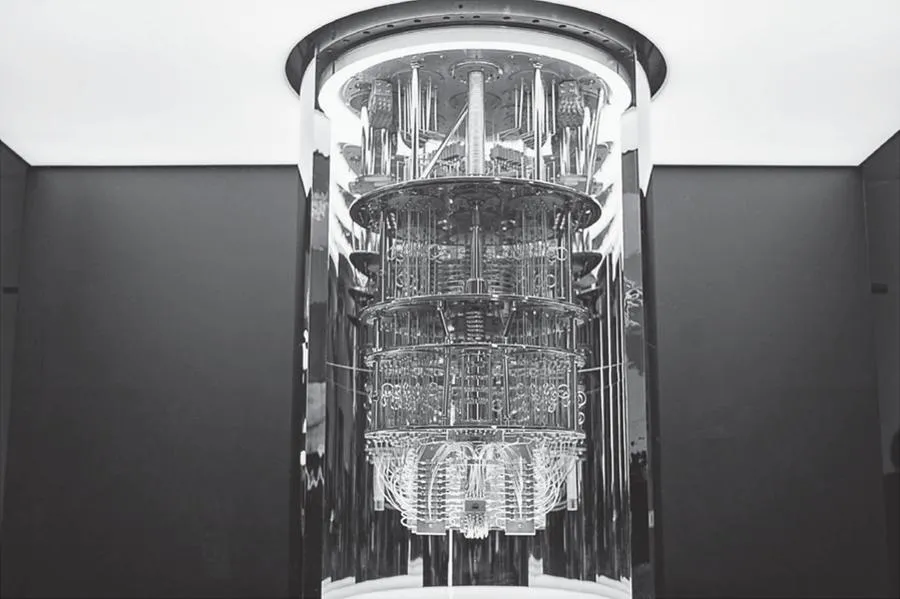
The price is the chandelier of pipes and pumps. A sneeze can ruin a run. Engineers measure fragility by coherence time, which lengthens as temperature falls, so the chips are kept colder than outer space. Absolute zero is unreachable, so errors always creep in, which matters if billions of dollars ride on the answer.
Error correction, Kaku's version and the real one
- Kaku's redundancy picture. Back each qubit with copies; if three copies read 101, the odd one out is probably wrong and should be a 1.
- Kaku's overhead. Perhaps 1,000 physical qubits per logical qubit, so a 1,000-qubit useful machine needs a million; Google said a million-qubit processor might take ten years.
- The quantum catch. Unknown quantum states cannot be copied (no-cloning) and reading a qubit destroys its superposition, so quantum codes spread one logical qubit across many entangled physical qubits and measure only parity checks (syndromes) that reveal errors without revealing the data.
- The threshold theorem. If physical error rates are below a threshold (about 1% for the surface code), each increase in code size suppresses logical errors exponentially. Below threshold, scale helps; above it, scale hurts.
Superconducting milestones since the book.
- Google Willow (December 2024): 105 qubits; surface codes of distance 3, 5 and 7 each halved the logical error rate (suppression factor Λ ≈ 2.1), the first convincing demonstration of below-threshold operation, with a logical qubit outliving its best physical qubit by about 2.4×. Willow also ran a random-circuit sampling task in under five minutes that Google estimated would take a supercomputer 10²⁵ years.
- Google Quantum Echoes (October 2025): measured an out-of-time-order correlator on Willow about 13,000× faster than the Frontier supercomputer could simulate it, and framed it as the first verifiable quantum advantage, because another quantum device (or nature, via NMR) can check the result.
- IBM's roadmap (stated November 2025 and reaffirmed in 2026): Nighthawk (120 qubits, square lattice, 218 tunable couplers) targets 7,500-gate circuits in 2026; Loon (2025) demonstrates the long-range couplers needed for IBM's qLDPC "bivariate bicycle" codes, which need roughly 10× fewer physical qubits than the surface code; Kookaburra (2026) is the first fault-tolerant module; Starling (Poughkeepsie, 2029) targets 200 logical qubits running 100 million gates; Blue Jay (2033+) aims at 2,000 logical qubits.
- IBM's advantage claim (July 2026): with Algorithmiq, IBM announced quantum advantage for simulating information flow in a disordered material on a Heron processor, after eight months on a public Quantum Advantage Tracker where no classical method reproduced it; IBM concedes rigorous error bars are still being built.
- China's Zuchongzhi 3.0 (March 2025): 105 qubits, a random-sampling result comparable to Willow's.
Supremacy claims keep being clawed back by classical algorithms. IBM argued within days in 2019 that Sycamore's 10,000-year task would take 2.5 days on Summit; in 2022 a Chinese group reproduced it with tensor networks in about 15 hours on 512 GPUs, later faster still. IBM's own 2023 "utility" experiment on Eagle was matched by classical simulations within weeks. D-Wave's 2025 claim of beyond-classical materials simulation drew tensor-network rebuttals almost immediately. The pattern: random-sampling benchmarks prove the hardware is hard to simulate but do nothing useful, and every claim of useful advantage so far has been contested. Treat any single press release as an opening bid.
2. Ion traps
Strip electrons from an atom and the resulting ion can be held in a vacuum by electric and magnetic fields. Each ion's internal state (Kaku's spin up or down) is a qubit; laser or microwave pulses flip it, acting as the processor. Kaku calls this the most transparent way to see how a quantum computer works and names Honeywell as its leading champion.
| Strength | Weakness |
|---|---|
| Identical atoms, so identical qubits | Gates are slow (microseconds to milliseconds) |
| Long coherence; very high fidelity | Scaling: long ion chains are hard to control |
| All-to-all connectivity in a trap | Fields must be continually readjusted |
| Less extreme cooling than superconductors | Still needs ultra-high vacuum and lasers |
Trapped ions now hold the fidelity records. Honeywell's unit merged with Cambridge Quantum in 2021 to form Quantinuum. Its Helios system (November 2025) has 98 barium-ion qubits with two-qubit fidelity around 99.92%; it ran 48 error-corrected logical qubits at a 2:1 encoding ratio beyond break-even and 94 error-detected logical qubits, and in 2026 reported near-"five-nines" logical fidelity with new codes. Quantinuum listed on Nasdaq in June 2026, raising about $1.7 billion; its Q2 2026 revenue was $8 million (guidance $28–32 million for the year), with Sol (2027) and the fault-tolerant Apollo (2029) next. IonQ has bought its way to scale: Oxford Ionics ($1.08 billion, 2025), ID Quantique, Lightsynq, Capella, Vector Atomic and the chip foundry SkyWater ($1.8 billion, closed 2026), and reported 99.99% two-qubit fidelity in late 2025.
3. Photonic computers
Weeks after Google's claim, China's Jiuzhang reported a calculation in 200 seconds that would take a classical machine half a billion years, using 76 photons in 100 channels. ("My first impression was, Wow!" said Fabio Sciarrino of Sapienza University.) Light's polarisation (vertical or horizontal, the effect polarised sunglasses exploit) encodes 0 and 1. A beam splitter, a polished glass plate at 45°, divides a beam into two coherent halves; mirrors recombine them so photons interfere and entangle; hundreds of splitters and mirrors make a processor.
| For photons | Against photons |
|---|---|
| Uncharged, so little environmental noise | Photons barely interact, so two-qubit gates are hard |
| Room-temperature operation (mostly) | Tabletop optics must be rebuilt for each problem |
| Natural fit with fibre networks | Photon loss is the dominant error |
Canada's Xanadu moved photonics onto a chip: a programmable maze of beam splitters for infrared light, online via the cloud, though with only eight qubits and needing superconducting detectors. "Photonics is not an underdog," said Xanadu's Zachary Vernon.
Two physics slips. Kaku says photons travel "ten times the speed of electrical signals." Signals in copper propagate at roughly 50–90% of light speed; the advantage of optics is bandwidth and low loss, not raw speed. He also says photonic coherence is short at room temperature and compensated by high laser energy. In fact photons keep their quantum state very well; the problem is that they get lost (absorbed or scattered), and loss, not decoherence, sets photonic error budgets. Jiuzhang was a boson-sampling device, not a programmable computer.
Photonics since 2022. Xanadu's Borealis (2022) demonstrated a programmable boson-sampling advantage with 216 squeezed-light modes, and its Aurora (January 2025) networked 35 photonic chips over 13 km of fibre into a modular 12-qubit machine operating at room temperature. Xanadu is one of the 11 firms in Stage B of DARPA's benchmarking programme.
4. Silicon photonics: PsiQuantum
PsiQuantum reached a $3.1 billion valuation with no prototype, by partnering with GlobalFoundries to make photonic chips in a standard fab. Silicon is dual-use: it switches electrons and is transparent to some infrared wavelengths, so the same wafer can carry and entangle photons. The company refuses incrementalism, targeting a million-qubit machine (Kaku says by mid-century) on the grounds that only a million qubits can absorb error-correction overhead and do useful work.
PsiQuantum is now building sites, not just slides. It raised $1 billion in September 2025 at a $7 billion valuation (with Nvidia's venture arm among investors), after the Australian and Queensland governments committed about A$940 million in 2024 for a utility-scale facility in Brisbane, and Illinois anchored it in a new quantum park in Chicago. It unveiled its Omega chipset in 2025 and targets a fault-tolerant machine late this decade, far sooner than Kaku's "middle of this century," though no large system has yet been demonstrated.
5. Topological qubits: Microsoft's dark horse
A knot in a closed loop of rope cannot be removed without cutting it; its topology survives any wiggling. A qubit stored in such a global property would shrug off local disturbances. In 2018 a Microsoft-backed team at Delft reported signatures of Majorana zero modes (emergent quasiparticles) in indium antimonide nanowires; the press called it a magic material stable at room temperature, and Microsoft expanded its labs. Another group could not reproduce the result, and the paper was retracted. Kaku: "even physicists begin to believe their press releases." Other topological objects, such as anyons, are still studied.
Topological protection is against local noise, not heat. Majorana devices operate at millikelvin temperatures like other superconducting systems; no topological design promises room-temperature operation. The retraction came in 2021 after independent scrutiny of data processing.
Majorana 1 and the continuing dispute. In February 2025 Microsoft unveiled Majorana 1, an eight-qubit-capable indium-arsenide/aluminium "topoconductor" chip, with a Nature paper on parity measurement. The paper's own authors stated the data "do not, by themselves, determine" whether the states are topological; referees were split, and critics noted the signals are consistent with trivial Andreev states. Microsoft announced Majorana 2 (lead-based superconductor, larger topological gap, 20-second parity lifetime) in June 2026 and projects a scalable machine by 2029, but independent confirmation of a working topological qubit is still lacking, and fresh critiques appeared within weeks. Microsoft has meanwhile hedged by partnering with Atom Computing and Quantinuum on neutral-atom and ion machines.
6. Quantum annealing: D-Wave
D-Wave of Canada does not build a universal gate machine. Its annealers steer currents in superconducting loops toward their lowest-energy state, which encodes the solution of an optimisation problem. D-Wave sells systems for $10–15 million with 5,600 qubits (plans for 7,000+) to Lockheed Martin, Volkswagen, NEC, Los Alamos and NASA, for waste reduction, scheduling and profit maximisation.
Annealing has never shown a robust speed-up on practical optimisation. Large qubit counts are not comparable to gate-model qubits, and benchmark studies repeatedly found classical heuristics (simulated annealing, specialised solvers, GPUs) matching or beating it. D-Wave's Advantage2 became generally available in 2025; its most credible results are in simulating quantum magnetic materials, not business optimisation.
What Kaku left out: neutral atoms and spins
The book omits the platform that grew fastest after 2022.
Neutral atoms held in laser "optical tweezers" are identical, can be rearranged mid-computation, and scale to thousands. Caltech trapped 6,100 caesium-atom qubits with 12.6-second coherence (September 2025); a Harvard–MIT–QuEra team ran a 3,000-qubit array continuously for over two hours by reloading atoms on the fly (2025), and the same group published a fault-tolerant architecture on 448 atoms. Atom Computing and Microsoft entangled 24 logical qubits (2024) and are building a 50-logical-qubit "Level 2" machine, Magne, in Denmark; Infleqtion reported 30 entangled logical qubits from just 80 atoms (September 2026), with targets of 100 logical qubits by 2028. Pasqal (France) follows. Silicon spin qubits (Intel, Diraq, Quantum Motion, Silicon Quantum Computing) promise fab-compatible density and are in DARPA's programme too.
| Platform | Leading players (2026) | Best feature | Main obstacle | Kaku's view (2022) |
|---|---|---|---|---|
| Superconducting | Google, IBM, Rigetti, China (USTC) | Fast gates; below-threshold QEC shown | Wiring, cryogenics, fab defects | Leader on qubit count |
| Trapped ion | Quantinuum, IonQ | Highest fidelities; all-to-all links | Slow gates; scaling traps | Long coherence, hard to scale |
| Neutral atom | QuEra, Atom Computing, Pasqal, Infleqtion | Thousands of identical qubits | Atom loss; slower cycles | Not covered |
| Photonic | PsiQuantum, Xanadu | Room temperature; networking | Photon loss; probabilistic gates | Promising, unwieldy |
| Topological | Microsoft | Built-in protection (if real) | Existence still disputed | Dark horse, setback |
| Spin in silicon | Intel, Diraq, Quantum Motion | CMOS manufacturing | Uniformity; small scale so far | Not covered |
| Annealing | D-Wave | Large qubit numbers | No proven practical speed-up | Good at optimisation |
DARPA is now the referee. The Quantum Benchmarking Initiative asks whether any approach can reach utility scale, meaning computational value exceeding cost, by 2033. In November 2025 it advanced 11 companies to Stage B: Atom Computing, Diraq, IBM, IonQ, Nord Quantique, Photonic Inc., Quantinuum, Quantum Motion, QuEra, Silicon Quantum Computing and Xanadu; PsiQuantum and Microsoft run in a parallel DARPA track. Successful firms move to Stage C, independent verification of the full design. DARPA states that one, several or none may succeed.
The race changed its finish line. In 2022 the scoreboard was physical qubits; by 2026 it is logical qubits at a stated error rate, and both the hardware leaders and the cryptographic threat are measured in that unit. The falling RSA estimates and the rising logical-qubit counts are converging on the early-to-mid 2030s.
Kaku ends Part I with his agenda: intense competition, prototypes already on sale, and the next challenge of solving real problems far beyond digital computers, starting with the quantum mechanics of the origin of life, photosynthesis, food, energy and disease.
Then ask what workload, at what size, beats your best classical baseline (GPU Monte Carlo, tensor networks, MIP solvers).
The Origin of Life
Opening Part II, quantum computers and society, Kaku argues that the origin of life is a quantum-chemistry problem: the bonds that made amino acids and DNA follow from the Schrödinger equation, and the speed with which life appeared may owe something to tunnelling and the sum over paths. Digital computers can only approximate molecules; a quantum computer could simulate them exactly, turning biology from cookbook to first principles.
From creation myths to Pasteur
Every culture has its story: the Bible's six days and man breathed into life from dust; Greek Chaos, from which came Gaea (earth), Eros (love), Ether (light) and, with Uranus, the creatures of the world. Many thinkers posited a life force and spontaneous generation. Louis Pasteur disproved the latter in the 1860s: boiled and sealed, a sterile medium stays lifeless. Life began on Earth almost 4 billion years ago, and the gaps in that story are, for Kaku, molecular problems that overwhelm digital computers.
Breakthrough one: Miller–Urey
In 1952 Stanley Miller, a graduate student under Harold Urey at the University of Chicago, filled a flask with water, methane, ammonia and hydrogen to mimic the early atmosphere, added an electric spark for lightning, and left it for a week. The liquid turned red with amino acids, the building blocks of proteins. The experiment has been repeated hundreds of times; hydrothermal vents are a favoured alternative setting, and some of the most primitive cells live near them. Amino acids also turn up in interstellar gas clouds and meteorites.
Three quantum reasons the Miller experiment worked
- Bond energies. Quantum mechanics gives the energy needed to break methane and ammonia bonds; a spark supplies enough. Were activation energies much higher, life would never have started.
- Carbon's four bonds. Carbon's six electrons leave four bonding slots on the second level, rare among elements, allowing long chains of carbon, hydrogen and oxygen.
- Water's geometry. The water molecule is bent, with the hydrogens at 104.5°, so its charge is unevenly distributed; this polarity lets water pull apart and dissolve other chemicals, making it the melting pot of life.
Small corrections. Water has no net charge; it is a polar molecule (a dipole), V-shaped rather than L-shaped. Silicon also forms four bonds; carbon's distinction is the strength and variety of its chains and double bonds. Miller's methane–ammonia atmosphere is now thought too reducing for the early Earth, which was richer in CO₂ and N₂, though a 2008 reanalysis of his archived vials found more than 20 amino acids, and later variants still produce them.
The building blocks really do fall from space. Samples returned from asteroid Bennu by NASA's OSIRIS-REx (delivered 2023, analysed in 2025) contain 14 of the 20 amino acids used in proteins and all five nucleobases of DNA and RNA, plus salts from evaporated brines; Japan's Hayabusa2 found uracil in Ryugu samples. A 2024 study dated the last universal common ancestor (LUCA) to about 4.2 billion years ago, already a sophisticated organism, which makes the "too little time" puzzle sharper.
Breakthrough two: What Is Life?
In 1944 Erwin Schrödinger published What Is Life?, claiming that heredity is explained by physics and that the blueprint of life is a code written in an unknown molecule (he called it an aperiodic crystal). James Watson said that from the moment he read it he was "polarized towards finding out the secret of the gene." With physicist Francis Crick he looked for the molecule in the cell nucleus: DNA.
Molecules are smaller than the wavelength of light, so they used X-ray crystallography: X-rays, with atom-sized wavelengths, scatter off a crystal's lattice to make an interference pattern from which the structure can be reconstructed. Rosalind Franklin's photographs showed a pattern only a double helix could make. With bond angles from quantum chemistry, Watson and Crick built the model "like children building a Lego set" (1953), explaining how DNA copies itself.
Franklin's role and the chemistry vocabulary. Watson and Crick did not simply glance at Franklin's images: Photo 51 (taken by her student Raymond Gosling) was shown to Watson by Maurice Wilkins without her knowledge, and her unpublished data reached them through an MRC report. Franklin died in 1958 and was not eligible for the 1962 Nobel. Also, A, C, G and T are bases (nucleotides when joined to sugar and phosphate), not "nucleic acids"; DNA itself is the nucleic acid.
The structure: four bases in a linear sequence on two strands twisted like a spiral staircase; a single cell's DNA would stretch about six feet. To reproduce, the strands unzip and each templates a new partner. Darwin's Tree of Life is, in Kaku's phrase, set in motion by one molecule. But knowing the shape is like learning to plunk a few piano notes; it does not make you Mozart.
Physicists who turned to biology
- Walter Gilbert: Harvard particle physicist who, facing tenure competition and with a wife working for Watson, switched to biology; co-developed rapid DNA sequencing and shared the 1980 Nobel Prize in Chemistry. In 1986 at Cold Spring Harbor he priced the Human Genome Project at $3 billion (3 billion base pairs at $1 each), causing "an uproar"; Congress adopted the figure and the project finished early and under budget. He predicted a personal genome on a CD from the drugstore.
- Francis Collins: chemistry major who taught physical chemistry with the Schrödinger equation, found biology "messy," then on Gilbert's encouragement switched ("this is where the real golden era is happening," like quantum mechanics in the 1920s). In 1989 he found the cystic fibrosis gene mutation, a deletion of three base pairs. Later NIH director, motorcyclist, and author of The Language of God.
Three stages of biotechnology
- Mapping the genome (Gilbert): a dictionary of 20,000 words with no definitions, monumental but by itself useless.
- Finding gene functions (Collins): filling in definitions by sequencing diseases, tissues and organs, slowly.
- Modifying and improving the genome: becoming writers, using quantum computers to see how genes act at the molecular level and designing therapies.
Stage one is finished and nearly free. The Human Genome Project declared completion in 2003 at about $2.7 billion; the gapless telomere-to-telomere human genome followed in 2022, and a draft pangenome of diverse individuals in 2023. A whole genome now costs around $100–200 to sequence. Stage three arrived through CRISPR (Chapter 11), not quantum computers.
The paradox of life's speed
Kaku's timeline: Earth is 4.6 billion years old, molten for nearly a billion years and bombarded until oceans formed by about 3.8 billion years ago; DNA appeared by about 3.7 billion years ago. Can random chemistry assemble the machinery of life in a couple of hundred million years? Fred Hoyle said no, and proposed panspermia: life came from space.
ALH 84001. Of about 60,000 known meteorites, at least 125 are confirmed Martian by their minerals and trapped gas, which match Mars rover data. ALH 84001 was blasted off Mars about 16 million years ago and landed in Antarctica about 13,000 years ago. Its interior contains wormlike structures; whether they are fossils or minerals is still debated. If rocks travel between Mars, Venus, the Moon and Earth, so might life.
The fossil claim is largely rejected, and Kaku's version inflates it. NASA's 1996 announcement claimed tiny single-celled "nanobacteria," not multicellular creatures; most specialists now attribute the structures and magnetite grains to non-biological processes. The meteorite was found in the Allan Hills of Antarctica in 1984, not at the South Pole. Earth's crust and probably oceans existed by 4.4 billion years ago (Jack Hills zircons), so the planet was not molten for a billion years, and most researchers think RNA preceded DNA.
Kaku's alternative to panspermia is quantum: the path integral includes paths forbidden classically, and enzymes bring reactants together and lower barriers so molecules tunnel through them. Quantum mechanics, he suggests, may be why life started so early.
Tunnelling helps enzymes, not abiogenesis in any demonstrated way. Hydrogen and proton tunnelling in enzymes is real and measured (for example in alcohol dehydrogenase and soybean lipoxygenase), but enzymes are products of evolution and were not available to the first chemistry. And no quantum process lets reactions "violate the conservation of energy"; tunnelling passes through a barrier without changing the energy balance between start and end.
Computational chemistry and quantum biology
Chemistry today is a cookbook: follow the recipe and it works, deviate and it is trial and error. Kaku wants to design recipes from how molecules interact. IBM's Jeannette Garcia says that as molecules grow they very quickly move beyond what classical computers can simulate; even caffeine is too complex. Virginia Tech's Linghua Zhu: "we're using quantum to simulate quantum." Kaku's analogy: copy the Mona Lisa with toothpicks and you get a stick figure; you need curved lines to draw curves.
What the molecular Hamiltonian H contains
- Kinetic energy of every electron and nucleus.
- Electrostatic energy of each particle.
- Interactions between all pairs of particles.
- Spin effects.
Hydrogen (one electron) is solved exactly in a graduate course; helium (two electrons) is already hard; three or more spiral beyond exact digital solution, forcing approximations.
In 2020 Google's Sycamore simulated a chain of 12 hydrogen atoms on 12 qubits, "more than double" any previous quantum chemistry simulation (Ryan Babbush), and modelled a hydrogen–nitrogen reaction (the isomerisation of diazene) as an atom moved. IBM had modelled lithium hydride.
These demonstrations were classically trivial. Google's 12-qubit run computed a Hartree–Fock (mean-field) energy, which a laptop does in seconds; its value was as a hardware benchmark. Classical chemistry is far from limited to "a couple of electrons": density functional theory routinely handles thousands of atoms, and coupled-cluster methods give chemical accuracy for molecules with dozens of atoms. What scales badly is exact treatment of strongly correlated electrons (transition-metal clusters, bond breaking), which is where quantum computers are expected to matter.
Quantum chemistry is creeping toward relevance. IBM and RIKEN combined a quantum processor with the Fugaku supercomputer (2025) using sample-based quantum diagonalisation to study iron–sulfur clusters at sizes near the edge of exact classical methods; Google's Quantum Echoes (2025) proposed a quantum-enhanced NMR "molecular ruler." Resource estimates for the hard targets have fallen: a 2025 cat-qubit study by Alice & Bob put FeMoco (nitrogenase) and cytochrome P450 at about 99,000 physical qubits, versus 2.7 million in a 2021 Google estimate. No quantum computer has yet produced a chemistry result that classical methods cannot match.
Counting the cookbook. Place 5 spin-up and 5 spin-down electrons in 20 orbitals and an exact description already needs C(20,5)² ≈ 240 million configurations; 15 + 15 electrons in 60 orbitals need about 3 × 10²⁷. Each added orbital multiplies the cost. A quantum computer stores that wavefunction in about 2M qubits for M orbitals (one per spin-orbital), because the qubits are the orbitals. That linear-versus-exponential gap is Kaku's Mona Lisa argument made precise.
Kaku's next target is the process that feeds almost all life: photosynthesis.
Greening the World
Kaku treats photosynthesis as the prime example of nature doing quantum computation at room temperature: a photon's energy reaches the reaction centre with near-100% efficiency, which he attributes to quantum coherence and the sum over paths. If quantum computers decode that first step, he argues, we could build an artificial leaf that turns sunlight, water and CO₂ into fuel, closing the carbon cycle.
The green engine
Photosynthesis, running for over 3 billion years, turns carbon dioxide, water and sunlight into sugar and oxygen, producing by Kaku's figure about 15,000 tons of biomass per second. Its first step, capturing a photon, is nearly 100% efficient; the whole chain from light to stored biomass is only about 1%. Decoding it could yield near-perfect solar cells, higher crop yields, crops for harsh climates and even vegetation engineered for Mars. Since evolution found photosynthesis by chance, Kaku suggests billions of years of plant evolution might be compressed into months on a quantum computer. Berkeley's Graham Fleming wants artificial systems with nature's virtues "without all the baggage of having to produce seeds, maintain life, or defend themselves against bugs."
- Ancient times plants thought to grow by eating soil.
- 1640s Jan van Helmont grows a willow and finds the soil's weight barely changes; concludes plants grow from water.
- 1770s Joseph Priestley shows a plant in a sealed jar keeps a candle burning.
- Early 1800s the inputs are known: sunlight, water, CO₂; output, oxygen.
- c. 2.4 billion years ago photosynthesis converts an early CO₂-rich atmosphere to an oxygen-bearing one (Mars and Venus keep near-pure CO₂).
- 1950s the Calvin cycle traced with carbon-14: how CO₂ and water become carbohydrates.
The missing piece is the very first step: how a plant captures light in the first place.
The quantum step
Chlorophyll absorbs red and blue light and scatters green, which is why leaves are green (a plant maximising absorption would be black). A photon striking chlorophyll creates an exciton, a packet of electronic excitation that hops through a network of pigment molecules to a reaction centre, where its energy drives the chemistry. The second law of thermodynamics leads one to expect heavy losses en route, yet almost none occur.
Kaku's golf tournament. Every golfer drives a ball in a random direction, and every ball, as if by magic, curves back and drops into the hole. That is what excitons appear to do in a leaf. Kaku's explanation is Feynman's: the exciton "sniffs out" all paths and in effect chooses the most efficient one. The second puzzle is that it happens at room temperature, where thermal jostling should destroy coherence in femtoseconds.
In 2007 Fleming's group used femtosecond two-dimensional spectroscopy (pulses of 10⁻¹⁵ s, so short that surrounding atoms appear frozen) and reported quantum beats: long-lived coherence in a light-harvesting complex, implying the excitation explored several paths at once. His Berkeley colleague Birgitta Whaley: the excitation "picks the most efficient route ... from a quantum menu of possible paths." That, Kaku suggests, may explain room-temperature operation, and a quantum computer could simulate and redesign it, making crops more productive and protecting a diet perilously dependent on a few grains, such as rice and wheat, against blight.
The quantum-photosynthesis story has largely unravelled. Fleming's 2007 experiment studied the FMO complex of green sulfur bacteria at 77 K, not a leaf at room temperature. Follow-up work (notably 2017–2018 studies that repeated and extended the measurements) found the long-lived oscillations are mostly vibrational or mixed vibronic, and that electronic coherence decays within about 60 femtoseconds, too fast to steer energy transfer. Near-unity efficiency is well explained by fast, largely incoherent Förster hopping down an energy funnel. Kaku also misdescribes the chemistry: the oxygen plants release comes from splitting water, not from CO₂ (shown with oxygen-18 tracers in 1941), and reaction centres sit in thylakoid membranes inside chloroplasts, not on the leaf surface.
Crop yields rose without quantum computers. The RIPE project engineered faster recovery from light-protection mode and raised soybean yields by up to about 20% in field trials (2022); work continues on installing C4 photosynthesis in rice. Quantum biology's strongest live case has moved elsewhere: the radical-pair mechanism in the cryptochrome proteins birds may use as a magnetic compass (supported by 2021 laboratory studies).
The artificial leaf
Kaku's larger prize is to recast CO₂ from villain to resource: capture it, combine it with sunlight and water to make fuel, burn the fuel, and recapture the CO₂ in a closed loop with no net emissions. Caltech's Harry Atwater, director of the DOE's Joint Center for Artificial Photosynthesis (JCAP): "Our goal is to close the carbon fuel cycle ... an audacious concept."
The two steps of artificial photosynthesis
- Split water with light into hydrogen and oxygen. The hydrogen can run fuel cells, whose only exhaust is water.
- Combine hydrogen with CO₂ to make fuels and hydrocarbons. This is the hard step, because CO₂ is extremely stable and its reduction needs many electron transfers and broken bonds.
Kaku favours fuel cells over batteries because battery electricity comes "mainly from coal- and oil-fired plants," a hidden cost, though fuel-cell infrastructure lags.
The battery comparison is outdated. Oil generates only a few percent of world electricity, renewables and nuclear supply a growing share, and life-cycle studies find battery cars emit less than petrol cars on almost every grid. Most hydrogen today is made from natural gas without carbon capture ("grey" hydrogen), so fuel-cell vehicles are not automatically clean either, and battery vehicles have decisively won the passenger-car market.
- Akira Fujishima and Kenichi Honda (1972): split water with light using titanium dioxide and platinum electrodes at 0.1% efficiency, proof that an artificial leaf is possible.
- JCAP chemists: reached 10% light-driven water splitting with semiconductor electrodes and cheap nickel catalysts.
- Daniel Nocera (Harvard): feeds hydrogen to the bacterium Ralstonia eutropha, which fixes CO₂ into fuel and biomass at about 11% efficiency; "10 to 100 times better than nature ... not a chemistry problem ... anymore," now a question of economics.
- Pamela Silver (Harvard): notes microbes already work at industrial scale in wine fermentation.
- Peidong Yang (Berkeley): grows bacteria on light-absorbing semiconductor nanowires that make hydrogen, producing butanol and natural gas.
- Ali El Kaafarani: quantum computers may speed discovery of CO₂ catalysts yielding hydrogen and carbon monoxide.
| Approach | Step achieved | Efficiency | Limiting factor |
|---|---|---|---|
| Fujishima–Honda 1972 | Water splitting | 0.1% | Platinum, UV-only TiO₂ |
| JCAP electrodes | Water splitting | ~10% | Durability, cost |
| Nocera bionic leaf | Water + CO₂ to fuel | ~11% | Scale, economics |
| Yang nanowire hybrid | CO₂ to butanol, methane | Lab scale | Scale, economics |
| Natural leaf | Full cycle | ~1% | Evolution's compromises |
The bottleneck is a catalyst, which is a quantum-chemistry problem. Reducing CO₂ requires breaking strong bonds and moving many electrons through transition-metal centres, exactly the strongly correlated systems classical methods handle worst. Kaku's case for quantum computers here is stronger than his photosynthesis case, because it rests on catalyst design, not on disputed biological coherence.
Artificial photosynthesis is still pre-commercial. JCAP closed in 2020 and was succeeded by the DOE's Liquid Sunlight Alliance; a Japanese team ran a 100 m² photocatalytic water-splitting array outdoors (2021) at about 1% solar-to-hydrogen efficiency; Cambridge groups have built floating artificial leaves that make syngas and other fuels. Meanwhile solar photovoltaics plus electrolysis has become the practical route to green hydrogen, with cost, not chemistry, the main barrier.
Photosynthesis grows the crops; to feed billions, they also need fertiliser. The man who made that possible, Kaku notes, is remembered as both a saviour and a war criminal.
Feeding the Planet
Kaku tells the double life of Fritz Haber, whose ammonia synthesis feeds about half of humanity and whose chemistry also armed Germany, and then frames nitrogen fixation as the archetypal quantum-chemistry target. Bacteria break the N≡N triple bond at room temperature using the enzyme nitrogenase; industry needs furnaces and compressors that consume about 2% of world energy. Understand nitrogenase atom by atom on a quantum computer and a second Green Revolution, with a fraction of the energy, becomes possible.
Escaping Malthus
In 1798 Thomas Robert Malthus argued that populations grow exponentially while food grows slowly, so humanity must outrun its food and suffer famine, riots and war. Kaku saw the principle as a schoolboy: bacteria in a Petri dish spread in a ring, then abruptly stop when the nutrients run out. The nineteenth century's industrial population boom seemed to be heading the same way.
The limiting nutrient is nitrogen, a component of every protein and DNA molecule. It makes up nearly 80% of air, but as N₂, two atoms locked by a triple covalent bond that ordinary chemistry cannot break: like dying of thirst in an ocean of salt water. Rhizobia bacteria on the roots of legumes (peanuts, beans) somehow convert it to ammonia (NH₃), the basis of fertiliser.
Why N₂ is so hard to break (the hotel model again)
- Nitrogen has 7 electrons: two fill the 1s room, five go to the second floor.
- On floor two, 2s takes two; the remaining three sit unpaired in pₓ, p_y and p_z.
- Two nitrogen atoms share their three unpaired electrons, each reaching the stable count of ten.
- Three shared pairs make a triple bond, among the strongest in chemistry (about 945 kJ/mol).
Population figure slip. Kaku writes that the human population was "less than a million people for thousands of years." It was in the hundreds of millions for most of recorded history and reached about 1 billion around 1800; he presumably meant a billion. The "Green Revolution" proper refers to the 1960s high-yield crop varieties of Norman Borlaug and others, which depended on synthetic fertiliser but came half a century after Haber.
Fritz Haber: saviour and "father of chemical warfare"
Haber, son of a prosperous dye merchant, was part of a rising generation of German Jews in business and science, converted to Christianity, and was above all a German nationalist. He reasoned that only brute force, high temperature and high pressure, could split N₂. He found the combination: heat nitrogen to about 300 °C, compress it to 200–300 atmospheres, and it combines with hydrogen to make ammonia. He won the 1918 Nobel Prize in Chemistry. Today about half the nitrogen atoms in your body passed through his process, and the world's 8 billion people could not be fed without it. The process consumes about 2% of world energy.
Kaku leaves out the catalyst and the engineer. Haber's 1909 bench process relied on an osmium (later iron) catalyst, not just heat and pressure; industrial plants run at about 400–500 °C and 150–300 bar. Carl Bosch of BASF turned it into industry (Oppau, 1913) and won his own Nobel in 1931, hence Haber–Bosch. Kaku's claim that no one has improved the process for a century is also too strong: catalysts and plant efficiency improved steadily, and most of the energy and CO₂ (about 1–2% of global emissions) now comes from making the hydrogen from natural gas, not from breaking N₂.
The same chemistry made nitrates for explosives (the fertiliser bomb of ammonium nitrate and fuel oil is its crude descendant) and Haber personally directed Germany's poison gas programme in World War I.
A tragic arc. Haber's wife Clara Immerwahr, a chemist and pacifist, shot herself in 1915, shortly after the first chlorine gas attack at Ypres that he supervised. Despite decades serving the state, he was driven out by Nazi anti-Semitism in 1933 and died in poor health in 1934. In World War II the Nazis used Zyklon B, a cyanide pesticide descended from work at Haber's institute, to murder millions, including members of his extended family.
"Developed and perfected by Haber" overstates it. Haber's institute developed the earlier fumigant Zyklon A in the early 1920s; Zyklon B was developed later by chemists at the pest-control firm Degesch (Walter Heerdt and others). The family tragedy is real; the direct authorship is not.
How nature does it
Bacteria fix nitrogen at room temperature with no furnace. Their energy currency is ATP (adenosine triphosphate), nature's battery, found in almost all life and used every time a muscle flexes. Kaku says nitrogen fixation needs twelve ATP per N₂, and because molecules collide one at a time, assembling that energy by random collisions would take years. Shortcuts are needed: catalysis.
The biochemistry is garbled. A phosphate group is a phosphorus atom bonded to oxygen only (no carbon), and ATP's energy is not "stored in an electron" in the last phosphate: it is released when the terminal phosphoanhydride bond is hydrolysed. The textbook stoichiometry of nitrogenase is 16 ATP per N₂: N₂ + 8H⁺ + 8e⁻ + 16 ATP → 2NH₃ + H₂ + 16 ADP + 16 Pᵢ. Enzymes do not wait for twelve random collisions; ATP binds and is used at specific sites as electrons are fed in one by one.
How a catalyst like nitrogenase works
- Bring the reactants together. The catalyst and reactants fit like a jigsaw, binding in the right orientation (Kaku's matchmaker introducing a couple from different cities).
- Lower the activation energy. The barrier to reaction drops, so it proceeds in a fraction of a second.
- Tunnel through what remains (Kaku's quantum matchmaker, who breaks the ice for a shy couple). Tunnelling is how uranium emits alpha particles; radioactive decay heats Earth's interior and drives continental drift and volcanoes.
- Release the product and remain intact for the next cycle.
Scientists now have the full molecular structure of nitrogenase, but not how it works. Its active site, the iron–molybdenum cofactor (FeMoco), a cage of seven iron atoms, a molybdenum, nine sulfurs and a central carbon, has the dense web of interacting electrons that defeats classical simulation. CB Insights: finding the best ammonia catalyst on today's supercomputers "would take centuries."
Five things a quantum computer could do for nitrogen fixation
- Solve the wave equation for nitrogenase's components and reveal the missing steps.
- Test virtual ways to break N₂ other than brute force or catalysis.
- Substitute atoms and proteins to find a cheaper, cleaner, less energy-hungry process.
- Screen new catalysts for speed.
- Redesign nitrogenase with rearranged protein chains to improve its catalysis.
Microsoft's bet
Microsoft, flush from the Xbox, began blue-sky quantum research in 2005 with Station Q. Todd Holmdahl, head of its quantum programme: "we're at an inflection point ... ready to go from research to development." He compares the moment to the transistor, whose inventors thought it might be good for signalling ships. Microsoft is already using early machines on nitrogen fixation; its topological qubit setback (Chapter 5) is, for believers, "just a speed bump." Sundar Pichai predicted quantum computers could improve the Haber process within a decade.
FeMoco became the benchmark for "useful" quantum chemistry, and the bill keeps falling. A 2017 Microsoft–ETH study first estimated that simulating FeMoco's reaction mechanism would need on the order of 100–200 logical qubits and very long fault-tolerant runs; a Google-led 2021 estimate ran to about 2.7 million physical qubits over several days; a 2025 Alice & Bob cat-qubit design claimed about 99,000. That puts the target in the fault-tolerant era of the 2030s, not "within a decade" of 2019. Meanwhile classical and electrochemical routes advanced: lithium-mediated electrochemical ammonia synthesis (Technical University of Denmark and Monash groups) reached high efficiencies in the lab, and green ammonia plants powered by electrolysis are under construction. Station Q itself worked mainly on topological qubits, not nitrogen fixation.
The salt-water ocean. You are shipwrecked, surrounded by water you cannot drink. Haber's answer is to boil the ocean and condense the steam: it works, but it burns fuel. The bacterium's answer is a membrane that pulls fresh water out molecule by molecule at room temperature. Kaku's argument is that we know the bacterium's membrane exists and can see its shape; what we lack is the instruction manual, and that manual is written in the electronic structure that only a quantum computer can read exactly.
Feeding the planet requires energy as well as nitrogen, and Kaku's next question is whether quantum computers can solve the energy crisis itself.
Energizing the World
Kaku argues that the Solar Age stalled on one component, the battery, because battery chemistry improves by slow trial and error while chips follow Moore's law. A quantum computer that simulates electrolytes and electrodes could replace millions of laboratory experiments with "virtual chemistry" and deliver the super battery that renewable energy needs. Car makers from Daimler to BMW are already investing.
Edison's lost bet
Thomas Edison (1,093 patents) and Henry Ford were close friends who holidayed together and made wagers. Edison bet on the electric battery, quiet and safe; Ford on gasoline, noisy and noxious. A gas station every few blocks seemed preposterous. Ford won, for two reasons:
- Energy density. The best batteries store about 200 Wh/kg; gasoline about 12,000 Wh/kg, so a lithium-ion cell holds roughly 1% of gasoline's energy by weight.
- Cheap oil. Discoveries in Texas and the Middle East collapsed fuel prices and put the car within reach of working Americans.
Because Moore's law made computing cheap, we assume all technology improves exponentially. Batteries do not: progress requires new chemistry, and chemical reactions are hard to predict. Futurists of the 1950s promised homes run by sun and wind; Kaku's verdict is that renewables have fallen in cost "at an agonizingly slow rate," held back by storage for windless nights.
Two hundred years of batteries
- Antiquity static shocks are a curiosity.
- 1780s Luigi Galvani makes severed frog legs twitch with metal: electricity, not a "life force," moves muscles.
- 1799 Alessandro Volta builds the first battery, electricity on demand.
- Postwar era batteries a backwater; no market for electric cars.
- 1991 lithium-ion commercialised; 2019 Nobel Prize to John Goodenough, M. Stanley Whittingham and Akira Yoshino.
How a battery works (unchanged since Volta)
- Two electrodes sit in an electrolyte that allows a chemical reaction.
- Electrons leave the anode and flow through the external circuit to the cathode.
- Positive ions cross through the electrolyte (or a connecting bridge) to balance the charge.
- Progress has come almost entirely from changing the materials, chosen by tedious experiment.
Lithium suits batteries because it is the lightest metal and its third electron sits alone outside a filled 1s shell, loosely bound and easy to release. A standard lithium-ion cell has a graphite anode and a lithium cobalt oxide cathode. It powers phones, laptops, cars and jetliners.
Electrolyte error. Kaku says lithium-ion electrolytes are made of "ether." Commercial cells use a lithium salt (typically LiPF₆) dissolved in organic carbonates such as ethylene carbonate; ether electrolytes appear mainly in experimental lithium-metal and lithium-sulfur cells.
Beyond lithium-ion
| Contender | Claim | Catch |
|---|---|---|
| Lithium-air | ~10× Li-ion energy density, oxygen free from the air; NIMS and SoftBank reported a high-density cell in 2022 | Lifetime of about two months; side reactions |
| SuperBattery (Skeleton, Karlsruhe IT) | Li-ion plus supercapacitor; charge in 15 seconds | Stores little energy; suits braking recovery |
| NAWA carbon electrode | 10× power, 5× life, 1,000 km range, 80% in five minutes | Company claim |
| UT Austin, SVOLT | Cobalt-free cathodes (manganese, aluminium); SVOLT claims 500 miles | Cycle life |
| Eastern Finland, UC Riverside | Silicon anodes (with carbon nanotubes) | Silicon swells |
| Monash lithium-sulfur | Phone for five days, EV for 620 miles | Polysulfide shuttling |
| IBM seawater battery | No cobalt or nickel, cheaper, denser | Early research |
Kaku explains the capacitor (two plates, one positive, one negative, storing and dumping charge fast) and notes Tesla bought Maxwell Technologies for supercapacitors. Every one of these advances, however, still follows Volta's strategy of trial and error; batteries obey no simple law like Newton's. Quantum computers could make the search systematic, running millions of virtual experiments.
Several claims are marketing. A supercapacitor hybrid charging in 15 seconds cannot hold a car's range; it buffers bursts of power. Tesla bought Maxwell (2019) mainly for its dry-electrode manufacturing process and sold the ultracapacitor business in 2021. Most start-up numbers in the list were never independently verified at pack scale.
Batteries improved fast, and AI, not quantum computing, is speeding discovery. Iron-phosphate (LFP) cells without cobalt or nickel now dominate Chinese EVs and grid storage; sodium-ion cells entered mass production (CATL, 2025); BYD demonstrated megawatt charging that adds about 400 km in five minutes (2025), solving Kaku's charging-time complaint with conventional chemistry. On discovery, Google DeepMind's GNoME (2023) predicted 2.2 million new crystals, about 380,000 of them stable, and Microsoft with Pacific Northwest National Laboratory (2024) used AI and cloud HPC to screen 32 million candidates and synthesise a new sodium-lithium solid electrolyte in months. Quantum computers have so far simulated only toy battery molecules (Mercedes–IBM, 2020, lithium-sulfur fragments on a few qubits).
The car makers' quantum programmes
- Daimler / Mercedes-Benz: launched a Quantum Computing Initiative in 2015; R&D lead Ben Boeser calls it research "10 to 15 years out"; editor Holger Mohn lists battery discovery, aerodynamics and manufacturing optimisation; from 2018 worked with Google and IBM, uploading code to cloud machines.
- Airbus: a "virtual wind tunnel" for the most fuel-efficient climb and descent paths.
- Volkswagen: optimal routing for buses and taxis in congested cities.
- BMW: since 2018, on Honeywell machines, studying four problems.
BMW's four quantum use cases
- Better car batteries.
- Placement of charging stations.
- Procurement of the many components that go into each car.
- Aerodynamic performance and safety.
Kaku's "virtual wind tunnel" assumes quantum computers will solve the equations of aerodynamics faster than wind tunnels or supercomputers.
Fluid dynamics is not an obvious quantum win. Aerodynamics is governed by classical, nonlinear Navier–Stokes equations; quantum algorithms for linear systems offer speed-ups only under restrictive conditions (sparse, well-conditioned matrices, and an answer you can read from a few numbers). Loading and reading out large classical datasets erases most proposed gains. Batteries are the better case, because electrode and electrolyte chemistry is genuinely quantum.
The storage argument was right; the timeline and the tool were wrong. Kaku correctly identifies storage as the weak link of renewable energy. But the decade's gains came from manufacturing scale, LFP and sodium chemistries, and AI-driven materials screening on classical hardware. Quantum computers enter where classical approximations fail: strongly correlated cathode materials, degradation chemistry at interfaces, and reaction pathways in lithium-air and lithium-sulfur cells.
The "AI got there first" pattern recurs throughout the book. For any quantum use case in a business plan, ask whether a GPU plus machine learning baseline has been tried. Fund quantum where the problem is intrinsically quantum or the classical algorithm is provably stuck, and keep the AI benchmark as the hurdle rate.
Kaku then turns from feeding and powering the world to healing it: in Part III, quantum medicine, the fountain of youth might turn out to be a quantum computer.
Quantum Health
Opening Part III, quantum medicine, Kaku argues that the two pillars of modern medicine, antibiotics and vaccines, were found largely by luck and trial and error. Quantum computers could reverse the method: start from the molecular mechanism, design the drug in silico, then test only the few candidates that should work. He extends the idea to pandemic early warning, the immune system's cytokine storms and predicting the danger of new variants.
How we doubled our lifespans
For most of history life expectancy was 20–30 years; the Bible is full of plague, folk tales full of orphans and stepmothers, and doctors were often quacks, as Molière mocked in The Doctor in Spite of Himself. Kaku credits three revolutions.
Three revolutions in life expectancy
- Sanitation (1800s): sewers and clean water ended many waterborne diseases, adding perhaps 15–20 years.
- Evidence-based medicine: Europe's wars led rulers to reward cures that worked; medical journals began demanding experimental proof rather than reputation.
- Antibiotics and vaccines, with better nutrition and surgery: perhaps another 10–15 years, bringing life expectancy into the seventies in many countries.
Much of this was accidental. In 1928 Alexander Fleming noticed a mould killing bacteria in a Petri dish; penicillin followed, then antibiotics against cholera, tetanus, typhoid and tuberculosis, mostly found by trial and error.
Superbugs and the antibiotic bottleneck
Bacteria are fighting back. Drug-resistant tuberculosis and other superbugs are returning; human expansion into wild areas exposes us to new pathogens; overuse of antibiotics in livestock to boost milk and meat production breeds resistance. Kaku says no new class of antibiotics has appeared for about 30 years, that a new class costs $2–3 billion and over ten years to develop, and that sales often cannot repay the investment.
| Antibiotic class | Target | Effect |
|---|---|---|
| Penicillin, vancomycin | Peptidoglycan synthesis | Bacterial cell wall falls apart |
| Quinolones | DNA replication machinery | Bacterium cannot reproduce |
| Tetracyclines | Protein synthesis | Key proteins not made |
| Sulfonamides | Folic acid synthesis | Kaku: disrupts transport across the wall |
Small corrections. Fleming's contaminant was a Penicillium mould on a staphylococcus culture, not "bread mold particles," and turning it into a drug took Howard Florey and Ernst Chain in the 1940s. Sulfonamides block folate synthesis, which bacteria need to make DNA building blocks; they do not act on membrane transport. Quinolones specifically jam DNA gyrase and topoisomerase IV.
Reversing the discovery pipeline
Kaku's central proposal is to flip the order of drug discovery:
The obstacle is scale: modelling penicillin exactly on a classical machine would need about 10⁸⁶ bits, more than the atoms in the universe, but within a quantum computer's natural capacity.
Mechanism-first discovery arrived through AI. MIT's James Collins group used deep learning to find halicin (2020) and abaucin (2023, against Acinetobacter baumannii), and in 2025 used generative models to design entirely new antibiotic structures active against gonorrhoea and MRSA. Roche's zosurabalpin (2024) is a genuinely new antibiotic class against drug-resistant Acinetobacter. The 2024 Chemistry Nobel (Baker, Hassabis, Jumper) rewarded computational protein design and structure prediction, and Baker's lab designed the nanoparticle in SKYCovione, the first computationally designed protein medicine approved (2022, South Korea). All on classical hardware.
The 10⁸⁶-bit figure is a straw man. It is the cost of storing penicillin's full many-electron wavefunction exactly, which no drug designer needs. Binding of a drug to its target is routinely modelled with force fields, docking, free-energy calculations and density functional theory. The real bottlenecks in antibiotic development are biology and economics (getting through Gram-negative membranes, toxicity, low prices for drugs held in reserve), and quantum simulation of electrons addresses neither.
Vaccines
Vaccines also work indirectly, by stimulating the immune system rather than attacking the virus. Smallpox killed about 300 million people in the twentieth century alone. Ancient healers knew that powdered scabs from survivors, rubbed into the skin, gave protection (variolation). In 1796 Edward Jenner used material from milkmaids' cowpox sores to immunise against smallpox. Vaccines followed against polio, hepatitis B, measles, meningitis, mumps, tetanus and yellow fever. Thousands of possible vaccines exist; Kaku proposes testing them inside a quantum computer instead of in slow, expensive trials.
mRNA changed vaccine development before any quantum computer did. Katalin Karikó and Drew Weissman won the 2023 Nobel Prize in Physiology or Medicine for the nucleoside modifications that made mRNA vaccines work. The SARS-CoV-2 genome was published on 10–11 January 2020, and Moderna had a vaccine design within two days; authorised vaccines followed in under a year. Regulators still require human trials, because immune responses, side effects and durability cannot yet be predicted from molecular simulation alone.
Pandemics and early warning
Covid-19 killed about a million Americans by the time Kaku wrote (now over 1.2 million; the WHO estimated about 15 million excess deaths worldwide in 2020–21 alone). About 60% of human diseases come from animals.
How pathogens jump. Influenza originates in birds; in Asian polyfarming, pigs live close to birds and act as a "mixing bowl" in which avian and swine strains combine. HIV descends from simian immunodeficiency virus; someone in Africa ate primate meat between about 1884 and 1924. Medieval plague followed shipping routes port by port; jets now move disease between continents in hours.
Genetic mixing is described loosely. Flu viruses have RNA genomes, and new strains arise when two viruses co-infect the same pig cell and swap gene segments (reassortment), not because pigs eat bird droppings and humans eat pigs. HIV did not "mix with the DNA of a human"; SIV crossed into hunters through blood exposure and then adapted to people.
Kaku's early-warning system combines four data streams, all analysed by quantum computers:
Four pandemic tripwires
- Sewage sensors in cities, detecting viral material in wastewater.
- Connected thermometers: Kinsa's internet thermometers showed a fever spike in the American South after Mardi Gras (late February 2020) in New Orleans, weeks before hospitals were overwhelmed.
- Social media mining for anomalous phrases such as "I can't breathe" or "I can't smell."
- Indoor aerosol sensors, since the virus spread chiefly through aerosols (carried 20 feet or more), not just large droplets within six feet, especially during 15+ minutes of indoor singing, chanting or loud talk.
None of this needs a quantum computer. Wastewater surveillance uses PCR and sequencing, now routine in many countries; its data volumes are tiny by cloud standards. Thermometer, search and social signals are classical anomaly-detection problems that ordinary machine learning handles. Quantum computers also offer no proven advantage for "finding a needle in a haystack" of real-world data, because loading classical data into qubits erases the theoretical Grover speed-up. The bottleneck in early 2020 was institutional response, not computing.
The immune system as killer
Kaku notes that many diseases kill by provoking the body. The 1918 Spanish flu killed more people than World War I; scientists recovered virus from victims buried in Arctic permafrost and found it triggered a cytokine storm, an immune over-reaction that flooded the body with toxic chemicals. Severe Covid-19 followed a similar pattern in late-stage organ failure. Quantum computers could map the immune system molecularly and show how to dial it down.
The 1918 story is more complicated. The 1918 virus was reconstructed in 2005 from autopsy samples preserved by the US Armed Forces Institute of Pathology and from a victim exhumed from permafrost at Brevig Mission, Alaska. Later analysis concluded that most 1918 deaths were caused by secondary bacterial pneumonia, with immune over-reaction a contributor. For Covid, the cytokine-storm insight paid off through cheap classical medicine: the RECOVERY trial (UK, 2020) showed dexamethasone cuts deaths in ventilated patients by about a third.
Omicron and the evolution of virulence
Omicron emerged in November 2021 with about 50 mutations, more transmissible than Delta, yet scientists could only wait weeks to learn how dangerous it was. Kaku wants quantum computers to predict a variant's danger from its spike protein mutations. He adds an evolutionary consolation: strains compete to be more infectious, but killing too many hosts limits spread, so viruses tend to become more infectious and less lethal, as the 1918 virus's descendants did.
"Viruses evolve to be milder" is not a law. Selection favours whatever maximises transmission; if a virus spreads before it kills, as SARS-CoV-2 largely does, there is little pressure against severity. Delta was more severe than Alpha; Omicron's mildness owed much to population immunity. Variant prediction has advanced through deep mutational scanning and AI models such as EVEscape (2023), which flagged escape mutations from pre-pandemic data, again without quantum hardware.
Kaku's diagnosis is sound, his prescription premature. Drug and vaccine discovery is too reliant on luck, and molecular mechanism is the right starting point. The 2020s delivered that shift through AI structure prediction, generative design and mRNA platforms. Quantum computers may later add accurate binding and reaction energies where classical approximations fail, a narrower but real role.
Antibiotics and vaccines are the foundation; the frontier is the immune system itself, our defence against viruses and against cancer, which Kaku takes up next.
Gene Editing and Curing Cancer
Kaku argues that Nixon's 1971 War on Cancer failed because no one knew what cancer was; we now know it is a disease of genes, thousands of mutation patterns rather than one illness. His programme combines early detection (liquid biopsies, electronic noses), immunotherapy and CRISPR gene editing, with quantum computers sifting the data and modelling the molecules. The goal is not to abolish cancer but to catch it so early that it becomes a nuisance, like the common cold.
What cancer is
Cancer remains the second-leading killer in the US after heart disease and killed 9.5 million people worldwide in 2018. It appears in mummies, in Egyptian texts from 3000 BCE and across the animal kingdom: it is the price of complex life. Building trillions of cells requires apoptosis, programmed cell death; when mutations switch off that programme, cells proliferate without limit. Cancer cells are "ordinary cells that have forgotten how to die."
Why cancer takes decades and persists through evolution
- Multiple hits. Several mutations must accumulate before growth control fails; a childhood sunburn can become skin cancer at that spot decades later.
- Weak selection. Most cancers strike after reproductive age, so natural selection barely acts against them.
- Imperfect design. Evolution works by chance and trial and error, so our defences are good but not perfect.
- Diversity. Thousands of mutation patterns, catalogued in cancer "encyclopedias," which Kaku argues only quantum computers can sift.
The burden is still rising, but death rates are falling. The WHO's GLOBOCAN estimates for 2022 put new cancer cases at about 20 million and deaths at about 9.7 million worldwide. In the US the age-adjusted cancer death rate has fallen about a third since 1991, driven by less smoking, earlier detection and better treatment.
Detecting cancer early
A routine blood test misses cancer because the immune system does not flag our own cells and because, by the time a tumour is detectable, there may be billions of malignant cells. Tumours have long been known to shed cells and DNA into blood, urine, cerebrospinal fluid and saliva; genetic methods may soon detect a colony of a few hundred cells.
Kaku's early-detection toolkit
- Liquid biopsy. A blood test for tumour DNA that already screens for up to 50 cancer types; Liz Kwo and Jenna Aronson call it "a revolutionary screening tool."
- The smart toilet. Every bathroom visit becomes a test of bodily fluids for cancer cells, enzymes and genes.
- Continuous genome scanning. Everyone's genome read weekly or monthly from fluids and checked by distant quantum computers against known cancer mutations.
- Electronic noses. Phone-attached odour sensors feeding cloud quantum computers.
His model is the common cold: we "can" cure it, but with over 300 rhinoviruses constantly mutating, it is not worth making 300 vaccines; we live with it. Likewise, "we may always have cancer, but perhaps only rarely will it kill anyone," and the word tumour may go the way of bloodletting and leeches.
Dogs, DARPA and the nano-nose. Trained dogs detect Covid at Helsinki airport with about 95% accuracy in ten seconds, prostate cancer from urine at 99%, breast cancer at 88% and lung cancer at 99%. They have about 220 million scent receptors to our 5 million and detect one part per trillion, a drop in twenty Olympic pools. After 9/11 a DARPA official told Kaku dog noses can register single molecules, beyond any sensor; DARPA later ran a robotic-nose contest. MIT's Andreas Mershin was struck by a dog that kept flagging a patient repeatedly cleared of bladder cancer; retesting found a very early tumour. His nano-nose work (with Johns Hopkins) claims sensors 200 times more sensitive than a dog's, at about $1,000 per urine sample today.
Screening is a statistics problem, not a computing problem. The difficulty with blood tests for many cancers is low sensitivity for early-stage tumours and false positives that lead to costly, risky follow-up; in the multi-cancer test Kaku alludes to (GRAIL's Galleri), early studies found it detected under half of all cancers, and fewer at stage I. England's NHS ran a 140,000-person randomised trial and declined to roll the test out early on interim data. Overdiagnosis of harmless lesions is a real cost. None of this is limited by computing power; quantum computers are not needed to match DNA reads against mutation lists. (Also: there are roughly 160 rhinovirus types, and ARPA, founded with NASA in 1958, did not create NASA.)
Immunotherapy
Besides surgery, radiation and chemotherapy, doctors now enlist the immune system. Cancer cells escape the T and B cells because they are not in the immune system's library of foreign antigens. In Kaku's description, the tumour genome is sequenced, white blood cells are extracted, cancer-related genes are inserted with a disabled virus, and the reprogrammed cells are reinfused. Some patients told they were hopeless have seen tumours vanish; the approach is used against cancers of the bladder, brain, breast, cervix, colon, kidney, liver, lung, skin, pancreas, prostate, leukaemia and more. Drawbacks: it covers only some cancers, and imperfect genetic modification can cause side effects, sometimes fatal.
Two different therapies are merged. CAR-T therapy engineers a patient's T cells with a gene for a chimeric antigen receptor that recognises a marker on the tumour (such as CD19), not with "genes from the cancer"; it works mainly in blood cancers (first approval 2017). The broad list of solid tumours belongs largely to checkpoint inhibitors, antibodies that release the brakes (PD-1, CTLA-4) on existing T cells, for which James Allison and Tasuku Honjo won the 2018 Nobel Prize. Severe side effects come mainly from cytokine release syndrome and immune attack on healthy tissue, not from imprecise gene cutting.
The immune system's paradox
How can the immune system recognise germs it has never met, like police picking criminals out of a crowd of strangers? B cells carry Y-shaped receptors; as each cell matures, the genes coding the receptor tips are randomly shuffled, so the population contains receptors for almost anything. Kaku's arithmetic: a chain of 10 amino acids drawn from 20 gives 20¹⁰ ≈ 10¹³ combinations; B-cell receptors reach about 10¹². Then cells whose receptors match the body's own molecules are deleted, leaving those that target foreign antigens: the police first release everyone known to be innocent.
| Failure | What goes wrong | Result |
|---|---|---|
| Too few deleted | Self-reactive receptors survive | Autoimmune disease: rheumatoid arthritis, lupus, type 1 diabetes, multiple sclerosis |
| Too many deleted | Some dangerous codes removed too | Blind spots, perhaps some cancers |
Kaku calls this identification "purely quantum mechanical," beyond digital computers.
Shuffling and selection are well understood classically. The receptor shuffle is V(D)J recombination (Susumu Tonegawa, Nobel 1987), and self-reactive cells are removed by central tolerance in bone marrow and thymus. Binding between receptor and antigen is chemistry, and AI tools (AlphaFold 3 and successors) now predict many antibody–antigen complexes, though not yet reliably. Calling it "purely quantum mechanical" is true of all chemistry and adds nothing specific.
CRISPR
The 1980s dream of gene therapy targeted single-letter "misspellings": sickle cell anaemia (common among African Americans), cystic fibrosis (northern Europeans), Tay–Sachs (Ashkenazi Jews); there are at least 10,000 single-gene diseases. Genes were delivered by disabled viruses, but the body often attacked the virus, and the 1999 death of a trial patient (Jesse Gelsinger) froze funding.
Kaku notes royal inbreeding: George III's madness from a genetic disease, which some historians link to the American Revolution, and the haemophilia of Tsar Nicholas II's son, which drew the family to Rasputin and paralysed reform before 1917.
George III's chronology does not work. His first major bout of mental illness came in 1788, after the American Revolution (1775–83) had ended; the porphyria diagnosis is disputed (bipolar disorder is a leading alternative). Tsarevich Alexei's haemophilia was an X-linked mutation inherited from Queen Victoria, not a product of intermarriage.
The breakthrough came from asking how bacteria fight viruses. Over millions of years they evolved a system that stores snippets of viral DNA and uses them to guide enzymes that cut invading genes at precise points. Repurposed as a programmable cutter, CRISPR (clustered regularly interspaced short palindromic repeats) won Emmanuelle Charpentier and Jennifer Doudna the 2020 Nobel Prize. Kaku compares it to the move from typewriters to word processors: editing a whole manuscript instead of retyping it.
CRISPR targets in Kaku's list (as of 2022)
- Cancer. University of Pennsylvania removed three genes that help cancer evade immunity and added one that helps T cells recognise tumours; it was safe in advanced patients. CRISPR Therapeutics was testing edited cells in 130 blood-cancer patients.
- Sickle cell anaemia. Bone-marrow stem cells edited to make fetal haemoglobin, then returned.
- AIDS. Editing CCR5, the virus's entry door, to copy the natural resistance some people carry.
- Cystic fibrosis. Repairing CFTR; Dutch researchers did so in lab-grown cells; Editas, CRISPR Therapeutics and Beam plan treatments.
- Huntington's disease. Caused by a repeat expansion; Children's Hospital of Philadelphia is working on it. (Kaku repeats the claim that some accused Salem "witches" of 1692 had it.)
Where gene editing stands in 2026.
| Target | 2022 (Kaku) | 2026 |
|---|---|---|
| Sickle cell, β-thalassaemia | In trials | Casgevy approved (UK Nov 2023, US Dec 2023), about $2.2 million per patient |
| Rare liver disease | Not mentioned | First bespoke base edit in a baby (KJ Muldoon, CPS1 deficiency, 2025) |
| Inherited amyloidosis (in vivo) | Early trial | Phase 3, but paused in late 2025 after serious liver toxicity |
| HIV via CCR5 | Planned | He Jiankui edited embryos (2018) and was jailed; an adult CRISPR trial failed to prevent viral rebound (2024) |
| Cystic fibrosis | Planned | Still preclinical for CRISPR; small-molecule Trikafta (2019) transformed survival |
| Huntington's | Lab stage | AMT-130 gene therapy (non-CRISPR) slowed decline by about 75% at high dose (2025) |
Base editing and prime editing (David Liu) now change single letters without cutting both DNA strands. Classical AI, not quantum computers, designs guide RNAs and predicts off-target cuts.
Diseases like schizophrenia involve many genes plus environment; understanding how such mutations act molecularly is where Kaku thinks quantum computers become necessary.
Peto's paradox
The whale answer arrived in 2025. A study of the bowhead whale, which can live over 200 years, found it resists cancer through unusually efficient DNA double-strand-break repair, boosted by high levels of the cold-inducible protein CIRBP, not extra tumour-suppressor genes. Radiocarbon dating of eye lenses (2016) put the oldest Greenland shark at about 400 years (range 272–512).
In 2022 President Joe Biden relaunched the Cancer Moonshot: halve the cancer death rate within 25 years, which Kaku considers achievable. Some cancers will persist because there are so many routes to malignancy, but treated as a preventable nuisance. The next chapter adds the last ingredient: AI, and the designer proteins it may let us build.
AI and Quantum Computers
Kaku traces AI from the 1956 Dartmouth conference through repeated AI winters to deep learning and AlphaFold, and argues that AI and quantum computers complement each other: AI learns, quantum computers supply the computing muscle. He then applies the pair to protein folding and the misfolded-protein diseases of old age: Alzheimer's, ALS and Parkinson's. Mapping protein shapes was the easy part; understanding how they function, and designing new ones, he argues, will require the exact quantum mechanics only quantum computers can supply. Events since 2022 have tested that claim hard.
Boom and winter
"Can machines think?" The 1956 Dartmouth Conference coined artificial intelligence and proposed that "a carefully selected group of scientists" working "for a summer" could make machines "use language, form abstractions and concepts ... and improve themselves." Many summers later the work goes on. Marvin Minsky of MIT, called the father of AI, told Kaku those were heady times: checkers programs beating humans, algebra solvers, block-stacking arms and Shakey, the Stanford Research Institute robot on treads with a camera, named for its rattle. The press promised household robots; the military funded a self-driving reconnaissance Smart Truck. Historians invoked myth: Vulcan's robot servants, Pandora as one of his creations, Leonardo da Vinci's cable-driven mechanical knight of 1495.
Then came the first AI winter: the machines were one-trick ponies, robots barely crossed a room, funding dried up. The cycle of hype and bust has repeated several times. Minsky stopped making predictions and diagnosed "physics envy": the search for a single unifying principle, when intelligence is "a messy patchwork" built by evolution.
Kaku's remedy is a marriage. A quantum computer has power but does not learn; a neural network learns but lacks capacity. Together they could tackle much harder problems. Sundar Pichai: "AI can accelerate quantum computing, and quantum computing can accelerate AI."
Bottom-up learning
Rodney Brooks, former director of MIT's AI Laboratory, told Kaku the field had asked the wrong question. A fly with a pinpoint brain steers, dodges, feeds, mates and hides better than any aircraft. Early AI assumed the brain was a Turing machine: write all the rules (chess, walking, Newton's laws for every limb movement, microsecond by microsecond) into giant programs. Robots built that way, put in a forest, got lost or fell over.
| Top-down AI | Bottom-up AI |
|---|---|
| Program all rules of logic and motion in advance | Start with nothing; learn by bumping into things |
| Millions of lines of code to cross a room | Brooks's insectoids learn to walk by trial and error |
| Brain as digital computer | Brain as pattern-seeking learning machine |
| Shakey: clumsy, gouges the wallpaper | Babies babbling in the crib, practising sounds |
Brooks also noted that each era models the brain on its newest machine: telephone exchange, hydraulic system, steam engine, digital computer, massively parallel computer, and now presumably the web. Neural networks embody the bottom-up idea: repeated trials reinforce the pathways that work (Kaku cites Hebb's rule). Shown thousands of cat photos rather than a definition of a cat, a deep learning system works out what a cat looks like. AlphaGo beat the world champion at Go (Kaku says 2017), a game with about 10¹⁷⁰ positions, more than the atoms in the universe, partly by playing against itself.
Details. AlphaGo beat Lee Sedol in March 2016 and world number one Ke Jie in 2017; AlphaGo Zero (2017) learned purely from self-play. Hebb's rule ("cells that fire together wire together") strengthens co-active connections; learning from mistakes is backpropagation and gradient descent, the engine of deep learning.
The commonsense problem
Children know that water is wet, mothers are older than their daughters, strings can pull but not push, and sticks can push but not pull, because they experience the world. Attempts to program such facts top-down failed; there are too many. Kaku hopes a merger of top-down and bottom-up methods, and of AI with quantum computers, will crack it. He argues AI "has stalled because of the lack of computer power" and that quantum computers, computing on all qubits at once, can lift the ceiling.
The book missed the largest AI event of the decade. ChatGPT launched in November 2022, months before publication, and GPT-4 (March 2023) showed that scaling transformer language models on GPUs yields broad, if brittle, common sense: Kaku's four "obvious facts" are answered correctly by any current chatbot. AI did not stall for lack of computing; it consumed computing at unprecedented scale on classical hardware. Kaku's claim that quantum computers will accelerate AI because they "compute on a huge array of qubits at the same time" repeats the parallelism myth: training data must be loaded into qubits, which costs as much as processing it classically, and several celebrated quantum machine-learning speed-ups were "dequantised" by classical algorithms (notably Ewin Tang's 2018 recommendation-system result). Proven quantum learning advantages exist mainly for data that is itself quantum, such as outputs of quantum sensors or experiments.
AI since the book. Reasoning models (OpenAI's o1, September 2024), GPT-5 (August 2025), Google's Gemini 3 (November 2025), Anthropic's Claude models and open-weight systems such as DeepSeek turned language models into agents that write code, run multi-step tasks and solve olympiad mathematics (gold-medal level at the 2025 International Mathematical Olympiad). Geoffrey Hinton and John Hopfield won the 2024 Nobel Prize in Physics for neural networks. Pichai's slogan has proved half true: AI is accelerating quantum computing (DeepMind's AlphaQubit neural decoder for surface codes, 2024; AI-designed gate sequences and materials, as in Microsoft's Majorana 2 and Infleqtion's 2026 logical-qubit work), while quantum computing has not yet accelerated any production AI.
Protein folding
DNA is the blueprint; proteins are the foremen and workers. They build muscle, digest food, attack germs and regulate the body. X-ray crystallography in the 1950s–60s showed that a protein, a chain built from 20 kinds of amino acid, folds into a specific tangle, and that function follows form. The coronavirus spike is a key cut to fit a lock on lung cells; once inside, the virus copies itself until the cell bursts. That spike, Kaku notes, nearly crashed the world economy in 2020–22.
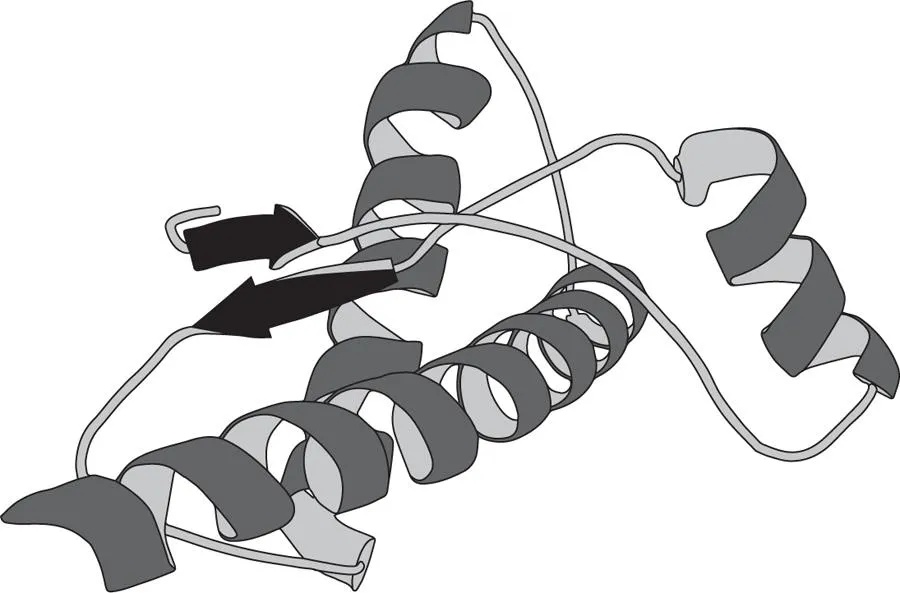
Crystallography is slow: purify, crystallise, shoot X-rays, decode a jumble of spots with "intuition, luck, and physics." Computational biology aims to predict the 3D structure from the sequence alone. The CASP contest (Critical Assessment of Structure Prediction) gave competitors amino-acid sequences of unpublished structures and scored their predictions.
Kaku's account of how a folding program works
- Approximate. Drop small terms in the molecule's Schrödinger equation (some electron–nucleus and electron–electron interactions) so a classical computer can cope.
- Build a skeleton. String the amino acids together using known bond angles: a toy model.
- Compute the energy of that configuration from its charges and bonds.
- Twist bonds and test whether the energy rises or falls, like feeling for a downhill step on a mountainside (he links this to Feynman's least action).
- Keep only downhill moves; the program "learns" by trial and error.
- Repeat until reaching the lowest-energy valley.
Early CASP predictions were "laughable." By 2021 DeepMind's AlphaFold had predicted about 350,000 structures, including all 20,000 human proteins and those of mouse, fruit fly and E. coli, with 250,000 previously unknown, and promised a database of over 100 million. CASP co-founder John Moult: "We have been stuck on this one problem ... for nearly 50 years." AlphaFold structures were used to study 26 coronavirus proteins; David Baker of the Institute for Protein Design designed coronavirus-neutralising proteins in months and aims for weeks.
AlphaFold does not work the way Kaku describes. His six steps describe classical physics-based modelling (programs like Rosetta), which was never "laughable" for small proteins but stalled on large ones. AlphaFold 2 is a deep neural network (attention-based "Evoformer" layers) trained on about 170,000 experimentally solved structures and on evolutionary co-variation across related sequences; it does not minimise energy or approximate the Schrödinger equation, which is why its accuracy is not "surprising despite dropping terms." It predicts the final structure, not the folding pathway or dynamics. Energy minimisation is also not the principle of least action, which concerns trajectories.
Three stages of the protein revolution
- Map the folded proteins. A dictionary with correct spellings and no definitions, built on approximations; where we are now.
- Determine function. Use AI and quantum computers to learn how each shape performs its job.
- Create new proteins and medicines. Abandon the approximations and solve the real quantum mechanics, which "only quantum computers can achieve," to improve on evolution in a virtual laboratory.
Stages two and three began on classical hardware. The AlphaFold database reached over 200 million structures in 2022; AlphaFold 3 (2024) models proteins with DNA, RNA, ions and drug molecules; RFdiffusion and ProteinMPNN (Baker lab, 2023) design new proteins, binders and enzymes from scratch, some now in clinical testing. Cryo-electron microscopy (Nobel 2017) supplies structures crystallography cannot. The 2024 Chemistry Nobel went to Baker for design and to Hassabis and Jumper for AlphaFold. Where quantum computers may still help is in reaction chemistry inside enzymes and precise binding energies with metals and charge transfer, where force fields and neural nets are least reliable.
Applications: drugs, and environmental clean-up such as enzymes that digest the 150 million tons of plastic in oceans and dumps, studied at the University of Portsmouth's Centre for Enzyme Innovation (which, with US colleagues, engineered the PET-eating enzyme PETase). And diseases caused by misfolded proteins.
Prions and the diseases of age
Textbooks say disease spreads by bacteria and viruses, but sheep with scrapie rub against posts and stop eating; cattle with mad cow disease (bovine spongiform encephalopathy) stagger and turn violent; in New Guinea, kuru spread through funeral rites in which relatives ate the brains of the dead. Stanley Prusiner of UCSF announced in 1982 that he had isolated the infectious agent, a protein, and won the 1997 Nobel Prize for discovering prions: misfolded proteins that force normal copies of themselves to misfold on contact, spreading through tissue.
- 6 million Americans had Alzheimer's (Kaku's figure); one in three seniors dies with Alzheimer's or another dementia; it is the sixth-leading cause of death in the US.
- About half of people reaching their eighties may develop it (Kaku's estimate).
- APOE4 carriers face higher risk; Kaku took the test on a BBC programme (negative). His mother died of the disease.
- A 2019 German study found symptom-free people with misfolded amyloid in their blood were 23 times more likely to develop Alzheimer's, detectable up to 14 years before diagnosis.
Alzheimer's attacks the hippocampus first, so recent memories go while sixty-year-old ones remain, then spreads until it erases identity. Brains of patients show sticky beta-amyloid and tau, but some people have heavy amyloid without symptoms, so causation is disputed. Prusiner now argues "amyloid beta and tau are both prions" and Alzheimer's is "a double-prion disorder." Klaus Gerwert and Hermann Brenner, authors of the German study, hope blood measurement of misfolded amyloid will allow treatment in the symptom-free stage. A 2021 University of California study reported that the harmful amyloid form twists the opposite way (right-handed) to the normal one (left-handed). Misshapen molecules last about 48 hours before being flushed out, so a designed molecule might grab, neutralise or speed their removal; quantum computers could reveal the weak spots.
Parts of the Alzheimer's section are out of date. Diagnosis no longer requires autopsy: amyloid PET, spinal-fluid tests and, since the FDA cleared the first one in May 2025, blood tests (p-tau217 and related markers) detect the disease in life. Treatment exists: the anti-amyloid antibodies lecanemab (full FDA approval 2023) and donanemab (2024) slow decline by roughly a quarter to a third in early disease, with risk of brain swelling and bleeding, which supports amyloid's causal role while showing it is not the whole story. The field was also shaken by misconduct: an influential 2006 paper on the amyloid species Aβ*56 was retracted in 2024. Tau is not an "amyloid protein" in Kaku's sense, and the figure of half of over-80s is high; estimates for those aged 85 and over are about a third. US Alzheimer's cases now exceed 7 million.
Gene-targeted drugs reached ALS. Tofersen (Qalsody), an antisense drug that lowers SOD1 protein, won FDA approval in 2023 for SOD1-linked ALS, the first therapy aimed at a genetic cause. It was designed from the gene sequence, not from quantum simulation of the protein.
Parkinson's disease affects about one million Americans, causing tremor, difficulty walking, loss of smell and sleep problems. Michael J. Fox has raised over $1 billion for research. Brain scans locate overactive neurons that can be silenced to calm tremors, but there is no cure. Kaku proposes synthesising the proteins of Parkinson's genes, solving their shapes on quantum computers, and supplying correct versions.
Kaku omits Parkinson's own prion-like protein. The misfolded protein in Parkinson's is alpha-synuclein, which spreads between neurons much as Kaku describes for amyloid. A 2023 seed amplification assay detects misfolded alpha-synuclein in spinal fluid with high accuracy, even before symptoms. The tremor treatment is mainly deep brain stimulation (implanted electrodes) or focused-ultrasound ablation rather than a needle that neutralises neurons.
Quantum is a long-dated option on specific workloads. Do not let a "quantum AI" pitch blur the two: ask which part runs on a quantum processor, how classical data gets in, and what the classical baseline is.
If quantum computers can cure the diseases of the elderly, Kaku asks, could they cure aging itself, and with it the need to die?
Immortality
Kaku treats aging as the Second Law of Thermodynamics at work in the cell: errors accumulate faster than repair can fix them. Because living things are open systems fed by sunlight, nothing in physics forbids indefinite life. He surveys the leads (mutation rates across species, telomeres, caloric restriction, DNA repair, cellular reprogramming, tissue engineering) and proposes quantum computers to decode their molecular mechanisms. He envisions two immortalities: biological, by repairing the errors of aging, and digital, by preserving a person's data as an interactive replica.
The oldest quest
Four ancient stories of immortality
- Gilgamesh crosses the world, meets the survivor of the Great Flood and finds the plant of eternal life, only for a snake to eat it.
- Adam and Eve are expelled from Eden lest, having eaten from the tree of knowledge, they also eat from the tree of life and "live forever."
- Qin Shi Huang, who unified China (Kaku says around 200 BCE; strictly 221 BCE), sends a fleet to find the elixir of life with orders not to return empty-handed; legend says they settled in Japan instead.
- Tithonus: the dawn goddess Eos wins him immortality from Zeus but forgets to ask for eternal youth, so he withers forever. The moral: ask for youth, not just life.
The physics of aging
The three laws of thermodynamics, as Kaku states them
- First law. Total matter and energy are constant; you cannot get something for nothing.
- Second law. In a closed system, disorder (entropy) always increases: things rust, crumble and die.
- Third law. You can never reach absolute zero.
The Second Law seems a death warrant. Its loophole is that it applies to closed systems. An open system can lower its local entropy if energy flows in: every baby is a precisely assembled pile of molecular information, paid for by sunlight. So immortality violates no law of physics, provided energy keeps arriving.
Aging is the accumulation of molecular errors: lost skin elasticity, failing organs, misfiring neurons, cancer. Lifespans hint at the cause: butterflies live days, mice a couple of years, elephants 60–70, Greenland sharks up to 500 (Kaku's figures). Small animals lose heat fast and burn energy fast; a higher metabolic rate means more oxidation, which in Kaku's car analogy is engine wear. The cell's engine is the mitochondrion, where damage may concentrate. Hormones such as estrogen and testosterone act like high-octane fuel, extending vigour but raising cancer risk; cancer is the Second Law catching up.
- DNA lesions occur 25–115 times per minute in each cell, about 36,000–160,000 per cell per day.
- Aging sets in when damage outpaces the body's DNA repair.
The "rate of living" and oxidative-stress theories are largely out of favour. Birds and bats have high metabolic rates yet live far longer than similar-sized mammals; naked mole rats show high oxidative damage yet live 30+ years; and large trials of antioxidant supplements found no life extension (some found harm). Current frameworks list about a dozen interacting hallmarks of aging (genomic instability, telomere attrition, epigenetic drift, loss of protein quality control, mitochondrial dysfunction, cellular senescence, stem-cell exhaustion, chronic inflammation and others). The estrogen-longevity link is a hypothesis, not an established cause of women's longer lives.
Mutations set the clock
The Wellcome Sanger Institute compared somatic mutation rates in 16 species and found a striking inverse relation: the faster the mutations, the shorter the life, with every species ending life at a similar total.
Similar lifetime mutation budgets. Naked mole rat: 93/year × 25 years ≈ 2,325; giraffe: 99 × 24 ≈ 2,376; mouse: 796 × 3.7 ≈ 2,934. Mammals average about 3,200 mutations by the end of life; at 47/year, humans would reach that at about 70 (about 80 on other assumptions). Kaku reads this as strong evidence that genetic error drives aging.
Resetting the clock: telomeres
Skin cells divide about 60 times and then enter senescence: the Hayflick limit. Leonard Hayflick cautioned Kaku against over-reading it and lamented the field's diet-fad misinformation. The counter is the telomere, a cap on each chromosome that shortens with every division, like the plastic tip of a shoelace; when it wears away the chromosome frays. The enzyme telomerase rebuilds it; skin cells given telomerase have divided hundreds of times. The danger: 90% of human tumours use telomerase to make themselves immortal. Quantum computers, Kaku suggests, might show how to extend a cell's life without making it cancerous.
Caloric restriction
Kaku calls caloric restriction the only proven life-extender: 30% fewer calories, roughly 30% longer life, tested in insects, mice, dogs, cats and apes, with fewer cancers and less arterial disease. Humans have not been tested systematically. The leading theory is reduced oxidation; worms (C. elegans) altered in genes such as age-1 live many times longer. His evolutionary story: food is usually scarce, so animals evolved to hunker down and conserve when hungry, waiting to reproduce when food returns. He notes the theory that caloric restriction acts through resveratrol, "produced by the sirtuin gene" and found in red wine, though the jury is out.
Yale's thymus study (2022). Vishwa Deep Dixit's group studied the thymus, which makes T cells and is about 70% fat and non-functional by age 40, a reason the elderly fight new infections poorly. In people on a two-year calorie-restricted diet (the CALERIE trial), the thymus had less fat and more functioning tissue: "stunning," Dixit said, because human organ rejuvenation is rarely seen. The team traced part of the effect to the protein PLA2G7, linked to inflammation. Blocking it might give the benefits of fasting without the hunger. "I think it gives hope."
Caloric restriction is not universal, and two biochemical claims are wrong. In rhesus monkeys the two major studies disagreed (Wisconsin found longer life, the NIA found none), and effects in wild-derived mice are smaller than in lab strains; "30% less food, 30% longer life" overstates it, and there are no ape lifespan studies. The famous worm genes (age-1, daf-2) act through insulin/IGF-1 signalling, not oxidation. Resveratrol is a plant compound, not a product of any sirtuin gene; it was claimed to activate the sirtuin SIRT1, a claim later disputed, and GSK closed the company built on it (Sirtris) in 2013.
DNA repair: lessons from long-lived rodents
At the University of Rochester, Vera Gorbunova's team compared 18 rodent species. Mice live two to three years; beavers and naked mole rats live 25–30. The long-lived species have stronger DNA repair, centred on the sirtuin-6 (SIRT6) gene, dubbed a "longevity gene." Beaver SIRT6 was more potent than rat SIRT6 (though not mole rat); fruit flies given beaver SIRT6 lived longer, and human cells with it suffered less DNA damage. Quantum computers could show exactly how SIRT6 enhances repair.
Reprogramming cells to youth
- Yuri Milner: Russian-born investor (Facebook, Mail.ru), funder of the $3 million Breakthrough Prizes, backer of Altos Labs, with Jeff Bezos reportedly among investors; Kaku cites $270 million raised.
- Shinya Yamanaka: Nobel laureate who found four proteins (the Yamanaka factors) that turn adult cells back into embryonic-like stem cells; chairs Altos's scientific board.
- David Sinclair (Harvard): restored eyesight in mice by reprogramming; "ticking off the major organs."
- Alejandro Ocampo (Lausanne): "You can take a cell from an 80-year-old, and, in vitro, reverse the age by 40 years."
- Martin Borch Jensen (Gordian): "a giant pile of gold"; offering $20 million for research.
- Start-ups: Life Biosciences, Turn Biotechnologies, AgeX Therapeutics, Shift Bioscience.
Nature already reprograms: each generation, adult cells become an embryo. A University of Wisconsin–Madison group took mesenchymal stem cells from joint fluid round-trip through induced pluripotent stem cells (iPSCs) and back, rejuvenating them, and identified the proteins involved (GATA6, SHH and FOXP1).
Thirteen days younger by thirty years. Yamanaka's method exposes skin cells to the four factors for about 50 days, erasing their identity. At the Babraham Institute, Cambridge, researchers stopped at 13 days and let the cells recover. Cells from a 53-year-old woman then looked and behaved like those of a 23-year-old. "I didn't quite believe that some of the cells were 30 years younger," said Diljeet Gill. The researchers warned that cancer remains a possible side effect.
Reprogramming became the best-funded corner of longevity science. Altos Labs launched in January 2022 with about $3 billion, far more than the early $270 million filing Kaku cites; Retro Biosciences (backed by Sam Altman) and others followed. Partial reprogramming has extended remaining lifespan in old mice and reversed some tissue aging, and companies are preparing the first human tests aimed at the eye. Age itself is now measured with epigenetic clocks (DNA methylation patterns, introduced by Steve Horvath in 2013), which is how "30 years younger" is quantified. No intervention has yet been shown to extend human lifespan.
The human body shop
Reprogrammed cells rejuvenate only cell lines, not whole bodies, and loose stem cells can form shapeless masses. Tissue engineering gives them a scaffold. Anthony Atala of Wake Forest showed Kaku jars of livers, kidneys and hearts.
Atala's method for growing an organ
- Mould. Build a biodegradable scaffold of plastic fibres in the organ's shape.
- Seed. Coat it with the patient's own cells.
- Feed. Add growth factors; cells grow into the fibres while the mould dissolves.
- Implant. The organ is the patient's own tissue: no rejection, and no cancer risk because no genes are altered.
- Scope. Works for simple structures (skin, bone, cartilage, blood vessels, bladders, heart valves, windpipes); the liver has too many cell types, and the kidney's tubes and filters remain a project.
3D printers that spray heart cells like ink droplets are another route; combined with rejuvenated stem-cell lines, they might one day replace any worn organ, sparing us Tithonus's fate.
Where quantum computers come in
Kaku foresees a global gene bank of most of humanity, too big for conventional computers. About 100 genes already differ between young and old, many tied to oxidation. Quantum computers would compare the genomes of four groups:
Four genetic populations to mine for aging genes
- The exceptionally healthy elderly (centenarians).
- People with immune systems that fend off common diseases.
- People whose accumulated genetic errors have sped up aging.
- Extreme outliers with Werner syndrome or progeria, who age prematurely and have short telomeres.
Clues already exist: long-lived Ashkenazi Jews carry hyperactive telomerase; centenarians have higher levels of the DNA-repair protein PARP (poly(ADP-ribose) polymerase) than people aged 20–70, and cells that look younger, which may explain why those who reach their eighties have better-than-expected odds of reaching their nineties. CRISPR might then fix the genes; a cocktail of therapies might slow or reverse aging.
Genome data does not need quantum computers. The UK Biobank released 500,000 whole genomes in 2023, and they are analysed on ordinary cloud clusters; genome-wide association is linear algebra and statistics, not an exponential search. Where quantum simulation could matter is the molecular step (how SIRT6, PARP or telomerase work chemically), and even there AI structure models are moving first. Progeria (Hutchinson–Gilford) patients typically die around 14–15 (the drug lonafarnib, approved in 2020, adds a few years); Werner syndrome begins in adulthood, with death usually in the forties or fifties.
Digital immortality
Most ancestors left two lines in a parish register and a broken tombstone; DNA genealogy trails vanish within a century. We, by contrast, leave enormous digital footprints: credit-card records alone map our tastes. Kaku imagines conversing with a hologram of Winston Churchill built from his letters and memoirs, or with Einstein about how his theories grew into the big bang, black holes and gravity waves. In 2021 William Shatner answered hundreds of questions on camera over four days, and software indexed the answers so people can later "ask" him questions. Phone cameras already record our lives; AI will edit them into a coherent narrative, and quantum computers will search and fill gaps.
Digital replicas arrived through language models. Since 2023, LLM-based "griefbots" and AI avatars trained on a person's messages, voice and video have become commercial products, especially in China, and celebrity voice and likeness licensing is now a contract term. They raise consent, likeness-rights and grief-psychology questions that law is only beginning to address. None uses a quantum computer.
Tithonus's contract. Suppose a therapy halts the accumulation of mutations but does nothing for the other hallmarks (senescent cells, worn-out stem cells, drifting epigenetic marks). You would stop the clock Kaku measures and still age by the others: immortality without youth. The lesson for any single-mechanism theory of aging is the same as Eos's error: specify all the terms of the wish.
Kaku closes Part III by turning outward: from the inner space of the body to global warming, fusion and the universe itself.
Global Warming
Opening Part IV, modelling the world and the universe, Kaku lays out the evidence for human-driven warming (ice cores, satellites, retreating ice, rising seas), its feedbacks (methane, a wandering polar vortex) and its security risks, then surveys geoengineering fallbacks. His central claim is that climate and weather models are hitting the limits of digital computers, and that quantum computers will deliver the finer grids and adjustable "virtual weather reports" policy needs. The science has held up; the computing forecast has not.
Reading the ice
In a freezer-cold laboratory in Reykjavík, Kaku saw ice cores: metal rods about 1.5 inches across holding ice that fell thousands of years ago. Thin brown bands of volcanic ash date the layers against known eruptions; trapped air bubbles record past CO₂; and the ratio of heavy isotopes (oxygen-18, deuterium) records temperature. Plotted together, temperature and CO₂ rise and fall "like a pair of roller coasters." In 2017 Antarctic cores reached ice 2.7 million years old.
The isotope thermometer runs the other way. Kaku says more heavy water means colder conditions. Heavy molecules evaporate less readily and condense out first as air travels poleward and cools, so the colder the climate, the more depleted polar snow is in oxygen-18 and deuterium. More heavy isotopes in polar ice therefore indicates warmer conditions. (In 2025, Allan Hills blue ice yielded samples about 6 million years old.)
What the ice-core chart shows
- Earth's climate swings widely; stability is the exception.
- The last ice age ended about 10,000 years ago, when half a mile of ice covered North America; civilisation arose in the warm interglacial that followed. Without it we would still be nomadic hunters.
- A slow warming since then, then a sudden spike in the last 100 years, coinciding with industrial fossil-fuel burning.
- Recent records: 2016 and 2020 were the hottest years recorded; 1983–2012 was the hottest 30-year span in 1,400 years.
Kaku adds that another ice age may come in 10,000 years or so. Calculations of Earth's orbital cycles, in fact, put the next glaciation at least 50,000 years away, and further still with today's CO₂.
The records have kept falling. 2024 was the hottest year on record at about 1.55 °C above pre-industrial, the first calendar year above the Paris 1.5 °C mark; 2023 and 2025 are the next warmest. Atmospheric CO₂ passed 420 ppm. The 1.5 °C long-term threshold is now expected to be crossed around the early 2030s.
The greenhouse mechanism
Sunlight passes through the atmosphere, is absorbed by the ground and re-emitted as infrared, which CO₂ absorbs, trapping heat. About 80% of world energy in 2018 came from fossil fuels. Satellites confirm the result: NASA measures more energy arriving from the sun than leaving to space.
Waste heat is not the culprit. Kaku says the net energy Earth retains is "about the same as the amount of energy generated by human activity." Earth's measured energy imbalance is roughly 1 W/m², around 500 terawatts, about 25 times humanity's total energy use (~19 TW). Warming comes from the greenhouse forcing of the gases we emit, not from the heat our machines release.
- Arctic winter ice has thinned by 50% in fifty years (about 1% a year), measured by submarines since the 1950s; NASA expects ice-free Arctic summers by mid-century.
- Sea level has risen 8 inches since 1880; projections run 1–8 feet by 2100. Each vertical inch costs about 100 inches of usable shoreline.
- Greenland melt in twenty years would cover the entire US in 1.5 feet of water.
- Methane is over 30 times more potent than CO₂; thawing tundra in Canada and Russia (where mammoth carcasses are emerging near Krasnoyarsk) could release it in a self-reinforcing loop.
- Summers are about a week longer; mosquitoes carrying West Nile virus are moving north; "100-year storms" now come more often; 2022 brought record European and US heat.
Sea-level rise is no longer mainly thermal expansion. Kaku attributes it to warming water expanding; since the 1990s melting glaciers and ice sheets have contributed more than expansion. The polar-vortex link to cold outbreaks is also debated: some studies support a weakened, wavier jet stream from Arctic warming; others find little signal.
Hurricanes form as mild winds off Africa, roll across the Atlantic and, entering the warm Gulf of Mexico at the right angle, grow into monsters; their intensity, frequency and duration on the US East Coast have risen since the 1980s. Venice floods seasonally and parts of New Orleans lie below sea level. A NASA–NOAA report calls sea-level rise "a clear and present risk"; NASA administrator Bill Nelson says "urgent action is required." Glaciologist Erin Pettit warns the eastern ice shelf of Antarctica's Thwaites "doomsday glacier" could "shatter into hundreds of icebergs."
The Pentagon's worst case. A Pentagon scenario identified the Bangladesh–India border as a flashpoint: floods drive millions of Bangladeshis toward India, overwhelming border guards, until the Indian military is pressed to repel them, in the extreme with nuclear weapons. Kaku presents it as an illustration of runaway risk, not a forecast.
The polar vortex. Big snowstorms are cited as proof that warming is exaggerated. Kaku's explanation: the jet stream follows the polar vortex, a spinning column of cold air over the North Pole. A strong pole-to-equator temperature difference keeps it tight; as the Arctic warms faster, the difference shrinks, the vortex weakens and wanders, and cold air reaches Texas and Mexico. Warming may cause some freezing weather.
Geoengineering fallbacks
Kaku hopes renewables, conservation, a super battery and perhaps fusion by mid-century will suffice. If not:
| Option | Idea | Kaku's verdict |
|---|---|---|
| Carbon sequestration | Capture CO₂ at refineries; bury it or mineralise it in basalt | Serious, but economics decide; firms wait and see |
| Volcano-style aerosols | Copy Mount St. Helens (1980): particles reflect sunlight | Hard to test; cooling too small |
| Iron seeding | Iron feeds algae, which absorb CO₂ | Living systems cannot be recalled like a faulty car |
| Cloud seeding, brightening | Silver iodide for rain (reportedly tried in Vietnam); brighter clouds reflect sunlight | Local, unpredictable |
| Trees and modified plants | Engineer plants to absorb more CO₂ | Safest; probably insufficient; needs many nations |
| Virtual weather | Quantum computers choose the best option | His preferred tool |
Wrong volcano. Mount St. Helens put little sulfur into the stratosphere and had negligible global effect; the reference case for solar geoengineering is Pinatubo (1991), which cooled the globe by about 0.5 °C for a year or two. The Vietnam programme, Operation Popeye (1967–72), was run by the US military over the Ho Chi Minh Trail. On removal, Iceland itself became a test bed: Carbfix turns CO₂ into stone in basalt within two years, and Climeworks' direct-air-capture plants there have captured far less than their design capacity, at high cost, a sign of how hard Kaku's "economics" problem is.
Why Kaku wants quantum weather
How a climate model works (Kaku's description)
- Grid the surface into cells: about 311 miles across in the 1990s, 68 miles for the IPCC's 2007 Fourth Assessment.
- Stack the cells vertically into slabs (he says about ten layers).
- Assign each cell humidity, sunlight, temperature and pressure.
- Step forward with thermodynamic equations, exchanging heat and moisture between neighbours.
- Validate by hindcasting: check the model reproduces the past fifty years.
The biggest uncertainties are clouds (covering up to 70% of the planet, changing minute by minute, reflecting sunlight) and the jet stream's path; both are entered as rough averages. Hurricane forecast tracks from different models diverge by hundreds of miles. Kaku's two promises: quantum computers will allow much smaller cells (weather changes over a mile), and will let modellers treat clouds and jet stream as variable knobs, producing virtual weather reports for any policy.
Three technical slips and one big miss. Hindcasting runs the model forward from past starting conditions, not backward in time. Modern models use 30 to over 100 vertical levels, not ten. Weather and climate are classical fluid dynamics, and no quantum algorithm offers a demonstrated speed-up for nonlinear Navier–Stokes simulation at scale; the obstacle of loading and reading out billions of grid values remains. The big miss is that AI transformed forecasting instead.
AI weather models overtook physics models in a few years. Google DeepMind's GraphCast (2023) beat the European Centre's flagship forecast on about 90% of targets in under a minute on one chip; GenCast (2024) beat its ensemble on 97%; ECMWF made its own AI model (AIFS) operational in 2025, and the US National Hurricane Center used a DeepMind cyclone model during the 2025 season. Meanwhile exascale machines run kilometre-scale climate simulations (the EU's Destination Earth digital twin), resolving storms and some clouds directly, Kaku's "smaller slabs" achieved classically.
For banks, climate risk is a modelling and data problem today. Supervisors (the PRA, ECB, Fed pilots) expect scenario analysis using NGFS pathways, physical-risk maps for mortgage and commercial-property books, and transition-risk overlays on sector lending. The bottleneck is granular exposure data (property locations, flood depths, borrower emissions) and model governance, not compute. AI downscaling and km-scale hazard models are worth adopting now; quantum climate modelling is not on any credible bank roadmap.
Since fossil fuels drive the problem, Kaku turns to the alternative that could replace them: fusion, putting the sun in a bottle, with quantum computers as a key to controlling it.
The Sun in a Bottle
Kaku presents fusion as the ideal carbon-free energy source, explains why seventy years of effort have stalled on plasma instability, and reviews the contenders: the international ITER tokamak, the high-temperature-superconductor SPARC, China's EAST, Britain's JET and the National Ignition Facility's lasers, whose December 2022 shot made more fusion energy than the laser delivered. His case is that the tightly coupled equations of plasma and magnetic field, and the mystery of high-temperature superconductors, are where quantum computers (with AI) could make fusion practical.
Why the sun shines
Burning fuel would keep the sun alight only for centuries or millennia, and fire needs air. The answer is E = mc²: four hydrogen nuclei fuse into helium, which weighs slightly less; the missing mass becomes the energy that lights the solar system. The hydrogen bomb brought a piece of the sun to Earth. Physicists' running joke is that fusion power is always twenty years away; Kaku hopes quantum computers will close the gap before warming becomes irreversible.
Five advantages of fusion over fission
- Little long-lived waste. Fission makes hundreds of radioactive products (strontium-90, iodine-131, caesium-137); one plant produces about 30 tons of high-level waste a year, and 370,000 tons must be guarded worldwide. Fusion's ash is helium, and its irradiated steel is easier to bury.
- No meltdown. Fission waste keeps heating after shutdown; lose cooling and the core passes 5,000 °F and melts, as at Chernobyl (1986). A fusion upset simply stops the reaction.
- Limitless fuel. Hydrogen isotopes come from seawater; uranium needs mining, milling and enrichment.
- Density. One gram of heavy hydrogen yields about 90,000 kWh (Kaku writes kilowatts), equal to 11 tons of coal.
- No CO₂ (shared with fission).
Fusion's fuel and waste are less clean than advertised. The workable reaction is deuterium–tritium. Deuterium is abundant, but tritium is radioactive, decays with a 12.3-year half-life, and the world's civilian stock is only about 25 kg; a power plant must breed its own from lithium in the blanket, a process never demonstrated at scale. Fusion's 14 MeV neutrons activate and embrittle the structure, producing large volumes of intermediate-level waste, although far shorter-lived than fission's actinides.
How a tokamak works
A fusion machine needs two things: plasma (the fourth state of matter, gas so hot its electrons are stripped, which makes up stars and lightning) heated hotter than the sun's core, and a way to confine it. Stars use gravity; Earth must use magnetic fields. The tokamak, a Soviet design, winds coils around a tube bent into a doughnut; a current driven through the gas heats it, and the coils' field holds the plasma off the walls.
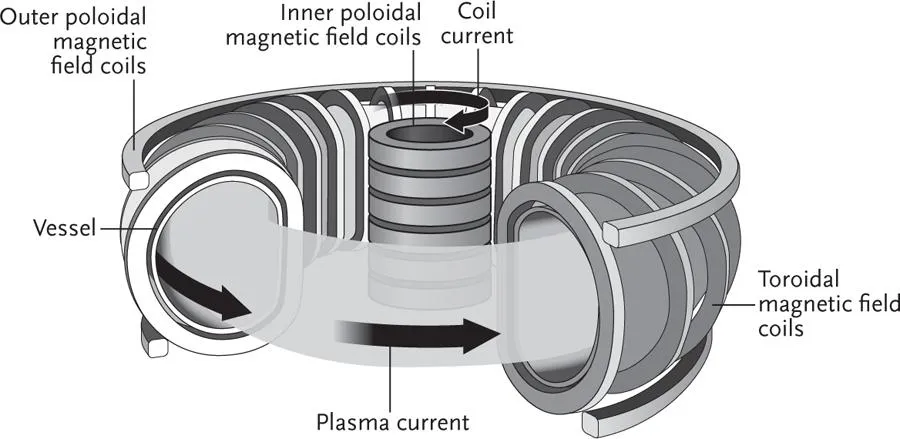
Deuterium and tritium fuse into helium and a fast neutron, which escapes the magnetic field and deposits its energy in a surrounding blanket (beryllium, copper and steel in Kaku's description). Water in the blanket boils, steam spins a turbine, and electricity flows to your home.
Why it is so hard: Kaku's balloon. Gravity only attracts, so a gas cloud collapses evenly by itself and stars form easily. Magnetism always has two poles, and squeezing a plasma with it is like squeezing a balloon twisted into a ring: press anywhere and it bulges somewhere else. The engineering goal is the Lawson criterion: density × temperature × confinement time (the "triple product," about 3 × 10²¹ keV·s/m³ for D–T ignition) held long enough for fusion to sustain itself.
Kaku's account of instability: the plasma carries its own magnetic field, which interacts with the reactor's. A small kink in the field lines distorts the plasma, whose field amplifies the kink, a runaway feedback that can drive plasma into the wall and burn a hole. Over 100 fusion machines since the 1950s have failed to produce net energy.
ITER and the record-holders
The ITER collaboration grew out of East–West diplomacy, sealed by Reagan and Gorbachev, and is funded by 35 nations including the EU, US, Japan and Korea. Efficiency is measured by Q = fusion power out ÷ heating power in; Q = 1 is breakeven. The record when Kaku wrote was about Q = 0.7.
- ITER design goal Q = 10: 500 MW of fusion from 50 MW of heating (Kaku: a net 450 MW), not connected to the grid.
- Size: torus 64 feet across and 37 feet tall; twice the size and 16 times the weight of earlier vessels; Kaku says 5,000+ tons (the full tokamak is about 23,000 tonnes).
- Field: 280,000 times Earth's magnetic field, from superconducting coils.
- Cost: about $21 billion spent by Kaku's count.
- Successor: DEMO by about 2050, Q = 25, up to 2 GW.
- BBC's Jon Amos: fusion "is not a solution to get us to 2050 net zero" but to power the second half of the century.
Dates and history. ITER was launched at the 1985 Geneva summit, not in 1979, and was never scheduled to reach breakeven in 2025; it was due only to make its first plasma then. In 2024 ITER adopted a new baseline after defective components and delays: research operations from 2034, full deuterium–tritium operation from 2039, at about €5 billion extra cost.
The magnets depend on superconductivity, discovered in 1911 when mercury at 4.2 K lost all resistance. John Bardeen, Leon Cooper and John Schrieffer explained it in 1957: electrons bind into Cooper pairs that move without resistance. Their BCS theory seemed to cap superconductivity near 40 K.
2022's two records. Britain's JET near Oxford held Q ≈ 0.33 for five seconds, about 11 MW (heating some sixty kettles), beating its own 24-year-old record: "a mini star inside of our machine," said Joe Milnes; "the greatest amount of energy output from the fusion reactions of any device in history," said Arthur Turrell. Months later China's EAST (Experimental Advanced Superconducting Tokamak) reported holding plasma for about 17 minutes, which Kaku pairs with a temperature of 158 million °C.
EAST's records are conflated. The 17-minute (1,056-second) pulse ran at about 70 million °C; the 160 million °C figure came from a separate 20-second shot. Neither produced significant fusion energy: EAST runs on deuterium, not D–T, and these are confinement records. JET's 2022 pulse released 59 MJ; in its final campaign before closing in December 2023 it set the all-time record of 69 MJ.
High-temperature superconductors and SPARC
In 1986 a new class of superconductors was found by trial and error; ceramics such as yttrium barium copper oxide superconduct at 77 K, the temperature of liquid nitrogen, which is "about as expensive as milk." Coolant costs: dry ice $1/lb, liquid nitrogen $4/lb, liquid helium $100/lb. Since magnets are the costliest part of a reactor, this changes fusion's economics, though the discovery came too late for ITER.
SPARC, announced in 2018 by MIT and Commonwealth Fusion Systems, raised over $250 million from backers including Bill Gates, pocket change beside ITER. In 2021 it tested a high-temperature-superconducting magnet. MIT's Dennis Whyte: it "will change the trajectory of both fusion science and energy." Andrew Holland of the Fusion Industry Association: "This is not hype, this is reality." Kaku expected SPARC to reach Q = 1 around 2025, and its successor ARC to deliver electricity.
Magnet and superconductor details. The 2021 SPARC magnet reached 20 tesla, about 400,000 times Earth's field, not 40,000. The first high-temperature superconductor (Bednorz and Müller, 1986) worked at about 35 K; YBCO, above 77 K, followed in 1987. Their discovery did not supply "a new quantum theory"; as Kaku later admits, no consensus mechanism exists. Cooper pairs flow through the bulk of the material, not "on the surface."
The room-temperature superconductor was a fraud. Kaku reports a room-temperature superconductor at 2.6 million atmospheres. That 2020 Nature paper by Ranga Dias (Rochester) was retracted in 2022; a 2023 follow-up claiming near-ambient pressure was also retracted, an investigation found data fabrication, and Dias was dismissed in 2024. The 2023 "LK-99" ambient-pressure claim was debunked within weeks. Genuine high-pressure hydride superconductors (such as H₃S at about 203 K, 2015) do exist.
Private fusion became an industry. Commonwealth Fusion Systems has raised around $3 billion, including from Google and Nvidia (2025); SPARC's first of 18 magnets was installed in January 2026, with first plasma targeted for 2027 and Q > 1 soon after. CFS plans its first power plant, ARC, in Virginia in the early 2030s, with Google agreeing to buy 200 MW. Helion has a contract to supply Microsoft from 2028 and began building a plant in Washington State in 2025. More than 40 private firms have raised close to $10 billion. Long-pulse records continued: France's WEST held plasma 22 minutes (2025), and Germany's Wendelstein 7-X stellarator set triple-product records for long pulses.
Laser fusion at NIF
The National Ignition Facility at Lawrence Livermore ($3.5 billion) is the size of three football fields and ten storeys tall, inside a weapons laboratory Kaku entered past armed guards for a BBC programme. Its 192 laser beams fire for a billionth of a second onto a target Kaku describes as a pea-sized pellet of lithium deuteride; the surface vaporises, the implosion heats the core to tens of millions of degrees, and fusion neutrons emerge. In 2021 NIF produced 10 quadrillion watts for 100 trillionths of a second at 100 million K, compressing fuel to 350 billion atmospheres. In December 2022 it achieved Q > 1, more energy out than in, a historic first.
Where quantum computers come in
Kaku's four roles for quantum computers in fusion
- Solve the coupled equations. Plasma and magnetic-field equations are known but feed back on each other; quantum computers could track the amplification of small oscillations.
- Virtual reactor design. A reactor costs $10–20 billion; changing parameters in a simulation is far cheaper than rebuilding a magnet.
- AI-driven control. DeepMind learned to shape and hold plasma in the TCV tokamak at EPFL in Lausanne. Federico Felici: "AI will play a very big role in the future control of tokamaks."
- Explain high-temperature superconductors. Forty years on, no theory has consensus; a quantum computer could calculate how electrons behave in the ceramic's two-dimensional copper-oxide layers, decide between theories and screen new materials "in a single afternoon."
Roles one and two are classical problems; role four is a genuine quantum target. Plasma physics is described by classical magnetohydrodynamics and kinetic equations, solved on supercomputers; quantum algorithms for such nonlinear equations offer no demonstrated advantage. AI is already delivering role three: DeepMind's TCV work (2022) and a 2024 Princeton system that predicts tearing instabilities 300 milliseconds ahead. Role four is different: the Fermi–Hubbard model of electrons in copper-oxide planes is a strongly correlated quantum problem that defeats classical methods, and simulating it is among the most credible early uses of quantum computers.
Fusion's timeline, 2026. ITER: research plasma 2034, D–T 2039. SPARC: first plasma 2027. ARC and Helion: first grid power promised for 2028–early 2030s. NIF: gain above 4. The "twenty years away" joke now reads "first commercial attempts within ten years, unproven economics."
If quantum computers can solve the equations of a fusion reactor, Kaku asks, why not the fusion furnaces of the stars themselves, their explosions as supernovae and their collapse into black holes?
Simulating the Universe
Kaku turns quantum computers outward, to astronomy's data deluge and its unsolved equations: tracking killer asteroids, cataloguing exoplanets, hunting alien intelligence, "baking" stars, forecasting solar superstorms, explaining gamma-ray bursts and black holes, identifying dark matter, and finally selecting the true solution of string theory. His closing conjecture is that a quantum computer might do for string theory what supercomputers did for the strong force: compute the answer pure mathematics cannot reach. This is the book's most speculative chapter and the one most in need of correction.
From Galileo to Webb
In 1609 Galileo turned a handmade telescope on the sky and saw lunar craters, sunspots, Saturn's "ears" (rings), four moons of Jupiter and the phases of Venus, evidence that Earth circles the sun. He held viewing parties for the Venetian elite, collided with the Church's doctrine of perfect heavenly spheres, and at his trial was reminded that Giordano Bruno had been burned in Rome 33 years earlier for, among other heresies, teaching that other worlds might bear life. A statue of Bruno now stands in Rome's Campo de' Fiori where he died; every new exoplanet is his revenge.
Astronomers now command robotic telescopes and observatories like Hubble and Webb, stationed about a million miles away. The data is overwhelming. The Milky Way has about 100 billion stars and Hubble can see about 100 billion galaxies, so roughly 10²² stars; a catalogue of their planets would exhaust a supercomputer, so Kaku turns to quantum computers.
Big data is not a quantum problem. Astronomical catalogues are stored, searched and analysed with databases, GPUs and machine learning. The Vera C. Rubin Observatory, which released its first images in 2025, will produce about 20 terabytes a night and is processed on classical computing clusters. Quantum computers cannot hold or search classical datasets faster in any practical sense; Kaku's "quantum search engine" claim recurs throughout this chapter.
Killer asteroids
Sixty-six million years ago an object about six miles wide struck the Yucatán, digging a crater Kaku puts at almost 200 miles across (about 110 miles by current measurement), raising a mile-high tsunami, igniting fires and darkening the sky; about 75% of species died. The dinosaurs had no space programme. Carl Sagan told Kaku Earth sits in a "cosmic shooting gallery" and humanity must become a two-planet species.
- 27,000 near-Earth objects tracked when Kaku wrote, from football-field size to several miles; tens of millions of smaller ones untracked.
- Long-period comets from beyond Pluto might give only weeks of warning once their tails appear from behind the sun.
- Apophis, about 1,000 feet across, passes within 10% of the Earth–Moon distance in April 2029, visible to the naked eye, below some satellites; Kaku says its 2036 path is uncertain.
- Impact speeds can approach 160,000 mph; the damage at such speeds is poorly modelled.
- DART (Double Asteroid Redirection Test) was the first human-made object to alter an asteroid's path.
Apophis will not graze the atmosphere. It passes about 32,000 km (some 20,000 miles) above the surface, inside the geostationary ring but far above the air. Uncertainty in its later orbit comes from Earth's gravity and the Yarkovsky effect (thermal thrust from sunlight), and in 2021 NASA ruled out any impact for at least a century. DART launched in 2021 but struck Dimorphos on 26 September 2022, shortening its orbit by about 33 minutes, far more than the minimum goal, because ejected debris added thrust. Orbit determination is classical mechanics, which is not a quantum computing problem.
Planetary defence improved without quantum computers. Known near-Earth asteroids now exceed 38,000. The Rubin Observatory is expected to find millions of new solar-system objects, and NASA's infrared NEO Surveyor is due to launch around 2027. ESA's Hera (launched October 2024) will survey DART's crater from late 2026, and missions are being prepared to accompany Apophis in 2029.
Exoplanets and ET
Kepler and other telescopes have found about 5,000 exoplanets (now over 6,000 confirmed): on average every star has a planet, and perhaps 20% of planets are Earth-like, implying billions in our galaxy. The textbook solar system (rocky planets inside, gas giants outside, circular orbits) turned out to be an oddball: we find eccentric orbits, hot Jupiters hugging their stars and planets with several suns. "If you can imagine a strange planet, there is probably one like it out there."
Kaku quotes Frank Drake's equation (he dates it to the 1950s) as starting from 100 billion stars and multiplying by fractions with planets, atmospheres, oceans and microbial life, ending "usually in the thousands." Yet SETI's radio telescopes at Hat Creek in northern California hear only static: the Fermi paradox ("where are they?"). Quantum computers with AI might find alien intelligence hidden in data, even if bizarre.
The Drake equation as actually written (1961)
N = R* × fₚ × nₑ × fₗ × fᵢ × f꜀ × L
- R*: rate of star formation in the galaxy.
- fₚ: fraction of stars with planets (now known to be near 1).
- nₑ: habitable planets per system.
- fₗ: fraction where life arises.
- fᵢ: fraction that evolve intelligence.
- f꜀: fraction that emit detectable signals.
- L: how long they keep transmitting.
The last four factors are unknown, so N ranges from far below one to millions; "usually thousands" reflects optimistic choices.
Measuring a dolphin's language. For a Science Channel programme Kaku swam with dolphins while sensors recorded their chirps. The analysis ranks sounds by frequency, the same method that ranks letters in English (e first) and can unmask forgeries, even test Shakespeare's authorship. Dolphin calls showed structure, "rhyme and reason"; the signal of intelligence falls off in simpler animals and nears zero in insects. AI and quantum computers might apply the same test to signals from space.
Animal-language decoding is now an AI field. Project CETI reported a combinatorial "phonetic alphabet" in sperm whale codas (2024), and Google released DolphinGemma, a language model trained on wild dolphin recordings (2025). Breakthrough Listen's SETI searches use machine learning on classical hardware; still no signal.
Baking stars
Kaku's Berkeley roommate would leave each morning "to bake a star in an oven": input a gas cloud's size, composition and temperature; by lunch it collapsed and ignited; by afternoon it had burned for billions of years, cooking heavier elements. Simulations show our sun will exhaust its hydrogen in about 5 billion years, swell into a red giant that fills the sky, boils the oceans and melts the mountains, then shrink to an Earth-sized white dwarf and cool into a black dwarf: Robert Frost's world ending in fire and then ice. Massive stars keep fusing heavier elements until iron, when fusion stops, the core collapses and the star explodes as a supernova.
Several astrophysics slips. Stars do not "cook" lithium and boron; they destroy them. Hydrogen fuses to helium, then helium to carbon and oxygen, and so on; lithium, beryllium and boron come mostly from the big bang and cosmic-ray collisions. Fusion stops at iron because iron has the highest binding energy per nucleon, so fusing it absorbs energy, not because its protons repel too strongly. The red-giant sun will swallow Mercury, Venus and probably Earth, not planets "out to Mars," and the white dwarf will hold about half the sun's present mass. Gold and other heavy elements are made largely in neutron-star mergers (confirmed by the 2017 kilonova seen with gravitational waves), not only in supernovae.
Solar superstorms
- 774–775 CE a solar event recorded in carbon-14 and beryllium-10, perhaps ten times Carrington's strength.
- 993–994 CE another; its tree-ring signature dated the Viking settlement at L'Anse aux Meadows to 1021.
- 1859 the Carrington Event: telegraph wires sparked and caught fire; aurorae over Cuba, Mexico, Hawaii, Japan and China; newspapers readable at night in the Caribbean; brighter than a full moon in Baltimore. Gold miner C. F. Herbert: "a scene of almost unspeakable beauty."
- 2001 (Kaku's date) a huge coronal mass ejection at 4.5 million mph misses Earth.
- 2013 Lloyd's of London and AER estimate a modern Carrington event could cost $2.6 trillion.
- February 2022 a solar outburst destroys 40 of 49 newly launched SpaceX satellites.
A repeat could knock out satellites, the internet, power grids and financial communications, throwing us perhaps 150 years back, with rotting food and failing order. Hardening satellites, shielding electronics and building redundant power stations would be cheap insurance, usually ignored. Coronal mass ejections occur when magnetic field lines on the sun's surface cross and snap; what drives that from inside the sun is unknown, and Kaku hopes a quantum computer could "cook" the sun's interior to forecast them.
The examples are mis-sized. The 2022 Starlink losses (38–40 satellites) came from a minor geomagnetic storm that thickened the upper atmosphere just as the satellites were released at very low altitude; it was not "the largest solar disaster in modern history." The near-miss Kaku means is probably the July 2012 Carrington-class ejection, which crossed Earth's orbit about a week after Earth had passed. Solar interiors are studied with helioseismology and classical magnetohydrodynamic models; flare forecasting is improving through machine learning on spacecraft data, not quantum simulation.
The May 2024 "Gannon" storm, the strongest in over two decades, sent aurorae to Mexico, northern India and southern Europe, disrupted GPS-guided farm equipment and forced satellite manoeuvres, but grids held. Space weather now features in the UK National Risk Register and in bank operational-resilience scenarios.
Gamma-ray bursts
In 1967 the US Vela satellites, built to catch secret nuclear tests, detected flashes of gamma rays; the Pentagon feared a Soviet super-weapon until the sources proved to be in distant galaxies. A burst lasting seconds outshines a galaxy and releases more energy than the sun will in its 10-billion-year life: the largest explosions since the big bang. Satellite networks now catch them in real time. Leading explanations: merging neutron stars and black holes, or massive stars collapsing into black holes. A nearby burst may have triggered the Ordovician extinction (Kaku: 500 million years ago; about 445 million by current dating), which killed 85% of marine species.
Betelgeuse, the red giant in Orion about 500–600 light-years away, will one day go supernova bright enough, Kaku says, to outshine the moon and cast shadows; its recent dimming and change of shape sparked speculation.
Betelgeuse's "Great Dimming" (2019–20) was dust, ejected in a surface outburst, not a sign of imminent collapse; a small companion star was detected in 2025. Estimates put its supernova as bright as a quarter to half Moon, visible in daylight, probably not for tens of thousands of years. Short gamma-ray bursts were confirmed as neutron-star mergers in 2017.
Black holes and wormholes
Stars of about 10–50 solar masses may explode, leave a neutron star, and collapse further into a black hole, where relativity and quantum theory both fail. The event horizon surrounding the black hole in galaxy M87, 53 million light-years away, was photographed by an Earth-sized network of radio telescopes: a dark disc ringed by glowing gas. Inside, a static black hole would end in a singularity; since real black holes spin, Kaku says they may collapse into a spinning ring, through which one might pass into a parallel universe, like Alice stepping through the looking-glass.
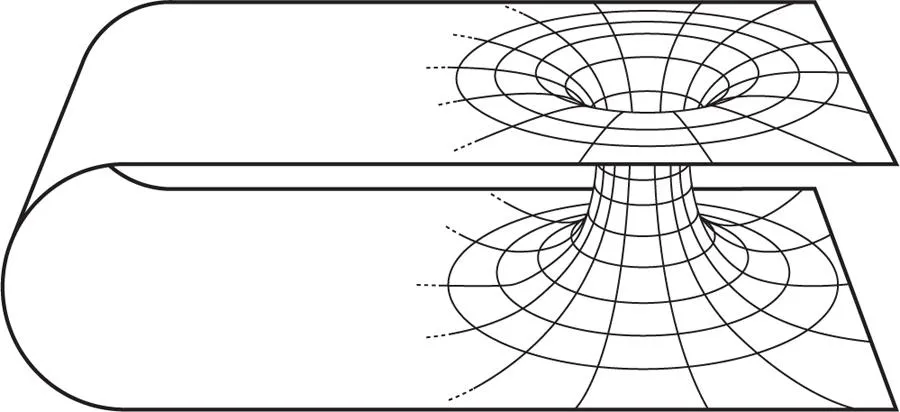
Because gravity, particles and the particles' own gravity feed back on each other, the equations are "a tangle" beyond classical computers but, he hopes, not quantum ones.
Date and physics corrections. The M87 image was released in April 2019; 2021 brought its polarised version and 2022 the image of our own galaxy's black hole, Sagittarius A*. The Kerr solution's centre is a ring singularity, not a "ring of neutrons," and the passage to "another universe" exists only in an idealised, eternal solution; realistic collapsing black holes are thought to seal it off through instabilities (mass inflation). Quantum-gravity simulation on quantum computers is an active field, but its best-known example, Google's 2022 "traversable wormhole" on Sycamore, simulated a tiny toy model whose interpretation was sharply disputed.
Dark matter and dark energy
Textbooks say the universe is made of atoms; it is not. Lord Kelvin (1884) inferred dark bodies from the Milky Way's motions; Fritz Zwicky and Vera Rubin found galaxies and clusters spinning so fast they should fly apart (our galaxy, Kaku says, about ten times too fast); the evidence was long ignored out of faith in Newton. Galaxies sit in dark matter halos many times their visible mass. Dark matter is mapped by how it bends light (gravitational lensing), as the distortion through a glass lens reveals the glass.
Drop a handful of dark matter. It slips through your fingers, through the floor, the concrete and the crust, crosses the Earth's core and rises toward the far side (Kaku says China) until gravity halts it, then falls back to your hand and oscillates forever through the planet, never touching an atom. That is what "does not interact with ordinary matter" means, and why detectors deep underground still catch nothing.
Two cosmic surprises. The largest direct-detection experiments (LZ, XENONnT, PandaX) have found no dark-matter particles, excluding much of the favoured parameter space. And the DESI survey (2024–25), mapping millions of galaxies, found 2.8–4.2σ hints that dark energy is weakening over time, which would overturn the simple cosmological constant behind Kaku's 68%; ESA's Euclid is testing the claim.
The Standard Model and its cracks
The Large Hadron Collider near Geneva, a 16.6-mile ring accelerating protons to 14 trillion electron volts, completed the Standard Model, which unifies electromagnetism with the strong and weak forces. Kaku touched its tube while it was being built. The theory works, but it is ugly: 36 quarks and antiquarks, 19 adjustable parameters, three identical generations, gluons, W and Z bosons, the Higgs; "a theory only a mother can love," like an aardvark, platypus and whale taped together. It omits gravity, dark matter and dark energy. Physicists suspect it is the low-energy tail of a lion.
For fifty years experiments matched it. Then in 2021 Fermilab reported that muons (Kaku calls them "mu mesons") wobble in a magnetic field slightly more than predicted, perhaps a sign of new forces or string theory. Kaku also says LHC collision data, a trillion bytes per second, is "analyzed by a quantum computer," and looks forward to the Future Circular Collider: 62 miles around, $23 billion, 100 TeV.
String theory and its many solutions
Kaku, a string theorist, calls it the leading and only candidate beyond the Standard Model; rivals are "divergent, anomalous, inconsistent." He tells correspondents with a Theory of Everything to check three tests.
Kaku's three criteria for a Theory of Everything
- It must contain Einstein's gravity.
- It must contain the whole Standard Model: quarks, gluons, neutrinos and the rest.
- It must be finite and free of anomalies.
Only string theory, he says, passes all three.
In string theory particles are notes on a vibrating string: physics is harmony, chemistry melody, the universe a symphony, and Einstein's "mind of God" cosmic music. Gravity emerges automatically as one of the lowest notes, so general relativity would have been found even without Einstein. The problem is the sheer number of solutions (string theorists' "vacua"): perhaps infinitely many, each a universe. Newton's laws also have infinite solutions, but you pick one with initial conditions; for string theory you would need the conditions of the big bang, which no one knows. Is it a theory of everything, or of anything? New colliders (FCC, China's CEPC, Japan's ILC) might help, without guarantee.
Kaku's own proposal: as nature (he believes) uses the sum over paths in photosynthesis, load string theory onto a quantum computer and let unstable solutions decay, leaving our universe as the stable one. The precedent is quantum chromodynamics (QCD), the theory of the strong force: when pen-and-paper solutions failed, physicists turned to lattice QCD, dividing spacetime into billions of tiny cubes and solving on supercomputers.
String theory's standing is weaker than Kaku states. There is still no experimental evidence for strings, supersymmetry or extra dimensions after the LHC's runs; the number of solutions is often put at 10⁵⁰⁰ or more vacua; and alternatives (loop quantum gravity, asymptotic safety, causal sets) are active, if incomplete. Kaku's photosynthesis precedent is the disputed claim from Chapter 7. Lattice QCD does not solve cube after cube in sequence; it samples field configurations over the whole lattice by Monte Carlo methods. No formulation of string theory exists that a quantum computer could simply "run."
One of Kaku's cosmic ideas is a real quantum target. Lattice gauge theories fail on classical computers for real-time dynamics and dense matter (the sign problem), and these are natural for quantum simulators. In 2024–25, teams using superconducting (Google) and neutral-atom (QuEra) processors simulated string breaking (the snapping of the flux tube between quarks) in small lattice models. Simulating nuclear and particle physics, not astronomy's data or string theory's vacua, is where quantum computers are most likely to help fundamental physics first.
So, Kaku concludes, quantum computers may hold the key to creation itself.
A Day in the Year 2050
Kaku ends the main text with a narrative: one day, and then a courtship, in the life of an engineer at a firm called Quantum Technologies in January 2050. Every convenience and every rescue in the story, from fusion power to cancer caught in the shower to a pandemic stopped in a week, is credited to quantum computers. The chapter restates the book's promises as lived experience, and is best read as a checklist of claims to test.
The morning
At 6:00 a.m. the narrator wakes with a hangover. Molly, a robotic assistant in the wall screen, reminds him of last night's party for the opening of a new fusion reactor, possible because quantum computers learned to stabilise the plasma; scores more reactors will follow. He plays a game with the morning science news: spot any story not made possible by quantum computers.
The morning news, and what Kaku credits
- Supersonic jets approved to cross oceans: quantum "virtual wind tunnels" found shapes that eliminate the sonic boom.
- Mars colonists build solar arrays and super batteries designed by quantum computers, which also cut Earth's reliance on coal and oil.
- A new Alzheimer's drug blocks the build-up of the harmful amyloid; his company's quantum computers isolated the culprit protein.
Every story passes his test. In the shower, his wastewater flows to a biolab and is screened for cancer cells several times a day; millions get a silent check-up from a quantum computer linked to their bathroom. Then Robo-doc appears with good news and bad: last week's sample shows lung cancer, but only a few hundred cells. The tumour's genetics have been analysed and a shot of genetically modified immune cells, designed by his company's quantum computers, will clear it. Decades earlier he would have had billions of cancer cells and about five years to live.
The emergency
An urgent, in-person meeting is called. A driverless car collects him through traffic smoothed by road sensors and quantum-optimised lights, then parks itself. In the boardroom, his contact lens shows colleagues' biographies and later translates questions from foreign languages. The president announces that the firm's international sewer-sensor network has detected a new, highly lethal, highly contagious virus, probably from birds, near the Thai border; the last pandemic killed over a million Americans.
A flying car takes him to a supersonic transport: breakfast in New York, lunch over Alaska, dinner in Tokyo, instead of the old thirteen-hour flight. The next day his manager explains that quantum computers have read the virus's genetics, found its molecular weak spots, designed vaccines, traced its spread through airline and rail records, and calibrated airport sensors to smell it. After a week he flies home, having helped save millions of lives and the world economy.
The interview
A journalist, Sarah, interviews him for a major magazine. Old silicon computers are being junked; even phone calls go to quantum computers in the cloud. Her questions and his answers:
| Sarah asks | The engineer answers |
|---|---|
| Will it feed the poor? | Quantum computers cracked nitrogen fixation: a Second Green Revolution, no famines or food riots. |
| What about wild weather? | Warming predictions all came true, but quantum-designed super batteries and fusion make clean energy cheaper than fossil fuel "for the first time in history." |
| Your family? | His mother had Alzheimer's; quantum computers isolated the misshapen amyloid, and "a cure ... is at hand." |
| The Fountain of Youth? | Gene therapy, CRISPR and quantum computers are correcting the errors of aging. |
| Another lifetime? | Use quantum computers to answer where the universe came from and what preceded the big bang; better than 42, the answer in The Hitchhiker's Guide to the Galaxy. |
He asks her to dinner. At the firm's quantum virtual-reality arcade they explore space, a beach and a mountaintop, and watch a moonrise so real it brings back the Apollo landings that drew him into science; for Sarah, the thrill was the hope of seeing women walk on the Moon. They marry, and with space travel getting cheap, Sarah pitches a story to her magazine: a honeymoon on the Moon.
Almost every item in the scenario is being delivered, if at all, by other technologies. Play Kaku's own game honestly:
- Quiet supersonic flight: NASA's X-59 (first flight 2025) was shaped with classical computational fluid dynamics to turn the boom into a "thump."
- Super batteries: LFP, sodium-ion and megawatt charging came from manufacturing scale and AI-assisted materials screening (Chapter 9).
- Alzheimer's: anti-amyloid antibodies were developed by conventional biology and trials, and slow rather than cure the disease (Chapter 12).
- Cancer in wastewater: wastewater surveillance tracks pathogens at population level; personal cancer detection from sewage faces dilution and privacy hurdles no computer solves.
- Engineered immune cells: CAR-T and checkpoint therapies are designed with sequencing and lab biology.
- Pandemic response: mRNA vaccine design took two days in 2020 on ordinary computers; the delays were in trials, manufacturing and politics.
- Live translation in a lens: large language models on classical chips already do this in earbuds and glasses.
- Traffic optimisation: classical algorithms and reinforcement learning.
The plausible quantum contributions by 2050 are narrower: catalyst and battery chemistry, some materials and drug-binding problems, and, first of all, breaking (and forcing the replacement of) public-key cryptography.
Rewrite the morning news for 2050 with honest attribution. Fusion reactor opens: magnet materials partly found by quantum simulation of superconductors, plasma control by AI. Alzheimer's drug: AI-designed antibody, binding energies refined on a fault-tolerant quantum computer. Bank outage averted: the last RSA certificates were retired years ago, because a quantum computer factored a 2,048-bit key in a government lab. The exercise shows the likely shape of the future: quantum computers as specialist co-processors in a classical and AI stack, not a replacement for silicon.
A bank's technology strategy should hold at least three quantum scenarios to 2035: (1) slow (no fault-tolerant machine; PQC migration still mandatory because regulators require it); (2) expected (a few hundred logical qubits by the early 2030s; chemistry and some optimisation pilots; RSA-2048 within reach by the mid-2030s); (3) fast (a cryptographically relevant machine by around 2030, possibly unannounced). The no-regret moves are identical across all three: crypto inventory, hybrid PQC, vendor clauses, and a small quantum-literacy team.
The novel-like ending is pure Kaku: the scientist gets the girl, and the honeymoon is on the Moon.
Quantum Puzzles
Kaku closes with four questions at the border of physics and philosophy, each bearing on quantum computers: whether God had a choice in the laws of nature, whether the universe is a simulation, whether quantum computers compute in parallel universes, and whether the universe itself is a quantum computer. His answers: quantum mechanics is probably the only rule-set that yields stable matter; a perfect simulation of the universe is impossible because the smallest thing that can simulate the universe is the universe; the interpretations are experimentally equivalent; and while the universe is not a quantum computer, a quantum computer can in principle encode everything in it.
Stephen Hawking said physicists are the only scientists who can say "God" without blushing; these four questions make them blush.
Kaku's four quantum puzzles
- Did God have a choice? Could the universe have been built on other laws (Einstein's favourite question)?
- Is the universe a simulation? Are we lines of code in someone's video game?
- Do quantum computers compute in parallel universes? Does the multiverse resolve the measurement problem?
- Is the universe a quantum computer? Is everything from particles to galaxy clusters computation?
1. Did God have a choice?
Quantum behaviour (being in two places, tunnelling, "faster-than-light" correlations, exploring infinite paths) seems perverse. Einstein said "God is subtle, but not malicious," and sometimes wondered about malice. Alfonso the Wise said that had he been present at creation he would have offered "some useful hints"; the Scottish critic Lord Jeffrey damned the solar system as a "feeble contrivance." Yet physicists who design alternative laws keep producing universes that are unstable or fatally flawed.
Kaku's stability argument for quantum mechanics
- A universe must first of all be stable.
- In a Newtonian atom, electrons orbit like planets; a slight disturbance makes orbits wobble until electrons collide or fall into the nucleus, and the atom collapses.
- Classical orbits around two nuclei are even less stable, so molecules cannot exist; the universe becomes a formless mist.
- In quantum mechanics electrons are waves allowed only in discrete resonances; collapsing configurations are simply not solutions, so atoms are stable, and shared resonances bind molecules.
- Therefore quantum strangeness has a "purpose": stable, solid matter.
- Modify the Schrödinger equation and matter destabilises; so although quantum computers can be built from many materials, there is essentially one way for them to compute and still describe stable matter.
The classical collapse is faster and simpler than Kaku says. An orbiting electron is accelerating, and by Maxwell's equations any accelerating charge radiates; a classical hydrogen atom would spiral into its nucleus in about 10⁻¹¹ seconds, no disturbance needed. Kaku's uniqueness point has stronger modern support than he gives: theorists have shown that nonlinear modifications of quantum mechanics would permit faster-than-light signalling (Gisin) and would let computers solve NP-complete problems efficiently (Abrams and Lloyd, 1998), both so implausible that they count as arguments for the theory's exact form.
2. Is the universe a simulation?
In The Matrix, Neo flies, stops bullets, downloads karate and walks through mirrors because his world is a computer simulation. As computing power grows, could ours be one?
"The smallest object that can simulate the weather is the weather itself." A bottle of air holds over 10²³ atoms, each with a position and velocity; global weather multiplies that astronomically. Chaos adds a second barrier: the butterfly effect amplifies tiny differences, so collective motion cannot be predicted molecule by molecule. A perfect classical simulation of reality is impossible.
Quantum computers fare no better, Kaku argues. 300 qubits span 2³⁰⁰ states, more than the universe has; but simulating one protein exactly needs more states than the universe holds, and a body contains billions of proteins, so billions of quantum computers would be needed. Only an imperfect simulation could exist: one with gaps, a sky with "rips and tears, like an old movie set," or an ocean that ends at an aquarium's glass wall.
Kaku's protein argument undercuts his own book. The whole point of a quantum computer is that it does not need one physical unit per state: n qubits already span 2ⁿ states, so exactly representing a molecule with N spin-orbitals needs roughly N qubits, not "more states than the universe." A protein with tens of thousands of electrons would need on the order of 10⁵ logical qubits: enormous, but a linear, not exponential, cost. The modern simulation argument also deserves mention: Nick Bostrom (2003) argued that if civilisations commonly run ancestor simulations, we are probably in one, which sidesteps Kaku's objection by assuming simulators would render only what observers look at, much like his "imperfect" simulation.
3. Parallel universes
Science fiction has moved from outer space to the multiverse. Kaku used to count the physics violations in films until he remembered Arthur C. Clarke: "Any sufficiently advanced technology is indistinguishable from magic." With multiverse films, he notes, Hollywood is following theorists. Everett's many worlds, dropping the collapse postulate, is the simplest resolution of the measurement problem, at the price of an infinite branching cascade. David Deutsch thinks it is why quantum computers are powerful. Hawking: "When I hear of Schrödinger's cat, I reach for my gun."
| Interpretation | What ends the superposition | The cat |
|---|---|---|
| Copenhagen | The experimenter's measurement | Neither dead nor alive until the box is opened |
| Decoherence (Kaku's description) | Contact with the environment | Already dead or alive: air molecules have "measured" it |
| Many worlds | Nothing; the wave never collapses | Dead in one branch, alive in another |
Kaku's objection to decoherence: it needs a line between environment (air) and system (cat). In quantum gravity the unit is the whole universe, with one indivisible wave function containing experimenter, cat and air, and coherence differs only by degree (even 13.8 billion years after a fully coherent big bang, faint coherence links the cat and the air). That returns us to Everett. All three interpretations give identical experimental predictions; only many worlds allows, in principle, hopping between branches, with odds requiring longer than the age of the universe.
Decoherence is not a rival interpretation, and it does not cause collapse. Decoherence (Zeh, Zurek and others) is standard quantum dynamics: entanglement with the environment rapidly suppresses interference between macroscopic alternatives, which explains why we never see superposed cats. It does not pick which outcome occurs; that remains the interpretive question. Modern Everettians use decoherence to define the branches, so Kaku's "flaw" is in fact the mainstream many-worlds position. Experiments have put ever larger objects in superposition (molecules of about 2,000 atoms, 2019; micro-mechanical oscillators), steadily pushing back against collapse models.
4. Is the universe a quantum computer?
Kaku extends the lineage: Babbage asked the limits of mechanical computing, Turing of digital computing; the next question is the limit of computing with atoms, and since the universe is made of atoms, whether it is itself a quantum computer. The idea belongs to MIT's Seth Lloyd, who as a graduate student sat between particle physicists and computer scientists and wanted to connect the particle with the bit.
The toy train argument
- Classical. A toy train on a track of squares: 1 where the train is, 0 elsewhere. Moving it one square swaps a 0 and a 1. Replace the track with Turing's tape and the train with the head: the train's motion is a Turing machine computation.
- Acceleration and 3D. Widen the gaps between successive 1s to speed up; extend the track to a 3D lattice. All of Newtonian mechanics can be encoded.
- Quantum. Put a compass on the train: north is 1, south is 0, any angle in between a superposition. As the train moves, the needle turns according to the Schrödinger equation.
- Entanglement. Add several compasses whose needles move together under the processor's rules.
- Conclusion. A quantum Turing machine can encode the laws of quantum mechanics, and therefore any phenomenon in the universe, from particles and DNA to black holes and the big bang. Strictly, the universe is not a quantum computer, but everything in it can be codified by one.
This is the Church–Turing–Deutsch principle. Deutsch's 1985 paper stated it formally: every finitely realisable physical system can be perfectly simulated by a universal quantum computer. Lloyd (2002) estimated the universe has performed about 10¹²⁰ operations on about 10⁹⁰ bits since the big bang. Whether quantum gravity respects the principle is open; the holographic (AdS/CFT) research programme suggests spacetime itself may emerge from quantum information, which is why quantum processors are now used to simulate toy models of quantum gravity.
A universe that cannot be shortcut. Suppose the universe is a quantum computer running its own laws. Then for most questions about its future there is no faster method than letting it run: the best simulation of a system is the system itself. A quantum computer is valuable precisely when a small, controllable quantum system can stand in for a large, uncontrollable one, a molecule standing in for a drug's target or a lattice of atoms for a superconductor. That is the honest scope of quantum supremacy.
The playground for quantum computers is the universe itself; if we truly understand a quantum Turing machine, Kaku suggests, we may understand the universe. "Only time can tell."
Main Points
- Quantum computers are simulators of nature first. Their clearest advantage is modelling strongly correlated electrons (catalysts, magnets, superconductors, enzyme active sites), where classical cost grows exponentially; Feynman's "nature isn't classical" remains the soundest case for the field.
- The first certain impact is cryptographic. Shor's algorithm breaks RSA and elliptic-curve cryptography; estimates for RSA-2048 fell from about a billion physical qubits (2012) to under one million (2025), and "harvest now, decrypt later" makes the threat current. NIST's FIPS 203/204/205 (2024) are the replacement.
- Error correction, not qubit count, decides the race. Below-threshold operation (Google Willow, 2024) and rising logical-qubit counts (Quantinuum, neutral atoms, IBM's qLDPC codes) are the real milestones; a 1,000-qubit noisy chip is worth less than 100 good logical qubits.
- "Trying all answers at once" is a myth. Measurement yields one result; speed-ups come from interference engineered for structured problems, which is why quantum computers will not accelerate most workloads.
- AI got to most of Kaku's applications first. AlphaFold solved structure prediction, generative models design proteins and antibiotics, AI forecasts weather better than physics models, and AI screens battery materials, all on classical GPUs. Quantum computing must now beat AI baselines, not just old supercomputers.
- Realistic timelines run into the 2030s. Vendor roadmaps target fault-tolerant machines around 2029 (IBM Starling, Quantinuum Apollo), DARPA asks for utility by 2033, and chemistry targets such as FeMoco need roughly 100,000 to millions of physical qubits.
- Computing is a 2,000-year project to simulate the world, from the Antikythera's bronze gears to Turing's tape to qubits; each substrate widened what could be modelled faithfully.
- Formal systems have limits. Gödel's incompleteness and Turing's halting problem show that no machine, classical or quantum, decides every mathematical truth; quantum computers change speed, not computability.
- Entanglement is real but carries no signal. Bell tests (Nobel 2022) rule out Einstein's local hidden variables; correlations appear only when records are compared over ordinary channels.
- Dirac's sentence is the field's charter. The laws of chemistry are fully known; only the computing power to apply them is missing.
- Quantum biology is narrower than advertised. Tunnelling in enzymes and radical pairs in bird navigation are real; long-lived coherence steering photosynthesis has largely been refuted.
- Haber–Bosch shows the stakes of catalysis. It feeds half of humanity and uses about 2% of world energy; understanding nitrogenase is a benchmark problem for useful quantum chemistry.
- Storage was the Solar Age bottleneck, and scale broke it. Battery packs fell about 90% in price in fifteen years through manufacturing, LFP and sodium chemistries, not quantum design.
- Medicine is moving from luck to mechanism. CRISPR therapies (Casgevy, 2023), mRNA vaccines and anti-amyloid antibodies arrived through biology, sequencing and AI; quantum computers may later refine binding and reaction energies.
- Aging is accumulated error with many hallmarks. Species reach similar lifetime mutation budgets, reprogramming can reset cellular age markers, but no intervention yet extends human lifespan, and single-mechanism cures repeat Tithonus's mistake.
- Fusion is closer but still unproven commercially. NIF reached a target gain above 4 (2025); private tokamaks with high-temperature magnets aim for first plasma in 2027; ITER slipped to 2039 for D–T; tritium supply and wall materials remain hard.
- Plasma and weather are classical problems. Their progress comes from supercomputers and AI; the genuine quantum targets in fusion are superconductor physics (the Hubbard model) and materials.
- Fundamental physics offers real quantum targets: real-time lattice gauge theory, dense nuclear matter and toy models of quantum gravity, rather than astronomy's big data or string theory's vacua.
- Advantage claims get clawed back. Sycamore's 10,000 years became days, then hours, under classical tensor-network methods; any "beyond classical" claim should be read as an opening bid in a contest.
- Interpretations are experimentally equivalent. Copenhagen, decoherence-based many worlds and others predict the same results; decoherence explains why cats look classical, not which outcome occurs.
- Quantum computers can encode any physical process (the Church–Turing–Deutsch principle) with qubits growing linearly in system size, which is exactly what makes them worth building.
Frameworks & mental models
The book as a whole. Kaku writes with infectious enthusiasm and explains the physics clearly, but the book is promotional rather than analytical. It repeatedly asserts that digital computers are "useless" for problems classical chemistry, AI and supercomputing routinely solve; it attributes almost every future benefit to quantum computers, including climate modelling, asteroid tracking, pandemic surveillance and genomic big data, where no quantum advantage is known or expected; and it largely ignores the decisive caveats of the field: error correction, data loading, the narrowness of known speed-ups, and the regular classical rebuttals of supremacy claims. Its treatment of cryptography confuses AES with RSA; its photosynthesis chapter relies on a coherence story that later experiments undercut; and it went to press without mentioning ChatGPT, although large language models were already the most important computing story of the moment. Read it as an inspiring tour of what quantum mechanics could make possible, then use the 2026 updates for what is actually happening.
Who's who
| Person | Role in the story |
|---|---|
| Richard Feynman | Proposed quantum simulation (1981); path integrals; nanotechnology vision |
| David Deutsch | Quantum Turing machine (1985); many-worlds account of quantum speed-up |
| Peter Shor | Factoring algorithm (1994) that threatens RSA |
| John Preskill | Coined "quantum supremacy" (2012) |
| Alan Turing | Turing machine, halting problem, Bletchley Park, the imitation game |
| Kurt Gödel | Incompleteness theorems (1930–31) |
| Max Planck, Albert Einstein | Quanta (1900); photons and EPR (1905, 1935) |
| Erwin Schrödinger, Max Born | Wave equation and its probability interpretation; the cat |
| Niels Bohr, Werner Heisenberg | Copenhagen interpretation; uncertainty principle |
| Hugh Everett III | Many-worlds interpretation (1957) |
| Fritz Haber | Ammonia synthesis and chemical warfare |
| Watson, Crick, Franklin | DNA double helix (1953) |
| Walter Gilbert, Francis Collins | Sequencing and the Human Genome Project |
| Charpentier, Doudna | CRISPR gene editing (Nobel 2020) |
| Hassabis, Jumper, Baker | AlphaFold and protein design (Nobel 2024) |
| Stanley Prusiner | Prions (Nobel 1997) |
| Shinya Yamanaka | Reprogramming factors; Altos Labs adviser |
| Clarke, Devoret, Martinis | Macroscopic quantum tunnelling in circuits (Nobel 2025); ancestors of superconducting qubits |
| Craig Gidney | Successive RSA-2048 resource estimates (2019, 2025) |
| Seth Lloyd | The universe as a quantum computer |
About this book
Quantum Supremacy: How the Quantum Computer Revolution Will Change Everything by Michio Kaku, 2023. This is a chapter-by-chapter study of the book, with summaries, maps, tables and diagrams; short quotations keep their page references. It is shared free for personal study, is not for sale, and is not endorsed by the author or publisher. Please read and buy the original.
Insight Editions · rajeshrmahapatra.com/insight-editions