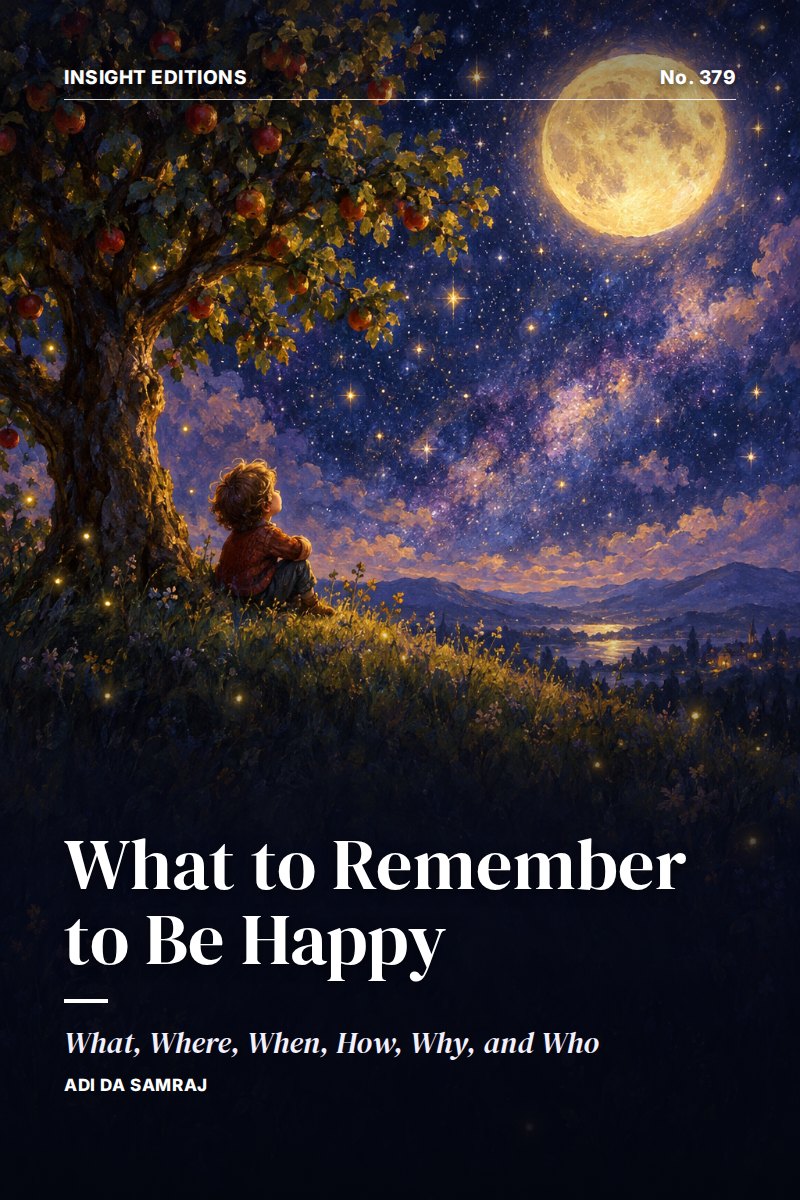
Insight Editions · No. 379
What, Where, When, How, Why, and Who to Remember to Be Happy
A Children's Book of the Mystery
Adi Da Samraj
A study edition of Adi Da's illustrated book for children (1978, revised 2000): the Mystery behind every name, sleep and death as forgetting what we look like, and three things to remember every day.
A study guide to What, Where, When, How, Why, and Who to Remember to Be Happy by Adi Da Samraj. Shared free for personal reading; not for sale and not endorsed by the author or publishers. Please read and buy the original.
CORE CLAIM
Nobody knows what even a single thing Is. Feeling that Mystery, and remembering it every day, keeps a person happy, loving and unafraid, even of sleep and death.
SCOPE
A 56-page illustrated book for children, first published as What To Remember To Be Happy (February 1978), revised in 2000; pictures by Maja van der Veer. About 2,500 words of story text.
KEY FIGURES
Adi Da Samraj speaking directly to a child; parents, teachers, "even a President" as people who also don't know.
BEST FOR
Parents and teachers looking for a non-doctrinal way to talk about wonder, sleep and death with young children, and adults curious how Adi Da simplified his teaching.
The Book on One Page
The book teaches by pointing: an apple, a tree, the moon, a little girl. We know their names, Adi Da says, but not what they Are. That not-knowing is the Mystery, and it feels good.
| Part | Pages | Payload |
|---|---|---|
| 1. The Mystery | 8 to 20 | Names are not knowledge; "I don't know" and "God made it" say the same thing |
| 2. Sleep and death | 19 to 24 | Waking is "only one of the ways you are"; death is the body going "to sleep for good" |
| 3. Three things to remember | 27 to 43 | Feel and breathe the Mystery; you are more than you look like; you Are the Mystery |
| 4. Friends and the Teacher | 44 to 48 | Talk about the Mystery with friends; remember Adi Da, who "Is the Mystery Itself" |
The Mystery
"Truly, you and I don't know what even a single thing Is. Do you know what I Am?" The opening pages turn a child's naming game into a contemplation.
- Names are not knowing. "No matter what we name this ... we still do not know what they Are."
- Two honest answers. Some say "I don't know," others "God made it." Both "are simply pointing to the feeling of the Mystery."
- No exceptions. Not Mom, Dad, teachers, doctors, "not even a King or a Queen" knows what a single thing Is.
- The secret. "As long as you go on feeling this Mystery, you feel free and full and happy."
Agnosticism and theism are treated as two ways of saying the same thing, which lets the book sidestep belief altogether.
Sleep and Death
The book handles death through sleep. Everybody's waking part "goes to sleep in the feeling of the Mystery," and people make each other afraid by forgetting it.
"When you sleep, you are something different than when you wake up. And when you dream, you are different, too." So "the way you seem to be when you wake up is only one of the ways you are." Death is when "what they look like go[es] to sleep and not wake up," and then they "go on to someplace else and look different."
The comfort offered to children rests on a claim about survival after death ("the rest of you goes on in the Mystery") that the book presents as plain fact. Parents from other traditions, or none, may want to keep the wonder and soften the metaphysics.
Three Things to Remember
Remember them "lots of times all day every day, and at special sitting-and-doing-nothing-else-but-this times."
- Feel the Mystery, and even breathe It. "Breathe in the good stuff, breathe out the bad stuff." In time "the Mystery is remembering and feeling and breathing you."
- Feel you are more than what you look like. The body is "only you while you are awake and alive"; you are also "electrical, and ... light and sound."
- You Are the Mystery. You watch the body, the lights, the thought "I"; "what are you, if you only watch all of these things? You Are the Mystery!"
- Sit quietly and breathe the Mystery until breathing is still.
- Fingers in the ears, eyes closed, listen up toward the top of the head: "ringing and tinkling ... ocean roaring ... a big deep humming."
- Fingers over closed eyes, look up inside: "lights, and zigzags ... moving shiny spots."
- Purpose: to remember "what you are that is more than what you look like."
This is a child's version of nada (inner sound) and jyoti (inner light) practices from yoga traditions, offered as play.
Pressing on the eyes to see phosphenes is a yogic technique adults are often warned to do gently. The book gives no caution for children; light touch is enough.
Friends and the Teacher
The last pages shift from method to relationship, and from "the Mystery" to Adi Da himself.
Spend time "talking about the Mystery with others, instead of talking about unhappiness." Then he speaks in the first person: "I was born so that I could be everyone's Friend." "I am the 'Bright' Teacher of Happiness." "All My friends should constantly forget themselves ... and remember only Me," because "I Am the Mystery Itself."
For most of its length the book needs no teacher: any child can feel the Mystery. The ending makes remembering Adi Da the easy path to it. A reader can value the first three parts and still treat the final devotional turn as specific to Adidam.
Master Takeaways
A children's book that keeps Adi Da's core teaching intact in plain words.
- Names are not knowledge of what things Are.
- "I don't know" and "God made it" point to the same Mystery.
- Feeling the Mystery brings happiness and kindness to others.
- Waking is one state among three; you are not only the waking self.
- Breathe in the good, breathe out the bad, standing up, every day.
- You are more than what you look like: light, sound, feeling.
- Listening and looking inward are offered as daily play.
- The watcher is the Mystery: "It Is All One Feeling."
- Choose friends who remind you of the Mystery.
- The book ends in devotion to Adi Da as the Mystery in person.
| Model | Use it when |
|---|---|
| Name vs Is | Opening wonder with a child |
| Sleep as a way you are | Talking about death without fear |
| Three things to remember | A simple daily practice |