Insight Editions · No. 361
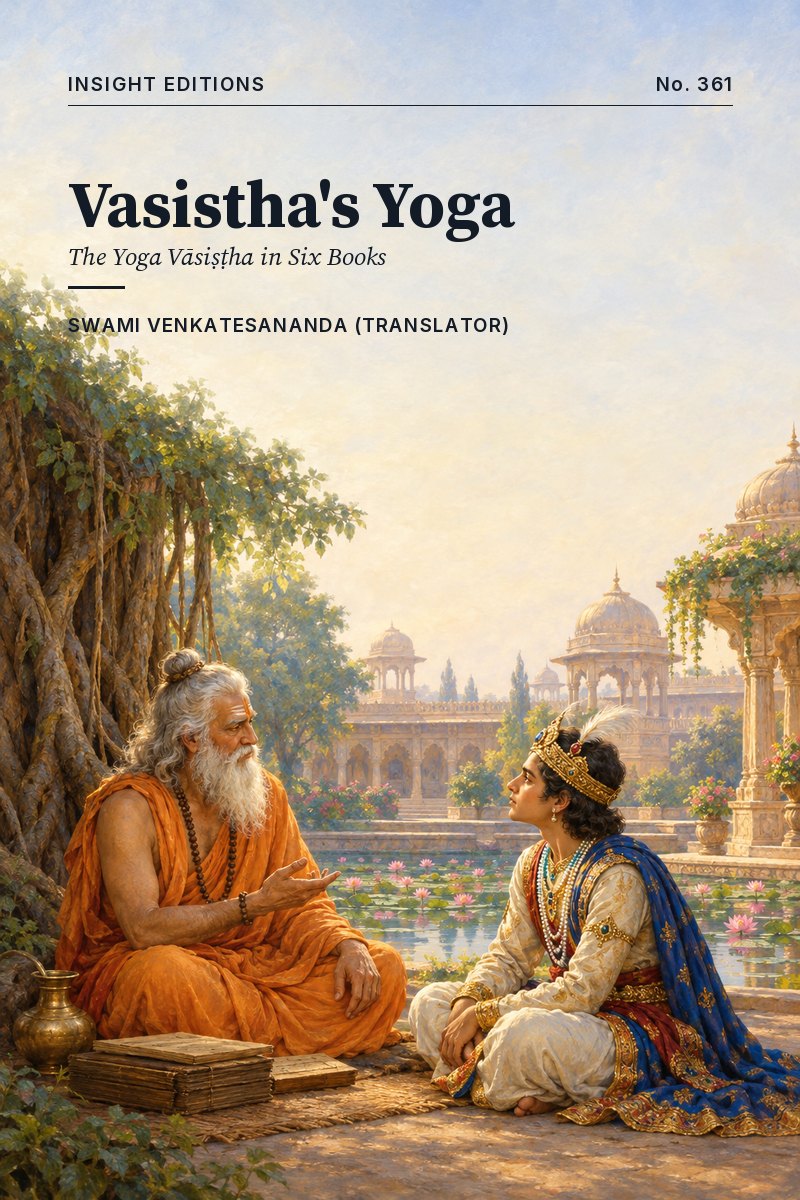
Vasistha's Yoga
The Yoga Vāsiṣṭha in Six Books
Swami Venkatesananda (translator)
A guide to Swami Venkatesananda's rendering of the Yoga Vāsiṣṭha: Rāma's dispassion, self-effort, the stories of Līlā, Karkaṭī, Śukra, Prahlāda, Bhuśuṇḍa and Cūḍālā, and liberation while living.
A study guide to Vasistha's Yoga by Swami Venkatesananda (translator). Shared free for personal reading; not for sale and not endorsed by the authors or publishers. Please read and buy the original.
The Book at a Glance
The Yoga Vāsiṣṭha is one of the longest and boldest works of Indian spiritual literature: a dialogue in which the sage Vasiṣṭha teaches the young prince Rāma, through argument and some fifty interlocking stories, that the world is a projection of the mind in infinite consciousness and that liberation is the end of conditioning, attained while living and acting. Swami Venkatesananda's Vasistha's Yoga (State University of New York Press, 1993) is a condensed English rendering of the whole Sanskrit text in its six books, arranged as a sequence of daily readings. This Insight Edition is a guide to that rendering: it sets out the frame story, follows the six books in order, retells the principal stories in brief, gathers the core doctrines, and closes with questions for reflection.
The Sanskrit work, also known as the Mahā-Rāmāyaṇa, the Vāsiṣṭha Rāmāyaṇa or Mokṣopāya, is traditionally said to contain 32,000 verses and attributed to Vālmīki, author of the Rāmāyaṇa; scholars date it variously between the sixth and fourteenth centuries and connect parts of it with Kashmir. Venkatesananda (1921–1982) was a disciple of Swami Sivananda of the Divine Life Society, Rishikesh, and taught widely in South Africa, Mauritius and Australia. His introduction advises reading "just one page a day" and meditating afterwards, and in his foreword Swami Ranganathananda praises the work's thoroughly rational approach.
The Frame Story
Rāma, the sixteen-year-old prince of Ayodhyā, returns from a pilgrimage changed. He grows thin and listless, neglects his duties and finds no meaning in kingship, pleasure or life itself. When the sage Viśvāmitra arrives at King Daśaratha's court to ask for Rāma's help against demons disturbing his sacrifice, Rāma is brought in and pours out his despair in a long, eloquent lament. Viśvāmitra recognises it not as illness but as the dispassion that precedes wisdom, and asks the family preceptor Vasiṣṭha to teach him. The rest of the book is Vasiṣṭha's teaching, delivered over many days in the royal assembly, with sages, kings and celestial beings listening, and interrupted each evening at sunset.
The teaching is unusual in Indian scripture in being given by a sage to an incarnation of God, and in its explicit appeal to reason. One often-quoted passage says that a reasonable remark should be accepted even from a child, and an unreasonable one rejected like straw even if it came from the Creator.
The Six Books
| Book | Sanskrit name | Theme | Principal stories |
|---|---|---|---|
| I | Vairāgya | On dispassion | Rāma's lament |
| II | Mumukṣu-vyavahāra | On the behaviour of the seeker | Śuka; self-effort |
| III | Utpatti | On creation | Līlā, Karkaṭī, the sons of Indu, Ahalyā, the great forest, the three non-existent princes, Lavaṇa |
| IV | Sthiti | On existence | Śukra, Dāma-Vyāla-Kaṭa, Bhīma-Bhāsa-Dṛḍha, Dāśūra, Kaca's song |
| V | Upaśama | On dissolution | Janaka, Puṇya and Pāvana, Bali, Prahlāda, Gādhi, Uddālaka, Suraghu, Bhāsa and Vilāsa, Vītahavya |
| VI | Nirvāṇa | On liberation | Bhuśuṇḍa, the worship of the Lord, Arjuna, the hundred Rudras, the vampire, Bhagīratha, Śikhidhvaja and Cūḍālā, Bhṛṅgīśa, Vipaścit, Kuṇḍadanta and others |
The order follows the seeker's path: dispassion opens the door; right conduct and effort prepare the ground; insight into how the world arises (creation) and how it persists (existence) loosens its hold; the mind is quietened (dissolution); and liberation is described from every side. Venkatesananda's references, such as "VI.1:110", give the book, the part (Book VI has two) and the chapter (sarga) of the Sanskrit text.
Book I · On Dispassion
Rāma's lament is one of the great pieces of world-weary eloquence in Sanskrit. He surveys wealth, life, the ego, the mind, desire, the body, childhood, youth, lust, old age, time and the fate of all creatures, and finds each wanting: wealth brings anxiety, youth is a brief fever, the body a vessel of decay, time devours all. He asks what state is free from sorrow and how one can live in the world untouched by it.
The book's point is that this despair is not a problem to be cured but the qualification for the teaching. Vairāgya, dispassion, is the first step because only someone who has stopped expecting lasting satisfaction from the world will look elsewhere. The assembly praises Rāma, and Viśvāmitra declares him ready.
Questions
Why is Rāma's despondency treated as a qualification rather than an illness?
Because it springs from seeing clearly that worldly objects cannot give lasting happiness. That clarity, vairāgya, turns the mind towards inquiry, and so it is the precondition of wisdom.
Book II · On the Behaviour of the Seeker
The story of Śuka
Viśvāmitra begins with Śuka, son of the sage Vyāsa, who had understood the truth by his own reflection but could not trust it. His father's confirmation did not satisfy him, so he went to King Janaka of Videha, who, after testing him by keeping him waiting at the gate for days, told him exactly what he already knew. Śuka then rested in peace. The story says that realisation needs no new information; doubt about what one has seen can be the last obstacle.
Self-effort and fate
Vasiṣṭha's first major doctrine is a strong defence of pauruṣa, self-effort. What people call fate (daiva) is nothing but the result of their own past actions; present effort, rightly directed, can overcome it, as today's effort overcomes yesterday's. Those who wait for fate are fools; effort guided by scripture, the teacher and one's own understanding is what brings results. This is a striking position in a work that will go on to deny the reality of the doer: Vasiṣṭha holds both, at different levels, and refuses to let the higher view become an excuse for passivity.
The four gatekeepers
Book II also names the four "gatekeepers" at the door of liberation. Befriend any one and he will introduce you to the others:
- Śama – self-control, tranquillity of mind.
- Vicāra – inquiry into the nature of the self and the world.
- Santoṣa – contentment with what comes unsought.
- Sādhu-saṅga – the company of the wise.
Book III · On Creation
Book III explains how the world arises. Its central claim is that creation is not a physical event in the past but the present activity of the mind (manas) within infinite consciousness (cit). The world is like a dream, a city in the sky (gandharva-nagara), or the blue of the sky: vividly experienced, but without independent substance. Space and time are themselves notions of the mind, which is why the book's stories so freely compress lifetimes into moments and fit worlds into atoms.
The story of Līlā
The longest story of the book. Queen Līlā, devoted to King Padma, fears his death and worships the goddess Sarasvatī for a boon: that when he dies his spirit should remain in the palace. He dies; at Sarasvatī's prompting Līlā lays the body under flowers in the palace hall. The goddess then takes her, in subtle form, into the space of that very room, where Padma is ruling another kingdom as King Vidūratha, and further back to the hill village where, in a previous life, the couple were a brahmin named Vasiṣṭha and his wife Arundhatī, whose longing for royalty began the whole chain. Within days of their time, decades pass in his; within the space of a room, whole worlds exist. Vidūratha dies in battle, a second Līlā created in his world goes with him, and both Līlās finally rejoin Padma, who is restored to life. The story makes the teaching about time, space and the mind vivid, and introduces the idea that each person lives in a world projected by their own past impressions.
The story of Karkaṭī
Karkaṭī, a huge, ever-hungry demoness of the Himalayas, performs austerities to become a tiny needle-like being (Sūcikā, the disease of cholera) that can enter and feed on countless creatures. Her new form brings her only misery, and she does further penance to recover her body. Now wiser, she meets a king and his minister in the forest at night and puts to them a long series of riddles about the Self; they answer them all. She becomes their friend and vows to eat only wrongdoers. The riddles summarise the teaching about the one consciousness that is "subtler than the subtlest" and yet contains everything.
Other stories of creation
- The sons of Indu – ten brothers meditate on the idea "I am Brahmā, the creator" with such intensity that each becomes the creator of a universe. The world-system is the product of concentrated notion.
- Ahalyā – told not as the familiar myth but as a love story: a queen and a young man named Indra are so absorbed in each other that the king's punishments – fire, elephants, the lash – cannot touch them. The mind, wholly given to one idea, is unaffected by the body's circumstances.
- The great forest – an allegory of a man with a thousand arms who wanders a vast forest, beating himself, falling into wells and thorn-bushes, and running back and forth. The man is the mind; the forest is the world it creates and torments itself in.
- The three non-existent princes – a nurse's bedtime story about three princes, two unborn and one not yet conceived, who live in a city in the sky and bathe in rivers that are not there. The child is satisfied; Vasiṣṭha says the world is a story of the same kind.
- Lavaṇa – a magician waves a peacock feather before King Lavaṇa, who in a moment lives a whole life as an outcaste in the forest: marriage, children, famine, despair. He comes to on his throne. Later he travels and finds the village and the people of his vision, who remember him. Experience and reality are not as separate as we think.
Questions
What does the story of Līlā teach about time and space?
That both are notions of the mind. Decades in one world pass in days in another, and whole kingdoms exist within the space of a room, because each world is a projection of consciousness shaped by its own impressions.
Why does Lavaṇa's vision later prove to have "real" counterparts?
Because waking reality and vision are both projections in the same consciousness. The story removes the firm line between the two, which is the book's point.
Book IV · On Existence
If Book III explains how the world arises, Book IV explains how it continues. The answer is vāsanā, the store of latent tendencies and impressions that the mind keeps re-enacting. As long as vāsanās remain, the world-appearance is sustained; as long as the mind identifies with them, there is bondage.
The story of Śukra
Śukra, son of the sage Bhṛgu, glimpses a celestial nymph while his father is in meditation and, sitting where he is, follows her in imagination to heaven. He lives life after life in fantasy – as a celestial, a king, a hunter, a sage – while his physical body withers by the riverbank. When Bhṛgu emerges and in grief threatens Yama, the god of death, Yama explains that Śukra has been killed by nothing but his own desires and conceptions. Śukra's latest life is located, and he returns to his old body. Each mind lives in its own world-line of desires.
Dāma, Vyāla and Kaṭa
The demon Śambara, harried by the gods, creates three warriors – Dāma, Vyāla and Kaṭa – without egos: they have no fear, no desire and no sense of self, and so they are invincible. In the course of endless battle they slowly develop the feeling "I am the warrior", and with ego come fear and vulnerability; they are defeated and wander through many lowly births. The story is the book's clearest account of how egosense (ahaṃkāra) arises and why it binds. Śambara then creates three more, Bhīma, Bhāsa and Dṛḍha, endowed with self-knowledge, who fight without ego and remain free.
Dāśūra and Kaca
The sage Dāśūra, living on the top of a tree, performs a sacrifice entirely in his mind and thereby creates a world, and later teaches his son by an allegory of a king named Khottha, who is the mind. Kaca, son of Bṛhaspati, sings a short song of realisation: there is nothing but the Self, and "I" has no separate place in it. The book ends with the teaching that the wise live in the world as on a stage, acting their part without being bound by it.
Questions
Why were Dāma, Vyāla and Kaṭa invincible at first?
Because they had no egosense: without the idea "I", there was no fear, no desire and nothing to protect. The arising of ego made them vulnerable.
What killed Śukra, according to Yama?
Nothing but his own desires and conceptions. Yama only carries out what each being's mind has already brought about.
Book V · On Dissolution
Book V turns to the stilling of the mind (upaśama). Its stories are mostly of seekers who become free, often kings who continue to rule. The method is inquiry, sometimes supported by meditation and the control of prāṇa, the life-breath; the result is a mind that functions without vāsanā.
Janaka
King Janaka, walking in his pleasure garden, overhears the songs of perfected beings (siddhas), each a short verse on the Self. He goes inside and reflects deeply, examining the mind until its bondage dissolves. He continues to rule, now without attachment. Janaka is the classic model of the liberated householder and ruler.
Puṇya and Pāvana
When their parents die, the younger brother Pāvana is overcome with grief. The elder, Puṇya, gently asks him why he mourns these two parents, when in countless past births he has had countless parents, children and relatives – deer, swans, trees and kings among them. Grief rests on the notion of "mine"; seen widely enough, it has no single object.
Bali and Prahlāda
Bali, king of the demons, wearied by the endless round of pleasures and duties, remembers asking his father Virocana when this repetitive existence would end and what, once gained, leaves nothing more to seek. He recalls the answer, inquires within and becomes free, while remaining the ruler of the underworld. Prahlāda, the demon prince devoted to Viṣṇu, worships until devotion turns into inquiry and he realises that Viṣṇu is his own Self; he enters deep samādhi and the world of the demons falls into disorder until Viṣṇu himself wakes him and asks him to rule. Devotion ripening into knowledge, and knowledge returning to duty, are both shown.
Gādhi, Uddālaka and Suraghu
- Gādhi – a brahmin who asks Viṣṇu to show him māyā. While bathing, he lives a whole lifetime as an outcaste who becomes king of a foreign land and is exposed; he comes up from the water a moment later. When he later visits that land, its people confirm the story. Viṣṇu tells him the world-appearance is of this nature.
- Uddālaka – a sage who, through inquiry, the chanting of OM and the control of breath, passes through stages of meditation into the transcendental state, and then lives free.
- Suraghu – a king of the mountain Kirāta people, troubled by having to reward and punish, is taught by the sage Māṇḍavya to inquire into the self; he rules thereafter without inner disturbance. A later dialogue with his friend Parigha compares the paths of action and renunciation.
Bhāsa and Vilāsa; Vītahavya
Two friends who grew up together at the sage Atri's hermitage meet again after long separation and discuss how sorrow ends only when the mind is subdued by the mind. The sage Vītahavya meditates in a cave of the Vindhya hills so long that his body is buried by mud; returning, he addresses his own senses and mind as friends, and attains a state of freedom in which he continues to live.
Questions
Why are so many of Book V's liberated beings kings?
To show that liberation does not require leaving the world. Janaka, Bali, Prahlāda and Suraghu continue to rule after realisation, acting without attachment.
What is Puṇya's argument to his grieving brother?
That over countless lives Pāvana has had countless parents and relatives; grief for these two rests only on the notion of "mine", which inquiry dissolves.
Book VI · On Liberation
The longest book describes liberation from many angles, with some of the most imaginative stories in the literature. Book VI has two parts, and Venkatesananda's rendering moves through both with frequent returns to the frame, in which Vasiṣṭha checks Rāma's understanding.
Bhuśuṇḍa
Vasiṣṭha describes visiting Bhuśuṇḍa, an immensely long-lived crow who lives in a wish-fulfilling tree on a peak of Mount Meru. Bhuśuṇḍa has watched many cycles of cosmic creation and dissolution, and survived them by resting in awareness and the practice of prāṇa (the breath and its pause). He recounts what he has seen, including different versions of the same epic events in different cycles, and teaches that steady attention to the space between breaths leads to the Self.
The worship of the Lord
Śiva himself teaches Vasiṣṭha that the true worship (deva-pūjā) is not of an image or form but of consciousness, the Self, with understanding as the offering. External worship is for those who cannot yet do this. The section includes the images of the universe as a vast wood-apple fruit and of countless worlds contained in a rock.
Arjuna, the Rudras and the vampire
- Arjuna – Vasiṣṭha "foretells" the teaching Kṛṣṇa will give Arjuna on the battlefield: a condensed Bhagavad Gītā about acting without the sense of doership.
- The hundred Rudras – a monk imagines himself into another life, and that being into another, until a hundred lives exist at once; awakened, they become the hundred Rudras. The story plays with the multiplicity of minds within one consciousness.
- The vampire – a vetāla threatens to eat a king unless he answers questions about the Self; the king answers and the vampire, satisfied, withdraws into meditation.
- Bhagīratha – the king who brought the Ganges down to earth first renounces everything, attains wisdom, and only then accomplishes his great task.
Śikhidhvaja and Cūḍālā
The most celebrated story of the book. Queen Cūḍālā attains self-knowledge through inquiry, and acquires yogic powers besides; her husband, King Śikhidhvaja, does not take her seriously and, in search of peace, renounces the kingdom for an ascetic life in the forest. Cūḍālā rules in his absence and, years later, visits him in the form of a young brahmin, Kumbha, to teach him. Through the stories of the philosopher's stone (a monk throws away the real gem for a glittering piece of glass), the foolish elephant (who ignores a chance of freedom and is captured again), and others, Kumbha shows the king that he has renounced everything except the one thing that matters: the mind and its notion of being a renouncer. Śikhidhvaja realises the Self. Cūḍālā tests his freedom, reveals herself, and the two return to rule together.
Kaca and the deluded man
Kaca, son of Bṛhaspati, renounces everything and still is not at peace, until his father tells him that renunciation of the mind is the renunciation of all. The deluded man of the next story devotes himself to protecting "his" space – the space inside a pot, a well, a house – and grieves each time the container breaks. The egosense is unreal, Vasiṣṭha says: neither trust it nor try to abandon it, since the unreal can be neither grasped nor renounced.
Bhṛṅgīśa and Ikṣvāku
Śiva teaches the sage Bhṛṅgīśa three ways of living freely: as the great doer (mahākartā), who acts fully without attachment or aversion; the great enjoyer (mahābhoktā), who experiences everything without craving or resistance; and the great renouncer (mahātyāgī), who has abandoned all notions of right and wrong, gain and loss, from within. King Ikṣvāku is taught by his ancestor Manu that the world is consciousness alone, and is given a description of the stages of wisdom.
Worlds within worlds
Late in the book Vasiṣṭha tells of his own experiences. Sitting in samādhi in a hermitage he had created in outer space, he hears a sigh and finds a whole world inside a rock, with a celestial woman whose husband is the creator of that world; later he returns to find another sage seated in his hermitage, and his own body gone. King Vipaścit sets out, in four bodies, to find the end of the world-appearance. Starting from the same conditioning, the four fare differently: two are still wandering in ignorance, one reaches liberation and one becomes a deer, showing how vāsanā and circumstance act on each other. In the story of the hunter and the deer, a being who passes from mosquito to deer to hunter meets a sage who awakens him, and the sage tells of his own journeys through dream-worlds. (An earlier parable in the same book makes a related point: asked by a hunter where a wounded deer went, a sage replies that, free of egosense, he has no object to see.) Kuṇḍadanta, a brahmin who once met eight brothers who each became emperor of the world within their own homes, receives the final instruction and realises.
The close
Rāma declares that his delusion is gone and that he is established in the Self. Vasiṣṭha asks him to rule, and the assembly rejoices. The book ends where the epic of Rāma begins: the teaching was given so that action in the world could be free.
Core Doctrines
| Doctrine | In brief |
|---|---|
| Ajātivāda tendency | The world was never really created; it appears like blue in the sky or a city in the clouds |
| Cit and manas | Infinite consciousness is all; the mind is consciousness moving as notion, and creates the world-appearance |
| Vāsanā | Latent tendencies that sustain the mind and the world; their cessation is liberation |
| Pauruṣa | Self-effort is supreme; fate is only past effort |
| Four gatekeepers | Self-control, inquiry, contentment, company of the wise |
| Prāṇa and vāsanā | The two roots of the mind; still either and the other subsides |
| Kākatālīya | "Crow and palm fruit": a crow lands as a fruit falls; apparent causation is coincidence in the mind |
| Jīvanmukti | Liberation while living, in the midst of action |
| Great doer, enjoyer, renouncer | Śiva's three forms of free living |
The Seven Stages of Wisdom
The text describes seven stages (bhūmikā) through which the seeker passes:
Reading It Well
How to read this book
Venkatesananda's arrangement into daily readings is the best guide. The text repeats itself deliberately, approaching the same truth through argument, image and story, and he warns that the repetition is not repetitious. A reader who wants only the essence is pointed to a single verse that recurs throughout: the world-appearance is a confusion, like the blueness of the sky, and it is better to ignore it than let the mind dwell on it. The stories are not decorations but the main method; each takes one implication of the teaching and makes it felt.
A Critical Note
The Yoga Vāsiṣṭha is a work of radical idealism, and readers coming from the Bhagavad Gītā or the Upaniṣads will notice how much further it goes in denying the world's reality, and how freely it mixes Advaita Vedānta, Buddhist idealism and Kashmir Śaiva ideas. Its insistence on self-effort sits in tension with its denial of the doer; the text holds both at different levels, and readers should too. Venkatesananda's rendering is condensed and interpretive rather than literal; for close study of a particular passage, a complete translation of the Sanskrit (such as Vihari-Lala Mitra's nineteenth-century version) and modern scholarship on the Mokṣopāya are useful companions.
Final Questions
How can the book praise self-effort and also deny the doer?
It speaks at two levels. Within the world-appearance, effort is supreme and fate is only past effort. From the standpoint of realisation, there is no separate doer. The first leads to the second, and the second does not cancel the duty to act.
What did Śikhidhvaja finally have to renounce?
The mind itself, with its notion of "I am a renouncer". Everything outer had already gone, and it was not enough.
What is the point of the "crow and palm fruit" image?
That events we take to be cause and effect may be mere coincidences in the mind's field, and that creation itself is of this nature: an appearance without a real cause.
Why does the teaching end with Rāma returning to rule?
Because the goal is jīvanmukti, liberation in the midst of life. Wisdom frees action rather than ending it.
About this book
Vasistha's Yoga: The Yoga Vāsiṣṭha in Six Books by Swami Venkatesananda (translator), 1993. This is a chapter-by-chapter study of the book, with summaries, maps, tables and diagrams; short quotations keep their page references. It is shared free for personal study, is not for sale, and is not endorsed by the author or publisher. Please read and buy the original.
Insight Editions · rajeshrmahapatra.com/insight-editions