Insight Editions · No. 473
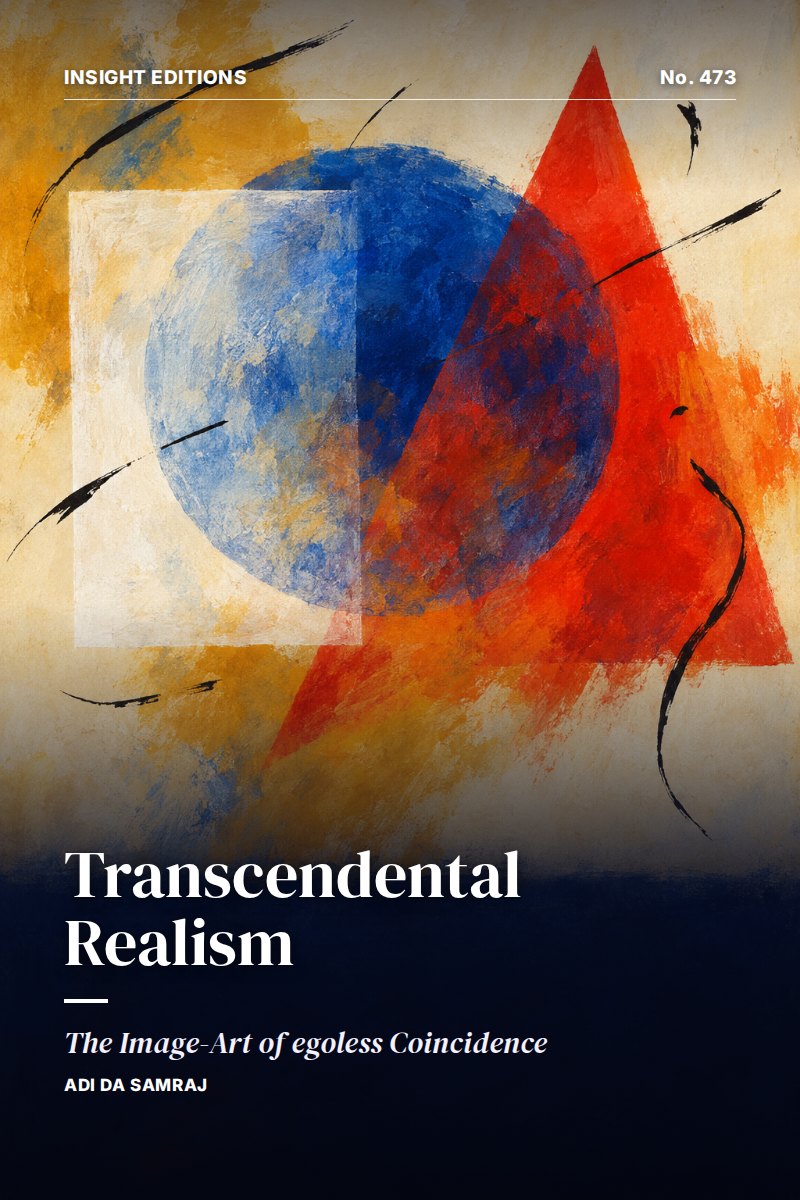
Transcendental Realism
The Image-Art of egoless Coincidence With Reality Itself
Adi Da Samraj
A study edition of the 2010 Dawn Horse Press second edition of Adi Da Samraj's collected art essays (2006 to 2008): Erik van Erp's introduction, the Venice and Florence exhibitions, the critique of perspective as ego, the working-principles of Geome, Linead and Orphic Font, two-stage abstraction, the room itself, Orpheus versus Narcissus, and the Three Absolutes, weighed against modernist art history.
A study guide to Transcendental Realism by Adi Da Samraj. Shared free for personal reading; not for sale and not endorsed by the author or publishers. Please read and buy the original.
CORE CLAIM
Conventional art, from the Renaissance onward, is built on "point of view," the fixed, separate perceiver; Adi Da proposes an aperspectival, aniconic, non-representational image-art in which the viewer stops standing apart and participates in "egoless Coincidence with Reality Itself." His motto: "Reality Itself Is Truth Itself Is The Beautiful Itself."
SCOPE
The second edition (Dawn Horse Press, August 2010) of the art essays Adi Da wrote between 2006 and 2008, combining the first edition (2007) with the essays from Aesthetic Ecstasy (2007) and Perfect Abstraction (2008): an introduction by Erik van Erp, PhD, a short biography, and thirty-two essays on Geome, Linead, Orphic Font, perspective, participation, modernism and the discipline of art.
KEY FIGURES
Adi Da Samraj; Erik van Erp; Heidegger, Plato, Schopenhauer and Gertrude Stein in the introduction; Leon Battista Alberti and the Renaissance perspective tradition; Cézanne; Schoenberg; Malevich, Kandinsky, Mondrian, Rothko; the cubists, surrealists and abstract expressionists; Duchamp, Warhol and the post-modernists; the myths of Orpheus and Narcissus.
BEST FOR
Readers who want Adi Da's theory of art in its fullest form: the critique of perspective, the working-principles of Geome and Linead, the two-stage abstraction method, the "room itself" thought-experiment, the Orpheus versus Narcissus account of culture, and the case for aesthetic ecstasy as the purpose of art.
The Book on One Page
The book makes one argument many times. Western art since the Renaissance has trained us to see from a fixed point, and that habit of seeing is the ego in visual form. An art that undoes the point of view can return the viewer to what is prior to it, which Adi Da calls Reality Itself.
The essays move from principle to method to culture. The opening pieces (I to IV) define the only true "subject" of art and distinguish direct presentation from indirect representation. The method essays (V to XIII) set out the working-rules of Geome and Linead, the "final resolution" in Orphic Font, the Perfect Foreground, the Maze of Ecstasy and the two-stage abstraction. The middle essays (XIV to XXII) turn to the viewer: perfect abstraction, the unobservable room, the surface space the viewer already occupies, and the "Beautiful Room" in which the art must be shown. The last essays (XXIII to XXXII) place the work against modernism and post-modernism, set Orpheus against Narcissus, and close with the discipline of right and true art.
This edition includes the essays already examined in our edition of Aesthetic Ecstasy; here they are read in the context of the complete art-writing.
| Group | Essays | Payload |
|---|---|---|
| Frame | Introduction, Biography | Heidegger; Venice 2007; Florence 2008 |
| Principle | I to IV | The one subject of art; presentation vs representation |
| Method | V to XIII | Geome, Linead, Orphic Font; two-stage abstraction |
| Viewer | XIV to XXII | Flat-field seeing; the room itself; surface space |
| Culture | XXIII to XXIX | Modernism; Orpheus vs Narcissus; artistic discipline |
| Close | XXX to XXXII | True art causes more art; Reality, Truth, Beauty |
Erik van Erp: Art Speaks in Silence
Van Erp opens with Heidegger, "Art then is a becoming and happening of truth," and a caution: "Art speaks for itself, in silence. Yet, some words can be spoken to assist its reception." The text, he warns, "resists quick and easy digestion" and is "deeply at odds with the trends of post-modernism."
He treats the essays as part of the art. "More than a verbal explanation... this body of words, much like Adi Da's art itself, is a 'transformational environment'." He borrows Schopenhauer's image of commentary as an attempt "to fit the ocean in a thimble," and describes the text as "poetic, yet precise; profoundly logical, yet full of paradox."
The book's first page carries a circular motto, "Reality Itself Is Truth Itself Is The Beautiful Itself Is...," set within a square, circle and triangle, the three forms that structure much of the art. Van Erp hears in it Plato, the Upanishads, and "the alchemical experiments of Gertrude Stein," and says Adi Da intends "to renew the 'modernist' program."
The central idea, in van Erp's words: the presumption "that the perceiver is located at a 'point' in space-time (perhaps somewhere inside the brain), always 'stepped back' from what is being viewed, is itself the root-illusion." Once that point is assumed, "objects" appear "co-constructed with the 'ego'." Adi Da maintains that "there are no 'objects' in Reality Itself."
Van Erp is a devotee-scholar writing for the movement's press, and the introduction frames criticism in advance: a reader who finds the text heavy has not yet "rightly viewed" the art. The comparison to Plato and the Upanishads is fair as to theme; the "renewal of modernism" is a claim that working art historians outside the community have rarely taken up.
The Master of Transformational Art
A short note presents Adi Da as artist. His late method, "Orphic Font," generates abstract forms "by making 'collages of pictographs'," and he "felt this work to be the culmination of his artistic oeuvre and philosophy."
The media were large and varied: "monumentally-scaled paint on aluminum, large-scale pigmented inks on canvas, photographic and videographic works, sculptural light-boxes, plasma-screen installations, and multi-screen projected performance events." He "was featured as an official solo collateral artist at the 2007 Venice Biennale," and was "the first contemporary artist to exhibit his work in the renowned Cenacolo di Ognissanti" in Florence.
His stated aim: to make images that let the viewer participate in "the 'vast unpatterned Joy' that is the ultimate nature of existence."
| Year | Event | Source note |
|---|---|---|
| 2007 | Collateral exhibition, Venice Biennale, curated by Achille Bonito Oliva | Wikipedia |
| 2008 | Transcendental Realism, Cenacolo di Ognissanti, beside Ghirlandaio's Last Supper | Da Plastique |
| 2010 | Second edition of this book | Dawn Horse Press |
The Venice participation is real, but the phrasing invites a misreading. Under the Biennale's rules, collateral events are "autonomously promoted and organized by non-profit public or private institutions," though approved by the curator, according to La Biennale's procedure for collateral events. A collateral show is not a selection for the curated International Exhibition. The Florence pairing with Ghirlandaio's perspectival Last Supper was a deliberate and striking juxtaposition.
The Only Subject of All Art
The first essay is one long sentence. The "self"-reflecting of the human self, including "its body, its relations... its environment... its history... and, ultimately, its own Source-Reality," is "the necessary (and also traditional) 'subject' of all art."
Works of art differ, he says, by "the humanly measurable degree" to which each achieves "both exactness and universality" relative to "the comprehensive 'event' of human 'self'-apprehension." Ultimately they differ by "the only tacitly measurable" degree to which each achieves "authentic rightness and trueness" relative to Reality.
The claim is broad and ancient: all art is a way of the self knowing itself, and the deepest art reaches past the self to its Source. Art is graded here not by beauty or skill alone but by how far it carries self-knowledge toward the Source of the self.
Exactness: how precisely a work renders some part of human self-apprehension. Universality: how far that rendering reaches all people. Beyond both lies a third, "tacitly measurable" quality, rightness relative to Reality Itself, which cannot be scored but can be felt.
The thesis is close to Hegel's view of art as Spirit's self-knowledge and to many religious aesthetics. The heavy parenthetical style (every term qualified in brackets) is typical of Adi Da's late prose; it secures precision at the cost of readability, and the essay's single sentence will lose many readers before its claim lands.
Art and Chaos
Art grows from the word. "The spoken-sung word is the source... of music. The written-pictured word is the source... of the art of image." And "the bodily-organized word-mind (spoken, sung, written, pictured...) is the source of all art."
From this he derives the "primal substances" of art: "percept and concept." The perceptual side of art is "the sensory... animation of the intrinsic 'self'-apprehension of order." It is also the animation of "the impulse to either control or escape or transcend evident chaos."
| Source | Art it yields | Operation |
|---|---|---|
| Spoken-sung word | Music | Duplicates, extends, abstracts |
| Written-pictured word | Image | Duplicates, extends, abstracts |
| Word-mind as a whole | Literature | Duplicates, extends, abstracts |
| Bodily word-mind | All art | Percept plus concept |
Art therefore has three possible stances toward chaos: control it, escape it, or transcend it. The rest of the book argues for the third. He adds a provocative line: "even science is subordinate to every art of means."
Deriving image-art from the written-pictured word reverses the usual archaeology, in which cave images (some tens of thousands of years old) precede writing by a wide margin, a point the book itself concedes later in "Open-Handed Image-Art." The control/escape/transcend triad is useful; the derivation of all art from the word-mind is asserted rather than shown.
Direct Presentation Versus Indirect Representation
"All art is representation, unless the root-cause of representation is (itself) transcended in Reality (Itself)." All art is "a reflection of 'Narcissus'," unless the illusion of a separate self is transcended.
The separate self and its "mirrored relations" are "the only possibilities due to art," unless both "are (both at once) transcended." "The reflections of 'point of view'... are always representations." Representation is what ego does: it stands back, mirrors the world, and pictures it.
The alternative is direct presentation: an image that is not of something seen from somewhere, but is itself "Reality Itself, As 'It' Is." The essay names the myth that runs through the whole book: Narcissus, enchanted by his reflection, is the type of all representational art.
A representation points elsewhere: to a subject, from a viewpoint. A presentation points nowhere; it is a perceptual event complete in itself. Adi Da's claim is that only the second can bypass the ego, because only the second does not need a viewer standing apart.
The distinction is a strong version of debates in modernist criticism: Clement Greenberg's flatness and Michael Fried's "presentness" also opposed representational illusion. Adi Da's version adds a spiritual stake (ego versus Reality) that those critics did not claim, and it is that stake, not the formal point, that the book never argues for outside its own terms.
My Non-Subjective Art of Image
"Every image has and requires and determines its own particular integrity of form, structure, color, and meaning." Every image is "a non-separate totality, composed of a unified field of non-separate elements in mutual affect."
He then names four roots. "Root-form is primary geometry: square, circle, triangle. Root-structure is primary geometric integrity: linearity, circularity, angularity. Root-color is white, black, or any primary color, the inversions of these... Root-meaning is egoless participation-response."
| Root | Content | Function |
|---|---|---|
| Form | Square, circle, triangle | Primary geometry |
| Structure | Line, curve, angle | Geometric integrity |
| Color | White, black, primaries, inversions | Elementary palette |
| Meaning | Egoless participation-response | The image as response |
The decisive line: "The image is not to replicate or 'objectify' the apparent 'subject' by means of the response. The image is the response itself: ecstatic, beyond and prior to 'point of view', 'object', separateness, duality, reflection, and likeness."
The root-geometries recall Cézanne's "cylinder, sphere and cone," Kandinsky's colour-form theory and the Bauhaus primaries; the essay acknowledges Cézanne later. The idea that an image is "the response itself" rather than a picture of its subject is clear and teachable. Whether a viewer can tell an "egoless" response from an ordinary abstract one is left to participation, not demonstration.
Geome and Linead: Working-Principles
Twelve numbered rules for two bodies of work. Rule one: "Always Abstraction." Respond to the subject only through "inherently non-representational and intrinsically self-economized... primary geometries."
The geometries are layered: "'outer', or gross = square, or linear; 'inner', or subtle = circle, or curved; 'root', or causal = triangle, or angular." Elements may include photographs, paintings, drawings or calligraphic script, but "the image-totality is always to be an abstracted... form."
The later rules build the image as a whole. "The image-form is the single and indivisible image-whole." The structures within it are "cells" of abstract elements. The finished image is "a unified whole... characterized by an equanimity that demonstrates a realized balance of and between... all the opposites." It demonstrates "the Primal Equanimity of Reality Itself," rather than "a mere conventional-reality representation of... disunity, egoic separateness, disturbance... suffering, mortality."
Square for the gross body and the linear world; circle for the subtle mind and the curved; triangle for the causal root, angled to the picture plane. The scheme maps Adi Da's three-part anatomy of the person (gross, subtle, causal) onto visual form.
The rules are the book's most concrete pages and would orient any viewer of the Geome and Linead series. Rule twelve's insistence that the image show equanimity rather than suffering rules out much of modern art's subject-matter by fiat. It is a stylistic choice presented as a requirement of Reality.
The Root-Subject and the Root-Language
"The fundamental impulse that moves the process whereby I make and do image-art is purposed to render the simplest abstract understanding of perceptually indicated experience," and to manifest it "in the intrinsically egoless... context of Reality Itself."
So the fundamental "subject" of every work "is itself always already a simplest abstraction of all possible perceptually indicated experience." It is "not any particular phenomenal and 'objective' event." It is "the primary simplest form of all possible perceptually indicated experience," and "not mere pattern."
The root-language, by implication, is the vocabulary of root-forms from essay IV. Every image is about the same root-subject, perceptual experience at its simplest, even when it begins from a bicycle, a figure or a room.
| Level | Example | What the image addresses |
|---|---|---|
| Apparent subject | A bicycle, a woman, an airplane | Starting-point only |
| Abstracted subject | Lines and shapes drawn from it | Feeling-response |
| Root-subject | Perceptual experience as such | The real topic |
This resolves a puzzle in the art: why images begun from very different photographs look related. It also makes every image about the same thing, which protects the theory from any single work's failure to convey it. "Not mere pattern" is asserted repeatedly; the essays never say how a viewer would tell the difference.
The Final Resolution of Geome, Linead, and Orphic Font
The longest method essay places the work in history. "The twentieth-century avant-garde was... working to go beyond the tradition of perspectival and explicitly representational imagery." Yet "'point of view'... itself yet remained as the fundamental basis for both the making and the viewing of images."
He claims to work "on the fundamental root-issue": going beyond the bodily point of view itself. His art is abstract, "as was generally the case with twentieth-century avant-garde art, and as was finally epitomized by the so-called 'abstract expressionist' school." The difference is aim: not expression of the self, but transcendence of the viewpoint.
His analogy is musical. A "systematic aperspectival structural approach" is "analogous to the development of atonality pioneered by Schoenberg," who "developed a systematic method of using the twelve tones of the chromatic scale" to replace "the traditional harmonic basis." "Reality Itself is intrinsically aperspectival, anegoic (or non-egoic), aniconic, and non-representational. Representation... occurs from 'point of view' only."
The final method: an "alphabet" of brush-drawn Lineads and pictographs, combined into collages so that no image "can be pre-imagined" and none "can... be encompassed and contained by memory." The images will "be aperspectival, anegoic, aniconic, and non-representational," yet always responsive to "a 'subject'," so they are never "mere pattern, or 'wallpaper'."
The Schoenberg analogy is apt: twelve-tone method was also an attempt to escape an inherited "centre" (the tonic). The claim that abstract expressionism remained bound to point of view is a defensible reading of its self-expressive ethos. The claim that this work alone has "in every fundamental sense, resolved" the problem is the author's verdict on his own art.
The Perfect Foreground
"The artifice of perspectival image-art constructs... a spatial illusion, based on the projecting of a fixed 'point of view' into and onto the field of perception," shaping all the space between the eye and a vanishing-point.
The critique becomes political. Perspective, which "had acquired the virtually judicial force of an obligatory convention... especially in the domain of Western art since the Renaissance," extends "the ordinary 'realism' of bodily and egoic perception into the domain of culture, society, and politics." Its effect is "the idealization of ego" and the desecration of what is prior to it.
The alternative is a foreground without a background: a picture plane that does not recede, does not organise space around a viewer, and so does not flatter the separate self.
| Perspective | Perfect Foreground |
|---|---|
| Fixed viewpoint projected inward | No viewpoint required |
| Vanishing-point organises space | No recession |
| Ego idealised | Ego bypassed |
| Convention with "judicial force" | Direct presentation |
The link between linear perspective and the modern subject is a well-developed theme in art history (Panofsky's Perspective as Symbolic Form, 1927). Adi Da gives it a moral charge: perspective idealises ego. Many non-Western traditions without linear perspective produced plenty of ego-centred art, which suggests the link is cultural rather than intrinsic.
The Maze of Ecstasy
"During the Renaissance, perspective... became the fixed and idealized basis of Western image-art." In a perspectival image, "everything in the image points (or refers back) to the viewer," so "point of view," or ego, "became the root-'subject'... of Western image-art."
Ordinary experience is a maze seen from inside. "The maze of 'point-of-view'-based perspectival experience must be seen as a whole... rather than seen from 'inside'." His art "is about intrinsically transcending the maze... by standing 'outside' the maze," and about "using the device of images to confound the ego's effort to construct the world... in its own image."
He insists the confounding is not cruelty. It is "not merely about some kind of punishing of the ego, or some kind of arbitrary frustrating of the viewer." Its purpose is "the viewer's transcending of space-time-bondage," so that the viewer may "participate in Reality Itself" through aesthetic ecstasy.
Inside: every turn is chosen from a position, and the whole is never seen. Outside: the whole is seen at once, and the position disappears. The images are built to make inside-viewing fail, so that the viewer is pushed toward the outside stance.
The maze is the book's best image for the difference between a partial and a total view. The admission that the art is designed to confound the viewer explains the frustration many report before its stated rewards. As elsewhere, the "outside" position is described as Reality but demonstrated only by asking the viewer to keep looking.
Orphic Magic
"All human-made art is a play on... the method of 'magic'," a process that seeks to "'objectify' (and, thus, 'capture') the chosen 'subject'" in union with the self of the artist or patron.
If the self is the ego, the subject is "subordinated to the ego-'I'," "known" and controlled. Ego-made art's subjects are always "holy, or sacred, or secular, or profane." Its subject "is always iconic, and (especially in the domain of visual art...) thoroughly perspectival," or at least referenced to the perceiver.
"Orphic Magic" names the alternative: "egoless (or ecstatic) participation in the human domain of perception," such that subject and self are not divided. Orpheus, whose song moved stones and beasts, stands for art that unites rather than captures.
| Mode | Self | Subject | Result |
|---|---|---|---|
| Ego-made magic | Separate "I" | Captured, controlled | Icon |
| Holy / sacred | Separate "I" | Set apart, protected | Icon |
| Secular / profane | Separate "I" | Ordinary or degraded | Icon |
| Orphic Magic | Egoless | Participated in | Presentation |
Treating all art as sympathetic magic echoes anthropological theories (Frazer, and readings of cave art as hunting magic). The fourfold classification is neat. It places every prior religious art, Byzantine icons and Hindu murti included, on the ego side of the line, a large judgement made in a single paragraph.
The Self-Discipline of Ecstatic Participation
"I make images by means of a process of abstraction. That process of abstraction occurs in two stages." The first abstracts "relative to the totality of the 'subject'," in feeling-response; the second abstracts "relative to the newly-created abstract image itself."
The second stage "always has encoded within it all the responsiveness to the original 'subject'," yet "more and more, goes ecstatically beyond any explicit visual references." A photograph of a bicycle for Linead One becomes lines, then a composition of lines answering only to itself.
For the viewer, examining an image "with the intention of seeing what can be said in reference to the presumed 'subject'... is a secondary process." It has "its own legitimate interest," but "true participation in the image is, fundamentally, a process of aesthetic ecstasy, a process of transcending egoity."
Stage one: from subject to abstract image, by feeling-response. Stage two: from abstract image to final image, by response to form alone. The first keeps meaning; the second frees it from reference. The method is the clearest practical account in the book.
The two stages describe a process many abstract painters would recognise, from Mondrian's trees to de Kooning's figures. Ranking study of the subject as secondary to ecstatic participation is sound advice for looking at abstraction. It also shields the work from iconographic criticism, since any interpretation can be called secondary.
The Secret of How to Know the Image
Right participation "is never merely 'correct'." It is "intrinsically (or self-authentically) true to the viewer-participant." There is no single right response.
"Every image-form I make and do... should be approached and experienced as a kind of living 'presence': to be embraced, and fully and freely participated in... in order to 'know' and be 'known' in the process." The image must be "fully accepted as a living 'presence'... rather than as a mere 'object'."
The viewer is invited into a reciprocal relation: one knows the image and is known by it. The essay is brief and generous, the gentlest in the book.
| Approach | Treats image as | Outcome |
|---|---|---|
| Analytic | Object to decode | Information |
| Correct reading | Puzzle with one answer | Closure |
| Participation | Living presence | Mutual knowing |
The refusal of a single "correct" response is open-minded and fits contemporary reception theory. Calling a picture a "living presence" that "knows" the viewer moves from aesthetics into devotional language; it echoes the way his devotees are taught to regard his photographic image, a parallel the book does not draw.
My Non-Objective Art of Image
All conditionally arising perception, "As Is," prior to ego, "Is... the Self-Consciousness of Reality Itself." All ego-based "knowledge" is "mere ideas," "self-contracted" from Reality.
The essay draws a sharp line. "Mere (or pre-mental, and thought-free) perception" is "an inherently sacred... but, also, in and of itself, non-religious... event of Reality-participation." But "All thinking, all mere ideas, all seeking for 'knowledge' of 'objects'... is (and, indeed, all 'objects' themselves are) egoic non-participation."
This is the epistemology behind the art. If bare perception is already participation in Reality, then an image that arrests thought and holds perception can return the viewer to it.
Perception (pre-mental): sacred, non-religious, already participation. Thought (ideas, objects, knowledge-seeking): separation. The art aims to hold the viewer in the first by denying the second its usual handholds: no recognisable figure, no story.
"Pure perception before thought" is a contested idea; much perceptual psychology finds concepts shaping vision from the start. The essay's description of perception as "sacred, but non-religious" is a striking and attractive formula. The claim that all objects themselves are ego's non-participation goes beyond aesthetics into metaphysics.
Perfect Abstraction
"Any and every apparently three-dimensional form of visual experience is... intrinsically and self-evidently a two-dimensional (or flat-field) mode of image-experience." In any instant, vision is "a timeless, non-changing, flat-field appearance of juxtaposed elements."
Walking around a sculpture does not change this: each moment of the walk "is... a moment of mere image." And "Mere image is intrinsically egoless, flat-patterned, non-familiar, abstract, and unique." "Every mere-image instant points beyond itself to an existential totality that cannot be comprehensively and finally experienced or 'known'."
Abstraction, on this account, is not a style laid over vision but what vision already is before the mind assembles depth and objects.
| Ordinary assumption | Perfect Abstraction |
|---|---|
| Vision shows a 3-D world | Each instant is a flat field |
| Objects are familiar | Mere image is non-familiar |
| Seeing gathers knowledge | Each image points beyond itself |
| Abstraction is a style | Abstraction is vision itself |
The flat-field point is a version of an old observation (the retinal image is two-dimensional; depth is constructed). It supports the art's flatness elegantly. Vision science also shows that depth cues are processed almost instantly and binocularly, so "in any instant" vision is less flat than the essay states.
The Unobservable Totality of Light
"My image-art can be characterized as paradoxical space that undermines 'point of view'," allowing "a tacit glimpse... of the Transcendental Condition of Reality."
Then the book's best thought-experiment. "The human individual in the midst of perceived reality is like a camera in a room, perceiving everything from a fixed 'point of view'." Everyone in the room sees separately, "but what does the room (itself) really look like?" "The room (itself) is an always unobserved (and Perfectly Unobservable) totality," "seamless, simultaneous, and non-separate," and so is the universe.
Later in the essay he grounds his geometry in perception and history. "The idea (expressed by Cézanne...) that artistically fashioned visual form is to be based on primary geometric elements" was "fundamental to the artistic training... I have developed... from the time I was a boy." And "the tension between meaning and form is fundamental to all the image-making work I do."
No viewer, however many, sees the room as it is: all at once, from nowhere. The room is real yet unobservable. Reality, by analogy, is not hidden; it is simply never a view. The images try to give "a tacit glimpse" of that viewless whole.
The room itself is a fine teaching device, close to Thomas Nagel's "view from nowhere" and to cubism's attempt to show many views at once. It is the one idea in the book that a sceptical reader can test in a minute, and it holds. Whether a flat image can give a glimpse of the unobservable whole, rather than just a different view, is the question the art itself has to answer.
The Visual Realization of Insecurity and Truth
"You cannot 'get' any of the images I make and do merely by giving it a glance. You must participate in the image." Participation "has no finality, no end point." "My image-art does not have a beginning. My image-art does not have an ending."
Meaning depends on "what the viewer brings," and differs "each time he or she looks." "No verbal explanation can encompass the entirety of any image's meaning." The title's "insecurity" is the viewer's loss of a stable place to stand: "In the transcending of 'point of view', all recognizability vanishes."
He returns to the room: "Apart from 'point of view', what does a room look like? If one cannot even comprehend a room apart from taking up a position... how does one expect to comprehend the universe?" Most art, he argues, accepts a limit on profundity "set by verbal mind, ego-'I', nationalist sentiments, religious propaganda." "The image-art I make and do is... about not having any such limit."
| Viewer stance | Experience | Result |
|---|---|---|
| Glance | Recognise or dismiss | Nothing received |
| Analyse | Decode references | Partial meaning |
| Participate | Lose a fixed position | Insecurity, then truth |
The essay is honest that the art produces discomfort first. Making unease a sign of depth is a familiar move in avant-garde rhetoric. The claim that other art is limited by propaganda and nationalism while his has no limit is a sweeping contrast offered without examples.
Open-Handed Image-Art
"Among the earliest art-forms human beings ever made are images of open hands," stencilled by blowing pigment around a hand pressed to a cave wall. "The breath and the hand: that happening-conjunction says something about what right and true art is."
"Right and true art is an open-handedness, not a closed fist, not a dissociated or 'self'-contracted gesture." It "flows to the viewer, rather than being at war with the viewer, or aggressively trying to control and defeat the viewer." "Right and true art is infinitely generous."
The essay is a single page and the most lyrical in the book. The open hand becomes a figure for art that gives rather than grasps.
"Right and true art enables and serves the viewer, in an open-handed, ego-transcending manner."
Adi DaHand stencils are indeed among the oldest known images, some dated to over 40,000 years. The reading of them as freedom from self-contraction is poetic, not archaeological; their makers' intentions are unknown. The essay's ideal of art that is "not at war with the viewer" sits uneasily with essay IX, where the art is built to confound the viewer.
The Tree of Human Shape
"A tree exemplifies the self-organizing principle of growth and change in the context of space and time." Because it grows slowly, "its structure... is the direct formal evidence of the total... process of its living."
The contrast is with the human body. "The human entity departs from the mother's womb pre-formed for life." "By contrast, the tree emerges into the world as a seed, and the world... is its lifetime womb." The human body "engages, and suffers, and endures" life as blows against a pre-set form; the tree's form is its life.
The tree becomes a model for his figure-based images: a "human shape" made like a tree, whose structure is the visible record of its whole process rather than a fixed body acted upon.
| Human body | Tree | |
|---|---|---|
| Form at birth | Pre-formed | A seed |
| Womb | The mother | The world |
| Life shows as | Marks on a set form | The form itself |
| Image lesson | Representation | Indivisible form |
The contrast is a fresh image and links his figure-works to organic growth. Biologically the human body is also shaped throughout life by growth and adaptation, so the contrast is one of degree; as metaphor it does its work.
How to Be the Surface Space
"The 'surface' space of the images I make and do is not 'objective' space." It "need not be 'entered into', as if the 'viewer' is not always already 'there'."
No device, "such as familiar and conventionally recognizable elements, or other 'vehicles' (such as human likenesses)," is needed to "escort" the viewer into the picture. "The 'surface' space of the images I make and do is Subjective 'Space'." The viewer, as Reality, is "always already in, of, and As" that space.
The paradox: "The ego-'I'... cannot itself enter" the surface space, "because the 'surface' space Is the Intrinsically egoless... Subjective" space. Only by letting go of the viewing position is one already there.
Conventional pictures provide a door (a figure, a road, a horizon) so the viewer can step in. These pictures provide no door, because there is no outside: the space of the picture and the space of awareness are presented as one.
The idea is close to phenomenological accounts of seeing (Merleau-Ponty's "flesh" of the visible). It is clarifying as a description of how to look at abstraction: do not search for a way in. As a metaphysical claim that the viewer is the picture's space, it rests on the non-dual teaching behind it.
You Are the Surface Space
Some viewers feel "drawn in" to images with figures and not to fully abstract ones. That sense "is the result of relating to the images from the 'position' of the 'viewer' who presumes to be separate."
"People characteristically look at art from a presuming-to-be-separate 'point of view'," and "tend to look at one another, and even everything altogether, from that same 'point of view'." The art is "not purposed to provide the means for the conventional 'objectification' and analytical (or merely detached) 'onlooker-viewing' of art."
The essay widens into cultural critique. "In this scientific materialist epoch, everything is so 'objectified' that... people no longer presume there is any necessity to truly participate in art (or anything else)." People "imagine that Reality Itself... was, in fact, a myth. Reality Itself is not a myth."
| Habit | In art | In life |
|---|---|---|
| Separate viewer | Onlooker at an object | Detached from others |
| Objectification | Analysis replaces experience | Scientific materialism |
| Participation | Image as one's own space | Reality as not a myth |
The link between how we look at pictures and how we look at people is a strong idea and gives the essay reach. Blaming scientific materialism for the loss of participation is a recurring theme in his late work; many scientists and artists find no conflict between rigorous analysis and deep aesthetic absorption.
The Open-Eyed Room
A numbered argument about the self. "The 'inner self'... is (always, and inherently) a form of representation," a "psycho-physical construction of perceptions... responses and reactions... and reveries."
"The 'inner self'... is a brain-structured... mere chaos of permutations of centerless random reflections, but the brain-mind always works to represent that randomly changing chaos as a centered integrity." It does so by "the constant enforcement... of the illusory psycho-physical invention... of a 'point-of-view'-identity."
"Always Perfectly Prior to the ego-'self' Is the Intrinsic (formless, centerless, egoless...) Self-Condition That Is Reality Itself." The ego-"I" is "a neurologically-projected interior representation." The open-eyed room is the room of Reality seen without the projected centre.
The self is a representation the brain keeps re-drawing to give a centre to a centreless flow. Seen this way, ego and perspectival art are the same operation: both impose a viewpoint on a field. The art and the teaching meet here.
This essay comes closest to contemporary cognitive science: the self as a model the brain constructs (Metzinger's "self-model," Dennett's "centre of narrative gravity"). Those accounts do not then posit a Transcendental Self-Condition prior to the model; Adi Da does, and that step is metaphysical, not neurological.
The Beautiful Room of Perfect Space
The art "can only be fully rightly viewed within a context that supports that purpose." He worked "for many decades to establish the basis for a new world-culture," and only after completing it was he "free to concentrate intensively" on art.
"By its very nature, the art I make and do confronts people," because it means to move them "beyond their tendency to 'objectify'." It "must be presented in such a manner that people are moved and free to participate in it." He sets his work against "the mode of casual and dissociated viewing" that institutions encourage.
He states his ambition plainly: "fine art of greatest (and truly 'high art') significance and transformative power," made in relation to "the... world-tradition of art, including... pre-World-War-II 'modernism'." He wants to help bring people "out of the 'dark' period in which humankind is presently immersed."
| Gallery norm | Beautiful Room |
|---|---|
| Casual viewing | Concentrated participation |
| Art as object | Art as environment |
| Neutral white cube | Space built for the purpose |
| Detachment | Transformation |
The demand for a purpose-built viewing space is reasonable; Rothko made similar demands for his chapel. The statement that he first had to build a world-culture before making art casts the religious community as the precondition of the art, which makes the art harder to judge independently of the teaching.
The Varietal Characteristic of "Reality"
A short taxonomy. "Modernists" like Malevich, Kandinsky, Mondrian, and Rothko "proposed a kind of pictographically symbolized 'platonic'... 'reality'" against gross material reality.
Other modernists, from the cubists (Braque, Picasso, Gris) to the surrealists (Dalí, Miró, de Chirico, Magritte, Bacon) and the abstract expressionists (Pollock, de Kooning), "engaged in pictorial efforts to analyze, de-construct, and re-construct gross... perceptual 'reality'," showing "a fundamental... anxiety about the human condition." The post-modernists, "beginning with Duchamp," through Warhol, Lichtenstein, Stella, Newman, Rauschenberg, and Johns, "engaged in gross pictorial 'realism'."
Transcendental Realism is offered as a fourth kind: neither platonic escape, nor anxious deconstruction, nor gross realism, but Reality as it is, prior to viewpoint.
The taxonomy is compressed and contestable. Barnett Newman and Frank Stella are usually counted as abstract modernists, not "gross realists"; Bacon was a figurative painter, not a surrealist in the usual sense. Placing his own work as the resolution of the whole sequence is the essay's real purpose.
The Eternal War Between Orpheus and Narcissus
"In the so-called 'modern era'... people seem to imagine that human experience is now remarkably different, in some absolute sense." So it is "absurdly" presumed that art must now be "anti-art or anti-culture," a reflection of "never-before-seen negativity."
He rejects the premise. People in the past did not have easier lives that "allowed" beautiful art. The difference is culture: the "culture of ego-transcendence" (Orpheus) against the "anti-culture of ego-reflection" (Narcissus). The war between them is eternal, not modern.
He clarifies his position. "My image-art is not religious art. My image-art is not made and done in any conventionally traditional manner." It uses "the intrinsically free disposition" of the modern period, but toward "the 'radical' (or always 'at-the-root') uplifting of the human."
Orpheus: song that moves the world, art as self-transcending gift. Narcissus: the pool, art as self-reflection. Every period has both; the modern error is to think the second is required by the times.
| Orpheus | Narcissus | |
|---|---|---|
| Culture | Ego-transcendence | Ego-reflection |
| Art | Uplifts | Mirrors negativity |
| Modern claim | Still possible | "Required" by the age |
| Adi Da | His model | His target |
The essay is a strong rebuttal of the idea that modern suffering obliges ugly art; many critics share it. Its picture of modern art as mostly "negativity, emptiness, gross realism" is a caricature that ignores, for example, Matisse, Rothko and much of abstraction, whose aims were often close to his own.
Aesthetic Ecstasy: Art Without a Mediator
Some modern critics hold that visual art is "surface-alone," with no references and no subjective domain: "meaningless space." Adi Da calls this "a 'dead-end' understanding of visual art."
That some geometric abstractionists regard their work as meaningless "does not at all mean that meaninglessness is an inherent quality" of the mode. His own geometric work, beginning with Geome One: Alberti's Window, carries meaning-response to a subject.
The core: "The primary use of image-art is aesthetic ecstasy." Ecstasy means "standing outside" of point of view, as the glossary says. He compares music: "People close their eyes, or sway with the music. They pass into a concentrated feeling-space." Visual art deserves the same. And people "need to feel they have permission to take image-art seriously."
"In the current cultural environment, people need to be told that the image-art they are looking at is serious art, important art, and even great art, before they will even give it the extra moments of glancing." Hence the essay's insistence that advocacy, not just display, is required.
The comparison with music is persuasive: visual art rarely receives the absorbed attention music gets. The essay was also published as the separate book Aesthetic Ecstasy (2007), which our earlier edition covers. The admission that viewers must be told the work is great before they will look long enough is candid, and it describes how promotion and reception have in fact worked for this art.
My Material Art Must Remain Within the Perfect Room
"I have made many tens of thousands of images, and I intend (if all allows) to make numberless more." "Very few of the images I have yet made have been (originally) hand-fashioned. Most... have yet to be materially fabricated."
Material fabrication "requires... a (generally, public) process of appreciatively responsive and financially-backed acquisition and exhibition." So fabrication always follows composition, and "not even the most generous and vigorous supporting" could fabricate them all.
He defines his role. "I make images. I do not merely 'conceive' them. Yet, I do not materially fabricate them, or, otherwise, follow them into the marketplace." He provides "full instructions (and while I yet live, active consultation)," but leaves fabrication, promotion and sale "to be done by fully skilled... professionals."
| Stage | Who | Condition |
|---|---|---|
| Composition | Adi Da | Tens of thousands done |
| Fabrication | Professionals | Financially backed acquisition |
| Exhibition | Institutions | Public response |
| Sale | Professionals | He "stands apart" |
The model, digital composition with later fabrication, is common in contemporary art (Koons, Hirst, Murakami). The essay is unusually frank that the work's material existence depends on funding by supporters. With his death in 2008, the "active consultation" ended, leaving fabrication decisions to the organisation that holds the copyright.
In Plain Sight Without a Word
"Visual art (or image-art) is, fundamentally, a perceptual happening." If right and true, it is "full of perceptually-encoded... meaning, conveyed via the perceptual laws" of the "aesthetic experience" of "significant form."
Right viewing "requires fullest perceptual participation," "a tacit (or non-conceptual) process" that happens "in the aesthetic deep-domain (of bodily energies, emotional feeling-awareness, and brain-and-nervous-system structures...)." "The making of visual art... that is both right and true is, fundamentally... done in silence and (effectively) in solitude." So is its right viewing.
The essay is a short brief for looking without talking: meaning is "in plain sight," and words come after.
"Right and true visual art (or image-art) requires fullest perceptual participation and fullest perceptually-based participatory responsiveness, all of which is, fundamentally, a tacit (or non-conceptual) process."
Adi Da"Significant form" is Clive Bell's phrase (1914), and the essay's formalism stands in that line. The call for silent looking is sound. It sits beside a book of some two hundred pages of explanation, a tension van Erp acknowledges when he says the words must be heard "in the same open space" as the art.
The Authentic Artistic Discipline
"Anciently, all arts were forms of ritual." Traditional artists "did not engage their forms of art merely as a means of expressing themselves"; they understood "that the arts had a sacred function within society."
Traditional artists "studied and practiced disciplines for years," and "over a long testing-time" a gifted person's "entire life would be devoted" to one art. Practice was "participation in a pre-established pattern."
Today, by contrast, artists represent "the failure of the social order, the collapse of civilizing tradition, the disappearance of the cultural demand that artists transcend themselves." Art becomes "the vicious circle of egoity (or 'Narcissus') itself," "just decorative" or expressive of the absence of culture.
| Traditional artist | Modern artist (his view) | |
|---|---|---|
| Purpose | Sacred function | Self-expression |
| Training | Years of discipline | Optional |
| Relation to culture | Serves a centre | No centre |
| Result | Art of value | "Narcissus" |
The portrait of traditional art is idealised; guild and court artists also worked for status and pay, and many traditions prized innovation. The criticism of art that only expresses cultural collapse is shared by many critics. The essay's answer, a culture with a sacred centre, points to the community he founded.
The Ego-Transcending Ordeal of Making True Art
The common "subject" of current art is "the 'total world' (as a chaos of material events and 'gross realities')." Only recently has this chaos been made "the 'average' of art."
"The 'total world' is (inherently) a chaos," "an always yet dis-orderly... process of present... changes" happening "everything-all-at-once." It is "now time to critically review the choices that are currently being made." His verdict: "The subjugation of humankind, and of art, to the 'total world' of chaos and 'gross realities' is not necessary, not inevitable, not right."
"Relative to the subjugation of life and art to the 'total world' of chaos... I say No!" "Both life and art must be made right and true, by being intrinsically founded... in what is (inherently) right and true." Making such art is an ordeal because it requires transcending the ego that wants to mirror the chaos.
Two responses to a chaotic world: mirror it (the "average" of current art) or transcend it (an ordeal of self-discipline). Essay II named a third, control; here control and escape drop away, and the choice is binary.
The "I say No!" is the book's most forceful moment and a fair challenge to art that only reflects disorder. "Right and true" is used throughout as self-evident; the essay does not engage the many artists who would say that facing chaos honestly is itself a form of truth.
True Art Always Causes More Art
"True art does not and cannot bring the process to an end. True art makes more art inevitable." "Every work of true art effectively 'causes' all future works... Every work of true art is, effectively, 'caused' by all past works."
"There is not (and cannot be) a final (or last) work of true art." So "the effort to defeat... all other art (and even all other artists) is absurd." "True art is neither chess nor dice nor poker. True art is the Irreducible Beloved, to be 'Won' at Infinite and Perfect Cost of 'self'."
The shortest essay is a quiet corrective to the book's own claims of finality: art is a lineage without end.
| True art is not | True art is |
|---|---|
| Chess (strategy to win) | The Irreducible Beloved |
| Dice (chance) | Caused by all past art |
| Poker (bluff) | A cause of all future art |
| A last word | Endless lineage |
This is the book's most generous page, close to T. S. Eliot's "Tradition and the Individual Talent." It also undercuts essay VII's claim to have "resolved" image-art "in every fundamental sense," since by this essay's logic no resolution can be final.
Picture Perfect: A Final Imagery
"Reality (Itself) Is Truth (Itself) Is The Beautiful (Itself). These Three... Are The Absolutes (and The Perfect Obligations) of all meaning." They "Are The Mutual and Indivisible Measure of One Another."
"These Three Absolutes (Together) Are The One, and Indivisible, and Necessary Measure of all art," and "the Necessary, Intrinsic, and Inherently Perfect 'Subject' of all right and true art." The essay closes the circle opened by the motto on the first page.
Making such art "requires ego-surrendering... devotion" to the Three, "absolute commitment, unwavering concentration, total life-surrender, boundless generosity." The artist is to be "egoless servant" of Reality, Truth and the Beautiful.
Reality, Truth, Beauty: not three values but one, each the measure of the others. The formula unites the Platonic triad (the True, the Good, the Beautiful) with the non-dual claim that Reality itself is the measure.
The triad is a version of the Platonic transcendentals, with "Reality" in place of "the Good." Dropping the Good is telling: the aesthetic replaces the ethical as the third term. The demand for "total life-surrender" sets the bar for the artist at the same height the teaching sets for the devotee.
What Is No-"point-of-view" Is All-and-All
The final piece is a title and an image, a closing motto that states the book's thesis in seven words: what has no point of view is everything.
Read with essay XXXI, it completes the argument. Point of view divides the world into viewer and viewed. Without it there is no part looking at other parts; there is all-and-All, the whole that essay XV called "the room itself." The book ends, fittingly, in an image rather than an explanation.
| Step | Essay | Claim |
|---|---|---|
| Diagnosis | III, VIII, IX | Point of view = ego = perspective |
| Method | V, VII, XI | Abstraction in two stages |
| Experience | XIV, XV, XIX | Flat field, room itself, surface space |
| Conclusion | XXXII | No point of view is the whole |
The closing motto is consistent with Advaita and with much Buddhist teaching on no-self. As a final statement about art, it asks the viewer to accept that the work succeeds by a criterion (dissolving the viewer) that the viewer cannot report on without reinstating a point of view.
Master Takeaways
Transcendental Realism is Adi Da's complete theory of art: a critique of perspective as the visual form of ego, a method for aperspectival abstraction, and a call for viewers to participate rather than look on. Its best ideas stand on their own; its claim to have resolved the problem of image-art is the author's own.
- The one subject of all art is the self's self-apprehension, reaching toward its Source.
- Art faces chaos in three ways: control, escape, or transcend; the book argues for the third.
- All art is representation unless the separate self is transcended; representational art reflects Narcissus.
- Four roots: form (square, circle, triangle), structure, color, and meaning as egoless response.
- Geome and Linead follow twelve rules, beginning "Always Abstraction."
- Square, circle, triangle map to gross, subtle, causal.
- The finished image must show equanimity, not unresolved suffering.
- Every image addresses one root-subject: perceptual experience at its simplest.
- Orphic Font builds images from an alphabet of pictographs so none can be pre-imagined.
- The project is likened to Schoenberg's twelve-tone escape from tonality.
- Linear perspective idealises ego and carries a political charge.
- Ordinary seeing is a maze viewed from inside; the art pushes the viewer outside.
- All art is magic; ego-art captures its subject, Orphic art participates in it.
- Two-stage abstraction: from subject by feeling, then from image by form.
- Right response is "self-authentically" true, not "correct."
- Bare perception is "sacred, but non-religious"; thought separates.
- Every visual instant is a flat field; abstraction is vision itself.
- The room itself is real and unobservable; so is Reality.
- True participation brings insecurity before truth; there is no end-point.
- Right art is open-handed, not a closed fist.
- The viewer is already in the surface space; no door is needed.
- The self is a brain-made representation; ego and perspective are the same operation.
- The art needs a Beautiful Room built for participation.
- Orpheus versus Narcissus: the war between self-transcending culture and self-reflecting anti-culture is eternal.
- True art causes more art; there is no last work.
Frameworks and mental models
| Framework | Core move | Essay |
|---|---|---|
| Presentation vs representation | Image as event, not picture of something | III |
| Four roots | Form, structure, color, meaning | IV |
| Gross / subtle / causal geometry | Square, circle, triangle | V |
| Aperspectival method | Like twelve-tone music | VII |
| The maze | Partial view inside, whole view outside | IX |
| Ego-magic vs Orphic magic | Capture vs participation | X |
| Two-stage abstraction | Subject to image, image to form | XI |
| Flat field | Each instant of vision is 2-D | XIV |
| The room itself | Real but unobservable whole | XV |
| Orpheus vs Narcissus | Transcendence vs reflection | XXIV |
| Three Absolutes | Reality = Truth = Beauty | XXXI |
What holds up. The critique of perspective as a cultural habit, the room itself thought-experiment, the two-stage abstraction method, the comparison with music as a model of absorbed attention, and the essay "True Art Always Causes More Art" are clear, defensible and useful to any viewer of abstraction.
What is asserted. That perspective idealises ego, that only this art is aperspectival in the full sense, that bare perception is participation in Reality, and that the method is "resolved" are claims made within the author's spiritual teaching. The book offers no viewer studies, no comparison with works it criticises, and little engagement with critics such as Greenberg, Fried or Panofsky whose ideas it parallels.
The reception question. The work has had real exhibitions, including a 2007 Venice Biennale collateral event curated by Achille Bonito Oliva and a 2008 show in Florence's Cenacolo di Ognissanti, as recorded by Wikipedia. Collateral events are organised and funded by outside institutions, per La Biennale's rules, and the essays themselves admit that fabrication depends on supporters' financing. Independent critical assessment remains thin.
The circle. The art is to be judged by participation; participation is defined by the teaching; the teaching is presented by its author as Reality. A reader can take the formal ideas, which belong to a long modernist conversation, without accepting that this circle is closed.