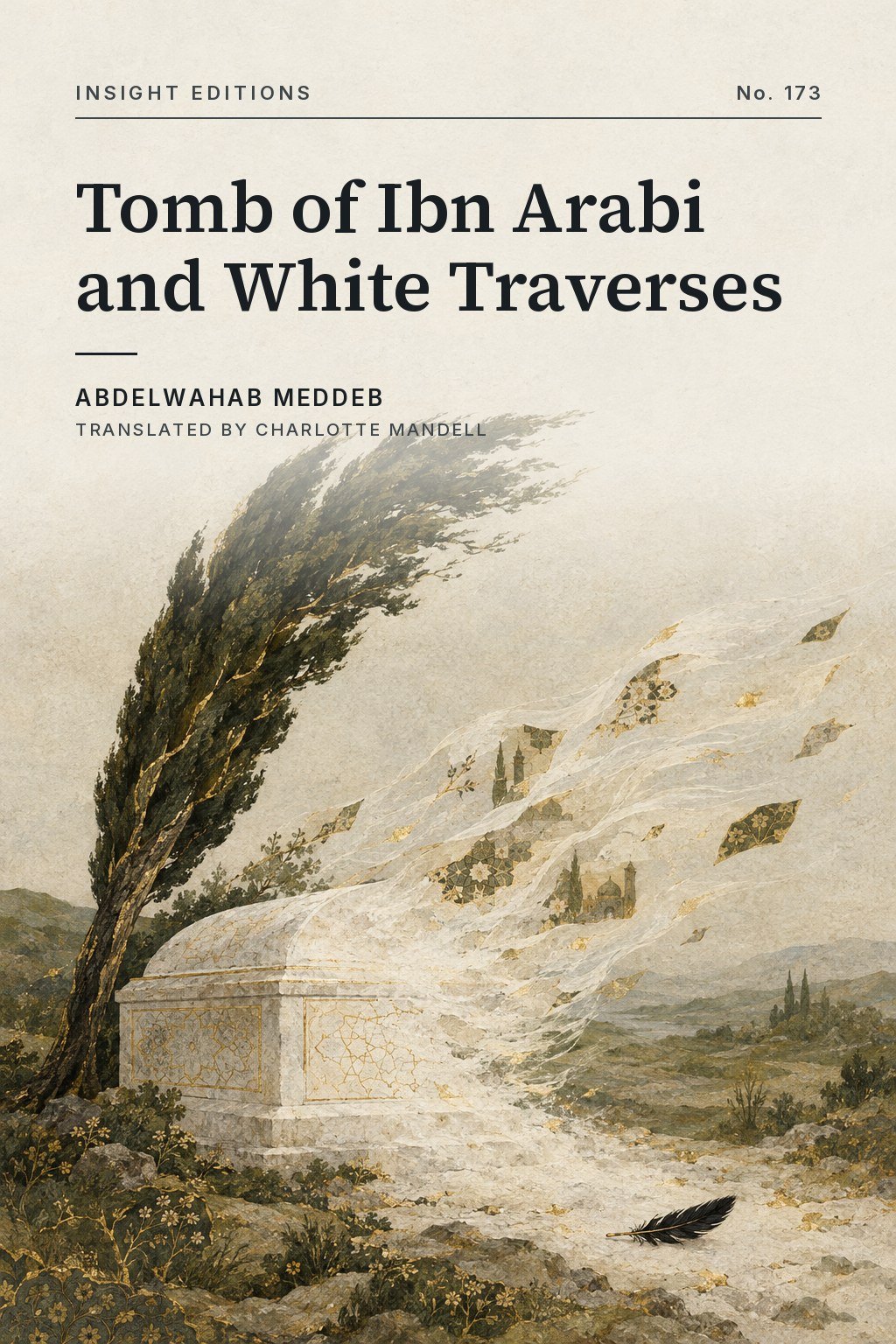
Insight Editions · No. 173
Tomb of Ibn Arabi and White Traverses
Abdelwahab Meddeb · Translated by Charlotte Mandell
Abdelwahab Meddeb pairs a poetic sequence honoring the Sufi mystic Ibn Arabi with a prose meditation on whiteness, memory, impurity, and cultural inheritance.
A study guide to Tomb of Ibn Arabi and White Traverses by Abdelwahab Meddeb, translated by Charlotte Mandell. Shared free for personal reading; not for sale and not endorsed by the authors or publishers. Please read and buy the original.
About the Book
Abdelwahab Meddeb's Tombeau of Ibn Arabi and White Traverses joins two works of different kinds: a sequence of sixty-one prose stanzas that raise a poetic tomb to Ibn Arabi, and a prose meditation on the colour white drawn from a Tunisian childhood.
The volume (Fordham University Press, New York 2010, translated by Charlotte Mandell) opens with the author's short preface, gives the Tombeau (stanzas I to LXI with a closing note), then White Traverses (signed Paris, October 1996), and ends with an afterword by Jean-Luc Nancy, "Three Questions about Tombeau of Ibn Arabi", and four pages of notes. The whole runs to some seventeen thousand words.
In one sentence: Meddeb argues, in verse and in prose, that the pure never exists apart from the impure, so that love, beauty and even the sacred must be lived with the stain, the illness and the evil inside them, and that this lesson is carried by a double genealogy, Arab and European, that runs from Ibn Arabi and Dante to the writer's own body and memory.
Chapter map
1. Preface: A Tomb That Is Not Homage
In five pages (vii-xi) Meddeb says what the Tombeau is for, names his two masters, explains his strange punctuation, and states the thesis that ties the two works together.
- The Tombeau is not praise: it shows how a text linked to the dead can be written today.
- Ibn Arabi and Dante stand for a twofold genealogy, Arab and European.
- The comma marks breath, not syntax; the prose hides broken alexandrines.
- Evil and illness belong inside beauty; the impure lodges in the pure.
Writing with the dead
The first sentence clears away a likely misreading: "This Tombeau is not a question of praise or homage." Its aim is to show how a text that keeps a link with the dead can be written now. Ibn Arabi qualifies because he "has never stopped speaking to us through the words that weave his phrases". From that privilege Meddeb draws another, the master's "surprising closeness to Dante". The two are the symbolic figures who confirm his "twofold spiritual genealogy, Arab and European, Eastern-Western", and the duality asks him to go beyond creeds so that one is no longer only from the West or only from the East, like the Koranic olive tree.
Key point: the book's model is the poet who interprets his own poem. Reading Ibn Arabi's Tarjuman al-Ashwaq beside Dante's Vita Nuova reveals "the poet as interpreter of his own text", a text that puts at the centre the love inspired by a Lady: Niz'âm for one, Beatrice for the other. To these Meddeb links the name Aya, his own beloved, where many experiences remain marked "by the singleness of the Name".
The places behind the stanzas are named only in part: pilgrimage sites between Paris and Carthage, Siena, Florence and Rome, Ronda and Almeria, the High Atlas, and others kept silent "to preserve a measure of secrecy". Deserts run through it all: real ones in Africa and Asia, the conventional desert of pre-Islamic Arab poetry, and the desert of the room where "the Mallarméan artifact gleams".
The comma as breath
Meddeb inherits from both masters a taste for the irregular. It shows in "a prose haunted by alexandrines hidden between commas": the twelve syllables are thrown off, going under or over, to outwit the fixed count and "welcome the rule of the odd number". The comma is used against syntax on purpose. "So the comma is the sign that, in the heart of the written text, there sounds the phantom of the spoken word." The reader is asked to listen for the discontinuous and the discordant.
The devils on the tomb
Evil and sickness are present in themselves, "without being driven away by the good"; good and evil are interlinked, with no loopholes. Meddeb denies that this is only the mood of "our orphan era, which, after Hölderlin, after Nietzsche, builds a tomb even for God". He found it in the real tomb of Ibn Arabi, born in Murcia in 1165 and dead in Damascus in 1240, which stands in Salihiyya at the foot of Mount Qasyun and was rebuilt in the sixteenth century. Its blue-on-white tiles show vegetal motifs that turn into masks of devils, recalling the mannerist grotesque, as if the tomb ordered us "never to lose sight of the duty of looking evil in the face and converting it into what is peaceful".
White Traverses came from the other shore. On the African coast where he grew up, it is "white that is dreamed pure", so the current feeding that myth had to be short-circuited. The thesis follows: "the impure lodges in the pure", and an ethics can take the negative into account "without ever needing to abolish it".
Key point: two speeds of history. A childhood in Tunis in the 1950s let Meddeb know a world with archaic vestiges: "we were anthropologically the contemporaries of Euripides, of Raymond Lull". A decade later a sidereal time carried the same people into a world reshaped from America.
| Pole | Arab, Eastern | European, Western |
|---|---|---|
| Master | Ibn Arabi | Dante |
| Self-commenting book | Tarjuman al-Ashwaq | Vita Nuova |
| The Lady | Niz'âm (Nidam, p.73) | Beatrice |
| Meddeb's places | Carthage, Tunis, High Atlas | Paris, Siena, Florence, Rome |
| Poetic memory | Pre-Islamic desert | Mallarmé's room |
2. Tombeau I to XX: Ruins, the Lady, the Turning World
The first twenty stanzas (pp.3-28) open on the ruined campsite of Arab poetry, bring in the Lady, and then move the old desert motifs into airports, train stations and Paris streets.
- Each stanza is one sentence, linked by commas, ending in a period or a question mark.
- The old Arab ode (ruins, camels, the departed beloved) meets the modern city.
- The Lady both initiates and wounds; the lover is scattered between extremes.
The ruined campsite (I-II)
Stanza I begins where the pre-Islamic ode began, at the abandoned camp: "Ruins, remember, neglected grounds, dust, wanderers’ refuge, the voice blends with its echo". The speaker waits for clouds to weep and flowers to speak; "I call out, no one answers, the stone hears my excitement". It ends on a feeling engraved in the heart "which separates". Stanza II, the shortest, is a single question of how to speak and where to step, "overwhelmed with love, to run back in one’s tracks".
The Lady arrives (III-VI)
Key point: the Lady is a power above law. In III she withdraws as soon as she appears. When she offers intimacy she "snatches you from the law", "she initiates into the hidden, and abolishes the rites that check desire", and she is "the glory of every book". Stanza IV is a greeting to the recluse leaving his hermitage, with the formula "hello nostalgic one, orphan", and a list of lovers, "Judith and Aya, Hind or Hera", that mixes Hebrew, Arabic and Greek names. In V she asks, "am I not the icon that never deserts his heart".
Stanza VII sends the wind to the departed "in the shade of that tree, the one that is neither east nor west", the olive tree of the preface. In VIII ladies visiting the holy places tell the speaker to "learn to live the second that your breath leaves your body".
The night of transformation (XI-XII)
Stanza XII is the hinge of the first half. A pagan idol sings an episode from the Passion; it is "the night of transformation, forms shifted and changed", and the speaker feels able to welcome them all, "mumbling all languages, handling all writings", "in the mirror of metamorphoses, at the mercy of passion which runs the world".
Key point: the heart that takes every form. Stanza XII is the book's echo of the Tarjuman, where the heart becomes able to receive every form. The parallel is the editor's reading; Meddeb does not cite the line.
The desert enters the city (XIII-XX)
From XIII onward the motifs migrate. In XIV the speaker meets in a station square a young woman in a scarlet sari and offers her "a light Loire wine, brisk and peppery". In XVI the angels' music "pierces through the steel jet engines", and the lesson sung is that "in absence, beauty doesn’t tarnish".
Stanza XVIII gives the Sufi formula of dying before death: "bodies fallen into the Name, die before dying, enter into the shadow of the All-Power, then return to life". Stanza XIX would "see her face in every thing, in the darkness, in the light". Stanza XX closes the half with a question about "the unknown woman, who spells my name, on the threshold of departures".
3. Tombeau XXI to LXI: Illness, Union, the Cube
The second half (pp.29-74) passes through a city after catastrophe, a long fever in which desire and disease feed each other, and a slow return that ends at the black cloth of the Kaaba in Mecca.
- The ruined camp of stanza I returns as a modern ruined city (XXI-XXII).
- Illness becomes the place of love: the beloved both wounds and heals (XXIII, LII, LVII).
- Union is figured as two letters mirrored in one name (LV).
- The closing note names Nidam, Mecca, the year 598 of the Hegira, and love as the source of movement.
The apocalyptic city (XXI-XXII)
Stanza XXI turns the campsite into a contemporary waste: "Empty homes, windows torn away, gray of the sky, devastated neighborhood", a "language of Babel, which cut the being in two", collapsed towers and "energy of fission". Yet the stanza ends "coming out of the apocalypse, I warm myself at her fire".
Fever and desire (XXIII-XXXIV)
Key point: illness is not opposed to love; it is its stage. Stanza XXIII is the boldest of the book. The speaker lies the beloved "down on the bed of my disease"; sickness "has clothed me, in white alabaster"; her presence starts "convalescence", yet the stanza ends "between the wound and the caress, I return to illness, which her lips increase". This is the preface's evil and sickness in the theatricality of love, made literal.
Around this core run images of crossing. XXIV invites the beloved on a journey "opposite the isthmus, which is a barrier, where the spirit sinks", a quiet echo of the barzakh, the isthmus between two worlds. XXVI gives her vow: "I will divide myself, I will be new, like the sun, each day", the renewal of forms at each instant. XXX ends "I travel, with a white step, which weakens the ground", a line Nancy will take up. In XXXI the speaker circles "a cube, stamped by the lunar seal", the first sign of the Kaaba, and in XXXII meets a woman "Arab and white, she speaks frankly, with a Latin flavor", the double genealogy again.
Unveiling and doubling (XXXV-LV)
The hoopoe of XXXV, perched on "the tree beyond the world", brings ecstasy: "my passion is in the unveiling". XXXVI closes on the line Nancy will use to explain the commas: "I enter the black, of her black eyes". XLIV gives the second death: "I die twice, to others, to myself, only to be close to her", before "the beautiful Arab woman, whose Latin voice" stirs the arid land.
Stanza XLV, quoted above, is the book's shortest theology: presence appears as a lady, and she can adorn even "the rat, the cat, the ass". XLVII ends "the veils burn, I see her, I touch her". In LV she incarnates "between the two sexes, sometimes girl, sometimes boy", and the lovers hold each other "like the two letters, that are mirrored in my name", the doubled d of Med-deb.
The return to Mecca (LVI-LXI)
LVI is an ascension guided by an angel in the guise of a slave. LVII states the rhythm of the whole book: "Sometimes present, sometimes absent, I am not healed of ecstasy, of nostalgia", and "the vision repeats itself, each time, greater, and the pain does not lessen". In LX the Lady warns, "do not trust sight, it is provisional, such is the law",. The final stanza ends: "I weave with my blood the black cloth, that covers the Cube", and the palms of the poet "gleam in the muted air of Mecca".
The closing note
The stanzas, Meddeb writes, were composed between Paris and Tunis "from spring to fall 1984, with a passionate energy". Aya revives "the medieval Nidam, the young Persian, elder sister of Beatrice", with whom Ibn Arabi fell in love in Mecca in the year 598 of the Hegira and who inspired the Tarjuman. The note, set as a narrowing column of type, ends on the celebration of love, "the source of movement, without which the universe would be void".
4. White Traverses: The Stain in the White
The prose meditation (pp.77-107, signed Paris, October 1996) walks through memories of white in Tunis, the words for white in French and Arabic, and the place of white in Islam, to arrive at white as a metaphor for God.
- Domestic whiteness (laundry, veils, sheets) is always won against a stain.
- Purity is an infinite, impossible quest; every human passage leaves a trace.
- Writing itself is a stain, black on white, and a witness to evil.
- Islam privileges white in rite and building, yet its poets kept the red of wine.
- White holds every opposite; it is pure potential, and so the best metaphor for God.
The washerwomen
The essay opens on the Wednesday wash. Bedouin and Berber women with tattoos that "didn’t fade, didn’t even trickle" beat the laundry in copper vats "till they were in a trance", the water turned blue by a royal-blue cube. Sheets, veils, shirts and jebbas dried in the sun: "immaculate white, in the bright sunlight, where the spectrum made rainbows". Memory then moves to veiled women among the white tombs, men in white jebbas at Mahdia, siesta sheets and jasmine.
Wool, the Sufis, and the word Sufi
"Whitening the wool," the washerwomen said, knowing it would never reach immaculate white. The same off-white returns in the burnous of the Sahara and in the robes of the Sufis, called libden, worn on bare skin so disciples could "experience the Other body to body" in the sessions of dhikr, repeating "Huwa till satiety". A tuft of hair at the nape, by which the Absent might seize you, was called sufa.
Key point: the etymology of Sufi is left open on purpose. It "wavers between Greek wisdom (sophia) and the reference to the Companions of the veranda (soffa)", between the wool of their robes (suf), the tuft (sufa) and purity (safa). Meddeb does not choose the last, but uses it to pause on purity.
| Proposed root | Meaning given | What it stresses |
|---|---|---|
| sophia | Greek wisdom | Knowledge |
| soffa | The veranda of the Prophet's house in Medina | Poverty, the founding Companions |
| suf | Wool of the robes | The body, ascetic dress |
| sufa | Tuft of hair at the nape | Being seized by the Absent |
| safa | Purity | The quest the essay examines |
Abu Yazid and impossible purity
The lesson: "This purity will always escape, it is an infinite, unfulfilled, impossible quest", since into the purest white the potential for stains insinuates itself.
A second saying, also introduced as one Abu Yazid "is supposed to have said", inverts common opinion: women are pure once a month, yet "you, oh self, never have you been able to leave the impure state!" Meddeb draws the rule: as long as the stain remains a potential, purity is kept; when it is inscribed and then erased, purity is won. He suspects self-hatred in the paradox.
Blood and white
Key point: life is carried by the stain. From menstrual cloths drying in the sun and the wedding sheet shown to proclaim virginity, which Meddeb calls a "patriarchal archaic perennial myth", he concludes that "whiteness hungers for stains, preferably blood". Language agrees: one blushes to the white of the eyes, knives are armes blanches, one bleeds someone white. "So white amounts to bloodless." White meets "the curve of entropy if not of death", while blood "is what irrigates life". Hence the inversion: the principle of life is governed by what symbolizes the impure. "The impure marks the pure."
Dante gives the poetic form: Beatrice in blood-red at nine, in the whitest colour nine years later, then in a dream in a sheet the colour of blood. White stands for purity and faith; love brings the colour of blood, symbol of caritas, "to transfigure its stain, and purify it in turn by the ardor of fire". The men's side is the bissa, a cloth used after ablutions whose name, as an Arabic interjection, signifies ill fortune.
Snow, Paris, and the pact of writing
A walk in Paris past a shop sign, Maison du Blanc, leads to Père Lachaise and to the first snow Meddeb ever saw, in Tunis at ten: each step stained the white, and soon the tracks became puddles of mud. Since then he feels "the certainty that purity does not belong to our condition" and asks, "Isn’t every human passage a stain?" The answer is a way of walking: learning to dance as you walk.
Key point: to write is to stain, and to bear witness. Writing stains the white page or the screen with signs gathered "under the call of black". Meddeb does not seek silence; he is "devoted to not hiding from the knowledge of evil", so as to curb it in his deeds. This is the "act of witness that grounds the pact of writing", a cult of the stain that puts black on white.
White in Islam
Islam, in whose shadow he grew up, urges white "to ward off the primacy of the impure, of the stain, of evil". Meddeb follows it through:
| Sign | Page | Reading |
|---|---|---|
| New moon of Ramadan, a white hair in the white of day | 94 | White sign on white ground opens sacred time |
| First white thread before dawn | 94-95 | White against black starts the fast |
| Couscous of the new year and the two phantoms' white hair | 95-96 | A pagan origin adopted by monotheism |
| Whitewashed marabouts | 97 | Bare walls receive henna graffiti: white stained by sickness of being and love |
| Kairouan's ninth-century mosque, once whitewashed | 98 | White and aniconism both haunted by the image |
| Ibadite mosques and a female tomb on Djerba | 98-100 | White letters on white ground; the stain nearly annulled |
| Gabriel as a stranger in white | 101 | The mental icon, the mode of as if |
| Milk chosen, wine refused, in the Book of the Ladder | 102-103 | Purity preferred; poets keep the bacchic divan |
The tradition of Gabriel carries Meddeb's aesthetics. The Prophet reports that Gabriel asked what Doing Right is, and answered: "It is adoring God as if you saw him and if you do not see him, he sees you." This, Meddeb says, founds the "aesthetics of likeness", which haunts empty sanctuary walls like the stain around whiteness. In the Book of the Ladder (chapter 52) the Prophet drinks milk and refuses wine; yet poets of the community, "profane and holy, allusive and explicit", kept the great transgression in their praise of wine.
Two languages, one conclusion
French ties white to the negative: laundering money, a mariage blanc, a white wind with no rain, tir à blanc. Arabic, through the root b.y.dh., gives opposite senses: to whiten is to make brilliant or set straight, to blind or annihilate, to fill or to empty; white names the sun, the sword and money; "‘‘white death’’ is the announcement of sudden death", and wearing only white marks those dedicated to death. White accompanies us "from our swaddling clothes to the shroud".
Because white summons good and evil, life and death, Meddeb asks, "Isn’t it pure virtuality?" He quotes Ramon Lull: "The white circle is the only one whose surface is not divided." Lull used this image in his Ars Generalis Ultima to convert the Saracens. The essay ends with a barb: had Lull grasped the immanence of white, meaning God, in the life of Islam, "he would surely have spared himself the burden of such an insane project".
5. Afterword: Nancy's Three Questions
Jean-Luc Nancy (pp.109-115) declines to comment on the poem and instead asks three questions the reader will already have felt: what a tombeau is, who is speaking, and what the commas are doing.
- A tombeau celebrates; it keeps the monument of death more than its mourning.
- Ibn Arabi speaks with Meddeb's voice, without fusion: one voice, split in two.
- The commas beat a rhythm of breath against the rhythm of syntax.
What is a tombeau?
Nancy begins with tact: "One ought to be silent, though, when the poem is over." The tombeau is a poetic genre invented in the Renaissance to celebrate a dead person, echoed in music by Ravel's Tombeau de Couperin and given a unique turn by Mallarmé's Tombeau d'Edgar Poe. "In the tombeau, one does not regret, one celebrates instead." The genre keeps the monument more than the funerary, the eternity into which the dead person is changed. "The tombeau guards the dead person, takes him away from his death, presents him to the living." So Poe becomes the Poet, and Ibn Arabi becomes "the lover who eternally enters into pleasure [jouissance]".
Key point: eternal is not perpetual. Eternity here is a beginning removed from "the time of beginning and succession"; it encloses the simultaneity of all successions. "The tombeau is rhythm: scansion of presence and passage." Its step seeks nothing more and is suspended in an imminence "that is called joy".
Who is speaking?
The last words are uttered in Mecca, in the year 598 of the Hegira given by the closing note. "It is Ibn Arabi speaking. It is he who speaks with the voice of Meddeb." Meddeb is far from Mecca and turned toward it from all the distance of exile. Nancy rules out mere identification: "Ibn Arabi is not reincarnated in him. But he knows that there is one single voice." He asks us to hear the name, med-deb, with its caesura, and links it to the two letters mirrored in stanza LV. The speaker is "the Arab, wandering, neither from the east, nor from the west", which closes the circle opened by the preface's olive tree.
Comma?
Each stanza is a single sentence; there is no punctuation other than commas, used not to articulate clauses but in places syntax forbids, between a verb and its object or a word and its relative pronoun. Nancy's example is from XVIII: "no one dares come near, beyond the principle, which demands to be kept in". Line breaks would make free verse; Meddeb prefers "these little wings, these tiny paws or claws". Sometimes the comma is ordinary, sometimes displaced, and that is the secret: "not always the misstep".
The last example is stanza XXXVI. Nancy asks whether to read it as entering the black of her black eyes, or starting from her black eyes entering the black. The translator's note explains that the French de ses yeux noirs can mean either. "You don’t know, that alone is certain: you enter with him into the dark."
6. Reading the Stanzas: A Method
The Tombeau resists summary because it moves by image, not argument. Read each stanza aloud once, pausing at every comma, as the preface asks, then use the tools below.
The shape of the sequence
| Motif | Where it appears | What it carries |
|---|---|---|
| Ruins and the abandoned camp | I, IX, XXI, XXVI, LVIII | Memory of the departed; loss as the start of song |
| The Lady | III, V, XXXI, XLV, XLVII, LX | Presence; beauty that initiates and wounds |
| Fever and illness | XXIII, XXX, XXXII, L, LII, LVIII | The impure inside love |
| The Cube | XXXI, XXXII, LXI | The centre toward which the exile turns |
Watch for four Sufi gestures
Dying before death (XVIII, "die before dying"), contraction and expansion (XL, "I contract, I dilate"), presence and absence (LVII), and unveiling (XXXV, "my passion is in the unveiling").
7. Notes on the Text
Page numbers are printed pages. The book's own four notes follow.
The book's notes
| Note | Content |
|---|---|
| Preface 1 | Gives Nicholson's 1911 translation of the Tarjuman al-Ashwaq (Royal Asiatic Society) and renders the title The Interpreter of Desire |
| White Traverses 1 | The jebba: a Tunisian man's robe to mid-calf over baggy trousers, with a burnous over it in winter |
| White Traverses 2 | The mélia: the brightly coloured tunic worn by Bedouins over bare skin |
| White Traverses 3 | Meddeb writes the older du noir sur du blanc instead of noir sur blanc, with definite articles |
| Afterword 1 | De ses yeux noirs can mean of her black eyes or from her black eyes |
8. Synthesis
Twenty takeaways
- A tombeau celebrates; it does not mourn. Meddeb's is not praise of Ibn Arabi but a way to write with the dead.
- The poet who comments on his own poem (Tarjuman, Vita Nuova) is the model; the closing note is Meddeb's own commentary.
- Ibn Arabi and Dante stand for a double genealogy that refuses to be only Eastern or only Western.
- The comma carries breath against syntax, so the prose is heard as hidden verse.
- The ruined camp of the old Arab ode is carried into stations, airports and bombed cities.
- The Lady initiates beyond law and also wounds; beauty is never safe.
- Illness is the stage of love: the beloved's lips increase the disease.
- Union is two letters mirrored in one name, not the loss of either.
- Presence and absence alternate without cure; each vision is greater and the pain does not lessen.
- The journey ends at the Cube, the centre toward which the exile turns.
- Purity is an infinite, impossible quest; whiteness always holds the potential for a stain.
- As long as the stain is potential, purity is kept; inscribed and erased, purity is won.
- White means bloodless; blood, the impure, carries life.
- Every human passage stains; the remedy is a light, dancing step, not standing still.
- Writing is a stain and a witness: knowing evil in order to curb it.
- Islam privileges white in rite, calendar and building, yet its poets kept the praise of wine.
- The tradition of Gabriel founds an aesthetics of as if, the mental image on the empty wall.
- French and Arabic both load white with the negative as well as the pure.
- Because white holds every opposite, it is pure potential and the best metaphor for God.
- Nancy: one voice, split in two; Ibn Arabi speaks with Meddeb's voice without being reincarnated in him.
Frameworks table
| Framework | Source | Use |
|---|---|---|
| Stain kept, not abolished | Preface, pp.xi; White Traverses, p.85 | Judge systems by how they live with error, not by a claim to be clean |
| Potential versus inscribed stain | p.85 | Purity is maintained while a fault is possible, and won when it is recorded and cleared |
| Double register | The stanzas | Read every old form through a new one and back |
| Comma of breath | Preface; Nancy, pp.113-115 | Rhythm can carry meaning against formal rules |
| Mode of as if | p.101 | Act as if seen; let an inner image guide action |
| White as virtuality | pp.106-107 | The empty field holds every possibility |
A closer look
Strengths. The book joins a rare pair: lyric poetry and a lucid essay that explains it, so each work reads the other. Meddeb uses his Tunisian memory as evidence without folklore, and his claim that the impure lodges in the pure is argued from things (laundry, snow, tombs, words) rather than asserted. Nancy's afterword is a model of brief, exact reading.
The Abu Yazid sayings are given from memory. Some of White Traverses' readings of women's bodies and of ritual are frank and will divide readers; the author presents them as childhood memory and as critique of a patriarchal myth. The closing barb at Lull is polemic rather than argument.
Who's Who
Only dates printed in the book are given.
| Name | Role in the book |
|---|---|
| Abdelwahab Meddeb | Author; childhood in Tunis in the 1950s; stanzas written 1984, essay October 1996 |
| Ibn Arabi | The master honoured; born Murcia 1165, died Damascus 1240; fell in love in Mecca in 598 of the Hegira |
| Nidam (Niz'âm) | The young Persian who inspired the Tarjuman al-Ashwaq |
| Dante | The European master; Vita Nuova, Beatrice in red and white |
| Beatrice | Dante's Lady, called younger sister of Nidam |
| Aya | The beloved named in the stanzas and the closing note |
| Abu Yazid | Iranian Sufi of the ninth century, of Bestam; sayings on purity |
| Ramon (Raymond) Lull | The white circle; Ars Generalis Ultima |
| Jean-Luc Nancy | Author of the afterword |
| Charlotte Mandell | Translator; author of the translator's notes |
| Reynold A. Nicholson | Translator of the Tarjuman (1911), cited in note 1 |
| Mallarmé, Hölderlin, Nietzsche, Musset, Pasolini, Ravel, Euripides | Named in passing as poetic and cultural markers |
9. Glossary
Terms as used in the book.
| Term | Meaning in the book |
|---|---|
| Tombeau | Renaissance poetic genre celebrating a dead person; for Nancy, the monument more than the mourning |
| Tarjuman al-Ashwaq | Ibn Arabi's divan, The Interpreter of Ardent Desires, inspired by Nidam |
| Vita Nuova | Dante's book of poems with his own prose commentary |
| Alexandrine | Twelve-syllable line, hidden and thrown off in Meddeb's prose |
| Dhikr | Sufi session keeping awareness by chant and dance |
| Huwa | He, the third person pronoun repeated in dhikr |
| Libden | Wool robe of the Sufis, worn on bare skin |
| Sufa, suf, safa, soffa, sophia | The five words proposed for the origin of Sufi |
| Jebba | Tunisian man's ample robe (translator's note) |
| Mélia | Brightly coloured Bedouin tunic (translator's note) |
| Burnous | Hooded cloak of half-white wool |
| Bissa | Cloth used by men after ablutions; an Arabic interjection meaning ill fortune |
| Marabout | Whitewashed domed shrine of a saint, named by metonymy |
| Ibadites | Small minority on Djerba from Islam's most ancient schism, rigorist Kharijites |
| Ta'liq | Rolling script style common in Persia, on a Djerba tombstone |
| Qaddid | Preserved meat in the ritual couscous |
| Awissou | Popular name kept from the Latin month of the Julian calendar |
| Book of the Ladder | Account of the Prophet's Ascension that reached Dante through Spanish, Latin and Old French |
| b.y.dh. | Arabic root of white, with opposite senses |
| The Cube | The Kaaba in Mecca, covered with black cloth |
| Mode of as if | Adoring God as if you saw him; the basis of the aesthetics of likeness |
| Caritas | Love, symbolized by the colour of blood in Dante |
About this book
Tomb of Ibn Arabi and White Traverses by Abdelwahab Meddeb, 2010. This is a chapter-by-chapter study of the book, with summaries, maps, tables and diagrams; short quotations keep their page references. It is shared free for personal study, is not for sale, and is not endorsed by the author or publisher. Please read and buy the original.
Insight Editions · rajeshrmahapatra.com/insight-editions