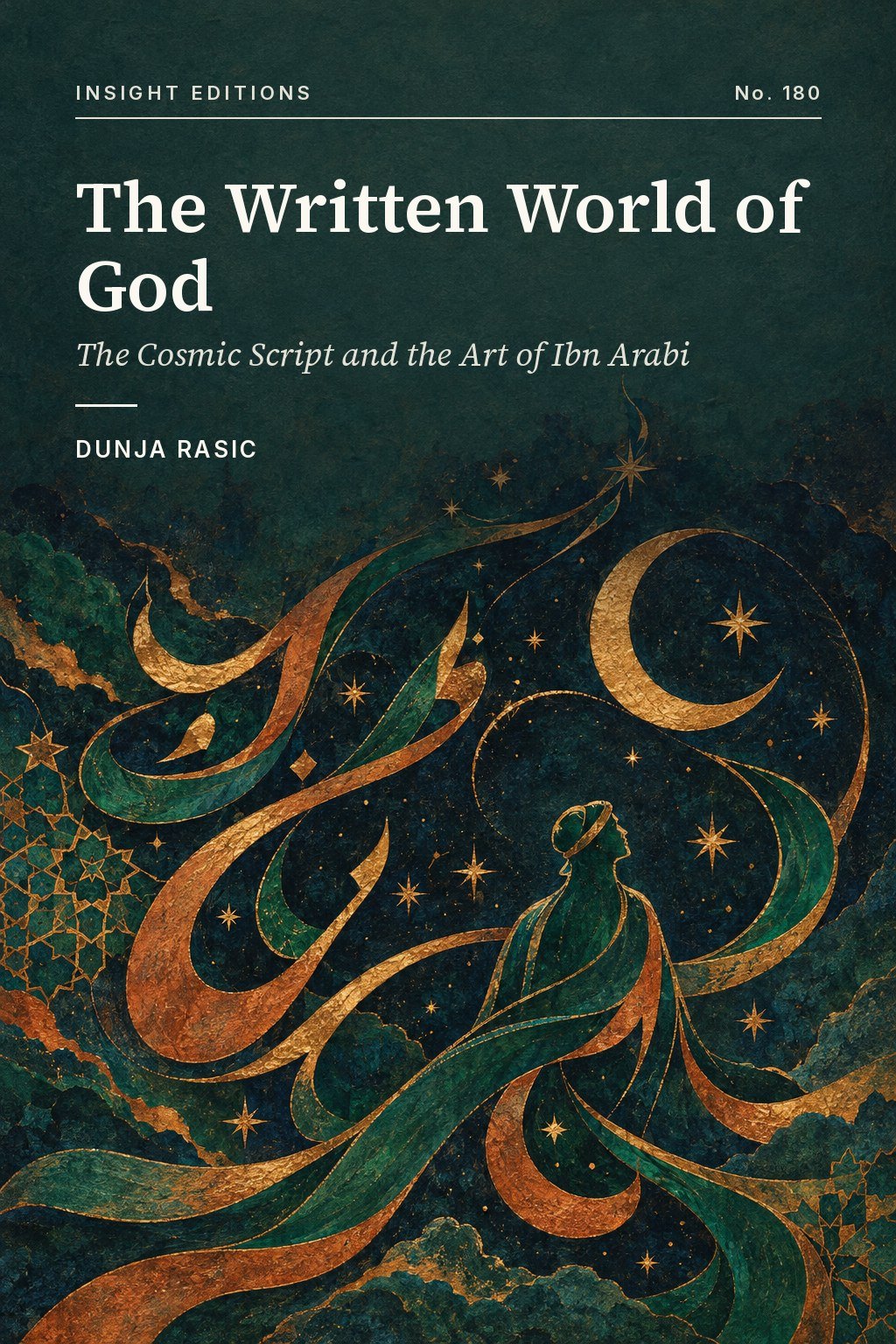
Insight Editions · No. 180
The Written World of God
The Cosmic Script and the Art of Ibn Arabi
Dunja Rasic
Dunja Rasic examines Ibn Arabi’s science of letters, showing how Arabic letters structure his account of creation, cosmology, scripture, and the human being.
A study guide to The Written World of God by Dunja Rasic. Shared free for personal reading; not for sale and not endorsed by the authors or publishers. Please read and buy the original.
About the Book
Dunja Rasic's The Written World of God: The Cosmic Script and the Art of Ibn 'Arabi (Anqa Publishing, Oxford, 2021) is, in her words, the first systematic overview of Ibn Arabi's science of letters ('ilm al-huruf). It reads creation as speech and writing: twenty-eight letters, breathed out by the All-Merciful, become the Intellect, the Soul, the spheres, the kingdoms and the human being, and the book follows them in order with Ibn Arabi's own diagrams and handwriting.
In one sentence: for Rasic, Ibn Arabi treats the Arabic letters as the grammar of existence itself, so that reading their shapes, sounds and order is a way of reading the universe, the human body and the Qur'an as one book, while he guards the practical side of that knowledge in deliberate silence.
Part 1. The Cosmic Script
The opening part sets the terms: what the science of letters ('ilm al-huruf) is, where it came from, how it differs from magic, and by which two paths a seeker may come to know what the letters mean.
1.1 Introduction
Letters as the key to three books
The book opens on a line Rasic takes from The Meccan Revelations: "Existence is a letter, you are its meaning." Ibn Arabi held that a man, an angel and a jinni can all speak, but that only human beings can come to terms with the secret properties of letters. He defined the science of letters as familiarity with letters, the Qur'anic revelation and everything in the world of nature. Rasic calls her book a commentary on that definition, and the first systematic overview of Ibn Arabi's contribution to the Islamic science of letters.
In the Akbarian tradition the world is everything other than God (kull ma siwa Allah), and it is a product of God's speech. Ibn Arabi compares it to a book on "parchment unrolled (al-raqq al-manshur)": the face holds the Most Beautiful Names of God, the lower side the world of nature. Genesis therefore unfolds as speech and writing.
| Book | What is read |
|---|---|
| Macrocosm | The universe, studied as a text |
| Microcosm | The physiognomy and nature of human beings |
| Revelation | The text of the Qur'an, held the most accessible of the three |
Al-Tirmidhi held that the letters contain the knowledge of the primal beginnings: they are "the complete knowledge of the primal beginnings, God's attributes and names."
The idea that grammar mirrors the cosmos goes back to the ninth-century grammarians of the Baghdad school, for whom Arabic was a pure language of divine origin. Rasic quotes al-Suyuti's survey of the argument, including Abu Ali al-Farisi's appeal to the verse "He taught Adam the names, all of them." Ibn Arabi said that ignorant people have no clue of the importance of grammatical analysis, and seven centuries later Massignon agreed: "unless one has studied very closely the mechanism of Arabic grammar, lexicography, morphology, syntax." Sufis would save every scrap of paper bearing Arabic letters, a custom Schimmel found still alive in rural Bengal.
Nothing exists before it is named. Adam, created in God's form and taught the names, could master the letters; after Satan's temptation his descendants lost that familiarity, so reading the three books needs training and divine mercy. Masters were thought able to cure illness, converse with animals, conquer death and return to the primordial state, the final goal of the science.
Calligraphy, diagrams and a warning
Burckhardt is quoted: "nothing has typified the aesthetic sense of the Muslim peoples as much as the Arabic script". In Sufi circles calligraphy was a technical science of fixed ratios, strokes and angles, each with symbolic meaning, and Ibn Arabi analysed letter shapes "with geometric precision". Rasic studies the twenty-seven holographs and several dozen autographs in his hand, and the cryptographic scripts he devised (Table 1 of the book gives each letter's four positional forms and his cryptograph).
The obstacle is secrecy. Ibn Arabi called the science "a noble science in itself" that it is "preferable not to seek", so relevant passages are deliberately vague. Chittick warned how easily one can make Ibn Arabi say whatever one wants; al-Nabulusi replied that there is no single correct reading, as God "is One" yet appears differently to different people. The 2012 Ibn Arabi Heritage Project counted eighty-four works certainly his.
Rasic first planned one chapter for each letter, in Ibn Arabi's own sequence of creation (Intellect as hamza, Soul as ha', down to the step-levels of spiritual elevation as waw). But the letters are not treated equally: alif, ba' and ya' each got a whole book, others are barely mentioned, and Ibn Arabi admitted he did not know the orbit period of nun. So similar letters are grouped, and lam-alif is moved to second place.
Arabic letters join into an organic band and take isolated, initial, medial and final forms. The science held isolated letters superior to words, so Ibn Arabi worked mostly with isolated forms; yet meaning also shifts from word to word, as qaf in the imperative "protect" (qi) loses properties it has elsewhere. "Letters are like natural medicines", he wrote. Rasic's rule is to let Ibn Arabi speak for himself, as he recommended: "No scholar can declare wrong an interpretation that is supported by words".
Rasic admits the risk. Ibn Arabi thought it improper for scholars to interpret revelations they did not receive, and named madness, misery, slander and hell as the price of a misstep. "However, this is something we will have to live with." She will proceed "meticulously and rationally", recalling the saying that "God loves the artisan who seeks perfection in his craft". The section closes on Marlowe's Faustus: "Lines, circles, scenes, letters, and characters".
1.2 The Letters and the Science of Letters
Origins
A Hira legend has three men of Anbar, Murra, Jidla and Aslam b. Sidra, derive the Arabic script from Syriac; Starcky tied it to the Lakhmid court script, but the accepted view now looks to Phoenician. Gruendler: "Arabic seems to be the most remote from its ancestor." From the fourth century CE rectilinear characters became the loops of twenty-eight letters. Harf (pl. huruf) means letter, the smallest unit of a word, but also a particle, neither noun nor verb, and each of the seven modes in which the Qur'an was revealed. The book uses the first sense: letters as "the building blocks of the universe".
Ibn Khaldun credited al-Buni and Ibn Arabi with founding the science. Ibn Arabi made no such claim, al-Buni pointed to Hermes and Aristotle, and Timurid authors to Solomon, Pythagoras and Plato. Rasic traces it instead to eighth-century Iraq and al-Mughira b. Sa'id, a reputed sorcerer and self-proclaimed prophet who pictured God as "a man of light, with a crown of light on his head" whose limbs "have the shape of the letters of the alphabet". He claimed to have revived seventeen people by letters and was executed in 737 CE.
Early Shi'i groups loyal to Ali carried the idea in jafr, apocalyptic literature whose letters held past and future. Hajji Khalifa defined it as "the summary knowledge (of that which is written) on the tablet of fate and destiny". In Shi'i tradition the Prophet first knew all seventy-two letters of the Supreme Name and taught Ali that every letter, like every verse, has a literal (zahir) and an inner (batin) meaning. A hadith in al-Sulami: "All marvels that exist are within it."
Combinations of up to five letters opening twenty-nine suras (the book's Table 2), such as alif-lam-mim (al-Baqara), kaf-ha'-ya'-'ayn-sad (Maryam), ya'-sin, qaf, nun. Their original meaning is unknown. They were read as mnemonics, sura markers or editors' initials, and also as symbols of the divine origin of the world, the spiritual side of the alphabet or the world of spirits.
Early Shi'i use was mostly divination: gematria (hisab al-jummal), divination from verses, and 'ilm al-awfaq linking letters and conjunctions. By the fourteenth century the science was known as simiya', letter magic, and Ibn Khaldun filed it under sihr as the work of "the extremists among the Sufis". Rasic calls his classification "short-sighted" but "not entirely unfounded": the classification-of-sciences genre lists dozens of letter-using disciplines, from kalam to bibliomancy, mostly just to say they are forbidden.
Occult, Hellenistic, Sufi
The science fits the occult in its elitism: the Brethren of Purity put the occult sciences at the end of an education. Early Shi'i circles kept letters for the imams; from the mid-ninth century Sufis opened them to the pure of heart. Ibn Arabi called it "the knowledge of [God's] friends" and "the universal science". Ibn Khaldun's first mistake, Rasic says, was dating: the science predates al-Buni and Ibn Arabi by at least four centuries. Sahl al-Tustari, al-Kharraz, al-Hallaj and Ibn Masarra were the first Sufis to set it in writing, and from the tenth century the Brethren of Purity, al-Nasafi and al-Sijistani blended it with Neoplatonism and Neopythagoreanism; al-Kirmani carried this to the Maghrib and Spain.
By the late twelfth century the science fused Pythagorean number and letter theory, Aristotelian and Stoic doctrine of elements, and Neoplatonic hierarchies. Rasic rejects Ebstein's placing of Ibn Arabi in a purely hermeneutic "type alpha" against a cosmogonic "type beta": his works cover both. She also finds exaggerated the claim (Abrahamov, Chittick) that he has no real predecessors, since he praised Abu Talib al-Makki for seeing that letters, like humans, form communities with prophets of their own, and spoke of Ibn Masarra as a model. Following al-Makki, he divided the letters among the worlds of Mulk, Malakut and Jabarut.
Divination, talismans and the natures
Ibn Khaldun's second mistake was failing to separate high occultism, folk magic and Ibn Arabi's theory. Ibn Arabi did accept divination: he cites Ibn Barrajan's prediction, from the opening verses of Sura al-Rum, that Saladin would take Jerusalem in 1187 CE, and used a similar method himself in the 'Anqa' mughrib to foretell the Seal. He tied the reviving power of letters to Jesus and held that reciting the disjoined letters can induce visions. On Ja'far al-Sadiq's authority he called talismans channels of spiritual power. His only surviving talisman (the book's Fig. 2) uses alif-lam-mim: alif for Malakut, lam for Jabarut, mim for Mulk; God, His creative power, and the Prophet as model of human excellence.
| Level | Letters |
|---|---|
| Divine | alif, za', lam |
| Human | nun, sad, dad |
| Jinn | 'ayn, ghayn, sin, shin |
| Angelic | the remaining eighteen, from ba' to hamza |
Each level has four guardian angels and a nature. A note adds two levels known to mystics: nun, and alif with waw: "There is nothing in existence but God and you".
The four natures, hot, cold, dry and moist, are the "Mothers"; mixed by the turning spheres they make fire, air, water and earth. "Letters are the material for words," Ibn Arabi wrote, "just as water, earth, fire, and air build the formation of our bodies." Yet the passages are vague, and why qaf should be both fire and water is never explained: "It would be necessary to write a full book to cite and explain this further". Rasic adds: "He never did." Tables of correspondence differ between Ibn Arabi, Ibn Sawdakin and al-Buni (the book's Tables 4 to 6). His real reason for silence: the topic concerns God's knowledge of things before creation, "a strange mystery and difficult complexity which is forbidden to be revealed".
High occultists of the thirteenth century wrote with comparable quality, but for them the right recipe sufficed, and piety mattered little. For Ibn Arabi the science was never an occult science: it could not be mastered by effort, and a practitioner would find little in his works beyond one talisman and two divinations. Nallino found his style "icy". Few need this knowledge: "a single person with this knowledge is enough for a region, like a doctor".
1.3 The Path of Reflection and the Path of Revelation
Two roads to one goal
"Ignorance is death", reads a line of the Futuhat. The seeker has two paths. The first is reflection: the rational mind, 'aql, which Ibn Arabi derives from the same root as 'iqal, shackles, a sign that reason's perception is limited and its knowledge relative. Of its method, "some of it is sound, some of it is corrupt". Revealed knowledge has "no scales to be weighed on"; it may come to a jurist as law, to a grammarian as a poetic meter, to a logician as insight into archetypes. Al-Qaysari likens it to a lifted veil that reveals a woman's dazzling beauty. Revelation brings faith, security, certainty and happiness.
Ibn Arabi: "The two roads are adjacent. They emanate from the same source and end at the same destination, and I have envisioned them and drawn them as such." The drawback of revelation is that the seeker cannot choose its time or content. In the Fusus, 'Uzayr is threatened with loss of his rank unless he stops praying for knowledge he was never meant to have. Lack of interest in divine matters can be a mercy: once the pious "indulge in interpretations", God holds them to account for the quality of their reading.
Ranks of the Close Ones
Only the witnesses of revelation (shuhada'), the People of the Presence or the Close Ones, can speak of divine mysteries with authority. All prophets are righteous, truthful witnesses, but not all witnesses are prophets (the book's Fig. 4). In the diagram of the Dune of Vision, a dune of white musk at the summit of the Garden of Eden, the inhabitants are seated in four communities, believers, saints, messengers and prophets, and even prophets are ranked. Al-Sulami adds that each mystic turns in his innermost being "to a particular letter"; the perfected transcend the letters' secrets, and then all creatures "become familiar and at ease with them".
Destiny, character and dhikr
The main veil between seeker and knowledge is not divine whim but khuluq: physical constitution, moral character and inner life. "Our nature is our destiny", Rasic writes, and destiny, woven in the chest, sets how much knowledge one can receive. The true Friends do not pry into it, "since the True doesn't come closer to someone who disobeys Him with his disobedience". Yet khuluq can be refined: "The offspring of Adam ascend with their each and every breath". Heaven and earth obeyed God perforce (Q. 41:11); humans and jinn can refuse, which puts each fate in its owner's hands. "So blame only yourself if you do not receive that to which you have been called!" A mere desire for growth is a sign one is not meant for hell, since His mercy takes precedence over His wrath.
The heart is the seat of intelligence and the place of every revelation, and it must be emptied of thinking. Dhikr, remembrance, is the means, and for Ibn Arabi the only thing God asks in return for life and knowledge: sit "helplessly, dependent, with nothing in hand at the door of your Cherisher", and "at that moment God will be gracious to you".
Ibn Arabi's own revelation and his writing
In Bougie (Bijaya), in Ramadan 1201 CE, a vision joined him in marriage with all letters and stars. A year later in Mecca a Youth (al-fata) instructed him further, and the meeting inspired the Futuhat. Chodkiewicz read the term al-imam al-mubin as implying that nothing was omitted from his works; Rasic answers that "this is not what Ibn Arabi presumed", quoting him that the book "is not enough for us to exhaustively deal with a single thought we have on this path". If he began on the letters, "the hand would grow weary, the pen would wear down".
Schimmel called him "a genius of systematization", Netton and Akkach praised his system. His own account differs: "I never had a set object like other authors nor a particular way of composing. Flashes of divine inspiration used to come upon me, threatening to bum me up." (The printed "bum" stands for "burn".) He drops topics with "the chapter has grown too long", leaves blank spaces for diagrams, and sometimes threw away his notebook and stormed out. In The Settings of the Stars a luminous tablet with "radiant green lines" appeared and he copied it to the end. He was only a transmitter, writing what he was ordered: "He is the One Who reveals the foundations of each matter, without summarizations and perplexity!"
The hand of the Shaykh
He was no professional calligrapher, though he probably had scribal training, being meant to serve as secretary to the Almohad governor of Seville. Once at Sabta he dictated a commentary to two copyists before dawn: "Before the sun had risen, two notebooks had been filled out." He called calligraphy "the shape of letters": a letter's length governs its activity in the world of spirits (Malakut, the length of the cosmos), its breadth its activity in bodies (Mulk, the breadth).
| Feature | As the book describes it |
|---|---|
| Script | Andalusi Maghribi (occult texts mostly used linear Kufic or naskh); sharp pen, even line thickness |
| Later change | Diacritics and final forms drift toward the Mashriqi style; perhaps for an Eastern audience, perhaps new brushes in old age |
| Lines | Usually seventeen to a page, since "God is odd (witr) and loves the odd" (Hirtenstein) |
| Style | The soft cursive of administrators rather than the dry yabis of book scribes; rounded, leaning right |
| Drafts | He claimed all was in his best hand; Hirtenstein found two "rough" exceptions |
Reason's place, and the philosophers in the fire
Literal transmission keeps one safe; misinterpretation must be answered for. In the Contemplations of the Holy Mysteries seven groups of scholars go to the fire, philosophers first: "‘What have you applied your intellect to?’ ‘To that which pleases you,’ they replied." Asked how they knew, they said: "Through intellect alone." Who punishes them? "Their intellect, for this is what they worshipped." Spiritualists, natural scientists, materialists and the Mu'tazila follow. In a word play Pablo Beneito first noticed, they trusted not God, ma'a-Hu, but their own, ma'a-hum; the final mim becomes their doom.
Yet blind obedience to the 'ulama' saves no one either; he accused them of leading the masses astray. Each must weigh teachings for himself and need not drop one the Shari'a does not oppose. Law opens the heart, and even a philosopher without religion is not wrong in everything: "The fact that he [a philosopher] has no religion does not mean that everything he says is false." To cling to one school risks "having the greater good escape him". Knowledge that does not bring one near God is distraction; the science of letters passes the test, because it changes whoever studies it, starting in reason and ending in revelation.
| Grammarian | People of God |
|---|---|
| "The master of a written form and phase" | See spirits presiding over letters and planets |
| Hearing "Zayd", thinks of syntax and a man's body | See how God sends those spirits when an expert summons them |
| Studies the form, the container (zarf), as clothes on a man | Seek the meaning the form contains |
| Called "outward scholars" if ignorant of meaning | "the role of a caliph (ikhalifa) is suitable for him" who knows even the outward alif, lam, mim |
Orthography and phonetics are open to reason, and Ibn Arabi follows the grammarians where they apply, grouping ba', mim and waw as labials, then adds that they belong to Mulk, whose elements are fire and earth. Shape rules spirit, "and not the other way around". Letters are built of others: ra' and za' are half of nun, waw half of qaf, and "Lam exceeds alif by nun". Like shapes (ba', ta', tha') share like spirits; round mim and waw, which evoke the spheres, differ from nun, symbol of the material world. The Sufi wants "the meanings which this writing or speech has comprised and embraced!" To know how God sees the letters is to understand creation, the subject of Part Two.
Part 2. The Act of Genesis: Breath and Alif
Part Two of the book follows creation letter by letter.
2.1 The Breath of the All-Merciful
A sigh that became the world
"In the beginning, there was only God." All beings, letters and numbers existed only in divine knowledge, "skeletons who were waiting in potentiality" (Winkel). Corbin linked creation to the primordial sadness of a God with no one to know Him; Ibn Arabi said it would be equally true that He was filled with love. Later interpreters spoke of God's absolute abundance (karb), which De Cillis compares to Avicenna's absolute perfection.
Ibn Arabi likened that fullness to lungs filled with air: hold it back and the pain is unbearable, until the air bursts out. God sighs, and the breath is life; the world is "breathed out" (mutanaffas). Hence the Breath of the All-Merciful (al-nafas al-rahmani): "In reality, nature is nothing but the Breath of the All-Merciful." Breathing equals speaking: "Speech is the Breath of the All-Merciful, and His very being, intelligent and clear." Rasic notes earlier creative words in Egypt, Mesopotamia and Sumer (Enlil's gu), but for Ibn Arabi God spoke Arabic, and His choice of words was no accident.
"From the spoken letters the world of spirits comes into being and from the written letters the sensory world comes into being and from the summoned letters the world of the intellect in the imagination comes into being."
God says "Be!" (kun). Meanings cannot be joined unless deposited in letters, so creation is like forming a sentence, and since combinations of twenty-eight letters are unlimited, so are beings (Q. 31:27). "The world, all of it, are the words of God in existence." A gentle exhale yields the eighteen voiced letters (huruf al-majhur); stronger exhalations that interrupt the flow yield the ten voiceless (huruf al-mahmusa): ha', kha', ha', kaf, shin, sin, ta', sad, tha', fa'.
Vowels as movement
Haraka, vowel, also means movement. The three short vowels,
fatha,
kasra,
damma, are Ibn Arabi's symbols for
Mulk,
Malakutand
Jabarut, modifications of the Breath that made the three worlds. Long vowels, the "lengthening" of letters, stand for revealed knowledge and its carriers: long /a/ for God, /u/ for angelic messengers like Gabriel, /i/ for human messengers and prophets. In the verb
ja', "to arrive", the long /a/ marks a researcher who knew the world before God; one who knew God first by revelation is like someone stretching the word in speech.
| Layer | What it is | Symbolism in the book |
|---|---|---|
| Rasm | The skeleton: consonants and long vowels; eighteen archigraphemes (Milo's term) | Beings waiting in potentiality; an unvowelled text is a dead body awaiting the Breath |
| I'jam | Diacritical dots that tell ba' from ta' | "a face [of a letter] by means of which one letter is recognized" |
| Tashkil | Short vowels and shadda | Life itself; shadda is creation made in the Creator's image |
Short vowels are "the little letters". Ibn Arabi's own manuscripts carry few of them, and Hirtenstein notes that many were added by later scribes, which fixes one reading and hides what he meant.
Without vowels speech is impossible, as life is without the Breath. Consonants are matter; the vowel is the spirit, which "merges with air to create a jinn, merges with light to create an angel and merges with clay to create a human being". A word is nothing added to its letters, "only the relation of their coming together", and "Such is the composition of the entities of the cosmos".
Twenty-eight stages
The cosmos keeps the stamp of the letters that made it. There are twenty-eight lunar mansions because there are twenty-eight letters, Ibn Arabi held, and not the other way around. Twenty-eight was the perfect number: letters, zodiac stars, vertebrae, the year adulthood begins.
Sibawayh, the heart and the three worlds
Sibawayh (d. ca. 180/796) classed letters as voiced or voiceless by the strength of the airflow, and Ibn Arabi "added nothing to it". Sibawayh's sixteen points of obstruction give a sequence from the glottal hamza to the labial waw. The later order that puts alif first and groups letters by shape is credited to Nasr b. 'Asim al-Laythi, for easier memorizing. Ibn Arabi used al-Laythi's order for his cryptographs and Sibawayh's for genesis, but held that sequence, throat and cosmos all owe their structure to God: "The manifestation of letters from heart to mouth is similar to the manifestation of the cosmos from the Cloud".
Not knowing the larynx, Ibn Arabi thought air passed from the lungs into the heart to be heated by its fire, through the arteries, and back out by the throat past the points of articulation (the book's Fig. 13). One breath, many letters: "the ranking in excellence occurs because of the place of articulation". So too a spirit descending changes form with its place; Gabriel had 600 wings below the Lote-tree, and would look different in hell.
The rationale: humans are made in God's form, so the heart answers to the Essence. "The letters, all of them, emerge from the heart". The human vocal tract can sound all twenty-eight letters in ascending order, one reason humans can master the science, and a revelation showed him that the points of articulation (makharij) parallel the steps of ascension (ma'arij).
Are letters created?
Al-Shafi'i: "Do not say that the letters were created in time, for the first cause of the ruin of the Jews was in believing this." Like him, Ibn Arabi put letters before space and time: "Don't let these grammatical particles veil you from realizing the truth." Time is an illusion of the moving spheres. Al-Qashani tied the letters to the Universal Soul, where "All present moments are united". In the material world the circle of letters runs from hamza to waw, but Rasic's story begins and ends with alif.
2.2 The Isolated Alif as the Divine Essence
"If alif was to be described by a noun, the noun would be “Allah” - and if it was to be described by an adjective, the adjective would be “self-standing”". To know alif is to see God as He was before creation. The name Allah, from a root meaning "to be perplexed", resists derivation, which warns against associating other gods with Him and shows that God in His Essence cannot be known. Alif takes no article, which would define the indefinable. All one can say is that it exists.
"All letters may be dissolved and reduced to alif and all of them are composed of it." And: "The letters are constituted of alif and alif always accompanies them, without them being aware of it." This is the Qur'anic paradox of a God transcendent yet nearer than the jugular vein. Alif is the sustainer of the letters (qayyum al-huruf); in sound it is the long /a/, a sigh before God's greatness; since air meets no obstacle, it is the flow itself, not a letter. It appears in the names of twenty-two letters and underlies every shape: ha' is the hunchback alif, mim the circular. 'Attar sang the same: "When alif is bent like a reed, Then its both ends become crooked and it is ba".
In the name Allah, the two lams stand for Mulk and Malakut, the line joining them for Jabarut, "the place of the soul", and the final alif for "the True, the One that does not join up". The letters also trace the postures of prayer, so the name is said with tongue and body. Standing, the alif posture contains all others; but upright alif can also mean pride. Human nature shows better in ba', a person lying ill, asleep or in pain; uprightness befits the Creator. (A note records that Sari al-Saqati called alif the letter of Iblis, the one that did not bow to Adam, and that Ibn Hanbal condemned him.)
2.3 The Creator and the Created: the Cherubic Letters and Lam-Alif
The double letter
Schimmel dates lam-alif as a major mystical symbol from the ninth century; earlier, in profane poetry, it meant a tight embrace or a quick succession of events. Ibn Arabi knew both: the Futuhat speaks of intertwined lovers "floating through the year like a dream", and he compares lam-alif to the two plates of a shell hiding a pearl. Written as one unit, it is also the negation la, "no": "Look at what is hidden in the negation (la) and then say whatever you like - that they are two or that they are One."
To get twenty-eight letters, Ibn Arabi drops alif, the letter that is not a letter, and adds lam-alif, citing a saying of the Prophet that whoever refuses lam-alif as a letter will not be counted among his followers. In the Futuhat it is the twenty-eighth letter, before ya'; in The Orientations of the Letters, twenty-nine prayers, it comes last, so that alif, hidden in a late letter, can "combine the first and the last, the visible and the invisible" (Q. 57:3). Al-Hallaj read its two spikes as origin and return (Q. 2:156), their meeting point as the dot (nuqta): "the allusion of lam-alif is hidden in alif and the allusion of alif is hidden in the dot."
Attributes: neither He nor other than He
Of the Essence nothing is known; of God as Creator (ilah) something is. The world exists because God is Living, Knowing, Wanting and Powerful, "nothing else". The ninety-nine (or hundred) Most Beautiful Names are the many properties of one alif: "His alif does not multiply and is not completed by any addition - God is too great for that." Names can seem opposed, as letters can be both "curved" and "mixed". Beyond the ninety-nine manifest Names and twenty-eight letters lie countless dormant ones, "like the tree latent in the date-stone". From the ultimate point of view, Rasic sums up, "There is only God."
Kuzminac, translator of Ibn Arabi into Serbian, tied al-Rahman to rahm, womb, and to genesis rather than compassion; Rasic finds this "not entirely correct", since for Ibn Arabi "mercy is a universal quality". After alif, the name holds five archigraphemes, the cherubic letters lam, ra', ha', mim, nun, read as Knowing, Wanting, Powerful, Speaking, Hearing and Seeing, and as body, nourishment, sensing and articulation. Alif floats above them as Life: "A lif is a dagger that floats above the other six letters". (The book gives two slightly different lists of which letter carries which attribute.)
Nun, the moon and the half circle
Nunis the shape of the universe and the embrace of
lamand
alif, a mystery open only to "those who have straightened alif up from its reclining position and loosened the letter lam from its knot". It is also an inkpot, or the navel of the world.
Alif, needing no vowel, is the Sun;
nunthe Moon, with borrowed light. Its written form is half a circle: "If it were transferred from the spiritual world, we would see the full circle". Only the dot hints at the hidden half. The fourteen sun and fourteen moon letters mirror light and shadow.
Love, knowledge and signs
God created out of love: divine love, distinct from spiritual and nature-based love. In a Futuhat diagram (the book's Fig. 25), the servant's love is held between God's first love, a grace, and His second, an honouring reward, "within the tight embrace (qabda) of the Real". The Hidden Treasure loved to be known. The Fusus: "Existence is from the Lord, attributes are from the servant". In grammar's terms, the noun is alif, verbs are its creations, and harf, letter and particle, the bond between them.
Yet Ibn Arabi sided with those for whom "knowledge is more eminent than love"; "flee to God" (Q. 51:51) is a flight from ignorance. He lists four seekers: recipients of revelation, expert at sorting contradictory reports; those who seek union through imagination, intimacy and ecstasy; those who look for any sign at all; and intellectuals who cannot grasp that God is always near, closer than the jugular vein. Only God makes the link: "you will not succeed in making this link on your own". So He gives signs (Q. 41:53): world ('alam) and mark ('alama) share a root with knowledge ('ilm), and the world is "a word with meaning - and the meaning is God". Signs that hide Him are also stairs. Ibn Arabi's diagram of the two arcs alludes to "two bow lengths or closer" (Q. 53:9).
The rule is balance: "If you insist only on His transcendence (tanzih), you restrict Him and if you insist only on His immanence (tashbih) you limit Him". In the Qur'an, when God says "We", He speaks of His attributes; in the singular, of His Essence, and the search should stop. The body too is a book, and the universe "a book whose meaning is God". Since the simple precedes the complex, the science of letters "precedes that of the Names".
2.4 The Primordial Cloud: Hamza and Its Elongations
Self-disclosure
Hamzastands for God determining Himself with the Names, His knowledge of Himself and His absolute imagination: without imagination, no creation. There are two phases: essential self-disclosure (
al-tajalli al-dhati), inward and unseen, and self-disclosure through the Names, begun with
kun. Bosnevi likens them to introspection and to a man before a mirror. "Kun is His command, His command is His speech, His speech is His knowledge and His knowledge is His Essence." God knows creation only by knowing Himself.
Asked where God was before creation, the Prophet said: in the Cloud, with no air above or below. The Cloud, or Mist, is the first thing to step out of divine knowledge; it "filled the nothingness, all of it". Its symbol is alif with hamza. Grammarians denied hamza full letter status; Khalil said "The hamza is air, it has no place of articulation." Ibn Arabi disagreed: as a glottal stop, an interruption of air, hamza is the first spoken letter, and alif, the first written, needs it to be voiced, as alif needs the Cloud. Bosnevi gives alif two faces: one that can be named (hamza) and one that cannot. If alif is absolute oneness, the Cloud is "the absolute collectivity" of the One, "the second shadow" (al-Qashani), and also "the cosmic blindness", the first veil.
The image of the Cloud
The fourth diagram of the Futuhat, "Image of the Primordial Cloud and All It Contains", is plain, and Ibn Arabi regretted it: "If I was only able to draw a bigger diagram, it would all be clearer to the reader". Its rim holds thirty stations of the angels enraptured with love (al-muhayyama), which Murata links to God's White Earth. One of these cherubs received the knowledge of all things: the White Pearl, the First Intellect, the Highest Pen, linked to the Name al-Badi' and to hamza, whose shape recalls the horns of Aries.
"When God created the First Intellect as a pen, its truth sought a place for its writings - because it is the Pen!" The Tablet, drawn as a rectangle with two circles for the Soul's practical and intellectual powers, is its ontic shadow. The Dust, prime matter, is missing from the drawing; Rasic suggests lack of space, or that it has no form. Its letter ha' sounds almost like the flow of alif yet is heard, as the Dust is grasped by the mind though unseen. Ibn Arabi likens it to the gryphon, which no one has seen, and to Ali, long dead but doubted by no one; and to the plaster a builder spreads over the whole wall. It is neither old nor new: "So in a way, the Dust is also something new." Ibn Masarra, after al-Tustari: "letters are the Dust and the foundation of things".
Universal Nature ('ayn: eye, essence, entity) has four realities, heat, cold, moistness and dryness: "Heat is from the Intellect, and the Intellect is from Life", cold from the Soul and Knowledge, hence the "cold of certainty". From the marriage of Nature (father) and Dust (mother) is born the Universal Body, which spins like a millstone and "moves in stillness". Of the schools that debate the first element, Ibn Arabi sides with the one that names a fifth, Nature, from which fire and the rest appear. 'Ayn and ghayn differ by a dot, and in his prayers he asks not to be "veiled from the (ayn [Eye-Essence] by [the dot of the] ghayn [of otherness]".
| Divine attribute | Living | Knowing | Wanting | Powerful / Saying |
|---|---|---|---|---|
| Principle | Intellect | Soul | Dust | Universal Body |
| Quality | Hot | Cold | Dry | Moist |
| Humour | Yellow bile | Black bile | Blood | Phlegm |
| Human root | Body | Nourishment | Senses | Articulation |
Rows follow the book's Table 13; the passive pairing of Dust and Body is from Ibn Arabi's text. The four words of la ilaha illa Llah answer to the four attributes.
, the stretched
alif, stands for the creative potential of the Intellect: Soul, Nature, Dust and Body each follow "in accordance with the measure of the Intellect", and "Beyond it there is nothing except images." Rasic doubts that Ibn Arabi accepted the popular tale that the Pen's first drop of ink made
alif, since he held the Pen's writing free of error: "it is the most preserving and the most guarding of all created beings." Pen and Tablet are father and mother of the world, and "everything below the Tablet is a product of sexual reproduction". The Pen's first task was Shape (
kha'), and the first thing to take shape was
qaf, the Throne.
Part 3. The Throne and the Spheres
The book's longest section descends from the Throne through the nine spheres to the Earth, giving each level its letter, its Divine Name, its prophet or angel, and the knowledge an adept gains on reaching it.
2.5 The Throne and the Heavenly Spheres
The Throne on the water
When God tore the Universal Body in half, the seven heavens, the Earth and the Throne appeared. The Throne stands at the far end of the universe and rests on water. The preface of the Futuhat tells the story: God created a "water-jewel", frozen "like a precious jewel in roundness and whiteness", looked on it "with the eye of Majesty, and it dissolved in shyness". His Throne was on that water (Q. 11:7). The Breath stirred the water, its foam became the Earth, and smoke from the Earth's friction became the heavens.
The Throne's symbols are qaf and the Name al-Muhit, the Encompassing. It is the first and largest corporeal object. Akkach calls it "the circumference of creation", but Ibn Arabi drew it angular (the book's Fig. 36), standing on four legs he says he saw in 1201 CE, held by Israfil, Jibra'il, Mika'il and Ridwan: "Their light resembles the light of a lightning bolt." Below the Throne he saw a shadow "whose measures are limitless". Ibn Masarra called the Throne al-Mulk; Ibn Arabi preferred to link it to the second lam of Allah, Malakut, which stretches out to support Mulk.
The bearers manage the natural world; one appeared as a man, three with the heads of a lion, an eagle and a bull. On Judgement Day eight will carry the Throne (Q. 69:17), separating heaven from hell (the book's Fig. 38 shows the scale and the books of the two honourable scribes). Before that, all beings answered "Yes, indeed" before the Throne to "Am I not your Lord?" (Q. 7:172), then spiralled down through the spheres to be born.
The Pedestal and the circle
Kafstabilizes the Throne's power: it is the Pedestal, square, the Name
al-Shakur, where God lowered His feet. "While the Throne is Whole, the Pedestal is Separation." The spheres lie inside it, "like a ring tossed in the empty desert", and the eleventh diagram of the
Futuhatshows the world as concentric spheres. The circle, first and most perfect shape, is
sad, "one of the letters of the truth, well-formed and guarded"; God extended it "downwards and beyond" to make the universe.
A circle's end meets its beginning, as a dying man looks back with longing at his origins (Q. 2:156); a world made from a straight line would make the Qur'an groundless. Hence the advice to "contemplate on the mim, waw and nun, whose end is the beginning so that there is neither beginning nor end." Form (shakl) shares a root with shackles (shikal): a bow's curve is its nature, "The curvature of the bow is its trueness, so don't be fooled!", and so the spheres' roundness binds them to their course.
Ptolemy, the onion and the nine spheres
Ibn Arabi kept Ptolemy's seven planetary spheres around a central Earth, as most Sufi diagrams do. He called the spheres raised ceilings, layered like an onion. He advised students to observe the sky for themselves rather than trust outdated works; Rasic remarks that he "would be the first to ignore it", since his diagrams add the Throne, the Pedestal, the gardens and hell, and owe more to Sufi cosmology than to al-Razi or al-Tusi. His nine spheres come from the letters: three divine letters (alif, zay, lam) times three worlds. He also believed in seven heavens and earths, one atop another; Ibn 'Abbas reportedly spoke of fifteen Ka'bas and seven other Ibn 'Abbases beneath the seven heavens, adding: "If I were to tell you the interpretation of these words, you would stone me."
Do the spheres make the letters or the letters the spheres? The book finds both views in Ibn Arabi, and concludes that either way his science of letters cannot be separated from cosmology. Each sphere's rank is its nearness to the Throne; each holds a prophet met during his ascension (mi'raj), and its knowledge includes that of the spheres below.
| Level | Letter | Name, prophet or angel | What is learned or held there |
|---|---|---|---|
| Starless Sphere | jim | Michael; first sphere created | Featureless, "The sand swept clear of tracks"; rotation of 78,000 years; twelve watch-towers |
| Fixed Stars | shin | Ridwan, guardian of paradise | Floor of paradise, ceiling of hell; 1025 stars; the twenty-eight lunar mansions |
| Saturn (1st heaven) | ya' | al-Rabb; Abraham; Azrael; the Lote-tree | The excellence of human nature; even some jinn are saved |
| Jupiter | dad | Moses; angel Muqarrab | The secret of perception: a staff that becomes a snake |
| Mars | lam | Aaron; al-Qahhar; angel al-Khashi | Awe, fear, spilled blood |
| Sun | nun | al-Muhyi; Idris | Heart of the world; sphere of the Pole (qutb) |
| Venus | ra' | Joseph; angel al-Jamil | Art, the four humours, imaginal forms crossing into bodies |
| Mercury | ta' | Jesus and John; angels al-Nashitat | The secret of kun, breath and life |
| Moon (7th, closest) | dal | al-Khaliq; Adam; angel al-Mujtaba | How the four elements form bodies |
Watch-towers and lunar mansions
The Starless Sphere is divided into twelve watch-towers, like governors' observation posts, home of the twelve angels called al-Mudabbirat. Why twelve? The Pedestal's division (two feet) times six things (the Creator and five legal rulings: obligatory, permitted, forbidden, recommended, disliked). Bosnevi lists the angels by duty, Aries over accidents and movements, Taurus guarding the keys of paradise and hell; Rasic notes that the names match the zodiac, whose constellations actually belong to the sphere below. Heaven's gardens lie between these two spheres (the book's Figs. 49 to 51 map the gardens, the seven levels of hell, and virtues and sins against them).
"However, according to us, it is the other way around: the number of mansions is determined by the number of letters." Each mansion, about 12° 51' of the ecliptic, has a letter, a Divine Name and a guardian angel named after its letter (the book's Table 14: Sharatayn with hamza and the Essence, Butayn with ha' and al-Badi', the Pleiades with 'ayn, and so on). Masters could bind these angels through their letters, and Ibn Arabi held the mansions could even influence weather, a practice the Prophet condemned; jurists later allowed them for timekeeping and navigation only.
Rasic adds the astronomers' background: Bedouins placed the Moon by the stars it hid; scholars trace the mansions to Indian, Chinese or Babylonian systems, and Varisco disputes the Babylonian thesis; on globes and astrolabes they are mostly decoration, and Bedouin star groups do not match Ptolemy's. Among the Sufis, astronomical observation was atypical. Like alif among the letters, the Pole (qutb), "which is no mansion", makes twenty-nine and keeps the twenty-eight stable.
Through the planetary heavens
In Saturn, al-Sulami's Sufi joins first and last letter in reverse, ya' and alif, to get ya, the vocative cry of the servant: "O God, O Benefactor, O Merciful!" The Lote-tree of the Furthest Boundary (Q. 53:14) grows here, roots in hell, branches in the gardens, sweet fruit (ra', ba' of al-Rabb) for good deeds, bitter fruit and thorns, far more numerous, for bad. Those who reach Saturn also learn how Adam's creation differed from Eve's and Jesus' from that of Adam's other children, and how mankind was made with both hands of God (al-Qashani reads the two hands as the dichotomy of the divine nature, Gentle and Vanquisher). Bosnevi places the Lote-tree between the seventh and eighth spheres instead. From it Gabriel, whose true form is pure light, presides over the creatures born of the four elements, for in this model what is high rules what is low, and one's place of residence shows one's rank. Then the accounts grow short. Ibn Arabi says it would be too lengthy to give each heaven's order and refers to his Tanazzulat; Rasic calls this "a gross overstatement", since that section is only a few paragraphs long.
Jupiter keeps dad, "strange knowledge which only a few know", and Moses' conversation (Q. 20:17-20): how a staff becomes a snake "in such a way that it does not stop being either a snake or a staff for a single moment". In the Sun, nun, "a most noble letter", has its own way through the nose. In Venus, Joseph teaches how archetypes cross from Jabarut to Mulk, through symbols that "show the years through the image of a bull". In Mercury Jesus and John share one heaven, because "the secret of breath is also the secret of life"; adepts learn that simiya' works through nouns and letters, not blood, and above all learn kun.
Three letters because creation involves three elements; to use only one in such work would be forbidden. The barzakh, every border that separates and joins, is like a form in a mirror: "We know that some separator exists, but the eye cannot perceive it." In the apocryphal Tree of Being, the believer reads in kun the K of treasure and the N of light, while Iblis, after 40,000 years of study, saw only the K of his unbelief (kufr) and the N of his fire (nar). Writing this section in 627h, Ibn Arabi saw the form of the Divine He-ness (huwiyya) as "a white light on a red carpet", and drew it in the margin.
The Moon and the four orbits
The Moon, "the closest heaven", is Adam's and the angel al-Mujtaba's, Gabriel's deputy, whom Bosnevi calls Isma'il (no relation to the prophet). Below lie the orbits of Fire (ta', al-Qabid, angels al-Sabiqat whom jinn spy on until comets drive them off), Air (za', al-Hayy, the angel of thunder), Water (sin, al-Muhyi) and Earth (sad, al-Mumit). Bosnevi's claim that fire is the strongest element, Rasic says, "was, however, far from the truth": a hadith qudsi ranks mountains, iron, fire, water, then air, and only humans are stronger than air. Water removes doubt, and "the gauzy veil is lifted from the heart". The Moon, being the least of the spheres, turns fastest; Bosnevi elsewhere explains its speed by its cold, wet nature rubbing against the Orbit of Fire. The orbits are not the elements themselves, which Ibn Arabi held existed before the orbits named after them. Of the four pillars the Earth came first, and it is intelligent: "He addresses the Earth and it speaks back to Him". Its letter sad, also the title of the thirty-eighth sura, speaks of trial, retribution and forgiveness within the all-embracing Compassion. Bosnevi adds that all kingdoms are subject to the Earth, home of humans, animals, plants and minerals.
Part 4. Kingdoms, the Human Being and the Great City
The last two sections of the book reach the creatures: the six kingdoms of minerals, plants, animals, angels, jinn and humans, each with its letter, and finally waw, the letter of spiritual ascent and of the Perfect Human.
2.6 Za', Tha', Dhal, Fa', Ba' and Mim: the Six Kingdoms
Six species fill the universe: angels, jinn, humans, plants, animals and minerals. The last four live on Earth, are built of the four elements and are fed by them. All, "down to the lowest of worms", celebrate the Creator, so each kingdom has its messengers and its letter.
| Kingdom | Letter | Divine Name | Traits in the book |
|---|---|---|---|
| Minerals | za' | al-'Aziz, the Inaccessible | Inert, never compelled; "masters of the Divine protocol and teachers of good manners"; sick metals seek to become gold |
| Plants | tha' | al-Razzaq, the Sustainer | Constant growth; the date palm, made of Adam's leftover clay, is "our aunt" |
| Animals | dhal | al-Mudhill, the Abaser | Senses and need of food; tamed for humans (Q. 36:72, 45:13) |
| Angels | fa' | al-Qawi, the Strong | Obedient, rise only by knowledge, know few Names; eighteen angelic letters (six days times three worlds) |
| Jinn | ba' | Latif, the Subtle | Fire mixed with air, created 60,000 years before Adam; need food, meddle with people, undone by fiery pride |
| Humans | mim | al-Jami', the All-Inclusive | Last created, highest in rank; clay, water, fire and light |
Like a doctor balancing the elements, a sage can cure a sick metal: "This is how he removes the sickness and rectifies and adjusts a mineral until it reaches perfection." Some metals turn to gold in a moment, others take aeons, as revelation comes. The last speck of Adam's clay, "like the measure of a sesame seed", became God's Great Earth, beside which Throne, heaven and hell are like a ring in a desert. Ibn Arabi visited it and saw stones drawn together like iron to a magnet to form ships on an ocean of sand: "I have never seen anything so marvellous as these stone vessels floating on an ocean of sand!"
Angels are messengers (malak) and set the world moving: where "the human world meets the Divine, an angel is their meeting point", and they are compared to short vowels that move consonants (the book's Fig. 58). The strongest angels are made "from the breath of women, ‘as this is the most powerful of all breaths’". Jinn, whose fire is the most elevated element, refused to bow because they missed that Adam's water and clay are stronger by their stability and coldness.
The human being as summary
"Between the two arcs of the circle stands the entirety of what God has created", from the Pen to the human being. Al-Qushayri's legend: Gabriel's jewelled wings and the Throne's light outshine much, yet God said only of humans that He made them "in the best o f forms" (Q. 95:4) and that "He loves them" (Q. 5:54). Humans are "the most complete configuration of all beings created (...) in the form of the twenty-eight letters". Astarabadi read letters in the lines of the face; Ibn Sab'in drew tables linking letters to the body and spirit. Al-Jahiz already called man the microcosm, his limbs "apportioned according to the twelve signs of the zodiac and the seven planets".
| In the human being | In the cosmos |
|---|---|
| Spirit | Muhammadan Reality, orbit of Life |
| Cognitive faculties and breath | Sphere of Saturn |
| Back of the head and memory | Sphere of Jupiter |
| Crown of the head and intellect | Sphere of Mars |
| Reflective faculties, middle of the brain | Sphere of the Sun |
| Estimative faculties and instincts | Sphere of Venus |
| Skin, fat, flesh, veins, nerves, muscles, bones | Orbits and the earths of seven colours |
The table is partly garbled in the file; only rows whose pairing is clear are given.
Omniscient, God was not content with abstract knowledge, which does not equal perception. He made the world His mirror, "like a well-prepared, yet lifeless ghost", and its twisted reflection keeps it in perpetual change. Genesis is not past: the universe "is written in letters on the spread-out parchment of existence and the writing on it continues, forever, without end". The Qur'an too: reading a verse the same way as yesterday would prove one's ignorance. Heaven, earth and mountains refused the trust; man accepted it (Q. 33:72), and only the heart embraces God. Man is "the child of two" and "the copy of entirety".
2.7 Conquest of the Great City: the Letter Waw
"I am Ahmad without mim": remove mim, the mortal body, and Ahmad becomes Ahad, the One. Humanity was made "from the finest stature" and returned to the lowest (Q. 95:4-5), the long descent of mim; the climb back is the ascent of waw, which Ibn Arabi called "the conquest of the great city". Beyond waw there are no more levels or letters. Its step-levels have no place and no diagram, yet every diagram in his hand serves them. The knowledge gained is that nothing exists but God and oneself: "alif is His and waw means you".
"In the waw is the capacity of all the letters", and so man, "the final goal of the Breath", holds every level of the cosmos: "the human being is the most perfect thing in existence, and waw is the most perfect letter." Ba', dot and body together, is another sign of the Perfect Human, "the mirror polished", in whose heart alif and waw, first and last points of creation's circle, meet. Yet ahad and wahid differ in form, a warning that servanthood is not lordship, and three human letters beside three divine ones mean that the viceregent of Allah "is not Allah himself". He lacks only the eternal alif.
By intellect we know only what God is not; to know what He is, one must search within. The world extends from the ba' "just as a shadow extends from an object when it meets the Sun". The three books, revelation, body and universe, are one text "written in the letters of the Arabic alphabet on the parchment of existence". Ibn Arabi's diagrams and calligraphy are "divine truths made visual" for those of reduced understanding, as the world was made to point creatures to God. Rasic calls her own book "the mystical made rational", "a shadow of the shadow", and closes with the saying Ibn Arabi loved: "the inability to achieve perception is also perception".
Part 5. Notes on the Text
Part 6. Who's Who
Figures named in the book, with death dates only as the book prints them (hijri/CE). Figures for whom the book gives no date are listed without one.
| Name | Date as printed | Role in the book |
|---|---|---|
| Ibn Arabi | d. 1240 (back cover) | The Greatest Shaykh; author of the Futuhat, Fusus and the letter treatises |
| Ali b. Abi Talib | d. 41/661 | Fourth caliph; Shi'i source of the science; "dot under the ba'" |
| Abu al-Aswad al-Du'ali | d. ca. 69/688 | Coloured-dot vowel system; argument for divine language |
| Ibn 'Abbas | d. 67/687 | Report of the seven earths |
| Nasr b. 'Asim al-Laythi | d. 89/707 | Alphabet order beginning with alif |
| al-Mughira b. Sa'id | d. 120/737 | Early letter cosmology; God as a man of light |
| Ja'far al-Sadiq | d. 148/765 | Authority on talismans |
| Khalil b. Ahmad | d. 175/791 | Modern vowel marks; the sign for hamza |
| Sibawayh | d. ca. 180/796 | Points of articulation; voiced and voiceless letters |
| al-Shafi'i | d. 204/820 | Letters are uncreated |
| al-Jahiz | d. 255/868 | Man as microcosm |
| Abu Yazid al-Bistami | d. ca. 261/875 | Knowledge "from the living God" |
| al-Tirmidhi | d. 279/892 | Letters hold the knowledge of beginnings |
| Sahl al-Tustari | d. 283/896 | Early Sufi writer on letters |
| Abu Sa'id al-Kharraz | d. ca. 286/899 | Each letter a fountain of insight; God known through opposites |
| Junayd | d. 298/910 | "under these stairs for 30 years" |
| Mansur al-Hallaj | d. 309/922 | Alif as king; lam-alif and the dot |
| Ibn al-Sarraj | d. 316/929 | Grammar as purification |
| Ibn Masarra | d. 319/931 | Andalusian model for Ibn Arabi on letters |
| Abu Talib al-Makki | d. 386/998 | Letters form communities with prophets |
| Ibn Jinni | d. 392/1002 | Alif as the sign of hamza |
| Hamid al-Din al-Kirmani | d. 411/1021 | Carried letter teachings to the Maghrib and Spain |
| al-Biruni | d. 1050 | Space between the spheres |
| al-Qushayri | d. 465/1074 | Legend of Gabriel's wings |
| al-Ghazali | d. 505/1111 | Early Sufis kept revelation unwritten |
| Ibn Barrajan | d. 536/1141 | Foretold Saladin's conquest of Jerusalem |
| Abu Madyan | d. ca. 594/1198 | Saw ba' written over everything |
| Fakhr al-Din al-Razi | d. 1210 | Tested the cosmological model |
| 'Attar of Nishapur | d. ca. 618/1221 | Verses on the shapes of alif |
| Ahmad al-Buni | d. 622/1225 | Occultist; named with Ibn Arabi by Ibn Khaldun |
| Ibn Sawdakin | d. 646/1248 | Disciple and commentator; own table of elements |
| Ibn Sab'in | d. 669/1271 | Tables linking letters and the body |
| Nasir al-Din Tusi | d. 672/1274 | Astronomer of the age |
| Sadr al-Din al-Qunawi | d. 673/1274 | Akbarian source |
| Mu'ayyid al-Din al-Jandi | d. 700/1300 | Akbarian source |
| 'Abd al-Razzaq al-Qashani | d. 736/1335 | Glossary of Sufi terms |
| Dawud al-Qaysari | d. 751/1350 | Revelation as a lifted veil |
| Haydar Amuli | d. 787/1385 | Ink and letters |
| Ibn Khaldun | d. 808/1406 | Filed the science under sorcery |
| al-Jili | d. ca. 832/1428 | Later interpreter; sleeping body as ba' |
| Ibn Abi Jumhur | d. ca. 901/1495 | Equated Intellect, Tablet and Throne |
| al-Suyuti | d. 911/1505 | Survey of the divine origin of language |
| Baha' al-Din al-'Amili | d. 1030/1621 | Spheres as Throne and Pedestal |
| Bosnevi ('Abdi al-Busnawi) | d. 1054/1644 | Commentator on the Fusus |
| Hajji Khalifa | d. 1086/1675 | Definition of jafr |
| al-Nabulusi | d. 1143/1731 | No single correct reading of Ibn Arabi |
| Modern scholars | no dates given | Chittick, Chodkiewicz, Corbin, Schimmel, Burckhardt, Hirtenstein, Elmore, Winkel, Akkach, Lory, Ebstein, Melvin-Koushki, Kuzminac |
Part 7. Synthesis
Key takeaways
- For Ibn Arabi the science of letters is "the universal science": it is cosmology, ontology and hermeneutics at once, and its three objects, cosmos, human being and Qur'an, are three books in one script.
- It is older than Ibn Arabi by four centuries, running from Shi'i jafr through the early Sufis and Neoplatonic Ismaili writers to Andalusia; Ibn Khaldun misdated it and confused it with magic.
- Ibn Arabi accepted that letters have powers, but refused to teach their practical use and called the summoning of letters a repugnant knowledge.
- Two roads lead to knowledge: the easy road of revelation and the hard road of reflection. Both start at one source and reach one goal, but only revelation opens the letters' spirits.
- Creation is the Breath of the All-Merciful sounded through a cosmic throat: from hamza (First Intellect) to waw (the step-levels), in Sibawayh's order of articulation.
- Alif is the Essence: not a letter, as one is not a number; every letter is a bent alif, yet alif joins none of them.
- Lam-alif, the cherubic letters of al-Rahman, and the half-circle of nun express the relation of Creator and creation: neither He nor other than He.
- The Cloud (alif with hamza) holds Intellect, Soul, Nature, Dust and Body; the Throne, Pedestal and nine spheres each carry a letter, a Name, a prophet and a lesson.
- The human being, mim, summarizes the cosmos; by effacing mim and climbing to waw, the seeker conquers the great city and becomes the Perfect Human, a polished mirror who still is not God.
Ibn Arabi's own diagrams in the book
The book's argument leans on figures from Ibn Arabi's holographs and from the Istanbul (Evkaf) manuscripts of the Futuhat. The ones it discusses most fully, in its own order:
- The two paths of reflection and revelation, drawn in a margin of the Futuhat (Figs. 3a, 3b).
- The four categories of the Close Ones and the Dune of Vision with its ranks (Figs. 4, 5).
- The tablet of revelation on emerald-green silk (Fig. 6) and the only cryptographic text in his hand (Fig. 7).
- The talisman for alif-lam-mim (Fig. 2) and experiments with similar letter shapes in the Book of Mim (Fig. 8).
- The dot within a circumference, the second diagram of the Futuhat (Fig. 18), and the Divine Names and the world (Fig. 21).
- Divine love and the servant's love (Fig. 25) and the two arcs (Fig. 27).
- The Image of the Primordial Cloud, the fourth diagram (Fig. 28), and the roots of existence (Fig. 35).
- The Throne, the Throne on the Day of Resurrection, gardens, hells, virtues and sins (Figs. 36, 38, 49 to 51).
- The first diagram, on why the world changes (Fig. 42), and the eleventh, the world as concentric spheres (Fig. 40).
- The lunar mansion of waw, the He-ness seen in 627h, the stone ship, the Perfect Human and the gate of the Great City (Figs. 52, 55, 57, 61, 62).
Rasic notes that the holographs are full of blank spaces where diagrams were meant to go, and that Ibn Arabi drew quickly rather than beautifully: efficiency and precision mattered more to him than art.
- Read with the letter table to hand: the sequence in Figure 23 is the spine of the whole argument.
- Treat each letter as three things at once: a sound (its place in the throat), a shape (its geometry) and a station in the cosmos.
- Take Ibn Arabi's diagrams as he meant them, as aids to imagination for "those with reduced understanding", not as maps of physical space.
- Follow his own method: let him speak for himself, and expect bewilderment, which he counted as a kind of perception.
| Occultist | Grammarian | Ibn Arabi |
|---|---|---|
| Seeks the right recipe; piety optional | Studies form and syntax; the "outward scholar" | Seeks the spirits and meanings, given by revelation |
| Talismans, divination, weather | Points of articulation, vowels, dots | Uses both, but as signs of creation and ascent |
| Knowledge as power | Knowledge as rule | Knowledge as transformation of the knower |
Part 8. Glossary
| Term | Meaning in the book |
|---|---|
| 'ilm al-huruf | Science of letters; for Ibn Arabi "the universal science" |
| harf, pl. huruf | Letter; also particle; also a mode of Qur'anic revelation |
| al-huruf al-muqatta'at | Disjoined letters opening twenty-nine suras |
| al-huruf al-mustahdara | Summoned letters, made effective by the summoner's himma |
| himma | Spiritual concentration; also divine energy |
| jafr | Shi'i esoteric, apocalyptic letter literature |
| simiya' | Letter magic |
| sihr | Sorcery; also anything wondrous |
| kashf | Revelation, unveiling |
| 'aql | Rational mind; linked to 'iqal, shackles |
| khuluq | Constitution, character and inner life; one's destiny |
| dhikr | Remembrance of God; empties the heart for revelation |
| al-nafas al-rahmani | Breath of the All-Merciful; creation as exhalation |
| kun | "Be!", the creative command |
| rasm | Letter skeleton, archigrapheme |
| i'jam | Diacritical dots |
| tashkil | Short vowels and shadda |
| haraka | Vowel; movement |
| makharij / ma'arij | Points of articulation / steps of ascension |
| Mulk, Malakut, Jabarut | Corporeal, angelic and intermediate worlds |
| dhat | The divine Essence, symbolized by alif |
| uluhiyya | Divinity, God as Creator with attributes |
| tanzih / tashbih | Transcendence / immanence |
| nuqta | The dot; primordial intuitive knowledge |
| al-'ama' | The Cloud, first to emerge from divine knowledge |
| hayula, haba' | Prime matter, the Dust |
| barzakh | Isthmus; every border that separates and joins |
| al-Mudabbirat | The twelve angels of the watch-towers |
| qutb | The Pole, compared to alif among the mansions |
| maratib | Step-levels of spiritual development, letter waw |
| al-insan al-kamil | The Perfect Human |
| raqa'iq | Subtle connections; angels between God and humans |
About this book
The Written World of God: The Cosmic Script and the Art of Ibn Arabi by Dunja Rasic, 2021. This is a chapter-by-chapter study of the book, with summaries, maps, tables and diagrams; short quotations keep their page references. It is shared free for personal study, is not for sale, and is not endorsed by the author or publisher. Please read and buy the original.
Insight Editions · rajeshrmahapatra.com/insight-editions