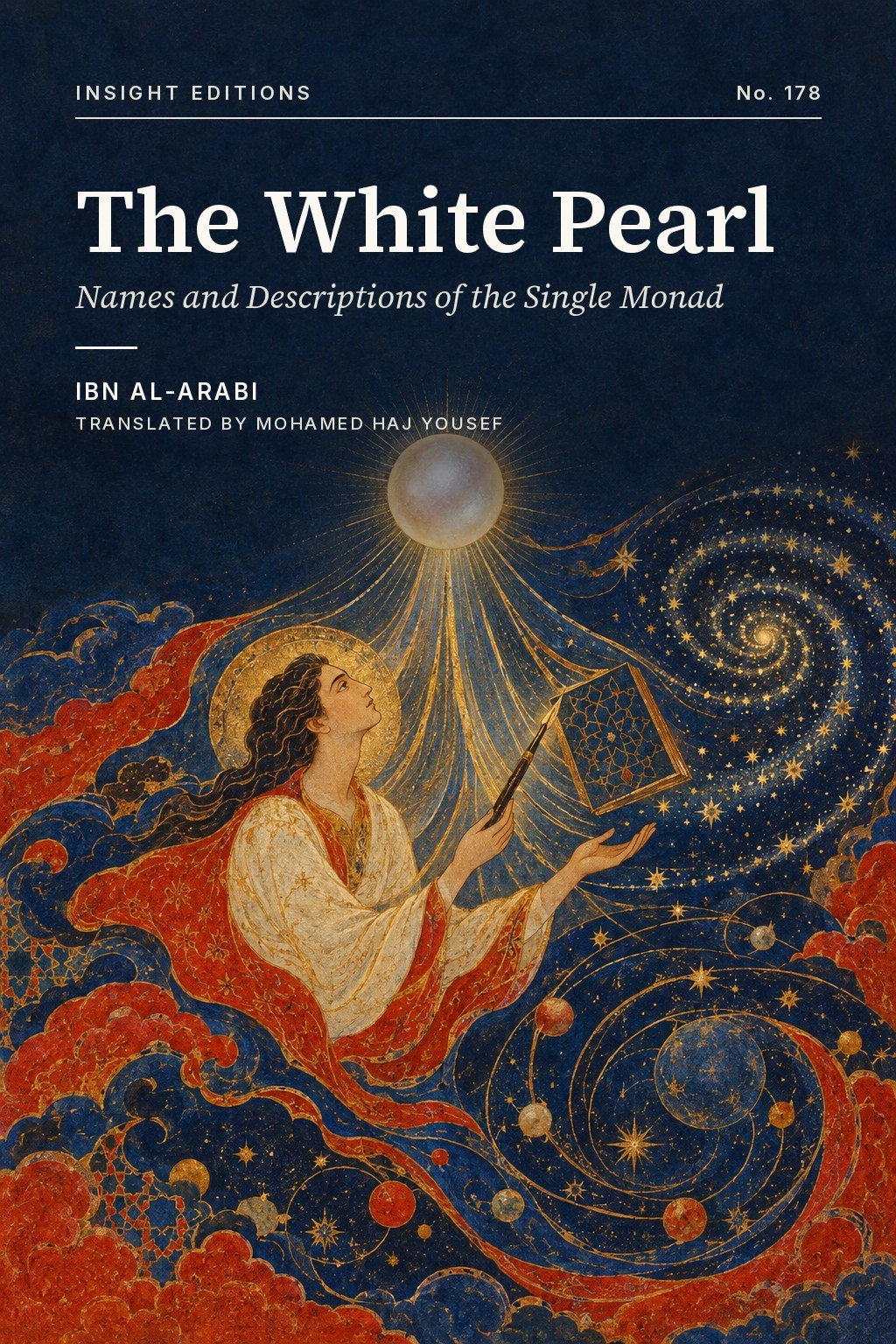
Insight Editions · No. 178
The White Pearl
Names and Descriptions of the Single Monad
Ibn al-Arabi · Translated by Mohamed Haj Yousef
Ibn al-Arabi describes the first created being, called the Intellect, Pen, Universal Spirit, Preserved Tablet, and Single Monad, and its relation to God and creation.
A study guide to The White Pearl by Ibn al-Arabi, translated by Mohamed Haj Yousef. Shared free for personal reading; not for sale and not endorsed by the authors or publishers. Please read and buy the original.
About the Book
The White Pearl (al-Durrah al-Baydaa) is Ibn al-Arabi's short early answer on the first created being: First Intellect, Pen, Universal Spirit, Preserved Tablet and allied names. Mohamed Haj Yousef's English volume (Short Treatises by Ibn al-Arabi, Book 3; preface Friday, June 28, 2019, UAE University, Al-Ain) pairs a full translation with a long introduction that also advances the translator's own Single Monad Model and Duality of Time.
In one sentence: God, who is One and free, chose to bring out a single first creature; that creature receives His knowledge without exhausting Him, passes it on under many names, and the world is renewed at every instant so that there is no doer but He; the philosophers' maxim "from the One only one may emerge" is repaired by attributes and choice, not by necessity.
Argument Map
Figure 1. The argument of the treatise as a single line from God to causes.
Chapter Map
Figure 2. Reading order of this guide.
What This Book Is For
The White Pearl is a few pages of doctrine dressed as an answer. Its core is not a history of philosophy but a sequence of claims: God is one despite Names; the Possible needs a Preponderator; the Will and the Ability renew forms; the first creature has many names; giving never contracts; one came first by choice; causes are occasions. Around that core, Haj Yousef supplies biography, manuscript notes, parallel passages from the Futuhat and Uqlat al-Mustawfiz, and his own cosmological model.
- Ibn al-Arabi (as the treatise and quoted Futuhat passages speak): proofs, names, choice, occasionalism.
- Mohamed Haj Yousef (introduction and brackets): Single Monad Model (2005, 2007, 2014), Duality of Time (2017), white hole / black hole analogies, restatement of the maxim with time.
It does not merge translator physics into the treatise voice.
Ten Ideas
| # | Idea |
|---|---|
| 1 | God's Names and Descriptions do not divide His Essence. |
| 2 | A possible thing exists only after non-existence and needs a necessary cause. |
| 3 | The Will relates only to what does not yet exist, so things are made anew every instant. |
| 4 | The First Intellect knows all creation but never knows God completely. |
| 5 | Its names (Pen, Spirit, Just, Tablet) each pick out one aspect. |
| 6 | Divine giving never contracts; it takes the form of the one who receives it. |
| 7 | The world moves in cycles: ascent and descent, self-knowledge and knowledge of the Lord. |
| 8 | That only one came first is God's choice, not a necessity. |
| 9 | Attributes such as Ability, Will and Knowledge each give one reality, so the One stays one. |
| 10 | Created causes have no power of their own; there is no doer but He. |
1. Setting and Sources
Who wrote the treatise, when, and from which manuscripts. The translator's introduction is careful on these points, and they affect how far we can trust the wording. This part also places the White Pearl among the "jewels" of the Three Issues.
The Author
The introduction gives a short biography taken from the translator's own life of the Shaykh, the Sun from the West. The key dates as printed:
| Event | Date as printed |
|---|---|
| Birth, Murcia | 17 Ramadan 560 AH, 26 July 1165 AD |
| Move to Seville | 568/1172 |
| Visit to Abdul-Aziz al-Mahdawi (Tunisia) | 590/1194 |
| Leaves Andalusia for the last time | 597/1200 |
| Journey east for Hajj | 598/1201 |
| Settles in Damascus | 620/1223 |
| Death | 22 Rabi II 638 AH, 9 November 1240 AD |
| Selim enters Damascus; shrine ordered | 922 AH / 1516 |
The translator adds a warning against confusing him with the jurist Abu Bakr Ibn al-Arabi, "born in Seville in the year 468 AH". He notes that the title al-Shaykh al-Akbar became common after Sultan Selim I entered Damascus in 922 AH and ordered the mosque and mausoleum built. He cites Jami for "in excess of five hundred books".
When the Treatise Was Written
The exact year is not known. It must come before 598 AH / 1201 AD, because the White Pearl is mentioned in Uqlat al-Mustawfiz (the Belt of the Restless), and that book is in turn mentioned in the opening chapters of the Meccan Revelations, begun in Mecca that year. The translator suggests Tunisia, where Ibn al-Arabi stayed with his friend Abdul-Aziz al-Mahdawi, perhaps answering a question from one of al-Mahdawi's followers. He offers this as a "perhaps".
The Three Issues
The White Pearl is one of a set of "jewels":
In his answers to al-Hakim al-Tirmidhi, Ibn al-Arabi says the Bead "is the Chaos (hiyola)", the Emerald "is the Soul that emanated from the White Pearl", and the White Pearl "is the First Intellect". The three treatises often appear together in one manuscript, called the Three Issues (al-Masael al-Thalaath). A Red Ruby is also mentioned. The translator argues that they were answers within a larger book, the Main Issues (Uyun al-Masael). His evidence is that the Black Bead promises a later "part in which the answer on spirits is given".
| Jewel | Identity in Tirmidhi answers | Colour sense (as printed) |
|---|---|---|
| White Pearl | First Intellect | Luminous; pure reception |
| Green Emerald | Soul / Tablet | Light mixed with dark (green) |
| Black Bead | Chaos / hiyola | Body side; prime matter |
| Red Ruby | Mentioned among the set | Named; not developed here |
Editions and Manuscripts
| Witness | What the translator says |
|---|---|
| Cairo and Beirut, 1923 | First known edition; "we could not get hold of it" |
| Cairo, 1993 (Madbouli; ed. Azab) | Has errors, but also some sentences found nowhere else |
| Baghdad, 2017 (ed. al-Badri) | Most recent printing |
| Veliyuddin 1821, pp. 238-244 | Clear modern script; adopted as base |
| Undated-origin copy, Muharram 1031 AH | Agrees well with Veliyuddin |
| Mecca 3939; Talaat 790 | Listed; not all checked |
| Yusuf Agha 4868 | Main Issues foreword, apparently in the Shaykh's hand |
Further copies are listed in Mecca, Cairo, Istanbul, Tunis, Baghdad, Alexandria and Berlin, and several of them could not be checked. There are "no old manuscripts of this book": no autograph and no copy close to the author's century. The Arabic text appears only in the paper edition of this translation.
Deeper Reading: Three Issues and Tirmidhi
The volume places the White Pearl with the Green Emerald and the Black Bead as answers to al-Hakim al-Tirmidhi. As quoted from Futuhat II.130: the Black Bead is Chaos (hiyola), in which bodies are initiated from the Green Emerald; the Green Emerald is the Soul that emanated from the White Pearl; the White Pearl is the First Intellect.
Dating notes in the volume: the Pearl is mentioned in Uqlat al-Mustawfiz, so before the Eastern journey of 598/1201; perhaps written in Tunisia around the visit to Abdul-Aziz al-Mahdawi (590/1194). Manuscripts are late; the base used is Veliyuddin 1821. Editions noted: Cairo/Beirut 1923 (unseen by the translator), Cairo 1993 Madbouli (errors), Baghdad 2017 (al-Badri).
2. The Monad in the Introduction
Before the treatise, the translator gathers what Ibn al-Arabi says elsewhere about the first created being: its names, the "Oneness of Being" frame (carefully stated), the language of substance and accident, a still more hidden "Greatest Element", and parallel passages from the Futuhat, the Issues and Uqlat al-Mustawfiz.
A Seed and Its Tree
The translator's image for this is a tree: "the Single Monad is like the seed for the tree of the cosmos". In Futuhat chapter 364, he reports, Ibn al-Arabi shows that there is in fact only one entity with a necessary immutable essence, the Perfect Human Being or Single Monad. The world consists of that entity's different states. Each of its images lasts "no more than one single instance of time", and nothing is repeated.
One name stands out: "Everything" (kulla shay). In al-Masael, Ibn al-Arabi says "in everything there is everything". The translator reads this both ways: the Monad is in everything, and everything is in the Monad. His fractal gloss is his own; the saying itself is the book's.
The Oneness of Being, Carefully Stated
The translator is careful here. Ibn al-Arabi "himself never mentioned the precise term" wahdat al-wujud, though his books are full of related ideas. The base distinction, taken over from Avicenna, has three categories:
A long quotation from chapter 198 (II.427.17) puts it this way. Considered "from the side of the Breath of the All-Merciful, you say: It is nothing other than Allah". Considered as balanced between existence and non-existence, "you say these are creations". The creation "is always new with every Breath, both in this world and in the hereafter". The translator sums up: darkness is "simply the absence of light", light is ultimately the Real, and multiplicity is light mixed with the darkness of non-existence.
Substance and Accident
Ibn al-Arabi borrows the atomist language of kalam theology:
| Term | Meaning | Duration |
|---|---|---|
| jawhar, "substance" (lit. "jewel") | Exists by itself | Constant |
| 'arad, "accident" or form | Exists only in a substance | One moment, never repeated |
The substance appears only "by wearing some form or another", so we see forms and never the monad itself. Whether the first monad has a body is debated. The Tadbiiraat calls it "a simple spiritual single monad, embodied according to some doctrines", and not embodied according to others. The translator adds that it cannot be called solely physical or solely metaphysical, "because it is necessarily the whole of creation".
The Greatest Element
Below the Monad, the translator places the Greatest Element (al-unsur al-aazam). Uqlat al-Mustawfiz says it was created in the "Absolute Unseen", all at once and without intermediate causes. His analogy is that the world is a building, monads are its bricks, and the Greatest Element is the clay. Ibn al-Arabi says he "would explain the reality of this Element if he was not sworn not to disclose it". In Futuhat chapter 60, on Quran 68:1, Nuun is the divine "chamberlain" who holds God's knowledge of creation, and the Pen is Nuun's "scribe".
The Pearl in Other Books
The introduction ends with passages from other works:
| Source | Claim as printed |
|---|---|
| Meccan Revelations intro | "the Intellect has three hundred and sixty facets, each of which corresponds to three hundred and sixty aspects" of the Real |
| The Issues | Names: First Intellect, Universal Spirit, Pen, Just, Throne, Real-through-which-things-are-created, Mohammedan Reality, Spirit of the Spirits, Clear Leader, Everything |
| Issues (product) | Acceptance "is: 360 x 360 x 360 = 46,656,000" (translator's arithmetic from the text) |
| Uqlat al-Mustawfiz | Knows himself by himself; station poverty; faces to receive, turns to give; "the rich and the poor, the dear and the humble, the master and the slave" |
| Uqlat (Pen / Tablet) | Pen writes on Tablet (Soul) "just as Eve with relation to Adam"; Soul green (luminous + dark) |
| Uqlat (Pen imagery) | Pen with 360 heads / faces / tongues; 360 seas |
Deeper Reading: Uqlat on the First Intellect
The volume quotes Uqlat al-Mustawfiz at length on the first created intellect. The passage is not the White Pearl treatise itself; it is parallel teaching the introduction gathers. Read it as Ibn al-Arabi elsewhere, under the same A closer look that flags translator physics.
"The thing that Allah created in the world of the managing intellects is a simple substance (or: monad), that is not material, nor being confined in matter. He knows himself, by himself. His knowledge is his own self. He has no (further) description. His station is poverty and humiliation, and the need for his Creator, originator and Inventor."
He has "many faces, but he does not multiply in himself when he multiplies." He emanates in two ways: self-emanation (not characterized by deterrence) and voluntary emanation (can be described by prevention and giving). He is "essentially subjected to his Creator". Allah called him in Quran "the Real (through whom creation takes place)", "the Pen" and "the Spirit", and in the Hadith "the Intellect".
| Uqlat point | How it rhymes with the Pearl |
|---|---|
| Simple substance, not material | First Intellect / Single Monad |
| Knows himself by himself | Knows all creation; not all of God |
| Station of poverty | Pen asks; Spirit goes in need |
| Facing and turnout | Coming forward / turning away |
| Always growing | Endless seeking at its degree |
| Rich and poor together | Duality of the two fists |
Deeper Reading: Pen, Tablet and Green
Uqlat also says that when Allah created the Highest Pen, He created for him "in the second station" the Soul, the Protected Tablet, and ordered the Pen to flow on it. The Tablet is "the place of intellectual depositing, just as Eve with relation to Adam". She was called Soul (nafes) because she was found from the Breath (nafas) of the Merciful.
"This Pen has three hundred and sixty heads, in terms of his being a pen, and three hundred and sixty faces and proportion in terms of his being an intellect, and three hundred sixty tongues in terms of his being a spirit translating from Allah." Each head draws from three hundred and sixty seas of science. The Tablet has "a luminous one from the side of the holy Intellect, and a dark one from the side that follows the Chaos", so she is green. The volume notes that the Book of the Green Emerald treats the Soul, and the White Pearl treats the Pen.
3. God, the Possible and Renewal
The treatise opens with theology before cosmology. It sets out what God is, what a "possible" thing is, why a possible thing needs a Preponderator, and why a possible thing must be made anew at every instant. Only then does it name the first creature.
God Not Divided by His Names
The first section is short and firm. God "is the Absolute Being, not after nonexistence". He "has always been One in His Essence", and the Beautiful Names belong to Him. "Yet He is not multiplied" by them. The reason given: an essence can be multiplied only if it can be divided into parts or counted, "But the descriptions are not part of that which is described by them." He is "not substance, nor in-substance", and "no other essence is (really) existing other than Him".
Why the Possible Needs a Preponderator
The existence of what exists depends on God's Will (iraada), Wish (mashiaa), Ability (qudra) and Knowledge (ilm). A possible thing:
- resists neither existence (as the impossible does) nor non-existence (as the Necessary does);
- has existence and non-existence "equally imaginable, without any preponderance for itself";
- cannot tip itself into being. If it already exists, "what did it preponderate?" If it does not, "the non-existent is not a thing";
- so it needs a preponderator (murajjih), and this cannot be another possible without an endless regress;
- so the preponderator is necessarily existent, "and He is (nothing but) Allah".
A possible thing also cannot be eternal alongside God, "because there will be no use of the necessarily existent if it wasn't after non-existence". The Possible "doesn't accept the (absolute) conceptual necessity, nor the dependent necessity that is called 'necessary by other'".
| Category | Can it exist? | Can it not exist? | Example in the text |
|---|---|---|---|
| Necessary | Must | No | Allah |
| Possible | Yes, via a preponderator | Yes, via a preponderator | The world, the Intellect |
| Impossible | No | Must | "a squared circle or another god" |
The Will Touches Only What Is Not Yet
The next step is short but important. The Will cannot relate to what already exists. It relates only to the non-existent, to bring it into being. So what looks like a thing lasting is something else: "its existence (that may look to be endured continuously) is (in fact) always occurring (anew)".
The Will is an eternal description of the Creator, but relating it to a particular Possible is not itself eternal. When the non-existent becomes, the Will no longer relates to it as non-existent; it relates again only as the thing is extinguished "in the second time" and remade. The essence remains; the form is renewed.
The section on re-creation extends this to the Ability. The Ability's link to a thing ends once the thing exists, "then no more relation to this existence other than creating the (ever-new) forms by which its endurance is fulfilled". So "the Creator (al-baarii), the Praised, is Always-Creator (Khallaaq) in this world and in the hereafter". The parenthesis in the volume adds: otherwise, if something were repeated twice the same, He would be limited.
The First Creature and Its Unfinished Knowledge
Then the treatise names its subject. When God created "this Intellect, that is a Single Monad, self-standing, embodied according to some doctrines and not embodied according to others - which is more accurate", He emanated on him "all the knowable things". So the Intellect's knowledge of creation is complete. Its knowledge of God is not, and cannot be: God is "still always emanating knowledge on him and he is still accepting". That is why the Intellect is described by "finding out" with respect to God, not with respect to cosmological knowledge already known.
Deeper Reading: Nuun and the chamberlain
4. The Names of the Pearl
"And this existent (that is the Intellect) has different names and designations." Each name, the treatise says, picks out one property of the same first creature. Taken together they make a short theology of the first creation: knower, writer, mover, measure, record.
The Intellect: Coming Forward and Turning Away
The hadith: "The first of what Allah has created is the Intellect". God told it to come forth, and it came; to turn away, and it turned. The treatise explains: "he came forward to benefit and turned away to give out". Then comes a subtler point: "his turning away is (actually) coming forward", because a different divine Name gave each command. The Intellect always faces God, but toward one Name after another.
These two motions, it says, are "the two fists" (Qabddatayn) that rule the world with happiness and misery. Paradise and Hell come from them, as do grasping and release, pain and pleasure, non-existence and existence. "So there is only the duality, and anything above two is necessarily reduced to this duality". "Even the three and others." The whole of existence is confined in grasping after releasing; all realities are confined in attribute and attributed; "there is nothing but it has a matching opposite".
The Pen: Asking What to Write
The hadith of the Pen: God created it and the Tablet and said "write". The Pen asked, "O Lord, what shall I write?", which "indicates his limitation and needfullness". It was told to write God's knowledge of His creation until the resurrection day. Why ask, if it already knew? The treatise answers that it had been taught everything, "but he only stopped because he didn't know which kind (of knowledge) he should write". Otherwise there would be no point in the endless emanation it receives.
| Question | Answer in the treatise |
|---|---|
| Did the Pen already know? | Yes: taught by the first manifestation |
| Why stop and ask? | Did not know which kind to write |
| What does the ask prove? | Limitation and needfulness |
| Why keep receiving? | Without need, endless emanation would be pointless |
| Does high knowledge end seeking? | No: still seeks the Lord at its own degree |
The Universal Spirit: Three Goings
Verses 15:29 ("My Spirit", "by way of honor") and 17:85 ("the Spirit is from the Command of my Lord") support this name. It is "Universal" because "all the states of the World are confined in it". Two Arabic verbs give the name:
| Root sense | Meaning for the Monad |
|---|---|
| raaha, to rest | Ease and happiness in knowing and witnessing its Lord |
| raaha, to go (1) | Through "the capacious orbs of the knowledge of his Creator" |
| raaha, to go (2) | Through the states of the cosmos, giving what was entrusted |
| raaha, to go (3) | Through knowing itself by its need for its Lord |
Three goings, and "there is no fourth state": towards God, towards the world, towards the self.
The Real, the Just, the Register
| Name | Who used it (as printed) | Ground |
|---|---|---|
| "the real through whom creation takes place" | Abu al-Hakam bin Barrajaan (d. 1141 AD) | "We created them but only with the real" (44:39) |
| "the Just" (al-adl) | Sahl al-Tustari (c.818-c.896 CE) | "Observe the measure strictly" (55:9); the heavens held by the Just |
| "the Clear Register" | All things enumerated in it (36:12) | |
| "the Preserved Tablet" | The Quran "in a Preserved Tablet" (85:21-22) |
Ibn Barrajan kept the lower-case "real" because "the Real" is a divine Name and is not created. The Just earns its name because it "departed (adala) from his self to his Creator". The Tablet is "preserved" because its contents do not change, though others say the Tablet is the Soul and the Monad is the Pen. "There are many other descriptions", and each group named the Monad after the property it noticed.
The translator's note adds names from other works: First Matter, First Teacher, Throne, Mirror of the Real, Emanator, Centre of the Circle, Muhammadan Reality, Spirit of Spirits, Everything. Some of these appear in the Issues list already quoted in Part 2.
Deeper Reading: Issues List and Other Names
In the Issues (al-Masael), as quoted in the volume, Ibn al-Arabi lists names of the first confined existent: First Intellect, Universal Spirit, Pen, Just, Throne, Real-through-which-things-are-created, Mohammedan Reality, Spirit of the Spirits, Clear Leader, Everything, "among many names according to his various aspects."
When this first being was created, "he got three hundred and sixty faces towards the Divine Presence", and acceptance is given as forty-six million six hundred and fifty-six thousand (360 x 360 x 360), as printed in the Issues quotation.
The translator's note [14] adds names from Uqlat and Tadbiiraat: First Matter, First Teacher, Throne, Mirror of the Real and Reality, Emanator (al-mufiidh), Centre of the Circle; and from other books: Muhammadan Reality, Spirit of Spirits, Everything.
| Name cluster | Examples (as printed) | Viewpoint |
|---|---|---|
| Knower / writer | Intellect, Pen, First Teacher | Receives and inscribes |
| Mover / spirit | Universal Spirit, Spirit of Spirits | Goes and rests |
| Measure / centre | Just, Centre of the Circle, Throne | Order and place |
| Means / image | Real-through-whom, Mirror, Muhammadan Reality | Creation through |
| Matter / all | First Matter, Everything | Scope of containing |
Three Types of Divine Names (volume note)
Note [15] recalls Ibn al-Arabi's three types of divine Names: Names of Essence (Asmaa al-Dhaat), Names of Descriptions or Attributes (Asmaa al-Sifaat), and Names of Actions (Asmaa al-Afaal). The Pearl's point that "descriptions are not parts" belongs with this map: multiplicity of Names does not multiply the Named.
5. Emanation, Perfection, Cycles
The middle of the treatise describes the Intellect's condition: always receiving, kept in being only by God, perfectly ready, and the source of a world that moves in circles. Length and breadth, facets and threads, Garden and Fire, prayer and self-knowledge all share the wheel.
Eternal and Temporal
The treatise sets two kinds of existence side by side. God is "the (absolute) Existent (or: Being), not after non-existence". The Intellect's becoming "is conditioned by (his original)" non-existence: "He was not, and then he is." From the moment it was made it "is still accepting the divine emanation".
Giving Without Contraction
"The emanation of Allah, the Exalted, cannot be imagined to held (or obscured), contracted, or ended." What differs is the receiver. The treatise lists them: "it is light for the luminous, darkness for the dark, color in the colored, motion in the moving, knowledge in the knowing".
Kept, Not Self-Lasting
The Intellect endures by God's act of keeping it (ibqaa), not by sharing God's own endurance (baqaa). If it endured by God's endurance it would be eternal with Him, and so necessary rather than possible. God is "not forced" to keep supplying it; He chooses to.
How do we know He will? Only because He has said so. The treatise cites verses on the unchangeable Word (10:64, 50:29, 39:71) and is blunt: "Such knowledge may not be achieved by proofs at all". Whoever claims to prove that possible things last "he'd better review his proof, because it is a guess and not a proof!"
Perfect, Complete, Created
Three short sections fill out the description:
- Perfect: "his (unconditional) ability to accept the emanations of his Creator". It is never unable to receive.
- Complete: everything exists in it "by (primordial) knowledge and (effective) force".
- Created: because it is the place where God creates things, and has been since it existed, "thus he is also created like them".
| Description | Sense in the treatise | What it rules out |
|---|---|---|
| Perfect | Readiness without blockage | Inability to receive |
| Complete | All things present as knowledge and force | Partial inventory |
| Created | Itself a place of creation | Partner status with God |
Length, Breadth and the Threads
The Monad gives in two directions. Length is what it gives to spirits, "what keeps their capability and continuity". Breadth is what it gives to bodies, "by (continuously) updating their states". "His length and breadth have equal facets": "180,000 facet in length, and 180,000 facet in width, and each facet has 24,000 form". Each form has countless "thins" (threads) with forces that rise and fall. Through their ascent and descent God creates what happens in the world. The Quran calls these "ascensions" (70:1-4), the stairways by which the angels and the Spirit go up.
Everything Goes Round
"it is cyclical, with a circular shape like the wheel", because things go up and down. The treatise shows the pattern in several places:
| Domain | The cycle |
|---|---|
| The Garden | Pleasures circulate in endless forms, "no form is ever like the other" |
| The Fire | "as often as their skins are consumed We shall exchange them" (4:56) |
| Prayer | Begins "there is no god but Allah", ends "praise be to Allah", then returns |
| Self-knowledge | Knowing oneself yields knowing one's Lord, which sends one back to oneself |
| Divine knowledge | From action to descriptions to essence, then round again |
| Motion | Moving through water or air, each place left is refilled |
| Cow (Q2:73) | Cited among cyclic signs in the volume's reading |
| Martyrs | "living, only you don't feel" (2:154); birds' form in related reports |
The section ends with the martyrs, who are "living, only you don't feel" (2:154). It also notes that all of a person's faculties "return to one essence that is indivisible". A single embodied monad is named after whatever it is doing.
Deeper Reading: Breath and perpetual newness
Chapter 198 of the Futuhat, as quoted in the volume's introduction, ties perpetual newness to the Breath of the All-Merciful. The possible became manifest "between light and darkness, nature and spirit, the unseen and the visible". Considered from the Breath, "you say: It is nothing other than Allah." Considered as balanced between existence and non-existence, "you say these are creations."
"Hence these two things (Existence and non-existence) are continually ruling over the world, so the creation is always new with every Breath, both in this world and in the hereafter. Therefore the Breath of the All-Merciful is continually directed (toward the Act of creation), and Nature is continually taking on existence as the forms for this Breath, so that the divine Command does not become inactive."
| Pearl treatise | Futuhat quote in the volume |
|---|---|
| Always-Creator (Khallaaq) | Always new with every Breath |
| Will touches only the not-yet | Command does not become inactive |
| Giving shaped by receiver | Forms by readiness to accept |
| ibqaa, not shared baqaa | What remains is close to Existence |
6. One, Many and Causes
The last third of the treatise is an argument. It takes on the philosophers' maxim that "from the One only one may emerge", rebuilds the maxim on correct grounds, and concludes that created causes have no power of their own.
Sequence by Choice
"This First Intellect is alone what emanated from Allah". But the order in which things appear "is not a necessity implied by the Existence of the Real". God could have made it otherwise:
- "if He had wished that the world exists at all once, and nothing is dependent on anything, it would be not difficult for Allah";
- He could have created people in the hereafter "without this (lower) world".
So that the Intellect came first and alone is a fact about God's Wish, and we know it only because "that ruler (the Prophet) says that Allah created one". Even that one is not simple. It comes with its descriptions, so "He created not only one, but two, or three creations".
The argument for choice runs as follows. Ability relates to every possible thing, and no possible thing can refuse it. Yet we do not see all possible things happening at once. So the one who has the Ability must also be "Free-to-choose and Willing". The verses: "Doer of what He wills" (11:107, 85:16); "And ye will not, unless Allah wills" (76:30). "No doer in Existence other than Him."
Against the Philosophers
The maxim "only one may emerge from the one" is wrong, the treatise says, in the hands of those who judge by "intellectual thinking" matters that can be known only by unveiling or by a truthful report. Their reasoning, as the treatise presents it:
| Step | Their claim | The treatise's reply |
|---|---|---|
| 1 | God is One "from all aspects", with no description | Then He cannot be Willing or Knowing at all |
| 2 | So only one emerges, and it is eternal with Him | "so they negated that Allah is his creator" |
| 3 | That one is three: knows itself, its maker, its possibility | Then God too "is (also) a realizing (aql)" with several realizations |
| 4 | Each realization produces one thing | Then four things emerge from Him, and so on without end |
His verdict: "all this is in fact endless long hallucination". The translator's note identifies the target as the Mu'tazilites, who deny attributes so as to avoid eternal multiplicity, and traces their view to Greek philosophers "such as Plotinus".
The Translator's Added Commentary
At this point the translator inserts a long passage, which he marks as his own. He restates the maxim with time added, "from the One only one can proceed at a time", and builds on verses 55:29 and 50:15. This restatement is the translator's, offered as his reading of Ibn al-Arabi in general. It then moves on to quantum tunnelling, fractal dimensions and the continuity of space. Readers should keep the treatise's own argument, choice and attributes, separate from these additions.
Two Kinds of Description
The treatise's own repair starts with a distinction:
| Kind | Definition | Effect on the essence |
|---|---|---|
| Descriptions of essence | The essence cannot be conceived without them; "they are (the essence) itself" | None: nothing is added |
| Descriptions of meaning | The essence can be conceived without them | Need an essence to stand in; do not divide it |
Knowledge, for example, is "one of the meanings, and the meaning doesn't stand alone". If knowledge were God's Essence, knowledge would stand alone, which contradicts what knowledge is. And "this whose essence is one doesn't multiply for what stands in it of meanings, no matter how many."
How Multiplicity Comes Out
Each attribute produces one reality, though that reality falls on many things:
There Is No Doer but He
Nothing other than God has "any ability or a force - I mean independently - to create". Created ability "doesn't have any effect by itself, but only with the permission of Allah". So "there is (indeed) no doer but He." No one witnesses this act: "I made them not to witness the creation of the Heavens and the Earth" (18:51).
The treatise mocks the opposite view, that "the motion of the hand is the motion of the sleeve, and the motion of the finger is the motion of the ring". Its argument: a body moves into empty space (khalaa), not occupied space (malaa). If the mover pushed the moved, the place would have to be emptied first.
The Close
"This is what Allah caused it to flow in this tight time in answering this issue". The words were "simplified and repeated" for students, "since not all understandings are sharp enough to understand the summarized words". "The answer is complete."
Deeper Reading: Mu'tazilites and Plotinus (volume note)
Note [16] says the author is "obviously alluding to the Muatazilites who argue that Allah may not be described by any attributes, otherwise these attributes or descriptions would be existing with Him eternally, so this would lead to eternal multiplicity." The note calls this "deviated thinking, widely criticized by the main-stream Asharites", inherited from Greek philosophers "such as Plotinus".
The treatise's own repair does not need that genealogy. It needs the distinction of essence-descriptions versus meaning-descriptions, and the model of one attribute, one reality, many objects. The note is the translator's historical pointer; the argument is the Shaykh's.
Synthesis
A revision map of the White Pearl: takeaways, frameworks, closer look, Who's Who, and connections that stay inside the treatise's own spiritual and practice distinctions. No modern analogies outside the book.
Twenty-four takeaways
| # | Takeaway |
|---|---|
| 1 | Descriptions are not parts, so God's many Names leave Him one. |
| 2 | A possible thing cannot tip itself into being; it needs a necessary Preponderator. |
| 3 | The Will touches only the not-yet-existing, so every lasting thing is renewed. |
| 4 | God is "Always-Creator" (Khallaaq), in this world and the next. |
| 5 | The first creature knows all creation and never all of God. |
| 6 | Its names (Intellect, Pen, Spirit, Real, Just, Tablet) are aspects of one being. |
| 7 | Turning away to give is still turning toward God, under another Name. |
| 8 | Everything reduces to a pair: coming and going, grasping and release. |
| 9 | The Pen asks "what shall I write?": even complete knowledge waits for direction. |
| 10 | The Universal Spirit has three goings only: to God, to the world, to the self. |
| 11 | Divine giving never contracts; it takes the receiver's form. |
| 12 | That things last is known by revelation, not proof. |
| 13 | The Monad is kept by ibqaa, not by sharing God's own baqaa. |
| 14 | The Monad gives "length" to spirits and "breadth" to bodies. |
| 15 | Existence moves in cycles that never repeat exactly. |
| 16 | Self-knowledge and knowledge of the Lord feed each other in a circle. |
| 17 | One first creature by choice; God could have made all at once. |
| 18 | The philosophers' maxim, applied rigidly, leads to "endless long hallucination". |
| 19 | Each attribute yields one reality; many objects, no division of the One. |
| 20 | No doer but He: results are created next to causes, not through them. |
| 21 | The order of the world is Wish and wisdom, not necessity of nature. |
| 22 | Possible, Necessary and Impossible stay what they are; that is the floor of logic. |
| 23 | Keep the treatise's theology separate from the translator's physics. |
| 24 | "The answer is complete": the Pearl was simplified for students in a tight time. |
Frameworks
| Framework | Elements | Use |
|---|---|---|
| Three categories | Necessary, possible, impossible | Sort any claim about existence |
| Two motions | Coming forward, turning away | Receiving and giving as one stance |
| Three goings | To God, to the world, to the self | Map where attention goes |
| Length and breadth | Spirits kept, bodies updated | Continuity versus renewal |
| Attribute to act | Ability, Will, Knowledge | One source, many effects |
| Next to, not through | Cause, result, Creator | Read causation as pattern |
| Essence vs meaning | Two kinds of description | Names without division |
| Choice vs force | Wish versus mudtarr | Refuse fire-like necessity for God |
A closer look
2. Authorship. The text may be a student's record of an oral answer, and survives only in late copies.
3. Kalam and philosophy. The treatise argues as theology, with revelation as the final court. Readers who favour philosophical method may find the dismissal of "intellectual thinking" too quick.
4. Occasionalism. "No doer but He" raises the familiar questions about human responsibility, which the treatise passes over briefly ("to deviate whoever He wishes and guide whoever He wishes").
5. The Monad and the Element. The translator's own boundary between them is admittedly blurred.
6. Added commentary. "At a time", Idris circle, quantum and fractal notes are marked as the translator's and should stay marked.
Strengths. The Pearl is short, early and unusually clear on perpetual re-creation, the names of the first creature, and the free Will behind sequence. It repairs the maxim without denying attributes.
Limits. Manuscripts are late. Translator brackets are heavy. Physics claims in the notes are not the treatise. Occasionalism and responsibility are left thin.
Who's Who
Abdul-Aziz al-Mahdawi: Tunisian friend and dedicatee of the Futuhat introduction; visited in 590/1194.
Ismail Ibn Sawdekin (d. 646 AH / 1248 AD): Tunisian Sufi and companion who recorded the Shaykh's answers.
Ibn Barrajan (d. 1141 AD): Sevillian Sufi; "the real through whom creation takes place".
Sahl al-Tustari (c.818-c.896 CE): named the Monad "the Just".
Abu Bakr Ibn al-Arabi (b. 468 AH): the jurist, not to be confused with the Shaykh.
Al-Hakim al-Tirmidhi: his questions drew the Pearl, Emerald and Bead answers.
Mohamed Haj Yousef: translator; author of the Single Monad Model and Duality of Time notes (kept under A closer look).
Applying It (inside the book's own distinctions)
- Refuse physics endorsements: Duality of Time, white-hole cosmologies, Sumerian degrees stay under A closer look.
- Prefer Wish to necessity: one first by wisdom of order, not by forced nature.
- Keep names as aspects: Intellect, Pen, Spirit, Just, Tablet are one existent.
- Do not invent Ibn Arabi content: quote the treatise; flag the brackets.
Sequence Checklist (treatise order)
Discussion questions
- Is "descriptions are not parts" a solution or a restatement of the problem?
- What changes if lasting is renewal rather than inertia?
- Why would complete knowledge still need to ask what to write?
- Does free choice in God make the world more or less intelligible?
- Can occasionalism and moral responsibility both be held?
- Where does the treatise end and the translator's Duality of Time begin?
- How does "next to" differ from "through" in ordinary action?
- Why is there "no fourth" going for the Universal Spirit?
Reading map for a first pass
- About and Setting: learn the A closer look and the Three Issues frame.
- Monad: seed/tree, three categories, Greatest Element flag, Uqlat poverty.
- God / Possible: descriptions not parts, murajjih, Khallaaq, Nuun/Pen flag.
- Names: Intellect, Pen, Spirit, Real, Just, Tablet; Issues list.
- Emanation: giving, ibqaa, length/breadth, cycles, Breath quote.
- One / many: choice, maxim, attributes, next to, close.
- Synthesis and glossary: revise with frameworks and practice cards.
Glossary
Key terms in the translator's transliteration, thickened for study.
Translator flags (A closer look)
Short revision cards
| Card | One line |
|---|---|
| Pearl | First Intellect under many titles |
| Preponderator | Tips Possible; Possible cannot tip itself |
| Khallaaq | Always-Creator; lasting is renewed |
| Two fists | Come forward / turn away; happiness / misery |
| Three goings | God, world, self; no fourth |
| Maxim repaired | One reality per attribute; many objects |
| Next to | Results created beside causes, not through them |
| Lens | Treatise theology; translator physics flagged |
About this book
The White Pearl: Names and Descriptions of the Single Monad by Ibn al-Arabi, 2019. This is a chapter-by-chapter study of the book, with summaries, maps, tables and diagrams; short quotations keep their page references. It is shared free for personal study, is not for sale, and is not endorsed by the author or publisher. Please read and buy the original.
Insight Editions · rajeshrmahapatra.com/insight-editions