Insight Editions · No. 175
The Universal Tree and the Four Birds
Treatise on Unification
Ibn Arabi · Translated by Angela Jaffray
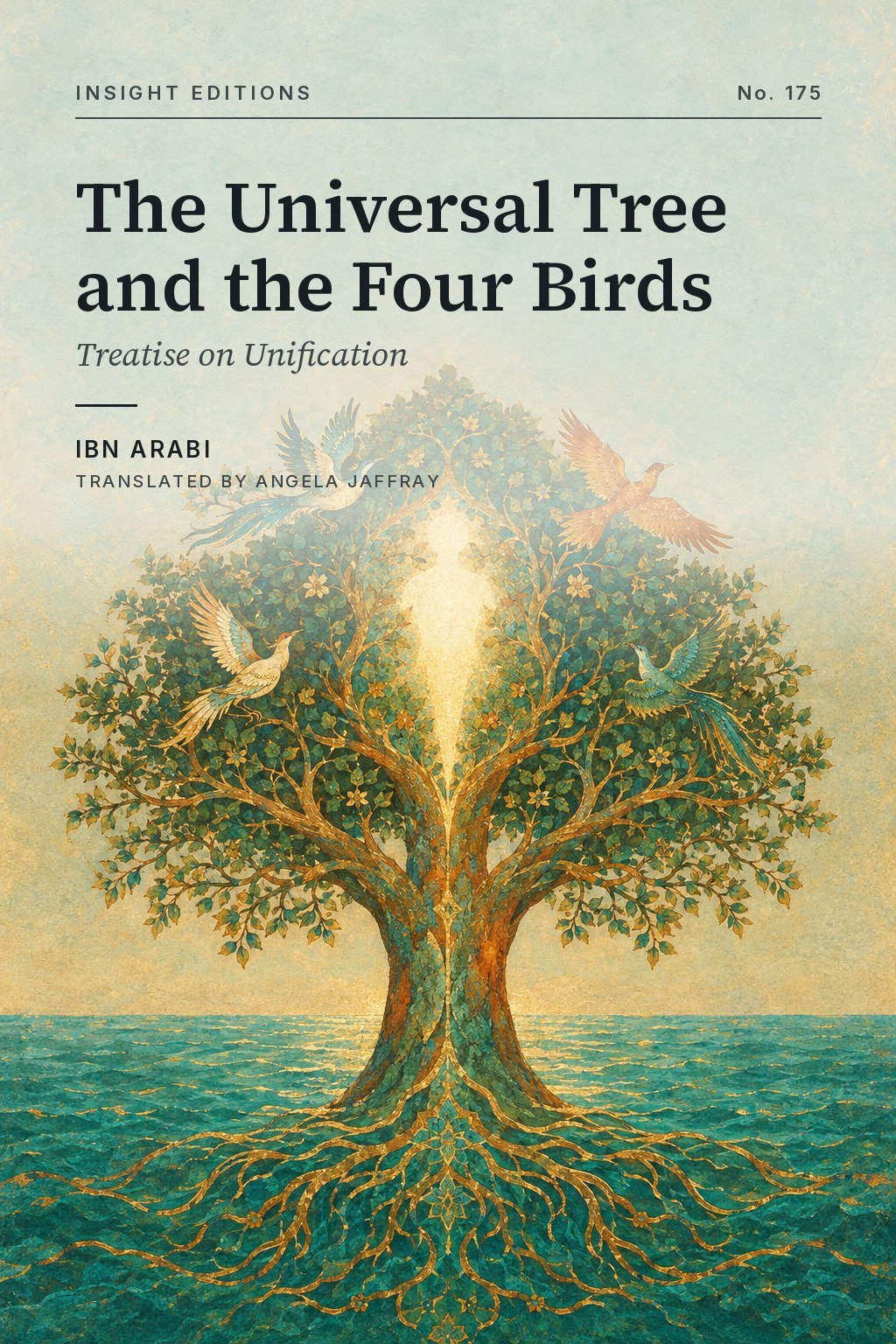
Ibn Arabi’s treatise presents the cosmic Tree and four symbolic birds as figures for creation, the Perfect Human Being, and the union of divine reality with the world.
A study guide to The Universal Tree and the Four Birds by Ibn Arabi, translated by Angela Jaffray. Shared free for personal reading; not for sale and not endorsed by the authors or publishers. Please read and buy the original.
Overview
The Universal Tree and the Four Birds is Angela Jaffray's translation of Ibn 'Arabi's early treatise al-Ittihad al-kawni, "Cosmic Unification", with a foreword by Rafi Zabor, a short biography, an introduction, a long commentary and a note on the manuscripts. A Tree and four fabulous birds speak in turn, and each turns out to be a face of the Perfect Human Being and of the cosmos itself.
The book makes three claims. First, the Tree and its birds are a map of reality: the Tree is the Perfect Human Being, and the Eagle, Ringdove, 'Anqa' and Crow are the First Intellect, the Universal Soul, Prime Matter and the Universal Body. Second, the treatise is a journey: a night ascent in which the author leaves the world, is questioned by a mysterious Voice, and meets the Tree "on the equator", at the point of balance. Third, "unification" here never means two things fusing into one: it is the meeting of opposites in the human being who joins Real and creation, a barzakh or isthmus.
The translator stresses that the text is dense with puns, roots and allusions, "a thoroughly over-determined text that loses much in the effort of its commentator to explain it." Neither Ibn 'Arabi nor his followers left a commentary, so hers draws on the Futuhat, the Fusus and the poetry.
Argument Map
Chapter Map
| Edition part | Book section | Pages | Core move |
|---|---|---|---|
| Part 1 | Zabor's essay, biography, introduction | 1-20 | Who Ibn 'Arabi was; what kind of text this is |
| Part 2 | The treatise | 21-52 | Poems, dedication, journey, the Tree and four Birds |
| Part 3 | Commentary and appendix | 53-113 | Title, poems, dedicatee, barzakh, each bird, cosmic marriage, manuscripts |
Ten Ideas to Carry Away
- The whole cosmos is a human being writ large, and the human being is the cosmos in summary.
- The Tree is the Perfect Human Being; the four Birds are its cosmic faculties.
- Opposites are not enemies: majesty and beauty, knowledge and intuition, shout and whisper swing around one centre.
- Unification is not fusion: two essences never become one; opposites meet in a third.
- The barzakh is anything that stands between two things, joining and separating them.
- The Perfect Human Being is the supreme barzakh between Real and creation.
- The body is honoured: the Crow rebukes those who despise it.
- Everything is born of a marriage: what acts is a father, what receives is a mother.
- The 'Anqa' has a name but no body, yet nothing appears without her.
- The perfect journey ends in return: back to the creatures, not away from them.
Edition map
No em or en dashes.
Part 1. The Author and the Text
Rafi Zabor's essay "Of the Tree and its Four Birds" (pp. 1-8), the biography (pp. 9-15) and the translator's introduction (pp. 16-20): who wrote this treatise, when, and how to read a work built from rhymed prose, poetry and wordplay.
A novelist's way in
Zabor first suggested that the treatise be translated for the August 2004 issue of the online magazine Words without Borders, and his essay opens the book. He gives the bare facts: Ibn 'Arabi was born in 1165 in Murcia died seventy-five years later in Damascus, and wrote some three hundred books. Of his place in Sufism Zabor says that "virtually everyone before him is an anticipation and everyone after a commentator or interpreter."
The treatise was probably written before Ibn 'Arabi reached Mecca, around 1203, which makes it an early work. Zabor knew it first through Denis Gril's French version, and he reads it as a work of literature as much as of doctrine.
Zabor walks through the book's moments, and his choices make a good first map. The opening poem swings like a pendulum, "From my incompleteness to my completeness". The author begs, "Do not blame me for my passion. I am inconsolable over the one who has fled me". He sets the steady against the passing: "Continuous is the light of knowledge; ephemeral the light of intuition". The dedication goes to a prophet called Abu al-Fawaris Sakhr ibn Sinan, "master of the triads and dyads". The book itself comes from a city "on the equator". The traveller groans, "Alas, my burning heart. I fled from the universe and here I am in it. Where is what I seek?" A Voice answers him, Zabor says, much as the voice from the whirlwind answers Job.
Zabor also pairs the treatise with Blake: a poet-seer for whom vision is primary and system secondary. He hears in the Voice something like Job's whirlwind, and he lingers on lines that sound like complaint and triumph at once. The Crow's speech amuses him: a defence of flesh against "Some alleging to be endowed with unshakeable reason". He recalls the three Quranic camps, the People of the Right Hand, the People of the Left Hand, and those Brought Near, as a map of how the treatise sorts readers.
Zabor's foreword in fuller outline
Zabor reads the treatise as vision first. The perfected human is a mirror in which Existence sees itself. The Unity of Being is not a thesis to win by argument; it is what the mirror undergoes. Blake is the Western parallel he keeps returning to: a poet for whom system is secondary to sight.
He quotes the pendulum opening and hears complaint and triumph in the passion lines. He pairs knowledge and intuition: continuous light of knowledge against ephemeral light of intuition. The dedicatee Abu al-Fawaris Sakhr ibn Sinan is named master of the triads and dyads. Quran 95:4-5 (most beautiful constitution / lowest of the low) frames the human range the journey will traverse on the equator.
| Zabor stress | Where it shows in the book |
|---|---|
| Vision before system | Foreword; garden scene |
| Mirror of Existence | Unity of Being as experience |
| Blake parallel | Poet-seer, not schoolman |
| Body not despised | Crow's reproach |
| Rumi as complement | Qunawi / Konya link |
For Zabor the 'Anqa' is the most striking of the birds. A Turkish saying calls something that has a name but no being "Ismi var, varlik yok", and that is the 'Anqa' exactly. He links her to what Ibn 'Arabi elsewhere calls the Reality of Realities, of which the book quotes: "It is neither existent nor non-existent; it is not the world, and yet it also is". The Crow, the Body, scolds those who look down on the body, and Zabor enjoys the scene.
The life in brief
The biography gives the frame for everything else. The book's dates: born 1165 in Murcia; died in Damascus in November 1240.
| Date | Event in the book |
|---|---|
| 1165 | Born in Murcia; father in the service of rulers of al-Andalus |
| Age seven | Family moves to Seville |
| Youth | Sudden conversion; vision of Jesus, Moses and Muhammad |
| 1190-1202 | Visions of being the Seal of Muhammadan Sainthood |
| 1193 | In Tunis |
| 1195-1200 | Years of travel |
| 1200 | Leaves for the East: Cairo, Hebron, Jerusalem, Mecca |
| 1204-1220 | Travels in the East; adviser to a Seljuk ruler |
| 1215 | Tarjuman al-ashwaq |
| 1221 | Settles in Damascus |
| End of 1229 | Dream that gives the Fusus al-hikam |
| November 1240 | Dies in Damascus |
He gave his goods to his father and called Jesus his "first master". His first teacher was an unlettered farmer, Abu al-'Abbas al-'Uryabi, a model of complete servanthood; in all he names seventy-one masters, four of them women. In Mecca a mysterious youth met him at the Ka'ba, and from that meeting grew the Futuhat al-makkiyya, some two thousand folios. A young woman of Mecca, Nizam, inspired the Tarjuman al-ashwaq. He wrote that "The best and most perfect kind [of contemplation] is the contemplation of God in women." Of his ascents he could say that "the journey that [he] made was inside [him]self".
The biography adds stages that frame the treatise's date. After the conversion came a fatra, a slack period, broken by Quran 7:57-58. He gave his possessions to his father. Around 1190-1202 came visions of the Seal of Muhammadan Sainthood. In 1193 he was in Tunis among disciples of Abu Madyan; between 1195 and 1200 he travelled and spoke of "God's Vast Earth". His mi'raj was "nothing but light". The eastward journey of 1200 took him through Cairo, Hebron, Jerusalem and Mecca. From 1204 to 1220 he counselled "God's servants" and advised the Seljuk Kayka'us; in 1221 he settled in Damascus; at the end of 1229 a dream gave the Fusus; in November 1240 he died there.
Biography stations expanded
The biography in the Anqa volume is short but dense. Birth in Murcia in 1165 places him under a father who served Ibn Mardanish and then the Almohad Abu Ya'qub Yusuf. Seville at age seven is the city of the conversion. The banquet with the wine cup, the voice that says he was not created for that, the cemetery retreat, and the triple vision of Jesus, Moses and Muhammad form one arc. Jesus teaches asceticism; Moses teaches knowledge from the divine presence; Muhammad says to hold fast and be safe.
The first living teacher, Abu al-'Abbas al-'Uryabi, is an unlettered peasant of perfect servitude. About twenty years of Andalusian formation follow, with seventy-one shaykhs counted and four of them women. Visions of the Seal of Muhammadan Sainthood fall between 1190 and 1202. Tunis in 1193 puts him among Mahdawi disciples of Abu Madyan. Travel from 1195 to 1200 opens "God's Vast Earth". The mi'raj is "nothing but light", and the journey is inside himself.
The eastward turn of 1200 runs Cairo, Hebron, Jerusalem, Mecca. At the Ka'ba the Fata of the Futuhat appears; the work will grow to about two thousand folios. Nizam of Mecca becomes the occasion of the Tarjuman (1215). Contemplation of God in women is named the best and most perfect kind. From 1204 to 1220 he counsels God's servants and advises the Seljuk Kayka'us. Damascus from 1221; the Fusus dream at the end of 1229; death in November 1240.
| Year / range | Event in the biography |
|---|---|
| 1165 | Birth, Murcia |
| age seven | Seville |
| conversion arc | Wine cup, cemetery, triple vision |
| 1190-1202 | Seal of Muhammadan Sainthood visions |
| 1193 | Tunis, Abu Madyan circle |
| 1195-1200 | Travel; Vast Earth; light-mi'raj |
| 1200 | East: Cairo to Mecca |
| 1215 | Tarjuman |
| 1204-1220 | Counsel; Kayka'us |
| 1221 | Damascus settled |
| 1229 | Fusus dream |
| Nov 1240 | Death, Damascus |
| Phase | What the biography stresses |
|---|---|
| Andalusian youth | Conversion, masters, Seal visions |
| West travel | Tunis, Vast Earth, light-mi'raj |
| Eastward turn (1200) | Cairo to Mecca; Futuhat begins |
| Mature East | Counsel, Kayka'us, Damascus, Fusus, death |
What kind of text is this?
The introduction places the treatise before the journey east of 1201/02 CE (AH 598), so it belongs to Ibn 'Arabi's Andalusian period. It is written in saj', rhymed prose, mixed with poems. A note adds that saj' is also the cooing of a pigeon or dove, apt for a book of birds.
It belongs to a long line of symbolic tales and ascents: Avicenna's visionary recitals, Suhrawardi, 'Attar's birds, and the ascent literature that grows from the Prophet's Night Journey (Q 17:1, 53:4-18). Abu Yazid al-Bistami (d.874) told of flying as a bird to the Tree of Unity and finding it "all a cheat"; ascents are also linked with (pseudo-)Junayd (d.910) and recorded by Sarraj (d.988). Ibn 'Arabi wrote several of his own.
| Text | Scale (as the book gives it) |
|---|---|
| Diwan | More than 800 verses on letters, names and more |
| Tarjuman al-ashwaq | 61 love poems with his own commentary |
| Futuhat al-makkiyya | 560 chapters |
| This treatise | About 30 pages of rhymed prose and poems |
The Tree and the four Birds are the Perfect Human Being and four cosmic faculties. The translator remarks: "Never before have these abstruse philosophical concepts been described in such an elliptical and suggestive way."
She calls the treatise an excellent entry into Ibn 'Arabi's work as a whole: short, but with the whole system folded inside it.
Stylistic and doctrinal stakes
The introduction places the book in a "sea of perplexity": the dedicatee is long dead, yet the author speaks as if addressing himself at the centre of the world. Night Journey language (Q 17:1, 53:4-18) supplies the outer frame; the garden at the farthest boundary supplies the inner one. Tree and Birds equal the Perfect Human Being and four cosmic faculties: First Intellect, Universal Soul, Prime Matter, Universal Body.
Other ascent writings by the same author are named for comparison: Kitab al-isra', Risalat al-anwar, the Futuhat accounts, Kitab al-isfar. The Diwan holds more than 800 verses; the Tarjuman 61 poems; the Futuhat 560 chapters. Against that scale, this short treatise is an elliptical summary.
Style: saj', roots, and the danger of thin allegory
Saj' is rhymed prose and also the cooing of a dove. A bird-book written in saj' is already announcing its music. Poems interrupt the prose. Roots carry doctrine: eagle and punishment, rock and refuge, crow and exile, leaf and Tablet. The Divine institution of language means one word can be made many; the commentator who strips roots to force a single allegory is condemned. Stetkevych's warning that words can look like denuded stems is cited as the risk this text runs when explained too thinly.
The Diwan holds more than 800 verses; the Tarjuman 61 poems; the Futuhat 560 chapters. Against that scale this short treatise is an elliptical summary of the whole system: Perfect Human and four faculties shown as Tree and Birds.
| Ascent writing named | Role in the intro |
|---|---|
| Q 17:1; 53:4-18 | Night Journey outer frame |
| Bistami (d.874) | Mi'raj; bird to Tree of Unity |
| (pseudo-)Junayd (d.910) | Ascent lore |
| Sarraj (d.988) | Records the tradition |
| K. al-isra'; R. al-anwar | Ibn 'Arabi's other ascents |
| Futuhat accounts; K. al-isfar | Later parallel tellings |
Acknowledgments and publication path
Rafi Zabor suggested the translation for the August 2004 Words without Borders issue. Denis Gril's French translation and edition (Le Livre de l'arbre, 1984; Annales Islamologiques 1981) underlie the English. Stephen Hirtenstein, Michael Tiernan and Jim Robinson at Anqa Publishing are named in the acknowledgments. The epigraph of the volume: "I am in love with no other than myself, and my very separation is my union".
Why this short book carries the whole system
Jaffray's claim that the treatise is an excellent entry into Ibn 'Arabi's work rests on compression, not on thinness. Tree and Birds equal the Perfect Human and four faculties. The Voice teaches the refusal of place-language. Khalid teaches barzakh and return. The Crow teaches that despising the body fails to witness Self-disclosure. Nature's absence and the Cloud's presence in other works teach the reader to read across the corpus. None of that is "background"; it is the doctrine in narrative form.
| Faculty | Bird / Tree | Speech theme |
|---|---|---|
| Perfect Human | Universal Tree | Synthesis and likeness |
| First Intellect | Eagle | Summons existence; stays weak |
| Universal Soul | Ringdove | Doubling, mercy, Tablet |
| Prime Matter | 'Anqa' | Name without entity; West |
| Universal Body | Crow | Last; defends matter |
Zabor on complementary masters
Zabor pairs Ibn 'Arabi with Rumi as complementary, not competing. Intellect and structure on one side; music and love on the other. The historical bridge he names runs through Sadr al-Din Qunawi and the city of Konya. Readers who only know the Mathnawi are invited to hear a different music here: saj' and root-play instead of couplet narrative; a Voice like Job's whirlwind instead of the reed-flute's complaint.
He lingers on the Crow's defence of flesh against "Some alleging to be endowed with unshakeable reason". He hears in the Voice something that will not let the traveller keep place-words. He treats the 'Anqa' as the most philosophically striking figure because she names the Reality of Realities without becoming a thing.
Conversion report and early masters
The biography cites al-Qari' al-Baghdadi (d.1418) for the wine-cup story: a voice says, O Muhammad, it was not for this that you were created! Cemetery retreat follows. The triple vision assigns Jesus to asceticism, Moses to knowledge from the divine presence ('ilm laduni), and Muhammad to the command to hold fast and be safe. After a fatra (slack period), Quran 7:57-58 breaks the stall. Goods go to the father. Jesus is named "first master". About twenty years later the first living teacher is Abu al-'Abbas al-'Uryabi, illiterate peasant of perfect servitude. Seventy-one shaykhs in all, four of them women.
Part 2. The Treatise
The text itself, pp. 21-52: three proemial poems, the title and dedication, the night journey and the Voice, the seven prophets, and the speeches of the Tree, the Ringdove, the Eagle, the 'Anqa' and the Crow.
The proemial poems: a swing between opposites
The treatise opens with poems in which nearly every line moves "from my" something "to my" something else: from incompleteness to completeness, from majesty to beauty, from wrath to impossibility. Images pair up: the lance, the moon, the steed and the gazelle. Then the speaker turns the whole thing inward.
"For I am in love with none other than myself, and my very separation is my union."
"In this book I never cease addressing myself about myself and returning in it to myself from myself."
The second series pairs faculties and worlds: sense and intellect, "two strange sciences"; soul and spirit, dissolving and coagulating as in alchemy; jinn-nature and human-nature; a narrow body and a vast soul; Quss the orator and Baqil the stammerer; the sun and the full moon; the Persian who hints and the Arab who speaks plainly. It ends: "For God's secret is poised between the shout and the whisper."
Proemial poems: line by line stakes
The first poem runs on basit for nineteen lines. Thirteen of them are paired Majesty/Beauty swings: incompleteness to completeness, inclination to equilibrium, then images of lance and moon, steed and gazelle, wrath and impossibility. The refrain shape "From my ... to my ..." ends every line in the Arabic first-person ending. Jaffray asks the reader to imagine an English poem in which every line ended in "me".
The second poem is two lines of mudari', a bridge. The third runs twenty-nine lines of hazaj and closes on shout and whisper: "For God's secret is poised between the shout and the whisper." Patterns move from straight lines to Z-shapes to X-shapes as four terms shrink to three then two. The hadith that the heart lies between two fingers of the All-Merciful is the doctrinal image of the same swing.
"In this book I never cease addressing myself about myself and returning in it to myself from myself."
| Poem | Metre / length | Work it does |
|---|---|---|
| 1 | basit, 19 lines | Majesty/Beauty pendulum |
| 2 | mudari', 2 lines | Bridge |
| 3 | hazaj, 29 lines | Shout/whisper; X-balance |
| 4 (later) | basit, 18 lines | After the journey; saying "I" |
Pendulum pairs in closer view
The first poem runs on basit metre for nineteen lines, thirteen of them paired. The swing moves Majesty and Beauty, incompleteness and completeness, then images of lance and moon, steed and gazelle, wrath and impossibility. The second poem is a two-line mudari' bridge. The third, twenty-nine lines of hazaj, ends on shout and whisper: "For God's secret is poised between the shout and the whisper."
| Pair | What it stages |
|---|---|
| Sense / intellect | Two strange sciences |
| Soul / spirit | Dissolve and coagulate |
| Jinn-nature / human-nature | Hidden and open |
| Narrow body / vast soul | Limit and expanse |
| Quss / Baqil | Eloquence and stammer |
| Sun / full moon | Source and Perfect Human |
| Persian / Arab | Allusion and clear speech |
| Shout / whisper | God's secret between |
Title and dedication
The title: "Cosmic unification in the presence of essential witnessing, through the assembling of the Human Tree and the Four Spiritual Birds". It is dedicated to Abu al-Fawaris Sakhr ibn Sinan, called "the master of the triads and dyads" and Jann son of jinn. The commentary shows that he is the prophet Khalid ibn Sinan (Part 3).
The author praises God who made him know himself through himself, and then says: "I am my beloved and my lover; I am my knight and my maiden." He recalls Moses' staff striking the rock and twelve springs gushing out, read as sciences: water for life, wine for states, honey for revelation, milk for secrets.
The journey and the Voice
At the boundary the traveller cries: "Alas, my burning heart. I fled from the universe and here I am in it. Where is what I seek?" A Voice comes, neither inside nor outside, with a long litany of "What have you to do with" this and that, and a rebuke: "O you who are veiled, how can you ask 'where?' about the Essence". The traveller promises: "I will never more pronounce an adverb or stop at a particle."
The Voice orders: "You are vanquished, so seek help!", Noah's cry (Q 54:10), and reminds him that "both your hands are right hands". The two call "Oh I!" and "I, welcome!" back and forth. The traveller begs: "You do not cease from veiling me from myself. Unveil me to myself so that I can know myself!"
The Voice's litany and the refusal of "where"
The Voice's questions strip the traveller of place-language: "O you who are veiled, how can you ask 'where?' about the Essence". He vows never again to pronounce an adverb or stop at a particle of place. The call and answer "Oh I!" / "I, welcome!" collapses distance into the speaking self. Yet the same Voice cuts through musical rapture: "Be careful! What it demands is extinction within extinction."
Dedication, equator city, and the Voice
The full title names cosmic unification in the presence of essential witnessing through the assembling of the Human Tree and the Four Spiritual Birds. The dedicatee is Abu al-Fawaris Sakhr ibn Sinan, master of the triads and dyads. The translator lowercases pronouns so the divine/human ambiguity stays audible.
Praise opens: God made him know himself through himself. "I am my beloved and my lover; I am my knight and my maiden." Moses' staff smites the rock and twelve springs rise: water as life, wine as states, honey as revelation, milk as secrets. The book arrives from the city on the equator: Mount Sinai, the Land Made Safe (Mecca), water and clay. The Buraq of aspiration carries him; the sea of hylic matter is crossed. Deniers of bodily resurrection waver in the noose of four and two.
Then the cry: "Alas, my burning heart. I fled from the universe and here I am in it. Where is what I seek?" The Voice answers from neither inside nor outside with a litany of "What have you to do with..." that strips bird-names and place-words alike. "O you who are veiled, how can you ask 'where?' about the Essence." He vows never again to pronounce an adverb or stop at a particle of place. "You are vanquished, so seek help!" recalls Noah (Q 54:10). Both hands are right hands. Call and answer collapse: "Oh I!" / "I, welcome!"
| Gift taken | Prophet | Sense in the commentary |
|---|---|---|
| Intimacy (and heart) | Abraham | High; Visited House reading |
| Conversations | Moses | |
| Vicegerency | Aaron | |
| Elevation | Idris | |
| Form | Joseph | |
| Knowledge | Jesus | |
| Body | Adam | Low; clay inescapable |
The seven prophets
The traveller then lists what he took from seven prophets. The commentary links them to the prophets of the heavens in the Prophet's ascent.
The passage ends on similarity and contrast between servant and Lord: "In my non-existence is your existence and in my avarice is your generosity", and "I know now that you know."
Prophets as planetary stations
The commentary links the seven gifts to the mi'raj's planetary prophets. Abraham supplies intimacy (and, in Hirtenstein's reading of a second mention, the heart / Visited House); Moses supplies conversations; Aaron vicegerency; Idris elevation; Joseph form; Jesus knowledge; Adam body. The order runs high to low and ends in clay: creatureliness cannot be left behind.
| Prophet | Gift taken | Direction in the list |
|---|---|---|
| Abraham | Intimacy (and heart) | High |
| Moses | Conversations | |
| Aaron | Vicegerency | |
| Idris | Elevation | |
| Joseph | Form | |
| Jesus | Knowledge | |
| Adam | Body | Low, clay |
The Universal Tree
The Tree is the Likeness: "whose root is firm and whose branches are in the heavens" (Q 14:24). Its fruit is in the hand of the Deity on the Throne. The Crow and the 'Anqa' sit among its branches; the Eagle and the Dove shelter in it.
"My fruit is gathered with no hand touching it."
"I am the Tree of light, speech, and the eye-balm of Moses"
"I am not too narrow to bear anything!"
It was planted by the hand of the One, as Adam was made with two hands. Its branches bend down to help and to give, it is round like a sphere, the winds of spirit make melodies in it ("I am the music of wisdom"), and, like prime matter, it receives every form. It ends: "No one in the universe knows my existence / Save one undelimited by praise."
The Ringdove
The Ringdove wears a ring of splendour and lives by the Lote Tree. Her story begins with the Eagle. God calls him and says, with a pun on 'iqab (punishment) and 'uqab (eagle), that he is now in exile. The Eagle asks: "How can something be manifested from me when my station is weakness". His plaint doubles, and from that doubling the Dove appears. The Eagle falls in love at once: "I'm burning! I'm drowning!"
The Voice tells him to look at her qualities. She says: "God has brought me into existence from you, face to face". She has two realities, to know and to bring into being, and two threads, one to the Eagle and one to God. The Eagle comes down along his thread: "The spiritual wedding took place. The two waters flowed together in the womb of the moment". Filled to bursting, the Dove cries to God, who tells her to exhale when she mentions Him, a pointer to the Breath of the All-Merciful. She exhales, and the 'Anqa' is born.
"They call me "O second!" ... but I am not second."
She calls herself something "between pot and potter". As Gril notes, the Eagle stands for severity and the Dove for mercy.
Ringdove discourse in detail
The Ringdove wears the ring of splendour and dwells by the Lote Tree. God calls the Eagle with the pun on 'iqab / 'uqab: exile is announced as punishment and as bird. The Eagle's station is weakness; he asks how anything can be manifested from him. When the plaint doubles, the Dove appears as "second harmony and union through doubling". She has two realities (to know, to bring into existence) and two threads (to Eagle, to God). After the wedding "in the womb of the moment", two easts and two wests (Q 55:17) frame the scene. Her cry and the command to exhale when she mentions God point to the Breath of the All-Merciful; the 'Anqa' is that exhalation's child.
Ringdove narrative: exile, wedding, breath
When the Ringdove hears the Tree, she takes up the story. She wears the ring of splendour and dwells by the Lote Tree. God calls the Eagle with the pun on 'iqab / 'uqab: exile is announced as punishment and as bird. "Now you are in exile..." "I am not of your kind" "familiarity with me is impossible." The Eagle's station is weakness: "How can something be manifested from me when my station is weakness."
He doubles his plaint; she appears as "second harmony and union through doubling." The Eagle falls in love: "I'm burning! I'm drowning!" Nightingale wordplay surrounds the cry. The Voice tells him to regard her qualities and wisdom. "God has brought me into existence from you, face to face." She has two realities (to know, to bring into existence) and two threads (to Eagle, to God). He descends the thread. "The spiritual wedding took place. The two waters flowed together in the womb of the moment." Two easts and two wests (Q 55:17) frame the scene. She is full. Exhale when you mention me points to the Breath of the All-Merciful; the 'Anqa' is born from that exhalation.
"They call me "O second!" - but I am not second."
"between pot and potter"
Tree discourse: synthesis and likeness
The garden unveils the Universal Tree of Likeness (mithliyya). Quran 14:24 supplies the firm root and heavenly branches. Fruit is in the hand of the Deity on the Throne. Crow and 'Anqa' sit among the branches; Eagle and Dove shelter in them. Greeting is answered more finely. "Listen, O wayfarer, O king."
"I am the Universal Tree of synthesis and likeness." Planted by the hand of the One (Adam created with two hands). "My fruit is gathered with no hand touching it." Branches come down for aid and draw near to bestow favour. Round like a sphere. "I am the Tree of light, speech, and the eye-balm of Moses." Right-hand, holy valley, instant, equator. Spirit-winds become melodies: "I am the music of wisdom." Like prime matter he receives all forms: "I am not too narrow to bear anything!" He is the intended meaning, the word of existence.
The Eagle
"I am the Eagle." "I am he who summons existence and it obeys." He is the Creator's "handful". His whole speech swings between nearness and distance: "My misery is in my command and my felicity when it is removed." The Throne lies in his secret part; Names are his viziers and chamberlains. He admits that he neglected the Dove.
He ends: "I am the humble one who has no glory and the powerful one who does not cease to be weak."
Eagle discourse in detail
"I am he who summons existence and it obeys." He is the Creator's "handful". Misery is in command; felicity is when command is removed. The Throne is in his secret part; viziers are Giver and Withholder; chamberlains are Harm and Good. Laws of spirits (enraptured, subjected, governing) pass through him. He confesses neglect of the Dove who shares his waystation.
"from the country of illusion"
"They mistook anteriority for eternity."
Eagle speech: summoner who stays weak
"I am the Eagle." "I am he who summons existence and it obeys." He is the Creator's "handful". Approach and distance both mark him. "My misery is in my command and my felicity when it is removed." The Throne is in his secret part; viziers are Giver and Withholder; chamberlains are Harm and Good. Laws of spirits (enraptured, subjected, governing) pass through him. He confesses neglect of the Dove who shares his waystation.
"I am the knowledge of creation concealed in the cloak of the divine inviolability." The philosophers' net caught an eagle "from the country of illusion." "They mistook anteriority for eternity." The pun qidam / qadam separates eternity from precedence. The First Intellect is first among creatures, not the Real. "I am the humble one who has no glory and the powerful one who does not cease to be weak."
The 'Anqa'
She names herself the strange one, the 'Anqa'. She lives in the West, in the middle station, beside the surrounding sea, and puns on a single dot that turns "speaking plainly" into "being strange". She is "the one who has no existent entity, the one who lacks no property". Her mother is the Ringdove, her father the Eagle, her son the Crow.
"I am capable of bearing any form."
"Nothing can be manifested that I am not in"
She warns: "Everyone who praises me is far from understanding me, subdued by the sultan of imagination." She passes on sciences, though she is no knower.
'Anqa' discourse in detail
She dwells forever in the West, in the middle station by the surrounding sea. A single-dot pun turns "speaking plainly" (tu'ribu) into "being strange" (tughribu). Genealogy: mother Ringdove, father Eagle, son Crow. She is "the element of light and darkness", capable of any form, and nothing appears that she is not in. Praise of her is failure: those who praise are "subdued by the sultan of imagination".
"Nothing can be manifested that I am not in"
'Anqa' speech: name without entity
I am the strange 'Anqa'. She dwells forever in the West, in the middle station by the surrounding sea. A single-dot pun turns "speaking plainly" (tu'ribu) into "being strange" (tughribu). Genealogy: mother Ringdove, father Eagle, son Crow. I am the element of light and darkness, the place of trust and betrayal. "Everyone who praises me is far from understanding me, subdued by the sultan of imagination." "I am capable of bearing any form." She transmits sciences though she is no knower. "Nothing can be manifested that I am not in."
The Crow
"I am the body of lights and the bearer of the receptacle of secrets". "I am the leader who is led." "I am the alembic of wisdom". The Throne rests on him.
Then the Crow turns on those "alleging to be endowed with unshakeable reason" who mock the body: "The Law has already praised me so what do I care?" His poem: "For I am a rock, and from me the spiritual meanings flash." "I am the source of habitations and the foundation of songs." He hides the name of an Imam: he will not name him for fear of the spearhead's sharpness. The riddle has one solver: the one who "understands my riddle" is Sakhr ibn Sinan.
The treatise closes by naming the stations: the universal human being, the first intellect, the unique soul, prime matter and the universal body. The reader is told: "Investigate them like an intelligent man who seeks the salvation of his soul."
Crow discourse in detail
"I am the leader who is led." "I am the alembic of wisdom." The Throne's establishment has its place upon him. Against the Eagle as sabiq (precedent not outstripped) he is lahiq (subsequent not overtaken): "He is the first and I am the last." "Existence has been divided between myself and him." Knowledge flows both ways.
"For I am a rock, and from me the spiritual meanings flash."
"I am the source of habitations and the foundation of songs."
He will not name a certain Imam for fear of the spearhead's sharpness; the riddle's solver is Sakhr ibn Sinan. The last genealogy line runs Mother, Grandmother, Grandfather, and I. A note flags sabiq/lahiq as Isma'ili terms while denying that Ibn 'Arabi was Shi'ite.
Crow speech: body defended
"I am the body of lights and the bearer of the receptacle of secrets." "I am the leader who is led." He is of the world of bodies. "I am the lamp and the winds. I am the chain against the rock and the wing." "I am the alembic of wisdom." The Throne's establishment has its place upon him.
Against the Eagle as sabiq (precedent not outstripped) he is lahiq (subsequent not overtaken): "He is the first and I am the last." "Existence has been divided between myself and him." "My knowledge flows in him, and his knowledge flows in me." Those "alleging to be endowed with unshakeable reason" derided him. "The Law has already praised me so what do I care?"
Poem lines: "For I am a rock, and from me the spiritual meanings flash." Moses' mother whose heart was void. "I am the source of habitations and the foundation of songs." He will not name a certain Imam for fear of the spearhead's sharpness; the riddle's solver is Sakhr ibn Sinan. Last genealogy: Mother, Grandmother, Grandfather, and I. Closing stations named: universal human being, first intellect, unique soul, prime matter, universal body. A note flags sabiq/lahiq as Isma'ili terms while denying that Ibn 'Arabi was Shi'ite.
"For I am a rock, and from me the spiritual meanings flash."
"I am the source of habitations and the foundation of songs."
Treatise hearing notes (compact)
Open on the poems. Let the pendulum land before the title. Do not skip to the garden.
Hear the Voice as stripping. Every "What have you to do with..." removes a prop. The refusal of "where" is not geography class; it is Essence discipline.
Watch the genealogy move. God calls Eagle into exile; doubled plaint brings Dove; woman wedding in the womb of the moment; Breath exhaled; 'Anqa' born; Crow claims last place and equal share of existence.
Hold severity and mercy together. Eagle and Dove are not rivals to pick between. Gril's note makes them poles already in the Tree's branches.
Let the Crow finish. Spiritual disdain for body is the error the book refuses at the end. Law has praised the body; meanings flash from rock.
| Discourse order | Speaker | Listener's task |
|---|---|---|
| 1 | Tree | Hear synthesis and likeness |
| 2 | Ringdove | Hear doubling and wedding |
| 3 | Eagle | Hear summoning and weakness |
| 4 | 'Anqa' | Hear form without entity |
| 5 | Crow | Hear defence of body and lastness |
Title string and dedicatee line
The treatise's own title, as Jaffray renders the full form, is cosmic unification in the presence of essential witnessing through the assembling of the Human Tree and the Four Spiritual Birds. The dedicatee line names Abu al-Fawaris Sakhr ibn Sinan. Commentary will unpack every element; Part 2 asks the reader to hear it first as music and address.
Springs from the rock
Moses' staff and the rock with twelve springs open a catalogue of sciences: water as life, wine as states, honey as revelation, milk as secrets. The book arrives from the city on the equator. Mount Sinai, the Land Made Safe, water and clay name the same balance in different registers. The Buraq of aspiration is not the goal; the sea of hylic matter must be crossed; deniers of bodily resurrection waver.
Garden unveiling sequence
After the Voice and the prophet-gifts, the garden at the farthest boundary opens. The Universal Tree of Likeness is unveiled. Root firm, branches in heavens (Q 14:24). Fruit in the hand of the Deity on the Throne. Crow and 'Anqa' among branches; Eagle and Dove in shelter. Greeting answered more finely than given. Discourses follow in order: Tree, Ringdove, Eagle, 'Anqa', Crow. Each speech is both self-portrait and cosmology.
| Image in Tree speech | Load |
|---|---|
| Planted by the One's hand | Adam two-hands parallel |
| Fruit gathered without hand | Gift beyond grasping |
| Branches down / near | Aid and favour |
| Sphere | Round completeness |
| Eye-balm of Moses | Light, speech, healing |
| Music of wisdom | Spirit-winds as melody |
| Not too narrow | Prime-matter openness |
Part 3. The Commentary
The title: what "unification" is and is not
The commentary renders the title as "Cosmic Unification in the Presence of the Eye-witnessing through the Assembly of the Human Tree and the Four Spiritual Birds". Each word is unpacked.
Ittihad is the eighth verb form of the root w-h-d, "one", a form with reflexive and reciprocal sense: becoming one with, or with each other. Ibn 'Arabi defines it: ittihad is when two essences become one, whether servant or Lord. Souad al-Hakim shows that in that sense he holds it impossible: there can be ittihad only with respect to number and nature. He also rejects hulul, God indwelling in a creature.
Ibn 'Arabi tells of a lover annoyed when told to forget himself: "A thing cannot remove itself from itself". Light meeting light does not burn away: "This is conjunction and unification". The servant is something added: "You are fundamentally extra with respect to existence, since God was when you were not, and then you were."
Kawni, "cosmic", hides kun, God's "Be!", and between its two letters a concealed waw: the Perfect Human Being as the link. Ishhad is causative witnessing, making to witness. 'Ayni means eye, spring, essence and self, so the translator offers "I-witnessing". She notes that ittihad is dynamic where "unity of being" is static, and that the second phrase was later applied to Ibn 'Arabi by others. Gril divides the treatise into two: supreme realization, and universality shown as Tree and Birds.
Ittihad in the Futuhat and the love chapter
The commentary tracks the only explicit Futuhat mention of this Risala (II.351) and a severe chapter 399 saying of one who enters a certain station: "He who enters it, I smote his neck." Fusion-language is censured; light meeting light is not burning. The hadith of obligatory and supererogatory works yields interpenetration of attributes, not disappearance of the servant. Abraham's khulla is "station of unification". Angels serve by compulsion; the human path dyes voluntarily.
Title commentary: what unification is and is not
The full title is "Cosmic Unification in the Presence of the Eye-witnessing through the Assembly of the Human Tree and the Four Spiritual Birds". Ittihad is the eighth form of W-H-D, reflexive and reciprocal. Ibn 'Arabi's definition: Ittihad is that two essences become one, whether servant or Lord. Souad al-Hakim notes that such ittihad is impossible for him. There can be no ittihad other than with respect to number and nature. The word is censured; hulul (indwelling) is refused.
Everything says "I". Hallaj said "I am the Real"; Bistami said "Glory be to me." Quran 8:17: "You did not throw when you threw but God threw." The love chapter (178) speaks of exchange of breath. Hallaj again: "I am the One I love, and the One I love is me!" An annoyed lover objects that a thing cannot remove itself from itself. The only explicit Futuhat mention of this Risala is at II.351. Light is not burned by light: "This is conjunction and unification." "You are fundamentally extra with respect to existence, since God was when you were not, and then you were."
Supererogatory works yield interpenetration of attributes, not disappearance of the servant. Dyeing a garment (Fusus, Abraham) and khulla as "station of unification" keep the cloth. Angels serve by compulsion; the human path dyes voluntarily. Fusus couplet: "I have two aspects, He and I, / But He is not I in my I."
Kawni hides kun with a concealed waw: the Perfect Human as barzakh inside the word "cosmic". Ishhad is causative witnessing. 'Ayni runs through eye, spring, source, essence, self toward "I-witnessing". Jaffray treats ittihad as dynamic (meeting, dyeing, exchange of breath) and the later label "unity of being" as more static; the second phrase, she notes, was applied to Ibn 'Arabi by others. Gril divides the treatise into two: supreme realization, and universality shown as Tree and Birds.
| Title word | Root sense | What it adds |
|---|---|---|
| Ittihad | Becoming one (8th form) | Meeting of opposites, not fusion |
| Kawni | kun, "Be!" | The hidden waw: the Perfect Human Being |
| Ishhad | Making to witness | Witnessing given, not achieved |
| 'Ayni | Eye, spring, essence, self | "I-witnessing" |
| Human Tree | Tree of likeness | The Perfect Human Being |
| Four Spiritual Birds | Birds among the branches | The four cosmic faculties |
How the poems are built
The translator calls the three proemial poems a Stemning, borrowing Kierkegaard's word for a mood-setting prelude. They are really one poem of fifty lines, every line ending in the Arabic suffix for "my". She asks us to imagine an English poem with every line ending in "me".
| Poem | Metre | Lines | Shape |
|---|---|---|---|
| First | basit | 19 | 13 paired lines; four-term chains, then Z |
| Second | mudari' | 2 | Bridge |
| Third | hazaj | 29 | X; ends on shout and whisper |
| Fourth (after the journey) | basit | 18 | Five contrasting pairs |
The swing recalls the hadith that the heart lies between two fingers of the All-Merciful. The movement goes "from the sensation of being caught in the dualities at every level of existence to a realization of the Unity at the core."
Stemning and the heart between two fingers
She borrows Kierkegaard's Stemning for a mood-setting prelude: three poems that are one, fifty lines ending in the Arabic "my". Imagine, she says, an English poem in which every line ended in "me". Patterns move line, Z, line, X as four terms shrink to three then two. The hadith that the heart lies between two fingers of the All-Merciful is the doctrinal image of the same swing.
The dedicatee: the forgotten prophet
Following Gril, Sakhr ibn Sinan is Khalid ibn Sinan, a pre-Islamic Arabian prophet who lived in the interval between Jesus and Muhammad. His daughter later heard the Prophet recite Sura 112 and said her father used to recite it. The Prophet said: "I am the nearest of men to Jesus son of Mary, for there is no prophet between him and me". Qunawi explains that Khalid "did not manifest prophecy on the sensory plane". He has the penultimate chapter of the Fusus.
Other versions add details: a fire named Buda, and the line "Had they disinterred him, he would have told them about me and my community". Qashani connects the 'anuq to the story. In the Fusus, Khalid's wish was to show the barzakh in the form of this world.
Khalid's story variants and Fusus wisdom
Versions add a fire named Buda, the line that had they disinterred him he would have told of Muhammad and his community, and Qashani's link of the 'anuq to the tale. Ibn 'Arabi blames the sons, not the whole people. In the Fusus, Khalid wished to show the barzakh in the form of this world; Qunawi says he "did not manifest prophecy on the sensory plane". His Fusus wisdom is samadiyya: samad as refuge, solid, aim, fasting, Ramadan. Wish (umniyya) and quest (matlub) are distinguished: there is doubt and dispute around wish-reward.
Dedicatee: Khalid ibn Sinan as Prophet of the Barzakh
Sakhr ibn Sinan is identified with Khalid ibn Sinan (Gril), a pre-Islamic Arabian prophet who occupies the penultimate Fusus chapter. He belongs to the fatra between Jesus and Muhammad; he is a hanif. His daughter heard him recite Sura Ikhlas. A hadith places Muhammad nearest to Jesus because no prophet stands between them; Qunawi says Khalid "did not manifest prophecy on the sensory plane."
Story (as in Jami): a fire from a cave near Aden; Khalid beats it back with his staff and follows into the cave; the sons call after two days instead of three; his head is wounded; "You have caused me to perish..."; buried forty days; a flock led by a bob-tailed donkey; the sons refuse exhumation for shame. "So it was the pagan ignorance of the Arabs that caused his instructions to perish." The Prophet greets the daughter: "Welcome to the daughter of a prophet whose people let him perish!" Ibn 'Arabi blames only the sons. A Muhadarat version via Ibn 'Abbas names the fire "Buda" and adds: "Had they disinterred him, he would have told them about me and my community." Qashani links an 'anuq (male 'anqa') camel or snake to the tale.
In the Fusus, Khalid wished to show the barzakh in the form of this world. His wisdom is samadiyya: samad as refuge, solid, aim, fasting, Ramadan. Wish (umniyya) and quest (matlub) are distinguished; there is doubt and dispute around wish-reward. Khalid is opposite and complement to Muhammad: hidden versus manifest, failed people versus succeeded community, descent (katabasis) versus ascent, arrival-halting versus arrival-return. "The perfection of the heritage of the prophets and the messengers consists in the return to the creatures."
Names unpack as commentary: Abu al-Fawaris (father of knights: eloquence, courage, generosity; fata); Al-wujud fi al-jud (Existence is in generosity); firasa; Ibn Sinan (son of spearhead); Khalid (khalada, last forever; khalida rocks; Labid's "mute immovable ones"; khuld eternity, ambivalent; mole); J-N-N (veil, fetus, jinn, grave); Sakhr (rock in the Quran three times: Moses and Khidr, Luqman, Thamud); hajar of Moses; Mashahid light of Rock and twelve springs; Samad of Sura 112.
| Motif | Khalid | Muhammad |
|---|---|---|
| Visibility | Hidden, fatra prophet | Manifest Seal |
| Motion | Descent, burial | Ascent, mi'raj |
| Outcome with people | Let him perish | Community receives |
| Barzakh | Wished to show it as this world | Lives the return |
| Wisdom name | Samadiyya | Seal / return |
| Motif | Khalid | Muhammad |
|---|---|---|
| Visibility | Hidden, fatra prophet | Manifest Seal |
| Motion | Descent, burial | Ascent, mi'raj |
| Outcome with people | Let him perish | Community receives |
| Barzakh | Wished to show it as this world | Lives the return |
Every part of the name carries meaning, the translator shows.
| Name | Senses the book draws out |
|---|---|
| Abu al-Fawaris | Father of knights: eloquence, courage, generosity; existence lies in generosity; insight |
| Ibn Sinan | Son of the spearhead (the Crow fears its sharpness) |
| Khalid | Lasting forever; rocks; eternity of heaven or hell; the mole |
| Jann ibn Jann | Root j-n-n: veil, fetus, jinn, grave |
| Sakhr | Rock: Moses and Khidr; Moses' rock with twelve springs |
| Samad | Refuge (Sura 112), solid, aim; his Fusus wisdom |
The Prophet of the Barzakh
A barzakh is first the interval between death and resurrection, where Khalid lay waiting; more broadly anything that stands between two things: dream, mirror, instant, dawn, moon. Chittick: "Existence itself is a barzakh between Being and nothingness." The Supreme Barzakh is a third thing, neither of the two it joins. So the "master of the triads and dyads" is the Perfect Human Being, God's vicegerent, who holds opposites together.
Imagination, "neither existent nor non-existent", is the barzakh of the mind. The translator compares Corbin's "interworld".
Master of triads and dyads
The Perfect Human bridges opposites as khalifa. Triads named include Real / creation / barzakh; throat / lips / middle of speech; reason / sense / imagination. Dyads are the pairs the poems swing. Imagination is "neither existent nor non-existent". Chittick's line, quoted in the book, widens the frame: "Existence itself is a barzakh between Being and nothingness." The Supreme Barzakh is the third known thing.
Barzakh widened
Barzakh first means the interval between death and resurrection. Broadly it is anything between: dream, mirror, instant, dawn, moon. Chittick's line, quoted in the book: "Existence itself is a barzakh between Being and nothingness." The Supreme Barzakh is the third known thing. The Perfect Human bridges opposites as khalifa. Triads named include Real / creation / barzakh; throat / lips / middle of speech; reason / sense / imagination. Dyads are the pairs the poems swing. Imagination is "neither existent nor non-existent". Corbin's "interworld" is compared.
The fourth poem and the meetings
The fourth poem (18 lines) sets five pairs against each other, and its lesson is that saying "I" annihilates the one who says it: "There is only One who can properly say "I"."
Fourth poem and meetings on the equator
The fourth poem (eighteen lines, basit, rhyme -ati) sets five contrasting pairs. Saying "here I am" causes fana': "There is only One who can properly say "I"." Meetings unfold on the equator of balance: Sinai, Mecca (Land Made Safe), Jerusalem where the Buraq is left, Adam between water and clay. The plunge is into hayula. Question and answer recall al-Niffari; the Voice recalls Job. Audition warns that song-rapture can still be self. Haqq and khalq remain two even when hearing and sight become the Real's in the famous hadith. Similitude and absolute difference in Being stay in play together.
| Meeting place | What it stages |
|---|---|
| Equator | Equilibrium itself |
| Sinai | Mountain meeting |
| Mecca | Land Made Safe |
| Jerusalem | Buraq left (Aqsa pattern) |
| Adam's clay | Water and clay; creatureliness |
The journey takes place "on the equator", the line of balance. Its stations, Sinai, Mecca, Jerusalem, Adam's clay, are all places of meeting. The question and answer recall al-Niffari, and the Voice recalls Job's whirlwind. The traveller leaves the Buraq as the Prophet did at Jerusalem. The prophets come in order from high to low, ending in Adam's body: creatureliness cannot be escaped, and the Real and creation stay distinct even in closest union.
Fourth poem and barzakh meetings
The fourth poem (eighteen lines, basit, rhyme -ati) sets five contrasting pairs. Saying "here I am" causes fana': "There is only One who can properly say "I"." Meetings unfold on the equator of balance: Sinai, Mecca (Land Made Safe), Jerusalem where the Buraq is left, Adam between water and clay. The plunge is into hayula. Question and answer recall al-Niffari; the Voice recalls Job. Audition warns that song-rapture can still be self. Haqq and khalq remain two even when hearing and sight become the Real's in the famous hadith.
The birds, one by one
| Bird | Futuhat definition | Philosophy | Theology | Poem |
|---|---|---|---|---|
| Tree | Perfect Human Being governing the Crow's temple | Microcosm | The Pole | 5 lines, wafir |
| Ringdove | Soul between Nature and Intellect | Universal Soul | Preserved Tablet | 19 lines |
| Eagle | Divine Spirit breathed into bodies | First Intellect | Supreme Pen | 10 lines, kamil |
| 'Anqa' | The Dust, neither existent nor non-existent | Prime Matter | Dust (haba') | 5 lines |
| Crow | Universal Body shown by the Eagle through the Dove | Universal Body | The Manifest, the Last | 20 lines, ramal |
The Tree. Found in many traditions as the world's axis, the tree appears often in the Quran, from the goodly tree (Q 14:24) to the Lote Tree (Q 53:14) and the Olive (Q 24:35). Trunk and two branches give three; leaves add a fourth, and the four birds match the cosmos's fourfold structure. Its human counterpart is the Pole, around whom everything turns. The root sh-j-r also means dispute: God made man a tree of contentiousness because he was created from contraries.
| Quranic tree | Reference |
|---|---|
| The goodly tree | Q 14:24-5 |
| The green tree | Q 36:80 |
| Moses' Burning Bush | Q 28:30 |
| Mary's palm tree | Q 19:25 |
| Tree of the believers' allegiance | Q 48:18 |
| Lote Tree of the Limit | Q 53:14 |
| Blessed Olive Tree | Q 24:35 |
| Tree of Zaqqum | Q 37:62-8; 44:43-6 |
Hadith add the Tuba tree, planted in Paradise by God's own hand; the Universal Tree is likewise planted by God's hand in the place without "where" at the centre of the cosmos. A note says a once-ascribed work on the cosmic Tree is by al-Maqdisi (d. 1280).
Tree soliloquy: axis, dispute, copy
Futuhat II.31 defines the Tree as "the Perfect Human Being who governs the bodily temple (haykal) of the Crow." World-tree traditions supply the axis; Quranic trees supply a catalogue from goodly tree to Zaqqum. Tuba is planted by God's hand. Two branches (male/female, Pen/Tablet) plus axis make a ternary; leaves push toward a fourth and a circle. The human counterpart is the Qutb. The root sh-j-r means dispute: man is a tree of contentiousness because created from contraries. He is also a nuskha, a copy; the heart takes every form. The Tree's own poem is five lines of wafir rhyming in hamza.
Tree soliloquy expanded
Definition (Futuhat II.31): "[It is] the Perfect Human Being who governs the bodily temple (haykal) of the Crow." World-tree traditions supply the axis. Quranic trees supply a catalogue: goodly tree (14:24), green tree (36:80), Adam's tree, Burning Bush (28:30), Mary's palm (19:25), tree of allegiance (48:18), Lote Tree (53:14), Olive (24:35), Zaqqum. Tuba is planted by God's hand. A once-ascribed work on the cosmic Tree is by al-Maqdisi (d. 1280), not Ibn 'Arabi.
Two branches (male/female, Pen/Tablet) plus axis make a ternary; leaves push toward a fourth and a circle. Quaternity of elements and temperaments matches the four birds. The human counterpart is the Qutb (Pole), barzakhi. The Tree is Likeness: unity that can bear multiplicity. The root sh-j-r means dispute: a tree in which there is contentiousness (tashajur), because of his being created from contraries. He is also a nuskha, a copy; the heart takes every form. The Tree's own poem is five lines of wafir rhyming in hamza.
The Ringdove. Faithful, bound by her neck-ring, weak before birds of prey as the heart is before love. Her name's root suggests leaves and paper, fit for the Tablet the Pen writes on, and silver, the moon's light. She has two faces: one to God, one to the Intellect; a light face and a dark face. She is also Eve, born from the sleeping Adam, "as if the intellect had not become aware of its creative power". Her poem is full of the root for "two", tied to the Fatiha's "seven doubled ones". Even her name doubles: a doubled waw in the first word and a qaf with two dots in the second. The rhyme ends in a sound that marks the Arabic dual. And she repeats roots in pairs and triples: meaning and eye, high and friend, jug and near, and far. Yet she insists she is not second: as Ibn 'Arabi says elsewhere, the four spiritual beings in one sense share a single rank, which is why she, not the Eagle, speaks first.
Ringdove soliloquy: Tablet, Eve, mathani
Definition: "The Dove is the Soul that is between Nature and the Intellect." Peace, pneuma, fidelity, neck-ring of covenant; the name is a passive participle. Root W-R-Q gives leaves and paper: she is the Tablet. Silver and moon suit her light. Tarjuman IX: "A ringdove flitted past and a twig put forth leaves"; she is messenger and inspiration; her lament for a lost child is lament for unity. As Eve from sleeping Adam, "as if the intellect had not become aware of its creative power". Poem: nineteen lines in -ani; TH-N-Y ties two and praise; mathani names Quran and Fatiha "seven doubled". Umm al-Kitab; doubled waw and two-dot qaf; dual rhyme. Roots repeat in pairs and triples.
Ringdove soliloquy expanded
Definition: "The Dove is the Soul that is between Nature and the Intellect." Peace, pneuma, fidelity, neck-ring of covenant; the name is a passive participle. Mutawwaqa warqa' is distinguished from hamama. Root W-R-Q gives leaves and paper: she is the Tablet. Silver and moon suit her light. Tarjuman IX: "A ringdove flitted past and a twig put forth leaves." She is messenger and inspiration (Tarjuman XXX, chain-on-rock sound); her lament for a lost child is lament for unity (XIII). Jesus associations gather around her.
As Universal Soul she is passive to the Intellect. Two threads and two faces: toward God (efficient) and toward Intellect (formal/secondary); knowledge (father) and action (mother); light face and dark face. Preserved Tablet. As Eve from sleeping Adam: "as if the intellect had not become aware of its creative power." Poem: nineteen lines in -ani; TH-N-Y ties two and praise; mathani names Quran and Fatiha "seven doubled" and averting evil; Umm al-Kitab; doubled waw and two-dot qaf; dual rhyme. Roots repeat in pairs and triples. High/low and near/far structure the speech. She refuses secondarity because, elsewhere in the corpus, the four spiritual beings can share one rank.
The Eagle. Ibn 'Arabi uses 'uqab, not the common nasr: the root covers following, vicegerency, punishment and a steep mountain pass. The Prophet's banner was called 'Uqab, and he named himself al-'Aqib, the last. "The first thing that God created was the Intellect." His poem retells Adam's creation and the angels' objection (Q 2:30): distance comes from setting oneself up as judge; nearness from servanthood.
Eagle soliloquy: Pen, Light, vicegerency
Definition: "the Divine Spirit which the Real breathed into the bodily temples". Royalty, sun-gazing, alchemy's Mercurius. Root '-q-b: heel, following, vicegerent, punishment, steep pass, chief. Adam is first khalifa; the Prophet's banner was 'Uqab; he is al-'Aqib, the last. Hadith: "The first thing that God created was the Intellect" (or the Pen). From nothing directly; attribute Life; Light; Muhammadan Light. Supreme Pen from Breath/Cloud: summary, then Tablet detail. Poem: ten lines kamil rhyming in 'ayn.
Eagle soliloquy expanded
Definition: "the Divine Spirit which the Real breathed into the bodily temples". Royalty, sun-gazing, alchemy's Mercurius. Root '-q-b: heel, following, vicegerent, punishment, steep pass ('aqaba), chief. Adam is first khalifa; the Prophet's banner was 'Uqab; he is al-'Aqib, the last. Hadith: "The first thing that God created was the Intellect" (or the Pen). From nothing directly; attribute Life; Light; Muhammadan Light. Supreme Pen from Breath/Cloud: summary, then Tablet detail. Poem: ten lines kamil rhyming in 'ayn. Retells Adam's creation and the angels' objection (Q 2:30); Adam taught all the names. Distance comes from setting oneself up as judge; nearness from servanthood.
The 'Anqa'. A bird no one had seen, on Mount Qaf, rarer, says a proverb, than the eggs of the 'anuq. Her root gh-r-b covers exile, the West and strangeness. She is Dust, the motes dancing in sunlight, sheer potential: "It is a simple intelligible substance that cannot be perceived by sense." God's light falls on it as a torch lights the corners of a room. Applied to the person: be the prime matter of all doctrinal beliefs, open to every form God shows.
'Anqa' soliloquy expanded
Definition: the Dust (haba'), which is neither existent nor non-existent, although it assumes form in the vision-event. Gryphon/phoenix lore, lexicographers, Mount Qaf, proverb rarer than the eggs of the 'anuq, Turkish name-without-body, 'Attar's simurgh, Ruzbihan, alchemy's stone. GH-R-B: distance, exile, west, strange, blackness. Light grades: Eagle pure light, Dove light over dark, 'Anqa' twilight, Crow jet-black midnight. Negative associations (calamity, dung-eater, jinn) are noted and set aside. West holds esoteric knowledge (contrast Suhrawardi's east). 'Anqa' Mughrib links Jesus Seal and sun rising in west. Phoenix lore pairs with Khalid (fire, death, resurrection). 'Attar's phoenix passage is cited.
Hyle/hayula as Dust after Sahl al-Tustari (d.896) and Jabir; dust in sun rays; sheer potentiality, feminine. Ikhwan: "It is a simple intelligible substance that cannot be perceived by sense." Plaster analogy; light like a torch in room corners; whiteness in white things; knowledge neither eternal nor temporal. Applied to the person: be the hayula of all doctrinal beliefs, open to every form God shows. Heart line: "My heart has become capable of every form..." Diwan: "I marvel at a being that comprises every form" ... "But Imagination makes it manifest to sense." Poem: five lines, rhyme -ud, passive participle.
'Anqa' soliloquy: Dust, West, phoenix
Definition: the Dust (haba'), which is neither existent nor non-existent, although it assumes form in the vision-event. Gryphon/phoenix lore, Mount Qaf, proverb rarer than the eggs of the 'anuq, Turkish name-without-body, 'Attar's simurgh, Ruzbihan, alchemy's stone. GH-R-B: distance, exile, west, strange, blackness. Light grades: Eagle pure, Dove light over dark, 'Anqa' twilight, Crow midnight. West holds esoteric knowledge (contrast Suhrawardi's east). 'Anqa' Mughrib links Jesus Seal and sun rising in west. Hyle/hayula as Dust after Sahl al-Tustari and Jabir; Ikhwan: "It is a simple intelligible substance that cannot be perceived by sense." Plaster and torch-in-room analogies. Diwan: "I marvel at a being that comprises every form" ... "But Imagination makes it manifest to sense." Poem: five lines, rhyme -ud, passive participle. Heart line: "My heart has become capable of every form..."
The Crow. In alchemy the raven is the first, black stage; the Crow calls himself the alembic. In the Quran a raven shows Cain how to bury Abel (Q 5:31). In Arabic poetry it is the bird of separation. Ibn 'Arabi sums up: the Dusty-Substance impregnated with Light is the basic element, the cosmos manifest in it is the intermediary, and the Perfect Human Being is the summary.
Crow soliloquy expanded
Definition: "the Universal Body, which the Eagle made appear by means of the Dove." Alchemy's raven (nigredo); alembic (butaqa) round; first shape circular. Quranic raven of Cain and Abel (Q 5:31); negative valence in Arabic literature and in Rumi; ghurab al-bayn in poetry; Tarjuman XV "Gone, gone, / cawed the crows of separation"; the Prophet changed a man's name Ghurab. Dust dyed by Light becomes Great Man (macrocosm); Small Man is last. the Dusty-Substance impregnated with Light is the basic element (al-basit), the manifestation of the cosmos in it is the intermediary (al-wasit), and the Perfect Human Being is the summary (al-wajiz). Name the Manifest; Abraham khalil as voiding/filling. "To deprecate the material world is thus to fail to witness the fullness of God's Self-disclosure." "The spirit cannot rationally understand itself without the body." Maqam Ibrahim west (Corbin). Poem: twenty lines ramal in -ani; Name the Last; Light verse; foundation of songs (arithmetic, geometry, music); keeper of secrets and the Trust; Sakhr unravels the riddle.
Crow soliloquy: Body, Last, Trust
Definition: "the Universal Body, which the Eagle made appear by means of the Dove." Alchemy's raven (nigredo); alembic round; first shape circular. Quranic raven of Cain and Abel (Q 5:31); ghurab al-bayn in poetry; Tarjuman XV "Gone, gone, / cawed the crows of separation"; the Prophet changed a man's name Ghurab. Dust dyed by Light becomes Great Man (macrocosm); Small Man is last. the Dusty-Substance impregnated with Light is the basic element (al-basit), the manifestation of the cosmos in it is the intermediary (al-wasit), and the Perfect Human Being is the summary (al-wajiz). Name the Manifest; Abraham khalil as voiding/filling. Poem: twenty lines ramal in -ani; Name the Last; Light verse; foundation of songs (arithmetic, geometry, music); keeper of secrets and the Trust; Sakhr unravels the riddle.
Cosmic marriage and the genealogy of the birds
For Ibn 'Arabi the whole universe marries and gives birth. Pen and Tablet marry; even two premises marry to give a conclusion. The rule: "Everything that exercises an effect is a father, and everything that receives an effect is a mother. ... That which is born between the two from the effect is called a son or a child."
Nature is missing from the treatise. Elsewhere it sits between Soul and Dust; in one passage the Soul bears Nature and Dust as twins, and their marriage produces the Universal Body, so the Crow's father is Nature. Yet Ibn 'Arabi also says that those who place Nature below the Soul and above the Hyle "have no witnessing". He resolves this with two Natures: a lower one that forms bodies, and a higher one that is the Breath of the All-Merciful, above even the Intellect: "Nature is the Breath of the Merciful in which are unfolded the forms of the higher and lower Cosmos."
Muhammad likewise stands on two levels: the Muhammadan Reality ("I was a prophet when Adam was between water and clay") and the embodied Seal of the Prophets who lived and died as a man.
Cosmic marriage, Nature, Cloud, mother of her father
The universe is a locus of marriage: Pen/Tablet "like the sperm"; premises marry into a conclusion-child. God is First Father; thingness First Mother; the Eagle can also be mother. Treatise genealogy: Eagle to Dove to 'Anqa' to Crow; Crow's father untold. Futuhat chapter 198's twenty-eight levels place Nature between Soul and Dust; elsewhere Nature and Dust are twins from Soul whose marriage yields Universal Body. Those who fix Nature only between Soul and Hyle "have no witnessing". Two Natures: lower forms bodies; higher is Breath of the All-Merciful: "Nature is the Breath of the Merciful in which are unfolded the forms of the higher and lower Cosmos." The Cloud is that Breath visible: Reality of Realities, hayula writ large, eternal in eternal and temporal in temporal, the "third thing", "All-embracing Universal". 'Anqa' as First and Second Mother gives birth to her father; Hallaj: "My mother has given birth to her father"; Fatima as "mother of her father" in sources Corbin cites. The Perfect Human is synthesis: "a heart that embraces every form, from mosque to fire temple".
Cosmic marriage, Nature restored, Cloud, mother of her father
The universe is a locus of marriage. Pen and Tablet marry "like the sperm". Syllogism premises marry into a conclusion-child. "Everything that exercises an effect is a father, and everything that receives an effect is a mother. ... God is First Father; thingness First Mother; the Eagle can also be mother. Treatise genealogy: Eagle to Dove to 'Anqa' to Crow; Crow's father untold.
Nature is missing from the treatise's surface. Futuhat chapter 198's twenty-eight levels place Nature between Soul and Dust; elsewhere Nature and Dust are twins from Soul whose marriage yields Universal Body, so the Crow's father is Nature. Reversal: "have no witnessing" Two Natures: lower forms bodies; higher is Breath of the All-Merciful: "Nature is the Breath of the Merciful in which are unfolded the forms of the higher and lower Cosmos." The Cloud is that Breath visible: Reality of Realities, hayula writ large, eternal in eternal and temporal in temporal, the "third thing", "All-embracing Universal".
| Level | Father / mother move | Child |
|---|---|---|
| Highest | Real / thingness | First effects |
| Intellect / Soul | Eagle / Dove wedding | 'Anqa' (Dust) |
| With Nature restored | Nature / Dust | Universal Body (Crow) |
| Human | Synthesis of all | Perfect Human / Tree |
The edition
Ibn 'Arabi mentions the treatise in the Futuhat and in two lists of his works. Osman Yahia lists twenty-three manuscripts, all in Istanbul; Gril used ten. The base manuscript, Shehit Ali 2813, was copied in AH 621 by a disciple in the author's presence and certified by Ibn 'Arabi in his own hand. Another, Veliyuddin 51 (AH 736), claims to come from an autograph passed down by his disciple 'Abdallah Badr al-Habashi, who died around 618. The copies fall into three families.
Manuscript families and Gril's base
Ibn 'Arabi lists the work in the Futuhat, the Fihrist and the Ijaza. Osman Yahia counted twenty-three manuscripts, all in Istanbul; Gril worked from ten. Shehit Ali 2813 (AH 621) was copied in the author's presence and certified by his hand. Veliyuddin 51 (AH 736) claims descent from an autograph via 'Abdallah Badr al-Habashi (d. around 618 AH). Other copies run AH 782 to 1004 across three families. The English translation (Anqa, 2006) follows Gril's 1981 Annales Islamologiques edition and Pickthall's Quran. Denis Gril's French Livre de l'arbre (1984) and the August 2004 Words without Borders sample prepared the way for Jaffray's full book.
Appendix: how the text reached print
Ibn 'Arabi lists the work in the Futuhat, the Fihrist and the Ijaza. Osman Yahia counted twenty-three manuscripts, all in Istanbul; Gril worked from ten. Shehit Ali 2813 (AH 621) was copied in the author's presence and certified by his hand. Veliyuddin 51 (AH 736) claims descent from an autograph via 'Abdallah Badr al-Habashi (d. around 618 AH). Other copies run AH 782 to 1004 across three families. The English translation (Anqa, 2006) follows Gril's 1981 Annales Islamologiques edition and Pickthall's Quran. Denis Gril's French Livre de l'arbre (1984) and the August 2004 Words without Borders sample (suggested by Rafi Zabor) prepared the way for Jaffray's full book. Acknowledgments name Hirtenstein, Tiernan and Jim Robinson at Anqa.
| Witness | Date / note |
|---|---|
| Shehit Ali 2813 | AH 621; certified by author |
| Veliyuddin 51 | AH 736; via Habashi from autograph |
| Osman Yahia census | 23 MSS, all Istanbul |
| Gril edition | 10 MSS; Annales Islamologiques 1981 |
| French Livre de l'arbre | Gril, 1984 |
| Words without Borders | August 2004 sample |
| Anqa English | Jaffray, 2006 |
Commentary reading spine
- Title first. Settle what ittihad is not (fusion, hulul, pantheism) before admiring the birds.
- Poems as Stemning. Mood before system; fifty lines ending in "my".
- Khalid before the garden's second hearing. Barzakh and return explain why the dedicatee is not a decoration.
- Soliloquies with Futuhat definitions open. Each bird's definition is a sentence; the lore around it is commentary, not replacement.
- Nature and Cloud last. They are the half-said argument. Do not pretend the treatise narrates them; Jaffray reconstructs from other works and marks the seam.
Light grades across the birds
| Bird | Light grade in commentary |
|---|---|
| Eagle | Pure light |
| Ringdove | Light over dark |
| 'Anqa' | Twilight |
| Crow | Jet-black midnight |
None is disposable. The Perfect Human governs the Crow's bodily temple; midnight is still in the Tree.
Roots that carry doctrine
| Root / name | Doctrinal load |
|---|---|
| '-q-b (Eagle) | Heel, following, vicegerent, punishment, steep pass |
| W-R-Q (Dove) | Leaves, paper, Tablet |
| GH-R-B ('Anqa'/Crow) | Exile, west, strange, blackness, separation |
| SH-J-R (Tree) | Tree and dispute / contentiousness |
| Sakhr | Rock; Quranic refuge scenes |
| Samad | Refuge, solid, aim; Sura 112; Khalid's wisdom |
Proemial poems as Stemning (detail)
Jaffray borrows Kierkegaard's Stemning for a mood-setting prelude. Three poems function as one. The refrain "From my ... to my ..." runs through; about fifty lines end in the Arabic first-person ending. Patterns: A to B to C to D (line); A to B equals B to C (Z); A to B equals B from A (X). Terms reduce from four to three to two toward equilibrium. Movement: "from the sensation of being caught in the dualities at every level of existence to a realization of the Unity at the core."
Quranic trees catalogue (commentary)
The soliloquy on the Tree lists Quranic trees the commentary gathers: goodly tree (14:24), green tree (36:80), Adam's tree, Burning Bush (28:30), Mary's palm (19:25), tree of allegiance (48:18), Lote Tree (53:14), Olive (24:35), Zaqqum. Tuba is planted by God's hand. Against that catalogue the Universal Tree of this treatise is Likeness and Perfect Human, not one botanical item among others.
Phoenix, West, and Seal associations
'Anqa' Mughrib joins phoenix lore to the West and to Seal motifs (Jesus Seal; sun rising in the west). Fire, death and resurrection link her also to Khalid's cave story. 'Attar's simurgh and Ruzbihan's use are named as parallels, not as proofs. Alchemy's stone and phoenix sit beside the Dust definition without replacing it.
Two Natures and the missing father
Lower Nature forms bodies. Higher Nature is the Breath of the All-Merciful. Those who fix Nature only between Soul and Hyle "have no witnessing". When Nature and Dust are twins from Soul, their marriage yields Universal Body: that supplies the Crow's unspoken father. The treatise's silence is not absence in the larger system; Part 3 restores the missing link and marks it as restoration.
Synthesis
The Argument in Brief
The opening poems swing between opposites and end in a self that loves only itself, because the self that speaks is where the Real speaks. The dedication and journey take the traveller to the edge of the world, strip him of "where", and show him that ecstasy about oneself is not the goal. The garden reveals the Tree and its four Birds, each a level of the cosmos and a faculty of the Perfect Human Being. The commentary shows that "unification" means the meeting of opposites in a third, the barzakh, and that the birds are born from one another in a cosmic family whose hidden mother is the 'Anqa'.
Takeaways
- The treatise is early, written before the journey east of 1201/02 CE, yet it holds the whole later system in small.
- The Tree is the Perfect Human Being; Eagle, Ringdove, 'Anqa' and Crow are Intellect, Soul, Prime Matter and Body.
- The self speaks to itself about itself: "my very separation is my union."
- Opposites swing around one centre, and the swing narrows to balance.
- Two essences never become one; ittihad is not fusion and not indwelling.
- Attributes pass into each other like dye into cloth.
- The servant is "extra": God was, and then the servant was.
- "Where" does not apply to the Essence.
- Rapture about oneself is still self: the goal is "extinction within extinction".
- The dedicatee is a hidden prophet, Khalid ibn Sinan, who failed outwardly.
- The perfect journey ends in return to the creatures.
- A barzakh joins and separates; existence itself is one.
- Imagination is the barzakh of the mind, neither existent nor non-existent.
- The Eagle's danger is pride: the philosophers took the first created thing for the Real.
- The Ringdove is double by nature: two faces, two threads, two realities.
- The 'Anqa' has a name but no body, yet nothing appears without her.
- The Crow defends the body: despising matter means missing God's self-disclosure.
- Light grades across the birds, from pure light to midnight black.
- Every effect is a marriage: the active is father, the receptive mother.
- Nature has two levels, and the higher is the Breath of the All-Merciful.
- The 'Anqa' gives birth to her own father as the Cloud, the Reality of Realities.
- Arabic roots carry the argument: eagle and punishment, rock and refuge, crow and exile.
- The text rests on a manuscript certified by the author.
- Saying "I" belongs properly to the One; creaturely "I" is already a barzakh speech.
- The equator is balance: Sinai, Mecca, Jerusalem and Adam's clay are meeting-places, not tourist stops.
- Light grades across the birds from pure to midnight; none is disposable.
- Sabiq and lahiq divide existence without enmity: first and last need each other.
- Arabic roots carry doctrine: eagle/punishment, rock/refuge, crow/exile, leaf/Tablet.
- The Cloud is hayula writ large, Reality of Realities as ongoing medium.
- Fatima / Hallaj line: the mother who bears her father names the 'Anqa''s highest aspect.
Frameworks at a Glance
| Framework | Elements | Use |
|---|---|---|
| Tree and four Birds | Perfect Human; Intellect, Soul, Matter, Body | Map of cosmos and self |
| Pendulum | From my ... to my ... | Living with opposites |
| Barzakh triad | Two terms and a third that joins them | Thinking about mediation |
| Father, mother, child | Active, receptive, result | Any process of production |
| Summary, intermediary, element | Human, cosmos, Dust | Levels of detail |
| Halting and return | Retreat, then going back | Completing a journey |
A closer look
Strengths. The translation comes with full apparatus, and the commentary is generous, drawing on the Futuhat, Fusus, Tarjuman and Diwan to light up nearly every line. The analysis of the poems' patterns and of the birds' names is original and convincing.
Limits. The translator herself admits the risk of over-explaining. Much of the commentary depends on wordplay that cannot carry over into English. With no commentary by Ibn 'Arabi or his school, some readings, such as the solution to Nature's absence, are reconstructions from other works. The comparisons with Jung, Eliade and alchemy are suggestive, but they come from outside the tradition.
Who's Who
| Person | Role in the book |
|---|---|
| Ibn 'Arabi (1165-1240) | Author; born Murcia, died Damascus |
| Angela Jaffray | Translator and commentator |
| Rafi Zabor | Foreword; proposed the translation |
| Denis Gril | Edited the Arabic text (1981); French translation |
| Khalid (Sakhr) ibn Sinan | Pre-Islamic prophet; dedicatee |
| Abu Yazid al-Bistami (d.874) | Earlier ascent narrative |
| Junayd (d.910), Sarraj (d.988) | Ascent literature |
| Sahl al-Tustari (d.896) | Precedent for calling prime matter Dust |
| Hallaj | "I am the Real"; poem of the mother and her father |
| Qunawi, Qashani | Commentators on the Fusus cited on Khalid |
| Abu al-'Abbas al-'Uryabi | Ibn 'Arabi's first teacher |
| al-Qari' al-Baghdadi (d.1418) | Source of the conversion report |
Applying It
- Honour the body. The Crow's lesson: physical health, place and craft are part of the spiritual life, not obstacles to it.
- Check the Eagle in yourself. When reasoning feels final, remember the philosophers' mistake of taking the first created thing for the book.
- Practise return. Retreat is incomplete until it brings something back to others.
- Stay open like the 'Anqa'. Do not freeze one belief as the only form truth can take.
Discussion Questions
- Why does Ibn 'Arabi use the word "unification" while rejecting the idea of two essences becoming one?
- What does the Ringdove's claim "I am not second" tell us about hierarchy?
- Why might the dedicatee be a prophet who failed?
- How does the Crow's defence of the body change the usual picture of Sufism?
- Is the 'Anqa' a thing, a nothing, or a third? How does the book answer?
- Does the commentary's use of Jung and alchemy help or distract?
- Why does the Voice forbid the traveller to ask "where"?
- What is gained by reading Arabic roots so closely, and what is lost?
Closing Note
The treatise ends by asking the reader to investigate the stations of the Tree and Birds "like an intelligent man who seeks the salvation of his soul." That is a fair summary of the whole book's demand. It is short, but it repays slow reading, and the commentary gives enough keys to open it. Its central claim stands out after every detour: the human being is the meeting point of all levels of reality, and becomes complete only by holding them in balance, spirit and body, intellect and soul, retreat and return.
Depth checklist for this guide
| Book section | Covered in |
|---|---|
| Zabor foreword | Part 1 |
| Biography | Part 1 |
| Introduction (overview, style) | Part 1 |
| Proemial poems + poem 4 | Parts 2-3 |
| Dedication / Voice / prophets | Part 2 |
| Tree, Ringdove, Eagle, 'Anqa', Crow discourses | Part 2 |
| Title / ittihad | Part 3 |
| Dedicatee Khalid / barzakh | Part 3 |
| Soliloquies of Tree and Birds | Part 3 |
| Cosmic marriage / Nature / Cloud | Part 3 |
| Appendix on manuscripts | Part 3 |
Thirty recall lines (extended)
- Vision before system (Zabor).
- Mirror of Existence; Unity as experience.
- Pendulum of Majesty and Beauty.
- Separation that is union.
- Continuous knowledge, ephemeral intuition.
- Saj' as dove-speech.
- Refuse "where" of Essence.
- Extinction within extinction.
- Seven prophets high to low, ending in clay.
- Tree of synthesis and likeness.
- Eagle exiled; Dove doubles; wedding; Breath; 'Anqa'.
- Severity and mercy as poles.
- Philosophers mistook precedence for eternity.
- 'Anqa': name without entity; bears any form.
- Crow: first and last divide existence.
- Ittihad without fusion; dye, do not dissolve.
- "He is not I in my I."
- Kawni hides the Perfect Human in kun.
- Stemning: poems ending in "my".
- Khalid: barzakh prophet whose people let him perish.
- Return to creatures is perfection of the heritage.
- Existence itself a barzakh (Chittick).
- Only One properly says "I".
- Tree governs Crow's haykal.
- Dove between Nature and Intellect; Tablet.
- Eagle: Divine Spirit breathed into temples.
- Dust neither existent nor non-existent.
- Deprecate matter and fail Self-disclosure.
- Nature as Breath; Cloud as Reality of Realities.
- Mother who bears her father; heart of every form.
- Manuscript certified in the author's presence.
- Hold spirit and body, retreat and return.
- Light grades from pure to midnight; none disposable.
- Sabiq and lahiq need each other.
- No school line-by-line tafsir; Futuhat clues only.
Field notes for teachers and study circles
If you teach this book, keep Part 2 audible. Do not replace discourses with charts. Charts belong after hearing. If you study alone, read the Ringdove wedding aloud once; the saj' and the doubled grammar are part of the doctrine of doubling.
When someone asks whether Ibn 'Arabi teaches pantheism, take them to the Fusus couplet and to the dyeing image, not to a slogan. When someone despises the body in the name of spirit, take them to the Crow. When someone treats retreat as the end, take them to Khalid's failed people and to the line on return to creatures.
Closure of the Mystical Treatises gap
Drive folder "Mystical Treatises of Muhyiddin Ibn Arabi" points at this Anqa volume. Companion Nasr volumes (Essential Nasr; Three Muslim Sages) remain separate deliverables already reported complete.
| Deliverable | Status this |
|---|---|
| Parts | Parts 00-95 expanded |
| Chapter map / progress | Updated on rebuild |
| PDF rebuild + check | After this prose pass |
| Artifacts copy + STATUS | After check pass |
Glossary
| Term | Meaning in this book |
|---|---|
| Ittihad | Unification; meeting of opposites, not fusion |
| Kawni | Cosmic; from kun, "Be!" |
| Ishhad | Being made to witness |
| 'Ayn | Eye, spring, essence, self |
| Hulul | Indwelling, rejected by Ibn 'Arabi |
| Saj' | Rhymed prose; also a dove's cooing |
| Term | Meaning in this book |
|---|---|
| Barzakh | Isthmus that joins and separates |
| Perfect Human Being | The Perfect Human Being, the Tree |
| Qutb | The Pole, human counterpart of the Tree |
| Fatra | Interval between prophets |
| Fana', baqa' | Annihilation, subsistence |
| Khulla | Intimate friendship, Abraham's station |
| Term | Meaning in this book |
|---|---|
| 'Uqab | Eagle: First Intellect, Supreme Pen |
| Mutawwaqa warqa' | Ringdove: Universal Soul, Tablet |
| 'Anqa' mughrib | Strange 'Anqa': Prime Matter |
| Ghurab | Crow: Universal Body |
| Haba' | Dust: prime matter |
| Hayula | Hyle, prime matter |
| Term | Meaning in this book |
|---|---|
| Breath of the All-Merciful | Nature in its higher sense; source of forms |
| Cloud | The Breath made visible; Reality of Realities |
| Haqiqat al-haqa'iq | Reality of Realities |
| Raqa'iq | Subtle threads between levels |
| Mathani | The doubled ones: the Fatiha |
| Samad | Refuge, the solid; Sura 112 |
| Term | Meaning in this book |
|---|---|
| Sabiq / lahiq | Precedent / subsequent (Eagle / Crow) |
| Qidam / qadam | Eternity / precedence (philosophers' pun) |
| Haykal | Bodily temple governed by the Tree |
| Nuskha | Copy; the human as transcript |
| Qutb | Pole; human axis matching the Tree |
| Haba' | Dust; prime matter as sun-motes |
| Al-basit / al-wasit / al-wajiz | Element / intermediary / summary |
| Haqiqat al-muhammadiyya | Muhammadan Reality before clay |
| Kun | "Be!"; hidden waw as Perfect Human |
| Stemning | Mood-prelude (Kierkegaard term used by Jaffray) |
| Fata | Youth; Ka'ba figure of the Futuhat |
| Tarjuman al-ashwaq | Translator of Desires; Nizam poems |
Short reading order
- Epigraph and Zabor (Part 1).
- Proemial poems aloud (Part 2).
- Voice litany and prophet gifts (Part 2).
- Tree then birds in order of speech (Part 2).
- Title / ittihad (Part 3).
- Khalid story and barzakh (Part 3).
- Soliloquies with Futuhat definitions (Part 3).
- Cosmic marriage and Cloud (Part 3).
Names index (short)
| Name | Role in this book |
|---|---|
| Ibn 'Arabi (1165-1240) | Author of the treatise |
| Angela Jaffray | Translator and commentator (Anqa, 2006) |
| Denis Gril | Editor / French translator |
| Rafi Zabor | Foreword; suggested WWB sample |
| Abu al-Fawaris Sakhr ibn Sinan / Khalid | Dedicatee; barzakh prophet |
| Abu al-'Abbas al-'Uryabi | Early unlettered teacher |
| Nizam | Occasion of the Tarjuman |
| Kayka'us | Seljuk counselled by Ibn 'Arabi |
| Hallaj / Bistami | "I" sayings in ittihad discussion |
| Sahl al-Tustari / Jabir / Ikhwan | Hayula / Dust lore |
| al-Maqdisi (d.1280) | Author of once-ascribed Tree work |
| 'Abdallah Badr al-Habashi | Link in Veliyuddin 51 stemma |
About this book
The Universal Tree and the Four Birds: Treatise on Unification by Ibn Arabi, 2006. This is a chapter-by-chapter study of the book, with summaries, maps, tables and diagrams; short quotations keep their page references. It is shared free for personal study, is not for sale, and is not endorsed by the author or publisher. Please read and buy the original.
Insight Editions · rajeshrmahapatra.com/insight-editions