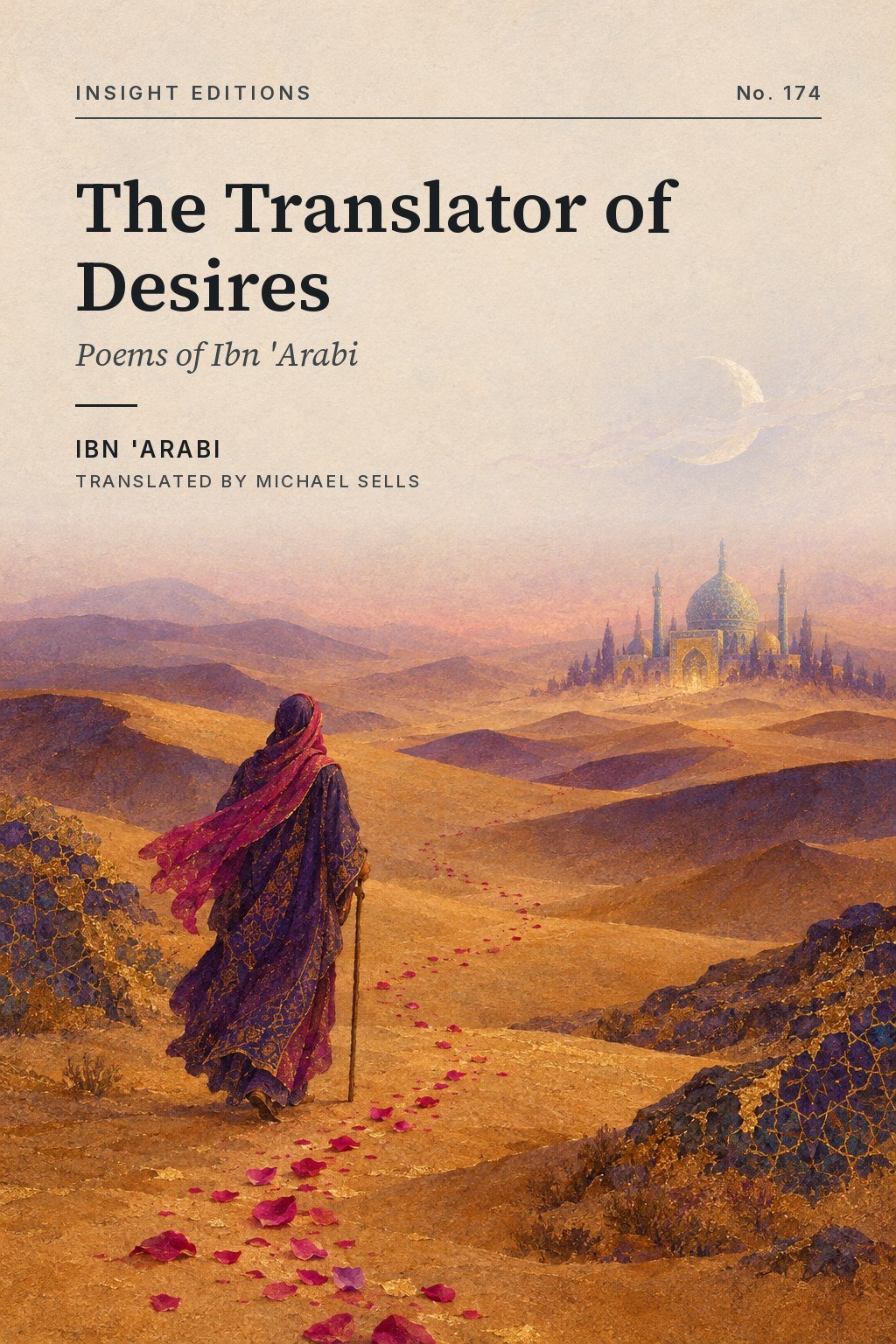
Insight Editions · No. 174
The Translator of Desires
Poems of Ibn 'Arabi
Ibn 'Arabi · Translated by Michael Sells
Ibn 'Arabi’s cycle of Arabic love poems follows a poet-lover through desert landscapes and pilgrimage imagery, joining erotic longing with spiritual ambiguity.
A study guide to The Translator of Desires by Ibn 'Arabi, translated by Michael Sells. Shared free for personal reading; not for sale and not endorsed by the authors or publishers. Please read and buy the original.
Overview
It follows the book's order: the translator's introduction, the poems in three movements, the notes and appendices, and the glossary. Verse is quoted sparingly, exactly as printed, with its line breaks; everything else is paraphrase.
Argument Map
How the Book Is Built
The volume is a bilingual poetry edition with a scholarly frame. Each poem appears in Arabic on one page and in English on the facing page, with verse numbers at intervals of five. Around the poems sit five kinds of material, and a reader should know which voice is speaking:
- Ibn 'Arabi the poet, in the sixty-one poems.
- Ibn 'Arabi the self-interpreter, in two prefaces, a versified apologia and, at second hand, his commentary Priceless Treasures, which Sells cites but does not translate.
- Michael Sells the critic, in a thirty-page introduction and thirty-five pages of poem-by-poem notes.
- Sells the editor, in an appendix on manuscripts and method; the volume is also a new edition of the Arabic.
- Reference matter: a chronology, a history of translations, a glossary of places and plants, and endnotes.
Ten Ideas in Brief
- Shawq is infinite. Eros cannot be split cleanly into human and divine love.
- The ruin speaks. Poetry starts when the lover recognises the traces of the beloved's camp.
- Two pilgrimages. The beloved's route and the hajj route run on the same map.
- Hadith of love. News of the beloved arrives through chains of winds, birds and moods, like a report through its transmitters.
- Turning voices. The poems keep switching addressee, number and gender; the reader must keep up.
- Die and revive. The lover perishes at the sight of beauty and is brought back, again and again.
- The heart as Ka'ba. In poem 11 the lover stops circling and becomes the centre that is circled.
- Every form. The heart that is emptied can receive each new form the beloved takes; holding on to one form kills.
- Three tellings. Ibn 'Arabi framed the poems as romance, defended them in a trial, and declared them allegory.
- Poetry before doctrine. The poems came first and may have generated the later metaphysics, not illustrated it.
Editor's Note on Method
The Arabic facing pages were not used.
Arabic names are given in simplified spelling. Dates appear only where the book prints them.
Part 1. The Translator's Introduction
Sells opens with a short life, then builds the frame a modern reader lacks: what shawq means, where the Arabic love lyric comes from, how the hajj and hadith transmission enter the poems, how the voices shift, and how Ibn 'Arabi himself told the story of the book. He closes with the problems of translating it.
A Life in Orbit Around the Ka'ba
Ibn 'Arabi was born in 1165 in al-Andalus to a prosperous, well-connected family and had a full religious, literary and philosophical education. Young, he chose to leave court circles for two decades of itinerant study among Sufis, scholars and poets in Seville, Fez, Marrakesh and Tunis. Heading for Mecca he was stuck in Cairo by a plague quarantine, and he reached Mecca in 1202. There, by his own account, visions began that fed four decades of writing. Circling the Ka'ba he met the mystical youth who inspired the Meccan Openings; the Ka'ba itself, personified, drew from him a set of love letters in rhymed prose; and at the Ka'ba in 1202 a young woman tore apart a four-verse poem he was reciting, which led, during a later stay, to sixty more poems.
After 1204 his journeys ran through Mosul, Baghdad, Damascus, Aleppo, Konya and Malatya, "elliptical orbits around the Ka'ba" to which he kept returning. By the time he settled in Damascus in 1223 he had followers copying and spreading his works. He died in 1240, already on his way to being called "the grand master."
The Title
(or
Turjuman) can mean translator, translation, interpreter, discloser or guidebook, and it is close to
tarjama, biography.
Ashwaqis the plural of
shawq, one of more than two dozen Arabic words for love and longing. Sells compares it to Greek eros: a basic driving force of life and art,
infinite in relation to a finite person. The lover in the poems is shawq's subject, victim, champion and voice at once. The familiar paradoxes follow: love is disease and cure; nearness only sharpens longing.
The Tradition Behind the Poems
The classical ode began with the nasib, remembrance of a lost beloved. By the end of Islam's first century a free-standing love poem, the ghazal, had grown out of it, in two modes. The 'Udhri mode is tragic: Qays goes mad for Layla, becomes Majnun, "jinned," and wastes away; early Sufis took such "martyrs of love" as models of the adept who passes away into the divine beloved. The 'Umarite mode, after 'Umar ibn abi Rabi'a (d. ca. 700), is urbane: the poet boasts and flirts as well as mourns.
Under every variation one motif stays: the atlal, the traces of the beloved's abandoned camp. Poetry begins when the poet recognises that these are the traces of her camp. By contagion, other things take on that power: a station on her route, the Eastwind that carries word of her, the moringa tree, a line from an earlier poet about his own lost love. The contagion runs across space through messengers and across time through quotation.
Hajj and Hadith: Two Ways to Collapse Time
The hajj is the culmination of devotional life, and the poems return to its rites constantly: circling the Ka'ba, standing at 'Arafa chanting "here I am for you," casting pebbles at Mina and re-enacting Abraham's sacrifice. The poems mix the stations of the hajj with the stations of the beloved's journey, so that the lover's wandering from site to site mirrors the pilgrim's station-by-station progress. Ritual re-enactment collapses time, bringing the origins into the present.
Hadith transmission does the same. A report of the Prophet comes with its chain of transmitters; hearing it from a living transmitter is, in a sense, hearing the Prophet speak live. Poets and storytellers borrowed the form. In the Tarjuman, the beloved's words arrive through a chain of natural phenomena or inner states stretching back to early Islam, to Eden, or before creation.
Turning Voices
Northrop Frye said the lyric poet pretends to talk to himself or someone else; Sells adds the scold of Arabic poetry, the critic who is also the critic within. The poems keep changing addressee: beloved, muse, beauty, friend, critic, nature, all lovers, singular or plural, masculine or feminine. Arabic rhetoric called this iltifat, "turning," and prized it as bold. The lover's own persona shifts between "I" and "we," where "we" may mean all lovers, the lost mutuality of the pair, or the tribe the poet longs to rejoin. The beloved is mostly female but sometimes male, sometimes within one poem.
The Tale of the Tarjuman
Ibn 'Arabi gave conflicting accounts of how the poems arose. Sells calls this meta-literature "The Tale of the Tarjuman" and divides it into three strands.
| Strand | Source | What it says |
|---|---|---|
| Romance | Nizam preface; Qurrat al-'Ayn preface | Poems inspired by Nizam, learned daughter of a Persian scholar in Mecca; and by a Rumi maiden who rebuked poem 1 at the Ka'ba |
| Trial | Commentary prologue | An Aleppo jurist calls the allegory a façade; Ibn 'Arabi answers with an apologia and a full commentary, read before an assembly |
| Allegory | Apologia; commentary | Every ruin, wind and maiden carries "lights and secrets"; look within |
Nizam (Sells renders the word "harmony," since it means "ordered arrangement" and plays through the poems) was the daughter of a Persian scholar of Isfahan settled in Mecca. She has been compared to Dante's Beatrice. The poems do stage an erotic dialectic between an Arab poet, "a son of Yemen," and a beloved who stands for Persian culture.
Qurrat al-'Ayn, "comfort for the eye," is the maiden of the second preface. While circling the Ka'ba, Ibn 'Arabi recited four verses, felt a jolt between his shoulders "from a hand softer than undyed silk," and turned to find a young woman of the Rum who refuted each verse and rebuked him for reciting lines unworthy of his rank.
The trial came soon. A jurist in Aleppo charged that Ibn 'Arabi, a man of religion, was hiding erotic poems behind an allegorical front. At the request of two companions Ibn 'Arabi wrote a versified apologia and the long commentary Priceless Treasures; the jurist Ibn 'Adim (d. 1262) read much of it before an assembly, and the critic was persuaded. Sells notes the twist: the jurist faulted the poems for being too erotic, the maiden faulted poem 1 for not being erotic enough, for stopping short of the lover's complete passing away.
Mirror, Moment, and the Unpossessable Beloved
The poems do not set out Ibn 'Arabi's metaphysics, Sells says, though they hint at mystical union. The key text for him is a divine saying: when the servant draws near through extra devotions, God becomes "the hearing with which he hears, the seeing with which he sees." In the Ringstones of Wisdom, the human being is the polishing of the world's mirror; in the moment of passing away, the divine image shows in the polished heart. Because the Real is infinite, each manifestation lasts only a moment. Whoever clings to one image locks himself in its dead husk.
Was He a Sufi Poet?
He was a contemplative and wrote many poems full of Sufi vocabulary. But the Tarjuman poems, had someone else written them, might not have been classed as Sufi at all, though Sufis would have loved them. Like poems by his contemporaries al-Farid and al-Shushtari, they walk the line between sacred and profane, and for Sells that is the point: shawq "kills and brings to life," is beyond the world and deep in the heart.
Translating the Tarjuman
Nicholson's 1911 edition and translation was the first; this volume is the first complete English translation since. Sells frames translation as balance between conservation and compensation.
| Arabic feature | Problem | Sells's solution |
|---|---|---|
| Quantitative meters (about a dozen) | No English equivalent; tension of meter against syntax | Short lines; scansion shown for poem 11 as a sample |
| Single end rhyme through a poem | Unworkable in modern English | Not reproduced |
| Jinas (punning, root play) | Untranslatable directly | Explained in the notes |
| Independent, end-stopped verse | Reader must bridge the gaps | Sparse punctuation, no end stops; one stanza per Arabic verse |
| Plant and place names | No English equivalents; dense associations | Kept, with flexible stressed spellings; some translated (Sand Hill, tamarisk) |
| Prophets' names | Biblical forms blur Qur'anic distinctness | Arabic forms: Musa, Sulayman, 'Isa, Idris |
The sample scansion is the opening verse of poem 11, which in English reads:
of the sprigberry and
moringa, don’t add your
sighs to my heart-ache
Two Languages of Desire
In Sessions of the Righteous Ibn 'Arabi distinguishes longing for the distant or past (shawq) from longing for what is near or already had (ishtiyaq), and introduces a poem as composed by the personified Ashwaq "in the language of ishtiyaq," about Nizam. Nizam becomes both the subject of the poem and the act of composing it, transcendent to it and immanent in it. Sells ends: to be is to be moved from site to site, word to word, self to self, "always in translation." Bewilderment opens the cycle, recurs through it and closes it.
Part 2. The Opening Movement: Poems 1-10
The first ten poems set out the cycle's basic moves: the question after the departed, the Qur'anic queen who kills and revives, the hajj as the lover's self-offering, the alternation of long poems and short lyric interludes, and a closing couplet on the mirror that prepares the keystone.
Poem 1: Bewildered
The whole cycle starts with four short verses, the same four that Qurrat al-'Ayn took apart at the Ka'ba. Ibn 'Arabi did not claim to have authored them.
whose heart they’ve taken
Or my heart knew which
high-ridge track they follow
Do you see them safe
or perishing?
The lords of love are in love
ensnared, bewildered
Sells's note fixes the cycle's first-order poetics: the lover voiced as male, the beloved mostly female, singular or plural. "They" are the women of the tribe in their howdahs, led by camel drivers, and also the beloved herself. The last verse introduces the motif that runs to the end: the "lords of love" are trapped and bewildered by what they should master. Bewilderment has many names in the cycle: perplexed, speechless, astonished, lost.
Poem 2: Release
The beloveds mount their brocaded palanquins and are led away, "peacocks / high in howdahs." Then the poem runs through a chain of transformations. She is Bilqis, Queen of Sheba, on her throne; she crosses Sulayman's glass floor and shows the sun circling in Idris's sphere (Idris, linked in tradition with Enoch and Hermes, is the prophet of the fourth heaven, the sun's). Her glance kills and her speech revives, like 'Isa raising the dead; her legs are like the Torah's tablets, which the lover studies like Musa. Then she is a bishop, a daughter of Byzantium, bathed in the light of the Holy Spirit, a recluse in a tomb, a wisdom that baffles sages, psalmists, rabbis and priests. If she beckoned toward the gospel, the lovers would turn into vicars and deacons.
At the point of death the lover begs her for release, and she yields: the verb is the one used of Bilqis submitting with Sulayman to the one God.
Poem 3: The Offering
The lover sends companions to Mecca to find the beloved's people and declares: "My hajj is for them, / my fast and feast." The rites appear in order: casting pebbles at Mina near Muhassab, Zamzam's water, the sacrifice. Here the lover is the sacrifice: they cast live coals from his heart and drink his blood. Then the search resumes by proxy: the driver must halt at Hajir, call toward the red pavilions of Hima, and if no answer comes, ring out the names of the old beloveds, Da'd, Rabab, Zaynab, Hind, Lubna, Salma. The last verse asks after a girl at Halba, a district of Baghdad, one of several Baghdad references that have fed speculation that Nizam later lived near Baghdad.
Poems 4-6: The First Interludes
These begin a pattern: short lyrics alternating with longer, more complex poems.
| Poem | Move | What Sells notes |
|---|---|---|
| 4. As Night Let Down Its Curtain | Greeting to Salma; she answers | Dense jinas on s/l/m and h/l/l; "it's right I greet you" may answer Qurrat al-'Ayn's "not fitting for one like you" |
| 5. Harmony Gone | Stranded between Najd and Tiham | Highland and coastal plain as opposites; verbs built on both roots; patience bids farewell |
| 6. Artemisia and Moringa | Asking the wind to find them | The verb bana means both "appear" and "depart"; echoed by ban, the moringa |
Poem 4 ends with the beloved breaking in to state shawq's paradox:
beholds me anew
in his heart, she said
What more can he ask?
Poem 7: Gowns of Dark
Back at the hajj, the lover touches the Black Stone through a whirl of veiled women who lower their veils and reveal the sun. They warn that death stalks the gaze. The rites unfold verse by verse: circling, the march from 'Arafa to Mina, the cairns, the standing, Zamzam. Here the lover does not offer himself; he risks perishing at the sight of unveiled beauty. Sells observes that by now a pattern is set: the lover dies at the centre of many poems, and his voice afterwards is either a ghost's or part of a continuous process of dying and being revived.
Poem 8: Who Forever
A pre-Islamic style nasib at the ruins ends with a new character, the fire-striker, told to put down his flint: passion's fire is here, take an ember. Sells unpacks a double boast (the lover's fire and the poet's) and the verb iqtabasa, "take an ember," which also means borrow, study under, quote, and embed Qur'anic words. The line echoes Musa seeing a fire and hoping for an ember or guidance before the divine voice speaks from it. That fire, erotic, poetic, prophetic and mystical, passes from poem to poem.
Poems 9-10: Graces and the Mirror
Poem 9 blends nature and the human: lightning, thunder in the ribs, rain, doves, and beauties posed like graces, drawn from the Qur'an's houris. Poem 10 is a two-verse repartee. The beloved wonders at a love that flaunts itself among the flowers; the lover answers:
You’re seeing yourself
in the mirror
of humankind
means a human being, humankind, and
the pupil of the eye; it is gender-neutral and Qur'anic. When you look in a mirror, the self you see looks back. Ibn 'Arabi's commentary, as Sells reports, says the vision of the beloved in the heart is the vision of the garden of paradise and of Eden; the word "garden" bridges to poem 11.
Part 3. The Keystone and Its Range: Poems 11-30
This stretch holds the most famous poem of the cycle, the "religion of love" of poem 11, and the boldest experiments: a Trinitarian beloved, a love-hadith with a chain of transmitters made of moods, the Nizam poem with its East-West wedding of opposites, and the eerie mutual circling of poem 29.
Poem 11: Gentle Now, Doves
Sells calls this the keystone of the Tarjuman, a series of "quietly spectacular transformations and reversals." It moves in five steps.
| Verses | Movement | What happens |
|---|---|---|
| 1-3 | Doves | The lover begs the doves of the moringa and persica not to expose his hidden grief |
| 4-5 | Passing away | Spirits moan in the ghada trees and bend the branches over him "as I pass away" |
| 6 | Hajj stations | Jem (Muzdalifa, "the union") and Muhassab beside the lovers' camps of Tamarisk and Na'man |
| 7-9 | The heart as Ka'ba | Beings circle his heart and kiss each corner; complaint at broken vows turns to wonder at a signalling gazelle |
| 10-13 | Every form | A garden among flames; the heart takes on every form; the religion of love; the old lovers as models |
The ghada tree matters. It was prized for shade and for cooking coals; the cycle ties it to the fire in the lover's heart and, in Ibn 'Arabi's commentary, to the burning bush from which God spoke to Musa. Verse 7 is the turn: the lover no longer speaks about the Ka'ba but as the Ka'ba. He is no longer wandering after the beloved, no longer a pilgrim; his heart has become the still centre of all movement. Sells links this to an idea found throughout Ibn 'Arabi: the greatest Ka'ba is the human heart at the threshold of union.
Then come the most anthologised lines in Arabic Sufi poetry:
any form
For gazelles a meadow
A cloister for monks
A temple for idols,
pilgrim’s Ka`ba,
tablets of Torah,
scrolls of the Qur’ân
The next verse professes "the religion / of love," following wherever its camels turn, and the poem ends with the lover-pairs of the past: Bishr and Hind, Qays and Layla, Mayya and Ghaylan (Dhu al-Rumma, d. ca. 735), the last master of the old Bedouin ode, who journeyed endlessly after Mayya. These pairs are the poet's model, uswa. Sells cites a couplet of Majnun: 'Urwa died once, comfortably; "I die anew each day."
Poem 12: Sunblaze
Gazelles appear as marble statues at a cloister; the poet is called gazelle-minder, astrologer and monk. Then: "The one I love is / three though one / like the three they call / a single being." Sells reads this as a tension between a transcendent reality and its appearance in figures, extended to the Christian three-in-one and mirrored in the poet's three personae. The statues are those Ibn 'Arabi associated with Christian veneration in Syria. The poem closes with nature borrowing from the human: we lend raiment to branches and a smile to lightning.
Poems 13-16: Dove, Hadith, Flash, Star Shepherd
Poem 13 stages a dialogue with a ringdove mourning "her one / and only," then recalls 'Alij, the great Nefud desert, the day of separation and "death's cords." The lover "remembers" the caravan's route though he could not have seen it: memory slides into imagination, a nasib habit the cycle pushes hard.
Poem 14, "Hadith of Love," is built on transmission protocol.
The Eastwind brings "the word" through distraction, rapture, sorrow, drunkenness, reason, longing and fire. The term for "brought" can mean a report passed down a chain or gossip from a tell-all. The message: the one you seek is within your ribs, turned in each breath from side to side, echoing the hadith that the believer's heart lies between two fingers of God.
Poem 15 races through flashes: tears that betray him, a glance refused "out of compassion," crows of departure that turn in his mind into the camels that bore her off. Poem 16 has the lover cry "damn it" as the caravan leaves, and the women reply: then cry it again and again, a direct echo of the Qur'an's words to the damned (Q 25:14). He turns to a dove, the Eastwind, the star shepherd (the sleepless desert poet who "grazes the stars") and the lightning-gazer, then rebukes the one who sleeps the night "self-entombed / before you die." The tombs belong not to lovers but to those who never loved.
Poems 17-19: Ruins and Revival
Poem 17 places love in the liver's caul, organs that Greek medicine tied to black bile and melancholy. Poem 18 questions the deserted meadows, sends the Eastwind as scout, then sends companions after the caravan: in desire's fire, the tribe's lions look like cubs. Poem 19 inverts poem 16: wherever the women camped, drought-cracked ground blossomed; when they left, the land bore "the tombs of those who loved them." Sells compares the beloved to the spirit in Ibn 'Arabi's thought, which brings to life whatever it touches.
Poem 20: In a Bad Way (the Nizam Poem)
This holds the cycle's most sustained allusion to Nizam. It opens with five rapid motifs (lovesickness cured only by her name, doves, a proud girl, the sun on the heart's horizon, ruins at Rama), slows at the gazelle "browsing / within my ribs," and freezes at the ruins as the lover begs his friends to weep with him. He revives as they recite the old names: Hind, Lubna, Zaynab, the stations of Hajir and Zarud, the verse of Qays and Ghaylan.
Then the register changes. He longs for a girl who is "harmony in verse, / in prose, in oration": the word for verse is nizam. She is a daughter of Persian kings and of Isfahan, the city of Nizam's father and aunt; he is "of Yemen, / her foil." The poem's argument is that opposites can meet: Iraq and Yemen intertwined, passion's cup shared without moving a hand, a song between them "without a sound." Finally he rebukes an earlier poet (lines ascribed to 'Umar ibn abi Rabi'a) who said Suhayl and the Pleiades could never meet.
| Pole | Counter-pole | How the poem joins them |
|---|---|---|
| Arab, "son of Yemen" | Persian, Isfahan, Iraq | A wedding of cultures in one love |
| Suhayl (rising south in Yemen) | Pleiades (rising in the Syrian east) | The poet refutes "logic's stones" |
| Passing the cup | Not moving a hand | Communion without exchange |
| Song | Silence | Rapture "without a sound" |
Poems 21-28: Hima, Inscriptions, the Dervish's Verse
| Poem | Core image | Sells's key point |
|---|---|---|
| 21. Your Wish | Garden asked to shade "the lady / of this hallowed ground" | Rabba, feminine of "lord," answers the "lords of love"; the hima was a tribe's sacred pasture, whose violation meant war |
| 22. Blacksilver | A hand "soft as undyed silk" | Echoes the jolt in the Qurrat al-'Ayn preface |
| 23. Blaze | A tower appearing at dawn with a carved tale | An apparition emerging into clarity; the lover's self-portrait out of time |
| 24. Stay Now | A dervish's verse on faithless lightning | The ruin, the moringa and the beloved answer as one voice: "Blame time" |
| 25. Vanished | Beloved outshines Adam | Iblis would have bowed; Idris would have stopped writing; Bilqis would forget Sulayman's hall |
| 26. Vintage of Adam | Adam's ancient vintage, its word passed down the generations from Eden | Hadith language again; the Qur'an's wine "sealed with musk" |
| 27. Old Shrine | Riding to the Ka'ba with no wish to arrive | "Old house" is the Ka'ba; also its heavenly twin, circled by angels |
| 28. No New Moon | Dead on the trail between Naqa and La'la' | Informal rajaz meter, rendered in couplets |
Poem 27 has a line worth holding: the camels bear him to the shrine "in longing, without / desire of ever / arriving there." Sessions of the Righteous introduces it with Ibn 'Arabi circling the Ka'ba one night in a sweet mood, complaining of his desert thirst.
Poem 29: Circling
Sixteen verses of erotic reverie, with the Qur'anic houris beneath them, turn at the midpoint into a short version of the ode's harsh journey. It ends with an uncanny figure, gendered male, "a moon / of ghastly mien," met in the ritual circling: "around him I turned, / he around me," his footprints effaced by the edge of his robe. Sells hears in it the youth of the first chapter of the Meccan Openings, at once Holy Spirit, Ka'ba personified and initiator, and the Sufi circle dance where two dancers spin at the centre while the chanting ring blurs. The word for what the lover folds toward him can mean rib cage, ill-luck, or with one vowel changed, shroud.
Poem 30: Like Saba's Lost Tribes
The longest poem wanders through ghazal's moods. The lover's cares scatter after the caravan like Saba's lost tribes (Q 34). He asks the north, south and east winds each for a hadith of his condition; the winds trade reports. Nature and the human mirror each other: clouds weep and blush. After a flirtation that verges on self-parody ("I'm but an Arab / born to love"), he casts himself as two Qur'anic figures: al-Samiri, who cast dust from the messenger's footprint on the golden calf and made it low (for Ibn 'Arabi, where the spirit passes, life surges), and Iskandar, Dhu al-Qarnayn, gliding east and west on heaven's cords. It ends in a cry: at a dove's call, the lad is gone.
Part 4. Deepening and Closing: Poems 31-61
The last half of the cycle mixes suites of tiny lyrics with longer poems. The themes sharpen: ineffability, the infinity of longing, the trust the heavens refused, the doubled letter, the dot between subjection and intimacy, Baghdad and its caliph, and a final diva whose song leaves beauty itself bewildered.
Poem 31 and the Interior Suite, 32-38
Poem 31, "Ada Trail," is an elegant ghazal: lightning over the valley, a slender girl whose presence turns mirage into rain, and the most baleful omen of all, worse than owl or crow, the old camel saddled to carry her off. Then comes an interior suite of short poems.
| Poem | Title | What it does |
|---|---|---|
| 32 | Fifty Years | Words heard between Haditha and Karkh bring back youth; "after fifty years / of hard thinking" he is a fledgling. Commentators note Ibn 'Arabi was about fifty |
| 33 | Drowning Eyes | The whole poem is the dove colloquy: she mourns tearless, he streams |
| 34 | Sweet the Gaze | Lions smitten near Zarud by dark eyes; dense jinas with a light touch |
| 35 | You Now | Three moons at Tan'im chant labbayka, the pilgrim's "here I am for you" |
| 36 | Lightning over Ghada | Greeting the highlands after fifty years, always returning to begin, always beginning to return |
| 37 | Come Down to the Waters | Messengers sent through Hima, Najd's lone waymark, Twisting Sands and the lote to Mina, "the place / that holds my heart" |
| 38 | A Persian Girl | Baghdad, home of his imam and of a Persian girl who kills with a glance and revives with a word |
Sells lingers on two of these. In poem 37 the waymark ('alam) is a cairn, peak or ruin that guides the desert traveller; it raises the questions of appearance and reality that, for a lost traveller, are life and death. The poem ends with an open, urgent question: "why . . . why." In poem 38 three forms of the root for beauty meet: husn, beauty; husna, a happy outcome; and ihsan, beauty carried into ethics, defined in the hadith as worshipping God as though you see Him. The beautiful becomes the good.
Poems 39-42: Light, Time, and the Letter Ha
Poem 39 is a dance on light and night: her face lights his dark, her hair brings night at noon. Poem 40 sets a girl of fourteen between Adhri'at and Busra as the full moon, which falls on the fourteenth of the lunar month. But this moon "knows no doubling / from odd to even": it does not wax and wane. To go from one to two would be to fall into time. Ibn 'Arabi's commentary, Sells reports, calls fourteen perfect: four plus ten, which is one plus two plus three plus four.
Poem 41 gallops in the mutaqarib meter: a bird calls that the loved ones have left at dawn, he races after them guided by "a fragrant breath / on the wind of desire," his tears become a river they cannot cross, and he ends by reversing a cliché: a bough is pliant like a lover's limbs, not the other way round. Nature is patterned on the human.
Poem 42, "Sign Masters," approaches delirium. The first verses pile jinas: oryx and onyx, the faint star Suha and the verb "to neglect." Then the poet admits his verses "have / no rhyme": his only aim is the sound ha, "her." Sells explains the closing pun through Islamic trade law: some goods, like gold, could be exchanged only "this for this," same kind for same kind, hand to hand, to avoid usury. The lover has nothing to give and she needs nothing; so he trades "her" for "her." By calling her name he brings her into presence.
Poems 43-47: Parting, Chimera, the Turning
Poem 43 begs the drivers to stop, recalls Imru' al-Qays's "splitting bittergourd" at parting, and ends on patience. Poem 44, "Chimera," is about ineffability: recall her and she's gone, words rise to describe her and are left stammering, riders may slow but no one slows a racing mind. Sells ties it to the theology of a God beyond description whose Qur'anic names are still affirmed. Poem 45, "Where Gone," is about the infinity of shawq: with the beloved, fear of losing her comes between them. In Ibn 'Arabi's love theory, union erases self-consciousness, and when it returns, separation returns.
Poem 46 has a dialogue with the Eastwind: "And who are you to want / to know?" The loved ones cannot be held by any land, but "they will never elude / the cavalries of my longing"; they hide in his soul, where the moon rises in his mind and sets in his heart. Poem 47, "The Turning," rests on Qur'an 33:72: the trust offered to heavens, earth and mountains, refused by all, accepted by the foolhardy human. Love is the trust the world could not bear. It ends with a beloved who passes laughing and turns away; not the hiding hurt, but the turning.
Poems 48-53: Short Lyrics, the Phantom, the Doubled Letter
other and intertwine
like a doubled letter
Although our shapes
are two we appear
as one alone
He’s light and I am shadow
If I didn’t moan
you’d never see me
In Arabic, a doubled consonant is written as one sign; in ordinary script it is unmarked. Readers must know when to double it, and failing to do so makes nonsense. The letter is "heard but unseen." The lover is like that: invisible unless he moans.
Poems 54-58: The Dot, Union, Baghdad
Poem 54, "Dar al-Falak," turns on mastery and subjection: "I am his and he is mine," then "I'm his, clearly, but is he mine?" Its play runs on letters that differ only by a dot: d/l/l words mean intimacy, dh/l/l words mean subjection. Sells cites two verses attributed to Ibn 'Arabi: between subjection and intimacy lies a dot, "the dot of the universe." Dar al-Falak is probably the Baghdad convent founded by the caliph Nasir in 1180, another Nizam clue.
Poem 55, "No Cure," compresses fana' and ecstasy: without him I die, with him no better; cure and disease are equal fevers; "The deeper the harmony / the sharper the pain." Ibn 'Arabi placed it in the Meccan Openings as a poem on the surge of love at the moment of vision, glossing it as God's manifestation in changing forms, in the heart and in the next life, while the Essence remains beyond likeness and location.
Poem 56, "Baghdad Song," praises the caliph's palace over legendary Sindad and blesses "Nasir, Mansur, / best of the caliphs." Sells notes Nasir ruled 1180-1225, integrated Sufi networks into a chivalric order, and that within a little more than two decades of his death the Mongols would sack Baghdad. Poem 57, "Red Rise," sets a Saturday morning tryst in the Najd hills and asks if the lovers' fevers are "dream / stuff," a phrase from the Qur'an's story of Yusuf. In poem 58 the beloved's answer comes through "a voice within," literally the tongue of the hal, the state that comes upon a lover or mystic.
Poems 59-61: The Bookends
Poem 59, "I Came to Know," is the bookend to poem 2. A powerful female figure moves through hajj stations and dangers, a lion at Dhat al-Ada, a raptor's claws at 'Alij, and at Dhu Salam "she submitted my soul / to her lethal gaze." The verb is the same as in poem 2, where she released him. Sells suggests the earlier fear of false union has been overcome: the poet now trusts that this passing away is not hulul.
Poem 60 sends an unspecified "you" to the lovers' station to breathe the spirits from their lands. Poem 61, "Tigris Song," praises a diva whose oud makes one forget the music of Harun al-Rashid's court and the chants of Anjasha, the Prophet's camel driver. The lover says he is gone for a girl in Ajyad near Mecca, then corrects himself: she lives within his liver's black bile. Blackness here means the innermost core, the place of the secret. Sells quotes a couplet Ibn 'Arabi cites in the Meccan Openings:
ask about them while they’re with me
The last line has beauty itself wander bewildered: the lords of love of poem 1 were bewildered by love; now beauty is bewildered by the beloved.
Part 5. Prefaces, Manuscripts and Notes
The back of the book holds Ibn 'Arabi's own framing texts, a chronology, a careful account of how the Arabic was established, a history of translations, a glossary and endnotes. Together they show how the "Tale of the Tarjuman" was built and how fragile, and how well attested, the text is.
The Nizam Preface (Appendix 1)
It opens with a standard prologue that previews the book: God as "the beautiful, the lover of beauty," who bathed the earth in beauty and let His lovers pass away contemplating it. Then Mecca, 598 (1202 CE): a community of Persian scholars, chief among them the imam of the shrine of Abraham from Isfahan and his elderly sister, the "Shaykha of the Hijaz," a hadith scholar. Too old for sessions, she had her brother write Ibn 'Arabi a general diploma to transmit all her hadith.
The shaykh's daughter was Nizam, called Sun Splendor: shaykha of the two holy shrines for women scholars and renunciates, an eloquence that left rivals silent (the verb evokes the Qur'an's inimitability), surpassing a Christian orator, a Muslim warrior and a Jewish poet in their own virtues. "She was her own father's teacher." Ibn 'Arabi says he made for her a necklace of nasibs and ghazals, that every name in the book refers to her and every abode is her abode, and that he uses "our accustomed style" to allude to divine inspirations. He asks God to protect readers from unseemly thoughts.
The Qurrat al-'Ayn Preface (Appendix 2)
The four-verse dialogue is the sharpest scene in the book.
| Ibn 'Arabi's verse | The maiden's objection |
|---|---|
| Would they knew whose heart they took | Whoever takes something knows it; "would that I knew" fits only one without knowledge |
| Would my heart knew their track | That track runs between two layers of the heart; knowing it is forbidden |
| Are they safe or perishing? | They are safe; ask whether you are |
| Lords of love are bewildered | Love consumes; who is left to be bewildered? |
Each objection ends with the refrain that the path requires a sincere tongue, a Qur'anic phrase. Sells's notes add two layers. Her critique rests on ma'rifa, personal, experiential knowing, as against 'ilm, objective knowledge. And when she gives her name, "comfort for the eye," and he answers "for me," he quotes the Qur'an: Pharaoh's wife saying of the infant Musa, "a comfort for the eyes, for me and for you." The flirtation casts her as Musa and him as Pharaoh's wife.
The Apologia and the Zahra' Poem (Appendices 3-4)
The apologia lists the cycle's furniture (ruins, stations, Najd and Tiham, weeping clouds, camel drivers, veiled moons, winds, dunes, phantoms, maidens like marble figurines) and declares that all of it holds "lights and secrets" brought by heavenly riders: turn from the surface and look within. Appendix 4 gives a short elegy Ibn 'Arabi recited at the ruined caliphal city of al-Zahra' near Cordoba, the city-ruin version of the nasib.
Chronology Highlights (Appendix 5)
| Year (CE) | Event as printed |
|---|---|
| 1165 | Born in Murcia, 17 Ramadan 565 H |
| 1180 | Meets Ibn Rushd in Cordoba |
| 1181 | Enters the mystical path |
| 1195-97 | Visions in Fez |
| 1202-04 | Mecca: the Persian scholars, Nizam |
| 1212 | Baghdad; corresponds with Kaykaus |
| 1214 | Composes the Tarjuman |
| 1215 | Ibn 'Adim reads the commentary in Aleppo; commentary completed in Anatolia |
| 1223 | Settles in Damascus |
| 1235 | Composes the Ringstones of Wisdom |
| 1237-38 | Completes the Great Diwan; second edition of the Meccan Openings |
| 1240 | Dies in Damascus, 22 Rabi' al-Thani 638 H |
Establishing the Text (Appendix 6)
No autograph of the Tarjuman survives, yet Sells sees little doubt of authorship: the poems appear in Sessions of the Righteous and in the rediscovered Diwan al-Ma'arif, match dozens of other poems in style, are quoted in the Meccan Openings, and the commentary fits his oeuvre. He explains the "hearing" (sama'): a copy read aloud before Ibn 'Arabi, corrected, and signed by him and those present, at once publishing workshop and seminar.
| Siglum | Witness | Note |
|---|---|---|
| RP | Ragib Pasha 1453 | Base text; copy of a verification dated 614/1217; clear, vocalised; ends with a colophon from Malatya |
| M | Manisa 6596 | From al-Qunawi's personal copy; breaks off at poem 31 |
| F, EM-a | Fatih 5322; Evkaf Muzesi 1713 | Commentary copies descending from a companion's 622 H original |
| P | Paris, BnF Arabe 2583 | Diwan al-Ma'arif: all 61 poems, commentary for 1-14 |
| AS-a, AS-b, K | Ayasofya; Kutahya | K is elegant but riddled with errors |
| Nicholson 1911; Shuqayri 1995 | Printed editions | Nicholson's order kept for familiarity |
The order of the last ten poems varies across the best manuscripts; Ibn 'Arabi may have issued different sequences at different times. Sells keeps Nicholson's order rather than complicate matters. Sessions of the Righteous contains 34 of the 61 poems, 319 of the 576 verses, with its own introductions; for poem 3 it says, "I once had a wife who was the solace of my eyes."
The Meters
Translations (Appendix 7)
Nicholson (1911) gave the Arabic text, a translation and parts of the commentary. Gloton's French (1996) first translated nearly all the commentary; Hermann's German (2013) is "the essential work" on it. Spanish, Italian, Turkish and German versions followed, and Sells's own earlier selections (2000, 2018) used different styles for different readers.
What the Endnotes Add
- The name. Muhyi al-Din is an honorific; al-Ta'i links him to the Yemeni tribe of Hatim al-Ta'i, which is why the poet-persona calls himself a son of Yemen. Ibn al-'Arabi was the western form, Ibn 'Arabi the eastern.
- Pilgrimage poets. Sessions of the Righteous shows that two Baghdad Shi'ite leaders who ran the pilgrimage caravan, and the preacher Ibn al-Jawzi (d. 1201), had already merged the hajj into love poetry.
- Jariya-savants. Learned slave women, divas and pious sages, appear in Sufi lore rebuking great masters; Rabi'a is the most famous. The Qurrat al-'Ayn scene belongs to this type.
- Myth. Sells uses "myth" for a story "more than true" in imaginative power, not a false one.
Part 6. Synthesis
Twenty-Four Takeaways
Frameworks Table
| Framework | Where | Elements | Use |
|---|---|---|---|
| Nasib sequence | Part 1 | Ruin, recognition, remembrance, journey | How memory turns into speech |
| Two modes of ghazal | Part 1 | 'Udhri (tragic) and 'Umarite (urbane) | Read the register of a love poem |
| Tale of the Tarjuman | Part 1 | Romance, trial, allegory | Separate origin story, defence and reading key |
| Manifestation cycle | Part 1, Fig. 2 | Appear, pass away, return, let go | Why the beloved cannot be held |
| Love-isnad | Part 3, Fig. 3 | Beloved, chain of states, lover, return message | Trace how news reaches the heart |
| Five movements of poem 11 | Part 3 | Doves, death, stations, heart as Ka'ba, every form | Read the famous lines in context |
| Shawq and ishtiyaq | Part 1 | Longing for the far; longing for the near | Name two kinds of desire |
| Like-for-like exchange | Part 4, poem 42 | Her for her, hand to hand | Presence cannot be bought with substitutes |
| Ma'rifa and 'ilm | Part 5 | Experiential versus objective knowing | Test whether speech matches knowledge |
| Hearing (sama') | Part 5 | Read aloud, correct, sign, witness | A model of verified publication |
How the Heart Becomes the Centre
The movement runs through the whole cycle. In the opening poems the lover follows a beloved who keeps departing; at the hajj stations he becomes a pilgrim circling the Ka'ba; in poem 11, verses 7 to 9, beings circle his own heart and kiss each corner, and the heart that receives every form becomes the house itself.
A closer look
Who's Who
| Name | Dates as printed | Role in the book |
|---|---|---|
| Ibn 'Arabi | 1165-1240 | Poet, self-commentator, the "grand master" |
| Nizam ("Sun Splendor") | none printed | Learned daughter of a Persian scholar in Mecca; muse of the preface |
| Qurrat al-'Ayn | none printed | Rumi maiden who rebuked poem 1 at the Ka'ba |
| Makin al-Din (Zahir) bin Rustam | none printed | Imam of the shrine of Abraham, Nizam's father |
| Fakhr al-Nisa' bint Rustam | none printed | Hadith scholar, Nizam's aunt; gave Ibn 'Arabi a diploma |
| Ibn 'Adim | d. 1262 | Jurist and chronicler who read the commentary in Aleppo |
| Badr al-Habashi, Ibn Sawdakin | none printed | Companions who asked for the commentary |
| Nasir li-Din Allah | ruled 1180-1225 | Abbasid caliph praised in poem 56 |
| 'Umar ibn abi Rabi'a | d. ca. 700 | Master of the urbane ghazal |
| Ghaylan (Dhu al-Rumma) | d. ca. 735 | Last master of the Bedouin ode; lover of Mayya |
| Qays (Majnun Layla) | none printed | The mad lover; model of the 'Udhri mode |
| Abu al-Faraj al-Isfahani | d. 967 | Compiler of the Great Book of Songs |
| Ibn al-Jawzi | d. 1201 | Preacher who merged hajj longing and love poetry |
| Ibn al-Farid | 1181-1235 (birth and death in chronology) | Cairene poet of hajj and love |
| Ibn Rushd | funeral 1199 | Philosopher Ibn 'Arabi met in 1180 |
| al-Qunawi | none printed | Chief disciple; source of manuscript M |
| Reynold Nicholson | edition 1911 | First editor and English translator |
| Michael Sells | preface dated 2020 | Translator, editor, critic |
Glossary
Terms as the book glosses them, in simplified spelling.
| Term | Meaning |
|---|---|
| Ashwaq, shawq | Longings; desire, eros, infinite in relation to the finite person |
| Atlal | Ruins or traces of the beloved's abandoned camp; where the nasib begins |
| Bana / ban | Verb meaning both "appear" and "depart"; noun for the moringa tree |
| Eastwind | The breeze that carries news and fragrance of the beloved |
| Fana' | Passing away of the ego-self in union with the beloved |
| Ghada | Desert tree prized for shade and coals; tied to the heart's fire and the burning bush |
| Ghazal | Free-standing love poem, in 'Udhri (tragic) and 'Umarite (urbane) modes |
| Hajir | Relay station on the pilgrim route; linked with "interdiction" and with stone |
| Hal, ahwal | State(s) that come upon a lover or mystic |
| Hima | A tribe's sacred pasture, marked by boundary stones |
| Hulul | The error of believing one has become one with an incarnate God |
| Ihsan | Beauty carried into ethics; worshipping God as though you see Him |
| Iltifat | "Turning": sudden shifts of addresser and addressee |
| Insan | Human being, humankind, pupil of the eye |
| Iqtabasa | Take an ember; borrow, study under, quote |
| Isnad | Chain of transmitters of a report |
| Ishtiyaq | Longing for what is near or already had |
| Jariya | Young woman, often slave or freed; also diva or learned savant |
| Jem | Muzdalifa, "the union," where pilgrims reassemble |
| Jinas | Punning and root play |
| Labbayka | "Here I am for you," the pilgrim's chant |
| Ma'rifa | Personal, experiential knowing (contrast 'ilm, objective knowledge) |
| Moringa | Fragrant desert tree associated with the beloved's beauty |
| Muwashshaha | Garland poem, a stanzaic form |
| Najd and Tihama | Highland plateau of love poetry and the coastal lowland |
| Namus | Great spirit; for Christians the Pentecost spirit, for Muslims the holy spirit |
| Nasib | Opening elegiac movement of the ode, remembering a lost beloved |
| Nizam | "Ordered arrangement," verse; name of the muse, rendered "harmony" |
| Priceless Treasures | Ibn 'Arabi's commentary on the poems |
| Qurrat al-'Ayn | "Comfort for the eye"; name of the maiden at the Ka'ba |
| Sama' (hearing) | Session in which a copy was read before the author and certified |
| Star shepherd | Sleepless poet who "grazes the stars" through the night |
| Uswa | Model or exemplar, such as the legendary lovers |
| 'Alam | Waymark guiding desert travellers |
About this book
The Translator of Desires: Poems of Ibn 'Arabi by Ibn 'Arabi, 2021. This is a chapter-by-chapter study of the book, with summaries, maps, tables and diagrams; short quotations keep their page references. It is shared free for personal study, is not for sale, and is not endorsed by the author or publisher. Please read and buy the original.
Insight Editions · rajeshrmahapatra.com/insight-editions