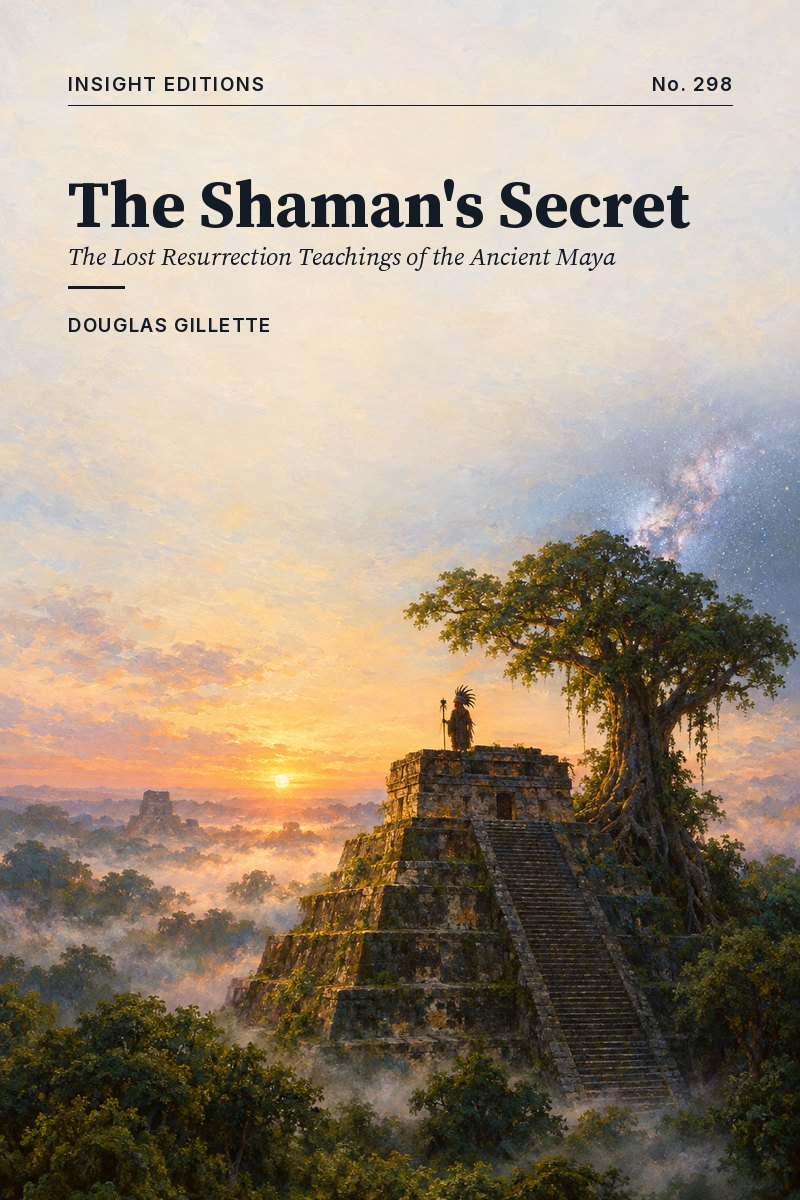
Insight Editions · No. 298
The Shaman's Secret
The Lost Resurrection Teachings of the Ancient Maya
Douglas Gillette
Douglas Gillette reconstructs the Maya resurrection teaching from temple art, the Popol Vuh and astronomy, following the Hero Twins' descent into the underworld and their rebirth as sun and moon.
A study guide to The Shaman's Secret by Douglas Gillette. Shared free for personal reading; not for sale and not endorsed by the authors or publishers. Please read and buy the original.
At a Glance
| Central thesis | Scope | Key figures | Best for |
|---|---|---|---|
| Gillette reconstructs a Maya path of soul-transformation and hoped-for resurrection from art, myth, and ritual. | Ancient Maya theology, royal burials, cosmology, sacred art, sacrifice, and Jungian interpretation. | Pacal, Ruz Lhuillier, Stephens, Catherwood, First Father, First Mother, the Hero Twins. | Comparative religion, symbolism, Mesoamerican art, and the historical psychology of death. |
Overview: What the Book Tries to Recover
Douglas Gillette approaches ancient Maya monuments not simply as the material remains of a vanished civilization but as the surviving pieces of a religious teaching about how consciousness might outlast death. His deliberately provocative term is resurrection technology. The source's archaeological materials are real objects, texts, murals, buildings, and tombs, but the proposed unified technology is Gillette's comparative and Jungian reconstruction, not a modern scientifically established method of achieving immortality.
The argument begins with the discovery of the royal burial beneath the Temple of the Inscriptions at Palenque. The descent from the temple into a crypt becomes the governing pattern for Gillette's account: death as descent, confrontation with an Otherworld capable of destroying or remaking the soul, and an imagined return bearing divine consciousness. The same pattern is sought in sculpture, masks, blood rituals, gods and demons, Maya astronomy, the sacred ballgame, and the imagery of maize springing from apparent death.
Gillette's model places First Father, First Mother, First Lord, First Jaguar, and K'awil at the center of a drama in which creative and destructive powers belong to one all-embracing sacred reality. The Lords of Xibalba, rather than being merely independent enemies of life, are treated as terrifying aspects of the reality from which life emerges. This is why the study spends considerable time with difficult objects: bone, blood, severed heads, skeletal jaws, carnivorous animals, and images of ritual killing.
The author draws on hieroglyphic decipherment, classic Maya art history, Mesoamerican mythology, comparative religion, and Jungian depth psychology. The result is a synthetic religious interpretation, not a consensus textbook about all Maya traditions or periods. Reading it well requires two forms of care at once: preserve the detailed logic of Gillette's interpretation, and keep distinct what is visible in the material record from what the author infers about ancient consciousness, social practice, and life after death.
The complete source chapter map
| Part | Original heading | Function in the argument |
|---|---|---|
| Prologue | Prologue | The author's intellectual and spiritual motivation and four stated aims. |
| Intro. | Introduction | Discovery and decipherment; gods, life force, the ballgame, sacrifice and Jungian method. |
| 1 | Rediscovering a Lost World | Pacal's tomb, religious history, early deities, cities, collapse and surviving sources. |
| 2 | A Terrible Beauty | The aesthetic of divine terror, masks and divine sight, cosmic duality and art. |
| 3 | A Living Cosmos | Three-dimensional cosmology, World Tree, portals, time, sacred calendar and stars. |
| 4 | Blood and Ecstasy | Ritual practices, visions and the movement of sacred power. |
| 5 | The Creations of the Lightning-Serpent | Creation and transformation through the Lightning-Serpent complex. |
| 6 | God | The source's reconstruction of divine unity, multiplicity and polarity. |
| 7 | The Soul | Soul, life force, consciousness and continuity beyond death. |
| 8 | The Shaman's Secret | Initiatory and ecstatic methods central to the thesis. |
| 9 | Death | Passage into death and the fate of the individual. |
| 10 | The Trials of Xibalba | The soul's ordeals within the Underworld. |
| 11 | The Ballgame and Human Sacrifice | Ritual reenactment, death and the hoped-for renewal of life. |
| 12 | Resurrection | Completion of the imagined spiritual transformation. |
| Epilogue | Epilogue | Final synthesis and the author's personal conclusion. |
FOUNDATIONSPrologue
The prologue makes the personal nature of the enterprise explicit. Since childhood, Gillette had been drawn to the ancient civilizations of Mexico and Central America, particularly to images that seemed simultaneously luminous and frightening. The Maya became his central preoccupation. As an adult he climbed pyramids, descended into tombs, studied reproductions of manuscripts, and worked through accounts by archaeologists and specialists in Maya writing and iconography. Visits to jungle ruins and long attention to sculpted stones deepened his conviction that an elaborate religious vision had been preserved in objects often treated merely as artistic or archaeological treasures.
His interpretive equipment joins comparative mythology, religion, and depth psychology. These tools, he says, helped him read Maya royal imagery as a code concerning the transformation of the soul. The resulting proposal has two inseparable aspects. One concerns a supposed ancient method of enduring death through ritual objects, transformative experiences, divine identification, and altered awareness. The other concerns changes in the investigator himself. The process of searching appears to awaken both a greater sensitivity to the shadowed aspects of existence and a stronger sense of peace, courage, and intensity in ordinary life.
Gillette then states four purposes, each more ambitious than the previous one. First, he wants to reconstruct and explain the ancient teachings through myth, carved images, religious symbols, and instructions concerning life, death, and return. Second, he wants readers to imagine the sacred Maya universe from within, not merely survey it as remote folklore. Third, he hopes that its images will transform the reader's own spiritual understanding and manner of living. Fourth, he explicitly proposes that the Maya may have possessed knowledge relevant to personal immortality, a possibility he invites the reader to entertain rather than dismiss at the outset.
The prologue's admission that the inquiry is unfinished matters. This is a work of reconstruction and spiritual interpretation, not a recovered ancient ritual manual copied intact from a surviving codex. The writer is candid about the emotional effect the material has upon him. Such candor gives readers a useful clue to the tone of the chapters that follow: the prose is written by someone seeking a truth he wants to inhabit, and that desire shapes the way he links objects, myths, and religious analogies.
FOUNDATIONSIntroduction
Gillette places a turning point on 17 November 1839, when John Lloyd Stephens and the artist Frederick Catherwood began exploring the ruins at Copán in Honduras. The travelers endured difficult jungle conditions and encountered immense architecture whose texts were still unreadable to outsiders. Stephens's response combined awe, melancholy, and deep uncertainty. Monuments, sculptures, and paintings survived, but for much of the subsequent century many of their inscriptions yielded principally dates and calendar notations, not complete religious stories.
The larger breakthrough came through interdisciplinary decipherment, especially the collaborative meetings at Palenque during the 1970s known as the Mesa Redonda conferences. Gillette names Linda Schele, Gillett Griffin, Floyd Lounsbury, Peter Mathews, David Joralemon, and other researchers whose work connected historical persons, dynasties, rituals, and religious images. What had seemed disconnected ornament began, in the author's account, to reveal sustained relationships among rulership, divine ancestry, bloodletting, celestial events, death, and rebirth. His own book draws heavily on the discoveries that emerged from this scholarly opening.
Gods whose lives form a cosmic drama
The reconstruction takes shape around First Father and First Mother, together with three sons whom Gillette calls First Lord, First Jaguar, and K'awil. The first two sons figure as beings associated with the passage through death and victory over the threatening Lords of the Underworld. Gillette links First Father's death and restoration with a wider drama in which the cosmos itself dies and comes into being again. First Mother presides over renewed life, while K'awil signifies visionary power, transformation, and energy transfer. This genealogy is Gillette's organizing interpretive schema; different texts, languages, local traditions, and scholarly readings do not always use the same divine names or assign precisely these roles.
The Lords of Xibalba represent the fearful powers of death, but the book argues they should not be separated absolutely from life-giving divinity. This yields an unusual claim: destruction and creation, horror and beauty, death and regeneration can operate as two faces of one underlying sacred reality. Gillette calls the life force circulating through gods, humans, and the world ch'ulel; he describes itz, especially sacrificial blood, as a prominent vehicle of its transfer. The terms will recur in the later chapters, but already they provide his answer to why Maya religious images join flowering plants and vigorous gods to skulls, serpents, and human blood.
Ballgame, sacrifice, and the limits of the analogy
The sacred ballgame, in Gillette's telling, reenacts the struggle of forces that bring life from the Underworld. He reads certain ballcourt carvings and sacrificial episodes as liturgical statements: a victim's death is imagined to replenish divine power and secure cosmic renewal. He emphasizes human sacrifice, including depictions of decapitation, because suppressing this element would make his reconstructed theology too harmless and too remote from the surviving images. He also believes the soul's hoped-for survival required self-transforming confrontation with mortality, rather than an assurance of immortality granted automatically to everyone.
The purpose of a Jungian reading
The author explicitly chooses Jung's archetypal psychology as one of his methods. Myths, he argues, can depict not only supernatural histories but recurring structures of human experience. The gods and demons may be encountered symbolically as powers within the human soul; a person's confrontations with fear, longing, suffering, and transformation may therefore echo the mythic drama of the gods. Gillette attempts to hold this psychological reading alongside religious claims about an actually sacred universe, without fully collapsing one into the other.
This helps explain his insistence that the Maya have something to teach people dissatisfied with a purely material, instrumental account of existence. He wants to recover a sense of beauty that includes dread, a view of death that includes the possibility of inward renewal, and a spirituality that refuses to deny pain or destructive human tendencies. He asks readers to take the religious world seriously, but the most careful reading does not assume that psychological usefulness establishes metaphysical truth. This distinction will remain important when the narrative moves from deciphered monuments to instructions for resurrection.
CHAPTER 1Rediscovering a Lost World
The book's first chapter centers on an excavation that changed what researchers could say about the architecture, politics, and religion of the ancient Maya. Gillette reconstructs the discovery of K'inich Janaab' Pakal's tomb at Palenque by Alberto Ruz Lhuillier, then uses the burial to introduce an argument about temples as channels between the visible world and the world of the dead. From this focal point he moves outward into the religious prehistory of Mesoamerica, a world populated by jaguar gods, sacred trees, monstrous birds, war deities, and living royal ancestors. The historical itinerary eventually returns to the fragile survival of written Maya tradition after political collapse and Spanish conquest.
A stairway hidden under the temple floor

In spring 1949, Ruz was working at the Temple of the Inscriptions in the humid forest at Palenque. The monument stood above a steep descent toward a ceremonial city whose ancient rulers had once used elevated temple spaces for court ritual. The archaeologist noticed an anomaly in the floor of a chamber at the pyramid's summit: one stone slab, unlike the stuccoed surface around it, had holes suitable for lifting. Beneath it lay tightly packed rubble. Careful removal exposed a descending step, followed by another and then another. The work continued over three excavation seasons, in places advancing by only about eight steps per month because of the stubborn packed fill.
By late May 1952 the team encountered a wall and a deposit containing painted vessels, jade beads, and a pearl. Gillette treats these objects as markers of a forbidden religious threshold, signs of entry into Xibalba, the fearful Underworld. Archaeologically, they are offerings whose exact intended use requires interpretation. Subsequent barriers and a corridor brought the explorers past the remains of five sacrificed individuals, reinforcing the association of the passage with death and royal ceremony. Then a worker's crowbar broke into empty space; Ruz saw an eight-foot-high triangular stone, about five feet wide, concealing a sealed room. He peered through with a light into a chamber whose calcareous mineral formations made it seem extraordinarily bright and uncanny against the surrounding darkness.
On 15 June 1952, after enlarging the opening, the excavators entered. The room contained large relief figures and an enormous carved stone, approximately twelve by seven feet, at first taken for an altar. The engraved surface showed complex arrangements of forms that Gillette identifies as a World Tree, a descending human figure, sky signs, a bird, and the open mouth of an Underworld monster. The slab rested above another stone supported by sculpted pedestals. Investigation revealed a hollow space beneath. Once the lid could be moved, the archaeologists saw a red-painted sarcophagus cavity containing jade-adorned skeletal remains. The putative altar was in fact a royal tomb, and the chamber's significance could no longer be understood as ceremonial space alone.

Ruz initially wondered whether the sealed space was one of the hidden dreaming places where sacred specialists imagined contact with other beings. Gillette uses that uncertainty to introduce the uayob, the animal spirit-counterparts through which a royal or priestly figure might experience another mode of existence. The jaguar was especially important to royal transformation: in the book's symbolic scheme it belongs to the night sun and the powers of sacrifice, yet it also points toward a return of the sun and of life. The discovery's chronology matters here. On entering the chamber, the team had not yet established that its supposed altar concealed a human burial. The room's changing identification—from hidden shrine, to ceremonial chamber, to tomb—shows why the material discovery and Gillette's spiritual interpretation must be followed as two successive inquiries.
Why Pakal's tomb altered the interpretation of the pyramids
The identification of the remains with Pakal, ruler of Palenque in the seventh century, meant that Maya pyramids could no longer be described categorically as temples without mortuary functions. Gillette emphasizes that royal burial, public ritual, and architecture were linked. The pyramid was a sacred mountain; a deceased ruler might remain a guardian of his dynasty; and descendants could engage his continuing presence through offerings, invocation, and rites in the temple above. The tomb therefore represented a continuing relationship between the ancestral dead and the living city, not simply a monument to an extinguished individual.
The chapter describes the “spirit tube,” a passage associated with the sarcophagus and the ritual chamber above it, as an imagined conduit for the dead ruler's soul. Gillette interprets the symbolic link from tomb to temple as an upward route for contact with the deified king. He argues that the deceased monarch could be understood as a source of prosperity and fertility, interceding for maize growth, civic abundance, commerce, and protection. This is a theological inference based on the source's synthesis of art, architecture, and religious analogy. The physical structure is evidence of deliberate monument design; it does not by itself demonstrate that communication with ancestors occurred.
Gillette's reading of the sarcophagus lid is similarly expansive. He understands the downward-positioned royal figure and its relation to the sacred tree, celestial symbols, and monstrous jaws as a diagram for descent, death, transformation, and possible ascent. The fish-shaped cavity and rich jade burial are assigned symbolic functions within the same story. Their role, he proposes, was to help Pakal's spiritual essence remember his identity and trace the route from the grave toward renewed existence. Because the visual field is complex, the lid matters as a network of symbols rather than a single picture that can be paraphrased in one sentence.
Reading the material record without romanticizing it
The excavation also changes the picture of Maya history. Gillette rejects the once-popular fantasy of Maya civilization as a peaceful society of detached priests who did little beyond astronomy and calendar observation. The surviving texts and images reveal dynastic rivalry, warfare, political negotiation, capture, and sacrifice, along with mathematical, agricultural, ritual, and artistic achievements. His description of violent ceremonies is deliberately uncompromising. He suggests that some captive victims endured prolonged coercion before being killed, and interprets certain ballgame representations as part of a religious drama of destruction followed by renewal.
The chapter's moral difficulty is that Gillette treats the same ritual violence as a source of insights into death and resurrection. It is possible to take the fearfulness of this theology seriously without sharing the claim that coercive sacrifice achieved supernatural effects. His analysis seeks the internal symbolic logic: blood and death are not treated as accidents to be explained away, but as frightening materials through which a culture imagined life emerging from dissolution. This should not become a claim that all ancient Maya peoples endorsed one consistent set of ceremonies, or that suffering in itself produces spiritual wisdom.
From crops to gods: the agricultural background

Gillette next places Maya religious imagination in an agricultural setting. The cultivation of maize, beans, squash, peppers, cacao, and tobacco contributed to a world in which fertility depended on repeated transformations of soil, moisture, decay, seed, and growth. He describes raised-field farming with canals and nutrient-rich mud as an especially vivid setting for a central religious intuition: abundant life can rise from dark and rotting matter. The watery canal therefore becomes, in his interpretation, a local analogue of the Underworld as a reservoir of renewal rather than only a place of annihilation.
The Maya landscape contributes additional material. Caves contain darkness and pools in limestone depths. Cenotes and subterranean water systems turn the earth into a layered environment of visible and hidden paths. Jungle animals appear and vanish abruptly, often at dusk or night. Ritual architecture magnifies features already found in the natural world, allowing the boundary between geographical place and mythological portal to become less clear. Gillette uses these analogies to explain why death imagery could connect so closely to the imagery of water, vegetation, and birth.
Early peoples and the proposed inheritance of shamanic religion
Gillette then sketches a long prehistory in which ancient populations entered the Americas from Asia, perhaps through northern land routes and possibly, he speculates, by maritime routes as well. He associates the descendants of these populations with a broad collection of religious concepts: shamanism and altered states, ancestor veneration, vertical heavens and underworlds, a four-directional cosmos with a center, spiritually charged jade and stone, animal transformations, sacrifice, and life after death. The claim that these institutions and ideas were all carried from one source is a very broad historical reconstruction, not something directly proved by the excavation at Palenque.
The chapter locates an especially important predecessor among the Olmec communities of the Gulf Coast, in areas corresponding to modern Veracruz and Tabasco. Gillette treats Olmec religious imagery as an ancestor of later Maya symbolic forms. Jaguar imagery, including what he calls the were-jaguar, is prominent: sculptures appear to combine human and feline features, suggesting dangerous power and, in his reading, the possibility of visionary transformation. Caves and black pools serve as possible places of encounter with a jaguar-shaped Underworld. Because the cat's markings contain darkness and gold together, Gillette makes its body an emblem of night and the returning sun, death and hoped-for renewal.

The sacred ballgame, the World Tree, the Cosmic Monster, and the Feathered Serpent enter the discussion as forms he regards as developing or circulating through the broad Mesoamerican religious inheritance. The World Tree is a vertical pillar that lifts the sky from the earth and connects multiple levels of existence. In the account later developed in the book, it appears on Pakal's lid as one of the principal symbols of passage between worlds. The Feathered Serpent becomes a long-lived and changing religious figure, later prominent in the form of Quetzalcoatl. The connections are meaningful for Gillette's synthetic mythology, though the relation among cultures and chronological layers should not be reduced to an unbroken identical cult.
Gillette makes the supposed inheritance from ancient Asian migrants more concrete by listing the four horizontal directions and a fifth vertical axis, several otherworldly levels, and materials such as jade, flint, and pyrite that could serve as instruments of spiritual contact. He couples these with trance, ancestor relations, bodily transformation, and belief in the soul's survival. He also speculates about early maritime movement alongside routes through the far north. These are elements in his proposed genealogy of Maya religion, not a documented single package of beliefs that can be traced unchanged across continents and millennia. The value of the passage is to show how an early landscape of caves, dark pools, luminous minerals, and animal presences could become, in his account, a language for passage between worlds.
The Principal Bird Deity and competing claims on the cosmos
A second major image is the supernatural bird Gillette calls Itzam-Yeh, often rendered in his exposition as the Principal Bird Deity or “Bringer of Magic.” It is depicted with sumptuous feathered forms, claws, and unusual head ornaments, including a forehead mirror. In Gillette's reading it represents forces of nature that can nourish and destroy, a power that royal actors sought to embody through masks and feathered headdresses. He identifies the bird poised over the World Tree on Pakal's lid with this complex of images.
Gillette later reads the defeat of a monstrous bird in the *Popol Vuh*** as part of a divine conflict that helped inaugurate a new creation. The Hero Twins, **Xbalanque and Hun Ahau in his naming scheme, confront a figure associated with the bird and with prideful cosmic authority. He extends the motif into a proposed rivalry among early religious groups devoted to the jaguar and bird powers. This is more than a simple translation of a surviving inscription. It is a comparative argument moving between Classic-era royal art and a later K'iche' narrative, and it needs to be read with that temporal distinction visible.
The bird's appearance deserves a more exact reading. Gillette describes a large feathered power with a mirror at its brow, predatory talons, and wings ending in heads associated with sacrifice. In the later Popol Vuh, the bird stands against the powers that bring a newly ordered world into being; Gillette then interprets some Classic-period ballgame images as visual echoes of a struggle between bird and jaguar affiliations. He connects the defeat of bird-identified players with the victory of the Hero Twins. This is a deliberately ambitious joining of imagery from different periods, and the historical claim of a literal conflict among rival priestly constituencies remains an inference. Nevertheless, the motif makes clear why a ruler's bird headdress could express not mere magnificence but an embodied and contested cosmic identity.
Tikal, Teotihuacan, Venus, and religious warfare
With this symbolic background in place, Gillette turns to the rise of Maya cities in the Petén region. He singles out Tikal and identifies it with the jaguar twin of his reconstructed theology. Neighboring and interacting Mesoamerican traditions eventually shaped its military and political world. The important outside power in the chapter is Teotihuacan, the great urban center of central Mexico, whose military, religious, and elite influences reached Maya territories. The existence and extent of these relations are historical topics; the author's claim that particular divine identities explain them must be distinguished from the evidence for political contact.
Gillette describes Tlaloc/Venus warfare, in which campaigns were imagined in connection with the movements of Venus and the imagery of rain, fertility, sacrificial blood, and war. He associates First Lord / Hun Ahau / Chac-Xib-Chac with this cluster of forces and treats religious victories as opportunities to obtain captives whose deaths were believed to replenish the cosmos. The chapter is therefore trying to show how astronomy, kingship, and organized violence could belong to one political theology, rather than standing in separate spheres of activity.

The political setting acquires a particular religious name in Gillette's version: he calls Tikal Yax Balam, or “First Jaguar,” and reads its early prominence through devotion to the jaguar twin. As Teotihuacan's influence extended toward the Maya lowlands, he describes a different, closely linked political theology of Tlaloc, Venus, rain, war, and captives. Timed campaigns, astronomical observation, and ritual sacrifice appear not as isolated activities but as ways the ruling order claimed to influence the world's fertility. This makes the subsequent weakening of royal cities especially consequential within the book's argument: the breakdown of a political center could also mean the loss of people, monuments, and institutions thought capable of maintaining communion with ancestral powers.
Collapse, conquest, and the surviving fragments
The chapter ends with a history of loss. Gillette describes the gradual difficulties of many Classic-period lowland cities during the eighth and ninth centuries, including proposed combinations of warfare, environmental pressure, agricultural strain, drought, and social revolt. The decline was not instantaneous or uniform; his narrative emphasizes the erosion of the authority that had sustained elite priestly and royal institutions. New political and religious configurations survived in other places, notably Chichén Itzá, where later Maya society remained vigorous in different forms.
He then describes the trauma of the Spanish conquest and the suppression of Indigenous religious books. Diego de Landa becomes an emblem of the contradiction between recording Maya language and religious life and participating in the destruction of Maya manuscripts and ritual traditions. Gillette connects the resulting loss with Spanish colonial coercion, forced relocation, and the severing of older religious transmission. It is important to preserve the presence of living Maya peoples and traditions rather than reading the disappearance of certain Classic dynasties as the disappearance of Maya civilization itself.
The surviving written record is incomplete. Gillette names Maya codices, the later K'iche' *Popol Vuh***, and books known collectively as the **Chilam Balam as sources which, together with stone inscriptions and funerary ceramics, can help reconstruct portions of older religious thought. These works arise from different contexts and periods and cannot be taken as interchangeable. His larger argument is that the fragmentary state of the archive calls for cautious reconstruction, not that one continuous secret manual survived intact.
The last surviving texts also require a more careful count. Gillette refers to four surviving Maya codices and separately to the colonial transmission of the Popol Vuh, which he uses with explicit awareness that it reflects a later K'iche' setting rather than an unmodified Classic-period liturgy. He also names the Chilam Balam prophecies, whose forms show substantial Christian influence. In narrating the destruction of books, he notes that Diego de Landa was recalled to Spain in 1568 in the wake of his harsh treatment of Maya communities. These details sharpen the final paradox: one official involved in the suppression of Maya religious life also left descriptions that later investigators used. The book's reconstruction must therefore work from uneven materials—physical remains, carved signs, later traditions, and colonial accounts—with very different histories of survival.
Chapter synthesis: archaeological descent and spiritual ascent
The architecture of the chapter is itself a descent and return. Ruz's physical descent establishes that the great temple hid a royal death chamber. Gillette then enters the religious world to which the chamber may have belonged, traces its antecedents through Olmec and Maya imagery, and returns to the historical loss of institutions that once held such knowledge. The conclusion is neither merely that a royal burial was found nor simply that people hoped for immortality. It is that material places, ritual actions, living political orders, and images of gods formed one system of meaning, and that the remaining monuments are possible witnesses to a conception of the soul now difficult to recover.
CHAPTER 2A Terrible Beauty
The second chapter supplies the aesthetic and philosophical key to the entire book. At Chichén Itzá, Gillette encounters a city filled with serpents, supernatural masks, divine confrontations, and images of human death accompanied by new plant life. He does not treat their violent imagery as an embarrassment to be hidden behind a prettier religion. He asks what becomes visible when beauty contains dread and when death and renewal belong to one sacred pattern. The chapter develops an unusually demanding proposition: to see the world as the gods were thought to see it is to recognize that apparent opposites can arise from one origin, and that the soul's transformation may require honesty about its own capacity for terror, passion, desire, and violence.
The city of serpents
Gillette begins with a change in perception as visitors leave the crowded tourist spaces of Chichén Itzá. Once the noise recedes, its carved surfaces acquire a different intensity. Serpents wind across facades and balustrades, support temple elements, and appear to release supernatural beings from their mouths. Some sculptures show ancestral heads emerging from serpent jaws, a terrifying version of birth and communication between worlds. Gillette focuses on the double symbolism of the snake. It devours, conceals, poisons, and kills; it also sheds its skin and thereby seems to enlarge and renew its life. Its bodily form suggests both sexual generation and the dark passage into death.
The religious context is not that every snake must have meant the same thing. Gillette selects recurring aspects, especially the White-Bone Snake, as signs of a portal to the Underworld. A human who enters the jaws may be destroyed, but a human or ancestral apparition emerging from them can symbolize a return through the same dangerous opening. This is the source of the chapter's central paradox: the mouth of death is imagined as a possible point of rebirth.

The ballcourt: blood becomes serpent and flower
The most concentrated symbolic example comes from the Great Ballcourt at Chichén Itzá. A carved scene shows a player kneeling after decapitation, a nearby figure holding the severed head and a ceremonial object, and a transformation issuing from the body. Gillette describes the victim as a sacrificed ballplayer costumed as an Otherworld fish, associating that fish with the early manifestation of the resurrection gods. From the neck wound rise serpentine bloodstreams and plant imagery, including a great water lily or calabash. The imagery combines an executed human being, the opening of an abyss, flowing sacred substance, and vegetation thrust into daylight.
Gillette interprets this as more than a frightening record of punishment. For him it stages the entry of ch'ulel, the life force, into the world through itz, the viscous sacred carrier often associated with blood. The victim's body becomes a threshold through which the powers of the Underworld enter ordinary reality. He calls this transformation a disclosure of divine “terrible beauty”, because the same event appears at once violent, sacred, destructive, and generative. The scene should be read without softening what is depicted: the religious message is constructed around actual human vulnerability and coercive death, not a harmless theatrical gesture.

The ballcourt carving gives Gillette's account of transformation its sharpest sequence. He describes the kneeling, already-decapitated player as wearing a supernatural fish costume associated with the Twin Gods' return from the Underworld. From the severed neck issue serpent-shaped streams of blood; beside them rises a flowering water-lily or calabash plant, while the detached head carries quetzal feathers. He links the released sacred life force, ch'ulel, with the moving, fertile sacred substance called itz. Blood, snake, flower, fish, and head are not interchangeable decorations. They are successive images in his interpretation of a passage where destruction becomes the opening through which new forms of life are imagined to emerge.
Beneath the ordinary surface
From carved violence the argument moves to everyday perception. Gillette says that Maya religion understood the visible world as a thin surface over a much more powerful Otherworld. The gods and demons did not live only at geographically remote locations. Their dramas also unfolded in the hidden interior of persons and things. A tree, a familiar street, or someone's expression could suddenly seem radically other than usual; a dream could disclose emotions and images absent from waking consciousness. For Gillette, these moments suggest how a culture might experience a living world that is continually open to supernatural depth.
He compares the intuition to the art of Giorgio de Chirico, whose painting and prose sought the unfamiliar spiritual dimension beneath familiar objects, and to Franz Marc, who approached animal and natural form as more than external appearance. The theologian Paul Tillich supplies a related vocabulary for moments when a finite event seems to become transparent to an ultimate depth. These comparisons are not evidence that the ancient Maya shared a single psychology with modern European artists. They show what Gillette means by vision that pierces appearances: a world understood as a collection of practical objects suddenly becomes charged with inexhaustible significance.
This is also why he includes examples of violent natural beauty. The power of a storm, forest fire, childbirth, or an immense cosmic event is not “pretty” and may not even be safe. Gillette links the uncanny attraction of disaster reports, frightening stories, and scenes of danger to human curiosity about powers beyond ordinary control. That attraction need not imply approval of suffering. What matters is the difference between looking at only pleasant forms and having the emotional capacity to acknowledge what frightens and exceeds us.
The Popol Vuh and the lost power of sight
The chapter's next major source is the Popol Vuh, the later K'iche' Maya narrative describing attempts by divine beings to bring a satisfactory human world into existence. Gillette speaks of four stages of creation, culminating in human beings formed with a divine capacity to perceive and understand. Once these first people could see too completely, their creators reduced that power, leaving them unable to grasp everything at once. He aligns the story with a motif in the biblical Garden of Eden, where an acquisition of forbidden knowledge changes the relation between human beings and divine authority.
Gillette's striking inference is that written knowledge and ecstatic visionary experience became two complementary methods for recovering what the first human beings had lost. One side depends on learning how signs, images, calendars, and histories connect; the other seeks a direct transformation of perception. They are not treated as rivals, because the shaman needs educated observation and imaginative revelation to interpret what appears. The result is a model of initiation in which a person first sees beyond superficial appearances and then learns how contradictory dimensions of reality fit together.
Gillette gives the creation story a precise chronological marker: he reports the beginning of the present era as 13 August 3114 BCE, according to the calendrical correlation used in his account. The point is not simply to supply a date. The divine makers first create human beings who can apprehend the world with an overwhelming clarity, then curb that capacity. The two ways back—study of written and pictured knowledge, and ecstatic or contemplative encounter—are therefore responses to one remembered loss. In Gillette's framework, learning without changed perception is incomplete, but vision without the discipline of interpretation cannot reliably disclose the relations among its images. The date, myth, and paired methods should be read as parts of his account of Maya religious time and knowledge, not as a modern scientific chronology of human origins.
Masks as instruments of changed identity
The struggle to regain divine sight helps explain the extraordinary masks, headdresses, and costumes in Maya royal art. Gillette describes reconstructed forms with feathers, wicker frames, painted surfaces, colored body marks, and fantastic supernatural features. Their purpose, in his account, was not only to disguise a human actor but to bring a godlike identity into the visible world. The mask formed a point of contact between the mortal person and an animal familiar or divine aspect called a way / uay, a relation imagined through transformation rather than ordinary imitation.
The source makes an especially careful observation about cutaway or “X-ray” views in carved portraits. Sculptors sometimes show a human face within a monstrous mask, or a divine being wearing the features of another. This deliberately unsettles the distinction between the inner bearer and the outer role. Is the supernatural power the mask, the human inside it, or the temporary union of both? Gillette asks readers not to settle that ambiguity too quickly. The art often seems designed to let the identity of the wearer remain visible precisely as a more-than-human identity overlays it.

Shield-Jaguar and the cost of royal protection
A notable scene appears on Lintel 26 at Yaxchilán. Shield-Jaguar, dressed for battle in protective cotton armor, receives a ritual jaguar mask from one of his wives. Gillette emphasizes the intimate and politically charged meeting between ruler and woman: the mask embodies the warrior's jaguar-name and spiritual familiar, while traces of blood on the woman's face signify the bloodletting rites she has performed. The source describes a ritual in which the tongue is pierced and a thorned cord passes through the wound, understood within the tradition as an offering of sacred substance to secure the king's fate.
The scene matters as a relationship among royal warfare, gendered ritual service, embodied suffering, and supernatural identification. The woman is not an incidental spectator. Gillette's reading makes her sacrifice part of the religious support surrounding the warrior's mission. Her own blood becomes a kind of mask, a visible sign that both participants are transformed by the rite. This is a historical description of ritualized injury, not a practice to imitate.

The cost of preparing Shield-Jaguar for combat is especially specific. The royal woman has, in Gillette's telling, pierced her tongue with a stingray spine and pulled a cord bearing thorns through the wound; the blood marking her cheeks becomes a second, living mask. She offers her own suffering as an act meant to strengthen the king's jaguar identity and secure his return. The carved moment preserves the difference between the woman's ritual action and the warrior's equipment, while joining them within one ceremony. A protective object passed between spouses, a face marked with blood, and a king bearing the jaguar name turn a farewell before battle into an image of reciprocal religious obligation.
Backracks, painted bodies, and the moving cosmos
The elaborate costume may extend far beyond the face. Gillette describes backracks, wicker frameworks rising behind a ruler, sometimes dressed with spectacular quetzal feathers. The form can identify the wearer with the Principal Bird Deity or display an entire creation scene. He mentions royal outfits resembling First Father, the dying and reviving maize deity, and backracks carrying images of Jaguar, Reptile, and Monkey thrones. Such structures make the performing body a portable version of the cosmos, visually joining the human actor to forces that are believed to underlie political and natural order.
The source also highlights the portrait gallery of Eighteen-Rabbit of Copán, whose stelae present a ruler under varying sacred identities. Gillette connects their death-and-resurrection iconography to the king's eventual capture by an enemy ruler at Quiriguá, followed by his killing. Pakal's own net kilt, by contrast, is read as the garment of First Father, announcing a hope that the royal death occurring in the tomb will lead toward a new divine existence. Both cases show how body and clothing could be treated as more than personal decoration: they formed a script for religious identification.
Body paint contributes another symbolic layer. Signs Gillette identifies with blood, reflective brightness, and ak'bal or darkness are placed on limbs and faces. The marked body can represent affiliation with the gods, a state of altered awareness, or the fate of someone designated for sacrifice. The complete costume therefore works on several levels at once: political identity, ritual action, metaphysical depiction, and the remembered story of death and transformation.
Architecture as a series of skins
Maya temples, Gillette observes, were frequently built over earlier structures. Older pyramids could survive inside later enlargements, complete with plastered and painted supernatural masks. Rather than picturing the city as continually erasing its religious past, he takes the nested structures as images of energy concentrated layer upon layer. For him, the mountain-pyramid has an exterior surface and hidden interiors just as a person has visible conduct and concealed emotional depths. The “membrane” between ordinary experience and the Otherworld becomes thin wherever such layers allow a sacred portal to be approached.
This leads to his partial merging of Underworld and Otherworld. Underworld imagery emphasizes darkness, death, danger, and descent, but the larger Otherworld is the total hidden dimension from which creative powers also arise. Gillette finds it significant that the divine can be represented not by heavenly light alone but by below-ground spaces, dark water, sealed chambers, and decaying plants. He wants to disturb the assumption that spiritual progress must always resemble a straightforward ascent away from the body's depths.
Maize, the human body, and patterned connections
One of the chapter's most important examples is the identification of human life with maize, the staple crop of Maya civilization. Gillette reports a diet historically dominated by maize, citing approximately 80 percent in the cultural setting he describes. He reads the Popol Vuh account of humans made from maize and the gods' blood as a mythic version of dependence on the crop. The ear of corn and human head acquire parallel shapes, while harvesting can be imagined as a repetition of beheading followed by regeneration. Gillette relates the parallel to elite cranial modification and hairstyles evocative of the maize plant.
This is a powerful illustration of correspondence thinking. The sacred order is not found at one remote place; its patterns reappear in agriculture, anatomy, art, buildings, royal rituals, and stories of gods. The practice of recognizing similarities is central to Gillette's account of visionary knowledge. Yet a modern reader should distinguish the documented association between maize and life from the author's stronger causal claims about why particular forms of bodily modification or sacrifice developed.
The chapter's account of divine sight reaches beyond analogy among plants, faces, and sacred architecture. Gillette compares the claimed possibility of sharing divine consciousness to Paul's language of the “mind of Christ” and to a broadly described Buddhist aspiration toward awakened consciousness. He does not thereby establish that Christian, Buddhist, and Maya teachings were historically the same. He uses the parallels to state the psychological aim he believes the images served: to cultivate perception and feeling until the observer no longer experiences the world as a surface of unrelated objects. The comparison also clarifies why his subsequent distinction between duality and dualism is about the inward organization of experience, not only a catalog of gods.
Duality rather than two irreconcilable camps
The chapter's most sustained philosophical distinction is between duality and dualism. By duality, Gillette means opposing forces that nevertheless originate within one underlying sacred reality: birth and death, construction and destruction, light and darkness. By dualism, he means a way of treating good and evil as finally incompatible powers. He argues that ancient Maya spirituality exemplifies the first approach and contrasts it with strands of Christian, Jewish, Islamic, Hindu, and Buddhist thought that he presents as more dualistic.
His comparison is provocative but schematic. These traditions contain many internal debates about nonduality, negative theology, incarnation, divine unity, compassion, and the nature of evil. The chapter is most valuable when its categories are read as two interpretive attitudes, not as complete definitions of entire religions. In the first attitude, a person faces the fact that beloved forms contain impermanence, suffering, and the possibility of corruption. In the second, a person may attempt to keep everything disturbing outside the image of what is sacred or good. Gillette's preference is for a spirituality able to recognize darkness without yielding moral authority to it.
The shadow, honest feeling, and limits of moralism
Gillette turns the distinction into a psychological claim. He argues that unacknowledged anger, aggression, sensuality, envy, grief, and fear do not simply disappear when a person declares them unacceptable. They may instead surface indirectly in self-deception or conflict. Recognizing a destructive impulse is not the same as acting upon it, a difference he explicitly preserves. His proposed alternative to denial is responsible acknowledgment, an enlarged capacity to hold suffering and desire in consciousness rather than projecting them upon enemies.
The chapter then goes further, suggesting that the ancient Maya held beauty, especially terrible beauty, above abstract moralistic perfection. Gillette does not present this as simple permission for cruelty. He imagines an aesthetic morality in which a person becomes an artist of his own life, seeking clear perception, courage, sensitivity, and creative participation in the divine drama. He contrasts this ideal with what he regards as a modern tendency to judge work chiefly by profit or usefulness, treating sensual pleasure, creative fulfillment, and spiritual intensity as secondary luxuries.
There is a genuine risk in this rhetoric: seeing beauty in a frightening image can become confused with justifying the suffering it depicts. The chapter's most defensible insight is that recognition of a dark experience does not require approval of a harmful deed. The reader can understand an ancient myth's structure and the emotional force of its art while maintaining a clear moral judgment about involuntary victims. Keeping that distinction prevents an aesthetic interpretation from silencing people harmed by the practices being described.
Painters as shamans; paint as sacred substance
Gillette closes the conceptual circle by treating shamans and artists as figures who make the hidden visible. He uses the term “itzers” for people who direct the sacred substance through ritual or artistic practice. In the interpretation offered here, painting, carving, writing, mask-making, and blood anointing are parallel attempts to bring divine power into worldly form. A painted image can become a lesson in cosmic history and, for a deceased owner, a guide to the geography of the Otherworld.
He returns to the creation myth in which divine beings are imagined as artists arranging the three hearthstones of a new cosmic order. Their creation is itself a kind of ritual painting. Gillette wants readers to take seriously the thought that art is formative, not simply a passive decoration placed upon an already completed world. The artist gives form to relationships that were previously hidden, and the viewer's perception changes as a result.
Bonampak: from supposed judgment to captives facing death
The final historical example is the celebrated mural program of Bonampak, brought to scholarly attention in the 1940s. Gillette describes how calcite deposits long obscured painted details. Early viewers sometimes used liquids, including kerosene, to make images temporarily visible and record them. Later cleaning and improved visual study revealed a much harsher scene than an earlier reading had allowed. What had been described as a judicial assembly of seated dignitaries and petitioners became, in Gillette's account, an image of nobles confronting bound or mutilated captives.
The visible details matter. The kneeling captives raise injured hands, while traces of blood and the arrangement of powerful rulers contradict a benign “court of justice” reading. Gillette associates the blue-green surroundings with the waters of Xibalba and the scene with sacrificial preparation. Even if individual readings of iconographic details remain subject to scholarly revision, the methodological point is strong: a mural may be misread when it is damaged or when prior expectations erase signs of violence. Restoring the painting changes the religious and political story that viewers are able to tell.

Chapter synthesis: seeing the world without severing its contradictions
Gillette's sequence begins with serpent architecture, moves into ritual death transformed into plant life, then widens toward altered perception, the restoration of divine sight, masks and costumes, a living sacred cosmos, maize correspondences, duality, artistic creation, and the Bonampak murals. The sections all support one governing claim: a human being who sees the hidden connections among birth, growth, danger, suffering, beauty, and destruction may perceive something about the sacred order that a comfortably divided world conceals.
His specific claims about what the ancient Maya believed cannot simply be projected onto every community or accepted as a verified spiritual technique. But his reconstruction offers a coherent history of ideas as he understands them, with explicit objects and scenes supporting each turn. The chapter's challenge is to maintain clarity of perception and strength of feeling without confusing the explanation of a violent ritual with its moral endorsement.
CHAPTER 3A Living Cosmos
The third chapter shifts from the sacred aesthetics of Maya art to the structure of the universe that art was understood to disclose. In Gillette's account, neither a stone nor a living creature was merely an isolated object: the visible world was a temporary form of a larger, active Otherworld, filled with powers that could create, nourish, frighten, and destroy. He develops this cosmology through an illustrated offering plate, the World Tree and its portals, celestial stories, the structure of sacred time, and a long comparison with modern psychology and science. The governing question is how the same pattern could organize the cosmos, a city, a ritual image, and a human soul.
A universe alive with more than physical life
Gillette begins with ordinary experiences of awe before a storm, a night sky, or a mountain view. The point is not that an unusual feeling itself demonstrates the reality of spirits. It is that such a feeling offers a modern reader a small imaginative approach to a world in which weather, waters, mountains, caves, animals, trees, and even rocks were encountered as expressions of living divinity. He describes their participation in a circulating force called ch'ulel, associated throughout his interpretation with vitality and sacred agency. What looks to a modern naturalist like an assemblage of separate things was, for the religious consciousness he reconstructs, a continually enacted cosmic drama.
The unity is theological as much as ecological. The innumerable gods and animal powers are treated as aspects of an ultimately encompassing Divine Being, neither wholly gentle nor wholly cruel. Gillette presents human sacrifice and royal bloodletting as disturbing historical expressions of this view: sacred creation and sacred destruction were not thought to be independent operations. The same power imagined as giving life could demand its return. His argument depends upon understanding the symbolism without disguising the human cost of the rites associated with it.
The vessel has an outer sea and an inner history
The plate's exterior and its painted interior make different claims. Water signs, lily pads, and shells run round the outside. Gillette takes this rim, heightened by its red colouring, as a picture of the surrounding, charged sea from which ordinary life appears. The decoration refuses to place the Otherworld at a distant point on a map. The strange ocean encircles the world of people and temples, enclosing it on every side.
Inside, the upper serpent-crocodile has a solar head at the rear and a Venus head at the front. The creature's motion binds the sky to recurring celestial change. Below it opens the White-Bone Snake, an entrance to the Black Transformer. The picture's low dark waters contain decaying black water lilies, whose decomposition is placed beside extraordinary fertility. This juxtaposition makes the plate's argument concrete: the substance of one life can become the nourishment of another.
The disembodied head at the mouth of the dark portal emits bloody water and lilies. For Gillette it is the imaginative origin of the whole pictured action. A grave offering therefore works on two scales: a design of the three cosmic levels, and a guide for the owner who hopes to find those same transitions within his or her own soul.
A portable cosmos: the painted tripod plate
The chapter's chief visual document is a Classic-period tripod offering plate. Gillette believes it may have been used in ritual during its owner's life and later deposited in a tomb to orient that person's soul. He calls it a kind of Maya book for the dead. It carries not an extended alphabetic argument but a dense arrangement of figures, animals, supernatural beings, vegetation, water signs, and hieroglyphs whose spatial relationships supply the argument. The owner could recognize familiar divine stories, identify his own fate with them, and, according to Gillette's reconstruction, draw confidence for a feared journey through death.
The outside of the vessel is marked with water bands, shells, lily forms, and red coloration, signs Gillette takes to represent the immeasurable ocean of the Underworld–Otherworld surrounding physical existence. The vessel itself offers an analogy: a bowl encloses and supports its images while remaining open at the top. Likewise the visible earth is enveloped by a reality that cannot be reduced to ordinary space and chronological time. He relates this timeless dimension to an eternal present in which archetypal events recur. The material inspiration may have included the Yucatán Peninsula, surrounded by sea and perforated by pools and caverns, and the conception of earth as an enormous turtle or crocodile floating upon cosmic waters.


Inside the plate, the surrounding unity unfolds into a three-level cosmos: Overworld, earth plane, and Underworld. Yet these are not hermetically closed floors. Powers pass among them, and images of water flow together near their boundaries. Across the upper region moves a two-headed crocodile-serpent, the Cosmic Monster. Gillette identifies the rear head with the sun and the forward head with Venus, while its moving body joins heavenly cycles with the threatening appetite of the divine. Its monstrous form is at once a representation of the world above and an actor in the world below.
The lower portion contains the great White-Bone Snake, whose jaws open into the Black Transformer or Black Dreaming Place. This is not a benign doorway. The sacred water is associated with blood, and the dark surface bears decaying water lilies. The paradox is agricultural as well as supernatural: muddy, decomposing matter nurtures new growth. Gillette repeatedly returns to this observable dependence of fertility upon decay as a model for the much more ambitious belief that personal death might conceal a possibility of resurrection. The parallel does not erase the difference between botanical renewal and the survival of an individual consciousness.
At the portal's heart appears an apparently disembodied visionary head, issuing water-lily and blood imagery. Gillette considers this a source from which the pictured divine drama is envisioned into existence. The central figure rising from the dark is a man whose head resembles an ear of maize. The author identifies him with First Father, once associated with tapir or peccary imagery, defeated and sacrificed, then restored as a beautiful human-shaped Maize God. A belt with three star signs suggests to him the stars of Orion's Belt, possibly recalling the opening of the Cosmic Turtle Shell in the creation story. The words suggests and possibly matter: this is the author making connections across artworks and myths, not an inscription that automatically resolves every identification.
From the severed head to a divine family
The plate leads back to a narrative Gillette derives in part from the Popol Vuh. After the death of First Father, his severed head is placed in a calabash tree, yet it miraculously animates the tree and makes it fruitful. Blood Woman, whom Gillette relates to a moon-aspect of First Mother, comes to behold the extraordinary object. The head impregnates her by spitting into her hand. From this impossible conception arise the Hero Twins, identified in the book as First Lord and First Jaguar. The story takes an object signaling final defeat and recasts it as the point from which genealogy and renewal begin.
Gillette sees this inversion illustrated literally: two Underworld beings hang upside down beneath the watery dividing surface of the plate. He connects the motif with an experience familiar beside a sacred cenote, where a viewer can see pyramids and surrounding life reflected upside down among lily pads. The underworld as mirror image becomes simultaneously geographical, artistic, and psychological. A reflection repeats what is above yet reverses its orientation; similarly the terrible forces below are imagined as inverted counterparts of the beautiful forms above.
One son, First Lord in the Chac-Xib-Chac aspect, emerges from watery darkness onto the earth level. Associated here with rain, Venus, blood, sacrifice, and fertility, he holds a ritual axe and lacks a hand. Gillette reads the blood issuing from his injured arm as creative sacred substance. A comparable episode in the later Popol Vuh tells of Seven Macaw, whom the book identifies with Itzam-Yeh, tearing away a divine hero's arm. He speculates that the older vessel may depict a related injury. The loss produces the decisive visionary transformation: from the deity's head rises a Vision Serpent–World Tree, dividing into vigorous branches.
From the right branch emerges First Jaguar, who attacks the richly feathered Itzam-Yeh. The great bird appears wounded and dislodged from the high tree. In Gillette's reading, the false sun of ungoverned cosmic destructiveness gives way to the true sun of the triumphant divine brothers. Their victory does not abolish the Underworld, but it limits the power of death sufficiently for a world of human life to begin. In that sense the gods' resurrection and the world's creation are stages of one continuous drama.
A closer view of the three resurrections
Gillette reads First Father's maize-shaped head as evidence that the story joins a dead ancestor to the cycle of a growing crop. He recalls earlier animal forms attributed to First Father, especially a tapir or peccary, before the deity's resurrection as a beautiful maize youth. The three stars on the god's belt are taken, tentatively, as Orion's Belt, pointing toward the split Cosmic Turtle Shell from which renewal emerges. Neither the precise constellation identification nor the plate's entire narrative is presented as an indisputable inscriptional transcription.
The visual sequence turns violent as it rises. First Lord, acting as Chac-Xib-Chac, appears with an axe while a missing hand becomes the source of a startling flood of sacred blood. Gillette relates this wound to a later tale in which the monstrous bird Seven Macaw tears off the divine hero's arm. The identification crosses periods and versions of the story; he signals the dependence on the Popol Vuh as a possible guide rather than a documentary report of what the painter intended. The blood-laden vision generates a Serpent-Tree with two branches, and First Jaguar bursts from one of them to attack the bird.
The sequence is not three interchangeable portraits. First Father supplies the resurrection model, First Lord brings its power toward the human world, and First Jaguar confronts the force that obstructs the new order. The two inverted figures suspended in the Underworld waters make the reversal of death into life visible. The image evokes a cenote's mirror-like surface, where structures on land return as upside-down forms in the water.
What the funerary owner was meant to remember
Gillette now imagines the deceased owner contemplating his plate. The dead person would recognize First Father's emergence, the twins' ordeal, and the passage from dark waters to renewed creation. The vessel would remind him that sacrifice was understood as a frightening prerequisite to transformation, that the World Tree connected all dimensions, and that divine ancestors had already enacted the victory for which he hoped. The theological logic is identification and recollection: just as the divine pattern had been established once in sacred time, an individual could participate in it through memory, ritual association, and recognition.
This is the chapter's clearest example of what Gillette means by symbol as an operative instrument. The plate does not merely convey information to a historian. Within the worldview he reconstructs, its images address a threatened soul and ask it to recognize itself within sacred events. Such a claim is meaningful as religious anthropology and interpretive psychology; the mechanism by which images might actually preserve a consciousness after death remains unverified.
The World Tree: one axis, many appearances
The World Tree is the architecture underlying the plate's action. Its roots penetrate the Underworld, its trunk spans the earth plane, and its crown organizes the Overworld. On earth it may appear as the gigantic ceiba tree; beneath the earth, as the calabash or cacao tree in which First Father's head becomes fertile; in the sky, as the Milky Way, the Crocodile Tree, or the Canoe of Life and Death. It is also a cosmic maize plant, a vertically flourishing expression of the generative creator. Gillette connects its sap to the divine symbolism of semen, not because these physical materials are identical but because the source tradition, as he interprets it, uses their forms to symbolize shared generative power.
The Pakal sarcophagus lid provides a second sustained depiction. Gillette draws attention to Wakah-Chan, the raised-up sky; Itzam-Yeh atop the tree; the double-headed serpent bar representing the celestial path or ecliptic; and an offering plate at the base. This vertical diagram is also a route, called Xibal Be, the Road of Awe. The same tree unifies what otherwise appear as separate destinations: the place of dying, the place of living, and the heavenly region of return. Rather than inventing a completely different system for each artwork, Gillette treats repeated arrangements of roots, trunk, canopy, beast, and portal as transformations of one sacred axis.

Four quarters, eight divisions, and a centre everywhere
The next step is sacred geometry. Gillette describes three cosmic strata subdividing into four quarters, each divided again into eight sectors, with the vertical central axis making a ninth organizing principle. He contrasts this with later schemes involving nine upper and nine lower worlds. In his account, colors, deities, directions, and forces are attracted to particular regions, yet no region is wholly without the power of the centre. The gods themselves can appear in four directional forms plus a fifth central form, because the original divine presence refracts into spatial multiplicity.
The geometry functions as a theory of distribution and correspondence, not an astronomical survey drawing. Gillette imagines enormous serpent-like conduits carrying itz and ch'ulel through the resulting segments, just as irrigation carries nourishment through fields. A temple, landscape feature, or ritual object could gather the flow locally; the centre would be present wherever the appropriate correspondence was made effective. The book uses the modern term fractals for this recurrence of forms at different scales. This is a descriptive analogy in the edition: the author does not establish a mathematical fractal dimension for these ancient representations.
| Scale | Corresponding image | Role in Gillette's explanation |
|---|---|---|
| Cosmos | World Tree and surrounding waters | Vertical connection and encompassing reality. |
| Earth | Turtle or First True Mountain | Fertile solidity opening into hidden depths. |
| City | Temple-pyramid and ceremonial precinct | Built mountain and localized axis. |
| Ritual | Offering bowl, mirror, ballcourt cleft | Portable or public access to the same drama. |
| Body | Head, blood, sexual generation | Human microcosm of cosmic renewal. |
| Agriculture | Maize grain, planting hole, sprouting stalk | Decay and apparent burial yielding new life. |
A seed falling into soil, the cracked Turtle Shell from which First Father emerges, a water-filled cave, the furrow beneath a farmer's hand, the slit of a ballcourt, and the anatomical imagery of birth can all become clefts opening between worlds. Gillette explicitly relates female generative anatomy to the original divine fissure and erect trees, snakes, maize stalks, and male sexual anatomy to the raised axis. This is a deliberately sexual cosmology, full of analogies that modern readers may find unusual. Their function is to make fertility a repeating principle, not to suggest that every individual Maya image must be interpreted as an anatomical symbol.
A centre multiplied through the whole world
The three-level cosmos is also divided around the vertical tree into four principal directions, each opening into a further division. Gillette calls the resulting configuration eight sectors and a living centre. He links it to accounts of nine heavens and nine levels below, while treating the Tree as the connecting line rather than one more remote destination. An elaborate network of imagined umbilical serpents carries itz among the divisions, so the cosmos works in the book like a body sustained by circulation.
The repetitions become strikingly material. A maize kernel becomes a tiny skull from which a plant is born; a cleft in the Cosmic Turtle Shell reappears in the ground where maize is sown. The book likens cave mouths, streams, channels, the centre of a ballcourt, and human generative anatomy to versions of the same opening through which life can pass. Trees, maize stalks, and snakes correspond in turn to the upright World Tree. Gillette calls these recurring relationships fractal, an interpretive metaphor for resemblance across different scales, not evidence that every object was historically assigned a fixed symbolic code.
Permanent and portable portals
The built environment makes correspondences durable. Natural entrances such as caves, cenotes, mountains, and steep valleys become sacred sites; pyramids over caves or ancestral tombs, artificial temple openings, sunken plazas, and ballcourts repeat their essential shapes. In Gillette's account, the Pakal crypt under the Temple of the Inscriptions is a specially potent example: the buried ancestor lies at the centre of a constructed mountain, and living rulers seek communication through an architecture that imitates cosmic connection. Other monuments are read as power-concentrating sites or as a way to renew the sacred relationship between the city and its environment.
Portable instruments supplement these places. Gillette discusses polished pyrite mirrors, which shamans could use as objects of vision and reflection; offering plates, which pictured particular supernatural destinations; and conch-shell trumpets, whose sound ritually announced the proximity of the Otherworld. The familiar world would be pierced not simply because an instrument was displayed, but because the image, setting, sound, and transformed mental state jointly evoked a particular sacred drama. These tools matter for understanding material culture, even when their asserted supernatural effects are viewed as religious claims.

The portal system is described as having two principal celestial ends. At the south lies the White-Bone Snake / Black Transformer / Black Dreaming Place, a feared passage into dissolution. At the north stands the Ol Portal, associated with the arrival of new souls and the emergence of First Father from the Turtle Shell. The envisioned itinerary is deliberately perilous: entry into the death-serpent, transformation within its darkness, and renewed appearance at the other end. Gillette's symbolic point is that the power capable of undoing the old self is imagined as the same power capable of making a new self. The book treats both as supernatural outcomes, not as practical instructions for a contemporary ritual.
Sound, polished stone, and two different crossings
Alongside built mountain-temples and ballcourts, Gillette names portable things capable of concentrating attention upon an entrance to the sacred. Pyrite mirrors promise a deeper view through their reflective surfaces; an offering plate presents the desired destination in painted form. He adds the sound of conch-shell trumpets, heard in funerary rites, ceremonies, and war. In his interpretation, their unearthly note marks the approach of the Otherworld and the temporary interruption of ordinary time.
These objects belong to a larger directional distinction. The southern passage, pictured as the White-Bone Snake or Black Dreaming Place, leads into disintegration, fear, and change. The northern Ol Portal is associated with new life entering the earth and the hoped-for route of return. The book insists that the same serpent power can be experienced as destructive or life-bearing. For the dead traveller in the reconstruction, this is a sequence of ordeal and possible emergence, not a guarantee that every traveller survives it.
The night sky as an enacted sacred story
The Maya's observations of the ecliptic, constellations, planets, and Milky Way become the next expression of cosmic repetition. Gillette identifies the ecliptic with the path of the double-headed serpent, and he interprets a staff held against the bodies of ecstatic rulers as an image of authority over that celestial current. He relates the Big Dipper to the fall of Itzam-Yeh, Gemini to the union of First Father and First Mother, and Orion to the three cosmic hearthstones and the split in the Turtle Shell. These are the celestial alignments of his interpretive system. Different scholarly reconstructions of Maya sky lore need not assign all of these precise identifications in the same way.
Most dramatically, the Milky Way changes its sacred appearance as the heavens rotate. At one moment it seems to curve over a dark sky-pocket and becomes the White-Bone Snake opening its mouth; at another it rises into the Vision Serpent and World Tree, the luminous Xibal Be. Sometimes it becomes a Canoe of Life carrying First Father to the place of creation, and later the Canoe of Death as the stellar form sinks. Gillette specifies a symbolic nocturnal sequence around 12:30 a.m. and 2:30 a.m.; these times are part of his illustrative astronomical reconstruction, not a universal timetable independent of location and season.
The annual recurrence matters. At Copán, Gillette connects the erection of Eighteen-Rabbit's royal stelae to significant celestial configurations, so the monument's dedication repeats an event of sacred time. The ruler and the historical ceremony gain religious force by correspondence with the stellar performance of the divine drama. This does not turn the king into a star; rather, it asserts that the person's acts can be shaped to occur when the cosmos appears to be playing out an older, deeper story.
Reading the same heavens as several stories
Gillette's stellar examples are more detailed than a single equation between the Milky Way and the World Tree. He relates the Big Dipper to the defeated bird deity; Gemini to First Father and First Mother; and Orion to the setting of the three primordial hearthstones and the cleft Cosmic Turtle Shell. The ecliptic forms another serpent, represented by the double-headed bar grasped by kings. These are identifications in the book's symbolic reconstruction, not a claim that every Maya observer in every century used an identical celestial chart.
The changing position of the Milky Way also lets one asterism carry opposed narratives. At some hours it resembles the jaws of the White-Bone Snake around a dark opening; as it rises it becomes the road of awe leading between worlds. At another orientation it becomes a Canoe of Life, carrying First Father toward a place of emergence, then a Canoe of Death as it sinks from sight. Gillette gives illustrative times around 12:30 and 2:30 a.m. for these changes, but their observation depends on season, location, and the particular sky configuration under discussion.
Time itself has structure and dangerous crossings
For Gillette, the ancient Maya did not think of time merely as a neutral succession of identical minutes. Time had qualities, thresholds, seasons, named days, and repeatable relations. A marriage, child naming, planting, harvest, warfare, pyramid dedication, or accession could be scheduled to coincide with a day regarded as strongly charged with ch'ulel. Ritual action was thought not only to receive influence from cosmic cycles but also to renew and reshape the relationship between divine and earthly time.
The book emphasizes two intersecting calendars: a 260-day sacred cycle and a 365-day solar cycle. The first is produced from repeating combinations of thirteen numbers and twenty named day signs; the second contains eighteen sets of twenty days plus five additional days. When the cycles interact, they repeat the same combination after 18,980 days, conventionally described as approximately 52 solar years. Gillette likens the system to gears meshing; at their shared turning point, calendars, social memory, and anxiety about renewal converge. The author also associates twenty-day units with human fingers and toes and very long epochs, including baktun periods, with repetitions of the same ordering idea.
| Cycle | Components | Religious / social use in this chapter |
|---|---|---|
| Sacred count | 260 days = 13 × 20 | Recurring named combinations and ritual timing. |
| Solar year | 365 days = 18 × 20 + 5 | Seasonal and civic activity, marked endings. |
| Calendar round | 18,980 days = 73 × 260 = 52 × 365 | Return of day combinations; anxiety and renewal. |
| Long Count | Nested units, including 144,000-day baktun | Historical dating beyond a single Calendar Round. |
Two cycles, one political calendar
The book's account of sacred time works through two calendars that turn together. Its 260-day ritual cycle joins thirteen recurring number positions to twenty named days. Its 365-day civil and seasonal cycle is described as eighteen groups of twenty days, with an additional short interval. The resulting 52-year return is presented as a dangerous renewal point when ordinary civic life needed supernatural support. Gillette's wording for some of these units is loose; the established distinction between Haab' and the 360-day Long Count tun should be kept in mind without concealing the terminology he used.
The dates mattered to planting, marriage, naming, royal monuments, dedication of ballcourts, and warfare. A ceremony placed at the chosen time was thought to answer a matching event in the living cosmos. The calendar was therefore a means of coordinating a city with its gods and ancestors, not merely a way of counting days until the next season.
Copán's unfinished Altar L and the fear of an ending
A striking historical object turns the abstract discussion into a scene. The Altar L at Copán depicts the late ruler U-Cit Tok and an earlier king, Yax Pac, participating in a formal encounter. One face of the monument is finished, while another remains sketched and incomplete. Gillette imagines an artisan leaving the work abruptly as political and ceremonial life falters. He gives 10 February 822 CE as the last recorded date associated with the altar and uses its unfinished state as a tangible emblem of time breaking off. The archaeological object is observable; the precise circumstances of the sculptor's departure are partly narrative inference.

Writing before the date passed, Gillette reports competing end-of-age calculations, among them 23 December 2012, dates in October 4772, and a vastly longer reckoning of 142 nonillion years. These incompatible projections matter because he does not finally treat calendar prediction as the soul's most important problem. He asks whether apocalyptic expectation could be an outward expression of fear about an individual's death and of hope for personal renewal. Even the collapse of a civilization is used as a metaphor for the moment when a person can no longer evade mortality.
The closing psychological interpretation is therefore neither a single end-date prediction nor a demand for disaster. It is a call to attend to the time one actually has. Ritual calendars and world-ending myths can force a person to confront limits. Gillette believes that the demand to begin transformation before physical death gives such myths their deepest significance. The proposed afterlife consequence remains part of his spiritual claim, not a verified forecast.
The final carved scene at Copán
Gillette describes Altar L as a particularly haunting interruption of ordinary dynastic continuity. Its completed face places U-Cit Tok, the city's final ruler in the author's account, across from the ancestor Yax Pac. Another face seems to have been laid out but abandoned before carving was finished. The monument carries a date the book gives as 10 February 822 CE, the last one recorded at Copán in his narrative. The unfinished stone allows him to make the collapse of a political order visible without pretending the object explains every cause of that collapse.
He then puts rival calculations of the end of an age side by side: December 2012, alternative dates in October 4772, and a cycle of 142 nonillion years. Their disagreement matters to his interpretation. Gillette asks whether an imagined end of the world can also register the soul's recognition of its own approaching death. The argument turns away from precise apocalyptic prediction and toward the finite opportunities a person has to change while alive.
Jung, Whitehead, quantum analogy, and the limits of comparison
The final pages make an unusually ambitious comparison between Maya cosmology and twentieth-century science. Gillette identifies the inverted Underworld with the Jungian shadow, the Otherworld with the collective unconscious or the Self, and the mirroring of macrocosm and microcosm with the intuition that outer life can express inner structures. Alfred North Whitehead supplies a philosophical model of interconnected processes. The word fractal supplies an image of similar patterns appearing at different scales. Fritjof Capra's reading of the Hindu dance of Shiva supplies a poetic comparison for a world continually changing form.
Gillette extends the comparison to Einsteinian spacetime, quantum indeterminacy, the distant past visible through astronomy, speculative other universes, and mathematical wormhole or white-hole models. He sees these scientific images as loosening the assumptions of an inert, domesticated universe and therefore as making Maya symbolism less alien. The book goes further and suggests that discoveries in physics could support the existence of spiritual portals or vindicate the ancient intuition of a universally living cosmos.
These are different kinds of claims. That distant galaxies are observed at earlier stages of their history is an ordinary astronomical fact; that Maya starlore anticipated modern light-travel time is a cultural analogy. That gravity and geometry can be modeled mathematically does not establish a navigable portal for souls. Quantum phenomena do not, by themselves, prove that an archaeological symbol records a literal ontology of divine blood-energy. Whitehead's metaphysical process theory is distinct from a laboratory test. Reading each comparison in its proper category preserves the richness of Gillette's argument without assigning it evidence it has not earned.
Where the scientific comparisons become speculative
The final analogy deserves to be kept intact without being mistaken for a demonstration. Gillette joins the Jungian shadow to the reversed waters of Xibalba, connects Whitehead's process philosophy to an interconnected universe, and quotes the physicist Fritjof Capra on Shiva's cosmic dance. He also invokes quantum phenomena, relativity, light from distant galaxies, speculative wormholes, and cosmological arguments about other space-times. Each supplies an image of reality less solid and settled than common sense supposes.
The comparisons do different kinds of work. An astronomical observation that very distant light reaches us from the past is not the same as a historical proof about what Maya priests understood. A mathematical possibility involving wormholes does not establish an actual portal beneath a ballcourt. Gillette nevertheless treats their resonance as an invitation to philosophical seriousness: a religious language of transformation, interdependence, and mystery may still ask substantial questions even when its literal physical claims remain unverified.
The chapter's completed argument
The painted plate contains the whole cosmos; the World Tree connects its levels; serpent conduits distribute sacred vitality; mountains, caves, temples, mirrors, and offerings recreate its openings; the stars display recurring dramas; and the calendars bring those dramas into ordinary decisions. Gillette ends by insisting that a person who sees only inert objects has missed the possibility of a world bound together by inexhaustible relationships. His stronger proposition is that the same relationships offer a way for the soul to survive death. That remains an interpretive and religious claim, but every part of the chapter is designed to make clear why it follows within the worldview he has reconstructed.
CHAPTER 4Blood and Ecstasy
The fourth chapter asks what participants actually did, and what they believed was happening, when they sought to enter the living cosmos described in the previous chapter. Its central evidence is ritual imagery of bloodletting, especially the Huehuetenango creation vase, panels from Yaxchilán and La Pasadita, and another visionary vessel from Acasaguastlán. Gillette links these objects with a theory of sacred energy exchange, the materialization of divine beings, the emotional purposes of religious practice, and finally an experience of ecstatic identification with God that paradoxically leaves the individual's historical identity intact.
The Huehuetenango vase: a universe imagined into being
The opening scene is deliberately shocking. A Classic-period vase found in the Huehuetenango region of Guatemala depicts six creator beings before the world has assumed ordinary shape. The gods stand among hieroglyphic signs, fantastically energized supernatural patterns, and vessels of offering material. Gillette interprets their painful self-offering as the first release of sacred blood, transforming an otherwise undifferentiated void into a living creation. In his account, the act is at once theological, sexual, aesthetic, and cosmic: divine beings give something of themselves so that a world capable of life can exist.

This vessel matters because the scene is not simply a human offering to a god who already exists elsewhere. In Gillette's interpretation, the gods' own sacrifice precedes human sacrifice and supplies its imagined model. The divine realm is not static perfection. It is an act of vision, passionate generation, and self-expenditure, in which sacred images turn into physical reality. The supernatural realm requires ongoing circulation of life-energy; human beings enter that cycle not as detached observers but as creatures who share responsibility for maintaining it. The return of life to its source through ritual is therefore presented as a sacred obligation and a potential means of joining the creator.
The historical evidence consists of vessels, carved panels, descriptions of Maya rites, and written records from later periods. The proposal that these form one unified resurrection technology is Gillette's synthesis. It is important to keep the physical injuries depicted in the art from being transformed by evocative prose into a suggestion that harming oneself or others is a safe, useful, or necessary spiritual practice. The chapter documents an ancient religious understanding; it is not an instruction manual.
The act that the vase compresses into one scene
The Huehuetenango vase does not begin with people petitioning gods. It pictures six divine creators before the world has fully taken shape, seated or crouched among offering vessels and sheets of prepared paper. Hieroglyphs seem to form the ground beneath them. The ensuing sacred self-offering releases the first creative energy into darkness. Gillette imagines the change as a sudden flash that makes both the gods and their intended creation present. The exact sequence is his narrative development of the pictured episode, rather than a line-by-line translation of its inscription.
The scene's sexual symbolism matters to the causal story. Blood, generation, and fertile substance are understood as aspects of a single creative gift. The offering plate can stand for the containing earth and sky, while the appearance of the Vision Serpent stands for sacred energy becoming a form available to sight. In this reading, later human ceremonies repeat a pattern set by the makers of the cosmos. Their social function and religious appeal cannot be explained simply by saying the participants sought unusual sensations.
Historical ritual occasions, preparation, and objects
The book distinguishes frequent, relatively ordinary household and agricultural occasions from great state festivals and royal ceremonies. Ritual bloodletting might accompany a birth, dedication of a home, planting season, a new monument, or the formal opening of a building. On occasions of special political or religious weight, royal and priestly participants prepared for altered states of consciousness through seclusion and various forms of austerity. Gillette also records the historical use of intoxicating or hallucinogenic substances. These practices belong to an account of ancient ritual conditions, not recommended methods for inducing a modern spiritual experience.
Ceremonial instruments called bloodletters appear prominently in Maya art. Gillette describes them as highly ornamented, sometimes decorated with features recalling quetzal feathers, and understood to be more than inert tools. As sacred objects they embodied agency and were imagined as counterparts of the divine instruments represented on the creation vase. Sources depict blood drawn from limbs, ears, the tongue, and genital regions. The author interprets the symbolic difference among these regions in the light of the capacities they represented. The rituals could be coercive and physically dangerous. What matters to his account is their historical iconography, symbolic logic, and social function, not replicating their bodily procedures.
The blood was associated with offering plates and paper, and ritual smoke was pictured as an Otherworld cloud or Vision Serpent. The sequence of artistic representations links bodily offering, the appearance of itz, the release of ch'ulel, and an image of divinity rising through a serpent or cloud. Gillette's reading makes the smoke important as a sign of transformation of matter into a visible supernatural presence. Some images depict clouds resembling placentas, from which a god or ancestral figure appears to emerge. The smoke-borne serpent is both a route between dimensions and a representation of a particular vision or message.
Ordinary obligations and extraordinary royal ceremonies
The source separates household occasions, such as a child's birth, a new house, or first planting, from court festivals, state dedications, and royal claims about an encounter with divine power. It also records periods of seclusion, fasting, abstinence, and the historical use of intoxicants before public ceremonies. These details explain the deliberate separation of a participant from ordinary activity. They should be preserved as evidence of cultural practice, not offered as a method for producing visions today.
Gillette gives the ritual implements their own symbolic status. Flint, obsidian, and stingray-spine bloodletters might carry elaborate decoration and be understood as sacred beings rather than merely tools. The imagery of paper offerings, smoke, and serpent-clouds then stages the transition from human gift to divine manifestation. The text further distinguishes hearing, speech, and generation as the capacities represented by different bodily sites. Its religious theory is about authority and communication, however unsettling the actual rites may be to a modern observer.
The Yaxchilán lintel and the language of the body
The source's Yaxchilán Lintel 17 shows Bird-Jaguar and Lady Balam-Ix participating in a bloodletting event. Gillette identifies different bodily sites used by the two figures and reads them within the larger ceremonial grammar of royal responsibility, fertility, and spiritual encounter. The scene also shows the presence of a woman as an active ritual participant rather than a passive companion to an important king. Her role belongs to the ritual authority and family structure of the royal court.

Gillette organizes the symbolic correspondences as ear / hearing, tongue / speaking, and genital fertility / cosmic generation. In this reading the ear signifies the ability to receive a divine oracle, the tongue the ability to speak sacred truth back into the human world, and reproductive imagery the possibility of joining the gods in making life. The assignment is specific to the author's interpretation of the depicted rites. It is not a general claim that injury is required to hear, speak, or create. The same ideals of attentiveness, honesty, and generativity can be discussed separately from their violent ritual form.
The chapter also treats scattering rites, which Gillette understands as sympathetic magic. At one level, the gestures resemble planting grain in the earth; at another, a king or noble renews the world's potential fertility by making a miniature version of cosmic nourishment. A Lintel 2 from La Pasadita depicts Bird-Jaguar and a local chief engaged in such an event. The central idea is that repeating a sacred pattern in miniature brings a desired larger event nearer: the scattering of a substance is associated with the renewal of crops, the strength of the community, and the continuing interchange with the unseen world.

Why Gillette compares the Maya with other religious sacrifices
The violence of the imagery prompts an extended comparative section. Gillette argues that sacrifice at the origin of the world is far from unique to Maya myth. He invokes ancient Mesopotamian and Canaanite creation narratives in which a primordial figure is slain or dismembered; the Mithraic bull whose death is associated with generation; Dionysian rites of tearing apart a living creature and consuming a sacred substance; and Christian language of the blood of Christ and a Eucharistic participation in divine life. He also mentions the binding of Isaac in the Hebrew Bible and scholarly proposals that the story's inherited forms once included an actual sacrifice.
The structure he finds recurring is loss preceding new life. But the differences among these traditions are significant. Some narratives describe an act performed by gods, others a remembered near-sacrifice, some an institutional animal offering, and others a symbolic meal. Christian Eucharistic theologies and Jewish post-Temple religious practice cannot be flattened into endorsement of Maya royal bloodletting. The parallels are helpful for understanding why sacrifice can carry theological significance in very different cultures, not for claiming that they performed one rite with one meaning. Gillette explicitly wants readers who instinctively reject the Maya material to examine how their own traditions also use language of cost, blood, surrender, and re-creation.
Similar sacrifices do not erase different doctrines
The comparative catalogue has a precise argumentative purpose. Christian descriptions of Christ's blood, Mesopotamian and Canaanite stories of divine dismemberment, Mithra and the generative bull, Dionysian rites, and Abraham's binding of Isaac all make sacrifice a way of talking about creation, covenant, or renewal. Gillette also notes the end of Temple sacrifice in 70 CE as a defining break in Jewish religious practice. The examples do not describe one uniform institution. He gathers them to challenge the assumption that a spiritually significant cost is peculiar to Maya mythology.
The argument is strongest when understood as a comparison of symbols and religious motivations, not as proof that each tradition approved the same ritual violence or held a common account of the afterlife. The original chapter makes that comparison to explain why its first vase appears both alien and strangely familiar.
The Acasaguastlán vase: light and dark serpents
A second vessel, from Acasaguastlán in Guatemala, represents a supernatural figure Gillette identifies as the Sun God, seated in a visionary pose amid two feathered serpents. One bears signs of brightness, the other symbols of dark water and the Underworld. The bright serpent is associated with a figure of divine emergence, while the darker one contains images of plant and human life. The intertwined animals, people, monstrous forms, and a figure bearing a severed head make creation look like the unfurling of a living thought whose parts are simultaneously opposed and connected.

Gillette sees the two serpents as versions of light and darkness, Overworld and Underworld, creative and destructive forces, and therefore as a diagram of divine duality. The god's vision generates a world that can include its creator. The book compares this with the Hindu picture of Brahma dreaming creation, divine multiplicity within a single consciousness, and Taoist complementary opposites. It also briefly compares a deity's act of imaginative making with the creative Word in Jewish, Christian, and Islamic theological traditions. The unity is thematic: a sacred reality can disclose opposites without being exhausted by either. It does not prove an unbroken, precisely reconstructible line of transmission from one tradition to another.
Two serpents and a creator inside the creation
The Acasaguastlán vessel gives its deity two opposed manifestations at once. The bright serpent bears signs of radiance and mirrors, and the Sun God appears from its own mouth. The dark watery serpent contains images of a leaf and a person, recalling life drawn out of submerged potential. Human and animal figures, a cosmic monster, and a death figure with a severed head crowd the intertwined composition. Gillette takes the scene to mean that divine imagination creates a world whose maker is also mysteriously present within it.
His comparisons with Brahma's vision and the Taoist generation of paired opposites arise directly from this double-serpent structure. They do not remove the differences among Hindu, Taoist, and Maya accounts. They show the philosophical question he finds in the vessel: how can birth and destruction, darkness and illumination, and divine unity and manifest plurality belong to one creative act? He proposes an answer in terms of a Divine Being capable of imagining both itself and its opposites into form.
Sacred engineering and the emotional contract
Gillette then introduces an intentionally modern comparison: the shaman as an engineer of religious energy. Instead of machinery transporting electricity, the system he imagines has pyramids, vessels, mirrors, ritual spaces, vision serpents, and currents of itz. The aim is to concentrate or redirect ch'ulel, the life-giving power supposed to circulate between the world of the gods and the world of human beings. A sacrificial event is imagined to activate a place or reveal a divine being, as though a blocked current had found an opening.
But the metaphor is not complete without an emotional exchange. Gillette writes as though the gods give themselves passionately to the world and human worshipers respond with their own difficult gifts. The relationship resembles a contract of reciprocity: the worshiper offers, invokes, or reenacts; the divine may answer with fertility, help, guidance, vision, or an enhanced share in immortal life. The author lists gratitude, repentance, petition, conjuring, sympathetic correspondence, and ecstatic union as reasons why someone might undertake the rites. These motives overlap rather than form exclusive institutional categories.
| Motivation | Religious action represented | Expected meaning in Gillette's account |
|---|---|---|
| Piety | Gratitude, confession, humility | Acknowledge creaturehood and dependency. |
| Petition | Appeal for help or protection | Seek an answer or sign from divine powers. |
| Conjuring | Evocation of a particular presence | Give visionary form to a power or ancestor. |
| Sympathetic magic | Reenact an analogous sacred event | Renew crops, kingship, or cosmic order. |
| Ecstatic union | Visionary identification with divinity | Transform the soul and approach a hoped-for deathless condition. |
Gillette compares ordinary religious petitions with those associated with extraordinary emotional intensity. He criticizes prayer performed only to win status or to bargain at the last moment of a crisis, and he quotes Jesus's warning against ostentatious piety. The comparative point is about sincerity, not the claim that pain is a necessary test of sincerity. His suggestion that the severity of Maya rites made superficial devotion harder is an inference, and it does not exclude the possibilities of coercion, theatrical status display, or competing motives within ancient courts.
Five intentions that must not be confused
Gillette's discussion of bloodletting gives it five distinguishable purposes. Piety expresses dependence, gratitude, or remorse. Petition asks a god or ancestor for specific aid. Conjuring is more active, the visualization of an intended sacred presence or power. Sympathetic magic repeats a mythic pattern in order to reactivate it in the earthly world. Finally, ecstatic union aims beyond a single favour, toward experience of the sacred source and a transformed sense of self. These motives can coexist during one event, but they are not definitions of the same act.
His moral comparison is deliberately uncomfortable. Gillette contrasts habitual, status-seeking prayer with ancient rites whose difficulty and consequences made inattentiveness harder to sustain. That contrast is an interpretation of religious seriousness, not evidence that pain produces truthful insight. The fivefold distinction is useful because it separates requests for practical assistance, the public legitimation of a ruler, attempts to make a vision present, and the pursuit of a direct encounter with divinity.
Lady Xoc and a deity appearing from a serpent
The most vivid example of petition becoming conjuring is Lady Xoc at Yaxchilán, pictured after a royal rite, gazing at a Vision Serpent from whose open mouth emerges a richly equipped ancestral warrior. Gillette describes the figure's shield and weaponry in the context of Tlaloc / Venus-associated warfare, emphasizing that the hoped-for response is not an abstract feeling of reassurance but a particular power of protection, aggression, or victory. The image is also an especially sharp contrast with modern assumptions that female participants in court ritual were mere onlookers. Within the scene, the woman's action produces the represented divine encounter.
Gillette distinguishes petition, in which help is asked for, from conjuring, in which the worshiper's imagination seeks to shape and manifest the particular divine presence. It is in this more active sense that royal patrons are pictured as the “mothers” of gods. A supernatural being issues from a blood-marked, cloudlike, sometimes placental form. Gillette takes the metaphor seriously: the shaman does not only beg a pre-existing god to intervene; sacred visualization may have been understood as helping to make that god present in the world. This is a theological interpretation of a visual and textual formula, and the source itself uses conditional language about how far the inference reaches.
The comparison moves to Alfred North Whitehead's process philosophy. In Gillette's paraphrase, God draws creatures toward new creative possibilities, while the innovations of those creatures enrich the ongoing divine life. The relationship is mutual, rather than a wholly passive creation receiving an unchanging blueprint. Gillette sees the Maya idea of humans who become mothers of the gods as an ancient dramatization of such mutual becoming. That relation belongs to metaphysical speculation and religious symbolism, not a measured conservation law for a physical fluid called sacred power.
Sympathetic magic, miniature repetition, and creative participation
The same idea explains why a royal dedication, a crop rite, or a sacrifice might be made to look like an event performed by divine ancestors. Under sympathetic magic, an earthly deed is made to resemble the mythic original closely enough to participate in its effects. A temple-pyramid becomes a small cosmos and its dedication a reactivation of creation. A scattering rite becomes the planting of life itself. A royal appeal for a warrior ancestor becomes a version of the divine combat through which the Twins overcame threatening beings. The logic is neither industrial causation nor modern probability. It is a worldview in which resemblance and sacred time bind separated events together.
Gillette's account should also be read politically. The person authorized to perform or commission the ceremonial event is often a ruler, noble, priest, or court specialist. Sacred contact therefore helps legitimize authority and distinguish royal ritual bodies from others. The forms are visual and social as well as personal: monument-making, dynastic genealogy, conflict, agriculture, and law all become ways in which the supernatural drama is publicly represented. The belief that a rite renewed the cosmos could coexist with its immediate function in proclaiming a king's status.
Ecstasy: to become like God without simply ceasing to be oneself
The last part of the chapter moves from ritual objects to the inner experience of mystical union. Gillette proposes a spectrum including quiet peace, inward joy, universal harmony, passionate intensity, and experiences of complete self-transcendence. He says a powerful religious moment may seem to dissolve the boundary between the finite person and the infinite sacred presence. He discusses the attraction of altered states, extreme feelings, and sexual intensity, but a responsible reading does not treat intoxication, violent spectacle, or unsafe bodily rites as therapeutic methods. His larger point is that human longing for transcendent intensity has many expressions, not all of them wise or harmless.
The author invokes parallels from several mystical traditions. In Hindu philosophy he discusses union with Brahman and the inner divine principle often named Atman. He also mentions Buddhist language for a reality deeper than the ordinary ego. In Islamic Sufism, al-Hallaj provides a dramatic instance of a mystic's identification with divine truth and the danger of public misunderstanding or persecution. In Christian mysticism, Meister Eckhart writes about the divine birth in the soul; in Jewish Kabbalah, Abraham Abulafia employs language suggesting extraordinary closeness of knower and God. Gillette's purpose is not to erase doctrinal differences among traditions, but to show how mystics repeatedly strain against the separation between creature and Creator.
These parallels expose a problem: if a person reaches perfect union with an encompassing divine reality, what remains of the particular person? Some readings of mystical absorption emphasize the disappearance of separate identity. Gillette argues that the Maya royal materials show a distinct balance. A ruler becomes visually united with a god yet remains nameable, recognizable, historically situated, and answerable within a genealogy. The mask changes his status without completely obscuring his face. He may identify with First Father or a divine animal while still being a particular king who built a monument, fought a battle, had a family, or died in a known year.
Union, identity, and the cost of speaking in the first person
Gillette does not describe all mystic experience as a single undifferentiated feeling. He places the Hindu Atman, Buddhist language about the deeper mind, and accounts of union with God beside the Maya art, but also cites mystics for whom such claims carried personal danger. Al-Hallaj publicly identified himself with divine Truth and was executed; Meister Eckhart explored the spiritual birth of the divine in the soul and faced religious condemnation; Abraham Abulafia described an extraordinary intimacy between the human knower and the divine source. These cases illustrate both the appeal of union and the difficulty of expressing it without appearing to erase the Creator's distinction from a creature.
This is where the Maya mask does special work in his comparison. The mask identifies its wearer with a deity, while an opening or cutaway can still expose the particular person's face. Gillette is interested in a union that increases the ruler's sacred identity without simply extinguishing the ruler's individual history. His account is a thesis about pictured royal experience; it cannot disclose with certainty what any one sitter privately felt.
Copán's Eighteen-Rabbit: a singular person within supernatural costume
The author illustrates this tension with sculptures of Eighteen-Rabbit at Copán. The ruler appears enveloped in elaborate divine costume and sacred symbols, sometimes so dense that his body seems almost submerged in myth. Yet the sculptor makes the individual face intensely present. Gillette considers these portraits evidence that the goal was not the obliteration of the human personality but its participation in an amplified, divine identity. A person can be more fully individualized, not less, at the moment of supernatural identification.

The same idea explains cutaway masks discussed earlier in the book. An exterior representing a god does not always erase the wearer; the artist may reveal the face underneath. The iconography asserts a “like-in-kind” relationship, in which royal and divine patterns can temporarily coincide without becoming absolutely identical. Gillette contrasts this with his generalized picture of traditions that pursue complete dissolution of individuality. His comparison is intentionally broad, and some of the other traditions he invokes contain their own robust accounts of enduring personhood.
J. Eric S. Thompson is presented as a dissenting interpreter, emphasizing the practical, transactional goals of Maya religious approach: securing a concrete favor rather than seeking mysticism for its own sake. Gillette does not deny the evidence of practical motives. He argues that royal art's intensity suggests an additional longing for the deepest experience of the Otherworld, even when religious activity also seeks crops, victory, protection, and status. The disagreement cannot be resolved by inspecting the image alone: an inscription, a ritual scene, and an observer's account do not give direct access to the extinct participant's inner emotional state.
The final lesson: the cost of bringing something into being
Gillette ends with a contemporary moral rather than another piece of ritual archaeology. For artists, makers, innovators, parents, and leaders, achievements often require a costly investment of attention, endurance, emotional capacity, and relinquished alternatives. He thinks the Maya symbolism refuses the fantasy of effortless creation. Important work demands more than admiration for an image of success: it requires real commitment and may involve fear, exhaustion, failure, and the death of earlier expectations. That psychological interpretation does not require literal sacrifice, nor does it justify cruelty or the injury of a person. The metaphor is useful precisely when its ethical limits remain firm.
The reader can therefore distinguish three conclusions. Historically, ritual bloodletting and visionary royal iconography were important elements in documented Maya practices. Religiously, Gillette reconstructs a cosmic circuit in which sacrificial offerings, symbolic correspondences, and ecstatic visions join human and divine creativity. Existentially, he asks readers to consider whether real transformation requires surrendering an old version of oneself. His strongest claim, that the ancient rites could guarantee an individual soul's immortal resurrection, remains the book's spiritual hypothesis and is not established by the artifacts themselves.
CHAPTER 5The Creations of the Lightning-Serpent
Gillette's fifth chapter shifts from ritual acts to the event that gives them their imagined power: creation itself. He follows an archaeological discovery at Copán into the figure of K'awil, a deity pictured as struck by lightning and able to bring unseen possibilities into physical form. The argument culminates in five distinct modes of making: visionary imagination, the spoken word, art, sexuality, and birth. Across all five, Gillette reads a cosmic struggle between destruction and renewal, rather than a smooth unfolding of improvement.
A storm in Yucatán and a sealed world beneath Copán
The opening night drive through rain-soaked Yucatán is more than atmosphere. Gillette evokes the region's heavy darkness, short-lived thunder flashes, alternating dry and rain-drenched ground, and villages named Balamcanchen, Kunkunul, and Kanxoc. The sight of a roof comb suddenly illuminated above the trees supplies his first analogy: for a person disposed to the sacred interpretation, lightning can reveal an otherwise invisible world for a moment. He will later associate that interruption of ordinary vision with a shaman's discovery of a hidden form inside stone or inside the self. Weather makes the subsequent archaeological objects easier to understand, but it cannot by itself establish a supernatural energy field.
The material starting point is unusually specific. At Copán, archaeologists William Fash and Ricardo Agurcia worked inside the large building known as Structure 16 at the close of the 1989 field season. Tunnelling through later construction, they found the remains of an earlier temple. Large stucco masks of the Principal Bird Deity seemed to discharge the head of Itzam-na, and the old building had carried a powerful scheme of red walls and a bright white roof comb. Before a later pyramid enclosed it, the older structure had been ritually closed and coated with plaster. The buried building therefore retained information about an earlier phase of cult practice, rather than simply being a demolished building reused as fill.
During the 1990 season, excavations on the temple's western side exposed a filled doorway. On 30 May 1990, just before the team expected to stop for the rains, they entered a strikingly red room. On 1 June, they uncovered a special deposit in a small niche at the temple's inner centre. Its associated objects included flint blades, a jade bead, a stingray spine, spiny oyster shells, and shark vertebrae. Gillette treats the collection as evidence of a ritual vocabulary joining sacrifice, precious substances, marine associations, and the underworld. Its physical context establishes that it was a deliberately placed deposit. Claims about exactly what the participants experienced or believed require the further step of interpreting its signs.
Most startling were nine oversized eccentric flints, roughly a foot and a half or more in length. Traces of the blue-green cloth in which they were wrapped had survived. An eccentric flint is a worked stone whose silhouette is carved into the profiles of supernatural figures, animals, or fantastic compounds, rather than fashioned primarily for ordinary cutting. In Gillette's reading these particular flints were the nine rulers of the hours of night, made to look like rigid flashes of forked lightning. Their placement within a sealed, already-sacred structure makes them particularly telling examples of the way an apparently inanimate material was incorporated into a theory of divine life emerging from inert matter.
Gillette describes four of the nine with close attention to their different performances of manifestation. One figure, a potbellied, monkey-faced Underworld lord with a small arm and an extravagant spiked tail, has two smaller spirit figures issuing from a headdress like lightning, one pressing forward as though being born and another facing backward across a narrow bridge of material. A second wears what resembles a giant iguana and presents a distorted bird-child before itself; its crocodilian tail twists upward toward the animal on its head. A third, tentatively identified with Itzam-na, wears a worn-looking Principal Bird headdress and sits on a throne with a hand raised to its mouth. A fourth, elongated and squatting, emits an additional small figure from its head while its reproductive and bodily imagery suggests creation in deliberately grotesque terms. They are not identical emblems of terror. Each represents a different way for another form to emerge from an already complicated being.

This close description matters because Gillette does not merely say that the flints symbolize death. He repeatedly notices birth from a head, a smaller being within a larger one, bodies turning into other bodies, and the simultaneous presence of threatening and generative signs. The objects were wrapped, interred, and covered when the old temple was sealed. The site provides the chapter's structural analogy: a god inside a carved stone inside a room inside a temple inside a later pyramid. Nested surfaces recur in the book's reading of the world, where one visible form may conceal other potential forms.
Cauac: how lightning can be stone
The key conceptual move comes with the Maya term Gillette renders cauac. He connects stone with lightning, things that appear antithetical: one is solid, weighty, durable, and earthly; the other momentary, dazzling, difficult to grasp, and seemingly descending from the sky. The same living event is thought to have a hard form and a flash form. This is why stone could be imagined as a container of the lightning that had once shaped it, and carving as the release of an already-present supernatural possibility. Gillette is explaining a religious and artistic association, not claiming that every piece of flint literally stores electrical energy awaiting ritual extraction.
The Cauac Monster joins these opposites in a single figure. It may have a huge skull-like face, heavily ornamented ears, and a stepped cleft in the head that resembles the profile of a sunken ballcourt. Sometimes First Father as the Maize God or a growing corn plant emerges from this opening. The head may stand for a stone, the limestone body of Yucatán, a cave, a sacred place struck by lightning, or the flash itself. Humanized forms may appear as an old man carrying a great snake or a young man whose legs turn reptilian. Gillette connects these variants to the same family of ideas: the apparently dead earth has a split from which fertility can rise.

The distinction between sacred place, material, and artistic act is important. A boulder or altar bearing a Cauac glyph was marked as special; the stone from which knives or sculptural forms were made could be considered a medium of supernatural action; and an eccentric flint was an object in which an artist deliberately made a visionary shape legible. Gillette invokes caves where lightning is born, places where it strikes, and the shapes of flint, chert, and obsidian. Those associations link landscape, material craft, ancestral teaching, and the belief that ritual space can open onto an otherwise hidden world. The artist is cast as a kind of collaborator in creation, not simply an illustrator of it.
K'awil: struck in the head, walking on a serpent
The moving centre of the chapter is K'awil, whom Gillette calls the divine agent of manifestation, materialization, and transformation. In the Palenque genealogy reconstructed here, he is the third son of First Father and First Mother, brother to the two divine Twins. His body displays an event rather than a calm identity. A mirror in his forehead, often made symbolically of obsidian, is breached by a smoking stone celt, fiery torch, or burning cigar. His other defining feature is a leg that has become a Vision Serpent. The figure is at once the person receiving a bolt, the transformed medium conducting it, and the embodied result. A literal physiological interpretation of the image is neither necessary nor warranted.
K'awil's representations vary in degree. In one, the foot has begun changing into a snake's mouth; in another, the entire lower limb becomes a winding reptilian body; elsewhere the god seems to emerge from a serpent's coils. The serpent is both a companion or animal counterpart (uay) and a representation of the god's own world-crossing power. In the later Popol Vuh, the storm name Cacula Huracan, glossed in the book as Lightning One-Leg, makes the one-legged lightning association unusually explicit. Gillette's account of these images emphasizes a movement in both directions: the unseen takes form in the world, and a finite body is changed by an encounter with what exceeds it.

Gillette extends the symbolism to the head as the place of vision and knowledge. The lightning-struck forehead corresponds, in his comparative reading, to sudden insight, the creative imagination, and what some Asian mystical vocabulary names the third eye. He admits an important limit: he does not identify a direct Maya textual equivalent for the Eastern third eye. The analogy is his own reconstruction from an iconographic feature, not a phrase documented in the inscriptions. He nonetheless sees striking thematic unity among a skull split open, an unexpected revelation, and the release of creative power. The familiar metaphors of a sudden idea, a bolt from a clear sky, or being thunderstruck provide a modern psychological bridge to the imagery.
Modern Maya speech about “lightning in the blood” supplies the chapter's most direct claim of continuity. Gillette says lightning can make blood speak wisdom, especially in artistic making. That belief is more interesting when connected to craft than when reduced to a literal theory of electricity. In his account the sculptor does not impose an arbitrary picture on dead material; the sculptor perceives a hidden pattern and works until it stands forth. The physical craft is skilled, difficult, and disciplined, even though its inspiration is narrated as a flash. These are compatible aspects of an artist's experience: long acquaintance with a medium can prepare the way for an insight felt as sudden.
The author then relates K'awil to passages between life and death. The Ol Portal, through which newborn souls enter embodied life, and the White-Bone Snake or Black Transformer at the boundary of death become two endpoints of the same imagined force of manifestation. The same power that opens the earth to a new human being also opens the passage by which a deceased person might be changed and return. First Father's resurrection through the cracked Cosmic Turtle Shell supplies a further form of this recurring cleft. Gillette brings in Chac-Xib-Chac, the thunderstorm and sacrificial aspect of First Lord, and the four rain-bearing chacob. He interprets their lightning axes as agents of the same breaking-open that permits the primordial father to rise.
Specific royal art supports the iconographic thread. Images of infants emerging from serpent mouths carry lightning ornaments at their foreheads; Gillette sees similar devices on Pakal's sarcophagus lid at Palenque. On a stela from Copán, the ruler Yax Pac is represented as aged and in an Underworld context, his head penetrated by K'awil's flaming torch. Gillette calls it a royal death understood as a supernatural impact and change of identity. A contemporary reader can follow the proposed symbolism while recognizing that the precise subjective experience of the dead ruler is inaccessible.

The Manikin Scepter, depicting K'awil, and the double-headed serpent bar, emblematic of the divine Twins, become royal claims on this creative force. A ruler grasping these objects is presenting himself as authorized to mediate sacred power. The book connects that public authority to K'awil's additional meaning of sustenance or life-supporting substance. Human flesh in the creation narrative comes from maize and sacred blood; food and rain sustain bodies, while spiritual nourishment is imagined as sustaining the postmortem soul. The king's regalia therefore claims power over fertility, political order, religious access, and the continuity of life. Gillette treats this as an integrated vision of body and cosmos, not four unrelated offices.
The shock of insight and the difference between intensity and harm
Gillette wants readers to understand revelation as disruptive. The Maya figures he examines do not depict an already-serene mind quietly becoming more serene. They portray violent entry, a body shaken by a force it does not command, and the sudden emergence of a changed way of seeing. His examples include secluded preparation, fasting, and vigils in places used for visions; he then separates the lengthy preparation from the unpredictable instant experienced as a break. A flash may follow years of disciplined effort. Yet the historical use of dangerous ritual austerities should not be mistaken for medical or psychological advice.
To give the emotional tone a modern literary counterpart, Gillette invokes D. H. Lawrence, whose writing drew on Mexico and whose poem “No Joy in Life” asks young men to seek the force of thunder rather than only soothing consolation. Gillette uses that provocation to resist an image of religion reduced to comfort. The risk in his rhetoric is equally evident: intensity is not itself truth, and an experience that feels overpowering may be religiously meaningful to a participant without validating every belief attributed to it. The interpretable claim is that creation and transformation can feel severe, sometimes destroying one's old certainty, rather than that suffering is automatically redemptive.
The three hearthstones: Quiriguá and the first ordered centre
The narrative now moves from K'awil's transformations to creation texts. Gillette warns that surviving Maya accounts name different participants and unfold in different sequences. This is not a single uniform catechism whose contradictions can be silently erased. The first detailed case is Stela C at Quiriguá, described as a te-tun, or tree-stone. Its hieroglyphic account begins with hal, a word Gillette renders through the intertwined senses of speaking, causing to appear, and manifesting. Before a structured world exists, the primordial action is a divine utterance that brings something into visibility.
In Gillette's reconstruction, Jaguar Paddler, Stingray Paddler, and a third figure called Black-House-Red-God, whom he tentatively identifies with Itzam-na, set three original hearthstones at “Lying-down-Sky, First-Three-Stone-Place.” The surrounding dark ocean is the undifferentiated setting from which the new world will emerge. A hearth is domestic and familiar, but the myth makes it cosmic: three stones establish a stable place for fire, and hence a centre from which order can be measured. The canoe journey supplies movement through primal water; the three-stone placement gives the world an origin; the later raising of the World Tree gives it a vertical axis. Creation begins by differentiating a meaningful centre within what previously had none.
The heavenly form of the hearth is associated in the chapter with three stars in Orion, while the Orion Nebula becomes the smoke from a primordial fire. Gillette says the initial hearthstones were represented as a configuration of stars after First Father raised the World Tree. He also notes that the Quiriguá text ends by naming the action of Raised-up-Sky-Lord, one of First Father's titles after resurrection. The astronomical interpretation is one of the author's proposed alignments among visible sky patterns, inscriptions, and royal iconography. It should not be mistaken for an independently demonstrated mechanism by which the cosmos was physically made.
Gillette sets the three hearthstones beside another beginning, First Father's emergence through the split Cosmic Turtle Shell. For him both are forms of the same event enacted at a central place: an enclosed form becomes divided, and a new order is born. The turtle, primordial hill, ballcourt cleft, maize seed, and lightning-opened skull all repeat that pattern at different scales. In the mythic eternal now, one scene need not be chronologically later than another to be spiritually related. Their correspondence is like-in-kind, a recurring argument in the book that explains why a place, an object, and a ritual can be counted as versions of the same primordial deed.
The Seven Gods, Palenque's chronology, and the limits of a single story
A second surviving witness is the Vase of the Seven Gods, whose dark ground holds a council of six seated deities facing a seventh on a jaguar-skin throne. The throne's occupant is designated God L, whom Gillette also considers in relation to Itzam-na and the Underworld. The source supplies the names of five of the other divine figures in translation: Holy-Thing-Sky, Holy-Thing-Earth, Holy-Thing-Nine-Footsteps, Holy-Thing-Three-Born-Together, and Holy-Thing-Ha-te-chi; he also mentions the Jaguar Paddler. The king of the council wears a Muan-bird headdress and is pictured with a cigar, while a crocodilian creature appears upon the roof of a supernatural mountain-house. The scene makes the earliest planning of creation a debate or consultation among extraordinary persons rather than the work of a lone artisan.

The vase inscription speaks of a place Gillette calls “Black-Its-Center” being brought into existence. He is candid about the unresolved referent, offering the possibility that it corresponds to the dark death portal, the Ol life portal, or an underlying centre shared by them. This conditional reasoning matters. The image demonstrates an ancient arrangement of divine figures and a written claim of bringing a place into being; it does not itself settle every proposed relationship between those figures and the later narrative of the Hero Twins.
The Tablet of the Cross at Palenque provides unusually exact mythological dates in the chapter's translation: First Father, Hun-Nal-Yeh or One-Maize-Revealed, was born on 16 June 3122 BCE, and First Mother in a lunar aspect appeared on 7 December 3121 BCE. The creation of the present era is associated elsewhere with 13 August 3114 BCE. Gillette then gives 5 February 3112 BCE for the episode in which First Father raises the World Tree and becomes the sky. These calendar conversions are reported as they appear in the book; they should be read as chronological interpretations of Maya inscriptions, not as eyewitness dates for literal acts of cosmogenesis.
A carved shell showing the maize deity with brush and paint pot emerging from a cleft peccary reinforces the image of a creator who is also an artist. The peccary, cosmic turtle, skull, and Orion-associated place are connected through recurrence, while the painted act on the shell anchors that recurrence to a tangible artifact. At Cobá, Gillette describes another large-number chronological text and again associates the beginning of the current creation with 13 August 3114 BCE. His reference to an enormous finite count signals the Maya interest in time on scales vastly exceeding a person's life.
The Popol Vuh supplies yet another line of narration, with First Father and First Mother as Maker and Modeler and a council of participants in creation. Its successive worlds contain beings who fail or are superseded, so Gillette draws an analogy to evolutionary epochs and mass extinctions. The literary similarity is a sequence of creations rather than a once-for-all static arrangement. It is not evidence that the historical text secretly contained the data or mechanism of modern evolutionary biology. Gillette himself emphasizes the plurality and tension among the stories. Instead of forcing them to fit one modern timeline, he suggests that artistic variation may have been valued because it was capable of conveying sacred exuberance from many angles.
The five creative dynamics, preserved without merging them
Gillette extracts a five-part framework from the creation evidence, and its parts are not interchangeable. The first is enraptured visioning: before a visible object appears, the maker sees a possible world. The term suprarational in this context means the experience is described as exceeding straightforward logical calculation, not as possessing automatic immunity from reason. The author associates this first activity with the gods' ecstatic imagining and with the artist's recognition of a shape still concealed in the material. For human creators, an early vision supplies direction even when its details are still uncertain.
The second is speaking or naming. From hal at Quiriguá, Gillette derives the transition from a half-formed image into a defined, sharable possibility. Words distinguish objects and permit a scene to be remembered, instructed, contested, or made real through human coordination. He compares the Maya creative utterance with Genesis and the Logos theme of the Gospel of John, tracing a broad religious theme of a word that produces order. Language gives a maker a way to stabilize and communicate an image, but the historical traditions have distinct metaphysical commitments. Naming is not the same thing as painting or giving birth.
The third is artistic expression. Gillette calls the divine creators itz'atob, meaning sages or empowered makers who can work with itz. Paint, sculpture, and weaving translate insight into a durable shape. First Father is figured as a sky artist carrying a brush and paint vessel; First Mother colors parts of the earth with red associated with her own generative substance and weaves at a cosmic loom. The Maker and Modeler are both designers and workers. These images treat the world's form as crafted, not as a purely abstract proposition. They also explain why a Maya sculptor or scribe could see the workshop as a place of sacred participation.
The fourth is sexual generation. Gillette notes depictions of cosmic phallic power, the upright World Tree, and the ritual transformation of reproductive symbolism into a story about the growth of the world. His major built example is Uxmal, where serpents ornament the architectural facades and where the Governor's Palace places a powerful central emblem above its decorated doorway. He associates the broader site with a major freestanding phallic symbol on the terrace and imagines the ruler standing before the people as an embodiment of the generative force. The political context is never absent: a king who identifies with the cosmic source of fertility is making a claim about what his office can do for the community.

The fifth dynamic is birth. Divine figures appear as infants emerging through portals, and a supernatural image may be pictured with placental or maternal signs. First Father's rebirth is modeled as a second emergence from the hidden world; K'awil stands for the process by which souls enter bodily existence and pass beyond it. Gillette cites later Maya material that associates women in childbirth with profound sacrifice and the gift of life. This last part of the model corrects any reading that would make cosmic creation an exclusively male activity: even in the book's often phallic rhetoric, the mother, the birth canal, the cosmic loom, and female generativity have distinct roles. The association of birth with sacrifice reflects historical belief and the pain and risk surrounding childbirth, not an endorsement of unnecessary danger.
| Mode | What it contributes | Principal source example |
|---|---|---|
| Vision | An emotionally compelling possibility. | Divine imagining; the world inside the artist's stone. |
| Word | Definition, public expression, and ordered naming. | Quiriguá's hal and the three hearthstones. |
| Art | A visible, lasting embodiment of imagined form. | Brush, paint, carving, loom, and eccentric flints. |
| Sexuality | Fertility and the drive toward generation. | World Tree, serpent facades, Uxmal's royal imagery. |
| Birth | The actual emergence of a new individual life. | First Father's return, maternal and portal imagery. |
These five dynamics organize a range of otherwise unruly examples without forcing them to become a literal five-step ceremony. Vision may accompany art; the spoken word may be incorporated in a ritual; a birth can be the subject of a painting. Their separation is conceptual, making it possible to see why Gillette thinks the generation of a world is simultaneously mental, linguistic, material, erotic, and bodily. He presents all of them as powerful and disruptive. The category “violent”, repeated in his prose, often refers to a sudden, intense, form-breaking experience, but the chapter also includes actual bodily violence in historical ritual. The two meanings should not be casually collapsed.
Eighteen-Rabbit and an earthbound version of the cosmic drama
The three Copán stelae of Eighteen-Rabbit make visible the extension of divine stories into a particular person's public identity. Gillette describes them as royal resurrection statements by which the ruler aligned his name and body with the time beyond ordinary history. Other Maya memorials likewise linked a birth, building dedication, or political action with a cosmological event. What mattered was not a ruler's freedom to invent any claim; it was the power of resemblance between an earthly occasion and an older sacred model. The carved stone secured that proposed relationship in the civic space where others could see it.

Gillette next describes sowing, the recognition of a new child, artistic work, and public ceremony as acts performed in relation to sacred dates, sky events, and creation prototypes. His closing challenge is directed at modern life. A home built, a child raised, a lesson taught, a technical design completed, or a better working arrangement devised all bring something into existence that would otherwise have remained only potential. He invites readers to treat such work with more seriousness than routine productivity. A modest act may create real care or possibility for other lives. The comparison is strongest when understood as a claim about responsibility and meaning, not a testable equation between personal effort and cosmic electricity.
The chapter therefore has two endings at once. The historic material says that Maya art, regalia, monuments, rituals, and calendars represent an exceptionally developed system of symbolic correspondences between the natural and divine worlds. The psychological reading says that imagination must become disciplined, embodied action if it is to do more than provide private excitement. Gillette's theological leap is to suggest that these achievements are literal manifestations of K'awil's power and that they contribute to the defeat of death. The artifacts support the religious importance of creation imagery; they do not prove the metaphysical promise.
CHAPTER 6God
The sixth chapter addresses a difficulty already present in the art: what kind of God can be both the source of life and the source of terror? Gillette calls the underlying divine reality “The Holy Thing” and treats the many named deities and demons as its particular forms. He begins with the Singing Skull at Chichén Itzá, moves through comparative accounts of religious awe, and ends by arguing that unity and multiplicity need not be opposites. The chapter's most demanding distinction is between a culture's symbolic representation of the divine and the stronger claim that this picture reveals the literal structure of reality.
The god who cannot be pictured and the skull that sings
According to Gillette's report, Maya ritual specialists questioned by Spanish observers responded that no single material image could adequately depict the highest sacred mystery. Yet Maya artists created an abundance of images in stone, paint, ceramics, textiles, and architecture. The tension is productive: no image captures the whole, so many images display different capacities and faces. Gillette does not read the resulting monsters and terrifying gods as proof that Maya artists had failed to understand beauty. He reads them as evidence of a religious aesthetic in which beauty includes terror, vulnerability, decay, fecundity, and unexpected renewal.
His first demonstration returns to the great ballcourt at Chichén Itzá, where a relief portrays a ritual ballgame and its aftermath. Between the opposing figures sits a blood-associated ball or disk containing a skull. In Gillette's reading its open mouth releases song or speech scrolls, signs that the head continues to speak even after the body has died. He associates the speech with ik, translated in the source as life or living breath. A skull may usually mark the absence of life; this one produces language. The contradiction is deliberate. The figure becomes a compressed image of life speaking from a place where ordinary perception expects only death.

Gillette connects this skull to First Father's head, severed in the Underworld yet still capable of generating life and descendants. The same head has appeared in previous chapters within a calabash tree, at the throat of the White-Bone Snake, on a ceremonial platter, and as the head at the centre of the tripod cosmology plate. The ballgame version adds voice and breath. From the spectator's standpoint the ball could be a tool of competition; within the iconographic narrative the ball contains a generative ancestor. The players' drama can therefore repeat divine descent and anticipated return. That is Gillette's interpretation of the symbolic composition, not proof that every historical ballgame ended with the same sacrificial event.
The chapter turns to Yaxchilán's stairway associated with Bird-Jaguar. The stair risers include scenes of a royal ballgame, which Gillette dates symbolically to the primordial time before the present creation, in an Abyss corresponding to the deep opening of Xibalba. The inscriptions draw the earthly ruler's performance toward the first divine contest. A mysterious glyph occurring repeatedly among these scenes includes a skull-like form and a knotted ribbon at the mouth. Gillette uses the working label Knot-Skull and cites attempts to read it as a sign linked to descent, death, and sacrificial beheading. Because epigraphic interpretations are subject to revision, the complex label should be understood as the author's working reconstruction rather than an uncontested dictionary entry.
He considers ah and ahal, which he reports can carry related senses of awakening, dawning, appearing, creating, and creator. The power of this semantic cluster is that a loss can also mark a beginning. A person descends into the darkness of an abyss and a new state of life emerges. The image is not a general denial of death's bodily finality, but a specific religious hypothesis about what can occur beyond that finality. Gillette reads the sequence of episodes as First Father's original death, the deaths and transformations of the Twin Gods, and the later identifications of human participants with these divine prototypes.
An inscription at Palenque is brought into the argument through the phrase Gillette transcribes u k'ul Knot-Skull, with k'ul marking holiness. He interprets the complex as a holy being whose death is simultaneously creative. Gillette sometimes stretches the meaning into an intentionally compounded title, uniting Holy Thing, First Father, decapitation, death, and creation. Rather than asking the reader to memorize an enormous hyphenated expression, the essential structure is this: the ultimate sacred source is represented as a person whose own mortality becomes the starting point for other lives. The central place of divine creation is therefore the abyss in which destructive and fertile forces are indistinguishable at first glance.
What the name “The Holy Thing” preserves
Gillette insists that the word God is a title, not the personal name of an ordinary object. A person can point to a sculpture or recite a myth, but the ground that makes every form possible remains beyond a complete description. The Holy Thing is his preferred rendering for the Maya sacred source that survives, or precedes, all its images. He compares this restraint with Jewish language about the Holy One and the divine name that resists a simple definition, and with Hindu descriptions that refer to ultimate being through bliss. These analogies help explain how a single transcendent source may be praised without being fully pictured. They do not imply that the religious traditions have identical doctrines of God.
He criticizes three inadequate pictures of divinity. One is an angry supervisor concerned mainly with moral policing; another a universally agreeable figure with nothing but reassuring sentiments; the third an absent watchmaker who designs a machine, sets it running, and no longer acts within it. Gillette regards the first two as reductions of an immense sacred reality to aspects of human parenting, and the third as a denial of the felt aliveness of the world. His reconstructed Maya alternative is not a promise that every suffering is good. It is the claim that the mysterious source of existence includes forces humans experience as both gifts and threats, and that a theology which refuses to name either half can become psychologically evasive.
The book's central religious proposal is thus duality within a single source, rather than the division of existence into independent realms of a pure good god and a separate equally powerful evil one. Gillette thinks the soul's maturation requires seeing how care, abundance, decay, and death coexist in the world and the person. His rhetoric sometimes moves too quickly from a psychological refusal to deny painful experience to a metaphysical assertion that God contains good and evil. The former is a practical and philosophical stance; the latter is a theological claim that cannot be inferred simply from the existence of suffering. This difference is important when using his ideas for personal reflection.
The experience of awe across traditions
To support his description of a reality deeper than pleasant emotion, Gillette gathers accounts of what religious studies often calls numinous awe. Gnostic Christian writing approaches the divine by negation, refusing to name or confine it: it cannot be pictured, grasped, or made fully comprehensible. Some Gnostic formulas hold light and darkness, life and death together within an ultimate source. Tibetan ritual sound and Hindu sacred syllables supply further examples of an encounter conveyed through sound as much as through a proposition. The comparisons work as examples of worship exceeding ordinary explanatory language; they should not be made into a single history of doctrines.
Gillette's most vivid scriptural scene comes from the Bhagavad Gita. The warrior Arjuna confronts a cosmic manifestation of Krishna during his hesitation before battle. The universal form contains many beings and an incalculable multiplicity of faces and limbs. Arjuna is awestruck and frightened, rather than only encouraged. The chapter later uses Krishna's association with Time as destroyer to show that the universal form includes a truth no gentle devotional portrait can exhaust. Gillette's comparison depends on the emotional result of divine vision: the person realizes that ordinary self-confidence is small beside what has appeared.
He then recalls Ezekiel's revelation, whose moving wheels, eyes, wings, lightning, sound, and mysterious enthroned figure defeat any attempt to present the sacred as a normal individual standing before the prophet. The visionary does not simply learn a new idea; his very posture changes, falling and being commanded to stand. Gillette also refers to Sikh exclamation and praise as a reminder that religious language can become astonishment when propositions seem insufficient. Different scriptures and traditions serve as comparative echoes of wonder, fear, immensity, and the breakdown of adequate description.
There are real differences among these materials. The Gita's theological framework includes Krishna's disclosure as the universal form; Ezekiel speaks from within the prophetic tradition of Israel; Gnostic texts employ their own complex accounts of emanation and separation; and Sikh theology insists upon the sovereignty of the One. Gillette's comparative method looks for a shared quality of overwhelming encounter, not a proof that each source secretly teaches one Maya doctrine. Taking their distinct contexts seriously makes the common theme more persuasive, not less.
The most useful theoretical reference is Rudolf Otto, author of The Idea of the Holy. Otto describes a sacred encounter with an aspect of awe and dread that is not reducible to moral disapproval. The biblical motif of divine wrath can then be read partly as the experienced intensity of a presence that is dangerous to approach, even when no ordinary rule has been broken. Gillette develops this through images of charged force and an unexpected eruption beyond the person's control. He relates Otto to the “God beyond God” of Paul Tillich, the religious depth that cannot be domesticated as an enlarged human personality.
Gillette extends the examples to the Book of Revelation, where the sacrificial Lamb also becomes the source of terrifying cosmic judgment. The same religious figure can be associated with vulnerability and commanding authority, love and the end of an age. In the Gita, the fearful sight of Krishna as cosmic destroyer likewise resists simple labeling. For the Maya story, such examples open a way to understand why a death-associated deity can also be a guardian of life. Again the parallels concern religious symbolism. They do not justify inflicting fear on another person as a means of producing spiritual development.
Monsters as portraits of impossible completeness
Gillette notes that the older sense of monster could describe an extraordinary, alarming, wondrous being, not necessarily a creature whose only purpose is evil. Human imagination often gives this kind of being combined bodies. He discusses Egyptian figures with crocodilian, avian, bovine, or human components; South Asian and Tibetan divine art with multiple, powerful or wrathful bodily forms; and the elaborate combinations common in Maya sculptural and painted images. A hybrid figure can convey what no single familiar animal or person can: a force with capacities larger or stranger than any one species. The combination is a symbolic argument, made through sight rather than abstract prose.
In the Maya works Gillette examines, pots, tools, stones, trees, birds, water, and mountains can reveal a hidden personality. He recalls stories in which ordinary implements talk or revolt against people, and visual scenes in which a tree or boulder acquires faces and eyes. The general premise is that creation is alive with other agencies. A viewer approaching a sacred site may therefore see a stair or doorway as more than architecture; it can be a living border, a receiving mouth, or the skin of a body. This way of seeing is neither equivalent to the claim that every actual pot is sentient nor reducible to mere ornament. It expresses a worldview in which the visible may be only the outer surface of a deeper relation.
A Classic Period funerary vase supplies a precise example: the Hero Twins approach the World Tree in a scene leading toward confrontation with Itzam-Yeh, the powerful bird. On the painted tree, the trunk, knots, and fruit have staring or troubled faces. The tree is not a neutral backdrop for the plot; it becomes a participant capable of noticing what the gods are doing. First Lord prepares an attack, while First Jaguar is partly concealed behind the tree. The story of destroying the false or excessive bird-power becomes a story enacted by a whole responsive cosmos, not only by three isolated characters.

The Witz Monster and a mountain that gives birth
The Witz Monster is one of the chapter's key unifying figures. Gillette identifies it with the living mountain, including natural hills and temple-pyramids. In ritual understanding, activating a mountain temple could make it a place where an unseen divine agency rises from below and where encounters with ancestors and supernatural beings become possible. The Witz face appears like living rock acquiring a skull: solid yet softening, old yet able to produce growth. Its eyes may open on a hidden Otherworld, and its forehead bears a cleft through which vegetation or the maize ancestor can emerge.

This figure links back to the Cauac Monster of Chapter 5, First Father's fractured emergence, and the tomb-pyramid of Pakal in Chapter 1. A stone building is simultaneously understood as a mountain, the mountain as a living body, the body as a head with a generative opening, and the opening as a portal to ancestral life. The sequence explains why Gillette repeatedly calls Maya architecture a technology in the broad symbolic sense. Architecture arranges encounters with specific images, bodily movements, boundaries, memory, fear, and expectation. It does not demonstrate that the site controls a measurable supernatural energy flow.
First Mother: weaver, nourisher, temptress, destroyer
Gillette insists that the divine feminine cannot be restricted to tenderness. In one artistic form First Mother is an elegant woman at her loom, actively weaving the world into patterned existence. She is linked with nurture, beauty, royal fertility, and the creation of distinctive material forms. The same figure may appear as a sensuous promise of abundance or postmortem delight. These are aspects of agency and generativity, not mere accessories to a male god's story.

Other images turn this life-giving figure toward age, mortality, disease, and catastrophe. Gillette describes an elderly or skeletal goddess with reptilian features, serpents, and death-associated clothing. In the Dresden Codex, she may be shown pouring destructive water upon the world. This is the chapter's clearest case of one figure with distinct nurturing and terrifying manifestations. Gillette compares some of her iconography with the ambivalent imagery of the Hindu goddess Kali, but the analogy does not license treating Maya and Hindu goddesses as a single historically identical being. The claim is that their image systems both resist the sentimental reduction of the mother figure to comfort alone.
Serpents, the god K'awil, and the unbounded nature of divine agency
Vision Serpents likewise appear in several roles. A serpent rising amid offerings can be associated with ancestral wisdom or divine arrival; another manifestation, Waxaklahun-Ubah-Kan, is treated as a war serpent above combatants. Some wear quetzal feathers, while others combine reptilian and supernatural elements in threatening ways. Gillette returns to K'awil, whose living snake leg expresses transformation at the meeting point of the unseen and visible worlds. The serpent is a useful image because it can move between crevices, shed an outer skin, carry threat, and signal regeneration. Its meaning depends on the composition in which it appears; no single translation of every serpent as fertility or death will suffice.
The chapter's demon images carry the same principle to an extreme. Gillette includes Egyptian underworld guardians, other cultural monsters, and modern cinema to argue that people respond bodily to unfamiliar supernatural shapes and threatening agencies. He mentions The Omen, The Exorcist, Rosemary's Baby, and the large predators of Jurassic Park. He treats the emotional response of dread as evidence that ancient images still communicate something about the mind's resources for fear. That psychological claim is narrower than the assertion that all mythical demons literally inhabit the world. An image can be compelling without proving its referent exists.
Xibalba's powers: names and roles rather than a blur of horror
The Popol Vuh gives several named Underworld powers, including figures the book renders as Blood Gatherer, Pus Master, Skull Scepter, and Stab Master. Above them stand the paired death rulers One Death and Seven Death, whom Gillette connects tentatively with the earlier image scholars call God L. The pairing is part of a broader pattern of twinship and doubled opposites. He also surveys funerary ceramics with beings associated with disease, bodily decay, destructive appetites, and the grotesque failures of natural life. Some monsters have skeletal bodies, wasting or swollen forms, animal fragments, or attributes indicating a particular cause of death. These illustrations give death many distinct faces rather than one anonymous abstraction.
One ceramic scene, rendered in Gillette's account in highly grotesque detail, contains three Underworld beings. One evokes contamination or sickness, another domination over a victim, and another bodily corruption and decay. Other images, including a form associated with the Maya zero sign, are linked in his reading to historical kinds of sacrificial death. The interpretive point is that a natural or social horror is given a recognizable agent within the mythic world. The horrors should be neither glamorized nor converted into instructions for conduct. They are part of what the author believes the ancient art attempted to face instead of hiding behind a wholly benevolent picture of existence.
| Divine or demonic image | Role in Gillette's reading | What the symbol makes visible |
|---|---|---|
| Singing Skull / First Father | Life emerging through death. | A voice and creative force inside a mortality sign. |
| Witz / Cauac | Living mountain or stone. | Solid matter opens into new life. |
| First Mother | Nurture, making, and catastrophe. | Opposed capacities of one goddess. |
| Vision Serpent / K'awil | Passage, impact, manifestation. | Transformation across apparent boundaries. |
| One/Seven Death | Underworld sovereignty and trial. | Mortality as a named adversary. |
| First Lord / First Jaguar | Defeat of demonic domination. | Restoration and disciplined resistance. |
Wrath, evil, and the theological problem of origin
Gillette presses the problem of evil against simple versions of the God-versus-Satan picture. If the divine source is wholly good and wholly sovereign, how can a created world contain overwhelming suffering? If an adversary is a completely independent power, what becomes of the claim of ultimate divine unity? He mentions the Lord's Prayer, whose petition against being led into temptation complicates a separation in which God has nothing to do with testing. He also invokes the Christian theology of the sacrifice of Christ to argue that the tradition itself cannot erase blood, suffering, and divine wrath from its own story. These are provocations in comparative theology, not settled interpretations of Christian doctrine.
His reconstructed Maya response is to locate threatening and nourishing possibilities within one overarching divine life. That can produce a psychologically bracing acknowledgment that destructive tendencies belong to the human condition and cannot be wished away. It can also raise moral trouble: describing terrible acts as belonging to the divine process must not turn them into permitted or admirable acts. Gillette's text sometimes asks readers to see violence within sacred history; a modern study edition should keep distinct the interpretation of a belief and the ethical evaluation of the acts it accompanied. Historical evidence of sacrifice neither proves its necessity nor licenses a revival of the practice.
The brighter turn: gods who restrain death
Chapter 6 does not leave the world under unrestricted demonic rule. In the narrative Gillette reconstructs, Chac-Xib-Chac confronts the threat of untamed destructive nature and helps establish a more habitable order. Dangerous waters become connected with fertility; predators and hostile forces are held within limits rather than allowed to dominate every human occasion. The work of civilization, in this imagination, is not to pretend danger has vanished but to establish and renew boundaries that permit a community to live. The chapter's model therefore returns to a recurring contrast: death cannot be denied, yet life requires vigorous resistance to destruction.
The most affecting image comes from the resurrection of First Father. The Twin Gods recover remains and reverse what appeared irreversible. Gillette relates a Popol Vuh episode in which First Lord suffers a fatal injury associated with a bat-being, then First Jaguar uses concentrated sacred power to restore him. The reunited brothers recover their father's bones and head, restore his living identity, and carry him in the Canoe of Life toward the Cosmic Turtle Shell. There, what functioned as tomb or enclosing shell becomes a point of emergence. First Father returns as a Lord of Life carrying seeds, prepared to extend renewal beyond his own survival. The vivid contrast is between a being reduced to fragments and a recovered source of fertility for others.
Gillette cites J. R. R. Tolkien's term eucatastrophe, the unexpectedly joyful reversal of a seemingly final disaster, as a literary description of that turn. The analogy does not make The Lord of the Rings and the Popol Vuh the same story. Both can, however, organize feeling around the moment when an apparent end becomes the condition for an unforeseen beginning. For Gillette the pattern is not merely inspirational. It is his model for the hoped-for resurrection of an individual soul, the belief that gives the ancient imagery its ultimate seriousness.
The One and the many: why polytheism is not simple disorder
The second half of the chapter revisits many gods within one source. Gillette argues that the countless Maya divine forms can be read as specific manifestations of a single mysterious sacred reality. He calls them something like repeated patterns at different scales: each figure has its own capacities while participating in a larger unity. To make this intelligible, he compares Egyptian theology, in which Ra, Amun, or Ptah may be emphasized as overarching powers depending on the tradition; South Asian traditions with many divine forms; and Indigenous North American teachings about a Great Spirit, which he names Wakan Tanka. He also invokes African traditions in which a high creator and many secondary spiritual powers coexist. These are broad comparative claims, and particular traditions contain more internal variety than any one paragraph can convey.
Gillette then compares forms of multiplicity within traditions often labeled monotheistic. The Christian Trinity expresses a unity that is not simple numerical sameness among persons; Jewish Kabbalah has teachings concerning ten sefirot, aspects through which the divine is known; and some Islamic mystical discussions treat Muhammadan reality or ideality as a privileged mode of manifestation. He also mentions holy people and local devotional forms, although these should not be treated as subordinate gods within each faith. The useful analytical distinction is between how many divine powers a tradition worships and how richly it describes the one reality it believes underlies existence. Gillette pushes that distinction hard, sometimes minimizing doctrinal differences that the adherents themselves would regard as foundational.
The Maya material provides especially striking examples through twins, family relations, and mirrored names. In Gillette's reading of the Popol Vuh, the older brothers One One Lord and Seven Lord are paired with One Death and Seven Death, the corresponding rulers of the Underworld. First Lord and First Jaguar, the younger divine Twins, repeat their ancestors' trial and take up the struggle. The familial pattern supports his suggestion that the opposing groups can be understood as reflections or variations of one deeper set of forces. This is not the same as saying that the plot has no conflict. The Twins still act, contend, deceive their adversaries, and renew the world. The unity proposed by the theologian exists at a deeper level than the antagonism enacted by the characters.
He also examines First Mother and First Jaguar through overlapping lunar names and functions. He cites Ix-Chel and Blood Woman for aspects of the divine mother, and a name rendered Balam-U-Xib, Jaguar Moon Lord, for the divine jaguar. In the Popol Vuh, First Jaguar is associated with the eventual appearance of the moon. Gillette therefore suggests that a mother and son, as mythic characters, can disclose female and male inflections of the same celestial power. That inference depends on comparing layers of material from different periods and places. It is a proposal for a shared symbolic grammar, not a confirmed identity of every being ever attached to the moon.
The Paddler Gods bring the story into a different setting. They guide the canoe that carries First Father toward resurrection, and Gillette treats them as additional appearances of the Twins. He further connects them, through shamanic function and double relationships, with Itzam-na or God L, who elsewhere seems a threatening ruler of the Underworld. The text moves rapidly here between kinship, dual identity, similar actions, and cosmic equivalence. A responsible reconstruction keeps the kind of relationship visible: being twins is not the same as sharing a name; sharing a ritual role is not the same as having a demonstrably identical identity; and an author's proposed theological unity is not a direct translation of a glyph.

| Relationship | Figures in the source | Gillette's proposed significance |
|---|---|---|
| Older and younger twins | One One Lord / Seven Lord; First Lord / First Jaguar. | An ancestral crisis is replayed and overcome. |
| Opposing doubles | One / Seven Lord versus One / Seven Death. | Overworld and Underworld mirror each other. |
| Moon-linked variants | Ix-Chel, Blood Woman, Balam-U-Xib. | Female and male lunar aspects may overlap. |
| Travel and creation | Paddler Gods, Twins, First Father. | Different roles carry one renewal narrative. |
| World-ruler ambiguity | Itzam-na, God L, the creator council. | Unsettled identities suggest both artistic complexity and interpretive limits. |
What this complexity is meant to do to the reader
Gillette closes by rejecting the assumption that the many gods of a polytheistic religion must represent an intellectually primitive stage before a better theology of the One. His point is subtler than simply reversing the hierarchy. A religious system may insist upon an ultimate unity while honoring numerous, distinct powers as ways in which that unity acts. The result can resist two temptations: turning God into a duplicate of one's own preferences and placing every frightening element of experience outside the sacred order. He calls for a view wide enough to recognize what is strange, dreadful, and generative within one existence.
The price of such breadth is intellectual humility. A person cannot confidently contain a whole that includes unpredictable change, competing possibilities, and an order unfolding at scales well beyond one life. Gillette compares this difficulty to the deliberate disruption of ordinary thinking produced by Zen koans, whose paradoxes may interrupt habits of explanation. Here again, the analogy is experiential rather than doctrinal. The point is not that one can answer every paradox by saying everything is God. It is that an inadequate picture of existence must sometimes be relinquished before a richer one can be developed.
CHAPTER 7The Soul
The question posed by this chapter is more exact than whether the Maya believed that human beings survive death. Gillette wants to explain what the soul was imagined to be, where its life began, how personal identity related to divine life, and what had to develop within one lifetime if that identity were to endure. A carved ballcourt marker at Toniná provides his starting point. Its portrait of a dead lord holding a transformed royal serpent bar brings together archaeology, hieroglyphic decipherment, the idea of a soul, and the larger religious claim that the human center and the cosmic center are fundamentally related. Gillette makes that last move through symbolic interpretation, not from a direct statement preserved in the inscription.
Toniná: a sacred mountain at the border
Toniná, a comparatively small but militarily forceful kingdom near the western edge of the Classic Maya area, occupied a mountainous valley. Gillette describes its buildings and terraces as a conscious alteration of a natural height into a city-sized Witz Monster, a living sacred mountain modeled upon the First True Mountain of myth. Painted architecture and the surrounding forest dramatized the distinction between a protected civic center and what its inhabitants pictured as hostile forces beyond their boundaries. The idea that enemies were Underworld beings is part of the city's political-religious imagination, not a fair description of neighboring peoples.
The city is especially important for the violent language of its monuments. The Stucco Wall includes an image of a sacrificial structure and a skeletal being associated with a defeated captive. Its symbolism is pertinent because Toniná's rulers presented warfare, captive-taking, and the ritual defeat of death as mutually reinforcing activities. The historical suffering of captives must not disappear behind the attractive metaphysical language Gillette uses to explain the imagery. Ritual killing belongs to the ancient practice under examination; its presence does not make the practice an ethical model for the present.
Gillette next examines the royal ballcourt associated with Baknal-Chac, dedicated according to the source on 7 July 696 CE. Its exceptionally long name includes a phrase rendered as Seven-Black-Yellow-Place and a Three-Conquest element. The first may refer to the cracked Cosmic Turtle Shell and the place of First Father's rebirth; the second joins sacrificial steps with three mythic descents into Xibalba. The ballcourt was thus imagined as a miniature setting of the Underworld: a place where a contest on earth participated in a timeless struggle between death and renewal. These etymological and iconographic interpretations belong to the historical scholarly readings Gillette draws upon and are not individually certain merely because they fit the overall scheme.
At the center of the playing field, excavators found a limestone disk above a hollow shaft, a constructed vertical reference to the world beneath. Its inscription and portrait became unusually significant. The named figure, Six-Sky-Smoke, had, according to the source's chronology, died on 5 September 775 CE and been buried on 22 May 776 CE. The portrait depicts him seated cross-legged with a royal headdress, holding a double-ended bar near his chest. Such bars commonly present the ecliptic serpent or emblems of paired divine and celestial forces. Here the ends are instead marked by two signs read as white flowers. Gillette treats the image as a vision of the ruler beyond death. The disk is an actual archaeological image; describing it as a window through which the deceased can be seen alive in another dimension is the author's spiritual reading.

The White Flower Thing and the decipherment of a death phrase
A separate epigraphic problem provides the proposed key. Scholars studying inscriptions at Yaxchilán encountered the death formula ch'ay sak-nik-nal. Gillette credits Nikolai Grube and David Stuart with readings that connected ch'ay to disappearance or loss of potency and sak-nik-nal to a White Flower Thing. In the author's account the flower does not indicate a flower that wilted after someone died; it names something that ceased or departed at death. He therefore adopts White Flower Thing as the central image for the soul itself. This is a historical reading reported in a 1997 book; spelling, translation, and semantic claims should be understood as source-specific rather than silently updated into an assertion of unanimous present-day epigraphic consensus.
Once that association is made, the Toniná disk becomes legible to Gillette in a new way. Six-Sky-Smoke, already dead in the worldly chronology, holds a doubled flower-soul before him. The familiar pairing of solar and Venusian or twin divine powers is replaced by the soul-symbol, inviting a parallel between the individual's spiritual essence and the totality of divine forms. The interpretation moves from a readable image to a large metaphysical claim: when the shaman has passed through the ancestors and gods, the final encounter may be with the Self, a center imagined to contain the visible and invisible cosmos. This is why Gillette makes the carved marker, rather than a philosophical treatise, his emblem of the chapter.
The soul, on this account, has a biography that exceeds a human lifespan. It comes from an original sacred abundance, enters mortal embodiment, develops or fails to develop through the ordinary and extraordinary decisions of life, passes through a confrontation with death, and might be reborn in an intensified mode of existence. Gillette calls the durable result the Resurrection Body. This does not mean a newly discovered physical organ or an experimentally verified postmortem mechanism. It is his phrase for what a symbolic system suggests about spiritual formation and the hoped-for endurance of the person beyond bodily death.
A cosmos experienced inwardly
Gillette supports this expansive image of the soul with comparisons. The Hermetic writings ask their reader to imagine human experience enlarged toward the whole of time and existence. The Śūraṅgama Sūtra, as presented in the source's chosen translation, makes the world appear within a profound Mind of True Essence. The Hindu affirmation tat tvam asi, or “that you are,” and Jung's contention that all experience arrives in the field of the psyche supply further analogies. The novelist Forrest Reid gives a literary version: trees, sunlight, birdsong, and the world's seeming exteriority are unexpectedly felt within consciousness. These sources do not share a single doctrine. Gillette uses them to illuminate the felt scope of a self that is more than its narrowly private thoughts.
This produces an important distinction between experience as mediated by consciousness and the claim that the physical universe is literally contained inside one person. The first is a philosophical and psychological observation; the second is a far-reaching metaphysical position. Gillette passes between them because the Maya person, as he reconstructs it, is a microcosm: its body, social life, religious symbols, and destiny repeat structures on the scale of the entire cosmos. Reading the passage carefully preserves its force without making the comparative traditions or natural sciences certify the same literal thesis.
A particularly concrete instance of that microcosm is the ballplayer's yoke, a protective and ball-directing piece of equipment with a distinctive curved form, sometimes paired with a palma. Its practical function belongs to the game; the religious interpretation gives its curved opening the meaning of the White-Bone Snake's gate into Xibalba. Wrapped around the waist, the yoke divides the player's body into three imagined regions, making a single human figure resemble the threefold cosmos.
| Body or equipment | Corresponding cosmic level | Meaning in Gillette's reading | |---|---|---| | Head and upper torso | Overworld | Vision, intelligence, emotion, recognition of divine order | | Waist and yoke | Earth plane and portal | The meeting of worlds and the possibility of crossing their boundary | | Lower body | Underworld | Decay, fertility, generative energy, and the hidden sources of life | | Arms and legs | Four quarters | The body's extension through sacred space | | Ten fingers and ten toes | Twenty-day cycle | The calendar embodied in physical form | | Blood and internal passages | Itz and sacred conduits | The movement of life-giving substance through a living whole |
The heart, associated in Gillette's exposition with strong inward movement or ollin, is the region of affective participation in the sacred, while the head is linked to clear seeing. Intestines are likened to the conduits carrying sacred substance through the world. Legs are roots, the rising human torso is a trunk, and hair becomes the tassel of the corn plant. Lower bodily processes are not treated merely as dirty or shameful. The Maya connection between rotting matter and fertile crops gives bodily excretion and soil decay a creative significance. The analogy offers an example of the book's larger theory of duality: the scene of decomposition also nourishes life.
The metaphor also reverses a modern intuition. Instead of saying mind is a late product of material anatomy, Gillette reads Maya art as suggesting that the body is an expression of the soul's creative imagining. A panel at Palenque's Temple of the Foliated Cross is important here: a being emerges from a large shell associated with Metawil, the heavenly home of the divine family, while a corn plant with a human-like ear is drawn into that source. Gillette interprets the movement as the soul withdrawing its bodily manifestation into the sacred background that originally brought it into being. The direction of action in the image is used as an argument about return, but the full metaphysical conclusion remains an interpretation of iconography.
The personal face, the threshold, and the layered depths
The soul in this account must somehow combine individuality with an impersonal source. Gillette distinguishes its personal uich, meaning its face or distinctive personhood, from the deeper transpersonal substance of the White Flower Thing. The uich gathers the specific record of an individual's relationships, temperament, courage, education, achievements, errors, and decisions. It is also the part that can shape a myth into a new creative version instead of merely disappearing into an undifferentiated divinity. The ruler on the Toniná marker has not turned into an anonymous symbol; his named individuality is still visible.
Between the everyday personal face and the deepest creative source lies a threshold, often pictured as water with floating lilies. Gillette compares it to the boundary between ego-consciousness and the contents of the unconscious, although that vocabulary belongs to depth psychology, not the ancient inscription. The book describes how Maya cities likewise marked boundaries between rival lineages and neighboring states, and how ritual courts and sacred monuments mediated the dangerous meeting of distinct zones. Such comparisons build the premise that political, bodily, and spiritual boundaries reflect one another.
In this symbolic account, the strange or unexpected body could also signify contact with a boundary. Gillette reports that persons with certain illnesses or bodily differences could be understood as specially associated with divine manifestation. That account records a historical religious valuation; it should not be taken as a medical theory or as a license to romanticize disability or suffering. What matters for the author's model is the possibility that the ordinary world is permeable, and that frightening experiences reveal the limited authority of a person's usual categories.
One step below individual awareness lies the world of uayob, spirit companions, doubles, and transforming animal forms. They are not reducible to a single animal emblem. Gillette describes them as intermediaries that can appear in dreams or visionary encounters and may be associated with a living shaman, a god, or an Underworld being. Their shifting ownership is central to the puzzle: a jaguar apparition might be someone's companion, a ruler's transformed identity, or the image of a god. A straightforward one-figure, one-meaning reading will often miss the point.

A Seibal vase shows three such beings. Two have skeletal forms: one carries a walking stick and a bundle containing a strange trophy, while another displays an abnormality inside its swollen abdomen through a kind of visual cutaway. The third is a jaguar seen swimming from below in a bounded region representing the sacred waters. The angle and the jaguar's emphasized sexuality matter because the painter represents the Underworld not as abstraction but as sensation, animal force, danger, and reproduction. Gillette also names the wide repertory of creatures: dogs, snakes, crawfish, birds, insects, monkeys, and combinations such as jaguar-dogs, deer-monkeys, and Chi-Chaan, a dragon-like form with deer features. The Vision Serpent itself can act as a uay of the person whose rite calls it forth.
Royal costume and public spectacle place this fluid identity on display. A panel at Tikal shows Hasaw-Ka'an-K'awil returned from conflict on an elaborate palanquin. Gillette connects the king's regalia to Tlaloc/Venus warfare and the persona of First Lord/Chac-Xib-Chac. An enlarged First Jaguar rises behind the seated ruler. This monstrous presence is not a separate animal mascot simply added for decoration; it asserts that the king's public authority is a manifestation of sacred identities greater than his mortal body. The result combines a real political victory with a claim about divine participation.

The glyph once called Jaguar Lord or Hidden Lord supplies an epigraphic connection. Its components suggested sleep, dream, an underground house (pib na), and a bewitching place (kunil). Gillette reports the argument that these usages illuminate the broader Mesoamerican belief in nighttime animal transformation, and the shaman's double that moves beyond ordinary bodily limits. References to Egyptian soul doubles, African spiritual ties to natural objects, and European were-animals broaden his comparative setting. These parallels are suggestive patterns, not proof that their vocabularies or practices are historically identical.
Going still deeper, Gillette says, the uayob yield to the Twin Gods and the Lords of Xibalba. Below the level of separable mythic personalities, the seeker reaches the roots of the World Tree, the cracked Cosmic Turtle Shell, and the creation-death center identified with First Father and First Mother. Beyond these forms lies ch'ulel understood as the most general generative reality. The seeker cannot claim to have visually inspected this final principle; its defining feature is that all fully formed images arise from it. The Maya ch'ul ahauob, or Lords of Life, are described as people able to embody enough of this creative order to participate in its continuance.
Gillette compares that endpoint with the Tao, Christian descriptions of the ground of being, some Indian accounts of the unmanifest, and even modern fiction's Force. He also borrows terms from cosmology and quantum theory. These connections explain what an overwhelming, difficult-to-name source feels like within a comparative-religion argument. They do not establish an equivalence between religious ch'ulel and a measurable physical quantum field. The original distinctions among nirvana, Brahman, Tao, divine creation, and physical energy matter, even when the author uses them to signal a shared limit of language.
Five enemies, and the virtues of a formed soul
A major ethical turn follows the cosmological ascent and descent. Gillette names five enemies of the soul drawn through his reading of the Popol Vuh: disease, death, stupidity, arrogance, and fear. They are not equally controllable. Mortality cannot be overcome by will in ordinary bodily life, and illness may resist personal action; the other three, in his argument, can be confronted through learning, clear perception, humility, and practiced courage. This distinction is essential. The chapter is not saying that a sick person lacks virtue or that every death is the consequence of a spiritual mistake.
For Gillette, stupidity has the broadest destructive reach. He means a cultivated refusal to understand, not a low examination score or a fixed intellectual capacity. Its symptoms include habitual ignorance, unreflective confidence, and an inability to see consequences. Arrogance produces greed, vanity, deception, and an unwillingness to receive correction; fear saps the willingness to face difficulty or act decisively. Each vice nourishes the others. Ignorance can make the world terrifying; terror makes grandiose certainty attractive; grandiosity removes the incentive to learn. The Twin Gods' advantage over the Lords of Death, on this account, comes partly from their ability to understand an opponent's weaknesses while retaining flexibility.
| Adversary | Source-described effect | Cultivated counterquality | |---|---|---| | Disease | Bodily vulnerability and anticipation of loss | Care and courage without blaming the sufferer | | Death | Finality of embodied existence | Preparation, remembrance, engagement with limits | | Stupidity | Inattention, ignorance, and poor judgment | Education, observation, quick and sound thinking | | Arrogance | Inflated claims and disregard of others | Humility, proportional judgment, willingness to learn | | Fear | Paralysis or reactive violence | Tested bravery, humor, resilience, and emotional balance |
The positive ideal is presented as a complete constellation, not one isolated virtue. Gillette explicitly includes intelligence, wisdom, speed of thought, resourcefulness, cleverness, humor, fierce courage, the ability to act decisively when necessary, passion, humility, balance, centeredness, and dignified grace. Some qualities need others to keep them constructive: courage without humility becomes reckless; knowledge without warmth becomes superiority; determination without reflective discrimination becomes cruelty. The role of this list is to explain how a human life might acquire an inner form strong enough, in the religious imagination, to endure the ordeals beyond death.
Gillette illustrates the ideal with a sculpture of the resurrected First Father as Maize God from Copán, compared with an image of Śākyamuni Buddha. The hands, inward-focused expression, contemplative stillness, and reassuring pose become a visual argument for energized tranquillity. One deity is not shown to derive historically from the other; the similarity is used to contrast stillness founded on discipline and insight with both anxious fear and careless passivity. In Gillette's interpretation First Father embodies calm, generosity, and spiritual victory after entering and surviving the domain of death.


The flower's lifecycle: paradise, embodiment, and return
The chapter's closing section pulls the entire interpretation into a developmental sequence. Its central natural symbol is the ceiba flower: an individual blossom of a vast tree, produced by a generative system much older and larger than itself. The soul is at once distinct in shape and dependent upon a more encompassing life-givingity. Gillette emphasizes a stylized flower with a small serpent form at its center. This is why the White Flower Thing is not merely a pretty image of innocence; it contains the power of transformation, reproduction, and possible danger.

The flower-shaped earflares worn by kings in World Tree costume, and blossoms attached to a royal costume's branches, now assume additional meaning: the ruler enacts the tree on which countless individual souls grow. The source then considers the ceiba's flowering time in relation to a reported 5 February creation date. Gillette offers more than one hypothesis: souls may have arisen at creation, perhaps even prior to it; or periods of flowering may evoke periodic waves of soul-making. He admits alternatives because the symbolic inference is not uniquely determined. In the same way, flowers high in the tree indicate a heavenly beginning, and nocturnal blooming makes night, Xibalba, and paradise paradoxically close.
A flower's biological work is to make further life possible. Gillette therefore interprets the White Flower Thing's purpose as creation and regeneration. In literal human experience this includes sexual generation and parenting; in symbolic experience it includes making new forms of art, teaching, governing, cultivating the land, and supporting others. The soul's growth is not intended to culminate in private spiritual self-satisfaction. Its mature form must give something back to the world, even while recognizing that the generative source on which it depends is not its private possession.
Gillette then imagines an original condition of nurturing paradise in the raised branches of the Tree. He compares it with Egyptian images of a life-giving tree and with other traditions' gardens, golden ages, and islands of the blessed. This is a speculative religious comparison, rather than evidence that an individual retains a factual prenatal memory. The flower later descends or is called into embodied life. Its emergence through the Ol portal, the serpent's mouth, is associated with the mother's womb and birth passage. Gillette cites a Palenque inscription concerning K'an-Hok-Chitam and an image of Bird-Jaguar's infant son at Yaxchilán as expressions of that journey from a cosmic source to a specific family, body, and place.
The embodied soul now faces the genuine difficulty of living: disease, loss, ignorance, vanity, fear, and its own violent potential. It must make meaning through governance, agriculture, war as historically imagined by the Maya, healing, education, craftsmanship, artistic making, and family life. Gillette's best formulation of the ethical challenge is the cultivation of dignified grace through adversity and success. Through those experiences a person is believed to grow the durable Resurrection Body, a flower of consciousness capable of keeping both its individual face and its participation in the sacred whole.
In the hoped-for ending, the soul returns to the Otherworld with its form strengthened. It participates in the renewal of First Father and the Twin Gods without surrendering all the marks of individual life. Yet the religious scheme is severe: Gillette reports that a person who fails to grow into this spiritual maturity may be destroyed by the Lords of Death, without resurrection. The contrast is deliberate, because the next chapter asks how art, learning, disciplined work, and ritual identification were believed to bring about the transformation. What can be taken from this account without accepting its metaphysics is still demanding: a life becomes more complete through learned skills, personal accountability, creative contribution, and courage in facing what cannot be controlled.
CHAPTER 8The Shaman's Secret
Gillette's answer to the book's central problem comes into view here. The secret is not the possession of a hidden syllable, a single miraculous substance, or a gesture that makes death disappear. It is a conception of creative work as soul-making. A human being develops a more enduring form by learning, facing difficult experience, creating forms that disclose truth and beauty, and identifying the personal life with the creative powers of the sacred cosmos. The source interprets ancient Maya ritual as the historical vehicle of this conviction. It places writers, artists, trained ritual specialists, and royal patrons close to the center of religion, while acknowledging that the same civilization connected creative power with warfare, captive-taking, and lethal sacrifice.
Lady Six-Tun: ancestral counsel through a Vision Serpent
The opening evidence comes from a series of richly carved lintels at Yaxchilán, in the forested region of Chiapas. Their subjects include royal women engaged in bloodletting rites, with costumes, jewelry, tools, ritual baskets, and visionary beings rendered in detail. Gillette describes certain works as the production of a sculptor scholars have nicknamed the Cookie-cutter Artist because of the unusually clean depth and edge of the relief carving. Artistic style matters here: the figures' precise clothing and controlled posture allow the reader to distinguish an individual's concrete action from the supernatural events shown beside her.
The most important image for the argument is Lintel 15. Lady Six-Tun, a woman of the royal household of Bird-Jaguar, kneels beside ritual objects. Her ornate huipil, jade ornaments, head arrangement, and basket all establish her rank and ceremonial participation. Gillette describes the objects in the basket and the signs of a recently completed bloodletting ceremony. The account is a description of a historical image, not a procedure to reproduce. What matters to the author's interpretation is that this female ritual agent has acted at significant personal cost in order to invite a communication across the boundary of death.

From an offering plate before her, swirling smoke and a Vision Serpent rise toward the ceiling. The serpent is marked with features Gillette compares to a rattlesnake. From its jaws emerges a male figure, visible mainly by his face and raised hand, whose gesture suggests speech, direction, or counsel. His similarity in appearance to Lady Six-Tun leads Gillette to wonder whether the visitor might have been an ancestor close to her, possibly her father. That identification is speculative. The carved composition, however, clearly joins ritual activity, serpent imagery, a supernatural apparition, and a possible oracular message.
Gillette interprets such scenes as evidence that the dead who had attained sacred standing were believed to retain responsibilities toward descendants. Their value to the living did not end in private enjoyment of the Otherworld. They could be called upon to advise, legitimate rule, and contribute to future prosperity. This recalls the earlier discussion of Pakal's spirit passage linking his tomb to the temple above. Gillette compares the returning ancestor with a bodhisattva who delays a purely private final release in order to aid others. The analogy concerns continued service after transformation; the Buddhist and Maya religious claims are not interchangeable.
What counts as an authentic human being?
The chapter then defines a broad ideal. To be fully human in the religious picture Gillette reconstructs is to become a creator, not merely a passive consumer of the world's gifts. He uses the expression halach uinic, rendered here as an authentic or fully realized human being, for a person who has cultivated qualities strong enough to participate in sacred creativity. The means include education, developing one's gifts, accepting the discipline of workmanship, and being willing to make the sacrifices that sustained creative effort demands. The book extends the language of death and resurrection to inner transformations, in which an older, narrower identity gives way to a more mature and capable one.
The reference to self-sacrifice needs careful reading. At one level Gillette means the difficult, lawful costs of practice, failure, restraint, learning, service, and perseverance. At a different level he is describing historical Maya blood offerings and executions. The two should not be flattened into one prescription. Injury to oneself or another is neither an established pathway to wisdom nor a necessary condition for meaningful artistic or spiritual change. The study edition preserves the historical connection the book makes while treating constructive discipline as the applicable contemporary meaning.
Among the especially honored creators in Gillette's account are ah tz'ibob, the scribes, and itz'atob, the artists. Shaman-priests, kings, royal women, and warriors also figure in his hierarchy, though their privileges and responsibilities differ. The scribes made recorded history, texts, religious interpretation, and calendars; artists gave the invisible divine drama visible shapes in stone, ceramic, pigment, costume, and architecture. Their work was imagined as an act of bringing a new, divinely charged being into the world, not simply a pleasing surface applied to an inert object.
The royal shaman represented a concentrated form of these powers. He could appear simultaneously as First Father, the World Tree, First Lord, K'awil, and Itzam-na, each identity expressing a different aspect of creation or command. The king was expected to procure public abundance, regulate conflict, sponsor construction, renew religious buildings, and authorize or perform rites. In the source's account, fertility, rainfall, maize, and the kingdom's continuing life depended upon the ruler's participation in the divine order. Royal women participated through their own ceremonies, and some held power in their own right. Such theology gave public actions cosmic meaning, but it also furnished a religious language through which political authority and violence could be justified.
The Monkey Scribe-Artisans and the origin of cultivated creation
Gillette presents the Monkey Scribe-Artisans as gods of writing and skilled making. On ceramics they appear as somewhat uncanny figures combining a human torso with simian features, beards or ornaments resembling shells, deer-like ears, and the clothing of learned specialists. Scroll-like bands, marks, numerals, and decorated writing surfaces associate them with measurement and recorded knowledge. Their value in the argument lies in the strong claim that making and inscription are sacred acts. The person trained to form a text or image shares in the cosmic process through which forms first emerged.

A stela from Izapa extends their function from cultural work to the formation of human beings. Gillette reads the scene as a World Tree from which partially formed people emerge, with figures elsewhere in the composition performing acts of shaping or divination. A small creator wearing a scribe-associated turban appears to finish the emerging bodies. If that interpretation holds, the message is direct: the creation of humanity itself is an artistic and learned labor, and divine craft becomes a pattern for human education. As elsewhere, the exact identification of every figure is a source-specific reconstruction rather than the unambiguous meaning of a written caption.
The Popol Vuh presents monkey-artist figures differently, often with comic or diminished features. Gillette suggests that social upheaval, changing political authority, and later nonroyal retellings may help explain the alteration. He even entertains a picture of anti-elite uprisings devaluing royal educational culture. This political explanation is conjectural. What is well supported within the narrative is that the meaning and social status of religious figures can change as stories cross periods and audiences. Their persistence nonetheless lets Gillette trace a continuing sacred valuation of craft, performance, and knowledge.
A school for scribes, artists, and royal specialists
The source is unusually detailed about the implied curriculum of Maya training. There is limited direct physical testimony about where and exactly how all instruction took place. Gillette mentions graffiti and practice marks as possible signs of student activity, then infers organized schooling from the level of skill, precision, continuity, and technical sophistication evident in surviving works. A trained elite could not have produced complex calendrical inscriptions, astronomical correlations, painted codices, and monumental sculpted programs without substantial learning and apprenticeship.
The reconstructed training encompasses myths and sacred histories, dynastic memory, festivals and ritual calendars, reading and writing, calligraphy and literature, painting, carving, pigments, and construction, architecture, astronomy and computation, sacred geography, costume and mask design, and interpretive skills associated with visions and ceremonies. Gillette adds the personal formation that such training was supposed to encourage: self-command, courageous action, patient technical refinement, passionate involvement, and the ability to distinguish what is fitting in a given moment. This is one of the chapter's strongest links between its practical ethical ideal and the visible remains of Maya culture.
| Domain of learning | Craft or competence | Contribution in Gillette's reconstruction | |---|---|---| | Written language | Glyphic reading, inscription, calligraphy | Preserves names, births, reigns, and sacred order | | Timekeeping | Calendrical and astronomical calculation | Joins civic action to patterned celestial time | | Visual arts | Painting, stone relief, pottery, composition | Makes sacred and historical relationships visible | | Ritual lore | Myth, ceremony, correct ceremonial roles | Gives actions shared meaning within the community | | Building | Geometry, orientation, temple and court design | Embodies the imagined World Tree and sacred center | | Character formation | Discipline, courage, patience, judgment | Builds the mature individual capable of creating |
The importance of scribes is explored through two Copán discoveries. The first is the Sepulturas complex, a residential compound associated with aristocratic lineages. The built arrangement includes living quarters, kitchens, baths, courtyards, and a particularly elevated audience area. Figures of scribes with brushes and shell inkwells mark its facade. A sculpted bench suggests that scribal lineage heads received petitioners, resolved disputes, exercised local authority, and performed ceremonies in a setting resembling a smaller royal court. Gillette names Mac Chaanal as one of the scribal leaders known in this context. The evidence gives the scribe a social position well beyond that of a low-status clerk taking dictation.
The second example comes from a Copán monument closely associated with the Hieroglyphic Stairway. Its stairway and sculpted serpent-like forms create a literal ascent through writing and dynastic memory. Archaeologists uncovered an important burial with objects that included multiple paint vessels, remains of a codex, and a bowl decorated with imagery of a scribe. An initial royal identification was reconsidered: Gillette reports the hypothesis that the buried person was a high-ranking scribe related to the royal family, perhaps the brother of a king. The burial is significant because honor, tomb architecture, and sacred writing were here combined in one public statement.

Artists as noble makers and the politics of captured skill
The reputation of artists is reconstructed from signatures and ownership formulas on ceramics and monuments. Gillette describes a white-ground cylindrical vase from Naranjo bearing a phrase translated as “his painting”, followed by an artist's name, the professional title itz'at, and genealogical information linking the painter to a royal family and to Yaxhá. The name itself was not fully legible to the scholars Gillette cites, but the formula made the painter's status legible. In another case, K'in Chaac signed work at Piedras Negras, together with seven collaborators, and apparently worked beyond that immediate city. These signatures point to acknowledged authorship, collective production, and a skilled person's reputation.
This helps Gillette reinterpret an uncomfortable political fact: artists could be seized in war, and their skill could become an object of competition among rulers. He suggests that some unusually sympathetic depictions of defeated captives may have been carved by artists who knew the victims or were linked to them. The hypothesis gives emotional specificity to art that otherwise might seem no more than royal propaganda. It also reminds us that elite artistry depended upon material and political structures that were sometimes coercive. Highly refined images do not prove their patrons acted humanely.
The process of artistic making, as Gillette reconstructs it from later testimony including Diego de Landa, involved periods of seclusion and altered perception. The source mentions fasting, blood offerings, fermented balché, tobacco, and other mind-altering substances. These are historical descriptions, not instructions; none is a necessary or safe modern route to insight. The author's central inference is that artists sought a condition in which a work felt to them as though it were revealed or born, rather than planned solely by everyday conscious control. Their inner state was expected to have religious consequences for the object they made.
Gillette then notices errors and irregularities in works otherwise showing high workmanship, including calendrical or compositional mistakes that sometimes remained in the finished stone or ceramic. He proposes that artisans might have regarded such deviations as signs of unexpected divine input. This is a possibility, not something directly certified by the errors themselves. Mistakes can result from many causes, including labor arrangements, revision, haste, changing instructions, or limits of knowledge. Their importance in his argument is that an inspired maker might attribute agency to the emerging work, rather than requiring the result to conform in every detail to an original human plan.
When buildings, monuments, or sculpted objects were given names, Gillette reads the naming as a form of ritual birth. The created artifact did not remain entirely inert in the imagination of its makers. It had a place, history, relationship to other beings, and sometimes a personalized identity. This insight joins the present chapter to Chapter 5's discussion of creative modes: vision, speech or naming, artistry, generation, and birth. The shaman's work combined those modes into a society-wide account of how the world was continually made again.
Paul Tillich, eternal life, and the danger of passivity
Gillette compares his account with Paul Tillich's theological idea of essentialization, through which an individual's lived possibilities are gathered into what ultimately matters about the person. Tillich's distinction between fulfilled and wasted potential becomes a way of describing the White Flower Thing's earthly task. Death is not automatically victory. In the book's presentation, a person who never participates creatively in existence may have little of the positive substance of a life to contribute to an imagined eternity.
The source criticizes ideas of automatic salvation where assent to a formula or participation in a pleasant experience is treated as enough without an accompanying change in conduct and capacity. Gillette contrasts such views with the hard work of becoming an agent of creation, truth, and care. This is a polemical theological comparison, and it should not be taken to describe all Christians, every Christian doctrine of grace, or every modern contemplative community. Its value as an argument is the demand that spiritual conviction must have consequences for how one lives.
Nor does the argument establish that those unable to work, create art, or learn in conventional ways have less human worth. Gillette's historical scheme privileges certain types of elite accomplishment, often tied to male rulers and costly material production. A more responsible practical reading distinguishes having intrinsic dignity from being enabled, through circumstances and support, to express creative capacities. The ethical aspiration of cultivated being survives without turning mortality, disability, poverty, or exclusion into evidence of religious failure.
The Group of the Cross: sacred architecture as a map of change
The final sustained example moves to Palenque's Group of the Cross, where three temples stand in a sacred relation to one another. Gillette sees a cosmic hearth reproduced in stone. The Temple of the Cross occupies the northern point and contains a World Tree image; the Temple of the Sun is placed toward the west and emphasizes solar, martial, and sacrificial imagery; the Temple of the Foliated Cross, in the east associated with emergence, displays the Cosmic Corn Plant. The arrangement recalls the three hearthstones of creation described earlier in the book. The source joins the architecture to night-sky patterns, the Milky Way, Scorpio, and the Xibal Be, imagining times when sacred space and the cyclical heavens become aligned.

Within the Temple of the Foliated Cross a carved panel includes Pakal and his successor Chan-Bahlum, together with the central tree of maize and signs of the world before and after death. Gillette reads Pakal's funerary appearance as an identification with First Father and Chan-Bahlum's role with the heroic acts that restore the father. The scene therefore acts as dynastic memory, a statement about legitimate succession, and an account of a cosmic pattern. His claim that an aligned celestial moment spiritually activated the panel belongs to reconstructed Maya religious experience, not something demonstrated by its surviving stone.

The icon begins below with the Waterlily Monster, a being marked by aquatic and deathly signs, above the imagined dark water of Xibalba. The source describes water-lily growths and other features of its head, including a central opening or mark that Gillette relates to the place where transformation begins. Water lilies signify the pools, canals, and swampy places where rotting vegetation sustains new growth. The monster is thus an apt image of a boundary: not simply an enemy of life, but the physical and symbolic interval at which decay becomes fertility.
Gillette reads the monster's marked forehead, including the K'an-cross sign, as a center of thought or a third-eye-like opening. This is where he overlays the earlier tripod plate upon the new carving. The original plate's First Father, the Vision Serpent/World Tree, and the movement of sacred itz are mapped to the Foliated Cross's tree and its source in the Waterlily Monster. The point of the overlay is to show two artistic languages expressing the same hypothesized pattern: life emerges from darkness, becomes form, and ascends through knowledge and costly transformation. The figures are not identical objects, and the overlay does not erase their specific contexts.
The next level is the rising stalk of the Cosmic Corn Plant. As an image of the body, the lower stalk corresponds to generative anatomy and the hidden biological basis of growth. Gillette discusses sexuality and reproduction as a model of creating another living being. Bodily reproduction has a clear biological meaning; the proposed correspondence between sexual ecstasy and a soul's literal resurrection is symbolic and theological. The plant's red marks signify ritual sacrifice and sacred life substance in the ancient image. For constructive reflection the corresponding principle is that creative growth requires commitment and effort; historical violence is not a required modern method.
Higher on the stalk appears God C, described as monkey-like and linked by Gillette to an emblem of the holy. He bears signs of visionary brightness, a mirror-like forehead, and a mortuary or victorious ornament. Gillette relates this figure to the Monkey Scribe-Artisans, and to the passage between animal life-givingity and reflective perception. Its position on the tree corresponds roughly to the heart in the bodily analogy. What was merely raw energy at the base has now acquired attention, passion, skill, and inner responsiveness. Gillette emphasizes the paradox that human brightness may depend on rather than simply transcend its animal capacities.
At the summit sits a Waterbird, masked or associated with Itzam-Yeh, the Principal Bird Deity, and in the author's model connected with First Lord/First Father taking over a role formerly held by a threatening creature. Its position above the tree signifies the restoration of the Overworld and the ordering of time and space. Read as a map of the body, it occupies the head: perception and imagination have reached the level where they may direct, rather than merely react to, the forces rising from below. Gillette calls this state cosmic consciousness, with parallels to spiritual achievements in other traditions. The analogy clarifies his aspiration without establishing identical states or doctrines in those traditions.
The two prominent ears of corn on the sides of the stalk resemble heads with flowing tassels. Their message is not merely self-improvement. A transformed soul should bear fruits that become nourishment for others, forms that have their own identities and effects. In the sacred picture this may include future human generations, ceremonial institutions, knowledge, beautiful artifacts, or the continued life-givingity of the kingdom. The plant's success is measured by renewal beyond its own temporary shape. This is the most generous interpretation of Gillette's personal resurrection thesis: full development opens outward in a creative relation to others.
| Image on the Foliated Cross | Level of Gillette's body analogy | Transformation proposed | |---|---|---| | Waterlily Monster and dark waters | Deep roots and hidden generative source | Decay and risk become possible fertility | | Sacred stalk and flowing life substance | Embodiment, sexual and life-giving energy | Potential takes material form through effort | | God C, monkey-like holy figure | Heart and animal-affective capacities | Feeling becomes cultivated insight and devotion | | Summit bird and divine rule | Head, imagination, higher vision | Awareness directs and integrates the whole | | Two corn ears resembling human heads | Arms, fruits, and creative descendants | Mature being generates life and value beyond itself |
The secret in one argument
The final synthesis is exacting. The soul begins, in Gillette's interpretation, as a White Flower Thing rooted in life older than itself. During its earthly life it confronts limitations and forces of dissolution, may acquire a body of settled skill and judgment, and can become a source of beauty, understanding, and abundance. In Maya sacred art these changes are pictured as descent into the Underworld and ascent through the maize tree; in human work they correspond to training, effort, transformation, and an ability to give. The source holds that a soul sufficiently formed in life can survive literal death. That is the religious hope motivating the reconstruction, not a scientifically established conclusion.
There is a deliberate severity in the ending. A corn plant can fail to reach maturity; a person's growth can be cut short through injury, deprivation, neglect, or unwise choices. The book describes the Maya spiritual ideal as difficult and not automatically fulfilled. But the practical demand it leaves is independent of speculation about eternal reward: do not treat the capacity to learn, work skillfully, make truthful things, or care for a community as incidental to being fully alive. The chapter has moved from the oracular vision of Lady Six-Tun to royal schools and noble scribes, then to a mature corn tree: each example develops the same connection between the cultivation of a person and the creation of a world that can continue.
CHAPTER 9Death
Gillette now brings the preceding chapters to their most difficult problem: the disappearance of the person who has lived, remembered, loved, made things, and accumulated a distinctive identity. For all the ceremony devoted to kings and for all the delight taken in living nature, the body finally fails. The Black Transformer awaits the individual who can carry no treasure, throne, or political retinue into the grave. The only possession that Gillette's reconstruction allows the departing soul is what the person has become: knowledge made into wisdom, an appetite for truth, durable attachments, courage, and a formed capacity for creation. The chapter does not begin with a confident proof of survival; it begins with the certainty of bodily mortality and asks what sort of life that certainty should produce.
Physical death, soul-death, and the lie that death is absent
The argument depends on a distinction that has been developing since Chapter 7. Physical death ends an organism's existence in the world of the living. Soul-death, in the vocabulary of this book, can occur long before a body fails. It names the erosion of attention, desire, responsiveness, spiritual depth, and personal agency, especially when a person collaborates unknowingly with the habits that diminish them. A human being may remain physically alive while losing the capacity to recognize beauty, commit to work, nourish others, or face unwelcome facts. In Gillette's religious reading, these are not merely failures of mood or productivity; they are rehearsals for the Underworld's permanent loss of personhood.
The most dangerous tactic of soul-death, he says, is denial. If one believes that the important limits of life can be indefinitely postponed, days become cheap. Fear is banished from conversation but returns as anxious avoidance, false optimism, compulsive distraction, and failure to act. By contrast, the Maya practitioners whom Gillette reconstructs placed images of death inside ordinary sacred life: skulls on buildings, funerary scenes on vessels, serpents that swallowed living things, sacrificial costumes and markers, the dark chambers of temples, and the omnipresent memory of ancestors. Ancient Egypt supplies his principal historical comparison: tomb furnishings, mortuary texts, bodily preservation, and narratives of the soul's dangerous passage served as techniques of repeated confrontation. Neither culture, he insists, treated mortality as an incidental biological detail.

This insistence could sound like an invitation to morbid fixation, and Gillette admits that Maya religious art often is horrifying. His particular claim is that facing an enemy one can name is different from being ambushed by an enemy one refuses to see. He places the imagery of the K'awil lightning strike, cleft heads issuing signs of renewed life, the dying-and-rising Cosmic Corn Plant, the mythic World Tree, and the depiction of sexual power beside funerary remains. In each pairing, death and generation are represented together. A dramatic limit becomes, within the ancient religious interpretation, the point at which another kind of possibility begins.
The evidence has an important boundary. No intact Maya treatise explicitly explains how contemplating one's death makes everyday existence more vivid. Gillette is assembling that idea from visual conjunctions, deciphered terms, the Yaxchilán descent inscriptions, and comparisons with other traditions. His comparison to the Buddha's confrontation with Māra and to Jesus' journey toward the crucifixion concerns the shared motif of meeting rather than evading the worst; it does not demonstrate identity between those religious doctrines or make historical killing a practice to revive.
A courageous life is not a fearless life
As a modern analogy, Gillette turns to Carlos Castaneda's account of his conversations with Don Juan in Journey to Ixtlan. The Yaqui teacher, as Castaneda portrays him, asks the would-be warrior or hunter to give each action the gravity due to what could be one's final act. The point is neither frantic accomplishment nor insensitivity to life. It is respect for finite time, which gives a deliberate act its weight. The hunter does not erase the fear of death; he acts despite it, and the honesty of that response makes action steadier rather than more theatrical.
Gillette connects this posture to the noble Shield-Jaguar departing Yaxchilán for war. In an earlier relief his wife helps him prepare his supernatural jaguar regalia after her own bloodletting. The ruler may return or may be captured. The example matters because he cannot know the result in advance and nevertheless assumes a public obligation. He also sees an analogy in the serene maize-god images of First Father, where composure coexists with the knowledge that a price has been paid. The analogy is a religious interpretation of images, not a claim to have recovered the actual thoughts of the ruler or a verification of Castaneda's ethnography.
Dreaming as a rehearsal for the great crossing
The ancient Maya, in Gillette's presentation, related sleep, dreams, ecstatic vision, ritual death, and actual dying. The 'dreaming place' was not an innocuous sleep chamber. It was a feared threshold at which the ordinary personality might be stripped of familiar coordinates and encounter ancestral or divine beings. Some hieroglyphic settings associated with such journeys substitute a death sign for the uay sign, linking animal-doubles or transformed identities to a passage beyond waking identity. The same Black Dreaming Place could be imagined as the domain of annihilation or the place from which new life rises; Gillette regards their overlap as significant rather than contradictory.
Carl Jung provides the psychological bridge. In the Jungian reading, dreams move the conscious ego toward the unconscious, where one encounters not only private memories but patterns that the theory calls collective archetypes. Gillette treats descent into the unconscious as analogous to the ancient encounter with Xibalba. He also repeats the Maya idea that all deaths can be sacrificial exchanges: the living return to the source what life first granted them, with blood, body, rain, crop, and cosmic power symbolically circulating through one account of creation and dissolution. That is a statement of the religious symbolism he reconstructs, not an empirical mechanism of energy transfer.
The Canoe of Life breaks upon the Otherworld
The chapter's most sustained iconographic study concerns four incised bones from the tomb of a Tikal ruler called Ruler A, together with an eccentric flint from a Classic-period context. Both present death as the sinking of a boat. The central conceit is precise: the human being has spent a lifetime trading across the waters of existence, giving and receiving as a merchant does. The gods are trading partners. The vessel that carries the person through the visible world is also an image of the Milky Way, a serpentine cosmic path, and of the paired divine powers moving between the living and the dead.
The first bones show a king with his royal headdress seated in a boat accompanied by an iguana, spider monkey, parrot, and dog, figures Gillette interprets as possible animal companions or familiars. At the bow and stern, the aged Jaguar Paddler and Stingray Paddler, aspects of the divine Twins, propel the craft. They strain with age and effort. The king and animals press wrists toward foreheads, a gesture of distress in Maya art, while the inscription associates the journey with four katunob, conventionally rendered here as eighty years, and the ruler's passing. The time reference matters: the voyage has duration, and the picture gathers a completed life into an approaching instant.

The other two bones show the stern leaping upward as the canoe goes under. The iguana and monkey fall into the water; later the dog vanishes and only the struggling wing of the parrot remains visible. The king's shocked pose persists through the disaster. The text characterizes the event through First Lord / Venus imagery. Gillette takes the sequence as a death from natural causes made legible as a sacred, sacrificial transition. The artistry resides in the staged destruction of the boat: a lifetime of transit compressed into successive gestures and the sudden loss of all who travelled with the ruler.
In the eccentric flint, the canoe itself becomes the Cosmic Monster. The prow represents the crocodilian head of First Lord / Venus, while the rear incorporates First Jaguar marked by K'awil's flaming axe. The Paddlers recur within the same small image, but conventional paddles disappear, as though the whole body of the vehicle were propelled by divine energy. At its center the dying ruler wears quetzal plumes and a sign of K'awil's fatal intervention on the forehead. He and the god are symbolically equated at the moment of death, enabling the viewer to imagine a human death as participation in an older divine one.
The flint artist cuts notches along the lower hull to evoke waves in negative space; the invisible water is present through the material removed. The boat bends as it plunges, and its inhabitants appear flung backward by the force. Gillette praises this as a particularly acute attempt to render a sudden descent into the unseen. The hoped-for inference is that sharing First Father's death might allow a soul to share his renewal. The artifact documents the image of that hope, not whether the promised event took place.

The descent shared by many religious stories
Gillette widens the comparison to Ishtar's descent in Mesopotamian myth. Passing through seven gates, she relinquishes garments or emblems of status and finally confronts Ereshkigal, her dark sister. The myth joins stripping, humiliation, death, and possible recovery. He places alongside it the descent-and-return stories of Baal, Tammuz, Osiris, Dionysus, and Christ, emphasizing the recurring idea that a divine or heroic person must lose an earlier condition before taking up a different one. These parallels do not require every myth to contain the same theology or historical practice.
The Mithraic blood-bathing initiation, as Gillette recounts it, provides a different analogy: a candidate below an altar was ritually covered by sacrificial blood and emerged with a claim to renewal. He compares this to Christian language of rebirth through Christ's blood. The other cross-cultural pattern is the womb-tomb: burial in a fetal position, red pigments associated with generative blood, and the earth envisioned simultaneously as a place of interment and gestation. For Jung, dreams of immersion in a vast body of water might express such a deep-seated imaginative grammar. The Gilgamesh story of a life-giving plant found beneath the sea gives a literary instance. Each analogy explains why watery depth could be depicted as both a threat and a source, though comparative resemblance does not prove direct borrowing.
The Yaxchilán three descents: one failed, one victorious, one still ours
Having pictured the moment of death, Gillette asks what happens after the plunge. He revisits the Yaxchilán stair text associated with Bird-Jaguar, where wordplay around the ah/ahal or Knot-Skull glyph links decapitation, descent, dawning, awakening, and making. In the reconstruction, the compressed sequence has three descents set against a Black Hole or Abyss. The first belongs to First Father, the second to his sons, the Twin Gods, and the third is re-enacted in the death, suffering, and ultimate test of each human being. The same words that name loss can be interpreted as naming a beginning. Gillette stresses that the precise wording and the corresponding Classic-period narrative are incomplete; much of the proposed storyline is filled out from the later Popol Vuh.
| Descent | Principal traveler | Trial and outcome | What Gillette extracts |
|---|---|---|---|
| First | First Father / One and Seven Hunahpu. | Deceived, humiliated and sacrificed. | Innocence cannot discern the counterfeit life of death. |
| Second | First Lord and First Jaguar, the Hero Twins. | Return deliberately, use insight and disciplined cunning. | Mature awareness can defeat traps by understanding their structure. |
| Third | Every mortal person, imagined as a potential sacred traveler. | Suffering and the final encounter with mortality. | The character developed in life matters when security is stripped away. |
The original story of First Father's motivation cannot simply be restored from the surviving Classic-period signs. Gillette therefore introduces two interpretive layers. Comparative mythology frequently links the birth of social order with the death or sacrifice of a primal king. Freud's primal-horde hypothesis interprets such stories as symbolic memories of sons killing a powerful father and then deifying him in guilt. Gillette does not demonstrate that either reconstruction is an actual Maya historical memory. A more visible agricultural analogy concerns maize: the corn head must be harvested and the seed buried if another plant is to grow. First Father in the guise Hun-Nal-Yeh, 'One Maize Revealed', is therefore linked to the farmer's work and to the myth of a god whose sons renew him. From agricultural recurrence, Gillette builds toward a psychological drama of transformation.
The first mistake: a father who can see signs but not danger
In the Popol Vuh, First Father appears as One Hunahpu, with a less frequently depicted twin aspect Seven Hunahpu. His partner Xbanquiyalo, associated by Gillette with First Mother, gives birth to One Monkey and One Artisan, the figures he links to the Monkey Scribe-Artisans of Maya civilization. The older divine pair are praised as thinkers, seers and teachers. Their children write, carve, sing, play music and work with ornaments and metals. The scene therefore portrays a gifted and cultured house; the fatal weakness is not an absence of technical intelligence. It is a failure to understand that a cultured person can still be manipulated by death.
The two elders play ball near the approach to Xibalba, apparently disregarding the danger. Offended that their authority is ignored and covetous of the players' equipment, One Death and Seven Death send monster-owl messengers to invite them below for a match. The owls praise their skill while concealing a plan to seize their possessions and kill them. The players accept the invitation and reassure their grieving grandmother Xmucane that they are going away, not dying. Gillette makes much of this unexamined confidence: they take a hostile power's professions of admiration at face value and treat a warning from within their own household as irrelevant.

First Father crosses the approaches to Xibalba but falters at the central plaza. He greets two wooden manikins dressed as the Death Lords as though they were the genuine powers, inviting their masters' laughter. Offered a seat, he sits on a heated griddle disguised as a bench, and suffers a second humiliating surprise. He is then placed in Dark House, given a burning torch and lit cigars, and told to return them untouched the following day. Their fire is exhausted by morning, and the captors declare the condition violated. The promised ballgame is withdrawn; One Hunahpu is beheaded, and his head is placed in the fork of a tree beside the road. That tree becomes important to the second descent because a remnant of life survives in what looks like total defeat.
The sequence is a graduated lesson in discernment. The manikins are counterfeit persons. The seat offers false rest. The torch and cigars offer an apparently simple test that requires sustained awareness through darkness. Each challenge exposes a different deficiency in First Father's perception or judgment. What initially looks like a string of cruel jokes becomes Gillette's diagnosis of a learned person whose knowledge has not ripened into life-sustaining practical wisdom.
Three lies that carry a soul toward its defeat
Gillette gives the rulers of Xibalba three propositions, all false within the Popol Vuh's theological world. First, the invitation is harmless; there is no actual danger. Second, the wooden likenesses show that death can pass itself off as life. Third, at execution, the demons proclaim that the victim will disappear completely; no further life is possible. These lies correspond to denial of mortality, submission to empty imitations of being, and despair that closes off every possibility of renewal. For Gillette, death's most demoralizing tactic is not simply the act of killing. It also convinces people to abandon the reflective and creative qualities by which they remain genuinely alive.
The book's description of the wooden men recalls an earlier creation in the Popol Vuh: persons manufactured without inward awareness, memory, gratitude or knowledge of their maker. The Death Lords can reproduce appearances but not bring forth living originality. The counterfeit rulers are therefore doubly revealing. They fool First Father and expose the limitations of the gods who constructed them. Gillette provocatively compares such hollowness with mechanical cleverness without genuine creativity or empathic concern. What is lacking is not clever manipulation of an object but an inward capacity to recognize living beings as more than tools.
The episode also provides the book's alternative to moralistic judgment. Gillette contrasts several traditions of postmortem moral accounting with his interpretation of the Maya test as a measure of wholeness, cultivated consciousness, emotional depth, and integrated human possibility. First Father's reputation as a being containing only good becomes a sign of danger: unmixed goodness may mean untested innocence, a refusal to perceive cruelty, or dependence on abstract principles where mature judgment is needed. He fails by credulity, then arrogance about his own immunity, and finally by fear when the trapped man finally realizes how badly he misread his surroundings. Knowledge without affective wisdom cannot save him.
What still awaits in the third descent
The chapter ends where the next must begin. In daily life, death attacks in less theatrical forms: illness, aging, lowered strength, diminished attention, injury, financial loss, grief, regret, failure, separation, and the humiliation of finding that cherished plans can be overturned. These events reveal limitation whether or not a person seeks them out. Gillette asks whether the individual will repeat First Father's assumption that sincere intentions protect against pain, or take the wiser course represented by the sons who have studied his mistakes. The third descent belongs to everyone because everyone confronts their limits. The second descent is presented in the following chapter as a drama of learning to face danger without losing imagination, compassion, or the capacity to act.
CHAPTER 10The Trials of Xibalba
The second descent into Xibalba revisits the road along which First Father lost his life, but its meaning is inverted. His sons arrive with the knowledge that the rulers of death deceive, that courage without discernment is reckless, and that an encounter with cruelty cannot be escaped by pretending cruelty does not exist. Gillette interprets the succession of trials in the Popol Vuh as a model for developing a resilient soul, what he has called the White Flower Thing. To understand that psychological reconstruction, however, he first examines how violence, deprivation, illness, ecological stress, war, and hierarchy shaped the actual lives of Maya people. The conceptual challenge is to distinguish learning from suffering from the claim that inflicting it is therefore good.
The real world in which Xibalba was encountered
The chapter opens with a Campeche reliquary modeled as a captive who has undergone extreme physical violence. Gillette describes the figure's restraints, injuries, and desperate posture in close detail. It once held a trophy and was designed to preserve a representation of another person's agony. In this edition the graphic figure itself is not reproduced, but its function as material testimony is retained. The object records suffering imposed by a human captor, not merely a mythological artist's fantasy. Gillette treats that man's pain as an image of what Xibalba does through natural forces and deliberate human actions alike. His theological claim is that both belong to the same frightening world that no human being can fully control.
The Maya faced hunger, tropical disease, epidemics, short lives, hurricanes, earthquakes, violent rainfall, drought, and repeated crop failures. These were neither decorative topics nor remote possibilities. Gillette cites osteological work at Río Azul, Calak'mul, and the tombs and cemeteries of Copán, where indicators of undernutrition and disease occur among social classes. The signs differed from place to place and across periods; his larger point is that an aesthetically brilliant city could contain individuals whose days were ruled by illness and scarce food. It would be misleading to take royal burial richness as a description of ordinary peasant prosperity.
The history of Copán becomes a miniature causal study of urban growth against an ecological limit. Rich maize land and crops of beans, squash, and peppers supported the settlement. Forests supplied fuel and materials, while the surrounding valley gave the city a productive hinterland. Growing numbers of inhabitants, including migrants, pushed housing out over farmland. Expanding ritual and palace construction demanded lime plaster, whose manufacture consumed vast supplies of firewood. Forest loss compounded the cost of growing and building. By the late eighth century, the population's food and health needs had increased while the system supporting them was less able to satisfy those needs. Gillette reads the skeletal evidence, public architecture, and environmental story together rather than portraying Classic Maya decline as the consequence of a single magical catastrophe.
For Gillette, the disease demons of Xibalba express a population's intimate acquaintance with bodily distress. The Popol Vuh names several complementary personifications: Pus Master and Jaundice Master inflict sores, lockjaw-like suffering, and disfiguring illness; Bone Scepter and Skull Scepter reduce strength and bring people toward emaciation; Wing and Packstrap are associated with sudden death on the road and with vomiting blood. The names locate pain inside an imagined society of hostile agents. Gillette matches them to the kinds of symptoms he sees depicted in Maya art: bloody coughs and diseased chests, distended bellies, intestinal distress, skin discoloration, and hair loss. Modern diagnoses for particular figures are not recoverable merely from a painted sign, but the motif of illness given a face is unmistakable within his reading.
| Historical pressure | Evidence or episode considered | Place within the chapter |
|---|---|---|
| Disease and shortage | Skeletal distress at Río Azul, Calak'mul and Copán; disease figures in the Popol Vuh. | Shows that suffering was ordinary, not reserved for heroic ritual. |
| Urban expansion | Copán housing encroaching on fields, fuel demand for plaster, tree loss. | Shows the human-made side of ecological vulnerability. |
| Social inequality | Growing noble households, labor exactions, unequal diet and education. | Shows unequal exposure to distress and access to religious privilege. |
| Dynastic warfare | Bonampak mural, Toniná monuments, Dos Pilas and Piedras Negras captive reliefs. | Shows brutality wielded deliberately for power and religious display. |
The violence institutions impose
The chapter then turns from disease to institutional cruelty. At Copán and elsewhere, Gillette describes the burden created by an expanding hereditary elite of kings, lesser ahauob, and noble households. Those elites consumed more resources, commissioned more palaces, ballcourts, and pyramids, and relied on agricultural and construction labor supplied by others. The difference in diet, bodily stature, and life expectancy becomes a material expression of power. The clergy and trained itz'atob possessed skills in writing, calendrics, iconography, and religious practice that the poorer majority could not ordinarily acquire. This made religious inequality particularly severe in Gillette's reconstruction: if detailed ritual knowledge was imagined to help the soul survive death, then exclusion from education might appear to place peasants at a disadvantage even beyond their lifetime. He acknowledges that poorer families may have retained their own forms of spiritual hope.
Gillette also describes a social world in which sorcerers are feared for an alleged power to bring disease, miscarriage, loss, and nocturnal animal transformation. He draws on later Yucatán beliefs about brujos and their supposed capacity to inhabit dangerous animal forms. These accounts establish that such fears exist in living communities; they do not verify supernatural injury or a direct, unchanged survival of every Classic Maya custom. The chapter uses them to show how fear of unseen malevolent intention can saturate a community already subject to palpable inequality and violence.
Dynastic warfare supplied some of the most explicit images of human cruelty. Gillette traces the intensification of conflict from the Tlaloc / Venus complex connected with Tikal in the fourth century to the destructive confrontations of later Classic cities. The surviving pictures show both tactical pride and degradation of defeated enemies. His narrative places the late Classic crisis against widespread competition for territory and captives, followed by the fragmentation or abandonment of many royal centers. Such a compressed regional story is part of his reconstruction, not a license to say all Maya cities disappeared at one time or that Maya people ceased to exist.

At Bonampak, King Chaan Muan is painted seizing an enemy leader by the hair, a conventional sign of formal capture. The prisoner has lost his insignia and carries the costume of a person designated for sacrifice. Chaan Muan wears jaguar regalia, jade ornaments, and a trophy emblem, while companion warriors appear as jaguar or crocodile beings. One attacker drives a lance toward a rival; another holds a captive. Gillette attends to the anatomy of action, the flash of eyes, the thrown limbs and broken weapon, and the conversion of captured human beings into dynastic property. The later Bonampak captive panel, once misread as a tranquil legal judgment, instead records beaten prisoners presented for execution. The same art that exhibits supreme formal control depicts terrible human suffering.
Other monuments confirm that such scenes were not unique to Bonampak. The Toniná ballcourt complex incorporated bound prisoners into its architectural program. A platform relief of Ruler Three at Dos Pilas shows a bowed captive underneath the ruler's elevated position, burdened by the sovereign and his throne. A Piedras Negras stela places eight bound captives before a seated lord whose relaxed gesture contrasts with the prisoners' distress. A well-dressed captive looks up toward the figure who commands his fate; another contemplates his injured hands. Gillette observes that the stylized calm of the ruling person is as important as the wounds of the defeated, for the composition visibly celebrates the asymmetry of power.

The victims' heads could be displayed on tzompantli, skull racks that recorded triumph and the body's final common vulnerability. Gillette takes these assemblages as a reminder of the collapse of individual distinction. A person who had a name, lineage, skill, and authority could become one among many trophies. The comparison with Hamlet and Yorick emphasizes the severing of personal accomplishments from the visible remains. The author adds the more demanding hypothesis that both captor and captive shared a religious view in which death and cruelty were part of a single process of soul transformation. The images establish captivity, domination and ritual violence. How fully every victim accepted his treatment cannot be directly read from an icon or presumed from a ruler's official narrative.
The moral difficulty of calling violence a lesson
Gillette asks readers to face a proposition more disturbing than the certainty of suffering: cruelty, and the potential for cruelty, belong to human life. He distinguishes the cruelties inflicted by war, political hierarchy and personal domination from internal anger, sadistic fantasy, envy and willingness to disregard another's pain. His Jungian language describes the task as confronting rather than repressing the shadow. He says conscious acknowledgement may enable a person to use aggression for self-protection, perseverance and boundary setting without turning it into an appetite for humiliation. The operative distinction is between recognizing the impulse and injuring a person.
The historical portrayal does not entitle anyone to conclude that torture develops a victim's wisdom, that a person owes gratitude to an abuser, or that suffering is deserved. Gillette speculates that some ritual victims understood their ordeals as meaningful, and he places extreme images beside the possibility of dignity within constrained circumstances. His case of an older captive in a Jaina figurine shows a wounded, bound man with a composed, almost ironic expression. Gillette imagines that the man retains an inward freedom despite humiliation, loss of status, and the threat of execution. That description is best read as the author's interpretation of an artist's expression, not as a verified record of the captive's feelings. The figurine is included because it humanizes the victim without disguising his vulnerability.

The text reports that, by the late Postclassic period, some religious traditions promised special postmortem privileges to people who died by suicide. That is a historical claim made within Gillette's synthesis, not advice or a valid contemporary route to spiritual attainment. In the same way, accounts of fasts, seclusion, intoxicants, painful rites, bloodletting, and self-injury document historical practices and their religious interpretation; they are not therapeutic recommendations to reproduce. A person can take from the chapter the importance of emotional honesty, consent, boundaries, and not inflicting harm, without endorsing any of those activities.
The Twins enter Xibalba differently from their father
After establishing the weight of historical suffering, Gillette turns back to the mythic second descent. The Popol Vuh records a replay of the father's ordeal, but this time the sons have learned to question appearances. First Lord and First Jaguar pass the dangers on the approach to Xibalba and enter the plaza. They recognize the wooden decoys immediately and refuse the heated bench. More significantly, they name every ruler of the death-court rather than greeting an impostor. The source presents twelve names: One Death, Seven Death, House Corner, Blood Gatherer, Pus Master, Jaundice Master, Bone Scepter, Skull Scepter, Wing, Packstrap, Bloody Teeth, and Bloody Claws. This is a demonstration of thorough recognition rather than a magic incantation reproduced for modern use.
| Mythic encounter | Father's response | Sons' response |
|---|---|---|
| Wooden lords | Treats the manikins as genuine persons. | Recognizes the carvings and names the real lords. |
| Burning bench | Accepts false comfort and is humiliated. | Sees the hot griddle and refuses it. |
| Torch and cigars | Lets the flames exhaust their fuel. | Makes their light appear continuous without using the originals. |
| Ballgame | Accepts the rigged invitation and dies. | Adapts tactically, concealing strength while preparing a larger reversal. |
In Dark House, the sons face the same demand to keep a torch and two cigars apparently lit and present them unchanged in the morning. Instead of consuming them, they place macaw feathers so that the torch appears to flame and fireflies so that the cigars glimmer. Their hosts are shocked. Where the earlier father used his eyes to accept deceptive surfaces, the sons use their understanding of surfaces without surrendering to them. Gillette reads the continued 'fire' as a symbol of K'awil's conscious, transforming presence surviving the darkest interval. This is perhaps the chapter's clearest example of a morally ambiguous deception redirected against destructive deception.
The Lords of Xibalba then demand the first of three ballgames. Their ball is a human skull holding a concealed flint blade, a trap intended to injure the challengers. The Twins expose the trick and make the lords use an ordinary ball, but then allow themselves to lose. Their tactical retreat feeds the demons' vanity and gains access to the next tests. A later match ends in a tie. The complete series of contests continues into the following chapter's account of the ballgame and its sacrifice, so this chapter should not be made to supply outcomes it has not yet narrated.
Six houses, six different kinds of danger
The heart of the episode consists of the six torture houses, each designed to remove a different capacity. Dark House first demands the maintenance of inward light. In Razor House, the walls and floor teem with living knives whose purpose is to cut the visitors apart. The Twins bargain with the knives by directing their hunger elsewhere; the threatening movement ceases. In Cold House, hard winds and heavy hail bring bodily and emotional freezing, but the brothers close off the drafts and emerge alive. In Jaguar House, predators press upon them, and the Twins throw bones to the animals so the danger is diverted away from themselves.
Fire House surrounds them with flames, yet the Twins endure the ordeal, emerging merely warmed rather than destroyed. The final Bat House is more dangerous. It contains snatch-bats with terrifying cutting faces. The brothers shelter within their blowgun. When one looks out to determine whether dawn has come, a bat decapitates Hunahpu, First Lord, and the head rolls onto the ballcourt as the Xibalbans celebrate. Xbalanque, First Jaguar, appears to despair. On the surface, the first descent has repeated itself: a lord enters Xibalba, is tricked by a moment of exposure, and loses his head. But the Popol Vuh indicates, in Gillette's reading, that the brothers anticipated and accepted this apparently catastrophic outcome as part of a larger reversal. Its consequences belong to the drama of resurrection developed later.
| House | Threat | Twins' response | Author's psychological analogy |
|---|---|---|---|
| Dark | Exhaustion of visible fire and hope. | Macaw feathers and fireflies preserve apparent light. | Retain purpose without denying difficulty. |
| Razor | Animated knives. | Negotiate; knives lower their points. | Recognize threats and bargain rather than panic. |
| Cold | Hail and piercing drafts. | Shut out destructive cold. | Protect inner commitments in emotional withdrawal. |
| Jaguar | Predators filling the chamber. | Divert animals with bones. | Keep distance from compulsive aggression. |
| Fire | Enveloping flames. | Remain composed and endure. | Respond coolly when circumstances are inflamed. |
| Bat | Snatch-bat with lethal attack. | Apparent loss of Hunahpu's head. | Confront painful loss in pursuit of a larger end. |
Gillette interprets these trials with a notable degree of practical specificity. In a Razor House period, one may need to negotiate a real threat rather than deny its power or submit helplessly. In Cold House, the danger may resemble depression, withdrawn love, or a succession of emotional disappointments; a person has to preserve whatever remains genuinely sustaining. In Fire House, a conflict can rapidly become consuming, so a cool response protects more than dramatic retaliation. In Jaguar House, other people may be absorbed in destructive rivalries; it can be wiser to refuse participation and observe from a safe distance. Bat House represents the possibility that a valued present condition must be relinquished if a larger, legitimate responsibility is to be met. These are interpretive analogies, not a literal mapping of mental disorders or a prescription that a victim must remain in danger to complete a spiritual exercise.
Naming, flexibility, and the strategic loss
The death-lords ask why these visitors seem unlike earlier victims. Gillette's answer is that the brothers possess integrated spiritual consciousness. This includes knowledge of an opponent's real identity, recognition of patterns between apparently disparate signs, realistic judgment about circumstances, and flexibility about when to resist, bargain, endure, or retreat. Their success is not based on greater physical power alone. Each tactic rests on a precise understanding of the test. If the threat is pretence, name it. If it is cold, preserve heat. If it is compulsive attack, redirect it. If it is a larger strategic contest, an immediate win may matter less than keeping the whole effort alive.
The power of naming receives special attention. In myth, revealing a demon's true name removes its disguise and limits its freedom to manipulate. Gillette compares this to other traditions where knowledge of a name gives power over an unseen being. His psychological equivalent is the difference between suffering an unnamed dread and describing the threat accurately enough to respond to it. Similarly, the apparent lies told by the twins become an image of controlled confrontation with one's own shadow. They can imitate the demons' cunning while refusing to adopt the demons' destructive purpose. This is an ethically demanding distinction. An instrument is not made good simply because a protagonist uses it; the moral question remains whether the action protects life without becoming new cruelty.
The chapter connects the Twins' powers to Blood Woman, who belongs to the Underworld line, and First Father, whose creative life survives his failed descent as a remnant. The brothers descend from both living and deathly powers. Gillette's theological account gives them an integrated heritage rather than the unreal condition of beings that are 'only good'. He relates this to the tripod plate studied earlier, where a dead, visionary First Father is imagined producing sons capable of confronting Itzam-Yeh. Such cross-chapter links matter: the same cosmological principle that made the World Tree grow from a place of decay now permits the book to imagine wisdom growing from danger.
Suffering, meaning, cruelty, and the difficult last judgment
Gillette closes by arguing that suffering becomes especially destructive when it is treated as an interruption that should never have occurred, because the wish for total immunity leaves a person unprepared for inevitable losses. He contrasts suffering interpreted as meaningful with suffering understood as random or senseless, citing Thomas Berry in support of a distinction between pain used creatively and pain that merely defeats the person. The suggestion is not that every tragedy has a discoverable divine purpose. Gillette is describing a spiritual stance in which one refuses to surrender the power to respond. The question of social policy, medical treatment and preventable harm cannot be settled by a spiritual metaphor; improving conditions is compatible with learning to confront what cannot be eliminated.
He then faces cruelty. Modern warfare, gang conflict, public revenge, fantasies of punishment, and large-scale killing show that the ancient Maya were not uniquely susceptible to violent impulses. Jung's shadow concept provides the interpretive tool: denial of aggression does not automatically make it disappear, and unacknowledged hostility may emerge in destructive action. But Gillette also says it must be contained, transformed, and directed toward legitimate aims rather than acted out against the vulnerable. A useful contemporary translation of the strength he sometimes calls 'cruel' is the capacity to set a boundary, refuse manipulation, protect oneself and others, and persist in a difficult undertaking without wanting an enemy's humiliation. That translation maintains the central distinction between resolute agency and sadistic enjoyment.
At the end, the soul must confront the Place of Ball Game Sacrifice, a final encounter foreshadowed but not resolved in this chapter. The author insists that success depends on what a person has actually developed before reaching the decisive moment: discernment, courage, imagination, knowledge made into judgment, and a capacity to hold both affection and anger without being ruled by either. The myths dramatize how the Twins possess those capacities and First Father initially lacked them. Whether such capacities can produce literal survival after biological death remains outside what the illustrated evidence can demonstrate. What the chapter can offer without that metaphysical certainty is a demanding account of resilience that does not require blindness to danger.
CHAPTER 11The Ballgame and Human Sacrifice
The pitz, the Maya ballgame, gathers the book's cosmology into one demanding image: a bounded court can become the world, a contested ball can become the sun or a severed divine head, and the outcome can signify either dynastic victory or the soul's passage through death. Gillette's treatment insists that these meanings overlap without being identical. His strongest claim is theological rather than archaeological: the image of voluntary self-offering represents the final transformation of a mature soul. The actual rites also involved captive exploitation, coercion, torture, and killing. Understanding their religious purpose does not make their violence defensible.
Copán's East Court: a city plaza made to resemble Xibalba
Gillette opens at Copán, in the humid stillness of the East Court. From its eastern terrace he sees the river below the acropolis bluff; to the south stands Yax Pac's temple-tomb and a pyramid complex associated with striking eccentric flints. The west platform bears the image of Chac-Xib-Chac, with jaguars and the ecliptic Vision Serpent. To the north are the remains of Eighteen-Rabbit's great temple, whose portal represented the mouth of the Cosmic Monster, and the popol na, a council house associated with the ruling order. The surrounding terraces once hosted public pronouncements, dances, ritual reenactments, and royal performances. Architecture made sacred drama visible to the city's inhabitants.
Gillette reads a row of eastern buildings as possible earthly counterparts of the Houses of Xibalba. One excavated structure has been identified by researchers as a Bat House, comparable with the dwelling where Hunahpu loses his head in the Popol Vuh. Other structures may correspond to trial houses; a jaguar platform on the opposite side could participate in the same plan. The Copán River then becomes a local version of the mythic stream in which resurrection begins. These are spatial correspondences proposed by the author, not proof that each building had a securely recovered ancient name or function.
The court floor, although not the city's principal playable arena, was designed as a ceremonial or false ballcourt. Three stone markers divided the space. On the central marker, a weathered representation of the decapitated First Father rises through vegetation in the act of becoming a fruit-bearing calabash tree. Gillette takes this place to be the court's most concentrated image of creation through death. He identifies First Father and First Lord in this context as alternating presentations of one creative, decapitated power. Their descents are joined by the scene of the severed head, tree, ball, and renewed life.


A speculative sequence follows: captives might have undergone ordeals in the East Court, played in the adjacent real ballcourt, and returned to the central marker for an imposed final act. Gillette imagines the spectators seeing them enter the same story as the divine dead. He does not have the evidence needed to establish that every captive followed such an itinerary. This distinction matters because a compelling reconstruction can otherwise harden into a false description of every Maya city's practice.
What a ballcourt, a body, and the cosmos have in common
Across sites as different as the shaded court at Cobá, the highland courts of Guatemala, and the grand complex at Chichén Itzá, Gillette identifies an underlying I-shaped plan. The playing trench is a cleft in the ground. Its crossbars extend toward the four quarters and can be read as human limbs; the tiered side structures resemble the crack through the Cosmic Turtle Shell, First True Mountain, Witz Monster, Cauac Monster, or split divine head. This association links an architectural cut, a seed's opening, and the symbolic opening of consciousness.
The often north-south orientation matters because the book has already positioned two celestial thresholds on the soul's imagined course: the dark Black Transformer portal and the northern Ol portal of return. Gillette regards the route between them as the Road of Awe. Ballcourt features changed by place, however. Macaw-head markers at Copán, images of bound captives at Toniná, and feathered-serpent rings in the northern Yucatán are variations on related, not identical, programs. Researchers have not fully recovered the significance of these markers, nor how all architectural cues operated together.
The equipment extends this embodied map. Yokes, palmas, knee guards, forearm guards, masks, and backracks could denote particular gods or states of the soul. Teams were not anonymous athletes. In many depicted ceremonial scenes, clothing tells viewers who is impersonating First Father, First Lord, First Jaguar, Itzam-Yeh, God L, or a lord of death. Black body paint could indicate identification with the Twins' successful appropriation of the powers of Xibalba; perforated cloth strips could identify captives marked for sacrifice. These codes explain why an image of athletic action must be read alongside its costume.
Costumes as the visual grammar of victory and defeat
At Yaxchilán, Bird-Jaguar is depicted in First Father's net skirt and bears the image of a magical fish, an emblem of the Twins' rebirth. Kings at Dos Pilas also used fish-image backracks. The fish connects the athlete to the mythic period after the Twins' apparent destruction. Elsewhere the victim may take the form of Itzam-Yeh, the arrogant celestial bird, so that his defeat reenacts the triumph of the god who removes it from the sky.
One panel, assigned tentatively to the Calakmul area, shows a victorious royal player taking the role of First Jaguar. He wears a jaguar pelt, a skull pendant, Tlaloc/Venus martial signs, and elaborate protection at the knee and arm. Across from him a spent captive wears Itzam-Yeh insignia and the perforated strips of a doomed participant. The carved contest is simultaneously a political boast, a mythic defeat of disorder, and an image of coercive control.

A second set of panels stages First Lord and First Jaguar against a heavy-faced God L / Itzam-na impersonator, whose Muan-bird headdress dominates the encounter. The twin divinities have jade ornaments, feathered headdresses, and animal skins; the player portraying First Jaguar prepares a hip strike. Here the viewer cannot simply assume which side must win from the frozen image. Gillette suggests a scripted result, while preserving that the surviving carving does not show the full event.

Copán supplies additional markers with a contest between First Lord and Demon Zero, sometimes shown as a jaw-ripping figure. At La Esperanza, a marker depicts Demon Zero striking what appears to be First Lord's severed head as a ball. Such pictures make the god's head, the ball, and the target of sacrifice interchangeable within an image. They also caution against assuming that every depicted game is a neutral sporting contest.

The recoverable game and what remains unknown
Gillette is explicit that the exact rules have not survived. His reconstruction draws on sculptures, ceramics, later Mesoamerican games, and the Popol Vuh. He reports a heavy rubber or chicle ball, approximately 12 to 18 inches across and weighing roughly eight pounds, sometimes associated in imagery with a sacrificed head. The ball's precise construction and the extent to which such accounts apply across places and centuries remain unsettled.
A ritual specialist, sometimes a woman, could open the proceedings and symbolically transform the court into a sacred site. An initial strike might be made by a queen, a dwarf, or a team captain; alternatively, a ball might be released from a scaffold representing the roof beams of the Twins' house. Scenes suggest one against one or two against two formations. Gillette infers that players generally avoided the hands and used shoulders, forearms, hips, and knees, attempting at times to reach prominent wall markers. Scoring is not securely understood. The absence of a complete rule book should remain visible rather than be filled by later reconstructions.
Some images replace the rubber ball with a captive curled and bound into a ball-like shape. The victim descends a ritual staircase toward a royal player. Gillette associates such representations with the Three-Conquest Stair and Six-Stair Place and reports that some researchers treat this as an alternative final act to decapitation. The image does not justify generalizing that human beings were used as balls in ordinary play. Nor should depicted intoxication or terror be reinterpreted as free, informed participation; Gillette suggests altered consciousness, while the historical context includes captivity and compulsory drugging.
The rabbit, the severed head, and the squash that releases its seeds
The third game in the Popol Vuh provides the chapter's most detailed narrative example. Hunahpu has lost his head in the Bat House ordeal. Xbalanque temporarily replaces it with a squash or pumpkin. The Lords of Xibalba then bring out Hunahpu's actual head as the ball, intending the event to compound the Twins' humiliation. Xbalanque has placed a rabbit near the trees with instructions to move at a signal.
During play, Xbalanque sends the apparent ball toward the rabbit, which bounds away into the forest. The death lords pursue what they believe is the runaway ball. In their absence the brothers restore Hunahpu's head and leave the squash in its place. The confused rulers return and the squash is struck so that its pale seeds spill across the court. The contest turns on an act of misdirection, but the decisive theological image is seed within the split fruit. What seems to be a dead head has become a material sign of germination.
The squash joins a set of recurrent images: the cleft mountain, the turtle shell split by K'awil, the calabash bearing First Father's head, and the maize kernel buried before sprouting. These are not separate miracles with unrelated meanings. Gillette takes them as variations of life carried inside the image of its own destruction. The demon rulers do not merely lose a game; they confront a generative process they cannot contain.
Three interpretive registers, and why the victors might also lose
First, the astronomical and agricultural game. Gillette considers a very ancient connection with crop cycles. He mentions cultivated maize between roughly 7000 and 5000 BCE, a proposed primitive playing area at Gheo Shih in Oaxaca, dated around 4500 BCE, Olmec royal imagery, and the possible court at La Venta. These materials do not amount to a continuous, proven history of the later ceremonial game. They establish the chronological reach and limits of the analogy. The ballgame also belonged to a wider Mesoamerican and Native American tradition, acquiring different forms in different societies.
Gillette describes two seasonal contests: one near the spring equinox, when maize went into the earth, and another near the autumn equinox, when growth moved toward harvest. In one reconstruction the divine life side loses in spring because the seed must be buried, then wins at autumn's ripening. He immediately qualifies that some evidence reverses the results. The theological point outlasts the uncertainty: the same recurrent cycle includes descent and rising, not one team permanently identified with the light.
A daily celestial version adds Venus, identified with First Lord / Chac-Xib-Chac, and the Jaguar Sun / First Jaguar. In the night-time drama Venus sacrifices the sun aspect, which returns from darkness, ascends the World Tree at dawn, and overthrows Itzam-Yeh. The sacred ball can become the physical sun, the spiritual sun, the buried maize head, or First Father's severed head. Gillette compares the gods' victory through burial and descent with Christian accounts in which exaltation follows suffering and death. The comparison is an argument about structural similarity, not proof that the traditions had a single historical source.
Second, the political game. In dynastic practice the king could cast himself as a warrior of the sun, while conquered rivals were portrayed as dark beings aligned with the underworld. By staging a foreordained win, royal courts presented military power as cosmic legitimacy. Defeat in that theater meant actual subordination, sometimes injury or death. This is not the same thing as a seasonal crop drama, even if the same deities and costumes supplied its language.
Third, the individual soul's final game. This is Gillette's preferred interpretation. A royal victor rehearses confidence for his own postmortem trial; the repeated rite is expected to increase ch'ulel, sacred life-force, and secure future victory. In the theological scheme, even a doomed captive may be portrayed as becoming one with the divinity through death. Yet the victim's actual experience cannot be reliably inferred from royal imagery. A system can promise liberation while enforcing subjection, and a symbolic victory cannot erase the imposed suffering that accompanied the rite.
| Register | What the ball or court means | Participants' public roles | Essential uncertainty |
|---|---|---|---|
| Astronomical / agricultural | Sun, maize, seasons, burial, return | Cyclic life and death figures | Seasonal winners and dating differ across evidence. |
| Dynastic / political | Legitimate king defeats cosmic enemy | Rulers, defeated rivals, captive impersonators | Images often serve royal propaganda. |
| Soul / judgment | Final contest in Xibalba and survival beyond death | Initiated soul, gods, death-powers | Ancient belief and subjective experience cannot be recovered in full. |
The categories overlap most strongly in the identity of winners and losers. A player dressed as a lord of death might be a triumphant king; a player dressed as a god of life might be a captive about to die. Some depictions invert this opposition, and Gillette suggests that, in the deepest theology, victor and victim could both be regarded as victorious, though in different senses. The claim should be understood as the author's reconstruction of symbolic meaning, not a factual report that the captive benefited from the outcome.
Sacrifice, emotional force, and the limits of a religious explanation
Gillette calls human sacrifice the culminating expression of the ballgame's passage through death. His comparisons to Paul's baptismal imagery, Christ's self-offering, and the divine twins' chosen descent make the sacrificial theme appear in several religious vocabularies. He also describes Pakal's sarcophagus image as a symbolic offering despite the evidence that Pakal likely died naturally. In this reading, the image of a ruler dying voluntarily becomes a model for every person's inevitable mortality, whether or not the particular historical death was violent.
The chapter draws on anthropologist Inga Clendinnen's analysis of Aztec sacrifice to confront a hard question: how could rituals demanding extended performances from captives have been conducted? Gillette stresses that the Aztec evidence cannot automatically be assigned to the Classic Maya. He nonetheless uses Clendinnen to distinguish contributing pressures. These include a shared religious cosmology; drugs and altered consciousness; the captor's calculated affection toward victims called brothers or sons; reported surrogate mother figures among the Aztecs; prolonged physical and emotional exhaustion; a promise of postmortem divinization; captives' pride and resolve to preserve dignity; and the pageantry that could absorb participants and observers into a collective experience.
The result is not a claim of uncomplicated consent. A captive faced with force, manipulation, intoxication, and a fatal outcome has sharply constrained choices. Clendinnen notes a high degree of outward cooperation and an apparent absence of visible pity in some representations. Gillette uses this to account for the ritual's emotional intensity, but the moral and evidential limitations remain. He records that Classic Period victims were often foreign nobles or warriors, sometimes enemy kings such as Eighteen-Rabbit; some representations involve infants, and he says women appear in later Maya practices. These are historically significant distinctions, not a single uniform pattern of sacrifice.
Different sacrificial images mean different things
Gillette distinguishes Classic Period decapitation, in which the detached head could stand for visionary consciousness and a seed of renewed growth; jaw removal, whose specific symbolism he admits remains unclear; and disembowelment, whose iconography makes exposed bodily interiors resemble the World Tree and its life-bearing serpent branches. He also discusses later or changing emphases on heart, arrow, and fire offerings, noting suggested central Mexican influences. For heart sacrifice the represented meaning is the yielding of the seat of life or central essence; in arrow imagery the heart is again the symbolic target; in fire imagery the entire body is offered back to its imagined creator.
These correspondences explain what the rites signified to the author. They are not techniques to perform or models of desirable action. The reader should distinguish the historical description of inflicted violence from the allegorical interpretation of giving up ego, certainty, or possessiveness. The latter can be examined without repeating the former. Gillette's argument becomes far more demanding, and less sentimental, when this distinction is retained.
Two images of royal accession: San José Motul and Piedras Negras
The chapter's largest iconographic case combines two artifacts. A painted ceramic from San José Motul, associated with the Ik / Breath-of-Life region, depicts a ruler arriving with attendants for an accession event. A woman with a rattle, a white-painted ritual specialist, ceremonial transport, and a captive placed within a cosmic scaffold niche establish the setting. Gillette reads the niche as the sacred Ol portal at the top of the World Tree. The scene exposes the victim's terror, which prevents an easy reduction of the event to joyful religious theater.
A later image, Stela 11 at Piedras Negras, presents a ruler called Ruler Four in the completed enthronement image. The source gives the date as 13 November 729 CE. The ruler sits in a celestial niche beneath a Principal Bird image, surrounded by sky bands and crowned with rich feathers. A face associated with First Lord / Chac-Xib-Chac / Venus frames the king's head. At the foot of the structure is a representation of the recently sacrificed captive and an offering vessel understood as the cosmos, with a plant emblem placed to stand for the World Tree's renewal. A ladder bearing bloody footprints joins the lower act to the enthroned king above. Gillette reads it as a visual ascent from destruction to royal manifestation.
The argument turns on ritualized twinship: the captured rival becomes the ruler's alter ego, at once an enemy and a brother. Gillette compares this with a Jungian account of shadow integration, in which an individual must face the disowned parts of himself. The comparison reveals a conceptual tension. Psychological recognition does not require the death of another person; the historical king's power claim must not be confused with ethical self-knowledge.
The twins' fire, the grinding of bones, and the river
The Popol Vuh episode supplies a counterpoint to the coerced royal rites. After winning the decisive ballgame, Hunahpu and Xbalanque foresee a final plot involving a great fire. Rather than allow the lords of Xibalba to dictate the meaning of the event, they enlist two underworld specialists, Xulu and Pacam, to handle their remains. They then enter the fire together and die. The two assistants reduce the remains and place them in the river, where the next stage of the resurrection story begins.
Gillette reads fire as an aspect of K'awil's transforming itz, and the powdered bones as a return to the maize-flour substance from which bodily and spiritual life arise. The images move from divine persons to primordial food, from separate identity to the undivided sacred reservoir. The mythological choice to die is his image of a fully developed self meeting its own limits. It is not a recommendation to seek death: the morally usable distinction is between accepting unavoidable mortality and deliberately causing harm.
The Twins' action also reverses the assumed meaning of death. Gillette imagines that, once the soul has faced its final negation, death is no longer only an adversary. It is absorbed within a greater account of the life that creates, destroys, and recreates. He invokes Paul's victory over death and Taoist return to the Way as analogies, without claiming that these traditions are historically interchangeable. The psychological translation concerns relinquishing a rigid ego while keeping responsibility toward actual living beings.
Jung's shadow, institutional violence, and a disturbing modern application
Gillette ends by admitting that the scale and nature of Maya sacrifice may repel readers. He explicitly rejects the repetition of historical atrocities. He then makes his most provocative analogy: cultures that forbid sacrificial rites still create victims through warfare, persecution, and the projection of inner conflicts onto outsiders. The reference to Jung's shadow gives his criticism a theory: a community that pretends it contains no destructive impulse may act that impulse out under the mask of righteousness.
His sweeping claims about the record of Christianity, the Hebrew prophets, religious scapegoating, and comparative victim counts are moral polemic, not a quantified cross-cultural survey. The strong analytic point is narrower: coercive collective violence can be sacralized by language, whether religious or secular. One cannot cure that tendency by romanticizing the original victims or calling imposed death an exemplary route to enlightenment. Recognition of one's capacity for cruelty should lead to limits, safeguards, protection of the vulnerable, and nonviolent symbolic work.
CHAPTER 12Resurrection
The last numbered chapter asks whether belief in life beyond death changes the way a person lives. Gillette has spent the book assembling cosmic diagrams, funerary scenes, creation myths, rituals, and psychological comparisons; now those sources converge on the question of what survives and how survival could be earned. The answer is not a single promise that death is harmless. His account moves among resurrection of the personal soul, continuity of a deeper divine essence, and the possibility that life defeats death even when a particular human life seems defeated. Those propositions overlap, but they are not philosophically the same.
Gillette contrasts a culture of professed immortality with modern fixation on preserving bodily life. He mentions diet and body-care obsessions and offers a historical claim that more than half of US health-care expenditure may be concentrated in the final period of life. The exact expenditure claim should be treated as an unverified period-specific assertion, not a settled statistic. The argumentative point is the gap between religious language and the priorities revealed by action. For the Maya spiritual seekers Gillette reconstructs, the relevant concern was not mere continuation but the quality and maturity of the soul that would enter death.
The offering plate: First Father rises through the Cosmic Turtle
A Classic Period funerary offering plate shows First Father / Maize God emerging from a crack in the Cosmic Turtle Shell. His upper body has risen into view; four quetzal-feather emblems rise from his headdress, announcing the spatial quarters and the renewed Cosmic Corn Plant / World Tree. The Turtle's strained face shows that emergence is not frictionless. The world must open for life to appear, and this opening is experienced as a kind of birth and death at once.
The Cosmic Monster's paired heads extend from the shell's sides and give rise to the Twin Gods. On one side First Jaguar pours itz, the divine vital substance, toward the fissure; on the other First Lord acts as a visionary speaker whose words assist the rebirth. Gillette reads the image as the passage of life through the Ol portal, a birth channel where the three worlds, twinship, plant growth, speech, and sacred substance operate together. No single symbol can carry the full meaning. The turtle is at once kernel, world, bodily covering, and the part of life that must break.

Gillette links the vessel to the familiar image of a seed. It must open and cease being only a seed before a shoot can grow. In the human analogy, an exclusively physical understanding of one's body must be relinquished for the soul to assume its hoped-for Resurrection Body. He also compares this with Saint Paul's grain analogy in which the perishable is planted and a different kind of life is raised. The shared metaphor is suggestive; the theological doctrines of Paul and the ancient Maya should not be treated as interchangeable historical facts.
Blood Woman and the flowering head in the calabash tree
The Popol Vuh gives the resurrection a narrative rather than a ceramic form. First Father's severed head hangs in a tree at the Place of Ball Game Sacrifice. The tree produces unexpected fruit, and the lords of Xibalba, afraid of this vitality, forbid approach. Blood Woman, daughter of an underworld ruler and, in Gillette's relational theology, an aspect of First Mother, goes to see it anyway. She is curious, decisive, and unpersuaded by warnings meant to enforce the rulers' fear of life.
The head speaks to her, presenting itself as an apparently unpromising bone or seed. She insists on receiving the fruit. At First Father's invitation she extends her palm, which receives saliva or spittle; the visible trace disappears as it enters her body. She conceives Hunahpu and Xbalanque. Gillette reads the act as an encounter between death's apparent sterility and a life-bearing female power that defects from the underworld's hostility. The bodyless father continues by generating children whose later work completes his release.
Gillette makes much of the lexical and symbolic link between bone and seed. The skull is both the residue of a severed life and a vessel of latent generative force. Saliva, a form of itz, functions as an emblem of transmitted life. The birth of the Twins does not deny that First Father was defeated; it imagines that the source of new life survives inside defeat. The calabash tree, like the maize plant and Cosmic Turtle, materializes that paradox.
A father who loses and nevertheless creates
One of the chapter's interpretive hinges is First Father's continuity of personal identity. Gillette notes that the Popol Vuh associates a father with his living descendants, and includes the lord, warrior, craftsperson, and orator among the forms of personhood whose distinctive capacities need not disappear. These human identities tie the divine drama back to earlier chapters on the making of an authentic human being, where cultivated skill and social responsibility build a durable soul.
The buried kernel germinates; the head in the tree generates a new family; the Twins enact a second descent to secure what the first descent could not. In Gillette's reading, the son's work is a richer continuation of the father's own work, so that apparent defeat is absorbed into a larger process. He identifies a term he renders ch'akba, or self-decapitation, and connects it to the multi-meaning hal / ahal vocabulary of descent, conquest, awakening, recalling, appearing, and bringing into being. This is a highly interpretive claim about glyphic language and mythic agency. The edition retains it as Gillette's reading, without presenting a disputed decipherment as an uncontested scholarly result.
The implication is unsettling: First Father may have willed his own defeat as the condition of a larger victory. Gillette extends that pattern to the Twins' fiery death and to the individual soul's final passage. It is essential to distinguish the narrative structure of a divine self-sacrifice from a historical captive's situation, where an imposed act cannot be redescribed as chosen simply because a victor's theology says so. In the book's psychology, the constructive issue is acceptance of mortality and ego-limitation, not imitation of literal violence.
Fish, the fifth day, and the return in another form
After the Twin Gods have entered the fire and their remains have been placed in the river, the Popol Vuh narrates a strange rebirth. The brothers reappear on the fifth day, seen as catfish, then appear as poor itinerant performers in worn clothing. Gillette associates the timing with Venus cycles, while contrasting the third-day rhythm of certain Mediterranean rebirth stories often associated with lunar schemes. He does not claim the surviving Maya evidence enables a complete reconstruction of every astronomical calculation in the myth.
The fish form matters because it joins the water of dissolution to the ability to live again. Gillette identifies fish-related motifs in royal backracks, the fish-like profile of Pakal's coffin space, the Xoc fish and water-lily in elite imagery, and the costume of divine impersonators. The Book's earlier underworld river now becomes a route of reappearance rather than only a boundary. Gillette treats these as fragments of a once-richer myth of the sacred fish, of which only scattered visual and literary traces remain.
To convey the felt force of this image he turns to Rudolfo Anaya's *Bless Me, Ultima*. Two boys, Tony and Cico, approach a secluded pond where a golden carp is expected to appear. Tony anticipates an ordinary-sized fish and is astonished by a luminous being far larger, which Cico greets with the reverence due to a divine presence. The fish moves close enough to be touched, then returns to the dark water. Cico says that the land once belonged to fish and that the carp will come to rule renewed waters; Tony later dreams of a lake filled with the beings the carp has saved. The scene supplies wonder, scale, vision, and return, not archaeological proof of the ancient Maya fish myth.
Gillette widens the analogy to Ishtar, Osiris, Dagon, and the early Christian fish emblem. He points to ancient associations of fish with fertility, sexuality, instinct, the sun, and regeneration. The precise relationships among cultures remain diverse and sometimes speculative. What the comparison preserves is the consistent ability of an aquatic creature to symbolize life that emerges from an obscured depth.
Resurrection as dance: three stages rather than one instant
The return from death is expressed not only through plants and animals but through moving bodies. Gillette describes three recognizable stages in the images of a resurrection dance: exhumation of bones, decapitation or sacrificial confrontation, and robing with the insignia of renewed authority. The first employs a distinctive heel-to-toe gait and hip movement; the second includes more expansive leaps and dramatic gestures associated with sacrificial imagery; the third returns to measured dancing as an initiate receives or grasps the emblems of transformed power.
This sequence reframes odd postures on ballgame ceramics. Gestures that appear awkward for athletes may encode dance positions. Gillette suggests that some sacred ballgames were themselves choreographed versions of the resurrection drama. Not all pictured poses can be confidently decoded, and image conventions may also reflect artist training or the difficulty of freezing movement in stone. The argument nevertheless clarifies how the same elite performer could function as athlete, king, dancer, and impersonated god.
Eighteen-Rabbit and the ancestors of Copán
In 1839, John Lloyd Stephens and Frederick Catherwood entered the Copán ruins and encountered carved monuments whose iconography they could not yet decipher. Gillette returns to Stela H, later identified with Eighteen-Rabbit, as an example of how texts and symbols together change our understanding of a monument. In Gillette's account, the stela records the king in a bone-exhumation dance dated 5 December 730 CE. His costume includes First Father's net skirt, a symbolic Itzam-Yeh backrack, an offering bowl, and an ecliptic Twin-Serpent bar, accompanied by K'awil images.
The serpent-like branches down the monument's sides are read as life-bearing conduits of the World Tree, from whose tips White Flower Thing souls appear. Stela A, erected or dedicated sixty days later, on 3 February, supplies another inscription. In Gillette's reading it recounts nine symbolic deaths, an underworld descent, and the disinterment of the ancestor Butz'Chan's remains. The text's bones were cut phrase, the sky at these dates, and the king's regalia are combined into a proposed reenactment of the Twins recovering First Father.
Gillette imagines a night ritual in which royal ancestors, the Milky Way, the Orion Turtle, the boat of souls, and exhumed bones were united in movement. The inferential steps are substantial. Stela dates and inscriptions provide anchors; the precise psychological experience of the participants is reconstructed. The value of the case lies in showing how dynasty and cosmic renewal could be connected through a deceased forebear rather than treating kingship as a purely secular succession.

The sacrificial dance and the royal dance of return
A funerary vase painting depicts First Lord with sacrificial attributes confronting First Jaguar in a youthful jaguar form, while First Death imitates the movement nearby. Gillette notes fish signs on First Lord, including barbels and scale-like markings, which connect the dancer to the brothers' river rebirth. First Death's skeletal head and body contrast with the vigorous divine dancers. The image places opposed bodily conditions within the same ritual design. The author suggests that royal performers, sometimes in altered states, might have recognized themselves in such roles. The artwork cannot establish how every particular rite was conducted.
A different panel from Temple XIV at Palenque depicts the royal figure Chan-Bahlum in a toe-heel dance on the surface of a supernatural sea. The scene belongs to an Otherworld setting, identified by an Imix sign. Beneath his regalia appears a skeletal underworld jaguar, while sun and tree signs announce renewed identity. His deceased mother Lady Ahpo-Hel presents the K'awil scepter. She wears symbols identifying her with First Mother, while her son assumes the role of First Father. The moment joins family lineage, royal accession, female participation, and spiritual transformation.


Gillette identifies the mythic precedent as First Mother's presentation of K'awil to First Father, assigned by the inscription to a past 932,174 years before the royal event. The number is the ancient scene's reported mythic time, not a count derived by modern geology. The human king and his mother are drawn into an event imagined as always accessible to the sacred present. Gillette notes that Chan-Bahlum died 2 February 702 CE and was represented as completing resurrection on 6 November 705 CE: almost four earth years between death and vindication. He contrasts this interval with the timeless simultaneity of the Yaxchilán stair images.
His Jungian parallel treats the maternal gift of K'awil as a union of masculine and feminine dimensions of one psyche, yielding a transcendent third, sometimes pictured as a divine child. Within the myth, the mother does much more than bless a male ruler from the margins. She is the agent who hands him the symbol needed to finish transformation. This reading supplies an important counterweight to a purely martial story of heroic conquest.
Itinerant magicians make the death lords ask for their own defeat
The Popol Vuh ends the Twin story with another carefully staged reversal. After returning from the river, Hunahpu and Xbalanque travel as ragged, unimposing entertainers. Their feats include appearing to destroy and restore a house, and sacrificing and reviving a dog and other beings. Word of their wonders reaches the rulers of Xibalba, who summon them to perform. The death lords begin as spectators, then become participants driven by curiosity and their desire to possess the mystery they once controlled through threats.
The Twins present a human death-and-return demonstration and then enact the same feat on each other. Xbalanque restores Hunahpu before the watching rulers. One Death and Seven Death, enthralled by the sight, demand to undergo the marvel themselves. The brothers perform the fatal part but do not revive the death lords. Their sovereignty ends, and the remaining authorities are told their greatness and cultic honors will pass away. Gillette reads this ending as the defeat of death through self-transformation, opening the way for a human era in which death is no longer sovereign.
Resurrection, immortality, and the kind of self that lasts
Gillette then separates two ideas usually blurred together. Immortality of the soul holds that some personal or divine principle continues without a fatal interruption. Resurrection requires that something has truly died and then returned. A literal physical resurrection adds a further claim about reviving the body. Gillette contrasts early Greek and Roman objections to a restored corpse with Christian teaching, and notes that some theological traditions center an imperishable divine spark rather than the reanimation of flesh. His descriptions of entire religious populations are broad and should be read as comparative sketches, not exhaustive doctrinal histories.
| Account | What survives or returns | Main problem Gillette raises |
|---|---|---|
| Physical resurrection | A bodily identity after death | How could a decayed body be remade? |
| Immortality of a soul | An indestructible essence continues | Is this still the person with individual memory and character? |
| Egyptian layered soul | Some aspects endure; others require ritual restoration | How do differentiated parts become a coherent self? |
| Maya resurrection body (Gillette's reading) | Developed personal form can triumph after an actual symbolic death | How much individuality survives if the ego must be surrendered? |
| Essentialization (Tillich) | Positive human potential is held within the divine life | What becomes of the unfulfilled or morally distorted person? |
| Possible reincarnation | An essence returns to earthly embodiment | Were Maya descent myths intended to claim this literally? |
The Egyptian parallel is important because Gillette describes several aspects of the soul: an enduring element and another connected to the corpse, for which funerary rites, incantations, and restored senses mattered. He finds the Maya still more layered. The Maya soul could suffer a failure to achieve a mature Resurrection Body; the individual ego could appear to be lost through a final encounter with death; but a ch'ulel-bearing kernel could nevertheless continue as part of the divine creation. This is a real tension, not an error easily solved with a reassuring phrase.
Tillich's essentialization: the underdeveloped soul is not simply erased
Paul Tillich supplies Gillette with one proposed reconciliation. Tillich's idea of essentialization holds that a life can waste possibilities and suffer real loss while some positive essence of that life is retained within eternity. He applies it especially to those whose lives are cut short or obstructed by illness, poverty, violence, developmental constraints, or harmful environments. The individual cannot be judged as though all persons received the same capacities and opportunities. Nor is the destiny of a person separable from the destinies of others.
Gillette sees the Twins rescuing their father as a Maya picture of the same claim. A more developed aspect may bring into fullness what a less developed aspect could not complete by itself. The theological comfort is substantial: failure need not be the final verdict on human life. The unanswered question is equally substantial: if only a person's deepest shared essence survives, does the particular face, voice, memory, and self-recognition also survive? Gillette refuses to dissolve the personal into a generic cosmic energy without noticing the cost.
Reincarnation, replacement, and the northern opening
One further possibility is reincarnation. Gillette points to inscriptions that call a descendant a replacement for an ancestor, and to the Popol Vuh emphasis on a father's continuity in his sons. He wonders whether the birth of one body from another and the repetition of cosmic creation cycles could imply not only a transfer of essence but a soul taking a new physical life. He speculates about older trans-Pacific religious connections. These remarks are hypotheses, and he explicitly concedes that the evidence does not establish whether ancient Maya rulers expected literal return in new bodies.
The physical and astronomical symbols nevertheless form a coherent imagined route. In Gillette's description, White Flower Thing souls grow in the upper limbs of the World Tree beyond the northern Ol portal and enter earthly birth. A Vision Serpent's open mouth can release an ancestral figure or an infant. Elite tombs, especially in the north-facing precincts of several cities, might orient dead rulers toward that celestial return. He mentions Tikal burial placement, Palenque orientations, and the alignment of the dead person's head toward the northern opening. These remain different kinds of evidence: burial directions are observable; metaphysical traffic through a sky portal is the proposed interpretation.
The myth of three worlds destroyed and remade offers a collective analogy. Each successive world, Gillette says, makes possible a richer and more capable human being. If the soul is a miniature correspondence to the whole cosmos, repeated universal creation might suggest personal recycling. Yet the author does not claim a definitive answer. In every case, what he takes to be the ultimate goal is liberation into a fullness of being rather than endless compulsory earthly recurrence.
Metawil, the cosmic sea, and the felt idea of going home
The chapter's most personal ending turns toward Metawil, a sacred Otherworld associated with First Father, First Mother, and their sons. Gillette imagines it at times as an enclosed conch or snail-shell world and at other times as a limitless supernatural sea. Chan-Bahlum's dance with Lady Ahpo-Hel above that sea becomes a last image of the individual returning to divine kinship. The blood-dark underworld water is not separate from the hoped-for ocean of grace; it is its terrifying lower aspect within the book's unified theology.
Gillette observes that dying people sometimes speak of a journey or going home. He takes these recurring metaphors as clues to an orientation beyond ordinary earthly belonging, while the observation itself cannot confirm a postmortem destination. He invokes Plato's fulfillment, the love praised by troubadours, Jung's individuation, and modern language of groundedness, wholeness, authenticity, and integrity. These experiences occur during life, yet he treats them as small intimations of a fuller mode of being.
This final step explains why earlier chapters spent so much time on making, learning, writing, loving, governing oneself, and acknowledging the shadow. The book does not imagine a mature soul being produced only at the instant of death. The Resurrection Body is formed through how a life is lived. Its last confrontation with mortality is meaningful because it has already acquired a rich pattern of attention and relation. Gillette's religious certainty remains a matter of belief; his practical demand concerns lived fullness rather than postponed meaning.
AFTERWORDEpilogue
Gillette closes at Tulum, a post-Classic Maya coastal settlement on the eastern shore of the Yucatán. His final scene is autobiographical rather than a new piece of historical evidence. He returns there to sit near the ruins, listen to the wind and vendors' clay flutes, watch reptiles move among sunlit stones, and look toward the Caribbean Sea. The physical location becomes a counterpart to the book's central icon: the edge of the Cosmic Turtle Shell, where earth appears to meet the unlimited waters of the Otherworld.

At Tulum he senses what he calls a Presence that is larger than the categories of pleasure and pain, and larger than the language in which people divide the world into hostile opposites. It is not indifferent to moral choices, but it cannot be reduced to the codes people devise. He imagines that human consciousness may be a means by which the living cosmos becomes aware of itself. The sensation clarifies his objection to disenchanted perception: when nothing appears more than material scenery, one risks losing the intensity of relationship that religious imagination can support.
He does not end by calling for the revival of ancient rites. The practical resolution is to live passionately because death is certain. Since a person cannot prevent mortality by holding back from every risk, mortality can give permission to pursue creative work, love, deeply felt joy, and present fulfillment. The earlier stories of the death-defying Twins become, in his personal understanding, a call to live with greater intensity and less fear of one's unavoidable limits.
The last theological claim is explicit and personal. For Gillette, a path of soul-work would lose its ultimate meaning without a God of grace and resurrection able to receive the soul beyond death. He says that his study and experience of the Maya helped him rediscover that conviction. The reader need not share the metaphysical certainty to grasp the literary unity of the close: the tree, shell, river, sea, and human life all become signs of receiving and giving life.
Synthesis: Master Takeaways
- A burial can remain a public relationship. Pakal's tomb is a royal monument, a cosmological map, and a proposed channel of continuing civic association with an ancestor.
- The cosmos is pictured as layered and permeable. Earth, underworld, and overworld are joined by trees, serpents, apertures, rivers, mountains, and ceremonial spaces.
- The White Flower Thing is the formed person. Gillette's soul is not an abstract spark alone; it includes learned capacities, memory, individuality, and spiritual maturity.
- Transformation is represented through difficulty. The opening of a seed, turtle, mountain, or head symbolizes an old form yielding to new life.
- Creation has several modalities. Vision, speech, artistic making, sexuality, and birth are related but distinct ways the book describes generating a world.
- A self is formed through work. Scribes, artists, rulers, and teachers create durable contributions as part of the imagined Resurrection Body.
- The divine is pictured through opposites. Awe and fear, nourishment and destruction, birth and death are held together in Gillette's controversial image of one ultimate power.
- The narrative of the three descents recurs at many scales. First Father's loss, his sons' restorative quest, and each individual's mortal passage have different roles within one pattern.
- K'awil represents transformation. Fire, sacred substance, serpent imagery, and altered perspective are combined as signs of changed being.
- Blood and sacrifice were historically bodily events. Their religious interpretation must never obscure coercion, pain, captive exploitation, and death.
- The sacred ballgame carried several purposes. Seasonal fertility, royal war propaganda, and imagined soul judgment can inhabit the same performance.
- Costumes and monuments are arguments. A jaguar skin, fish emblem, bird headdress, or specific stela can proclaim who occupies which mythic role.
- The game rules are incompletely known. Later practices, the Popol Vuh, and surviving artwork support cautious reconstruction, not a uniform rulebook.
- The rabbit and squash turn threat into opportunity. The final game uses deception to secure the head and reveal seeds, transforming the image of loss into fertility.
- Darkness in the myth is more than punishment. Xibalba supplies ordeals in which discernment, courage, and the naming of danger become central.
- The dance articulates rebirth through movement. Bone exhumation, confrontation with death, and the receipt of new authority are staged as separate moments.
- Female figures are active creators. Blood Woman seeks the life-bearing seed; First Mother grants transformative power; royal mothers mediate ancestral return.
- The symbols hold tensions rather than settle every doctrine. Eternal soul-death, an indestructible core, a resurrected person, and possible reincarnation are not identical claims.
- Tillich's essentialization limits final rejection. A life may remain partially unfulfilled while positive possibility endures within a shared divine existence.
- The final standard is ethical life now. The most sustainable application of Gillette's religious imagery is responsible action, creative work, honest self-knowledge, and refusal to turn others into victims.
- Metawil and the sea express return. The idea of home gathers origin, destination, divine kinship, and the wish for continuity into one visual field.
- Gillette makes a personal profession of faith. His epilogue should be read as the testimony of a believer, not a claim that archaeology has proved resurrection.
Frameworks & Mental Models
| Framework | What it says | Use it to understand |
|---|---|---|
| Three-world cosmos | Underworld, earth, and overworld interact through ports, serpent images, and trees. | The spatial grammar of Maya art in Gillette's account. |
| Three descents | Father, twins, and individual soul reenact different levels of a death-renewal drama. | Why different myths echo each other without being exact duplicates. |
| Five creative dynamics | Vision, word, art, sexuality, and birth embody creation through distinct activities. | How the book links cultural work to spiritual growth. |
| Layered White Flower Soul | Personhood, animal doubles, divine images, and a core vital force can coexist. | Tensions between individuality and collective sacred life. |
| Sacred ballgame registers | Agricultural time, royal domination, and individual postmortem hope. | Separating religious narrative from political spectacle. |
| Three resurrection dances | Bone recovery, confrontation with death, and reception of authority. | Interpreting posture, regalia, and dynastic performance. |
| Four response tests | What is material evidence? What is Gillette's inference? What is a psychological comparison? What is a belief? | Reading the book without confusing its kinds of claims. |
Connect It
- Interpretive models: distinguish observation, model assumptions, and metaphysical interpretation before drawing conclusions. The same practice improves work with evidence, systems architecture, and historical archives.
- Institutional power: ask who gains legitimacy when a community's highest symbols are used to describe the defeat of a rival; remember the actual people behind the diagram.
- Creative discipline: writing, art, building, and teaching are presented as ways of making a durable self within a shared culture. This is the book's strongest nonliteral account of the Resurrection Body.
- Shadow recognition: integrate awareness of destructive impulses through responsibility, empathy, safeguards, and refusal of scapegoating, never through ritualized harm.
About this book
The Shaman's Secret: The Lost Resurrection Teachings of the Ancient Maya by Douglas Gillette, 1997. This is a chapter-by-chapter study of the book, with summaries, maps, tables and diagrams; short quotations keep their page references. It is shared free for personal study, is not for sale, and is not endorsed by the author or publisher. Please read and buy the original.
Insight Editions · rajeshrmahapatra.com/insight-editions