Insight Editions · No. 437
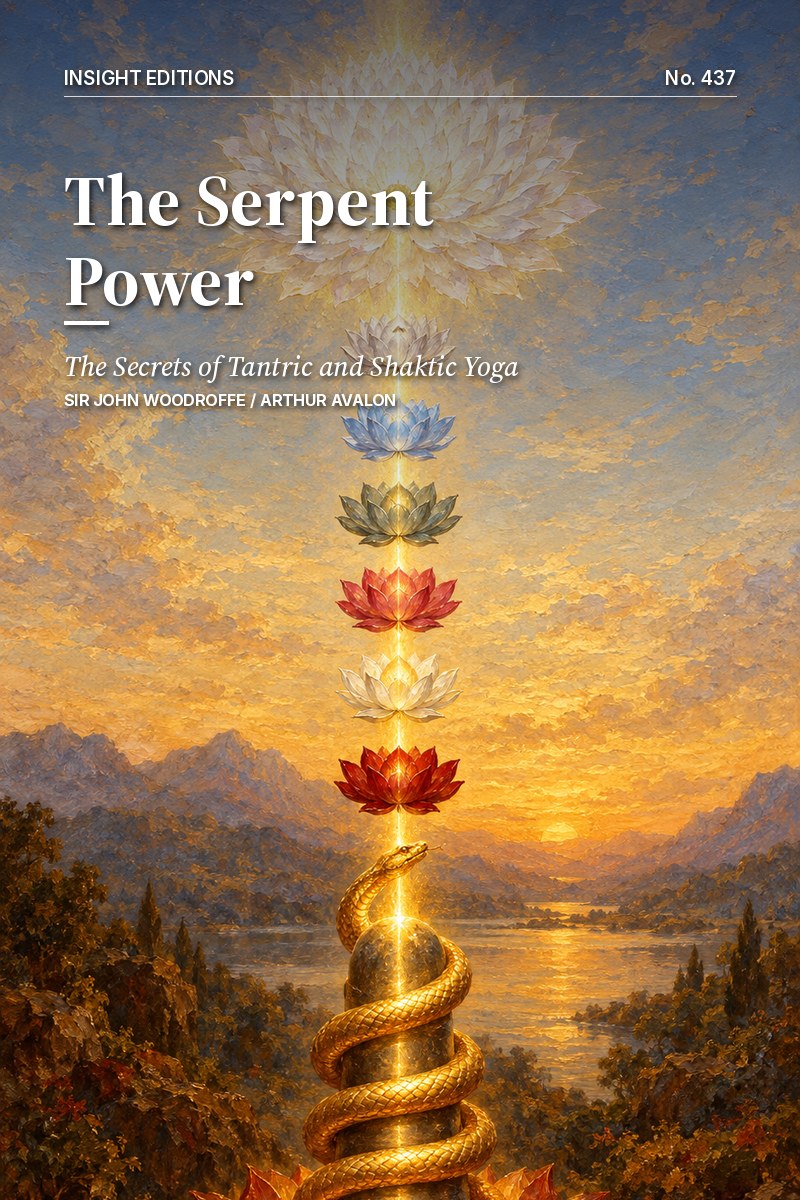
The Serpent Power
The Secrets of Tantric and Shaktic Yoga
Sir John Woodroffe (Arthur Avalon)
Woodroffe's 1919 classic on Kundalini yoga: the full seven-chapter Introduction on consciousness, power, mantra, the cakras and Laya-yoga, then the Sat-cakra-nirupana verse by verse with Kalicarana's commentary, and the Paduka-pancaka. Every list in full, with critical notes.
A study guide to The Serpent Power: being the Shat-chakra-nirupana and Paduka-panchaka, by Arthur Avalon (Sir John Woodroffe), first published by Luzac and Co., London (1919). Shared free for personal reading; not for sale and not endorsed by the publishers. Please read and buy the original.
CORE CLAIM
Kundalini is Cit-sakti, the power of consciousness itself, coiled at the base of the spine because she is wholly engaged in sustaining the body. Laya-yoga rouses her and leads her up through six centres, dissolving each element into its cause, until she unites with Siva in the thousand-petalled lotus, then returns re-creating the world.
SCOPE
The Preface and all seven Introduction chapters, the Sat-cakra-nirupana (preliminary verse and 55 verses, grouped by centre) and the Paduka-pancaka (7 verses), with every list in full (tattvas, nadis, vayus, each centre's petals, letters, element, bija, deity, Sakti and animal, the causal forms above Ajna, mudras, the stages of absorption), and a master synthesis: about 59,000 words.
KEY FIGURES
Sir John Woodroffe (Arthur Avalon), Purnananda Svami (1577), the commentator Kalicarana, Visvanatha and Sankara, Pramathanatha Mukhopadhyaya, Raghava-Bhatta of the Sarada-Tilaka, and the Kankalamalini, Sammohana, Nirvana and Mahakali Tantras.
BEST FOR
Readers who want the source behind modern talk of cakras and Kundalini: what the six centres actually contain in the tradition, how the practice is described step by step, and why it was meant to work, with clear notes where Woodroffe relies on 1918 science or writes as advocate.
How to Use This Edition
The Serpent Power is the book that brought Kundalini yoga to English readers. Published by Arthur Avalon (Sir John Woodroffe) in 1919 (preface dated Ranchi, 20 September 1918), it has two parts. The first is a long Introduction, in seven chapters, that explains the philosophy behind the practice. The second is a translation with commentary of two Sanskrit texts: the Sat-cakra-nirupana ("Description of the Six Centres") of Purnananda Svami (16th century), and the short Paduka-pancaka ("Fivefold Footstool" of the guru).
The book's subject is Kundali-yoga, also called Bhuta-suddhi or Sat-cakra-bheda, "the piercing of the six centres": the rousing of Kundalini, the power that lies coiled like a sleeping serpent at the base of the spine, and her ascent through the six cakras to the thousand-petalled lotus (Sahasrara) at the crown, where she unites with Siva.
This edition follows Woodroffe's structure. For each chapter it gives:
- The core argument: what Woodroffe is explaining and from which sources.
- Every list in full: the tattvas, the nadis, the five vayus, each cakra's petals, letters, element, bija, deity, Sakti, animal, shape and colour, the knots (granthis), the stages above Ajna, the mudras, bandhas and stages of yoga.
- Insight boxes for the subtle point or cross-link.
- Model boxes that turn a chain of terms into one picture.
- Critical lens boxes where Woodroffe writes as advocate, relies on the science of 1918, or where scholarship now reads the material differently.
The Shape of the Book
| Part | Contents | What it does |
|---|---|---|
| Preface | Purnananda's life; the plan of the book | Places the text and its author |
| Introduction I | Sources, critics, Theosophical accounts | Shows how widely the doctrine is attested and what it is not |
| II to IV | Consciousness and its power; the embodied self; the Garland of Letters | The philosophy the text assumes |
| V | The centres or lotuses | The anatomy of the subtle body, centre by centre |
| VI | Practice: Laya-krama | The method: Hatha and Laya yoga, the rousing and ascent |
| VII | Theoretical bases | Why the method should work, on the tradition's own premises |
| Sat-cakra-nirupana | Preliminary verse and 55 verses | The text itself, with commentary, grouped here by centre |
| Paduka-pancaka | Introductory verse and 7 verses | The guru's seat in the lotus below Sahasrara |
Purnananda and the Text
The account of the author was collected from descendants of his eldest son, through the Varendra Research Society, Rajshahi.
- Family: a Rahri Brahmana of the Kasyapa gotra; an ancestor migrated to Kaitali, Mymensingh (in present Bangladesh). The family also produced the famous Tantrika Sarvananda.
- Worldly name: Jagadananda. A manuscript of the Visnu Purana he copied, dated Saka 1448 (1526 CE), survives with a descendant.
- Initiation: from Brahmananda, when he took the name Purnananda. He went to Kamarupa (Assam) and is believed to have reached siddhi at the Vasisthasrama, about seven miles from Gauhati. He never returned home and lived as a Paramahamsa.
- Works: Sri-tattva-cintamani (composed Saka 1499, 1577 CE), Syama-rahasya, Sakta-krama, Tattvananda-tarangini, Yogasara, and a well-known commentary on the Kali-kakara-kuta hymn.
- The Sat-cakra-nirupana is not a separate book but part of the sixth patala (chapter) of the Sri-tattva-cintamani.
- Commentary: Woodroffe's translation uses the commentaries of Sankara and Visvanatha, and especially of Kalicarana, whose notes run through the verse section.
The book was five years in hand, delayed by "the difficulties of the subject and those created by the war". Woodroffe had hoped to add more plates of paintings in his possession but published rather than wait.
The epigraph, from the Sarada-Tilaka (XXV.70), sets the tone: Kundalini, "red like unto vermilion, the young flower of the hibiscus, and the sunset sky", cleaves her way through the sound of "the clashing and the dashing of the two winds in the midst of Susumna" and rises to the energy that "glitters with the luster of ten million lightnings". She is "the Cow of Plenty to Kaulas".
Read the Introduction first, and slowly. Woodroffe says plainly that the translated texts are "by themselves unintelligible to the English reader". The verse section assumes the whole philosophy of Chapters II to IV and the anatomy of Chapter V. Readers who jump to the cakras will find a list of colours and syllables; readers who have done the groundwork will see one theory of how consciousness descends into matter and how it returns.
What kind of book this is. Woodroffe repeats that he is not trying to prove that Kundalini yoga works or is advisable, but to give "a fuller, more accurate, and rational presentation" than the occult literature of his day. That stance is honest, but the book is still an advocate's work: it presents the system from inside. Two other facts matter. First, as with all the "Arthur Avalon" books, much of the Sanskrit work was done with Atal Behari Ghose and other collaborators (Kathleen Taylor, 2001). Second, the six-cakra scheme described here is one late (Bengali, 16th-century) systematisation among many. Older Tantras give different numbers and placements of centres, so this book is the classic statement of one model, not of "the" cakra system.
Introduction: Sources, Critics and Misreadings
Chapter I defines the subject and then defends it on three fronts. It shows that the doctrine of the cakras and Kundalini is attested far beyond the Tantras, in the Upanisads, Puranas and Sankara's circle. It answers two Indian critics who called the practice materialist or needless. And it corrects Western occult accounts, above all C. W. Leadbeater's Theosophical description of the "force centres" and the "serpent fire". It ends by stating what the rest of the Introduction must explain before the text can be read.
The Names of the Yoga
| Name | Meaning |
|---|---|
| Kundali-yoga | Yoga by means of Kundalini Sakti, "she who is coiled" (kundala, coiled), sleeping as a serpent at the base of the spine |
| Bhuta-suddhi | Purification of the elements of the body, which follows when she rises |
| Sat-cakra-bheda | Piercing of the six centres (cakra) or lotuses (padma) |
Kundalini is the Sabda-brahman, the Divine Cosmic Energy, in bodies. The popular seven regions (sapta-bhumi, the lokas) are an exoteric picture of the inner teaching about the seven centres.
Why the Yoga Is Called Tantrik
The doctrine appears in the Yoga Upanisads, some Puranas, and the Hatha-yoga manuals. Woodroffe even notes parallels abroad:
- Prince Dara Shikoh's Risala-i-haq-numa describes three centres: the "Spherical heart" (Dil-i-muddawar), the "Cedar heart" (Dil-i-sanowbari) and the "Lily heart" (Dil-i-nilofari).
- Some Sufi orders, such as the Naqshbandi, are said to have borrowed the Kundalini method from Indian yogis.
- An informant links the cakras to the Popol Vuh: the "air-tube" as Susumna, the "twofold air-tube" as Ida and Pingala, "Hurakan" (lightning) as Kundalini.
If the doctrine has a basis in fact, he says, such spread is what one would expect. But it is particularly Tantrik for three reasons:
- The Tantras and Hatha works give the fullest practical descriptions. They are the manuals "not only of Hindu worship, but of its occultism".
- Yoga through the lowest, static centre is characteristic of the Tantras, whose adepts hold the practical knowledge that makes the books usable.
- The choice of the chief centre of consciousness. The Vedic system made the heart the seat of consciousness (hence "learn by heart"). The Tantras place the chief centres in the cerebro-spinal system and the upper brain (Sahasrara), while still treating the heart as a seat of Jivatma as Prana.
So the first verse of the text speaks of yoga "according to the Tantras" (tantranusarena).
Bhuta-suddhi: Worship or Yoga?
Bhuta-suddhi is a required preliminary to worship of any Deva. If it meant the full yoga, no one but an accomplished (siddha) yogi could worship at all, since only such a yogi can really take Kundalini to the Sahasrara. Hence:
| Form | Nature |
|---|---|
| Daily Bhuta-suddhi | Purely mental or imaginative; part of upasana (worship) |
| Worship of the Ista-devata in parts of the body | Also upasana |
| Real rousing of Kundalini | Yoga proper |
Some of the sources below clearly mean yoga; others may mean worship only.
The Witness of the Upanisads
The earliest Upanisads already know the four states of consciousness, the sheaths, the cavity of the heart as a "soul" centre, the 72,000 nadis, the Brahmarandhra, and "up-breathing" through one nadi. The Brahmarandhra and the "one nerve" imply the spinal axis and Susumna; the Siva-samhita even calls Susumna itself the Brahmarandhra. The Aitareya Aranyaka: knowledge "is Brahman"; Vamadeva, "having left the world… became immortal".
| Upanisad | What it adds |
|---|---|
| Hamsa | To be taught only to the brahmacari who is peaceful (santa), self-controlled (danta), devoted to the guru. Names the six cakras and the raising of vayu from the Muladhara. Hamsa (Jiva) sits in the eight-petalled lotus below Anahata, where the Ista-devata is worshipped. Lists ten kinds of nada, the tenth leading to Brahmapada |
| Brahma | Navel, heart, throat and head as places "where the four quarters of the Brahman shine"; the mind as the "tenth door" |
| Dhyanabindu | Hearing the anahata sounds. With puraka meditate on four-armed Visnu at the navel; with kumbhaka on red Brahma in the heart; with recaka on three-eyed Rudra in the forehead. Then a hundred lotuses, then Sun, Moon and Fire |
| Amrtanada | The five elements and, above them, Ardhamatra (Ajna); the heart as "aerial entrance"; above it the gate of liberation (moksa-dvara) |
| Ksurika | The 72,000 nadis, Ida, Pingala, Susumna; all but Susumna can be "severed by Dhyana Yoga"; drive prana through the subtle channel; the commentator adds heating Kundali and Jalandhara-bandha |
| Nrsimha-purva-tapaniya (V.2) | Lotuses of 6, 8, 12, 16 and 32 petals, numbered by the letters of the mantras placed in them; the 32-petalled Ajna is "really two-petalled" (two 16-letter mantras) |
| Maitri (ch. 6) | The nadis, Susumna, piercing the Sun, Moon and Fire mandalas, and Amana (Unmani) |
| Yogatattva, Yogasikha | Hatha-yoga; closing the "inner door", opening the gate of Susumna, piercing the Sun |
| Ramatapani | Asana, door-worship, seat-worship, and Bhuta-suddhi by name |
| Sandilya, Varaha, Yogakundali, Mandalabrahmana, Nadabindu | Cited throughout the notes |
The eight petals of the Hamsa Upanisad
| Direction | Vrtti (tendency) |
|---|---|
| East | Virtuous inclination |
| South-east | Sleep and laziness |
| South | Cruelty |
| South-west | Sinful inclination |
| West | Play and inferior qualities |
| North-west | Intention to move or act |
| North | Attachment and pleasurable contentment |
| North-east | Appropriation of things |
| Centre | Dispassion (vairagya) |
The filaments are waking, the pericarp dream, the stalk dreamless sleep, and above the lotus "the place without support" (niralamba) is Turiya.
The Witness of the Puranas and Sankara
- Devi-bhagavata Purana (VII.35, XI.8): the six cakras; rousing Kundali, "the Paradevata"; uniting Jiva with her by the Hamsa mantra; Bhuta-suddhi; dissolving the gross tattvas into the subtle, "Mahat in Prakrti, Maya in Atma"; the destruction of the "man of sin" (papa-purusa); a dhyana of Prana-sakti.
- Linga Purana (I.75): the cakras and their petals; Siva, though nirguna, dwells in the body with Uma so yogis can meditate on him in the lotuses.
- Agni Purana (ch. 23): Bhuta-suddhi with bijas at navel, heart and Ajna, after which the body is refreshed by a flow of nectar.
- Sankara on Gita VIII.9 to 10: first control the heart lotus; then "by conquering Bhumi" and the upward-going nadi, place prana between the eyebrows and reach the light-giving Purusa. Anandagiri, Sridhara Svami and Madhusudana Sarasvati all read it as Susumna and the cakras.
- Sankara's maths keep the Sri-cakra; the Ananda-lahari, ascribed to him, treats this yoga; Vidyaranya's Sankara-vijaya (ch. 13) names the six lotuses.
The Ananda-lahari, as reported by Ananta Sastri
Pandit R. Ananta Sastri gives the tradition:
- Sankara learnt from the Subhagodaya of Gaudapada, his guru's guru, and from his own experience, and wrote 100 slokas: the first 41 are the Ananda-lahari, the rest the Saundarya-lahari, which praises the Devi "from head to foot".
- The Ananda-lahari holds "the quintessence of the Samayacara". Some say Siva is its real author and Sankara only its seer (mantra-drasta).
- Commentators differ on how many verses belong to it (41, 35 or 30). Ananta Sastri accepts the shortest list, treating the rest as prayogas (mantras applied for worldly ends).
- Laksmidhara's commentary is the most popular: broad, comparative, "as valuable… as Sayana's are to the Vedas", and Southern in flavour. Acyutananda's is followed in Bengal.
- He lists 33 commentaries, among them Appaya Diksita's, Narasimha's (which reads each verse of both the Devi and Visnu), and the Sudhavidyotini, which claims a Dravida prince Pravarasena as the hymn's author.
The number of commentaries is itself, for Woodroffe, proof of how widespread and authoritative the yoga is. The Trisati commentator adds: nectar is in the head of all breathing beings, and when Kundali goes there "Yogins become like Isvara".
Cakras that are not bodily
The Sat-cakra Upanisad of the Atharvaveda uses "cakra" quite differently: six Narasimha cakras with 4, 4, 5, 6, 7 and 8 spokes, each with three circles (bija, Narasimha-gayatri, mantra), placed by nyasa in the heart, head, crown-lock, whole body, eyes and all regions. The lesson: "cakra" does not always mean a centre in the spine.
Three layers of evidence. Woodroffe's survey sorts into three kinds of text: (1) Upanisads that mention the parts (nadis, Brahmarandhra, lotuses, sounds); (2) Puranas that describe worship in the lotuses; (3) Tantras and Hatha works that give the full practical method. His claim is that the Tantra systematises an old and widely shared picture rather than inventing it.
The First Critic: "A Sweet in the Hands of a Child"
An English-educated Hindu, formerly a lawyer and now a guru, sent a fierce critique on receiving the Sanskrit texts. His case, as Woodroffe summarises it:
- Liberation comes through Jnana and Karma. Not every bliss is Brahman's bliss.
- Those two doors are now padlocked by three errors: faith-only devotion that scorns reasoning; the Brahmos' Western-style "flattery" of a loving Father; and cynical self-interest that calls all religion superstition.
- The Tantras are anti-Vedic scriptures, given by partial manifestations of Visnu and Siva to fool the wicked. "Siva says" proves nothing.
- Sat-cakra-sadhana is "a materialistic Yoga system" and "trickery on the part of the professional Gurus". "The very mention of Tantrik Shastra fills us with shame."
- The bliss is real but physical, and ends with the body. Moksa comes from leaving the Sahasrara through the Brahmarandhra, not from reaching it.
- Tantrikas sell liberation cheap, and gurus recruit disciples "like coolie recruiters for the tea-gardens".
- It is all too material: a "Parasiva above Siva", nectar "the colour of lac" that a doctor could squeeze out.
- The Puranic cakras are only imagined, for worship; the Tantrik ones are mystification.
- Sankara exterminated this yoga 2,500 years ago (the story of the Kapalika Krakacha absorbed by Bhairava).
It is "a sweet in the hands of a child": given to a wayward child to keep him quiet. A sensible child throws it away and finds the keys of Karma and Jnana.
Woodroffe's reply
- The historian will dispute that Sankara abolished the Tantra. In the Sankara-vijaya he reformed and united the sects; the Kapalikas continued under Vatukanatha with his approval.
- The critic ignores the Upanisads, and his Purana-versus-Tantra line fails: if the Puranic lotuses are pure imagination, why should "competency" for a particular one matter?
- The critic has some just points. Karma and Jnana do bring Moksa, and not all bliss is Moksa: drink or drugs give a bliss too.
- But the yoga is not merely material. Man is gross, subtle and spiritual, so discipline must reach all three. Hatha is "an auxiliary of Jnana".
- The text itself is full of Jnana. Kundali is roused by mantra, "Consciousness embodied in sound", by one "whose being is immersed in the Brahman" (v. 50). She is suddha-sattva (v. 51). The yogi meditates on her as Caitanya-rupa Bhagavati, whose substance is consciousness (v. 52). At Ajna he meditates on Om, realises "he and the Brahman are one" and becomes an Advaitavadi (vv. 33 to 34); he closes "the house which hangs without support" (v. 36) to reach Unmani.
- There is only one Brahman. Rudra, Siva and Parasiva are names for its different operations; a Devata "in" a cakra means that centre is a seat of Brahman's operation.
- Liberation is by Jnana. Nirvana-kala grants tattva-jnana (v. 47); Nityananda within her is "attainable only by Yogis through pure Jnana" (v. 49).
| Kind of jnana | What it is |
|---|---|
| Kriya-jnana | The meditative processes leading to realisation |
| Svarupa-jnana | Direct spiritual experience, which Kundalini gives when she unites with Siva |
The Maya Tantra lists five views of what yoga is: unity of Jiva and Atma; identity of Siva and Atma; knowledge of Sakti (the Agamavadins); knowledge of the Purana Purusa; knowledge of the union of Siva and Sakti (the Prakrtivadins). The Devi liberates each sadhaka through the meditation that fits him.
The return. After union Kundali comes back down, re-creating the tattvas (srsti-krama) as her ascent dissolved them (laya-krama). The Ananda-lahari: "Thou sprinklest all things with the stream of nectar… and on reaching Thy abode Thou resumeth Thy snake-like coil and sleepeth." After many journeys she makes one from which, at the yogi's will, there is no return: he is jivanmukta, and at death attains videha or kaivalya mukti. A wheel still turns a little after the push has stopped; so the body lasts until active karma is spent.
The yoga claims to use both doors. Woodroffe's answer turns the critic's own image around. Kundalini yoga does not bypass the doors of Karma and Jnana; it claims to go through them, using the body (Karma, Hatha) and meditation (Jnana) together. What it rouses is not a physical force but "the static vital force (Jivasakti) and world consciousness (Jagac-caitanya)" that make a person what he is.
The Second Critic: The Gayatri Method
A Brahmo author, who thought the gap between Tantra and Veda as great as "between the Netherworld and Heaven", still did not deny that the Tantrik method works. He contrasted two methods:
| Old Tantrik method | Vaidika Gayatri method | |
|---|---|---|
| Starts at | Muladhara, the lowest centre | Ajna, between the eyebrows |
| Means | Difficult and painful practices (mudras, bandhas) to control senses and gunas | Fix the mind on Isvara in the highest centre |
| The three lower passions | Controlled by those practices | Controlled by taking the citta to each centre and resting it on the existence (satta) of Paramatma there |
| Result | Union with the Turiya Brahman | Purity of being (bhava-suddhi), then purity of speech; the state beyond the gunas |
His map of the centres:
| Centre | Passion or function |
|---|---|
| Muladhara | Cupidity (lobha); also the three Saktis Iccha, Kriya, Jnana lying unconscious |
| Svadhisthana | Lust (kama) |
| Manipura (navel) | Anger (krodha); Fire |
| Anahata | Nada, self-produced; Prana-sakti; "I am He" |
| Visuddha | Speech |
| Ajna | The Command, working through buddhi |
Woodroffe gives the method an "English turn": to quiet anger, carry the mind to the navel and meditate on the Supreme as embodied in that very centre; its activity is then attuned to the Atma that informs it.
He closes both critiques with the saying the first critic himself quoted: "To dispute the religion of another is the mark of a narrow mind. O Lord! O Great Magician! with whatsoever faith or feeling we call on Thee Thou art pleased." All Indian worshippers of the old type seek the Light of Consciousness beyond the regions of Sun, Moon and Fire.
Western Misreadings
Dictionary and occult errors
| Claim found in Western books | Correction |
|---|---|
| Cakras are "circles or depressions of the body for mystical or chiromantic purposes" | They are centres of consciousness and subtle life-force |
| Muladhara is "above the pubis" | It is at the base of the spine |
| Svadhisthana is the umbilical region | It is above Muladhara, at the root of the genitals |
| Anahata is the root of the nose | It is the spinal centre in the region of the heart |
| Visuddha is "the hollow between the frontal sinuses" | It is the spinal centre in the throat |
| Ajna is the fontanelle | It is at the "third eye" (jnana-caksu) between the brows |
| Susumna is a "force" that passes with "violent shock" and impinges on the brain | Susumna is the outermost of three nested nadis; the force rises through the innermost, Citrini, which ends at the twelve-petalled lotus below Sahasrara |
He also warns against Indian writers who describe the cakras purely physiologically: that "gives the case away", because physiology does not know the cakras as they are in themselves. "Those who appeal to physiology only are like to return non-suited."
Leadbeater's "force centres"
C. W. Leadbeater, the Theosophist, wrote from what he said was personal experience. Woodroffe notes that his account does not claim to represent Indian yogis, whom it somewhat disparages, but is his own explanation of his experience.
Leadbeater's model:
- The centres are vortices of "etheric" matter, into which the sevenfold force of the Logos rushes from the "astral" world. Each centre has one force predominant.
- The number of radiations gives the number of "petals", which look like "saucers or shallow vases of wavy iridescent glass".
- He replaces Svadhisthana with a six-petalled spleen centre, and says the crown lotus has "exactly 960" petals, not a thousand.
- A web of compressed physical atoms separates etheric and astral centres.
- Kundalini, "serpent fire", lies at the base of the spine in seven layers; it is not Prana.
| Leadbeater's centre | Astral function | Effect when "serpent fire" rouses the etheric centre |
|---|---|---|
| Navel | Simple feeling | Vague sense of friendly and hostile astral influences |
| Spleen | Conscious astral travel | Partial memory of astral journeys and flying |
| Heart | Sympathy with other astral beings | Feeling others' joys, sorrows and pains |
| Throat | Astral hearing | Voices, music; clairaudience |
| Between the brows | Astral sight | Clouds of colour, then clairvoyance; a magnifying "microscopic snake" like the uraeus on Pharaoh's crown |
| Top of the head | Perfection of astral faculties | Leaving the body in full consciousness; continuous consciousness up to the "heaven world" |
He warns of three lower centres, dangerous to use, and of Western "phallic sorcery" schools.
Woodroffe's points of difference
- The aim is wrong. Yogis do not seek a "heaven world" but to pass beyond it; "otherwise they are not Yogis at all". Each upward step is yoga, and the goal is Kaivalya Mukti.
- Rousing a force amplifies whatever is there. If thought, will and morals are not first purified, intensifying them is no gain. Piercing the Brahma-granthi can bring pain and disease.
- Competence (adhikara) is required, judged by a guru. The Gandharva Tantra lists it: intelligent, senses controlled, free of injury to all beings, doing good to all, pure, a believer in Veda, refuge in Brahman, non-dualist. "Otherwise he is no Sadhaka."
- Indians rarely speak of sexual dangers, because the discipline, the practice and the religious aim make them unlikely; with that attitude, concentration on the lower centres may quiet the passions rather than rouse them. And the cakras are subtle, not in the gross body.
- The terms are not equivalent. Theosophy borrows Indian words with different meanings. If "etheric" is the pranamaya kosa and "astral" the kamic side of manomaya, then Leadbeater's cakras are centres of prana-vayu, whereas the Indian cakras are centres of consciousness, life and tattvic energy.
- Kundalini is not separate from Prana. She "maintains all the beings of the world by inspiration and expiration" (vv. 10 to 11). She is the Prana Devata and, as srsti-sthiti-layatmika, holds all forces: she is the Sabda-brahman, the "Logos", in bodies.
- The cakras differ in kind. The five lower are centres of the five gross tattvas; the sixth of mind; Sahasrara is not a cakra at all; there is no spleen centre.
- The petals are letters. Their total equals the fifty letters of the Sanskrit alphabet, and their number in each lotus follows the arrangement of nadis around it.
- Powers are the Lord's. Leadbeater explains anima and mahima (becoming small or large) by an etheric tube. The Indian view: all siddhis are attributes (aisvarya) of Isvara, shared as the Jiva realises that consciousness.
Praise, powers and their limits
- The text promises long life, freedom from sin, control of the senses, knowledge, eloquence and fame for meditation on various centres. These are mostly stuti-vada, praise, as when v. 21 says the yogi of the navel lotus can destroy and create the world.
- Siddhis over the element of each centre are real to the tradition. Ananta Sastri: many people "elbowing us in the streets" set out for the highest bliss and "stopped at one or the other of the six Chakras", holding some power.
- "The mere rousing of the Serpent power does not… amount to much." Nothing of real moment happens until Ajna, and even there the promise that the yogi becomes creator of the three worlds is, the commentator says, "Prasamsa-vada… as often void of reality as it is in our ordinary life". The aim is cessation of rebirth.
Consciousness first. Woodroffe's deepest contrast with Leadbeater is one of style of thought. The Indian systems interpret every process "from a subjective or idealistic standpoint": Brahma, Visnu and Siva are functions of one consciousness operating in ourselves, and yoga is the transformation of lower into higher states of consciousness. He adds a fair caution: an experience may be real even if the theory given for it is wrong, and similar experiences may come by different methods.
Two Case Reports
The accidental yogi. A man was found cold as a corpse, the top of his head slightly warm, the state of Kundali-yoga samadhi. Massaged with ghee, warmth returned from the head down. He said he had been imitating a yogi's posture when "sleep" came over him; it was surmised that he had stopped his breath in the right position and unwittingly roused Kundali, but could not bring her down. Only a yogi, with purified nadis, can.
Woodroffe's European friend. Without Hatha methods, by meditation alone, he believed he had roused Kundali:
- He saw Ida and Pingala, a "central fire" with rosy and azure aura, and white fire rising into the brain, "flaming out in a winged radiance" on both sides of the head.
- Ida's aura was moon-like, palest azure; Pingala's pale rosy opalescence; Kundali was golden-white fire, curled spirally. He compared the scheme to the caduceus of Mercury.
- One night, unusually free of desire, he felt the serpent uncoil: "in a fountain of fire… a musical clashing as of cymbals… I felt a rocking motion. I really felt frightened."
- In agitation he forgot to fix his mind on the Supreme, and did not rate the experience very high spiritually, but was convinced "there was a real science and magic in the Indian books".
The pandit's comment: if the breath is stopped and the mind carried down, heat is felt. One may "see" Kundalini with the mental eye, as light in the Muladhara, without actually rousing her. The test of real rousing: the part she leaves becomes cold and lifeless, so progress can be verified by others; at Sahasrara the whole body is cold except the top of the skull.
Reading Woodroffe on his rivals. Woodroffe's correction of the dictionaries and of Leadbeater has worn well: Leadbeater's spleen centre and 960 petals are his own innovations, and Woodroffe was right that Theosophical terms do not map cleanly onto Indian ones. But his own map should be read with the same care. The "Indian system" he defends is Purnananda's six-cakra Bengali scheme; the Hamsa Upanisad's eight-petalled heart lotus and the Narasimha cakras he quotes already show other schemes. The case reports are second-hand anecdotes, and the "cold body" test is the tradition's own criterion, not an independent check. Woodroffe is also candid that he cites them only as reports: "De experientia non est disputandum".
What Must Come Next
The work is issued "not with the object of establishing the truth or expediency" of the method, but as "a fuller, more accurate, and rational presentation". To understand it, the reader needs:
- Consciousness and unconsciousness, and their union in the embodied spirit (Jivatma) (Chapters II and III).
- Sakti as the kinetic side of Spirit: her creative ideation in the macrocosm and in the body, the microcosm (ksudra-brahmanda) (Chapters II to III, V).
- The Logos and the letters of speech (Chapter IV).
- Yoga as involution (Chapters VI to VII).
The reason is a rule the commentator states at v. 39: "things dissolve into that from which they originate". Yoga is dissolution (laya, nivrtti), and it cannot be understood unless the creative process (pravrtti) is understood first.
Key terms: Kundali-yoga, Bhuta-suddhi, Sat-cakra-bheda, Sabda-brahman, sapta-bhumi, tantranusarena, upasana, Ista-devata, Brahmarandhra, Hamsa, vrtti, Turiya, niralamba, Ananda-lahari, Saundarya-lahari, Samayacara, prayoga, stuti-vada, prasamsa-vada, Kriya-jnana, Svarupa-jnana, laya-krama, srsti-krama, jivanmukta, kaivalya, adhikara, Citrini, pranamaya kosa, aisvarya, ksudra-brahmanda, pravrtti, nivrtti.
Reflect: Woodroffe warns that rousing power amplifies whatever character is already there. Which of your own habits would you least want to see intensified, and what would you do about it first?
Consciousness and Its Power: Siva-Sakti
Chapter II gives the metaphysics on which the whole yoga rests. Reality is Sat-Cit-Ananda; its power, Sakti, is the same consciousness in active form. Through Maya-sakti consciousness veils itself and projects a world; through Nada and Bindu it moves toward creation; and when creation is complete, the same power coils up and sleeps in the earth-centre of the body as Kundalini. Yoga is that process run backwards.
A Word on Method and Risk
Woodroffe can give principles and the books' directions, with explanations received orally. Anyone who wants to practise must learn from a guru who has been through it (siddha):
- Only the guru's experience can say whether the aspirant can succeed.
- "Of those who attempt it one out of a thousand may have success."
- Only the guru can save him from the attendant risks, shaping practice to each disciple.
The One Reality: Sat-Cit-Ananda
The Veda says "All this is Brahman" (sarvam khalv idam brahma). The Sakta answer to how the many can be one begins with Brahman as it is in itself (svarupa):
| Aspect | Meaning |
|---|---|
| Sat | Being |
| Cit (caitanya, samvit) | Feeling-consciousness, identical with being as such |
| Ananda | Bliss, defined as "resting in the self" (svarupa-visranti); bliss because, being the whole (purna), it lacks nothing |
- In ordinary life being and consciousness seem to diverge: we believe in a world outside and independent of us, because as Jivatma our consciousness is veiled by Maya.
- In Paramatma the divergence is gone: experiencer, experience and experienced lie in one undifferentiated mass.
- What we observe as feeling and consciousness is only a limited, changing manifestation of Cit, which is in itself infinite and changeless.
- Svarupa is a thing's own nature (the scholastics' propria forma), as opposed to how it appears. This changeless consciousness is Parasiva.
Why Anything Looks Unconscious
Nothing in the world is wholly conscious or wholly unconscious; the two are always mixed. Cit is never absent, but shows itself in degrees, set by the body it is enshrined in. Spirit stays the same; the body changes.
| Level | How Cit shows itself |
|---|---|
| Mineral | The lowest sentiency: reflex response to stimuli, what the West calls "atomic memory" |
| Plant | More developed, but "a dormant consciousness" (Cakrapani, Bhanumati) |
| Micro-organisms | Intermediate forms with a psychic life of their own |
| Animal | More centralised and complex |
| Man | All psychic functions: cognition, perception, feeling, will |
Cit does not really develop. It is more or less veiled by mind and matter, and that veiling and projection, done by cosmic consciousness as Sakti, is what makes the world.
Sakti: The Same Consciousness, Active
What veils consciousness? Sakti as Maya. Is Sakti different from Siva? It must be the same, or all would not be one Brahman. So she too is consciousness: Saccidanandamayi and Cidrupini.
- Sakti is from sak, "to be able": power.
- There is no difference between the possessor of power (Saktiman) and the power.
- Siva is the changeless, static aspect of consciousness; Sakti is its kinetic, active aspect.
Maya-sakti
The power that produces the dual world is Maya-sakti, which both veils (avarana) and projects (viksepa).
- Consciousness veils itself to itself and projects, from the store of past impressions (samskara), the notion of a world in which it suffers and enjoys.
- The universe is the creative imagination (srsti-kalpana) of the World-thinker, Isvara.
- Maya is "that by which things are measured" (miyate anena iti maya): formed and made known.
- It is the sense of difference (bheda-buddhi) that makes man see the world, things and people as other than himself, though all are one Self.
- Sakti veils consciousness by negating herself as consciousness, in various degrees.
Before Creation: Parasiva
Before manifestation only Being-Consciousness-Bliss was: Siva and Sakti as Cit and Cidrupini, Sakti latent and one with the Self.
- Kulacudamani Nigama, the Devi speaking: "I, though Prakrti, lie hidden in Consciousness-Bliss."
- Raghava Bhatta: she who is beginningless "existed in a subtle state, as it were Consciousness, during the great dissolution".
This is Parasiva, called Para-samvit in the scheme of thirty-six tattvas: the perfect experience and the perfect universe. "Perfect universe" does not mean a heaven of forms. It means Sakti in her own nature as consciousness, experienced by Siva as consciousness. "The self knows and loves the self", and "supreme love is bliss" (niratisaya-premaspadatvam anandatvam).
Why monism needs two aspects
- One changeless consciousness alone gives no manifestation.
- A second, unconscious cause (as Sankhya's Prakrti, material cause beside Purusa) destroys monism.
- So all Indian monism posits two aspects of one consciousness:
| Aspect | Experience |
|---|---|
| Para-samvit (transcendent, changeless) | "I" (aham) and "This" (idam) indistinguishably mingled |
| Siva-Sakti tattva (creative, changing) | Sakti, whose function is negation (nisedha-vyapara-rupa), negates herself as the "This", leaving Siva as a bare "I", "not looking towards another": pure illumination (prakasa-matra). Then Sakti as Vimarsa presents herself again, as "This" distinct from "I" but still within one Self |
The First Emanations and the Mother
At that first trace of duality comes Sadasiva (Sadakhya) tattva, then Isvara tattva, the Lord.
The deity is pictured as Ardhanarisvara, half male, half female. Some worship the right (male) side. Saktas worship the left and call her Mother:
- She is the Magna Mater, Mahadevi, who conceives, bears and nourishes the universe from her womb (yoni), because she is active consciousness imagining the world from the samskaras of former worlds.
- The first mantra everyone learns is "Ma", Mother: "It is their first word and generally their last." The father is a mere helper (sahakari-matra).
- She is worshipped as rosy Tripurasundari, source of the universe, and as awe-inspiring Kali, who takes it back.
Nada and Bindu
In the mantra side of the Tantra the two emanations are Nada and Bindu. Parasiva and Parasakti are motionless (nihspanda) and soundless (nihsabda).
| Term | Meaning |
|---|---|
| Nada | The first produced movement in the ideating cosmic consciousness, leading to the Sabda-brahman, from which come ideas, words (sabda) and objects (artha) |
| Bindu | Literally "point", the anusvara dot above Nada in the Candrabindu. Technically, the state in which the "I" identifies with the total "This" and subjectifies it, becoming one point of consciousness with it |
Why a point? An object seen as other is seen as extended in space. An object fully subjectified, like our own mind, is experienced as an unextended point. The Lord's experience of the whole universe as himself is Bindu.
Kundalini: Power Coiled Round a Point
At dissolution the universe is withdrawn into the Sakti that projected it and collapses into a mathematical point without magnitude: the Siva-bindu, itself withdrawn into Siva-Sakti tattva.
- Round this point Sakti is coiled, as in the Muladhara a serpent coils round the self-produced linga (Svayambhu-linga).
- The coil may be pictured as a line without magnitude, touching the point everywhere and therefore forming one point with it.
- The Tantras also picture the unity as a grain of gram (canaka): two seeds so close they look like one, in one sheath.
This coiled Sakti is Kundalini, from kundali, "coiled":
- She is like a serpent (bhujangi), which coils when it rests and sleeps.
- Her power is spiral: seen in the spheroid "eggs of Brahma" (brahmanda) and their revolving orbits.
The Tantras describe her geometry. From the point a straight line (rju-rekha) goes out; turned by the spiral sack of Maya, it becomes a curved line (vakra-rekha, like an elephant goad), making a figure in two dimensions; turned again, it rises into the third dimension as the triangular pyramid called srngataka.
"Coiled" means at rest: static potential energy.
| Name | Where |
|---|---|
| Mahakundali | The great coiled power round the Supreme Siva |
| Kundali / Kundalini | The same power in individual bodies, through which this yoga is done |
Yoga unites Kundali with Mahakundali, and her with Siva, with whom she is in truth one. She is Brahmarupa Sanatani, an aspect of eternal Brahman, both:
- Nirguna: pure consciousness (Caitanyarupini) and bliss (Anandarupini); in creation Brahmananda-prakasini.
- Saguna: she by whose power all beings are displayed (Sarvabhuta-prakasini).
Every activity has a still centre. Woodroffe calls this "one of the profound truths of the Sakta Tantras": in and behind every form of activity there is a static background. The one consciousness is polarised into static and kinetic aspects for the sake of creation. Kundalini in the body is "the static center round which every form of existence as moving power revolves". This yoga is the resolution of that duality back into unity.
Cycles of Worlds
Woodroffe finds the Indian doctrine echoed in Western science:
- Herbert Spencer, First Principles: the universe unfolds from the homogeneous (mula-prakrti) to the heterogeneous (vikrti) and back (pralaya).
- T. H. Huxley, Evolution and Ethics: cosmic energy alternates between potentiality and explication; "as Kant suggests, every cosmic magma predestined to evolve into a new world has been the no less predestined end of a vanished predecessor".
- The Sastra: there is no absolutely first creation; this world is one of a beginningless series.
The seed of the next world
At dissolution, within Mahakundali, lies the seed of the universe to be:
- Maya exists potentially as Mahakundali, one with Siva.
- Maya is constituted by the collective samskaras or vasanas: impressions left by karma in previous worlds.
- They form the potential ignorance (avidya) by which consciousness veils itself. They come from desire for worldly enjoyment and produce it.
- "The worlds exist because they in their totality will to exist. Each individual exists because his will desires worldly life."
Consciousness therefore has two aspects:
| Aspect | What it is |
|---|---|
| Mukti (liberation) | Formless Consciousness-Bliss |
| Bhukti (enjoyment) | Consciousness as the worlds of enjoyment |
A cardinal principle of the Sakta Tantra is to secure both, by identifying the self in enjoyment with the soul of the world.
How creation begins
When the seed ripens, Siva "puts forth" his Sakti, which is himself, and comes forth (prasarati) in all the forms of life.
- In formless consciousness arises the desire to manifest, the desire for enjoyment of and as form.
- It appears as a limited stress on the unlimited, unmoving surface of consciousness, Niskala Siva, without affecting it: "change in changelessness and changelessness in change".
- Transcendent Siva does not change; immanent Siva (Sakala), as Sakti, does.
- As creative will rises, Sakti thrills as Nada and takes the form of Bindu (Isvara tattva). For creation, Kundali uncoils.
- Nigama: the Devi "becomes desirous of creation, and covers Herself with Her own Maya"; joyful in union with the Supreme Akula, she becomes Vikarini, and the tattvas of mind and matter appear.
The Thirty-six Tattvas in Three Groups
Saivas and Saktas alike accept the thirty-six tattvas, the kalas, the Saktis such as Unmani, the six paths (sadadhva), and the mantra concepts Nada, Bindu, Kamakala. The Northern Saiva school (a leading text is the Malini-vijaya Tantra) treats them most deeply.
| Group | Tattvas | Character |
|---|---|---|
| Siva tattvas (pure, suddha) | The five highest: Siva to Suddha-vidya | "I" and "This" known as two sides of one Self; emphasis shifts from "I", to "This", to both equally, preparing the split |
| Vidya tattvas (pure-impure, suddhasuddha) | Maya, the kancukas, Purusa | Intermediate |
| Atma tattvas (impure, asuddha) | Prakrti down to earth (prthivi) | Duality through Maya and limits through the kancukas: the "This" is outside and opposed; each consciousness excludes the others |
Three states of experience
- Transcendent: "I" and "This" mingled, not perceived as such.
- Pure: both experienced as parts of one Self.
- Manifestation proper: complete cleavage, an outer object before a knower. This has two stages:
- Purusa experiences a homogeneous universe, Prakrti, different from himself.
- Prakrti splits into her effects (vikrti): mind (buddhi, ahamkara, manas), senses (indriya), then five gross elements (ether, air, fire, water, earth) from the tanmatras.
When Sakti enters the last and grossest tattva, earth, she has nothing more to do. She rests, coiled and asleep, as Kundali in the Muladhara, round the Svayambhu-linga, as in the supreme state Mahakundali lay round the Supreme Siva.
One movement out, one movement back. Creation: Parasiva → Siva-Sakti → Sadasiva (Nada) → Isvara (Bindu) → Maya and the kancukas → Purusa-Prakrti → mind → senses → tanmatras → five elements → earth, where Sakti sleeps as Kundalini. Yoga: Kundalini wakes in earth and climbs the same ladder, dissolving each tattva into the one above it, until she is again one with Siva. Every later chapter fills in this single picture.
The Sarada-Tilaka's Mantra Evolution
The Sarada-Tilaka gives the sequence in mantra terms:
- From Sakala Siva (Siva tattva), who is Sat-Cit-Ananda, issued Sakti (Sakti tattva).
- From Sakti, Nada (Sadakhya tattva).
- From Nada, Bindu (Isvara tattva), called Para-bindu.
Nada and Bindu are states of Sakti suited to creation (upayogavastha) and inclined toward it (ucchunavastha); in them Kriya-sakti sprouts.
Mantra is manifested sabda; Nada is the first causal body of sabda. Bindu is:
- The letter Ma before manifestation: Siva-Sakti enveloped by Maya (Parama Kundali).
- The void (sunya), the Brahman-state, in the empty space inside its circle; and the gunas held implicitly in it.
- The massive state (ghanavastha) of Sakti: Cidghana, "massive consciousness", in which all worlds and beings lie potential.
- Paramasiva, in whom are all the Devatas, whom some Puranikas call Mahavisnu and others Brahmapurusa. "It does not matter what He is called."
- Its abode is Satyaloka, which in the body is the pericarp of the thousand-petalled lotus (Sahasrara).
Tribindu and Kamakala
Para-bindu divides into three: Bindu, Nada and Bija.
| Point | Nature | Power | Guna | Devi | Deva | Symbol |
|---|---|---|---|---|---|---|
| Bindu | Siva | Jnana | Sattva | Raudri | Rudra | Moon (white, sita-bindu) |
| Nada | Siva-Sakti, their mutual relation (mithah samavayah) or union | Kriya | Rajas | Jyestha | Visnu | Sun (a mixture: misra-bindu) |
| Bija | Sakti | Iccha | Tamas | Vama | Brahma | Fire (red, sona-bindu) |
(The text's pairings of power, guna and deity vary between sources; the table follows the order given here from the Prayogasara and Sarada: Raudri from Bindu, Jyestha from Nada, Vama from Bija, and from them Rudra, Visnu, Brahma.)
- The threefold Bindu is supreme (para), subtle (suksma) and gross (sthula). By this division of Siva and Sakti arises creative ideation (v. 40).
- The causal Bindu is, from four viewpoints: undifferentiated Sakti with all powers (Sakti); Mula-prakrti of three gunas (Prakrti); the Unmanifest (avyakta) (Devata); Santa (Devi).
- Sun contains Fire and Moon: as misra-bindu it is not different from Paramasiva, and is Kamakala.
- Kamakala is the triangle of divine desire formed by the three Bindus, "the root (mula) of all Mantra".
- On the material plane the white Bindu becomes semen (sukra) and the red Bindu menstrual fluid (rajas, sonita).
- Mahabindu is the state before Prakrti manifests. It is of coupled form (yamala-rupa): "There is no Shiva without Shakti, nor Shakti without Shiva", as one cannot separate the moving wind from the still ether.
The chain: in Siva-Sakti there is union (maithuna); its thrill is Nada; from it Mahabindu is born, which becomes threefold (Tribindu), which is Kamakala. On the "bursting" of the Supreme Bindu there arose unmanifested sound, the source, through Kriya-sakti, of manifested sabda and artha. Brahman as source of words and ideas and of the objects they denote is Sabda-brahman, the Logos.
The Lords of the tattvas
From the differentiating Bindu, as Prakrti, come the tattvas of mind and matter and their Lords (tattvesa), the intelligences that direct them:
| Lord | Centre |
|---|---|
| Sambhu | Ajna, centre of the mental faculties |
| Sadasiva | Ether (Visuddha) |
| Isa | Air (Anahata) |
| Rudra | Fire (Manipura) |
| Visnu | Water (Svadhisthana) |
| Brahma | Earth (Muladhara), where Sakti rests as Kundalini |
The Atom and the Body
"Just as the atom consists of a static center round which moving forces revolve, so in the human body Kundali in the earth Chakra is the static center (kendra)" round which she works as the body's forces.
- The whole body, as Sakti, is in ceaseless movement; Kundali is its immobile support.
- Roused, she moves upward, withdrawing the moving Saktis into herself, and unites with Siva in Sahasrara.
- The upward process is the reverse of the descent.
The next chapters must therefore explain the tattvas from Prakrti to earth, of which the cakras are centres, and the doctrine of sound in its three inner states (Para, Pasyanti, Madhyama) and outer speech (Vaikhari), so that mantra and the Garland of Letters spread through the six centres can be understood.
Strong philosophy, dated physics. The two-aspect monism of this chapter, consciousness as both still and active, is a coherent and much-admired position, close to Kashmir Saivism's Prakasa-Vimarsa. The appeals to Spencer, Huxley and the planetary atom are another matter. Spencer's homogeneous-to-heterogeneous law has no standing in modern physics, and the "static centre with revolving forces" picture of the atom was replaced by quantum mechanics within a decade of this book. Read them as analogies of 1918, not as support. The sukra and rajas equation of the two Bindus is also important for later readings: it shows how sexual physiology and cosmology were mapped onto each other in this tradition, which Woodroffe states plainly and without apology.
Key terms: Sat-Cit-Ananda, svarupa, svarupa-visranti, purna, Parasiva, Para-samvit, Sakti, Saktiman, Maya-sakti, avarana, viksepa, samskara, srsti-kalpana, bheda-buddhi, aham, idam, prakasa, Vimarsa, Sadasiva, Isvara, Ardhanarisvara, Nada, Bindu, Candrabindu, Svayambhu-linga, Mahakundali, srngataka, Nirguna, Saguna, vasana, avidya, mukti, bhukti, Niskala, Sakala, Para-bindu, Cidghana, Tribindu, Kamakala, misra-bindu, Sabda-brahman, tattvesa, kendra.
Reflect: Woodroffe says every activity has a still centre behind it. In a busy day, where do you find that still point, and what happens to your activity when you lose it?
Embodied Consciousness: Jivatma
Chapter II described consciousness before and during creation. Chapter III turns to consciousness in a body: the Jivatma. Woodroffe sets out what Prakrti is, how the three gunas veil and reveal, the three bodies (causal, subtle, gross), a full psychology of mind and senses, the five elements as five kinds of motion, the five pranas, and the states of consciousness from waking to the state beyond the fourth. This is the map of the "material" that Kundalini will later dissolve.
Two Names for One Self
| Name | Meaning |
|---|---|
| Paramatma (Supreme Atma) | Consciousness free of form |
| Jivatma | Consciousness that is embodied or liable to be embodied |
These are two aspects of one Self. Consciousness is formless, so form comes from its power, Sakti, which evolves into Prakrti-sakti, the direct source of mind and matter. The consciousness aspect of that same power is Purusa.
- Purusa here means limited consciousness, limited by its Prakrti, not only a human being. "An atom of sand is a Purusa": consciousness identified with a form of solid matter, faintly showing itself in atomic memory and response to stimuli. "With that with which we identify ourselves, that we become."
- In popular use Purusa, like Jiva, means a sentient being with body and senses.
Microcosm and Macrocosm
Man is a microcosm (ksudra-brahmanda); the world is the macrocosm (brahmanda).
- There are numberless worlds and universes, each with its own Lords, but one great Mother whom those Lords worship, placing the dust of her feet on their heads.
- "In everything there is all that is in anything else." Nothing in the universe is absent from the body.
- "There is no need to throw one's eyes into the heavens to find God." He is within, as the Ruler within (Antaryamin) or inner self (Antaratma).
- Visvasara Tantra: "What is here is there. What is not here is nowhere."
The body is "a vast magazine of power (Sakti)". The aim of Tantric ritual, the work of sadhana, is to raise these powers to full expression.
- The Tantras say man can accomplish all he wishes if he centres his will on it, because in essence he is one with Isvara: the more spirit he shows, the more power he has.
- The centre and root of all his powers is Kundali-sakti.
- The centre where quiescent consciousness is realised is the upper brain, Sahasrara, from which the yogi's prana leaves through the Brahmarandhra at death.
Prakrti: The Finitising Principle
Mind and body both come from Prakrti, so both are "material": forces and limited instruments through which consciousness works. Consciousness is unlimited but seems limited, as a lantern's light is unaffected though its appearance outside depends on the glass.
- Prakrti is not scientific matter. Matter is only its grossest product and has no lasting existence.
- Prakrti is the ultimate material cause of mind and matter, "the mysterious fructescent womb (yoni)". What she is in herself cannot be realised; she is known by her effects.
- Mula-prakrti is the noumenal cause of the phenomenal world. In her own nature (svarupa) she too is consciousness, which takes the form of creative power when evolving a universe.
- Like the materia prima of Thomist philosophy, she is a finitising principle: she seems to make form in formless consciousness.
The three gunas
| Guna | Function | Where it predominates |
|---|---|---|
| Sattva | Reveals consciousness; the more sattva, the nearer to pure consciousness | Buddhi; the divine man (divya-bhava) |
| Rajas | Makes active: works on tamas to suppress sattva, or on sattva to suppress tamas | Ahamkara |
| Tamas | Suppresses or veils consciousness | Manas, the senses and their objects; "brute substance" |
- The gunas always coexist in everything, with varying predominance.
- The aim of evolution and of all sadhana is to develop sattva. From pure sattva the siddha-yogi passes to Sat, which is Cit.
Two states of Prakrti
| State | Description |
|---|---|
| Unmanifest (avyakta), natura naturans | Gunas in stable equilibrium, not affecting one another; no manifestation |
| Manifest (vyakta), natura naturata | When karma ripens, the gunas stir (guna-ksobha); an initial vibration (spandana), the cosmic sound (Sabda-brahman), arises; the gunas act on one another and the universe appears |
The products are vikara or vikrti: the tattvas of mind, senses and matter. Creation is a strain or stress appearing as form in formless Prakrti; in dissolution the strain relaxes, forms vanish, and Prakrti, as Sakti, re-enters Brahman-consciousness.
The Three Bodies
| Body | Made of | State in which Jiva lives in it |
|---|---|---|
| Causal (karana-sarira; Saivas: para-sarira) | Individual Prakrti (avidya-sakti), cause of the other two | Dreamless sleep (susupti); lasts until liberation (videha-mukti) |
| Subtle (suksma; linga-sarira, puryastaka) | Mind, the ten senses, the tanmatras | Dream (svapna) |
| Gross (sthula) | Compounds of the five gross elements | Waking (jagrat) |
The bodies are the tabernacle of the Atma, who as Lord is "in all beings, and from within all beings controls them".
Isvara's body and the Jiva's body
| Isvara (Pasupati) | Jiva (pasu) | |
|---|---|---|
| Body | Pure sattva (suddha-sattva-guna-pradhana): aggregate Maya | Impure sattva with rajas and tamas (malina-sattva-guna-pradhana): individual avidya |
| Bonds | Free of bonds (pasa) (Kularnava Tantra) | Bound by them |
| Relation to Maya | Rules it; not affected by her own Maya; all-seeing, all-knowing, all-powerful | Ruled by it; limited and subject to error |
| Number | One | Many, varying with the proportions of rajas and tamas |
The Trisati calls the Devi "in the form of one and many letters" (ekanekaksharakrtih): as one she is the pure-sattva ignorance that is Isvara's upadhi; as many, the upadhi of the Jivas. "In the Mother are all creatures."
The Mind: Four Functions, One Instrument
The mind, antahkarana ("working within"), is one, named differently for its functions. Sankhya lists buddhi, ahamkara, manas; Vedanta adds citta.
In the order of evolution
- Buddhi (Mahat): bare presentation, being without "I", untouched by particular objects. It is impersonal Jiva-consciousness, perhaps the "subliminal consciousness". Like the first vague moment on waking.
- Ahamkara: the personal "I" that refers experience to itself: "I am So-and-so."
- Manas: the desire following experience; senses and objects are the means of the enjoyment that is the end of all will to life.
In actual working after creation the order reverses, and buddhi comes last. So Woodroffe starts from the senses.
Tanmatras: the "generals of the sense particulars"
- Matter as such is never sensed; only its effects on the senses, received through manas.
- We perceive only particulars (a high, low, harsh or sweet sound). Yet we form general ideas, so generals must exist in experience.
- The abstract quality by which gross matter is sensed is a tanmatra, "mere thatness". Sabda-tanmatra is sound as such, apart from any variation.
- Tanmatras arise with the senses, since a sense needs an object. They are subtle elements (suksma bhuta), supersensible (atindriya), known directly only to yogis.
- Five, each evolving from the one before: sound, touch-feel, colour-form, flavour, odour.
The ten senses (indriya)
| Organs of perception (jnanendriya) | Organs of action (karmendriya) |
|---|---|
| Ear: hearing | Mouth: speaking |
| Skin: touch | Hands: grasping |
| Eye: sight | Legs: walking |
| Tongue: taste | Anus: excretion |
| Nose: smell | Genitals: procreation |
These are afferent and efferent impulses, roughly the sensory and motor nervous systems.
- An indriya is not the physical organ but the mind's faculty working through it. So a yogi may do by mind alone what the organs do; Woodroffe compares a hypnotised subject perceiving without the usual organs.
- Action, not organ, defines the indriya: a cripple "walking" on his hands uses the indriya of feet (padendriya).
Manas: attention, selection, synthesis
Senses alone give nothing. Three things are needed, and all three are manas:
- Attention: without it there is no sensation (alocana); "to be absent-minded is not to know what is happening".
- Selection: from countless sensations pressing on all sides, one is brought into consciousness.
- Synthesis: the senses give a manifold; its "points of sensation" must be gathered into a whole.
- Manas is the leading indriya, sharing both cognition and action; it becomes manifold by working with each sense.
- Its function is sankalpa-vikalpa: selection and rejection.
- By itself it is "activity in the dark": until ahamkara owns its images and buddhi lights them, its efforts are "blind gropings". So tamas is most evident in manas, the senses and tanmatras.
Ahamkara: the I-maker
Self-arrogation: it welds all that makes a man into one ego and refers each percept to that subject. When manas perceives and buddhi determines, ahamkara says: "It is I who perceive it."
Buddhi: determination
Buddhi determines (adhyavasayatmika buddhih). The classic gloss: having perceived (manas) and thought "I am concerned in this" (ahamkara), a man concludes "This must be done by me" (kartavyam etat maya). This covers mental action too: concepts ("It is so") and resolutions ("It must be done").
- Buddhi is the principal tattva: it pervades all instruments, holds all samskaras, and in Sankhya is the seat of memory.
- Chain of command: in the senses manas leads; in manas, ahamkara; in ahamkara, buddhi.
- Buddhi hands objects over to Purusa, who is consciousness.
- The chariot image: buddhi is the charioteer, manas the reins, the senses the horses. The Jiva is the enjoyer (bhokta): Atma joined to body, senses, manas and buddhi.
Citta
- Specially, citta is recall (smarana) of what was directly known (anubhava, pratyaksa), never more or less than was known; and cinta, dwelling on what is recalled. Meditation (dhyana) works through this.
- Vedanta: buddhi determines once; recall and reflection belong to citta. Sankhya, economising categories, gives them to buddhi.
- In these texts citta usually just means the working mind.
One act of perception, five stages. Object (bhuta, from tanmatra) → sense (indriya) → manas perceives → ahamkara says "mine" → buddhi determines → Purusa illumines. Every principle up to buddhi is a modification of apparently unconscious Prakrti. They do not act on their own: they are "an organized co-operative effort in the service of the Enjoyer". In yoga this chain is rolled up from the bottom, which is why the lower cakras dissolve senses and elements and the head holds the mind.
The Subtle Body and Rebirth
The subtle body is "the seventeen": buddhi (with ahamkara), manas, ten senses, five tanmatras.
- Sankhya does not list prana separately; it treats it as a modification of the antahkarana. Mayavadins put the five pranas in place of the tanmatras.
- In dream the Jiva lives in this body alone, wandering in a world of ideas.
- It is imperishable until liberation. It goes forth (utkraman) from the gross body at death and reincarnates.
- Not all-pervading (vibhu), or it would be eternal and could not act. It moves, so it is limited and of atomic size (anuparimana).
- It carries the samskaras of past action and causes the gross body.
- Evolution itself is driven by the will to life and enjoyment, from vasana carried life to life in the samskaras, guided by Isvara. The gross body appears so that the subtle faculties have objects to feed on.
The Gross Body
Sarira is from sri, "to decay": the body is at every moment undergoing molecular birth and death until prana leaves.
- "There is no such thing as the resurrection of the body." It returns to dust; the Jiva takes a new body suited to its karma.
- The gross body has three dosas, six kosas, seven dhatus, ten fires and more. It is the Vedantic food-sheath (annamaya kosa), kept up by food turned into chyle (rasa), blood and the rest.
- Western chemistry: mainly water (about two-thirds by weight), gelatin, fat, phosphate of lime, albumen, fibrin; elements mostly oxygen, hydrogen, carbon, nitrogen, calcium, phosphorus.
- Recent physics (as of 1918) points to one primordial substance, making transmutation possible, and "dematerialises" matter into motion in the ether.
Akasa is not the physicists' ether
Indian theory agrees that "scientific matter" does not permanently exist: five motions or forces produce its appearance, reducible to akasa. But:
| Scientific ether | Akasa |
|---|---|
| An ultimate physical substance | Not ultimate: derived from sabda-tanmatra, which comes from ahamkara, from buddhi, from Prakrti |
| Medium for light vibrations | A gross force whose vibration produces the psychical experience of space |
"At the back of 'matter' there is mind, and at the back of mind the creative energy (Sakti) of the Supreme."
The Five Elements as Five Motions
The mahabhutas are built from the tanmatras by accretion of mass (tamas) charged with energy (rajas), each grosser than the last until earth. They are not "elements" in the chemical sense at all.
| Bhuta | Motion | Known by | Sensed as | Mandala |
|---|---|---|---|---|
| Akasa (ether) | Non-obstructive, all-directed, radiating lines of force ("the Hairs of Siva"); gives space | Hearing | Sound | Transparent white circle, by some accounts with dots (chidra) for its interstices |
| Vayu (air) | Transverse motion and locomotion | Touch | Resistance, feeling | Smoky grey, six-cornered |
| Tejas (fire) | Upward motion, expansion | Sight | Colour | Red triangle |
| Apas (water) | Downward motion, contraction | Taste | Flavour | White crescent |
| Prthivi (earth) | Cohesion, obstruction | Smell | Odour (only in the solid state) | Yellow square, the face of the cube, for solidity |
- Earth is smelt, tasted, seen, touched, in a space known by hearing; water is tasted, seen, touched; fire seen and felt as temperature; air felt; ether known by sound.
- The states are really solid, fluid, fiery, aerial, etheric: everything solid and odorous is prthivi, everything fluid is apas.
- Because all things are compounds of all bhutas, form, colour and sound are related, "a truth of deep ritual significance". Woodroffe cites the phonoscope (sound made visible) and optophone (letting the blind read by ear).
- Each Devata has a yantra, a diagram suggesting the form of that consciousness's evolving Prakrti.
Where the elements sit in the body
- Earth and water: the two lowest cakras in the trunk.
- Fire: the central abdominal region.
- Air and ether: the heart and throat cakras.
- These five tanmatras, five bhutas and ten senses are the twenty gross tattvas absorbed in yoga in the trunk's centres. Buddhi, ahamkara, manas and Prakrti have their centre in the head.
- Bhutas also show elsewhere: earth as bone and muscle, water as urine and saliva, fire as hunger and thirst, air in grasping and walking.
- Fire is manifold: light and heat (Woodroffe cites Helmholtz: one sunbeam is "light" on the eye and "heat" on the skin); the household and navel fires; Kamagni in the Muladhara; the submarine fire (Vadava); and the "lightning" of the Susumna.
Prana: The Life Principle
Prana holds the gross and subtle bodies together as an organism. It comes from the Kriya-sakti of the subtle body.
- Prana is the special relation of the Atma with a form of matter that the Atma organises as a means of experience.
- Cosmic prana is a name for Brahman as author of individual prana, represented in each body by the Devi Kundalini.
- All beings, Devatas, men or animals, live only while prana is in the body.
Three Indian views of life
| School | View |
|---|---|
| Lokayata (materialists) | Life results from chemical combination, as liquor's intoxicating power arises from fermenting rice and molasses |
| Sankhya | Life is the common function of mind and senses: as birds in one cage move the cage by moving, so mind and senses move the body. A resultant of concurrent activities |
| Vedanta | Prana is a separate, independent principle, a "material" form of universal consciousness; subtle, but apparently unconscious (jada) like all that is not Atma |
The gross body is made of distinct parts (paricchinna); the pranamaya self within it is a homogeneous whole (sadharana) pervading the entire body, with no specialised organs. As bodily Vayu it keeps dosas and dhatus in balance, "radiating as nerve force".
Breath as unspoken mantra
- Inspiration is "Sa" (Sakti); expiration is "Ha" (Siva). Breath is the mantra that is not recited (ajapa-mantra), said without will.
- This Hamsah movement is the bodily counterpart of the cosmic Siva-Sakti tattvas. On earth it is sustained by the Sun, source of available energy and life, itself the Solar God, outer form of the inner Spiritual Sun.
The five major and five minor vayus
| Vayu | Seat | Function | Modern gloss |
|---|---|---|---|
| Prana | Heart | Breathing; draws in air and expires it | Appropriation |
| Apana | Anus | Pulls downward against prana; excretion | Rejection |
| Samana | Navel | Kindles the bodily fire; digestion | Assimilation |
| Vyana | Whole body | Division and diffusion; holds the body together | Distribution |
| Udana | Throat | Upward breath | Keeps the link between subtle and gross body |
| Minor vayu | Shows in |
|---|---|
| Naga | Hiccup |
| Kurma | Closing and opening the eyes |
| Krkara | Digestion |
| Devadatta | Yawning |
| Dhananjaya | The vayu "which leaves not even the corpse" |
Prana is the body's involuntary reflex action; the indriyas are one side of its voluntary activity.
States of Consciousness
Atma has no states; Cit is immutable. But from the Jiva's side we speak of states, as the Mandukya Upanisad speaks of four quarters (pada) of Brahman.
| State | Jiva's knowing | Enjoys | Individual name | Body | Cosmic counterpart |
|---|---|---|---|---|---|
| Waking (jagrat) | Outward (bahisprajna) | Gross objects (sthula-bhuk) | Visva (jagari) | Gross | Vaisvanara |
| Dream (svapna) | Inward (antahprajna) | Subtle impressions (pravivikta-bhuk) | Taijasa | Subtle | Hiranyagarbha / Sutratma |
| Dreamless sleep (susupti) | Neither: a mass of consciousness (prajnana-ghana) | Bliss alone (ananda-bhuk) | Prajna | Causal | Isvara |
| The fourth (turiya) | Pure knowledge (suddha-vidya), via samadhi-yoga | Great causal (maha-karana) | |||
| Beyond the fourth (turiyatita) | By firmness in turiya; Isvara tattva attained |
- Dream objects are real only to the dreamer; waking objects are real to all awake. In dream the mind records nothing new, working on what waking registered.
- Waking and dream are both dual. In waking, mind and senses are active; in dream senses withdraw; in deep sleep mind withdraws too.
- Deep sleep merges variety "as the variety of the day is lost in night without extinction". On waking the Jiva remembers only "Happy I slept; I was not conscious of anything." It approaches Brahman-consciousness but is not it, because it is still tied to avidya (Prakrti).
- Turiyatita is the unmesa (opening) state, of which Sadakhya tattva is the nimesa (closing). Beyond it "the spotless one attains the highest equality" and merges in Supreme Siva.
Yoga experience and liberation come by passing beyond the three ordinary states.
Deep sleep is a clue, not the goal. Every night we drop the senses, then the mind, and taste objectless bliss. That proves the self can exist without objects. The difference in yoga is awareness: Kundalini yoga aims to cross the same withdrawal consciously, into turiya and beyond, instead of falling asleep in the causal body of ignorance.
A sound psychology wrapped in old science. The analysis of perception (attention, selection, synthesis, ownership, judgment) holds up well against modern cognitive science, and the sense-faculty versus sense-organ distinction is philosophically sharp. The physics does not: the luminiferous ether was abandoned after relativity, so Woodroffe's contrast between akasa and "scientific ether" now compares akasa with something no longer believed in. The hypnotism and "a yogi can perceive without organs" claims are asserted, not shown. And the Sankhya and Vedanta views of the mind are blended freely; when texts differ (tanmatras or pranas in the subtle body, citta as separate or not), he notes it but does not settle it.
Key terms: Jivatma, Paramatma, Purusa, ksudra-brahmanda, Antaryamin, Prakrti, Mula-prakrti, sattva, rajas, tamas, avyakta, vyakta, guna-ksobha, spandana, vikrti, karana-sarira, linga-sarira, sthula-sarira, pasu, Pasupati, antahkarana, buddhi, ahamkara, manas, citta, tanmatra, jnanendriya, karmendriya, sankalpa-vikalpa, adhyavasaya, smarana, utkraman, annamaya kosa, mahabhuta, akasa, mandala, Kamagni, prana, apana, samana, vyana, udana, ajapa-mantra, Hamsah, jagrat, svapna, susupti, turiya, turiyatita, Visva, Taijasa, Prajna.
Reflect: Watch one ordinary perception today and try to catch the moment ahamkara says "mine" about it. What changes if you notice the perception before it is owned?
The Garland of Letters: Varnamala
The text places letters on the petals of every lotus and a seed mantra (bija) in each centre. Kundalini is both light (Jyotirmayi) and mantra (Mantramayi), and mantra is used to rouse her. Chapter IV explains what that means: what sound (sabda) is, how thought and object (sabda and artha) arise together, the four levels of speech, and why a mantra can work.
What Mantra Is Not
No Indian subject is less understood than mantra and sabda, though it is so central that the Tantra is also called Mantra-sastra.
- Orientalists call mantras "prayer", "formulae of worship", "mystic syllables": "the superficialities of those who do not know their subject". Woodroffe knows no European work that understands the science, and no subject more ridiculed.
- Even those who accept mantras that are prayers miss the point: "There is nothing necessarily holy or prayerful about a Mantra."
Mantra is a power (mantra-sakti) that lends itself impartially to any use. By mantra:
- a man may be injured or killed;
- some say a kind of union with the physical Sakti is effected;
- in the initiation Vedha-diksa, power passes from guru to disciple so strongly that he swoons;
- the homa fire may, and ideally should, be lit;
- man is saved.
Mantra is "thought-movement vehicled by and expressed in speech". The root man means "to think".
Thought as power
The West is starting to accept the creative power of thought: thought-reading, thought-transference, hypnotic suggestion, magical projections (moksana) and shields (grahana), "not always with good results". India held this long ago; some Tantric practices are kept hidden to prevent misuse.
Thought, like mind, is a Sakti. It is as real as, and in a sense more real than, outer objects, which are themselves projections of the World-thinker's creative thought. Mantra is the manifested Sabda-brahman.
What Sound Is
The Sakta Tantra follows Mimamsa's doctrine of sabda, adapted to its Sakti doctrine. Sound, the quality of ether, is twofold:
| Kind | Nature |
|---|---|
| Unlettered sound (dhvani, dhvanyatmaka sabda) | Caused by two things striking together; meaningless |
| Lettered sound (varnatmaka sabda) | Sentences (vakya), words (pada), letters (varna); has meaning |
Anahata sabda (the name also given to the heart lotus) is Brahman-sound not caused by striking.
Is speech eternal?
| School | Position |
|---|---|
| Nyaya | Speech is transitory: a word is uttered and gone |
| Mimamsa (followed here) | Distinguish perception of lettered sound from lettered sound itself |
- Perception comes through dhvani, the air striking throat, palate and tongue as they shape themselves in response to an idea seeking audible form. That perception is transitory.
- Lettered sound in itself, consciousness appearing as idea expressed in speech, is eternal. It is manifested, not produced, by dhvani.
- Image: a jar in a dark room revealed by a flash of lightning is not made by the flash, nor destroyed when the flash ends.
- Since dhvani is only the manifester, lettered sabda is something other than it.
Sabda and Artha: The Mind's Two Sides
Perception first. Countless influences pour on the Jiva; only those selected by manas reach consciousness and are passed to buddhi. When an object (artha) is perceived, the mind takes its shape. That shape is a mental modification (vrtti), which yoga aims to suppress.
| Gross | Subtle | |
|---|---|---|
| Artha (object) | The physical object (sthula artha) | The mental impression (suksma artha), an exact reflection of it |
| Sabda (name) | Spoken speech | The mind's cognising, naming aspect |
So the mind is both cognizer (grahaka) and cognized (grahya), revealer (prakasaka) and revealed (prakasya), denoter (vacaka) and denoted (vacya).
- Mental impression and physical object exactly correspond, because the object is a projection of the cosmic imagination, "with the same reality as the mind has; no more and no less".
- Artha is from r, "to get to know, to enjoy": what is known, and so enjoyed.
- Sabda and artha correspond to Vedanta's name and form (nama-rupa): "the whole creation is Nama and Rupa".
- Mind is the power that distinguishes and identifies (bheda-samsarga-vrtti sakti).
You become what you hold in mind. Because the mind takes the shape of its object, a mind that dwells on its chosen deity (Ista-devata) is "at length, through continued devotion, transformed into the likeness of that Devata", and becomes as pure as the Devata. Woodroffe calls this "a fundamental principle of Tantrik Sadhana". Visualisation of the centres later in the book works on the same rule.
The Four Levels of Speech
As the body is causal, subtle and gross, sabda has four states (bhava):
| Level | Nature | Place in the body | Associated with | Cosmic aspect | Like the state of |
|---|---|---|---|---|---|
| Para | Motionless causal sound on the differentiation of Mahabindu, before manifestation | Kundalini in the Muladhara | Isvara (motionless) | Dreamless sleep | |
| Pasyanti | General, unparticularised motion (samanya spanda) | Muladhara to Manipura | Manas | Isvara (first moving) | |
| Madhyama | Inner "naming", the cognitive side of mental movement, with its subtle object | Pasyanti to the heart | Buddhi | Hiranyagarbha | Dream |
| Vaikhari | Uttered speech, formed in the throat, issuing from the mouth | Throat and mouth | Gross body | Virat | Waking |
- Madhyama sabda and artha both belong to the subtle body. Perception needs both at once: the identifying part of mind is subtle sabda, the part that takes the object's shape is subtle artha.
- In creation Madhyama came first, with no outer artha yet. Then the cosmic mind projected its inner artha into sense experience and named it in Vaikhari.
- So two hidden forms of speech, causal and subtle, precede spoken language. The inner forms are the subtle aspect of mantra; uttered sound is its gross aspect.
Names awaken memories
Mental artha is a samskara: an impression from past experience, recalled when the Jiva wakes from the cosmic sleep of dissolution (mahapralaya).
- What awakens it? As an effect it needs a cause (karaka): the name (nama) corresponding to that artha.
- Saying "Ghata" evokes the image of a jar, as seeing a jar does.
- There is no sabda without artha nor artha without sabda. Like the Greek Logos, thought and word combined.
- So there is a double line of creation: ideas and language, and their objects. Cosmically mind comes first and the physical world evolves from it per the ripened samskaras. For the individual after creation, names and objects already run in parallel.
One Thought, Many Languages
Thought-movement is the same in all races: an Englishman and an Indian thinking of one object have the same image. That may be why a thought-reader can read the thought of someone whose spoken language he does not understand.
- Tradition speaks of a once universal language: the Tower of Babel; and a Rgveda passage on "three fathers and three mothers" who, like the Elohim, turned "all-comprehending speech" into what is not so.
- Languages differ because vocal organs, climate, inherited impressions and race differ. Same instruments everywhere would mean one language.
- For each speaker, the uttered name is the gross form of his inner thought-movement: it evokes the idea, and the idea is consciousness as mental operation.
- That operation can be intensified until it is itself creative. This is mantra-caitanya.
In What Sense Are the Letters in the Cakras?
Not as written shapes or heard sounds: those exist only in speech and writing. Beyond that, Woodroffe admits, "no subject presents more difficulties than Mantravidya". His cautions:
- Do not mistake prescribed methods of realisation for actualities. The former are conventional, the latter real.
- Accounts vary. Some put Ganesa as Devata of the Muladhara; this text has Brahma. This text gives Dakini as Devata of bone (asthi dhatu) there (in the posture the bones gather round this cakra and run up and down from it); another account gives Sakini.
- Manuscript errors can only be caught by comparing several MSS.
Why Va, Sa, Sa, Sa on the Muladhara?
Woodroffe lists the explanations he was given and tests each:
| Theory | Verdict |
|---|---|
| Earth letters (parthiva varna) belong in the earth centre | Examination does not bear it out |
| Letters have colours, matched to lotuses of the same colour | The text does not support it |
| Letters derive from Devatas | Backwards: letters produce the Devatas, who are the artha of the mantra as sabda |
| Letters are placed by seat of pronunciation (uccarana) | Answered that the Muladhara is the common source of pronunciation for all |
| Letters are bijas of all activities (kriya) of the centre's tattva, varying with the vowels | All earth beings are meditated on here: feet, walking, smell, the sense of smell, Nivrtti kala, Brahma |
| The four letters are the selves and bijas of the four Vedas, four Yugas, four oceans (caturvarnatmaka) | The Vedas do issue from Para-sabda in the Muladhara: Veda is "the world as idea in the mind of the creative Brahman", partly revealed to the Rsis |
Rudrayamala (xiv. 73, xv. 2, xvi. 1, 2) gives the ritual mapping:
| Petal | Deity and guna | Bija of |
|---|---|---|
| Va | Brahma (rajas) | Rgveda |
| Sa (palatal) | Visnu (sattva), Pundarikatma | Yajurveda |
| Sa (cerebral) | Rudra (tamas) | Samaveda |
| Sa (dental) | Sakti | Atharvaveda |
Two kinds of detail
Real facts versus teaching symbols. Woodroffe sorts the descriptions of the centres into two classes.
- Facts of objective, universal reality: there are centres in the spinal column; solidity (prthivi) is in the lowest, which as the body's centre holds Kundali, the static energy; it has four petals because of how the yoga-nadis are arranged there; the cube fits solidity; its Devata rides an elephant, emblem of massive earth; the yogi may see earth forces as yellow; certain dhatus and vrttis may belong to certain centres.
- Details of perhaps only symbolic reality, given for instruction and meditation. The letters belong here: present in subtle and causal form as matrka, not as gross sound.
Read the later verse descriptions with this sorting in mind.
Matrka: letters as subtle movements
Consciousness, soundless (nihsabda) in itself, as Para-sabda takes on:
- General movement (samanya spanda);
- Particular movement (visesa spanda);
- Clearly articulate movement (spastatara spanda), matched outside by sound from the lips through dhvani.
This is "the Mantra way of saying" that homogeneous consciousness moves as Sakti and appears as subject (sabda) and object (artha): first as mind and its samskara-born contents, then as language and physical objects. In that sense the letters, as hidden speech, the seed of outer speech, are in the cakras. Why particular letters go to particular cakras, if it is more than symbolic, is discussed in Shakti and Shakta.
Bija Mantras
Each cakra has a bija of each tattva in it: the tattva springs from and returns into its seed.
- "The natural name of anything is the sound produced by the action of the moving forces which constitute it." Whoever utters it mentally and vocally with creative force brings that thing into being.
- "Ram" is the bija of fire in the Manipura: the Vaikhari form of the subtle sound that is the fire force. "Lam" in the Muladhara, and the other bijas, are explained the same way.
But mere utterance is "nothing but a movement of the lips." Only when the mantra is awakened (prabuddha), with mantra-caitanya, can the sadhaka make it work. Then Vaikhari, through dhvani, is the body of a power of consciousness that makes the mantrin "Lord of Fire".
- The creative thought ensouling the sound works in "man's small magic" as it first worked in the World-creator's grand display, whose thought was the aggregate of all thought.
- "Each man is Siva, and can attain His power to the degree of his ability to consciously realize himself as such."
Japa and the Devata
Mantra and Devata are one. A mantra-devata is sabda and artha: the name, and the Devata whose name it is.
- Japa (repetition) invokes the Devata's presence, like shaking a sleeper awake.
- The two lips are Siva and Sakti; their movement is their union (maithuna); the sound from it is of the nature of Bindu.
- The Devata so produced is as it were "the son" of the sadhaka. It is not the Supreme Devata (who is actionless) but an emanation for the sadhaka's benefit only.
- Saiva worshippers see a Boy-Siva (Bala Siva), made strong by the nurture the sadhaka gives.
The meaning: the Devata is a form of the pure sadhaka's own consciousness, which he arouses and strengthens; grown full, it is "the full-grown Divine power itself".
- All mantras are in the body as forms of consciousness (vijnana-rupa). Full practice enlivens the samskara, and the artha appears to a pure mind.
- The essence of all this, he says, is to concentrate and enliven thought and will power. That needs a method: language and practices fitted to the end sought. Mantravidya is the science of thought and its expression in language.
Sabda-brahman and Kali's Garland
Sabda-brahman is Brahman as the cause of sabda and artha.
- Unmanifest sound (avyakta rava) arises when Supreme Bindu differentiates, through Kriya-sakti. It is sound as such (nada-matra), not yet letters.
- Its substance is Nada and Bindu. It is the eternal, partless Sphota, not yet divided into sabda and artha, yet the power by which both exist and are known.
- It is the kinetic, ideating aspect of supreme consciousness (philosophy) and Saguna Brahman (religion): Cit-sakti carried by undifferentiated Prakrti-sakti.
- Hathayoga-pradipika: "Whatever is heard in the form of sound is Sakti... So long as there is the notion of ether, so long is sound heard. The soundless is called Parabrahman or Paramatma."
It projects two sets of movement: sabda (cognitive vibrations that become articulate sound) and artha (all the things of mind and world). Both come from one Sakti, the Word (Logos), so their connection is permanent. In this sense the universe is "made of letters".
The garland of heads
The fifty letters of the Sanskrit alphabet are the garland of severed heads worn by naked Kali, dark as a rain-cloud, standing in the burning-ground on the white, corpse-like (sava-rupa) Siva. She "slaughters": at mahapralaya she withdraws all speech and its objects into herself.
- Sabda-brahman is the consciousness in all creatures. It takes the form of Kundali in every breathing being, showing itself in letters, as prose and verse.
- Sexual symbolism: seed (Bindu) issued from the reversed union of Mahakala and Mahakali, ripened in Prakrti's womb, and came forth as Kundali in the form of letters (aksara).
The coils of Kundali
As Mahamatrka-sundari she has fifty-one coils, the matrkas, subtle forms of the gross letters.
| Coils | She is |
|---|---|
| One | Bindu |
| Two | Prakrti-Purusa |
| Three | The three Saktis (Iccha, Jnana, Kriya) and three gunas |
| Three and a half | Actually creative, with vikrti |
| Four | Devi Ekajata |
| ... up to fifty-one | Sri-matrkotpatti-sundari |
The three Saktis of speech
In the body, unmanifest Para-sabda is in Kundali. What issues first is in the lowest cakra, rising through the rest as Pasyanti, Madhyama, Vaikhari. When Sakti first "sees", she is Paramakala in mother form (Ambika-rupa): supreme speech (Para-vak) and supreme peace (parama santa).
| Speech | Sakti | Devi | Form |
|---|---|---|---|
| Pasyanti | Iccha (will), about to display the universe in seed (bija) form | Vama | Goad (ankusakara) |
| Madhyama | Jnana (knowledge); first form as matrka, particular motion (visesa spanda) | Jyestha | Straight line (rju-rekha) |
| Vaikhari | Kriya (action); gross letters and their objects | Raudri | Triangle, the form of the universe |
Pasyanti-Madhyama produces the subtle letters (matrka), which are the vasanas; Vaikhari produces gross words and objects. "These letters are the garland of the Mother issuing from Her in Her form as Kundali Shakti, and absorbed by Her in the Kundali-yoga here described."
Honest about the hard parts. This chapter is valuable for Woodroffe's candour: he admits the letter assignments may be only symbolic, that texts disagree (Brahma or Ganesa, Dakini or Sakini), and that none of the explanations he was given for Va, Sa, Sa, Sa fully works. The Mimamsa theory of eternal sabda and the sabda-artha analysis are serious philosophy of language, close to Bhartrhari's sphota theory. Weaker are the appeals to thought-reading and a universal pre-Babel language, which rest on report and myth. And the line "concentrate and enliven thought and will" can make mantra sound like mere willpower; elsewhere he insists the method, the guru and mantra-caitanya matter, so hold both sides.
Key terms: Varnamala, varna, bija, Jyotirmayi, Mantramayi, Mantra-sastra, mantra-sakti, Vedha-diksa, sabda, dhvani, varnatmaka, anahata, Mimamsa, Nyaya, artha, vrtti, grahaka, grahya, vacaka, vacya, nama-rupa, Ista-devata, Para, Pasyanti, Madhyama, Vaikhari, samanya spanda, visesa spanda, Hiranyagarbha, Virat, samskara, mantra-caitanya, matrka, uccarana, prabuddha, japa, Bala Siva, vijnana-rupa, Sabda-brahman, nada-matra, Sphota, Mahamatrka-sundari, Para-vak, Vama, Jyestha, Raudri.
Reflect: Say a familiar word slowly, then silently, then only intend it. Where does the word live at each stage, and which stage feels most like "you"?
The Centres or Lotuses: Cakra and Padma
Chapter V is the anatomical heart of the book. Woodroffe defines the cakras as "subtle centers of operation in the body of the Shaktis of the various Tattvas", sets them beside Western anatomy of the spine and nerves, describes the nadis, walks through all six centres, explains the principle of absorption by which yoga dissolves them, and ends below the crown with the Kamakala triangle. This first part covers that ground; the second part takes up the Sahasrara and the correlation of the two systems.
| Region | Holds |
|---|---|
| Five lower cakras, Muladhara to Visuddha | Centres of the five bhutas (forms of sensible matter) |
| Ajna and the cakras between it and Sahasrara | Centres of the mental tattvas |
| Sahasrara, top of the brain | "The blissful abode of Parama Shiva-Shakti" |
The Western Frame: Spine and Nerves
A full account needs three things: Western anatomy and physiology of the central and sympathetic nervous systems; the Tantric system of nadis and cakras; and their correlation, so far as it goes. The rest "is in general peculiar to Tantrik occultism".
On the physical side (the bhogayatana, "abode of enjoyment"), the Tantric theory concerns the brain and the spinal cord inside the vertebral column (Merudanda).
Five regions of the spine for five centres
| Spinal region | Vertebrae | Roughly governed by |
|---|---|---|
| Coccygeal | Four imperfect, often fused into the coccyx | Muladhara |
| Sacral | Five, fused into the sacrum | Svadhisthana |
| Lumbar | Five | Manipura |
| Dorsal | Twelve | Anahata |
| Cervical | Seven | Visuddha |
Key anatomical facts Woodroffe draws on
- The central system links to the body through thirty-one spinal and twelve cranial nerves, both sensory and motor. The last six cranial nerves arise from the medulla; the others (except olfactory and optic) from just in front of it.
- Yoga and Tantra writers prefer nadi for nerves; siras for cranial nerves, never for arteries as medical texts do. But yoga nadis are not material nerves: they are "subtler lines of direction" along which the life forces move.
- The cord runs from the atlas down to the second lumbar vertebra, tapering into the filum terminale. Woodroffe was told Dr. Cunningham had found sensitive grey matter in the filum, "of importance, having regard to the position assigned to the Muladhara and the Serpent Power".
- The cord's two halves are joined by a commissure containing the minute central canal, "wherein is the Brahmanadi", filled with cerebro-spinal fluid.
- Grey matter thickens at lumbar and cervical enlargements and at each nerve junction, giving "a necklace arrangement".
- The cord is an independent centre, not only a conductor. Likewise, all the letters on the petals also exist in the Sahasrara, because the Sahasrara is the seat of Siva-Sakti and Parabindu is the seat of all Jivas and Kundalis: each Hamsa is "an infinitesimal part of the Parabindu".
- Motor fibres cross from one side to the other in the medulla, "a fact which has been noted in the Tantras in the description of the Mukta Triveni".
- Cerebral centres control functions with volition, feeling and emotion; spinal and sympathetic centres handle unconscious adaptation.
There is no organ of consciousness
The brain expresses consciousness; it does not produce it. "There is no organ of consciousness, simply because 'Consciousness' is not an organic conception." Consciousness itself is the Atma; mind and body are veiled expressions of it, the body so veiled that it looks unconscious. The living brain is gross matter infused by prana, worked up as a vehicle for mind. That mental consciousness fails when the brain is damaged "proves the necessity of the latter for the expression of such consciousness", not that consciousness belongs to the brain.
The sympathetic chains
- On each side of the spine runs a chain of ganglia, the sympathetic cord, which Woodroffe equates with Ida and Pingala, from skull base to coccyx.
- There are extra-large nerve clusters at heart, stomach and lungs, the regions of Anahata, Manipura and Visuddha.
- The sympathetic governs visceral muscle and small arteries, controlling circulation, digestion and respiration, but takes its impulses from the central system.
- Physiologists admit they can "do little more than trace the paths" of impulses. There may be special centres for special functions, like the alleged genito-spinal centre.
What the cakra is: "the subtle aspect of such centers as expressions of consciousness (Caitanya) embodied in various forms of Maya Shakti". Through intermediate conductors they relate to generation, micturition, digestion, heart action and respiration, linked to Muladhara, Svadhisthana, Manipura, Anahata and Visuddha in that order.
The Nadis
Nadis are the conduits of pranic force. "As in the leaf of the Asvattha tree there are minute fibers, so is the body permeated by Nadis." The word is from nad, "motion".
| Text | Number of nadis |
|---|---|
| Bhutasuddhi Tantra | 72,000 |
| Prapancasara Tantra | 300,000 |
| Siva Samhita | 350,000 |
- Some are gross: nerves, veins, arteries. Others are yoga nadis: subtle channels (vivara) of pranic energy, carrying its solar and lunar currents. Seen, the body would look like a map of ocean currents.
- They belong to the science of the life-element, not to medicine (Vaidya-sastra).
- Purification of the nadis is perhaps the chief factor in the early stages of this yoga: impurity blocks Kundali's ascent, purity eases it. This is the work of pranayama. Bodily purity is needed for purity of mind.
Susumna and its inner channels
Of fourteen principal nadis, Ida, Pingala and Susumna are chief, and Susumna is greatest, since by yoga-power (yoga-bala) prana goes through it, passes the cakras and leaves by the Brahmarandhra. It runs inside the spine from the Muladhara to the twelve-petalled lotus in the pericarp of Sahasrara.
| Layer (outer to inner) | Guna | Colour | Nature |
|---|---|---|---|
| Susumna | Tamasika | Fiery red | Fire-like (vahni-svarupa) |
| Vajra / Vajrini | Rajasika | Lustrous | Sun-like (surya-svarupa) |
| Citra / Citrini | Sattvika | Pale, nectar-dropping | Moon-like (candra-svarupa) |
| Brahma nadi | The hollow inside Citrini |
- These are the threefold aspect of Sabda-brahman.
- The opening at Citrini's lower end is the door of Brahman (Brahmadvara), through which Kundali enters to rise.
- This path is the Kula-marga, "the Royal Road".
Ida and Pingala
| Ida | Pingala | |
|---|---|---|
| Other name | Sasi (Moon) | Mihira (Sun) |
| Colour | Pale | Red |
| Side | Left | Right |
| Nature | Feminine (Sakti-rupa), embodiment of nectar | Masculine, of Rudra's nature (raudratmika) |
| River | Ganga | Yamuna |
| Current | Negative, lunar | Positive, solar |
- Susumna is Sarasvati. Ida and Pingala indicate time (kala); "Susumna devours Kala", for its path leads into timelessness.
- They meet at the Muladhara, called Yukta-triveni ("joined three streams").
- They wind alternately right and left round the lotuses; another account puts them like two bows either side of the cord. A doctor friend says both are true, depending on whether they lie inside or outside the cord.
- At Ajna they enter Susumna in a plaited knot of three, then flow apart again, so Ajna is Mukta-triveni ("released three streams"). After that, the nadi from the right testicle goes to the left nostril and the left to the right.
- In lata-sadhana three nadis are worshipped in the Madanagara: Candri, Sauri, Agneyi (moon, sun, fire). All reflect the cosmic three gunas and three Bindus.
Dr. Brajendranath Seal's fourteen nadis
Seal judges the yoga account of cranial nerves "a confused and unintelligent reproduction of Susruta's classification", but its treatment of spinal nerves and the sympathetic chain "a distinct improvement on the old anatomists". Sympathetic nerves connect with Susumna mainly at the solar plexus (nabhi-cakra). Of seven hundred cords (Sangita-ratnakara), the fourteen chief:
| No. | Nadi | Seal's identification |
|---|---|---|
| 1 | Susumna | Central channel of the spinal cord |
| 2 | Ida | Left sympathetic chain, left nostril to below left kidney, like a bent bow |
| 3 | Pingala | Right sympathetic chain |
| 4 | Kuhu | Pudic nerve of the sacral plexus, left of the cord |
| 5 | Gandhari | Behind the left chain, left eye corner to left leg |
| 6 | Hastijihva | Front of the left chain, left eye corner to left great toe (a supposed eye-toe link) |
| 7 | Sarasvati | Right of Susumna, to the tongue (hypoglossal nerves) |
| 8 | Pusa | Behind the right chain, right eye corner to abdomen |
| 9 | Payasvini | Between Pusa and Sarasvati, auricular branch of the cervical plexus |
| 10 | Sankhini | Between Gandhari and Sarasvati, auricular branch of the cervical plexus |
| 11 | Yasasvini | Front of the right chain, right thumb to left leg (radial nerve into the great sciatic) |
| 12 | Varuna | Sacral plexus nerves, between Kuhu and Yasasvini |
| 13 | Visvodara | Lumbar plexus nerves, between Kuhu and Hastijihva |
| 14 | Alambusa | Coccygeal nerves, sacral vertebrae to urino-genital organs |
The Six Centres
Inside the Meru are six main centres, seats of Sakti, as the Sahasrara above is Siva's abode. Their physical correspondences run from possibly the sacro-coccygeal plexus to the space between the eyebrows, which some identify with the pineal gland ("third or spiritual eye") and others with the cerebellum.
- The cakras are centres of consciousness as extremely subtle force. The plexuses are regions built by their "coarsened vibrations", sometimes loosely and wrongly identified with them.
- Below the Muladhara lie the seven lower worlds (Patala and others) and the Saktis that support the universe.
- Caution: when a cakra is said to be "in the region" of an organ, the cakra proper is in the spinal axis, as the subtle centre of that region.
How to read a cakra. Each centre is described with the same parts: petals (nadi configurations, themselves prana-sakti; they vanish when prana leaves), letters on the petals (each a mantra and a Devata, together Kundali's mantra body), an element with its mandala shape and colour, a bija, an animal (showing the element's quality and carrying its Devata), a presiding Deva with his Sakti, a dhatu-Sakti, and sometimes a linga and triangle. Kundali is light (Jyotirmayi) and mantra (Mantramayi): japa works on the gross mantra aspect, yoga leads to the subtle light aspect.
Muladhara
The root (mula) of Susumna where Kundali rests, at the meeting of the Kanda (root of all nadis) and Susumna, midway between genitals and anus: the centre of the body for men.
| Feature | Detail |
|---|---|
| Lotus | Crimson, four petals |
| Petal vrttis | Four forms of bliss: Paramananda, Sahajananda, Yogananda, Viranananda |
| Letters | Golden Vam, Sam, Sam, Sam |
| Element | Yellow prthivi (earth), square mandala |
| Bija | Lam, the gross sound of this centre's forces; its Bindu is the presiding Brahma-consciousness |
| Animal | Elephant Airavata (strength, firmness, solidity), carrying Indra's bija |
| Deva and Sakti | Brahma, with Savitri |
| Dhatu-Sakti | Dakini |
| Triangle | The female Traipura triangle (yoni), a Sakti-pitha |
| Linga | Svayambhu, shape and colour of a young leaf |
Kundalini here, "luminous as lightning... like a chain of brilliant lights, the World-bewilderer who maintains all breathing creatures, lies asleep coiled three and a half times round the Linga, covering with Her head the Brahmadvara." (vv. 4 to 14)
The four lingas (Yogini-hrdaya, Ch. I): called linga because they lead to Cit, and pithas (Kamarupa and the rest) because they reflect Cit. They are the vrttis of manas, ahamkara, buddhi, citta.
| Linga | Form, colour, letters |
|---|---|
| Svayambhu | One of the three with forms, colours and letters (yellow, red, white; triangular, circular; the sixteen vowels, Ka to Ta, Tha to Sa) |
| Bana | As above |
| Itara | As above |
| Para | Formless, colourless, letterless: the totality of all letters as bliss |
The Traipura is the Jiva's counterpart of the Kamakala of the Sahasrara.
Svadhisthana
Named, says the commentary, from Sva, the Param Lingam. Vermilion, six petals, in the spinal centre at the root of the genitals.
- Letters, like lightning: Bam, Bham, Mam, Yam, Ram, Lam.
- Element: water (ap), the white region of Varuna; crescent-moon mandala.
- Bija: Vam, seated on a white makara with a noose.
- Deva: Hari (Visnu); Sakti: Rakini, "of furious aspect, showing Her teeth fiercely". (vv. 14 to 18)
Manipura
At the navel (nabhi-padma); named, per the Gautamiya Tantra, because fiery tejas makes it lustrous as a gem (mani). Ten petals.
- Letters: Dam, Dham, Nam, Tam, Tham, Dam, Dham, Nam, Pam, Pham.
- Element: tejas (fire), triangular region with three svastikas.
- Bija: red Ram, on a ram, Agni's carrier.
- Deva: old red Rudra smeared with white ashes.
- Sakti: Lakini, Devata of this digestive centre, "fond of animal food, and whose breasts are ruddy with the blood and fat which drop from Her mouth".
- Lakini and the other centre-Saktis are the yogi's own Saktis, of the dhatus of each centre; concentrating here may involve satisfying this Devata's appetites. The Saktis of the higher centres are not meat-eaters.
- From these three lower centres the gross Virat (waking) body is evolved. (vv. 19 to 21)
Anahata
In the heart, red like a Bandhuka flower. Named because here munis hear "the sound which comes without the striking of any two things together", the sound of Sabda-brahman, "here the Pulse of Life". Here the Purusa (Jivatma) dwells.
- Distinct from the eight-petalled heart lotus below it, where the Ista-devata is meditated on in mental worship, with the wish-granting tree (Kalpataru) and jewelled altar (Manipitha).
- Visvasara Tantra: Sabda-brahman is Sadasiva, is in the Anahata, and Omkara is there with the three gunas.
- Mahasvacchanda Tantra: the Queen's blissful form appears here to "the Blessed Ones, whose hairs stand on end and whose eyes weep with joy".
| Feature | Detail |
|---|---|
| Petals and letters | Twelve, vermilion: Kam, Kham, Gam, Gham, Nam, Cam, Cham, Jam, Jham, Nyam, Tam, Tham |
| Element | Vayu (air), six-cornered (two interlaced triangles), smoke-coloured from surrounding vapour |
| Bija | Yam, on a black antelope, noted for speed (air's motion) |
| Deva | Isa, Overlord of the first three cakras |
| Sakti | Kakini, garlanded with human bones, whose "heart is softened by the drinking of nectar" |
| Triangle and linga | Inverted triangle with the golden Bana Linga, "joyous with a rush of desire" (kamodgamollasita) |
| Jivatma | The Hamsa, "like the steady flame of a lamp in a windless place": the Atma is unaffected by the world's motion |
(vv. 22 to 27)
Deities of Manipura and Anahata (Ananda-lahari v. 17): the eight Vasinis and twelve Yoginis, twenty in all, with a supporting verse from the Taittiriya Aranyaka.
| Eight Vasinis (each over a group of letters) | Twelve Yoginis |
|---|---|
| 1. Vasini (16 letters) | 1. Vidya-yogini |
| 2. Kamesvari (5) | 2. Recika |
| 3. Modini (5) | 3. Mocika |
| 4. Vimala (5) | 4. Amrta |
| 5. Aruna (5) | 5. Dipika |
| 6. Jayini (5) | 6. Jnana |
| 7. Sarvesvari (4) | 7. Apyayani |
| 8. Kali or Kaulini (5) | 8. Vyapini |
| 9. Medha | |
| 10. Vyomarupa | |
| 11. Siddhirupa | |
| 12. Laksmi-yogini |
Visuddha
At the spinal centre at the base of the throat (kantha-mula), also Bharati-sthana. Named, per the Devi-bhagavata (VII. 35), because the Jiva is made pure (visuddha) by seeing the Hamsah.
- Sixteen smoky-purple petals with the sixteen vowels, each with Bindu: Am, Am, Im, Im, Um, Um, Rm, Rm, Lrm, Lrm, Em, Aim, Om, Aum, Am, Ah.
- Element: white circular akasa (ether). Bija: Ham. Akasa is dressed in white, mounted on a white elephant.
- Deva: Sadasiva as Ardhanarisvara, half white, half gold.
- Sakti: white Sakini, whose form is light.
- The lunar region, "the gateway of the great liberation". Here the jnani "sees the three forms of time" (trikala-darsi): having realised the Atma, in which all things are, he has seen them. (vv. 28 to 31)
Lalana (or Kala-cakra), a minor cakra at the root of the palate, not in these texts: red, twelve petals, with vrttis faith (sraddha), contentment (santosa), sense of error (aparadha), self-command (dama), anger (mana), affection (sneha), purity (suddhata), detachment (arati), agitation (sambhrama), appetite (urmi) (ten are named in the source for twelve petals).
The Principle of Absorption
Kalicarana states the principle of this yoga: "the grosser is merged into the more subtle" (sthulanam suksme layah). The grosser tattvas are lower in the body.
Gross things in or tied to the Muladhara:
- Earth tanmatra;
- Earth mahabhuta;
- The nostrils and smell, the grossest sense of knowledge, perceiving the quality of the grossest tanmatra (gandha);
- The feet, the grossest organ of action, "which have Prthivi for their support".
Why the organs of action pair as they do
Senses of knowledge relate to the tanmatras through their qualities. Organs of action show no such link; they are ranked by comparative subtlety, which is also their order in the body (hands come second because, hanging naturally, they fall between feet and anus).
| Element | Sense of knowledge (this text) | Organ of action (this text) | Vedantic pairing |
|---|---|---|---|
| Earth | Smell (nose) | Feet | Smell and penis |
| Water | Taste (tongue) | Hands | Taste and anus |
| Fire | Sight (eye) | Anus | Sight and feet |
| Air | Touch (skin) | Penis | Touch and hands |
| Ether | Hearing (ear) | Mouth | Hearing and mouth |
- The text follows Sankhya and the Puranas, where senses and tanmatras issue from different aspects of threefold ahamkara.
- Prapancasara Tantra, Ch. II: "Ether is in the ears, air in the skin, fire in the eye, water in the tongue, and earth in the nostrils."
- A "seemingly artificial" folk explanation: feet stand on supporting earth; hands drink water (pani from pa, "to drink"); fire digests and the residue leaves by the anus, purifying the body; air goes with the penis because in procreation the Jivatma as prana goes out, and "the Atma itself is reborn in the son" (atma vai jayate putrah); ether with the mouth, which utters sound.
These are the twenty gross tattvas (4 × 5), the "matter" side of creation, dissolved class by class upward from the Muladhara.
Ajna: The Command Centre
Named because here the command (ajna) of the guru is received from above. Two white petals between the eyebrows with white Ham and Ksam, completing the fifty letters.
- Fifty petals, fifty letters across six cakras. Each lotus has two or four more petals than the one below; Visuddha's sixteen is the sum of the preceding differences.
- In the pericarp: the great mantra Om.
- Present: Paramasiva as Hamsa (hamsa-rupa), Siddhakali, white Hakini Sakti "elated by draughts of ambrosia", the inverted triangle, and the Itara Linga, shining like lightning.
The three knots
The three lingas sit in Muladhara, Anahata and Ajna: the three Brahma-granthis, where Maya-sakti is strongest and where the three groups of tattvas (fire, sun, moon) converge. "Opening the doors" means passing these knots.
Ajna's contents
- Seat of the subtle tattvas Mahat and Prakrti: the full antahkarana (buddhi, citta, ahamkara and manas) plus Prakrti and the Atma as Pranava (Om), its bija. "Manas is the tattva of Ajna" is shorthand.
- The Antaratma shines like a flame; its light shows all between Mula and Brahmarandhra.
- Contemplating it, the yogi gains siddhis and becomes Advaitacara-vadi (a monist).
- Satcakra-nirupana v. 36 teaches detachment through yoni-mudra, and the method of placing prana here at death (pranaropana-prakara), then entering the Purana Purusa "who was before the three worlds, and is known by the Vedanta".
- From this centre and causal Prakrti evolves the subtle body: individually Taijasa, collectively Hiranyagarbha (Paramatma in the antahkarana); as shown in prana, Sutratma; in both undifferentiated, Antaryamin.
The cakras are the bodily centres of the differentiated world, with gross and subtle bodies arising from the causal, and three planes of waking, dream and deep sleep.
Between Ajna and Sahasrara
Minor centres not in the translated texts:
| Centre | Detail |
|---|---|
| Manas cakra | Six petals, seats of hearing, touch, sight, smell, taste, and centrally initiated sensations in dream and hallucination |
| Soma cakra | Sixteen petals, with vrttis given later |
Also in this region:
- "The house without support" (Niralamba-puri), "where Yogis see the radiant Isvara";
- the seven causal bodies (v. 39), intermediate aspects of Adya Sakti;
- the white twelve-petalled lotus by the Sahasrara's pericarp, holding the A-ka-tha triangle round the jewelled altar (Manipitha) on the isle of gems (Manidvipa) in the Ocean of Nectar, with Bindu above and Nada below, the Kamakala triangle and the Guru of all, Paramasiva;
- above in the pericarp, Sun and Moon mandalas, and Parabindu ringed by the sixteenth and seventeenth digits of the moon; a triangle in the moon mandala; above the moon Mahavayu, then the Brahmarandhra with Mahasankhini.
The Fivefold Footstool
The twelve-petalled lotus is the subject of the Paduka-pancaka, Siva's hymn to "the Fivefold Footstool", with Kalicarana's commentary.
| First classification | Second classification (notes to v. 7) |
|---|---|
| 1. The white twelve-petalled lotus in Sahasrara's pericarp | 1. The twelve-petalled lotus |
| 2. The inverted A-ka-tha triangle, Sakti's abode | 2. The A-ka-tha triangle |
| 3. The altar region (Manipitha), Nada and Bindu either side; meditate on the eternal Guru "white like a mountain of silver" on it | 3. Nada-Bindu |
| 4. The Hamsa below the Antaratma | 4. The Manipitha mandala |
| 5. The triangle on the pitha | 5. The Hamsa that makes the triangular Kamakala |
Kamakala: The Root of Mantra
The Supreme Triangle is formed by three Bindus: Moon, Sun and Fire, also Prakasa, Vimarsa and Misra. This is the Hamsa, the triangular Kamakala, the embodiment of Purusa-Prakrti: Ham-kara (Bindu) at the apex is Purusa; the two base Bindus, visarga or Sa, are Prakrti. "This Kamakala is the Mula (root) of Mantra."
- It is the abode of Sakti (abalalayam) and, like all yoni-pithas, inverted.
- Why a triangle? Sakti is threefold, will, action, knowledge. Three forces can interact as separate yet related parts of one whole only as a triangle.
- From the Bindus emanate three lines: Vama, Jyestha, Raudri, the Saktis of iccha, kriya, jnana, with Brahma, Visnu, Rudra and rajas, sattva, tamas.
The A-ka-tha letters
| Line | Letters |
|---|---|
| First | Sixteen vowels from A |
| Second | Sixteen consonants from Ka |
| Third | Sixteen letters from Tha |
| Inner corners | Ha, La, Ksa |
- Yamala: she is "the three Bindus, the three Shaktis, and the three Forms (Trimurti)".
- Brhat-Sri-krama: from Parabindu she took the form of letters (varnavayava-rupini).
- Kali Urdhvamnaya: "The threefold Bindu is the supreme Tattva, and embodies in itself Brahma, Vishnu, and Shiva."
- The letters are matrka varna, the body of Kulakundalini, Vaikhari forms of unmanifest Nada. They appear when Parabindu divides, marking differentiated Prakrti.
- Paduka-pancaka commentary (v. 3): Bindu is Parasakti; its variations are Bindu, Nada, Bija (here Bindu, the sun, red; Nada, the moon, white), forming the Cinmaya or Anandamaya kosa. The two base Bindus are visarga (v. 4).
- Agamakalpadruma: "Ham-kara is Bindu or Purusha, and Visarga is Sah or Prakriti. Hamsah is the union of the male and female, and the universe is Hamsah."
Kama and Kala
Bhaskararaya on Lalita v. 73: "There are three Bindus and the Hardhakala. Of these the Bindus are called Kama, and the half-Ha is named Kala." The Kamakala-vilasa says Supreme Sakti is the manifested union of Siva and Sakti "in the form of seed and sprout", and that the two Bindus are Fire and Moon.
- Kama, creative will, is both Siva and Devi; Kala is their manifestation. Tripura-siddhanta: Kala is the manifestation of Kamesvara and Kamesvari.
- Kalika Purana: she is Kama because she came to the secret place on the blue peak of Kailasa with Siva for desire; and because she gives, desires, is desirable and beautiful, restores and destroys the body of Kama (Manmatha).
- The myth: Siva burned Kama when he tried to break his yoga with passion; the Devi later gave "the Bodiless One" (Ananga) a new body. They destroy the worlds through cosmic yoga and recreate them by desire and will. The Bindus and Kala are named in Ananda-lahari, attributed to Sankaracarya.
Tripurasundari
Nrsimhanandanatha (Bhaskararaya's guru) hymns "Tripura, the treasure of Kula, who is red of beauty", adored by the three gunas' Devatas, "the desire of Shiva; who dwells in the Bindu and who manifests the universe".
Why "Tri-pura"? Everything about her is threefold:
- three angles in the yoni-triangle and three circles (Bindus);
- three lines in her bhupura;
- a three-syllabled mantra: the three bijas of the Pancadasi (Vagbhava, Kamaraja, Sakti), which per the Vamakesvara Tantra are Jnana-sakti (giving liberation), Kriya and Iccha;
- three aspects; Kundalini is threefold to create Brahma, Visnu, Rudra;
- three padas: white, red, mixed; or in the Varaha Purana, white, red, black (sattva, rajas, tamas). "The one Shakti becomes three to produce effects."
The Kamakala meditation
- Ananda-lahari commentary: in "the fifth sacrifice" the sadhaka thinks of his Atma as the one Siva, and of thread-like Kundalini from the Adhara lotus to Paramasiva; then of three Bindus in Tripurasundari's body (iccha, kriya, jnana; moon, fire, sun; rajas, tamas, sattva; Brahma, Rudra, Visnu); then of the Citkala below.
- Mapping: the "face" Bindu is Virinci (Brahma, rajas); the two "breast" Bindus, meditated on in the heart, are Hari and Hara (sattva and tamas); below, in the yoni, the subtle Citkala, which is all three.
- Yogini Tantra: from three Bindus above Kala springs a girl of sixteen shining like millions of rising suns; crown to throat from the upper Bindu, throat to middle (breasts and the three belly-lines, trivali) from the lower two, genitals to feet from Kama. Adorned, adored by Brahma, Isa and Visnu. "Then let the Sadhaka think of his own body as such Kamakala."
- Sri-tattvarnava: those who worship in that body in samarasya are freed from the poison-waves of samsara.
- Srikrama and Bhava-cudamani say the same: mouth, two breasts, and the Hakarardha in the yoni.
The three Devatas are born from A, U, M of the Pranava; Ma is the Sun or Atma among letters, being Bindu. From each arise ten kalas.
Traipura: the gross reflection
Verse 8: the Muladhara's Traipura triangle is so called because Devi Tripura is in the Ka inside it. Ka is the chief letter of the Kama bija; Kam is the bija of Kamini, Tripurasundari's form in the Muladhara. Its three lines are Vama, Jyestha, Raudri (Satcakra-vivrti adds iccha, jnana, kriya).
- The Traipura is the gross (sthula) aspect of the subtle Kamakala below the Sahasrara.
- To Kamini is offered the essence of japa (tejorupa-japa); outer japa goes to the worshipped Devata so the sadhaka keeps the fruit.
- The chain of correspondence: Isvara's Tribindu → the Jiva's Kamakala (root of all mantra below Sahasrara) → the Traipura in the Muladhara.
Two maps laid over each other, with gaps showing. Woodroffe is careful to say the cakras are in the spinal axis as subtle centres, not the plexuses; the matching of five spinal regions to five cakras is "roughly speaking". Hold him to that. The Ida-Pingala = sympathetic chain equation, Seal's nerve identifications, and the filum terminale finding are suggestive parallels, not demonstrations; Seal himself calls the yogic cranial-nerve list "confused". The Lalana list gives ten qualities for twelve petals, a gap Woodroffe leaves unexplained. Expect too that the left-hand symbolism (Lakini's blood-dripping mouth, the Kamakala body meditation, lata-sadhana) is meant literally in some lineages and inwardly in others; Woodroffe reports it without choosing.
Key terms: cakra, padma, bhogayatana, Merudanda, filum terminale, Brahmanadi, Mukta-triveni, Yukta-triveni, nadi, vivara, Susumna, Vajrini, Citrini, Brahmadvara, Kula-marga, Ida, Pingala, Kanda, Muladhara, Svayambhu, Traipura, Svadhisthana, Rakini, Manipura, Lakini, Virat, Anahata, Bana Linga, Kakini, Hamsa, Vasini, Yogini, Visuddha, Sakini, trikala-darsi, Lalana, sthulanam suksme layah, Ajna, Hakini, Itara Linga, granthi, pranaropana, Niralamba-puri, Manidvipa, Paduka-pancaka, Kamakala, A-ka-tha, Hardhakala, Tripurasundari, Pancadasi, Citkala, Kamini.
Reflect: Woodroffe insists the cakra is not the organ but the subtle centre that organises it. In your own experience, is there a felt "centre" for fear, love or speech that is not quite the same as the body part it is linked to?
The Centres or Lotuses: Sahasrara, Correlation and the Four Speeches
The second half of Chapter V covers the moral qualities (vrttis) on the lotuses, the seven liberating Saktis above Ajna, the Sahasrara, a careful correlation of the Tantric centres with Western anatomy (and why they must not be identified with nerve plexuses), the Devatas as forms of bodily consciousness, and a full account of how sound rises as Para, Pasyanti, Madhyama and Vaikhari through the centres.
The Vrttis of the Lotuses
The translated texts omit the moral and other qualities assigned to the lotuses in books like the Adhyatma-viveka, from the root lotus to the Soma-cakra. Woodroffe lists them:
| Centre | Vrttis |
|---|---|
| Muladhara ("source of a massive pleasurable aesthesia") | Four forms of bliss (Paramananda, Sahajananda, Yogananda, Viranananda) |
| Svadhisthana | Prasraya (credulity), avisvasa (suspicion), avajna (disdain), murccha (delusion), sarvanasa (false knowledge, ruin), krurata (pitilessness) |
| Manipura | Lajja (shame), pisunata (fickleness), irsa (jealousy), trsna (desire), susupti (sloth), visada (sadness), kasaya (dullness), moha (ignorance), ghrna (aversion), bhaya (fear) |
| Anahata | Mixed (Seal lists hope, anxiety, doubt, remorse, conceit, egoism) |
| Visuddha | Seven musical tones: Nisada, Rsabha, Gandhara, Sadja, Madhyama, Dhaivata, Pancama; the bijas Hum, Phat, Vausat, Vasat, Svadha, Svaha, Namah; "venom" in the eighth petal, "nectar" in the sixteenth |
| Lalana (twelve petals, root of the palate) | Predominantly good (listed in Part 1) |
| Ajna | The three gunas (petals and pericarp); bijas Ham, Ksam |
| Manas-cakra (six petals) | Sabda-jnana, sparsa-jnana, rupa-jnana, aghranopalabdhi, rasopabhoga, svapna, with their opposites: hearing, touch, sight, smell, taste, dream and hallucination |
| Soma-cakra (sixteen petals) | Asa, cinta, cesta, mamata, dambha, vikalata, ahamkara, viveka, lolata, kapatata, vitarka, anutapa, krpa, mrduta, dhairya, vairagya, dhrti, sampat, hasya, romanca, vinaya, dhyana, susthirata, gambhirya, udyama, aksobha, audarya, ekagrata |
- A vrtti sits at a lotus because it is linked to the working of that centre's tattva-Saktis. The proof offered: they vanish when Kundali rises through that cakra. "The bad Vrtti of the lower Chakras pass away in the Yogi who raises Kundali above them."
- The moral gradient: vrttis of Svadhisthana and Manipura are all bad, Anahata's mixed, Lalana's mostly good, Soma's wholly good. The Jiva improves as it lives in its higher principles.
The Seven Saktis Above Ajna
Between Ajna and Sahasrara, the seat of the Jiva's causal body, are the Varnavali-rupa Viloma Saktis, descending from Unmani to Bindu.
| Order | Seven Saktis |
|---|---|
| Cosmic (Isvara), anuloma | From Sakala Paramesvara to Bindu |
| Jiva, anuloma | From Kundalini in the Muladhara to Bindu |
| Above Ajna, the yogic return | Bindu (Isvara tattva), Bodhini, Nada, Mahanada or Nadanta (Sadakhya tattva), Vyapika, Samani (Sakti tattva), Unmani (Siva tattva) |
How these differ from the cosmic Saktis:
- Not co-extensive: they are Saktis of the Jiva, and the Hamsa (Jiva, Kundali) is "an infinitesimal part of the Parabindu". Parabindu is in the Sahasrara, seat of all Kundalis; hence every letter is there twentyfold (50 × 20 = 1,000).
- Different direction: cosmic Saktis look outward (unmukhi); these, in yoga, look back toward dissolution. Isvara in the Sahasrara is in the Nirvana mood, and these are upward-moving, liberating Saktis.
These seven causal forms (karana-rupa) of Bindumaya-parasakti (S.N. v. 40) lead to Unmani. The Lalita commentary counts eight, apparently by mistake, treating Sakti and Vyapika as separate when they are two names for one.
Also in the Sahasrara: Parabindu, the supreme Nirvana Sakti, Nirvana Kala, Ama Kala, and the fire of Nibodhika. In Parabindu is the void (sunya), the supreme Nirguna Siva.
Sahasrara
Below Visarga (the upper Brahmarandhra, at the fontanelle) and the end of Sankhini nadi is the Supreme White (or variegated) Lotus of a thousand petals (S.N. vv. 40 to 49).
- All the Sanskrit letters, omitting (per some) the Vedic La, or (per others) Ksa, repeated twenty times, read anuloma, right to left round the lotus.
- Here are Mahavayu and the moon mandala holding the Supreme Bindu, "served in secret by all the Devas". Bindu implies guna but also means the void of space; applied to the formless Supreme Light it signifies decaylessness. This subtle sunya is the Atma of all (sarvatma) (vv. 42 to 49).
- Here is the Guru, Supreme Siva himself. Saivas call it Siva-sthanam, free of illusion, the abode of bliss where the Atma is realised.
- Here is Supreme Nirvana Sakti, Mother of the three worlds.
Knowing the Sahasrara ends rebirth. "He who has truly and fully known the Sahasrara is not reborn in the Samsara." His earthly stay lasts only to work out karma already begun (prarabdha). He holds all siddhis, is liberated while living (jivanmukta), and at death attains bodiless liberation (videha kaivalya). Everything below is preparation for this.
The Sri-cakra and its 360 rays
Ananda-lahari v. 14 and Laksmidhara's commentary describe the Deity of the Sahasrara. The six centres form three groups, each with a knot where its cakras converge, named after their presiding Deities. Laksmidhara quotes the Bhairava Yamala, Siva to Parvati:
- "Sri-cakra (in the Sahasrara) is the form of Para-sakti." In its middle is Baindava, where she, above all tattvas, rests united with Sadasiva.
- The cosmos is a Sri-cakra of twenty-five tattvas: 5 elements + 5 tanmatras + 10 indriyas + mind + Maya, Suddhavidya, Mahesa, Sadasiva.
- Her rays are uncountable; "But for this light there would be no light at all in the universe."
- 360 rays light the world as Fire 118, Sun 106, Moon 136, lighting macrocosm and microcosm and making time: sun for day, moon for night, fire between.
- Hence they are Kala (time); 360 days make a year. Veda: "The year itself is a form of the Lord."
Other readings of the verse:
| Commentator | Reading |
|---|---|
| Laksmidhara | Cosmological, as above |
| Dindima | After inner worship (antaryaga), worship the avarana Devatas of each cakra, without whom Kundalini cannot be led through. He lists all 360 Deities and how to worship each |
| Others | Esoteric: link the 360 rays to the year and the human body |
All cite Taittiriya Aranyaka, chapter 1 (the Arunam, chanted in sun worship, on the red Devi Aruna).
Correlating the Two Systems
An Indian physician-Sanskritist thought the Tantras give better anatomy than the Hindu medical works. But correlation is hard:
- Material is scarce; the few scholars and sadhakas who know it do not know Western physiology.
- One can practise this yoga without knowing its physiology, which matters less than supposed.
- Woodroffe offers tentative suggestions "in the hope that they may be followed up and tested by others".
Susumna, Kanda and the brain
| Tantric term | Suggested correspondence |
|---|---|
| Merudanda | Vertebral column, the body's axis as Mount Meru is the earth's |
| Susumna | Runs the length of the Meru like the spinal cord with the filum terminale, from the sacro-coccygeal region to below the twelve-petalled lotus |
| Kanda | Between anus and penis (this work, v. 1); Hathayoga-pradipika puts it higher, between penis and navel |
| Granthi-sthana | Where Susumna meets the Kanda; the Muladhara's four petals surround it |
| Brahmadvara | Closed base of Susumna, like the cord that ends blindly in the filum, until Kundali opens it |
| Ajna | Front: between the eyebrows; back: pineal gland, pituitary body, top of the cerebellum |
| Lalana | Just above the palate, slightly below Ajna |
| Ajna (two lobes) | Suggested: cerebellum |
| Manas-cakra (six lobes) | Suggested: sensorium |
| Soma-cakra (sixteen petals) | Centres in the middle of the cerebrum above the sensorium |
| Sahasrara | Upper cerebrum with its cortical convolutions; Mount Kailasa "is undoubtedly the upper brain" |
| Nectar-rayed moon | Possibly the underside of the brain, whose half-moon lobes are Candrakala; the ventricle joining the cord is also semilunar |
What exactly is the Susumna?
A rejected suggestion: Susumna = white matter, Vajrini = grey matter, Citrini = central canal. Rejected because v. 2 says Citrini is fine as a spider's thread (luta-tantupameya), which grey matter is not.
Woodroffe's view: either the central canal is Susumna, or Susumna is in the canal, with Vajrini and Citrini as still subtler, imperceptible channels of energy within it. He inclines to the latter.
- Citrini's true nature is pure intelligence (suddha-bodha-svabhava), a force of consciousness (v. 3).
- The three are one, yet distinct: Susumna, "tremulous like a woman in passion", is Sun, Moon and Fire and the three gunas.
- Ksurika Upanisad: get into "the white and very subtle Nada (? Nadi)" and drive prana-vayu through it.
- Siva Samhita and all yoga works: the rest of the body depends on Susumna.
Ida and Pingala again
- Some ground to identify them with the left and right sympathetic cords.
- Crossing alternately round Susumna, with Ajna's two petals, they make the Caduceus of Mercury.
- Or like bows: one from the left scrotum rises near the left shoulder, bends past the heart, crosses to the right shoulder, ends at the right nostril; the other mirrors it.
- Blood-vessel theory (inferior vena cava and aorta) is rejected: the texts and the yoga process indicate nerves, not arteries.
- Their plaited knot (Triveni) between the brows may be the point in the medulla where the sympathetic cords join or originate.
How many cakras?
Six are principal, but Visvanatha's Satcakra-vivrti mentions others, and the modern Advaita-martanda lists twenty numbered ones:
| No. | Name | No. | Name |
|---|---|---|---|
| 1 | Adhara | 11 | Kaladandaka |
| 2 | Kuladipa | 12 | Udara |
| 3 | Vajra or Yagna | 13 | Kaladvara |
| 4 | Svadhisthana | 14 | Karankaka |
| 5 | Raudra | 15 | Dipaka |
| 6 | Karala | 16 | Anandalalita |
| 7 | Ghvara | 17 | Manipuraka |
| 8 | Vidyaprada | 18 | Nakula |
| 9 | Trimukha | 19 | Kalabhedana |
| 10 | Tripada | 20 | Mahotsaha |
Then, unnumbered and badly printed: Parama, Padukam, Padam (or Padakampadam), Kalpajala, Pausaka, Lolama, Nadavarta, Triputa, Kankalaka, Putabhedana, Mahagranthivikara, Bandhajvalana, Anahata, Yantraputa, Vyomacakra, Bodhana, Dhruva, Kalakandalaka, Kraunca-bherunda-vibhava, Damara, Kulapithaka, Kulakolahala, Halavarta, Mahadbhaya, Ghorabhairava, Visuddhi, Kantham, Uttamam (perhaps Visuddhi-kantham or Kantham-uttamam), Purnakam, Ajna, Kakaputtam, Srngatam, Kamarupa, Purnagiri, Mahavyoma, Saktirupa.
The Vedic texts (Yoga-cudamani, Yoga-sikha Upanisads) know only six. As the saying goes: "How can there be any Siddhi for him who knows not the six Chakras, the sixteen Adharas, the five Ethers, and three Laksas, in his own body?"
Plexus identifications
A recent author maps Muladhara to Ajna onto the sacral, prostatic, epigastric, cardiac, laryngeal (or pharyngeal) and cavernous plexuses, and Sahasrara onto the medulla. The last "cannot in any event be correct": it rests on a misreading of Siva Samhita v. 120, and the medulla lies below Ajna; the same author elsewhere rightly makes Kailasa the Sahasrara.
Dr. Brajendranath Seal (appendices to Professor Sarkar's work) gives the fullest scheme:
| No. | Centre | Seal's identification and function |
|---|---|---|
| 1 | Adhara | Sacro-coccygeal plexus, four branches, nine angulis (about 6.5 inches) below the solar plexus; "massive pleasurable aesthesia", organic sensations of repose. A minor centre, Agni-sikha, 1.5 inches above it and below the penis (mehana) |
| 2 | Svadhisthana | Sacral plexus, six branches; sexual excitation, with lassitude, stupor, cruelty, suspicion, contempt |
| 3 | Nabhikanda and Manipuraka | Solar plexus (bhanubhavanam), great junction of Ida, Pingala and the axis; lumbar plexus, ten branches: sleep, thirst, jealousy, shame, fear, stupefaction |
| 4 | Anahata | Possibly cardiac plexus, twelve branches; egoistic sentiments: hope, anxiety, doubt, remorse, conceit, egoism |
| 5 | Bharati-sthana | Junction of cord and medulla; via the pneumogastric and others, larynx and organs of speech |
| 6 | Lalana | Opposite the uvula, twelve lobes; ego-altruistic sentiments: self-regard, pride, affection, grief, regret, respect, reverence, contentment |
| 7a | Ajna | "Circle of command" over movements, two lobes: the cerebellum |
| 7b | Manas-cakra | Sensorium, six lobes: five for peripheral sensations, one for central ones (dream, hallucination) |
| 8 | Soma-cakra | Sixteen-lobed, middle cerebrum; altruistic sentiments and volitional control: compassion, gentleness, patience, renunciation, meditativeness, gravity, earnestness, resolution, determination, magnanimity |
| 9 | Sahasrara | Upper cerebrum, thousand-lobed; highest seat of the Jiva |
Seal's channels of mind
| Nadi | Carries |
|---|---|
| Ajnavaha nadis | Motor impulses from Ajna to the periphery |
| Gandhavaha, Rupavaha, Sabdavaha, Rasavaha, Sparsavaha | Smell, sight, hearing, taste, touch in from the senses to the Manas-cakra |
| Manovaha nadi | Links the Jiva in Sahasrara with the sensorium, lifting sensation to discriminative consciousness. Vijnanabhiksu pictures it as the whole cerebro-spinal axis: an inverted gourd with a thousand-branched stem, Susumna its stem |
| Svapnavaha nadi | A branch of Manovaha for dreams and hallucinations |
| Jnanavaha nadis | Collective name for sensory nerves plus Manovaha |
| Pranavaha nadis | Automatic-motor |
Consciousness of effort: will (ajna, prayatna) is a conscious presentation, so Manovaha must co-operate with Ajnavaha. Sankara Misra (Upaskara on Kanada's Sutras) argues the motor nerves are themselves sensitive via fine fibres of inner touch woven among them; so even digestion carries a vague organic consciousness.
What is certain, and what is not
Tentative: whether the throat centre is carotid, laryngeal or pharyngeal; the navel epigastric, solar or lumbar; Ajna cavernous plexus, pineal, pituitary or cerebellum. Each centre may have several correspondences.
Fairly certain: the four centres above the Muladhara relate to genito-excretory, digestive, cardiac and respiratory functions; Ajna and Sahasrara to cerebral activity, "ending in the repose of pure Consciousness".
Cakras Are Not Plexuses
Woodroffe disagrees with the common identification of Adhara with the sacro-coccygeal plexus and so on. The text puts the lotuses in Susumna, inside the Meru:
- v. 1: the lotuses are inside the Meru, and since Susumna supports them she must be inside too. This answers those who, citing the Tantra-cudamani, put Susumna outside; the commentator also refutes those who, citing the Nigama-tattvasara, put Ida and Pingala inside as well.
- v. 2: inside Vajra is Citrini, on which the lotuses are strung like gems, piercing them like a spider's thread. Against the Kalpa Sutra view, the lotuses are not inside Citrini: she pierces but does not contain them.
- v. 51 says the lotuses are "in" the Brahmanadi, meaning pertaining to it, as Susumna's central channel. Visvanatha (citing Maya Tantra): all six are attached to Citrini (citrini-grathitam).
Conclusion: the lotuses are in the spinal column in Susumna, not in the surrounding plexuses, as extremely subtle centres of prana-sakti and of consciousness.
The dissection jibe
An article, "Physical Errors of Hinduism", mocked Hindus who, shown by dissection that the cakras are absent, answer that "these Padmas exist as long as a man lives, but disappear the moment he dies". Woodroffe replies that this is quite correct: centres of life and consciousness cannot exist in a body once the organism they hold together has died. "A contrary conclusion might indeed be described as 'shameless' stupidity." The same author thought the Tantrics must have dissected; at most that applies to the gross regions the cakras govern.
Connect, do not identify. "To connect or correlate and to identify are different things." The collective prana holds the body together; its tattvas have special centres along the axis, the subtle form (suksma rupa) of what exists grossly (sthula rupa) around it. So there are six subtle centres in the cord, grosser embodiments within the cord, still grosser sheaths in the sympathetic region, and finally organs whose living heart is the subtle cakra. Only in a loose sense is the whole tract from centre to periphery "the cakra". Because gross and subtle are linked, mental work on one affects the other, which is why meditation on the centres can act on the body.
Devatas as Bodily Consciousness
Six Devas preside over the six centres, each with a loka (Ananda-lahari v. 35 commentary):
| Centre | Deva | Loka | Tattva |
|---|---|---|---|
| Ajna | Sambhu | Maharloka | Mind |
| Visuddha | Sadasiva | Tapoloka | Ether |
| Anahata | Isvara | Janaloka | Air |
| Manipura | Rudra | Svarloka | Fire |
| Svadhisthana | Visnu | Bhuvarloka | Water |
| Muladhara | Brahma | Bhurloka (Earth) | Earth |
| Sahasrara (seventh) | Paramasiva | Satyaloka |
- Every cell has a consciousness of its own. An organ has its own consciousness, more than the sum of its cells: "there may be an abdominal consciousness". That regional consciousness is its Devata. The whole organism's consciousness is the individual Jiva.
- The Supreme descends from subtle to gross as six Devas and Saktis in six abodes on the world-axis, and six centres on the body-axis.
- Through all transformations Kula-Kundalini remains in her svarupa Sat, Cit, Ananda, as the yogi realises when he draws her from the earth centre to unite with Paramasiva "in that blissful union which is the Supreme Love (Ananda)".
Petals and Letters
- Petals: Sarkar thinks they are nerves forming or leaving a ganglion; Woodroffe was told the arrangement of nadis at a centre fixes the petal count. In the five lower cakras this shows in nadi number and position; higher up, in lobes and tracts. The lotuses bloom as Kundali passes through.
- Fifty letters: the alphabet less Ksa (Kankala-malini Tantra, cited at v. 40) or less the second La. Times twenty they make the Sahasrara's 1,000. Separately, 72,000 nadis rise from the Kanda.
- The letters are not gross: the Visuddha vowels are visible only to the illumined mind (dipta-buddhi) cleared by yoga (vv. 28, 29). They are coloured (v. 19): sound produces form, and form has colour.
- The whole human body is a mantra, and is made of mantras. Each letter is a mantra and the body of a Devata; the petals are the surrounding (avarana) Saktis of the cakra's chief Devata (e.g., Brahma as the Bindu of Lam in the Muladhara).
Why Ha in Ajna and Sa in Muladhara? Element-letters (e.g., vayava varna) do not fit, since an element's letters turn up in other elements' cakras. Perhaps uttering a letter engages its centre. Woodroffe's own answer is in Shakti and Shakta; otherwise it is svabhava (as inexplicable as where the organs sit) or an artificial meditation scheme.
The Rise of Sound in the Body
Kundali is the name for Sabda-brahman in human bodies. The Karana Bindu sits in the Muladhara as Sakti-pinda, Kundalini. Sankaracarya: "There is a Sakti called Kundalini who is ever engaged in the work of creating the universe. He who has known Her never again enters the mother's womb as a child or suffers old age."
Kundali's six inner states (all Para)
Sarada-Tilaka and Raghava Bhatta:
| State | Composition | Avastha |
|---|---|---|
| Sakti | Cit with sattva | Paramakasavastha |
| Dhvani | Cit with sattva and rajas | Aksaravastha |
| Nada | Cit with sattva, rajas, tamas | Avyaktavastha (the Avyakta Nada, Parabindu) |
| Nirodhika | The same with tamas abounding | |
| Ardhendu | The same with sattva abounding | |
| Bindu | Combination of the two, with rajas as Kriya working |
"Drawn by the force of Iccha Shakti, illumined by Jnana Shakti, Shakti the Lord appearing as male creates." Each letter of Kundali's body exists in all four speech states. Cosmically the four are Avyakta, Isvara, Hiranyagarbha, Virat. Her object creation (artha-srsti) is the kalas: the Rudra and Visnu murtis and their Saktis, the Kamas and Ganesas and theirs.
The four speeches step by step
When the Karana Bindu "sprouts" into Bindu, Nada and Bija, Sabda-brahman arises, the immediate cause of the universe. Though all-pervading, it first appears in the body in the Muladhara, where prana-vayu first appears; that air, moved by the effort of one wishing to speak, manifests it.
| Speech | Reaches | United with | Nature | Motion |
|---|---|---|---|---|
| Para | Muladhara, motionless in Kundali | Karana Bindu | Nihspanda | |
| Pasyanti | Navel (or Svadhisthana) | Manas | Karya Bindu; jnanatmaka, bindvatmaka | General (samanya spanda) |
| Madhyama | Heart | Buddhi | Nada; Hiranyagarbha | Special (visesa spanda) |
| Vaikhari | Mouth, formed in the throat | Bija; Virat, "because it comes out" | Distinct (spastatara) |
- Madhyama is so called because she abides "in the midst", neither inward like Pasyanti nor fully outward like Vaikhari.
- Nitya Tantra: Para in the Muladhara, Pasyanti in the Svadhisthana, Madhyama in the Anahata with buddhi, Vaikhari issuing from the throat at the Visuddha.
- Yoga-kundali Upanisad: "That Vak which sprouts in Para gives forth leaves in Pasyanti, buds forth in Madhyama, and blossoms in Vaikhari. By reversing the above order sound is absorbed." Who realises the Lord of Vak "is unaffected by any word, be it what it may".
Most people know only the fourth
"Gross-minded men" think speech is Vaikhari alone, as they take the gross body for the Self.
- Sruti: men think that alone is speech which is imperfect.
- Sruti (Rgveda): "Four are the grades of speech... three are hidden and motionless; men speak the fourth."
- Suta Samhita: "Apada becomes Pada, and Pada may become Apada." Who knows the difference becomes Brahman.
What "Tat" points to
- Even in its Para form, "Tat" (That) denotes Avyakta with three gunas, not unconditioned Brahman. In the great sayings it means Sabda-brahman, Isvara who creates, maintains and destroys.
- It points indirectly (laksana) to attributeless Brahman. The two Brahmans are related by sameness (tadatmya). The Devi is "the one essence of consciousness" (cid-ekarasa-rupini).
- Vaikhari "Tat" expresses only Virat, Brahman's physical form, and so points to the Supreme only indirectly.
Summary of Correspondences
Nirguna Brahman → as creator, Saguna Sabda-brahman → Parabindu → Tribindu, mirrored in the four speeches. Parabindu is unmanifest Siva-Sakti, Para-vak, the Logos, seated in the body in the Muladhara.
- Why the accounts of the triad seem to clash: verses must be read by actual order (yathasambhavam), not word order (pratisabdam); and commentaries vary.
- The simple gist: St. Clement of Alexandria says that if you abstract a body's depth, breadth and length you get a point with position; abstract position too and you reach primordial unity. One Spirit appears as a Trinity of Sakti: it becomes two (Siva, Sakti), and their relation (Nada, tayor mithah samavayah) makes three.
| Order of powers | |
|---|---|
| Isvara | Iccha → Jnana → Kriya: Brahma wakes, samskaras arise, desire, then knowledge of what to create, then action |
| Jiva | Jnana → Iccha → Kriya: knows, then wills, then acts |
The three are inseparable aspects of one, though thought of separately.
Two nomenclatures for the triad
| Point | Nature | Sakti | Deva | Speech | Seat |
|---|---|---|---|---|---|
| Bija | Saktyatmaka; Moon; Iccha (rajas) | Vama | Brahma | Pasyanti | Svadhisthana |
| Nada | Combination of the two | Jyestha | Visnu | Madhyama | Anahata |
| Bindu (karya) | Sivatmaka | Raudri | Rudra | Vaikhari | Visuddha |
Also named Mahabindu (Para), Sita (white), Sona (red), Misra (mixed); supreme, subtle, gross.
- "There is no question" that Bija is Moon and Iccha. Rajas impels sattva to self-display.
- One account: Bindu = Fire and Kriya (tamas); Nada = Sun and Jnana (sattva).
- Raghava Bhatta reverses it: Sun is Kriya, since like the sun it makes all visible; Fire is Jnana, since knowledge burns up creation. When the Jiva knows itself as Brahman it stops acting to accumulate karma and is freed. Perhaps this view is from the Jiva's side.
- Yogini-hrdaya Tantra: Vama and Iccha in Pasyanti; Jnana and Jyestha are Madhyama; Kriya is Raudri; Vaikhari is the universe.
So Kundali, Iccha-Jnana-Kriya, both of the form of consciousness (tejorupa) and made of the gunas (gunatmika), creates the Garland of Letters.
The Nine Manifestations of the Devi
Pandit Ananta Sastri on Laksmidhara's commentary to Ananda-lahari v. 34: Bhaga means knowledge of six things: creation, destruction of the universe, origin of beings, their end, real knowledge, and avidya. Also Bha = 9, the nine-angled yantra of the Candrakala-vidya. The Agamas give nine manifestations (vyuhas):
| No. | Group | Contents | Gloss |
|---|---|---|---|
| 1 | Kala | From the twinkling of an eye to pralaya; sun and moon | Time |
| 2 | Kula | Things with form and colour | Form |
| 3 | Nama | Things with names | Name |
| 4 | Jnana | Savikalpa (changing) and nirvikalpa (pure) | Cit |
| 5 | Citta | Ahamkara, citta, buddhi, manas, unmanas | Mind |
| 6 | Nada | Raga, iccha, krti, prayatna = Para, Pasyanti, Madhyama, Vaikhari | Sound |
| 7 | Bindu | Six cakras, Muladhara to Ajna | Spiritual germ |
| 8 | Kala (letters) | Fifty letters, Muladhara to Ajna | Keynotes |
| 9 | Jiva | Souls bound in matter |
- The presiding tattvas of Nada's four parts are Maya, Suddhavidya, Mahesa, Sadasiva.
- Nama-kala-vidya (phonetics): Para is one (eka); Pasyanti its opposite; Madhyama is subtle (the sound that differentiates) and gross (nine letter groups: vowels; ka, ca, ta (cerebral), ta (dental), pa groups; ya ra la va; sa sa ha; ksa). Para is the gunas in equilibrium (samya); Pasyanti when they become unequal. "These letters do not in reality exist, but represent only the ideas of men"; all come from Para, which is Caitanya.
- Three heads: enjoyer (bhokta): group 9; objects (bhogya): groups 1, 2, 3, 5, 6, 7, 8; enjoyment (bhoga): group 4.
- Kaula Agama (via Laksmidhara): "The blissful Lord is of nine forms. This God is called Bhairava"; his consort Ananda-bhairavi is Caitanya; when the two become equal, the universe comes into existence.
- The Devi's power predominates in creation; Siva's in destruction.
The best and most careful part of the book. Woodroffe's insistence that cakras are subtle centres connected with, not identical to, plexuses remains the most defensible position, and his reply to the dissection jibe is fair on its own terms. But note what it costs: a centre that cannot be observed in a corpse and is seen only by "a Yogi's vision" is outside physiological test, so the correlation tables are interpretive aids, not anatomy. Seal's scheme assigns emotions to plexuses with a confidence modern neuroscience would not grant. The moral-gradient claim (bad vrttis below, good above) is a useful contemplative map, though some lists (Soma's) are left untranslated in the source, and Woodroffe admits the Sun-Fire-Moon assignments genuinely conflict across commentators.
Key terms: vrtti, Adhyatma-viveka, Soma-cakra, Manas-cakra, Viloma Sakti, Bodhini, Nadanta, Vyapika, Samani, Unmani, unmukhi, Nirvana Sakti, Nirvana Kala, Ama Kala, Nibodhika, sunya, Siva-sthanam, jivanmukta, videha kaivalya, Sri-cakra, Baindava, Arunam, Kanda, luta-tantupameya, suddha-bodha-svabhava, Advaita-martanda, Agni-sikha, Ajnavaha, Manovaha, Svapnavaha, Jnanavaha, prayatna, citrini-grathitam, suksma rupa, sthula rupa, dipta-buddhi, Sakti-pinda, Nirodhika, Ardhendu, Para, Pasyanti, Madhyama, Vaikhari, Pada, Apada, tadatmya, laksana, vyuha, bhokta, bhogya, bhoga, Ananda-bhairavi.
Reflect: Before you speak next, notice whether you can feel the "bud" of the sentence (Madhyama) before it "blossoms" as words. How often do the words outrun the bud?
Practice: Yoga and Laya-krama, Part 1
Chapter VI is the longest chapter of the Introduction and the most practical. Part 1 sets out what yoga is, the four kinds of yoga, the moral base and the eight limbs common to all, then Mantra-yoga and the full toolkit of Hatha-yoga: the six cleansings, posture, mudras and bandhas, pranayama, the three meditations, six samadhis, and absorption through inner sound. Part 2 turns to Laya-yoga proper: rousing Kundalini and leading her up and back.
Yoga Is the Method, Not the Result
From a dualist standpoint yoga is "the union of the individual spirit with God". But if Jiva and Paramatma are really one, there can be no union, since union needs two.
- Samadhi is the realisation that Jivatma is Paramatma. Yoga is the means to it: "those physical and psychical processes which are used to discover man's inner essence, which is the Supreme."
- It works because Cit is not really fettered; it only seems so. "Were Atma not truly free, liberation (Moksha) would not be possible." Moksha is potentially possessed by every Jiva now, hidden by Maya.
- Ignorance of identity is avidya; its removal is vidya or jnana.
Two meanings of jnana
| Kind | What it is |
|---|---|
| Svarupa jnana | Pure consciousness itself, the goal; alone gives immediate liberation (sadyo-mukti) |
| Kriya jnana | Intellective means: discriminating Brahman from not-Brahman, understanding it rightly, and fixing the mind on it until Brahman wholly occupies the mind |
- Yoga short of perfect jnana gives krama-mukti (gradual liberation): sayujya with Brahman in Satyaloka, perfected later through the Devata one is united with.
- "Man is not only intellect." He has feeling, devotion and a body, so jnana is helped by worship (upasana) and the gross and subtle processes (sthula and suksma kriya) of Hatha-yoga.
Stilling the screens
Mind and body are instruments of separative experience and, while so used, impediments to pure consciousness. Yoga controls and then stays the citta-vrttis and prana. When they are still, Cit stands revealed, "without further effort", as matter and mind are absorbed back into the Sakti they came from.
- Yoga reaches a positive state by negating its obstacle. The Sakti named both Nibodhika ("Giver of Knowledge") and Nirodhika ("That which obstructs", i.e., blocks sense impressions) shows this pruning.
- Samadhi follows laya of prana and manas and cessation of all ideation (sankalpa): an unmodified state (samarasatvam), the natural state (sahajavastha) of the Atma.
- It is "like that of a grain of salt, which mingled in water becomes one with it."
- Kularnava Tantra: contemplation "in which there is neither 'here' nor 'not here'... illumination and stillness as of some great ocean, and which is the Void Itself".
- The Teacher (v. 31): one who knows the Atma "reposes like the still waters of the deep".
Many definitions, one meaning
| School | Defines yoga as |
|---|---|
| Maya Tantra (v. 51) | Unity of Jiva and Paramatma |
| Others | Knowledge of the identity of Siva and Atma |
| Agamavadis | Knowledge of Sakti (jnana-saktyatmaka) |
| Other wise men | Knowledge of the Purana Purusa, "Ancient of Days" |
| Prakrtivadis | Knowledge of the union of Siva and Sakti |
Hathayoga-pradipika gives fourteen names for the one goal: Rajayoga, Samadhi, Unmani, Manonmani, Amaratvam (immortality), Sunyasunya (void yet non-void), Paramapada (supreme state), Amanaska (mindless), Advaita (non-dual), Niralamba (supportless), Niranjana (stainless), Jivanmukti, Sahajavastha, Turiya. All mean the cessation of mental functioning and action, with freedom from joy and sorrow, a changeless (nirvikara) state, followed at death by videha kaivalya or parama-mukti: "the permanent existence of the real state (svarupavasthanam)".
The Four Yogas
| Yoga | Main means | Samadhi called |
|---|---|---|
| Mantra-yoga | Worship and devotion, japa | Mahabhava |
| Hatha-yoga | Physical methods, especially breath | Mahabodha |
| Laya-yoga | Rousing Kundali through the centres | Mahalaya |
| Raja-yoga (and Jnana-yoga) | Intellective processes | Kaivalya-mukti |
- In a broad sense Hatha includes Laya; in the narrow sense it means the other Hatha practices, some used as aids in other yogas. "He who is expert in Kundali Layayoga needs no other."
- All share the eight limbs and the one aim; they differ in means and, it is said, in degree of result.
- Practitioners of Kundali yoga hold it the highest, since its samadhi unites both mind and body with Siva.
- Each borrows from the others. The difference: the jnana-yogi attains svarupa jnana by mental effort without rousing Kundali; the hatha-yogi gets it through Kundalini herself, "For Her union with Shiva in the Sahasrara brings, and in fact is, Svarupa Jnana."
Dharma: The Moral Ground
Morality, religious disposition and discipline are essential prerequisites. Dharma is from dhr, "to sustain": both sustainer and sustaining. The universe is sustained (dharyate) by Dharma; it governs the outgoing path (pravrtti) and the return (nivrtti). Hence "Doing good to others is the Supreme Duty" (paropakaro hi paramo dharmah).
The path through karma:
| Karma | Leads to |
|---|---|
| Sakama (with desire for fruit) | The Path of the Fathers (Pitr), dharma, wealth (artha), desire and its fulfilment (kama) |
| Niskama (disinterested) | Purity of mind (citta-suddhi), which makes one fit for Brahmavidya, the Upanisadic knowledge that is liberation |
Why immorality blocks yoga:
- "Only those who follow Dharma can go to its Lord." Woodroffe means immorality broadly, every breach of moral law, all founded on selfishness.
- Yoga aims to destroy even the ordered limited self; selfishness is "the grossest obstacle".
- In sin attachment is at its worst and separateness strongest. The body is poisoned by passion's secretions; prana is lessened and injured; the mind, on the rule "what a man thinks that he becomes", is moulded into adharma itself. Such a Jiva suffers Hell (naraka) and "goes down" in the scale of Being.
- Devotion matters too: the desire for yoga's goal springs from a religious disposition, and "by persevering devotion to the Mother, Samadhi may be achieved."
The commentator (v. 50): only one purified by Yama and Niyama learns from the guru's mouth the way to great liberation. But these are needed only for minds disturbed by anger, lust and other vices; one born free of them through past merit is fit without them.
The Eight Limbs
Yama, Niyama, Asana, Pranayama, Pratyahara, Dharana, Dhyana, Samadhi.
Ten Yamas
| No. | Yama | Meaning |
|---|---|---|
| 1 | Ahimsa | Not injuring any creature |
| 2 | Satyam | Truthfulness |
| 3 | Asteyam | Not taking what is another's; non-covetousness |
| 4 | Brahmacarya | Sexual continence in mind, speech and body |
| 5 | Ksama | Forbearance with all things, pleasant or not |
| 6 | Dhrti | Fortitude in happiness and unhappiness |
| 7 | Daya | Mercy, kindliness |
| 8 | Arjavam | Simplicity |
| 9 | Mitahara | Moderate, regulated diet suited to sattva |
| 10 | Saucam | Purity of body (Hatha cleansing) and mind (adhyatma-vidya) |
Ten Niyamas
| No. | Niyama | Meaning |
|---|---|---|
| 1 | Tapah | Austerities such as fasts, as purification |
| 2 | Santosa | Contentment with what comes unasked |
| 3 | Astikyam | Belief in Veda |
| 4 | Danam | Giving lawfully acquired wealth to the deserving |
| 5 | Isvara-pujanam | Worship of the Lord or Mother in their forms |
| 6 | Siddhanta-vakya-sravanam | Hearing scriptural conclusions, as Vedanta |
| 7 | Hri | Modesty and shame at wrongdoing |
| 8 | Mati | Mind directed to revealed knowledge and enjoined practice |
| 9 | Japa | Recitation of mantra |
| 10 | Hutam | Homa; religious observances (vrata) generally |
Patanjali gives only five Yamas (the first four plus non-possession, aparigraha), with ahimsa as root, and five Niyamas: sauca, santosa, tapah, svadhyaya, Isvara-pranidhana.
Woodroffe states these "obvious truths" because some still see yoga as "Shamanism", breathing feats, "acrobatic posturing". No country since the Middle Ages has stressed more than India the union of morality and religion with all activity.
- Yama and Niyama lead to renunciation of this world and the next, from knowing permanent from impermanent, and to the burning desire of the mumuksu, who longs for liberation.
- Five outer limbs (bahiranga) subdue the body; three inner limbs (antaranga) develop the mind.
- Purity of mind needs purity of body. "Purity" here is not the narrow English sense of "absence of irregular sexual imaginations", which, "though creditable, particularly in a civilization which almost seems designed to fan every desire", is "obviously insufficient". It is good functioning, clear thinking, detachment and concentration, which free manas of its vrttis and turn it inward.
Pratyahara and the inner limbs
- Pratyahara: subjecting the senses to the mind; withdrawing the mind from sense objects. Its aim and result is steadiness (dhairya).
- Dharana: "holding" the citta on one object, such as the Devatas of the bhutas.
- Dhyana: uniform contemplation of that object, having cast off all others. It gives direct mental realisation (pratyaksa). Two kinds: saguna (of a form, murti) and nirguna (the self as its own object).
- Samadhi: identity of manas and Atma, as salt in water; "the nectar of equality". Complete samadhi is Para-samvit.
| Samadhi | Degree |
|---|---|
| Savikalpa (samprajnata) | Mind becomes one with its object in lesser degree |
| Nirvikalpa | Completely, continuously, excluding all else |
Advaita's three stages (bhumika) of savikalpa samadhi:
- Rtambhara: the vrtti's content is Saccidananda, but a separate knower remains.
- Prajnaloka: every screen (avarana) cast away; direct Brahman-knowledge (saksatkara).
- Prasantavahita: peace, mind void of all vrtti, the self existing as Brahman alone: "On which being known everything is known." From here Raja-yoga enters nirvikalpa samadhi.
The ladder of control. Yama, Niyama, Asana control the body; add Pranayama, and prana is controlled; add Pratyahara, and the senses submit. Dharana, Dhyana and savikalpa samadhi (together samyama) stop the vrttis of manas, leaving buddhi alone. Long vairagya (indifference to joy and sorrow) then dissolves buddhi itself into Prakrti, and the Jiva merges in Brahman "as salt in the waters of ocean and as camphor in the flame". In Hatha terms the same three inner limbs are longer and longer retentions of breath.
Mantra-yoga
The mind is controlled by means of its own object, the world of name and form (nama-rupa).
- The mind takes the form of what it perceives and is never for a moment without ideas and feelings.
- The feeling-intention (bhava) behind an act fixes its moral worth; character and outlook rest on it. So the aim is to make the bhava pure.
- "As a man who falls on the ground raises himself by means of the same ground", worldly bonds are used as the means of their own undoing.
- A nama-rupa that produces pure bhava is given for contemplation: gross or saguna dhyana of the five Devatas, suited to different natures.
Material aids, first steps toward the formless One:
- Images (murti);
- Emblems (linga, salagrama);
- Pictures (citra);
- Wall markings (bhitti-rekha);
- Mandalas and yantras;
- Mudras;
- Nyasa;
- with japa, aloud or softly.
Om (Pranava) is the articulate equivalent of the first "Sound" from the first vibration of the gunas; other bijas are equivalents of the saguna Devas and Devis that appeared when Prakrti entered inequality (vaisamyavastha). Mantra-yoga's samadhi is Mahabhava: the simplest yoga, for those not suited to the others.
Hatha-yoga
Hatha works primarily on the gross body. Because the gross body is built to work out the subtle body's karma and both are interdependent, mastering the gross body brings the subtle body under control. But physical practice is auxiliary: Kularnava Tantra: "Neither the lotus-seat nor fixing the gaze on the tip of the nose are Yoga. It is the identity of Jivatma and Paramatma, which is Yoga."
| Mantra-yoga | Hatha-yoga | |
|---|---|---|
| Concern | Things outside the body, outward ceremonial | The body, health, freedom from disease |
| Fitness of novice | By caste and stage of life (varnasrama) and sex (kula-dharma): a man's mantra may not go to a woman, a Brahmana's not to a Sudra | By physical condition |
| Contemplation | Devas and Devis, their forms and symbols | "Light" |
| Samadhi | Mahabhava, by nama-rupa | Mahabodha, by pranayama |
Ha and Tha
Hatha = Ha (sun) + Tha (moon): prana and apana.
- Satcakra-nirupana v. 8: prana (in the heart) draws apana (in the Muladhara), and apana draws prana, "just as a falcon attached by a string is drawn back again when he attempts to fly away". At odds, they keep each other in the body; in accord, they leave it.
- Their union in the Susumna, and the process to it, is pranayama. Hatha is the science of the life-principle.
- First the individual breath (pinda, vyasti prana) is harmonised with the cosmic breath (brahmanda, samasti prana), giving strength and health, then steadiness of mind.
Mind, breath and seed are one
In the triad adhyatma, adhidaiva, adhibhuta, mind (manas), prana and seed (virya) are one:
- control manas, and prana and virya follow;
- control prana, and manas and virya follow;
- turn virya upward (urdhvaretas), and manas and prana are mastered.
"With Pranayama the semen (sukra) dries up. The seminal force ascends and comes back as the nectar (Amrta) of Shiva-Shakti."
Other yogas use pranayama as an aid; the hatha-yogi treats it as the chief means to moksha, on the principle that mental vrtti always follows prana. Hatha is preponderantly physical, though its gross stages lead to kriya-jnana and subtle processes on prana. Gross training also covers residence, eating, drinking, sexual function and exercise.
Seven stages of Hatha
| Stage | Means | Gain |
|---|---|---|
| 1 | Six acts (satkarma) | Cleansing (sodhana) |
| 2 | Asana | Strength, firmness (drdhata) |
| 3 | Mudra | Fortitude (sthirata) |
| 4 | Pratyahara | Steadiness (dhairya) |
| 5 | Pranayama | Lightness (laghava) |
| 6 | Dhyana | Realisation (pratyaksa) |
| 7 | Samadhi | Detachment (nirliptatva) |
The Six Cleansings
Needed by those with imbalance of the three humours; for others, some teachers say pranayama alone suffices. Cleansing brings health, stronger inner fire, and easier kumbhaka. If needed, osadhi-yoga (herbal medicine) is added.
| Act | Forms |
|---|---|
| 1. Dhauti (washing) | Antar-dhauti (inner): vatasara (air drawn into the belly and expelled); varisara (body filled with water, voided through the anus); vahnisara (navel knot pressed to the spine); vahiskrta (belly filled with air by kakini-mudra, held half a yama, sent down). Danta-dhauti: roots of teeth and tongue, ears, and "hollow of the skull" (kapala-randhra). Hrd-dhauti: removes phlegm and bile by stick (danda), cloth (vaso) or vomiting (vamana). Mula-dhauti: cleans the anus with the middle finger and water or a turmeric stalk |
| 2. Vasti | Dry (suska) or water (jala): sitting in utkatasana in water to the navel, contracting and expanding the anus by asvini-mudra; or in pascimottanasana, gently moving the lower abdomen |
| 3. Neti | Cleansing the nostrils with a string |
| 4. Lauliki | Whirling the belly side to side |
| 5. Trataka | Gazing without blinking at a minute object until tears come; gives "celestial vision" (divya drsti) |
| 6. Kapalabhati | Removing phlegm: vatakrama (inhale and exhale); vyutkrama (water in through nostrils, out through mouth); sitkrama (the reverse) |
Asana
Asana is the first stage when the cleansings are skipped, and gives firmness.
- Not only sitting: some are on the belly, back or hands. "As numerous as living beings": 8,400,000; 1,600 excellent; thirty-two auspicious for men, described in detail.
- Commonest: Mukta-padmasana (loosened lotus, ordinary worship seat) and Baddha-padmasana.
- Kundali yoga is usually done in a posture where the feet close the genital and anal openings and the hands close nostrils, eyes, ears, mouth (yoni-mudra): right heel against the anus, left against the genitals.
- Tantric asanas: Mundasana (on skulls), Citasana (on a pyre), Savasana (on a corpse). Beyond ritual and magic, they serve the conquest of fear and indifference. Hence the Tantras' settings: solitary mountain-top, empty house, riverside, cremation ground. "The interior cremation ground is there where the Kamik body and its passions are consumed in the fire of knowledge."
- Patanjali only names good conditions: steady and pleasant. Posture is perfect when effort ceases and the body is still; rajas is restrained, giving mental equilibrium.
- Hatha's many postures are more gymnastic than seats: e.g., Vrksasana (head-stand), Cakrasana (stand, bend, touch the feet), Vamadaksinapadasana (a goose-step with legs raised to right angles). They give fine condition, freedom from disease, help pranayama and rousing Kundalini.
- As ahimsa is chief among niyamas (so the cited author) and mitahara among yamas, so Siddhasana (heel pressed to the Muladhara) is chief among asanas: it aids Unmani and makes the three bandhas easy.
Mudras
Mudras give fortitude. In Hatha they are body positions: gymnastic, health-giving, "destructive of disease and of death", protecting from fire, water and air. A perfect mind and body together yield siddhi. From the Gheranda Samhita:
| Mudra | Practice and effect |
|---|---|
| Yoni-mudra | In Siddhasana, close ears, eyes, nostrils, mouth with the fingers. Inhale by kakini-mudra, unite prana and apana, meditate on the six cakras in order, and rouse Kundali with "Hum Hamsah". "Ham" (Sun) makes heat that plays on Kundali; "Sah" activates will (kama, iccha). Raise her to Sahasrara; feel pervaded by Sakti, in blissful union (sangama) with Siva; meditate "I am the Bliss Itself", "I am the Brahman." First master sakti-calana. Entry of vayu into Susumna is shown by a peculiar sound |
| Asvini-mudra | Repeated contraction and expansion of the anus for cleansing, or contraction to hold apana during cakra-piercing |
| Sakti-calana | Uses asvini until vayu shows in Susumna, with inhalation and union of prana and apana in Siddhasana |
| Maha-mudra | Left heel presses the yoni, right leg stretched, both hands hold the foot, then Jalandhara. When Kundali wakes, prana enters Susumna and Ida and Pingala "become lifeless". Exhale slowly; do equally on both sides. Wards off death and disease |
| Maha-vedha | In Maha-bandha, stop prana's up and down course; palms on the ground, tap the ground softly with the buttocks: Ida, Pingala, Susumna (moon, sun, fire) unite. The body looks death-like, recovering with slow exhalation |
| Vajrasana method | Hold the feet above the ankles and tap the Kanda with them; bhastra kumbhaka; contract the abdomen |
| Khecari-mudra | Cut the fraenum and lengthen the tongue to the eyebrows; turn it back into the throat to close the breath's exit; fix the mind in Ajna. This "path of the upward Kundali" (urdhva-kundalini) conquers the universe, realised as not different from Atma |
The Three Bandhas
| Bandha | Practice | Effect |
|---|---|---|
| Uddiyana | Strong exhalation; lungs and diaphragm drawn up; intestines fill the space | Prana rises into Susumna |
| Mula | Press the perineum (yoni) with the foot, contract the anus (asvini), draw apana up | Prana and apana unite in Susumna; inner sounds (a vibration) are heard; joined with the Nada of Anahata, they reach the heart and then Bindu in Ajna. Apana fans the fire below the navel; the heat wakes Kundalini "just as a serpent struck by a stick hisses and straightens itself" |
| Jalandhara | Deep inhalation, contract the chest (Visuddha region), chin pressed firmly to the breast, four fingers from the heart | Binds the sixteen adharas and the nectar flowing from above the palate; makes breath laya in Susumna |
- Contract chest and perineum together, forcing prana down and apana up, and vayu enters Susumna.
- Maha-bandha unites the three nadis and fixes the mind in Ajna: left ankle on the perineum, right foot on the left thigh; inhale; chin to breast (or tongue against the front teeth' base); mind on Susumna; hold; exhale slowly; left side, then right. It stops the breath rising in any nadi but Susumna.
- Dhyanabindu Upanisad: under prana and apana the Jiva "oscillates up and down... never at rest", like a ball struck to the ground that bounces up, or a tethered bird. Yoga stays this duality by uniting the pranas.
Pranayama
After pratyahara steadies the yogi, he passes from the physical to the subtle plane. Pranayama gives lightness (laghava), levitation.
- Breathed air is gross air (sthula vayu); prana-vayu is subtle air (suksma vayu). Controlling the first controls the second.
- The word is prana + ayama, not yama. Ayama (Amarakosa) means length, rising, extensity, expansion: prana's ordinary slight show is lengthened, strengthened, developed, first in Ida and Pingala, then in Susumna, where it "blooms" (sphurati). The small path of daily life becomes "the Royal Road".
- Examples: Suryabheda until prana pervades head to toe; Ujjayi until breath fills throat to heart; Bhastra, rapid in-out breathing "as the blacksmith works his bellows".
- Best rendering: "breath control and development", leading to the union of prana and apana.
The arc of pranayama: develop prana → Kundalini, who blocks the Brahmadvara, is stirred and prana enters Susumna → Ida and Pingala "die" → prana with Kundalini pierces the six cakras → becomes laya in the Great Breath.
Practice rules
- Follow the guru; nutritious but moderate diet; senses controlled. Rhythmic breathing steadies the mind.
- It succeeds only when the nadis are purified; otherwise prana does not enter Susumna.
- In Padmasana, inhale (puraka) and exhale (recaka) alternately through Ida and Pingala, with retention (kumbhaka) for increasing periods. Devatas: Brahma, Rudra, Visnu.
- Sahita kumbhaka until prana enters Susumna; Kevala, retention without puraka or recaka. Others cure vata, pitta, kapha; Bhastra acts on all three dosas and helps break the three granthis.
Everything serves one object: make prana enter Susumna, and become laya in Sahasrara after Kundalini pierces the cakras. "When Chit is absorbed in Sushumna, Prana is motionless." Hence some texts define the higher limbs by length of kumbhaka: a set time is pratyahara, longer is dharana, and so on, the longest being samadhi.
Ajapa Gayatri and breath measures
All beings say the Ajapa Gayatri: out-breath with Ham, in-breath with Sah, 21,600 times a day.
| Activity | Breath goes out (finger-breadths) |
|---|---|
| Ordinary | 12 |
| Singing | 16 |
| Eating | 20 |
| Walking | 24 |
| Sleeping | 30 |
| Coition | 36 |
| Violent exercise (maximum) | 96 |
Below normal, life is prolonged; above, shortened.
Gheranda Samhita's eight kumbhakas: Sahita, Suryabheda, Ujjayi, Sitali, Bhastrika, Bhramari, Murccha, Kevali. Pranayama awakens Sakti, frees from disease, produces detachment and bliss.
| Grade | Measure | Sign |
|---|---|---|
| Best (uttama) | 20 | |
| Middling (madhyama) | 16 | Spinal tremor |
| Inferior (adhama) | 12 | Perspiration |
Nadi-suddhi with bijas (samanu)
Months or years may go on cleansing the nadis. Nirmanu is without bija; samanu with:
- In Padmasana, do guru-nyasa. Meditating on "Yam" (air), inhale through Ida with 16 japa, hold with 64, exhale through the solar nadi with 32.
- Raise fire from Manipura, unite it with prthivi. Inhale by the solar nadi with the fire bija (Ram) 16, hold 64, exhale by the lunar nadi 32.
- Meditate on lunar brilliance, gazing at the nose-tip; inhale by Ida with "Tham" 16; hold with "Vam" 64; feel flooded with nectar, the nadis washed.
- Exhale by Pingala with "Lam" 32, feeling strengthened.
Then sit on kusa grass or a deerskin, facing east or north, and do pranayama.
Place, food and season
- Place: not so far as to cause anxiety, not unprotected (a forest), not a city or crowd (distraction).
- Food: pure and vegetarian; not too hot or cold, pungent, sour, salt or bitter. Fasting and one meal a day are prohibited; never go more than one yama (three hours) without food. Light and strengthening; stomach only half full.
- Avoid long walks, violent exercise and, certainly for beginners, sexual intercourse.
- Begin in spring or autumn.
Sahita with bija (sagarbha)
- Meditate on Vidhi (Brahma), rajasic, red, image of A; inhale by Ida for six matras; do Uddiyana before kumbhaka.
- Meditate on Hari (Visnu), sattvic, black bija U; hold with 64 japa.
- Meditate on Siva, tamasic, white bija M; exhale through Pingala with 32 japa.
- Inhale by Pingala, hold, exhale by Ida with the same bijas; repeat in normal and reversed order.
Three Meditations
Gheranda Samhita:
| Dhyana | Practice |
|---|---|
| Sthula (gross) | Bring the Devata's form before the mind. Example: an Ocean of Nectar in the heart; an island of gems with shores of powdered gems; a Kadamba forest in yellow bloom ringed by Malati, Campaka, Parijata; in its midst the Kalpa tree, its four branches the four Vedas, with black bees humming and Koel birds making love; beneath it a jewelled mandapa and couch, on which picture the Ista-devata. The guru gives form, dress, vahana and title |
| Jyotih (light) | Infuse fire and life (tejas) into that form. In the Muladhara lies snake-like Kundalini, where the Jivatma dwells like the tapering flame of a candle. Meditate on Brahman as Light (tejomaya), or between the brows on the flame that is Om (pranavatmaka) |
| Suksma (subtle) | Meditate on Kundalini after she is roused, with Sambhavi-mudra. Gives atma-saksatkara |
Six Samadhis
Samadhi gives detachment (nirliptatva), then mukti. Gheranda Samhita's six:
| Samadhi | Means and content |
|---|---|
| 1. Dhyana-yoga | Sambhavi-mudra; after meditating on Bindu-Brahman and realising the Atma, resolve it into the Great Ether (mahakasa) |
| 2. Nada-yoga | Khecari-mudra: tongue cut, lengthened to the brows, turned back into the mouth |
| 3. Rasananda-yoga | Kumbhaka: in a silent place, close both ears, puraka and kumbhaka until nada is heard, from a cricket's chirp to a large kettledrum; daily practice reveals the Anahata sound and the Light with manas in it, dissolved in supreme Visnu |
| 4. Laya-siddhi-yoga | Yoni-mudra: thinking himself Sakti and the Paramatma Purusa, the sadhaka feels union (sangama) with Siva, enjoying srngara-rasa, and becomes Bliss, Brahman |
| 5. Bhakti-yoga | Meditate on the Ista-devata with devotion until, with tears from excess of bliss, ecstasy comes |
| 6. Raja-yoga | Manomurccha kumbhaka: manas, detached from all objects, fixed between the brows in Ajna; union of manas with Atma, in which the jnani sees all things |
Hathayoga-pradipika's signs of perfection: the body becomes lean and healthy, eyes bright, semen concentrated, nadis purified, inner fire increased, and the nada sounds are heard. They come from Anahata, where Sabda-brahman as Madhyama has special motion. Though sound is not grossly heard until Vaikhari, the yogi hears subtle nada when prana and apana unite in Susumna; the combined prana and nada rise to unite with Bindu.
Absorption Through Inner Sound
In Muktasana with Sambhavi-mudra, the yogi listens to sounds in the right ear; then, closing the senses with Sanmukhi-mudra and doing pranayama, hears a sound in Susumna. Four stages:
| Stage | Knot pierced | Region | Sound |
|---|---|---|---|
| 1 | Brahma-granthi | Void (sunya) of the heart | Sweet tinkling of ornaments |
| 2 | Visnu-granthi | Further void (atisunya), chest | Kettledrum |
| 3 | (toward) Rudra-granthi | Great void (mahasunya), Ajna, seat of all siddhis | Drum (mardala); then prana forces the Rudra-granthi to Isvara's abode |
| 4 | Brahmarandhra | Nispatti state |
- Sounds start loud and grow very subtle. The mind, kept off outer objects, rests first on loud, then subtle, sounds and becomes one with nada.
- "Nada is thus like a snare for catching a deer, for like a hunter it kills the mind. It first attracts it and then slays it." The mind, like a deer drawn to bells, stays still, and the yogi, like a skilful archer, aims his breath through Susumna at the Brahmarandhra.
- Cit exists within these sounds, which are its Saktis. "As long as sound is heard the Atma is with Shakti. The Laya state is soundless."
- Laya is also reached by Mantra-yoga, reciting mantras by a particular method.
Read the practice as description, not instruction. Woodroffe reports the Hatha texts faithfully, but several practices carry real medical risk: cutting the tongue's fraenum (khecari), swallowing cloth (vaso-dhauti), water enemas, prolonged breath retention, and the "death-like" states of maha-vedha. The texts themselves insist on a guru, a purified body and a moderate life, and Woodroffe repeats that one in a thousand succeeds. Claims that mudras "destroy death", protect from fire and water, or cause levitation are traditional promises, unverified. The strongest material here is the ethical frame (no yoga without dharma), the "breath development" reading of pranayama, and the sharp nada-yoga image of the mind caught by sound and then released into silence.
Key terms: samadhi, svarupa jnana, kriya jnana, sadyo-mukti, krama-mukti, sayujya, citta-vrtti, Nibodhika, Nirodhika, samarasatvam, sahajavastha, Mahabhava, Mahabodha, Mahalaya, Kaivalya, dharma, pravrtti, nivrtti, sakama, niskama, citta-suddhi, yama, niyama, mumuksu, bahiranga, antaranga, pratyahara, dharana, dhyana, savikalpa, nirvikalpa, Rtambhara, Prajnaloka, Prasantavahita, samyama, vairagya, bhava, nyasa, Hatha, urdhvaretas, satkarma, dhauti, vasti, neti, lauliki, trataka, kapalabhati, Siddhasana, yoni-mudra, asvini, sakti-calana, maha-mudra, maha-vedha, khecari, uddiyana, mula-bandha, jalandhara, maha-bandha, pranayama, ayama, puraka, recaka, kumbhaka, Ajapa Gayatri, nadi-suddhi, sthula dhyana, jyotir dhyana, suksma dhyana, Sambhavi, nada, nispatti.
Reflect: The nada image says the mind is first attracted by sound, then dissolved in it. What in your own life works like that bell: something that draws all your attention until the one attending disappears?
Practice: Laya-yoga and the Ascent of Kundalini
Part 2 reaches the yoga of this book. Laya-yoga is the third and higher form of Hatha. Woodroffe sets out its special features, who Kundalini is in the body, why prana must leave Ida and Pingala, how she is roused, led up, united with Siva and brought back, the ritual mirror of this in Bhutasuddhi, and a Samaya account of the same ascent.
What Laya-yoga Is
Saccidananda as Siva and as Sakti are both present in the body. Laya-yoga controls the citta-vrttis by merging Prakrti-Sakti in Purusa-Sakti, following the laws that govern the individual (pinda, vyasti) and the cosmic (brahmanda, samasti) bodies, and so gains moksha.
| Yoga | Chief field |
|---|---|
| Ordinary Hatha | The physical body, its power and functions; reaches the subtle body through the gross |
| Mantra-yoga | Forces and powers outside, though they affect the body |
| Laya-yoga | The supersensible pithas (seats of the Devatas, i.e., the cakras) and the supersensible forces of the inner body |
- The pithas run from Sahasrara, abode of the unattached (nirlipta) Paramatma, down to Muladhara, seat of Prakrti-Sakti, Kulakundalini. The aim: take this Sakti and merge her in Purusa in samadhi.
- Contemplation differs: Mantra-yoga on material forms of Spirit; Hatha on "Light". In Laya, once Kundalini is roused, her reflection appears as a Light between the brows; fixed by practice, it becomes the object of Bindu-dhyana.
The method's parts
- Shared limbs: yama, niyama, asana, with only a few of Hatha's mudras. These are gross practices (sthula kriya).
- Subtle practices (suksma kriya): pranayama, pratyahara, dharana, dhyana on Bindu.
- Features peculiar to Laya:
- Svarodaya, the science of the nadis;
- Pancatattva-cakra;
- subtle prana (suksma-prana) and similar inner forces;
- laya-kriya, which leads through Nada and Bindu to the samadhi called Mahalaya.
Where things sit in the eight limbs:
- Hearing nada counts as pratyahara.
- Rousing Kundali counts as dharana.
- As japa is chief in Mantra-yoga and pranayama in Hatha, dharana is chief in Laya, with pranayama as its preliminary.
Pranayama is "the lower door", a preliminary for mastering breath, which the already perfect need not enter. Some processes are for practice only: a siddha can raise and lower Kundali within an hour.
Kundalini, Support of All Yoga
"As Ananta, the Lord of Serpents, supports the whole universe", so Kundalini, "by whom the body is supported", supports all yoga. "As one forces open a door with a key", the yogi forces open the door of liberation through her.
Her names:
- Sakti;
- Isvari (Sovereign Lady);
- Kutilangi (the crooked one);
- Bhujangi (serpent);
- Arundhati (unstayable helper to good action).
She is Parasakti in the human body, embodying all powers and taking all forms.
Sexual force turned upward
The sexual force is one of her powers, and is used. Instead of descending as gross seed, it is conserved as subtle energy and rises to Siva with prana. It becomes a source of spiritual life instead of a cause of physical death. "With the extinction of sexual desire, mind is released of its most powerful bond."
Where she sleeps
- Coiled in Muladhara, she closes with her mouth the entrance to Susumna, the "door of Brahman" (Brahmadvara).
- She sleeps above the Kanda (Kanda-yoni): four fingers long and broad, covered by "a soft white cloth" (a membrane like a bird's egg), two fingers above the anus and two below the penis.
- From the Kanda spring the 72,000 nadis, which unite and separate there.
Mother of letters
- Kulakundalini is Sabda-brahman; all mantras are her own manifestation (svarupa-vibhuti).
- Hence she is Matrka, "the Mother of all and not the child of any", and world-consciousness (jagac-caitanya), the Virat consciousness.
- As air moves sound in space, currents flow in the Jiva's inner ether through prana-vayu, with breath in and out.
- Verse 12: she is the supreme Paramesvari, the omnipotent Kala as Nada-sakti, "subtlest of the subtle", holding the mystery of creation and the stream of ambrosia from the attributeless Brahman.
- She both binds and frees: as Avidya-sakti she creates and binds, as Vidya-sakti she liberates. Hathayoga-pradipika: she gives liberation to yogis and bondage to the ignorant.
- Verses 10 to 11: lustrous as lightning, her murmur is "like the indistinct hum of swarms of love-mad bees"; she sustains all beings by breath, and shines in the Mula lotus "like a chain of brilliant lights".
Why mantras rouse her
- Mantras are her vibhuti: she is all letters, all dhvani, and Paramatma itself.
- Words seem lifeless (jada), but mantra-power is siddha: true, and able to teach truth, because it is Caitanya.
- So Veda is the formless Brahman in Veda-form (Veda-murti), displayed in words without human authorship (apauruseya), revealing Brahman and Dharma. The Mother is Brahmavidya as the immediate experience of the great sayings (mahavakya).
- But mantra consciousness is not perceived automatically. It needs union of the sadhaka's own sakti (from sadhana) with mantra-sakti.
- Sarada-tilaka: though Kundalini shines like lightning in every Jiva's Muladhara, "it is only in the lotuses of the hearts of Yogis that She reveals Herself and dances in Her own joy." She is all Vedas, mantras and tattvas, Mother of "Sun", "Moon" and "Fire", and Sabda-brahman itself.
Her body of eight parts
Kundalini is "the mightiest manifestation of creative power in the human body." The six centres and all evolved from them are her manifestation. Siva "dwells" in Sahasrara, the upper Sricakra, as the six centres are the lower. Yet Siva and Sakti are one. So her body has eight parts (anga):
- to 6. The six centres of psychic and physical force;
- Sakti;
- Sadasiva, her Lord.
She is the great Prana-devata, Nadatma. "If She is moved Prana is moved." Prana drawn up the "middle path" must pierce the lotuses that bar the way.
Getting Prana Out of Ida and Pingala
Asanas, kumbhakas, bandhas and mudras rouse Kundalini so that prana, withdrawn from Ida and Pingala, enters Susumna (the void, sunya) and rises to the Brahmarandhra. The yogi is then free of active karma and reaches the natural state.
- The aim is to drain life from the rest of the body: the sides of the spine are emptied and the whole current of prana thrown into that column. That is why Susumna is "the delight of the Yogi"; the lotuses "bloom" as prana approaches.
- Manonmani arises with laya of prana, which brings laya of manas.
- Movement of prana (parispanda) means movement of mind, which feeds on sense objects.
- When prana is in Susumna "there is neither day nor night", for "Sushumna devours time."
- Yogavasistha: while prana moves there is neither tattva-jnana nor destruction of vasana, the subtle cause of the will to live and so of rebirth. Tattva-jnana destroys both citta and vasana.
- Breath restraint firms the semen: seed fluctuates with prana, and unsteady seed means an unsteady mind.
- "She, the young widow, is to be despoiled forcibly." Daily practice is prescribed to gain power over her.
The pace of progress
- It usually takes years to bring Sakti to Sahasrara. At first she goes only so far, then higher; a centre once reached is easier next time.
- Each centre gives its own bliss (ananda) and powers, such as conquest of the bhutas; at Ajna the whole universe is experienced.
- Early on she tends to return. Where the nadis are pure, it is easy to bring her down even from Sahasrara.
- In perfected practice the yogi stays as long as he wills in Sahasrara, in bliss equal to liberation (but subject to return), or may transfer into another body, a practice of Indian and Tibetan Tantras, called Phowa in Tibet.
The piston and the heat. Every method shares one principle: force prana down and apana up, reversing their natural flow, by jalandhara and mula-bandha or otherwise. It is like a hollow tube with a piston working from both ends and no escape for the air between: the air heats. That heat rouses Kundalini; she hisses, straightens, and enters the Brahmadvara. Further effort then pierces the cakras one by one.
The three granthis are hard, since Maya-sakti is strong there; the abdominal knot especially may, it is admitted, bring considerable pain, physical disorder and even disease. The knots are where each group of cakras converges.
The Text's Account of the Process
The first shoot of the yoga plant
- The preliminary verse: only those who know the six lotuses can deal with them. Verse 1: this yoga cannot be achieved without knowledge of cakras and nadis, and through it Brahman is realised.
- Purnananda Svami, "very merciful" and wishing to rescue a world sunk in misery, teaches first Kundalini's union with the cakras, then tattva-jnana, which liberates. Knowledge of the cakras is "the first shoot" of the yoga plant.
The causal chain:
- Knowing and practising Tantrik sadhana of cakras, nadis and Kundalini;
- realising that sadhana by rousing Kundalini;
- experiential realisation of Brahman, the effect of Kundalini, who is will (iccha), action (kriya) and knowledge (jnana), in subtle and gross forms.
Against the "materialism" charge: mind is as much a form of Kundali as "matter"; both come from Prakrti-sakti, a grosser form of Nada-maya Sakti. Kundali takes the form of the eight Prakrtis. The roused Power is itself Consciousness; taken to the crown, it gives svarupa jnana.
Rousing her, step by step
Rousing needs will and mind-power (yoga-bala) with suitable physical action:
- Sit in the prescribed asana; steady the mind by khecari-mudra, concentration between the brows.
- Inhale (puraka) and retain (kumbhaka).
- Jalandhara-bandha contracts the upper body and checks prana rising; the held air tends downward.
- When air from throat to belly presses down the nadis, check apana by mula-bandha and asvini-mudra.
- The stored vayu becomes an instrument, under mind and will, to force the Muladhara's potentialities into act.
- With mental japa of the prescribed mantra (gaining mantra-sakti), bring the Jivatma, pictured as the tapering flame of a lamp, from the heart to the Muladhara. This Jivatma is the Atma of the subtle body: buddhi (with ahamkara) and manas, the indriyas, and prana, the second, third and fourth sheaths.
- Raise the vayu with the bija "Yam", giving the "air of Kama" (Kandarpa, Kama-vayu), a form of Iccha-sakti, a revolution from left to right.
- This, with the pressure of prana and apana in kumbhaka, natural heat, and the fire bija "Ram", kindles the fire of Kama (Kamagni).
- The fire encircles and wakes the sleeping serpent, now seized with "desire" for her spouse, Paramasiva (Parahamsa), drawn to him like positive and negative electric charges, themselves forms of universal polarity.
Yogakundali Upanisad method
- When prana flows through Ida, take Padmasana and lengthen the akasa of 12 by 4: breath goes out 16 measures and comes in 12, so inhale for 16.
- Holding the sides with both hands, stir Kundalini with all strength from right to left, fearlessly, for 48 minutes.
- Draw the body up a little so she enters Susumna: shoulders raised and dropped. Prana enters of itself with her.
- Compress above and expand below, and vice versa: prana rises.
Ananda-lahari, verse 32 commentary
- Sun and moon, moving in the cosmos on Devayana and Pitryana, travel in the body by Pingala and Ida day and night.
- The moon in Ida bedews the whole system with nectar; the sun in Pingala dries it.
- When they meet at Muladhara, that day is new moon (amavasya). Kundali sleeps in the Adhara-kunda.
- A controlled yogi confines moon and sun in their places: the moon cannot shed nectar, the sun cannot dry it.
- When the place of nectar is dried by fire with vayu, Kundali wakes "for want of food" and hisses.
- Breaking the three knots, she runs to Sahasrara and bites the moon (Candra) there; nectar flows, wetting the moon-circle in Ajna, and from there the whole body.
- The fifteen eternal kalas of the Ajna moon go to Visuddhi. The Sahasrara moon-circle is Baindava; one kala stays there always: Cit itself, Atman, called Tripurasundari.
- Hence practise rousing only in the lunar fortnight, not the solar.
The Ascent: Laya-krama
- She is led up "as a rider guides a trained mare by the reins", through the aperture her own coils had closed, into Citrini. Each lotus turns its head upward as she passes.
- United with the subtle Jivatma, she absorbs the ruling tattvas of each centre and all in it. Grosser tattvas go into laya, replaced by her energy, which after Visuddha replaces them all. The senses merge in her; then she absorbs the subtle tattvas of Ajna.
Her three aspects
| Plane | Region | She is Sakti of |
|---|---|---|
| Gross | Muladhara | All in gross manifestation (Virat) |
| Subtle | Ajna | The mental, psychic or subtle body (Hiranyagarbha) |
| Spiritual | Sahasrara | The spiritual plane (Isvara), undifferentiated as Brahman, holding all lower planes in hidden potential as Power |
The four speeches and the three lingas
Maya Tantra (v. 51): Para, Pasyanti, Madhyama, Vaikhari are Kundali herself.
| As | She bewitches | Where |
|---|---|---|
| Vaikhari | Svayambhu Linga | Muladhara |
| Madhyama | Bana Linga | Heart |
| Pasyanti | Itara Linga | Between the brows |
| Para | (reaches Parabindu: Para-bhava) | Sahasrara |
Order of dissolution
| At | Dissolved | With senses | Into |
|---|---|---|---|
| Muladhara | Prthivi (earth) | Smell and feet | Gandha tanmatra |
| Svadhisthana | Gandha, Ap (water) | Taste and hands | Rasa tanmatra |
| Manipura | Rasa, Tejas (fire) | Sight and anus | Rupa tanmatra |
| Anahata | Rupa, Vayu (air) | Touch and penis | Sparsa tanmatra |
| Visuddha | Sparsa, Akasa (ether) | Hearing and mouth | Sabda tanmatra |
| Ajna and beyond | Sabda and Manas | Mahat, then subtle Prakrti, united with Parabindu in Sahasrara |
Verse 52 gives the final stages: Nada into Nadanta, Nadanta into Vyapika, Vyapika into Samani, Samani into Unmani, Unmani into Visnuvaktra or Pumbindu, which is Paramasiva. When all letters are dissolved, all six cakras dissolve, since the petals bear the letters.
Centre by centre
Bijas are sound-powers: the subtle mantra aspect of what dissolves in them. "Earth" springs from and dissolves into its seed, the aspect of creative consciousness that put it forth; spoken "Lam" is that in gross sound.
| Centre | Absorbed into Kundalini | Bija change |
|---|---|---|
| Muladhara | Brahma, Savitri, Dakini, Devas, Matrkas, vrttis, Mahimandala (Prthivi) | Earth passes into "Lam" |
| Svadhisthana | Visnu, Laksmi, Sarasvati, Rakini, Matrkas, vrttis, Vaikunthadhama, Golaka | "Lam" dissolves in water, which stays as "Vam" |
| Manipura, the Brahma-granthi | All in that cakra | "Vam" dissolves in fire, which stays as "Ram" |
| Anahata, the Visnu-granthi | All therein | "Ram" sublimed in air, absorbed as "Yam" |
| Visuddha, abode of Bharati (Sarasvati) | Ardhanarisvara Siva, Sakini, the 16 vowels, mantra | "Yam" dissolves in ether, merged as "Ham" |
| Lalana (hidden) | Pierced | |
| Ajna, the Rudra-granthi | Paramasiva, Siddhakali, Devas and all else | "Ham" absorbed into Ajna's subtle tattvas, then into the Devi |
| Above the two-petalled lotus | Niralambapuri, Pranava, Nada and the rest |
She thus absorbs the twenty-three tattvas, beginning with the gross elements, and, remaining herself as Sakti, cause of all Saktis, unites with Paramasiva. By this concentration, aided by the physical processes, each gross thing dissolves into its immediate cause, and all into Cidatma.
When she leaves a lotus, it closes and hangs its head down again; the next opens and lifts its flower as she enters.
Union: The Language of Love
In language borrowed from human passion, itself "a gross reflection" of subtler bliss, Kundalini, seized by desire, makes swift way to her Lord and, "kissing the Lotus mouth of Shiva", enjoys him (v. 51).
- Samarasya is the bliss of union of male and female: the most intense physical delight symbolises the supreme bliss of Siva and Sakti united on the spiritual plane.
- Daksa: "The Brahman is to be known by itself alone, and to know It is as the bliss of knowing a virgin."
- In Laya-siddhi-yoga the sadhaka, thinking himself Sakti and Paramatma Purusa, feels union (sangama) with Siva and enjoys srngara-rasa, first of the nine rasas.
Srngara, the Adi-rasa, aroused by sattva, is:
- impartite (akhanda);
- self-illuminating (svaprakasa);
- bliss whose substance is Cit (cinmaya);
- so intense the lover is unconscious of all else (vedyantara-sparsa-sunya);
- "the own brother of Brahma-bliss" (brahmasvada-sahodara).
As Brahma-bliss is known only to the yogi, so even true mortal love-bliss "is known to a few knowers only", such as poets. Sexual and other loves are fragments of Brahman-bliss.
The inner maithuna
- This union in the sadhaka's body is the maithuna of the Sattvika Pancatattva, which the Yogini Tantra calls "the best of all unions for those who have already controlled their passions" (yatis).
- Brhat Srikrama: the knowers "with the eye of knowledge see the stainless Kala, united with Cidananda on Nada". He is Mahadeva, white as pure crystal, the effulgent cause; she the lovely woman whose limbs are "listless by reason of Her great passion".
- Nectar (amrta) flows from the Brahmarandhra to the Muladhara, flooding the microcosm (ksudra-brahmanda) and satisfying the Devatas of its cakras. "Refreshment, increased power and enjoyment, follows upon each visit to the Well of Life."
- Cintamanistava (ascribed to Sankaracarya): "This family woman (Kundalini), entering the royal road (Susumna), taking rest at intervals in the sacred places (cakras), embraces the Supreme Husband (Parasiva) and makes nectar to flow."
Beyond the guru
The guru says to go above Ajna, but gives no directions. Once Ajna is pierced, the sadhaka can, and must, reach the Brahmasthana unaided. Above Ajna the relation of guru and disciple ceases.
The Return: Srsti-krama
- Kundalini pierces the fourteen knots: three lingas, six cakras, five Sivas they contain. She drinks the nectar of Parasiva and returns to Muladhara by the same path.
- She pours back into each cakra all she took from it. Her ascent was laya-krama (dissolution); her return is srsti-krama: she recreates and makes things manifest, until all stands where it was before her waking.
- The descending Jivatma makes for himself again the idea of a separated, multiple, individual world, which had left him as he became one with its Cause. "She as Consciousness absorbs what She as conscious Power projected."
- So the yogi knows by experience Spirit's nature and its path to and from the Mayik world.
Summary of involution: each gross element, with its tanmatra and sense organ, dissolves into the next above; ether, sound-tanmatra and manas dissolve in ahamkara (their source); ahamkara in Mahat; Mahat in Bindu, the Being, Consciousness and Bliss of Brahman.
The cold body: a visible sign
- As Kundalini rises, the lower limbs become "as inert and cold as a corpse", and so does every part she leaves, since the power supporting the body is leaving its centre.
- The top of the head becomes "lustrous": not outer light (prabha) but brightness, warmth and animation.
- When the yoga is complete the yogi sits rigid, with warmth only at the crown, where Sakti is one with Siva.
- Sceptics can check this with a successful yogi willing to be observed. The cold is absent in the Dhyana-yogi, who meditates without rousing Kundalini. Its progression can be seen; the body seems lifeless, though not entirely.
- Her descent is shown by returning warmth, life and normal consciousness.
Bhutasuddhi: The Ascent Imagined
In the ritual Bhutasuddhi, ascent and descent are only imagined. Its descent sequence:
| Step | Bija and breath | Visualise |
|---|---|---|
| 1. Air | "Yam" in the left nostril: inhale by Ida 16, hold 64, exhale by Pingala 32 | The "black man of sin" (Papa-purusa) in the left abdomen dried up |
| 2. Fire | Red "Ram" in Manipura: inhale 16, hold 16, exhale by the right nostril 32 | His body burnt to ashes |
| 3. Moon | White Candra-bija "Tham": inhale by Ida 16, hold 64, exhale by Pingala 32 | A new celestial body forming from nectar dropping from the "Moon", made of all the Matrka-varnas in Vaikhari form |
| 4. Water | "Vam" | The body's formation continued |
| 5. Earth | "Lam", bija of cohesive Prthivi | The body completed and strengthened |
| 6. Return | Mantra "So'ham" ("He I am") | The Jivatma led back to its place in the heart |
Forms of meditation are given in v. 51.
Staying Above
- Kundali does not stay long in Sahasrara at first; the stay depends on the strength of practice. She tends to return; the yogi strives to hold her, since longer stays bring nearer the time she can stay permanently.
- Liberation is not gained merely by leading her to Sahasrara, still less by stirring her in Muladhara or fixing her in a lower centre. It comes only when she takes up permanent abode in Sahasrara, returning only by the sadhaka's will.
- Some yogis, unable to stay long above, bring her back to the heart (hrdaya) and worship her there. If they take her below Anahata, worshipping in the lower three cakras, they no longer belong to the Samaya group.
Bondage as her sleep
- Once purity of body and mind is gained, the sadhaka learns to open Susumna's entrance, normally closed: the Serpent "closes the gate of Brahma" with her coil.
- At the base she lies coiled round the Linga, the Siva or Purusa aspect of the Sabda-brahman in that centre, of which she is the Prakrti aspect.
- As mind and matter, Kundali is the whole moving body; but she herself rests at Muladhara as the gross aspect of Sakti, asleep. Having manifested so completely, she sleeps in her grossest, final manifestation. The residual life-force lies there latent.
- She is Cit as creative Power. Asleep (prasupta) she is latent activity facing outward (vahirmukhi). That is why men do all outer functions of life, are engrossed in the world, and take body and ego for the self, turning on the wheel of birth and death.
- "Her sleep in the Muladhara is, therefore, for the bondage of the ignorant." While she stays there, the cosmic appearance must endure. When she is asleep, man is in the waking state (jagrat).
- "The Shakti of the initiate is awake, that of the Pashu asleep."
- Awakened, she returns to her Lord, "who is but Herself in another aspect." Her return withdraws the activity that makes the world of appearance, and with it that world vanishes for the yogi. The Jivatma, united with world-consciousness in her, becomes Paramatma, from which it seemed different only through her world-creating and bewildering activity. This establishment of pure Being-Consciousness-Bliss is samadhi.
One power, two directions. Kundali is the individual bodily representative of the cosmic Sakti. When this individual Sakti, as the Jiva, merges in supreme Siva, the world is destroyed for that Jiva and mukti follows. For others the universe goes on under the cosmic Sakti until Mahapralaya, after which it evolves again into Jivas whose karma is unexhausted. Kundali yoga is one form of the merger of the individual into the universal that is the end of every Indian yoga.
A Samaya Account
Pandit R. Ananta Sastri summarises the Samayacara, taught in five Samaya Agamas named after the sages Sanaka, Sananda, Sanatkumara, Vasistha and Suka.
Two ways to wake her
- Tapas, here meaning pranayama, regulating and holding breath for set periods, as the Yoga Sastras advise.
- Mantras, chanted a fixed number of times at set hours, with the murti of the mantra's God before the mind. The chief is the Pancadasi.
First part of the ascent
Muladhara to Ajna:
- Muladhara ("original abode"), where she sleeps;
- Svadhisthana ("own place");
- Manipura ("full of rays");
- Anahata (sound not from bodies striking): here Sakti becomes sound;
- Visuddhi ("place of purity"): she becomes a pure sattvic element;
- Ajna (glossed "a little knowledge"): the practitioner has command of the Sakti, which appears "for a moment, in the form of a sharp flash of lightning".
- This stage needs upasana and mantra-japa given by the guru.
- The six centres, joined by imaginary lines, form a hexagon, the six-pointed star: the Sricakra.
- Anahata is the critical point, so the Agamas write much on it.
- Bodily centres (pindanda) correspond to cosmic planes (lokas), each with its guna and presiding Deity; the aspirant passes through these planes centre by centre. (The table itself is missing from the source text; the pairings below follow from the account that comes after it.)
| Centres | Stage | Presiding Deity |
|---|---|---|
| 1 and 2 (Muladhara, Svadhisthana) | Tamasic | Agni |
| 3 and 4 (Manipura, Anahata) | Rajasic | Sun |
| 5 and 6 (Visuddhi, Ajna) | Sattvic | Moon, placed higher than Sun and Agni |
- Death mid-way is not loss: one who dies after leading Sakti to, say, Anahata is reborn with that gain and continues from Anahata.
- Some hold the aspiration as a Tamasic origin trying to rid itself of Tamas and Rajas. These gunas are relative only: pure sattva comes only in Sahasrara.
Her three stages
| Stage | Where | Name |
|---|---|---|
| Girl | On waking | Kumari |
| Woman | Anahata, the hardest step | Yosit |
| Devoted wife | Sahasrara | Pativrata (Taittiriya Aranyaka 1.27.12) |
Second part of the ascent
One step: Ajna to Sahasrara, itself a Sricakra.
- In Sahasrara is a bright place, Candraloka ("world of nectar"), where Sat (Sadasiva) and Cit, the 25th and 24th tattvas, live in union.
- Cit is also Suddha Vidya, Sadakhya, the 16th kala of the moon. Their union is taken as the 26th tattva, and is the goal.
- Kundalini is merged in this union: the journey ends in Paramananda.
- She does not stay; the process is repeated many times until she stays permanently with her Pati, Sadasiva, and becomes Pativrata. The aspirant is then a Jivanmukta, pure sattva, unconscious of material limit, "all joy... the Eternal itself."
Kaulas and Misras, as Sastri tells it
| Group | Practice, as described |
|---|---|
| Kaulas | Worship Kundalini without waking her in Muladhara ("Kula", from ku = earth); do not rise beyond it; follow Vamacara, which he calls "black magic"; gain worldly aims but no liberation. He says many have dropped even that worship for "practices most inhuman" |
| Misras | "Far above the Kaulas": perform all karmas, worship the Devi in the elements (sun, air) and with metal yantras; wake her and lead her on; some reach Anahata |
| Samaya | Worship only in the microcosm, in the cakras the sadhaka can reach |
The subject is in the Taittiriya Aranyaka (ch. 1), which commentators quote. It is "vast and a very difficult one", beyond anyone but "a great Guru of vast learning and much personal experience".
Samaya worship
Samayins may not worship the Devi in the macrocosm. In any chosen cakra they contemplate Devi and Siva as having five samenesses:
| Sameness | Example at Muladhara |
|---|---|
| 1. Same abode (adhisthana-samya) | Both seated in Muladhara |
| 2. Same position (avasthana-samya) | Both dancers |
| 3. Same function (anusthana-samya) | Both create the universe |
| 4. Same form (rupa) | Both red |
| 5. Same name (nama) | Bhairava and Bhairavi |
- Beginners work through the cakras this way; advanced students worship only in Sahasrara, fixing on Baindava, seat of the 26th tattva (Siva-Sakti union) above the 25, in the Candramandala, identifying themselves with it. So outer worship (bahya-puja) is not Samaya.
- Identification is by a fourfold path or a sixfold path, learnt from the guru.
A Samaya novice:
- Holds utmost regard and trust for his guru.
- Receives the Pancadasi mantra and chants it knowing its rsi, chandas and Devata.
- On Mahanavami (bright eighth of Asvayuja), at midnight, prostrates at the guru's feet and is initiated into a mantra, the nature of the six cakras, and the sixfold path.
What follows, as the source tells it:
- Mahadeva gives him power to see his inner soul.
- Kundalini wakes and suddenly rises to Manipura, visible to him. He leads her slowly up, worshipping at each centre; she appears more clearly.
- Past Ajna she "darts away like a flash of lightning" to Sahasrara, the Island of Gems among Kalpa trees in the Ocean of Nectar, and unites with Sadasiva.
- The practitioner waits "outside the veil" until she returns, and repeats until she never returns.
- This is secret; the commentator gives an outline "out of compassion".
- Even waiting for her return brings Brahmananda. Once she reaches Sahasrara, he desires nothing but moksha. Even a Samayin with worldly hopes must worship in the microcosm only.
- Subhagodaya and other Srividya works tell one to meditate on the Devi in the sun's disc (Suryamandala): this means the microcosm's sun, so all outer-worship verses apply to inner counterparts.
Three cautions. First, the Kaula and Misra rankings are Sastri's Samaya polemic, not Woodroffe's settled view; elsewhere Woodroffe defends Kaula practice and resists "black magic" labels, so read this table as one school's self-image. Second, the erotic language is explicitly symbolic: Woodroffe stresses it is a "gross reflection" of the spiritual union and that the sattvika maithuna is for those who have already mastered passion. Phrases like "the young widow is to be despoiled forcibly" are old metaphors for force applied to an inner power, and read poorly now. Third, the cold-body sign is offered as verifiable, but no controlled observation is cited. Woodroffe also admits real pain and disease at the knots. The lasting idea is structural: ascent as dissolution, descent as creation, the yogi living through cosmogony in reverse and forward again.
Key terms: Laya-yoga, pitha, Bindu-dhyana, sthula kriya, suksma kriya, Svarodaya, Pancatattva-cakra, suksma-prana, laya-kriya, Mahalaya, Ananta, Isvari, Kutilangi, Bhujangi, Arundhati, Brahmadvara, Kanda, Matrka, jagac-caitanya, Nada-sakti, Avidya-sakti, Vidya-sakti, svarupa-vibhuti, apauruseya, mahavakya, Prana-devata, Nadatma, parispanda, vasana, Phowa, granthi, yoga-bala, Kama-vayu, Kamagni, Parahamsa, amavasya, Baindava, Tripurasundari, Virat, Hiranyagarbha, Isvara, laya-krama, srsti-krama, Nadanta, Vyapika, Samani, Unmani, Pumbindu, samarasya, srngara, Adi-rasa, maithuna, Bhutasuddhi, Papa-purusa, So'ham, Samayacara, Pancadasi, Kumari, Yosit, Pativrata, Candraloka, Kaula, Misra.
Reflect: Kundalini's sleep is called our waking state, and her waking our release from the world as we know it. What does it change to think of ordinary outward attention as one power asleep, rather than as the mind fully alert?
Theoretical Bases of This Yoga
The last chapter of the Introduction asks why rousing Kundalini and uniting her with Siva should produce samadhi at all. Woodroffe answers in four moves: the difference between meditation yoga and Kundali yoga, the Sakta principle that enjoyment and liberation belong together, the Hatha ideal of a perfected body, and a philosophy of polarity, developed through an extended exchange with Professor Pramathanatha Mukhopadhyaya on whether Kundalini really leaves her seat.
Two Lines of Yoga
| Dhyana or Bhavana yoga | Kundali yoga | |
|---|---|---|
| Method | Intellective processes (kriya-jnana) of meditation, perhaps aided by Mantra or Hatha (but not rousing Kundali), and detachment from the world | The part of Hatha in which the creative and sustaining Sakti of the whole body is actually and truly united with the Lord Consciousness; intellect is not neglected |
| Who gives jnana | The yogi's own meditative power | She does: "Though it is He who arouses Her, it is She who gives Jnana, for She is Herself that." |
| Path | Asceticism: detaches from the world | Enjoyment: sets out in and from the world to unite with Siva |
| Kundali in samadhi | Still asleep in Muladhara | Roused and united |
| Signs, bliss, powers | None of the physical signs, bliss or siddhis | Bliss at each centre, siddhis, the cold body |
"Can one get on without it?"
Woodroffe is often asked this. "It depends upon what you are looking for."
- If you want the bliss of Siva-Sakti union through her, and the siddhis, only this yoga gives them.
- If you want liberation without that, it is not necessary: pure jnana-yoga reaches it by detachment, exercise and then stilling of mind, with no reference to the bodily power.
- Samadhi also comes by devotion (bhakti): the highest devotion (parabhakti) is not different from knowledge; both are realisation.
The dhyana yogi's limits, as Hatha sees them
- He should not neglect his body, since mind and matter react on each other. Neglect or mere mortification "is more apt to produce disordered imagination than a true spiritual experience."
- But he is not concerned with the body as the hatha-yogi is. He can succeed while weak, sick and short-lived. His body, not he, decides when he dies; he cannot die at will.
- His "jivanmukti" is not like real liberation: he may still bear a suffering body, escaping it only at death, when, if at all, he is freed.
- His ecstasy is bhavana-samadhi, a meditation passing into the Void by negating thought and detachment: a negative process, with no positive raising of the central power.
- He stills the mind (itself a product of Kundalini as Prakrti-sakti) so the veil lifts from Consciousness. In Laya-yoga Kundalini herself, roused by the yogi, achieves this illumination for him.
Why bother with the body, given "unusual risks and difficulties"? Three reasons:
- Claimed completeness and certainty of realisation, through the power which is Knowledge itself (jnana-rupa sakti);
- siddhis gained on the way;
- enjoyment, intermediate and final.
Bhukti and Mukti Together
The Sakta Tantra claims to give both enjoyment (bhukti), here and hereafter, and liberation (mukti) from all worlds. Woodroffe calls this "a profoundly true principle".
- If ultimate reality has two aspects, quiescent self-enjoyment in liberation from form and active enjoyment of objects (pure Spirit and Spirit in matter), complete union with it must embrace both. It must be known "here" (iha) and "there" (amutra).
- Man should make the best of both worlds, rightly understood. There is no real conflict, if action follows the universal law of manifestation.
- False teaching: that happiness hereafter needs neglect of it now, or deliberate suffering and mortification.
- The one Siva is supreme bliss, and also appears as man with mixed pleasure and pain. Both are gained if the identity of these Sivas is realised in every human act, by making every function, without exception, a sacrifice and worship (yajna).
Three stages of offering
| Stage | How enjoyment is held |
|---|---|
| Ancient Vaidik ritual | Food and drink preceded and accompanied by sacrifice; enjoyment is the gods' gift, the fruit of sacrifice |
| Higher sadhaka | Offered to the One from whom all gifts come; the Devatas are His limited forms. Still a dualism |
| Monistic (Advaita) Sakta sadhana | Individual life and world-life are one. Eating, drinking and every natural function done saying and believing "Sivo'ham" ("I am Siva"), "Bhairavo'ham" ("I am Bhairava"), "Sa'ham" ("I am She") |
"It is Shiva who does so in and through him." His life is not a thing apart, to be seized "by his own unaided strength and with a sense of separatedness", but part of the divine action in nature (Sakti) in human form. "He realizes in the pulsing beat of his heart the rhythm which throbs through, and is the sign of, the universal life."
The body is Sakti:
- "Its needs are Shakti's needs; when man enjoys, it is Shakti who enjoys through him."
- "His eyes and hands are Hers." To realise her so is to perfect the manifestation of her that is himself.
- To deny the body's needs, or call it undivine, is to deny the greater life it belongs to and "falsify the great doctrine of the unity of all and of the ultimate identity of Matter and Spirit." Even the lowliest needs take on cosmic meaning.
- Self-mastery is sought on all planes, physical, mental, spiritual, which cannot be severed.
- Woodroffe's question: "Who is the more divine, he who neglects and spurns the body or mind that he may attain some fancied spiritual superiority, or he who rightly cherishes both as forms of the one Spirit which they clothe?"
Realisation comes faster by seeing Spirit in and as all being than by fleeing it as unspiritual or illusory. Wrongly held, these things cause a fall; rightly held, they are instruments, "and what others are there to hand?"
- Kularnava Tantra: "By what men fall, by that they rise."
- Acts done in the right bhava give bhukti; repeated, prolonged bhava yields tattva-jnana, which is liberation.
- "When the Mother is seen in all things, She is at length realized as She is when beyond them all."
Usually "where there is Yoga there is no Bhoga", but Kaula teaching says yoga is bhoga and bhoga is yoga, and the world itself becomes the seat of liberation: "Yogo bhogayate, moksayate samsarah." These principles apply mostly before yoga proper, and also to this yoga, since it claims both bhukti and mukti.
The Perfected Body
The lower Hatha processes seek a perfect body, a wholly fit instrument for a perfect mind, which in samadhi passes into pure Consciousness. The hatha-yogi wants a body:
- as strong as steel;
- healthy, free from suffering;
- therefore long-lived.
"Master of the body, he is master of both life and death." His lustrous form keeps youth's vigour; he lives as long as he wills; his death is "death at will", when, "making the great and wonderfully expressive gesture of dissolution he grandly departs."
"But hatha-yogis do get sick and die"
- The full discipline is difficult and risky, possible only under a skilled guru. Goraksa Samhita: unaided, failed practice may lead to disease and even death. "He who seeks to conquer the Lord of Death incurs the risk on failure of a more speedy conquest by Him."
- Not all succeed, or equally. Failures gain ordinary ills plus ills from ill-done practice or unfitness.
- Success varies: some reach the sacred age of 84, some 100, some more; in theory the siddha leaves when he wills.
- Capacity and chance differ: will, strength, circumstance; strict rules not all can keep; modern life rarely allows such complete training.
- Not all want it; some think it not worth the trouble; some wish to be rid of the body as soon as possible.
"It is easier to gain liberation than deathlessness." Liberation needs unselfishness, detachment, moral and mental discipline; conquering death needs more than these. He who does it "holds life in the hollow of one hand, and... liberation in the other": "the Emperor who is master of the world and the possessor of the bliss which is beyond all worlds." Hence the hatha-yogi's claim that every other sadhana is inferior.
The Inner Woman
- At every centre he wakes her, he gains a special bliss and special siddhis. Taking her to the Siva of the cerebral centre, he enjoys supreme bliss, which is liberation's own nature and, made permanent, is liberation.
- She who "shines like a chain of lights" in his body is the "Inner Woman": "What need have I of any outer woman? I have an Inner Woman within myself."
| Sadhaka | Union |
|---|---|
| Vira ("heroic") | Knowing himself Siva (Sivo'ham), unites with woman as Sakti on the physical plane |
| Divya ("divine"), the yogi | Unites within himself his own female and male principles: Sakti, "the Heart of the Lord" (hrdayam paramesituh), and Siva, her Lord Consciousness. This is the Tantras' mystic maithuna |
Two kinds of samarasya:
- Gross (sthula): union of the physical embodiments of supreme Consciousness;
- Subtle (suksma): union of the quiescent and active principles in Consciousness itself. This is liberation.
The Philosophy: Polarity
Sakti polarises into two forms: static or potential (Kundalini) and dynamic (the body's working forces as prana). Behind all activity is a static background.
- In the body that background is the Serpent Power in Muladhara ("root support"): the static support (adhara) of the whole body and all its moving pranic forces.
- This centre (kendra) is a gross form of Cit: in itself Consciousness, in appearance the highest form of force.
- As supreme Consciousness and its Sakti are distinct yet one, so manifest Sakti has twin aspects, potential and kinetic.
- To the perfect eye of the siddha, becoming is an ascription (adhyasa). To the sadhaka, still toiling through lower planes, becoming appears, and appearance is real. The Sakta Tantra renders Vedantic truth from this practical viewpoint, showing the world-process as polarisation in Consciousness itself.
- Yoga destroys this polarity as it exists in the body, upsetting the equilibrium of bodily consciousness the two poles maintain: the potential pole is stirred, the dynamic forces it supported are drawn to it, and the whole dynamism rises to unite with quiescent Consciousness in the highest lotus.
Professor Mukhopadhyaya's Letters
Woodroffe cites his friend at length, saying he "cannot improve on his account."
Four examples of static-dynamic polarity
| Field | Static pole | Dynamic pole |
|---|---|---|
| Physics | Energy in equilibrium (a thing "at rest", forces' algebraic sum zero; no absolute rest except in Cit) | Motion, change of position |
| Living tissue | Anabolic (conserving) | Katabolic (changing); tissue is their resultant |
| Mind | Pure Cit, the ether of awareness (Cidakasa) | The stress (Sakti) developing mind through endless forms; here polarity "approaches absoluteness" |
| The atom (electron theory) | Positive charge at rest at the centre | Negative electrons revolving, like a solar system; equilibrium can break, as in radium's emanations |
Conclusion: you cannot have Sakti in dynamic form without a matching static form, "much like the poles of a magnet." Every field of force has a static background, Sakti "coiled".
Kali as the cosmic truth
- Sadasiva, on whose breast she dances, is the static background of pure Cit: white and inert (sava-rupa), since Cit is self-manifest (svaprakasa) and actionless (niskriya).
- Nothing exists apart from Consciousness, so the Mother stands on the Father's breast.
- She is all activity, Gunamayi.
- Her nakedness: she encompasses all, nothing encompasses her.
- Her darkness: she is inscrutable, "beyond the reach of thought and speech".
- Not two realities: that is Samkhya's flaw ("otherwise all right"). It is polarisation in our experience of one fact, the Adya Sakti. Cit is also Sakti: Gunasraya and Gunamaya, nirguna and saguna, as the Candi says.
Kundali as the body's static pole
- Kundali is the vyasti of the cosmic samasti Sakti, a microcosmic plan of the whole, so the law of polarisation must hold in the body.
- Coiled three and a half times at Muladhara, she is the unfailing static background of the dynamic Sakti in the whole body. The body is like a magnet with two poles. Hence perhaps the name Mula-adhara, "fundamental support".
- Two senses together: she is coexistent with every creative act (no dynamic pole without static), and the Sakti left over (Woodroffe's own italicised point) after Prthivi was created, a "magazine of power". She is both cause and effect: a circuit.
The embryo as circuit: in the fertilised ovum Kundali already shows two poles, ovum (mother, possibly static) and sperm (father, possibly dynamic). Growth runs as paired currents:
| Outward current | Return current |
|---|---|
| Seizing foreign matter | Assimilation |
| Cell division and multiplication | Co-ordination into one whole |
The germ-cell's force is static until fusion, then the starting-point of all creative activity, "primordial as well as constantly given"; each act's return current renews it without upsetting its relative equilibrium, so it is also a perpetual effect.
The four-step theory
- A static force in the germ-cell, which, like a dicotyledon seed or an atom, holds a static and a dynamic pole (from pure rest no motion could arise). This is Kundali coiled.
- Creative impulse arises: motion out of rest. She ejects a dynamic pole to build the body but stays a static pole throughout. She never really uncoils, nor shortens her three and a half coils. "It is the hinge upon which everything else turns."
- Each creative act reacts on her, changing volume or intensity, not the number of coils. Ordinary breathing makes little difference; pranayama reacts powerfully, waking her and sending power through the centres. The common account, that she uncoils and leaves, "should... be admitted with caution."
- What rises is an emanation in her own likeness, like the "ethereal double" of Theosophists, which blends with Siva's Mahakundali at the seventh centre. The coiled power itself need not stir.
- Like a spark from an over-saturated electro-magnetic machine, or, closest, radium's emanations, which do not sensibly lessen its energy.
- Upanisad: "The whole (Purna) is subtracted from the whole, and yet the whole remains." Kundali below, the rising power, and the fused result above are each the whole.
- Conservation holds: this is partial conversion of potential into kinetic energy, the sum constant; with infinities, an exact physical rendering is not expected. "The Yogi therefore simply 'awakens,' and never creates Shakti." Compare Weismann's "continuity of the germ-plasm" (germ-plasm passes on unchanged while somatic cells build the body), "though it is but an hypothesis".
The postscript
- Every dynamic form presupposes a static ground. So absolute flux, taught by Heraclitus, the Buddhists and Bergson, "is wrong", resting on neither sound logic nor clear intuition. (Bergson may be right that the creative impulse is ever original, in a different sense.)
- Cosmic creation, ending with Prthivi, needs a cosmic static background beyond Cidakasa: the Mahakundali in the Cinmaya-deha of Paramesvara or Paramesvari.
- Earliest creation: the world rises "as a mist in Divine Consciousness"; the pole Tat ("That") needs the pole Aham ("I") as its static background.
- In our experience, apperception (self-consciousness) is the ground, "a string... which holds together all the loose beads of our elements of feeling."
- The ultimate ground is Cit-Sakti, of which the Gayatri says it "sustains and impels all the activities of Buddhi": symbolised, "not a mere symbol", by the Kali-murti.
Resolving the paradox of a power that rises yet stays. When by pranayama, bija-mantra or other means Muladhara becomes "over-saturated" (Kundali is infinite, but a finite body's capacity to hold it static is limited), a dynamic equivalent is set up, without depleting the static power. If the static power left wholly, "all dynamic operation in the body would cease". Two explanations:
| (a) Partial conversion | (b) Induction | |
|---|---|---|
| Idea | Part of the infinite potential becomes kinetic; the store stays unexhausted (the Purna passage) | Like an electro-magnet inducing an equal and opposite charge in a nearby body without losing its own; unlike conduction, where the source loses |
| In Laya-yoga | The ordinary case | Perhaps Muladhara induces a dynamic equivalent in the next centre, Svadhisthana. "Not perhaps altogether fantastic." |
| Limit case | Infinite potential becoming infinite kinetic (complete uncoiling) dissolves the three bodies (sthula, linga, karana): videha-mukti. Mahakundali remains, so one Jiva's liberation does not dissolve samsara. Commonly, though, "Pitva pitva punah pitva" |
Woodroffe's objection
Woodroffe found difficulties:
- The yoga books "unequivocally affirm that Kundali Herself does, in fact, ascend", and full credence must be given them here.
- A Tantrik pandit he consulted said the inert body is sustained by the nectar flowing from Siva-Sakti union in Sahasrara, an ejection of power from their union. If only a spark rose, why would the body go cold and corpse-like?
- Woodroffe proposed: Kundali is the static centre of the whole body as one conscious organism; each part and cell has its own static centre; and the body, as a mass of particles from which organic consciousness has withdrawn, lives on the nectar.
The Professor's reply
- The Mula is never emptied of static power except in videha-mukti. It is "the sine qua non" of all three bodies, "the buffer or base against which any activity of the Jiva must react or recoil, like a naval... gun against its base."
- "To say that Kundali leaves its place and ascends is only to say that it ceases to be Kundali and becomes dynamic." It is "power leaving as well as remaining, leaving as dynamic and remaining as static." "A paradox, perhaps, but, like most paradoxes, it is likely to be true."
- Cells and whole: science has not settled whether common life is the sum of cell-lives or cell-lives details of common life. As a Saktivadin he gives primacy to the common life, given in substance in the germ-cell and worked out by adrsta (karma), while granting cells semi-independence.
- Why the body goes cold: not because static power at Mula is depleted, but because the dynamic power, the fivefold prana (prana, apana, samana, udana, vyana) normally diffused through all tissues, is gathered home and converged along the axis.
| Static pole | Dynamic pole | |
|---|---|---|
| Ordinary life | Kundali at Mula | Prana diffused over all tissues |
| In yoga | Kundali at Mula, unchanged | Prana converged in a line along the axis |
- Withdrawal is usually incomplete: residual prana plus cell-lives keep the body alive though corpse-like. Complete withdrawal would mean the cells die and the body disintegrates.
- If the coiled power simply became dynamic, the body should show excess, not loss, of life-force, since power would be added.
His stages:
- Coiled power at the base, with dynamic prana diffused in five forms.
- Some available prana is made to act at the base, so the four-petalled lotus becomes over-saturated and reacts on all the diffused prana, withdrawing it from the tissues and converging it on the axis. "This is what the rising of the serpent perhaps means."
- (a) The coiled power keeps its equilibrium.
- (b) The mechanism is either (i) partial conversion of the infinite coiled power into an influence that gathers prana, or (ii) inductive action, needing no conversion; perhaps both together.
- In mathematical terms: diffused prana is a scalar (magnitude, no direction); converged prana is a vector (magnitude and direction).
The vision: with the inner eye (divya-caksu) one would see "something like condensed lightning (tadit)" rising from Muladhara, gathering speed cakra to cakra, to Paramasiva's abode. "But look back, and behold the Kulakundalini is also there at the Mula coiled three times and a half round the Svayambhu Linga. She has left and yet remained."
Static pole, dynamic pole. The whole chapter rests on one image: every motion needs a ground. In the cosmos, the ground is Siva and Mahakundali; in the mind, apperception, the string holding the beads; in the body, Kundali coiled at the root. Ordinary life is prana diffused against that ground; yoga gathers prana into one vector up the spine to meet the other static centre in Sahasrara, where she is one with Siva. When she sleeps, man is awake to this world; when she wakes, he sleeps to it, enters his causal body, and in yoga passes beyond to formless Consciousness.
The Claim to Be Highest
Practitioners say this yoga is higher than any other and its samadhi more perfect:
- Dhyana-yoga's unveiling depends on the sadhaka's own jnana-sakti and detachment. Kundali is all Saktis, jnana-sakti itself, and produces full jnana when woken.
- Dhyana-yoga has no rousing and union, so no attendant bliss or siddhis.
- Kundali yoga works through the Jiva's central power, which carries the forces of body and mind. Mind and body alike, the body as represented by its central power (or its eject), are united with Siva. The union is "more complete".
- This gives bhukti the dhyana-yogi lacks.
Divya yogi and Vira sadhaka compared:
| Divya yogi | Vira sadhaka | |
|---|---|---|
| Bhukti | Infinitely more intense: Bliss itself | A reflection on the physical plane, bliss welling through "the deadening coverings and trammels of matter" |
| Mukti | Literal liberation | Figurative: the nearest physical approach, a bhava of momentary Siva-Sakti union that ripens in higher yoga into the real thing |
So it claims to be "the Emperor of all Yogas." Woodroffe ends by hoping "others will continue the inquiry I have here initiated", since these matters deserve "an investigation which they have not yet received."
A careful chapter with dated science. Woodroffe is candid that the superiority claim is the practitioners' claim, and his "It depends upon what you are looking for" is a fair answer. The bhukti-mukti argument is philosophically strong: a non-dual reality cannot consistently be sought by despising half of it. The "death at will" and long-life promises are traditional and unverified, and he concedes failure brings disease. The Mukhopadhyaya letters lean on early 1900s physics (the solar-system atom, radium, induction) and Weismann; the analogies illuminate the idea of a ground that stays while power moves, but they are not evidence, and the "scalar to vector" image is a metaphor. Note too that Woodroffe sides with scripture that she really rises, while leaving the debate open: a good model of honest disagreement.
Key terms: dhyana yoga, bhavana yoga, Kundali yoga, kriya-jnana, jnana-rupa sakti, parabhakti, bhavana-samadhi, bhukti, mukti, iha, amutra, yajna, Sivo'ham, Bhairavo'ham, Sa'ham, bhava, tattva-jnana, bhoga, death at will, Inner Woman, Vira, Divya, maithuna, sthula samarasya, suksma samarasya, adhara, kendra, adhyasa, static and dynamic Sakti, Cidakasa, anabolic, katabolic, sava-rupa, svaprakasa, niskriya, Gunamayi, Adya Sakti, Mahakundali, Purna, ethereal double, over-saturation, induction, videha-mukti, adrsta, fivefold prana, scalar, vector, divya-caksu, tadit.
Reflect: The Professor says every motion needs a still ground, and the mind's ground is the "I" that strings together the beads of feeling. When your attention is most active, can you notice what in you stays unmoved?
The Six Centres: Preliminary Verse and the Nadis (vv. 1 to 3)
Here the translation begins: Purnananda Svami's Satcakra-nirupana ("Description of the Six Centres"), with the commentary of Kalicarana. The preliminary verse states the aim; verses 1 to 3 map the nadis: Ida and Pingala outside the spine, and inside it the nested channels Susumna, Vajra, Citrini and the hollow Brahma-nadi, up which Kundalini travels.
Preliminary Verse
The verse: the author will now speak of "the first sprouting shoot" of complete realisation of Brahman, reached, as the Tantras teach, by means of the six cakras and so forth, in their proper order.
Commentary:
- Only one who knows "the wealth of the six Lotuses" by Maha-yoga can explain them. Not even the wisest or most experienced can, "without the mercy of the Guru". The lotuses are "replete with the greatness of Sa, Sa, and Ha."
- Purnananda Svami, "very merciful", wishing to rescue a world sunk in the mire of misery, takes this on: to guide sadhakas, to give tattva-jnana, which liberates, and to speak of Kundalini's union with the six cakras.
Key words glossed:
| Word | Meaning |
|---|---|
| "Now" (atha) | Links this book to the author's Sri-tattva-cintamani, whose first five chapters cover rites preliminary to this work |
| Paramananda | Brahman, which the Sruti calls eternal (nityam), knowledge (vijnanam) and bliss (anandam) |
| "Following the Tantras" | On Tantric authority |
| "First sprouting shoot" (prathamankura) | The first steps: knowing cakras, nadis and the rest, which is Tantrika yoga sadhana |
| "Complete realisation" (nirvaha) | "Accomplishment of the immediate experiential realization of the Brahman" |
| "By the six cakras and other things" | Meditating on Muladhara, Svadhisthana, Manipura, Anahata, Visuddha, Ajna, and on the nadis, lingas, five elements, Siva, Sakti connected with them |
The order (krama), which is the yoga practice itself:
- Meditation on the centres;
- awakening Kundalini;
- her passage to the Brahma-lotus;
- her return;
- union of Siva and Sakti, and so on.
Verse 1: Ida, Pingala, Susumna, Vajra
The verse: outside the Meru, on left and right, are the two nadis Sasi (Moon) and Mihira (Sun). In the middle is Susumna, "whose substance is the threefold Gunas", the form of Moon, Sun and Fire. Her body, "a string of blooming Dhustura flowers", runs from the middle of the Kanda to the head; Vajra inside her shines from the medhra (penis) to the head.
Why describe nadis first: this yoga cannot be achieved without knowing the six cakras and the nadis.
Ida and Pingala
- Sasi and Mihira are Ida and Pingala. Meru is the Meru-danda, the spinal column, from Muladhara to the neck.
- Bhutasuddhi Tantra: Ida on the left, Pingala on the right of the Meru.
- Sammohana Tantra: Ida is pale, moon-natured, Sakti-rupa, "the very embodiment of nectar"; Pingala is masculine, sun-natured, Rudratmika, "lustrous red like the filaments of the pomegranate flower."
Their course (texts differ in image):
- Yamala: they go up alternating left to right and right to left, round all the lotuses, forming a plait, to the nostrils.
- "Shaped like bows": the one from the left scrotum joins Susumna, passes near the right shoulder-joint, bends like a bow by the heart, reaches the left shoulder-joint, and goes to the nose; the one from the right scrotum goes to the left nostril.
- Between the brows they make with Susumna a triple knot (Triveni) and go to the nostrils.
- Three rivers: Yamuna in Ida, Sarasvati in Pingala, Ganga in Susumna. United at the root of the Dhvaja, they separate at the brows: Triveni-yoga; "bathing there yields abundant fruit."
"Whose substance is the threefold Gunas"
| Reading of guna | Meaning |
|---|---|
| "String" | Made of three strings: Susumna, Vajra, Citrini, one yet distinct |
| "Quality" | Citrini is sattva, Vajra rajas, Susumna tamas |
"Form of Moon, Sun and Fire":
| Channel | Nature | Colour | Position |
|---|---|---|---|
| Citrini | Moon | Pale | Innermost |
| Vajrini | Sun | Pomegranate-filament red | Middle |
| Susumna | Fire | Red | Outermost |
Bhutasuddhi Tantra: inside it, two fingers up, are Vajra and Citrini; so Susumna is Triguna, "tremulous like a passionate woman".
Disputes the commentator settles
| Claim | Commentator's answer |
|---|---|
| Tantracudamani: Susumna is outside the Meru, between Ida and Pingala | Mere opinion. The author places the lotuses inside the Meru, and Susumna supports them, so she is inside |
| Nigama-tattva-sara: all three (Ida, Pingala, Susumna) are inside the Meru | All Tantras put Ida and Pingala outside; inside, they could not be bow-shaped and touch hip and shoulder. "Three nadis" there means Susumna, Vajra, Citrini |
| Nigama-tattva-sara: the Meru-danda runs from the feet to the Brahmarandhra | The spine runs from the Mula-kanda to the back of the neck; "no authority can alter things which are patent." One bone to the feet would stop the legs bending. Read pada as "leg": the bone that governs the body from where the legs begin |
| Susumna extends above Sahasrara | No: she ends with Citrini in the twelve-petalled lotus near Sahasrara's pericarp. Verse 40 says Sahasrara "shows in vacant space", impossible if Susumna passed over it |
The Kanda and the head
- Kanda: root of all nadis, two fingers above the anus and two below the medhra, shaped like a bird's egg, four fingers broad; 72,000 nadis issue from it.
- "Placed in the head": Susumna ends in the twelve-petalled lotus hanging down by Sahasrara. Paduka-pancaka, opening verse: "I adore the twelve-petalled Lotus that is at the top of the Nadi, along the channel within which the Kundali passes."
- Susumna's path: "clinging like a Cavya-creeper to the Meru", at the end of the neck she emerges and bends, and on the stalk of Sankhini goes to the region of Brahman. Another text: Susumna is the embodiment of Pranava; leaving the spine, she goes to the forehead, passes between the brows, and, united with Kundali, approaches the Brahmarandhra with her mouth.
Sankhini
- Isvara: Sarasvati and Kuhu are either side of Susumna; Gandhari and Hastijihva right and left of Ida.
- Between Gandhari and Sarasvati is Sankhini, which goes to the left ear.
- From the throat's hollow she goes obliquely to the forehead, then, twisted round Citrini, to the head.
- So she starts at the Kanda-mula, runs between Sarasvati and Gandhari to the throat, then one branch goes to the left ear, one to the crown.
Verse 2: Citrini and the Brahma-nadi
The verse: inside Vajra is Citrini, lustrous with the lustre of the Pranava, attainable in yoga by yogis. She is "subtle as a spider's thread", pierces all the lotuses within the spine, and is pure intelligence, beautiful with the lotuses strung on her. Inside her is the Brahma-nadi, from the orifice of the mouth of Hara to the place beyond, where Adideva is.
Commentary:
- "Lustrous with the Pranava": she takes on the Pranava's brilliance in Ajna as she passes through (cf. v. 37).
- "Pierces all the lotuses": she pierces the pericarps of the six lotuses and shines like a thread strung with gems.
- A disputed Kalpa-sutra text seems to say the six lotuses are in the hollow of Citrini, with "Bhujangi" moving on their petals. Its plural verb with a singular subject looks wrong; if treated as Siva's word, read it as: Bhujangi goes along the channel within Citrini, piercing the cakras and moving on their petals, then to Sahasrara. It does not prove the lotuses are inside Citrini.
- Brahma-nadi is a channel (vivara), from root nad, "motion": the path by which Kundalini, a form of Sabda-brahman, goes from Muladhara to Paramasiva. So Citrini is hollow, with no other nadi inside.
- "Mouth of Hara": the opening at the top of the Svayambhu-linga in Muladhara. Adideva: the supreme Bindu in the pericarp of the thousand-petalled lotus.
Verse 3: The Door of Brahman
The verse: she is "beautiful like a chain of lightning", fine like a lotus fibre, and shines in the minds of sages; extremely subtle, awakener of pure knowledge, embodiment of all bliss, her nature pure consciousness. The Brahma-dvara shines in her mouth. This place is the entrance to the region sprinkled by ambrosia, and is called the Knot, and the mouth of Susumna.
| Phrase | Commentary |
|---|---|
| "Fine like a lotus fibre, and shines" | Luminous though fine, because Kundalini is present |
| "Embodiment of all bliss" | Sukha here means ananda, spiritual bliss; she is its source |
| "Pure consciousness" | Suddha-bodha is tattva-jnana |
| Brahma-dvara | Kundalini's entrance and exit on her way to and from Siva |
| "Her mouth" | The mouth of the Brahma-nadi, the opening in the mouth of Hara |
| "Region sprinkled by ambrosia" | Sprinkled by nectar from Paramasiva and Sakti's union, reached with the help of Siva and Sakti in Muladhara |
| "The Knot" (granthi-sthana) | Where Susumna meets the Kanda, so named by those versed in the Agamas |
Four nested tubes. Picture the spine as a sheath. Susumna (fire, red, tamas) is outermost; inside it Vajrini (sun, rajas); inside that Citrini (moon, pale, sattva), fine as a spider's thread and threaded with the lotuses; and inside Citrini only a hollow, the Brahma-nadi, from the top of the Svayambhu-linga to the supreme Bindu. Kundalini moves in that hollow. Outside the spine, Ida and Pingala wind like bows or plaits and meet Susumna at the brows in the Triveni.
Subtle anatomy argued like gross anatomy. The commentator reasons from bones ("no authority can alter things which are patent") and from grammar (a plural verb) to settle questions about channels no dissection shows. That mix is the text's method: the nadis are subtle, yet their placement is argued against the spine's real shape. Readers should take the map as a meditative diagram with physical anchors, while noticing that the Tantras themselves disagree (inside or outside the Meru, bows or plaits), and the commentator chooses among them.
Key terms: Satcakra-nirupana, Purnananda, Kalicarana, prathamankura, nirvaha, krama, Sri-tattva-cintamani, Paramananda, Meru-danda, Sasi, Mihira, Ida, Pingala, Susumna, Vajra, Vajrini, Citrini, Brahma-nadi, Triveni, Yamuna, Sarasvati, Ganga, Triguna, Kanda, Sankhini, Gandhari, Hastijihva, Kuhu, Hara, Svayambhu-linga, Adideva, Brahma-dvara, granthi-sthana.
Reflect: The commentator calls knowing the map only "the first sprouting shoot." Where in your learning have you mistaken a good map for the journey?
Muladhara, the Root Support (vv. 4 to 13)
The author gives nine verses to the Muladhara, more than to any other lower centre, because Kundalini sleeps here. The section moves inward like a zoom: the four-petalled lotus, the square of earth, its bija and Devatas, the triangle, the Svayambhu Linga, Kundalini coiled on it, and Para above her, ending with the fruits of meditation.
Verse 4: The Lotus
The verse: the Adhara lotus is attached to the mouth of Susumna, below the genitals and above the anus. It has four crimson petals, its head hanging down, and on its petals the four letters Va to Sa, shining gold.
- "Attached to the mouth of Susumna": the petals lie on four sides of where Kanda and Susumna meet.
- "Crimson" (sona): the red of the red lotus.
- The four letters: Va, Sa (palatal), Sa (cerebral), Sa.
- All cakra letters are meditated on going round in a circle from the right (daksinavartena). Visva-sara Tantra: written "in a circle from the right to the left."
Verse 5: The Square of Earth
The verse: in this lotus is the square region of Prthivi, surrounded by eight shining spears, shining yellow, beautiful like lightning, as is the Bija of Dhara within.
- The square is in the pericarp, with a spear on each of its eight sides, all yellow.
- A cited text: "O Thou of dulcet speech", the four-cornered region of Dhara has eight spears (sula) like Kulacalas.
Two readings of "Kulacala":
| Reading | Meaning |
|---|---|
| A woman's breast | The spear tips are breast-shaped |
| The Kula mountains | Nirvana Tantra: the seven, Nilacala, Mandara, Candrasekhara, Himalaya, Suvela, Malaya, Suparvata, dwell in the four corners; the spears are likened to them |
"Within it": inside the earth-region is the earth bija "Lam", also yellow. "Inside it is the Aindra bija": yellow, four-armed, holding the thunderbolt, mighty, seated on the elephant Airavata.
Verse 6: Indra and the Child Brahma
The verse: four-armed and mounted on the King of Elephants, he carries on his lap the child Creator, "resplendent like the young Sun", with four lustrous arms and fourfold lotus-face.
- This is the dhyana of the Dhara bija, which is identical with Indra's bija.
- "On his lap" (anka) means the space within the Bindu of the bija. A text: "in its Bindu dwells Brahma, the image of a Child, and the King of the Immortals is mounted on an Elephant."
- Some read Indra as in the bija's lap; the commentator holds them the same, since "the letters of the Mantra are the Devata; the Devata is in the form of the Mantra."
- Nirvana Tantra: Indra's bija is near the genitals; Brahma's dwelling is "above Nada", i.e., in the Bindu above Nada. Some read "below the genitals". Sarada: the adharas vary by school.
Brahma's arms: some read "in whose arms shine the four Vedas", giving him two arms. Wrong: Brahma is nowhere shown holding the Vedas, and Bhutasuddhi Tantra says the child is four-armed, red, four-faced, on a swan.
Brahmi's dhyana (Visva-sara): red, in black antelope skin, holding staff, gourd, rudraksa rosary, making the fear-dispelling gesture. Saptasati: Siva and Sakti bear the same weapons. Yamala: the Adi-murti makes the gestures of fearlessness and boon-giving, holds the kundika (water pot) and rudraksa rosary.
Verse 7: Dakini
The verse: here dwells Devi Dakini, four arms shining, eyes brilliant red, resplendent like many suns rising at once, "the Carrier of the revelation of the Ever-pure Intelligence."
- That title means she gives tattva-jnana: meditating on her, as part of yoga, gives it. She presides over this region.
- The six queens of the lotuses: Dakini, Rakini, Lakini, Kakini, Sakini, Hakini.
Dakini's dhyana:
| Feature | Detail |
|---|---|
| Colour | Red, red-eyed |
| Right hands | Spear and khatvanga (skull-staff) |
| Left hands | Sword and a cup of wine |
| Temper | Fierce, showing fierce teeth; strikes terror into pasus; crushes all enemies |
| Body and taste | Plump; fond of payasanna (rice in milk) |
| Ornament | Vermilion tilaka, collyrium-lined eyes, black antelope skin, varied jewels |
| For whom | "Those who desire immortality" |
Faces up or down? Brahma and the other Devas are pictured facing down or up according to the sadhaka's bhava. Maya Tantra: Parvati asks how they can sit in down-turned lotuses; Mahadeva: lotuses face different ways: "In the life of action" think of them as downward; "in the path of renunciation" always upward.
Verse 8: The Triangle and Kandarpa
The verse: near the mouth of Vajra, in the pericarp, shines the soft, lightning-like Kamarupa, the triangle called Tripura. Everywhere in it is the vayu Kandarpa, redder than the Bandhujiva flower, "Lord of Beings", resplendent like ten million suns.
- Vajra's mouth is two fingers above Susumna's and below the genitals' base.
- "Traipura": so called because Devi Tripura is within the Ka inside the triangle; Ka is the chief letter of the Kama-bija. Saktananda-tarangini: "Inside dwells the Devi Sundari, the Paradevata."
- "Soft": oily and smooth. "Kamarupa": that by which desire is felt.
- "The charming Sakti-pitha." It sits above the Dhara bija; Sammohana Tantra: above it are three lines: Vama, Jyestha, Raudri.
Why Kandarpa is "Lord of Beings":
- Prana dwells in the heart region, apana in the anal region; so Kandarpa is part of apana.
- "Apana draws Prana, and Prana draws Apana", "just as a falcon attached by a string is drawn back": pulling apart, neither leaves the body; in accord, they leave it.
- Kandarpa, as part of apana, pulls at prana and keeps it in the body, so life depends on him.
- Verse 10 calls Kundalini "She who maintains all the beings... by Inhalation and Exhalation": prana and apana sustain animate life.
Verse 9: The Svayambhu Linga
The verse: inside the triangle is Svayambhu in linga form, beautiful like molten gold, head downward, revealed by knowledge and meditation, shaped and coloured like a new leaf. As the cool, lightning-like rays of the moon charm, so does his beauty. The Deva lives happily here as in Kasi, in form like a whirlpool.
| Phrase | Commentary |
|---|---|
| "Molten gold" | Soft lustre of molten gold |
| "Head downward" | Kalikulamrta: "ever blissful, his head downward, active when moved by Kama-Bija" |
| "Revealed by Knowledge and Meditation" | By jnana we realise Brahman's attributelessness; by dhyana its attributes |
| "Like a new leaf" | Tapering like an unopened leaf-bud, or the pistil of a Campaka: broad below, pointed above. So blue-green (syama) |
| "Cool moon rays" | Bright as lightning, yet no heat: cool, pleasing, gladdening |
| "As in Kasi" | Happy here as in his Kasi image, Visvesvara; vilasi may also mean amorous, as he is moved by Kama-vayu |
| "Like a whirlpool" | Water at the edge makes a hollow in the middle, conch-shaped |
Colour reconciled: Saktananda-tarangini calls him "beautiful and blue-green", with an opening in his downturned head. Yamala sets Kundali in the triangle "like ten million lightning flashes in the dark blue clouds", implying a blue linga. Nila (blue) and syama (dark green) are one class, so no contradiction.
He sits on the Kama-bija. Another text puts in the pericarp Dakini, a triangle with subtle space and the red Kama-bija, and a ruddy Svayambhu: "a different conception."
Verses 10 and 11: Kundalini Asleep
The verses: over it shines the sleeping Kundalini, fine as the lotus-stalk fibre. She is the world-bewilderer, gently covering the mouth of the Brahma-dvara with her own. Like the spiral of a conch, her shining snake-like form goes three and a half times round Siva, her lustre like a strong flash of young lightning. Her sweet murmur is like the indistinct hum of swarms of love-mad bees and the soft cadence of sweet harmonious music. She maintains all beings by inspiration and expiration, and shines in the cavity of the root lotus like a chain of brilliant lights.
What she does (commentary):
- She keeps Jivas alive by breathing;
- places them in individual bodies;
- makes the bee-like humming;
- rests on the Svayambhu Linga in the triangle's hollow.
Glosses:
- "World-bewilderer" (jagan-mohini): Maya in this world.
- "Mouth of Brahma-dvara": the hollow on Svayambhu's head.
- "Young lightning": youth shows each thing's qualities in vigorous perfection, so a young flash is a strong one.
- "Soft cadence of music": shows how words are produced. Bandha is poetic composition in prose or verse; atibheda covers all words in Sanskrit and Prakrit. "Order" (krama) stresses that words come in the order the Sastras lay down: she produces "not at random, but in set forms." She is the source of all sound.
Sarada: on the bursting of the supreme Bindu arose unmanifest sound (avyakta-rava); it took the form of Kundali in the body and became prose and verse through the letters.
Kadimata's four speeches (note the order it gives):
| Where | Speech | How |
|---|---|---|
| Muladhara | Para | Iccha-sakti moving through the Atma's prana-vayu |
| Svadhisthana | Pasyanti | Thrown up in ascent |
| Anahata | Madhyama | United with Buddhi-tattva |
| Visuddha | Vaikhari | Then to head, palate, lips, teeth, tongue, nose-tip, producing the letters A to Ksa |
Three dhyanas of Kundalini:
- Syama and subtle, round the Svayambhu Linga, creation itself, holding creation, existence and destruction, beyond the universe, consciousness itself: "Think of Her as the One who goes upwards."
- As Ista-devata: a damsel of sixteen in first youth, full-breasted, decked in jewels, lustrous as the full moon, rosy, restless-eyed.
- Kankalamalini Tantra, at the Brahma-dvara before piercing: Brahman itself, like millions of moons rising at once, four arms, three eyes, making boon and fearlessness gestures, holding a book and a vina, seated on a lion; as she goes to her abode, the Awe-inspiring (Bhima) takes many forms.
Colour reconciled again:
- "Rosy" (rakta), says the Saktananda-tarangini, is said of all beautiful women; Kundalini should always be pictured rosy.
- "Syama" here is not a colour: "a woman who is warm in winter and cool in summer, and has the lustre of molten gold." All Tantras call her lightning-like, so no discrepancy.
Verse 12: Para, the Staff-like Sakti
The verse: within it reigns Para, Sri Paramesvari, Awakener of eternal knowledge, the omnipotent Kala, wonderfully skilful to create, subtler than the subtlest, receptacle of the stream of ambrosia flowing from Eternal Bliss. By her radiance this universe and this Cauldron are lit.
- Para is "staff-like", a straight thread above the coiled Kundalini, upstanding on the Linga.
- "Omnipotent" (parama): Maya, able to do the impossible.
- "Kala" is Nada-sakti, which implies her identity with Kundalini. Saktananda-tarangini: "Kala is Kundalini, and She, Shiva has said, is Nada-shakti."
- Lalita-rahasya: meditate above on Cit-kala united with Laksmi, tapering like a lamp flame, one with Kundali.
- Kalika Sruti: one is freed from all sins meditating on Kundalini within, above and below the flame, as Brahma, Siva, Sura, Paramesvara, Visnu, Prana, Kalagni, Candra. "Within the flame" means the Nada-rupa Kala above her coil.
The chain of ambrosia ("Nityananda-parampara", connected step by step):
- Nityananda, the nirguna Brahman;
- saguna Brahman;
- Sakti;
- Nada;
- Bindu;
- Kundalini, of whom Cit-kala is another form.
So the nectar reaches Paramesvari step by step. Read as one word, it can also mean she holds the flood of nectar from her union with Brahman, which descends from Para-bindu through Ajna, Visuddha and the rest to Muladhara.
Verse 13: Fruits of Meditation
The verse: meditating thus on her who shines in the Mula cakra with the lustre of ten million suns, a man becomes:
- Lord of speech;
- King among men;
- adept in all learning;
- ever free of disease;
- inwardly full of great gladness;
- pure of disposition; with deep and musical words he serves the foremost Devas.
Glosses: Mula cakra: "the root of the six Chakras, hence its name." "Musical words": speech full of meaning, like poetry. "Serves": in hymns of praise. "Foremost Devas" (sakala-sura-guru): Brahma, Visnu, Siva; Amara: adding lion, tiger, serpent to a male name implies excellence.
Summary of the Muladhara
| Element | Description |
|---|---|
| Lotus | Four red petals; letters Va, Sa, Sa, Sa in gold |
| Mandala | Square Dhara-mandala, eight spears |
| Bija | Dhara-bija (Lam), lower part of the square: yellow, four arms, on Airavata, holding the thunderbolt |
| Deva | Child Brahma in the bija's Bindu: red, four faces, four hands with staff, gourd, rudraksa rosary, fear-dispelling gesture |
| Sakti | Dakini on a red lotus, presiding Divinity (cakradhisthatri): red, four arms with sula, khatvanga, khadga, casaka (spear, skull-staff, sword, cup) |
| Triangle | Lightning-like, holding Kama-vayu and Kama-bija, both red |
| Linga | Svayambhu, syama |
| Kundalini | Coiled three and a half times above and round the Linga |
| Above | Cit-kala, upstanding on top of the Linga |
A nested shrine. Read the Muladhara from outside in: petals with letters (sound as seed), a square of earth with its bija and Indra (the element as mantra and god), Brahma as a child (creation still young), Dakini (the centre's power, fierce and bestowing knowledge), the triangle of desire with Kandarpa (the breath that holds life in the body), the self-born Linga (Siva at his lowest seat), Kundalini coiled on it, sealing the door, and Para standing straight above her, the thread of ambrosia from Brahman. Every image is a stage of descent that the ascent will reverse.
Commentary as harmonising. Much of Kalicarana's work here reconciles texts: blue versus green, rosy versus syama, Indra in or on the bija, Brahma's arms. His methods (identity of mantra and deity, broad colour classes, redefining "syama" as a temperament) show a tradition that values coherence over a single canonical image, and admits "different conceptions" when it cannot reconcile them. The fruits in v. 13 (eloquence, kingship, freedom from disease) are traditional phalasruti, the promised reward that closes a meditation, not testable claims. The Kadimata speech-map differs from the order given elsewhere in the book, a sign the system is not uniform.
Key terms: Adhara, Muladhara, daksinavarta, Prthivi, Dhara-mandala, sula, Kulacala, Lam, Aindra bija, Airavata, anka, Bindu, Brahmi, kundika, Dakini, khatvanga, payasanna, bhava, Kamarupa, Tripura, Sundari, Sakti-pitha, Vama, Jyestha, Raudri, Kandarpa, Jivesa, Svayambhu Linga, Visvesvara, Kasi, syama, nila, jagan-mohini, avyakta-rava, Kadimata, Para, Pasyanti, Madhyama, Vaikhari, Kankalamalini, Bhima, Paramesvari, Kala, Nada-sakti, Cit-kala, Nityananda, cakradhisthatri.
Reflect: Kandarpa keeps life in the body by pulling against the breath that would leave. What tension in your own life holds things together precisely because two forces disagree?
Svadhisthana and Manipura (vv. 14 to 21)
The next two centres follow the same pattern as the Muladhara: lotus and letters, the element's mandala, its bija and mount, a Deva in the bija's Bindu, a presiding Sakti, and the fruit of meditation. Verses 14 to 18 describe the Svadhisthana at the root of the genitals (water); verses 19 to 21 the Manipura at the navel (fire).
Svadhisthana
Verse 14: The lotus
The verse: another lotus, inside Susumna at the root of the genitals, beautiful vermilion. On its six petals are the letters from Ba to Purandara, with Bindu above, shining like lightning.
- Five verses describe this cakra, distinct from the Muladhara.
- "Purandara" means La, since it is the bija of Purandara (Indra).
- One letter per petal: Ba, Bha, Ma, Ya, Ra, La, each with Bindu, lightning-coloured. Their lustre may also come from union with the Bindus over them.
Verse 15: The water region
The verse: within it is the white, shining watery region of Varuna, shaped like a half-moon; in it, seated on a Makara, is the bija Vam, stainless and white as the autumn moon.
- The water mandala in the pericarp is half-moon-shaped and luminously white.
- Texts differ on its form:
| Source | Form |
|---|---|
| Sarada | Four-cornered, with the thunderbolt (vajra) and other marks |
| Raghava-bhatta | "Draw a half-moon, and draw two Lotuses on its two sides" |
| The Great Teacher | "The ray of the Lotus-united Half-Moon" |
- Varuna-bija: white, on the Makara (Varuna's carrier), noose (pasa) in hand. "Above him (in the Bindu) meditate on Hari, blue (syama) and four-armed."
- The Va of "Vam" belongs to the Ya class (Ya, Ra, La, Va), as the Kulakula Cakra and Bhutalipi mantra show.
Verse 16: Hari
The verse: may Hari protect us, who is within it, in the pride of early youth, his body luminous blue, in yellow raiment, four-armed, wearing the Srivatsa and the Kaustubha.
- "Within it" means in the Bindu above the Varuna-bija, as Brahma is in the Dhara-bija's lap; the same holds for the other lotuses.
- Gautamiya Tantra: on his heart the gem Kaustubha, "lustrous as ten thousand Suns"; below it a garland lustrous as ten thousand moons; above Kaustubha the Srivatsa, likewise like ten thousand moons.
- Tantrantara: Hari in Varuna's lap holds conch, discus, mace and lotus, dark blue, in yellow. Elsewhere: "benign of aspect, and decked with a garland."
- As Brahma sits on the swan (Hamsa) in the Muladhara, think of Visnu on Garuda.
Verse 17: Rakini
The verse: here Rakini always dwells, the colour of a blue lotus, uplifted arms holding various weapons, in celestial raiment and ornaments, her mind exalted by drinking ambrosia.
Rakini's dhyana:
| Feature | Detail |
|---|---|
| Colour | Blue (syama) |
| Hands | Spear, lotus, drum, sharp battle-axe |
| Aspect | Furious; three red eyes; teeth showing fiercely |
| Seat | A double lotus |
| Sign | A streak of blood from one nostril |
| Taste | Fond of white rice |
| Grace | Grants the wished-for boon |
Each of the six Saktis sits in a red lotus within her lotus, as in the Muladhara.
Verse 18: Fruits
The verse: one who meditates on this stainless lotus, Svadhisthana:
- is freed at once from all enemies, such as the fault of ahamkara;
- becomes a Lord among yogis;
- is like the Sun lighting the dense darkness of ignorance;
- pours nectar-like words in prose and verse, in well-reasoned discourse.
Commentary:
- The name: "By Sva is meant the Para-Linga (Supreme Linga), and hence the Lotus is called Svadhisthana."
- "Ahamkara and so forth" stands for the six enemies of man: kama (lust), krodha (anger) and the rest, all destroyed by this contemplation, along with the darkness of Maya and moha; the Sun of jnana is gained.
Summary of the Svadhisthana
| Element | Description |
|---|---|
| Lotus | Vermilion, six petals: Ba, Bha, Ma, Ya, Ra, La, with Bindu, lightning-coloured |
| Mandala | White water region, an eight-petalled lotus with a half-moon at its centre |
| Bija | "Vam", Varuna, on a Makara, noose in hand |
| Deva | Visnu in the Bindu's hollow, on Garuda, four hands with conch, discus, mace, lotus; yellow raiment, long garland (vana-mala), Srivatsa and Kaustubha, youthful |
| Sakti | Rakini on a red lotus: syama, four hands with sula, abja, damaru, tanka (trident, lotus, drum, axe); three-eyed, fierce fangs, terrible; fond of white rice; blood from her nostril |
Manipura
Verse 19: The lotus and the fire triangle
The verse: above it, at the root of the navel, is the shining ten-petalled lotus, the colour of heavy rain-clouds. On it are the letters Da to Pha, blue-lotus coloured, with Bindu. Meditate there on the region of Fire, triangular, shining like the rising sun, with three svastika marks outside and the bija of Vahni within.
- "Colour of heavy rain-clouds": dark.
- The ten letters: Da, Dha, Na (cerebral), Ta, Tha, Da, Dha, Na (dental), Pa, Pha, one per petal.
- "Like the rising sun": the young sun.
- Svastikas: on three sides of the triangle. Raghava-bhatta: "a sign made by two straight lines going in four different directions."
Verse 20: Vahni and Rudra
The verse: meditate on Fire seated on a ram, four-armed, radiant like the rising Sun. In his lap ever dwells Rudra, vermilion in hue, white with the ashes he is smeared with, ancient in aspect, three-eyed, his hands in the gestures of granting boons and dispelling fear, the destroyer of creation.
- Another dhyana of Vahni: on a ram, rudraksa rosary in one hand, Sakti (spear) in the other; the other two hands, by inference, give boons and fearlessness. (The chapter summary instead gives him the vajra and the Sakti weapon.)
- Rudra sits on a bull.
- "White": his hue is red, but ashes and ornaments make him look white.
Verse 21: Lakini and the fruits
The verse: here abides Lakini, benefactress of all: four-armed, radiant, dark, in yellow, decked with many ornaments, exalted by ambrosia. By meditating on this navel lotus the power to destroy and create the world is gained. Vani (Sarasvati), with all the wealth of knowledge, ever dwells in the lotus of his face.
- "Many ornaments": gems and pearls in varied, beautiful designs.
Lakini's dhyana:
| Feature | Detail |
|---|---|
| Colour | Blue |
| Faces | Three, each with three eyes |
| Aspect | Fierce, teeth protruding |
| Right hands | Thunderbolt and Sakti |
| Left hands | Gestures of fearlessness and boon-giving |
| Seat | Pericarp of the ten-petalled navel lotus |
| Food | Fond of meat (mamsasi); her breast ruddy with blood and fat dropping from her mouth |
The name: Gautamiya Tantra: "called Manipura because it is lustrous like a gem (mani)."
Summary of the Manipura
| Element | Description |
|---|---|
| Lotus | Rain-cloud coloured, ten petals: Da, Dha, Na, Ta, Tha, Da, Dha, Na, Pa, Pha, lustrous blue, with Bindu |
| Mandala | Red triangle of Fire, three svastikas on its three sides |
| Bija | "Ram": red, on a ram, four-armed, holding vajra and Sakti, making vara and abhaya |
| Deva | Rudra in the bija's lap: red, on a bull, white with ash, old in appearance |
| Sakti | Lakini on a red lotus: blue, three faces with three eyes each, four arms (vajra, Sakti, fearlessness, boons), fierce teeth; fond of rice and dhal cooked with meat and blood |
The pattern so far.
| Muladhara | Svadhisthana | Manipura | |
|---|---|---|---|
| Petals | 4 crimson | 6 vermilion | 10 rain-cloud |
| Element and shape | Earth, yellow square | Water, white half-moon | Fire, red triangle |
| Bija and mount | Lam on elephant | Vam on Makara | Ram on ram |
| Deva | Child Brahma | Visnu, youthful | Rudra, ancient |
| Sakti | Dakini | Rakini | Lakini |
The three gods of creation, preservation and destruction sit in the three lowest centres, Brahma young, Rudra old, as if the ascent ages the cosmos toward its dissolution. Each Sakti is fiercer and hungrier than the last, with tastes moving from milk-rice to white rice to meat and blood.
Images for meditation, with variant traditions. The commentator again notes disagreements: the water mandala is a half-moon, a square, or an eight-petalled lotus depending on the text, and Vahni's hands differ between the verse commentary and the summary. These are dhyana images, built to be held in the mind, and the fierce Saktis (blood from the nostril, gore on the breast) belong to a ritual imagination that uses the terrible to train fearlessness. The promised fruits, freedom from the six enemies at the Svadhisthana and power to create and destroy the world at the Manipura, are phalasruti, not testable claims.
Key terms: Svadhisthana, Purandara, Varuna, Vam, Makara, pasa, Kulakula Cakra, Bhutalipi, Hari, Srivatsa, Kaustubha, vana-mala, Garuda, Rakini, damaru, tanka, Para-Linga, six enemies, Manipura, Vahni, Ram, svastika, Rudra, vara, abhaya, Lakini, mamsasi, Vani.
Reflect: The Svadhisthana's fruit is freedom from ahamkara and the six enemies. Which of lust, anger, greed, delusion, pride and envy most often speaks in your voice?
Anahata and Visuddha (vv. 22 to 31a)
The ascent reaches the heart and the throat. The Anahata (vv. 22 to 27) is the centre of air and of the unstruck sound; it holds the Jivatma as a steady flame, the Bana Linga, and below it a hidden red lotus for mental worship. The Visuddha (vv. 28 to 31a) is the centre of ether, with Ardhanarisvara and Sakini in a stainless moon, called "the gateway of great Liberation."
Anahata, the Heart Lotus
Verse 22: The lotus
The verse: above, in the heart, is the charming lotus, shining like the Bandhuka flower, with twelve vermilion letters beginning with Ka. It is called Anahata, and is like the celestial wishing-tree, bestowing even more than one desires. Here is the region of Vayu, beautiful, six-cornered, smoke-coloured.
- Six verses treat this lotus; the verb "meditate" (dhyayet) is in the next verse.
- Letters: Ka to Tha (twelve): Ka, Kha, Ga, Gha, Na, Ca, Cha, Ja, Jha, Na, Ta, Tha.
- "Anahata": so called by the Munis because here is heard the sound of Sabda-brahman, "that sound which issues without the striking of any two things together."
- "Wishing-tree": the Kalpataru in heaven, which grants all asked; this lotus gives more than is desired.
- Vayu-mandala is in the pericarp.
Verse 23: Vayu and Isa
The verse: meditate within it on the sweet, excellent Pavana bija, grey as a mass of smoke, four-armed, on a black antelope. Within it also, meditate on the Abode of Mercy, the Stainless Lord, lustrous like the Sun, whose two hands grant boons and dispel the fears of the three worlds.
- Pavana bija is "Yam", grey because surrounded by masses of vapour.
- The black antelope, famed for speed, is Vayu's carrier. Vayu bears the goad (ankusa), as Varuna bears the noose.
- Isa, in the bija: Siva is everywhere three-eyed, so Isa is too. Elsewhere: jewelled necklet, chain of gems, bells on his toes, silken raiment; "the soft radiance of ten million moons", shining with his matted hair.
Verse 24: Kakini
The verse: here dwells Kakini, yellow like new lightning, exhilarated and auspicious, three-eyed, benefactress of all, wearing all ornaments. In four hands she carries the noose and the skull and makes the signs of blessing and fearlessness. Her heart is softened by drinking nectar.
- "Exhilarated" (matta): not ordinary but a happy, excited mood.
- "Softened by nectar": softened to benevolence, or by the supreme bliss of the nectar dropping from Sahasrara; her heart expands.
- She wears a black antelope skin. A dhyana: "If thou desirest that the practice of thy Mantra be crowned with success, meditate on the moon-faced, ever-existent Shakti Kakini."
Verse 25: The triangle and the Bana Linga
The verse: in the pericarp is Sakti as a triangle (trikona), her tender body like ten million lightning flashes. Inside is the Siva-linga called Bana, like shining gold, with on his head an orifice minute as that in a gem. He is the resplendent abode of Laksmi.
- "Sakti as a triangle": its apex points downward.
- Position: below the Vayu bija: "In its lap is Isa. Below it, within the Trikona is Bana-Linga."
- The orifice is the little space within the Bindu, within the half-moon on the Linga's head: as a gem is pierced to be threaded, so the Linga bears the Bindu on its head.
- "Abode of Laksmi": his great beauty, due to "a rush of desire."
The hidden red lotus. A cited text: "the Bana-Linga within the triangle, decked in jewels made of gold, the Deva with the half-moon on his head; in the middle is an excellent red lotus."
- This red lotus lies below the heart lotus's pericarp, head turned up, with eight petals.
- Here mental worship (manasa-puja) is done: "Inside is the red eight-petalled lotus, there is the Kalpa-tree and the seat of the Ista-deva under an awning (Candratapa), surrounded by trees laden with flowers and fruits and sweet-voiced birds. There meditate on the Ista-deva according to the ritual of the worshipper."
Verse 26: The Hamsa and the sun
The verse: one who meditates on this Heart Lotus becomes like the Lord of Speech, and like Isvara able to protect and destroy the worlds. The lotus is like the wishing-tree, the abode of Sarva, beautified by the Hamsa, "like unto the steady flame of a lamp in a windless place." Its filaments, lit by the solar region, charm.
- "Lord of Speech": Brhaspati, guru of the Devas. With Isvara's powers he becomes Creator, Protector and Destroyer.
- The Hamsa is the Jivatma, in the pericarp, like the steady flame.
- The Surya-mandala: all the filaments round the pericarp are tinged with sun-rays. This is unique to this lotus.
The layering in the pericarp:
- Vayu-mandala spread over the whole pericarp;
- Surya-mandala round it;
- above these, the Vayu bija, the triangle and the rest.
The mental-worship mantra "Mam: salutation to the Region of Fire with his ten Kalas" shows that Vahni (Fire), Arka (Sun) and Candra (Moon) regions sit one above the other.
Verse 27: Fruits
The verse: he becomes:
- foremost among yogis;
- "dearer than the dearest to women";
- pre-eminently wise, full of noble deeds;
- with senses completely controlled;
- mind, in intense concentration, engrossed in Brahman;
- inspired speech flowing like clear water;
- like Visnu himself;
- able at will to enter another's body.
| Phrase | Commentary |
|---|---|
| "Dearer to women" | Skilful in pleasing them |
| "Engrossed in Brahman" | Dhyana is Brahma-cintana; avadhana is steady, intense concentration. He is capable of both |
| "Like Visnu" (Laksmi-rangana-daivata) | Like the beloved of Laksmi; or: one who has enjoyed all prosperity (Laksmi) and bliss (rangana) goes on to liberation: "Having enjoyed in this world the best of pleasures, he in the end goes to the abode of Liberation." |
| "Another's body" (para-pura) | Entering an enemy's fortress (durga), however guarded; also powers to become invisible, fly across the sky. Or another man's body |
Summary of the Anahata
| Element | Description |
|---|---|
| Lotus | Bandhuka-coloured, twelve petals: Ka to Tha, with Bindu, vermilion |
| Mandala | Hexagonal Vayu-mandala, smoky; above it Surya-mandala with the trikona, like ten million lightning flashes |
| Bija | "Yam", smoky, on a black antelope, four-armed, carrying the goad |
| Deva | Isa, three-eyed, in the bija's lap; like Hamsa (hamsabha), two arms in boon and fearlessness |
| Sakti | Kakini on a red lotus: golden, four arms (noose, skull, vara, abhaya), yellow raiment, every jewel and a garland of bones; heart softened by nectar |
| Linga | Bana-Linga in the trikona: golden, crescent and Bindu on his head, joyous with a rush of desire |
| Jivatma | Below him, like Hamsa, the steady flame of a lamp |
| Below the pericarp | Red eight-petalled lotus, head up: Kalpa tree, jewelled altar, awning, flags: the place of mental worship |
Visuddha, the Throat Lotus
Verses 28 and 29: Lotus, ether and Sadasiva
The verses: in the throat is the lotus Visuddha, pure, smoky purple. All sixteen shining vowels, crimson, on sixteen petals, are distinctly visible to one whose buddhi is illumined. In its pericarp is the Ethereal Region, circular, like the full moon. On an elephant white as snow sits the bija of Ambara (ether), white. Of his four arms, two hold noose and goad, two make boon and fearlessness. In his lap ever dwells the snow-white Deva, three-eyed, five-faced, ten-armed, in a tiger's skin, his body united with Girija's, known as Sadasiva.
Why "Visuddha":
- "Because by the sight of the Hamsa the Jiva attains purity": so it is Visuddha, "Ethereal, Great, and Excellent."
- Pure (amala) because its substance is tejas (tejo-maya).
Glosses:
- "All the vowels": A to visarga, sixteen, so sixteen petals by implication. Elsewhere: smoky purple petals, red vowels with Bindu, ruddy filaments, surrounded by Vyoma-mandala.
- "Distinctly visible": lit up for the enlightened mind, whose buddhi is freed from worldly impurity by constant yoga.
- "Like the full moon": round and white. Sarada: "The wise know that the Mandalas participate in the lustre of their peculiar elements": ether is white, so its mandala is white.
- "Naga" here is an elephant, not a serpent. Bhutasuddhi: "the white Bija of Vyoma on a snow-white elephant."
- "His mantra" (tasya manoh): the ether bija "Ham", present in the pericarp and to be meditated on as such.
Ardhanarisvara. "United with Girija" means Ardhanarisvara: golden on the left, snow-white on the right. Also: Sadasiva in white raiment, half his body one with Girija, "both silvern and golden", with the down-turned digit (kala) of the Moon dropping nectar.
Nirvana Tantra:
- in the yantra a Bull, on it a great lion-seat (simhasana);
- on it eternal Gauri, and on her right Sadasiva;
- five faces, three eyes each, smeared with ash, "like a mountain of silver";
- tiger skin, garlands of snakes.
Sada Gauri is half of Siva's body: "the Mother of the Universe."
His ten arms (the verse does not say what they hold; another dhyana does):
- Sula (trident);
- tanka (battle-axe);
- krpana (sword);
- vajra (thunderbolt);
- dahana (fire);
- Nagendra (snake-king);
- ghanta (bell);
- ankusa (goad);
- pasa (noose);
- the gesture dispelling fear (bhitihara).
Verse 30: Sakini and the stainless moon
The verse: purer than the Ocean of Nectar is Sakini, who dwells here, in yellow, carrying in four lotus-hands the bow, arrow, noose and goad. The whole region of the Moon, without the mark of the hare, is in the pericarp. This region is the gateway of great Liberation for one who desires the wealth of yoga and whose senses are pure and controlled.
- "Purer than the Ocean of Nectar": that ocean is white and cool; Sakini, light itself (jyotih-svarupa), is white and heatless.
A second dhyana of Sakini:
| Feature | Detail |
|---|---|
| Nature | Light itself, hence white |
| Faces | Five, each with three eyes |
| Hands | Noose, elephant hook, book, jnana-mudra |
| Effect | "Maddens (or distracts) all the mass of Pasus" |
| Seat | On bones |
| Taste | Milk food; elated with nectar |
- The two dhyanas differ in her weapons because sadhakas' aims differ.
- She is in the Candra-mandala within the pericarp. Prema-yoga-tarangini: "Here dwells the Shakti Shakini in the auspicious region of the Moon."
- "Without the mark of the hare" (sasa-parirahita): the moon's spots are "the sign of the hare"; she is like the stainless moon.
- "Gateway of great liberation" praises the lunar region: for those who have purified and conquered their senses, meditating on it in yoga brings Nirvana-mukti.
- "Wealth of yoga" (Sri): for one who by nature desires it, this is the gate; this explains suddhendriya.
Nesting in the pericarp:
- Nabho-mandala (ether);
- inside it a triangle;
- inside that the Candra-mandala;
- inside that the Nabho-bija, and so on.
A text: "Think of the full moon in the triangle within the pericarp; there think of the snowy Akasa seated on an elephant, and whose raiment is white. There is the Deva Sada-Shiva."
Verse 31: Fruits
The verse: the sadhaka who has attained complete knowledge of the Atma, by constantly fixing his citta on this lotus, becomes:
- a great sage, eloquent and wise;
- in uninterrupted peace of mind;
- a seer of the three periods (past, present, future);
- benefactor of all;
- free from disease and sorrow, long-lived;
- like Hamsa, destroyer of endless dangers.
Commentary:
- "Complete knowledge of the Atma": knowing it all-pervading. Another reading, "perfection in yoga". The Teacher: "One who has attained complete knowledge of the Atma reposes like the still waters of the deep."
- He becomes a jnani, knowing all Sastras without instruction. "He becomes merciful towards all, not looking for any return therefore. He is constant, gentle, steady, modest, courageous, forgiving, self-controlled, pure, and free from malice and pride."
- "Three periods": by yogic knowledge he sees past, present and future; or, having seen the Atma, in which all things are, they become visible to him.
- "Free from disease and sorrow": by mantra-siddhi he is healthy and long-lived; freed from Maya's bonds, he feels no sorrow.
- "Like Hamsa": dangers arise from good and evil acts; he becomes like the Hamsa, the Antaratma by the pericarp of Sahasrara, able to destroy all dangers and open the gate of moksha.
Verse 31a: The yogi's wrath
The verse: the yogi, mind fixed on this lotus, breath held in kumbhaka, can in his wrath move all three worlds. Neither Brahma nor Visnu, neither Hari-Hara nor Surya nor Ganapa can resist him.
- "Breath held" (atta-pavana): literally "who has taken the air in", by kumbhaka.
- Hari-Hara: the coupled (yugala) form of Visnu and Siva.
- Surya (kha-mani): "the jewel of the sky."
Summary of the Visuddha
| Element | Description |
|---|---|
| Lotus | Base of the throat, sixteen smoky purple petals, ruddy filaments; sixteen red vowels with Bindu |
| Mandala | Nabho-mandala, circular, white; inside it the Candra-mandala |
| Bija | "Ham": white, white-garmented, on an elephant, four-armed: pasa, ankusa, vara, abhaya |
| Deva | Sadasiva as Ardhanarisvara, on a lion-seat on a bull's back: half snow, half gold, five faces, ten arms (sula, tanka, khadga, vajra, dahana, Nagendra, ghanta, ankusa, pasa, abhaya), tiger skin, ash, snake garland, nectar from the down-turned moon-digit on his forehead |
| Sakti | Sakini in the lunar region, seated on bones: white, four arms, five faces, three eyes, yellow raiment; bow, arrow, noose, goad |
Air to ether, flame to moon. At the heart the element is air, smoky, on the swift antelope; the image of the self is a flame that does not flicker, because the windy element is mastered and the breath is still. At the throat the element is ether, white as the full moon, on the white elephant, and the moon there is stainless: the place where sound is fully formed as the sixteen vowels is also the place of purity. The Devas change too: Isa alone at the heart, then Siva and Gauri as one body at the throat, a step toward the union that is the goal above.
Two very different kinds of fruit. The Anahata and Visuddha promises mix ethical portraits (merciful without seeking return, gentle, modest, free of malice and pride) with siddhi claims (entering another's body, flying, moving three worlds in wrath, seeing past and future). The first set reads as a description of a matured person and is the more useful. The second is traditional phalasruti; v. 31a's "in his wrath" sits oddly beside the same section's ideal of forgiveness and freedom from pride, a tension the commentary does not address. The hidden eight-petalled lotus below the heart is a helpful detail: the Tantra places devotional, image-based worship inside the yogic map rather than against it.
Key terms: Anahata, Sabda-brahman, Kalpataru, Vayu-mandala, Pavana bija, Yam, ankusa, Isa, Kakini, matta, trikona, Bana Linga, Laksmi, manasa-puja, Candratapa, Ista-deva, Brhaspati, Hamsa, Jivatma, Surya-mandala, avadhana, para-pura, Visuddha, tejo-maya, Nabho-mandala, Vyoma, Ambara, Ham, Ardhanarisvara, Girija, Sada Gauri, Sadasiva, simhasana, Sakini, jyotih-svarupa, Candra-mandala, Nirvana-mukti, suddhendriya, tri-kala-darsi, Antaratma, Hari-Hara.
Reflect: The heart's image of the self is a lamp flame in a windless place. What winds make your own flame flicker, and what has ever stilled them?
Ajna, the Command Centre (vv. 32 to 39)
Seven verses describe the two-petalled Ajna between the eyebrows, the seat of manas, where the Pranava shines and Paramasiva is present as in Sahasrara. The yogi here sees sparks, then a Light from earth to sky; at death he may place his prana here and pass into the Supreme. Verse 39 then rises to Mahanada, the intermediate causal body above Ajna.
Verse 32: The Lotus and Hakini
The verse: the lotus Ajna is like the Moon, beautifully white. On its two petals are Ha and Ksa, also white. It shines with the glory of dhyana. Inside is Sakti Hakini, six faces like moons, six arms: one holds a book, two make fearlessness and boon-giving, the rest hold a skull, a small drum and a rosary. Her mind is pure (suddha-citta).
The name: "Ajna is communicated there between the eyebrows, hence it is called Ajna": the command (ajna) comes from above.
Its place: "Going upwards after entering the throat and palate, the white and auspicious Lotus between the eyebrows is reached by Kundali. It has two petals on which are the letters Ha and Ksa, and it is the place of mind (Manas)."
| Phrase | Commentary |
|---|---|
| "Like the Moon" | White, and also cool like moonbeams, the moon being the vessel of nectar |
| Isvara-Karttikeya-samvada | White, two petals; the letters "variegated in colour"; "the seat of mind (Manas)" |
| "Ha and Ksa, also white" | White by nature; on white petals they heighten the whiteness. Called kalas as bijas of kalas |
| "Glory of dhyana" | Shines like the glory of Dhyana-sakti |
| "She" (sa) | The well-known Hakini |
Hakini's arms. "Mudra" stands for both gestures, giving six implements for six hands. Some read "vidya-mudra" as one word, "the gesture of explanation", giving four arms. Manuscripts differ: "The wise reader should judge for himself."
Another dhyana of Hakini:
- White, within the cakra;
- holds damaru, rudraksa rosary, skull, book, and makes the mudra;
- placed in the yellow filaments round the pericarp;
- elated by ambrosia;
- on a white lotus;
- mind exalted by "the drink of the King of the Devas gathered from the Ocean."
Verse 33: Manas, Itara Linga, Pranava
The verse: within this lotus dwells the subtle manas, well known. Inside the yoni in the pericarp is the Siva called Itara, in phallic form, shining like a chain of lightning. The first bija of the Vedas, abode of the most excellent Sakti, which by its lustre makes the Brahma-sutra visible, is also there. The steady-minded sadhaka should meditate on these in the prescribed order.
Manas and its proof. Manas is beyond the senses: how do we know it exists?
- It is well known (prasiddha), accepted "from eternity by generation after generation as a thing realized."
- The Sastras say manas selects and rejects.
Itara Linga: within the triangle is Itara-siva-pada, the corpse-like form called Itara: phallic, white. Bhutasuddhi Tantra: "crystalline and with three eyes." It resembles continuous streaks of lightning.
The Pranava. "The first bija of the Vedas" is Om, in the pericarp. "Abode of the most excellent Sakti" (parama kula-pada): kula = Sakti, parama for its lightning-likeness, pada = place, i.e., the triangle. So the Pranava is within the triangle. A text: "Within the pericarp, and placed in the triangle, is Atma in the form of the Pranava, and above it, like the flame of a lamp, is the charming Nada, and Bindu which is Makara, and above it is the abode of Manas."
An objection answered. If the kula-pada is the Pranava's container (adhara), why is it not among the sixteen adharas?
The sixteen adharas, "hard of attainment by the yogi":
- Muladhara;
- Svadhisthana;
- Manipura;
- Anahata;
- Visuddha;
- Ajna-cakra;
- Bindu;
- Kalapada;
- Nibodhika;
- Ardhendu;
- Nada;
- Nadanta;
- Unmani;
- Visnu-vaktra;
- Dhruva-mandala;
- Siva.
Answer: the Kalapada in that list is not the one in Ajna; it lies in the empty space above Mahanada, discussed later.
"Makes the Brahma-sutra visible": Brahma-sutra is Citrini, lit by the Pranava (v. 3 says she is "lustrous with the lustre of the Pranava").
The order of meditation, which meaning, not word order, determines:
- Hakini in the pericarp;
- above her, in a triangle, Itara Linga;
- in another triangle above him, the Pranava;
- above the Pranava, Manas.
Verse 34: Fruits
The verse: the excellent sadhaka whose Atma is nothing but meditation on this lotus:
- can quickly enter another's body at will;
- becomes the most excellent of saints and sages (Munindra);
- is all-knowing and all-seeing;
- is benefactor of all, versed in all Sastras;
- realises his unity with Brahman;
- gains excellent and unknown powers;
- is famous and long-lived;
- ever becomes Creator, Destroyer and Preserver of the three worlds.
| Phrase | Commentary |
|---|---|
| Munindra | A Muni has the wealth of dhyana and yoga; Indra added means chief |
| "All-seeing" (sarva-darsi) | Able to see from all viewpoints, his wisdom harmonising with Sastras, manners and customs |
| "Realises unity" (advaitacara-vadi) | Knows the universe is Brahman ("The worlds are Its feet: all that exists is the Brahman"; "I am the Deva, and no one else; I am the very Brahman, and sorrow is not my share"); Brahman alone is Sat, all else Asat, shining by its light. One who realises and teaches Jiva-Paramatma identity is an Advaitavadi |
| "Unknown powers" (paramapurva-siddhi) | Most exalted powers |
| "Creator... of three worlds" | The highest praise (prasamsavada); or: absorbed in the Supreme at the body's dissolution, he becomes the source of creation, preservation, destruction |
Verse 35: The Pranava Assembled
The verse: within the triangle ever dwells the combination of letters forming the Pranava: the inner Atma as pure buddhi, radiant like a flame. Above it the half-moon; above that Ma-kara shining as Bindu; above that Nada, white as Balarama, diffusing moonlight.
How Om is built here:
| Layer | Element |
|---|---|
| Base | The letters that by sandhi make the thirteenth vowel, O (A + U): Suddha-buddhyantaratma, the innermost Spirit as pure intelligence, flame-like |
| Above | The crescent moon (ardhacandra) |
| Above | Ma-kara as Bindu: now the Pranava is complete |
| Above | Avantara (secondary) Nada, whiter than Baladeva and the Moon |
A reading dispute. Some read "tadadye nado'sau" ("below the Bindu is Nada"). Wrong: Nada below is already implied; and this Nada is beyond the Pranava's own Nada, part of the differentiating (bhidyamana) Parabindu above it. If one insists on full detail of the special Pranava (visista-pranava), the reading may stand, with the repetition excused by the maxim "the great are subject to no limitations."
Verse 36: Closing the House; Sparks
The verse: when the yogi closes the house which hangs without support, known by service of the Parama-guru, and his cetas by repeated practice dissolves in this abode of uninterrupted bliss, he sees within and above the triangle sparks of fire distinctly shining.
"Closing the house" (puram baddhva) means yoni-mudra, closing the inner house. When cetas, by abhyasa or meditation on the Pranava, becomes laya in Ajna, sparks like fire appear to mental vision above the triangle. Manas cannot be purified and steadied unless completely detached from the material sphere, hence the mudra.
Yoni-mudra, step by step:
- Left heel against the anus, right heel on the left foot; sit erect, body, neck and head in line.
- Lips shaped like a crow's beak; draw in air and fill the belly.
- Close ears with thumbs, eyes with index fingers, nostrils with middle fingers, mouth with the remaining fingers.
- Hold the air; with senses controlled meditate on the mantra that realises the unity (ekatvam) of prana and manas. "This is Yoga, the favorite of Yogis."
- Sruti: steadiness of mind comes from breath-restraint with mudra. Under Hamsa (breath) the mind moves to and fro; restrain Hamsa and the mind is restrained.
- "Closing the house" may also mean khecari-mudra: "As by this the Citta roams in the Brahman (Kha), and as the sound of uttered word also roams the Ether (Kha), therefore is Khecari Mudra honored by all the Siddhis."
- Citta is khe-cara when, disunited from manas and unattached, it becomes Unmani: "without Unmani there is no Yogi."
- "Without support" (niralamba): the mind's link with the world removed.
"By service of the Parama-guru": excellence in yoga handed down through a line of gurus, "not the result of book learning", gained by pleasing the guru with personal service (seva): "It can be attained by the instructions of the Guru, and not by ten million of Shastras."
"Abode of uninterrupted bliss" (susukha-sadana) qualifies Ajna. Elsewhere: "Above it is the flame-like Atma, auspicious and in shape like the Pranava, on all sides surrounded by sparks of light."
Verse 37: The Light and Paramasiva
The verse: he then sees the Light like a flaming lamp, lustrous like the clear morning sun, glowing between Sky and Earth. Here Bhagavan manifests in the fullness of his might. He knows no decay, witnesses all, and is here as in the region of Fire, Moon and Sun.
- "Then": after the sparks, the Light (jyotih).
- "Between Sky and Earth": Gagana is the space above Sankhini (v. 40); Dharani is the Dhara-mandala in Muladhara. The Light extends from Muladhara to Sahasrara.
- "Here": in Ajna Paramasiva is present, as in Sahasrara.
Four readings of "purna-vibhava" ("fullness of might"):
| Purna | Vibhava | Meaning | |
|---|---|---|---|
| (a) | Complete in himself | Infinite powers | Absolute Creator, Destroyer, Supporter |
| (b) | All-spreading | Diversified, limitless creation | He from whom creation emanated; Sruti: "From whom all these originated, and in whom having originated they live, to whom they go and into whom they enter" |
| (c) | All-spreading | Omnipresence | He who pervades all things |
| (d) | Wish unmoved by results, unattached | One having that quality |
"Knows no decay": all but Atma passes away; ether is omnipresent but not ever-existent.
Nirvana Tantra (ch. 9) on Paramasiva in Ajna:
- above Visuddha is the Jnana Lotus, "very difficult to achieve", region of the full moon, two petals;
- inside, in the form of "Hamsah", is the bija of Sambhu;
- Hamsah in Mani-dvipa, and in its lap Paramasiva, with Siddha-kali on his left, "the very self of eternal bliss."
- "Lap" is the space within the two Bindus forming the visarga at the end of Hamsah. Of Sahasrara too: "There are the two Bindus which make the imperishable Visarga. In the space within is Parama-shiva." As there, so here.
Siva and Sakti are united (bandhana) here as Parabindu, the letter Ma (makaratma), covered (acchadana) by Maya. "She the Eternal One stays here in the form of a grain of gram, and creates beings." The Utkaladimata also says she creates here.
"Fire, Moon and Sun": as Bhagavan is known in those regions, so here; or, as the gram-shaped Bindu dwells in Sahasrara's Agni, Indu and Arka mandalas, so here. Pitha-puja and worship of Paramatma (Paramasiva) and Jnanatma (Jnana-sakti) are done on those mandalas. The Bindu is pictured as a grain of gram: the inseparable pair, Siva and Sakti.
Verse 38: Dying into the Supreme
The verse: this is the incomparable, delightful abode of Visnu. The excellent yogi at death joyfully places his prana here and enters that Supreme, Eternal, Birthless, Primeval Deva, the Purusa before the three worlds, known by the Vedanta.
| Phrase | Commentary |
|---|---|
| "At death" (prana-nidhane) | Feeling death approach |
| "Joyfully" | Glad in the bliss of his own mind |
| "Visnu" | = Bhagavan = Paramasiva |
| "Here" | The Bindu just described |
| "Eternal" (nitya) | Indestructible |
| "Birthless" (aja); "Primeval" (purana) | The Purana Purusa |
| "Deva" | He whose play is creation, existence, destruction |
| "Before the three worlds" | Cause of all |
| "Known by the Vedanta" | Texts of inquiry into Brahman |
How prana is placed (pranaropana-prakara):
- Knowing death near, glad to be absorbed into Brahman, sit in yogasana; hold the breath (kumbhaka).
- Lead the Jivatma from the heart to Muladhara.
- Contract the anus and use the other processes to rouse Kundalini.
- Meditate on the lightning-like, blissful, thread-like Nada, Kundalini-maya.
- Merge the Hamsa (Paramatma as prana) in Nada; lead it with the Jiva through the cakras by cakra-bheda to Ajna.
- Dissolve all elements, gross to subtle, from Prthivi, in Kundalini.
- Unite her and the Jivatma with the Bindu, Siva-sakti-maya.
- Pierce the Brahmarandhra, leave the body, and merge in Brahman.
Summary of the Ajna
| Element | Description |
|---|---|
| Lotus | Two white petals, Ha and Ksa, white |
| Sakti | Hakini in the pericarp, on a white lotus: white, six faces with three eyes each, six arms: vara, abhaya, rudraksa rosary, skull, small drum, book |
| Above her | In a trikona, Itara Linga, lightning-like |
| Above that | In another trikona, the Antaratma, flame-like; around it sparks in the air, round a light that shows all from Mula to Brahmarandhra |
| Above that | Manas |
| Above Manas | In the Moon's region, Hamsah, within whom is Paramasiva with his Sakti |
Beyond Ajna (Visvanatha, from the Svacchanda-sangraha)
Beyond the collective (samasti) Ajna, the Bindu holds a space "a hundred million Yojanas" wide, bright as ten million suns:
| Level | Presences |
|---|---|
| Bindu Tattva | Santyatitesvara ("Lord beyond Santi"), five heads, ten arms, like lightning; on his left Santyatita Manonmani; round them Nivrtti, Pratistha, Vidya, Santi, each moon-adorned, five-headed, ten-armed |
| Ardhacandra | Kalas: Jyotsna, Jyotsnavati, Kanti, Suprabha, Vimala |
| Nibodhika | Kalas: Bandhati, Bodhini, Bodha, Jnanabodha, Tamopaha |
| Nada | Kalas: Indhika, Recika, Urdhvaga, Trasa, Parama |
| Lotus above | Isvara, a hundred million Yojanas, like ten thousand moons, five heads, three eyes each, matted hair, trident; "the one who goeth upwards" (Urdhvagami), embracing the Kala Urdhvagamini |
Verse 39: Mahanada
The verse: when the yogi's acts, through service of his guru's lotus feet, are good in every respect, he sees above Ajna the form of Mahanada, and holds in his lotus-hand the siddhi of speech. Mahanada, the place of dissolution of Vayu, is half of Siva, shaped like a plough, tranquil, granting boons, dispelling fear, revealing pure buddhi.
- This is the intermediate causal body (karanavantara-sarira), above Ajna and below Sahasrara.
- "Good in every respect" (susila): strong, undivided application to yoga, won by serving the guru. He becomes vak-siddha.
Why Vayu dissolves in Nada. The rule: "things dissolve into what they originate from." In Bhutasuddhi Vayu dissolves into sparsa and that into vyoma, but it also dissolves in Nada, on the authority of Sruti:
| From | Arose |
|---|---|
| I-kara | Prthivi, possessor of rasa |
| Ka-kara (rasa) | Waters and tirthas |
| Repha (Ra) | Vahni-tattva |
| Nada | Vayu, pervading all life (sarva-pranamaya) |
| Bindu | The Void, container of sound |
| All these | The twenty-five guna-maya tattvas; the whole mundane egg of Brahma is pervaded by Kalika |
So when the letters of the Kali-mantra merge into the subtle, Vayu is absorbed in Nada.
"Half of Siva" (sivardha): Siva as Ardhanarisvara, the half that is Sakti being Nada.
"Like a plough" (sirakara): spelt with a short i here, long i in the Amara-kosa; the same word. Isvara-Karttikeya-samvada: "Above it is Mahanada, in form like a plough, and lustrous." If read "sivakara", Nada is Siva-sakti-maya.
Nada and Bindu are one:
- Prapancasara: the Sakti tending toward liberation is male (pumrupa, i.e., Bindu) when, quickened by Nada, she turns toward Siva (sivonmukhi). So Raghava-bhatta: Nada and Bindu are the two conditions under which she creates.
- "She is eternal existing as Cit (cinmatra): when being near the light She is desirous of change She becomes massive (ghanibhuya) and Bindu."
- The Acarya: "Nada becomes massive and the Bindu."
- Conclusion: Sakti appears as Nada-bindu, "like gold in ear-rings made of gold." Nada and Bindu are one.
The threshold. Ajna is where the system turns from elements to mind and mantra. There is no element, no animal mount, no bija-deity: instead manas, the Pranava built layer by layer (O, crescent, Bindu, Nada), and Paramasiva already present, as in Sahasrara, in the form of a grain of gram: Siva and Sakti as one seed. The yogi's sparks, then Light from earth to sky, mark the shift from seeing objects to seeing the luminous channel itself. Beyond lies a ladder of ever subtler states (Bindu, Ardhacandra, Nibodhika, Nada, Mahanada) where the guru's role ends and Nada and Bindu are found to be one gold in two ornaments.
Rich in method, heavy in promise. Verse 36 is concrete and teachable: yoni-mudra, the link between breath and mind, the insistence on lineage over books. Verse 38's account of dying consciously is one of the most precise passages in the text and parallels Tibetan practice. But the fruits in v. 34 (entering other bodies, ruling three worlds) and the cosmic measures of "a hundred million Yojanas" are visionary and praise-language, which the commentator himself labels prasamsavada. Note too how often meaning is settled by manuscript choice (Hakini's four or six arms, the place of Nada), and the commentator's frank "The wise reader should judge for himself."
Key terms: Ajna, Hakini, suddha-citta, kala, vidya-mudra, manas, prasiddha, Itara Linga, Pranava, kula-pada, adhara, sixteen adharas, Kalapada, Brahma-sutra, Munindra, Advaitavadi, prasamsavada, Suddha-buddhyantaratma, ardhacandra, Ma-kara, Avantara Nada, visista-pranava, bhidyamana Parabindu, puram baddhva, yoni-mudra, Hamsa, khecari, khe-cara, Unmani, niralamba, Parama-guru, seva, jyotih, Gagana, Dharani, purna-vibhava, Hamsah, Mani-dvipa, Siddha-kali, visarga, grain of gram, Utkaladimata, Pitha-puja, Jnanatma, pranaropana, cakra-bheda, Svacchanda-sangraha, Santyatitesvara, Manonmani, Nibodhika, Urdhvagami, Mahanada, karanavantara-sarira, vak-siddha, sivardha, sirakara, Nada-bindu, ghanibhuya.
Reflect: The text says knowledge of the "house without support" comes from serving a teacher, "not by ten million of Shastras." What have you learned only by being near someone, that no book could have given you?
Sahasrara, the Thousand-petalled Lotus (vv. 40 to 49)
Ten verses describe the crown: the thousand-petalled lotus in the void above Susumna's end. Inside, layer within layer, are the stainless full moon, a lightning triangle, Ama-kala (the sixteenth digit), Nirvana-kala (the seventeenth), Nirvana-sakti, and at the very centre the void that is the abode of Brahman. The commentator first lays out every tattva to be dissolved and the seven causal forms above Ajna, then explains why each sect names this place after its own god.
Preparing the Ground: All the Tattvas
The Acarya's rule: a sadhaka who would practise samadhi-yoga must first, with every effort, dissolve all things in order, gross to subtle, in Cidatma. To do so he must know them, so they are listed.
The twenty gross tattvas
| Mandala | Organ of action | Sense | Tanmatra |
|---|---|---|---|
| Bhu (earth), Muladhara | Feet | Smell | Gandha |
| Jala (water) | Hands | Taste | Rasa |
| Vahni (fire) | Anus | Sight | Rupa |
| Vayu (air) | Penis | Touch | Sparsa |
| Nabhas (ether) | Speech | Hearing | Sabda |
Fifteen tattvas, plus the five elements themselves, make twenty.
The subtle tattvas in Ajna
- Kankalamalini Tantra: in Ajna "constantly shines the excellent Manas", beautified by Hakini, adorned with buddhi, prakrti and ahamkara.
- But not in that order. From Muladhara up, the generated lies below its generator, and what dissolves lies below what it dissolves into. Order of meaning (sabda-krama) outranks order of words (patha-krama). Vyoma dissolves in ahamkara, so ahamkara is next above vyoma, then buddhi and prakrti: "In Ahamkara, Vyoma with sound should be dissolved, and Ahamkara again in Mahat."
- Sarada-tilaka: from the unmanifest root-being (Avyakta, Mulabhuta) of the Supreme, when vikrta, arose Mahat, made of the gunas and antahkarana; from Mahat, ahamkara of three kinds.
- Vikrta means reflection (pratibimba) of the Supreme. As reflection it is vikrti; as the prakrti of Mahat and the rest, it is also called prakrti. "Prakrti is the Parama Shakti, and Vikrti is the product thereof."
- Mahat is buddhi (Sarada-tilaka; Isana Siva: the sattvic, manifested Buddhi-tattva is Samkhya's Mahat).
- Antahkarana = manas, buddhi, ahamkara, citta, all within Mahat.
An objection: if manas is in Mahat, why did v. 33 treat it separately? That manas is the product of ahamkara: Raghava-bhatta: the manas that selects and rejects (sasankalpa-vikalpaka) is a product of tejas.
The full column in Ajna, bottom to top:
- Hakini;
- Itara Linga;
- Pranava;
- Manas;
- Ahamkara;
- Buddhi;
- Prakrti;
- and above all these, the Candra-mandala.
Why the moon is above, not below: Sammohana Tantra: "Moon (Indu) is in the forehead, and above it is Bodhini Herself": moon and Bodhini directly one above the other.
The seven causal forms above Ajna
Sammohana Tantra: Indu in the forehead; above it Bodhini; above her Nada, like a crescent; above that Mahanada, plough-shaped; above that the Kala called Anji, "beloved of Yogis"; above that Unmani, "which having reached one does not return."
- Bhutasuddhi: above Bindu and Matrardha is Nada, then Mahanada, "the place of the dissolution of Vayu." Brhat-trivikrama-samhita: above the Bindu-mat Aksara, "lustrous like the young Sun," is Ardhamatra, associated with the Gandhara-raga. So Ardhamatra = Bodhini.
- Bindu, Bodhini and Nada are aspects of one Bindu-maya Para-sakti. Sarada-tilaka: from Sakala Paramesvara (Sat-Cit-Ananda) came Sakti, from Sakti Nada, from Nada Bindu. "Bindu is Nadatmaka, Bija is Shakti, and Nada, again, is the union or relation of the one to the other."
| Aspect | Is |
|---|---|
| Bindu | Sivatmaka |
| Bija | Sakti as Bodhini |
| Nada | The link by which one acts on the other: Kriya-sakti |
- "Kala" = a line; "Anji" = crooked, bent. This Sakti appeared at creation's start. Pancaratra: the Supreme Male makes manifest eternal Prakrti, presiding Devi of creation. Elsewhere: from united Siva-Sakti came the Adya Devi Bhagavati, Tripurasundari, from whom Nada, then Bindu.
- Unmani: "where the 'Manas-ness' of Manas ceases to be", "the secret teaching of the Tantras"; the tattva that dispels manas's attachment to worldly objects. Two kinds:
| Unmani | Place |
|---|---|
| Nirvana-kala-rupa | In Sahasrara: Kankalamalini, "the seventeenth Kala, devoid of attachment... which cuts the bond of attachment to the world" |
| Varnavali-rupa (rosary of letters) | In this region: "By mental recitation of the Mala-varna is Unmani the granter of liberation" |
- Bhutasuddhi places Samani below Unmani: "Next is the Vyapika Shakti which people know as Anji. Samani is over this, and Unmani is above all."
The seven causal forms (karana-rupa), in order:
| No. | Form | Shape or nature |
|---|---|---|
| 1 | Second Bindu | Siva-svarupa |
| 2 | Bodhini | Like an Ardhamatra |
| 3 | Nada | Union of Siva and Sakti, crescent |
| 4 | Mahanada | Plough |
| 5 | Vyapika Sakti | Crooked (Anji) |
| 6 | Samani | |
| 7 | Unmani | Highest |
Verse 40: The Lotus
The verse: above all these, in the vacant space where Sankhini is, and below Visarga, is the lotus of a thousand petals: lustrous, whiter than the full moon, head turned down, charming, its clustered filaments tinged like the young Sun, its body luminous with the letters beginning with A: absolute bliss.
- "Vacant space" (sunya-desa): where there are no nadis, i.e., above Susumna's end.
- "Below Visarga": Visarga is in the upper Brahmarandhra: "Meditate in that aperture on Visarga the ever blissful and stainless."
Counting the letters. "Lalata" (first vowel A) begins them; the second La is always left out of the fifty. Some read "Lakaradyaih": then Ksa must be left out. Fifty-one letters will not fit: ×20 = 1,020, ×19 = 969. Fifty × 20 = 1,000. Not to be read backward (viloma) but forward (anuloma): Kankalamalini: the white, down-turned Sahasrara, "the lustrous letters from Akara, ending with the last letter before Ksakara."
- Colour: none given; the Matrka are white, so white. They go round from right to left.
- A grammar note: some read "tanuh" for "vapuh", claiming padma may be masculine. No: "padmam" with its Bindu (m) is neuter; without the Bindu the metre breaks. "Vapuh" is correct.
Verse 41: The Moon and the Great Void
The verse: within it is the full moon without the mark of the hare, resplendent as in a clear sky, shedding rays in profusion, moist and cool like nectar. Inside it, shining like lightning, is the triangle, and inside that shines the Great Void, served in secret by all the Suras.
- "Moist and cool": nectar (parama-rasa) is heatless; the rays are cool and moist, giving "smiling gladness."
- Kankalamalini's column in the pericarp, below the moon:
| Order (up) | Element |
|---|---|
| 1 | Antaratma |
| 2 | The Guru |
| 3 | Surya and Candra mandalas |
| 4 | Mahavayu |
| 5 | Brahmarandhra, with Visarga, "ever blissful and stainless" |
| 6 | Devi Sankhini, who creates, maintains and destroys |
- "Great Void" (sunya): the body of Parabindu. Todala Tantra: "The Supreme Light is formless, and Bindu is imperishable." Bindu means void, and implies guna too.
- "Served in secret": the rule: "Eating, evacuation, sexual intercourse, and Yoga, should be done in secret by him who knows the Dharma." So the Devas worship it in secret.
Verse 42: Bindu and Paramasiva
The verse: well concealed, attainable only by great effort, is that subtle Bindu (sunya), chief root of Liberation, which manifests the pure Nirvana-kala with Ama-kala. Here is the Deva known to all as Paramasiva, the Brahman and Atma of all beings, in whom rasa and virasa unite, the Sun that destroys the darkness of nescience and delusion.
| Phrase | Commentary |
|---|---|
| "Well concealed" | Like the ten-millionth part of a hair's tip |
| "Great effort" | Long, incessant dhyana and similar practice |
| "Chief root" (param kandam) | Kanda = mula |
| "Liberation" | "The mass of great and supreme bliss": moksha |
| "Manifests" (sakala-sasi-kala...) | Sakala = with Nirvana-kala; sasi-kala = Ama-kala, the 16th digit; suddha = unobscured. Parabindu, though imperceptible, is seen in dhyana with Ama and Nirvana kalas in the triangle |
Rejected readings: some make the phrase qualify the void and read sakala as "all sixteen kalas". Two objections: the triangle in the moon was already stated; and "service" makes no sense of a void. The object served is the Bindu. If it is worshipped for Parabindu's presence, then with Parabindu there, it is not void.
Paramasiva:
- "The Brahman" (svarupi): sva = Atma.
- "Atma of all" (sarvatma): He is the Jivatma; there is no real distinction. Adhyatma-Ramayana: "The Jivatma is merely another name for the Paramatma." Knowing their oneness from Acarya and Sastra is mula-vidya. Sruti: "Tat tvam asi."
- "Rasa and virasa": rasa = paramananda-rasa; virasa = the bliss of Siva-Sakti union; or rasa = worldly attachment, virasa = detachment.
- "The Sun" = Hamsa, dispelling ajnana and moha.
Verse 43: Paramahamsa, the Guru
The verse: shedding a constant, profuse stream of nectar-like essence, Bhagavan instructs the Yati of pure mind in the knowledge by which he realises the oneness of Jivatma and Paramatma. He pervades all as their Lord, the ever-flowing current of all bliss, known as Hamsah Parama (Paramahamsah).
Four readings of "sudha-dhara-sara":
- A constant, profuse stream of nectar-like essence.
- Sudhadhara = the moon; asara = its stream: "the silvery beams of the moon", showing he is white like the moon.
- Asara = "what is uttered": ambrosial words, uttered at all times, powerful against ignorance.
- Sudha = nectar of mercy, sara = essence of the Brahma-mantra: a stream of merciful words holding that essence.
- "Yati": one whose mind rests intently on his Devata.
- "Svatma-jnana": sva = Jivatma, Atma = Paramatma; the knowledge is the Taraka-brahma-mantra, which leads to their oneness. Disati = upadisati, "instructs."
- So the subject is the Guru, and it qualifies Paramasiva: Paramasiva is the Guru.
Guru and Paramasiva are one:
- Lalita-rahasya: the Guru is "the well-known and excellent Purusha who is ever fond of enjoyment with the Self"; his beloved is the lustrous One reached by the Brahma road: "The Parama Brahma is but the effulgence of Her lotus feet." The fit place for her feet is the Guru's breast, no other's.
- Nirvana Tantra: "In the Lotus in the head is Mahadeva, the Parama Guru: there is in the three worlds no one... so deserving of worship as He." His form includes all four gurus.
Where exactly is the Guru? Texts conflict:
| Source | Says |
|---|---|
| Kankalamalini | Antaratma in the pericarp, the Guru above it, sun and moon mandalas there; below Mahasankhini, the triangle in the moon, with the undecaying Kala and the 17th, Nirvana, "like a crescent" |
| Kankalamalini, Guru-dhyana | Guru on a shining throne on the Antaratma between Nada and Bindu |
| Elsewhere | Guru "the image of Shiva Himself" on the mantra-made Hamsa-pitha |
| Annada-kalpa Tantra | Guru in the thousand-petalled lotus, Paramasiva seated on the Hamsa among the filaments |
| A Sahasrara text | In the triangle, two Bindus forming Visarga; "There in the empty void is Parama Shiva" |
Resolution: Antaratma and Hamsah are the same. The Guru is within the triangle in the pericarp of the upturned twelve-petalled lotus, below Sahasrara's pericarp and inseparable from it, as the Paduka-pancaka shows. Not within Sahasrara's own triangle.
"Lord of all" (sarvesa) is not repetition: the Lord is Hamsah, the mantra "Ham-sah."
- Prapancasara: Tattva is Cinmatra; near the Light, wishing to create, she becomes massive and Bindu, then divides: right is Bindu (male), left is Visarga (female). "Ham is the Bindu, and Sah is the Visarga; Bindu is Purusha, and Visarga is Prakriti; Hamsah is the union of Prakriti and Purusha, who pervades the Universe."
- Mahakali Tantra: in the moon-circle's empty space within Sahasrara, with a celestial gateway, are the letters Ham and Sah; above them meditate on Him, pure as rock crystal, in silken raiment.
- Name: "Hamsa and Parama" separately, or together Paramahamsah (a karmadharaya with "antah" dropped). Agama-kalpa-druma: "He is called Parama-hamsah, pervading all that is moving and motionless."
- "Ever-flowing current of bliss": "an interminable chain of happiness."
Verse 44: One Place, Many Names
The verse:
| Worshippers | Call it |
|---|---|
| Saivas | The abode of Siva |
| Vaisnavas | Parama Purusa (Visnu's place) |
| Others (worshippers of the coupled, yugala form) | The place of Hari-Hara, neither Hari's nor Hara's alone |
| Those with "a passion for the Lotus feet of the Devi" | The excellent abode of the Devi |
| Other great Munis (worshippers of the Hamsah mantra) | The pure place of Prakrti-Purusa, since Hamsah is their union |
Why: Hamsah contains all Devatas (sarva-devata-maya). This lotus is the seat of Parabindu, in which are all the Devatas, so each worshipper names it after his own.
Verse 45: Fruits
The verse: the most excellent man who has controlled his mind and known this place:
- is never again born "in the Wandering", as nothing in the three worlds binds him;
- with mind controlled and aim achieved, has complete power to do all he wishes and prevent what opposes his will;
- ever moves toward Brahman;
- his speech, prose or verse, is ever pure and sweet.
Knowledge of this place must be "as a whole and in detail."
What bondage is:
- The Mayik bonds of virtue (punya) and sin (papa).
- Bhagavata: attributing guna-born action to the self is "bondage and Samsara and servitude." Gita: man is bound by action born of his own nature (svabhava).
- Heaven enjoys punya, Patala suffers, earth has both.
- For the tattva-jnani there is neither punya nor papa; his accumulated (sancita) karma is destroyed. He is "not truly embodied", stays only to work out what has begun (prarabdha), is jivanmukta, and fully liberated at the body's dissolution.
Authorities:
- Kularnava: those with Brahman in the heart gain no merit from a hundred horse sacrifices, no demerit from killing a hundred Brahmanas.
- Gita III.18: "In this world there is nothing that should or should not be done. For such a one there is no dependence on any being." The Subodhini: the knower gains no merit by acting, no demerit by omitting.
- Sruti: when manas is dissolved in That and papa and punya are burnt, Sadasiva, Sakti and Atma, is Santa (at peace). Gita: "the fire of knowledge destroys all actions."
- "Complete power" (samagra sakti): to do all he wishes, counter all harm, fly through the air, and great powers of speech.
Verse 46: Ama-kala, the Sixteenth Digit
The verse: here is the supreme sixteenth Kala of the Moon: pure, like the young Sun in colour, thin as the hundredth part of a lotus-stalk fibre, lustrous and soft like ten million lightning flashes, down-turned. From her, whose source is Brahman, flows copiously the stream of nectar (or: she receives the stream from the blissful union of Para and Para).
- Verses 41 to 42 placed Ama-kala, Nirvana-kala and Parabindu in the triangle; now each is described.
- "Supreme" (para): Cit-sakti. Prabhasa-khanda: "The excellent Maya who maintains the body of all that have bodies."
- "Young Sun": shows she is red.
- "Hundredth part of a fibre": of a lotus fibre split lengthwise.
- "Source is Brahman" (Purnananda-parampara): Purnananda = Brahman. Read as one compound, ananda = the joy of union, Param-Para = Siva and Sakti: Para is Bindu-rupa Siva, Para is Prakrti-Sakti, and Ama-kala holds the nectar of their union.
Verse 47: Nirvana-kala, the Seventeenth
The verse: inside Ama-kala is Nirvana-kala, "more excellent than the excellent", subtle as the thousandth part of a hair's tip, crescent-shaped: the ever-existent Bhagavati, Devata pervading all beings, granting divine knowledge, lustrous as all the suns shining at once.
- "Inside it": in Ama's lap: "the crescent seventeenth Kala placed within Ama."
- "More excellent": Ama is excellent, this more so; or read paratparatara, most excellent.
- "Devata of all beings" (adhidaivatam): the heart-consciousness (hardda-caitanya) of all beings.
- "Grants divine knowledge" (nitya-prabodhodaya): tattva-jnana.
- "All the suns": the twelve Adityas shining together; she is also red.
Verse 48: Nirvana-sakti
The verse: within the middle of Nirvana-kala shines the Supreme, Primordial Nirvana-sakti, lustrous like ten million suns, Mother of the three worlds, extremely subtle, like the ten-millionth part of a hair's tip. She holds the constantly flowing stream of gladness, is the life of all beings, and graciously carries knowledge of the Tattva to the minds of sages.
| Phrase | Commentary |
|---|---|
| "Supreme" (parama) | Brahman as Sakti |
| "Primordial" (apurva) | None before her; came to be at creation's start |
| "Mother of three worlds" | Svarga, Martya, Patala |
| "Stream of gladness" (prema) | Tenderness of mind from gladness: the nectar of Siva-Sakti union |
| "Life of all" | Living beings are a part of her: "as sparks fly forth from a flame, so does the Parabindu (as Jiva) issue from Her, and becomes knowing when it touches the Earth." |
Her place: below Nirvana-kala and above Nibodhika: "Placed within Nirvana is the fiery Nibodhika, who is the unmanifested Nada; above it is the supreme Nirvana-Shakti... It is in Her that there is Shiva who is stainless and without change; it is here that Kundali Shakti enjoys with Paramatma."
Nada's three states (Raghava-bhatta):
| Dominant guna | State | Form | Power |
|---|---|---|---|
| Tamas | Avyakta-nada, mere dhvani | Nibodhika | Fire: Jnana |
| Rajas | Sound with some placing of letters | Nada | Sun: Kriya |
| Sattva | Nada becomes Bindu | Bindu | Moon: Iccha |
So Nirvana-sakti lies above the mandalas of Sun, Moon and Fire. Kularnava, Para-brahma-dhyana: "The Bindu-rupa Para Brahma in the Sahasrara... beautified by the three Mandalas within the triangle in the pericarp."
Verse 49: The Abode of Brahman
The verse: within her is the everlasting place called the abode of Siva (Siva-pada), free from Maya, attainable only by yogis, called Nityananda, replete with every bliss, Pure Knowledge itself. Its names:
- Some: the place of Brahman;
- others: the Hamsa;
- wise men: the abode of Visnu;
- righteous men: the ineffable place of knowledge of the Atma, or the place of liberation.
- "Within her": the empty space within the Bindu.
- "Only by yogis": so subtle it is beyond word and mind, reached by pure jnana alone.
- "Some": the Vedantists.
- "Liberation": freedom from the Maya that surrounds one.
The Bindu veiled by Maya. Parabindu, Prakrti and Purusa, is surrounded by Maya within the triangle. "In the Satya-loka (here, Sahasrara) is the formless and lustrous One; She has surrounded Herself by Maya, and is like a grain of gram; devoid of hands, feet... She is Moon, Sun, and Fire. When casting off the covering of Maya, She becomes of two-fold aspect and Unmukhi; then on the separation of Shiva and Shakti arises creative ideation."
One Bindu, many names: Brahma, Visnu, Mahapurna, Niranjana Deva Rudra, or the Primordial Sakti. Some say Isvara, some Puranikas Maha-Visnu, others Brahma-Purusa.
- "Within it is Parabindu, whose nature it is to create, maintain, and destroy. The space within is Shiva Himself and Bindu is Parama-kundali."
- "The circumference is the Kundalini-Shakti, and She possesses the three Gunas. The space within... is both Shiva and Shakti."
- "There was neither day nor night, neither the firmament nor the earth, neither darkness nor light; there was That the Brahma-Male... united with Pradhana."
- Sarada: Siva is nirguna when considered apart from Prakrti's workings, saguna when sakala. So the Bindu is saguna Brahman, one, though named differently by men's inclinations.
Summary of the Sahasrara
Above Susumna's end is the white, down-turned thousand-petalled lotus, red filaments; the fifty letters A to La, white, go round its petals twenty times. The column, bottom to top:
| Layer | Element |
|---|---|
| 1 | Hamsah on the pericarp |
| 2 | The Guru, Paramasiva himself |
| 3 | Surya and Candra mandalas |
| 4 | Mahavayu |
| 5 | Brahmarandhra |
| 6 | Mahasankhini |
Within the moon-mandala, nested:
| Layer | Element | Description |
|---|---|---|
| a | Lightning triangle | |
| b | Ama-kala, 16th digit | Hundredth of a lotus fibre, red, down-turned |
| c | Nirvana-kala, in Ama's lap | Thousandth of a hair's tip, red, down-turned |
| d | Nibodhika, below Nirvana-kala | Fire, a form of Avyakta-nada |
| e | Parabindu, above Nibodhika, within Nirvana-kala | Both Siva and Sakti; its Sakti is Nirvana-sakti, Light (tejas), in Hamsa form, ten-millionth of a hair's tip. That Hamsah is Jiva |
| f | The void within the Bindu | Brahmapada, the place of Brahman |
A rival view
Agama-kalpa-druma (ch. 5) and others put the triangle A-ka-tha in the pericarp, with three Bindus at its corners: the lower (apex) Bindu is Ha-kara, Purusa; the two upper form Visarga (Sa), Prakrti. So Hamsah shows as three Bindus. In the middle Ama-kala, in her lap Nirvana-sakti, and the void within is Parabrahman. Its authority: "Within the White Lotus of a thousand petals shines like lightning the triangle A-ka-tha united with Ha-la-ksa... Within Her is Bindu who is the Niranjana Purusha... and Visarga is Prakriti. Hamsa who is both Pum and Prakriti shines by His own effulgence."
The commentator rejects one point: that view puts Sa over the Bindu and the Guru above Visarga and Bindu. Wrong: the Nirvana Tantra shows the Guru worshipping the Para-bindu-rupa Sakti, close to her. "The worshipper should always sit at a level lower than, and facing, the object of worship, and never at a higher level than, and with his back towards" it. Nirvana: meditate on Niranjana Devi in Satya-loka, in the Cintamani-grha, on a jewelled lion-throne, "and on your Guru as being near Her and worshipping Her." Mahakali Tantra puts the Guru over Ham and Sah. Texts that differ "must be taken to refer to different methods and opinions."
Russian dolls of light. The crown is described by nesting, each layer finer than the last: lotus, moon, triangle, a digit a hundredth of a fibre, a digit a thousandth of a hair-tip, a Sakti a ten-millionth of a hair-tip, and at the centre a void that is fullness. The numbers do not measure space; they mark a direction of attention, ever subtler, until form gives way. At the very core, Siva and Sakti are a single seed veiled by Maya; when she casts off the veil and divides into two, creation begins. The ascent reverses that division.
Ecumenical in name, exact in placement. Verse 44's claim that every sect names the same place after its own god is generous and philosophically consistent with the doctrine that Saguna Brahman is one under many names. Yet the commentary spends great effort fixing exact positions (where the Guru sits, whether the moon is above or below the tattvas) and settles them partly by ritual etiquette (a worshipper must sit lower than the worshipped). Verse 45's assertion that the knower incurs no demerit even for killing Brahmanas is a classic statement of the knower beyond ethics; it is meant to describe one whose selfishness is gone, and it is dangerous if read as permission. Woodroffe's earlier insistence that dharma is the ground of all yoga is the needed counterweight.
Key terms: Sahasrara, Cidatma, gross tattvas, sabda-krama, patha-krama, Avyakta, Mulabhuta, vikrti, pratibimba, Mahat, antahkarana, sasankalpa-vikalpaka, Bodhini, Ardhamatra, Kriya-sakti, Anji, Vyapika, Samani, Unmani, Varnavali, karana-rupa, sunya-desa, Visarga, Lalata, anuloma, viloma, Matrka, Candra-mandala, Antaratma, Mahavayu, Mahasankhini, Parabindu, Ama-kala, Nirvana-kala, param kandam, sarvatma, mula-vidya, Tat tvam asi, rasa, virasa, Paramahamsah, Yati, Taraka-brahma-mantra, Hamsa-pitha, sarvesa, Ham-sah, yugala, punya, papa, sancita, jivanmukta, samagra sakti, Cit-sakti, adhidaivatam, hardda-caitanya, Nirvana-sakti, apurva, prema, Nibodhika, Siva-pada, Nityananda, Satya-loka, Unmukhi, Brahmapada, A-ka-tha, Cintamani-grha.
Reflect: Every sect, the text says, names the crown after its own god, and all are right. What do you call the highest thing you know, and what would change if you heard others' names for it as describing the same place?
The Process: Rousing, Ascent, Union and Return (vv. 50 to 55)
The chakras are described; the last six verses give the practice itself: how Kundalini is roused (v. 50), how she pierces the lingas and unites with Siva (v. 51), how all things are absorbed into her on the way (v. 52), how she returns with nectar (v. 53), and the fruits of the practice and of reading the text (vv. 54 to 55).
Verse 50: Rousing the Devi
The verse: he whose nature is purified by yama, niyama and the like learns from his Guru's mouth the process that opens the way to liberation. Immersed in Brahman, he rouses the Devi by Hum-kara, pierces the centre of the Linga, whose mouth is closed and so invisible, and by Air and Fire places her within the Brahmadvara, the mouth of Citrini.
The commentary on qualification
- "Purified" (susila): one who regularly practises yama and has trained himself.
- Yama and niyama are not enough alone. The sadhaka must destroy hindrances (lust, anger) and cultivate helps (control of inner air, steadiness of mind); hence "yamadyaih" is plural in v. 54.
- But they are needed for minds disturbed by passion. One free of passion by merit from a previous birth or by nature is capable of real yoga without the preliminaries. "This must be well understood."
- "From the Guru's mouth": "It can be learnt from the Guru alone, and not from ten million Shastras."
- "Immersed in Brahman" (suddha-buddhi-svabhava): suddha-buddhi = Brahman; or his being, by purity of mind, rests in Spirit.
Which mantra?
| Source | Teaching |
|---|---|
| Agama-kalpa-druma | Mentally recite Hamsa, then gently contract the secret part |
| Lalita-rahasya | Use "Hum Hamsah" |
| Agama-kalpa-druma (later) | Raise Sakti with the Atma from Brahma's abode |
| Kalikulamrta | Lead Jiva from the heart by Hamsa to the Mula lotus; rouse Kundalini by Hum-kara |
| Kankalamalini | Draw Jivatma by Pranava; move Prana and Gandha with Kundalini by "So'ham" into Svadhisthana |
The conclusion: bring the Jivatma, shaped like a lamp-flame, from the heart to Muladhara by Pranava or Hamsa; rouse Kundalini by the Kurca-bija Hum alone.
"Gupta" (closed): qualifies the Linga, unmanifest because its mouth is closed; or qualifies "places": imperceptibly.
The method in detail
Agama-kalpa-druma (fifth sakha): sit in padmasana, hands in the lap; recite Hamsa; gently contract the anus; repeatedly raise the air and pierce the chakra. In Muladhara's triangle is Kama, like ten million young suns; above him, round Svayambhu-linga, is Kundali. "As the result of excitation by the Kamagni and the action of the Kurca-mantra on Her, She is seized with desire for Para-Hamsa."
Bhutasuddhi: contract the chest, hold breath there, control the throat base, then open the door by a key-like motion (kuncika), kindle fire by air. The Serpent sleeping on the Linga, "stung by the heat of the fire," is awakened and led forcibly upward. Move air by kumbhaka and the Guru's method; lead Jiva by the concealed passage; by the upward breath make all lotuses turn their heads up; lead her to Bhanu (the Sun) at the summit of Meru (the spine).
The procedure the commentator distils:
- Sit in the proper posture, palms up in the lap.
- Steady citta by Khecari mudra.
- Fill the body with air, hold by kumbhaka, contract the heart: the upward breath cannot escape.
- When the air from belly to throat tends downward through the nadis, contract the anus and stop apana.
- Raise the air again; give Kama in Muladhara's triangle a turn from left to right (vamavartena).
- The fire of Kama kindles; Kundalini is heated.
- Pierce the mouth of Svayambhu-linga and, with "Hum", lead her, who desires union with Paramasiva, into the mouth of Citrini.
Verse 51: Piercing and Union
The verse: the Devi who is Suddha-sattva pierces the three Lingas, reaches all the Brahma-nadi lotuses, and shines in each in full lustre. Then, subtle, like lightning, fine as lotus fibre, she goes to the gleaming flame-like Siva, supreme bliss, and of a sudden produces the bliss of Liberation, "when that is least expected."
- "Pierces" (bheda): making a passage through what is obstructed.
The five degrees of consciousness pervading the body:
| Degree | |
|---|---|
| 1 | Sattva |
| 2 | Ati-sattva |
| 3 | Parama-sattva |
| 4 | Suddha-sattva: the fourth (turiya), hers |
| 5 | Visuddha-sattva |
- Brahma-nadi = Citrini; the lotuses are the six strung on it.
- "Three lingas" includes the six chakras and five Sivas: fourteen knots (granthi). Saktanandatarangini: she goes "along the Channel of Brahman having pierced the fourteen knots."
- Svatantra Tantra: at each chakra she acquires its beauty and character and bewitches Mahesana, enjoys Him repeatedly, then reaches the Eternal. He is called Bhinna, "the Transpierced," bewitched by Para.
The four levels of sound in the ascent (Maya Tantra: she pierces the lingas "in each of Her different forms"):
| Linga | Place | Kundalini's form |
|---|---|---|
| Svayambhu | Muladhara | Vaikhari |
| Bana | Heart | Madhyama |
| Itara | Between the brows | Pasyanti |
| Para Bindu | Sahasrara | Para |
The four sound-making Saktis are one with Kundalini.
Chakra-bheda: carry along the lotuses on Citrini, "which have their origin in the mud of blood and fat"; enter the left channel (nala) from below. Having pierced six chakras, lead her with Jiva "as the rider guides a trained mare by the reins." Lead her by Hamsa through the junctions of the six chakras along Susumna.
"Gleaming flame": the Hamsa, the tejas of Para Bindu as Nirvana-sakti, with which Paramasiva shines.
How liberation comes: five meditations
The Devi dissolves Kundalini in Para Bindu, liberating different sadhakas through different meditations. Maya Tantra:
| School | Yoga is |
|---|---|
| Those learned in yoga | Union of Jiva and Atma (samadhi) |
| Others | Knowledge of the identity of Siva and Atma |
| Agamavadis | Knowledge of Sakti |
| Other wise men | Knowledge of the Purana Purusa |
| Prakrtivadis | Union of Siva and Sakti (samarasya): "the sense of enjoyment arising from the union of male and female" |
Brhat Srikrama: with the eye of knowledge they see the stainless Kala, longing for Cidananda on Nada: He white as crystal, "the effulgent first cause," She "the lovely woman... whose limbs are listless by reason of Her great passion." Kala = Kundalini; Cidananda = Bindu-rupa Siva.
Elsewhere: unite Kundali with Sunya-rupa Parasiva, make the Devi drink the nectar of their union, bring her back by the same way to the Kula cavity; let the Deha-devata (body's deity) be satisfied with the nectar.
The Gandharva-malika's visualisation
A different process, for comparison:
- Sahasrara is Sadasiva's place, free from sorrow, with trees in flower and fruit.
- The Kalpa Tree: holds the five elements and three gunas; the four Vedas are its branches; unfading flowers yellow, white, black, red, green, variegated.
- Below it, a jewelled altar; on it a bed with cloths, Mandara flowers and scents.
- Sadasiva: like purest crystal, gem-adorned, long-armed, gracious, smiling, earrings, a chain of gems, a garland of a thousand lotuses, eight arms, three lotus-petal eyes, tinkling anklets; his body is Sabda-Brahman. Meditate on this great (gross) body. He is "the quiescent, corpse-like Deva... void of all action."
- Lead Kundalini by Hamsa to Sahasrara; Sadasiva is gladdened by the scent of her mouth. She kisses Siva's lotus-mouth and enjoys him "but a very little while": nectar issues, the colour of lac.
- Satisfy the Para-devata and the Devatas of six chakras with it; bring her back to Muladhara. "The mind should in this process of going and coming be dissolved there." Practised day by day, it frees from decay and death and bondage.
Verse 52: Samadhi and Absorption
The verse: the wise, excellent yogi, rapt in ecstasy, devoted to his Guru's lotus feet, should lead Kula-kundali with Jiva to her Lord Parasiva in the abode of liberation within the pure Lotus, meditate on her, granter of all desires, as Caitanya-rupa Bhagavati, and as he leads her, make all things absorb into her.
After dhyana-yoga, now samadhi-yoga. In Sahasrara he dissolves Para Bindu in the Cidatma in the void within the Bindu, meditates on her as pure consciousness, realises "I am He" (So'ham), and having dissolved citta, remains unmoved.
The Acarya's words: absorb the karana of Ma-kara into Cidatma and realise: "I am Chidatma, I am eternal, pure, enlightened, liberated; I am That which alone exists, without a second; I am Supreme Bliss... and Vasudeva's very self I am. Om." Absorb citta into its witness; "Let the Sadhaka rest in the fullness of his illumination like a deep and motionless ocean."
- Ma-kara is for Pranava sadhakas; karana = Para Bindu; "Vasudevo'ham" for Vaisnavas.
- Rule: the worshipper of any Devata realises oneness with his object: with Omkara, or with Kundalini, embodied by all mantras.
- Tantrantara: the King of yogis is full of Brahma-bliss by making his mind the abode of the great void set in the light of Sun, Moon and Fire.
Definitions of samadhi:
- Kularnava (ix.9): "that kind of contemplation in which there is neither 'here' nor 'not here,' which is illumination and is still like the ocean, and which is the Void Itself."
- Munis: constant realisation of Jivatma's identity with Paramatma, one of yoga's eight limbs.
- Patanjali: "Yoga is the control of the modifications of Chitta."
- "Rapt" (yatah): practising constantly with undivided attention.
- Guru: siddhi only by the Guru's instruction; seek shelter at his feet.
The absorption, chakra by chakra (Kankalamalini)
| Chakra | Meditate on | Absorbed into | Carried up |
|---|---|---|---|
| Muladhara | Lam in the triangle, Brahma, Kamadeva, Prthivi, Dakini; Jiva fixed with Pranava | All into Prthivi; Prthivi into Gandha | Jiva, Prana, Gandha, Kundalini, by So'ham, into Svadhisthana |
| Svadhisthana | Varuna, Hari, Rakini | All and Gandha into Rasa | Jiva, Kundalini, Rasa into Manipura |
| Manipura | Fire, Rudra "destroyer of all", Lakini, vision | All and Rasa into Rupa | Jiva, Kundalini, Rupa into Anahata |
| Anahata | Vayu in Jiva's region, Yoni-mandala, Bana-linga, Kakini, touch | Rupa into Sparsa | Jiva, Kundalini, Sparsa into Visuddha |
| Visuddha | Ether, Siva with Sakini; speech and hearing into ether | All and Sparsa into Sabda | Jiva, Kundalini, Sabda into Ajna |
- The woman "longing for the satisfaction of Her passion" is led "to the place of Her husband": the Bindu, Siva in the thousand petals.
- "Visarga" here = the agitation of desire (kama).
- Leading Jiva by Pranava or Hamsa: variant practices.
In Ajna, the subtle chain, each into its immediate cause:
- Sabda into ahamkara;
- ahamkara into Mahat;
- Mahat into Suksma-prakrti, called Hiranyagarbha;
- Prakrti into Para Bindu.
Mantra-tantra-prakasa: Vyoma into ahamkara, it with sound into Mahat, Mahat into the unmanifest supreme Cause of all Saktis; all from Prthivi absorbed into Visnu, Sat-Cit-Ananda. The Acarya: "the gross is absorbed into the subtle, and all into Chidatma." Each organ dissolves in its element's place, because it inheres there: feet and smell in earth, hands and taste in water, anus and sight in fire, genitals and touch in air, speech and hearing in ether.
Dissolving the letters
The letters are dissolved in reverse (viloma), Ksa to A: "Ksha in La, and La in Ha; Ha into Sa, and Sa into Sha, and thus it goes on till A is reached."
Then the causal bodies, reversed into the Primordial Cause, Para Bindu: "Thus the Brahman alone remains."
- Text: two letters into Bindu, Bindu into Kala, Kala into Nada, Nada into Nadanta, Nadanta into Unmani, Unmani into Visnuvaktra, Visnuvaktra into Guruvaktra; all letters dissolved in Paramasiva.
- Visnuvaktra = Pum-bindu: "The Surya-bindu is called the Mouth, and below are Moon and Fire." "Bindu is said to be the Male, and Visarga is Prakriti."
- Kesavacarya: Unmani into the Male (Bindu), Bindu into Paratma, Paratma into Kala-tattva, that into Sakti, Sakti into Cidatma, "the Supreme, the tranquil, and effulgent."
- By the immediate-cause rule: Nadanta into Vyapika, Vyapika into Unmani, Unmani into Samani, Samani into Visnuvaktra.
The chakras dissolve with their letters, because "the petals of the Lotuses are the letters" (Visvasara Tantra). Sammohana: dissolve Va to Sa in Brahma, Brahma into Svadhisthana (Ba to La), and so on up; Visuddha into the two-petalled lotus (Ha, Ksa), its two letters into Bindu, Bindu into Kala. When Ajna dissolves, Hakini, Itara-linga and Pranava cannot exist without support and also dissolve into Para Bindu.
Verse 53: The Return and the Offering
The verse: beautiful Kundali drinks the excellent red nectar issuing from Parasiva, returns from the place of Eternal Bliss along the path of Kula, and re-enters Muladhara. The steady-minded yogi offers tarpana to the Ista-devata and the Devatas of the six chakras, Dakini and the rest, with that stream of celestial nectar in the vessel of Brahmanda, known through the tradition of the Gurus.
| Phrase | Commentary |
|---|---|
| "Path of Kula" | The Brahman path, Citrini's channel |
| "Drinks" | She is made to drink: "Having effected their union and having made (Her drink)" |
| "Re-enters Muladhara" | The same way she rose, chakra by chakra |
| "Vessel of Brahmanda" | Kundalini: support of the universe, the Yoni of all |
| "Through the tradition" | Handed down by the succession of Gurus |
Sankaracarya ("the Revered Great Preceptor"): "Kuharini, Thou sprinklest all things with the stream of Nectar which flows from the tips of Thy two feet; and as Thou returneth to Thy own place Thou vivifieth and maketh visible all things... and on reaching Thy abode Thou dost resume Thy snake-like coil and sleep."
The key distinction:
| Direction | Name | Effect |
|---|---|---|
| Ascent | Laya-krama | Absorbs all into herself |
| Return | Srsti-krama | Infuses rasa into what was absorbed, making it visible and manifest |
Bhutasuddhi-prakarana: let the tattvas, Jiva and Kundalini be led back from Paramatma and each placed in its position. "She is lustrous when first She goes, and She is ambrosial when She returns."
The nectar flows from Brahmarandhra to Muladhara; hence v. 3 called Brahmadvara "the entrance to the place sprinkled by ambrosia."
Verses 54 and 55: The Fruits
Verse 54: the yogi who, after yama, niyama and the like, learns this method from the lotus feet of his Diksa-guru, source of uninterrupted joy, and whose manas is controlled:
- is never born again in samsara;
- for him there is no dissolution even at the Final Dissolution;
- gladdened by constant realisation of the source of Eternal Bliss, he is full of peace, foremost among yogis.
- "Amoda-pravaha": amoda = joy, pravaha = uninterrupted connection: Nityananda.
- Diksa-guru: named as first to initiate and pre-eminent. But in his absence, other Gurus may be sought: "As a bee desirous of honey goes from one flower to another, so does the disciple desirous of knowledge go from one Guru to another."
Verse 55: if the yogi devoted to his Guru's feet, heart unperturbed (rooted in his own spiritual being), mind concentrated (on the Antaratma), reads this work, "faultless, pure, and most secret," "of a very surety his mind dances at the Feet of his Ishta-devata."
Thus ends Purnananda's commentary, part of the Sri-tattva-cintamani.
Fold up, unfold down. The practice is a controlled reversal of creation. On the way up, each element and its organs fold into the next subtler principle (earth into smell, smell into taste, and on to sound, ego, intellect, nature, Bindu) and each letter folds back toward A: laya-krama. At the crown, nothing remains but Brahman. On the way down, the same steps run forward: srsti-krama. Kundalini re-creates the world she absorbed, now "ambrosial," sprinkling it with nectar. The yogi returns to ordinary life, yet everything he returns to has been through the fire of dissolution.
Mechanics plus devotion. Verse 50's procedure is quite specific (kumbhaka, anal contraction, Khecari mudra, a "turn" given to an inner fire) and the texts warn it is to be learned only from a guru; none of it should be attempted from a book. Several claims, such as freedom from decay and death from daily practice, are traditional promises, not observed results. The commentary is also notably liberal on two points worth keeping: one naturally free of passion may need no preliminaries, and a disciple may go from guru to guru like a bee. Its erotic imagery (the passionate bride, the kiss, the lac-red nectar) is the vocabulary of a union in consciousness; reading it literally or as license misses its own stated aim, the dissolution of citta.
Key terms: yama, niyama, Brahmadvara, Hum-kara, Kurca-bija, Hamsa mantra, So'ham, Pranava, kuncika, kumbhaka, Khecari mudra, apana, vamavartena, Kamagni, Suddha-sattva, turiya, granthi, Bhinna, Vaikhari, Madhyama, Pasyanti, Para, chakra-bheda, samarasya, Cidananda, Deha-devata, Kalpa Tree, Sabda-Brahman, samadhi-yoga, dhyana-yoga, Ma-kara, Vasudevo'ham, Hiranyagarbha, viloma, Nadanta, Visnuvaktra, Guruvaktra, Pum-bindu, Kala-tattva, tarpana, Kula-patha, Brahmanda-bhanda, laya-krama, srsti-krama, Diksa-guru, amoda-pravaha, Ista-devata, Sri-tattva-cintamani.
Reflect: The return journey, not the ascent, is what makes the world "ambrosial." When you come back from a deep experience of stillness, what do you notice about ordinary things that you did not before?
The Fivefold Footstool (Paduka-pancaka)
A short hymn of seven verses, uttered by Siva of the Five Faces, on meditating on the Guru in the head. The commentary is Kalicarana's Amala ("Stainless"). Where the Sat-cakra-nirupana ends at the crown, this hymn zooms in on one point within it: the Guru's seat, built up layer by layer as five "footstools" on which his feet rest.
The Opening Verse
I meditate on the Guru in the thousand-petalled lotus, radiant like the cool rays of the full moon, his lotus hands making the gestures that grant blessing and dispel fear (vara and abhaya), his raiment, garland and perfumes ever fresh, his face benign. He is in the Hamsa in the head. He is the Hamsa himself.
Verse 1: The Twelve-petalled Lotus
I adore the wonderful White Lotus of twelve letters within the womb of, and inseparable from, the pericarp of the lotus in which is the Brahmarandhra, and which covers the top of the channel of Kundali.
- "Bhaje" is first person: Siva himself adores. So all worshippers of the mantras he revealed should adore this lotus.
- "Wonderful" (adbhuta): pervaded by the lustre of Brahman.
What are the twelve letters?
| View | Commentator's verdict |
|---|---|
| The twelve letters of the Guru-mantra (sa, ha, kha, phrem, ha, sa, ksa, ma, la, va, ra, yam), say Tantra experts | Accepted as one view |
| "The twelfth vowel," the Vagbhava-bija | Rejected: the text already places a mantra-made Hamsa-pitha (Vagbhava Guru-mantra) in this lotus; reading it again would be tautologous |
| Twelve petals with one letter each: Guru-gita: "the letters Ham and Sa surround the Lotus," so Ham-Sah six times = twelve | "Fit subject of meditation for the wise" |
- "Inseparable" (nitya-lagnam): one cannot be thought of without the other.
- "Pericarp of the Brahmarandhra lotus" = Sahasrara's pericarp. Kankalamalini: in it Antaratma, above it the Guru, then sun, moon, Mahavayu, then Brahmarandhra. "Udara" means the interior containing the pericarp, not inside the triangle, which is not mentioned here. Syama-saparya: "The Lotus of twelve petals is within the pericarp of the White Lotus of a thousand petals."
- "Covers the top of Kundali's channel": the passage Kundalini travels runs inside Citrini; as a lotus rests on its stalk, the twelve-petalled lotus rests on Citrini.
Verse 2: The Triangle A-ka-tha
I adore the abode of Sakti where the two pericarps meet. It is formed by the lines A, Ka and Tha, and Ha, La and Ksa in its corners give it the character of a mandala.
- "Abode of Sakti" (abalalaya): Kamakala, triangular. Its lines are three Saktis, Vama, Jyestha and Raudri, emanating from three Bindus. Yamala: "She is the three Bindus. She is the three Shaktis. She is the threefold Manifestation. She is everlasting."
- "Meet" (kandalita): ordinarily a war of words; here, one included in the other.
The three lines:
| Letters | Line (Sakti) | Kali Urdhvamnaya |
|---|---|---|
| 16 vowels from A (A to Visarga) | Vama | Brahma, Prajapati |
| 16 from Ka (Ka to Ta) | Jyestha | Visnu, "most supreme" |
| 16 from Tha (Tha to Sa) | Raudri | Siva |
Tantra-jivana: "The lines Rajas, Sattva, and Tamas, surround the Yoni-Mandala": Sattva above, Rajas on its left, Tamas on its right.
- Brhat Srikrama: "From the Bindu as the sprouting root She has assumed the form of letters."
- Kali Urdhvamnaya: "The Tri-bindu is the Supreme Tattva... Brahma, Vishnu, and Shiva. The triangle composed of the letters has emanated from the Bindu."
- Ha, La, Ksa are in the inner corners (apex, right, left). Svatantra Tantra: "The lines A-ka-tha surround the letters Ha, La, and Ksha."
- Drawing rule (Saktanandatarangini): draw it so that walking round outside, it is always on one's left.
Verse 3: The Jewelled Altar
In my heart I meditate on the Jewelled Altar (Manipitha), and on Nada and Bindu, within the triangle. The pale red glory of its gems shames the lightning. Its substance is Cit.
Are Nada and Bindu the altar? No, by colour:
| Colour | Why | |
|---|---|---|
| Nada | White | Is the Moon (Sarada-tilaka's Bindu, Nada, Bija = Sun, Moon, Fire); Purnananda: "white like Baladeva" |
| Bindu | Red | Is the Sun; Brhat Srikrama: "lustrous like the young Sun" |
| Manipitha | Pale red | Neither; so it is distinct |
Order: Nada below, Bindu above, Manipitha between. Kankalamalini's Guru-dhyana: meditate on the Antaratma in Sahasrara, above it the resplendent throne between Nada and Bindu, and on it "the eternal Guru, white like a mountain of silver."
- "Shames the lightning": patu = able to do one's work fully; lightning wants to display itself, yet the altar, covered in gems, outshines it.
- "Substance is Cit": the body of Nada, Bindu and Manipitha is made of consciousness (cinmaya, jnanamaya). Reading it as Sarasvati's bija is wrong: the Guru and his bija are white, so pale red would be incongruous.
Verse 4: The Three Lines and the Hamsa
I intently meditate on the three lines above the altar, beginning with the line of Fire, on the altar's brilliance heightened by their lustre, and on the Hamsa, the all-powerful Great Light in which the Universe is absorbed.
- "Intently" (vyamrsami): with undisturbed mind, excluding all interference.
- "Three lines beginning with Fire": compound by the Saka-parthiva rule (the middle word "adi" dropped).
The three lines as paths between three Bindus, forming Kamakala:
| Line | From | To | Name |
|---|---|---|---|
| Fire | Vahni Bindu, South | North-East | Vama |
| Moon | Candra Bindu, North-East | North-West | Jyestha |
| Sun | Surya Bindu | Back to Vahni Bindu | Raudri |
Brhat Srikrama tells it as a journey: she whose form is letters, coiled in the Bindu, sprouts from the South, goes to the Isana corner (NE) as Vama, Citkala Para, the line of Fire; goes straight on (NW) as Jyestha, Tripura, Sovereign Mistress; turning left, returns as Raudri, who with Iccha and Nada makes the Srngata. Mahesvari-samhita: Surya, Candra, Vahni are the three Bindus; Brahma, Visnu, Sambhu the three lines.
The Guru's place is in this triangle. Prema-yoga-tarangini: "Within the triangle are two imperishable Bindus in the form of Visarga. Within it, in the void, is Shiva, known by the name of Parama." So say Sankaracarya's Anandalahari and the Lalita-rahasya (Guru seated on Visarga, the moon and sun Bindus at the upper angles of the down-turned triangle).
"Hamsa" (adi-hamsayor yugam): the union of primordial Ham and Sah: Paramahamsa, the Antaratma, not the lamp-flame Jivatma: Prakrti and Purusa combined. Agama-kalpa-druma: "Ham-kara is Bindu, and Visarga is Sah... Hamsa is the union of Pum and Prakriti. The world is pervaded by this Hamsa."
A rejected reading: "the primordial Hamsa above Manipitha." Kankalamalini puts the Manipitha above Hamsa. It also rules out the variant "hutabhuk-sikha-sakham". The reconciliation: let the three lines qualify the Hamsa: "Below Manipitha is Hamsa, and above it is the triangular Kamakala which is formed by the Hamsa."
"Great Light that devours the Universe" (visva-ghasmara-mahoccidotkatam): ghas = to devour; cid, hlad, dip = to shine; utkata, literally "very high," here "very powerful."
Verse 5: The Guru's Feet
The mind there contemplates the two Lotuses which are the Guru's Feet, whose honey is ruby-coloured nectar, cool like the Moon's nectar, the place of all auspiciousness.
- "There": in the triangle on the Manipitha.
- "Ruby nectar" (kunkuma): red, the colour of lac. Variant "jhari": from which flows the nectar.
- "Cool": as moonbeams counter heat, devotion at the Guru's feet overcomes sorrow.
- "Auspiciousness" (mangalaspadam): where one gets all one desires.
Verse 6: The Feet in the Head
I adore in my head the two Lotus Feet of the Guru. The jewelled footstool on which they rest removes sin. They are red like young leaves. Their nails are like the full moon. They have the lustre of lotuses in a lake of nectar.
Three readings of the footstool:
- Devotion to the jewelled footstool removes the multitude of sins.
- The footstool is the Manipitha-mandala; meditating on the feet resting there destroys sin.
- The five footstools joined to the gem-like (Cintamani) feet: meditate first on the fivefold footstool, then on the feet.
- "Young leaves": mango and kenduka leaves, red when new.
- "Lake of nectar": nectar drops constantly from the Guru's feet, as Sat-cakra-nirupana v. 43 also says.
Twelve petals or a thousand?
Where exactly is the Guru? The commentator lays out both traditions:
| Guru in the twelve-petalled lotus | Guru in the Sahasrara itself |
|---|---|
| Brhat Srikrama: the down-turned lotus drops nectar on the Guru's Sakti below | Kankalamalini: Antaratma in Sahasrara, throne between Nada and Bindu, Guru "like a Mountain of Silver" |
| Yamala: Sahasrara "like a canopy", dropping red nectar | Yamala: meditate on the Guru in the thousand petals, cool as the full moon, hands granting boons and fearlessness |
| Guru-gita: the two-armed Guru in the lotus whose petals are Ham and Sah; "The Devata is the Guru. The letters of the mantra are Devata." | Purascarana-rasollasa: Parvati asks how the Guru can sit in a down-turned lotus; Mahadeva: its head is down but its pericarp is always up, with Kundalini as a triangle |
| Syama-saparya: below Sahasrara's pericarp, the twelve-petalled lotus with A-ka-tha and Ha, La, Ksa; Guru on the mantra-made Hamsa-pitha | Bala-vilasa Tantra: on waking, remember your Guru in the white thousand-petalled lotus; Daksinamurti: "The Chandra Mandala in the pericarp... is turned upward; the Hamsa is there, and there is the Guru's place." |
The verdict: two distinct methods; follow the Guru's instruction and adopt one. Kularnava XI: "Vedas and Tantras handed down to us by tradition, as also Mantras and usages, become fruitful if communicated to us by the Guru, and not otherwise."
Verse 7: The Fruit and the Five Footstools
This hymn of the Fivefold Footstool was uttered by Him of Five Faces. Hearing it gains the good of all hymns to Siva, a fruit attainable only by great labour in the Wandering.
The five footstools (paduka = "foot-protecting support"), in two countings:
| No. | First counting | Second counting |
|---|---|---|
| 1 | The twelve-petalled lotus | The twelve-petalled lotus |
| 2 | Triangle A-ka-tha in its pericarp | Triangle A-ka-tha |
| 3 | Region of Nada, Bindu, Manipitha | Nada-Bindu |
| 4 | Hamsa below the Manipitha | Manipitha-mandala |
| 5 | Triangle on the Manipitha | Hamsa: all together forming triangular Kamakala |
Siva's five faces (Lingarcana Tantra):
| Direction | Face |
|---|---|
| West (back) | Sadyojata |
| North (left) | Vamadeva |
| South (right) | Aghora |
| East (front) | Tatpurusa |
| Middle | Isana |
"Fruit of the six amnayas": the five faces plus a sixth hidden face below, Tamasa: Nilakantha, "of the colour caused by poison" (Siva Tantra's sadvaktra-nyasa). Sadamnaya = all hymns to Siva; the fruit is reciting or hearing them all and practising their sadhana.
"Hard to attain in the Wandering" (prapance atidurlabham): prapanca = samsara, all effects up to Brahma, shown by Maya; the fruit needs merit from tapas in previous births.
Five layers under two feet. The hymn builds the Guru's seat the way one would set a jewel: lotus, then triangle of letters, then the altar between white Nada and red Bindu, then the Hamsa (Siva-Sakti as one breath), then the triangle of Kamakala, and only then the feet. Each layer is a principle of manifestation (letters, gunas, sound, union), so the Guru sits on top of the whole structure of creation, folded into the head. Placing the teacher there makes the outward guru and the innermost principle a single object of attention.
A disagreement handled honestly. The commentator cannot settle whether the Guru sits in the twelve-petalled lotus or in the Sahasrara itself, and rather than force a reading he names two methods and hands the choice to the living guru. That is admirable, and also revealing: the precision of the maps is partly conventional, tied to lineage. The hymn's devotional extravagance (a few verses heard equal all Siva hymns) is typical of the genre's praise of its own merit (phala-sruti) and should be read as such. The practical value lies in the meditation it trains: steady, detailed visualisation that ends in reverence.
Key terms: Paduka-pancaka, Amala, Kalicarana, vara, abhaya, Hamsa, bhaje, adbhuta, Guru-mantra, Vagbhava-bija, Guru-gita, nitya-lagnam, udara, Syama-saparya, abalalaya, Kamakala, Vama, Jyestha, Raudri, kandalita, A-ka-tha, Ha-La-Ksa, Tri-bindu, Manipitha, Nada, Bindu, cinmaya, vyamrsami, Saka-parthiva, Vahni Bindu, Candra Bindu, Surya Bindu, Isana corner, Citkala, Srngata, adi-hamsa, visva-ghasmara, kunkuma, mangalaspadam, Cintamani, Purascarana-rasollasa, Bala-vilasa, Daksinamurti, paduka, Sadyojata, Vamadeva, Aghora, Tatpurusa, Isana, Tamasa, Nilakantha, sadamnaya, prapanca, phala-sruti.
Reflect: The hymn places the teacher's feet on top of a model of the whole universe, inside the practitioner's own head. Whose guidance sits that high in your mind, and is it a person, a principle, or both?
Master Synthesis and Quick Reference
This closing section gathers the whole system on one page: the six centres side by side, the path above Ajna, the sequence of practice, and the ideas that hold it together.
The Six Centres at a Glance
| Centre | Place | Petals and letters | Element, shape, colour | Bija and carrier | Deva and Sakti | Linga or special feature |
|---|---|---|---|---|---|---|
| Muladhara | Base of spine, between genitals and anus | 4: Va, Sa, Sa, Sa | Earth, square, yellow | Lam on Airavata | Child Brahma; Dakini | Svayambhu-linga, Kundalini coiled three and a half times; triangle Traipura with Kandarpa-vayu |
| Svadhisthana | Root of genitals | 6: Ba to La | Water, crescent, white | Vam on makara | Visnu; Rakini | |
| Manipura | Navel | 10: Da to Pha | Fire, triangle, red | Ram on ram | Old Rudra; Lakini | Svastika marks on the triangle |
| Anahata | Heart | 12: Ka to Tha | Air, hexagon, smoky | Yam on black antelope | Isa; Kakini | Bana-linga; Jivatma as a lamp-flame; below it the eight-petalled lotus with the Kalpa tree |
| Visuddha | Throat | 16: the vowels | Ether, circle, white | Ham on white elephant | Sadasiva (Ardhanarisvara); Sakini | Moon's orb, "gateway of liberation" |
| Ajna | Between the brows | 2: Ha, Ksa | Manas, triangle (yoni) | Om | Sambhu; Hakini (six faces) | Itara-linga; Pranava as a flame |
Above Ajna, within the forehead, are Manas and Soma-cakra, and above them the seven causal forms.
The Path from Ajna to the Void
| Step | Form | Note |
|---|---|---|
| 1 | Bindu (second Bindu) | Siva-svarupa |
| 2 | Bodhini (Ardhamatra) | Sakti aspect |
| 3 | Nada | Crescent; the link of Siva and Sakti |
| 4 | Mahanada | Plough-shaped; where Vayu dissolves |
| 5 | Vyapika (Anji) | Crooked line |
| 6 | Samani | |
| 7 | Unmani | Where mind ceases; "having reached one does not return" |
| 8 | Sahasrara | Thousand white petals, letters ×20 |
| 9 | Ama-kala | 16th digit, red, nectar |
| 10 | Nirvana-kala | 17th digit, crescent |
| 11 | Nibodhika | Fire, unmanifest Nada |
| 12 | Parabindu with Nirvana-sakti | Siva-Sakti, Hamsa, "life of all" |
| 13 | The void within the Bindu | Brahmapada, the place of Brahman |
The Practice in Nine Steps
- Qualification: yama, niyama, purification of nadis; or a natural freedom from passion. Guru's instruction is indispensable.
- Posture and mudra: padmasana, hands in lap, Khecari to steady citta.
- Breath: fill and hold by kumbhaka, contract the heart, contract the anus to stop apana.
- Bring Jiva from the heart to Muladhara by Hamsa or Pranava.
- Kindle Kamagni by turning the inner Kama; rouse Kundalini by "Hum".
- Pierce Svayambhu-linga and enter Citrini's mouth (Brahmadvara).
- Ascend chakra by chakra, absorbing each element with its organs into the next subtler (earth to smell to taste to sight to touch to sound), the letters folding back Ksa to A: laya-krama.
- At the crown, dissolve everything into Parabindu, Parabindu into Cidatma: samadhi, "I am He."
- Return by the same path, re-creating (srsti-krama) and offering the nectar (tarpana) to the deities of each centre.
Ten Ideas That Hold the System Together
- Consciousness and its power are one. Siva (Cit) and Sakti (Cit-sakti) are not two; the world is Sakti's play, real as power, not illusion in the crude sense.
- Kundalini is that same power in the body, "asleep" because she is fully engaged in sustaining it. Waking her reverses the flow of creation.
- The body is a microcosm. Each centre corresponds to an element, a sense, a deity and a world; to dissolve them inwardly is to retrace cosmic evolution.
- Sound is the subtle form of matter. The fifty letters are the seed-forms of everything, so the lotuses are made of letters, and dissolving letters dissolves the lotuses (see The Garland of Letters).
- Mantra is a tool of the mind, a pattern of sound that shapes consciousness toward its object.
- Laya-yoga differs from Raja-yoga in using Sakti herself as the vehicle of union rather than mental concentration alone; it promises bhukti and mukti, enjoyment and liberation.
- Union is in the crown, not the heart, in this system; it is temporary until Kundalini stays there.
- Each sect names the goal after its own god, and all are right: Saguna Brahman is one.
- The guru is the living carrier of the method and is finally visualised as Paramasiva in the head.
- Dharma is the ground. Powers (siddhis) are by-products and distractions; the aim is liberation.
How the Two Texts Fit Together
| Sat-cakra-nirupana | Paduka-pancaka | |
|---|---|---|
| Author | Purnananda (1577), commentary Kalicarana | Attributed to Siva, commentary Kalicarana (Amala) |
| Length | 55 verses plus preliminary | 7 verses plus opening |
| Scope | The whole ascent, centre by centre | One point: the guru's seat in the head |
| Method | Descriptive map then procedure | Devotional visualisation |
| Key image | The serpent rising through lotuses | The guru's feet on five footstools |
One loop. The whole book describes a single loop. Consciousness, by its own power, contracts into Bindu, divides into Siva and Sakti, unfolds as sound, letters, elements and senses, and comes to rest as the body, with its power coiled at the base. The yogi reverses the loop: power rises, each layer folds back into its cause, and at the crown only consciousness remains. Then the loop runs forward again, and the yogi returns into a world now known as that power's play.
Reading the book today. Woodroffe's achievement was to present these texts as a coherent philosophy rather than as superstition, at a time when Tantra was widely despised. His limits are those of his era: physiological parallels drawn from 1918 science, an advocate's warmth toward his subject, and reliance on Bengali Sakta commentators whose views are one strand among many. Modern scholarship (for example, on the history of cakra systems) shows that the six-centre model was standardised fairly late and that many earlier systems count differently. The practices themselves are presented as dangerous without a teacher, and this edition, like Woodroffe's, is a guide to understanding, not a manual.
Key terms: Muladhara, Svadhisthana, Manipura, Anahata, Visuddha, Ajna, Sahasrara, Svayambhu-linga, Bana-linga, Itara-linga, Bodhini, Nada, Mahanada, Vyapika, Samani, Unmani, Ama-kala, Nirvana-kala, Nibodhika, Parabindu, Nirvana-sakti, Brahmapada, laya-krama, srsti-krama, tarpana, Cit-sakti, bhukti, mukti, siddhi, Kalicarana, Purnananda.
Reflect: The book's whole method is to trace each thing back to what it came from. Pick one ordinary experience today and follow it back, step by step, as far as you can. Where does the trail end for you?