Insight Editions · No. 327
The Routledge Handbook of the Stoic Tradition
John Sellars (ed.)
Twenty-seven essays edited by John Sellars follow Stoicism after antiquity, through the Church Fathers, the Renaissance and early modern thought to its revival in modern psychology.
A study guide to The Routledge Handbook of the Stoic Tradition by John Sellars (ed.). Shared free for personal reading; not for sale and not endorsed by the authors or publishers. Please read and buy the original.
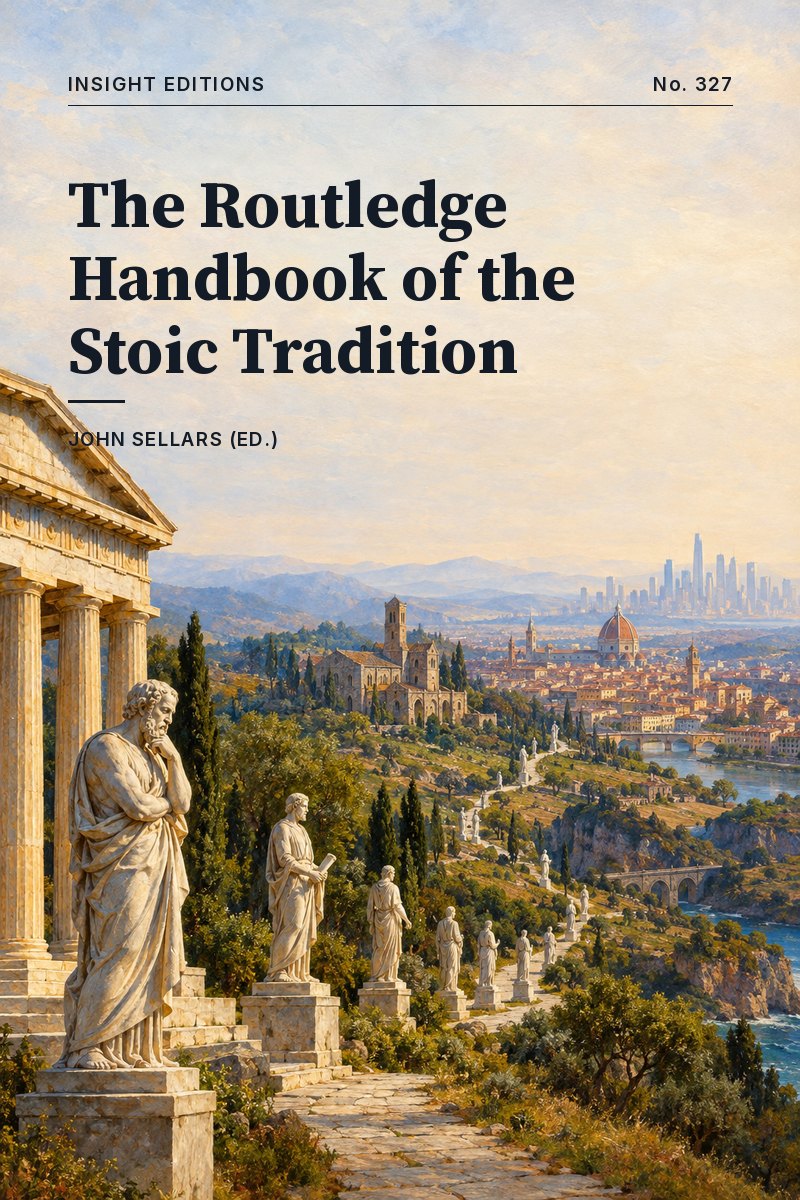
THE STOIC TRADITION
The passage of a philosophical system across two millennia
An original, privately assembled, source-faithful Insight Edition based on John Sellars (ed.), The Routledge Handbook of the Stoic Tradition (2016)
Four overview tiles
| The question | Ancient starting point | Historical transformation | Reading principle |
|---|---|---|---|
| What counts as a good life? | Virtue, appropriateness, chosen externals | Aristotle, Christian theology, modern ethics dispute value | Separate acting with virtue from owning desirable outcomes |
| How can a person be free? | Assent, choice, rational causation | Medieval liberty, providence and modern autonomy | Distinguish kinds of freedom before comparing systems |
| What is philosophy for? | Explanation joined to exercised character | Meditation, literary culture, therapy and political resistance | Identify whether a text argues, persuades, instructs or heals |
| How does influence occur? | Schools, teachers, doctrines and surviving texts | Translation, misattribution, adaptation, opposition | Textual access is not proof of agreement or institutional continuity |
What this edition contains
This reader orders an original study of the editor’s Introduction and all twenty-six contributed chapters according to the Handbook’s own structure. It incorporates available extended, independently authored chapter studies, preserving the authorship boundary between the ancient evidence, the Handbook contributors, John Sellars’s editorial interventions, and the present study commentary. Where a later verified chapter revision is unavailable, the corresponding historically preserved earlier study is used without relabelling it as independently audited.
Complete original chapter map
| No. | Original chapter | Contributor | Source pages |
|---|---|---|---|
| 00 | Introduction | John Sellars | 22–35 |
| 01 | Stoicism in Rome | Gretchen Reydams-Schils | 38–49 |
| 02 | Stoicism in early Christianity: The Apostle Paul and the Evangelist John as Stoics | Troels Engberg-Pedersen | 50–64 |
| 03 | Plotinus and the Platonic response to Stoicism | Lloyd P. Gerson | 65–76 |
| 04 | Augustine’s debt to Stoicism in the Confessions | Sarah Catherine Byers | 77–90 |
| 05 | Boethius and Stoicism | Matthew D. Walz | 91–105 |
| 06 | Stoic themes in Peter Abelard and John of Salisbury | Kevin Guilfoy | 106–119 |
| 07 | Stoic influences in the later Middle Ages | Mary Beth Ingham | 120–135 |
| 08 | The recovery of Stoicism in the Renaissance | Ada Palmer | 138–153 |
| 09 | Stoicism in the philosophy of the Italian Renaissance | Jill Kraye | 154–165 |
| 10 | Erasmus, Calvin, and the faces of Stoicism in Renaissance and Reformation thought | Barbara Pitkin | 166–180 |
| 11 | Justus Lipsius and Neostoicism | Jacqueline Lagrée | 181–194 |
| 12 | Shakespeare and early modern English literature | Andrew Shifflett | 195–207 |
| 13 | Medicine of the mind in early modern philosophy | Guido Giglioni | 210–224 |
| 14 | Stoic themes in early modern French thought | Michael Moriarty | 225–238 |
| 15 | Spinoza and the Stoics | Jon Miller | 239–246 |
| 16 | Leibniz and the Stoics: fate, freedom, and providence | David Forman | 247–263 |
| 17 | The Epicurean Stoicism of the French Enlightenment | Edward Andrew | 264–274 |
| 18 | Stoicism and the Scottish Enlightenment | Christian Maurer | 275–290 |
| 19 | Kant and Stoic ethics | Daniel Doyle and José M. Torralba | 291–305 |
| 20 | Stoicism in nineteenth-century German philosophy | Michael Ure | 308–323 |
| 21 | Stoicism and Romantic literature | Simon Swift | 324–339 |
| 22 | Stoicism in Victorian culture | Heather Ellis | 340–351 |
| 23 | Stoicism in America | Kenneth S. Sacks | 352–366 |
| 24 | Stoic themes in contemporary Anglo-American ethics | Christopher Gill | 367–380 |
| 25 | Stoicism and twentieth-century French philosophy | Thomas Bénatouïl | 381–394 |
| 26 | The Stoic influence on modern psychotherapy | Donald J. Robertson | 395–409 |
The argument in one view
The conceptual argument map is supplied as editable master_argument_map.svg in the package and displayed inline in the offline reader. Its arrows signify reuse, criticism and reinterpretation, not an assertion that every later writer read every earlier writer.
Read the complete 27-unit edition
- 00 · Introduction
- 01 · Stoicism in Rome
- 02 · Stoicism in early Christianity: The Apostle Paul and the Evangelist John as Stoics
- 03 · Plotinus and the Platonic response to Stoicism
- 04 · Augustine’s debt to Stoicism in the Confessions
- 05 · Boethius and Stoicism
- 06 · Stoic themes in Peter Abelard and John of Salisbury
- 07 · Stoic influences in the later Middle Ages
- 08 · The recovery of Stoicism in the Renaissance
- 09 · Stoicism in the philosophy of the Italian Renaissance
- 10 · Erasmus, Calvin, and the faces of Stoicism in Renaissance and Reformation thought
- 11 · Justus Lipsius and Neostoicism
- 12 · Shakespeare and early modern English literature
- 13 · Medicine of the mind in early modern philosophy
- 14 · Stoic themes in early modern French thought
- 15 · Spinoza and the Stoics
- 16 · Leibniz and the Stoics: fate, freedom, and providence
- 17 · The Epicurean Stoicism of the French Enlightenment
- 18 · Stoicism and the Scottish Enlightenment
- 19 · Kant and Stoic ethics
- 20 · Stoicism in nineteenth-century German philosophy
- 21 · Stoicism and Romantic literature
- 22 · Stoicism in Victorian culture
- 23 · Stoicism in America
- 24 · Stoic themes in contemporary Anglo-American ethics
- 25 · Stoicism and twentieth-century French philosophy
- 26 · The Stoic influence on modern psychotherapy
UNIT 00 · John Sellars
Introduction
The Stoic Tradition: An Introduction to the Evidence, the Doctrine, and Its Afterlives
This study is an independently rewritten critical reading of the introduction to The Routledge Handbook of the Stoic Tradition. It is neither a replacement for Sellars's text nor an assertion that the later users of Stoicism formed a single uninterrupted philosophical school. Each dated claim and named intellectual route below is treated within the evidential limits of the original introduction; qualifications and methodological inferences introduced by this study are marked as editorial analysis.
<aside class="thesis">THESIS I. A historical tradition is not identical with a succession of institutions. Stoic ideas could outlive the Athenian Stoa because books, paraphrases, hostile witnesses, translations and reconstructions supplied different forms of access to ideas that later readers transformed.</aside>
01. Why the word tradition needs a warning label
Sellars begins by restricting his own title. The ancient Stoic school had a history of teachers, pupils, and succession. The subject of the present volume is different: after that original institutional history ended, Stoic arguments repeatedly entered philosophical, Christian, literary, political, and scientific discussions through texts and reports. These episodes were neither uniformly sympathetic nor mutually coordinated. Later interpreters could borrow ethical techniques and oppose Stoic physics, admire Seneca while rejecting the view that virtue alone is sufficient, or preserve ancient propositions by attacking them. A reception history therefore cannot use modern self-identification as its only evidence.
That distinction also changes the unit of historical explanation. A scholar cannot simply say that a later author was Stoic and then project a modern handbook of Stoic doctrine back onto that author. One must ask what manuscript, printed book, translated excerpt, or intermediary was available; which doctrine it actually contained; and how the receiving author construed it. The fact that two texts use related language may establish a resemblance. It does not establish transmission without a credible path of access. This is the introduction's methodological center, not a perfunctory introductory apology.
The editor's self-imposed modesty matters. A guide to the subject is not a census of every historical mention of Stoicism, even when the contributions range across many disciplines. Missing regions and uneven evidence are intrinsic to the field, not automatically editorial omissions. Sellars identifies two likely readerships: people trained in ancient philosophy who need a history of its afterlives, and specialists in later eras who need the ancient doctrines. His brief account of ancient thought therefore supplies shared terminology for a volume whose chapters need not share a method.
02. Three different claims that must not be conflated
Institutional lineage, textual transmission, and conceptual recurrence are three separate historical relations. Institutional lineage asks whether a school or teacher-successor relationship persisted. Textual transmission asks whether an identifiable written witness reached a new reader. Conceptual recurrence asks whether a later account resembles, disputes, transforms, or independently rediscovers an ancient claim. The same case can satisfy more than one relation, but no logical implication runs automatically from one to another. A Christian moral paraphrase can provide a demonstrable route from a Stoic text without maintaining Stoic institutional membership. A later philosophical theory can have a close Stoic resemblance even when the evidential route is disputed.
This framework refines the introductory contrast between the living Hellenistic school and later encounters. It also exposes a methodological asymmetry: hostile testimony may be exceptionally valuable for reconstructing a lost doctrine, yet the opponent's rebuttal cannot be presented as evidence that the opponent adopted the doctrine. Conversely, a practitioner who never used the label Stoic might be influenced by a practice transmitted through an unacknowledged mediator. The strength of the claim should match the available witness.
03. The material cosmos, not a merely psychological school
The brief original doctrinal overview is deliberately challenging to the popular image of Stoicism as advice about emotional resilience. The ancient Stoics defended a corporealist ontology in which causally efficacious things are bodies. Their account of the world places nature, the divine, and rational order in a single explanatory picture. God is not simply an external designer issuing occasional interventions; divinity is described as nature's rational structuring principle, articulated through logos and pneuma. The cosmos develops through causes while the same order can be understood as providential. Sellars pairs determination with providence rather than opposing them as if one excluded the other.
The Stoics also described cosmic destruction and renewal by fire, an especially conspicuous example of a physical doctrine that cannot be silently omitted from a historical definition of the school. Later authors may borrow accounts of duty or emotion without accepting recurrent cosmic conflagration. That selectivity is exactly why reconstruction of the whole system and study of its reception must be distinguished. The editor's description of the Stoics as nominalists is a useful rapid contrast with Platonism; it should not be stretched into the full range of medieval or modern nominalist positions. A further editorial precision: the ancient Stoics' distinction between what strictly exists as a body and incorporeal items that subsist requires fuller analysis than the introduction's compact opening formula provides.
04. Pneuma as a physical account of different capacities
Pneuma is not added to the account merely to make the physical theory sound spiritual. Different states of its tension explain progressively richer forms of organization: cohesion in inanimate objects, growth in plants, sensory power in animals, and rational activity in human beings. Human virtues and judgments consequently belong to an embodied causal story, not to an independently existing immaterial faculty. The account is ambitious because it brings physical cohesion and ethical excellence within a unified explanatory vocabulary, though unity of vocabulary does not remove the need to examine the different capacities involved.
A reception historian must ask which of these physical commitments later writers actually knew. Someone reading an ethical selection from Epictetus might encounter the demand to revise judgments but little of the cosmological model that originally supplied its background. Someone working from testimony about Stoic physics might know of providence and conflagration without the ethical pedagogy made vivid in the Roman moral texts. What appears to be a difference of emphasis may partly be a difference in accessible books. That is an inference from Sellars's transmission thesis, not a claim that every later disagreement can be reduced to a missing manuscript.
05. Self-preservation, practical selection and the growth of reason
Sellars traces the ethical starting point to an organism's orientation toward preserving its own constitution. At the animal level, the pursuit of nourishment, shelter, and freedom from harm illustrates this directed activity. Human beings do not cease to have bodily needs. Rational agency adds a standard by which choices are measured: a person can evaluate whether the pursuit of ordinary goods accords with the excellent use of reason. The Greek ethical vocabulary matters here because the claim about what sustains life is not identical to the claim about what makes life good without qualification.
A preferred indifferent is not something intrinsically evil or something that never matters. Health and material sufficiency commonly warrant rational selection; illness and deprivation commonly warrant rational avoidance. Yet neither possession nor loss determines moral worth. In the Stoic ordering, only virtue counts as unqualified good and vice as unqualified bad. Rational selection takes place among circumstances of unequal natural preference while recognizing that circumstances cannot replace the excellence of the choosing agent. This is a more intricate account than the slogan that a Stoic simply does not care whether she is healthy or hungry.
The distinction is particularly important for later moral appropriation. A Christian writer might retain a preference for good conduct over wealth but ground that preference in a different ultimate end. A modern professional might use the distinction to structure resilient action without accepting the ancient account of nature. Such uses can be coherent adaptations, but the historian must mark where an ancient justification has been replaced.
06. Value judgment and the passions
The original introduction identifies harmful passions as bound to evaluations that treat external outcomes as unqualified goods or evils. This is not the claim that all feelings are arbitrary choices at the moment they arise. It is a thesis about the role of assent and evaluative commitment in morally disruptive emotion, embedded in a broader Stoic account of rational agency. Nor does the qualified claim that virtue suffices for happiness amount to a promise of comfort, ease, or immunity from involuntary suffering. The Stoic ideal is a life excellently ordered by reason amid outcomes that can be painful or unwelcome.
Later readers extracted very different lessons from this psychology. They could regard the passions as errors needing correction, as natural experiences requiring moderation, or as features of moral concern that ought not to be suppressed. A source-faithful study of reception separates the ancient judgment theory from a later writer's concession to the emotions. Similar techniques of attention or reframing do not by themselves establish acceptance of Stoic providence, the undivided soul, or virtue's sufficiency.
<aside class="callout model">DOCTRINAL DISTINCTION. The sequence is not external discomfort → moral failure. It is perceived event → evaluation and assent → response. The philosophical question is what the agent treats as truly good or bad, not whether events are physically controllable.</aside>
07. A system with internal argument, not a fixed catechism
Sellars immediately qualifies the doctrinal sketch. Even within the Hellenistic movement, the school was not populated by passive custodians of identical maxims. Seneca's later declaration of philosophical independence captures an attitude of argumentative latitude, though scholarship has debated how free members of ancient schools were in relation to their founders. Sellars does not settle that sociological question by quoting Seneca. Instead he proposes several historically possible descriptions: a definite doctrinal core, a set of family likenesses, or an evolving succession of thinkers linked to Zeno's teaching circle.
Zeno of Citium began lecturing in Athens around 300 BCE after study with teachers associated with Cynicism, the Megarian school, and the Academy. The original meeting place, the Painted Stoa, helped give the movement its eventual name. The early students' designation as followers of Zeno preceded the more generic school name. Sellars's seventh scholarly note suggests that this shift might also have signaled a degree of freedom from the founder. The modal word matters: a name change is evidence of the new label, not proof of a particular motive.
08. Chrysippus, systematic philosophy and the danger of hindsight
The successor tradition strongly associated the achievement of articulating a comprehensive body of Stoic doctrine with Chrysippus of Soli. Ancient reports credit him with hundreds of books; the introduction records the figure 705, supported by Diogenes Laertius and by the cataloguing discussed in note 6. Such figures convey the scale of his reputation and ancient output, not the recovery of hundreds of extant works. Chrysippus's logical interests helped shape Stoicism, but the historian must not pretend that the modern notion of a philosophical system straightforwardly describes how the ancient school organized itself.
Sellars expressly flags the historiographical issue: the writing of histories as abstract systems of philosophy acquired particular importance in early modern scholarship. Ancient accounts commonly arranged philosophers within schools. The resulting contrast should not be absolutized, because the Stoics themselves also stressed connections among the parts of philosophy. The useful distinction is between ancient commitments to an internally related philosophy and modern methods of turning scattered texts into a schematic doctrine. The latter can clarify, but can also harden disputed ancient positions into an artificial orthodoxy.
09. Named dissenters and the geographical limits of a school label
Notes 8 and 9 are especially important for correcting a uniform picture of the Stoa. Aristo of Chios disputed the elaboration of categories among indifferents. Boethus of Sidon did not accept the standard claim about the cosmos as a living being. The range of associated figures extends far beyond Zeno and Chrysippus: Cleanthes, Sphaerus, Diogenes of Babylon, Antipater of Tarsus, Panaetius, Posidonius, and others take places in the succession or in ancient fragment collections. The original note enumerates many further names, reminding the reader that the school was neither a triumvirate nor a single location.
The movement was geographically dispersed during the Hellenistic age itself. Posidonius taught on Rhodes, while evidence links Stoics including Athenodorus with Pergamum. This distinction between an Athenian institution and Stoic activity across the Mediterranean guards against another false inference: the fading of a particular meeting place does not entail the immediate extinction of all teaching, and the continuation of Stoic instruction elsewhere does not demonstrate an unbroken later Athenian succession. Sellars uses these examples to keep the chronology nuanced.
10. The end of the Athenian succession is not the disappearance of Stoic teachers
The last recorded heads of the Athenian Stoa were Mnesarchus and Dardanus. The sack or siege of Athens under Sulla in 86 BCE is offered in the notes as a probable disruption to the Athenian schools. Cicero's encounters belong to a period in which older institutional structures were already weakened, although his relationship with Posidonius on Rhodes provided a connection with the living Hellenistic tradition. That combination of historical witnesses and uncertainties warrants a careful formulation: a particular direct master-pupil chain became untenable, but engagement with Stoic teaching continued in transformed circumstances.
First- and second-century Roman settings preserve further named communities. Seneca interacted with Stoically sympathetic writers including Lucan, Cornutus and Persius. Musonius Rufus taught in Rome; Epictetus heard him while enslaved and later founded a school in Nicopolis. Arrian's notes from Epictetus' teaching subsequently mattered for Marcus Aurelius. Epictetus' students reportedly studied Chrysippus while being pressed to put philosophical training to practical use. Technical and ethical Stoic writing also remained visible in Cleomedes and Hierocles. It is misleading, therefore, to portray the Roman Stoa as a collection of isolated self-help authors without a classroom, a curriculum, or a literature of theoretical argument.
11. A library dispersed between sympathetic and hostile witnesses
In the Roman period, Chrysippus's works still circulated in numbers significant enough for extensive citation by critics such as Plutarch and Galen. The source apparatus supplies counts based on indices to von Arnim's collection: Plutarch has roughly 97 quotations, Galen 57, Diogenes Laertius 43, and Athenaeus 20; much later, Stobaeus and Simplicius supply only a few direct passages each. Those numbers are bibliographical observations tied to a particular index and edition. They are not direct measures of the number of ancient copies or a complete census of every influence.
The distinction between testimony and direct work is central. A hostile polemic can preserve words otherwise lost, but its opponent may select a particularly vulnerable claim. A secondary report can compress a doctrine and alter its framing. A Roman ethical text can speak in the voice of a practitioner rather than offer a balanced account of early Hellenistic positions. By late antiquity direct access to Chrysippus seems sharply diminished. A historian consequently assembles early Stoic philosophy from witnesses with varying motives, genres and distances from the material they transmit.
12. What later readers were most likely to recognize as Stoic
Sellars identifies three especially durable clusters: virtue and happiness; the rational soul and the judgment-dependent passions; and the living, providential cosmos. None exhausts ancient Stoicism. The first can enter disputes about the summum bonum. The second can be used in psychological and pastoral instruction. The third can provoke theological approval or resistance. Their differing rates of survival help explain why later Stoic reception need not preserve logic or the full physics alongside ethics.
A useful evidence test is to reconstruct an author's accessible canon before announcing an influence. Does a writer know Seneca at first hand, a version of Epictetus, or an earlier author criticizing Chrysippus? Does the writer recognize the connection between individual virtue and the order of nature, or borrow only a maxim? Source limitation is not a disqualification; selective transmission is part of the historical subject. The resulting philosophical interpretation should record precisely what was selected.
13. Neoplatonist mediation and the changing job of Epictetus
Simplicius offers a decisive case of ancient transmission through a rival school. His Aristotelian commentaries preserve Stoic material, but he acknowledges mediation in some cases through Porphyry's lost work. His commentary on Epictetus's short manual also relocates that Stoic text within a Neoplatonic educational scheme as preliminary ethical training. That educational reuse shows both survival and change: a text can continue to teach conduct while its surrounding metaphysics and institutional function are no longer those of its Stoic origin.
Damascius and Olympiodorus provide additional signs that Epictetus remained an object of attention in later Platonic environments. Sellars is not claiming that late Platonists accepted every Stoic doctrine. The detailed route is instead an encounter with a work which can be fitted into a curriculum designed by readers with other philosophical commitments. This provides a useful general model for reception: preservation and reinterpretation are not opposites. The very act that allows a text to survive can reshape how its authority is understood.
14. Byzantine copying as a causal condition of later philosophy
Arethas of Caesarea appears because the survival of Greek books has identifiable agents and historical bottlenecks. He held copies of Epictetus' Discourses and Marcus Aurelius' writings. The scholarly notes distinguish differing levels of historical inference: one modern scholar links Arethas to the survival of the Discourses, another gives him a central role in the transmission of the Meditations. The possession of copies is stronger evidence than any unconditional claim that one individual alone saved a work for posterity.
Christian revisions of Epictetus' manual make the transformation especially visible. Pagan examples were replaced by Christian persons; in one surviving version, an exemplary philosopher gives way to an apostolic figure. These alterations are evidence of active adaptation, not proof that Epictetus was originally a Christian author. There were three surviving Christian adaptations according to the reference followed by Sellars, one of which drew a later Greek commentary dated tentatively to the ninth or tenth century. Byzantine scholarship also continued to use Cleomedes, including in the work of Michael Psellus. The picture is heterogeneous: preservation of philosophical books, ethical refashioning, and scholarly commentary operated together.
15. The Arabic question: possibility is not proof
The possible echo of Epictetus in al-Kindi's treatment of sorrow is suggestive but causally underdetermined. If the resemblance reflects actual transmission, it may have reached al-Kindi by an Arabic translation of the manual or by excerpts in a translated anthology. His limited access to Greek makes an intermediate route important. Later Arabic moral writers, including al-Razi and Miskawayh, may have encountered related material indirectly. Sellars reports these proposals rather than claiming a documented continuous Stoic school in Arabic philosophy.
There is firmer evidence for the translation of works containing Stoic material, including authors who disagreed with Stoicism or discussed it within other controversies. Arabic philosophical vocabulary could refer to the portico-school as Riwaqiyah. But knowledge of some associated propositions does not establish adoption of a Stoic system. Scholars differ in their evaluations: Jadaane argues a more substantial connection, whereas Gutas urges restraint. The introduction explicitly states that the underlying archive and source-critical groundwork were not sufficiently developed for confident sweeping conclusions. A sound study retains this uncertainty instead of silently turning an influence hypothesis into fact.
<aside class="callout warning">EVIDENCE WARNING. A transmitted passage, an anthology excerpt, a conceptual parallel, and a demonstrated adopted argument carry different evidentiary burdens. The Arabic material in Sellars's account is an example where these levels must remain separated.</aside>
16. The Latin West inherits a different Stoic library
Cicero and Seneca were the two great Latin conduits, though not at all with equivalent transmission histories. Cicero's philosophical works were copied and circulated during the early Middle Ages. They influenced educated Latin readers, including Augustine, and the model of duties reached Christian writing through Ambrose's adaptation of Cicero's treatise, itself indebted to Panaetius. Manuscript evidence places groups of Cicero's works in ninth-century France; they were known in the Carolingian intellectual world, and Einhard cited the Tusculan conversations. These facts establish routes of reading more specific than a generic claim that medieval Christianity absorbed Stoicism.
Seneca's wider rediscovery followed a different chronology. His letters received increasing attention in the twelfth century, other dialogues in the thirteenth, and the Natural Questions attracted later readers as well. Reception depended not only on the text but on perceived legitimacy. Letters falsely presenting an exchange between Seneca and Paul helped confer an acceptable Christian aura. Jerome's literary notice and the misattribution of Martin of Braga's moral treatise to Seneca also shaped the author that Christian audiences imagined they were reading. Modern critical distinctions between authentic, adapted, pseudonymous and mistakenly attributed texts cannot be erased when reconstructing an earlier library.
Augustine's attitudes further undermine any easy narrative of either wholesale absorption or total refusal. His positions varied across time and according to the issue. His later authority amplified these complex judgments. Other Latin Christian writers, including Tertullian and Lactantius, transmitted assessments of Stoicism and reworked ideas from it. A historian of influence has to distinguish an explicit assessment of the school from a moral argument that resembles Stoic material, particularly when intermediary sources intervene.
17. The Renaissance changes both the archive and the credibility of old witnesses
The rediscovery of Diogenes Laertius gave Renaissance readers a larger history of ancient philosophers and their schools. Copying, Latin translation, and criticism involved humanists and patrons such as Bessarion, Perotti and Poliziano. A learned reader could gradually assemble an ancient philosophical world previously accessible only in scattered Latin writings. But the expansion was not simply additive. Lorenzo Valla's critical skepticism about the supposed correspondence between Seneca and Paul removed an inherited prop from the Christian image of Seneca. The same scholarship could expand access to genuine material and subtract falsely attributed authority.
This episode crystallizes an important distinction. Historical reception includes the authority of texts later judged inauthentic; criticism of those texts changes the reception even when it does not change what Seneca actually wrote. The analyst must describe both layers without treating a Renaissance forgery or medieval attribution as genuine ancient testimony. Manuscript history and philosophical history are interdependent.
18. Incunabula and the unequal arrival of Stoic authors in print
The printed canon formed over decades rather than appearing all at once. Works by Cicero, including On Duties and the Stoic paradoxes, were printed in Mainz in 1465. The Tusculan discussions appeared in Rome in 1469. Other philosophical treatises, a Latin Diogenes Laertius, and Seneca's prose books followed during the 1470s. By the end of the fifteenth century Seneca had appeared in many editions. A reader whose Stoic access came chiefly through those Latin authors inhabited a different textual landscape from a reader after the early printing of Epictetus' original Greek.
The chronological details matter. Poliziano's Latin Epictetus was printed in 1497. Simplicius' commentary carried the short Greek manual in print in 1528, while the standalone Greek manual followed in 1529. The Discourses were printed in 1533, Cleomedes in 1539, and Marcus Aurelius in 1558. A retrospective assertion that all Renaissance readers could consult the same standard Stoic classics would therefore be false. Even where a text existed in manuscript, print shifted its accessibility, reproducibility, and place in learned controversy.
19. Erasmus and Calvin: editing Seneca is not the same as endorsing him
Erasmus' annotated Seneca of 1515, followed by a revised effort in 1529, shows learned engagement with a large ethical corpus. Calvin's early commentary on On Clemency, published in 1532, offers another influential instance of studying Seneca within a Christian scholarly context. Muret's annotated edition of 1585 belongs to the same expanding genre of humanist commentary. Each intervention requires a separate analysis of editorial selection, interpretation, and intellectual purpose; shared interest in Seneca does not make these scholars representatives of one philosophical allegiance.
The original opening survey places this editorial work before the more systematic recovery of Stoic logic and physics in later collections. That sequencing matters. One could edit a Roman moralist with great sophistication and nonetheless work without the same assembled testimonia about early Stoic cosmology that later scholars would possess. Conversely, the development of philological commentary helped establish the habits through which those broader testimonia would be read.
20. Lipsius and the modern reconstruction of a school
Justus Lipsius' two companion studies of Stoic philosophy, published in 1604, attempted to bring disparate ancient testimonia into systematic relation. Their names identify distinct projects in orientation and physical doctrine. They were followed by his large Seneca edition in 1605. Sellars treats this combination as pivotal to the emergence of modern Stoic scholarship: a reader was now invited to compare Seneca with otherwise scattered reports of early positions across ethics, logic and physics.
This was not the recovery of the lost works of Chrysippus themselves. It was reconstruction from a selection of surviving witnesses. Historiographical categories became more ambitious as the textual net widened. Lipsius is also an example of later close self-identification with Stoicism, but the scholarly studies and a Christianized philosophical project should not be collapsed into a single unqualified endorsement of every ancient doctrine. The editor's note contrasting Lipsius and the self-distancing of Spinoza shows how different public and philosophical relationships to Stoicism can be.
21. Du Vair and Scioppius: therapy, translation and confessional adaptation
Guillaume du Vair made Epictetus available in French and composed moral reflections strongly shaped by the manual. His first French translation is dated 1585 in the original survey. The route from ancient exercise to vernacular pastoral or philosophical writing was not merely a bibliographical event: it changed the vocabulary in which conduct, adversity and responsibility could be discussed. Yet no historical claim that his metaphysics simply duplicated early Stoic physical theory follows from the ethical borrowing alone.
Kaspar Schoppe, writing as Caspar Scioppius, published a program for Stoic moral teaching in 1606. His work joined the ambitions of Christianized Stoicism with practical educational plans, including Catholic schools. Leibniz later grouped Lipsius and Scioppius as modern Stoic advocates. Sellars distinguishes the scholarly intent of Lipsius' principal projects from the pedagogical and confessional impetus in Scioppius. That contrast is a recurring pattern in this volume: reconstruction of a doctrine, use of a text for exercises, and institutional curricular promotion need not be the same activity.
22. Heinsius, the Casaubons, and commentaries larger than texts
Daniel Heinsius urged a renewed embrace of Stoicism in an academic oration. Isaac Casaubon's 1605 edition of Persius offered a 23-page satirical text accompanied by hundreds of pages of commentary. This ratio is intellectually revealing: a relatively short surviving Roman author became a starting point for assembling evidence about a broader tradition. The commentary's intellectual significance does not depend on treating Persius as the sole representative of early Stoic theory; it derives partly from learned connections made to a wider ancient literature.
Meric Casaubon's English Marcus Aurelius appeared in 1634 and gave later English readers the title by which the emperor's private notes became widely known. Further editorial work followed in 1643; Meric also printed a Christian adaptation of Epictetus in 1659. Thomas Gataker's 1652 edition of Marcus included another extensive commentary, with hundreds of pages of comparative ancient material. These works were both transmissions and interpretations. They created a more searchable philosophical archive for their readers, but each editorial apparatus framed the text it explained.
23. Seventeenth- and eighteenth-century scholarly networks
The study of Stoicism became a distributed scholarly undertaking. Universities and learned centers including Jena, Halle, Leipzig and Uppsala generated disputations and academic essays. Jakob Thomasius' studies of the 1670s and 1680s stand out in Sellars' selection. The Daciers worked on Marcus Aurelius in the 1690s, and André Dacier subsequently took up Epictetus. Such research rarely looks like the public image of a philosopher calmly practicing Stoic exercises; it is part of the history of technical philology and institutional learning.
Brucker's major history of philosophy, published in 1742–44, represents another turn. Ancient authors could be read not only as isolated teachers but as members of a categorized story about competing systems. As the vernacular reading public expanded, Elizabeth Carter's English Discourses of Epictetus appeared in 1758. Earlier English translations of Seneca, Cicero and the Handbook had appeared at different dates, and Cicero's On Moral Ends would not receive its English version until 1812. Translation chronologies therefore have their own explanatory force, independent of abstract philosophical agreement.
24. An eighteenth-century reader cannot be given a modern bookshelf
A counterfactual tests the stakes of the edition chronology. Imagine two English readers, one in 1600 and one in 1760, each interested in whether a severe emotional response is compatible with virtue. The first reader could encounter selected Latin and translated materials but not Carter's edition of the full Discourses. The second has more readily available access to the practical reasoning of Epictetus as presented through her translation. The issue is not that one reader must be more philosophically intelligent. The issue is that their available evidential objects differ. A historian should avoid treating both as if they could simply open a unified modern anthology of all extant Stoic testimonia.
Editorial thought experiment. Suppose an author develops a Stoic-sounding view of providence before a specific relevant Greek work was printed. Which other witness could support the claim of influence? A manuscript copy, a Latin rendering, a patristic report, a teacher's quotation, or an independently parallel religious argument? The answer is a research question, not a declaration produced by doctrinal similarity alone.
25. Nineteenth-century editing amid relative philosophical neglect
At the beginning of the nineteenth century specialist editions continued to accumulate: Schweighäuser's five-volume Epictetus was completed in 1800, Bake assembled Posidonius fragments in 1810 and edited Cleomedes in 1820, and Musonius evidence received collection in 1822. The editor also notes a general decline in the prestige of Hellenistic schools relative to Plato and Aristotle in some strands of classical study. These claims are compatible. Specialized philology may proceed even while a subject occupies a comparatively marginal place in wider narratives of philosophical greatness.
Felix Ravaisson is identified as one exception to that pattern. Toward the century's end the landscape shifted through work by Brochard, Weygoldt, Ogereau, Stein, Schmekel, Dyroff and Bonhöffer. Some authors focused on ethical questions, others on psychology, assent, the middle Stoa, or Epictetus. The original notes list further specialized dissertations and publications. A source-faithful reconstruction should not reduce all this intellectual production to one dramatic revival date. Different national and disciplinary traditions moved at different speeds.
26. Pearson, von Arnim and what a fragment collection can establish
Pearson's 1891 work on Zeno and Cleanthes helped consolidate otherwise scattered evidence. Von Arnim's three principal volumes of Stoicorum Veterum Fragmenta appeared in 1903 and 1905, with a fourth index volume added in 1924. The collection remains essential for organizing the early Stoa, but the historical status of its components differs: a verbatim fragment is not equivalent to a later paraphrase, and a critical witness hostile to Stoic doctrine is not equivalent to a neutral transmission of a lost treatise. The source's own caveat about limitations of von Arnim's work should be kept in view alongside its significance.
Critical editions of the later Stoics also emerged through publishers such as Teubner. Across Seneca, Cornutus, Musonius, Epictetus, Marcus, and Cleomedes, professional philology increasingly offered dependable textual starting points. This does not imply that editorial choices were free of controversy. It means that the infrastructure for specialized modern scholarship had become more elaborate than the earlier patchwork of printed translations and antiquarian testimonies.
27. Herculaneum: the ancient archive was never closed
Papyrus finds from Herculaneum are not mere curiosities at the end of Sellars' chronological survey. They prove that the body of available ancient Stoic evidence was still changing when modern fragment collections took shape. Fragments assigned to Chrysippus' work on logical questions and other papyri were among the materials drawn upon by von Arnim. Philodemus' historical account of the Stoa, on papyrus PHerc 1018, was edited in the nineteenth century and re-edited in the twentieth. New editorial treatments of damaged witnesses can revise basic accounts of the ancient school even without discovery of a physically new scroll.
Hierocles' Elements of Ethics, edited from papyrus in 1906, is a particularly significant case. It supplies a technical ethical witness and complicates any contrast in which early Stoics possessed theory while Roman Stoics retained only exhortation. A later publication of a fragment of Musonius Rufus in 1936 likewise added to the record. Further Herculaneum texts and scholarly studies continued to appear. Sellars reports an expressed hope for more discoveries but does not promise their arrival. The warranted conclusion is that a reception narrative depends on a corpus whose composition and interpretation are historically variable.
28. How to read a reconstructed doctrine from a hostile fragment
Editorial thought experiment. Imagine that a philosophical argument survives only because an opponent quotes a short sequence before criticizing it. A modern editor extracts the quotation, arranges it among other fragments, and assigns it to a topic. Later readers encounter the resulting page under the heading 'Stoic theory of emotion'. At least four interpretive layers now stand between them and the lost ancient treatise: the original polemical selection, possible scribal transmission, modern editorial organization, and contemporary conceptual gloss. The claim may still be strong. But the layers should be visible in any serious account of its evidential strength.
This also shows why quotation-count data in the notes must not be overinterpreted. The number of excerpts attributed to Chrysippus in a modern index is affected by the surviving corpus, criteria of attribution, and the practices of the surviving ancient author. It cannot by itself tell us what proportion of the original school curriculum any later reader inherited. We should read counts as indicators of extant witnesses, not as direct sociological measurements of ancient intellectual influence.
29. Texts, languages, patrons and libraries shape philosophical identities
Taken together, the original chronology traces more than the survival of propositions. It records the material conditions of knowledge: an archbishop collecting Greek books; Latin copying networks; an inter-religious paraphrase; Renaissance scholars evaluating authenticity; printers multiplying access; translators establishing vernacular idioms; academic commentators joining sources; and papyrologists revealing damaged treatises. Every change can alter the range of doctrinal claims that a later scholar can support. A new availability of Epictetus is not a new ancient doctrine, but it can make the history of that doctrine look different.
This observation should not become technological determinism. Printing alone did not make people adopt Stoic moral views, and the availability of a treatise does not prove its readership. Religious, political and disciplinary incentives also determined which texts were selected and how they were used. Sellars explicitly treats textual survival as one factor among many in reception. The editorial expansion here supplies a practical inference: claims about influence should specify both plausible access and interpretive motive, while acknowledging cases where one or both remain obscure.
30. A method for distinguishing doctrine, borrowing and criticism
A dependable description of a reception case can be built by asking five connected questions. First, which ancient proposition, practice or text is being invoked? Second, what evidence connects the receiving author to a particular textual version or intermediary? Third, is the reception sympathetic, hostile, selective, or unacknowledged? Fourth, which parts of the ancient rationale have been retained and which supplied from another framework? Fifth, which claims are made by the historian of reception rather than by the ancient or later author? The fifth question is as important as the first: an interpreter can become so persuaded by conceptual similarities that reconstruction is mistaken for testimony.
The original volume deliberately admits different scholarly methods. A theological reception chapter may investigate changed accounts of providence; a study of printing can establish dates of access; a philosophical chapter can compare principles of rational agency; a literary reading can expose motifs and argumentative structures without a direct authorial declaration. Their findings can be set beside one another as long as the kind of evidence is never disguised. What the editor declines to impose is methodological uniformity, not standards of source criticism.
31. Ten historiographical contrasts from the introduction
| Contrast | First item | Second item | Why the distinction matters |
|---|---|---|---|
| Institution / encounter | Athenian succession of teachers | Later reading, adaptation or criticism | A conceptual afterlife does not require institutional survival |
| Physical ethics / motivational slogan | Rational excellence in a causal material cosmos | Selective advice on composure | Borrowing an exercise may omit cosmological commitments |
| Preferred / good | Health as normally worth choosing | Virtue as unqualified excellence | Natural selection is not a competing ultimate end |
| Direct witness / paraphrase | Extant words of an ancient author | Secondhand or adversarial report | Confidence depends on genre and mediation |
| Knowledge / influence | Awareness of a Stoic doctrine | Adoption or development of that doctrine | A transmission path is necessary but not sufficient |
| Appropriation / conversion | Christianizing an ethical example | Becoming a Stoic philosopher | Institutional and metaphysical allegiances differ |
| Latin / Greek reception | Cicero and Seneca | Epictetus, Marcus, later Greek commentary | Textual canons diverged by language and copying |
| Early print / full modern corpus | Uneven editions before 1600 | Comparative fragments and critical editions | Reconstructable doctrinal range changes |
| Historical document / editorial apparatus | Ancient passage or papyrus | Modern arrangement and classification | The act of collection interprets the source |
| Survey / encyclopedia | An orienting handbook | Exhaustive coverage | Gaps do not entitle confident negative conclusions |
32. A source-faithful comparative timeline
| Period / date | Text, person, or scholarly event | Qualification required |
|---|---|---|
| c. 300 BCE | Zeno and the Athenian teaching circle | Approximate founding date, not a fixed catechism |
| 86 BCE | Athenian schools suffer major disruption | Relation to the end of the Stoa's succession is historically qualified |
| First–second centuries CE | Roman Stoic authors, schools and textual circulation | Teaching continued beyond the original Athenian institution |
| Late antiquity | Simplicius and other Platonist engagements | Stoic works reinterpreted inside a different curriculum |
| Ninth–tenth centuries | Byzantine copying and Christian Epictetus adaptation | Relative dating and preservation roles remain qualified |
| Early Middle Ages | Cicero and other Latin witnesses circulate | Not a single complete Greek-and-Latin Stoic canon |
| Twelfth–thirteenth centuries | Renewed circulation of Seneca | Different works circulated on different schedules |
| 1465–1470s | Early printed Cicero, Laertius and Seneca | Dates distinguish individual texts and translations |
| 1497, 1528–33, 1558 | Epictetus and Marcus enter print by stages | Latin translations and Greek editions are distinct events |
| 1604–05 | Lipsius reconstructs Stoic philosophy and edits Seneca | Scholarly reconstruction, not an ancient recovered system |
| 1634, 1652 | Casaubon translation and Gataker commentary | Editorial work creates interpretive filters |
| 1742–44, 1758 | Brucker history and Carter Epictetus | Different intellectual publics and genres |
| 1800–1822 | New editions and fragment collections | Specialized philology amid uneven disciplinary attention |
| 1903–06, 1924 | Von Arnim, Hierocles, later indices | Compilation and papyrus evidence remain revisable |
33. Editorial caveats that the old summary should not obscure
The inherited earlier study rightly identified reception through textual transmission, but its brevity compressed several genuine original differentiations. It did not maintain a complete individually auditable register of all 35 scholarly notes, and it did not list each individual original bibliography item. The main source's caution about the Arabic influence problem merits a specific, separately marked treatment. Notes on school disagreement are more than decorative references; Aristo, Boethus, and the wider list of known school participants complicate any doctrine-by-dictum reconstruction. The Roman communities, manuscript dates, false Pauline correspondence, and distinct publishing routes also need their own sources and chronological interpretation rather than occupying one short transitional paragraph.
The source calls the Stoics physicalists, then treats cosmos and psychology in a quick connected sketch. A responsible reader should not confuse that brief synthesis with the technical Stoic account of incorporeals or with an exhaustive philosophy of logic. The source also moves deliberately between reported details and historical probability, for example the Arethas preservation proposals and the possible Arabic mediation of Epictetus. Those modal distinctions survive in the revised discussion. Finally, the postclassical archive must not be converted into a triumphalist march toward one final settled version of Stoicism: new papyri, editions, and competing reconstructions leave the historical picture open.
34. The contribution of the original editor and the contribution of this audit
Sellars's original editorial claims are a specific framing of the volume: discontinuous post-antique reception, limited but broad coverage, ancient doctrines needed as an entry point, internal disputes among ancient Stoics, and an archive defined by the conditions of textual survival. The actual introduction also supplies a detailed chronology of editions and learned research, plus historical caveats, bibliographical notes and references. The claims should not be confused with the ancient Stoics' own first-person definitions of their school.
This independent study's critical contributions are methodological: the threefold distinction among institutional succession, demonstrable textual transfer, and conceptual recurrence; the explicit evidence ladder; the table of kinds of reception; and the requirement that original text, later user, contributor interpretation, editor's qualification, and independent reconstruction be kept in separate layers. These are analytical tools inferred from the original chapter's architecture. They are not represented as direct statements by an ancient school member or as unquoted original formulations by the Handbook's editor.
35. A worked protocol for the chapters that follow
Take any later author said to have been influenced by Stoicism. Record the date of the receiving argument and the actual textual work cited, if any. Identify its language and the edition or manuscript that could plausibly have circulated. Specify the exact idea claimed to be borrowed: for example, the status of externally imposed misfortune, the place of divine providence, the valuation of health, or the judgment account of anger. Ask whether the later author preserves the entire argument, only a practical technique, or merely a vocabulary. Check relevant opposing views and whether the author consciously rejects anything identified as Stoic. State the strength of evidence and any plausible alternative route.
A second pass then tests the interpretive label. Would the later author's philosophy still reach the same conclusion without the Stoic text? Is the claim of direct dependence supported by explicit quotation or only parallel formulations? Does the available source preserve an original statement or merely an opponent's summary? Would a different editorial arrangement of ancient fragments make the relationship look weaker? These are not reasons to deny influence reflexively; they are ways to make a demonstrable influence more credible and a conjecture properly bounded.
<aside class="callout case">WORKED CASE. A translated Christian version of Epictetus retains an ethical lesson while substituting Christian exemplars. Direct textual adaptation can be shown, but accepting the ethical exercise does not prove acceptance of Stoic materialism, eternal cosmic recurrence or ancient school identity.</aside>
36. Three thought experiments on historical overconfidence
A lost intermediary. Suppose two writers a millennium apart formulate a remarkably similar argument about assenting to appearances. The later writer knows a commentary that discusses Stoicism but not the ancient author's original treatise. The correct report distinguishes possible mediated influence from a claim of direct reading. This remains true even if the doctrine is characteristically Stoic.
A reclassified library. Suppose a newly edited papyrus clarifies that a sophisticated Roman-era ethical argument existed earlier than scholars had realized. Previous accounts had described Roman Stoicism as almost wholly practical. The proper response is not to erase Roman moral exhortation, but to change the balance of evidence and reconsider whether older contrasts were generated by what happened to survive.
A misleading self-description. Suppose a modern thinker explicitly calls himself Stoic while denying providential order, materialism, virtue's sufficiency, and the judgment account of passion. The self-description establishes an avowed affiliation or aspiration. It does not resolve the doctrinal comparison. Conversely, a thinker who rejects the label might nevertheless reproduce a particular ancient argument. The historian needs both linguistic evidence and substantive analysis.
37. Synthesis: Stoicism as a changing field of accessible texts
The introduction's closing insight is that what counts as Stoicism has been unstable not just because later readers disagreed, but because each period inherited a particular collection of texts. The ancient school argued internally. Its Roman successors practiced philosophy in communities that retained theoretical books. Greek interpreters made some Stoic ethical works serve non-Stoic education. Latin Christian writers drew on a different set of authors. Renaissance printers and scholars enlarged and corrected that set. Early modern commentators created new synthetic accounts. Modern editors and papyrologists have continued to alter the evidential base.
One must therefore resist both extremes: there was no timeless, perfectly uniform school transmitted intact into every later century; but there were real continuities through text, argument, teaching, translation, controversy, and adaptation. Stoic ideas survived by being made usable in circumstances their original authors could not have foreseen. Historical accuracy consists in describing those transformations without confusing them with the ancient claims from which they began.
<aside class="thesis">THESIS II. Reception history becomes philosophically illuminating when it explains not merely where an idea reappears, but why a particular text became available, how it was interpreted, what was altered, and what evidence supports the proposed connection.</aside>
38. Bibliographical and numbered-note apparatus
Source continuity. The complete underlying introduction main text comprises 369 logical lines, each assigned exactly once to a SHA-authenticated topical group. The original apparatus comprises 371 logical lines and is SHA-anchored in its complete form, including a deliberately blank physical printed page. The groupings are indexing aids and do not claim that a line-by-line ledger by itself certifies the quality of philosophical reconstruction.
39. Concluding test: what can a reader now responsibly claim?
A reader can state that ancient Stoicism offered a connected ethical, physical and rational picture; that the Hellenistic school allowed internal dispute; that its Athenian institutional succession did not simply extend without interruption through the Middle Ages; and that Stoic texts nonetheless repeatedly entered new settings. The reader can describe how Byzantine Greek manuscript copying, Latin scholarly culture, Christian adaptation, printing, translation, early-modern editorial reconstruction and modern papyrus discoveries successively altered access to those texts. The reader can distinguish a direct ancient source from a hostile report, a verifiable translation from an uncertain intermediary, and a later appropriation from acceptance of an entire doctrine.
A reader cannot responsibly infer that every use of Stoic vocabulary proves direct dependence, that a Christian paraphrase preserves ancient cosmology unchanged, that the entire school can be reduced to popular moral exhortations, or that the most recent fragment collection closes every question about ancient doctrines. Sellars's achievement as editor of this volume is to make those historical complications the prerequisite for, rather than an obstacle to, an intellectually serious account of Stoicism's many afterlives.
UNIT 01 · Gretchen Reydams-Schils
Stoicism in Rome
CHAPTER 1 | STOICISM IN ROME
A specialist source-to-study second reading of Gretchen Reydams-Schils, “Stoicism in Rome,” in John Sellars (ed.), The Routledge Handbook of the Stoic Tradition (2016). Authentic source: original PDF physical pp. 38–49, printed pp. 17–28. The scholarly contribution belongs to Reydams-Schils; the volume's editor is Sellars. Historical reports, the contributor's reconstruction, and the present study's analytical inferences are distinguished throughout.
The decisive question is not whether Stoicism changed when Romans took it up. All philosophical traditions change as they enter new languages, institutions, genres, and political circumstances. The more demanding question is whether those changes should be described as a weakening of philosophy, a selection of different problems, or a distinct form of philosophical originality. The chapter's answer is that ethical training, practical advice, and public responsibility make sense only when read alongside the tradition's continuing commitments to argument, nature, psychology, and social life. Its most useful evidence concerns named texts and practices, not a general impression that Roman authors wrote more about conduct.
01. The case under review: three claims that must not be confused
The familiar account of Stoicism's passage from Greek founders to Roman practitioners contains at least three separate assertions. The first is chronological: teachers connected to Rome appear later than Zeno, Cleanthes, and Chrysippus. The second is sociological: senators, emperors, teachers, poets, and elite households imposed different demands on the kinds of writing Stoics produced. The third is evaluative: the later authors supposedly traded conceptual rigor for accommodation. The first is straightforward, the second needs a wide evidential base, and the third does not follow from either predecessor. Reydams-Schils rejects the third as an inherited evaluative story, not the existence of actual historical differences.
That separation is fundamental because a shift from formal treatises to letters or classroom exhortation does not show that their authors stopped reasoning rigorously. The analyst must ask which doctrines an author knew, what precise use was made of them, and whether the new genre was itself a chosen philosophical means. One can write technically without living wisely, or write simply after acquiring technical mastery. This distinction is the chapter's organizing challenge, which it tests against surviving works by Cicero, Seneca, Musonius, Epictetus, Marcus Aurelius, and Hierocles.
02. The historiographical prejudice about Greek strength and Roman derivation
An older valuation of antiquity contrasted an inventive Greek philosophical culture with a Roman culture understood as secondary, imitative, and politically utilitarian. This larger judgment affected the smaller claim that the Stoa's migration toward Rome must have entailed dilution. The contributor identifies the persistence of this narrative into modern scholarship rather than treating it as an ancient Stoic self-description. The modern habit of using an intermediate historical phase to explain decline makes the issue appear taxonomic, although the controversial premise is qualitative.
A useful test is to hold genre constant. If a Greek poet makes arguments through verse, we need not infer that Greek philosophy has become poetry instead of philosophy; nor should a Latin letter automatically be inferior to a Greek systematic treatise. Genre, language, and intellectual achievement are different explanatory dimensions. The same problem arises when modern readers treat a philosophy of practical application as if it could only represent the loss of a prior, purer metaphysical tradition. For Reydams-Schils, that move ignores the theory presupposed by the practice.
03. What the category “Middle Stoicism” does and does not establish
The label commonly gathers Panaetius and Posidonius, thinkers who had documented connections with leading Romans. It invites an image of a transitional school that softened its predecessors' commitments so its doctrines would fit high-status Roman life. But the category is a retrospective construction. It does not identify a preserved manifesto in which a new branch announces that it has abandoned Chrysippus. To use the term responsibly, one must keep a classification of persons and periods separate from an assertion about what they believed.
The distinction also matters for a source problem. Many early theoretical writings are lost, while reports about later thinkers survive through selections and attacks. The comparative sample is not two equally preserved libraries. It is a field of early fragments, later fragments, hostile witnesses, and works produced in different settings. Statements about philosophical innovation should therefore be proportional to what the evidence can reveal, rather than treating absences in the archive as evidence of abandonment.
04. The Athenian embassy of 155 BCE is contact, not a conversion certificate
The Roman visit of the three philosophers sent from Athens offers an unusually concrete date for cross-cultural encounter. The Stoic Diogenes of Babylon traveled alongside Carneades, an Academic, and Critolaus, a Peripatetic. The incident shows that Roman audiences could encounter representatives of rival schools in a shared diplomatic episode. It cannot by itself demonstrate that the Romans had received a coherent Stoic curriculum or that Stoicism had undergone doctrinal transformation to secure its audience.
This is an elementary causal precaution with large consequences. Contact may be a condition for reception, but it is not evidence for the precise content of reception. One must add texts, pupils, adaptations, responses, and specific controversies before making claims of intellectual dependence or change. The embassy also reminds readers that Stoicism was transmitted in competition with other traditions. An apparent Stoic phrase in a Roman author may stand within a philosophical argument against the Stoa rather than one that submits to it.
05. Panaetius, Scipio, and the ambiguity of Roman social proximity
Panaetius, generally dated approximately 185–110 BCE in the source, belonged for part of his career to the circle of Scipio Africanus the Younger. His influence on the moral material employed by Cicero in On Duties is central. These are facts about association and textual mediation. They do not establish that Panaetius adapted a doctrine simply to flatter a patron or that Cicero adopted it without changing its philosophical force.
There are at least three questions to distinguish: What did Panaetius argue? How did Cicero select, frame, and transform that argument? And how did Roman institutions make one set of applications particularly salient? The source cautions against collapsing all three into a neat story of compromise. Ethical teaching addressed to people with offices and kinship obligations might highlight fitting actions because these are philosophically important, not because its author has abandoned physics or critical moral judgment.
06. Posidonius, Galen, and a controversy about inner-school variation
Posidonius, dated approximately 135–50 BCE in the source, had his own connections to Rome and an interest in aspects of Plato and Aristotle. Older accounts described him as introducing a substantially more Platonic moral psychology, especially a concession concerning the soul's capacities. Reydams-Schils urges great care: a significant portion of that impression depends on Galen, whose aim often includes constructing conflict between Stoic positions. Such testimony is evidence of controversy but not an unfiltered transcript of Posidonius's thought.
The named modern discussions by Christopher Gill and Teun Tieleman support the contributor's reassessment. The claim is appropriately qualified: not that Posidonius could not have differed, but that a strongly discontinuous developmental story cannot be certified from a selectively preserved and adversarial record. Even Chrysippus's own relation to Cleanthes was not mere repetition. A school that permits reasoned disagreement need not cease to be a school when later thinkers alter emphasis or debate an account of psychology.
07. Cicero belongs in this history as interpreter and critic, not orthodox Stoic
Cicero is among our richest witnesses to Greek Stoicism, yet the source explicitly denies that he should be counted as a Stoic. His declared intellectual affiliation was Academic skeptical, although scholars debate how exactly to describe the sort of Academic position he held. He was an independently creative Roman political thinker, drawing selectively from schools in order to frame questions of law, deliberation, and the active life. This difference is essential when converting Ciceronian testimony into a claim about the Stoa.
He praises or makes productive use of Stoic work on emotion in the Tusculan Disputations, on duty through Panaetius in On Duties, and on divine care in On the Nature of the Gods. He simultaneously challenges Stoic terminology and manner of argument; the status of advantageous but non-good things; the epistemology of impressions said to convey truth; and accounts of fate compatible with human accountability. These are not incidental reservations. They explain why a text can be useful for reconstructing a position yet actively argue against that position. The danger for the study guide is to smooth a skeptical interlocutor into the image of an insider.
08. The positive case for Cicero's independent practical philosophy
Cicero's Roman setting and political agenda do not make his thought a deficient philosophical translation. They can be conditions under which he developed his own account of public duty, civic friendship, service, and judgment. Reydams-Schils notes modern scholarship, including a collection edited by Walter Nicgorski, that treats Cicero as a serious philosopher of practice. The proper comparative question is therefore not simply whether Cicero agrees with Chrysippus, but what new practical problems his argumentative synthesis makes visible.
An editor should resist two mirror-image mistakes. One is to elevate everything useful in Cicero into proof of Stoic success. The other is to dismiss everything original in Cicero as distortion. The same passage may be both an important witness to a Greek argument and a deliberate Roman reconstruction. Making those functions visible is more accurate than granting a single lineage label to a whole book.
<aside class="callout evidence"><strong>Evidence rule: a witness can also be an adversary.</strong> The provenance of an account matters at least as much as its completeness. Cicero's skepticism, Galen's controversies, and later compilations should be evaluated for what they report, what they select, and the interpretations those selections serve.</aside>
09. Four types of evidence commonly misread as philosophical decline
A source-critical model helps explain the chapter's opening: changes in favored genre, extant publication record, institutional location, and political audience are often treated as if they directly measured doctrinal complexity. None does. A classroom warning against pedantry can presuppose intensive instruction in logic; a poem describing the heavens can draw on technical cosmology; an emperor's personal notes can reflect several distinct philosophical disciplines. An entire discipline may be most visible when its ordinary methods are assumed rather than rehearsed.
The reverse error also matters. The presence of an ancient technical word does not certify a consistently systematic author. The analyst must reconstruct an argument from context. What premises does the terminology invoke? Is it used critically, illustratively, or as an organizing explanatory distinction? Does the author's literary aim alter its practical effect? The contributor's principal method is to answer by comparing named works, rather than assigning a global grade to Greek and Roman ages.
10. The imperial writers form an unusually diverse body of evidence
The period commonly associated with Roman Stoicism does not consist of one literary school. Cornutus, active around 60 CE, seems to have taught grammar and philosophy; Musonius Rufus, roughly 30–100 CE, left instruction surviving through reports; Epictetus taught in Epirus; Seneca combined political engagements with letters, prose works, tragedies, and study of nature; Marcus Aurelius composed notes whose presumed private destination remains uncertain. Their purposes, audiences, institutional relations, and genres differ sharply.
Other witnesses widen the intellectual terrain: the cosmological didactic poem associated with Manilius; the astronomical exposition of Cleomedes; the technical ethical papyrus attributed to Hierocles; poetic contexts in Persius and Lucan; and Dio Chrysostom, a rhetorician linked to Musonius and the Second Sophistic. These are not interchangeable with a philosopher's handbook. Their presence is consequential because they break the inference that later Stoicism is exactly what survives in a few frequently translated works of moral exhortation.
11. The continued theoretical field includes logic, physics, and critical debate
Late doxographical collections such as that of Diogenes Laertius, probably of the early third century CE according to the source, carry systematic material across the traditional Stoic divisions of logic, physics, and ethics. Criticism from Plutarch, Galen, and Alexander of Aphrodisias demonstrates that ancient philosophical disagreements about the Stoa, especially about Chrysippus, remained intellectually active. A hostile account can record a sophisticated issue precisely because a critic wished to attack it in detail.
The contribution of this evidence is limited but important. It shows ongoing circulation and debate, not equal classroom access for every Roman author or proof that every later Stoic knew the same technical corpus. Reydams-Schils's argument is strongest where independent witnesses converge on continued technical activity. It is more cautious where particular institutional structures or full private libraries cannot be reconstructed from surviving testimony.
12. Cleomedes, Manilius, and Seneca make physics visible in different forms
The astronomical treatise of Cleomedes, the poetic exposition by Manilius, and Seneca's Natural Questions all counter a claim that cosmic inquiry disappeared. They also demonstrate that one cannot use genre alone to decide how sophisticated the transmitted material is. One text organizes observations and explanatory claims as a treatise; another introduces knowledge in poetic form; another relates inquiry into the natural world to the correct perspective on the human condition.
The chapter is careful about Seneca's letters 58, 65, 94, and 95. They show him handling technical distinctions, but the displays might sometimes resemble rhetorical demonstrations of craft rather than sustained participation in disputes over the foundations of metaphysics. This dual conclusion is more useful than the claim that his technical vocabulary either proves complete systematic allegiance or is merely ornament. Technical knowledge can be real without being a writer's immediate communicative goal.
13. Hierocles already destabilizes the theory-versus-advice contrast
The Elements of Ethics attributed to Hierocles provides unusually direct evidence of Stoic ethical theory in the imperial era. Its argument about oikeiôsis, often translated as appropriation or affiliation, concerns the creature's natural awareness of and attachment to its own constitution. The account connects self-preservative behavior with a description of living nature and with the ethical significance of how agents regard themselves.
This is not merely a list of tips for getting through adversity. It attempts a basic explanatory thesis about animals and humans from birth, and hence belongs to the theoretical architecture of ethics. It would be methodologically odd to call the period only practical moralization while treating Hierocles's preserved conceptual analysis as marginal because the more familiar surviving works have different genres. The source later returns to his account, which also helps connect the individual organism to obligations beyond itself.
14. The apparently large library of Chrysippus is a constrained piece of evidence
An ancient biographical tradition associated with the poet Persius reports approximately 700 rolls of Chrysippus passing to Cornutus. The figure matters because it suggests that predecessors' work remained materially present among later teachers. Yet the claim is a reported ancient number, not a contemporary modern inventory of surviving volumes. It cannot be used to infer how many students read each roll or which texts an individual Roman Stoic mastered.
The stronger point is pedagogical. Epictetus invokes Chrysippus's arguments and refers to the practice of shared philosophical reading (sunanagnôsis). Such reading would make little sense if the predecessor's thought were treated only as an empty badge of affiliation. His sharpest condemnation is directed at students who learn to display interpretive skill without altering their dispositions. The existence of this complaint is itself evidence for an intellectual environment where interpretation occupied enough effort to become a temptation.
15. Epictetus's polemic against erudition is not an attack on reasoning
When Epictetus mocks someone for explaining Chrysippus brilliantly but living disgracefully, he is distinguishing a technique from its end. He compares empty displays of philosophical interpretation to a literary specialist's ability to impress listeners with small textual details. The argument is normative, not anti-intellectual: one may study logic and physics badly by pursuing prestige, just as one may discuss ethics badly by substituting eloquence for conduct. The source's references to Discourses 2.19 and Handbook 49 make that distinction explicit.
Correct interpretation should improve the examiner's response to a persuasive but false impression, the use of social power, and the treatment of another person. The teacher's success must be measured partly by the pupil's progress beyond the classroom. That test, however, should not be reduced to visible conformity. A pupil might act against a widespread convention precisely because training has altered what is considered valuable.
16. The central dependence relation: theory must become ethical competence
Musonius presents philosophy as the rational discovery of right conduct followed by the work of living it. The source compares this structure to the skill of a physician, sailor, or musician. A medical speaker who cannot heal, a navigator who cannot steer, and a musician who cannot perform exhibit an intelligible failure of competence. Philosophical explanation, similarly, is not identical to philosophical skill.
The distinction must not obscure the role of explanation. Correctly identifying a false value claim, understanding nature, distinguishing a fitting action from an intrinsically good outcome, and avoiding an unwarranted inference are themselves intellectual achievements. For Reydams-Schils, the more revealing characterization of Roman Stoicism is an ethics enacted through reflection and trained choice. The criterion of evaluation is moral action, but knowledge is an essential ingredient rather than an adversary.
<aside class="thesis"><strong>Thesis I: the theory is not missing when its work appears in action.</strong> The right test is whether practice can be reconstructed through Stoic accounts of nature, value, judgment, and obligation, not whether every paragraph is written as formal metaphysics.</aside>
17. Stoic ethics rejects an isolated intellectual end in human life
The chapter contrasts Stoic thinking with the possibility of treating the highest life as a kind of self-sufficient contemplation. In the Stoic account described here, the virtues form an interconnected rational excellence, and this excellence is exercised in dealings with people and events. The contributor links that stance to Stoic refusal of a transcendent realm of separate intelligibles and to a view of human beings as embodied, socially situated rational animals.
The contrast with certain readings of Plato and Aristotle should not be inflated into a claim that those philosophers ignored practice. The source speaks of differing ultimate emphases and psychological architectures, not a simple division into practical and impractical thinkers. For the Stoic, thinking well cannot be fully separated from judging and doing well in a life whose relationships and contingencies actually matter.
18. Training reaches the whole rational disposition rather than a detached irrational compartment
The practices named meletê and askêsis develop a capacity to use reason under conditions where settled habit and ordinary attachments pull in a different direction. The source recognizes links with Socratic and Cynic traditions while marking a contrast with an Aristotelian account of habituating subordinate irrational powers. Most Stoics, subject to the disputed position of Posidonius, deny that such an autonomous irrational component makes up a separate region of the soul.
Because mistaken judgments are implicated in desire and passion, practice seeks to transform the agent's orientation as a whole. It is not enough to convince someone abstractly that status is not the good. The claim must remain available when insult threatens prestige, when wealth increases temptation, and when personal grief renders a simple slogan inadequate. Habit is an ally of reasoning only when the exercise keeps its philosophical justification in view.
19. Why philosophical study must become portable
The chapter warns against treating the teacher's presence or the school's peculiar customs as the site of wisdom itself. In some other ancient institutional settings, close communities of disciples could develop strong ties to a teacher. Reydams-Schils emphasizes that these Roman Stoics wanted their pupils to carry skills into work, family, exile, power, and danger. Epictetus's injunctions against the display of philosophical dress and reputation follow from that aim.
Portability does not imply solitary self-sufficiency. Learning still includes correction through discussion and the example of others; what must disappear is dependence on classroom admiration as the reward. A student's vocabulary might be unimpressive yet philosophically sound if action under pressure shows reliable judgment. Conversely, carrying a short manual without understanding its reasons can be another outward badge with little explanatory force.
20. The practical repertoire forms a lifetime of revisable study
Roman Stoic self-education encompasses reading, excerpting, recall of principles, shared argument, observation of inner responses, cosmic reflection, and writing. These activities are not merely a convenience for beginners. Their recurrence across a life follows from the possibility of new circumstances revealing old errors. The teacher's guidance is preparatory to ongoing self-correction.
Seneca develops a reflective correspondence, Marcus writes reminders during campaigns, and Epictetus employs a classroom process of examining interpretations and values. The source even reports an attribution by Epictetus to Socrates of a practice of raising and answering objections in writing. Such examples support an understanding of philosophical exercise as intellectually active rather than as the repetition of motivational phrases. Rehearsal is only valuable if it sharpens an agent's capacity to assess fresh situations.
21. School independence does not entail a rejection of predecessors
Seneca argues that philosophers need not behave like subjects of a ruler who must be obeyed. If Chrysippus exercised judgment against Cleanthes, later readers should be able to question Chrysippus as well. The point, expressed in Letters 33 and 113, is a theory of intellectual authority. Founders supply powerful arguments, not decrees that relieve students of responsibility for understanding them.
The contrast with servile imitation is especially important for a tradition commonly criticized as losing its original form through adaptation. A later author can preserve a school's critical spirit precisely by arguing with its predecessors. Mere verbal agreement might be less faithful to the practice of reasoning than revision of an inadequate inherited explanation. This does not mean every revision remains Stoic; it means the judgment requires doctrinal analysis, not a rule that innovation necessarily marks decay.
22. Seneca's Latinity is itself an intellectual choice
The source dates Seneca approximately 4 BCE or 1 CE to 65 CE and stresses his decision to work in Latin. His teacher Sextius, like most other Stoics of the imperial era mentioned here, belonged to a tradition more usually studied in Greek. Seneca is not portrayed chiefly as a translator, unlike the image commonly attached to Cicero's philosophical introductions. He makes Latin serve new distinctions, arguments, and practical forms of address.
That originality is not measured by the mere use of local words. Changing philosophical language can make readers notice the problem of what is being explained, especially when a term associated with a Greek debate must be handled without a settled Latin equivalent. Seneca's writing can therefore both record reception and extend a literary medium. An editorial explanation that simply lists his works as popular advice would miss this linguistic work.
23. The moral correspondence stages two incomplete philosophers
The letters to Lucilius present a young or developing reader becoming dissatisfied with conventional ambition. Although Lucilius was a historical person, the recipient is also formed into a literary figure through whom other readers can recognize their own ambitions. Whether an individual letter reproduces an actual exchange is not enough to determine how its philosophical argument functions.
Just as important, Seneca depicts himself as a learner. He does not claim the unbroken certainty of a perfected sage. He is ahead in some respects but still must review errors, temptations, fear, and the desire for approval. The exchange places the reader beside one evolving student and one still fallible adviser. Letter 27 and Letter 75 make this relationship between correspondence and inner conversation especially clear. It is a literary form chosen to embody the philosophy's claim that education extends through life.
24. Seneca's Letter 104 unfolds as a change of moral scale
In Letter 104, Seneca begins with his marriage, his health, and a journey partly motivated by his condition. The reader encounters a specific human attachment before the larger claim that travel cannot remove defective valuations. Changing place does not by itself change the disposition that creates agitation. The argument then moves outward from bodily vulnerability and household affection toward mortality, the fragility of intimate relations, and the possibility of freedom through philosophical inquiry.
The chapter calls attention to the letter's design rather than extracting a single aphorism. Its ordered movement from marriage to travel to the universe allows the same ethical question to be tested at increasing distances from the writer's immediate experience. One need not infer that physical travel is always useless or marital care irrational. The more precise distinction concerns traveling to flee oneself rather than addressing a misjudgment, and loving another person without treating that person's survival as one's own property.
25. Why Letter 104 should not be mistaken for a rejection of affection
Seneca's relationship with Paulina figures prominently in the letter and in the chapter's interpretation of his social ethics. If vulnerability to another person's death threatens tranquility, the Stoic challenge is not to erase all concern. It is to understand the moral value of love and care without treating a contingent outcome as the definition of the good. One's responsibility to a spouse persists even while the spouse's life cannot be secured by reason alone.
This distinction gives the text philosophical tension. An overly austere reading turns the letter into emotional avoidance; an uncritical sentimental reading forgets its demanding account of judgment. Reydams-Schils's description emphasizes the writer's attempt to sustain meaningful ties in a universe where neither personal attachment nor political influence guarantees control of another's fate. That is a more complicated account of agency than a slogan about detachment.
26. Six different senses of being in Letter 58
The source carefully inventories the six ontological categories Seneca associates with Platonic discussion: being as a conceptual object, the exceptional being of the divine, the proper reality assigned to separate forms, the form or structure present in sensible objects as an imitation, the common category to which instances belong, and the disputed status of things such as time and void. The list draws on cross-school vocabulary. Its significance is not that Seneca offers a straightforwardly orthodox Stoic ontology in six parts.
Each item asks a different question. The idea of a human being is not a particular person; a model differs from the things said to imitate it; an apparently indispensable term such as time does not necessarily name a material object. Such distinctions expose the complexity of speaking about being. The contributor uses them chiefly to show Seneca's technical learning and capacity for complex engagement with rival theories. An edition should not collapse all six into the broad claim that Seneca was interested in metaphysics.
| Distinction in the chapter's source | What the category helps separate | Editorial caution |
|---|---|---|
| Being available to thought (cogitabile) | Object of thought versus concrete instance | Seneca is reporting a classified philosophical discussion, not a general modern psychology of concepts. |
| Exceptional divine being | Superlative or causally privileged being | The source's formulation is part of a comparative account involving Greek theories. |
| Properly existing Forms | Abstract paradigms versus their copies | Do not attribute Plato's entire doctrine without the particular context. |
| Form in sensible things | Organizing structure in a particular | Not identical to independent paradigms. |
| Generic being | Shared description such as “human being” | A universal is not a named individual. |
| Quasi-being | Time and void, difficult ontological items | Their treatment varies between schools and accounts. |
27. Letter 65 uses a comparison of causal explanations
Seneca contrasts a Stoic account emphasizing a single active divine causal principle acting with matter against the accounts of Aristotle and Plato as he understands them. The Aristotelian list identifies material, producing, formal, and purposive explanations. The Platonic account adds a paradigmatic cause; the letter also employs language that describes divine agency through relations such as an origin from which something proceeds.
The comparison must not be turned into a definitive modern classroom chart of Plato and Aristotle. It is Seneca's argumentative presentation, and the contributor recognizes that the philosopher is selecting and organizing rivals in his own terms. His complaint that there are too many causes invites the reader to evaluate explanatory economy: are added kinds of cause necessary to explain the world, or do they proliferate distinctions beyond what is helpful? The presence of that question inside the letters again defeats the picture of mere commonplace consolation.
28. Technical discussion can be an intellectual exercise without being ornamental
Reydams-Schils qualifies her own use of letters 58 and 65. Their technical distinctions may function as a skilled writer's demonstrations rather than as sustained treatises on being and causation. This is not a retraction of the evidence: a musician displaying difficult technique still possesses the technique. The point is that literary and philosophical purposes can overlap without being identical.
A specialist edition should distinguish knowledge of a position, agreement with it, and motivation for introducing it. Seneca may know a Platonist distinction, explain it in Latin, and redirect it to practical reflection without accepting the full structure behind it. Reconstructing this sequence is more accurate than forcing him into one of two categories, theoretical thinker or literary moralist. The source makes that distinction central to its broader interpretation of Roman practice.
29. Letters 94 and 95: doctrines cannot replace particular advice
These two letters address a debate within the Stoic community about the usefulness of general doctrines and particular precepts. A doctrine articulates a principle, such as what counts as good; a precept provides advice applicable to a situation, such as how someone should conduct themselves toward a parent. A principle may be too general to guide an inexperienced person across a complicated relationship. A rule of conduct may be shallow unless someone understands the principle supporting it.
Seneca's preferred position integrates the two. The agent needs explanatory understanding and occasion-sensitive guidance. This is not a compromise between serious philosophy and simple advice but a diagnosis of different failures: abstraction without application, and application without reasons. It also clarifies why social obligations feature prominently in Stoic practice. Ethics occurs among differentiated people who cannot be helped by the same literal instruction in every circumstance.
30. The discourse forms for specific moral intervention have different tasks
The source identifies several genres connected with precepts: consolation, encouragement, admonition, persuasion, and reproach. These should not be treated as labels for a single moralistic tone. Consolation addresses distress and the valuation of an apparent loss. Encouragement supports someone trying to act well despite resistance. Admonition isolates a current error. Persuasion aims at a revised practical conclusion, while reproach may confront the contrast between a professed standard and behavior.
No discourse is automatically virtuous because it bears a Stoic label. It can be manipulative, self-aggrandizing, or badly adapted to its addressee. Seneca's account gives a reason for understanding rhetoric within moral education, rather than banishing rhetoric from philosophy. The later chapter's comparison between Musonius and Dio sharpens precisely this question: what outcome does the speaker seek, and is the listener invited to understand why it matters?
<aside class="callout method"><strong>Method: distinguish three uses of a technical source.</strong> Seneca may report a classification, critically assess its explanatory value, and repurpose it as a practical exercise. These are analytically different acts, even when they appear inside one letter.</aside>
31. Evening self-examination makes the self a participant in its own education
The evening review in Seneca's On Anger 3.36 asks the writer to revisit choices, responses, and failures in order to improve the next occasion of judgment. It is not the proclamation of a self incapable of error. The reviewer and the actor are the same rational being, considered at two moments: one caught amid circumstances, the other reconstructing them after the event. The exercise requires memory, explanation, and responsibility, but it also invites the risk of self-justifying narration.
The contributor locates the relevant Stoic self in the ruling rational principle, the hêgemonikon, rather than a modern Cartesian subject existing independently of embodiment. Ancient Stoic psychology places the human being within a natural, bodily, and normatively ordered cosmos. It is thus misleading to equate Seneca's examination with an exact modern technique of introspection or with an unconditioned act of will. The historical practice has its own ontology.
32. The ruling self mediates between standards and contingent demands
The idea of an inward center is meaningful because it continually evaluates events according to an objective measure of worth. In the chapter's description, Seneca's self is unified and embodied, yet capable of examining the values carried by external demands. Official duties, fear of punishment, bodily health, grief, and affection impose situations that the person must interpret. The rational power at stake is not an exemption from those situations, but the capacity to refuse an illegitimate inference from them.
This is also why Seneca's first-person style is not simply autobiography. His bad health, political misgivings, and fear of mortality appear as personal circumstances that disclose more general moral problems. The same event is autobiographical material and an ethical case. Readers should not assume that the person speaking is transparently identical with a fully documented historical character in every rhetorical sentence, nor strip away the historically situated tension in favor of impersonal formulas.
33. Seneca's self may anticipate aspects of will without being a modern will
The chapter acknowledges what Brad Inwood describes as voluntarist features in Seneca's moral psychology. Seneca's recurrent call to draw strength from oneself can sound like later claims about autonomy, decision, and mastery. But the contributor explicitly warns that the historical position is not yet a full theory of will in the later technical sense. Its explanatory home is Stoic rational agency in a bodily living creature and a wider rational world.
One therefore should avoid locating a separate faculty called will behind each ancient discussion of decision. The language of freedom must be interpreted alongside Stoic teaching about impressions, values, assent, and the limits of bodily power. A contemporary reader may find a fruitful analogy to self-command, but the history is distorted if this analogy turns a later theory into an ancient premise.
34. First reactions and passions require different analyses
In On Anger, Seneca distinguishes initial bodily movements from passions involving mistaken evaluative judgments. A person may become pale on seeing danger, experience a startle, or react physiologically before adopting the proposition that the event is an unconditional evil. The source identifies this area with the discussions of Richard Sorabji and Margaret Graver. It offers an ancient reason to resist a caricature of Stoicism that condemns every unpleasant sensation as moral failure.
A separate issue concerns the transition from initial feeling to endorsement. The Stoic critic of passion evaluates a judgment that accords the wrong value to an external event. One should not deduce from that view that trauma, illness, or an uncontrollable bodily reaction can be cured by declaring it voluntary. Nor should one ignore wrongdoing that causes distress. The ancient distinction concerns the conceptual structure of passion and responsibility, not a modern therapeutic guarantee.
35. Seneca's social world contains corruption and obligations together
The source identifies two causes of moral corruption recognized in Stoic discussion: social persuasion through mistaken values and the natural attractions presented by things such as food or wealth. Seneca dwells particularly on how communities teach their members to admire status, luxury, and power. Such pressure creates a practical reason to monitor company and expectations, but it does not imply that avoiding fellow human beings is the criterion of virtue.
His ethical task remains social. Advice must be offered to people who can misunderstand it; a household must be supported; public duty may remain binding under dangerous conditions. The risk of a corrupt environment and the obligation to participate in communal life are not resolved by declaring either participation or isolation a universal rule. The moral question is what motivates each decision in the circumstances presented.
36. Paulina and the reported death scene resist the slogan of solitary independence
The chapter places Seneca's references to his spouse Paulina alongside Tacitus's account of Seneca's death. Together they reveal how moral reflection is embedded in intimate responsibility. The historical narratives are not equivalent kinds of evidence: Seneca's own letter is philosophical self-presentation, whereas Tacitus writes a historical scene with literary aims. They can illuminate an issue without being collapsed into one biographical transcript.
The question of death also illustrates the need for ethical context. When Seneca considers circumstances under which a person might seek to end a life, the chapter emphasizes the competing duty to remain of use to loved ones and the wider community. This discussion describes an ancient ethical dispute; it is not personal medical advice or a directive for present readers. The important source claim concerns the priority of reciprocal obligation within Seneca's account of freedom.
37. Wealth and political office are not identical with moral failure
Readers rightly notice the tension between Seneca's privilege and his statements about independence. Reydams-Schils does not make that history disappear. She clarifies what the orthodox Stoic evaluative standard would ask: whether the reason for seeking, keeping, abandoning, or distributing an external advantage is just and rational. Wealth can be preferred where there is no contrary reason, but it cannot confer virtue. Poverty can occur under admirable or contemptible motivations; withdrawal from office can express prudence or fear.
This is a critical distinction, not an unconditional defense of Seneca's career. A specific historical choice must be assessed against conduct and context, not excused simply by repeating that externals are indifferent. Conversely, the existence of wealth is not logically sufficient to prove that someone rejected Stoic doctrine. The challenge for an independently written study is to keep normative principle and contested biographical application visibly separate.
38. Engagement and withdrawal operate together in Seneca's theory
The source insists that the apparent opposition between involvement and detachment is misleading. A person can serve a community while maintaining rational distance from its honors, and can be physically separated from ordinary civic settings without abandoning concern for others. Exile provides a revealing test: distance from one city does not end participation in the wider association of humans and gods sometimes called the cosmopolis.
For the philosopher in office, interior independence prevents the public role from becoming a definition of the self. For the person outside office, cosmopolitan responsibility prevents solitude from becoming permission for indifference. The two cases are structurally related. Each resists a mistaken inference from location or circumstance to the whole meaning of a moral life. This reciprocity is one of the chapter's richer alternatives to the shallow prescription simply to retire from politics.
39. Natural Questions establishes a reciprocal relation between physics and moral improvement
In On Benefits 7, Seneca remarks that a few principles genuinely improving conduct are worth more than a storehouse of useless, obscure knowledge. If detached from his other work, that remark might suggest disregard for physics. The preface to the third book of Natural Questions supplies the missing context: inquiry into nature has ethical value when it changes the scale and structure of human self-understanding.
This is not an instrumental license to accept only cosmological claims that are immediately consoling. Rather, understanding one's place among material causes, other people, and the divine order can alter how individual success and failure are valued. The contributor treats physics and moral education as mutually reinforcing, while distinguishing that position from the accumulation of technical information for display. Gareth Williams's study of cosmic perspective is cited in support of this interpretation.
40. Musonius Rufus brings philosophical teaching into the scene of exile
Musonius Rufus, roughly 30–100 CE in the source, provides a stronger explicit emphasis on conduct than the other imperial Stoics. Reports of his exile to Gyara show him refusing to hate Rome as a fatherland, continuing to attract students, and benefiting the island community through the discovery of a well. The chapter identifies different ancient witnesses, including Favorinus and Philostratus, rather than treating the anecdotes as if the writer directly observed them.
Their value lies partly in the portrait they construct. A community known for hardship becomes the location of a person who persists in rational work and public benefit. An edifying life-story can express an ancient standard without proving every detail of a picturesque incident. The point is also practical: philosophical progress must be observable in situations where reputation and resources are unavailable, not merely in an audience receptive to lectures.
41. The practice-centered image of Musonius is itself a literary construction
The source warns that most surviving material about Musonius is mediated by reports of his teaching and later stories, not a complete set of compositions he himself prepared for print. His teaching may have been oral, edited, selected, and transmitted through other hands. The reported episodes should be read as testimonies to how a philosopher was remembered and what model of good conduct that memory presented.
Yet this does not make them useless. Their combination with surviving reported arguments permits a cautious comparison between doctrine and ancient reception. If Musonius teaches that action tests principle, stories about helping an island community are precisely the sort of examples his later readers would preserve. A specialist reader can recognize that connection without pretending the scene is documented like an administrative record.
42. Why Musonius thinks women require philosophical education
Musonius argues from shared human capacities: women possess reason, perception, and the possibility of developing the virtues, and thus require the kind of education that trains ethical judgment. The source directs attention to his use of the four cardinal virtues, including justice, moderation, courage, and practical wisdom. If excellence belongs to rational human nature, excluding women from its study would contradict the premise.
That inference is significant within the social setting of elite ancient education. Its scope nevertheless must be understood exactly. It does not alone establish an unrestricted modern political theory of equality. Musonius sometimes commends a woman's philosophical training because it equips her for conventionally female tasks. Reydams-Schils makes the case stronger by examining additional passages in which he challenges the gendered allocation of labor rather than stopping with the domestic defense.
43. Household defense and wider equality remain in productive tension
A modern reader can be tempted either to celebrate Musonius as fully egalitarian or to dismiss his argument because it still addresses motherhood and household conduct. Neither response reflects the source's distinctions. He answers a culturally predictable objection: an educated woman, critics alleged, would neglect obligations traditionally expected of her. He replies that study makes those obligations more rational and just. That reply protects the case for education while retaining the audience's premise about duty.
His further discussion of work changes the picture. Because all human beings ought to live according to virtue, the value of practical activity cannot belong to men alone. What appears as accommodation in one passage is challenged by broader claims elsewhere. The task for a source-faithful edition is to show the architecture of the argument and its limits, not to force a simple label onto the whole thinker.
44. Manual work challenges philosophical prestige
Musonius praises working with one's hands, autourgia, and recommends the work of a farmer or shepherd as a suitable philosophical occupation. Such work supplies material for a teacher's example and time for discussion while allowing students to observe how beliefs govern daily conduct. The relevance is not that hard labor magically produces goodness. An occupation becomes instructive when the philosopher uses it to combine need, restraint, education, and public usefulness.
The argument also rebukes a hierarchy in which philosophical distinction comes from refined speech and high social rank. Reydams-Schils includes the work passages alongside her account of women's education because both expose the limits of treating traditionally elite intellectual status as the ideal of virtue. One cannot establish moral value solely by looking at the social prestige of an activity.
45. Musonius can imagine a shared field of domestic duties
Musonius notes bodily differences that may make some tasks more convenient for one person than another, but he does not insist that all household responsibilities be permanently fixed by sex. The possibility of exchanging roles follows from a more general obligation of household partners to act rationally and to contribute to shared life. The source records this openness as an important qualification to a reading of his ethics as merely a defense of Roman tradition.
It would overstate the evidence to turn the conditional recognition of role exchange into a completely elaborated doctrine of social equality. It would understate the evidence to overlook the recognition altogether. The historical interpretation must keep the stated rationale, the examples given, and the scope of what the fragments can demonstrate separately visible.
46. Reciprocal virtue, affection, and marriage
The marriage fragments describe an ideal relationship as a reciprocal partnership between morally serious persons. Musonius treats reproduction as one aspect of marriage but argues that the bond's essential quality is the mutual attachment and shared pursuit of a good life. He also criticizes sexual double standards, an intervention that matters precisely because unequal norms were common enough to require answer.
The framework retains restrictions foreign to many current understandings of intimacy: in particular, the source reports his narrow account of sex as related to procreation. These historical commitments should not be hidden in order to make the ancient philosopher agreeable. The important philosophical relation is between shared rational nature, reciprocal obligation, and the refusal to give one spouse a moral exemption denied to the other.
| Musonius topic | Ancient philosophical premise reported by Reydams-Schils | Social implication and limit |
|---|---|---|
| Philosophical education for women | The rational disposition toward virtue is shared by human beings. | Education is warranted, although examples initially invoke domestic roles. |
| Manual labor | Moral excellence must shape actions, not social status. | Farming and shepherding model useful work, not a universal occupational law. |
| Division of household tasks | The obligation to care is shared within a partnership. | Physiological differences may inform particular decisions but do not create an absolute universal division. |
| Marriage | Virtue and reciprocal affection constitute the desired bond. | The source also restricts sex to procreation and does not speak with modern categories. |
| Sexual standards | Equal moral reasoning should apply to both partners. | Rejects the convenience of a double standard without reconstructing all ancient institutions. |
<aside class="callout tension"><strong>Critical distinction: intellectual equality is not a complete modern equal-rights theory.</strong> Musonius's argument can be philosophically ambitious and historically limited at the same time. Preserve both facts. His specific fragments, rather than a general contemporary political label, set the evidential boundary.</aside>
47. Epictetus brings systematic explanation into a classroom of action
The testimony for Epictetus, approximately 50–125 CE in the chapter, more plainly connects systematic text study with exercises aimed at life outside the school. Students encountered earlier Stoic works and philosophical subjects that included logic and physics, yet their teacher insisted that these be judged by their practical effects. The constant contrast is between understanding and display, not between rational argument and popular advice.
The philosopher's teacher Musonius serves as a historical link, but Epictetus develops a distinctive mode of instruction. The source emphasizes his imaginative use of models, his attention to what depends on the agent, and his analysis of representations and preconceptions. The teaching is therefore recognizably Stoic without simply repeating the form of Musonius's reports. An edition needs to examine the organization of the arguments instead of attributing every similar injunction to a fixed script handed down by the school.
48. Socrates is Epictetus's model in several independent senses
Epictetus treats Socrates as an example of someone who reasoned under threat, not simply as a famous victim of injustice. His teaching borrows or reworks the Socratic claim that people do wrong through mistaken understanding rather than willingly choosing evil while knowing it to be evil. It also draws on ancient recollections of Socrates's composure before legal accusations, and on methods of inquiry that press an interlocutor to examine assumptions.
Those strands should not be collapsed. A proposition about error, an exemplary action, and a method of dialogue contribute differently to moral education. The student may accept one while failing to acquire the others. The contributor's use of A. A. Long makes the Socratic relationship an interpretive key without erasing Epictetus's Stoic commitments to divine reason, impressions, and role obligations.
49. The ideal Cynic is an instructive but selective model
Epictetus's idealized Cynic, especially in Discourses 3.22, embodies service, independence, and consistency, but is not a complete reproduction of every shocking behavior elsewhere reported about Cynic practitioners. The distinction matters because role models are themselves selected and shaped within a philosophical lesson. The traits that the teacher highlights disclose what kind of freedom and public service he believes appropriate.
The same selection explains why Epictetus does not consistently present his own person as the supreme model. Appeals to Socrates or the ideal Cynic redirect the student toward rational standards that do not depend on a teacher's prestige. One may admire the exemplar while still needing to infer the reasons that make an action excellent.
50. Providence and the division of what is up to us
In Epictetus's theological presentation, Zeus is rational providence. The material world forms a connected order, so the body, reputation, possessions, and final effects of action cannot be placed under any one agent's unrestricted command. They are constituents of a wider causal whole. It is not that the providential divinity has refused humanity its proper power out of malice; Epictetus casts the limited control of externals as a consequence of their place in that whole.
The special human capacity is the rational use of appearances. The agent can examine what an appearance proposes, distinguish moral worth from convenience, and decide whether to endorse the resulting judgment. That account provides the basis for the familiar distinction between things that are and are not up to us. It is more exact than the modern slogan that a person can always choose how to feel. The philosophical issue concerns informed rational agency, not unlimited immediate control of bodily states.
51. The preconceptions of good and evil demand correct application
Epictetus attributes to human nature general moral notions, prolêpseis, which require disciplined use in particular situations. Knowing the word “good” is not the same as correctly identifying what is good when property, praise, injury, or political loss occurs. The most common failures arise when agents apply an honorable moral word to something that, for the Stoa, is only advantageous or disadvantageous.
This explains why Epictetus repeatedly returns to representations, phantasiai. Events appear to a person through descriptions that already invite judgments. A perceived insult arrives with a seeming implication about self-worth; a promotion appears as proof that life is going well. Training must examine the inference, not deny that the event occurred. Ancient Stoic logic is thereby directly relevant to daily moral agency, not merely an academic prerequisite to be completed earlier in a curriculum.
52. Three disciplines organize practice but do not divide the agent into three selves
The source presents three interlocking exercises: the discipline of desire and aversion, the discipline of impulse and refusal, and the discipline of assent and suspended judgment. Pierre Hadot associates them respectively with physics, ethics, and logic. Reydams-Schils identifies this mapping as a valuable interpretation rather than an unquestionable ancient curriculum chart endorsed in precisely that form by every Roman Stoic.
The exercises continuously affect one another. What one desires depends on one's convictions about the universe and value. Which act one undertakes depends on the responsibilities judged appropriate. Whether the act remains virtuous depends partly on examining the impressions that tempt a false valuation. The three disciplines are distinguishable for training purposes without constituting detachable compartments in moral life.
53. Desire and aversion require a transformation of ends
The first exercise asks the pupil to direct desire toward virtue and aversion toward vice. Health, political safety, and social approval remain objects of conditional concern, but they cannot function as final measures of worth. The physical perspective becomes important because personal demands must be related to the larger rational order. One cannot rationally require that the causal whole accommodate every private preference.
The contributor notes that Epictetus temporarily advises beginners to suspend or restrain the use of desire and aversion. This is a training precaution rather than a permanently complete account of ethical maturity. A student whose values are still unstable may do damage by directing passionate demands toward the wrong objects. The aim is ultimately reliable desire under correct standards, not an empty personality without concern or purpose.
54. Impulse and refusal belong to the field of appropriate actions
The second exercise concerns deciding what action fits a relationship, role, and occasion. The Stoic category kathêkonta does not simply identify duties in the sense of commands from an external authority. It concerns conduct for which a reason appropriate to nature and circumstances can be given. Epictetus discusses familial, social, and civic relations because the ordinary field of action contains obligations that cannot be inferred from personal preference alone.
A rational parent, child, sibling, or neighbor does not cease to be such by becoming free from the demand for status. Different relations generate different occasions for generosity, reliability, care, and restraint. The source names Stoic social qualities such as trustworthiness, affection, a readiness to benefit, and tolerance. These are not optional amenities added after a private technique of inner tranquility. They help constitute what living well in human society means.
55. When virtue and a social demand conflict, the right relation still matters
The chapter recognizes possible conflict between an apparently expected role and the good. A demand to do something unjust does not become right merely because it comes from a parent or official. Yet the converse inference is equally mistaken: because virtue outranks any particular relationship, one may not therefore treat close people with indifference. Reliable affection and fitting help belong within the life of virtue, even when the agent must reject a particular command.
This account is demanding because it refuses both simple compliance and simple alienation. A learner must ask what a relationship actually requires under the common standard of reason. The answer may be a form of disagreement expressed carefully rather than either obedience or withdrawal. The Stoic classification of relationships is therefore part of ethical reasoning, not a list of fixed obligations independent of context.
56. Assent makes logic a practical discipline
The third exercise focuses on the conditions under which an impression should be endorsed as true. A judgment with grave ethical implications ought not to be adopted merely because it appears vivid, socially applauded, or emotionally urgent. By practicing assent and withholding judgment, the agent learns to ask whether a proposed description actually captures what happened and whether it correctly classifies the value at stake.
The source is explicit that this is not logic practiced for prestige. The end of correct inference is to avoid serious practical error about good and bad. A rhetorically sophisticated person who uses logic only to defend vanity has retained the instrument while abandoning the purpose. Equally, someone who praises virtue but refuses to examine a persuasive misrepresentation has not acquired the instrument needed to apply that praise well.
57. Prohairesis is rationally informed agency, not a detachable sovereign will
Prohairesis in Epictetus refers to the rational orientation and capacity for intentional choice implicated in judgments and actions. It can be closely identified with the moral self, but Reydams-Schils denies that the term must name an additional metaphysical object apart from the Stoic ruling rational principle. Its importance arises from the domain of conduct that can genuinely be informed by correct evaluation.
A careful explanatory chain includes representations, judgment, assent, desire, impulse, and action. Where a description of freedom skips these intermediate relations, it makes the power appear magical or arbitrary. The source notes that prohairesis anticipates certain features of later accounts of the will, while warning against an anachronistic identification. An independently authored study should treat that relation as analogy and history of concepts rather than simple identity.
| Exercise | Core issue | Failure to detect | What the source actually warrants |
|---|---|---|---|
| Desire and aversion | Which ends deserve unconditional commitment? | Demanding the success of contingent externals | Revaluation of good and evil, read in a providential natural setting. |
| Impulse and refusal | Which act is fitting for these relationships? | Treating self-protection as license to abandon care | A socially differentiated account of duties and character. |
| Assent and suspension | Does this impression deserve belief? | Mistaking vivid presentation for truth or value | Logical training directed toward living justly and intelligently. |
| Prohairesis | How does rational orientation inform the sequence? | Imagining a separate unlimited power of will | Responsible rational agency with qualifications about bodily and external control. |
58. Marcus Aurelius learned Epictetus without reproducing his classroom
The Meditations disclose that Marcus Aurelius, dated 121–180 CE in the source, had access to the lectures of Epictetus through a teacher. His written exercises resemble Epictetus's concerns but differ sharply in setting. An imperial office with military and political demands is not the same as a school community assembled for direct correction. Marcus's notes appear to function substantially as a form of self-address in circumstances in which ordinary status could make correction difficult.
The source uses Hadot to connect the disciplines practiced by Marcus with those described in Epictetus. It also notes Giavatto's scholarship to avoid the misimpression that logic is absent simply because it is less conspicuous. The relationship is one of selective intellectual formation and applied training, not enough evidence for a verbatim mapping of every notebook passage onto an institutional course.
59. Marcus's frequent attention to nature grounds the social dimension
Where the surviving records for Musonius give unusually prominent attention to conduct, Marcus makes cosmic order a persistent feature of his reflections. His belief that human reason shares a relation with divine reason supports the claim that human beings are by nature social. Sociability here is not a taste for conversation or a polite convention. It is connected to the place of rational beings within the wider world.
For this reason justice, expressed through activity for the common good, occupies a central place in the notebooks. Such a conception of human nature challenges readings of Stoicism as nothing more than personal endurance. Internal stability is valuable partly because it makes fair and helpful participation possible under conditions when praise, power, and success are uncertain.
60. The contrast between providence and atoms is not simply undecided physics
Marcus sometimes poses the alternatives of a rational providential cosmos and an arrangement explained through atoms without such providence. It is tempting to treat this as evidence of wavering faith in Stoic physics. Reydams-Schils argues that the comparison can instead function as a practical argument of greater and lesser force. Even someone denying providence has reason not to surrender to every disturbance; someone affirming providence has stronger grounds for a disciplined and cooperative response.
The contributor also identifies parallel moves in Seneca and Epictetus, a comparison sometimes neglected. The claim is not that ancient atomism and Stoicism secretly teach the same metaphysics. They do not. The argument deliberately tests whether the moral conclusion survives a less favorable hypothesis. It then reminds a Stoic reader that the preferred account carries an additional rationale. The phrase is therefore rhetorically and philosophically structured, not automatically a confession of doctrinal retreat.
<aside class="callout caution"><strong>Qualified inference: atoms versus providence.</strong> Reydams-Schils interprets the alternative cosmologies as an argument designed to strengthen practical commitment. This is not the same as proving what Marcus believed in every philosophical moment.</aside>
61. The first book of the Meditations is an ethical map of indebtedness
Marcus records people from whom he learned attitudes, habits, and methods. This is not an accidental set of ceremonial thanks. In the context of Stoic sociability, it provides the strongest imaginable contrast with an emperor imagining himself to be an isolated source of wisdom. The person occupying the most powerful public role is constituted through a network of formative relations.
The passage also illustrates why Stoic interior work cannot be accurately translated as self-creation ex nihilo. Moral independence depends on learning from and answering to other people. Remembering teachers or family members is an exercise in correcting the pride that privilege can produce. The social structure of an ethical self is visible before Marcus turns explicitly to general prescriptions about justice.
62. Imperial realism rejects the fantasy of building Plato's city by decree
Marcus acknowledges that political goals encounter the limits of human conduct and institutional reality. His injunction not to expect Plato's Republic to be immediately realized is not a general argument that public work is worthless. It is a warning that ideal moral design cannot simply be imposed as an outcome by a single ruler. The resulting duty is to act with justice under constraints rather than to require the world to certify the actor's virtue with success.
This matters especially because the writer is an emperor. The opportunity to command might tempt an exaggerated theory of control. By refusing to let imperial office define his moral self, Marcus applies the same distinction between rational intention and external consequence that Epictetus teaches under different conditions. Such application can be studied philosophically without using the notebooks as evidence that every historical imperial policy met their ideals.
63. Reservation and the conversion of obstacles clarify disciplined initiative
The Stoic practice of acting with reservation, hupexairesis, recognizes that a planned outcome may not occur. A person may intend a good act wholeheartedly while remembering that others and circumstances are not extensions of private decision. The response to failure need not be despair or the abandonment of justice. An impediment can become the occasion for another appropriate action, the kind of reversal the source associates with peritropê.
An obstacle is not thereby declared good because it is painful. What can be good is the rational and just manner of addressing it. This distinction prevents the philosophy from endorsing fatalism or indifference to adverse conditions. One may change means, seek help, correct a policy, or accept an uncontrollable remainder. A successful practice of reservation is an intellectually responsible form of commitment under uncertainty.
<aside class="thesis"><strong>Thesis II: Stoic independence and Stoic sociability must be interpreted together.</strong> Seneca's reflective self, Musonius's household equality, Epictetus's role obligations, Marcus's common-good ethics, and Hierocles's widening concern are not separate motivational slogans. They test one account of rational life at different social distances.</aside>
64. Hierocles brings a technical account of self-relation into view
Little biographical information is available for Hierocles, whom the source situates in the second century CE. That scarcity should not determine how important his surviving ideas are. Elements of Ethics, preserved in papyrus, examines the conditions under which an animal relates to itself as its own concern. The fragmentary state of the record requires care, yet the preserved discussion supplies some of the strongest evidence that substantial psychological argument remained part of imperial Stoicism.
The account is not based on the premise that creatures first learn to love themselves through social instruction. Instead, awareness of their own constitution is present from the beginning of life, along with an orientation supporting preservation. Animals are not thereby assumed to possess fully developed human moral deliberation at birth. The philosophical work lies in identifying what kind of self-relation precedes and helps make later action possible.
65. Hierocles attempts three separate demonstrations
The text is organized around the propositions that appropriation exists, persists across life, and begins at birth. Each claim demands different evidence. The existence claim concerns phenomena revealing an organism's self-directed orientation. The continuity claim concerns what remains through change and development. The birth claim rules out an account that explains the whole phenomenon as a learned preference acquired only through subsequent experience.
The source's interest in this structure is consequential. A reader might collapse oikeiôsis into a vague sympathetic feeling, but Hierocles is trying to establish an explanatory property of living beings. His treatment helps show how physical facts about organisms can connect to normative argument without presupposing that the entire developed ethical life is already present in the newborn. The transition to other-directed affection remains a further philosophical issue.
66. Affectionate appropriation opens a path toward social commitment
The preserved ending introduces different forms of appropriation, including the affectionate orientation toward others expressed by a term rendered sterktikê oikeiôsis. This later portion connects the self-directed theory with forms of social concern. It suggests that the organism's original relation to itself need not be the final limit of what it can care about.
The contributor raises the possibility that the papyrus account and the socially focused excerpts preserved by Stobaeus belonged to a single wider work. That remains a source hypothesis, not a recovered manuscript fact. Its appeal lies in philosophical continuity: the author who explains self-affiliation could also explain obligations to family, city, and humanity. The exact document history must remain marked as uncertain even while the conceptual relationship is investigated.
67. The concentric circles are a technique for enlarging concern
The famous Stobaeus passage locates the rational person amid widening rings of relationship, from the individual self and body through family and additional communities to all humanity. The practical recommendation is to draw outer circles inward, reducing the tendency to give a remote person no moral weight merely because the person is remote.
This is not an instruction to dissolve every difference between spouse, child, fellow citizen, and distant stranger. The source explicitly permits continuing differences in the modalities of relationship. A parent may have one set of responsibilities that a passerby does not; both persons nevertheless remain within a common moral field. The exercise attempts to transform the structure of inclusion rather than impose mathematically identical activities toward everyone.
68. The circle model is both descriptive and prescriptive
The circles describe the ordinary gradation of human closeness, but the instruction to draw distant circles nearer criticizes that distribution. This dual character is often lost when the diagram is repeated as a merely decorative image of family and society. Its force is a command to recognize the claims of people excluded by habitual partiality.
A contemporary thought experiment helps test the form of the reasoning without pretending it is an ancient case. A magistrate has particular obligations to immediate citizens but learns that a lawful decision will damage foreign families. The circle exercise does not dictate one administrative ruling. It requires that those families be included within the decision's moral field before the magistrate interprets narrow role obligations as a complete justification. Such extension is one coherent way to understand the chapter's claim that social ethics can criticize prevailing custom.
69. Two ancient public interventions conclude the argument about success
Reydams-Schils closes not with the definition of a virtue, but with a striking comparison of narratives about Musonius Rufus and his pupil Dio Chrysostom. Tacitus describes Musonius addressing soldiers to make them consider peace and the human costs of war, receiving derision and hostility. The danger nearly becomes physical before he retreats. Philostratus recounts a contrasting intervention by Dio, who presents himself theatrically and persuades soldiers through a carefully staged display.
The juxtaposition is not a controlled historical experiment. The authors differ, the scenes differ, and their political settings and aims cannot be held identical. The chapter openly notes that the contrast may also reveal Tacitus's and Philostratus's literary perspectives. Its philosophical importance lies in the standards of success the stories make visible: whether persuasion is judged by audience compliance or by the quality of understanding the speaker seeks to cultivate.
70. Musonius tries to win an argument, Dio tries to win an audience
In the Tacitean scene, Musonius wishes the soldiers to understand why peace is preferable. This goal asks listeners to reason about an ethically significant matter and may fail even when the speaker does the correct thing. In Philostratus's portrayal, Dio's rhetorical performance, including his Odyssean self-presentation and surprising bodily display, aims at securing the soldiers' acceptance of a practical political conclusion. The story represents him as highly successful on its own terms.
One should not infer that rhetoric is inherently opposed to philosophy. Seneca's letters themselves employ varied persuasive forms. The more precise issue concerns the use of rhetorical mastery and the content of the ends pursued. A method of speaking can be powerful yet aimed at superficial compliance; another may be judged inept by an audience yet express a commitment to rational understanding. The source uses this tension to make its earlier rejection of conventional success concrete.
71. The contrast is especially revealing because teacher and pupil are connected
Musonius instructed both Epictetus and Dio Chrysostom, according to the historical connections invoked by the chapter. Their very different public images therefore cannot be explained by two unrelated traditions with no contact. Shared schooling does not eliminate choice about how one should address society. The self-presentation of the philosophical speaker is part of the philosophical project.
The anecdote's narrative power should not be converted into a claim that Dio was not intelligent, that Musonius was consistently incapable of persuasion, or that the army scenes determine the value of either person's complete career. Its proper scale is an ancient literary contrast that exposes rival criteria for an exemplary philosopher. The source itself attributes significance to the way Tacitus and Philostratus stage the episodes.
72. Ancient self-presentation can be both socially engaged and critical
Seneca addresses friends and readers while warning them against social ambition. Musonius works with conventions about work and marriage yet challenges some of them. Epictetus teaches role obligations while rejecting external trappings of status. Marcus remains a political actor while telling himself not to become absorbed in the imperial identity. Hierocles explains care beginning near the person yet calls for expanded concern toward distant humans.
The common thread is not withdrawal from the world, nor obedience to it. It is selective participation under a different standard of value. This is the most important way the contributor replaces the old narrative of cultural dilution. Roman circumstances do not merely force Stoicism into harmless practical compromise. They become occasions where Stoic judgments can be directed against the very rewards and public expectations that Roman audiences conventionally approved.
73. A comparison across the figures preserves their differences
| Witness | Genre and evidential channel | Main philosophical emphasis in this chapter | Necessary restriction on interpretation |
|---|---|---|---|
| Cicero | Independent Academic-skeptical Latin works | Duties, civic action, theological and epistemic debate | A highly informative non-Stoic, not a doctrinal mouthpiece. |
| Seneca | Latin letters, treatises, drama, studies of nature | Reflective rational self, precepts and doctrine, cosmic perspective | Literary self-presentation is neither literal transcript nor pure fiction. |
| Musonius Rufus | Reported teaching and later life anecdotes | Virtue verified in exile, work, education, partnership and peace | The ancient narratives are selected, often edifying testimony. |
| Epictetus | Classroom discourse and compact manual | Impressions, preconceptions, disciplines and prohairesis | His terms should not be flattened into an unrestricted modern will. |
| Marcus Aurelius | Privately oriented exercises by an emperor | Providential orientation, social justice, practical reservation | Ethical notes are not an impartial account of imperial policy. |
| Hierocles | Technical ethical papyrus and later excerpts | Self-affiliation, social appropriation and widened concern | The relation between separate surviving texts remains uncertain. |
74. What the earlier study handled well
The previous chapter study correctly challenged the decline narrative and preserved distinctions between Cicero and an orthodox Stoic, Galen's potential polemic, technical literature in the imperial age, training as more than superficial reassurance, the differing tasks of the five main Stoic figures, and the coda's contrast between rhetorical success and philosophical purpose. These conceptual achievements justify using the earlier study as a preserved historical baseline rather than silently discarding it.
75. What required explicit repair or qualification
First, comparisons across surviving texts require a warning about asymmetrical loss. We possess different sorts of sources for early and late Stoicism, so the impression of changing interests can partly reflect preservation. Second, Epictetus's relation to divine reason must be explained through the causal whole and the rational use of representations, not a simplified absolute control over inner states. Third, the Stoic account of embodiment and assent must not be modernized into a free-floating Cartesian self. Fourth, Seneca's use of Greek categories should remain recognizably his own reported comparison rather than an authoritative statement of Plato's or Aristotle's complete systems.
Fifth, a source-faithful reconstruction of Musonius must hold both his defense of women's rational education and his historically restrictive reproductive assumptions. Sixth, neither Marcus's moral exercise nor Seneca's reflections can certify the ethical success of all actions attributed to their historical persons. Seventh, Hierocles's technical papyrus and Stobaeus excerpts should not be declared parts of one book without textual evidence. Eighth, the final narratives reflect Tacitus's and Philostratus's storytelling, and their contrast is a conceptual illustration rather than proof that eloquence and philosophy are enemies.
76. The distinction between ancient primary evidence and contributor reconstruction
Several levels of statement must remain separate in a scholarly reading edition. An ancient text may assert a theological or psychological claim, such as divine providence or self-affiliation from birth. A later ancient writer may report or attack such a view. Reydams-Schils interprets the uneven evidence to dispute the modern developmental narrative of decline. The present edition then adds comparison and conceptual explanation so that readers can evaluate that interpretation. These levels can support one another but should not be silently equated.
For example, the ancient contrast between atomic motion and providence appears in Marcus's own reflective practice. Its interpretation as a fortiori reasoning is the contributor's reasoned claim, supported by comparisons with other Stoic authors. The further editorial lesson that alternative cosmological assumptions can clarify the structure of an ethical conclusion is an analytical extrapolation. This disciplined distinction is not a rhetorical disclaimer; it changes the amount of historical certainty attributed to each sentence.
77. Thought experiment: the skilled commentator who cannot act
Imagine a reader who can reconstruct every argument about assent in Chrysippus's lost books from later testimonies. In conversation, the reader reliably refutes others and receives praise. Yet when a public slight occurs, the reader accepts a false value judgment and responds unjustly. The case does not show that argument is useless. It shows that competence in presenting an argument is not identical with the trained tendency to apply its conclusion in the moment of action.
Now reverse the case. A person develops a habit of self-restraint but cannot explain why a stranger's injury matters. The habit may resemble Stoic composure, but its moral scope is underdetermined. The chapter's integrated model predicts both failures: technical skill without practice and unreasoned discipline without adequate social doctrine. Good education must develop explanatory clarity and conduct together.
78. Thought experiment: the public official and the misleading appearance of success
A magistrate must decide whether to support a popular policy that brings honors to the office but exposes vulnerable households to avoidable harm. One description frames popularity as proof of worth; another frames the vulnerable households as outsiders with no immediate claim. The three disciplines ask different questions. Desire and aversion challenge the status of public reward as the good. The discipline of action identifies responsibilities toward citizens and affected strangers. Assent examines the evidence that the policy benefits the community.
Marcus's reservation then distinguishes right effort from guaranteed victory. Hierocles's circles challenge the narrow boundary of concern. Seneca's account of self-review supplies the test after the decision. Nothing in this thought experiment claims to be a case reported by the ancient text. It is a structured contemporary application of distinctions the source presents, with uncertainty about practical outcomes deliberately retained.
79. Thought experiment: a human relationship is neither a possession nor irrelevant
An individual cares for a spouse whose health is uncertain. One simplistic interpretation of Stoicism would demand emotional numbness because health and life are not unconditional goods. Another would demand guaranteed recovery as proof that care had been adequate. Both mistake the philosophy's concern. The caring person may provide skilled help, maintain affection, and acknowledge the uncertainty of a living body's fortunes while refusing to derive worth from an outcome no one can promise.
This synthesis draws primarily on Seneca's discussion of Paulina, but Musonius's reciprocal partnership and Epictetus's role obligations add essential structure. A modern interpretation must distinguish ethical care from modern medical advice. The historical teaching does not settle diagnosis or treatment, and it should never be used to justify negligence, abandonment, or refusal of care.
80. Final source-led verdict
Reydams-Schils's contribution is strongest as a reversal of the explanatory burden. The common story asks why Roman Stoics abandoned Greek theory; the surviving evidence requires first showing that they did. The detailed record instead shows multiple literary genres, technical learning, rational training, and social obligations interacting across a historically diverse philosophical movement. The chapter neither erases differences between authors nor proves that every Roman practitioner fulfilled Stoic ideals.
A complete reading must preserve the contrast between original teaching and later reception, between useful testimony and interested criticism, and between practices that make ideas available and the actual moral conduct they are meant to transform. It must also preserve the limitations of sources: damaged corpora, selective ancient reporters, and modern scholarly reconstruction. The resulting image is neither a pure philosophy safely sealed away from civic life nor a softened set of clichés. It is an ongoing effort to make a demanding account of reason, nature, judgment, and concern for others govern the circumstances of real communities.
81. Source documentation and audit boundary
The chapter's ancient textual anchors include Cicero's philosophical works; Seneca's Letters 27, 33, 58, 65, 78, 94, 95, 104, 113 and 124; On Anger and Natural Questions; the reported fragments of Musonius; Epictetus's Discourses and Handbook; Marcus's Meditations; and Hierocles's papyrus and Stobaeus excerpts. The closing reports come from Tacitus and Philostratus. The underlying specialist bibliography is independently registered rather than silently blended into the voice of this edition. The evaluation here is a thorough editorial source comparison, not a claim of separate human peer review or fresh external bibliographical certification.
UNIT 02 · Troels Engberg-Pedersen
Stoicism in early Christianity: The Apostle Paul and the Evangelist John as Stoics
CHAPTER 2 | Stoicism in early Christianity: The Apostle Paul and the Evangelist John as Stoics
Troels Engberg-Pedersen · Source pp. 50–64 · Original printed pp. 29–43
<div class="lede" markdown="1"> **Engberg-Pedersen tests whether the intellectual machinery of Stoicism can clarify two difficult early Christian texts.** In **Romans 7:7–8:13**, Paul describes why a good law cannot by itself produce good conduct and how divine **pneuma** changes a person's capacity to act. In **John 13:31–17:26**, a farewell address alternates between disciples who do not understand and disciples who already possess decisive knowledge. The chapter proposes a unifying explanation: **material spirit, transformed cognition, moral exhortation, and the attainment of a sage-like state** link both narratives. This is a deliberately ambitious interpretation, not an established demonstration that their authors belonged to the Stoic school. </div>
<mark>The argument is about the mechanism of moral transformation: people act rightly when they have acquired a new understanding, and the ancient concept of pneuma offers Engberg-Pedersen a way to explain how that understanding takes hold in embodied persons.</mark>
1. Why the Stoic question matters, and what kind of answer the chapter offers
A persistent question about early Christianity is whether philosophical traditions outside Judaism helped shape its explanations of salvation, character, knowledge, and communal life. The surviving correspondence attributed to Seneca and Paul demonstrates that readers in antiquity wanted to connect the two, but the correspondence is apocryphal and cannot certify a personal encounter or direct intellectual dependence. In Acts 17:22–34, Luke portrays Paul addressing the Athenian Areopagus and drawing on the language of Greek poets; the invocation of humanity's kinship with the divine includes a line from Aratus, a poet associated with Stoic cosmology. That scene documents an ancient way of staging dialogue between Christianity and Hellenistic thought, not a simple proof that the historical Paul adopted a formal Stoic curriculum.
The same scene contains mocking responses to Paul's teaching of resurrection, as a footnote reminds readers. Contact in a literary speech is therefore neither assent nor peaceful assimilation. Engberg-Pedersen begins with both halves of the evidence: conceptual overlap is real enough to merit investigation, while opposition, selective borrowing, and differences of purpose must remain visible. The chapter's title, which calls Paul and John Stoics, is intentionally provocative. Its method is more discriminating than a claim of shared institutional membership.
He explicitly distinguishes a heuristic reading, which employs one set of concepts to illuminate another text, from a genetic explanation, which attempts to establish an actual historical chain of influence. His main task is the first. If a Stoic model resolves a problem about the structure or apparent contradictions of Romans or John, it has served a useful interpretive purpose even when direct borrowing remains undocumented. Engberg-Pedersen believes genetic traces exist, but reserves that larger historical demonstration for other studies.
This distinction prevents two opposite errors. The first is to decide that a similarity proves dependence, ignoring the many ways people can independently formulate comparable ideas. The second is to decree that an early Christian text can never be philosophically structured because it does not identify itself as a philosophical treatise. A narrative, exhortation, prayer, or account of religious experience can embody precise commitments about causation, cognition, moral psychology, and the good without announcing a school allegiance.
<div class="callout model" markdown="1"> **FRAMEWORK · THREE CLAIMS THAT MUST NOT BE CONFUSED**
Conceptual resemblance means two accounts share an intelligible pattern. Heuristic usefulness means one account makes otherwise puzzling features of the other text easier to explain. Historical dependence additionally requires evidence of transmission. Engberg-Pedersen principally argues for the first two; the third remains a separate scholarly question.
</div>
Modern interests shape what interpreters find
The renewed interest in Stoic materialism and bodily life has coincided with academic attention to social practices, embodied religion, group formation, and monistic psychology. Earlier scholarship often interpreted early Christian writing through later combinations of Christian theology and Platonism, with a sharp division between soul and body. Scholars who replace that frame with a Stoic one can recover different features of the first-century texts. Yet a new lens is not free of its own limitations: an interpreter fascinated by material embodiment may identify Stoicism where an earlier reader identified Platonism.
Engberg-Pedersen calls the historiographical shift hermeneutically conditioned. That is a methodological disclosure with practical consequences. The question is not whether Stoicism is currently fashionable or whether later Platonism must be rejected. It is whether specific argumentative details become coherent when read in the framework of a material, cognitively active spirit. An interpretation should show its work at the level of passages, verbal choices, argumentative transitions, and the text's larger architecture.
His chapter also challenges the conventional partition between Judaism and Hellenism. Paul's affirmation of Israel's law and participation in Greek-speaking Roman culture are not exclusive historical categories. The New Perspective on Paul, invoked in a footnote, makes the apostle's Jewish identity an indispensable control on interpretation. But a serious account of that identity cannot make his Roman environment disappear. His use of Stoic-like reasoning, if established, would be one dimension of a specifically Jewish account of the Christ event, rather than a replacement for it.
2. The conceptual vocabulary that drives both readings
Several Greek terms have to be kept apart, since the argument depends on distinctions easily erased in English translation. Akrasia is the failure to do what one recognizes as good, usually discussed as weakness or lack of self-command. Pistis is faith or conviction regarding an event and its meaning. Pneuma means spirit or breath, but here is examined as a power that might be both physically operative and cognitively transformative. Logos can refer to reason, rational articulation, or the divine Word, depending on context; its use in John must not be mechanically equated with every Stoic use.
Nous denotes mind or intelligence, whereas phronēma in Romans 8 concerns an orientation of thought, intention, or purpose. Sarx, commonly translated flesh, operates as a Pauline category with moral and eschatological overtones; the chapter reads it in opposition to the new pneumatic condition, but its meaning cannot simply be reduced to muscles or biological tissue. Paraenesis is ethical exhortation, and paraklēsis may denote comfort as well as encouragement to act. The distinctively Stoic idea of a prokoptōn, a person progressing toward wisdom, is contrasted with the extremely rare sage.
| Term | Function in the chapter | Difference the reader must preserve |
|---|---|---|
| Akrasia | Naming the gap between recognizing a norm and acting upon it | Descriptive weakness need not commit a thinker to a divided Platonic soul. |
| Pistis | Conviction that Christ's death and resurrection occurred and matter | It is not merely a checklist of moral rules. |
| Pneuma | Proposed physical and cognitive agent of personal transformation | Stoic physics and Christian Spirit are not assumed historically identical. |
| Nous / phronēma | Mind and the orientation of practical understanding | A change of orientation is stronger than learning an isolated fact. |
| Sarx / pneumatikos | Two contrasting conditions of human existence | The contrast bears theological and moral meaning, not merely anatomy. |
| Prokoptōn / sage | Learner advancing versus a person possessing perfected knowledge | A comparison of roles is not proof of shared religious identity. |
| Paraenesis / paraklēsis | Directed moral instruction and a broader field of encouragement | Comfort about an event differs from instruction about conduct. |
| Logos / Paraclete | John's divine reason and promised post-departure presence | Their proposed identity is an interpretive thesis requiring an argument. |
The major intellectual difficulty is that one Greek vocabulary term can participate in two quite different theoretical structures. A Stoic regards the cosmos as pervaded by divine rational breath; Paul locates the decisive Christ-related pneuma in those whose relation to God has changed. John's language of the Word and the Paraclete also belongs to a narrative with its own distinct chronology, identity claims, and commandments. Therefore, a successful comparison must identify which operations are alike and which backgrounds remain different.
3. Paul's first problem: can the law remain good if it does not produce goodness?
Engberg-Pedersen begins the Pauline investigation with Romans 7:7–8:13, dated by the chapter to the middle of the first century, approximately 54 CE. Paul's horizon contains present righteousness and future salvation, including a transformed, resurrected existence with Christ. The immediate question is narrower: if God's law gives true moral direction, why is obedience unreliable, and what makes the new life in Christ able to accomplish what the law by itself cannot?
There are two explanatory burdens. First comes an internal Jewish-Christian question: how can Paul regard the Mosaic law as good while maintaining that the Christ event is necessary for its fulfillment? This matters because Paul can say in Romans 3:31 that faith establishes rather than simply abolishes the law. Second comes a comparative question: does Paul's account of the gap between knowledge and action resemble ancient philosophical approaches, especially those in which correct cognition produces correct agency?
Those burdens are related but cannot be collapsed. It would be inadequate to say Paul merely replaces one religion with another or merely borrows a Greek theory of psychology. The chapter instead reconstructs a change in the human addressee: the law may continue to name what is good, while a new condition of the person changes whether its requirements can be realized. This proposal preserves both continuity of the moral norm and discontinuity in the capacity of the agent.
Romans 7:7–13: the commandment discloses the problem
Paul's example is the prohibition of coveting. The commandment makes a person recognize a desire as the kind of thing forbidden. Without such identification, the person may not have understood the desire under the description sin. A norm can therefore reveal conduct that conflicts with it. If the law promises life to one who follows it, it can also reveal the person's distance from the life it prescribes when the person fails.
The argument is not that the law is itself evil or that receiving a command automatically constitutes wrongdoing. Paul distinguishes the goodness of the law from the destructive operation of sin in the person governed by it. The same good prohibition becomes the occasion through which a previously insufficiently perceived conflict becomes unmistakable. In the vocabulary of the chapter, the law produces awareness of sin without providing the effective transformation that would remove it.
This is a distinction between normative correctness and practical efficacy. A rule can be sound and yet insufficient as a means of making its addressee capable of perfect obedience. Knowing that coveting is forbidden does not by itself make coveting impossible. Paul's point is sharper than ordinary ignorance: the act of recognizing the law can intensify the experienced gulf between what one judges one ought to do and what one actually does.
Romans 7:14–25: a staged description of unmastered conduct
The contrast is introduced as spiritual law confronting a person described as fleshly and under sin's dominion. The speaker knows the good, endorses it, wishes to do it, and nevertheless performs what is repudiated. Engberg-Pedersen treats this as the problem of akrasia in an especially demanding form, because the speaker's moral commitment remains clear even as the conduct fails to conform to it.
The passage moves through a sequence of increasingly forceful cognitive verbs: I know (oida), I find or discover (heuriskō), and I see (blepō). The movement is significant. The speaker is not simply recounting unrelated failures. Each stage makes the conflict more intelligible, until the image of a law in the members warring with the law of the mind brings the problem to a point of distress. The speaker's cry for deliverance is therefore the culmination of a growing recognition of a divided practical condition.
The presence of apparently competing forces in this depiction does not yet determine Paul's formal theory of the soul. Plato and Aristotle can recognize the conflict between a rational aim and an appetite not identical with rational judgment; Stoics can also describe inner strife while maintaining that rational desires and passions are bound up with the agent's evaluative condition. The image of warfare is compatible with more than one explanation of how action is generated. One must resist treating literary descriptions of conflict as anatomical drawings of psychic parts.
There is also an important interpretive limit. Engberg-Pedersen writes as though the figure in Romans 7 represents someone sincerely seeking to obey the law but unable to do so outside the Christ-event transformation. The rhetorical first-person speaker has generated extensive debate over whether Paul describes his earlier biography, Israel, a representative human, or other figurative positions. The chapter's argument takes a determinate reading of that voice as its starting point; the text itself does not straightforwardly settle every historical question about the speaker's identity.
Romans 8:1–11: a different condition of the agent
The proposed resolution is the reception of pneuma, a divine power bound to Christ's death and resurrection and to the believer's pistis. Romans 8 uses the striking language of reciprocal presence: believers may be described as dwelling in spirit, while the spirit dwells in them. The spirit belongs to God and Christ, and Romans 8:11 also associates it with the future vivification of mortal bodies. In Engberg-Pedersen's reading, these statements support more than a detached metaphor for divine approval.
The source identifies three linked functions. First, indwelling gives the condition an embodied location and continuity. Second, cognitive orientation transforms the way the person understands the event, the law, and the corresponding action. Third, resurrection extends this new condition beyond present behavior to the future life anticipated by Paul. Baptism is brought into the picture as a site of initiation into this newly spiritual existence; the chapter also connects the discussion to Romans 8:14–17 and 1 Corinthians 15:35–50.
The strong proposal is that Pauline spirit should be understood in analogy with Stoic physical pneuma: something of divine origin that can penetrate and operate within material human bodies. Stoic pneuma is not an immaterial observer watching a body. It is a rational, organizing physical principle. Such a model could make intelligible why spiritual life is simultaneously bodily transformation and new practical understanding. Engberg-Pedersen extends this model to the claim that believers become genuinely pneumatic people, thereby capable of consistently fulfilling a spiritual law.
But the comparison also exposes a major difference. In Stoic cosmology the active rational principle permeates the whole ordered cosmos; the Pauline reception described here concerns those joined to Christ. A shared term and comparable operations do not establish identical cosmologies. The chapter proposes a restricted, Christ-centered deployment of a Stoic-like material principle, which is precisely why its reading remains distinctive and open to challenge.
<div class="callout key" markdown="1"> **KEY INSIGHT · A GOOD RULE IS NOT THE SAME AS A TRANSFORMED AGENT**
In the proposed reading, Romans 7 diagnoses the failure of a person who recognizes the right rule but cannot reliably enact it. Romans 8 introduces a changed, pneuma-filled person capable of embodying that rule. The contrast concerns the condition of the agent, rather than a simple declaration that the earlier moral norm was false.
</div>
Romans 8:2 and the two descriptions of law
A delicate step follows. Romans 8:2 juxtaposes a law of the spirit of life with a law of sin and death. Engberg-Pedersen interprets the distinction not as two wholly unrelated legal codes, but as one Mosaic law encountered under two states of the human subject. When addressed to the fleshly person, it accompanies the exposure and persistence of sin. When addressed to the newly spiritual person, the same law's just aim becomes enactable. In this way he seeks to make Paul's affirmation that he upholds the law agree with the insistence that Christ achieves what the law alone cannot.
That interpretive move is substantial, not self-evident. Other readings understand the phrase law of sin as a power operating within the person rather than as a qualification of Mosaic Torah, and the place of Mosaic observance among Gentile Christians poses additional historical questions. Engberg-Pedersen's solution must be evaluated by whether it fits the language of Romans 7–8 and the broader Pauline letters. For this study, it is essential to report the one-law-under-two-conditions construction as his proposed resolution rather than silently installing it as the undisputed meaning of Romans 8.
| Passage | What the passage contributes to his account | The conceptual transition |
|---|---|---|
| Romans 3:31 | Paul asserts continuity with the law rather than simple annulment. | Any interpretation must explain how continuity survives. |
| 7:7–13 | A good prohibition brings sin into moral awareness. | Norm recognition is distinct from transformed practice. |
| 7:14–25 | The fleshly speaker desires the good yet acts inconsistently. | Akrasia becomes a problem for moral psychology. |
| 8:1–4 | Christ's action and spiritual life accomplish what the law could not. | A new state of the addressee makes fulfillment possible. |
| 8:5–11 | The orientation of spirit contrasts with the orientation of flesh. | Cognitive change is linked with embodied and future life. |
| 8:12–13 | The already addressed believers receive concrete moral commands. | Exhortation requires a further account if wisdom is complete. |
4. Why the comparison points specifically toward Stoicism
The chapter's comparison is presented as four cumulative arguments. The first is that Paul's subject is a familiar philosophical problem: knowing the right and acting otherwise. The second concerns the mode of explanation: the problem and its cure are read as cognitive rather than as a permanent struggle among autonomous elements of a divided soul. The third concerns the dual physical and epistemic function of spirit. The fourth concerns the logic of ethical exhortation addressed to an already transformed community.
The first argument establishes common philosophical ground but cannot identify a school. Plato, Aristotle, and Stoic philosophers all investigated failures of self-command. The school-specific case depends on the remaining claims. Especially important is the second argument: ancient Stoics emphasize the role of assent and evaluative judgment in passion and impulse, whereas Platonic and many Aristotelian approaches allow for distinct kinds or capacities of desire whose opposition cannot be reduced wholly to a single rational assessment.
Engberg-Pedersen argues backward from the proposed cure to the form of the disorder. If the receipt of divine spirit effects a complete change of cognition, and if that change by itself produces consistent action, then the original difficulty must have been cognitive enough to be resolved by that operation. He compares this with a Stoic conversion of practical understanding, in which perception of the good changes decisively and hence conduct is no longer subject to the earlier false valuation. This is an elegant pattern, but it is an inference about Paul's moral ontology, not a direct technical declaration by Paul that the soul lacks noncognitive powers.
The apparent division in Romans 7 is not ignored. A serious version of the Stoic comparison must explain how internally opposed experiences can arise within a basically unified rational agent. The Stoics could recognize conflicting appearances, erroneous assessments, unstable commitment, and changes of assent without accepting independent Platonic soul-parts. Engberg-Pedersen invokes Plutarch's discussion of Stoic psychology and his own earlier study of desire as belief. In the source's notes he also acknowledges Emma Wasserman's contrasting, more Platonic interpretation of Romans 7. That alternative is relevant evidence of interpretive competition, not a peripheral bibliographical curiosity.
A further conceptual distinction concerns sudden intellectual change. In the reading at issue, faith is an assent to the decisive meaning of Christ's event, and spirit gives this understanding its effective power. Merely saying that someone has obtained religious information would not explain the striking ethical result. The proposed understanding must be both truth-directed and practically reorganizing, altering the person's judgment of what is ultimately worth doing. The passage thus tests whether ancient accounts of conversion, wisdom, and action can make a Pauline claim more coherent than modern divisions between abstract belief and ethical performance.
A deliberately sharp claim about wisdom
The consequence is unexpectedly radical: Engberg-Pedersen compares the Christ believer not only to an aspiring Stoic but to the sage, the agent who possesses complete knowledge of the good. In orthodox Stoicism, full sagehood is conventionally described as exceedingly rare. A prokoptōn has begun to understand the goal and is advancing toward it while still needing correction. The chapter reads the person seeking to obey Moses without yet enjoying pneumatic fulfillment as comparable to such a progressor, and the transformed believer as occupying the sage's position.
This comparison creates as well as solves problems. If every recipient of the spirit reliably performs what is right, what should an interpreter do with real moral lapses among Paul's communities, or with Paul's repeated warnings and corrections? Does Pauline rhetoric describe an ideal identity already granted, an accomplished state of conduct, or an obligation to become what one is said to be? Engberg-Pedersen opts for the stronger identity claim and then offers a distinct explanation of exhortation. The objection matters because a weaker, developmental reading would make the analogy to completed Stoic wisdom unnecessary.
The bodily dimension also complicates the comparison. 1 Corinthians 15:44 distinguishes an ordinary psychical body from a future pneumatic body, a passage Engberg-Pedersen uses in his wider account of Pauline pneuma. If the proposed indwelling is physical, the interpreter must explain what a material transformation amounts to without assuming that Paul's resurrection language is equivalent to contemporary biological description. The source's footnote sends readers to his 2010 treatment, where the larger cosmological theory is developed. The handbook chapter does not contain an independent demonstration of all those claims.
5. Exhortation after wisdom: the apparent contradiction at Romans 8:12–13
Paul proceeds to tell the community how to live, even after describing the operation of spirit. At first sight this contradicts the sage model. Stoic moral exhortation or paraenesis is ordinarily addressed to people who are still developing: they possess an initial recognition of what matters, but need to be taught what appropriate conduct looks like in particular situations. If Paul's addressees are already perfectly wise, why instruct them at all?
Engberg-Pedersen's answer turns on the function of reminders. Stoic sources can describe lasting scars from an earlier disordered character, with a reference to Zeno preserved by Seneca, On Anger 1.16.7. The existence of residual tendencies does not necessarily mean a person must first acquire an entirely new notion of the good. A reminder can reinforce a knowledge already possessed and forestall a return to earlier patterns. Paul does not himself use the technical term scars in this passage, a distinction the chapter states and an edition should preserve.
In the reconstructed sequence, the community has received full understanding through the Christ event and pneuma. Exhortation does not add an unknown ultimate goal, nor does it confer spirit for the first time. It calls attention to the implications of the already-known good in a particular situation and helps keep that understanding active. The command to reject practices associated with the flesh can therefore coexist with the claim that spiritual life has already changed the believers' identity.
The proposal is deliberately counterintuitive. Ordinarily one might infer from the presence of imperatives that an addressee lacks what the commands demand. Here Engberg-Pedersen reverses the inference: the imperatives presuppose a new status and exhort people to continue acting consistently with it. This means reading Pauline letters both as instruction and as a kind of maintenance of transformed cognition. Whether the strong claim of present sagehood can survive all the contrary evidence is an open issue, but the account of exhortation as reinforcement is worth distinguishing from a simple contradiction.
| Dimension | Standard Stoic moral exhortation | Engberg-Pedersen's Pauline reconstruction |
|---|---|---|
| Audience | A person progressing toward wisdom | Persons treated as already transformed and wise |
| Knowledge already possessed | Some understanding of the highest good | A decisive comprehension of the Christ event |
| Remaining difficulty | Incomplete practical grasp or unstable dispositions | Residual patterns from the prior condition |
| Task of speech | Explain appropriate conduct and encourage progress | Reinforce recognition and prevent reactivation of old patterns |
| Desired result | Movement toward perfected wisdom | Continued practice of a new identity already bestowed |
| Textual tension | Ordinary learner's imperfection is expected | Actual moral admonitions test the strength of the sage analogy |
What the Romans argument establishes, and what it does not
The chapter's proposal has a coherent internal structure: law discloses the need, fleshly judgment fails, pneuma transforms cognition and embodied condition, and exhortation maintains right practice. The individual claims lend each other explanatory support. Yet that mutual reinforcement is not independent evidence of their historical origin. Someone can accept Paul's unusually strong concern with cognition while rejecting the material reading of pneuma, the equation of converts with sages, or the claim that Romans 8 describes a single law under two human conditions.
Engberg-Pedersen's opening promise was a heuristic test, not a proof that Paul self-identified as a Stoic. On that standard the exercise is productive: it makes Romans 7–8 into an argument about how moral efficacy emerges rather than a disconnected sequence of antinomies. It also invites comparison with other passages on bodily resurrection, sexual conduct, and the believer's relation to present worldly commitments, especially 1 Corinthians 6–7, 15, and Romans 12–13. Those texts are mentioned as further consequences, not fully interpreted within this chapter.
6. The Johannine problem: philosophical explanation inside a religious narrative
The second case study changes genre and therefore changes the procedure of interpretation. Paul's letter to the Romans develops a sustained account of a community's moral condition. The Gospel of John, dated approximately 100 CE in the chapter, tells a story of Jesus' earthly life, his death, and his return to the Father. The reader encounters dialogue, misunderstanding, symbolic scenes, speeches, and prayer rather than an explicit systematic account of human psychology. Engberg-Pedersen asks whether the very movement of the narrative embodies a philosophical argument about the acquisition of knowledge.
The approach is signaled from the start by John's prologue, 1:1–18, where logos is a characterization of the divine agency active at the beginning. The philosophical resonance of the term invites comparison with Stoic ideas of reason, yet the chapter insists that one must read the subsequent narrative as narrative. The hypothesis is not that John secretly wrote a treatise and disguised each Greek philosophical term. It is that the story may make a claim about what brings understanding into existence, and that Stoic accounts of spirit might make its causal sequence more intelligible.
The text under examination is John 13:31–17:26, the long discourse between the meal before Jesus' arrest and the beginning of the arrest narrative. John 13 opens with a meal, foot-washing in 13:4–17, and the episode involving Judas in 13:18–30. At 13:31, Jesus begins speaking explicitly about his imminent departure. The extended speech proceeds until 17:26, while the movement toward the Passion resumes in chapter 18. This narrative setting matters: the disciples are asked to understand the significance of an event that has not yet taken place within the story.
Engberg-Pedersen calls his procedure narrative philosophical exegesis. The story need not state its own analytic question in the abstract. Its repetitions, reversals, changes in the disciples' understanding, and images of Jesus' presence can nevertheless articulate a problem and answer. For this reading to succeed, the interpreter has to identify a genuinely structured progression, not merely project Stoic vocabulary onto selected sentences. The chapter therefore begins by confronting difficulties that have prompted very different accounts of the speech's composition and unity.
7. Three linked puzzles in John 13:31–17:26
The first puzzle is literary unity. Chapter 14 seems to make a complete farewell address. The disciples repeatedly fail to understand where Jesus is going; Jesus promises a Paraclete, speaks of his return, and leaves a message of peace. The chapter closes with an apparent departure command at 14:31. Yet the narrative continues with much more speech in chapters 15–17. One obvious explanation is that several farewell traditions were combined editorially. Engberg-Pedersen asks whether a coherent rhetorical structure can be recovered without first treating the repetitions as mere compilation seams.
The second puzzle is the disciples' knowledge. In chapter 14, they ask basic questions about Jesus' destination and do not comprehend his departure. In chapter 16, their failure appears again, even when they briefly claim the opposite. Yet 15:15 portrays Jesus as having made known to his friends what he received from the Father; in 17:6–8, Jesus can speak of the disciples as having accepted and understood his message. The oscillation is too strong to be dismissed as a simple progression from ignorance in one verse to knowledge in the next. Its arrangement requires explanation.
The third puzzle combines identity and time. Jesus promises another Paraclete in 14:16–17 and speaks of his own return in ways that point both to an immediate experience and to a more remote future. How does the Spirit of truth relate to Jesus, who is about to depart? Does the promise mean the same thing when Jesus says the disciples will see him soon and when he describes a distant reunion? A solution that treats every reference as a single undifferentiated future event threatens to erase textual differences; a solution that makes each reference unrelated threatens the passage's coherence.
All three puzzles meet at one point: what changes between the disciples' present misunderstanding and their later knowledgeable existence? If John has a model of how divine presence generates understanding, it might explain why a speaker can talk to one group at one historical moment as though its members stand on both sides of a coming transformation.
| Puzzle | Evidence that produces difficulty | Question the proposed reading must answer |
|---|---|---|
| Unity | Chapter 14 appears to conclude; chapters 15–16 introduce topics and repeat old ones. | Can the repetition do rhetorical work rather than merely record editorial assembly? |
| Knowledge | In 14 and 16 the disciples misunderstand; in 15 and 17 they are treated as informed. | Are the speakers describing different phases of the disciples' existence? |
| Jesus and Paraclete | The departure is followed by promises of both Jesus and another presence. | Can one identify the physical and cognitive basis of continuity? |
| Time of return | Some expectations are immediate, others remote. | Are there distinct modes of presence at distinct times? |
The composition alternative stays open
A narrative explanation does not make historical source criticism obsolete. Scholars may still argue that the speech incorporates materials from several origins or redactional stages. Indeed, similarities between chapters 14 and 16 and the startling movement at 14:31 remain data any historical theory must explain. Engberg-Pedersen's claim is not that literary coherence proves a single act of composition; it is that the final text can make an intelligible philosophical claim. These are different questions, and a study edition should not use one as a shortcut around the other.
Likewise, a reader cannot assume that the words of the character Jesus settle directly the historical speech of Jesus of Nazareth. The chapter analyzes John's portrayal of Jesus, a literary and theological construction with a definite narrative form. Distinguishing the narrated figure, the evangelist's theological commitments, and the historical Jesus protects the analysis from an avoidable category error.
8. Two announcements organize the entire farewell discourse
At John 13:31–35, Jesus makes two announcements that Engberg-Pedersen treats as a single rhetorical propositio, the formal statement of what the address will develop. The first concerns his coming departure. The second is the commandment to love one another. The proposed unity is not a string of disconnected subjects but a relation between a transformative event and the life that follows it: Jesus' departure will have an effect upon what the disciples know, and that knowledge will explain why and how they become a community of mutual love.
This structure accounts for the apparently uneven distribution of topics. Chapter 14 develops departure, distress, divine presence, and promised return; chapter 15 expands the command to love through the vine and branches, the relation between Jesus and his friends, and the world's hostility. Chapter 16 revisits aspects of departure and the promised spirit while also exploring the disciples' future conflict with the world; chapter 17 gathers the matter in a prayer. The repeated return to misunderstanding is therefore not automatically redundant. It can reposition the audience relative to a change the narrative has not yet narrated as a completed event.
The intellectual question is precise. Does knowledge that Jesus has given his life for his friends entail mutual love among those friends? What would turn the recognition of Jesus' act into a disposition that determines future conduct? A purely formal injunction is not the same thing as a power that enables obedience. That is why Engberg-Pedersen imports the question already posed in Romans: how does transformative cognition generate action?
The formal position of the two announcements is important. If the speech began with several unrelated predictions, there would be no comparable reason to treat the command and departure as a single problem. By placing them adjacent at the beginning, John offers, on the proposed interpretation, the premises of a larger narrative argument. The discussion of the world's hostility then introduces the practical circumstances under which the command of love will be tested.
9. The two meanings of encouragement: comfort and exhortation
Engberg-Pedersen uses an earlier Pauline distinction to explain the differing tones of the speech. Paraklēsis and its related verb can refer to the support given to a distressed person, but also to speech urging the person toward appropriate conduct. He translates the field broadly as encouragement and distinguishes two functions. Comforting encouragement tells the hearer why suffering or loss can be endured in the light of a larger saving reality. Exhortative encouragement, often described by paraenesis, reminds the hearer what conduct follows from an identity and understanding already possessed.
In Paul's letters, 2 Corinthians 1 and 7 exemplify comfort in the face of affliction or thlipsis, with joy or chara bound to the divine source of consolation. Paul can also urge recipients to act in accordance with a Christ-related understanding. The decisive move is to see the same new reality as furnishing both forms of speech: the event produces reasons for consolation and reasons for ethical action. Engberg-Pedersen applies this framework to Jesus' farewell address.
In John 14 and parts of 16, the disciples are in distress because they anticipate losing Jesus. Their problem is a future that looks like absence and defeat. Jesus answers with comforting encouragement, promises of presence, and a coming understanding. In John 15, the discourse concentrates on the community's conduct after transformation: the disciples must remain in their relation to Jesus and love one another. Here the speech functions as exhortative encouragement, presupposing an already established relation. Chapter 17, which speaks of the disciples as knowledgeable, belongs conceptually with that later condition.
It is essential to keep the two forms distinct without creating a new substance or a new commandment for each. Comfort is directed toward fear and grief before the transformation; exhortation is directed toward living from the transformation. Both refer to the same Christ event, as interpreted by John. The explanatory question is why the narrative places statements appropriate to the later condition within a discourse delivered before the event has occurred.
A common misunderstanding would be to call every imperative paraenesis. The distinction concerns the role of speech, not its grammatical mood alone. A comforting promise may contain a request not to fear. A moral instruction may rely on a reminder of what is already true. To classify the four major movements of John, Engberg-Pedersen considers the temporal position assigned to the disciples, the matter being announced, and the presumed level of understanding.
10. Four movements, two positions in narrative time
The central literary device in Engberg-Pedersen's solution is an alternation between a fictional present, when the disciples do not yet fully understand the significance of departure, and a fictional future, when the departure and reception of spirit have transformed them. Both are voiced within the narrative scene before Jesus' arrest. The future is not introduced simply as a prediction, but at points as the perspective from which the disciples are addressed. Hence a character can be described as wise in the same speech that elsewhere depicts him asking elementary questions.
The chapter divides the long discourse into four analytical movements. Its first movement extends from 13:36 to 14:31, the second from 15:1 to 16:15, the third from 16:16 to 16:33, and the fourth is the prayer of 17:1–26. Other scholars divide the material differently, and the source itself notes the disagreement. These are interpretive segments, not universally accepted manuscript divisions.
Movement A, 13:36–14:31: the disciples cannot yet make sense of departure
The questions put to Jesus at 13:36–38, 14:4–11, and 14:22 reveal failures to grasp what departure means. The disciples understandably treat leaving as the loss of someone whose physical company they can no longer possess. Jesus answers by reframing his destination and promises of continuing presence. John 14:16–17 introduces another Paraclete, the Spirit of truth, while 14:23 speaks of the Father and Jesus coming to dwell with those who love him. The coexistence of these promises presents an identity problem that the later pneuma argument tries to solve.
The chapter draws attention to two levels of return. In 14:1–3, Jesus speaks in terms that naturally suggest a future reunion; elsewhere in the chapter the promised coming sounds more immediate. If one insists that every future reference has an identical chronology, the text looks inconsistent. The proposed reading keeps open the possibility that different kinds of presence can be real at different stages, but does not claim the text explicitly lays out a technical schedule.
The movement ends with the language of peace and the startling instruction at 14:31 to get up and go. Traditional commentators may connect the line with the beginning of the Passion in a way reminiscent of Mark 14:42. Engberg-Pedersen proposes a different transition: rather than imagining an actual departure immediately interrupted by three more chapters, the command marks a shift from the threatened world to the new community represented by the vine. This is a point where the reading is particularly speculative; the verse does not plainly state the full allegorical interpretation attached to it.
Movement B, 15:1–16:15: the community viewed from its anticipated future
Chapter 15 opens with Jesus as the true vine, the Father as the cultivator, and the disciples as branches whose continuing attachment must produce fruit. The parable describes more than sentimental closeness. Within the proposed reading, it makes the community's real participation in Jesus' life the ground of its practical conduct. The command to remain in him presupposes that the relation has already been established in the future standpoint from which Jesus addresses the group.
John 15:9–17 returns to mutual love. The disciples are called friends rather than merely servants because Jesus has communicated what comes from the Father, as stated at 15:15. The claim to disclosure and knowledge explains why the command can be treated as an exhortation to continue acting on a grasp already attained. Jesus' own self-giving for friends provides both the object to be understood and the pattern to which the friends' mutual conduct must conform.
The new community does not inhabit an untroubled environment. John 15:18–25 speaks of the world's hostility toward Jesus and his followers. The stress on exclusion continues through 16:1–4, with the prospect of being expelled from synagogues. This adds an important social dimension to the philosophical model: the decisive good is not the community's success or safety within existing institutions. The transformed group recognizes its identity even when surrounding institutions reject it. The world's opposition is thus a setting in which knowledge and mutual fidelity must become real action.
The role of the Paraclete becomes prominent at 15:26–27 and 16:7–15. The Spirit of truth gives testimony, instructs the group, and has a function in its relation to the hostile world. For Engberg-Pedersen, this is the mechanism that makes the future perspective plausible: the disciples' new knowledge will not be acquired by their unaided reasoning during the last meal. It follows from the promised post-departure reception of divine spirit. This explains why the chapter places the fully knowledgeable friends alongside descriptions of a community under pressure.
A central contrast now becomes visible. The chapter 14 speaker warns that the ruler of this world is approaching, whereas chapter 15 imagines Jesus and his friends constituted as a distinct group. Engberg-Pedersen sees a purposeful opposition between the world's ruler and the one who binds the new community together. The image should not be translated into an unconditional instruction for Christians to have no relations with outsiders. In the text, the opposition expresses a religious group-formation claim whose historical and moral uses require careful discrimination.
Movement C, 16:16–33: the story returns to ignorance in order to expose its limit
The passage returns to the problem of not understanding Jesus' departure, even after the confident language of chapter 15. In 16:16–19, the disciples cannot interpret the promised short interval before they will see Jesus. Their coming grief and the world's temporary rejoicing at 16:20 further expose the inadequacy of their present viewpoint. Jesus promises that grief will become joy when their situation changes. These are the materials of comforting encouragement, not the instructions to a community already described as fully informed.
Jesus later contrasts speaking in figures with speaking plainly in 16:25. The disciples quickly declare at 16:29–30 that the clarity has arrived. Yet Jesus' response at 16:31–33 anticipates their scattering and abandonment of him. Their self-assessment is therefore premature. This juxtaposition is important for the argument: confidence about understanding is not the same as the possession of decisive knowledge. The narrative allows the disciples to approach an insight without fully inhabiting the transformed condition.
A finer distinction occurs at 16:27–28. The disciples believe Jesus came from God, a significant but incomplete component of the full narrative. They have not yet understood that he is leaving the world and returning to the Father, or what that departure means for them. Engberg-Pedersen therefore resists reading the entire dialogue as a simple binary of ignorance suddenly transformed into complete cognition while Jesus is still speaking. The movement exposes partial and developing understanding within the fictional present while continuing to locate completion beyond the departure.
The return to the present has a rhetorical function. By showing the disciples' inability to comprehend what they are about to witness, John makes the later reception of spirit explanatorily necessary. If they could reach full understanding through Jesus' speech alone, the proposed causal role of the Paraclete would become less clear. The text instead leaves the transformation incomplete before the event, making both the failure and the promise meaningful.
Movement D, 17:1–26: the prayer bridges present and future
Jesus' prayer to the Father provides the closing movement. The disciples are represented as having received the words given to Jesus and as knowing that his mission comes from God, especially at 17:6–8. These statements align with the future-oriented description of friends in chapter 15 more readily than with the incomprehension displayed in 14 and 16. Engberg-Pedersen calls the prayer a bridge: Jesus speaks from the threshold of his departure about the disciples in terms suited to the completed meaning of that departure.
A bridge is not the same as a chronological report that they have already received the Paraclete at the moment of the prayer. The underlying interpretation is proleptic: the narrative is allowed to describe the significance of a future transformation as if it were already visible. That distinction is necessary if the earlier puzzle is to be solved rather than merely hidden. The final prayer does not need to repeat the full instruction; it gives the anticipated transformed community theological recognition and closes the movement opened at 13:31.
The literary construction may be summarized as A: comfort in present confusion; B: exhortation in anticipated informed existence; C: comfort after renewed exposure of partial knowledge; D: prayer describing the community in the light of its destined understanding. The point is not that chapters 15 and 17 occurred at a later time inside the story. They did not. The point is that the discourse can address the same audience under two projected conditions. The text's order allows the listener to inhabit the tension between the conditions before seeing how it will be resolved.
| Textual movement | Voice given to the disciples | Main subject | Form of encouragement | What must ultimately change |
|---|---|---|---|---|
| A, 13:36–14:31 | Present: anxious, not yet understanding | Departure, promised return, Spirit | Comfort | They need to understand the departure. |
| B, 15:1–16:15 | Anticipated future: friends who know | Vine, love, hostile world, Paraclete | Exhortation | They must live out new knowledge in community. |
| C, 16:16–33 | Present again: understanding still incomplete | Grief, future joy, mistaken assurance | Comfort | Their grasp must survive the departure itself. |
| D, 17:1–26 | Future condition approached in prayer | Knowledge of mission, unity, relation to God | Culminating intercession | Prayer holds present and future together. |
<div class="callout case" markdown="1"> **CASE · THE TWO USES OF JOHN 14:31**
A conventional historical reading may treat Jesus' instruction to depart as a trace of an earlier farewell ending or as a stage toward the arrest. Engberg-Pedersen's rhetorical reading treats it as a transition into the contrast between the world and the vine community. The two interpretations answer different questions, one about composition and narrated movement, the other about the final text's conceptual organization.
</div>
<mark>John’s narrated contradiction can be read as two temporal standpoints: before Jesus’ departure the disciples are unsure, but from the anticipated post-departure standpoint the same disciples possess the knowledge from which mutual love follows.</mark>
11. What the disciples finally know, and why this knowledge produces love
The preceding structure is meaningful only if the future condition has definite content. Engberg-Pedersen identifies an ordered set of propositions that the disciples must come to understand: Jesus has acted on their behalf, his death is part of the divine work rather than an unredeemed defeat, he is raised and returns to the Father, and mutual love among his friends is the appropriate response to the love manifested in his action. The commandment in John 13:34–35 is therefore not an arbitrary rule appended to a story of departure. On this reading it articulates the behavioral implication of understanding the event itself.
John 15:12–15 makes the connection unusually vivid. Jesus commands mutual love, connects the greatest love with giving one's life for friends, and names the disciples friends because of the knowledge communicated to them. Engberg-Pedersen treats these claims as a philosophical sequence: recognition of the meaning of self-giving alters the friends' relation to one another; that altered relation enables the action expressed by the commandment. The moral norm is grounded in what has been done and understood, not merely in an external command.
There is a significant gap in the explanatory sequence unless one supplies a mechanism. A person may agree that another acted selflessly without thereby becoming reliably selfless. Philosophical persuasion or emotional gratitude can influence a person's conduct, but they do not by themselves demonstrate the perfect practical wisdom which this reading attributes to the disciples after Jesus' departure. Engberg-Pedersen answers that reception of pneuma simultaneously supplies the new knowledge and changes the embodied capacity to act. The connection between knowledge and action thus repeats the Pauline argument at a new point in a narrative.
The resulting model has three interdependent levels. At the level of events, Jesus departs and is glorified. At the level of epistemology, the disciples receive insight into what the event means. At the level of ethics and community, they live as friends whose actions exhibit that knowledge. A Stoic comparison is most useful when it can explain the causal passage among these levels rather than merely label each level separately.
12. Pneuma and logos: the strongest, most disputed Johannine move
John 14:17, 15:26, and 16:13 identify the promised presence as the Spirit of truth. Engberg-Pedersen takes the identification seriously and asks what it would mean if this spirit had the characteristics of Stoic pneuma: a divine principle that is physically present in bodies and at the same time constitutive of reason or understanding. One cannot simply treat the spirit as a set of useful teachings recorded after Jesus' departure, because the narrative portrays the new presence as intimately related to the continuing life of the community.
The proposal becomes still more ambitious when applied to Jesus himself. In John 1:29–34, the Baptist testifies to the spirit descending and remaining upon Jesus. Engberg-Pedersen reads this as Jesus' reception of the divine pneumatic principle. He then connects it with the prologue's claim that the logos became flesh in 1:14. On his reconstruction, the arrival of spirit in Jesus' embodied life is also the arrival of a divine cognitive logos. Jesus becomes the bearer of a union between a human bodily existence and the divine spiritual principle.
The interpretation must be described with precision. Engberg-Pedersen does not merely say that baptism reveals who Jesus had always been. He proposes a much stronger relation between the baptismal descent of spirit and the incarnation of logos, effectively construing the latter in the light of the former. He himself identifies this as an unorthodox account of incarnation in a footnote and points to his 2012 study for the fuller argument. In widely influential Christian interpretations, John's prologue is understood in terms of the pre-existent Word becoming human in a way not reducible to an empowering or illuminating descent at baptism. His reading is therefore a proposed reconstruction, not an uncontested restatement of Johannine theology.
A second distinction concerns matter. In the Stoic tradition, physical pneuma can enter into a mixture with other matter; it is not an immaterial ghost added outside the human organism. Engberg-Pedersen draws on the Stoic theory of krasis, a thorough mixing in which one body penetrates another while remaining a distinguishable constituent. The ancient witness he invokes is the account of total mixture collected at SVF 2.463–481, along with the associated De mixtione discussions. In his argument, this model makes intelligible how divine pneumatic presence could unite with Jesus' mortal body and later become present in other bodies.
The philosophical analogy carries a cost. Stoic krasis belongs to a comprehensive physical theory; John's Spirit of truth belongs to a claim about the unique relation between God, Jesus, and his followers. One must argue, not assume, that the first mechanism adequately captures the second. The fact that John's grammar uses expressions of indwelling and remaining supports attention to intimate presence, but does not by itself force the conclusion that the evangelist endorses the Stoic account of total bodily interpenetration.
This tension is productive for reading the chapter. The material model is not only a metaphysical curiosity. It is asked to explain continuity of personal presence, the acquisition of understanding, and the efficacy of the command to love. A weaker model that describes spirit only as divine inspiration or as memory of Jesus may clarify some of those functions without explaining all three in the exact manner Engberg-Pedersen wants. A stronger model of true material indwelling offers a unified mechanism but increases the historical burden of proof.
A technical difference between shared presence and shared identity
Several relations can be distinguished even when the same terms recur. One is derivation: the disciples receive a divine gift through Jesus' departure. Another is functional substitution: the Paraclete continues the teaching and sustaining work once carried out by the earthly Jesus. A third is identity: the Paraclete is, in a highly qualified sense, Jesus himself returned in a different mode of presence. These are not equivalent claims. An interpretation can accept the first two without accepting the third.
Engberg-Pedersen argues for something close to the strongest claim. His reconstruction combines Jesus of Nazareth as embodied individual with divine pneuma. When the embodied Jesus dies and returns to the Father, the same divine presence can come to his followers as the Paraclete, now without the same individual bodily union. This accounts for the apparent interchangeability of Jesus' return and the coming of another presence in chapter 14. He describes the initial embodied union as a sort of Stoic mixture and the later community's receipt of spirit as another physical manifestation of that divine agent.
The chapter's own language acknowledges that the nature of the initial union is only possibly Stoically conceived. A historical reader should also distinguish the phrase another Paraclete from a flat identity claim, since the qualifier might support a conception of the Spirit as continuing Jesus' work while remaining distinguishable from him. Engberg-Pedersen's proposal gives the language a particular metaphysical account. It is strongest as a coherent interpretation of the final narrative; it is weaker if taken as a demonstration that John's author deliberately adopted the Stoic technical apparatus of material mixture.
13. One immediate return, one more distant return
The identity model is designed to solve the chronological problem. Jesus returns immediately as Spirit, the Paraclete who dwells with and within his followers after the departure. There remains room for a more remote resurrection and reunion, which the source connects with the traditional future hope of transformed embodied existence. The two returns do not compete because they are different modes and times of presence. On this account, Jesus can promise to come very soon and still point toward an event not yet fulfilled by the disciples' reception of Spirit.
The interpretation has to avoid silently using the same word return for two logically identical processes. In the immediate future, what returns is a pneumatic mode of Christ's presence within believers. In the remote future, the event concerns transformed embodied life associated with the resurrection hope. The model allows the two to remain conceptually connected through spirit without erasing their different consequences and temporal horizons.
This proposal also sheds light on the contrast between the disciples' grief in the narrated present and their promised joy. Physical absence is initially interpreted as the collapse of the relationship. The forthcoming new presence changes what that absence means. If the spirit gives the disciples full understanding, they no longer need to interpret the death only as loss. The model thus returns to the original function of comforting encouragement: what looks destructive before the event becomes intelligible as the condition of a new mode of presence after it.
The philosophical benefit is considerable, but the proposed mechanism is not the only historical possibility. Interpreters may distinguish resurrection appearances, the gift of Spirit, the later coming of Christ, and the temporal rhetoric of the farewell address differently. The source chapter concentrates on a single account because it is testing how far a Stoic model can unify the data. The existence of a coherent option does not by itself eliminate the alternatives, some of which may account better for other Johannine passages beyond the selected discourse.
14. A comparative reconstruction of the Pauline and Johannine arguments
The two case studies seem different because one is a letter presenting a theological argument and the other a narrative of departure and revelation. Engberg-Pedersen locates the deeper parallel in the structure of transformation. In Romans, the person before spirit cannot consistently perform the recognized good; after spirit, the person understands and can act. In John, the disciples before the departure cannot comprehend its meaning; after the gift of spirit, they are treated as informed friends whose love expresses that knowledge.
A second parallel concerns speech that presupposes the result it encourages. Paul exhorts believers as persons already identified with the new spiritual existence. Jesus, in chapter 15, commands the disciples as people whose informed friendship is described from the viewpoint of the anticipated future. In both cases ethical speech is more than an attempt to implant a rule in an ignorant subject. It addresses persons as already belonging to a new order of knowledge and obligation, asking them to inhabit it consistently.
There is also an important contrast. In Romans, the earlier framework is the Mosaic law, a norm that must be related to the Christ event without being declared evil. In John, the earlier condition is physical presence with Jesus before his departure, a relation that is real but whose meaning has not yet become clear. The proposed new cognition therefore has different objects: in Paul it clarifies the law and the Christ event's effect on human moral capacity; in John it clarifies Jesus' identity, departure, and the command of love.
The material claim about pneuma connects the two. A divine presence is supposed to produce changes in embodied persons and not merely give them an external example to imitate. The chapter makes the explanatory analogy so strong because Stoicism joins physics, psychology, and ethics within one theory. The inherited Christian texts are not converted into Stoic doctrines as a whole. Rather, an ancient unified account of how rational matter becomes capable of right action provides a model for the specific causal operations attributed to spirit.
| Question | Paul, Romans 7:7–8:13 | John, 13:31–17:26 |
|---|---|---|
| Initial predicament | Moral norm acknowledged, right action not reliably performed | Jesus' departure anticipated, its significance not yet grasped |
| Cognitive deficiency | Failure to attain the practical orientation that fulfills the law | Failure to understand the departure and Jesus' identity |
| Transformative occurrence | Christ event received in faith and life in spirit | Departure, glorification, and gift of the Paraclete |
| Proposed agent | Divine pneuma, material and cognitive | Spirit of truth understood through Stoic-like pneuma/logos |
| Resulting identity | Believers construed as sage-like persons | Disciples construed as fully informed friends |
| Ethical expression | Conduct corresponding to the good law | Mutual love and shared life in the vine |
| Remaining speech | Paraenesis reinforces what is known | Exhortation addresses the group in its anticipated future |
| Distinct historical issue | Law, Judaism, and the status of the believer | Literary unity, narrative time, and Paraclete identity |
15. The method's strongest evidence and its weakest inferences
A serious appraisal should sort three kinds of evidence. The strongest is textual structure directly visible in the selected passages: Romans 7–8 moves from the incapacity of a law-aware person to life under spirit; John 13–17 contains repeated miscomprehension, statements of complete disclosure, a promise of Spirit, and ethical commands. Those phenomena exist whether or not one favors Engberg-Pedersen's explanation. A second kind is conceptual analogy, where Stoic moral psychology or the theory of material spirit offers a plausible account of why the patterns hang together. The third and least directly established kind is historical attribution of a complete philosophical system to Paul and John.
The Stoic comparison is most effective when it clarifies a sequence that was otherwise puzzling. In Romans, it helps one see the law's pedagogical function, the weakness of untransformed human appraisal, and the relation between knowledge and action. In John, it provides a temporal reading of seemingly contradictory representations of the disciples and a model of continuing presence after Jesus' death. In both cases, however, the explanation depends on selecting a specific ancient philosophical model from several available alternatives.
The historical issue is not simply that the Christian authors never name Chrysippus. Ancient ideas could circulate through ordinary discourse, ethical instruction, shared language, and cultural practice. But it remains risky to infer that a precise doctrine of Stoic krasis or a fully monist theory of all human desire as cognition was consciously adopted merely from the use of pneuma or from a literary representation of moral conflict. Engberg-Pedersen openly develops strong proposals; the value of his work lies partly in making those proposals explicit enough to test.
A further vulnerability concerns the alleged complete moral wisdom of believers. The strongest reading makes them analogous to a classically perfected sage. Yet the very evidence used to support the model, moral admonition, can be read as a sign of continuing incompleteness. The account of residual scars helps, but it leaves a question: if the capacity for serious error persists, in what sense is practical knowledge infallible or complete? The distinction between full understanding and lingering habit must do substantive work, not become an unfalsifiable response to every contrary case.
The account of John's narrative time raises a similar test. A proleptic literary description may clarify why the disciples can be portrayed as already knowing what will only become fully clear after the departure. But literary prolepsis cannot be invoked without limit. Where the narrator actually represents confusion, an interpreter must explain why that confusion matters; where the narrator represents understanding, the interpretation must show what has changed in standpoint. Engberg-Pedersen identifies four movements and explicit shifts in speech function, making his proposal more determinate than the general claim that sacred narrative can transcend ordinary chronology.
<div class="callout warn" markdown="1"> **CRITICAL LENS · WHAT THE SOURCE DOES NOT ESTABLISH**
The case for Stoic-like structure is stronger than a demonstration of direct schooling or borrowing. The materiality of Pauline pneuma, the baptism-centered incarnation of John's logos, the effective identity of Jesus and Paraclete, and the treatment of believers as fully wise sages are substantial and contested interpretations. Alternative accounts must be compared passage by passage, not dismissed as misunderstandings of the chapter's favored model.
</div>
16. Why neither author advertises Greco-Roman philosophical allegiance
Engberg-Pedersen explains a possible mismatch between philosophical structure and non-philosophical vocabulary. Both Paul and John define their message through the Christ event and identify that event with the continuation and fulfillment of Jewish scriptural expectations. They also draw boundaries against what the sources call the world, understood as a social and evaluative order opposed to the new community. In such a setting, openly advertising a debt to a Greco-Roman school would not necessarily advance their religious and ethical purposes.
This does not mean the authors were isolated from their surrounding culture. Their Greek language, moral concerns, rhetorical practices, and conceptual resources belong to the eastern Mediterranean of the Roman period. A person can employ familiar intellectual patterns while refusing an external school identity. Similarly, a reader can discover an organized argument in a religious text without requiring the text to contain the terms of a philosophical handbook.
Two qualifications remain important. First, the claim that both authors were hostile to everything outside their Christ-centered group risks turning a complex historical relation to Jews, Gentiles, Roman institutions, and rival religious communities into a single opposition. The primary letters and gospel represent different audiences and conflicts, so a broad generalization must be made cautiously. Second, silence about technical philosophical terms may arise from genre and purpose without requiring a deliberate attempt to conceal philosophical affiliation.
The resulting methodological balance is precise. Paul and John are not being reclassified as professional Stoic philosophers. Rather, Stoicism can serve as a historically appropriate comparative account of how they organize claims about spirit, knowledge, moral action, and community. The heuristic reading succeeds or fails by the additional understanding it produces, not by its capacity to recruit Christian writers into a Greek school retrospectively.
17. Beyond Paul and John: the second and third centuries remain a research problem
The final section of the source shifts from close readings to transmission and reception. The question is what early Christian authors after Paul and John knew, accepted, adapted, or rejected from Stoicism. Engberg-Pedersen describes scholarship on this issue as far less comprehensive than its importance warrants. The source's map is selective: it identifies major aids and gaps rather than offering a finished history of second- and third-century Christian philosophy.
Michel Spanneut supplies a foundational survey of Stoic material among early church fathers, particularly from Clement of Rome through Clement of Alexandria. Engberg-Pedersen values the collection of relevant texts but calls for more analysis of how Stoic commitments function within particular Christian arguments. A catalogue of parallels cannot by itself decide whether a Christian author actively relied upon a Stoic conceptual structure, merely repeated a familiar formula, or rejected the school's position while retaining its vocabulary.
The collection edited by Rasimus, Engberg-Pedersen, and Dunderberg extends inquiry into early Christian and second-century Gnostic material. Yet the source stresses the continuing need to examine writers associated with emerging forms of orthodox Christianity, particularly Origen (approximately 184/185–254/255 CE). Origen's treatment of Stoicism includes material from a tradition he knew, used, and disputed; the surviving testimonia in Stoicorum Veterum Fragmenta (SVF) already hint at his importance for reconstructing ancient doctrines. Understanding such a figure requires tracing both positive dependence and explicit criticism rather than deciding in advance whether his theology was fundamentally Stoic or Platonic.
Justin Martyr offers a related test case. The source points to detailed studies by Runar M. Thorsteinsson on Justin's literary strategies, cosmology, self-description as a philosopher, and encounter with a Stoic opponent, Crescens. These examples show why the history of transmission cannot be a single line from a philosophical doctrine to Christian adoption. It involves controversy, accommodation, conceptual translation, group identity, and changing philosophical authority.
The Jewish philosopher Philo of Alexandria also complicates a simple periodization. He lived before the Christian developments at issue and combined recognizably Platonic commitments with significant engagement with Stoic concepts. His work shows that neither the category Jewish nor the category Platonic excludes the presence of Stoic arguments. The task for historians is to specify which doctrines or practices appear, what they explain, and how they are reorganized by other commitments.
Engberg-Pedersen describes the later rise of Platonism in philosophical and theological authority as a takeover that changed how Christian communities read their earlier texts. There is an important historical thesis here: later metaphysical vocabularies can reshape interpretations of works written before those vocabularies became dominant. Yet the language of takeover also expresses the chapter's own preferences. Second-century debates were neither a neat elimination of Stoic ideas nor a single coordinated victory. Stoic ethical and psychological themes could continue through writers whose metaphysical frameworks were strongly Platonic.
His final contention is correspondingly strong: the earliest Christian writers examined in the chapter are more intelligible through Stoicism than through later Platonism. The claim should be retained as the source's interpretive conclusion, not generalized without evidence to all earliest Christianity. It rests on a successful reading of two chosen textual units, a proposed account of embodied divine reason, and a revisionary historical perspective on how later Christian interpretation developed.
| Historical inquiry | Scholar or source emphasized | What still has to be shown |
|---|---|---|
| Christian Stoic comparisons | Bultmann, Bonhöffer, Pohlenz, Sevenster | Similar rhetorical forms versus actual shared moral theory |
| Paul and ancient pastoral moralists | Malherbe; later Vollenweider and Thorsteinsson | How exhortation operates in specific communities |
| Pauline cognitive and material pneuma | Engberg-Pedersen 1990, 2000, 2010 | Whether proposed Stoic mechanisms are demanded by the texts |
| Paul's divided self | Emma Wasserman 2008; ancient Platonist and Stoic witnesses | Whether a divided or cognitively unified model best fits Romans 7 |
| John's composition and farewell speech | Munck; Godet; Dodd; Brown | How literary structure, Paraclete, and temporal shifts interact |
| Earlier Christian fathers | Spanneut; Rasimus and collaborators | Detailed accounts of use, adaptation and rejection |
| Justin and the Stoics | Thorsteinsson 2012–2014 | How philosophical debate works inside apologetic texts |
| Origen and Stoic sources | Origen's many ancient fragments and citations in SVF | A properly source-critical history of engagement and disagreement |
| Jewish mediation | Philo of Alexandria and wider Hellenistic Judaism | How Greek philosophical concepts move across Jewish contexts |
18. The chapter's scholarly conversations and footnote evidence
The source's 29 notes matter because they show where Engberg-Pedersen's reconstruction draws on an ongoing discussion and where he signals an individual proposal. His opening note identifies the English Bible translation he generally uses, the New Revised Standard Version, with occasional modifications. The attribution matters: English words such as spirit, flesh, thought, and knowing have interpretive force, so claims about the exact argument should also be checked against the underlying Greek expressions. His discussion of John's prologue explicitly retains logos rather than using the conventional translation Word.
The earlier comparison of Paul and Stoic moral instruction has a scholarly genealogy. Rudolf Bultmann investigated the Stoic-Cynic diatribe and Pauline style in 1910; Adolf Bonhöffer treated Epictetus alongside early Christian material in 1911; Max Pohlenz and J. N. Sevenster explored Paul, Stoic teaching, and the Senecan context in the middle of the twentieth century. Abraham J. Malherbe placed Pauline exhortation among ancient popular philosophical and pastoral practices in a series of studies. The later debate includes Samuel Vollenweider, Matt A. Jackson-McCabe, Runar M. Thorsteinsson, and Engberg-Pedersen's own work. This is not a line of authors all asserting the same thesis. It is evidence that the problem has multiple methods and levels of comparison.
For the Pauline psychology side, the chapter explicitly invokes Plutarch's critique of Stoic accounts of the soul and contrasts its reading with the more Platonic interpretation defended by Emma Wasserman. The thought that a desire can be constituted by belief comes from Engberg-Pedersen's earlier account of Stoic oikeiōsis and moral development. The sage comparison is paired with a reminder that ancient Stoics generally treated perfect wisdom as almost unreachable. The material reading of spirit is supported partly through his treatment of 1 Corinthians 15, which lies outside the close reading of Romans and must not be falsely presented as an additional proof supplied by Romans alone.
For Pauline paraenesis, the apparatus points to Engberg-Pedersen's 2004 discussion and to the Stoic image of lingering scars associated with Zeno through Seneca, On Anger 1.16.7. These are separate evidential steps. The existence of an ancient Stoic theory of residual patterns is documented; its application to Paul's already-wise addressees is an interpretive analogy. The source also notes the implications of its strong sage comparison for Pauline sexual discipline in 1 Corinthians 6:11–7:40 and for claims about the present world in Romans 12–13. It does not work out all these further implications in the handbook chapter.
For John, the notes clarify that Paraclete has been translated as advocate, intercessor, comforter, and related terms, while Raymond E. Brown provides a classic study of the figure. J. Munck supplies the traditional genre inquiry into ancient farewell speeches. F. Godet's 1869 commentary offers a division of the discourse closely corresponding to Engberg-Pedersen's proposed movements. C. H. Dodd also noticed the way 16:16 seems to return to a theme from the earlier farewell material, though he arranged the larger sections differently. The historical existence of these comparisons shows that the problem is neither fabricated nor already solved by the Stoic interpretation.
The boldest Johannine move, treating the incarnation of logos in relation to the descent of pneuma at baptism, is traced to Engberg-Pedersen's own 2012 work and is explicitly labeled nonstandard. The use of Stoic krasis depends on technical physical sources rather than on the plain wording of John's narrative. His account of 14:31 also differs from commentators who take the departure formula in the direction of the Passion narrative, often comparing Mark 14:42. The apparatus mentions an alternative boundary at 16:4a for the section beginning at 15:1, underscoring that the four-movement chart is a proposal to be tested.
Finally, notes on Origen, Justin Martyr, and Philo point beyond the selected texts. They are research directions, not completed comparative analyses. A comprehensive study should preserve the distinctions among the chapter's defended interpretations, its ancient textual anchors, and questions it explicitly leaves for later scholarship. That evidence map prevents an impressive reading from becoming an apparently unchallengeable historical narrative.
19. Twenty precise takeaways from this chapter
- Ancient recognition is not ancient proof. The Seneca-Paul letters are apocryphal, while Acts 17 records a literary engagement that includes both philosophical language and dissent.
- Heuristic and genetic claims differ. Using a Stoic model to explain a text does not by itself establish direct Stoic training or borrowing.
- Judaism and the Greco-Roman setting are compatible historical contexts. A Jewish author can use concepts intelligible in surrounding philosophical discourse.
- Romans poses two distinct problems. The law-Christ relation is Paul's internal question; the Stoic resemblance is the comparative historian's question.
- The law's goodness and its practical efficacy are separate issues. A norm may disclose a failure without remedying it.
- Romans 7 dramatizes increasing self-recognition. The sequence of knowing, finding, and seeing makes inner conflict progressively explicit.
- Describing conflicting desires does not settle a theory of psychic parts. The same experienced division can receive distinct Platonic or Stoic explanations.
- Engberg-Pedersen reads the cure as cognitive. His conclusion that the defect must also be cognitive is a substantive argument, not a direct Pauline definition.
- Pneuma has two proposed operations. It transforms bodily condition and supplies knowledge that produces moral action.
- The model of the law under two conditions is interpretive. It seeks to reconcile Romans 3:31 with Romans 7–8 while retaining scholarly alternatives.
- The sage analogy is exceptionally strong. Paul is read as addressing believers who already possess the good, unlike Stoic learners making progress.
- Paraenesis need not always teach an unknown good. In this reconstruction, it can preserve existing knowledge against old habits.
- John's farewell speech has three linked puzzles. Unity, uneven understanding, and the Jesus-Paraclete-return relationship require connected explanation.
- Two announcements give the proposed structure. Departure and mutual love at 13:31–35 are read as one argument about transformed knowledge and action.
- Comfort and exhortation address different needs. One responds to grief over departure; the other directs the conduct of a newly constituted group.
- The four movements alternate narrative standpoints. The disciples are addressed both as presently confused and as anticipated informed friends.
- The vine scene gives communal knowledge a practical form. The claim to friendship and mutual love is treated as an enacted consequence of Jesus' self-giving.
- The material reading of logos and Paraclete is contested. It can unify presence and cognition, but must be distinguished from established doctrinal readings.
- Immediate spiritual presence and distant bodily return need not be identical events. Differentiating their modes of presence addresses a temporal puzzle without erasing it.
- The later Christian reception remains unfinished historical research. Platonism's growing authority and the continued use of Stoic ideas require investigation of specific writers and texts, especially Justin, Origen, and Philo.
20. Questions for a demanding second reading
Compare Romans 7:7–13 with 7:14–25. The first unit describes the disclosure of the normative conflict; the second dramatizes a person recognizing but failing to master it. Does the first unit logically require a particular moral psychology, or only a distinction between a good rule and an imperfect agent? State what extra premises Engberg-Pedersen must supply to reach a specifically Stoic account.
Reconstruct the inference from Romans 8 to Romans 7. If the new condition is embodied and cognitive, does it follow that the earlier disorder was solely cognitive? Distinguish a sufficient cause of change from an exclusive diagnosis of the original problem. The reconstruction is convincing only if the text warrants excluding alternative causal descriptions.
Test the sage argument against the presence of imperatives. Explain how a perfect grasp of the good could coexist with residual habits that require warnings. Ask what evidence would count against the interpretation rather than allowing every counterexample to be absorbed into the idea of scars.
Read John 13:31–17:26 in four movements without assuming the conclusion. Identify which sentences support a present standpoint, which support a future standpoint, and which could be explained by ordinary literary repetition or redaction. Do not simply color every difficult sentence according to the chart; identify the grammatical and narrative evidence for each classification.
Distinguish the senses of presence in John. Differentiate a promise that God accompanies a community, the Paraclete's teaching function, and the claim that the Paraclete is literally the same divine principle as Jesus. Determine which statements follow directly from the narrative and which require a Stoic theory of total mixture.
Audit the wider historical thesis. A later Christian interpreter can use Platonist metaphysics while retaining a Stoic understanding of passion, duty, or moral development. The existence of a mixed conceptual inheritance is a serious alternative to any story in which one complete system decisively supplanted another.
21. Source-critical verdict
Engberg-Pedersen's chief contribution is an integrated explanatory proposal. In Romans, divine spirit is made to explain how a person moves from recognizing a moral good to acting on it. In John, that same kind of spirit is proposed as the explanation of how disciples who cannot understand Jesus' departure become knowledgeable friends capable of mutual love. His comparative model links bodily presence, practical cognition, community, and ethical action rather than treating the passages as unrelated theological motifs.
The account's power and vulnerability are inseparable. It gives the texts an unusually tight philosophical structure, but sometimes arrives at that structure through strong, historically debated premises, especially material pneuma, sage-like perfection, baptismal incarnation, and the identity of Jesus and Paraclete. The most defensible reading of the chapter neither dismisses those proposals nor converts them into undisputed facts. It reconstructs their premises, tests their explanatory payoffs, and marks where ancient evidence stops and scholarly inference begins.
UNIT 03 · Lloyd P. Gerson
Plotinus and the Platonic response to Stoicism
CHAPTER 3 | Plotinus and the Platonic response to Stoicism
SECOND SOURCE-CRITICAL EDITORIAL AUDIT, . Original contributor: Lloyd P. Gerson. This independent expanded reading preserves earlier earlier source-based work and explicitly corrects its interpretive limits. Historical Stoic doctrines, Plotinus, Gerson, the handbook editor, and independent analysis are distinguished.
Lloyd P. Gerson · Source pp. 65–76 · Original printed pp. 44–55
<div class="lede" markdown="1"> **Gerson reconstructs a systematic criticism rather than a simple rivalry between philosophical schools.** Plotinus can admire the **Stoic commitment to rational living, responsible conduct, unshaken character, and virtue as sufficient for happiness** while doubting that those ideals can be supported by a universe consisting entirely of bodies and their causal interactions. The disagreement proceeds through **ontology, explanation, knowledge, human freedom, and happiness**. Its governing claim is that a philosophy may reach persuasive ethical conclusions yet lack the kind of reality it needs to explain why those conclusions hold. </div>
<mark>For Plotinus, the dispute is about explanatory foundations: if truth, freedom, and the Good have no independence from physical causes, then Stoic claims about perfect knowledge and autonomous virtue cannot be justified in the form the Stoics themselves demand.</mark>
1. The historical setting: a school disappears, an opponent remains
By about 200 CE, our evidence for philosophers publicly teaching as members of a recognizably Stoic school has become thin. This does not mean Stoic books suddenly vanished or that their concepts ceased to circulate. Galen, whose philosophical commitments favor Platonism, and Alexander of Aphrodisias, working in the Aristotelian or Peripatetic tradition, still dispute Stoic arguments. They engage a formidable body of teaching whose active institutional proponents are increasingly difficult to identify. By the mid-third century, the intellectual setting of these disputes favors Platonism, and Plotinus supplies one of the most extensive surviving Platonic diagnoses of the rival system.
The absence of a contemporary Stoic establishment changes what we can infer from his polemics. Plotinus is not necessarily recording live debates with a teacher who could revise and defend a position before him. His target is Stoicism as a philosophical alternative to Platonism, reconstructed from inherited formulations, reports, and hostile discussions. We should therefore distinguish a historical Stoic thesis, the interpretation Plotinus gives it, and Gerson's reconstruction of Plotinus's argument. Their overlap is considerable but never automatic.
Porphyry, Plotinus's pupil and biographer, says that Stoic and Peripatetic teachings are present in Plotinus's work, though not always conspicuously. That report is evidence of philosophical assimilation as well as criticism. A thinker may borrow a distinction, concede an observation, or share a moral goal while rejecting its original explanation. Plotinus treats the Aristotelians as wrong on important foundations yet contributing to an intelligible hierarchy of being. He tends to treat the Stoics as the stronger anti-Platonic alternative: a disciplined refusal to recognize a separate intelligible order, combined with a vigorous program of logical and ethical explanation.
Gerson cautions against building a detailed genealogy of precisely which Stoics Plotinus read. Porphyry does not give a reliable seminar reading list for them; many early Stoic works are lost; and some Plotinian formulations could derive from Peripatetic anti-Stoic material. Gerson accordingly concentrates on the general Stoic position visible through Plotinus rather than reconstructing differences among the Old, Middle, and Roman Stoa. That decision produces a rigorous map of one philosophical contest, but it also places a limit on claims about what every historical Stoic must have believed.
<div class="callout warn" markdown="1"> **CRITICAL LENS · WHOSE STOICISM IS ON TRIAL?**
Plotinus's Stoic opponent is a historically informed philosophical construction, not an exhaustive portrait of every Stoic from Zeno to Epictetus. Gerson notes that the available material allows both strong comparisons and genuine uncertainty about the precise sources. When an argument targets 'the Stoics,' the edition must check whether it reaches the original school, its later interpreters, or a sharper version generated by a critic.
</div>
The reconciliation that arrived after the confrontation
An apparent paradox frames the story. Plotinus's successors inherit his objections to Stoic physics and metaphysics, yet Epictetus's Handbook later finds a place in the preparatory moral curriculum of the Platonists. That is not evidence that the metaphysical conflict disappeared. It is evidence that ancient philosophers could assign a practical educational function to a work whose philosophical premises they rejected. A manual teaching the student not to surrender judgment to disturbing appearances could serve the disciplined life before advanced instruction about soul, intellect, and the One.
Second source audit: what historical disappearance does and does not establish
Gerson's opening is primarily a claim about the visibility of an organized school, not a count of every Roman reader who accepted Stoic propositions. We should resist translating a scarcity of named teachers after approximately 200 CE into disappearance of Stoic moral vocabulary. Galen and Alexander of Aphrodisias still thought arguments associated with Chrysippus intellectually consequential. Their willingness to refute inherited doctrine is evidence that the doctrine circulated. It is not, on its own, evidence that either philosopher was answering a current institutional head of a Stoic school. Plotinus in the middle of the third century occupies a different position again. For him the relevant intellectual adversary is the best available rival system, however much of that system survives in earlier books and scholastic criticism.
Porphyry's testimony about philosophical materials embedded in the Enneads should therefore be understood as double-edged. If Stoic arguments have been absorbed, apparent verbal agreement might conceal a replacement of their foundations. Conversely, when Plotinus produces a persuasive reductio of a body-only theory, the historian has to ask whether he has attacked an actual Stoic thesis, a hostile Peripatetic reconstruction, or a philosophically heightened composite. Gerson gives no complete list of Stoic scrolls read in Plotinus's classroom. The absence matters most when we want to infer precise dependencies, and less when we examine the logical structure of Plotinus's own response.
There are at least three chronologies here: the decline of a teaching institution, the persistence of philosophical writings, and the subsequent rehabilitation of a moral manual. The incorporation of Epictetus into a later Platonist curriculum belongs to the third chronology. It is neither a belated Stoic institutional revival nor a Plotinian concession that materialism was adequate. The later appropriation can be explained by a division of philosophical labor: beginners may need rigorous character formation before being trained in metaphysics. A useful control question is whether an ancient commentator uses Stoic ethical imperatives while explicitly criticizing the corporeal soul. Simplicius provides exactly that complicated kind of witness.
2. Define the disagreement precisely: bodies, efficient causes, and causal closure
Gerson uses materialism as a convenient name for the view that what exists is fundamentally corporeal, namely three-dimensional bodies and their properties. In Stoic terminology, however, this must be handled carefully: the school also recognizes certain incorporeals, including place, void, time, and lekta, the meaningful things that are said. The ancient claim does not deny every item that lacks thickness or mass in the ordinary sense. Instead, it limits genuine existence and causal efficacy to bodies, while giving incorporeals a derivative or distinct status.
His second term, mechanism, is not a claim that the cosmos is a lifeless clock or that the Stoics deny divine organization. It names the thesis that efficient causal relations among bodies suffice to produce events. An efficient cause brings something about, and in the proposed complete causal system no further, independent explanatory contributor is necessary. This is the kind of causal closure at stake. The cosmos can be alive and providentially ordered in Stoic physics while every operative cause remains corporeal.
Gerson attributes to the early school both the primacy of efficient causes and the stronger restriction that only a body can cause anything. From these theses Plotinus raises a problem about forms, unrealized powers, and ends. When we explain why a growing seed becomes a certain organism, we do not merely list prior collisions or alterations. We also seem to invoke what the seed can become, what kind of organism it is, and what counts as its flourishing. Plotinus thinks that these explanations have a depth inaccessible to a theory recognizing only antecedent bodies acting on other bodies.
Two logical points must remain separate. Materialism does not entail determinism solely by definition: someone might hold that only bodies exist while rejecting a uniquely necessary future. Equally, physical causal completeness does not alone prove that there are no abstract entities; it would leave open abstract items that exercise no causal influence. Gerson explicitly grants that the supposed mutual entailment between materialism and mechanism is not obvious. The force of the critique therefore depends on supplementary arguments about which explanatory functions a defensible account of reality must perform.
| Thesis | How Gerson defines the target | Plotinus's principal challenge |
|---|---|---|
| Corporeal existence | Only bodies count as full-fledged existents. | How can universal natures, intellect, and the Good explain reality? |
| Stoic incorporeals | Place, void, time, and sayables have a noncorporeal status. | What unified account accommodates bodies and what only subsists? |
| Causal closure | Bodies interacting through efficient causation supply all causes. | Where do real potentialities, forms, and goal-directed reasons enter? |
| Providential immanence | Divine rational order is within the living cosmos. | What independent criterion says the actual order is good? |
| Ethical rationalism | Rational assent and virtue can secure the good life. | Can bodily processes ground free responsibility and infallible wisdom? |
The final row connects all later sections. Gerson's Plotinus does not ask Stoicism to give up reason or virtue. He asks what sort of agent and what sort of object are required if reason is to know truth and virtue is to be unqualifiedly good.
Second source audit: test the apparent implication from body to fate
The terms materialism and mechanism are instruments of Gerson's exposition. One must not silently turn either into a self-identification established for every member of the Stoa. Early Stoic causal propositions receive standard fragment references, while Plotinus disputes what can be explained if active causes must themselves be bodies. These are different evidential layers. Gerson openly acknowledges a possible metaphysics containing immaterial but causally inert items. Thus it is logically premature to reason that an ontology admitting only corporeal causes could not also admit abstract mathematical descriptions or logical contents. The Stoic status of sayables already complicates such a quick inference.
Stoic providence also needs protection from an easy caricature. An immanent rational ordering of nature is not identical to blind collision. Gerson's specific objection concerns whether divine purpose, when wholly inside the causal order, supplies explanatory leverage not already supplied by the physical sequence. That objection is powerful only if one grants a criterion of genuine purposiveness that cannot be immanent. Susanne Bobzien's criticism, reported in the original sixth note, is an explicit scholarly counterweight: she takes deterministic fate and teleology to be compatible in early Stoic accounts. A source-faithful edition must leave that dispute visible rather than settling it by the mere choice of the word mechanism.
The claim that physical causes are sufficient and the claim that every true explanation is purely efficient must also be distinguished. Modern naturalists might accept the first while regarding functional and evolutionary accounts as legitimate explanations. Plotinus requires more: reality must contain ontologically prior forms, unrealized powers, and a Good that is not simply whatever the world happens to deliver. Whether those requirements can be established is an additional Platonic argument. The Stoics may reject it without denying that rational agents experience purposes or formulate evaluations. Gerson reconstructs why Plotinus regards that rejection as incomplete, not why a modern reader is logically forced to accept his ontology.
3. Why Plotinus introduces Forms, Intellect, and the One
The argumentative procedure is inference from effects to sufficient explanatory causes. Plotinus starts from things we encounter or presuppose, then asks what must be real for them to be intelligible. First, distinct particular things can genuinely have something the same about them. For example, two very different triangles instantiate the same geometrical relations. Plotinus believes that sameness through variation is not completely explained by enumerating particular bodies; an immaterial Form supplies the common intelligible nature. This is a Platonic inference, not a theorem automatically accepted by every philosopher of universals.
Second, the act of knowing an intelligible object must be possible. Mere contact between bodies seems insufficient, in Plotinus's account, for the mind's access to the same truth across times and individuals. He introduces immaterial Intellect, which can be united with intelligible content in a way no physical representation can. Third, anything with parts or internal differences calls for an explanation of the unity that makes it one thing. Plotinus reaches an ultimate principle that is not itself assembled from other principles: the One, identified within his Platonic inheritance with the Good.
These explanatory roles are connected but distinguishable. Forms answer why a nature is intelligibly one across different instances. Intellect answers what a mind must be if it genuinely knows such a nature. The One/Good answers why the manifold of intelligible and sensible things has a prior ground of unity and a non-arbitrary highest end. Plotinus does not mean that the One is simply another very large object among objects. Its priority is explanatory and metaphysical. His governing ambition is that all levels of reality can be understood in relation to a more fundamental level.
In this account a simple physical object still needs metaphysical explanation. A wooden table is composed and qualified; its intelligibility cannot be reduced to the history of its wood without saying what makes this organized material a table rather than a random aggregation. Plotinus treats the form or nature as doing explanatory work not exhausted by the component bodies. Similarly, he insists that ethical discourse needs a criterion of genuine goodness not derived merely from whatever happens to be desired or produced.
One can challenge every inference: a nominalist might explain commonality through similarity relations; a naturalist might posit scientifically tractable cognitive structures; a critic might reject the demand for a simple first principle. The chapter is strongest when those responses are left open as places at which the Platonic argument requires further defense. Gerson is reconstructing Plotinus's diagnosis, not reporting that all rival metaphysics have been disproved.
Second source audit: do not flatten the Platonic explanatory ascent
The three Plotinian explanatory demands are not merely interchangeable names for an immaterial substance. A Form supplies a stable intelligible nature when distinct perceptible subjects exhibit sameness. Intellect explains why some cognitive acts can apprehend that nature in a manner stronger than receiving a changeable picture. The One supplies a radical principle of unity for already complex intelligibles and is related by Plotinus to the Good. Treating them as three decorative levels in a metaphysical diagram would obscure Gerson's methodological claim: each is proposed because an identified phenomenon allegedly remains unintelligible under corporeal causal closure.
The inference to a Form is contested at the moment it is made. An opponent could grant that many individual persons are courageous, and insist that our concept of courage summarizes similarities among embodied dispositions. Plotinus replies that a summary does not yet account for objective identity of nature. The disagreement is about what qualifies as an explanation, not the simpler observation that two individuals can resemble one another. The argument for Intellect then raises the stronger question of how the same immaterial content may be known rather than merely represented. The argument for a first principle concerns why a complex order is intelligible at all. Gerson's project succeeds as an exposition only when those three questions remain distinct.
The vocabulary of the highest principle also bears a historical warning. Plotinus's One, as presented by Gerson, is placed above the level called being or substance; this is not simply Aristotle's conception of a supreme substance renamed. Gerson notes that Aristotle and Plotinus can agree on the inadequacy of strict materialism while diverging about the primary referent of being. Furthermore, an independent standard of goodness follows from the Platonic structure only if the Good really performs the explanatory function claimed for it. The mere assertion that a cosmos has a rational history will not be sufficient for Plotinus, but it is exactly at this point that an articulate Stoic critic might ask for an argument instead of a change of vocabulary.
4. An ontological dilemma: what does the Stoic 'something' include?
The Stoics distinguish existent bodies from incorporeals that may be said to subsist. Their widest category can be rendered ti, or something. The claim is not simply a verbal convention. It is intended to include both bodies and items such as time or the meaningful content of an utterance, even though these latter are not bodies and do not cause in the bodily way. Sextus Empiricus supplies another reported expression for the noncorporeal status, huparchein, roughly 'to obtain', an alternative Gerson notes in his apparatus.
Plotinus's difficulty begins when something is treated as a genuine genus with corporeal and incorporeal as its species. For two species to be species rather than arbitrary lists, there must be differentiating features. Those differentiae themselves must fall on one side of the division: they either exist bodily or merely subsist. Yet if the species can contain their own distinguishing characteristics, further distinctions are needed to specify those cases, threatening an infinite regress of classification. If one refuses the differentiae, it becomes obscure what makes the purported universal category a genus at all.
The argument resembles Aristotle's objection to treating being as a genus, discussed in Metaphysics III.3 and XI.1. Gerson emphasizes what is at stake for ontology as a discipline. If the widest class is no better than a catalogue with no intelligible unity, the philosopher cannot use it to explain being as such. Merely saying that some things are bodies and others are not bodies does not establish a common positive account of what makes them count as realities.
An uncompromising materialist who simply identifies reality with body faces another example. A surface of a body is not obviously itself a three-dimensional body. If the materialist grants that surfaces are in some sense real, then the slogan that reality means body needs qualification. If the materialist denies any reality to surfaces, the account must explain the indispensable work of boundaries and geometrical relations in describing bodies. The Stoics are not that uncompromising materialist, but their special vocabulary of subsistence does not, in Plotinus's judgment, solve the common problem.
The comparison with Aristotle needs care. Aristotle often treats substance (ousia) as primary within his study of being, while Plotinus places the One beyond ousia, refusing to make the first principle an ordinary substance. They disagree over that positive metaphysical structure. They nevertheless align in rejecting the idea that the science of reality can begin and end by listing bodies. Plato's Sophist 246a–248a, cited in Gerson's note, supplies an older confrontation with materialists who can recognize a living soul while struggling to explain the status of wisdom and justice.
Second source audit: distinguish the technical ontological target from its reconstruction
The primary Stoic heading something includes existent bodies and the incorporeals which the tradition treats as subsisting rather than existing in the same fashion. The fragment evidence is not uniform in expression. Gerson's second note records an alternative verb drawn from Sextus Empiricus. This matters because a disputed translation of the noncorporeal status should not be mistaken for a straightforward modern distinction between concrete and abstract objects. Plotinus treats the result as an attempted genus and applies a challenge about differentiating species. Whether an early Stoic would have accepted all the formal conditions of the Aristotelian genus is a separate historical issue.
The regress can be reconstructed rigorously. Suppose bodies and incorporeals are species of a single maximal genus. What differentiates the two species? If the differentiating property itself has the category of one species, we appear to need an account of the status of that very property, and the attempted hierarchy proliferates. If one denies all relevant differentiae, it becomes difficult to defend that the maximal heading is a genus rather than simply a useful word applied disjunctively. This is Plotinus's attack, not a demonstration that ancient Stoics were unaware of the difference between existence and linguistic subsistence.
Gerson also moves beyond the direct target to a philosophy-of-science question: a mere inventory of kinds of thing cannot yet deliver a unified science of what it is for something to be. His example of bodily surfaces is designed to pressure even a stricter materialist who refuses incorporeals altogether. If a surface is not itself a three-dimensional body, one must clarify its status without assuming that the only option is to add a new body. Plato's Sophist and Aristotle's account of being as not a genus are important neighbors, but they are not identical doctrines. Plotinus's inference toward a theological first principle remains his own stronger conclusion. The source-critical distinction is between an internal taxonomic objection, an external explanatory demand, and the distinct positive claim that only a higher immaterial foundation can answer it.
5. The four Stoic categories and the puzzle of the underlying subject
The Stoic account of corporeal things classifies an item as substrate (hupokeimenon), qualified (poion), disposed (pōs echon), and relatively disposed (pros ti pōs echon). These are four modes of speaking about a body and the determinations through which it is understood. Gerson presents Plotinus's attack on them at Enneads VI.1.25–26. We must not automatically replace the ancient structure with Aristotle's ten categories, whose framework and metaphysical commitments differ.
A substrate is the thing that underlies qualification. A qualified thing has a defining determination, such as the particular quality that makes it this sort of object. A disposed thing is described by a state or condition; a relatively disposed thing is understood through its relation to something else. For a reader, the most basic question is whether the four are truly coordinate species of bodily being or whether some have an explanatory priority over others. A relative state seems to require a subject already capable of being related. An alteration seems to require something capable of altering.
Plotinus presses this priority problem. If substrate and qualification are on exactly the same level, the category system seems to lose the dependence relation that makes one the bearer and another a property. Yet if substrate really comes first, what is it? A report of Stoic doctrine describes matter as body without quality or magnitude. That formula now generates two possibilities. Either matter is itself already a determinate body, in which case the supposed priority of matter is lost; or matter is potential for a body, in which case the system has admitted genuine potentiality that is not simply an actual body.
This is more than a problem with definitions. A seed can become a tree and not an eagle because of what it can do or become; matter can be arranged one way rather than another; a medical condition gives reasons to expect some outcomes and not others. To describe these cases by reference only to what is currently actual may be to leave out the dispositions and powers that make future development intelligible. Gerson holds that a Stoic physical science which allows a knowable, determined future should be especially reluctant to deny potentiality.
We need not grant that potentialities are separate transcendent objects to see why they matter in explanation. The narrower conclusion is that current physical organization cannot be intelligibly described without reference to capacities. Plotinus's stronger conclusion is that those capacities are related to forms not reducible to an inventory of particular corporeal objects. The path from the weaker to the stronger thesis is precisely where materialists and Platonists disagree.
| Stoic category | Explanatory task | Plotinus's pressure point |
|---|---|---|
| Substrate | What persists as bearer of determination | Can bare matter be both body and prior to determinate bodies? |
| Qualified | What makes an item such-and-such | A quality requires a subject, not merely a parallel type. |
| Disposed | How a thing is arranged or conditioned | Change implies capacities and actualization. |
| Relatively disposed | How a thing is placed with respect to another | A relation presupposes related terms with some identity. |
Second source audit: four categories are not four independent substances
The categories at issue describe a substrate, qualification, disposition, and relative disposition. They must not be represented as four separate kinds of material object standing side by side. Gerson's Plotinus asks whether they could be coordinate subdivisions of one genus while preserving the explanatory priority that ordinary talk of a substrate and its properties requires. The argument exploits a tension between a taxonomic diagram, in which parallel boxes appear equally fundamental, and an ontological analysis, in which what is modified must in some way be prior to how it is modified.
The matter question raises a second tension. Plotinus reports a formulation of matter that abstracts from magnitude and qualification. If the abstraction is itself a body in the ordinary sense, it is difficult to see what makes it explanatorily more fundamental than qualified bodies. If it is instead the potential for becoming determinate body, we have introduced a modality of being that cannot be captured by an inventory of already actual bodies. Gerson then connects this to the possibility of natural science: present conditions are relevant to prediction partly because they harbor determinate possibilities of development and change.
An external reader should not take this as a settled disproof of Stoic physics. Stoic natural philosophers might describe enduring causal structures in bodily terms and explain predictable futures without endorsing Aristotle's particular potentiality vocabulary. The Plotinian criticism is that such descriptions presuppose what they have not ontologically explained. The status of the claim therefore must be labeled: Stoics supply a physics of qualified bodies; Plotinus demands an ontology of subject, determination, and capacity; Gerson reconstructs that demand by comparing Enneads VI.1.25–26 with another passage on matter; the study edition keeps open whether the demand is mandatory for every defensible physical account.
6. Four kinds of explanation and why the Stoic restriction seems insufficient
Plotinus's complaint about efficient causes unfolds along three connected routes. First, an efficient cause produces change by bringing some potentiality into actuality. A blow changes a surface because the surface is capable of being bent or broken; nourishment sustains an organism because its constitution supports particular metabolic operations. Citing Enneads II.5.1, Gerson argues that efficient explanation itself presupposes potency, even before a debate about formal or final causes begins.
Second, a statement of causal history does not automatically state an object's nature. If a process results in an oak, what allows the explanation to refer to oaks as a class rather than to one unrepeatable cluster of material happenings? Plotinus invokes form as something intelligible and not exhausted by the individual object. The Stoics, on Gerson's presentation, either make form a corporeal particular, which cannot supply the required universality, or make it incorporeal, which their causal theory denies any direct explanatory power. His challenge is to articulate a role for form that is neither a disguised body nor an idle word.
Third, explanations appeal to ends and goods. We can explain an action by what it aims to achieve, and its rational success by whether that end was genuinely worth choosing. Plotinus holds that these assessments need an objective Good with enough independence from the event to distinguish what happened from what ought to have happened. If the cosmos is intrinsically divine and wholly providential, he worries that good becomes simply another name for the actual outcome. There would then be no intelligible distance from which a purportedly good order could be appraised.
A Stoic can object that immanence does not mean whatever occurs is ethically commendable. The school distinguishes wise from foolish acts and treats rational nature as a demanding criterion. Gerson's important apparatus note cites Susanne Bobzien's study of determinism as arguing that Stoic mechanism and teleology need not contradict one another. This qualification prevents the Platonic argument from becoming an undisputed assertion that every deterministic account of the cosmos is incapable of purpose. The real dispute concerns whether goals and values require a distinct metaphysical order or can emerge within, and be assessed by, the rational order of nature itself.
Plotinus also presses the Stoic theory of oikeiōsis, the creature's affinity with itself and its nature. As Gerson notes through Enneads VI.7.27, a genuine good is not good merely because an organism desires or appropriates it. The order of explanation should run from what is good to why it merits rational desire, rather than reversing the inference. A theory beginning with patterns of natural attraction must explain how those patterns become a normative standard. This question carries the critique from ontology into moral psychology.
<div class="callout model" markdown="1"> **FRAMEWORK · FOUR DEMANDS OF A SUFFICIENT CAUSAL ACCOUNT**
A complete explanation must identify what produces a change (efficient cause), what could be realized (potentiality), what kind of thing is being realized (form or nature), and what makes an end worth pursuing (good). Gerson's Plotinus thinks Stoicism's corporeal causal principle cannot fully ground the latter three. A defender of the Stoa can accept the questions while contesting the need for independently existing immaterial causes.
</div>
Second source audit: three failures of explanation are not the same failure
Gerson isolates three pressure points in causal explanation: potentiality, form, and purpose. The first is modal. A present seed can develop in particular ways, and an adequate account should distinguish its capacity from what it is already doing. The second concerns universal nature: knowing all the body's past interactions does not automatically tell us why it instantiates the nature it does. The third concerns normativity: to say an action is for the sake of the good appears to offer a reason distinct from simply recording what event happened before it. Plotinus links the three, but the challenges should be evaluated separately.
Final causation receives the sharpest objection and the sharpest counter-objection. For Plotinus, a good that is only identified with the completed course of events risks losing its power to criticize that course. If every occurrence simply counts as best because it occurred, we no longer possess an intelligible independent scale of success and failure. But it does not follow without further argument that an immanent normative order can never distinguish better from worse. A Stoic can maintain that individual agents make errors against rational nature even within a providential totality. The earlier note registering Bobzien's defense of teleology within Stoic fate is essential here and must survive a summary of the debate.
The distinction between identification of a physical cause and knowledge of its essence is also consequential. Gerson gives Plotinus the view that an efficient cause operates through actuality of a prior power, with the power bound up with nature or form. The Stoic may be credited with correctly identifying which preceding bodily process occurred and still be charged with misunderstanding why that process had the outcome it did. That is a criticism of explanatory completeness, not a denial that Stoic observations can be correct. It offers a reusable method for the entire chapter: mark the level at which Plotinus grants an opponent a phenomenon, then locate the deeper level at which he judges the opponent's explanation insufficient.
7. The Stoic theory of presentations and what the skeptic asks of it
The shift to epistemology does not introduce an unrelated question. If only bodies cause events, perception and reasoning appear to be certain organized physical conditions of the soul. The Old Stoa treats a katalēptikē phantasia, usually rendered a cognitive or graspable presentation, as a criterion of truth. A presentation is a condition through which a rational subject becomes aware both of something appearing and of what apparently produces the appearance. Diogenes Laertius VII.49 and VII.54 provide central reports.
The criteria must be described precisely. Presentations may derive from ordinary sensation, but the Stoic reports also allow thought concerning objects that are not directly visible, including incorporeals or divine rational nature. Presentations can be true or false; optical illusions are familiar cases in which what appears does not fit the external situation. A graspable presentation is not identical with the perfected knowledge possessed by the sage. Non-sages can have such presentations, whereas knowledge, in the demanding Stoic technical sense, belongs only to a person with an unshakably rational disposition.
Arcesilaus, the Academic Skeptic who led the Academy in the third century BCE, attacks the transition from presentation to justified assent. Suppose an appearance leads a subject to judge that a given object is before them. The proposition expresses a claim about the world, but its having appeared convincing does not entail that the world must be as claimed. A vivid dream, deceptive likeness, or hallucination might supply a similar psychological event. The skeptic asks what distinguishes an indisputably truth-indicating appearance from a false one that seems exactly as persuasive.
A modern reader might suggest that knowledge can be fallible, retaining a difference between reliably supported judgments and guesses. Gerson notes that this retreat is not the position Plotinus is prepared to accept, and it is not the ancient Stoic ideal under dispute. Stoic knowledge (epistēmē) is defined in the source tradition as a stable grasping not overturnable by argument. Plato, Aristotle, Plotinus, and even skeptical critics are presented here as sharing an especially strong conception of knowledge. They disagree radically about whether and how anyone attains it.
The appeal to evidence does not dissolve the puzzle. A true belief can be a lucky guess; giving reasons is supposed to separate knowledge from accident. But if the reasons themselves leave open a false conclusion, exactly what makes the resulting true belief knowledge in the infallible sense? The skeptic can question the reliability of further reasons in turn. Sextus Empiricus, in the material Gerson cites, develops patterns of challenge showing how proposed evidence depends on circumstances or raises another demand for justification. Skeptical suspension of assent becomes attractive if nothing can distinguish secure cognition from fortuitous belief.
The inference is conditional. If one insists on an infallible notion of knowing, then a merely reliable sensory instrument cannot by itself supply absolute warrant. The argument does not show that ordinary vision is always useless, nor that reasoned scientific inference is impossible. It shows that Plotinus's target and his own solution presuppose a stricter concept of knowledge than many contemporary accounts of rational evidence accept.
Second source audit: disentangle appearance, assent, truth, and knowledge
The Stoic graspable presentation is not simply identical with knowledge. Gerson's evidence differentiates an appearance available to a rational creature from the stable state of knowing that the school ascribes to the wise. Presentations can arise from perception or thought and may be true or false. Some are supposed to carry the special character of being graspable. The epistemological challenge concerns what makes that character reliable enough to justify assent. The Academic attack is not a claim that no perception ever tracks reality; it is a demand for a criterion distinguishing certainty from an appearance that could be deceptively similar.
Gerson uses the ancient commitment to infallible knowledge to sharpen the argument. It is methodologically important not to project contemporary theories of defeasible warrant directly onto Sextus, Arcesilaus, Plotinus, or Chrysippus. Each has his own reason for treating secure knowledge differently from a merely fortunate true belief. Gerson argues that a proposition's truth cannot be guaranteed simply by its being presented, and that further evidence may itself fail to entail the proposition it is recruited to support. The Pyrrhonian impulse to suspend judgment follows when no non-circular foundation can be found; the Stoic response places unusual weight on the presentation; the Platonist response changes the kind of relation required between mind and object.
The question is therefore not whether a Stoic physical organism can hold sophisticated beliefs or make accurate predictions. It plainly can on Stoic terms. The dispute is about whether an embodied episode functioning as a representation could constitute the infallible grasp stipulated by all parties to the debate. The moment that a presentation stands between the knower and the object, Plotinus can ask whether the representation is faithful. Adding another representation of the first intensifies rather than removes the difficulty. A scholarly caveat is indispensable: the conclusion may depend on rejecting alternative accounts of reliable representation; it is not a free-standing proof that no corporeal cognitive theory can generate knowledge in a different, explicitly fallibilist sense.
8. Plotinus's response: the knower must possess the intelligible object
Plotinus's complaint about physical imprints on the soul arises at Enneads V.5.1. Imagine that a bodily event generates an imprint that corresponds to an external object. That event may causally explain why one has a representation. It does not immediately explain how the subject can know that the representation is accurate. A false but indistinguishable imprint would be generated in a subject by a different causal history. An imprint of truth and truth itself are not interchangeable.
For infallible intelligible knowledge, Plotinus therefore requires something more demanding than a spectator inspecting an inner picture of an outer thing. The object of knowledge must be present in the intellect in a manner not mediated by a potentially inaccurate representation. The knowing subject and the intelligible content must stand in a constitutive unity: what is known is genuinely present, and the intellect knows it in knowing itself. Gerson calls this conception non-representational and self-reflexive.
The argument has two parts. First, the subject of the intelligible determination must be the same as the subject aware of that determination. If they differ, a second knower must inspect the first one's state. Either the original content is genuinely present to the second, which leaves the original issue unanswered, or the second uses another representation, which reproduces the skeptical risk. Repeating the strategy indefinitely generates a regress of observers inspecting observers.
Second, Plotinus infers that this identity of what knows and the intelligible as known cannot be a relation among spatially distinct physical parts. A body may possess a physical state, while another bodily process registers that state. Yet that registering process appears to be a new event requiring the same explanation. Gerson reads Plotinus as concluding that pure Intellect must be immaterial. The necessity of immateriality is a substantive Plotinian thesis: the regress argument does not prove it unless one also accepts his diagnosis of bodily awareness and identity.
A qualification is essential. Human beings think while embodied, and Plotinus does not deny every meaningful occurrence of thought in relation to a living body. His point is that the ideal of infallible knowing belongs to Intellect, while ordinary embodied cognition is derivative and remains exposed to error. An immediate awareness of one's own condition, such as feeling physical pain, can be less vulnerable than judgment about an external object, but it still does not supply the paradigm of knowing eternal intelligible realities. Porphyry's Sentences 43, noted by Gerson, later summarizes this anti-materialist challenge. Proclus's Elements of Theology, propositions 15–17, continues related lines of argument.
<div class="callout case" markdown="1"> **THOUGHT EXPERIMENT · TWO PERFECTLY SIMILAR IMPRESSIONS**
Two agents receive subjectively identical presentations; one encounters a real object, the other an impeccable deceptive duplicate. The impressions alone cannot tell them whose judgment corresponds to reality. A Stoic defender must explain what marks the cognitive presentation as trustworthy. Plotinus's stronger proposal is that perfect knowledge is possible only where knowing the intelligible does not depend on comparing a representation with something outside it.
</div>
Second source audit: self-presence is a technical thesis, not effortless introspection
Plotinus's answer involves identity of the knowing subject with intelligible content. The target is a particular kind of knowledge, not the everyday fact that someone knows the time, recognizes a friend, or reports pain. Gerson distinguishes unqualified intellectual understanding from thinking exercised through an embodied soul, where fallibility can remain. A study that describes Plotinus as claiming that all human judgments are infallible would invert the point. Immaterial Intellect provides a paradigm; human beings participate in it imperfectly.
The regress is easiest to grasp if subject and object are separated into stages. One component undergoes an impression corresponding to something intelligible. A second component is then supposed to know that the first impression is accurate. But the second component must either have that intelligible object immediately or rely on a further impression; the latter restarts the original problem. Plotinus avoids the regress by denying that primary thinking is a succession of bodily transmissions between distinct holders of information. The intelligence that knows is also the intelligence in which its object is present. Gerson connects this to Plotinus's account of immaterial self-reflexive intellect in Enneads V.3, V.5, V.6 and to later Proclean formulations.
This does not justify a simplistic inference from introspection to soul-substance. A modern critic might ask whether a single bodily network can be both the state represented and the monitoring structure, or whether information integration needs an immaterial support. Plotinus would press the stronger issue of the objective intelligible that is present in knowing. The real disagreement is about identity of subject and intelligible content, not about whether sensors can monitor other sensors. Gerson's tenth to twelfth source notes make clear that his reconstruction also depends on the impassibility of rational soul and on philosophical arguments that outlived the immediate institutional threat of Stoicism. The chronological difference between the original polemic and its later philosophical adoption must be retained.
9. Universal determination and the Stoic account of responsibility
Gerson's third large dispute concerns to eph' hēmin, those things that are up to us. The Stoics hold that the cosmos follows a complete causal order while still distinguishing responsible human action from a stone's movement or the mere pressure of external force. Their basic moral psychology allows a rational subject to receive an impression, assent or withhold assent, form an impulse, and act. If the action results from the person's own rational disposition, it can express the agent's character even though the disposition and the occasion have causes.
Chrysippus's distinction between external or antecedent conditions and principal or perfect causes is central to this defense. In the account preserved by Cicero, On Fate 39–41, an external prompt can occasion an action while the agent's distinctive internal constitution explains how they respond. This is not an assertion that the rational will sits outside nature. The response of a particular person has a causal history, but that does not make the person irrelevant: the nature of the responding agent is part of the explanation. Modern readers call this family of views compatibilist, because responsibility is held to be compatible with causal determination.
Plotinus accepts that an impression and a subsequent impulse are not the same event. He also sees that the Stoics assign a special function to assent (sunkatathesis), the agent's endorsement of a presentation. His objection concerns the ultimate dependence of that assent. If the rational state that determines endorsement is itself the necessary result of antecedent events, then, on Plotinus's demanding conception of autonomy, the chain never reaches an independently responsible source. A sequence whose terms are entirely determined by earlier bodily states may describe behavior without supplying the unqualified agency implied by the strongest ethical praise and blame.
It would be too simple to say that Plotinus's answer is merely the ability to choose otherwise under precisely identical prior conditions. Gerson explicitly denies that this captures the whole position. Plotinus distinguishes levels of freedom and enslavement. A person's conduct may reflect external pressure, hunger, violent emotion, confused attachment, or clear rational orientation to the Good. Those are not equally expressions of freedom. Enneads VI.8.1–3 treats action under powerful passions and necessity as less properly up to the agent, while identifying a paradigmatic liberty beyond the entire domain of bodily determination.
| Moment in an action | Stoic explanation | Plotinus's further question |
|---|---|---|
| Presentation | An object or event appears to the rational soul. | Can an appearance determine the will if it is itself caused? |
| Assent | The agent approves or rejects the presented content. | Is approval a truly first-person act or another causal consequence? |
| Impulse | The assent contributes to a practical movement. | What allows a rational desire to stand above bodily pressures? |
| Responsibility | Action expresses the agent's disposition, which is a principal cause. | Is the principal cause itself independent enough for unqualified freedom? |
| Highest freedom | Reason's correct response within providential order. | A will directed to the Good through immaterial Intellect. |
The difference is philosophical rather than merely terminological. Stoic responsibility asks whether the behavior comes from this agent's reason rather than being imposed directly from without. Plotinian freedom asks whether the responsible subject can reach a mode of agency not subordinated to corporeal antecedent determination. A compatibilist can hold the first criterion sufficient; Plotinus believes the second is required for the ideal of freedom both traditions praise.
Degrees of responsibility do not eliminate the highest standard
Plotinus's discussion of degrees of moral responsibility complicates the contrast. A compromised person may perform a deliberate act, yet not display the freedom of a will identified with intelligible goodness. Plotinus even says that bad agents in an important sense do not do what is properly up to them. This is partly a theory of alienation from one's real intellectual identity, not merely an external judicial standard of whether an action was foreseeable or voluntary. Gerson's interpretive reconstruction keeps that distinction between everyday accountability and metaphysical autonomy visible.
The defender of universal causation can reply that differentiating capacities, character, and responsiveness to reasons are precisely what an adequate causal theory ought to explain. Plotinus's criticism succeeds only if one also accepts that a fully autonomous willing cannot itself be the product of those physical histories. The disagreement cannot be settled by observing simply that human beings sometimes resist temptation, since both models can describe that behavior.
Second source audit: do not mistake the compatibilist response for an uncaused assent
Gerson's discussion of responsibility preserves the early Stoic distinction between antecedent conditions and a principal cause that belongs to the agent's own constitution. The Stoics do not generally define responsible action as an event with literally no cause. They ask whether an action expresses the agent's rational assent and settled character rather than arriving as external compulsion. Plotinus asks a further question: if character and assent themselves belong to a fully determined physical sequence, can the agent enjoy freedom in the deepest sense the ethical program appears to require?
One response emphasizes alternative possibilities. Had the agent done otherwise under the exact same preceding history? Gerson warns that this is not precisely the route Plotinus takes. Plotinus recognizes graded freedom as our actual choices are affected by fortune, passions, and bodily compulsions. His highest standard is not an arbitrary capacity to switch between unrelated outcomes. It is self-determination through the Good, a form of willing that cannot be reduced to the bodily conditions that happen to precede a decision. The incompatibility Plotinus perceives lies between a material chain and an immaterial normative source of willing.
The original apparatus points to Bobzien's detailed work on Chrysippus's compatibilism, which needs more than a dismissal of Stoic causal language. A serious defense might say that responsibility depends on the appropriate source within the person even when that source has a causal history. Plotinus's answer requires an argument showing that this is not enough for authoritative rational agency. A rigorous independent edition should display both sides: the Stoic has a distinction between coercion and character; Plotinus has a standard of unqualified autonomy tied to Intellect; neither answer can be reduced simply to saying that the other believes in fate and therefore denies ethical agency.
10. The will for the Good and two levels of practical reasoning
For Plotinus, boulēsis, the will directed toward the Good, is the paradigmatic expression of what belongs to us. This is not a detached faculty arbitrarily choosing anything whatsoever. Its highest operation is inherently ordered toward genuine goodness. Gerson's account refers to Enneads VI.8.6: when the will acts in accord with the intelligible good, it is no longer merely one effect among bodily effects. Its authority derives from an intellect capable of participating in what is not subject to physical compulsion.
This requires a special understanding of the human self. In Plotinus's philosophy our embodied activity does not exhaust what we are. The undescended Intellect is described as already oriented toward the intelligible and toward the Good. When our ordinary will chooses in accordance with that source, we identify ourselves more genuinely with it. Freedom is therefore a transformation of identification, not the arrival of causeless whim. To choose by reason at its highest level is to become more fully the kind of agent whose own essence points toward the Good.
Gerson introduces a useful distinction between first-order rationality and second-order rational willing. A person can recognize food, feel a desire for it, and calculate that eating would bring pleasure. These processes need not be nonrational in the Stoic sense: they can involve reasoning and judgments about benefit. But the person may also consider whether the impulse should be endorsed, perhaps because fulfilling it would violate a prior commitment. That evaluation of the desire is rational in a different way from the reason involved in organizing its immediate satisfaction.
The phenomenon of akrasia, acting against one's better judgment, supplies a test case. A person may judge at one level that an appetite is attractive and at another that satisfying it is not truly good. Plotinus takes the difference seriously as evidence that our agency is not exhausted by the judgments that generate embodied appetites. This second-order assessment can be represented by the sentence: I recognize the appetite, but I choose not to make its satisfaction my good. The distinction explains both the moral struggle and the possibility of rational self-reform.
Gerson contrasts this with a monistic Stoic psychology in which a rational agent's action follows the overall judgment that is effective at the time. The Stoics could describe internal conflict without accepting independent competing centers of rational and irrational agency. The traditional evidence on how Old Stoics treated akrasia is sparse, as the chapter's note 23 acknowledges. It is therefore important not to turn a reconstructed school tendency into a complete record of every ancient argument. There are different philosophical choices about how to interpret a person who says one thing is best yet repeatedly does another.
Plotinus is not advocating an unrestricted freedom of indifference. The higher will is anchored in the Good, and what we call moral failure reflects ignorance or misidentification. That creates another problem: if people do not knowingly desire the bad, how can they be blamed for doing it? Plotinus follows Plato's thesis that wrongdoing results from ignorance without concluding that wrongdoers are innocent. The ignorance is culpable insofar as agents fail to recognize and live as the intellectual beings they are capable of becoming.
A person may formulate a self-serving maxim and use it to rationalize exploitation. Even that conduct is framed by a general proposition about what the person thinks is advantageous. Gerson's reconstruction argues that employing reason in this distorted way already acknowledges the authority of reason as the right way to settle what is good, while failing to understand the content of genuine goodness. The agent can be held responsible for turning the instrument of rational assessment toward false values, not simply for having a bodily appetite.
Porphyry's *Sentences***, cited in the notes, associates moral responsibility with the problem of **self-ignorance. Plato's Laws*** criticizes excessive self-love as something that obstructs recognition of truth; **Plotinus, *Enneads V.1.1, describes embodied persons as failing to assign proper value to their real selves. These references clarify a deep feature of the Platonic response: wrongdoing is a distorted orientation of the self, and the cure is the recovery of the intellect's claim to govern life. That is close in practical effect to Stoic cognitive therapy even while its metaphysical explanation differs.
Second source audit: akrasia and the culpability of misidentification
Gerson organizes the contrast around first-order practical intelligence and a second-order appraisal of appetitive motivation. A person may understand how to satisfy hunger, fear or desire, and yet also assess whether satisfying the appetite is genuinely good. Plotinus treats this latter capacity as reflecting a relation to the Good that exceeds the body's causal story. The point is not that appetitive activity never contains reasoning. The original discussion grants that Stoics can describe impulses in a rational soul as rational processes, and it draws attention to the difference between the rational organization of appetite and a judgment about whether it deserves endorsement.
Akrasia serves here as a diagnostic dispute. Stoic monistic psychology, as documented in Gerson's twenty-third note, typically analyzes apparently conflicted action through the agent's currently prevailing judgment. Plotinus is more willing to attribute a genuine conflict between levels of willing within embodied life. His claim is not simply that people sometimes behave inconsistently; that observation fits either framework. The deeper proposition is that someone can recognize a normative reason against a desire while the desire continues to exert influence, and that one rational level cannot be identified with another physical episode of the same overall causal order.
An apparent moral paradox follows from the Platonic view that wrongdoing arises from ignorance. How can an ignorant person still be responsible? Gerson's reconstruction invokes a deeper self-ignorance: one acts badly through failure to recognize oneself as an intellect whose good is not appetite-satisfaction. Even faulty practical inference appeals to a rule or maxim and implicitly acknowledges reason as an authority. Plotinus can therefore treat the failure to honor one's rational nature as culpable. The original notes add the specific Platonic passages on involuntary wrongdoing, Porphyry's linkage of responsibility with self-knowledge, and Plato's analysis of excessive attachment to oneself. These are distinct contributions to a long argumentative chain, not one anonymous ancient slogan.
11. Epictetus: striking agreement in the practical account, disagreement beneath it
Gerson does not leave the contrast in a rigid opposition between Platonist autonomy and Stoic psychological determinism. He observes affinities between Epictetus and Plotinus which help explain why later Platonists valued Epictetus's training. For Epictetus, external events, the body, property, and other people's choices are not simply under our command. The proper domain of freedom is our rational orientation, especially the power to examine and assent to appearances. This produces a discipline of self-scrutiny, desire, and principled response with much in common with the Plotinian emphasis on inward freedom.
In Epictetus, Discourses IV.1.68–73 and I.1, freedom becomes attached to what can properly be called up to us without qualification. Gerson tentatively suggests that Epictetus may have rejected or reduced the emphasis on early Stoic claims about the antecedent determination of rational assent. The evidence does not justify a categorical pronouncement that Epictetus abandoned the entire theory of fate. His expositions primarily teach a practical distinction between what the agent can rightly endorse and what the external world can impose.
The word prohairesis, Epictetus's term for moral purpose or rationally informed agency, belongs to the hēgemonikon, the governing part of the Stoic soul. But in Stoic physical theory the soul, including its governing part, is itself corporeal. Plotinus agrees that one must examine impressions and reject appetites that cannot survive rational assessment. He denies that a corporeal governing center can be the ultimate ground of this ability. Gerson expresses the difference with a comparison: if self-examination is merely one physical mechanism monitoring another, then the story may be causal regulation rather than unqualified autonomy.
The analogy to a thermostat is deliberately unsettling. A mechanism may register its state and regulate a response without becoming the free subject its operation seems to imitate. Plotinus's demand is that rational refusal to assent differ in kind from a bodily event counteracting another bodily event. He identifies the higher agency with immaterial Intellect and the embodied self as an imperfect expression of that paradigm. A Stoic defender can respond that the analogy trivializes the genuine complexity and norm-sensitivity of human rational dispositions. Gerson's account should therefore be read as a metaphysical criticism, not as proof that Stoic self-examination lacked depth.
Gerson considers it plausible that Plotinus knew Epictetus's writings and perhaps took features of his analysis of will and responsibility seriously. Possible verbal and conceptual parallels are collected by Graeser; both traditions use terms related to autonomy, freedom, and willing. That hypothesis cannot be turned into a documented line of direct influence from a lost reading list. **Simplicius's later commentary on the *Handbook*** becomes easier to understand in this setting: an ethically effective guide can be used while its doctrinal foundations are reformulated in Platonist terms.
The interesting result is asymmetrical. Epictetus's ethical description can look almost Platonic when considered by itself. Plotinus's criticism begins when it is inserted back into the physical metaphysics of the Stoa. The same exercise of scrutinizing an impulse can be interpreted as the causal operation of bodily reason or as the embodied manifestation of immaterial intellect. What differs is not necessarily the visible conduct but the underlying account of its possibility.
Second source audit: agreement with Epictetus does not prove doctrinal descent
The language of what lies within our control is a striking meeting point between Epictetus and Plotinus. Both place exceptional weight on a rational orientation that cannot be secured by control of external circumstances. Yet the Stoic's prohairesis remains embedded in a theory of the corporeal directing part of the soul, while Plotinus locates its ultimate authority in immaterial Intellect. Gerson cautiously regards Plotinus's exposure to Epictetus as highly probable and the resemblance as philosophically meaningful. Neither assertion licenses a fully documented teacher-to-pupil transmission or a declaration that Epictetus secretly abandoned Stoic physics.
Gerson's comparison is especially sharp when applied to examination of conscience. Epictetus repeatedly teaches a person to interrogate appearances before giving assent. Plotinus can applaud the practice. He objects when the practice is explained as one physical region controlling another physical region, because that description supposedly cannot secure the freedom the exercise aspires to cultivate. The familiar machine analogy in Gerson's reconstruction shows what he thinks the Stoic metaphysics misses, but it is not independent historical evidence that Epictetus considered rational judgment a mechanical thermostat. It is Plotinus's conceptual reduction of a corporeal theory.
Epictetus also offers a challenge back to Plotinus. If moral improvement can be described coherently through exercises of attention, assent, habit and rational community, why demand a separate metaphysical substance to explain its authority? Plotinus would reply that practical descriptions can work locally while failing to ground the claims that rational willing is free in the most complete sense. The disagreement is thus about the conditions of justification. The later Simplician adaptation of Epictetus can be understood as retaining the exercises within a different metaphysical curriculum. Gerson's nineteenth through twenty-second notes document parallels, shared freedom language, and a comparison between the ruling faculty and a nervous system; they do not establish an unbroken chain of direct doctrinal inheritance.
12. Happiness: why must reason be the good rather than a successful instrument?
The final major section turns to eudaimonia, the flourishing life. Plotinus's late treatise On Happiness, Enneads I.4, compares Platonist claims with Stoic, Peripatetic, and Epicurean alternatives. Gerson stresses the practical commonality of the schools. Each can prize seriousness, integrity, self-discipline, honesty, and philosophical examination. Their disagreement is more fundamental: what makes that life a life of the highest kind?
The Stoics identify happiness with living rationally, not merely with being biologically alive or experiencing pleasant sensations. Plotinus begins by taking that claim seriously and asks why rational life has the privilege the Stoics assign to it. The first interpretive possibility is that reason is an effective means of securing primary natural requirements, such as survival, shelter, and the conditions appropriate to an organism. But many nonrational animals secure their natural requirements exceptionally well. If reason is only the instrument of successful preservation, it cannot alone explain why rational humans attain happiness in a sense denied to other creatures.
The Stoics can say that the life appropriate to each kind of organism differs according to its nature, so rational creatures flourish through rational excellence. Plotinus's challenge is more demanding: the explanation must show why reason is intrinsically the appropriate final life, not merely one specially efficient tool for achieving a prior bodily end. Where rational is only an adjective marking one type of life, the generic fact of life appears logically prior. A tool is not the same as the end for which it is used, and the superiority of rationality remains unexplained if the end is defined independently of it.
Plotinus therefore treats the life of Intellect as the paradigm of life itself. This is not merely a better biological strategy but a higher mode of activity. Aristotle, Metaphysics XII.7, also associates the highest life with pure intellectual activity, as Gerson's note 24 reminds us, though the metaphysical accounts are not identical. For Plotinus the human life becomes happy by identification with the intellect, which lives in contact with the intelligible order and thereby with the Good.
The contrast can be stated as two rival orders of explanation. On a merely instrumental account, one first specifies the desirable outcome and praises reason as a device for obtaining it. On Plotinus's account, intellectual activity is intrinsically the highest realization of life, and particular satisfactions are evaluated by reference to it. The more a person understands themself as an intellect, the less external prosperity dictates the measure of their happiness.
One should also keep two different tests apart. Plotinus might concede that the Stoic way of life produces substantial human flourishing, even if its ontology does not reach the highest Good. The stronger question is whether that flourishing counts as perfect happiness in a secondary or embodied sense. Gerson presents Plotinus as denying that a fully satisfactory theory of happiness can be given without the higher order of reality that explains rational life's unconditional worth.
Second source audit: the happiness dilemma turns on the status of reason
Gerson's treatment of On Happiness begins with a comparatively sympathetic concession. Stoics and Platonists agree that a merely flourishing animal is not the paradigm of philosophical happiness, and they agree that rational ethical life matters fundamentally. The problem Plotinus raises is how Stoics explain why reason matters. If rationality is simply a highly effective instrument for attaining primary natural needs, non-rational creatures that satisfy such needs by other means should not be excluded from happiness on that explanation alone. The Stoic must assign reason a different, intrinsically valuable role.
Plotinus then asks whether reason can be treated as a property of a particular biological kind of life. If it is only the distinguishing advantage of human organisms, it may still look like a function subordinate to an independently specified goal of animal satisfaction. Plotinus instead identifies perfect rational life with Intellect's activity itself. Embodied persons may achieve happiness in the most complete sense to the extent that they identify with this higher life, not merely by using intelligence to govern a secure physical existence. Here again the Stoic can share the evaluative conclusion that virtue is sufficient while rejecting the metaphysical route used to make it so.
The original twenty-fifth note adds a significant fairness caveat. It may be wrong to accuse Stoics of measuring virtue solely by outward acts, possessions, or achievements; the school gives enormous attention to the agent's rational disposition. Gerson acknowledges the objection and explains that Plotinus's complaint operates at a deeper level: a corporeal psychology may prize good will and nevertheless fail to direct that will toward an independently intelligible reality. Preserving this concession is crucial. The contrast is not simply that Stoics value behavior whereas Platonists value inner states. Both value rational interiority; they disagree about whether it can be ultimately embodied and whether its object must transcend the sensible world.
13. The choice of identity: Intellect or the body and its fortunes
Plotinus's positive account of happiness turns on transformation (metabasis) through an act of will. A person can identify with Intellect, treating the embodied self as an instrument or possession, or identify with the body and its appetites, treating their satisfaction as the highest good. The distinction is not a denial that an embodied person has pain, hunger, relationships, and ordinary responsibilities. It is a claim about where the person locates their deepest identity and ultimate standard of valuation.
The possibility of intellectual identification rests on the relationship among the Good, Forms, and Intellect. Plotinus describes the Good as grounding the intelligible content that Intellect knows. In knowing this content, Intellect becomes united with what it knows. A human being can move from mere potential participation to a more realized identification with that order. This is why the act of will has a metaphysical role in the argument. It is the transformation by which our human orientation comes to express the deeper reality already available to the intellectual aspect of ourselves.
A person devoted to appetite makes a contrasting move. They come to treat the satisfaction of bodily needs as constituting their good, rather than as a limited and conditional part of life. Plotinus holds that the successful philosopher can experience bodily occurrences without construing each one as a gain or loss to their true self. Physical injury and adversity can affect the body, but the philosophical self maintains its anchorage in intelligible goodness. This resembles the Stoic refusal to let external fortune determine virtue and happiness.
Gerson notes how strong the ideal is. Plotinus describes the perfected person's relation to bodily troubles, even bereavement, in language much less emotionally engaged than many modern accounts of a well-lived life. Such claims should be presented as the ethical demands of the metaphysical position, not as universally appropriate clinical guidance or as denial that grief and affection have human value. The question within the history of philosophy is how such a stringent ideal follows from identification with an immaterial subject.
Plotinus grants the Stoics a similar practical conclusion yet doubts that they can justify it. For Epictetus, bodily events are outside the fully controllable domain of rational agency, and the sage guards the use of impressions. But the Stoic soul is itself a body. Plotinus wonders how a corporeal being can separate their true interests from all other corporeal conditions without either treating part of themself as another entity or relying on an intelligible self no longer describable in Stoic terms.
Gerson includes a qualification in his apparatus: Plotinus's criticism can sound unfair because the Stoics do not simply elevate visible good deeds or the pleasures and successes of bodily life. Their ideal concerns the disposition of the rational agent. The real disagreement is that Plotinus believes this excellent disposition, if entirely corporeal, cannot be pointed beyond sensible being toward the higher Intellect and Good he takes to be necessary. A modern reader should avoid turning the dispute into the caricature that Stoics cared only about worldly results.
Second source audit: willing an identity is neither bodily escapism nor an easy metaphor
Plotinus argues that an embodied person's highest happiness depends on identifying with Intellect rather than making bodily fortune the measure of the self. Gerson insists that this is not a merely decorative metaphor; identification denotes a normative and cognitive realignment of what a person takes themselves to be. The body and its needs continue to exist as aspects of embodied human life. The decisive shift concerns whether the person judges bodily satisfaction to be the ultimate object of willing. In the account reconstructed here, the Good determines the direction of will, and the person becomes happy by actualizing an orientation to intelligible reality that is not caused by material success.
The severe ethical implications must not be softened into a modern wellness slogan. Plotinus can claim that the death of someone loved is not a catastrophe for the intellect, whereas an embodied life can experience grief. Gerson presents this as a consequence of identifying with the higher rather than lower level, not as proof that everyone who feels sorrow is constitutionally irrational. But the doctrine raises moral questions about attachments, care and humane responses to loss. A Stoic might say that rational attachment to other persons already belongs to living according to nature; Plotinus has to explain why the transcendent account gives rather than strips away the value of other people. The chapter does not resolve all of those problems, and a second audit should identify them as open consequences.
The similarity to Epictetus is real but limited. Both teach that one should not make happiness depend upon what cannot be secured by choice. The Stoic locates the decisive faculty within a living body's directing principle, whereas Plotinus says that the person can distinguish the self from bodily processes only because the true self participates in immaterial intellect. The same behavioral outcome, freedom from distress about injury or fortune, is thereby attached to different accounts of identity. This difference is precisely why late Platonists could admire the moral training of Stoic texts while criticizing its conceptual foundation.
14. The doctrine of total mixture and the painful toe
The Stoic theory of total mixture (krasis di' holōn) provides a detailed test of this metaphysical criticism. In Stoic physical theory, soul or pneuma pervades the living body and organizes it. The soul is not a detached ghost attached at one point of the organism. It is corporeal yet extended through the bodily whole. This helps the Stoa describe the living unity of perception, movement, and rational control, but Plotinus believes it produces a problem when one asks what it means for a single self to perceive.
The Platonic alternative makes the body an instrument of the soul and refuses to treat soul as merely another kind of body. Plotinus goes further: in an important metaphysical sense the body is in the soul, just as soul is in Intellect and Intellect depends on the One. These are not nested physical containers. They name relations of explanatory dependence and the power of an immaterial subject to be present throughout the activity of its corporeal instrument without being spatially divisible into the same kind of parts.
Gerson presents Plotinus's painful-toe example, drawn from Enneads IV.7.7. A toe is injured, and the person is aware that their toe hurts. In a materialist model, the local event must be transmitted to the hēgemonikon, the governing center where the experience is registered. Plotinus asks how the resulting state at the central location can remain awareness of the original pain as a pain in the toe rather than become merely a second local event. If the subject of pain and the subject aware of pain are materially separate, their unity as the experience of one person needs further explanation.
Plotinus's position is that the subject of the painful condition and the subject of awareness of that condition must be identical, while the pain and the awareness remain distinguishable as experience and what is experienced. His immaterial soul can be the same subject across bodily locations because it is not itself divided as matter is. A parallel line of argument is directed at thought about universals: a universal object of thought cannot be reduced to a localized change in the body without asking again how the bodily event attains its universal content.
The argument deserves an honest methodological limit. A contemporary physical account of the nervous system could distinguish the location of injury, neural signaling, the conscious representation of location, and the unified organism without insisting that the pain literally migrates as an object from toe to brain. Such an account would not on its own settle the metaphysics of consciousness. Plotinus's objection therefore illustrates what he regarded as an explanatory gap in Stoic physical theory, not a demonstrated contradiction applicable without revision to all present-day neuroscientific descriptions.
The ethical significance now becomes visible. Apatheia, freedom from disordered passions, depends on being able to describe a rational subject who relates to bodily conditions without being wholly defined by them. Plotinus thinks the Stoics use this distinction in practice but cannot metaphysically ground it in a body that is only one corporeal configuration among others. The Platonist insists that the distinction has to be anchored in immaterial soul and Intellect. His conclusion thus reconnects the bodily experience of the toe to the supposedly abstract argument about being and knowledge.
| Issue | Stoic picture, as Gerson reconstructs it | Plotinian complaint and alternative |
|---|---|---|
| Soul–body relation | Corporeal pneuma permeates the corporeal organism. | Immaterial soul governs body as its instrument. |
| Localized pain | Physical processes convey a disturbance to the governing center. | A single subject must own pain and its awareness without being spatially divided. |
| Thinking universals | Rational representations occur in the corporeal soul. | Universal intelligible content demands an immaterial knowing subject. |
| Inner independence | Rational assent resists disturbances of body and fortune. | The stance presupposes identity with a subject higher than body. |
| Highest happiness | Virtue is sufficient within rational life in nature. | The highest rational life is the life of Intellect participating in the Good. |
Second source audit: the painful toe and the exact reach of the reductio
The Stoic doctrine of complete interpenetration of corporeal principles gives Plotinus a test case in ordinary experience. A pain occurs in a toe, yet one person perceives the pain as located there. If one explains perception only by transmission of a material disturbance to a corporeal ruling center, Plotinus argues that the central state might become the locus of perceived pain rather than the toe itself. He treats this as evidence that the subject of the pain and the subject of awareness cannot be divided into two merely neighboring bodies. The same unity requirement underlies his epistemological critique of self-awareness and universals.
It is important to state the logical target carefully. Plotinus does not need the pain and awareness of pain to be the same mental event. He needs a single subject capable both of undergoing a bodily experience and of being aware of that experience without losing its distributed reference. His hypothesis is that an immaterial soul may be present as one subject throughout the organism, while the body is an instrument contained within its life. The corporeal alternative is said to fragment experience because its parts are spatially distinguishable.
A modern reader can formulate an objection. A nervous system might represent a peripheral location without reproducing that location in the central tissue; topographic encoding need not make perceived pain a pain in the brain. This does not automatically refute Plotinus's broader thesis about unity of conscious awareness, but it cautions against treating the toe example as a demonstrated contradiction in every materialistic psychology. Gerson reconstructs an ancient reductio generated by specific assumptions about bodily alteration and psychic subjects. Its philosophical interest lies in the demand for a unified owner of experience, even where one rejects the inference from phenomenological unity to an immaterial substance.
15. Conclusion: a critique of justification, not of Stoic moral seriousness
Gerson's assessment returns to the initial historical puzzle. By the late third century CE, Stoicism as an organized philosophical school had lost much of its institutional visibility. Plotinus, however, continued to attack it as a serious rival view of what reality and reason can be. His challenge does not mainly say that Stoic ethics makes people behave badly. Instead, he says that its metaphysical principles cannot sustain the ethical and epistemological aspirations the school continues to defend.
The structure of the criticism is remarkably consistent. Corporeal existence seems unable to account for the independent status of universals, forms, or the Good. Causal closure seems to leave no genuine place for an immaterial responsible source. Physical representations seem unable to guarantee the infallibility Stoics want for knowledge. Corporeal selfhood seems unable to secure the inner separation from bodily fortune that rigorous Stoic virtue demands. The same concern appears in four fields, because Plotinus insists that metaphysics, knowledge, ethics, and the self must be mutually explanatory.
Yet the examination leaves genuine disputes unresolved. It assumes a demanding conception of infallibility rather than a modern fallibilist understanding of knowledge. It demands immanent causal explanation plus a transcendent account of universality and value, while a Stoic might argue that rational nature itself offers normative standards. It requires immaterial autonomy, which a compatibilist Stoic could reject as unnecessary for genuine responsibility. It understands virtue and happiness by reference to Intellect and the Good, rather than showing directly that the Stoic mode of rational flourishing is unsound on its own terms.
These points do not make the critique uninteresting; they identify its exact purchase. Plotinus proposes an ambitious explanatory unity. Stoicism's virtues are granted, but their bases are remade. This is the kind of reception in which an intellectual tradition can be partly incorporated precisely by being philosophically contradicted.
The subsequent role of Epictetus is a concrete historical illustration. Iamblichus may already have been part of the turn toward using Stoic ethical material, and Simplicius demonstrably commented on Epictetus's Handbook within the later Platonic educational setting. Simplicius praises the work's moral value while expressing surprise that its ethical power does not require a robust belief in the soul's immortality of the kind a Platonist would regard as central. He nevertheless repeats the Plotinian concerns over freedom and moral responsibility. Philosophical disagreement and pedagogical appropriation coexist.
For the reader of the whole handbook, this chapter marks a movement from Roman Stoicism as an active ethical discipline toward Stoicism as a disputed philosophical inheritance. In Chapter 1, Roman authors train dispositions through repeated practice. In Chapter 2, an interpreter tests whether Stoic concepts clarify early Christian arguments. Here a Platonist critic takes Stoic ethical claims seriously enough to ask whether the whole structure of the cosmos can support them. The subsequent chapters will show the same pattern in Augustine, Boethius, and later Christianity: selected Stoic tools survive through theories that reject other Stoic foundations.
<mark>The most productive way to study this controversy is to keep agreement in conduct separate from agreement about reality: Plotinus and the Stoics may praise nearly the same disciplined life, yet give opposing answers to what a person must be for that life to count as free, knowing, and happy.</mark>
<div class="callout take" markdown="1"> **SO WHAT · A METHOD FOR READING PHILOSOPHICAL RECEPTION**
When a later thinker borrows an earlier school's ethical language, test four distinct levels: what practical result is endorsed; what psychology explains the result; what account of knowledge supports the psychology; and what ontology supports the knowledge claim. Similarity at one level neither proves identity at the others nor makes a critique mere hostility. Plotinus and Epictetus give the most useful example in this chapter.
</div>
Specialist comparative matrix: where claims, objections and source limits diverge
| Controversy | Gerson's reconstructed Stoic claim | Plotinus's challenge | Editorial test and qualified answer |
|---|---|---|---|
| Causation | Bodily efficient factors exhaust the causal order. | Power, common nature and goal need irreducible explanatory roles. | Bobzien's teleological determinism makes simple incompatibility disputed. |
| Knowledge | A special class of presentations supports infallible sage knowledge. | The accuracy of a representation is not guaranteed by another representation. | Plotinian noesis is a paradigm; ordinary embodied judgments may still err. |
| Responsibility | Assent expresses the person's rational principal cause. | Prior determination cannot yield unqualified self-authority. | Rival senses of autonomy must not be conflated with absence of coercion. |
| Happiness | Rational virtue is sufficient independent of external goods. | Perfect happiness depends on identification with Intellect and the Good. | Gerson explicitly notes Stoic attention to inner disposition, not merely acts. |
| Soul and body | A corporeal governing faculty monitors body-wide processes. | One subject must own a remote pain and its awareness. | Spatial neural representation is an alternative conceptual response. |
| Reception | Epictetus provides practices of conscientious control. | Later Platonists use the practices while rejecting corporeal foundations. | Adoption of a curriculum is neither school continuity nor full doctrinal agreement. |
Evidence anchors and qualifications
Primary texts especially important here: Plotinus, Enneads VI.1.25–26 (categories and matter), II.5.1 (potency), V.5.1–2 (knowledge and representation), VI.8.1–6 (will and freedom), I.4.2–4 (happiness), IV.7.7 (pain and soul), IV.4.8 (universals), VI.7.27 (good and desire). Stoic evidence includes Diogenes Laertius VII.49, 54, fragments conventionally indexed by SVF, Cicero, On Fate 39–41, Stobaeus on impulses and stable knowledge, Sextus Empiricus on skeptical epistemology, and Epictetus, Discourses I.1, I.17, IV.1. Gerson also invokes works by Plato (Sophist, Theaetetus, Laws, Apology, and Republic) and Aristotle (Metaphysics) for specific premises and analogies.
Relevant scholarly disagreements noted in the chapter's apparatus: Susanne Bobzien on the compatibility of Stoic fate and teleology; Gerson's own work on Arcesilaus and skeptical epistemology; Graeser on parallels between Epictetus and Plotinus; Gurtler on the target of Plotinus's criticism of embodied virtue; Ilsetraut Hadot on Simplicius and Epictetus; Rist on the generalized Stoicism under attack. Gerson does not supply a complete inventory of Stoic books read by Plotinus, and the known evidence cannot establish all proposed lines of dependence.
Second source audit: reception after polemic, and the limits of the victory narrative
The conclusion should be read as two claims, not a triumphal assertion that Stoic ethics had been superseded in practice. Gerson argues that Plotinus exposed foundational inadequacies from a Platonic perspective, while granting that Stoics correctly appreciated the value of secure knowledge, virtue, and responsible character. That is a criticism of the power of their principles to justify ideals, not a denial that Stoics could reason carefully or live admirably. The different account of reality changes how the same ethical statements are defended.
The subsequent Platonic reception makes this distinction historically visible. Iamblichus and later Simplicius can integrate Epictetus into instruction because a useful regimen of self-command can be separated from a body-only theory of mind. Simplicius registers surprise that such elevated ethical guidance could come from a writer who did not ground the soul in immortality. In the original closing discussion he is not portrayed as forgetting Plotinus's objections; on freedom and the soul he continues them. What is being preserved is the cultivation of an ethically disciplined life, re-situated inside a Platonic educational architecture.
This reconciliation must be described with evidential restraint. Gerson's report of later curriculum does not prove that every late Platonist read the same manuscript or interpreted Epictetus in the same way. Nor does it establish that Stoic teachings originated within Platonism simply because Platonists borrowed them. A careful history distinguishes institutional sequence, direct textual appropriation, structural philosophical resemblance and selective reinterpretation. The chapter offers a general method for tracing an intellectual tradition: agreement at the level of practical exercise is not sufficient evidence of agreement about psychic substances, knowledge, causation or the ultimate Good.
A final specialist qualification concerns Gerson's use of a generalized Stoic opponent. The sources he cites are heterogeneous: early fragments, later Stoic teachers, Academic objections, Plotinus, Porphyry, Simplicius and modern interpretive scholarship. A conclusive verdict about 'Stoicism' would demand that these witnesses be treated as one transparent tradition, which Gerson explicitly resists at the start. The second edition therefore preserves both outcomes: Plotinus's ambitious integrated criticism, and the historical uncertainty that limits how far it can be assigned without remainder to every period or exponent of the Stoa.
UNIT 04 · Sarah Catherine Byers
Augustine’s debt to Stoicism in the Confessions
CHAPTER 4 | Augustine’s debt to Stoicism in the Confessions
Sarah Catherine Byers, contributor | Source 2016, physical original pp. 77-90, printed pp. 56-69 | Independent specialist second editorial source audit, UNMERGED branch
Provenance and interpretation. The original handbook chapter is Byers's contribution to a volume edited by John Sellars. Interpretive claims specifically attributed to Byers are not statements authored by Sellars; the independent critical qualifications of this study are a further, distinct layer. The inherited initial study remains frozen in the original archive. The present expanded treatment is a revised study rather than a quotation or reproduction of the source chapter.
<div class="lede" markdown="1"> **Byers reads Augustine's *Confessions* as an argument about failed moral development built partly from Stoic psychology.** Augustine accepts that a living being is naturally attached to its own constitution, learns to perceive and protect itself, and forms increasingly extensive bonds with others. But he also says that human desires are **damaged from birth**, and that biological maturation does not guarantee the transition to rationally chosen, ethically defensible action. The resulting work is neither Stoic doctrine in Christian dress nor a wholly separate religious psychology: **Augustine reuses a powerful explanatory model, tests it against autobiography, and alters its account of what has gone wrong.** </div>
<mark>The governing distinction is between what comes naturally to a human being and what a rational human being ought to do with that natural inheritance. Stoic self-affiliation explains the existence of care and attachment; Augustine's account of distorted desire explains why those genuine attachments can accompany wrongful conduct.</mark>
1. A different intellectual genealogy of Augustine's autobiography
Augustine's account of his childhood, adolescence, attachment to others, and conversion is normally approached through Christian doctrines of sin and grace, Platonic metaphysics, and the transformation of the will. Sarah Catherine Byers does not deny any of these dimensions. She asks whether another set of conceptual resources also structures the early narrative: the Stoic theory of oikeiōsis, conventionally rendered appropriation, affiliation, or becoming related to oneself and others. Rather than treating a Stoic reference as an ornamental classical borrowing, she tests whether it explains the recurring themes, developmental sequence, and moral judgments in the Confessions.
The initial comparison is with Seneca's Letter 121, which describes the human being as developing through successive psychosomatic constitutions. A child does not have precisely the same organization of capacities as an adolescent, even though both are the same living individual. Seneca calls attention to the organism's ongoing care for its changing constitution. Byers places beside this the Confessions' movement through infantia, pueritia, adulescentia, and iuventus. Augustine is not simply reporting calendar ages; he is asking what sorts of self-awareness, impulses, judgments, and social obligations emerge with growth, and whether he responded properly when the new capacities arrived.
The parallel is more specific than the bare fact that both writers classify ages. Augustine names Seneca in Confessions 5.6.11, and elsewhere uses recognizably Stoic terminology for living beings' natural relation to themselves. In Against Faustus 21.5-7 he portrays animals as concerned to protect their constitution and their living bodies; in On the Trinity 14.14.18, written much later, he continues to speak of an organism's natural affiliation to itself. These writings supply independent controls on what the autobiographical phrases could mean. Cicero's On Moral Ends (De finibus) and other philosophical reports offer additional possible routes of transmission.
The transmission case has limits. A phrase in the Confessions may resemble Cicero without proving Augustine read that particular passage while composing it. Byers's apparatus recognizes that Augustine's report of discussing de finibus bonorum et malorum might refer to Cicero or to Varro's now-lost De philosophia. Other lost doxographies could have carried similar material. The philological question is therefore not only whether an exact book was on Augustine's desk, but whether the patterns he employs belong to a recognizable family of Stoic accounts accessible in late Latin intellectual culture.
Byers places her reading against a longstanding tendency to divide Augustine's philosophy between an early Neoplatonic awakening and a distinctively Christian discovery of grace. The combination is too narrow if Stoic moral psychology, its description of embodied self-perception and social concern, is also operative. Her important qualification is that Augustine's metaphysics of the soul remains different from early Stoic corporealism. A thinker may accept a psychological mechanism from one school while rejecting that school's ontology. Consequently, Byers does not argue that Augustine became a card-carrying Stoic, or that metaphysical disagreements are inconsequential.
| Reading of Augustine | What it successfully notices | What it can fail to notice |
|---|---|---|
| Neoplatonic | Intellectual ascent, immaterial mind, metaphysical unity, ordered desire | The inherited empirical model of animal self-care and developing social affection. |
| Christian-theological | Creation, sin, grace, conversion and the healing of weakness | The detailed philosophical vocabulary through which childhood development is diagnosed. |
| Stoic-reception | Oikeiōsis, self-perception, duty, natural bonds and growth into reason | The way Augustine transforms the model through original sin and a different account of soul. |
| Byers's synthesis | Distinct sources serving distinct explanatory tasks | Direct textual borrowing cannot always be separated from common late-antique terminology. |
<div class="callout cobalt" markdown="1"> **FRAMEWORK · FOUR LEVELS OF THE HISTORICAL CLAIM**
Resemblance: Augustine and Stoic texts use parallel distinctions. Access: Latin Stoic material circulated through Seneca, Cicero and other sources. Conceptual adoption: the shared distinctions help explain Augustine's narrative choices. Theological transformation: Augustine changes the account of moral failure by adding congenital injury. The last two require interpretation and should never be collapsed into proof of direct line-by-line copying.
</div>
Specialist audit A | What must be proved for a Stoic genealogy
A genealogy of an idea is stronger than the discovery of shared vocabulary. The chapter offers several different types of warrant, and they deserve different weights. Augustine names Seneca in the Confessions; elsewhere he uses Latin technical language for the creature's prior relation to its own well-being; in the autobiography he orders material so that natural care precedes mature rational responsibility. These are not equally direct. A named ancient writer proves an acknowledged acquaintance, not necessarily a dependency of every nearby passage. A recurrent technical expression strengthens the case that Augustine knew a philosophical tradition, but late antique compendia and now-lost manuals complicate attribution. An argument that seems specifically Stoic becomes persuasive when its working parts occur in the same explanatory sequence.
The historical claim is accordingly best represented as a graded inference. The highest confidence attaches to Augustine's explicit claims in their own contexts: his positive account of innate capacities, his account of continued attachment, and his condemnation of misdirected conduct. Moderate confidence attaches to interpreting their combination through the Stoic developmental scheme. More tentative claims involve which Greek or Latin intermediary supplied a particular formulation. The manuscript must not silently upgrade the latter to an established event in Augustine's library. Byers's own note on his discussion of de finibus bonorum et malorum leaves Cicero and Varro as alternatives, and acknowledges further doxographical routes. That concession does not empty the analogy of significance; it locates what the evidence actually licenses.
A second distinction concerns the object of adoption. Augustine could borrow a theory of reflexive perception while denying a material soul; he could borrow the schema of rational maturation while criticizing its expectation that a creature's earliest impulses are adequately ordered; he could borrow a taxonomy of appropriate conduct while giving the final evaluation a Christian teleology. Calling all of this Stoic assimilation would overstate doctrinal continuity. Calling it only Christian or Neoplatonic would obscure a serious conceptual inheritance. The productive question is which explanatory burden each tradition shoulders.
2. Self-affiliation is not the same as egoism
For the Stoics, the newborn animal is already disposed toward maintaining its own living constitution. It perceives, moves, seeks nourishment, withdraws from damaging conditions, and employs the body it has. Oikeiōsis names its primary relationship to itself as something familiar and worth preserving. The idea supplies the foundation for an ethics that will eventually make virtue, rather than biological continuation or pleasure, the genuine human good. The self is not first a reflective ego contemplating a moral rule; it is already a living subject whose activities have a practical orientation.
It is easy to misread this as a thesis that everyone is born selfish, and that other-regarding concern must somehow defeat self-love. That reverses the Stoic intention. The first concern is for the creature's welfare; with cognitive maturation, the individual discovers that rational and social relations belong to its own constitution. Its good is no longer correctly understood as a heap of private satisfactions. The concern for children, family, neighbors, civic partners, and eventually human beings generally grows out of a broadened recognition of what the self is and how it stands within a community.
Pleasure and pain figure in the system, but as indicators or concomitants rather than ultimate goals. A painful bodily condition can alert an organism to a threat, and pleasure can accompany successful activity. Neither fact establishes that the organism lives for the sensation. The Stoics permit the natural preference for health, intact senses, and nourishment while reserving the title good in the strict sense for virtue. In the mature human, an apparently health-preserving act can be wrong if undertaken unjustly; a physically costly act can be right if chosen with knowledge and justice.
Byers relies on this conceptual architecture to read Augustine's bodily and social development as one continuous problem. The infant's care for its body, the young child's attraction to truth, the parent's attachment to a child, and the adult's obligation to choose rightly are not disconnected moral anecdotes. They are stages in the effort to show how a rational social animal should become fully itself. Augustine's own narrative is the story of someone whose capacities developed while the orientation of those capacities remained disordered.
3. The four ages and the different tasks of development
The chapter begins with four named phases, not with an arbitrary modern life-stage chart. Infantia covers infancy before a developed use of speech; pueritia covers childhood once speech becomes genuinely available; adulescentia begins around puberty; iuventus is the following phase of young adulthood, apparently beginning near age thirty in Augustine's scheme. The source note draws an important distinction: acquiring speech is not the same as merely copying sounds. What matters is a new intellectual ability to speak meaningfully and use language in practical reasoning.
Augustine's books do not lay out these stages as a physiological textbook. Book 1 tells of infancy and childhood; Books 2-6 recount the failures and attractions of adolescence; Book 7 begins the phase associated with young adulthood and deeper philosophical understanding. Byers brings that organization into contact with Seneca's constitutio, a changing organization of the same individual. Each age brings abilities that make a new form of self-care possible, so an appropriate educational and ethical demand changes too.
The transition to reason matters more than a precise birthday. The Stoic reports distinguish early concept acquisition, comparison and memory from the completed use of analogy, inference, contrast, and deliberation. A doxographical account places the appearance of basic concepts at roughly seven and the maturation of rational capacities near fourteen. These ages are figures reported in ancient philosophical accounts, not clinical developmental norms established by contemporary science, nor a claim that each person's intelligence changes suddenly on a birthday. The philosophically decisive point is that the adolescent can increasingly understand why one way of acting suits a rational social animal.
Byers cites Seneca, Letter 120, Cicero, De finibus 3.21, Aetius, and Diogenes Laertius to reconstruct that progression. When the capacity to grasp general relations emerges, it creates responsibilities that an infant could not bear. A hungry baby need not justify a feed request by a moral rule. A young adult who abandons a dependent child or deceives a partner can be asked for reasons, and those reasons can be judged inadequate. Thus bodily continuity coexists with changing normative standards.
The historical distinction is sharpened by Augustine's apparently delayed progress. He learned to speak, joined friendships, studied, practiced public argument, fathered a child, and rose in professional standing. Those events show that his body and intellect matured. But Augustine retrospectively depicts the same period as one of stalled practical understanding. Success in literary learning did not amount to the ability to recognize which desires were justified, which loyalties were honorable, or how his particular life belonged to a wider providential order.
Specialist audit B | The four ages are functional, not merely chronological
The verbal contrast between infancy and childhood becomes important when the capacity for speech changes what actions can be subjected to reasons. Mere repetition of an adult phrase does not yet constitute deliberate practical judgment. Once a child can form and apply concepts, it can begin to recognize a general category behind separate episodes. A teenager can compare circumstances and deliberate about what is appropriate, even though successful deliberation is not guaranteed. Augustine's literary partition thus allows Byers to compare biological change, cognitive availability and ethical development without assuming that any one causes the other automatically.
Seneca's discussion of changing constitutions in Letter 121 makes this distinction especially clear. The body that the animal protects is not a static assemblage: limbs, uses, capacities and habits alter. In the Stoic model, the same creature remains oriented to whatever configuration is now its own. For the growing human, conceptual power then allows the object of care to be redescribed. A fully rational assessment must ask not merely whether an object brings bodily advantage but whether selecting it fits the rational and social form of life. The chapter therefore does not claim that the Stoics dictated the contents of Augustine's memoir; it claims that this scheme makes his retrospective measure of development intelligible.
The ages seven and fourteen in the apparatus should be understood as ancient theoretical approximations for emerging concepts and completed reason, not observations with contemporary developmental validity. Likewise Augustine's iuventus around thirty belongs to his literary periodization, not a universal psychological birthday. The more important transition is normative: a disposition that sufficed for a nursing child can no longer excuse a young adult capable of grasping obligations to others.
4. The child's own account in Confessions 1.20.31
Byers anchors the interpretive case in one compact autobiographical retrospective, near the end of the first book of the Confessions. Augustine recalls four domains of natural orientation: protecting his health, preserving the functioning of his senses through an inner perceptual capacity, enjoying truth while resisting error, and avoiding bodily pain and other forms of deprivation. The passage also includes learning speech, exercising memory, and receiving comfort from friendships. Its structure is significant. The account summarizes how the organism already moved toward suitable objects before it possessed sophisticated theological or philosophical concepts.
There is no contradiction between the infant's genuine good impulses and Augustine's later confession of wrongdoing. At this point, Augustine presents the basic capacities as gifts from God. He does not repent for having wanted nourishment, for possessing senses, or for preferring truth to falsehood. Byers therefore warns against treating every reference to early self-interest as a moral accusation. The source distinguishes the orientation itself, which is apt for a living animal, from the excess and mismanagement of that orientation, which Augustine criticizes elsewhere in the same book.
The order of the four elements also makes a philosophical progression visible. Health belongs to the good of the organism as a whole; sensory integrity concerns the body's component capacities and their coordination; truth signals the emergence of specifically rational desires; pain avoidance shows a reactive indicator that, properly understood, points back to the organism's constitution. None of these need be taken as the final human end. They prepare the question of how reason becomes able to manage them in accord with a more complete account of human nature.
Byers identifies two philological clues that make this interpretation stronger. Augustine uses incolumitas, denoting an unharmed or sound condition, for his concern with welfare, and cura vocabulary for attending to himself. Cicero uses closely allied language in reports of Stoic concern for a sound natural constitution; Seneca's Letter 121 also couples the creature's natural self-affiliation with the activity of self-care. In a psychological argument, repeated terms can matter as much as an explicit citation: they preserve the distinction between the beneficiary, what benefits it, and the act of attending to those benefits.
There is a risk of reading the passage as if the toddler possessed fully articulated Stoic theories. Byers instead treats Augustine's final recollection as an adult philosophical interpretation of pre-rational life. The adult narrator can recognize a conceptual pattern in childhood behavior that the child could not state. The source note also cautions that Augustine's recollection joins infancy and later childhood, so not every achievement listed belongs to the very earliest phase. Sucking, for example, appears from infancy, whereas care not to assent to falsehood presupposes more mature capacities.
5. The cradle argument: health, pleasure, and the order of explanation
The famous cradle argument takes very young children and nonhuman animals as evidence about what nature first recommends, prior to sophisticated education. The philosophical schools agreed on the usefulness of examining these cases while disputing the interpretation. Byers reconstructs three candidate first objects: positive pleasure, associated with Aristippus; absence of pain, associated with Hieronymus of Rhodes; and the intact natural condition of the organism, offered by the Stoics. She draws the threefold comparison from Cicero's De finibus 5.7.18, which reports a summary associated with Carneades.
The disagreement turns on what pain and pleasure reveal. A hungry child often cries. One could reason that the crying proves pain is bad and therefore that the ultimate good is either relief or a pleasant feeling. The Stoic rejoinder says that the underlying deficiency is a lack of necessary nourishment, and the sensation can be a sign of that deficiency. If an intervention merely prevented the child from feeling distress while supplying no nutrients, the physiological problem would remain. Byers's seventeenth note dramatizes the point by contrasting feeding with measures that only quiet hunger pain or produce sweetness: a sensation-based substitute need not repair what the organism needs.
That reasoning does not show that pleasure has no ordinary value. It shows that an experience of pleasure cannot alone determine what a living thing ought to pursue. We must distinguish an indicator of condition, a preferred condition itself, and the ultimate moral good. For the Stoics, a well-functioning body is naturally preferred; for a fully rational adult, goodness in the strict sense concerns how conditions are selected and used. The infant analogy helps establish the first level but cannot establish the last without the theory of rational development.
Augustine's use of incolumitas therefore matters. Byers reads him as preferring the preservation-based account over a simple hedonism. She also notes a biographical reversal: Augustine reports having been tempted in Milan by Epicurus's account of pleasure as life's end, though he had difficulties with Epicurean teaching on death and the afterlife. The adult autobiography, on her interpretation, re-evaluates the younger man's attractions using a psychological framework congenial to Stoic explanations of natural need.
The evidence is better stated as a coherent fit than as an absolutely demonstrated philosophical conversion from Epicurean to Stoic allegiance. An Augustinian thinker could oppose hedonism for more than one reason. Byers's case becomes persuasive by combining the specific word choice, the argument from the organism's condition, and the repeated connection of natural care with God's ordering of nature elsewhere in Augustine's writings.
<div class="callout case" markdown="1"> **CASE · A HUNGRY INFANT AND TWO COMPETING EXPLANATIONS**
A crying infant needs food. One intervention suppresses discomfort without nourishment; another restores nourishment and the infant's bodily condition. The first could change the felt signal without supplying the underlying good. The thought experiment is a philosophical distinction between sensation and need, not a practical recommendation to withhold feeding or provide analgesia to infants.
</div>
Specialist audit C | The four childhood orientations form one argument, not four unrelated virtues
Byers's close analysis of the retrospective passage at the end of Confessions Book 1 identifies four objects of early orientation. Preservation of health establishes the practical baseline. Integrity of sensation explains the means through which an organism monitors threats and resources. Delight in getting something right adds the specifically human orientation to intelligible order. Avoidance of pain is placed last, since sensations warn of states but do not define the purpose for which nature organized the animal. The sequence would be distorted if read as a list of accomplished moral virtues: Augustine is cataloguing constitutive tendencies from which ethical life may later be made.
The vocabulary for bodily safety matters because a cradle argument asks what an organism reveals before deliberate indoctrination. Byers compares Augustine with the Stoic position in Cicero's report and with Seneca's explanatory priority of self-care. The same evidence can be claimed by rival schools. A baby cries when deprived of nourishment, but a pleasure-theorist can infer that relief is what it seeks, while a Stoic infers the restoration of the organism. The philosophical contest is about the explanatory target, not about whether crying occurs. Supplying sweet sensation while withholding nutrition separates the two hypotheses conceptually. The thought experiment does not recommend an actual practice; its function is to display how pleasure can accompany rather than constitute the animal's good.
A further subtlety arises with the appetite for truth. On Byers's reading, Augustine's youthful satisfaction in discovering something need not imply fully formed theoretical science. The claim is that incipient rationality is drawn to understanding and resists deception as something alien to its developing powers. Cicero's examples of children inspecting puzzles lend support to this tendency. Yet the transition from curiosity to ethical discernment requires more than information: a clever adolescent can know astronomy while making selfish decisions. The same conceptual potential may enable either mature judgment or more sophisticated rationalization.
6. The interior sense: self-perception as a condition of self-preservation
Augustine says that he maintained the wholeness of his sense organs through an interior sense (interior sensus). Byers treats the expression as a reference to a reflexive perceptual capacity, not merely an invisible spectator inside the head. The organism does not only perceive objects around it. It must also, in some way, register its own living condition, the condition of its limbs and senses, and whether the objects encountered are favorable or threatening to this individual.
Consider a young animal withdrawing a leg from danger. Sensory registration of an external threat is one part of the explanation; another is the organism's capacity to act with regard to its own bodily parts. The theory of self-affiliation would be incomplete if a creature perceived food but had no awareness that the food sustains its body, or detected danger without any practical relation between that danger and its continued existence. The point is not an adult's explicit use of the pronoun I. The requisite awareness may be pre-conceptual or, in the terminology Byers invokes from other scholarship, built from primitive quasi-concepts.
Seneca's Letter 121 and Hierocles's Elements of Ethics provide the Stoic parallels. Seneca distinguishes an organism's self-perception from the various conditions in which it finds itself as it matures. Hierocles examines the awareness living things have of bodily organization and capacities. Byers connects these sources to Augustine's On Free Choice 2.3-4, where an interior perceptual ability helps explain why animals seek life and flee death. She further compares Confessions 1.6-7 on sucking and the child's dawning sense of its own position in relation to adults who provide food.
Several capacities must remain distinct. Proprioception registers position and movement of the body, interoception concerns internal bodily conditions, limb ownership concerns the bodily parts experienced as one's own, and sense reflexivity concerns awareness of perceptual acts. Byers employs contemporary analogies to clarify ancient claims; she does not assert that Stoic authors anticipated laboratory neuroscience or that all these capacities have one modern mechanism. The ancient explanatory claim is that a living creature's practical relation to itself makes purposive self-protective behavior intelligible.
A large scholarly issue sits in the notes. O'Daly relates Augustine's inner sense to Plotinus, Porphyry, and an Aristotelian common sense that coordinates perceptual information. Byers argues that Plotinian texts often explain the soul's perception of its body or desires, which is not quite the same as Augustine's account of the organism's self-perception for preservation. She concedes that Augustine also attributes to the interior sense the perception of features common to different senses, a topic congenial to Aristotle. The distinction is consequently a question of explanatory emphasis, not a proof that Augustine's account contains no Aristotelian or Platonic element.
A more pointed parallel comes from a report in Aetius, preserved through Stobaeus, describing a Stoic view of common sensing as an inner touch through which a living creature perceives itself. Byers places it near Augustine's metaphor of attending to oneself through touch. This does not make the metaphysics identical. For Stoic authors the soul and its sensory activity are corporeal; for Augustine the soul is incorporeal. A Christian Platonist can nevertheless reuse the functional description of a self-perceiving organism. Byers thus separates the bodily status of the psychological subject from the practical role assigned to self-perception.
The apparatus adds a subtle chronological qualification. If Augustine sometimes speaks as though an overall sense of the body developed after birth, that need not imply a non-Stoic doctrine. He may distinguish early awareness of particular bodily parts and senses from a later, more integrated overall awareness. Distinct developmental layers avoid a false choice between the Stoic claim that awareness begins at birth and a later appearance of more coordinated self-understanding. The evidence permits such a reconstruction; it does not reveal an exact infant developmental timetable.
| Capacity | Stoic / Augustinian function | Do not confuse with |
|---|---|---|
| Natural self-affiliation | A creature is disposed to protect its own life and organization. | Reflective selfishness or an explicit moral doctrine. |
| Inner sense | Perception of one's sensory life relevant to choosing and avoiding. | A literal second human observer inside the body. |
| Bodily part-awareness | Knowing how to use limbs or senses in self-maintenance. | Fully formed conceptual knowledge of anatomy. |
| Coordinating sense | Integrating different sensory modalities into perception. | The entire Stoic explanation of ethical oikeiōsis. |
| Rational reflection | Later evaluating impulses, objects and duties by general reasons. | The primitive perceptual capacity present in other animals. |
7. The attraction of truth: reason as a natural development, not a foreign burden
Another element of Augustine's recollection is his youthful desire not to be deceived and his enjoyment of discovering truth. This is an important departure from a model that begins with pleasure and then introduces reason only as a useful instrument for maximizing it. Byers cites Cicero's report of Cato's Stoic argument in De finibus 3.17-18: children often enjoy figuring something out even where no tangible reward follows. The activity suggests that knowing itself belongs to the developing nature of a rational animal.
The argument is not that every child becomes a philosopher, or that enjoyment by itself proves a universal moral ideal. It is that the pursuit of truth can have an intrinsic attraction not exhausted by physical reward. The pleasure accompanying discovery is once again a consequence rather than the primary explanatory end. Cicero's report gives special weight to resistance to false assent. To acquire knowledge, one must not merely encounter evidence but also learn how to accept true impressions and reject false ones.
This reading joins perception to ethics. A creature that increasingly understands the world becomes capable of recognizing patterns of conduct, distinguishing appearances from reality, and asking whether a chosen object deserves pursuit. When Augustine later criticizes his own confused intellectual commitments, the criticism is not simply that he enjoyed the wrong sensations. He misused the capacities that nature or God had given him for truthful practical orientation. His error has a cognitive and a moral dimension at once.
Memory and speech further support the connection. They allow a child to retain experiences, compare cases, communicate reasons, and participate in relationships that outlast an immediate sensation. None of these accomplishments makes the child wise. They make possible the work by which a human being can become capable of living intentionally in agreement with nature. Augustine's education supplied the instruments, but his later narrative asks whether he directed them to appropriate ends.
Specialist audit D | Interior perception and the temptation to flatten philosophical schools
The interior sense supplies Augustine with a way to connect living action to awareness that the body is one's own. To dodge a hazard, the creature must perceive not only the hazard but the potential threat to this living subject. To orient a limb it must, in some operative sense, detect its relation to the rest of the organism. Byers treats Augustine's descriptions of feeding and bodily exploration as fitting the explanatory demand of Seneca and Hierocles: preserved self-concern relies on a prior discrimination of beneficial and harmful circumstances relative to one's constitution.
The scholarly apparatus is exceptionally important here. Byers rejects the easy assimilation of Augustine's inner sense to any mention of inwardness in Plotinus. The latter can consider a perceiving soul in relation to its body or reflexive consciousness of a mental act, whereas the question at issue is how a pre-rational organism detects its own sensory and bodily conditions for preservation. Aristotelian common sense and an account of sensory unification provide other partial comparanda. Aetius's report of the Stoic notion of inner touch is closer in function, though the Stoic physical account does not thereby become Augustine's metaphysics. Similarity of task is the comparative criterion; identity of physical explanation is not required.
The difference between awareness of parts from birth and a later organized sense of the body matters to the apparent chronological tension. Byers is careful not to classify Augustine prematurely as Antiochean because of one developmental remark. An animal may have enough sense-reflexivity to nurse before its broader body schema develops. This interpretation resolves an apparent conflict without turning the ancient texts into a modern account of proprioceptive neuroscience. Terms such as body schema or interoception can illuminate the problem, but the chapter's ancient evidence remains philosophical and textual.
8. Why pain is naturally avoided without being the supreme evil
The fourth element of the childhood recollection is Augustine's tendency to flee pain and conditions such as ignorance or humiliation. In Stoic theory, bodily pain can be contrary to nature and health can be a preferred indifferent without either becoming a measure of moral virtue. The technical phrase preferred indifferent can seem contradictory: the thing is genuinely preferred in ordinary choice, yet it is indifferent with respect to what makes a person ethically good. The Stoic distinction is designed precisely to allow ordinary self-care without making fortunate bodily conditions the criterion of the happy life.
Byers relates Augustine's account to Seneca, Letter 78, and to a Stoic picture of pleasure and pain as by-products of natural conditions, expressed in Greek as epigennēma and in Seneca's Latin with terms for what follows upon or accompanies something else. The distinction explains why pain avoidance is part of the animal's natural equipment rather than a complete ethical system. An unpleasant sensation can correctly prompt a response to injury, but its moral weight depends on the surrounding situation and reasons for acting.
In Against Faustus 21.7, Augustine uses examples of animals avoiding bodily disruption and death. In Confessions 10.31, he also describes the pleasurable accompaniment of bodily activity in language congenial to a derivative rather than a primary account of pleasure. Byers's note compares this ancient explanatory pattern to the contemporary separation of nociceptive detection from conscious painful feeling. That comparison is illuminating but must not be promoted into identity: a present-day science of pain operates with different evidence and theoretical goals. Byers's historical point is that a signal of welfare does not define welfare.
The distinction later becomes ethically demanding. An adult can protect health out of prudent concern for a body, or can betray justice to avoid discomfort. The bodily impulse may be natural in both cases, but reason must determine the appropriate form of response. Stoic psychology therefore makes room for the everyday fact that the best act can be painful and an attractive act can be wrong. Augustine will use this framework, then deepen the account of why the human ability to judge can itself become unreliable.
Specialist audit E | Pleasure, pain, and the scope of the argument against hedonism
The fact that discomfort spurs action is not the same as a proof that avoiding discomfort is the organism's sole end. Byers distinguishes an objectively beneficial bodily condition from the conscious feeling that may signal its presence or absence. Seneca's account gives pain an admonitory role, while Cicero's doxography assigns freedom from pain the standing of something naturally preferred without elevating it into the good in the strict sense. Augustine's later description of pleasure as accompanying healthy activities supplies a further comparison. The chapter's inference is thus focused: Stoic models can explain the observed self-care of a baby better than one particular reduction of that care to sensation.
It would be an error, however, to translate this ancient dispute directly into a present-day physiological theorem. The notes distinguish sensory nociception from experienced pain only by way of a cautious modern analogy. Neither Augustine nor Seneca studied contemporary neural pathways; a useful conceptual contrast must not be made into a claimed scientific anticipation. Even as philosophy the cradle argument has possible objections: the infant's preference may have several proximate objects, and interpreting behavior as evidence of an ultimate ethical end depends on larger assumptions about nature. The strength of Byers's reading is the convergence of the passage with other Augustinian formulations, not the proof supplied by a single crying infant.
9. The movement beyond self: children, family, neighbors, and the human community
Byers's next source sequence shifts from solitary welfare to social affiliation. For the Stoics, attachment to one's offspring demonstrates that natural care can include another living being before one develops an explicit theory of altruism. Cicero, De finibus 3.62-63, appeals to parental attention in human and nonhuman animals, and to the cooperative behavior of creatures such as ants, bees, and storks. The claimed conclusion is stronger than the initial examples: a human being's natural concern for close kin is supposed to disclose a basis for solidarity with other humans.
The step from caring for one's own child to respecting every human being is a genuine inferential challenge. A person may intensely protect a child yet ignore strangers, and the biological relationship alone does not entail universal justice. Byers does not conceal the gap. She points to Hierocles's model of concentric circles as a way of articulating intermediate forms of belonging. The center is the governing mind, enclosed by concern for the body. Further circles embrace children, spouses, parents and siblings, then extended kin, neighbors, more distant civic groups, the country, and ultimately humanity. The ethical training consists in deliberately bringing more distant circles inward, thereby treating people formerly regarded as remote with greater familiarity and consideration.
This account combines more than genetic relatedness. Shared residence, common practical activity, and collaborative purposes also create durable relationships. Byers cites the Stoic definition of friendship as a sharing in the activities of life, attested through Diogenes Laertius and elaborated in passages of Seneca and Cicero. The sources make room for the quiet intimacy of eating together, sitting together in public, and sharing the work of a household. Such ordinary social practices can establish genuine affectionate ties even before anyone reaches philosophical wisdom.
The familiar Stoic distinction between ordinary friendship and the perfect friendship of sages matters here. If only sages had any attachment worth naming, very little human relational life could be explained. Byers uses sources recognizing ordinary, imperfect friendship to account for Augustine's actual attachments. A relationship may fall short of a philosophical ideal while still becoming part of a person's lived identity. It is precisely that sub-ideal but real affiliation that makes Augustine's later grief intelligible.
The universalizing move also has a rational argument behind it. Other humans share the kind of nature I possess; they are capable of reason and have interests that matter to them in the same general way mine matter to me; and my own social flourishing depends on reciprocal obligations. Recognizing myself as a member of a whole changes what counts as my good. Byers's apparatus explicitly cautions against interpreting Stoic community as a simple trade in which an individual abandons self-realization for the group. In the rationally widened picture, seeking the common good belongs to an adequate understanding of the individual's own good.
Specialist audit F | From one's child to the human community: the missing inference
The route from self-concern to universal duties poses a nontrivial problem of practical reason. A parent can love a particular child intensely while remaining hostile to unfamiliar people. Cicero's appeal to an innate parental disposition does not by itself explain why fellow humans outside the family should receive ethical consideration. Hierocles's concentric-circle account describes intermediate objects of concern, beginning with the living person and the most closely connected household, moving through more remote kin and neighbors, and extending into civic and human community. Common projects and proximity join biological kinship as sources of integration.
Yet a set of circles is a phenomenology of attachment, not a deduction of equal moral regard. The rational step must add a principle: other humans participate in the relevant form of rational social nature, and the flourishing of a part depends on the condition of the whole. With that premise, care for the larger community can be understood as an enlargement of the agent's grasp of its own constitution rather than a gratuitous surrender of private benefit. Byers's note 26 offers this formulation against a picture of Stoic morality as self-sacrifice opposed to self-realization. It does not deny that particular sacrifices can be costly, but recasts the ultimate standpoint from which they are assessed.
Augustine's Sermon 349 is valuable because it has comparable lists without requiring a perfect identity of theories. Its emphasis is on natural love for members of a household, friends and citizens, and it even credits non-Christian animals with parental tenderness. The lexical similarity of charitable language to Seneca's self-affection makes a purely confessional reading of the Latin word insecure. At the same time, Byers notes that an Antiochean passage in Cicero does not supply the same ethical function, illustrating why the historian must attend to the argument surrounding a list rather than the list alone.
10. Augustine's Sermon 349: natural love is human before it is distinctively Christian
Byers next places Augustine's Sermon 349 alongside the Stoic theory. Augustine there speaks about affection for spouse, children, friends, family, neighbors, and fellow citizens. This belongs to ordinary human life and is not restricted to baptized Christians or intellectual philosophers. He appeals to the way wild animals protect offspring to argue that parental love is a disposition so widely expected that its absence is a serious defect in a person's ordinary humanity.
This statement has two implications. First, a natural bond can be real and good in a limited sense without making its bearer exceptionally virtuous. Caring for a child is not automatically the whole of moral excellence; a refusal of appropriate care can still be blameworthy. Second, the language of charitas should not be treated as evidence of a concept that had no non-Christian antecedents. Seneca's Letter 121 uses related language for a creature's affection toward itself, and the wider Stoic tradition develops descriptions of attachment to others. Christian charity has its own theological interpretations, but the Latin word alone does not settle their provenance.
Byers distinguishes Augustine's account from the Antiochean material in Cicero's De finibus Book 5. The resemblance of the lists is not decisive; Augustine's sermon is interested in patterns of human affection and their naturalness, not in reproducing the same account of justice attributed to Antiochus of Ascalon. The specific argumentative context must govern proposed source relationships. The result is a sharper reading of Augustine: his Christian theological aspirations do not require him to deny natural love among non-Christians.
The important evaluative distinction is between having a human affection and integrating that affection into the right overall ordering of life. Augustine's later Christian hierarchy of loves can affirm the first while demanding a transformation of the second. This is why Byers can make use of a Stoic explanation without equating Stoic affiliation with Augustinian divine love. The two analyses intersect around ordinary human bonds but diverge over ultimate goods and the condition of the will.
11. The unnamed partner and Adeodatus: a household can become part of the self
The hardest emotional example is Augustine's separation from the woman who had been his long-term partner and the mother of his son, Adeodatus. In Confessions 4.2.2 he presents the liaison as outside marriage and subject to social plans for a different official marital future. In Confessions 6.15.25 he remembers their separation in imagery of a wounded and severed heart. He does not provide a detached report that a morally unsuitable arrangement ended; his account insists that removing the woman felt like taking away part of himself.
Byers uses this tension as evidence for social oikeiōsis. For approximately eleven or more years, the partners shared a household and raised a child. They were connected through biological kinship with Adeodatus, daily activity, proximity, and habits of life. Through those relations, the partner became personally familiar and practically integrated into Augustine's existence. The intensity of separation is thus explained not only by sexual desire but by a long-lived attachment formed through everyday shared life.
The dates are not invented. Byers's note places the beginning around 373 CE, when Augustine was about eighteen or nineteen, and the separation around 384-385. A cross-check in the note comes from Adeodatus's age, reported near sixteen in the On the Teacher material written in 389. These data provide approximate constraints, not a warrant to reconstruct the woman's precise biography, perspective, or every event of the relationship.
Byers describes a probable educational and social asymmetry. Augustine's literary and philosophical friends, including Alypius, Nebridius, and Simplicianus, participated explicitly in his intellectual quest, while his partner is not portrayed in that role. Yet intellectual exchange is not the only basis of affiliation. Sharing shelter, meals, parental work, vulnerability, and memory can bind persons even where they do not study Plato together. Here ordinary Stoic friendship is more explanatorily useful than a definition requiring both parties to be philosophical sages.
The reader must preserve a limit that the ancient narrative cannot overcome: the woman remains unnamed and largely voiceless in Augustine's retrospective account. A scholarly explanation of his woundedness must not pretend to give us her own interpretation of the relationship or its ending. Nor does Augustine's moral condemnation of their sexual arrangement settle the entire ethical character of his treatment of her. A modern critical reading can distinguish the historical Augustinian judgment about concubinage from separate questions of agency, social inequality, parental responsibility, and the consequences for his partner and child.
The philosophical result is not that anything producing attachment is therefore right. A genuine bond and a correct decision belong to different logical categories. Byers's account is meant to explain why a person can be hurt by the ending of a relationship that the same person judges defective. It is also meant to show that Stoic oikeiōsis had the resources to describe nonideal social bonds, rather than reserving all explanatory force for relationships between perfect sages.
<div class="callout vermilion" markdown="1"> **CRITICAL LENS · THE PARTNER IS A SUBJECT, NOT ONLY EVIDENCE**
Byers reconstructs Augustine's own account of attachment from a memoir authored by him. That cannot determine the unnamed woman's wishes, education, agency, or experienced harm. Her absence from the text is a limit of the evidence. The historical social status of the relationship should be described, not silently adopted as a present-day moral standard.
</div>
12. Monica's death: shared life and the language of severance
Augustine's grief over Monica, his mother, provides a second case. In Confessions 9.12.30, their accumulated habit of living together (consuetudo simul vivendi) explains a pain described through imagery of the self being torn. Here the biological relation is obvious, but Byers emphasizes that the bond was also strengthened through continued proximity, shared domestic life, and an interwoven history. The mother's life became experienced as part of his own through the very conditions ordinary Stoic social attachment would highlight.
The case illuminates the earlier separation from Adeodatus's mother. The two relationships differ markedly in formal social status, sexuality, biography, and Augustine's later moral evaluation. Yet the grief-language parallels suggest a shared underlying explanation: a socially embedded being is not an isolated mental point. Its sense of who it is incorporates others through kinship, collaboration, habit, and affection. When such a relation is permanently broken, the self experiences the loss as a wound to its own established pattern of life.
Byers does not require that the deceased or absent person literally becomes a physical limb. The terms of cutting and tearing are metaphors supported by a psychological claim about experienced incorporation of others. The model differs from a romantic idea of fusion and from a metaphysical assertion that two personal souls become one substance. It says that recurring social practice changes what the individual experiences as part of its accustomed world.
The case also prevents a simplistic reading of Stoicism as feeling nothing for anyone. Stoic attempts to correct false value judgments coexist with detailed theories of family affection and social duty. The ethical question is how one should understand loss and respond to it, not whether attachment ever arises. Augustine's grief is historically important because it both fits a Stoic account of natural bonds and participates in his different Christian treatment of death, hope, and love.
Specialist audit G | The mother and the unnamed partner are a controlled comparison
The narrative offers two strikingly different relationships that Augustine describes with images of damage to himself when the relationship is disrupted. His separation from the mother of Adeodatus occurs in the setting of plans for a socially recognized marriage. His grief for Monica follows her death and reflects lifelong kinship, domestic familiarity and spiritual cooperation. The women's positions in his account are not interchangeable. The comparison concerns the mechanism of attachment: shared duration, ordinary activities, proximity and relations of dependence can make another person's life entwined with the agent's self-understanding.
Ordinary Stoic friendship can help explain that mechanism even when the relationship falls short of the perfected friendship of wise people. Byers notes cases of meeting in the theater, meals, and generally having one's activities in common. The historical Augustine had an intellectually rich network of men with whom he pursued philosophical questions, yet that does not exhaust the kinds of human bonds Stoic authors could acknowledge. Household collaboration provides a different but genuine way another person comes to seem closely one's own. The linguistic imagery of cutting or tearing fits this explanation without asserting any literal merger of two souls.
The unnamed partner is not given a narrative voice that can be independently reconstructed from Augustine's grief. Byers's proposal explains his self-description, not her assessment of the separation. Her educational level and social standing are inferred rather than directly documented in this chapter; they should not be treated as established biographical details beyond the source's warrant. One may also ask whether the very actions Augustine retrospectively calls inappropriate generated obligations toward a dependent partner and son. That modern critical question is separate from, though prompted by, the ancient actor's own ethical categories.
13. The first apparent contradiction: good impulses and a damaged nature
At this stage, Byers asks the first major objection to her reconstruction. Augustine sometimes credits childhood self-care, truth-seeking and sociability to nature and God; elsewhere he describes his infant and young-child behavior as inordinate, possessive, jealous and unjust. If both accounts concern the same child, they cannot be reconciled merely by labeling every impulse natural. The problem is whether an impulse can be natural in its general object but wrong in its intensity or practical direction.
Augustine points to children's demands for more food or attention than they need, their jealousy over another infant's care, and their early desire for deference. In Confessions 1.7.11, the adult narrator uses these behaviors as indications that human conduct can go astray before children have acquired sophisticated concepts. Their demands still reveal the basic orientations toward nourishment and social recognition. The fault lies in excess, competitive exclusion, and a badly proportioned claim on the shared world.
Byers reconstructs an argument that is presented as modus tollens. If human impulses were never already disordered, the need to restrain, guide and discipline young children would not arise in the manner Augustine observes. Yet children do require restraint; therefore Augustine takes the behavior as evidence of an inherited defect. This is an account of Augustine's argumentative inference, not a present-day experimental proof of original sin. One could challenge the premise that child discipline would be unnecessary without congenital wrongdoing; limited capacity, learning, differences in circumstance, and development could produce demands for guidance independently of inherited culpability.
For Augustine, the defect is deeper than mere absence of education. Stoic theorists often explain moral corruption by exposure to misleading social values or by the powerful attraction of indifferent things. Seneca can warn that children will come to act badly without treating them as born with the same Christian doctrine of inherited injury. Augustine, by contrast, treats the creature's original orientation as injured through humanity's fallen condition. The body still seeks its proper sustenance, the senses still inform it, and affection remains real; nevertheless the amount, timing and ranking of its desires have become unreliable even before deliberate imitation of a corrupt society.
Byers calls attention to an underlying psychological error in self-perception. The inner sense that allows a child to detect itself as a subject of need can be accompanied by the mistaken practical orientation that its own claims outrank everyone else's. Self-awareness is not itself evil; the moral disorder is an excessive valuation of the self relative to other persons and obligations. Augustine's account therefore preserves the Stoic machinery of perception, affiliation, impulse and social life, while offering a different explanation for why the machinery can run badly.
14. Natural at birth and natural as a norm are not equivalent
A central technical distinction makes the entire chapter coherent. Descriptive naturalness refers to what a person actually possesses from birth. Normative accordance with nature refers to what fulfills the person's capacities as they ought to function. For Augustine after the fall, these need not coincide. A child may be born with an excessive desire and yet that desire need not express what human nature is meant to be. Byers formulates the contrast as natural impulse with inherited damage.
The same distinction is a useful correction to the phrase living according to nature. If nature meant whatever happened to be common among human beings, cruelty and self-aggrandizement might acquire moral approval merely by being frequent. The ancient Stoic appeal instead turns on the rational order of a person's constitution and the wider cosmos. The Augustinian claim is that the given human constitution is no longer a transparent guide to that norm. The creature must distinguish what it finds itself wanting from what a sound use of reason would authorize.
Byers uses technical references to psychosomatic constitution and pre-rational perception to locate the fault earlier than fully articulated adult judgments. In her reconstruction, misperception and disordered appetite can influence what the child pursues, while subsequent moral maturation should enable a higher-level correction. Original sin, on Augustine's account, explains how the condition is inherited; the Stoic psychological scheme explains how the injured disposition manifests itself in concrete behavior. These are distinct explanatory layers, and neither should be substituted for the other.
This distinction also avoids a misleadingly harsh conclusion about infants. The chapter reconstructs Augustine's theological diagnosis, but it does not establish that a newborn bears adult-style responsibility for deliberate injustice. A lack of mature capacity and the presence of a flawed orientation raise different moral and theological issues. Byers's main concern is the genesis of later wrongful action, not a practical instruction to treat ordinary infant needs as culpable misconduct.
Specialist audit H | Congenital disorder challenges a Stoic starting point, not every Stoic insight
Byers interprets Augustine's account of greedy babies and jealous children as deliberately testing the sufficiency of natural self-affiliation. The early impulse for nourishment and care remains directed toward genuinely needed objects, but the desire can exceed those needs and become competitive at the expense of others. Augustine regards the pattern as evidence of an inherited defect in the psychosomatic condition of fallen humanity. This differs from explanations that emphasize subsequent cultural seduction and mistaken values. The diagnosis should be located at the level of prior perceptual and appetitive orientation, not only at a late point where a fully rational agent knowingly chooses evil.
An important logical vulnerability remains. That children require instruction and restraint does not entail that human nature bears a supernatural inherited injury. Dependence, ignorance, uneven self-control and social learning could also explain the need for training. The chapter reconstructs Augustine's inference, which has a Christian theological background in the fall, without presenting it as an independently verified empirical result. Precisely because Byers treats Augustine as taking Stoic natural capacities seriously, she can say where his account adds a premise Stoicism would not recognize in the same way.
The phrase 'by nature' acquires two distinct uses. One refers descriptively to the dispositions with which a person actually begins life, even in a damaged historical condition. The other refers normatively to the rational structure by which life should be ordered. Without that distinction the Augustinian account becomes self-contradictory: the same child would appear to have impulses both naturally right and naturally wrong. With it, the mature person's project becomes one of discerning what serves well-ordered human capacities rather than uncritically following whatever feels spontaneous.
15. Appropriate functions and fully right actions: two ethical tests
The second major objection concerns a relationship that creates genuine affection even while Augustine judges its basis morally wrong. To understand the distinction, Byers reconstructs a Stoic distinction between appropriate functions (kathēkonta, Latin officia) and perfectly right actions (katorthōmata, Latin facta recta). The vocabulary is not cosmetic. It explains why an act can be generally suited to human nature without being fully virtuous in the particular circumstances.
An appropriate function is something for which a reasonable justification can be supplied. It is connected to the ordinary constitution and responsibilities of the agent. Caring for a child, honoring a legitimate promise, tending a dependent parent, or performing an assigned civic obligation are familiar kinds of action that can be identified through rational comparison with what helps a human individual and community flourish. Ancient accounts give the language of eulogos apologia or probabilis ratio for the reason an act can be defended.
A perfectly right action requires more than falling into a generally admirable action-type. It must be done in the right circumstances, from an appropriate disposition and motive, and with knowledge of why it is truly right. A person might provide food to a neighbor while aiming to gain power over them; the outward act resembles charity but its intention and context are defective. A person might fulfill a standing obligation in a situation where a stronger duty has intervened. Conversely, abstaining from an act normally commendable could be the right choice in an exceptional circumstance.
This is why Stoic texts can speak of progressing toward wisdom rather than treat all actions of non-sages as behaviorally indistinguishable. The orthodox strong division between wisdom and folly concerns the stable perfection of a rational disposition. It does not mean a non-sage can never carry out an act which, when described externally, would also be performed by a sage. Cicero, Diogenes Laertius, Stobaeus, and the chapter's notes on Philo are used to clarify that common actions may be performed without full knowledge or with a misaligned motivation.
For the mature human, the distinction imposes a double test: is this kind of action suited to human nature and my role? and is doing it here, for these reasons and in these circumstances, the genuinely good choice? Byers attributes the resulting framework to a combination of sources including Cicero's De finibus 3.58-59, Diogenes Laertius 7.107-110, and the late Stoic discussions of social duties. The precise Latin vocabulary varies by author, but the structure of defensibility versus perfected virtue is the operative claim.
| Dimension | Appropriate function, kathēkon | Perfect right action, katorthōma |
|---|---|---|
| Basic test | A reasonable account can be given of why the activity fits a human life or role. | It is a fully virtuous selection under the whole range of relevant circumstances. |
| Dependence on context | General norms identify many candidate functions. | Particular timing, commitments, competing duties and consequences must be weighed correctly. |
| Agent's state | A person without wisdom can perform the action-type. | The agent performs it through knowledge and a rightly ordered disposition. |
| Motive | May be mixed, self-regarding or poorly understood. | Must be consistent with practical wisdom and virtue. |
| Illustrative contrast | Helping a relative because such help is normally appropriate. | Helping in the fitting manner, without coercion or injustice, because the situation rightly calls for it. |
Specialist audit I | Appropriate actions are not outward performances alone
| Analytical question | Original Stoic mechanism | Augustinian deployment | Evidential boundary |
|---|---|---|---|
| What produces a creature's first movement? | Prior attachment to its organized constitution | Protection, feeding, reflexive inner sense | Resemblance need not prove a particular immediate Greek exemplar. |
| Why can pain be useful without being life's end? | Unhealthy conditions trigger aversive experience | Pain is a warning related to wellbeing | Ancient philosophy is not a neuroscience experiment. |
| Why do parents care for children? | Self-affiliation extends through generative kinship | Adeodatus and broad human love in the sermon | The mother of his child has no independent testimonial voice. |
| What makes conduct defensible? | Appropriate functions require a reasonable account | Marriage, obligations and particular vocation evaluated | Closely parallel terms do not prove a surviving Musonius translation. |
| Why can attachment coexist with remorse? | An ordinary bond can precede perfected wisdom | Both the former partner and Monica are experienced as losses | Explains Augustine's perspective without proving the ethical quality of his choices. |
The ancient distinction between a generally defensible appropriate function and a completely right action is crucial for assessing adolescence. A behavior can be of a kind ordinarily suited to human nature, such as protecting offspring or maintaining a household, without being correctly chosen in a concrete circumstance. The fully right action requires an agent who understands the relevant reasons, acts from an appropriate disposition, and responds to the particular situation. A Stoic distinction concerning rationale and perfected understanding is therefore not a mere modern contrast between legality and sincerity.
Byers locates this transition within ancient accounts of the emergence of conceptual and inferential capacities. A teenager able to compare cases and understand a divine or natural order can no longer evaluate his action solely by reference to the strength of desire. The agent should be able to ask whether the undertaking contributes to a rational and social way of living. Augustine's insistence on his youthful failure to notice the ordering of seasons and heavens fits this story as an ethical failure of attention, not a claim that astronomy as such morally saves people.
The argument also limits how literally one should take Stoic developmental thresholds. Ages seven and fourteen represent ancient schemata for concept acquisition and reason, not categorical evidence that moral wisdom begins on a fixed birthday. Nor does an adolescent with the capacity for appropriate action automatically possess sagehood. These distinctions permit a person to grow intellectually while remaining ethically immature, a gap on which the autobiography repeatedly dwells.
16. Augustine's educational delay: knowing nature without living according to it
Byers reads the early books of the Confessions as the history of an adolescent who had intellectual resources but did not allow those resources to govern his choices. He did not simply lack access to rational inquiry. He learned literature and rhetoric, encountered philosophical questions, and observed the world, yet repeatedly sought explanations that would excuse rather than correct his behavior. The distinction between intellectual capacity and practical direction is central to the argument that Augustine was developing chronologically without progressing as a moral agent.
The chapter invokes Augustine's descriptions of the mathematical order of the seasons, recurring solstices and equinoxes, and the possibility of predicting eclipses. Such phenomena could direct attention to a stable and intelligible natural order. They also resemble the types of arguments Stoic authors used for cosmic providence, including Seneca's On Providence and his Natural Questions. Augustine's own text invokes Seneca in this region of his autobiographical account, which gives Byers another plausible point of contact between astronomical reflection and ethical self-evaluation.
The argument is not that the ability to calculate an eclipse automatically produces moral character. Byers is interested in a shift in the significance Augustine assigned to explanatory order. If nature is intelligible and governed, living well should involve recognizing one's own place within that order, rather than using cosmological stories merely to avoid responsibility. The young Augustine's intellectual attention remained divided from his life decisions for much of his twenties. Byers calls this an ethical and philosophical delay, not an inability to do mathematical calculation.
Here astrology and Manichaeism enter the causal narrative as systems Augustine himself associated with attempts to explain evil and personal conduct. His later memoir views parts of those intellectual commitments as devices for relocating the cause of wrongdoing away from his own choices. Byers links this to Confessions 4.3 and 5.10.18. A simplified version would say that he turned from superstition to science. That misses the more exact claim: a person may possess technical or cosmological information yet still fail to recognize the normative implications of a rationally ordered world.
The reconstruction remains historically situated. Augustine's mature verdict on his younger Manichaean and astrological interests does not give an independent, neutral report on everything those traditions taught. Nor does Byers's comparison certify Stoic providence as an established scientific account of eclipses. The role of cosmic order in the chapter is philosophical and ethical, showing how a framework of nature could inform deliberation, not replacing modern astronomy with ancient theology.
Seneca's stages of moral progress, discussed in Letter 75, offer Byers a further standard against which to compare Augustine's youth. Her point is that persistent lust and fear of death indicate a failure to reach even early grades of Stoic self-correction. The comment is a reconstruction of Augustine's self-criticism rather than a retrospective psychological diagnosis. Its force is that maturation alone is not the same as achieving the disposition the learner's own philosophical ideals require.
17. Social bonding and moral judgment can move in different directions
We can now solve the second puzzle without making natural affection an infallible moral guide. Augustine's long partnership produced real affection, nourished through years of household life and their child. At the same time, he came to judge aspects of the arrangement unjustifiable by his later standard of proper action. One analysis concerns the causal formation of an attachment. The other concerns the rational defensibility of the acts through which that attachment was formed and sustained.
A parallel from ordinary life makes the structure clear without adopting Augustine's specific sexual ethic. People can become loyal colleagues while participating in a compromised institution. The colleagues' mutual care may be genuine, yet some of their shared actions may remain wrong. Recognizing that the work was unethical does not establish that the affection never existed. And recognizing that the affection existed does not make the work legitimate. The Stoic distinctions allow these propositions to coexist.
Byers's use of the contrast is historically precise. Augustine describes his partnership as not a legitimate marriage, and elsewhere contrasts sexual activity suited to the enduring household and the support of children with practices he considered merely pleasurable or illicit. His affective relation to the woman belongs to a model of social naturalness. His negative judgment on the sexual arrangement belongs to a normative account of what conduct is authorized for rational social beings. Because both claims occupy distinct explanatory levels, Augustine's grief does not automatically invalidate his ethical judgment, nor his ethical judgment make the grief insincere.
The distinction does not license a modern reader to use Augustine's conclusions as a universal rule. His judgments belong to a late-antique Christian and philosophical setting, shaped by distinctions of social status, marriage, procreation, and ascetic vocation. What remains instructive at the conceptual level is the rule do not infer moral rightness directly from the existence or strength of affection. Affection carries information about affiliation; it does not replace reflection on obligations, justice and the effects of actions on others.
18. Musonius Rufus, marital life and the notion of legitimate conduct
Byers's final large comparison is with Musonius Rufus, especially the material associated with his discussion of sexual conduct, family roles and the marriage relationship. Musonius distinguishes activities that are contrary to nature, activities that occur within the broad sphere of the natural or human, and within the latter sphere activities which are legitimate or illegitimate. Augustine's discussions in Sermon 349, On the Good of Marriage and related writings show a strikingly similar sorting of conduct. Here legitimate means not just an act permitted by a municipal statute but an act that can be defended by reason within a moral conception of human nature.
The historical vocabulary is important. Para phusin / contra naturam marks what is understood as against nature. Nomima / kata nomon and Latin terms such as legitima and licita concern lawfulness or moral permissibility. Officium can denote an appropriate function. The point of the comparison is that Augustine and Musonius treat ethical legitimacy as tied to reasons grounded in human nature and the social consequences of conduct, not merely to instinctive attraction.
Both authors associate marriage with an enduring arrangement for the support, care and education of children. That account gives the sexual act a social context: procreation is not merely a biological event but a possible beginning of ongoing duty to dependents. Both also treat sexual relations outside their approved framework, including adultery and relations with courtesans, as capable of being biologically natural while remaining ethically illegitimate. Byers notes that the ancient authors also link illicit conduct to secrecy, though secrecy alone is an unreliable independent criterion of wrongness.
Byers's apparatus draws the source comparison in detail through Musonius fragment 12, Augustine's Against Julian, On the Good of Marriage, Sermon 349, and the Confessions. A provocative footnote suggests that the density of parallels may imply access to Musonius in a Latin translation or paraphrase. That is a transmission hypothesis, not a surviving manuscript witness establishing that Augustine personally read the precise Greek discourse in the form we now possess. The interpretive result is stronger when the transmission claim is presented with that limitation visible.
Gender and status also require attention. Roman social structures and Christian ascetic ideals shape what the ancient texts count as proper sexual roles. Musonius can affirm a serious philosophical education for women and reciprocity in marriage while maintaining restrictive assumptions about sex and domestic duties. Augustine's own partnership involved unequal social standing and an outcome largely recorded through his own voice. A faithful study cannot replace those historical positions with present-day norms, but neither should it treat their reasoning as above criticism because it appears within a classical source.
The distinction between natural, defensible, and perfectly wise actions is especially useful here. A practice that fits an ancient author's general model of household life may count as an appropriate function; its moral quality in a concrete life also depends on motivation, obligations, circumstances and the persons affected. Conversely, an intense social attachment can arise from an arrangement judged impermissible in that society. This does not erase the relationship; it reveals why natural bonds and ethical evaluations do not coincide automatically.
19. Ascetic vocation: why a generally appropriate action need not be right for this person
Byers adds a further complication that prevents the marriage discussion from becoming a simple formula. Even if marriage is a generally appropriate social institution, Augustine later believed that his own vocation called for philosophical and religious celibacy. A possible marriage could therefore be legitimate in the abstract and still be judged by Augustine as wrong for him under the circumstances. The Stoic categories make sense of this because a right action is not an abstract stereotype; it is an act suited to the agent's responsibilities, knowledge and particular situation.
The contrast shows that two different ethical levels can be in play without contradiction. At the general level, marriage and care for dependents are reasonable forms of human association. At Augustine's self-interpreted vocational level, he retrospectively decides that the life he should have chosen required an ascetic form of philosophical attention. Byers cites Confessions 6.14.24 and 8.11-12, and refers to her wider discussion of the formation of Augustine's ascetic commitment. The historical study does not need to affirm that his preferred vocation was objectively required of all people.
There is also a distinction between human love and divine love in Augustine's account. A marriage might embody attachment, shared domestic life and mutual responsibility, yet a fully good marriage for Augustine would also require a relation to God that rightly orders those attachments. Sermon 349.7, noted by Byers, frames the spouse's goodness within a love that wishes the other's good in relation to God. The Stoic model helps explain the natural connection; the Christian metaphysical and theological framework proposes an additional ultimate orientation.
This final comparison reveals what Byers means when she says Augustine extends or modifies Stoic anthropology. The earlier theory provides distinctions among impulse, social obligation, reasonable action and completed virtue. Augustine retains much of that structure, but adds a fallen starting point, a different metaphysics of soul and God, grace as medicinal for the weakened will, and a distinct account of the end to which personal love should be ordered. These are not minor synonyms. They alter the explanation of how the movement from natural self-care to fulfilled human life can succeed.
Specialist audit J | Musonius, marriage and the risks of assuming a lost translation
The comparison with Musonius Rufus concerns a philosophical distinction more than a shared ban on particular sexual conduct. Some relations and acts are natural in the weak sense that they arise among human animals. A narrower set are defensible under a rational account of responsibilities, long-term child care and social order. Augustine's contrast between permitted marriage and forms of sex he regards as unjustifiable parallels Musonius's effort to treat sexual ethics through appropriate functions. This is the conceptual bridge Byers needs to explain how affection can be natural while the circumstances of its formation are condemned.
The historical inference should not overrun its evidence. The close analogies may suggest that a Latin translation, summary or paraphrase of Musonius was available to Augustine, but the chapter does not produce such a surviving intermediary. It is also possible that related common-place material or intersecting philosophical arguments circulated through another route. The specific Greek and Latin terms for convention, lawfulness and reasonable defensibility help explain the conceptual overlap; they do not alone prove the precise chain of texts Augustine consulted.
Byers further separates what is ordinarily a proper function from the action right for Augustine as he retrospectively understood his personal vocation. Even formal marriage would not automatically have fulfilled his chosen ascetic, philosophical and Christian calling. This historical claim is about Augustine's understanding of his own path. It is not an endorsement of the social power asymmetry between him and his former partner, nor a rule that marriage is incompatible with rational or spiritual maturity. Her apparatus adds yet another level: for Augustine, a fully good marriage would require love directed ultimately toward God rather than merely ordinary affection.
20. The scholarly apparatus: qualifications that change the interpretation
The footnotes are not disposable support material. Several contain genuine counterinterpretations and limitations on transmission claims. Byers disputes Pierre Hadot's proposed reading of a self-preservation expression as a transposition through Marius Victorinus to the divine nature: she argues that an isolated word for divine self-care need not indicate Stoic oikeiōsis, since a Neoplatonic model of the One's self-possession offers another context. She also disputes an interpretation by Oliver O'Donovan that links the relevant wording to a prelapsarian human unity or a decisive break from Stoic anthropology. Her response is that the Stoic soul-body mixture can itself be described in terms of union even if Augustine's own incorporeal soul requires a different metaphysical account.
The notes on self-perception likewise distinguish accounts of Plotinian reflexivity, Aristotelian common sensing, and Stoic inner touch rather than treating every idea of the inner senses as identical. This is a methodological safeguard: where several philosophical traditions share terminology, the historian needs to compare the work the concept does in an explanation, not only its name. Byers's argument that the Stoic model fits self-preservative action better than some Plotinian parallels remains a defensible interpretation, not an exclusive proof against every Platonic influence.
Other apparatus notes guard against simplistic historiography. The cradle argument was used by more than one philosophical school; ordinary self-care does not demonstrate allegiance to one of them. The age-seven and age-fourteen developmental details are drawn from philosophical reports, not precise anthropological measurements. The relationship chronology is reconstructed approximately from Augustine's own works. The comparison to Musonius is too close to ignore but the proposed Latin transmission remains conjectural. The distinction between ordinary human affection and perfect friendship is needed so that natural bonds can be treated as real without being morally impeccable.
The apparatus also makes the modern literature visible. Byers positions her argument in conversation with Catherine Brittain on non-rational perception, Richard Sorabji on emotions and peace of mind, Cicero/Seneca scholarship associated with Brad Inwood, other historically cited research, and studies of Augustine by O'Daly, O'Donovan, Hadot, Rist, and Byers herself. The source does not claim a comprehensive census of all later scholarship, and this edition does not invent an update to it. The historical argument must remain anchored to the specific Augustine and Stoic passages the chapter actually analyzes.
A final caution concerns the rhetorical strength of some ancient examples. A baby seeking more attention does not, by itself, establish an inherited theological defect; the fact that people naturally care for offspring does not, by itself, logically entail unlimited concern for strangers; and a shared Latin word does not, by itself, establish a direct source route. Byers's chapter often supplies additional premises to make those transitions plausible. The distinctions between empirical observation, philosophical inference, historical influence, and Christian theological interpretation should remain available to the reader at every step.
<div class="callout jade" markdown="1"> **SO WHAT · THREE NON-INTERCHANGEABLE EXPLANATORY QUESTIONS**
How did an attachment arise? Through natural affiliation, kinship and repeated shared activity. Was the action appropriate? That requires reasons, circumstances and social obligations. Why does Augustine believe moral growth failed? His answer combines misdirected cognition with an inherited wound and, ultimately, the need for healing grace. Treating these as one question makes the Confessions look more inconsistent than Byers thinks it is.
</div>
21. Reconstructing the argument from premises to its conclusion
The chapter's reasoning can be stated as a connected series. First, Stoic ethical psychology describes living things as naturally committed to their own continued well-being, gradually acquiring reflective and social capacities. Second, Augustine employs vocabulary and examples compatible with that pattern in his account of childhood, in other treatises, and in descriptions of parental, domestic and civic bonds. Third, the Confessions is organized so that increasing bodily and intellectual sophistication can be judged against a more demanding account of rational practical flourishing.
Fourth, Augustine's later treatment of infancy introduces a claim the Stoics do not make in the same way: the inherited human constitution is wounded, so some actual impulses are excessive from the start. Fifth, his treatment of adolescence distinguishes the formation of natural emotional attachments from the rational justifiability of decisions. The Stoic categories of appropriate functions and perfected right actions clarify how an affective bond can be real while particular conduct is judged wrong. Sixth, Augustine's Christian teaching of ordered love and healing grace changes the larger explanation of how human beings may become capable of the rightly directed life.
The conclusion is therefore not that Augustine reproduced a Greek school under Christian names. Byers's stronger thesis is that Stoic anthropology contributes a functional skeleton to the autobiography: an explanation of care, sensing, maturation, social love and practical action. Augustine preserves that skeleton while adding a specifically theological account of its impairment and possible restoration. We understand his apparent contradictions better once we refuse to equate natural origin, felt attachment, appropriate social form, and fully good action.
<mark>The mature Augustine can both grieve for a relationship and criticize how he acted within it, because affection describes a genuine social bond while virtue requires a reasoned, context-sensitive judgment. That separation of explanatory levels is the chapter's most transferable insight, and it is also the clearest example of Stoic conceptual material serving Augustine's distinctive project.</mark>
Specialist audit K | Why the two puzzles have different answers
The puzzle of early selfishness asks how seemingly good natural capacities can generate excessive behavior. Augustine's answer invokes a defect in the creature's inherited orientation, affecting how bodily and social needs are perceived before reason has matured. The puzzle of the criticized household asks how affection can be genuine when the conduct that produced the shared life falls short of moral justification. Its answer invokes the distinction between a naturally arising bond and a rationally authorized choice. Treating both puzzles as cases of a single bad impulse would lose an essential part of Byers's reasoning.
Together the two answers yield a layered account of autobiography. A body can be preserved without wisdom; an interior sense can guide ordinary care while permitting overvaluation of the self; social ties can arise under morally compromised conditions; and the reflective adult can judge actions according to standards that were not available to the infant. The later Christian claims concerning grace and restored will alter the cure for failure, whereas the Stoic developmental and ethical framework provides much of the anatomy of how failure appears. The history of philosophy becomes visible in these explanatory divisions rather than in any assertion that Augustine secretly adhered to an ancient school.
An important final qualification concerns authorial voice. The distinction between the ancient Stoics and Augustine is historical; the proposal that oikeiōsis organizes the Confessions is Byers's interpretation; the decision to ask whether her infant example is logically decisive or whether the partner's testimony is unavailable is an independent critical assessment. Maintaining these layers prevents a useful scholarly interpretation from being mistaken for an unmediated quotation of Augustine's own intellectual intentions.
22. Research anchors and interpretive boundaries
Primary argumentative anchors: Confessions 1.6-7, 1.20.31, 4.2.2, 5.3-6, 6.15.25, 7.1, 9.12.30, plus 10.31.44; Against Faustus 21.5-7; On Free Choice 2.3-4; On the Trinity 14.14.18; Sermon 349; and On the Good of Marriage. These establish what Augustine writes or the framework within which Byers interprets him. They should not be made to say more than their actual contexts support.
Stoic comparison texts: Seneca, Letters 75, 78, 120 and 121, On Providence, and Natural Questions; Cicero, De finibus Books 3 and 5, with his reports of different theories of natural desire; Hierocles, Elements of Ethics and the excerpts on concentric circles; Musonius Rufus, especially discussions of sex, family and appropriate conduct; and Diogenes Laertius Book 7 on oikeiōsis, indifferents, rational growth, and the difference between appropriate and right actions. These texts do not form a single unchanged orthodox doctrine, and their transmission to Augustine varies in certainty.
Interpretive restrictions: Augustine's recollection is retrospective and theologically structured; his unnamed partner is not given an independent voice; chronological ages are approximate; the distinction between self-preservation and the pursuit of sensation is philosophical rather than a modern medical prescription; the conjectured Latin route to Musonius is not directly documented; and the language of original sin is a Christian theological explanation rather than a biological observation verified by the infant examples. The analytical value of Byers's chapter lies in making these mechanisms explicit while allowing the reader to assess the inferential steps.
UNIT 05 · Matthew D. Walz
Boethius and Stoicism
CHAPTER 5 | Boethius and Stoicism | Full Source-Critical Second Audit
Matthew D. Walz · Source pp. 91–105 · Original printed pp. 70–84
<div class="lede" markdown="1"> **Walz reconstructs a deliberately double judgment.** Boethius faults Stoicism for treating philosophical distinctions too narrowly, particularly in logic, moral psychology, causation, and freedom. Yet *The Consolation of Philosophy* puts a recognizably Stoic treatment of suffering to work before proceeding to questions that its author thinks Stoicism cannot answer. **The first therapy corrects how the prisoner values fortune; the later therapy asks what kind of being the prisoner actually is.** That transition makes Stoicism useful and, for Walz's interpretation, insufficient. </div>
<mark>The decisive transition is from correcting judgments about external fortune to discovering whether human identity, goodness, and friendship can be understood without reducing their value to the judging self. Walz sees Stoic detachment as a preparatory discipline, not the final content of wisdom.</mark>
1. The condemned philosopher, and the difference between a biography and its therapeutic fiction
Anicius Manlius Severinus Boethius was a scholar and public official at the court of Theodoric, ruler of the Ostrogoths. Accused of treason, imprisoned, and eventually executed in the sixth century, he appears to have written The Consolation of Philosophy while in custody. Walz's opening dates the imprisonment to about 422, but that dating is not consistent with the usual chronology of the philosopher's fall under Theodoric, conventionally placed around 523, followed by his death around 524 or 525. It is a consequential chronological defect in the source: Theodoric's own reign belongs to the late fifth and early sixth centuries, not to the 420s. The Insight Edition preserves Walz's printed date as a recorded source error and does not silently build a chronology around it.
Boethius had undertaken an ambitious program of Latin translations and commentaries on Plato and Aristotle. His political ideals reflected classical philosophical arguments about the educated statesman and public responsibility. In the Consolation, a literary figure representing the imprisoned Boethius has lost office, reputation, bodily freedom, security, and the future he expected. His education seems to sharpen rather than relieve his grief: the discrepancy between philosophical standards of justice and the circumstances of his sentence becomes unbearable. That is why the setting matters philosophically. If philosophy remains a correct theory that cannot respond to its student's actual misery, it has failed at a fundamental practical test.
One must distinguish the historical author, the first-person prisoner within the dialogue, and Lady Philosophy, who acts as teacher, physician, and sometimes severe examiner. A statement made by the prisoner at an intermediate point is not necessarily Boethius's settled conclusion, and Philosophy's early remedies need not exhaust her teaching. Walz reads the structure as a staged education, in which one standpoint is provisionally adopted so that it may later be transformed. This accounts for the apparent contradiction between sharp criticisms of the Stoics in Boethius's logical writings and a Stoic-sounding posture later imposed on the prisoner. A therapeutic method can employ a remedy that does not constitute the practitioner's final account of health.
The source's first scholarly note establishes a separate fact about Boethius's intellectual achievements. John Marenbon observes that, despite the proposed translation of the entire Platonic and Aristotelian corpora, the surviving achievement is concentrated in Aristotle's logical works, Porphyry's Isagoge, and extensive commentaries. The translation of the Posterior Analytics appears not to have survived in the medieval tradition, and no Boethian translations of Plato's dialogues or the rest of Aristotle's nonlogical writings are known. This matters because the author's actual activity, rather than his projected library, explains why the record of his encounters with Stoicism comes chiefly from logical commentaries and the Consolation.
1A. The prison cell as a test of the relation between theory and conduct
Walz's opening is not a simple biographical flourish. The imprisonment establishes a problem that a purely historical summary cannot answer: what can a person do with the philosophical claims learned over a lifetime when political office, the ordinary signs of achievement, and even the expectation of continued life have disappeared? An institutional career can reward the appearance of a philosophical character while leaving its inner resources untested. The prison setting strips away this ambiguity. The question is not whether the accused official can list the doctrines of virtue, freedom, and providence, but whether his way of assigning significance to misfortune has been transformed by them. To treat the resulting dialogue as an autobiography with every assertion directly owned by the author would remove the dramatic distance on which the instructional sequence depends.
The dates require particular discipline. The opening of the original printed chapter gives the imprisonment as occurring around 422; its story refers in the same breath to Theodoric's Ostrogothic kingship. These statements cannot inhabit a single historical chronology. The preserved first study marked the discrepancy, and the revision retains that warning while refusing to infer further precise dates that this source does not establish. The independently secure issue for the chapter is the order of Boethius's activities: an ambitious logical translator and commentator enters an acute crisis and writes a philosophical conversation that places suffering at the center of inquiry. Neither the transmission of logic nor the exercise of public power is presented as a prophylactic against grief.
An interpretive boundary: the prisoner can acquire a Stoic-looking disposition without the historical author becoming an adherent of the Stoic school. Likewise, Philosophy can provisionally lead a student into a viewpoint whose limitations she already recognizes. An educational instrument should not be mistaken for the complete doctrine of the teacher. The distinction protects the chapter's central mixed verdict from looking like an unresolved contradiction.
2. Philosophy's torn garment: acquiring a true fragment and mistaking it for the whole
The entrance of Philosophy in Consolation I is visually disturbing. Her clothing has been torn, and the narrative explains that rival schools have seized portions of the garment and claimed to possess the complete philosophical inheritance. The Stoics and Epicureans appear as schools guilty of this disproportion. Their error is not necessarily that everything they teach is false. They have genuine fragments of philosophy, but have mistaken a partial view for a complete one. Walz treats this image as the first statement of Boethius's negative estimate: philosophy becomes defective when a real discovery hardens into an exclusive rule for understanding all phenomena.
The narrative immediately complicates such condemnation. Philosophy honors Canius, Seneca, and Soranus as Romans who endured the violence of rulers. Walz's apparatus identifies Canius as a victim of Caligula, and both Seneca and Soranus as condemned under Nero. These names are not decorative. The men embody an ethical power that Stoic disciplines can produce even if the school's theoretical foundations are incomplete. One can learn fortitude from someone whose ontology or account of human freedom one rejects. The garment image thus distinguishes truthfulness of a partial insight, integrity under duress, and adequacy of an entire philosophical system.
The source draws on a scholarly disagreement about how to formulate Boethius's debt. Marcia Colish emphasizes that Boethius sometimes appropriates Stoic concepts through an Aristotelian or Neoplatonic framework, so that aspects of his interpretation may effectively become Stoicized. John Marenbon recognizes a similar complexity. Taki Suto is more cautious about attributing such deliberate transformations: Boethius may inherit Stoic technical language indirectly from Cicero, Seneca, and Greek Aristotelian commentators without knowing how far back each concept reaches. Walz prefers the latter caution as a matter of authorial intention but maintains that the reception remains philosophically intelligible. The question is whether a work uses a Stoic idea, not whether its author announces a formal allegiance to the Stoa.
The qualification is particularly important when we turn to the Stoic texts that Boethius does not discuss. Absence of a full exposition of their syllogistic or propositional logic is not proof of ignorance. Jonathan Barnes interprets Boethius as knowing material that he chooses not to expound within an Aristotelian enterprise; Colish disputes how dismissive Barnes makes that choice sound. Readers must therefore avoid reconstructing ancient Stoicism solely from a critic's deliberately selective examples. Boethius is the subject of Walz's inquiry; his view of the Stoics is evidence about reception, not a neutral handbook of the original school.
<div class="callout warn" markdown="1"> **CRITICAL LENS · A HISTORICAL DATE AND A RECEPTION LIMIT**
The opening sentence of Walz's chapter gives about 422 for Boethius's imprisonment. This conflicts with the late dates of Theodoric's reign and the standard placement of Boethius's imprisonment around 523. It should be corrected explicitly in the study, without quietly changing the quotation or claiming the source printed the later date. Separately, Walz is analyzing Boethius's portrayal of Stoicism, which should not be treated as an exhaustive or uncontested account of actual Stoic arguments.
</div>
2A. A fragment of truth, a school identity, and a successful exercise of courage
The garment image and the catalogue of Roman victims of power need to be read together rather than used to cancel one another. In the first image, the error is one of intellectual proportion. A group that holds a limited insight may mistake a portion for the whole, thereby misrepresenting both the insight and the wider terrain it should illuminate. In the second, the exemplary action is practical. Someone can judge danger, resist humiliation, or endure punishment admirably without possessing an adequate general metaphysics. These are distinct evaluative dimensions. If the garment image were intended to prove every Stoic claim worthless, the subsequent praise of Canius, Seneca, and Soranus would become unintelligible. If the praise of courage proved complete philosophical agreement, the torn garment would be emptied of its criticism.
The precise scope of the historical evidence matters. The three names indicate actual Roman examples cited in a literary work; they are not themselves a complete ethnography of Roman Stoicism, and the text does not establish that every act of resistance was motivated by identical doctrines. The apparatus distinguishes the rulers under whom each suffered. Readers should therefore preserve the source's specific names and political context while resisting a familiar shortcut in which all honorable deaths under imperial power become evidence for one fully coherent Stoic platform.
Walz's interpretive move is strongest when the two evaluations are kept independent. The availability of fortitude from a philosophically incomplete inheritance makes intelligible the later choice to use Stoic-colored discipline in a treatment whose final goal is more expansive. It also poses a general historical question: how can intellectual traditions transmit effective practical habits through authors who reject parts of their origin? The later discussion of Seneca, Cicero, Aristotle's commentators, and indirect channels answers by showing that philosophical influence can travel through language, examples, and educational habits, not only through formal school allegiance.
3. The logical corpus: where a deliberately selective judgment is formed
The relevant works fall into a discernible sequence: two discussions of Porphyry's Isagoge, an interpretation of Aristotle's Categories, the longer second commentary on Aristotle's On Interpretation, and a commentary on Cicero's Topics. An essay on the reception of Stoicism must take these in their own literary setting. Boethius is principally transmitting and elucidating the Aristotelian logical curriculum. A passing dismissal of a Stoic doctrine may perform the job of distinguishing philosophical schools, establishing a contrast for the student, or guarding what he understands as the more adequate view of a problem. It need not be a freestanding attempt to refute Stoic philosophy.
The Isagoge furnishes an instructive example. In his first commentary, which used Marius Victorinus's Latin translation, Boethius follows Porphyry in announcing a specifically Peripatetic treatment of genus, species, difference, and associated logical notions. The Stoics had considered comparable topics, but he largely sets their account aside. He later made his own translation and wrote a second commentary. In that work, the Stoics recur through Cicero's criticism of a logic devoted to judging rather than finding arguments. The change between commentaries demonstrates that a thinker may possess further relevant knowledge while controlling how much is admitted into an exposition. It also foreshadows the critique of the Topics discussed below.
Walz's apparatus supplies an important research frame for the chronology and limits of this evidence. L. M. de Rijk and Taki Suto discuss the order of the logical writings; Eleonore Stump analyzes the role of the commentary on Cicero in reconstructing Stoic logic; Henry Chadwick, Barnes, and Colish disagree about what Boethius's selectivity reveals. Boethius also wrote theological treatises and work in mathematical sciences. The material for this chapter's particular argument comes not from a claim that those writings are unimportant but from the absence of a comparably developed encounter with Stoic theory in them. The narrow source corpus is a methodological decision, not an inventory of every achievement in his lifetime.
| Boethian work | Stoic issue raised | Boethius's preference in Walz's account |
|---|---|---|
| First Isagoge commentary | Whether to expound Stoic genus/species theory | Follow a Peripatetic explanatory program; set rival teaching aside. |
| Second Isagoge commentary | Discovery versus judgment as parts of logic | Logic must supply arguments as well as assess them. |
| Categories, chapter 10 | Types of opposition and moral gradation | Aristotelian contrariety admits intermediate conditions. |
| Second On Interpretation | Sensation, conceptual universality, linguistic meaning | Intellectual knowledge differs from bodily impression. |
| Second On Interpretation, chapter 9 | Future contingents, fate, truth and necessity | Future alternatives are genuinely open and not merely unknown. |
| In Ciceronis Topica | Inventio and iudicium | Discovering grounds for a claim precedes evaluating the claim. |
3A. The archive of influence is larger than the archive of explicit attribution
The original scholarly apparatus contrasts Barnes's picture of a rationally selective logical expositor with Colish's more critical account of his treatment of Stoic logic. Neither position warrants the conclusion that everything Stoic in Boethius is explicitly labeled. There are at least four evidential kinds here. An explicit rejection of a position associated with the Stoics is direct testimony to Boethius's representation of that position. A favorable quotation of Cicero concerning Stoic dialectic is mediated testimony. An idea in a Latin treatise with a parallel in Seneca is possible reception, but its transmission path needs demonstration. A similarity visible only to a modern reader is comparative reconstruction, not proof of influence. These should not all be put in the same evidential column.
The early and later Porphyrian commentaries show the importance of genre. By telling students that a work is proceeding along Peripatetic lines, Boethius can exclude alternative treatments without committing himself to a systematic denunciation of their every thesis. His shift from dependence on Victorinus's Latin to a translation of the Isagoge prepared by himself changes the editorial situation as well. The cited scholarly note registers this textual history; a reader who mentions merely that the Stoics are absent loses the reason why such absence may be a deliberate feature of the pedagogical design. A negative judgement about explicit Stoic dialectic and tacit adoption of terminology can coexist without psychological inconsistency.
Colish's suggestion that Boethius at times gives his principal Aristotelian and Neoplatonic inheritance a Stoic contour need not imply conscious programmatic borrowing. Suto's qualification matters because historical intermediaries had already blended traditions. The task of a source-faithful study is to keep possible intellectual genealogy distinct from Boethius's avowed aims. The first can be extensive even when the second is narrow.
4. Four logical relations cannot be flattened into a single yes-or-no
In commenting on Categories chapter 10, Boethius faces Aristotle's differentiated account of opposition. Strict contradictions such as an affirmation and its negation behave differently from contraries such as hot and cold. Relations such as double and half, and the contrast between possessing a capacity and lacking it, require still other analysis. A logical treatment must ask what sort of opposition is present before deciding what follows from the opposing statements. It must not impose one pattern across every pair of apparently opposed terms.
Walz singles out Boethius's criticism of Stoic moral classification as an example of the danger. The Stoics maintain that virtue is knowledge and vice its contrary, with the status of everything external to virtue and vice classified as indifferent relative to happiness in the strict sense. Wealth, power, beauty, and health may be used excellently or badly; their possession does not itself make the possessor wise. Boethius interprets this schema as assigning moral persons to an overly rigid binary. If one either possesses complete ethical knowledge or does not, it can look as though no meaningful halfway moral condition exists.
His preferred model is contrariety with intermediate states. Water can be neither maximally hot nor maximally cold; it may be tepid. Similarly, a human character can be neither fully virtuous nor maximally vicious, and such intermediate states need not have traditional single-word names. The analogy turns on a claim about how concepts answer to phenomena. Logic should make experienced differences intelligible, not suppress them because a tidy dichotomy has already been chosen. Walz calls the Stoic error a tendency to make reality fit a prior logical scheme.
This is a portrayal with limits, not an indisputable refutation of Stoic ethics. Ancient Stoics recognized moral progress, appropriate actions, and gradations in the strength of habits while still insisting that wisdom and virtue in the strict sense require a stable coherent disposition. Walz's complaint is better understood as directed against what Boethius thinks the stark classification allows him to say about real characters. The distinction between having some better dispositions and possessing complete virtue must be kept visible, rather than attributing to ancient Stoicism the absurd thesis that all people behave in identical ways until the instant they become sages.
Colish's objection appears in the chapter's tenth note. She suspects that Boethius attacks Stoic moral theory because it fails to conform to the logical relations he takes for granted, without adequately entering moral psychology on its own terms. Walz responds that the issue is larger than a neat formalism: a theory of opposites bears directly on whether philosophical reasoning is responsive to the nature and variation of its objects. Neither reading proves what Stoics in the original school would say in reply. The further issue Walz explicitly leaves undeveloped is why a complete explanation of Aristotle's Categories ought to involve such metaphysical or moral considerations in the first place.
4A. Four senses of opposition and the question of an intermediate moral character
The example of a warm object situated between extremes can tempt a careless analogy. In Aristotle's discussion, contradiction excludes an intermediate for an assertion and its strict negation, whereas contrary properties can exhibit intermediate conditions. A relational opposition is different again, as is a contrast between having a faculty and suffering its absence. If all these are entered into the same binary scheme, a logician might derive valid-looking classifications while missing differences in the kinds of things being compared. Boethius's complaint is that logical artistry should articulate such differences rather than conceal them.
In the ethical example, however, a further distinction prevents caricature. The Stoic doctrine that complete virtue is knowledge does not imply that progress before wisdom is an observable impossibility. The traditions distinguish between the sage's perfectly ordered disposition and learners' changes in conduct, reasons, and emotional habits. Their terminology also classifies many possessions as indifferent with respect to goodness in the strict sense. Such classifications of external objects and gradations of human character are not identical subject matters. Boethius, as Walz reads him, treats a sharp division in the possession of complete virtue as an insufficient way to describe the intermediate moral situations that experience discloses. That is an intelligible objection without being a conclusive report of everything Chrysippus might say about learners.
Reconstructed counterexample: two officials decline a bribe. One acts because a supervisor is watching; the other is beginning to see that the act would corrupt judgment. Both fail the complete Stoic standard if neither has stable wisdom, yet they do not have identical dispositions. The example supports Boethius's demand for discriminating moral description. A defender of ancient Stoicism could accept the observed difference and classify it under progress without granting intermediate complete virtue. The dispute is therefore partly about which questions the vocabulary is meant to answer, not just whether gradients exist.
| Formal relationship | Typical case | Middle permitted? | What the case demonstrates |
|---|---|---|---|
| Contradiction | A statement and its direct negation | Not in the ordinary two-valued sense | The pair exhausts alternatives at the same time and in the same respect. |
| Contrariety | Hot against cold | Potentially, as with tepid | True opposites need not exhaust every state of a subject. |
| Relative terms | Double and half | The question is not a temperature-like midpoint | Understanding one relatum involves the other. |
| Privation / possession | Sight and blindness in a relevant subject | Depends upon suitability and context | Absence of a capacity differs from affirmation's logical negation. |
5. Universal thought, sensible images, and meaningful language
In the longer commentary on On Interpretation, Boethius examines a psychological difficulty behind ordinary speech. We perceive particular objects; language nevertheless makes claims with general significance. A person's thought of a tree is not simply a second small tree stamped into matter, and knowing what a triangle is does not consist in having a private ink drawing on the mind. Intellectual understanding has to be able to recognize what is common to many particulars, while sensory experiences arrive through a bodily channel marked by place, time, and individual condition.
Stoic accounts sometimes describe impressions by analogies to a sign marked on wax, a shape incised in marble, or writing on a surface. Walz reports Boethius asking how far these could remain genuinely figurative if the psyche were fundamentally corporeal. It is one thing to use an image to help describe cognitive acquisition; it is another to claim that the event is nothing beyond a physical inscription. Boethius's own account requires the intellect's grasp of universality, not merely a replica of sensory contact. If universal signification is reduced to a particular physical trace, he sees no adequate explanation of how many speakers can truly mean or understand the same general nature.
The inference runs in stages. First, spoken and written signs are meaningful through mental understanding rather than purely through their acoustic or graphic form. Second, such understanding can concern universal features and nonpresent realities, so it is not identical with the sensory qualities of a particular material event. Third, the Stoic picture, as Boethius reads it, fails to respect the different explanatory work done by sense reception and intellectual cognition. Finally, because language expresses thought, inadequacy in epistemology infects a logic of assertions. Walz thus links Boethius's brief dismissal of Stoicism to the larger philosophical question of whether mind is exhausted by corporeal processes.
Care is needed here. A contemporary reader must not equate the ancient Stoic position automatically with a modern theory of neurons or brain representations, or infer that a materialist is incapable of describing abstraction. The historical issue is an argument about what Boethius believes must be true for universal knowing to be possible. His preferred metaphysics supplies a different account of intellectual form. Walz shows its importance for interpreting Boethius; he does not independently settle all arguments over the metaphysics of cognition.
5A. An image impressed upon a body is not yet an account of a universal judgment
It is easy to read the critique of wax, marble, and writing metaphors as a primitive disagreement about the material substrate of thought. The deeper issue is explanatory. Suppose a person recognizes several geometrically different triangles as cases of the same kind. The mind must discern what is relevant across disparate visible appearances. A physical mark caused by each perceptual encounter may explain how an individual memory is registered, but an additional account is needed of how the judge relates those registrations to something general. Boethius's preferred vocabulary separates the conditions under which a sensible object appears from the intellect's capacity to predicate a universal of multiple instances.
A defender of a corporealist model can deny that the alternative is as stark as this criticism suggests. The capacity to use a general term could be specified through relations among embodied acts, patterns of inference, and shared speech. The historical question nevertheless remains what resources the Stoics had actually supplied in the texts Boethius encountered. Modern computational analogies must not be retrofitted into ancient materialism to decide the issue for him. Nor should Boethius's commitment to an immaterial or form-receptive intellect be misdescribed as a proof that all physical explanation is impossible. The interpretive duty is to identify the gap he believes exists between the way a thought is caused and the universal significance of its content.
This is why the point belongs within a commentary on a work about interpretation. Boethius is concerned with the passage from psychological reception to meaningful speech and then to propositions that can be true or false. To compress the passage into an attack on wax metaphors would remove the linguistic stakes: an utterance's capacity to mean the same kind to multiple speakers cannot simply be assumed from the existence of a private sensory event.
6. Future contingents: bivalence is not necessity
The most technically demanding debate concerns Aristotle's On Interpretation chapter 9, usually introduced through the problem of statements about future, contingent events. Consider “There will be a naval battle tomorrow” and its negation. A present observation can establish whether ships are now fighting, and an account of yesterday can be checked against a completed event. Tomorrow's battle, by contrast, concerns a state of affairs that may occur or fail to occur. The central dispute is whether a proposition about such a future must already be determinately true or false, and what that would imply for the event itself.
Walz reconstructs Boethius's charge that the Stoics identify the future with a universal causal sequence, treating whatever ultimately happens as what had to happen. On this interpretation, to say that an alternative was possible despite never occurring would give possibility a status that fate does not allow. Boethius instead favors a framework in which some effects depend on causes possessing genuine potentiality for more than one outcome. Nature's material arrangements and human choices can be open in ways that are not reducible to present ignorance. The issue reaches beyond correct sentence classification to the structure of reality.
We must hold apart three propositions often confused in compressed discussions. Bivalence is the principle that, for a declarative proposition, one of a pair of contradictories is true and the other false. Determinacy concerns whether the proposition has a fixed, definite truth independent of any future alternative coming about. Necessity concerns whether the state of affairs could be otherwise. One can attempt to affirm the first while resisting the easy slide from an asserted fixed truth to necessary occurrence. Walz reads Boethius as preserving the logical opposition while distinguishing determinate present or past truth from an indefinite mode appropriate to contingent futures.
The source itself says that Boethius thinks the Stoics misattribute to Aristotle the denial that either future contradictory is true or false. For Boethius, Aristotle's account is more subtle: the disjunction remains meaningful, but neither individual prediction has the same fixed status as an already settled historical report. Thus a view may be nonfatalistic without simply discarding logic. The accusation exposes a recurring philosophical mistake: supposing that the opponent must deny one's logical principle rather than make a distinction about how it applies to a special subject matter.
The strongest version of Boethius's point is ontological. Reality is dynamic, in the sense that some beings have capacities for contrary changes or activities. If thought is to represent reality accurately, it must reflect this feature of its object. Imposing a static truth-assignment that erases alternative possibilities would not be superior rational clarity; it would be a mismatch between thought and what is being thought about. Walz emphasizes the contrast between an approach that shapes logic to the subject and one that makes the subject conform to an abstract pattern.
<div class="callout model" markdown="1"> **FRAMEWORK · THREE DISTINCT LEVELS OF THE FUTURE-TRUTH PROBLEM**
Logical: Does a statement and its contradictory exhaust the truth alternatives? Temporal: Is the future proposition already true or false in the same definite manner as a statement about the past? Modal and causal: Is the corresponding future event necessary, merely possible, or genuinely contingent? Boethius's objections cannot be assessed by equating these three questions.
</div>
6A. The three separations that future contingency demands
The sea-battle problem becomes much clearer when three distinct questions are written down. Semantic question: will a future-oriented assertion be true or false? Causal question: is the event necessitated by the world's prior state? Epistemic question: can a particular knower already know with certainty what will take place? One can answer one without automatically settling the others. A person might think that a future assertion has a truth value without thinking the event physically necessary. One might also think that a divine intellect knows a contingent event without knowing it by the same inferential route that a human observer would use.
Walz's discussion carefully reports Boethius's reading of Aristotle's claim. The relevant phrases about truth being indefinite do not mean that the standard alternatives become a third ordinary truth value. Boethius explicitly resists the attribution that Aristotle simply denies both truth and falsity. Rather, Boethius differentiates the manner in which a contradiction concerning a genuinely unsettled future can be held from the definite status of propositions about settled past and present affairs. In ordinary English, saying the outcome remains open may describe the event, one's knowledge, or the logical status of the assertion. The study must state which layer is in view at each stage.
The Stoics' causal determinism deserves similarly precise treatment. An order of causes does not, all by itself, amount to the claim that human assent has no causal importance. Stoic accounts of agency commonly make the agent's nature and assent part of the explanation. What Boethius disputes is whether the picture leaves room for the type of alternative contingency he wants and whether the Stoics have represented Aristotle fairly. That is a more demanding historical issue than setting freedom against fate in two boxes. A comparison of the consequences of the two positions must identify which concept of possibility each uses.
6B. Divine knowledge does not function as a mechanical push
The second On Interpretation commentary anticipates the later narrative's need for an account of divine knowing. The future can be known by God without becoming necessary merely because knowledge is present. Boethius is attempting to make the way an event exists or comes about determine the appropriate mode of its being known. A divine grasp that does not erase contingency would differ from a human prediction produced by estimating physical causes. Walz's chapter does not solve every modal and theological problem in that proposal; it shows why the later metaphysical concern is already continuous with apparently technical disputes in an early commentary. Philosophical accuracy requires holding all three factors in view: the contingency of the object, the determinate infallibility of divine insight, and the limited prospective judgement of human reasoning.
| Distinct question | Boethian emphasis as Walz presents it | Stoic point that needs separate assessment |
|---|---|---|
| Is a future assertion truth-apt? | A contradiction can be retained without assuming both parts false. | Ancient Stoic commitment to bivalence is not itself a denial of responsible agency. |
| Is the future event necessitated? | Some natural and human events retain open alternatives. | The Stoics understand fate as encompassing agents and their assent. |
| Could a knower have infallible insight? | A divine mode of knowing should preserve the object's contingency. | The metaphysical explanation is not identical with prediction from prior causes. |
7. Divine foreknowledge is not made identical with deterministic fate
The future-contingent dispute becomes still more difficult once God's knowledge enters. If an omniscient deity knows what happens, does that knowledge force it to happen? Boethius's response is not to deny divine cognition but to ask what sort of relation exists between knowledge and the event known. Walz cites the commentary's view that God knows contingent happenings as contingent happenings, not by transforming them into logically or causally necessary ones. The divine standpoint, on this view, may grasp an event and its manner of occurring without converting its modality into something else.
This matters for the broader architecture of the Consolation. The prisoner's complaint is partly that an ordered providential world has produced manifest injustice. A philosophy that can only say every detail is fated risks making that injustice either mechanically unavoidable or morally opaque. Boethius later needs a distinction between providential ordering and the contingency of events within that order. The second commentary on On Interpretation is therefore an earlier attempt to protect conceptual space for the same question, though the Consolation presents it through moral education rather than a treatise on future statements.
One should not caricature the Stoics as simply denying agency. Their compatibilist tradition offers differentiated accounts of antecedent circumstances, the agent's constitution, assent, and responsibility even within a universal causal order. Walz is explaining how Boethius reads their fate as a threat to real alternatives, not proving that the Stoics never addressed the objection. The chapters by other contributors in this handbook, particularly on Plotinus and later Leibniz, give the reader conceptual resources for comparing these competing accounts rather than treating fatalism as a single undifferentiated view.
The textual stakes are exact. Boethius can affirm that one contradictory will be true and that God's understanding is infallible without saying the contingent act is necessitated. Whether his distinction ultimately succeeds is disputed in philosophy, but the three-level form of his position should not be lost. A historical study that records only “Boethius defends free will” would miss the difficult thesis: knowledge and truth must accommodate the manner in which the thing known exists or occurs.
7A. A pedagogical danger in confusing a complete logical exercise with complete inquiry
Consider an advocate who possesses a flawlessly valid argument whose premises no listener has accepted. That advocate may be able to identify invalid implications but incapable of identifying which facts, comparisons, or distinctions would move the case forward. The difference between discovering arguments and appraising them is not merely the contrast between creative invention and formal testing. Discovery often requires patient responsiveness to a new situation, an unfamiliar hearer, or evidence that does not initially fit the preferred model. Judgment then assesses the materials discovered. In Boethius's reading of Cicero, the two practices are structurally connected but cannot be substituted for one another.
The source's appendix makes clear that Boethius mentions fate a second time within the same Topics commentary, an occurrence Walz elects not to analyze in detail. That choice matters to the scope of a critical study. The first mention strengthens the argument about discovery, while the second could reinforce the contrast over causal necessity. It is inaccurate to infer that one brief excerpt provides a comprehensive catalogue of the logical enterprise of the ancient Stoa. The historical Stoics worked extensively with propositions, arguments, and questions about signs, and the degree to which their methods restricted practical discovery is a separate scholarly problem. Walz is documenting how Boethius uses a Ciceronian criticism within a defined textual project.
The methodological implication returns in the Consolation: Philosophy does not merely correct invalid conclusions already offered by the prisoner. She elicits his life story, discovers the beliefs embedded in his complaint, and finds the order in which he can receive new arguments. Her activity exemplifies a fuller conception of rational pedagogy than the posture of a judge evaluating proofs from a fixed distance.
8. Finding an argument and judging it are different intellectual acts
The second large theme from the logical commentaries is the relation between inventio, discovering a line of argument, and iudicium, testing whether an argument or inference is acceptable. In his commentary on Cicero's Topics, Boethius criticizes what he takes to be Stoic concentration on the latter. A student can become highly skilled in proving that a set of premises entails a conclusion while remaining incapable of identifying the relevant premises, finding an analogy, distinguishing a case, or persuading a listener who does not already hold the right starting points.
This is both a logical and a practical critique. Discovery is prior because one cannot judge a candidate proof before some claim or reason has been found. It is also useful in civic life: the person who can discover a cogent case may be more successful in discussion or forensic argument than one who possesses a sophisticated capacity for evaluation but cannot bring any material before the audience. Walz reads Boethius as favoring a richer conception of reason, open to the meaningful variety of things and people rather than confined to detecting validity in propositions already supplied.
The disagreement is not that checking arguments is pointless. The distinction is functional dependence. A strong process of inquiry proceeds through noticing a problem, finding relevant evidence, proposing an explanation, testing the proposal, revising it, and showing another person why the answer follows. Evaluation without discovery has no object; discovery without evaluation can become credulous. Boethius assigns priority to the first task but does not eliminate the second. This also helps explain why his criticism matters to Walz's general argument: intellectual growth requires a mind capable of moving beyond a position already possessed.
The source's apparatus locates an additional reference at In Ciceronis Topica 5, 1146C–D, where the Stoic understanding of fate reappears. Walz sets it aside in the main exposition because it would repeat the earlier argument. Eleonore Stump's 1987 study is cited as a fuller resource for the specific logical material. The footnote prevents an inaccurate claim that Boethius mentions the Stoa only once in this work, while the scholarly reference marks the limits of Walz's deliberately selective chapter.
9. The medical architecture of the Consolation: the patient must be prepared for the cure
We can now see why the book's second half reverses the initial impression given by the logical commentaries. In The Consolation of Philosophy, Lady Philosophy does not begin by giving the prisoner a complete metaphysical lecture. She begins by diagnosing him. His suffering includes grief at lost reputation, fear of death, resentment over injustice, and the collapse of an identity organized around civic success. More important, his explanations of the situation are already distorted by those affects. A technical account of the highest good would meet a mind whose practical commitments still locate the good in things it no longer possesses.
In Consolation I, Philosophy behaves like a physician who has to determine the patient's underlying illness before administering stronger treatment. She asks what he thinks human beings are, whether he understands the world's providential order, and how he identifies himself. His answer that he is a rational, mortal animal appears familiar from classical definition, but he adds a restrictive “nothing more.” Walz makes the addition carry the central diagnostic burden. The prisoner has identified himself with an embodied, vulnerable individual and has forgotten another dimension of rational identity that the ensuing books will explore. The self-description is not mere background information. It determines what kinds of argument he can presently receive.
The remedy is therefore progressive. Books I and II put the patient through a sequence from emotional redirection to a more stable theory of value. Only when he has ceased treating fortune as the measure of happiness can he attend to more demanding questions of goodness, divinity, and participation. Walz deliberately calls the early stage a form of anesthesia. A temporary suppression of the painful valuation of externals can make reasoning possible, but suppressing pain and understanding the full nature of well-being are not the same achievement.
A subtlety matters here: an anesthetic is not necessarily an illusion, and a patient can learn something genuine from it. The prisoner's former valuations were both distressing and philosophically erroneous. Correcting them is progress. Yet the method remains limited if it secures serenity by treating every external object as other, something to be held away from the self. Walz's argument is that love and friendship later require a positive account of other persons that cannot be furnished by a purely defensive mode of inner detachment. The cure thus cannot end when the prisoner stops trembling before fortune.
9A. Why an impatient physician would fail even with correct doctrines
A person grieving the collapse of a civic life can know many true statements while being unable to use them. Philosophy's intervention is not simply to remind the prisoner that fortune is variable. She asks him to identify the presuppositions that made his personal disaster equivalent, in his own thought, to the destruction of everything good. The narrative's medical structure requires diagnosis, an initially tolerable remedy, observation of its short-lived effects, a more demanding treatment, and renewed diagnosis. The order is philosophically important: the first successful alteration of feeling is not yet a demonstrably sound reclassification of value, and correct classification is not yet understanding of the highest good.
The staged care also exposes a limit of any slogan that treats serenity as the same thing as human flourishing. If pain is merely hidden while the patient's picture of reality remains distorted, its disappearance can be temporary or even misleading. Conversely, if the patient comes to reject the value of wealth through reason while continuing to feel appropriate sorrow for another person, that feeling alone need not invalidate the treatment. The narrative thereby makes the reader ask not only whether the prisoner feels relieved, but what he has come to recognize. Walz's anesthetic analogy is a useful interpretive device precisely because an anesthetic can be both necessary to treatment and manifestly insufficient as the account of recovered health.
10. The first stage: turning grief into spirited self-defense
At the opening of the Consolation, the prisoner's poetic Muses help him lament, reinforcing an affective posture of self-pity. Philosophy dismisses them, not because artistic language is everywhere useless but because this particular mode of poetry confirms his self-image as a helpless victim. Her reference to philosophical weapons calls him back to capacities developed during his education. He is no longer invited simply to grieve over what was done to him; he is asked to account for it, defend what he considers right, and uncover the principles through which he judges the world.
Walz connects this change to the spirited part of Plato's psychology, thumos. The prisoner's recollection of political injustice is angry, and he even describes himself as having barked his complaints. Walz treats the verb as a possible allusion to Republic II 373d–376c, where the education of civic guardians is developed through the image of good dogs. Their force is not indiscriminate savagery. A good guardian distinguishes those it knows from those it does not know, showing affection toward the familiar and aggression toward perceived threats. Perception, discrimination, loyalty, and courage form a preparatory pattern for philosophical discernment.
The philosophical use of this analogy has limits. The prisoner's anger is not yet virtue. Even when directed against genuine injustice, it can intensify the opposition between me and mine and a hostile world, and Philosophy receives the outburst without joining his indignation. The point is developmental: anger can awaken a capacity to make distinctions, stand by principles, and resist passive collapse. A philosophical educator can work with that energy rather than simply repressing it. But the energy itself must be reordered by reason.
Walz reconstructs the transition this way: the prisoner starts with a felt boundary between his own person and external enemies, then learns to subject all apparently valuable external things to rational scrutiny. The local act of defending oneself becomes a general project of separating one's good from the changing contingencies of fortune. It is at this second stage that his attitude looks genuinely Stoic. The ancient Stoic does not principally declare war on the physical world; the philosopher seeks a way of estimating external conditions that prevents them from becoming sovereign over the moral self. Walz is describing the prisoner's education through a Platonic image, not claiming that Stoicism historically emerged from Plato's dog metaphor.
The medical analogy and guardian analogy connect because both require orderly steps. A patient too overwhelmed for demanding analysis needs gentler care; a soul absorbed in passivity can first be restored to alertness; an alert but angry soul can then be taught to distinguish what lies within reasoned agency from what has been taken by force. The order of treatment is itself a philosophical claim about how an educated person can nevertheless become incapable of using knowledge correctly.
<div class="callout case" markdown="1"> **CASE · THE REVERSAL OF FORTUNE**
Boethius once enjoyed honors and public influence and later suffered their loss. Philosophy does not conclude that political injustice is unimportant. She asks why he made a changeable possession the measure of his entire life. The example tests valuation, not whether political harm has occurred.
</div>
10A. Plato's dog is a bridge of affect, not evidence for a Stoic genealogy
The dog in the Republic is philosophically suggestive because it reacts differently to what it knows and what it does not. In Socrates' argument, recognition and education may transform spirited force into civic guardianship. The prisoner's own barking dramatizes a disturbed version of a similar configuration: he distinguishes an honorable life from the aggressors who have ended it, yet the distinction is entangled with anger and a need to vindicate himself. Philosophy does not validate every object of his indignation simply by allowing him to speak. Her calm response is part of the pedagogy. He must first recover the possibility of principled resistance without equating principle with every feeling awakened by political mistreatment.
Walz's use of the Republic is a literary interpretation that depends on a conjunction of clues: the unusual barking verb, allusions to the philosopher-ruler, martial imagery, and the explicit Platonic guardian passages. That conjunction gives the reading substance, but not the force of an explicit authorial declaration that the prisoner's change is a direct adoption of thumos theory. The more secure claim is structural. An initially possessive separation between what is one's own and what threatens it can be refined into a rational distinction between the good of character and the external conditions that can be taken away. Calling this refined posture Stoic does not make the guardian's dog a historical source of Stoic ethics.
11. The second stage: fortune is faithful precisely in its instability
In Book II, Philosophy personifies Fortune and asks the prisoner what he thought he was accepting when he welcomed her earlier gifts. Wealth, public standing, and security come to human beings as contingent possessions. When fortune withdraws them, she has not changed from a reliably generous force into an unreliable enemy; changeability is her defining characteristic. To ask that her wheel stand still would be to ask that fortune cease to be fortune. Thus the complaint that present loss violates a promise of permanent possession rests on a promise that was never made.
This is not a counsel to approve of injustice, submit to tyranny, or neglect duties. A governor may be wicked, a sentence undeserved, and the loss of office harmful to public affairs. The argument addresses a different proposition: external goods are not finally one's own, and therefore they cannot be a secure foundation of happiness. The prisoner previously treated contingent possession as if it created a fixed entitlement to the arrangement of the world. Philosophy destabilizes this assumption by comparing his changeable history to the natural condition of mortal life.
Walz notes the concrete rhetorical character of the first remedy. Philosophy's appealing description of the wheel and its owner acts almost as a compress on an inflamed wound. The prisoner briefly feels better while the argument is before his attention, then notices that the old grief returns. This is a valuable distinction between being consoled by words and acquiring a stable conviction. If a pleasing formulation temporarily lightens the emotional burden but does not alter the structure of one's beliefs, it will fade when the conversation ends.
The first lesson must become more penetrating. Philosophy directs the prisoner toward a diagnosis of the opinions through which he has named wealth, honors, status, and survival goods. These names carry a moral implication beyond simple possession: a supposed good is something whose presence is expected to make life better in the relevant fundamental sense. If office could have such power, losing it would necessarily destroy one's happiness. But no worldly rank can guarantee the use its bearer makes of it, and no sum of money can guarantee a wise and generous disposition.
Her next step is therefore an investigation of how words can misdescribe value. The same object may be useful or harmful depending on the agent's motives and conduct. Calling it happiness or good simply because it satisfies ordinary ambition treats a variable and instrumental reality as an ultimate end. The prisoner must learn not only a consoling attitude toward loss, but also a different criterion for applying evaluative words. When that distinction becomes rationally secure, his tranquility depends less on the immediate emotional force of the teacher's rhetoric.
11A. Fortune's constancy in changing has two explanatory jobs
The turning wheel is not an argument that every stroke of misfortune is deserved. It distinguishes expectation from entitlement. The prisoner had accepted social position and material security without recognizing how dependent they were on a changeable order. Once they vanished, he treated their loss as though the universe had broken a moral promise to preserve his former situation. Philosophy can challenge that expectation without exonerating the rulers who acted against him. Moral judgment of coercion and emotional dependence on office belong to different levels of evaluation. Collapsing them would turn therapeutic detachment into apologetics for injustice.
The rhetoric of Fortune also has its own limits. Seeing that an external advantage is unstable does not logically prove that no good can be done with it. An uncertain instrument can remain useful. The first-stage lesson therefore concerns the impossibility of building invulnerable happiness on possession, not the impossibility of responsible activity in economic and political life. The prisoner's original vocation to public service remains relevant as an object of judgment even after he has lost power. He needs to be freed from the fiction that office constitutes his worth, not from all concern for the lives of those governed by an office.
12. From emotional relief to opinion and demonstration
Walz divides Book II's therapeutic movement into three analytically separate levels. At the emotional level, the prisoner is confronted with Fortune's volatility and his unsupported demand for permanence. At the doxastic level, he learns that part of his pain is generated by false opinion, especially the habit of calling contingent achievements happiness. At the rational level, he receives arguments why the standard candidates for worldly goods fail to possess the relevant intrinsic value. The sequence progresses from changing how he feels to changing what he calls things, then to understanding why those names are mistaken.
The vocabulary of ataraxia, apatheia, and autarkeia helps Walz specify what he thinks this stage accomplishes. Ataraxia here designates freedom from debilitating disturbance. Apatheia signals an independent stance toward impressions and external changes, not literal absence of perception or all human warmth. Autarkeia signifies sufficient possession of the resources needed for a good life without dependence on the accidents of wealth or honors. These Greek terms have different histories across ancient schools, and Walz's particular threefold coordination is an interpretive map of Boethius's therapy, not a quotation of a universal Stoic curriculum.
The argumentative goal is correspondingly modest but exact. The prisoner need not believe that money, power, beauty, and honor have no uses. He must deny that they are unconditionally good. Money can fund education or corruption. Rank can make possible justice or give greater reach to tyranny. Bodily attractiveness can benefit one project or distort another. The difference is not arbitrarily assigned by the spectator; it lies in how these resources relate to virtue, purpose, and the acts of particular human beings.
The medical metaphor becomes more subtle at this point. An initial treatment that neutralizes every frightening impression may look like wholesale withdrawal from experience. A rational treatment can distinguish using a thing in a limited way from mistaking it for the highest good. The former remains available to active citizens, parents, scholars, and friends. This distinction is not fully comfortable for Walz's critical portrayal of Stoicism as self-enclosure, because it suggests a more socially embedded Stoic ethics than that portrayal implies. His focus remains on what Boethius's literary pupil needs to learn before the later philosophical ascent.
12A. From pleasant persuasion to a premise the patient can defend
An emotional image, an opinion, and a demonstration are not simply three strengths of the same medicine. They operate on different capabilities. A vivid picture of Fortune may momentarily dislodge grief by altering what feels salient. A corrected evaluation changes the names the prisoner gives to goods and evils. A reasoned argument asks whether a proposed good has the characteristic that would justify the name in all relevant cases. This final stage makes the correction answerable to questions and counterexamples rather than to the momentary power of consoling rhetoric.
A useful probe is to imagine the prisoner emerging from a persuasive dialogue and encountering a new kind of loss. If the relief was merely the emotional echo of the teacher's words, the new event can recreate the original condition. If he has formed the belief that stable happiness is not contained in possessions, he can articulate why this case falls under the same principle. Yet even this improved power may remain too formal. An argument about the value of things generally might neglect a particular living person's need. Walz's analysis of friendship tests exactly where generalizing rationality must answer to a reality that exceeds a self-protective classification.
13. The argument from what invariably benefits: valid form and interpretive difficulty
Walz highlights a general argumentative pattern in Consolation II.6. The teacher tests whether wealth, power, and prestige possess goodness by examining what they do to their recipients. Wealth does not necessarily extinguish greed; an already avaricious person may grow more avaricious when rich. Power does not necessarily create self-command; an uncontrolled ruler may be a slave to passions despite commanding others. Public honors do not confer dignity on someone without moral character; the recognition may instead expose an unworthy recipient. These are counterexamples to the proposition that the possession itself makes the person good.
The argument can be reconstructed as a standard syllogistic pattern. Its major premise defines what qualifies as a good in the strict, intrinsic sense: something genuinely good should produce goodness whenever it is conjoined with a recipient in the relevant way. Its minor premise states that worldly fortune does not have this property. Its conclusion is that such external things cannot count as intrinsically good. Walz identifies the classical Barbara form, a universal affirmative sequence: All A are B; all C are A; therefore all C are B. In this case it is cleaner to represent the form through the negative predicate “lacks intrinsic goodness,” rather than mistaking the conclusion for a claim that worldly resources must harm everyone.
| Step | Reconstructed proposition | Function in the inference |
|---|---|---|
| 1. Criterion | Whatever is good in itself unfailingly makes its possessor better in the relevant sense. | Supplies the standard for intrinsic goodness. |
| 2. Empirical tests | Wealth, rank, power and honors do not unfailingly make possessors better. | Supplies counterexamples to treating fortune as self-sufficiently good. |
| 3. Classification | These external conditions therefore lack the supposed intrinsic goodness. | Rejects their status as final ends while allowing conditional use. |
| 4. Practical result | The prisoner need not make his happiness rise and fall with their possession. | Connects logical assessment to philosophical therapy. |
A student should also test the criterion itself. Does intrinsic goodness logically require a thing to improve any agent irrespective of context, or does the relevant mode of reception matter? A healing art is good for patients in certain conditions but cannot be expected to cure every imaginable illness. A friend may be genuinely good for another person despite being unable to make the other wise by proximity alone. Walz argues that Philosophy's criterion is so strongly universalizing that it excludes the world by logical stipulation before a full investigation of positive human goods has begun.
The chapter's eighteenth note prevents this argument from being described as Boethius's pure invention. Diogenes Laertius 7.103 preserves a very similar Stoic distinction between things that can be put to good or bad use and things good in themselves. The line of reasoning can also be compared with Euthydemus 278e–281e, where Plato explores why the utility of ordinary possessions depends on wise use. This establishes a larger philosophical lineage: shared reasoning can be appropriated by schools with different ontologies. The fact that the logical test resembles an ancient Stoic argument helps Walz identify the therapeutic stage while the Platonic ancestry complicates any simple claim of exclusive Stoic origin.
13A. The syllogism is valid only under a contestable standard of good
The reasoning about wealth and power can be stated formally, but logical validity does not supply the truth of its most demanding premise. The chosen criterion says that intrinsic goodness must unfailingly confer goodness on anyone possessing the thing. From this, the observed misuse of riches and the moral corruption of powerful people are sufficient to deny wealth and power that status. The argument is powerful against a picture of goods as objects that make their owner happy automatically. It is less decisive against a view that regards a thing as a limited good whose realized benefit depends on circumstances. The latter position denies the major premise's intended universality rather than disputing the counterexamples.
This distinction also matters in attributing ideas historically. Walz's original eighteenth note links the test of use to an ancient Stoic formulation preserved by Diogenes Laertius, and also recalls a Platonic ancestry in the Euthydemus. A claim that something resembles Stoic ethics therefore does not establish a unique origin. The same argumentative machinery can serve rival philosophical systems because its force depends on what those systems count as the final human good. An editor should make the conceptual work of the ancient comparison explicit rather than treat textual resemblance as proof of exclusive historical descent.
The logical form is also worth stating precisely. A universal affirmative syllogism can be made to work by applying the predicate without native goodness to things that fail the unfailing-benefit test. The positive intuition that people can use money wisely or viciously has to be translated into that negative predicate by the major premise. The fact that the resulting argument is elegant does not establish that its criterion captures every species of morally significant value. It establishes a clear target for philosophical disagreement.
14. Why logic alone cannot establish the goodness of other people
Walz's strongest philosophical objection concerns a shift from what we should call good to what is in itself good. The Stoic-style exercise instructs the prisoner not to think of fortune as an intrinsic good, and its proof relies on a universal criterion. But what entitles the interpreter to move from the conclusion “do not attribute unconditional goodness to this possession” to the more sweeping picture “other things have no goodness that matters to our flourishing”? Walz argues that the proof, taken by itself, can become an artifact of a definition rather than an adequate account of the full variety of value.
The objection appears especially sharp when the prisoner reflects on the condition of his wife. Philosophy herself recognizes that the suffering of someone dear to him affects his happiness. If we accept Walz's inference, the recognition cannot be dismissed as one more mistaken value judgment. It implies that the well-being of the beloved person has value that matters independently of the prisoner's decision to assign it value. Otherwise her grief would be merely another appearance to neutralize. Walz takes the scene as an internal limit on the supposedly complete Stoic anesthesia.
A defender of Stoicism could reply that ancient Stoicism never required indifference to the welfare of relatives as a matter of conduct. Its doctrine of oikeiōsis, social duties, and rational concern for others gives substantial grounds for love, assistance, and justice. That objection is especially persuasive in light of the preceding chapters on Roman Stoics, Hierocles's circles, and Augustine's inherited social psychology. Walz cites William Stephens's discussion of Epictetus on love precisely because this is not an issue resolved by calling Stoicism antisocial. His interpretation is instead that the Boethian philosophical pupil's method of value-neutralization has reached a point where the positive value of friendship demands a richer treatment.
A further difficulty arises from Nicomachean Ethics IX.9, where Aristotle treats friendship as an exceptional and substantial contributor to the human good. The philosophical friend is another self, not because the friend is reduced to my instrument but because a shared rational life makes the other's flourishing an object of concern. By inviting the prisoner to see a friend as a good and not simply as a changing object to be judged at arm's length, Philosophy moves him toward a more participatory conception of the self. The loss and care experienced through relationships can disclose realities that a program of simple emotional invulnerability might hide.
The move remains contestable. A Stoic might distinguish intrinsic moral good from a preferred and relationally significant external, and argue that the same commitments to friendship can be maintained without enlarging the class of intrinsic goods. Walz's claim is stronger: he takes the Consolation's presentation of friendship as evidence that Boethius's fuller metaphysics can recognize something irreducible to the prisoner's assessment. Presenting this as an interpretive dispute, rather than as a proved impossibility for every version of Stoicism, makes the chapter substantially more instructive.
14A. When does the good of a friend count as an external good?
A particularly instructive distinction is needed between three claims often run together. One claim concerns the moral value of the prisoner's own action toward another person. A second concerns the other person's flourishing, which is not under the prisoner's direct control. A third concerns the relationship, whose existence depends on mutual persons and cannot be simply held like a coin. Classical Stoicism could call the second and third preferred objects of rational concern without assigning them the strict status reserved for virtue. Walz's reading of Boethius presses beyond that classification by treating Philosophy's acceptance of the wife's suffering as revealing value that ought to matter in itself. But the two positions should be compared at the level of their respective accounts of what a person is, not at the level of the unhelpful slogan that Stoics do not care for others.
Here the evidence is both textual and inferential. Philosophy concedes the wife's tears as a diminishment of happiness, and the conclusion of Book II introduces real friendship as something that reverses the prisoner's evaluation of adversity. Walz's further inference is that a good capable of such significance is not wholly constituted by an individual's favorable or unfavorable judgement. A Stoic can respond that right concern for others is an expression of virtue and that the beloved's suffering still has practical weight as an external circumstance. A later Platonist can respond that such concern points toward a participatory unity more basic than a moral choice. Neither response is a simple paraphrase of the text; they are rival systematic interpretations of its philosophical trajectory.
| Value at stake | Ancient Stoic reply | Walz's Boethian pressure | Remaining genuine philosophical question |
|---|---|---|---|
| Virtue of helping | A good expression of rational character | Necessary but perhaps not sufficient | Does moral intention exhaust relational goodness? |
| A loved one's welfare | Rationally preferred, with appropriate concern | Another's suffering diminishes the person's happiness | Must the other's good be an intrinsic good? |
| Friendship | A rational social relation of practical significance | An other becomes another self | Is ontology of participation required? |
| Love and cosmic bond | Stoic rational community can provide resources | The poem suggests broader unitive goodness | Which thesis is genuinely inferable from the poem? |
15. Fortune's adversity, the discovery of friends, and the awakening of wonder
The end of Book II returns to Fortune, but now the meaning of bad fortune has changed. At first, the prisoner's losses seemed only to contradict his expectations and intensify grief. Once he can distinguish true goods from apparent goods, deprivation may acquire an epistemic benefit: it reveals what wealth and public recognition had concealed. The person who was applauded while powerful may discover that many supporters were attached only to office. Those who remain concerned when no advantage is available reveal a different kind of relationship. Adversity is not thereby good simply because it is painful; it becomes potentially disclosive.
Walz emphasizes Philosophy's appeal to wonder at this point. Wonder arises because a fact is more significant than the current explanatory framework can easily accommodate. Misfortune seems harmful when measured by possession, yet may be productive of truthful recognition. More deeply, a loyal friend's goodness resists reduction to the prisoner's self-protective judgments. The prisoner's knowledge expands because he can encounter an other without first neutralizing the other's importance. This is the philosophical importance of Consolation II.8, not a sentimental afterthought appended to technical ethics.
The concluding poem of Book II praises amor, the power of unification across human attachments and a wider natural order. Walz reads this as a signal of the transition beyond defensive self-sufficiency. The poet's voice is now doing something different from the self-pitying Muses' early complaint. Earlier poetry reinforced private misery; later poetry draws attention to a real relation connecting beings across the divisions they initially perceive. The difference supplies an internal check on any hasty account that Boethius rejects poetry in favor of dry reason. He rejects a mode of poetry that fixes an inadequate standpoint, not imagination or lyric expression as such.
<mark>For Walz, a friend's good is the decisive test of the therapeutic boundary: inner freedom must leave room for genuine recognition of another person, or the cure has become another form of impoverishment.</mark>
The experience of loyal friendship also reinterprets earlier anger. The prisoner initially distinguished himself from the hostile powers who had condemned him. Now his relation to others is not built principally on identifying threats but on recognizing people whose good is inseparable from mutual concern. This progression takes the useful discriminating element of the guardian's spiritedness and releases it from the assumption that the self is ultimately a besieged island.
15A. From recognizing loyal friends to a metaphysical account of other persons
The reveal of friendship under adversity begins with an ordinary test: who remains when status no longer offers them an advantage? Yet Walz does not stop at a social observation about dependable allies. The prisoner had been learning to distinguish his own stable good from everything outside his control. In a merely defensive version of that distinction, the external world becomes a sequence of possible threats or unreliable resources. Friendship forces a more complex relation. The friend is truly another person, neither owned nor controlled by the prisoner, and yet the friend's good can become an object of concern that neither vanishes with a change in fortune nor reduces to the prisoner's momentary preference.
This movement changes the kind of philosophical question being asked. The initial therapy asks whether a possession can guarantee the good of its holder. The friendship episode asks how someone can recognize goodness without absorbing it into private control. The subsequent appeal to love and wonder invites a metaphysical extension: perhaps rational persons participate in an order of goodness that does not originate from their valuations. This is Walz's reading, and it must remain attributed as such. The literary juxtaposition supports it, but other readings might give friendship a moral and social role without deriving a Platonic metaphysics from it.
The presence of poetry at the transition is significant. Philosophy dismissed the lamenting Muses earlier because their art helped the prisoner rehearse helplessness. At the close of the second book, a poem praising the binding activity of love instead points outside the prisoner's grief. Poetry as a medium is not the enemy; the question is whether the imaginative form trains attention toward a distorted or an enlarged picture of human life.
16. Why “rational mortal animal, and nothing more” is the deepest diagnosis
The words “and nothing more” return at the end of Walz's argument. The patient did not lack a conventional logical definition of human nature. What he lacked was an adequate understanding of what reason might make possible for a human being. If human life is conceived entirely within the boundary of a vulnerable embodied individual, reason's task can appear to be securing control over one's inner evaluations while the world outside remains changeable and threatening. Stoic discipline, as Walz interprets the early books, is the fullest constructive achievement available within this restricted picture.
The later books invite a different orientation. Rather than only asking whether one can be unmoved by loss, the prisoner must consider what goodness is, why finite goods are intelligible as goods, what the soul's relation to divine knowing might be, and how an individual may participate in a providential order without being reduced to its material circumstances. The prospect of becoming divine by participation is not a claim that the historical prisoner literally becomes God. It belongs to a Platonic account in which intellectual life can attain its measure through relation to a transcendent good. Walz's contrast is between reason as a protective technique and reason as a capacity to enter into a larger order of intelligibility.
The first mode is invaluable under threat. The second asks whether the first can explain why anything beyond the self should merit positive affirmation, and why the mind seeks truth beyond its immediate use for surviving misfortune. Walz describes the former as looking inward and downward, the latter as becoming able to look beyond the narrow definition of oneself as a mortal animal. These are schematic interpretive contrasts. A historical Stoic who identifies human reason with a cosmic logos might contest the suggestion that the Stoa lacks any such larger horizon. The particular argument concerns Boethius's adopted therapeutic Stoicism as shaped by the source author's reading of the Consolation.
The distinction also explains why the literary teacher uses successive remedies, not one abrupt revelation. The prisoner cannot fruitfully consider metaphysical participation while he still believes his lost honors constituted happiness. Detachment clears the ground; the perception of friendship introduces positive otherness; philosophical inquiry can then address the good itself. To call the first stage incomplete does not deny its accomplishment. To call it useful does not make it the final criterion of philosophical truth.
16A. Rational animality, divine participation, and what the first remedy cannot decide
The words completing the prisoner's definition, nothing more, are not a harmless emphasis. They mark what he currently thinks reason can be for. If reason is the defensive administrator of an exposed animal's experience, its highest achievement may appear to be securing internal independence from the world's blows. That achievement remains considerable, especially in the face of imprisonment. But the later philosophical inquiry asks whether understanding can relate a finite life to goodness and truth not reducible to its capacity for coping. Walz's account moves from managing impressions toward participating in reality's intelligibility. The new horizon is not reached by merely practicing the first therapy more vigorously.
The contrast is not licensed as an uncomplicated description of all ancient Stoics. A Stoic who views reason as a share in a providential cosmos and emphasizes social belonging can deny that the school lives wholly within a private fortress. Walz's central historical object is the Stoic-looking viewpoint that the Boethian prisoner adopts at one stage. This distinction should accompany any use of the language of withdrawal, self-enclosure, and intellectual anesthesia. Without it, the analysis transforms Boethius's critical literary image into an allegedly uncontested statement about a large and internally disputed ancient philosophical tradition.
17. Hegel, the modern analogy, and the limits of Walz's reconstruction
The nineteenth note extends the argument through Hegel's Phenomenology of Spirit. Hegel describes Stoic freedom as the consciousness that, whether in servitude or sovereignty, can retreat into thinking and preserve itself there. Yet Hegel also criticizes that freedom as abstract: formal withdrawal does not by itself furnish the content of a meaningful life. Walz finds a parallel with Boethius's temporary achievement of self-sufficiency through the rational reclassification of fortune. The comparison illuminates a common structure: self-consciousness gains independence and then needs an account of truth or value beyond its own act of thinking.
One should not conflate the accounts. Hegel's historical-philosophical narrative, Boethius's literary curriculum, and actual ancient Stoic doctrines operate within different systems. A similar criticism of abstract self-sufficiency does not establish a direct intellectual lineage between the two works, or that either author has refuted every Stoic theory of rational community. The comparison is interpretive: it suggests why a freedom that is genuine under hostile circumstances might nevertheless remain less than fully realized philosophical life.
Walz also briefly compares the prisoner's self-protective stance with the modern ideal of detached empirical inquiry. The comparison can clarify how impersonal assessment contributes to intellectual discipline. But it should not be taken to mean that scientific reasoning is simply Stoicism, that modern science cannot investigate social relationships, or that metaphysical transcendence has been experimentally established. The point is a philosophical question: does the exclusion of the observer's valuations amount to an explanation of value itself? Boethius's answer, on Walz's reading, is no.
An additional interpretive objection concerns how Walz construes Stoic indifference. Classical Stoic thought, especially in Epictetus and the social Stoics surveyed elsewhere in this volume, is not identical with treating all other people as valueless. Preferred indifferents retain practical significance; natural affection and justice are part of rational life; the sage's commitment to others is not exhausted by calculating private calm. The chapter's broad claim that friendship exposes a defect in Stoicism should therefore be assessed as one reading of Boethius's encounter, not as a complete historical verdict. The fact that Walz cites scholarship on how a Stoic sage loves is evidence that he acknowledges the issue rather than merely forgetting social Stoicism.
17A. Why the comparison to Hegel illuminates but cannot prove a genealogy
Hegel's account of Stoic consciousness supplies a structural analogy: the person can retain freedom through an act of inward thinking regardless of outward rank or coercion. A freedom available in chains is not a mere illusion, but Hegel asks whether its abstract independence determines a sufficiently concrete understanding of truth and ethical life. Walz uses that later analysis to sharpen the limits of the prisoner's early attitude. The likeness lies in a pattern of development, not in a historical claim that Hegel's philosophy was already implicit in Boethius or that Boethius's text was a precursor whose meaning depended on that later framework.
There is a similar danger in the comparison with modern objectifying reason. An investigator who distances personal preference from a question can learn something otherwise inaccessible. The epistemic virtue is genuine. Yet detachment as a method does not logically imply that the only facts are impersonal, that interpersonal value is unreal, or that scientific inquiry cannot investigate relationships. The criticism therefore concerns making one intellectual posture into a sufficient philosophy of life, not repudiating every practice of impartial examination. The source's culminating image of philosophical self-imprisonment can be understood in this measured way: a technique initially adopted for freedom can become restrictive if treated as a complete account of reality.
18. Argument map: what follows, what remains open
We can reconstruct Walz's overall argument in six connected moves. First, the torn-garment image treats Stoicism as a genuine yet partial philosophical inheritance. Second, Boethius's logical works attack what he takes to be a failure to register graded contraries, intellectual universality, contingent futures, and argument discovery. Third, the prisoner's education requires a treatment that can be administered to a person still captured by lost office and fear. Fourth, the Stoic-like account of fortune makes external possession unreliable as a source of intrinsic goodness. Fifth, the positive reality of friendship and the possibility of wonder expose the limits of a purely self-protective interpretation of reason. Sixth, the later Consolation opens the question of a human being's relation to transcendent goodness and divine understanding.
These steps are not independent claims arranged in a list. The second explains the limits the philosopher recognizes; the third and fourth show why an incomplete theory can still be effective; the fifth supplies a pressure from the experience of friendship; the sixth identifies the more expansive philosophical question for which the early remedy provides preparation. The structure also accounts for the difference between a technical scholarly commentary and an imaginative dialogue of consolation. They use different forms because the work to be done by philosophy is different in each.
The conclusion retains genuine unresolved issues. Did Boethius knowingly appropriate Stoicism, or did he receive many concepts through a mixed Latin philosophical vocabulary? Do Boethius's criticisms reach authentic ancient Stoic theories, or chiefly the versions he chose to portray? Must an intrinsic good invariably improve every person who encounters it, or is that a contestable condition? Can Stoic social ethics already account for friendship without conceding the Platonic claim that persons are metaphysically united through transcendent goodness? Can a proposition's truth be distinguished from causal necessity in the way Boethius proposes? The study should equip readers to argue these points, not merely report that a thinker moved from Stoicism to Platonism.
<div class="callout take" markdown="1"> **SO WHAT · WHAT WALZ'S CHAPTER TEACHES ABOUT PHILOSOPHICAL METHOD**
A doctrine can be effective as a limited treatment without being complete as an explanation. One can also reject the strict intrinsic goodness of wealth and power without denying their ordinary uses. Finally, the ability to endure another person's pain is different from understanding the positive good of caring for that person. The last distinction marks the transition Walz finds at the center of Boethius's education.
</div>
18A. A disciplined counterargument is stronger than an easy victory
Consider a Stoic who recognizes a spouse's suffering, acts resolutely to assist, and refuses to identify their own moral worth with their success at removing that suffering. Such a person is not indifferent in the ordinary social sense. Their stance distinguishes what demands active attention from what constitutes the strict criterion of their own ethical character. Walz can still say that Boethius wants an account in which another person's goodness has a metaphysical status that cannot be reduced to a chosen attitude. But the disagreement now has substance: Does the presence of a friend force a Platonic ontology, or can robust concern emerge from an account of social rationality whose final good is virtue? The debate cannot be resolved by imagining an emotionally vacant Stoic straw person.
Another counterargument concerns logic. One can grant that discovering good reasons matters while disputing the characterization of Stoic logic as entirely indifferent to discovery. The preserved sources document Boethius's representation, shaped by Aristotelian and Ciceronian curricular priorities. A full historical assessment of ancient dialectic would require additional witnesses. The proper conclusion of this chapter is therefore an interpretation of Boethius's philosophical development and his version of Stoicism, rather than a comprehensive independent verdict on the intellectual capacities of ancient Stoics.
19. Source notes and research boundaries, organized by problem
Biographical and bibliographical control (notes 1–5). The discussion of Boethius's proposed translation project must not be inflated into a claim that he actually translated all of Plato and Aristotle. Marenbon (2003) distinguishes the plan from its surviving achievement. Canius, Seneca, and Soranus are associated with the violence of Caligula and Nero, strengthening the practical side of the apparent mixed review. Colish (1985) identifies Stoic themes integrated into Aristotelian and Neoplatonic thinking; Suto (2012) warns against assuming deliberate borrowing when intermediate commentators could transmit terminology. Chadwick (1981) and Barnes (1981) establish the logic-oriented corpus, while the scientific and theological writings do not supply a comparably prominent body of Stoic engagement for this chapter.
Commentary technique and disputed extent of knowledge (notes 6–14). Barnes and Colish differ on how dismissive Boethius's handling of Stoic logic should be judged. The two Isagoge commentaries reflect a shift from Victorinus's Latin translation to Boethius's own and differ in the way the Stoics enter the exposition. De Rijk (1964) and Suto (2012) are invoked for dating the works. Colish's criticism of Boethius's moral example in a logical commentary is directly engaged by Walz; Walz nonetheless leaves a full defense of the Categories as a venue for this dispute beyond his scope. The longer second On Interpretation commentary is distinguished from its shorter earlier counterpart. Stump (1987) is the reference for the Topics and Stoic logic, including a second remark about fate at In Cic. Top. 5, 1146C–D.
Literary and therapeutic evidence (notes 15–17). Relihan (2007) compares the Consolation and Marcus Aurelius's Meditations. Plato's Republic, with the Stephanus references used here, informs the canine-spiritedness hypothesis. Frakes (1988) provides further history of Fortuna in the early medieval setting. These are research guides supporting the chapter's analysis, not evidence that all readers of Boethius accept Walz's exact staging.
Logic of goods, freedom, and personal relation (notes 18–21). Diogenes Laertius 7.103 and Euthydemus 278e–281e** provide arguments that possessions can be used either well or badly, and should not thereby be treated as unconditionally good. Hegel's Phenomenology offers an illuminating later comparison with freedom that remains abstractly enclosed in thought. Nicomachean Ethics IX.9** supplies the claim about friends as exceptionally important goods, while Stephens (1996) gives a direct Stoic counterpoint concerning the sage's love. The source's full bibliographical register is preserved without reproducing its protected prose in the study.
The chapter succeeds most clearly if the reader comes away understanding which claims belong to Walz's construction, which textual details in Boethius motivate it, where ancient Stoicism can object, and why the practical power of a philosophy should not be confused with its explanatory sufficiency. A completed critical study can acknowledge those limits without losing the author's central insight into how suffering can become an occasion for sustained philosophical education.
19A. What the scholarly notes change about the main argument
The twenty-one numbered notes are not detachable ornament. They establish the extent of Boethius's translation activity; identify Canius, Seneca, and Soranus; preserve a dispute among Colish, Barnes, and Suto about the extent and intentionality of Stoic reception; qualify the chronological ordering and pedagogical purpose of the logical commentaries; and show where Walz chooses to omit technical details. The notes then place the therapeutic reading into dialogue with Relihan's literary interpretation, Frakes's history of Fortune, the argumentative examples in Diogenes Laertius, Hegel's comparison, Aristotle's assessment of friendship, and the Stoic-friendly response developed by Stephens. Leaving these qualifications unread would produce a materially different and less defensible chapter.
A study edition can register every original note as a separate historical unit without reproducing it. The apparatus inventory accompanying this revised chapter records the exact position and content fingerprint of each note; the bibliography inventory independently identifies every distinct reference. The scholarly comparison is thereby auditable against the preserved original text. More importantly, the philosophical conclusions remain proportioned to their evidence. An interpretation may be insightful while a particular transmission path is merely probable, and a powerful critique of one author's Stoic caricature need not dispose of an ancient school's more extensive resources.
Editorial provenance and audit boundaries
The date around 422 printed in the source for Boethius's imprisonment is retained as a flagged inconsistency with the king named in the same historical account, not silently adopted as a secure date. The philosophical reconstruction concerns a mixed reception and a literary course of treatment, not a proof that the ancient Stoa lacked all resources for relational value, modal agency, or intellectual discovery. External independent human specialist evaluation and separate textual collation of bibliographic editions remain outstanding. This working chapter is not the final globally integrated whole-book edition.
UNIT 06 · Kevin Guilfoy
Stoic themes in Peter Abelard and John of Salisbury
CHAPTER 6 | Stoic themes in Peter Abelard and John of Salisbury
Kevin Guilfoy · Source pp. 106–119 · Original printed pp. 85–98
<div class="lede" markdown="1"> **A philosophical resemblance is not automatically proof of transmission.** Guilfoy compares two twelfth-century thinkers who read, resisted and transformed ideas transmitted under the name of Stoicism. **Peter Abelard** treats virtue, natural law, moral intention and propositional logic in ways that can be reconstructed through Stoic categories, while **John of Salisbury** uses the Stoics as intellectual opponents even when he transmits their views. The central problem is to decide, separately in each case, **what was inherited**, **what was reconstructed**, and **what a Christian thinker had reason to reject**. </div>
<mark>Stoic reception in the twelfth century is best described as several transmission pathways and independent arguments, not as a continuous school with unchanged doctrines. Abelard's strongest debts are ethical; his striking logical parallels require much greater historical caution.</mark>
1. What counts as a Stoic influence when much of the ancient library is missing?
Guilfoy's opening distinction is a methodological one. Stoicism had no living, continuous institutional lineage in twelfth-century Western Europe, yet a large number of propositions concerning reason, natural law, providence, intention, the passions, and the highest good circulated among Latin writers. Sometimes they came from Seneca or Cicero; sometimes they had already passed through Church Fathers, educators, compilers or anonymous excerpts. The existence of a recognizable Stoic idea in a medieval text does not establish that its writer consulted the ancient Stoic source in which modern scholars locate it.
There are four separate obstacles to reconstructing transmission. First, ancient Stoicism was itself diverse. A comparison with one passage from Seneca cannot stand in for all positions associated with Zeno or Chrysippus. Second, a medieval writer might have read a florilegium, a selection of memorable passages, rather than the complete book from which it was assembled. Third, several Stoic doctrines became part of the ordinary Christian philosophical vocabulary through patristic mediation. Fourth, a talented logician might discover a propositional distinction independently, especially when confronting problems also faced by ancient logicians. These possibilities require different kinds of evidence.
The historiography reflects the problem. Christopher Brooke memorably described Abelard as imaginatively immersed in classical Stoic thought, while philosophical interpreters have identified numerous genuinely significant parallels. But direct contact with a coherent Hellenistic Stoic system remains unproved. The claim of substantial Stoic influence on Abelard's ethics is considerably stronger than any specific claim about his source for Stoic-style conditional logic. John of Salisbury presents an inverse pattern: numerous recognizable references to Stoicism, but little willingness to construct a Stoic ethical or logical system of his own.
A useful test is to distinguish lexical evidence (the same technical term), doctrinal evidence (the same explanatory principle), textual evidence (a distinctive wording or identifiable cited work), and independent-convergence evidence (similar problems yielding similar solutions). A verbal echo may be weak evidence of instruction in a whole system; a close reconstruction of an argument may establish philosophical similarity without determining the historical route. Guilfoy's chapter is particularly valuable because it resists treating every resemblance as equally probative.
| Evidence of relation | What it supports | What it does not by itself establish |
|---|---|---|
| Directly named Seneca or Cicero | A known textual point of contact | Access to the early Greek Stoa as a whole |
| Stoic-like natural law or passions | Reuse of a recognizable ethical concept | Unmediated dependence on Chrysippus |
| Similar propositional logic | Structural kinship in reasoning | A recoverable chain of teachers or manuscripts |
| Common patristic moral vocabulary | Widespread Christian adaptation | Conscious identification as a Stoic philosopher |
| Criticism of Stoic paradoxes | A medieval picture of an opponent | Accurate understanding of that opponent |
<div class="callout model" markdown="1"> **FRAMEWORK · THREE DISTINCT RECEPTION QUESTIONS**
Identity: Does the medieval proposition resemble a genuinely ancient Stoic one? Access: Which document or intermediary could the medieval writer have consulted? Transformation: What new role does the proposition play after entering a Christian account of grace, salvation or law? An answer to one question cannot substitute for answers to the other two.
</div>
Second audit: a five-level evidence test for historical inheritance
The most important repair to the received picture is to stop treating Stoic resemblance as a single kind of claim. At the lowest level stands a problem that any intelligent moralist could encounter, such as whether ignorance excuses wrongdoing. Above it stands a structural similarity: the same relations among concepts may appear in two arguments. A stronger level is a distinctive vocabulary, though terminology may have entered Latin education without its original system. A still stronger level is an identifiable textual conduit, above all a surviving Senecan or Ciceronian passage available to a medieval author. Strongest would be an independently documented line of teaching or manuscript transmission tying a particular ancient argument to the particular medieval reformulation. Guilfoy's evidence is rich at the middle levels and deliberately sparse at the highest.
This ladder should govern each example separately. Abelard explicitly esteems Seneca and makes use of Roman moral formulations, which lends his ethics a stronger connection than his resemblance to Stoic propositional logic. John of Salisbury explicitly names Stoic positions, but a hostile report of what an opponent allegedly believes is not evidence of adopting the view. The recurrent paradox is that more frequent attribution may coincide with less philosophical sympathy. One cannot infer identity from quotation, or a library from a single excerpt.
The chronological gap matters as much as textual survival. A twelfth-century writer could encounter a claim already modified in Christian discussions of providence. The proper historical sequence is therefore ancient proposition → surviving carrier → medieval argumentative occasion → transformed consequence. In many cases only two of these links survive. Editorial honesty requires leaving the other links open rather than converting a plausible route into a proven one.
| Evidence level | Example in this chapter | Safe inference | Inference withheld |
|---|---|---|---|
| Common problem | Moral responsibility in a providential order | Comparable problem | Documented borrowing |
| Argument pattern | Sentential negation and conditional consequence | Technical affinity | Exact textual route |
| Named source | Seneca cited in ethical discussion | Deliberate Latin reception | The whole early Stoa available |
| Counterexample | John's caricature of fate | Reception of a label | Adequate account of Chrysippus |
2. Abelard's ethical evidence: two unfinished projects and several dramatic voices
The inquiry into Peter Abelard begins with two texts: the Collationes, also called the Dialogues between a Philosopher, a Jew and a Christian, and the Ethics, often known by its opening injunction Scito te ipsum, or Know Yourself. They are not interchangeable. The former dramatizes competing positions about law, virtue and happiness; the latter concentrates on sin, intention and moral culpability. Both projects remain incomplete in consequential respects. The Dialogues does not contain the final verdict that its speakers request from the adjudicator, while the Ethics supplies its long treatment of wrongdoing but only the opening of a projected account of morally right conduct.
In the Dialogues, a Philosopher, a Jew and a Christian ask a judge named Abelard to decide which of them has described the highest good properly. The preserved text records the Philosopher's discussion with the Jew and a further encounter with the Christian. It does not allow an easy identification of the entire Philosopher's argument with Abelard's private view. Nor is the Christian simply a mask through which the author speaks without qualification. Guilfoy stresses that each voice sometimes states positions Abelard defends elsewhere and sometimes positions he rejects. An editor who repeatedly calls the Philosopher “Abelard” would misrepresent the dialogue's structure and erase the role of disagreement in its philosophical method.
The Philosopher is the chief bearer of explicit Stoic ethical material. The Christian preserves selected conclusions and revises others, especially concerning degrees of virtue, the final destination of happiness, and the relation of love to salvation. Abelard's other works permit some inferences about which revisions he endorses, but the missing judgment leaves a margin of genuine uncertainty. This is the first important difference between philosophical reconstruction and a purported record of the writer's settled doctrine.
The Ethics presents a much more distinctive theoretical proposal: moral praise or blame turns on an agent's consent to an intention, not simply on the observable action. Guilfoy finds a developed relation to ancient discussions of assent, especially in Seneca and Cicero, while acknowledging that Abelard alters the Stoic model in fundamental ways. Its unfinished positive second book is an evidential limit, not an invitation to manufacture the author's answers to questions he left unresolved.
Second audit: why unfinished texts make apparent authorial certainty hazardous
The absence of Abelard's final judicial judgment in the Collationes must affect how every reconstruction is worded. A dramatic speaker may express a premise that the author deliberately sets up to be defeated, a premise that the author accepts but thinks incomplete, or a position adopted only provisionally to keep the dialogue moving. The Philosopher's use of Seneca cannot therefore be converted without argument into Abelard's own acceptance of every Stoic proposition. The Christian's responses may approximate Abelard's preferences, but the dialogue itself refuses to ratify a single voice as the definitive author.
The problem is compounded by the incomplete Ethics. Its extant first book analyzes sin in depth, while the planned positive account of good conduct is represented only by a preface. A reader can state Abelard's tests for culpability with reasonable confidence. A reader cannot infer an equally detailed account of all praiseworthy conduct, educational correction or ingrained ignorance from a missing book. These omissions matter because his distinction between a blameless mistake and a positively praiseworthy right judgment leaves questions about badly formed moral beliefs.
The two unfinished works are not redundant witnesses. The Collationes tests rival conceptions of law, virtue, charity and final happiness through voices. The Ethics isolates the act of consent as the location of culpability. Bringing the works into conversation is philosophically productive, but treating them as one completed systematic treatise obscures the difference in genre, argument and evidential status. Guilfoy's stronger interpretation uses cross-textual corroboration with sermons and theology, yet preserves this limit.
3. The Philosopher's Islamic setting and the danger of treating a literary role as a religious portrait
The character who speaks for secular philosophy identifies himself as a circumcised descendant of Ishmael. In the social geography of the twelfth century, the description indicates a man raised in a Muslim cultural setting. Yet the actual arguments he makes are derived predominantly from classical philosophy, not from an articulated account of Islamic theology, law or learned traditions. Guilfoy explains the framing through Abelard's favorable impression that intellectual life in Muslim territories could permit more religious and philosophical latitude than contemporary Christian Europe. The setting provides a plausible home for a thinker who pursues philosophical reasoning without accepting the authority of the Christian gospel.
It would be a mistake to say that the dramatic Philosopher supplies a systematic Muslim critique of Christianity. The source does not support that inference. His ethnic and geographical markers belong to the literary construction, while his actual doctrinal stock is drawn from Greek and Roman ethical debates available through Latin sources. It would also be mistaken to infer that Abelard had detailed knowledge of Islam. Guilfoy explicitly describes it as limited. The voice's function is comparative freedom of philosophical inquiry, not accurate representation of an entire religious community.
This literary distinction also explains why Guilfoy can speak of a Stoic Philosopher without implying that the character belongs to an ancient school. The common-good ethics, sufficiency of virtue, impassivity toward grief, and natural-law claims reconstruct a recognizable moral posture. They do not add up to evidence that the speaker learned from a continuous Stoic institution or that Abelard meant him to reproduce one historical author's complete corpus.
4. Natural law: from a test of legislation to an encompassing rational code
The Philosopher's account of natural law is stronger than the modest claim that a human law ought to be fair. He represents natural law as a rational ordering of the world and a complete code from which more particular rules follow. Guilfoy identifies a Stoic coloring in the idea that enacted human law and revealed religious law alike are derived expressions of a more universal rational law. The source points specifically to Collationes §133, Seneca, and Cicero's De inventione 2.160–162. The practical consequence is striking: if natural law already embraces whatever is genuinely obligatory, philosophical understanding of it could suffice to guide an excellent life.
A reader needs to distinguish two possible natural-law structures. Under one, natural law functions as an external criterion of justifiability: enacted law has to answer to it and may fail. Under the Philosopher's stronger model, the content of genuine positive or revealed law is a subset or expression of natural law. It adds nothing indispensable to the fully grasped rational order. This looks threatening to a Christian argument that the gospel discloses truths or means of salvation unavailable to pagan reason. Yet Abelard's Christian is not shown to refute the Philosopher's structural claim outright.
Abelard's writings outside the dialogue make the tension sharper. His commentary on Romans 2:13 finds the moral reciprocity commonly known as the Golden Rule in natural law. In Theologia Christiana II, he argues that not only educated philosophers but also unschooled and nonreligious persons may live virtuously if they genuinely love what natural law requires. The arguments imply a remarkable continuity between the gospel's injunction to love God and neighbor and moral insight already available to reason. Those are Christian commitments expressed through a conception of universal rational law, not a mechanical import of an ancient Stoic political theory.
Natural law as an intelligible code and love of natural law as a moral disposition are also different claims. One can correctly state an abstract precept without loving it. Conversely, a person of limited formal education may embody care and justice without knowing philosophical terminology. Guilfoy's reconstruction gives Abelard the resources to recognize genuine morality among ancient non-Christians while maintaining that the proper end of love cannot be specified by worldly self-sufficiency alone.
Second audit: the natural-law dependence relation is stronger than a test of unjust statutes
A standard modern question asks whether an enacted rule conflicts with a more general moral law. The Philosopher in Abelard's Collationes makes a more architectonic assertion: all valid human and revealed commands are specifications of rational natural law. The Old Law and the Christian gospel are not rivals to it or supplemental moral sources with independent content. The direction of dependence goes from universal rational order toward increasingly particular expressions. For this reason the claim reaches beyond jurisprudence to theology: if the gospel is already contained in what reason can discover, what new knowledge or salvific benefit does revelation provide?
Abelard does not give the dialogue's Philosopher an easy victory. The Christian appears to accept important premises, but the further claim that philosophical understanding by itself suffices for salvation is another matter. The distinction is between a truth's metaphysical containment within natural law and an individual's actual complete possession of that truth. One can maintain the former while denying the latter. Abelard can therefore regard the natural-law tradition as a genuine preparation for charity, while arguing that Christ's life makes an otherwise inadequately understood moral truth vivid and affectively operative.
This is a reconstruction, not an announcement that the Christian speaker solves the Pelagian issue. Guilfoy explicitly treats grace and atonement as topics whose full detail exceeds the chapter, and the suggested solution relies partly on the secondary interpretation attributed to Marenbon in original note 3. The audit therefore distinguishes the Philosopher's premise, the Christian's resistance, Abelard's other theological commitments, and Guilfoy's proposed route through them.
5. Salvation and grace: where a Stoic-style account produces a Christian difficulty
A direct inference from the preceding view would look Pelagian: if the virtuous pagan becomes righteous by unaided reason and love of natural law, perhaps salvation has been earned independently of divine grace and of Christ's atonement. Guilfoy does not claim that Abelard has simply solved this conflict. The relation of grace, merit, revelation and redemption remains difficult, and an account of his full atonement theology would require substantial material outside the chapter. But he proposes a possible interpretive route.
On that reconstruction, even a pagan who sincerely loves natural law need not perfectly comprehend it. Loving what is just may dispose a person to receive further divine revelation, including knowledge required for salvation. God could grant such understanding. Christ's sacrificial example would then disclose fully a love that natural reason had approached incompletely. Abelard's account of atonement could remain exemplary rather than a transaction without reducing salvation to the automatic payoff of natural virtue. The distinction also places a limit on what a human intellect can actually discern of the allegedly exhaustive natural law.
Guilfoy's note 3 is important: he associates this possibility with John Marenbon's discussion rather than presenting it as a certain explicit solution laid out in the Dialogues. He also contrasts John of Salisbury, who does not treat divine grace as payment even for loving law and virtue. For John, salvation is an unmerited act of God. This difference will matter when the two men's accounts of human happiness are compared. A study that says both hold “virtue plus grace” has erased the dispute over whether virtuous love gives a claim to grace.
The logic of Abelard's attempted reconciliation can be stated carefully: rational apprehension of law may prepare the will to love rightly; revelation may deepen or correct that apprehension; and grace remains necessary to the higher end that purely philosophical tranquility cannot secure. Whether these steps succeed depends on details that the unfinished works do not settle. Guilfoy therefore identifies a trajectory and a pressure point rather than proving a complete medieval theory of salvation.
<div class="callout warn" markdown="1"> **CRITICAL LENS · DO NOT ASSIGN AN UNWRITTEN SOLUTION TO ABELARD**
The Dialogues lacks the promised adjudication, and the Ethics lacks its substantive positive second book. Marenbon's possible route around a Pelagian conclusion is an interpretive proposal. The defensible claim is that Abelard's Stoic-influenced natural law creates a problem for Christian grace, not that his surviving texts demonstrate a fully reconciled answer.
</div>
Second audit: do not confuse rational discovery, loving assent and gratuitous salvation
A person might know a law's content, act according to it and still lack the disposition that Abelard takes to make its fulfillment genuinely devotional. In the discussion of virtuous pagan philosophers, these three steps cannot be collapsed. Rational cognition discovers duties, love specifies an agent's highest orientation, and grace concerns an act of God that is not merely another human accomplishment. Guilfoy's worry is that a robust natural-law theory can make the third step look dispensable. His proposed interpretive repair gives revelation and the example of sacrifice an educational and motivational role without denying that truth precedes its revelation.
Abelard's view must also not be silently made identical to John's. Original scholarly note 3 says John's divine gift remains unmerited. An editor who observes that both writers deny Stoic self-sufficient salvation would still miss their disagreement over what relation philosophical virtue can bear to receiving grace. Common rejection of a strict Stoic endpoint does not imply agreement on the conditions of Christian fulfillment.
The case of the ancient virtuous pagan is thus a genuine stress test for system coherence. If a pagan demonstrates public justice without knowing the Christian account of God, does that person satisfy natural law materially, fulfill it through love, or require an extraordinary divine disclosure? Each possible answer makes the relation among reason, intention and salvation different. Guilfoy offers the textual constraints under which Abelard tries to answer, not a final settlement of every later theological controversy.
6. The cardinal virtues, the unity thesis, and an internal hierarchy of capacities
The Philosopher begins with a recognizably Stoic unity of the virtues. A genuinely excellent person cannot be courageous while lacking justice, or practically wise while constitutionally unjust. His vocabulary comes from the familiar quartet prudence, courage, temperance, and justice, but his analysis does more than declare them equally necessary. He reorganizes their relations. Justice is the decisive virtue; the others supply the cognition and strength required to make just conduct possible.
This reorganization differs from a standard reading of Cicero and Seneca. Those ancient authors present virtue as a unified excellence in which each component has its own object and function. Seneca can say that the virtuous person has all the virtues completely. The Philosopher is more radical about the logical status of the component virtues. Prudence becomes the cognitive ability to discriminate right from wrong, but a villain can possess that discriminating ability. Knowing that a betrayal is wrong is what makes deliberate betrayal intelligible. Such knowing does not make its possessor good. Prudence, considered as morally neutral skill, is therefore not independently sufficient for virtue.
Courage and temperance are likewise subordinated. Fear may interrupt the willing of what is just; courage keeps fear from breaking one's resolve. Desire may divert the will toward personal gratification; temperance protects the chosen good against that pressure. Guilfoy notes the source's designation of these as potentiae, capacities or powers that serve justice rather than separate ultimate excellences. Justice is characterized through will, especially willing to give each person what is due while protecting the common good. Thus knowledge identifies the morally suitable course, courage and restraint make consent sustainable, and justice names the goodness of the orientation itself.
A diagram of the Philosopher's proposal makes its distinctiveness evident. It is not four parallel faculties each generating its own virtue; it is a central moral disposition supported by three instrumental capacities. One can learn from this conception without describing it as exactly the Stoic doctrine. In fact, the ability to know what is fitting and deliberately consent to the unfitting already points toward Abelard's later critique of the Stoic association between cognition and virtue.
Second audit: three capacities and one normative end
The distinction among prudence, courage, temperance and justice in Abelard's dramatic Philosopher is not simply the claim that every excellent person needs four good traits. It proposes a functional architecture. Prudence identifies morally relevant distinctions and can be used by a wrongdoer. Courage resists intimidation and temperance resists appetite. Justice, understood as a rightly ordered will concerned with what is due and the common good, supplies the moral end. The first three can accordingly be called enabling powers rather than independent sources of moral worth. This is stronger than a generic unity thesis and sharply different from an account in which four coordinate virtues independently determine four objects.
The old Stoic position in Seneca is described by Guilfoy in a more intellectualist register: prudent apprehension so aligns the person with what is right that a separate deliberate preference for recognized wrong is difficult to explain. Abelard's Philosopher instead leaves conceptual room for someone to know the right but fail under fear or desire. The repair is not merely terminological. It anticipates the later Ethics distinction between apprehending what ought to be done and consenting to perform or refuse it. That anticipation must not be exaggerated into a claim that the two texts use an identical fully developed psychology.
Consider a magistrate who discerns a just decision, fears an influential patron and refuses to act. The failure is not lack of information. In the Philosopher's architecture, the magistrate has a kind of prudence but lacks the support of courage needed for just willing to prevail. In a strict Socratic interpretation of Stoic intellectualism, the diagnosis has to be reconstructed differently. This thought experiment exposes the precise philosophical difference without pretending that the chapter gives a modern theory of willpower.
7. Degrees of virtue: why the Christian disputes an apparently airtight paradox
The Philosopher combines the unity thesis with another characteristic Stoic claim: virtue admits no degrees. The source identifies Collationes §§98–102 as the main argumentative sequence and points to Cicero's Paradoxa Stoicorum 3.21 and De officiis II.34–35. The Philosopher suggests that people infer moral grades from external injuries and visible consequences. One deed causes a modest loss; another causes enormous suffering. But if both acts arise from an equally blameworthy inner contempt for God, that difference in outcome does not establish a difference in moral guilt.
The Christian rejects the conclusion on a different ground. One person can act out of greater charity, another out of less. Correspondingly, wrongdoing may express different degrees of scorn. A theory that ignores this variability cannot capture the real inequality in people's inward dispositions. The Christian also challenges the apparent logical force of the Stoic-style maxim that no virtuous person can be more virtuous than a virtuous person. Guilfoy reports a dispute over how a maxim in Cicero is being used: an ancient text's rehearsal of a paradox does not necessarily amount to endorsement of its reasoning. The key objection is substantive, however. An all-or-nothing classification into virtuous and vicious does not show that love itself is invariable in intensity.
This is not simply a compromise designed to accommodate ordinary rankings of conduct. Degrees of love and contempt become the basis for degrees of postmortem happiness and suffering. The disagreement changes both ethics and eschatology. The Philosopher can regard the excellence of the virtuous person as a completed state sufficient for happiness in the present; the Christian makes the quality of that state responsive to the depth of one's orientation toward God, with final reward elsewhere. The resulting happiness need not be static.
Guilfoy insists on a subtle separation: the Christian accepts the unity of the virtues while rejecting their equal degree. These positions are logically distinguishable. A person may need every virtue for genuine excellence yet exercise them with varying maturity. The Christian's reconstruction preserves one aspect of Stoic moral holism without reproducing its strict binary division between sage and non-sage.
Second audit: a gradable inner disposition is not a simple measure of external damage
The competing accounts of degree address different variables. The dramatic Philosopher initially argues that a more destructive act need not arise from greater contempt for God. More extensive consequences are not a reliable quantitative scale of moral guilt. The Christian need not contest that point to reject the conclusion that all culpable persons are equally vicious. Love itself can differ in depth, as can the inward scorn expressed through consent. Thus the Christian changes the dimension being measured rather than merely returning to a crude calculus of visible harm.
A further distinction matters: unity of the virtues describes a relation among kinds of excellence; equal degrees of virtue makes a claim about how excellence varies between people. One can accept the former while rejecting the latter without logical inconsistency. A family of virtues may form one integrated orientation even where individuals participate in it with different strength and clarity.
This distinction bears a heavy theological load. If a believer's love can deepen, final blessedness need not be an identical static allotment to every saved person. The Christian's reply supports differences of reward and a continuing increase in knowledge and love. It is not a minor softening of one Stoic paradox but a reorientation of ethics toward differentiated eschatological fulfillment. The source's dialogue remains unsettled in places; reporting these implications as Guilfoy's reconstruction preserves that uncertainty.
8. Justice and common good: Cato, the cosmic city, and the final object of love
The Philosopher's positive account of justice draws on Cicero's view that one should give each person what is due while protecting common advantage. He appeals to Cato the Younger as an exemplar of public-spirited virtue and treats private satisfaction as a lower consideration than the good of others. God likewise appears as a supreme governor administering a unified community. This is a strong reflection of the Stoic idea of a cosmic polity, not merely a recommendation that rulers behave generously when convenient.
The difficulty arises when identifying the final end of such care. For the secular Philosopher, promoting shared flourishing and extending the bonds of communal unity are themselves manifestations of excellent justice. For Abelard's religious ethic, Guilfoy argues, the goodness of neighbor-love is inseparable from loving God. A person who protects others may act outwardly justly while failing to pursue the highest end of justice if the action does not arise from an orientation of love to God. This is a demanding intentional distinction, not a denial that the neighbor materially benefits from the same conduct.
The difference can be expressed through two possible accounts of practical reason. On one, the action is vindicated by its intelligible relation to human common good. On the other, the common good is a true requirement, but fulfillment receives its final significance through charity directed to God. The second claim may be harder to verify by outward observation, which is precisely why Abelard's moral psychology turns inward. Guilfoy's text cites Marenbon and Abelard's sermons for this interpretation; it must be treated as an account of the author's theology rather than imposed on every statement of the dialogue's Philosopher.
That distinction exposes one of the chapter's central questions: if natural law already commands neighbor-love, does correctly obeying it require explicit understanding of the divine end? Abelard's position makes ignorance, incomplete knowledge and grace relevant to what first looked like a self-sufficient rational ethic. At the same time it preserves the universal claim that pagan moral excellence is real rather than entirely counterfeit. The result is neither simple Stoic cosmopolitanism nor simple rejection of classical virtue.
9. Passions, compassion and grief: a disagreement about what love permits
The Philosopher's moral austerity becomes visible in his treatment of pity and grief, which he regards as signs of weakness. Within a providential order, sorrow may imply opposition to what God has allowed, and pity may reveal an insufficient ability to assess events rationally. Such examples contribute to a persistent stereotype that Stoicism requires a person to lack ordinary human affection. Guilfoy does not merely repeat the stereotype as a correct reconstruction of ancient Stoic ethics; he reports the particular secular and austere stance given to this dramatic voice.
Abelard's own discussions, as the source notes through his sermons, treat pity and grief as having a different significance. These responses may contain irrational elements, especially when they resist divine providence, yet they may also constitute human expressions of love. A mother's sorrow is not morally identical to a selfish refusal to accept the order of the world. The theological question concerns how emotions are ordered and interpreted, not whether a Christian ought to become incapable of caring about another person's suffering.
This is one reason the Philosopher cannot simply be identified with Abelard. The character represents the power of reason's resistance to fortune, while Abelard's larger ethical outlook must also explain affection, charity and religious grief. The point is nuanced: to say some grief expresses love is not to claim that every painful emotion is morally correct or that unregulated distress reliably promotes justice. The chapter instead reveals an area where a Stoic-inspired account of judgments must be modified by an account of the value of love.
The documentary caution in the source's second note is essential. Marenbon identifies several positions in the Philosopher's speech that conflict with Abelard's writings elsewhere. The discontinuities are evidence for a literary debate and for Abelard's selective engagement with Stoicism, not grounds for silently choosing the dialogue as his authoritative voice.
Second audit: tenderness and resistance to providence must be separated
A grieving response can include several judgments at once. One may accurately recognize that another person has suffered, care for that person deeply, and also believe that a providential order should have guaranteed a different external outcome. An austere Stoic critic may target the final judgment rather than compassion's interpersonal concern. Abelard's objection, as Guilfoy reports it, is that pity and grief can manifest genuine love even when elements of the response remain cognitively disordered. It would be inaccurate to claim either that he unconditionally vindicates every passion or that he treats affection itself as an ethical defect.
This allows a better reconstruction of the Christian challenge to philosophical impassivity. The challenge does not require celebrating mental distress for its own sake. It asks whether a norm of rational composure can account for a morally important responsiveness to another person's vulnerability. The distinction should be tested against the specific literary Philosopher, whose rejection of grief is unusually austere. It is not automatically an accurate report of every ancient Stoic account of eupatheiai or ordinary concern for family and civic community.
10. The highest good: Seneca, Epicurus and an unexpectedly broad identification
The Dialogues aims to decide what makes human life ultimately good and how that good is attained. The Philosopher begins from a recognizable ancient claim: virtue is sufficient for happiness, so the fully virtuous person remains happy despite bodily distress. He invokes Seneca's account of an undisturbed mind, then makes a much more surprising move. He interprets Epicurus's pleasure, Seneca's tranquility, and even the kingdom of heaven as different labels for essentially one kind of condition. On this view, whether one describes the condition as pleasure or as virtue's peace matters less than the absence of bodily disturbance, remorse and moral failure.
Guilfoy emphasizes that the Philosopher is asserting identity, not merely compatibility. If one calls Epicurean pleasure one form of happiness and Stoic tranquility another, one has already weakened the character's claim. His project is to dissolve apparently sharp rival doctrines into a common account of perfected inward calm. The reasoning has a textual rationale. Seneca sometimes praises Epicurus and borrows his formulations; a medieval reader studying the texts in isolation might infer a convergence more extensive than ancient Epicureans or Stoics would themselves allow.
The Christian's response is unmistakably negative. Heavenly happiness is not reducible to untroubled composure in embodied life. The point is not that tranquility is contemptible. Peace amid worldly reversals may be an impressive philosophical achievement, but the vision and love of God belong to a different order. Simply granting the same name to these states will not make their objects, causes and ultimate worth identical. The philosophical question changes from how can a person be undisturbed? to what could complete a human being's love and knowledge?
A source-faithful analysis should also avoid projecting modern popular summaries of Epicureanism onto the passage. The Philosopher is not recommending sensual indulgence, and Guilfoy's focus is not a crude conflict between hedonism and abstinence. It is a more precise semantic and normative dispute about whether accounts of pleasure, serenity and salvation refer to the same completed human good. The Christian's counterclaim is about the qualitative difference between finite inward quiet and eternal relation to God.
Second audit: identifying ends by translation is not the same as demonstrating agreement
The Philosopher places Epicurean pleasure, Senecan tranquility and the Christian kingdom in one apparent equivalence class. The move is striking precisely because the traditions are not ordinarily interchangeable. It transforms an argument about what the highest good is into an argument about whether differing descriptions refer to the same state. The Christian's rejection is therefore more than a terminological quarrel. A psychological condition available in the present cannot, merely by being renamed, become eternal knowledge and love of God.
The interpretive puzzle is why Abelard gives his Philosopher such an apparently vulnerable equation. Guilfoy suggests that it may reflect interpretations genuinely encountered in Seneca or a critique of philosophy's declining adequacy after revelation. The account does not license a simple claim that Abelard personally believed Stoicism and Epicureanism identical. Nor does it permit the opposite certainty that he knowingly fabricated a straw man. Both are conjectures about a dialogue without its final judicial verdict.
An informative counterfactual separates satisfaction from finality. Imagine a wholly tranquil sage whose social attachments are sound and whose body presents no serious distress. Then ask what additional thing, if any, the Christian is asserting through beatitude. If the addition is an objectively different relation to divine truth, the words name different ends, regardless of surface similarities in their reports of calm. The Christian's argument depends on that difference, not on denying that a calm life can have substantial secular worth.
11. The rain and the dry socks: an embarrassing concession with interpretive consequences
The dialogue contains a conspicuous reversal. First the Philosopher says that a virtuous person suffering torture remains happy because the moral good is intact. Under questioning, he concedes that the embodied soul is inevitably restricted by discomfort and cannot enjoy complete freedom or happiness in this life. He illustrates the difficulty with such ordinary impediments as cold weather, rain and inadequate clothes. Guilfoy notes that this conflates nonmoral advantages with the moral good that Stoicism insists should be independent of them. Dry clothes may make a sensible difference to a person's condition, but they do not themselves determine virtue.
A sophisticated Stoic would distinguish the preferred indifferent from the good itself. Health, warmth, shelter and appropriate clothing have reasons for selection; choosing them can be prudent. Nevertheless their absence does not make a just person unjust or eliminate the excellence of her rational judgment. Thus the Philosopher's concession would be an unexpectedly weak representation of orthodox Stoic doctrine. Readers should recognize the difference between a historically faithful criticism of Stoicism and a criticism of a character who has retreated from a Stoic thesis.
Guilfoy canvasses the issue through Peter King, John Marenbon and Calvin Normore. The character's retreat has perplexed interpreters precisely because Abelard was familiar enough with the distinction between moral and nonmoral goods that a simple misunderstanding seems improbable. Guilfoy's suggested way forward is historical and literary: Seneca himself sometimes makes remarks that admit significant limits to earthly tranquility, as in the passages from Letters 65 and 102 cited in the chapter. Abelard may be presenting a view he thinks his favored ancient source supports, even where it fails the test of strict Stoic orthodoxy.
The reversal can also serve the dialogue's purpose. Abelard wants to show that philosophical life in the Christian era may fall short of the ancient attainment of love of God. A secular sage who cannot hold to the sufficiency of virtue cannot finally answer what happiness is. Yet this remains an interpretive proposal, not a demonstrated private intention of the author. The best study preserves both facts: the argument as written really does shift its standard of goodness, and the reason for the deliberate shift is contested.
<div class="callout case" markdown="1"> **CASE · THE VIRTUOUS TRAVELER IN A STORM**
Imagine an honest traveler who has lost shelter and becomes soaked and cold. The Stoic distinction says dryness is naturally preferable, and obtaining shelter may be appropriate, while the person's virtue is determined by how she judges and acts. The Philosopher's later concession appears to treat this physical impediment as preventing complete happiness. The Christian's reply locates final happiness elsewhere for more fundamental theological reasons. These are three distinct propositions; treating them as one loses the actual debate.
</div>
Second audit: the rain example tests the strict distinction between value and happiness
A cold, soaked or badly clothed philosopher may rationally prefer warmth, shelter and dry clothing. The strict Stoic question is not whether those are normally worth selecting; it is whether lacking them defeats moral excellence. If they are preferred indifferents, their absence can damage comfort or instrumental opportunity without canceling virtue as the only genuine good. The Philosopher in Abelard's dialogue appears at one stage to accept that embodied frustration makes complete happiness unavailable. The shift in his argument is real and requires explanation.
Guilfoy considers several possibilities: a philosophically clumsy misunderstanding of the Stoic distinction, reliance on ambiguous Senecan passages, or an intentionally vulnerable representation serving Abelard's larger Christian case. He rejects the easy confidence with which later interpreters accuse Abelard of overlooking an elementary ancient difference. Seneca's own formulations about bodily limitation and future freedom complicate a straightforward charge of incompetence. But the surviving dramatic text does not decisively adjudicate the options.
A source-faithful editor should mark the point as an interpretive fork. One branch treats the concession as evidence that a thinker behind the character has confused two types of goods; another treats it as the argumentative hinge through which a Christian account of final happiness becomes possible. Neither branch proves what the lost final verdict would have said. The thought experiment of the virtuous person under torture belongs beside, not underneath, the everyday inconvenience of rain: both clarify what strict sufficiency means, but at quite different stakes.
12. What the Christian retains, rejects and transforms
The Christian's position is not a comprehensive repudiation of the Philosopher. The natural law's priority remains largely intact, and the interdependence of virtues continues to matter. The Christian rejects three other central propositions: that happiness is exhausted by earthly tranquility, that virtue admits no degrees, and that virtue alone automatically earns final reward. These alterations allow charity, grace and the afterlife to enter the explanatory account without erasing earlier moral achievements.
The role of intention becomes decisive. Helping a neighbor for a selfless social end can be worthy, but an account of salvation oriented toward God asks whether the agent loves God in loving that neighbor. Guilfoy therefore reads the Christian's position as correcting not merely the quantity of virtue or the timing of reward, but the object toward which virtue's willing is directed. The highest good is not simply virtuous psychological self-possession extended indefinitely. It is the possession of, or participation in, the love and knowledge of God.
The chapter identifies a particularly original consequence in Collationes §150. Greater love may be rewarded by deeper knowledge of God; that deeper knowledge can intensify love in turn. Heavenly happiness is therefore capable of different degrees, and the relation between love and understanding gives it a potentially dynamic character. The Philosopher's serene equilibrium is comparatively static, a condition in which disturbance has ceased. The Christian's blessedness is not exhausted by protection from suffering: its object can be apprehended ever more richly.
What remains uncertain is whether Abelard's doctrine of atonement successfully reconciles each piece. If naturally acquired virtue qualifies for salvation, why is grace essential? If grace is strictly unmerited, how do unequal degrees of love relate to reward? If an ethical deed receives moral quality through intention, what measure of objective righteousness does the agent require? These questions organize the surviving evidence but also indicate where missing conclusions limit a definitive reconstruction.
| Claim in the dispute | The Philosopher's proposal | Christian revision in Guilfoy's reading |
|---|---|---|
| Ultimate good | Virtue's tranquility here and now | Heavenly happiness through love of God |
| Unity of virtues | Affirmed | Largely preserved |
| Degrees of virtue | Denied | Accepted through varying degrees of charity |
| Common good | A central end of justice | Good ordered toward love of God |
| Natural law | Complete rational source of genuine law | Largely accepted, with limited human grasp |
| Reward | Virtuous happiness follows virtue | Grace and differentiated afterlife reward matter |
| Moral emotion | Pity and grief often treated as weakness | Genuine love can appear in painful feeling |
13. The Ethics: a created world can be good while a human decision is blameworthy
The Ethics reopens a classically Stoic problem inside a theological cosmology. God creates and orders everything that exists, and the created world is good under divine providence. How, then, can a human action be morally wrong if the event itself occurs within what God wills? Guilfoy explains the distinction often attributed to Abelard by Marenbon, King and Normore: metaphysical goodness concerns the existence and placement of a thing or event in creation, while moral goodness concerns a human person's inward participation in what occurs.
The separation is exacting. A publicly observable deed may be part of the divinely sustained world and thus good in the metaphysical sense while an agent's decision to perform it may express contempt for God and be morally blameworthy. Conversely, an outward failure to achieve a beneficial outcome may be associated with a morally excellent intention. The moral description of an act is derivative from the will involved, rather than a property that automatically belongs to the bare external movement or event.
This is related to, but not identical with, Stoic language about indifferents. Ancient Stoics classify health, possessions, rank and similar external circumstances as neither virtues nor vices, while still recognizing reasons to prefer some to others. Abelard's more radical claim concerns human acts themselves. Their occurrence in the divinely governed world is metaphysically good, while their moral status depends on the agent's inward consent. Importing the Stoic taxonomy unaltered would obscure how far his Christian framework changes the function of the word indifferent.
The distinction creates a powerful explanatory tool but also an obvious risk. Moral responsibility must not disappear merely because any event can be described as part of an ordered creation. Abelard's answer is that the morally relevant variable belongs to the agent and cannot be read directly from the event alone. That requires a detailed theory of consent, mistake, knowledge and scorn. The unfinished nature of the Ethics means he states more about wrongdoing than about how a complete virtuous life is positively constituted.
Second audit: moral neutrality and metaphysical goodness answer different questions
Abelard's account poses an initially disturbing conjunction: an event can belong to a divinely ordered world and therefore be good in a broad metaphysical sense, while a participant is blameworthy for how that participant wills it. The modern interpretive distinction between metaphysical and moral goodness, reported by Guilfoy with references to Marenbon, King and Normore, keeps the assertions from collapsing. The source also stresses that Abelard himself does not always make the two terms explicit. It is editorial reconstruction, not a verbatim ancient dichotomy or an uncontested medieval technical definition.
The crucifixion example is a rigorous test. Several agents are causally implicated in one narrated occurrence. A morally indifferent external description of the occurrence does not determine whether their inwardly assented purposes constitute service, opposition or nonculpable mistake. Consequently identity of event does not imply identity of moral assessment. This internalization has a recognizably Stoic family resemblance, but the precise Abelardian rule concerning erroneous conscience and consent differs from the Stoic moral account discussed next.
The source's choice of historical participants should itself be read as medieval theological rhetoric, not repeated as an independent judgment on a community. A modern study can explain Abelard's classification of the figures without adopting a generalizing allegation against Jews, and without treating the crucifixion narrative's allocation of political agencies as a neutral historical reconstruction. That distinction separates faithfully reporting the medieval text from endorsing its representational assumptions.
14. The Crucifixion example and a strict distinction between action, belief and consent
The source's most controversial example uses participants in the handing over and death of Christ. Guilfoy reports Abelard's comparison of Judas, Jesus, and the Jewish participants within his medieval theological narrative. The external event is connected with God's saving purpose, but the participants do not all receive the same moral judgment. Their judgments of what they are doing and their dispositions toward God differ. Judas is said to consent to what he takes to be an affront to God and therefore merits blame. Christ wills a genuinely good purpose, with correct understanding. The Jewish participants, in Abelard's particular reconstruction, act on a mistaken belief that they honor God and thus are not culpable in the same way.
The discussion should be read as evidence of Abelard's intention-centered moral theory, not as an endorsement of medieval collective descriptions of Jews or an independent historical reconstruction of the Roman execution of Jesus. Guilfoy notes that the Romans are largely absent from Abelard's presentation. That omission is a feature of the example's particular rhetorical construction, not a warrant for erasing the role of Roman authorities in the historical Crucifixion. Moreover, an ethical account that assigns beliefs to groups without examining their individual circumstances cannot safely be turned into a general judgment about real people.
The philosophical reasoning is nevertheless precise. If one assumed that the bare deed carried an intrinsic, fixed moral value that attached identically to all participants, different judgments would be impossible. Abelard takes the diversity of intentional relations to the event as evidence that the object of praise and blame is internal. The example is designed to expose the inadequacy of judging a person solely from the outer appearance of a shared deed.
Other cases reinforce the same principle without carrying the religious risk. A person might intend wrongdoing and fail, through accident or interruption, yet still deserve blame for consenting to what he recognized as wrong. Another might intend a good action and be prevented without losing the worth of that decision. A third person may do harm without recognizing what she was doing. These cases require separate treatment of actual consequences, knowledge at the time, and deliberate authorization of an intended act. Later debates can question how to evaluate negligence and avoidable ignorance, but Guilfoy's source does not supply a complete answer for every such case.
Second audit: three assessments in the crucifixion case
The strongest way to reconstruct the example is to separate the event, the agent's belief about what the event requires, and the inward consent. The event alone does not settle praise or blame. A participant who believes an action dishonors God and nevertheless consents to it is blameworthy. A participant whose consent aims at what is rightly understood as honoring God is praiseworthy. An agent operating under a sincere but mistaken belief may avoid culpable contempt while failing to realize the right objective description. Guilfoy assigns different statuses to Judas, Christ and the Jewish participants in Abelard's example, precisely to show that the shared material occurrence cannot distribute the same verdict indiscriminately.
A common simplification would label Abelard's theory as pure subjectivism, then stop. The chapter refuses this: avoiding blame by sincerely following an erroneous conscience and deserving full praise for what is actually fitting are not identical results. The truth of the normative content remains relevant to positive rightness. This asymmetry is difficult, but it explains why a sincerely mistaken act need not count as genuinely exemplary. The omitted positive book of the Ethics prevents an exhaustive resolution.
The case also raises an explanatory limit: if an agent's false belief is produced by voluntary neglect or habitual moral blindness, should present sincerity suffice? Guilfoy says Abelard provides too little detail. A responsible study can display the objection as a remaining question, without attributing a fully developed answer to a missing treatise.
15. From Stoic assent to Abelardian consent: what changes in the psychology?
The technical comparison with Seneca's account of assent is central to Guilfoy's reading. The Stoic agent receives or entertains an impression that can be formulated in practical terms: an act of type X is fitting. The rational governing faculty may accept or reject this proposition. In the simplified interpretation Guilfoy derives from Seneca's Letter 113, to assent that doing X is fitting is already to commit oneself toward the corresponding impulse. If one accepts a false practical proposition and acts, moral error follows from faulty cognition. Stoic theory thus preserves an important Socratic inheritance: wrongdoing ultimately involves an error in grasping the good.
Abelard wants to describe a different possibility. A person may judge X unfitting and nevertheless consent to doing X. Someone may also judge an action fitting yet refuse to consent. In either case, the mental orientation cannot be inferred from the person's first-order belief alone. Recognition of rightness and authorization of a course of conduct come apart. That distinction lets Abelard explain something close to intentional wrongdoing in which the individual knows the ethical prohibition but adopts the prohibited intention.
Guilfoy takes care over vocabulary. Abelard does not provide fully stabilized definitions of consent and intention and sometimes seems to use the words interchangeably. It is tempting to invent an explicit two-stage mechanism in which intention names the proposition and consent names a wholly distinct later mental event. Guilfoy rejects treating that as textually established. Intending and consenting may be descriptions of the same morally significant inward act, even though belief that X is fitting remains distinguishable from it. The safe contrast is between a judgment of fittingness and the choice to authorize an intended deed, not necessarily between two separate faculties called intention and consent.
The asymmetry in moral assessment is equally important. Blame requires that an agent consent to what the agent believes unfitting. The basis of blame is in this sense subjective. But praise demands more than sincere conviction: consenting to what one takes to be right avoids one kind of culpability, while merit requires that the practical belief actually be correct. In Guilfoy's reconstruction, Abelard therefore distinguishes good faith, absence of scorn, and objective moral rightness. An appealing theory of conscience is not automatically the doctrine that every sincere choice is equally virtuous.
Second audit: an assent proposition and an act of consent are not equivalent
In Seneca's representative formulation, assent concerns whether a proposed action is fitting. A subject entertains a practical proposition and either endorses or rejects it. Guilfoy interprets this as fundamentally intellectualist: assenting to the recognized correct practical proposition tends to determine action, making failure principally a defect of understanding. Abelard's account leaves room for a further ethically decisive posture: someone can take an action to be unfitting and still inwardly consent to it. That possibility is indispensable if wrongful willing must be more than ignorance.
Yet it would also overstate Abelard's precision to divide belief, intention and consent into three rigorously articulated psychological faculties. Guilfoy notes that Abelard sometimes uses the terms intention and consent in close association or interchangeably. The meaningful point of difference is normative, not an anachronistic neuroscience of successive mental events. An individual's awareness that conduct is unfitting does not, on this account, compel the absence of consent.
The distinction creates an asymmetric moral test. Deliberately consenting to what one takes to be wrong suffices for guilt; consenting under a sincere but false judgment can avoid guilt while failing to deserve full moral praise. The theory thus needs both a subjective register for imputability and an objective register for correctness. A diagram that shows only the agent's conviction leading mechanically to moral credit would erase the latter register; a diagram that equates belief with consent would erase the former.
16. Responsibility's limits: ignorance, bad habits and the missing positive ethics
The separation between belief and consent creates questions that Abelard's surviving discussion does not settle. How can a person know the correct moral rule? What about someone whose moral judgments have been distorted for years? Does avoidable ignorance deserve blame even when a person presently believes an action fitting? Guilfoy notes these issues rather than treating the existing Ethics as a finished answer. The work's missing second book might have explained a positive method of right conduct, but its contents cannot be recovered from the surviving preface.
Abelard's available answer draws on the earlier discussion of natural law: fitting conduct manifests love of God, and unfitting conduct manifests contempt. That formulation clarifies the highest standard while leaving difficult epistemic matters open. An agent may have a defective understanding of God's will but sincerely seek to obey it; another may grasp an obligation precisely enough to violate it deliberately. A theory can distinguish the two without producing a complete algorithm for assigning moral responsibility to every case of error.
For historical assessment, it matters that the account gives interiority a far stronger role than ordinary judgment of public conduct. For modern application, however, one must not infer that effects are ethically irrelevant in every sense. Abelard's distinction concerns moral guilt or merit attached to consent, not a claim that injuries never matter to restitution, prevention or prudent public decisions. A legal institution and a moral theology answer partly different questions. Neither an outward act alone nor an asserted inward sincerity is a complete substitute for responsible inquiry into a person and her consequences.
17. Did Abelard inherit Stoic logic, or rebuild similar distinctions?
In ethics, the historical case for Seneca's influence is comparatively direct. Abelard repeatedly praises him as a great moral teacher and reworks identifiable material about assent. In logic, the case is much more problematic. Seneca was not chiefly transmitting technical Stoic dialectic and sometimes criticized the diversion of philosophy into verbal puzzles. The fact that Abelard's theories resemble Stoic propositional logic cannot by itself establish the manuscripts he read or the route through which those methods crossed the intervening centuries.
Sten Ebbesen emphasizes the difficulty of explaining a direct chain of transmission. Michael Lapidge describes Stoic logic as largely unavailable in the twelfth century but allows that an exceptionally skillful reader might assemble a rudimentary picture from scattered evidence, including Apuleius and Martianus Capella. Ivan Boh is more willing to see genuine continuity. The strongest responsible conclusion is narrower than either certainty of direct descent or certainty of isolation: components of Stoic logical vocabulary and argumentative method circulated, but no securely reconstructed school-wide route from early Greek propositional logic to Abelard is available.
There is a further possibility. A mathematician or logician confronting problems in negation, consequence or truth conditions may reconstruct distinctions similar to those once made by the Stoics. Guilfoy portrays Abelard as especially capable of exploiting hints in received logical education and producing a system that exposes limits in Aristotelian syllogistic theory. Such a project can be described as Stoic in intellectual affinity even where conscious self-identification is implausible. The phrase “Stoic foundation” is therefore an explanatory assessment of logical family resemblance, not a guarantee that every technical definition derives unaltered from an ancient source.
Second audit: methodological asymmetry between ethics and logic
Abelard's explicitly admired ethical sources and his striking logical similarities must be evaluated by distinct historical standards. A named Senecan passage is a plausible vehicle for the moral-psychological term of assent. It does not show that Abelard possessed Chrysippus's formal logic, let alone an integrated Greek handbook of Stoic arguments. Guilfoy juxtaposes Lapidge's skeptical picture of medieval access, Ebbesen's possibility of technical fragments circulating as educated common property, and Boh's more affirmative model of continuity. The positions are not synonyms. They disagree about how much structure survived and what can be inferred from similarities.
The distinction between reception of fragments and reconstruction of a system matters because Abelard might produce an argument structurally close to an ancient Stoic one by elaborating a tiny remnant under pressure from problems inside Aristotelian logic. This does not make the result a counterfeit. It makes it a historically different kind of achievement. A philosophical historian can value the resemblance and originality together.
The test is particularly sharp for propositional consequence. Modern logical notation can make two theories appear equivalent while hiding differences in the ontology of propositions, truth across times or the strictness of conditional entailment. The proper method begins from the two texts' exact commitments and only afterward draws a family resemblance, rather than projecting a contemporary propositional calculus onto either tradition.
18. Universals: individuals, status, significant speech and vocalism
Abelard is remembered for his analysis of universals. He rejects the view that universal things exist as common entities over and above individual things. Socrates and Plato are individual human beings; there is no third independently existing universal human being shared as an extra thing. But the universal expression human applies correctly to both. The question is therefore not simply what universal object exists? but why can one meaningful expression be predicated of distinct individuals?
Abelard appeals to a status, such as being human, that is not itself a separable thing. It is connected with the explanation of why an expression is rightly imposed on a class of individuals. Guilfoy notes an affinity between this structure and Stoic discussions of non-things, perhaps accessible in Seneca's Letter 58. But the analogy is not an established derivation, and the status claim raises a philosophical issue in its own right: if the status is not an ordinary entity, in what sense can it explain the imposition of a universal word? One should not solve that question by silently equating a medieval status with every variety of Stoic incorporeal.
The distinction between vox and sermo is another important move. Vox names the spoken sound or token considered as a vocal occurrence. Sermo is speech considered as meaningful and available for universal predication. The universal is not a single fleeting noise. It is the signifying word in use. That partly recalls Stoic distinctions among a sound, what is said, and the thing referred to, and Guilfoy points to Seneca's Letter 117 as a possible partial intermediary.
Abelard's immediate controversy, however, was also medieval. His early teacher Roscelin was associated with vocalism, and later surviving materials from Garlandus permit a more concrete picture of traditions that analyzed Aristotle's categories through properties of spoken words. We know too little of Roscelin's full arguments to credit him with everything later opponents attribute to his position. Garlandus's logical writings also lack some of the conspicuously Stoic-style distinctions developed by Abelard. Thus a common vocabulary may have supplied ingredients, while Abelard's distinctive logical account came through his own solution to a living Latin dispute.
Second audit: being a human is not an extra human-shaped object
Abelard's nominalist question concerns how a general meaningful expression can rightly be predicated of multiple particular beings if no additional universal object exists alongside them. His distinction between a meaningful word and a mere sound token responds to the eleventh-century vocalist tradition, including the position attributed to Roscelin. The status of being human is not itself another human individual; it is the basis on which a universal term is correctly imposed. Guilfoy reports an affinity with Stoic distinctions among things and non-things, but explicitly restricts claims about direct transmission.
This becomes clearer by contrasting two tasks. A metaphysical inventory asks what exists. A semantic account asks why the same sign can be applied to Socrates and to Plato without naming a shared separate substance. The first does not automatically settle the second. When the later medieval logician posits a status that is not itself a thing yet performs an explanatory role, the similarity to Stoic incorporeal or non-thing vocabulary is attractive but not demonstrative of historical dependence.
Anachronism threatens from the other direction, too. One should not equate Abelard's status with a modern property construed in any one contemporary metaphysics. Guilfoy's point is the distinct medieval role of status in explaining signification, not an assertion that Abelard anticipated a fully developed present-day semantics.
19. Stoic assertables and Abelard's dicta: similarities that conceal a sharp disagreement
The Stoics analyze assertables (axiomata), the bearers of truth or falsity expressed by declarative sentences. Abelard's corresponding term is dictum. In both theories, a meaningful sentence is related to something other than its physical sound, and a proposition-like object plays a role in truth assessment. But Guilfoy emphasizes that the two accounts differ over time and dependence on utterance.
For the Stoics, on the reconstruction given here, an assertable of the form it is day can be true during daylight and false after nightfall. Its truth value varies with circumstances while the assertable is not individuated as a new object each time a particular token is uttered. Stoic assertables are also said to subsist without requiring that someone now pronounce the corresponding sentence. A proposition is not destroyed merely because the speaker falls silent.
For Abelard, Guilfoy reports, the sentence token it is day uttered in the day signifies one true dictum, while a token uttered at night signifies a different false dictum. Furthermore, his dicta are dependent upon an actual utterance in the way the corresponding Stoic assertables are not. The source gives Logica ingredientibus III 328.17 and II 291.26 for the distinct claims. These are substantial ontological and semantic differences, not verbal alternatives without consequence.
The differences make historical sense if Abelard encountered hints of assertables rather than a complete school exposition. Seneca, Priscian, Simplicius and Ammonius enter the debate about possible mediation. Guilfoy's fourth note, supplied by editor John Sellars, points to Copeland and Sluiter on Priscian's definitions and their ultimate Stoic provenance. That strengthens the possibility of indirect grammatical transmission, but does not establish that Abelard consciously reproduced a Stoic account of temporal propositions.
| Question | Stoic assertable in Guilfoy's reconstruction | Abelardian dictum |
|---|---|---|
| Relation to utterance | Can subsist without a speaker uttering a sentence | Closely tied to actual sentence use |
| Truth through time | Same assertable may change truth value | Different temporally located utterances signify different dicta |
| Ontological status | Incorporeal or non-thing bearing truth | Not an ordinary thing, but differently individuated |
| Historical evidence | Ancient dialectical reports | Medieval logic plus incomplete possible intermediaries |
Second audit: two accounts of a proposition cannot be equated by the label 'non-thing'
The Stoic assertable and Abelard's dictum both occupy roles that resist classification as ordinary bodies. This is a relevant similarity, but Guilfoy identifies two unusually consequential differences. In the example of a sentence about whether it is day, the Stoic assertable can remain numerically the same while its truth value changes as daytime becomes night. For Abelard, utterances at different times may express different dicta with different truth values. Further, the Stoic assertable subsists without present utterance, while Guilfoy's reconstruction says an Abelardian dictum depends on an utterance.
Those commitments cannot be treated as decorative technical details. They affect what is true, how truth varies with time, and whether propositional content exists independently of speakers. If the two theories are merged under the loose term 'proposition,' a study loses one of its best sources of evidence for independent medieval theorizing. The possibility that Seneca or Priscian offered a hint remains historically open; a full ancient theory cannot be assumed from the shared hint.
The original apparatus's fourth numbered note belongs to John Sellars as editor, not to Guilfoy. It supplies a relevant passage in Priscian and points to the Copeland and Sluiter translation and its ultimately Stoic source history. It supports a possible mediated route into medieval grammar. It does not prove that Abelard consulted Priscian in the precise passage or intentionally recovered the original Stoic semantic system. This attribution boundary should appear wherever the pathway is discussed.
20. Negation and conditionals: structural similarities with original innovations
Abelard analyzes the scope of negation more carefully than a simple subject-predicate pattern might suggest. From a sentence such as Socrates is a human being, one may form a predicate-based negative: Socrates is not a human being. Abelard also articulates extinctive negation, which rejects the statement as a whole: It is not the case that Socrates is a human being. The two forms may be equivalent under some ordinary interpretations, but keeping them syntactically distinct makes it possible to analyze operators acting on entire propositions. Guilfoy identifies this as one of the important lines along which Abelard developed logic beyond a narrow Aristotelian term-based scheme.
His theory of true conditionals requires that the consequent be contained in the antecedent. This is stronger than treating every implication validated by a modern truth table as a substantive relation of explanatory following. According to Guilfoy, Christopher Martin points out that Abelard can reject the general deduction theorem: from an argument's validity one cannot automatically infer that the corresponding conditional satisfies Abelard's demanding criterion of containment. The source should not be paraphrased as if Abelard had merely anticipated modern classical propositional logic in identical formal terms.
This area is both the strongest structural resemblance to ancient Stoic dialectic and the area in which independent discovery is especially credible. A thinker comparing arguments and conditionals has reason to distinguish sentence negation, conditional necessity and relationships among premises. Moreover, the Stoics' own account of good conditionals differed across periods and authors; there is no single uncontested ancient formula into which Abelard's containment theory simply drops.
The resulting judgment is deliberately balanced. Abelard's logic can extend a tradition in which Stoic-style questions had become part of educated reasoning, but we cannot reconstruct the actual medieval textual route confidently. Readers should retain both the remarkable philosophical achievement and the documentary limits. Calling the system “basically Stoic” can communicate a comparison; taking it to establish direct acquaintance with Chrysippus would go beyond the evidence Guilfoy supplies.
Second audit: conditionals, consequence and the danger of formal analogy
Abelard's treatment of sentence-wide negation and his containment requirement for true conditionals represent two significant logical interventions. The first differentiates denying a predicate of a subject from denying the complete asserted content. The second demands that a conditional's consequence be grounded in what its antecedent contains. Consequently, a formally acceptable argument in one inferential scheme need not produce a true conditional under Abelard's stronger semantic requirement. Guilfoy notes, following Chris Martin, that this complicates a deduction-theorem style identification between derivability and a corresponding conditional.
An interpreter who reads these claims as simply 'Abelard invented modern propositional logic' would overreach. The old Stoic system contains highly developed treatments of connectives, yet historical routes are disputed; Abelard combines sentence-level distinctions with an Aristotelian inheritance and his own exacting account of consequence. The important achievement is not a modern label but the precise movement from whole-sentence negation, through conditions for entailment, to the insufficiency of sheer syllogistic resemblance.
An accessible test uses two statements: 'Socrates is not human' and 'It is not the case that Socrates is human.' Their superficial English equivalence in many contexts should not obscure the medieval distinction between predicate-oriented grammatical operations and an operator taking scope over an assertion. The philosophical question is what inferences are licensed by the form, not which example sounds more natural to a modern ear.
21. John of Salisbury: an Academic philosopher teaching readers through opponents
John of Salisbury belongs to a different kind of reception history. In the Policraticus, completed in 1159, he declares a preference for Academic Skepticism, especially moderation in matters where certainty is unavailable. His writing regularly presents Stoicism and Epicureanism as opposite explanatory extremes: the Stoic is inclined to universal necessity, while the Epicurean supposedly hands events over to chance. John does not adopt a Stoic system and then adapt it from within, as Abelard often appears to do. Instead, he uses the school as a foil against which a reflective Christian Academic can define intellectual humility.
This is not the same as having no Stoic knowledge. John cites or paraphrases Seneca frequently and recognizes him as an outstanding moralist. He can report the Stoic view that the art of living well surpasses other crafts, that keeping one's word is a moral requirement, and that injustice involves a disposition that destroys equity in judgment. Yet these maxims, cited in the Policraticus, are broad enough for people of several philosophical allegiances to accept. They establish Stoic ethical presence rather than sophisticated transmission of a distinctive technical system.
The influence of John as a conduit is unusually important. Guilfoy notes that the Policraticus circulated for centuries after its publication, perhaps more widely than a single identifiably Stoic work or any work by Abelard. Readers might therefore come to think of a formula as “Stoic” because John calls it Stoic, even when his description simplifies an ancient controversy. Reception history includes the dissemination of an inaccurate picture as well as faithful preservation of original arguments. Studying John helps explain what later readers thought Stoicism meant, not merely what the early Stoa actually taught.
A comparison between Abelard and John must not reduce the difference to boldness versus timidity. Abelard makes original and sometimes risky attempts to reconstruct the internal relations of ideas; John writes with the interests of a teacher, moralist and commentator on governance. His reservation of judgment on insoluble theoretical disputes is itself a philosophical method, even if Guilfoy judges some particular attacks on Stoicism shallow. John's priority is not to achieve a Stoic solution to every problem but to discipline the use of learning amid imperfect knowledge and political life.
Second audit: John's polemical taxonomy is not his identity
John of Salisbury describes himself as an Academic Skeptic. His self-positioning matters because he makes the Stoic and Epicurean into contrasting argumentative extremes, often concerning necessity and chance. The role of those labels is pedagogical and rhetorical. They allow him to recommend moderated suspension of judgment on difficult questions while presenting his own commitment to providence and human freedom. An editor must not infer that every view John attributes to the Stoics is an accurate account of Chrysippean determinism.
The Policraticus circulated widely after its composition in 1159, which makes John's imperfect account historically important. A mistaken presentation may become a powerful route through which later readers learned what 'Stoicism' supposedly meant. This is a reception phenomenon in its own right: the history of a philosophical name includes hostile and distorted witnesses, not only genuine disciples. Guilfoy's conclusion that John functions as a conduit does not require treating him as a concealed Stoic philosopher.
22. How much Stoicism did John read? Seneca, Varro and suspiciously selective quotations
John's direct and indirect textual sources require scrutiny. Seneca is his principal recognizable Stoic authority, praised as an important teacher of morals in the Entheticus. He also knows Marcus Terentius Varro, whose work on language he associates with Stoicism while sharply criticizing his other opinions. These reports show how broad the twelfth-century label Stoic could be. A writer associated with linguistic speculation might be included even where his actual philosophical affiliations and surviving interests are more complicated.
A particularly revealing case occurs in Metalogicon II.17. John gives a definition of an idea or exemplary form and attributes it to Seneca. The wording strongly resembles Seneca's Letter 58, but Seneca there presents the relevant theory as Plato's rather than his own Stoic view. In the same letter Seneca discusses Stoic distinctions between things and non-things, which John does not mention. Guilfoy treats the selective transmission as potentially significant: John may have encountered an excerpted or edited text preserving the attractive definition without the contextual attribution or contrasting doctrine.
That explanation is possible, not demonstrated. John might also have compressed a remembered reading, relied on a chain of citations or chosen the definition useful for his immediate purpose. The key analytical lesson is that citing an ancient author's name does not guarantee possession of the whole work, and possession of a whole work does not guarantee accurate attribution. The missing Stoic context from Letter 58 does not by itself prove exactly which florilegium John used.
Other fragments of what John calls Stoicism show his willingness to intervene from Christian premises. He dismisses the master-artificer fire, associated with a cosmological account of the rational force ordering nature, because any such fire must itself depend on the real creator. He also qualifies Seneca's assertion that human reason belongs to the divine soul. John takes the phrasing to denote a kind of virtual participation, not a literal quantitative piece of God's substance placed inside a body. He thereby blocks the identification of a world soul with the Holy Spirit. A reader must distinguish the original Stoic cosmological imagery, Seneca's Latin wording, and John's theological interpretation.
John further attributes to the Stoics a doctrine that God, matter and form are eternally coexistent and that God merely combines material and form rather than creates them. Guilfoy suggests this is probably a confused attribution of claims from **Plato's *Timaeus*** or its tradition to Stoicism. Whether a medieval opponent's attribution is doctrinally accurate and whether it was influential are distinct questions. The misattribution still helps explain why John regarded Stoic philosophy as defective.
Second audit: Seneca the witness can also be a source of misclassification
John's discussion of ideas illustrates how possessing a quotation is different from understanding the quotation's original attribution. He gives a definition from Seneca's Letter 58 as if it disclosed a Stoic position, yet Seneca presents the definition as Plato's. John also does not develop the Stoic contrast between genuine things and certain non-things found elsewhere in the letter. Guilfoy reasonably treats the selective handling as a warning that John may have relied on extracts, although that is a hypothesis, not a demonstrated edition of an abridged Seneca manuscript.
The case is made still more precarious by a textual conflation described in original note 5. John treats material associated with Seneca the Elder and Seneca the Younger as though produced by a single author. This was a widespread medieval problem, but it means 'John cites Seneca' cannot always identify a stable ancient interlocutor without further analysis. The audit should not correct John's record silently and then speak as though he possessed the corrected distinction.
John's remarks about Varro, world soul and allegedly coeternal matter display a similar instability of labels. Some claims are recognizably transmitted through Platonic discussions or misunderstandings of them, then assigned to Stoics. Their importance is documentary: they reveal what categories a medieval author had available and how authority worked in a composite Latin intellectual library.
23. Fate, foreknowledge and freedom: the logical challenge John declines to solve
John's most sustained conflict with a purported Stoic position concerns providence. The Christian philosopher must affirm divine foreknowledge without making a person's future free decisions logically or causally unavoidable. John's Stoic opponent is often made to claim that all contingencies are necessary, while his Epicurean opponent is made to secure contingency by denying a rational providential order. The Academic Christian refuses both extremes. He speaks of a stable divine ordering of changeable events while admitting that the complete reconciliation lies beyond ordinary human understanding.
The hard argument appears in Policraticus II.22. Suppose God knows that John will choose X. One might assume John also has the power not to choose X. But if he does not choose X, God's supposed infallible foreknowledge would have been false. Can a genuine possibility imply an impossibility? That is the structure of the challenge John presents as a Stoic objection. The problem is not solved merely by repeating that God is omniscient and humans free: the relation between infallibility, alternative possibility and necessity must be made explicit.
John's response is largely epistemic restraint. He will not confine God's unlimited power to what a finite mind can demonstrate. He rejects the idea that one scholastic argument can determine the full logical character of providence. This stance can be assessed in two ways. A charitable reading regards it as an intelligent warning against mistaking formal reasoning for an exhaustive account of divinity. A critical reading observes that a logical contradiction cannot be dissolved simply by professing humility. Guilfoy conveys an amused impatience with the narrow disputational cleverness John attributes to Stoics but does not elevate John's answer into a complete theory of foreknowledge.
The next chapter of the Policraticus introduces the “new Stoic” objection. An interlocutor asks whether one can do what one currently has no intention of doing. He then offers 1,000 gold pieces as an inducement to perform it. The altered incentive can plainly change an agent's purpose. But that psychological possibility does not prove the strong doctrine that every event is determined by fate. John points out the gap between a story about changed motivation and a metaphysical thesis about necessity. The example makes a useful contrast with Abelard: an inducement may change someone's consent, but the change alone settles neither the problem of moral responsibility nor a universal theory of causation.
Second audit: foreknowledge is not the modal necessity of a free choice
John's dispute over providence should be reconstructed as a modal argument rather than summarized as an appeal to mystery. Let the divine intellect infallibly know that a particular person will choose an action. If the person could instead refrain, the alternative appears to entail that an infallible foreknowledge would be false. John refuses the conclusion that foreknowledge therefore imposes necessity on human choice. His eventual position is that divine constancy can order changing, contingent things without making their local mode of occurrence necessary. Precisely how that holds together exceeds human understanding, in his stated view.
Guilfoy reports that the Stoics are cast as one side of the dilemma and Epicureans as the other. We should distinguish John's caricature of Stoic fate from a close reconstruction of ancient Stoic compatibilism, which the chapter does not provide. The problem is not whether every true future-tense proposition becomes false when the future unfolds otherwise; it is whether infallibility of knowledge and necessity of the known event have been wrongly interchanged.
John's exchange with a modern Stoic over payment for doing an action one currently does not intend is especially revealing. A proposed change of incentives may alter present intentions and future choices without proving that everything happens of necessity. The anecdote shows John's impatience with what he perceives as dialectical trickery. It should not be treated as a general demolition of ancient logic. The distinction between rhetorical dismissal and philosophical refutation is part of the evidence.
24. John's natural law: received Stoic vocabulary meets practical governance
John invokes natural law across the Policraticus, including a reference to Chrysippus that Guilfoy associates with material probably transmitted by Marcianus. The account resembles the Stoic position in treating natural law as a body of rational directives from which specific rules arise. Yet its relation to revelation differs from Abelard's Philosopher. John tends to treat scripture as a written expression of the divine or natural law, rather than simply declaring revealed law a dispensable subset that contains no extra access to moral truth.
The practical distinction is that John allows variation in application. Some moral requirements remain necessary and hold in all circumstances; other precepts admit contextual flexibility. He does not provide a systematic set of examples in the relevant discussion, so a modern study should not invent a complete medieval list. The distinction nevertheless follows naturally from a writer concerned with the actual administration of courts, communities and rulers, where relationships and changing circumstances affect what a rule requires.
The source contrasts this with Cicero's high confidence in universally transparent rational law. If the same law is equally plain to every rational person and its content never requires interpretation, the world of practical governance may disappear beneath an abstract philosophical assertion. John prefers a position in which law remains rational and connected with divine order but its human application requires judgment. Guilfoy calls this an Academic qualification of Stoic universalism.
Abelard and John therefore do not differ merely because both repeat the phrase natural law. Abelard's dialogic Philosopher is concerned with a hierarchy of rational authority among laws and the conditions for salvation without explicit revelation. John is concerned with the intelligibility of legal obligation under variation, and the role of scripture and prudent deliberation. The vocabulary is shared, while the problems that organize it are different.
Second audit: practical interpretation makes John's natural law unlike the Philosopher's
For John, scripture can function as the written articulation of an underlying natural or divine law. This is materially different from the claim placed in Abelard's Philosopher that each revealed command is simply a derivative subset of what universal reason already contains and can in principle discover. Both accounts portray rational order as prior to legislation, but they assign revelation different epistemic and practical roles.
Guilfoy further reports John distinguishing some principles as unvarying from others as adaptable to circumstance. This qualification suits a writer deeply concerned with governance and the contingencies of institutions. The fact that John does not furnish illustrative cases limits how precisely the distinction can be reconstructed. The audit therefore should not manufacture an elaborate medieval taxonomy of variable legal norms. It can still identify the principle: universal moral order need not entail that every application is verbally or institutionally uniform.
25. External goods, happiness and grace: John's rejection of strict Stoic sufficiency
John grants that philosophy can yield forms of happiness in this life, but not the highest happiness. Ultimate beatitude is given by God in the next life. A genuinely philosophical person can come to recognize God's order and love its source, regardless of the school from which inquiry began. On John's account it is the attitude of honest philosophical searching, not superior possession of a given technical system, that may prepare a person for religious insight.
Unlike Abelard's suggested account of virtuous pagans, John does not make salvation a reward owed for prior ethical achievement. The ancients may have received grace, but they did not establish a claim to it through excellence. This is an important difference of merit and gift, not merely terminology. It is possible for a religious thinker to honor the conduct of Socrates or Cato without treating their goodness as a contractual entitlement to heaven.
John also doubts the Stoic claim that virtue by itself guarantees even the lesser human happiness. He holds that bodily, social and material goods can make virtue's beneficial exercise more effective. Such externals become real goods when rightly used. Guilfoy argues that John seems not to understand, or at least not deploy, the Stoic category of preferred indifferents. Under strict Stoicism, adequate resources can be selected for sound reasons but do not become moral goods in their own right. John explicitly allows earthly happiness to depend in part upon them. His view approximates a Peripatetic account of the relation between character and circumstances.
The deeper distinction is John's separation of secular flourishing from salvific blessedness. Since the former is a limited good, it may reasonably vary with opportunities, bodily condition, friends and political stability. The latter depends on divine grace and cannot be assembled from those conditions alone. In this framework even the Stoic sage becomes suspect: John questions whether anyone can achieve the sage's complete wisdom and acceptance without grace. A philosopher's serenity is not only unable to produce heavenly salvation automatically; it may be unable to secure the best secular existence on its own.
Readers should not therefore misdescribe John as arguing that wealth is virtue. His account concerns the ways suitably used external resources assist or constitute aspects of lower human well-being, whereas Stoics deny their status as intrinsic moral excellences. The argument concerns the sufficiency of virtue and the taxonomy of goods, not an endorsement of unrestrained acquisitiveness.
Second audit: distinguish the secular success condition from the salvific end
John considers philosophical routes capable of delivering a kind of worldly flourishing, but he does not identify that with the supreme end of human life. Grace determines the possibility of ultimate beatitude. His criticism of Stoic virtue sufficiency concerns even the worldly level: external goods can facilitate worthwhile activity, and he counts their proper use as morally relevant rather than merely indifferent. This position is closer to a qualified Peripatetic account than to the strict ancient Stoic ideal.
It matters that John's critique is not Abelard's. Abelard's dramatic Philosopher briefly appears to compromise the indifferent doctrine under the pressure of bodily discomfort; Abelard's Christian introduces degrees of love and afterlife happiness. John openly accepts that external conditions play a role in what one may call happiness in this world, while reserving complete fulfillment for grace. One should neither equate these routes nor conclude that John possessed the technical Stoic classification he fails to deploy.
The educational implication is sharp. An apparently Stoic commonplace about virtue can enter medieval discourse in a form whose surrounding ontology of value has been replaced. Tracking a phrase without its account of external goods makes the reception seem stronger than it was. Conversely, John's rejection of a strict Stoic thesis still demonstrates its availability as a position to be argued against.
26. Seneca against logic, the Cornificius challenge, and the limits of John's recovery
John's Metalogicon answers attacks on the value of formal education and logical study, associated in the text with Cornificius. Scholars debate whether that figure was one actual critic or a constructed personification of several tendencies. The anti-logical side can claim the authority of Seneca, who warned that verbal puzzle-making may masquerade as philosophy and distract students from wisdom. This is awkward for John because he greatly admires Seneca as a moral guide while defending training in reasoning.
John's response is to distinguish serious inquiry from showy sophistry. He argues that Seneca did not condemn every form of logic; he condemned using trivial cleverness as a substitute for understanding. John associates sound inquiry with probable argument founded on principles accepted by those who possess intellectual judgment. That is close to his self-consciously Academic way of proceeding. It leaves room for patient reasoning while resisting the pretense that each dispute can be closed by elaborate syllogisms.
The historical irony is that John does not include Stoic logic in his history of logic. He credits Plato with introducing the discipline, Aristotle with systematizing it, and Porphyry and Boethius with important subsequent transmission. This omission is striking when set beside the chapter's evidence for Abelard's propositional innovations. John appears to lack access to a coherent ancient Stoic account of assertables, conditionals and arguments as such. He can admire a Stoic moralist and interpret his educational advice while remaining largely ignorant of the school's major formal logical achievements.
John reinforces his disapproval by citing two alleged Stoic mistakes: all sins are of equal seriousness, and God, matter and form are coeternal. He suggests a properly developed logical discipline would have prevented such errors. The latter attribution itself appears confused with other ancient doctrines, while the former is a simplification of the school's stringent moral categories. These examples say much about what John thought his opponents believed but do not establish that the original Stoic school failed to invent logic.
Guilfoy's fifth note supplies a final textual complication: in the relevant discussion, John conflates Seneca the Elder and Seneca the Younger, attributing writings by both to a single author. He was not alone in doing so, and the confusion helps explain the scholarly hazards of tracing precise ideas through medieval collections. An attribution that looks perfectly explicit may still identify the wrong historical writer. The chapter ends by emphasizing that John's knowledge of Stoic teaching, while philosophically incomplete and sometimes wrong, could nevertheless be comparatively extensive by the standards of his age.
Second audit: a defense of logic that omits the Stoics' logic
John's reply to the figure Cornificius, whether an actual opponent or a literary composite, is a defense of disciplined inquiry. Seneca's attacks on verbal cleverness furnished ammunition for a critic of logical education. John counters by reading Seneca as an opponent only of sterile sophistry, not of the rational methods required to reason well. He recasts Seneca in support of a probabilistic philosophical discipline that begins from credible principles and proceeds through persuasive discussion.
The irony is that John does not reconstruct the famous Stoic logical tradition while doing so. His history of the subject names Plato, Aristotle, Porphyry and Boethius, leaving the Stoic innovators out. His reference to equal sins and alleged coeternal matter as examples of Stoic irrationality instead shows how polemical stereotypes could crowd out knowledge of the technical system. As Guilfoy notes, John can defend the educational use of logic through a Senecan moral maxim while misunderstanding the historical contributions of Stoic dialecticians.
This makes John a historically significant but uneven transmitter. Later readers might encounter the phrase 'Stoic' in his widely read work more often than they read an actual ancient treatise, yet learn a distorted map of Stoic philosophy. A philosophical tradition's medieval afterlife must accommodate both preservation and loss in the same influential author.
27. The storm at sea: an ancient Stoic account of emotion preserved by a critic
John supplies a further example that prevents a simple verdict of ignorance: Policraticus VII.3 discusses disturbances of mind through a story in Aulus Gellius, Attic Nights XIX.1. Gellius describes a Stoic caught in a storm at sea, drawing on material associated with Epictetus. The account distinguishes an initial involuntary emotional or physiological reaction from the person's later endorsement of a fearful judgment. A Stoic may be startled and appear pale without surrendering the settled rational orientation that defines virtue.
The distinction matters for both protagonists in Guilfoy's chapter. Abelard's Philosopher portrays grief and pity in an austerely suspicious manner, while Abelard's theological writings try to preserve their value as manifestations of love. John's ability to relay the Gellius story indicates that Stoicism had a more refined psychology than a blanket prohibition on feeling. A sudden fright is not automatically an ethical commitment to the belief that external danger is the greatest evil. This ancient nuance can survive through an author who is otherwise sharply critical of Stoic views.
Here again reception has several layers. Epictetus supplies an original Stoic account; Gellius reports and rephrases it; John uses it in a medieval discussion; Guilfoy reads the passage as evidence of the sources available to a philosophical critic. Collapsing these four levels would risk assigning each author a view or emphasis that belongs to another. The story also shows why the most responsible final assessment is neither “John understood everything about Stoicism” nor “John knew nothing about Stoicism.” His reading was selective, mediated and uneven, yet substantial enough to shape later discourse.
<mark>The decisive contrast is between a thinker who rebuilds Stoic-like arguments for Christian ethical purposes and a thinker who preserves Stoic claims largely while criticizing their limits. The two routes explain why a tradition can influence both its defenders and its opponents.</mark>
Second audit: first impressions and assent in the storm anecdote
The anecdote transmitted through Aulus Gellius describes a Stoic caught in a dangerous storm who shows an involuntary physical reaction. Guilfoy's final reference matters because it distinguishes a sudden sensory or bodily impression from the considered endorsement of a judgment. The appearance of fear need not prove that a person has assented to the belief that external danger is a genuine moral evil. This provides a technically richer account than the stereotype that Stoics teach unfeeling indifference to threatening circumstances.
John preserves the story while remaining a philosophical critic of Stoicism. It therefore functions as a counterexample to any simplistic claim that only explicit Stoic adherents transmitted nuanced Stoic psychology. Yet the precise route is Gellius's literary report of Epictetus, not John's independent access to Epictetus's teaching. Source layering is essential: the ancient teacher, the ancient reporter, the medieval paraphrase and Guilfoy's scholarly analysis are distinct voices.
28. A final comparison: two distinct medieval afterlives of a philosophical inheritance
Abelard and John draw from a shared reservoir of Latin moral and philosophical ideas, but they do not make the same use of it. Abelard's writing most closely resembles Stoicism when it pushes into the structure of natural law, virtue, intention, and propositional reasoning. Yet his Christian theology transforms the criteria of final happiness and the relation between rational virtue and grace. John presents Stoicism as a worthy moral source whose severe assertions about fate, goods and logic nevertheless make it inadequate as a comprehensive philosophical system. His Academic commitments favor cautious judgment and the complexity of practical law.
| Analytic question | Abelard | John of Salisbury |
|---|---|---|
| Relation to Stoicism | Rebuilds ideas within a Christian ethical project | Records and criticizes Stoic claims as an Academic |
| Most secure textual basis | Seneca, Cicero and recognized moral discussions | Seneca, other Latin witnesses and selective reports |
| Logic | Strong propositional resemblance, uncertain direct route | Largely omits ancient Stoic dialectic |
| Natural law | Universal rational source of all legitimate norms | Rational and divine law requires prudent application |
| Highest good | Heavenly love of God beyond secular serenity | Heaven by unmerited grace beyond lower earthly well-being |
| External goods | External deeds do not determine moral consent | Resources can improve virtue's earthly exercise |
| Historical problem | Direct dependence on lost logical sources unproven | Numerous attributions are selective or inaccurate |
Both authors illustrate a distinctive medieval paradox. A philosophy can exercise considerable influence after the technical continuity of its school has been interrupted. Transmission occurs not only through surviving books but through doxography, Christian teaching, excerpts, grammatical practice, polemical distortion, and independent rediscovery. A history of Stoicism's afterlife must therefore track ideas through their new functions, not simply add up passages in which the word Stoic appears.
It is also necessary to keep the evidence asymmetric. Guilfoy argues for a genuine ethical inheritance in Abelard, with conscious respect for Seneca; he is much less certain of a direct source for Abelard's formal logical claims. In John's case, numerous explicit Stoic labels do not result in more sophisticated acquaintance with ancient dialectic. These contrasts guard against the false equation between frequency of citation and depth of conceptual understanding.
<div class="callout key" markdown="1"> **KEY INSIGHT · THE TWO RELATIONS SHOULD NOT BE REVERSED**
Abelard's least explicit connection may be his most interesting philosophical parallel, in logic; John's most explicit Stoic references are often polemical. Judge historical access, intellectual resemblance, and original transformation separately before assigning a thinker a place in the Stoic tradition.
</div>
Second audit: comparative verdict and outstanding specialist uncertainties
The two twelfth-century figures show that reception can occur in opposite directions. Abelard creatively develops moral and logical arguments that have powerful Stoic affinities even when direct transmission for logic remains uncertain. John routinely names and debates the Stoics while frequently reducing their doctrines to adversarial slogans. The quantity of citations is not an index of doctrinal fidelity. A careful account must weigh the nature of contact, the precision of reconstruction, and the philosophical work performed by the borrowed claim.
At least four matters remain open on Guilfoy's source evidence alone. The missing final verdict of the Collationes prevents definitively assigning every speech to Abelard's mature commitments. The lost second book of the Ethics limits the account of right action and correction of erroneous conscience. The medieval route by which ancient Stoic propositional distinctions reached Abelard cannot be reconstructed with confidence. And John's loose Stoic/Platonic classifications warn that a medieval named attribution can be historically wrong. Those are not failures of the present study to resolve every problem; they are the actual contours of the surviving evidence.
A useful final thought experiment asks what would count as changing the verdict. Discovery of a named, securely dated medieval manuscript containing a distinctive Greek Stoic logical analysis used by Abelard would strengthen the historical transmission claim. Recovery of Abelard's lost ethical book could specify how objective rightness and sincere error were meant to interact. Neither discovery is presupposed. The present study honors what the surviving texts establish and shows where a richer archive would make a difference.
29. Source-notes ledger and interpretation boundaries
Note 1, original texts and translations. Guilfoy directs readers to Marenbon and Orlandi (2001) for the Collationes, Luscombe (1971) for the Ethics, and Spade (1995) for English translations of both. Section numbers from the dialogues and the critical edition should not silently be replaced by page numbers in a different translation.
Note 2, the dramatic Philosopher versus Abelard. Marenbon (1997, p. 309) and the introduction to the Collationes identify places where the dramatic Philosopher advances secular or austerely Stoic claims that Abelard's other works reject for insufficient love of God. This substantiates the study's insistence on attributing the character's position without automatically assigning it to the historical author.
Note 3, the possible grace reconciliation. Marenbon (1997, pp. 328–331) suggests a way to account for the salvation of pagans through natural law, divine disclosure and love. Guilfoy separately emphasizes that John of Salisbury's unmerited grace is not a reward that follows necessarily from love or virtue. The reconciliation remains an interpretation constrained by incomplete sources.
Note 4, the linguistic transmission. Editor John Sellars points to Priscian and Copeland and Sluiter (2009, pp. 172–173): definitions used in late antique grammar can ultimately descend from Stoic concepts. That provides a possible bridge between ancient proposition talk and Abelard's vocabulary, while leaving direct access and technical identity uncertain.
Note 5, the two Senecas. In the discussion of logic, John of Salisbury sometimes treats materials from Seneca the Elder and Seneca the Younger as writings by a single Seneca. This historical confusion prevents mechanical inference from an author attribution to a precise source or doctrine.
Scope of further reading. Lapidge (1988) and Normore (2004) offer focused examinations of Abelard and Stoicism. Brower and Guilfoy (2004) and Marenbon (1997) provide larger philosophical contexts; Verbeke (1983) and Ingham (2007) examine medieval Stoic reception. Bobzien (2003) presents ancient Stoic logic, Barnes (1997) the imperial Stoic logical setting, Ebbesen (1982, 2004) the uncertain chain of medieval logical transmission, Boh (1982) a stronger continuity account, and Martin (2004) Abelard's conditional and deduction issues. These works are scholarly reference points named by Guilfoy; their inclusion here does not imply each has been independently re-read for this edition.
The final lesson is methodological as well as philosophical. Ideas can survive by being changed, and explicit hostility can be a powerful medium of preservation. The history of Stoic reception becomes clearer only when we ask precisely whose proposition is being reported, what ancient evidence supports it, what medieval problem it serves, and what the surviving documents do not let us know.
Original editorial mechanism diagrams: interpretation map
The five original diagrams provide parallel, independently editable argument maps: the grades of transmission evidence; the branches of the natural-law problem; the distinction between belief and consent; the two theories of propositions; and the contested debate over foreknowledge. Their visual nodes describe mechanisms and interpretive forks, not undocumented historical causal chains. Each figure is source-faithful and refers to the analytical discussions above.
UNIT 07 · Mary Beth Ingham
Stoic influences in the later Middle Ages
STOIC TRADITION | CHAPTER 7
Stoic influences in the later Middle Ages
Mary Beth Ingham | Second source-to-study editorial reconstruction | Private independent unmerged working edition
Source: John Sellars, ed., The Routledge Handbook of the Stoic Tradition (2016), original PDF physical pp. 120–135; printed pp. 99–114. The substantive analysis below is newly authored and does not purport to reproduce the Handbook contributor's language. Exact historical citations, note texts and bibliography entries are indexed in accompanying SHA-ledgers.
<div class="lede"><strong>The central proposition.</strong> A philosophical vocabulary may do its greatest historical work before its users recognize it as belonging to a school. Mary Beth Ingham argues that concepts mediated by Cicero, Seneca, Christian patristic writing and monastic moral instruction shaped how Latin intellectuals first interpreted Aristotle's practical wisdom. The inherited framework supplied resources for understanding the <em>Ethics</em> while also producing errors that later interpreters had to diagnose. The history is not a march from ignorance to enlightenment: each correction retains elements of the framework that created the original difficulty.</div>
<div class="thesis"><strong>THESIS I.</strong> A translation can transmit the words of Aristotle yet change the philosophical problem. The practical question is whether a judgment about what to do in variable circumstances is treated as situated deliberation or as a deduction from a prior vision of the rational whole.</div>
01. The visibility paradox: abundant Stoic matter, elusive Stoic identity
The apparent paradox with which Ingham begins is not a contradiction in the manuscripts. Medieval moral writers could have Seneca's admonitions on their desks, study Cicero on duties, inherit Christian adaptations of ancient ethics and yet possess no clear map of a separate Stoic philosophical system. For the historian, a cluster of Stoic-looking conclusions is therefore not sufficient evidence that an author consciously joined a Stoic school. The crucial distinction is between the circulation of texts and the organization of those texts into a self-aware intellectual lineage. The first can be documented by citations, commentaries and library history. The second demands evidence of an author's own classifications and argumentative intentions.
Ingham makes Sten Ebbesen's formulation productive by turning from labels to interpretive behavior. One might find a medieval master using an idea that modern specialists identify as Stoic without finding the label anywhere in that master's argument. The central inquiry then becomes causal and textual: did the inherited idea affect the meaning assigned to an unfamiliar Aristotelian term, the structure of an ethical demonstration, or the range of possible answers? The study is strongest where shifts in translation or recognizable patterns of commentary expose that influence, not where it merely observes an ancient maxim recurring centuries later.
The secondary scholarship is deliberately differentiated. Verbeke explores the continuities of medieval Stoic themes; Spanneut assembles a longer literary reception; Ebbesen asks how ancient logical doctrines survived in medieval teaching; Kent investigates conceptual contributions to later Franciscan moral reflection. Their research establishes a plausible environment. Ingham's own additional step concerns that environment's effect on the reception of a particular Aristotelian argument. Distinguishing established textual availability from the stronger inference of interpretive causation prevents this history from turning every shared notion of virtue into an alleged borrowing. It also explains why this chapter is a history of transformation rather than a list of medieval Stoics.
02. Two interpretive pathways and three medieval readers
The chapter carries out two connected inquiries. The first concerns a terminological collision. Medieval Latin had ways to speak of the prudent person and the sage, but translators and their readers sometimes failed to preserve the precise difference Aristotle needed between practical judgment and wisdom about objects of a more stable kind. Ingham follows the practical effects of that collision from the early Latin Ethics into the intellectual setting of the thirteenth century. The second inquiry follows a more demanding question: what makes ethics a practical science, and what cognitive operations actually constitute good choice?
These are different levels of historical explanation. An inaccurate or ambiguous word can initiate a mistake, but the mistake persists only if readers already find it philosophically natural. Translation and conceptual expectation strengthen one another. William of Auxerre, Albert the Great and Thomas Aquinas become test cases because each inherits both a moral vocabulary and a developing Latin text of Aristotle, yet reorganizes their relation in a distinctive manner. Philip the Chancellor also matters as an intermediary whose analysis of the operations of prudence advances the discussion beyond William.
The central measure of progress is not the quantity of Aristotelian vocabulary an author repeats. It is whether an author understands that deliberation concerns options in a changeable human world and that practical truth need not resemble a timeless mathematical demonstration. A thinker could quote the correct Greek term while still placing its object at the level of universal rational law. Conversely, a philosopher who begins with a deeply Stoicized conception might learn a more faithful account of Aristotle precisely because the inherited framework generates a problem that forces closer attention to the text.
Ingham's narrative is thus both developmental and non-linear. William attempts an initial division of judgments, Philip refines a distinction of functions, Albert simultaneously introduces more practical elements and preserves a higher scientific conception, and Aquinas isolates a practical account without discarding his belief in a rational cosmos. Treating these as independent conceptual moves, rather than stages in an inevitable victory of Aristotle, allows the discontinuities to remain visible.
03. A mixed moral inheritance before Aristotle's full reception
Christian and secular Latin intellectuals did not suddenly acquire an ethical vocabulary when they obtained Aristotle's Nicomachean Ethics. They were already trained to think about prudence through Cicero, about disciplined conduct through Seneca, and about discernment in spiritual life through monastic authors. Augustine, Ambrose and Cassian added explicit Christian purposes to material with several ancient philosophical origins. The inheritance was therefore composite. It cannot properly be attributed to a single ancient school, even when an important strand of it began with Stoic teaching.
Cicero is especially significant because his philosophical standpoint must not be silently changed. He was not a straightforward adherent of the Stoic school. His writings nevertheless preserved and reframed concepts that later readers often encountered as authoritative Latin moral teaching. Similarly, some writings medieval audiences treated as Senecan were not composed by Seneca. The historical datum in such a case is that those readers believed the teaching possessed Senecan authority; it is not proof that the teaching was an authentic contribution of the first-century Roman philosopher.
The Formula vitae honestae associated with Martin of Braga illustrates the next step: selected material from an ancient moral corpus could become an independent, highly usable vehicle of instruction. A later scholar could inherit the maxim without reconstructing its source's ontology, psychology or theory of cognition. That separation between principle and philosophical system is central to Ingham's narrative. Moral habits of language become portable and can be enlisted by authors whose larger theological commitments differ sharply from ancient pagan ones.
At a broad level, the composite moral inheritance emphasized making conduct answerable to knowledge of the good, connecting virtue with a rationally ordered world, and treating an accomplished moral person as a reliable interpreter of that order. Aristotle's account could resemble these commitments closely enough to encourage identification. The differences become visible only when the reader asks whether the mind judges by universal illumination, by contextual deliberation, or by some structured combination. This unresolved question is the governing issue of the chapter.
04. How the Ethics reached medieval Latin schools
The chronology matters because commentators cannot be credited with insights that presuppose passages unavailable to them. The early Latin Ethica vetus conveyed portions of Books II and III, and the Ethica nova conveyed Book I and further fragments. Ingham connects this mid-twelfth-century translation setting with Burgundio of Pisa. These partial materials introduced Aristotle's ethical project but lacked the fully developed treatment of intellectual virtues that would later allow readers to discriminate practical intelligence from contemplative wisdom.
The additional channels should be kept distinct rather than collapsed into one delivery of a complete text. Hermann the German produced a Latin rendering of Averroes' Middle Commentary in 1240 and translated an Arabic epitome of Aristotelian ethics, commonly called Summa Alexandrinorum, in 1243. Robert Grosseteste supplied a complete Latin translation with Greek commentary materials in 1246–1247. William of Moerbeke revised the translation tradition between approximately 1250 and 1260. Ingham cites Brams, Luscombe and Dod for these strands. These events altered not just the number of pages accessible to a reader but the type of interpretive comparison that could be attempted.
It is tempting to imagine that the complete text instantly solved earlier confusion. That inference would be historically weak. A complete Aristotle gave scholars new distinctions with which to challenge their assumptions, yet those assumptions remained the conceptual instruments they brought to the new reading. The first reactions could therefore import earlier meanings into the fuller text. The translation chronology tells us when a distinction might have become available, not when a writer fully mastered it.
The relevant late-medieval intellectual history is consequently a history of feedback. A fragmentary Aristotle was interpreted in the terms supplied by Cicero and monastic prudence. The resulting explanations then became habits that had to be reconsidered when more of Aristotle became accessible. Ingham uses particular translation decisions as evidence of this changing interaction between textual access and intellectual expectations.
05. The mistranslation of the practical judge as a sage
In the early Latin text, a term referring to Aristotle's practically discerning person is rendered as sapiens, a designation readily associated with the accomplished sage. Ingham places the decisive textual location at Ethica vetus 1106b36 and directs the reader to Gauthier's edition. The importance is neither a grammatical curiosity nor proof that an anonymous translator lacked intelligence. The choice exposes a possible shift in the role given to the ideal agent: the person skilled in deliberating among contingent options becomes assimilated to a figure whose excellence is conceived as possession of superior, stable wisdom.
The philosophical difference is not merely that one word is Greek and another Latin. Aristotle's account emphasizes practical intelligence exercised where circumstances admit alternatives and decisions must be made. The ideal sage of the inherited moral vocabulary, in contrast, could appear as a person whose knowledge already reflects the structure of the whole. A medieval reader trained to understand ethical excellence through divine order and enlightened discernment was especially likely to make sense of the new expression in the second way.
That mistake can persist through transmission. Ingham points out that Grosseteste's mid-century treatment reproduced the early wording and consequently helped canonize a problem rather than eliminate it. A later translation is not necessarily an independent judgment about the semantics of every term it inherits. It may preserve earlier lexical habits, especially if the old expression seems to fit an established account of wisdom.
A caution is needed. The source does not establish that every use of sapiens in every medieval text has precisely the same philosophical implications. Translation choices are signals, not a complete theory of influence. The inference becomes stronger when the commentator also treats practical reasoning as access to a higher scientific or legal truth. Ingham's subsequent account of William, Philip and Albert supplies that corroborating philosophical pattern.
06. Fronesim, sophia and the trap of untranslated Greek
A second problem concerns Greek terms left partly untranslated in the early Latin textual tradition. Ingham notes the list of intellectual excellences near the end of the Ethica nova, where Greek-derived words for wisdom and practical understanding remain visible in the Latin. A reader of that fragment did not yet possess the later full Book VI discussion that carefully separates wisdom regarding necessary objects from practical discernment. The vocabulary was therefore underdetermined by the excerpted text.
A transliterated Greek word can create the illusion of precision. Its appearance preserves a foreign sign while withholding the ordinary conceptual distinctions a competent Greek reader might expect. If two technical expressions both seem to name unusually elevated understanding, the medieval reader can easily put them in one conceptual category. In a setting shaped by monastic teaching, that category may be wisdom's movement toward cosmic or divine truth. The practical term is then interpreted as a lower grade of an otherwise contemplative ability.
Ingham identifies the position at which this creates the most serious philosophical distortion. Instead of judging what to choose in a concrete situation, the morally developed person appears to apprehend a universal order and then derive a course of action from that apprehension. Such a model may contain practical application, but application and genuine deliberation are not the same operation. Deliberation considers relevant ends, materials and possible means in a world whose details matter to the decision.
The chapter's note 1 anchors the medieval theological enlargement in an Augustinian formulation of eternal law. The qualification is important: divine willing is part of the Christian interpretive setting, not automatically an assertion made by ancient Stoics in the same terms. Ingham traces a historically composite conceptual movement from Greek ethics through Latin translation, Roman natural-law language and Christian moral theology. Each of those steps changes the final proposition.
07. Cicero's scientia and the scientific cast of prudence
Cicero's influence helps explain why the translation ambiguity was philosophically attractive. In the De inventione material Ingham discusses, a term for Greek practical discernment is connected to Latin prudentia through the idea of scientia. A reader could therefore reason that genuine prudence is certain knowledge, and that the person displaying it deserves the title of sage. Cicero's language becomes a bridge across concepts that Aristotle separates in his mature account.
This is a case in which Latin intellectual authority mattered as much as direct access to an ancient Greek doctrine. An educated medieval reader may have known Cicero's formulations far better than the writings of Chrysippus or the early Stoa. Cicero's authority could allow a partially transmitted Stoic moral emphasis to be naturalized as ordinary Roman prudence and later Christian wisdom. The historical label is less important than the logic of the substitution. Ingham's note 2 also directs readers to De officiis, making clear that one Ciceronian sentence is not the entire textual basis.
We should separate a concept's extension from its epistemic standard. It may be true that good practical reasoning requires knowledge of relevant facts and principles, without following that every practical conclusion enjoys the certainty of a timeless theorem. A physician may understand general facts about health yet need to judge under uncertain conditions whether a particular patient will benefit from an intervention. The same structure matters for Aristotle's moral agent. Knowing the good does not remove the contingency of the materials through which a good action is achieved.
Ingham argues that the inherited identification of prudence with science made the medieval reception of Aristotle difficult at the point where scientific understanding and situated judgment needed to be disentangled. The conclusion is about a context of interpretation. It should not be inflated into the claim that Cicero himself explicitly authored all the later Christian conclusions or that ancient Stoics lacked any capacity for contextual reasoning.
08. Three genuine philosophical differences behind shared moral language
The chapter singles out three connected axes along which the Stoic-inspired background and Aristotle's ethics diverge. First is rational psychology: the account Ingham attributes schematically to Stoicism emphasizes the coordination of rational judgment within a unified rational agent, whereas Aristotle formally distinguishes reasoning concerning necessary truths from estimation of contingent matters. Second is the account of action: inherited Stoic language makes assent to the good strongly action-guiding, whereas Aristotelian practical reasoning includes deliberation through possibilities. Third is the epistemic claim: Stoic ethical expertise is related to securely grasped knowledge, while Aristotle's practical understanding operates where general conclusions often hold only with qualifications.
These distinctions support the whole chapter because they reveal why a shared emphasis on virtue and human flourishing could mask differences in explanation. Both approaches are rational, ethical and attentive to the relation of knowledge and action. Agreement at that level is insufficient to decide which cognitive processes, standards of evidence and degrees of certainty each requires. The historical question is whether a commentator recognizes the remaining difference after acknowledging the shared orientation toward good living.
The schematic nature of the comparison also requires caution. Ancient Stoics did not simply ban deliberation, and Aristotelian agents do not lack rational principles. The relevant contrast concerns the philosophical work assigned to practical judgment and the relation of that judgment to the theoretical knowledge of universal order. We need not convert a useful pedagogical opposition into an absolute historical claim about each school.
Ingham's comparison of the Greek concepts with SVF material and Nicomachean Ethics VI is therefore an explanatory device for reading medieval commentaries. The proof of influence cannot rest on an isolated modern contrast. It must be sought in those commentaries' attempts to place phronêsis under eternal law, to identify it with scientific knowledge or to rescue it as a deliberative excellence concerned with variable affairs.
09. Natural law, logos and the appearance of seamless ethics
A commitment to an ordered universe can bridge metaphysics and ethics. In the Stoic tradition, descriptions of nature and reason were linked to a normatively intelligible cosmos. Roman accounts, particularly Cicero's discussion of law, helped render that unity in terms that could be appropriated by Christian authors. Ingham's note 3 identifies the transition from a rational natural order to legal language and contrasts its Roman uses with Augustine's theological account, in which eternal law has a specifically divine source and purpose.
The resulting medieval structure is not a single unchanged doctrine. It is a composite relation among cosmic rationality, authoritative moral precepts and the action of a human agent. For a writer shaped by this framework, the primary ethical task can appear to be recognizing how a universal law applies. That is philosophically different from locating the heart of virtue in the agent's ability to judge particulars where several actions may have defensible descriptions. Ingham is especially interested in the effect of such a framework on the latter question.
The approach gains persuasive force through familiar practical experience. Stable principles do guide conduct; an agent who lacks any grasp of relevant goods may reason brilliantly toward the wrong end. But a principle is not yet a fully specified deed. Its use may demand attention to relationships, feasible options, shifting obligations and degrees of certainty. The history that follows investigates where medieval thinkers locate this movement from truth to action and whether they call it science, prudence or something else.
The reference to monastic withdrawal should be read carefully. Ingham explains one ideal of spiritual illumination through removal from worldly distractions, followed by responsibility for the community. That does not establish a universal Stoic instruction to withdraw from public life, nor does it negate the Roman Stoics' civic engagement. The phrase functions in the chapter as a marker of a Christianized model of ethical insight, not as an exhaustive description of ancient Stoic politics.
10. Discretio as enlightened discernment and restrained action
The monastic tradition makes the philosophical problem harder because discretio carries at least two useful meanings. It can name the capacity to discriminate between right and wrong, or between helpful and harmful possibilities. It can also describe moderation in the enactment of a decision, including sensitivity to circumstances and the danger of overzealous ascetic discipline. Ancient philosophical materials and Christian spiritual practice meet in the same term, but they do not necessarily bring along identical explanatory models.
John Cassian's account made discretion central to ordering spiritual virtues. Bernard of Clairvaux emphasized its regulating function. The chapter's notes identify relevant passages in Cassian's Institutions and Conferences and in Bernard's sermons. Those references warrant a claim of textual continuity between monastic authors; they do not prove that Cassian's conception can be explained solely by direct Stoic reading. Ingham explicitly notes the multiple ancient strands behind discretion, including Platonic ones.
The older maxim against excess shows why discretion is practical without necessarily being Aristotelian phronêsis. Suppose the goal of a monastic exercise is settled, and a superior moderates the exercise because a novice is ill. A capacity to adjust execution has unquestionably been used. Yet the philosophical account may still treat the good act as derived from a principle already known through higher illumination. It need not analyze how ends, means and contingent circumstances together shape the agent's judgment.
This ambiguity becomes decisive when discretio and scientia begin to function as near equivalents. What was initially an acquired skill of making discriminations can sound like knowledge of the true moral order; what was initially the flexible application of moderation can be interpreted as mere implementation of a prior vision. The inherited monastic vocabulary therefore contains both the seeds of an Aristotelian practical insight and a powerful reason to place moral wisdom above the practical realm.
<div class="callout model"><strong>MODEL | Discernment is not a single faculty with a single job.</strong> Separate recognizing the moral kind of a situation, judging what it calls for, choosing among possible actions and moderating execution. Medieval writers distributed these jobs differently across science, virtue, discretion and prudence. The audit follows those distributions, not just the appearance of a shared word.</div>
11. Twelfth-century compilations alter the force of ancient terms
The moral manual known as Moralium dogma philosophorum, attributed in the chapter to William of Conches, collected ancient ethical teaching and placed Senecan material in an influential pedagogical setting. Ingham highlights a seemingly small alteration: where a Ciceronian source spoke of knowledge, the compendium used the word for discretion. That lexical shift matters because monastic readers had already attached spiritual and practical meanings to discretion. The replacement did not merely simplify Latin; it made an ancient maxim speak within an established regime of Christian moral training.
Another work, De virtutibus et vitiis, associated with Alain de Lille, shows a comparable conception of prudence as discernment. Historical attribution must remain qualified. Medieval compendia were transmitted and assigned authorship in complex ways, and the interpretive importance of a concept does not depend entirely on its modern attribution. What can be said with confidence from Ingham's reading is that such texts helped produce a usable cluster of meanings joining wisdom, moral certainty, moderation and practical instruction.
The relevant distinction is between citing an ancient source and changing its practical function. When a manual substitutes discretion for scientific knowledge, the moral agent is no longer simply the one who possesses a philosophical proposition. The agent is also the one who can apply a cultivated spiritual judgment. The new language can therefore appear closer to the needs of ethical practice, even while it makes more difficult the question of whether practical intelligence is an independent kind of knowing.
It would be an error to regard the twelfth-century material as mere misunderstanding. The manuals solved real pedagogical problems by giving Christian readers portable norms and models of virtue. Their success helps explain their influence. Ingham's deeper claim is that this successful educational synthesis set constraints on how newly translated Aristotle was initially understood. The same integrated vocabulary that rendered moral training intelligible could obscure the precise intellectual difference Aristotle was drawing.
12. Abelard's provocative classification of prudence as science
Peter Abelard's contribution is significant because he makes the older ambiguity explicit rather than simply reproducing it. In the Collationes, around 1130, he argues about the classification of prudence as a kind of knowledge rather than a moral virtue. Ingham connects his discussion of scientia, discretio and prudentia to available Aristotelian ethical material and identifies an important moment in their conceptual integration. Her seventh note sends readers to a precise location in Abelard's dialogue.
The contrast between knowing what ought to be done and possessing a stable excellence of character is genuine. A person may correctly understand a norm without being disposed to obey it. Conversely, an admirable habitual disposition cannot automatically answer every intellectual question about the norm it follows. Abelard's classification makes the cognitive side prominent, but his subsequent use of moral terminology does not by itself settle the relation between scientific insight and voluntary action.
Ingham's interpretation is that the linkage helped associate Aristotle's practical wisdom with a Christianized ideal of moral knowledge. The historian should resist two simplifications. First, a connection among terms is not proof that Abelard himself possessed the later Aristotelian theory of deliberation. Second, the connection does not erase his independent contributions to logic, intention and moral responsibility. Here he functions primarily in an argument about the conditions under which later readers understood Aristotle, not as a representative of one undifferentiated Stoic school.
The outcome is a paradox of intellectual progress. By bringing texts and terms into dialogue, Abelard advanced the inquiry into prudence. By locating the governing notion within a knowledge-oriented moral framework, his influential distinction could also reinforce the very conflation that later readers needed to correct. The forthcoming thirteenth-century writers inherit both aspects: a productive question and a setting in which its answer seems already determined.
13. The threshold of William of Auxerre's Summa aurea
The beginning of the thirteenth-century phase is marked by the difficulty of reading an incomplete Aristotle while inhabiting a mature monastic and Roman moral vocabulary. Ingham mentions works associated with Robert Kilwardby and Arnoul de Provence as relevant examples of the institutional context. Her main early test, however, is William of Auxerre's Summa aurea, dated approximately 1220. The text confronts the distinction between moral knowledge and moral excellence at a moment when the Aristotelian theory of practical intelligence was still imperfectly available.
William asks whether prudence is science or virtue. The question matters because either answer, on its own, seems deficient. To call prudence science risks making good conduct a mechanical consequence of cognition; to call it virtue alone risks obscuring the role of rational insight. The inherited monastic concept of discernment offered a way to keep both dimensions while introducing a division of cognitive work.
William's search belongs to an active intellectual environment, not a private moment of speculation. Translated Greek ethical passages, Roman treatments of wisdom, biblical precepts and monastic accounts of discretion supplied different answers to the same question. A text that attempted to reconcile them had to decide what sort of truth governs human actions, whether this truth is possessed before acting, and how the action itself acquires moral value. Those issues cannot be answered merely by choosing a preferred Latin word.
Ingham judges William's approach as a modest but meaningful step toward the idea of a practical science. A structure that distinguishes a prior judgment about the good from a later judgment about what to do is philosophically more articulated than a simple equation of prudence with enlightenment. But we must examine which judgment is voluntary and where contingent evaluation enters before granting William the full Aristotelian concept.
14. Two judgments: iudicium discretivum and iudicium diffinitivum
William's proposed solution distinguishes two acts of reason. The first, iudicium discretivum, identifies the good in a scientific or discriminating mode. The second, iudicium diffinitivum, determines a course of action and belongs more directly to prudence as virtue. Ingham directs the reader to the corresponding discussion in Summa aurea III.20.1. The labels matter because William does not merely name two faculties; he assigns them different relationships to truth, will and moral execution.
The first act is epistemically elevated: it aligns a moral object with a higher standard of goodness. The second has a practical consequence: it can be praised or blamed, since it is an act in the sphere of willing. If both were absorbed into a single undifferentiated concept of illumination, it would be difficult to explain the moral significance of choosing. If both were reduced to choice, it would become difficult to account for why an agent's decision should answer to a rational norm. The distinction therefore attempts to preserve the strengths of two inherited models.
Yet the sequence should not be mistaken for an Aristotelian theory of deliberation. A theoretical judgment followed by an act of determination does not necessarily include a comparative inquiry among alternatives. William has separated the recognition of the morally good from the command to act, but the substantive quality of the chosen action remains substantially prefigured by higher discernment. The first act can make the second look like implementation.
The conceptual achievement is thus also a limitation. William demonstrates why prudence needs both the truth-seeking and action-guiding aspects of reason, but he does not yet give adequate independent weight to the agent's investigation of contingent means. A valid second audit should preserve that mixed verdict. It would be misleading to call him simply Stoic, simply Aristotelian or merely confused. He is trying to build a working connection between epistemic authority and moral responsibility.
15. The downward structure of law, judgment and action
In the further treatment of prudence, William secures the correctness of moral judgment through conformity with rational and divine order. The first level concerns an intelligible norm; the next concerns a determination of what is good; the final level involves an act in a particular circumstance. Ingham identifies this as a descending structure in which higher truths guide lower activity, rather than a structure in which contextual deliberation supplies central ethical knowledge.
This feature explains the significance of the old Roman and Christian materials. Cicero's division of prudence into memory, understanding and foresight gave William a way to articulate different temporal aspects of responsible judgment. Augustine supported a view of moral order associated with divine reason, and Macrobius offered distinctions among personal, household and political life. None of these sources simply supplies Aristotle's account of phronêsis; together, however, they help William assemble a practice-oriented form of rational direction.
The chapter also discusses synderesis, the internal witness or orientation toward foundational moral precepts. Its placement must be represented accurately. Ingham identifies its operation with the determinative act rather than simply equating it with the prior act of theoretical enlightenment. Thus William is not claiming that the whole ethical life occurs at an abstract level. Something must carry the recognized moral norm into the concrete decision. His division is more complex than a caricature in which rules mechanically produce deeds.
The issue remains whether this complexity constitutes genuine practical inquiry. The movement from an elevated truth to an application can make contingency appear secondary. A practitioner may require experience, comparison and correction in order to judge the particular good; William's framework tends instead to guarantee goodness by relation to the higher realm. Ingham's analysis is persuasive where the specific text supports that distribution of explanatory priority. It requires additional warrant to generalize the claim to every act of deliberation in medieval ethics.
16. The science-virtue boundary and the problem of voluntariness
The question of voluntariness sharpens William's divided account. An act of rational recognition, considered solely as the apprehension of truth, is not directly the kind of act for which a moral agent is praised or blamed. An act of choosing, however, lies within the domain of responsibility. William's two judgments make this separation explicit while trying to coordinate both sides under the wider name of prudence.
Ingham's critique concerns the priority assigned to the first level. If higher insight supplies the normative answer, then the accountable act may have relatively little room to form an independent judgment about contested circumstances. William has not eliminated practical responsibility, but he has located its epistemic foundation beyond the domain of situated praxis. The second act belongs to moral action precisely because it is voluntary and determinate; the first remains closer to an account of science and enlightenment.
This is important for understanding the historical development. The problem does not disappear when later writers distinguish theoretical and practical activities more clearly. They must also determine whether practical judgment produces knowledge proper to its own domain or merely executes universal conclusions. That difference affects how one treats error, uncertainty, persuasion and correction. If rational insight is infallible and prior, practical failures can seem to involve little more than disobedience. If practical judgment addresses contingent particulars, failures may also reflect incomplete information or faulty deliberation.
William's account therefore preserves a productive tension. Its moral theory requires a stable norm to avoid arbitrariness, and an accountable decision to avoid intellectualism. Ingham uses that tension to motivate Philip the Chancellor's next move. We can recognize the historical value of the distinction without presenting William as having solved the whole Aristotelian problem in advance.
17. Philip the Chancellor's two operations within one prudence
Philip's Summa de bono, commonly located in the period 1231–1236, develops the relation of knowledge and action by assigning prudence two operations rather than dividing it simply into two separate judgments. Ingham distinguishes an intellectual operation of reasoning from the practical movement of willing or choosing. Both are treated as aspects of a broader prudential capacity. The point is not that Philip has fully discovered Aristotle's theory, but that his framework places cognitive and practical functions into a tighter relation.
His formulation includes a revealing test: what does the reasoning produce? When an understanding of what should be done actually issues in appropriate conduct, the relevant capacity is assessed as virtue; when it remains at the level of knowing, it is assessed as science. This still gives the relation between knowledge and deed a striking immediacy. The explanation does not fully analyze the independent labor of deliberation in selecting among possible means. But it does move beyond the impression that science and virtue must be housed in wholly unrelated mental acts.
Philip's innovation should not be overstated. An immediate relation between knowledge and impulse can recall a Stoic description of action, but it does not establish that Philip had read Chrysippus directly. The channel of influence is the mixed scholastic inheritance already established in the chapter. At the same time, the distinction of operations should not be dismissed as a verbal rearrangement: it changes the philosophical problem from the classification of two judgments to the unity of a capacity that may function cognitively or practically.
This provides a conceptual bridge toward the later effort to distinguish ethics as a science from prudence as a moral and intellectual excellence exercised in life. Philip's thought exposes the need to account for practice rather than treating science as sufficient. The remaining task is to make the logic of situated judgment explicit without collapsing it into a universal application.
18. Philip's ascending proximity of sciences to action
Ingham gives Philip a further contribution that is easy to lose in a compressed outline: he ranks different kinds of science according to how closely they dispose an agent to virtuous conduct. Geometry may possess scientific rigor without directly educating moral character. Reflection on divine works may move the soul toward devotion at an indirect remove. Scriptural and classical ethical teachings can influence the habits and understanding that prepare good deliberation. A more immediately practical knowledge concerns what ought to be done in the present range of possible actions.
This gradation corrects a crude equation of all knowledge with virtue. It allows Philip to distinguish sciences that have no direct ethical function from sciences that shape conduct through education, persuasion, motivation or immediate guidance. The classification is not Aristotle's mature system, but it marks real progress toward thinking of ethics as an inquiry whose object differs from mathematics and whose success depends partly on activity.
The highest proximity does not yet guarantee a correct account of choice. A science of what ought to be done may still be understood as a set of conclusions known before attention to circumstances. Ingham stresses that Philip's moral reasoning remains influenced by a model in which knowledge flows readily into action. Her judgment is therefore deliberately qualified: the contribution is a bridge, and its incompleteness helps explain why the more ambitious commentaries of Albert the Great become necessary.
One can test the difference in an ordinary case. Knowing the general value of truthful speech, learning how to apply that value within an institutional role, and deciding whether a particular statement should be disclosed to a particular person are not identical cognitive achievements. They differ in abstraction, evidence and responsibility. Philip's taxonomy gives a language for degrees of practical proximity. The later Aristotelian account must go further and explain the structure of the final situated judgment itself.
19. Albert's De bono: distinguishing a virtue from higher phronêsis
Albert the Great's early ethical inquiries supply Ingham with a particularly revealing case. In the De bono, Albert wants to distinguish the good of civic action from the purposes and authority of theological contemplation. He can acknowledge the importance of natural moral reasoning while continuing to think that phronêsis must name a relatively elevated cognition. The difficulty is no longer a simple failure to differentiate science and virtue. Albert tries to differentiate them, yet he assigns their functions in a way that remains shaped by the inherited model of higher insight guiding practical conduct.
Albert understands prudentia as a cardinal virtue exercised in variable situations. Moral excellence in this sense is acquired through acts, involves choice and is open to praise and blame. It therefore belongs to the domain of practice. But if that is what prudentia means, what can Aristotle's phronêsis mean? Albert initially places the latter above the contingent domain, close to the knowledge of law or rational necessity. This solution preserves the apparent special status of the unfamiliar Greek term but sacrifices its exact Aristotelian function.
Ingham traces this analysis through Treatise IV of De bono, with the primary textual locations indicated in the chapter. Albert neither reduces prudence to a wholly speculative virtue nor merges the ethical study of earthly action with Christian moral theology. His early effort combines a genuinely practical concept of acquired excellence with a still elevated account of the rational guidance it requires. The result exemplifies how much philosophical sophistication can coexist with a mislocation of one central technical term.
His struggle is not merely lexical. A difference between stable principles and variable decisions could be explained by different kinds of knowledge, different faculties, or different operations of one faculty. Albert experiments with these approaches while demanding a natural rational foundation for ethics. Ingham's reading becomes clearest when this demand is separated from Albert's claim to be interpreting Aristotle. The natural-law foundation is Albert's philosophical strategy; the identification of the Aristotelian phronêsis with that higher legal knowledge is what the later argument calls into question.
20. Teaching-prudence, practiced-prudence and the counsel before choice
Albert further distinguishes knowledge gained from instruction and excellence formed through practical experience. The first can be described as a science of moral conduct; the second is an achieved virtue directing particular acts. Ingham associates the distinction with the broader separation between the teaching of ethics and its practical exercise, sometimes described through ethica docens and ethica utens. This matters because an instructor can successfully teach ethical principles to students who have not yet acquired corresponding habits of action.
The teaching side of ethics resembles rhetoric more than mathematics in an important respect. Moral instruction attempts to persuade a free agent about what ought to be done; it need not demonstrate its conclusions with mathematical necessity. An account of prudence must therefore consider not only what propositions are true but also the formation of motivation and experience. Albert's acknowledgment of this difference makes him more practical than the view that equates virtue directly with intellectual enlightenment.
Nevertheless, the sequence of acts he proposes retains an older form. Before choice, reason counsels by reference to a law or higher measure. After that preliminary assessment, it directs the agent toward execution. The distinction recalls William of Auxerre's division of discriminating and determining judgment. Albert goes further because he links counsel and command to the selection of means in light of an end. The practical character of the second stage is therefore more fully articulated.
What is still unresolved is the epistemic status of the prior norm and its relation to situational deliberation. If counsel only reminds the agent of what universal law has already determined, it may not yet analyze genuinely contingent choice. If counsel examines feasible possibilities, however, it begins to perform the very work Aristotle associates with practical wisdom. Albert's account oscillates between these descriptions. The oscillation is the intellectual event Ingham is reconstructing, not evidence of a lack of seriousness or philosophical ability.
21. Memory, understanding, foresight and a third level of reasoning
Albert receives Cicero's threefold division of prudential capacities through the Roman ethical tradition. Memory allows past experience to contribute to present judgment. Understanding identifies the relevant rational structure of the decision. Providence or foresight examines likely consequences and connects the present with the future. These are not interchangeable acts, and they are particularly significant for an account of action under conditions of time and uncertainty.
Yet Albert raises understanding above the other functions by associating it with the illumination of reason and its capacity to discriminate between good and evil. The agent judges particular affairs through memory and foresight, while a more encompassing rationality supplies the measure. This is one place where Ingham sees the attraction of a Stoic-monastic account of moral wisdom, mediated by Ciceronian language. Albert is attempting to join the realism of experience to the authority of natural rational order.
The distinction of explanatory modes exposes the cost of his early solution. He attributes an inferential or empirical way of proceeding to ordinary prudence while placing phronêsis closer to a form of explanation from law. The difference between reasoning from effects and reasoning from grounds is related to the medieval contrast between quia and propter quid. Albert adds a further differentiation between the law-oriented mode and wisdom oriented toward final causes or ultimate ends. His three-level conception therefore does not simply identify all higher understanding with theology.
The middle position given to phronêsis is the problem. It keeps practical wisdom above contingent judgment even though Aristotle's Book VI puts that wisdom into the intellectual management of contingent action. Natural or positive law can supply important premises and limits for action, but in Albert's early model it can appear to do the core epistemic work that Aristotle reserves for deliberative prudence. A diagram that merely draws an arrow from intellect to will would conceal this difference. The figure accompanying this study instead distinguishes ordinary experience, legal principle and teleological understanding as separate proposed functions.
22. Albert's Super Ethica changes the identification, not every assumption
Ingham follows Albert beyond his early De bono rather than treating the first interpretation as his settled view. In the Super Ethica, his engagement with Aristotle develops, and he eventually states that phronêsis is prudentia. This is a substantial correction of his earlier division. The source points to the appropriate passage in Albert's commentary and makes clear that his thought should be read over time, not summarized as one static doctrinal proposition.
But the correction does not automatically remove the original explanatory framework. Albert continues to want a reliable rational basis for ethics, and he continues to associate that basis with natural law. Ingham's point is not that natural law is always philosophically mistaken. Rather, the structure in which universal legal knowledge is given epistemic priority can continue to determine how he describes practical cognition even when he accepts Aristotle's technical vocabulary. This distinction explains why a correct identification of terms can coexist with a persistently non-Aristotelian account of their function.
Albert's sustained concern to separate philosophical ethics from theology is also crucial. He is not merely substituting revelation for reason. His appeal to the rational order of nature aims to make ethics intelligible as a natural inquiry in its own right. Such a strategy may have philosophical merit independent of the question whether Aristotle himself used it. We should therefore distinguish Albert's creative medieval project from the success of his interpretation of the ancient source.
Ingham concludes that Albert better recognizes the contingent character of practical wisdom yet retains a foundationalism reminiscent of Roman and Christianized Stoic natural law. The verdict is interpretive, not a judgment pronounced by Aristotle against Albert from across the centuries. The source warrants a tension between practical inquiry and rational law, but a specialist audit should continue to ask what precisely is meant by law and how much deliberative content remains in Albert's mature commentary.
23. Three moral functions of prudence in Albert's mature account
The source's analysis of Super Ethica isolates three major functions rather than leaving Albert's prudence as a vague foundational virtue. First, prudence concerns good civic activity in the earthly domain. It directs actions that possess moral worth in their exercise and does not need to turn every ethical success into an anticipation of the beatific vision. Ingham reads this as an important step in recognizing the relative integrity of philosophical ethics. She simultaneously observes that the characterization of virtue as rewarding in itself can invite comparison with Stoic ideals.
Second, prudence is responsible for the agent's rational direction of conduct. It deals with ends, mistakes and the conditions under which an act deserves moral evaluation. Ignorance and false opinion matter because they can redirect an agent away from the good. This aspect introduces the practical intellect as an active participant in responsibility rather than the passive recipient of illumination. It does not follow, however, that every mistake is simply insufficient general knowledge. Practical judgment can go wrong in evaluating circumstances even when the agent knows the universal norm.
Third, prudence orders other character excellences by judging how they should operate. Courage that ignores relevant danger can become destructive; generosity without judgment can damage both recipient and giver. The need for prudence therefore reveals why a natural tendency to admirable behavior is not yet a complete moral virtue. Ingham points to Albert's comparison of prudence as an officer directing action under the higher authority of wisdom, an image that preserves mediation between practical and contemplative dimensions.
The combination is unstable in an instructive way. Prudence regulates moral life from within the agent's choices, yet its ultimate legitimacy is often represented by reference to superior knowledge. Albert's achievement is to identify concrete functions Aristotle needs: judgment, deliberation, direction, integration of virtues. His limitation, on Ingham's reading, is that he repeatedly assigns the final ground of those functions to a hierarchy that can diminish their own distinctive epistemic role.
24. Assessing Albert without converting a comparison into a slogan
Albert's thought is particularly vulnerable to simplified histories because it offers material for opposite descriptions. He takes natural ethics seriously, studies the Aristotelian material in detail and eventually identifies phronêsis with prudence. He also continues to treat natural law and rational principle as indispensable for moral science. If one cites only the later verbal identification, Albert becomes a successful Aristotelian. If one cites only the early ranking of the faculties, he becomes an unmodified Stoicized thinker. Neither portrait captures the development documented in the chapter.
The crucial question is explanatory priority. Does a general law independently contain the practical conclusion, leaving the agent to enact it, or do universal ends and norms work together with situated reasoning to generate a judgment not available before deliberation? Albert's categories and commentary passages permit both tendencies to be studied. Ingham emphasizes the continuing priority of an elevated knowledge of nature; a qualified critical reader should also acknowledge the genuine deliberative and experiential features she herself documents.
Albert offers a case study in creative reception, not a failed examination in Greek translation. The medieval project involved making recently accessible texts intelligible within an established theological, educational and philosophical setting. Preserving the authority of universal rational order was one way to protect the ethical inquiry from arbitrariness and to distinguish it from purely revealed theology. The philosophical price, on Ingham's interpretation, was a less than complete account of what practical wisdom knows and how it knows it.
This judgment leads naturally to Thomas Aquinas. Thomas inherits the same requirement to integrate ethical action with rationality, and he too believes that human nature belongs within an intelligible order. Ingham argues that the distinctive move is not to abandon the cosmic framework but to relocate its role so that moral reasoning can deal more appropriately with practical contingency.
25. Aquinas's ethical science within an ordered world
Thomas Aquinas approaches Aristotle's account of happiness and intellectual excellence from a philosophical setting built by his predecessors. His analysis depends on the relation between reason and desire, and on the distinction between speculative science and an inquiry whose aim lies in doing. Ingham highlights the Sententia libri Ethicorum, especially Book VI, as the place where a more precise account of practical reason emerges. The text's careful reading is necessary because Thomas remains a thinker of natural and divine rationality even when he argues that ethics must address contingent acts.
To say that ethics is practical does not mean it has no principles or cannot exhibit systematic order. Aquinas can connect ethical principles with experience, character and a conception of human fulfillment. The decisive issue is what these principles allow the agent to determine. A universal claim about human flourishing does not by itself identify the right choice in every particular case. The agent must reason within a world where facts vary, choices have consequences and the quality of desire matters.
Ingham judges Aquinas's first two discussions of Book VI as especially instructive because Thomas encounters two problems already raised by the Stoic-monastic reading tradition. One concerns how a single rational power can know necessary truths and contingent affairs. The other concerns whether right reason and right appetite depend on one another in a vicious circle. In each case Aquinas responds with a finer distinction than the earlier writers achieved.
The historical relation is therefore complex. The inherited Stoicized framework helped formulate the objections Aquinas needed to answer. Aristotle's text supplied resources for answering them in a way that departed from earlier assumptions. And the resulting Thomistic account still operated within a metaphysical picture of natural rationality. A history that calls Aquinas either exclusively Stoic or simply the restoration of Aristotle would miss the interplay. Ingham's argument is that interpretation advances through conflict with one's own inherited expectations.
26. First lectio: one intellect can address necessary and contingent truth
The first technical issue concerns the rational mind's relation to two kinds of subject matter. Aristotle distinguishes capacities concerned with what cannot be otherwise from capacities concerned with things that may vary. Thomas raises an apparent conflict with another Aristotelian discussion, where the intellect is treated in terms of activity and potentiality. If the two divisions were taken as separate independent powers in a strict anatomical sense, an awkward fragmentation of reason might follow.
Aquinas responds by distinguishing the mode under which an object is understood. A contingent thing can be considered through general features that admit systematic inquiry, or as a particular changing event that calls for a present decision. One rational power can know both aspects without confusing the epistemic status of its judgments. The objects differ in how they are presented and used, not necessarily in requiring metaphysically separate rational souls.
This is a powerful correction to the initial temptation to give all reliable understanding the form of necessary scientific knowledge. Consider a political choice about resource allocation. General knowledge about institutions can be taught and sometimes demonstrated. The wisdom of authorizing a specific expenditure today requires attention to budgets, persons, risks and foreseeable alternatives. The two forms of assessment are related without having identical degrees of certainty or identical purposes.
Ingham's interpretation connects Aquinas's objection and answer to the inherited history of separating science from virtue. The previous writers tried to secure an epistemic rank for phronêsis by placing it near universal law. Aquinas instead shows how rationality can remain unified while admitting distinctions among the kinds of truths and decisions it addresses. This does not deny universal principles. It prevents them from absorbing every aspect of practical knowledge. The philosophical accomplishment is to give contingent deliberation intellectual dignity without requiring it to become immutable science.
27. When a commentator's own lens creates the contradiction
Ingham's sharper methodological claim is that a reader may interpret Aristotle as inconsistent because the reader has imported distinctions formed in another philosophical context. When Aquinas initially sees a tension between scientific and contingent divisions of intellect, the tension becomes intelligible against the background of medieval debates about higher insight and practical reasoning. Solving it requires not only an improved explanation of Aristotle's words but a diagnosis of the interpretive assumptions that made those words appear problematic.
This does not mean Aristotle's text is immune to legitimate criticism. The relation between general principles and individual judgments is a genuine philosophical question. Rather, Ingham argues that a particular way of demanding scientific certainty from practical judgment is historically conditioned. The move of taking that demand as self-evident can make the ancient text look confused precisely at the point where it draws a principled distinction.
William's divided acts, Philip's two operations and Albert's intermediate law-governed knowledge can be reread as successive strategies for managing the same perceived gap. Each strategy preserves the standing of stable rational principle while finding some place for voluntary or experiential practice. Aquinas's clarification changes the structure of the question. Instead of deciding whether prudence belongs wholly to science or to virtue, he asks what sort of intellectual act is appropriate to its object and how that act participates in rational life.
The historical effect is important. A new text does not merely add propositions to an existing tradition; it can expose the tradition's unexamined categories. But those categories are also the tools used to understand the criticism. Ingham's argument remains a plausible explanatory reconstruction, not a proof that a single ancient Stoic passage caused every misunderstanding. The source shows a pattern of inherited concepts, translation and commentary that together make the reconstruction compelling.
28. Second lectio: the apparent circle between good desire and good judgment
The next issue concerns Aristotle's claim that a good choice requires both a true rational judgment and a rightly formed appetite. Taken carelessly, it looks circular: reason is correct because desire is right, and desire is right because reason is correct. Aquinas does not solve this by choosing one faculty as wholly sufficient and subordinating the other. Instead, he asks what each faculty contributes at different levels of ethical explanation.
Ingham contrasts this move with Albert's reliance on an elevated legal rationality. A universal foundation could be expected to settle goodness before the agent chooses. Thomas gives a more articulated account. There is a basic human orientation toward the good and toward fulfillment. This orientation is not itself a complete map of which particular actions are right. Practical reasoning must evaluate ways of pursuing the end, and the quality of the agent's desires affects how those evaluations are made.
The distinction avoids a vicious circle by distinguishing a natural orientation from the deliberative selection of means. A person desires to live well in a broad sense even when mistaken about a concrete course of action. Education, attention, experience and acquired virtue refine that desire and improve practical judgment. Rational assessment can then guide appetite toward the end it already seeks without having to prove that the end is desirable by appealing solely to another instance of reasoning.
The philosophical point is stronger than saying that reason and emotion must compromise. Aquinas's analysis concerns a structured cooperation in which appetite and intelligence perform different explanatory roles. A person with sound intentions may still choose badly because relevant circumstances are misunderstood. A person with excellent calculative skill may pursue a morally disordered aim. Practical virtue requires an ordered relation between the good sought and the means intelligently chosen. Ingham regards this as a deeper reading of Aristotle than the earlier schemes centered on the certainty of law.
29. Natural abilities become virtues through rationally chosen action
The chapter returns to the distinction between natural moral capacities and acquired moral virtues. A person can possess courage-like boldness, generosity-like willingness to give, or temperance-like restraint by temperament. Such tendencies may be helpful. They are not already complete ethical excellences, because their value depends on when, why and how they are exercised. Without prudence, an apparently admirable tendency can become a means of harm.
Ingham points to Aquinas's later comments on natural and moral virtues to explain how this transformation occurs. Prudence introduces reflective judgment into the use of character dispositions. The agent acts not merely in a way that accidentally matches a rational prescription, but through a decision informed and governed by reason. The source notes the difference between conduct that conforms to reason and conduct performed with reason actively engaged. This is an important refinement of the earlier model in which a higher norm was simply applied to an act.
A concrete comparison helps. Two people may contribute equal sums to a relief fund. One acts from unreflective pressure and has ignored urgent responsibilities to a dependent child. The other has examined resources, consequences and duties and gives appropriately. Outward behavior does not exhaust the question of moral excellence. Practical judgment participates in the formation of the act's quality, not merely in attaching an external label after the fact.
This analysis recovers deliberation as a central element of moral character. It also clarifies why character is not simply an intellectual possession. Desires have to be cultivated so that the agent can recognize an appropriate end and pursue it through correct choice. Ingham sees in this interaction an Aristotelian achievement within an intellectual setting that still bears the marks of a Stoicized commitment to reason and moral order.
30. The retained Stoic inheritance moves toward metaphysics
Aquinas's improved account of practical wisdom does not require abandoning the belief that the universe is rationally structured. Ingham argues that one of his central innovations is to place the older Stoicized framework of universal rationality at a more general metaphysical level while assigning practical deliberation its proper role in ethics. In such an arrangement, the intelligibility of nature makes rational action meaningful, but it does not settle each contingent decision in advance.
Natural law, conscience and synderesis remain important to the Thomistic picture. Their exact relation cannot be reduced to one simple act of legal deduction. Some supply basic standards; some concern the apprehension of moral principles; others are connected with their application to particular acts. The author contrasts this broader metaphysical setting with Albert's earlier effort to locate elevated law-knowledge within the cognitive essence of prudence itself.
The account deserves two qualifications. First, Ingham's statement that a theoretical feature has Stoic provenance should not be read as excluding Aristotle's own accounts of natural teleology or the distinctive Christian theology in which Thomas works. The argument is about one strand of the medieval intellectual environment, not exclusive origin. Second, the claim that Aquinas no longer grounds ethical judgments in natural law should be read as a claim about the structure of practical cognition in the texts under examination. It does not mean that natural law vanishes from Aquinas's normative philosophy.
The resulting picture is more subtle than a victory narrative. Aquinas recognizes the practical intellect's distinct activity while maintaining that human reason and the human good occupy a meaningful place within a larger order. On Ingham's reconstruction, some intuitions inherited from Stoic moral thought helped make that broader metaphysical unity intellectually available. The eventual ethical theory reuses the legacy rather than discarding it, even while correcting aspects of its earlier application.
<div class="thesis"><strong>THESIS II.</strong> A successful interpretation of Aristotle need not erase earlier philosophical influence. Aquinas can give contingent practical judgment its own explanatory function while locating that activity within a larger inherited ideal of rational nature.</div>
31. Later Franciscan uses show that reception did not end with Aquinas
The chapter's conclusion resists presenting Aquinas as the final stage of a closed story. Franciscan thinkers including Roger Bacon and Bonaventure continued to find moral authority in Seneca and in exemplary themes of self-command, measured use of resources and tranquility. As Aristotle's intellectual account of excellence grew more influential, inherited Roman ethical models retained their capacity to supply a different understanding of the moral life.
Ingham connects that persistence with later thirteenth-century debates and with the intellectual context preceding the condemnations of 1270 and 1277. The chronological relation does not authorize a simple causal claim that Seneca produced those condemnations. Rather, it places the reception of Aristotle within an environment where competing ideals of moral agency, will, happiness and the authority of reason remained active. A scholarly reconstruction should preserve that distinction between intellectual rivalry and the specific institutional causes of ecclesiastical judgments.
The Franciscan reference also complicates a hierarchy of accuracy. Greater fidelity to Aristotle is not equivalent to the complete elimination of competing philosophical approaches. Readers may prefer a Senecan model because it expresses practical concerns differently or gives moral formation a different emphasis. A historical explanation of an Aristotelian commentary must therefore consider both the intellectual resources by which it corrects earlier mistakes and the continuing viability of those resources for other thinkers and other aims.
This is a useful endpoint for a study of reception. Earlier Stoic-derived material could be a source of interpretation, a source of error, a vehicle for correction and a continuing alternative. The distribution of these roles changes across authors and decades. Ingham's argument is most convincing when it allows the old moral tradition to remain active rather than treating it as an obstacle finally superseded by one authoritative text.
32. The trajectory from William to Albert is a history of revised questions
The first broad lesson of the source is that medieval discussion progresses as its questions become more accurately differentiated. William of Auxerre asks how science and virtue can inhabit one account of prudence. Philip the Chancellor distinguishes operations by their proximity to conduct. Albert studies prudence as civic virtue while initially placing Aristotle's practical term at a higher level of knowledge, and later revises that identification while preserving a rational foundation in law.
Each development changes what has to be explained. William's two judgments open a space for accountability. Philip clarifies that moral knowledge can lead to action in different ways. Albert recognizes that teaching a science and exercising a virtue are not identical achievements. His mature commentary better incorporates situated deliberation. But a recurring temptation persists: to secure practical ethics through epistemic certainty borrowed from a more universal form of knowledge.
Ingham characterizes this as an inherited Stoic and monastic framework, not a chain of deliberate allegiance. The historical pathways run through Cicero and Seneca, Christian patristic authors, the moral compendia of the twelfth century, the translation of Aristotle and scholastic argument over science and virtue. No single author need have had a coherent Greek Stoic handbook on the table for the framework to affect how the questions were posed.
The interpretation also draws attention to the value of error. A terminological confusion can impede an accurate reading while simultaneously stimulating distinctions that make a better reading possible. The early writers' effort to protect rational moral authority was not pointless. It eventually forced reflection on the status of practical knowledge, the relevance of experience, the role of the will and the difference between applying a rule and judging a particular case.
33. Aquinas's solution and its precise limits
Aquinas's contribution is not a wholesale rejection of earlier authorities. He inherits a philosophical language in which natural reason can guide life, human action can be normatively ordered and virtues are indispensable to flourishing. He also takes Aristotle's distinction of practical and theoretical intellectual acts more seriously than some predecessors had done. These resources let him describe prudence as reasoning about what must be done in circumstances whose variation matters.
The combination of right desire and sound choice is central. General human inclinations supply ends at a high level of description, but the agent still needs attentive evaluation of particular means. Natural abilities become complete virtues only through rationally governed action. The practical intellect does not merely witness an eternal pattern or execute a command from above. It contributes to the character of the act by judging and choosing well.
At the same time, Thomas understands human reason as participating in a larger rational order. Ingham sees this as the survival of an important Stoic inheritance, transformed by Aristotelian psychology and Christian theology. The correct attribution of that inheritance is a complex historical problem. It is safer to say that the tradition provided one influential language of rational order than to claim that every Thomistic principle of natural law has an exclusive Stoic origin.
The chapter is consequently an argument about the movement of a philosophical problem across texts. Aquinas's more faithful description of Aristotelian phronêsis becomes intelligible against precisely the mistaken assumptions from which he departs. The reader should also recognize that Ingham has reconstructed this history from selected texts and scholarly interpretations; the evidence is strong enough for a meaningful trajectory but does not remove every alternative interpretation of medieval intellectual motives.
34. What the Stoic lens enabled, distorted and left behind
The chapter's final thesis may be expressed through three separable historical outcomes. The inherited rational moral ideal enabled Latin readers to find a recognizable topic when Aristotle's ethical writing reached them. It distorted the early reading where wisdom for contingent action was assimilated to superior cognition of cosmic or divine truth. And it remained active after more faithful interpretations developed, supplying metaphysical commitments, moral exemplars and competing descriptions of ethical maturity.
For a source-critical reader, the central achievement lies in the relation between small textual decisions and large philosophical consequences. A translation of a Greek ethical term can carry an implicit theory of what counts as knowledge. A monastic account of discernment can simultaneously favor sensitivity to circumstances and a model of higher illumination. A scholastic commentator can correctly distinguish science from virtue yet place the Aristotelian practical excellence on the wrong side of that distinction. The history is coherent because these are changes in the distribution of explanatory work, not merely a sequence of famous names.
Ingham's emphasis on Stoicism should always be kept within the scope of her explicit reservations. The medieval materials are mixed, many channels of influence are indirect and apparent likeness is weaker evidence than a demonstrable citation or interpretive transformation. The contrast with Aristotle is a powerful analytic tool but should not flatten either ancient tradition. The author's strongest case arises where translation history, primary commentary and a recurring pattern of difficulty meet.
The enduring philosophical question is not whether moral reasoning ought to have universal principles or whether it ought to attend to circumstances. It needs both. The issue is how they cooperate, and whether practical judgment has its own intellectual integrity. That question unifies the source's account from early Latin translations to Aquinas and explains why medieval reflections on Stoic wisdom cannot be reduced to a footnote in the history of Aristotle.
Source-critical second-review dossier
The following studies stress-test the reconstruction against the entire original chapter and its scholarly apparatus. They add distinctions that can be missed in an abbreviated earlier reading. They are original editorial analysis and must not be mistaken for claims made directly by Ingham.
Audit A. How much historical influence can a shared term prove?
It is worth disaggregating the causal steps in Ingham's preferred explanation. A lexical association is observable in an extant text. A pattern of conceptual expectations is inferred from several texts. A claim that one inherited idea caused a specific misreading is stronger still. Good historical analysis should keep these levels apart even if the chapter's governing story connects them. The statement that Roman and Christian authors mediated Stoic ideas is comparatively secure. Whether a thirteenth-century commentator's exact error arose from Stoic teaching rather than an independent intellectual preference for epistemic certainty must be argued from that commentator's actual reasoning.
The structure of the chapter helps make the causal inference credible. It identifies texts that transmitted prudential vocabulary, a translation that opened a technical ambiguity, and later treatises that persistently struggle with the status of prudence. This convergence exceeds a superficial similarity. Yet a different explanation could also contribute: Aristotelian material was incomplete, commentators were influenced by Christian claims about divine order, and scholastic disputes about the sciences had institutional reasons for favoring strong foundations. Those explanations need not exclude a Stoic contribution. The appropriate historical model is cumulative causation within a transmitted intellectual ecology.
A useful standard is to ask what evidence would disconfirm the stronger influence claim. If a writer demonstrably understood the Aristotelian distinction and nevertheless rejected it for an independently developed reason, the claim of mere lexical confusion would be weak. If an author lacked access to the supposed ancient intermediary, direct borrowing would need replacement by a plausible indirect pathway. If the same pattern appears in a setting without the transmitted texts, convergent reasoning becomes more important. These tests keep the label Stoic analytically controlled rather than making it an explanation of every resemblance.
<div class="callout warn"><strong>CAUTION | Shared vocabulary is not a receipt for direct borrowing.</strong> For each proposed influence, distinguish availability, verbal echo, conceptual function, demonstrable citation and independent doctrinal commitment. The stronger the claim, the more specific the primary warrant should be.</div>
Audit B. The strongest and weakest uses of the Stoic-Aristotelian contrast
The chapter's contrast of a unified rational soul with distinct Aristotelian intellectual activities illuminates the medieval problem but should not be expanded without qualification. Ancient Stoic logic distinguishes conditions for correct assent and instances of mistaken judgment; it does not entail that a wise person's entire conduct consists in automatic reactions to eternal propositions. The Aristotelian account, for its part, treats general moral education and the cultivation of desire as preconditions for good deliberation. It does not portray practical reason as an arbitrary search with no commitments fixed in advance.
The productive question is how each tradition distributes authority among grasped propositions, habituated character, perception of particulars, deliberation and impulse. Ingham's account of the twelfth-century tradition points toward unusually strong emphasis on the first of these. Her account of Aquinas gives the latter stages more independent work. That interpretive trajectory remains valuable without an exaggerated ancient dichotomy between perfect rational certainty and unprincipled empiricism.
A second limit concerns moral certainty. Stoic wisdom belongs to a theory of cognition with demanding conditions of knowledge. But neither the surviving Roman moral texts nor the reception in Christian monastic circles straightforwardly reproduces the entire Greek epistemology. An argument that a medieval reader treated moral propositions as scientifically secure needs evidence from that reader, not just a reference to ancient Stoic epistêmê. The chapter supplies such evidence when it discusses Cicero's vocabulary and specific scholastic accounts of law. That is where its comparison is at its strongest.
The broader lesson is methodological. A modern contrast can guide archival reading without becoming the archival evidence. The evidence is the medieval author's explanation of what rational judgment does. This is also why Ingham's own caveat against a pure, self-identified medieval Stoicism has to remain operative throughout the study rather than being acknowledged at the start and forgotten in the conclusion.
Audit C. The precise translation and text-access timeline
The chronological notes deserve careful handling because four processes overlap: copying a Greek or Greek-derived expression into Latin, replacing one Latin rendering with another, gaining access to more of Aristotle, and composing fresh commentaries. The first two are lexical events. The third changes what an author can inspect. The fourth determines what philosophical use an author actually makes of the material. An improved translation does not automatically carry an improved interpretation, and a sophisticated interpretation may emerge even from imperfect source materials.
The partial Ethica vetus and Ethica nova provide the critical early context. Averroes' commentary and an Arabic epitome reached Latin readers through Hermann the German, but those texts are not interchangeable with a direct Greek Aristotle. Grosseteste's full translation and later revisions opened new routes of verification. A timeline that describes all these as one unified arrival hides the distinctive authority and content of each witness.
Particularly important is the difference between the early handling of phronimos and the transliterated forms of phronêsis. The former can insert a misleading Latin concept at a point where Aristotle describes a person. The latter can leave a Greek-sounding term semantically open, making it vulnerable to an inherited account of higher wisdom. The two problems reinforce each other without being identical. A complete treatment therefore needs two arrows in the figure: one from translation choice to a misleading human ideal, and another from incomplete philosophical context to an inflated epistemic rank for prudence.
The dates Ingham supplies should be kept approximately as printed when a translation's attribution or circulation history remains complex. The study reproduces the source's chronology as the basis of interpretation; it has not independently collated every medieval manuscript or modern edition. A future external bibliography audit could strengthen the dating claims without changing the conceptual argument already visible in the chapter.
| Source channel and period in Ingham | Material made available | Why it matters for prudence | What does not follow automatically |
|---|---|---|---|
| Partial Latin Ethics, mid-twelfth century | Selected early books and fragments | The practical term appears without its complete later treatment | That a reader already understands Book VI |
| Averroes commentary, Latin translation in 1240 | Interpretive Aristotelian material | Another exposition of ethical concepts enters Latin debate | That the commentary is identical to Aristotle's Greek wording |
| Arabic ethical epitome translated in 1243 | Summarized ethical instruction | Wider conceptual material and terminology become usable | That epitome resolves all translator ambiguities |
| Grosseteste, approximately 1246–1247 | Complete Ethics with commentaries | Book VI can be read in a larger argument | That inherited renderings and habits disappear |
| Moerbeke's revision, approximately 1250–1260 | Revised Latin translation tradition | Additional textual comparison becomes possible | That scholarly commentaries instantly converge |
Audit D. Distinguishing discretion from deliberative inquiry
The old study's strongest conceptual improvement can be developed further. Four acts commonly hidden beneath the label prudence need different explanations: identifying a good, detecting which contextual features matter, comparing available acts, and directing a selected act into performance. Some monastic treatments were exquisitely sensitive to circumstances in the fourth function. That practical sensitivity does not alone establish an account of the third. Conversely, an Aristotelian analysis of deliberation still needs a capacity to identify worthwhile ends and restrain disproportionate behavior.
The case of disciplined fasting provides a useful test. A superior who knows that an exhausted novice should not fast has judged the novitiate's situation. But several distinct pathways might produce the decision: explicit application of a known exception, discernment based on spiritual training, calculation of probable harms, or comparison of competing obligations. The outwardly appropriate action does not reveal which theory of practical intelligence the superior endorses. A historian has to inspect how a text describes the internal steps of judgment.
For the same reason, William of Auxerre's two acts and Philip's two operations should not be reduced to a sequence of two boxes without explanatory labels. William differentiates a scientific apprehension from a voluntary final determination, while Philip grades cognitive capacities partly through their effect on action. Neither distinction is simply the familiar modern separation of theory and practice. Each is an attempt to articulate prudence within a moral culture where spiritual discernment is both knowledge and exercise.
This methodological correction prevents an unfair verdict. An early medieval writer can have real practical insight while offering an explanation that diverges from Aristotle's phronêsis. Ingham's assessment concerns that difference of explanatory structure. It is not a claim that monks, scholastics or Roman Stoics were incapable of intelligent choice in daily life.
| Question | A high-certainty application model | Situated deliberative model | Historical diagnostic |
|---|---|---|---|
| How is the end known? | Via rational or authoritative moral order | Through ethical formation and true desire | Is the end fixed before attention to particulars? |
| What does contextual awareness do? | Chooses a proper application or modification | Helps determine which action is fitting | Are alternatives evaluated or merely classified? |
| What is the role of uncertainty? | Ideally minimized by higher insight | Constitutive of many practical judgments | Does the author permit rationally revisable estimates? |
| What makes an act responsible? | Voluntary adherence to the recognized good | Virtuous choice informed by reason and appetite | Is practical judgment itself assessed for excellence? |
| What makes ethics a science? | Dependence on stable premises | Rational inquiry ordered toward action | Does method match the kind of object studied? |
Audit E. William and Philip tested against a contested choice
Imagine an institutional leader whose community must choose whether to spend scarce funds on a building repair or a public food program. Both projects serve recognized human goods. The relevant circumstances include severity of damage, urgency of hunger, alternative donors, future costs and the community's prior commitments. No rule that buildings are good or feeding people is good uniquely fixes the right action without a judgment concerning these particulars.
A simplified reading of William's distinction might place the universal appraisal of justice and care at the level of iudicium discretivum, with final authorization at the level of iudicium diffinitivum. Ingham's worry is that, if the first level already yields the complete normative answer, the second contributes too little to the reasoning that makes the answer suitable for this situation. Yet William's voluntary determination still performs important work, and the text should be assessed by what it explicitly assigns to each act rather than by the simplified example alone.
Philip's account appears somewhat more flexible because it recognizes scientific capacities with different proximities to virtue and treats the action-guiding use of prudence as distinct from merely learned knowledge. A moral teaching about care for the vulnerable may form dispositions at one level; understanding budgets and obligations may prepare judgment more immediately. But the explanation remains limited if it lacks a developed analysis of how deliberation weighs contingent features against one another.
The example reveals why philosophical progress cannot be measured by the mere number of stages in a model. A two-stage theory may still be epistemically rigid, while a theory involving several forms of knowledge may explain action dynamically. The important issue is what the agent must determine rather than what is already settled before the practical question begins. This issue connects William and Philip to the later solutions associated with Albert and Aquinas.
Audit F. Albert's shifting notion of law and the danger of a frozen portrait
Albert's discussion requires three textual positions to be distinguished. His early argument in De bono differentiates phronêsis from ordinary prudence by placing the former at a higher level of rational knowledge. Within that account, he distinguishes science and virtue, discusses counsel preceding choice, and appeals to Roman divisions of prudential activity. Later Super Ethica material corrects his initial equivalence by explicitly identifying phronêsis and prudentia. Nevertheless, the mature commentary retains natural-law rationality as a major explanatory resource.
An accurate visual representation should therefore show temporal development rather than a single permanent doctrine. The same author can change a lexical identification while maintaining the philosophical reason that originally made the mistaken identification attractive. Albert was concerned to give ethics a natural rational foundation and to distinguish the study of human action from theology. This was an intellectually serious project independent of the question whether Aristotle's Book VI already supplied such a foundation.
The difficulty is compounded by the different forms of explanation Ingham identifies. Empirical judgment from experience, law-governed reasoning and orientation toward ultimate ends are arranged hierarchically in Albert's early account. A flat chart that labels them simply theoretical and practical would lose the intermediate status assigned to phronêsis. Ingham's analysis explains why an author could both appreciate the importance of experiential choice and continue to think that Aristotle's special practical term denoted knowledge closer to universality.
The later correction is substantive but not complete in Ingham's assessment. Yet an editor should resist treating her evaluation as the only possible reading. One might argue that foundational natural law and authentic deliberation are not mutually exclusive. Whether Albert achieves their proper relation requires reading his particular commentaries. The source gives enough detailed primary anchors to support Ingham's criticism while leaving room for further specialist dispute.
| Albertian stage or function | Description in the source | Practical gain | Remaining difficulty |
|---|---|---|---|
| De bono prudentia | Acquired virtue in contingent decisions | Recognizes accountability and experience | Remains guided by a higher cognitive rank |
| Early phronêsis | Legal or scientific rationality | Supplies a natural basis for moral inquiry | Exceeds Aristotle's practical epistemic scope |
| Counsel and command | Rational assessment followed by choice | Connects reason with selected means | Unclear where situated judgment makes its discovery |
| Mature Super Ethica | Phronêsis recognized as prudence | Improves the Aristotelian identification | Natural-law foundationalism remains prominent |
| Prudence ordering virtues | Integrates dispositions and responsible action | Character cannot replace reason | Prudence still mediated by superior wisdom |
Audit G. Aquinas's two objections are not interchangeable
The problems in the first two Book VI discussions have a common inheritance but require separate solutions. The first asks how the rational mind deals with objects of necessity and contingency. Its central distinction concerns the ways a single intellect can know universal characteristics and particular changing affairs. The second asks why reason and appetite do not mutually justify one another in a vicious circle. It concerns the relation between the desire for an end and the rational determination of particular means. To say Aquinas solved the problem of prudence without distinguishing these two difficulties would erase the structure of his argument.
For the first issue, the solution requires a difference between the object understood in general and the state of affairs encountered in action. General conclusions can be studied, yet the act of doing something today is conditioned by changeable facts. The existence of stable knowledge about contingent things is not equivalent to knowledge of every future occurrence. Aquinas can keep the intellect unified while assigning conjecture and choice their legitimate place.
For the second issue, the natural orientation of the appetite toward fulfillment is not the same as a reasoned endorsement of every concrete desire. Practical judgment takes the good as an end under rational description and evaluates possible means. Right reason and rightly formed appetite are mutually necessary at the level of full moral excellence without each serving as a logically prior proof of the other in the same respect. Distinguishing levels of explanation dissolves the apparent circle.
Both arguments also illuminate Ingham's reception thesis. The objections can be explained as products of a medieval desire to secure rational moral certainty. Aquinas's more discriminating responses allow an Aristotelian account of judgment in contingency while preserving belief in the rational ordering of human nature. The separate treatments should be linked but not treated as identical logical maneuvers.
Audit H. Ten source notes and thirty-nine bibliography records as evidence, not decoration
The original apparatus contains ten numbered scholarly notes. Their functions are not uniform. Some provide direct primary anchors, including Augustine on eternal law, Cicero's prudential terminology, monastic statements about discretion and Abelard's ethical dialogue. Another identifies the components of prudence as used by William of Auxerre. The final notes articulate Ingham's own comparative position on Aquinas, legal precepts and earlier scholarly accounts. Treating them all as passive footnotes would miss the distinction between historical evidence and contributor-level interpretation.
A source-critical judgment is strongest when a reference is tied to the specific proposition it bears. Note 9 is especially valuable because it clarifies that Aquinas may employ principles relevant to law without reducing his ethics to a theory entirely founded on obligation. Note 10 explicitly extends earlier explanations of practical reasoning by arguing for deeper Stoic influence. Those are arguments advanced in the contributor's apparatus, not neutral facts stated by Aristotle or by John Sellars.
The bibliography has been transcribed from the authentic apparatus with its identifiable author, date and publication information intact. This study does not claim external rechecking of every historical imprint, medieval critical edition or disputed attribution. The original records remain traceable by exact apparatus lines and digest, while textual ambiguity can be reopened in a future specialist source-collation pass.
<div class="callout case"><strong>CASE | A causal claim should retain a location.</strong> Ingham's authorial note 10 extends explanations by Westberg and Hibbs. A study that attributes this expansion to Aquinas himself would cross a crucial evidence boundary. The note is one scholar's interpretive proposal, anchored to specific secondary literature.</div>
Audit I. The end-of-century continuation and what it can actually prove
The post-Aquinas continuation introduces Roger Bacon, Bonaventure and the wider Franciscan environment, along with the later disputes associated with the condemnations of 1270 and 1277. The relevant evidence shows that Seneca remained useful as a moral exemplar and that a Stoic-derived account of self-command could compete with forms of Aristotelian intellectualism. It does not demonstrate that either condemnation occurred because of a unified Stoic party or that Franciscan readers adopted ancient Stoic doctrine in an unmodified form.
A nuanced intellectual history can therefore carry two outcomes at once. Some schoolmen achieved a more detailed reading of Aristotelian phronêsis; other writers continued to prefer moral models expressed through Senecan language. These are not mutually exclusive because philosophical reception is not a single contest with one final winner. Traditions remain available for new purposes as the social and institutional context changes.
The line of analysis also suggests a possible second comparison not fully developed in Ingham's chapter: the moral importance assigned to voluntariness and acquired disposition may differ across later authors even when they cite the same Roman sources. The study can raise that question as a research agenda without asserting evidence not supplied in the chapter. Such restraint is essential when a reader asks for exhaustive study notes but the original contributor offers only a brief concluding survey of later Franciscan thought.
Audit J. The complete philosophical argument as a testable chain
The book chapter offers a sequence of claims that can be evaluated rather than simply repeated. Ancient moral material entered Latin Christian education. Roman and monastic adaptations associated prudence with moral knowledge, discernment and law. Partial Latin Aristotle then met this inherited vocabulary at a point where technical distinctions were incomplete. Commentators attempted to relate theoretical truth to action. Their efforts differentiated science and virtue but often located practical wisdom too close to universal certainty. Subsequent close readings, culminating in Aquinas's detailed treatment, gave contingency and deliberation a more distinct philosophical role.
The chain is stronger than a claim of generic similarity because several links can be checked against dated translations and identifiable commentaries. It is weaker than a demonstration of unbroken direct textual dependence because the intermediaries are numerous and their reception selective. That combination should determine the verdict: persuasive interpretation of an intellectual environment, not proof that one school independently caused every later ethical distinction.
The account yields a reusable philosophical diagnostic. When a practical argument invokes universal principles, ask whether its conclusion has already been fixed or whether judgment about particulars contributes additional knowledge. When it invokes discretion, ask whether it means moral recognition, careful execution or deliberative discovery. When it invokes prudence, ask whether the word names a teachable science, an acquired virtue, a commanding act or an integrated excellence. When it invokes Stoicism, ask whether the proposition belongs to an ancient author, a Roman intermediary, a monastic adaptation or a modern historian's reconstruction.
| Level of claim | Evidence type | Typical example in this source | Proper qualification |
|---|---|---|---|
| Text was available | Translation history or explicit reference | Latin versions of the Ethics and Roman moral texts | Circulation does not prove understanding |
| Term acquired an altered use | Textual comparison | Sapiens used for the practically discerning agent | One translation cannot prove a whole philosophical commitment |
| Concepts shaped interpretation | Pattern across primary commentaries | Science/virtue distinctions in William and Albert | Alternative causal factors remain possible |
| Author altered the received problem | Sequential close reading | Albert's later revision; Aquinas on practical truth | A revision may preserve older metaphysical assumptions |
| Stoic legacy persisted | Later reception and moral examples | Franciscan use of Senecan ethical themes | Do not infer a self-declared intact Stoic school |
<div class="callout take"><strong>EDITORIAL TAKEAWAY | Recover the cognitive operation behind the word.</strong> The history of prudence becomes intelligible when a reader identifies what each writer expects rational insight to do, what is still left for voluntary choice, and how the passage from knowledge to action is defended.</div>
Crosswalk and documentary apparatus
The 34 contiguous main-source topic groups are supplied as a full SHA-256 register covering logical lines 1–681 exactly once. There are 10 numbered original scholarly notes and 39 individually identified original References. The complete original Further Reading section is retained separately. Note and reference ledgers include the actual source text, exact line span and record hash. Every note and reference is included as a separate accessible record in the offline reader. All 16 original physical PDF source pages were rendered to numbered page images for the inspection evidence. The original earlier manuscript remains preserved, untouched, as historical content in the genuine predecessor archive.
Final editorial judgment
The chapter's central insight survives close examination: the same Stoic-derived moral vocabulary that made Aristotle's Ethics approachable to medieval Latin scholars initially obscured its distinctive account of practical judgment. The strongest evidence joins philology, the history of translation, and medieval primary commentary. The unavoidable limits concern attribution, the heterogeneous composition of Christian moral inheritance, and the difference between a useful ancient-school contrast and claims about individual medieval thinkers. The source becomes most philosophically useful where it makes readers ask not simply whether a writer knew Aristotle or Seneca, but what cognitive operation the writer believed could turn a rational understanding of the good into an accountable and contextually appropriate choice.
UNIT 08 · Ada Palmer
The recovery of Stoicism in the Renaissance
CHAPTER 8 | The Recovery of Stoicism in the Renaissance: Source-Critical Second Editorial Study
<div class="lede" markdown="1"> **The Renaissance did not simply rediscover ancient Stoicism and put it back into circulation.** It assembled an influential new picture of Stoicism from authentic works, fragmentary reports, false attributions, biographies, Christian assumptions, and changing methods of education. **Ada Palmer** reconstructs two connected transformations: the retrieval and multiplication of written sources, and their **synthetic reassembly** into a practical philosophy for reforming individuals and governments. What readers believed they had recovered matters as much as what surviving ancient texts can now establish. Her lengthy chronology of translations and editions is therefore an argument about **who could read which Stoic voices, in which languages, and at what dates**. </div>
<mark>The history of a philosophical tradition cannot be reconstructed from authentic texts alone: for long periods, the texts that influenced readers most were precisely those that later scholarship removed from the canon.</mark>
1. A different philosophical ambition: reforming the city as well as the soul
Palmer distinguishes three historically characteristic ambitions of philosophy, while acknowledging that no epoch had a single purpose. Classical ethical schools argued over how a person could acquire flourishing or eudaimonia. The dominant medieval Christian frame placed that inquiry alongside the soul's relationship to salvation and ultimate blessedness. Renaissance humanists did not abandon either goal, but repeatedly asked philosophy to accomplish another public task: repair fractured political life. The ancient Roman achievement, idealized as stable government, civic strength and long peace, appeared to offer a model for recovering civic order in late medieval and Renaissance Italy.
The contrast was given urgency by city-states exposed to political turnover, faction, invasion and violence. Palmer invokes Florence, whose history made an imagined Pax Romana lasting 206 years especially attractive. This number reports an exemplary period in a humanist political imagination, not a claim that Roman history actually enjoyed uninterrupted universal peace for exactly that duration. The humanists' argument had several steps. Ancient Rome had exhibited a capacity for order; Roman public life depended in some measure on civic character and education; surviving Roman writing preserved elements of that education; therefore recovering classical literary and philosophical practices might help form people capable of governing more virtuously. Each causal step was contestable, yet together they supplied a persuasive program for investing in schools, libraries, philology and classical books.
Stoicism could contribute to this public program because Cicero, Seneca and exemplary Romans offered language for incorruptibility, duty, resistance to fortune and service under political danger. But this does not make Renaissance humanism a revival of Stoicism in the narrow school sense. Palmer describes a project more ambitious than personal moral resilience: the hoped-for reform of society through learned virtue. She places that program, in its intense practical orientation, before Francis Bacon and the later Enlightenment. Her comparison should be read as a historical interpretation about emphasis, not as proof that intervening philosophers lacked practical interests.
The term humanism here denotes a social and pedagogical initiative, not the contemporary secular ethical position sometimes given that name. Its tools included classical languages, rhetoric, textual scholarship, moral writing, patronage networks and political education. The humanists' interest in Roman Stoicism was consequently selective: what made an exemplary citizen or counselor usually received more attention than the full ancient system of propositional logic, corporeal physics, providence and epistemology.
<div class="callout model" markdown="1"> **FRAMEWORK · THE HUMANIST PUBLIC-REFORM HYPOTHESIS**
Classical exemplars supplied portraits of virtue; texts and rhetoric made those portraits teachable; patrons and schools multiplied readers; trained judgment and character were expected to improve civic action; better public action was supposed to restore political stability. The weakest link is not textual availability but the assumed transition from studying admirable lives to actually reforming institutions.
</div>
The political counterfactual behind the classical turn
The first premise in Palmer's opening argument is not that Stoicism itself governed the Roman Empire for two centuries. It is that Renaissance humanists used an idealized Roman interval as a test case for the political promise of education. The possibility of repairing fragile city government makes an otherwise antiquarian inquiry urgent. A Florentine patron who purchases Cicero for a school is not necessarily buying a Stoic doctrine of fate; the patron may be buying a repertoire of decisions, speeches and examples by which a young officeholder might learn to value honorable conduct. To identify the philosophy involved, the historian must move from the general desire for civil peace to the particular textual vehicles and finally to what the student was invited to imitate. These links were not guaranteed. Military organization, taxation, commercial alliances and coercive institutions plainly matter to political stability, and ethical education alone cannot explain the duration or character of Roman government.
Palmer's triad of ancient flourishing, medieval heavenly fulfillment and Renaissance public repair therefore describes a change in relative emphasis, not three mutually exclusive eras. A Roman thinker could hope to improve government, a medieval theologian could discuss civil order, and a humanist could care for the soul. The distinctively humanist bet was that enough well-trained moral agents could together transform a political system. This is an interpretation of a pedagogical movement, not evidence that Seneca or Chrysippus proposed the same broad program. Where Palmer invokes Bacon and the Enlightenment as later comparators, that is a claim about the public ambition of organized knowledge, not a line of direct Stoic institutional succession.
2. Two recoveries happening together
The first process was physical textual recovery. Manuscripts were found in neglected libraries, obtained from other scholars, copied, translated and eventually printed. Greek texts also reached Latin-reading western Europeans from eastern Mediterranean environments in which they had not vanished; Palmer includes Greek and Arabic channels while warning against the fairy-tale picture of an ancient book sitting lost in darkness until an inspired scholar happened upon it. A text could have survived yet remained inaccessible to a particular Latin scholar because of distance, language, expense or institutional indifference. A changed judgment about the value of ancient writing could turn a formerly ignored manuscript into a high-priority object of pursuit.
Petrarch (1304–1374) and his peers stand for the transformation of attention. They persuaded both scholars and the wealthy patrons who financed copying and libraries that classical remnants promised truth, fame, wisdom and the public power of Rome. It was not merely the availability of new technology that altered the scale of collection. First came a change in demand, giving private collectors and scholars reasons to search for, sponsor and exchange texts. Print later accelerated this existing movement.
The second process was synthetic recovery, an effort to produce a sufficiently complete image of ancient philosophical schools by bringing together every available hint. A reader could consult a Stoic's direct writings, an adversary's criticism, a biographical anecdote, a late antique commentary, or a Christian author using a borrowed concept. Cicero, Diogenes Laertius, Dio Chrysostom, Galen, Suetonius, commentators and church fathers consequently became major witnesses. Modern scholarship continues to use hostile testimony and secondary reports, but a Renaissance scholar's standard for connecting heterogeneous testimony could be very different from today's.
The two processes should never be conflated. A new book might disclose old doctrine, but a novel reading of a well-known book might have greater influence. Seneca's works had circulated during the Middle Ages; humanists could still discover a new Seneca by treating the same prose as a manual for civic virtue rather than primarily as a morally edifying ancient witness. Conversely, direct recovery of a Greek source did not immediately erase centuries of Latin and Christian interpretation. Readers approached each newcomer carrying the habits formed by earlier books.
A manuscript's survival and a doctrine's availability are different facts
Palmer distinguishes what the historian can locate now from what a reader could use then. A surviving Greek work in an eastern collection was not thereby readable to a Latin-speaking teacher in Florence. Its transfer might require a sponsor, a traveler, a trustworthy copyist, a teacher of Greek, and eventually a translator. A manuscript already in a western library might likewise be functionally inaccessible because scholars did not know it existed, could not enter the collection, or simply had no institutional reason to request it. The decisive transformation is often a change in attention and allocation of labor rather than a dramatic rediscovery from oblivion. A catalog entry naming the work establishes one type of presence; a citation in a humanist notebook establishes another.
The second recovery is an interpretive operation. Imagine that an authentic letter of Seneca becomes accessible but is surrounded by medieval Pauline correspondence, a biographical tale from Suetonius, and an influential classroom commentary. An individual passage is read through that mixture. Producing more accurate copies of the authentic letter does not automatically revise the reader's whole picture. Conversely, newly assembling information already present in common books can dramatically alter the portrait of Stoicism without adding a single authentic Stoic sentence to the collection. This is why the chapter's two recovery routes should not be made sequential. They interact continuously, with a fabricated text or an adversarial testimony sometimes shaping the questions posed to a newly authenticated one.
3. Four unequal source classes, and why authenticity did not determine influence
Palmer's working source map contains four analytically distinct groups. Authentic Stoic voices, especially Seneca, eventually Epictetus and Marcus Aurelius, were one. The second was indirect testimony from biographers, opponents, compilers and philosophical commentators. The third was spurious or misattributed literature, often more widely read than genuine sources. The fourth was syncretic reconstruction, in which thinkers supplied missing doctrine from Plato, Christianity or other systems because they presumed that all authentic wisdom fundamentally converged. The latter is not itself a forged manuscript. It is an interpretive practice that changes the apparent meaning of whatever manuscript one possesses.
A historian can evaluate a forgery's authorship and its causal importance independently. A false text may be extremely poor evidence for the ancient author named on its title page yet excellent evidence for the ideals, anxieties and readers of the period in which it circulated. Similarly, a later critic may describe ancient Stoicism inaccurately and nevertheless decisively shape its subsequent reputation. Palmer's methodological warning is that a modern edition which discards every doubtful item risks producing a misleading account of what Renaissance readers actually understood by Stoicism.
| Kind of evidence | What it can establish | Main interpretive hazard | Concrete examples in Palmer |
|---|---|---|---|
| Authentic ancient writing | Direct evidence of its author's views, subject to textual corruption and genre | Mistaking an author's rhetorical persona for a single uniform doctrine | Seneca's genuine prose, Epictetus's Handbook and Discourses, Marcus's Meditations |
| Ancient or medieval testimony | Reports of doctrines, lives and reception | Treating a witness as neutral or chronologically adjacent | Cicero, Galen, Diogenes Laertius, Suetonius, pseudo-Burley |
| Spurious attribution or fiction | Historical beliefs and readerships that accepted the work | Crediting the named ancient author with later ideas | Seneca–Paul correspondence, De moribus, Guevara's Marcus |
| Syncretic interpretation | The theological and educational model held by later readers | Filling doctrinal gaps silently with alien assumptions | Ficino's primordial theology, Valla's Platonic Stoic, Christianized providence |
The categories overlap in use. A genuine work can be quoted through a corrupt translation; an unauthentic attribution can preserve material that ultimately derives from a real ancient work; a learned humanist can reject one false attribution and still take several others at face value. The chapter's history is therefore more accurate when described as layered evidence with shifting degrees of trust, rather than a line moving mechanically from error to truth.
The difference between reconstructing a school and explaining a reader
There are at least three targets of inquiry hidden inside the word Stoicism. A specialist may ask what an early Hellenistic philosopher argued about rational impressions. A historian of late-antique reception may ask how a Christian exegete used an adapted Stoic idea. Palmer instead frequently asks what a Renaissance reader, equipped with a particular library and set of educational expectations, thought the Stoics were. Evidence inadmissible for the first inquiry can be indispensable for the third. The false Seneca-Paul correspondence is not evidence that Seneca accepted Paul's theology. It is excellent evidence that an imagined friendship between the two authorities could satisfy a later wish to align pagan wisdom with Christianity.
Indirect witnesses require a second set of qualifications. Cicero presents school doctrine through argumentative personae and is neither uniformly Stoic nor a stenographer of Stoic teaching. Galen often writes as a critic. Diogenes Laertius combines biography and school doxography across disparate periods. An ancient or medieval testimony can preserve otherwise lost material while also introducing selection, rhetorical pressure or chronological distance. The source critic should therefore index each claim by witness, textual context, asserted ancient subject and later use, not collapse every mention into a single reconstructed creed. The existing study's four evidence classes are useful provided they are kept porous: an authentic biography can transmit false attribution, while an inauthentic treatise can embed ancient material of real evidentiary value.
4. The Seneca–Paul correspondence and the construction of a Christian sage
The most consequential spurious item was a group of fourteen purported letters between Seneca and the apostle Paul, probably composed in the fourth century. The letters portray Seneca expressing regard for Christian teaching and sympathy for people persecuted under Nero. Their historical influence greatly exceeded their value as evidence of any real correspondence. They helped later readers imagine Seneca as a figure on the threshold of Christian conversion, or even as a quasi-Christian moral witness whose commitment to duty under imperial danger carried something like the prestige of martyrdom.
This construction resolved, or seemed to resolve, an awkward tension: how could a celebrated pagan philosopher possess such extraordinary insight into virtue without explicit Christian revelation? The supposed exchange with Paul placed Seneca near the source of that revelation. Yet it introduced new difficulties. If he knew Paul and sympathized with Christians, why was he so closely connected to Nero? Why did he not follow his moral insight to its presumed Christian conclusion? These were not marginal questions. They helped shape the late medieval and Renaissance reading of genuine Senecan writings about court life, conscience, fortune and death.
Martin of Braga (d. 579) complicates the boundary between forgery and derivative preservation. His Formula vitae honestae, commonly transmitted as De quattuor virtutibus cardinalibus under Seneca's name, was misattributed but may reflect a lost genuine Senecan model. The work's four virtues offered a readily Christianizable moral framework. De moribus, a collection of 145 maxims, was another widely circulating work of uncertain authorship, probably by a Christian writer before 657 and sometimes misleadingly linked to Martin. Proverbia or Sententiae combined sayings from Publilius Syrus, a first-century BCE Latin writer and former slave from Syria, with material from De moribus. These compilations often met the demand for memorable, actionable instructions more directly than technical philosophy could.
The historical record of reading thus asks us to keep three distinctions separate: genuine Seneca, texts attributed to Seneca that were not his, and texts with uncertain attribution that might preserve Senecan material. Treating everything in the second group as worthless would be as much an error as treating it all as authentic. The goal of an Insight Edition is to identify the particular kind of information each source supplies.
The alleged Pauline letters and the moralization of an ancient author
The fourteen letters purportedly exchanged by Paul and Seneca matter because they convert a difficult coexistence into a simple relation of mutual admiration. Their probable fourth-century composition places them far from the historical lives of the correspondents. In the later Christian reception they nevertheless offered an intelligible explanation of how a Roman moralist associated with Nero could be aligned with the new religion. A Christian reader could approach Seneca's authentic maxims as the speech of someone already sympathetic to Christian persecution narratives. Such framing can govern what counts as doctrinally significant: remarks on consolation or providence may be foregrounded, while corporeal Stoic physics may receive little attention.
The surrounding pseudo-Senecan corpus is not one uniform type of deception. The four-cardinal-virtues treatise bears a Christian author's name when correctly assigned to Martin of Braga, yet Palmer also notes a possible lost Senecan antecedent. A collection of 145 sayings under the name De moribus has a different and uncertain origin, and a mixed anthology containing Publilius Syrus has yet another status. An editor who classifies all three simply as modern-style forgeries erases the difference between false attribution, extraction, recombination and original imitation. Erasmus's intervention consequently changed the attribution map, but neither erased the texts from circulation nor guaranteed that readers abandoned lessons already learned from them. That temporal mismatch between scholarly correction and moral practice is one of the chapter's strongest recurring mechanisms.
5. The slow and incomplete policing of the Senecan corpus
Erasmus challenged the authenticity of the Pauline letters, De quattuor virtutibus, De moribus and Proverbia in his 1515 collection of Seneca's works and excluded them. The significance is not that forgeries immediately disappeared. They remained popular because they answered the needs of teachers, readers and purchasers. Editorial judgment and market preference followed different clocks. Erasmus's more influential 1529 edition further advanced correction, but the corpus was not cleaned up in one heroic act.
Other items remained disputed for longer. De paupertate was a short compilation of genuine Senecan reflections on voluntary poverty extracted from the letters, but not an independent authentic treatise. De remediis fortuitorum, a work presenting remedies for the blows of fortune, was first challenged as Senecan by Justus Lipsius (1547–1606); Palmer notes continuing arguments over its status, citing Newman (1988). Lipsius was also first to deny that Seneca wrote Octavia, the historical drama about Nero's household. The Controversiae and Suasoriae by Seneca the Elder were definitively distinguished from the younger Seneca's writings only in the seventeenth century. The false attribution of Elder to Younger did not require deliberate deception. Similar names, shared language and habits of medieval compilation were enough to keep authorial identities entangled.
Two warnings follow. First, the authenticity of a title can remain genuinely debated, rather than simply awaiting an obvious verdict. Second, an argument about Stoic reception may have its origin in a time when a now-disputed text was canonically accepted. Scholars who inherit that argument without examining its textual ancestry risk reproducing a historical error even when they consult a modern critical edition. Palmer's caution about older editions still turning up in second-hand bookshops illustrates the persistence of the problem for ordinary readers.
| Source presented as Senecan | Attribution and likely origin | Historical effect | Qualification |
|---|---|---|---|
| Epistulae Pauli et Senecae | Later antique forged exchange of 14 letters | Made Seneca seem close to Christian revelation | Evidence of reception, not proof of contact with Paul |
| De quattuor virtutibus cardinalibus | Martin of Braga's Formula vitae honestae | Provided teachable four-virtue ethics | Possibly dependent on lost Senecan writing |
| De moribus | Collection of 145 maxims, probably an early Christian compiler | Created an accessible moral aphorism source | Early misattribution persists in catalogues |
| Proverbia / Sententiae | Publilius Syrus and other maxim material | Supplied memorable sayings as ancient wisdom | Anthology provenance must be disentangled |
| De paupertate | Excerpts gathered from Seneca's real letters | Elevated poverty into an independent tract | Genuine fragments do not make an authentic separate work |
| De remediis fortuitorum | Classical treatise, disputed Senecan authorship | Shaped attitudes toward fortune and Petrarch's later work | Lipsius objected; classification remains historically debated |
| Octavia | Tragedy on Nero's court, not authentic younger Seneca | Furnished biographical claims about his court life | Lipsius rejected Senecan attribution |
| Controversiae / Suasoriae | Works of Seneca the Elder | Blurred philosophy with rhetorical instruction | Distinct authorship established only later |
An editorial exclusion is a dated hypothesis, not a time machine
The corpus did not move at one stroke from credulity to correct criticism. The Seneca of the Middle Ages, the Seneca edited by Erasmus in 1515 and 1529, and the Seneca reconstructed by Lipsius had related but nonidentical boundaries. Erasmus could reject the Pauline exchange and other popular writings while still retaining material later identified with Seneca the Elder, and could still include disputed compilations. Lipsius later questioned the Octavia and De remediis fortuitorum. In the latter case Palmer explicitly records continued scholarly argument over attribution. A sound study must not silently treat a rejection by one editor as a final verdict on the ancient text's origin.
Bibliographical forgery sharpens the difficulty. Palmer's fourth original note does not merely offer a minor correction of a printer's date: it identifies the alleged 1463 issue of pseudo-Seneca as itself fabricated. The false early imprint, if accepted, would shift the apparent chronology of printed classical philosophy and could make a particular pseudo-Stoic collection seem unusually foundational. Her reliance on Gaskell and the confirmation supplied by Martin Davies is a named scholarly provenance chain, not an independently repeated examination of a surviving object by this editor. The correct lesson is to retain the claim at its stated evidential level while recording the specificity of the source dispute. Date, book identity, attributed author and edition identity are separate variables, and error in one does not automatically invalidate every surviving witness to the others.
6. Antonio de Guevara: a successful Marcus before the Meditations became visible
The sixteenth century added fresh pseudo-Stoic material rather than merely inheriting earlier errors. Antonio de Guevara (1480–1545), a Franciscan writer associated with the court of Charles V, produced a didactic fiction about the education of princes under the authority of Marcus Aurelius. Its Spanish title, Libro áureo de Marco Aurelio, advertised a portrait and letters of the philosopher-emperor. A supposedly discovered manuscript at Florence furnished the conventional badge of recovered antiquity. It was published in Seville in 1528, was pirated in Valencia the same year, and circulated through repeated reprints and translations.
Its path into French, English, Italian and German print illustrates how a text could become prominent through an established network of printing and courtly readers even without authentic ancient authorship. The 1543 Italian version rapidly sold through two editions, and the prestigious Aldine press reproduced it in 1546. The Aldine dolphin-and-anchor emblem gave the fiction the visual authority of compact classics. A buyer unfamiliar with Greek or with critical bibliographies might acquire this apparent voice of Marcus in preference to a genuine collection that, according to Palmer's chronology, would not receive its first printed Greek edition until 1559.
The difference is substantively important. The real Marcus's private exercises, recorded for himself and preserved in Greek, are not equivalent to a polished courtly educational fiction placing political maxims in the emperor's mouth. But a reception history that counted only editions of the genuine Meditations would miss the pseudo-Marcus most Renaissance Europeans were actually meeting. High circulation is not authentication; authenticity is not the same thing as historical influence. Palmer deliberately puts the forgery beside, not beneath, the canonical material.
<div class="callout case" markdown="1"> **CASE · TWO DIFFERENT MARCUS AURELIUSES**
Guevara's 1528 fictional Marcus was an accessible imperial teacher of princes, rapidly translated and marketed. The Greek *Meditations*** entered print much later and reached French vernacular readers in **1570. Their chronology reverses the modern reader's intuition about which text was the principal Renaissance encounter with the emperor. A bibliography that only lists authentic works would tell the wrong historical story.
</div>
Fictional imperial counsel could outrun an emperor's private meditations
Guevara's successful pseudo-Marcus adds the dimension of designed authority. A story shaped as the life and letters of a philosopher-emperor came with a claim of Florentine manuscript discovery, a familiar way to satisfy an audience newly trained to prize recovered antiquity. The Spanish publication and its pirated Valencia rival in 1528 were only the beginning. Translations and imprints moved the work through distinct language markets, with the Italian versions and the Aldine presentation lending a recognizable visual association with authoritative classical print. None of these mechanisms requires the writer to possess Marcus Aurelius's Greek notes. They require a plausible persona and a distribution network suited to rulers and educated counselors.
Compare the two pathways rather than merely labeling one real and the other false. Guevara's Libro áureo offered an organized didactic image for political readers and was available in several vernaculars. The authentic Greek Meditations entered print much later and acquired its own translation history. The modern reader, familiar with a compact book of private exercises, tends to project its prestige backward. Palmer reverses that projection: at a crucial moment a manufactured public Marcus was more accessible than the manuscript voice. This does not show that every reader believed the forgery or that authentic texts had no manuscript readers. It shows why circulation, attribution, genre and edition design have to be investigated independently. The two Marcus traditions are valuable evidence for different forms of Stoic authority in Renaissance society.
7. Petrarch's letter to Seneca: a case study in composite authority
Petrarch's 1348 letter, addressed imaginatively to the long-dead Seneca, offers Palmer a close case study of the synthetic reader's method. Petrarch was sophisticated enough to detect that the treatise on four cardinal virtues did not genuinely belong to Seneca. Yet his letter constructed the philosopher's significance from sources that were, by modern standards, both surprisingly indirect and often incorrect. It offers a powerful answer to the question what a Renaissance Stoic reader actually knew, distinct from what the ancient philosopher had written.
Petrarch praised Seneca as the foremost teacher of moral philosophy, relying on an alleged comparison by Plutarch among Greek and Roman exemplars. The purported comparison paired Virgil with Homer, Cicero with Demosthenes and Caesar with Alexander, but is itself part of the spurious evidence. Petrarch also dwelt on the scandal of Seneca's service to Nero. He knew material suggesting the philosopher had manipulated his powerful position, seemed receptive to moral reform, and struggled to remain at court. Petrarch connected this with Seneca's supposed friendship with Paul. The question became not whether a secret Christian text was authentic but why a man supposedly so near Christian truth remained the counselor of a tyrant.
The source distribution is startling. Palmer finds Suetonius and the inauthentic Octavia central to the letter's portrait, alongside material from Ovid's *Tristia***, **Martial, Dante, Petrarch's own work, the supposed Plutarch, and the forged Seneca–Paul letters. The letter includes relatively little direct philosophical quotation from genuine Seneca: two references to De clementia and two extracts from the authentic correspondence, the latter selected for references to Cicero and Cleanthes. The direct subject of the letter is therefore more a constructed moral personality than the systematic ethics of the real Seneca.
Petrarch may also have known the alleged connection of Paul and Seneca through Jerome's *De viris illustribus*** and **Augustine's correspondence, not simply from reading the forgery in isolation. These channels matter: a text's reputation can be independently stabilized by later authorities who cite it. The letter's closing date, reckoned from the birth of Christ, presses the reader again to judge a pagan moral teacher against a Christian calendar and standard. Palmer's central observation is methodological: if we examined the letter only for accurate Stoic doctrine, we would miss its role in making Seneca the moral conscience of Roman political history.
The problem Petrarch posed was durable. How can a moral teacher stand in a ruler's inner circle without becoming complicit in that ruler's wrongdoing? That is a question about counsel, agency and public duty, not merely antiquarian fascination. Even after the false Octavia was excluded from Seneca's works, the question survived in modern discussion of the historical Seneca. A misattributed text can generate a genuinely important interpretive problem, and later scholars may have to answer it from better evidence rather than dismiss it simply because its origin was mistaken.
Petrarch's Seneca is a network of mediated testimony
Palmer's reconstruction of the 1348 letter is unusually forensic. The reader should follow the source traffic rather than reduce its meaning to Petrarch's opinion of Nero. An invented Plutarch passage helps rank Seneca above the Greeks in moral philosophy. The supposed Seneca-Paul exchange makes it possible to imagine the Roman moralist on the threshold of Christianity. The Octavia, whose Senecan attribution is suspect, supplies a portrait of opposition to Nero. Suetonius supplies biography. References to the genuine letters, by contrast, occur chiefly for their mention of other ancients, including Cicero and Cleanthes. The combination creates an admired and problematic exemplary figure before the direct Stoic philosophical content is carefully reconstructed.
Petrarch's awareness that the Octavia attribution might be incorrect is a particularly instructive limit case. Critical suspicion can coexist with continued narrative dependence. A scholar may note that a drama is unlikely to be by Seneca yet still continue using its depiction of Seneca's political commitments as a basis for moral judgment. The resulting question about complicity is not trivial because its earliest source chain is weak. How should a wise counselor respond to a ruler's misconduct? What responsibility attaches to remaining in office? These questions are significant even though their Renaissance formulation depended on faulty evidence. Modern biography must answer them from a different evidential base rather than mechanically inherit Petrarch's constructed Seneca or dismiss the question solely because the source was problematic.
8. Syncretism begins in the education of the reader
Palmer's second major explanation for Renaissance Stoicism is syncretic conflation: the presumption that ancient schools largely agreed with each other and, where their arguments were sound, with Christian truth. Rather than treating this merely as the caprice of a few speculative intellectuals, she locates part of it in the chronological sequence of education. A Renaissance child commonly encountered Christianity, church imagery, theological vocabulary and inherited moral exemplars before studying the original words of Plato, Aristotle or Seneca. Those early intellectual categories became the grid through which later texts were understood.
The starting concepts included providence, sin, immortality, the soul, divine light, theodicy and reward beyond death. Popular culture had already synthesized several philosophical heritages: Dante's afterlife employed classical literary forms, and Aquinas's theology drew extensively on Aristotle. By the time an educated reader met an ancient Stoic declaration about nature or reason, terms such as God, law, freedom and soul already carried strong Christian associations. To such a reader, the presence of something resembling providence in a pagan text could look like proof that the pagan philosopher possessed partial Christian truth.
A theological premise reinforced this habit. If truth is ultimately one and philosophy is a rational approach to it, wise pagan thinkers must have been grasping parts of the same order later completed by Christian revelation. Differences among schools could accordingly be treated as errors or omissions rather than as genuine disagreements in ontology, physics or anthropology. The fact that classical Stoicism did not present a Christian account of heaven did not necessarily trouble the interpreter; the gap could be filled by reading the Stoic alongside Plato, Augustine or Aquinas. Palmer's example of the afterlife in Plato's *Republic*** shows how a narrative of souls choosing future lives might be assimilated to a Stoic-Christian picture of providence. This is interpretation by **completion, rather than by identifying what the particular ancient author actually asserted.
The attraction was understandable but philosophically risky. Stoic pneuma and the corporeal cosmos do not straightforwardly share the metaphysics of immaterial Platonic Forms, and neither system straightforwardly shares the Christian relation of creature to creator. Similarly, a doctrine of fate cannot be equated with a doctrine of free choice merely because both appeal to reason and divine order. Palmer's historical claim is not that all humanists were incapable of seeing difference. It is that an initial assumption of deep compatibility gave them substantial intellectual permission to combine sources that modern specialists would first distinguish.
A syncretic presumption changes the burden of proof
Palmer's educational hypothesis has a causal structure. Children encounter Christian language about a personal divine order, sin and ultimate ends before they examine difficult Greek and Latin sources. Later readers learn medieval syntheses in poetry, theology and classrooms. When ancient pagans seem to use overlapping words, the established metaphysical grid is already operating. A sentence about cosmic reason may be interpreted as evidence of providence in the specifically Christian sense, while language about a rational soul may be read as confirmation of personal immortality. The interpreter starts with compatibility as a premise and treats differences as incomplete expression. This can make a reconstructed Stoic appear less foreign than the authentic corporealist Stoics were.
There are two different kinds of doctrinal alteration here. Assimilation treats an ancient term as if it meant a Christian counterpart. Supplementation fills a perceived gap by taking content from another school. A reconstruction can do both, for example importing a Platonic afterlife into a Stoic discussion of fate and then interpreting both through Christian providence. In each case one should test whether the foreign doctrine is actually asserted in the original text or only supplied by the later reader. Such tests do not require denigrating Renaissance thinkers as inattentive. Their interest in philosophical concord was driven by education, religious conviction, and a genuine political hope that shared truth could reduce conflict. Understanding the motive does not establish the identity of the systems it sought to unite.
9. Why Neoplatonism supplied an especially effective framework
Late antique Neoplatonism was itself a multi-source philosophical enterprise. Plotinus and Porphyry described themselves as Platonists rather than members of a school named by a later historian. In expounding Plato they engaged Aristotelian, Stoic, skeptical and other accounts. By the Renaissance, their philosophy presented an apparently Platonic structure with levels of Soul, Intellect and the One, concepts of unity, rationality and divine causation, and an ethical aspiration toward the Good. The presence of these concepts helped readers treat some Stoic features as already assimilated into a more comprehensive ancient wisdom.
The process also ran through Christian writing. Early Christian apologists such as Lactantius (c. 250–c. 320) and Arnobius (d. c. 330) engaged philosophical rivals with arguments that required shared technical language, even while opposing particular positions. Augustine (354–430) used resources of his Neoplatonic formation in framing Christian problems and also took up Stoic distinctions, as the handbook's preceding chapters explain. Pseudo-Dionysius, active around the fifth to sixth centuries, and later Thomas Aquinas (1225–1274) transmitted further layers of philosophical interdependence. By the fifteenth century, the living Christian canon itself contained products of centuries of debate across school boundaries.
Marsilio Ficino (1433–1499) gave syncretism an ambitious intellectual architecture. In his interpretation, ancient philosophy expressed a providentially distributed revelation intended to guide thoughtful pagans toward the same divine truth known more fully through Christianity. His reconstructed succession of sages passed through Moses, Zoroaster, Hermes Trismegistus, Orpheus, Aglaophemus, Pythagoras and Plato. The exact sequence mattered to his genealogy: it licensed the view that philosophers separated in historical time were sharing one origin of wisdom.
In his Platonic Theology, written 1469–1474 and published 1482, Ficino further accounted for doctrinal conflict by proposing that early sages sometimes concealed religious truths in symbols, myths and poetic veils. Apparent inconsistency could thus signal incomplete decoding. This hypothesis was intellectually generous, allowing contributions from many schools. It was also difficult to falsify: where passages disagreed, the interpreter could always suppose that a symbol had not yet been properly interpreted. Palmer presents Ficino as a particularly self-conscious example of a pattern that could also work unconsciously in less speculative scholars.
Giovanni Pico della Mirandola (1463–1494) carried a related ambition further by combining Greek and Roman philosophical materials with Hebrew and Islamic sources. Both Ficino and Pico hoped that deeper intellectual concord could support religious reform and social peace. Here philosophy again had a public mission. Yet a desire for universal concord does not establish that the original ancient schools secretly agreed; those aims should be treated as historical motives behind interpretation.
Neoplatonic mediation is neither pure Stoicism nor pure Christianity
For the historian of Stoicism, Plotinus and Porphyry are important partly because they employed concepts borrowed from a tradition they did not simply reproduce. Their model of Soul, Intellect and the One differs sharply from the ancient Stoic thesis that active divine reason and passive matter belong within a corporeal cosmos. The late antique Platonist claim to be interpreting Plato helped transmit a hybrid philosophical vocabulary to later centuries. Its apparent antiquity and prestige then made it a convenient intermediate language for fifteenth-century scholars who wished to reconcile several ancient schools with Christian truth.
The mediation also crossed into Christian debate. Palmer names Lactantius and Arnobius as early interlocutors of pagan philosophers, Augustine as a particularly important inheritor and transformer, and Pseudo-Dionysius and Aquinas as later authorities whose work transmitted further mixtures. These figures are not one continuous school of Stoicism. They are evidence that ideas can move through polemic, doctrinal disagreement and adaptation before returning to a Renaissance reader as apparently traditional Christianity. The chapter uses Boethius as a useful test: an interpretive heading supplied by an instructor can make a work appear Stoic, Platonic or Christian without changing its wording. An honest audit records where the cross-school vocabulary supports a comparison and where its underlying ontology prevents straightforward equivalence.
10. Lorenzo Valla: polemical distinctions inside an underlying concord
Lorenzo Valla's *De voluptate***, written around **1433 and also circulated as De vero falsoque bono, seems at first a counterexample to the syncretic tendency because it places Stoic and Epicurean positions in debate. Valla did not erase their differences. Yet Palmer argues that even an author distinguished by sharp philological criticism could reconstruct an ancient school through categories borrowed from another. When Valla's Stoic interlocutor needs to explain the attractive power of virtue, he reaches for **Plato's *Phaedrus*** rather than an ancient Stoic text.
The significance is twofold. First, the Stoic and Epicurean positions available to Valla were not timeless doctrinal blocks. They were reconstructions assembled from the texts circulating in the early fifteenth century. Second, Valla could use Platonic language to articulate Stoic virtue without feeling that he had compromised his characterization of the school. His interlocutors could also be integrated with Christian moral goals. Philosophical opposition at the level of staged debate therefore coexisted with background agreement about the purpose and ultimate destination of wisdom.
A careful modern study must hold these layers apart: Valla's literary staging; ancient Stoic and Epicurean claims; Palmer's analysis of Valla's sources; and the historian's own assessment of how sharply doctrine was preserved. A dialogue is not a transparent transcript of what any school believed. It displays which oppositions were useful, intelligible or rhetorically productive to its author and audience.
Ficino's prisca genealogy and Valla's different kind of borrowing
Ficino's most ambitious move makes philosophical harmony a problem of sacred history. A sequence of revered figures beginning with Moses and including Zoroaster, Hermes, Orpheus, Pythagoras and Plato authorizes the claim that ancient wisdom descends from a common divine disclosure. The possibility that archaic sages hid insights in figurative language lets a reader find apparent contradiction without abandoning concord: the conflicting texts may be differently veiled accounts of one truth. The benefit is great intellectual flexibility. The difficulty is an asymmetry of evidence, because a disagreement can always be explained as a failure of interpretation rather than as evidence of incompatible positions. Palmer's dates for Ficino's Platonic Theology separate its period of composition from publication, a distinction that matters when reconstructing who could borrow the argument and when.
Pico's extension of the program through Hebrew and Islamic materials belongs to the same impulse for enlarged concord but is not interchangeable with Ficino's specific genealogy. Valla, in turn, makes a more precise counterexample to any claim that only self-declared syncretists mixed traditions. His dramatic Stoic can appeal to Plato's Phaedrus to express the attractiveness of virtue. This is a literary and philosophical choice in an early fifteenth-century dialogue, not an ancient Stoic testimony that virtue was taught by Plato. A second audit therefore distinguishes an author's interlocutor, the ancient school name attached to that interlocutor, and the modern historian's analysis of what source materials were at hand. Valla's technique makes opposition between schools visible while presuming that both can still be brought within a Christian horizon.
11. Why Renaissance Stoicism became predominantly Roman and ethical
A modern introduction to Stoicism ordinarily devotes space to logic, physics and ethics, and treats Zeno of Citium, Cleanthes and Chrysippus as major founders. The Renaissance readers studied by Palmer had a different center of gravity. They encountered Latin prose and Roman moral exemplars first. Cicero and Seneca had enormous educational authority; Greek texts returned slowly; and most humanists wanted a form of philosophy that could make pupils virtuous in practice. Their working image of Stoicism was consequently dominated by ethics, statesmanship and Roman personality, rather than by the technical fabric of Hellenistic arguments.
The historical mechanism is cumulative. A schoolchild trained in Latin on Cicero and Seneca absorbed a particular vocabulary of virtue before studying Greek. Teachers sought speeches, letters and examples that could be memorized and imitated. A patron interested in preparing a civil servant or ruler valued duty, courage, restraint, counsel and resistance to tyrannical pressure. The Stoic writers who had preserved or dramatized these values were rewarded with attention. Treatises on physics or disputes over cognition faced a higher barrier: they required harder languages and served the public educational program less directly.
This explains an apparent paradox. A figure counted as Stoic in Renaissance moral culture need not have been a straightforward Stoic philosopher. Cicero remained an Academic skeptic who staged conflicting doctrines. Cato the Younger offered a morally charged life but did not leave behind a systematic Stoic textbook. Dio Chrysostom was admired for political oratory and courage rather than for satisfying a modern criterion of school affiliation. A tradition can be transmitted through moral genres and exemplary lives, not only through propositions.
The educational selection effect behind Roman moral Stoicism
The central selection effect is practical rather than merely linguistic. A teacher seeking to train statesmen looks for compelling examples of courage, incorruptibility and public speech. Cicero and Seneca offer reusable Latin prose and dramatic situations; Plato's metaphysical ascent and early Stoic disputes about corporeality demand a different intellectual investment. As a result the classroom selects a kind of Stoicism oriented around practical virtue. Students trained through this selection then sponsor and write works that reinforce the same preferences. Over time the choice of teaching materials comes to look like the identity of the tradition itself.
The distinction should not be compressed into the false proposition that Stoic physics was unavailable everywhere or uninteresting to everyone. Palmer explicitly lists Greek Aristotelian commentators, Galen, Plutarch and church fathers as repositories of technical testimony. Her comparative claim concerns priority and formative influence in the principal humanist educational program, particularly before the later work of Justus Lipsius. Even the identity of an admired moral exemplar could be loose: Cicero stages skeptical debate, Dio's career was valued for public oratory, and Cato was celebrated for conduct despite his lack of a surviving philosophical treatise. Renaissance use of the word Stoic could denote a recognizable ethical character rather than a commitment to the ancient school system.
12. Dante and the moral placement of ancient lives
Dante Alighieri (1265–1321) shaped the symbolic placement of pagan thinkers before many Greek Stoic works became available to Latin humanists. In the Inferno he places Seneca the moralist in Limbo among outstanding pre-Christian intellectuals, together with Cicero and another Roman name sometimes interpreted as Livy rather than the mythic Linus. Zeno appears in a different grouping among Greek philosophers, but the text does not unambiguously distinguish Zeno the Stoic founder from Zeno of Elea, known for paradoxes. Palmer uses such ambiguities as reminders that modern histories cannot simply project present-day lists of Stoic thinkers backward into medieval reading practices.
Democritus is reproached for a doctrine that makes the world's order depend upon chance. Dante's placement of Epicureans in a separate punishment for denying personal survival beyond death reflects a contrast between classical doctrines filtered through Christian assumptions. Seneca's suicide is not placed under the same condemnation as the suicides of ordinary mortals. Palmer reads his location in Limbo as implying that Dante did not treat Seneca's death as ordinary culpable self-killing. This remains an interpretive inference, not an explicit theological verdict applying without exception to every suicide Dante mentions.
The most striking example is Cato the Younger, assigned a guardian role at the threshold of Purgatorio. Dante honors him as a man who preferred liberty to submission, and his moral achievement gives a classical pagan an extraordinary place in Christian poetry. Cato's distinction is not a demonstration that all suicides are excused, nor evidence that Dante shared classical Stoic theology. It dramatizes a specific conception of moral freedom and self-sacrifice. Palmer notes that in Dante's moral imagination Cato could exemplify the four cardinal virtues at an outstanding human level without yet possessing what Christianity would call the fullness of supernatural grace.
Petrarch could then compare Cato's association with Catiline and Seneca's with Nero as examples of virtue remaining morally itself despite proximity to vice. These biographies supplied a question central to politics: when is participation in a corrupt environment a necessary form of service, and when does it compromise the servant? The moral interest could survive even if the biographical record had been embroidered or the subject was not strictly a Stoic author.
Dante's geography is an ethical interpretation, not a doctrinal catalogue
Dante's arrangement of famous pagans is useful evidence for what the early humanists inherited before major Greek revivals. Seneca is primarily recognizable as a moral teacher. Zeno's identity is not unambiguous. Democritus is associated with chance, and Epicureans carry a distinct Christian-theological stigma concerning the afterlife. None of these placements is a modern school roster. The poem dramatizes distinctions useful within Dante's poetic justice, which has its own authorities and purposes. It must not be read as a literal medieval census of philosophical knowledge.
Cato is the most productive test because Dante gives an extraordinary office to a man who chose death rather than submission. The treatment highlights freedom and cardinal virtue, and helps explain why his suicide could be morally differentiated from other cases within this poetic framework. The comparison with Seneca is suggestive but remains Palmer's historical interpretation of Dante's arrangement, not an explicit declaration that every Roman suicide was excused. An editor must also avoid collapsing the distinctions between the ancient Cato, Dante's guardian of Purgatory and Petrarch's exemplum. Each layer changes what the same biographical act is made to signify. Together they explain why biography could carry much of Renaissance Stoicism even where doctrine was less visible.
13. The exemplary Roman trilogy: Cicero, Seneca and Cato
Palmer's argument about biography as philosophical evidence becomes clearest in the joint reception of three Romans. Cicero appeared to model the literate public servant; Seneca the moralist close to an emperor whose conduct exposed him to danger; Cato the defender of liberty whose refusal of compromise culminated in death. Humanists could align their lives despite major differences in philosophical allegiance and historical circumstance. Together they seemed to demonstrate that moral education produced integrity under political stress.
The biographies were not simply illustrations attached after doctrine. In premodern moral reasoning a philosopher's life could be taken as evidence that the doctrine worked. A celebrated Roman who remained steadfast amid faction could make a school appear credible even if the reader lacked its original technical treatises. The danger is circular reasoning: a figure is called Stoic because his life seems virtuous, then the same life is invoked to prove that Stoicism generates virtue. Palmer asks us to recognize this reasoning as an historical force without adopting it uncritically.
She contrasts the educational ideals associated with the major schools. Platonism could be represented by an aspiring contemplative moving toward the higher realities; Aristotelianism by a learned systematic interpreter; Roman Stoicism by a courageous statesman fit to act under pressure. These are highly stylized images, not definitions of the schools. Their importance lies in the types of human being a Renaissance educational program hoped to form.
<div class="callout warn" markdown="1"> **CRITICAL LENS · A LIFE IS NOT A PHILOSOPHICAL SYSTEM**
The reputation of Cicero, Cato or Dio Chrysostom cannot establish that each embraced every Stoic doctrine. Conversely, evidence that a philosopher's political conduct was compromised does not by itself refute a logically independent ethical thesis. Palmer explains the historical authority of exemplary biography; she does not demonstrate that moral character is an infallible test of philosophy.
</div>
Biographical pattern formation has strong explanatory power and weak doctrinal specificity
Consider the model of Cicero, Seneca and Cato as three versions of virtue exposed to political corruption. One is an eloquent politician and philosophical dialogist, one a statesman's counselor and moral author, and one a republican emblem whose death becomes a test of integrity. Their careers provide stories suited to teaching students how to judge service, courage and conscience. A Renaissance instructor can group them without showing that each accepted Chrysippus's account of assent or Stoic corporealism. What the stories establish is the social legibility of a Roman moral persona; what they do not establish is a shared technical creed.
The instability of the evidence is itself revealing. Cicero's dialogues bring incompatible schools into conversation; interpreting Cicero as automatically Stoic confuses a persuasive dramatic argument with the author's own philosophical commitment. Seneca's life was filtered through suspect plays and the Pauline fiction. Cato supplied conduct rather than a surviving system. Palmer's explanation becomes strongest precisely when these limitations are retained. The same group can be historically coherent as a teaching canon while philosophically heterogeneous as a set of ancient authorities. This yields a useful audit distinction: who was publicly admired as Stoic, what readers attributed to that person, and what can be established about the person's own teaching are separate research questions.
14. Petrarch's pedagogical objection: knowing virtue is not yet wanting it
Palmer identifies a pedagogical argument through which Petrarch helped make Seneca especially attractive. He contrasted the ability to know or understand virtue (scire, intelligere) with the disposition to love and will the virtuous action (amare, velle). Scholastic treatments of Aristotle's ethics seemed to him able to explain goodness without sufficiently producing good people. He did not regard ethical instruction as a competition over who could state the soundest definitions. The practical test was whether it changed what students desired and how they lived.
The remedy was rhetorical moral philosophy. Stirring prose, exhortation, rebuke and vivid exempla could move the affections where technical analysis failed. For this purpose Petrarch admired the Latin masters of persuasion: Cicero above all, then Seneca, and to a qualified degree Horace. Cicero offered unmatched rhetorical skill, while Seneca was ranked particularly high for treatment of the virtues. The pseudonymous ancient testimonies reinforcing that ranking helped give the preference the appearance of learned consensus.
The educational consequence is measurable in institutional and bibliographic traces. Manuscript circulation of Seneca's moral treatises was already substantial; Petrarch intensified the demand. Palmer reports that by the late fourteenth century the University of Piacenza could maintain a Professor of Seneca alongside a professor of philosophy. Genuine and spurious treatises alike reached readers seeking short practical counsel. The mismatch between modern and Renaissance standards again appears: what was most useful for the project of cultivating character was not necessarily what a classical philologist would judge most reliable.
Petrarch's *De remediis utriusque fortunae*** took the concern with fortune into an extensive literary form and became one of the period's most strongly Stoic-flavored works in Palmer's analysis. It drew on the doubtful De remediis fortuitorum. An ironic passage complains that having too many books gives the possessor too many errors to disentangle over a lifetime. In the context of the chapter, this criticism applies to humanism's own bibliographic abundance: **multiplying texts can increase confusion at the same time as knowledge. More evidence is not self-interpreting, especially when its supposed authorship carries much of its authority.
Petrarch's complaint concerns motivation, not the simple absence of reason
Petrarch contrasted an ethical curriculum that helps one understand virtue with one that helps one desire and practice it. The Latin terms Palmer identifies distinguish intellectual comprehension from affection and volition. His objection to certain Aristotelian school practices was not that conceptual precision has no value. It was that moral learning has failed when it leaves the student merely competent to discuss goodness while unchanged in conduct. Cicero and Seneca offered him a rhetoric capable of exposing evasion, stirring shame, eliciting emulation and rendering action urgent. This is why a question about persuasive literary form becomes part of a historical account of Stoicism's survival.
The account also contains a productive irony. Petrarch's own De remediis utriusque fortunae is associated with a work then believed to be by Seneca and later contested as authentic, De remediis fortuitorum. A powerful moral pedagogy could therefore develop through material whose attribution was unstable. The point is not that good teaching requires forgery. It is that historical success in shaping character cannot be inferred from correct attribution alone, and conversely a text's ancient provenance cannot be guaranteed by its pedagogical effectiveness. The modern interpreter should investigate how rhetorical form, genre, audience and repeated copying made particular moral ideas attractive, while separately auditing the author's name printed above them.
15. Why specialist sources mattered less before Lipsius
Ancient commentators preserved serious discussions of fate, free will, cosmology, ontology, epistemology and logic. Palmer names Alexander of Aphrodisias, Simplicius, Themistius, Ammonius, John Philoponus, along with Galen, Plutarch, Calcidius, Olympiodorus and influential Christian Fathers. Many disagreed with the Stoics; others adopted selected arguments. They are indispensable to contemporary reconstruction because so many primary Stoic works have disappeared. Their hostile or incidental testimony can preserve fragments unavailable anywhere else.
Several commentators had reached Latin readers from the twelfth century onward; others circulated in Greek or Arabic, and editions were printed before 1500. Renaissance thinkers including Ficino, members of the Pico family and Poliziano used them. Availability, however, did not automatically make these texts the center of the popular Stoic image. Until Justus Lipsius assembled a more technical picture toward the end of the sixteenth century and beginning of the seventeenth, interest in the tradition often remained concentrated on exhortation and civic ethics.
Dio Chrysostom provides the contrast. He could appear more thoroughly Stoic to an early modern reader than to a contemporary historian because his surviving discourses discuss rulers, distrust, public reputation, good monarchy and tyranny. His life could be told as a triumph of eloquence over oppression under Domitian, followed by proximity to rulers such as Nerva and Trajan. It seemed a practical model of wise counsel. Whether his metaphysical doctrine satisfied an orthodox Stoic test was secondary to a culture seeking citizens who could restrain the powerful through learned speech.
This reversal in prestige is one of Palmer's strongest findings. The modern scholar values sources for reconstructing a lost philosophical system; the Renaissance reader often valued them for producing morally effective action. Neither motive is irrational, but they generate different canons. Modern editions and subject indexes must resist silently substituting our goals for theirs.
Recoverable technical Stoicism did not determine dominant public Stoicism
Ancient commentators on Aristotle preserved specific Stoic positions because philosophical criticism demanded exact contrasts. A polemic against determinism could preserve a subtle formulation of the opponent's causal argument. A discussion of logic might mention otherwise lost fragments. Palmer names Alexander of Aphrodisias, Simplicius, Themistius, Ammonius and Philoponus, along with Galen, Plutarch and other witnesses, as reservoirs of information. Some material moved through Greek, Latin and Arabic pathways. Thus it would be inaccurate to say that late medieval and Renaissance Europe lacked all technical information about Stoicism.
What matters is whether such testimony reached the readers most active in the humanist project of moral and civic reform. A specialist commentator's technical discussion was less immediately useful to an instructor teaching eloquence than Dio Chrysostom's discourses against tyranny or Seneca's counsel about fortune. Even when a commentary was physically available, its Stoic fragments might have been mined for the history of Aristotle or Platonism rather than integrated into a complete Stoic system. Palmer's picture is not of total ignorance, but of uneven allocation of interpretive attention. Lipsius's later synthesis marks a change in the willingness to use technical and fragmentary sources as constitutive evidence of a system, rather than mere supplementary illustrations of a Roman moral ethic.
16. Four different dates describe one book's Renaissance return
The concluding half of Palmer's source chapter is a detailed chronology of textual multiplication. It is not an ornamental bibliography after the philosophical argument. The chronology tests that argument against the material sequence in which readers actually acquired access. A scholar asking for a single date of rediscovery often conflates at least four different events: a surviving manuscript being known, a translation made for a different reading community, the first printed edition, and the appearance of the work in a vernacular language. A fifth stage is the production of commentary or an extensively corrected scholarly edition, which can change interpretation almost as decisively as first access.
Consider Epictetus's *Enchiridion***. A Latin translation by **Niccolò Perotti is placed around 1450; Angelo Poliziano made another Latin rendering in 1479, which entered print in 1497. The Greek Handbook was printed with Simplicius's commentary in 1528, while the first German vernacular edition appeared in 1531. French, Dutch, Italian and English versions followed during the century. It would therefore be deeply misleading to assert that Epictetus first became known in Europe in 1528. What happened then was the opening of a new mode of direct Greek-text access to readers who already possessed other channels.
The chain similarly explains Dio Chrysostom. Francesco Filelfo translated Discourse 11 in 1428, and Gregorio Tifernate produced a Latin rendering of the first four royal discourses around 1447/1455. These short, politically resonant selections circulated before the complete Greek corpus. The first printed Greek edition containing all eighty discourses appeared only in 1551; a complete Latin translation was printed in 1555. Readers who admired Dio as a counselor of princes had thus spent more than a century in an environment where a small royal selection dominated his reputation.
Marcus Aurelius shows a still larger gap between reputation and authentic text. A traceable reference to the Meditations appears in Johannes Reuchlin's 1517 *De arte cabbalistica***, but Palmer's chronology places the first Greek printing with a Latin translation by **Wilhelm Holtzmann, known as Xylander, in 1559. A French vernacular version appears in 1570 and an English rendering in 1634, when Meric Casaubon supplied the familiar title Meditations. For decades the much more accessible pseudo-Marcus of Guevara could fill the demand for the emperor's wisdom. The gap between reputation, language availability and canonical access is a defining feature of this story.
| Type of historical milestone | What it changes | Examples | What it does not prove |
|---|---|---|---|
| Manuscript circulation | A small network can read and quote the work | Laurent de Premierfait's French Cicero; Perotti's Greek-to-Latin Epictetus | Broad access throughout Europe |
| Latin translation | Readers without Greek can use the text | Filelfo's Dio in 1428; Traversari's Diogenes Laertius in 1433 | Equivalence with Greek wording in all details |
| Editio princeps | A first printed witness becomes reproducible | Cicero's De officiis and Paradoxa in 1465 | First knowledge or first translation |
| Reprinting and commentary | Authority, affordability and interpretation can multiply | Erasmus on Seneca; Wolf on Epictetus | Definitive elimination of earlier errors |
| Vernacular translation | Non-Latin reading publics gain access | Cicero in German 1488; Marcus in French 1570 | Immediate popularity, doctrinal agreement or fidelity |
One text can have several truthful dates of arrival
A frequently repeated date of rediscovery is often shorthand for one particular change in access. The same work can have an early reference in a notebook, a manuscript translation, a private circle of readers, an initial print run, a much later Greek edition, several vernacular versions, and yet another influential scholarly edition. These events answer different questions. For Epictetus, an early Latin adaptation and Poliziano's translation predate the Greek printed Handbook. For Dio, a short selection suited to princely counsel circulated well before the complete eighty-discourse Greek printing. For Marcus, an early trace of the Greek Meditations exists before the 1559 edition, while a fictional imperial corpus was already commercially successful.
This distinction is crucial when comparing access across languages. A work printed in Greek could remain unavailable to most educated Latin readers; a Latin translation could be copied without a Greek original being locally present; and an English rendition could derive from French rather than from either ancient language. The chronology is therefore more usefully pictured as multiple linked channels than as a sequence of single victories. A reader who knows only the editio princeps may accidentally attribute ideas to authors before the relevant audience could encounter them, or assume the absence of ideas that had long circulated under other textual forms. The new event register keeps original source order and author labels but adds explicit fingerprints so that apparent inconsistencies can be audited rather than silently rearranged.
17. The practical economy of manuscripts, copyists and learned travel
Palmer provides quantitative reasons why the temporal distinction matters. Manuscript books could cost as much as a house or a year's wages, and access to a rare title might require travel to a famous library, risking bandits, disease, delays and the cost of accommodation. A wealthy scholar might commission an expert scribe, but a Greek manuscript was particularly demanding because even an error-ridden copyist had to recognize the script and ideally understand the language. An otherwise inexpensive reproduction could become worthless if Greek transcription errors destroyed intelligibility.
Greek learning expanded through the arrival and teaching of Manuel Chrysoloras from 1397 and through the growing presence of eastern scholars, particularly after the fall of Constantinople in 1453. Yet a fluent Greek-reading audience remained much smaller than the established Latin-reading community. The Latin translation was therefore an essential medium, rather than a quaint intermediate step. This is why one Greek edition might coexist with numerous Latin copies that carried the practical intellectual influence.
The patronage economy mattered as much as translation. Humanist libraries multiplied manuscripts from a handful of exemplars into dozens of copies, especially for Latin works. They did so even before the printing press became widespread. Printed books could later become available for one-tenth or one-hundredth of manuscript prices, according to the approximate comparative magnitudes Palmer reports. She cites the estimate that a capable press might produce 1,500 copies for an expenditure comparable to producing one or two manuscripts. These are historical cost comparisons conditioned by place, format and industry, not fixed universal ratios for every book.
The conversion from manuscript to print was gradual. Print shops needed trained workers, presses, types and commercial networks. Apprentices learned through human labor, not instantaneous technological diffusion. Collectors also had preferences: to some, handwritten volumes possessed the prestige and familiarity lacking in uniform printed pages. Manuscripts continued to be made nearly a century after 1450. Palmer's analogy with readers initially reluctant to accept digital books is explanatory rather than evidence of identical economics. The general mechanism is that a transformative reproduction technique does not immediately displace established habits or markets.
The cost of access is itself an intellectual filter
The expensive manuscript economy does more than explain why few books survived in a scholar's room. It shapes which arguments can be debated with precision. A person who has to travel at significant cost to see a rare Greek text may remember its broad thesis but be unable to recheck an uncertain wording during later controversy. A Latin translation in several local libraries creates more opportunities for sustained comparison, but also for systematic propagation of the translator's choices. A print market permits many readers to own the same title yet still does not ensure that those readers have the training to identify doubtful passages or historical layers.
Palmer's striking comparisons of manuscript prices with a house or annual earnings, and of the potential output of a printshop with the labor required for one or two manuscript copies, should be read as illustrative historical magnitudes, not as fixed exchange rates. They explain a change in the possible scale of readership. The shift was neither instantaneous nor wholly technological. Training printers, financing type and paper, organizing distribution, and persuading buyers to accept printed books took time. Manuscript copying persisted in parallel. This broader infrastructure is why first printing, market saturation and genuine uptake need separate evidentiary marks. A historical bibliography becomes much more useful when it states what kind of access each event created.
18. The geography of the book trade as evidence of intellectual circulation
The chronology traces cities and printers, not just authors. Mainz, with Johann Fust and Peter Schoeffer, anchors important early classical printings. Production spread into Italy through printers such as Ulrich Han and Wendelin von Speyer, then through training networks, Italian workshops and other cities. Venice emerged as a major center of editions and scholarship, with the Aldine press emblematic of the international classical trade. Later Paris, Lyon, Basel, Strasbourg, Antwerp, London, Coimbra, and other publishing centers register different layers of diffusion.
Geography also reveals politics. Publication in Geneva and similar places can indicate intellectual or confessional pressures that made printing safer outside stronger Counter-Reformation control. One should not infer political censorship from a place-name alone, but the spatial pattern of edition sequences supplies a question to investigate. Translation routes supply further evidence. An English edition made from a French version tells a different story from an English scholar working directly with the Greek. The mediating language affects possible accuracy, terminology and the social networks connecting readerships.
Vernacular priorities changed. Palmer notes a German De officiis in 1488, when German-speaking territories had particularly developed print distribution. By the early sixteenth century, Italian versions often entered markets early; later the French print centers were prominent, and Marcus's first vernacular Meditations was French in 1570. This does not mean Europeans of one nation uniformly read a text before another. It means the earliest surviving documented print events trace commercial and linguistic capability rather than simply the philosophical weight of an author.
Her account of the Reformation and book markets requires similar care. A translation's presence in Basel or Geneva might matter to the confessional politics of its publication. But the chapter's chronological list is a set of bibliographic observations, not a fully quantified social-history model. To infer who actually read an edition, at what scale, and in what ideological context would require print-run records, ownership notes, inventories, correspondence and evidence of use. Palmer's list establishes important prerequisites and prompts further investigation; it does not by itself establish every resulting intellectual influence.
Geography, confessional politics and the evidence of translation chains
Palmer's place names are arguments about infrastructure. Mainz mattered for early printing; Italian entrepreneurs carried techniques and learned workers across borders; Venice and the Aldine enterprise became centers for classics; Paris, Lyon, Basel and other locations developed distinct markets. A later concentration of controversial religious or philosophical editions in Geneva can suggest pressure from censorship or confessional conflict, although the inference requires specific publication evidence rather than a map alone. The location of an imprint cannot tell us its complete readership, still less whether a reader accepted the work's doctrine.
Translation direction is another clue. An English De amicitia made from a French intermediary transmits a different chain of choices than an English version taken directly from Latin. A German, Castilian, Italian or Portuguese first edition may reveal local commercial demand without establishing that all readers in that language community encountered the same text. Palmer's list can therefore be turned into a network of source language, target language, printer, city, source type and date. The record is especially informative where text identity and visual packaging diverge, as with the pseudo-Marcus. It is less conclusive about the actual effect on governance or religious doctrine; those claims need additional evidence from marginalia, libraries, correspondence, classroom syllabi and decisions made by identifiable people.
19. Phase one, 1300s to 1475: Latin classics, short Dio and pseudo-Seneca
In the early phase, the available Western tradition was substantially Ciceronian and Senecan. Italian translations of Cicero circulated in manuscript during the fourteenth century. Laurent de Premierfait prepared French versions of De senectute (1405) and De amicitia (1416) that were not themselves printed in the Renaissance. Early access to Dio Chrysostom came through Filelfo's 1428 translation of Discourse 11 and the first four discourses translated by Tifernate in the middle of the fifteenth century. Ambrogio Traversari's 1433 Latin Diogenes Laertius had enormous later influence, but would not first be printed until 1472. These dates record a manuscript and translation economy already active before large-scale print.
Perotti's Latin Epictetus around 1450 marked another point at which Greeks lacking a large Latin readership could begin to circulate more widely. The early great printing cluster belongs to the 1460s and 1470s. Cicero's De officiis and *Paradoxa Stoicorum*** appeared in a dated **1465 Mainz printing by Fust and Schoeffer; the publisher's choice shows the prestige of compact moral and public-duty writing. De senectute and De amicitia followed in Cologne in 1467 with Ulrich Zell; Tusculan Disputations reached Roman presses in 1469 with Ulrich Han; a collection of philosophical works appeared under Wendelin von Speyer in Venice around 1470–1471, followed by Topica in Milan (1472).
A 1470 Cologne printing of the biography compendium long attributed to Walter Burley shows another powerful avenue. The Liber de vita et moribus philosophorum drew partly on a twelfth-century Latin transmission of Diogenes Laertius through Henricus Aristippus. Palmer reports that nearly 300 manuscripts survive and that the book was printed eighteen times by 1530. Its popularity shows how a derivative digest could shape views of philosophers before the supposedly more authoritative source became widely obtainable.
Pseudo-Senecan collections were printed around 1470–1471, including the treatises on four virtues, conduct, fortune and sayings. The apparent 1463 printing sometimes cited for them is specifically identified in Palmer's note 4 as a bibliographic forgery, a finding supported by Gaskell (1964) and confirmed for Palmer by Martin Davies. This is not a mere typographical quibble. Calling a false 1463 imprint authentic would alter claims about what was among the earliest printed classical moral works. By 1475, Matthias Moravus was printing genuine Senecan treatises and letters in Naples, while still including popular spuria, and the Pauline letters circulated in other editions. The physical corpus of printed Seneca was therefore internally mixed from the beginning.
The precise sequence of ***Dio's* four royal discourses** has uncertainties of its own. A 1471 edition associated with Francesco Todeschini Piccolomini, later Pope Pius III, was printed in Venice; its translation's attribution to Piccolomini or Tifernate is debated. Andreas Brentius supplied a second Latin translation circulating more narrowly around 1471/1484. The lesson is that a chronology must sometimes describe several editions and conflicting attribution claims rather than designate a single uniquely certain origin.
The early chronology rewards attention to derivative forms
The dates before 1475 show that texts commonly crossed a linguistic barrier or entered a school before a celebrated Greek edition appeared. A French Cicero circulating in manuscript from the early fifteenth century and the Latin Diogenes Laertius translated by Traversari in 1433 are distinct from their later printed realizations. The short royal discourses of Dio achieved a relevance independent of the complete collection. The early printing of a philosopher-biography digest once associated with Walter Burley is particularly instructive: a work deriving in part from older materials could circulate through hundreds of manuscripts and repeated imprints before readers possessed a better historical source. In terms of actual influence, the secondary pathway can temporarily outrank the primary one.
Publication of Cicero's moral and political works in Mainz, Cologne, Rome and Venice illustrates how demand for Latin ethical prose organized the earliest market. The printed pseudo-Senecan collections at the same time show how selection was already biased toward useful and reassuring forms of moral writing. Palmer carefully flags the alleged early edition of 1463 as spurious; a study which uncritically counted it would inflate both the antiquity and the authority of that particular print tradition. The uncertain translation attribution for a 1471 edition of Dio's royal discourses likewise warns against presenting every imprint as a solved authorship problem. The editorial aim is therefore not to flatten each date into a triumphalist rediscovery, but to identify the exact event and retain the contested link where the source itself contests it.
20. Phase two, 1479 to 1529: translations, authentic Greek and contested editors
Poliziano translated the Enchiridion in 1479 and his version reached print in 1497, gaining long afterlives. The early decades also witnessed growing print availability of Themistius in 1481, ***Natural Questions* of Seneca in 1490, Alonso of Cartagena's Spanish selections printed in **1491, Filelfo's Dio Discourse 11 published in 1492, and several late-fifteenth-century vernacular Ciceronian and Senecan translations. The first Greek appearances of parts of Diogenes Laertius could be embedded in other projects: the lives of Aristotle and Theophrastus were printed with their Greek works by Aldus Manutius in 1497. Such embedding shows how a philosophical author could be disseminated as scholarly apparatus before acquiring an independent corpus edition.
The Aldine and other presses also brought formidable ancient commentators into wider access, making Greek discussions of Stoicism easier to consult for those able to read them. Meanwhile, the pseudo-Epictetan dialogue between Hadrian and Epictetus was printed in 1510 alongside material linked with Annius of Viterbo. This was still an age in which genuine and spurious evidence expanded together. Annius, also known as Giovanni Nanni, notoriously fabricated ancient historical texts in his 1498 Antiquitates to support a revised chronology of European history. Palmer's note 1 locates his activity in the history of textual fabrication, not in the authentic teaching of Epictetus.
The 1515 Erasmus Seneca marked a new editorial standard but retained some doubtful materials. Reuchlin's 1517 reference registers the manuscript existence of Marcus's Meditations, not broad readership. Commentaries on Seneca's *Natural Questions*** appeared in **1522; Pier Vettori and other scholars worked to recover missing Roman texts. In 1528 the Greek *Enchiridion*** was printed with **Simplicius, the same year that Guevara's spurious Marcus began its spectacular market career. Erasmus's 1529 revision of Seneca was more influential than his first attempt. This coexistence of editorial correction and fiction shows that textual recovery did not produce a single agreed canon or dominant reader.
At this stage Cicero still enjoyed a broader and faster print presence than almost any later Greek Stoic. Palmer reports that De amicitia* and *De senectute appeared more than sixty times in the incunabular period. Readers formed their first impressions of ethical friendship, aging, duty and fortune through these accessible Roman texts, whether or not they correctly identified any given doctrine as Stoic. Editions of Diogenes Laertius's Lives and compilations of philosopher biographies supplied a vocabulary of school labels; the moral meaning of each school remained shaped by prior Latin expectations.
Why 1515 did not end the career of spurious Seneca
The period from Poliziano's 1479 Latin Epictetus to Erasmus's 1529 Seneca revisions spans a transition in both volume and critical ambition. The appearance of early Greek author fragments, commentaries and translated ethical manuals did not stop pseudo-classical books from circulating. Erasmus's 1515 exclusion of four groups of spurious Senecan writings made a strong distinction within the corpus, but he retained other uncertain materials, and the excluded material remained legible and pedagogically valuable to many readers. Opera omnia on a title page describes a publisher's proposed corpus; it does not attest that every item within it was correctly assigned or universally accepted.
The 1528 convergence of the Greek Enchiridion with Simplicius and the first Spanish Guevara edition shows this coexistence dramatically. Within one environment scholars could invest in difficult Greek philology while a politically resonant fictional Marcus reached a much broader readership. A more complete account of Stoic influence must therefore distinguish three developments: the growth of scholarly textual capacity, the broader teaching market, and the contested cultural image of individual sages. The source chapter's many apparently minor printing events matter because each can change one of these dimensions without changing the others. The second-audit event index records each original event and does not treat source-order irregularities as mistakes to repair silently.
21. Phase three, 1531 to 1563: Greek corpora and competing translations
The 1530s intensified both Greek-text publication and vernacular dissemination. Joachim Camerarius's Dio Discourse 74 appeared in Latin in 1531. The Greek Diogenes Laertius was first printed in Basel in 1533, and Epictetus's Greek *Discourses*** in **Venice in 1535. **John Calvin's 1532 commentary on Seneca's *De clementia*** shows how the Roman Stoic became a locus for early modern theological and political discussion. **Sadoleto's 1538 attempt to supply a work in place of Cicero's lost *Hortensius***, and renewed attempts to collect Ciceronian fragments, reveal that the desire for complete-seeming ancient corpora persisted even when no original complete text survived.
Latin Epictetus underwent repeated revision. Jacob Schenck translated the Greek Discourses in 1554; Thomas Naogeorgus produced a fresh Enchiridion and commentary the same year. Hieronymus Wolf's 1561 Latin *Enchiridion*** went through an extraordinary number of later reprintings, **sixty-eight by 1750 in Palmer's chronology. His subsequent work included a Latin Simplicius commentary and further treatments of the Discourses around 1563. Multiple versions should not be interpreted as redundant. They testify to competing ways of explaining the Stoic practical curriculum, different choices of Latin terminology and the slow creation of interpretive infrastructure for the original text.
Dio's complete corpus was printed in Greek in 1551 and in a Latin version of all eighty discourses in 1555. The Greek *Meditations*** with a Latin translation by **Xylander is placed in 1559, a notable delay compared with the widespread Guevara fiction. Palmer's chapter thus records a striking inversion: the comprehensive Greek textual basis for early Roman Stoicism reached scholars after several generations had canonized biographies, moral sayings, pedagogical fictions and partial translations.
The expansion of vernacular readership continued, unevenly. Cicero circulated in English, Italian, French, German, Dutch, Portuguese and Castilian versions; Seneca's *De beneficiis*** acquired Italian, French and English editions; **Epictetus's *Enchiridion*** began reaching German (1531), French (1544), and later Dutch and Italian audiences. The **1543 Italian Guevara and its 1546 Aldine presentation demonstrate that official-looking print continued to circulate a fictional Marcus alongside genuine scholarly projects.
More complete Greek corpora can reveal earlier reconstructions as partial
The middle sixteenth century brought Greek Diogenes Laertius, the Greek Epictetus Discourses, and eventually Greek Dio and Marcus into forms suitable for wider scholarly comparison. These arrivals did not erase older Latin versions, but they exposed differences among translators and made new questions possible. One commentator might understand a Stoic term through a medieval Latin moral vocabulary, while another might try to map it against the Greek term and its use in Simplicius. The competition among Schenck, Naogeorgus, Wolf and other interpreters is therefore evidence of philosophical labor, not only the proliferation of near-duplicate books.
A source chronology should preserve the distinction between the Handbook, the Discourses, and Simplicius's commentary, which represent different kinds of access to Epictetan material. Likewise, a complete printing of Dio is not identical to the earlier circulation of selected royal addresses. Palmer's dates for the Greek and Latin Marcus editions should also be kept as her chapter's bibliographic claims and compared openly with other dates elsewhere in the handbook where inconsistent. It would be careless to treat a discrepancy between two secondary accounts as settled by whichever one was printed last in an editorial manuscript. The important methodological difference remains: pre-print knowledge, first print, updated edition, influential commentary and vernacular diffusion are not synonyms.
22. Phase four, 1564 to 1634: vernacular publics, annotation and mature criticism
During the 1560s the Enchiridion reached further vernacular audiences: Dutch and Italian in 1564, English through James Sanford in 1567. Marcus's 1568 Greek/Latin edition was accompanied by materials from paradoxographical authors, illustrating how editors still packaged ancient texts in broad intellectual miscellanies rather than always in narrowly separated modern subject categories. The 1570 French *Meditations*** by **Pardiux Duprat offered the work to a non-Latin public. Subsequent translation chains carried Stoic materials across languages, and an independent English *Meditations*** followed much later, in **1634 with Meric Casaubon.
The 1580 Latin printing of Dio's Discourse 51 alongside Machiavelli's *Prince*** is perhaps the most revealing interpretive editorial juxtaposition. **Caelius Secundus Curio's translation functioned as an argument against monarchy, placed beside a work widely associated with the realities and methods of political rule. The edition made ancient Stoic-sounding political discourse into a contemporary political intervention. Printing altered not only distribution but also the rhetorical pairing in which old texts entered new debates.
Commentaries and editorial corrections proliferated. Isaac Casaubon wrote annotations on Diogenes Laertius by 1583, and his notes were later combined with editions that became more standard. Marc-Antoine Muret's 1585 annotations on Seneca helped professionalize interpretation. A new Enchiridion commentary by Christian Francken appeared in 1585, building on earlier scholarship. Simon Goulart issued French philosophical works of Seneca around 1590; Muret and Janus Gruterus notes appeared together by 1592. The resulting reader possessed not merely more classical words but more scholarly apparatus, a growing literature adjudicating meanings and authenticity.
The last decades also made forgery newly visible as a scholarly problem. The 1583 pseudo-Ciceronian *Consolatio*** composed by **Carlo Sigonio was repeatedly printed. The Spanish Guevara Marcus entered German as well as other vernaculars. Epictetus appeared in Portuguese in 1594 and Spanish in 1600, while editions of Diogenes Laertius multiplied in Greek and other languages. Finally Justus Lipsius's 1605 annotated Seneca, after his systematic efforts to assemble information on Stoic doctrine, signals movement toward something recognizably closer to modern scholarly reconstruction of the whole Stoa.
| Period and medium | Selected confirmed source milestones | Implication for reception |
|---|---|---|
| 1300s–1450, manuscript | Petrarch; Premierfait's Cicero; Filelfo's Dio (1428); Traversari's Diogenes Laertius (1433); Perotti's Epictetus (1450) | Humanist demand and Latin mediation preceded print |
| 1465–1475, early print | Cicero (1465 onward), pseudo-Burley (1470), pseudo-Seneca (1470/71), authentic Seneca combined with spuria (1475) | Accessible Latin ethics and mixed attribution shaped initial markets |
| 1479–1515, translation and correction | Poliziano translated Epictetus (1479), printed (1497); Aldine Greek advances; Erasmus Seneca (1515) | Greek recovery and editorial criticism developed on overlapping tracks |
| 1517–1535, expansion | Reuchlin mentions Marcus (1517), Greek Enchiridion (1528), Guevara (1528), Greek Diogenes (1533), Greek Discourses (1535) | Authentic texts and influential fiction spread concurrently |
| 1540s–1563, complete works | Italian Guevara (1543), Greek complete Dio (1551), Greek Marcus (1559), Wolf's Epictetus (1561/63) | More complete corpora changed what could be reconstructed |
| 1564–1634, translation and scholarship | English Enchiridion (1567), French Marcus (1570), Dio with Prince (1580), Lipsius Seneca (1605), English Marcus (1634) | Vernacular and interpretive publics became increasingly differentiated |
The mature period remains crowded with different Stoic voices
From the 1560s into the early seventeenth century, one observes not a single settled Stoicism but many overlapping trajectories. Epictetus enters additional vernaculars. The authentic Marcus reaches French readers before the English Meditations appear, while translations and reprints of the fictional Marcus still exist. Seneca accumulates scholarly annotation and translations; Lipsius produces an influential edition in 1605. Diogenes Laertius becomes a platform for learned annotation, and Cicero's corpus continues to generate editions, translations and even new fabrications. This coexistence refutes a simple substitution model in which accurate scholarship replaces popular error one book at a time.
Two source entries make the diversity especially vivid. The 1580 publication of Dio's criticism of monarchy alongside Machiavelli's Prince gives the ancient text a fresh polemical setting that a philosopher writing in antiquity did not choose. The 1583 forged Consolatio attributed to Cicero demonstrates that expanding critical methods did not end the market for new pseudo-classical texts. An honest reception history should record both phenomena without equating the intellectual goals of the printer, translator, ancient author and later reader. The edition's separate chronological crosswalk preserves all 122 dated source events, including entries not singled out in prose, so the reconstruction remains auditable at the level of actual textual milestones.
23. A separate bibliographic event register prevents selective memory
Some of Palmer's printed entries are themselves not strictly chronological. Examples include sequences listing 1569 before 1568 and 1579 before 1578. The register preserves the source order and dates separately rather than silently resorting them. The chapter's bibliography also has competing or anomalous dates. Sellars's introduction reports a different first-print date for Marcus, while Palmer's chronology here assigns the Greek/Latin first printing to 1559. This edition records the discrepancy as a source-to-source issue rather than presenting a harmonized date without further bibliographic investigation. An additional difference arises between reprints, translations and editions with commentary; only those distinctions allow apparently conflicting claims to be compared fairly.
A complete event register is stronger than a selective timeline
In this chapter chronology is not an appendix of trivia. It is the evidence for an argument about unequal availability. If one keeps only familiar names, a century of anonymous translators, regional presses, imperfect digests and competing reprints vanishes, and the historian can no longer explain why a book known to specialists arrived slowly in a local classroom. The authentic source itself deliberately limits its treatment of Cicero and Seneca to selected early or important editions while recording Dio, Epictetus and Marcus more fully. Accordingly a coverage register should not turn Palmer's selection into a claim that no omitted Cicero or Seneca editions existed.
24. The four source notes and their proper evidential scope
Palmer appends only four numbered notes, but each materially limits what a reader should infer. Note 1 identifies Annius of Viterbo, whose 1498 *Antiquitates*** offered forged ancient testimonies supporting a fabricated European historical chronology. The note is not an invitation to accept the forgery as evidence about Epictetus; it explains the credibility problems of the printing context in which the pseudo-Epictetan dialogue appeared. **Note 2 states that much of the chronology is drawn from Hankins and Palmer (2008) and thus signals a modern secondary bibliographic synthesis underlying the dated data. Note 3 directs readers to separate treatments of Cicero and Seneca, reminding us that those two enormous publication histories are sampled rather than exhaustively reported. Note 4 rejects an alleged 1463 printing of pseudo-Seneca as a forged artifact, citing Gaskell (1964) and Palmer's consultation with Martin Davies.
A further reading list identifies sources for readers wishing to audit or expand the record: Antony Grafton on Renaissance classical reading; Leighton D. Reynolds on text transmission; the Catalogus Translationum et Commentariorum; Hankins and Palmer on recovery of ancient philosophy; Gérard Verbeke on medieval Stoicism; W. A. Oldfather and Revilo Pendleton Oliver on Epictetus; Panizza on Gasparino Barzizza and Seneca; and Emanuele Narducci on Cicero's interpreters. These are scholarly aids named by Palmer, not works independently reread for this edition. Their evidential status must not be elevated beyond what the source chapter establishes.
<div class="callout warn" markdown="1"> **CRITICAL LENS · FOUR STANDARDS OF CONFIDENCE**
Printed source date records what Palmer's bibliography states. First surviving evidence is a narrower claim than first historical knowledge. Authenticity concerns whose writing we possess, not how influential it was. Historical explanation concerns why texts changed readers and institutions, a claim that needs additional evidence beyond counting editions. This study preserves the distinctions and flags conflicting dates rather than silently correcting the record.
</div>
How the four original notes govern the strength of a claim
The note on Annius of Viterbo specifies the historian's treatment of a forged antiquarian environment and the pseudo-Epictetan dialogue printed in that environment. It does not authorize the attribution of that dialogue to Epictetus. The second note identifies Palmer and Hankins's previous bibliographical synthesis as a foundation for much of the extensive dated listing, and the third narrows the treatment of Cicero and Seneca by directing readers to more specialized studies. These notes establish a chain of modern scholarly dependence that matters when one is tempted to call every item an independent primary discovery by Palmer.
The fourth note is unusually concrete. It asserts that a purported 1463 pseudo-Seneca imprint is a forgery, points to a specific investigation by Gaskell, and acknowledges advice from Martin Davies. Rather than paraphrase this as a general warning about bad dates, the source-note ledger preserves the exact note number and original line span. The Further Reading section has a different function: it indicates where Palmer sends a reader seeking expanded bibliographical and reception evidence. It should not be counted as numbered notes, nor mistaken for works freshly reread as part of this study. The same is true of the complete references. This editorial audit indexes them exactly as transmitted and does not claim to have independently inspected every cited book or early print.
25. What the chapter changes about the history of Stoicism
Palmer replaces a simple story of loss followed by recovery with an account of interpretive accumulation. A Stoic philosopher might be known through Christian moral sayings, framed by an epic poem, edited alongside a political tract, read first through Latin, translated into a vernacular from another vernacular, or confused with a persona in historical fiction. Every stage could change the next. The history of Stoicism after antiquity therefore includes the material history of books, the authority of names, the ambitions of teachers, and the structures of political life.
The distinction between ancient doctrines and later reconstructions remains non-negotiable. Renaissance philosophers believed many things about Stoicism that cannot be defended as claims about Zeno or Chrysippus. But the fact that these beliefs were mistaken in that narrow sense does not diminish their impact. A fictional Marcus could influence courtly ideals; a forged Seneca–Paul exchange could reconcile pagan ethics with Christian admiration; a disputed De remediis could influence one of Petrarch's major works. Historians need to ask both what the ancient writer said and what later readers thought the writer said, then explain how the second altered institutions and conduct.
Three broad historical results emerge. First, early Renaissance Stoicism was largely Roman, practical and rhetorical because Latin moral texts and politically exemplary lives were most accessible and most useful to the humanist program. Second, its apparent doctrinal coherence was often syncretic, produced by the assumptions of a Christian and Neoplatonic education rather than by a careful reconstruction of Hellenistic logic and physics. Third, textual multiplication altered the potential for correction, but not instantly: new Greek sources, spuria, scholarly commentary and vernacular fiction developed concurrently.
These results also prepare the handbook's next stage. Later writers, including Erasmus, Calvin and Justus Lipsius, could encounter a much larger body of Stoic literature and increasingly sophisticated ways to distinguish text, doctrine and reception. Palmer's chapter explains the inherited picture they had to work with, whether to endorse, correct or replace it.
<mark>A philosophical canon is not simply the list of books that survive. It is the shifting collection of texts, attributions, reading practices and institutional purposes that determine which voices a culture thinks it can hear.</mark>
A canon is a sequence of reading conditions, not only a corrected shelf
A rigorously cleaned list of authentic Stoic texts would be invaluable to the historian of ancient doctrine. It would be inadequate by itself as a history of Renaissance Stoicism. The prince educated by Guevara, the reader inspired by Petrarch's Seneca, the schoolchild trained on Cicero, and the Greek scholar newly consulting Epictetus used different textual instruments. Sometimes they shared an ethical problem without sharing an account of nature or a criterion of truth. To explain the tradition, the historian must preserve the history of those instruments and the trust readers placed in them. A forged attribution can be poor evidence for the named author and powerful evidence for the culture that made the attribution persuasive.
Palmer's chapter invites a second kind of caution: tracing access does not demonstrate behavioral change. The number of editions and languages establishes distribution capacity. Testimony to how books were cited or praised establishes reception. Evidence that a person chose a form of action because of an argument requires much more. Historians should resist an overly smooth narrative from manuscript rediscovery to education to better government, even when that trajectory matches humanist hopes. The most defensible synthesis has several interacting causal channels: source preservation, textual identification, linguistic transfer, distribution, selective interpretation, moral pedagogy and public conduct. Each link can be strong, weak or unverified in a particular case.
26. Connect it: evidence, systems and claims of authority
A textual corpus resembles an evidence system with mutable provenance. A label that says “Seneca” may indicate a genuine autograph tradition, a late extract, a misattribution, or a useful fabrication. The historian's responsibility resembles the responsibility of a rigorous investigator: preserve the original record, record the chain of custody, identify derivative compilations, and distinguish authority claims from verified authorship. The useful analogy is methodological, not a claim that humanist scholars practiced modern information science.
Cumulative distribution changes the nature of an idea's influence. A concept can be preserved in a manuscript without being broadly available, widely taught without being doctrinally precise, or reproduced at scale without securing genuine belief. Institutional outcomes depend on the sequence from availability to reading to interpretation to action. That is why a great number of printed editions cannot by itself prove the existence of better government, any more than the presence of ethical guidelines in an organization guarantees virtuous decisions.
A final practical lesson arises from the Seneca–Paul letters and Guevara's Marcus: a persuasive attribution can become more socially effective than authentic evidence. Correcting that attribution requires more than replacing a label in a catalogue. Readers must be helped to understand why the error once seemed credible and which questions remain worth pursuing after the error is removed. Palmer's history thus provides a model of how disciplined scholarship can improve a tradition without pretending that the tradition had no life before modern correction.
Three independent questions for every claim of Stoic influence
First ask about textual identity: what physical or printed object was encountered, and is its alleged author authentic? Second ask about conceptual content: which argument or model did the reader actually take from the work, including changes introduced by translation, commentary, genre or syncretic assumptions? Third ask about historical effect: what evidence connects the reader's encounter with a later action, institutional practice, or representation? These questions separate the history of an author's writings from the history of an author's name. They also prevent a familiar but dangerous shortcut: concluding that a tradition influenced an era simply because many books bore the school label.
A final comparison clarifies the peculiar achievement of Renaissance Stoicism. The authentic technical Stoics could supply doctrines of assent, causation, providence and virtue. A hybrid Christian-Platonic cultural language could make these doctrines seem continuous with divine truth. Roman moral biographies could turn schools into exemplary careers. Printing and vernacular translation could circulate texts whose authenticity was unevenly policed. The results were neither a straightforward continuation of Hellenistic Stoicism nor an entirely arbitrary invention. They were a historically situated reconstruction, made powerful through mediation and sometimes corrected by the same scholarly movement that expanded it. That layered picture is the standard to carry forward when assessing later Renaissance figures such as Erasmus, Calvin and Lipsius.
Source apparatus and provenance registers for this second audit
The complete original scholarly notes, bibliography and further-reading text remain in the unchanged original source files. Individual authenticated records are additionally supplied in the accompanying CSV registers with the exact source logical line interval and SHA-256. The concise index below is a finding aid, not a claim of independent examination of all cited physical publications.
Four original numbered notes, without invented notes
- Original note 1 (apparatus lines 3–9; SHA-256
b86ee214e3d5a4cca5…): Annius of Viterbo and the suspect historical environment of the pseudo-Epictetan dialogue. - Original note 2 (apparatus lines 10–10; SHA-256
bb161dc2c2eae215c1…): Hankins and Palmer provide a large part of the dated bibliographical synthesis. - Original note 3 (apparatus lines 11–11; SHA-256
27cd921cbc548da616…): Separate works are specified for the extensive Cicero and Seneca transmission records. - Original note 4 (apparatus lines 12–15; SHA-256
f5637e313de2dda965…): Gaskell and Martin Davies underpin rejection of an alleged 1463 pseudo-Seneca imprint.
All 24 authentic bibliography records, individually source-indexed
- Bibliography 01: Ciccolella, F. (2008); original apparatus lines 39–41; SHA-256
4794bbb80aa8cb87…. Complete record is preserved in the bibliography CSV. - Bibliography 02: Cipolla, C. M. (1994); original apparatus lines 42–44; SHA-256
d84bdb9d6ecea847…. Complete record is preserved in the bibliography CSV. - Bibliography 03: Dante (1924); original apparatus lines 45–47; SHA-256
9414ac05e656cb88…. Complete record is preserved in the bibliography CSV. - Bibliography 04: Ficino, M. (2001–6); original apparatus lines 48–50; SHA-256
e0b30f1aada0340e…. Complete record is preserved in the bibliography CSV. - Bibliography 05: Fohlen, J. (2002); original apparatus lines 51–53; SHA-256
ad23645d2675fe12…. Complete record is preserved in the bibliography CSV. - Bibliography 06: Gaskell, P. (1964); original apparatus lines 54–56; SHA-256
8188beecf357c4f3…. Complete record is preserved in the bibliography CSV. - Bibliography 07: Geanakoplos, D. J. (1962); original apparatus lines 57–59; SHA-256
5ad8e56c9cbaa005…. Complete record is preserved in the bibliography CSV. - Bibliography 08: Hankins, J., and Palmer, A. (2008); original apparatus lines 60–62; SHA-256
e050779dcade432b…. Complete record is preserved in the bibliography CSV. - Bibliography 09: Ker, J. (2009); original apparatus lines 63–63; SHA-256
a98cdec6c26efb2f…. Complete record is preserved in the bibliography CSV. - Bibliography 10: Kraye, J. (2000); original apparatus lines 64–67; SHA-256
0e47a1b91a9c4390…. Complete record is preserved in the bibliography CSV. - Bibliography 11: Kraye, J. (2001); original apparatus lines 68–68; SHA-256
61587a3957401543…. Complete record is preserved in the bibliography CSV. - Bibliography 12: Ligota, C. R. (1987); original apparatus lines 69–71; SHA-256
f1ab39aa3cf7d8d0…. Complete record is preserved in the bibliography CSV. - Bibliography 13: Neddermeyer, U. (1998); original apparatus lines 72–72; SHA-256
daea673abcbbc6ea…. Complete record is preserved in the bibliography CSV. - Bibliography 14: Newman, R. J. (1988); original apparatus lines 73–76; SHA-256
935478541db25f53…. Complete record is preserved in the bibliography CSV. - Bibliography 15: Ott, M. (1910); original apparatus lines 77–77; SHA-256
32aa4ce2d565226f…. Complete record is preserved in the bibliography CSV. - Bibliography 16: Palmer, A. (2002); original apparatus lines 78–80; SHA-256
9e12141bc2d0cfbf…. Complete record is preserved in the bibliography CSV. - Bibliography 17: Pease, A. S. (1920); original apparatus lines 81–81; SHA-256
7eb07a0fd62e18e5…. Complete record is preserved in the bibliography CSV. - Bibliography 18: Petrarch, F. (1910); original apparatus lines 82–84; SHA-256
5244b8266f091fa0…. Complete record is preserved in the bibliography CSV. - Bibliography 19: Petrarch, F. (1967); original apparatus lines 85–87; SHA-256
86e56c5ed6714057…. Complete record is preserved in the bibliography CSV. - Bibliography 20: Petrarch, F. (2003); original apparatus lines 88–88; SHA-256
b91a34265eb74421…. Complete record is preserved in the bibliography CSV. - Bibliography 21: Reeve, M. D. (1983); original apparatus lines 89–92; SHA-256
3d354b5bd8638759…. Complete record is preserved in the bibliography CSV. - Bibliography 22: Rivero, H. C. (2004); original apparatus lines 93–95; SHA-256
90bd287d6439b68a…. Complete record is preserved in the bibliography CSV. - Bibliography 23: Seneca (1910); original apparatus lines 96–96; SHA-256
875967883faab17f…. Complete record is preserved in the bibliography CSV. - Bibliography 24: Valla, L. (1977); original apparatus lines 97–97; SHA-256
099d06a6b3d5e969…. Complete record is preserved in the bibliography CSV.
Eleven separately identified works and resources from the full Further Reading passage
- Grafton 1997, Commerce with the Classics (source apparatus lines 18–20).
- Reynolds 1983, Texts and Transmission (source apparatus lines 20–22).
- Catalogus Translationum et Commentariorum, from 1960 (source apparatus lines 23–24).
- Hankins and Palmer 2008, Recovery of Ancient Philosophy (source apparatus lines 25–26).
- Verbeke 1983, Presence of Stoicism in Medieval Thought (source apparatus lines 26–28).
- Oldfather 1927, Bibliography of Epictetus (source apparatus lines 28–29).
- Oldfather 1952, Supplement to Epictetus bibliography (source apparatus lines 29–30).
- Oliver 1954, Perotti Enchiridion (source apparatus lines 30–31).
- Reynolds 1965, Medieval Tradition of Seneca Letters (source apparatus lines 32–33).
- Panizza 1977, Gasparino Barzizza (source apparatus lines 33–34).
- Narducci 2004, Cicerone e i suoi interpreti (source apparatus lines 34–35).
Every original chronological event retained
All 122 original dated entries (source main lines 435–782) are individually indexed in the event ledger by the date exactly as printed, original source line interval and source-span SHA. This register is separate from the 24-item bibliography, the four numbered scholarly notes and the eleven resources identifiable in Further Reading. The chapter text does not reproduce Palmer’s long publication chronology verbatim, but no source entry is omitted from the indexed working apparatus. Chronological irregularities, including the source-order positioning of 1568 after 1569 and 1578 after 1579, remain visible rather than silently normalized.
Editorial status and scope
This study is a substantially revised, source-grounded editorial manuscript for private use. Its ancient-doctrine judgments, contributor-specific historical claims, and editorial qualifications are deliberately separated throughout. The original chapter, earlier earlier study, evidence-ledger files and preserved parent archive are retained unaltered. This audit is not a new chapter by Ada Palmer or John Sellars and is not an external specialist peer review or independent physical collation of every early-modern imprint. It is not the globally integrated final 27-unit volume.
UNIT 09 · Jill Kraye
Stoicism in the philosophy of the Italian Renaissance
CHAPTER 9 | Stoicism in the Philosophy of the Italian Renaissance: Specialist Second Source Audit
<div class="lede" markdown="1"> **Jill Kraye's central finding is that the Italian Renaissance made Stoicism more accessible without making it philosophically dominant.** Humanists translated, circulated, praised and sometimes disputed ancient Stoic texts, yet university **Aristotelianism** retained its institutional authority and **Platonism** achieved a wider intellectual revival. The telling history is one of selective appropriation: **Leonardo Bruni** admired Stoic courage but rejected virtue's complete independence from bodily conditions; **Angelo Poliziano** translated Epictetus carefully but defended him with a partly Platonic and Aristotelian vocabulary; **Marsilio Ficino** opposed Stoic materialism; and **Pietro Pomponazzi** recruited Stoic ideas about virtue and fate for arguments arising inside his own Aristotelian project. The distinctions between *access*, *understanding*, *endorsement* and *systematic allegiance* determine the whole chapter. </div>
<mark>The availability of a philosophical text does not prove allegiance to its doctrines: Renaissance readers could preserve a Stoic voice while translating it into intellectual assumptions Stoics themselves would have opposed.</mark>
1. The limited place of Stoicism within Renaissance philosophy
The history cannot be measured simply by counting Renaissance mentions of the Stoics. Epicureanism, Academic and Pyrrhonian Skepticism, and Stoicism remained comparatively marginal to the major philosophical institutions. Aristotle's works and the commentarial traditions attached to them continued to structure much university instruction. At the same time, the revival of Plato and Platonism shaped a broad non-university readership through translation, learned patronage and theological speculation. Stoicism was neither an institutional replacement for Aristotle nor a similarly comprehensive competitor to the Platonic revival.
What changed was the supply and interpretation of evidence. Humanists learned more about the earliest Stoics from Diogenes Laertius, acquired Latin versions of Epictetus's Handbook, and encountered Simplicius, a late antique Neoplatonist whose commentary interpreted Epictetus within a Platonic hierarchy of virtues. The old sources, Cicero and Seneca, nevertheless remained the most frequently usable witnesses. Their familiar moral writing appealed to readers seeking examples of courage, independence and the good life. The more technical fields, especially epistemology, psychology, cosmology and determinism, received sustained attention only unevenly from the late fifteenth century onward.
Kraye therefore distinguishes at least four movements that need not coincide: recovery of new evidence, dissemination of that evidence, reinterpretation of doctrines, and a personal or institutional adoption of Stoicism. A scholar might advance the first two while contributing almost nothing to the last. A thinker could also use a Stoic doctrine without naming the school, or name the school only to conceal a theory developed elsewhere. Those possibilities become especially visible in the cases of Poliziano and Pomponazzi.
| Analytical distinction | What counts as evidence | Why it matters in this chapter |
|---|---|---|
| Textual access | A Greek manuscript, Latin translation, library holding or printed edition | Perotti and Poliziano had different manuscripts and patrons; translations entered different channels. |
| Doctrinal interpretation | An explanation of virtue, freedom, emotion, knowledge or providence | A Platonist gloss may reorganize the teaching while transmitting its vocabulary. |
| Actual assent | Repeated use or defended philosophical commitment beyond a dedication or compliment | Pico's praise is not evidence of a lasting philosophical conversion. |
| Philosophical use | A doctrine deployed in an argument about a different question | Pomponazzi invokes virtue and fate within an Aristotelian dispute about the soul and divine justice. |
Specialist second audit: the difference between a philosophical school and a usable repertoire
The first problem of historical interpretation is to specify what a claim of Renaissance Stoic influence would have to establish. Kraye does not describe a flourishing Italian school whose members replaced their intellectual training with Chrysippus, nor does she deny that Stoic propositions circulated. These claims are compatible. A name can function as a reference point in a school comparison, as a vocabulary for moral exhortation, as a set of texts available to translators, or as a genuinely defended theoretical system. Only the last would establish Stoicism as an alternative institutional philosophy. A passage about adversity may be recognizably Stoic without implying allegiance to Stoic epistemology, physics or providence. An account of the rise of Platonism or continuing dominance of university Aristotle therefore cannot be inferred merely from an inventory of Latin translations.
Three different asymmetries deserve emphasis. The institution of university philosophy made Aristotle more readily available as a setting of questions and procedures. Humanist literary and political circles could honor Cicero and Seneca because their moral Latin was familiar and socially serviceable. New Greek sources sometimes challenged that familiar portrait precisely because they exposed its sharper propositions. Epictetus, for example, refuses to locate what truly belongs to the agent in wealth, bodily condition or status. A reader could approve a slogan about courage yet retreat from this account of ownership and agency. As an editorial test, each later claim of influence must say which textual witness supplied the doctrine, which proposition the Renaissance author actually endorsed, and whether that author deployed it affirmatively, dialectically, rhetorically or polemically.
Kraye's chronology is consequently a map of changing questions more than a simple story of rediscovery. Ethical sufficiency attracts Bruni and Poggio in the early fifteenth century. The translated Handbook confronts readers with control, grief and an austere understanding of the self. Scala's historical survey opens the door to logic and materialist cosmology. Ficino targets the nature of divine and human souls; Pomponazzi uses virtue and fate as arguments about a finite human life and the justice of providence. None of these developments entails a complete conversion. The historical significance of Stoicism often lies in the friction its doctrines created inside projects with very different philosophical loyalties.
2. Bruni's introductory reconciliation of ancient ethical schools
Leonardo Bruni (c.1370–1444) was both an influential translator of Greek philosophical works and Chancellor of Florence. His An Isagogue of Moral Philosophy, written around 1424–1426, offers a revealing early Renaissance comparison among the Peripatetics, Epicureans and Stoics. Bruni drew heavily on Aristotle's Nicomachean Ethics and Cicero's On the Ends of Good and Evil. As a committed admirer of Aristotle, he wanted to present competing ancient positions in a form accessible to Latin humanists without denying their genuine disagreements.
The major dispute concerns what happiness requires. Peripatetics make the excellences of soul, particularly virtue, central, yet also recognize bodily goods such as health and external conditions such as possessions as requirements of a complete happy life. Stoics hold that virtue alone suffices. If a person truly possesses it, imprisonment, pain, deprivation and exile do not deprive that person of happiness. For them, the only good in the strict ethical sense lies in what is done excellently and rightly; vice, not ill fortune, is evil in that same strict sense.
Bruni seeks reconciliation by moving part of the disagreement into terminology. What ordinary Peripatetic discourse calls goods and evils, Stoic discourse labels preferred or rejected things (praeposita, reiecta). A charitable interpretation would say that both schools favor health, avoid gratuitous illness, and acknowledge the superiority of virtue. But the philosophical disagreement cannot be fully dissolved that way. Whether sound health can be a constituent or necessary condition of happiness, or only a rationally preferable object of selection, is more than an issue of naming. The Stoic sage is said to remain happy in conditions a Peripatetic may regard as genuine losses to flourishing.
Bruni's reconciliation is thus instructive precisely because it shows the humanist attraction to concord among authoritative schools. He respected Stoicism's firmness, yet his own Aristotelian allegiance limited how far he would follow it. The editor should not endorse his terminological solution as though modern scholarship had shown the two doctrines identical. It reports an influential Renaissance strategy for diminishing conflict among canonical philosophers.
Specialist second audit: Bruni's harmonization changes the logical force of happiness
Kraye identifies a precise philosophical difficulty in Bruni's reconciliation. Suppose virtue is present and health is lost. For the Stoic theory, what matters morally remains intact, although illness gives a rational agent reasons to seek treatment and arrange life differently. The Peripatetic position described by Bruni can treat the same loss as a genuine diminution in the conditions of full flourishing. Their practical agreement about seeking medicine cannot resolve the disagreement over happiness. This distinction between an object of selection and a constitutive good is what a merely lexical account tends to obscure. A translator who reduces preferred things to ordinary external goods risks eliminating a foundational Stoic contrast.
The humanist context matters too. Bruni's dialogue is not a neutral transcript of a debate among founders of schools. It is a crafted introductory performance, indebted to Aristotle's ethical architecture and to Cicero's staging of ancient disagreements. Its named positions may sound more mutually accommodating than the original doctrines were. The Stoic doctrine of indifferents does not imply that the value of a healthy body is unreal as a practical matter. It implies that such value is subordinate and categorically different from moral good. The question is not whether both schools admire virtue. It is whether someone can possess the complete good under conditions of extreme bodily pain or captivity. Bruni's verbal concord masks a real disagreement at the level of necessary and sufficient conditions.
A useful counterfactual exposes the structure. Imagine two equally prudent agents who both elect to treat an illness; only one recovers. A fully Stoic account need not rank the survivor as ethically happier if both judgments and choices exemplify virtue. The account that makes bodily conditions necessary to happiness can rank the outcomes differently without denying the virtue of either. Kraye's evidence locates Bruni's sympathy with the second answer, despite his willingness to give the first impressive rhetorical presentation. That difference is the philosophical content of his moderation, not merely a difference of temperament.
3. Bruni's private preference: embodiment, age and grief
Bruni's letters disclose the limits of his philosophical concord. Writing in the 1420s to the jurist and magistrate Tommaso Cambiatore, who had defended Stoic self-sufficiency, Bruni argues that bodily and external goods are required for happiness although excellences of soul are vastly superior. His analogy is structural: a soul may be superior to a body, yet an embodied human being requires both; likewise virtue may be superior to material conditions while not constituting a sufficient human life in isolation.
In a 1433/1434 consolation for a Medici family member whose mother had died, Bruni once more criticizes the Stoics' dismissal of health and duration of life. He does not promote physical vigor or longevity above virtue. Rather, he contends that serious bodily suffering can diminish the exercise and appearance of excellence, and that an abruptly shortened life cannot display the same mature perfection as a long one. His choice of a consolatory genre matters: these are claims about living and grieving as recognizably embodied social creatures, not an abstract demonstration that virtue has no value without wealth.
Poggio Bracciolini (1380–1459) offers a similar pattern. In his dialogue On Nobility a speaker defends the Stoic independence of virtue from money or chance. Yet Poggio's correspondence approves accepting riches, honors and status when honestly offered. The same humanist can place a severe Stoic ideal in a literary dialogue and practice moderate prudence in advice to contemporaries. That is not automatically hypocrisy, since the literary setting might invite exploration of a position rather than autobiographical confession. It does caution against treating an elegant philosophical speech as a writer's final unqualified commitment.
Kraye's overall assessment is that Stoic virtue was admired as fortitude but seldom accepted as an adequate full plan for human life. Renaissance humanists could value resilient character while doubting that self-sufficiency was psychologically attainable or socially sensible. The central question was not whether they recognized moral excellence, but what they would allow illness, grief, friendship and human vulnerability to contribute to its exercise.
<div class="callout model" markdown="1"> **FRAMEWORK · TWO THEORIES OF THE HAPPY LIFE**
Stoic sufficiency: virtue is the only genuine good; health and social standing can be rationally selected without determining happiness. Bruni's Peripatetic synthesis: virtue ranks first, but bodily and external conditions may contribute necessarily to complete human flourishing. The two theories can yield the same ordinary choice while giving a radically different account of what is lost when illness or catastrophe strikes.
</div>
Specialist second audit: letters and consolations are tests with different evidentiary strength
The case of the Cambiatore letter warrants a stronger inference than Poggio's dialogue: Bruni is addressing an identifiable defender of Stoic sufficiency and explicitly supplies an argument for the need for bodily and external goods. That is not only praise of a school at second hand. His consolation after the death of a Medici relative's mother is a different sort of evidence. Consolatory speech is sensitive to family honor, mourning, the life history of the dead person, and the emotional needs of the addressee. It is still philosophically revealing that Bruni allows illness and short life to affect the evaluation of achieved excellence. But these claims have a situated aim, so one should avoid reconstructing from them a fully systematized Peripatetic account of external goods.
Poggio presents an additional caution about literary personae. The words uttered by one character in a dialogue do not automatically bind the author. His epistolary willingness to accept honestly acquired status and wealth does not, by itself, contradict Stoic choice of preferred indifferents. Strict Stoic ethics allows wise selection of health or resources when the selection does not compromise justice. The decisive difference would be to claim that possession itself makes one morally better or that poverty necessarily destroys happiness. Kraye uses Poggio to show the distance between severe doctrine and the humanists' habitual conduct, not to prove that accepting an office or gift logically refutes all Stoicism.
The first two original scholarly notes are especially instructive. They preserve the Latin evidence behind, respectively, the dramatic assertion of virtue's independence and the acceptance of honestly offered advantages. Their evidentiary status is that of precise witnesses to two genres, a dialogue and a letter, rather than proof of two inconsistent psychological states. A comprehensive study should carry those individual note references forward without treating every cited work in the bibliography as an additional numbered note.
4. Traversari's Diogenes Laertius: access did not produce instant reorientation
A new body of Greek evidence entered Latin circulation through Ambrogio Traversari (1386–1439), a Camaldulensian monk whose translation of Diogenes Laertius's *Lives and Opinions of Eminent Philosophers*** was completed in **1433. The translation circulated in manuscript and appeared in print around 1472. Book 7 supplied a biography of Zeno of Citium, accounts of successors, numerous doctrine reports and quotations or excerpts from works no longer independently preserved.
The arrival of this resource should not be described as an immediate restoration of ancient Stoic physics and logic. Diogenes arranges often heterogeneous reports without the systematic exposition needed to reconstruct their arguments, and the early philosophers' original texts were largely lost. Renaissance readers consequently used the new information to supplement the more familiar Cicero and Seneca rather than to replace them. The specialized work of classifying and cross-referencing fragmentary testimonies would reach a new stage only in the early seventeenth century, notably in the systematic scholarship associated with Justus Lipsius.
This creates a delay between two dates in intellectual history. 1433 identifies a translation becoming available; around 1472 marks broader potential access through printing; the 1600s mark the development of more systematic exploitation. Those are not contradictory accounts of one event. They identify distinct operations: textual recovery, dissemination, and constructive scholarship. The distinction applies throughout the chapter: a text may be present long before it can function as evidence for a coherent philosophical system.
Specialist second audit: why Traversari's great acquisition remained secondary
Ambrogio Traversari completed his Latin Diogenes Laertius translation in 1433, at a time when Greek competence among Western Latin readers was still limited. Book 7 supplied not only stories about Zeno but a difficult mixture of biographical traditions, school successions and fragments describing doctrine. Manuscript circulation preceded print around 1472. The distinction between obtaining the source and controlling its interpretation is important. The anthology's organization and uneven reliability were unlike a scholastic textbook with definitions, objections and responses. Without the original Stoic treatises, a humanist reader could not simply decide which fragments represented a stable school position or how they related to Cicero's polished adversarial accounts.
Its effect was thus incremental. A new anecdote could decorate a praise of austerity; a doctrinal claim could be attached to an already familiar Ciceronian or Senecan topic. Neither use implies that a newly discovered Greek witness displaced the moral architecture provided by the old Latin writers. Kraye's explicit chronological boundary is that systematic exploitation of surviving fragments began much later, around the opening of the seventeenth century. One should not read the influence of Lipsius and later antiquarian scholarship backward into Traversari's immediate reception.
This example suggests a useful evidence ladder. Possession or translation establishes access. A surviving manuscript or imprint establishes a physical vehicle for possible readership. Citation establishes at least some uptake. Correct differentiation among rival ancient claims suggests interpretation. Repeated defense of a doctrine within philosophical argument supplies stronger grounds for influence. Traversari clearly advanced the first stages. The larger transformations would require later work. Such an account explains why a great bibliographical event and a small immediate philosophical effect can coexist without paradox.
5. Perotti's translation of Epictetus: papal patronage and moral usefulness
Niccolò Perotti (1429–1480) was a humanist secretary to Cardinal Bessarion (c.1403/8–1472), the Byzantine émigré philosopher and patron whose manuscript collection later became associated with Venice's Marciana Library. In 1450, Perotti made a Latin translation of Epictetus's Enchiridion or *Handbook*** and dedicated it to **Pope Nicholas V, whose pontificate ran from 1447 to 1455. Patronage provided an intelligible incentive: the pope had sponsored the presentation of ancient Greek learning to Latin readers, and a well-crafted, appropriately chosen translation could support a scholar's standing at court.
Perotti had translated short morally instructive works, including texts associated with Basil and Plutarch, in the previous year. Epictetus offered another compact ethical work, accessible because Bessarion owned a Greek manuscript and made it available to his secretary. The choice need not show that Perotti or the pope wished to embrace Stoic doctrine. It may show that the Handbook was short enough to translate and morally useful enough to dedicate to a Christian patron.
Bessarion's manuscript contained Simplicius's sixth-century Neoplatonic commentary on Epictetus. Perotti translated its preface, yet the intellectual presentation in his dedication did not follow Simplicius's more sustained philosophical reinterpretation. Instead, it borrowed praises of philosophy from **Cicero's *Tusculan Disputations*** and cast Epictetus primarily as a teacher of the soul's health, justice and temperance. He invited readers to pay more attention to spiritual illness than bodily illness. That message fit a broad tradition of Christian moral improvement.
The difference from Epictetus is precise. The Handbook begins by dividing things into what depends on our rational agency and what does not. Body, wealth, honors, reputation and many events lie in the latter class. Perotti's preface lowers bodily welfare in a hierarchy yet does not convey the severity of Epictetus's opening distinction. A doctrine that challenges the ownership of bodily fortune becomes a comparatively uncontroversial preference for caring for the soul. The underlying teaching can still be encountered in the translation itself, but the preface gives readers a less demanding expectation.
About nineteen manuscripts of Perotti's work survive, many fifteenth-century. It would therefore be false to say it was simply lost. Equally, its failure to enter print until much later suggests that it did not become a widely successful Latin conduit for Stoicism. Kraye entertains a stylistic explanation: a literal Latin rendering of Epictetus's deliberately plain Greek was poorly fitted to the polished Ciceronian eloquence prized by many humanists. The proposed cause is plausible rather than conclusively established: no comprehensive record of early readers' decisions is available.
Specialist second audit: Perotti's dedication is not Epictetus's metaphysics
Niccolò Perotti's 1450 project had multiple material conditions: service to the scholarly Cardinal Bessarion, access to a Venetian manuscript later associated with the Marciana collection, and the papal cultural ambitions of Nicholas V. Kraye offers his wish for professional advancement as a plausible explanation, not as a documented statement of motive. The brief Handbook was suitable for a formal offering, and the nearby examples of Perotti's translations from Basil and Plutarch help explain why an ethical text of manageable length appealed to him. A description of this patronage should not become a fabricated declaration that the pope or translator publicly embraced Stoicism.
There is a deeper issue of translation as doctrinal filtering. Perotti possessed a codex that paired Epictetus with Simplicius's Neoplatonic commentary. He translated the commentary's introductory material yet did not use its distinctive architecture to sharpen his own dedication. Instead, he framed the work as a general guide to the greater importance of the soul, drawing on Cicero's Tusculan moral rhetoric. That framing can sound uncontroversial to a Christian humanist; the opening Handbook distinction is more disruptive. It relocates what an agent properly owns to evaluative agency, while bodily health and civic rank fall outside the things whose possession can be secured by willing. The difference is not that the Stoic teacher forbids care for the body, but that he rejects the body's condition as ultimate moral control.
The approximately nineteen surviving manuscript witnesses establish a limited but real circulation. The long interval before modern printing and the character of the Latin style make Kraye's diagnosis of weak reception plausible, but they do not provide a census of everyone who read or heard the translation. A responsible editorial reconstruction preserves the uncertainty attached to the suggested cause: Perotti's literal Latin may have been unattractive to Ciceronian tastes, but the survival pattern alone cannot prove that stylistic incompatibility was the sole explanation. Translation, circulation and philosophical allegiance must again be measured separately.
6. Poliziano's second translation: the critical use of a commentary
Angelo Poliziano (1454–1494) translated the Handbook anew in 1479, apparently unaware of Perotti's earlier effort. The two scholars had similar material advantages. Poliziano obtained access to two Greek manuscripts through Lorenzo de' Medici (1449–1492), Florence's unofficial ruler, who had appointed him tutor to his young sons and supported his classical scholarship. Poliziano also dedicated his translation to Lorenzo. Around the same period he translated shorter works including the Problems attributed to Alexander of Aphrodisias and **Plutarch's *Love Stories***. Brevity and availability probably influenced the choice of translation project alongside philosophical interest.
The comparison with Perotti should not obscure the divergence of method. Poliziano used Simplicius's commentary as a critical witness to the Greek text itself. When the Greek manuscript copies were corrupt or incomplete, passages quoted by Simplicius could help correct them or fill gaps. He also extracted information from Simplicius about the life of Epictetus and the relation between the Handbook and the recorded teaching mediated by Arrian. Poliziano's Greek competence and Latin diction made his edition more accurate and more successful in print.
The improvement was not faultless. Footnote 3 documents the revealing fact that Poliziano also adopted chapter divisions and titles from Simplicius and sometimes translated the commentator's words as if they belonged to Epictetus. This is not a minor technicality: when commentary intrudes into the base text, the reader may mistake an interpretation for a philosopher's own statement. Poliziano's use of the commentary improved textual criticism while creating a specific new channel for textual contamination.
Poliziano addressed the philosophical interests of his patron by drawing on Plato's First Alcibiades, 129c–130c, mediated through Simplicius. His explanation stresses that a human being, properly understood, is the rational soul, while body and material circumstances are instruments or possessions. Scholars dispute the ancient dialogue's authenticity now, but Renaissance readers generally regarded it as genuine Plato (note 5). The source-critical point is therefore twofold: the Platonic credential mattered to Renaissance readers, and its present scholarly status must not be silently projected backward into their judgments.
A second support came from Aulus Gellius, Attic Nights 17.19.6, which condensed Epictetus's advice into the paired imperatives sustine et abstine, commonly rendered endure and abstain. The slogan subsequently travelled through **Erasmus's *Adages*** and **Andrea Alciato's *Emblems***. Those routes amplified a selective, easily memorized image of Stoicism as disciplined resistance to adversity and appetite. They helped transmit a teaching but do not by themselves capture the full Stoic accounts of assent, social duty and providence.
Specialist second audit: Poliziano as textual critic, not merely a popularizer
The contrast with Angelo Poliziano's 1479 version is a major achievement of Kraye's account. The two translators faced similar short texts, elite patrons and access to Simplicius, yet their handling differed in kind. Poliziano actively exploited quotations embedded in the later commentary to correct missing or corrupt wording in two Greek witnesses. This is a material procedure: a commentator transmits passages of an earlier author, and those excerpts serve as collateral witnesses to the underlying text. Poliziano was therefore engaged in reconstruction, not only tasteful Latin rephrasing. The much greater print circulation of his version documents stronger distribution, not necessarily more exact philosophical belief by every reader.
Original note 3 prevents idealization of this philology. In borrowing from Simplicius Poliziano also adopted headings and divisions that were not simply Epictetus's own, and sometimes confused the commentator's explanatory words with the text under translation. His correction method increased accuracy in some locations while creating new contamination in others. The lesson is not that ancient commentaries should never be used; it is that the boundary between textual witness and interpretive superstructure must be continuously tested. The same physical book can improve textual control and import metaphysical assumptions from another school.
A further detail clarifies transmission. Poliziano's knowledge of the role of Arrian in preserving Epictetus and his decision to provide readers with a biographical context depend on Simplicius's preface. This late antique mediation supplied a Platonic interpretation that could make Epictetus acceptable at Lorenzo's court. In any editorial source map, the chain should be drawn explicitly: Epictetus's oral teaching; Arrian's transmitted compact manual; corrupt medieval Greek copies; Simplicius's interpretive excerpts; Poliziano's 1479 Latin reconstruction; later printed readers. The chain is neither a single unmodified ancient voice nor a completely invented Renaissance philosophy.
7. Why Lorenzo mattered to a translation's wording and reception
Poliziano adapted his preface to Lorenzo's Platonic sympathies. This is more than ceremonial flattery. If Epictetus could be shown to rest on a Platonic account of the self, the translator could reduce an anticipated obstacle to reception by an audience devoted to the revival of Plato. The letter closes by suggesting that the Handbook suited both Lorenzo's personality and the difficult political circumstances of Florence.
Those circumstances are historically specific. The city was still dealing with the Pazzi conspiracy of 1478, which had challenged Medici authority. Poliziano's own employment was insecure because Lorenzo's wife had dismissed him as tutor to the family's sons. The dedication therefore sits within a matrix of political uncertainty and individual dependence. Stoic counsel about what cannot be controlled had an obvious rhetorical application, though one cannot determine that Lorenzo actually absorbed or practiced it. No certain evidence establishes whether he read the translation at all.
The First Alcibiades reference was not isolated patronage theater. Poliziano had dedicated his Latin translation of Plato's Charmides to Lorenzo in the previous year (note 4). The sequence shows the translator presenting himself as a competent Greek scholar able to connect Platonic self-knowledge with the Stoic handbook. It does not prove that his own mature commitments ever became Stoic rather than Aristotelian or eclectic.
Specialist second audit: patronage changes rhetoric without proving assent
Lorenzo de' Medici's role had more than an economic dimension. He controlled manuscript resources, employed Poliziano as a teacher, favored Platonic learning and experienced genuine political instability. The dedication treats Epictetus as useful to a ruler amid danger, but the document cannot show that Lorenzo mastered or endorsed the Stoic distinction between voluntary moral agency and contingent power. Kraye explicitly states that his reaction is unknown. The historian therefore has evidence of an attempted philosophical intervention into patronage, not of a successful conversion.
The notes narrow the context. Poliziano had dedicated a Latin version of Plato's Charmides to Lorenzo in the previous year, so the appeal to Plato was not accidental. The aftermath of the 1478 Pazzi conspiracy heightened the political resonance of advice on endurance; conflict over the tutoring role created personal uncertainty for Poliziano. These facts help explain why a preface would praise composure and rational self-command without licensing a claim that Epictetan ethics settled the conduct of Florentine government. A humanist scholar trying to maintain favor had good reasons to translate the doctrine into vocabulary known to please a patron.
The argument from the First Alcibiades also has its own historical layers. Renaissance readers generally treated this dialogue as genuinely Platonic, whereas its authorship is now contested. Kraye's note 5 specifies this asymmetry. An editor should therefore write that Poliziano and Simplicius used a work they received as Plato's, not that securely authenticated Plato proved Epictetus's doctrine. Ancient claims, Renaissance beliefs about authorship and present-day assessments of authenticity must remain separate. This is a decisive example of why source criticism is part of philosophical analysis rather than a bibliographical afterthought.
8. Pico's extravagant declaration: literary praise or conversion?
One response to Poliziano survives in a letter from Giovanni Pico della Mirandola (1463–1494). Poliziano sent the translation to Pico when they were exchanging literary favors: Pico wanted his more established friend to judge some love poems. Pico replied with a theatrical account of Epictetus visiting his circle as though alive, speaking elegant Latin and converting their philosophical tastes. He dramatizes the friends as former Peripatetics transformed into Stoics, able to withstand adversity, disregard the opinions of others, cease grief, and restrain pleasure.
The first interpretive duty is genre recognition. An exuberant compliment praising a friend's translation can exaggerate the effect of reading it. Pico's supposed overnight transformation should not be equated with evidence that he adopted a Stoic worldview. His surviving later project continued to reconcile Aristotelian and Platonic philosophy. In 1492, he dedicated part of his philosophical concord to Poliziano, whose own attention had turned to lecturing on Aristotle at the Florentine university.
Two pieces of negative evidence sharpen the conclusion. Pico's famous Oration on the Dignity of Man refers to the Stoa only briefly, and his 900 theses do not include Stoic doctrines (note 7). Poliziano's later works contain only limited traces of Epictetus, such as a fable from Handbook 46 retold in his 1491 introduction to logic and his 1492 inaugural lecture on Aristotle's *Prior Analytics*** (note 8). Neither scholar is accurately described as sustaining a systematic Stoic conversion. The enduring achievement lay in **translation and short-term philosophical debate.
This case demonstrates why Kraye reads letters carefully. The statement “I have become a Stoic” cannot be interpreted without the rhetorical exchange in which it occurs. One must ask whether the author later defends Stoic tenets, uses technical categories and changes argumentative commitments. On that test, a witty profession of allegiance may chiefly testify to friendship and the perceived quality of a Latin translation.
Specialist second audit: the letter that sounds like conversion but functions as praise
Giovanni Pico della Mirandola's reply to Poliziano is deliberately extravagant. It stages the Romanized Epictetus as if the teacher had entered Pico's social circle and transformed people once devoted to pleasure into unassailable models of disciplined independence. Such imaginative first-person transformation is rhetorically effective praise of the translator. It is also a recognizable literary performance, not a diary recording initiation into a Stoic school. The striking specificity of the language may tempt the reader into excessive confidence; paradoxically its playful scene should make that reader more cautious.
Kraye checks the claim against independent and later evidence. Pico continued to organize his intellectual ambitions around reconciliation of Aristotle and Plato. The 1492 work associated with his concord was dedicated to Poliziano, while Stoic doctrines are absent from his 900 theses and the Stoa receives very little in the Oration on the Dignity of Man. These negative observations do not establish that he never privately admired Epictetus. They show that a permanent formal allegiance cannot responsibly be inferred. Original note 7 guards this distinction; note 8 similarly limits what may be inferred from Poliziano's later isolated reuse of a Handbook anecdote in 1491 and 1492.
A useful test is counterfactual. Had the flattering exchange disappeared but Pico's major later works survived, would a careful scholar describe him primarily as a converted Stoic? The remaining works would not justify it. Had only the letter survived, a premature historian might construct precisely that misleading narrative. Evidence of a social exchange and evidence of sustained systematic conviction differ in quality, not simply quantity. A source-faithful study preserves the warmth and philosophical wit of Pico's letter while refusing to turn it into a completed change of school.
9. Scala's three charges against Epictetus
The response from Bartolomeo Scala (1430–1497) was less indulgent. Scala served as another Chancellor of Florence, enjoyed Medici patronage, and competed in the same political and literary setting. His objections to Epictetus are known through Poliziano's letter of August 1479, which attempts to answer them point by point. The mediation matters: we hear Scala's criticisms as his opponent reports them, not from a surviving independent statement of the controversy.
According to that reply, Scala made three charges. The ethical precepts were obscure, because they allegedly failed to specify human responsibilities. They were too demanding, because human nature includes grief and does not freely suppress it when family members die. And they were false, because they denied that the body belongs to the human being, even though humans are composite beings of soul and body.
The third is an ontological objection about the nature of a person. The second is a psychological and ethical objection about the limits of rational self-command. The first concerns practical guidance: what acts does a person need to perform? Treating the three as separate issues makes Poliziano's reply easier to reconstruct. It also shows why merely praising courage could not convince Scala. His criticism reached the assumptions on which Epictetus's severe moral prescriptions rested.
| Scala's charge | Supporting concern | Poliziano's main response | Remaining issue |
|---|---|---|---|
| Obscurity | How are concrete duties defined? | Rational soul is the true self; responsibility pertains to its activities and disciplined emotions. | This leaves many particular social duties unspecified. |
| Impossibility | Grief appears rooted in human nature. | History shows extraordinary people enduring bereavement without tears. | Exceptional cases do not establish what everyone ought to achieve. |
| False anthropology | A human is body and soul together. | Plato's First Alcibiades, through Simplicius, treats body as instrument of rational soul. | The Platonic self is not automatically identical to early Stoic corporeal psychology. |
Specialist second audit: Scala offers three different kinds of resistance
Bartolomeo Scala makes the chapter philosophically most demanding because his opposition is not a vague statement that the Stoa is severe. His reported criticisms can be sorted into practical specification, feasibility and human ontology. If the Handbook speaks in austere generalities, which concrete responsibilities guide agents embedded in families and offices? If grief follows the death of a loved one, is the proposed ethical discipline contrary to natural human capacities? If a person is a composite of body and soul, can a theory define the true agent by excluding bodily life? Each problem demands a distinct response. An argument for the soul as instrument-user need not answer every question about practical duties or emotional capacities.
We know these objections principally through a reply written by Poliziano in August 1479. That asymmetry of preservation matters. Kraye reconstructs Scala's position partly from Poliziano's account and partly from Scala's independent earlier writings. It would be inaccurate to present the opponent's precise reasoning in the form used by a later commentator as though a direct, unmediated transcript survived. Also, a rivalry over the same patron is plausible explanatory context rather than evidence that the philosophical dispute was insincere.
The three challenges map onto a larger problem of reinterpretation: Epictetus's distinction about control is a moral doctrine within an ancient school that understood the soul as corporeal. Simplicius's late antique Platonizing explanation operates with a different hierarchy of souls, virtues and modes of life. Poliziano can successfully defuse the image of a cruel, impossible moral discipline by accepting that mediated explanation, but the price is a possible loss of early Stoic specificity. This dual outcome is at the center of Kraye's narrative.
10. Scala's earlier thought: the dispute was not invented in 1479
Scala's convictions predated his encounter with Poliziano's translation. His 1458 Letter on the Philosophical Sects*** offered an account of ancient schools inspired in part by Bruni's *Isagogue, but broadened its scope. Whereas Bruni focused on ethics, Scala considered the customary **three branches of philosophy: moral life, natural explanation, and reasoning. He relied chiefly on **Cicero's Academics and *On the Ends***, supplemented by Diogenes Laertius.
He attributed to Zeno the view that truthful judgments depend on perception, a corporeal account of what exists, and a cosmology in which fire serves as the fundamental divine principle. His ethics summary included the claim that only virtue is good, while certain non-good things are nevertheless preferred and others rejected. He also discussed the passions (pathê), identifying them with disturbances associated with uncontrolled desire, which the sage avoids. Scala therefore did not simply overlook Stoicism's technical ambitions, even if his brief exposition did not adequately reconstruct their details.
Scala warned readers not to accept philosophical doctrines that conflict with Christian teaching. He rejected, among other positions, a Platonic account in which God might create soul independently of body, pointing to Genesis 1:26 and to the fact that the human being includes both. Note 9 preserves a still stronger formulation of his Stoic physicalism: no incorporeal reality, not even God, on the view Scala attributes to Zeno. This explains why his later criticisms operated across two fronts: the Stoics' corporealism was alien to Christian metaphysics in some respects, and yet the denial that body is truly ours seemed to Scala incompatible with ordinary embodied anthropology.
Scala's 1463 *Dialogue of Consolation*** puts a critique of the Stoics into the mouth of **Cosimo de' Medici (1389–1464), grandfather of Lorenzo. Its claim is straightforward: if a person's body burns, is cut, or suffers intensely, the rational mind may not exercise the command required by the Stoic ideal. The challenge is posed as a matter of natural human constitution, not a rejection of virtue. Scala regards Stoic eloquence as impressive but psychologically unrealistic. An independently relevant objection appears in the Epicurean humanist Cosma Raimondi, who argues that it is unreasonable to exclude the body from a theory of the happiness of a body-soul being (note 10). This criticism cuts across a simple classification by school.
Specialist second audit: Scala's earlier writings eliminate the appearance of an improvised quarrel
Scala's 1458 survey of sects recognized the familiar tripartition of philosophical inquiry into ethical, logical and physical matters. This was already broader than the primarily ethical presentation in Bruni's dialogue. Drawing on Cicero and to a lesser extent Diogenes Laertius, Scala registered the Stoic doctrines of sense-based judgment, universal physicality, divine fire, virtue as the only strictly good thing, selective preference and the passions as misdirected impulses. His account was abbreviated and philosophically contestable, but its range undermines the hypothesis that he first encountered Stoic principles in Poliziano's 1479 translation.
The Christian boundary becomes especially important. Scala warns against adopting pagan teaching that denies the complete divinely created human person. His concern is not only that the body feels pain; it is also that an anthropology detached from embodiment can be in conflict with the creation of the human being as a whole. This creates an apparent crossing of positions: Scala understands that Stoic physics counts even divine reality as bodily, yet he rejects Epictetus's ethical insistence that a person's true self lies in the rational directing power. The apparent inconsistency is better explained as two levels of discourse in the sources available to him than by supposing he had developed a unified ancient Stoic system.
The 1463 Dialogue of Consolation supplies prior evidence for the bodily objection. The speaker attributed to Cosimo de' Medici argues from burning, cutting and physical torment to the limits of command. Because suffering has causal effects upon deliberation and attention, moral norms must begin from a realistic human constitution. Cosma Raimondi, an Epicurean humanist, independently makes a similar composite-person objection; the presence of such criticism outside Aristotelian allegiance warns against an overly tidy classification of opponents. Kraye cites this in original note 10. The dispute concerns an old philosophical fault line, not a mere difference in literary fashion.
11. Poliziano's first answer: body as instrument of soul
Poliziano replies to the anthropological charge by invoking Simplicius's reading of Plato's *First Alcibiades***. A craftsperson employs tools yet is not identical with those tools. By analogy, the rational agent employs hands and bodily capacities but should identify principally with the **soul that directs them. The body is subordinated as an instrument. His reliance on a prestigious Platonic source was also a tactic: Scala, despite his opposition to certain Platonist doctrines about creation, admired Plato and could not dismiss the entire school lightly.
The argument contains several distinct claims that ought not be collapsed. Instrumental dependence means that the soul uses the body to accomplish actions. Ontological identification means that the true human being is principally or solely soul. Ethical independence would mean that the soul's excellence can remain intact regardless of what befalls its instrument. The first proposition does not alone prove the other two. Poliziano relies on the Platonic account to bridge the gap; Scala rejects the move because, on his understanding, embodied impairment can compromise effective rational conduct.
The response also illustrates a tension in calling the position Stoic. Early Stoic soul theory treats soul as a bodily form of pneuma pervading the organism; it does not begin with an independently existing immaterial Platonic soul. Epictetus's ethical distinction between what is up to us and what is not may sound akin to a Platonic separation of ruler and instrument, but the metaphysical grounds differ. Kraye's chapter therefore reveals a meaningful humanist philosophical defense that is not necessarily a faithful reconstruction of Stoicism in its original systematic form.
Specialist second audit: what the user-of-tools analogy can and cannot demonstrate
Poliziano's response first argues by agent and instrument. A craft worker manipulates an awl; a human agent directs bodily tools. If ownership of the action is attributed primarily to the director, the rational soul can be treated as the human being in the fullest sense. The argument borrows the prestige of the First Alcibiades through Simplicius. But its logical steps must be kept distinct. One might grant that a person's judgments direct limbs while denying that the limbs are literally not parts of that person. Instrumental priority need not imply metaphysical separability. And even if the soul can retain good judgment while the body suffers, it does not follow that every form of bodily damage is irrelevant to the entire social life of the embodied agent.
This is an instance of Platonizing defense rather than direct demonstration from early Stoic ontology. The original Stoa's soul was not immaterial, nor did Chrysippus organize the school around an incorporeal soul temporarily using a foreign body. The striking convergence lies in the concern for rational assent and ethically responsible judgment. The ontological basis differs. Kraye shows how a humanist could regard a Platonic pedigree as both philosophically authoritative and tactically helpful against an opponent who admired Plato. That historical observation should be separated from a modern verdict about whether the borrowed premise is true.
The interpretive payoff is a hierarchy of evidentiary labels. The ancient author Epictetus instructs the reader to distinguish what depends upon moral purpose. The Neoplatonist Simplicius explains this with a stratified account of soul and virtue. The Renaissance translator Poliziano uses that late ancient commentary as a defense. The modern Handbook contributor Kraye reconstructs the exchange. An independent editorial argument then asks whether the transition from ethical control to Platonic metaphysical self-identification is valid. Without these labels, one could mistakenly attribute four historical voices to a single Stoic speaker.
12. Poliziano's second answer: an intended reader still learning self-command
To answer the objection that the Handbook omits concrete responsibilities, Poliziano again turns to Simplicius's graded conception of virtue. A wholly purified person has escaped the governance of bodily passions. A higher contemplative person seeks a mode of life oriented beyond ordinary rational activities. The intended reader of Epictetus, however, is an embodied rational beginner who has accepted the principle that soul ought to govern body and now requires training in self-control.
Poliziano modifies the hierarchy with material from Macrobius's commentary on Cicero's *Dream of Scipio***. The distinction between **self-control and temperance is especially important. A self-controlled learner still experiences impulses that conflict with reason, yet can resist them. A temperate person no longer experiences the same internal contest because affective dispositions have been properly ordered. In Simplicius's commentary on Handbook 10, these denote different states of training, not identical virtues under different labels.
Poliziano treats human responsibility as derived from what belongs to the rational self. Because the emotional responses of the soul are ours, we have responsibility for their rational regulation. This answer is limited: it tells us where responsibility is located and why discipline is needed, but leaves open specific questions of family, politics and social role. Those are handled elsewhere in Stoic discussions of appropriate actions, rather than deducible from the mere claim that rational agency is one's own.
Specialist second audit: distinguishing curricula of virtue from the classification of acts
Poliziano's reply to the charge of practical obscurity does not supply a list of particular household or political actions. Instead, it identifies the sort of moral agent addressed by the Handbook. Simplicius's system distinguishes ordinary rational learners, those who have purified their dispositions, and advanced contemplatives. Macrobius provides a related hierarchy that Poliziano adapts. The Handbook is thus not a manual for a person who has already escaped internal ethical conflict, nor is it a treatise on a stage beyond embodied rational life. It is offered to someone who understands the priority of rational direction but is still training to sustain it.
The difference between continence and settled temperance is crucial. A continent learner feels impulses at odds with reason and resists them; a temperate agent's relevant dispositions are already ordered so that the same conflict need not occur. In the Neoplatonist pedagogical framework these are stages, which makes the apparent extremity of the Handbook less unintelligible. Yet treating self-control as the goal of the text does not settle the independent Stoic issue of the wise person's moral state. Poliziano's pedagogical explanation may be useful without being a faithful account of every original Stoic claim about passion.
Kraye carefully tracks what this argument accomplishes: it turns the complaint that Epictetus offers impossible demands into a proposal for training and development. It does not by itself resolve every concrete obligation raised by Scala. The ancient Stoic category of appropriate actions would be relevant to these questions, but Poliziano's reported defense focuses on the locus of responsibility in the rational self. A philosophical study should mark that remaining gap rather than exaggerate the conclusiveness of his reply.
13. Poliziano's third answer: moderation rather than the full Stoic account of passion
At this stage Poliziano changes the apparent goal. Instead of defining Stoic *apatheia*** as freedom from the passions understood as erroneous judgments, he describes an ideal of **moderating emotion. His analogy compares the mind with the healthy body: health can be lost through excessive or deficient balance; emotional excess harms a person, whereas orderly and proportioned response supports happiness. This looks much closer to the Aristotelian tradition of metriopatheia than to the Stoic insistence on extirpating passions founded on mistaken valuations.
Simplicius offers a bridge between the two: the Neoplatonic tradition, following Plotinus, treats moderated emotion and freedom from passion as possible successive levels of moral development. Poliziano does not fully spell out the underlying metaphysical hierarchy. He supplies a vivid image from Plato's Phaedrus 246a–b, in which the soul governs like a charioteer or rider. The reins must be used with appropriate control. Too loose a hand abandons control; excessive force endangers the whole motion. His references to Phaethon and Bellerophon sharpen the picture of a loss of balance.
This is an instructive example of defending Epictetus by softening him. A humanist can genuinely engage with Stoic ethics while treating its severe thesis as an attainable program of graduated self-control modeled partly on Aristotle and Plato. The history is not a simple decline from faithful doctrine to error, because the synthesis raises substantive questions about how training changes the agent. But one must distinguish Poliziano's eclectic explanation from an ancient Stoic account of emotional judgment.
Specialist second audit: when moral interpretation changes the doctrine it promises to defend
A critical moment arises when Poliziano substitutes a doctrine of moderated feeling for a robust account of freedom from passions. These are not simply Latin alternatives for the same Greek claim. Stoic pathê, understood as disordered evaluative states, invite a therapeutic account of correcting judgments, whereas Aristotelian moral excellence normally includes the fitting degree and occasion of anger, fear, pleasure and other affects. The Neoplatonic mediation supplies a sequence of levels within which measured emotion and purified freedom from passion can each be proper at a different stage. This makes reconciliation possible only after the original disagreement has been placed in a new framework.
Poliziano's analogy with bodily balance depicts excessive and deficient emotions as pathological extremes, with orderly moderation producing a better life. It is coherent in its own right. But calling that argument a transparent explanation of classical Stoic apatheia would erase the very problem Scala raised. Kraye's reconstruction is analytically more interesting because the translation circle apparently knew enough about Epictetus to recognize that his morality was different and yet defended him with a partly assimilating theory. Correct historical narration can describe the successful rhetorical maneuver without granting perfect doctrinal fidelity.
Original note 11 adds a distinct trace: the charioteer from Plato's Phaedrus later becomes prominent in Ficino's treatment. It is not proof that Stoicism originated this model. The citation reveals an intertextual route by which a Renaissance writer could give a familiar Platonic image the work of justifying a Stoic text. A useful conceptual comparison is between disciplining destructive judgments, moderating the intensity of passions, and transcending passions at a later stage. They may converge on some practical habits, but they assign different explanatory roles to reason and affect. That difference must remain explicit in the study's diagrams and tables.
14. Are severe precepts impossible? The appeal to ancient exemplars
For Scala's charge that suppressing grief is beyond human capacity, Poliziano cites Solon and Cato the Censor as historical examples of people who supposedly remained composed after losses. From the existence of a few exceptional cases, he infers that such conduct is not beyond human nature. The structure is an argument from actual occurrence to general human possibility: if a feat is performed by even a few human beings, the species possesses the capacity.
The inference requires care. If reliable examples exist, they can refute the claim that a response is strictly impossible for every human. They do not establish that it is equally available, morally mandatory or psychologically beneficial for all. Nor does a lack of visible tears prove a lack of grief or of meaningful attachment. Poliziano's claim is most persuasive against an absolute impossibility statement, not against Scala's contention that Stoic demands ignore ordinary and variable human limitations.
There is also a source problem, noted explicitly by Kraye (note 12). Plutarch's Life of Marcus Cato 24 reports composure after a son's death, but the passage about Solon in Life of Solon 6 portrays him as overcome by grief after hearing a false report of his son's death. Poliziano's use of Solon is therefore inconsistent with the testimony to which the note directs us. We cannot silently reconcile it by implying a different episode without source evidence. No surviving reply establishes whether Scala accepted Poliziano's answer; Kraye judges a full conversion improbable given the persistence and philosophical grounds of Scala's doubts.
<div class="callout warn" markdown="1"> **CRITICAL LENS · EXEMPLARS AND MISQUOTED EVIDENCE**
Poliziano's argument establishes at most that unusual emotional composure can occur. His Solon example conflicts with Plutarch's reported episode, and the move from exceptional occurrence to a universal moral standard is not licensed merely by the example. The study preserves this error as part of the reception history rather than substituting a convenient correct story.
</div>
Specialist second audit: possibility and normativity are separate questions
Poliziano's historical answer to the claim that severe emotional discipline exceeds human power invokes famous people said to have met bereavement with exceptional composure. The inference is modest when stated correctly: if a human being has acted without outward display of sorrow, the act cannot be dismissed as physically impossible for the species. It is far stronger, and not demonstrated, to infer that every rational person can sustainably abolish grief or ought to do so in every case. External tears and the internal structure of judgment must also be distinguished. Stoic passion is not measured by the mere visibility of the face.
Kraye's original note 12 directly complicates Poliziano's authorities. His portrayal of Cato the Censor can appeal to Plutarch's report of a controlled response to the death of a child. But the same Plutarch describes Solon as overwhelmed by distress when falsely told that his son had died. Thus the relevant comparison is not only morally uncertain but also textually unstable. A historical source about a revered exemplar can undermine the very example a later humanist extracted from it. The editor should not silently erase this conflict or turn an anecdote into a verified psychological experiment.
The three charges against Epictetus remain asymmetrically answered. Poliziano supplies a Platonic anthropology, an account of the learner, and instances of unusual fortitude. Scala can still ask whether the actual structure of an embodied life makes grief reasonable, and whether a treatise pitched at rational learners sufficiently identifies their duties to other people. Without Scala's reply we cannot determine how persuasive he found the responses. The responsible conclusion is that Poliziano gave an ingenious defense, not that he refuted every naturalistic or Christian objection.
15. Ficino: a Platonic revival that rarely needed Stoicism
Marsilio Ficino (1433–1499) trained within a philosophical culture shaped by Italian university Aristotelianism but became a central architect of the Platonic revival around Lorenzo's Florence. His 1457 letter *On the Four Sects of Philosophers*** treated Platonism, Aristotelianism, Epicureanism and Stoicism side by side. That early inclusive taxonomy did not become an equal commitment to each school. In his mature writing Stoicism remained largely peripheral, while **Epicurean materialism, associated with his earlier enthusiasm for Lucretius, drew sustained criticism for challenging Christian and Platonic accounts of the soul.
Ficino's letters contain passing Stoic references. Several borrow biography or anecdote from Diogenes Laertius. The founder Zeno appears as a figure of indifference toward slander and austere conduct, sometimes modified by drink (note 13). Ficino sometimes regards Stoic or Cynic moral effort as inferior to contemplative rest. The sage's supposed perfection can be compared to other ideal constructions, such as Plato's perfect commonwealth or Cicero's exemplary orator, rather than treated as a common empirical achievement.
His Christian Platonism also changes the ultimate goal. A life wholly immersed in bodily association and desire is described as illusory or inauthentic, while a more contemplative orientation reveals the higher good. Ficino can therefore agree with a Stoic-sounding dismissal of attachment without accepting Stoic corporeal ontology, immanent divinity, or a final ideal defined only by ethical activity within nature. Kraye's evidence does not justify describing Ficino as a Neostoic; it shows a selective engagement in a much broader Platonic and Christian project.
Specialist second audit: Ficino's marginal Stoicism was not ignorance
Marsilio Ficino had access to more than one school and made deliberate choices. His early 1457 comparative letter gave Stoicism a place alongside Platonism, Aristotelianism and Epicureanism. His mature program was different: Platonism offered a metaphysical structure for soul, divine reality and ultimate felicity, while Epicurean materialism appeared a more direct threat. Stoic teaching remained visible but peripheral. A few condemnations or approving notices are therefore not evidence of either complete rejection or system-building appropriation.
Kraye identifies small but telling traces. Ficino cites biographical material from Diogenes Laertius on Zeno's bearing toward criticism and his temper. He compares the Stoic sage with other ideals whose perfect realization is doubtful. He refuses to treat the difficult exercise of ordinary moral virtue as ultimate human fulfillment, seeking instead a mode of rest connected with higher intellect. The difference from Stoicism is not simply a preference for a less demanding morality. It is disagreement about what sort of good happiness is and which levels of reality can ground it. A Stoic account of a happy rational life within a corporeal providential cosmos is not equivalent to a Platonic ascent beyond embodied conditions.
The original notes again discipline interpretation. Note 13 names specific biographical anecdotes from Diogenes used in Ficino's letters. Note 14 preserves a statement from a speech on medicine that attributes to Stoics and Peripatetics a human-centered ordering of the sublunary world. Kraye observes that Ficino gives no evidence for that attribution. A study that quotes the claim as established ancient doctrine would multiply a Renaissance writer's uncertainty into a modern factual assertion. The appropriate label is Ficino's unsupported attribution, not Stoic doctrine demonstrated by an ancient witness.
16. Ficino's Platonic Theology: the materialist problem comes into view
Completed in 1474, Ficino's Platonic Theology sets out philosophical arguments for the immortality of the soul. Its reliance on philosophical reasoning does not mean the work is indifferent to Christian doctrine. Ficino attempts to establish by reason a conclusion he regarded as compatible with Christianity. That project gives Stoic doctrine a different role from the ethical examples common in earlier humanist correspondence.
Zeno, Chrysippus and Cleanthes are criticized for an ontology centered on bodies, a divine principle conceived as a force immanent in the natural order, and a soul characterized through the constitution and properties of the body. From Ficino's perspective, these views cannot supply a sufficient basis for the soul's independent immortality. His objections thus belong to the same broad family as the Platonic critiques already encountered in the handbook, though the exact arguments and intellectual setting differ.
Ficino also reports early Stoic anecdotes from Diogenes Laertius and references Posidonius by way of Cicero's *On the Nature of the Gods***. But Stoicism is an occasional witness or opponent, not the explanatory framework of the work. Kraye contrasts **the presence of technically relevant Stoic claims with their lack of governing authority in Ficino's system. This helps explain why a Platonist could know a considerable amount about Stoicism without being attracted to it.
An incidental assertion in Ficino's speech in praise of medicine attributes to Stoics and Peripatetics the view that sublunary motion exists for humanity's sake. Kraye's note 14 warns that Ficino supplies no supporting evidence for this broad generalization. The claim should not be used as a straightforward report of an agreed ancient doctrine, especially since ancient philosophies differed over both cosmic purpose and humanity's place in nature.
Specialist second audit: corporeal pneuma confronts the Platonic immortality proof
Ficino's Platonic Theology, completed in 1474, aims to defend the soul's immortality through philosophical reasoning. Stoic claims become relevant as an obstacle to its metaphysical premises. In Kraye's account, the positions assigned to Zeno, Cleanthes and Chrysippus include corporeal ontology, God as an immanent natural principle, and the soul as a bodily quality permeating the organism. These propositions conflict with Ficino's larger picture of a soul that can subsist independently of the body's dissolution. Merely calling both systems spiritual would conceal the question of whether soul is a separable entity, a form of organized body, or a physical force.
One must take care in describing ancient Stoic corporealism. In the original system, corporeality is not necessarily an accusation of crude mechanistic atheism. The divine, reason, pneuma and active providence are corporeal because bodies cause and are affected, yet the cosmos can still be thoroughly rational and purposive. Ficino rejects elements of that ontology from a Christian Platonic perspective; his rejection does not prove that the ancient authors denied divine rationality. Likewise, the presence of anecdotes about Greek Stoics or the Posidonian arguments cited through Cicero does not make Stoicism a major constructive source for the treatise.
The key epistemic point is Kraye's proportional claim. Ficino knows enough to criticize concrete Stoic doctrines, especially in a text about the soul. But the explanatory core of his argument remains Platonic. A citation can be polemical rather than affirmative and still count as meaningful reception. Compared with Perotti's generic moral praise, this is a more specifically philosophical engagement with Stoic ontology, but it is a case of principled opposition rather than conversion.
17. Pomponazzi's Aristotelian counterpoint on the soul
Pietro Pomponazzi (1462–1525) worked within a more secular university Aristotelian tradition. His 1516 *On the Immortality of the Soul*** examined the same issue as Ficino but reached a contrary **philosophical conclusion. Whereas Ficino thought Platonic arguments demonstrated the soul's immortality, Pomponazzi argued from Aristotle that the human soul does not survive bodily death as a separate entity. He nonetheless asserted that the Christian teaching of immortality remains a matter of faith and church authority rather than something established by philosophical demonstration.
The distinction philosophical proof versus religious belief is not incidental. Without it the account appears a simple denial of church doctrine; with it one sees the intellectual tension of a philosopher claiming to follow reason within its own explanatory field while accepting doctrinal authority on another basis. The resulting position was controversial and shaped Pomponazzi's later decisions about publication.
A pressing objection concerns divine justice. If the soul is mortal, bad people may die without experiencing punishment and good people may suffer without reward. The traditional appeal to an afterlife can correct those asymmetries; Pomponazzi's philosophical argument disallows that correction. He therefore needs an account of justice whose truth does not depend on future rewards and penalties. Stoic ethical sufficiency gives him a possible answer.
Specialist second audit: what Pomponazzi's philosophical argument does not assert about faith
The confrontation between Ficino and Pietro Pomponazzi becomes intelligible only when one separates the subject of the soul's immortality from the methods used to argue about it. Ficino, a Christian Platonist, seeks a philosophical demonstration of immortality. Pomponazzi, working in an Aristotelian university setting, concludes in his 1516 treatise that strictly philosophical reasoning cannot establish a soul surviving its body. He nevertheless distinguishes that philosophical conclusion from what he accepts on Christian authority. A study that reports him as simply rejecting the doctrine of immortality would lose an explicit and important level of the text.
The philosophical issue requires a theory of justice. If excellent agents die without compensation while vicious agents flourish, the absence of postmortem judgment can seem to make divine providence unjust. The objection gives afterlife belief a moral role: to complete the distribution of reward and punishment. Pomponazzi's answer is to deny that external recompense is needed for moral order. The worth of virtue can be intrinsic to the action and condition of the agent. This is recognizably a Stoic solution, though he frames his argument in the Aristotelian vocabulary of his professional field and without requiring readers to adopt an entire Stoic metaphysics.
The contrast with Ficino is consequently not a linear replacement of Platonism by Stoicism. A philosophical theorem associated with the Stoa is borrowed to sustain a position about mortal souls in an otherwise Aristotelian argument. Whether its premises are anciently Stoic, who names them, and what ends the Renaissance author uses them to serve should be separately indexed. Kraye's narrative is most valuable when it treats the borrowing as local argument transfer rather than wholesale school allegiance.
18. Essential versus accidental recompense
Pomponazzi distinguishes essential from accidental rewards and punishments. The essential reward of virtue is the excellent disposition itself; vice's essential punishment is the morally defective condition and guilt involved in wrongdoing. Accidental rewards, such as honors or money, and accidental punishments, such as fines or public penalties, are external consequences that may or may not follow. Since possessing virtue constitutes the highest achievement available to human nature, the world need not arrange additional goods to complete it.
This is recognizably close to the Stoic contention that virtue suffices for happiness. A good action motivated without hope of external reward can also exhibit purer moral orientation than one performed for money, status or postmortem compensation. The argument gives Pomponazzi a way to maintain that virtue is never truly unrewarded while declining to infer an immortal soul from observed injustice.
His actual citations reveal the reception problem again. Pomponazzi mainly appeals to Plato's Apology 41d and **Aristotle's Nicomachean Ethics and *Problems*** rather than presenting a clear Stoic lineage. Kraye notes that he incorrectly names the Platonic passage as belonging to the Crito. This error should remain visible. It also suggests that Pomponazzi expected the authority of Plato and Aristotle to carry more argumentative force with his audience than an appeal to the still less prestigious Stoics.
The account is not a perfect transfer of ancient Stoic doctrine. Essential recompense is expressed with scholastic metaphysical terms and connected to a specifically Renaissance dispute over philosophical reasoning and Catholic faith. The Stoics' broader account of providence, rational nature and the sage need not accompany it. Note 15 qualifies the picture: Pomponazzi did cite Seneca elsewhere to support the mortality of the soul and to connect virtue with happiness. His selective attribution is therefore strategic or argumentative rather than proof of complete ignorance of the school.
Specialist second audit: essential reward, accidental advantage and the guilt of vice
Pomponazzi's contrast between essential and accidental rewards makes precise how moral happiness might remain intelligible without a surviving individual soul. If virtue itself completes the agent's moral achievement, then an external award cannot confer the chief value that was missing. If vice intrinsically damages the wrongdoer's moral condition, a court-imposed penalty can be added without becoming the ultimate source of that damage. These claims do not amount to saying that courts, bodily welfare or social consequences are irrelevant. They establish that their relation to ethical worth is not that of its defining constituent.
The argumentative comparison with the Stoa must be exact. The theory that virtue alone is the true moral good can support the intrinsic-reward thesis; it does not by itself answer how moral responsibility is causally possible under all forms of providence. Likewise, the distinction between essential and accidental recompense is expressed in scholastic categories rather than an ancient Stoic technical idiom. This matters because Pomponazzi is not reconstructing an orthodox Stoic handbook. He is resolving a disputed Aristotelian and Christian problem using a doctrine with a Stoic family resemblance.
Kraye notes the curious patterns of citation. In the key passages Pomponazzi appeals to Plato's Apology and to Aristotle, including a misidentification of a Platonic passage as from the Crito, rather than foregrounding a Stoic source. This error is part of the evidence and should not be silently corrected inside the historical account, although the study should state the correct location. Original note 15 adds that elsewhere he explicitly cites Seneca on the mortal soul and on virtuous happiness. The combined evidence is therefore not no Stoic reading, but rather selective, differently attributed deployment. The stronger authorities for a university argument were Plato and Aristotle even when the ethically operative idea looked Stoic.
19. Fate enters through Alexander of Aphrodisias
Alexander of Aphrodisias's *On Fate*** criticized determinism without naming the Stoics directly. Kraye treats the choice as a possible methodological decision: Alexander challenged a philosophical position independently of specific partisan labels. In the early sixteenth century, however, readers could identify the **Stoics as its principal target through comparison with reports such as Aulus Gellius, Attic Nights 7.2.3, which preserved a definition of fate associated with Chrysippus.
Girolamo Bagolino, an Aristotelian professor at Padua active during the 1510s and 1520s, translated Alexander's treatise into Latin in 1516, opening another route by which Renaissance scholars could debate fate and responsibility. A late thirteenth-century version by William of Moerbeke had circulated only narrowly and seems not to have been known to Bagolino (note 16). It would thus be misleading to call 1516 the first ever Latin translation; the more precise claim concerns a newly effective Renaissance translation and its readership.
The political and scholarly settings differ from earlier Epictetus translations. A brief moral handbook suited a patronage gift, but Alexander's argumentative treatise brought competing accounts of causation into technical Aristotelian debates. Since Alexander wrote as an opponent of determinism, his text could still increase knowledge of the Stoics. Reception here passes through adversarial testimony: an anti-Stoic work makes Stoic causal theories more visible.
Specialist second audit: Alexander's unnamed opponents and the historiography of fate
The transmission of Alexander of Aphrodisias's On Fate illustrates a problem that is easy to miss: an ancient attack on determinism can be highly relevant to Stoic doctrine without naming Stoic philosophers. Kraye attributes this partly to Alexander's wish to dispute a philosophical position rather than a school label. The surviving Latin reception thus required an additional act of identification. Girolamo Bagolino translated the treatise in 1516. By comparing Alexander's reasoning with an excerpt of Chrysippus's account of fate in Aulus Gellius, Renaissance readers could identify Stoic determinism as a likely adversarial target.
This was not the absolute first Latin encounter with the work. Original note 16 records a translation by William of Moerbeke at the end of the thirteenth century, but Kraye describes its diffusion as limited and says Bagolino apparently did not know it. Ignoring this note would produce a false priority claim. The appropriate historical sequence distinguishes earlier obscure Latin availability from new early-modern availability that entered the scholarly conversation. Similar distinctions were necessary for Perotti and Poliziano.
The philosophical payoff is that being a target of a polemic is not the same thing as an opponent accurately representing a full school system. Alexander's analysis of determinism, Stoic causal theories and Pomponazzi's later fatalism interact through a layered transmission record. The modern editor should avoid saying that the Renaissance translation directly restored Chrysippus's original entire physics. It furnished arguments and made identification possible, but not an unmediated view of every early Stoic treatment of fate, assent and providence.
20. Pomponazzi's philosophical defense of Stoic fate
Pomponazzi wrote On Fate, Free Will and Predestination in 1520, after the scandal surrounding his 1516 work, but it appeared only posthumously in 1567. It circulated in manuscript before publication (note 17). Instead of embracing Alexander's anti-determinism, Pomponazzi argues that Stoic fate offers a more internally coherent purely philosophical account than either Peripatetic free choice or standard Christian providentialism.
His criticism of Aristotle alleges inconsistency between ** Physics 8**, where motion is explained through an antecedent source, and ethical writings that grant the will a capacity to initiate responsible action. The claim is Pomponazzi's interpretation of Aristotle, not an unquestioned demonstration that Aristotle formally contradicted himself. It brings out the difficulty of preserving a fully integrated causal picture while also explaining why praise and blame appropriately attach to human decisions.
Pomponazzi raises a different problem for the Christian conception of omnipotent providence. If God can do anything and governs the world justly, why does evil persist? A Stoic model of an eternal and unalterable cosmic order, which constrains even divinity in Pomponazzi's presentation, seems to him less exposed to a charge of arbitrary divine injustice. He regards this model as philosophically more consistent, while insisting that Christian doctrine is true by faith. The same division of philosophical and theological jurisdiction shapes both his writing on the soul and his writing on fate.
Kraye's qualification is decisive: Pomponazzi's alleged Stoicism is heavily filtered through his own astral or celestial determinism, in which sublunary events are governed by heavenly bodies. His use of the label Stoics does not always correspond to the distinct doctrines of Zeno, Chrysippus or other members of the school. He may employ the prestigious school-name as a protective philosophical cover for a controversial argument about the causal influence of celestial bodies.
Specialist second audit: Pomponazzi tests rival accounts of governance for coherence
In On Fate, Free Will and Predestination, drafted in 1520 and printed posthumously in 1567, Pomponazzi gives Stoic determinism unexpectedly high philosophical standing. He judges a doctrine of pervasive necessity to be more internally coherent than competing explanations under specific objections. Against Aristotle, he alleges tension between the account of motion requiring a mover and a moral description that seems to allow human willing to originate action independently. Against Christian providence, he considers the apparent injustice of a deity with complete power permitting evil. A Stoic picture of an unalterable cosmic order seems, on those premises, to avoid a capricious distribution of exceptions.
The claim of greater consistency does not establish that he simply embraced it as the final truth of his religion. Kraye reports an explicit distinction between the conclusions of argument within philosophy and a commitment to the church's teaching as authoritative for faith. Original note 17 also explains why the earlier controversy over the immortality treatise could encourage caution over publication, without implying that nobody saw the later text before 1567. Manuscript circulation and print publication are different states of transmission.
A source-faithful independent criticism should also resist flattening ancient Stoic fate into a guarantee that nothing depends on rational agency. Classical Stoic accounts distinguished causal antecedents, the agent's settled character and acts of assent within a fated order. Pomponazzi's astronomical emphasis differs. One can admire the coherence of an eternally ordered universe while assigning the causal role of heavenly bodies in a way that the original Stoa did not. The study therefore presents this as Pomponazzi's appeal to what he calls Stoic fatalism, not as a definitive statement of Chrysippus's causal theory.
<div class="callout case" markdown="1"> **CASE STUDY · TWO APPARENTLY STOIC ARGUMENTS WITH DIFFERENT PROVENANCE**
In the immortality dispute, Pomponazzi deploys the sufficiency of virtue but often names Plato and Aristotle as authorities. In his argument about fate, he names Stoic determinism but gives it an astronomical structure rooted in his own Aristotelian controversies. The presence of a Stoic concept and the presence of a Stoic label therefore need to be assessed independently. A source map that treats those as equivalent will misrepresent both arguments.
</div>
21. Determinism does not erase differences within Aristotle or the Stoics
The materials in note 18 show how carefully one must read Pomponazzi's positions over time. In lectures on Aristotle's De partibus animalium between 1521 and 1524, he contrasted a thoroughly bodily determined theory of temperament, attributed to the Stoics, with a Peripatetic theory of bodily predisposition that stops short of necessity, but did not settle the question. This limits any description of him as a consistently dogmatic determinist in every genre.
The difference between determination and predisposition is conceptually important. Under determination, organic constitution and causes settle the outcome. Under predisposition, bodily factors can make some response more likely or easier without making alternatives impossible. Those views support different accounts of education, habit, blame and reform. Likewise fate as a rational cosmic causal order is not interchangeable with a specifically astrological explanation merely because both assert antecedent causation.
Pomponazzi also cites Cicero, Seneca, Diogenes Laertius and Alexander. Their testimonies do not create a single consistent Stoic system automatically. The source historian must determine which claim belongs to which ancient author and whether the Renaissance philosopher has combined them for a purpose none would have accepted. Kraye leaves us with a paradoxical exchange of names: he assigns a recognizably Stoic ethics of virtue's recompense chiefly to Plato and Aristotle, yet calls his own astral fatalism Stoic.
Specialist second audit: a borrowed name can conceal an incompatible causal picture
Kraye's final qualification is especially important. Pomponazzi uses the collective label the Stoics to support a picture in which the motions and conditions of the lower world are governed by celestial bodies. Ancient Stoic physics did not simply reduce human judgment and social action to the motion of the stars. Its account of fate was bound up with cosmic reason, causal interconnection, active bodily principles and human assent. Pomponazzi's model reflects concerns within his own Aristotelian and astronomical context. Calling both positions determinist is not enough to establish identity of mechanism.
The material in original note 18 sharpens the issue of human agency. In later lectures Pomponazzi records a contrast between a view where temperament follows bodily organization with complete necessity and one where bodily features predispose without fully necessitating action. He presents both without clearly deciding in that lecture context. An editor who cites his treatise on fate as an unchanging psychological conviction across all genres would miss this local difference. Original note 19 supplies the Latin basis for his claim about heavenly rule over sublunary matters. It is strong evidence for his own fatalist idiom, but not a sufficient warrant for attributing the exact astral machinery to Zeno or Chrysippus.
This introduces a distinction among causal necessity, astrological specification, moral evaluation, and divine justice. A system could claim that every event has causes yet refuse to make the movements of celestial objects the privileged explanation of each personal judgment. Another could organize the cosmos through astrological descent while still preserving social norms through internal rewards of virtue. Pomponazzi's projects intersect those possibilities without producing a recovered comprehensive Stoic system. The historian's task is to trace the use of authoritative names rather than to adjudicate all these theories as though they were interchangeable.
| Philosophical question | A strict ancient Stoic position | What the Renaissance author does | Source-critical reservation |
|---|---|---|---|
| Sufficiency of virtue | Virtue alone is strictly moral good | Bruni admires it while retaining bodily and external goods as necessary | Similar action does not imply identical happiness theory. |
| Emotions and moral education | Correct assent changes defective value judgments | Poliziano presents disciplined moderation through Simplicius and Platonizing stages | Metriopatheia does not equal the early Stoic account of pathê. |
| The human person | Ancient Stoic soul and reason are corporeal | Scala objects to excluding body while Poliziano invokes a Platonic instrument-user | The response may be persuasive without restoring Stoic ontology. |
| Soul and continued existence | Corporeal soul belongs to Stoic physics | Ficino critiques its ontology; Pomponazzi reasons from Aristotle on death | A polemical citation is not assent; philosophical proof differs from faith. |
| Fate and moral agency | Cosmos causally ordered with assent implicated | Pomponazzi privileges astral necessity and uses a Stoic label | Apparent similarity may conceal distinct causal theories. |
22. A compact chronology of actors and textual events
| Date | Person or work | Historical consequence for Stoicism's reception |
|---|---|---|
| 1424–1426 | Bruni, Isagogue | Stoic sufficiency compared with Peripatetic and Epicurean happiness. |
| 1420s; 1433/34 | Bruni's letters | He rejects full independence of happiness from bodily conditions. |
| 1433; c.1472 | Traversari, Diogenes Laertius | Greek doxography translated, circulated, then printed. |
| 1450 | Perotti's Handbook translation | Epictetus rendered into Latin for papal patronage; little printed effect. |
| 1457; 1474 | Ficino's sect survey; Platonic Theology | Stoicism initially catalogued, then challenged on the soul and materialism. |
| 1458; 1463 | Scala's sect letter; Consolation | Ethical and anthropological objections exist before the Poliziano dispute. |
| 1478–1479 | Pazzi aftermath; Poliziano's translation and reply | Political patronage, textual criticism and the defense of Epictetus converge. |
| 1491–1492 | Poliziano's logical and Aristotelian lectures; Pico's concord | A limited Epictetus afterlife, not an enduring Stoic conversion. |
| 1516 | Pomponazzi's soul treatise; Bagolino's Alexander translation | Soul mortality and debates over ancient determinism gain attention. |
| 1520; 1567 | Pomponazzi's On Fate written, then printed | Stoic fate serves an Aristotelian and theological controversy. |
Specialist second audit: reconstructing the different clocks of Renaissance reception
Several chronologies run in parallel but must not be conflated. Bruni's 1424–1426 moral survey and 1433/1434 consolatory writing show established Latin discussion. Traversari's 1433 translation of Diogenes Laertius broadens the archival base before significant impact on systemic scholarship. Perotti's 1450 Handbook version has modest surviving manuscript circulation. Scala's 1458 survey and 1463 consolation critique Stoic positions before Poliziano translates in 1479. Ficino's 1474 completed theology and Poliziano's 1479 correspondence reveal philosophical pressures not reducible to a single textual event. Pomponazzi's 1516 and 1520 projects extend the argument to virtue, providence and fate.
The public release history is another layer: Traversari's Latin Diogenes entered print around 1472, Poliziano's translation circulated much more effectively than Perotti's, and Pomponazzi's treatise about free will was printed only in 1567, long after its composition. A later printed witness need not reflect a later first encounter. Conversely a manuscript in a prestigious library does not prove broad public readership. The same distinction matters for Moerbeke's earlier little-diffused Alexander and Bagolino's 1516 version.
To avoid anachronism, four clocks should be annotated independently: the ancient work's composition, its medieval preservation, the Renaissance access event, and the philosophical argument made with it. The history of doctrinal reception is an imperfect function of these clocks. Patronage, genre and institutional location affect which teachings become persuasive. By ordering the events rather than treating the Renaissance as a single reawakening, Kraye makes visible the slow shift from largely ethical appreciation toward selected technical engagement.
23. What the sources establish and what remains inferred
The chapter's strongest evidence is textual and chronological: surviving translations, prefaces, letters, philosophical treatises, manuscript copies, later printed works, and identifiable classical quotations. These support clear claims that Perotti's manuscript had some circulation, Poliziano's translation received stronger printed reception, humanists compared ethical schools, and Pomponazzi used recognizably Stoic positions in disputes about the soul and fate.
Other claims require a more careful evidentiary verb. Perotti probably chose Epictetus partly for patronage and shortness, but no confession of motives proves it. Poliziano's and Scala's rivalry may have influenced their philosophical exchange, though the actual objections are substantive. Pico's supposed conversion was probably rhetorical flattery, on the evidence of later work, but the private extent of his temporary attraction is unknowable. Pomponazzi's use of Stoic identity as a cover for astrological determinism is an interpretation of the relation between what he labels and what he argues, not an independently recorded admission of intention.
The historian also needs to avoid assigning all Renaissance tensions to a crude pagan-versus-Christian split. Bruni uses Aristotle to reject severe Stoic sufficiency; Scala invokes Christian anthropology and ordinary experience; Poliziano invokes Plato and Simplicius to defend Epictetus; Ficino uses Christian Platonism against Stoic materialism; Pomponazzi appeals philosophically to Stoic fate yet religiously accepts church teaching. These are several independent movements through overlapping traditions, not one linear process of Christianity accepting or rejecting the Stoa.
Specialist second audit: graded evidence, mediation and the preservation of uncertainty
The source's largest explanatory claim concerns relative influence, not a precise numerical measure of followers. Direct manuscript evidence and published translations show acquisition; a cited doctrinal passage shows interpretive engagement; an author's repeated philosophical use of a premise may support a claim of meaningful reception. But praise in an exchange of letters or a dedication cannot bear the same weight as a developed treatise. Kraye illustrates this repeatedly. Pico's enthusiastic message is constrained by his subsequent writings. Lorenzo's supposed assent cannot be established because his response is unknown. Scala's objections are mediated by Poliziano's reply. Perotti's professional motive remains an inference from circumstances.
The apparatus further complicates neat binaries. Poliziano made real philological corrections while also adopting material from Simplicius that did not belong to the underlying Epictetan text. He defended emotionless wisdom through a moral psychology of moderated affect, which changes the ancient claim even as it makes the book more acceptable. Ficino recognized serious Stoic ontology yet cited it mainly to reject it. Pomponazzi adopted an ethical principle without the school's name while giving an astrological argument the Stoic label. Each case joins use with modification, and none should be compressed into simple acceptance or rejection.
An independent critical qualification is necessary as well. Surviving humanist correspondence and the learned book trade select for wealthy, literate and patron-connected actors. The absence of evidence that a translation transformed the wider population does not prove that no informal ethical reading occurred. Nor does the survival of a few manuscripts demonstrate the scope of reception. The proper outcome is carefully bounded: these witnesses show the major documented intellectual discussions Kraye has chosen to reconstruct, not an exhaustive social history of all Renaissance moral practice.
24. Original apparatus: what the nineteen notes change
The notes do more than point to bibliography. Notes 1–2 give the Latin grounds for reading Poggio's dialogue and letters differently. Note 3 exposes Poliziano's occasional confusion of Simplicius's commentary with Epictetus's text; note 4 establishes the earlier dedication of Charmides; note 5 records modern doubt about First Alcibiades without attributing that doubt to Renaissance readers; and note 6 situates the translation amid Florence's post-Pazzi insecurity and Poliziano's dismissal as tutor. Notes 7–8 undermine Pico's and Poliziano's supposed lasting conversion to Stoicism.
Notes 9–10 deepen Scala's earlier claims about Zeno's corporealism and show a parallel critique by the Epicurean Cosma Raimondi. Note 11 identifies Ficino's later attention to the charioteer image. Note 12 tests Poliziano's Solon example against Plutarch and finds conflict. Notes 13–14 identify Ficino's ancient anecdotal sources and a weakly evidenced claim about sublunary teleology. Note 15 prevents an overstatement that Pomponazzi never cites Seneca; note 16 documents Moerbeke's earlier but limited translation; note 17 explains the delayed publication of Pomponazzi's writings; note 18 complicates his position on temperament; and note 19 records the original Latin claim about celestial government of sublunary things.
The chapter's further reading also directs specialists to Kraye on the Renaissance history of Stoicism, Boter on Epictetus translations, Pierre and Ilsetraut Hadot on Simplicius, scholarship on Ficino's Plato and Pomponazzi's Aristotelianism, and the editions of primary texts on which these specific claims depend. Each numbered note is individually indexed in the accompanying audit CSV, with its intellectual consequence stated rather than merely copying the footnote text.
<div class="callout key" markdown="1"> **KEY INSIGHT · THE DIFFERENCE BETWEEN RECOVERY AND A SYSTEM**
From Bruni to Pomponazzi, the text history supplies more knowledge about the Stoics and more opportunities to employ Stoic claims. It does not supply a coherent Renaissance Stoic school. The most influential uses remained selective, often reconstructed in languages and conceptual systems borrowed from Aristotle, Plato, Christian theology and Renaissance astrology.
</div>
Specialist second audit: what each of the nineteen numbered notes changes
The nineteen notes perform several different tasks and should never be counted as nineteen bibliography records. Notes 1–2 preserve the Latin evidence distinguishing dramatic praise of independent virtue from acceptance of honestly offered worldly advantages. Note 3 exposes Poliziano's mistaken incorporation of Simplician material, essential for a source-critical account of translation. Note 4 records the Plato translation he had previously offered Lorenzo, while 5 marks the disputed modern authenticity of the First Alcibiades. Note 6 specifies the political and domestic crisis around the 1479 dedication. Notes 7–8 reduce the force of claims about Pico's conversion and identify Poliziano's later marginal traces of Epictetus.
Notes 9–10 widen the evidentiary frame around Scala. The first adds the corporealist formulation attributed to Zeno, including divine corporeality; the second introduces Cosma Raimondi's separate composite-person criticism. Note 11 anticipates Ficino's later use of the Platonic charioteer. Note 12 corrects the misleadingly uniform presentation of ancient mourners by juxtaposing reports on Cato and Solon. Notes 13–14 delimit Ficino's dependence on Stoic biographical anecdotes and preserve one weakly supported attribution concerning sublunary nature. Note 15 qualifies any claim that Pomponazzi never cites a Stoic when discussing immortality by locating Senecan material elsewhere in his argument.
Notes 16–19 locate the final controversy within several layered sources. Moerbeke's obscure earlier translation prevents treating Bagolino as the absolute first Latin translator of Alexander; a publication note explains why Pomponazzi's fate work appeared after his death; his later lectures register unresolved questions about physiological determination; the final Latin extract underpins his particular astral idiom. The accompanying note ledger preserves the complete original text and per-note SHA, so the study may summarize their evidentiary functions without reproducing lengthy primary quotations. The bibliographical register is separately indexed in full.
25. The Italian Renaissance contribution to the longer Stoic tradition
Kraye's conclusion is not that these humanists failed because they did not become Stoics. Bruni's charitable but incomplete reconciliation, Traversari's translation, Perotti's moral domestication, Poliziano's critical corrections and Platonic defense, Scala's anthropological objections, Ficino's metaphysical rejection and Pomponazzi's selective ethical and causal appropriation represent different ways of making an ancient tradition intellectually usable. They forced questions about whether happiness can survive bodily catastrophe, whether emotions are governed by reason, whether a material soul can be immortal, and whether cosmic causation leaves room for responsibility.
A philosophy can exert influence through disagreement, through translation methods, and through borrowed premises that help an opponent build an argument. Those forms of influence are historically consequential even in a period when few thinkers identified themselves as Stoics. The chronological story thereby prepares the next chapters on Erasmus, Calvin and Neostoicism, in which fuller textual collections and confessional controversy created other incentives to make Stoic doctrine systematic.
<mark>The Renaissance Stoic tradition is best understood as a history of selective intellectual work: translations made arguments available, but each philosopher chose different problems and different authorities through which to interpret them.</mark>
Specialist second audit: the Renaissance legacy is a selective philosophical afterlife
The chapter ends with a result more subtle than either triumph or irrelevance. The Italian Renaissance did not turn the Stoa into an equal institutional rival of Aristotle or a dominant alternative to the revival of Plato. Yet Renaissance scholars made decisive contributions to the future availability and debate of ancient Stoic doctrine. They translated difficult texts, repaired corrupt witnesses, adapted unfamiliar psychology to prevailing philosophical languages, and sometimes discovered Stoic answers to problems that their own primary schools struggled to resolve.
At least four distinct patterns emerge. Bruni and Poggio explore the moral ideal while frequently refusing its strongest account of happiness. Perotti smooths Epictetan severity into general ethical counsel. Poliziano increases textual accuracy but also frames his defense through Platonic and Aristotelian categories; Pico's literary welcome cannot by itself demonstrate enduring conversion. Scala supplies a philosophically serious criticism about embodiment and natural grief. Ficino engages Stoic materialism largely by opposing it. Pomponazzi mobilizes intrinsically rewarding virtue and uses Stoic fate as a contested philosophical resource, while the actual causal machinery of his fatalism differs from Chrysippus.
A final thought experiment clarifies the outcome. If every Renaissance author in this chapter had been obliged to teach an entirely Stoic curriculum, many would have refused its ontology or its account of bodily goods. If they were allowed instead to adopt one argument, quote a sage, translate a manual, refute a physical principle or appeal to fate within a theological controversy, all could participate in the tradition's afterlife. That is the historically documented kind of reception. The intellectual future of Stoicism was enabled by partial, mediated and sometimes transformative uses, not merely by faithful replication of an ancient school.
Original scholarly apparatus and bibliographical provenance
All nineteen authentic original numbered scholarly notes
- Original note 01, apparatus lines 3–5, SHA
27fb1c8d3e6f33db9756…: Poggio’s dialogue, Latin source for independence of virtue. - Original note 02, apparatus lines 6–8, SHA
cc33bccb5330ac708b27…: Poggio’s letter, acceptance of honestly offered goods. - Original note 03, apparatus lines 9–12, SHA
e465f7bad5e0d141ba4f…: Poliziano’s accidental use of Simplician headings/glosses. - Original note 04, apparatus lines 13–15, SHA
cdaf04b42e942214be5b…: Prior Latin Charmides dedication to Lorenzo. - Original note 05, apparatus lines 16–18, SHA
5b498d6413cb2a13b487…: Modern authenticity debate over First Alcibiades. - Original note 06, apparatus lines 19–22, SHA
910fb217e2d927d813e2…: Post-Pazzi patronage setting for the dedication. - Original note 07, apparatus lines 23–26, SHA
7cc17b99bfaa408e984d…: Pico’s extremely limited genuine Stoic discussion. - Original note 08, apparatus lines 27–30, SHA
74d5606ada94920b8dde…: Poliziano’s later Enchiridion traces. - Original note 09, apparatus lines 31–33, SHA
7872798302051231572d…: Scala’s fuller corporealist description of Zeno. - Original note 10, apparatus lines 34–38, SHA
9687717ad312dc3c7cc1…: Cosma Raimondi’s body-and-soul criticism. - Original note 11, apparatus lines 39–41, SHA
40a762ffab0ec9c9c71f…: Ficino and Phaedrus charioteer intertext. - Original note 12, apparatus lines 42–45, SHA
b8223467bf90ad0325a4…: Plutarch on Cato and contradictory story about Solon. - Original note 13, apparatus lines 46–48, SHA
20f524cf06e014c3ad3f…: Diogenes Laertius anecdotes circulating in Ficino. - Original note 14, apparatus lines 49–52, SHA
7f9ad0d0480f0e44cfa7…: Ficino’s unsupported medical-speech Stoa attribution. - Original note 15, apparatus lines 53–56, SHA
9f3c5fa1576ee2dc6e39…: Pomponazzi actually cites Senecan moral material elsewhere. - Original note 16, apparatus lines 57–59, SHA
76b8b85f3776601b7bd3…: Moerbeke translated On Fate earlier than Bagolino. - Original note 17, apparatus lines 60–62, SHA
f789535935e371ffb995…: Pomponazzi posthumous publication and controversy. - Original note 18, apparatus lines 63–67, SHA
2f01c8c2ddc52857e195…: Later lectures leave bodily determination unsettled. - Original note 19, apparatus lines 68–69, SHA
60d55dfae2c8c87dee28…: Pomponazzi’s Latin statement of celestial governance.
Every one of the 47 complete original bibliography entries individually authenticated
- Reference 01 Alexander of Aphrodisias (1963); original apparatus lines 83–83; complete entry SHA
09149e8747ab68cc37a…. - Reference 02 Alexander of Aphrodisias (1983); original apparatus lines 84–84; complete entry SHA
7d7fba8eeebe619eb71…. - Reference 03 Allen, M. J. B. (1981); original apparatus lines 85–87; complete entry SHA
9dc57879d85c9803ad3…. - Reference 04 Bessarion, B. (1997); original apparatus lines 88–91; complete entry SHA
5645f0b689e832f2677…. - Reference 05 Boter, G. J. (2011); original apparatus lines 92–94; complete entry SHA
1ef707a639e55c1c233…. - Reference 06 Bracciolini, P. (1964); original apparatus lines 95–97; complete entry SHA
7beda8f740afa99b8c9…. - Reference 07 Bracciolini, P. (1984); original apparatus lines 98–98; complete entry SHA
abaea8eca7662e6fdae…. - Reference 08 Brown, A. (1979); original apparatus lines 99–101; complete entry SHA
0b4d7eafc847ea0fcc3…. - Reference 09 Bruni, L. (1741); original apparatus lines 102–102; complete entry SHA
ac1b98d5d4549846475…. - Reference 10 Bruni, L. (1987a); original apparatus lines 103–106; complete entry SHA
c0426585ce4978402b7…. - Reference 11 Bruni, L. (1987b); original apparatus lines 107–110; complete entry SHA
493f1f282a7affa946c…. - Reference 12 Ficino, M. (1937); original apparatus lines 111–113; complete entry SHA
2708d28f498fde1167e…. - Reference 13 Ficino, M. (1975–); original apparatus lines 114–114; complete entry SHA
6a12411254302692363…. - Reference 14 Ficino, M. (2001–6); original apparatus lines 115–117; complete entry SHA
e7c610ee1e75750d3a5…. - Reference 15 Garfagnini, G. C., ed. (1986); original apparatus lines 118–120; complete entry SHA
9fbfeedf1d431c5b490…. - Reference 16 Hadot, I. (2014); original apparatus lines 121–123; complete entry SHA
ac4baf653cd5448fc59…. - Reference 17 Hadot, P. (1987); original apparatus lines 124–128; complete entry SHA
52894fc198e63ec6137…. - Reference 18 Hankins, J. (1990); original apparatus lines 129–129; complete entry SHA
8f53d7fead1d810cedb…. - Reference 19 Hankins, J. (2013); original apparatus lines 130–133; complete entry SHA
6129604d76ebdd32431…. - Reference 20 Kraye, J. (2001); original apparatus lines 134–138; complete entry SHA
d6d6d908f425a1f7126…. - Reference 21 Kraye, J. (2007); original apparatus lines 139–142; complete entry SHA
c9067f121f096388709…. - Reference 22 Kraye, J. (2008); original apparatus lines 143–147; complete entry SHA
caf5af3deaaa5ac1f29…. - Reference 23 Kraye, J. (2010); original apparatus lines 148–150; complete entry SHA
c64c5a04e8545d37d54…. - Reference 24 Kristeller, P. O. (1944); original apparatus lines 151–151; complete entry SHA
67c58805f729638d344…. - Reference 25 Kristeller, P. O. (1956a); original apparatus lines 152–154; complete entry SHA
b8c4d5c5f6332c1e7c5…. - Reference 26 Kristeller, P. O. (1956b); original apparatus lines 155–157; complete entry SHA
de971e531b7792f91dc…. - Reference 27 Kristeller, P. O. (1964); original apparatus lines 158–160; complete entry SHA
33ca2f2b52e99dfc80a…. - Reference 28 Mercier, S. (2006); original apparatus lines 161–164; complete entry SHA
4d763d924d79765419f…. - Reference 29 Oliver, R. P. (1958); original apparatus lines 165–167; complete entry SHA
da82c43900c741ebaa4…. - Reference 30 Perfetti, S. (2012); original apparatus lines 168–170; complete entry SHA
3cf1a797b4050ea74eb…. - Reference 31 Perotti, N. (1954); original apparatus lines 171–173; complete entry SHA
3be271834a1cde1411a…. - Reference 32 Pico della Mirandola, G. (1942); original apparatus lines 174–176; complete entry SHA
bea940bd4730af91cfb…. - Reference 33 Pico della Mirandola, G. (1998); original apparatus lines 177–180; complete entry SHA
7071ee01d443cf0242b…. - Reference 34 Pico della Mirandola, G. (2012); original apparatus lines 181–183; complete entry SHA
fcb8abd0790cfb904f0…. - Reference 35 Poliziano, A. (1553); original apparatus lines 184–184; complete entry SHA
776faccf328a73bd6a2…. - Reference 36 Poliziano, A. (1997); original apparatus lines 185–188; complete entry SHA
ec217f1f940377bb9f6…. - Reference 37 Poliziano, A. (2006); original apparatus lines 189–189; complete entry SHA
d3d8596bf8ab65594c4…. - Reference 38 Poliziano, A. (2010); original apparatus lines 190–190; complete entry SHA
5cbb8af3cfe4b17007f…. - Reference 39 Pomponazzi, P. (1948); original apparatus lines 191–194; complete entry SHA
2726c28722dc1e54a08…. - Reference 40 Pomponazzi, P. (1954); original apparatus lines 195–195; complete entry SHA
ac9878ddf399f95a74f…. - Reference 41 Pomponazzi, P. (2004a); original apparatus lines 196–198; complete entry SHA
5a5cf43da4673c7246d…. - Reference 42 Pomponazzi, P. (2004b); original apparatus lines 199–201; complete entry SHA
2e4b51a6268dfaea973…. - Reference 43 Raimondi, C. (1997); original apparatus lines 202–205; complete entry SHA
b7dcdbe605ef454b8a2…. - Reference 44 Scala, B. (2008); original apparatus lines 206–208; complete entry SHA
81f23387fee0a770fa1…. - Reference 45 Simplicius (2002); original apparatus lines 209–209; complete entry SHA
193d89a5b62d6c472a3…. - Reference 46 Sorabji, R. (2004); original apparatus lines 210–212; complete entry SHA
2a7cb3ca12f80196d7c…. - Reference 47 Valcke, L. (2005); original apparatus lines 213–213; complete entry SHA
07225c48e878835ef41….
The complete Further Reading section, with three separate resources
- Further 1: Kraye, Stoicism in the Renaissance from Petrarch to Lipsius; original apparatus lines 72–74; SHA
ee403078997994c31843…. - Further 2: Kraye, Stoicism and Epicureanism: Philosophical Revival and Literary Repercussions; original apparatus lines 74–76; SHA
56ffc6e9437da723c5ce…. - Further 3: Boter, Epictetus, additional bibliography on medieval/Renaissance reception and two translations; original apparatus lines 77–79; SHA
01f903eb2b4c5e5af97b….
Original-source line mapping and limits
The 25 contiguous topic groups index all 441 logical lines of the original chapter main text without gaps, overlaps or omitted blank lines, and the full original notes and reference entries are registered separately. The full original primary and secondary texts cited by Kraye have not been independently physically collated for this editorial revision. The source contributor's evidence, historic actors' claims and independent qualifications remain explicitly distinguished. This is a privately authored, substantially enlarged second editorial study. It is not a new chapter by Kraye or Sellars, not an externally peer-reviewed edition, and not the finished integrated twenty-seven-unit handbook.
UNIT 10 · Barbara Pitkin
Erasmus, Calvin, and the faces of Stoicism in Renaissance and Reformation thought
CHAPTER 10 | Erasmus, Calvin, and the faces of Stoicism in Renaissance and Reformation thought
Barbara Pitkin · Source pp. 166–180 · Original printed pp. 145–159
<div class="lede" markdown="1"> **Barbara Pitkin reconstructs two connected but divergent ways that Stoicism entered sixteenth-century Christian intellectual life.** **Desiderius Erasmus**, through his editions of Seneca and popular devotional writing, enlarged and sharpened the debate about **virtue, human feeling, and the sufficiency of pagan moral wisdom**. **John Calvin**, although initially an editor of Seneca and often equally critical of emotional insensibility, was drawn by controversies over **providence, predestination, necessity, and divine freedom** into repeated defenses of his theology against the accusation of **Stoic fate**. These were not the positions of a simply Stoic Erasmus and a simply Augustinian Calvin. The same texts and problems could invite appreciation, selective borrowing, disagreement, and sharply different public uses of the Stoic name. </div>
<mark>A sixteenth-century writer's praise or condemnation of Stoicism cannot be interpreted without identifying the exact doctrine, ancient witness, literary genre, theological question, and audience at issue.</mark>
1. The problem behind the title: two faces, two intellectual careers
William Bouwsma described Renaissance humanism through a tension between Stoicism and Augustinianism. In his account, Stoicism furnished stability, rational self-government, moral independence, and a conception of an ordered world. The Augustinian inheritance made greater room for dependence, change, affective experience, sin, grace, and the religious life of a developing self. Bouwsma's scheme was deliberately heuristic, because he did not expect to find philosophers or theologians who exemplified either position in pure form. His contrast nevertheless tended to place Erasmus (c.1467–1536) toward the Stoic pole and John Calvin (1509–1564) toward the Augustinian pole.
This interpretation captures a genuine tension but risks answering a historical question before examining the evidence. Christoph Strohm criticized the breadth and imprecision of Bouwsma's Stoic category. Jill Kraye identified in Erasmus's editorial work on Seneca the beginning of a humanist reappraisal that Marc-Antoine Muret and Justus Lipsius later extended. Peter Walter, however, challenged the classification of Erasmus as especially Stoic because Erasmus explicitly resisted a strict Stoic view of the emotions. Scholarship on Calvin has been even more divided. Some describe him as a Christian adopter of Stoicism; others stress his explicit denunciations of its moral and theological teachings. Paul Helm and Kyle Fedler occupy more discriminating positions, identifying Stoic parallels in human agency or the interpretation of emotion without treating Calvin's theology as a Stoic system.
Pitkin's methodological improvement is to replace the question "Which theologian was more Stoic?" with an inquiry into two kinds of intellectual mediation. Each man edited Seneca, interpreted the philosophical inheritance through a Christian framework, and accepted some ancient insights while rejecting others. Their work diverged because their later problems diverged. Erasmus made the moral worth and limits of Stoicism especially prominent; Calvin repeatedly made Stoic fate and the autonomy of God central to public dispute. The distinction concerns emphasis and historical effect, not mutually exclusive doctrinal membership.
A third possibility must remain open. One can inherit a Stoic-looking claim through Cicero, Augustine, a school commonplace, or a Christian intermediary without borrowing it directly from a self-identified Stoic author. One can also make a claim against the Stoics while unintentionally simplifying ancient Stoic theory. This uncertainty is especially significant when an editor asks how far a Renaissance thinker should be called "Stoic." Proximity of vocabulary is evidence for comparison; it is not, by itself, proof of transmission, adherence, or influence.
| Interpretive question | Weak inference to avoid | Stronger kind of evidence |
|---|---|---|
| Did the writer know Stoicism? | A familiar moral expression sounds Stoic. | A verifiable citation, edition, owned text, commentary, marginal note or identifiable mediated source. |
| Did the writer accept a doctrine? | Seneca is praised in a preface. | A sustained argument that applies the doctrine in another setting, including hostile objections. |
| Did Stoicism explain his theology? | Fate resembles predestination. | A demonstrated chain of conceptual use that survives changes of genre, chronology and theological premise. |
| Did a work influence later readers? | The author was well known afterward. | Contemporary references, reprints, manuscript circulation, reuse, plagiarism or documented polemical responses. |
2. The first historical qualification: Christian ambivalence did not begin with Erasmus
The church fathers had long admired and resisted Stoic ethics. Tertullian, Augustine, and later Latin Christian writers encountered an ethic of fortitude, self-command, providence, duty, and human kinship that was attractive in particular circumstances. Yet the same tradition could appear objectionable where it denied the constitutive role of grace, treated the moral sage as self-sufficient, or classified grief and pity too harshly. The medieval association of Seneca with the Apostle Paul, sustained by spurious correspondence, complicated the distinction between authentic pagan teaching and Christian endorsement.
The Renaissance sharpened this inherited dispute rather than inventing it. Francesco Petrarch (1304–1374) had taken Seneca seriously as a moral writer, while Lorenzo Valla (1407–1457) subjected inherited assumptions to philological and philosophical criticism. A reader might esteem Seneca's admonitions, distrust the forged Christian correspondence, and reject Seneca's psychology of the passions, all without inconsistency. These judgments concern different propositions. Both Erasmus and Calvin belong to this longer pattern of critical appropriation under a Christian standard.
This background also prevents anachronism. Augustinianism was not a single program of emotional spontaneity, nor was Stoicism a simple demand for emotional numbness. Individual Stoics differed, and later readers knew their doctrines through fragmentary Roman and Christian sources. Pitkin's account of "two faces" therefore tracks early modern portrayals and uses of Stoicism, not a final reconstruction of what Zeno or Chrysippus really taught.
3. The second qualification: the Stoicism actually available was selective
Most sixteenth-century writers inherited an uneven ancient library. Seneca and Cicero remained especially useful Latin witnesses; Epictetus and Plutarch supplied other treatments of ethical training, passion, and fate. The highly technical logic and physics of the earlier Greek Stoa were far less familiar to many readers than Seneca's moral letters or Cicero's discussions of offices and philosophical schools. Differences within the ancient movement were themselves hard to reconstruct because the main Hellenistic treatises survived chiefly through reports, excerpts, and criticism.
Cicero poses a special attribution problem. His philosophical writings report Stoic doctrines while arguing from an Academic standpoint, adapting language for Roman political and educational use. Both Erasmus and Calvin were deeply engaged with Cicero. Erasmus edited Ciceronian texts and challenged the demand that all good Latin imitate Cicero in his 1528 *Ciceronianus. Calvin quoted Cicero across his writings; scholarly discussion of the opening of the ***Institutes of the Christian Religion has considered a possible Ciceronian influence without establishing a definitive chain of borrowing. **David Steinmetz, Peter Leithart, and E. Grisilis approach this debate differently. The prudent conclusion is that a Ciceronian phrase cannot automatically be classified as a Stoic import.
A related hazard comes from the humanist preference for concord among ancient authorities. Philosophers knew that the schools disagreed, but they often highlighted convergences between Aristotle, Plato, the Stoics, and Christian moral instruction. Both theologians also subordinated all pagan schools to revelation. Their selectivity consequently reflects theological evaluation, rhetorical purpose, uneven evidence, and personal intellectual development. To demand that either produce a textbook-perfect version of Stoicism would misunderstand the practice of Christian humanist reading.
4. The common entry point: two quite different editions of Seneca
The differences between Erasmus's and Calvin's editorial projects make their later trajectories intelligible. Erasmus published a broad edition in 1515 and a substantially revised one in 1529. These volumes assembled writings attributed to Seneca, tried to improve the Latin and identify inauthentic works, and reflected an increasingly critical assessment of the inherited collection. The project was primarily one of textual correction, selection, and distribution. Its critical apparatus was comparatively restrained. Importantly, Erasmus still mistakenly placed works of Seneca the Elder, the rhetorician, among those of Seneca the Younger, the Stoic philosopher. The visible advances of humanist philology should not be inflated into modern editorial certainty.
Erasmus also contributed to a 1514 collection of Senecan tragedies, though he attributed the plays to a relative rather than to the philosopher. His two philosophical collections included material from Beatus Rhenanus (1485–1547), whose edition and commentary of Seneca's satirical Apocolocyntosis was much more explicitly annotated. Thus one must distinguish the editor's general intervention from the apparatus furnished by collaborators. Erasmus's dedicatory letters did substantial interpretive work even where the page-by-page notes were sparse.
Calvin's 1532 publication focused on just one text, Seneca's De clementia* (*On Clemency*)**. Calvin produced an expansive **philological and historical commentary**, akin to the humanist mode associated with **Guillaume Budé's *Annotationes in pandectas. Its purpose was not to correct the whole Senecan corpus. Instead, Calvin sought to display learned command of Roman political language, legal materials, historical references, and moral distinctions attached to one treatise. His commentary embodies the humanist aspiration to explicate difficult passages through a dense body of ancient parallels. He, too, did not consistently distinguish the philosopher from Seneca's father.
The editorial difference should not be turned into a direct contrast between a biblical Christian and a pagan humanist. At the time of the De clementia edition, Calvin was largely seeking recognition as a young scholar, not systematically presenting the mature Reformed theology of his later publications. Renaissance learned prestige, textual method, and Christian theological purpose overlapped but should not be collapsed. Handwritten notes to a 1541 edition of Seneca's plays, identified in later manuscript research by Alexandre Ganoczy and Stefan Scheld, further indicate Calvin's continuing interest beyond the 1532 commentary; the surviving material comprises approximately 300 annotations.
| Question | Erasmus | Calvin |
|---|---|---|
| Major printed editions | Wide-ranging Senecan collections in 1515 and 1529, plus involvement with tragedies in 1514. | Single-work scholarly edition of De clementia in 1532. |
| Editorial ambition | Improve the Senecan corpus, identify spurious writings, assess author and style, widen access. | Demonstrate erudite commentary and explain one Roman text in philological-historical depth. |
| Apparatus | Mostly limited direct annotation; Rhenanus on Apocolocyntosis. | Dense textual, historical, legal and rhetorical annotation influenced by humanist models. |
| Public stance | Increasingly explicit reservations about philosophical conclusions and literary style. | A preface defending Seneca, but comparatively few moral verdicts in the commentary itself. |
| Demonstrable reception | Reprints from 1537, uptake by Muret and Lipsius. | Little immediate impact; later incorporation into collected works, some unattributed borrowing. |
5. Erasmus changes his introductory tone without renouncing Seneca
The 1515 dedicatory letter presents Erasmus as a restorer of a damaged literary inheritance. He believed that corrupted wording and inherited attribution errors could be removed by careful comparison and judgment. In the 1529 letter to Peter Tomicki, Erasmus more sharply criticizes his earlier work. The new collection, he proposes, allows the reader to see a more accurately recovered Seneca, rather than a body of writing distorted by error and legend. The change involves at least textual confidence, author attribution, literary preference, and philosophical assessment. It should not be described as a simple conversion from Stoic admiration to Stoic rejection.
Seneca's supposedly Christian identity is central. Erasmus accepts Lorenzo Valla's criticism of the alleged correspondence between Seneca and Paul, while he also acknowledges Jerome's unusual inclusion of Seneca in his catalogue of illustrious Christian-era authors. Once the letters lose their credibility, a Christian reader can no longer treat Seneca's apparent agreement with doctrine as evidence that Seneca possessed Christian revelation. Erasmus's striking alternative is that a recognizably pagan Seneca may be more useful precisely because his moral achievements can be appreciated without confusing their source with saving Christian truth.
The more critical portrait includes objections to Seneca's religious language, reference to multiple gods, and uncertainty about what follows death. Erasmus reinforces his reservations by invoking assessments associated with Quintilian, Suetonius, and Tacitus, together with remarks about Seneca's style. These are partly philological and literary objections, not all of them moral or theological. The material both identifies what can profit a Christian reader and insists that such usefulness has boundaries.
Scholars dispute why the tone hardened. Letizia Panizza relates aspects of Erasmus's response to the legacy of Gasparino Barzizza's readings. Jan Papy places greater weight on developments in Erasmus's evaluation of Seneca's style, while also allowing change in philosophical assessment. Peter Walter studies the broader Christian context of the alleged Seneca-Paul letters. No single explanation is a settled verdict in Pitkin's evidence. A passage that criticizes style cannot be cited as proof of rejection of the Stoic doctrine of providence; a correction of pseudepigraphy need not entail rejection of every moral teaching in a text.
<div class="callout case" markdown="1"> **CASE · WHAT A FORGED CORRESPONDENCE CHANGED**
The supposed letters between Seneca and Paul once offered an easy explanation for their moral affinities: Seneca might have been close to Christianity. By rejecting that attribution, Erasmus forced a sharper comparison across religious difference. Readers now had to judge why a pagan could teach valuable morals while lacking the distinctive Christian account of grace and salvation. This is a change in the interpretation of Seneca, not evidence that the genuine Senecan writings had suddenly changed.
</div>
6. Calvin's preface, youthful ambition, and the unequal afterlife of the editions
Calvin's preface challenges an unfavorable view of Seneca, presenting defense of the philosopher as one reason for the undertaking. The immediate antagonist is Erasmus's more skeptical portrayal. Yet the commentary's pages rarely undertake a sustained defense of Seneca against philosophical opponents. Calvin mainly explains difficult expressions and Roman historical references. The preface thus also functions as a claim to relevance and a license to join a prestigious learned exchange. Its polemical tone should not be mistaken for a lifelong Stoic declaration.
Calvin's initial position was precarious. He lacked Erasmus's international scholarly reputation and seems to have borne the publication cost himself. He asked acquaintances to use the work in their teaching. Contemporary reaction was limited. Erasmus's editions, by contrast, were printed repeatedly, cited, and used by later editors including Muret and Lipsius. This difference matters if the question is how Stoicism reached early modern readers. A celebrated sixteenth-century theologian's early commentary can be historically less influential as a Senecan publication than a humanist's corpus edition.
The contrast should nevertheless not erase quieter lines of transmission. Calvin's editorial labor may have refined his later method of biblical exegesis. Olivier Millet gives special attention to this methodological connection. The De clementia commentary appeared in collected editions of Calvin's writings beginning in 1576, and passages from it were reportedly taken without acknowledgement by Gilbert Cousin, Erasmus's secretary, then incorporated into Johann Jakob Grynaeus's late-sixteenth-century edition of the Adages. Such indirect reuse complicates the assertion that Calvin's edition was simply ignored. The supported claim is little immediate acclaim, not absolute absence of impact.
The most productive comparison is between method and later intellectual concern. Erasmus contributed powerfully to the availability and critical identification of texts, then asked what Seneca could contribute to Christian ethics. Calvin's close reading of one text helped initiate a method, but his later confrontation with Stoic doctrines became prominent through disputes about God's action, not through the circulation of his Seneca commentary.
7. Erasmus's philosophical writing: why satire and spiritual advice cannot be read alike
The *Praise of Folly*** stages attacks on the **Stoic sage as a figure supposedly immune to ordinary human response. Folly's ironic voice mocks those who regard emotional vulnerability as a defect. The critique resembles objections found in Italian humanism and may owe something to Valla, although the extent and exact form of borrowing are disputed. Its satirical genre matters. The remarks are neither a complete report of early Stoic psychology nor a straightforward treatise in which every statement must represent Erasmus's own final view.
The Enchiridion (1503) has a different purpose: it develops practices of Christian moral and spiritual formation. Han van Ruler interprets the satirical work and the devotional manual as complementary treatments of a common religious teaching through different literary strategies. Erasmus himself linked their aims. In this interpretation, a movement through ancient moral alternatives reaches a Christian conception of the final good that neither the Stoic nor the Epicurean account can supply by itself. This is an interpretive reconstruction, not a guarantee that every passage in Folly was composed as an encoded commentary on the Enchiridion.
Another witness is the adage festina lente, discussed by Erasmus in 1508. Here Platonic, Aristotelian, and Stoic ideas about affect and virtue appear alongside a distinctly Christian judgment. Walter finds the boundary between Christian and strict Stoic treatments of emotion reminiscent of much older Christian discussions, including those of Augustine. The wide popularity of Adages, Parabolae, Enchiridion, and Praise of Folly enabled Erasmus to distribute both Stoic moral vocabulary and criticism of the doctrines attached to it among readers who might never open a treatise on Chrysippus.
The lesson for source reading is to identify who speaks, what genre governs the expression, and which doctrinal target is in view. A Folly-persona's ridicule of an emotionless philosopher, an adage's counsel on practical moderation, and a philological preface's warning about Seneca's style perform different acts. Aggregating them into a single "anti-Stoic" tally strips away the reason each statement appears in its own work.
8. Christ in Gethsemane: a specific test of the moral psychology
Erasmus's argument with John Colet (1467–1519) about Christ's distress before the crucifixion provides a sharper test than a general pronouncement about passion. Around the turn of the century, Erasmus debated the nature of the sorrow, fear, and anguish attributed to Christ. The result was published as A Short Debate concerning the Distress, Alarm, and Sorrow of Jesus in 1503, generally known by the opening Latin title De taedio et pavore Christi. At stake was whether strong and recognizable human feeling can be joined to perfect goodness.
Strict Stoic treatments of passion sometimes classify excessive grief or fear as an erroneous evaluative judgment. If this is applied incautiously to Christ's distress, it can suggest that his human suffering reveals a moral defect or that the scriptural report must be explained away. Erasmus instead insists that Christ's full humanity is inseparable from the reality of his affective experience. Moral fault does not follow merely from undergoing sorrow, and Christian virtue cannot require the denial of all such experiences. The textual interpretation belongs to a wider Christological and theological inquiry, not an attempt to reconstruct an ancient Stoic taxonomy for its own sake.
Erasmus even praises Panaetius, whom he depicts as an especially learned Stoic, for resisting the ideal of apathy. This raises a historiographical problem: the claim is Erasmus's characterization, and evidence about Panaetius is mediated and incomplete. The source's note attributes insight on this point to Kirk Essary. One must not replace a question about Erasmus's use of Panaetius with an overconfident modern statement that Panaetius definitively abandoned all orthodox moral psychology.
The Gethsemane case is informative as a test of underlying commitments because it makes disagreements about emotion costly. If bodily fear and mental suffering belong to the morally perfect Christ, the Christian ideal cannot be equated with impassive stone-like existence. Yet this does not mean that Erasmus admired every unregulated emotional reaction. The argument draws a distinction between suffering, morally distorted judgment, and virtuous response to suffering. Ancient and early modern participants disagree over how the categories should be articulated.
9. Moral fragments, maxims, and the distance between virtue and salvation
Erasmus did not abandon the ethical appeal of Seneca's admonitions. His Adages and Parabolae incorporated short insights from Stoic and other ancient writers. The pithy moral sentence was well suited to classroom, sermon, correspondence, and counsel. Seneca's language about wishing to become good offered a recognizable bridge between moral intention and ethical improvement. Erasmus invoked such material in the Enchiridion and later in ***Hyperaspistes* (1526), written in response to **Martin Luther's On the Bondage of the Will (1525). The original chapter's note associates the aphorism with Seneca, Letters 34.3; its wording should be checked against edition-specific citation practice before a final print reference is fixed.
This bridge did not erase the problem of grace. For Erasmus, an admirable pagan may recognize elements of duty and can encourage the desire for goodness, but moral exhortation remains inadequate as an account of salvation. The difference is explicit in his 1533 explanation of the Apostles' Creed. Erasmus there assigns to Stoic philosophy a kind of promised peace restricted to human life and sharply denies that its account can supply the deeper peace associated with Christ's grace. Pitkin uses this as evidence that Erasmus drew an Augustinian boundary against treating Stoic moral autonomy as religiously sufficient.
The combination explains Erasmus's apparently unstable assessments. Admiration of moral counsel is compatible with rejection of pagan soteriology, and recognition that Seneca's teaching often disciplines destructive emotion is compatible with opposition to total apatheia. A rigorous account must preserve the propositions separately. It must also recognize Erasmus as theologian and spiritual writer, not merely a moralist whose texts can be explained in secular ethical categories alone.
Jan Papy summarizes a durable Erasmian reception of Seneca as ethical appreciation under qualification combined with guarded judgment of style. Pitkin extends that insight: Erasmus's work provided a more reliable corpus, a widely circulating moral portrait, and a clearer agenda for deciding where Christian and Stoic ethical theories meet and diverge. He did not produce a systematic treatise resolving that agenda. Later scholars such as Muret and Lipsius would approach the task with different aims and doctrinal commitments.
<div class="callout model" markdown="1"> **FRAMEWORK · ERASMUS'S THREE TESTS FOR A PAGAN MORAL TEXT**
Textual test: Is the attribution and wording trustworthy, or does the authority of the claim depend on pseudepigraphy? Ethical test: Does the claim cultivate moral judgment and action without suppressing Christ's humanity or all feeling? Theological test: Does its apparent account of the highest good remain insufficient without grace? This is an editorial reconstruction of Erasmus's reasoning across writings, not a numbered three-rule framework stated by Erasmus himself.
</div>
10. Calvin's anthropology: Stoic similarities without unqualified adoption
Calvin repeatedly encountered the questions familiar from Erasmus: human rationality, virtue, emotion, the relation of moral judgment to action, and the need for grace. Already in De clementia he presented Seneca's ethical powers as exceptional, while commenting critically on the constitution of the soul, categories of vice and virtue, and how conduct is judged. His mature Institutes of the Christian Religion underwent repeated revision from 1536 to 1559, so no single passage should be attributed to every edition or treated as timelessly representative of his thinking.
Several motifs invite ancient comparisons. The Institutes begins from the relation between knowledge of God and knowledge of self. Calvin uses or addresses the microcosm, the search for God within human life, and the conception of human beings as rational creatures distinguishable from animals. These have parallels in Stoic and broader classical thinking. Yet Pitkin cautions that some are shared commonplaces, and Calvin's use of them may have multiple routes. The source's note concerning the opening sentence points to possible lines of transformation through Budé, Erasmus, and other early modern writers, not simply to an original Stoic formulation transplanted into theology.
Calvin's critique is inseparable from the fallenness of human nature. He thinks pagan philosophical accounts lack full recognition of how sin distorts reason, desire, and human freedom. Accordingly he objects to any simple exhortation to "live according to nature" if "nature" means the actual morally wounded condition of human beings. Natural capacities, created goodness, postlapsarian corruption, and moral norms are not interchangeable concepts in his theology. Ancient observations about sociability or reasoning power may still contain truth, but must be situated within the story of creation and sin.
The contrast is not "Stoics have reason, Calvin has faith." He assigns reason a genuine place while denying that unaided rational development can remedy fundamental estrangement from God. The noetic effects of sin concern thinking and perception; the volitional effects concern choosing and wanting. By preserving both dimensions, the discussion can explain why Calvin might share a Stoic vocabulary of judgment while rejecting the corresponding claim that a well-instructed self can become morally sound without grace.
11. Human solidarity and pity: Calvin's measured rejection of apathy
A particularly instructive encounter occurs over sympathy for the suffering. Ancient Stoic teachings about the social animal and the common human community offered Calvin attractive material. His Seneca commentary comments on the claim that human beings are made for the sake of one another. In the Institutes, Calvin can affirm this social orientation while grounding its normative force in the common image of God. The two accounts converge on an obligation of concern but do not give identical reasons for that obligation.
Calvin's discussion of pity shows the limit of borrowing. In De clementia Seneca treats misericordia, understood as perturbing distress at another's suffering, as a defect; the wise person ought to help without undergoing a passion considered to cloud judgment. Calvin objects to the classification of pity as a vice and instead treats sympathetic responsiveness as a virtue. The disagreement is real, but a fair description of Seneca must include the distinction between his rejection of distressing passion and his positive duty of beneficent action. Calvin is rejecting a valuation of emotional participation, not proving that ancient Stoics prescribed indifference to other people.
Calvin makes a related argument when he allows natural sorrow under adversity while commending Christian patience. In his Institutes discussion, he attacks Christians he calls "new Stoics" for recommending an unfeeling response to suffering and appeals, as Erasmus had, to Christ's anguish in Gethsemane. The polemical target is partly a tendency among Christian moralizers. It would be unsafe to infer that every ancient Stoic held exactly the extreme psychological view attacked by Calvin. His description is a Reformation use of a Stoic stereotype in a dispute about Christian practice.
Calvin also rejects particular moral equations he associates with Stoicism. His distinction between the Christian treatment of the seriousness of sins and the alleged Stoic equality of sins cannot be reduced to a common rule merely because both use stern terminology. Likewise, in handling indifferent things, moderation, dress and bodily habits, he could borrow a Stoic-looking scheme but reorganize it under Christian liberty, charity and scriptural obligations. These shifts prompted later disagreements about whether Calvin had appropriately preserved the freedom and embodied abundance affirmed elsewhere in his theology.
12. What later scholarship actually disputes about Calvin's emotions
Kyle Fedler argues that Calvin's account of the emotions has a Stoic family resemblance because feelings involve beliefs, evaluative judgments, and desire. But Fedler also insists on the decisive contrast: for Calvin, emotions are necessary aspects of human life and may participate in goodness through sanctification, rather than being removed wholesale as false judgments. The resemblance is therefore both structural and qualified. It should not be described as Calvin simply adopting the Stoic view of emotion as error.
Ford Lewis Battles found manuscript evidence indicating that Senecan and Stoic ethical material played a supporting role in Calvin's efforts toward moral reform in Geneva. This is a historical transmission claim resting on different evidence from a theological comparison. Peter Leithart pursued Stoic parallels in a sequence of studies about original corruption, natural law, moral mortification, and moderation, while criticizing particular consequences for clothes, jewelry, and material life against what Leithart sees as the stronger biblical and sacramental principles in Calvin's own inheritance. Those evaluations require attribution; they are not Pitkin's unchallenged summary of scholarly consensus.
Charles Partee, Irena Backus, Paul Helm, Monheit, and others appear in the discussion with different methodological aims. Some isolate Calvin's use of a named ancient text; others compare ideas across mature theological systems. Their results can legitimately differ because the evidential burdens differ. A Stoic-sounding description of cognition is not the same kind of finding as a manuscript annotation or a reform ordinance, and a critical theological evaluation is not the same as a claim about textual dependence.
Pitkin's emphasis is that these anthropological and moral debates, while important, are not the issue that made Calvin's public image of Stoicism most distinctive. His longest and most contentious engagements developed over God's providential action, necessary events, freedom, and predestination. The debate about emotion introduces his selectivity; the debate about fate shows why the selectivity became politically and ecclesiastically charged.
13. From human corruption to divine government
Calvin's heightened insistence on the effects of sin pushed him toward the claim that the saving response requires God's initiative and that human purposes cannot be regarded as independent sources of ultimate salvation. He shared important commitments with Luther's argument about the bondage of the will, even as his own later theory developed within different institutional and pastoral conflicts. Calvin's treatment of election and reprobation describes divine selection for grace and rejection of others; providence concerns the divine government of events throughout the created world. These doctrines are related but not identical. It matters that he later restructured his major work to distinguish their treatments.
The difficulty arises because divine government seems to include things that human beings themselves do. If God's will orders all events, how can an agent be responsible for wrongdoing? Can human action be explained through secondary causes without placing God's sovereignty at risk? Can God's governance extend to the fall and sinful actions without making God the morally blameworthy author of evil? Calvin's opponents pressed these questions, and his responses often appeared to them evasive or inconsistent. The historical dispute cannot be responsibly summarized as the obvious triumph of predestination over Stoic fate.
The inherited Stoic language offered an adversarial label. Critics could claim that if the world unfolds necessarily through a complete connection of causes, then moral choice disappears. Calvin countered that the philosophical antecedent was misconstrued and that the true cause of all things is the free divine will, not a chain of natural processes independent of God. But critics still asked whether the asserted difference in ultimate cause makes any practical difference for contingency and responsibility. This is the philosophical pressure driving his repeated statements against Stoic necessity.
14. The 1539 and 1541 Institutes: necessity is accepted, naturalized fate rejected
An early explicit repudiation appears in the second Latin edition of the Institutes (1539), followed by the 1541 French edition. In the relevant chapter Calvin develops predestination and then providence. He affirms that God elects and reprobates, and that divine government reaches particular events, not only broad regularities of nature. Because he holds the world to be governed by God's effective decision, he does not simply say that all events are contingent in the ordinary sense. He accepts a strong necessity consequent upon divine determination.
His rejection of Stoic fate is therefore precise. He denies a necessity existing within nature as a perpetually linked order of causes treated as ultimate. The world is governed instead by a God who freely decided from the beginning what to accomplish and subsequently exercises power to realize that decision. What is necessary happens by the will of a transcendent personal ruler, not because God must obey a structure of causation antecedently binding him. On this construal, necessity of the event and freedom of its ultimate divine author are compatible.
This is where a superficial comparison fails. "Both Stoics and Calvinists believe events happen necessarily" is true of the representation Pitkin reconstructs, but it misses the central disagreement over the ontological status of God relative to nature. Ancient Stoic providence is often articulated as an immanent rational ordering principle, though the ancient school's views were more varied and sophisticated than the naturalistic caricature Calvin rejected. Calvin's theology posits a creator distinct from the world, freely governing what is not identical with himself. The question of human responsibility persists in both systems but requires different kinds of defense.
Susan Schreiner examines Calvin's relation to the created order and his rejection of a divine figure who is either absorbed into nature or detached from it. Pitkin's note observes that Calvin also attacked what he identified as an Epicurean separation of God from the world, a position alleged to dissolve providence by leaving events unattended. Thus Calvin's alternatives form a three-way contrast: Stoic immanent fate, Epicurean absence of divine government, and active sovereign Christian providence. Those are Calvin's polemically constructed categories. The labels do not certify that his account is a complete historical reconstruction of either Greek school.
15. Why secondary causes and human responsibility remain hard
Calvin's appeal to secondary causes acknowledges that events proceed through agents, motives, physical circumstances and ordinary processes. A human being can deliberate, intend and act; that agent's immediate motives and actions contribute to the event's explanation. The assertion that God governs the entire process does not by itself remove the proximate causal role. Yet causal contribution and moral freedom are distinct questions. Even if an agent is genuinely a proximate cause, one may still ask whether the agent could have chosen otherwise and whether evil can justly be punished when divine decree has already settled the result.
Calvin argues for the continued importance of human responsibility, including in matters of sin and punishment. His critics object that a doctrine of exhaustive providence, especially when applied to the fall and reprobation, threatens to make God responsible for wrongdoing or to make divine judgment morally arbitrary. Pitkin stresses that these are not objections imported by twenty-first-century commentators; they drove the sixteenth-century exchange with Albert Pighius, Sebastian Castellio, Heinrich Bullinger, Philip Melanchthon, and others, including people sympathetic to Reformed reform.
One helpful comparison concerns Stoic co-fatedness, the idea that an outcome and the actions leading to it may be jointly assigned within fate, rather than fate rendering human effort irrelevant. Paul Helm thinks Calvin's appreciation of secondary causes has substantive affinities with Stoic accounts of action and causal responsibility. But Pitkin is careful: Calvin does not explicitly derive his secondary-cause account from the Stoic theory of co-fatedness. Philosophical structural resemblance is not proof of direct borrowing.
The unresolved pressure may be formulated without smuggling in an answer. If an action occurs because its agent wills it, and the agent's willing occurs within an unalterable divine government, then the action has a real human cause. Whether that is sufficient for blameworthiness, whether alternative possibilities are required, and how divine innocence is secured remain contested. The historian of ideas must explain the available early modern responses and their reception rather than silently choose a modern answer and make Calvin endorse it.
16. The 1540s and 1550: repeated objections turn conceptual claims into polemics
Calvin's treatment developed in response to concrete adversaries. In 1545, he attacked a group he identified as "Libertines" in a treatise against religious freethinkers. He accused them of a form of pantheistic determinism that dissolved the distinction between God and created processes and failed to account for the complex operation of secondary causes. The name denotes Calvin's polemical target, not a neutral modern taxonomy of every individual he criticized. The argument reinforced his claim that exhaustive divine government is not equivalent to a necessity immanent in creation.
In 1550, Concerning Scandals once more resisted being assimilated to Stoic fatalism. Calvin rejected the alleged Stoic pattern of a tightly interconnected series of causes when that pattern was presented as an independent necessitating force. This is another sign that the controversy had become durable: he was not answering the accusation once and moving on. His opponents repeatedly returned to the same conceptual difficulty because his own theological claims continued to invite it.
The early 1550s intensified the public stakes. Calvin produced a 1552 defense of eternal predestination and providence, presented in association with the Genevan ministers. It answered an earlier polemic by Albert Pighius, and its appearance followed fresh conflict over predestination. Melanchthon had warned Calvin against replying to Pighius nearly a decade earlier, recognizing the divisive potential of another printed controversy. The work received the Genevan council's reluctant or hard-won authorization. This sequence shows why the publication was more than an abstract doctrinal essay: it involved ministerial consensus, town governance, rival reform communities and the management of public disagreement.
Jerome Bolsec's challenge in 1551–1552 helped bring predestination into open conflict. A special Genevan meeting in December 1551 addressed election; records of the communal scriptural discussion were later published. Such congrégations were institutional occasions for doctrinal teaching and consolidation, not simply private literary exchanges. Calvin's doctrine also provoked concern beyond Geneva. Authorities in Bern sought to restrict pulpit discussion of predestination and discouraged the publication of further disputation. These events show how a claim about the relation of divine and human causality became a matter of civic stability.
17. The 1552 text: the Stoic analogy is used and rejected in the same argument
The 1552 treatise on eternal predestination contains Pitkin's clearest example of an ambivalent Stoic reception. Calvin explicitly distances Christian providence from Stoic fate. The operative contrast is the free will of God versus an impersonal or independently necessary natural order. Taken alone, that statement would support an account of Calvin as an uncompromising opponent of Stoic metaphysics.
Elsewhere in the same work, however, Calvin makes qualified positive use of Seneca's assertion that God is necessity to himself. He reframes the thought as divine constancy: God does not change his will capriciously, and the will and power of God correspond. He approves the explanatory direction while offering a more guarded formulation consistent with his theology. The citation therefore does not abolish his distinction from Stoic fate. It shows that he can borrow an insight about consistency of divine willing while rejecting an account that subjects God to natural necessity.
The apparent contradiction dissolves once the two predicates are separated. Self-consistency can be a property of divine action without being an externally imposed constraint upon divine agency. A necessary relation between what God chooses and what God effects need not mean that a prior nondivine mechanism forces God to choose it. This reasoning still leaves disputes about human alternatives and divine justice; it only establishes that the word necessity covers more than one proposed relation.
Helm's interpretation emphasizes positive structural overlap between Calvin's account and Stoic ideas about human agency. Pitkin accepts that this is a serious comparison, but distinguishes Helm's philosophical analysis from an explicit Calvinian declaration of Stoic descent. The 1552 passage provides actual direct Senecan use, which is stronger evidence for influence at that point than the mere resemblance between abstract doctrines. It does not establish that every part of Calvin's mature doctrine emerged from the Stoa.
<div class="callout warn" markdown="1"> **CRITICAL LENS · THREE KINDS OF NECESSITY**
Distinguish immanent causal necessity within nature, dependence of events on a free divine decree, and consistency between God's settled will and its execution. Calvin repudiates the first as an adequate account of ultimate causation, defends the second, and uses a qualified Senecan formulation to illuminate the third. Calling every occurrence of the word "necessity" the same doctrine would erase the central argument.
</div>
18. Melanchthon, Bern, and the cost of a controversial name
Philip Melanchthon feared that public Reformed disputes were reviving the problem of Stoic necessity. In a 1552 letter to Joachim Camerarius (1500–1575), he described Calvin by the nickname "Zeno", using the founder of Stoicism as a polemical emblem. The significance lies less in whether Melanchthon possessed a flawless account of Hellenistic causation than in what the accusation could do socially. It connected Genevan predestinarian teaching to a philosophy associated, in opponents' perception, with the collapse of contingency and free moral action.
The Bernese attempt to constrain sermons and publications makes the problem concrete. Reformation theological disagreement crossed city boundaries and affected church discipline and intercity relations. A pastor's abstract defense of the difference between Stoic and Christian fate could fail to reassure municipal authorities concerned about the conflicts created by predestinarian polemics. Pitkin uses such episodes to show that an intellectual tradition can acquire a public negative reputation that no careful philosophical distinction fully controls.
Calvin nevertheless believed the doctrine too important to abandon. His answers often address God's sovereignty and the biblical foundations of election more intensely than they resolve opponents' moral concerns. That asymmetry is part of the history. It explains both the persistence of accusations and the willingness of his supporters to approve his forceful interventions. Calling the exchanges merely a misunderstanding would flatten a genuine theological conflict.
19. The 1557–1558 publications and the disputed Castellio attribution
The dispute did not end in 1552. In 1557 an anonymous French critique challenged Calvin's teaching on predestination. The author may have been Sebastian Castellio (1515–1563) or someone in the intellectual circle around Basel. Calvin replied polemically. A separate Latin challenge and complaints expressed in fourteen articles prompted two additional defenses. Calvin thought the critic was Castellio, but his identification is not conclusive.
His 1557 Latin response was published under a dismissive title directed against the calumnies of an unnamed opponent. In January 1558, he issued A Defense of the Secret Providence of God. The latter renewed his complaint that critics kept attributing to him the Stoic doctrine of necessity. That the accusation reappears across multiple treatises gives weight to Pitkin's thesis: his dispute with the Stoic image of fate became one of the defining public settings for his reception of the ancient school.
The bibliography is not completely settled. Some scholarship and editors of a modern English translation continue to attribute the critical pamphlets to Castellio. Rodolphe Peter and Jean-François Gilmont question that authorship and further show that the 1557 Latin brief reply is not simply a translation of the French response of the same year. The differences in text and publication must be retained; treating the two as one work can distort the order of argument and the identification of Calvin's adversaries. Pitkin's sixteenth numbered source note makes both warnings explicit.
Reception was also divided. A number of co-Reformers applauded Calvin's vigorous defense. Wolfgang Musculus (1497–1563) preferred a less confrontational tone, while François Hotman (1524–1590) feared another ecclesiastical conflict comparable to prolonged disputes over the Eucharist. These reactions mark the difference between agreement with a doctrine and approval of the way it was defended in print. Both mattered for Calvin's reputation.
20. The last Institutes and the continued market for predestination
In the final Latin Institutes (1559), Calvin enlarged his discussion and separated providence from predestination more clearly. The literary rearrangement matters. Predestination concerns the divine selection of human beings for salvation or reprobation; providence concerns God's continual governance of the created world. Keeping them analytically distinct does not remove their theological connection. It allows readers to see how claims about natural events and history relate to, but do not simply duplicate, claims about human salvation.
The controversy persisted beyond the book's revision. Thirteen sermons on election, selected from preaching on Genesis in July 1560, appeared in 1560 and were reissued in 1562. A printed account of the December 1551 congrégation also circulated in 1562, again presenting the Genevan ministers' agreement on election. The dates are evidence for a continuing audience and commercial interest, not merely lingering private controversy. A printer's decision to produce or reissue disputed material indicates that debates over divine agency remained capable of attracting buyers.
Vincent Brès, the Genevan printer associated with the 1562 publication, belongs to this transmission history. The reader should not collapse distinct moments: the 1551 discussion, the 1552 polemical volume, the 1559 revision, the 1560 sermons, and the 1562 publications form related but separate stages. The same core questions moved from communal teaching to ministerial declaration, city politics, scholarly argument, repeated edition, and marketable pastoral material.
| Year | Text or conflict | Philosophical-theological issue | Reception consequence |
|---|---|---|---|
| 1515 | Erasmus's first broad Seneca edition | Attribution, textual reliability, pagan moral authority | Enlarged accessible Senecan corpus. |
| 1529 | Erasmus's revised Seneca | Pseudepigraphy, style, limits of ethical teaching | More discriminating Christian reading of Seneca. |
| 1532 | Calvin's De clementia commentary | Moral psychology, clemency, pity, historical text | Limited immediate reach but lasting methodological interest. |
| 1539 / 1541 | Latin and French Institutes revisions | Predestination, providence, divine government versus natural fate | Clear rejection of autonomous Stoic natural necessity. |
| 1545 / 1550 | Against the Libertines; Concerning Scandals | Pantheistic determinism and causal linkage | Stoic fate recurrently used as negative comparison. |
| 1551–1552 | Bolsec crisis, Genevan congregational debate, predestination treatise | Human responsibility, divine decree, secondary causes | Town councils and fellow Reformers drawn into dispute. |
| 1557 / Jan 1558 | Anonymous attacks and Calvin's further responses | Alleged Stoic necessity and providence | Authorship disputes and criticism of polemical tone. |
| 1559 | Final Latin Institutes | Separate treatment of providence and predestination | Reorganized and enlarged systematic account. |
| 1560 / 1562 | Election sermons and later publication of 1551 meeting | Continuing teaching on election | Public circulation persists. |
| 1584 | Lipsius's On Constancy | Christian Stoic reconciliation under adversity | New systematic Neostoic reception. |
21. How Pomponazzi illuminates Calvin's picture of Stoicism
Pitkin identifies a wider contemporary pattern in how Stoic fate was understood. Pietro Pomponazzi (1462–1525), especially in On Fate, had helped frame Stoicism as a philosophy in which God might be subject to necessary causal interconnection. Calvin would not have accepted the full argument or theological outlook of that work. Yet the comparison is important because it shows that his critique arose within a Renaissance account of what the Stoics taught, not directly from access to an unbroken ancient philosophical school.
The precise target is the relation between divine power and natural order. Calvin worried that a necessitating order treated as prior to or governing God would compromise omnipotence and free decision. His theological solution does not deny that cause and effect exist. It denies that an impersonal causal nexus is ultimately sovereign over the creator. Pomponazzi and Calvin could recognize the same theoretical problem while offering fundamentally different responses. Their intersection is thus evidence for a shared early modern debate about ancient Stoic fate, not an alliance on theology.
This also cautions against treating Calvin's Stoic opponents as direct representatives of Chrysippus's careful compatibilism. Ancient theories of causal chains, assent and co-fated action may allow more conceptual distinctions than sixteenth-century polemical summaries give them. A modern editor should preserve what Calvin believed he was criticizing and separately indicate where the historical reconstruction of ancient Stoicism remains debatable. It would be as mistaken to silently modernize Calvin's adversary as to endorse his caricature as the definitive ancient position.
22. Four thinkers, four positions on providence and feeling
The chapter gains clarity when its claims are compared along the same conceptual dimensions. Erasmus does not offer a rival complete cosmological theory to Calvin's mature account of predestination. Calvin does not issue a second comprehensive Senecan corpus. Seneca represents a diverse ancient Roman Stoic inheritance, while Augustine supplies a Christian language of grace and sin that both humanists use differently. Even when thinkers agree that self-command matters, they may disagree over what causes it, what its moral object is, and whether its best human expression must include emotion.
| Question | Selected Roman Stoic account | Erasmus's dominant emphasis | Calvin's dominant emphasis |
|---|---|---|---|
| Human moral capacity | Rational self-discipline and progress toward wisdom. | Valuable pagan exercise, but not Christian salvation. | Genuine rational faculties impaired by sin, requiring grace. |
| Emotions | Pathological passions often understood as distorted evaluative judgments. | Christ's authentic sorrow refutes total insensibility as the Christian ideal. | Pity and sorrow can be virtuous; sanctification transforms feeling. |
| Solidarity | Humans are by nature oriented toward social life. | Ethical maxims for counsel and education. | Shared image of God and obligations to the suffering. |
| The highest good | Virtue in agreement with nature. | Christian beatitude and grace exceed philosophical tranquility. | Knowledge of God and life through grace cannot follow from fallen nature unaided. |
| Providence | Immanent rational and causal order of the cosmos. | Not the dominant focus of the works here examined. | All-encompassing free divine government transcending creation. |
| Necessity and freedom | Diverse debates over fated causes, assent and responsibility. | Boundaries of moral capacity become urgent in disputes with Luther. | Divine decree, secondary causation, blame, predestination and freedom require explicit defense. |
23. Why the divergent emphases are historically productive
Pitkin's thesis is not that Erasmus owned morality and Calvin owned metaphysics. Both wrote about agency, passion, grace, conscience and ethical conduct. Calvin's Seneca commentary gave detailed attention to moral topics, while Erasmus's religious writing addressed doctrine and Christology. The historical divergence comes from which Stoic questions became the recurrent public problems of each career. Erasmus's widely read books invited readers to ask how much of a pagan moral philosophy could be retained within Christian life. Calvin's decades of controversy forced repeated attention to natural necessity and sovereign divine providence.
The contrast also explains a shift in the scope of Stoic reception. Early and medieval Latin readers often encountered Stoicism as a source of ethical sentences, consolations, and exemplary lives. Humanist editions created better tools for doctrinal evaluation. Calvin's theological debates drew attention to causality and cosmology, fields that had not disappeared in the ancient tradition but were often less prominent in Christian readership. These different currents met in the later-sixteenth-century movement usually called Neostoicism, which tried more systematically to combine a Stoic art of resilience with a Christian religious order.
Justus Lipsius (1547–1606) stands at the end of Pitkin's narrative because his ***On Constancy* (1584)** offered a widely read, controversial attempt at such a synthesis. The next chapter studies Lipsius in his own right. Pitkin does not claim that his project was the inevitable result of two single-source genealogies from Erasmus and Calvin. The argument is narrower and better supported: their two emphases made different questions and resources prominent, and both were available to later efforts to reconcile Christian belief and Stoic ethics under conditions of political and religious instability.
24. The principal scholarly disagreements retained in the reading
First, Bouwsma's Stoic versus Augustinian polarity is a useful point of departure but fails as a rigid placement of individuals. Strohm questions its specificity; Walter offers substantial evidence against making Erasmus an uncomplicated Stoic. The disagreement concerns categories of historical interpretation rather than a factual contest over whether Erasmus edited Seneca.
Second, Erasmus's changed Seneca preface admits more than one explanation. Panizza, Papy, and Walter emphasize different combinations of humanist inheritance, literary style, textual correction and Christian judgment. The explicit differences in the two prefaces are observable; assigning one dominant motive to the change is a scholarly interpretation.
Third, Calvin's Stoic resemblance has several levels. Fedler compares the psychology of emotion; Helm compares the metaphysics and responsibility of agency; Battles identifies documentary connections with reform practice; Leithart makes critical theological judgments about the relation to Calvin's own wider commitments. These approaches may yield valid partial results without settling the question of direct causal borrowing for Calvin's whole theology.
Fourth, the identity of Calvin's 1557 opponents is uncertain. The Castellio attribution remains accepted by some editors, but Peter and Gilmont raise substantive doubts and distinguish a Latin response from a French one. The text and date of an actual pamphlet are firmer evidence than an unsupported assertion about who secretly wrote it.
Fifth, historical Stoicism itself is contested. The Stoic sage's emotion, the meaning of Senecan pity, different theories of fate, and secondary causation admit nuance beyond an early modern caricature. The editor should not conflate Calvin's accusation of fate with a demonstrated statement of the entire early Stoa, nor reduce ancient Stoic social ethics to a ban on compassion or assistance.
<div class="callout key" markdown="1"> **KEY INSIGHT · TWO FACES ARE TWO HISTORY-MAKING QUESTIONS**
Erasmus makes Stoicism answerable to the Christian account of virtue and grace. Calvin makes the Stoic conception of fate answerable to the Christian account of a sovereign creator. Each also addresses the other's central concerns. The difference lies in emphasis, publication history and the controversies through which readers learned to recognize Stoicism.
</div>
25. Numbered scholarly notes: interpretive and bibliographic audit
The chapter contains 19 numbered substantive notes. Their distinctive claims must remain visible even when bibliographical information is condensed in the reading edition. Note 1 directs the reader to Trillitzsch for Erasmus's wider Senecan editorial activity and its chronology. Note 2 documents the commentary-method connection through Hugo and Beyerhaus, distinguishing models supplied by Erasmus and Budé. Note 3 records competing interpretations by Panizza, Papy and Walter of the 1529 preface's altered tone and its relation to Senecan style. Note 4 identifies editorial assistance for the letter to Tomicki. Note 5 directs attention to Rummel, Trillitzsch, Papy and Walter concerning Parabolae and ethical use of Seneca. Note 6 credits Kirk Essary for the insight concerning Erasmus's appeal to Panaetius.
Note 7 anchors the moral aphorism about wanting goodness to a specific Senecan letter, rather than treating it as a free-floating Renaissance maxim. Note 8 sends the broader debate about fortune, fate, providence and freedom to Poppi. Note 9 explains that citations to Calvin's Institutes use the 1559 Latin structure, while pointing to the classical and early modern ancestry of its opening theme. Note 10 identifies Partee's discussion of Calvin's explicit criticisms of Stoic ethics. Note 11 is especially important: Calvin comments on Seneca's social-animal dictum, appropriates it positively elsewhere, and also rejects the classification of pity as a vice. Note 12 distinguishes Calvin's thesis about mortal sin from a Stoic claim about the equality of sins, and records a separate positive use of Seneca's exhortation to follow God under adversity.
Note 13 places Calvin's account between rejected Stoic immanent fate and what Calvin calls an Epicurean denial of active providence, with Schreiner and Moreau as guides. Note 14 supplies further work on the 1545 Libertines dispute. Note 15 points to details of the 1552 predestination treatise and its publication context. Note 16 is methodologically decisive: Castellio's authorship of polemics remains disputed, and the 1557 Latin and French responses must not be mistaken for one original and a translation. Note 17 directs the reader to scholarship on the successive Institutes editions and on their treatments of providence and predestination. Note 18 connects Calvin's early modern picture of Stoic fate with Pomponazzi and the historical analysis of Poppi. Note 19 identifies research on Lipsius's reception and points forward to Jacqueline Lagrée's next chapter.
The scholarly apparatus also supplies a useful reading path rather than one unified interpretive verdict. On Erasmus, the deeper studies are Trillitzsch, Walter, and van Ruler. On Calvin's *De clementia***, the **Battles and Hugo editorial introduction is a major guide; Partee offers a broader analysis of Calvin and classical philosophy; Fedler develops the emotions question; and Pitkin's own separate study follows Melanchthon's accusation about the "Protestant Zeno." The different works should be consulted for the questions each actually addresses.
26. Source-aware concluding synthesis
The chapter's evidence warrants a precise distinction. Erasmus's mature public legacy to sixteenth-century Stoic reception was a more discriminating textual Seneca, a broad moral library of selected pagan sayings, and an influential Christian critique of moral self-sufficiency and emotional insensibility. Calvin's legacy was partly the learned technique of commentary but more publicly an extensive fight about whether universal divine providence is a species of Stoic necessity. He repeatedly denied that identity, even while occasionally employing Seneca to express divine constancy or preserving analogies between Stoic and Christian conceptions of agency.
Neither figure is explained by a rigid opposition between a Stoic temperament and an Augustinian one. Each was an active Christian reader deciding what could be learned from an ancient philosophy whose actual surviving evidence was incomplete, mediated, and often internally divergent. Their disagreements about emotion and their uses of necessity show how Stoicism could become a set of problems and partial resources rather than a sect into which one converted. The later Christian Stoic revival inherited both questions. It would have to explain, at once, how the person should endure events and how those events depend upon providence.
<mark>The most defensible history of Renaissance Stoicism follows what readers did with particular claims, rather than labelling whole lives, books or confessions as either Stoic or anti-Stoic.</mark>
Source boundary. This study follows Barbara Pitkin, original pp. 166–180 (printed pp. 145–159), including her 19 source notes. The comparative frameworks and diagrams are newly constructed editorial tools, not claims that Erasmus, Calvin or Pitkin presented these exact numbered models. Interpretations by Bouwsma, Panizza, Papy, Walter, Fedler, Helm, Leithart, and other scholars are attributed rather than silently adopted. No external historical facts have been imported as if they occurred in the source chapter.
UNIT 11 · Jacqueline Lagrée
Justus Lipsius and Neostoicism
CHAPTER 11 | Justus Lipsius and Neostoicism
Jacqueline Lagrée · Translated by Elliot Rossiter · Source pp. 181–194 · Original printed pp. 160–173
<div class="lede" markdown="1"> **Jacqueline Lagrée's subject is the reconstitution of Stoicism as an intellectual discipline usable by a Christian scholar and a politically anxious Europe.** **Justus Lipsius (1547–1606)** joined philological recovery of **Seneca and the ancient Stoa** to a practical account of **constancy, providence, passions, disciplined choice and political order**. The result was not a revival without changes. It combined the ancient claim that nature is rationally ordered with Christian insistence on **God's sovereignty and transcendence**, accepted much of the Stoic account of moral psychology, rejected the sage's asserted equality with God and his permission to end his own life, and made public discipline a prominent consequence of philosophical self-command. To understand Lipsius is to follow where these commitments reinforce each other and where they become hard to reconcile. </div>
<mark>Neostoicism was an attempt to make the ancient unity of physics, moral formation, and civic order available to Christian readers without allowing the ancient account of God or the sage the final word.</mark>
1. The historical problem: the resources of a damaged public world
Lagrée locates the main flourishing of Neostoicism around 1580–1660, with its most visible consequences in ethics, politics and the arts. This dating concerns a period of influence, not the date at which an organized school acquired a continuous line of teachers comparable to the ancient Stoa. The late sixteenth century offered practical reasons to consult philosophers who had studied how the mind could remain coherent when circumstances were violent, unpredictable or humiliating. The confessional divisions and political disorders of the period made public misfortune an immediate philosophical concern. Ancient texts offered both arguments about the universe and exercises for enduring misfortune without submitting judgment to it.
The movement's center is Joest Lips, better known by the Latinized name Justus Lipsius. His career matters because it joined different commitments often treated as mutually exclusive: textual criticism, a distinctly ancient philosophical curriculum, and the confessional obligations of a Christian teacher. His Stoic interests did not remove the problems of political and religious allegiance; those problems directed the form his Stoicism assumed. Lagrée's thesis is that the humanist scholar's attempt to provide an independent moral language created intellectual possibilities well beyond the practical consolation with which the undertaking began.
2. An intellectual itinerary, 1547–1606
Lipsius was born on 18 October 1547 near Louvain, into a Catholic landowning family of relatively minor nobility. His grandfather Martin knew Erasmus. The story that his mother dreamed of two embracing white children before his birth, supposedly announcing his loves of philology and philosophy, belongs to an explanatory legend rather than independent evidence of destiny. It expresses the way contemporaries or later biographers imagined the unity of his career.
At roughly thirteen, he studied Greek and Latin with Jesuits in Cologne; at sixteen, he studied law at Louvain. Orphaned at nineteen, he accompanied Cardinal Granvelle to Rome (1567–69) as secretary. He held a chair in history and rhetoric at Jena (1572–74), gained his doctorate in law at Louvain in 1577, and accepted a chair in history at Leiden in 1579. These institutions expose different segments of his intellectual world: historical methods, Roman literature, jurisprudence, Protestant and Catholic contexts, and direct study of ancient moral argument.
The editions and books supply a second chronology. De constantia (1584) treated composure during public calamity and circulated widely, with twenty-four editions and translations reported by Lagrée. Politicorum sive civilis doctrinae libri sex (1589) put ethical and historical learning to work in the instruction of princes, including the controversial recommendation of religious uniformity within a state. Despite his stature at Leiden, Lipsius departed in 1591 and accepted a chair at Louvain in 1592, amid political tension, uncertainty about his religious position, domestic influence and a desire for quiet. He worked in a university where Aristotle and Thomas Aquinas dominated philosophy and theology, yet his professorship in Latin afforded room to teach particularly admired ancient writers.
In 1604 Lipsius issued Manuductio ad Stoicam philosophiam, a guide to Stoic doctrines, and Physiologia Stoicorum, a systematic presentation of Stoic physics. They prepared the way for his critical 1605 edition of Seneca. The projected companion on Stoic ethics remained unwritten. Lipsius died in 1606, reportedly asking that his best academic gown be offered to the Virgin Mary. The episode confirms that an aspiration to recover Stoic philosophy and a concrete practice of Catholic devotion could inhabit one intellectual life. It does not resolve the conceptual difficulties in joining their theologies.
| Date | Institution or publication | Philosophical significance |
|---|---|---|
| 1547 | Birth near Louvain | Catholic humanist and familial setting |
| 1567–69 | Rome, serving Granvelle | Ancient sources and Roman humanism |
| 1572–74 | Chair at Jena | Rhetoric, history, and learned mobility |
| 1579 | Appointment at Leiden | Major phase of public humanist teaching |
| 1584 | De constantia | Stoic medicine for shared disaster |
| 1589 | Politica | Reason, prince, military and confessional discipline |
| 1592 | New professorship at Louvain | Distinction between Latin professor and theologian |
| 1604–05 | Manuductio, Physiologia, Seneca edition | Reconstruct physics, ethical premises and texts |
| 1606 | Death | Unfinished ethical textbook and completed intellectual influence |
3. Why a Christian Latin professor can study pagan philosophy
The first question is not whether Seneca can supply a striking maxim. It is whether pagan philosophy has a legitimate authority in shaping the Christian good life. Lipsius explicitly distinguishes bonae litterae, the humane or classical writings that belong to his role as a Latin professor, from sacrae litterae, the sacred writings that govern theology. He borrows a justification associated with Augustine: Christians may appropriate what is valuable in pagan learning as Israel used material taken from Egypt. The metaphor permits acquisition but also transformation. The spoils are not simply displayed intact; they are reshaped for another intellectual and religious purpose.
This qualification produces two alternative editorial strategies. One can revive a Stoic thesis after modifying it through Christian and Neoplatonic doctrine, especially regarding the highest good, divine uniqueness, and sin. Or one can report the ancient view precisely without adopting it, thereby making its incompatibility with Christianity an object of study. Lipsius uses both. Statements about a corporeal soul, for example, may be described as Stoic evidence without being imposed on Christian theology. Arguments about rational self-command may be appropriated as practical counsel. The distinction between description and endorsement is consequently essential to reading his corpus. Not every passage in Physiologia records what Lipsius personally believes about the Christian God.
He also distinguishes his undertaking from skeptical suspension of judgment and from a curricular world governed by Aristotelian scholasticism. Instead of accepting the traditional separation between the study of natural things and the ethical disciplines, he experiments with a philosophy whose natural order already supplies the basis for choosing rightly. Among the consequences Lagrée detects are a claim of individual reason against inherited convention, laws organizing physical and political phenomena, and a conception of the will as a site of agency. These are historical interpretations of his philosophical achievement, not propositions that every later writer knowingly borrowed from Lipsius.
4. Why his history of philosophy returns to Socrates
Lipsius employs an ancestry story according to which Adam and Noah once possessed a primordial philosophical teaching, later lost to the Greeks. His subsequent genealogy distinguishes an Italic line centered on Pythagoras and political philosophy, an Ionian line stemming from Thales and nature, and a Greek line deriving from Socrates and branching into the Cyrenaics, Megarics, Plato, Aristotle, Academy, Lyceum and eventually the Stoics. This is Lipsius's reconstruction in Manuductio 1.5, not a secure modern history of the origins of Greek schools.
It nevertheless explains his eclecticism. A return to the Socratic root can take insights from otherwise divided schools without treating the resulting combination as arbitrary. Such a genealogy allows the Stoics to be selected as outstanding in moral philosophy, while some of their formulations are corrected by Platonic concepts or Christian doctrine. The legitimacy of selection depends on a supposed earlier unity. The historical account performs philosophical work: it explains how selective borrowing might recover a shared project rather than merely collect incompatible statements.
5. One philosophy in a tree of linked propositions
Cicero had described Stoicism as a tightly connected body of philosophy. In Manuductio 2.12 Lipsius figures this unity as a tree. Roots represent first principles; a trunk supports further fundamental doctrines; larger and smaller branches represent increasingly specific teachings; shoots are practical advice that stimulates moral improvement. The metaphor appears before the more familiar Cartesian use of a philosophical tree. Its importance lies in the direction of dependence, not in a claim about botanical resemblance.
The root and trunk fall principally within first philosophy, identified here with physics. The active divine principle is nature and providence, the basic account of what truly exists is corporeality, and moral prescriptions arise from the physical constitution of rational creatures within an ordered cosmos. A rule about enduring loss is not an isolated injunction to suppress tears. It depends on the metaphysical claim that the world has an intelligible order, the psychological claim that distress involves evaluation, and the ethical claim that the good does not depend on external fortune.
Lipsius's phrase sequela, the linkage or consequence of things, carries a logical claim about their coherence. If doctrines mutually support and follow from one another, their agreement seems to count in favor of their truth. But coherence is not identical with external verification. A sufficiently elaborate false system can be consistent. The strongest interpretation treats the tree as a claim to systematic explanatory responsibility: when accepting or changing one branch, the philosopher must examine what happens to its roots.
6. Common notions: innate sparks or concepts made through experience?
The common notions, koinai ennoiai, are the seeds of science and moral understanding. In Manuductio 2.11 and 2.16, Lipsius describes rational capacities as part of the divine reason present in humanity. Experience activates those capacities. That is not equivalent to saying that determinate, fully articulated concepts are given at birth. The notion of the good may arise through comparison, repeated observation, and analogy, as Lipsius illustrates with Seneca's Letter 120.
A difficult pair of claims follows. If concepts emerge through experience, how is their validity common to all human beings? Lipsius answers in part by supposing a shared human rational constitution, so that sufficiently similar experiences and comparisons can yield a common conception. Yet a common idea can be misapplied. Everybody may recognize a rule calling for respect to the dead while disagreeing about which circumstances instantiate it. Likewise, almost everyone can pronounce the command to follow nature while disagreeing radically about whether natural behavior means impulse, species-specific reason, or cosmic order.
Lagrée identifies a further tension between Manuductio's Stoic-empirical route to concepts and ***Physiologia's* language of active forms** informing passive matter, which moves closer to a Platonic archetype. The analogy of an imprisoned soul preserving sparks of divine fire is also Platonic rather than orthodox Stoic, as note 4 explicitly warns. Stoics treat the soul as corporeal, not a disembodied captive imprisoned in an alien body. The mingling of frameworks makes it hazardous to describe every memorable image in Lipsius as an unchanged early Stoic technical doctrine.
The practical role of common notions is decisive. Moral error occurs when a genuine general category such as good is assigned to a merely advantageous external object. Philosophical training teaches the agent to test a particular impression against a corrected conception of value, instead of ratifying the crowd's judgment. This is why epistemology remains connected to the discipline of the passions.
<div class="callout model" markdown="1"> **FRAMEWORK · FROM COMMON NOTION TO CHOICE**
Shared rational capacity permits learning; repeated experience supplies comparisons; analogy forms a general conception; particular cases test its application; assent determines what the agent treats as true and valuable; action expresses that assent. Errors can enter at the comparison, application, or assent stage. This reconstruction explains why knowing the abstract rule is not enough.
</div>
7. The materialist theory: two principles, four elements, four incorporeals
In Physiologia Stoicorum, agent and patient are the two basic principles. The active principle is divine reason or seminal fire, and the passive principle is matter receptive to formed things. Both are described as corporeal and initially without specific form. The materialist claim that everything that exists is body extends in ancient Stoic argument to qualities, dispositions, virtues and knowledge. A fictional student in Physiologia 2.4 helps Lipsius defend the apparent paradox of treating such seemingly abstract items as corporeal.
The doctrine also recognizes the four elements, fire, air, water and earth, and the class of four incorporeals, the signified or sayable, void, place and time. Their acknowledgment does not mean the Stoics abandoned the special criterion for what fully exists or causes action. The distinction between bodies that exist and incorporeals that subsist requires care; it is different from the simple assertion that a materialist denies whatever cannot be seen. Lagrée's numbered note 6 alerts the reader to disagreements in the tradition about the precise status of the principles.
The system supplies a general demand for reasons, nihil sine ratione. Natural anomalies, unexpected phenomena, changes in land and sky, or hitherto unknown objects invite causal inquiry rather than surrender to supernatural fear. For Lipsius this principle has both an explanatory and a theological register. The cosmos is intelligible because a divine rational principle makes it lawful. Yet the explanatory maxim alone does not verify that each observation can be reconciled with a providential end: that is a substantial metaphysical commitment made by the system.
8. Natural theology: God in nature, but not identical to everything
In the first book of Physiologia, God is the principal active cause, completely present to the natural order. Krasis, total mixture, offers a Stoic model for divine permeation. If divine activity and nature are closely related, studying nature is a kind of piety and superstition loses its explanatory privilege. Lipsius attributes to God unity, goodness, wisdom, immutability and omnipresence. But Christian theology brings a restrictive condition: the divine mystery cannot be exhausted by empirical inquiry, and the most decisive religious knowledge belongs to Scripture rather than natural philosophy.
This is the core of the apparently opposed claims of immanence and transcendence. A natural order thoroughly ruled by reason might seem to leave no mystery; a God wholly beyond comprehension might appear unable to function as an internal material cause. Lagrée emphasizes that Lipsius uses John of Damascus and other Christian resources to avoid simply identifying the Stoic physical God with the Christian God. At this point the ancient doctrine is modified, not merely translated.
Calling the result pantheism without qualification can confuse the history. The term itself is later: John Toland coined it in 1705, as Lagrée notes. She uses it analytically while explaining why its full package of commitments should not automatically be assigned to Lipsius. Divine omnipresence does not entail that every created thing is numerically identical with divinity. Lipsius preserves room for creation, for a distinction between Creator and creation, and for mysteries that natural reason does not penetrate. His naturalism is real, but it does not abolish Christian theology. Conversely, the theological exception shows exactly where his reconstruction ceases to be an unqualified account of early Stoic physics.
9. Physics performing the work later assigned to metaphysics
Lipsius usually speaks of first philosophy or wisdom, not of a separately named metaphysics. His division joins contemplative inquiry involving reason, mathematics and nature with practical inquiry involving ethics, household management and politics. Yet the physical treatise addresses the subject matter commonly placed under ontology and metaphysics: the character of beings, causal explanation, divine action, and the rational constitution of humanity.
Lagrée identifies three domains: ***Physiologia* I, natural theology; ***Physiologia* II, natural cosmology; and ***Physiologia* III, a rational or physical psychology. The framework makes the particular individual intelligible as a located effect within a structured series of causes. God alone is treated as an originary active source rather than an ordinary effect of another cause. This is a way to explain the **unity of being and causal intelligibility without positing a separate intelligible universe above sensible nature, although the Christian additions complicate the claim.
10. The human being as microcosm: the soul's eightfold operation
The human being reflects the larger world. Physical anthropology asks about generation, bodily constitution, the soul and its relation to the body. Moral anthropology asks about passions, reason and individual and collective conduct. As a microcosm, humanity manifests physical, vegetative, animal and rational capacities. Lagrée traces part of this hierarchy to Philo, rather than presenting it as a purely Chrysippean scheme.
Lipsius follows ancient reports of a warm breath located in the heart and of a soul with eight functional parts: five senses, voice, reproductive capacity, and the ruling center. He records the ancient Stoic position that the soul begins with conception and is not immortal as a separately existing human substance. That is important documentary evidence but incompatible with Christian accounts that require a different postmortem horizon. The relation of the governing soul to the body parallels that of providential reason to the cosmos: a ruling order can guide an organized whole without treating its individual parts as irrelevant.
The conclusion is deliberately ethical. Natural philosophy should teach people the dignity and responsibility of the governing rational faculty, not merely collect unusual facts about hidden causes. The point of the inquiry is to strengthen judgment, which is the human capacity that answers to divine reason. In that sense the apparently speculative chapter about the soul is preparation for correcting passions and conduct.
11. Passions are acts of assent, not original features of nature
Lipsius gives a primarily Stoic account of passions in ***Manuductio* 3.7. A pathological passion begins with a **false evaluative representation to which the ruling faculty assents. The resulting impulse becomes excessive and out of agreement with sound reasoning. When sustained, it can harden into a more entrenched disease of character. Hope and fear are recurrent dangers because people continually move between an inflated expectation of a hoped-for outcome and distress at its possible loss.
Responsibility here does not require an independent irrational soul to seize control. The agent participates in the formation of the passion by ratifying an impression as a correct account of what is good or bad. Physical reactions, grief as an initial disturbance, and settled passions need not be identical phenomena. If an expression of distress is already judged to be a final loss of virtue, the theory risks becoming excessively severe. The central philosophical claim is more precise: unexamined assent can make the judgment of happiness dependent on externals that do not possess the proper status of good.
12. Freedom through a rational will: the paradox of service
Lipsius repeatedly invokes a Senecan formula identifying genuine freedom with obedience to God. A will is free in the strongest sense when it is not enslaved by unstable attractions and aversions. To will whatever impulse produces is not freedom; to will consistently what is right is a higher form of rational agency. The familiar Stoic paradox that only the sage is free and the unwise enslaved should be read in that evaluative sense rather than as a literal political census of citizens and slaves.
Nevertheless, the paradox contains a real difficulty. If the rational cosmic order supplies the correct object of willing, can voluntary agreement with that order count as independent choice? Lipsius answers by locating freedom in the soul's capacity to assent to the norm of reason, not in a power to redesign the causal architecture of the universe. The phrase Deo parere libertas est is attractive partly because it makes obedience and personal mastery compatible, but it can also be used politically to turn the virtue of thoughtful self-rule into a virtue of acquiescence. The later political sections show the tension becoming acute.
Lipsius's God is often a cosmic rational source rather than a personal object of emotional attachment. The model of drawing nearer to God is the cultivation of intellectual excellence through philosophy, not an exclusive claim to Christian filial adoption. This rationalist account gives philosophy unusual authority but creates friction with doctrines of grace, salvation, and divine mystery.
13. Four remedies for public calamity
De constantia addresses the question that most directly motivated the revival: why does the person who knows virtue suffices for happiness still experience public misfortune as nearly intolerable? Lipsius offers four proposals, each tied to his account of providence. First, the events are sent or permitted within God's governance. Second, they are necessary within an ordered causal series. Third, they can be useful, including as occasions of learning and steadiness. Fourth, they are not uniquely severe or historically unprecedented, as a wider perspective shows.
These are four distinct forms of reasoning, not interchangeable slogans. The first invokes religious dependence; the second draws on the cosmic order; the third changes the practical use made of calamity; the fourth compares an immediate event with the historical scale of human disorder. Taken together they aim at constancy, the preservation of a governed mind in the face of public danger. The claim that a disaster is useful does not excuse a ruler who causes it. An application that overlooks victims, civic duties or preventable harms would exceed what philosophical self-command can establish.
14. Providence and destiny are two descriptions of one order
Providence names the rational ordering activity in its divine source; destiny names the structured sequence as it appears within particular events and causes. Thus De constantia treats fate as an interwoven series, rather than an external power above the divine. God is not subject to fate; fate is subject to God. Lipsius compares the relation to the source of light and its radiance, eternity and temporal events, intellective insight and discursive reasoning. The analogies show precedence without demanding that providence become an additional temporal event before every particular cause.
The concept simultaneously supports natural explanation and spiritual acceptance. If causal order is reliable, nature can be studied. If the order is providential, what is not immediately understood can be received without the conclusion that the world is incoherent. The inference from explainability to goodness is not logically automatic, however. Lagrée's analysis shows how an ontological optimism is built into Lipsius's starting premises.
Four qualifications distinguish this Christian reconstruction from an uncompromising Stoic fatalism: God rules over destiny, miracles remain possible, secondary causes such as willing retain some contingency, and destiny is not treated as the negation of free will. Lipsius's image of a ship with a pilot gives this compatibilism a practical shape. Passengers can choose movements on board even though the ship's course constrains the range and destination of those movements. The analogy is effective in distinguishing kinds of causation, but does not by itself settle whether the passenger could have acted differently under exactly the same complete conditions.
15. Why predestination and grace are not the main subject
Lipsius deliberately brackets the theological controversies over grace, predestination, redemption, and divine prescience. He refuses to equate fate simply with the special assistance that theology calls grace. Fate is the common organization of created nature, not a personal divine gift distributed in particular acts of salvation. The decision to restrict his argument is methodologically important: it is a way to conduct moral philosophy without allowing a question requiring revelation to overwhelm the discussion.
Yet bracketing does not eliminate disagreement. A morally competent subject seemingly able to cultivate virtue through reason alone risks the accusation of Pelagianism; the source points to Pascal among later critics. Lipsius insists both on divine supremacy and on rational self-development. The open tension is exactly how divine sovereignty, assistance, human sinfulness and free rational assent could be combined without bringing back the theology the argument hoped to leave aside.
<div class="callout warn" markdown="1"> **CRITICAL LENS · A REAL LIMIT OF THE SYNTHESIS**
Lipsius's providence can make suffering intelligible in principle while leaving its particular moral meaning unknown. It cannot legitimately be used to declare that each victim deserved an injury, or that each human institution producing suffering is justified. The move from “there is a causal order” to “this particular injustice should be politically accepted” requires additional ethical argument.
</div>
16. Three senses of living according to nature
The familiar ethical rule to follow nature requires clarification because untrained impulse can itself be corrupted. Lipsius does not mean simply obeying whatever appetite happens to arise. The rule involves three progressively connected agreements: with common nature, with reason and the coherence of life, and with virtue or practical rightness. A life guided by rational order has inner consistency because its decisions no longer alternate according to changing external prizes.
He gives this reasoning a distinct Christian inflection: one should obey the commands of God and reason and then imitate their excellence in action. Constancy concerns continuity of choice; obedience concerns the authority under which choice is made. The program becomes a discipline of both thinking and doing. It also shifts the emphasis from heroic self-display to repeatable faithful conduct, although the political identification of obedience with submission to particular rulers needs separate scrutiny.
17. The good and three kinds of indifferent
The good is the excellent use of reason, characterized by honorable and fitting action. Health, wealth and reputation may be reasonably selected but they are not genuine moral goods in the strict ancient sense. Lipsius gives preferred indifferents more practical importance than a reductive retelling of Stoic ethics allows; he can call them benefits while reserving a stronger sense of good for virtue. He refuses the idea that an advantageous resource is worthless, but equally refuses the confusion between a resource's value and the goodness of the person using it.
The categorization contains preferred indifferents such as health, material security and reputation; dispreferred indifferents such as sickness, deprivation, bodily weakness and mortality; and neutral indifferents such as the incidental movement of a finger or the count of hairs on a head. What makes the category morally indifferent is not that the practical consequences vanish. It is that the object does not by itself constitute happiness or virtue. A proficient learner, proficiens, needs particular decision rules precisely because the sage's complete stability has not been acquired.
| Category | Lipsian examples | Legitimate treatment | Misuse to avoid |
|---|---|---|---|
| Virtue, properly good | Sound judgment, justice, temperance | Seek as an unconditional moral aim | Reduce to utility or social advantage |
| Preferred indifferent | Health, provision, reputation | Select reasonably in context | Make possession a condition for dignity |
| Dispreferred indifferent | Illness, loss, poverty, death | Avoid where reasonably possible | Treat suffering as automatic vice |
| Neutral indifferent | Minor bodily circumstance | Ignore unless relevant to a duty | Turn trivia into ultimate concerns |
18. Connected virtues and extraordinary claims about the sage
The virtues are said to form a single system of right reason. A just choice requires prudent understanding, courage in execution, and moderation in desire. Hence Lipsius can report the ancient doctrine that someone cannot possess one virtue in full without possessing the others. The same relation is used to defend the ideal of a sage who is perfectly constant, independent of fortune, and figuratively the only truly free, rich, regal or priestly person. These descriptions function as paradoxes of moral sufficiency, not literal statements about office or legal title.
Their argumentative force is to deny that society's rewards confer excellence upon character. Their weakness is the sharpness of the sage/non-sage distinction, which seems to leave no space between a full right action and an act from flawed disposition. Lipsius accepts the challenge of this rigor but modifies some of its legal and theological consequences. A moral ideal may illuminate what it means to reason correctly without providing a workable criminal code.
19. Equality of faults is not equality of legal harm
The hard case is the thesis that all faults are equal because they fall equally short of full virtue. As a jurist, Lipsius insists on differentiating the kind and consequences of an action. He can grant an abstract formal equality, the status of being opposed to rightness, while denying that faults are equivalent as material events. The example of an imprudent ship captain illustrates the point: identical negligence can threaten goods of very different importance, so the stakes and harms must matter for judgment and punishment.
The position has two dimensions. Moral classification asks whether the act meets right reason; juridical discrimination assesses what the act did and how it should be answered. If both are reduced to a single binary verdict, ordinary legal procedure becomes indefensible. Lipsius's adjustment reveals the difference between a systematic Stoic assertion and the demands of governing fallible, mutually dependent citizens.
20. Clemency, pity, punishment and the limits of Stoic apathy
The sage's refusal to pardon can be explained if pardon is defined as canceling a deserved penalty simply because one feels sorry. That need not banish clemency, in which a judge assesses circumstances and chooses a proportionate response, or a form of compassion that does not suspend reason. Lipsius distinguishes being affected by pain from allowing pain to take over judgment. The wise person can endure misfortune while remaining capable of action.
But this distinction also leaves serious challenges. A conception of pity that refuses to respond to the wrong another experiences would be too detached for an adequate civic morality. Conversely, a ruler who equates immediate sentimental reaction with justice can treat similar cases inconsistently. Lagrée shows Lipsius trying to retain the practical power of moderated feeling without abandoning Stoic responsibility for assent.
21. Suicide as a genuine doctrinal break
The most resistant moral paradox is the ancient Stoic claim that a sage can in some circumstances legitimately choose death, including as an expression of liberty. Lipsius explicitly rejects it, despite recording attempts to restrict the permission to a nearly impossible sage or to an unmistakable divine sign. He gathers objections from pagan writers and sacred texts. The deeper Christian objection is that self-chosen death can become an assertion of sovereignty over life reserved to God.
For Lipsius the sage's capacity is finite, temporally acquired and dependent, whereas God's excellence is by nature. Even if rational virtue appears formally comparable, the difference of duration, strength and mode of possession is decisive. If the Stoic sage asserts equality with divine goodness through autonomous effort, he passes from independence of fortune to pride before God. The final incompatibility is not merely a disciplinary rule about one action. It concerns the relationship between finite excellence and the divine source of excellence.
22. Political philosophy: preserving the state from division
The Politica and Monita et exempla politica address the formation of princes and the dangers of political dissolution. Lipsius largely assumes an elite audience for reflective cosmopolitanism, while regarding crowds as vulnerable to fickleness, suspicion, faction and manipulation. Lagrée notes that he imports hostile ancient characterizations of the people; her note 21 corrects a quotation attributed in the main text to Tacitus that derives instead from Sallust, Jugurthine War 66. Attribution matters because reliance on classical authority is part of the persuasive method.
The strategy is conservative, favoring monarchy as a durable form for maintaining civic unity, military preparation against external danger and public law against internal conflict. It is not a necessary deduction from cosmopolitan Stoic brotherhood. The movement from self-rule to state discipline is a historically contingent appropriation in which the preservation of order becomes the dominant public good.
23. The prince's education and the three sources of prudence
The prince should know the history of previous states, the geography and languages of his people, Latin, and political philosophers including Plato, Aristotle and Xenophon. His education also uses physics to correct superstition, geometry and architecture for practical defense, and Plutarch and Seneca for moral deliberation. The program rejects the picture of rulership as an inherited title without knowledge. Political judgment requires training in cases, causes and the limits of power.
Prudence, one of the prince's principal virtues together with justice and authority, has three sources: usus, experience of people and events; memoria, stored examples from history; and doctrina, structured instruction. None is sufficient alone. Doctrine without experience can be brittle; experience without historical comparison can be provincial; memory without principles can become a collection of unusable anecdotes. The source's analogy of a ruler without prudence as a blinded Cyclops or a ship without its compass shows that knowledge, not sheer force, must direct command.
24. Mixed prudence: the three grades of political deception
Lipsius's controversial prudentia mixta accepts that a state is not composed exclusively of virtuous citizens. The prince sometimes must cope with manipulation, disorder and hostile actors. Honesta fraus, an apparently honorable political trick, therefore appears as a possible instrument for preventing greater disruption. Yet Lipsius refuses an unrestricted doctrine that every means is legitimate when promised public security.
He distinguishes levis fraus, relatively light concealment or dissimulation, which he permits; media fraus, deception or corruption that he compares to dangerous poison within a medicine and only sometimes tolerates; and magna fraus, grave treachery or injustice, which he condemns. The categories acknowledge political risk but do not provide a mechanical decision procedure: every action depends on the magnitude of danger, available alternatives, and integrity of the official choosing. The teaching has clear affinities with older fox-and-lion political imagery used by Cicero and Machiavelli, without reducing their political theories to one view.
25. Justice, clemency, majesty and subjects' labor
Fides, keeping commitments, grounds legal trust and social relations. Clemency is rationally measured judgment, not simply an absence of punishment. Majesty is cultivated as a sign through which office can command trust and attention: the prince's public behavior, clothing and apparent self-control can affect how authority is perceived. This emphasis on appearance risks confusing a credible institution with successful theater, but Lipsius sees representation as a practical component of rule.
Subjects are taught discipline, obedience, constancy, temperance and work. The soldier's capacity to withstand cold, fatigue and hunger becomes a civic model. The shift from a maxim of enduring and abstaining to sustine et labora, enduring and working, represents a public transformation of individual moral training. At its strongest it links government to citizens capable of disciplined contribution. At its weakest it invites asymmetry: rulers enjoy the intellectual resources of tactical prudence, while ordinary people receive the morally narrower demand to obey.
26. One religion in one state, and Coornhert's objection
To reduce the danger of faction, Lipsius recommends religious unity within the polity. This is a practical claim about political order at a moment when confessional conflict had caused wars, not primarily an effort to prove the superiority of one particular creed through philosophical argument. Precisely because the advice could be applied by rulers of different confessions, it threatened freedom of conscience. Dirck Coornhert contested the state's power to control belief and maintained that truth could ultimately prevail without such coercive ordering.
Lipsius places protection against sedition before the freedom of theological disagreement. The moral tension is serious. Intellectual constancy begins as a right to examine appearances critically. The politics of constancy can end by requiring political authority to restrict conscientious dispute. Lagrée's account does not make these positions logically identical, nor should a reader silently derive authoritarian uniformity from Stoic moral psychology as such. The political transformation must be analyzed on its own terms.
27. A bourgeois and civic transformation of ancient virtues
Lagrée calls Lipsius's final political emphasis bourgeois conservatism. Heroic and aristocratic courage is supplemented or displaced by method, reliable effort, frugality, labor, and obedience. The citizen's everyday discipline becomes a counterpart to the prince's strategic mastery. Examples from the United Provinces and learned administrative practices help transform ancient ethical ideas into resources for a more bureaucratic and commercial public order.
One must not mistake the broad cultural characterization for an argument that all modern middle-class values derive solely from Lipsius. It is a claim about a recognizable direction of appropriation: Stoic endurance becomes a norm for soldiers, scholars, bureaucrats and subjects as well as for solitary philosophers. The ethical benefit and political risk depend on whether the discipline continues to serve justice or serves merely the preservation of hierarchy.
28. Rational naturalism, epistemic restraint and unresolved Christian tensions
The closing assessment brings two aspects together. Lipsius advances naturalism by making bodies, causes, judgment and passions the subject of rational inquiry. A philosopher need not first decide mysteries of redemption in order to examine how false opinions disturb the mind. At the same time he retains a restrained notion of the wise person's knowledge, distinguishing what is necessary for right action from every learned curiosity. Intellectual modesty can become a protection against pretending to knowledge one does not possess.
But the Christian corrections are costly. Complete Stoic mixture must give way to a less corporeal account of divine causation. The sage's equality with divinity is denied. The permission for suicide is rejected. Grace and original sin are set aside from the central exposition rather than systematically integrated. In political life, the philosopher's claim to independence becomes entangled with collective discipline, confessionally enforced order and the unequal responsibilities of prince and subject. These tensions are part of the accomplishment's historical character, not incidental blemishes to erase.
<mark>Lipsius's lasting innovation was to move Stoic ideas from specialist erudition into a common language of rational self-government, while revealing that Christian and civic uses change both the grounds and the practical implications of those ideas.</mark>
29. Transmission and longer consequences
Lagrée connects the wider afterlife of Neostoicism with mechanist science, forms of religious conciliation, natural rights, rational systems of the seventeenth century and aspects of Enlightenment philosophy. These are lines of diffusion and reframing rather than a straightforward inventor-to-successor chain. Philosophers and political writers could adopt a view of the rationally organized world, a language of free necessity or a practice of self-control without retaining Lipsius's technical definitions or even knowing their source. A successful reception may therefore make its ancestry less visible.
His concrete legacy combines the republished texts, the explanatory handbooks, the ethical therapy of public affliction and the political manuals. They do not say precisely the same thing. The reader who examines textual evidence, metaphysical assumptions, moral psychology and political applications separately is better able to understand why the tradition was influential and why it was contested.
30. The numbered notes: evidence, correction and interpretive limits
The apparatus is not merely a bibliography. Note 1 identifies Elliot Rossiter as translator, important for distinguishing the chapter's English wording from Lagrée's original. Note 2 defines the abbreviations Const., Man., Phys. and Polit.; note 3 locates the fuller genealogy of Lipsius's historical interests. Note 4 expressly classifies the soul as prison as Platonic, not Stoic, while note 5 considers whether the highest rational nature refers to God or the sage. Note 6 warns about the contested corporeality of the fundamental principles, and note 7 identifies the use of Seneca's On Providence.
Note 8 dates the word pantheism to Toland in 1705, limiting any unqualified claim that Lipsius self-described in those terms. Notes 9 and 10 qualify the Stoic soul and the source in Philo; note 11 cites Cicero on freedom; note 12 grounds the ascent of philosophy in a Senecan text; note 13 traces the image of the divine causal chain to Homer. Notes 14 and 15 connect the discussion of necessity with Seneca and the later Pascalian concern about grace. Notes 16–18 clarify the formulations of natural agreement, four maxims in Cicero, and the linkage of virtues through Zeno as reported by Plutarch.
Notes 19 and 20 concern qualifications and ancient criticism of the permission for suicide, naming authors such as Homer, Plato, Aristotle, Augustine and Quintilian. Note 21 corrects the attribution of the hostile description of the people: Sallust, not Tacitus, is the immediate source. Note 22 traces the fox-and-lion maxim to both Cicero and Machiavelli; note 23 indicates the specialized scholarship required for the Coornhert dispute. These notes should be retained because they identify precisely where a rhetorically smooth account would otherwise overstate originality, agreement, or historical provenance.
<div class="callout key" markdown="1"> **KEY INSIGHT · A PHILOSOPHY CAN SUCCEED BY CHANGING**
Lipsius transmitted a connected body of Stoic concepts while changing important premises about the soul, God, the wise person and civic authority. The fact that these changes allowed the ideas to circulate widely is neither proof that the ancient doctrines survived intact nor proof that the movement ceased to be philosophically meaningful.
</div>
UNIT 12 · Andrew Shifflett
Shakespeare and early modern English literature
CHAPTER 12 | Shakespeare and early modern English literature
Andrew Shifflett · Source pp. 195–207 · Original printed pp. 174–186
<div class="lede" markdown="1"> **Andrew Shifflett proposes that the presence of Stoicism in early modern English literature should be studied as an activity rather than only a set of borrowed doctrines.** Shakespearean characters use **roles, endurance, clemency, reciprocal benefits and changing judgments** to think through suffering, social obligation and moral uncertainty. Later critics have alternately condemned these gestures as **proud self-dramatization**, denied that they are distinctively Stoic, and explored them as genuine philosophical experiments. Shifflett then turns from plays to the form of prose, especially **Sir William Cornwallis's essays**, arguing that the act of reading, writing and revising oneself can itself be a continuation of Senecan practice. The central distinction is between **possessing an ideal of constancy** and the difficult work of trying to become constant within the events of a changing life. </div>
<mark>Stoicism in literature is often most visible where a character or writer struggles to use a philosophical rule, discovers its inadequacy, and continues the attempt rather than simply illustrating a doctrine.</mark>
1. Jaques and the theatrical idea of the self
Shifflett begins with Jaques in ***As You Like It* 2.7, famous for dividing life into a sequence of human roles. Jaques appears to his companions as a **melancholic observer; elsewhere he becomes intensely distressed by a wounded deer. These are not incidental dramatic details. The figure who claims to see through the costumes of human life is himself unable to take distance from visible suffering. His seven ages of infancy, school, love, military service, public judgment, bodily decline and final dependence replace an apparently self-important individual story with recurring roles that nobody wholly owns.
One way to read the speech is as evidence of gloom or despair. Shifflett's competing proposal is more interesting: the speech can be a therapeutic exercise, a deliberate attempt to weaken the emotional hold of one particular role by viewing it in the context of a complete human life. This does not require a literal claim that Shakespeare is citing Epictetus. The world-as-stage commonplace circulated widely, and the sevenfold chronology has intellectual connections with Ptolemaic cosmology. The question is what the image is doing in context. Jaques speaks after Duke Senior has recognized that the exiles are not uniquely miserable. A perspective that reveals the universality and instability of one's part can limit possessive attachment and encourage equanimity.
2. Epictetus and the role the actor did not choose
The ancient analogue is the dramatic role metaphor in the Enchiridion of Epictetus, available to English readers in James Sandford's 1567 translation. An actor receives a role of variable length and status, whether wealthy, poor, powerful or limited by physical circumstances. Good acting requires faithful performance of what one is given rather than demanding a different script. The metaphor separates the quality of conduct from the social attractiveness of the part.
Jaques's usage is not a simple repetition. His sarcasm and distaste are often closer to Juvenalian raillery than to an ideally serene philosopher. But precisely this distance matters. He is an unsettled person trying to use a philosophical perspective to handle grief. Shifflett therefore treats Jaques as a proficient learner, someone practising a discipline without having attained its perfect state. A reader should not assume that every character capable of speaking an aphorism already possesses the virtue the aphorism recommends.
3. Two modern critics, two conflicting instincts
The chapter organizes much of the scholarly history around T. S. Eliot and Morris W. Croll, American-born in the late nineteenth century and marked by distinct intellectual temperaments. In the topic that interests Shifflett, Eliot viewed Stoic self-command with suspicion, as an inflated substitute for more communal or theological sources of identity. Croll was fascinated by a style of writing that exposes the strenuous work of a mind seeking internal truth. Eliot's concern was often the moral pride of the Stoic hero; Croll's, the active discipline visible in a Stoic writer's syntax.
The opposition should not be exaggerated into an exhaustive map of all Shakespeare studies. It gives a way of asking why the same ancient tradition can appear to one reader as false self-sufficiency and to another as strenuous self-formation. The distinction also guards against mistaking a statement about literature's moral effects for evidence about actual textual transmission.
4. Eliot's case: Othello and the temptation of self-dramatization
Eliot's 1927 address, later published under the title Shakespeare and the Stoicism of Seneca, grew in part out of earlier study such as John W. Cunliffe's 1893 book on Senecan influence in Elizabethan tragedy. His chief dramatic example is the end of Othello. Othello's final act is framed by a self-description that turns the moment into a scene of heroic judgment. Eliot interprets this theatrical self-awareness as a form of consoling self-admiration: the tragic character recovers a desired image of himself instead of meeting his moral failure without protective drama.
Eliot extends this diagnosis to Coriolanus, Mark Antony, and elements of Hamlet. He also uses Clermont d'Ambois in George Chapman's The Revenge of Bussy d'Ambois (1613) as an instance of a man identifying himself with a cosmic whole. The traditional Stoic phrase of agreement with nature becomes, for Eliot, a compensatory act. He supposes people turn to such an identification when they cannot belong to a better political or spiritual community. His image of the Stoic as a solitary man facing an overwhelming indifferent world is part of his polemic, not a neutral reconstruction of classical Stoic social ethics.
5. Eliot's Christian premises and Augustine's older accusation
Shifflett connects Eliot's account with an Augustinian criticism found in ***City of God* Book 14. In that tradition, the Stoic's apparent imperturbability can become **pride, a denial of human dependence and the moral importance of emotions. A person who refuses to acknowledge grief may cease to recognize what embodied, interdependent human existence requires. Eliot's favorable contrast with Dante, and his idea that Christians possess a better way to find membership, display this theological inheritance.
Eliot even compares Stoicism with Nietzsche, whose self-assertion he treats as a late and intensified variation on making oneself equivalent to the universe. But there is a contestable step here. To refuse that wealth, rank or another person's praise constitutes moral goodness is not identical with treating one's fellow human beings as unreal or worthless. Shifflett considers Eliot's view a version of a longstanding anti-Stoic line, not a conclusive demonstration that Shakespeare's use of Seneca expresses vanity alone.
The reference to **Christopher Brooke's 2012 *Philosophic Pride*** is part of this scholarly context: early modern receptions repeatedly define themselves against the possibility that a philosopher's self-sufficiency is a sinful assertion of independent virtue. The relevance of the debate is not confined to religion. It determines whether a speech expressing constancy is interpreted as a serious argument about conduct or as the dramatic symptom of its speaker's self-love.
<div class="callout warn" markdown="1"> **CRITICAL LENS · THREE DIFFERENT QUESTIONS**
Textual influence: did Shakespeare or another writer know a particular Stoic text? Dramatic function: what does a role, line or literary form make possible in its own work? Philosophical evaluation: is the attitude admirable or self-deceiving? Answering one question does not settle the other two, and a parallel with Epictetus is not itself proof of direct borrowing.
</div>
6. The early reaction: minimizing Stoic influence
A first line of response to Eliot emphasized native dramatic traditions, other classical authorities such as Ovid, and the demand for specific historical evidence before asserting direct influence. Shifflett cites Howard Baker and G. K. Hunter in this connection. The methodological correction can be valuable. Famous Roman names or generic moral counsel are inadequate grounds for declaring a whole tragedy Stoic. Yet excluding philosophical interpretation merely because exact wording is not reproduced also misses how ideas circulate through translations, mixed genres and ordinary educational practices.
Another line accepted that the plays contained recognizably Stoic characters but maintained that Shakespeare dramatized their defeat by superior values. Marvin L. Vawter's essays on Julius Caesar are a central example. Brutus, understood through Stoic claims about virtue and wisdom, allegedly displays the inadequacy of reliance upon reason. Cicero seems to Vawter to offer a skeptical counterpoint. Shifflett objects that the play supplies too little of its Cicero to turn him into a clearly established moral center. Nor is the historical Cicero simply opposed to all Stoic argument: in ***De finibus* 5.77–86** he himself offers a defense of Stoic positions in his own voice, even while other works set schools against one another.
7. What a play can do with a philosophy that has weaknesses
The strongest interpretation is not forced to decide that the dramatic Stoic is either a triumphant sage or a hypocrite exposed. A play can use a genuinely valuable ideal to reveal contradictory pressures that make it difficult to apply. Indeed, those pressures supply material for tragedy. The relevant literary evidence then includes the arguments between characters, their use of roles and exempla, their conduct under suffering, and what the play leaves unresolved after a character's apparent philosophical failure.
This is why Shifflett singles out the later scholarship of Gordon Braden, Geoffrey Miles, and John M. Wallace. Each respects the fact that early modern writers could transform ancient Stoic ideas while genuinely engaging with them. The choice between unchanged Stoicism and absolute rejection is too restrictive for literary history.
8. Gordon Braden: anger, autonomy and the form of tragedy
Gordon Braden's Renaissance Tragedy and the Senecan Tradition: Anger's Privilege (1985) revises the sense of Senecan selfhood that Eliot had condemned. Braden gives serious attention to a character's ambition to remain author of their own conduct, even where its expression becomes fierce or destructive. His examples include Seneca's Hercules, Thomas Kyd's Hieronimo, and Corneille's Médée, together with Shakespeare. **Kent's defense of anger in *King Lear*** offers a prompt for asking whether anger sometimes expresses intense and intelligible allegiance rather than mere irrational disorder.
The distinction needs precision. A strict Stoic doctrinal account classifies the settled passion of anger as erroneous; Braden's literary interpretation explores how anger can be mediated, shaped and implicated in commitment. This is an account of changing dramatic appropriations, not evidence that Chrysippus approved an uncontrolled passion. In literature, a person's refusal to suppress the sense of wrong may be a display of character while still carrying grave ethical dangers.
9. Hamlet, Horatio and the passage from admired constancy to humility
Hamlet admires Horatio for his apparent composure before fortune. A figure able to accept both rewards and assaults without surrendering judgment looks like the moral support Hamlet lacks. Yet Hamlet's exuberant praise becomes rhetorically excessive. He notices and curtails his own affection before turning to the plot of the play within the play. The scene thus makes the aspiration to constancy visible at the same time that it shows the aspirant's unruly feelings.
Braden traces a further development in the final act. Hamlet becomes less concerned with securing his independence from uncertain circumstances and more willing to accept what an unpredictable occasion presents. Shifflett reports Braden's interpretation of this as a Christianized and humbler form of Stoicism. The position stands closer to Montaigne than to the most defiant Senecan hero. It accepts uncertainty as something within which one must act, rather than treating the heroic mind as a power that can abolish contingency.
There is no reason to equate this interpretation with a claim that the character has become a flawless Stoic sage. His revenge is acted amid incomplete knowledge, difficult moral claims, and a violent ending. The point is that Stoic philosophical material can generate a tragic question even where the final attitude has departed from orthodox ancient doctrine.
10. Geoffrey Miles: two forms of constancy
Geoffrey Miles, in Shakespeare and the Constant Romans* (1996)**, insists that constancy has more than one meaning. **Steadfastness** is the heroic endurance that can become defiance. **Consistency**, associated with **Cicero's *De officiis, concerns making one's decisions and public conduct fit an intelligible character and a just social relationship. The latter requires decorum, a fittingness of expression and action whose dramatic and theatrical vocabulary is more than decorative.
Miles analyzes three simultaneous levels of role: one's universal human nature, one's distinct personal disposition, and one's concrete social position. A performance is not right merely because it preserves a social reputation. The agent must decide which roles genuinely fit their capacities and how a role's duties are limited by more general human obligations. The model helps explain why consistent social performance can conflict with moral coherence. Someone may be admirably loyal to an inherited role while unreasonably blind to its costs for other human beings.
| Level of role | Guiding question | Failure when isolated |
|---|---|---|
| Common human nature | What is fitting for any rational and social person? | Abstract morality ignores circumstance |
| Personal character | What dispositions and capabilities genuinely belong to me? | Pride in temperament becomes self-idolatry |
| Public or social role | What obligations follow from office or relationship? | Status performance displaces justice |
| Integrated decorum | How can all three guide this choice? | Demands deliberation without certainty of success |
11. Romans on stage: Brutus, Coriolanus and Cleopatra
In Julius Caesar, Roman actors meticulously preserve the outward forms of a public identity. Yet Miles finds that this may become formal constancy without reflective choice of the most suitable character and political action. In Coriolanus, the hero's stubborn fidelity to the self collides with claims arising from common human sociability. The tragedy cannot be described simply as a celebration of willpower, nor as a proof that any principled firmness is bad. The difficulty is the competition of legitimate levels of role.
Antony and Cleopatra offers another complication. Miles does not need to label Antony a Stoic. He argues that Cleopatra's apparent changeability and theatricality can issue in a final dignity and resolution that creates a new kind of decorum. Constancy need not mean identical gestures or emotions across every scene; it can involve a fitting resolution attained through dramatic development. Such interpretations avoid using Stoicism as a fixed checklist to be imposed on characters.
12. John M. Wallace: Seneca's benefits confront Timon's failure
John M. Wallace's work on Timon of Athens treats the play and Seneca's *De beneficiis*** as competing but mutually illuminating philosophical accounts. The Stoic theory of benefits assumes that **giving, recognition, gratitude and repeated reciprocation can sustain social trust. Timon's world exposes the possibility that apparent generosity conceals ambition, status exchange and avarice. It is difficult to sustain the Senecan ideal when gifts become instruments of self-congratulation and other people become expected sources of repayment.
Yet Timon is also a poor practitioner of the very norms he initially seems to represent. He gives without the judgment Seneca recommends and turns from naive dependence on gifts to wholesale denunciation of humanity. The failure of Timon's society does not logically refute every account of reciprocal benefits, because the actions may already be corrupted versions of the practice being examined. The play is therefore not a simple proof for or against Seneca. It stages how a norm can be simultaneously necessary to social life and repeatedly betrayed by those who profess it.
Wallace finds the eventual return of Alcibiades to a moderated public order significant. Society survives by returning to arrangements whose weaknesses have just been exposed. This is a distinctive mode of tragedy: there may be no attractive alternative available to a damaged, dependent network of persons. The model anticipates questions later approached differently through the political theory of Thomas Hobbes, but it does not turn Shakespeare into a Hobbesian avant la lettre.
13. Coriolanus and acting without a fully reliable plan
Wallace's essay on Coriolanus emphasizes making the best of incomplete options. A simple ethical maxim can guide choice when alternatives and consequences are clear; the dramatic world offers much less clarity. People must work through fractured loyalties, public misrecognition, and the limits of their own understanding. Stoic counsel is useful even where it does not provide a complete solution. A capacity to maintain judgment and act under uncertainty is different from possession of complete knowledge.
Shifflett's larger philosophical claim is that a drama can continue ancient moral inquiry precisely by displaying the work of doing it. The ancient ideal persists neither as guaranteed success nor as mere intellectual ornament. It becomes an ongoing attempt to preserve decency in circumstances that do not promise a decisive reconciliation.
14. Clemency: political power as a demanding form of self-command
Shifflett connects this line of thought to clemency, described by Seneca in *De clementia*** as a discipline especially relevant to somebody capable of inflicting punishment with little external restraint. Written for **Nero, the treatise became a major resource for the mirror-for-princes genre. The sovereign's willingness to moderate anger is not a private mood. It has consequences for legal justice, military obedience, the perceived legitimacy of the ruler, and the citizen's prospects for mercy.
Lipsius's 1589 *Politica*** describes clemency in language of healing and protective power, and an English translation appeared in **1594. Shifflett suggests that Richard II, 1 Henry IV, 2 Henry IV, and Henry V offer a field for studying how royal mercy functions after traditional sacred authorization becomes uncertain. Henry Bolingbroke's assumption of pardoning authority is part of that problem. The king's mercy may require public acceptance to be effective; it is not enough for a sovereign to announce that he is virtuous.
The ethical question includes a danger: clemency can preserve a justified legal order or become a selective favor that further consolidates power. A source-faithful study must distinguish Seneca's ideal of rational restraint, Lipsius's early modern political appropriation, and Shifflett's proposal for reading Shakespearean history plays. The latter is a research direction, not a completed proof of a single uninterrupted line of textual dependence.
15. A century and a half of English translations
The reception depends on actual books available to writers and readers. Shifflett surveys roughly 150 years, from the reign of Henry VIII through the later Restoration. The printed chronology changes what a claim of influence can mean. It also shows that literature could encounter Stoic material through works presented as ancient philosophy, moral counsel, satire, translation, paraphrase or ecclesiastical controversy.
| Date | English transmission or version | Reader-facing significance |
|---|---|---|
| 1534 | Cicero, De officiis | Duties, roles, public judgment |
| 1539 | Cicero, Paradoxa Stoicorum | Counterintuitive value judgments |
| 1567 | Sandford, Epictetus's Enchiridion | The assigned role and moral training |
| 1578 | Arthur Golding, Seneca's De beneficiis | Benefits, reciprocity and social bonds |
| 1595 | John Stradling, Lipsius's De constantia | Responding to public calamity |
| 1598 | Thomas James, Guillaume du Vair's moral philosophy | Christianized Epictetan ethics |
| 1610 | John Healey, Epictetus | Another path to the Handbook |
| 1614 / 1620 | Thomas Lodge's Senecan prose translations | Expanded circulation of moral and philosophical essays |
| 1627 | Thomas May, Lucan's Pharsalia | Stoic-inflected epic and civil war |
| 1653 / 1654 | Verse De clementia and Goodridge's verse De constantia | Moral philosophy made poetic |
| 1678 | Roger L'Estrange's Seneca's Morals | Accessible interpretive paraphrase and long afterlife |
The list is selective, as Shifflett says. It should not be used as a census of everything translated or read. The text's dates distinguish initial publication from later reprints; for example, L'Estrange's volumes continued to appear long after the seventeenth century. Versions also differed in how far they compressed, adapted or Christianized the ancient arguments, a distinction more significant than the mere presence of Seneca on a title page.
16. Political uses do not exhaust philosophical meaning
The same Stoic vocabulary could advance incompatible political purposes. John Milton sometimes assumes a heroic Stoic stance, while the Son of God in Paradise Regained (1671) both grants value to and limits ancient Stoic claims. Reid Barbour shows how early Stuart writers could alternately separate Stoics and Epicureans, merge them into a common target, or apply selected fragments to specific arguments. Stoicism's political flexibility complicates any simple identification with one party or one doctrine of sovereignty.
Shifflett acknowledges the value of contextual scholarship but resists treating literature solely as an instrument of party ideology. A writer may have a tactical political purpose and still try to practice Stoicism through an essay, dramatic role or moral judgment. The task of literary history is to recover the philosophical operation of the writing without refusing political explanation. A text's function in an immediate controversy and its practice of examining the self are not mutually exclusive facts.
17. Morris Croll: the moral struggle expressed in syntax
Morris W. Croll associated the baroque prose style of approximately 1575–1675 with a wide transnational field, including Montaigne, Donne, Quevedo and Gracián, as well as their ancient models. He contrasted the favored writers of this period with earlier literary tastes: Lucan against a dominant model of Virgil, Seneca against the preferred Cicero, Tacitus against Livy, and varied satirical voices against more classically balanced predecessors. This is Croll's strongly stated historical interpretation, not an uncontroversial quantitative proof of each author's comparative influence.
Croll is interested in a moral truth discovered by an active, disciplined mind amid appearances that confuse it. What prose most powerfully represents is not the final possession of truth but a reader or writer exerting effort in its pursuit. Sentences can imitate discovery, interruption, renewed attention and the resistance of thought to formulaic expression. This explains why an essay may seem formally uneasy even when it seeks an ethically stable disposition.
18. Two stylistic types: curt and loose
Croll separates curt style from loose style. The curt sentence uses short, uneven members with relatively few syntactic links. It makes successive judgments appear sudden, sharply bounded and aphoristic. The loose period employs connectives but allows the sequence of clauses to move in uneven, sometimes surprising directions, as if thought develops by association and correction rather than by a perfectly planned rhetorical route. Both can refuse a smooth Ciceronian period.
These are not automatically diagnostic of Stoicism. They are rhetorical resources that can be used for other purposes. The connection to Stoicism requires an additional claim: that a particular work uses these devices to represent moral attention, disciplined discovery, an argument with impressions, or a self still in formation. Shifflett's reading of Cornwallis supplies an extended test of that claim.
19. Ben Jonson and the crafted appearance of difficulty
Jonas A. Barish's Ben Jonson and the Language of Prose Comedy (1960) develops Croll's account. Jonson can carefully construct prose that appears abrupt, irregular or hard to traverse. A style resembling mental resistance is not necessarily the spontaneous product of an undisciplined mind; it can be the result of meticulous literary craft. The paradox is that the writer exerts substantial control in order to produce the experience of thought wrestling with what resists control.
For Barish, Jonsonian styles can dramatize personality as well as the author's intellectual activity. Wesley Trimpi's later study of Jonson's lyrics places the plain style in a similar Senecan and Lipsian context. Lorna Hutson examines the relation of Neostoic virility and relations of desire between men in Jonson's plays. Shifflett suggests that the scholarly shift from style and form toward political and social history after the early 1980s risks obscuring an important dimension of philosophical reception. Stylistic imitation can itself carry historical, gendered and political commitments, rather than sitting outside them.
20. Sir William Cornwallis: why the essays demand a separate analysis
Sir William Cornwallis (1579–1614) becomes Shifflett's extended case study. Gilles D. Monsarrat counts him among a relatively small group of early modern writers whose Stoicism can be supported with substantial evidence. Miles notices his attention to constancy and to dramatic parallels, while J. H. M. Salmon associates him with English discontent and the pressures of service to the Earl of Essex. Shifflett argues that treating Cornwallis chiefly as a disappointed political adherent misses the importance of writing and reading as activities of ethical self-formation.
Cornwallis's works include Essayes from about 1600–01, a book of Certaine Paradoxes published in 1616, and posthumous forms of the essays. They present a person who is not already reconciled to the world, who examines every sort of object, and who treats producing prose as a way of discovering what he believes. The role of financial difficulty and a family of eleven children should not be converted into a psychological explanation for every paradox he writes. The literary and philosophical structure must be read before treating an authorial joke as a confession of doctrine.
21. The paradoxes of Richard III, disease, nothing and debt
Cornwallis's praise of Richard III is explicitly marked as a paradox. Shifflett cautions against reading it as an unqualified political program or straightforward rehabilitation of the historical king. The same collection praises syphilis and nothing, using apparent impossibilities to put ordinary descriptions and judgments under pressure. Such exercises belong to a Renaissance tradition in which a paradox can reveal how settled evaluation depends on convention, linguistic framing and selective comparison.
The paradox that it is better to live in debt has particular Stoic relevance. Cornwallis represents the natural world as a circulation of elements that exchange, borrow and lend. Interaction between elements makes bodily life possible; a society of people can likewise be pictured through mutual dependencies. The analogy moves from Stoic natural philosophy to a moral and social picture of benefits. The writer's personal debt is not evidence that he has proved financial insolvency desirable. The claim is a test of the assumption that indebtedness must always be disgraceful, asking what mutual dependence contributes to individual existence.
22. Adiaphora: the burden of judging what is indifferent
Adiaphora are not objects that can never matter. In Stoic ethics, they are things outside the intrinsic good of right reasoning that can be used well or badly. Cornwallis, described as a connoisseur of indifferents, treats experience as material continually transformed by judgment. Like a bee or spider making something from encountered material, a writer may convert ordinary appearances into moral instruction. The same sight or book can be an occasion for stupidity or wisdom, depending on the activity of the mind.
This is an unsettling account of responsibility. If worldly objects are not already moral verdicts, one cannot simply outsource judgment to reputation, rank or literary fashion. Cornwallis's essay Of the Observation and Use of Things puts even humble and misleading materials into the category of possible learning. Not every book is recommended as equally excellent, and not every act that makes use of something is good. The question is what attention, selection and treatment make of the encountered thing.
| Cornwallis's example | Immediate appearance | Stoic analytical question |
|---|---|---|
| Public title and clothing | Apparent distinction and merit | What action, rather than costume, supports moral appraisal? |
| Popular pamphlet | Trivial or dishonest text | Can judgment extract a use without endorsing the falsehood? |
| Personal debt | Dependence or disgrace | What mutual obligations constitute actual social life? |
| An alehouse encounter | Hierarchy and vulgarity | Are motives and conduct concealed by status? |
| Reading a few trusted authors | Narrow intellectual range | Does sustained understanding improve practice more than fashionable variety? |
23. The alehouse: titles, hypocrisy and the common condition
In Of Alehouses, Cornwallis places himself in a real location, describing a night's shelter, the materials of writing, a series of social observations and the disconnect between public declarations and conduct. The alehouse is a small theater in which religious injunctions, drunkenness, trade, sexual desire, gentility and labor can be viewed together. A title or coat does not automatically distinguish a superior soul from an inferior one. Similar desires can animate people of very different nominal classes.
The episode is neither a formal proof of social equality in all respects nor simply a cynical declaration that everyone is corrupt. It demonstrates a critical suspension of deference to outward signs. Judging different persons by conduct and motive undermines the authority that rank ordinarily commands. It also invites a more generous recognition of shared human vulnerabilities, even while Cornwallis uses severe satire to expose hypocrisy. The public house becomes an experimental site for applying philosophical indifference to the accidental marks of social status.
24. An essay written in the very situation it studies
Cornwallis repeatedly says where and when he is writing. He writes in an alehouse, returns from a conversation with a husbandman, acknowledges the drowsiness of his mood, interrupts a digression and returns to the subject, or concludes with the dramatic example of Cicero's death. Such moments make the reader aware that the authorial mind is acting under ordinary bodily and social conditions, not merely delivering doctrine from a position outside time.
Roger E. Bennett sometimes sees deliberate craft behind the surface impression of neglect. The abruptness may arrest attention; a broken period can make the reader do more interpretive work. Cornwallis criticizes those who overdesign their Ciceronian sentences to display elegance and learning. He favors an appearance of thought in motion, a mixture of curt disruption and loose associative development. This resembles Seneca's letters, where the encounter with a friend, a report of illness or a casual observation can become philosophical instruction.
25. From Seneca's letters to the early modern essay
Cornwallis repeatedly names Seneca and Plato as guides, often giving Seneca a privileged status as a practical moralist. He finds the style of Seneca more like deliberate counsel than the elaborate oratorical dance he associates with Cicero. In Of Essays and Books, the writer explains that a manageable number of deeply understood authors may improve one's life more than endless encounters with superficial titles. This follows the substance of **Seneca's *Letter 2***, which warns against an unsettled reader constantly moving from author to author.
Francis Bacon famously describes Seneca's letters in terms comparable to dispersed essays. But Shifflett considers the epistolary relationship more than an external literary frame. Reading a letter, thinking about its advice and responding in writing are activities that can correct one another. Seneca's correspondence with Lucilius includes passages on the gifts, payments and obligations implicit in exchange. The letters give insight not only as doctrinal statements but as staged acts of learning with another person.
26. Gifts, debts and a philosophical correspondence
A number of Seneca's earlier letters close with a miniature gift of wisdom, sometimes borrowed from Epicurus, whom Seneca reads as an investigator rather than a deserter of Stoicism. Shifflett notes technical vocabulary for these gifts, such as munus, mercedula, or debitum, and traces the playful use of accounts and debts across later letters. The metaphor makes learning a form of reciprocity: the student receives a thought, tests it, and becomes responsible for making something of it.
Shifflett's original proposal is that Cornwallis imitates Seneca most deeply by taking the role of Lucilius, the still-imperfect student. He writes in order to learn and accepts responsibility for failure to meet the principles being rehearsed. His Of Resolution insists that arguments encountered in Seneca or Plato sometimes make him think well without making him act well. He can urge the reader to conquer passions while admitting that he himself has not achieved the condition he describes. That confession is philosophically more interesting than a performance of impregnable constancy.
27. Seneca's Letter 84 and the physiology of literary practice
In Letter 84, Seneca recommends alternating reading and writing. Reading alone risks passive accumulation; writing alone can exhaust a mind deprived of material and correction. Combined, the two activities make what has been read available for active reconsideration. Seneca employs analogies for forming a coherent result from many sources. Cornwallis prefers to describe his own prose as expressing undigested movements of thought, emphasizing the unfinished rather than the polished synthesis.
The opposition is productive. Writing can reveal how far a maxim has been integrated into conduct, and the reader can see whether the author's apparent convictions remain stable under a new example. The essay becomes an exercise in attention and self-assessment. The goal is not to avoid revision; it is to develop a responsible pattern of revision. The image of the 1632 title page showing one person reading and another writing makes this reciprocal activity visible, although Shifflett does not claim it is a portrait of Cornwallis himself.
28. The conclusion returns to Jaques and Horatio
Jaques has a role to continue playing. Near the end of As You Like It, the reported conversion of Duke Frederick interests him as an opportunity to learn from others who have changed how they live. He is no longer simply a man who declares that all the world is a stage; he becomes a student of new kinds of human performance. In Hamlet, Horatio begins with a reputation for composure. By the end he has been prevented from following an impulse to die and entrusted with the work of telling what happened. His constancy must include endurance, remembrance and speech.
Ben Jonson pursues the same unfinished labor in form, crafting difficulty to challenge the reader. Cornwallis describes the incompleteness of his own virtuous aspirations. Across the cases, Shifflett finds a common feature of Stoic literary practice: improvement remains work, not a final trophy that cancels further social obligations. The natural historical and literary conclusion is not that every good writer is Stoic. It is that a reader who reduces Stoicism to emotionlessness and defiant self-sufficiency will miss the tradition's continuing ability to shape how people write and revise their lives.
<mark>The most faithful continuation of Stoic self-examination may be a text that admits the distance between what one has learned to say and what one has learned to do.</mark>
29. Reading the source critically: influence versus reconstruction
The chapter sometimes advances an interpretive possibility rather than proving a line of textual borrowing. Jaques and Epictetus, Timon and *De beneficiis***, and **Cornwallis and Lucilius exemplify different evidentiary strengths. Named translations supply a credible channel of availability; close literary parallels identify concepts; dramatic and formal interpretation determines what a concept does in context. None of these alone establishes that the creator embraced all of ancient Stoic physics, logic and ethics.
The contrast with Eliot illustrates why the historian must separate an ancient school's ethical ambition from an Augustinian criticism of self-sufficient pride and from Eliot's Christian literary judgment. The contrast with Croll illustrates why an apparently Stoic syntax is an argument requiring literary demonstration, not an automatic attribution. Shifflett's chapter itself makes a philosophical choice: it values practice, reciprocity and ongoing correction, and therefore searches for these dimensions within Shakespearean and essayistic writing. That choice is persuasive when it brings particular textual details into focus and contestable when it is used to infer more authorial allegiance than the surviving evidence shows.
30. The fifteen source notes and their research functions
Note 1 explains Shifflett's Shakespeare text and his policy of modernization. Note 2 names the literary and cosmological traditions behind the seven-ages commonplace, restraining a claim that the idea originated with Epictetus. Note 3 directs attention to recent scholarship on Eliot's Shakespeare; note 4 specifies the ancient text/translation practice. Note 5 identifies the longer transmission of Seneca's De beneficiis, while note 6 locates Croll's technical account of the curt and loose styles.
Note 7 reports Earl Miner's counterargument about the relative numerical influence of Seneca and Cicero in the seventeenth century; literary prevalence should not be asserted without considering conflicting bibliographic evidence. Note 8 identifies the short biography of Cornwallis; note 9 cautions that the political model associated with Gerhard Oestreich's reading of Lipsius has been substantially criticized. Note 10 explains the modernization of Cornwallis quotations, and note 11 provides sources for the Stoic theory of the elements and Lipsius's physics.
Note 12 directs readers to the English political and religious uses of indifferent things. Note 13 supplies an alternative influence on Cornwallis, Montaigne, whose essay model carried questions of gentlemanly status, writing and honor. Note 14 concerns the educational performance of Seneca's correspondence. Note 15 directs readers to the complex metaphors of writing and literary imitation in Letter 84. All fifteen notes matter because they distinguish philology, evidence for circulation, interpretive rivalry, and the exact limits of the author's own historical thesis.
<div class="callout key" markdown="1"> **KEY INSIGHT · WRITING AS AN ETHICAL ACTION**
The passage from Jaques's observation, through Hamlet's unsettled constancy, to Cornwallis's imperfect essays turns Stoic reception into a practice of judgment and revision. Its measure is not whether the text announces a complete sage, but whether it makes the attempt to reason and act better intelligible.
</div>
UNIT 13 · Guido Giglioni
Medicine of the mind in early modern philosophy
CHAPTER 13 | Medicine of the mind in early modern philosophy
Guido Giglioni · Source pp. 210–224 · Original printed pp. 189–203
<div class="lede" markdown="1"> **Giglioni's argument is not simply that the Stoic ideal of treating philosophy as a cure survived into modern thought.** He traces a transformation in *what is ill*, *who or what administers the remedy*, and *what counts as recovery*. A Stoic may train judgment to master perturbing emotions. **Francis Bacon** asks whether judgment itself, habituated to distortion, can possibly be its own physician. He directs attention outward toward the senses, nature, medicine, practical experiments, civic interaction and the constraints within which action occurs. **Descartes** retains purification and practical wisdom but makes the self-directed activity of reason the principal treatment. **Spinoza** seeks a disciplined correspondence between thought and nature, making reflective knowledge into a productive instrument. **Tschirnhaus** moves the metaphor toward mathematical discovery; **Kant** returns to the practical problem of using general rules in singular situations. The changing meaning of mental therapy is therefore also a history of methods, knowledge, bodies and political life. </div>
<mark>The decisive question behind early modern mental therapy is whether an intellect already prone to error can correct itself from within, or whether it must first be corrected through contact with something it cannot command.</mark>
1. The history being told, and the limits of its claims
This is a chapter about reception through opposition, not the discovery of a secret uninterrupted school of modern Stoics. Giglioni selects writers who question important aspects of Stoicism while inheriting a problem its philosophers had formulated with unusual clarity: human beings suffer, often because of their judgments and desires; can philosophy treat that condition? Even someone hostile to Stoic ethical self-sufficiency may keep its vocabulary of regimen, cure, exercise, illness, temperance and intellectual discipline. The historian must not infer philosophical allegiance from such shared language. A transformed therapeutic problem can be evidence of a tradition's influence without being evidence that its successor accepts the school's conclusions.
The contributor expressly makes a selective history. His principal early modern cases are Bacon, Descartes and Spinoza; Tschirnhaus and Kant reveal the later path of the problem. He does not pretend to catalogue every physician or philosopher, nor does he treat the entire history of rationalism and empiricism as derivable from this single metaphor. His central historical claim is more specific. Discussions once located in ethical rhetoric and exercises of the passions gradually became organized around the correct method for discovering and ordering knowledge. This movement also changed the position of material bodies, external evidence, public institutions and the social uses of thinking.
The chapter's primary evidence consists of works and passages by the thinkers under discussion, often cited to edited Latin or French texts. Its reconstruction of connections, especially the extent of Bacon's influence on Spinoza, is Giglioni's scholarly thesis, not a proposition explicitly announced by each author. The reader should keep the three levels separate: what the ancient authorities say; what Bacon or Descartes says about them; and what Giglioni draws from juxtaposing their projects.
2. Cicero's Chrysippus: a physician of disturbances
In Cicero's *Tusculan Disputations***, composed in **45 BCE, the comparison between philosophy and healing acquires a recognizably Stoic emphasis. Book IV, section 23, treats Chrysippus as especially invested in correlating the healthy soul with the healthy body. Cicero notes that the analogy may receive more attention than it deserves. The important detail is not the modern claim that emotions are medical diseases in the clinical sense. It is that rationally assessable disturbances can be diagnosed, classified and addressed through disciplined argument. The analogy suggests both a norm of health and a practice for restoring it.
Why does the analogy matter? If fear or excessive anger involves a distorted evaluative commitment, a philosophical discussion can operate as treatment. The person learns not merely that a feeling is unpleasant but that an attached judgment about harm, worth or necessity deserves examination. At its strongest, this account suggests a capacity of reason to inspect, correct and train itself. Yet it opens a difficulty that Cicero develops elsewhere: if the very faculty that judges what is a disease is diseased, how does it certify its own cure? Giglioni later makes that problem central for Bacon and Descartes.
The treatment of Chrysippus here is deliberately mediated. Giglioni reads him through Cicero and Galen; he does not possess a free-standing medical textbook in Chrysippus's own hand. The difference matters whenever the study contrasts the alleged Stoic conception with subsequent medical or empirical models. These are ancient testimonies and later interpretations of a fragmentary intellectual tradition.
3. Galen does two things at once: transmits and rebukes
Galen, whose life is conventionally dated from 129 to roughly 216 CE, attributes a mental-bodily health comparison to Chrysippus in On the Opinions of Hippocrates and Plato, a work dated in the chapter to about 162–176 CE. Galen is valuable because he preserves arguments and reactions that would otherwise be harder to recover. Yet he is not a neutral stenographer. From his position as a physician, he criticizes Stoic accounts for insufficiently connecting knowledge of the soul with effective moral and civic applications. His complaint is practical: to diagnose a condition in words does not automatically show how it should be managed in a particular embodied life.
This creates a historical irony. A physician who opposed Chrysippus on significant psychological questions became one of the channels through which Renaissance readers encountered Stoic doctrines of emotion. The revival of ancient medicine, and particularly Latin access to Galen's relevant work, overlapped with the recovery of Stoic texts. This is why the history cannot be framed as a clean succession from ancient philosophy to modern science. An adversarial witness helped carry the position he criticized, while furnishing modern readers with tools for criticizing it again.
The contrast needs qualification. Stoic moral training was not restricted to definitions, and Stoics were not indifferent to embodied human circumstances in every sense. Nevertheless, Giglioni's emphasis is on what Galenic medical expectations made visible: the importance of environmental conditions, regimen, observation and practicable interventions that cannot simply be deduced from a theory of rational assent.
4. A longer life as the infrastructure of thought
Giglioni places these inherited debates within a seventeenth-century expectation that medicine and technique might lengthen useful, healthy human life. The point is subtler than promising happiness through possessions. A person who survives disease and possesses sufficient bodily capacity has more time to inquire, remember, experiment, act and cooperate. The new emphasis moves bodily health from the margins of philosophical achievement to a practical condition for intellectual and moral activity. It also changes the allocation of philosophical effort: why perfect the form of thought if the institutions and physical means sustaining thinkers remain neglected?
Bacon's The Wisdom of the Ancients (1609) supplies an arresting tension. Giglioni interprets a passage as portraying the attempted indefinite prolongation of mortal existence as a defining experiment, one whose necessary frustration prompts individuals toward the longer-lived political community and the survival of a reputation. Private embodiment has limits; public affairs and remembered achievement offer another scale of duration. The point is not that Bacon demonstrates literal immortality through politics. It is the substitution of institutional preservation and enduring recognition for impossible permanent bodily restoration.
This argument generates a difficult question about the good life. If an individual pursues fame to defeat the meaning of death, fame can itself become a destructive passion. Giglioni later shows Spinoza treating honor and the demand to be approved as threats to freedom of thought. The chapter therefore should not be flattened into a uniform early modern endorsement of longevity, status or technological promise. Different authors diagnose different dangers in the same human need for permanence.
5. Bacon's concept of delay, and why death changes politics
Time is an epistemic and ethical resource in Giglioni's reading of Bacon. The Latin notion of delay or postponement, *mora***, signals that mature understanding, habit and virtue cannot be produced instantaneously by declaring a rule. An experiment needs repetition; a political institution needs continuity; a character is not remade by one sincere wish. Such developmental processes make **the mortal body and the durable commonwealth philosophical concerns rather than external distractions.
The failure to conquer mortality also redirects the work of preservation. Political engagement is not merely the calculation of who holds office. It becomes part of a larger problem of sustaining human achievements when individuals are short-lived. Giglioni links Bacon's attention to public affairs with this search for continuity. A cautious reader should distinguish Giglioni's interpretive architecture from Bacon's own complex mix of religious, political and practical motives. One passage cannot establish that all of Bacon's political theory reduces to a displaced desire for immortality.
6. Descartes shares the aim of medicine, not Bacon's architecture
In the ***Discourse on Method* (1637), **René Descartes calls preservation of health foundational among the goods of earthly existence. He connects cognitive improvement to the physical condition of the body's organs and temperament, and announces an ambition to develop more secure medical rules through knowledge of nature. The source thus refuses a crude contrast between a physically interested Bacon and a thinker allegedly unconcerned with the body. Both writers treat the material conditions of thinking as consequential, and both see scientific work as capable of improving the conditions of human life.
Their disagreement concerns where method ultimately locates reliable authority. Bacon is suspicious of intellect operating alone; Descartes expects ordered reason to re-establish a foundation for knowledge. This means a thinker may value physiology and medicine without making external observation the model for every step of intellectual reform. Giglioni builds his subsequent comparison on precisely this difference between a shared aspiration and opposing preferred means.
There is a historical uncertainty to retain. Descartes's announced medical ambitions did not yield a comprehensive clinically validated program of cognitive improvement. The chapter discusses the philosophical rationale and historical prospect, not empirical proof that medical technology has made humanity wiser, kinder or longer-lived in the manner anticipated.
7. Medicine is reality, model and metaphor, simultaneously
Giglioni proposes three overlapping roles for the medical enterprise. As reality, medicine addresses actual bodies and conditions of health. As model, it gives philosophy an ordered method: examine a constitution, identify disturbances, select treatments and prevent recurrence. As metaphor, illness and healing help authors describe error, prejudice, doubt and self-awareness without equating intellectual deficiency with a diagnosed disease. The distinctions matter because writers can move between the three roles in a single passage.
Avicenna's Book of Healing (Kitāb al-Shifāʾ), dated here to the eleventh century, demonstrates that a therapeutic title for systematic philosophy long predates Bacon. Its mention is a genealogical reminder, not a claim that early modern medical philosophies derive solely from Avicenna. Giglioni's chosen chain of influence proceeds principally through Bacon's Advancement of Learning (1605) and ***Novum Organum* (1620), which helped turn the care of understanding into a dispute about **the proper method of inquiry.
The resulting shift was institutional as well as conceptual. What had been discussed among topics of morals, rhetoric and personal discipline could be reclassified under questions concerning how knowledge is justified, how evidence should be ordered, and when a mind recognizes its own errors. This does not erase the ethical purpose. It hides it beneath disciplinary divisions that later academic histories sometimes treat as original and self-evident.
8. What exactly is cultivated? The two meanings of cura
Bacon's language combines care as treatment and care as cultivation, often expressed as medicina and cultura. A cure may reduce an already destructive passion; cultivation develops capacities before a crisis occurs. The analogy with farming is not decorative. The gardener cannot invent the soil, abolish the seasons or issue commands to the weather. Successful practice begins with detailed knowledge of materials and constraints. A practitioner who mistakes a prescription for the power to make the world obey is both inefficient and ethically vulnerable.
In The Advancement of Learning, Bacon suggests a medical order for the study of human conduct: first understand different characters and constitutions; then recognize disturbances or disorders of affection; finally identify appropriate cures. Preventive regimens complement treatment after a difficulty has developed. The ambition is to bring practices scattered across social life into a coherent discipline. He explicitly mentions diverse and uneven sources of insight such as history, diplomacy, literature, ordinary conversation, rhetoric and medical experience.
This framework is not a doctrine that every difficulty must be approached as pathology. The sense of regimen includes education, environmental design, self-examination and wise preparation. Nor does it guarantee that everything important can be fixed. Limits of control are among its premises, and Bacon is repeatedly concerned with the art of making intelligent use of circumstances one cannot alter.
9. The self-diagnosis paradox
Cicero's older question returns with a sharp edge. A physician generally assumes some distinction between an ill patient and a suitably competent practitioner. But suppose the instrument being treated is the very faculty asked to pronounce on the success of treatment. What happens when our ability to recognize prejudice is itself shaped by prejudice? If reason simply approves its own conclusions, it can confuse reassurance with a cure.
Giglioni presents a fundamental Bacon versus Descartes alternative. Bacon doubts that pure thinking, relying only on established cognitive habits, can bootstrap itself into reliability. The mind needs help from nature, instruments, collaborative inquiry and imposed procedural discipline. Descartes is more confident that systematic exercises of reason can recover the appropriate foundation through disciplined internal scrutiny. The comparison is a matter of relative philosophical emphasis rather than a factual claim that Bacon never reasons inwardly or Descartes never performs experiments.
A useful thought experiment makes the problem explicit. Imagine a cartographer who repeatedly traces a false coastline because the ruler used to verify each draft is bent in a way the cartographer does not perceive. Another draft, measured with the same bent tool, will confirm the same error. The solution requires some independent check of the measuring practice itself. Bacon's experimental and social correctives are analogues of that check; Descartes searches for operations of thinking whose clarity makes the check internal.
<div class="callout model" markdown="1"> **MODEL · TWO KINDS OF PHILOSOPHICAL PATIENT**
In the mind-as-physician model, a damaged emotional life is treated by the intellect's training of judgment. In the mind-as-patient model, intellect itself is implicated in the pathology and must encounter evidence and constraints beyond its preferred ideas. This is an explanatory contrast in Giglioni's chapter, not an exhaustive account of ancient Stoic practical psychology.
</div>
10. Bacon's procedure: purging, induction, application, intellectual machinery
The source identifies several ordered, overlapping moments in Bacon's reform of thinking. A purgative moment addresses unfounded commitments and misleading projections. An inductive moment expands contact with particulars and cultivates better self-knowledge through that contact. A practical moment develops the wise application of more general insights to changing conditions. A technological or organizational moment uses routines and instruments to make successful inquiry repeatable rather than dependent on a flash of personal genius.
The language of machina intellectus, an intellectual engine, expresses the last aspiration. An engine in this setting is not an artificial intelligence computer. It is a repeatable apparatus for ordering human operations of inquiry, reducing the scope for improvisational distortion. Giglioni later compares this to Spinoza's more internally articulated spiritual automaton, while insisting that the comparison does not imply that the metaphysics and theories of truth are the same.
A deeper ontological argument accompanies the method. Giglioni describes Bacon's natural and mental orders as sequences or parallel expressions of a created reality. The mind is not a kingdom outside nature. Its capacity for improvement depends upon matching its ways of proceeding to a world that does not change merely because the mind would prefer a different order.
| Moment of treatment | Main danger identified | Positive work | Historical qualification |
|---|---|---|---|
| Purging | Prejudgments reinforced by familiar habits | Identify and loosen unfounded patterns of belief | Not an instantaneous elimination of every prior idea |
| Induction and self-knowledge | Invented explanations masquerading as contact with things | Observe particulars and revise descriptions | Does not mean collecting facts without conceptual work |
| Wise application | Turning a general rule into an inflexible command | Judge what can be changed and what requires accommodation | Must consider bodily, political and natural constraints |
| Intellectual machinery | Reliance on individual brilliance or untested custom | Organize repeatable procedures, tools and cooperative trials | Not a mechanical guarantee of moral correctness |
11. From an unfinished art to a science of practical conduct
In the ***Essays* of 1597, Bacon describes his reflections as having endured intense private scrutiny and as intended for ethical usefulness rather than moral infection. Giglioni reads this statement as an early declaration that knowledge should **change how a person lives. What later became a systematic attempt to repair the mind began amid the mixed observational and practical literature of civic humanism.
Bacon calls the field deficient because its insights are dispersed among professions and genres. This claim differs from saying that people before him knew nothing about the emotions. Physicians, historians, poets, diplomats and moralists already possessed valuable observations, but they had not united them within a disciplined program that could progress. The problem is integration and testing as much as discovery. A good history of the mind must attend both to theoretical definitions and to unformalized practical techniques that survive through conversations or examples.
Bacon places this art inside a larger moral philosophy. One branch sketches the character and ends of the good; another studies the cultivation of the capacity to realize that good. A description of admirable character may be perfectly accurate yet useless to someone without a credible account of how habits change. For Giglioni, the cultivation branch is the methodological innovation: it transforms moral philosophy from a picture of completion into an inquiry about processes of formation.
12. Rival inheritances: Aristotle, Cicero, Seneca, Hippocrates
Giglioni does not attribute every element of Bacon's new discipline to Chrysippus. He identifies a composite genealogy. The Aristotelian tradition provides a model of virtue strengthened through practice. Cicero presents philosophy as an activity inseparable from the health of a life, not merely the demonstration of a theorem. Seneca offers Stoic self-scrutiny as an activity of reforming conduct. Hippocratic medical aphorism reminds Bacon that when serious illness leaves a patient unable to register suffering, treatment may need to restore sensation as well as address the underlying disease.
The last illustration has philosophical bite. A mind that feels nothing may not be healthy; numbness can be a sign that the capacity to detect trouble has failed. It would be an error to identify Stoic freedom from disordered passions with literal neurological or emotional insensibility, but the medical image challenges a caricature of apathy as the ideal condition. Bacon's ambition is better sensory and rational responsiveness, not a proud refusal to register consequences.
The contributor's arrangement is an interpretive synthesis of heterogeneous sources. Bacon did not require a modern disciplinary distinction between psychological research, moral training and natural history to combine these earlier practices. He treated them as materials whose practical value could be assessed together.
13. A fourfold good of mind does not reduce to peace of mind
By analogy with bodily health, Bacon includes several kinds of mental good. Soundness allows reliable operation; grace or decorum shapes appropriate social expression; strength enables difficult tasks; agility enables flexible response. Avoiding violent perturbation is one component rather than the entire purpose. A person may be outwardly untroubled but inflexible, socially callous, unable to learn, or ineffective at fulfilling responsibilities. On Bacon's broader standard, such a life would not automatically count as the healthiest intellectual condition.
These attributes distinguish therapeutic success from bare emotional quiet. A good regimen should prepare someone to meet ordinary duties, use attention where it matters, and respond when the world does not behave as planned. The analogy of well-tended land again matters: a flourishing crop is not simply soil from which every weed has been removed. Its resources have been developed to bear fruit.
14. The fundamental separation: alteration versus application
Bacon recognizes two different relations to circumstances. Alteration aims to change a feature when human action can realistically do so. Application or accommodation seeks the best response when the feature cannot be commanded away. These are not synonyms for optimism and surrender. They are judgments about the causal position of the agent.
A physician cannot freely choose a patient's constitution, and a farmer cannot dictate the year's weather. Bacon transfers this recognition to politics and ethics. The individual's temperament, age, geographic setting, bodily condition, economic situation and social rank may all shape what actions are available and which will have the desired effect. He catalogues such factors under natural dispositions and fortune. His specific examples include sex, age, region, health, bodily appearance, sovereign power, noble or obscure birth, wealth and poverty. Their historical formulation also reflects early modern social assumptions that a modern reader should examine rather than adopt as neutral facts about human worth.
The insight is not that unjust conditions ought never to be challenged. The distinction asks whether an actor is treating a given constraint as currently alterable by the available means. The study must not turn Bacon's practical recognition of conditions into a general moral defense of inherited hierarchy. It should instead ask how judgment revises its strategy under constraints and at what point collective organization may make an apparently fixed condition more changeable.
15. Wise passivity differs from defeated passivity
When an agent cannot prevent a condition, the possibility of acting has not ended. The important passage describes a resourceful form of bearing circumstances. Rather than adopting inert resignation, the person uses attention, ingenuity and patience to derive a practicable good from adversity. Bacon's formulation makes this a genuine exercise of judgment. A capable practitioner can neither erase the patient's physiology by decree nor neglect it. Treatment succeeds only because its design responds to what is actually there.
This point complicates the contrast with Stoicism. Many ancient Stoics also distinguish what is under one's control and make practice responsive to circumstance. Giglioni's historically relevant difference lies in his emphasis on Bacon's account of the active importance of external conditions to the health and formation of the mind, not in a flat assertion that ancient Stoics never accommodated anything. Bacon refuses to make mental mastery indifferent to the material field in which it works.
16. Why stories may teach more than polished definitions
Bacon grants that Stoics elaborated subtle accounts of particular passions and impressive arts of consolation. He nevertheless faults them for preferring fine distinctions over sufficiently rich descriptions of actual situations. For some aspects of anger, grief and reversal, he considers poets and historians better instructors. Their accounts exhibit choices, consequences, intentions and misunderstandings interacting across time. A formal definition of anger is useful, but the description of a commander acting angrily before a defeat may expose causal mechanisms that a definition leaves invisible.
Giglioni presents this preference as part of Bacon's suspicion of purely inward remedies. The mind discovers its weaknesses in the external consequences of human conduct and in the evidence supplied by narratives, travel, conversation and controlled investigation. This is a philosophical claim about how much practical knowledge depends on cases. It does not make literature infallible or remove the need to evaluate the reliability of historical reports.
17. From individual virtue to shared duty
Bacon's therapy expands toward social relations. He distinguishes an inwardly composed good of the person from the good that appears in the person's conduct toward others. Yet he refuses to separate them. Virtue without social relation is underdescribed; duty without an appropriate inward disposition becomes mechanical or hollow. The Stoic concept of oikeiōsis, associated with relationships of familiarity, self-concern and sociability, supplies an illuminating comparison without automatically establishing direct conceptual identity.
The source's machine-building example clarifies the reciprocal relation. An engineer who devises an instrument must anticipate how someone else will use it. The device's design and its public operation are distinct, but a design oblivious to actual use has missed an essential dimension of its own excellence. Likewise, moral excellence cannot be assessed only by private intention when other people depend upon its expression in action.
Giglioni connects this to Bacon's attention to unintended consequences, the choices of others, and the possibility of malice. His discussion of Machiavelli privileges people who describe what agents actually do over those offering only ideal portraits of what they ought to do. One should not infer that Bacon rejects ethical norms or embraces every exercise of political cunning. He asks moral philosophy to become accurate about the field where its norms are supposed to operate.
| Practical issue | Purely inward treatment risks missing | Baconian question | Consequence for the edition's critical reading |
|---|---|---|---|
| Health and temperament | Physical conditions affecting attention and capacity | Which interventions are safe and useful here? | Do not interpret bodily illness as moral failure |
| Political setting | Other agents, institutions and unequal power | Who acts, who decides, who bears outcomes? | A good intention does not settle a civic result |
| Emotion | The complex circumstances that evoke it | What natural history of cases describes its operation? | Narrative evidence requires source criticism |
| Character and duty | Gap between personal aspirations and use by others | Can this virtue actually serve another person? | A doctrine of self-mastery alone is insufficient |
18. Bacon's strongest political example: the many kinds of fame
The end of Sylva Sylvarum offers an account of the delight people find in the attitudes others hold toward them. Bacon differentiates a healthier desire for deserved esteem from the appetite for applause and, still more dangerously, from the wish to govern other minds through domination. Giglioni emphasizes that the passage was positioned near the transition to New Atlantis in the 1627 edition. The printed juxtaposition matters as a suggestion that experimental knowledge might support a reconstruction of collective life.
This is not a proof that all people share one literal mind. Bacon's comparison with an ancient doctrine of shared intellect is a historical and conceptual analogy about the social embedding of knowledge. His point is that intellectual desires and political authority are interdependent: a person can wish to be understood, admired, obeyed or feared. The same concern for recognition can nourish cooperative inquiry or become an appetite for tyranny. Giglioni's Bacon is therefore not simply a prophet of neutral scientific technique. He takes seriously the motives of the people and institutions that deploy it.
19. From political reform to the internal republic of Descartes
Descartes also conceives wisdom as a good affecting the conduct of life and the progress of human knowledge. Giglioni notes shared stages with Bacon: a negative discipline of shedding received errors and a constructive discipline of acquiring materials for thought. The maxim that having a good mind is less important than using it well captures the joint interest in the application of judgment. Descartes also distrusts supposed moral excellence when its exemplars look like cruelty or hopeless emotional denial.
What separates the two authors is not that one values practice and the other merely speculation. Descartes treats disciplined thinking as a privileged locus of recovery. He is willing to suspend inherited commitments and rebuild a sequence of reasons with a confidence Bacon refuses to grant to intellect unaided. The external world remains important for medicine and evidence, but the foundational test is shaped by the methods of logic, analysis, algebra and geometry.
An oversimplified reading would make Descartes an advocate of ignoring sense experience. The source explicitly cites his need to accumulate experiences and his interest in empirical medicine. The philosophical distinction concerns which operations are treated as the ultimate order-making model, not whether any sensory fact is ever used.
20. Why early life is evidence of different methodological priorities
Bacon can investigate early childhood, bodily predisposition or disordered mental states as opportunities to learn about the formation of judgment and appetite. Descartes, in Giglioni's account, more often invokes infancy as a period when weak rational powers allowed habit and received instruction to establish mistaken opinions. These are not incompatible facts about children's development; they are competing ways to make early life relevant to philosophy. Bacon studies the process producing the adult mind; Descartes seeks a procedure by which adult reason can escape the consequences of that process.
Descartes also recognizes that human life is short and intellectual ability limited. Method is partly a strategy for reducing wasted effort. In contrast, Bacon places greater stress on correcting the fundamental tendency of unregulated inquiry to manufacture a world congruent with its wishes. The same concern with error thus produces different interventions: systematic reconstruction from secure elements versus external controls that reveal hidden bias.
21. The will as rational appetite and the possibility of retraining passions
Giglioni highlights Descartes's account of the will as a distinguishing feature. Bacon worries that some appetites exceed voluntary control and demand patient accommodation. Descartes allows greater scope to reorder established responses from the top down. If a person can understand the relations among judgments, motives and consequences, those relations can be reorganized into a better course of life. The model is more favorable to an ancient Stoic image of reason reshaping the passions.
It remains a mistake to equate this with the claim that a person can simply choose not to have a bodily reaction. In Cartesian philosophy the will, understanding and passions have complex relations, and Giglioni is selecting the aspect relevant to mental therapy as methodical control. His contrast is one of explanatory orientation. Bacon asks how to intervene on a conditioned being; Descartes asks how to direct a thinking being through rationally ordered sequences.
22. Geometrical foundations replace the cultivated soil
The metaphors disclose distinct conceptions of initial conditions. Bacon compares the agent to a healer or farmer confronting material already possessing a history. Descartes uses the images of architecture and mathematical construction: remove insecure supports, secure the foundation, and build an ordered system. The Cartesian intellectual agent has a freedom to begin afresh that is less central to Bacon's model of slowly rehabilitating inherited dispositions.
Giglioni describes Descartes's reconstructive self as relatively disembodied at the level of foundational inquiry. This is a claim about the type of certainty sought and the treatment of the self as thinker. It should not be mistaken for a denial that Cartesian humans possess bodies or that medicine matters to their lives. The chapter itself insists on his medical commitments. The epistemological abstraction and the empirical ambition coexist, and a historically faithful account must explain rather than conceal that tension.
| Philosophical choice | Bacon's preferred comparison | Descartes's preferred comparison | What should not be inferred |
|---|---|---|---|
| Starting conditions | Ill patient, cultivated ground, resistant nature | Foundations to be tested and reconstructed | Descartes does not deny embodied life |
| Principal threat | Deeply ingrained biases of unaided intellect | Unexamined beliefs and disordered reasoning | Bacon does not dispense with logical method |
| Main corrective | Cases, tools, observations, social practice | Clear sequence of reasoning and intellectual rebuilding | Neither model excludes every feature of the other |
| Virtuous agency | Acting wisely within dispositions and fortune | Rational redirection of willing and judging | Neither promises magical control of circumstances |
| Civic scale | Knowledge and moral reform may reshape society | Individual reform first, with duties to common good | Cartesian prudence is not automatic social indifference |
23. Descartes refuses a program for remaking the state
Bacon's individual therapy naturally expands into a project of social and political renovation. By contrast, in the Discourse Descartes warns against persons who devise grand reforms of the public order without responsibility or authorization for conducting them. His own stated aim is to reform his thoughts on intellectual ground he can properly call his own. This is a major boundary on what philosophical cleansing immediately licenses.
The contrast has a practical and political importance. A thinker may be radical about beliefs but cautious about institutions. Descartes distinguishes the right to revise one's judgments from a mandate to impose speculative reconstructions on society. Giglioni sees this rejection of large public reform as the clearest departure from Bacon's more collective intellectual medicine.
Yet Descartes's position is not simply private quietism. He identifies a responsibility toward the general good and considers an advance in medicine, mechanics and reliable knowledge socially valuable. In the 1647 French preface to the Principles of Philosophy, first published in Latin in 1644, wisdom includes prudence in affairs, guidance of personal life, preservation of health and discovery of useful arts. Giglioni's point is about the order and legitimacy of reform, not a complete absence of civic ends.
24. The tree of Cartesian philosophy
Descartes describes knowledge as a tree. Its roots are metaphysics, its trunk physics, and its principal branches medicine, mechanics and ethics. The image expresses dependency. Practical branches receive nourishment from a more fundamental understanding of nature, but they are among the reasons for growing the whole philosophical system in the first place. Neither the roots nor the fruits can be treated as the entire tree.
This model is illuminating precisely because it resembles Bacon's agricultural vocabulary while serving different methodological priorities. Descartes retains an organic metaphor but assigns systematic structural dependence an especially visible role. In Bacon, cultivation accentuates response to the variability of pre-existing soil and weather. In Descartes, the internal ordering of a philosophical system guides the arrangement of the productive sciences. Giglioni locates the distinction in different accounts of the remedy: external habituation and correction versus reconstructive reason.
25. Spinoza's reading of Bacon is a real connection with limits
The source states that Baruch Spinoza read Bacon, while also noting a disappointing assessment in his correspondence with Henry Oldenburg. Evidence of acquaintance does not prove acceptance or simple dependence. Giglioni instead identifies a family of methodological concerns in Spinoza's unfinished Treatise on the Emendation of the Intellect, provisionally dated in the chapter to around 1657–1659. The precise dating of this early work is a scholarly question, and the edition should not convert an approximate attribution into an uncontested biographical fact.
The parallel concerns include the possibility of correcting intellect; suspicion of prejudices and verbal confusions; an insistence that knowledge must answer to reality; awareness that abstraction can sever reasoning from things; and confidence that social conditions and useful arts affect the pursuit of knowledge. Words are not passive transparent windows for Spinoza. Habitual linguistic forms can carry misleading images and supply a false sense that an object has been understood.
These parallels matter more when paired with differences. Spinoza's theory of ideas, substance, intellect, imagination and nature cannot be reduced to Bacon's natural history. Giglioni argues for a transformation of a common project, not the inheritance of an intact system. He also links Spinoza's social concern to the view that collective disturbances damage the conditions under which individuals can think well.
26. False goods: money, sexual desire and public recognition
Spinoza's early inquiry contrasts a stable and shareable good with objects that frequently seize the mind. Giglioni lists riches, sexual appetite and honor as paradigmatic obstacles when pursued as final ends. The difficulty is not that every material resource or loving relation is intrinsically evil. It is that desire for a scarce, precarious or competitively bestowed possession can reorganize attention until other kinds of good become almost impossible to imagine. Honor is especially dangerous because it places the direction of one's life under other people's shifting approval.
Spinoza therefore creates a revealing counterpoint to Bacon's account of fame. Bacon had presented public recognition as one form of social extension of an individual life, while also acknowledging its corrupt and tyrannical versions. Spinoza is concerned with the bondage to opinion that arises when approval becomes a condition of feeling whole. Their shared awareness of the social environment leads to different emphases: the durability of public achievement in one case, and freedom from dependence upon public acclaim in the other.
Giglioni connects these examples with an older classical and Christian moral inheritance. The vocabulary alone does not prove a direct Stoic derivation. The key to his narrative is the medical and epistemic work the argument performs: reorganizing desire so that the mind can pursue a truth not hostage to accident.
27. From attachment to objects to love of what is stable
In the Treatise, Spinoza describes the promise of a true good as something lasting, capable of shared participation and conducive to joy rather than recurring disappointment. Its ultimate content is a form of knowledge of the mind's connection with the whole of nature. Giglioni emphasizes that such knowledge is meant to have collective consequences. If many people can partake of the same intelligible good without consuming it like a finite commodity, intellectual fulfillment is less likely to demand rivalry.
The phrase acquiring a nature does not mean literally exchanging one's species or biological substrate. It concerns a transformation in the person's understanding, dispositions and ways of desiring. A mind that recognizes its place within nature may learn to seek things differently and to treat other people as participants rather than mere obstacles.
One must also distinguish Giglioni's sympathetic account of a universal shareable good from a contemporary guarantee that philosophical reflection eliminates sadness. In Spinoza's framework the relation among joy, sadness, affect, causation and the mind is an complex philosophical system, not a clinical outcome measured by this chapter.
28. First treat the intellect: the practice of emendatio
The medical argument returns directly in Spinoza's recommendation that the intellect be prepared before specialized inquiry begins. Giglioni recalls the comparison of a person urgently seeking a better way of life with someone confronting a serious illness: remedy is no longer optional decoration. Spinoza's intellectual care demands time, deliberate effort and ways of examining the causes of false belief.
What counts as material support? Spinoza does not reject technology. The source notes his interest in a more complete medicine, the value of bodily health to mental tranquillity, and the usefulness of mechanical arts. This makes his project closer to Bacon than a simple story of pure rationalist retreat would allow. The bodily and the intellectual remain related even when the eventual test of a true idea is located within the formal activity of understanding.
Nevertheless, Spinoza gives self-awareness a more developed role. Correcting the mind means not only replacing a mistaken proposition with a true one; it means understanding how the activity of knowing operates and what distinguishes genuine understanding from images passively accumulated through experience.
29. The idea of an idea is an account of method
Giglioni emphasizes reflective knowledge, traditionally described in Spinoza as an idea of an idea. In ordinary terms, a person understands not only that something is the case but also how the mind knows it. This second-order aspect supplies a model for diagnosing error and organizing reliable further inquiry. Method becomes an examination of the form and power of cognition, not merely a list of practical instructions appended to results.
Spinoza links the clarity and distinctness of genuine intellectual activity with certainty. His position is not that any belief strongly felt to be obvious must be true. The distinction lies in what counts as an adequate or genuine idea, rather than in the emotional force of conviction. Giglioni presents the internal norm of true thinking as a striking Cartesian inheritance. That point must be balanced against Spinoza's rejection of Cartesian substance dualism and his broader account of the place of thought within nature.
This is a delicate moment in the comparative history. The more method becomes reflective and internally regulated, the nearer it comes to the mind-as-healer conception Bacon distrusted. Yet Spinoza refuses to free cognition from natural causality. How can it be both internally normed and grounded in the order of the world? The next stage of Giglioni's account attempts to show the connection.
30. Two causal orders: the mind does not invent reality
For Spinoza, Giglioni traces a correspondence between an ordered sequence of ideas and the sequence of events in nature. The mind's conceptual arrangement should mirror the causal relations among things, rather than present an arbitrary story satisfying expectation. A fully developed intellectual system therefore has to connect the logical explanation of an object with its place in nature's causal order.
The chapter invokes an ultimate cause whose explanatory role links the reality of things with their intelligible representation. This is consistent with Spinoza's characteristic attempt to think nature and intelligibility within one ordered system, but the exact metaphysical identity of that cause must be studied in Spinoza's own texts, not invented from a loose analogy with Bacon. Giglioni's claim of parallel series is interpretive shorthand for a difficult philosophical structure.
From the standpoint of mental medicine, the effect is clear. An idea that survives because it flatters a person's fears or desires has no secure place in knowledge. An idea that permits the thinker to explain the relations generating its object can become part of a system of progressively better understanding. The remedy is explanatory integration rather than the psychological sensation of certainty.
31. The spiritual automaton and the improvement of tools
The Treatise compares the growth of human knowledge with the progressive development of tools. A simple implement enables work that produces a better implement; the improved tool extends the range of tasks that can be performed; the cycle continues. Spinoza transfers this image to intellect. An initial true grasp makes more demanding investigations possible, and their results can refine the methods of further thinking.
Giglioni associates this cognitive productivity with Bacon's machina intellectus but notes a significant transformation. For Bacon, the intellectual apparatus works against the self-confirming distortions of a conditioned thinker and depends heavily upon external procedures. Spinoza's spiritual automaton emphasizes the lawful productive powers of thought itself, whose increasingly complex instruments arise through understanding. The metaphor does not entail a modern programmable machine or an algorithm operating without human interpretation.
There is a further historical argument: both mechanical ingenuity and intellectual discovery can accumulate through a series of small enabling achievements, rather than erupting through unassisted genius. The social and technical meaning of tools should not be lost simply because Spinoza's phrase calls the automaton spiritual. He is discussing a form of organized power, not claiming that a soul is made out of metal gears.
32. A real tension: can method be both self-confirming and externally corrected?
Spinoza's method stands at the crossroads of the chapter's main opposition. He considers truth inseparable from the appropriate activity of understanding; yet he rejects thought cut off from the objective order of nature. He stresses what the mind can do from its own powers and what the ordered world makes it possible to know. Giglioni's comparison sees the former as Cartesian and the latter as congenial to Bacon, though Spinoza would not necessarily recognize those neat compartments as his own system.
This is a fruitful problem for the reader rather than an error to be erased. If one takes the criterion of adequacy only as a feeling of certainty, the position collapses into the self-approval Bacon feared. If one treats the mind as a passive recipient of external imprints, one misses the constructive role of causal understanding. The philosophical work lies in explaining how thinking becomes a mode of understanding nature without being a private tribunal exempt from correction.
The same tension reaches beyond epistemology. When the mind's fears and expectations are explained as phenomena with causes, emotional therapy becomes a problem of learning why an affect arises and what alteration of understanding could change its role. The reader should not turn this philosophical aspiration into a claim of proven modern psychiatric treatment.
33. Why the grammatical distinction in medicina mentis matters
At the conclusion, Giglioni asks the reader to attend to the Latin expression itself. A subjective genitive makes the mind the agent of medicine: the intellect administers a remedy to disordered responses. An objective genitive makes the mind the recipient: its distorted activity calls for treatment from what exceeds it. His chief contrast is Descartes on the subjective side and Bacon on the objective side. The distinction gathers his entire argument into a test that can be applied to each philosopher's method.
The device is valuable because it avoids defining intellectual therapy by its surface vocabulary. Two authors can use the same words for cleansing error while assigning opposite responsibilities to reason and experience. An adequate history asks what counts as an authorized intervention, what standard identifies improvement, and where the correcting evidence originates.
There are limits to the binary. Descartes's medicine and physics make externally caused changes central to bodily life; Bacon uses reason to devise his external procedures; Spinoza combines reflective knowledge with an encompassing account of nature. These are not defects in the heuristic. They are reminders that it identifies an accent or structural tendency, not an impermeable boundary between whole philosophical systems.
<div class="callout warn" markdown="1"> **SOURCE-CRITICAL DISTINCTION · THREE DIFFERENT HISTORICAL CLAIMS**
The expression medicina mentis is an inherited figure of intellectual practice; Giglioni's subjective/objective-genitive contrast is his analytical organization of that history; and the claim that a particular author borrowed directly from another requires separate documentary evidence. Shared vocabulary, intellectual similarity and direct textual dependence are not equivalent kinds of proof.
</div>
34. Does later philosophy lose Bacon's concern with the body?
Giglioni offers a pointed explanation for Bacon's relative marginalization in some surveys of early modern philosophy. A story centered on mathematical method, certainty and disembodied rational structures can obscure Bacon's belief that bodies, instruments, political constraints and social exchange are internal to intellectual progress. The chapter's historical complaint is not merely that Bacon deserves more credit. It is that an influential disciplinary map can misdescribe what the problem of method originally included.
The contrast with Descartes and Spinoza should nevertheless be handled carefully. Their references to medicine and bodily health, discussed at length in this same chapter, prevent an unqualified claim that they simply discarded embodiment. What changes is the organizing analogy of method. A theory of bodily conditions may remain present even when the formal description of knowing is centered on the internal operations of intellect.
Giglioni associates later rationalist histories with a transformed use of medical language, now more often figurative or methodological. This is a historiographical interpretation open to challenge from fuller studies of particular medical practices and archives. It is not a measurement demonstrating that reason and body became two empirically separate spheres.
35. Tschirnhaus: a medical title for mathematical accessibility
Ehrenfried Walther von Tschirnhaus (1651–1708) published Medicina Mentis in 1687, with a revised edition cited in the chapter from 1695. The work exemplifies how a Baconian-sounding desire to remedy error could become associated with mathematics, particularly algebra, instead of compiling natural histories of the intellect. Giglioni sees connections with both Descartes and Spinoza, including the emphasis on internally ordered reasoning and the creative powers of thought.
The key distinction is between historical or descriptive knowledge and a philosopher's ability to discover what is intelligibly accessible through appropriate intellectual operations. In this account, a capable reasoner seeks not only reports of what has happened but also methods allowing presently unknown results to be generated through the powers of understanding. It is a vision of intellectual self-confidence that Bacon would have approached with suspicion when uncorrected by external evidence.
The argument needs a limit. The comparison does not show that descriptive history is useless or that algebra can replace medical knowledge. It identifies the theoretical prominence of methodical invention in this stage of the medicine-of-mind tradition. An author can carry a therapeutic name forward while giving the therapy a different technical apparatus.
36. Fiction, internal rules and the exact nature of Bacon's objection
The source contrasts Spinoza's relatively optimistic treatment of fiction within a properly disciplined intellect with Bacon's distrust of reasoning left alone with its inherited prejudices. Spinoza seeks the form of genuine thinking within the nature of the intellectual act; Bacon worries that an intellect taking itself as both judge and evidence will merely reproduce its mistakes. Tschirnhaus intensifies the modern emphasis on the mind's power to derive and discover.
Giglioni playfully invokes a proverb about a healer healing himself, reversing its apparent encouragement into the impossibility of curing a defective instrument by trusting only that instrument. This is a conceptual argument, not an attributed ancient maxim proving an historical lineage. The issue is still the self-diagnosis problem from the beginning: must reliable medicine for judgment import a criterion outside the habits of the person judging?
At the same time, the Baconian warning does not permit a simple choice between thinking and experience. Experience must be selected, recorded and interpreted, all of which use thinking. The useful contrast is between unregulated introspective authority and a form of rational investigation designed to encounter resistance from what is independent of its wishes.
37. Kant: reason's rules need a different capacity to apply them
In the second edition of the Critique of Pure Reason (1787), Immanuel Kant places a Baconian passage at the beginning, emphasizing productive work and common consultation rather than mere opinion. Giglioni uses this choice as evidence that Bacon remained conceptually important even to a philosophy often introduced through debates in which his empirical and practical concerns receive less attention.
Kant's account of judgment (Urteilskraft) addresses a problem Bacon had framed as wise application. The understanding can provide a general rule, but the existence of that rule does not automatically identify the particular case to which it applies. A person can memorize an instruction and still fail to recognize whether the circumstances instantiate it. Judgment is a practical capacity exercised with examples and experience; there is a limit to the possibility of turning its development into an explicit list of teachable rules.
Giglioni mentions physicians, judges and politicians as occupations for which this faculty is particularly visible. The doctor must decide how a general body of knowledge applies to a particular patient, the judge to a concrete dispute, the public actor to a situation involving competing interests and unpredictable outcomes. This is not a claim that judgment replaces evidence or formal reasoning. It names an additional intellectual ability required for those resources to become effective action.
The contributor earlier connects Bacon's legacy to Kant's ***Critique of Judgment* (1790), while his concluding close reading focuses on the ***Critique of Pure Reason* (1781; second edition 1787) and its faculty of judgment. The two Kantian contexts should be kept separate. It would be misleading to cite the 1790 book as the direct source for every claim Giglioni makes about the first Critique's discussion of rules, cases and professional judgment.
38. Productive work and consultation, not the fantasy of total management
Bacon's emphasis on the human consequences of inquiry culminates in the difference between opinion and practiced work, together with the idea of pursuing knowledge for collective benefit. Kant's use of Bacon enables Giglioni to reconnect the formal problem of judgment to practical and communal conditions without pretending that the philosophical systems are the same.
Giglioni ends with a qualification that should not be omitted: Bacon, Descartes, Spinoza and Tschirnhaus are not presented as advocates of comprehensive bureaucratic or medical management of human existence. Medicine and technology serve philosophical inquiry as actual supports and conceptual models; they do not amount to an endorsed technocratic blueprint for governing every body or emotion. Each writer recognizes problems posed by human physical and mental finitude. The Stoic hope for intellectual self-command is criticized, modified or reinterpreted in this context, rather than displaced by a simple modern cult of instruments.
The qualification also preserves the moral ambition of the narrative. A procedure is not a good simply because it is reproducible or effective. Responsible philosophical therapy must ask toward what end it directs intellect, what kind of social relations it sustains, and which costs its supposed cure imposes on embodied people.
39. A conceptual comparison across the sequence
| Figure and principal source | Diagnosis of intellectual disorder | Emphasis in treatment | Continuing Stoic connection | Interpretive limit |
|---|---|---|---|---|
| Cicero on Chrysippus, Tusculans | Excessive, mistaken evaluative disturbances | Philosophical attention to passions and judgment | Foundational mental-health analogy | Preserved through witnesses, not an intact Chrysippus treatise |
| Galen, De placitis | An incomplete account of the practically treated soul | Medical observation and practicable application | Preserves and contests Stoic ideas | Hostile evidence requires source criticism |
| Bacon, Advancement, Novum Organum | Prejudices of intellect operating unchecked | Purging, natural histories, instruments, social application | Reworks therapies but stresses external correction | Does not renounce all introspective thought |
| Descartes, Discourse, Principles | Received beliefs and poorly ordered thought | Methodical self-scrutiny, rebuilding through reason | More favorable to rational self-discipline | Also values body, medicine and experimental work |
| Spinoza, Emendation, Ethics | Imagination, unstable desires and inadequate understanding | Reflexive knowledge, causal order, progressive intellectual tools | Develops a philosophical healing project | No simple identity with Stoic psychology or Cartesian dualism |
| Tschirnhaus, Medicina Mentis | Merely descriptive knowing without generative method | Mathematical operations and intellectual accessibility | Retains the inherited therapeutic vocabulary | Not proof of comprehensive rejection of experience |
| Kant, Critiques | Gap between knowing rules and judging cases | Exercised application of understanding | Revives a practical question once framed therapeutically | Distinguish the 1787/1790 textual contexts |
40. Four difficulties a careful reader must not smooth away
First, the phrase anti-Stoic does not necessarily mean that a philosopher rejects Stoic self-scrutiny, logic, moral responsibility or the value of accepting circumstances. The chapter concentrates on one disputed model of the mind's self-sufficiency, and often uses Stoicism as the pole against which alternatives become visible. A complete comparison would have to examine Stoic concessions to embodiment, natural social bonds and preferred external goods in their own right.
Second, historical proximity is not direct textual transmission. Galen's attack on Chrysippus, Bacon's uptake of classical and medical concepts, Spinoza's reading of Bacon and Kant's quotation of the Novum Organum have different evidentiary strengths. Giglioni's parallelism among intellectual systems is an explanation requiring argument; it is not a chain of documentary citations proving that every later author borrowed every relevant concept from the preceding one.
Third, medicine's metaphorical power does not establish scientific results. A philosophical account of clarity, peace or moral improvement should not be presented as a clinically validated treatment for mental disorder or as an adequate replacement for medical care. In particular, the ancient association of passions with disease cannot be mapped without remainder onto modern psychiatry or disability.
Fourth, the opposition between internal and external remedies is itself vulnerable to overstatement. Experience without interpretation is mute; inward reasoning without resistance from evidence risks self-confirmation. The most illuminating part of Giglioni's history is not a binary choice between these two caricatures but the succession of attempts to explain how intellect can acquire trustworthy standards while remaining part of nature and society.
<div class="callout key" markdown="1"> **KEY INSIGHT · A HISTORY OF THE POWER TO APPLY**
The path from Chrysippus to Kant is not a straight ascent from ancient error to modern certainty. It is a history of rethinking the relationship between a rule and a life. Stoic reasoning, Galenic treatment, Baconian attention to conditions, Cartesian reconstruction, Spinozist self-knowledge and Kantian practical judgment all face the same difficulty: how does what one knows become an intelligent response to a particular world?
</div>
41. The thirteen scholarly notes, individually accounted for
Giglioni's note 1 identifies modern work on the way Galen preserves Chrysippus and on Renaissance Latin access to On the Opinions of Hippocrates and Plato. This guards the difference between a historical claim about textual transmission and an assertion that the Stoic position was universally available throughout later antiquity. Note 2 directs the reader to Giglioni's research on Baconian prolongation of life and the difference between individual survival and social continuation. Because the referenced study was forthcoming at the handbook's publication, its exact later bibliographic status must not be silently invented.
Note 3 names Juan Huarte de San Juan's *Examen de ingenios***, first published in **1575 with later editions including 1594, as a substantial illustration of early modern Galenic intellectual medicine; it also invokes Owsei Temkin's study of Galenism. Note 4 cites Vincent Aucante's La philosophie médicale de Descartes (2006) for Descartes's medical program. Note 5 directs attention to Howard Caygill's discussion of the medical vocation of philosophy and Avicenna's Book of Healing. Note 6 points to Sorana Corneanu's Regimens of the Mind (2011) on the cultura animi tradition. Each note supports a different genealogical link rather than merely ornamenting the text with authorities.
Note 7 qualifies Bacon's distinctions between natural circumstances that admit no human change and those allowing a range of intervention. Without this qualification, the chapter's idea of accommodation could be mistaken for a belief that all background conditions are absolutely fixed. Note 8 refers readers to Giglioni's analysis of Bacon's use of Tacitus and Stoic intellectual self-delusion. Note 9 identifies Giglioni's specific discussion of **Justus Lipsius and *oikeiōsis***, connecting this chapter with Lagrée's earlier treatment of Neostoic adaptation and natural sociability.
Note 10 supplies an important corrective to any portrait of Descartes as doing philosophy by privately generated insight alone: he acknowledges large expenses and the need for public cooperation in collecting enough observations and experiments. Note 11 gives the specific Latin Spinoza passage recommending a method of treating and cleansing understanding. Note 12 supplies Spinoza's formulation of method as an orderly search for truth, ideas or objective essences, along with the edited text references. Together those Spinoza notes support claims about actual terminology rather than a loosely projected modern psychology.
Note 13 points to the opening pages of Bacon's Novum Organum in the edition of 2004, relevant to Kant's later use of Baconian language. It does not by itself prove every conclusion Giglioni draws about Kant's practical judgment. The textual occurrence of a citation and the historical interpretation of its significance must be kept separate.
42. The reference apparatus as an evidence map
The chapter's reference list mixes primary editions with specialist secondary scholarship. Primary works include Bacon's 1597 Essays, Advancement (1605), Novum Organum (1620), collected works and related writings, Descartes's eleven-volume works, Spinoza's collected writings and modern edition of the Treatise***, **Tschirnhaus's revised *Medicina Mentis (1695) and Kant's *Critique of Pure Reason***. They provide evidence of what each writer could have said, although the edition and page references must be followed carefully. Dates such as **1857–1874 for Bacon's collected works are editorial publication dates, not the dates when Bacon composed the historical passages.
Secondary works map areas of the argument needing specialist care: Christopher Gill (2010) on Galen and Stoic naturalistic psychology; Vivian Nutton (1988) and Owsei Temkin (1973) on Galenic reception; V. Aucante (2006) on Descartes and medicine; Howard Caygill (2010) on philosophical healing; Sorana Corneanu (2011) on cultivating the mind; several Giglioni studies (2011, 2012, 2013 and a then-forthcoming chapter) on Lipsius, Bacon's politics, Baconian method and desire; and **Huarte de San Juan's *Examen*** as an early modern source. The apparatus establishes distinct research paths, not a warranty that every later theoretical comparison has been independently verified against complete early printed witnesses.
43. The chapter's final inference
By tracing medicina mentis from an ancient treatment of passions to a modern dispute about method, Giglioni shows why Stoic influence cannot be measured only by how often a later thinker praises Seneca or names Chrysippus. A tradition persists when it poses a problem that opponents find necessary to transform. Bacon rejects the apparent sufficiency of inward mastery, yet keeps philosophy's therapeutic purpose. Descartes gives reflective reason renewed authority, yet still seeks medical and practical progress. Spinoza locates intellectual improvement within the causal structure of nature. Tschirnhaus emphasizes mathematical invention; Kant foregrounds the capacity to apply an otherwise general rule.
The most demanding lesson is methodological humility. A theory that explains why humans are mistaken cannot assume its own exemption from the error it diagnoses. Equally, inquiry that catalogues natural facts cannot avoid the task of deciding what counts as a good use of knowledge. The mind must learn both to correct its rules and to judge when those rules fit the conditions of a particular human life. That is the unresolved, productive inheritance the chapter finds within the Stoic tradition.
<mark>The lasting force of the Stoic therapeutic challenge is not the promise of perfect inward command, but the demand to explain how a flawed mind can become more reliable without forgetting the body, nature and other people.</mark>
UNIT 14 · Michael Moriarty
Stoic themes in early modern French thought
CHAPTER 14 | Stoic themes in early modern French thought
Michael Moriarty · Source pp. 225–238 · Original printed pp. 204–217
<div class="lede" markdown="1"> **The French history of Stoicism is not a steadily unfolding revival followed by a decisive rejection.** Michael Moriarty reconstructs an argument among judges and counsellors, essayists, royal advisers, dramatists, physicians of the passions, and theologians about the limits of human rational self-government. **Guillaume du Vair** adapted rational mastery to the culture of public office. **Montaigne** used it to interrogate his own changing experience. **Charron** made independence and fidelity to nature the centre of wisdom. **Descartes** combined control of judgment with embodied emotion and an ethic of social membership. Court culture could convert self-command into a technology of reputation, while **Pascal, Arnauld, Senault, Esprit, La Rochefoucauld, and Malebranche** exposed its possible dependence on pride, bodily vulnerability, or the admiration of others. **Antoine Le Grand** defended the capacity of human nature to practise virtue against those attacks. What survives the encounter is not one uniform doctrine but a contentious set of models of freedom, emotion, virtue, grace, and society. </div>
<mark>Stoic influence is visible not only when a French author praises reason but also when a critic must explain why reason, by itself, may be incapable of accomplishing what Stoicism promises.</mark>
1. Why these were urgent questions rather than school exercises
Moriarty opens with two Roman moralists whose violent deaths lent their ethical advice a particular authority. Cicero was caught in the lethal consequences of Roman civil conflict; Seneca died under Nero's command. Their French readers did not encounter fortitude as a comfortably remote ideal. The Wars of Religion, 1562–1598, made sudden killing, civil division and uncertainty part of conceivable daily experience. The literary lesson and the political setting thus intensified one another: what would it mean to remain rational and loyal when surrounding institutions were unstable, one's community divided, and death could arrive without preparation?
Michel de Montaigne's fall from his horse provides the opening experiment. On recovering consciousness he initially imagined that someone had shot him. His estate lay near areas threatened by religious fighting. In ***Essais* II.6, on practice or exercise, he examined the interruption of consciousness as evidence about the experience of dying. Moriarty compares this inquiry with **Seneca's comparison of death with fainting and with the Stoic practice of preparing one's responses through deliberate reflection. Yet the episode also forces a qualification: the body behaves before rational self-instruction can direct it. Experience of near-death may correct philosophical fantasy rather than confirm a pre-existing doctrine.
Political analogies work in the other direction. When ethical authors call reason a sovereign and disorderly passions rebellious subjects, they implicitly invite readers to visualize the psyche as a state. The metaphor is historically resonant in a kingdom divided by competing claims to religious and civil authority. But an editorial question immediately follows: does the comparison describe how the mind actually functions, or does it legitimate obedience and authority by redescribing emotion as insurrection? Moriarty gives readers evidence for both the intellectual and institutional force of the image, without asking them to suppose that any single political doctrine can be deduced from ancient Stoicism.
2. Three levels of reception: what may be kept, translated, or refused
There was a theological limit to simply adopting an ancient school. Stoic corporealism and the immanence of divine rational nature cannot be identified without argument with Christian beliefs about an immaterial God and the soul's destiny. Later writers therefore take different paths. They detach ethics from its original physics, interpret Stoic descriptions of providence through Christian theism, combine Stoic discipline with competing ancient accounts of pleasure and happiness, or attack rational self-sufficiency from within a theology of grace. Calling all these operations 'Neostoicism' would conceal consequential divergences.
Moriarty distinguishes three anti-Stoic lines: objections to its psychology as unrealistic; philosophical disagreement over what happiness and moral virtue are; and religious opposition, particularly the Augustinian charge that autonomous virtue can be the disguised expression of pride. These lines overlap without being equivalent. A thinker may reject the eradication of passions yet admire a Stoic concern with rational duty. An Augustinian author may be more stringent than a sceptic about the capacity to will the good while appreciating the Stoic distinction between genuinely free acts and outward fortunes.
The chapter's argument is therefore historical and analytic, not a league table in which one thinker is the most truly Stoic. Its primary positions come from Cicero, Seneca and Epictetus as received by French writers. Its historical reconstruction is Moriarty's selection and arrangement of cases. The present study's critical comments mark where a political metaphor, a late edition, or a scholar's inference should not be confused with direct ancient testimony.
3. Du Vair's career: Stoic teaching in the service of civil order
Guillaume du Vair (1556–1621) is presented as the most important French proponent of Neostoicism late in the sixteenth century. His involvement was practical as well as textual. He worked as a magistrate, entered religious office and participated in changing political alliances during the religious wars. Initially sympathetic to the militant Catholic Holy League, he later supported the Politiques, Catholics prepared to sustain royal authority as a basis of public stability. He was made garde des sceaux in 1616 and became bishop of Lisieux in 1617, remaining in that role until his death. These facts make the attempt to educate civic judgment part of his professional life rather than a literary posture detached from danger.
His 1585 *Philosophie morale des Stoïques*** systematized moral doctrine, and his Le manuel d'Épictète made Epictetus's Enchiridion available in a French form in **1591. The latter is not itself evidence that Du Vair accepted all the school metaphysics he translated. Moriarty also notes the many editions of his works and the appearance of a last complete edition in 1641. The inference that he subsequently lost fashion is plausible but remains an inference from publication history, not proof that his ideas immediately ceased to circulate.
<div class="callout time" markdown="1"> **HISTORICAL SETTING · OFFICES, FACTIONS, AND PRINT**
Du Vair's changes of allegiance, judicial responsibilities and later ecclesiastical office matter because his ethics asks readers to bring order to a public life whose institutions cannot be assumed stable. The sequence 1585 moral philosophy, 1591 Epictetus, 1594 public consolation, 1616 seals, 1617 bishopric, 1641 last complete edition combines composition, translation, office and subsequent editorial publication. They must not be treated as dates of a single continuous doctrinal conversion.
</div>
4. Consolation in a besieged city: a Christianized Stoic drama
***De la constance et consolation ès calamitez publiques* (1594)** places a philosophical conversation amid the struggle for Paris. Four friends are confined to a city in which the League holds power while Henry of Navarre, the future Henry IV, lays siege. Their disagreement is not whether devastation exists, but how it ought to be judged. The narrator mourns the country's suffering; his friends offer a discipline of consolation. Grief is intensified by false interpretations of the event, and a providential view of history makes room for a purpose not available to those trapped in the immediate calamity.
The synthesis is conspicuous. Ancient Stoics can argue that cosmic rational order renders external events compatible with virtue, but Du Vair's consolers add an immortal immaterial soul and a future life in which the incompleteness of present justice may be resolved. An account of providence that needs eventual fulfilment beyond death is not a simple restatement of Stoic corporeal cosmology. The ethical mechanism survives by entering a Christian metaphysical structure.
The dramatic form performs philosophical work. A sufferer with strong attachments cannot be told that public destruction is irrelevant; he must be shown how one belief about destruction can become an all-commanding grief, and how another view might enable responsibility rather than despair. A charitable reading of Du Vair need not claim that every massacre has a discernible justifying purpose. That is precisely the uncertainty the appeal to providence can both soften and risk concealing.
5. Human ends: the Aristotelian beginning and Stoic conclusion
Moriarty finds a deliberately mixed structure in Philosophie morale. Du Vair begins with teleology, the idea that kinds of beings possess characteristic capacities whose proper fulfilment reveals their end. Inanimate bodies show tendencies; animals add sensation; human beings additionally possess reason. If a human life has a distinctive end, the exercise of reason must determine it. In the opening structure, Moriarty detects an Aristotelian resemblance.
The conclusion is sharper than Aristotle's. Right reason and virtue are identical in moral significance, while bodily health, money, reputation and other external advantages do not constitute parts of the good. They can be deployed in virtuous activity, and sometimes their absence can provide an occasion for virtue. The distinction is not an excuse to ignore physical need: Du Vair later prescribes diet, exercise and measured bearing. It is a distinction about what ultimately makes a life good, not a claim that every conceivable social or material condition is interchangeable.
A genuine difference of philosophical systems appears here. An Aristotelian account gives appropriate external goods a more substantive place in flourishing, whereas Du Vair moves toward the Stoic conviction that the proper activity of reason has exclusive ethical priority. The author is not mechanically combining two sets of slogans. He is using a teleological entrance to a distinctive valuation of what can be called good.
6. A passion is not any sensation: Du Vair's psychology of sedition
Du Vair inherits an account of the sensitive appetite from scholastic discussion, in which attractions and aversions belong to the embodied soul. His critical addition is that a passion is not merely such motion but a violent, disordered movement contrary to rational government. The senses properly inform us about objects. Trouble begins when a sensory appearance effectively bypasses deliberation and moves the appetites as though the object had already been certified genuinely good or bad.
The sequence matters: appearance, evaluative opinion, unexamined motion, excessive attraction or aversion. The opinion is an error about value, not necessarily an error that the physical object exists. One can recognize that a public insult occurred and still be mistaken that it is an injury worse than injustice. Here Du Vair's doctrine recalls Stoic theories of passions as false judgments while deploying a scholastic vocabulary of bodily faculties. Moriarty treats the result as a hybrid, not as a pristine transcription of Chrysippus.
Du Vair compares reason to the magistrate whose authority has been displaced by sedition. The metaphor can illuminate a loss of control, but it also reveals how public power enters the proposed account of psychological health. If every unwelcome emotion is described as rebellion, legitimate protest could mistakenly be pathologized. This is an editorial limitation of the comparison, not a claim that Du Vair directly authored a modern theory of repression.
7. The domain of command, premeditation and the body's place
Du Vair emphasizes the division between what lies under the power of judgment and choice and what does not. The condition of one's health, wealth or popular standing cannot be guaranteed, so making them foundations of happiness gives fortune authority over one's life. Valuation, willing, deciding and directing conduct are the proposed proper sphere of self-government. Moriarty notes that Du Vair treats desires as involving evaluations and therefore as subject to rational reorientation; he is more confident about the will's effectiveness than a later Augustinian critic would be.
Philosophical instruction must precede crisis. By deliberately anticipating possible loss and reviewing examples, a person trains an evaluative response before surprise overwhelms it. Premeditation is not an attempt to predict every accident. It is practice in not allowing an accident to dictate the meaning of the entire life. A distinction is necessary: imagining hardship may prepare some people, but it can also provoke anxiety; the early modern text offers a moral ideal, not clinically validated treatment advice.
Du Vair urges that the bodily self should not be treated as ultimate, since the soul ought to guide it. Yet he does not call for abandoning bodily care. He later makes exercise, diet and the cultivation of dignified appearance duties of proper conduct. The body becomes a useful instrument and public sign rather than an independent criterion of the highest good. That relation between inward character and outward form will prove politically influential.
8. Duties do not disappear when external goods cease to be final goods
A frequent misunderstanding of Stoic self-sufficiency is that it must render the agent indifferent to other people. Du Vair's explicit catalogue of offices refutes that inference. Duties are ranked by the dignity of their objects. Service to God stands first, then patriotic duty; within personal relations come obligations to parents, children, a wife and wider kin. He also includes duties to oneself, particularly the demand that conduct remain fit to acknowledge even when unseen.
Moriarty draws attention to bienséance, propriety or decorum, an increasingly important word in seventeenth-century social ethics. The gravity of one's face, restraint of bodily gestures and cultivated speech express a desired inner order. In modern terms, the ethical project has an outward interface: a magistrate communicates the reliability of his judgment through recognizable forms of public behavior. Such forms can make trust possible; they can also turn conduct into performance, a danger that the chapter subsequently explores through court culture.
Daily inspection of conduct and prayer for divine enlightenment complete this regimen. The practitioner examines what has been done, takes legitimate satisfaction in progress and seeks help to bring the remaining faculties under sound reason. This is another place where it is important to resist a simple label. Ancient Stoic review and Christian dependence on God work side by side, without becoming identical claims about the power of self-command.
| Rank or practice in Du Vair | Ethical purpose | Important limitation |
|---|---|---|
| Duty to God and trust in providence | Situates judgment in an overarching moral order | Christian theism is not ancient Stoic materialist theology |
| Service to country and family | Converts self-government into positive responsibilities | A hierarchy of loyalties may conceal competing obligations |
| Self-respect in private and public | Tests integrity against immediate gain and shame | Shame can signal conformity rather than virtue |
| Diet, exercise and measured conduct | Treats the body as an instrument and visible expression | Bodily discipline is not presented as the final good |
| Evening self-examination and prayer | Makes ethical improvement repeated and reflective | Prayer introduces divine assistance beyond a wholly autonomous model |
9. The magistrate rather than the courtier
Moriarty's social interpretation of Du Vair deserves care. His ideal human type is a considered and responsible official, not primarily the heroic aristocrat whose reputation rests on violent glory and rank. The contrast emerges from his criticism of ambition, which he does not concede to be a useful halfway station to virtue. Seeking esteem by concealment may reward a polished mask rather than a cured fault. Genuine honour must arise from awareness of honourable action, not simply from the judgments of spectators.
The norms of self-control, refined conversation, steadiness and official duty could be taken up by the restored, stronger monarchy in the seventeenth century. Moriarty refers to scholarship by Nannerl Keohane and Gerhard Oestreich on the political significance of Neostoicism. This is a suggested institutional lineage, not proof that every later absolutist practice arose from Du Vair. The influence of a psychological model can help describe administrative virtues while remaining open to exploitation by rulers seeking obedience.
10. Montaigne cannot be partitioned into successive philosophical uniforms
An influential older interpretation divided Montaigne (1533–1592) into Stoic, then sceptical, then Epicurean stages. Moriarty rejects that neat sequence, citing Terence Cave (2007), Richard Scholar (2010) and J. B. Schneewind (2005). Montaigne repeatedly tests philosophical frameworks as ways of trying to live, rather than submitting permanently to a school. Differences between essays and revisions need to be read as a productive method of self-interrogation, not forced into a narrative of conversion.
That point protects both Montaigne and Stoicism from caricature. It is possible to hold that Stoic arguments decisively shaped certain essays without asserting that the writer ever accepted the complete system. Similarly, a later rejection of a Stoic maxim does not annul the importance of earlier engagement. The shift may reflect new evidence about the self and the unreliability of philosophical anticipation, an issue already visible in the horseback accident.
11. Learning to die: the early Montaigne and the voice of Nature
***Essais* I.20** takes its provocative premise from Cicero's Tusculan Disputations I.74: to philosophize involves preparation for death. Montaigne's first formulation is Senecan in spirit. Death is unavoidable, unlike particular financial or bodily injuries; refusing to consider it invites lifelong fear. Preparation changes the terms of one's relation to mortality. Freedom consists partly in not allowing the expectation of death to enslave action before death arrives.
The reasoning unfolds at several scales. First, the individual should habituate thought to a certainty that cannot be escaped. Second, a short life and a long one become difficult to distinguish when viewed against an indefinitely extended comparison. Third, life's value depends more on how the allotted interval is used than on how many units of time it contains. Finally, a person must imagine mortality within the course of Nature, not as a special insult delivered to one individual.
Montaigne gives Nature a dramatic speech, a prosopopoeia that makes a philosophical order sound as though it can counsel the frightened person. Moriarty identifies an important Lucretian source, De rerum natura* III.933–962**, alongside passages of **Seneca's *Letters. The fact that the argument borrows from an Epicurean poet is evidence against treating even this ostensibly Stoic essay as doctrinally pure. At its beginning Montaigne also gives pleasure a constitutive role in what people seek through virtue, a claim that resists the school distinction between virtue and pleasure as an attendant rather than constitutive good.
A reader should not confuse a literary voice called Nature with a literal demonstration that the cosmos has a comforting plan for any particular person. It functions as an imaginative technique for decentring egoistic expectations. The rhetorical success of the technique is part of Montaigne's experiment; its ultimate metaphysical truth is not proved merely by the beauty of the speech.
12. Judgment and experience in Montaigne's account of suffering
***Essais* I.14** probes a different Stoic theme: some things hurt us through the judgments we make about them. Montaigne introduces the Epictetan idea associated with ***Enchiridion* 5 and 16** that an event and one's belief about it are distinct. The sentence was inscribed in his library. Moriarty reports the hypothesis that he encountered it through Stobaeus as translated into Latin by Conrad Gessner. The exact intermediary remains a scholarly proposal, not certain eyewitness evidence of reading.
The central proof is comparative. People react differently to apparently similar situations; if the value assigned to an event belonged to it in the same way for every perceiver, one might expect much less variation. The observer should therefore examine whether the alleged evil arises from the event or from the idea attached to it. But Montaigne carefully resists the most extravagant extension of this argument. He treats pain as a real burden, not as an illusion one can eliminate by deciding otherwise. Death and poverty are feared partly for the pain they may bring; interpretation may moderate pain's dominion over the imagination while leaving its sensory reality intact.
Moriarty notes two departures from Stoic rigor. Pragmatic pluralism: any available reason for enduring pain or tolerating death may be useful, even if it is not an argument only a sage would accept. Sceptical instability: the claim that we do not know things in themselves is put in language close to what Montaigne later uses in his ***Apology for Raymond Sebond*, II.12**, within a more pronounced Pyrrhonist enquiry. A tool initially associated with Stoic value theory can become part of a deeper critique of human claims to know the world at all.
13. Montaigne against the very discipline he had earlier commended
In ***Essais* III.12, Montaigne confronts his own earlier insistence that repeated meditation on death prepares us to die. He now mocks the authoritative Ciceronian formula and reverses his assessment of **peasants who proceed with life without systematically rehearsing death. Their apparent lack of philosophical self-consciousness may achieve what elaborate doctrine promised but did not reliably deliver: they remain able to live without anticipation consuming the present. The polemic has force because Montaigne himself had earlier criticized ordinary people for not practising mental rehearsal.
This is more than inconsistency. It exposes an empirical objection to a Stoic strategy: an effort to reduce fear by giving it sustained attention can sometimes strengthen rather than weaken it. Neither earlier preparation nor later unreflective composure is presented as a guaranteed universal remedy. Moriarty's conclusion is measured: the Stoic ambition of changing experience through reflection helped Montaigne develop the very capacity to reflect on reflection, including criticism of the exercise itself.
| Montaigne's problem | Stoic ingredient he explores | How the inquiry complicates it |
|---|---|---|
| I.20: death | Anticipation, cosmic perspective and freedom from fear | Pleasure enters the definition of what virtue serves; Nature also speaks with Lucretian arguments |
| I.14: suffering | Judgments contribute to distress | Actual bodily pain remains real; useful reasons are not restricted to sage-like doctrine |
| II.12: certainty | Reconsider the relation between impressions and things | Interpretive variability also fuels scepticism about cognition |
| III.12: ordinary life | Critical re-examination of preparation | People who do not meditate on death may manage mortality better in practice |
| II.6: loss of consciousness | Philosophical exercise through lived experience | The body can undermine imagined control and generate unexpected evidence |
14. Charron: borrowed methods, a different centre of obligation
Pierre Charron (1541–1603) belongs to the interwoven histories of Stoicism and scepticism. He drew heavily upon Montaigne and Du Vair, acknowledging obligations in the prefatory matter of De la sagesse. The resemblance between Charron's account of the passions and Du Vair's formulation is especially close. Moriarty's apparatus explains that citations refer to the book and chapter of Charron and the pages of the 1986 modern edition of the second edition of 1604; the latter date is textual history, not Charron's year of death.
Charron's ideal is recognizably Stoic in its demand for release from the rule of passion rather than mere adjustment to its force. Reason and premeditation are expected to make the transformation possible. At the same time, he treats nature as a normative guide whose relevant meaning is reason and equity, not any impulse that happens to arise naturally. In that sense, 'according to nature' requires evaluation. A strong inclination is not vindicated by being spontaneous.
The distinctive shift is the priority of duty to oneself. Du Vair orders obligation first toward God, country and relations. Charron's conception of wisdom elevates the integrity of one's own rational character as the source from which other obligations must be judged. Keohane's interpretation, cited by Moriarty, finds this a genuine philosophical difference, not merely a change of style in a textbook. An editorial caution is worth adding: priority need not imply neglect of other people, but a doctrine of self-sufficiency must still explain how interpersonal claims retain genuine ethical weight.
15. Descartes inherits a teaching he publicly scolds
René Descartes (1596–1650) learned the moral systems of the ancients at the Jesuit college of La Flèche. In ***Discourse on Method*, Part I, he questions the firmness of that teaching. Impressive moral treatises may praise virtues that, under examination, conceal callousness, desperation or monstrous acts. These accusations echo familiar anti-Stoic complaints that an ethic of superiority to passion can become an ethic of **dehumanized severity and proud indifference.
Yet Part III of the same work proposes a provisional moral regimen with a clear Epictetan affinity. We cannot ensure the success of external events; we can discipline what we think and how we choose to respond. The Stoic distinction of what depends on us and what does not helps explain how to remain steady during intellectual reconstruction. Moriarty notes Gilson's detailed account of ancient parallels. This is a case in which dismissive rhetoric about ancient instruction coexists with actual methodological dependence.
There is no need to force Descartes into either admirer or enemy. His epistemic project can reject what ancient moral systems pretend to establish while taking over an exercise useful for the daily conduct of someone working under uncertainty. He may inherit a technique of orientation without conceding the full theory of the soul, passions or cosmos presupposed by the older teaching.
16. Elisabeth changes the object of philosophical care
Ethics becomes more explicit in Descartes's exchange with Princess Elisabeth of Bohemia, a learned correspondent whose family connected her with Charles I of Britain. Their correspondence begins from serious philosophical questions, including the interaction of mind and body, but comes to address her ill health and recurring melancholy. Rather than treating her as a passive audience, the letters are evidence of a dialogue in which philosophical and bodily matters enter each other's field.
A letter of 21 July 1645 recommends philosophy as a way to seek stable contentment where ordinary fortune is unreliable. The interlocutors consider Seneca's *On the Happy Life***. Descartes becomes dissatisfied with Seneca's prolixity and the apparent imprecision of some distinctions, which leads him to articulate his own account. The critique is productive: it is an attempt to **specify more precisely the relation among good, virtue and pleasure than Seneca had supplied in that setting.
Descartes's intended synthesis includes Aristotle, Epicurus and the Stoics. Happiness is not simply the supreme good itself. It is the contentment associated with possessing what is genuinely good. Virtue is primary because it rests on the proper use of the will, which remains the most securely one's own resource. But unlike a maximally austere version of Stoicism, Descartes will not sever virtue from satisfaction. In the 18 August 1645 letter he sharply criticizes Zeno's severe conception of virtue and his treatment of the relation between vice, pleasure and moral choice. Descartes finds an important insight in Epicurean ethics: pleasure, suitably understood, is an appropriate motive and accompaniment of virtuous activity.
The synthesis avoids two crude reductions. It is not a simple equation of pleasure with virtue, because virtue's proper exercise has its own normative criterion; nor does it imagine a contentment that the embodied person need not actually experience. The point is especially significant given the Cartesian metaphysical distinction of mind and body. His practical ethics presupposes their union, as Moriarty insists. The human agent receiving counsel is not an isolated intellect free of symptoms, appetite or friendship.
<div class="callout model" markdown="1"> **ANALYTICAL DISTINCTION · GOOD, VIRTUE, HAPPINESS, PLEASURE**
Descartes's proposal has four roles, not four interchangeable names. Virtue is the proper exercise of free will; the supreme good is identified with the good one can actually secure through that exercise; happiness denotes the settled satisfaction associated with its possession; pleasure can motivate and accompany fulfilling duty. The resulting theory preserves the Stoic criterion of freedom while resisting the claim that bodily and emotional satisfaction is simply philosophically negligible.
</div>
17. Why Descartes does not propose destroying the passions
The Passions of the Soul begins with a sweeping complaint about ancient accounts. Yet it develops ideas with Stoic family resemblances. Descartes regards passions as forms of perception connected with processes in the body, often confused because we experience them as though their origin and locus were wholly mental. They do not merely distract us: they help a living organism respond to possible benefit and harm. As the senses guide bodily preservation, passion helps prepare effective action in situations where quick appraisal is useful.
This biological function blocks a purely eliminative ethical programme. The task is not to abolish all fear, appetite or urgency; it is to regulate how bodily-affective signals are translated into desires and choices. Descartes identifies desire as an important mediating link between passion and action, especially in article 144. If desire aims at something outside control, the will may spend itself on futility. The intervention should target the valuation guiding pursuit, rather than pretending that every first stirring of feeling can be switched off.
He also distinguishes intellectual emotions arising from reflective mental activities from bodily passions. One can experience satisfaction in solving a problem or in recognizing the good use of one's will. Such joy offers a durable source of contentment, but the argument does not conclude that embodied emotional life can be discarded. It asks for a workable relation between bodily responsiveness and rational choice.
18. Providence, generosity and the freedom of willing
In articles 145–146 Descartes recommends placing uncontrolled outcomes within a providentially ordered world. Moriarty observes the striking coexistence of the language of divine providence and that of immutable fate. Descartes nonetheless reserves the decisions of free agents from the necessitation he attributes to circumstances beyond choice. The result is a Christianized practical distinction, not an unqualified adoption of ancient Stoic determinism.
Since external possessions do not establish the worth of a person, Descartes finds a proper foundation of self-respect in the good use of free will. He calls this générosité, a nobility of character. Moriarty compares its role with Aristotelian magnanimity, while noting the ethical consequence against some readings of Augustine: self-esteem is not automatically pride. One can honour a rightly directed will without treating one's rank or reputation as evidence of moral superiority.
A genuine difficulty remains. The exact scope of control over volition is itself contested by later critics. A doctrine that praises the will must explain why reasons, suffering, habits and social expectations sometimes move it against declared ideals. The later Augustinian attack exploits that difficulty; Descartes's own doctrine of embodiment already makes it visible.
19. The allegedly isolated Cartesian subject belongs to wholes
Moriarty deliberately contests the caricature that Descartes's moral psychology begins and ends with a solitary ego. In a letter dated 15 September 1645, Descartes stresses that the individual is part of larger communities. The relevant wholes include the earth, political society, the family and a more encompassing universe. Their interests may have an ethical claim against an agent's purely private advantage. Moriarty places this claim alongside Seneca, Letters 95, as evidence of a recognizably Stoic model of social interdependence.
This membership changes the meaning of generosity. It cannot consist simply in private satisfaction at the possession of an upright will. Judgment must also identify what one owes to the larger relations that sustain one's life. A general instruction to prefer the whole, however, remains ethically incomplete unless it explains how to recognize a genuine common good when authorities disagree. This is an editorial question prompted by the source's political vocabulary, not a claim that Descartes supplies modern institutional safeguards.
20. The honnête homme: when character becomes a courtly instrument
Philosophy becomes socially powerful partly because its language can be redirected to different ends. Moriarty uses Nicolas Faret's L'Honnête Homme, ou L'Art de plaire à la cour (1630) to trace that redirection. The term honnête recalls the Latin honestum, the morally honourable or noble good central to Stoic ethics. Faret even claims that a well-bred courtier and a good person ought not to differ. But the work's subtitle, the skill of pleasing at court, exposes a change in priority. Virtue becomes a means of creating reputation, and mastery of emotion becomes an instrument for gaining the approval of other people.
Consider the difference between two formally similar actions. A magistrate resists an impulse to flatter a powerful person because doing so would falsify his judgment; a courtier masters the outward display of resentment because showing it would cost favour. Both exhibit self-restraint. Only the first, by the demanding Stoic criterion, obviously aims at virtue for its own sake. In Faret, moral vocabulary survives while the function of restraint may have shifted from ethical independence to social dependence.
Moriarty connects the change with 'curialization', a process analysed by Norbert Elias in which courtly norms of bearing and restraint become socially widespread alongside the consolidation of monarchy. The connection does not prove that Stoicism caused French absolutism or that the philosophy's original supporters intended ceremonial obedience. It identifies a mechanism of adaptation: a portable psychological discipline can be detached from its ethical purpose and employed to regulate social competition. The possibility of this misuse will help explain the bitterness of the later moralists.
21. Corneille's Cinna: clemency as something harder than vengeance
Stage literature exposes both the strength and the limits of the Stoic ideal. A protagonist who simply feels nothing can seem dramatically inert. Pierre Corneille (1606–1684) instead dramatizes the act of resisting an emotion, in which the contest inside one person becomes publicly consequential. In Cinna, printed in 1643 according to Moriarty, an imperial favourite conspires against Augustus in response to his family's grievance over Pompey. Once the plot is revealed, the emperor has evident power to retaliate. His eventual clemency becomes convincing because revenge was a live alternative.
The plot is drawn from Seneca's De clementia I.9, including the essential structure of an attempted revenge, imperial self-questioning and a deliberate change in response. Augustus's victory is measured not by conquering a foreign enemy but by ending the escalating exchange of injuries. In a courtroom, clemency could be dismissed as mere leniency; in the play, it becomes a difficult demonstration that strength can be exercised by declining to punish. The outcome generates a reciprocal pattern of benefit rather than another turn of vendetta.
Moriarty's argument is not that all exercises of royal mercy are morally equivalent. Augustus has the power to forgive partly because he has the power to execute. His self-mastery thus displays a political ideal that can be admired while remaining inseparable from the asymmetry of sovereignty. An editorial critique must retain the distinction between the example's dramatic moral trajectory and an automatic endorsement of absolute imperial discretion.
22. Corneille's Polyeucte: from the rule of reason to the claim of grace
In Polyeucte, also published in 1643, the central woman's moral conflict develops in a different direction. Pauline, the daughter of a Roman provincial governor, has been separated from an earlier lover and married to Polyeucte. She initially claims a distinction close to a Senecan account of moral struggle: the body may register emotional shock without the will consenting to misconduct. The mark of virtue is therefore not an absence of all feeling but rational perseverance against a disturbing impulse.
The former lover's return exposes how insecure this victory may be. Reason can appear to govern the passions yet leave them fully capable of renewed revolt. Moriarty cites the play's political analogy: reason's hold can resemble a tyrant maintaining obedience rather than a truly pacified commonwealth. Pauline nevertheless remains loyal to Polyeucte when he publicly declares his Christian faith and faces execution, and she comes to accept that faith herself. The resolution attributes an important role to divine grace.
There are two possible readings, and Moriarty carefully avoids collapsing them. One is that natural rational discipline fails and must be replaced by a genuinely different supernatural power. Another is that earlier efforts to act well prepare an agent for grace, so that Christianity fulfils rather than destroys moral training. Moriarty presents the latter as a possible interpretation, not a definitive doctrinal intention of Corneille. Its distinction from later neo-Augustinian criticism is essential: Augustinian theologians suspicious of unassisted virtue would resist the suggestion that unaided will earns the decisive gift.
| French theatrical case | Source or philosophical mechanism | Dramatic question | Why the result is not simple Stoic repetition |
|---|---|---|---|
| Cinna: Augustus confronts betrayal | Seneca's account of clemency, especially De clementia I.9 | Can a ruler break revenge by mastery of anger? | Moral action unfolds inside imperial political power and its asymmetries |
| Polyeucte: Pauline responds to former attachment | Senecan treatment of bodily emotion and rational consent | Does inward struggle establish lasting authority of reason? | Pauline's conversion introduces grace as possible completion or replacement of natural rational effort |
| Both plays | Civic metaphors applied to the mind | Is passion a defeated rebel, an enduring rival, or something transformable? | Dramatic conflict depends on real pressures, not on effortless impassibility |
<div class="callout case" markdown="1"> **CASE STUDY · STOICISM BECOMES DRAMA THROUGH RESISTANCE**
Moriarty's Corneille is not merely placing ancient quotations into theatrical dialogue. The audience observes a decision that could genuinely have gone another way. Augustus has an available revenge he rejects; Pauline has persistent feeling she refuses to treat as sovereign. Drama tests the psychological promise that rational judgment can be effective precisely when the temptation is forceful. The second play refuses to let the adequacy of that promise remain uncontested.
</div>
23. The first anti-Stoic distinction: impracticability is not theology
A general opposition to Stoicism existed outside strict theological Augustinianism. Moriarty mentions Jean-Louis Guez de Balzac, whose criticism is associated with Francis E. Sutcliffe's historical account. This distinction matters before introducing Jansenist disputes. A writer can doubt the practicality of living without passion without believing that original sin makes independent virtue metaphysically impossible. Another can object that a philosophy gets the hierarchy of goods wrong without embracing the doctrine of predestinating grace.
Moriarty traces the more intense neo-Augustinian polemic from the 1640s. Here the issue is not simply whether self-control is easy. It is whether an unassisted will can produce genuine moral goodness before God. That question reanimates an older controversy involving Augustine and Pelagius, and changes the meaning of ancient examples of virtue. The same courageous act may be applauded as extraordinary discipline by one school and condemned as the manifestation of pride by another. To understand the confrontation, one must preserve the theological rules each side uses to evaluate motives.
24. Augustine, Pelagius and Jansenius: why pagan virtue becomes contentious
Pelagian accounts, as represented by their Augustinian opponents, emphasize the human capacity to obey moral obligation through the exercise of rational choice and effort. Ancient philosophers and heroes can then be cited to show that impressive conduct is achievable even outside Christian revelation. Augustine challenges the inference. A disposition that does not arise from or tend toward love of God may imitate a virtue while leaving the agent oriented toward self-approval. In ***The City of God* XIX.25**, the question of virtue's end thus becomes more fundamental than the public appearance of the act.
Cornelius Jansenius (1585–1638), bishop of Ypres, revived this style of criticism in the Augustinus, published in 1640. Moriarty cites the work's extended attack on Pelagian error and identifies an explicit assimilation of Stoic self-sufficiency to Pelagianism. The context was also internal to Catholicism: the Jansenist movement accused contemporary theologians of granting too much independent capacity to free will. Stoicism functioned as a powerful historical analogy in that dispute, not as a simple list of philosophical mistakes unrelated to current religious institutions.
The logic is as follows. If ancient reason and will can generate complete moral goodness without divinely effective grace, then the Christian doctrine that grace is necessary for the good appears dispensable. If, conversely, moral acts can be outwardly admirable while inwardly directed toward pride, the Stoic claim that perfected judgment is sufficient becomes suspect. Neither conclusion follows merely from observing an admirable pagan; each requires a prior claim about the final object of love, the soul's spiritual condition and the operation of grace. Moriarty's reconstruction shows how those controversial premises governed the reception of ancient ethical testimony.
25. François La Mothe Le Vayer and the unstable virtue of the pagans
François La Mothe Le Vayer is commonly connected with philosophical scepticism, but De la vertu des païens, first issued in 1641–1642, enters a charged theological field. Against a view that would deny all moral excellence to non-Christians, he invokes broader Catholic opinion to argue that pagan virtue may be genuine. Moriarty regards Jansenius as the unmistakable target, while marking the inference that Richelieu's patronage motivated the work as probable rather than directly demonstrated.
The argument then becomes harder. Can people who did not have explicit knowledge of Christ nevertheless be saved? Le Vayer insists on a Christian condition for salvation, but entertains the possibility of faith that is implicit rather than explicitly articulated, supplied through divine grace to morally serious monotheists acting by natural reason. He considers exemplary individuals, primarily from Greco-Roman antiquity but also Confucius. He includes Julian, known as the Apostate, in his survey of philosophers and rulers.
His method regularly advances a position and then supplies reasons on the other side, the style described by in utramque partem. Stoic ethics comes under especially detailed double judgment. Zeno and later Stoics may appear close to Christian morality in praising virtue. Yet theories about divinity and the survival of the soul, severe paradoxes about the equality of virtues and offences, and the permissibility of suicide create decisive divergences. A Stoic sage who claims near-equality with Jupiter appears theologically presumptuous.
The most important distinction is between what a school teaches and how its adherents behave. In the discussion of Seneca, Le Vayer praises the moral attentiveness of the philosopher's evening self-examination in ***De ira* III.36**, while remaining gloomy about his prospects of salvation. This is not a stable verdict that Stoics were secretly Christians, nor that their exemplary acts were meaningless. It recognizes admirable practices while declining to equate them with sufficient saving faith.
26. Arnauld: implicit faith, explicit humility, and the tribunal of conscience
Antoine Arnauld, a major defender of the Jansenist position, composed a reply entitled De la nécessité de la foi en Jésus-Christ pour être sauvé. Moriarty says it was withheld until 1701, plausibly for reasons of political caution; Le Vayer had influential protectors. The fact of deferred publication should be separated from the proposed cause. Arnauld regards the theory of salvific implicit faith as dangerous because it seems to admit a route to salvation bypassing a conscious relation to Christ. In Moriarty's report, he fears that this could make deism appear enough.
Arnauld's argument is not primarily an itemized character assessment of Zeno, Seneca and the rest. It identifies a different inner stance. He holds that a Christian seeking salvation recognizes sin, dependence, repentance and divine justice; the supposedly wise pagan may exercise self-examination while giving ultimate authority to his own judgment. The same visible practice therefore means different things. A Stoic's nightly moral accounting can appear self-sufficient, while Christian contrition answers to God.
His complaint about a society that reserves demanding scriptural morality for monks while recommending Senecan ethics to a gentleman gives the controversy immediate social force. Stoic maxims were not harmless antiquarian curiosities; they could supply an alternative code for influential lay people. Moriarty notes that Aristotle's moral theory escapes the same direct rhetorical assault, partly because Aquinas had already integrated it deeply into mainstream Catholic intellectual practice. The selectivity reflects institutional reception as much as abstract philosophical purity.
A critical qualification is essential. Arnauld's claim about the motives of Stoics cannot be established simply from their public practices. He reads the practice through an Augustinian theory of love and grace. Conversely, Le Vayer's admiration for the practice cannot settle the theological question of salvation. They are often arguing about distinct standards of evidence and distinct objects of evaluation.
27. Pascal: two partial truths diagnose a fallen human being
Blaise Pascal (1623–1662) is not merely another polemicist invoking human weakness. Moriarty singles out his treatment of Epictetus and Montaigne in the Conversation with M. de Sacy. Epictetus recognizes that human aspiration ought to be directed toward doing the divine will; in Pascal's judgment, this captures an important truth about what humans ought to desire. Montaigne exposes the fragility and uncertainty of human reason; that captures an important truth about what humans are able to achieve unaided.
Pascal regards the two authors as mutual correctives. Left alone, Epictetus mistakes lofty moral aspiration for the capacity to fulfil it; Montaigne risks remaining content with human weakness without acknowledging the dignity of moral obligation. Their combination points, within Pascal's Christian account, toward a human race marked by the Fall: its aspirations and its actual strength no longer coincide. Moriarty's presentation is not a claim that either philosopher individually endorsed original sin. That is Pascal's interpretive inference from their opposed descriptions.
The Pensées, an unfinished and fragmentary defence of Christianity, continue this attack on the sufficiency of secular philosophical self-help. A Stoic can tell an anxious person to seek the good within, but the person's habits, attractions and disappointments often carry desire outside the self. A doctrine is not yet a treatment when it instructs someone to be inwardly content while providing no adequate account of why that person is drawn elsewhere. Pascal's argument is thus psychological as well as theological. Yet the theological resolution relies on Christian premises that should not be represented as experimentally established simply because the psychological diagnosis is incisive.
28. Senault: passions are functions, but functions of a fallen agent
Anti-Stoic criticism did not belong exclusively to Jansenists. The religious congregation of the Oratory also fostered Augustinian moral psychology. Jean-François Senault, who became its Superior General in 1662 and remained so until 1672, published ***De l'usage des passions* in 1641. His thesis strikes at an eliminative ideal: because human beings are **embodied animal creatures, the soul engages in activities tied to sensation and appetite. To demand that all passion vanish would overlook a function of our condition. Proper emotions can, in principle, serve moral ends.
Yet Senault does not simply substitute an optimistic Aristotle for austere Stoicism. After the Fall, passion is disordered, and unaided natural effort cannot fully correct it. Grace is necessary for reliable transformation. The resulting three-step argument differs from both extreme poles: passions cannot be annihilated as features of embodied life; they need moral training; training alone cannot perfect their use. The distinction between bodily function, moral disorder and spiritual assistance is necessary if his position is to be understood on its own terms.
The source supports historical claims about a theological conception of emotion, not medical claims about the efficacy of spiritual instruction for chronic mood disorders. Such an application would require a separate evidence base. Moriarty is concerned with the way a tradition frames the relation of appetite and good action, not with clinical outcome measurement.
29. Esprit and La Rochefoucauld: appearances of virtue can hide desire for praise
Jacques Esprit (1611–1677) had links with the Oratory and participated in early work associated with La Rochefoucauld's *Maximes. His ***La Fausseté des vertus humaines appeared after his death in **1678. Its object is the troubling possibility that conventionally praised virtue might be the appearance of a moral motive sustained by an appetite for esteem. The pagan philosophers become targets because a doctrine of self-sufficient reason can itself be an advanced disguise for vanity.
Esprit follows a provocative reversal. The soul discovers that openly pursuing pleasure through passion does not reliably secure happiness. Pride then invents a seemingly superior solution: control emotion through ideas, proclaim autonomous virtue, and gain the satisfaction of being above ordinary desire. The alleged cure turns out to preserve the patient's governing malady. An apparently disciplined opinion can serve self-love just as effectively as an obvious appetite, especially when a surrounding community praises the appearance of philosophical severity.
François de La Rochefoucauld (1613–1680) shares the interest in hidden motives but need not be credited with Esprit's full theological commitment. Moriarty treats the former's moral psychology as more sceptical about human transparency without always translating the diagnosis into original sin or divine grace. Particular maxims attack the Stoic display of indifference to death, contempt of wealth as compensation for not possessing it, and constancy motivated by future reputation. These examples are not proofs that every ancient Stoic secretly desired fame; they are rhetorical hypotheses designed to expose how virtue can be imitated by self-love.
The first edition's frontispiece makes the charge visible: a playful figure strips the dignified mask from a bust of Seneca, revealing an unattractive face underneath. The artwork matters as evidence of reception, even though Moriarty's source chapter itself contains no embedded figure. A later critical edition could reproduce the historical image only with appropriate source identification, rights and print fidelity, not by fabricating the original engraving from a modern diagram.
30. The Fronde and the reversal of Du Vair's administrative vision
Moriarty relates this moral pessimism to the political aftershocks of the Fronde, 1648–1653, a series of disturbances involving parlements and high aristocratic interests against Cardinal Mazarin during the regency of Anne of Austria for Louis XIV. The participating elites did not share a sufficiently coherent political programme and frequently turned against one another. La Rochefoucauld himself had participated. Distrust, rivalry and disappointment shaped a setting in which the conviction that reason and constancy could govern all human actions seemed increasingly fragile.
The contrast with Du Vair is sharp. Early Neostoic discipline had appeared compatible with the strengthening of public office under a monarchy that needed dependable magistrates. After the Fronde, the courtly regime associated with Louis XIV's personal government cultivated spectacle, luxury, ambition and military prestige as mechanisms of aristocratic incorporation. Moriarty reports 1660 as the beginning of personal rule; historians commonly date it to 1661, after Mazarin's death. This chronological discrepancy should be checked against the cited context rather than silently harmonized. It does not alter the larger contrast between civic restraint as an ideal and the cultivation of competitive courtly desires as policy.
Moriarty sets La Rochefoucauld's maxims alongside the darker dramatic world of Molière and Racine and Madame de Lafayette's *La Princesse de Clèves***. Their cases are not identical and the chapter offers no full reading of each. Their shared contribution is to make **the independence of virtue from desire, relationship and social circumstance a problem rather than a solved premise. The social environment can reward concealed desire, frustrate transparent self-rule, and make a purely rational ethic seem psychologically remote.
31. Malebranche's first argument: dependency follows from embodiment
Nicolas Malebranche (1638–1715), associated with the Oratory and indebted to Descartes, begins from an account of passions as serving bodily preservation. In De la recherche de la vérité, he places the agent within a physical world and a set of human relationships. The ties that permit life can also make independence impossible in the sense demanded by an uncompromising Stoic sage. This is a more layered argument than simply reporting that passions exist.
When a self-proclaimed Stoic withstands pain, Malebranche suggests that social esteem may be doing the motivational work. The philosopher escapes one dependency, on bodily ease, by entering another, on the admiration of spectators. The apparent triumph of impassibility then becomes evidence of a displaced passion, the desire for glory. He also insists that lived experience of pleasure and pain challenges the denial that they matter as goods or evils. The pride sustaining a difficult pose may be more powerful than the consciously professed rationale.
There is an epistemological limit to the criticism. That spectators can motivate endurance does not demonstrate that this motive explains every endurance. Malebranche interprets human behaviour through a theory of hidden self-love. Like La Rochefoucauld, he invites the reader to inspect a possible disguise; he does not provide an independent direct measurement of a particular Stoic's private intentions. The historical importance lies in exposing how an ethic that values moral independence can become dependent on the public recognition of that very independence.
32. Malebranche, Augustine and the good emotions: a difference within agreement
Moriarty refuses to make Malebranche a simple repetition of Augustine. Augustine, addressing the Stoics through Cicero, Tusculan Disputations IV, recognizes the Stoic distinction between excessive passions and well-ordered affective states, sometimes called eupatheiai. In ***City of God* XIV.6 and XIV.8, Augustine instead emphasizes that such experiences as fear, desire, gladness and caution can belong to good or bad people depending on **the moral orientation of the will. A good will can love and grieve well; classifying a feeling solely by its general type misses the final issue.
Malebranche draws a different line. As passions in the strict sense, emotions are directed toward the body's preservation and remain ethically deficient as ultimate spiritual motives. Yet he makes room for intellectual joy, as Descartes had done: the mind's recognition that it has acted as it ought may be satisfying without being an appetite for bodily advantage. He even acknowledges a form of such satisfaction in Stoic practice. Grace is necessary for that joy's secure religious value, but its type is elevated above bodily passion.
That makes Malebranche in one respect closer to Stoic and Cartesian classification than Augustine, despite his anti-Stoic criticism of pride and self-sufficiency. The distinction also illustrates Moriarty's broader method. An Augustinian critic may preserve an element of the very school he rejects, and two Augustinians may disagree over how emotion and the will should be categorized. General school labels cannot replace the examination of actual premises.
33. Antoine Le Grand: a late defence from an unexpected place
Antoine Le Grand (approximately 1627/1628–1699) offers a countercurrent. Born in Douai, which is in modern France but then lay in Spanish dominions, he spent much of his adult life in England. He was a Franciscan and contributed to educational reception of Cartesian philosophy through Latin textbooks. These geographic and institutional details qualify the word 'French' in the chapter's title: he is part of the relevant francophone and cross-Channel intellectual setting, not simply a conventional representative of Parisian moral culture.
In 1662, Le Grand published Le sage des Stoïques, dedicated to Charles II, using a richly metaphorical style, above all the language of reason's government over rebellious appetite. Seneca is an important textual resource. Le Grand's case for virtue as the sole supreme good turns on a conflict argument: if another independently ultimate good existed, a person might have to betray virtue to obtain it. Any such conflict would undermine the claim that rational moral purpose can govern the whole life. Material advantages are therefore better classified as potential circumstances for the use of virtue than as a rival final good.
Le Grand calls for removal, not mere moderation, of passion as understood in the strong sense of irrational disturbance. Initial sensory stimulation is not yet morally culpable. It becomes passion when an apparent object is invested with false evaluative authority through opinion. That opinion can imitate reason while merely repeating what the majority believes, so passion has a doubly imitative structure: one copies a spurious standard of reasoning and then copies the desires of other people. This is a diagnosis of social mimicry, not merely of bodily appetite.
34. Le Grand's answer to an Augustinian age
Le Grand accepts a Christianized version of Stoic discipline but rejects a strongly disabling account of the fallen will. His argument is not that original sin never occurred or that grace has no possible religious significance. It is that emphasizing the near-powerlessness of natural moral capacity can give people excuses for refusing the effort necessary to improve. Human powers remain sufficiently intact for striving, judgment and practice to have real ethical effect. He therefore opposes the blanket condemnation of pagan virtue and insists that virtues visible outside Christianity need not be merely elegant vices.
Le Grand was not doctrinally confined to Stoicism. His later ***L'Épicure spirituel, ou L'Empire de la volupté sur les vertus* (1669)** explores a different ancient moral inheritance. The capacity to adopt arguments from another school mirrors the eclecticism encountered earlier in Descartes. Moriarty ends by noting that Le Grand defended Stoicism against a strongly adverse intellectual climate, while leaving open the possibility of renewed attention when the influence of Augustinian theology began to diminish in the following century.
The contrast returns to the chapter's first question: can a mind become freer by practicing reason? Le Grand answers with a strong qualified yes, while his critics offer different kinds of no, or not without grace, or not if the supposed victory is secretly a quest for status. No single historical faction owns the entire question.
35. Full comparison: similar words, incompatible theories
A source-based comparison makes clear how often self-command, passion, reason, nature, will and virtue change philosophical function across the chapter. The vocabulary alone cannot identify allegiance.
| Thinker or case | What 'self-mastery' principally means | Attitude to passion | Relation to religion or society |
|---|---|---|---|
| Du Vair | Govern valuation and action through rational duty | Severe disorder must be overcome | Christian providence; conscientious magistrate and public obligations |
| Montaigne | Experiment with the mind's ways of interpreting life | Pain and embodied response are irreducible facts | Scepticism and plural methods complicate fixed discipline |
| Charron | Rational fidelity to nature with priority of integrity | Seeks freedom from domination by passion | Places duties to self in a distinctive order |
| Descartes | Direct the will and especially the desires attached to passion | Passions have useful bodily functions | Providence, intellectual joy, generosity, membership in larger wholes |
| Faret and courtly codes | Display composure that secures position | Manage expression and feeling for social approval | Moral language instrumentalized for favour and reputation |
| Corneille | Resist a real temptation within action | Makes the contest theatrically visible | Clemency of sovereign, and possible need for grace |
| La Mothe Le Vayer | Recognize genuine pagan excellence with theological reservations | Admires practice without endorsing all doctrine | Salvation and implicit faith debated, not established |
| Arnauld and Pascal | Admit that unaided virtue may conceal incapacity or pride | Human motives remain compromised | Saving grace, repentance and fallen nature take priority |
| Senault | Direct natural passions toward virtue | Cannot eliminate passions as embodied functions | Grace needed to cure moral disorder |
| Esprit and La Rochefoucauld | Suspect inward admiration underneath proclaimed virtue | Control itself may be self-love's strategy | Court culture, concealed pride and social spectatorship |
| Malebranche | Diagnose dependency on body and others | Bodily passions below intellectual joy | Oratorian Augustinian criticism plus Cartesian distinctions |
| Antoine Le Grand | Defend reason's genuinely effective moral capacity | Reject irrational disturbance and imitative opinion | Christianized Stoicism against disabling accounts of the Fall |
36. The oldest problem reappears: is mastery freedom or another dependence?
The history can now be reconstructed as a contest among three notions of dependence. In ancient Stoic moral psychology, slavery results when judgment grants external fortune the authority to determine the value of a life. In Du Vair and Descartes, discipline redirects that authority toward freely chosen action. In the courtly setting, however, an individual may control facial expression precisely because he is enslaved to the reactions of others. For La Rochefoucauld and Malebranche, the most polished display of independence may therefore reveal an especially sophisticated dependency.
This reversal does not refute all rational practice. It asks for a more exact test of its point. If someone behaves calmly only while watched, the relevant virtue may not be the calm itself. A better question concerns whether the person acts justly when calm, when unobserved, and when social benefit is absent. That editorial test draws on the historical contrast between Du Vair's inward conscience and Faret's cultivation of courtly approval. It should not be attributed verbatim to either author.
37. The second problem: what can human beings do without grace?
The theologians introduce a distinct but sometimes overlapping problem. Even if reason could identify the correct duty, would a fallen human being reliably will it for the right ultimate purpose? Jansenius and Arnauld answer under a theory of grace that places saving goodness beyond unaided rational choice. Senault reserves grace for the restoration of disordered embodied passions. Pascal juxtaposes magnificent moral aspirations with human incapacity; Le Grand insists that excessive pessimism about natural powers can itself become an obstacle to responsible practice.
One cannot settle this controversy merely by tallying successful exercises in self-restraint. The positions involve different definitions of moral success. A person can pass the behavioural test of courage and still fail the theological test of God-directed love according to Augustine's descendants. Conversely, an admiration for well-practised pagan virtue can remain conceptually separated from a claim about supernatural salvation. The study must not confuse normative disagreement with an error of factual observation.
38. The third problem: is emotion an enemy, a signal, or a disguise?
The theories of passion form another axis. Du Vair and Le Grand target the destructive process by which sense impressions are invested with false value, which makes passion an insurrection of opinion against reason. Descartes and Senault insist that embodied passion can have necessary functions and may be regulated rather than abolished. Malebranche, while allowing its bodily function, refuses to accord it ultimate spiritual value. The moralists suspect the most explicit renunciation of appetite because the act of renunciation may itself satisfy a different appetite for self-approval and applause.
A practical illustration separates these views. A person who suffers insult might experience an automatic flush, believe their honour destroyed, retaliate, conceal the flush to protect status, or decline retaliation out of an explicitly ethical commitment. These stages are not interchangeable. Some writers diagnose the first judgment, some the disordered motive, some the bodily function, and some the social reward. The comparison clarifies why two authors can both praise composure while advocating incompatible theories of emotional life.
39. What source-critical caution changes
The printed chapter draws on Montaigne's Essais in two editions, Descartes's Adam and Tannery volumes, Charron's 1986 text of his revised *Sagesse*** and **Malebranche's French and English editions. Their page strings are not interchangeable. A citation to Montaigne's essay number and two page counts does not record two different philosophical episodes; a reference to Descartes AT IV 276 is not an article in the Passions; and article 145 of the Passions does not carry the same reference structure as a Cartesian letter. An editor who merges those systems will create phantom contradictions.
Other cautions involve publication and authorship. The date 1641–1642 for La Mothe Le Vayer's first edition should not be replaced by 1647, the edition Moriarty lists among references. The 1701 publication of Arnauld's reply differs from the earlier date of its composition. Moriarty treats the Richelieu connection and some intended interpretations of Corneille's grace as probabilities or possibilities rather than certified intent. For La Rochefoucauld the source refers to Maximes published across 1665–1678, not a single timeless unaltered book; the frontispiece belongs to the publication history of the first edition.
Moriarty's reference register and recommended reading also point to Jill Kraye, Susan James, Anthony Levi, Nannerl Keohane, R. A. Sayce, Charles Taylor, Leszek Kołakowski, Charles Moriarty's own studies, David Quint, Terence Cave, Richard Scholar, J. B. Schneewind and Gerhard Oestreich. Such scholarship supports distinct kinds of claims: ethical taxonomy, passions, state formation, scepticism, Jansenism and intellectual transmission. The register is a research map, not proof that every later primary text has been independently collated for this study edition.
40. The complete four-note apparatus, with its reference logic
Original scholarly note 1: Montaigne references specify essay book and chapter followed by the pagination of the 1992 Villey-Saulnier edition and the 2003 Screech translation. Moriarty uses this system for the fall, death meditation, pain, scepticism and Montaigne's later change of outlook. Confusing the two sets of pages could suggest an invented textual discrepancy.
Original scholarly note 2: For Charron's De la sagesse, Moriarty identifies the prefatory acknowledgement before Book I, Chapter 18, at 1986 edition page 153. Later references specify book, chapter and edition page. The bibliographic item describes the second edition dated 1604, published after Charron's death, in a 1986 modern scholarly edition. These are three distinct chronological coordinates.
Original scholarly note 3: AT means the volume and page of Descartes's works edited by Charles Adam and Paul Tannery, with those page numbers also located in the margins of the Cottingham-Stoothoff-Murdoch-Kenny English translation. The Passions of the Soul, unlike his correspondence, is cited here simply by article number. Thus reference to Part III of the Discourse, a letter of 18 August 1645, or Passions article 152 should be read as different bibliographic systems rather than sequential pages of one text.
Original scholarly note 4: The first cited Malebranche locus is ***De la recherche de la vérité* V.1. Moriarty subsequently supplies **book and chapter, followed by French pages in the 2006 edition and English pages in the 1997 translation. The distinction is especially important for comparing V.2 on embodied and social dependencies with V.4 on bodily passion and intellectual joy.
These are the four numbered original notes, all editorial reference aids rather than four additional independent philosophical arguments. The subsequent bibliography and further-reading essay were also fully read; they are recorded separately from the numbered notes in the attached audit, not silently counted as extra original numbered notes.
41. The final chapter-specific reading map
The primary ancient reference layer comprises Cicero's discussions of dying and the passions, Seneca's Letters, De clementia and De ira, Epictetus's Enchiridion, Lucretius's speech of Nature and Augustine's late-antique critiques of pagan virtue. Moriarty does not ask the reader to treat all of these as Stoic authors. Lucretius was an Epicurean poet; Augustine an opponent who transmitted and transformed Stoic classifications. Every attribution must preserve that difference.
The sixteenth-century French layer includes Du Vair's moral philosophy, translation and consolation, Montaigne's essays, and Charron's extensive borrowing and reworking. The mid-seventeenth-century layer includes Descartes's correspondence and psychology, Faret's courtly manual, Corneille's dramas, and La Mothe Le Vayer's theological provocation. The later controversy is spread among Jansenists and Oratorians, courtiers and moralists, Malebranche's analysis of dependence, and the comparatively exceptional Le Grand.
Two broad historical explanations organize the selection. The first is institutional: civil war, government, court ceremony, regency conflict and absolutist rule change the stakes of self-command. The second is intellectual: competing conceptions of nature, will, bodily passion, original sin, grace and salvation change the definition of virtue. Neither explanation alone suffices. Du Vair's magistrate would be unintelligible without both the political model of sedition and the philosophical doctrine of evaluative judgment; Pascal's rejection cannot be explained without both the experience of human insufficiency and his theology of the Fall.
42. A closing synthesis: the Stoic wager and the French objections
A single question passes through this historically varied material: can a human life be made genuinely good by the rational regulation of judgment and willing? Du Vair and Charron answer by reconstructing a rational discipline; Montaigne tries it and examines its failures; Descartes reshapes it around embodied desire, intellectual joy and freedom of the will; a courtly ethics can appropriate its appearance while redirecting its motive toward reputation. Corneille puts the struggle on stage. Augustinian critics ask whether the very confidence of the will betrays pride, while Le Grand defends the capacity for rational effort against the claim that it is futile.
The movement from ancient Stoic doctrine to modern French social and religious debate is not a descent from theoretical purity into a confused culture. It reveals several latent questions in the ideal of self-rule. What counts as the self that governs? Does one govern the spontaneous feeling, the judgment accompanying it, the outward action, the long-term motive, or one's relation to God? Can reason recognize its own hidden desire for approval? Is the body a subordinate instrument or a necessary source of morally significant information? What would count as evidence that self-command is freedom rather than fear of other people's opinions?
Moriarty's larger conclusion is that the rejection of a tradition can be a mode of its survival. French writers transformed Stoicism precisely because its aspirations remained intellectually consequential. Its critics helped transmit its problems even when they denied its solutions. That is the central lesson of this chapter for a history of philosophy: a position's influence cannot be assessed solely by counting adherents or quotations; its questions endure wherever later thinkers must construct alternatives with equal care.
<mark>The hardest test of rational freedom is not the ability to appear untouched by fortune, but the ability to distinguish virtuous choice from bodily numbness, deference to spectators, concealed pride and an unexamined claim to complete self-sufficiency.</mark>
UNIT 15 · Jon Miller
Spinoza and the Stoics
CHAPTER 15 | Spinoza and the Stoics
Jon Miller · Source pp. 239–246 · Original printed pp. 218–225
<div class="lede" markdown="1"> **The central problem of this chapter is not whether Spinoza and the Stoics sometimes sound alike. They plainly do. It is whether resemblance warrants a claim of intellectual descent.** Jon Miller first reconstructs striking affinities in their accounts of nature, causation, the human good, reason and emotional freedom. He then identifies important disagreements concerning rational assent, the nature of freedom, the purposefulness of the universe and divine providence. The historical evidence complicates an easy story of direct borrowing: few ancient Stoic books survive in the catalogue of Spinoza's library, and the extant writings make relatively few explicit references to the school. Miller proposes another explanation. Thinkers who begin from similar commitments about causal order and human rationality can be driven toward similar ethical conclusions even when demonstrable transmission is limited. This is a thesis about **explanatory convergence**, not proof that Spinoza encountered no Stoic ideas. </div>
<mark>A similarity between two philosophical systems is evidence of a shared problem or structure; it becomes evidence of direct influence only with an additional, independently supported historical bridge.</mark>
1. Two questions must remain distinct
The essay takes its title from the apparent relationship between Baruch Spinoza (1632–1677) and the ancient Stoic school, but the title itself cannot specify that relationship. The first inquiry is comparative: do the positions yield similar explanations and ethical recommendations? The second is historical: through what texts, teachers, conversations, print cultures or independently developed arguments did Spinoza arrive at his positions? A philosopher can agree with another by copying, through indirect transmission, through participation in a shared cultural vocabulary, or by reasoning separately from similar premises. These routes leave different kinds of evidence and have different implications for intellectual history.
Miller calls the comparison fascinating because the structural resemblances are extensive. He calls its history difficult because Spinoza's apparent attention to ancient Stoic writings seems limited. The contrast is deliberate. Someone who first notes an almost Stoic philosophical system may instinctively infer extensive reading of Chrysippus, Seneca or Epictetus. Yet that inference must be tested rather than inserted into the comparison as an unstated premise. Miller's method makes the difficulty productive: it reveals what exactly scholars mean by influence and what evidence would distinguish it from convergence.
The treatment has a defined limit. It is not Miller's entire reconstruction of Spinoza's intellectual life. His **2015 monograph, *Spinoza and the Stoics***, pursues the connection at greater length, and his first scholarly note admits that substantial questions remain even there. Accordingly, the compact chapter offers a sequence of significant comparisons, a narrowly specified survey of evidence, and an explanatory hypothesis. This study develops each step while keeping that declared evidential limit visible.
2. Monism in each system: a shared vocabulary, not yet identical ontology
Miller's comparison begins with the thought that reality forms an integrated whole. An ancient report connected with Zeno identifies the cosmos with the divine substance; Diogenes Laertius 7.148 is the principal brief testimony. Spinoza's ***Ethics* I, proposition 14** denies that any substance exists independently of God. Both positions resist the idea of multiple self-subsistent domains whose ultimate being is disconnected. The attractive analogy is that the world is intelligible through one all-encompassing order instead of many separate ultimate principles.
Yet the apparent equivalence carries a serious historical qualification. The ancient Stoics are typically described as corporealists. Their accounts of body, active and passive principles, tension and interpenetration do not map mechanically onto Spinoza's precise distinction between substance, attributes and modes. Nor does Spinoza's phrase one substance establish that the Stoics employed an identical post-Cartesian sense of the technical word. Calling both positions monistic is a useful comparative abstraction, not a demonstration of shared definitions, identical proofs or direct borrowing. The editor must keep Zeno's doxographical report and Spinoza's own geometric proposition as different types of source.
The key is the inference that neither explanation ends at isolated finite objects. Where a plurality of apparently separate things exists, their significance is ultimately understood through a more comprehensive whole. That move can support both a physics and an ethics, but it does not by itself entail one particular view about the passions, virtue or political life. Miller will need several additional premises before the ethical convergence becomes intelligible.
3. A divine cause is not merely a name for a large object
Miller next moves from what reality fundamentally is to how events occur. Seneca, Letters 65.12, identifies the most comprehensive cause of things with divine reason at work. Spinoza, in the demonstration attached to ***Ethics* I, proposition 18, explains particular beings as necessarily dependent on God. The analogy concerns **explanatory priority. What looks like an independently acting horse or human body is intelligible only within the larger order that makes its existence and conduct possible.
The underlying reasoning can be reconstructed without assuming the arguments are identical. First, a finite phenomenon cannot explain its whole causal setting solely by referring to itself. Second, a universal account must state what sustains the order within which finite phenomena are linked. Third, in these two systems an ultimate explanatory principle is itself divine rather than an external artisan periodically intervening in an otherwise independent world. Finally, this universal order places constraints on what a finite agent can be and do. There is enough shared structure to support Miller's analogy, even if Seneca's account of divine rational activity and Spinoza's metaphysics require different technical descriptions.
An editorial question follows. Calling both accounts divine does not warrant importing the same conception of divine intellect, choice or purpose into each. Spinoza will explicitly repudiate a familiar anthropomorphic conception of divine planning. If a reader assimilates the two causes too quickly, a genuine later disagreement disappears before it can be examined.
4. Determinism: every event belongs to a causally necessitating history
A third resemblance is the rejection of events that occur without a sufficient causal connection to earlier events. Miller relies on Alexander of Aphrodisias, On Fate 192.3–6, a witness to the ancient Stoic thesis that antecedent and subsequent events are interlinked. For Spinoza he turns to ***Ethics* I, proposition 28**, where every determinate finite thing's existence and activity depend on other causes. The analogy is stronger than merely saying that both systems prefer natural explanation. They present a world whose later states do not float free of their causal ancestry.
William James supplies a later philosophical image, drawn from the 1956 cited edition of his essays: the fully necessitated cosmos resembles a fixed block rather than a field of presently unresolved alternatives. Miller uses James's metaphor as a diagnostic, not as ancient evidence and not as an assertion that James endorsed either system. If the full past and laws are fixed, there is no independent future outcome that could have unfolded while those very conditions remained unchanged. That is the sense in which the image helps present what deterministic necessity excludes.
But determinism alone is not an exhaustive theory of causation. One must still ask which causes are primary, what kinds of finite entities possess powers, how explanatory levels relate, and whether causes include a person's settled dispositions. Nor should Alexander be silently converted into Chrysippus speaking in his own voice. He is a later interpreter, sometimes philosophically adversarial to Stoicism. The passage is valuable testimony and must also be assessed as transmitted testimony.
<div class="callout model" markdown="1"> **CAUSAL STRUCTURE · WHAT THE SHARED CLAIM DOES AND DOES NOT ESTABLISH**
If an event is necessitated, it cannot be severed from its causal conditions. This does not show that finite things have no causal capacities, that teaching is futile, that penalties serve no social function, or that a person never acts from a reason. Those further claims would each require an additional argument. Miller's subsequent discussion of modes, assent, law and practical deliberation exists precisely because necessity alone settles none of them.
</div>
5. Human beings are not a supernatural exception
Chrysippus, as reported by Diogenes Laertius 7.88, treats individual human natures as constituents of the broader nature of the universe. In ***Ethics* IV, proposition 4**, Spinoza denies that a human being could fail to belong to Nature. These assertions connect the general ontology to psychology and morals. A person cannot appeal to special exemption whenever the causal order becomes inconvenient. Every opinion, appetite, action, error and improvement must arise within the world whose necessity the philosophy already affirms.
This can sound threatening to ordinary moral agency. If I am a part of an ordered system, perhaps I am nothing but an object carried along by it. Miller insists that the conclusion is premature. Both traditions consider persons capable of explanation and evaluation as persons, rather than simply erasing them beneath the whole. The genuine problem is how such real finite agency fits within a comprehensive causal order.
A shift of perspective clarifies the issue. Being part of nature does not decide whether part and whole have competing causal powers. My reasoning may itself be a causal occurrence with effects on my conduct and on others. Whether that reasoning constitutes autonomy depends on a theory of what autonomy is. The compatibility question therefore concerns kinds of dependence rather than a crude choice between total dependence and magical independence.
6. Modes, individuals and the misleading equation of unity with unreality
Spinoza calls finite entities modes, modifications understood through substance. The formal point of entry is ***Ethics* I, definition 5**, with relevant discussion from proposition 21 onward. Horses, the Earth, a statesman and a human body are not illusions simply because they do not enjoy self-subsistent existence. They possess determinate ways of acting and being acted upon. Dependence on the ultimate cause and participation in a causal sequence are not equivalent to having no causal relevance.
Miller argues that the ancient Stoics likewise need a way to retain finite things in a deterministic whole. Cicero, On Fate 39–44, is among his witnesses for causation involving individual dispositions and acts. But the analogy is qualified in note 8. Stoic discussions of the efficacy of particulars often focus on human agency, while Spinoza's modal ontology applies across finite things generally. It would be inaccurate to say that the Stoics possessed an exact term equivalent to mode or had supplied Spinoza's theory in advance.
This distinction prevents two opposed errors. One would deny the substantial philosophical resemblance because the vocabularies differ. The other would overstate it by giving every ancient argument a Spinozist technical meaning. A fruitful comparison identifies the same problem, the reality of finite causes within comprehensive unity, then compares how much of the solution is structurally parallel and how much remains distinctive.
7. Why determinism does not immediately abolish praise, correction or law
The human consequence of determinism is perhaps the chapter's sharpest early problem. If actions occur necessarily, could people be answerable for them? A late letter attributed to Spinoza, Letter 75, treats comprehensive necessity as compatible with the continued importance of human and divine law. A later ancient witness, Alexander of Aphrodisias, On Fate 207.18–21, reports the Stoic view that distinguishing correct and incorrect actions, honour, sanction, approval and criticism remains meaningful under fate.
Miller does not pretend these citations contain a full compatibilist theory. He expressly declines to reconstruct the complete ancient and modern arguments in a short chapter, directing interested readers toward Susanne Bobzien (1998) for the Stoics and Matthew Kisner (2011, chapter 3) for Spinoza. The present study should not silently fill that gap with a single invented doctrine common to both. What the two cited witnesses establish is narrower: necessity is not accepted by either party as an argument that practical evaluation must stop.
One plausible mechanism can be stated as an editorial analysis rather than a recovered ancient proposition. Instruction, encouragement and punishment may themselves be causal interventions in human development. A student's achievement may depend on teaching without becoming unreal; a character's disposition may produce an action without its being an uncaused decision. Whether any such model supplies desert, responsibility or genuine freedom is a further philosophical argument. The exact ancient and Spinozist answers remain under dispute, which Miller's notes acknowledge.
8. Practical life governs the value of theoretical inquiry
It may seem odd to pass immediately from cosmology and fate to the good life, but this transition is fundamental to Miller's comparison. The Preface to Part II of Spinoza's Ethics*** frames selected deductions from the first part by their contribution to understanding the mind and achieving blessedness. In **Cicero, *On Moral Ends III.73, the Stoic defender argues that understanding the world's order is needed to judge good and evil and to grasp familiar demands such as self-knowledge and moderation.
The common claim is that knowledge of the structure of reality can alter how we evaluate what occurs. If one's well-being depends chiefly on what happens to arrive from outside, the moral life will fluctuate with accident. If one's account of the world reveals how judgments and understanding can be cultivated within that order, the study of nature becomes part of ethical liberation. Theory is therefore not divorced from practice merely because its subject is enormous or abstract.
There is nevertheless a difference between claiming that physics has an indispensable ethical role and claiming that every proposition in physics is justified only by its practical use. Miller states the practical orientation forcefully but flags complications in note 11, sending readers to Brad Inwood (2009) and Kisner's introduction. The source permits the conclusion that theoretical knowledge is ethically consequential; it does not authorize treating ancient physics as a dispensable list of convenient psychological slogans.
9. The meaning of human nature: reason as the distinctively human power
In Seneca, Letters 76.9–10, the human being is distinguished by rational capacity. Spinoza likewise identifies the higher perfection of human life with the improvement of understanding, especially in ***Ethics* IV, appendix propositions 3–5 and 32. The key comparison is not that both authors occasionally praise rationality. It is that each associates the **proper excellent development of a person with the activity that most characteristically expresses human nature.
The argument has a recognizable form. If living things exhibit different kinds of powers, one might evaluate a kind of life by how well its defining power is exercised. Humans are uniquely able, on these accounts, to acquire a rational comprehension of relations and to direct themselves in light of it. Improving that power is therefore more than instrumental career training. It is part of what it means for a human life to fulfil its distinctive capacity.
This does not settle an important modern objection: are human capacities actually exhausted by detached reasoning? Neither Seneca nor Spinoza can be accurately represented as demanding the elimination of embodied and social existence from every inquiry. But their emphasis prompts scrutiny of how dependencies, language, education, affect and shared institutions shape practical reason. The editor poses these questions as a critical lens, not as a claimed passage in Miller's original text.
10. From reason to happiness: the positive thesis
Both philosophies tie their account of human excellence to an unusually demanding picture of happiness. Seneca treats cultivated rationality as the specifically human good, while Spinoza calls the perfection of intellect a route to one's highest satisfaction or blessedness. On this approach happiness is not simply the sum of agreeable sensations. It depends on whether the agent's characteristic rational power is working well in a causally intelligible world.
Miller's comparison can be expressed in four stages: (1) a person's nature is rational; (2) excellence improves that nature; (3) rational improvement is an activity within the universal order; (4) a fulfilling life therefore requires clearer understanding rather than unreflective dependence on external change. This sequence helps explain why ethical conclusions follow from, rather than merely sit beside, the metaphysical commitments.
Yet one ought not erase the philosophical distinctions by treating the same English word, happiness, as identical in each corpus. Stoic virtue and the status of indifferent things, Spinoza's power, joy and adequate ideas, and the terminological relationship between beatitudo and freedom demand separate textual analyses. Miller's close parallel is illuminating; it is not a lexical proof of doctrinal identity.
11. The diagnosis of passions as captivity to mistaken values
The argument now turns to affect. Miller cites a Stoic definition preserved by Stobaeus 2.88.8–9, as indexed in Long and Sedley 65A, which treats passions as excessive or irrational impulses out of alignment with reason. He compares Spinoza's ***Ethics* IV Preface, where bondage is understood through diminished power over affect, and **IV, propositions 34–35, which contrast conflict under passive emotions with lives guided by reason.
The ethical problem is not feeling as such; it is being driven by states that frustrate rational activity. A powerful expectation that applause guarantees happiness, for example, makes one's evaluative centre dependent on uncertain judgments of spectators. A fear that every illness renders life worthless similarly recruits the organism to pursue or flee something on the strength of a questionable evaluation. Both cases call for intellectual re-education, although the ancient and Spinozist classifications of emotions differ.
For Stoic authors one must ask how judgment, assent, impulse and passion are related. The word passion belongs to a specific ancient psychology, not a licence to diagnose ordinary grief as clinical illness. Spinoza's mechanistic distinction between adequate activity and passivity similarly cannot be turned into a promise that every physical feeling can be stopped by an isolated act of will. Miller's contrast is philosophical: the emotions matter to ethical freedom because they express an agent's relation to causes and knowledge.
12. Passive and active affects in Spinoza
Miller immediately qualifies an apparently total hostility to emotion. In Spinoza, passive affects are those in which a person is insufficiently the adequate cause of the experience; active affects express rational power. The distinction is explicit in ***Ethics* III, propositions 58–59**, with ethical application in the fourth part. The goal is not a life utterly deprived of any felt tendency. A desire defined by understanding may be morally good precisely because it arises through adequate activity.
A useful distinction is between how forcefully one feels and whether one adequately understands the emotion's causal structure. A strong desire may align with reason; a mild feeling can remain passive. Miller's source also distinguishes happiness from anxious control of everything outside the body. The point is not to command external contingencies but to transform how a rational being acts within them. The resulting therapy seeks increased agency through comprehension rather than sheer suppression.
This should not be assimilated too simply to Stoic cognitive therapy. Spinoza's psychology concerns modes, causal adequacy and the relations of body and mind within a single order. Stoic accounts of judgment and impulse operate with a different explanatory vocabulary. Both reject enslavement to destructive passions, yet the mechanism of becoming active needs its own description in each system.
13. Stoic good feelings show that freedom need not be numbness
The ancient comparison is reinforced by Diogenes Laertius 7.116. Stoic moral psychology traditionally recognizes three good affective states of the wise: rational joy, a careful or watchful caution, and reasoned wishing. They stand against the mistaken or excessive impulses often translated as pleasure, fear and appetite. This complicates the caricature that the Stoic sage must experience no emotion at all. The issue is rational appropriateness, not the absence of all affective tone.
Miller accordingly compares the mature Stoic sage with Spinoza's free person. Each may experience forms of emotion that embody, rather than override, rational knowledge. A rationally justified delight at understanding something need not be a passion in the pathological Stoic sense. Likewise a thoughtful desire to act well is not mere unexamined appetite. A patient, careful avoidance of an actual danger does not automatically contradict courage.
The analogy has limits. Stoic categories of rational caution and wishing are not identical to the classifications in Spinoza's account of active emotions, and not every ordinary pleasant feeling qualifies as a Stoic good feeling. Precisely identifying the ancient triples makes the comparison stronger because it prevents the misleading equation of virtue with anesthesia.
14. The first important disagreement: assent, control and necessity
Miller does not conclude that the two systems are identical. A significant difference concerns what it means for an action to be genuinely one's own in a world governed by necessity. Drawing on Michael Frede (2011, p. 81), Miller describes the ancient Stoic idea that assent depends on the kind of person the agent is. The claim is not that someone may escape fate by choosing an uncaused alternative. It is that character and assent can be meaningful causes in the explanation of an action.
In contrast, ***Ethics* I, proposition 32** denies that the will is free in the sense of an independent first cause. Miller judges Spinoza less accommodating to a recognizably autonomous power of decision. His brief formulation can suggest a sharper opposition than a full comparison of the two compatibilist accounts would justify. He himself directs readers to the more sustained studies in Bobzien and Kisner, and his source passage announces that important complications have been omitted.
The discriminating question is not whether either system accepts causeless volitions: neither does. It is whether the Stoic act of assent and Spinoza's willing under an adequate idea play comparable explanatory roles, despite incompatible terminology and different views about the will. If the comparison begins by defining the Stoic's control as independence from antecedent causes, it has already falsified the Stoic position. If it begins by denying that Spinoza has any conception of rational self-determination, it likewise suppresses an important part of his ethics. A careful study keeps Miller's proposed disagreement and its unresolved interpretive difficulties together.
15. The second disagreement: purposes, providence and divine action
Ancient Stoic cosmology has a strongly providential and teleological orientation. Miller's sources include Cleanthes' Hymn to Zeus***, **Cicero, *On the Nature of the Gods II.37–38, and Plutarch, On Stoic Self-Contradictions 1050C–D. Stoic rational order can be represented as purposive, and some ancient accounts construe the divine ordering of the cosmos as favouring rational beings. That is not merely the claim that events happen for causes. It is the stronger belief that nature exhibits an intelligible goal-directed organization.
Spinoza's **Appendix to Part I of the *Ethics*** directly criticizes the projection of final purposes onto the divine order. Explaining something by the intention to supply human benefits or fulfill a divine plan reverses the order of understanding and confuses ignorance of causes with a providential intention. His divine cause is not a supernatural monarch choosing means for ends. This is a substantive divergence even where both systems speak of a lawful or intelligible whole.
Source note 19 preserves an important qualification. Miller observes that Spinoza's criticism chiefly targets an inscrutable, volitional model of providence. Another carefully specified conception may fare differently. It would thus be premature either to say Spinoza accepts Stoic providence because he affirms God or to say every account of immanent rational order is incompatible with him. The most defensible conclusion is that divine final planning and universal causal intelligibility must be distinguished before any agreement can be judged.
| Question | Ancient Stoic tendency represented by Miller | Spinoza's position in the cited loci | Study-editor's qualification |
|---|---|---|---|
| Fundamental world | An integrated bodily cosmos associated with divinity | Substance exists through God; finite things are modes | Ancient substance and Spinozist substance have different technical definitions |
| Universal cause | Divine rational activity | All finite things depend on God | Do not import personal deliberation into Spinoza's God |
| Fate | Interlinked necessary causes | Each finite act is determined by another cause | Necessity need not erase finite causal powers |
| Human freedom | Assent and dispositions are important within fate | A noncaused will is rejected | Comparison of autonomous agency remains disputed |
| Good life | Excellence of reason and virtue | Better knowledge and rational activity support blessedness | “Happiness” and “virtue” require system-specific explication |
| Bad and good affects | Irrational passions versus rational good feelings | Passive affects versus active affects | The psychological classification criteria differ |
| Cosmic ends | A purposive, providential order | Human-centred divine purposes are criticized | Providence is not identical to lawful causation |
16. Early observers of the resemblance did not speak with one voice
Miller gives three early witnesses who had already noticed the structural proximity. In an untitled Leibniz text, provisionally dated between 1677 and 1680, the position attributed to Spinoza appears as a new form of Stoicism. The date is deliberately uncertain; part of the possible period falls after Spinoza's death in 1677. The characterization shows contemporary or near-contemporary comparison, not the direction of any borrowing.
Pierre Bayle, in his Historical and Critical Dictionary, compares a Stoic conception of the world's animating principle with Spinozism. Miller cites the 1740 edition, and the reference is to the entry on Spinoza, note A, not evidence that Bayle first formulated the analogy in 1740. Giambattista Vico, in the third edition of the *New Science***, reverses the comparison by presenting Stoics as precursors of Spinoza's conception. Miller cites Vico through an English translation published in **1948, section 335, which likewise must not be confused with the date of the early modern argument.
These are not equivalent identifications. Leibniz emphasizes necessity and the status of rational choice; Bayle emphasizes the world-soul; Vico emphasizes the relation between divine mind, fate and the cosmic body. The list supports Miller's claim that the comparison has a long history. It does not establish that three witnesses supplied identical descriptions or evidence of Spinoza's own reading habits. Later scholars who likewise register resemblances belong in a separate reception register.
17. The evidence threshold changes when we ask how the resemblance arose
Having assembled the parallels, Miller deliberately changes the burden of proof. If the question were only whether a Spinozist proposition resembles an ancient thesis, comparing texts would be sufficient. If the question is whether Spinoza adopted that proposition from Stoic writings, a history of contact is needed. The latter is not inferable from the former merely by repeating the similarity more emphatically.
This methodological separation bears on debates about ancient influence generally. Coincident formulations can arise because writers inherit a shared framework, confront comparable explanatory problems, independently derive similar implications, or read intermediate authors whose vocabulary has already transformed the ancient source. The evidential record may support several mechanisms at once. The methodological error is to treat a possible mechanism as an observed event simply because the observed resemblance is striking.
Miller's final conclusion will give explanatory priority to convergence rather than demonstrated borrowing. That is his interpretive position, not a statement that historical borrowing never occurred. Its persuasiveness depends on both the strength of the parallels and the limited character of the positive transmission evidence.
<div class="callout case" markdown="1"> **HISTORICAL METHOD · RESEMBLANCE IS NOT A BOOK-LOAN RECEIPT**
Claim A: Spinoza and Stoic authors both link causation, rational excellence and emotional freedom. Evidence needed: passages and fair comparison of their concepts. Claim B: Spinoza derived these theses by studying ancient Stoic originals. Additional evidence needed: ownership, citation, documented reading, identifiable verbal uptake, explicit objections, intermediary transmission or other independent historical traces. Establishing A does not, by itself, establish B.
</div>
18. Susan James's influence thesis and Miller's reply
Miller names Susan James's 1993 essay, *Spinoza the Stoic, as a forceful representative of the claim that the structure and doctrines of the ***Ethics rework the ancient school. He also registers sympathies in **Wilhelm Dilthey, Paul Oskar Kristeller, and Amélie Oksenberg Rorty, whose relevant works are identified in source note 24. These are scholarly interpretations, not passages in Spinoza asserting his debt.
Miller's reply is deliberately qualified: he does not declare James demonstrably wrong. He says the surviving direct evidence does not convince him that an intensive engagement with ancient Stoicism explains the system. The distinction matters. If he had shown a doctrinal contradiction, the influence claim would be weakened on textual grounds. Instead his main objection concerns the insufficiency of documented contact. A philosopher can use a source without acknowledging it, or absorb its vocabulary through contemporary authors. Miller must therefore consider evidence short of explicit quotations, while not granting the desired answer by assumption.
The disagreement can be represented as two competing explanatory hypotheses about largely agreed comparisons. The debt hypothesis predicts traces of sustained Stoic study or transmission. The convergence hypothesis predicts conceptual parallels as a consequence of fundamental philosophical commitments, even when those traces are rare. Because the predictions partly overlap, the debate cannot be settled solely by counting agreement. It demands a careful approach to historical indicators and their limitations.
19. Jacob Adler's middle path between impossible certainty and unrestricted assumption
To formulate a usable standard, Miller follows Jacob Adler's 2014 discussion of what Spinoza might reasonably have read. One extreme requires an explicit document for each possible influence, an unrealistically strict rule for seventeenth-century intellectual history. The other assumes nearly every circulating philosophical work was known to Spinoza, making the category of influence too permissive to explain anything.
The intermediate rule is to permit well-argued probabilities while demanding some evidence independent of the resemblance that is being explained. Miller operationalizes this through two classes: records that Spinoza possessed Stoic books and passages in his writings that name or substantively engage with Stoic authors or doctrines. He does not promise that these indicators are exhaustive. He selects them because they are inspectable.
An editorial caveat follows: even a sensible evidential rule has false negatives. A book may have been borrowed, sold before death, read in another person's library or used through a contemporary commentary. And an apparent allusion may be the common currency of a learned culture rather than evidence of a particular encounter. The safest conclusion from a limited catalogue and few citations is therefore that the surviving direct evidence is limited, not that historical contact was impossible.
20. The posthumous catalogue: small ancient Stoic holdings
Spinoza's library was inventoried after his death. The catalogue used by Miller was printed in an edition associated with Alter (1965). Of approximately four hundred recorded items, the chapter counts four works by ancient Stoics: three Senecan items and one by Epictetus. Source note 26 specifies that two of the Seneca items are editions of the *Letters*** and **one contains his tragedies. That distribution is more informative than the bald number four, since three items need not mean three separate ancient thinkers or three different philosophical treatises.
Alan Gabbey (1996) supplies the methodological premise: the proportion of a library devoted to a domain can serve as an imperfect indicator of the owner's interest. Miller reasons that the ancient Stoic portion is small and therefore does not independently suggest an unusually intense classical Stoic reading program. He treats this as evidence, not as an unchallengeable mathematical proof. A catalogue measures a collection at a moment, not the total history of reading.
Nor should the count be represented as a complete absence of Stoic materials. Note 27 points out that Spinoza owned texts by Justus Lipsius and Hugo Grotius, among other writers relevant to later Stoic reception. Miller consciously narrows his inquiry to classical Stoicism. The distinction separates the question of direct engagement with ancient writers from the broader question of Neostoic or contemporary mediation. Reclassifying Lipsius or Grotius as items directly authored by an ancient Stoic would inflate the ancient holding; omitting them entirely would obscure a plausible channel of indirect contact.
21. What four recorded books can and cannot establish
The library evidence supports a limited negative inference: it is harder to claim intense ancient Stoic study from a collection with few such titles than from one showing sustained specialized acquisition. It does not establish the stronger proposition that Spinoza was indifferent to every Stoic argument. Ownership, reading, uptake and agreement are different relations. An owned book can be unread; a borrowed text can be influential; a heavily read ancient passage can be quoted from an intermediate compilation.
The inventory therefore changes the burden of proof rather than ending the inquiry. Someone who argues direct extensive influence should identify more than doctrinal likeness and a few owned books. Someone who argues near-complete independence should also account for the indirect Stoic materials and the broad culture of classical reading. Miller's interpretation is comparatively cautious because he admits significant uncertainty. Its vulnerability is that sparse surviving records may reflect archival survival and social reading practices as much as authorial inclination.
| Documentary item or class | What Miller reports | What it supports | What it does not prove |
|---|---|---|---|
| Posthumous catalogue, nearly 400 items | Four identified ancient Stoic books | Modest visible acquisition of classical Stoic texts | Total number of Stoic pages ever read |
| Seneca | Two editions of letters; one tragedies | Classical Senecan presence | Three distinct philosophical influences |
| Epictetus | One catalogued work | An identifiable ancient practical Stoic source | That every doctrine in the Ethics came from Epictetus |
| Lipsius and Grotius | Relevant modern books in the same library | Possible indirect or early modern Stoic transmission | Direct reading of Zeno or Chrysippus |
| Explicit Stoic references | Two generic mentions and at least three of Seneca | Spinoza could name and discuss Stoic materials | Exhaustive catalogue of implicit engagement |
| Ethics IV Appendix 32 | A passage strongly resembling Stoic resignation | Plausible implicit affinity or encounter | A demonstrable quotation from an identified original |
22. Explicit reference one: the Treatise on the Emendation of the Intellect
Miller's first explicit mention of the school appears in **section 74 of the *Treatise on the Emendation of the Intellect***. He cites it as one of two passages naming Stoics directly. The existence of a named reference is important because it establishes at least minimal awareness of the school as an identifiable philosophical position. It does not, without contextual argument, show that the entire treatise adopts Stoic methods.
This distinction is especially important in a work concerned with the improvement of understanding. Thematically it looks close to the ethical intellectualism Miller has described. But an argument that all intellectual improvement comes from the Stoics would still be circular unless one identified further textual or historical markers. Miller's evidence is the named mention, not an exhaustive inventory of every conceptual neighbor.
23. Explicit reference two: the Preface to Part V of the Ethics
The second direct naming of the Stoics appears in the Preface to Part V of the Ethics. It matters that Miller treats the occurrence as substantial engagement. Spinoza is not necessarily writing as a disciple when he names a philosophical school; he can be defining his own account by comparison, limitation or disagreement. Explicit reference may indicate critical distance as readily as assent.
This supports a distinction often missed in reception studies. A reference to an opponent can be stronger evidence of encounter than a vague likeness to a friend, yet it does not support a positive claim of doctrinal allegiance. Any account of influence that counts every named reference as endorsement will confuse evidence of awareness with evidence of acceptance.
24. Seneca's three appearances and their different settings
Miller additionally finds three named occurrences of Seneca: one in ***Ethics* IV, proposition 20, scholium, and two in ***Theological-Political Treatise*, chapters 5 and 16. The works have different arguments and audiences. A mention of a historical Stoic author in a scriptural-political argument cannot automatically be assigned the same doctrinal function as a comparison in the Ethics.
The editorial ledger therefore records the loci separately. Miller's statement that Spinoza refers to the classical school explicitly five times combines two generic references to Stoics with three to one ancient author; it does not include every arguable unstated parallel. The count should not be inflated by adding every citation to the same passage from later secondary scholarship or by converting each of the four library volumes into another mention in Spinoza's text.
A serious engagement may nevertheless occur only in a sentence or two. The material supports Miller's claim that Stoicism was intellectually available and taken seriously, while making his judgment of limited preoccupation reasonable as a reading of the visible evidence. Reasonable is not equivalent to logically forced. The relevance of any specific Seneca mention to the systematic argument must be assessed at its own location.
25. The conspicuous implicit parallel: Ethics IV Appendix 32
The strongest case of possible implicit conversation with ancient Stoicism is Spinoza's ***Ethics* IV, appendix 32**. Miller discusses it because it unites several themes independently introduced earlier in the chapter: external causes are immensely more powerful than a human individual; one must acknowledge the limits of one's own effective agency; acting according to duty remains important; accepting the order of nature follows from clear understanding rather than defeated resignation.
A. A. Long (2003, p. 14) regards this passage as intensely Stoic in character. Alexandre Matheron (1999) and Donald Rutherford (1999, p. 457) are among the scholars Miller cites as finding the likeness significant. On its face, the passage is a remarkable convergence between ethical peace, one's place in the total order, and an honest evaluation of what could have been prevented. It gives a plausible site for indirect or direct intellectual contact.
But a passage can be deeply Stoic in effect without being provably Stoic in source. The inference from similarity to borrowing still requires independent evidence. The comparison also must not erase differences. Spinoza arrives at the posture from his own account of finite power and understanding; ancient Stoics develop rational acquiescence in a framework including cosmic providence and their own doctrine of appropriate action. The same practical disposition can rest on different metaphysical justifications.
26. Resignation is not inert surrender
The word resignation can suggest that a person ceases acting because all outcomes are determined. That interpretation would conflict with the clause in which the agent has already performed an obligation and accepted only what lies outside the effective extent of the agent's power. Recognizing causal limits after responsible effort differs from using fate as an excuse for not trying. This is one of the most useful practical distinctions in Miller's cited passage.
Imagine someone making every reasonable attempt to prevent harm but facing an outcome that no available action could have changed. A form of understanding may reduce obsessive retrospective self-blame without denying the seriousness of the harm. Conversely, if the outcome could have been changed through informed action, claiming that nature required it may conceal negligence. The morally relevant distinction is not simply success versus failure; it is the quality of informed agency within actual causal constraints.
This example is an original explanatory thought experiment, not a narrative Spinoza supplies in the cited passage. Its purpose is to clarify why the contrast between responsible activity and external fortune can survive universal necessity. The ancient and Spinozist positions should continue to be explained in their own languages, rather than recast as a modern universal therapy with guaranteed results.
27. The limits of counting engagement
Miller recognizes that implicit parallels could extend beyond the especially notable appendix passage. His note 31 points readers to another possibility examined elsewhere in his 2015 study. The philosophical historian must choose between two methodological hazards. Counting only direct names can exclude important unmarked influence; allowing every similar expression to count can make influence impossible to disprove. Miller deliberately gives the appendix passage special prominence because it is the most salient candidate he can identify here.
The source's small number of direct references is thus best understood as a minimum of explicit engagement, not as a scientific measurement of every causal input to Spinoza's thought. An author may cite sparingly by genre or personal habit. Spinoza is described as economical in acknowledging predecessors. That habit changes how one should interpret a small count, but does not automatically convert unacknowledged resemblances into documented loans.
A mature historical verdict must state degrees of confidence. The visible sources warrant confidence in doctrinal resemblance, reasonable confidence in at least occasional encounter with ancient or transmitted Stoic material, and far less confidence in the claim that sustained reading of the ancient Stoics generated the organizing structure of Spinozism. The last proposition is precisely what Miller refuses to assume.
28. Why the evidence remains insufficient for Miller's preferred influence account
The argument's middle section draws an explanatory conclusion from limited documentary signs. Four owned ancient Stoic books among nearly four hundred, several direct references and one powerful implicit parallel do not strongly suggest the massive intellectual dependence that a wholesale reworking thesis might imply. For Miller, the more economical interpretation is that Spinoza knew the school, found it serious, but was not preoccupied with building his own doctrine from it.
This is an inference to the best explanation, not a deductive proof of historical non-influence. It rests partly on assumptions about what intensive study would leave behind. Those assumptions may be wrong in particular cases. The counterargument is strongest wherever intermediaries or uncatalogued reading can be shown. Hence Miller's own recognition of Lipsius and Grotius prevents the weak form of his position, in which the ancient school plays no causal historical role whatever, from masquerading as a demonstrated fact.
The defensible verdict is carefully graded: the direct-debt thesis is not securely established by the material surveyed; a convergence account is available and philosophically illuminating; research into transmission remains open. A strong study edition should make this gradation explicit rather than simplify Miller into either a denial of influence or an admission that the systems were wholly identical.
29. The alternative explanatory mechanism: shared starting assumptions
Miller's concluding proposal is that similar basic commitments place similar constraints on what later ethical positions can consistently be. If a thinker affirms an all-encompassing causally necessary order, locates individuals within it, treats rational understanding as the distinctive human excellence, and rejects servitude to destructive passions as happiness, some kinds of ethics become far less plausible. Ethical autonomy can no longer depend on escaping nature; well-being cannot be entirely governed by uncontrolled outside objects; a good life must substantially involve the development of reason.
This mechanism requires neither intentional imitation nor sheer coincidence. It is a type of philosophical explanation in which later conclusions become intelligible through earlier commitments. It does not show that the conclusions follow by strict formal entailment. Two philosophers could share metaphysics but disagree about the classification of emotions, the social role of religious practice or the interpretation of freedom. Miller's own account of assent and teleology supplies examples of divergence after significant agreement.
The important work of the explanation lies in specifying the mediating assumptions, rather than merely claiming that two systems are similar because they begin similarly. Precisely which premises make a rational therapy attractive? What additional normative assumptions bridge a descriptive thesis about causal structure to the evaluative thesis that understanding is good? Why might teleological providence survive in the ancient school while Spinoza rejects it? Those are real questions for the detailed comparative reconstruction.
30. Originality, development and the limits of the inheritance model
Miller refuses the idea that Spinoza received monism, determinism, the unprivileged position of human beings, mind-body parallelism or the conatus account of self-preservation as ready-made Stoic products. He emphasizes Spinoza's active philosophical work in developing arguments for the positions. This is compatible with historical learning from earlier thinkers. Learning need not take the form of direct transplantation, and independence does not require complete ignorance of prior writings.
Mind-body parallelism and striving are especially revealing. The Stoics possess theories of corporeal psychic activity and organismic self-preservation, yet these are not automatically the same as Spinoza's account of ideas and their bodily counterparts or the distinctive principle of conatus. The analogy should encourage a question about whether independent systems solve similar problems with structurally related tools, not supply proof that every developed mechanism is ancient Stoic doctrine in disguise.
There is a second possible overstatement to avoid. A powerful original argument does not exclude historical influence. Someone may inherit a question and then answer it with novel proofs. The fairest form of Miller's point is that the reasons Spinoza presents for his theses must be taken seriously as part of their genesis and authority; one should not replace those reasons with an unargued story of borrowing. His conclusion gives explanatory priority to philosophical reconstruction while leaving transmission research a genuine task.
31. A. A. Long's rational constraints: reconstructing the bridge to ethics
The final extended scholarly stimulus comes from A. A. Long's 2003 essay, especially pages 14–15. Instead of copying Long's compressed sequence, we can distinguish the conditions it requires. The two systems affirm a necessary world, an encompassing causally fundamental divine order, its presence throughout nature, the self-preservative tendencies of creatures, and the rational character of human excellence. They also regard lasting happiness as incompatible with enslavement to disordered passions and fortune's changes. If a mind's adequate understanding can coherently reflect causal structure, intellectual activity becomes a central route toward virtue and self-direction.
The argument can be reconstructed in connected steps. First, if nature is a necessary order, happiness cannot require that the order itself be fundamentally open to arbitrary exception. Second, if people are dependent natural beings, autonomy must be an achievement within that order. Third, if reason is a human excellence, the kind of achievement appropriate to persons is improved understanding. Fourth, if mistaken evaluative dependence on externals generates destructive passions, progress in understanding can change the quality of affect and choice. Fifth, if excellence is stable rational functioning rather than uncontrolled external acquisition, a coherent ethical theory will prize virtue and a disciplined response to fortune. This is the convergence mechanism Miller asks his reader to consider.
There is still a normative gap between causal facts and the goodness of intellectual development. Neither a cause nor a necessity becomes valuable solely by being a cause or a necessity. The bridge requires the further assertion that rational power is a defining excellence and that its perfection makes life go well. Miller includes those moral premises in his starting package; the explanation is not a deduction of ethics from physics alone.
<div class="callout time" markdown="1"> **HISTORICAL ALTERNATIVES · FOUR DIFFERENT ROUTES TO RESEMBLANCE**
Direct reading would be supported by a cited or otherwise securely identifiable original text. Indirect transmission might pass through Lipsius, Grotius, commentaries or discussions. Shared problem structure can independently favour similar theories of rational flourishing. Common learned vocabulary can produce resemblance without a single decisive episode of borrowing. The alternatives are not mutually exclusive; one comparison may have several causes. Miller privileges the third for the broad architecture of Spinozism, while leaving the others researchable.
</div>
32. Three genuine asymmetries that limit the convergence thesis
The convergence thesis is most responsible when it explains similarities and acknowledges why a common beginning does not eliminate all differences. First, the Stoic theory of assent within fate and Spinoza's denial of an uncaused will use nonidentical conceptions of action, although a full comparison of autonomy is complex. Second, a cosmos ordered providentially toward ends is not the same as Spinoza's rejection of final causes. Third, modes within a substance and ancient corporeal individual beings are not matched entities under a single shared technical definition.
These asymmetries are explanatory tests rather than annoyances to be smoothed away. If convergence is invoked so generally that it predicts agreement regardless of the actual metaphysics, it becomes vacuous. If it predicts identical teleology and the texts contradict that prediction, its scope must be narrowed. The credible version is that overlapping premises make a cluster of ethical concerns and responses probable, not that every ancient principle reappears in a seventeenth-century system unchanged.
Miller's interpretation locates a striking ethical convergence without claiming a completed proof of direct textual transmission. The ancient sources support their own positions through later testimony, not a single ancient system treatise identical to the Ethics. The present editor's critical qualification is that historical evidence can underdetermine the balance between direct, mediated and convergent explanations. Keeping these three voices distinct makes the chapter intellectually more, not less, decisive.
33. A chronological map of reception and modern debate
Dates in this brief essay refer to different kinds of evidence. Spinoza's lifetime, 1632–1677, identifies the modern philosopher's intellectual setting; the posthumous inventory provides a surviving sample of his books. Leibniz's proposed 1677–1680 composition range is an approximate attribution for an untitled reflection; some of it falls after Spinoza's death. Bayle and Vico register later early modern comparisons; the dates 1740 and 1948 in Miller's references identify editions or translations used by the contributor rather than Spinoza's acts of reading.
The modern arguments should likewise be kept separate. Graeser (1991) and Susan James (1993) discuss Stoic philosophy in Spinoza; Matheron (1999) and Long (2003) analyze significant parallels; Rutherford (1999) examines forms of acquiescence; DeBrabander (2007) studies power, politics and passions; Miller (2015) supplies his longer comparative reconstruction. Bobzien (1998) treats ancient determinism and freedom, while Kisner (2011) studies Spinoza's autonomy. A useful register records why these works are consulted, not merely their titles.
| Historical or scholarly item | Date or source reference | Evidential role in Miller's essay |
|---|---|---|
| Ancient Zeno, Chrysippus and witnesses | Diogenes Laertius VII; Alexander, Cicero, Seneca | Source basis for ancient doctrines, mediated through distinct ancient genres |
| Spinoza's works | Ethics, Treatise on the Emendation, Theological-Political Treatise, Letter 75 | Primary Spinozist claims and limited explicit mentions of Stoicism |
| Leibniz's undated untitled discussion | Probably 1677–1680, English edition 1989 | Near-contemporary description of a novel Stoic-like position |
| Bayle's dictionary comparison | Cited in 1740 edition, article on Spinoza | Later comparison of the world-soul and Spinozism |
| Vico's New Science | Third edition; source cites 1948 English translation §335 | Reverse comparison, ancient Stoics as akin to later Spinozism |
| Posthumous library catalogue | Printed by Alter 1965 | Item-level evidence of owned ancient and early modern works |
| Long's comparative account | 2003, pp. 14–15 | Explanatory hypothesis about the rational constraints on ethics |
| Miller's longer investigation | 2015 monograph | Fuller source research; chapter explicitly limits its own coverage |
34. The entire numbered scholarly apparatus, without flattening its functions
The 31 numbered original notes do not represent 31 new philosophical theses. Some establish which primary passage was used; several define Miller's citation scheme; others qualify an inference, cite a textual witness or point to comparative scholarship. Their complete individual crosswalk is preserved as . The argumentative status of each note matters.
Notes 1–6, for example, anchor the comparison to Miller's larger book, Marcus Aurelius, the Long and Sedley source collection, the Shirley translation of Spinoza, Inwood's Seneca translation and Alexander's report of Stoic determinism. The notation in note 3 is essential: IP14 means ***Ethics* I, proposition 14, while **IVP20Sch means Part IV, proposition 20, scholium. Appendix, demonstration, definition, preface and scholium are different textual subdivisions. Treating them all as page numbers would make the study's claims hard to verify.
Notes 7–15 distinguish modes and their powers, Stoic causal activity, primary research on compatibility with fate, the ethical use of physics, human reason and the active/passive affect distinction. The note on Alexander's later testimony is not equivalent to an autograph treatise by Chrysippus. The note on the Spinozist active emotions points to ***Ethics* III, propositions 58 and 59**, preventing the familiar error of making all feeling a form of bondage.
Notes 16–23 carry Miller's qualifications concerning Stoic assent, Spinoza's freedom, ancient divine purposes, the specific target of Spinoza's attack on providence and the historical Leibniz/Bayle/Vico reports. Source note 19 expressly leaves conceptual room for nonanthropomorphic understandings of providence. Source note 20 cautions that Leibniz's text is untitled and assigned only an approximate date. These details must survive when a study retells the argument in a clearer order.
Notes 24–31 define the debate over influence, the library catalogue, the exact Senecan book inventory, the deliberate scope restriction to classical rather than early modern Neostoicism, the five direct textual loci, scholarly readings of the long appendix passage and one additional possible implicit engagement treated elsewhere. The full references and further-reading paragraph are also present in the preserved original apparatus. They are not additional numbered notes, nor have their dates been silently replaced by dates of composition.
The note audit does not by itself certify that every original ancient source has been independently collated in its Greek, Latin or Dutch witnesses. It certifies that Miller's complete printed apparatus has been read, indexed and connected to this separately worded exposition, with the source claims and their scholarly qualifications retained.
35. Closing judgment: genuine philosophical resemblance without a proven direct line
The essay ends with an instructive limit to historical explanation. The number of similarities is large enough that the comparison deserves serious attention. But the density of resemblance is not identical to the volume of securely documented reading. Spinoza's texts show knowledge of Stoicism and an exceptionally congenial configuration of metaphysical and ethical claims. His extant library and explicit citations do not compel the conclusion that he derived the system by sustained study of classical Stoic sources.
Miller answers his central question by tracing the pressure of starting principles on later ethics. A necessary immanent causal order, rational human flourishing, finite agency and freedom from destructive passion can together explain why independently developed systems arrive at related visions of a good life. That solution does not dissolve the problem of influence. It states why one need not automatically posit a substantial direct borrowing to account for every striking parallel.
The broader insight for the history of philosophy is methodological. Genealogy and philosophical explanation ask different questions. The former traces who encountered which materials, under what conditions and through which intermediaries. The latter reconstructs the reasons that make a position coherent. Neither should replace the other. Stoicism's legacy includes genuine textual transmission, explicit critical response and the recurrence of problems whose logic continues to guide thinkers even when exact historical lines are elusive.
<mark>The strongest comparison shows precisely where two systems converge, precisely where they diverge, and precisely what remains unknown about how the convergence arose.</mark>
UNIT 16 · David Forman
Leibniz and the Stoics: fate, freedom, and providence
CHAPTER 16 | Leibniz and the Stoics: Fate, Freedom, and Providence
David Forman · Source pp. 247–263 · Original printed pp. 226–242
<div class="lede" markdown="1"> **The problem is whether a universe whose entire history has sufficient reasons can still contain actions that belong to their agents, genuine moral accountability, and providential care.** David Forman finds Leibniz at once a penetrating critic and a selective defender of Stoicism. Leibniz rejects a deity constrained by impersonal necessity, yet repeatedly borrows Stoic resources for explaining an ordered cosmos, responsible decision, rational self-command, and the place of suffering within a larger good. The affinity matters most where Leibniz explicitly admits it, and the disagreement matters most where superficially similar terminology hides different concepts of possibility and divine purpose. </div>
<mark>Central thesis I. A determined action need not be an action imposed from outside, and an event's foreordination does not eliminate the very actions through which it occurs. The difficult remaining question is whether the complete determining order itself could have been otherwise.</mark>
1. Why the chapter opens with a polemic rather than an influence claim
In an essay from the later 1670s, Gottfried Wilhelm Leibniz places himself with Socrates and the Plato of the Phaedo against two revivals that he considers threatening to Christian piety. One revival, represented by Thomas Hobbes, appears to dissolve nature into material processes. The other, associated especially with Baruch Spinoza and, with qualifications, René Descartes, makes nature intelligible through an unyielding mechanical order. Leibniz worries that such a deity would not deliberate about the good of creatures. God would be a source of motion without the wise freedom of a maker who chooses a world for reasons. He calls these latter thinkers modern Stoics as a criticism, not as proof that Spinoza or Descartes consciously reproduced Chrysippus.
Forman's structure is therefore dialectical. He does not proceed from a presumed historical line of inheritance to an uncomplicated philosophical agreement. Rather, he asks why Leibniz finds certain Stoic descriptions repellent, yet later invokes Stoic answers to problems of fate and ethics that he himself faces. That tension is the subject of the chapter. Ancient Stoicism, seventeenth-century controversies over predestination, Leibniz's developing writings, and scholarship on ancient evidence occupy distinct levels of the argument.
2. The necessary creator and the wise creator
The initial objection concerns what determines God. A god who is simply the world's inexorable causal order cannot stand back from it, evaluate alternative complete arrangements, and choose for the best. Leibniz suspects that this reduces providence to a name for things happening as they must. His attack on predestinarian contemporaries likewise targets a conception of necessity grounded in the very constitution of reality, as though the creator were subject to a necessity beyond any free divine decision. The question is not whether God knows what will happen, but whether the explanation of the whole contains intelligent goodness rather than only irresistible power.
This is an inherited controversy. Forman points to Boethius, the English divine John Bramhall, and Leibniz's Leipzig teacher Jacob Thomasius. In a 1676 discussion of Stoic cosmic conflagration, Thomasius contrasts a Platonic voluntary divine maker with an Aristotelian or Stoic necessary source. That schematization is itself a later interpretive judgment, not a transparent report of what every Stoic held. It nevertheless helps explain the conceptual alternative Leibniz inherited. The essay's language of new Stoics should consequently be read as polemical classification before being treated as a claim of textual influence.
3. What ancient Stoic fate really commits one to
Early Stoicism does describe the whole sequence of events as fated. Chrysippus joins divine rationality with necessity, and Diogenes Laertius preserves the school's maxim about events happening through fate. The key is to resist substituting a primitive picture of isolated commands issued to passive objects. Stoic fate is an order in which events are related through antecedent causes. Different happenings form a coordinated explanatory system rather than a set of arbitrary decrees. When later interpreters object that Stoicism destroys freedom, the exact force of the objection depends on whether they take universal determination to exclude rational action or to include it among its causes.
Forman underscores that causal universality extends to apparently trivial details. The Stoic evidence concerns gestures as small as a finger moving or an eyebrow changing position, not merely cosmic seasons and public events. That breadth will explain both the rational appeal of Stoic determinism to Leibniz and the strength of its critics' objection. A view that every detail happens for sufficient reasons threatens any account of an uncaused personal choice, but it does not yet show whether that choice, understood as a psychologically caused act, is involuntary.
4. Sufficient reason is the most important shared starting point
Leibniz's principle of sufficient reason requires an explanation for a fact's being thus instead of otherwise. Stoic writers similarly maintain that nothing comes to be without causes. The formulas are close, but the principles need not be identical. A Stoic might explain a body's motion by the actual causal configuration of matter and breath, whereas Leibniz may eventually cite a divine rational decision selecting a complete possible world. In both accounts, however, an unexplained occurrence would signal a gap in understanding rather than a new metaphysical privilege for chance.
The pre-Socratics Parmenides and Anaximander supply older antecedents for comprehensive explanation. Forman's historical claim is narrower: Stoics notably pushed this explanatory demand into all particulars of life and connected it with human decision, divination, and morality. The principle neither begins with Chrysippus nor has only one legitimate interpretation. What Leibniz recognizes in Stoicism is the confidence that the world is not made of independent happenings that lack a reason for their exact occurrence.
5. Identity of indiscernibles as a demand on explanation
Leibniz's insistence that two distinct things cannot be absolutely alike arises from a version of this explanatory demand. If two candidates differed only because one was called A and the other B, their plurality would resist explanation in terms of what they are. Leibniz wants a ground for difference inside the differing items, not merely their labels. The Stoic doctrine of individual peculiar qualification offers a striking parallel: two individuals are not reducible to a shared generic nature with an inexplicable numerical difference appended.
The analogy conceals an important shift of standpoint. Stoic discussions test whether a sage can discriminate individuals using their distinctive qualities. Leibniz applies his question even to the individual possibilities in the divine intellect, before the world has been selected. Stoic individuation concerns the identity of creatures in the physical cosmos, whereas the Leibnizian demand extends to unrealized candidates for creation. Forman does not collapse their ontologies. He shows that both schools regard numerically distinct but completely identical individuals as an explanatory embarrassment.
6. Eggs, hairs, leaves, and the limits of inspection
Ancient Academic critics mock the Stoic consequence that even minute hairs and grains should differ. Cicero's discussion treats the claim as excessively strong, not as experimentally established. Leibniz nevertheless welcomes a parallel example: leaves, blades of grass, or eggs that seem indistinguishable yield further differences under sufficiently careful inspection. The inference is delicate. Failing to discover two precisely identical objects is not a proof that absolutely identical objects could never exist. Conversely, saying that no difference has been noticed is not evidence that a metaphysical difference is impossible.
Leibniz's conception of perceptible bodies as orderly phenomena might have allowed him to distance himself from the Stoic demand for detectable distinctions among physical objects. He does not take that escape route in the passage Forman discusses. The historical episode shows both philosophers extending rational intelligibility beyond current human powers of observation. A modern editorial qualification follows: the examples illustrate a principle but cannot, by finite observation, demonstrate a universal impossibility.
7. The entire causal sequence, not a row of disconnected fates
Stoic fate is sometimes imaged as a chain, but the chain should not suggest a single-file queue where each event has only one cause. Forman emphasizes the more demanding idea of a universal causal web. A decision taken today depends on bodily constitution, impressions, acquired commitments, surrounding circumstances, and the history of these. An unforeseen event is not detached from that system merely because observers cannot calculate it. The Stoic concept of linked antecedents allows many converging causal strands and leaves room for human reasons as strands themselves.
Leibniz describes a similarly complete connection, in which present states already contain enough explanatory information for the world's future. In principle, a mind with suitable access and computational powers could discern distant consequences from present conditions. That image is a conditional idealization, not a historical claim that Leibniz possessed predictive techniques or that actual diviners met the standard. The imagined intelligence clarifies what thoroughgoing intelligibility would mean; it does not confer infallibility upon ordinary forecasters.
8. The divination test and its epistemological warning
For some Stoics, including Chrysippus as ancient testimony reports, divination makes sense because nothing occurs outside determinate causal connection. Prophecy is not evidence for fate in the ordinary experimental sense; the school's reasoning can run the other way, from universal fate to the claimed possibility of correct foreknowledge. Leibniz likewise considers prediction conceptually compatible with a complete order. The question is whether the observer can grasp the requisite conditions, not whether those conditions exist.
The relevant distinction is between a proposition about metaphysical determination and one about warranted knowledge. Actual fortune-telling would require reliable access to causes and reliable inference, neither of which follows automatically from causal determinism. Forman's comparison is philosophical rather than an endorsement of supernatural prediction. His scholarly notes point to Eusebius, Cicero and pseudo-Plutarch for the ancient testimony, and to Leibniz's correspondence with Coste and his Monadology for the modern parallel.
9. Causal unity acquires a biological image in Stoicism
The Stoic cosmos is not simply a machine of externally striking parts. It is animated and bound together by a pervasive active principle commonly described through reason, fire, and pneuma. The thought of a cosmic soul helps Stoic authors explain why regions of nature exhibit affinity and mutual responsiveness. Cicero's theological exposition depicts the parts of the world as connected in a vast coordination. This is a conception of cosmic organization with religious and biological dimensions, not merely an anticipation of modern dynamical systems.
Platonists and Pythagoreans also offered images of universal harmony. Forman identifies the distinctively Stoic step as combining that harmony with an uncompromising causal order of particulars. The material character of the Stoic active principle is especially important: a material divine presence permeates bodies and sustains their relations. Readers should not infer that Leibniz eventually accepted this physiology. He finds a parallel pattern of unity but radically reorganizes what is causally fundamental.
10. Leibniz's world as a single articulated whole
Leibniz repeatedly uses images of a vast ocean or a continuous connected whole to express the dependence of each actual event on the rest. Each created substance reflects, from its own standpoint, the complete order chosen by God. A local state is therefore not merely adjacent to distant events; it has a determinate relationship to the entire universe. Forman draws attention to Leibniz's own acknowledgement of a recognizably Stoic form of connectedness, which is stronger evidence of conscious comparison than verbal resemblance alone.
A resemblance in descriptive image does not settle causal mechanism. What accounts for the coordination of two creatures is the decisive difference. If one creature literally transmits an alteration to another, this approaches an interacting system. If their sequences correspond because God selected complete natures that express a common order without inter-substantial causal transfer, the resulting metaphysics differs profoundly. Leibniz's later picture belongs to the latter side even when the final regularity resembles the Stoic universe.
11. A young eclectical thinker and the mature theory of harmony
In early writings Leibniz is willing to compare divine omnipresence with Stoic accounts of the godhead's diffusion through things. His possible models include Plato, early-modern natural philosophy, and the Stoic language of a world soul. In mature work, however, each simple substance follows its own internally determined development, and coordination is pre-established by God. The metaphysical architecture rules out the direct material influx that Stoic physics allows. The relevant historical question is not simply whether Leibniz once encountered Stoic material, but which parts he transformed and which he rejected.
Forman cites scholarship by Christia Mercer, Daniel Garber and others because the origins of Leibnizian harmony remain contested. One hypothesis finds strong Platonist mediation. Another stresses that Platonist and Stoic models had interacted long before Leibniz, making clean genealogies difficult. The source does not claim that a single ancient school provided a blueprint. The continuous explanatory ambition survives a radical reconstruction of substance, deity, and interaction.
12. Pre-established harmony retains a stringent form of co-determination
A mature Leibnizian substance is in one sense isolated from every other creature, but it is not independent of the chosen world's comprehensive intelligibility. God selects the complete order such that each substance expresses it according to its own perspective. An observer with sufficient comprehension of one substance might in principle read far more from it than finite human faculties can grasp. This is the sense in which Forman can describe Leibniz as close to Stoic causal connectedness, despite the absence of direct interaction among monads.
The resulting similarity requires care. A Stoic corporeal cause enters a system of interactions inside nature; Leibnizian correspondence ultimately depends on a transcendent act selecting coordinated natures. Both guarantee a determinate total history. Only the latter explicitly introduces logically alternative complete orders among which a wise God chooses. Causal necessitation within an actual selected world and absolute logical impossibility of any different world must not be conflated.
<div class="callout model" markdown="1"> **Interpretive distinction: common result, different production.** The world can exhibit flawless coordination either because its members causally modify one another, as Stoic corporeal physics envisages, or because they unfold according to compatible inner principles, as mature Leibniz maintains. Similar observed order is not a licence to erase the distinction between the two accounts. </div>
13. The temptation of chance as a hidden knowledge claim
For Stoics, what ordinary language calls a random result can be the outcome of determining causes too fine, remote, or numerous for observers to detect. Leibniz makes the analogous complaint that human ignorance of a causal explanation is mistakenly turned into evidence for a world without that explanation. Dice are a prominent example in both the ancient and modern material. Knowing neither the exact throw nor the full state of the dice is entirely compatible with their outcome having antecedents.
A philosophically serious debate therefore must separate a lack of predictive ability from a lack of determining causes. Neither ancient physics nor Leibnizian metaphysics should be read as having settled present-day interpretations of probability. Forman's point is instead that uncertainty from the observer's position offers no immediate route to indeterminism. The Stoics and Leibniz both deny that ignorance creates ontological gaps in a world already conceived as rationally ordered.
14. Indifference of equilibrium and a will without reasons
Leibniz confronts the account of freedom associated with Luis de Molina and later defenders of an undetermined choice. Suppose the attractions of two options were exactly balanced. If the will could nonetheless decide without any different reason, the decision would seem to break the explanatory principle used for everything else. For Leibniz, a motive is a representation of some apparent good that inclines the will. It need not compel with mathematical necessity; it must still explain why this agent chooses this act.
The problem is stronger than an argument about typical decision making. Leibniz doubts that the complete world ever produces a state of absolute balance, since minute features of circumstances and the agent's history would remain. He also objects to the concept itself: explaining a free decision by an uncaused initiative would not strengthen rational control but remove the reasoned basis of the initiative. This objection should not be confused with the claim that people consciously list and compare every cause that influences them. Most of the relevant conditions can remain obscure.
15. Ancient antecedents to the rejection of the uncaused choice
Forman traces an ancient dispute in which Chrysippus confronts proposed exceptions to fate. The example of dice occurs again in this setting, while the Epicurean swerve provides a different way of preventing a fully predetermined course of motion. Leibniz, reading material transmitted through Pierre Bayle's Historical and Critical Dictionary, dismisses the unexplained bodily deflection, then argues that moving the alleged exception into the soul, as Carneades's proposal might seem to do, does not answer the problem. A mental event no less than a bodily event requires a reason.
Several qualifications prevent this from being a simple influence story. Leibniz's central criticism of indifference was already developed before his detailed responses to Bayle's late-seventeenth-century publication. Thus agreement with Chrysippus cannot automatically be explained by reading Bayle. Moreover, different ancient opponents are preserved through hostile or fragmentary testimony. The proper conclusion is a demonstrable philosophical affinity and, at some later points, an explicitly acknowledged historical encounter, not continuous borrowed doctrine from the beginning.
16. Why the lazy argument fails on its own assumptions
The ancient argument for inactivity imagines a fixed outcome and infers that effort becomes pointless. If recovery is already fated, why summon a physician? This construction equivocates between an outcome's being fixed together with the causes that produce it and the outcome's occurring whatever interventions happen. In the first formulation the physician's intervention may be one of the determining causes. In the second it is mistakenly declared dispensable before examining the causal structure. Chrysippus's reply is that important outcomes can be co-fated with our efforts.
The practical lesson is not that all medical treatment succeeds or that fate benevolently arranges every result. It is that a claim of determination cannot be used, without a further premise, to show that one's decision and conduct have no causal role. A doctor can be an indispensable antecedent in the sequence that leads to recovery, and a refusal to seek treatment can figure in a different sequence. The argument for passivity simply leaves out the conditions that make a fixed event occur.
17. Leibniz takes the ancient reply into his own theodicy
Leibniz returns to the problem over decades and gives it a central place in the Theodicy. His reply follows Chrysippus in rejecting a detached fate that gives outcomes independently of the means of bringing them about. The claim that an effect will occur includes the conditions upon which it depends. Leibniz can therefore argue that causal connection makes deliberate interventions intelligible instead of excluding them. Acting on reasons becomes one of the instruments by which the rational structure of the world is realized.
There is nevertheless an asymmetry in what the reply establishes. It refutes the hasty inference from determination to useless action; it does not by itself show that the outcome was avoidable in some absolute sense. In other words, co-fated agency may be effective while the entire causal series remains determined. Forman marks this separation because it will later allow Leibniz to concede that even Spinoza or Hobbes need not be vulnerable to the idle argument, while still disagreeing with them about the ultimate kind of necessity.
18. Hypothetical necessity versus metaphysical necessity
Leibniz's distinction is between a consequence following certainly once the complete antecedent conditions obtain and a truth whose denial would contradict itself. If a person freely wills a wrong act, the later penalty may be certain given that will and the governing order. That does not make the original action geometrically necessary. Contingent truths have complete reasons, but they are not necessary in the same fashion as an arithmetical identity. Necessity of consequence, necessity of the consequent, and an uncaused choice are three different concepts.
This account adds something to the reply to the lazy argument. It locates contingency in the status of the created world as one of several possible complete worlds. An absolute necessity would not permit alternatives even in principle. A hypothetical necessity permits alternative complete possibilities while leaving the course of the actual world settled after God's free decision. Forman notes that the latter conception is alien to classical Stoic physics, which does not ground moral responsibility in unactualized complete alternatives selected by a transcendent will.
19. The stakes of responsibility exceed ordinary agency
It would be a mistake to think that every disagreement concerns whether individuals genuinely make things happen. Leibniz can admit that strict necessitarians preserve many forms of ordinary agency and can reasonably distinguish corrective penalties from punishments justified by deeper guilt. His Christian theological question is whether agents possess the kind of freedom that ultimately underwrites divine rewards and punishments. The Stoics did not formulate the issue in precisely this Christian eschatological setting.
A careful comparison therefore asks which conception of responsibility is being evaluated. A physician's deliberate intervention, a magistrate's fair correction, the prudent agent's rational assent, and God's ultimate moral judgment require related but not identical claims about agency. If the interlocutors disagree about the kind of judgment that must be justified, apparent contradictions between their accounts of freedom may be inflated by differences in the question being posed.
20. Diodorus and the possibility of the unfulfilled
Leibniz reads the famous ancient dispute about future contingents through Cicero and Bayle. Diodorus Cronus held a position that places stringent conditions on what can count as possible in relation to what actually will occur. The report of Chrysippus instead allows that an event can remain possible even when it never happens. The conventional examples concern a jewel that could be broken but remains intact and the rule of Cypselus at Corinth, predicted long before it occurred. The precise details matter because the dispute is not whether every prediction must be true, but whether the truth of future claims makes their contrary possibilities impossible.
Bayle, relying in part on Plutarch, sees internal tensions in Chrysippus's position. Leibniz refuses to infer inconsistency too quickly because the ancient evidence does not preserve sufficient argumentation. Forman similarly warns against attributing Leibniz's own complete-world semantics to Chrysippus. An ancient physical account of possible and impossible events can depend on external hindrances, while Leibniz's possibilities are intelligible even when actual causes would prevent their realization. The words 'possible' and 'necessary' must be interpreted within each system.
21. The problem of forged conceptual continuity
The chapter's notes correct an influential confusion. It is incorrect to take Chrysippus's possible as simply what a mind can think and then infer that Leibniz inherited exactly that account. The late twentieth-century scholarship discussed by Forman finds a specifically physical dimension in Stoic modal reasoning. Leibniz is also occasionally reported as criticizing a 'Stoic Diodorus', but the reference most plausibly concerns Diodorus Cronus, the dialectician who argued against Chrysippus, not a member of the Stoic school.
Another transmission problem concerns a definition of fate that Leibniz attributes through Gellius and Lipsius. The citation preserved in the chain uses an older numbering of Attic Nights. Modern editions locate it differently. More importantly, Leibniz's wording appears in Bayle's discussion, itself mediated by Lipsius, and is not independent proof that Leibniz personally consulted either ancient Gellius or Lipsius at that passage. A source-critical edition must distinguish the ancient target text from the much later route through which Leibniz knew it.
<div class="callout case" markdown="1"> **Source-transmission warning.** A writer naming Gellius does not prove that he had a copy of Gellius open. A phrase can pass from an ancient report to Lipsius, then to Bayle, then to Leibniz, with an inherited edition-numbering error. The study distinguishes the philosophical content of the passage from the documented route of reception. </div>
22. Spontaneity is more than a gap in natural determination
The next problem is not simply whether the act could have been otherwise. Leibniz requires the action to originate in the acting being. He appeals to Aristotle's account of voluntary action and choice, while interpreting the matter within a world of mutually coordinated but inwardly active substances. A creature whose behavior resulted solely from coercion would not act in the same way as one whose own perception and motivation explained the behavior. Freedom needs an account of the agent as a source, not merely the absence of outward restraint.
This criterion is sometimes described as backward-looking because it asks where the action's explanatory source lies. The modal criterion of contingency, by contrast, asks about possibilities not realized. They are logically distinct. An individual might produce acts from an inner disposition that itself belongs to a determined order. The inner-source condition can be met even where the entire system remains causally intelligible. It is at this point that Stoic discussions of assent become especially useful to Leibniz.
23. Chrysippus's cylinder and cone are explanations of differing responses
An outside push initiates the motion of both a cylinder and a cone. Yet what happens next depends partly on the kind of object pushed. A round cylinder moves differently from a tapering cone because of its internal constitution. Chrysippus applies this structure to the mind. Impressions can present occasions for assent without being the complete and principal source of that assent. Stable dispositions and the agent's own rational character also belong in the causal explanation.
The ancient distinction between proximate auxiliary causes and principal causes is the decisive part of the analogy. It permits the Stoics to insist that an impression is necessary to initiate a particular response without making the resulting assent an event merely forced upon the person. The illustration is not a demonstration that the mind is uncaused. Rather, it explains why two agents, with different settled beliefs and dispositions, can respond differently to similar circumstances within an all-encompassing causal order.
24. Reasoned assent, not movement alone, provides the moral difference
A cylinder has no opinion of what is fitting, and so the analogy must not be pressed into a literal psychological identity. Stoic accounts of rational action require the sequence of an impression, assent, and rational impulse. A person who values an indifferent object as the supreme good can consent to a misleading appearance and then act irrationally. To say the agent is responsible is to say that the act expresses the pattern of judgments and commitments through which the agent operates.
This may explain why Chrysippus can defend voluntary wickedness without surrendering determinism. It also exposes an unfinished problem: if a bad character is fully caused by the same cosmic order, has the explanation merely relocated the difficulty from the immediate stimulus to the agent's earlier formation? Ancient sources do not preserve an easy answer to every version of this objection. Forman's account gains force by connecting the reply to that deeper issue rather than treating the cylinder as a conclusive proof.
25. Bayle asks who made the cylinder
Pierre Bayle develops an objection not explicitly preserved among the ancient arguments against Chrysippus. An object's disposition is itself the result of prior shaping. A human craftsman might have formed the cylinder, so an appeal to the cylinder's shape simply pushes explanatory responsibility backwards. Applied to human moral psychology, dispositions may ultimately trace to divine creative power. Why, then, does calling them internal relieve God of responsibility for a wicked action?
Bayle's challenge has an older structural precedent in Plutarch's accusation that Stoic fate makes divine nature a cause of evil. Leibniz rejects the move associated with some readings of Seneca, transmitted through Lipsius, that attributes evil to recalcitrant matter limiting divine perfection. Such an answer threatens omnipotence and falls awkwardly within Stoic universal providence as well. The difficulty is not merely deciding which cause comes first. It is distinguishing the positive creation of a limited agent from moral culpability for the agent's defective judgment.
26. Leibniz's boat answers the cylinder at a different level
Leibniz supplies an image of boats of differing weight carried by a river. The same current produces different motions in virtue of the differing features of the boats. God supplies actual existence and the positive order of creatures; the limitations belonging to their possible essences explain why their resulting performances are not equally perfect. The imperfection is not a counterforce that overpowers divine action. It belongs to what the creature is, and the complete plan is constrained by which created possibilities can coexist coherently.
Forman interprets Leibniz's acknowledgement of similarity between the boat and Chrysippus's cylinder as an explicit appreciation of ancient thought. Their explanatory jobs nonetheless differ. The Stoic device distinguishes the proximate impression from the principal constitution governing assent. Leibniz's device explains creaturely limitation under an omnipotent creator. It is a reinterpretation of agency and dependence that presupposes possible essences, pre-established harmony, and theodicy rather than straightforwardly borrowing Stoic physics.
27. Three requirements that should not be treated as synonyms
By this point Leibniz's mature position contains three related conditions. Contingency says the chosen act is not a truth necessary in every possible world. Spontaneity says the act proceeds from the substance's internal principle rather than from metaphysical transfer by another creature. Intelligence adds the ability to grasp reasons, rank apparent goods, and deliberate. These conditions answer different philosophical objections. Being internally active does not by itself amount to intelligence; animals and non-rational substances can be spontaneous in the relevant broad sense.
The third condition brings the account closer to Stoic ethics. For Chrysippus, rational judgment is the stage that differentiates human impulses and makes rational moral assessment possible. Leibniz similarly regards intelligence as the center of human freedom in a morally significant sense. Yet a comparison must retain the different metaphysical background: what early Stoics understand through embodied rational assent is explained by Leibniz through the internal representations of substances coordinated by God.
28. Confused perceptions and the apparent influence of bodily passion
Leibniz does not deny that a person seems pulled by appetite or pain. He redescribes such experiences within pre-established harmony. When perceptions are obscure and confused, one speaks ordinarily of the body influencing the soul; when perceptions are orderly and clear, one speaks of the mind governing bodily action. The everyday descriptions remain useful, but do not imply causal transport between distinct substances. Practical mastery depends on the quality of understanding rather than on a metaphysical suspension of causality.
A tension follows. If clear knowledge makes action more genuinely free, does a confused or wicked person lose responsibility precisely by being less rational? Leibniz needs a distinction between the freedom required for attribution of conduct and the perfected freedom of a wholly enlightened rational being. Without that distinction, ethical progress would seem to deprive the morally ignorant of the very status needed to hold them accountable for ignorance and wrongdoing.
29. The sage is freer, but the fool is still accountable
Stoicism famously praises the sage as genuinely free and the foolish person as enslaved to mistaken valuations. In that ethical usage freedom marks release from dependence on things outside correct rational governance. Such dependence is generated by the person's own judgments about what is good and bad. The fool is not a mechanically manipulated puppet merely because foolish behavior is predictable from entrenched false beliefs. A separate question remains whether the fool could satisfy the causal conditions for voluntary action even while lacking the perfected freedom of wisdom.
Forman notes a historical linguistic advantage for the Stoics. Their defense of fate and voluntary action did not rely on the very same word for freedom that designated the sage's ethical independence. Leibniz lacks such a neatly segregated vocabulary and must be explicit. The sort of free will that contrasts with necessity is different from the higher freedom that contrasts with passion and servitude. Even God alone may possess the latter without imperfection, whereas ordinary human wills can be both voluntary and captive to their own passions.
30. Leibniz rejects a purely physiological ethics of emotion
Leibniz's comments on Descartes help place this account in a wider history. A physiology of bodily passions can aid medicine without sufficiently explaining the ethical judgments that perpetuate those passions. Leibniz criticizes some Stoic classifications of affect while praising their attention to the opinions through which passions are formed and sustained. The philosophical treatment requires neither rejecting empirical understanding of body nor pretending that moral improvement is achieved by description of bodily mechanisms alone.
The resemblance to Stoic therapy is substantial, but the source-critical question remains open. Modern scholars such as Michael Seidler connect the view with Roman Stoics and Renaissance interpreters such as Lipsius, Du Vair, Grotius, and Scioppius. Similarities of practical strategy are real; particular historical lines of dependence are harder to isolate. Forman challenges the tendency to declare Leibniz inconsistent simply because he recognizes both universal determination and the greater rational liberty of a wise person.
31. What providence adds to prediction
So far a perfect causal connection might have been wholly indifferent to the welfare of those subjected to it. Providence asks whether the structure is deliberately good. The early Stoics present nature as divinely rational, benevolently organized, and worthy of trust. The beauty of the heavens and the apparent suitability of earthly life are put forward as signs that the cosmos is well ordered. Such evidence does not end the argument. Human suffering and apparent injustice immediately force the question of whether the whole really is excellent for its inhabitants.
The Stoic ethical strategy begins by constraining what counts as real good or harm. Since moral virtue, rather than health or prosperity, is the condition of happiness, losses conventionally called misfortunes need not constitute the loss of the sole true good. Epictetus presses this toward the discipline of valuing only what lies in rational choice. Forman does not treat such counsel as empirical disproof of illness, grief, or material deprivation. It is a normative revision of what makes a life genuinely good.
32. Epictetus and the limits of the invulnerable self
Epictetus's instructions include demanding cases concerning children, bodily pain, and one's dependence on external people. He maintains that the agent's dispositions, not events external to rational control, are the decisive site of moral harm. From that perspective one can remain free and even happy in circumstances widely called disastrous. This teaching makes divine order less vulnerable to the observation of suffering because suffering is not simply identical with moral evil.
The sharpest qualification is that the theory may come at a psychological and ethical cost if it is stated without the categories that give it meaning. The existence of pain is not denied merely by denying that pain can destroy virtue. Nor does the ethical hierarchy license neglect of dependent persons. Leibniz objects to a view that appears to require human beings to live without pleasure and seek contentment only by redefining obvious suffering away. Forman uses that objection to develop Leibniz's alternative account of providence, not to erase the force of Stoic self-command.
33. Privation and evil as parts of larger order
Leibniz sometimes adopts the Augustinian thought that evil is a privation rather than a positive rival principle battling God. He also experiments with another explanation: finite creatures see isolated passages of a much larger order and cannot judge the perfection of the whole from their fragmentary view. A dissonant musical passage can make sense within a complete composition. This metaphor neither shows that any particular suffering is justified nor supplies the missing standpoint from which humans could prove the world perfect. It articulates the kind of global rational justification Leibniz seeks.
Forman compares this move with Chrysippus's theatrical analogy. A weak or ugly moment in a drama can contribute to the excellence of the complete performance. Leibniz knows the Stoic source in part through critical presentation by Plutarch and Bayle. The resemblance is conceptual and sometimes explicitly acknowledged. The difference is that Leibniz's mature argument presupposes a good creator choosing the best compatible complete order, rather than a physical cosmic process whose necessity is identical with the divine nature.
34. Bayle's moral objection to the whole-good argument
Bayle presses the question of why an omnipotent God would need to permit suffering in order to realize good. A human artist needs unpleasant transitions because of limited means; God is supposed to have no such limitation except what is logically coherent. If every apparent wrong can be redescribed as a desirable feature of the whole, the language risks becoming morally empty and incapable of discriminating genuine cruelty from mere inconvenience. This is more serious than a complaint that the overall plan is too complex for us to understand.
Leibniz rejects a version of Stoic patience he associates with Marcus Aurelius when it seems to justify endurance merely by the inevitability of events. Endurance forced by what cannot be changed might be rational as a strategy for tranquility, but it does not establish that one's welfare matters to divine providence. For Leibniz, genuinely trusting the good creator requires believing that the general good is connected to the good of rational creatures, not that individuals are expendable for the pleasure of an impersonal whole.
35. Human benefit and the ancient cosmological tradition
Forman complicates the separation. Early Stoic sources also present the gods as concerned with human welfare. Animals are sometimes described by the purpose their uses serve for people, and difficult or embarrassing cases are given ingenious functions, including pests that allegedly prevent excessive sleep. Chrysippus's reported examples about domestic animals and dangerous creatures show both the reach and vulnerability of providential explanations that insist every natural arrangement must benefit humankind.
The historical claims require critical distance. Such examples establish what certain Stoics and their opponents argued, not that wildlife exists primarily for human utility or that hardship is invariably educational. Ancient anthropocentrism is part of the doctrine to be analyzed. Leibniz can inherit the ambition to vindicate personal welfare without accepting every particular Stoic conjecture about animal functions. More importantly, an anthropocentric version of providence creates the further question of what happens when evils injure the very rational creatures the cosmic order is supposed to protect.
36. Punishment, moral wrongdoing, and useful vice
Plutarch objects that a universe wholly ordered by divine reason cannot consistently blame agents whose vices also belong to that order. Leibniz sometimes uses Stoic-sounding arguments about sins and punishment together contributing to a harmonious whole. His early correspondence with Magnus Wedderkopf treats contrary features of the moral world as elements of a larger arrangement. Later, in comments on Bayle, he even defends the broad claim that a world containing wickedness can display virtues unavailable otherwise.
This is not an endorsement of wrongful action as such. Leibniz distinguishes God's permitting moral evil from positively willing it, and he tries to explain how a permitted evil could become an occasion of greater good. One of his objections to Stoic explanations is that they claim to know too confidently exactly why particular harms are beneficial. The intellectually modest form says a rationally chosen world could require locally unwelcome costs; it does not identify the justification for every atrocity. That difference is ethically consequential, not merely rhetorical.
37. Physical evil, moral evil, and distinct forms of divine permission
The distinction among evils matters because theodicy changes its argument depending on the object. Physical evils include pain, disease, and deprivation. Moral evil concerns defective or wicked choices. Leibniz argues that some suffering can correct persons, teach observers, prevent worse harms, or enhance later goods. But he cannot say that God wills wrongdoing as wrongdoing without endangering the claim of divine goodness. His strategy is therefore to describe permission of moral evil within a coherent total order that God wills for adequate reasons.
Leibniz's illustration involving Sextus Tarquinius appears in discussions of the world's overall order and of the beneficial consequences that may follow even from appalling wrongdoing. The example does not supply a moral license for the perpetrator or guarantee compensation for victims. The historical work is to identify the argumentative separation between providential permission and the wrongdoer's culpability. Forman records the relation of this strategy to theological discussions of a fortunate fall while leaving the hard moral objection visible.
38. Antecedent will and consequent will
Leibniz's mature articulation distinguishes divine intention considered in relation to particular creatures from divine choice regarding the complete composable order. Considered individually, rational creatures are objects of a divine desire for their well-being. Considered within a whole whose various possibilities must be mutually compatible, some conditions that cause suffering can be permitted. The selection of a total world reflects what Leibniz calls the consequent will, while the orientation toward goods taken separately is associated with antecedent will.
One must not read this as God first mistakenly choosing one world and then reluctantly correcting the choice. The distinction analyzes one divine decision according to different explanatory respects. Logical compossibility, rather than a hostile piece of matter restraining omnipotence, determines which goods can coexist in one world. The model brings Leibniz closer to Christian theological discussions such as Aquinas's account of divine willing, while allowing him to detect an ancient Stoic precedent for treating certain evils as consequences rather than primary divine aims.
39. Chrysippus's concomitant effects and the vulnerable skull
Leibniz finds a telling Stoic model in a passage about nature producing benefits with accompanying defects. A human skull, for example, must be structurally suited to mental and bodily functions and yet is vulnerable to injury. An embodiment capable of life may also be vulnerable to disease. Such defects are said not to constitute nature's principal aims but to accompany the construction of otherwise beneficial arrangements. The ancient idea, preserved through Gellius and transmitted to Leibniz through Bayle, provides something like a distinction between primary benefit and unavoidable side effect.
There are important source qualifications. Forman's notes identify the skull example as already present in Plato's Timaeus, and the long passage in the Theodicy is not Leibniz's own independent report of Chrysippus. It is transmitted through a chain of extracts and commentary. Neither should one assume that the Stoics solved the problem of how an all-pervasive divine fate permits defects not intended by divine reason. Leibniz hopes to improve the explanation by invoking limits of compossibility rather than obstacles imposed by matter on God.
40. Hope and the insufficiency of mere endurance
The concluding disagreement concerns what creatures may reasonably expect from providence. A fatalism that says only that resistance is useless can quiet anxiety. Leibniz regards that tranquility as poorer than the contentment grounded in a wise and good creator who cares for rational beings. A world governed by reason is, for him, not simply fixed but chosen as best. His Christian orientation includes questions of future justice and happiness that cannot simply be projected back into the ancient Stoic evidence.
At the same time, Forman notices that Leibniz's rhetoric is not consistent across every text and period. An essay on fate may sound remarkably close to Marcus Aurelius in treating cosmic understanding as enough for religious contentment. The more elaborate Theodicy demands more than passive acceptance. The right historical account therefore tracks development, genre, and argumentative purpose rather than selecting one Leibnizian remark as the definitive statement of a fixed lifelong attitude toward Stoicism.
41. The chapter's conclusion: transformed affinities, not a simple conversion
Leibniz criticizes new Stoics for treating the world as fixed without divinely intended goodness, yet approaches the ancient Stoics through a series of precise affinities. Both demand reasons for every fact. Both treat human motives and deliberations as parts of the order rather than exceptions to it. Both can reply to the lazy argument, explain how dispositions contribute to action, and connect good character with better practical freedom. Both experiment with arguments showing how local misfortune could occur within a providential world.
The decisive disagreements are equally systematic. Leibniz places alternative possible worlds and freely chosen compossible essences where the Stoics place embodied causality and a cosmically immanent divine rationality. Leibniz distinguishes conditional certainty from strict logical necessity with resources foreign to classical Stoic physics. He also demands providential justice and ultimately a kind of personal hope that bare acquiescence in nature cannot deliver. Forman's achievement is to avoid both the assertion that Leibniz merely repeated Chrysippus and the assertion that theological disagreement makes every resemblance superficial.
<mark>Central thesis II. Leibniz's criticism of Stoicism is most revealing where he has already accepted the Stoic diagnosis of the problem. He wants intelligible fate without coercion, responsibility without uncaused choices, and ordered nature without reducing divine goodness to inevitability.</mark>
42. A source-sensitive map of the argument
| Problem | Ancient Stoic treatment | Leibniz's treatment | Forman's critical separation |
|---|---|---|---|
| Unexplained occurrence | Antecedent causes operate even in tiny details | Sufficient reasons determine each fact in a selected world | Analogous explanatory ambition, different underlying metaphysics |
| Individuation | Peculiarly qualified physical individuals | Individual essences are discernible even as possibilities | Similar principle of identity, not identical ontology |
| Universal connectedness | Material cosmic breath and reciprocal causality | God-selected agreement of internally developing substances | Harmony is the common outcome, not the same causal mechanism |
| Apparent chance | Hidden determining antecedents | Ignorance of the sufficient reason | Epistemic inability is not an ontological exception |
| Moral choice | Impressions, assent, character and impulse | Motive that inclines, contingent inner activity and intelligence | No uncaused will, but only Leibniz uses complete possible worlds |
| Refusal to act | Recovery can be fated together with summoning the doctor | Means and effects are determined together | Both rebut the lazy argument without demonstrating indeterminism |
| Attribution of vice | Principal constitution rather than only external impression | Created limited essences and their own spontaneous acts | Bayle forces the ultimate divine-responsibility issue |
| Ethical liberty | The sage alone lacks enslavement to false valuation | Greater clarity creates higher liberty; ordinary free will persists | Ethical excellence and moral imputability must be distinguished |
| Evil and providence | Virtue as true good, concomitance, human benefit, cosmic order | Best compossible world, permitted harm, divine purposes | Shared strategies, different conception of the good of the individual |
| Ultimate consolation | Rational alignment with providential nature | Trust in a wise creator concerned with rational creatures | Patience through necessity differs from contentment through hope |
43. Chronology, evidence, and interpretive safeguards
| Date or period | Person or work | Significance for the comparison |
|---|---|---|
| Ancient Hellenistic era | Chrysippus, Stoic determinism and agency | Fate, antecedent causes, alternative possibilities, co-fating and internal dispositions are attested through later witnesses |
| Roman and late antique transmission | Cicero, Plutarch, Aulus Gellius, Epictetus, Marcus Aurelius, Porphyry | Different genres, rival schools and transmission paths preserve partially overlapping evidence; not a single undamaged Stoic treatise |
| 1671 | Leibniz's letter to Wedderkopf and early theodicy writings | Early freedom and divine justice formulations predate Bayle's Dictionary |
| 1676 | Jacob Thomasius on Stoic cosmic conflagration | Leibniz's former teacher offers an influential necessary-versus-voluntary deity contrast |
| Late 1670s | Leibniz's attack on modern Stoicism | Spinoza's and Cartesian mechanistic necessity become polemical targets |
| 1686 | Discourse on Metaphysics | Alternative complete possibilities and reasons for actual events are increasingly central |
| 1690s | Essays on fate; Bayle's Dictionary begins appearing | Some Stoic formulations receive fresh presentation and commentary through Bayle |
| 1707 | Leibniz to Coste | Elaborates freedom and comprehensive worldly connection |
| 1710 | Theodicy | Extended comparison with Stoicism, evil, assent, possible worlds and true contentment |
| 1715–1716 | Clarke correspondence and late Leibniz | Mature objections to unexplained free will and further statements of harmony and sufficient reason |
| 1743 | Christian August Crusius | Criticizes sufficient reason for reintroducing fate into modern metaphysics |
The chronology is a guide to the argument, not a conclusive reconstruction of every source Leibniz possessed. For example, the printed date of a scholar's modern edition is not the composition date of Leibniz's original manuscript, and late citations to a famous ancient writer may be inherited through modern extracts. An independent editorial note also flags that the spellings and numbering of ancient collections, Greek philosophical terms and German texts vary across the scholarly editions used in the handbook. These variations should be checked against specialist editions during the final source-critical review.
44. The objections that still matter after the comparison
Objection from causal formation. If an action expresses character, and character is itself formed by a universe fixed down to its details, why should the character's owner bear blame? The cylinder distinguishes external triggers from internal disposition, but Bayle's objection asks who explains that disposition. Leibniz's possible essences relocate the analysis, yet still owe an account of why God selected precisely a world containing morally deficient agents.
Objection from the modal gap. Leibniz separates a world that is settled once chosen from one that could not possibly have been otherwise. This makes space for alternatives in a logical or divine-possibility sense. It is less obvious that this gives the actual person, in the precise actual circumstances, a power to choose contrary to the motives that determine the act. His view can be coherent while the phrase 'could have done otherwise' expresses a different modality from what some libertarian theories seek.
Objection from suffering. Reclassifying some losses as indifferent to virtue addresses a Stoic account of happiness but not every demand of compassion or justice. The Leibnizian appeal to total harmony and permitted evil is likewise not a demonstrated explanation of particular suffering. The most responsible reading treats both as arguments within specified metaphysical and ethical commitments, not as instructions to dismiss the pain of actual persons.
Objection from history. Philosophical parallels do not establish that Leibniz read a specific ancient passage first-hand. Forman documents mediated citations, misnumbered witnesses, arguments derived through Bayle, modern scholars' divergent interpretations, and ancient adversarial reports. Responsible reception history is as concerned with how evidence arrived as with what the surviving philosophical doctrines mean.
45. Worked conceptual experiment: a predictable but meaningful choice
Imagine a physician who has trained for years and whose colleagues accurately predict that she will respond to a patient's urgent call. The prediction is possible because they know her convictions and habits. Under a Stoic-style analysis, the call supplies the occasion, but the doctor's assent to its importance and settled character help explain her decision. Under Leibniz's account, the doctor's action belongs to an internally intelligible history coordinated within a chosen world. Neither theory infers that the medical action is causally irrelevant simply because it can be predicted.
Now change the experiment. Suppose the doctor lacks clear moral judgment and believes that ignoring the patient is preferable. A Stoic account must explain how her own false valuation makes her conduct imputable although her intellectual state has antecedent causes. Leibniz must explain how a divine choice of a world containing that defect can coexist with goodness and just punishment. The experiment separates the easy refutation of the idle argument from the far harder task of vindicating moral responsibility and providence under comprehensive explanation.
46. Final assessment and scope of the evidence
Forman's chapter succeeds by showing that broad metaphysical disagreement can coexist with detailed philosophical affinity. Leibniz does not merely borrow Stoic slogans or reject the school out of hand. He shares its rationalist preference for exhaustive explanation, rejects an uncaused will, admires its account of the contributing agent, and reuses its arguments for a coherent universe and for virtue as a source of greater freedom. He reinterprets all of these under possible-world contingency, the created substance, and a transcendent wise deity.
The source base remains genuinely complicated. Many principal claims about Chrysippus come through Cicero or hostile Plutarch, some reports through Gellius, others through the Christian commentators. Leibniz often knows those sources through modern controversy. Forman's essay cites both texts and specialists such as Susanne Bobzien, Richard Sorabji's contemporaries, Catherine Mercer, Donald Rutherford, Kuhn, Platz, Salles and Seidler, but this edition has not independently collated the Greek and Latin manuscripts. Its remit is a source-grounded explanation of Forman's argument and notes. Manuscript-variant signoff, source-to-study second semantic audit, and testing of every disputed historical attribution remain separate final editorial gates.
UNIT 17 · Edward Andrew
The Epicurean Stoicism of the French Enlightenment
CHAPTER 17 | The Epicurean Stoicism of the French Enlightenment
Edward Andrew · Source pp. 264–274 · Original printed pp. 243–253
<div class="lede" markdown="1"> **The central puzzle is why eighteenth-century thinkers who resisted ancient asceticism, distrusted closed metaphysical systems, and prized material comfort repeatedly enlisted Seneca to explain moral independence, social obligation, and public duty.** Edward Andrew reconstructs a distinctively French appropriation of Stoicism. It sought a philosophy active within social life, compatible with pleasure, sociability, and enlightened patronage. Yet the same writers faced an accusation their chosen Roman model could not make disappear: they praised integrity while depending on monarchs who restricted the very freedom of expression they celebrated. The chapter follows that tension through Montesquieu, La Mettrie, D'Holbach, Diderot, and Rousseau, and it ends with disagreement over whether morality is read from nature or legislated by autonomous wills. </div>
<mark>Central thesis I. Andrew's label “Epicurean Stoicism” identifies a hybrid political and ethical program rather than a recoverable ancient school: soften austerity, keep the authority of rational moral obligation, permit the advantages of civilized life, and place the philosopher inside society rather than outside it.</mark>
1. Why the historical setting changes the meaning of Stoicism
The chapter begins not with a technical debate about ancient logic or the Stoic theory of matter, but with the material conditions under which modern authors could write. Seneca had advised a Roman elite negotiating benefaction, rank, imperial favor, and the risks of frank counsel. Intellectuals under eighteenth-century monarchies likewise needed protection, money, permission to publish, and access to patrons. His writings therefore had a use for readers whose practical commitments did not fit the more severe image of the ancient sage. Stoicism could validate the thought that one's mind remains answerable to its own standards even when one's subsistence depends on a socially superior person.
Andrew's explanation is historically situated, not a claim that all the French philosophes professed orthodox Stoic doctrine. He distinguishes the prestige of exemplary lives from exact fidelity to ancient philosophical propositions. The Stoic name could function as public authority, a language for self-defense, an ethical practice, or a political emblem. Sometimes it was invoked by adversaries who drew incompatible conclusions. The task is to understand these uses without attributing their contradictions to Chrysippus himself.
2. Seneca's three graces and an unequal economy of obligation
Seneca's De beneficiis treats generosity as a relation rather than a sale. A benefit is given with fitting regard, accepted without degrading the recipient, and answered by grateful acknowledgment or an appropriate counter-benefit. Andrew draws special attention to the traditional image of three linked graces: giver, receiver, and person who reciprocates. This scheme is especially important where the recipient cannot match the donor in money or status. A poor scholar might offer intellectual service, loyalty, public praise, or gratitude to an aristocratic protector. The terms are not freely interchangeable market prices, however, because the relation is morally charged and unequal.
The structure can make hierarchy appear humane, but it can also hide coercion. A recipient may acquire obligations whose scale and duration were never negotiated. A patron may purchase praise while calling the transaction generosity. Seneca's framework allows the beneficiary to say that moral gratitude is distinct from servile compliance, yet a real court can punish the distinction. Andrew's chapter continually asks whether virtue can remain independent when gratitude must be performed before a powerful audience.
3. Royal patronage did not disappear into a literary marketplace
Frederick II of Prussia and Catherine II of Russia served as eminent protectors of European intellectuals, but neither thereby endorsed unrestricted publication. Andrew observes that Catherine kept important writings by Voltaire and Diderot from Russian readers. Frederick and his associate James Keith supported Rousseau materially while restricting his freedom to write on politically or religiously contentious matters in Prussian territory. The same authority that supplied shelter could impose silence. Protection and censorship were not separate institutional worlds.
David Hume, a friend of Keith and himself familiar with elite patronage, encouraged Rousseau to settle in Britain partly because commercial returns from publishers seemed capable of reducing dependence on noble benefactors. Andrew treats that optimism with skepticism. Booksellers offered an alternative source of payment, not an instant abolition of social relations of power. Authors continued to seek pensions and favor. Jean le Rond d'Alembert could denounce the dependence of writers on the great in his Essai sur la société des gens de lettres et des grands while himself receiving five pensions. The contradiction is material before it becomes a judgment about personal character.
4. Intellectual independence and the ambiguous exemplars of Epictetus and Marcus Aurelius
Andrew compresses a striking contrast into the histories of two ancient Stoic figures. Epictetus represents actual subjection to another human being, while Marcus Aurelius represents sovereign political command. The philosophical promise is that authority over assent might be available in both social locations. But the flattering modern inference, that a protected author can remain entirely independent simply by affirming inner freedom, is much harder to sustain. A slave's moral self-command does not erase slavery; an emperor's private meditations do not neutralize imperial force.
This contrast also clarifies Kant's public description of the age as that of Frederick. Enlightenment could celebrate independent reasoning while still requiring indulgence from enlightened rulers. Andrew does not suppose this was the only reality of eighteenth-century Europe. He shows why the seemingly remote Roman De beneficiis could speak directly to the institutions of the republic of letters.
5. Two Catos, two Brutuses, and the political malleability of Roman virtue
Alongside Seneca's relation to emperors, French and British literature mobilized republican martyrs. Ancient Cato the Elder and Cato the Younger, the latter associated with Utica, could be blended in literary memory. Similar confusions occurred between Lucius Junius Brutus, linked with the expulsion of kings, and Marcus Junius Brutus, linked with Caesar's assassination. The chapter's source spells the family name in an unstable way. The relevant people must be kept distinct despite later rhetorical condensation.
Their cultural function differed from Seneca's. They represented uncompromising public liberty, resistance to domination, and a willingness to die for a political principle. Andrew connects this repertoire to imperial rivalry, English republican polemic, and revolutionary identification. France could imagine England as a threatening new Carthage, invoking Cato the Elder's annihilating slogan while opposing another expanding power. Such a comparison is not a statement of neutral ancient scholarship: it is a modern use of Roman history to incite national enmity.
6. Why revolutionary severity damaged the Stoic image
Maximilien Robespierre became a prominent emblem of moral severity in the French Revolution. Andrew argues that the association of republican incorruptibility with coercive revolutionary virtue cast retrospective suspicion on austerity, duty, and the classical republican ideal. By contrast, the earlier French admiration for Seneca stressed benevolent conduct within hierarchical society. His clementia and beneficence presuppose that one party can forgive or aid from a superior position. Miriam Griffin's historical point is that these virtues are not socially symmetrical: the benefactor's superiority is part of their Roman political setting.
An alternative republican tradition associated with Machiavelli could prize thrift, hard public discipline, energetic expansion, and stern administration. Neither that tradition nor the later Revolutionary image fully explains the earlier attraction of Seneca. Andrew announces that he will concentrate on the less obvious motives: practical sociability, naturalistic morality, an attractive account of happiness, and the desire to guide sovereigns without surrendering philosophical dignity.
7. Montesquieu's paired portrait: republican courage and imperial happiness
In the Considérations sur les causes de la grandeur des Romains et de leur décadence (1734), Montesquieu treats Stoicism as a school capable of fostering courageous republican resistance. A citizen might regard dishonored survival as less important than freedom, duty, and public glory. Suicide appears within this Roman account as an alternative to humiliating subjection. The edition describes this historical moral claim without presenting self-destruction as a modern prescription or overlooking disagreements within ancient Stoicism about when departure from life could be reasonable.
Yet Montesquieu also credits Stoic formation for the character of emperors associated with the Antonine period. The point is not merely that some emperors happened to read philosophical books. Stoicism could shape rulers who valued their subjects' welfare, turning the ethics of self-command into a possible restraint on imperial arbitrariness. The same tradition therefore offered a vocabulary for opposing rulers and an education for governing well. Andrew finds this doubleness more revealing than a simple choice between Stoicism and commerce.
8. Stoicism nearly becomes a civil religion in The Spirit of the Laws
Book XXIV of Montesquieu's De l'esprit des lois (1748) praises Stoic moral formation with an intensity that strains his Christian qualifications. He regards the sect as remarkable for producing citizens and governors of exemplary public character. He can lament its disappearance and admire the Roman emperor Julian despite the latter's break with Christianity. Montesquieu does not thereby supply an uncontested history of Stoicism's extinction or prove a philosopher-emperor universally beneficent. His rhetoric gives the ancient school a political role approximating that of a religion without requiring its entire doctrine to become state theology.
In this respect moral instruction matters more to Montesquieu than metaphysical allegiance. Religion and philosophy are judged by what kinds of citizens they form. Andrew reads Montesquieu as suggesting that the present age could retain Stoic public virtue while loosening its rigorous contempt for comfort. This move opens the way to the chapter's deliberately qualified use of the word epicurean.
9. Comfort does not have to become the sovereign good
The eighteenth-century economy of doux commerce, or gentle commercial relations, prized regulated exchange, domestic ease, and the refinement associated with polite society. Andrew contrasts this setting with Diogenes Laertius's representation of Zeno as fiercely frugal. An Enlightenment writer might accept discipline but reject a form of austerity presented as socially uncultivated. The Encyclopédie entry Philosophe explicitly distances the model thinker from a caricature of Stoic unfeelingness and permits an honorable surplus beyond sheer survival.
That is not the doctrine that private enjoyment outranks every duty. Andrew's hypothesis is subtler: social morality may demand generosity, restraint, good judgment, and benevolent public activity while still granting bodily pleasure and material ease a positive place. The result is hybrid in the ordinary evaluative sense, not a merger of the systematic propositions of Epicurus and Zeno. The historical use of epicurean must not conceal the author's formal clarification in his only numbered note.
10. The single numbered note controls the chapter's key term
Andrew explicitly says that his lower-case epicurean does not mean a reconstruction of Epicurus's own full ethical theory. He means willingness to count sensuous enjoyment as a genuine benefit and to treat possessions as possible means of its realization. His note rejects the slander that Epicurus taught unchecked self-indulgence. Ancient Epicurean ethics gives extraordinary weight to prudence, manageable desire, the avoidance of distress, and steadiness of mind. Both the ancient pursuit of pleasure and the critical Stoic caricature have shaped the everyday English and French associations of the name.
The note invokes an insulting passage of Epictetus, Discourses 3.24.38, as evidence of hostile representation rather than as a fair description of Epicurus. Andrew also believes that D'Holbach correctly distinguished Epicurus from La Mettrie's provocative libertinism. This distinction matters because one could accept Epicurus's disciplined pleasures and still oppose La Mettrie's claim that morality is independent of happiness. The terminological warning is not a minor afterthought: it prevents the whole essay from resting on an equivocation.
11. An active moral life against merely secluded contemplation
Montesquieu places an observation about the social purposes of human life immediately after his treatment of the Stoics in Book XXIV. Human beings must sustain themselves and participate in ordinary institutions; religious discipline should not turn them into permanent spectators of public life. Andrew infers that the comparative target includes forms of monastic contemplation, although Montesquieu's explicit note in the passage concerns Chinese religion. The inference from juxtaposition should be reported as Andrew's reading, not as an undisputed assertion by Montesquieu that all Christian prayer is inferior.
The Stoic vita activa is important for the philosophes because it links ethical character to social obligations. A writer who teaches, assists others, administers public affairs, and offers advice to rulers performs philosophy. Andrew contrasts this use with the more abstract early modern ambition to build complete systems of ontology. He does not deny that ancient Stoics had physics and logic. Rather, the modern appropriation selectively retrieves the practical discipline of living.
12. Seneca's unusually high eighteenth-century prestige
Andrew, using the reception history surveyed by G. M. Ross, describes Seneca's standing in this period as comparable in some influential circles to Plato's or Aristotle's. Bernard de Fontenelle's 1688 Une digression sur les Anciens et les Modernes and Germaine de Staël's 1799 De la littérature mark a wide chronological frame for judgments favoring Roman moral writing over Greek philosophical system-making. Such appraisals are not universal measures of philosophical quality. They reveal what particular modern readers wanted philosophy to do.
The shift intersected with admiration for Bacon, Locke, and Newton, who were imagined as allowing inquiry to develop experimentally. Hobbes, Descartes, Spinoza, and Leibniz stood as conspicuous builders of systematic explanatory architectures. Diderot and d'Alembert's Encyclopédie offered a collaborative, expandable alternative to a single thinker's system. The opposition is itself simplified: Newton developed systematic theories, and Seneca is not devoid of doctrinal commitments. Andrew's account identifies a governing Enlightenment self-description rather than an exhaustive taxonomy of philosophical methods.
<div class="callout analysis" markdown="1"> **Analytic distinction: the ancient Epicureans are not La Mettrie.** Andrew's chapter uses one ordinary adjective to describe comfort-friendly Stoic adaptation, while its strongest anti-Stoic protagonist uses sensual pleasure to undercut the binding force of virtue. Epicurus's own account of prudent and limited desire must not be silently merged with either program. This three-way distinction governs every subsequent comparison. </div>
13. The editorial occasion for Diderot's two Seneca books
Denis Diderot wrote Essai sur la vie de Sénèque le philosophe, sur ses écrits, et sur les règnes de Claude et de Néron in 1778, then substantially reworked the material as Essai sur les règnes de Claude et de Néron, et sur les moeurs et les écrits de Sénèque in 1780. Andrew abbreviates them EVSP and ERCN. The projects emerged alongside Abbé La Grange's French translation of Seneca, initially appearing in 1777, through a circle that included Jacques-André Naigeon and the patron Baron d'Holbach. Other French translations were published in 1776. A seemingly antiquarian preface was therefore part of an active literary enterprise.
The revised edition did not merely add footnotes or correct philology. Diderot answered opponents who questioned both Seneca's conduct and the moral credibility of the modern philosophes. His defense of a philosopher working under emperors became a forum for disputes with Jean-Jacques Rousseau and Julien Offray de La Mettrie. Andrew follows Elena Russo's interpretation that these biographies were also acts of personal self-justification. Russo's reading is a modern scholarly explanation, not a documented confession of every intention Diderot possessed.
14. How Rousseau's Confessions enters the defense of Seneca
Rousseau was a former intimate of Diderot whose public and personal disputes had grown bitter. His autobiographical self-presentation threatened to assign the moral high ground to a person who openly distrusted courtly favors and maintained the independence of an injured conscience. A Senecan defense let Diderot answer a rival biography with a competing paradigm of honorable life. The Note sur la désunion de Diderot et J.-J. Rousseau appended to ERCN confirms how closely personal rupture and philosophical argument could sit together in the publication.
Rousseau named D'Holbach's circle the coterie holbachique. Its materialist members were linked socially through salon life and intellectually through a project of naturalistic morality. D'Holbach's Système de la nature of 1770 is a central expression of that ambition. Andrew describes its ethical kinship with Stoicism, yet a source editor should avoid treating the claim as identity of metaphysical doctrines. The ancient providential cosmos and D'Holbach's material nature are not simply synonyms.
15. La Mettrie becomes the enemy of the virtuous materialists
La Mettrie was already notorious for L'Homme-machine (1747), which pushed a mechanical conception of animal life into the human case. His more aggressive ethical provocation was Anti-Sénèque ou Le souverain bien (1748), a frontal challenge to Stoic ideals of self-command. Diderot responded not only to the content but to La Mettrie's conduct, depicting the man as morally undisciplined and subservient at court. The attack reveals how seriously Diderot treated philosophy as an enacted life rather than merely an inventory of propositions.
Andrew insists that invective is not adequate analysis. A philosophical rival might have reached mistaken conclusions, behaved inconsistently, or sought a patron's favor without thereby making every argument invalid. The argument must be separated from the spectacle of character assassination. This is also a test of Diderot's own ethics, since the same philosopher who accused others of flattery relied on Catherine the Great.
16. The politically useful legend of La Mettrie's last meal
The story of La Mettrie's fatal indulgence functioned as moral theater. Andrew recounts reports that illness followed a large rich game dish, potentially spoiled. Diderot represented the event as the outcome appropriate to an advocate of unrestrained pleasure. The physical cause, however, does not follow from the moral interpretation; even the report concedes the possibility of contaminated food. A later scholar cannot turn an anecdote about a banquet into experimental evidence that a hedonist philosophy is self-destructive.
Voltaire transmitted a hostile version of the story. Andrew supplies motives to doubt his disinterestedness: rivalry for favor with Frederick, conflict over Émilie du Châtelet, and humiliating reports passing among court acquaintances. The personal stories matter only insofar as they expose the channels by which reputations were formed. They should be read with attention to their uneven evidentiary status, not recycled as securely observed private behavior.
17. Émilie du Châtelet and the competition for intimate and princely favors
Du Châtelet appears as an intellectual actor as well as the object of competing masculine accounts. She translated Newton, engaged with Mandeville, and wrote on education, physics, and moral questions. Andrew narrates her connection with Voltaire, her later involvement with Saint-Lambert, and her association with La Mettrie's erotic writing as a window into the elite society under discussion. Much of the narrative comes through interested parties who competed for public attention. A critical reader should resist converting such stories into a reduction of her intellectual career to sexual anecdote.
Competition for Frederick's esteem was more decisive for the chapter's patronage question. La Mettrie relayed a disparaging image of the king's future disposal of Voltaire once his literary utility had ended. Voltaire, in correspondence with the monarch, presented court life as rivalry over rank, honor, affection, and sovereign favor. Andrew's inference is that Voltaire's account of the other's supposed gluttony should be discounted accordingly. Evidence of adversarial transmission does not prove the alternate version of the meal, but it makes moral certainty inappropriate.
18. Who gets called a court flatterer?
La Mettrie praised Frederick's patronage of deserving thinkers in Anti-Sénèque. Diderot could call such praise servile. Andrew counters by applying the same standard to Voltaire's and Diderot's defenses of Catherine. If a courtier's grateful account is invalid solely because the patron has power, then the philosophes' own standing becomes precarious. If all payment discredits criticism, no dependent writer can speak with moral authority. A stronger standard would examine whether the writer accurately reports injustice, retains the possibility of refusing demands, and acknowledges constraints rather than professing impossible purity.
The issue is not solved by distributing identical blame to everyone. La Mettrie's plea for enjoying favors and Diderot's theory of publicly useful philosophical counsel embody different commitments. The charge of inconsistency nevertheless matters when it is deployed selectively. Andrew uses it to reverse Diderot's posture from prosecutor to fellow defendant in the court of intellectual independence.
19. Rousseau's resistance to obligation and Diderot's Senecan judgment
Rousseau objected to benefaction partly because being compelled to express gratitude threatened the freedom he valued. Andrew cites a letter to Lamoignon de Malesherbes conveying Rousseau's sense that obligation could itself create resistance in his heart. Diderot interpreted the attitude as a shocking failure of reciprocal duty, especially after material help from Madame d'Épinay and with responsibility for Rousseau's family in view. Seneca's De beneficiis supplied the terms: an acknowledgment of help is a moral relation, and ungrateful pride is a serious fault.
Rousseau's objection is not simply that he wanted benefits without thanks. In his account, the demand to be grateful can corrupt independence by turning assistance into a claim on the receiver's future words and choices. Diderot's objection is not merely that powerful people deserve praise. He sees a social ethic collapsing if recipients deny duties to benefactors who could legitimately expect reasonable regard. Andrew refuses to dissolve the disagreement into personality alone. The conflict exposes a normative limit of patronage: when does grateful reciprocity become a loss of agency?
20. Rousseau, Frederick, Fontenoy and different measures of gratitude
La Mettrie had experienced danger for publishing materialist philosophy and received Prussian protection after leaving France. He had also served as a physician to wounded soldiers in the context of the Battle of Fontenoy. Andrew places that experience behind his later attention to bodily suffering and immediate relief. His grateful remarks about Frederick can be interpreted as acknowledgment of a concrete refuge. The critic must therefore explain why this was servility while other public praise for sovereign patrons counted as reasoned gratitude.
Andrew's conclusion is argumentative, not exculpatory. A philosopher may fairly thank the person who spared him persecution and still criticize the king's military or political policies. Whether La Mettrie did so consistently is a further historical question. This distinction helps avoid making every beneficiary morally innocent or every expression of thanks corrupt.
21. La Mettrie's first gesture: describe the opponent fairly
Before rejecting Stoicism, La Mettrie offers what Andrew regards as a reasonably accurate outline of Senecan discipline. His philosopher withdraws from ambitions that imprison people, treats money and status as subordinate goods, and seeks mastery over fear, craving, and anxiety. In La Mettrie's telling, the soul should govern bodily weakness and virtue should produce a stable happiness informed by truth. This initial recognition gives the later attack a sharper edge: he is not only mocking unfamiliar jargon but deliberately changing the ordering of human ends.
La Mettrie even classifies Seneca as an eclectic who borrowed value from both Stoic and Epicurean teaching. The claim complicates a later rigid division into pleasure-loving and virtue-loving camps. Seneca sometimes cited Epicurus approvingly without adopting the Epicurean position that pleasure is the final good. A faithful reconstruction must keep citation, eclectic selection, and full doctrinal adherence apart. Andrew's treatment depends on that ability to separate shared moral advice from competing philosophical foundations.
22. The counterideal of bodily happiness
La Mettrie replaces the ideal of psychic invulnerability with an openly embodied understanding of flourishing. Rather than interpreting bodily feeling as a disturbance to be mastered, he celebrates intense, pleasurable, and affectionate experience. His notion of volupté names a sustained, sensuous satisfaction that he distinguishes from a fleeting episode of pleasure and from an impossible condition of complete permanent bliss. Erotic love is given exemplary importance because it can unite duration, intensity, and willing engagement.
The opposition is not between accepting and denying that humans possess bodies. Ancient Stoics did not deny embodiment, and a Stoic sage can distinguish agreeable conditions from harmful ones. The argument is about what ultimately makes a life go well. For La Mettrie, a person's bodily constitution and capacity to enjoy may matter more to happiness than moral character. For his opponents, removing virtue from the conditions of genuine happiness would make moral evaluation contingent on physiological luck.
23. The assault on conscience, remorse, and moral sanctions
La Mettrie's most scandalous step is to claim that conscience and remorse are learned constraints that often produce suffering without improving conduct. He suggests that fortunate wrongdoers can be happy, whereas conscientious people may suffer from moral training even when their behavior is socially harmless. Moral merit and experienced pleasure are separated. A radical consequence follows: vice can cease to be self-defeating, and a decent person has no guarantee of greater happiness than a violent or selfish person.
This is where Andrew locates the sharpest disagreement with Diderot and D'Holbach. They shared elements of materialism and causal determinism, and they could agree that human behavior pursues forms of satisfaction. They denied, however, that the well-being of persons could be understood without the relations that bind persons to others. The issue is not whether remorse can be excessive or irrational. It is whether fear, esteem, affection, beneficence, and social trust can be discarded as irrelevant to happiness.
24. D'Holbach's reply: nature does not authorize antisocial vice
D'Holbach characterizes La Mettrie's moral reasoning as profoundly unsound. In Système de la nature he advances a social naturalism: humans generally require other humans for security, care, reputation, relief in misfortune, and a worthwhile life. Helping others, restraining greed, sustaining children, respecting fairness, and acting well as citizens are not merely arbitrary commands imposed by clergy. They answer recurring structures of mutual dependence. Andrew presents a substantive list of social virtues: compassion for suffering, generosity toward need, sociability, parental duty, justice, personal moderation, and service to the community.
D'Holbach cites Seneca's De vita beata against those who use Epicurus's name as permission for excess. The accusation is that some adherents exploit a respectable philosophy as cover for behavior inconsistent with its demands of prudence. Andrew's framing also sets D'Holbach against Bernard Mandeville's controversial association of private vice with public advantage. D'Holbach thinks moral cooperation does not arise only from threats of punishment, although penalties and public disapproval have their place. Common interests furnish a reason to acquire virtues.
25. The difficulty in deriving virtue from self-interest
D'Holbach's argument has a sequence: humans need others; conduct that wins trust helps satisfy those needs; practices conventionally called virtuous often sustain trust; therefore pursuing one's own stable good provides strong reasons for pro-social behavior. Andrew records the thesis sympathetically, but it has recognizable limitations. A particular agent might profit from dishonesty when discovery is unlikely. The social benefit of a norm does not prove it benefits every agent in every isolated transaction. A state can honor cooperation among insiders while exploiting outsiders.
The argument may be strongest at the level of durable dispositions and institutions. A trustworthy character tends to support long-term social existence, and reciprocal approval motivates conduct even where a sanction is remote. Still, an independently ethical demand for justice cannot be replaced without remainder by the forecast of rewards. This editorial criticism is distinct from Andrew's historical description. It helps explain why Rousseau's claim that a good will or a collectively authored law can obligate regardless of pleasure remained a serious rival.
26. Diderot's qualified agreement with the naturalists
Diderot condemns La Mettrie's defense of vice, but he also dislikes a picture of Stoicism that resembles lifelong withdrawal from ordinary pleasures and public obligations. Seneca should not be made into a voice of pure renunciation who has nothing to say at court. His ethical seriousness becomes useful precisely in proximity to powerful rulers, where decisions affect lives and public institutions. A philosopher hiding from the world would evade a pressing field of responsibility.
Andrew notes the unsettling symmetry: La Mettrie and Diderot both came close to princes, and both believed thought could inhabit courtly society. Diderot insists that his presence serves a purpose different from flattery. The difference is intelligible as an ideal, but the historical record must test whether his counsel was independent in practice. An admirable maxim about candid speech does not establish that the speaker always obeyed it.
<div class="callout evidence" markdown="1"> **Evidence discipline: the death anecdote is not a moral experiment.** Voltaire's hostility, the reported possibly spoiled meal, and Diderot's ethical interpretation are three separate layers. None by itself proves that pleasure-seeking causes death or that La Mettrie's positive arguments are false. Equally, exposing Diderot's dependence on Catherine does not establish the truth of La Mettrie's denial that virtue matters for happiness. </div>
27. Independence as the ideal of the philosopher without a patron
Le neveu de Rameau dramatizes a comic and painful distance between moral autonomy and the humiliations required to please wealthy protectors. The nephew describes performances of subservience; the philosopher represented by Moi imagines the independence of someone who possesses little and asks for nothing. The figure of Diogenes supplies a deliberately austere counterexample: he survives by reducing his dependencies rather than negotiating reciprocal obligations within the court.
Andrew observes that Diderot's own conduct did not embody the ideal, and Rousseau never attained complete economic self-sufficiency either. The point is philosophical, not an accusation that either lacked the courage to be literally homeless. Radical independence can function as a critical standard against which a dependent life reveals its compromises. Its practical impossibility for many people does not make the criticism of purchased opinions meaningless. Meanwhile the material dependencies of family members complicate the claim that rejecting favors is always virtuous.
28. Could Rameau's nephew embody La Mettrie's philosophy?
Roland Desné and Jacques Proust are cited as readers connecting the nephew's opportunism with the perceived consequences of La Mettrie's philosophy. The attribution is an interpretation of a literary character, not evidence that Diderot supplied a literal portrait of the physician. It nevertheless reveals the logic behind the accusation. When immediate advantage becomes supreme and conscience appears only as learned inhibition, flattery, opportunism, and reputation management can seem rational responses to a hierarchy of power.
Such conduct may be entirely compatible with one kind of prudential self-interest. D'Holbach's reply is that the strategy cannot serve human happiness reliably because it destroys the conditions of genuine sociability. Rousseau may answer instead that the entire system of dependency deforms character and creates a false self. The same dramatic figure therefore becomes a test for three rival moral psychologies.
29. Rousseau's first discourse and the deceptive promise of civilized progress
Rousseau's Discours sur les arts et les sciences (1750) associates the relatively independent human of a simpler condition with the tranquility conventionally attributed to the Stoic sage. Andrew recounts Diderot's claim that he encouraged Rousseau to argue against prevailing expectations about cultural progress during the Dijon competition, and the familiar scene of Rousseau's emotional illumination while going to visit the imprisoned Diderot at Vincennes. These are accounts about intellectual origins with participants who later became adversaries; the details should not be elevated to impartial proof of creative authorship.
The argument that matters is that sophistication in the arts and sciences need not improve virtue. Refinement can multiply comparisons and status anxiety. Rousseau's next discourse, on inequality (1755), studies the development of human dependency in a way Andrew describes as closer to Epicurean natural history, though Andrew also records Diderot's preference for it. A society can become more comfortable while making its members less independent and less candid.
30. Republican exemplars return in Rousseau
Rousseau repeatedly admired Seneca but gravitated more strongly toward the political language of Cato, Brutus, and Cicero. His concern is collective freedom from dependence on another person's will. This differs from the Senecan courtly accommodation Andrew sees in Diderot's defense of benefiting from an emperor. The difference cannot be reduced to personal temperaments. If the laws arise from citizens acting together, obedience to those laws can be interpreted as freedom; obedience to a beneficent ruler cannot be given the same justification simply because the ruler is gentle.
At the same time, republican austerity is not necessarily a full reproduction of Stoicism's ancient theory of reason, nature, and assent. Rousseau can appropriate Stoic exemplarity while relocating the source of political legitimacy. Andrew presses this point at the end of his chapter when he asks whether the will makes law or discovers a law already written in human nature.
31. Conscience as inward authority against the philosophers' reason
Rousseau makes conscience a central moral guide. In the first discourse he treats the ordinary person's capacity to recognize right and wrong as more important than specialized learned theory. Later texts, including Émile et Sophie, ou Les Solitaires (published posthumously in 1781) and the fourth of the Rêveries du promeneur solitaire (1782), articulate the authority of conscience in contrast with the calculations of reason. Andrew does not present these works as one identical thesis repeated verbatim. They disclose a developing preference for inward moral judgment over fashionable intellectual authority.
Diderot considers such reliance hazardous. Without publicly enforceable standards, private conviction might excuse one person's harmful decision as easily as another person's compassionate one. He and D'Holbach look to reason's discovery of natural regularities, the constraints of law, and pressures of approval and disapproval. Rousseau fears that these social mechanisms merely compel conformity; Diderot fears that an unconstrained inner voice lacks any common criterion for judging conduct. Both worries deserve articulation before taking sides.
32. The social institutions behind their disagreement
For the more mainstream philosophes described by Andrew, an enlightened public depends on education from those who know better. Legal restraint and reasoned correction can improve conduct, even if the people initially resist. Rousseau instead offers a conception of legitimate law that rules out special privileges and private domination. The contrast is not the simple opposition of aristocrats to democrats. Diderot himself may favor public beneficence, while Rousseau's general will creates its own difficult problem of whose voice counts as genuinely collective.
Andrew records a troubling statement in which Diderot denigrates ordinary people as ignorant and morally inferior. Rather than soften the insult, the study should recognize that his program of enlightenment from above could reproduce hierarchy within a universalistic moral vocabulary. Neither the educated philosopher's rational claims nor the citizen's spontaneous conscience possesses automatic immunity from error.
33. Rousseau's perfectibility makes human nature historically unstable
Rousseau attributes to humans capacities for freedom and development that make their conduct sensitive to institutions and historical circumstances. This capacity can corrupt us through vanity and dependent comparison, or contribute to a just order under legitimately shared laws. Andrew draws a provocative conclusion: moral norms cannot simply be deduced from a fixed psychological inventory if human beings can transform the conditions under which they act and desire.
For Diderot and D'Holbach, lasting human needs such as security, comfort, survival, and sociability support a discoverable natural morality. For Rousseau, dependence itself can transform what people take to be natural, and public freedom must be constituted through law. This disagreement remains even if both thinkers agree that hunger, attachment, and bodily vulnerability constrain what political communities can achieve. The thesis that human beings have history does not prove that they lack every stable biological characteristic; Andrew's contrast concerns the source of political normativity.
34. Rousseau's moral liberty and Kant's admiration
In Du contrat social I.8, moral freedom is associated with obeying laws one has prescribed as a participant in the political order rather than simply following appetites or accepting the private directives of a master. The rule is meant to arise from and apply to members on equal terms. Kant later praises Rousseau as a transforming thinker of the moral domain. Andrew uses Kant to signal that the autonomy tradition eventually provides an alternative to reducing morality to natural advantage.
One must not infer from this that Rousseau and Kant offer identical conceptions of freedom. Rousseau's argument has a distinctive institutional setting and a theory of the general will, whereas Kant's moral philosophy introduces a systematic account of universalizable maxims and respect for rational agents. Their affinity for duty's independence from inclination does not erase these differences. Andrew's larger concern is what their shared language of self-legislation does to classical Stoicism.
35. Why ancient Stoic choice is not automatically modern autonomous will
The chapter questions whether one may equate the Stoic ideal of rational self-rule with a will that authors its own norms. Ancient Stoicism commonly understands right action through conformity with rational nature. Epictetus gives great importance to prohairesis, the agent's capacity for deliberate moral choice, but the Greek term should not be translated without qualification as the faculty of will postulated in some later metaphysical systems. Andrew contrasts it with Latin voluntas and modern accounts that distinguish willing from reasoning and desiring.
The contrast is not absolute. Ancient Stoic agency already includes deliberation, endorsement, and responsibility, and historical philologists debate how far early Stoic sources anticipated later accounts of will. Andrew's stronger thesis is about the ground of obligation: for a Stoic, the right rational judgment discovers an order to which it should assent. For Rousseau's democratic theory and Kant's moral philosophy, autonomy concerns the authority of self-legislation. Similar commitment to discipline should not disguise this divergence.
36. Augustine supplies a different genealogy of directed willing
Augustine's De civitate Dei XIV.6 makes the moral character of emotion depend on how willing is directed. That framework emphasizes an inner capacity whose right or wrong use can be assessed within a Christian account of sin and salvation. Andrew sees the Christian language of will as distinct from the older Stoic effort to classify irrational passions and sound judgments. He associates intensified concern with choice with doctrines of personal immortality and eternal consequences.
The distinction needs historical care. Christian traditions differ on grace, predestination, and freedom, and Augustine himself cannot simply be read as a modern advocate of unconditioned free choice. Andrew notices that divine grace creates new questions about what agents can achieve on their own. The comparison is an account of intellectual transformation, not a demonstration that Stoic thinkers lacked any equivalent concern about ethical decision.
37. Rousseau as a Protestant moral thinker is Andrew's conjecture
The ending of Andrew's argument makes a deliberately tentative religious claim. He suspects that Rousseau's emphasis on conscience and autonomous moral commitment owes more to Christian, particularly Protestant, categories than the natural-law framework of some avowedly irreligious philosophes. Rousseau rejects original sin in a way Augustine does not, and his Confessions are in many respects an inversion of Augustine's. It would therefore be misleading to call Rousseau simply Augustinian without showing the particular continuities and breaks.
Andrew draws on George Santayana's quip to Bertrand Russell about culturally different kinds of atheism as an analogy for conceptual inheritance. He provisionally describes Diderot's and D'Holbach's rational naturalism as closer to pagan or culturally Catholic habits and Rousseau's conscience-led freedom as culturally Protestant. These labels are interpretive metaphors, not decisive biographical classifications. The study records the author's admitted evidentiary limitation instead of presenting the classification as a settled confessional history.
<mark>Central thesis II. The final disagreement is not whether pleasure or self-control matters. It is whether moral obligation has authority because rational inquiry finds a law in nature, because citizens bind themselves by a common law, or because a will answers to a divine and inward moral demand. These explanations of authority are not interchangeable.</mark>
38. Hume's Senecan intervention in the Rousseau dispute
In 1766 Hume published an account of his rupture with Rousseau, with assistance associated with Voltaire and d'Alembert. Adam Smith advised caution and doubted that publicizing the quarrel would benefit Hume. Andrew connects this episode to Hume's own willingness to stage a moral defense through the language of patronage. After recounting Rousseau's supposed ingratitude, Hume cited De beneficiis VII.29 to maintain that a benefactor's virtuous act remains virtuous even if the recipient responds badly.
The Stoic point is coherent: the moral worth of giving cannot depend entirely on the recipient's later conduct. Yet its polemical use raises a prior question: was the initial assistance offered with conditions, explicit or implicit, that compromised the recipient's independence? The fact that a person is ungrateful cannot be settled by the giver's unilateral claim to have offered a benefit. Andrew's juxtaposition of Hume and Diderot makes the Senecan text a common courtroom document in competing reputational defenses.
39. Diderot turns Seneca's difficult life into a defense of his own
Diderot's imprisonment at Vincennes, his recantations, his disclosure of people associated with controversial writings including Mme de Puisieux, and his later desire to be respected as a morally serious writer made a simple Socratic ideal uncomfortable. Russo's interpretation is that a compromised Seneca offered a more usable public model than an uncompromising Socrates. Seneca had sought recall from exile under Claudius, amassed wealth, served near dangerous sovereigns, and eventually received a death order under Nero. Diderot, also a provincial intellectual who moved to a center of power, saw in the Roman career an imperfect route to usefulness and distinction.
The comparison is not exculpation merely because two life stories share features. It is a reason why an author chooses which historical conduct to justify and which to condemn. If service to a bad ruler can still be conscientious, Diderot gains room to defend his own conduct. If it cannot, his favorite Roman exemplar becomes evidence against him. Andrew thinks that self-implication is central to the literary project.
40. Wealth, class, and the distribution of moral blame
Seneca became extraordinarily wealthy while writing on virtue and the limited value of riches. Diderot notes that Roman elites who prospered near Nero are treated as respectable while the philosopher is singled out as suspect. He contends that part of the hostility is social: the self-made intellectual is judged harshly for accumulating wealth that hereditary magnates acquire without equivalent denunciation. Andrew ties this defense to Diderot's own provincial and nonaristocratic status. The question becomes who is permitted to enjoy the fruits of intellectual labor.
There are two distinct replies. Unequal moral scrutiny based on birth is unjust. But the inconsistency of elite critics does not demonstrate that every means of gaining wealth is permissible. Seneca's financial dealings and Diderot's dealings with Catherine still require historical scrutiny on their own terms. A serious Stoic conception of externals treats wealth as neither sufficient for virtue nor automatically disqualifying; acquiring it can nevertheless involve unjust actions.
41. Gifts from tyrants expose the limit of gratitude
Diderot admired De beneficiis above Seneca's other works but questioned aspects of its account of gift exchange. He criticized a comparison with a courtesan attentive to her patrons' wishes, and especially challenged the suggestion that a powerful ruler's gift must be accepted. His avowed ideal was that philosophical integrity might require refusing the tyrant even at the cost of one's life. Andrew measures the maxim against Diderot's accommodations to Bourbon authority and Catherine.
The point is sharper than a general moral complaint about inconsistency. A theory of benefaction cannot by itself distinguish a gift freely given from a strategic attempt to bind the receiver. When the benefactor controls publishing rights, safety, position, and family welfare, the power difference changes what acceptance means. The Roman language of grateful reciprocity is therefore a resource for judging the court but also a mechanism by which domination can conceal itself.
42. Catherine's accession and the problems of philosophic public relations
Andrew recounts attempts by Diderot and Voltaire to improve the image of Catherine II despite violence and uncertainty surrounding her rise to power, including the deaths of Peter III and Ivan VI. The historian Claude Carloman de Rulhière produced an account of the coup that the philosophes sought to suppress. The broader analogy is with Agrippina, Claudius, Nero, and Seneca: philosophers could be commissioned to educate rulers and to supply narratives protecting a court's legitimacy.
This is a serious historical allegation, not a license to accept every detail of court gossip as certain. Andrew cites correspondence and later scholarship, including the reported criticism in Frederick's letter to Voltaire of 24 May 1770 concerning justification of Russian expansion in Poland and the Balkans. Individual claims about direct responsibility for particular deaths, motives for suppression, and payments require documentary verification in a later specialist audit. Andrew's ethical point survives evidentiary caution: presenting a sovereign as enlightened does not erase the violence or censorship for which the sovereign may bear responsibility.
43. D'Alembert's refusal of the imperial tutoring role
Catherine invited d'Alembert to educate her son and reportedly offered substantial compensation. Andrew relates the scholar's evasive refusal through a darkly comic excuse involving illness and the official explanation of Peter III's death. The anecdote contrasts a philosopher who avoided a role with Diderot and others who accepted proximity to power. It also identifies education of princes as a central Enlightenment hope: perhaps a rational tutor could turn despotic authority toward public benefit.
A refusal can preserve independence, but declining an invitation does not establish that the would-be tutor has solved the social problem of bad governance. Conversely, someone who takes the role may offer useful resistance or may become the regime's ornament. The outcome, not merely the philosophical title, matters. Andrew's deliberately uncomfortable parallels between Aristotle and Alexander, Seneca and Nero, emphasize the uncertain political returns from educating future rulers.
44. The ethical ambiguity of Nero's early government
Diderot defended Seneca's record as tutor and counselor by claiming that Nero initially ruled better because of philosophical education. He sought to distinguish the philosopher's intentions from the eventual crimes of the emperor. Andrew reports this apologetic strategy while noting the troubling extent to which it sanitizes serious actions, including Nero's killing of Agrippina, who had initially supported Seneca. The burden on Diderot is to show why success in a ruler's early years warrants continued complicity or why the adviser could not leave.
Diderot also defended Seneca against the accusation of participating in a conspiracy and discussed the philosopher's forced death and the involvement of his much younger wife. The historical problems require separating the ancient narrative, Diderot's defense, and Andrew's modern critique. The facts that Seneca was ordered to die and that Diderot found him sympathetic do not settle all disputes about the court. The most instructive question is how philosophical integrity is tested when ordinary options are constrained by imperial violence.
45. Speaking under tyranny and the temptation of delayed honesty
Diderot held that silence about religious, moral, and political injustice could constitute a betrayal of the philosophical vocation. At the same time, he thought killing a tyrant might generate greater disorder. A philosopher might therefore obey legal commands while retaining duties of candid counsel and public criticism. Andrew notes the disparity between such declarations and the restricted public audiences available under Catherine or the French monarchy.
D'Alembert's proposed workaround was posthumous testimony: writers could leave frank statements in their wills to be published after the threat of punishment had passed. This suggestion concedes that honesty can be deferred under repression, but it also creates an uncomfortable moral bargain. A true statement that appears only after its author's death cannot necessarily help contemporaries exposed to a ruler's immediate decisions. The argument links political censorship to temporal questions about duty, courage, and the eventual audience for philosophy.
46. The difference between bearing misfortune and excusing its author
Stoicism teaches resilience under circumstances that cannot presently be changed. Diderot uses that lesson when describing what philosophy can offer persons suffering under tyrannical authority. But counsel to endure injury may become an excuse for a regime if it replaces an obligation to oppose preventable injustice. Andrew's treatment therefore demands a distinction between a subject's practical means of surviving oppression and an observer's duty to identify who caused it.
A person's ability to act well in adversity says nothing about whether that adversity should have been imposed. The moral excellence of the injured party must not be used to clean the record of the injurer. This critical distinction also helps evaluate the other historical examples: dignified Roman death, Rousseau's refusal of benefactions, and Diderot's embrace of courtly influence each addresses a different problem of power.
47. The philosophes share naturalism without sharing a moral conclusion
Andrew's final comparison identifies Diderot, D'Holbach, and Claude-Adrien Helvétius as broadly aligned in offering natural rather than supernatural grounds of social morality. They could regard human beings as causally determined, interested in pleasure, and dependent on social relations, but still insist that some kinds of conduct deserve approbation and others censure. Their opposition to La Mettrie is therefore not an opposition to materialist explanation as such. They resist the implication that moral restraint has no dependable place in a happy life.
The naturalists appeal to law, reputation, mutual advantage, compassion, and the disciplined formation of character. The limitation remains that behavior useful to a society can be exploitative when the society is itself organized by unequal power. A moral theory founded on approval must explain whose approval counts and how entrenched domination is corrected. Andrew's own account of patrons supplies examples against which his favored naturalism can be tested.
48. Conscience, consciousness, and a translation dispute
The Encyclopédie article on conscience is reported as objecting to a use of conscience that frees the individual from general law. Andrew cites Catherine G. Davies on the historical difficulty of relating French conscience to the English term consciousness. The difference is not merely a lexical curiosity. If one word can mean awareness of one's own acts and another claim an immediate, authoritative moral verdict, then apparent agreement about the importance of conscience may mask incompatible accounts of knowledge and obligation.
The source's typographical variants in Encyclopédie and some bibliographic entries should be left in their authentic source register while the study uses standard spellings. This editorial normalization is not a new claim about Diderot's philosophical intentions. The philosophical distinction is between being aware of making a judgment and having warrant to regard that judgment as right.
49. Nature, law, pleasure, and history are not a single axis
It would be tempting to arrange the characters on one line with austere Stoicism at one end and pleasure-seeking Epicureanism at the other. Andrew's evidence does not support so simple a diagram. Montesquieu admires public-minded Stoics and agreeable commerce. La Mettrie defends pleasure while embracing strong natural determination. D'Holbach shares the natural determination but grounds obligations in sociability. Diderot defends courtly civic usefulness yet admires uncompromising moral speech. Rousseau criticizes dependence and appeals to conscience and collective self-legislation. These contrasts occur along several independent dimensions.
A more adequate model has at least four axes: the ultimate good, the basis of moral authority, the kind of political independence sought, and the mechanism linking individuals to institutions. Historical figures can move on one axis without moving on the others. That explains why the same person might sound Stoic on restraint, Epicurean on comfort, republican on public liberty, and materialist on causation. Andrew's hybrid label is most useful when these dimensions are kept visible.
| Question | Senecan appropriation | La Mettrie | D'Holbach and Diderot | Rousseau's counterposition |
|---|---|---|---|---|
| What makes the good life? | Character within a world of duty and benefaction | Felt well-being, with strong bodily emphasis | Durable happiness through social virtue and reasoned restraint | Freedom and conscience, not mere comfort or external esteem |
| Why should an agent act well? | Rationally appropriate conduct and moral reciprocity | No necessary link of vice and misery | Nature, mutual dependence, laws, esteem and censure | Morally owned judgment and collectively legitimate law |
| How does power threaten freedom? | Gifts bind recipients to patrons | Protection can purchase praise | The philosopher must advise and sometimes rebuke rulers | Dependency shapes identity and makes private rule suspect |
| What makes the Stoic name useful? | Seneca as moral counselor | A severe model to reject | Naturalistic ethics without ascetic withdrawal | Roman independence and the ideal of civic duty |
50. What the chapter establishes and what it leaves open
Andrew demonstrates that Stoicism's French Enlightenment afterlife was neither passive copying of ancient doctrines nor a one-way process of declining rigor. It was a creative reuse of ethical stories, political examples, and moral psychology in a society increasingly critical of inherited theological authority yet still dependent on rulers. Ancient Seneca became simultaneously an emblem of virtue, a tutor to a tyrant, an explanation of gratitude, and a defense of compromised intellectual careers. Rousseau's demand for independence and La Mettrie's challenge to virtue expose different weaknesses in that composite model.
Several limits must remain visible. Not every polemical attack proves the accused person's beliefs; reported court scandals require independent source scrutiny; the precise relation between Stoic assent and modern free will remains debated; and Andrew's broad labels for Catholic and Protestant intellectual habits are admitted interpretive conjectures. The historical argument is strongest where multiple texts and institutional conditions are brought into relation. Its principal insight is that the moral content of Stoic language changes when it is used to negotiate money, censorship, conscience, and sovereign power. A philosopher's professed immunity to fortune can coexist with a remarkably complicated dependence on fortune's most powerful administrators.
<div class="callout critical" markdown="1"> **Critical source boundary: reception is not ancient doctrine.** Montesquieu's reconstruction of Roman civic virtue, La Mettrie's hostile outline of Stoicism, Diderot's self-defensive portrait of Seneca, and Andrew's theory of an Enlightenment hybrid are four historically different kinds of evidence. None licenses treating a polemical claim about ancient Stoicism as a neutral statement of what the early Stoa held. </div>
51. A worked case: the philosopher offered a sovereign's pension
Imagine a writer whose family lacks income and whose work exposes official abuses. A ruler proposes a substantial pension without announcing censorship conditions. The writer believes payment will make continued scholarship possible. Seneca's theory of benefaction asks whether accepting creates obligations of fitting gratitude and whether the donor gives for proper reasons. Diderot asks whether a responsible intellectual can use court access to improve policy. Rousseau worries that dependence will gradually alter the writer's judgment, even if no command is spoken. D'Holbach asks whether public welfare can be improved by intelligent and trustworthy service. La Mettrie may place greater weight on the concrete pleasures and security the payment permits.
Now suppose the ruler suppresses a critical publication. The problem changes. The writer may refuse the next gift, negotiate publicly, publish abroad, protest privately, resign, or risk punishment. These options are not equally available or equally effective. The relevant philosophical questions are whether accepting the pension gave up an ethical right to dissent, whether gratitude can demand injustice, and whether intellectual self-command is real when the conditions for exercising it are politically constrained. A responsible answer needs institutional facts and a moral principle, not merely a flattering label such as Stoic, Epicurean, or republican.
52. Final interpretive assessment
The chapter's organizing achievement is to recover the public life in which Stoic terms gained fresh force. It connects Seneca's ancient ethic of benefits with competing Enlightenment projects: improving rulers from within, attacking dependent court culture, securing natural morality against libertine amoralism, and grounding law in the will of citizens. Andrew's own definition of epicurean guards against attributing La Mettrie's program to Epicurus. His portraits of Diderot and Rousseau expose the costs of treating a philosophical life as a public credential.
The deepest unresolved question is also the book's continuing philosophical question: does practical freedom consist in judging well within the causal and political circumstances that govern us, or in being a participant in the authorship of the laws under which we live? The former can explain moral resilience; the latter addresses political non-domination. Neither is dispensable, and neither should be mistaken for every doctrine that happened to travel under the name of Stoicism.
UNIT 18 · Christian Maurer
Stoicism and the Scottish Enlightenment
CHAPTER 18 | Stoicism and the Scottish Enlightenment
Christian Maurer · Source pp. 275–290 · Original printed pp. 254–269
<div class="lede" markdown="1"> **The historical problem is not simply whether eighteenth-century Scottish moralists admired Roman Stoics. It is how moral freedom, conscience, benevolence, human weakness and divine providence could be rearranged so that a philosophy once condemned by Presbyterian orthodoxy became attractive to university teachers and ministers.** Christian Maurer follows that transformation from the Westminster Confession and seventeenth-century university theses through George Mackenzie, Shaftesbury, Francis Hutcheson, David Hume and Adam Smith. Reception is selective at every step. Enthusiasm for virtue as a natural human capacity often increases just when ancient Stoic indifference to external loss, stringent emotion theory and metaphysical claims are refused. </div>
<mark>Thesis I. There is no unitary Scottish Christian Stoicism. Its defining historical movement is a contest over who can cultivate virtue, what natural sentiment can accomplish, and how human flourishing can relate to providence without erasing concern for other people.</mark>
1. An intellectual movement is not a school of ancient Stoics
Maurer begins with a flourishing eighteenth-century Scottish public culture in which philosophy intersected with theology, science, literature, economics, law and politics. The relative openness of discussion mattered because Stoic ideas entered practical arguments about character, conscience and social responsibility rather than a campaign to reconstruct the entire logic, physics and ethics of Zeno's school. The names traditionally collected under the Scottish Enlightenment include Francis Hutcheson, David Hume, Adam Smith, Hugh Blair, George Campbell, Adam Ferguson, Lord Kames or Henry Home, Thomas Reid, William Robertson and Dugald Stewart. Their inclusion does not mean that they taught one doctrine or had a common attitude toward classical antiquity.
The chapter's historical judgment is comparative. Interest in Cicero and the Stoics was especially pronounced, with Epicurean and skeptical traditions also represented. Marcus Aurelius and Epictetus, often mediated through later readers, were more useful to many Scottish moralists than Diogenes Laertius, Seneca or Zeno. That relative preference matters: a practical exhortation about governing emotion may travel readily into a sermon, while Stoic theories of corporeal causes or propositional logic require an entirely different sort of scholarly adoption. Maurer finds evidence of selective moral borrowing, not a revival of an ancient philosophical institution.
2. Two opposite methodological mistakes
The first mistake labels any assertion favoring moderation, social affection or contempt for money as Stoic. None is uniquely Stoic. Christian sermons, Aristotelian ethics, natural law writing and ordinary conduct literature could recommend similar behavior. Such generic resemblances need textual and conceptual evidence before they count as influence. The second mistake demands complete assent to all ancient doctrines. By that standard, an eighteenth-century author could not adopt Stoic accounts of moral judgment while rejecting Stoic physics, or use Stoic arguments about duty while affirming the moral value of compassion. Such rigidity hides precisely the intellectual changes a history of reception ought to explain.
Maurer's solution is to ask what was used, by whom, through which texts and for what dispute. Sometimes the contact is direct, as with an editor engaging a passage from Marcus Aurelius. Sometimes it passes through Cicero, Shaftesbury, Cambridge Platonism, Christian preaching or natural-law manuals. At other points one must say only that doctrines resemble one another. A transmitted Stoic word and an intact Stoic philosophical proposition are not the same historical object.
3. The category Christian Stoicism needs two specifications
It is plausible to detect Christian religious language and ancient Stoic moral themes within the same Scottish works. Yet neither of those terms identifies a single creed. Christian theologians disputed election, grace, human corruption, the nature of conscience, revelation, the sacraments and the means of salvation. Stoic reception could emphasize fate, benevolence, cosmopolitan duty, control of assent, moral sufficiency or natural law while discarding other teachings. A label that conceals both variations will explain very little.
The central test is historical contrast. Seventeenth-century Scottish Calvinists could consider Stoic confidence in natural rational self-development irreconcilable with original sin. In the following century ministers and professors often spoke favorably about moral cultivation as a human project. Was this simply an adjustment in pastoral emphasis, or a change in beliefs about what fallen human beings can accomplish? Maurer does not give one universal answer; he documents several pathways across an unsettled institutional history.
4. The Westminster Confession creates the background constraint
The Scottish Kirk adopted the Westminster Confession in 1647, and its theological commitments continued to exercise authority during and after the Enlightenment. The text, as Maurer presents it, describes humanity after the fall as morally corrupted in every faculty, unable to generate meritorious obedience or secure salvation by the exercise of natural powers. Faith, regeneration and genuinely salvific good works depend on God's unearned grace, rather than a reliable human training regime. This view becomes more than religious scenery when ethical writers ask whether exercise, reflection and better habits can themselves make a person virtuous.
To say that virtue is naturally accessible might sound like Pelagianism or Arminianism to orthodox opponents. Treating autonomous reason as an instrument of salvation could invite the charge of Socinianism. A student could study ancient philosophy while being institutionally obliged to reject the proposition that deliberate moral education supplies an independently sufficient remedy for sin. The important qualification is that these are claims about a particular Reformed theological framework, not about every Christian denomination or about how every Scottish believer applied the confession in practice.
5. James Dundas and the moral danger of self-sufficiency
Maurer identifies James Dundas, first Lord Arniston, a Covenanter who did not abandon his commitment, as a concrete witness to seventeenth-century resistance. His unpublished Idea philosophiae moralis of 1679 develops a moral philosophy under Reformed presuppositions. Dundas reproaches both Seneca and Descartes for exaggerating an individual's natural power to become good and happy. This pairing is historically important: ancient Stoicism and the modern Cartesian program can appear as allies to a critic who judges them by what they leave out of the theology of the fall.
The criticism should not be caricatured as a hostility toward every good habit or command of emotion. It denies the salvific adequacy of human accomplishment and resists the claim that a corrupt human will can restore itself. The evidence also has a transmission limit. Dundas's manuscript is a particular surviving text, with Alexander Broadie's study indicated as forthcoming in Maurer's 2016 reference context. It cannot alone establish the precise views of every professor or minister in Scotland.
6. Similar imperatives, incompatible explanations
Stoic moral discipline and Scottish Calvinist piety might both speak against the worship of riches, rank and pleasure. Both can commend restraint and criticism of destructive passions. One might even notice analogies among divine government, necessity and predestination. But the resemblance of an outward prescription does not establish agreement about why that prescription binds us. For an ancient Stoic, perfected reason is a constituent of living according to nature. In the Calvinist teaching analyzed here, unaided nature is disordered by sin, and the decisive saving power comes from God rather than cultivated rational excellence.
The Stoic hêgemonikon, an account of the governing faculty, might likewise seem adjacent to conscience and to Paul's discussion of people lacking revealed law who nevertheless have a moral law. Orthodox readers could deploy that analogy and still insist that ignorance of scripture fails to excuse violations of divine command. Maurer's central problem is therefore whether natural moral capacity is regarded as sufficient, damaged but partly useful, or wholly unable to regenerate. Those three positions can issue remarkably similar advice about daily behavior while constituting sharply different moral psychologies.
<div class="callout warn" markdown="1"> **Critical distinction: discipline is not a theory of salvation.** Ancient Stoic self-command, Reformed practices of self-denial and Enlightenment emotional education may look alike from the outside. Their disagreement appears when one asks which faculty judges rightly, whether effort can perfect it, what grace does, and whether a moral improvement is the same as spiritual regeneration. </div>
7. University theses preserve hostility and limited change
Latin theses philosophicae written under Scottish university regents supply evidence distinct from the celebrated books of later moralists. Maurer names publications by Adamson in 1653, Middleton in 1675, Forbes in 1680 and Boyd in 1693. When the Stoics appear explicitly, readers find criticism rather than ready identification. Deterministic fatum could link Stoics with Hobbes in hostile classifications. Claims of possible self-mastery could put them alongside Descartes as thinkers inattentive to the fall.
A parallel development was more favorable to emotion. Middleton and Boyd, in the passages Maurer cites, treat passions as potentially useful natural powers in need of correct rule rather than complete elimination. This was directed against the ancient ideal of apatheia and, implicitly, a severe interpretation of Reformed suspicion about the passions. The university documents thus show both a theological defense of orthodoxy and pressures toward a moral psychology where appropriately governed feeling has genuine practical work to do.
8. Henry More and the Cambridge Platonist conduit
The Cambridge Platonist Henry More offered another route by which Stoic vocabulary and ethical ideals entered Scottish teaching. His Enchiridion ethicum circulated in several university programs before Presbyterian visitations in the 1690s altered the curricular setting. More's work contained Stoic elements yet rejected an ethic defined by passionlessness. Later discussions of a moral sense, conscience, an inner governing faculty and the natural social tendencies of humans drew on Cambridge Platonism as well as antiquity.
This is an important intermediary, not a simple ancient-to-modern pipeline. When Hutcheson later makes natural benevolence part of ordinary moral psychology, it would be misleading to point directly to Chrysippus and ignore the transformations accomplished by More and other Platonists. The scholar must test a chain of ideas and institutions: ancient terminology, early modern Christianized moral psychology, Scottish academic curricula and individual eighteenth-century reconstructions. A convergence in terms of conscience need not imply an unchanged theory of Stoic rational assent.
9. Sir George Mackenzie imagines a workable joint ethic
Sir George Mackenzie of Rosehaugh, born around 1636 or 1638 and dying in 1691, supplies an exceptional seventeenth-century countercase. His works include Religio Stoici in 1663, Solitude preferr'd to Publick Employment in 1665 and a treatise on frugality published in 1691. Maurer reads Religio Stoici against the actual Scottish Presbyterian and Episcopalian conflicts, rather than as a private exercise in repeating Roman maxims. Mackenzie treats virtue as beneficial in itself and criticizes accounts of predestination that make the moral agent no more than a passive observer of salvation.
His proposed combination has two checks. Against an inflated human autonomy, God retains the right to intervene for the good of the whole. Against religious fatalism, individuals have capacities they ought to exercise. The result is neither the complete ancient Stoic theory of fate nor the confession's most severe account of postlapsarian helplessness. It is an attempt to make responsible effort religiously permissible. The metaphor of swimming with providential help, used by Mackenzie, registers that effort and assistance can coexist, but it does not resolve the deeper doctrinal question of whether natural effort has a role in meriting salvation.
10. The change from suspect Stoicism to a resource for moral education
The beginning of the eighteenth century is not an instantaneous break from orthodoxy. It is a period in which new conceptual alliances became easier to sustain. The growing weight of practical virtue, moral sense, natural benevolence and an orderly providence did not require every reformer to abandon Christianity. It did change what natural capacities could plausibly be said to accomplish. The institutional circumstances of university teaching, the church's Moderate Party and the public reading of ancient moralists all become relevant to a doctrine's reception.
That context prevents a simplistic progress narrative. Scottish thinkers who welcomed the moral usefulness of Marcus Aurelius still debated theology intensely, and an orthodox counterattack remained possible. The development is better represented as a reallocation of intellectual authority: scripture and confessional formulations no longer exercised the same exclusive control over the vocabulary of ethics for all participants. Stoic texts could now be used to support positive assessments of human social nature even when their ancient theory of passions was rejected.
11. Hutcheson's position and the Glasgow transmission
Francis Hutcheson lived from 1694 to 1746. Born in Ireland, he studied at Glasgow with Gershom Carmichael and the controversial theology teacher John Simson. In 1729 he succeeded Carmichael as professor of moral philosophy. Maurer places him among important early academic appropriators of Stoic ethical themes, alongside the influence of Carmichael and George Turnbull of Aberdeen. His intellectual work became formative for Scottish discussions of psychology, moral judgment, moral development and the status of self-interest.
Calling Hutcheson the father of the Scottish Enlightenment can be useful as a rough period label, but Maurer expressly treats the title as disputable. There were predecessor traditions in natural law, sermons, Platonism and philosophical teaching. More importantly, Hutcheson's Stoicism is a selective reconstruction of moral motives and faculties, not a declaration of adherence to the ancient school. His presence connects a changed conception of human nature to the professional institution through which figures including Adam Smith would later work.
12. Shaftesbury gives Scotland a Stoic-inflected theory of sociability
Anthony Ashley Cooper, the third Earl of Shaftesbury, was a powerful intermediary. His Characteristicks of 1711, with earlier versions and constituent works behind it, defend natural social and familial affection against egoistic explanations associated with Hobbes and some portrayals of Epicureanism. His psychology begins with genuine affective ties, especially storgê, rather than inventing fellow-feeling as a convenient disguise for selfish reward-seeking. Moral development also demands reflective comparison and the formation of general judgments concerning the affections themselves.
Shaftesbury's moral sense is not identical to Hutcheson's later faculty. Maurer describes stronger rational and Cambridge Platonist commitments in Shaftesbury. His use of sensus communis, preconceptions and the governing faculty opposes Locke's skepticism about innate ideas, while an account of providential order supports the discipline of emotional responses and the education of judgment. This framework keeps rational reflection, affection and the contemplation of the whole in conversation. It can be cosmopolitan and exacting without being a literal reproduction of Stoic logic or metaphysics.
13. The private Shaftesbury complicates a public intellectual genealogy
Maurer directs attention beyond Characteristicks to Shaftesbury's notebooks, the Askêmata, and a manuscript entitled Pathologia. Their value lies in showing the degree of his direct engagement with Epictetus and Marcus Aurelius and how he interpreted the passions. The public work may appear eclectically Platonic, Christian and Stoic; the private writing makes the authorial debt to the Stoic exercise tradition harder to discount.
One must nevertheless distinguish private practice from what each Scottish reader could have accessed. A document unpublished in Shaftesbury's lifetime can establish what he studied, but cannot without further transmission evidence establish that Hutcheson read it. Maurer cites Rivers, Brooke and his own work with Laurent Jaffro to support the broader account. The editorial conclusion is deliberately narrower: Shaftesbury helped make certain Stoic practices credible and portable, but that does not turn Hutcheson's entire moral sense doctrine into a direct translation of a private Stoic notebook.
14. Natural-law theory and Butler make a composite source network
Protestant natural-law manuals contributed a language of obligations to God, others and oneself. They associated prudence, justice, temperance and courage with practical regulation of society, and could present virtue as a competence cultivated through exercises. Hutcheson received these idioms in part through Carmichael and, more broadly, the natural-law conversation of Pufendorf. Joseph Butler added a further resource: the thought that acting according to one's human constitution could express an order of conscience, affections and reasonable direction without requiring indifference to persons.
The system of influences is therefore not a contest among two labels called Christian and Stoic. It is a network with cross-pollination. A source may contribute a distinction between benefit and moral worth while another helps with motivation, and a third reshapes the account of passions. Bernard Mandeville's Fable of the Bees, appearing in 1714 and subsequently in 1723, provides a polemical opponent. Its emphasis on pride, vanity, flattering and socially manufactured virtue drives Shaftesbury and Hutcheson to defend natural social concern. Maurer notes Mandeville's occasionally Augustinian tone without collapsing his satirical sociology into the Westminster Confession.
15. Moral sense does not simply mean conscience spoken in Latin
Hutcheson's widely known first major claim is that humans have a moral sense capable of immediately registering the moral character of conduct without having to perform a demonstrative chain of reasoning or wait for explicit education. This is not the claim that reason and learning play no role in human life. It locates the fundamental capacity for moral approval in natural human psychology. His second claim is that benevolence can be genuinely directed toward another person's good rather than always being a disguised pursuit of the agent's own reward.
Maurer stresses that Hutcheson also uses Stoic precedents to authorize these claims. In his inaugural Latin oration De naturali hominum socialitate of 1730, he brings the ancient term hêgemonikon into relation with natural conscience and a moral sense. This is reception with conceptual modification: the classical Stoic governing faculty is deeply linked to rational judgment and assent, whereas Hutcheson's moral sense often operates without prior inferential calculation. An eighteenth-century writer may cite the same ancient word while shifting what philosophical work it performs.
16. Benevolence is a rejection of reductive psychological egoism
Against arguments associated with Hobbes, Pufendorf, Epicurean writers and certain Christian moralists, Hutcheson denies that every apparently generous deed is in the end motivated exclusively by the agent's own advantage. He maintains that there are original motives directed at others. This does not mean the agent never experiences pleasure from helping, or that calculation is never used. It means pleasure need not be the motivating aim that constitutes the action. The difference between the reward that follows and the object one intended is foundational for his theory.
Maurer notes an interesting interpretive narrowing. Hutcheson sees the Stoics and Cicero as supporters of natural other-regarding affection, despite the prominent place of self-preservation in some ancient accounts of oikeiôsis, the process of becoming appropriately attached to oneself and then others. The ancient doctrine is not identical to straightforward psychological altruism. To turn the Stoics into witnesses against all egoistic motivation is to highlight a genuine Stoic commitment to sociability while deemphasizing another element in the ancient developmental story. The shift also explains a new contrast: seventeenth-century authors could class Stoics with Hobbes on causal necessity, while Hutcheson classes them against Hobbes on natural affection.
17. The theological consequence of a naturally good human tendency
A robust moral sense and native benevolence are philosophically attractive, but they introduce a religious difficulty in the confessional setting Maurer reconstructed. If people can identify and pursue genuinely good action by faculties they already possess, what remains of the proposition that fallen nature is wholly incapacitated without regenerating grace? Hutcheson need not thereby deny the existence of God or any doctrine of grace. Yet the moral psychology assigns to natural capacities a usefulness that stricter Calvinists regarded as excessive.
The inference should be stated carefully. Positive natural motivation is not automatically a doctrine about how one earns salvation. Nor does the presence of conflict with orthodoxy prove that Hutcheson privately rejected every Reformed claim. Maurer's historical case is that the moral theory challenges specific premises about corruption and the insufficiency of unaided faculties. The difference between an ethical faculty and a means of redemption remains a question to analyze, rather than a shortcut by which one labels Hutcheson a heretic or orthodox without examining his arguments.
18. Universal calm benevolence as the limit of partial affection
Hutcheson's highest moral ideal is stable concern for the good of all. He distinguishes the general orientation from impulsive pity or the concentrated care of one's child. Both partial compassion and affection can have genuine value, but if they distort judgment or crowd out wider obligations they need to be governed. The Stoic cosmopolitan theme becomes intelligible here: the moral agent should not treat the boundaries of household and local acquaintance as boundaries of moral worth.
The model is more demanding than the claim that humans naturally have sympathy. A person can possess benevolence and still be overcome by anger, faction, miseducation or narrow identification. Moral improvement involves checking erroneous opinions and, where uncertainty is serious, delaying assent. Strong emotional impulses need not dictate conduct. The latter step sounds close to Stoic cognitive therapy but does not imply that all intense human feeling is a disease. Hutcheson defends the constructive role of emotion and sets universal calm concern as a regulative aim.
19. Hutcheson's program of cultivating judgment
A philosophy of natural benevolence would be incomplete if it relied only on an untouched faculty. Maurer catalogs the things that can impair moral awareness: habits formed by faulty education, factional loyalty, misguided beliefs about divine command and happiness, and the pressure of disruptive passions. Accordingly, education must strengthen the moral sense and better connect immediate judgments with a stable concern for society. The agent can also enlist self-love as a supportive motive without reducing benevolence to self-love.
Here the ancient vocabulary of training reappears in transformed form. Suspending assent when the evidence is unclear is not the same as suppressing feeling. Checking a destructive impulse differs from extinguishing affection altogether. A sound educational regimen should enable the person to discern when pity assists another and when a rushed attempt to help increases harm. Maurer's contrast with Shaftesbury is equally significant: Hutcheson ascribes greater reliability to the natural moral sense and a less central position to developed rational contemplation.
20. Moral worth measured by intention and available power
In the Inquiry of 1725, Hutcheson introduces a calculation intended to illuminate moral estimation. As Maurer reconstructs it, virtue depends on an agent's benevolent intention to promote a public good and on how fully the agent uses the powers actually available. Mere magnitude of effects cannot be its measure. Otherwise people constrained by disability, poverty or circumstances would be condemned as inferior regardless of how well they chose.
Hutcheson invokes an ancient Stoic claim about a good human being potentially rivaling divine virtue under the appropriate description. The point is comparative and moral, not a measurable equality of causal power. A frail person can do everything within their reach for a worthwhile end and be highly virtuous; a powerful ruler can secure enormous benefits while failing through vanity, negligence or malice to act as well as that ruler could. This formulation reinterprets virtue's independence from fortune without requiring indifference to the external welfare one intends to improve.
| Different measure | What it asks | Consequence in Hutcheson's reconstruction | Editorial qualification |
|---|---|---|---|
| Material output | How much benefit in fact occurred? | Important for prudence and public policy | Not a sufficient test of the person's moral character |
| Benevolent intention | Was the good of others an actual aim? | Central to moral approval | Conscientious good intention can coexist with bad empirical judgment |
| Powers available | What could this particular person realistically do? | Prevents privilege from being equated with virtue | Requires evidence about capacities and constraints |
| Corrective reflection | Did the person revise false beliefs and distorted feelings? | Converts a natural motive into educated virtue | A moral sense is not a substitute for factual inquiry |
21. Why honestum is not merely an especially pleasurable utile
Hutcheson separates the right or morally fine from what is naturally advantageous or pleasurable. Cicero's De officiis stands prominently behind the distinction, even supplying the Latin framing of his Inquiry. An action may be accompanied by enjoyment yet be morally defective if another's benefit is only an instrument for securing that enjoyment. The order of explanation matters. Benevolent conduct can yield a satisfaction of conscience, but that satisfaction does not explain every benevolent motive as a disguised search for pleasure.
Providence permits Hutcheson to explain why the two dimensions need not be permanently hostile. A wisely governed moral world can make genuinely benevolent conduct a source of fulfillment, even though individual acts may involve discomfort, sacrifice or frustrated immediate desire. Maurer rightly treats this as Hutcheson's interpretation of the ancient thought that virtue itself supplies a reward. The ancient Stoic thesis that virtue alone is good in the strongest sense remains different from an account in which the approval of a moral sense yields a distinctive happiness alongside natural goods.
22. Cardinal virtues are reinterpreted through public benevolence
Hutcheson does not merely add benevolence as a fifth excellence next to wisdom, courage, justice and temperance. He proposes that these familiar virtues count as moral excellences insofar as they are necessary dispositions for sustaining the good of rational beings. The claim changes the explanatory center: prudence without the correct ends could be clever manipulation; courage could be used by a tyrant; moderation could serve pride; and justice without concern for others could become a technique of domination.
A Stoic might object that this treats the good of others as an independently ultimate object and risks placing the morally good in outcomes that depend on fortune. Hutcheson's answer is that benevolent willing and the agent's use of powers can remain intrinsically evaluable, even when the worldly result is uncertain. Maurer uses the contrast to show the depth of appropriation. Hutcheson borrows Stoic language of honorable conduct and natural sociability but does not reproduce the ancient ontology of virtue and indifferents without alteration.
23. Affections, passions and the missing fourth good emotion
Maurer identifies a particularly technical divergence in Hutcheson's treatment of emotion. Classical Stoic moral psychology contrasts disordered pathê, commonly grouped as distress, fear, appetite and inappropriate pleasure, with three rationally appropriate eupatheiai associated with a sage. The absence of a rational counterpart to distress follows from ancient judgments about what counts as truly bad and whether any present evil could rightly afflict the wise person.
Hutcheson distinguishes calm affections from more violent passions with confused bodily agitation, and adapts the fourfold Ciceronian classification for his calm affections rather than simply adopting the ancient threefold good-emotion scheme. That yields a calm negative response to present harm that does not fit the strict ancient model. The difference is philosophical, not just a change in vocabulary. For Hutcheson, another person's present suffering can be genuinely bad, and concern about it can be morally appropriate even for a well-governed person.
| Dimension | Strict ancient Stoic model, as presented by Maurer | Hutcheson's reconstruction | Consequence |
|---|---|---|---|
| Rational faculty | Assent and correct valuation order emotions | Moral sense and cultivated judgment have distinct roles | Moral competence is not reducible to inference |
| Feelings about present evil | No appropriate rational sorrow for an external as evil in the highest sense | Calm concern over the real misery of others can be fitting | Compassion need not indicate false judgment |
| Physical agitation | Passion involves cognitive error and disturbance | A violent passion includes heightened bodily disturbance | Regulation need not eradicate its underlying affection |
| Proper goal | Virtuous rational assent, with three good feelings | Universal calm benevolence and active help | Vulnerability to others becomes an ethical strength |
24. Why pity must be governed without being erased
The case of pity makes the disagreement practical. Compassion can flood judgment and incite rash or harmful interventions. But the answer cannot simply be emotional numbness, because another's need is precisely something a sociable agent ought to notice. Hutcheson holds that pity can be a natural expression of the bonds that moral education ought to refine. Someone unable to feel another's distress may be calm in one sense while failing to be responsive in the sense virtue requires.
Maurer cites Hutcheson's scorn toward a lower or boastful portrayal of passionless Stoicism. This does not amount to refuting every ancient account of appropriate action. A classical Stoic might offer assistance without interpreting pain as an ultimate evil. The disagreement is over whether suffering can rightly move a good person and what valuation that movement involves. Hutcheson's reply is that emotional permeability is not merely tolerated weakness; correctly ordered concern can be part of a perfected social nature.
25. The 1742 Marcus Aurelius translation as a reception event
Hutcheson and James Moor produced an anonymously published English translation of Marcus Aurelius's Meditations in 1742. The editorial apparatus and introductory discussion made ancient writing useful for contemporary moral and religious controversy. Their Marcus encourages charity, benevolence, compassion, patient self-discipline and submission to a whole directed by beneficent providence. In that reading, the hêgemonikon is brought close to conscience and a moral faculty; the emperor's attention to fellow humans is evidence for the naturalness of social concern.
The mediating voice must remain audible. Marcus is an ancient author with his own Stoic framework. Hutcheson and Moor are eighteenth-century translators and commentators selecting emphases consistent with their moral philosophy. Maurer is the modern historian who draws attention to that interpretive program. The distinction is clear when the translation's notes treat suffering as potentially useful for moral recovery under divine governance. Such a theodicy is not a self-evident proposition shared by every Christian, Stoic or modern historian of religion.
26. Pagan virtue and a criticism of Christian persecution
The editors' introduction to Marcus tackles the assumption that a non-Christian cannot possess piety or conduct acceptable to God. Their response makes a historical and theological claim about real virtue beyond confessional membership. It also recalls Christian persecution of Christians, including the apostolic career of Paul before his conversion, as a warning against identifying righteous practice with correct institutional affiliation. This helps explain why Stoicism could be defended in a Protestant setting without becoming the official theology of the Kirk.
Maurer connects that practical moral emphasis with a wider Scottish argument about the relative importance of conduct and doctrinal conformity. Here too the distinction between moral evaluation and salvation should be kept explicit. The fact that a pagan emperor can exemplify kindness does not by itself settle competing Christian accounts of grace. The more significant shift is that an ancient non-Christian text could now be held up as evidence for moral seriousness, sometimes against Christian behavior.
<mark>Thesis II. The decisive transformation occurs when cultivated natural sentiment is judged capable of expressing genuine virtue. Hutcheson and Smith can admire ancient rational self-rule while rejecting the claim that excellence requires indifference to the fate of friends, family and strangers. Hume then forces the tradition to justify both its psychological attainability and its providential promises.</mark>
27. Hume belongs to the movement without belonging to its Stoic consensus
David Hume, born in 1711 and dying in 1776, complicates every tidy picture of Scottish Christian Stoicism. His skepticism, his critical engagement with religion and his account of the passions put him at a greater distance from ancient moral rigor than many contemporaries. He is nevertheless not to be assigned uncritically to an ancient Epicurean party. The historian's problem is to understand how Hume's philosophical commitments diverged from the selective Stoic Christianity of Hutcheson while continuing to address the same concerns about virtue, happiness and the human constitution.
Maurer finds several areas of dispute. Hutcheson defends natural and disinterested benevolence as a foundation of virtue. Hume allows a less uniform psychology, treats natural talents such as intelligence and agreeableness as virtues, and develops a distinction between natural and artificial virtues, especially for justice. Hume's account of moral approval is more deeply intertwined with sympathy and the social circumstances of observers. The disagreement extends to how each reads Cicero's honestum: Hutcheson makes benevolent intention central, while Hume can conceive a more modest aversion to cruelty under the name of humanity.
28. Anatomist and painter describe different projects of moral philosophy
James Moore's contrast between Hume as an anatomist and the moral painter supplies a methodological clue. The painter might depict inspiring models and awaken the desire to resemble them. The anatomist asks what capacities, habits, passions and arrangements actually produce our judgments. Hume does not deny the practical value of moral aspiration. He denies that an attractive picture of perfect serenity can simply be installed as a psychological description of people as they are.
The divergence helps explain why Hume is troubled by Stoic self-perfection. A theory can encourage admirable effort and still misdescribe its subjects. If ordinary sympathetic relations, pleasure, grief and partial concerns belong to natural social life, a severe program to detach the agent from them may destroy part of what is good. Maurer does not portray this as a laboratory refutation of ancient philosophy; it is a historically situated critique within Hume's broader science of human nature.
29. The charge that perfected inner freedom becomes refined selfishness
In the Enquiry concerning Human Understanding of 1748, Hume warns that a philosophy aimed at locating all satisfaction within one's own mind may end by protecting the philosopher's tranquility at the expense of concern for other people. This is an ethical objection rather than merely a complaint that Stoic practices are difficult. If another's misery is treated as an external circumstance to which one's internal peace must remain impervious, the cultivation of self-command can become indistinguishable in practice from neglect.
The argument requires charity toward the ancient target. Epictetus can enjoin duties of parent, friend and citizen even while regarding another person's suffering as outside one's control. The historical dispute is whether the prescribed inward detachment permits the full sympathetic response those duties seem to demand. Maurer emphasizes that Hume's criticism resembles an older Augustinian suspicion of Stoic pride while shifting the accusation: the primary danger is not autonomous pursuit of salvation but the contraction of human fellowship.
30. Hume's treatment of Epictetus and the duty to friends
Hume's subsequently withdrawn essay Of Moral Prejudices paraphrases Epictetus as counseling an outward show of sympathy without inward disturbance. The fourth appendix to the Enquiry concerning the Principles of Morals of 1751 similarly represents Epictetus as warning pupils against compassion. One ought not infer from these polemical treatments that the entire ancient Stoic tradition condemned all helpful conduct. One must separate Hume's critical characterization of Epictetus from the precise Greek passage and its context, which Maurer's chapter does not critically collate.
Hume's point remains a substantive problem for the reception: in a friendship, do I merely perform consoling gestures while treating my companion's loss as irrelevant to my happiness, or do I recognize a legitimate reason to feel concern? Hutcheson could try to rescue Marcus and more humane Stoics while attributing emotional hardness to inferior exponents. Hume aims the criticism at an admired central figure, making it harder to save a purely beneficent Stoic tradition by separating an unfortunate fringe from its core.
31. Passionless perfection can undermine the sentiments it is meant to improve
Hume fears that an obsessive pursuit of philosophical perfection will correct not only irrational prejudices but also some of the instincts on which ordinary moral life depends. Deliberately weakening affection can reduce the very motivational energies that prompt help. This is not an argument that every instinct is reliable. Anger, factional pride and rivalry all require scrutiny. It is an argument against treating the inhibition of every powerful sentiment as evidence of progress.
Hume's naturalistic approach reverses the burden of proof. Rather than assuming that the sage's complete composure is morally ideal and asking how humans might approximate it, the theorist must examine whether such composure is psychologically sustainable and why attaining it would improve conduct. Maurer traces related objections in Hume's treatment of the elevated titles ancient Stoics gave to their sage, in particular the claim that wise persons alone possess true freedom, wealth or kingship. Hume suspects that magnificence of language can conceal an unduly exalted and implausible anthropology.
32. The 1734 Letter to a Physician is evidence with limits
Hume's youthful Letter to a Physician describes how an earnest attempt to improve judgment and will through reflection on death, poverty, shame and other misfortunes became exhausting in solitude. He mentions the inspiring moral representations he found in Cicero, Seneca and Plutarch. Maurer takes the letter as an unusually personal form of evidence about the attraction and costs of Stoic-looking practices. Philosophical consolation could be helpful amid active business yet consume a young solitary reader's energies when it became constant self-surveillance.
The letter does not justify a modern diagnosis of Hume's health, nor does it prove that reading Seneca caused a medical episode. Its own circumstances and self-description require care. What it shows is that Hume considered the effectiveness of ethical exercise a question about temperament, situation and the limits of human faculties, not only logical elegance. Moral therapeutics that disregard the subject's capacities can become burdens instead of remedies.
33. Hume also resists the severe religious ideal
Hume's critical comparisons do not put Stoic severity on one side and unqualified Christian moral philosophy on the other. He criticizes some Christian ascetic practices as well, especially those that prize self-abasement, withdrawal from innocent pleasure and an artificial disdain for ordinary human inclinations. His discussion of Pascal in A Dialogue associates extreme religious discipline with an estrangement from ordinary judgment and a life organized around supposed purity.
This creates a striking triangle. Strict Calvinists suspect Stoics of overvaluing autonomous reason and effort. Hutcheson uses favorable Stoic moral psychology to challenge severe views of human corruption. Hume criticizes both Stoic self-sufficiency and austere Christian self-repression when either theory distorts human capacities. Similar objections to an ideal can arise from opposite theological premises. Calling Hume an Epicurean or a skeptic cannot replace examination of his actual account of virtue and happiness.
34. Hume's most far-reaching challenge concerns providential consolation
For some Stoic and Christian writers, the assurance of a perfect cosmic order explains why apparent physical evils should be accepted calmly. If a wise whole requires every event, the loss painful to an individual can still be represented as a contribution to universal benefit. Hume asks whether such a thought meaningfully consoles an actual sufferer. Maurer draws on the Enquiry concerning Human Understanding, where the subject experiencing severe gout would reasonably resent being told that the affliction is good when viewed from the universe's standpoint.
The objection is both practical and philosophical. A universal proposition about benevolence does not immediately supply grounds to affirm that this suffering benefits someone. If the cosmic explanation is insulated from every observable counterexample, it risks becoming a verbal solution rather than an understanding of the event. Hume's scrutiny extends to the larger religious hypothesis, because the same manner of reasoning is used to defend a benevolent providence against evil. Hutcheson's confidence in moral compensation and the beneficence of the whole makes this disagreement especially sharp.
35. Four essays on happiness are not four autobiographical confessions
Hume's four short portraits, The Epicurean, The Stoic, The Platonist and The Sceptic, first appearing together in 1742, place competing views of happiness in literary voices. A historian must not automatically attribute every statement in one of the essays to Hume personally. Maurer cites the skeptical speaker's criticism of a guaranteed correspondence between virtue and happiness in earthly experience. That view resembles Hume's doubts elsewhere, but resemblance is not conclusive authorial identification.
The debate returns to a persistent Stoic claim: virtue has a kind of sufficiency for happiness that ordinary fortune cannot annul. Hume asks whether a picture so resistant to accidental loss is faithful to embodied and social life. The Scottish reception shows several possible replies. Hutcheson can connect virtuous benevolence with the pleasures of moral approval. Smith can recommend self-command while accepting the tragedy of loss. Hume can deny that moral excellence determines the distribution of enjoyable and painful events. All are responses to related ancient aspirations but do not form one doctrine.
<div class="callout critical" markdown="1"> **Evidence and attribution.** Hume's physician letter is a primary account of his youthful experience, not a clinical case study. His printed depictions of Epictetus are argumentative readings, not critical editions of Greek witnesses. The voices in the happiness essays remain literary constructions. Maurer's interpretation compares these different kinds of source rather than treating them as interchangeable proof. </div>
36. Smith accepts Stoic materials by changing their psychological setting
Adam Smith studied with Hutcheson in Glasgow and later held the Glasgow chair of moral philosophy. His Theory of Moral Sentiments, first published in 1759 and revised through a sixth edition in 1790, is a major site of Scottish Stoic reception. Raphael and Macfie propose an influential summary in which Smith joins Hutchesonian benevolence to a Stoic excellence of self-command. Maurer finds this initially illuminating but insufficient if used as a final taxonomy. The very Christian status of Hutcheson's view was contested, and Smith's treatment of conscience and fellow-feeling differs from both the ancient school and Hutcheson.
Smith's place in the church culture also differs from that of a seventeenth-century student required to affirm a sharply stated account of human depravity. The growing public influence of Moderates widened opportunities for a nonsectarian language of natural morality. Such shifts cannot establish Smith's private religious convictions. Maurer notes that some scholarship regards the later Smith as increasingly critical of formal Christian doctrine. This is a contested interpretive claim rather than a settled conclusion about religious conversion or unbelief.
37. Conscience arises through social intercourse
Smith's inner judge, sometimes described figuratively as a powerful occupant within the breast, can look related to the ancient governing faculty. The resemblance matters because it locates moral assessment inside a person who can correct immediate passions. Yet Smith's account is developmental. People learn to view their conduct from positions other than their immediate self-interest by interacting with observers, imagining their responses and gradually refining an ideal standard of propriety. The conscience of the cultivated person is not simply an innate private oracle whose pronouncements were always available fully formed.
This distinction challenges a careless equivalence among the Stoic hêgemonikon, Shaftesbury's rational moral sense, Hutcheson's immediate moral approval and Smith's impartial spectator. All refer to important capacities for self-evaluation, but their genealogy, cognitive mechanism and relation to social education differ. Maurer places Smith's naturalizing development alongside contemporary debates about natural theology and the origins of moral norms. The task is to see which similarities are explanatory and which mask genuine transformation.
38. Self-command gives the imagined impartial judge practical authority
Smithian self-command is not a competition to experience the fewest emotions. An angry person might know abstractly that a particular response is unjust and nevertheless feel compelled to act immediately. Self-command creates the practical interval in which another perspective can matter. The agent attempts to identify with the fair-minded judge rather than let selfish pride, vanity, resentment or panic determine the verdict.
Maurer links this function to both relative independence from misfortune and concern for other persons. A moral agent can retain dignity under loss without denying that the loss hurts. Smith's ideal joins disciplined governance of one's partial impulses to exceptional sensitivity to what others feel. This is an important reversal of a crude opposition between strict self-rule and humane sympathy. In the refined Smithian picture, the former exists in part so the latter can guide action reliably.
39. Ideal virtue and accessible propriety are separate standards
Smith distinguishes exceptional excellence from a level of conduct properly expected in ordinary circumstances. Maurer notes historical comparisons with ancient honestum and decorum, the morally fine and the fitting. Commentators including Waszek, Hanley and Forman-Barzilai debate the exact ancestry and interpretation of this structure. One should not infer that Smith simply translated those Latin terms into a modern psychological scale.
The distinction solves a real evaluative problem. A person with astonishing equanimity may be worthy of admiration without making everyone who grieves or trembles immoral. A moderate response to loss may be entirely proper even if it falls short of sagehood. Smith's moral education can thus encourage improvement without treating every failure to attain Stoic emotional invulnerability as a vice. At the same time, the scale depends on a socially developed notion of propriety, which brings the authority and prejudices of spectators into the picture.
40. Smith's rejection of apathy does not abolish Stoic training
In Book VII of The Theory of Moral Sentiments, Smith challenges a philosophy that would eliminate all particular affections toward family, friends and country. On his reading, such a program could make the agent indifferent to precisely those enterprises nature equips people to pursue. He objects not only to the absence of ordinary grief but even to suppressing the regulated feelings a well-formed impartial spectator would experience. Emotional deadness threatens to become moral insensitivity.
Yet Smith retains the appeal to composure where the agent cannot alter external events. Maurer recognizes the possibility of reading that tranquility in both Christian and Stoic terms. The apparent tension is productive: another person's death should not be treated as worthless, but an uncontrollable event need not destroy one's capacity for proper judgment or duty. The combination is not logically effortless. It depends on distinguishing legitimate concern, the evaluation of an action, and the intensity of emotion that impairs further action.
41. Hutcheson's universal goodwill meets Smith's circles of duty
Hutcheson tends toward an ideal of calm benevolence extending to all rational beings. Smith cautions that the good of distant strangers cannot absolve people from responsibilities toward those whose lives are entrusted to their immediate care. The relevant moral geography includes oneself, family, friends, fellow citizens and wider humanity. An observer who speaks grandly about universal good while neglecting dependent relatives has not thereby become exemplary.
This is not a simple endorsement of selfishness or tribalism. Smith recognizes broader obligations, but he argues that the structure of human capacity and the particularity of relationships matter. The parental affection he regards as fitting would be defective if it were extinguished merely because an idealized cosmopolitan point of view abstracts from family attachment. Commentators have consequently described Smith as rejecting aspects of Stoic cosmopolitanism. Maurer also notes Joseph Butler's earlier sermon about caring especially for those within reach, which makes a direct ancient borrowing more complicated to establish.
| Moral problem | Hutcheson's emphasis | Smith's emphasis | Shared limit |
|---|---|---|---|
| Obligation to strangers | Universal benevolence regulates partial concern | A wider horizon matters alongside concrete near duties | Neither justifies deliberate cruelty to distant people |
| Love for dependents | Natural partial love may require correction by calm judgment | Specific parental attachment can be fully proper | Neither should equate favoritism with injustice |
| Self-regard | Can assist public benevolence without founding moral worth | Legitimate care of one's own life and commitments | Neither reduces virtue to personal gratification |
| Emotional education | Reinforce moral sense and order passionate impulses | Cultivate the impartial spectator and self-command | Neither recommends moral indifference |
42. Pascal and Epictetus represent two failed paths to impartiality
Smith compares severe programs attempting to correct partial concern. An austere religious moralism associated with Pascal can concentrate thought on the misery of others so intensely that the agent develops artificial self-neglect and useless commiseration, often with people beyond practical reach. Epictetan restraint, by contrast, can seek fairness by diminishing sensitivity to the misfortunes that concern the agent personally. One path risks exaggerating other-regarding distress, the other flattening personal feeling.
Smith's alternative aims to correct imbalance without erasing attachment. Properly balanced feelings are not all equal in magnitude, and impartiality should not require identical affect toward a parent and a stranger. It requires that no person's interests be misjudged because the agent is blinded by partiality. Here Maurer's reception history shows the limitations of an abstract binary between rational Stoicism and emotional Christianity. Smith resists extremes associated with both and offers a more integrated social psychology.
43. Epictetus and Marcus Aurelius are different exemplars in Smith
Smith draws a contrast between the austere, energetic Epictetus and the gentler, more humane Marcus Aurelius, sometimes called Antoninus in the eighteenth-century texts. Epictetus exemplifies resolute acceptance of providence and indifference toward life and death, while the emperor's reflections appear to favor peaceful accommodation and benevolent concern amid the unpredictable movement of public affairs. Smith does not entirely discard the former's discipline, but Maurer suggests that his own emphasis on sympathy and public spirit brings him closer in tone to the latter.
This contrast reveals the filter of reception. It is an eighteenth-century ethical reading of the figures, not proof that the two ancient authors disagreed in exactly the same categories. The emperor's private religious imagery, Epictetus's educational exchanges and their respective historical circumstances all call for separate study. Smith nevertheless finds in their texts resources for a philosophy that combines an ordered whole with responsibility for a vulnerable individual person.
44. Providence joins individual action to a wider moral order
Smith speaks of acting according to moral faculties as contributing, within human limits, to a beneficent providential plan. The ethical claim is that conduct can form part of a wider order even when the agent does not comprehend every consequence. Maurer connects this to debates over Smith's accounts of commerce, including the celebrated metaphor of an invisible hand. Pierre Force and other commentators have suggested a Stoic background for the alignment of particular interests with unintended public effects.
A critical boundary is necessary. The existence of unintended beneficial consequences is not a proof that every pursuit of private gain benefits society. Nor does a causal coordination in markets logically entail a perfectly benevolent cosmic governor. Smith's various discussions of commerce, morality and providence are not simply interchangeable propositions. Maurer records a specific historical interpretation about Stoic influence; the stronger claim that Smith's economic mechanisms are nothing but providential Stoic physics would need evidence beyond the parallels presented in this chapter.
45. Why later Scots cannot be omitted from the reception map
The chapter closes by returning to a wider cast. William Robertson, a historian and principal at Edinburgh, engaged with Stoic materials. Hugh Blair's Sermons of 1777 addressed the cultivation of constancy and the management of emotion. Adam Ferguson's Principles of Moral and Political Science of 1792 admired an active Stoic moral program rather than a retreat from political life. Dugald Stewart's posthumously dated Philosophy of the Active and Moral Powers of Man of 1829 discussed similar themes, in part through James Harris's Dialogue concerning Happiness from 1744.
Thomas Reid's Essays on the Active Powers of Man of 1788 express admiration for sincere adherents to a demanding ethical system while criticizing its aspirations as potentially exceeding ordinary human powers. Maurer uses these examples not to create an identical second generation of Stoics, but to demonstrate a continuing family of questions about conscience, action, emotional restraint and the reach of moral development. The evidence is heterogeneous: a sermon, university moral philosophy, an ethical treatise and a history of moral practice address different audiences and demand different kinds of historical inference.
46. The Scottish pattern is selective affirmation and principled refusal
By the eighteenth century, providence, conscience, natural sociability, the significance of virtue and aspects of emotional discipline had become appealing parts of a Scottish moral language. Yet Maurer describes simultaneous resistance to Stoic apathy, paradoxes about the sage, various theological propositions and an accommodating attitude to suicide. The final comparison is especially important. The same thinker may sincerely admire Marcus Aurelius's civic benevolence and reject ancient assumptions about whether an external loss can count as an evil.
This is not inconsistency by definition. A tradition can be received through criticism. Hutcheson modifies moral psychology, Smith modifies the relation between propriety and exceptional virtue, and Hume challenges claims about the attainable good life. It is precisely the combination of appropriation and refusal that distinguishes a reception history from a list of professions of allegiance.
47. Witherspoon proves the alleged consensus was contested
John Witherspoon's Ecclesiastical Characteristics, first published in 1753 and cited through the 1763 edition, satirized the Moderate Party and attacked Hume. He rebuked a program that elevated public moral conduct above doctrinal orthodoxy and displayed too much enthusiasm for Shaftesbury and pagan philosophers. Admiration for Marcus Aurelius became an object of mockery. The polemic demonstrates the continuing force of a Calvinist critique that viewed pagan virtue as a threat to the doctrines of grace and the fall.
Witherspoon's satire is evidence of an adversary's perception, not a neutral description of every Moderate theologian. It nonetheless prevents the historian from telling a story in which Scottish Christianity naturally matured into a harmonious Stoic-Christian ethics. Questions of doctrine, authority and church power remained divisive. The eighteenth-century endorsement of ancient virtue was a political and theological achievement of certain circles, never a unanimous national conversion.
48. What the apparatus adds to the history
The chapter's twelve numbered notes are substantive guides to the limits of its case. Note 1 documents modern assessments of Christian Stoicism without certifying a common creed. Note 2 points toward broader European Augustinian resistance. Notes 3 and 4 qualify Scottish academic sources and natural reason, the latter observing that some eighteenth-century orthodox writers strengthened claims about natural reason as a reply to Hume while still treating sinners as inexcusable. Note 5 broadens the scholarship on Shaftesbury; note 6 addresses tensions between Hutcheson and orthodox Presbyterians.
Note 7 concerns the Marcus translation and Hutcheson's providence; notes 8 and 9 point to historiography on Hume's physician letter and four essays. Note 10 identifies studies of the Moderate movement. Note 11 warns against reducing Smith to Stoicism by including Aristotelian propriety interpretations and an approach beyond the Stoic versus Epicurean opposition. Note 12 associates Smith's near circles with Butler's earlier account. These are not ancillary decorations: they specify where Maurer's story is supported by scholarship, where alternative explanations compete, and which issues need independent later source collation.
49. Further reading, editorial transmission and bibliographic defects
Maurer's named research pathways include Alexander Broadie's general Scottish intellectual history, Christopher Brooke on the political reception of Stoicism, Isabel Rivers on religious and ethical language, James Moore and James Harris on Hutcheson and Hume, Gloria Vivenza on Smith's classical materials, and Fonna Forman-Barzilai on the circles of sympathy. The original apparatus lists relevant editions of the Westminster Confession, early university theses, Mackenzie's essays, Shaftesbury, Hutcheson, Hume, Smith, Reid and Witherspoon. The complete bibliography is preserved in the original full apparatus and an individual entry register, with printed references rather than invented current URLs.
Some bibliographical details merit later checking against actual publications. The Further reading paragraph spells Forman-Barzilai's surname as Fonna-Barzilai, while other entries give it differently. The bibliography places a 2011 title under Alexander Broadie that differs in wording from a familiar shorter title, so the exact published record should be verified before authoritative normalization. Items labeled forthcoming reflect the Handbook's composition date, not the present status of those works. Maurer's comment about Brooke being the most recent major book was relative to 2016 and cannot silently be transferred to 2026. Similarly, the 2016 date does not make every source claim about Scottish institutions, Hume's biography or Smith's theological development independently settled today.
50. A source-specific argument map of the four major transformations
| Historical context | Original conflict | Reused Stoic ingredient | Transformation or objection | Key work or locus |
|---|---|---|---|---|
| Reformed Scotland | Corrupt faculties and grace versus natural virtue | Discipline, fate and natural law | Stoic self-sufficiency condemned, while practical restraint partly retained | Westminster Confession 1647; Dundas 1679; regents' theses |
| Mackenzie and intermediaries | Human agency without theological presumption | Responsible effort, conscience and governing faculty | Divine government preserved with powers to act | Religio Stoici 1663; More and Shaftesbury |
| Hutcheson | Egoism and pessimism versus native sociability | Oikeiôsis, moral nature, cosmopolitan duty | Natural benevolence and moral sense, refusal of apathy | Inquiry 1725; oration 1730; Marcus 1742 |
| Hume | Excessively severe ideals of happiness and providence | Stoic therapeutic self-command as critical target | Sympathy and limited human capacities contest the ideal | Enquiries 1748/1751; 1734 letter; four essays 1742 |
| Smith | How sympathy can be fair without being numb | Inner judge, self-command, providential order | Developed spectator, legitimate partial love and proximity duties | Theory of Moral Sentiments 1759–1790 |
The movement across the rows is neither progress toward an ever purer Stoicism nor decline from it. Each author tests an inherited vocabulary against a different problem. Theology asks where good willing originates; moral psychology asks which feelings are natural; empirical philosophy asks whether a treatment can actually be lived; political and commercial thought asks how private action enters a larger system. Repeated words such as virtue, conscience and nature do not make these problems identical.
51. Worked thought experiment: equal virtue under different fortunes
Consider two people who both intend to help their city during a contagious illness. One has authority, resources and access to reliable information. The other has serious physical limitations and little money. Hutcheson's account of benevolent intention relative to the actual power of the agent can recognize full moral excellence in the second person, even if the first achieves far more. A strictly output-based comparison would miss that distinction. Yet the first person still owes intelligent attention to policies, harms and actual consequences, because benevolence cannot excuse reckless action.
Now suppose the second person experiences distress when neighbors die. Hutcheson can regard that feeling as a natural sign of concern needing appropriate governance. A Humean critic asks whether a recommendation to suppress grief would damage practical humanity. Smith asks what a fair spectator would regard as a proper emotional response, taking into account both special relationships and one's continuing responsibilities. An orthodox seventeenth-century Calvinist might further ask whether the virtuous appearance settles anything about salvific worth. The case shows why four superficially similar forms of ethical encouragement rest on different accounts of human power, evidence and religious significance.
52. Worked thought experiment: two claims of providential reassurance
A parent loses a child and is told that the suffering is required by an otherwise benevolent world order. One speaker cites Stoic confidence in the whole; another speaks from Christian providence. The linguistic similarity hides several open questions. Do the speakers offer a causal explanation, an exhortation to maintain composure, or a doctrine about ultimate divine goodness? Is the specific loss claimed to be necessary, permitted, or merely beyond human power to reverse? Are they offering evidence or expressing faith?
Hume's objection is that the bereaved person has not been given a reason to call this event good for them. Smith can still advise practical tranquility where no action can change what occurred, while preserving the moral importance of the lost relationship. Hutcheson's moral sense can justify compassionate response to the parent's condition rather than a demand for insensibility. The editorial conclusion does not resolve the problem of evil by fiat. It shows why the success of moral consolation is partly measured by whether it preserves an accurate view of suffering and meaningful duties to the sufferer.
53. Final critical assessment and limits of historical inference
Maurer's contribution is to demonstrate that changing social and theological conditions altered which ancient Stoic commitments Scottish authors found usable. Seventeenth-century hostility to natural moral competence coexisted with limited exceptions and mediated emotional education. Hutcheson made sociability and a moral faculty central, freely modifying Stoic reason and good feelings. Hume refused to permit an image of sagehood to override psychological experience or the moral urgency of suffering. Smith integrated self-command and sympathy but resisted a program of erasing special attachments. Later Scots continued the debate, while Witherspoon's attack kept confessional opposition in view.
Several reservations guard against overstatement. The chapter surveys a complex tradition without critically editing the ancient Greek and Latin witnesses. Specific claims about influence sometimes rely on thematic proximity and later scholarly reconstruction rather than direct documentary borrowing. The apparent contrast between Scottish and French Enlightenments is a rough comparative tendency, not a statement that French thinkers lacked all Christianity or Scottish thinkers lacked religious skepticism. Claims about Smith's private theology, Hume's experiences, the precise standing of Calvinist dogma in every school and the interpretation of oikeiôsis need narrower evidential tests than a synthetic Handbook chapter can provide. Such limitations do not dissolve Maurer's argument. They clarify its strongest conclusion: Scottish moral philosophy could become receptively Stoic precisely while deciding that human kindness, limited powers and particular responsibilities should prevail over a fantasy of impassive completeness.
<div class="callout take" markdown="1"> **Critical lens for the entire tradition.** Test every alleged Stoic influence on four axes: identify the ancient witness and intermediary; specify the part of moral psychology actually retained; determine whether the writer's religious assumptions alter the meaning of nature, providence or grace; and ask what duties toward vulnerable others are preserved. A shared ethical slogan passes none of these tests by itself. </div>
UNIT 19 · Daniel Doyle and José M. Torralba
Kant and Stoic ethics
CHAPTER 19 | Kant and Stoic Ethics
Daniel Doyle and José M. Torralba · pp. 291–305 · Original printed pp. 270–284
<div class="lede" markdown="1"> **The encounter is philosophical and selective, not a simple inheritance.** Kant admired classical ethical seriousness and was familiar with Cicero and Seneca, yet his doctrine of an autonomous will differs from the Stoic grounding of rational living in an ordered cosmos. Daniel Doyle and José M. Torralba make the relation between virtue, duty and happiness the chapter's central thread. Their most fruitful comparison concerns where moral worth belongs: not in the material outcome of an act, but in the rational way it is chosen. The deepest disagreement concerns what makes choice rational, whether human virtue can be complete, and why finite people reasonably desire happiness as well as goodness. </div>
<mark>Thesis I. Kant's account of good willing is illuminated by Stoic assent and stable disposition, but their structural resemblance cannot establish either an identical psychology of agency or an identical source of moral obligation.</mark>
1. The moral law and the sky: a reception claim with a limited evidential warrant
Doyle and Torralba begin from Kant's late juxtaposition of celestial magnitude and moral obligation in the Critique of Practical Reason, Academy 5:161. Their suggestion that Seneca supplied an inspiration is a conjecture supported by parallels with Seneca's Letters 64 and On the Constancy of the Wise Person 8 and by modern historical scholarship, not a recovered statement in which Kant names the precise borrowing. The pairing distinguishes two objects of reflection: investigation places the person within the natural order, while recognition of moral duty reveals a kind of dignity not measured by bodily power, social status or physical scale. The passage can sound broadly Stoic because Roman Stoic prose often connects the human rational faculty to contemplation of a rational universe. But the conclusion is not identical. Kant will separate legislation by natural causality from the law by which a rational will ought to determine itself.
The contributors point to Kant's school experience at the Collegium Fridericianum and his subsequent intellectual career as routes through which Cicero and Seneca were familiar. Their assertion of influence is stronger than their ability to document exact quotations. Kant often argues against what he understands as a philosophical system without identifying a decisive passage, and his portraits of ancient schools sometimes simplify or misdescribe them. Therefore three propositions must remain distinct: Kant knew a substantial amount of Roman Stoic literature; Stoic doctrines mattered to the formation and criticism of his own moral position; and any specified passage in Kant was directly copied from a specified ancient locus. The chapter establishes or argues the first two much more often than the third.
2. Philosophical instruction does not confer moral superiority
The ancient Stoic ideal assigns serious importance to philosophical education and correct rational judgment. Kant also regarded philosophy as practically relevant, but in Groundwork 4:404 he denies that the professional philosopher is necessarily better placed than an ordinary morally conscientious person to perform a good action. Everyday practical rationality already grasps moral demands. Technical philosophy can clarify the grounds, discipline mistaken justifications and defend a principle from confusion; it cannot substitute conceptual sophistication for a free determination of the will. The fact that an ethicist can construct the categorical imperative is not evidence that the ethicist will resist temptation when doing so matters.
A careless comparison would say Kant rejects any need for moral understanding. He does not. Rather, he denies that scholarly expertise is the necessary entry ticket to recognizing or answering duty. Stoic pedagogy likewise involves training assent rather than mere memorization, so one should not caricature every ancient Stoic as holding that knowledge of a textbook produces virtue. The contributors' intended contrast is between philosophical wisdom as the ideal condition of the sage and Kant's insistence that moral appraisal reaches the everyday agent without requiring that condition. Neither position excuses thoughtless behavior, and their educational implications depend on how one defines knowledge, practice and moral motivation.
3. Why duty and happiness organize the chapter
The chapter's declared organizing problem is not whether Kant felt personally close to Seneca. It is how a finite will should connect the binding authority of moral law with an unavoidable pursuit of well-being. The authors identify three interlocutors in Kant's intellectual development: Epicurean accounts prioritizing happiness or incentive, Stoic accounts prioritizing virtue, and Christian moral and religious reflection on their relation. This is a reconstruction of Kant's comparative framework, not the claim that each ancient school possesses just one easily stated position. An early unpublished note, discussed later in note 8, uses Epicurus, Zeno and Christ as schematic representatives. The critical philosophy changes the terms of that trilemma by introducing respect for law as moral incentive.
The contributors' positive claim is frequently misunderstood. Kant's giving duty priority does not make every pleasant experience morally forbidden. Nor does his refusal to derive obligation from happiness make happiness an alien motive that human beings should try to abolish. A finite person must act with particular ends and has natural needs. Moral principles determine which ends and means may rightly be adopted and which motive makes the action morally worthy. Happiness can enter the life ordered by duty. Whether its incorporation is merely permissible, morally significant under a right maxim, or required as part of the highest good needs several distinctions developed later rather than a slogan about duty defeating desire.
4. The authors' evidential method and its risks
Doyle and Torralba distinguish occasional identifiable textual connections from more numerous structural analogies. Their aim is to use historically inherited Stoic conceptual tools to clarify the Kantian texts on good will, nature, virtue, emotions, the highest good and duties. They explicitly decline an exhaustive reconstruction of every textual reference. This limitation should govern a reader's confidence. A resemblance between the Kantian difference between choice and achievement and the Stoic difference between rational assent and external outcome may be illuminating even if Kant did not derive the former from a particular lost Greek treatise.
There is a further issue of terminology. Modern discussions of the Stoic faculty of assent often use English words such as choice and will, which carry post-Kantian associations. The ancient hêgemonikon, the practical impulse and the assent of a rational adult do not together yield a faculty separated into the Kantian Wille and Willkür. The authors themselves put this boundary into scholarly note 2. We can therefore affirm a relation of functional analogy and still refuse to equate the two psychological architectures. The same caution will apply to the supposed exact equivalents of Kantian good feeling and Stoic eupatheia.
5. The opening question of the Groundwork: an unconditional good
Groundwork 4:393 identifies a good will as good without a qualifying condition. Intellectual talents can improve an evil scheme. Courage and determination can become instruments of cruelty. Wealth and favorable circumstances can magnify destructive power. Even ordinary happiness is not sufficient proof that its possessor deserves moral esteem. These conditional advantages are not intrinsically despised. They lack the feature that would make them good regardless of their relation to intention and law. A right will can value and use them, but none can confer the will's original moral worth.
That structure resembles Stoic restriction of the moral good to virtue and the moral evil to vice. Yet saying that the will is the supreme condition of other goods is not identical to saying that no other consideration makes human life better in any nonmoral sense. Kant's first paragraph concerns unconditional moral appraisal; the Stoic ethical system connects virtue to a stronger claim about happiness itself. The difference becomes important when pain, health, grief and prosperity are later classified. One can deny that prosperity makes a cruel act virtuous without implying that prosperity and destitution have the same lived consequences for a finite person.
6. What an act achieves and what willing deserves
The thought experiment embedded in Groundwork 4:394 is familiar: adverse circumstances may frustrate a well-intentioned effort, but failed success does not by itself destroy the worth of right willing. Conversely, an outwardly helpful act may be initiated for vanity or coercion. Doyle and Torralba take the will's internal determination as the locus of moral value. Their analogy with Stoicism has a precise structure: the externally realized event can be affected by fortune, while the agent's evaluative rational stance is assessable as an exercise of agency.
However, the moral neutrality of a material result must be formulated carefully. Within Kant's theory it remains possible to be responsible for negligence in choosing means, for foreseeable harmful consequences, and for neglecting duties of assistance. What is denied is that success as such manufactures a good maxim. In Stoic texts, selecting an appropriate object with a reasoned understanding differs from being fortunate enough to obtain it. Treating outcomes as morally nonconstitutive need not make information, competence and practical care insignificant. The action's rational content can require the agent to take facts and likely consequences seriously.
7. Posidonius under pain: bad experience versus a bad will
Kant's discussion of Posidonius, reported by Cicero in Tusculan Disputations 2.61 and taken up in Critique of Practical Reason 5:60, supplies a pointed example. A philosopher enduring painful gout refuses to classify pain as moral evil. The episode does not show that bodily suffering is unreal or ought to be denied. It separates a state that hurts the person's condition from a defective manner of willing. The Stoic vocabulary of good, evil and indifferent is relevant, but Kant uses a specifically Kantian verbal and conceptual contrast between well-being or ill-being (Wohl, Übel) and moral good or evil (Gut, Böses).
A careful reading retains four conclusions. Physical suffering can be genuinely harmful to comfort, movement and opportunity. Its existence does not prove vice. Moral culpability is a matter of a responsible maxim rather than the involuntary occurrence of pain. A commitment to that distinction does not justify refusing treatment or consoling a patient by belittling the pain. The last inference would confuse a thesis about moral worth with a medical or social recommendation. The authors use Posidonius to show that Kant appropriates a Stoic distinction while supplying it with a new theory of practical law.
8. Good and evil are predicated of the agent's manner of acting
In the Critique of Practical Reason Kant restricts moral praise and blame to the practical determination of a person. A natural object is not wicked because it produces an unwelcome effect, and a comfortable state is not good in the relevant unqualified moral sense. What matters is the principle on which the faculty of desire acts. The authors connect this formulation to Roman Stoic assertions that the quality of selecting, not the selected object itself, is the honorable element. Seneca's Letters 80 and 92 give compact witnesses. Their interpretation treats the ancient distinction as useful for understanding why Kant thinks external material does not settle moral goodness.
A limitation appears immediately. A modern reader may ask whether an evil choice is possible without a materially specified deed or prospect. Kant does not require a will to operate in an empty abstract space. A maxim concerns a practicable course of action under some circumstances. Nor do Stoic doctrines remove the practical differences between nourishing a child and abandoning one. The point is that the same material act can have different moral standing depending on the rational ground of assent or willing, not that its practical description is irrelevant to identifying the duties involved.
9. Kant's faculty of desire: will and choice
Doyle and Torralba explain Kant's analysis through the distinction between the legislative or determining aspect of willing (Wille) and the power of elective application (Willkür), especially Metaphysics of Morals 6:213 and Critique of Practical Reason 5:15. The law provides an objective practical ground. The agent can incorporate this law as a principle for deciding what to do, or instead give precedence to self-interested impulse. A maxim is a subjectively adopted general rule; the resulting deed may depend on other powers and circumstances. The authors use this conceptual anatomy to identify what, exactly, can be called the person's own moral achievement.
This vocabulary is not straightforwardly equivalent to two competing ghostly agents in one head. Nor should the formulation that will determines choice be taken to exempt individual action from scrutiny. It indicates that outward performance issues from a prior practical determination, one which can be judged by the law the agent makes authoritative for herself. The exact relation between Wille, Willkür and embodied execution varies across Kantian texts, and the distinctions in the chapter are part of the authors' systematic exposition rather than a complete textual history of those terms.
10. Maxims, executed actions and the uncertain result
An agent may adopt a maxim to return borrowed funds, select a means to do it and attempt the transfer. A bank failure may prevent the return. The failure does not retroactively turn an honest commitment into deception. A second agent might return identical funds only to secure a reputation. In both cases the observed transfer and underlying maxim must be distinguished. Kant does not equate the successful physical event with moral worth, because the act's eventual effect is not entirely controlled by its author.
The example also exhibits a common limit to the analogy with Stoic skopos, the target pursued wisely, and the end of rational practical activity. A rational decision is not necessarily indifferent to which objective is chosen. To decide to return a trust, one must recognize the kind of obligation and the appropriateness of the means. The aim is to avoid treating success as the moral source, while retaining the possibility of criticizing a maxim for choosing an unjust aim or plainly irresponsible procedure. Agency is inner in its normative determination, not independent of any practical world.
11. The more durable inner attitude, Gesinnung
The chapter distinguishes a momentary individual maxim from Gesinnung, the underlying practical attitude through which many maxims are organized. Its treatment draws especially on Religion 6:19–32, where the individual makes a radical ordering of incentives: respect for law is supreme, or self-love receives an overriding priority. This is not simply a passing emotion of benevolence, nor an externally measurable habit. It is an attribution of responsibility to a person's adopted ordering of practical reasons. The distinction clarifies how one deed can express a more general kind of character without reducing character to an accumulation of identical gestures.
It also raises a problem that the authors do not fully solve. If the attitude is chosen in a radical foundational act, how can one describe its temporal origin, its possible transformation and its responsibility without an infinite regress of earlier choices? This problem belongs to Kant's theory of radical evil and free agency, not to the ancient Stoic theory of physical causal development. The authors' parallel locates moral value internally. It does not demonstrate that Stoicism and Kant provide the same account of how an enduring moral constitution becomes one's own.
12. Stoic assent mediates impression and practical impulse
In the standard Stoic account summarized by Stobaeus, Plutarch and Cicero, a practical impulse is mediated by assent. A rational being receives or entertains an evaluative appearance; the governing faculty assesses it according to the agent's beliefs and condition; action is tied to assent and impulse. The description presupposes hêgemonikon, sunkatathesis and praktikê hormê, not a modern faculty of choice separated from a faculty of legislation. Stoic judgments can be correct or incorrect because they evaluate whether a prospective action is appropriate, not merely whether an impression is visually accurate.
The authors emphasize that the act of assent expresses an existing disposition. A sage's stable condition yields reliable judgments; a non-sage may be misled by attaching moral value to pleasure, wealth or threatened loss. Since ancient assent is an evaluative cognitive operation, it offers a comparison for the Kantian agent's inward adoption of a maxim. Nevertheless, a Stoic sage's infallibility, the corporeal status of disposition and the Stoic's account of cosmic causality prevent a literal equation of assent with a Kantian free self-legislating act. This limit is spelled out in the original second scholarly note and ought to qualify every later invocation of the analogy.
13. Stable disposition, not outward occurrence, as bearer of excellence
Cicero's Academica 1.41, Seneca's Letters 95 and the wider Stoic evidence connect moral excellence to stable rational character. Doyle and Torralba describe the sage's condition as lasting and unchanging, unlike the shifts of a person who repeatedly grants the status of good or evil to externals. They identify this stable rational condition as the basis on which a particular assent can be morally praised. In Kant, a good will is likewise good by a determination that cannot be manufactured by favorable fortune. The analogy is functional: each account looks behind an outcome to a mode of rational agency.
What differs is the normative authority underwriting the condition. For the Stoic it is being attuned to rational nature and the cosmic order. For Kant, the agent's maxim must stand under a law of freedom that is not inferred from observed nature or optimized natural inclinations. The structural comparison is therefore philosophically valuable only when the very divergence is kept visible. If the ancient sage's consistency is described as obedience to a categorical imperative, the explanation has already substituted a Kantian standard for an ancient Stoic one.
<div class="callout critical" markdown="1"> **Attribution test.** The ancient reports support the structures of impulse and assent; Kant's own distinctions concern the law, maxim and faculty of desire; the claim that the two play comparable structural roles belongs to Doyle and Torralba. The assertion that they are literally the same will theory belongs to neither and is rejected by the scholarly apparatus. </div>
14. What it means to say the source of value is in one's power
The claim that goodness is available to agency need not mean that every person's judgment is always correct, or that social arrangements cannot oppress. It distinguishes responsibility for adopting a reason from luck in obtaining what that reason seeks. A Stoic may confront exile, imprisonment or bodily illness while retaining the capacity to assess an impression; a Kantian agent may be unable to fulfill a desirable end but still face the question of whether her maxim respects moral law. Neither example proves that constraints on knowledge, coercion, trauma or resources never diminish someone's real range of choices.
The phrase within our power is also philosophically different across the two systems. Stoic self-command is embedded in a causal universe, and freedom is rational agreement with its ordered events. Kantian accountability is connected with an autonomous standpoint not derivable from deterministic natural explanation. The authors are right to see a shared resistance to making moral excellence hostage to fortune, but the underlying metaphysics of control cannot simply be read from the common exhortation.
15. What nature means as both descriptive order and ethical authority
The next section of the original chapter turns from the location of moral value to the criterion by which a disposition is called good. Stoic orthos logos, right reason, is not conceived as a merely private consistency rule. It participates in or expresses a lawful cosmic order. Following nature accordingly means learning what kinds of rational conduct befit a rational part of that whole. The contributors identify a strongly naturalistic claim: a correct account of how the ordered universe operates also bears on how one ought to live within it.
A careful formulation avoids the crude inference that every natural occurrence is therefore a virtuous act. Stoics distinguished the things that happen according to causal necessity from the rational acts by which a person responds appropriately. The point of a cosmic foundation is that rational nature and its intelligible order supply standards not invented by fluctuating human taste. The chapter's argument that the universe is benevolent is an ancient theological proposition internal to Stoicism, not a finding of contemporary cosmology established by the book's historical analysis.
16. The first Stoic naturalism: ethics and the whole cosmos
Doyle and Torralba, drawing on A. A. Long, Gisela Striker and other scholars, call the first sense of naturalism cosmic. An individual rational judgment must be understood within the interconnected order of nature. Cicero's De finibus 3.73 is an important witness: assessments of good and evil are connected to knowledge of the whole, including divine life and the harmony of human and universal nature. Diogenes Laertius 7.88–89 likewise places the rational life in relation to the ordered totality. The authors thus resist accounts that derive the binding force of Stoic ethics exclusively from an isolated psychology of choice.
This is not empirical naturalism in the narrow sense that collecting observations of behavior yields moral commands by statistics. It is the ancient doctrine that the cosmos itself expresses divine rational causality, and that the perfected rational agent can understand the fitting relation of part to whole. The historical concern is whether a Stoic would still regard virtue as intelligibly authoritative if the cosmos were morally chaotic or wholly indifferent. The contributors' answer inclines toward dependence on the ordered universe, while noting that the modern scholarship is divided on the necessity of this dependence.
17. The second Stoic naturalism: the development of practical reason
The developmental process of oikeiôsis offers a complementary rather than simply rival route. A human begins with attachments and inclinations appropriate to an organism. As rational competence matures, the subject can judge particular actions under rules, deliberate about fitting courses and learn consistency. The standard of living according to nature becomes transformed into life in accordance with perfected reason. Some ancient witnesses describe the progression from appropriate actions to excellent actions; the categories must not be flattened into a simple psychological graduation from selfishness to altruism.
The authors call this another naturalism because rational development is understood as the realization of human faculties and not as an inexplicable command from outside the organism. Yet the two senses are linked. If human rational excellence is naturally ordered to a good cosmic whole, one can both explain the genesis of rational competence and account for its normative authority. A critic may ask whether development alone proves that mature rational consistency is morally right. The Stoic response appeals to the rational nature being developed, and that response reopens the question of the cosmos.
18. Appropriate actions, rational consistency and the source of normativity
The Stoic contrast between everyday appropriate actions and the wise person's fully correct action brings the two naturalisms into contact. An act can be fitting to the circumstances and preserve life or relationship without yet expressing complete virtuous understanding. The wise person performs the right thing with a stable and consistent grasp of why it is right. Homologia, coherence in rational living, marks more than regular outward conduct. This yields a possible basis for identifying virtue not with the isolated content of one act but with rational excellence across a life.
It is tempting to equate that consistency with Kantian consistency of universal laws, but the fit is incomplete. Stoic rational consistency is tied to substantial conceptions of human and universal nature; Kant's categorical imperative supplies a formal test of the maxims of finite agents. An action can be lawlike in the sense of a repeatable habit without being moral under either test. The comparison must specify the kind of reason or authority that makes consistency ethical rather than merely predictable.
19. The Annas challenge to the indispensability of cosmic nature
Julia Annas, in the works discussed by Doyle and Torralba, argues that a developed moral agent must understand the reasons for action in a genuinely moral way. On that reading, the significance of oikeiôsis is not exhausted by learning facts about celestial providence. Rationality must come to appreciate the right sort of reason, not simply efficient means to whichever object the agent happens to desire. A morally trained person deliberates from values capable of critical endorsement. The authors regard this as a productive Kantian-style way of reading ancient Stoicism.
Their disagreement with Annas concerns the place of cosmic nature, not the desirability of autonomous understanding. They prefer the view that the systematic ancient school did not detach ethics from physics and theology. Striker, Long, Inwood, Cooper, Boeri and Doyle's own earlier work enter the reference map of this dispute. These scholars need not be treated as identical on every point. The relevant argumentative fork is whether the moral standpoint can be fully justified from the perfected agency of a rational person alone, or whether its ancient rationale finally points toward a benevolent rational whole.
20. Endorsement matters, but endorsement of what?
Annas's important point, as recognized by the contributors, is that merely accepting a rule on trust does not yet display complete rational moral agency. The agent must own the reason in an appropriate mode. This sounds like a Kantian criticism of heteronomy: a principle followed because it is imposed by an external authority is not freely adopted for the right reason. But the comparison should not become a claim that Stoic moral progress presupposes Kantian pure practical freedom. Stoics were prepared to speak of a soul fully governed by rational causal processes; Kant rejects deriving moral law from those processes.
The additional question is about substantive content. A person may sincerely endorse a destructive scheme, finding it coherent by the standards of a group. Both ancient and Kantian thinkers need a way to distinguish a reason that is genuinely right from a reason merely experienced as one's own. The Stoic appeals to perfected rational nature; Kant appeals to moral law. The authors' valuable use of Annas illuminates the difference between independent thinking and adequate normative justification rather than treating private conviction as sufficient virtue.
21. Kant rejects both derivations of obligation from nature
Kant's distinction between natural laws and laws of freedom prevents the physical world, bodily needs or anthropological generalizations from serving as the ultimate ground of duty. In Metaphysics of Morals 6:216–217, the issue is methodological as well as moral. Nature may describe the capacities and limitations of an agent, but the categorical imperative justifies the authority of an unconditional practical requirement independently of the empirical conditions it must govern. Doyle and Torralba contrast the Stoic genetic or natural-developmental account with Kant's rational justification by a universally binding form of law.
This does not mean empirical knowledge is useless for deciding how best to help others or design institutions. Facts inform which actions are effective and which circumstances trigger a duty. They cannot alone tell us why the moral law binds. Equally, it would be misleading to state that the ancient Stoic development account is only a descriptive chronology with no normative structure. The contributors' comparison concerns the different ultimate standards, not the presence of moral thought in one system and its absence in the other.
22. Stoic perfection and Wolffian perfection are not interchangeable theories
In Critique of Practical Reason 5:40, Kant classes the Stoics and Christian Wolff among ethical principles of perfection. The authors explicitly regard the historical reason for the grouping as uncertain. They suggest routes through Garve's rendering of virtue as inward perfection, Alexander Gottlieb Baumgarten's Initia philosophiae practicae primae (third edition 1760), and scholastic rationalist vocabulary. Kant's criticism is that if perfection is already a substantively prescribed end, reason's use becomes subordinate to attaining that antecedently supplied end. That would be heteronomous under his test.
One must not silently attribute to Chrysippus Wolff's account of skill in achieving ends. Stoic perfection is achieved in rational accordance with nature, not defined as technological competence, whereas Kant's classificatory vocabulary may obscure the difference. The contributors accordingly move from a possible intellectual transmission to a philosophical criticism and then to a historical uncertainty. The meaning of Vollkommenheit is doing considerable work, and modern scholarship should avoid declaring the whole ancient tradition refuted by Kant's particular use of the word.
23. The objection to oikeiôsis from the inadequacy of instinct and happiness
At Groundwork 4:395, Kant asks why nature would supply a creature with reason if the sole purpose were preservation or personal happiness. Instinct, he suggests, would be a more reliable instrument for such ends. The authors say this passage may be read as criticizing an ethical development that begins from natural care for oneself. The interpretive step is provisional. Kant does not name the ancient doctrine in that passage, and it would be too strong to declare a direct textual refutation of oikeiôsis.
More importantly, the Stoics could object that mature reason is not merely an advanced means to the same ends pursued by an infant's instincts. Rationality comes to constitute a new understanding of what counts as life in agreement with nature. The Stoic goal is not maximized comfort as a natural biological product. The contributors recognize that the Kantian representation can reduce the ancient reason to instrumentality. Kant's real divergence is that rationality supplies a standpoint distinguishing duty from natural happiness in the first place, whereas Stoics view perfected rational nature as sufficient to identify the human good.
| Question | Cosmic Stoic approach in the chapter | Developmental Stoic approach | Kantian approach | Critical boundary |
|---|---|---|---|---|
| What makes right action intelligible? | Rational order of the whole | Maturation into coherent practical reason | Autonomous law that tests maxims | Similar demand for rationality is not identical authority. |
| What is the role of experience? | Reveals ordered natural life | Supplies occasions to train judgment | Supplies conditions for applying duties, not their ultimate validity | Anthropology informs implementation without generating obligation. |
| What does virtue perfect? | Relation of rational part to whole | Disposition and consistent selection | A will governed by law amid inclination | Ancient perfected sage is not Kant's finite struggler. |
| What grounds happiness? | Virtue as the constituent good | A fully rational life of appropriate action | Duty makes one worthy of proportionate happiness | The Kantian highest good has a distinct second component. |
24. Virtue considered as the worth of a will and as a human acquisition
The original chapter identifies an objective and a subjective perspective on virtue, taking Metaphysics of Morals 6:409 as a guide. In one view, to have virtue is to make moral law the supreme governing principle of choice. In the other, virtue is the cultivated capacity to withstand motivational pressures opposed to that principle. These are not rival definitions to be chosen arbitrarily. A finite being both confronts a standard of goodness and needs the practical strength to live according to it. The authors use the distinction to explain how Kant can admire Stoic steadfastness while criticizing the ancient sage's supposed complete escape from temptation.
The distinction also clarifies a common error about Kantian morality. It is not an account in which a purely rational person never experiences hunger, fear, affection or disappointment. It considers the practical authority of such experiences when they conflict with duty. Their existence is not itself a vice. Whether the will treats them as final grounds of action becomes morally assessable. The Stoic sage, in the authors' reconstruction, possesses an abiding healthy rational disposition. Kant's morally serious person does not need to pretend to have become a sage before deserving praise.
25. Moral courage: who is the real enemy?
In Religion 6:57 Kant adopts the traditional image of virtue as fortitude in a struggle, and the contributors note a resonance with Seneca's military metaphor in Letters 96. But the similarity leads to an explicit criticism. Kant objects that the Stoics sometimes represent natural inclinations as the enemy to be destroyed or subdued. On his account the morally decisive opponent is the will's own perverse ranking of incentives, which can give self-love precedence over the moral law. Natural appetites provide the conditions for temptation but do not automatically constitute moral evil.
There is a methodological question about the fairness of this description of Stoicism. Stoic training targets irrational beliefs and passions, not all organic instincts or every benign human affection. A complete account of Stoic eupatheiai, appropriate selections and philanthropy complicates Kant's criticism. The authors partly acknowledge this nuance later in their discussion of apathy. The resulting comparison is more productive if one asks whether the moral failure resides in false evaluation or in the freely adopted subordination of law, rather than proclaiming that one school hates feeling and the other celebrates it.
26. Radical choice and the two possible orders of incentive
For the Kantian account in Religion 6:19–32, the internal attitude of a free agent is morally one of two basic kinds. Either respect for duty is supreme and natural interest is permitted only under that priority, or the agent subordinates duty to an overriding condition of self-interest. The distinction does not assert that all particular harmful acts have identical motives. It locates the formal difference between good and evil in an ordering of incentives. The authors take that inner orientation to explain both responsibility for evil and the possibility of moral conversion.
The language of a radical adoption presents an unresolved theoretical problem if understood as an ordinary datable event. A person's moral history unfolds within time, but the fundamental free choice to order incentives cannot be explained as just another caused psychological change without threatening the theory of accountability. The chapter's purpose is to show that Gesinnung furnishes a stable place for moral worth, not to solve every problem of freedom raised by Kant's account of radical evil. The Stoic comparison remains limited because a Stoic governing disposition is also an enduring feature of a physical organism within a causal cosmos.
27. Struggle rather than completed moral holiness
Kant's virtue is the strength to meet the conflict between binding law and sensible inclination. The authors cite Critique of Practical Reason 5:84 and Metaphysics of Morals 6:409 to mark a paradox: the disposition can commit itself firmly to the right principle, yet finite persons cannot treat their moral progress as permanently complete. The demand is to continue correcting judgment and action rather than to claim an immaculate character. Sanctity would signify complete agreement between willing and law without temptation; human moral life instead involves recurring effort and self-examination.
This is the pivot of Kant's criticism of a fully virtuous Stoic sage. If sagehood describes someone untouched by any competing incentive and acting effortlessly from an already perfected disposition, it risks encouraging what Kant calls moral enthusiasm. A claim to be beyond temptation can itself disguise arrogance or complacency. Ancient Stoic sources may portray the wise person as extremely rare and the ordinary aspirant as still progressing. Even with that qualification, the completed status envisaged by sagehood differs from Kant's insistence on a finite person's continuing moral task.
28. The danger in Kant's picture of a sage acting from merit
At Critique of Practical Reason 5:85 and 5:127, Kant says the perfected sage acts without the felt constraint of duty and, in his criticism, treats such action as merit. Doyle and Torralba connect this charge to the philosophical status of inclination: for Kant, an act's worth depends on the moral law functioning as determining ground, not on the agent's ease or elevated sense of achievement. Yet a reader should not infer that Kant positively requires misery for moral worth or that an ancient wise person's effortless justice is automatically vicious.
The difficult point concerns how to understand the motivation of a person whose character has become fully reliable. If a Stoic sage's reason always recognizes and does the fitting thing, could Kant still say that person acts out of respect for law? Kant's reply depends on his conception of finite rational willing and the contrast with holiness. The ancient view may not sort motivation by the felt resistance of desire in the same way. The contributors make a useful comparison, but the charge that an act without struggle necessarily lacks value is a reported feature of Kant's polemic that deserves careful scrutiny rather than automatic endorsement.
29. Why ordinary repetition does not equal a virtuous habit
Kant's Anthropology 7:149 and Metaphysics of Morals 6:383–384 distinguish a merely automatic habit from morally reflective strength. A person may repeat a helpful gesture without reconsidering its point; a long-practiced ceremony may be performed from inertia even after circumstances change. Kant worries that such repetitive behavior can weaken the active exercise of freedom and become socially ridiculous when no longer suited to its object. Doyle and Torralba stress that for Kant not every acquired regularity is a moral virtue. The practical source of value must remain a free principle.
The point must be kept separate from a condemnation of all useful routines. A stable ability to notice danger and render competent assistance may spare attention for further moral questions. The problematic habit is not competence but substitution of automatism for rational determination. Kant can therefore allow a special durable property of the will that resembles a habit while resisting the claim that conditioned repetition of outward deeds creates worth. The Stoic formula that sustained practice becomes second nature takes a different view of the final union between training and disposition.
30. Firm inner principle and indefinite renewal are compatible
The apparent paradox of Kantian virtue becomes clearer once three time scales are separated. A basic orientation gives authority to moral law. Particular maxims repeatedly specify what a person will do here and now. The continuing cultivation of fortitude confronts new temptations, information and responsibilities. The first can be stable without the third being finished. A person who has decided never to lie does not cease being morally responsible for each new occasion of truthfulness, and may still need to learn whether silence in a particular case is a way of deceiving.
Doyle and Torralba suggest a possible Stoic influence on the thought of firmness, referring to Seneca's Letters 72, Diogenes Laertius 7.127 and Kant's lecture materials. They also emphasize that the indefinite progression is not a Stoic ideal in the same form. The authors' note 3 attributes to Michael Seidler a possible relation between Kant's special sense of habit and an intellectual habit in scholastic philosophy. That possibility is a comparative genealogy, not an established direct borrowing from scholastic texts.
31. Apatheia as rational health rather than absence of feeling
The contributors reconstruct Stoic apatheia in connection with the ancient thesis that passions are evaluative disturbances. A person who identifies wealth, honor or freedom from physical pain as an unconditional moral good becomes vulnerable to irrational fear, anger or craving. A sage understands the status of externals, selects rationally and can act without emotional disorder. In Stoic psychology, this involves beliefs, impulses and, in some witnesses, a physical account of disrupted pneumatic tension. The pathê are not simply any detectable emotion, and an account of Stoicism as a program for eliminating affection misrepresents the ancient moral psychology.
Stoic good feelings, eupatheiai, matter here. Reasoned joy, goodwill or caution can coexist with the absence of pathological passions. The ancient sage's calm is not an excuse for indifference to suffering. Seneca's On Clemency 2.6 differentiates a wise person's reasoned help from a destructive emotional surrender to another's distress. The Stoic can give effective assistance even while refusing to regard fellow suffering as a virtue in itself. Whether every ancient Stoic agreed about the exact classification of pity is a wider textual question beyond this chapter's compact presentation.
32. Mercy, compassion and the risk of reducing another person to an indifferent
One objection is that telling a sufferer that external loss is indifferent can become an excuse not to care. The authors counter this with Seneca's distinction between uncontrolled pity and purposeful mercy. Consider a healer who treats an injured stranger. Stoic equanimity need not prevent the healer from spending resources, exposing herself to some danger or attending sensitively to the stranger. The claim is rather that another's bad fortune should not ruin the helper's capacity to judge and respond. In the historical Stoic perspective, practical assistance remains part of appropriate social action.
Editorially, one should also admit a residual concern. A person may misunderstand the idea of the moral indifference of external circumstances and fail to recognize serious material vulnerability. The ancient claim that illness is not itself vice is correct in a moral classification; it does not prove that access to medical care is unimportant. For comparison with Kant, what matters is that practical love and sympathetic conduct can be duties even when emotional contagion is not the desired determining ground. The chapter's fourth note connects Kant's distinction between practical and aesthetically conditioned forms of humanity with this Roman Stoic comparison.
33. Kant's apathy is a demand, not an inborn temperament
At Metaphysics of Morals 6:408 Kant treats apathy in a moral sense: an agent should not allow affective upheaval or fixed passion to usurp the law's authority. This is a normative achievement, not a phlegmatic personality type granted by biology. A naturally impassive person could be calculating, selfish or complacent; the absence of outward emotional expression is no proof of good will. A temperamentally sensitive person could act virtuously precisely by refusing to let anxiety determine unjust conduct.
The contributors link this to the Stoic tradition while recognizing different justifications. In ancient Stoicism, emotional health is bound to perfected rational understanding of value and nature. In Kant, the struggle to keep choice under the authority of law is itself a task of freedom. The comparison is strongest where both deny that every intense feeling is a trustworthy practical reason. It weakens when the Kantian command to cultivate moral independence is equated with the Stoic's final condition of naturally perfected rational coherence.
34. Affects and passions: the different hazards of anger and hatred
Kant's distinction between Affekte and Leidenschaften separates a temporary emotional eruption from an enduring practical vice. Anger can overwhelm a person's power to deliberate well in a moment. Hatred may become an entrenched purpose that dictates what the agent is prepared to do. The former interrupts judgment; the latter can corrupt the principle by which judgment is habitually guided. The authors suggest a parallel with Roman Stoic distinctions, especially in Seneca's reflections on disease and disturbance in On Anger and Letters 75.
This should not be read as an exact dictionary pairing across cultures and centuries. Kant's uses of Affekt and Leidenschaft are parts of a distinctive late eighteenth-century moral anthropology. Ancient Stoics often describe passions as false evaluative judgments or excessive impulses without dividing their pathology according to precisely Kant's criteria. The authors advance a historical connection of concepts rather than a rigorous lexical identity. Their claim remains informative because both approaches ask whether rational agency is temporarily disrupted or given over to a standing misguided evaluative commitment.
35. The unexpected Kantian step beyond apathy: cheerful duty
The chapter ends its treatment of moral development with a complication to the stereotype of cold Kantian morality. Kant's discussion of moral education in Metaphysics of Morals 6:484 values cheerfulness in fulfilling duty, understood as the fitting satisfaction that accompanies the active restoration and exercise of freedom. A person who can perform a duty only as a crushing external servitude has not reached the fullest proper orientation to the task. This is not a permission to make pleasant feeling the law's foundation; it recognizes that a rightly ordered affective life may positively accompany moral effort.
Nancy Sherman's interpretation, cited by the contributors, gives emotions an auxiliary role in the Doctrine of Virtue. The original sixth scholarly note emphasizes that ancient Stoicism also has resources for a form of emotional health not reducible to Epicurean tranquility or Cynic unfeeling hardness. These differences help explain why Kant can both commend Stoic independence from passions and resist treating emotional numbness as perfected humanity. The distinction between a moral ground and a welcome accompaniment applies on both sides of the comparison.
| Diagnosis | Stoic explanation as reconstructed | Kantian distinction | Source loci and interpretive limit |
|---|---|---|---|
| Wrongly directed desire or fear | False evaluation assigns moral good or evil to externals | Can distort the maxim's practical order | Seneca Letters 75; Kant Religion 6:19–32; no exact identical faculties |
| Short emotional eruption | Impulse and assent can be disordered | Affekt temporarily impairs deliberation | Anthropology 7:251–253; Roman terms are not simple German translations |
| Standing hostility | Stable bad evaluative condition is contrary to wise judgment | Leidenschaft can become a vice-principle | Metaphysics of Morals 6:408; pathology is an ethical classification |
| Governed concern for another | Wise assistance and eupatheiai remain possible | Practical sympathy, duty and cheerfulness are positive | Seneca On Clemency 2.6; MS 6:456–457, 6:484 |
<div class="callout warn" markdown="1"> **Therapeutic caution.** Not experiencing panic is not identical with virtue, and distress is not a proof of bad character. The ancient diagnosis of passion and Kant's moral classification are historical theories of judgment and responsibility. Neither licenses a clinical diagnosis, withholding comfort or dismissing victims of loss. </div>
36. The Stoic highest end and the objects chosen along the way
The Stoics distinguish virtue as the constituent of flourishing from the objects a rational being selects during life. Health, shelter and other favorable circumstances can be preferred and pursued wisely without being classed as moral goods. The language of telos and skopos signals a difference between what makes a rational life excellent and the immediate object toward which a particular effort is directed. In Cicero's De finibus and Diogenes Laertius, the ethical point is that success at obtaining a target is not what makes the wise person's selection good.
The contributors' original note 7 adds a compressed clarification about the natural agent's interest in an end versus a target. Its formulation should be read alongside the main chapter and the ancient witnesses, not detached into an independent definition for all Stoicism. In practice a sage can choose to heal a patient, steer a boat safely or return a loan. Such targets are not magically beyond practical importance. The agent's overall rational integrity does not depend on fortune granting every selected result. This distinction prepares the encounter with Kant's claim that duty can be unconditional while willing still necessarily has material objects.
37. Kant's finite agent cannot will without a determinate object
Doyle and Torralba insist that although an empirical object cannot ground the categorical imperative, willing is not empty. To choose an action is also to aim at a possible state of affairs. At Critique of Practical Reason 5:34, the formal law governs choice without removing the matter of choice. Human beings have needs, desires and an orientation toward well-being. The material world in which duties are executed does not disappear when Kant denies that pleasure supplies the moral law.
This point is important for resisting two symmetrical distortions. A purely external calculation could treat successful happiness maximization as proof of moral rightness, ignoring the agent's maxim. A purely formal caricature could treat any consideration of happiness as already immoral, ignoring the way lawful purposes are adopted and fulfilled. The authors attempt to integrate the unconditional authority of duty with human finitude by distinguishing the foundation of worth from the complete object to which practical reason directs willing.
38. The highest good has a different logical construction in the two systems
In the Stoic account reconstructed by the authors, virtue is sufficient for happiness, not merely a qualification for some further independently valued experience. Happiness is achieved in having and exercising a good rational disposition. Kant, by contrast, distinguishes virtue from the kind of happiness that a vulnerable embodied agent desires. These belong to heterogeneous orders: respect for moral law establishes worthiness, while the distribution of satisfying experience depends partly on nature, fortune and relations to other agents. The connection cannot be true by definition.
Kant's highest good therefore combines two terms synthetically. Virtue is the supreme condition; happiness proportionate to virtue is the corresponding, distinct object. The idea does not say that a good person always receives happiness in observed life, or that everyone who prospers thereby deserves it. It describes what a practical rational will necessarily has reason to hope for or promote. The authors contrast this synthetic relation with the supposed analytic Stoic connection between virtue and fulfillment, and explicitly treat the resulting problem as central to Kant's Critique of Practical Reason.
39. The problem of moral merit when natural outcomes remain contingent
Suppose someone resists corruption and faithfully protects public funds, but loses a livelihood to an unrelated disaster. If virtue and happiness are different, the good maxim explains why the person merits esteem; it cannot by itself produce shelter or recover income. A Kantian theory that makes moral worth dependent on that recovery would repeat the error diagnosed in the opening Groundwork. Yet a theory that refuses to count the person's suffering as part of the human problem cannot adequately describe the highest good for finite agents. The authors' synthetic relation makes both points visible.
A critic may object that making happiness proportionate to virtue risks a meritocratic vision of suffering. Kant's account should not be converted into an inference that real suffering proves moral deficiency. Precisely because the moral and natural domains are not predictably aligned, someone can be thoroughly decent and catastrophically unlucky. The highest good is a normative synthesis, not an observed equation by which one measures the deserts of strangers. This is a useful critical implication of the contributors' distinction.
40. A first criticism of the Stoics: human sagehood exceeds finite moral powers
Kant considers the ancient ideal of a fully perfected sage too ambitious for sensible human beings. The authors refer to Critique of Practical Reason 5:127, where the human claim to complete moral holiness becomes suspect. A Stoic sage might even be compared favorably with a deity because virtue was attained amid difficulty, with examples from Seneca's letters and On Providence. Kant regards such confidence as neglecting permanent human susceptibility to competing impulses. The proper task for people like us is endless progress toward greater purity of principle.
One should resist an easy counterposition in which Stoics think everyone already a sage. Classical Stoic writers typically treat actual sagehood as rare, extraordinary or even disputed. Their doctrine can still posit completed wisdom as theoretically possible. Kant's criticism targets that possible endpoint, not merely the historical prevalence of virtuous people. A Kantian insistence on practical struggle protects humility, but it may also generate its own problems if perpetual incompleteness is taken to deny any stable growth in moral competence.
41. A second criticism: Stoic joy is not Kantian happiness
The contributors distinguish intellectual satisfaction at being virtuous from the felt agreeableness of a finite life. Kant speaks of a rational agent's consciousness of a pleasing condition through existence, not merely self-approval in a correct judgment. Stoic joy in rational excellence cannot simply be substituted for relief from pain, companionship, secure living conditions or other experiential goods. The authors explain Kant's complaint that the ancient school folded the latter into the former and so denied happiness a genuinely separate place in the highest good.
Yet this account of ancient Stoicism is itself disputed. Stoic fulfillment consists in a virtuous disposition and activity, rather than in a later conscious congratulation for possessing that virtue. Doyle and Torralba correct Kant on precisely this issue, citing Plutarch's On Moral Virtue. The precise corporeal character of a Stoic disposition also matters. The ancient position is not a doctrine of intangible self-esteem or mental imagery. Correcting Kant's simplification does not settle whether virtue alone adequately describes the quality of life a finite person can live.
42. Aesthetic and intellectual contentment must be distinguished
The chapter cites Critique of Practical Reason 5:116–118 and 5:22 to contrast Glückseligkeit, happiness in the experiential sense, with satisfaction connected to consciousness of a will determined by law. The contributors use aesthetic contentment for the former and intellectual contentment for the latter. This creates a useful diagnostic distinction. A person can be morally satisfied with having done the right thing while still grieving an irreversible loss. Conversely, someone can feel exceptionally pleased with material success while knowing the means were morally corrupt.
The difference should not be exaggerated into permanent antagonism. Pleasurable circumstances can coexist with moral worth; a good agent may properly welcome them. The decisive question is the order of reasons. The authors argue that Kant's distinction helps disclose a deficiency in Stoic accounts if those accounts refuse separate weight to experiential happiness. The observation is an editorial philosophical evaluation rather than an ancient testimonial claim. It stands or falls on whether the broader Stoic account of preferred indifferents and social duty can meet the objection.
43. A fair assessment of Kant's criticism does not confuse interpretation with proof
Doyle and Torralba say Kant's diagnosis remains illuminating despite an inaccurate characterization of Stoic happiness as mere awareness of being good. Their own judgment is that the Stoic doctrine does not sufficiently appreciate the human reality of the distinction between morally worthy activity and comfortable embodied living. One need not adopt this evaluation uncritically. The ancient Stoic may reply that the natural selection of health, sociability, nourishment and public care already gives sufficient practical recognition to finite conditions, even though only virtue constitutes happiness strictly understood.
A further issue is definitional. If happiness means flourishing constituted by rational virtue, the Stoic thesis is defensible within that conception. If happiness means an agreeable experiential condition, virtue is insufficient to guarantee it. A critic should avoid resolving a substantive disagreement by covertly switching definitions. The strength of the chapter is its display of both theories' different tasks; the open problem is whether the Kantian demand for two components establishes a genuine fault in Stoicism or a change in what the word happiness is being asked to denote.
44. Kantian hope: immortality and divine ordering are practical postulates
Kant's highest good demands a proportionate relation between virtue and happiness that ordinary natural causation cannot guarantee. The contributors explain the postulates of the immortality of the soul and the existence of God in Critique of Practical Reason 5:122–125. Endless progress supplies the relevant horizon for complete conformity with law; a morally ordered author of nature is postulated as the condition for the final coordination of happiness with goodness. This is not a cosmological proof inferred from a telescope or an empirical statement that unfortunate people will enjoy rewards in their current lives.
The theoretical and practical standing of the postulates matters. Kant denies that finite theoretical knowledge can establish the supersensible mechanism. Practical reason introduces a necessary standpoint of hope connected with willing the highest good. Critics may question whether the postulates follow from morality or whether their absence would truly undermine ethical motivation. The chapter reconstructs Kant's solution and compares it with Stoic providence. It does not independently demonstrate God's existence or personal survival after death, nor should a source-faithful study make that claim on Kant's behalf.
45. Happiness is conditioned by law, not prohibited by it
For the contributors, the strongest corrective to the familiar popular image of Kant is that happiness can be part of morally good agency. They locate the moral worth of a good maxim in the agent's willing and allow that maxims may have permissible ends involving one's own or others' well-being. A person who builds a healthy relationship or enjoys art need not abandon morality. The duty question is whether the pursuit conflicts with obligations and whether the agent's foundational orientation gives respect to law the priority it demands.
This requires a distinction among happiness as experienced comfort, happiness as an end of permissible actions, and proportionate happiness as part of the highest good. These are not interchangeable. The original source's line 496 also contains an evident German-label problem: pflichtwidrig means contrary to duty, not in accordance with duty. This should be retained as a source defect requiring checking against the printed edition rather than silently converted into a new doctrine. The correct Kantian contrast for moral worth is action merely conforming to duty versus action performed from duty, while action contrary to duty has a different status.
46. The old Stoic what-and-how distinction clarifies permitted ends
A dutiful action is not always outwardly distinguished from an action motivated by vanity, advantage or fear. Returning a loan can fulfill a juridical obligation while expressing respect for law, or merely serve an egoistic calculation. An act of companionship may be delightful and harmless without generating moral worth by pleasure alone. The authors suggest that an ancient Stoic focus on the rational quality of selection rather than mere attainment helps explain why Kant locates the moral contribution in how the action is determined.
The comparison also cautions against the extreme formulation that the action's substantive content does not matter. It matters whether the act belongs to a duty, violates a duty or falls within permissible choice. The moral status of an intention depends on what the agent takes herself to be doing and why that maxim could rightly govern action. The Stoic distinction illuminates the internal quality of willing; Kant adds a different account of which maxims the law allows and requires.
<div class="callout take" markdown="1"> **Highest-good critical lens.** Never infer moral worth from pleasure, success, pain or misfortune. Test the maxim first; then ask whether happiness is being considered as an actual sensation, a lawful practical end, satisfaction in doing right, or the distinct component of a hoped-for morally ordered whole. </div>
47. Cicero's two levels of duty are not modern perfect and imperfect duties
The final substantive section of the original chapter turns to Cicero's De officiis 1.8 and 3.14 and De finibus 3.59. Cicero renders the Stoic kathêkon as an intermediate or appropriate duty, and katorthôma as a fully correct performance. A non-sage can undertake the same externally described act as a sage, but the full correctness of the sage's act expresses perfected rational motivation. One can return entrusted property in an ordinary appropriate way or return it with the complete wisdom that makes it just in the highest ethical sense.
This is not the familiar distinction between an enforceable contract and an unenforceable act of charity. The ancient classification can apply to different qualities of doing materially similar things. Doyle and Torralba call that contrast intensional. The moral difference resides in the way an act is understood and willed rather than the mere extension of the set of outwardly described acts. Their interpretation does not require claiming that every relevant ancient source had exactly Cicero's Latin terms or that the distinction exhausts Stoic accounts of lawful social duties.
48. Garve mediates the Ciceronian contrast into Kant's vocabulary
Christian Garve's translation and commentary on Cicero, first published in the 1780s with the cited notes edition of 1787, is a rare historically traceable channel. The authors draw on Klaus Reich's 1939 research and Garve's explanation that the distinction concerns different ways of regarding the same duty. Garve emphasizes the state of mind and inner attitude rather than merely what events occur outside the agent. His example of saving a drowning person shows how externally rescuing someone can receive different moral evaluation depending on whether it proceeds from genuine humanity or some self-serving impulse.
Kant's distinction between acting in accordance with duty and acting from duty can therefore be read against a documented translation context, even without proving that Garve was the sole cause of it. There are also changes. Cicero's Stoic sage operates under the perfection of rational nature, while Kant's acting from duty expresses the authority of moral law. The chapter's eleventh scholarly note warns that Garve questioned the German suitability of translating officium medium simply as an intermediate Pflicht: German duty language already carries stronger moral significance than a notion of the fitting or appropriate.
49. Why incentive matters when deeds are identical
The central intensional thought experiment compares two people performing the same legally required deed. One complies because litigation would be expensive. The other complies because fairness and law command it, even though no witness could reward the choice. The outward legal effect can be the same. The inner maxim differs. Doyle and Torralba argue that this was a major conceptual service of Stoic reception for Kantian moral thought: it gives language for locating moral excellence in the principle that makes a duty one's own rather than only in the act's externally visible type.
The example should not suggest that mixed motivation is always transparently accessible to self-observation. Kant himself is cautious about people's access to the deepest motives. Nor does the possibility of inward moral value dissolve juridical accountability for objectively unlawful actions. A person who breaks a contract while claiming benevolence cannot replace the law by a purely private description of good intention. The parallel is most illuminating when outward requirements are met and the remaining question concerns the quality of compliance.
50. Natural law changes the perfect-imperfect distinction to an extensional taxonomy
Modern natural-law writers often distinguish perfect duties of justice that can be externally specified and enforced from imperfect moral duties that cannot be compelled in exactly the same way. This is an extensional distinction: different sorts of actions or obligations fall under different classes. It is not merely the difference between performing the same deed wisely or unwisely. Such a distinction has institutional significance because a state must decide what may be coerced and which duties depend on an agent's ethical freedom of choice.
Doyle and Torralba argue that Kant inherits both strands. The juristic division between Rechtspflichten and Tugendpflichten belongs to the modern extensional organization. The difference between mere legal conformity and action from duty preserves the internal or intensional dimension. The same legal obligation can be fulfilled with or without a morally worthy maxim; a duty of virtue can similarly be performed for a dubious motive. Kant's system is therefore neither a simple copy of De officiis nor a wholly disconnected modern invention.
51. Kant uses both classifications without collapsing their domains
In Metaphysics of Morals 6:220–221, Kant allows a juridical requirement to be fulfilled from duty, even though the juridical authority must not require direct proof of moral motivation. In 6:446, ethical duty can also be performed for motives that fall short of respect for law. The two examples establish that the external kind of obligation and its inward determining reason cross-classify. Kant additionally permits distinctions within duties of virtue according to their specification, as indicated in 6:379 and 6:389–390. The source chapter's account avoids presenting legal and ethical as simply equal to perfect and imperfect in all contexts.
The point matters for social philosophy. Institutions need public rules about contracts, bodily integrity and the limits of coercion; agents also face responsibilities whose fulfillment cannot be forced into a single identical outward act. The historical transmission of Stoic concepts into Kant helps explain moral worth within that system without erasing its developed theory of right. The authors' thirteenth note explicitly reject Seidler's reading that Kant's system of duties is a merely secondary morality for those incapable of realizing comprehensive ideals. They insist on the system's centrality to Kantian ethics.
52. Competing sources of the interior distinction remain possible
The contributors' note 12 acknowledges that the internal difference between letter and spirit of performance might also be mediated by Christian moral writing or thinkers such as Christian August Crusius. Michael Forschner's expression for the Stoic distinction supplies their analytic vocabulary, not proof of a unique historical origin. A careful genealogy should distinguish a traceable channel through Garve from the stronger claim that no other channel could have affected Kant. Since the chapter intentionally does not reconstruct every source encounter, its conclusion is comparative and appropriately open to further historical work.
It also matters to distinguish modern scholarly reference from original ancient evidence. Garve's commentary is an eighteenth-century interpretation of Cicero; Cicero is a Roman reporter of Stoic ethical distinctions; the original Greek school developed its doctrines through now partially lost texts. The chain is informative precisely because it has multiple stages. At each one translation can turn a term like appropriate action into a term suggesting legally or categorically binding duty. The apparent continuity may therefore reflect both preservation of an ancient distinction and substantial conceptual alteration.
53. The thirteen numbered notes are philosophical evidence, not decorative citations
Note 1 sets the Academy pagination system, Cambridge translations and abbreviations for Kant's Groundwork, Critique of Practical Reason, Critique of Judgment, Religion, Metaphysics of Morals, Anthropology, and unpublished reflections. Note 2 rules out a literal identity between Stoic assent and Kantian will, referring to A. A. Long and Michael Frede. Note 3 records Seidler's speculative comparison with scholastic habit. Notes 4 and 5 support the nuanced treatment of practical love, sympathy and the possible Senecan source of Kant's apathy. Note 6 rejects the image of Stoic therapy as total emotional annihilation and distinguishes it from the Cynic and Epicurean positions. Note 7 supplies a compressed qualification concerning end and target.
Note 8 is particularly consequential because it documents a pre-critical contrast among Epicurean incentive, Stoic intrinsic worth and a Christian reconciliation of the two, then notes how Kant's critical concept of respect changes the problem. Note 9 offers Seidler's perspective on different forms of satisfaction. Note 10 points to Torralba's own 2012 detailed argument about duties. Note 11 documents Garve's translation hesitation. Note 12 records alternative genealogies of the letter-spirit contrast, while note 13 rejects Seidler's secondary-morality thesis. All thirteen require individual mapping because several supply genuine qualifications not stated at the same length in the main discussion. The preserved CSV identifies each original note and its relation to the independent study; it is not a claim to have checked every ancient witness's textual variants.
54. The pre-critical note on Epicurus, Zeno and Christ is not the final Kantian position
The unpublished reflection numbered 6838, discussed by the authors in note 8, presents a contrast in which Epicurean happiness can supply incentive without intrinsic moral worth, Stoic virtue can possess worth while leaving incentive difficult to explain, and Christianity is represented as offering both. One should attribute the triad to Kant's pre-critical comparative shorthand, not proclaim it an objective inventory of what the three traditions truly taught. Epicureans did not merely calculate a single hedonic impulse, Stoics did not have no account of practical motivation, and Christianity includes diverse theological ethics.
More importantly, the later critical work supplies a new account of respect for law. The old trilemma no longer needs to be solved by choosing the most motivational rival tradition. The authority of law is capable of determining the will as a specifically moral incentive. It is therefore a mistake to treat the pre-critical reflection as Kant's settled Christian synthesis, just as it would be a mistake to regard every Christian motif in Kant's discussion of postulates as a direct denial of the autonomy he continues to defend.
55. Original sources and scholarship have different evidential functions
The chapter's evidence includes translated passages from Cicero, Seneca, Diogenes Laertius, Stobaeus and Plutarch; Kant's Academy-edition loci, lectures and unpublished reflections; Garve's late eighteenth-century commentary; and modern scholarship including Seidler, Santozki, Annas, Inwood, Striker, Long, Boeri, Cooper, Gallois, Himmelmann, Sherman, Torralba and several others. A reader must not treat these as a single continuous first-hand archive. A paraphrase by a modern editor may reconstruct a lost ancient context, while Kant's philosophical treatment may use Stoic terminology without a direct quotation.
The contributors recommend Seidler's 1981 dissertation as an unusually extensive historical study and Santozki's 2006 monograph for a more accessible published examination of ancient theory and Kant's systematic development. Engstrom and Whiting's edited 1996 volume supplies contrasting philosophical approaches to happiness and duty, while Vigo's 2012 volume broadens oikeiôsis reception beyond Kant. These are descriptions of the scholarly pathways identified in the 2016 Handbook, not claims that no relevant books have since appeared. The original reference entries are preserved intact, and an indexed bibliography register accompanies the study for later checking.
56. Bibliographical and textual corrections held open for specialist checking
The printed source contains several details best retained with explicit audit flags. The original heading for the first analytic section omits a word between determination and will; the sense is clear but the damaged title is not a philosophical proposition. The Kantian duty comparison near the end associates the German adjective pflichtwidrig with English conformity, though the German means contrary to duty. This likely requires correction in a future critical apparatus, not a silent rewrite of the historical evidence. The reference list spells Engstrom differently in the Schneewind entry, and bibliographical details of the Annas 2007 article and other source references deserve exact journal-issue checking.
The original bibliography cites editions spanning 1902 onward and 1992 onward, notes a 1787 Garve commentary with an earlier 1783 edition, and gives Seidler's 1981 work as a two-volume dissertation. The contributors' printed text also attributes the interpretation of Gesinnung to a particular secondary scholarship and records the Spanish research grant and colleagues thanked. Each detail has an evidential role: it identifies whether a claim originates in ancient testimony, original Kantian text, retrospective scholarship or the chapter's authors. None proves that every surviving manuscript or modern edition has undergone independent philological collation here.
57. A concept and source-reference comparison for the entire chapter
| Topic | Primary Stoic witness in the chapter | Kantian locus | Contributors' comparison | Strongest caution |
|---|---|---|---|---|
| Moral worth and outcome | Seneca Letters 80 and 92; Stobaeus on impulse | Groundwork 4:393–397; KpV 5:60 | Assent/disposition and maxim orient goodness inward | Different faculty theories and ultimate authorities |
| Cosmic moral foundation | Cicero De finibus 3.73; Diogenes Laertius 7.86–89 | KpV 5:40; MS 6:216–217 | Stoic order contrasts with autonomy | Annas disputes the necessity of cosmic grounding |
| Virtue as development | Diogenes Laertius 7.127; Seneca Letters 72 | Religion 6:57; MS 6:409–410 | Firm stance and moral effort | Stoic sage completes what Kant says remains struggle |
| Emotional life | Seneca On Clemency 2.6 and On Anger; Cicero Tusculans 4 | MS 6:408, 6:456–457, 6:484 | Rational governance rather than mere numbness | Ancient passions not identical with Kant's categories |
| Highest good | Stoic virtue sufficient for flourishing | KpV 5:108–125 | Analytic unity versus synthetic ordered whole | Kant misdescribes Stoic happiness as self-congratulation |
| Duty and motivation | Cicero De officiis 1.8, 3.14; De finibus 3.59 | Groundwork 4:397 and MS 6:220–221, 6:446 | Intensional assessment survives next to external duty classes | Garve and other modern intermediaries matter |
58. Worked case: two rescuers and a delayed outcome
Two people notice someone drowning. The first jumps into the water to impress an audience, giving little thought to risk or safe methods. The second calls for properly equipped assistance and enters only when doing so is likely to improve the situation, acting out of a commitment to protect another person. Imagine that the first happens to succeed while the second is thwarted by an unforeseen sudden current. An outcome-only theory would praise the successful rescue; a superficial intention-only theory could praise a reckless but supposedly benevolent effort. The Stoic and Kantian comparisons ask about the person's knowledge, rational evaluation, practical maxim and appropriate responsibility for means.
The Stoic conceptual question concerns whether the agent gave assent to a wise course in accordance with rational nature. The Kantian question concerns the maxim and whether law, not publicity or self-interest, determined action. The legal order has another task: setting general duties and possible liability for dangerous intervention. A good answer must hold these assessments apart. Neither Kant nor the ancient Stoics should be used as a warrant to ignore probability, training, local circumstances or preventable harm.
59. Worked case: a fragile happiness compatible with duty
Consider a nurse who fulfills professional obligations while also finding pleasure in an intimate family life. Serious illness later prevents a planned holiday and sharply reduces comfort. The loss of pleasure does not cancel the nurse's earlier moral worth. Nor does that worth prove the lost holiday was inconsequential. Kant's distinction between duty and happiness allows the two judgments to stand together. Stoic virtue could secure a different and less fortune-dependent meaning of flourishing, while still justifying appropriate practical care for the person affected.
Now ask whether the nurse can legitimately choose an enjoyable activity once duties are fulfilled. A crude view that all happiness is forbidden fails. So does a view that an enjoyable act receives worth merely because it was pleasant. Under a right practical orientation, well-being can be sought lawfully and can support continued obligation. The case tests the contributors' central thesis against finite need, emotional attachment and the distinction between virtue and the felicity that nature may not always supply.
60. Final philosophical assessment
The chapter's strongest achievement is the separation of structural resemblance from doctrinal identity. Stoic assent, right selection, durable moral disposition and freedom from dependence on fortune help reveal how Kant's good will can have worth independently of an outcome. But Kant's law cannot be derived from the Stoic providential cosmos, his finite agent cannot simply claim the perfected status of the ancient sage, and his highest good reserves a place for happiness that is not identical with possessing virtue. The historical line from Cicero through Garve to Kant's assessment of duty is more documentary than many broader thematic parallels, yet even there the natural-law division between right and virtue introduces a second distinct tradition.
Several criticisms remain open. Kant's portrait of Stoic apathy can understate rational positive emotion; his description of Stoic happiness can mistake the condition of virtue for self-satisfaction; his account of free choice rests on metaphysical assumptions Stoics did not share. Conversely, Stoic cosmic authority and unconditional sufficiency of virtue may lack a fully convincing response to the practical significance of grief, dependency and unequal fortune. The authors do not simply award victory to Kant. They show how the encounter clarifies the need for morally independent choice without pretending that duty eliminates desire, affect or social responsibility. Their concluding reference to Hegel's distinction between inward morality and ethical life indicates a subsequent challenge: if worth is internal, how does it find adequate embodiment in reciprocal practices and institutions? That is a question the Handbook chapter opens but does not pretend to finish.
<mark>Thesis II. The deepest reusable insight is two-dimensional: determine which acts justice or care requires, then assess how their governing maxim is adopted. Neither excellent consequences nor inward conviction alone substitutes for responsible practical judgment.</mark>
<div class="callout critical" markdown="1"> **Historical source audit boundary.** Direct Kantian loci, Roman Stoic reports, Garve's translation, and later scholarship play different evidential roles. The thirteen notes and the complete original bibliography have been read and registered, but ancient manuscript variants, exact German edition punctuation and all modern reference metadata still require final specialist checking before publication. </div>
UNIT 20 · Michael Ure
Stoicism in nineteenth-century German philosophy
Stoicism in Nineteenth-Century German Philosophy
Original source-critical Insight Edition study of Michael Ure, Chapter 20, pp. 287-302 of the printed handbook (user PDF physical pp. 308-323). This is an independently written working study, not a transcription, replacement for any unavailable earlier edition, or certification of specialist final audit. The original source's eight numbered scholarly notes and its complete bibliography are preserved and indexed separately. Arguments attributed to Hegel, Schopenhauer, or Nietzsche are not automatically claims about ancient Stoicism itself.
The interpretive problem
01. One ancient school, three incompatible standards of evaluation
<mark>These three critiques agree on a failure of the Stoic sage, yet they disagree fundamentally about what counts as freedom, psychological health and a good life.</mark> Michael Ure organizes his chapter around a deceptively symmetrical judgment. Hegel, Schopenhauer and the later Nietzsche each find the Stoic ideal of invulnerable reason wanting. That agreement does not arise from a shared alternative. Hegel objects because a freedom located only within thought lacks the realized life of reciprocal recognition and institutions. Schopenhauer objects because the immediate pressure of willing breaks the dominion of detached concepts. The later Nietzsche objects because protection from pain can inhibit experimentation, passion and growth. In other words, the same ancient posture is convicted separately of social emptiness, psychological impracticability and physiological timidity. Nietzsche's earlier writings, however, make the story non-linear: there the same Stoic independence serves as an admirable resistance to conformity and pity. The historical question is therefore not merely who liked Stoicism. It is what each author counted as successful life, sound reasoning, a properly situated self and a legitimate exercise of freedom.
02. A four-level reading rule is essential
Ancient level: Epictetus distinguishes what belongs to moral purpose from fortunes, offices and bodily circumstances; Stoic virtue is the locus of goodness, while external circumstances can be selected without becoming moral goods. Reception level: nineteenth-century German philosophers employ selected Stoic examples within arguments generated by their own systems. Contributor level: Ure reconstructs those deployments as a sequence ending in Nietzsche's diagnosis of philosophy as a kind of therapeutic or pathological practice. Editorial level: the present study tests whether each modern author fairly represents the ancient school and whether Ure's bridges are historical evidence, plausible interpretation or a disputed extrapolation. A modern author's description of the Stoic sage as passionless, socially detached or simply pleasure-minimizing may be evidence of that author's polemic, but it is not sufficient evidence that all ancient Stoics held the simplified view.
03. Historical orientation without a fictional continuous school
Hegel's Phenomenology of Spirit appeared in 1807; its treatment of the Roman world in Lectures on the Philosophy of History belongs to lectures delivered in 1821, 1824, 1827 and 1831, later published in 1837. Schopenhauer's principal World as Will and Representation appeared in 1818/1819 with its second volume expanding the treatment in 1844. Nietzsche's university philology and his writings of the late 1870s through the 1880s bring ancient Stoicism into a different context of anti-metaphysical criticism, cultural diagnosis and experimental ethics. These are distinct receptions separated by genres, textual access and philosophical aims. The two surviving Stoic exemplars most often invoked here are Epictetus and Seneca, not a complete direct transmission of the original early Stoa. That difference matters whenever an attack on an imagined Roman sage is widened into a verdict on the entire Stoic school.
Chronology register for the source's central texts
| Date or interval | Relevant work, testimony or context | Role in Ure's argument |
|---|---|---|
| 1807 | Hegel's Phenomenology of Spirit | Thought's independence appears but lacks an adequate concrete content |
| 1818/1819 and 1844 | Schopenhauer, The World as Will and Representation, first and second volumes | Practical abstraction faces immediate willing and habituation |
| 1821-1831 lectures; 1837 publication | Hegel, Lectures on the Philosophy of History | Stoicism becomes a proposed symptom of Roman imperial political atomization |
| 1858-1869 | Nietzsche's Schulpforta, Bonn, Leipzig and Basel intellectual formation | Ancient primary reading and Senecan aspiration toward practical philosophy |
| 1868-1870 | Nietzsche's three Diogenes Laertius philological studies | Technical acquaintance with the transmission of Hellenistic testimony |
| Late 1870s to early 1880s | Nietzsche's middle writings, especially Daybreak | Stoic self-command against grace, pity and collective conformity |
| 1882-1886 and later reflections | The Gay Science, Beyond Good and Evil, associated notes | Critique of tranquil therapy, naturalistic valuation, philosophy as life diagnosis |
04. Source-specific comparison of the three tests
| German writer and focal text | What the modern writer grants Stoicism | What the modern writer rejects | Standard of judgment | Ancient-source caution |
|---|---|---|---|---|
| Hegel, Phenomenology and historical lectures | Thought can free valuation from brute subjection | Freedom detached from worldly relationships and determinate institutions | Historically enacted, mutually recognized agency | Epictetus also assigns duties to roles and relationships |
| Schopenhauer, World as Will and Representation I and II | Practical thought can steady judgment and make courage possible | Rational composure cannot master proximity, desire and habit reliably | The actual persistence of will and suffering | Preferred indifferents are not claimed to be supreme goods |
| Nietzsche, middle writings such as Daybreak | Ancient therapies can train independent judgment | He opposes Christian and modern demands for other-directed pity | Independent self-command and self-cultivation | His opposition between autonomy and all social concern is selective |
| Nietzsche, later Gay Science and Beyond Good and Evil | Philosophy remains a practice that transforms life | Stoic quietude can suppress the risk, passion and learning he values | Intensity, growth, power and diagnostic health | Stoic appropriate affection and good emotions complicate a pure numbness model |
Hegel: inward certainty and the unfinished work of freedom
05. Hegel assigns Stoicism a necessary but incomplete historical function
Ure begins Hegel not with a dismissal but with a genuine achievement. In the Phenomenology, Stoicism articulates the self's ability to identify with judging thought instead of treating external status as its complete definition. A person who knows that the value of an event requires an act of thinking has attained an independence unavailable to a consciousness fully absorbed in an object. Hegel therefore finds a necessary advance in Stoic self-consciousness. His eventual objection is not that the advance never occurs; it is that a distinction between inward judging and external constraint does not itself abolish, transform or reconcile the constraint. The history of consciousness would halt too soon if subjective liberty became its complete destination. Ure reads this as a move from a philosophical discovery to a political and ethical deficit.
06. The master-slave dialectic supplies the genesis of inward freedom
Hegel's slave labors on something objective, discovering the power to shape it. Yet the slave does not immediately experience the formed world as a freely shared expression of independent agency. Forced inward by subordination, consciousness identifies the seat of its freedom with thinking itself. The resulting Stoic position is understandable: someone unable to govern their circumstances may still govern their judgments. Ure stresses two moments that Hegel claims Stoicism separates: an independent object produced through activity, and a conscious subject recognizing that activity as its own. Stoicism saves the latter at the cost of identifying liberation with an internal standpoint. This is a dialectical explanation, not an independent historical demonstration that historical Stoicism originated among enslaved persons. Hegel's narrative about consciousness and a sociology of ancient philosophical membership must remain different evidential categories.
07. Why abstract thought is not yet objective liberty
For Hegel, rational agency must be more than the conviction that one's thought remains unconquered. It must take shape in action, reciprocal acknowledgment and a shared ethical world. When a person is free only in the sense that adversity cannot compel inner assent, a tyrant's organization of labor, property, relationships and law remains untouched. Hegel's critical point is therefore constructive: the moral subject cannot develop as an invisible spectator who stands entirely outside the conditions of actual human life. The objection has force against an interpretation of Stoicism that celebrates inward sovereignty while leaving political dependency unchallenged. It does not prove that every Stoic claim about the controllability of judgment entails indifference to civic service or political responsibility. That stronger inference would require primary texts about Stoic action, justice and role duties, not merely the image of an inward citadel.
08. The content problem is more precise than a charge of vagueness
Hegel argues that a purely formal definition of the good in terms of thought or reason cannot determine what ought to be done when several concrete choices compete. If the criterion is simply that a judgment be rational, and rationality is described without determinate social or historical content, the criterion risks circulating within itself. What shall I choose? The answer becomes what is reasonable. What is reasonable? Whatever the rightly thinking subject determines. In Hegel's account, Stoic assertions of wisdom and virtue can become impressive names that cannot distinguish conflicting practical contents. An adequate ethical criterion must be able to mediate the general and the particular, and must make room for a world in which deeds affect others. Ure traces this charge to passages of the Phenomenology where Hegel presses the Stoics to state a standard of truth and value that makes a difference in specific cases.
09. The ancient reply begins with preferred indifferents and roles
An ancient defender could contest Hegel's presentation by identifying several levels of evaluation. The Stoic considers virtue alone intrinsically good, but also differentiates external conditions according to their suitability to nature and the performance of appropriate actions. Duties to children, parents, friends, communities and human beings are not arbitrary blanks. A person's preferred health, the security of others and accurate information can guide selection without becoming unconditionally good. The Epictetan distinction between control over judgment and limited control over outcomes is not a permission to abandon every outcome. Thus the ancient response would say that Hegel sometimes conflates the rejection of external things as ultimate goods with the rejection of all principled attention to them. Hegel could still ask whether those secondary selection criteria possess sufficient weight to motivate structural political reform. That is a stronger disagreement than the simple assertion that Stoicism has no practical content.
10. Epictetus's fettered leg is a test case, not a political programme
Epictetus says, in effect, that captivity can restrict the body without directly determining moral judgment. Ure uses the example to expose the Hegelian challenge: if the jailer's success cannot affect the ultimate domain of freedom, the prisoner may seem to be offered a consoling interpretation rather than deliverance. The ancient claim nevertheless has another possible function. It identifies a remaining capacity for decision under duress and can support resistance rather than capitulation. Whether it leads to action or resignation depends on further premises about duty, political opportunity, efficacy and danger. Hegel's objection is most persuasive against an exclusive inward definition of freedom, not against the narrower psychological assertion that coercion cannot always control assent. The two claims must not be confused when drawing lessons for slavery, imprisonment or political rights.
11. The historical Roman Empire is an interpretive setting, not proof of origin
Hegel's later historical lectures connect Stoicism's appeal to an imperial order in which substantial participation in political power allegedly disappeared, leaving subjects with abstract legal personality and private rights. Ure interprets this as a theory of consolation under despotic atomization: individuals who could no longer find genuine freedom in common institutions retreated into a private mental fortress. Stoicism, Epicureanism and Skepticism become, in Hegel's story, rival responses to a shattered collective ethical life. This powerful interpretation has obvious historical limitations. Stoic teaching predates the Roman Empire by centuries and includes politically active Greek and Roman adherents. Different imperial periods, offices and legal statuses also cannot simply be flattened into a universal absence of political agency. One can explain how Stoic counsel resonated with some imperial readers without claiming that despotism created the philosophical doctrine.
12. Constitutional life is Hegel's alternative standard
The affirmative conclusion of Hegel's criticism is the necessity of an ethical and institutional setting in which persons recognize one another as participants in a common life. A thought that promises independence from all outside circumstances is, on his account, unable to produce this positive public freedom. Reason must not merely reject the world but inhabit and transform it. Ure's reconstruction is especially valuable because it joins the Phenomenology's account of self-consciousness to Hegel's later historical story of imperial alienation. It also clarifies why Hegel's critique cannot be reduced to an accusation that Stoics are mentally weak: his target is the adequacy of subjective thought as a complete conception of liberty. His ideal of institutions presents its own contestable premises about which structures really embody freedom, and those are not demonstrated by finding defects in Stoic withdrawal.
13. Hegel's explanation has two distinct weaknesses
The first weakness is textual: Hegel may select the Stoic maxim of inner independence while neglecting the school's cosmopolitan justice, affectionate role duties and accounts of socially appropriate actions. The second is historical: the narrative in which inner freedom expresses Roman political decay risks reversing cause and effect, projecting a philosophy's later usefulness back onto its original formation. Neither defect nullifies Hegel's central conceptual question. Institutions and relationships often enable freedoms that private composure alone cannot supply. But a complete assessment should ask whether ancient Stoicism already incorporates enough objective duty to escape the charge and whether Hegel's account of historical institutions safeguards those who are excluded from recognition. Ure's narrative should be retained as a disputed argument with independent textual and historical premises, not filed as a settled description of the early Stoa.
<aside class="callout cyan"><strong>Hegelian stress test.</strong> Imagine someone who retains serene judgment while the law withholds their vote, labor rights and bodily security. Their inner resilience is real, but its existence does not demonstrate that the political order is free. Now add the reverse question: can effective reformers preserve deliberative agency without some such inner resilience?</aside>
Schopenhauer: practical concepts face immediate willing
14. Schopenhauer tests the power of reason in its strongest ancient form
Ure places Schopenhauer's confrontation with Stoicism at the end of Book I of The World as Will and Representation, then in the fuller discussion in the second volume's chapter on practical reason. Whereas Hegel wants thought to become historical and institutional freedom, Schopenhauer is skeptical that even excellent thought can insulate a living person from suffering. Stoicism is his chosen strongest case rather than an easy opponent. The school has already cultivated the mental standpoint Schopenhauer admires: the ability to see events through considered general concepts rather than being swept along by the moment. The argument turns on the scope of that ability. Can what is known in abstraction continue to govern a person when fear, proximity, appetite and habit press upon perception? That empirical and psychological question replaces the Hegelian requirement that freedom be enacted in an ethical order.
15. Humans inhabit both conceptual and immediately perceived worlds
Schopenhauer distinguishes the capacity to grasp general patterns across past, present and possible futures from the animal-level encounter with what is vivid here and now. Human reasoning can represent dangers before they occur and reconstruct losses after they have passed. This makes perspective possible: an anticipated misfortune need not monopolize attention when it is placed within a larger temporal whole. Schopenhauer finds Stoic discipline exemplary because it deploys these conceptual resources to obtain calm. The qualified claim is not that conceptual thinking never matters, but that cognition and immediacy are heterogeneous powers. A planned medical procedure, for instance, can be judged wise months in advance and still provoke intense fear when it is imminent. Schopenhauer's argument turns precisely on such an asymmetry between the articulate reasons a person can state and the affective pressure that person can actually withstand.
16. The spectator perspective can make courage possible
Schopenhauer recognizes that the Stoic capacity to observe experiences without total identification may make unusually demanding actions possible. Courage can involve perceiving danger clearly while refusing to let panic decide the response. An individual may not acquire this capacity through philosophical reasoning alone, but reflective distance can alter the weight assigned to threatening appearances. Ure therefore highlights an important positive admission: ancient rational self-command is no empty ornament for Schopenhauer. It is an achievement of specifically human abstraction and a source of dignity that differentiates human conduct from immediate reaction. The subsequent critique must therefore explain not why this faculty is worthless, but why its impressive successes do not amount to reliable happiness, immunity from suffering or mastery of the will. This difference guards against interpreting Schopenhauer as offering a complete rejection of discipline or moral courage.
17. Epictetus's judgment thesis enters the dispute
Schopenhauer reads the Enchiridion's teaching that judgments play a decisive role in distress as a proposal for philosophical therapy. Reconsidering the meanings assigned to events can loosen the hold of suffering. This is a genuine point of contact between a Roman Stoic practice and Schopenhauer's analysis of practical cognition. But the inferential leap is delicate. From the claim that false evaluative judgments intensify anguish, it does not follow that every pain, startle response or attachment can be dissolved by a single correct proposition. Epictetus's practices also include preparation, habituation, attention and repeated correction, rather than mere abstract assent to a theorem. Schopenhauer's challenge exploits the difference between cognitive dependence and instantaneous voluntary control: a response may contain a judgment without being easy to alter while immediate perception is pressing upon it.
18. The control distinction promises safety but cannot guarantee an effortless mind
As Schopenhauer understands Epictetus, serenity depends on attaching unconditional value only to what is genuinely one's own to direct, especially deliberate judgment. Outcomes, possessions and bodily fortunes remain fragile. Correctly separating those domains can reduce desperation over changes outside one's authority. Yet a philosophical distinction can coexist with continued wishing for health, affection or comfort. A person who has learned that wealth is not intrinsically good may still fear destitution or prefer wealth intensely. Ure uses Schopenhauer to expose the difficulty: what a disciplined subject has acknowledged conceptually may fail to govern desire. This is an objection to the reliability and completeness of Stoic therapy. It is not a demonstration that the control distinction is meaningless or that partial improvement through disciplined judgment is impossible.
19. Tranquility is purchased at the apparent cost of intense pleasures
Schopenhauer describes the Stoic bargain as sacrificing the strongest pleasures to avoid the sharp disturbances that dependence on them brings. From this perspective, the sage chooses a comparatively level course of life, not because the world offers no attractions, but because attachments can amplify grief. The assessment already embeds a contestable interpretation of the final Stoic good. Ancient texts distinguish the wise person's stable good emotions from irrational passions and do not uniformly define the end as the mere subtraction of pain. Nevertheless, a real tension remains between secure contentment and vulnerability to particular goods. If the enjoyment of external things tends to strengthen attachment, how can a person savor them while keeping their loss from becoming morally ruinous? Schopenhauer answers pessimistically; ancient Stoic training seeks to keep the choice of external goods subordinate to a more stable orientation toward virtue.
20. The near motive defeats the remote reason
Schopenhauer's argument about proximity is one of the chapter's sharpest psychological claims. A comparatively trivial but immediate stimulus can override a far more important reason held at a conceptual distance. A physician may correctly advise that an unpleasant treatment will protect the future, yet an approaching needle can crowd that judgment out of practical attention. Schopenhauer does not need a universal thesis that rational commitments never affect action. He needs only enough cases in which the near force wins to undermine the promise of unbreakable rational insulation. Ure links this to skepticism about the capacity of reason to command desire. An editorial qualification is necessary: the existence of failure in some persons under some pressures does not establish that disciplined training is impossible or useless, nor does the Stoic sage claim that untrained people will act like sages at will.
21. Preferred indifferents create the problem of practiced dependency
Schopenhauer attacks the idea that someone can routinely possess and enjoy external advantages while remaining fully detached from them. Repetition, he argues, turns conveniences into felt necessities. A person may say that rich food, comfortable lodging or social recognition is optional, but habit reorganizes desire so that their removal becomes a loss that hurts. The argument challenges a distinction central to Stoic practical ethics: things may be selected for their ordinary suitability without becoming constituents of moral worth. Schopenhauer fears that this distinction is unstable in actual psychology. Ancient Stoics could reply that their school recognizes precisely that danger and therefore recommends continual training, reflection and the periodic rehearsal of deprivation. The contested empirical question is whether such exercises can create stable disposition, not simply whether a book can state the difference between goodness and preference.
22. Cynics and Stoics illustrate two rival disciplines of possessions
Schopenhauer's comparison with Cynicism sharpens his accusation. Cynics visibly renounce external goods and remove occasions for dependence; Stoics may keep the goods while professing a superior detachment from them. The image of comfortable religious orders contrasted with stricter renunciants is Schopenhauer's polemical analogy, not an ancient doctrinal classification. The analogy challenges practical credibility: perhaps relinquishing an object is more effective than continuing to enjoy it while asserting that it lacks ultimate value. Yet the contrast risks underestimating a crucial Stoic argument: receiving or using an appropriate external good can itself be compatible with rational social participation. A parent need not abandon a household to avoid idolizing property; a civic official need not resign public duties to be free of ambition. The burden falls on the Stoic to show how selective use can remain trained rather than merely verbally moderate.
23. Suicide and the Augustinian criticism are not a straightforward reductio
Schopenhauer revives an objection Augustine made against Stoic permission for rationally chosen death in extreme circumstances. If the wise person's happiness is invulnerable because virtue is sufficient, why should any external condition ever justify ending life? Schopenhauer regards the possibility of an approved exit as an admission that rational serenity cannot withstand reality. But the ancient Stoic case can be stated differently. To judge departure appropriate under a particular combination of illness, duties and circumstances need not amount to judging one's happiness destroyed. An appropriate action need not be motivated by the desire to escape pain; Stoic sources can describe departure as a response to practical conditions while leaving the ethical quality of the choice in the will. This remains a deep ethical controversy, not a clinical recommendation. Ure reports the Augustinian and Schopenhauerian objection; the editorial counter distinguishes ultimate good, the fittingness of continued life and what motives render a decision virtuous.
24. Admiration survives psychological skepticism
At the end of his discussion, Schopenhauer retains a marked respect for Stoicism's attempt to deploy the human faculty of reflective reason against the ordinary suffering of life. Philosophical discipline may secure an unusual dignity even without securing invulnerability. His criticism is more tragic than dismissive: Stoicism represents a noble aspiration defeated by forces inside embodied human life. The logical structure matters. The psychological premise that willing can overrun abstraction undermines a strong claim to guaranteed tranquility; it does not undermine all claims for improved self-command or thoughtful preparation. Modern practical psychology can likewise distinguish the perfection of control from the trainable reduction of cognitive error. Ure uses Schopenhauer to broaden the book's governing question: is reason the sovereign of bodily life, a limited but precious regulator, or a retrospective explanation fabricated by deeper impulses? Nietzsche will radicalize this last possibility.
25. Hegel and Schopenhauer agree about failure but diagnose different failures
Hegel's question concerns what self-consciousness must become to be genuinely free among others. Schopenhauer's question concerns what an abstract judgment can accomplish against vivid striving in one individual. For Hegel the empty Stoic is inadequately immersed in actual institutions and recognition; for Schopenhauer the Stoic is too hopeful that conceptual detachment can neutralize the will. The objections point in opposite directions. One demands fuller engagement with objective life; the other doubts the prospect of mental mastery regardless of the institutions at hand. Ure deliberately stages this unlikely agreement so that Nietzsche's middle-period admiration appears as a reversal. A careful reconstruction should neither make Hegel the precursor of Schopenhauer's metaphysics nor turn Schopenhauer into a theorist of public political freedom. Their convergence is evaluative and rhetorical, not systemic.
<aside class="callout amber"><strong>Schopenhauer's strongest objection.</strong> The challenge is not that reflective reasons are never useful. It is that correct reflection can fail precisely when proximity and habit make a stimulus compelling, so the promise of complete independence needs evidence about formed dispositions, not merely logical distinctions.</aside>
Nietzsche: from ancient admiration to experimental diagnosis
26. Nietzsche's Stoic knowledge begins before his mature philosophy
Nietzsche encountered Latin and Greek literature during his years at Schulpforta, 1858-1864, and then studied classical philology at Bonn and Leipzig, 1864-1869. Ure invokes this formation to resist the claim that Nietzsche's engagement with Stoicism was casual or derivative. A youthful anecdote says he exposed his hand to burning pain in imitation of the Roman hero Mucius Scaevola, whose act is narrated by Livy and praised in Senecan discussions of courage. The anecdote attests the role of exemplary antiquity in Nietzsche's remembered character, but should not be treated as direct evidence of a considered early Stoic philosophy. Biographical reports may themselves stylize their subject. The more securely documentary evidence lies in his philological work, texts, marginalia and published engagements. The reader must keep adolescent dramatization separate from mature intellectual commitments.
27. The Diogenes Laertius studies are evidence of technical philology
Nietzsche published three early investigations of the sources and text of Diogenes Laertius, a crucial but methodologically difficult repository of reports about early Stoicism. The publications span 1868, 1869 and 1870, including essays on Diogenes's sources and a separate contribution on textual criticism. Ure records this in his fourth scholarly note with details of journals and a Basel publication. The significance extends beyond bibliography. Someone whose work involved reconstructing how ancient philosophical reports were copied and assembled had concrete reason to distinguish testimony from direct doctrinal writings. At the same time, expertise in textual transmission does not guarantee fair evaluation of the school discussed. Nietzsche may know a tradition very well and still subject it to deliberately antagonistic interpretation. Expertise raises the quality of evidence available to a writer; it does not abolish philosophical partiality.
28. Seneca's challenge to philology determines a practical ambition
In a lecture at Basel in 1869, Nietzsche appropriated Seneca's complaint that a pursuit originally concerned with wisdom could deteriorate into verbal scholarship. Nietzsche's response was to pursue the inverse movement: learning about antiquity should contribute to a philosophy of living rather than culminate in commentary alone. Ure reads this as a deep affinity with the ancient idea that philosophy disciplines the whole person. There is an important double movement. Philological expertise gives Nietzsche access to Stoic source materials; the Stoic demand for lived transformation becomes a challenge to philology's own scholarly routines. His eventual rejection of Stoic values need not overturn the endorsement of philosophy as practice. One may learn from a discipline's conception of what philosophizing is for, yet reject its account of which psychological end that practice should cultivate.
29. Annotated books provide a narrower kind of evidence
Studies of Nietzsche's library indicate attention to Seneca and Epictetus, supported by research on annotations and reading practices. Such evidence strengthens a reception history because it can show direct contact with the texts rather than a philosopher's reliance on second-hand summaries. It cannot by itself identify which passages Nietzsche accepted or when a marginal mark was made. Ure cites research by Oehler, Nussbaum and Brobjer, each representing distinct scholarly judgments about reading and influence. A reliable study of intellectual debts combines these material traces with Nietzsche's published statements, unpublished notes and the sequence of his changing positions. It is especially dangerous to cite the existence of one heavily marked work as proof of continuous allegiance from youth through the 1880s. The source requires a phased and qualified account.
30. The middle-period return to philosophical therapy
In writings often classed as Nietzsche's middle or more positivistic period, he approaches philosophical schools through the diseases of judgment they address. Stoicism and Epicureanism offer a model in which arguments matter because they alter distress, attachment and a person's capacity to live. Ure identifies a structural borrowing: philosophy can treat a painful condition by exposing beliefs that sustain it. Yet Nietzsche selects a new set of targets. Where the ancient Stoic seeks to correct evaluative assent within a providentially structured cosmos, Nietzsche increasingly criticizes metaphysical convictions that introduce non-existent entities and promises. His own therapeutic practice is therefore not a reproduction of Stoic theology. It changes both the alleged source of the disease and the conception of intellectual health, while borrowing a method of connecting false beliefs and lived suffering.
31. Epictetus's maxim becomes a weapon against metaphysical fiction
Nietzsche's Daybreak adapts the claim that interpretations, rather than naked events alone, produce much human distress. He directs that insight against metaphysical pictures that, on his account, invent objects of hope and anxiety without corresponding realities. A fear generated by an imagined supernatural economy would be a candidate for treatment by philosophical criticism of the economy itself. Ure regards this as a transformation of ancient cognitive therapy: removing a false belief alters the emotions organized around it. One must not flatten the difference. Ancient Stoic natural theology and Nietzsche's critique of transcendent metaphysics are not interchangeable, and Epictetus does not simply teach that every metaphysical belief is pathological. Moreover, discovering a belief's factual error does not always resolve habits acquired under it. Both philosophical lineages require an account of lived practice beyond the logical correction of a proposition.
32. The communal moral horizon supplies Nietzsche's antagonist
Ure presents the middle Nietzsche as reacting against a broad nineteenth-century tendency to assess moral life by the protection, comfort or cohesion of the many. Nietzsche associates versions of Christianity, pity-based ethics, utilitarian moral calculation, liberalism and Hegelian ethical membership with this tendency. He argues that intense concern for communal security can demand that exceptional individuals adapt their aspirations to the fears of the group. For Nietzsche, Stoic individual independence becomes an alternative picture of human dignity. The category Ure calls communitarian must be handled cautiously. It collects doctrines with very different commitments about rights, utility, institutions, sympathy and state authority. Nietzsche's polemical grouping is part of the phenomenon to be explained, not a reason to assert that those ethical traditions are philosophically identical.
33. The claim about the least well-off is an interpretive compression
Ure describes Nietzsche's target partly through the language of improving the position of the least advantaged. This framing resembles later technical debates in distributive justice but should not be read as evidence that Nietzsche was criticizing a historically developed Rawlsian decision rule. The chapter's broader point concerns the tendency to protect the vulnerable through collective arrangements and social sympathy. Nietzsche sometimes sees in this protection an obstacle to exceptional development. The argument is not resolved by naming one rule. It requires deciding whether concern for the vulnerable necessarily disables excellence, whether exceptional development requires exploitation, and whether publicly shared security can sometimes be a precondition of creative independence. These are independent normative questions. The editorial register marks the vocabulary as Ure's reconstructive lens and Nietzsche's broader polemic, not as a faithful single definition of modern liberalism.
34. Nietzsche first praises the very inwardness Hegel denounces
The reversal is clearest in judgments about whether Stoic self-sufficiency remains meaningful under political subjection. Hegel objects that freedom confined to mental life does not achieve social liberation. Nietzsche's middle writings, by contrast, admire a disciplined person whose ultimate value cannot be bestowed by a ruler or revoked by a collective. Self-command appears as freedom from social reward, shame and metaphysical promises. This is not yet Nietzsche's later attack on Stoic emotional dullness. He understands the ancient discipline as one path toward human independence from pressure exerted by prevailing moral expectations. That viewpoint explains his positive appeal to a sage who could occur in different social ranks. The question whether a person's capacity for independent judgment coexists with unjust institutions remains open, but Nietzsche's interest initially lies in the worth of the individual achievement.
35. Stoic reason contrasts with grace-dependent redemption
The Nietzsche of Daybreak, as Ure reads him, associates Christianity with a hope that one's deepest good will be received from a benevolent divine agency. He contrasts this dependence on a gift with Epictetus's insistence on a moral capacity that the agent must exercise. The contrast serves Nietzsche's larger attack on forms of moral self-contempt, deferment and expectation of metaphysical rescue. It can also sharpen a real distinction between the Stoic cultivation of deliberate assent and traditions centered on grace. The opposition should not become a complete history of Christian ethics. Christianity contains substantial practices of self-discipline, while Stoic ancient texts often affirm cosmic providence and divine rationality. Nietzsche's two images are strategic and polemical ideal types. Ure's treatment is informative when framed as Nietzsche's use of Stoicism against Christian moral psychology, not as a proof of exhaustive incompatibility.
36. A property that the robber cannot remove
Ure discusses a passage from Assorted Opinions and Maxims imagining someone stripped of possessions and conventional advantages who comes to see the resilience of what is genuinely theirs. The philosophical structure resembles Epictetus's division between external holdings and rational agency. A loss can reveal the instability of status and the persistence of the ability to judge. Nietzsche's own language of nobility marks the example as more than quiet consolation: the person gains a new standpoint from which to reassess what counts as wealth. Yet there is a caution. The loss of health, friendship or livelihood can impose serious constraints, and the passage's rhetorical exaltation does not require denying those constraints. It illustrates a changed hierarchy of value, not empirical immunity from grief, care or material dependency.
37. Epictetus without class does not mean an apolitical theory
In Daybreak Nietzsche depicts the Epictetan model as realizable regardless of class. A person need not await elite recognition or a political promotion to cultivate judgment. This is an impressive democratic-seeming consequence of a theory Nietzsche otherwise deploys against communal equality. Ure brings out the tension: the model's inward accessibility can support human dignity across status boundaries, but Nietzsche's appropriation often treats fellow feeling and institutional reform as suspicious. Ancient Stoicism includes a wider theory of justice and role-appropriate social concern than such an appropriation displays. It is necessary to distinguish a capacity that crosses class barriers from a political conclusion that classes or restrictions need no transformation. Neither Hegel's objection nor Nietzsche's praise settles that question without added arguments about civic duty and material institutions.
38. Self-command opposes pity only under controversial assumptions
Nietzsche attacks demands that a person experience every suffering of others almost as though it were their own. He worries that such emotional contagion can overwhelm agents and make independent achievement dependent on the weaknesses of the surrounding group. Ure uses this argument to explain the middle Nietzsche's preference for Stoic distance. But compassion has different meanings: uncontrolled mimicry of another's suffering, discerning recognition that harm has occurred, commitment to aid, and the judgment that someone's fate bears on justice. These need not rise and fall together. Stoic writers criticize irrational pity while also recommending beneficence and humane conduct. Thus an opponent of emotional contagion is not automatically an opponent of all responsibility. The central debate is whether people can acknowledge another's vulnerability without either losing their reason or making the other's distress the supreme measure of value.
39. The politics of fear is the first period's critical frame
For Nietzsche, the middle-period picture of modern morality describes a social order that contains risk, pain and exceptional ambition by imposing expectations of sympathy and security. Hegelian mutual recognition, Schopenhauer's ethics of pity and political doctrines that appear mutually opposed can be grouped in this polemical genealogy. Stoicism, with its resistance to blame and dependence on approval, becomes a model for countering collective anxiety. Ure links this to the label politics of fear, while his seventh note identifies the particular later use of the label by Judith Shklar. Because Shklar's treatment of fear is not identical to Nietzsche's, the historical relationship should be presented as an analogy in interpretive vocabulary rather than a source of Nietzsche's own words. The ethical risk of Nietzsche's counterposition is serious: rejecting security as an overriding good can slide into permission to impose harms on others in the name of higher projects.
40. Stoicism becomes an uneasy ally of illiberal ambitions
Ure draws out a consequence that celebratory accounts of Nietzsche's ancient inspirations often evade. Nietzsche sometimes praises dispassion because it can loosen restraints that compassion or concern for the safety of others might place on more forceful action. He also contests political projects devoted to reducing fear and suffering. A conception of freedom from emotional vulnerability can therefore serve independence in the face of domination, but can also serve disregard for the vulnerability of people who lack power. Neither use is entailed by all ancient Stoic doctrine. Stoic commitments to justice, sociability and rational kindness resist the idea that courage authorizes indifference to the suffering one's own actions cause. The editorial challenge is to separate Nietzsche's appropriation from the ancient ethical system and to state plainly the moral risk in the appropriation, not to let enthusiasm about fortitude conceal its political extension.
<aside class="callout rose"><strong>Political critical lens.</strong> Rational courage and protection against manipulative guilt can be valuable. An ethics that treats another person's severe injury as an irrelevant price of excellence requires a separate and demanding justification. Nietzsche's political use of Stoic imagery supplies no such justification merely by invoking independence.</aside>
Nietzsche's reversal: the sage as a threatened possibility
41. Admiration and rejection belong to different philosophical projects
Ure's pivotal transition is chronological as well as conceptual. Nietzsche's favorable use of Stoic eudaimonism in the middle writings gradually gives way, particularly in the 1880s, to a criticism of tranquility as an impoverished answer to the risks of living. This is neither an instantaneous conversion nor a complete deletion of his earlier debt. The Stoic conviction that philosophy changes life continues to matter even when the values cultivated by a specific ancient therapy come under attack. Nietzsche's doctrine of loving fate and his eternal recurrence have been associated by modern interpreters with a kind of cosmic Stoicism, yet Ure deliberately focuses on Nietzsche's explicit discussions rather than assuming those conceptual affinities constitute fidelity to the ancient school. That distinction prevents a speculative continuity from erasing sharp documentary expressions of repudiation.
42. The revised comparison begins with an ideal of intensified joy
Nietzsche eventually opposes the sage who reduces exposure to disruptive passion to a person who accepts vulnerability in pursuit of greater intensity. The issue is not simply how many pleasant episodes life contains. The dispute concerns the conditions under which delight, discovery, courage and creativity reach their highest form. The Stoic model, in Nietzsche's later portrayal, makes wisdom a defense against unpredictable fortune. Nietzsche asks whether this defense removes sources of vitality along with sources of grief. A life of secure equilibrium may be admirable by one standard yet diminished by another that prizes exploratory risk. The conceptual tension is real, but the caricature that Stoic wisdom can produce no joy needs caution: Stoic authors distinguish rational joy from ungoverned excitement, and some positive pleasures may be entirely consistent with their ideal.
43. First accusation: Stoic prudence conceals fear
In Ure's reconstruction, Nietzsche offers a genealogy of the sage. Instead of accepting the Stoic's own explanation that detachment expresses rational insight into the nature of goods, Nietzsche asks what psychological need could make such a doctrine attractive. A person deeply apprehensive about disorder may create an ethical hierarchy in which only what cannot be lost counts as good. On this suspicious reading, the assertion that external things are unimportant is less a discovery than a protective maneuver. The argument changes the level of inquiry from the validity of a moral proposition to the motivations that favor its adoption. Such a genealogical explanation can expose self-deception, but it does not by itself refute a moral claim. A fearful person may arrive at a true principle; a brave person may defend a false one. Evaluation of origins and evaluation of arguments remain distinct.
44. Second accusation: tranquility is a negative ideal of happiness
Nietzsche alleges that a person bent on avoiding emotional disturbance deliberately keeps pleasure within a narrow range. The logic is familiar: delight in something fragile can make loss devastating, so the safest course seems to shrink the intensity of attachment. In Nietzsche's hands this becomes an accusation that Stoicism trades rich joy for predictable equilibrium. Ure places the charge in relation to The Gay Science, where Nietzsche proposes a competing willingness to experience the pains accompanying rare forms of delight. There is no neutral numerical calculation that would automatically decide this dispute. The relative values of peace, pleasure, achievement, openness and susceptibility to catastrophe depend on rival accounts of a good human life. Stoic reason is not merely an instrument for maximizing pleasant feeling, and Nietzsche's conception of flourishing is not merely the accumulation of pleasures.
45. Third accusation: emotional restraint may impede learning
The deepest later criticism is not about pleasure alone. Nietzsche claims that feelings of pain, vulnerability and attraction can supply important information about the world and can force the organism to develop new capacities. A philosophy that habitually suppresses such responses may cut itself off from encounters that reshape understanding. In this view passions are not only disturbances to be endured but possible media of inquiry, experimentation and adaptation. Ure reads Nietzsche's developing naturalism as shifting the standard from an individual's immediate comfort to the conditions of a developing life, even a species. This is a substantial change in criterion: an experience that hurts may still be valuable if it helps produce responsiveness, mastery or capacities that could not otherwise emerge. The contested step is whether Stoic rational regulation necessarily excludes this kind of learning rather than differentiating useful information from mistaken evaluations.
46. The tension between pain and joy in The Gay Science
A passage in The Gay Science presents a choice between minimizing disturbance and accepting more severe discomfort as part of a larger capacity for joy. Ure interprets this as a challenge to the Stoic desire for emotionally predictable life. The argument does not show that any increase of pain is worth the price. Instead it proposes a structural connection: certain valuable forms of activity expose people to failure and loss, so systematically insulating oneself against those vulnerabilities may obstruct the activity itself. Consider an artist who fears every failed experiment. Their avoidance may protect self-esteem but prevent original work. This illustrates Nietzsche's insight without requiring the extreme conclusion that suffering as such is a good. A good interpretation must discriminate productive risk from pointless cruelty, and the source's rhetorical intensification cannot settle that discrimination for us.
47. Seneca's warning about excessive pleasure has a different moral foundation
Ure places Nietzsche's challenge beside Seneca's warnings about pleasurable states that can overwhelm judgment and result in pain. Both notice that delight and danger can be connected, but they assign different significance to the connection. The Stoic asks whether an intense attraction is subordinated to rational judgment about what is genuinely good. The later Nietzsche asks whether avoiding the attraction diminishes what humans might become. These are partially incommensurable questions. A Stoic might endure difficulty for the sake of justice or intellectual duty, while declining risk undertaken merely for a stronger emotional peak. Nietzsche might regard a specific emotionally costly project as a condition of excellence. The overlap is a willingness to suffer in some circumstances; the disagreement concerns what makes suffering and risk worthwhile, and what forms of joy deserve priority.
48. The higher joy is exposure rather than invulnerability
Nietzsche's later ideal is described by Ure as a more abundant and penetrating affirmation of life. This joy depends on encountering particular, unpredictable goods rather than insulating oneself from their contingency. Chance thus changes status: for the vulnerable explorer it offers opportunities, while for the security-minded sage it seems a threat. But Nietzsche's openness is not simply passive surrender to impressions. He links greater risk to powers of transformation and creation. An editorial comparison should keep three distinct phenomena apart: accepting contingencies that cannot be changed, choosing risks in order to act well, and exposing oneself to every stimulus without judgment. Stoic doctrine can accommodate the first two and rejects the third. Nietzsche's polemic has greatest force when an ideal of self-protection actually narrows exploration, not when he assumes that philosophical steadiness prohibits every daring undertaking.
49. The image of the invulnerable digestive system is a metaphor
Nietzsche caricatures the Stoic as someone who trains to ingest whatever fortune delivers without registering disturbance. Ure uses this deliberately grotesque image to mark the perceived cost of unqualified adaptability. A faculty so determined never to react might cease to discriminate. If everything receives the same flat response, the person loses sensitivity to what should call for attention or change. This can be read as a criticism of philosophical overgeneralization: no conceptual formula should substitute for learning what a particular situation demands. Yet the ancient Stoic would object that wise assent is precisely the capacity to discriminate impressions accurately. The image becomes a useful challenge only when its target is specified as indiscriminate emotional deadening, rather than the careful regulation of passionate error advocated by classical Stoic psychology.
50. Emotional permeability can make discovery possible
Ure's discussion of Nietzsche's criticism in The Gay Science connects exposure to chance with a willingness to learn from what is different from oneself. A self-complete subject may protect its interpretive system by dismissing experiences that do not fit. Fear, astonishment, grief and desire can sometimes break that enclosure and reveal aspects of reality the subject had not anticipated. The fact that a feeling is informative does not mean its first implied judgment is correct. Anger may signal a possible injustice while exaggerating blame; fear may alert someone to danger while overestimating its probability. The strongest version of Nietzsche's point is therefore about keeping channels of responsiveness open and revisable. Stoic critics can answer that inquiry requires informed assent, not emotional numbness, and that a properly trained rational subject might attend to precisely those signals without allowing them to rule action.
51. Individual serenity and species-level evaluation are not the same metric
Ure identifies Nietzsche's increasing concern with naturalistic measures of life, growth, preservation and power. A practice that offers one individual comfort could, under this altered perspective, be judged to restrain experimentation by a population over time. Conversely, experiences destructive of local tranquility might foster skills or adaptations. Nietzsche's appeal to a species-level criterion resembles but is not identical to Darwinian natural selection. Darwinian selection describes differential reproduction under ecological conditions; Nietzsche's philosophical valuations of power and higher types contain normative commitments that cannot simply be read from biology. One cannot infer that pain is morally beneficial because some historically useful variation emerged under pressure. Ure's comparison is illuminating as an account of intellectual context, but an argument from the mechanism of evolution to ethical rank requires additional justification.
52. The seafarer's practical response is more nuanced than a ban on caution
Ure reports Nietzsche's maritime image of a vulnerable voyager who sometimes tightens the sails to survive dangerous conditions. Prudence can be a valuable adaptation when immediate exposure would destroy further possibility. The objection is to converting prudence into the unconditional purpose of life. If the only policy were never to face strong winds, the voyager would cease discovering the wider sea. This means the later Nietzsche's critique is not simply an endorsement of maximal risk. He recognizes contexts where restraint preserves a capacity for future exploration. A strong Stoic response can start here: selecting the right risk at the right time requires judgment, and Stoic training may improve that judgment. The philosophical dispute is whether the school subordinates all such decisions to a fixed emotional ideal that systematically excludes vigorous striving.
53. Why pain's badness cannot be inferred from its unpleasantness
Nietzsche denies that experiencing pain is sufficient reason to eliminate the activity that causes it. Ure uses this to explain his dispute with moral programmes aimed at minimizing suffering. Pain may function as warning, learning stimulus or cost of valuable commitment. The inference is limited. Some pain is merely damaging and supplies no proportionate insight or development; some suffering is imposed without consent and reduces a person's capacities. A morally responsible analysis should distinguish self-chosen challenge from an externally inflicted burden, and evidence of adaptation from speculative praise of hardship. Stoic thinkers also recognize that difficulty can provide material for courage, while declining to call the suffering itself intrinsically good. The real difference is how two ethics organize that insight among virtue, vulnerability and flourishing.
54. The challenge to pleasure-based evaluation reaches Stoicism indirectly
Ure notes Nietzsche's attack on ethical systems that assess their goals in terms of pleasure and pain. There is a critical complication: Stoic ethics classically understands happiness through virtue, not as the numerical maximization of pleasant experiences or the simple minimization of pain. To characterize the Stoic end as hedonistic in the ordinary sense is therefore potentially misleading. Nietzsche's later complaint fits a picture of Stoicism where serenity and risk reduction stand in for the ethical end. The ancient defense can insist that courage, justice and wisdom remain worth choosing even when painful. That distinction matters because it shifts the disagreement from a supposed universal preference for comfort to the more difficult question of whether an ethics of rational virtue cultivates or restrains the energetic drives Nietzsche associates with a higher type.
55. The unpublished source note intensifies the difference
Ure's eighth original scholarly note cites a Nietzsche notebook criticizing Stoic underestimation of suffering as a condition of life. Its provenance matters. A notebook remark may document an emerging judgment, but it is not automatically equal in status to a carefully revised public argument. Ure uses it to sharpen the later picture of Nietzsche recoiling from an ethics that treats fate's apparent acceptance as the exemplary attitude. The same note makes an interpretive comparison to religious acceptance of divine providence. That comparison should not erase differences between Stoic immanence, Epictetus's conception of Zeus and Christian theories of obedience or grace. The source warrants an attributed Nietzschean criticism; it does not warrant attributing to every Stoic a wish to eliminate all learning, nor does it establish a completed Nietzschean alternative by itself.
Test of which textual voice actually bears a philosophical claim
| Evidence or formula | Voice directly attested | Qualification essential for the edition |
|---|---|---|
| A leg can be constrained while moral purpose persists | Epictetus, as mediated through Hegel's and Ure's exposition | It does not establish a Stoic injunction against civic resistance |
| Opinions organize disturbance | Epictetus, then Schopenhauer and Nietzsche in different deployments | Cognition may matter without every emotion being instantly voluntary |
| The sage's rational calm conceals fear of risks | Nietzsche's later genealogy | It is a contestable psychological diagnosis, not ancient self-description |
| Living according to nature allegedly projects a desired cosmic image | Nietzsche's metaphilosophical criticism | A motivational explanation is not by itself a disproof of cosmology |
| Stoic rational agency can coexist with natural affection | Independent editorial test from wider ancient philosophy | Requires full primary-source audit beyond the contributor's selected examples |
<aside class="callout green"><strong>Nietzsche's reversed diagnosis.</strong> The middle writer saw Stoic self-command as a cure for inherited dependence. The later writer treats that cure as a possible way of producing fearfulness and closing the self to experience. The target shifts because the criterion of health shifts.</aside>
Beyond one moral dispute: the diagnosis of philosophy itself
56. The doctrine of living according to nature becomes suspect
In Beyond Good and Evil, Nietzsche challenges the Stoic claim that its ethics reads a rational norm from nature. Ure interprets this as a genealogical move. Instead of independently discovering an objective cosmic law, a philosophical school may project its favored disposition onto the cosmos and then authorize that disposition by citing nature. If tranquility is already prized, the philosopher depicts the natural order as orderly, rational and suited to tranquility. The criticism is circularity with a psychological dimension: human values allegedly create the representation that later seems to prove those values. A Stoic could reply that rational order is a substantive cosmological thesis open to argument, not merely an expression of preference. The burden for Nietzsche is to show that the apparent theoretical support depends on the prior valuation rather than simply asserting that all cosmology is invented by need.
57. Cosmic description and ethical prescription have different burdens
The ancient Stoic statement that nature is rational can be assessed on cosmological and theological grounds. The ethical injunction to act in accordance with nature requires a further claim that nature's organization establishes a rational ideal for human conduct. Nietzsche's critique attacks the connection between these steps. He views the alleged natural order as a philosophical creation shaped by the needs of its maker. But even successful criticism of Stoic providential physics would not, by itself, establish that all of its practices of attention, deliberation and self-command are worthless. A philosophy may defend an exercise with both metaphysical and psychological considerations; rejecting the former invites reexamination of the latter. Ure's chapter points toward a post-classical therapy that tests habits and ways of life without retaining all ancient cosmic assumptions. That methodological opening is not identical with Nietzsche's substantive philosophy of power.
58. From metaphysics to the psychology of philosophies
Nietzsche generalizes his suspicion into a claim about philosophizing itself. Systems of logic, physics and ethics can be expressions of what kinds of life their authors are able or unable to bear. A philosophy may present itself as detached discovery while operating as a means to secure particular psychological and social conditions. Ure regards Stoicism as a revealing case because its alleged physics of order and ethics of detachment reinforce the same disposition. The deeper task is explanatory: what does this philosophy enable its adherent to do, feel and endure, and which experiences does it render threatening or invisible? This approach can illuminate hidden motivations, but requires caution against reducing arguments to biographies. A philosopher can be attached to an ideal and nevertheless argue for it well. A genealogical suspicion should begin an investigation, not be accepted as the final adjudication of validity.
59. The disease appears both as cause and product of the cure
Nietzsche's late diagnosis, as presented by Ure, treats Stoicism as both responsive to a pre-existing fear of passion and productive of an overly rigid character. On this account someone uneasy with emotional uncertainty turns toward the Stoic promise of invulnerability; their practice then deepens the habit of avoiding transformative encounters. The argument describes a feedback mechanism rather than a single logical contradiction. The same exercise that calms one person's chaotic reaction might constrict another person's capacity to take creative risks. That raises a question about individual variability that ancient medical metaphors already invite: one treatment may be fitting for one constitution and harmful for another. Nietzsche's late language of universal pathology risks the same overgeneralization he criticizes in systems claiming a universally appropriate ideal. A credible therapeutic account should discriminate conditions, recipients, doses and outcomes.
60. Philosophical physicians retain the ancient therapeutic vocation
Nietzsche does not abandon the idea that philosophical inquiry can transform how people live. He calls for a new kind of diagnostic thinker attentive to growth, health, power and the conditions shaping different lives. Ure's closing argument is therefore not a tale in which Nietzsche simply leaves the Stoics behind. Nietzsche rejects what he takes to be their cure while retaining an image of the philosopher as an investigator of life-forms and a practitioner of transformative therapy. The migration from ancient rational consolation to modern genealogical diagnosis is the chapter's conceptual destination. This continuity concerns the purpose of philosophy rather than agreement on the nature of truth, passions, virtue or political responsibility. There is a further historical caution: Nietzsche's morally fraught language about peoples, ranks and growth cannot be converted without scrutiny into a neutral clinical idea of health.
61. The full argument is a triangle, not a straight line
<mark>Stoic rational independence must be tested separately for political embodiment, psychological feasibility and openness to learning, not accepted or rejected as a single undifferentiated ideal.</mark> Hegel says thinking freedom without a realized ethical order leaves an empty form. Schopenhauer says reflective knowledge without an adequate account of bodily willing promises too much. The later Nietzsche says rational tranquilization without openness to passions and contingency can deny a full range of human powers. Each criticism exposes a different insufficiency in the image of a sage unaffected by fortune. A classical Stoic response can agree that civic life matters, that practice must train habits and that experiences can be investigated without conceding that virtue is insufficient or that passions must govern action. Ure's three-way reconstruction is illuminating precisely because it raises a more sophisticated question than whether ancient Stoicism succeeded: can one articulate stable rational agency that is socially responsible, psychologically plausible and genuinely alive to risk? The answer requires more than citing any one of the nineteenth-century critics.
62. Comparative argument table: premise, inference, contestable transition
| Position | Premise that does work | Inference drawn | Where an informed critic can push back |
|---|---|---|---|
| Hegel's formalism objection | Thought abstracted from determinate deeds cannot specify enough particular content | Inner independence is not complete freedom | Stoic accounts of roles, appropriate actions and justice might supply practical content |
| Hegel's Roman genealogy | Despotic systems diminish meaningful public participation | Stoic withdrawal mirrors and consoles institutional failure | Early Greek chronology and politically active Roman Stoics complicate a total causal story |
| Schopenhauer's proximity problem | Vivid immediate desire can overwhelm abstract convictions | Reason cannot guarantee freedom from suffering | Training and long-term character formation may alter what becomes vivid |
| Schopenhauer's external dependency | Habituation converts conveniences into felt necessities | Preferred indifferents risk undermining avowed detachment | Selection without absolutizing value may remain possible for a trained person |
| Early Nietzsche's praise | Rational independence can resist conformity and metaphysical dependence | Stoic ego-cultivation provides an alternative moral pattern | Stoic natural sociability and public justice are neglected in the appropriation |
| Later Nietzsche's genealogy | A disposition toward fear may favor doctrines promising safety | Stoic serenity is a symptom of weakness | An origin story does not disprove the account of virtue or show all practitioners are fearful |
| Later Nietzsche's experimental standard | Difficulty and passion can contribute to creativity and learning | An ideal of total affective insulation can impoverish life | Stoic good emotions and willing endurance under virtue complicate the insulation model |
| Nietzsche's metaphilosophical claim | Systems can project favored psychological needs into cosmology | Philosophy may be a strategy of life rather than neutral discovery | The psychological explanation itself needs evidence and must not replace rational assessment |
Source-centered practical exercises and interpretation limits
63. Thought experiment: the prisoner, the official and the scientist
Imagine three people facing the same authoritarian institution. A detained journalist preserves the judgment that intimidation cannot make a false statement true. A public official works to change the policy by building alliances and challenging unlawful orders. A scientist endures professional uncertainty to test a risky hypothesis. Hegel can credit the official's institutional work and warn that the journalist's interior courage alone does not reform the prison. Schopenhauer can acknowledge the courage of all three and note that fear or exhaustion may still overwhelm rehearsed reasons. Nietzsche's earlier writings can praise the journalist's independence from recognition; his later writings may praise the scientist's experimental exposure to uncertainty. None of these judgments proves that the three capacities exclude each other. A complete ethics could require protected judgment, collective action and intelligent experimentation simultaneously, although their priorities can conflict in particular circumstances.
64. Thought experiment: a comfort that becomes indispensable
An administrator begins working from home with a quiet private office and finds concentration improving. Over months, the comfort becomes a requirement for avoiding irritation; changes to the schedule now cause disproportionate distress. Schopenhauer predicts precisely this transformation of a preferred external convenience into a psychological necessity. The Stoic response would ask the administrator to notice the dependence, restore flexibility and continue using the office when appropriate without mistaking it for the foundation of worth. Nietzsche's later response might ask a different question: does the person's preference for calm reflect a legitimate condition for good work or a fear of unfamiliar collaborators and challenges? Evidence of an actual learning deficit would support the stronger criticism, but discomfort alone would not. Hegel might ask whether the institution distributes access to concentrated work fairly. The exercise shows how one ordinary choice can illuminate four different normative perspectives.
65. Thought experiment: high joy and intolerable risk
A musician wants to perform a new composition but worries that a public failure will be devastating. A simplistic Stoic counsel would say to relinquish concern for the outcome. A subtler Stoic counsel would recommend practicing thoroughly, performing as an appropriate action, and treating applause or embarrassment as matters that do not determine moral worth. Nietzsche might ask whether the musician has reduced the project to a way of preserving composure, stripping it of the vulnerability that makes creation significant. Schopenhauer might predict that the risk will remain vividly frightening despite excellent reflective reasons. The challenge is not to decide in advance that anxiety is either wholly bad or wholly informative. Instead identify what requires correction, what deserves courageous acceptance and what may motivate better preparation. This is the point at which each reception becomes a living philosophical argument rather than a historical label.
66. Source documentation: what the eight original numbered notes actually establish
The numbered notes have individual functions. Notes 1-3 define Ure's short citation systems for Hegel's Phenomenology, his Lectures and Schopenhauer's World. Note 4 specifies the scholarly edition abbreviation and three early Nietzsche studies of Diogenes Laertius, with their periodical and book publication information. Note 5 identifies shorthand for Nietzsche's later and middle-period works. Note 6 suggests that the property-loss passage revisits a particular Senecan letter; the cautious verb signals an editorial source hypothesis rather than a proved quotation lineage. Note 7 explains how a later political theorist's vocabulary concerning fear functions in the interpretation. Note 8 documents a hostile Nietzsche notebook remark about Stoic valuation of suffering. None of these is a bibliography entry. The individually hashed complete source text and context for all eight are separately retained for specialist second-pass examination.
67. The bibliography is part of the evidence, not decoration
68. Source-specific cautions and errors to retain
Several features demand care in final collation. The early chapter's claim about Roman imperial subjects lacking political rights is a component of Hegel's historical account, not a neutral exhaustive fact about all Roman periods and positions. The statement that early Nietzsche champions Stoic ethical individualism over communitarianism reflects Nietzsche's selective appropriation and Ure's modern category. The apparent identification of Stoic virtue with the reduction of pleasure and pain needs correction against primary Stoic accounts of the end and the positive rational emotions. The description of Nietzsche's naturalistic criterion as species enhancement must not be equated uncritically with Darwin's descriptive mechanism. The 1818 dating of Schopenhauer's book coexists with editions dated 1818/1819. Finally, source typography occasionally has absent spaces around words across line breaks; do not turn these extraction artifacts into substantive claims. These flags concern interpretation and bibliographic precision, not grounds to discard the chapter's central insights.
69. An independence audit for the four ways of valuing freedom
One can distinguish judgmental freedom, the capacity to assent with reasons; political freedom, an effective and shared ability to act within just institutions; psychological freedom, a sufficiently stable character that can carry reflective commitments into difficult circumstances; and experimental freedom, a readiness to expose oneself to uncertain experiences for worthwhile learning or creation. Hegel privileges the second and sees the first as insufficient. Schopenhauer doubts the extent of the third, even while honoring the first. Nietzsche's middle period admires the first as a shield from domination by collective expectation; his later writing gives greater importance to the fourth. This framework is an independent editorial synthesis, not a four-part taxonomy Ure attributes to the ancient Stoics. It helps readers retain the overlap without pretending that the four freedoms are equivalent or that any one supplies an uncontested final standard.
70. Final source-grounded assessment
The chapter's lasting value is the detailed way it makes Stoicism a historical testing ground for post-Kantian claims about reason, human agency and the conditions of a good life. Hegel's challenge asks for embodied and institutional realization; Schopenhauer's asks whether conscious reasons can hold against the living immediacy of the will; Nietzsche's changing diagnosis asks whether the very ideal of undisturbed reason hides a fear of a richer, riskier existence. None provides an uncomplicated refutation of ancient Stoicism, and none should be read as a neutral summary of the school. They reveal what successive critics wanted philosophy to accomplish. The best contemporary appropriation would resist both an unrealistic fantasy of invulnerability and an unqualified cult of suffering: it would educate judgment, acknowledge material and political dependence, test practices against experience and remain intellectually open to the possibility that the tradition's own accounts of justice and rational feeling answer more objections than its critics allowed. Independent specialist whole-chapter source comparison remains outstanding before any final signoff.
UNIT 21 · Simon Swift
Stoicism and Romantic literature
Stoicism and Romantic Literature
A private, original, source-ordered Insight Edition study of Simon Swift's Chapter 21, in John Sellars (ed.), The Routledge Handbook of the Stoic Tradition (2016).
Provenance and interpretive discipline. This independently authored study follows the complete original chapter, printed pages 303–318, physical source-pages 324–339. The chapter's primary author is Simon Swift. The historical Stoics and other ancient sources are not being made to endorse later British political positions. Ancient ethical doctrine, eighteenth-century mediation, nineteenth-century literary practice, Swift's scholarly interpretation, and this study's explicitly qualified arguments are distinguished throughout. This working supplement does not claim the missing historical Chapter 21 archive or a canonically integrated book has been recovered.
01. Two epigraphs and the question they establish
Swift begins by juxtaposing Lucan's vision of a divine power pervading visible nature with Wordsworth's inwardly experienced presence distributed through the natural world and thinking minds. That placement offers a comparison rather than a proof of direct literary borrowing. The Latin poet speaks within a Roman cosmos where Jupiter and the world may be construed together; Wordsworth describes a feeling of unity that rises from remembered experience and contemplative response to landscape. In each, transcendence is sought within a connected world, but their kinds of evidence differ. The Roman formulation belongs to poetic expression shaped by ancient cosmological possibilities, whereas the English poem invites an account of how a modern individual arrives at a spiritualized sense of nature. The chapter's central problem begins here: when similar images circulate across centuries, does that signify doctrinal allegiance, a received philosophical vocabulary, or a creative transformation answering a new historical predicament?
02. A concealed but substantial Romantic engagement
Swift's initial claim is not that every Romantic poet consciously identified as a doctrinaire Stoic. Stoic materials frequently operate through inherited moral theory, classical education, religious controversy, and political debate. The influence can consequently be extensive even where Stoic authors remain unnamed. This complicates a simple search for explicit quotations from Seneca or Epictetus. Swift concentrates on Britain without presenting English reception as a closed national system. German philosophy and French revolutionary politics help create the conditions under which English writers reinterpret antiquity. A responsible reader must distinguish a verbal echo, explicit recorded reading, structural ethical resemblance, hostile caricature, and direct ancient textual knowledge. These are different grades of historical evidence, not interchangeable instances of an undifferentiated Stoic influence.
03. A Christian Romantic's double relation to Stoicism
Coleridge provides Swift with a revealing early contradiction. He criticizes a perceived Stoic element in the materialist and pantheist inheritance of the Enlightenment, yet he simultaneously hopes that Wordsworth's projected philosophical poem will restore a demanding ethical vocation after revolutionary disappointment. Coleridge's reading of Kant and Fichte intersects with his suspicion of a world-spirit theology that, to him, endangers personal Christian divinity. The apparent Stoicism of Wordsworth's nature poetry therefore represents both an intellectual danger and a resource for overcoming withdrawal into private comfort. Coleridge's movement through these positions should not be flattened into either conversion to Stoicism or unwavering hostility. It reflects changing criteria for acceptable moral universality: providential confidence might be indispensable, but the question remains whether its source and emotional discipline are Christian.
04. The failure of revolution and the temptation of the private refuge
A letter from Coleridge in 1798 gives the projected philosophical poem a social mission. Political defeat, he worries, is encouraging former idealists to rename resignation as prudent domestic loyalty. The point is not a literal denunciation of homes or family feeling. He fears a narrowing of the imagination that disowns public duty by presenting withdrawal as moral maturity. This accusation creates a paradox across Swift's chapter. Earlier critics had treated Stoicism itself as dangerously indifferent to intimate relations; now the philosophical poem is meant to defend courage against an excessively protected domesticity. An ethical system is being evaluated not only by what it recommends in principle but by the conduct its language enables amid fear, fatigue, and disappointment. The Romantic search for constancy will repeatedly move between the danger of unfeeling abstraction and the danger of immobilizing attachment.
05. Why The Excursion is the chapter's organizing test
Wordsworth's The Excursion appeared in 1814 as a sustained response to Coleridge's hopes. Swift treats its indebtedness to ancient ethics as evident in both subject and dialogue, not as a collection of isolated Stoic slogans. The poem attempts to educate the disillusioned Solitary through conversations about nature, suffering, religion, community, and an order larger than individual fortune. Yet the work also tests the effectiveness of instruction: someone in grief cannot simply be argued back into confidence. The Excursion thus becomes a demanding case for distinguishing philosophical consistency from literary success. A doctrine of inner independence might explain the Wanderer's confidence, but dialogue forces the doctrine to confront a resistant listener, competing voices, and the reader's discomfort about preaching at another person's misery.
06. Sympathy, 'literature', and philosophical character
Swift's method involves the historical formation of literature as a practice capable of educating moral perception. The late eighteenth century increasingly assigns imaginative writing the task of displaying character, refining judgment, and making unfamiliar lives intelligible. Stoicism enters this development as both a suspected enemy of tender feeling and a discipline of moral formation. The word character bears several loads: the stable dispositions sought by ethics, the persona staged by an essayist, and the dramatic individual whose perspective a reader must inhabit. Recognizing these distinctions helps explain how an ancient school could be represented as a human type, separated from all the technical arguments that once supported it. This transformation is historically productive, but it also creates the risk that recognizable emotional stereotypes displace the complexity of original Stoic texts.
07. Hume's complaint against rigid perfection
Hume is an important antagonist because he questions whether uncompromising philosophical self-mastery can coexist with the attachments that make ordinary relationships valuable. In Swift's reconstruction, the charge concerns an aspiration to emotional invulnerability that might impoverish friendship, affection, and tenderness. One must not read Hume's complaint as an exhaustive report of all ancient Stoic teaching. Historical Stoicism contains social duties and theories of fitting affection; the eighteenth-century critic selects and intensifies one side of the tradition to clarify his own account of moral life. Swift will show that this hostile selection still matters creatively. Once the Stoic can be imagined as a distinctive moral character, even rejection gives writers a vocabulary for dramatizing conflicts between principle and sympathy.
08. Ancient ethics through sympathetic imagination
The eighteenth-century mediators need more than conceptual agreement with antiquity. Their reworking of Stoicism helps produce new kinds of ethical imagination. Shaftesbury and Hutcheson explore moral sense and the formation of sociable beings; Hume and Smith turn to sympathy, evaluation, and the portrayal of particular persons. Swift's thesis is that Romantic ethics becomes intelligible only through these mediations. There is no straight historical road from a Roman Stoic proposition to a Wordsworthian verse. Instead, questions about the human good have passed through arguments over egoism, education, benevolence, and the social use of literature. Whenever Swift identifies a Stoic feature in a later writer, the interpreter must ask which inherited debate made that feature visible and why it acquired its particular moral meaning at that moment.
<aside class="callout cyan"><strong>Historical inference, not doctrinal identity.</strong> A modern writer's anxiety about grief, courage, or nature is not sufficient evidence of direct dependence on Seneca. Explicit reading, transmitted concepts, polemical characterization, and independently similar formulations require separate evidence.</aside>
09. From ethical controversy to revolutionary politics
The conceptual contrast between universal benevolence and private affection becomes combustible after the French Revolution. Opponents of English radicalism accuse universalizing reformers of being emotionally cold and politically reckless. Radicals, in turn, use impersonal justice to expose the partiality of inherited privilege. Swift does not identify either party with a uniquely true ancient Stoicism. Rather, the Stoic becomes a figure through which contemporaries evaluate whether reason should transcend place and family, whether emotional attachment sustains justice, and whether principled political action is possible without cruelty. A word such as hard-heartedness is therefore not only psychological description. It is a political accusation with deep roots in eighteenth-century moral theory. Swift's historical task is to reconstruct the contexts that render the accusation persuasive.
10. Shaftesbury's response to egoistic theories of persons
Shaftesbury turns to Roman Stoic ethical practice as a means of cultivating judgment and character. His target, as Swift reconstructs through Lawrence Klein, is an account of politics and humanity too narrowly grounded in private interest and conventional designation. The Stoics supply an alternative picture in which the person belongs to a purposeful whole and must educate perception of that relation. This is not mere submission to inherited social rules. The individual undertakes exercises of self-formation and learns to value a common moral order beyond immediate appetite. His response to Hobbes and Rochester also retrieves the ancient idea of shared human understanding. The resulting framework connects individual discipline with sociability: the moral subject becomes more, not less, answerable to a world that extends beyond the private self.
11. A universe with active order and objective virtue
Swift emphasizes the metaphysical support Shaftesbury derives from providential harmony. Parts and whole are related intelligibly; excellence is not manufactured by an arbitrary superior command. Consequently, Shaftesbury's argument for virtue links the apprehension of natural beauty to the recognition of an ordered reality. His Characteristics of 1711 gives later writers a model of ethical reality opposed to crude subjectivism. The interpretation must remain precise: Shaftesbury is neither simply quoting ancient physics nor reproducing the ancient Stoic system without modification. He adapts a conception of universal activity to early modern controversies over moral realism, beauty, and religion. The moral importance of nature for Wordsworth will inherit much of this reconstructed philosophical terrain rather than depend exclusively on ancient texts.
12. Rousseau, Seneca, and the educational route
Shaftesbury's continental reception leads Swift toward Rousseau, whose Émile of 1762 draws significantly on Seneca as well as English moral thought. Rousseau matters because the education of a human being offers a bridge between philosophical cosmology and the concrete shaping of habits. Ancient constancy becomes relevant to how children confront difficulty, how their dispositions develop, and how they learn to relate their lives to a larger order. This is a transmission route rather than an assertion that Rousseau's educational theory is wholly Stoic. Swift's later discussion of Wordsworth's childhood episodes depends on this mediated passage. Its significance also lies in chronology: the supposedly timeless counsel of antiquity passes through eighteenth-century quarrels before it becomes part of the creative resources of Romantic poetry.
13. Wordsworth explicitly values Shaftesbury
Swift supplies more than a loose resemblance here. Wordsworth defended Shaftesbury's reputation in an 1815 statement and developed a poetic project responsive to Shaftesbury's common sense, active universe, and conversational conception of philosophy. A verse fragment from 1798 concerning the activity inherent in natural things later enters The Excursion. These details establish a route by which a Stoic-inflected natural order can become a modern poetic image. An important distinction remains: Swift presents Shaftesbury's influence on Wordsworth, while the original ancient Stoic doctrine belongs to an earlier and larger intellectual setting. Direct documentation that Wordsworth knew a modern mediator cannot be substituted for independent evidence that he consulted a particular ancient passage. The two evidentiary pathways later reinforce one another, but they should not be conflated.
14. Moral harmony as a problem of poetic form
The relation between cosmic order and virtue is not reducible to saying that nature makes a poet cheerful. If the world has an active order, the poet must show how an individual sensibility can become attuned to it without denying specific injuries. Shaftesbury's practice of dialogic philosophy suggests one answer: moral formation takes place through voices, testing, and adjustment of perspective, not only through declarations of certainty. The Excursion is crucial because the confidence it seeks to communicate must survive contact with loss, social difference, and skeptical listeners. The philosophical claim that individual conduct should harmonize with the whole becomes a formal challenge: can a poem enact that accommodation rather than simply impose it as a moral conclusion?
15. Smith's sympathetic starting point
Adam Smith's Theory of Moral Sentiments, first published in 1759, begins from the coexistence of self-regard and an undeniable interest in other persons' happiness. The imagination makes the condition of another human being morally present. Swift's interpretation stresses the paradox that someone may enjoy another's happiness while remaining motivated partly by the pleasures of sympathetic participation. It is mistaken to turn Smith into a theorist of purely cold rational utility. His moral psychology depends on the socially situated observer and on communication between conduct and judgment. This is a critical contrast to the received picture of Stoic emotional invulnerability. Yet the ensuing opposition is not complete, because Smith also preserves admiration for active virtue and disciplined agency.
16. Smith attacks the caricature of apathy
Smith repeatedly criticizes the supposed Stoic aspiration to insensibility. A life that simply extinguishes responsive feeling cannot, on his account, be a good model of sociable conduct. Swift connects this attack with eighteenth-century portrayals of indifference toward others' pain and with problematic racialized comparisons between Stoics and peoples whom European writers deemed primitive. These comparisons tell us about modern European representations, not about the experiences or moral capacities of the peoples caricatured. Nor should Smith's target be equated uncritically with Stoic apatheia, which in ancient ethics denotes freedom from disordered passions rather than an absence of all rational care. That difference is essential when using Smith's literary diagnosis as evidence for the history of reception rather than evidence for original Stoic doctrine.
17. Commerce, self-interest, and active exertion
Smith's position changes emphasis across the editions of the Theory. Swift recalls scholars who find an account of classical autonomy operating alongside commercial self-interest, including the possibility that economic life fosters capacities for disciplined action. In later revisions, Smith gives more favorable attention to the Stoic priority of energetic conduct over the passive consumption of pleasures. The juxtaposition resists a neat opposition between a modern theorist of commerce and ancient moral severity. Smith can reject the emotionless sage as a model of interpersonal relations while welcoming a conception of agency in which excellence lies in what someone actively does. Swift uses precisely such ambivalence to demonstrate how the same ancient school could be both censured and appropriated within a single influential text.
18. Wordsworth's hostility toward Scottish moral critics
Swift notes that Wordsworth expressed harsh judgments on the critical acumen of Smith and Hume in 1815. Such recorded hostility complicates any account that treats Wordsworth as merely absorbing the doctrines of Enlightenment sympathy. Poetry of the 1790s has been interpreted as particularly resistant to Smithian patterns of identification, yet the practices of evaluation Wordsworth challenges may still shape his artistic procedures. Opposition is itself a mode of intellectual relation. When a poet repudiates a school of criticism, the object of repudiation helps define the new kind of writing he wishes to produce. Swift therefore turns from statements of doctrinal preference toward the history of genres: the rise of criticism and literary instruction has quietly reshaped what ethical communication can mean.
19. Literature becomes a teacher of moral discrimination
Smith's lectures on rhetoric, associated with the early 1760s and the wider work of Hugh Blair, are important to the emergence of literature as a privileged form of moral education. One learns to recognize the refinements of friendship and intimacy through representations of particular lives. Smith ranks imaginative authors such as Racine, Richardson, Marivaux, and Voltaire above the familiar ancient philosophers for this purpose. It would be an error to conclude that philosophy thereby disappears. Rather, philosophy is translated into a practice of comparative characterization: the critic displays forms of moral life and encourages the reader's judgment through imagined experience. The new prestige of literary representation explains why later uses of Stoicism frequently appear as judgments on a figure's emotional character rather than as analyses of ancient physics or logic.
20. The ancient sect made into a dramatic type
Swift draws on Knud Haakonssen's comparison between Smith and the novelist. Smith portrays different moral personalities and allows them, to a degree, to evaluate one another. The ancient schools become positions inhabited by recognizable types. A Stoic character can thus be admired for steadfastness, criticized for rigidity, or set alongside a more sympathetic figure within an ethical scene. This matters for the transmission of antiquity: a philosophical system becomes widely intelligible partly through the sacrifice of its technical architecture. Addison's theatrical Cato from 1713 offers a further example of a classical figure mediated by dramatic public culture. Later authors work in the wake of these representations. Their Stoicism may be a relation to characters such as Cato as much as a formal relation to Chrysippus.
21. Character as a meeting point of ethics and epistemology
Susan Manning's study provides Swift with a conceptual vocabulary for the eighteenth-century transformation. A character is neither merely a fictional personality nor solely the fixed quality praised by ethical theory. It lies at a junction of knowing other people, educating feeling, assigning moral praise, and organizing social relationships. Moral knowledge can arise through correspondence between unlike experiences and analogies between situated judgments rather than from deduction alone. This development turns conversation into an instrument of understanding. Philosophical tradition is now available as a cast of perspectives with which an individual can imaginatively converse. Romantic literature inherits the possibility that an ancient Stoic position can be made present by representing an attitude toward life, even if that person never recites a Stoic syllogism.
22. Hume turns sects into possibilities of human life
In essays on the Stoic, Epicurean, Platonist, and Sceptic, Hume deliberately treats philosophical labels as ways of describing attitudes that can reappear naturally in society. His expressed aim is not to reconstruct those schools as a specialist historian would. That limitation is productive for Swift's account. It offers a model of how ancient names become flexible vehicles for reflecting on happiness, aspiration, and character in modern life. At the same time, it imposes a warning on subsequent interpretation. The Stoic of a modern essay might be an argumentative fiction or an idealized temperament. It cannot automatically be taken as reliable evidence about the ancient school or the convictions of a particular Roman author. A philosophy of reception must remain attentive to such reclassification.
23. Diderot and the language of temperament
Diderot's encyclopedic discussion offers a comparatively sympathetic recharacterization, locating something recognizable as Stoic in the disposition of a person rather than exclusively in formal doctrines. The point connects with Swift's literary thesis. Philosophical identity becomes intelligible through a style of responding to the world, a pattern readers can encounter in narrated situations. This does not make ancient theoretical commitments irrelevant. Stoic feeling, cognition, and physical worldview originally stood within a system. Modern attention to temperament selects an aspect of that system that is transferable across genres and political contexts. The selectivity explains both the vitality and potential distortion of Romantic appropriations. A writer may inhabit a Stoic manner while rejecting important ancient theses concerning providence or the good.
24. Scott makes Stoicism a practical literary art
Samuel Baker's research on Walter Scott gives Swift a concrete Romantic instance of the new literary Stoicism. Scott recorded Stoicism as the philosophy he felt able to practice, and Baker traces the theme through his Waverley fiction, particularly Guy Mannering of 1815. A private declaration does not mean every narrated conflict transparently endorses ancient Stoic doctrine. In fiction, composure may be troubled by irony, loyalty, imperfect knowledge, or the competing claims of public and intimate life. The literary practice is valuable precisely because it makes these pressures visible. Scott's reception exemplifies the displacement from the bounded philosophical system to the formation and testing of the self through writing, reading, and imagined conduct.
25. Hazlitt on Scott and the meaning of being universal
Hazlitt's portrait of Scott describes a capacity for belonging to the world at large while reproaching his narrowing allegiance to party. Swift notes that Hazlitt draws on Goldsmith's mock epitaph of Burke. The rhetoric of universality is therefore already politically charged. A cosmopolitan viewpoint can be praised as the standpoint proper to a great writer and then used to condemn the same writer's political position. This is not simply an ancient Stoic argument transplanted whole. It is a modern controversy about the relationship between imaginative breadth, national or partisan obligation, and fidelity to humanity. Swift later returns to the same contrast in the radical rhetoric of John Thelwall. The recurrence demonstrates how a classical-sounding universalism can serve markedly different arguments when attached to different lives.
26. Barbauld, Shelley, and the wider literary field
Swift briefly points beyond his central pair of poets to Anna Barbauld and Mary Shelley, for whom modern scholarship has identified significant Stoic themes and political tensions. The breadth of this field matters because a narrowly Wordsworthian history risks treating one poet's personal trajectory as the entire story of Romantic Stoicism. Questions of conflict, sympathy, and firmness move through multiple genres and authors. It is also important not to infer that the writers share a single political tendency or a common method of reading antiquity. Sources reach them through distinct family, publishing, educational, and public traditions. The Handbook chapter uses these examples to widen the inquiry while reserving its most elaborate textual interpretation for the Wordsworth-Coleridge relationship.
27. The neoclassical option between orthodoxy and skepticism
For some literary and political liberals, classical thought creates intellectual room between the dogmas of orthodox Christian religion and the more unsettling implications of Enlightenment materialism. This explains the appeal of Platonic and Neoplatonic discussions of soul and immortality, including among Wordsworth's younger admirers. Swift associates the renewed interest in such themes in Britain and Germany with late eighteenth-century philosophical enthusiasm and contemporary scientific questions about life. It is essential not to confuse this reception with Stoicism itself. Ancient Platonism and Stoicism make different metaphysical commitments. Swift's account concerns the shared cultural availability of antiquity as a resource for thinking beyond contemporary religious polarization, a climate in which the Stoic option could acquire fresh significance.
28. Free inquiry and the radical use of antiquity
Leigh Hunt's writing in The Examiner in 1817 makes ancient speculation a political standard by which to criticize constraints on contemporary British expression. Epicurus and Cicero become examples in an argument for freedom to challenge prevailing theological assumptions. Swift observes that such representations are shaped by the needs of polemic and can simplify historical doctrine. The issue is not whether freedom of thought is desirable, but whether a modern rhetorical use preserves the differences among ancient positions. Appeals to Epicurus as a model of religious dissent or Cicero as an alternating skeptic and dogmatist are selective. Their force rests as much on the imagined liberty of antiquity as on a technically accurate description of particular philosophical systems.
29. Polemic can manufacture the antiquity it invokes
The tendency to appropriate ancient examples for modern religious disputes predates Romanticism. French Enlightenment debates already used Seneca and Epicurus in arguments primarily directed at scientific and theological problems of their own time. Swift warns that a speaker's assertion that an ancient philosopher sanctions a current view may reveal more about the speaker's strategic circumstances than about the ancient philosopher. This does not render reception historically irrelevant. On the contrary, those distortions become causes in modern intellectual history. Wordsworth is presented as an especially demanding case because he combines real engagement with ancient sources and participation in a public culture that turns school names into emotional and political symbols. The stronger the claim of direct borrowing, the more it needs independent textual support.
30. The shadows of Spinoza and materialism
Wordsworth's engagement with Stoic cosmology is vulnerable to the accusation that it preserves or revives an impersonal immanent divinity. Eighteenth-century controversies over pantheism and Spinoza form the background of Coleridge's suspicions. Calling a conception of nature Stoic is therefore often a way of situating it in an argument over God, persons, and causation, not a neutral act of classification. Swift refuses to make the controversy stand in for a simple equation of Spinoza, Stoicism, and Wordsworth. They belong to distinct historical and doctrinal contexts. Nevertheless, the apparent possibility of a divine life embodied in the material cosmos gives the resemblance cultural traction. What opponents fear in this resemblance is the loss of an independent personal deity as much as the presence of universal order.
<aside class="callout amber"><strong>A distinction with consequences.</strong> 'Stoic' can describe a historical school, a temperament, an educational technique, a political insult, or a modern interpretation of providential nature. Similar terminology across these contexts is not evidence of one unchanged doctrine.</aside>
31. Constant's criticism of revolutionary imitation
Swift introduces the section on revolution with Benjamin Constant's retrospective diagnosis from 1819. Constant suggests that revolutionaries imitated models of ancient citizenship unsuited to modern political conditions. The argument supplies a background for English claims that classical exemplars could become dangerous when treated as immediately executable instructions. Roman examples have authority, but their relevance to institutional design is contested. Ancient and modern liberty are not merely two names for one political ideal. In Swift's account the controversy over Stoic paradoxes is part of this wider question: can exemplary behavior from an earlier civic world become the foundation of a new constitutional order, or do political agents mistake an educational image for an institutional blueprint?
32. Burke fears government by philosophical abstraction
In Reflections on the Revolution in France of 1790, Burke attacks the effort to ground a constitution on sweeping first principles rather than historically evolved practice. Swift connects the attack with Burke's wide use of ancient Roman literature. Classical reference is not necessarily a mark of enthusiasm for classical political imitation. Burke uses Cicero and Horace to argue that precisely such imitation can be superficial. His objection concerns the movement from an exercise in thought to the coercive organization of a state. To understand the charge of abstract rationalism, the interpreter must keep apart a moral proposition, a rhetorical performance, and the concrete claim that it should govern institutions. Burke sees danger when this distinction disappears in revolutionary zeal.
33. Cato's school paradoxes and the barefoot imitator
Burke's example combines Cicero's presentation of Cato with a Horatian figure who copies the external trappings of greatness. Swift's explanation shows how classical allusion becomes satirical political reasoning. The revolutionary can resemble the person who believes adopting a philosopher's visible manner is the same as acquiring the philosopher's excellence. Burke's criticism depends on separating pedagogical paradox from competent practical judgment. The paradoxes of the schools, on this reading, were aids to intellectual cultivation rather than literal rules for every civic emergency. Here Burke offers no impartial history of Stoic reasoning. He selects its most paradoxical reputation to attack another party's alleged inability to distinguish intellectual display from practical responsibility.
34. Rousseau as an ambivalent figure in Burke's attack
Burke understands Rousseau's deliberately startling formulations as provocations originally intended to rouse complacent readers. Swift points out a possible connection with Shaftesbury's use of thought experiment and conversational independence from immediate factional allegiance. In France, Burke claims, those provocations were treated as literal directives for organizing society, with disastrous consequences. This argument assigns a surprising ethical role to the form of philosophical writing. A proposition may educate judgment in one setting yet mislead when extracted and implemented without the conditions that made it intelligible. Swift's treatment exposes the political vulnerability of a literature of moral characters and provocative scenarios. Modern readers must ask whether the failure lies in a doctrine, in its misreading, or in circumstances that Burke polemically represents.
35. Political cruelty and the old suspicion of Stoic feeling
Burke's portrait of revolutionary legislators returns to the eighteenth-century complaint that ethical certainty can conceal an unresponsive heart. Swift relates the complaint to Smith and Hume rather than taking it as a fresh assessment of ancient evidence. The accusation links unwavering political conviction to a failure of domestic tenderness. That same connection appears in Coleridge's criticism of British radicals. Yet historical analysis must not accept the charge as self-evident. One may criticize violence and insensitivity without claiming that attention to universal rights necessarily produces them. Swift's concern is with how Stoicism becomes a language for describing the supposed psychology of political agents, and how that language shapes the reception of revolutionary ideals.
36. Coleridge's Bristol lecture of 1795
In a lecture on revealed religion, Coleridge contrasts the moral character of Christ with his account of Stoic self-sufficiency. The immediate target is not a newly excavated Greek text but what he believes to be a revived Stoic morality among friends of political liberty. He depicts ancient Stoics as neglecting gratitude, kinship, and humility because self-respect supposedly displaces concern for the persons affected by action. Christ represents, by contrast, an ethics whose emotional commitments are expressed in a fully personal life. Swift identifies Coleridge's intervention as part of a wider Christian and radical argument, including comparable use of ancient philosophy by Priestley. Its rhetorical economy depends on selecting different images of moral character rather than offering a neutral inventory of ancient ethical propositions.
37. The multitude and the accessibility of moral instruction
Coleridge adds a social criticism: Christianity reaches ordinary people whom ancient philosophers allegedly discounted. Swift traces an ingredient of this claim through Coleridge's use of Cicero. Whether the underlying account fairly describes ancient Stoic teaching is a separate philological question. The historical significance lies in connecting moral truth with its manner of public transmission. A teaching accessible only to an elite appears less adequate than one embodied in a life and proclaimed for all. The comparison also complicates radicalism. Coleridge, himself speaking amid reformist political debates, can criticize both unjust institutions and a philosophical elitism perceived within some defenses of enlightened reason. The resulting Christian moral universalism resists a simple identification of radical public concern with Stoic cosmopolitanism.
38. Feelings matter to Coleridge's account of virtue
Coleridge's later Aids to Reflection, published in 1825, sharpens the disagreement. He describes the Stoic as achieving action despite feeling or by overcoming disruptive emotion, while the Christian should transform feeling into an ally of conscience. Swift presents this opposition as Coleridge's claim, not as a settled scholarly description of Stoic emotional theory. Ancient Stoicism recognizes constructive rational affect, while Christian traditions themselves differ on the desired place of passion. The distinction Coleridge wants is nonetheless clear: virtue cannot be adequately represented as isolated willpower indifferent to the moral education of love. This provides one of the chapter's recurring standards for assessing Wordsworth's attempts to combine moral steadiness and the emotional bonds of a common life.
39. Providential order does not erase religious disagreement
A Stoic and a Christian may both regard suffering in relation to a larger providential pattern. Coleridge thinks this shared language makes their ultimate difference more, rather than less, urgent. A religion offering transformed life must not, in his view, be reduced to the self-command and universal order of pagan philosophy. Swift follows the polemical movement by which Coleridge narrows the acceptable meaning of virtue to fortitude when the term is placed in a Stoic context. There is an important historical reversal: the breadth of Stoic virtue admired by Shaftesbury becomes a reason for Coleridge's suspicion. The same inheritance is being reassessed in a theological dispute about the proper meaning of human dependence and agency.
40. Private loyalty versus cosmopolitan justice
For Burke and Coleridge, affection for family and immediate community seems to prepare rather than obstruct obligations to distant persons. Radical critics, however, suspect partial attachments of corrupting impartial justice. Swift highlights this as a real conflict rather than an easy choice between goodness and cruelty. Someone may have compelling reasons to help an unknown person ahead of a familiar beneficiary; yet an ethics that rules out gratitude may fail to acknowledge constitutive social bonds. The controversy concerns whether attachment is a foundation for universality or a prejudice to be overcome. These alternatives appear in the writings of Godwin and Thelwall and then return in The Excursion as a difficulty for a poetry dedicated to both the solitary sufferer and humanity at large.
<mark><strong>Central thesis A.</strong> Swift's Romantic Stoicism is best read as a contested method for relating impartial justice, affective attachment, and providential belonging. Neither political universality nor intimate affection by itself settles the ethical meaning of a literary scene.</mark>
41. Godwin's 1793 reformulation of benevolence
Coleridge's immediate accusation refers to William Godwin's Enquiry concerning Political Justice, issued in 1793 and widely read by political reformers. Godwin seeks an account of disinterested justice that transcends the accidents of proximity and inherited obligation. Swift invokes Jonathan Sachs's research on Roman examples of moral heroism and reminds readers that Godwin had already found resources in Hutcheson's defense of genuine benevolence. The intellectual genealogy is therefore plural. Ancient moral exempla, Scottish sentimental theory, and modern rational calculation converge. Calling the synthesis Stoic captures part of its tone but does not adequately explain every premise. This is especially evident when Godwin's distinctive rational-utilitarian evaluation of persons departs from ancient classifications of what alone is good.
42. The impartial spectator pushed beyond Smith
Godwin makes imaginative impartiality a point of departure for demanding rational justice. If we can view ourselves from outside, we should also be able to assess human claims without automatically favoring those nearest us. Swift reads this as an extension of the imaginative spectator found in Smith, taken beyond Smith's more socially embedded moral psychology. Proximity and familiarity may distort judgment when treated as decisive evidence of desert. Yet Godwin's proposed cure raises a practical difficulty. A system of impartial assessment assumes reliable access to the worth and consequences of actions, whereas real agents repeatedly face incomplete information. The contrast between rational transparency and uncertainty becomes central to Swift's interpretation of Wordsworth's subsequent poetry.
43. Why Godwin's treatment of gratitude provokes opposition
Godwin argues that a benefactor should be valued for helping a person deserving help rather than merely because the person helped happened to be oneself. Swift grants that this reasoning does reduce the special moral standing of personal gratitude. However, it is too crude to say that Godwin wanted to destroy good family life. In his account, truthfulness, sincere care, and equitable conduct can benefit immediate relations as well as strangers. The sharper objection concerns the transformation of relationships into evaluations of objective worth. To act appropriately, a person must be able to measure another's claim. Swift detects beneath the confident rule an assumption of interpersonal transparency that his later reading of Wordsworth will place under literary pressure.
44. The limits of exact calculation in human encounters
The distinction between a stranger and an intimate need not be reducible to the amount of information one possesses. Even someone encountered repeatedly remains partly opaque; neither kindness nor suffering supplies an exact numerical measure of deserved benefit. Swift's point is historical as well as philosophical. The Godwinian reader might aspire to replace inherited feeling with transparent criteria, while a Romantic poet can expose the violence such criteria do to the contingent experience of other lives. The critique need not become a plea for sentimental favoritism. Rather, it insists that some morally important situations are constituted by uncertainty, narrative, and reciprocal vulnerability. The model of a perfectly observing impartial agent may be useful as a challenge to self-interest while still failing as a complete account of situated moral knowledge.
45. Wordsworth's temporary proximity to Godwin
In the mid-1790s Wordsworth explored and briefly accepted Godwinian arguments after losing confidence in violent revolution. Swift recalls the poet's retrospective admission in The Prelude that sustained theoretical moral judgment left him in despair. The autobiographical record does not authorize a simple story of one permanent intellectual conversion. It shows a crisis involving politics, reason, and the value of familiar attachments. Later poetry written after his break with Godwin raises difficult questions about who is entitled to judge another's conduct. Swift's larger argument depends on seeing those poems as critical engagements with a political and ethical vocabulary the poet once found compelling. Rejection and inheritance are intertwined.
46. The woman's situation in The Ruined Cottage
A central episode concerns a woman with children whose domestic and economic world has been shattered by hardship, illness, and her husband's enlistment. The Pedlar visits her repeatedly and recounts her story. Swift observes that the account refuses to turn her into a transparent object of benevolent calculation. Her plight is concrete, yet the motives and meanings of her responses are not fully available to the narrator. She is neither simply a moral lesson for the viewer nor merely a symbol of the French Revolution. She is a person encountered through the narrative relation between a traveling witness and a listener. What matters philosophically is the instability of gratitude and consolation: to hope on another's behalf may express care, but it can also satisfy the visitor's need to feel helpful.
47. Consolation can become self-serving
In the Pedlar's account, he sometimes draws reassurance from the suffering woman's words instead of remaining fully responsive to her need. Swift treats this exchange as morally unsettling. Sympathy is not intrinsically innocent. The spectator can use another person's painful story to secure emotional comfort, narrative completion, or confirmation of his own virtue. That possibility complicates both Smithian identification and Godwinian rational impartiality. The poem does not answer the difficulty by commanding the observer simply to feel less. It stages the danger in language and situation, allowing readers to recognize how readily apparent benevolence can become the appropriation of another life. This is one reason the formal choices of Romantic poetry matter to the philosophical history of Stoicism.
48. The risk of feeding upon sorrow
Swift argues that attachments mediated by narration create a double danger. Readers become bound to lives far outside their familiar circle, thereby enlarging concern. Yet they can also cling to those stories because suffering has acquired an emotionally compelling role in their own consciousness. The concern is not only whether one ought to feel sorrow for a stranger; it is whether sorrow can be transformed into an object of possession. The Ruined Cottage reflects on letting go without erasing a person's vulnerability. Its movement from helplessness toward continued activity has been interpreted by David Fairer as a form of practical, georgic Stoicism. That characterization is a scholarly proposal about the poem's moral motion, not proof of complete allegiance to an ancient school.
49. Thelwall's Roman history under repression
John Thelwall's political lectures in 1796 used ancient Roman history as a medium through which to discuss liberty and tyranny under severe British restrictions on public assembly and speech. Swift gives the audience figures and the legal context to explain why ancient history could provide political shelter. He also explicitly warns that the lecture texts have not survived, so it is not known whether Thelwall discussed Stoics there. This negative evidence is indispensable. The point at which one imagines that he must have praised Seneca or Cato exceeds what the source establishes. Evidence for his Stoic-sounding moral reasoning instead comes from an earlier, extant series of published political lectures. Distinguishing the two corpora preserves the integrity of Swift's historical inference.
50. Thelwall's 1795 critique of private indebtedness
Thelwall extends Godwin's opposition to personal gratitude. He worries that remembrance of a benefit can attach the recipient to a narrow circle rather than orient conduct to people in general. Justice should respond to need and the capacity to contribute to common wellbeing, not simply to the identity of a benefactor. His argument treats the preference for a known person as a potential obstruction to a larger civic duty. Its Stoic resonance lies in the appeal to a viewpoint beyond private fortune. Yet Swift carefully leaves open the role of other influences, such as Ferguson and Hutcheson. This is better understood as a politically modified family resemblance than as textual evidence that Thelwall reproduced ancient Stoic classifications word for word.
51. Gratitude and revenge have a common structure
Thelwall proposes that a person consumed by gratitude and a person consumed by revenge can both organize conduct around memories of what happened to the self. The emotional evaluations differ, but the focus on private treatment remains. Swift connects this insight with a possible Senecan pattern and with later analysis of compassion. The relationship must not be mistaken for a causal sequence in which gratitude turns into vengeance. They are two potentially parallel responses to remembered benefits and injuries. Both can place personal history ahead of considerations of justice toward third parties. Thelwall's radical critique thus reaches a question that crosses schools: which emotions expand moral vision, and which preserve the self as the primary measure of value?
52. Revolutionary memory and the justification of force
Thelwall's account is not a purely theoretical reflection on feeling. He analyzes the selective remembrance of violence during the French Revolution and the way political power trains populations to expect cruelty. Swift presents the troubling move by which Thelwall partly excuses or explains acts of revolutionary violence as responses to long-established aristocratic repression. Explanation of an atrocity is not identical to its ethical vindication. A study of reception must keep that difference visible, particularly when a language of justice is used to justify armed resistance. Thelwall's approach demonstrates how impartiality can itself enter concrete struggles over which histories are remembered, which injuries count, and what kinds of response are admissible.
53. Universal concern and the threat of attachment
Thelwall's preferred rational universality does not erase all concern for particular persons. He urges conduct that reduces suffering wherever it is possible, but he fears that private repayment can imprison public agents within narrow affections. Swift detects similarities with the ancient concern that life's apparent external goods make moral purpose vulnerable to fortune. That does not entail that Thelwall's argument and Stoic emotion theory are equivalent. Thelwall primarily addresses political action and the risks of personal partiality, while the ancient theory locates disruptive passion within a wider account of judgment, good, and flourishing. Shared features are philosophically suggestive and historically useful only when their distinct foundations remain visible.
54. A cautious comparison with Nussbaum on compassion
Swift brings Martha Nussbaum's analysis into conversation with Thelwall's account of emotion. In one reconstruction, compassion and anger become entangled when people regard external events and other persons as decisive to their flourishing. The possible result is both concern and the urge to punish. Swift uses the comparison to interpret the risks recognized in radical discourse, while explicitly declining to attribute the full Stoic analysis to Thelwall. This is a crucial methodological restraint. Modern philosophical scholarship provides a vocabulary for comparing emotional structures; it does not retroactively prove that an eighteenth-century speaker possessed that complete theory. The interpretive payoff lies in seeing why arguments about compassion could unexpectedly align with arguments against political cruelty and against private revenge.
55. Revolutionary hope as another precarious attachment
Swift closes the radical section by showing how Wordsworth can redirect the problem. Instead of primarily suspecting family affection for distracting reformers from humanity, later Wordsworth suspects the total investment of happiness in a political revolution that can fail. Revolutionary hope, like material prosperity or intimate possession, becomes a possible source of ruin if the agent identifies the good entirely with a particular uncertain outcome. This is not an argument that political justice ceases to matter. The challenge is to sustain morally serious action without handing the meaning of life over to circumstances outside one's power. The idea supplies a bridge between Thelwall's universalizing rhetoric and the poetic problem of the grieving Solitary.
<aside class="callout rose"><strong>Political and psychological accounts must not be collapsed.</strong> Thelwall's analysis of revolutionary violence and Wordsworth's poetic response to despair raise intersecting questions, but neither supplies a general permission to excuse cruelty or ignore preventable injustice.</aside>
56. Wordsworth's declared ambition for poetry
A letter from Wordsworth to John Wilson in June 1802 frames poetry as a means of educating human feeling toward more enduring relations with the natural world. This is not the simple suppression of emotion. The poet hopes to compose and refine responses so they become more reliable guides to living. Swift associates the project with the civic Roman Stoicism of Cicero and Seneca as interpreted by Adam Potkay. That reading can coexist with other influences and cannot be treated as Wordsworth's own formal declaration of membership in a philosophical school. What makes the case compelling is the alliance between a known reading history, moral objectives expressed in prose, and poetic practices designed to transform the reader's outlook.
57. A chain of ancient textual recognition
Swift draws on Jane Worthington's study of Wordsworth's Roman reading. Worthington argues that a considerable amount of Wordsworth's poetry from 1804 to 1814 develops ideas and language traceable to Latin philosophical writing. An especially telling piece of evidence concerns lines taken from Samuel Daniel that Wordsworth recognized as themselves drawn from Seneca's Naturales quaestiones. The example establishes more than an atmospheric resemblance. It suggests a particular level of textual familiarity, including an ability to recognize an ancient source hidden within an earlier English poet. The evidentiary weight is still bounded: it supports substantial contact with Senecan literature, not the claim that every theological intuition or poetic image must derive from Seneca.
58. The Solitary as a test of dependence on fortune
The Excursion places a disaffected Solitary in the position of someone whose family losses and shattered political hopes have broken confidence in improvement. His condition makes the Stoic distinction between good agency and unpredictable external events dramatically salient. The Wanderer seeks to persuade him that he participates in a larger meaningful order. Yet the poem does not remove the reality of the losses. If the lesson is framed as accepting providence, the task is to make the claim ethically credible to a person who has suffered rather than merely convenient to a character confident in advance. Swift's reading keeps that pressure on the purported teacher. The Solitary cannot be made into a passive target of a technique without falsifying the dialogic difficulty the poem sustains.
59. Epicurean retirement as a charged contrast
Swift notes that the Solitary's retreat echoes the criticized posture of withdrawing from public life under cover of modest pleasures and domestic privacy. An association with Voltaire's Candide intensifies the philosophical atmosphere. But the term Epicurean in this context is not a neutral description of the ancient Epicurean school. It operates as a modern polemical shorthand for self-protective retreat and the priority of tranquillity. Its contrast with Stoicism is itself part of the reception Swift is analyzing. The poem stages competing caricatures before it asks whether a more meaningful relation to nature and others is possible. Readers should not mistake that dramatic opposition for a balanced reconstruction of Epicurus and Zeno.
60. The 1799 Prelude and confidence beyond Rome
Wordsworth's early autobiographical poem confronts the moral paralysis following revolutionary disappointment. In a climactic passage he sets his confidence in nature against the withdrawal of contemporaries who invoke quiet and the domestic sphere as reasons to abandon larger hopes. Swift calls attention to a deliberately excessive formulation suggesting assurance surpassing Roman ideals. The effect is neither purely Stoic nor simply anti-Stoic. Wordsworth works with language associated with ancient emotion theory while claiming access to a different kind of sustaining relation. A Christian resonance, a Stoic ethic of confidence, and a Romantic understanding of nature all press against each other. The poem thus dramatizes a need for constancy that inherited philosophical labels cannot settle on their own.
61. The Wanderer and the limits of moral authority
In The Excursion the Pedlar of an earlier narrative returns as the Wanderer, now the principal advocate of confidence in providence and active virtue. Swift's treatment stresses an ambiguity built into the poem. The Wanderer's commitments are compatible with Stoic ethical independence, yet his long efforts to move the Solitary from dejection may feel rhetorically excessive. The sheer insistence of comfort risks becoming a barrier to what the grieving man is actually saying. Consequently the poem asks its reader not simply to agree with the most confident speaker but to assess the relationship between instruction and consent. The philosophical content lies partly in the failure of an argument to overcome a condition of suffering. Poetic form exposes the limits of morally correct propositions when detached from the character and history of their listener.
62. Sympathy for the Solitary without sharing every judgment
The ethical task for the reader differs from the Wanderer's pedagogical task. Readers can recognize the Solitary's grief as reasonable testimony to loss without accepting that despair justifies permanent withdrawal. Similarly, they can acknowledge the Wanderer's intention to help without accepting every claim about providential design. Such dual recognition exemplifies the dialogic knowledge that Swift previously associated with Shaftesbury and Manning. It is not a retreat from moral evaluation. Rather, the poem compels evaluation to account for multiple finite perspectives. The text's capacity to hold those perspectives together may offer a form of independence more persuasive than the categorical superiority of one voice. This is an editorial development of Swift's emphasis on the gap between the Wanderer's instruction and the poem's larger work.
63. Cosmic participation and individual autonomy
Worthington interprets Wordsworth's recognition of a comprehensive order as an invitation for the individual will to align with that order. Potkay later extends the argument by analyzing the paired ideals of independence and interdependence. The apparent paradox deserves careful handling. One becomes independent from the unstable possession of particular external things while recognizing dependence on a universe in which all beings are related. Stoic ethical autonomy is not necessarily atomistic individualism. Nevertheless, specific applications can diminish legitimate claims of domestic care or political assistance. Swift notes that interpretations of Wordsworth's ethics have to negotiate these risks rather than assume that universal harmony automatically establishes the right degree of interpersonal detachment.
64. Biographical suffering alters the force of independence
Potkay discusses family tragedies in Wordsworth's life, including the deaths of children and his brother at sea, as a context for the poetry's increasing attention to independence from fortune. Such evidence deserves neither neglect nor crude reductionism. The philosopher-poet's mature views are not mechanically produced by grief; nor can his commitment to inward resources be understood without seeing the vulnerability that prompts it. Swift notes that the Solitary's desire for repose may be closer to Wordsworth's own experience than a straightforward contrast between model teacher and broken pupil would suggest. A demand for independence can be an achievement wrested from loss, a defense against it, or an ideal that remains only partially attainable.
65. The problem of the sage-like Wanderer
The Wanderer represents a high degree of practical confidence, but The Excursion asks whether such composure is equally available to its other figures. If the ideal can be achieved only by someone exceptionally capable of transcending loss, it risks ceasing to be a humane model of education. Swift's source analysis connects this problem with period attacks on Wordsworth's egoism. For a reader already suspicious of Stoic self-sufficiency, the confidently instructive speaker can seem incapable of recognizing another's emotional life. For a more sympathetic reader, the same figure dramatizes the difficulty of sharing hard-won stability. The disagreement concerns not only the truth of universal order but the authority with which a particular individual claims to speak for it.
66. Coleridge interprets Stoic God-talk as pride
Coleridge's earlier religious lecture offers the vocabulary for a later criticism of Wordsworth. He portrays Stoic cosmology as proposing a material, internally organized divinity, and he associates confidence in such a view with human self-exaltation. That is Coleridge's polemical description, not an uncontested account of ancient Stoic theology. Ancient Stoic accounts of divine rationality and causality are more complex than an allegation of mere material arrogance suggests. Swift traces why the polemic remained useful. If the self identifies too easily with the living whole, its claims of cosmic intimacy can sound like moral self-sufficiency, and Christian critics can ask whether humility and dependence have been displaced by the inflation of philosophical confidence.
67. An extended literary genealogy of anti-Stoic pride
Swift locates Coleridge within a tradition extending through Milton and toward T. S. Eliot. Milton's Paradise Regained represents Stoic pride as an obstacle to the humility of Christ; Eliot in the early twentieth century treats Stoicism as a refuge for an isolated self in an overpowering world. These are not identical arguments, and Swift does not erase their intervening centuries. What links them is a recurring Christian suspicion of a virtue that places too much confidence in its own resources. In each reception, Stoicism functions partly as an emblem for a moral temptation recognizable in the critic's own time. This chain demonstrates why a reader must locate claims about the Stoics historically before attempting to compare them with original ancient doctrines.
68. Eliot's consolation and the solitary modern subject
In Eliot's 1927 discussion of Shakespeare and Senecan Stoicism, the ideal of aligning oneself with the universe can be portrayed as an option available chiefly to someone deprived of sustaining human community. Swift reads this as an unusually sharp redefinition of the ancient school: what once signified greatness of spirit may become the compensatory strategy of an isolated individual. That possibility turns the confidence of The Excursion into a fresh object of suspicion. Does Wordsworth demonstrate genuine fellowship with all things, or does poetic cosmic unity conceal an inability to join particular human beings? Eliot's criticism is itself a historically situated interpretation; it should not be treated as the definitive verdict of ancient Stoic ethics on modern communal life.
69. Hazlitt's objection to Wordsworth's dramatic form
Hazlitt's 1814 review complains that the apparent dialogue in The Excursion often sounds as though one poetic intelligence is speaking under several names. He takes the inability to sustain distinct character voices as evidence of the author's egotism. Swift shows how this aesthetic judgment participates in the ethical controversy: someone who claims communion with all nature may nevertheless be accused of failing to inhabit other human perspectives. Hazlitt contrasts the poem with dramatic art capable of presenting persons whose minds genuinely differ. His derisive comparison with conversational figures in Cicero is part of the inherited reception of ancient philosophical dialogue. What is being judged is the relationship between form, sympathetic imagination, and the confidence of a supposed moral teacher.
70. The response of dialogic readers
Sally Bushell's interpretation offers a different way to assess The Excursion. Instead of requiring each dialogue participant to represent a perfectly autonomous doctrine, she locates philosophical work in the interaction among persons and in their shared yet unstable attempts to make sense of life. Swift links this approach with Manning's account of character and Shaftesbury's preference for conversational inquiry over immediate factional closure. The significance is not that all disagreements should be dissolved into polite balance. A philosophical dialogue can preserve resistant grief and excessive confidence precisely because its readers must interpret what neither voice individually resolves. This helps explain why Wordsworth's engagement with Stoicism may be located in the structure of poetry rather than in the opinions of a favored spokesman.
71. The Poet's criticism of rival ancient schools
In The Excursion, one participant contrasts what he regards as Epicurean pursuit of undisturbed enjoyment with a Stoic severity that shuts out natural joy. Swift insists that these characterizations emerge inside a poem already attacked by the Solitary for idealized poetic pastoralism. The philosophical names are being wielded as rhetorical types within a disagreement about poetry's practical value. Their force therefore depends on context. They need not represent the poet's final considered judgment of Epicurus or Zeno, and they cannot be extracted as detached historical summaries. What the episode reveals is the readiness of modern disputants to call philosophies hard or soft according to the stance they wish to defend in a present conflict.
72. The polemical context shapes what counts as doctrine
Swift's reading of the exchange advances the chapter's principal interpretive claim. Stoicism and Epicureanism have been transmitted as labels within eighteenth- and nineteenth-century quarrels over egoism, optimism, sociability, and religion. When Wordsworth invokes them, he knows he is also invoking this history of judgment. Awareness of the social manufacture of philosophical characters may allow a writer to reopen the possibilities obscured by hostile simplification. A Romantic poem can question received stereotypes while still borrowing the terms that sustain them. This is a creative use of reception rather than an attempt to restore an unmediated antiquity. It is also a reason to resist equating a literary attack on the hard-hearted Stoic with a complete rejection of all Stoic ethical ideas.
73. The 1807 Ode to Duty and the development of habit
Swift identifies the poem's later use of a Senecan epigraph, added from 1836, about moral training reaching the point where the right action has become a settled disposition. The chronology matters: a later epigraph cannot simply be treated as evidence of the exact circumstances of composition in 1807. It does show that Wordsworth or his editorial presentation subsequently placed the poem in relation to a Senecan understanding of habituated virtue. The underlying philosophical issue is the transformation of good judgment from occasional effort into reliable character. Ancient Stoicism is not simply the choice to endure pain when necessary; it includes the formation of a rational agent capable of responding well without being continually dragged by unstable impulses.
74. Senecan providence and childhood adversity
The continuing influence of Seneca's De providentia and related texts appears in readings of the Prelude. Swift considers the possibility that remembered childhood difficulties, later represented as educative episodes, are shaped by an ancient emphasis on how smaller hardships can prepare an agent for larger trials. Rousseau offers a likely modern mediator. This is not permission to romanticize suffering or to claim every injury improves a child. The philosophical form of the claim concerns the development of capacities to meet adversity without surrendering agency. Wordsworth's remembered encounters acquire value through a retrospective interpretation of what they enabled him to learn. Swift's broader method again asks that a proposed ancient parallel be distinguished from evidence for a precise line of transmission.
75. Recurring theological suspicion in Biographia Literaria
Coleridge's Biographia Literaria associates important Romantic claims about imaginative consciousness with a pantheist tendency he sees in Spinoza and Böhme. For Swift this is part of the continuing debate about Wordsworth rather than conclusive evidence that Wordsworth is a straightforward Spinozist. Coleridge's framework emphasizes the danger of replacing a personal divine source with an impersonal world-process. Wordsworth's language about nature becomes legible to his critic as a theological proposition, whether or not the poet means it in those terms. Reception here travels in two directions: Stoic images help shape a poem, and theological critics then enlist their own idea of Stoicism to place that poem on a map of acceptable and dangerous beliefs.
76. Opus Maximum and the living-world image
In writing from the early 1820s, Coleridge revisits the passage from Tintern Abbey that Swift placed at the chapter's opening. He associates its all-pervading activity with both the ancient world-soul and a conception of one underlying substance drawn from his understanding of Spinoza. Such an association is intellectually suggestive but should not be treated as a transparent report of Wordsworth's philosophical commitments. Coleridge is arguing against an idea he regards as an unacceptable substitute for the God of Christian religion. Swift uses this retrospective return to the epigraph to show the long life of the initial disagreement. A celebrated poetic expression of natural unity remains an object of theological controversy decades after composition.
77. Beyond Romanticism: nineteenth-century reinterpretation
Swift ends by emphasizing that Wordsworth's search for composure in suffering proved attractive to later readers, including Victorians. Leslie Stephen's essay on Wordsworth's ethics becomes a reference point for subsequent scholarship; Arnold resists some explicitly philosophical reconstructions by stressing the poet's capacity to find joy in ordinary duties and primary affections. These are not mutually exclusive observations, but they direct attention to different dimensions of the work. The Stoic reception becomes a controversy about whether disciplined confidence secures or impoverishes common human happiness. Arnold's association with Marcus Aurelius further complicates the old binary between tender modernity and hard ancient ethics. A Roman philosopher can now represent a model of ethical joy rather than merely a refusal of feeling.
78. Modernist criticism and the continuing charge against nature
Swift closes with Irving Babbitt's 1919 objection that Wordsworth attributes to natural order moral excellences which nature itself cannot guarantee. Eliot's criticism elsewhere preserves a related unease about an abstract cosmic alliance replacing community. These judgments renew the Romantic controversy rather than settle it. A principle of universal activity does not by itself prove that nature supplies moral norms, still less that any suffering has been justified. Yet the persistent debate shows how the literary transmission of Stoicism remains culturally active in modern ethical reflection. Swift briefly notes the potential continuation of Stoic and Spinozist ideas into later philosophy, including Deleuze, while acknowledging that his own reconstruction is principally about British moral and political debates surrounding the Revolution.
79. The chapter's causal account of influence
The historical sequence assembled by Swift is more informative than a list of poets who liked Seneca. The Roman schools enter early modern moral reform and eighteenth-century discussions of education, sympathy, and character. Philosophical language then circulates through fiction, political pamphlets, speeches, and literary criticism. Revolution turns a question about partiality into an argument over civic justice and dangerous abstraction. Wordsworth's poetry transforms those public anxieties into scenes of grief, instruction, consolation, and dialogic disagreement. Later Victorians and modernists repeat the reception under new standards of community and moral authority. Direct ancient textual reading remains important but is only one causal pathway within this history. This structure is the study's principal synthetic framework.
80. Final judgment: preserving the productive instability
Swift's contribution is to show that a purported conflict between feeling and reason cannot be mapped simply onto modern Romanticism and ancient Stoicism. Romantic writers encountered a changing Stoicism that had already been criticized and reconstructed by sympathetic moral philosophers, religious apologists, political radicals, and novelists. The competing meanings were part of the material from which Romantic ethics and literature were made. The most defensible reading of Wordsworth is therefore neither pure Stoic orthodoxy nor simple philosophical eclecticism. The poems stage a struggle over what confidence means, whose grief can be answered by it, and how imaginative character can preserve the plurality of human situations. The result is a historically situated method of ethical thinking whose tensions should be studied rather than erased.
<aside class="callout green"><strong>Independent interpretive qualification.</strong> Ancient virtue theory, Christian critiques, Godwinian utility, and Wordsworth's dialogue overlap in vocabulary without sharing a single theory of emotion or one agreed definition of the human good. A scholarly edition must retain those incompatibilities.</aside>
<mark><strong>Central thesis B.</strong> The distinctive philosophical work of Romantic Stoicism lies not in doctrinal repetition, but in testing ancient ideals of steadiness and common belonging against the irreducible difficulty of knowing and caring for particular lives.</mark>
Four comparison matrices
Matrix I. Provenance and the evidence needed
| Historical layer | Principal instances | Relevant evidence | What it can establish | What it cannot establish by itself |
|---|---|---|---|---|
| Ancient Stoic and Roman sources | Seneca, Cicero, Lucan, Marcus Aurelius, Epictetus | Extant primary writings and identifiable passages | Available concepts or direct textual parallels | What a Romantic author necessarily believed |
| Eighteenth-century mediation | Shaftesbury, Hume, Hutcheson, Smith, Diderot, Rousseau | Treatises, essays, moral-character portraits, educational writings | Changing classifications of Stoic feeling and reason | Accurate reproduction of every ancient Stoic position |
| Revolutionary conflict | Burke, Godwin, Coleridge, Thelwall, Hunt | Published political arguments and documented chronology | Political work performed by ancient names and virtues | The same moral commitments in all political parties |
| Romantic poetic experiment | Wordsworth, Scott, Barbauld, Shelley, Coleridge | Poetry, letters, notebooks, novels, criticism | Practices of ethical imagination and some direct reading histories | A complete unified Stoic system in every work |
| Later critical reception | Stephen, Arnold, Hazlitt, Eliot, Babbitt, Potkay | Reviews, essays, historical scholarship | Shifting evaluations of Romantic confidence | Final adjudication of ancient doctrine |
Matrix II. Rival answers to partial attachment
| Figure or position | Danger emphasized | Favored corrective | Unresolved pressure in Swift's narrative |
|---|---|---|---|
| Smith's moral-sentiment approach | Inhuman insensibility or failure of sympathetic connection | Imaginative understanding and propriety | Sympathy may also remain bound to self-regarding pleasure |
| Burke and Coleridge | Abstract universalism emptied of gratitude and close responsibility | Embodied duty, affection, historical ties | Nearness can rationalize injustice or political exclusion |
| Godwin | Personal preference substitutes for impartial assessment | Universal benevolence through rational judgment | Others may be too opaque for exact moral calculation |
| Thelwall | Debt, revenge and gratitude confine agents to private history | Public justice and concern beyond immediate ties | A violent political context complicates appeals to abstract reason |
| The Wanderer | Surrender to loss, fortune and political despair | Confidence in a comprehensive order and active virtue | Persuasion may outpace the listener's grief and consent |
| Wordsworth's poetic dialogue | Any single philosophical speaker becoming an unquestioned authority | Interacting finite perspectives and narrated experience | Dialogue may not resolve every real claim of suffering |
Matrix III. Evidence for the Wordsworth-Seneca connection
| Evidence | Relative strength | Appropriate conclusion | Qualification |
|---|---|---|---|
| Recorded appreciation of Shaftesbury | Direct modern mediation | A demonstrable engagement with a Stoic-influenced modern writer | It is not by itself an ancient textual citation |
| Recognition of Daniel's Senecan material | Specific textual recognition | Substantial ancient Latin reading behind a poetic allusion | Do not extrapolate it to every line of the poem |
| 1836 Senecan epigraph to the 1807 Ode to Duty | Explicit but chronologically later | A later authorial presentation of the poem as Senecan | It is not evidence that the epigraph existed in 1807 |
| Prelude childhood adversity | Thematic resemblance with possible Rousseau mediation | The relevance of educational Stoic-style courage | Similarity does not prove single-source borrowing |
| The Excursion's cosmic order | Multiple mediated and ancient parallels | Stoic inflections in the poem's ethical worldview | Christian and anti-Stoic materials remain part of the work |
| Coleridge's pantheism accusation | Direct evidence of reception | What Coleridge feared or attributed to Wordsworth | It cannot establish Wordsworth's own explicit metaphysics |
Matrix IV. What the Solitary and Wanderer teach differently
| Dimension | Solitary | Wanderer | Reader's unresolved ethical task |
|---|---|---|---|
| Relation to personal history | Devastated by family and civic loss | Attempts to integrate loss into universal meaning | Avoid dismissing grief as philosophical error |
| View of fortune | Uncertain outcomes have undermined hope | The good is not exhausted by external outcomes | Distinguish reasonable mourning from permanent surrender |
| Speech | Resistance, memory and despair | Instruction, active confidence and reassurance | Ask when consolation becomes an imposition |
| Relation to community | Withdrawn from wider social action | Advocates renewed participation in common life | Seek care for the concrete person rather than a lesson alone |
| Relation to philosophy | Challenges the adequacy of optimistic schemes | Embodies a version of Stoic-inflected practical ethics | Evaluate the whole dialogue rather than canonize one speaker |
Worked thought experiments
Thought experiment 1. Two people and one benefactor
Suppose a reformer must decide whether to help a relative who has previously been generous or a stranger facing a greater preventable harm. Godwinian impartiality warns against letting the memory of personal benefit determine the choice. Burkean or Coleridgean attention to relationships warns that the reformer's particular commitments may have real moral significance. The point is not to solve every case using a single ranking. Examine the information available about need, promise, practical responsibilities, and possible bias. Ask whether the reformer's explanation would remain persuasive if the identities were exchanged. Then ask what the explanation omits about trust and histories of care. The experiment makes visible both the strength and the incompleteness of abstract impartiality.
Thought experiment 2. Consolation offered before listening
Imagine that a friend has lost both family security and a political cause to which many years were devoted. A confident philosopher immediately assures the friend that true happiness never depended on those events. The assurance may fit one interpretation of Stoic independence yet still fail as an act of friendship. What would change if the philosopher first sought to understand the losses, the person's duties, and the meaning of continued action? The thought experiment reproduces the formal problem of The Excursion: the best ethical doctrine may demand a different manner of communication from the one its advocate assumes. The relevant unit of analysis is the encounter between persons, not the detachable maxim.
Thought experiment 3. A poet from the universe
A novelist claims to identify with all humanity but fills every character's speech with the novelist's own judgments. A critic objects that the work is artistically incapable of portraying an independent person. Another critic argues that the characters, though sharing a moral vocabulary, still produce disagreements the reader must adjudicate. What evidence could decide between them? Study what each character knows, where they resist instruction, whether their actions alter the argument, and whether the ending closes or sustains disagreement. The test captures Hazlitt's criticism of Wordsworth and Bushell's more sympathetic interpretation without presuming that one formal standard alone answers the entire philosophical question.
Final source-register notice
The original Chapter 21 has exactly one numbered scholarly note embedded after the main text, and a separate bibliography with 44 original entries. The note connects Erasmus Darwin's Zoonomia (1794) with a Virgilian cosmological passage from Aeneid VI and refers to Potkay's 2012 discussion. This is not an additional doctrinal argument secretly endorsed by ancient Stoics. Every bibliography entry is preserved in a separate editable SHA-and-line register; bibliographical metadata is treated as the contributor's apparatus rather than independently externally collated. The continuous source-topic and originality ledgers document this working study's relation to the complete authentic source. Specialist second source-to-study audit, external critical bibliography and ancient philological collation remain open.
UNIT 22 · Heather Ellis
Stoicism in Victorian culture
Stoicism in Victorian Culture
An original source-critical study of Heather Ellis, Chapter 22, in John Sellars (ed.), The Routledge Handbook of the Stoic Tradition (2016). Original handbook pages 319–330, user PDF physical pages 340–351. This is a working, privately authored interpretive study, not a transcription or a claim to have recovered either of the previously reported but inaccessible Chapter 22 editions. The five numbered notes, including the fifth note explicitly authored by editor John Sellars, and the complete reference apparatus have separate source registers.
I. What can count as Victorian Stoicism?
01. A cultural history begins by questioning its own subject
<mark>The central problem is not whether Victorians admired Stoicism, but what kind of Stoicism they believed they were admiring, how they encountered it, and which social purposes their admiration served.</mark> Ellis starts by refusing an easy identity between a school of ancient philosophy and a recognizable style of British conduct. A Victorian who reads Epictetus, endorses his arguments about rational agency and tries to organize life by them offers one type of evidence. A schoolmaster praising restraint, a minister attacking pride or a reviewer describing an aristocrat's calm offers another. The same word can name a doctrinal commitment, a moral ideal, a social expectation or a caricature. Historical explanation depends on preserving those differences. The further risk is circular inference: find someone who appears courageous, call courage Stoic, and then present that person as proof of Stoicism's influence. Ellis uses that danger to structure the whole chapter rather than treating it as a minor terminological inconvenience.
02. Hartford's capital-letter distinction is a diagnostic, not a law
Gordon Hartford separates deliberate allegiance to the Greek and Roman philosophical tradition from the broader custom of calling endurance or composure stoical. The distinction yields a useful evidential ladder. Direct reading and identifiable argument are relatively strong indicators of philosophical reception. A writer's declared admiration may show selective acceptance without consistent practice. A contemporary's classification of another person as a Stoic is weaker, because it may reflect a conventional compliment or insult. A modern historian's recognition of similarities is weaker still unless supported by a demonstrable channel. Yet the ladder cannot simply discard ordinary language. The vocabulary of restraint shaped social aspiration even for people with no grasp of early Stoic physics, logic or ethics. Ellis must therefore study two related histories without conflating them: circulation of identifiable philosophical writing and the migration of an evaluative cultural label.
03. Our limited ancient evidence complicates Victorian confidence
The founding authors Zeno and Chrysippus are not available through intact surviving treatises. Knowledge of the early school comes through later testimony, quotation, report and fragments, often shaped by polemic or different philosophical commitments. Victorian critics therefore inherited a difficult subject even before their own selective reading began. This is not grounds to assume that Stoicism had no stable doctrines. It means that attempts to recover those doctrines require interpretation of evidence distributed across authors and centuries. Richard Graves, introducing his 1792 Marcus Aurelius translation, already complained that Stoics of different periods did not always agree. Ellis uses his difficulty to undermine any story in which Victorian writers encounter a perfectly uniform ancient philosophy and simply adopt or reject it. Graves belongs to the pre-Victorian publication history but matters as a source through which later readers could meet Marcus.
04. The relevant distinctions have different burdens of proof
| Type of claim | Evidence that could support it | What the evidence cannot itself prove | Source-specific example |
|---|---|---|---|
| Doctrinal Stoicism | Identifiable ancient text, argument, teaching practice | That the entire school spoke with one voice | Graves's account of disagreements among ancient adherents |
| Explicit nineteenth-century reception | Named reader, dated translation, critical essay | Consistent assent to the author's entire philosophy | Matthew Arnold's review of George Long's Marcus |
| Social stoicism | Contemporary classification, school ethos, praise of reserve | Direct reading of Epictetus or Marcus | Public-school masculine composure |
| Later scholarly reconstruction | Historian's interpretation and independent supporting material | A contemporary's own self-understanding | Hartford's warning about Arnold |
| Editorial contextualization | Clearly marked argument beyond Ellis's source | Automatic agreement by Ellis or the ancient Stoics | The present distinction between evidence and analogy |
05. Arnold illustrates the hazard of resemblance
Matthew Arnold is one of the chapter's most attractive cases because he did read and praise Roman Stoics. But Hartford resists turning every instance of discipline, inward examination or seriousness in Arnold's poetry into a coded Stoic profession. Arnold was intellectually nourished by Plato, Goethe, Wordsworth and Newman as well as Marcus Aurelius and Epictetus. A line concerned with self-command can therefore have multiple possible ancestries. The correct historical claim may be narrow: Arnold's review of Marcus proves a sustained and philosophically significant encounter; a particular poetic mood does not prove that Stoic doctrine caused the mood. This distinction is unusually important for cultural histories that work through analogies of tone. A good interpretive study needs the courage to say both that Arnold engaged Stoicism and that much in his writing remains multiply determined.
06. Source survival and curricular survival are separate questions
One problem concerns the transmission of ancient philosophical writing. Another concerns the institutional survival of its systematic study. A Greek or Roman text can be available through editions and translations while having little formal place in university teaching. Conversely, readers can use Cicero or Seneca for literary purposes without recognizing the arguments as parts of a developed Stoic system. Ellis observes this distinction in the British university curriculum. The relevant question is not whether elite Victorians knew Latin or Greek. It is whether they analyzed Stoic propositions, reasoned about their coherence and understood the ancient schools beyond the standard Platonic and Aristotelian curriculum. Her evidence suggests that the latter was unusual. This institutional thinness helps explain why confident cultural pronouncements could coexist with shallow doctrinal knowledge.
07. The Oxford and Cambridge paradox requires two denominators
The 1910 Saturday Review juxtaposes casual public fluency about Stoicism and Epicureanism with minimal time spent on such schools by university examination candidates. Stopper's later account likewise emphasizes Plato and Aristotle as the center of ancient philosophy for Victorian undergraduates. Both observations can be true because the audiences and practices differ. An educated public may recognize names and characteristic slogans without technical scholarship, while formal university instruction can be rigorous but narrow. Ellis's argument is stronger when expressed as a distribution claim rather than an absolute absence. Curricula, college tutors, examination practices, private essays and informal reading were not identical educational channels. The question is the relative presence of systematic study across those channels, and not whether any undergraduate ever opened a Stoic source.
08. Clough is evidence for local possibility, not institutional normality
Arthur Hugh Clough wrote an undergraduate essay on Stoic history and influence at Balliol in the late 1830s, according to the biography Ellis cites. That example limits an overstrong assertion that the subject was never taught or assigned. But local tutors retained discretion, and a single assignment does not show a regular sequence of lectures in Hellenistic philosophy. The distinction between one available encounter and a recognized curricular specialty matters historically. Clough also helps situate the inquiry around Arnold without suggesting that the two authors must have absorbed the same systematic doctrine. For source criticism, the proper inference is modest: Stoic themes could surface within an Oxford education dominated by other ancient thinkers, while the formation of a sustained research tradition remained comparatively delayed.
09. Roman literature mediated philosophy without guaranteeing it
Texts by Cicero and Seneca could bring Stoic discussions into classrooms oriented primarily toward Roman literature. Lucretius, who offered an Epicurean rather than Stoic project, belonged to that wider literary field and illustrates why exposure to post-Aristotelian writing is not identical with an organized course in Stoic philosophy. A quotation, rhetorical exercise or ethical commonplace can travel into literary education with its theoretical roots partly detached. Ellis's treatment asks historians to specify the route of exposure. Were pupils analyzing arguments about the highest good, impressions and assent? Were they studying grammar and style, or extracting uplifting sentences? These are not interchangeable experiences. The mediation through Roman authors also helps explain the disproportionate place of later Roman Stoicism in Victorian discussion.
II. Religion and the attraction of a usable Roman past
10. Religious liberalization made Stoicism a contested resource
Ellis describes a nineteenth-century setting in which established religious doctrines encountered challenges from skepticism, historical scholarship and broader efforts to relax confessional boundaries. Ancient pagan moralists could then be used in opposite ways. To a reader troubled by church dogma, Marcus offered a route to seriousness without demanding every supernatural claim of a particular Christianity. To a traditional Christian polemicist, precisely this possibility threatened to detach moral education from Christian authority. Stoicism thus acquired importance partly through arguments not originating within ancient Stoicism. This was a dispute over modern British moral culture, not merely a detached investigation of the Porch. The chapter's Christian material must be read with that social role clearly in view.
11. Jordan's lectures are intervention rather than neutral exposition
Thomas Jordan's Trinity College Dublin lectures of 1879–80, published in 1884, were animated by a concern about treating Roman Stoicism as support for Christianity or as a substitute for Christian ethical instruction. His target was the public use of pagan moralists in national religious education. He is therefore a witness to the cultural debate and a participant within it. Ellis does not invite us to accept his assessment as the definitive boundary between ancient philosophy and Christianity. His criticism has a specific apologetic function: protecting a tradition of emotional consolation and doctrinal authority against rivals that seemed respectably moral. The theological comparison should be reported as Jordan's judgment before any editorial attempt to assess its philosophical merit.
12. Wheelwright reads moral history through religious expansion
Edith Gray Wheelwright, a suffrage activist and social critic writing in 1911, belongs chronologically to the Edwardian aftermath rather than the Victorian reign. Ellis uses her to articulate a late perception of nineteenth-century change. Wheelwright thought philosophical and religious boundaries had become permeable: moral resources could flow among traditions without either side being wholly isolated. She consequently saw Stoicism as already incorporated into modern religious and poetic culture. The evidence is her retrospective claim, not a quantified survey of British reading. It has special value because Wheelwright's politics later bring her to criticize Stoicism's perceived exclusiveness. Her two positions are not contradictory. She can recognize Stoic influence while judging its social ideals insufficient for an age increasingly concerned with collective solidarity.
<aside class="callout cyan"><strong>Historical-layers audit.</strong> Graves in 1792 belongs to the antecedent translation history; Arnold, Jordan and Long inhabit different Victorian controversies; Wheelwright's 1911 and the anonymous 1910 reviews provide retrospective contemporary commentary; Hartford 1999 and Behlman 2011 are modern scholarship. None of these publication dates should be merged into one undifferentiated Victorian testimony.</aside>
13. Why Epictetus and Marcus eclipse the founders
Early Greek Stoicism had little direct place in the religious controversies Ellis recounts. Epictetus and, especially, Marcus provided concise, personally addressed discussions more easily detachable from technical logic, physics or systematic ethics. Their books could be read as moral exercises, consolation, religious sentiment or personal example. This helps explain why a movement presented as an ancient philosophical system could be culturally mediated through a tiny subset of its surviving literature. It does not demonstrate that these Roman figures faithfully represented every thesis of the founders or that Victorians knew the extent of those differences. In reception history, disproportionate survival and disproportionate usability combine to produce a recognizable but selective tradition.
14. Imperial comparison supplied a distinctive framework
Nineteenth-century Britons repeatedly compared the scope and responsibilities of their empire with those of imperial Rome. Ellis sees this larger comparison as helping Roman Stoics seem immediately relevant. Marcus combined imperial leadership with reflective writing, an especially compelling image for administrators educated to view themselves as practical moral actors. Victorian accounts often contrasted supposedly speculative Greeks with practical Romans. That contrast is a Victorian cultural judgment, not a reliable exhaustive description of ancient Greek and Roman intellectual life. The image allowed British readers to recognize themselves in antiquity, and it also risked transforming Stoic ethics into an ideological resource for imperial self-justification. Ellis's first numbered note directs readers to scholarship on these Roman-imperial analogies; it does not itself endorse the analogy.
15. Cruttwell's contrast makes the stakes visible
Charles Thomas Cruttwell, writing in 1877, distinguished Greek speculative development from Roman application. He describes a cultural impression: Greek Stoicism appeared like the development of philosophical principles while Roman Stoicism appeared as moral guidance for action. Ellis's account explains why that impression appealed to a society praising administrative competence and national usefulness. However, it should be held alongside an ancient caveat. The early Stoa discussed appropriate action, and Roman writers engaged in conceptual reflection. The stark division can serve Victorian identity-making better than historical analysis. A reliable reader should therefore regard Cruttwell's statement as evidence for a Victorian explanatory stereotype, not as a proven periodization of Stoicism itself.
16. The first two numbered notes mark comparative limits
Ellis's first note refers to three studies of British imperial engagement with Rome, including publications from 1999, 2010 and 2012. These are supporting historiography, not ancient sources or proof of a single continuous institutional borrowing. The second note adduces William Capes's 1880 contrast between supposedly severe Roman disposition and Greek temperament. Its purpose is to document the Victorian assumption that Stoicism fitted the Romans particularly well. Reading the notes as evidence labels prevents a mistaken inference that Ellis herself accepts each cultural stereotype. The separate SHA note ledger preserves exact source ranges and distinguishes their evidential roles from the five numbered items in the reference bibliography.
III. Marcus Aurelius as a figure on a religious boundary
17. The 1862 Long translation opened a reception phase
George Long's version of the Meditations, issued in 1862, becomes the chapter's main transmission event. It brought a readable Marcus into educational and domestic settings already prepared to associate Roman character with disciplined responsibility. Ellis relies in part on Maxwell Staniforth's 1964 retrospect, which remembers Marcus becoming a favorite of mid-Victorian readers and describes an extensive series of later reprints. That testimony indicates cultural prominence but is not a statistical count of household readership. Its value lies in the perceived fit between a reflective emperor and ideals of grave public responsibility, serious private conscience and morally elevating reading. We should distinguish the publication, documented reception, and later description of the scale of that reception.
18. The appeal is not simply that Marcus was an emperor
Marcus was imagined as combining military obligation and sovereign command with inward tenderness, humility and reflective moral effort. A hard, impassive Stoic might reinforce existing objections to the school. A ruling Stoic expressing gratitude, weariness and religious longing could appear fully human to sympathetic readers. This dual character explains much of his selectivity: he could represent self-discipline without being equated with emotional sterility. Ellis's reading is therefore more precise than the claim that Victorians simply revered power. He supplied an example in which power seemed to coexist with self-scrutiny. The same combination also invited opponents to ask whether meditation had displaced competent government.
19. Arnold values moral seriousness outside dogmatic agreement
Matthew Arnold's important review of Long, written in 1863 and subsequently included among the essays cited under 1869, stages the attraction of a pagan writer for readers with uncertain Christian convictions. Arnold recognizes a shared moral seriousness between Marcus and Christianity without requiring identity of doctrine. The distinction matters: parallel concern with humility, self-restraint or moral purpose does not make Marcus an anticipatory Christian theologian. Marcus can offer an ethical companion to someone disenchanted with religious institutions, but Arnold's attraction is itself historically selective. The essay is evidence of a particular Victorian project of moral continuity across confessions, not proof that all Stoic doctrine harmonizes with Christian commitments.
20. Farrar could approach the same text from within Christianity
Frederic William Farrar, a Christian author also known for school fiction, made the Roman Stoics accessible through Seekers after God in 1868. His appreciative comparison between Marcus and Christian tenderness differs in institutional position from Arnold's religious uncertainty. The same emperor was attractive both as a near-Christian pagan and as an ethical model for those distancing themselves from orthodox belief. Ellis does not treat this as a logical reconciliation. It is a historical fact about the interpretive flexibility of a sufficiently capacious moral figure. The comparison also has an apologetic dimension: a Christian admirer may welcome the ancient author as evidence that important moral truths are not alien to Christianity, while continuing to insist that theology supplies something further.
21. Renan turns Marcus into an ethical refuge from supernaturalism
Ernest Renan's Marc-Aurèle et la fin du monde antique appeared in 1882. Renan's positive assessment reaches Ellis partly through later collected works and through Sellars's 2012 treatment. Renan uses the emperor to imagine a moral life that could command reverence without supernatural commitment. This resembles Arnold's move but takes place within French intellectual and religious debate, not only British culture. The source chain must remain visible: Renan's original writing, a later collected edition, Sellars's scholarly citation, and Ellis's deployment are not interchangeable voices. What travels across them is a reception argument about ethical worth independent of confessional assent, not a documented descent from Marcus into all modern secular ethics.
22. Behlman's sympathetic masculinity thesis explains selection
Lee Behlman's 2011 interpretation sharpens the question of why Marcus rather than another Stoic became such a favored image. Mid-Victorian ideals of manhood combined firmness with capacity for fellow feeling. A philosophy reputed to prize detachment needed a sympathetic and humane exemplar in order to be culturally plausible. Marcus's writing supplied that image. This is a historical explanation of reception framed by modern gender scholarship; it is not a demonstration that ancient Stoic theory lacked compassion. Ellis uses it to explain an asymmetry within Roman Stoic reception. Epictetus remained rhetorically associated with severe strength, whereas Marcus appeared gentle enough to serve readers for whom austere self-control alone had limited appeal.
23. Epictetus serves as the contrast case
Arnold's contrast between the demanding Epictetan ideal and Marcus's broad modern appeal reveals the selectivity at the center of the chapter. It is not necessary to accept Arnold's portrayal of Epictetus as suitable only for unusually strong persons. Ancient Stoic accounts of training, weakness and progressive development complicate a rigid hierarchy of moral accessibility. The historical point is that Arnold perceived Marcus as more usable by readers of differing temperaments. Thomas Arnold, Matthew's father and headmaster at Rugby, admired Stoicism's pre-Christian seriousness while considering its ascetic standard unrealistic for many people, including women. That gendered exclusion is his judgment within a particular pedagogical setting, not a warranted ancient or editorial verdict on women's moral abilities.
24. Seneca's reception confirms the tendency to soften
Ellis's third original scholarly note brings in William Capes's descriptions of Seneca as warmer, more sympathetic and sometimes unusually close in language to Christian writers. The note broadens the reception pattern beyond Marcus while keeping Marcus central. Seneca can be valued precisely when he seems to resist a reputation for harsh abstract Stoicism. Yet it is dangerous to assume that expressions of concern prove a departure from authentic Stoic ethics. Stoic appropriate affection, sociability and rationally ordered good emotions might offer internal grounds for what later interpreters mistake for an external Christian correction. A complete study should distinguish Capes's nineteenth-century interpretation, Ellis's account of its cultural function and the still-open question of Seneca's relation to earlier Stoic doctrines.
25. Sympathy and self-command are not simple alternatives
One might describe the Victorian controversy as a choice between Christian love and Stoic detachment. Ellis shows why that binary was rhetorically powerful, but a critical edition must not endorse its simplicity. Ancient Stoicism distinguishes destructive passions from rational concern for others, and its discussions of appropriate action and social roles provide ways of articulating obligation. Conversely, Victorian Christian writers could idealize masculine discipline and condemn emotional excess. The interesting conflict concerns the status of vulnerability, compassion, grief and religious consolation within a coherent ethical life. To read the controversy well is to ask what each author means by feeling, not merely whether the author's labels include the words Stoic or Christian.
<aside class="callout amber"><strong>Ancient-source caution.</strong> The recurring Victorian accusation that Stoicism has no room for tenderness is a historical position to be reconstructed, not a premise established by Ellis's evidence. Rational affection, responsibilities to other people and the Stoic category of good emotions must be checked against primary sources before concluding that the school taught emotional vacancy.</aside>
26. The emperor is also a screen for Christian dissatisfaction
Jordan was not alone in asserting that Marcus lacked the resources of Christian spiritual life. Arnold could admire the emperor and still imagine him reaching beyond the limits of his philosophy. Rouse, introducing a 1898 version, likewise described a spirituality marked by effort and incompleteness. These judgments expose the instability of Marcus's mediating role. If Marcus is attractive because he offers Christian-like ethics without Christian belief, a Christian critic can reply that he demonstrates how far ethics alone falls short. Ellis does not reduce one side to hypocrisy. Both interpretations arise from the same literary texture of strenuous introspection, personal uncertainty and religious language, assessed against contrasting standards of moral sufficiency.
27. A reception matrix makes the competing interests explicit
| Reader or interpreter | Historically situated commitment | Valued feature of Marcus | Difficulty or objection | Kind of claim |
|---|---|---|---|---|
| Matthew Arnold | Morality amid weakened doctrinal certainty | Serious ethical cultivation without orthodox conformity | Spiritual restlessness and demanding ascetic ideal | Victorian literary criticism |
| Farrar | Christian moral instruction | Pagan anticipation of Christian tenderness | No necessary surrender of Christian superiority | Christian appreciative comparison |
| Ernest Renan | Secular historical and religious inquiry | Ethical nobility without supernatural dependence | Opponents fault non-Christian judgment | French contemporary reception |
| Thomas Jordan | Defense of confessional education | Limited high-mindedness | Lack of specifically Christian emotional and spiritual assurance | Apologetic critique |
| Behlman | Twenty-first-century reception scholarship | Combination of restraint and sympathy | Socially gendered ideal, not transparent ancient doctrine | Modern explanation |
28. The Marcus question becomes an argument about ruling
Admiration for a philosophically self-scrutinizing monarch also creates a historical vulnerability. A critic need only suggest that introspection occupied energy better spent on government, or that noble language concealed responsibility for coercion. The emperor's administrative and military actions then become central to evaluating a moral philosophy formerly judged through private meditations. Ellis uses this shift to explain why late-century criticism can take a sharply different direction without losing interest in Marcus. Philosophical virtue is now tested against public accountability. Importantly, condemnation of the emperor does not settle the truth of Stoic philosophy. A ruler might act badly while professing a true doctrine, and a morally impressive ruler would not thereby verify every doctrinal proposition.
IV. Marcus, persecution and historical judgment
29. The Christian-persecution dispute brings evidence and polemic together
The treatment of Christians under Marcus is historically complex, but Ellis's primary object is the way Victorian writers used it. Some interpreted persecutions as evidence that a pagan emperor's moral refinement could coexist with oppression. Others offered contextual explanations or emphasized positive traits. Readers must not convert either nineteenth-century verdict into a critically settled history of orders, local officials, imperial knowledge and personal responsibility. The correct layers are Roman events and their surviving evidence; nineteenth-century reconstruction of those events; Ellis's analysis of the reconstructions; and any independent modern source criticism. In the Victorian controversy, the political consequences of ruling become a contest over the adequacy of Stoic and Christian moral traditions.
30. Watson identifies a hostile Christian interpretive fashion
Paul Barron Watson, writing about Marcus in 1884, observed a tendency among Christian authors to treat the emperor as a persecutor whose actions supposedly followed from ignorance of Christianity. As a witness to controversy, Watson helps Ellis document how judgments were changing. He should not be treated as a neutral statistical observer of every Christian biography or as conclusive proof that religious identity caused those judgments. His testimony matters because it identifies the governing comparison: a philosopher praised for moral self-command can be arraigned before a Christian standard of political compassion. That move turns apparent religious similarity into an argument about deficiency.
31. Merivale prefers Hadrian's practical and social capacities
Charles Merivale provides a focused example of this hostile reinterpretation. His later historical accounts favor Hadrian's capacity for broad social contact, administrative initiative and worldly discernment over Marcus's meditative inwardness. Merivale was a historian and senior Anglican cleric whose theological and political circumstances help illuminate his evaluative choices. His comparison implicitly challenges the assumption that a philosopher is naturally the best sovereign. The praise of Hadrian's pragmatic gifts and the criticism of Marcus's reflective temperament are historically situated judgments about political fitness. They cannot be lifted from the context and presented as a purely factual measurement of either emperor's competence.
32. Merivale's works and dating must not be flattened
Ellis relates Merivale's 1862 treatment in Volume VII of History of the Romans under the Empire to the preface and later account of his General History of Rome from 1875. They are separate publications in an intellectual trajectory, not identical evidence. Merivale portrays Marcus as withdrawn, overly preoccupied with himself and inadequately suited to the decisions of state. He also interprets the persecution of Christians through the emperor's susceptibility to fear and pagan religiosity. A reader must check which assessment occurs in which work before assigning an undifferentiated position to Merivale. Ellis describes a conservative turn in his outlook, but demonstrating the precise causal path between that turn and each historical judgment would require evidence beyond a few quoted passages.
33. Donne reveals a critic of Merivale's gloomy tone
W. B. Donne reviewed Merivale in 1864. Though he initially commended the author's historiographical even-handedness, Donne found the representation of Marcus's reign unusually bleak. His unease is important because Ellis does not present the conservative interpretation as unopposed within respectable Victorian criticism. The review illustrates how historical description can set a moral atmosphere by repeated choices of characterization. Words suggesting decline, incapacity or dread are not mere ornament; they make a particular readerly judgment more likely. Donne's objection nevertheless remains a contemporary evaluation of tone and balance rather than an independent archive-based refutation of all Merivale's historical claims.
34. The Christian conclusion shapes Merivale's imperial history
Merivale frames the Antonine period as a transition toward the eventual ascendancy of Christianity. On this narrative, Marcus's attachment to pagan intellectual and religious life becomes symptomatic of a civilization losing historical authority. The philosopher-emperor then performs a paradoxical function: his private virtue seems insufficient to prevent a larger transformation understood as providentially or historically appropriate. The danger for the modern reader is teleology. A historian can retrospectively write the fate of a later religious settlement into the experience of an earlier emperor. Ellis's analysis is strongest when we see that the polemic concerns the story being told about late antiquity, not simply an isolated judgment about one man's conduct.
35. Nonconformist periodicals sharpen the negative assessment
An anonymous 1875 contribution to the London Quarterly Review, discussing Albert Forbiger, condemns Marcus as an oppressive defender of pagan society. W. F. Adeney, writing in the British Quarterly Review in 1883 about Renan, also attacks Marcus's nonacceptance of Christian claims. These are not two neutral confirmations of one uncontroversial fact. They are distinct confessional readings embedded in reviews of different books. Their agreement demonstrates a shared polemical possibility: the Christian community's historical suffering is taken as evidence against idealizing the emperor. Ellis documents the controversy without needing to decide every disputed detail of Roman persecution in order to show how the argument functioned.
36. Adeney makes masculinity part of the charge
Adeney praises Antoninus Pius as a synthesis of moral, intellectual and active capacities while identifying Marcus's contemplative habits with insufficient vigor. This is a judgment about the gendered model of the ruler, not merely a claim about governmental efficiency. It echoes the recurring contrast between practical Roman virtue and supposedly excessive introspection. Yet the same Marcus had been admired precisely for combining public office and private reflection. The divergence shows that cultural symbols do not have fixed meanings. Readers use the image of the emperor to negotiate incompatible models of a good man and a good Christian. Ellis's gender-sensitive account helps explain why a debate ostensibly about late antiquity repeatedly evaluates firmness, tenderness, energy and independence.
37. Pater and Coates complicate any simple confessional division
Walter Pater's Marius the Epicurean appeared in 1885; Ellis cites it using a 1910 edition and draws on John Coates's study from 2000. Coates reads the novel as partly answering Renan's favorable Marcus. In Pater's literary world, the emperor's contemplative dignity can be set against the appeal of Christian fellowship and freedom from fear. This is not a straightforward antiquarian biography. A novel constructs characters and contrasts to explore its author's questions. Ellis uses it as evidence of imaginative reception and theological revaluation. Coates's claim about Pater's intended engagement with Renan remains a modern interpretive argument, not a direct quotation of Pater declaring a fixed program.
38. The Cornelius contrast centers communal emotion
In Pater's novel, Marius encounters Christian life through Cornelius and a community whose practices appear joyful, secure and interpersonally supportive. Marcus's Stoicism, by contrast, can seem solitary, strained and sorrowful. The contrast stages an objection to moral self-sufficiency: if philosophy protects inward virtue but fails to foster shared hope and trust, its achievement may feel incomplete. Whether this is fair to ancient Stoicism is a separate issue. The novel's force depends on what Pater has selected for dramatic prominence. Ellis is analyzing the effect of a Victorian fictional reconstruction of Rome, not issuing a doctrinal ruling that Stoic ethics is necessarily incapable of common life.
<aside class="callout rose"><strong>Persecution evidence rule.</strong> Marcus's administrative responsibility, ancient evidence about local actions, later Christian martyr narratives, Merivale's historical polemic and Pater's novel must remain five different evidential objects. Agreement among Victorian polemicists is evidence of a reception pattern, not by itself conclusive ancient legal history.</aside>
39. The apparent hero had become contested on every axis
By the end of this interpretive sequence Marcus can be praised as humane and spiritually serious, condemned as melancholic and ineffectual, admired as a nonbelieving moral guide, or attacked as a persecutor incapable of seeing Christian truth. The positions are not random inconsistencies in a stable portrait. Each responds to a different normative question: Can one be good without church doctrine? Is sympathy compatible with masculine firmness? Does private philosophy improve public rule? What would Christian suffering imply about an imperial ideal? Ellis's central historical achievement is to show that the same limited ancient corpus supports a plural and disputed nineteenth-century discourse. Cultural influence is not necessarily approval; vigorous hostility can be another form of sustained reception.
V. From philosophical Stoicism to social stoicism
40. A broader vocabulary enlarges the field dramatically
Once Ellis shifts from philosophical authors to ordinary language, evidence of stoicism becomes far more widespread. Newspapers, school culture, patriotic commentary, descriptions of manners and discussions of masculine character all use terms associated with restraint and endurance. The wider field must be handled without claiming that ancient technical doctrines silently governed it. A journalist describing composure in a crisis may reveal the idealized performance of a social type rather than a reception of Chrysippus. This is still important historical data. The word helped evaluate people, rank behaviors and assign dignity. Cultural history should include the moral work performed by such labels even where no traceable philosophical inheritance can be established.
41. An anonymous 1907 account already sees historical change
A writer in the Academy and Literature described Greek and Roman Stoicism as importantly different and judged the Roman formation warmer and more socially usable. The account is itself a product of reception. It may contain a grain of historical observation about genre, rhetorical emphases and the surviving texts, but it also reproduces a progress story that presents early doctrine as excessively severe. Ellis uses the comparison because it demonstrates Victorian and Edwardian awareness that a school could be transformed when adapted to new audiences. A critic of cultural transfer should ask not only whether a later adaptation still resembles the original but also who decides which aspects count as essential and which are permitted to change.
42. Wheelwright adds political conditions to philosophical adaptation
Writing in 1911, Wheelwright argues that a moral teaching addressed to modern readers must engage a changed understanding of freedom and the organization of society. She does not simply call for more accessible editions of Marcus. She asks whether the inherited ethic speaks adequately to collective agency, common welfare and expanded civic inclusion. Her retrospective interpretation presents Stoicism as historically elastic while judging that elasticity under new social demands. This lets Ellis build toward the chapter's final criticism without claiming that all Victorians rejected Stoicism. A moral vocabulary can flourish in some institutions precisely while other communities find its assumed social relations intolerable.
43. The Brontë example exposes the difference between doctrinal and literary resonance
A review of Rendall's 1898 Marcus edition invokes Emily Brontë's poetry as an expression of a cosmic sense resembling Stoicism, even though the reviewer doubts she knew its formal propositions. The example nearly states the methodological rule on its own. If Brontë's imagery resembles a theme of world unity, the resemblance may be aesthetically powerful, but no documented intellectual transmission follows. Nor can the reader assume that Brontë shared Stoic accounts of providence, assent or the status of external goods. The case is valuable because a late Victorian critic openly embraces a loose idea of spiritual affinity. Ellis can therefore describe cultural usage without falsely attributing philosophic discipleship to Brontë.
44. Imperial Roman elites supplied a recognizable precedent
Nineteenth-century commentators imagined an affinity between the public performance of Roman seriousness and British elite conduct. The Roman ideal of dignity under pressure offered a language for presenting social superiority as cultivated moral discipline. Yet even in antiquity, a public posture associated with Stoic virtue did not guarantee instruction in the school's logic or physics. The same distinction applies doubly to Victorian imitators. Cultural comparison works at the level of symbols of authority and habituated manners. Calling such performance Stoic records a historical valuation of restraint and social rank, not a justified identification of a particular philosophical curriculum.
45. The 1860 article gives the clearest class mechanism
An anonymous mid-century discussion of social stoicism distinguishes the restrained manners of educated English gentlemen from the outward composure of poorer people. The author treats elite behavior as morally formed through education while relegating similar lower-class behavior to unreflective habit. This is striking evidence of class hierarchy embedded within an apparently universal virtue. The same conduct receives different ethical status depending on who performs it and what kind of training the commentator imagines behind it. Ellis reads that distinction as a social mechanism, not as an accepted measure of human moral worth. The cultural use of stoicism here draws a boundary around gentility rather than distributing ethical praise equally.
46. Schooling turns emotional style into a social credential
The British public-school environment could cultivate endurance, composure and the avoidance of open distress as traits of respectable masculinity. Such training was linked to social reproduction because access to the institutions was unequally distributed. An individual boy's ability to hide fear may have been meaningful, but the system also taught what kind of person deserved authority. James A. Mangan's later scholarship identifies the hard secular morality of this schooling, while contemporary accounts connect it with the ideal of the English gentleman. Ellis's historical point is more unsettling than a benign claim that ancient philosophy inspired character formation. An ethical vocabulary could legitimate a hierarchy by treating elite mannerisms as signs of superior moral cultivation.
47. Muscular Christianity could borrow the same behavioral ideal
The language of stoic patience circulated within ideals of Christian manliness associated with figures such as Charles Kingsley. This does not mean Muscular Christianity became a branch of ancient Stoicism. Rather, the ethos of endurance could be detached from its ancient framework and incorporated into an explicitly Christian and physical model of character. The combination undermines any simplistic opposition between all Stoic and Christian ideals in Victorian Britain. Theological polemic against Stoic autonomy coexisted with practical admiration for restraint. This is one reason Ellis's distinction between reception of doctrines and diffusion of social language is indispensable: the vocabulary crossed boundaries more easily than the systematic commitments did.
48. Cultural resemblance does not excuse uncritical celebration
A modern reader might admire composure in danger while overlooking its social use as an exclusionary marker. Or the reader might criticize its elitism so strongly as to deny the potential value of self-command altogether. Both reactions lose the historical complexity. A school ethos can teach genuine habits of courage and at the same time enforce narrow ideals of masculinity and silence about suffering. Ellis's account asks for two questions rather than one. What did the habit allow a person to do? And whose claim to dignity did the institution recognize or disqualify? The answer to the first cannot replace the second, nor can institutional injustice eliminate every individual's possible moral achievement.
49. An evidence-specific social-reception matrix
| Setting | Stoic-coded value | Principal transmission channel | Social restriction or contest | What cannot be inferred |
|---|---|---|---|---|
| Oxford and Cambridge classics | Exemplarity, seriousness | Roman texts, essays, examinations | Narrower technical philosophical syllabus | A uniform Stoic academic school |
| Anglican and dissenting religious debate | Moral dignity or spiritual deficiency | Sermons, reviews, polemics | Confessional standards and rival claims | A single Victorian Christian verdict |
| British public schools | Self-control and manly reserve | Discipline, emulation, school publications | Class and gender exclusions | Pupils' direct doctrinal allegiance |
| Domestic publishing | Reflective character formation | Marcus translations and accessible biographies | Cost, literacy and difficulty | Universal readership |
| Socialist and suffrage criticism | Cooperation and solidarity as rival ideals | Political essays and reviews | Critique of elite self-sufficiency | That ancient Stoicism logically opposes justice |
VI. Attempts to bring Marcus to broader readers
50. Arnold wanted moral reading beyond specialists
Arnold hoped Marcus might become a familiar presence alongside established devotional texts and exemplars of wisdom. The aspiration reveals both admiration and a perceived lack: if Marcus were already widely understood, the effort to popularize him would be unnecessary. Arnold's review sought an audience beyond professional classicists. His project was not a neutral survey of ancient schools; he offered one author as a possible source of moral formation for contemporary adults. Ellis can therefore identify a conscious program of popularization without concluding that it achieved its full ambitions. Intention, circulation and effect must be assessed independently.
51. Farrar's Sunday Library addressed domestic religious culture
Farrar's 1868 Seekers after God, issued in a household reading series, tried to make Roman Stoic lives and ideals available to readers whose interests were not limited to technical classics. The format matters. It framed the ancient moralists within respectable family instruction, and the presentation came from a Christian author accustomed to speaking to school and domestic audiences. A larger readership was imaginable, but the author and publisher still controlled the selection and interpretive emphasis. Ellis uses the episode to show an expansion attempt rather than a generalized mass movement. It also illustrates how an explicitly Christian narrative could function as a vehicle of Stoic transmission while reshaping the meanings encountered.
52. Long connected translation to educational reform
George Long worked within the culture of classical schooling and championed the availability of readable ancient texts. He translated Marcus and wrote on Cicero for readers who could not necessarily navigate a difficult original edition. The work illustrates a material mechanism of reception: publication choices and educational purpose determine which ancient texts are accessible and which are repeatedly encountered. This is a different question from whether the content is philosophically systematic. A school-oriented volume may communicate selected maxims effectively while bypassing disputes over early Stoic doctrine. For the historian, an accessible book is evidence of a channel, not automatic evidence that pupils understood or adopted every proposition inside it.
53. Reprints provide one measure, not an audience census
Ellis notes that Long's Marcus enjoyed multiple reprints before the century ended and inspired related editions. Publication history lends support to a claim of demand among some book buyers and institutions. It does not reveal how attentively each purchaser read, how much of the author was taught, or the composition of the entire readership. Copies might circulate through households, schools and libraries, with varying degrees of philosophical engagement. The caution becomes especially important when a success in educated publishing is called popular. Such a claim requires a specified comparison: more popular than technical Stoic editions may still be much less popular than mainstream Victorian fiction or established classroom classics.
54. Rouse, Rendall and Ginn illustrate distinct publishing choices
W. H. D. Rouse issued an 1898 edition associated with the earlier Casaubon translation; G. H. Rendall published his own 1898 English version with historical study; Edwin Ginn edited and published an American school edition in 1893, drawing on Long. These are not interchangeable products. Editorial framing, intended audiences and textual bases differ, even while they amplify Marcus's availability. Ginn's American publication also prevents the British story from being mistaken for a closed national circuit. Classical moral reading moved through a transatlantic educational market. Ellis's use of these books demonstrates transmission through repeated packaging, not only through a sequence of original philosophical treatises.
55. Ginn's argument is an educational philosophy in miniature
Ginn rejected the assumption that children require diluted material and advocated intellectually serious literature as a means of developing judgment. Marcus impressed him by traits he considered suitable for young readers: generosity, restraint and moral thoughtfulness. The argument is substantive because it concerns what education ought to do, not only what subject should be assigned. Technical information, arithmetic drills and lists of geographical or historical particulars were insufficient by themselves for moral judgment. Yet Ginn's high estimate of Marcus coexists with an admission that adults might doubt its suitability for pupils. A pedagogical enthusiasm does not erase barriers of vocabulary, style and conceptual difficulty.
56. Schoolbook texts do not prove a popular philosophy
The distribution of Marcus in school editions remained constrained by expectations about students' capacities and by the overwhelming curricular position of other Greek and Latin texts. Rendall acknowledged that canonical authors were often better suited to standard educational aims of language, imagination and taste. Ginn defended the apparent difficulty of Marcus precisely because the practice was contestable. A rigorous reception study separates isolated reform projects, long-term institutional adoption and successful philosophical transformation. Ellis concludes that even ambitious dissemination rarely overcame the elite character of the relevant channels. That claim concerns social reach, not necessarily the intrinsic clarity or merits of the Stoic arguments.
57. Pocket histories added historical context to the Marcus phenomenon
Cruttwell's literary history from 1877 and J. B. Bury's 1893 student history of Rome contributed to a broader school market for imperial history. The materials were not all translations of Stoic philosophical writing. They situated Marcus within a historical narrative familiar to educational readers and sometimes drew on the newly prominent translation tradition. This broadens the transmission map: readers might know the emperor as a historical ruler, encounter paraphrases of his thought, or read a selected philosophical text. Each route supports a different claim about reception. The presence of Marcus in a school history is evidence of an identifiable cultural image, not proof that classroom students learned Stoic logic or ontology.
58. Crossley recognizes the limit of supposed national affinity
Hastings Crossley, introducing his 1882 treatment of Book Four of the Meditations, wondered why a philosophical temperament allegedly suited to English character had not attracted wider practical engagement. His question is revealing because it undermines the claim of automatic cultural compatibility. If British life naturally embodied Stoicism, readers would not need a special plea to read and practice it. Ellis's interpretation is that Crossley's supposed national trait was, in practice, a class-marked ideal. The rhetorical language of English character hid a narrower audience of classically educated people. The national label performed ideological work by turning one group's habits into an image of the whole.
VII. Criticism of elite virtue and the limits of adaptation
59. Graves and Long reveal elitism at the point of access
Richard Graves described the philosophical text as difficult for ordinary readers, even while defending its moral value. Long expressed concern that a public insufficiently educated in classics would not support affordable translations. These judgments come from different moments, 1792 and 1829, but Ellis uses them to establish a persistent problem of access. They also reveal an ambiguity: editors may seek wider circulation while imagining the people outside their existing readership as deficient. The resulting cultural project can democratize access to texts without surrendering hierarchical assumptions about taste or intellectual capacity. A reader's practical exclusion does not mean that the ancient moral ideal itself must be restricted to the same social stratum.
60. Capes identifies a moral as well as a social problem
William Capes's 1880 Stoicism argues that the philosophy seemed poorly suited to people seeking consolation for suffering, while offering self-satisfied practitioners an excuse for pride. That criticism targets two dangers at once. One is restricted emotional accessibility: a heroic standard may leave vulnerable people without support. The other is moral inflation: those who succeed in appearing disciplined may infer that they are superior to others. Ellis uses Capes to develop the argument that Stoicism's perceived exclusiveness could persist even after books became easier to obtain. A critical editor should still distinguish Capes's portrayal from a comprehensive account of ancient Stoic social obligations. The charge may illuminate reception while exaggerating a doctrinal deficit.
61. A 1903 satirist makes psychological distance visible
The Academy and Literature portrays Stoics as respectable but emotionally inaccessible figures who seem more intimidating than consoling. The satire attacks the posture of moral superiority, not a detailed syllogism in Chrysippus. It points to a distinctive historical failure of persuasion: an ethics admired from afar may repel the ordinary people its teachers hope to help. The satirist recognizes discipline and grandeur but doubts the social encounter produced by constant invulnerability. Ellis's historical reconstruction preserves the irony rather than treating the passage as a careful philosophical proof. Its evidence is the existence of an intelligible public caricature and the costs attached to it.
62. Brock's socialist critique shifts the measure of moral progress
Arthur Clutton Brock, a Fabian socialist writing in 1903, faults Stoicism not only for exclusiveness but for lacking the collective hopes he sees as basic to modern ethics. He praises Marcus and Epictetus where they appear kinder than the stereotype but regards the underlying system as centered on a chosen moral elite. This is a historically situated evaluation of modernity. Brock's social ideals make a philosophy's capacity to support human solidarity crucial. The comparison can appear unfair when set beside ancient Stoic universalism and social duty; whether it is fair must be investigated from ancient sources, not decided from Brock's rhetoric alone. Yet his complaint is decisive evidence that inherited praise of detachment had become politically contested.
63. Wheelwright's criticism is more than an echo of Brock
Wheelwright's 1911 essay also depicts ancient Stoicism as neglecting the educational and moral lives of ordinary people. But the context matters: she participates in movements seeking expanded political participation and more cooperative moral relations. Her call for solidarity is not merely another demand for emotional warmth. It brings the problem of social inclusion into the definition of a successful ethics. She can acknowledge Stoicism's diffuse contribution to modern religious and literary culture while denying that its perceived class-bound style supplies a satisfactory model for a changing political order. Ellis's placement of Wheelwright near the conclusion allows the chapter to end with a conflict between historical adaptability and the limits of that adaptability.
64. The suffrage label requires chronological and political care
Ellis identifies Wheelwright as a suffragette and places her within social criticism. A source-faithful reading should preserve that attribution while recognizing that a 1911 text does not automatically specify every organizational affiliation or exact programmatic position. The historical significance in the chapter lies in the standpoint from which she judges social exclusiveness and the wider context of women's political demands. Victorian elite descriptions of stoical manliness had treated women as less suited to the heroic standard; later reformers could assess the standard under quite different assumptions about citizenship and solidarity. A precise scholarly edition must avoid turning that contrast into a simple claim that every woman rejected Stoicism or every male schoolmaster practiced it.
65. The democracy chronology needs an explicit qualification
Ellis connects the fading attractiveness of elite stoicism with widening voting rights and socialism. The formulation invokes universal male suffrage as part of the historical transition. Yet nineteenth-century British franchise extensions in 1867 and 1884–85 did not amount to fully universal adult male suffrage, and subsequent changes were uneven. The explanatory trend is still recognizable: a larger political public and organized labor challenged ideals confined to educated gentlemen. A modern edition should retain Ellis's broad causal claim as an interpretation but avoid presenting the chronology as a completed democratic settlement within the Victorian period. In particular, political participation, civic equality and the social reach of philosophy develop at different rates.
66. The editor's fifth note prevents a simplistic left-right mapping
<mark>Stoicism's use as a badge of gentlemanly superiority is a fact about reception, not the whole political potential of the ancient tradition.</mark> The fifth original numbered note is explicitly supplied by editor John Sellars, not Heather Ellis. It observes that anarchist writers, including Peter Kropotkin and Max Nettlau, appropriated Zeno of Citium as an intellectual ancestor. Kropotkin's 1910 encyclopedia article and Nettlau's 1925 history connect this claim with earlier scholarship by Georg Adler in 1899. This is not evidence that historical Zeno designed the institutions of modern anarchism. It is evidence that a different political milieu could read the early Stoa as compatible with anti-hierarchical commitments. The note appropriately interrupts the tempting inference that the Stoic tradition necessarily belongs to conservative imperial elites.
67. Three different kinds of political Stoicism must be separated
The Roman emperor presented as a philosopher-ruler, the British gentleman trained to suppress public discomfort and the anarchist reader identifying Zeno with political freedom all bear the Stoic label. Their goals and mechanisms differ dramatically. Marcus's personal ethics operated within imperial government. Victorian school culture used composure to support membership and status. Kropotkin and Nettlau situated Zeno in a genealogy questioning domination. To interpret them as one coherent political program would erase the social antagonisms Ellis has documented. The careful conclusion is that ancient material offered multiple, sometimes opposing points of attachment. A modern interpreter must test each appropriation against the specific texts being claimed and should resist an easy assignment of a timeless party alignment.
Contrasting political receptions without false philosophical equivalence
| Reception | Selected ancient or conventional referent | Modern normative aim | Necessary interpretive restraint |
|---|---|---|---|
| Imperial admirers | Marcus as reflective holder of power | Legitimate commanding self-discipline | The emperor's actual actions need separate historical scrutiny |
| School and gentlemanly culture | Roman public virtue and socially recognizable composure | Form a respected governing character | Class distinction is not an ancient doctrinal requirement |
| Brock and Wheelwright | Public stereotype of detached Stoic sufficiency | Mutual aid, widened freedom, shared institutions | Their criticisms do not settle the early Stoa's account of justice |
| Kropotkin and Nettlau | Reports about Zeno's political imagination | Anti-hierarchical historical ancestry | A selective modern appropriation is not proof of an ancient anarchist program |
68. Source critical ledger for the five numbered notes
69. The bibliography reveals the kind of history being written
70. The chapter's strongest argument, restated causally
The chapter can be modeled as interacting processes rather than one simple movement. Fragmentary ancient evidence and Roman literary survival shape which texts remain visible. Translation and institutional channels determine who can encounter them. Religious change makes Marcus useful to people seeking alternative moral authority and to defenders of Christian uniqueness. Imperial and gendered ideals turn the emperor's image into a measure of public character. Educational barriers and social distinctions restrict the reach of explicit Stoicism, while looser language spreads much further. Socialist and suffrage-oriented critics then judge that broad social style against new claims of equality. Each process has an identifiable source base and a different uncertainty. The result is not a rise-and-fall graph of a uniform doctrine.
<aside class="callout green"><strong>Independent critical lens.</strong> The strongest evidence for transmission is an identifiable person using a named work in a dated setting. The strongest evidence for cultural labeling is a contemporary speaker explicitly attaching Stoic language to a social ideal. Neither evidence type is automatically enough to establish the doctrine's original meaning, its actual psychological effectiveness or its just political use.</aside>
71. Thought experiment: a school ethos judged twice
Imagine an elite school that teaches pupils to remain calm through failure and ridicule. A graduate later coordinates emergency help after a flood without panic. A favorable observer credits the school's cultivation of courage. Another observer points out that the school punishes children who ask for help, admits only privileged families and shames expressions of grief. Both observations could be true. The first concerns a useful habit; the second concerns an unjust system of character formation. The experiment models Ellis's social stoicism problem. It also shows why resemblance to an ancient ideal cannot absolve a school from scrutiny of its admissions, discipline or distribution of authority. Genuine moral training and harmful exclusiveness may be historically intertwined.
72. Thought experiment: a shelf of Marcus in two households
Two readers receive identical editions of the Meditations. One reads and debates Marcus's arguments about judgment and duty, then revises daily conduct. The other sees the book displayed in the drawing room as a sign of cultivated seriousness and seldom opens it. A cultural historian can reasonably record both books in a history of Marcus's Victorian presence. But the accounts of influence differ. The first supports a claim about philosophical engagement, and perhaps practice if independent behavior is documented. The second supports a claim about prestige and self-presentation. Publication numbers alone cannot separate these cases. This explains why Ellis treats printed circulation as important without making it a substitute for evidence of intellectual transformation.
73. Thought experiment: a reformer reads Zeno against the empire
A reformer encounters the claim that the early Stoic cosmopolis relativizes inherited political boundaries. She turns it into an argument against social hierarchy. A colonial administrator encounters Marcus and turns his discipline into a justification for ruling others. The two appropriations appear opposed. The question is not which one deserves the name Stoic by force of political preference alone. Ask first which original texts and reports each person actually encountered, then identify the inferential steps to the modern political position. A common heritage can be selected into divergent programs. This is the interpretive space opened by Sellars's fifth note, but its presence does not validate every claimed ancient ancestry.
74. What the sources do not support
Ellis's evidence does not justify saying that Oxford systematically taught a mature Stoic curriculum, that Arnold wrote every disciplined line because he had read Marcus, or that class-coded restraint proves direct ancient philosophical descent. It does not establish that every Briton admired Marcus, that every Christian author attacked him, or that disputes over persecution have been settled by nineteenth-century polemic. It does not show that Roman Stoicism was universally soft while early Greek Stoicism was universally harsh. Nor does the editor's anarchist note prove that Zeno possessed a modern political theory of anarchism. Good cultural history includes such limits because the attractiveness of a simple label can encourage conclusions that its documentary base cannot carry.
75. Distinguishing the four authorship layers in final review
The ancient authors and fragments concern Stoic theories and practices, not Victorian social stereotypes. Victorian and Edwardian writers used these materials for apologetic, literary, educational and political ends. Heather Ellis, as the handbook contributor, reconstructs and compares those uses, drawing also on later scholarship. John Sellars, as editor, explicitly supplements her account in note 5 by introducing anarchist appropriations of Zeno. The present independent edition adds evidential and chronological cautions, causal organization and worked thought experiments. These are distinct intellectual acts. Specialist second-pass review must test the factual claims against the complete cited sources and check that every critical observation is honestly attributed, rather than treating a modern inference as something Ellis or Marcus said.
76. Final source-grounded judgment
Ellis demonstrates that Victorian Stoicism is most intelligible as a contested cultural resource: sometimes a readable ancient moral discipline, sometimes a quasi-Christian model of ethical sincerity, sometimes a counterexample used to defend religious orthodoxy, and sometimes an emblem of a class system teaching restraint as gentlemanly distinction. The publication history of Marcus makes the philosophical strand unusually visible; the popularity of loose stoical language makes its social strand far larger and harder to trace. The most instructive tension occurs when a teaching praised as universally useful is represented by institutions that exclude much of the public, and when critics demanding solidarity claim a moral vocabulary more adequate to their world. The editor's anarchist intervention then confirms that later political receptions remained heterogeneous. A rigorous conclusion is neither that the Victorians faithfully recovered Stoicism nor that they merely misused its name. They argued about virtue, authority, religion, gender and social responsibility through an ancient tradition that was itself imperfectly transmitted. Independent whole-chapter specialist source audit, reference collation and global final book synthesis remain open before final signoff.
UNIT 23 · Kenneth S. Sacks
Stoicism in America
23 | Stoicism in America
Source-critical Insight Edition study of Kenneth S. Sacks, in John Sellars (ed.), The Routledge Handbook of the Stoic Tradition (2016).
The governing question of this chapter is not whether Americans have admired endurance. It is how one can identify a historically significant encounter with Stoic philosophy in a culture where ancient texts, Christian moral theology, republican politics, personal discipline and stereotypes of emotional reserve repeatedly overlap. Sacks constructs a deliberately uneven history. Strong evidence sometimes consists of a book owned, a passage copied, a named philosophical allegiance or a political choice explained by its maker. Weaker evidence consists of stylistic resemblance or a later critic's retrospective description. The inquiry becomes most revealing when different Americans invoke Stoicism to support incompatible moral or political ends.
I. Evidence, arrival and the Revolutionary imagination
01. Why a tradition can be influential yet difficult to trace
Sacks opens with an instructive absence. R. M. Wenley surveyed Stoicism's modern influence in 1924 without producing a sustained account of his own country's intellectuals. This is not evidence that Stoicism had no American history. It is evidence that the conventional architecture of American intellectual history did not make its presence easy to recognize. The chapter therefore draws together theologians, politicians, journalists, philosophers, enslavers and abolitionists, novelists, painters and stereotypes rather than pretending to discover one continuous philosophical school. The discontinuity is essential to the argument. An American reader may take practical exercises from Epictetus without embracing Stoic physics; a political actor may borrow Roman republican imagery without accepting the Stoic doctrine of virtue; a novelist may depict hardship without ever opening an ancient treatise. These are historically different phenomena. The editorial task is to keep them separate, not manufacture one lineage out of verbal resemblance. This also explains why the absence of Stoicism from a textbook index can coexist with many particular, well-attested acts of reading. The evidence supports recurrent contact and adaptation, not uniform national conversion.
02. Philosophical Stoicism and the popular adjective
Throughout the source a difference in capitalization matters. Upper-case Stoicism designates the ancient philosophical tradition, at minimum a coordinated account of reason, judgment, virtue, nature and the relation between what depends on us and what does not. Lower-case stoicism can designate outward quietness, a heroic pose, emotional hardness or a social stereotype. The two terms need not be mutually exclusive, but a historian cannot slide between them without an argument. Someone enduring injustice silently may exhibit stoical composure while holding no Stoic beliefs. More seriously, silence imposed by political power cannot automatically be redescribed as a freely chosen philosophical exercise. Ancient Stoic independence from external approval differs from the honor culture in which a reputation before spectators becomes the chief measure of worth. Sacks's many examples expose the category problem repeatedly. The strongest studies identify primary documents, the particular Stoic proposition the later thinker could have known, and what that later thinker did with it. A weaker, still useful study recognizes a pattern or mood without positing causal descent.
03. John Harvard's Epictetus and the minimum evidential threshold
John Harvard left an Epictetus volume among the books associated with the college bearing his name in 1638. This establishes the presence of a text in an early New England collection. It cannot establish that a community had read it, taught it widely, or reorganized its moral beliefs around it. Sacks begins with this almost elementary distinction because subsequent arguments concerning the Founders often make a larger inference from equally small pieces of evidence. Early colonial Puritanism also created an apparent moral obstacle. If religious feeling centered on sin, grace, repentance and the need for redemption, then the Stoic ideal of trained rational sufficiency could be viewed as spiritually presumptuous. Norman Fiering's argument about Augustinian piety as a barrier is therefore not the claim that Puritans never admired discipline; it is the claim that similar practices of discipline could inhabit conflicting accounts of what saves or perfects the human being. A specific imported book, a theological resemblance and a shared culture of self-command have different causal significance.
04. Roger Williams: similarity is not proof of borrowing
Roger Williams's settlement of Rhode Island, his defense of freedom of belief and his distinctive church–state separation can be compared with certain Stoic ideas about the human community, the reach of reason and the moral status of persons beyond sectarian boundaries. Sacks refuses to turn that comparison into a proven reading history. Williams's creative and sometimes radical positions arose amid actual colonial religious controversy; they need not be derivative of a particular Roman philosophical author. The important distinction is between structural affinity, possible mediated exposure and documented direct inspiration. The stronger the claim of direct influence, the more demanding the documentary standard must be. A jurist or modern liberal philosopher may find Stoic cosmopolitanism useful when interpreting Williams, but that does not retrospectively supply a missing letter, marginal note or acknowledged ancient quotation. Nor does a general theory of common humanity fully describe Williams's specific religious arguments. The proper result is a comparison with evidential uncertainty, not the deletion of the comparison because proof is incomplete.
05. Jonathan Edwards: universal benevolence with a Christian center
Jonathan Edwards provides a more involved case because his conception of virtue assigns an important place to a loving orientation toward being in general. Sacks draws on the recent scholarship of Elizabeth Cochran and on work that reads Edwards's preaching as moral formation or spiritual exercise. Consent, the gradual shaping of disposition and the possibility of a broad moral concern can look Stoic when viewed abstractly. But Edwards was a Puritan theologian, and the relation between grace, original sin and conversion remains a basic difference from the Stoic account of the rational agent's moral development. Moral transformation through divine initiative is not simply the same mechanism as training judgment by repeated rational assent. The source carefully grades the evidence: Norman Fiering found, at most, exposure to Cicero's De officiis, while Edwards's major biographers did not establish intensive Stoic reading. Hence a responsible formulation says that aspects of Edwards's ethics proceed in parallel with Stoic concerns. The chapter's fourth note points readers to a challenge to Cochran's method. That debate shows why apparent agreement on virtue must be examined together with disagreements about metaphysics and religious anthropology.
06. The Founders' classical vocabulary: a shared repertoire, not a single creed
The American revolutionary generation used examples from antiquity when thinking about political virtue, mixed government, sacrifice, public office, liberty and corruption. Gordon Wood's influential account makes this classical language part of the substance of public values rather than mere literary ornament. Sacks accepts the broad point but asks a narrower and harder question: which ideas were specifically Stoic? An appeal to Roman duty could have traveled through a schoolbook, an English political drama, Cicero's eclectic writings, a republican history or a Protestant sermon. Some historians, including Carl J. Richard and Martha Nussbaum, assign ancient Stoicism a very large role in the Founders' natural-law and civic ideals. Meyer Reinhold judged the reception less favorably. Sacks thinks the strongest positive estimates exceed the available direct evidence. The disagreement should not be flattened into a verdict of presence versus absence. It concerns the scale of influence, whether the proposed route of transmission is established, and whether similar ethical vocabulary is uniquely Stoic at all.
07. Jefferson: Epicurean self-identification against a Stoic reading of natural rights
Thomas Jefferson creates a controlled test of the inheritance thesis. A volume of Seneca reportedly stood near him at the end of his life, and the Declaration's language of inalienable rights appears compatible with traditions of universal moral law to which Stoics contributed. Yet Jefferson himself spoke of Epicureanism as his preferred philosophy and criticized important Stoic doctrines even while admiring parts of Epictetus and Seneca. The direct autobiographical evidence complicates a historian's inference from a book or a public formula. David Armitage's proposed plurality of sources for the Declaration, ranging from rights theory and Locke to Scottish and religious traditions, further destabilizes any single-origin story. A Stoic element can be mediated through other schools without being the authorial intention of the final drafter. The point is neither that the Declaration is unrelated to ancient thought nor that Jefferson secretly adopted Stoicism. It is that textual similarity, intellectual availability and explicit self-description point in different directions. Responsible reception history records that tension instead of rewarding the most rhetorically attractive ancestry.
08. Republican virtue, sensibility and the historical controversy
A significant historical change in American scholarship concerns whether liberal rights theory or classical republicanism best explains the founding political imagination. Locke-centered interpretations long predominated; late twentieth-century republican scholarship brought public virtue, civic education and anxiety about corruption to the foreground. That turn made a Stoic reading of the period more plausible, because disciplined control of passion could be connected to republican concern for character. The connection remains conditional on a contested account of the founding. Sacks adds sensibility to the picture: an eighteenth-century moral vocabulary in which properly educated feelings and reasoned restraint were not necessarily enemies. John Adams's early revolutionary writing gives public virtue the character of an active devotion to the common good. It is misleading to substitute numbness for that positive moral emotion. The issue is how public emotions are authorized and governed, by whom, and for what community. A theory that names all self-control Stoic will miss the distinct role of sentimental literature, Christian training, domestic gender norms and explicitly political republican persuasion.
09. Washington and Addison's Cato: stagecraft becomes public character
George Washington's association with Joseph Addison's Cato gives Sacks a more tangible route of transmission. Washington encountered Stoic books in the Fairfax milieu, read a summary of Seneca's philosophy, admired the Roman republican exemplar and supported a performance of Addison's tragedy at Valley Forge. The last event gives the reception concrete political purpose: an ancient character's resistance to tyranny could become a language of perseverance for troops confronting perilous conditions. The performance did not require viewers to assent to the whole Stoic theory of fate or sensation. Dramatic Cato was already adapted for English audiences, and his controlled affection could be used in an emotional program of republican persuasion. Franklin also adopted passages from the play in a project of personal virtue. The prevalence of the drama in colonial schools means its effect may have depended more on literary circulation than on direct philosophical study. Even the play's romantic plots participated in an eighteenth-century program of female modesty, demonstrating that the supposed ancient model arrived with historically specific gender expectations.
10. The 'sensitive Stoic': a philosophical paradox or a literary solution?
The emergence of a publicly admired, emotionally disciplined republican citizen is sometimes described as a sensitive Stoic. That compound phrase matters because the ideal citizen was expected not merely to suppress emotion but to display appropriately ordered grief, sympathy and patriotic affection. Julie Ellison interprets Cato as enabling a stern hero to legitimate male tears. Sacks puts that reading alongside sensibility scholarship while warning that it depends on a particular understanding of republican culture and literary interpretation. Ancient Stoics did not straightforwardly teach that all feeling should be abolished, but their analysis of passions also cannot simply be replaced by the eighteenth-century culture of moral sentiments. The difference between involuntary first reactions, rationally endorsed judgments and virtuous emotions would need examination before declaring philosophical equivalence. For present purposes the better account is a hybrid cultural product, built from Roman exemplarity and modern claims about emotional authenticity, not a transparent copy of Stoic psychology. Historical adaptation is itself an important finding.
Source-critical callout | Inference ladder. A surviving Epictetus copy proves access. A documented reading proves contact. A writer's explicit affirmation of a Stoic proposition proves a narrower commitment. A consistent practice may support a carefully qualified reception claim. Similar conduct alone proves none of these. The same caution applies equally to expansive claims of influence and categorical denials of it.
II. Transcendentalism, abolition, slavery and personal freedom
11. The intellectual environment of the nineteenth-century Transcendentalists
After the Constitution's ratification, Sacks traces a shift from public constitution-making to more concentrated philosophical and literary communities, particularly those around Boston and Harvard. Transcendentalism arose out of classical education, British empiricism, Scottish Common Sense, German idealist innovation and protest against established instruction. Because its major figures were philosophically eclectic, a Stoic idea could serve a particular purpose without governing the whole system. Their engagement with nature is especially important. The natural world for Emerson and Thoreau is not necessarily the rationally ordered material cosmos of Chrysippus. German idealism and Romanticism make nature a setting for intuition, divine disclosure, creativity and individual self-making. The differences would be obscured by applying a single ancient definition to every nineteenth-century occurrence of the word nature. The chapter's account is a history of selective use and often explicit resistance, not the development of a local Stoic school.
12. Theodore Parker's refusal of intellectual self-sufficiency
Theodore Parker articulates an instructive disagreement. He can admire Stoic moral government by rational nature while rejecting what he takes to be the school's excessive subordination of individuality and emotional knowledge to a universal rule. Parker reads the Stoic moral subject as too cerebral to capture conscience and the urgent social obligations he increasingly embraced. His criticism should first be attributed to Parker rather than presented as a neutral statement of what the ancient school actually taught. Stoic ethical cosmopolitanism and public obligation offer evidence against the idea that philosophical Stoicism was wholly unpolitical. Nevertheless, Parker's objection is a genuine historical fact about reception. He required a moral faculty that speaks through feeling and conscience, not just disciplined cognition. His position demonstrates that a later thinker may both accurately detect a family resemblance to Stoic naturalism and sharply depart from its intellectual architecture. The tension also frames Emerson and Thoreau, who turn similar terms toward more individual and then more publicly political ends.
13. Emerson's self-reliance: explicit Stoic language, altered philosophical purpose
Emerson presents stronger direct reception evidence. In the Divinity School Address of 1838 he connected Stoic teaching with an imperative to heed one's own deepest authority. Self-Reliance in 1841 again enlisted a Stoic figure as the voice of personal independence; The Transcendentalist subsequently grouped Stoicism among traditions resisting external domination. These are actual statements, not just later analogies. But Emerson's central ambition was to articulate an inwardly disclosed truth and autonomous moral creativity. A Stoic argument about rational assent to nature does not become identical with a transcendentalist claim about the divine within the individual just because both can instruct the person to stand independently. The differences involve what authorizes the inner command and how one knows it is right. Sacks's portrait is therefore of a writer borrowing Stoicism's rhetoric and exercise of courage while remaining fundamentally closer to Neoplatonic and idealist views. To say that Stoicism functioned as a means rather than Emerson's final philosophical allegiance respects the specificity of his own uses of it.
14. Emerson's irony, pleasure, sages and the limits of moral perfection
Emerson's admiration did not preclude humor at Stoic expense. He mocked the pretense that food is consumed solely for rationally approved reasons, and he distrusted the idea of a permanently wise human being. These playful objections illuminate his unwillingness to absolutize a method of discipline. His attitude toward Margaret Fuller also registers an early taste for solitude and ethical severity that could become an obstacle to being fully responsive to another person. None of these remarks automatically refutes ancient Stoic ethics: Stoics need not deny bodily appetite or the possibility that ordinary sages are rare. But they establish that Emerson's literary voice refused dutiful philosophical uniformity. Sacks's discussion becomes especially delicate when it approaches Emerson's writings on bereavement, where provocative formulations about detachment can coexist with evidence of intense private grief. Apparent indifference in a published essay must be interpreted alongside letters, genre, self-reproach and the author's struggle to make grief intelligible.
15. The death of Emerson's son: public pose is not an emotional diagnosis
In Experience, Emerson represents the death of his young son in a way that has struck critics as alarmingly remote. One interpretive option is that he is performing the Stoic exercise of considering loss from the standpoint of what lies beyond our power. Another is that he is expressing despair over the very failure of such an exercise to disclose the full significance of his suffering. Earlier private correspondence showed anguish. Sacks therefore refuses an easy classification of the passage as emotional coldness. The difference between describing feeling, endorsing feeling and criticizing one's own response matters here. Ancient Stoic instruction on loss may provide a textual parallel, but it does not determine how an individual writer actually suffered. A source-faithful modern study should not infer psychopathology, insensitivity or spiritual success from one stylized paragraph. The productive question is why Emerson makes the tension between ideal self-command and lived attachment part of his literary investigation.
16. Thoreau's direct encounters with Zeno and practical life
Thoreau's journal of 1838 contains a documented engagement with the life of Zeno in Diogenes Laertius. This is a clearer primary-source connection than a critic's claim that Thoreau seemed stoical. Yet Thoreau was resistant to the obligation of inhabiting a single philosophical system. Walden defines the philosopher through the lived practice of wisdom and the active resolution of difficulties, not merely the production of doctrines. His simplicity, freedom from superfluous wants and disciplined attention can be compared to Stoic exercises; they can also be compared to Cynic challenge and Epicurean economy. Sacks reports disagreements among Russell Furtak, Pierre Hadot and Toby Svoboda. Those competing classifications are themselves evidence that Thoreau's ethical life exceeds a neat school identity. A stronger reading asks which feature each comparison illuminates: rational judgment, ascetic protest, friendship with nature, reduction of need, spiritual intuition or civic action. A label that accounts for one of these at the expense of the others is not necessarily false, but it is incomplete.
17. Nature as a common word for different moral architectures
Emerson and Thoreau wrote foundational American accounts of the human encounter with nature, but Stoic natural law is not thereby proved the sole source of their environmental and moral imagination. In the ancient school, living in agreement with nature connects the agent's reason to the constitution and ordering of the whole. In Transcendentalist writing, nature frequently becomes a medium of personal spiritual discovery. These projects may overlap in practices of attention and self-correction while differing about divine immediacy, the place of intuition and the value of individual expression. Sacks uses the philosophical affinity as part of a reception argument precisely because these writers also knew Stoic material. Knowledge plus affinity raises a historically responsible hypothesis, not complete causal attribution. Other currents, including Romanticism and Hindu religious literature, complicate any unilateral account. The reading must leave room for intellectual mixture rather than turning all references to a higher law into unwritten quotations from the Stoics.
18. Civil disobedience and the higher law of emancipation
The strongest practical extension of Transcendentalist ethics concerns resistance to slavery and empire. Thoreau's refusal to pay taxes amid the Mexican–American War was not a private exercise in tranquility. It was a deliberately public judgment that obedience to enacted law can violate a more fundamental obligation. His later-titled Civil Disobedience makes the legitimacy of a constitution answerable to moral standards rather than simply to institutional force. Emerson likewise challenged statutes incompatible with rights and invoked religious moral exemplars beyond antiquity. Their later defense of John Brown's abolitionism made the relation between private conviction and public action sharply controversial. These facts prevent a picture in which American Stoicism always means withdrawal into the self. At the same time Sacks does not reduce resistance to slavery to Stoicism. It drew on Christian reasoning, republican rights, Indian spiritual traditions and many other influences. An application of Stoic natural law is credible as one component of a known intellectual repertoire, without claiming ownership of abolitionist argument.
19. Thomas Wentworth Higginson and the political use of Epictetus
During the Civil War, Thomas Wentworth Higginson helped lead a regiment of formerly enslaved Black soldiers and produced an edition of Epictetus as the conflict was ending. His preface connected the ancient formerly enslaved philosopher with the circumstances of emancipated soldiers. This was an explicitly political and racialized act of philosophical selection. The fact of Higginson's military service and the occasion of his publication are stronger evidence than a vague assertion that Stoicism comforts the suffering. He used a text to dignify freedom, disciplined endurance and the moral status of men whose humanity slavery had sought to deny. Yet the association also demands care: Epictetus's account of inward independence must not become a substitute for legal emancipation or material justice. Higginson's choice of context makes the two dimensions converse with one another. Sacks uses the episode as a pivotal comparison with Southern slaveholders who appealed to related texts for radically different purposes.
20. Robert E. Lee and the distinction between fate and honor
Sacks reports Robert E. Lee's recurring engagement with Marcus Aurelius and its use by interpreters explaining his fatalism. He also examines Bertram Wyatt-Brown's portrayal of Southern honor as a Stoic-Christian synthesis. That interpretation conflates two potentially incompatible values if honor depends centrally on being esteemed by onlookers. Classical Stoic self-sufficiency identifies moral worth with the quality of rational judgment and virtuous agency, not with external applause or bodily appearance. A man who would rather violate justice than incur the shame of peers is not obeying a Stoic criterion merely because he remains composed. This does not establish that no Southern intellectual used Stoic texts; the documented literary presence remains. It shows that the historical category honor-bound fatalism cannot be equated with the ancient doctrine without theoretical repair. Sacks's objection is simultaneously historical and philosophical: a concept may be popular in a later culture precisely because it has been altered beyond recognition.
21. Stoicism deployed in defense of slavery: Cobb and Seabury
The moral stakes sharpen with Thomas R. R. Cobb and Samuel Seabury. Southern defenses of slavery commonly appealed to Aristotelian claims about natural servitude, but Sacks identifies additional rhetoric derived from Seneca and Stoic inward freedom. Cobb could invoke humane treatment of enslaved people while withholding the political conclusion that ownership itself was unjust. Seabury could speak of master and enslaved person as both possessing a sphere of spiritual choice while leaving the radically unequal institutional arrangement untouched. This is not an incidental complication. It reveals the danger of translating the claim that rational agency survives coercion into the claim that coercion is morally unimportant. Ancient Stoic teaching about the locus of responsibility may be used by the oppressed as a resource for agency; in an enslaver's argument it can serve to deflect attention from the wrong of enslavement. The interpretation must record what the historical author said without laundering the author's justification into an ethical truth.
22. Francis Lieber: an ethic of gentler domination is not emancipation
Francis Lieber illustrates a third, unstable position. A German émigré employed in South Carolina, he held enslaved people in his own household while developing arguments about responsible power and social status. In an 1839 address later printed in 1847, he referenced Ciceronian duties to constrain how a gentleman might exercise authority over those beneath him. His language could demand reluctance in the use of power and insist on more humane conduct. It did not then dismantle the institution on which that authority depended. After leaving the South, Lieber publicly embraced abolitionism. The chronology matters: retrospective moral change should not be projected backward to cleanse the earlier speech. The case displays the limited reform possible inside a hierarchical framework, as well as the possibility of a later break from it. Stoic-compatible language could initially regulate domination, and subsequently be incorporated into a stronger challenge to domination. Historical interpretation must track the movement rather than fix a single eternal doctrine to the individual.
23. Three political deployments, one philosophical vocabulary
The Civil War cases yield a comparison that should shape every subsequent interpretation. Higginson relates Epictetus to emancipation; defenders of slavery use inward freedom to justify continued ownership; Lieber initially finds in Cicero rules for moderated mastery. Each can refer to ancient ethical authority. Their political incompatibility demonstrates that a phrase like Stoic influence does not tell us whether that influence served liberation or entrenched privilege. The same philosophical vocabulary was filtered through different social interests and beliefs about law, nature and equality. Sacks notes the relative scarcity of Stoicism in major histories of the antebellum Southern intellect and proposes a wider reading of sermons, correspondence and literature. That is a research program rather than a completed empirical census. Any future investigation should ask who cited what, in what setting, to whom, and with which consequences for the people denied freedom. The historical value of the account lies partly in showing that reception is an arena of contest, not transmission along a neutral line.
Ethical counterexample | Interior freedom is not legal freedom. A person's ability to choose a response under duress does not justify another person's domination. Read the ancient claim about assent, the enslaver's reinterpretation, and the emancipator's argument separately. A defensible account of Stoic reception must preserve all three and refuse to confuse resilience with consent to oppression.
III. Poets, Pragmatists and the contested inner life
24. Whitman and the combination of self-acceptance with pleasure
Walt Whitman repeatedly encountered Epictetus and Marcus Aurelius, and his late remarks made the former an enduring intellectual companion. The autobiographical evidence is stronger than the mere presence of a Stoic-sounding line in a poem. Yet his philosophical temperament also embraced enjoyment, sensuous affirmation and the celebration of embodied life. Sacks therefore describes a mixture of Stoic and Epicurean elements, possibly informed by Frances Wright's fictional dialogue between Zeno and Epicurus in A Few Days in Athens. The memorable self-contentment of Song of Myself evokes an independence from recognition by others, a feature compatible with Stoic self-sufficiency. It does not follow that the poem endorses the ancient doctrine that virtue alone is the good. Whitman's social and aesthetic world is much broader. As with Emerson, the significant fact is not doctrinal conversion but a creative use of a moral voice. The comparison permits us to identify courage and independence without silencing the poem's physical appetite, exuberance and multiplicity.
25. Dickinson's apparent reserve and the methodological danger of diagnosis
Emily Dickinson's reclusive life and some poems of inward independence have invited a Stoic reading. Sacks regards that proposal cautiously because individual poems can sustain contrary interpretations, and Dickinson's short forms often overturn their own apparent maxims. Her anticipation of future fame, for example, complicates a simple claim that she had renounced recognition altogether. The temptation to infer a clinical condition or intentional philosophical withdrawal from a pattern of solitude is particularly weak without a reliable independent evidential basis. A poem's speaker is not necessarily an autobiographical philosopher, and a repeated literary posture need not be a settled belief. The important lesson extends beyond Dickinson: unlike an explicit comment on Epictetus in a journal, a poem expressing composure may be a literary performance, an ironic experiment or an index of unsettled hope. Even where philosophical comparison remains illuminating, Sacks refuses the pretense that a critic can inspect a few fragments and recover the whole inner life of their author.
26. William James's early Marcus Aurelius: support during personal crisis
William James read Marcus Aurelius with intensity while grappling with emotional suffering in his youth. Sacks emphasizes his use of Stoic discipline to understand the possibility of a self that resists circumstances through practical action. James later sent his brother Henry a copy of the Meditations and debated religion with his father through a Stoic lens. These are documentary acts of engagement, not merely descriptions of his temperament. The chronology is also important: James did not remain an unqualified Stoic. His transition toward Pragmatism and a psychologically richer philosophy changed the function of ancient discipline in his thought. A source-faithful account distinguishes the early need for support from the later critique of emotional austerity. The personal crisis is historically relevant as an occasion of reading; it should not be treated as a trial proving that a philosophical school cures mental suffering. A text's value to an individual is not evidence for a universal therapeutic claim.
27. Pragmatism's account of belief and the Stoic account of assent
American Pragmatism offers Sacks an opportunity to compare philosophical mechanisms rather than outward attitudes. Early Pragmatists associated the significance of ideas with habits, consequences, conduct and inquiry. Stoicism locates central moral responsibility in the rational response to impressions and the judgment one assents to. Both insist that cognition has practical implications. Their emphases differ, however. The Pragmatist is especially concerned with thought entering the shared material and social world and with beliefs being revised in ongoing experience; the Stoic develops the capacity to distinguish an external event from the evaluation made of it. It would be an exaggeration to say that Stoics care only for inner life or Pragmatists care only for external effects. The precise difference concerns how the schools explain successful cognition and what sort of change is normatively primary. Sacks's account of influence becomes more discriminating when it tests a specific philosophical procedure rather than comparing two personalities as optimistic or severe.
28. Peirce's criticism: why materialism and apathy were unpersuasive
Charles Sanders Peirce's published remarks on Stoicism are often hostile. He judged the tradition's materialism rigid and criticized the apparent conflict between the Stoic instruction to follow nature and the admired emotional composure of its practitioners. Those comments establish reception through explicit philosophical opposition. But they also require a historical distinction between an ancient doctrine and Peirce's reconstruction of it. Stoic physics was indeed corporealist, yet treating its ethics as mere lifeless mechanism is itself an interpretive choice. Sacks notes that attempts to find a stronger positive philosophical connection between Peirce and Stoicism do not move far beyond affinity in religious ethics. Such an affinity cannot erase Peirce's directly attested criticisms. This is a useful counterweight to intellectual histories that seek to appropriate every admired modern thinker as a hidden Stoic. Negative encounters with a philosophical tradition form part of its influence, but influence through objection is not endorsement.
29. James's later religious demand: Stoic restraint as spiritual coldness
James gradually found the emotional register of Marcus Aurelius insufficient for his account of religious life. In correspondence he referred to the oppressive severity of his own Stoicism; later, in The Varieties of Religious Experience, he contrasted the Roman emperor's tone with traditions capable of more passionate exaltation. Sacks places the change in the context of James's effort to understand religion empirically, psychologically and existentially. James's impression of chill is a response by a particular modern reader, not an uncontested ancient proposition that Stoics felt nothing. His famous classification of philosophical temperaments as tough-minded and tender-minded also risks flattening doctrines into psychological types. Stoic commitment to a rational cosmos cannot be equated with every species of hard-headed materialism, and Pragmatism is itself internally diverse. James nonetheless articulates a serious challenge: any ethics of disciplined judgment must explain whether it leaves adequate room for grief, tenderness, religious trust and the moral formation of persons in relation to others.
30. Dewey and Bourne: social reform against resigned moral self-containment
John Dewey's early attraction to ideas compatible with Stoic natural order gave way to a practical orientation that paid more attention to collective reform, education and experimental inquiry. Randolph Bourne, a younger writer shaped by Dewey's milieu, delivered a more emphatic critique of Stoic–Christian ethics. He saw a tradition of severe resignation as a historical accommodation to damaged social conditions, not as a universally noble discovery about moral truth. Sacks does not require the reader to endorse Bourne's sweeping characterization. The importance is that it dramatizes an alternative test of ethics: does an ideal of self-command help people change unjust circumstances, or encourage them to accept circumstances that can and should be changed? In actual ancient Stoic thought, duty toward others and political action provide counterexamples to a simple quietist reading. Nevertheless Bourne's protest exposes a recurring danger in modern Stoic rhetoric, especially when applied to people lacking economic or political power.
31. Henry Adams: grief, distance from Christianity and reluctant Stoic refuge
Henry Adams illustrates how attraction can coexist with dissatisfaction. Confronted with family suffering, he found Stoicism a possible alternative to a conception of providence in which a personal God appeared responsible for intolerable loss. His writing also dismisses some forms of death-ready composure as theatrical. In later years he sought more serious books on the Stoics as his own need for an admirable historical model intensified. This does not describe stable philosophical allegiance; it reveals a recurring practical experiment with a tradition he often found insufficient. Sacks puts Adams's ambivalence beside Bourne's repudiation to show that American thinkers could consider Stoicism the least unacceptable response to experiences that unsettled inherited religion. A philosophically interesting implication is that consolation is not assent to a system. The resources of Epictetus or Marcus may be sought by someone who rejects major assumptions of their physics or theology. Personal adoption can be provisional, partial and even self-critical.
32. Royce and the rationally governed response to what cannot be controlled
Josiah Royce valued practical aspects of Stoic thought even where its metaphysical commitments remained disputed. He interpreted philosophical self-government as the demand to relate circumstances to reason, including circumstances a person cannot physically alter. Unlike a simple doctrine of detachment, this approach retains an active relation to the world and permits Stoic moral concepts to converse with religious community. Sacks also mentions Royce's critique of purely exceptional individual religion and his interest in the historical Stoic contribution to universal community. This matters because it counters the image of Stoicism as isolated inwardness. The point is not that the ancient Stoa and Royce shared an identical theory of communities, but that practical rational discipline can be connected to obligations beyond the self. The source's note on Royce distinguishes his lectures on idealism from his account of Christian community, and neither should be turned into an undocumented claim of direct doctrinal conversion.
33. John Lachs: Stoic Pragmatism as negotiated moral realism
John Lachs offers a later, explicit constructive project. His Stoic Pragmatism attempts to moderate the endless desire for improvement with a rational acceptance that not every circumstance can or should be remade. The resulting idea of accepting the sufficiently good does not simply split the difference between two schools. Its philosophical motivation concerns finite energy, bounded agency and the danger of turning aspiration into permanent self-punishment. Sacks relates this to Roman Stoic practical ethics while noting that scholars such as A. A. Long have emphasized its socially engaged and communitarian strands. The reconciliation has to be examined carefully. Acceptance may be ethically sound where action is impossible or would create disproportionate harm; it becomes suspect if it rationalizes avoidable injustice. The relevant question is not whether acceptance or reform is always right, but which kind of judgment distinguishes constraints from excuses. This is one of the chapter's most useful conceptual contributions to contemporary readers.
Philosophical tension | Acceptance and improvement. The same rational faculty can recognize a genuine limit and identify an actionable injustice. A blanket instruction to accept the world erases reform; an unlimited duty to remake it erases the finite agent. Lachs's synthesis is valuable only when the distinction is argued rather than assumed.
IV. The twentieth-century adjective and its cultural politics
34. Why lower-case stoicism comes to dominate cultural description
Sacks proposes that twentieth-century American cultural language increasingly used stoic as an adjective for conduct and appearance rather than an indication of philosophical study. Part of his explanation concerns Stoicism's association with Christian moral history. That association had earlier made it respectable to religious readers, but it could estrange secular intellectuals who rejected the Christian framing. A society might still admire resolve, toughness and reserve while losing contact with Stoic accounts of rational judgment and universal moral community. Such broad explanatory claims require qualification; the book supplies illustrative cases, not an exhaustive longitudinal linguistic survey. Nevertheless the shift makes sense of why a novelist, painter or film critic may call a character stoic without thinking of Zeno, Chrysippus or Epictetus. The descriptive term becomes a social signal. The central historical question changes from who read Stoic philosophy? to whose behavior gets named stoical, by whom, and with what consequence?
35. D. H. Lawrence and Thomas Barker: two incompatible kinds of endurance
D. H. Lawrence's account of the American character used stoicism as a sign of hard, emotionally isolated and potentially violent inwardness. Thomas Barker instead described a constructive response to disillusionment: a person learns the limits of reality without surrendering to despair. These characterizations mark opposite poles of a cultural continuum. One treats emotional armor as deforming; the other treats disciplined realism as enabling life. Neither is, simply by using the adjective, a reconstruction of ancient Stoic doctrine. The contrast is philosophically useful because outward silence can conceal fundamentally different judgments. A traumatized person may appear unmoved because emotional expression has become dangerous; a morally trained person may act calmly because of active deliberation; a character may merely be stylized by a writer. A responsible interpretation asks what the person understands, chooses and does rather than inferring inner virtue from visible restraint.
36. American fiction: characters are not footnotes to the Stoa
Sacks follows the lower-case category across numerous literary representations: Hemingway, Faulkner, Melville, Frost, Bellow, McMurtry, Roth, Lee, Proulx and others. Critics associate some of their characters with endurance or inward isolation, but the range is too broad to carry one philosophical meaning. Atticus Finch's disciplined defense of justice and the lives of Jack Twist and Ennis del Mar unfold under different moral and social constraints. The latter case especially warns against interpreting suppressed expression as chosen self-sufficiency when social danger restricts what people may reveal. Hemingway's restraint can operate as a technique of prose as much as a character's ethical doctrine. The point is not to refuse all Stoic comparisons. It is to specify their scale. A scene may invite comparison with the Stoic distinction between external loss and inner judgment, while the larger novel may deliberately undermine the character's pose of control. Literary resemblance cannot supply a missing bibliography of ancient readings.
37. Tom Wolfe's A Man in Full: an unusually explicit narrative transmission
Wolfe's A Man in Full provides a much stronger literary case because Epictetus actually enters the plot as a specific text. A prisoner receives philosophical writings through a mistaken book request and begins to reorganize his understanding of agency and conduct. The fictional mechanism of transmission is explicit and dramaturgically meaningful. Unlike a critic's after-the-fact label, the novel invites analysis of which Stoic claims change the character and where those changes alter events. Yet even here the philosophical narrative is not a straightforward lesson in ancient orthodoxy. A modern novelist selects, simplifies and stages an ancient text to address material success, humiliation and American notions of manhood. The proper inquiry compares the Stoic propositions represented within the fictional world with the social meanings they acquire there. Sacks also cautions that a title such as Dreiser's The Stoic need not imply equally direct philosophical engagement.
38. Painting and photography: endurance is a reading imposed on an image
The inference becomes still more hazardous in visual culture. Sacks cites paintings by Winslow Homer, the Wyeths, Norman Rockwell and Edward Hopper, and photographs such as Dorothea Lange's Migrant Mother. Critics may interpret bodily composure, averted gaze, solitary setting or determined work as stoical. But a painting does not itself certify its subject's philosophical commitments, and a photograph of material deprivation does not prove that the sitter freely endorses resignation. A visual convention can aestheticize necessity. Its social function may range from inviting sympathy to dignifying labor or masking structural causes of suffering. Sacks's suggestion that Depression-era art merits a more systematic study is an invitation to research rather than proof that a single Stoic ethos governed the era's visual imagination. Any serious study should examine creators' commentary, publication circumstances, captions, the agency of subjects and the political use of reproduced images.
39. Popular genre: detectives, westerns and award-winning endurance
Crime fiction and film further normalize the stoic persona. Sacks invokes Hammett and Chandler, and directors such as John Ford and Sam Peckinpah, to describe a cultural preference for laconic persistence amid danger. A detective's refusal to complain, a western hero's silence and a cinematic acceptance of death can all be called stoical while implying very different values. Genre conventions also reward spectacle, violence, masculine prestige and commercial recognition, none of which is itself a Stoic good. The source's glance toward literary and film awards is illustrative, not a demonstrated statistical relationship between Stoic aesthetics and prizes. Its brief mention of a philosophical reading of hip hop likewise establishes that the category has moved beyond the canonical examples, not that hip hop shares a unified Stoic worldview. The study should retain these examples because they show the term's reach, while resisting the temptation to make popularity equivalent to philosophical transmission.
40. The stereotype of Native American stoicism: historical reversal and appropriation
One of the chapter's strongest critical arguments concerns portrayals of Native Americans. Early captivity literature sometimes highlighted the white captive's endurance under violence; later depictions increasingly projected impassive suffering onto Native people, especially as colonial power made them the objects of conquest, displacement and confinement. Sacks brings literary, visual and historical scholarship into conversation about the stereotype. The pattern cannot be reduced to simple admiration for courage. Attributing endless silence and acceptance to the dispossessed can naturalize the wrong done to them. A philosophical virtue that ancient Stoics locate in rationally chosen judgment becomes, through external labeling, a visual sign that the victims are fitted to endure domination. Reception history therefore has to examine the distribution of power between those who apply the description and those who are described. Historical circumstances matter more than the superficial resemblance of a composed face to a Stoic portrait.
41. Particular Native images, humor and acts of stereotype refusal
Sacks supplies a range of specific cases rather than leaving the argument abstract. Cooper's Chingachgook, Zane Grey's portrayals, Mary Chesnut's diary, the sculptures and paintings named The Stoic, Edward S. Curtis's photographs and later portrayals all helped circulate an image of the silent Native person. The argument also records criticism and alternatives from Native and non-Native observers. Chief Dan George's humor disrupts the expected demeanor. Ryan Red Corn's Smiling Indians project and Mark Trahant's writing explicitly challenge the assumption that Native people are defined by impassivity. These are not just amusing exceptions to a generally accurate rule; they expose the rule as an outsider's classificatory habit. Even when some individuals choose reserve in particular circumstances, their choices cannot justify treating a heterogeneous set of nations and people as possessing one collective psychological essence. The proper ethical correction concerns agency, representation and the politics of who controls a culture's images.
42. Enslaved people's narratives and the choice-versus-label distinction
Sacks extends the issue beyond Native representation by pointing to the complexity of slave narratives and portrayals of other marginalized groups. An enslaved person's composure may reflect courage, enforced self-censorship, strategic calculation, fear, religious commitment or some mixture. Describing it simply as stoic removes exactly the information needed for moral understanding. The deeper conceptual distinction is between a freely adopted discipline and a quality ascribed by an observer. Stoicism as a philosophical undertaking presupposes at least some space for the agent to examine and endorse judgments. A social stereotype does not require consent; it can be imposed by those with the power to publish images and organize institutions. The contrast helps explain why Sacks finds a particular danger in the image of the Native person as a figure permanently reconciled to dispossession. This analysis is a philosophical inference from his historical cases, not a claim that all actual persons described as stoic reject the term.
43. Walker Percy, Eudora Welty and the persistence of an educated Southern ideal
In the modern South, philosophical Stoicism retained a more explicit identity in some literary families and cultural circles. Walker Percy recalled Marcus Aurelius as part of an inherited intellectual world and linked the tradition to the education of Southern gentlemen. Eudora Welty's representation of a respected figure as a Roman-like moral exemplar offers a subtler literary association. These examples document a language of classical dignity rather than a single theory of moral action. They also demand social qualification. An elite tradition of ancient reading existed within a society marked by segregation and unequal power, so the prestige of self-command could become both a source of personal seriousness and a badge of class hierarchy. What counts as noble composure depends on who is granted the authority to be recognized as noble. Sacks's account keeps that possibility open without reducing every Southern reference to antiquity to a conscious defense of exclusion.
44. William Alexander Percy and James McBride Dabbs: the internal Southern quarrel
The Percy family also exposes conflict inside that inherited culture. William Alexander Percy could defend honesty, truth, compassion and honor as intrinsic goods while recalling advice that placed the cultivation of one's own soul before attempts to transform society. During the Civil Rights era, such prioritization became harder to sustain as an unquestioned social virtue. James McBride Dabbs, a white Southern opponent of segregation singled out by Martin Luther King Jr., attacked the quietist individualism he saw in the prevailing Stoic remedy. The criticism concerns a real historical decision: when public institutions are unjust, how much energy may an ethical person direct toward inward order instead of collective correction? That objection need not establish that ancient Stoicism inherently forbids political action. It does show that a localized, inherited interpretation could make passivity respectable. The difference between the philosophical school and the social use of its name is again decisive.
45. Martin Luther King Jr.: higher law and nonviolent courage without doctrinal identity
King's development of civil disobedience drew explicitly on Thoreau, and his Letter from Birmingham Jail defended resistance to unjust law through a moral standard higher than enacted legal command. That argument resonates with Stoic natural-law traditions, but it also has multiple Christian and modern sources that Sacks does not erase. King cited Epictetus concerning courage in the face of death, a discrete documented contact that should not be overinterpreted as acceptance of Stoic providence or psychology. Sacks expressly notes important doctrinal distance. The historical significance lies in the strategic conjunction of inward fearlessness and outward nonviolent struggle. In King's hands, conscience is not a rationale for adapting passively to racial injustice. It is a reason to incur legal penalty when doing so exposes a law's moral defect. This provides a counterexample to blanket identifications of Stoicism with political quietism, even though the whole philosophy of King should not be relabeled Stoic.
Critical lens | Who benefits from the word 'stoic'? When an individual chooses steadiness to oppose injustice, the language may clarify moral agency. When a dominant observer praises the oppressed for accepting hardship, it may mask domination. The same word has no reliable ethical valence until its author, audience, institutional setting and consequences are examined.
V. The source's historical conclusions and a usable method
46. Rugged individualism is not the whole philosophical tradition
The conclusion places American culture on a spectrum from the hard, isolated self to an adaptive realist who learns to live well within genuine limits. Between the poles sits rugged individualism, associated in modern political rhetoric with Herbert Hoover's 1928 campaign language. Sacks argues that the stock American reading of self-reliance is commonly much narrower than the ancient Stoic philosophical inheritance. The ancient tradition includes universal moral community, duties to others, rational deliberation and a doctrine of virtue, not only endurance. A national myth that prizes individual struggle can select Stoic-looking characteristics while discarding philosophical restraints on vanity, acquisitiveness and disregard for vulnerable neighbors. The chapter therefore concludes with a deliberately qualified continuity: Stoicism is repeatedly encountered, interpreted and adapted in American life, but the label is often far removed from its classical content. This is a thesis about historical transformations of meaning, not a judgment that American culture has one fixed soul.
47. What can be proved: source-critical categories of reception
Sacks's evidence permits a practical taxonomy. Direct textual contact includes Thoreau's journal discussion of Zeno, Higginson's edition of Epictetus, William James's documented reading and Walker Percy's inherited Meditations. Explicit argumentative borrowing includes Emerson's appeals to Stoic self-reliance and authors who cite ancient texts to organize political positions. Mediated cultural transmission includes Addison's Cato, Ciceronian school culture and moral-sentiment literature. Philosophical analogy covers Edwards's benevolence, Williams's toleration and other similarities without demonstrated borrowing. Hostile reception appears in Peirce, Parker, James and Bourne. Cultural ascription governs stereotypical character types in fiction, film, photography and racial representation. These categories can overlap within a case; they should not be ranked solely by how positively a modern author judges Stoicism. A negative primary quotation is stronger evidence of a reception event than a modern critic's generous but undocumented claim of affinity.
48. How to resolve an apparent contradiction in reception
Imagine two nineteenth-century American writers citing Epictetus. One argues that interior freedom requires treating enslaved people as independent agents deserving emancipation. Another uses the same idea to claim that enslavement is harmless because spiritual freedom remains possible. The textual source is similar; the ethical conclusions oppose each other. A careful historian must locate the differing hidden premises: whether bodily constraint can be a moral injury, whether equal rational nature entails equal civic standing, and whether personal resilience excuses an institution's violence. The existence of contrary applications does not make the source intellectually empty. It identifies philosophical decisions that later users brought to it. Sacks's abolition and pro-slavery cases exemplify this pattern. A study edition should disclose the moral contradiction rather than smoothing it into a reassuring story of progressive influence. Reception has to be reconstructed as argument, not merely catalogued as citation.
49. Methodological limitations and avenues for further research
Several claims in the chapter should remain explicitly provisional. There is no comprehensive survey of colonial reading or a statistical measure of the adjective's frequency across the twentieth century. Direct Stoic influence on Roger Williams or Jonathan Edwards remains contested, as do some interpretations of the Founders. References to a writer's Stoic mood do not replace an inventory of that writer's readings. Retrospective psychiatric labels for literary reclusion have no reliable basis in the evidence adduced. Bibliography and minor source details may require external critical verification, especially references to web addresses that were already unstable when the volume appeared. Future work could systematically collate sermons, annotations, library catalogues, school curricula, Black abolitionist writing, Native-generated counter-images and regional literature. These projects would allow the transmission map to become more precise and less dependent on elite white male intellectual voices. The source is valuable partly because its differentiated cases show exactly where the evidence stops.
50. Final synthesis: the ethical cost of a misleading inheritance
The distinctive insight of Sacks's chapter is that reception has two sides. A historical person may consciously select from Stoic philosophy, and an observer may apply a Stoic stereotype to another person. The first can be intellectually fruitful even when selective; the second can be politically hazardous even when intended as praise. The sequence from founding republicanism through abolition, enslavement, American philosophy, literature and Indigenous representation shows that self-government is not identical with social acquiescence. Stoic teaching about judgment can strengthen resistance and integrity; distorted appeals to endurance can excuse injustice. The useful modern task is therefore to ask not merely whether a person seems uncomplaining, but which evaluations they actually endorse, which obligations they recognize and whose freedom the application of Stoicism protects. An American Stoic tradition exists in recurrent, specific contacts, not as a universally consistent national personality.
VI. Four analytical frameworks for the complete chapter
| Reception mode | Strongest kind of evidence | Source-grounded case | Main error to avoid |
|---|---|---|---|
| Direct reading and citation | Journals, letters, editions, named texts | Thoreau on Zeno; Higginson's Epictetus | Assuming the entire ancient system was adopted |
| Mediated cultural model | Drama, schooling, political rhetoric | Addison's Cato in Washington's milieu | Calling every Roman republican virtue specifically Stoic |
| Philosophical parallel | Carefully reconstructed concept, no secure causal document | Edwards's virtue; possible Williams affinities | Asserting a historical borrowing from resemblance |
| Explicit critique | A later author's negative argument | Peirce, Parker, Bourne, late James | Treating opposition as agreement |
| Ethical appropriation | Ancient authority in an institutional defense | Cobb's, Seabury's and Lieber's different slavery arguments | Confusing inward agency with liberty under law |
| Descriptive or racial stereotype | Representation and its social setting | Stoic Native American iconography | Assuming the represented person freely selected the label |
| Deliberate philosophical synthesis | Explicit cross-school philosophical argument | Royce and Lachs | Erasing doctrinal differences in the name of compromise |
Framework A: contact → proposition → use → consequence. First identify what text or portrayal actually circulated. Next isolate the Stoic proposition rather than the vague label. Then reconstruct how the American interpreter used it in a particular argument or genre. Finally ask what social and philosophical consequence followed. A reading may be direct at the first step and profoundly selective at the third; that is a finding, not a disqualification.
Framework B: original school → mediated tradition → contemporary reconstruction. Stoic physics and ethics enter a modern text through Cicero, Seneca, Christian theology, English drama, German idealism or another channel. The intermediary may change the relation among virtue, emotion and public obligation. Consequently, similarity between a nineteenth-century text and an ancient formula does not establish direct contact with the ancient source. This explains why French, British and German philosophical movements matter to a chapter ostensibly about the United States.
Framework C: consent, constraint and responsibility. Compare an agent's capacity to evaluate an impression with their external freedom to act on that judgment. The Stoic interest in internal assent does not eliminate the ethical significance of violent constraint. This distinction clarifies abolitionist resistance, slaveholders' rationalizations, political reform and the stereotype of passive Indigenous endurance.
Framework D: historical confidence grades. Documented direct reading and explicit endorsement warrant high confidence about a particular reception event, not necessarily about wholesale adherence. Contextual borrowing through a known intermediary can support a qualified claim. Reconstructive similarity supports interpretive comparison only. Psychological ascriptions from a literary pose or photograph warrant the lowest confidence about inner belief. Grading every case prevents a compelling national story from outrunning its documents.
| Political question | Stoic principle often invoked | Competing later use | Editorial test |
|---|---|---|---|
| Must one obey an unjust law? | Conscience or reason judges above convention | Moral resistance vs orderly deference | What criterion makes the law unjust, and how is action justified? |
| Does an enslaved person retain agency? | Reasoned judgment can persist under coercion | Argument for emancipation vs excuse for ownership | Does inward agency protect or replace civic freedom? |
| What is honorable conduct? | Virtue is independent of reputation | Rational integrity vs public shame culture | Is the agent serving justice or spectators? |
| How should grief be handled? | Distinguish loss from destructive assent | Reflective care vs stylized emotional hardness | Is the text describing, prescribing or criticizing emotional conduct? |
| What does accepting limits mean? | Judge what one can alter | Practical realism vs quietism | Is the constraint genuine, revisable or institutionally imposed? |
Yellow thesis 1. ==Historical Stoic reception is not measured by how many Americans look emotionally restrained; it is measured by specific chains of reading, interpretation, criticism and ethical application.==
Yellow thesis 2. ==A philosophy of inward freedom can become a resource for emancipation or a rhetorical excuse for domination; the difference lies in the later user's premises about justice, equality and public obligation.==
Thought experiment: a library shelf, a staged tragedy and a prison cell
A historian discovers three records: a Stoic treatise in a scholar's collection, the performance of a Roman tragedy before soldiers, and a prisoner's notebook showing marginal comments on Epictetus. Which offers the best proof of direct Stoic influence? The shelf documents possible access, the play documents a mediated cultural performance, and the notebook documents engagement with particular ideas. Yet none alone proves complete adoption of Stoic metaphysics. Now add a fourth record in which a lawmaker cites the Meditations while defending coercive practices. The citation is strong evidence of reception but raises a distinct question about the validity and consequences of the lawmaker's interpretation. The historian's work begins where the simple count of mentions ends.
Thought experiment: two portraits of the same person
A photographer portrays a person displaced by an unjust policy with a still face. A newspaper describes the sitter as stoic; the sitter later writes that the stillness arose from fear of retaliation and exhaustion. The image remains visually unchanged, but the interpretation changes radically. The original classification was an outsider's inference, not the sitter's chosen doctrine. If the subject later describes deliberate meditation on what can be changed, a more specific philosophical comparison might become possible. In neither case does the description make the policy morally acceptable. This experiment captures why the moral stakes of reception cannot be inferred from artistic mood alone.
Closing editorial apparatus
This is an independently authored earlier analytical study grounded in the complete supplied Kenneth S. Sacks chapter and its full notes and references. Names and contested readings are attributed to their historical or scholarly sources, and the chapter does not claim primary manuscript collation or independent external checking of every bibliography entry. The companion provenance, note register, reference register and complete SHA-indexed source-group crosswalk preserve the evidential basis for a later independent specialist second review.
UNIT 24 · Christopher Gill
Stoic themes in contemporary Anglo-American ethics
CHAPTER 24 | Stoic Themes in Contemporary Anglo-American Ethics
Editorial thesis. A modern philosophical appropriation can be intellectually valuable without reproducing the ancient system. Its historical fidelity must be judged by how clearly it identifies what is borrowed, reconstructed, or discarded.
1. Contemporary ethics as a selective encounter
Christopher Gill surveys the Anglo-American return to Stoicism between the years following the Second World War and the early 2010s. His subject is not a continuous philosophical school surviving intact. It is a series of encounters between inherited ancient philosophical arguments and modern priorities in normative theory, psychology, practical philosophy and popular guidance. Each encounter takes place under different assumptions about what philosophy should explain and what counts as evidence for an ancient view. The chapter has two overlapping halves. One surveys ethical philosophy, especially virtue, happiness and the mental life. The other examines activities explicitly intended to improve life, from scholarly accounts of ancient philosophical therapy through military and public-facing appropriations. This architecture matters: a contemporary writer can borrow an account of emotions while rejecting the ethical premises ancient Stoics used to evaluate those emotions; another can emulate a mode of exercise without committing to a providential universe. Such uses are not automatically fraudulent, but they do raise questions about the identity and coherence of the ideas being adopted. Gill speaks as the contributor, not as an impersonal voice of classical Stoicism. His assessments of Becker, Russell and Nussbaum are argumentative interventions. An independent study must reconstruct both the modern philosopher's position and the objections Gill lodges against it. Source references and disagreements are mapped separately, without converting a reconstruction into a claim made by a specific ancient Stoic.
2. Why virtue ethics returned before Stoicism did
Mid-century Anglo-American moral philosophy often worked through analysis of ethical language and formal theories of rightness. Elizabeth Anscombe's criticism of modern moral philosophy, Alasdair MacIntyre's diagnosis of moral fragmentation and Bernard Williams's investigations of moral luck helped reopen questions about character, practical reason and the good life. The resulting virtue-ethics movement usually elevated Aristotle. Rosalind Hursthouse's work was one influential expression of that pattern. Stoicism might appear an obvious alternative, because it develops strong claims about the decisive priority of rational moral character. Unlike a loose notion of admirable qualities, the ancient school treats practical rationality, worth and happiness as systematically related. Yet its ancient cosmology, its rigorous evaluation of passions and its uncompromising virtue sufficiency seem distant from contemporary sensibilities. The paradox is therefore historical and methodological: the twentieth-century revival of ancient ethics invited new interest in Stoic ideas, but first established the Aristotelian picture as its familiar model. Gill does not claim that every philosopher of virtue adopted Aristotle without qualification. His concern is the comparative asymmetry: Stoicism supplies some recognizably modern-sounding norms while remaining more awkward to appropriate wholesale. Modern philosophers consequently often adopt the virtues but revise the theory of goods, the understanding of happiness or the conception of psychological health.
3. Becker as a reconstruction, not an edition of ancient doctrine
Lawrence Becker's A New Stoicism from 1998 occupies a deliberately intermediate territory. It is not simply a history of ancient Stoic ethics, and it is not independent moral theory that merely borrows a famous label. Becker undertakes to find a rationally defensible reconstruction of central Stoic commitments in a world where the ancient model of cosmic providence does not command assent. The proposal alters what it means to follow nature: it asks the contemporary agent to reason from defensible facts about development, social life, agency and the circumstances in which action occurs. The decisive move is first-person practical reasoning considered over the entire life. We should not merely assert that virtue is good because Zeus arranges a rational universe. Instead we should discover which organization of our agency can consistently integrate projects, commitments and reasons. Becker argues that an ideally coherent agency is intrinsically norm-governed and progressively draws an agent toward ethical commitments of the Stoic kind. Social affiliation is not an afterthought to self-development but a source of obligations and mature motives. This is Gill's account of Becker's modern theory. It would be a historical mistake to attribute Becker's particular method of logical construction or twentieth-century conception of comprehensive agency to Zeno or Chrysippus. The important issue is whether the resulting system remains substantially Stoic despite the changed method of justification.
4. Motivated norms, ideal agency and the sufficiency claim
Becker's argumentative sequence moves from development to norms and finally to the conditions of an excellent life. Practical norms count as securely grounded when they emerge from informed and consistently exercised agency rather than from arbitrary command. The ancient process of appropriation, often described with the term oikeiosis, becomes a modern story about forming a stable rational self whose projects make appropriate room for fellow human beings. Virtue then represents the most coherent available structure of agency, not merely the possession of a list of traits. The stronger conclusion is that this structure of agency is good without an external condition attached. Health and prosperity can be rationally pursued while remaining lesser considerations. If virtue is both the most comprehensive ordering of action and the stable basis of a fulfilled life, severe losses need not destroy the person's happiness. Becker also emphasizes the emotional possibilities of a successful practical life and the durable satisfactions it contains. The inference is not trivial. One can concede that agency should be coherent yet deny that moral virtue is its only unconditional perfection. Gill's source survey therefore reports Becker's argument as an argument, not as a demonstrated theorem. Readers should distinguish a claim that we can rationally justify Stoic-like ideals from the different claim that all agents have in fact done so.
5. Becker's revisions of ancient Stoic orthodoxy
Becker expressly relinquishes the ancient school's intimate relationship between ethics and the providential organization of nature. He also employs extended forms of logical and practical argument that have no exact ancient counterpart. Further modifications appear in his treatment of emotional responses, personally meaningful pleasures, attachments and activities that are good in the ordinary language of human life even if they do not constitute virtue. At first sight these qualifications could make the resulting position no more than a modern eudaimonism. Gill resists that dismissal. What remains distinctively Stoic is the assertion that morally excellent agency has a unique, non-substitutable value and can secure happiness across adverse circumstances. The distinctions between what may be chosen for good reasons and what constitutes happiness are not abandoned merely because Becker recognizes ordinary pleasures as features of flourishing activity. An editorial qualification is needed: identifying a family resemblance is not the same as proving doctrinal identity. The proper test is to ask precisely which ancient commitments survive, how they are justified and which ones must be modified in order to reach an intelligible contemporary theory.
6. Graver and Reydams-Schils complicate the familiar caricature
Two strands of recent scholarship qualify the view that ancient Stoicism permits neither joyful affect nor personal relationships. Margaret Graver's Stoicism and Emotion examines distinctions among passionate disturbance, more appropriate affective responses, valued pastimes and attachments consistent with wisdom. Her account does not abolish the ancient evaluative theory of emotion; it shows that describing every Stoic as committed to ordinary emotional blankness is historically inadequate. Gretchen Reydams-Schils examines Roman Stoic reflection on family, friendship, social roles and public obligations. These subjects illuminate how the development of concern for other people belongs within, rather than competes with, the formation of the rational agent. Gill specifically notes that Becker's neglect of the Roman writers leaves him less aware of historical cases that strengthen part of his own reconstruction. Neither scholar proves that the ancients endorsed precisely Becker's emotional freedom. Their work instead forces a more careful comparison. The ancient theory has distinctions invisible to the shorthand accusation of detachment. Gill's conclusion is appropriately modest: Becker's revisions may have more parallels in the ancient evidence than an unqualified contrast between emotional Stoics and emotionally expressive moderns would suggest.
7. The great fault line: practical agency or providential cosmos
The most consequential disagreement concerns where moral authority comes from. Becker looks to the considered perspective of an agent reasoning about her good. Two influential scholarly interpretations of ancient ethical development also emphasize the agent's growing self-understanding: Troels Engberg-Pedersen and Julia Annas examine the progression from early self-concern to the recognition that rational excellence is worth pursuing for its own sake. Cicero's presentation of the Stoic goal is especially important to their case. In a more cosmos-centered account, exemplified in Gill's discussion by Gisela Striker, the agent comes to recognize that the emergence of practical rational order in her own life participates in the larger order of a rational universe. The connection to the whole is not incidental. It helps motivate the priority of reason and the evaluation of a life as in accordance with nature. Gill identifies problems for each reconstruction. In a decisive Ciceronian passage the cosmic grounding does not appear as explicitly as one might expect if it were indispensable. Conversely, one must explain how knowledge about cosmic order becomes an individual's practical reason rather than a remote observation. Further scholarship raises the possibility that different historical Stoics expressed different routes into broadly shared ethical conclusions. The result is not a solved historical question but a useful account of why Becker's modern proposal occupies a live field of interpretive controversy.
<div class="callout callout-method">**Distinction:** A providential account of nature and an agent-centered practical explanation are different causal and justificatory stories. Neither should be silently projected onto every ancient Stoic writer.</div>
8. Internal reasons, external nature and an unresolved bridge
The language of reasons needs care. An internally available reason is one the agent can recognize through the structure of her deliberation, aims and considered self-conception. An account invoking cosmic nature may present an objective ideal while leaving unexplained why a person should be moved by it. Neither phrase settles whether the Stoics were modern internalists or whether their physics could justify an ethical norm independently of the agent's present desires. The argument of Engberg-Pedersen and Annas concerns how rational self-recognition generates ethical transformation, not a general historical claim that ancient Stoicism was secular. Striker's contrast concerns the role of the world's rational organization, not the absurd claim that ancient ethical progress occurred without thought or reflection. Gill's account is valuable because it retains those distinctions. A useful thought experiment is to consider two agents identical in their ethical commitments, one accepting a providential cosmos and the other rejecting it. If both can arrive at the same practical standards, the cosmic assumption may be confirmatory rather than logically indispensable. But if an ancient Stoic takes the form of the cosmos to be constitutive of reason, the hypothetical agents may not instantiate the same philosophical explanation. That unresolved issue is the precise point of the modern debate.
9. Russell returns Stoicism to a serious debate about happiness
Daniel C. Russell's Happiness for Humans reopens an ancient disagreement central to the Stoic and broadly Aristotelian traditions. It interprets the question of happiness through eudaimonia, the final practical good of a life viewed as a whole, rather than through the narrower register of satisfaction or a transient feeling of pleasure. This already makes a contribution to modern ethics by clarifying what counts as the object of ethical deliberation. A second contribution is to make a serious comparison between the two ancient positions. Stoics hold that virtue suffices for happiness. The position represented by Antiochus in Cicero's On Ends requires virtue, yet it also assigns some necessary role to health, material resources and the welfare of particular people. Russell recognizes the Stoic theory's comparative systematic consistency even though he eventually favors a version of the rival position. The distinctive modern third contribution is Russell's vocabulary for contrasting modes of selfhood. An individual's excellence may be understood as inseparably manifested in concrete personal relationships and social settings, or as a moral achievement that need not depend on the survival of any one such setting. Russell labels the second orientation formalistic, but that conceptual frame is his analytic proposal, not a terminology attributed to the ancient Stoics.
10. The embodied and formalistic self are not simple synonyms for rival schools
In Russell's explanation, Aristotle's apparently competing commitments to virtue and certain external conditions become more intelligible when virtue is understood as enacted within particular commitments. Happiness is not just an abstract capacity. It is embodied in relationships that can be damaged or destroyed. The fate of Priam of Troy is an especially vivid philosophical case: even a good life is exposed to disasters that harm the people and goods to which its excellence is practically attached. Russell describes Stoic virtue as comparatively independent of the survival of particular relationships. Gill accepts that this makes the school more resilient to changing circumstances but questions the implication that it must produce defective affection. Stoic moral excellence includes beneficent agency. The agent has reasons to care for named people, not merely for humanity in the abstract. The requirement not to stake ultimate moral worth on a vulnerable external outcome is therefore conceptually distinct from a requirement to withhold attention or care. The ancient evidence is heterogeneous. As a tool for modern analysis, Russell's contrast is illuminating; as a binary description of how Stoics and Aristotelians loved, mourned and acted in political life, it may be too blunt. The proper inference is qualified rather than dismissive.
11. Bereavement offers a genuine empirical and philosophical test
Russell draws on modern research suggesting that some deeply connected mourners navigate bereavement well partly because they retain an emotionally meaningful bond with the deceased. He reads this as evidence favoring a model of happiness rooted in personal bonds. Gill replies that the conclusion depends on an unproven premise: that the Stoic account necessarily excludes such bonds. A Stoic may regard a loved person's mortality as a truth to recognize while remaining wholeheartedly engaged in benefiting them. After a death, the relationships embodied in memory, gratitude and continuing commitments can survive in a transformed form. Marcus Aurelius's opening acknowledgments in the Meditations provide a classical case of a moral life shaped by gratitude to dead and absent individuals. The reference to his adoptive father is neither perfunctory nor emotionally detached in any straightforward sense. One should not overclaim. Marcus's text is not an experimental trial of bereavement interventions. Nor does Stoic awareness of mortality guarantee every mourner's psychological welfare. The source-based point is narrower: a model combining intimate concern with acceptance of contingency remains conceptually possible, and some ancient texts show patterns of such concern. Russell's contrast therefore requires refinement before his modern empirical evidence can count against the Stoic position.
<div class="callout callout-counterpoint">**Counterargument:** Modern bereavement evidence does not, by itself, adjudicate ancient value theory. It challenges an interpretation only if the allegedly Stoic prohibition of deep bonds is independently established.</div>
12. Epictetus, the household and the problem of selective quotation
A frequently invoked Epictetan exercise tells a reader to remember that cherished things and people are vulnerable to loss. In its abbreviated transmission this advice may sound like a prescription to diminish love. Gill urges interpretation alongside the longer discussion and the author's other expectations of social duty. The issue is how one should handle the dependence of outcomes on factors beyond one's agency, not simply whether one should become indifferent to another person's welfare. This distinction is especially important because the ancient school is strongly associated with obligations extending beyond self-interest. Gill remarks that the popular accusation of Stoic interpersonal detachment is particularly prominent in modern reception, rather than an ancient polemical charge universally leveled at the school. An editor should keep the historical claim at Gill's level of qualification and avoid silently expanding it into a universal negative about all ancient writers. The passage illustrates an evidence discipline needed throughout the handbook: a maxim extracted for use in contemporary counseling may convey a different impression from an argument embedded in its original pedagogical sequence. A source-faithful interpretation distinguishes the aphorism's modern afterlife from its surrounding ancient aims.
13. Republican examples undermine a simplistic taxonomy of attachment
The choices of Cato and Cicero furnish political cases that complicate a model of absolute personal detachment. Cato's resistance to Caesar and his eventual suicide, and Cicero's dangerous confrontation with Antony, were acts by men for whom a particular constitutional form was morally central. These historical agents did not merely adopt an entirely placeless, relationship-free conception of practical excellence. The same observation, cautiously made, applies to later Roman resistance to tyrannical behavior under the emperors. Those writers and political actors could value an actual community and institutional arrangement intensely while distinguishing justice from mere victory. Gill does not flatten their historical political positions into modern representative democracy, nor does he attribute Stoic doctrine to every political motive the sources may record. The result is not the claim that Stoicism is identical with Russell's embodied Aristotelianism. It is that moral allegiance to a particular constitution, household or friendship may express an agent's rational values without making the agent's entire worth a function of the external outcome. If Gill is right, Russell's explanatory contrast captures one dimension of the ancient debate but leaves other dimensions unaccounted for.
14. Nussbaum's project combines borrowing and criticism
Martha Nussbaum's Upheavals of Thought is both a study of emotional life and an exercise in moral philosophy. It gives ancient Stoic psychology a central constructive role while disputing important Stoic normative commitments. Gill emphasizes the internal architecture of the three-part argument. The first part advances a revised cognitive-evaluative view of emotions. The second defends compassion as a personal and political good. The third analyzes trajectories of love through multiple traditions, judging them in relation to particular human vulnerability and need. Nussbaum uses Stoicism as a theoretical resource rather than a complete model to preserve. Her willingness to borrow a psychology from a theory whose moral assessment she rejects is deliberate. This is one reason Gill returns to the broader question of eclecticism at the chapter's end: selectively acquiring explanatory tools may be fruitful, but one must examine whether their original explanatory context matters to their effectiveness. Editorial caution is especially important here. Nussbaum's revised view of emotions is not an untouched ancient Stoic theory. It integrates arguments about non-human cognition, early human emotional development, cultural formation and contemporary neuroscience that reshape the position she initially borrows.
15. Cognitive and evaluative emotion does not mean a bloodless psychology
The ancient Stoics treated ordinary passions as involving judgments about what appears worth pursuing or avoiding. Nussbaum takes seriously the idea that emotions have intentional objects and evaluative content. The contrast is with theories that treat all affect as an irrational force separable from thought. Her contemporary account also draws on Antonio Damasio's work on the integration of psychological processes. Gill carefully describes such neurological research as compatible or suggestive, not a proof that the ancient doctrine was fully correct. Nussbaum then makes substantial modifications. Non-human animals can exhibit related emotion-like judgments; cultural training influences what emotions become available and how they are understood; and early childhood affect can shape later life in ways an agent may not explicitly recognize. The result remains cognitive in a broad sense but diverges from the ancient focus on fully developed rational assent. Both a simplistic rationalism and a simplistic modern endorsement obscure what is interesting. Gill's source-conscious position distinguishes the explanatory unity of cognitive and affective functions from the much stronger ancient evaluation that certain passions necessarily involve mistaken valuations. The first can appeal to Nussbaum even where she rejects the second.
16. Compassion draws the sharpest moral disagreement
Nussbaum's defense of compassion treats emotional perception as informed by judgments about another person's suffering, the absence of merited responsibility and the importance of that person to the agent's life. The precise shape of these judgments is contested, and not every painful event automatically generates a justified compassionate response. Gill's account places this theory inside Nussbaum's broader picture of our dependence on relationships and external conditions. Against that view, Stoicism traditionally contends that the only unconditional good is virtue. The worth of another human being therefore is not identical to the external harm that person has suffered. Some Stoic criticisms of pity challenge it as an evaluative error; Nussbaum interprets that opposition as a serious limit of the ethical tradition she otherwise draws upon. The issue cannot be resolved by a quick contrast between cold self-sufficiency and warm vulnerability. A Stoic's commitment to helping another person may arise from a rational recognition of shared nature and civic duty while declining to judge the sufferer's virtue destroyed by misfortune. Nussbaum can reply that compassionate recognition of another's vulnerability is itself morally important. A complete reconstruction must give both claims their due, rather than automatically choosing one emotional vocabulary as proof of better care.
<mark>Highlight: Compassion and concern for another person are related but non-identical; the key disagreement is whether external vulnerability partly constitutes final human flourishing.</mark>
17. Love, particularity and the alternatives Nussbaum examines
Nussbaum's final movement concerns love directed to particular people in their irreducible distinctness. Gill describes her examination of several traditions of ascent, including Platonic, Christian and Romantic models, and her preference for pictures of attachment that do not flee the ordinary bodily and emotional conditions of human existence. Walt Whitman and James Joyce become important literary alternatives for understanding the reality of need and affection. Gill observes that she does not conduct an extended direct analysis of Stoic erotic love in this portion of the work. It would therefore be inaccurate to pretend the chapter supplies a complete Stoic theory of romance or that Nussbaum here refutes every ancient account of love. The main contrast is between a model that regards love's vulnerability as essential to its human significance and a model of ideal happiness whose moral worth survives the possible loss of the beloved. The dispute does not require treating compassion and self-control as mutually exclusive psychological traits. It concerns whether love's exposure to external harm belongs inside or outside the final criterion of happiness. That is a question about value, not merely about how warmly a person behaves.
18. Gill's central corrective: virtue, not the person, is called sufficient
Gill identifies a recurrent misstatement of the Stoic position. The claim that virtue suffices for happiness is not the claim that a morally mature person should become self-sufficient in the everyday sense of never needing or responding to others. Virtue is constituted partly through duties and assistance to others. Its sufficiency is a statement about the basis of worth and flourishing, not a general command to withdraw from social life. This correction matters simultaneously to Russell and Nussbaum. Both may treat Stoic invulnerability as implying interpersonal impoverishment. Gill points out that the original ideal of other-benefiting action has been acknowledged by ancient and modern scholarship, and that developing concern beyond one's immediate household is a distinctive Stoic contribution. Nussbaum herself emphasizes Stoic cosmopolitanism in other writings. Still, the correction should not turn into an assertion that nothing divides these theories. The role of resources, bodily dependence, grief and the particular person remains disputed. Gill's improved comparison is one in which Stoic care has genuine content and the differences concern the evaluation of flourishing, rather than merely the presence or absence of feeling.
19. Oikeiosis makes the personal and universal mutually intelligible
In Roman Stoic thought, maturation does not require abandoning early self-concern and merely attaching an abstract universal law. The agent gradually learns to connect the preservation and organization of her own life with obligations to people in widening relationships. Family, friendship, civic obligations and the possibility of concern for strangers all have a place in the account. That process helps explain why the Stoic commitment to universal human fellowship is compatible with concrete social roles, though it also generates questions about how far duties should extend and how conflicting claims are ordered. Gill cites developments of the discussion in Reydams-Schils and his own scholarship. The modern relevance lies partly in this capacity to link personal ethical formation to a view of duties that are not limited by race, city or kinship. A warranted editorial conclusion is that the Stoic theory of attachment is more complex than modern shorthand permits. It would be an unwarranted conclusion to claim that ancient Stoics formulated modern rights theory in its present form or that their universalism eradicated the hierarchies of ancient societies. Reception and historical difference must remain separate.
20. The passage from theoretical to practical ethics
Gill next broadens the historical lens. Modern analytical moral philosophy long placed emphasis on linguistic or logical issues, with P. H. Nowell-Smith and R. M. Hare among the important mid-century examples. Later moral philosophy increasingly turned to applied problems, agent-centered questions and the assessment of the life as a whole. This reorientation allowed ancient philosophical instruction to appear newly relevant. Gill distinguishes applied ethics in professional contexts from the direct adoption of a philosophical mode of life. One can use a norm to address medical or legal decisions without seeing philosophy as the daily training of attention and character. Conversely, a practice of journaling, contemplation or reflection may affect one's conduct without claiming to settle all disputed public-policy questions. The boundaries overlap but the projects are not identical. The Stoics had an advantage in this changing environment: surviving sources from Seneca, Epictetus and Marcus Aurelius already offer practical instruction in recognizable first- and second-person voices. This accessibility helps explain the modern reception, but it must not become proof that these writings are entirely separable from technical Stoic argument.
21. Hadot and Foucault recover philosophy as a practice
Pierre Hadot and Michel Foucault made important contributions to the interpretation of ancient philosophy as an activity that shapes conduct and self-understanding. Hadot analyzed repeated philosophical exercises in which a reader learns to examine judgments, remember fundamental principles and view daily events within a broader rational perspective. He placed particular emphasis on Epictetus and Marcus Aurelius and organized their teaching through several practical disciplines. Foucault's account of the care of oneself investigates the historically varied social and ethical practices through which ancient subjects formed their own lives. He treated Stoic texts within a wider map of early imperial philosophical cultivation, though his primary research questions were not identical with Hadot's. Gill's chapter reports their influence on the recovery of philosophical practice in modern reading worlds. Neither historian should be treated as merely writing a self-help manual. Hadot's comparison with spiritual exercises is an interpretation of historical practices; Foucault's account locates them within a changing genealogy of the self. Their modern accessibility helped later practitioners, but scholarly analysis and direct advice are distinct forms of reception.
22. Ancient therapy and the modern research revival
Martha Nussbaum, Richard Sorabji and A. A. Long contributed additional scholarship on ancient practical philosophy. Nussbaum investigated philosophical therapy in Hellenistic systems. Sorabji examined the management of the emotions across Stoic and early Christian contexts. Long analyzed Epictetus as a teacher who joined repeated argument with concrete moral and conversational examples. The medical philosopher Galen offers an illuminating bridge between bodily practice and ethical treatment. Interest in newly recovered material on avoiding distress has made his work relevant to questions about the management of affect, medical observation and philosophical training. Gill does not claim Galen is simply another orthodox Stoic; his work illuminates contact and disagreement between medical and philosophical approaches. The common issue is whether a discipline of thought is capable of changing a life, and if so through what mechanisms. Historical evidence can show what a thinker instructed students to do or thought the process would accomplish. The effectiveness of a modern intervention is a separate empirical question. That distinction remains central when Stoic exercises are transferred into contemporary therapy.
23. Stockdale provides an actual case of deliberate Stoic use
James Stockdale's account of imprisonment and torture during the Vietnam War presents a notably concrete form of Stoic appropriation. As a captive and a senior officer among fellow prisoners, he sought to preserve agency under conditions where bodily liberty, safety and many outcomes lay beyond his control. He applied Epictetus's contrast between acts of one's judgment or choice and events imposed by captors. The point was not magical immunity from pain. The framework helped guide decisions about responsibility, disclosure and loyalty to other prisoners under coercion. Gill presents the report as an example of a philosophical distinction put to work within an extreme practical situation. The evidential claim is testimony about the influence Stockdale attributed to his prior reading and his conduct in captivity. An important qualification is that a compelling autobiography does not independently establish universal therapeutic efficacy. The case is morally serious, but its evidentiary status differs from a controlled comparison, a historical source report, and a fictional exploration of similar teaching.
<div class="callout callout-evidence">**Evidence ladder:** Stockdale describes deliberate personal influence; Wolfe supplies a crafted fictional moral experiment; the Gandhi comparison is chiefly structural analogy, not a documented complete lineage.</div>
24. Tom Wolfe turns an ethical diagnosis into narrative transformation
Tom Wolfe's novel A Man in Full depicts a life altered by engagement with Stoic teaching. Its narrative builds on the proposition that treating money, prestige and external dominance as supreme goods can make an agent dependent on forces he cannot control. The turn to Epictetus supplies a conceptual reversal: freedom of choice may require changing the standards by which success is judged. Gill reads the novel alongside Stockdale because each dramatizes a perceived effect of philosophical reflection. The comparison is not an assertion of equal evidentiary status. Wolfe constructs a fictional moral trajectory, including the exposure of prior pretensions, rejection of blackmail and renewed assertion of agency. Stockdale describes choices within a documented crisis of captivity. Both can illustrate an ideal, but only one directly reports its use in the author's lived circumstances. The novel also raises a question easily missed by popular summaries. It is not enough for a protagonist to proclaim indifference to wealth. A real Stoic transformation would require sustained changes in judgment, responsibility and action rather than mere contempt for a former lifestyle.
25. Gandhi is an analogy with a limited transmission claim
Richard Sorabji's comparative study of Gandhi and the Stoics makes a more indirect argument. Gill is explicit that Gandhi's ethical formation was not simply a direct product of sustained ancient Stoic study. Gandhi drew on Indian religious traditions and on a varied engagement with figures such as Socrates, Tolstoy and Christian writings. He did encounter a work concerning Stoicism during imprisonment, but that fact does not establish a simple lineage from Epictetus to nonviolent resistance. The comparison lies in the productive tension between disciplined control of one's reactions and intense moral or political engagement. Gandhi's commitment to public responsibility could combine a degree of detachment from particular consequences with concern for justice and the rights of others. Sorabji explores both the power and the cost of living by such ideals. The key editorial rule is to label parallel structure as analogy when that is what the evidence supports. Parallel motives or techniques do not on their own prove direct borrowing. In a historical study of reception, this distinction is indispensable.
26. Sherman tests Stoic assumptions inside military relationships
Nancy Sherman's Stoic Warriors emerges from experience teaching ethics in a military educational environment. It brings ancient philosophical models into contact with the realities of discipline, loyalty, combat, injury, recovery and relations among service members. The material considers both stories of particular people and the theoretical questions their responsibilities bring to light. Sherman does not adopt an unrestricted version of Stoic emotional doctrine. She sometimes chooses a more Aristotelian assessment of grief, fear, attachment or anger. Her approach is therefore openly selective. Gill treats it fairly: its academic rationale can be explicit and thoughtful, and practical usefulness may not require a single philosophical authority behind every recommendation. The open problem is whether the very unity of a theory contributes to its practical force. An exercise that challenges anxious thoughts may lose depth if the patient retains an unquestioned view that social approval or bodily success constitutes the highest good. On the other hand, a soldier facing an immediate moral dilemma may reasonably benefit from several philosophical traditions. The balance between coherence and situational help is not decided by the book's title.
27. Three contemporary guides and their different ambitions
William Irvine presents a selectively reconstructed version of Stoic practice intended to serve as a practical guide to a good life. Jules Evans ranges across several ancient approaches, including Stoicism, while discussing the use of philosophy as a source of personal steadiness. Donald Robertson offers exercises framed by both source familiarity and his practical involvement with psychotherapy. Their work belongs to the broad modern field of practical philosophical guidance, but Gill does not present them as equivalent. A popular manual, a cross-tradition exploration and a psychologically oriented practice book make different claims about what they can supply and how the ancient material is being used. Readers evaluating an Insight Edition should not blur those distinctions under the single label of Stoic self-help. Gill also mentions an explicitly collaborative contemporary initiative, Stoicism Today, involving scholars, practitioners and educators including editor John Sellars and Gill himself. Its historical appearance in this chapter is recorded by one original numbered note. The name here refers to the context described at the time of the Handbook chapter and does not warrant importing later institutional developments or treating a blog citation as the bibliography's 44th numbered footnote.
28. The eclecticism question is both conceptual and practical
Gill's closing theoretical question concerns the degree to which one may assemble useful guidance from several systems without weakening its rationale. A favorable answer emphasizes transparent selection, reflective judgment and effectiveness in concrete situations. Sherman's qualified Stoicism is a worked example of that approach, not an accidental misunderstanding. A skeptical answer notes that philosophical practices are embedded in judgments about goods, responsibility, freedom and the ordering of a human life. The therapeutic effect of an exercise may depend on taking those judgments seriously. For example, rehearsing the loss of health or status while retaining the conviction that such goods are necessary to moral worth may produce a very different result from the disciplined revaluation recommended by an ancient Stoic. Neither direction of the argument licenses a universal empirical prediction. The issue is a philosophical and practical hypothesis about depth of commitment and consequences. The edition should present it as an active question, with clear reference to how its assumptions can be tested in particular settings.
<div class="callout callout-risk">**Limitation:** Removing a Stoic practice from its normative assumptions may be defensible, but claiming unchanged meaning or effectiveness requires an additional argument.</div>
29. How much of a coherent system can be borrowed?
The final issue sharpens eclecticism into a question about theory dependence. Stoicism understood ethical propositions as connected not only to other ethical propositions but to arguments in logic, epistemology, ontology and physics. A recommendation about emotional judgment, for example, sits alongside an account of assent and a broader picture of the rational whole. The practical meaning of a rule may therefore change when these relationships are severed. Gill applies the question even to sophisticated philosophical appropriations. Nussbaum accepts an important aspect of Stoic cognitive psychology while rejecting the thesis that only virtue is good. Sorabji considers aspects of psychological therapy effective despite reservations about the ancient normative system. Such selectivity may be justified, but one should ask whether a borrowed technique still functions the same way after its original account of value has been changed. The discussion does not demand religious submission to all ancient Stoic physics before any meditation is permitted. It asks for an honest account of which theoretical relations are essential, which may be replaced and which remain unknown. This remains a live task for historians, moral philosophers and applied practitioners.
30. Synthesis: three different achievements of revival
The twentieth-century return of Stoicism has at least three distinct achievements. It has revived scholarly recognition of an ancient competitor to Aristotelian virtue ethics. It has provided a rich resource for understanding how judgments and emotions interact. It has supplied practical exercises that many modern readers find worth attempting. Those achievements overlap, but success in one cannot be taken as automatic evidence of success in the others. Gill's chapter neither canonizes the modern Stoics nor dismisses them as distortions. It reconstructs the philosophical gains and losses of each selection. Becker poses the question of the normative basis of virtue once providence is set aside. Russell poses the question of whether virtue can be both social and resilient without detaching the agent from particular people. Nussbaum poses the question of whether the cognitive form of an emotion can be preserved while rejecting its ancient evaluation. Hadot, Foucault and the life-guidance writers pose questions about the relation between a coherent ethical system and repeatable practice. The lesson for contemporary readers is to keep separate the interpretation of what the ancient Stoics claimed, the modern reformer's reasons for modifying it, and the evidence that any particular modification helps people. A comprehensive study should make the relations among these layers inspectable rather than hiding them beneath a vague celebration of resilience.
Comparative frameworks
| Modern discussion | Ancient or historical core | Modern transformation | Gill’s source-based qualification |
|---|---|---|---|
| Becker | Rational moral development, the unique value of virtue, and a coordinated system | Ideal agency without accepting ancient cosmic providence | Distinctive Stoic theses survive but a new explanatory method is supplied |
| Engberg-Pedersen and Annas | Oikeiosis and agent development | Agent-centered interpretation of moral motivation | A serious scholarly interpretation, disputed by nature-centered readings |
| Striker | Human rationality and the order of the whole | Stronger cosmic grounding of ethics | Still must explain how cosmic knowledge motivates an individual |
| Russell | Stoic and Antiochian disagreement about virtue and externals | Formalistic versus embodied conceptions of happiness | Interpersonal detachment may be exaggerated as a historical diagnosis |
| Nussbaum | Evaluative, intentional account of emotion | Animals, early childhood, culture, compassion and modern neuroscience | Selective borrowing departs sharply from ancient normative conclusions |
| Hadot and Foucault | Ancient philosophy as formation of a way of life | Modern scholarly retrieval of exercise and self-cultivation | Historical interpretation is not identical with a clinical manual |
| Contemporary case | Influence claim in the source | Main evidentiary constraint |
|---|---|---|
| Stockdale’s captivity | Deliberate reference to Epictetan teaching | Autobiographical testimony is not a controlled clinical outcome |
| Wolfe’s A Man in Full | Fictional transformation modeled on Stoic teaching | Literary example must not be described as documentary history |
| Gandhi and Stoicism | Analogies investigated by Sorabji | Direct complete Stoic derivation is not supported |
| Sherman’s soldiers | Stoic-style frameworks tested with military duties | Deliberate and disclosed eclecticism |
| Irvine, Evans, Robertson | Accessible contemporary guidance | Distinct projects with differing scholarly and therapeutic claims |
Two thought experiments
Experiment A: Distinguish concern from valuation. Suppose two parents invest equal attention and affection in a seriously ill child. One believes that a life can retain moral worth amid disaster; the other believes happiness partly consists in the continued flourishing of loved ones. Observe that the external actions may coincide although the valuation of luck differs. Gill’s question is whether the first position is inherently emotionally inferior or whether this judgment confuses criteria of value with the occurrence of caring actions.
Experiment B: The theory-dependence of an exercise. Imagine two people practicing a nightly review of anxious judgments. One accepts the broader Stoic framework of assent, virtue and selected indifferents; the other adopts only the review technique while treating social admiration as indispensable. The same procedural exercise may have a different rational role and outcome. That thought experiment does not prove the first practice more effective. It exposes what a serious evaluation would need to test.
Original-source evidence and scholarly apparatus
Gill’s original chapter has one genuine numbered scholarly note, concerning the historical Stoicism Today collaborative project. Its bibliography contains 44 separate scholarly entries. The independently indexed note and reference ledgers, and a contiguous 610-line original-source topic register, are supplied as separate files. Neither bibliographic entries nor modern website developments are to be misrepresented as additional original notes.
Editorial conclusion
Gill’s analysis leaves several productive tensions open rather than artificially resolving them: ancient providence versus modern practical justification; a strict theory of goods versus ordinary attachments; the cognitive interpretation of emotions versus their normative evaluation; and the immediate helpfulness of techniques versus their theoretical interdependence. The reconstructed study makes those differences explicit and confines empirical claims to what the original source actually establishes.
UNIT 25 · Thomas Bénatouïl
Stoicism and twentieth-century French philosophy
Stoicism and Twentieth-Century French Philosophy
I. A tradition mediated by historians, classrooms and rival philosophical projects
01. Why the familiar Deleuze-and-Foucault narrative starts too late
The most visible twentieth-century French encounters with Stoicism are Gilles Deleuze's treatment of incorporeal events and Michel Foucault's study of ancient self-cultivation. Bénatouïl begins by challenging the assumption that their innovations can be understood just by reading those two philosophers beside a collection of Greek and Latin fragments. Deleuze and Foucault inherited interpretations formed over decades in French universities, debates about Descartes and Kant, scholarship on ancient logic and physics, and struggles over freedom, resistance and political obedience. His argument is not that every modern use is secretly identical. It is that apparently isolated modern revivals become intellectually legible when their different lines of inheritance are reconstructed. The historical object is a network of selective appropriations, not a single line of doctrine passed intact from Zeno to Paris.
02. Four layers of claims that must not be collapsed
An ancient Stoic thesis may concern assent, corporeal causation, necessity, the distinction between a body's action and its incorporeal effect, or the self's practical relation to nature. A nineteenth-century scholar may propose a controversial reconstruction of that thesis. A twentieth-century philosopher may subsequently use the reconstruction for a philosophical problem alien to the Stoa. Finally, Bénatouïl explains why that modern use mattered within French thought. These are four different evidential steps. For example, saying that Deleuze adopts Bréhier's account of an incorporeal event does not establish that Deleuze's later structuralist account was taught by Chrysippus. Similarly, finding exercises in Epictetus does not establish the historic Stoic identity of Foucault's proposed politics of subjectivity. This distinction governs the entire study.
03. The French historian-philosopher is not simply a secondary scholar
Bénatouïl treats French scholarship on earlier thinkers as philosophical production in its own right. Félix Ravaisson, Émile Boutroux, Léon Brunschvicg and other influential figures did not necessarily separate historical reconstruction from their own commitments to knowledge, science and subjectivity. Some lectured on the ancient world while designing systematic positions about modern experience. At the same time, specialists in antiquity often investigated modern philosophical problems. This creates an unusual transmission mechanism: an apparently antiquarian dispute over Stoic propositions can reappear, decades later, as the premise of a philosophical movement. A competent reception history must therefore follow the historians' own arguments rather than treating them as transparent windows onto a self-evident ancient doctrine.
04. School teaching made the Stoics persistently available
The chapter's second numbered note gives a specific institutional reminder. From 1865, French philosophy curricula for the terminal school year continued to include ancient Stoic materials, often Seneca or Epictetus and sometimes Stoic-related passages in Cicero. Thus an educated French philosopher might have encountered Stoicism before writing a thesis or joining a research school. Institutional exposure does not prove doctrinal endorsement, and not every student read the same text or retained the same conception. It nonetheless explains why Stoic categories could function as familiar references in disagreements about will, autonomy, classroom morality and responsible conduct. Bénatouïl's history is therefore partly a history of educational infrastructure, not only exceptional individual discoveries.
05. The older French background is plural, not an unbroken national temperament
Montaigne, Guillaume Du Vair, Pascal and Descartes had already made different uses of Stoic themes in early modern France. Bénatouïl mentions this prehistory to resist the fiction that a single continuous French preference for Stoicism explains the twentieth century. A Stoic motif can support Christian criticism, rationalist admiration or suspicion toward proud self-sufficiency. The specific disputes of the modern period must instead be mapped on their own terms. If one compresses all these encounters into an enduring national taste for inner freedom, one misses the distinctive emergence of nominalist logic, logical systems, event ontology, structuralism and care of the self.
06. Foucault's two broad networks of French philosophy
The chapter borrows a later distinction Foucault drew between philosophies foregrounding experience, meaning and subjectivity and philosophies foregrounding concepts, knowledge and rationality. Sartre and Merleau-Ponty exemplify the first network; Cavaillès, Bachelard and Canguilhem the second. The distinction is a useful analytical map, not a rigid sorting rule. Alain and the younger Sartre often receive Stoicism as a discipline of willing consciousness, whereas debates about Stoic logic help construct a philosophy of systemic relations. Deleuze combines the theme of sense with a structured event ontology. Foucault, although linked to the conceptual and historical tradition, turns late toward the transformation of subjectivity. The resulting pattern crosses the map rather than confirming two sealed camps.
07. A criterion for genuine historical influence
Multiple explicit references by an author to Stoicism are stronger evidence of active appropriation than a modern commentator's discovery of a resemblance. Bénatouïl explicitly confines his historical sample to writers who repeatedly and overtly invoke ancient Stoicism in published work. He therefore excludes Bergson as a direct case study even though Bergsonian thought influences Hadot. This source-selection rule matters: without it, almost any account of freedom, resilience or ethical formation could be classified as Stoic. Direct quotation alone still does not settle the quality of understanding, but repeated documented engagement establishes a sounder starting point than speculative genealogies.
<aside class="callout cyan"><strong>Historical method.</strong> Distinguish direct engagement, mediated borrowing, structural resemblance and later retrospective analogy. One type of evidence must not be upgraded silently into another.</aside>
08. A network diagram, not a ranking of the most faithful Stoics
The explanatory task is not to crown the modern author who recovered the authentic Stoa most successfully. Alain might take an ancient psychology of judgment in a voluntarist direction; Canguilhem might use the Stoa to test the ethical force of logical consistency; Goldschmidt might reconstruct the integration of doctrine; Deleuze might create a new philosophical ontology from ancient categories; Foucault might investigate techniques and institutions rather than ancient dogmas. These are different operations. Their value as modern philosophy and their fidelity to surviving ancient evidence must be evaluated separately. A creative misreading can be consequential without becoming reliable evidence for what early Stoics believed.
II. Alain and the voluntarist interpretation of knowledge
09. Alain's first point of entry was epistemology, not a consoling maxim
Émile Chartier, better known as Alain (1868–1951), wrote a master's thesis on Stoic theories of knowledge in 1891. His later books of the 1920s and 1930s interpret that early study as the discovery of a relation between volition and truth. It is tempting to label this simply Cartesian because Descartes also treats judgment as involving the will. Yet Alain repeatedly credited Stoicism with having taught him the position first. That autobiographical testimony is evidence for the origin of Alain's self-understanding, not automatic proof that the Stoics held Alain's entire voluntarist philosophy. The comparison with Descartes is itself part of Alain's interpretive reconstruction.
10. Ravaisson and Brochard prepared Alain's reading of assent
Ravaisson (1813–1900) had already interpreted Stoic assent as an active process that turns sensory awareness into judgment. Victor Brochard (1848–1907) likewise placed willing at the center of believing, and connected the Stoic insight with Descartes, Malebranche and Spinoza. Brochard was especially careful not to make the historical claim depend on resolving the freedom-of-the-will controversy. These predecessors show how Alain's reading emerged within a French debate about the nature of judgment. They also make clear that identical language about activity can conceal different metaphysical commitments. A Stoic account of assent within a causally ordered universe is not equivalent to an unrestricted modern capacity to initiate belief at will.
11. Impressions, assent and the misleading image of passive reception
For Alain, the Stoic impression, phantasia, should not be pictured as a photographic copy received by a mind that simply waits. The ruling faculty itself is involved in the state of appearing; cognition consequently has an active dimension. Ancient Stoics distinguish the occurrence of an impression from the assent given to it, and not every impression receives assent. Alain intensifies the active element so that knowledge seems to depend principally on the person's sustained quality of judgment. This yields a productive philosophical question: does calling an impression an activity prove that someone can voluntarily determine its truth value? The original conceptual distinction gives Alain room for interpretation but does not by itself entail his stronger conclusion.
12. Cognitive impressions are not the same thing as durable knowledge
Alain draws on the distinction between the cognitive impression, phantasia katalêptikê, and the expert's settled possession of science. A single correct utterance can occur without understanding, while a knowledgeable disposition can be defined by systematic order, firmness and the soul's appropriate tension. The example of a disordered person stating an obvious truth challenges a purely correspondence-based description of expertise. But it should not be read to mean that ancient Stoics regarded every false proposition asserted by a sage as correct. Alain's provocative rhetorical formulation stresses the difference between a momentary utterance and durable wisdom. It needs critical handling if one is reconstructing Stoic infallibility rather than Alain's philosophy of intellectual effort.
13. Knowledge as disciplined self-correction
The modern philosophical payoff is a shift of emphasis from having a finished set of truths to maintaining a capacity for correction. The will is trained to test, revisit and organize its judgments instead of resting on a stock of propositions. In the chapter's reconstruction, Alain gives this ethic of inquiry both Cartesian and Kantian accents. Its appeal lies in connecting philosophy with an activity performed under conditions of uncertainty. Its danger is a possible distortion of Stoic epistemology into a theory in which sincere effort replaces the objective correctness of assent. Ancient Stoic logic and the thesis of an ordered cosmos exert constraints that Alain's stress on willing should not dissolve.
14. The political consequence: vigilance toward organized war
Alain's interpretation is not confined to psychology. In writing against war and the uncritical authority of political and military institutions, he treats Stoic judgment as a resource for refusing collective passions. His account of the arena and gladiatorial violence invokes Seneca as a witness against normalized cruelty. Alain's radical pacifism makes the Stoic an ally of civic criticism rather than a figure of silent resignation. Yet this is an appropriation shaped by twentieth-century conflicts. The connection between correcting one's judgments and resisting militarism can be reconstructed; it does not follow that all ancient Stoic political commitments were pacifist or that Stoicism itself supplies Alain's program for state oversight.
15. What happens to anger, courage and heroic sacrifice
Alain wishes to separate the genuine courage of a person from inflated ideological language about nation, religion, hardship or sacrifice. In his antiwar writing, passions can be understood as reactions that present themselves clothed in reason. The Stoic contribution is to expose and evaluate the mechanism rather than admire the vocabulary used to justify it. The difficulty is that an ethical diagnosis of passion does not determine which wars are defensible. Alain's opposition to mass violence and imperial obedience results from further political judgments. Bénatouïl's presentation lets the reader see both the philosophical continuity with Stoic criticism of passions and the historically situated transformation into a doctrine of pacifist citizenship.
16. When a philosophy of will meets a doctrine of fate
There is a structural tension beneath Alain's admired moral independence. Historical Stoicism connects the rational activity of a person with an intelligible causal order encompassing that person. Alain often foregrounds determination through attention and judgment in a way that can make fate seem secondary or oppressive. The resulting Stoicism looks more like an autonomous mind confronting an external world than a rational part of that world affirming its position within nature. This is not merely a terminological difference. It changes why a judgment is good, how the sage's knowledge relates to physical necessity and whether ethical discipline expresses a metaphysical order or resistance to its constraints.
17. The proper verdict on Alain's legacy
Alain deserves a place in Stoic reception history because his explicit studies and later political works linked a philosophical account of judgment to a recognizable mode of public ethics. The evidence supports philosophical transformation through inherited scholarship, not recovery of an uncontaminated ancient core. In particular, the lines from Ravaisson and Brochard to Alain explain how Stoic assent could be heard as Cartesian voluntarism. This history prepares the reader for Sartre's dependence on Alain and for the later reaction against consciousness-centered interpretation. The point is not to dismiss Alain as unfaithful but to specify exactly what he selected, strengthened and redeployed.
III. Sartre: existential freedom turns against the Stoic attitude
18. The wartime diaries are the decisive evidence
Jean-Paul Sartre inherits Alain's attraction to Stoicism but tests it while serving as a soldier during the opening months of the Second World War. His wartime notebooks, rather than only his later published metaphysics, reveal the conflict. The circumstances force him to ask what it means to accept the loss of a previous life and an unknown future without endorsing the war's authorities. An early posture of detached acceptance initially appears Stoic to him. He gradually asks whether the posture is genuinely chosen or whether it conceals a wish to evade responsibility and uncertainty. Bénatouïl therefore locates a philosophical dispute inside a concrete intellectual biography rather than abstractly juxtaposing two systems.
19. The change from Alain's pacifism is historically specific
Sartre distinguishes his wartime stance from Alain's more active refusal of war. An observer should not infer that Sartre became less Stoic solely because he accepted military service: Sartre himself emphasizes that opposing Hitler raised a different moral problem from reacting to the earlier world war. His temporary indifference toward imposed service was not the result of a developed defense of civic duties. It was a method of protecting the inner life from events experienced as alien. That difference matters because the same vocabulary of acceptance can name principled commitment, resigned survival, avoidance or practical endurance. Stoic ethical vocabulary becomes unstable when detached from the reasons for accepting or opposing a political situation.
20. Salvation without Christian redemption
Sartre recognized in the Stoics an aspiration to alter one's entire way of existing, not simply to collect techniques for feeling calm. He compared his encounter with Heidegger to an ancient turn away from purely scientific investigation toward doctrines promising to teach people how to live. The vocabulary of salvation here concerns fundamental transformation within life rather than supernatural deliverance. It also helps explain why existentialism could be attracted to Stoicism even while denying the Stoa's providential nature. The two traditions share a demand that philosophy matter to the whole life; they disagree about whether a predetermined cosmic structure is the condition of that demand.
21. Authenticity exposes a possible self-deception
The deepest worry in Sartre's notebooks is that Stoic acceptance may work only if one secretly presupposes a meaningful or benevolent world. A soldier could announce that he is indifferent to the army while deriving reassurance from imagining the situation to be part of an order that deserves consent. On Sartre's existential analysis, this may be an evasion of the burden of a self-authored position. Bénatouïl reports the criticism rather than endorsing it as a neutral description of ancient Stoic psychology. It presses a real interpretive issue: must accepting events be founded on a theological justification, or could it be a rational activity compatible with fighting particular evils?
22. Stoic endurance and existential suffering are not synonymous
Sartre's developing commitment to authenticity gives suffering a role quite unlike a popular picture of Stoic serenity. He worries that the smooth posture of acceptance can conceal the moral weight of being situated in history. Ancient Stoicism does not make all pains unreal, and it can distinguish suffering from the judgment that suffering constitutes moral destruction. Sartre's objection nevertheless identifies a potential misuse: practices aimed at correcting catastrophic judgments can become tools for failing to acknowledge injustice or other people's injuries. The original Stoic insistence on duty and rational action complicates any inference that composure entails inactivity. Sartre's target is as much his own temptation to withdraw as a claim about the Stoa.
23. Hegel's master and slave enter Sartre's anti-Stoic critique
In the ethical notebooks of the late 1940s, Sartre uses the Hegelian critique of Stoicism to attack an escape into inner independence that leaves coercive institutions materially intact. He argues that compliance coupled with private resistance can preserve the master's advantage while allowing a subject to imagine himself free. A crucial scholarly qualification is that these remarks were not offered in the same public form as Sartre's principal philosophical treatise. The notebooks illuminate a line of thought but must not be retroactively installed as the definitive doctrine of Being and Nothingness. They also raise a question for Stoicism itself: does a strategy for maintaining agency satisfy justice when changing social arrangements is possible?
24. The slave objection has an internal historical problem
Sartre's criticism can be sharpened by noting a historical irony. He describes Stoic detachment as a choice often associated with socially free figures such as Seneca or Marcus Aurelius, who feared domination but had resources unavailable to enslaved people. Yet Epictetus, an enslaved person in his early life, is one of the tradition's most powerful voices on the distinction between outer circumstance and agency. This does not refute the Hegelian challenge, because internal freedom and social emancipation are distinct. It does show why a historical generalization about the social origin of Stoic practice must be made cautiously. Reception criticism is stronger when tested against the heterogeneous ancient record.
25. The published Sartre leaves room for Stoic predecessors
The public Being and Nothingness assigns the Stoics a positive place among precursors of philosophical freedom. Sartre joins them with Descartes when describing the human capacity to place a distance between itself and given being. He also uses the Stoic category of things indifferent to illuminate choice between options not settled by a person's fundamental project. These moves differ from the notebook suspicion that Stoicism is a psychological defense. Bénatouïl keeps the contradictory strands visible rather than smoothing them into a conversion story. Sartre both appropriates the grammar of Stoic freedom and treats one possible existential performance of Stoicism as a trap.
26. A comparison to test, rather than assert
Suppose two people confront a coercive assignment. One complies outwardly while refusing to endorse its moral meaning; the other openly refuses and suffers the penalty. It would be mistaken to classify the first response as necessarily Stoic or the second as necessarily existentialist. A Stoic would also ask what justice, relationships and actual options require, and an existentialist would evaluate the meanings of both choices. The dispute is not reducible to the presence or absence of courage. It concerns what ultimately validates action: accordance with a rational ordering of goods or the subject's responsibility for a choice under conditions where metaphysical guarantees are unavailable.
<aside class="callout amber"><strong>Reception warning.</strong> Sartre's wartime diaries, later unpublished ethical notebooks and published systematic philosophy do not speak with one unchanging voice. Their chronology and publication status are part of the evidence.</aside>
IV. Canguilhem and the resistance of logic to private resignation
27. Canguilhem changes the question from attitude to consistency
Georges Canguilhem (1904–1995), a historian and philosopher of science, criticized the idea that Stoicism amounted to remaining inwardly calm before events attributed to Zeus. In a recollected response to Sartre, the distinctive Stoic demand becomes commitment to one rational order of thought and action. This changes the axis of argument. The issue is no longer principally whether consciousness preserves a private enclave from the external situation, but whether a person's practical life can exhibit the same necessity and coherence demanded in reasoning. Bénatouïl is careful with the testimony: a reported remark does not amount to a systematic treatise. It nonetheless reveals the stakes of French philosophical disagreement over the use of Stoicism.
28. Cavaillès's Resistance makes the objection concrete
Jean Cavaillès (1903–1944), a philosopher of mathematics executed during the Nazi occupation, described resistance not as an expressive assertion of sovereign individual feeling but as bound to the demands of his position and reasoning. His association with Spinoza is important. Canguilhem, himself active in the Resistance, later honored him for enacting a logic of opposition even to the point of death. The story must be handled precisely: it is not evidence that Cavaillès adhered to every Stoic doctrine, and the specific comments about necessity are connected to Spinoza and mathematics. It supplies a moral counterexample to the claim that philosophy centered on concepts and systems must be politically passive.
29. A life is not a deduction, yet consistency can demand action
The relationship between mathematical necessity and political commitment is philosophically difficult. A proof compels acceptance according to rules in a system; resisting persecution involves historical judgments, risks and values. Canguilhem's praise should therefore not be taken as a literal derivation of an anti-Nazi program from a theorem. Its force lies in refusing to compartmentalize what one knows and what one does. If freedom is understood only as a private act detached from explanation, resistance can look like a heroic exception. On a logic-centered conception, principled commitment belongs to the same intellectual character that pursues truth. This illustrates the ethical attraction of a systematic rather than merely voluntarist Stoa.
30. Canguilhem's relation to Alain is not a simple reversal
Canguilhem had once studied under Alain and inherited respect for the seriousness of philosophy as a discipline of life. His political divergence from Alain's pacifism does not mean he rejected all connections between ethics and thought. Instead, the emphasis changes from sovereign judgment confronting events to a structure in which necessity can underwrite action against a regime. The third numbered source note records Alain's dismissive response to Kierkegaard's existential religion and places Epictetus on the side of rational philosophical discipline. The contrast with Canguilhem clarifies two ways of being anti-sentimental: one stressing deliberate command of response, the other stressing the obligation to enact an intelligible norm.
31. Philosophy of the concept is not a politics of inaction
Foucault's later contrast between a philosophy of consciousness and a philosophy of concepts draws on Cavaillès through Canguilhem. For Canguilhem the fate of Cavaillès had already challenged the accusation that structural or conceptual thought loses all agency. A theorist may regard concepts as irreducible to individual consciousness and still take responsibility for historical action. Stoicism becomes a privileged test case because its ethics, logic and physics are supposed to operate together. A reading that keeps only inner serenity looks insufficient, while a reading that includes the rules connecting thought with deeds can disclose an ethic of resistance. Bénatouïl's contrast is historically pointed: disagreement over a Greek school registered urgent disputes about life under occupation.
32. The limits of the Spinozist analogy
Spinoza and the Stoics differ concerning substance, causation, affects, epistemology and the articulation of freedom. When Bénatouïl tracks comparisons made by French thinkers, the comparison is evidence of their intellectual horizon. It is not proof of exact doctrinal equivalence. The same caveat holds for assimilating Stoic fate to a mathematical demonstration. Mathematical forms can illuminate the intensity of rational obligation without explaining which premises enter an ethical judgment. Any mature appreciation of Canguilhem must preserve this distance between analogy and identity, rather than treating the moral prestige of resistance as independent proof that his historical interpretation of Stoic logic is correct.
33. The decisive pivot: from an isolated will to a philosophy with parts
Canguilhem's response makes sense against a longer recovery of the Stoic system. If an ethical exercise is rational because embedded in a theory of events, conditional propositions and physical causation, the philosopher does not simply rise above the world by sheer will. A person learns to orient action within it. This makes ancient logical texts, often dismissed as sterile, relevant to politics and the interpretation of history. The shift also prepares Deleuze's rejection of a philosophy founded on consciousness and Vuillemin's interest in the logical form of ontological commitments. Yet those successors do not all share Canguilhem's picture of rationality. Bénatouïl's genealogy traces a family of problems, not an agreement among all members.
V. Logic, incorporeal events, time and philosophical systems
34. Brochard against the dismissal of Stoic dialectic
In the late nineteenth century, Victor Brochard challenged historical accounts that treated Stoic logic as a confused imitation of Aristotle's syllogistic. Against such dismissals associated with Prantl and Zeller, he stressed the distinctiveness of a logic concerned with propositions and the connections of particular happenings. Its objects are not simply universal classes arranged into categorical deductions. For Brochard, the connection between nominalist ontology and conditionals gives Stoic dialectic a purpose: if individuals rather than independent universals are real, the philosopher needs rules for relations among events and descriptions of them. An example such as a conditional linking daylight to illumination can display that difference, although formal details about Stoic implication remain contested in modern scholarship.
35. Law, event and essence are rival explanatory starting points
Brochard thought the ancient logical innovation displaced a world understood through stable essences with one whose intelligibility involved dependable order among occurrences. This resembles a modern scientific search for laws but is not identical to one. An empirical correlation can be fragile or contingent, while Stoic accounts of valid conditionals and causal order admit different reconstructions of necessity. By opposing Stoic event-centered language to an essence-centered reading of Aristotle, Brochard restored philosophical significance to texts that older interpreters had written off. The danger, visible in later debate, is to project a modern empiricist idea of natural law onto a Stoic system whose physics, theology and semantics are not narrowly inductive.
36. The Brochard-Hamelin controversy over what a conditional means
Octave Hamelin (1856–1907) accepted that Stoic logic was systematic but disputed Brochard's empiricist interpretation. On Hamelin's account, Stoic consequence reflected a rational structure tied to the philosophical whole, closer in certain respects to Spinoza than to John Stuart Mill. For Brochard, recognition of patterns from experience and signs was central; for Hamelin, logical dependence could not be reduced to accumulated observation. Neither reading can be declared settled by repeating their preferred modern comparison. Bénatouïl notes the continued scholarly dispute. Its importance for reception is clear: both sides helped overturn the assumption that Stoic dialectic was philosophically negligible, while offering radically different models of what systematicity requires.
37. Signs, inference and physical explanation must remain distinct
The Stoic theory of signs raises several questions which later readers easily conflate. How does an observer infer something unperceived from what is present? What conditions make a conditional proposition true? How does a corporeal cause produce a change? And why should those relationships be integrated into providential nature? Brochard's empiricism emphasizes experience-based inference; Hamelin's rationalism emphasizes intelligible consequence. But the logical relation stated in a conditional should not be equated without argument to a body's causal action. This distinction becomes central in Bréhier and Deleuze. Tracking the multiple questions avoids oversimplifying Stoic logic as either an anticipation of modern statistics or a disguised metaphysical calculus.
38. Bréhier puts incorporeal effects on the map
Émile Bréhier (1876–1952) offered a short but powerful reconstruction of the Stoic distinction between corporeal agents and incorporeal outcomes. Bodies are capable of acting and being acted upon; what results may be expressed as an event or predicate that is not itself another body. A knife may cause a wound in an organism, while the occurrence expressed by a verb must not be imagined as a miniature physical object. This distinction gave later French thinkers a resource for theorizing events without treating them as substances. Its apparent simplicity is misleading: Stoic accounts distinguish multiple incorporeals, and the relation between sayables, effects and propositions is not identical in every surviving testimony.
39. Bréhier's own verdict was ambivalent
The same analysis that later readers celebrate was initially a reason for Bréhier to criticize Stoic logic. By making sayables and their connections the subject of dialectic, he considered the Stoics at risk of separating logic from the robust explanation of concrete things. The logical layer appeared to remain at an abstract surface rather than penetrate reality. Deleuze will later turn the seeming defect into a virtue, but that creative inversion should be dated and attributed. It would be wrong to claim that Bréhier already advocated Deleuze's philosophy of sense. Bénatouïl's chronological reconstruction is powerful precisely because it shows a negative evaluation becoming the raw material of a different philosophical system.
40. The distinction between cause and effect needs two levels
A faithful analytical diagram must show two distinct relations. At the physical level a corporeal agent acts on another body under determinate conditions. At the semantic or event level one can say that the patient is cut, warmed, injured or changed. The second level is not an independently acting substance; neither is it simply a private mental picture. Modern interpretations disagree over how to characterize its logical status. This is the core material later transformed by Deleuze into an event ontology. The mechanism matters more than the slogan that Stoicism discovered events: the philosophical innovation is a complex ontology of body, causation, expression and incorporeal predication.
41. Goldschmidt recovers the interconnected architecture of Stoicism
Victor Goldschmidt (1914–1981), a student of Bréhier, approached Stoicism through a method that aimed to uncover coherence from the doctrine's own organizing principles. His Le système stoïcien et l'idée de temps of 1953 became especially influential. Instead of gathering disconnected pronouncements about fate, perception and virtue, he sought the concepts that connect logic, physics and ethics. The Stoics' own systematic ambitions made the method attractive, but there is a historical risk: a reconstruction seeking maximum internal harmony may minimize genuine ancient disagreement or developments across periods. Bénatouïl values Goldschmidt's discovery of structural linkages, not the idea that a philosopher can restore every lost detail by a general presumption of perfect consistency.
42. The intellectual setting of the structural method
Martial Gueroult's reconstruction of Descartes by ordered reasons became a model for historical analysis built around a doctrine's internal architecture. Ferdinand Alquié defended another approach to Descartes more oriented toward lived experience and the first-person philosopher. The fourth original scholarly note identifies this methodological dispute as a parallel to the less explicit contest around Stoicism. This helps explain why history of philosophy was philosophical combat in French institutions. A structural historian was not merely improving a bibliography; the historian was demonstrating what counts as philosophical intelligibility. A reader should therefore ask how a method seeking systematic unity affects which fragments are central and which become anomalies.
43. Time is a bridge, not a compartment
Goldschmidt treated the Stoic conception of the present as central to understanding the whole doctrine. The present is not only a theoretical topic in temporal metaphysics. Its role can illuminate how perception, judgment and ethical action become possible within ongoing nature. This is the sort of cross-domain connection Bénatouïl regards as Goldschmidt's greatest contribution. Concepts such as art, transition and concrete circumstance organize more than one division of philosophy. The presence of time in an ethical reconstruction does not mean simply repeating an exhortation to live in the moment. The account asks how a temporally situated agent can know, judge and act in an ordered field of changing events.
44. Comparative modern philosophy belongs inside Goldschmidt's reconstruction
Goldschmidt did not write as though ancient texts existed outside modern conceptual comparison. He drew on thinkers including Descartes, Spinoza, Leibniz, Kierkegaard, Heidegger and especially Bergson to clarify the Stoic system. The fifth numbered source note documents this strategy. Such comparison can reveal a hidden relation among ancient ideas but can also influence which ideas seem primary. This dual role is methodologically important. The richer Goldschmidt's structural picture becomes, the more necessary it is to distinguish ancient support from explanatory analogies borrowed from modern philosophy. An illuminating parallel with Bergsonian time is not direct historical evidence for the language Chrysippus actually used.
45. Vuillemin begins from fate and the coherence of doctrine
Jules Vuillemin (1920–2001) made connections between Stoic logic, recurring cosmic cycles, temporality, pantheism, agency and fate in early collaboration with Louis Guillermit. This already opposed a psychology of mere serenity to a conception of responsible freedom inside necessity. Vuillemin later built a philosophy of historical systems that shared some aims with the internalist tradition but took two additional concerns seriously: the historical influence of scientific theories on philosophy and logical evaluation of past positions. These changes mattered in a French setting where analytic philosophy was still unfamiliar to many interlocutors. Vuillemin's study is therefore neither a straightforward repetition of Goldschmidt nor a simple conversion to modern analytic methods.
46. Predication becomes a criterion of metaphysical choice
Vuillemin's later project organizes systems by the sort of predication accorded foundational ontological authority. Stoicism figures as one form of event nominalism, distinguished from a nominalism of things and from different kinds of realism or conceptualism. In Bénatouïl's account, the system is designed to make philosophical alternatives explicit rather than relegate Stoic physics to the status of an obsolete curiosity. If an ontology selects events as fundamental explanatory units, logical forms and scientific analogies take on a special role. But a classification created in the twentieth century cannot be attributed verbatim to ancient Stoic thinkers. It is a modern comparative instrument for understanding the range of their possible commitments.
47. Rival systems can remain rational without complete mutual refutation
Vuillemin allows that comprehensive philosophical positions need not refute all competitors or capture every phenomenon. Choices among them may therefore depend on different interests of reason such as theoretical economy, intellectual security and the range of entities acknowledged. Established sciences also constrain which options remain plausible in a particular historical setting. This makes an unusual place for the Stoics: their nominalism can be compared with contemporary physical description without claiming that the ancients anticipated modern mathematics. Vuillemin's approach differs from a triumphalist history in which scientific progress simply discards the Stoa. It also differs from a nostalgic claim that every new discovery vindicates an ancient claim.
48. Posidonius and tides are a carefully limited example
A distinctive example in the chapter compares Vuillemin's reading of Posidonius with the description of periodic variations in a physical field. Ancient testimony in Strabo connects cycles of the moon with changes in tides across intervals such as days, months and years. Vuillemin finds here a reason to take the Stoic investigation of ordered events seriously. The proper conclusion is not that Posidonius wrote wave equations in the modern sense. Bénatouïl presents Vuillemin's example as an intelligible qualitative analogy: synchronized periodic phenomena can invite an event-centered description. Scientific resemblance strengthens the philosophical plausibility of an approach but does not convert ancient qualitative observations into modern quantitative theory.
49. Brunschvicg's criticism illustrates the alternative judgment
Léon Brunschvicg acknowledged that Stoic accounts joined human autonomy to a material and deterministic picture of the soul. He nonetheless criticized Stoic physics and logic for what he took to be insufficient mathematical and empirical development. His assessment appears in the sixth numbered source note. From his perspective the Stoa could be ethically important while scientifically thin. Vuillemin's response is not to deny that the ancient methods had limitations. It is to question whether the limitations make event nominalism philosophically impossible. This disagreement reveals the interpretive stakes of scientific comparison: one can distinguish a historically weak theory of particular natural phenomena from a metaphysical form that remains worth evaluating.
50. The result of the scholarly turn is an expanded choice of Stoic objects
By the mid-twentieth century, French philosophers could approach Stoicism not only through maxims concerning patience or independence but through technical work on consequence, incorporeals, temporal ordering, forms of predication and the connections of ethics with physics. The new scholarship did not erase the line of consciousness and existential experience. It made that line no longer exhaustive. This expanded archive is the setting in which Deleuze's event philosophy becomes comprehensible. The chapter's history of logic is therefore not a scholarly detour. Without it the modern philosophical focus on sense, structure and subject formation can be mistaken for an invention without relevant predecessors.
<aside class="callout green"><strong>Ancient versus modern system-building.</strong> A modern reconstruction may legitimately expose relations among Stoic logic, physics and ethics; it must still disclose when a connective hypothesis is supplied by the historian rather than directly attested in surviving ancient sources.</aside>
| French interpreter or debate | Distinctive historical question | Reconstruction used | Critical reservation |
|---|---|---|---|
| Ravaisson, Brochard and Alain | Who or what makes a judgment cognitive? | Impression plus active assent, expanded into will | Assent within Stoic determinism is not modern unlimited volition. |
| Brochard versus Hamelin | Does Stoic consequence resemble empirical law or rational entailment? | Conditionals, signs, nominalism and systematicity | Neither John Stuart Mill nor Spinoza is an exact model of Stoic dialectic. |
| Bréhier | How do bodily causes relate to expressed effects? | Incorporeals and sayables as distinct from bodies | His critical judgment differs from Deleuze's later celebration. |
| Goldschmidt | How do the three parts of the system cohere? | Structural reading through time and cross-cutting concepts | Internal coherence cannot be simply assumed when ancient texts diverge. |
| Vuillemin | Can event nominalism remain philosophically live? | Predication, competing systems and science | A tide cycle is not proof of ancient modern physics. |
VI. Hadot's alternate emphasis on choosing a life
51. Hadot returns to philosophy as practiced existence
Pierre Hadot (1922–2010) first studied late Stoics and Neoplatonists through historical texts, but increasingly showed that exercises, habits and chosen ways of life could not be reduced to isolated theoretical propositions. In this he belongs to a different continuation of the French story from an exclusively internalist reconstruction of philosophical systems. His later public influence followed the growth of a larger account of ancient philosophy as a lived vocation. Bénatouïl identifies Bergsonian and existentialist elements in Hadot's background. This is again mediated reception, not an assertion that Hadot simply copied Sartre or that all ancient philosophical schools practiced identical exercises.
52. What comes first: a life orientation or a doctrinal argument?
Hadot often presents philosophical discourse as articulated in support of a fundamental decision about how to live. An Epicurean and a Stoic can both argue systematically, yet their practical orientations differ regarding pleasure, rational obligation and the individual's place within a wider order. The modern existential accent becomes evident when an organizing commitment precedes a completed proof. That ordering is interpretive and demands nuance: Stoic philosophers also argued that rational understanding can transform a person's choices. Hadot's model should not be forced into a temporal sequence in which everyone first picks a worldview irrationally and only later invents supporting arguments. It is principally a corrective to treating philosophy as a body of propositions detached from exercises.
53. Hadot and Goldschmidt explain different dimensions of a practice
Goldschmidt asks how a philosophical system is internally structured, while Hadot asks how instruction and self-examination participate in a philosophical form of life. A study of Marcus Aurelius can require both questions. The notebook is organized around claims about nature, perception and action, but its repeated formulations are also practices intended to change the reader. If one disregards the logical commitments, the exercises become generic calming routines. If one disregards their practical use, the text becomes an unnecessarily repetitive philosophical treatise. The methods can supplement one another even when their strongest versions disagree over what is basic to philosophy.
54. The Hadot pathway prepares a partial, not complete, explanation of Foucault
Hadot's studies gave Foucault a historical vocabulary for ancient practices of attention, rehearsal and self-formation. The later Foucault's attention to imperial ethical texts can therefore appear as an extension of Hadot. Yet the use differs. Hadot wants to recover the aims and exercises of ancient philosophical lives, whereas Foucault investigates historically changing ways in which subjects relate to themselves and to forms of knowledge and power. The resemblance is especially pronounced at the level of observable practice. It is weaker if one treats their ultimate philosophical projects as interchangeable. That difference will become important in their dispute about care of the self and the cosmic perspective.
VII. Deleuze's transformation of corporeal cause and incorporeal sense
55. Why the Logic of Sense returns to an ancient source
Gilles Deleuze (1925–1995) puts Stoicism at the center of the early argument of The Logic of Sense (1969). His source is not an undifferentiated collection of famous maxims. He develops distinctions about bodies and incorporeal events that had become legible through Bréhier's earlier scholarship, and he addresses the connections of logic and ethics that Goldschmidt had emphasized. This intellectual context prevents two mistakes: regarding Deleuze as merely a philosopher of bodily resilience, and treating his theory of events as a historically transparent statement of Chrysippus. Deleuze's undertaking is creative philosophy working through an ancient conceptual scheme. Its ancient debt and its novel constructive purpose must both remain visible.
56. Two sides of being: acting bodies and events said of them
On the reconstruction Deleuze inherits, a corporeal cause affects another body while the resulting event can be expressed by a verbal predicate and is not itself an independent corporeal agent. A blade and a body interact; the undergoing of being cut belongs to a different explanatory register from either physical body. Deleuze develops this into a strong contrast between causal depth and an event-bearing surface. The language is striking, but a reader should not mistake it for a complete physics. The primary ancient distinction helps clarify how an effect can be articulated in language without being another material thing, while Deleuze's broader theory of sense assigns the distinction a function beyond the preserved Stoic testimonies.
57. Sense is not reduced to a speaker's experience
Deleuze distinguishes the event-like dimension of what a proposition says from several other relations: reference to a state of affairs, expression of a speaker's psychological condition and conceptual signification. The fourth dimension, sense, is not simply an opinion inside a consciousness. This is why his Stoicism is difficult to place in a Sartrean tradition of inner freedom. He is searching for a logic of events that does not begin with a fixed person whose intention establishes meaning. Yet the classification of propositional dimensions is Deleuze's philosophical operation. The ancient theory of lekta is essential background without entailing the complete modern structure he constructs from it.
58. A logic of compatibilities beyond simple causal succession
The relation among pure events, on Deleuze's analysis, cannot be exhaustively described by physical causality or by familiar forms of contradiction and identity. Certain event descriptions may be compatible or incompatible for reasons that are neither straightforward chains of bodily pushes nor deductions among eternal essences. This is one of the points at which he reverses Bréhier's judgment. What the historian regarded as logical insulation becomes a field of productive conceptual relations. Bénatouïl asks the reader to see the transformation precisely: a modern philosopher takes an ancient distinction seriously enough to let it change his conception of logic, but then develops consequences that he does not simply find already worked out in the source.
59. The ethical event is neither withdrawal nor fatalistic consent
Deleuze's celebrated reading of Stoic ethics asks how a person may transform the significance of what happens without pretending that all causes are under personal control. The exemplary figure does not merely shield a private will from hostile events. The person understands and enacts an event through a particular way of living, somewhat as an actor inhabits a role without choosing every condition of the stage. This permits an ethic of response that acknowledges embodied circumstance without becoming passively determined by it. One limitation is that the resulting ideal is described in Deleuze's theoretical vocabulary. Whether the ancient Stoics would have accepted each element requires independent comparison with their account of virtuous assent and action.
60. Why ethics cannot simply be deduced from metaphysics
It may seem that once Deleuze establishes an ontology of events, the associated ethics automatically follows. Bénatouïl resists that simplification. The relation between physical causal depth and expressive event can appear in language, time, representation and action, with no need to assign absolute priority to one compartment. The theoretical distinction is also a way of life, but not as a mere practical appendix to ontology. Ancient anecdotes about Stoic conduct serve Deleuze as evidence that philosophy can be simultaneously abstract and concrete. The choice to emphasize these anecdotes is part of his creative strategy, however, not a proof that every early Stoic metaphysical distinction was invented to support his particular ethical ideal.
61. Deleuze's relation to the history of philosophy is deliberately selective
Deleuze uses Stoicism to introduce a problem he intends to pursue beyond historical fidelity: how events possess sense, how event-series connect, and how philosophy can become an inventive practice. He expressly resists two confusions, treating an event as a brute accident and treating it as a timeless essence. His interpretation therefore retains some features of both sides of the older Brochard-Hamelin controversy while refusing to remain inside either. It would be misleading to compare his work with a textbook whose aim was to collate every fragment. The productive question is what exact ancient distinctions are deployed, what structural changes he introduces and where he acknowledges that the ancient solution needs to be surpassed.
62. Leibniz and the boundaries of Deleuze's Stoicism
In exploring relations of events that exceed simple causal or formal rules, Deleuze finds resources in Leibniz and a range of other authors. Bénatouïl notes a particularly important departure: a universe of diverging event-series lacks the single unifying rational order characteristic of Stoic fate. The eighth numbered source note makes this difference explicit by tracing Deleuze's Nietzschean conception of communication among divergent series. This is no minor technicality. If ancient fate gives the whole sequence of events one rational structure, while Deleuze accepts plural diverging configurations, the two positions differ at the point where ontology meets necessity. Similarity in the language of events should not obscure that fundamental metaphysical disagreement.
63. Additional predecessors do not form a simple Stoic lineage
Gregory of Rimini, Nicholas of Autrecourt, Lewis Carroll, Meinong, Husserl, Joë Bousquet and Paul Valéry appear in Deleuze's broader discussion of the problem of sense. Bénatouïl does not claim that each belongs to an identifiable school of later Stoicism. Some offer useful analogies, others redirect an inherited insight, and some become Deleuze's critical opponents. The result is an intentionally assembled philosophical constellation. Its purpose is to clarify a problem that crosses epochs, not to replace ordinary evidence of reading and transmission. The distinction between documented borrowing and conceptual analogy remains essential when the modern philosopher explicitly celebrates productive transformations across otherwise unrelated sources.
64. Structuralism without a philosophy of impersonal rational laws
Deleuze's event theory helps to explain why the earlier two-network map becomes unstable. He opposes a foundational philosophy of an individual consciousness, yet his approach to sense is not equivalent to Canguilhem's or Vuillemin's account of knowledge and scientific rationality. His structuralist themes concern an impersonal field from which significance and subject positions emerge. Here the main alternative is to phenomenology, including Sartre's model of intentional consciousness. Deleuze's Stoic inspiration supplies a language for sense independent of a sovereign psychological center. But calling this structuralist does not mean it is a system of invariant rational laws in the same way Canguilhem might use the idea of structure.
65. Criticism and the fading of explicit Stoic reference
Lacan and Badiou became interlocutors for later arguments about the logic of events. Bénatouïl notes both the philosophical influence of Deleuze's reception and the relative disappearance of explicit Stoic discussion from some of Deleuze's later work. That chronological fact limits any claim that the entire subsequent oeuvre should be read as a continuous commentary on the Stoa. A philosopher can deploy a source intensely at one stage and pursue related problems through new vocabularies later. The original 1969 appropriation must be evaluated on its own evidence, not inflated into a lifelong public allegiance to ancient Stoicism.
| Ancient point of departure | Deleuze's new use | What should not be attributed unchanged to ancient Stoics |
|---|---|---|
| Only bodies are effective physical causes | An event-side of sense irreducible to material objects | The full modern fourfold account of propositional dimensions. |
| Incorporeal sayables and effects | Event compatibility beyond the common causal/logical division | Deleuze's complete topology of event-series. |
| Ethics belongs with logic and physics | Become capable of enacting an event rather than fleeing it | Every Deleuzian account of artistic or existential creation. |
| An interconnected rational cosmos | A problem of divergent series and new combinations | A Nietzschean plurality replacing unified Stoic fate. |
<mark><strong>Thesis 1:</strong> Deleuze makes the ancient distinction between bodily causes and incorporeal events philosophically generative while altering its relation to necessity, sense and systematic unity. Historical influence and substantive doctrinal identity are not the same claim.</mark>
VIII. Foucault's Roman materials and the politics of self-formation
66. Foucault's late Stoic reading is surprisingly independent of Deleuze's
Michel Foucault (1926–1984) knew Deleuze's Logic of Sense, yet his extended Stoic inquiries developed through a different research agenda. The central texts are the Collège de France lectures of 1981–82, the later volumes of the History of Sexuality and associated writings on practices and truth. Foucault concentrates on Seneca, Musonius Rufus, Epictetus and Marcus Aurelius rather than constructing an account from early Stoic physics or propositional logic. This difference should not be flattened into a disagreement about which ancient texts matter. Foucault wants to explain how people have historically become subjects through organized exercises, institutions, teacher relationships and forms of knowledge.
67. The imperial period is an event in the history of subjectivity
Foucault describes the first two centuries of the common era as a period in which practices of caring for oneself acquired unusual prominence. The phrase does not indicate a modern ideology of narcissism or merely an inward-looking moral technique. He investigates a widespread, socially differentiated culture that included philosophical education and less technical forms of attention to conduct. Stoicism is important within this field but is not its sole source. Foucault reads across schools because his object is a historical configuration of practices rather than the distinctive tenets of a single tradition. This methodological choice helps explain why historians of ancient Stoicism may regard some of his generalizations as too broad.
68. Why the emphasis on practices is not a late abandonment of history
Some early critics saw Foucault's late writings as a retreat from the study of power into an individualistic picture of self-fashioning. Bénatouïl recalls that Foucault had long analyzed practices of discourse rather than simply restating systems of ideas. Earlier work on medicine asked what investigators did when classifying living beings and organizing objects of inquiry. The Roman material receives a related treatment: how do learners listen, write, examine impressions, prepare for difficulties and speak to themselves? The continuity lies in method, even as the historical object changes. That continuity does not settle every criticism of the later writings, but it makes the thesis of an abrupt and complete methodological reversal implausible.
69. Exercises are heterogeneous and require careful identification
Foucault studies techniques that can include attentive listening, purposeful silence, keeping a record, repetition, meditation on death, anticipating misfortune and monitoring impressions. They should not be collected under the word exercise as if they served one uniform purpose in every ancient school. A Stoic practice may aim to place impressions under rational scrutiny; an Epicurean practice may organize pleasure, friendship and freedom from disturbance differently; a Christian ascetic practice may connect disclosure of thought with obedience. The specific object of knowledge, the norm of truth, the relationship with an instructor and the target of transformation distinguish the practices. Bénatouïl's reading of Foucault is strongest when these local differences remain visible.
70. The social character of care is easy to underestimate
Choosing an instructor or school was a social activity, often conditioned by the resources of elites. The imperial culture Foucault studies was not a collection of private minds independently inventing their ethics. Training involved inherited texts, institutional roles, conversation, rules, exemplars and evaluation. This observation cuts against a superficial appropriation of the late Foucault as a handbook for unlimited self-invention. The historically bounded forms of training were intertwined with class, household duties, political power and collective expectations. Their techniques may be illuminating today without automatically being emancipatory or socially available to everyone. One must not extract a modern language of freedom while forgetting the structures that made ancient practices possible.
71. Self-knowledge and care do not necessarily stand in a fixed hierarchy
Foucault contrasts a dominant historical tendency to place care under the command to know oneself with ancient alternatives in which learning is bound directly to transformative practice. The question is not whether Stoics possessed knowledge about themselves. It is how such knowledge functioned in a philosophical life. Did it identify an already given essence, disclose sinful secrets for a confessor or make a person capable of trained action? Distinguishing these aims helps explain Foucault's interest in the practical arrangement of truth. It also prevents the stronger and implausible claim that ancient Stoics rejected knowledge of the self or that all modern traditions understand it in one identical way.
72. Three models of subject formation
Bénatouïl reconstructs Foucault's contrast among a Platonic model associated with recollection, a Christian model centered on interpreting the self, and a Hellenistic model that treats the self as a goal to be formed. The value of the threefold comparison is genealogical. It reveals that our familiar idea of a person discovering inner truth has competitors with different practices of transformation. The danger is turning ideal types into airtight historical periods. Platonism, ancient Stoicism and Christianity interacted, and the names identify tendencies rather than exhaustive descriptions of every text. Foucault's reconstruction invites new questions, not the dismissal of differences inside each intellectual tradition.
73. Why recover a marginalized model now?
For Foucault, the historical discovery matters because present accounts of subjectivity can appear inevitable when their contingencies have been forgotten. Describing another relation of truth to the self loosens that apparent necessity. Such work can support practices of resistance to political structures that produce compliant subjects, though the historical study does not by itself establish a political program. A careful distinction is required: learning that alternative practices existed is a condition for imagining change, not sufficient evidence that any ancient practice is good or transferable. Foucault's normative stakes are contemporary, whereas his materials are historical and his method genealogical.
74. Anachronism can arise from both admiration and denunciation
Some commentators accused Foucault of reading a modern idea of free self-creation into imperial Stoic texts. A reverse anachronism is also possible: imposing a single modern picture of coercive self-discipline on every exercise that happens to include duty, restraint or institutional instruction. Historical adequacy depends on investigating what the practice did for people situated within the ancient school and society. The question must be posed before declaring an exercise either an instrument of domination or a prototype of modern agency. Bénatouïl's treatment allows substantial philosophical use of Foucault without concealing the interpretive work required to move from Roman ethical testimony to a genealogy of the modern subject.
75. Why Plato becomes an important contrasting figure
In Foucault's account, the Platonic tradition often subordinates self-cultivation to the search for a higher truth about the soul, whereas a Stoic discipline can appear to make knowledge a practice applied amid ongoing circumstances. Bénatouïl warns that sharp contrast can be overstated because Hellenistic schools share much with Socratic philosophy. A Stoic exercise is not simply anti-intellectual, and Plato's dialogues themselves can be read as instruments of transformation. Foucault nevertheless finds the contrast useful for exposing two quite different answers to a practical question: must one withdraw from circumstances to know a superior reality, or can a truth-oriented practice change how one acts in the ordinary world?
76. The Deleuze-Foucault convergence is conceptual, not simple borrowing
Deleuze pictures a Stoic alternative to transcendent essences through events on the surface of embodied life. Foucault distinguishes a form of practice that works on the subject through specific relationships with truth, rather than subordinating care to discovery of a timeless inner identity. Both can be described as resisting a particular Platonizing picture of philosophy, but their central evidence and philosophical aims differ. Deleuze's basic research problem concerns sense and ontology; Foucault's concerns historical techniques and subject formation. Their convergence is consequently an analytical result drawn by Bénatouïl. It does not license a claim that their projects used the same ancient Stoic texts or reached identical ethical conclusions.
77. Phenomenology and psychoanalysis remain living opponents
Deleuze criticizes tendencies to return sense to constituting consciousness. Foucault questions the privileged role of discovering inner truths in accounts of modern subjectivity. Husserlian phenomenology and psychoanalytic theories thereby become important interlocutors, though their status differs in each philosopher's work. Deleuze's relation to Freud develops over time, and his later collaboration with Guattari should not be read backward into every line of The Logic of Sense. Likewise, Foucault's analyses of sexuality connect the search for hidden truth with historically organized procedures of confession and examination. The Stoic materials intervene in modern disputes over what knowledge is for, not merely in academic reconstructions of antiquity.
78. Spiritual knowledge is a relation to the world, not a retreat from it
In the 1981–82 lectures, Foucault distinguishes a mode of knowing nature whose value is measured through the transformation of conduct. Its aim is not simply to discover scientific facts or secrets about the personality; it changes the orientation from which a person acts. This complicates any portrayal of Roman Stoic care as confined to private interiority. Knowing the order of the world is one of the practices through which a person comes to understand their situation and responsibilities. Bénatouïl's source-based reply to critics takes these lectures seriously rather than relying only on the smaller selection of writings initially available to Hadot. The physical cosmos remains important in Foucault's treatment even when the original Stoic dogmas are not the main subject of historical inquiry.
79. Hadot's criticism is partly answered and partly preserved
Hadot worried that Foucault's account made the ethical project too self-centered and aesthetic, while ancient Stoicism sought to relate the person to universal reason. Bénatouïl argues that the full lecture evidence weakens the charge that Foucault overlooked cosmic knowledge. The remaining difference is subtler. Hadot treats widening one's perspective toward the universe as a way of moving beyond the self, while Foucault analyzes how such an exercise can cultivate the self. A Stoic view from above need not abolish particular obligations grounded in one's talents, civic role and relationships. This mediating observation prevents the choice from hardening into universal reason versus private self-indulgence.
<aside class="callout rose"><strong>Qualified dispute.</strong> Hadot's early criticism of Foucault becomes less decisive once the 1981–82 lectures are included. A genuine disagreement remains about whether cosmic exercise transcends the individual or forms a better situated individual.</aside>
80. Modern genealogy takes up the ancient problem of practiced truth
Foucault's historical studies of prisons, sexuality and subjectification aim to unsettle what seems normal in the present. In Bénatouïl's comparison, this gives contemporary genealogy a function analogous, at a high level, to ancient exercises that alter one's orientation through a knowledge of nature. The contents of the inquiries are clearly different. Seneca's physical reflections are not a historical analysis of institutions, and Foucault does not pretend to reproduce Stoic cosmology. The analogy lies in an arrangement: sustained inquiry becomes a means for revising the way one inhabits and acts within a world. The philosophical interest is practical without becoming merely therapeutic.
81. From fixed self to a self constituted through techniques
One implication of Foucault's genealogy is that subjectivity is not fully explained by positing a stable inner object waiting to be observed. Practices help make people into particular kinds of subjects. Some techniques intensify subordination to established authorities; others can challenge a received organization of power. Stoic exercises are important examples for investigating this technical dimension of selfhood, but their status depends on historical context and the purposes they serve. Bénatouïl contrasts this emphasis with traditional projects that presuppose an already constituted subject. The point is not that the ancient Stoics possessed a complete modern theory of subjectification. It is that their practices gave Foucault a compelling counterexample to the assumption that the self can be known without being formed.
82. Critique as disciplined reworking of the present
Foucault's modern philosophical aspiration, presented through Kant and Nietzsche as well as antiquity, is to discover which features of our present selves result from contingent arrangements and can therefore be changed. Critical thought is itself a discipline rather than an external decree to other people. Bénatouïl's interpretation shows why Roman exercises could help Foucault formulate this idea. The ancient schools offer examples of a connection between knowing and changing a way of living; modern genealogy transforms that connection into a historically alert criticism of practices. A Stoic ancestry for this type of relation does not entail an ancestry for every normative conclusion Foucault reaches.
83. The athlete of the event is not a license for Zen-or-dandy equivalence
Foucault compares the trained ancient practitioner with an athlete able to respond to what occurs, an image close to Deleuze's earlier philosophical description of events. He also explores comparisons with Zen and with modern aestheticized conduct. Bénatouïl explicitly prevents these comparisons from being turned into identities. Stoicism has particular commitments about reason, nature, duty and social roles, while Zen traditions and modern dandyism have different genealogies and purposes. The analogies show how practices can train a response to the unanticipated. They do not prove common metaphysics, direct textual transmission or a shared ideal of cultivating indifference to others.
84. The larger synthesis: neither sovereign subject nor inflexible system
Twentieth-century French uses of Stoicism cannot be assigned cleanly to the two starting networks. Alain and Sartre explore judgment and free consciousness; Canguilhem, Brochard, Goldschmidt and Vuillemin recover rational order and systematicity; Deleuze develops event sense without returning to a fixed subject; Hadot shows the importance of practiced philosophical life; Foucault studies how forms of knowing participate in constructing subjects. Stoicism acts as a recurring medium through which philosophers test the relations among truth, action, structure and formation. This is the chapter's major historical and philosophical argument. The alternative to a caricature of passive Stoic resignation is not a single new caricature, but a demonstrably varied reception grounded in distinct texts and problems.
85. What a source-faithful history permits us to conclude
Bénatouïl's carefully restricted selection of repeatedly explicit Stoic readers supports a substantial claim about reception in twentieth-century France. It does not justify attributing to the ancient Stoa every later theory constructed through its fragments. The strongest reconstructions follow chains of texts, interpretations and arguments while exposing where a modern author moves beyond them. Deleuze and Foucault thus emerge neither as isolated inventors nor as faithful custodians of one timeless doctrine. Their originality is intelligible through French historians, wartime disputes, logical research and changing definitions of philosophy itself. A completed understanding must keep the historical paths and modern philosophical distinctions visible at the same time.
<mark><strong>Thesis 2:</strong> The French Stoic reception is a dispute over what philosophy does with truth: obtain deliberate judgment, enact coherent principles, articulate events or transform the conditions of being a subject. None of those modern projects exhausts ancient Stoicism.</mark>
| Reception pathway | Primary objects of attention | Modern practical or theoretical ambition | Source-critical limit |
|---|---|---|---|
| Alain to Sartre | Impression, assent, willing and self-command | Independence, authenticity, exposure of bad faith | Inner freedom cannot replace ancient cosmology or the obligations of justice. |
| Canguilhem and Cavaillès | Rules holding across thought and action | Reasoned resistance and enacted consistency | The role of mathematical necessity is analogical, not an ethical algorithm. |
| Brochard to Vuillemin | Conditionals, sayables, cause, time and predication | Systematic and logically assessable metaphysics | Later science does not retroactively turn Stoic physics into modern physics. |
| Hadot | Exercises, philosophical instruction and choice of life | Recover philosophy as a lived discipline | Practical reading still depends on the claims and institutions of schools. |
| Deleuze | Incorporeal effect, event, sense and structure | Invent a philosophy of becoming and expressive events | Divergent series depart from a single rational Stoic fate. |
| Foucault | Self-care, instruction, cultural practice and subjectivity | Genealogical critique and transformation of self-relations | Roman examples are neither unrestricted modern liberty nor a unitary Stoic doctrine. |
IX. Original diagnostic exercises for advanced readers
Thought experiment A: the apparently calm dissenter
A government employee publicly complies with an order believed to be unjust, while internally maintaining a disciplined judgment that the order is wrong. An admirer of Alain might emphasize vigilant independence of judgment; Sartre may criticize the social effect of abstract freedom; Canguilhem's admirer might demand that thought and action satisfy the same coherent norm. What additional facts would settle the practical question? Consider the possibility of resistance, duties to vulnerable people, foreseeable injuries, coercion and the availability of collective action. This exercise deliberately prevents equating a psychological appearance of serenity with an ancient Stoic moral conclusion. It tests how later interpreters select different dimensions of one case.
Thought experiment B: a scientific prediction and an event description
A researcher notices that a periodic physical condition accompanies another measurable change. An older interpreter of Stoic signs asks whether the regularity warrants inference; Brochard's comparison emphasizes experience and law; Hamelin asks what kind of intelligible necessity makes the inference sound. Bréhier distinguishes interacting bodies from an incorporeal predicate applied to what happens. Vuillemin asks whether an event ontology remains rational in light of physical science; Deleuze asks how an event has sense without being another body. The exercise shows that the same case supports several non-equivalent philosophical questions. A single successful prediction does not resolve each question.
Thought experiment C: three practices of journaling
Three readers keep detailed daily journals. The first seeks to remember the hidden truth of the self; the second discloses desires to an authority charged with moral supervision; the third rehearses judgments about encounters, duties and impressions so as to become capable of a different response tomorrow. Foucault's three comparative models help explain why identical outward procedures need not instantiate identical practices of subjectivity. But the categories are heuristic rather than total histories. Change who reads the entries, which standards count as success, whether the exercise concerns understanding nature, and whether the practice increases or contests dependence. The transformation of these relational details changes the type of self the activity may produce.
Thought experiment D: the cosmic view and a particular duty
Imagine a caregiver contemplating human life from the perspective of immense cosmic time. One interpretation treats the exercise as dissolving personal identity into universal reason. Another holds that the widened view corrects fear while returning the person to a concrete obligation to care well for someone dependent. The dispute mirrors a residual difference between Hadot's and Foucault's descriptions of the aims of Stoic practice. An ancient Stoic account of roles and social nature makes the second interpretation philosophically significant. The difficulty is not whether cosmic understanding is broad enough, but how a universal frame informs rather than erases particular duties.
X. Cross-checking and editorial boundaries
86. The source author's own stated research boundary
In his closing acknowledgment, Bénatouïl thanks Layla Dargaud for assistance with sources for the chapter's earlier historical material and clarifies that he focuses on authors who cite Stoicism explicitly more than incidentally in published work. He also indicates that he translated French passages unless an existing English translation was identified. These details should remain in the provenance of the argument. They delimit what has been examined and remind us that language, editorial citation and the published record mediate the history. The absence of a thinker from the survey must not be read as evidence that the thinker had no relationship with Stoicism at all.
87. Independent qualifications left open for final specialist audit
Several claims deserve further investigation against ancient philology and independent bibliographic copies: the exact technical import of impressions as activities; the logical interpretation of Stoic conditionals; the classification of incorporeal effects and sayables; Goldschmidt's reconstruction of time; Posidonius's account of tides; the ancient sources behind Deleuze's theory of event; the historical range of Foucault's Roman practices; and Hadot's original criticism in relation to lectures published later. This earlier study carefully maps Bénatouïl's reading but cannot certify those external collations without a separate specialist audit. A source-ordered crosswalk documents coverage, not automatic semantic accuracy in every interpretive sentence.
88. Concluding argument: inherited concepts are tools, not identity cards
The chapter's deepest lesson is about how a philosophical inheritance works. Stoicism supplied French thinkers with more than doctrines to admire or reject. It furnished a technical vocabulary for judgment, an ontology of effects, models of necessity, a relation of theory to action and forms of practiced truth. Each encounter was filtered through education, historical scholarship, politics and the interpreter's own philosophical opponent. Bénatouïl shows why this makes a careful reception history philosophically productive: apparent repetition conceals transformation, while apparent novelty rests on inherited and disputed sources. The task of an original Insight Edition is to preserve those differences in full detail and resist the temptation to turn a complex century into one uplifting slogan.
| Year or interval | Documented scholarly or philosophical episode | Why it matters in this reception | Evidential qualification |
|---|---|---|---|
| 1845 to 1892 | Ravaisson and Brochard read judgment and logic through Stoic materials | Prepares both voluntarist and systematic nineteenth-century routes | A historian's analogy is not identical to an ancient statement. |
| 1891 and the 1920s to 1930s | Alain moves from a thesis on Stoic cognition to public ethical and antiwar writing | Connects disciplined assent with modern willing and civic vigilance | Alain transforms Stoic ethics through his own political commitments. |
| 1939 to 1948 | Sartre tests Stoic acceptance in wartime diaries and later philosophical manuscripts | Contrasts inner freedom, authenticity and material complicity | Unpublished criticisms must be distinguished from the 1943 major treatise. |
| 1908 and 1953 | Bréhier explicates incorporeals; Goldschmidt reconstructs Stoic time and system | Restores technical ontology and the doctrinal integration of parts | Structural coherence and isolated ancient evidence require separate checks. |
| 1943 to 1969 | Cavaillès's Resistance and Canguilhem's commemorations | Tests reasoned action against a philosophy of isolated consciousness | Stoic and Spinozist comparisons are not interchangeable doctrines. |
| 1969 | Deleuze publishes Logic of Sense | Makes ancient event-ontology a starting point for new philosophy of sense | Divergent event-series are a modern departure from unified Stoic fate. |
| 1970s to 2000s | Hadot's accounts of exercises and ancient philosophical life develop | Places practiced orientation and discourse in a two-way relationship | Ancient school differences and cosmic commitments remain decisive. |
| 1981 to 1984, with posthumous lectures published later | Foucault explores practices of the self and Hellenistic-Roman ethics | Offers an alternative genealogy of knowledge, care and the making of subjects | Apparent independence of Deleuze and partial disagreement with Hadot remain. |
Provenance: Thomas Bénatouïl, original Handbook Chapter 25, physical pages 381–394, printed pages 360–373. Detailed source line, bibliography and numbered-note registers are separately delivered as CSV and source transcripts, and the independent retrospective second review is outstanding.
UNIT 26 · Donald J. Robertson
The Stoic influence on modern psychotherapy
26 | The Stoic Influence on Modern Psychotherapy
An original, source-critical Insight Edition study of Donald J. Robertson's chapter in John Sellars (ed.), The Routledge Handbook of the Stoic Tradition (2016).
The argument of the closing chapter is a historical inquiry and a philosophical comparison at once. Donald Robertson claims that the Stoic tradition helped shape twentieth-century rational and cognitive psychotherapies, particularly Albert Ellis's rational-emotive behavior therapy (REBT), and that many later clinical techniques look like ancient methods of examining judgments, preparing for adversity and withholding assent from unsettling appearances. His evidence varies in strength. Sometimes a modern author explicitly acknowledges a Stoic influence. Sometimes an identifiable teaching is applied in a clinical setting. Sometimes the evidence is only a structural resemblance between techniques developed at great historical distance. A responsible reader must not place these three cases on the same evidential level.
The chapter also has a second, easily neglected thesis. Philosophical therapy is not equivalent to clinical treatment. Stoicism seeks a coherent good life ordered by reason and virtue; psychotherapy typically investigates and helps alleviate particular problems. The overlap is fruitful precisely because the projects are different. It would be inaccurate to claim that ancient techniques have undergone modern clinical trials merely because a later evidence-based therapy employs a similar procedure. It would be equally inaccurate to erase a genuine documented historical debt simply because the two disciplines serve different institutions and define their ends differently.
Source-critical key. Ancient testimony identifies doctrines and practices attributed to Epictetus, Seneca, Marcus Aurelius or other Stoics. Historical reception concerns Dubois, Baudouin, Ellis, Beck and later psychotherapists. Robertson's reconstruction traces degrees of influence across those contexts. Editorial evaluation asks which links are documented, which are conceptual analogies and where medical, ethical and evidential cautions are needed.
<mark>Thesis A | A judgment-sensitive account of distress provided a real bridge from Stoic philosophy to rational psychotherapy, but it did not transfer the entire Stoic philosophical system into the clinic.</mark>
I. Two kinds of therapy and a difficult history of influence
01. The older medicine of the soul
Robertson begins by placing the idea of philosophy as treatment within the Hellenistic philosophical world. A concern with disorder of the soul was not unique to Stoicism, nor did it begin with the Roman authors who dominate the surviving practical literature. Socratic philosophy already asked how distorted evaluations create badly ordered lives. The later philosophical schools gave different accounts of the appropriate remedy. Stoic thinkers located excellence in living rationally in agreement with nature, and treated the pattern of fears, cravings and misplaced valuations as part of the ethical problem. This inheritance explains the medical analogies that appear in Epictetus's teaching. A school is not merely a place to transmit theoretical propositions. It is an environment in which one exposes, examines and reforms one's character.
The historical distinction matters. Ancient moral and psychological vocabulary does not neatly map onto present-day diagnostic categories. An ancient passion is not automatically a clinical disorder, and lack of Stoic virtue is not a medical diagnosis. Robertson's comparison is between approaches to judgments and distress, not an invitation to diagnose all non-Stoics as patients. Nor is the therapeutic approach evidence that Stoicism was only a collection of coping tricks. Its ethics, logic and account of nature together made a virtue-centered life intelligible.
02. The goal is a whole life, not simply symptom reduction
The ideal Stoic sage represents an achieved integration of correct judgment, virtue and freedom from passions rooted in false values. The Greek term apatheia names freedom from disordered passion, not emotional vacancy. Stoic progress also encompasses good affection, reasonable social attachment, choice and duties to others. Robertson's initial description opposes such a positive ideal to modern psychotherapy's more commonly remedial orientation. A therapist might help someone reduce debilitating panic while remaining neutral about the client's ultimate ethical worldview. A Stoic teacher instead asks what it means to judge and live well, regardless of whether a named disorder is present.
The opposition is qualified. Robertson acknowledges contemporary resilience programs that extend psychological work beyond the treatment of existing symptoms. Conversely, Stoic authors did respond to grief, anger and present distress. The precise difference is therefore not that one tradition cures and the other never does. The difference lies in the broader ends used to interpret the cure. Moral progress, happiness and virtue supply a more demanding Stoic standard than the clinical removal of an identified symptom.
03. Prevention and treatment overlap without becoming identical
Robertson calls Stoic training substantially preventive and often self-directed, whereas modern psychotherapy is commonly conducted in structured treatment. Repeated rehearsal before a crisis may alter the person's stance toward adversity; targeted treatment after a crisis attempts to reduce established distress. The two uses can employ similar exercises without justifying the same effectiveness claims. A practice of mentally anticipating setbacks in a philosophical diary differs from an individualized exposure intervention supervised by a trained practitioner. Its purpose, risk, delivery, monitoring and evidence may all differ.
This distinction also disciplines historical interpretation. The fact that a modern program borrows Stoic vocabulary does not show that every part of the program originated in the Stoa. Robertson specifically observes that recent resilience methods often apply techniques already developed and investigated in cognitive-behavioral therapy. Such programs are at once instances of contemporary psychology and possible forms of philosophical reception. The careful historian records both directions rather than deriving the entire scientific apparatus from antiquity.
04. Seneca's letters: mentoring without a modern consulting room
The first surviving Roman format considered is Seneca's correspondence with Lucilius. Seneca offers reasoned guidance, examples, reminders and encouragement to a recipient represented as developing philosophical habits. In a loose sense the letters resemble a sustained mentoring relationship. Their written medium and literary form, however, make them different from modern confidential clinical sessions. Their readership exceeds any single addressee, and they participate in a long tradition of literary philosophical instruction. Reading them only as a manual of one-to-one counseling obscures their literary and ethical work.
Seneca's consolatory writing adds another genre. Advice delivered to a bereaved or distressed reader can resemble later books written to support people facing adversity. The analogy is real but limited: a literary consolation neither establishes a clinical treatment protocol nor reveals the effect of an intervention on a specific patient. In interpreting a Senecan maxim, one should ask what ethical judgment it challenges, what relationship it assumes and what is gained or lost when the sentence is lifted into modern self-help.
05. Epictetus's classroom: interrogating a life
Epictetus's surviving Discourses represent argumentative encounters with students and visitors. Their most important affinity with later cognitive approaches is not that the teacher asks questions. It is the way his questions investigate the hidden values on which a person's distress and choices depend. A father who flees his sick child is not merely asked to calm down. His assumptions about affection, fear and appropriate conduct become material for philosophical criticism. Discussion can reveal that someone simultaneously professes one principle and lives by another.
Robertson compares the exchanges with Socratic formats sometimes used in groups or workshops. The word Socratic can otherwise mask an equivocation. It may designate a formal search for contradiction, a collaborative empirical examination of predictions, or simply teaching by questions. The rhetorical tone and philosophical authority of Epictetus are also unlike the institutional responsibilities of a contemporary practitioner. The legitimate parallel is an interrogative structure that transforms evaluative commitments, not identity between an ancient classroom and modern psychotherapy.
06. Marcus's private writing: a practice of repeated reorientation
Marcus Aurelius's Meditations are a record of repeated self-address and conceptual exercise. Robertson associates their form with present-day therapy workbooks and reflective journals. Here the medium is especially important: the practitioner does not only receive an argument but reactivates it through his own writing. Repeated reminders contest habitual evaluations that return under pressure. The recurring attention to mortality, social duty, reputation and circumstance makes the text an enactment of philosophical practice.
A modern client may likewise be asked to record troubling thoughts, situations and alternative appraisals. Yet Marcus is not writing a standardized cognitive worksheet. His commitments to cosmic order, public duty and the Stoic distinction of good from indifferent things inform the practice. A diary entry with similar surface form is evidence of analogy, not sufficient evidence of direct historical borrowing.
07. The conceptual bridge: emotion and judgment
Robertson identifies the central source of convergence in the Stoic view that a person's evaluative cognition is deeply implicated in passion. Events are encountered through impressions and judgments, and the beliefs one endorses matter to the ensuing emotional response. Beck's 1979 depression manual expressly acknowledged a lineage of Stoic thinkers and used a line from Epictetus to signal this orientation. Robertson cites Lawrence Becker's conceptual comparison to suggest why therapies sharing such a premise often discover similar strategies. If the interpretation of an event contributes to suffering, questioning that interpretation is a plausible part of the remedy.
This must not be converted into a simplistic assertion that emotions are entirely voluntary, that external injury is unreal, or that all distress is a reasoning mistake. The ancient account is richer than an elementary maxim, and modern scientific accounts include biology, learning, social circumstance and behavior. Robertson's source speaks predominantly about disturbance and the management of judgment. The editorial requirement is to identify the particular belief, the object of evaluation and the scope of agency rather than turn a historically situated thesis into an all-purpose psychological law.
08. Provenance and analogy belong on separate tracks
There are at least four evidential kinds in this chapter. An explicit declaration by Ellis is direct evidence of his reception of Stoicism. His repeated use of a particular passage in explaining therapy is evidence of an operational adoption. The resemblance between rational-emotive imagery and ancient rehearsal is suggestive but does not, by itself, identify a transmission route. A modern observer's claim that third-wave therapies resemble Stoic attention is an analytical comparison even when no historical borrowing occurred.
The different kinds support different conclusions. Direct acknowledgement establishes a reported intellectual debt, but the report may be imprecise about ancient doctrine. A common technique may arise independently from a common diagnosis of the problem. A later theoretical resemblance cannot be projected backward as a newly discovered ancient school of psychotherapy. Robertson sometimes states that a connection seems likely rather than certain; those qualifying phrases are part of the chapter's intellectual honesty, not disposable hedges.
Analytical callout | Four evidential grades. Explicit contemporary acknowledgement of a Stoic source is stronger historical evidence than a demonstrable paraphrase; a plausible developmental mechanism is weaker than either; a merely modern resemblance is a conceptual comparison. These grades measure historical influence, not the intrinsic therapeutic quality of an intervention.
II. Early rational therapy and control
09. Paul Dubois before the canonical CBT story
Robertson recalls Paul Dubois, a Swiss psychiatrist associated with rational persuasion at the beginning of the twentieth century. His work is now much less familiar than Ellis's and Beck's but anticipated certain cognitive strategies. Dubois quoted Stoic writers and recommended Seneca's letters to patients. The important fact is that there is evidence of deliberate reception, not only a modern historian's resemblance judgment. His interest in causal determinism connected philosophical outlook to the mitigation of resentment and frustration. The intervention appears as philosophical argument used in a therapeutic setting.
At the same time, the source does not prove that Dubois's clinical methods were indistinguishable from modern CBT. There are many ways to appeal to reason, and scientific definitions and treatment protocols developed later. The point is a historically prior bridge between classical reading and an explicitly psychotherapeutic project. Robertson uses the example to complicate any triumphalist origin story in which modern cognitive therapy suddenly invented the idea that interpretations matter.
10. Baudouin and the inherited discipline of the mind
Charles Baudouin, influenced by Dubois, published a work titled The Inner Discipline in 1924 in the edition cited by the chapter. It contained a sustained discussion of Stoicism's relevance to psychotherapy. This is unusually concrete documentation of philosophical influence. It also explains why the historical channel is broader than Ellis reading one famous Epictetan sentence. Earlier therapists could draw on Stoic texts before later cognitive therapies acquired their modern names and scientific infrastructure.
Robertson points out a revealing shift of emphasis: Dubois and Baudouin gave the distinction between what a person can and cannot control more prominence than many subsequent CBT authors. That choice does not merely change which exercise is emphasized. It makes a judgment about practical agency foundational, whereas the later shorthand often foregrounds the causal role of thought in emotion. The first asks what kind of object can be properly governed; the second asks what role an appraisal plays in emotional disturbance. Both themes belong to Stoicism, but they solve distinguishable problems.
11. What falls within a person's power?
Epictetus repeatedly distinguishes voluntary judgment, impulse and the deliberate handling of impressions from outcomes not wholly governed by choice. Robertson cites the opening of the Handbook and the beginning of the first Discourse to show the teaching's prominence. It does not promise complete freedom from constraint. Instead it directs effort toward the way one meets circumstances and away from demands that fortune, other people or bodily conditions must comply. The philosophical work consists in locating responsibility correctly, then choosing appropriate action within that limitation.
A modern interpretation has to avoid two symmetrical distortions. It would be wrong to translate the distinction into absolute control over emotions, since emotional habits are often difficult and partially involuntary. It would also be wrong to infer passivity toward injustice or illness, since the ancient position allows and requires action in external affairs while denying that results constitute the sole good. Agency may be real while outcome control is incomplete. This is also why the concept of a preferred external result remains indispensable later in the chapter.
12. The Serenity Prayer is resemblance, not a proven Greek source
The familiar prayer asking for acceptance, courage and judgment provides a popular modern parallel to Epictetus's distinction. Robertson associates its wider diffusion with Alcoholics Anonymous during the 1940s and notes contested accounts of its earlier authorship, including a connection to the theologian Reinhold Niebuhr in the 1930s. Its resemblance to Stoic counsel is philosophically instructive. But a resemblance and a disputed twentieth-century genealogy do not together prove that the ancient Stoa directly authored the prayer.
The prayer offers a useful way to state the practical task: when a condition cannot be changed, adjust one's response; when it can be changed, act; and when the situation is uncertain, deliberate carefully. The third term is often hardest. In real life controllability comes in degrees. A serious reading therefore converts the maxim from a quick motivational slogan into a problem of responsible evidence, causal analysis and moral decision. That is precisely where philosophical reasoning can enrich a practical therapeutic comparison.
III. Ellis's REBT as historically documented reception
13. The development of Ellis's model and its named milestones
Robertson places the beginning of the most familiar cognitive-behavioral line in the mid-1950s and traces Albert Ellis's successive names for his approach: rational therapy, rational-emotive therapy and rational-emotive behavior therapy. A Guide to Rational Living appeared in 1961, with Robert A. Harper; Ellis's Reason and Emotion in Psychotherapy followed in 1962. These dates matter because they precede the mature umbrella category of CBT. REBT already integrated thinking, feeling and conduct as connected targets of change.
Ellis explicitly described Stoic writers as important intellectual predecessors and reported reading inexpensive translations of Epictetus, Seneca and Marcus Aurelius before his professional career. Robertson also records Ellis's self-promoting assertion that he helped restore Epictetus's prominence. The latter should not be treated as a neutral historical finding. The source itself calls the assertion exaggerated and notes an independently documented later resurgence of Epictetan reading. A founder's autobiographical claim can establish self-understanding while requiring external historical calibration.
14. The central Epictetan teaching becomes a clinical instruction
REBT's use of a familiar sentence from the Handbook was not merely ornamental classical prestige. Robertson explains that Ellis taught the basic contrast between events and a person's evaluation during the early orientation to therapy. The client is invited to see distressing judgments as objects that can be identified and assessed rather than as transparent descriptions of external reality. The sentence thereby helps define what the client is supposed to do in treatment. This is stronger evidence of practical borrowing than a scholarly footnote placed above a chapter.
Nonetheless, the claim should be stated narrowly. A client may learn to examine an appraisal without adopting providential cosmology, an exacting Stoic theory of virtue or an ancient anthropology of the rational soul. The modern practice selectively transfers a judgment-focused technique. The original philosophical context tells us something important about the technique's conceptual ancestry, but does not automatically become a clinical commitment.
15. Thought, emotion and action are interrelated, not three isolated boxes
Ellis's successive labels emphasize the interaction of cognitive, affective and behavioral processes. Robertson notes a suggestive ancient comparison with Epictetus's disciplines of assent, desire and aversion, and impulse. The disciplines are not interchangeable with a psychological model's response systems. Epictetus's distinction belongs to a practical program of character reform, whereas REBT names components of a therapeutic method. The comparison is analytically useful because both refuse to describe suffering as a simple external stimulus followed by an unavoidable feeling.
The sequence can be understood as an ongoing loop. One's interpretation shapes emotion and conduct; conduct provides experiences that strengthen or weaken the interpretation; sustained attention to patterns can redirect later response. The actual relations may be reciprocal rather than mechanically linear. An original diagram below places the two threefold structures alongside each other without a false equation or a claim that Ellis mechanically copied the ancient classification.
16. Ten shared practices must remain ten distinct propositions
Robertson enumerates ten conspicuous points of contact between REBT and Stoic practice, and the exact scope of this list matters. It includes teaching the relationship of judgment to upset; treating emotion as cognitively constituted; monitoring thought, affect and conduct; questioning demanding value judgments; accepting human and external imperfection; challenging unconditional demands; cultivating rational positive and negative emotions; replacing rigid demands with preferences; reducing catastrophic descriptions; and practicing adversities in imagination. These are not ten synonymous ways of saying 'think positively.' Some concern causation, some metacognitive attention, some ethical value, some coping and some a particular rehearsal technique.
A central source-fidelity test is to preserve the order and identity of these moves. The list begins with understanding the therapeutic model and proceeds through practical methods that change emotional experience. It also alternates historical and conceptual claims: several techniques have recognizable analogues in ancient philosophy, but the strength of a claim of direct transmission varies. Treating the set as a ready-made standardized ancient clinical protocol would erase that distinction.
17. The role of monitoring and continued attention
REBT clients track feelings, actions and interpretations when situations become distressing. Robertson compares this with prosochê, the Stoic discipline of watching the use of one's own judgments. The basic resemblance is ongoing self-observation rather than an isolated act of intellectual correction. A person may understand a doctrine in quiet circumstances yet fail to notice the moment when a particular desire hardens into an apparently compulsory demand. Repeated monitoring aims to catch that shift before it governs speech and behavior.
There is, however, an important difference of frame. The Stoic exercise serves wisdom and ethical vigilance throughout life. Modern monitoring may be limited to situations relevant to treatment goals. A record of thinking is not always evidence that its writer endorses Stoic rationalism. The method's resemblance is therefore persuasive without exhausting its genealogy or meaning.
18. Socratic disputation and the location of value
Robertson associates REBT's central argumentative technique with Socratic interrogation of beliefs about what must happen. In both contexts a person is asked to justify a strongly held evaluation rather than merely repeat it. The therapist may probe the assertion that failure renders someone worthless; Epictetus may expose an inconsistency between proclaimed wisdom and panic about reputation. What unites the projects is a refusal to let habitual evaluative speech escape examination.
But the techniques are not interchangeable. Socrates and Epictetus often seek contradiction within a system of stated commitments, while a contemporary therapist may emphasize evidence, usefulness, proportionality and the consequences of a particular belief. The philosopher may have a demanding objective theory of value; a practitioner may work collaboratively toward chosen clinical goals. These are divergent normative settings even when both include pointed questions.
19. Flexible preference is not indifference to consequences
Ellis argues that severe psychological upset frequently involves turning a strong wish into an absolute command addressed to oneself, other people or the world. Robertson contrasts this with Beck's broader identification of potentially unhelpful inferences, assumptions and generalizations. The difference is precise. A person might conclude without sufficient evidence that everyone dislikes him. Ellis's distinctive question is whether that belief is combined with a further demand that being disliked must not occur. It is this added absolutism, on the source's account of REBT, that converts an unwelcome possibility into an intolerable one.
The contrast explains why the word preference is important. One can care deeply about passing an examination, keeping a relationship or preserving a cherished possession while accepting that the outcome is contingent. Ellis explicitly warns against feigned indifference to one's family as a way to become emotionally invulnerable. The constructive stance is to acknowledge care without claiming that a loss would annul the whole possibility of meaningful life. This is not the suppression of all desire but a reclassification of the claim that desire is allowed to make upon reality.
20. Demandingness, evaluation and the difference from other cognitive approaches
A useful comparison is between three possible statements. An empirical proposition says that a colleague probably disapproves of me. A preference says that I would like her approval. An unconditional demand says that she must approve of me and that it would be intolerable otherwise. The first can be examined for evidence; the second expresses a value or wish; the third adds a sweeping necessity that cannot usually be defended by the facts. Robertson attributes REBT's special focus to this third structure. Merely disproving the first proposition does not address a person's tendency to turn future setbacks into unacceptable disasters.
This supplies an objection to easy assimilation of all CBT under one 'Stoic' formula. Therapies may share attention to thoughts while disagreeing about which mental operation is decisive for distress. Becker's claim of conceptual convergence does not settle detailed disputes between therapeutic approaches. The historian should describe Ellis's particular position and not reassign it to every later practitioner.
21. Selective value in Stoic ethics
The ancient discussion begins from the distinction between what is good without qualification, such as virtue, and external circumstances that may be selected or avoided without constituting the ultimate good. Health, social relations, competence and material resources matter for ordinary rational decisions, yet their possession does not by itself determine the quality of a person's moral character. Robertson uses this background to clarify why the Stoic stance is neither reckless disregard nor compulsive attachment. Reason chooses and pursues appropriate things while retaining its standard of goodness elsewhere.
The analogy with REBT is substantial but incomplete. A clinician may encourage flexible desire to reduce dysfunctional anxiety while neither asking nor requiring that a client endorse the ancient thesis that virtue alone suffices for flourishing. The ancient distinction supplies a powerful philosophical interpretation of why preferences might remain flexible; the therapy can also justify flexibility on other psychological grounds. Convergence in technique does not prove identity of ethical foundations.
22. The reserve clause as a structure of willing
The Stoic reserve clause attaches an implicit condition to plans directed at uncertain outcomes. One acts to secure the preferable result while allowing that circumstances may prevent success. It is not a magical way of avoiding disappointment and not a command to abandon projects. Rather, it marks the difference between the decision to act and the demand that the world must cooperate. Robertson treats this as close to REBT's distinction between strong preference and rigid imperative.
An intellectual difficulty remains: how much can this stance promise? Humans may still feel grief when a deeply preferred outcome fails to occur. Ellis expressly accepts healthy negative emotion such as regret and sadness. Robertson's analogy is strongest if acceptance is understood as preserving proportion, agency and capacity to act under conditions of loss, not as a universal guarantee of feeling no distress. A separate analytical callout therefore rejects the tempting, but unsupported, conclusion that emotional detachment is the ultimate clinical or ethical goal.
Analytical callout | The reserve clause is not fatalism. A person can exert considerable care, courage and effort toward an outcome while refusing the further judgment that failure would make life worthless. The moral and clinical question concerns how a contingent result is valued, not whether one should stop trying.
23. Rational emotion and the ancient good feelings
Ellis draws a distinction between unhealthy negative reactions and appropriate responses such as concern, grief, disappointment, annoyance and remorse. Robertson sees a parallel with Stoic eupatheiai, the feelings grounded in rational assessment rather than false valuation. The comparison challenges the cliché that Stoicism recommends the permanent absence of emotion. The ancient taxonomy does not equal a contemporary clinical list, but both models leave room for affect that is informed by sound judgment.
It is worth asking which feelings are being sorted and by what norm. In REBT the distinction often concerns flexibility, proportionality and function. Stoicism evaluates passions within a comprehensive account of virtue and the character of an objective good. An adequate study must retain both sides: ancient Stoicism is not simply numbness, and contemporary REBT cannot be treated as a direct translation of a Greek classification.
24. Catastrophic language and moral exaggeration
Robertson places decatastrophizing alongside Stoic objections to describing unwelcome external events as unconditional evils. A phrase like 'this is the end of everything' may magnify the practical and moral significance of an event beyond evidence. Both methods encourage more exact descriptions. In a modern therapeutic framework one might ask what the feared situation actually contains, what follows from it and which resources remain available. In Stoic philosophy one also asks whether the event has been falsely granted a status reserved for vice or virtue.
These approaches can overlap while placing different emphases on the issue. A statement might be medically or practically serious even if it is not absolutely catastrophic. Proportional thinking should not diminish the reality of bereavement, discrimination, war or severe illness. A person can refuse false totalization without denying harm or refusing social responsibility. This is especially important when a philosophical saying is moved from a private exercise into guidance addressed to vulnerable people.
25. Ellis's warnings against Stoic excess
Robertson records an often omitted qualification: Ellis endorsed much Stoic language concerning acceptance yet cautioned that any philosophy of acceptance can become rigid or excessive. He did not advocate turning a useful coping orientation into an unconditional law that one must always be undisturbed. The warning is consistent with REBT's objection to dogmatic imperatives. A strict injunction never to grieve could itself become one of the commands that therapy is intended to question.
This is also a critical limit on loose slogans about mastering everything through reason. Not every reaction can be altered on demand. Bodily and social conditions may be powerful, and a helpful stance in one situation can be inappropriate in another. Robertson's historical claim is therefore not that Ellis accepted every ancient teaching. It is that Ellis learned from Stoic texts and repurposed selected themes inside a modern theory that could also criticize parts of its inspiration.
IV. Mental rehearsal, anticipation and exposure
26. The ancient exercise of anticipating adversity
One of the clearest procedural comparisons involves deliberate reflection on difficult future possibilities, conventionally called praemeditatio malorum. Robertson connects Stoic texts, especially Seneca, with a practice of contemplating events that people habitually exclude from thought because they are frightening or unwelcome. Such rehearsal can challenge surprise, reveal distorted evaluations and prepare a person to respond with steadier judgment. The ancient text does not describe a modern randomized intervention. Its explicit objective is preparation of the mind within an ethical understanding of fortune.
Seneca's reflection upon an unexpected disaster is especially revealing. Surprise compounds suffering because the person has treated an uncertain future as though favorable continuity were guaranteed. Preparation does not prevent shipwreck, illness or death, but it may reduce the violence of a false expectation that misfortune cannot come. The discipline is neither fascination with disasters nor a demand to sustain a permanent gloomy mood. It is a deliberate confrontation with possibilities that ordinary life makes easy to forget.
27. Foucault's three-part exposition of the ancient procedure
Robertson cites Michel Foucault's analysis of this rehearsal as having three distinguishable elements. One imagines a severe conceivable outcome instead of calculating only the most statistically likely result. One treats it imaginatively as occurring now, not safely deferred to an indefinite future. Finally, one examines its value so that the feared circumstance no longer has the absolute status assigned to it. The sequence moves from imaginative intensity to evaluative criticism.
The third step is decisive. Without a change in judgment, repeatedly imagining disaster may be little more than rumination. Foucault's analysis therefore helps show why this is a philosophical technique rather than a gratuitous rehearsal of fear. At the same time, an editorial distinction is required. Foucault provides an interpretation of ancient practices; he is not himself evidence that every Stoic teacher used an identical three-step manual.
28. REBT's rational-emotive imagery is similar but not identical
Ellis's rational-emotive imagery asks the client to vividly picture an unpleasant situation, notice an unhealthy emotional response and work toward a more proportionate response while keeping the situation in imagination. Robertson sees a strong parallel with ancient adversity rehearsal. The similarity is methodological: deliberately contact a feared scenario, alter how it is appraised and reduce the rigidity of the reaction. It is not simply positive visualization or repeated reassuring statements.
A significant difference is the therapeutic specificity of the modern intervention. In REBT, the imagined situation can be chosen in relation to a client's particular difficulty, and changing from one kind of response to another is an explicit training objective. Stoic rehearsal frequently concerns the human vulnerability shared by people with very different present problems. Moreover, Ellis's distinction between unhealthy and healthy emotion need not inherit Stoic evaluations of cosmic providence or moral virtue.
29. Imagery for a present clinical problem and for general preparedness
Robertson distinguishes imagery designed around a particular feared event from broader forms of preventive mental rehearsal. The source mentions interventions presented as ways of inoculating people against future stresses, including Arnold Lazarus's earlier writing and Donald Meichenbaum's stress-inoculation work. The metaphor of inoculation is not a claim that future trauma becomes harmless. It identifies an aspiration to develop coping capacities before a stressful situation arises.
The two uses should not be collapsed into one evidence base. Evidence that guided imagery can help address a specific fear does not establish that unlimited rehearsal of worst cases benefits everyone. Content, timing, individual vulnerability, professional oversight and the patient's values all matter. This source-critical caution is an editorial addition to the historical account, not a claim that Robertson studied these safety questions empirically in this chapter.
30. Beck's reviewing practice and the encounter with anticipated loss
Robertson next connects Ellis's imagery with procedures found in cognitive therapy. In the example drawn from Beck and colleagues, a person fearful of aging repeatedly contemplates the feared condition until she can face it without the earlier avoidance. The change is not accomplished by declaring old age unreal. The person engages directly with a possibility previously treated as intolerable. This example grounds the theoretical comparison in a concrete practice.
The encounter with possibility can change several things: the vividness of the feared event, the expectation that it must be avoided, the confidence that one could respond, and the meaning assigned to the event. A reduction in anxiety may accompany some of these shifts but does not identify which mechanism caused it. Robertson's historically focused chapter supports a plausible conceptual relation, while a separate experimental inquiry would be needed to isolate the relevant mechanisms.
31. Source-specific method comparison
| Original problem and purpose | Ancient Stoic material in Robertson's account | Modern material used for comparison | Why it is not the same intervention |
|---|---|---|---|
| An unexpected severe loss exposes unrealistic certainty about the future | Seneca's counsel to envisage contingencies before they arrive | Preventive stress rehearsal and broad resilience exercises | The Stoic reason lies inside an account of appropriate human valuation; modern protocols have different goals and evidential standards. |
| Anxiety drives avoidance of a particular feared situation | Repeated contemplation of present adversity in philosophical practice | Ellis's REI and Beck's mental review | A therapist chooses and adapts a procedure to a person's presentation; philosophical rehearsal need not do that. |
| A feared event is treated as an absolute evil | Stoic reconsideration of what counts as genuine good and evil | Decatastrophizing and flexible appraisal | A clinical adjustment in appraisal does not require Stoic virtue ethics. |
| Rehearsal becomes a life habit rather than a response to one disorder | General premeditation of fortune and disciplined attention | Later stress-inoculation and resilience programs | Resemblance alone does not establish direct borrowing or equal benefits. |
32. Thought experiment: the inevitable but uncertain failure
Imagine two students preparing for an important examination. Both study carefully and hope to succeed. The first treats any failure as definitive proof of personal worthlessness. The second acknowledges that failure would be painful and would require changed plans, but not the abandonment of judgment, friendship or future effort. Neither student is guaranteed success; neither is forbidden to care. The difference is the added totalizing evaluation placed on a contingent event.
A source-faithful ancient reading asks whether the outcome has been confused with the good itself. An REBT reading asks whether preference has hardened into irrational necessity. A contemporary evidence-focused account would also investigate study habits, sleep, available support and the realistic consequences of failure. The exercise illustrates both overlap and nonidentity. The philosophical comparison is useful because it clarifies the form of the disputed judgment, not because it proves that one person's anxiety can be cured by reciting an ancient maxim.
Analytical callout | Clinical safety and historiography. A resemblance to exposure or imaginal practice is not an endorsement of unsupervised exposure to traumatic material. Robertson is describing intellectual history and concepts, not giving a personalized treatment prescription. Empirical support must attach to specific modern interventions and populations rather than to an ancient text by analogy.
V. Beck and the broader cognitive-behavioral tradition
33. A historical sequence rather than an identical school
Robertson describes Beck's development of cognitive therapy after Ellis's rational-emotive work and the gradual combination of cognitive methods with behavior therapy under the broader label of CBT. He explicitly cautions that the label encompasses different therapies. Their common concern with thinking, emotion and behavior should not obscure differences in therapeutic strategies and explanatory priorities. The chronology matters: theories, techniques and institutions changed between the early rational approaches, the systems developed in the mid-twentieth century and the plural therapies grouped together during the 1980s.
One cannot therefore infer from a historical influence on Ellis that every practice currently called CBT is Stoic in origin. The chapter's claim is mediated and layered. Ellis adopted and reformulated some Stoic insights; Beck developed his own approach after and partly alongside rational therapy; others elaborated different cognitive and behavioral procedures. Each arrow in this account requires a different kind of evidence. Common philosophical assumptions can produce convergent techniques even without direct copying.
34. Beck's acknowledgement: a narrower documentary trail
Beck explicitly invoked the ancient Stoics as predecessors in his 1976 book and his later depression manual. Robertson identifies statements pointing to the Stoic view that the interpretation of events participates in emotional upset. Beck also cited Marcus Aurelius concerning judgments about external events. These citations show that Beck recognized an ancient philosophical precedent. The record is nonetheless different from Ellis's repeated practical use of Epictetan material throughout his model and public explanation.
Robertson accordingly argues that there is little evidence for an equally direct and extensive line from ancient Stoic texts into every part of Beck's technique. The strongest claim is that both Beck's cognitive theory and the REBT tradition he followed share a striking orientation toward judgments. Beck's explicit ancient citations remain significant without converting him into a specialist commentator on Stoic philosophy.
35. The difference between direct influence and mediated inheritance
An origin may be acknowledged but not independently operative at every later stage. Imagine an idea introduced into a technical practice by an early innovator. A second innovator learns it through professional debate and adopts it because it solves a clinical problem. The second innovator may barely consult the original philosophical source. In that case the first intellectual tradition has a real mediated influence, even if the later work owes far more of its detailed design to the intermediate practitioner and subsequent experiments.
This is the kind of history Robertson proposes for portions of the CBT tradition. It avoids a false choice between 'all techniques were invented by Stoics' and 'classical citations were merely decorative.' Some foundational patterns are historically transmitted, while many procedures are modern inventions or broader convergences. A rigorous study must keep the categories separate at every stage of the comparison.
36. Beck's questions and Epictetan interrogation
Robertson gives examples of the questions cognitive therapists use when examining distressing beliefs: what evidence supports them, what their consequences are, whether a thinking error is involved and whether another interpretation fits. The family resemblance to philosophy is obvious. However, Socratic elenchus, as used in ancient dialogue, often works by revealing inconsistency between beliefs already granted by the speaker. Contemporary questioning may instead investigate the factual basis of an automatic thought, its prediction, the plausibility of alternatives and the results of behavior.
The differing modes can be complementary. A belief may be internally consistent but poorly supported by evidence. Another may be factually plausible yet combined with an irrational unconditional demand. A third may be both weakly evidenced and in conflict with the person's avowed values. The way one asks questions should follow the precise problem rather than a generalized reverence for a named ancient method. Robertson's case is that Socratic and Stoic questioning belong to a visible intellectual genealogy, not that every therapeutic question is a reproduction of an ancient dialogue.
37. A clinical worksheet is not a philosophy of the cosmos
A modern worksheet might record event, automatic thought, emotion and possible alternative appraisal. The format can help a patient test a prediction and develop behavioral experiments. Stoicism also cares about identifying judgments, but it does so within theories of assent, rational nature, duties and human flourishing. To translate one into the other requires selection. The clinical worksheet may put cosmic theology aside altogether and still operate effectively as a technique.
Conversely, the ancient philosopher may regard correction of a judgment about reputation as part of a life-long pursuit of ethical excellence. The same immediate change in emotional response can thus participate in different higher-order projects. Robertson's chapter helps us see how ideas migrate across institutions while changing their conceptual attachments. Such migration can preserve an insight even as the surrounding explanation is transformed.
38. An overlooked mode: making an objective description
In the conclusion Robertson adds a technique that would otherwise be missed if one focused only on the famous quotation from Epictetus. In Stoic practice, an emotionally loaded representation can be replaced with a more literal physical description of what occurred. Pierre Hadot discusses this as a way of defining a thing according to its actual nature instead of its flattering or frightening interpretation. Robertson notes analogous work in Ellis and Beck, where a troubling event may be verbally redescribed without the client's global moral exaggerations.
This has a different logic from mere debate about a proposition. The person first notices that the description itself already contains evaluation. Saying 'my colleague ruined my entire life' fuses an event, a forecast and an absolute verdict; saying 'my colleague rejected a proposal in today's meeting' creates room to investigate consequences and options. Such re-description must preserve relevant context, especially real harm and power differences. Its point is to correct an unwarranted conceptual inflation, not to erase moral facts.
VI. Attention, distancing and the third wave
39. The historical 'waves' do not exhaust the field
Robertson summarizes a familiar three-wave narrative: early behavior therapy, then cognitive and rational approaches, then newer approaches developing from the mid-1990s onward. He names acceptance and commitment therapy, metacognitive therapy, mindfulness-based cognitive therapy, behavioral activation, functional analytic psychotherapy and dialectical behavior therapy among the varied later developments. The grouping is a schematic history rather than a doctrine endorsed by every practitioner. The family contains different emphases and different theoretical commitments.
The claim relevant to Stoicism is narrower than the entire narrative: some newer approaches emphasize how people relate to thoughts as mental events, rather than treating every troubling thought solely as an object to be directly disputed. Robertson sees in this shift a conceptual resemblance to the Stoic practice of maintaining attention to impressions and exercising assent. This is a comparison of psychological operations, not a demonstrated transmission from the Stoa to each named therapy.
40. Attention in Stoicism is an ethical practice
The Stoic term prosochê refers to ongoing watchfulness toward the activity of judgment, desire and action. Robertson uses Hadot's interpretation to emphasize sustained awareness rather than a momentary burst of concentration. In the ancient philosophical setting attention is not only a method for noticing a symptom. It expresses a mode of life in which one attempts to act deliberately, recognize the limits of one's agency and avoid unexamined assent to misleading appearances.
This ethical setting distinguishes it from a generic instruction to monitor a mental event. A person may attend carefully to a jealous thought and yet endorse its evaluative premise. Stoic practice requires more: the capacity to discriminate impressions, test claims about good and evil and behave consistently with a reasoned judgment. Attention is foundational, but not sufficient without an account of how assent should be guided.
41. Robertson's comparison with mindfulness is qualified
Robertson observes that several third-wave therapies are associated with mindfulness practices whose modern presentation is influenced by Buddhist traditions. He argues that related forms of attentive observation were already present in the Stoic texts from which the cognitive movement had, earlier, drawn inspiration. This is an invitation to revise a narrow intellectual history in which mindfulness is always treated as foreign to Western philosophy. It is not a claim that Buddhist and Stoic practices are doctrinally identical.
Their settings include different theories of self, suffering, attention, agency and liberation. A modern clinical term may also cover practices that neither tradition would recognize in precisely that form. The useful similarity is the cultivated capacity to notice thoughts without immediately accepting their apparent authority. Any assertion of direct influence from ancient Stoicism on a named modern third-wave program requires evidence beyond that similarity. Robertson explicitly treats direct influence on such later approaches as unproven.
42. Cognitive distancing begins when thought is no longer equated with fact
Beck described distancing as treating beliefs as beliefs rather than instantly identifying them with objective reality. Robertson cites Beck's contrast between owning a thought as a hypothesis and declaring it established knowledge. The mechanism is metacognitive: the person recognizes a representation as something the mind is producing and gains space to evaluate it. A common modern metaphor likens thoughts to tinted lenses. Distancing consists in examining the lenses instead of always perceiving the world through them.
This is not an instruction to disbelieve all one's thoughts. Some impressions are accurate, some partially accurate and some misleading. Distancing establishes the possibility of inquiry without prejudging the result. Nor is it guaranteed to produce relief by itself. Someone might be able to label a fear as a hypothesis yet still need help with physiological arousal, social circumstances or behavior. The distinction remains central because without it a thought's content can command automatic allegiance.
43. Epictetus's appearance and the thing that appears
Robertson finds an especially close ancient parallel in the opening of Epictetus's Handbook. The student is instructed to respond to a forceful appearance by identifying it as an impression rather than unquestioningly accepting that it reveals what the external thing truly is. This is an important subtlety. The practice does not yet prove that the impression is false. It suspends premature certainty and opens the possibility of testing the appearance according to the distinction between what lies within one's power and what does not.
This ancient instruction has been described as a possible precursor to cognitive distancing. Its evidential status should be correctly stated: we have an identifiable ancient passage, a modern technique described by Beck and Robertson's argument for a functional resemblance. There is evidence that modern cognitive pioneers knew Stoic passages, but the mere occurrence of the two-step structure does not prove that each modern distancing intervention was constructed from this particular ancient sentence.
44. Why some questioning logically requires distancing first
Suppose a frightening thought appears as if it were a direct report of reality. A person immediately accepts it, reacts bodily and behaves as though no alternative interpretation is possible. To ask whether the thought is justified first requires recognizing that it is a claim capable of being inspected. Robertson suggests that the Stoics and Beck shared this ordering: separate from a thought's apparent authority, then investigate it. The order matters, even if the phases may alternate in lived experience.
This offers a reason why disputation alone may fail when a thought has not yet become visible as a thought. A therapist may seek to increase the person's capacity to observe before challenging details. A Stoic teacher may invite a student to interrupt automatic assent before examining the impression's supposed value. Yet the empirical question of whether distancing is more therapeutically important than disputation requires evidence specific to different conditions and methods. Robertson presents this as a promising conceptual insight, not a completed comparative clinical trial.
45. Assent, impressions and the temporal interval
Another aspect of Epictetus's practice concerns not being swept immediately into action or passion by an impression. The student may impose a pause before deciding what to think or do. Robertson compares this with modern strategies for postponement, timeout and reconsideration after intense distress has subsided. The comparison is not merely about patience as a personality trait. It concerns the interval during which an appearance ceases to dictate action automatically and becomes available for rational discrimination.
The ancient accounts differ in purpose from some contemporary behavioral strategies. Epictetus seeks an ethically trained faculty of assent, while a modern intervention may aim to interrupt a specific pattern such as rumination or impulsive responding. Both involve a temporal opportunity to change one's relation to mental content. Neither implies that every emotion can be commanded away by a short delay.
46. Delay can help without authorizing avoidance
Waiting before acting on an impression may reduce the intensity of a transient reaction, but a rule to postpone everything could become another form of avoidance. Robertson's argument does not entail indefinite retreat from painful obligations. The Stoic interval is meant to permit better judgment and proper action; modern therapy likewise must distinguish adaptive postponement from a pattern that prevents engagement with what matters. The precise purpose of the pause decides whether it is useful.
This distinction can be demonstrated with a difficult email. A person reads criticism, feels anger and drafts an accusatory reply. Pausing allows the person to ask whether the criticism is accurate, whether the sender's motives are known and what response would be just. Waiting does not require silence forever. It creates a space in which principled action can replace reflexive retaliation. This example is an original application of the source's mechanism, not a historical anecdote about Epictetus.
47. The third-wave resemblance does not establish direct genealogy
Robertson's final historical nuance is essential. He has strong reasons to describe classical influence on Ellis, more mediated connections with Beck and broad similarities with later mindfulness-oriented therapies. He also says that direct Stoic influence on third-wave approaches is apparently unsupported. The appearance of 'rediscovery' is therefore an interpretive possibility, not a recovered sequence of documented borrowings. Techniques can be independently invented when different traditions confront comparable difficulties of attention, judgment and suffering.
The Stoic concept of continual attention can nevertheless help interpret the philosophy of certain modern procedures. Conversely, psychological research may stimulate more precise questions about what ancient writers were doing when they described a pause before assent. This reciprocal interpretive benefit is legitimate even without a direct transmission line. History and conceptual comparison can cooperate without being conflated.
48. Three-stage model of ancient and modern techniques
| Stage of responding | Stoic concept or practice in the chapter | Modern comparator | Central difference to preserve |
|---|---|---|---|
| Notice that a representation has appeared | Attentiveness to impressions and one's assent | Metacognitive monitoring, mindfulness and distancing | Stoic attention belongs to virtue training; modern attention may serve symptom-focused goals. |
| Suspend the claim that the appearance must be true or absolutely important | Do not be carried away by an initial appearance | Decentering, timeout and hypothesis framing | Neither practice requires denying reality; both make later inquiry possible. |
| Test, reassess and act | Philosophical scrutiny of value and duties; reasonable impulse | Cognitive questioning, flexible demands and practical behavioral choice | Ancient moral goodness and modern clinical effectiveness are not identical standards. |
VII. The historical argument and its limits
49. Which links are secure, probable or merely possible?
The clearest historical links in Robertson's evidence are explicit modern references to ancient texts, including Dubois's reading prescriptions and Ellis's repeated positioning of Epictetus at the center of rational therapy. Beck's citations and use of related premises are likewise visible, although the extent of independent study and operational borrowing is less clear. REBT's influence on subsequent cognitive approaches supplies a plausible indirect pathway. Specific similarity between modern imagery techniques and Stoic anticipation is historically suggestive but is not by itself proof that Ellis took the procedure from Seneca.
The weakest claims of transmission, though some of the strongest as philosophical comparisons, concern third-wave therapy and ancient attentional exercises. Robertson openly acknowledges that direct influence is not established. This distinction guards against a familiar mistake in intellectual history: converting successful comparison into historical causation merely because it creates an elegant story. It also prevents the converse mistake of treating every shared structure as a coincidence in the face of documented citation and borrowing.
50. Ancient principles are not substitutes for clinical evidence
Robertson concludes that contemporary psychological research may test, elaborate and sometimes correct the practical implications of ancient exercises. This is a more productive stance than assuming that Stoic philosophy anticipated every modern scientific result. The ancient texts can suggest questions; modern theory can analyze mechanisms; controlled studies can investigate interventions under specified conditions. The direction of benefit can be reciprocal without placing authority in either antiquity or novelty alone.
An especially important boundary concerns serious mental illness, trauma, suicidal crises and other conditions requiring professional assessment. An historical study of techniques should not be repackaged as a personal treatment plan. Some techniques, including vivid imagery of feared events, may require individualized adaptation and supervision. These cautions arise from the distinction between philosophical interpretation and clinical intervention, not from a denial that the historical parallels are important.
51. Why a single Epictetan sentence could have a large effect
Robertson anticipates the objection that CBT may have borrowed little besides one celebrated maxim. Even if the borrowing were restricted to a premise connecting judgments and distress, he argues, that premise is structurally important enough to guide multiple further techniques. Once an approach asks about evaluative thinking, it is natural to examine evidence, challenge global demands, record patterns and construct alternative appraisals. A foundational orientation can influence a field without dictating every subsequent procedural innovation.
This response is strongest when kept modest. It explains how a small direct intellectual inheritance might have large conceptual effects. It does not certify every parallel technique as an ancient Stoic invention. Ellis's own cited source materials and later clinical developments have to be studied in their own right. The consequence is a historically defensible middle position between maximal appropriation and complete denial of influence.
52. The old practice of definition and the overlooked reach of Stoic psychology
The chapter's concluding discussion points to techniques beyond judgment disputation, including stripping loaded descriptions of extraneous evaluation, intentional exposure to plausible adversities and delaying assent to impressions. Robertson regards these as avenues by which careful reading of Stoic texts might enrich contemporary psychotherapy and historical understanding. For example, when a person describes an ordinary setback as proof of universal humiliation, the ancient recommendation to define the event materially can help distinguish fact, inference and moral reaction.
The promising feature is the specificity of the exercise. Instead of giving a generic exhortation to be resilient, one can identify a particular mental operation: labeling an impression, substituting a literal description, questioning a demand, rehearsing a setback or examining the timing of assent. Each operation has its own possible benefits and possible limits. The chapter's contribution lies in making those distinctions visible across ancient and modern texts.
53. What is preserved and what is lost in translation?
A technique borrowed from Stoicism can retain attention to appraisal while losing the original theory of the highest good. It can preserve deliberation under adversity without adopting providence. It may also revise an ancient practice by imposing limits, constructing graded exercises or distinguishing diagnostic categories. This is not necessarily corruption: historical reception always transforms what it receives. The ethical question is whether the resulting practice is coherent and responsible for its own aims; the historical question is what actually crossed between the traditions.
Robertson's closing chapter, placed at the end of a handbook tracing Stoicism's afterlife, provides a particularly clear instance of reception as adaptation. The Stoa survives neither by exact replication nor by mere vague prestige. It becomes one contributor to an evolving repertoire of methods for examining how people interpret and meet the world. The fact that modern research could disagree with an ancient hypothesis is compatible with taking the ancient tradition seriously.
Analytical callout | Reception rather than identity. Ellis is a particularly well-documented Stoic reader; Beck invokes ancient Stoics but develops a distinct clinical method; later third-wave models frequently resemble ancient attention practices without demonstrated direct borrowing. A careful historical diagram must assign these connections different line styles and never make them one unbroken chain of identical doctrine.
54. Final synthesis: a four-layer framework
The chapter can be reconstructed as four nested levels of analysis. The normative level asks what counts as a good human life, on which ancient Stoicism supplies a particular answer. The psychological level asks how judgments, emotions and conduct interact, where ancient and modern accounts exhibit real affinities. The procedural level compares particular exercises, such as disputation, mental rehearsal, pausing and distancing. The historical-evidential level asks which modern authors read or used which ancient texts, distinguishing documents from resemblance. Confusion arises whenever a claim established at one layer is silently promoted to another.
A therapy might incorporate a procedure without an entire moral worldview. A philosophical practice might be coherent without having been empirically tested as a medical intervention. A clear document of historical borrowing might coexist with serious technical disagreement. Robertson's contribution is best understood as exposing the interaction of these layers while acknowledging the changing degrees of historical evidence. The resulting account is both richer and more intellectually responsible than saying simply that CBT is Stoicism modernized.
55. Thought experiment: when the 'ancient origin' label misleads
Two practitioners teach a client to identify fearful thoughts as mental events. One has read Epictetus and explicitly introduces the exercise through the Handbook. The other learned the procedure solely through a supervised modern treatment program. Their sessions may look almost identical. In the first case a direct line of reception is documented, though that does not prove effectiveness. In the second a conceptual comparison may be appropriate, though direct ancient influence on that practitioner's training is not established. If both cite a modern protocol with good evidence, the protocol's effectiveness does not depend on the historian finding an ancient ancestor.
Now reverse the situation. A person reads Seneca and practices adversity rehearsal alone, without a contemporary treatment protocol. He participates in an ancient philosophical practice, but that alone does not permit a clinical claim about outcomes. The experiment shows why intellectual genealogy, conceptual similarity, philosophical purpose and empirical evaluation are four related but logically independent questions.
56. Closing source-critical judgments
Robertson's argument succeeds most convincingly as a historical demonstration that ancient Stoic ideas about impressions and evaluation became explicit conceptual resources for modern rational psychotherapy. It also shows that the surviving Roman sources contain more practically specific operations than a single popular quotation suggests. His account becomes less certain where resemblance is used to suggest unrecorded borrowing, where several modern schools are grouped under an umbrella term, and where an ancient moral exercise is compared with an intervention supported by modern clinical science. The text itself contains several useful acknowledgements of uncertainty, and these must be retained.
The most valuable conclusion is not that philosophy can replace psychotherapy, nor that psychology has superseded philosophy. It is that a serious study of the afterlife of Stoicism demands both a grasp of its ancient philosophical commitments and disciplined inquiry into modern history. The former prevents techniques from being flattened into generic positive thinking; the latter prevents resemblance from becoming invented genealogy. The ancient and the contemporary illuminate one another most strongly when neither is made a substitute for the other.
<mark>Thesis B | A sound history of philosophical psychotherapy distinguishes acknowledged borrowing, mediated influence, independently recurring mechanisms and empirically tested interventions, because evidence for any one does not automatically establish the others.</mark>
Closing scholarly apparatus and verification map
Single original numbered note. The source's Note 1 corrects the treatment manual's broad list of classical figures by identifying Cicero as an Academic philosopher rather than, strictly, a doctrinal Stoic. His extensive treatment of Stoic views makes him an indispensable witness, not an adherent who can be classified alongside Chrysippus or Epictetus without qualification. The distinction is fundamental for reception studies. Modern psychotherapists who cite Cicero among 'Stoic philosophers' may be drawing on texts that report and criticize Stoicism rather than express membership in the school.
The early rational-therapy witnesses. Pierre Dubois's Self-Control and How to Secure It (1909) and Baudouin and Lestchinsky's The Inner Discipline (1924) make the pre-Ellis history concrete. Ellis's A Guide to Rational Living (with Harper, cited in its 1997 third edition) and Reason and Emotion in Psychotherapy (1962) give the strongest documentary basis for the line from Stoic reading into REBT. Still and Dryden's The Historical and Philosophical Context of Rational Psychotherapy (2012) is another modern scholarly source for the reception argument; Robertson's own The Philosophy of Cognitive-Behavioural Therapy (2010) is a related extensive treatment.
The cognitive-therapy witnesses. Beck's 1976 book and the 1979 depression manual coauthored with Rush, Shaw and Emery supply explicit classical acknowledgements. Alford and Beck (1997), and Beck, Emery and Greenberg's cited 2005 edition of Anxiety Disorders and Phobias, support the later discussion of distancing, questioning and review. The chapter also draws on Donald Meichenbaum (2007), Arnold Lazarus (1981), Hayes, Follette and Linehan (2004) for modern therapeutic context. These references do not imply identical approaches or interchangeable treatment evidence.
Ancient philosophy and philosophical interpretation. The source uses Epictetus (Hard's 1995 translation), Seneca's letters (2004 cited edition), Hadot's books from 1995, 1998 and 2002, Foucault's 1988 contribution and A. A. Long's 2002 study of Epictetus. Laurence Becker's 2004 essay on Stoic emotion helps formulate the conceptual comparison. In the printed references, Beck's 1976 title and publisher, dates, translators and modern editorial conventions should be checked against physical editions before a final specialist bibliography certificate. These are apparatus items carried over as cited by the contributor, not claims that this study independently opened every external edition.
Completeness and ethical limit. The complete user-original Chapter 26 main text, the complete separate apparatus and all fifteen pages were inspected before authoring. The following companion registers map every extract line and every listed reference to this independently written study. The prose deliberately avoids long consecutive reproduction of the original source. The historical comparison is not personalized medical advice. No ancient practice is represented here as a substitute for professional evaluation or evidence-based treatment when these are needed.
CROSS-VOLUME SYNTHESIS | Twenty-six source-grounded frameworks
These frameworks are original editorial analyses across the studies. They are not represented as doctrines asserted uniformly by every Stoic or Handbook contributor.
1. Continuity without an unbroken school
The ancient Stoa was an institution, but most later authors received texts and images of Stoicism rather than membership in a still-functioning school. Cicero, Seneca, Epictetus and Marcus made particular motifs more visible than others. Therefore an apparent continuous tradition may be a sequence of separate recoveries. The appropriate research question is what each period could actually read and what it thought those texts meant, not whether the word Stoic remained familiar.
Worked inquiry: Compare the ancient school institution with the Roman written corpus and a Renaissance printed edition. For each link, specify who could have read what and how a claim changed as its medium changed.
2. The archive selects its future
The survival of practical Roman writings makes Stoicism easier to encounter as advice than as a fully articulated theory of logic and physics. This selection encourages modern readers to identify Stoicism with emotional steadiness. Ancient testimonies, later paraphrases, manuscript transmission and printed editions all condition what a reader can reconstruct. A history of influence is therefore also a history of omissions and differential source accessibility.
Worked inquiry: Reconstruct a small counterfactual library with only Seneca and Marcus, then add testimonies on Stoic logic and physics. Record which common modern definition of Stoicism becomes less plausible.
3. A system can survive in fragments without surviving unchanged
A later writer might retain the priority of virtue while rejecting providence, adopt providence without the Stoic account of assent, or value the therapy while opposing the ancient evaluation of passions. Those fragments can retain philosophical interest, but their inferential dependencies must be remapped. The correct distinction is between preserving a term, preserving an argument, and preserving an interconnected explanatory system.
Worked inquiry: Take the claim that virtue suffices for happiness but remove the Stoic providential cosmos. Identify exactly which argument supports the conclusion afterward and which inference would need a new premise.
4. The moral status of external goods
The conflict between virtue as the sole unconditional good and rival accounts that require health, friendship or political success recurs from ancient competitors through modern virtue ethics. It should not be reduced to a recommendation to disregard health or loved ones. One must distinguish the practical reasons for choosing external conditions from the criterion by which the completed life is evaluated.
Worked inquiry: Imagine identical virtuous decisions made by one healthy and one severely ill agent. Distinguish the moral value of judgment from practical reasons to improve the second agent’s condition.
5. The agent and the larger natural order
The ancient theme of living with nature admits more than one interpretation: acting in a way rationally suited to one's constitution, conforming to the providential whole, or both. Modern reconstructions that start with evidence about agency rather than cosmic purpose change the form of the justification. A source-faithful analysis asks whether the moral conclusion remains recognizable and how the altered premises bear its weight.
Worked inquiry: Write two separate derivations of living according to nature: one from rational development, another from cosmic providence. Show where their justificatory steps diverge and whether their prescriptions converge.
6. Care becomes universal by a route through particular ties
Stoic development is not simply a flight from family into abstract impartiality. Early self-concern can mature into recognition of reciprocal claims and broader human community. The difficulty is explaining how commitments to a specific parent, friend or city coexist with universal norms. The problem remains live in Roman practical writings, early Christian disputes and modern interpretations of attachment.
Worked inquiry: Construct a case in which aid to a stranger conflicts with an urgent parental obligation. Identify the relevant stages of appropriation and state how universal concern guides but does not erase particular bonds.
7. Assent is not identical with every theory of will
Ancient Stoic accounts of judgment and assent, the medieval language of consent and intention, and modern autonomy or volition do not have interchangeable technical meanings. Abelard's account of intention and blame is one example of a later author confronting overlapping problems within different theological commitments. Tracking the exact locus of agency avoids a false story of smooth philosophical progress.
Worked inquiry: Place Epictetus’s account of assent beside Abelard’s account of consent to wrong. Identify the respective objects of assent, thresholds of culpability and roles assigned to divine law.
8. Providence and liberty form several different problems
A deterministic natural order, divine foresight of future contingencies and a human ability to deliberate can conflict in more than one way. The material on Boethius, medieval scholastic writers, Spinoza and Leibniz displays different strategies for describing foreknowledge, necessity, causation and moral responsibility. A conceptual map must keep metaphysical determination, epistemic certainty and practical compulsion apart.
Worked inquiry: Draw a three-column argument for Boethius: divine certainty, temporal necessity, and the deliberate agent. Mark which alleged contradiction relies on treating foreknowledge as temporal compulsion.
9. Christian use transforms as much as it borrows
Stoic accounts of moral development and the passions were read in Christian settings organized by creation, grace, sin, salvation and religious discipline. Augustine does not simply become a Roman Stoic when he employs a related psychological observation. Paul and the Evangelist John are interpreted by scholars through several intellectual contexts, not declared Stoics by genealogical fiat.
Worked inquiry: Compare Augustine’s account of a child’s early attraction and vulnerability with the Senecan account of self-affiliation. Explain precisely which observed behavior can be shared while accounts of sin and grace differ.
10. Late antique Plato is a genuine philosophical antagonist
Plotinus can use Stoic questions as a foil in arguments about being, intellect, causation, knowledge and the experiencing subject. The resulting philosophical relation is neither absence of influence nor simple adoption. A comparison must test whether each problem is being answered at the level of bodies, incorporeals, mental functions or the transcendent intellect that the two systems describe differently.
Worked inquiry: Ask whether Plotinus’s objection to corporeal being would survive if a Stoic admitted incorporeal items but not transcendent Forms. Keep the roles of being, causation and knowing distinct.
11. Translation is a philosophical intervention
The Renaissance recovery of texts increases access but also filters argument through vocabulary, patrons, libraries, philosophical allegiances and institutions. A translation of Epictetus by a committed Platonist can convey a Stoic injunction while embedding it in a different hierarchy of virtues. The appropriate evidence ladder separates possession, translation, interpretation, praise and defended agreement.
Worked inquiry: For a Renaissance translation of Epictetus, distinguish textual availability, philosophical vocabulary chosen by the translator and evidence that the translator accepted the original ethical conclusion.
12. Neostoicism is a deliberate recomposition
Humanist and early modern appropriations, notably those associated with Lipsius and writers in his orbit, renegotiate relations among Stoic ethics, Christian orthodoxy and political duty. Such recomposition can be systematic and sophisticated without being doctrinally identical with the ancient school. A complete history should describe the new architecture rather than merely award a badge of authenticity.
Worked inquiry: Reconstruct a Lipsian argument by listing each Stoic premise and each Christian replacement. Evaluate whether the new whole preserves a single justification or coordinates two different grounds for discipline.
13. Literature tests doctrines by giving them lives
Shakespeare, French and English literary authors, Romantic poets and Victorian writers embed philosophical motives in dramatic voice, character and situation. A fictional Stoic utterance is evidence of a discourse available to the author, not necessarily proof of the author's settled theoretical commitments. Irony, genre and narrative consequence are indispensable parts of the evidentiary test.
Worked inquiry: Use a dramatic Stoic character in Shakespeare or a Romantic poem. Separate what the character states, what the narrative shows, and what the writer’s own doctrinal commitment would require independent evidence to prove.
14. The medicine of the mind has several histories
Ancient philosophy offered exercises of attention and evaluation; early modern writers reinterpreted passions through natural philosophy, medicine and spiritual discipline; contemporary psychologists adapted some analogous cognitive techniques. These developments are related without being one continuous experimentally verified psychotherapy. Historical analogy, documented borrowing and demonstrated treatment effect require different forms of evidence.
Worked inquiry: Contrast Bacon’s program of natural inquiry with a Stoic discipline of desire. Specify how each defines a mental disorder, its causal mechanism and the evidence that a proposed remedy works.
15. Spinoza and Stoicism are not interchangeable determinisms
Comparisons between Spinoza and the Stoics must distinguish their accounts of substance, affect, freedom, necessity and the practice of reason. A similar recommendation to understand causal necessity can conceal fundamental metaphysical differences. Reading across traditions succeeds when it clarifies the structure of a disagreement, not when it replaces both authors with a generic slogan about acceptance.
Worked inquiry: Compare a Stoic causal chain with Spinoza’s account of necessity. Do not infer doctrinal identity from shared vocabulary until their accounts of substance, emotion, rational understanding and freedom are mapped.
16. Leibniz reframes harmony, fate and rational choice
The tensions among a rationally ordered whole, the possibility of alternative actions and divine choice reappear in Leibniz's metaphysics. The comparison with Stoic fate becomes fruitful only when propositions about contingency, sufficient reasons, theodicy and freedom are carefully distinguished. It is misleading to count every defense of providence as a direct transmission of Chrysippean determinism.
Worked inquiry: For one Leibnizian claim about divine choice and a Stoic claim about fate, identify whether the modal issue concerns necessity of causes, optimality of creation or practical freedom to reason.
17. Kant changes the basis of the moral claim
Kant's assessment of Stoic ethical rigor takes place within a philosophy of autonomy, duty, the good will and the relation of morality to happiness. Ancient Stoic virtue sufficiency and Kantian moral worth may seem close at a distance. Their accounts of happiness and rational legislation, however, cannot be substituted for one another without losing their historical significance.
Worked inquiry: Compare one Stoic act performed with reason and one Kantian act performed from duty. Ask whether their respective standards evaluate outcomes, maxims, inclination, rational consistency or the acting will.
18. German reception changes the genre of engagement
Nineteenth-century debates shift across criticism of morality, ideals of culture, metaphysical freedom and accounts of the self. Philosophers are as likely to contest a stylized Stoic exemplar as to reconstruct every Chrysippean proof. A responsible study reports the particular object each thinker calls Stoic and the argumentative work the label performs in that context.
Worked inquiry: Select two nineteenth-century German readers of Stoicism and compare the genre of their engagement: historical reconstruction, polemical opponent, psychological appropriation or moral exemplum.
19. Emotional distance and moral indifference are not equivalents
Romantic, Victorian and modern debates frequently ask whether resilience requires disaffection. Stoic arguments that no external loss destroys virtue do not logically entail that a rational person will lack concern for companions or community. The distinction between an emotion's occurrence, its appraisal and the behavior that follows it is critical to resisting the familiar caricature.
Worked inquiry: Test whether refusing to grieve a loss must mean refusing to care for the person. Place the Stoic evaluation of disturbance alongside norms of affection and the later moral defense of compassion.
20. Republican and civic Stoicism has particular institutional settings
Examples involving Cato, Cicero and later political resistance are not evidence of an abstract indifference to concrete constitutions. They show agents whose conception of justice can be inseparable from action within political institutions even if those institutions can fail. Comparisons with modern American or British political life should identify documentary transmission rather than presume a common permanent model of freedom.
Worked inquiry: Treat a Cato or Brutus reference in a political controversy as an argument rather than a slogan. Specify which institutions, decisions and risks give the philosophical virtue a concrete civic meaning.
21. Modern virtue theory is not uniformly Aristotelian
Twentieth-century moral philosophy reopened questions about character and the good life. Becker, Russell, Nussbaum and other authors present different ways in which Stoic positions can challenge or complement an Aristotelian baseline. The decisive issues are whether virtue alone suffices, whether emotion is a judgment, and whether particular relationships partly constitute happiness.
Worked inquiry: Map Becker’s revision of ancient rational agency beside Gill’s insistence on a coherent Stoic system and Russell’s analysis of social attachments. Identify the premises each accepts and the conclusions each revises.
22. The cognitive account of emotions does not settle their moral valuation
The thought that emotions embody appraisals can be adopted by a philosopher who rejects the ancient recommendation to eradicate many passions. A psychological explanation and a normative verdict are separate propositions. The modern borrowing of cognitive elements alongside defenses of compassion illustrates both the philosophical power and the selectivity of Stoic reception.
Worked inquiry: Compare the same emotion in Graver’s ancient reconstruction and Nussbaum’s moral psychology. Separate the proposition an emotion represents, its truthfulness and the judgment whether it should be cultivated.
23. Methods need contexts of evaluation
Military practice, daily reflection, voluntary hardship and contemporary psychotherapy provide different situations in which Stoic arguments are put to work. A compelling autobiographical episode or fictional case illustrates possibilities, but does not establish general causal effectiveness. Source fidelity requires three separate checks: accurate historical reconstruction, coherent modern reformulation and evidence of practical results.
Worked inquiry: For a military memoir, popular guide and psychotherapy trial, specify three distinct evidence standards: personal testimony, coherence of recommended exercise and measured comparative clinical outcomes.
24. A comparison needs a graded evidence standard
A precise citation or a documented translation supports a different conclusion from a general conceptual resemblance. The strongest cases combine a historically plausible route of access with meaningful similarity in the argument actually used. Statements of admiration, literary allusions, polemical caricatures and modern analogies require more modest labels. Treating every similarity as proof of direct lineage makes the historical tradition less intelligible.
Worked inquiry: Rank a historical claim from mere verbal resemblance through documented access to defended adoption of an argument. Give an example where increasing evidentiary strength still does not establish doctrinal identity.
25. No single notion of tranquility governs the whole archive
Stoicism has been interpreted as moral courage, disciplined assent, contempt for fortune, care for community, theological resignation, therapeutic composure and a form of philosophical autonomy. Those are not all equivalent. The thread across the Handbook is best understood as a contested family of problems centered on agency, value and order, reconstructed afresh in different intellectual institutions.
Worked inquiry: List at least three non-equivalent senses of tranquility in Roman moral advice, Christian patience and clinical emotion regulation. Identify which is a consequence, which a virtue and which an intervention target.
26. The editor must preserve disagreements
A source-faithful Insight Edition should leave Gill's disagreement with Russell intact, preserve Nussbaum's selective borrowing, retain ancient and modern controversies over providence, and acknowledge ambiguous historical citations. Declaring everything harmonious would not constitute a richer synthesis. The higher-order synthesis is a map of disputes that remain inspectable, with clear attribution and an account of what evidence could in principle resolve them.
Worked inquiry: Write a two-column disagreement register for ancient virtue sufficiency and a contemporary account admitting external goods. Specify the textual evidence that would resolve a historical attribution while leaving a normative dispute genuinely open.
Critical lens: how to use this book
The chapter studies should not be made homogeneous. Separate a claim about original ancient Stoicism from a later writer’s practice and from the present editor’s inference. Check the age and genre of the relevant source, identify substantive counterexamples, and never turn citation, access or superficial verbal similarity into a proof of influence. Where independent second source audits remain incomplete, consult the original and the companion coverage register before relying on the study for exhaustive scholarly use.
Editorial and certification status
About this book
The Routledge Handbook of the Stoic Tradition by John Sellars (ed.), 2016. This is a chapter-by-chapter study of the book, with summaries, maps, tables and diagrams; short quotations keep their page references. It is shared free for personal study, is not for sale, and is not endorsed by the author or publisher. Please read and buy the original.
Insight Editions · rajeshrmahapatra.com/insight-editions