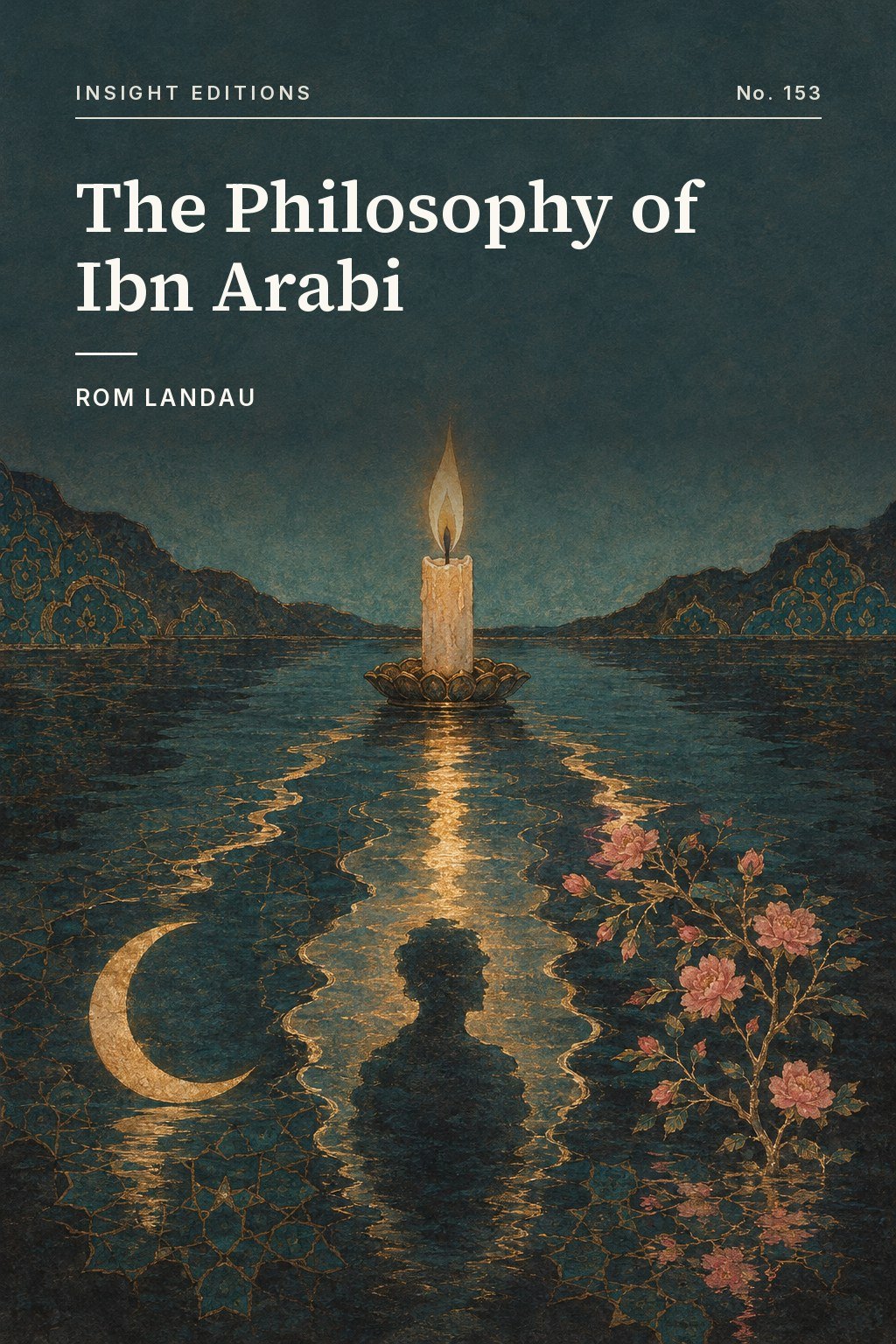
Insight Editions · No. 153
The Philosophy of Ibn Arabi
Rom Landau
Rom Landau presents Ibn Arabi’s metaphysics of divine unity, relating its account of creation, the soul, love, and spiritual knowledge to selected poems and commentaries.
A study guide to The Philosophy of Ibn Arabi by Rom Landau. Shared free for personal reading; not for sale and not endorsed by the authors or publishers. Please read and buy the original.
About the Book
Rom Landau's short book, first published in 1959, sets out to introduce the thinker he calls possibly the most significant in Islam to readers who knew only his reputation for pantheism and obscurity. It gives a life, a placing in Islamic philosophy, fifteen themes, a set of texts and, in Part Two, thirteen odes from the Tarjuman al-Ashwaq with their commentary.
Landau is modest about his aim. He says the book touches only upon some of the main ideas and claims no special originality, leaning on Asin Palacios, Nicholson and Affifi, whose 1939 study he calls the clearest survey in English. His own contribution is a single strong reading: Ibn Arabi as the one Muslim thinker who removed duality altogether. Landau's word for it is non-dualism, preferred over pantheism.
Why this book still matters
Landau wrote as Professor of Islamics at the College of the Pacific in California. He knew that Ibn Sina, al-Ghazali, Ibn Rushd and al-Farabi were already familiar names in English, while Ibn Arabi remained a rumour of pantheism and difficulty. The book is short by design. It is not a commentary on the Fusus or the Futuhat, and it does not claim to settle debates that Affifi and Nicholson left open. What it does claim is that one thesis organises the whole: there is nothing but God, and the many are His manifestations. Everything that follows (creation, soul, evil, free will, fana', the Logos, heaven, love and the Tarjuman) is tested against that claim.
2. Vision, not syllogism. Aristotelian logic is quantitative and blind to essence; the mystic's instrument is a direct awareness of Reality.
3. One system across fifteen themes. The same principle that explains creation also explains dreams, sin, the Perfect Man and the love poetry of the Tarjuman.
Argument map
Chapter map
What Landau does not do
He does not offer a full biography. He does not translate the Fusus or Futuhat himself. He does not settle the Arabic of contested passages. He does not write a spiritual manual in the manner of al-Muhasibi or al-Ghazali; he notes that Ibn Arabi gives little advice on conduct. The book is a map of ideas. Readers who want the poems without the map can begin at Part Two; readers who want the thesis without the odes can stop after Theme O. The Synthesis at the end restates the map as takeaways and practice points that stay inside Landau's own distinctions.
1. Life, Lineage and Method
Chapters I to III give a brief life, place Ibn Arabi at the end of a long Muslim debate about unity, and describe a doctrine that is visionary in origin, Quranic in language and difficult by design.
A life in two halves
Landau traces the family to the Arab tribe of Tayy and sets the birth at Murcia in A.D. 1164, in a Spain ruled by Arab princes from the beginning of the eighth century. Cordova and Seville, he says, surpassed Paris and possibly Constantinople as centres of learning. At eight the boy was in Lisbon studying the Quran and law; Seville, capital of the Almohades since 1170, held him for some thirty years. After travels in Spain and Morocco he made the pilgrimage to Mecca in 1201, partly to escape political upheaval and the hostility of the ulema, and never returned west. Syria, Iraq and Asia Minor followed. Gifts from princes went to the poor. He died in Damascus in 1240, where his grave can still be visited.
Of the books, he himself names almost three hundred. Landau singles out the Fusus ("Gems of Philosophy" or "The Bezels of Divine Wisdom") and the Futuhat as written in Mecca and Damascus. The life, as Landau tells it, has a clear hinge: a Western formation under the Almohades, then an Eastern maturity after the pilgrimage. Everything doctrinal in the book is drawn from that Eastern period of writing and teaching.
| Phase | Place | Landau's note |
|---|---|---|
| Childhood | Murcia, then Lisbon | Quran and law from age eight |
| Formation | Seville (Almohad capital from 1170) | Some thirty years |
| Travel | Spain and Morocco | Before the break eastward |
| Pilgrimage | Mecca, 1201 | Escape from upheaval and ulema hostility |
| East | Syria, Iraq, Asia Minor | Gifts passed to the poor |
| Death | Damascus, 1240 | Grave still visible |
The problem he inherited
Chapter II frames all of Islamic philosophy around one difficulty: how a God of absolute unity relates to a multiple and imperfect universe, and how His will and attributes avoid splitting Him. Greek thought arrived from Aristotle through Philo, Plotinus and Origen. Landau runs through the answers: Mu'tazili rationalism, the "intellectual sterility" of the Ash'arites, Ibn Sina's world spirits, al-Farabi, and al-Ghazali's revolt. Intermediary beings, he says, simply relieved God of all responsibility for the world.
Al-Ghazali's Tahafut, early in the twelfth century, attacked the philosophers, but its solutions were "essentially linguistic ones": knowledge was renamed will, necessity renamed creation. Landau lists further Ghazalian moves: God knows particulars; space is finite and time infinite; the body is immortal. Ibn Rushd's reply, the Tahafut al-Tahafut, in Landau's view did not really invalidate the attack. He adds Western parallels (Descartes; Kant's Ding an sich beside the Arabic shay'; Leibniz's monad beside the atom) and then names the real failure: Aristotelian logic is quantitative and blind to quality and essence. The mystic's instrument is different, vision understood as "a direct awareness of Reality, unencumbered by intellectual interference". Landau's image is the difference between light from the sun and light painted on a canvas. The artist, like the mystic, sees the thing itself.
What kind of doctrine
Chapter III calls Ibn Arabi a seer and mystic rather than a philosopher, though he carried a philosopher's equipment, "however unorthodox and even fantastic". The sources are many and assimilated: Sufis of Almeria; Hallaj as "pantheistic predecessor"; Eastern Sufis; Ash'arites, Mu'tazilah, Carmathians, Ikhwan al-Safa; Aristotle in neo-Platonic garb, Plotinus, Stoics, Zoroastrian and Manichaean strands. On Ibn Masarra, Landau follows Affifi in giving less weight than Asin did. The Quran and Hadith remain the chief basis, yet they are interpreted to suit what Landau calls a peculiarly uncompromising system.
Landau rejects the label pantheism, which he thinks is little more than an ennobled form of materialism, and prefers non-dualism. On this reading Ibn Arabi is the only Muslim thinker to dissolve the duality outright: "A splendid system of perfect non-dualism rises before us". He also, oddly, writes of him as a Western philosopher, rooted in a Semitic Weltanschauung (p.24), presumably in the Andalusian sense. That phrase is flagged among the printed oddities in Part 8.
The orthodox heard incarnation (hulul) and union (ittihad) and were revolted. Books were copied for blessing even when their doctrine was feared; danger, Landau says, was for the uninitiated. Defenders came later: al-Firuzabadi (died A.D. 1414), al-Suyuti (d. 1445) and, a century later, al-Sha'rani. In the West, Landau follows Asin's 1926 Islam and the Divine Comedy: Dante took over the geography of heaven and hell, and Ramon Lull also shows the influence.
2. God, Creation, the One and the Many
Themes A to C carry the metaphysics. The step from one God to only God is the whole system.
A. God
The Quran says there is but one God; Ibn Arabi, in Landau's phrasing, holds that "there is nothing but God". That move from monotheism toward what looks like pantheism leaves no place for intermediaries: the result is absolute unification. God shows Himself in an infinity of forms, and each believer receives Him according to capacity. The heart is all-receptive; Landau's witness is the ode My heart is capable of every form (Nicholson, Tarjuman p.19, vv.13-15).
Landau separates two Gods. The finite God of religion is the God of belief, of virtue and sin. The infinite God of mysticism lies beyond such contrasts; as Landau puts it, this is an utterly a-moral God. Man needs God, and God needs man in order to manifest Himself to Himself. Essence without attributes is absolute; things are His Attributes. Relative and absolute meet; in the final unity, knower, known and knowing are one.
B. Creation
Creation is not an event but an eternal process. Landau notes the Ash'arite picture of constant annihilation and re-creation, then states Ibn Arabi's view plainly: God does not create anything. "Creation means simply the coming into concrete manifestation of something already existing (in God)." This agrees with most Muslim philosophers and is at complete variance with al-Ghazali's creation afresh. God, on this reading, is a name for the laws within things.
Divine Names are limited form and potential; Attributes are a Name manifested in the phenomenal world. The Names are more than Platonic Ideas. Prototypes, the a'yan, sit as latent realities (a'yan thabita) in God's knowledge. The Logos, or Spirit of Muhammad, stands as the principle through which manifestation is ordered. Creation is perpetual manifestation, never production from nothing.
C. The One and the Many
There is one Reality, al-Haqq, the word in Hallaj's cry Ana al-Haqq. The many exist only as its manifestations (khalq). Against Plotinus, the One is not the cause of the many but their essence. Landau's image draws the line between emanation and identity: "To paint the picture of a child is not identical with giving birth to a child."
Mirrors carry the rest. Images in a mirror are He when seen as reflections and not He when taken as final realities. Hence it is permissible, in Landau's misspelt word permissiable (p.32), to say both I am He and He is I and I am He and not He. God is at once transcendent and immanent.
| Theme | Claim | Image Landau uses |
|---|---|---|
| A. God | Nothing but God; two Gods distinguished | All-receptive heart; capacity of the vessel |
| B. Creation | Manifestation of what already is in God | Essence / Names / Attributes ladder |
| C. One and Many | One Reality; many as mirrors | Painting a child vs giving birth |
3. Soul, Knowledge, Things and Dreams
Themes D to H turn from God to the knower. Union is recognition, knowledge is light, stones know God after their fashion, and dreams come in three kinds.
D. The soul
Union with God is not a journey's end but, in Landau's words, "a becoming aware of a relationship that has always existed". He illustrates with the liver and the teeth: organs of one body that need not meet to belong together. Man never becomes God. The Universal Soul is not divided into parts, since division is a matter of quantity and the soul is a matter of quality. Man is spirit, soul and body; the soul is rational, vegetative and animal; and the body is real being, not a prison. For the rational soul Landau cites a description through Asin's paper at the Oriental Congress in Algiers, 1905: that perfect and simplest substance which, in the Risala fi Ma'na al-Nafs, stands as the soul's own definition of itself.
E. Knowledge
Al-Kindi had four spirits, Ibn Sina internal faculties. For Ibn Arabi knowledge is innate, forgotten and remembered. Thinking means relating concepts; Landau borrows Leonardo: To understand is to set up a relationship. Light, al-nur, is the source of knowledge and a mode of the Universal Reason.
God is Light par excellence, and the rule follows: what is not Light cannot apprehend Light. Ordinary knowledge passes along a chain of faculties; the mystic's heart sees directly with the inward eye.
F. Inanimate objects
Stones and plants show the Divine rationality through the laws within them. Man alone knows God completely; angels know Him less, only in His transcendent aspect. Stones know God's stoniness, Landau writes, that is, the aspect of God shown through them. The claim is not sentimental. It follows from Theme B: if God is the name for the laws within things, then each thing manifests the Name that is its own reality.
G. The Thing
From the Mu'tazilah comes the shay', a thing knowable whether or not it exists. Ibn Arabi grades non-being. Some things exist on one plane and not another: intellectual concepts such as a man with a hundred heads or wet fire, and possibles such as a black swan, a telephone or a jet plane, Landau's own modern examples. Only pure non-being is unthinkable. The Ikhwan al-Safa called the word the body of the thought, and Landau's heading on the index sums up the point: thought cannot exist without language.
| Grade | Example (Landau) | Status |
|---|---|---|
| Pure non-being | The unthinkable | No shay' at all |
| Intellectual concept | Man with a hundred heads; wet fire | Exists as concept, not in the world |
| Possible | Black swan; telephone; jet plane | May exist on another plane or time |
| Phenomenal | Ordinary things | Manifest Attributes |
H. Dreams
Landau finds in Ibn Arabi what Jung called archetypal dreams. Imagination, khayal, does the work. Three kinds are distinguished.
| Type | Source | Needs interpretation? |
|---|---|---|
| Ordinary | Imagination magnifying daily impressions | No value to interpret |
| Symbolic | Universal Soul, the Guarded Table, distorted on the way | Yes: symbols must be read (Affifi p.132) |
| Direct | Revelation, like wahy and ilham | No: received plainly |
4. Cause, Evil and Will
Themes I to K are where Landau tests non-dualism hardest. If there is nothing but God, then lightning, sin and choice all have to be found inside Him.
I. Cause and effect
Landau calls this the hardest test of the system. God is the source of lightning and of the destruction it causes; He is painter and picture at once. Active and passive meet in man: passive as a phenomenon, active in so far as he is aware of his God-ness. Duality of cause and effect presupposes space, and space belongs to the world of appearance. Opposites, the index puts it, exist only in our minds. Landau's hit-someone illustration makes the same point: the blow and the pain look like two events only because the mind splits what is one act of the Real.
J. Good and evil
Ibn Arabi offers two theories, and Landau lays them side by side.
| First theory | Second theory | |
|---|---|---|
| Claim | Evil is non-existence, the absence of a positive quality | Perfection must include imperfection |
| Examples | Darkness, weakness, the lie, illness | A colour scheme needs its darker tones |
| Status of evil | Subjective, not an objective reality | Necessary to the whole |
| Landau's illustration | Electricity and lightning; penicillin and Fleming | The universe of God must contain imperfections |
Sin, ma'siyah, is handled through the gap between command and decree. Prophets carry God's commandments, but God does not always will that they be fulfilled. He wills the act, not the evil within it; sin is disobedience to a mediate religious command (Fusus p.319 in Landau's citation). Morality is purely human, though it returns, Landau notes, by the back door: it is qualitative, and without it the Names of the Forgiver (Ghaffar), the Merciful (Rahim), the Punisher (Mu'adhdhib) and the Guide (Hadi) would mean nothing. His verdict: "the decisive factor for him is not the moral aspect of an action but its reality".
K. Free will
Against the Jabriyyah, the Ash'arites and the Mu'tazilah, Ibn Arabi takes his own line. An acorn becomes an oak, never a maple: choice is inherent in a thing's nature. Will differs from desire, shahwah; true will is spiritual and the privilege of saints. When Ibn Arabi tells a man to praise and blame no one but himself (Fusus p.160), Landau hears no conviction and suspects a "half-hearted sop to the orthodox". He denies free will even to God, who cannot will what does not lie in the nature of the thing. So "human fate is not pre-determined but self-determined." Not even God can perform a miracle that breaks the laws, and man still acts as though he were free.
| Theme | Pressure on non-dualism | Landau's resolution |
|---|---|---|
| I. Cause | Who acts when lightning kills? | Painter and picture are one; duality is mental |
| J. Evil | Is evil a second principle? | Absence, or needed shadow; sin is mediate disobedience |
| K. Will | Is anyone free? | Fate is self-determined by each nature |
5. Fana', Logos, Hereafter and Love
Themes L to O describe the return: how the self passes away, who stands at the centre of the hierarchy, what heaven and hell really are, and why love points beyond itself to beauty.
L. Fana'
Landau opens on the mechanism of mystical experience, with the word the printed twice (p.51). Following Affifi, he notes that only al-Qushayri defines fana' (Risala p.32): the two states together are like a lover's absorption in the beloved. Ibn Arabi reads it differently: consciousness implies a self, so a literal passing away of self would be sleep, a state in which "the mystic is neither with his" self nor with his Lord. He dismisses as ignorance the idea that the mystic becomes God or dies to himself. Landau distinguishes mystical fana' from a metaphysical one, the disappearance of a form at the moment God appears in another form (Fusus p.230), and the instant between attributes is eternity.
The seventh stage is a "Reality in appearance", haqq fi zuhur. Such states can only be told in symbols, love and icy water among them. The goal is true knowledge, and the meaning is God recognizing Himself through man.
M. The Logos
The Logos is the Reality of Realities, the inward aspect of the Godhead and the seat of God's consciousness, whose highest point is the Perfect Man. To him God says, in a hadith Landau cites: "I have not created a creature dearer to me than thee." With thee I give and with thee I take, and with thee I punish. The Perfect Man is Muhammad, not the man of Mecca but the active principle and spiritual head of the hierarchy of saints and prophets. Every prophet is a logos, not the Logos; Landau cites the Quranic Messiah verse as Surah iv, 169. He writes that the relation is like, though by no means indentical (p.57) with, that between the historical Jesus and the Christ of doctrine, and he denies a Christian source: there is no Incarnation and no second Person. The God of Christianity is spirit and love; Ibn Arabi's God is beyond attributes.
Hierarchy, too, changes shape. A man organizes his functions in an inner order, printed heirarchy (p.59), and does not spend his whole strength picking up a pin. The Neoplatonists built a vertical ladder from God down to matter; "Ibn cArabi's system is a centrifugal one" (the name as printed in the scan), with all hierarchies inside one circle. Philosophers said emanation for creation; Ghazali left the intellectual solution in the air; Ibn Arabi, for Landau, alone solved both the mystical and the philosophical problem. The Seal of the Prophets gathers all the Names; each earlier prophet carries one.
N. Heaven and hell
Ibn Arabi borrows the luxuriant vocabulary of the Isma'ilians and Carmathians and draws a map of heaven and hell that Landau, after Asin, traces to Dante. Then he says these are mere words. Hell is the self's realization of its own enslavement; jahannam means distance, and jannah, from a root meaning to conceal, is the Essence concealing multiplicity. Unlike Muhasibi and Ghazali, he gives little advice on conduct. Since he "insists upon the ultimate salvation of every soul", the damned seem accepted "to be on the safe side with the orthodox". Veils are removed eventually. Like Ibn Sina but more charitable: the charity, Landau stresses, is logical, not sentimental.
O. Love and beauty
Love runs through all beings, and worship is impossible without it. Landau quotes: "Love is the cause of all love," and "Were it not for Love (residing) in the heart, Love (God) would not be worshipped." (Fusus pp.387 and 390 via Affifi p.151). He concludes that the formula is "love loves love". True worship is contemplating God lovingly in all aspects, including the contemplator; it is not Hallaj's cry. Love has no intrinsic value of its own. Beyond love stands Beauty, which arrives, he admits, "almost as an anticlimax". Farabi's beauty of order is recalled; an ugly god would be feared, not loved. God loves forms because His beauty is reflected in them; Landau cites the words to David about God's greater yearning, and James Howell's 1642 image of stars seen in water. Beauty and love are cause of creation and of return: a double movement.
| Theme | Claim | Watch-point |
|---|---|---|
| L. Fana' | Awareness, not extinction; seven stages | Printed "the the 'mechanism'" |
| M. Logos | One principle, three aspects; centrifugal hierarchy | indentical; heirarchy; Surah iv, 169 as printed |
| N. Heaven / hell | Vocabulary borrowed; meaning is state | "safe side with the orthodox" is Landau's gloss |
| O. Love / beauty | Love loves love; Beauty beyond as cause | Rembrandt, Utrillo, Howell are Landau's illustrations |
6. The Texts
Chapter V lets Ibn Arabi speak in English translation: Nicholson's Fusus extracts, two passages from the Futuhat, the Kitab al-Ajwiba in Margaret Smith's version, and the preface to the Tarjuman.
Fusus al-Hikam
Landau credits Nicholson as the pioneer, quoting his 1907 Literary History: the vast bulk of the work is difficult, and the theories of the Fusus are hard to understand and harder to explain. The book has twenty-seven chapters, each named after a prophet. Nicholson's further warning stands over the extracts: the author's language is so technical, figurative and involved that a literal reproduction would convey very little. The extracts therefore read like aphorisms.
Substance is One, although its modes are different.
The world of Nature is many forms in One Mirror; nay, One Form in diverse mirrors.
Bewilderment arises from the difference of view.
The extracts move from Abu Sa'id al-Kharraz, who knew God by His uniting of opposites (a note gives him as ob. A.D. 890, in the scan 8go), to the numbers unfolding from One (1, 10, 100, 1000), to Adam as the polishing of the cosmic mirror. Angels are faculties of the Great Man. Man, insan, is to God as the pupil to the eye; he is the bezel on the seal with which the King guards His treasuries and the Vicegerent who guards the universe. Al-Kashani's commentary supplies verses in which the servant praises God and, in the same breath, helps bring Him into existence: He praises me and I praise Him; how can He be independent when I help and aid Him?
On the God of belief the Fusus is blunt. The believer "praises none but himself, for his God is made by himself". Landau pairs this with Junayd's line that the colour of the water is the colour of its vessel, and with the saying I am in My servant's opinion of Me. The absolute God fits no vessel. Two figures from the extracts deserve note. Seth's chapter teaches that the Seal of the saints receives from God alone, and that the gnostic knows and knows not at once. The chapter on Mercy distinguishes two effects: Mercy by essence, which reaches everything, and Mercy by asking, which the mystics request so that Mercy may subsist in them. Mercy closes the selection: "Every one whom Mercy remembers is blessed", and even the pains of hell are brought into being by Mercy.
Al-Futuhat al-Makkiyya
Landau uses the Cairo edition of A.H. 1293, a work of five hundred and sixty chapters written, Ibn Arabi said, at the Prophet's command on the throne. It begins with a youth at the Ka'ba and a three-legged steed, then an ascension through the seven heavens.
The first extract, in Margaret Smith's 1950 Readings (iii p.365), is about veils: even when the veils are raised, the Vision itself is a veil; the eye of His creature does not see Him; and "If it were not for the Light, nothing at all could" be apprehended. Light is called hearing and seeing. The second, Asin's account of the Beatific Vision (printed Beatie Vision, pp.79-80; Sunderland 1926, pp.157-9), places a snow-white hill behind three veils, of glory, majesty and power, and ranks the viewers: prophets, then saints through their prophet, then rational contemplatives, who see less "because reason, like a veil, will" intervene. Reflected light can bring greater enjoyment than the Vision itself, for the elect lose consciousness. Each soul loves its own grade, as a child seeks its mother's breast, and iron the lodestone; higher grades share the lower.
Kitab al-Ajwiba
The Book of Answers states the unity in its plainest form. God is "the One without oneness" and the Single without singleness; He is known not by learning or intellect but in this way: "By Himself He sees Himself" and by Himself He knows Himself. Landau cites the saying "Revile not the world, for God is the world," and the goal of the soul's realization that it is "no other than God", which is not a becoming but a discovery. Your I-ness vanishes; everything is perishing save His Face.
The Ajwiba pushes the point through a saying in which God tells Moses that He was sick and Moses did not visit Him. The commentary draws the conclusion that the existence of the beggar and of the sick is His existence, and so is the existence of every accident and substance. Once the secret of one atom is clear, the secret of all things is clear. Yet the text adds a guard that Landau's thesis needs: you see your actions, attributes and essence as His, though you do not hereby become He or He you. Spiritual death mirrors bodily death: as the dead lose all attributes, praiseworthy and blameworthy alike, so in the spiritual death the self's attributes go, and with them the sense of a separate I.
Tarjuman al-Ashwaq
Nicholson's 1911 version was then the only complete work of Ibn Arabi in English. Landau notes the obscurity of style and the strangeness of its imagery, and also many noble and striking thoughts. The poems were inspired by Nizam, daughter of Makinu'ddin (Aynu'sh-Shams wa'l-Baha), whose aunt was Fakhru'n-Nisa bint Rustam; Landau calls Nizam what Beatrice was for Dante. Whenever I mention a name in this book, Ibn Arabi writes, I always allude to her. When critics read the poems as love poetry, he wrote a commentary at Aleppo at the request of Badr al-Habashi and Isma'il b. Sudakin; the theologian who had doubted him heard part of it read and promised never again to doubt the good faith of the Sufis. His preface explains: "I have used the erotic style and form of expression because men's souls are enamoured of it". Meaning was unclear even to him at points, since he wrote in ecstasy.
| Text | English path | What Landau takes from it |
|---|---|---|
| Fusus | Nicholson extracts | One Substance; God of belief; Mercy |
| Futuhat | Cairo A.H. 1293; Smith; Asin | Ascension map; veils; Beatific Vision ranks |
| Ajwiba | Margaret Smith | Identity without merger |
| Tarjuman | Nicholson 1911 | Nizam; erotic style; bridge to Part Two |
7. The Odes of Desire
Part Two prints thirteen odes (I, II, V, VI, VII, XVI, XX, XXVIII, XXIX, XLIX, LVIII, LIX, LX) with their commentary. The poems speak of camels, gazelles, girls and ruined camps; the commentary turns each image into doctrine.
How the code works
Each verse carries a gloss. Ode I asks whether the beloveds knew what heart they possessed, and answers that the perfect Muhammadan heart is limited by no station. Station is fixed; state is fleeting. Its line "Lovers lose their way in love and become entangled." sets the tone. Ode II's beloved is "a bishopess, one of the daughters of Rome", who baffles learned men, Jewish doctors and Christian priests alike; the commentary reads her as a Christian wisdom, Bilqis as the child of theory and practice (jinn father, human mother), camels as actions (Kor. xxxv,11), peacocks as spirits of actions (intention), and the Torah's four faces as the four revealed Books, which point only to the Names, not to the Essence. Iblis appears as the thought of becoming one with God, the danger of incarnation. The hadith of the hour shared with none save the Lord closes the ode's teaching on intimacy.
| Image | Gloss | Ode |
|---|---|---|
| Camels | Actions; elsewhere faculties and aspirations | II, XVI, XXIX |
| Peacocks | Spirits of actions, that is, intention | II |
| Najd and Tihama | Two contraries that cannot meet | V |
| Shih and ban trees | Inclination and absence | VI |
| Black Stone / friendly women | Covenant; angels round the throne | VII |
| The midmost tent | The intermediate world | VII |
| Hajir | An inaccessible veil; a state that discriminates | XVI, XXIX |
| Lightning | A locus of manifestation of the Essence | XVI, LIX |
| Iraq and Yemen | Wrath and Mercy united | XX |
| Pleiades and Suhayl | Seven scholastic attributes; the Essence | XX |
| New moons | Divine manifestations | XXVIII, XXIX |
| Old heirlooms, new gifts | Knowledge from another; knowledge from God | XXIX |
| Dyed fingers | Phenomenal power hiding the Eternal | XLIX |
| Arak shade | Contemplation of the holy Presence | LVIII |
| Tayba's gazelle | A Muhammadan degree | LIX |
| Han tree of Idam | Absolute purity at the journey's end | LX |
Ode V sets Najd against Tihama, upland against lowland, and the gloss admits the station sought is out of reach: one cannot contemplate the uncomposed apart from the body. Yet the poet keeps longing: "longing is a necessary attribute of" love, and he speaks of being in the state of passing away from passing away. Ode VI pairs shih (inclination) with ban (absence) and the tooth-stick of desert custom. Ode VII circles the Black Stone (Kor. xlviii,10; the scan shows a damaged numeral) and reads the friendly women as angels around the throne (Kor. xxxix,75); its gloss on "Beauty robs him who hath modesty" turns a love proverb into a lesson about awe. Paradise is encompassed by things disliked; the midmost tent is the intermediate world; all save God is unreal. Ode XVI reads camels as faculties, howdahs as actions and the damsels inside as sciences; henna'd fingers, Perdition (Kor. xxv,15), jealousy from regarding others, Hajir as inaccessible veil, and lightning as locus of the Essence, seen like sun or full moon.
What the commentary teaches
The odes restate Part One in another key. Ode XX names Nizam and an Isfahan princess; Iraq and Yemen are wrath and mercy; Hind is the Fall of Adam and Zaynab the removal from saintship to prophecy. It tells Junayd's story of the man who sneezed: "the phenomenal, when it is joined to the Eternal, vanishes and leaves no trace behind". Kharraz returns as the uniter of two opposites (Kor. lvii,3). Its last gloss draws a line: the Pleiades are the seven attributes of the scholastics, Suhayl is the Essence, and the Essence does not enter Creation. Ode XXVIII warns against mistaking a manifestation (new moons at al-Naqa and La'la) for God's own nature, and against theologians who equate our knowledge of God with His: "How far is this from the truth!" Send them back to their pavilions. Ode XXIX ends in humility: boughs are Attributes; old heirlooms are knowledge from another, new gifts knowledge from God; "our knowledge of Him is ignorance and bewilderment and helplessness."
The late odes speak of effort and constancy. Ode XLIX's dyed fingers are phenomenal power hiding the Eternal; the author denies manifestation where Mu'tazilites allow it and Ash'arite Sufis remain undecided (Kor. iii,29; v,59). In LVIII the beloved says "Wish for that which is attainable." and the gloss answers that the station comes by striving, not wishing; and "God never manifests Himself to anything and then becomes veiled from it afterwards". Ode LIX sets Tayba as the Muhammadan degree; the proverb He did not salute until he bade farewell marks gnostics annihilated where the vulgar are not. Ode LX closes at the covenants of the prophets' spirits, the breath of the Merciful from Yemen, and the han tree of Idam: absolute purity at the journey's end.
Reading the selection as a sequence
Landau prints the odes without comment of his own, but the order he chose has a shape. The early odes (I, II, V) set the problem: a heart that no station can hold, a beloved who baffles every learned tradition, and a longing for a station that cannot be reached. The middle odes (VII, XVI, XX) map the journey through pilgrimage places and camel caravans, and their glosses supply the doctrine of attributes and Essence. Odes XXVIII and XXIX turn to the danger of the vision itself: fear of passing away, the temptation to mistake a form for God, and the humbling end in bewilderment. The last odes (XLIX to LX) settle into constancy and arrival, closing at the han tree of Idam.
8. Notes, Slips and Sources
Landau's notes are short references, mostly to Nicholson, Affifi, Asin and Margaret Smith.
Sources named in the book
Landau's preface names three authorities: Asin Palacios, R. A. Nicholson and A. E. Affifi, whose Mystical Philosophy of 1939 (Cambridge) he calls the clearest survey in English. The acknowledgements cite Nicholson's Studies (1921), his Tarjuman (1911) and Margaret Smith's Readings (1950, Luzac), and note that parts of the book first appeared in The Muslim World in January and April 1957. Asin's Islam and the Divine Comedy (John Murray 1926), translated by Harold Sunderland, supplies the Beatific Vision passage and the Dante thesis; Nicholson's Literary History of the Arabs (1907) supplies the warning about the Fusus; al-Kashani's commentary supplies verses on the Fusus; and al-Qushayri's Risala supplies the definition of fana'. The Futuhat is cited from the Cairo edition of A.H. 1293. Asin's Algiers paper of 1905 supplies the rational-soul quotation. James Howell's Instructions for Forreine Travell (1642) supplies the stars-in-water image under Theme O.
| Authority | Work (as Landau cites) | Use in the book |
|---|---|---|
| Affifi | Mystical Philosophy, 1939 | Clearest survey; many Fusus pages |
| Nicholson | Tarjuman 1911; Studies 1921; Lit. Hist. 1907 | Odes, pioneer credit, difficulty warning |
| Asin Palacios | Dante 1926; Algiers 1905 | Beatific Vision; soul quotation; Dante map |
| Margaret Smith | Readings, 1950 | Futuhat veils; Ajwiba |
| al-Qushayri | Risala p.32 | Definition of fana' |
| al-Kashani | Fusus commentary | Verses on mutual praise |
| James Howell | 1642 | Stars in water (Theme O) |
What the notes reveal
The apparatus is thin and second-hand by design. Almost every text of Ibn Arabi reaches the reader through an English translator, and several Fusus pages come via Affifi. That is honest for an introduction, but it means Landau's reading is shaped by Nicholson's and Affifi's choices, and the strong non-dualist thesis rests on extracts rather than on an argument from the Arabic. A.D. 890; first publication 1959.
9. Synthesis
A revision map of Landau's study: takeaways, frameworks, closer look, Who's Who, and practice points that stay inside the book's own spiritual distinctions.
Across the book
Chapters I to III give the life (Murcia 1164 to Damascus 1240), place Ibn Arabi at the end of the unity-versus-plurality debate, and name the doctrine non-dualism rather than pantheism. Vision, not syllogism, is the method; difficulty is by design.
Themes A to C state the metaphysics: nothing but God; creation as manifestation; one Reality in many mirrors.
Themes D to H turn to the knower: union as awareness; knowledge as light and recollection; stones knowing God's stoniness; three kinds of dream.
Themes I to K are the hardest test: cause and effect as appearance; evil as absence or needed shadow; fate as self-determined.
Themes L to O describe the return: seven stages of fana'; the Logos triad and centrifugal hierarchy; heaven and hell as states with ultimate salvation; love loving love, and Beauty beyond as cause.
Chapter V and Part Two let the texts speak: Fusus, Futuhat, Ajwiba, and thirteen Tarjuman odes whose glosses restate Part One in the erotic code.
Twenty takeaways
| # | Takeaway |
|---|---|
| 1 | The thesis is one word: non-dualism. Landau refuses pantheism as ennobled materialism. |
| 2 | Islamic philosophy is one long struggle with a single God and a plural world. |
| 3 | Intermediaries kept duality alive. They moved the problem, not solved it. |
| 4 | Al-Ghazali's answers were linguistic in Landau's verdict; the question of essence remained. |
| 5 | Ibn Arabi's tool is vision, a direct awareness of Reality without intellectual interference. |
| 6 | There is nothing but God; the many are His manifestations. |
| 7 | Creation is manifestation, a perpetual process, not production from nothing. |
| 8 | God of belief is finite and made by the believer; God of mysticism is beyond all forms. |
| 9 | God needs man to manifest Himself to Himself; the heart is all-receptive. |
| 10 | Union is awareness of a relation that always existed; man never becomes God. |
| 11 | Knowledge is innate, a matter of light, remembered rather than acquired. |
| 12 | Even stones know God after their kind; angels know only the transcendent aspect. |
| 13 | Dreams come in three kinds; only the middle kind needs interpretation. |
| 14 | Evil is absence, or the shadow perfection needs; sin is mediate disobedience. |
| 15 | Fate is self-determined: each thing follows its nature; even God wills nothing against it. |
| 16 | Fana' is not extinction but seven stages ending in Reality in appearance. |
| 17 | Logos, Reality of Muhammad, Perfect Man are one principle seen three ways. |
| 18 | Heaven and hell are states; every soul is finally saved. |
| 19 | Love loves love, and beauty stands beyond it as cause of creation and return. |
| 20 | The Tarjuman says all this again in the language of desert love poetry and its gloss. |
Frameworks and mental models
| Framework | Where | Use |
|---|---|---|
| Essence, Names, Attributes | Theme B | How one God appears as many |
| Two Gods | Theme A; Fusus | God of belief vs God of mysticism |
| Faculty chain / inward eye | Theme E | Ordinary versus mystical knowing |
| Three dreams | Theme H | Grading inner experience |
| Two theories of evil | Theme J | Absence; needed imperfection |
| Command and decree | Theme J | Sin without divine contradiction |
| Will vs desire (shahwah) | Theme K | Spiritual will; self-determined fate |
| Seven stages of fana' | Theme L | Mapping the mystical path |
| Logos triad | Theme M | Metaphysical, mystical, human |
| Centrifugal hierarchy | Theme M | All levels inside one circle |
| Double movement | Theme O | Beauty outward, love returning |
| Poem and gloss | Part Two | Erotic surface; doctrinal key |
- Second-hand English. Almost every text reaches the reader through Nicholson, Affifi, Asin or Margaret Smith; the non-dualist thesis rests on extracts.
- Motive-reading. Half-hearted sop and to be on the safe side with the orthodox are Landau's judgments of motive.
- Modern illustrations. Penicillin, telephone, jet plane, Rembrandt, Utrillo, Howell's stars are teaching aids, not Ibn Arabi's images.
- Essence does not enter creation. Ode XX's gloss and the Ajwiba's do not become He guard against reading non-dualism as merger; Landau asserts perfect non-dualism more than he tests it against those passages.
Who's Who (book dates only)
| Name | Role in this book |
|---|---|
| Ibn Arabi | b. Murcia 1164; d. Damascus 1240; almost three hundred books named by himself |
| Abu Sa'id al-Kharraz | ob. A.D. 890; uniting of opposites |
| al-Ghazali | Tahafut at the beginning of the twelfth century |
| Ibn Rushd | Tahafut al-Tahafut; reply that did not invalidate |
| Hallaj | pantheistic predecessor; Ana al-Haqq |
| Junayd | water and vessel; sneeze story in Ode XX |
| al-Qushayri | Risala definition of fana' |
| Nizam | daughter of Makinu'ddin; Tarjuman's muse; no date given |
| al-Firuzabadi | defender, died A.D. 1414 |
| al-Suyuti | defender, d. 1445 |
| al-Sha'rani | defender, a century later |
| Nicholson | Literary History 1907; Tarjuman 1911; Studies 1921 |
| Asin Palacios | Algiers 1905; Dante book in English 1926 |
| Affifi | Mystical Philosophy, 1939 |
| Margaret Smith | Readings, 1950 |
| Rom Landau | author; College of the Pacific; book first published 1959 |
Applying It (inside the book's own distinctions)
2. Prefer vision to paint. Awareness over bare syllogism.
3. Notice the relation already there. Union as recognition.
4. Separate command from decree. Hold morality without dualism.
5. Honour each nature. Self-determined fate; will over desire.
6. Walk the seven stages as map, not trophy. End in Reality in appearance.
7. Keep longing; refuse merger. Essence does not enter creation; bewilderment remains knowledge.
10. Glossary
Terms as Landau uses them, in the book's own transliteration without diacritics. Meanings follow his exposition in Themes A to O and the texts, not a modern technical lexicon.
| Term | Meaning in the book |
|---|---|
| al-Haqq | The Real; the one Reality behind all forms |
| khalq | Creation; the many as manifestation |
| a'yan thabita | Latent realities; prototypes in God's knowledge |
| Names | Divine forms in potential; limited form |
| Attributes | Names made manifest in the phenomenal world |
| non-dualism | Landau's term for the system, preferred to pantheism |
| pantheism | Label Landau rejects as ennobled materialism |
| hulul | Incarnation of God in a creature; rejected |
| ittihad | Union as becoming one with God; rejected |
| shay' | The Thing; knowable whether or not it exists |
| khayal | Imagination, the faculty of dreams |
| Guarded Table | Ibn Arabi's name for the Universal Soul (dreams) |
| al-nur | Light, the source of knowledge |
| mufakkirah | The faculty of understanding in the knowledge chain |
| ma'siyah | Sin as disobedience to a mediate command |
| mashi'ah | God's decree or will |
| shahwah | Desire, as distinct from spiritual will |
| jabr | Compulsion; the determinist view he rejects |
| fana' | Passing away; awareness of the oneness of all |
| fana' al-fana' | Passing away from passing away (stage six) |
| haqq fi zuhur | Reality in appearance, the seventh stage |
| Logos | Reality of Realities; God's consciousness |
| Perfect Man | The Logos in human form; the microcosm |
| Haqiqat al-Haqa'iq | Reality of Realities; First Intellect / Spirit of Muhammad |
| kalimat | Logoi; the prophets as words of God |
| jahannam | Hell, read as distance |
| jannah | Paradise, read as concealment of multiplicity |
| wahy, ilham | Revelation and inspiration (direct dreams) |
| insan | Man; pupil of the eye; microcosmic being (kawn jami') |
| nisab | Relations; plurality as non-existent relations |
| Fusus al-Hikam | Bezels of Wisdom; twenty-seven prophet chapters |
| al-Futuhat al-Makkiyya | The Meccan Revelations, five hundred and sixty chapters |
| Kitab al-Ajwiba | Book of Answers; identity without merger |
| Tarjuman al-Ashwaq | Interpreter of Desires; odes with commentary |
| Ghaffar, Rahim, Mu'adhdhib, Hadi | Forgiver, Merciful, Punisher, Guide: Names that need a moral plane |
About this book
The Philosophy of Ibn Arabi by Rom Landau, 1959. This is a chapter-by-chapter study of the book, with summaries, maps, tables and diagrams; short quotations keep their page references. It is shared free for personal study, is not for sale, and is not endorsed by the author or publisher. Please read and buy the original.
Insight Editions · rajeshrmahapatra.com/insight-editions