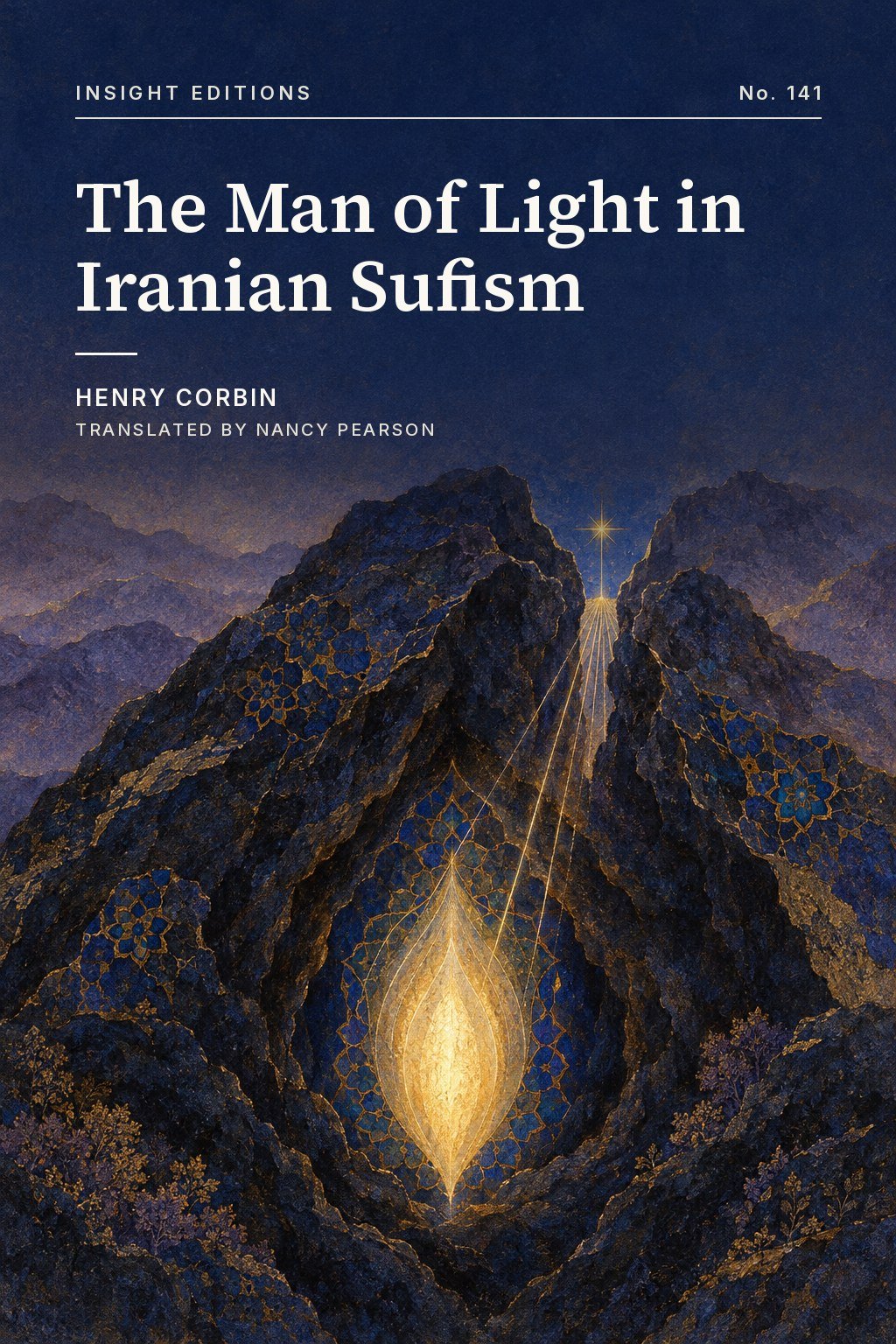
Insight Editions · No. 141
The Man of Light in Iranian Sufism
Henry Corbin · Translated by Nancy Pearson
Henry Corbin examines Iranian Sufi teachings on the human being’s luminous nature, celestial guide, spiritual orientation, and development through the writings of five Persian masters.
A study guide to The Man of Light in Iranian Sufism by Henry Corbin, translated by Nancy Pearson. Shared free for personal reading; not for sale and not endorsed by the authors or publishers. Please read and buy the original.
Overview
Henry Corbin (1903-1978) wrote The Man of Light in Iranian Sufism as a study of one experience: the moment a seeker meets a guide of light who turns out to be his own celestial counterpart. The book follows that meeting through Hermetic recitals, Zoroastrian angelology, Manichean psalms and five Iranian masters, from Sohravardi (1191) to Alaoddawleh Semnani (1336), and ends with Goethe's theory of colour.
This copy is Nancy Pearson's English translation (Omega Publications, 1994), with a short new preface. The book is dense, learned and polemical. Corbin does not tell a history; he builds a phenomenology, a description of how things appear to the one who experiences them. His central claim is simple to state and hard to absorb: the human being has a dimension of light, a "man of light", and spiritual life is the growth and liberation of that dimension until it meets its heavenly partner. Everything else in the book, the cosmic north, the green light, the black light, the seven prophets of your being, is a way of mapping that growth.
Two ideas carry the argument. The first is orientation: the seeker's Orient is not east on a map but north, at the celestial pole, above rather than ahead. The second is bi-unity: the relation between the man of light and his guide is neither identity nor separation. Corbin writes it as 1 x 1, one multiplied by one, not 1 = 1 or 1 + 1.
About This Copy
The 1994 edition opens with a new preface by Zia Inayat Khan. It presents Sohravardi's Wisdom of Illumination, in which the "I" of a self-aware being is pure immaterial light, and recalls that Louis Massignon gave Corbin a lithograph of Sohravardi's main work, after which Corbin called Sohravardi his shaykh. The preface credits Corbin with the word "imaginal" and with some two hundred editions, books and articles, and closes with the Prophet's prayer for light. Corbin's own text dates from 1971 and the translation from 1978; the publisher notes two minor corrections.
Argument Map
Chapter Map
| Edition part | Book chapter | Pages | Core move |
|---|---|---|---|
| Part 1 | I. Orientation | 1-12 | The pole, symbols of the north, two darknesses |
| Part 2 | II. The Man of Light and His Guide | 13-38 | Perfect Nature, Nous, Fravarti and Daena, the Twin |
| Part 3 | III. Midnight Sun and Celestial Pole | 39-60 | Eran-Vej, Hurqalya, Ruzbehan's visions, Sraosha |
| Part 4 | IV. Visio Smaragdina | 61-98 | Najm Kobra: dhikr, colours, the Witness, the scales |
| Part 5 | V. The Black Light | 99-120 | Light without matter, Najm Razi, the Rose Garden |
| Part 6 | VI. The Seven Prophets of Your Being | 121-144 | Semnani, colours and iconography, Goethe |
Page ranges follow the book's contents page.
Ten Ideas to Carry Away
- Orientation comes first. Without a pole above, one cannot tell heaven from hell or angel from devil.
- The true Orient is the cosmic north, the eighth clime, reached only by inner ascent.
- There is an intermediate world, the mundus imaginalis or Hurqalya, where spirit takes body and body becomes spirit.
- There are two darknesses: the darkness that holds light captive and the divine Night that is the source of light.
- Every soul of light has a heavenly counterpart: Perfect Nature, Daena, the Twin, the Witness in Heaven.
- The relation is 1 x 1: two, yet one; neither fusion nor distance.
- Like is known only by like. The seeker is a particle of the light he seeks.
- Coloured lights are signs that measure the seeker's state, and they can be checked against inner feeling.
- Superconsciousness is not the unconscious. What lies above awareness differs in kind from what lies below it.
- Spiritual life is individual. No collective, church or society can stand in for the personal guide.
Reading Paths
Part 1. Orientation
The opening chapter sets the compass. Before any doctrine, Corbin asks where the seeker is facing, and answers that the spiritual Orient lies at the celestial pole, in the cosmic north, and is reached by going up, not forward.
The Pole of Orientation
Orientation is a primary phenomenon. A human being stands among four cardinal points, but a fifth direction is the one that counts: the vertical. The Quest for the Orient is not a journey to any place on our maps. For the Iranian mystics the Orient is the eighth clime. The old geography knew seven climes (keshvar); the eighth lies outside them, at the heavenly pole, and only ascensional progress can reach it.
Corbin defends the old geocentric picture on these terms. It was never mainly a claim about astronomy; it worked like a mandala, a map of the soul's orientation. To lose sight of the north, in this language, is to lose the ability to tell heaven from hell or angel from devil. He contrasts this with a Western mind absorbed by history: the Heavens of Light of which the Sufis speak are closed to any astronautic investigation.
Symbols of the North
Ex Oriente lux, light from the East, is usually read as the daily sunrise, a world of alternating day and night with twilights in between. Corbin points to a different light: the light of the north, the midnight sun, the aurora, a Night that is itself luminous. These are not decorations. They are Archetype-Images, organs of the active Imagination, and they open onto the mundus imaginalis ('alam al-mithal), the heavenly Earth of Hurqalya.
The mundus imaginalis is a concrete spiritual universe, not a set of concepts. In it the archetype of a species is the Angel of that species, and rational abstraction, Corbin says pointedly, works only with the remains of an Angel. The knowledge suited to this world he calls hierognosis.
Two Darknesses
The chapter's most important distinction is between two darknesses. One is the darkness that imprisons light; the other is the Night of light, the black Light, the book from which light comes. Avicenna's visionary recitals already separate the Darkness at the approaches to the Pole from the darkness of the extreme Occident of matter. Corbin takes this as the key to the whole book. It gives three planes: the luminous Night of superconsciousness, the day of consciousness, and the dark night of the unconscious.
Upper darkness: excess of light, the hidden God, the Night that makes seeing possible. One must be escaped; the other must be approached.
The Figure That Returns
In the twelfth century, the sixth of the hegira, a figure reappears in Iranian spirituality. Corbin introduces three masters in whom it is clearest:
| Master | Printed date | Region | Contribution |
|---|---|---|---|
| Sohravardi | d. 1191 | North-west Iran; martyred at Aleppo | Revived ancient Persian wisdom; the Perfect Nature |
| Ruzbehan of Shiraz | d. 1209 | South-west Iran | Imam of the "Fedeli d'amore"; visions of the pole |
| Najmoddin Kobra | d. 1220 | Transoxiania | Coloured photisms; the green light; the Witness in Heaven |
| Alaoddawleh Semnani | (1336) | Semnan | Seven subtle organs; passage from black to emerald light |
Sohravardi linked Plato and Zarathustra three centuries before Gemistus Pletho did the same in Byzantium. Kobra speaks of a "Witness in Heaven" and of a suprasensory personal guide. The formula for the relation is the saying, "He who knows himself knows his Lord", read as bi-unity: the seeker and his guide are like the two foci of an ellipse.
n + 1: abstract monotheism; God is one more being added to the many.
1 x 1: Corbin's formula; each soul is in a unique relation with its own Lord, and the product stays one.
Against the Sense of History
Corbin sets this spirituality against what he calls the sense of history. The masters he studies tell a secret history of an invisible humanity, made of events in the soul rather than events in the calendar. Semnani's account of the passage from black light to emerald light describes the completed growth of a subtle body, the resurrection body. The book's direction is set from the first pages: upward, inward and individual.
Part 2. The Man of Light and His Guide
Chapter II gathers one figure under many names: the Perfect Nature of the Hermetists, the Nous that appears to Hermes, the Shepherd of Hermas, the Zoroastrian Fravarti and Daena, the Heavenly Twin of Mani. Corbin's claim is that these are not borrowings but recurrences of a single archetype.
The Man of Light
Corbin begins with a warning against easy talk of syncretism and then names his subject. The man of light (shakhs min nur, shakhs nurani) corresponds to the Greek photeinos anthropos of the alchemist Zosimos of Panopolis (third century). Zosimos sets the earthly Adam, whose four letters stand for the four cardinal points, against Phos, the man of light, held captive in him. A counterfeiter, the Antimimos, tries to pass himself off as the true guide. In the Pistis Sophia, Mary Magdalene speaks of the man of light within her who has understood.
This figure is not a collective guide or a universal Man. Corbin is firm: the guide is personal, the counterpart of one soul. He cites a Valentinian idea that Christ's Angels are Christ himself, in the form proper to each.
Perfect Nature
The fullest Hermetic text is the Ghayat al-Hakim, the Goal of the Sage, attributed to Majriti and probably of the eleventh century, linked with the Sabeans of Harran. There the Perfect Nature (al-tiba' al-tamm) is called the philosopher's Angel. Hermes is asked about the root and key of wisdom and answers that it is the Perfect Nature. Then he tells his recital: he entered a dark underground vault, could not light his lamp for the winds, and a figure of great beauty taught him to place the lamp under glass and dig at a certain spot. The figure said: "I am thy Perfect Nature."
Abu'l-Barakat Baghdadi, of Jewish origin and converted late, who died about 560/1165 at the age of ninety, asked why the Active Intelligence should be one for all souls. Souls, he thought, come in families, each with its own guide. In his words: "Some souls learn nothing except from human masters; others have learned everything from invisible guides known only to themselves."
Sohravardi addresses a psalm to his Perfect Nature. Its most striking line holds the paradox of the whole book: "Thou art the Spirit who gave birth to me, and Thou art the Child to whom my spirit gives birth." The guide is at once parent and offspring. Corbin links this to the old formula of the soul, like Maryam or Fatima, becoming the mother of her father (omm abi-ha).
The Song of the Pearl and the Exile
Sohravardi's Recital of Occidental Exile parallels the Song of the Pearl in the Acts of Thomas. A prince is sent to the west, eats the food of forgetfulness, receives a letter carried by a bird and recovers his robe of light, which is his own image. One version says, "we were two, separated from one another but nevertheless only one". In Sohravardi the exile is imprisoned in a well in the city of Qayrawan, a hoopoe brings the message, and he climbs Mount Qaf to the Emerald Rock, where his guide tells him: "He contains me just as I contain you."
Corbin adds a social note. When the criteria of a culture become secular, the exile who will not settle is no longer called a heretic but a madman or a misfit.
The Nous of Hermes and the Shepherd
In the Poimandres, the Nous appears to Hermes and says, "I am with thee everywhere." In the Shepherd of Hermas a figure in a shepherd's dress sits beside Hermas, says he has been sent to live with him all his days, and when doubted, reveals himself: "I am the Shepherd to whose care thou hast been entrusted." Corbin sets up an analogy: the shepherd stands to the Magnificent Angel as the Perfect Nature stands to Gabriel, the Angel of humanity.
Fravarti and Daena
In Zoroastrian thought every being of light has a Fravarti, a feminine heavenly archetype; even Ohrmazd has one. The Fravartis chose to descend into the material world to fight there, which is why they are called "those who have chosen". Corbin notes (n. 29) that Fravarti is the original form; Fravashi came from a mistaken association.
Daena is the soul's own transcendent self, met after death. At the Chinvat Bridge the soul of the faithful meets a maiden of great beauty, who says: "I am thine own Daena." The soul that betrayed its vocation meets instead a hideous figure, its own shadow.
The xvarnah, the light of glory, is both glory and destiny. Corbin compares the Fravartis with the Walkyries and cites Gerhard van der Leeuw on Wagner's Brünnhilde, who announces death to the hero: "Who sees me bids farewell to the daylight of this life." Corbin insists this is not allegory but a primordial Image. The Ismaili view puts it sharply: a human is a potential angel or a potential demon. Nasiroddin Tusi gives the process: "His thought becomes an Angel proceeding from the archetypal world, his speech becomes a spirit proceeding from this Angel, his action becomes a body proceeding from this spirit."
The Heavenly Twin
The Mandaeans speak of an exact double in the world of light and of the scales of Abathur. A Mandaean hymn has the soul say, "I go towards my likeness". Mani's Twin (qarin, taw'am) appeared to him when he was twenty-four, and his last words, as Corbin gives them, were: "I contemplated my Double with my eyes of light."
| Tradition | Name of the counterpart | Function |
|---|---|---|
| Plato, Plotinus | daimon paredros | companion spirit |
| Apuleius | testis, custos | witness, guardian |
| Philo | the true man, Nous | the real self in the self |
| Upanishads | sakshin | witness who looks on |
| Cathars | Spiritus sanctus angelicus | angel spirit distinct from the ruling spirit |
| Kobra, Semnani | shaykh al-ghayb, ostad ghaybi | suprasensory personal master |
The Upanishadic image is two birds on one tree: "Two friends with beautiful wings". One eats the fruit; the other does not eat but watches. The common term is witness: martys, testis, shahid. Kobra will call the guide the scales of the suprasensory (mizan al-ghayb), and the green light at the mouth of the well announces him.
Part 3. Midnight Sun and Celestial Pole
Chapter III locates the meeting. It moves from the Zoroastrian Eran-Vej to Sohravardi's eighth clime, from Ruzbehan's visions of the seven stars of the Bear to the angel Sraosha on his cosmic mountain. Every route leads north, to the pole, where the midnight sun shines.
Eran-Vej: A Visionary Geography
Airyanem Vaejah, Eran-Vej, the cradle of the Aryans in Mazdean texts, is for Corbin a visionary geography: the Image comes before the data, not after. In Eran-Vej Yima built his enclosure (var), lit by uncreated and created lights. There, "a year seems to them only a day", and every forty years a couple is born. Corbin sets beside it the Hyperboreans, the Uttara-kurus of India and the perfect squares of the heavenly cities Jabalqa and Jabarsa. Zarathustra, at thirty, yearned for Eran-Vej, and there Vohu Manah (Bahman) told him to cast off his robe and ascend.
Sohravardi and the Eighth Clime
Sohravardi read Plato's Ideas as Zoroastrian angels. Between the world of the archangelic lights and the world of the senses lies the mundus imaginalis, at the ninth Sphere. This intermediate world is the eighth clime, Hurqalya, and its mountain is Qaf, identified with Alborz (Haraiti Bareza), the psycho-cosmic mountain whose keystone is the Emerald Rock. It is the place "where what is bodily becomes spirit and what is spiritual acquires a body."
Hermes' Vigil
Sohravardi's Hermes keeps vigil in the temple of light. A pillar of dawn appears; the cities of the oppressors are swallowed up. Hermes cries out, "Save me, you who have given birth to me!" and is told: "Seize hold of the cable of the ray of light and rise to the battlements of the Throne." The commentators Shahrazori and Ibn Kammuna read the scene as the experience of the midnight sun: a light seen in the depths of the night, the vision Apuleius describes as the sun at midnight.
Against the Union of Opposites
Here Corbin takes on a major opponent, the psychology that makes the goal of the soul a union of opposites. Christ and Satan, Ohrmazd and Ahriman, are contradictory, not complementary. To unite them into one whole is, for a Zoroastrian, the absurdity of Zervanism. Faust is not the sum of Faust and Mephistopheles. Hermes does not carry his shadow up the mountain; he leaves it behind.
Corbin's view: wholeness by separating from the shadow; the counterpart is a twin of light, not a dark double.
He also rejects the idea of a collective Psyche. The figure appears as a pair, not in a crowd. The north was the direction of prayer, the qibla, for Mandaeans, Sabeans, Manichaeans and the Buddhists of Central Asia. His summary: "vertical dimension is individuation and sacralization; the other is collectivization and secularization."
Ruzbehan's Visions
Ruzbehan of Shiraz recorded his visions in a spiritual diary. He saw oil coming from the constellation of the Bear, and its seven stars as seven apertures of the Throne. The seven stars are the seven abdal, the hidden poles of the world. Their order is walayat, which Corbin refuses to translate as "holiness" and renders as initiation; its members are the Awliya, the Friends of God, the eyes through which God looks on the world. Without the pole, the hidden Imam, the world would collapse.
| Group | Number | Heart modelled on |
|---|---|---|
| First rank | 300 | Adam |
| Second | 40 | Moses |
| Third | 7 | Abraham |
| Fourth | 5 | Gabriel |
| Fifth | 3 | Michael |
| Sixth | 1 | Seraphiel |
| Carried off alive | 4 | Enoch-Idris, Khezr, Elijah, Christ |
The 356 plus the four make 360, the number of degrees of the Sphere. Corbin compares this hidden company with the fourteenth-century Friends of God of the Oberland and with Goethe's poem Die Geheimnisse.
The Pole as Abode of Sraosha
A Parsee scholar's study supplies the last piece. Sraosha (Srosh, Sorush), the angel of initiation, later identified with Gabriel, lives on Haraiti Bareza, the mountain around which sun, moon and stars revolve. A Sanskrit translator rendered it Mount Meru. Hakim Termezi, who died in 898, already spoke of forty abdal. Taoist texts know seven rulers in the Bear and a Hall of Light. The Persian darwish, poor in spirit, Corbin traces to an ancient Iranian word.
Two passages from Kobra close the chapter. Beyond every sky you reach there are other skies, "more subtle, bluer", so you must never think there is nothing beyond what you have attained (§60). And the soul, the devil and the angel are not outside you: "you are they" (§67). Oriental knowledge ('ilm ishraqi) is a dawn knowledge, Augustine's cognitio matutina, opposed to the evening knowledge of things already set.
Part 4. Visio Smaragdina
The longest chapter is a close reading of Najm Kobra's treatise on mystical experience. Kobra was the first Sufi master to give sustained attention to coloured lights seen in contemplation. Corbin reconstructs from him a "physiology of the man of light": how the subtle body grows, what each colour signifies, and how the seeker finally meets his Witness in Heaven.
Kobra and the Coloured Lights
Najmoddin Kobra was born in 540/1145, travelled through Nishapur, Hamadan, Ispahan, Mecca and Alexandria, and returned to Xwarezm about 580/1184. Tradition says he died heroically in the Mongol siege of Xwarezm in 617/1220-1221 (n. 64). Among his disciples were Najm Dayeh Razi and, later in the line, Semnani. An anonymous orthodox shaykh, studied by Fleischer in 1862, was alarmed at the novelty of his teaching on colours.
The lights are seen "with the eyes closed". They are not optical; they belong to the subtle organ of inner sight. For Kobra, light and darkness are not metaphors. The treatise opens: "Learn, O my friend, that the object of the search (morad) is God, and that the subject who seeks (the subject who makes effort, morid) is a light that comes from him (or a particle of his light)." (§1) The instruction that follows is plain: "shut your eyelids and look at what you see" (§2).
Spiritual Warfare
The seeker has three enemies: nature, the lower soul and the devil. Each shows itself in a colour. Natural existence appears first as a black cloud, then reddish when the devil is involved, then a white cloud. The lower soul appears as an upsurge of deep blue. The devil is an impure dark fire.
The four elements must each be returned to their own kind (§11). The aim, in a phrase Corbin finds in Abu'l-Ma'ali and 'Attar, is to convert one's own Iblis, the devil within, to Islam.
The Trilogy of the Soul
Kobra takes three Qur'anic terms as three stages of one soul. The copy prints the third verse as 89:87; the sura has no such verse and the context points to 89:27.
| Stage | Qur'an | Meaning | Seen as |
|---|---|---|---|
| nafs ammara | 12:53 | the soul that commands evil; the lower ego | black circle like tar; blue |
| nafs lawwama | 75:2 | the blaming soul; consciousness, intellect ('aql) | a red sun by the right cheek |
| nafs motma'yanna | 89:27 (printed 89:87) | the pacified soul; the heart | green; an orb like a fountain or a polished mirror |
The lower soul is like a dark house full of filth and beasts; the light of prayer enters it like a lamp (§54). The blaming soul glows like a sun (§55). The pacified soul is a fountain of lights, and the seeker's face becomes that mirror; it has a thousand stages (§56).
Like with Like
Kobra names centres of subtle physiology: lower soul, intellect, heart, spirit, secret (sirr) and the hidden (khafi). One law governs them all: "A substance sees and knows only its like" (§70). Corbin lines up Empedocles, the Corpus Hermeticum and Plotinus beside it.
The rule cuts both ways. Passion's fire belongs to the fire of hell, so "man is his own hell" (§130). But the Holy Ghost in man is a heavenly organ, and Heaven and Spirit are one. Kobra admits that he never saw a heaven below him without first a longing: "why am I not now in Heaven or greater than Heaven?" (§59).
Kobra puts it simply: "There are lights which ascend and lights which descend." When the veil between heart and Throne is rent, light rises toward light and light comes down upon light (§62). And: "If their energies are equal, they meet half-way" (§63-64). Corbin calls this the secret of the mystical approach.
The Function of the Dhikr
The means is the dhikr, continuous prayer. Its advantage is that it is tied to no ritual hour; its only limit is the seeker's capacity. Its fire is pure and rises fast, unlike the devil's dark fire that brings oppression (§8). It enters the soul like a sovereign saying, "I alone, and none other than I" (§9-10). The formula is the first half of the profession of faith, la ilaha illa'llah: the negation is a weapon against every claim of the lower ego; the affirmation asserts the One.
2. Into the heart: the heart becomes a well and the dhikr a bucket; or the heart is Jesus son of Mary and the dhikr his milk (§49).
3. Into the secret: the dhikr no longer leaves the seeker even if he leaves it (§51).
Postures and breath control are part of the method, possibly with a Taoist influence (n. 77), and Rudolf Otto saw a parallel with the Jesus Prayer of the monks of Athos. Corbin's caution matters: none of this happens in the outer world or in the merely "imaginary"; it happens in the mundus imaginalis.
The Green Light
"Ours is the method of alchemy," says Kobra (§12): the work is to extract the subtle body of light from beneath the mountains of the four elements. The seeker may see himself at the bottom of a well that seems to sink: "In reality it is you who are moving upward" (§12).
| Colour or vision | Meaning (§13) |
|---|---|
| Green | Life of the heart |
| Pure, ardent fire | Strength of spiritual energy, power to act |
| Dim fire | Fatigue after battle with the ego and the devil |
| Blue | The lower ego |
| Yellow | Lessening of activity |
| Clear sea with suns in it | The sea of mystic gnosis |
| Rain | Mercy reviving dead hearts |
The check against illusion is a law of balance. Inner feeling (dhawq) and inner sight must agree: you feel inwardly what you see, and you see what you feel. That agreement is what separates a vision from a hallucination. "Green is the color that outlasts the others" (§15). At the mouth of the well the green light appears; the well, dark at first, becomes luminous and green. At the summit is the Heaven of the sovereign condition, a green so intense no human spirit can bear it, with red points in groups of five (§18).
The Senses of the Suprasensory
The five senses are changed into other senses (§41). Kobra pictures the intellect as a hunter with two nets, imagination and representation, and sight as its hound; imagination dresses hidden meanings in fitting forms, a contemptible enemy as a dog, a noble one as a lion (§42). At the higher stage the intellect stops hunting. It has found "another mode of sensory perception" and sees directly, in colour. Then everything settles in green (§43).
The Orbs of Light
As the inner heavens clear, two circles of light appear at the eyes and grow, through phases like the moon's twenty-eight stations, until they fill the whole face (§111, §115). At that moment the seeker may cry, "Glory be to me!", or, keeping a sense of himself, say it in the third person. Note 89 identifies the saying as one of the famous ecstatic utterances of Abu Yazid Bastami (d. 261/875).
The Heavenly Witness
The relation sought is unique and unshareable: "not a filial relationship, but rather a marital one." Kobra's account of its climax (§66) is the heart of the book: a Face of light appears before the seeker's face, with a sun behind it, and "In reality this Face is your own face and this sun is the sun of the Spirit". Then a whole person of light appears. Its names: the suprasensory guide, the suprasensory personal master (shaykh al-ghayb), the suprasensory scales (mizan al-ghayb). "Know that the mystic has a Witness (shahid)" (§69).
Note 93 adds a parallel from 'Ayn al-Qozat Hamadani (d. 525/1131), the favourite disciple of Ahmad Ghazali, who also died a martyr. He too saw a light come from the divine being while a light rose from himself; the two met and a form of great beauty appeared.
In another vision (§160) he read verses from sura Ta-ha in a sky shaped like the Qur'an and understood they referred to a woman he knew, named Banafsha, whose name in the suprasensory world was Istaftin. For Corbin this is the key to celestial love: human and divine love are not a dilemma but two forms of one love, and passing from one to the other is not a transfer to a new object but a change in the lover. "God is not an object; God is the absolute Subject." When the lover is wholly consumed, "then he is himself love" (§82), which is exactly the doctrine of Ahmad Ghazali (d. 520/1126).
The Scales and the Angel
What appears when you close your eyes is the measure of what you are. If it is light, your witness is light; if darkness, you have no witness at all. The black figure seen at the start is not the guide but the veil of your own dark existence (§66). Corbin's summary is severe: "Your contemplation is worth whatever your being is worth; your God is the god you deserve".
The converted Iblis does not become the Witness; its conversion is only the condition for seeing it. Corbin avoids the German Doppelgänger, because the double of fantastic tales belongs to the lower psyche, and avoids the "collective unconscious", because individuation is the opposite of the collective. There is a subconsciousness and a superconsciousness, invisible for opposite reasons: one from lack of light, the other from excess. The chapter ends on vocation as the clearest fact of superconsciousness, and on the Angel as an individual who is his own species, an idea Leibniz recast as the monad.
Part 5. The Black Light
Chapter V turns from the green light to the black. For Najm Razi and for Lahiji, the commentator of the Rose Garden of Mystery, black light is the highest stage; for Semnani it is the most dangerous step before the last. In every case it forces the distinction the book has prepared from the start: the divine Night is not the demonic darkness.
Light Without Matter
Superconsciousness cannot be collective. One does not pass collectively from the sensory to the suprasensory; a mystical fraternity may follow from the passage, but it does not exist before it. Hermes goes into the underground chamber alone.
Corbin borrows an analogy from physics (n. 108). There is the blackness of matter, the black body that absorbs all light, as in a dark furnace that glows red, then white, when heated. And there is the blackness of the stratosphere, of stellar space. The first is the lower darkness, the well where the particle of light is held. The second is the light of the divine Self in itself (nur-e dhat), the black light of the hidden God, the "hidden Treasure" that longs to be known.
Black sky: light before all matter; the Deus absconditus; the book that makes seeing possible.
Between the two extends a world of pure colours, lights that do not need a surface to land on, that create their own form and space. This is the incandescence of the mundus imaginalis, the heavenly Earth that secretes its own light. Light as absolute subject can never be a visible object: the Light of lights makes everything visible and is itself invisible.
Najm Razi on Photisms
Najm Razi, called Dayeh, a direct disciple of Kobra, died in 654/1256 (n. 109). He lived at Hamadan, withdrew before the Mongols to Ardabil and Asia Minor, knew the circle of Jalal Rumi and is buried in Baghdad. His Persian treatise, the Mirsad al-'Ibad (n. 110), is still used in Iranian Sufism. Its key distinction is between the lights of Beauty and the lights of Majesty: the revealed God and the hidden God, attraction and inaccessible rigour. Corbin quotes the Sufi Wasiti: "from their union the Spirit is born."
The heart is a mirror, polished mainly by the dhikr; the clearer it is, the longer and more varied the lights. Every act and state has its own Angel and light. Brief flashes come from ritual acts; longer lights from the Qur'an and the dhikr; the Niche of the Light verse shows prophecy or the shaykh; a full moon in the sky of the heart shows lunar initiation, the sun total initiation.
| Stage | Colour (Najm Razi) | Sign of |
|---|---|---|
| 1 | White | Islam |
| 2 | Yellow | Faith (iman) |
| 3 | Dark blue (kabud) | Benevolence (ihsan) |
| 4 | Green | The pacified soul |
| 5 | Azure blue | Firm assurance (iqan) |
| 6 | Red | Mystical gnosis |
| 7 | Black light | Passionate, ecstatic love |
The first six are lights of Beauty, which illuminate. The black light is the light of Majesty: it is not contemplated; "it attacks, invades, annihilates, then annihilates annihilation."
A saying makes the scale: God has 70,000 veils of light and darkness. Man has as many inner eyes. Najm Razi counts five subtle organs, each with its own unveiling.
| Organ | Unveiling |
|---|---|
| Intellect | Rational unveiling; most philosophers stop here |
| Heart | Visions of coloured lights |
| Spirit | Ascensions, angels, past and future in their permanent state |
| Secret (sirr) and hidden (khafi) | "the time and space of the beyond" |
Semnani reads Qur'an 41:53 as the law of the inward turn: outer, historical time (zaman afaqi) is led back to inner time (zaman anfosi). The witness says to the contemplator: "I am the mirror of thy face; through thine own eyes I look upon thy countenance."
The Rose Garden of Mystery
The Golshan-e Raz of Mahmud Shabestari, about 1500 couplets, has been read in Iran without interruption. Note 117 says he died in 720/1320, at the age of 33, at Shabestar. Its fullest commentary is by Shamsoddin Lahiji of the Nurbakhshi order, who died at Shiraz in 912/1506-07 (n. 118).
Lahiji had his own vision. He saw a world of light with mountains and deserts in every colour, and then: "Suddenly I saw that the black light was invading the entire universe." He was absorbed in it and lost consciousness.
Black light is the light of pure Essence, and verse 123 of the poem says so: "The black color, if you follow me, is light of pure Ipseity; within this Darkness is the Water of Life". It blinds by too much nearness, not by distance. Light cannot be seen because it is what causes seeing; to face the cause of seeing is to face darkness. The poem's counsel: "Renounce seeing, for here it is not a question of seeing."
Lahiji's black light recalls one of the ecstatic confessions of Mir Damad, his perception of the silent clamour of beings in their metaphysical distress. Corbin traces the idea through Iranian philosophy: from Molla Sadra (d. 1640) to Shaykh Ahmad Ahsa'i, founder of the Shaykhi school, the act of existing is the light of a being and its quiddity its darkness. What Avicenna analysed as metaphysical poverty, Lahiji lived as mystical poverty. Note 126 adds an early Shi'ite gnostic, Hisham ibn Salim Jawaliqi, who taught that God has a subtle body of radiant light and hair of black light.
Corbin adds a pointed defence. Wahdat al-wojud, the unity of being, does not mean an existential monism; it has nothing to do with Hegel or Haeckel. And he mocks the "impoverished rationalism" of Western readers of Avicenna, who miss the Water of Life in the darkness at the approaches to the pole.
Lahiji's commentary on verse 125 puts the summit: "The perfection of contingent being is to regress to its basic negativity". The seventh valley is the valley of mystical poverty and annihilation; and mystical poverty, a saying holds, is to wear black raiment in both worlds. The poet cries, "Luminous Night, dark Midday!": night, because the Essence is unknowable; luminous, because it shows itself in endless forms; midday, the full light of the theophanies; dark, because those forms are also the 70,000 veils.
Part 6. The Seven Prophets of Your Being
The last chapter brings the physiology of the man of light to completion in Alaoddawleh Semnani. Seven subtle organs, each typified by a prophet and marked by a colour, map the growth of the resurrection body. Corbin then follows the theme into Manichean painting and Persian miniatures, and ends with Goethe's theory of colour.
Semnani's Life
Semnani belonged to a noble family of Semnan, a city about 200 kilometres east of Teheran. Born in 659/1261, he entered the service of Argun, the Mongol ruler of Iran, as a page at fifteen. At twenty-four, camped with Argun's army before Qazwin, he went through a deep spiritual crisis, left the court and gave himself to Sufism. His khanqah was at Semnan.
Seven Meanings, Seven Organs
A saying attributed to the Prophet holds that the Qur'an has an outer and an inner meaning, and that the inner has its own inner, up to seven depths. Semnani builds on this. The seven inner meanings of the Qur'an correspond to seven subtle organs of the human being, each a prophet in the microcosm. Corbin compares Latin scholastics who joined optics to theology: Bartholomew of Bologna found seven modes of participation in the divine light; Asin Palacios saw an affinity with Roger Bacon.
Semnani's commentary starts only from sura 51 and was meant to continue Najmoddin Razi's unfinished one. The law behind it is a homology of times: zaman afaqi, the time of horizons measured by the visible stars, and zaman anfosi, the time of the soul. Ta'wil, spiritual exegesis, literally means leading back: each outer fact is led back to its inner region.
| Subtle organ (latifa) | Prophet | Colour | Function |
|---|---|---|---|
| qalabiya (bodily) | Adam | Black, smoke-grey | The mould of the new, acquired subtle body |
| nafsiya (animal soul) | Noah | Blue | Seat of the passions; Noah against his people |
| qalbiya (heart) | Abraham | Red | Where the spiritual child, the true Ego, is conceived like a pearl |
| sirriya (secret) | Moses | White | Intimate converse, the confidential psalm |
| ruhiya (spirit) | David | Yellow | Divine viceregency |
| khafiya (arcanum) | Jesus | Luminous black | Inspiration of the Holy Ghost; the black light |
| haqqiya (divine centre) | Mohammad | Brilliant green | The eternal seal of the person |
Semnani: "the color green is the most appropriate to the secret of the mystery of Mysteries". Unlike Najm Razi and Lahiji, Semnani puts green, not black, at the summit. The order and reference of the colours also differ from Najm Razi's list.
Semnani's rule of reading is clear: "Each time you hear in the Book words addressed to Adam, listen to them through the organ of the subtle body". The outer sense belongs to Adam in history; the inner sense belongs to you.
The Peril of the Black Light
Semnani sees the arcanum, the Jesus of your being, as the stage where Christians in general and some Sufis have gone astray. Corbin stresses that this is a critique made from inside spiritual experience, unlike the polemics of heresy-hunters.
The intoxicated Sufi: cries Ana'l-Haqq, "I am God", like Hallaj, mistaking his annihilation in God for a material merging.
The remedy: say instead, with Ibn Arabi, "I am God's secret" (Ana sirr al-Haqq).
Without an experienced shaykh the scales tip, the newborn higher Ego looks back and perishes at the moment of triumph: a failed initiation. Corbin compares it to the moment the West heard Nietzsche cry "God is dead." The cure is to be carried from black light to green, so that the true Ego appears not as an ego with godhead as its predicate but as a mirror of theophany: the state of the friend of God of whom God says, "I am the eye through which he sees". Semnani's favourite verse is Qur'an 4:156: they did not kill him, they did not crucify him; God took him to himself.
The Inner Master
At the summit Semnani names the guide the ostad ghaybi, the suprasensory master. The outer master gives the literal commentary through the outer ear; the inner master gives the spiritual exegesis through the hearing of the heart. The supreme organ is also called the Gabriel of your being. The Angel of Revelation becomes the Angel of exegesis, with the function the Imam has in Shi'ism. Semnani's warning is blunt: do not think that uttering the words of the profession of faith "is enough to make you a Mohammadan."
The World of Colours and Persian Painting
Corbin sees an affinity between Sufism and Manicheism in their physics of light. The central Christian truth can be thought as hypostatic union, the way of the Great Church, or as theophany, the way of Valentinians, Manicheans and some Protestant spirituals, who affirmed a spiritual body of Christ. Semnani's Christian danger, in modern words, is historicization, secularization and socialization: the fall of soul-time into horizon-time.
| Iconography | Idea expressed |
|---|---|
| Christus juvenis of the first centuries | God meets humanity by transfiguring it |
| Eastern pantokrator, mature and virile | Divinity clothed with human maturity |
| Western suffering, crucified Jesus | God takes on everyday human misery |
| Manichean painting, Persian miniature | Particles of light freed from matter |
Three themes link Shi'ite and Manichean gnosis: walayat (initiation, not "holiness"), the cycles of Prophecy, and alchemy and astrology as spiritual sciences of nature. Their ethic culminates in javanmardi, spiritual chivalry. Abu Shakur Salimi, an eleventh-century writer, describes the Manicheans of Central Asia as devoted to beauty. Mani was the traditional founder of painting in Islam; a picture gallery was called the house of Mani (nagarestan).
The Ismaili writer Abu Ya'qub Sejestani insisted that beauty is not a material property of flesh but a spiritual attribute, perceived only by the organ of light. That is why Corbin can join the devotion of the Shi'ite adept to the Imam and the devotion of the "fedeli d'amore" to an earthly beauty: both see a theophanic form (mazhar), a mirror, not a fleshly incarnation. Corbin warns that the pure philologist should stay out of philosophy rather than enter it with the wrong weapons.
The red-gold backgrounds of Manichean paintings from Turfan, of Shiraz manuscripts and of Byzantine icons all render the xvarnah, the light of glory: the nimbus of Mazdean kings, later of Buddhas and Christian saints.
Goethe's Physiological Colours
Corbin declines to conclude: "the aim of true research is to open the way to new questions." His last question is whether Goethe's Farbenlehre offers a parallel. Goethe held that the eye was formed by light, for light, and quoted the old maxim that like is known by like, paraphrasing an ancient mystic:
How should we be able to look at the light?
Physiological colours belong to the seeing subject, not to passive impressions. A blue disc on white paper soon grows a reddish-yellow orb around it (n. 140); the eye seeks the totality of colours (§805-808). Goethe distinguishes symbol from allegory and allows colour a mystical meaning. For Corbin the convergence is the same quest. The book ends with Boethius: "And the earth transcended brings us the gift of the stars".
Synthesis
What the book teaches, how its frameworks fit together, where it is strong and weak, who appears in it, and what its ideas can offer three practical fields.
Twenty Takeaways
- Orientation precedes doctrine. The first spiritual question is which way is up.
- The Orient is the cosmic north, the eighth clime, reached by ascent rather than travel.
- The imaginal world is real. Between sense and intellect lies a world where spirit takes form.
- There are two darknesses. The one that imprisons light must be escaped; the one that is the source of light must be approached.
- Every soul of light has a heavenly counterpart, known under many names.
- The relation is 1 x 1: neither identity (1 = 1) nor a God added to the world (n + 1).
- The guide is personal. No collective or universal Man replaces it.
- The guide is both parent and child of the soul, as Sohravardi's psalm says.
- Thought, speech and action build the next self (Tusi).
- Like is known only by like. The seeker is a particle of what he seeks.
- Inner work is a method. Dhikr has stages, risks and checks.
- Colours are signs of state, and feeling and sight must agree.
- The well is climbed from inside. What looks like sinking may be rising.
- The witness measures you. What appears when you close your eyes shows what you are.
- Human and divine love are one love in two forms; the change is in the lover.
- Superconsciousness differs in kind from the unconscious. Invisibility can come from excess of light.
- Contradictories are not complements. The shadow is left behind, not integrated.
- The black light blinds by nearness. What causes seeing cannot be seen.
- The summit is a form, not formlessness: God has no like but has an Image.
- Spiritual exegesis is self-reading. Every verse addressed to a prophet speaks to an organ in you.
Frameworks at a Glance
| Framework | Source | Use |
|---|---|---|
| Three planes (superconscious, conscious, subconscious) | Ch I, IV.10 | Separate the two darknesses |
| Three formulas (1 = 1, n + 1, 1 x 1) | Ch I, II | Classify views of soul and God |
| Psycho-cosmic mountain (Qaf, Hurqalya, Emerald Rock) | Ch III | Map the ascent |
| Trilogy of the soul (commanding, blaming, pacified) | Ch IV.3 | Diagnose the inner state |
| Two flames (ascending, descending) | Ch IV.4 | Describe the meeting with the guide |
| Law of balance (feeling equals sight) | Ch IV.6 | Test visions against illusion |
| The scales (mizan al-ghayb) | Ch IV.10 | Measure light against darkness |
| Beauty and Majesty | Ch V.2 | Order the lights |
| Two faces of things | Ch V.3 | See being and poverty together |
| Seven prophets of your being | Ch VI.1 | Read scripture as inner growth |
A closer look
Who's Who
Dates are given only as the book prints them.
Ruzbehan of Shiraz (d. 1209), visionary of the pole and of celestial love.
Najmoddin Kobra (born 540/1145; died 617/1220-1221), master of the coloured lights.
Najm Razi (d. 654/1256), Kobra's disciple, author of the Mirsad al-'Ibad.
Mahmud Shabestari (d. 720/1320), poet of the Rose Garden of Mystery (1317).
Alaoddawleh Semnani (born 659/1261; dated 1336 in the contents), master of the seven subtle organs.
Shamsoddin Lahiji (d. 912/1506-07), commentator on the Rose Garden.
Glossary
| Term | Meaning in this book |
|---|---|
| abdal | The hidden poles of the world; seven, or forty |
| 'alam al-mithal | The mundus imaginalis, world of autonomous images |
| Awliya | Friends of God, the initiates; singular wali |
| barzakh | Screen or barrier; matter that holds light back |
| black light (nur-e siyah) | Light of the divine Essence, invisible by excess |
| Daena | Zoroastrian heavenly self met at the Chinvat Bridge |
| Term | Meaning in this book |
|---|---|
| dhawq | Inner feeling or taste of a mystical state |
| dhikr | Continuous prayer of remembrance |
| fana fi'llah | Reabsorption or annihilation in God |
| Fravarti | Heavenly feminine archetype of each being of light |
| Hurqalya | The heavenly Earth, the eighth clime |
| khafi | The arcanum, the hidden centre; transconsciousness |
| Term | Meaning in this book |
|---|---|
| latifa | A subtle organ or centre of the body of light |
| mazhar | Theophanic form, receptacle of a manifestation |
| mizan al-ghayb | The suprasensory scales; a name of the guide |
| nafs ammara | The commanding, lower soul |
| nafs lawwama | The blaming soul; consciousness |
| nafs motma'yanna | The pacified soul; the heart |
| Term | Meaning in this book |
|---|---|
| Perfect Nature | al-tiba' al-tamm, the philosopher's Angel |
| photism | A light seen in contemplation |
| shahid | Witness; the one present; the Witness in Heaven |
| shaykh al-ghayb | The suprasensory personal master (Kobra) |
| sirr | The secret; threshold of superconsciousness |
| ta'wil | Spiritual exegesis; leading back to the origin |
| Term | Meaning in this book |
|---|---|
| unus-ambo | One-and-both: the bi-unity of soul and guide |
| walayat | Initiation; the charisma of the Imam; not "holiness" |
| xvarnah | Light of glory and destiny |
| zaman afaqi / anfosi | Time of horizons / time of the soul |
About this book
The Man of Light in Iranian Sufism by Henry Corbin, 1971. This is a chapter-by-chapter study of the book, with summaries, maps, tables and diagrams; short quotations keep their page references. It is shared free for personal study, is not for sale, and is not endorsed by the author or publisher. Please read and buy the original.
Insight Editions · rajeshrmahapatra.com/insight-editions