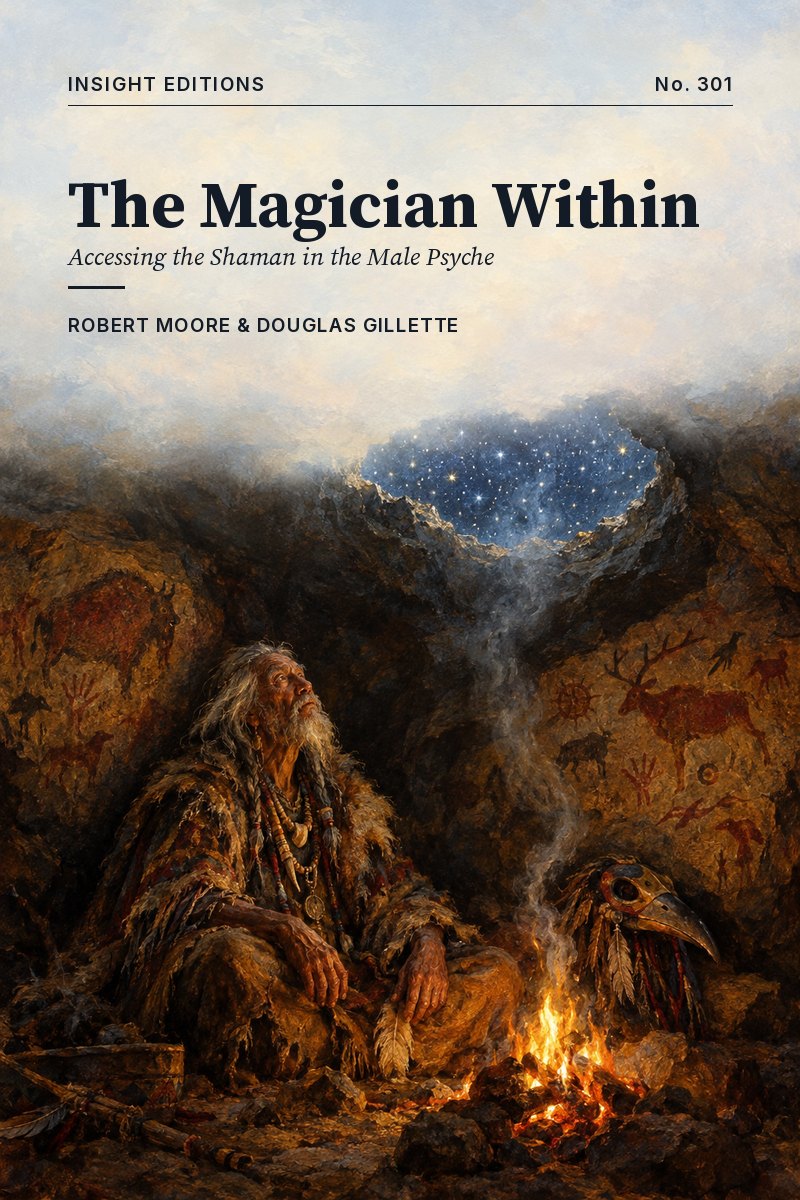
The Magician Within
An Insight Edition of Accessing the Shaman in the Male Psyche
At a Glance
The Magician's gift is disciplined access to hidden patterns; its test is what that knowledge does for others.
From archetypal structure through ritual, shadow distortions and mature public responsibility.
Also Freud, Campbell, Imhotep, Merlin, Whitehead, Winnicott and the authors' clinical examples.
Readers studying analytical psychology, initiation, myth, professional ethics and men's development.
The Book on One Page
Moore and Gillette begin with a theory of power rather than a list of personality traits. The mature masculine is represented by four related capacities: the King creates an intelligible order and cares for what falls within it; the Warrior undertakes disciplined action and defense; the Lover participates fully in relationships and the living world; the Magician studies the hidden conditions that make change possible. The authors are not prescribing four occupational classes. They are describing powers that a man can cultivate, neglect, exaggerate or use destructively, sometimes within the same day.
The particular gift of the Magician is knowing how the system works. His ancient faces include the shaman, teacher, physician, astronomer, scribe, ritual officiant and diviner. His modern faces include the scientist, psychotherapist, engineer, analyst, lawyer and strategist. Each gains access to a body of knowledge that is unavailable to most people. That asymmetry creates an ethical problem: the expert can use mastery to heal and explain, or to mystify, exploit and dominate. Technical accuracy by itself does not tell the difference.
The authors read the human psyche through Jungian archetypes, which they treat as organizing potentials of experience rather than mere inherited stories. The conscious Ego is necessary but incomplete. Disowned motives and capabilities form shadow material that can distort judgment. Their distinctive proposal is that each mature power has two immature shadow poles: an inflated active distortion and a denied or collapsed passive distortion. The Magician's are the Detached Manipulator and the Denying Innocent One. One claims superior knowledge while refusing feeling; the other claims blamelessness while exercising influence through evasion, helplessness or covert resentment.
The transformation of these poles is neither an argument for suppressing intelligence nor an invitation to surrender judgment to the unconscious. It asks for an observing Ego capable of identifying incompatible impulses, holding them without immediate enactment, and making a third, responsible response possible. Moore and Gillette describe this work with the vocabulary of individuation, integration and stewardship. The full Magician neither makes himself a god nor pretends to have no power. He acknowledges the power he has and accepts the obligations that accompany it.
The language of initiation gives this interior problem a temporal form. Human lives enter a state of ordinary structure, experience an interruption that invalidates settled expectations, and must find a path back to society with a revised character. In comparative ritual theory these phases appear as separation, threshold or liminality, and incorporation. The book relates this sequence to the mythic journey, the dark night, midlife crisis, psychotherapy and the shocks of bereavement or occupational change. An experience of disorientation is not automatically growth: without boundaries and an ethical guide it can become prolonged instability or grandiosity.
A ritual elder or trustworthy guide therefore matters as much as a revelation. The elder offers a setting where powerful experiences can be approached without turning every impulse into fact. A bounded room, time, professional role and relationship support attention, interpretation, and return. The candidate must also learn when to refuse a charismatic instructor. The best guide gradually makes himself less necessary. The worst requires permanent discipleship and treats the seeker's increasing dependence as a sign of spiritual success.
The book's mythic examples are selected to show a recurrent pattern. The Lascaux bird-person, Imhotep's sacred architecture, Merlin's counsel to Arthur, Black Elk's Great Vision, Jung's analytic work, modern laboratories and the first nuclear explosion are not equivalent historical cases. They are the authors' comparison of knowledge across boundaries. Some images represent creativity; others reveal the ability of knowledge without accountability to multiply destruction. These comparisons are evocative, but their historical, archaeological and neurological claims must be read at the level of evidence each can actually support.
The final proposal, Earthshaman, is the return of specialist capacity to an enlarged circle of responsibility. A man becomes more mature when his knowledge no longer exists to prove that he is special. It contributes to the well-being of families, institutions, communities, other peoples and the living Earth. The appendices then widen the architecture beyond the four masculine figures: the double-quaternity or diamond body, tentative brain analogies and the Anima/Animus material present psychic maturity as differentiated relationship, not the victory of one part over the rest.
The Magician matures when he can uncover the hidden, refuse domination and put what he knows back into the care of a shared world.
The book is best read as a theory of knowledge under moral pressure. Discovering a force is not equivalent to possessing the right to use it, and initiation is incomplete until the person returns capable of accountable action.
Chapter Map
| Ch. | Original section | One-line payload |
|---|---|---|
| Preface | The Magician in the Masculine Soul | Two visionary images establish transformation as a psychological and ethical problem. |
| 1 | Gender Identity, Gender Asymmetry, and the Sexual Imbalance of Power | Adult stewardship must be distinguished from violent or inflated patriarchal imitation. |
| 2 | Decoding the Male Psyche | Jungian concepts, four archetypes and bipolar shadow diagrams establish the working theory. |
| 3 | The Shamanic Tradition: The Birdman's Descendants | The ritual specialist embodies knowledge, visionary calling, healing and the problem of secrecy. |
| 4 | Images of the Magician in Myth and History | Historical and literary figures reveal the creative and destructive reach of specialist knowledge. |
| 5 | Understanding Sacred Space and Time | Initiation unfolds as a bounded passage from ordinary structure through crisis to renewed responsibility. |
| 6 | The Way of the Magician | A ritual elder contains transformation and teaches discernment rather than dependence. |
| 7 | The Master of Denial: The Innocent One | Passive refusal of agency becomes a covert way of controlling others. |
| 8 | The Trickster: The Detached Manipulator | Disconnected intellect turns people and nature into material for technique. |
| 9 | The Shamanic Potential in Contemporary Men | Modern roles and the degrees of initiation test whether knowledge becomes service. |
| 10 | The Sorcerer's Apprentice | A set of disciplined practices helps a person gain a centered relationship to power. |
| 11 | Becoming an Earthshaman | Expert knowledge must answer to the post-tribal human and ecological community. |
| A | Decoding the Diamond Body | The fourfold structure is developed into a symbolic relationship between masculine and feminine systems. |
| B | Archetypes and the Limbic System | A historically situated, speculative brain analogy is proposed and must be read cautiously. |
| C | Archetypes and the Anima | Projection, reciprocal shadow patterns and respect for difference complicate the fourfold model. |
Preface.The Magician in the Masculine Soul
Source pages 9–11.
The book opens in a Paleolithic cave, not an analytical consulting room. The painted bird-masked figure at Lascaux stands near a wounded bison, a departing rhinoceros and a bird-topped staff. Moore and Gillette read him as an early image of the Magician: a human being who can look beyond the immediately visible world, work with concentrated imagination and apparently become more than his ordinary self. In their interpretation, the bird's ability to rise above the earth represents a transformation in consciousness. The birdman is thus an ancestor in spirit of the physician, artist, philosopher, scientist and ritual specialist, all of whom reach toward unseen processes and sometimes bring discoveries back into ordinary life.
This reading is deliberately symbolic. The image cannot establish its painter's exact occupation, ritual role or beliefs. Its importance for the book lies in the interpretive bridge from early human imagery to modern creativity. A second image makes the bridge even longer. Moore and Gillette describe a portrayal of Jesus raising Lazarus, in which the figure of Christ wears a magician-like garment and carries a wand. They treat the rescue from death as an emblem of a recurrent psychological task: people become trapped in rigid complexes, painful habits and constricted identities, yet retain the potential for renewal.
For Moore and Gillette, the Magician is the capacity to encounter powerful, poorly understood forces and convert that encounter into knowledge, healing and transformation. Their book is less concerned with stage illusions than with the inner disciplines of attention, interpretation, responsibility and initiation. The Magician must know enough about power to handle it without becoming its servant. This concern connects the preface to the four-part model of masculine life pursued across the authors' series: King, Warrior, Magician and Lover.
The figure of the Magician links the discovery of hidden processes to their responsible use. Insight alone does not constitute maturity; power must return to the human community in a life-giving form.
The four powers. King: ordering and caring stewardship. Warrior: discipline and protective action. Magician: observation, interpretation and transformation. Lover: participation, connection and valuing. The books distinguish them to make their interactions visible, but do not regard any one of them as a complete personality.
The book's Lascaux interpretation is a Jungian reading of an archaeological image, not a demonstration that the painted figure was a shaman. Likewise, the authors' use of the Lazarus image interprets religious iconography; it does not prove a common historical origin of all healing traditions.

How the four-volume project is meant to be read
The preface supplies a practical instruction that can disappear when this volume is read alone. Chapters 1 and 2, together with the three appendices, are shared conceptual material across the quartet of books devoted to the King, Warrior, Magician and Lover. A reader entering through this volume does not need to have read the other three first; a reader already familiar with the series may begin with Chapter 3, where this book's distinct investigation starts. That architecture matters when judging apparent repetition. The general model is established once in the reader's experience, then applied to a particular power, its immature poles and its route toward maturity.
Moore and Gillette close the preface with an image of four horses requiring a capable rider. The image warns against allowing a single strength to run the personality. A man can be unusually intelligent without having learned to care, strong without justice, affectionate without boundaries, or publicly authoritative without self-knowledge. The quartet is intended to be held together. The authors' hopeful revision of an apocalyptic four-horse image is therefore a proposal about how powers are governed, not a declaration that one archetype should rule the other three.
The two artworks that precede this explanation carry different kinds of evidence. The Lascaux bird figure belongs to prehistoric material culture, though the shamanic reading remains conjectural. The image of Christ awakening Lazarus belongs to early Christian representation and already interprets a religious story. What links them is the authors' symbolic reading of a figure at the edge of life, death and transformation. The pictures are neither equivalent historical records nor proof that a single ritual office has survived unchanged across millennia. The continuity is an interpretive claim about the uses of knowledge.
Chapter 1.Gender Identity, Gender Asymmetry, and the Sexual Imbalance of Power
Source pages 21–30.
A distinction between adult masculinity and patriarchal domination
The chapter begins with a problem of identity. As formerly rigid divisions of work and family responsibilities become negotiable, men and women question which differences are socially taught, which may be biologically influenced, and which are merely stereotypes. Moore and Gillette do not argue for a restoration of every conventional role. They acknowledge that men doing domestic work and women becoming bankers or lawyers can be desirable changes. They object instead to an interpretation in which either gender is reduced to caricature, or one is regarded as psychologically worthless.
Their central distinction is between mature masculine power and its immature, coercive imitation. A patriarchal order is not, in their account, masculinity carried to perfection. It is an arrangement in which a relatively small ruling minority monopolizes resources, subordinates other people and other species, and treats the world as a supply of instruments for its own gratification. Many men suffer under such an order alongside women. The pathology lies in inflated egos and stunted development, not in the mere existence of male strength or initiative.
The political argument therefore rests on a psychological claim. A boy may acquire an adult body, social authority and institutional power without having developed the capacity to restrain grandiosity. The result is a governing figure with the status of a man but the self-importance of a child. In the book's terminology, a coercive or exploitative leader represents the failure of mature masculinity to emerge, rather than its successful embodiment. The distinction lets the authors denounce abuse while refusing to abandon the possibility of constructive masculine force.
Reading the first chapter as a theory of learned power
The authors' opening dispute has three separate propositions, and confusing them would weaken the rest of the argument. First, the obvious historical fact that many men have exercised dominance does not identify domination as a feature of psychological maturity. Second, even if masculine and feminine tendencies partly reflect biology, no biological finding by itself makes the coercion of another person ethically legitimate. Third, patriarchy is not presented as a system that benefits all males equally. Moore and Gillette describe a comparatively small ruling stratum that demands submission from women and from other men. The resulting hierarchy rewards the capacity to take power but does little to teach how power is held responsibly.
That distinction gives the later Detached Manipulator a social setting. An institution may reward a technically skilled person for controlling information while calling the outcome leadership. Yet the authors' mature King would have to ask who is protected by that knowledge, the Warrior whether the means are disciplined and proportionate, and the Lover whether affected people are still encountered as human beings. The Magician's intellectual gifts need not be rejected; they need to be brought under standards that are larger than private advantage.
In their discussion of Reinhold Niebuhr and Alfred Adler (original printed p. 27), Moore and Gillette distinguish the view that power tends to corrupt from their own conviction that the desire for efficacy cannot be educated out of children. Their argument is not that every expression of will is admirable. Rather, a child can learn to turn competence toward service, construction and protection, or toward the satisfaction of an inflated self-image. The moral question is how the instinct becomes socially trained.
The transmission of immature power through upbringing
Moore and Gillette then connect such immaturity to socialization and early experience. They refer to Alice Miller's work on poisonous pedagogy, the process by which adults pass unresolved injuries and controlling expectations on to children. An adult who needs constant admiration may unconsciously demand that a child mirror that need. Such a child may learn compliance, emotional concealment or self-aggrandizement in place of secure maturity. Parents of either sex can transmit these injuries, and men and women can collude in maintaining a harmful social order.
This is not a claim that all destructive adults share one cause or that every act of coercion can be traced to a particular childhood wound. It is the authors' preferred developmental explanation: unconfronted psychological patterns are inherited socially through the relationships that shape children. The practical significance is considerable. Replacing one leader or one cultural expectation cannot by itself bring maturity if the same patterns are continually passed from generation to generation.
Abusive power can be a sign of arrested development, not evidence of superior masculine strength. The task is to cultivate adults who can hold power without needing to humiliate others.
Childhood cruelty, social reward and the shape of a ruling personality
The book's reference to William Golding's Lord of the Flies is more than a literary flourish. Moore and Gillette imagine a society whose formal adult positions are occupied by people who have not learned to move beyond childish self-exaltation. Golding's isolated schoolboys display the way fear, prestige, rivalry and domination can be organized into a violent miniature social order. The analogy is meant to unmask the supposed dignity of oppressive institutions: command and rank are no guarantee of inner maturity. It does not follow that the psychological history of every authoritarian leader can be diagnosed from a novel.
Their treatment of childhood injury also resists assigning all responsibility to fathers. Mothers, fathers and wider institutions may ask children to carry their unresolved feelings or protect their fragile self-images. Through Alice Miller's account of damaging upbringing, the authors describe an intergenerational mechanism: the adult cannot endure vulnerability, coerces the child to meet the adult's needs, and the child eventually reproduces the same strategy from a position of greater power. This account is a proposal about one route into harmful behavior, not proof that experiencing childhood pain makes later cruelty inevitable.
A concrete distinction follows. Self-care is compatible with mature regard for the needs of others; self-preoccupation treats other persons as extensions of one's demands. The self-caring adult can set a boundary and still recognize another person's separateness. The self-preoccupied adult often interprets such separateness as an injury. The authors connect this difference to the education of power: without an opportunity to submit private entitlement to limits, wealth or office can make a person's worst immaturities more dangerous.
Masculine and feminine capacities within the same person
The next move rejects a perfectly divided personality. In the Jungian framework used here, men possess feminine psychological aspects, conventionally called the Anima, and women possess masculine psychological aspects, conventionally called the Animus. Developing psychological maturity means coming into contact with the qualities one has disowned because they conflict with a rigid gender identity. A man does not lose his masculinity by acknowledging feeling, tenderness or receptivity. A woman does not cease to be a woman when she develops initiative, discernment or assertive action.
The authors retain the belief that men and women may have characteristic tendencies, but they distinguish such tendencies from moral destinies. An average difference, even if conclusively demonstrated, could not justify the assertion that men must be violent, insensitive or uninterested in relationships, or that women possess a monopoly on gentleness and intuitive understanding. Biological variation does not itself prescribe who must command, care, earn, nurture or obey. The argument is especially important because the authors want to reclaim an ethically disciplined idea of power while criticizing the brutality often attached to the word masculinity.
The kibbutz experiment and competing explanations
The book introduces the experience of Israeli kibbutzim to examine whether equal social arrangements eliminate differences in preferred roles. It describes communities that began with egalitarian principles and a substantial effort to share agricultural, domestic and childcare work. Over time, the authors report, men and women in many of these communities came to occupy more gender-typical positions. They acknowledge the central interpretive difficulty: does this pattern result from predisposition, reinforcement, role pressure or some combination?
They also mention David Gilmore's Manhood in the Making, a cross-cultural account of the ways societies define and require masculine achievement. The diversity of customs supports the importance of social expectations; the recurrence of role differentiation prompts discussion of biology and shared pressures. Neither kind of evidence can settle the matter on its own. Moore and Gillette choose to leave the full causal problem unresolved and focus instead on the ethical handling of power whatever its source.
The kibbutz test. A community begins with a strong public commitment to shared work and equal status. Later occupational and family-role differentiation appears. The observation cannot, by itself, separate voluntary preference from practical conditions, institutional incentives or renewed social pressure. It raises the nature-versus-culture question without proving a single cause.
Power as an ability to accomplish, not a license to dominate
At the chapter's center is an affirmative treatment of power. Drawing on Alfred Adler's will to power, the authors regard the wish to become effective in the world as a basic human tendency. People strive to learn skills, overcome problems, organize shared tasks and affect their surroundings. Removing this impulse would mean extinguishing enterprise, creativity and competence along with their possible abuses. Instead, the authors propose stewardship: the disciplined direction of strength toward ends that preserve and enlarge life.
The contrast with Reinhold Niebuhr helps explain why they defend power rather than recommend withdrawal from it. Even when power is dangerous, danger is not the whole truth about it. A healer needs the ability to intervene. A builder needs technical mastery. A parent must exercise judgment and protection. A citizen needs courage to resist harm. The mature person is neither impotent nor domineering, but able to act and answer for the consequences of action. The authors associate this with Erik Erikson's generativity, the orientation toward caring for lives and institutions beyond one's own immediate needs.
A useful way to state the proposed moral sequence is: recognize the impulse to exercise power; understand how it operates; place boundaries around its expression; connect it to responsibility for others; examine the results. Each step answers a different danger. Denial of power may leave people helpless. Ignorance produces crude action. Missing boundaries invite exploitation. Lack of care makes achievement sterile or destructive. Failure to review consequences lets immaturity repeat itself.
The public responsibilities concealed in an instinctual debate
The chapter cites sociobiology, primate ethology, hormonal research and David Gilmore's comparative anthropology without settling their competing explanations. The authors' conclusion has two parts which must be kept distinct. They suspect that some patterns of male and female behavior may be affected by inherited predispositions. At the same time, a statistical tendency is not a moral warrant to force an individual into a role, deny capacity for tenderness, or excuse violence and domination. These are different claims, and the second does not depend upon proving the first.
Their preferred term stewardship also raises a larger question than self-improvement. The drive to overcome an obstacle may be employed in invention, the protection of a child, the building of an institution or the conquest of another person. The same effectiveness can have opposite consequences. Training in responsible power therefore needs judgment of ends as well as technical skill, and the community must be able to ask whose flourishing is enlarged by an achievement. This is how Erikson's idea of generativity enters the authors' moral psychology: adulthood is tested by what it sustains beyond the self.
What has been lost with the decline of initiation
The last movement of the chapter concerns myth, ritual and the passage from childhood into adult responsibility. Moore and Gillette believe many premodern societies supplied explicit models of maturity. Older people did not merely confer an adult title: they oversaw rites, transmitted community stories and instructed the young about the dangers and obligations attached to their new capacities. Such systems could be restrictive and cruel, but they at least made the question of becoming an adult a public matter.
The authors' electrician analogy is precise. Society requires an apprentice to learn about dangerous electrical currents under skilled supervision. We understand that power without technique may injure both the worker and others. Yet, they argue, modern communities often provide no comparable apprenticeship for the powerful forces of ambition, aggression, sexuality, imagination and spiritual longing. When these forces are left unexamined, the person may carry them into relationships, institutions and public authority with devastating consequences.
Initiation, in this scheme, changes the position of the Ego. The person must abandon the fantasy of being the universe's center. The ego learns to serve a transpersonal other: family, community, a meaningful project, ethical obligation or, within a religious setting, the divine. This is not the destruction of individuality. It is the relinquishment of the claim that every desire of the self has sovereign importance. The authors regard such decentering as essential to mature power.
They argue that the abandonment of serious initiation removes a repeated cultural opportunity to ask what adulthood means. Without shared public conversations and demanding personal practices, success can become confused with money, seniority or control. Figures with great prestige may then remain psychologically preoccupied with conquest and admiration. The authors link this to institutional corruption, political authoritarianism and ecological irresponsibility. Those links are an ethical diagnosis, not a demonstrated law of history.
The chapter's practical proposition is to learn the wise use of power, rather than pretend that the desire for power can simply be abolished.
Power and maturation: capacity to act → apprenticeship in its risks → limits and humility → commitment beyond the ego → service and generativity. Failure at the middle stages produces power that magnifies insecurity, dependency or domination rather than useful competence.
Immature power seeks obedience, admiration and immunity from criticism. Mature power seeks effectiveness, takes criticism seriously, accepts limits and evaluates itself by the condition of the people and places affected.
For a team leader, mastery of a difficult technique is only the first initiation. The second is accepting that others bear the consequences of its use. Separate expert capability from the authority to use it; require mentorship, review, explicit decision boundaries and mechanisms for repair.
Gender and personality are treated here within the authors' early-1990s Jungian framework. Modern research is more cautious about fixed male/female psychological essences. The kibbutz example does not establish hard-wired differences; its outcome also reflects social and institutional incentives. The celebration of historical initiation requires qualification: many actual rites were coercive or physically harmful. The educational insight does not require those harms.
The missing apprenticeship in power
The comparison with an apprentice electrician is unusually exact. A learner is not handed a dangerous supply of electrical energy and told simply to trust his instincts. He learns where the force comes from, what conducts it, where it can injure and which procedures make its use safe. The authors believe modern institutions spend enormous effort teaching professional techniques while offering few equivalent apprenticeships in the use of anger, sexuality, ambition, authority and the wish for recognition. Their complaint is not that youth lack information. It is that knowing how to produce an effect is different from knowing when producing it is justified.
The source also supplies a description of the initiated ego as moving from the center into an orbital position around a larger obligation. A person may initially understand that obligation as family, an entrusted task or public service, while religious communities have often situated it within an ultimate sacred order. The authors call this orientation a Transpersonal Other. Whether one accepts their theology or not, the practical contrast is clear: an adult cannot treat every institution and every intimate relationship as an extension of his own wishes.
The danger in restoring initiation is that compulsory humiliation can easily duplicate the very immaturity it is meant to correct. A rite has developmental value only insofar as it actually increases judgment, autonomy, care and accountability. Terror, enforced secrecy and injury provide no evidence of maturity. This distinguishes the source's aspiration to social education from an indiscriminate defense of historical initiation practices.
Chapter 1: mechanisms to remember
| Mechanism | What it does | When it fails |
|---|---|---|
| Role differentiation | Organizes work and identity through convention, preference and institutions | A difference in roles is mistaken for proof of unequal human worth |
| Anima and Animus | Give Jungian names to capacities excluded by narrow gender identity | A person disowns valuable capacities to preserve a stereotype |
| Poisonous pedagogy | Describes inherited forms of humiliation, control and emotional distortion | The injured adult repeats the pattern with the next generation |
| Will to power | Names the human wish to be capable and effective | The wish is equated with domination or denied altogether |
| Initiation | Teaches dangerous capacity in a setting of supervision and obligation | Status and power arrive without the character needed to use them |
| Ego decentering | Binds personal goals to something larger than self-regard | Grandiosity turns people and nature into instruments |

The opening dispute, placed back in its historical sequence
The first chapter belongs to a particular early-1990s dispute about sex differences. Moore and Gillette begin with changing work and domestic roles: a woman can practice law or banking; a man can manage a household and care for an infant. They welcome the greater freedom implied by these changes while resisting the inference that every psychological difference must therefore be unreal. Their polemic also turns against assertions that boys are necessarily morally or emotionally inferior and against proposals to suppress male aggression as though all assertive energy were pathological. These claims are presented as positions in an argument, not as a balanced survey of feminist scholarship. The source's sweeping descriptions of what unnamed opponents believe should not be treated as representative of feminism in general. Its sharper distinction is between the right to develop one's capacities and the alleged right to impose them upon another person. (Source pp. 18–19.)
Their criticism of patriarchy is more exact than a defense of established male authority. Patriarchal rule, in their picture, is concentrated in a small and often psychologically immature class; most men are subject to it along with women. They describe a hierarchy in which people are sorted according to how useful they are to the governing few. The literary analogy to **William Golding's *Lord of the Flies*** makes the accusation memorable: domination can be the collective behavior of frightened, competitive children wearing the costumes of adulthood. The analogy is an accusation about moral immaturity, not a historical explanation sufficient to account for every political or economic structure. It also means that a man's place inside a male-dominated order does not prove that he possesses mature masculine power. (Source pp. 19–20.)
Alice Miller's idea of poisonous pedagogy gives this polemic a developmental mechanism. Children who experience humiliation, emotional manipulation or disregard may grow up to reproduce familiar forms of domination. The authors explicitly hold immature mothers as well as immature fathers capable of contributing to these injuries, because the demand to make a child satisfy an adult's unresolved emotional needs is not confined to one sex. They contrast such self-absorption with the adult capacity to care for another person while also retaining legitimate self-care. This is a claim about intergenerational transmission of harm, not a claim that abused children must become abusive or that a victim should be held responsible for the perpetrator's conduct. (Source p. 20.)
The authors then refuse a second simplification. The historical existence of violent, exclusionary institutions does not erase the contributions of builders, discoverers, teachers or reformers. They emphasize the record of technical and imaginative achievement while still condemning oppression. That two-sided judgment is necessary for their central argument: power can be creative, abusive or deliberately redirected. A record of achievement is no defense for abuse, but a record of abuse is no reason to teach boys or girls that competence itself is shameful. Generativity is the criterion they take from Erikson: the capable adult creates conditions under which more lives can develop. (Source pp. 20, 23–24.)
The lost public forum for asking what an adult should become
The source's closing discussion of ritual is not merely nostalgia for unusual ceremonies. Initiation once served, in the authors' reconstruction, as a public occasion to define maturity. A community had to make its expectations visible, select mentors, arrange instruction and recognize a passage from dependency to responsibility. The rites themselves could be coercive, unjust or narrow. Yet, by disappearing without replacement, they could leave the task of character formation private and accidental. A school might certify academic achievement, and a trade might certify technical competence, while neither examines how a new adult uses fear, ambition, anger and authority. This is the point of the electrician apprenticeship comparison: danger calls for guided mastery, not blanket prohibition and not a ceremonial title. (Source pp. 24–26.)
The unusual image of the Ego moving into orbit supplies the psychological end of the process. The Ego retains practical agency, but ceases to imagine itself as the source and ultimate judge of all value. Family, entrusted work or a community can provide an immediate focus for obligation; the authors' religious language situates those lesser commitments within a further Transpersonal Other. Their concern is the failure of every possible larger reference point, which leaves the Ego tempted to fill the vacancy with itself. That is an account of grandiosity, not a demonstration that secular persons cannot live responsibly. The defensible contemporary translation is more modest: a responsible person must be answerable to ends and people that can correct his self-flattering account of what he is doing. (Source pp. 26–27.)
<div class="callout vs"><span class="callout-label">CONTRAST</span><p><strong>Power without apprenticeship:</strong> a person learns how to get results, but has no dependable way to question the ends or bear the costs. <strong>Stewarded power:</strong> skills develop together with boundaries, accountability, correction by others and an explicit idea of what adulthood should serve. The authors' chapter is a plea for the second form, not for a return to coercive rites.</p></div>
Chapter 2.Decoding the Male Psyche
Source pages 31–59.
The architecture behind the book
Chapter 2 provides the operating vocabulary for the rest of the series. Carl Gustav Jung's analytical psychology is the chief source, supported and contrasted with Freud, Erik Erikson, D. W. Winnicott, Heinz Kohut and Alice Miller. Moore and Gillette want an account broad enough to accommodate ordinary thought, dreams, religious experience, myths and powerful emotional states without treating one layer as the whole person. Their position is that human beings inhabit a conscious self-image within a much larger psychological system, and that this larger system can shape action without the ego's permission.
They also wish to connect psychological structures to biology, culture and religious symbolism. Their conceptual proposal is ambitious: recurring mythical figures portray recurrent patterns of psychological experience, and those patterns may have roots in evolved human capacities. The chapter should be read as a theoretical synthesis. It is not a report of neuroimaging data proving that four Jungian archetypes occupy identifiable brain circuits.
Myth: a map of experience rather than an outdated physics textbook
A myth, as used in this book, is a narrative expression of the mind's organization and conflicts. Its significance is not exhausted by whether its events occurred in physical history. The authors cite the biblical creation by naming: when Yahweh speaks, the world becomes distinguishable and ordered. Their psychological interpretation is that language makes distinctions possible. Naming fear, desire or grief changes how one can reflect on it; what has not been discriminated in thought is often poorly available to deliberate action.
The comparison is useful without collapsing the difference between meaning and matter. The ability to name an object does not create its physical existence, but words can construct categories, call attention to previously unnoticed distinctions and alter the practical world a person inhabits. In this sense language mediates experienced reality. The authors take the analogy further, speculating that psyche and cosmos may share structural patterns. That extension is philosophical speculation, distinct from the narrower psychological observation.
Ego: the familiar 'I' is not the whole person
The Ego is the organized point of view from which someone normally says I think, I want, I remember or I intend. It can compare possibilities, maintain a coherent self-image, pursue goals and interpret experience. Yet the ego's confidence in being the sole agent is often misplaced. A sudden surge of rage, panic, obsession or excitement can change behavior so rapidly that the person later struggles to recognize their own conduct. The authors explain such events through autonomous complexes, psychological constellations that may temporarily overtake the ego's usual organization.
They describe complexes as clusters of emotional memory, associated ideas and impulses with a relative autonomy. Some emerge around childhood experiences and defended or repressed qualities. Their autonomy is a matter of how powerfully a pattern can organize perception, affect and action; the authors sometimes speak as though it were literally a separate consciousness. The latter description is a Jungian metaphor or contested psychological theory, not a basis for self-diagnosing dissociative conditions.
The clinical example involves episodes historically termed multiple-personality disorder, now generally discussed as dissociative identity disorder. The authors draw an analogy between dramatic dissociation and milder everyday experiences of being driven by emotional patterns. The analogy conveys their argument about divided motivation, but it does not equate an angry outburst with a dissociative disorder.
The ego is the manager of conscious intention, not the author of every impulse. Maturity increases as a person becomes able to notice powerful patterns without automatically acting them out.
The unconscious, archetypes and the source of psychic energy
The chapter distinguishes the personal unconscious, which contains material from individual experience, from Jung's collective unconscious, a proposed level of patterning shared across human beings. An archetype is a recurring structural disposition that shapes perception, emotion and imagery. Jung drew attention to similarities among symbols in myths, religions, artworks and dreams across cultures. Moore and Gillette treat those similarities as evidence for inherited psychic forms that organize human life, and as sources of creative possibility as well as danger.
Sigmund Freud's id names a different kind of unconscious explanation. In the authors' account, Freud emphasizes instinctual drives, especially aggression and sexuality. Jung places more emphasis on organized patterns and on a generalized psychic vitality. The disagreement becomes clear in the discussion of libido: for Freud, it is strongly related to sexual drive; for Jung and the authors, it can energize creativity, intellectual discovery, religious devotion, artistic expression and interpersonal renewal. The chapter calls this capacity a kind of psychological technology: one must learn to encounter and guide power instead of merely repressing or surrendering to it.
Their developmental principle is exacting. Identifying oneself with an archetype is not the same as integrating it. A man fascinated by a heroic image may become self-important rather than courageous. A person attracted to the figure of a magician may collect secret information while neglecting ordinary obligations. Mature use requires a sufficiently differentiated ego, one able to participate in symbolic energy while recognizing that it is neither omniscient nor exempt from limits.
Freud, Charcot and the difference between a storehouse and an active unconscious
The historical genealogy matters to the authors' comparison. Jean-Martin Charcot's demonstrations of hypnosis impressed the young Sigmund Freud because psychological activity could become visible outside a patient's ordinary deliberate control. Freud gave the unconscious investigative importance as a source of drives, conflict, repetition and apparently irrational symptoms. In the authors' summary, his id is associated with strongly instinctual pressures, especially sexuality and aggression. It is not the same concept as Jung's collective unconscious, whose organization they claim extends beyond each individual's biography.
Erik Erikson offers a bridge rather than merely an intermediate historical name. His account of preformed action patterns treats human development as the timed emergence of modes of responding within a changing social environment. Moore and Gillette compare this with the Jungian notion of archetypal dispositions activated under appropriate conditions. Their parallel is an interpretive inference: developmental action patterns and Jungian archetypes are not experimentally interchangeable entities. The authors nevertheless use the comparison to resist the picture of the unconscious as a passive basement of forgotten contents.
The disagreement over libido carries a practical consequence. A concept of psychic energy identified chiefly with sexual instinct invites one kind of explanation for sublimation, creativity and religious feeling; Jung's broader usage allows imaginal and intellectual activity to be treated as direct forms of life investment. Moore and Gillette prefer the latter because the Magician's calling centers on knowledge, inventiveness and visionary attention. The divergence is substantive, not a dispute about whether people have sex drives.
Shadow: what the self-image cannot admit
The Shadow is the body of attitudes, emotions and capacities that the ego excludes from its preferred picture of itself. A person who prides himself on unwavering kindness may refuse to acknowledge resentment or anger. Someone who defines himself entirely by rigor may reject spontaneity, tenderness or play. What is rejected is not necessarily immoral; the Shadow can store talents, desires, intuitions and justified perceptions that became unwelcome during development.
Shadow material often appears indirectly through projection. The ego attributes an unwanted motive or trait to another person, frequently with disproportionate emotional certainty. Moore and Gillette's example is a family visit during which a person intends to be courteous but repeatedly starts arguments. The officially presented self wants harmony. The rejected part may carry genuine resentment toward the relatives or resentment about the performative requirement to pretend everything is fine. By provoking conflict, the disowned feeling forces itself into awareness, though not yet in a constructive way.
Withdrawing a projection does not mean declaring every criticism of another person to be imaginary. It means checking whether the intensity and repetition of one's judgments reveal a pattern in oneself. The authors see this as an act of moral courage. Once a rejected feeling or capacity can be acknowledged without either denying it or obeying it, the individual has more choices. The aim is neither to suppress the Shadow nor to let it rule. It is to bring the division into conscious relation.
The contentious family visit. The person intends to be polite, then finds themselves instigating precisely the conflict they meant to avoid. The model distinguishes conscious intention from an excluded anger that keeps seeking expression. Integration begins by naming both motives and deciding how to act without deceit or uncontrolled attack.
A Shadow is not simply a list of bad characteristics
In the earlier account, disowned material can include strengths that a person was forbidden to develop. A child praised exclusively for agreeableness may consign healthy protest to the Shadow; a child rewarded only for achievement may suppress tenderness, play or a capacity to receive help. Hence the effort to reclaim Shadow material is not merely a search for embarrassing impulses. It can restore unused abilities, accurate perceptions and forms of vitality. This is why Moore and Gillette compare the divided psyche to a broken mirror: fragments hold portions of a larger reflection.
There is a tension here which the later triangle theory tries to address. Jungian Shadow projection concerns the relation between an ego-image and its rejected opposite; the authors then extend the same word to describe polar distortions of each archetype. These are related but analytically different levels. A reader should not infer that everyone displaying an arrogant trait is literally 'possessed' by an independent personality. The useful practical test remains what the person cannot admit, how that exclusion shapes action, and whether the excluded capacity can enter conscious choice.
The authors’ major extension: each archetype has two shadow poles
At this point Moore and Gillette add a distinctive structure to conventional Jungian theory. They propose that each mature archetype has not one amorphous Shadow but a bipolar pair, an active and a passive distortion. A person tends to identify with one pole and deny the other, or oscillates between the two. The mature archetype is a third organization capable of retaining strengths from both without submitting to either. This is the triangular structure reproduced in the book's original diagram.
| Archetype in fullness | Inflated / active Shadow | Collapsed / passive Shadow | Principle of integration |
|---|---|---|---|
| King | Tyrant | Weakling | Establish order and bless others without dominating or abandoning responsibility |
| Warrior | Sadist | Masochist | Act with discipline and force without cruelty or surrender of agency |
| Magician | Detached Manipulator | Denying 'Innocent' One | Acquire knowledge and understand power without cynical control or refusal of accountability |
| Lover | Addicted Lover | Impotent Lover | Connect with delight and feeling without engulfment or deadened withdrawal |
The Tyrant/Weakling opposition dramatizes coercion and weakness in relation to ordering authority. The Sadist/Masochist opposition dramatizes aggressive misuse and passive submission in relation to disciplined action. The Detached Manipulator/Denying Innocent opposition is the central problem for this book: someone may know exactly how to affect others while treating them as specimens, or may maintain the appearance of harmlessness by refusing to know or exercise power at all. The Addicted/Impotent Lover pair contrasts being overwhelmed by attachment or appetite with withdrawal from affective participation.
The authors do not intend the mature state to be a numerical midpoint between two extremes. Integration means changing the governing relationship to the capacities themselves. A discerning person can possess knowledge without exploiting someone who lacks it. A disciplined person can use strength to defend rather than humiliate. A responsible leader can make unpopular decisions without becoming a tyrant. The alternative to both extremes is a qualitatively different way of relating to power.
Moore and Gillette's central structural proposal is that the mature Magician emerges by integrating the Detached Manipulator and the Denying 'Innocent' One, not by choosing one of them.
The archetypal triangle. The ego experiences two oppositional distortions at the base. Through conscious differentiation and integration, it moves toward the mature capacity represented at the apex. The apex means responsibility plus access to energy, not invulnerability or superhuman status.
Why synthesis requires an active ego
The authors connect the triangle to several philosophical traditions. Alfred Adler contributes attention to power and patterns of active/passive response; Theodore Millon is cited for his dimensional interest in personality organization; Hegelian dialectic suggests that opposing positions may generate a more encompassing resolution; Paul Tillich provides language of spirit and transcendence; Alfred North Whitehead contributes an account of creative advance in which new occasions and possibilities continually arise. The strongest direct debt is to Jung's alchemical coniunctio oppositorum, the union of opposites by means of a transcendent function.
The sequence is not automatic. The person must hold conflicting feelings and standpoints long enough to understand their demands. Identifying with either pole is tempting because it simplifies the situation. Yet premature allegiance usually represses the countervailing need, which returns in disguised or destructive form. The ego therefore has an active mediating responsibility: to maintain contact with both sides, bear the discomfort of ambiguity and find an action that need not repeat the old polarization.
The source uses the Greek myth of the Symplegades, the Clashing Rocks, as its navigation image. A small vessel must cross a dangerous passage between two destructive forces. In psychological terms the ego must neither collide with one pole nor flee helplessly into the other. The deeper aim is a stable relationship with the fullest archetypal form, which the authors associate with spiritual reality beyond ordinary time and space. The metaphor is most useful as an image of attentive choice under intense pressure.
Possession by a pattern: a person believes 'I am the expert' or 'I am innocent,' and no alternative self-understanding remains available. Relationship with a pattern: a person can say 'I have expert knowledge' or 'I feel powerless' without mistaking that state for the whole self.
Opposites, action and the danger of mistaking a model for a diagnosis
The chapter situates its triangular proposal among other pair-structures. Jungian discussions of senex and puer contrast the old, rule-bound figure with the eternal youth; domina and puella place an older ruling feminine figure beside the maiden. These precedents suggest that a psychic capacity may divide into apparently contrary modes. Moore and Gillette then generalize the structure across King, Warrior, Magician and Lover, proposing a third, integrated form above the pair.
Their discussion of Theodore Millon is a structural comparison with active and passive dimensions of personality organization. It is not a claim that the authors' archetypal poles are recognized psychiatric diagnoses or that a person with a clinical disorder can be assessed with a triangle diagram. Likewise, Paul Tillich's language of ambiguity, Hegel's movement through contradiction, Whitehead's continuing creative advance and Jung's union of opposites have different intellectual origins. Moore and Gillette place them alongside one another to illuminate a single normative aspiration toward integration; they do not demonstrate that these philosophies are logically identical.
The distinctive ethical requirement is an active Ego. It must withstand the temptation to take either shadow position as the whole truth, acknowledge the cost each exacts, and choose an action that incorporates the energy of each without its distortion. Consider expertise: the aggressive pole uses information to control, while the passive pole refuses to recognize its own influence. A more mature expert can acknowledge asymmetrical knowledge, disclose uncertainty, share necessary information and establish independent oversight. The third option is an actual change in conduct, not merely feeling spiritually balanced.
Four faces of one Self: the pyramid
The triangle diagram is followed by the pyramidal structure of the mature masculine Self. Each of the pyramid's four faces corresponds to one archetype. At the lower edges lie its divided Shadow poles. Movement toward the capstone represents integration of the four mature powers in one life. The pyramids and stepped sacred structures of Mesopotamia, Egypt, Mesoamerica and other traditions supply symbolic analogies for ascending from fragmented experience toward a more inclusive order.
This metaphor solves a problem the series itself creates. If King, Warrior, Magician and Lover were complete and independent characters, a person could merely choose a preferred one. Instead, each has an aspect the others correct. The Magician without the Lover may be observant but cold. The Warrior without the King may possess discipline but lack wise direction. The Lover without the Warrior may feel deeply but struggle to keep commitments. The King without the Magician may rule confidently without understanding consequences. Wholeness demands dialogue among the powers, not permanent identification with any single role.
An attempted neurobiological account
Moore and Gillette turn from myth and psyche to the brain through Anthony Stevens's Archetypes: A Natural History of the Self and Paul MacLean's triune-brain proposal. They present the left cerebral hemisphere as comparatively sequential, linguistic and analytical, and the right as comparatively imagistic, intuitive and pattern-oriented. In the historical model, the neomammalian cortex, paleomammalian limbic system and reptilian complex were treated as increasingly old evolutionary layers. The authors speculate that inherited archetypal patterns originate in deep systems and are elaborated through emotional and cortical processes.
This is an example of their attempt to link depth psychology to biology, not a demonstrated localization. They explicitly state that the archetypes cannot simply be assigned to a single brain area. Still, the language of a rigid right-brain dream world, left-brain ego and stacked evolutionarily distinct brains is now too schematic to stand as an adequate neuroscience of selfhood. Modern brain function is extensively distributed, and individual abilities involve overlapping networks. The psychological argument can be studied separately from its proposed neuroanatomical explanation.
Do not confuse analogy with validation. Recurrent symbols across cultures do not by themselves establish genetically inherited Jungian archetypes. The triune-brain scheme and popular left-brain/right-brain personality contrast are oversimplified. A bipolar archetypal Shadow is not the psychiatric condition bipolar disorder. The chapter also uses historic diagnostic categories that should not be applied casually to oneself or other people.
What the diagrams actually claim, and what they leave unproved
The original triangular figures on pages 40–41 show the Ego moving upward from the base between an active and passive shadow. Their labels matter: Tyrant/Weakling, Sadist/Masochist, Detached Manipulator/Denying Innocent, and Addicted Lover/Impotent Lover are not four choices of occupation or fixed personality types. The upward arrow indicates individuation, a developing ability to gain access to the capacity at the top without surrendering the conscious standpoint at the center.
The pyramidal figure on page 42 joins the four triangular surfaces and implies interdependence: a person cannot reach mature Magician functioning by permanently excluding love, purposeful action or care for an organized common life. Its picture is a symbolic map, not an anatomical diagram, validated psychometric scale or evidence of gender exclusivity. The authors' cross-cultural sacred-pyramid photographs illustrate their symbolic reading of ascent. Their geographical similarity cannot alone confirm the psychological theory.
Overlap among the powers and parallels in primate behavior
The chapter closes by warning that the four powers are analytical distinctions, not watertight biological compartments. A sacred king may make strategic decisions, protect his people, administer ritual and care for a queen or community. In that one figure the King, Warrior, Magician and Lover all act. The same combinations appear in modern professions, relationships and individual acts. The authors therefore treat their labels as a means of seeing what a person is doing, not a final classification of who that person is.
They then turn to chimpanzee social behavior as an evolutionary analogy. Accounts of Figan at Gombe and Yeroen at Arnhem illustrate how status, leadership, alliances and individual temperament can matter among nonhuman primates. They compare the socially skilled alpha male with King's ordering power, coalition partners with Warrior activity, and planning, strategic restraint and tool use with Magician capacities. The evidence of chimpanzee problem-solving matters, but the assignment of these observations to Jungian archetypes remains the authors' interpretation. The same animals may engage in nurturing, rivalry, calculation and aggression within changing social contexts.
The practical end of the chapter is an operator's manual metaphor. Someone would not responsibly fly a complex aircraft without learning its instruments and operating limits. Likewise, people need disciplined insight into the ways their attention, drives, images and conflicts affect conduct. The manual is meant to increase agency. Self-knowledge should move the person from impulsive reaction toward deliberate, responsible participation in family, work and community.
When expert knowledge gives someone disproportionate influence, ask three questions: what do I know that others cannot easily check; what motives might distort how I use that knowledge; and what independent boundary protects the person affected? This is a practical test for the mature Magician rather than the Detached Manipulator.
Figan, Yeroen and what the chimpanzee analogy can establish
The two original photographs of Figan at Gombe and Yeroen at Arnhem Zoo are worth reading separately. Figan is pictured in an assertive social display. Yeroen, described as an older and cunning chimpanzee, directs attention toward the politics of influence rather than toward strength alone. The authors use such observations to suggest that primate life already includes coalition, calculated timing, social rank, affiliation and instrument use. They also give examples of chimpanzees selecting feeding places, avoiding predators and employing tools. These are more varied capacities than a simple aggression model permits.
The comparison cannot establish that chimpanzees possess the same King, Warrior, Magician and Lover psychological structures as humans. The book has made an interpretive leap from observable behavior to a fourfold theory of subjectivity. At most, the scenes show that an ability to judge circumstances, manage relationships and act strategically has animal precursors. The authors themselves acknowledge that there is no direct access to a chimpanzee's inner experience. The inference should be carried forward as an analogy, not as an experimental demonstration.
The same caution applies to the chapter's attempt to place the Magician in brain structure. Distinctions between language-heavy and image-heavy modes of processing can orient a discussion of reflective and imaginative work, but they do not license a complete division of human personality into independent left- and right-hemisphere faculties. The observing Ego, in the psychological model, is a position from which someone can reconsider an impulse. It is not an isolated anatomical organ demonstrated by the source's diagrams.
Chapter 2: terms, thinkers and distinctions
| Term or thinker | Meaning in this chapter | Why it matters |
|---|---|---|
| Jung | Analytical psychology and individuation | Establishes the symbolic and structural theory |
| Freud | Id, unconscious motivation and sexual libido | Supplies the contrast to generalized Jungian psychic energy |
| Erikson | Drive patterns and generativity | Links inner development with outward responsibility |
| Alice Miller, Winnicott, Kohut | Childhood experience, self-development and relational wounds | Supply developmental context for complexes and Shadow |
| Myth | Narrative expression of psychological patterning | Explains why religious stories are treated as psychological evidence |
| Ego | Organized everyday 'I' | The mediator that must learn limits and make choices |
| Autonomous complex | Relatively independent pattern of memory, emotion and action | Explains conflicts between declared intention and behavior |
| Collective unconscious | Jungian proposed inherited basis of recurring symbolic forms | Grounds the archetypal claim, although empirically contested |
| Libido | General psychic vitality in the authors' Jungian usage | Powers both creative and destructive expression |
| Shadow and projection | Disowned qualities experienced indirectly and attributed to others | Point toward parts of the self requiring conscious acknowledgment |
| Bipolar Shadow | Active and passive distortion of one archetype | Makes the four triangular figures possible |
| Transcendent function | Integration of opposing tendencies into a third orientation | Gives the ego a path beyond oscillation |
| Coniunctio oppositorum | Jung's image for uniting opposites | Links psychological change with alchemical symbolism |
| Symplegades | Mythic clashing rocks | Represents the difficulty of holding a path between destructive extremes |
| Pyramidal Self | Four integrated archetypal faces | Shows why balanced maturity exceeds the individual powers |


Source illustrations to preserve in the illustrated final: the historical King Barrakab relief and his scribe; the two-page group of original triangular archetype diagrams; the pyramidal Self diagram; ancient stepped pyramid images; the brain cutaway and MacLean three-layer figure; and the primate photographs of Figan and Yeroen. The source figures are contextual evidence for the authors' intellectual construction, not anatomical proof of the psychological model.
The images behind the scheme: scribes, sacred mountains and the levels of a life
A small carving of King Barrakab of Sam'al with his scribe gives the book a compact image of the relationship between the King and the Magician. The king establishes a public order, but his rule depends on the ability to make words, keep records and translate intentions into durable acts. A scribe's apparent subordination should not obscure the power of literacy: writing can preserve justice and memory, but also commands, exclusions and taxation. In the authors' symbolism the same intelligence can become a servant of legitimate order or the technician of tyranny.

The authors move from the triangular models to a pyramidal Self for a reason that is easy to miss. A single archetype is not the whole male person. The four mature apexes are described as interdependent faces of a common structure. In a real life, the man who can plan but cannot care is still divided; the man who can love but cannot defend a boundary is similarly incomplete. Each imagined face of the pyramid points away from a pair of opposite shadow pressures toward a better integrated use of its energy. The figure is not a hierarchy in which the Magician simply commands the rest. It pictures four kinds of work as mutually sustaining.
The source reinforces this image with six architectural comparisons from different societies, illustrating how an axis, summit or stepped ascent can be used to organize a sacred world. The Esagila complex at Babylon represents a religious and civic center; a Maya pyramid at Tikal shows a staged climb; Teotihuacan locates built order within a larger ceremonial city; the Khmer temple at Koh Ker links ascent with a monumental center; the Great Morai at Pappara in Tahiti shows a terraced ritual setting; and the Great Pyramid at Giza presents the ideal on an immense physical scale. The book uses this array to say that cultures repeatedly build an exterior image of ordered levels through which people can imagine an interior movement. Similar architecture does not establish identical theology, dating or direct cultural influence.


The symbolic ascent is not the acquisition of a divine rank. The Ego must stay recognizable as a limited human agent as it learns from larger psychic patterns. That makes the pyramid image an ethical discipline: each time the person is tempted to settle into one shadow pole, he must remember the capacity that integrates its useful energy without repeating its harmful action. This is the difference between being inspired by an image and treating the image as a license for grandiosity.
Primate leadership as an analogy, not a human prescription
The chapter's chimpanzee material is a second attempt to ground the theory in something observable. Figan, a male chimpanzee at Gombe, is shown in an impressive dominance display. Yeroen, an older chimpanzee at Arnhem Zoo, represents the possibility that social influence may depend on experience, alliances and tactical judgment as well as physical strength. The book compares the alpha male's ability to coordinate coalition, confront danger and assess opportunity with aspects of the King, Warrior and Magician functions. Chimpanzees also use tools and act with social foresight. These observations invite comparison with human development, but do not justify mapping a chimpanzee hierarchy directly onto the ethics of modern human society.


Moore and Gillette also stress that the powers do not reside in mutually sealed locations of the brain. The same practical problem may involve inhibition, visual understanding, language, bodily response and remembered attachment. Their account of right and left cerebral hemispheres and the triune-brain model belongs to the scientific context in which they wrote. The useful distinction for the reader is whole-pattern imagination versus sequential analysis, both needed in competent inquiry. One must not turn a psychological metaphor into a diagnostic claim that a particular personality or sex owns one hemisphere.
Architectural similarity, animal social behavior and comparative neuroanatomy are three different kinds of evidence. The book places them in a single symbolic argument, but they cannot independently prove a genetically transmitted four-archetype program. These sources illustrate a theory; they do not verify its biological mechanism.
Source reconciliation: Millon, the archetypal polarities, and the limits of diagnosis
The authors borrow the word bipolar from an existing psychological discussion, but their shadow-pole diagrams are not a diagnostic account of bipolar disorder. On page 39, they name Theodore Millon, whose Modern Psychopathology distinguished active and passive expressions of personality disturbance, and compare that scheme with certain Jungian symbolic oppositions. The examples include senex–puer, the older authority figure against the eternal boy, and domina–puella, the older feminine authority against the eternal girl. Such pairings supply an analogy: a psychological pattern may remain divided into apparently contrary ways of avoiding mature responsibility. The authors are proposing a theory about archetypal development, not establishing that every person falls into a Millon category or that symbolic poles correspond to psychiatric disorders.
Their worked instance is the Warrior’s Shadow. The Sadist pursues control through harm; the Masochist abandons the capacity to defend himself. Each is separated from an element of mature Warrior energy. The first holds action without restraint, while the second can retain endurance without self-protection. The mature third possibility is disciplined, proportionate force, able to take necessary action without turning another person into an object. The same logic underlies the Magician’s Detached Manipulator and Denying Innocent One: intelligence cut off from relationship and intelligence disowned are opposite distortions, neither an acceptable final character.
| Level of comparison | What the source actually discusses | What should not be inferred |
|---|---|---|
| Clinical language | Millon’s active/passive modes of personality disturbance | An archetype identifies a clinical diagnosis. |
| Jungian symbolic pairs | Senex–puer and domina–puella as recurring oppositions | Mythic labels constitute validated diagnostic classes. |
| Moore–Gillette’s own construction | Each mature archetype occupies a third position beyond two shadow poles | Merely switching from one extreme to its opposite is integration. |
| Everyday development | An observing Ego acknowledges what each pole suppresses and chooses an accountable act | Emotional intensity alone proves a successful initiation. |
The source is unusually emphatic about the Ego’s active work. An overwhelming psychological image does not automatically produce development. Someone may oscillate between overconfidence and helplessness for years while sincerely believing that every reversal marks a transformation. The proposed change occurs when the person recognizes the pattern, tolerates the feelings from both sides and deliberately selects a different action. Such a choice is often quieter than either extreme. Its evidence is steadier conduct, not a more impressive self-description.
What “inflation” means in the triangle, and why the third point is not a compromise
On pages 43–44, Moore and Gillette give names to two alternating misidentifications: positive inflation, an explosive expansion of the Ego’s sense of power, and negative inflation, an implosive sense of powerlessness. Neither word means that a person’s ordinary confidence or discouragement must be pathological. In the book’s own scheme, the terms refer to the Ego’s capture by a fragmented archetypal force. Someone speaking from the active pole may demand unlimited authority; after a failure, the same person may retreat into claims of total inability and demand that someone else carry every burden. The outward behaviors conflict, but both avoid the difficult work of accountable capacity.
The authors arrange their comparison beside several philosophical accounts of creative development. Paul Tillich wrote of the ambiguities of finite existence and their resolution in a higher spiritual orientation. Hegel described changing forms of conflict and synthesis. Alfred North Whitehead pictured experience as successive occasions of creative advance, drawn toward fresh possibilities. Moore and Gillette connect these arguments with Jung’s transcendent function and the alchemical union of opposites. These are analogies among intellectual traditions, not a proof that the theologian’s Spirit, the philosopher’s process and the analyst’s psychology describe one experimentally measured event.
Their account of the Symplegades, or Clashing Rocks, has a precise use here. The Ego must pass between two destructive identifications while remaining sufficiently attentive to both. It cannot destroy the aggressive impulse and keep only passive safety, or eliminate vulnerability in favor of constant attack. The third possibility carries forward what is needed from either side under a different governing intention. For the Magician, reflective distance can be valuable when it allows a counselor to hear difficult material calmly. The same distance becomes Detached Manipulation if the counselor uses another’s disclosures to gain power. Likewise, admitting the limits of one’s expertise is healthy humility; pretending to know nothing in order to escape responsibility is the Innocent One’s denial.
The authors’ language of the Ego standing “above” ordinary space and time should be read as a metaphor for reflective distance within their spiritual theory. It is not an instruction to seek disembodiment or an anatomical location for a superior consciousness. The observable discipline is more modest: interrupt the automatic response, notice the competing demands, resist both self-aggrandizement and flight, and answer for the chosen act. Their four triangular diagrams and the pyramidal Self then represent an ongoing practice of integration rather than a ladder that grants exceptional status once climbed.
The Path of the Chameleon: when symbols cease to clarify
The chapter also warns against symbolic ingenuity becoming an end in itself. On page 52, the authors give a series of images that can invite comparison: the phallus, cross, tree, axis mundi, spine, sacred mountain and pyramid. Each may signify an axis, a meeting of worlds, life or ascent in particular traditions. A reader could build an almost endless chain of correspondences between them. The book recalls a warning given to W. B. Yeats during his occult investigations about the Path of the Chameleon, in which the searcher loses himself in a maze of changing symbolic equivalences.
That caution corrects a possible misuse of the book itself. A Jungian comparison becomes useful when it reveals a particular conflict or obligation more clearly. It becomes misleading when every object is treated as evidence for the same hidden system. A tree in a ritual scene, a spinal column in a medical illustration and a stepped pyramid in Egypt have different histories and material functions. Their possible symbolic resemblance does not erase those differences. The correct test is whether an interpretation illuminates the actual case, rather than merely producing another satisfying analogy.
Moore and Gillette make a related point about the four powers converging in human institutions. The source gives combinations such as a rain magician becoming a rain king, a king appointing priest-magicians, and priests selecting or legitimating rulers and warriors. One person may perform aspects of several offices: a legitimate ruler also needs disciplined force, ritual judgment and care for the community. A ceremonial specialist may have political influence without being the sovereign. The same apparent function can therefore occur under different organizational arrangements. The four archetypes remain analytically distinct for teaching purposes, but there is no claim that four separate people, brain centers or offices must always exist.
Brain, animal comparison and the gap between model and observation
In pages 49–52, the authors present Anthony Stevens’s Archetypes: A Natural History of the Self alongside Paul MacLean’s triune-brain hypothesis. They speculate that recurrent emotional and imaginative patterns might emerge from ancient neural capacities and acquire symbolic form as their activity interacts with later cortical systems. The original chapter goes further by suggesting associations between analytic language and the left hemisphere, and more imaginal or relational perception and the right. It then acknowledges that all four archetypes depend upon both modes. That acknowledgement matters: the book’s diagram is a historical explanatory proposal, not a four-part cortical map confirmed by experiment.
Their final comparison turns to chimpanzee societies. Moore and Gillette cite a genetic similarity of more than 98 percent as understood in the scientific literature they used. They describe alpha males and male allies defending a group, older individuals exercising social influence, and chimpanzees choosing where to travel, feed and take shelter. They also mention tools that range from termite-fishing stems and stones to other improvised materials. The authors explicitly place Magician-like cognitive capacities in female as well as male chimpanzees. The evolutionary argument therefore cannot consistently be read as saying that reflection, invention or strategic foresight belong exclusively to men.
What is observable in these scenes is behavior: tool use, coordinated movement, social competition and practical learning. The attribution of King, Warrior, Magician and Lover to the animals’ inner experience remains Moore and Gillette’s analogy. It neither establishes a human moral ideal from primate hierarchy nor validates all four Jungian archetypes biologically. The closing 747 pilot comparison supplies the more defensible lesson: managing a powerful system requires an understanding of its instruments, limits and failure modes. This model of psychological training is useful even when its speculative neurobiological explanation is set aside.
Chapter 3.The Shamanic Tradition: The Birdman's Descendants
The Magician is the capacity to encounter what is hidden, make knowledge usable, and help people undergo change without being destroyed by it. Moore and Gillette regard the shaman as the fullest traditional embodiment of this archetype because he does more than possess exceptional knowledge: he places that knowledge at the service of a community. The distinction between possessing an insight and responsibly stewarding power structures this chapter. [Source: pp. 63–80.]
A calling distinguished by what its knowledge makes possible
The extensive list of occupations in the source is intentional. It ranges across scientists, technicians, mathematicians, cosmologists, lawyers, physicians, psychiatrists, psychologists, teachers, researchers, economists, sociologists, philosophers, artists, priests, prophets, shamans, psychics and politicians. The similarity is not supernatural ability or possession of one particular school of learning. It is work with patterns, rules, interpretations or technologies that are not always visible to those they affect. Different professions combine this gift with other powers: the persevering technical expert also draws on the Warrior; the healer or artist needs the Lover's relation to persons and the living world; the legitimate public official needs the King's concern for order.
The source sharply distinguishes a priest's disciplined administration of an inherited rite from a prophet's or shaman's immediate encounter with a vision. The former may preserve a community's powerful symbols without undergoing an ecstatic experience; the latter may speak from experiences that trouble institutions. Both can contribute to a shared spiritual life, and either can become manipulative. In this typology, knowledge without personal responsibility is a shadow possibility in all professions rather than a defect confined to priests.
An archetype with many professional faces
The authors begin with an expansive definition. A physician confronts forces within the body that others cannot diagnose; a mathematician makes concealed relations intelligible; a physicist investigates realities unseen by ordinary observation; a lawyer masters procedures that shape human outcomes; a psychotherapist works with desires, fears and patterns outside ordinary awareness. Teachers, researchers, economists, sociologists, philosophers, cosmologists, priests, prophets, politicians, artists and inventors likewise call on forms of specialized perception. The word magician is not restricted to someone performing rites or producing marvels. It points to the person who learns a difficult language of cause and effect, then uses it to act in the world.
There are important differences between these roles. The Warrior contributes stamina, self-discipline and the capacity to train through repeated failure; the Magician supplies comprehension and technical finesse. When a scientist repeats an experiment for months or a surgeon acquires a difficult procedure, the authors see both powers working together. The Lover contributes emotional connection and aesthetic intuition. An artist, for example, needs receptiveness to beauty and relationship as well as technical control, while a healer needs responsiveness to suffering in addition to knowledge of mechanisms.
Some forms of expertise separate knowing from caring. The book contrasts a researcher who pursues a difficult result largely for its intellectual challenge with one explicitly trying to relieve suffering, such as the researcher developing a treatment for AIDS. It similarly contrasts a lawyer interested in technique and professional advantage with a public defender working for a legal precedent that will protect others. These examples do not imply that specialists never care; they show how Magician plus Warrior can become brilliantly effective while remaining detached from the people affected. The King and Lover supply broader responsibility and human concern.
Four powers within a skilled occupation. Magician: understand concealed structures and acquire specialized technique. Warrior: practice, persist and perform under pressure. Lover: remain open to beauty, relationship and the concrete person affected. King: set a just purpose, provide boundaries and answer for consequences. The authors' mature practitioner must not let the first two substitute for the last two.

The priest and the prophet: stewardship versus direct encounter
The authors distinguish the priest, whose task is to invoke, contain and distribute sacred power through an established form, from the prophet or seer, whose authority emerges from a direct encounter with the extraordinary. The priest knows the ritual, the proper time, the protected place and the accepted interpretation. The prophet's vision may exceed or unsettle the established form. This difference helps explain historic clashes between institutional religion and ecstatic spiritual experience. Neither side simply lacks Magician energy; each channels it differently.
The order of the Jesuits, conceived in militant spiritual language as soldiers of Christ, illustrates Magician ability joined with Warrior discipline. The yogi exemplifies a contrasting, often solitary discipline in which rigorous austerity supports entry into a transcendent experience. The rainmaker or medicine person of a traditional community cannot remain wholly private, because the group's hunger, crops, illness and survival require a response. The priest tends to preserve continuity; the prophet challenges a community's habitual way of seeing; the shaman is asked to mediate between these capacities.
A similar ambiguity appears in politics and salesmanship. Such professions require reading appearances and influencing attention, both Magician skills. But the same ability can produce deception, and technical mastery by itself offers no adequate ethical restraint. The authors place the corrective in the King's stewardship: an expert persuades legitimately only when the action remains answerable to some good greater than the expert's own advantage. The question is not whether someone knows how to influence others, but who benefits and what remains concealed.
Priest: learned custody of a continuing rite; strength in form, sequence and containment. Prophet: encounter that may break the received frame; strength in insight and uncomfortable disclosure. Shaman: an extraordinary encounter cultivated into a capacity to help particular people and a community. These are interpretive archetypal roles, not exhaustive descriptions of real religious traditions.
Ten recurring stages in the life of a magus
Instead of leaving the figure mysterious, Moore and Gillette use E. M. Butler's The Myth of the Magus to isolate ten recurrent elements in accounts of a magician's life. These are elements of a comparative story pattern, not a chronology established for every historical figure. The authors repeatedly connect the pattern with the Gospel narratives, biblical prophetic stories and traditional shamanic biographies.
| Stage | Butler's recurring motif | Function in the authors' reading |
|---|---|---|
| 1. Origin | A supernatural or puzzling birth and ancestry | The future magus is marked as outside ordinary social expectation. |
| 2. Portents | Signs and wonders accompany the birth | Community attention is drawn to a destiny beyond the family. |
| 3. Peril | Threats or hostile forces endanger the infant | The knowledge-bearing child appears vulnerable to forces invested in the status quo. |
| 4. Initiation | Trials, austerities, temptations or instruction | The unformed person submits to training and loses naive certainty. |
| 5. Wandering | A distant journey to acquire or distribute wisdom | The journey may be an ascent to heaven, a descent below, or an earthly pilgrimage. |
| 6. Contest | A confrontation with another worker of power | Knowledge and authority are tested before witnesses. |
| 7. Trial | Persecution, accusation or official opposition | The magus confronts the social cost of disclosing disturbing truth. |
| 8. Last scene | A solemn parting, often a prophetic farewell | The teaching receives final concentration and a community of successors. |
| 9. Death | An extraordinary, violent or enigmatic death | The established order appears to defeat the threatening revealer. |
| 10. Vindication | Resurrection, ascension or another return | The truth, meaning or presence of the magus proves harder to extinguish than the individual. |
The star associated with Jesus' birth, threats to the young child, the wilderness temptations, public contests over authority, the Last Supper, execution and resurrection supply the authors' most familiar sequence. A biblical confrontation between Elijah and the prophets of Baal illustrates the magical contest. They mention legends of Muhammad's birth as examples of portents and accounts of journeys into extraordinary places as variants of wandering. Their point is that widely separated accounts repeatedly present a teacher as an outsider who bears costly knowledge. [Source: pp. 67–68.]
The authors interpret persecution as a response to collective denial. Communities may prefer the familiar distribution of responsibilities to an inconvenient diagnosis of wrongdoing. Once someone names the denied problem, inaction is no longer innocent. Their account of the magus as scapegoat therefore joins epistemic disclosure with social danger: the knowledge-holder can reveal a group's rejected or repressed qualities, becoming the bearer of what others refuse to acknowledge. The final return motif suggests that truth may survive the punishment of its messenger.
Butler's ten-part sequence is a comparative literary construction. Similar motifs can emerge through borrowing, selective retelling or the conventions of heroic biography. The book occasionally treats disputed legends about religious figures as if they can be placed in the same evidentiary category as documented events. Read the ten motifs as the authors' interpretive framework, not a historical proof of paranormal powers.
Why the shaman is more than a magician with extraordinary experiences
The title shaman is associated in this chapter with early anthropological work among peoples of central and northern Asia, while the authors describe comparable practices in the Americas, Africa and Australia. Across these varying cultural settings, they identify an expert entrusted with knowledge of seasons, animal migrations, celestial cycles, illness, death, and ritual power. A community needs this knowledge for subsistence and orientation. In Moore and Gillette's larger theory, the shaman possesses a technology of the natural world and a technology of the psyche.
The shaman must read both the outward world and the community's inward disorder. He may serve as healer, singer, storyteller, artist, calendar keeper, counselor, political adviser, architect or designer of sacred places. He identifies and maintains times and locations believed to allow contact with a more-than-ordinary order. As an intermediary, he translates an experience of spirits, helpers, illness and conflict into communicable images, ritual action and practical guidance. The value is measured not simply by ecstasy but by whether the community becomes better able to live.
Many shamanic practices, as the authors describe them, deliberately alter awareness. Rhythmic drumming, chant, dance, contemplative discipline and, in some contexts, psychoactive substances change the experience of time, body and identity. Moore and Gillette interpret the spirits and demons encountered within a depth-psychological vocabulary as complexes, symbolic presences and archetypal energies. This translation is their own theoretical reading; indigenous religious understandings need not accept the proposition that all spirits are psychological fragments.
They describe an initiatory illness as a possible turning point in the making of a shaman. An elder may recognize intense dreams or an unusual crisis in a young candidate and guide an arduous process of learning rather than treating the experiences only as meaningless disturbance. The resulting shaman, in the authors' interpretation, has confronted disowned fears and capacities, undergone a symbolic death and reconstitution, and learned to enter demanding experiences while retaining an observing sense of self. The central skill is not to be overwhelmed by what one has encountered.

This is why the shaman occupies the center of the book's ethical argument. A narrowly technical Magician may study an event endlessly; the shaman must decide what needs doing for another person. King energy is needed for care of the collective, Warrior energy to act and withstand difficulty, and Lover energy to feel the value of the person being helped. The authors thus make the shaman an image of knowledge joined to courage, belonging and responsibility, rather than an isolated wonder-worker. [Source: pp. 69–71.]
Knowledge is not initiation. The shamanic achievement, as Moore and Gillette construe it, is the ability to translate difficult inner and outer knowledge into life-serving practice, without losing ordinary judgment or abandoning other people.
The Magician and the King: intertwined histories, distinct functions
Because shamans are called upon to order communal life, their functions often merge with those of rulers. Moore and Gillette hypothesize that some traditions of sacred kingship emerged from the ritual influence of rainmakers, whereas others drew kings from warrior leadership. Both offices may claim access to forces unavailable to ordinary people. The sacred king can be healer and priest; the shaman can become adviser, organizer and political authority. These historical pathways are proposed rather than settled; the authors acknowledge disagreement over their timing and causes.
For analytic purposes, the book still distinguishes the offices. The King establishes order, continuity and a center around which a society can endure. The Magician works on thresholds, unexpected connections and knowledge that can transform the established order. The King stands in a more public relationship with people, institutions and political decisions. The Magician often requires distance, inwardness, secrecy and withdrawal. When a culture blends the two into a single figure, it becomes harder to see when a technical or spiritual specialist has acquired political power without equivalent public accountability.
Biblical and Christian images illustrate the merger: Jesus is depicted both as an extraordinary healer and as a King, while the magi visiting the infant Jesus are popularly renamed kings. Religious portraits of Christ Pantocrator also join sovereign rule with transcendent power. The authors view these combinations as symbolic expressions of the psyche's underlying relationship between ordering authority and transformative knowledge, not merely as interchangeable labels for the same role. [Source: pp. 71–73.]
The chapter then makes a far stronger and much more contested generalization about sexuality. It associates intense identification with the Magician with detachment from embodied sexual relation, describing the fully absorbed scholar or seer as self-contained, inward and sometimes celibate. It contrasts the Magician's intellectual or mystical ecstasy with the King's relationship to a queen, and invokes Dante's Beatrice as an idealized and largely nonphysical beloved. The psychological observation that study, withdrawal and intense abstraction can diminish everyday intimacy is intelligible; claims linking shamanic roles to sexual orientation or predicting someone's capacity for loving relationships are unsupported generalizations, and the edition does not adopt them as facts.
King: maintains the center, relates publicly, builds structures and takes responsibility for a whole. Magician: crosses a threshold, decodes unseen forces, challenges fixed perception and works more privately. Mature integration: technical insight needs an accountable purpose; ordered institutions need knowledge capable of correcting them.
The precocious child and the two shadow distortions
The authors present the Precocious Child as an early developmental form of Magician energy: clever, quick to discern patterns, drawn to ideas and occasionally far ahead of peers. Such a child can be conspicuously successful or shy and isolated. Sensitivity and intellect do not automatically become wisdom. The adult challenge is to develop enough ego strength and relational grounding to make room for both knowledge and vulnerability.
When that maturation is obstructed, the young archetype appears in the Trickster and the Innocent. These are the developmental relatives of the adult Detached Manipulator and Denying 'Innocent' One introduced in Chapter 2. The active pole uses intellect or ambiguity to control appearances. The passive pole refuses to recognize its own agency, knowledge or impact. Both leave the person cut off from a fuller capacity for truth. A person who dominates through information and one who repeatedly says 'I know nothing about that' may be evading different aspects of the same ethical task.
The authors derive their proposed remedy from the Jungian coniunctio oppositorum, the transcendent function that holds conflicting attitudes in tension until a third response becomes possible. They relate it also to Hegelian synthesis, Whitehead's creative advance and Alfred Adler's active and passive patterns. Rather than cultivating a trickster's cleverness or an innocent's exemption, the person must become capable of seeing truth, acknowledging uncertainty and acting within limits. When the ego identifies completely with either pole, the authors call the resulting condition inflation, which can appear as grandiosity or collapse.
| Position | Typical self-description | Hidden cost | Integrated response |
|---|---|---|---|
| Detached Manipulator | 'I understand the system and can control it.' | Other people become objects; power is insulated from empathy. | Disclose relevant facts; obtain consent; submit expertise to ethical limits. |
| Denying Innocent One | 'I had no way of knowing or acting.' | Avoided responsibility becomes a means of influence or obstruction. | Admit what is known, what is not, and what one is able to do. |
| Mature Magician | 'I will investigate, explain and use what I know responsibly.' | Must tolerate limits, uncertainty and complex obligations. | Combine discriminating awareness with boundaries and service. |
The authors' problematic generalization about the Magician and sexuality
In the middle of the chapter Moore and Gillette contrast the King's intimate union with a Queen and the Magician's inward autonomy. They then make much stronger claims: a man organized mainly around the Magician will usually be detached from heterosexual erotic life, and the text speculates about the sexuality of shamans, celibacy and same-sex orientation as though these could be inferred from a psychic type. The Dante and Beatrice image is offered to illustrate passionate imaginative devotion without a reciprocal sexual relationship. It is an evocative literary comparison, not a law of personality.
This material belongs in a faithful study account precisely because it demonstrates the authors' assumptions. Sexual orientation does not diagnose archetypal integration, and homosexuality is not evidence of psychological incompleteness. Nor can professional brilliance, a preference for solitude or a life without a sexual partner be reduced to one unconscious pattern. The defensible distinction is narrower: abstract mastery can coexist with emotional distance, and a person's ability to relate to other people must be evaluated from that person's relationships and conduct, not from gendered symbolic categories.
Altered consciousness, schizoid withdrawal and the limits of the comparison
Moore and Gillette next ask whether shamanic visions resemble schizophrenia or other experiences that disturb ordinary identity. They review speculation that an inward visionary journey could involve unusual communication between brain hemispheres and mention Julian Jaynes's controversial account of the bicameral mind. In that theory, some ancient people experienced guidance as externally authoritative voices; the authors connect such voices with prophetic experience, dream imagery and reports from severe psychiatric conditions. They themselves register doubts about portions of Jaynes's theory.
They stress a distinction between being overwhelmed by voices or images and maintaining an observing ego capable of returning from the encounter. Their ideal shaman enters extraordinary experiences, uses symbolic helpers, and returns with greater personal integration and usable understanding. Their pathological Magician withdraws from feeling, relationship and action, which they call a schizoid tendency. The degree of the withdrawal matters to their model: detachment can permit careful study but can also turn into emotional abandonment of ordinary life.

The chapter illustrates these questions with a photograph of a Nyanga masked figure of the Congo and discusses the bird-person imagery of the Lascaux cave. A mask can convey becoming an other-than-ordinary being, or crossing into a ritual role different from everyday identity. In their argument, the bird image symbolizes the possibility of mental and spiritual mobility. It does not establish the neurological account the authors propose, and it should not be used to turn an identifiable living culture's ritual object into a medical diagnosis.
Do not diagnose from analogy. Schizophrenia is not simply failed initiation, and ritual visions are not in themselves symptoms of a psychiatric disorder. The book's hemisphere model, accounts of voices and use of 'schizoid' draw on theories current before contemporary research and terminology. Neither spiritual practice nor exposure to extreme distress should replace clinical care for hallucinations, severe dissociation or other disabling symptoms.
Constellation: the three movements of a quest
The chapter closes by naming three changes that occur when a man experiences the Magician archetype as newly active. First comes a quest. Dissatisfaction with familiar explanations leads the person to look for a teacher, technique or source of wisdom. The authors use the Richard Dreyfuss character in Close Encounters of the Third Kind: after a startling encounter with a UFO, an apparently routine life becomes subordinate to a search that cannot yet be explained. The immediate danger is to imagine that the missing treasure must belong to an endless chain of external gurus and groups.
Second, the quest creates a sacred geography. Ordinary places and events begin to appear as waypoints in a transformation rather than merely as locations on a map. Third, the seeker looks for a transformative space, a place or setting in which the initiation can actually reach completion. The traditional shaman's expertise included recognizing, protecting and ritually stewarding such locations. The authors promise to develop this theory of sacred time, liminality and return in the following chapters.
The sequence gives the chapter a firm endpoint. A person can chase revelations, teachers and exotic settings indefinitely, but the authors insist that initiation aims to change the way one lives. The sought Magician is ultimately an inner capacity, not a possession of the outside teacher. A completed quest would leave the person more observant, more integrated, more able to act, and more responsible to others. [Source: pp. 79–80.]
When an expert, teacher or community promises access to exclusive knowledge, check whether learning produces better judgment, transparency and independence, or deeper dependence on the authority. The book's own ethical standard favors the first outcome. A guide who cannot allow the student to mature beyond the guide has mistaken the office of Magician for personal ownership of power.
Source-figure register, Chapter 3: priest of Attis relief; Navajo Night Chant figure; Nyanga hornbill mask. The figures document the authors' visual comparisons; they are not interchangeable cultural artifacts, nor evidence for the book's psychiatric speculations. The ten-stage magus chart and Magician shadow chart above are new editorial diagrams grounded in the chapter's complete named frameworks.
Secret places, public obligations and the imagined route to wisdom
The discussion of the magus's journey moves between physical travel and an inward change that may not leave a geographical trace. In Butler's fifth motif, unusual knowledge is sometimes acquired in distant mountains, caves or hidden chambers. Moore and Gillette invoke the Himalayas and the literary image of Shangri-La to give this sense of remoteness a recognizable setting. Neither name establishes that the legendary place exists. The distance matters because the candidate has stepped outside the expectations and protective routines of ordinary society; the inward journey must then be connected to some form of discipline and return.
The sixth motif introduces a different test, the contest of magicians. The source places the biblical confrontation involving Elijah and the prophets of Baal among narratives in which opposed claims to invisible power are made publicly. The contest does not establish a common history for the rival traditions; it dramatizes a recurring problem of authority. Communities must decide whom to trust when competing specialists claim privileged knowledge. The moral question becomes sharper in modern settings: neither theatrical success, impressive credentials nor charisma is the same thing as transparent evidence and accountability. [Source pp. 64–66.]
Later in the chapter the authors relate a shamanic candidate's illness to apprenticeship under an experienced elder. Their central claim is not that untreated suffering invariably becomes wisdom. The elder is pictured as recognizing a person who may be undergoing an extraordinary psychological and social passage, then interpreting, containing and training that person toward a recognizable service. In this book's theory, the candidate must learn how to enter and leave the unusual condition rather than simply remain absorbed in it. This is why the capacity for an observing Ego is repeatedly separated from a flood of sensations, voices or images.
Moore and Gillette also discuss Julian Jaynes's account of ancient auditory experience, including his proposed division between reflective consciousness and voices experienced as commands. They use Jaynes to support an analogy among prophetic inspiration, shamanic states and some reported psychotic symptoms. Those three categories must not be collapsed. A religious tradition may understand an experience in its own language; a clinician needs evidence about distress, functioning, safety and consent; the authors are making a historically situated theoretical comparison, not showing that schizophrenia is an initiatory achievement or that extraordinary spiritual experience is inherently illness. Their own text notes an important difference between the often hostile character of hallucinations in clinical descriptions and the more supportive or meaningful character assigned to shamanic visions. [Source pp. 67–77.]
Between the Clashing Rocks: the Ego's task in the third chapter
The latter part of Chapter 3 supplies a mechanism that deserves more attention than the familiar opposition between the clever Trickster and the helpless Innocent. Moore and Gillette compare the Ego's passage between these extremes to the Symplegades, the Clashing Rocks through which a voyager must pass without being crushed. The image is not a recommendation to find a bland midpoint between two equally unattractive options. Both Shadow poles are incomplete expressions of an underlying capacity. If the Ego becomes identified with one, it relinquishes the ability to observe what that pole conceals; if it alternates uncontrollably between them, it has not gained freedom merely because it has experienced both. [Source pp. 71–74.]
The authors distinguish the archetype considered as a whole from its fragmentary appearance to consciousness. In their Jungian scheme, an archetype belongs to a collective dimension imagined as more complete than the person's immediate access to it. The Ego, operating within ordinary time and circumstances, often encounters an activated power through its bipolar Shadow. The confidence of the Detached Manipulator and the professed powerlessness of the Innocent One may then look like separate identities. The authors' developmental demand is that the Ego recognize both as distortions of a more inclusive Magician. Recognition is not acquiescence: a man can admit the attraction of secrecy without using secrets to coerce, and admit ignorance without converting it into an excuse for avoiding every decision.
They relate this movement to Alfred Adler's interest in active and passive patterns of personality, to Hegelian dialectic, and to Alfred North Whitehead's account of a creative advance through successive occasions. These are comparisons among philosophical languages, not three clinical proofs of the same theory. In the Whitehead analogy, the Ego becomes an occasion through which an archetypal possibility finds a concrete new expression. In the Hegelian analogy, the conflict of opposed positions does not end through mere victory of the stronger one. Both analogies point toward an outcome the original division could not predict. The authors finally give priority to Jung's transcendent function and the coniunctio oppositorum, the attempt to hold contrary feelings, perspectives and images in awareness long enough for a genuinely different response to become possible.
This produces what the text calls an Ego–archetypal axis: a working relation between the conscious person and an interior pattern of possibility. The Ego is neither the sovereign creator of its own psychic contents nor an inert instrument possessed by them. It must learn to be a discriminating partner. The authors invoke dream interpretation and active imagination as ways of staying with incompatible material rather than acting it out immediately. Their theory assumes that the Shadow poles can lose some of their compulsive force when their energies are integrated into a mature capacity. That is a psychological conjecture and a proposed therapeutic aim, not a guaranteed result of introspection.
The distinctions are visible in a practical decision. A specialist who discovers misconduct may use privileged knowledge to intimidate colleagues, the active distortion. He may insist he cannot possibly act because the situation is too complex, the passive distortion. An observing Ego can acknowledge both the wish to control and the fear of consequences. The third response may involve checking the evidence, protecting vulnerable people, consulting an independent authority and speaking in proportion to what is actually known. The response draws on the Magician's discernment, the Warrior's courage, the King's responsibility and the Lover's regard for real people. In the source's terms, this is creative advance in action, not simply a more flattering self-description.
The Clashing Rocks sequence: 1. Notice the two opposing Shadow claims. 2. Identify what each claim is trying to protect or obtain. 3. Maintain an observing Ego without obeying either claim automatically. 4. Seek a third responsible action that restores the mature purpose of the archetype. 5. Check the action against its effects on other people. This is an editorial reading of the source's analogy, not a separate five-stage list proposed by the authors.
What the traditional shaman actually had to know
The chapter's ethnographic picture is more concrete than the phrase guardian of hidden knowledge suggests. The shaman was imagined as observing the phases of the moon, the sun's progress, the movement of animal herds and the recurring conditions of subsistence. He or she might be consulted about illness, seasonal timing, the suitability of a particular site, and questions of collective risk. Moore and Gillette also describe the shaman as a custodian of sacred locations and times, someone expected to locate, consecrate and protect a setting in which an extraordinary rite could be undertaken. Their account deliberately spans empirical observation, religious interpretation, practical craft and psychic experimentation. The categories are not interchangeable, and the book's comparative synthesis does not prove that every culture assigned the same duties to one person. [Source pp. 67–69.]
The method matters as much as the subjects. The authors describe visionary inquiry through altered states of consciousness, with rhythmic drumming a recurring technique and psychoactive substances mentioned as less common within their selected examples. The shaman names inner figures in the religious vocabulary of spirits, demons and angels; Moore and Gillette translate such figures into their own psychology of complexes, neuroses and archetypes. That translation is theirs. It should not erase the meaning such figures have within the particular tradition, and it is not evidence that a spiritual vision and a psychiatric diagnosis refer to the same condition. The older description also gives no warrant for unsafe self-experimentation or withholding medical care.
A person drawn into a shamanic vocation may have a severe childhood disturbance. In the authors' comparative account, an elder shaman sometimes takes such an event as a sign of possible calling and gives it a narrative of training rather than simply treating it as meaningless. The book portrays the elder's role as containment, interpretation and apprenticeship. The point is not that every illness is initiation; it is that a potentially overwhelming experience must be placed within disciplined preparation and a return to responsibilities. The ordeal, if it has developmental significance in their scheme, cannot end in permanent withdrawal from a community that requires the candidate's care.
The shaman's public communication often takes the form of song, poetry and ceremonial performance, conveying a diagnosis of both personal suffering and conditions affecting the group. That combination of technical knowledge and expressive form is why Moore and Gillette call the shaman healer, artist, adviser, designer and politician as well as ritual specialist. A narrowly focused expert can retreat into an abstract problem; the source's exemplary shaman must confront the consequences of the problem for actual people. The authors say this work needs King-like concern, Warrior-like willingness to act, and Lover-like appreciation of those on whose behalf the work is done. The Shaman is their exemplary Magician because these other powers are brought into service, not because the four archetypes have become identical.
The same standard closes the chapter. In the Close Encounters of the Third Kind example, the Richard Dreyfuss character is changed by a frightening encounter and begins searching for something he cannot name. The book notes that real seekers can move through twenty or thirty cults while mistaking the next group or teacher for the missing power. Its warning is against endless displacement of the search onto external institutions. In the authors' model the three movements are a quest, a newly meaningful sacred geography, and the discovery of a transformative space where a passage can reach completion. A new location or guru is not a completed initiation. The desired outcome is a capacity the seeker can carry back into ordinary living. [Source pp. 76–77.]
The obligations hidden inside a profession of knowledge
The source does not divide occupations into a short list of good healers and bad technologists. Its more exact distinction is between access to a difficult body of knowledge and the purposes to which that knowledge is put. Moore and Gillette include mathematics, medicine, law, psychology, teaching, research, politics, sales, priesthood, art and technical trades under the Magician's broad influence. They then ask which of the other powers governs each use. Concentrated work may require the Warrior's discipline; communication or imaginative insight may depend on the Lover's sensitivity; lasting responsibility for the consequences of the work requires the King's inclusive concern. It follows that the mere possession of a professional title says nothing about psychological maturity. [Source pp. 62–64.]
Two exceptions sharpen their account of specialization. The researcher looking for an AIDS treatment and the public defender seeking a legal precedent use restricted expertise with an explicitly public purpose. Their technical training has not vanished; it has become answerable to people beyond the discipline. The examples expose a false choice: one need not abandon science or legal craft to be humane, but neither can specialist competence excuse indifference to patients, clients or the effects of the resulting technology. A mature knower should be able to identify both the internal standards of a field and the external human obligations that justify using those standards at all. [Source p. 63.]
The authors use the Jesuits to illustrate how religious institutions can combine the Warrior's organizational rigor with the Magician's command of ceremonial knowledge. They distinguish the priest, whose appointed responsibility is to preserve and transmit a reliable practice, from the prophet or religious poet, whose authority in their typology comes from a direct, unsettling experience. An institution can offer continuity but can also domesticate an uncomfortable revelation; an ecstatic reformer can renew a tradition but can also fail to preserve it. This is a tension within a cultural division of labor, not proof that one kind of religious worker has exclusive access to truth. It also explains why initiation requires both discovery and stewardship: the experience must be rendered communicable and safe enough for others to inherit. [Source pp. 63–64.]
The concluding test is practical. A putative shaman in the source observes conditions affecting collective life and communicates those observations through song, narrative, diagnosis and counsel. Such a person is not more mature simply because an altered state is intense or extraordinary. The decisive evidence within Moore and Gillette's own model is whether the initiate returns with greater capacity to assist the community, acknowledge limits, pass on usable knowledge and avoid turning a privileged interpretation into domination. The distinction guards against mistaking performance of mystery for reliable service. [Source pp. 67–69.]
Chapter 4.Images of the Magician in Myth and History
Moore and Gillette trace the Magician through tool use, ancient ritual, sacred architecture, biblical story, esoteric learning, modern science and depth psychology, treating all as variations on the human desire to know and transform what cannot immediately be seen. Their account is an ambitious comparative history of an archetype, not a claim that all the people and institutions discussed shared a single, continuous religious tradition. The connecting thread is the movement from hidden order to practical power, followed by the question of whether that power heals or harms. [Source: pp. 81–104.]
Before humanity: animal invention and the inheritance of intelligence
The opening rejects a clean boundary between cultural humanity and merely instinctive animals. The authors point to Japanese macaques washing food and to chimpanzees using stripped stems to fish termites from their mounds. In both cases, an individual learns a technique, others observe it, and a practice spreads through a social group. Such action requires attention, experimentation and transmission. The chapter treats these innovations as early forms of what the authors call Magician intelligence, understood as knowledge of a hidden relation between means and ends.
They extend the comparison to chimpanzees trained to communicate through manual signs, describing an animal that combines signs for water and bird upon seeing ducks. The important point is not the precise linguistic status of the sign combination but the authors' observation that a creature can classify a new event using previously learned symbolic elements. The Magician is, in this analogy, already present in problem-solving, tool-making and rudimentary symbolic composition. This is why the authors resist defining the archetype as an exclusively modern or uniquely professional achievement.
There is an evidentiary qualification. The book moves rather quickly from animals using techniques to the existence of a Jungian inherited archetype. Social learning and tool use can be studied directly, but assigning those capabilities to a transpersonal Magician is a theoretical interpretation. The authors' developmental story is most illuminating when the archetype is treated as a symbolic lens for real cognitive capacities, not as a separately identified brain mechanism. [Source: pp. 81–83.]
From perception to transmitted technique: notice a difficulty; identify a promising feature in the environment; try a novel act; retain a successful result; make the behavior available for imitation; gradually incorporate the method into a social group's repertoire. The authors use primate behavior to suggest why the Magician's concern with knowledge, technique and transmission is ancient.
The Paleolithic sanctuary: Lascaux, the bird-person and the earth
The book returns to Lascaux in France, where large animal paintings and the image of a human-bird figure become a proposed prehistory of the Magician. The authors interpret decorated caves as places where a hunting population encountered the forces on which its survival depended. The images combine painstaking observation with an apparently ritual attitude toward animals. The bird-person, earlier described in the preface, becomes their emblem of someone capable of transforming identity in the imagination and assuming the responsibilities of an intermediary.
They consider whether these caves were places of initiation, particularly for young males. The cave's darkness, winding passages and inner chambers lend themselves to the metaphor of a womb: a candidate leaves ordinary life, encounters forces older than the individual, and emerges symbolically reborn. This is a possible reading rather than a settled archaeological finding. The authors argue that the frequent prominence of male animal and human forms supports a masculine cult, but also acknowledge material often interpreted as female or Mother Goddess imagery.
Riane Eisler's The Chalice and the Blade provides the opposing emphasis. Eisler's attention to Goddess imagery challenges a reading that makes ancient sanctuaries solely male. Moore and Gillette answer by proposing a complementary religious imagination: a more visible Earth Mother associated with abundance and physical generation, alongside an elusive Sky Father less frequently depicted because of his remoteness. They speculate that cave ceremonies might have conveyed the mysteries of both principles to novices. The chapter here combines archaeology, gender symbolism, religious comparison and imaginative reconstruction, and the edition keeps those levels distinct.

The identity of figures in Paleolithic art, the purposes of caves, the gender of participants and the presence of specific deities are matters of interpretation. An image that evokes rebirth or shamanic flight cannot by itself prove a formal male initiation. The authors' claims about the predominance of masculine divinities in early societies should not be generalized as established archaeological findings.
The shaman as a recurring social office
From cave art the argument moves to living or historically documented traditions. The authors survey ritual specialists identified in African communities, northern Asian peoples, Australian Aboriginal societies and Indigenous societies of the Americas. They find repeated attention to the same categories of crisis: weather, fertility, sickness, dying, access to ancestral power and the repair of communal disorder. Particular cultures emphasize different tasks. A rainmaker's primary concern may be agriculture and seasonal renewal; another ritual specialist may guide the dead or help hunters understand the environment.
Their comparison is functional. Shamans, magicians and medicine people are presented as specialists at moving inward, interpreting visionary experience, and returning with an account relevant to others. They are also presented as custodians of psychic energy, a Jungian phrase that in this book includes image, feeling, instinct and imaginative power. The authors' ideal is not an unrestricted trance but a responsible sequence: enter the extraordinary, acquire insight, preserve sufficient self-observation, and communicate a usable result. They will elaborate its three-stage initiatory structure in Chapter 5.
Imhotep: healing, engineering and sacred architecture
The principal historical case is Imhotep, the Egyptian administrator and architect associated with King Djoser and the Saqqara complex. Moore and Gillette emphasize that a single figure could be counselor, physician, designer, planner and master of ritual time. The step pyramid, tombs, storage structures, courts and boundary wall constitute a designed order rather than an isolated monument. Architecture becomes Magician work when it shapes physical surroundings into an image of the cosmos and gives ritual action a reliable stage. [Source: pp. 85–86.]
The book describes Djoser's heb-sed rites as ceremonies renewing royal vigor and authority. The king's periodic running and the carefully ordered setting publicly reaffirm the capacity to rule. At death, the pyramid becomes a monumental passage between the earthly and divine worlds, with its ascending form interpreted as a stairway toward heaven. In this picture Imhotep does not merely imagine transformation; he creates stone structures, sequences of ceremony and administrative arrangements that sustain it. The Magician's knowledge thus becomes technology on the scale of an entire society.

The book identifies the Greek healing deity Asklepios with Imhotep and describes the Egyptian as eventually receiving divine honors. It places him around 2800 BCE and calls Djoser a ruler of the Second Dynasty. Those chronological and dynastic details are historically problematic: the commonly accepted association is with Djoser of the Third Dynasty, in the twenty-seventh century BCE. The study edition preserves the authors' historical narrative while identifying this discrepancy rather than silently rewriting their dates.
Saqqara as a technology of transformation. A court specialist organizes a royal necropolis, a stepped pyramid, ritual circulation and a calendar of royal rejuvenation. The architectural design is meant to make a religious and political claim physically repeatable. Whether or not one accepts the underlying theology, the causal mechanism in the authors' reading is clear: knowledge → design → ritual action → durable social authority.
The Saqqara complex and the joining of several crafts
The most informative detail in the account of Imhotep is the range of tasks combined in one historical figure. Moore and Gillette present him as counselor to Djoser, designer of the funerary complex at Saqqara, practitioner of healing, and organizer of ritualized renewal. In their account the complex was not simply a large tomb: it included an enclosed ceremonial precinct, buildings that represented a city, passages and spaces for the king's heb-sed renewal rite. The stepped pyramid also served as a symbolic route from mortal life toward the heavens. To understand the Magician image here, the reader must connect architecture, technical calculation, bodily care, calendar and court ceremony rather than isolate one miraculous act.
The source's description of the site as a microcosm matters for the argument about sacred space. A community orders a deliberately bounded piece of land so that the central concerns of existence become visible and repeatable. The architect therefore works on material stone and, in the authors' reading, on the shared psychological world of the participants. The source treats the technological and sacred functions as continuous; a present-day reader can recognize their historical connection without accepting that ritual literally changes the fate of a deceased pharaoh.
The source attributes Djoser to the Second Dynasty, although the step-pyramid complex is ordinarily associated with the Third Dynasty. The discrepancy belongs in an explicit historical note rather than being silently corrected, and the identification of Imhotep with Asklepios reflects later religious syncretism rather than a literal identity between the Egyptian and Greek historical figures.
From Egyptian sages to biblical prophets
Moore and Gillette next link the Magician to ancient Egyptian, Babylonian and Persian practitioners of astronomy, medicine, ritual, technical invention and divination. A society builds its intellectual institutions around experts who know how to calculate, build, interpret and treat disease. The Persian magi exemplify the specialist whose religious knowledge can influence the political and cultural development of surrounding societies. The authors propose a long history of overlapping magical, scientific, theological and philosophical practices, without fully disentangling their different institutions.
The biblical Samuel, Elijah and Elisha exemplify the prophetic form of the Magician. Their narratives include unusual births or calls, communication with divine authority, healing, contests over power and acts in which nature behaves in unexpected ways. Elijah's ascent in a fiery chariot especially echoes the earlier bird-person image: the knower leaves the ordinary world through a striking image of vertical movement. The prophets also articulate moral and political truth in intense, sometimes poetic language. Their extraordinary power is inseparable, in the book's interpretation, from a demand that a community change its behavior.
Jesus becomes the most developed biblical case. The authors collect the miracles of healing, multiplying food, changing water into wine, stilling storms, walking on water, expelling demons and raising the dead. They also mention childhood stories from noncanonical traditions, including a story of clay birds becoming living birds. The parable is itself a Magician technique: it makes an underlying moral or psychological structure perceptible through an ordinary concrete event. The authors then read the empty tomb and resurrection as a culmination of the magus's transformation of death.
This treatment is explicitly a psychological and mythic reading of religious narratives. It should not be mistaken for an independent historical verification of miracles, nor for a complete account of the religious traditions to which those narratives belong. Its distinctive insight is that a healer or prophet can simultaneously be a teacher of hidden order, a source of technical or ritual intervention, and a challenger of collective denial.
East and West in the authors' gallery of the magus
The chapter draws a line through Mesopotamian diviners, the Persian magi, Egyptian ritual experts and biblical prophets, but these traditions differ in ritual office, doctrine and historical setting. The magi in the nativity story are described as learned foreign visitors whose later identification as kings reflects traditions of interpretation. The authors also use legends surrounding Zoroaster and the succession of Iranian religious learning to illustrate how the prestige of specialized knowledge could travel between cultures. The source's conjectures about direct borrowing should remain conjectures; resemblance of narrative figures does not establish an uninterrupted historical school.
The point of assembling these figures is the power to interpret or alter what ordinary appearances seem to allow. A scribe records, an astrologer correlates, a physician diagnoses, a prophet condemns wrongdoing, and an engineer changes the built environment. Each is a different relation to knowledge. The framework helps when the distinctions are preserved and becomes misleading when every ancient scholar is treated as identical to a shaman.
The mystery rites: death, fear and a new social identity
The authors turn to ancient Greek mystery religions, especially rites associated with Demeter and other initiatory traditions, to illustrate transformation through deliberate entry into an extraordinary setting. Candidates pass through disturbing situations and confront their own mortality. An account attributed to Plutarch describes uncertainty, darkness and fear giving way to light, ceremony and communal celebration. This contrast embodies the death-and-rebirth form of initiation that the next chapter will examine conceptually. [Source: pp. 87–89.]

The authors emphasize the design of the process. An enclosed setting removes the person from familiar orientation; ritual elders impose limits and communicate a tradition; strong affect disrupts habitual interpretations; reentry restores the person to society in a changed condition. The point of the ceremony is not simply terror. Fear is treated as an instrument of a larger educational structure that promises expanded responsibility and a different way of being human. Their recurring cave-as-womb metaphor reappears: a subterranean journey ends with emergence into new light.
A Pompeian fresco illustrating Dionysian ritual accompanies their discussion of Greek initiation, while the text also discusses the mysteries of Demeter. These should be distinguished rather than merged into one historical ceremony. The scholarly evidence for the detailed choreography of secret rites is limited, and ancient sources vary by cult, place and period. The reproduced image records the authors' broad visual comparison rather than a precise illustration of the Plutarch episode.
Gnosis and the medieval problem of hidden knowledge
The chapter describes Gnosticism as an early Christian-era movement of inward knowledge and liberation, comparing its understanding of salvation through gnosis with the depth psychologist's search for knowledge of the psyche. The figure of Hermes as guide of souls supplies one mythic precedent for a being capable of crossing thresholds and translating between worlds. In the authors' telling, a person's inner ignorance is overcome by a recognition of deeper reality. The Magician appears as an interpreter who can discern what lies behind ordinary appearances.
Some Gnostic cosmologies sharply devalue material existence and interpret human life as estrangement from a higher source. Moore and Gillette focus on that strain, then suggest that Gnostic symbols, esoteric interpretations and ritual experiments anticipate Jung's attention to dreams and psychic transformation. They also outline medieval European heterodoxies and propose that related images sometimes survived through transmitted traditions, while at other times comparable motifs may have arisen independently. They acknowledge this uncertainty when discussing purported continuities with the Albigensians and other groups.
The distinction between historical succession and structural resemblance matters. Similar ideas about light, hidden knowledge, ascent or union do not establish that one movement directly inherited the other. Nor did all Gnostic texts teach a single hostility to matter. What interests the authors is a recurrent psychological drama: the ordinary self understands little; an encounter reveals a concealed order; a person is changed by the act of knowing the unseen. [Source: pp. 89–90.]

Merlin, the Druids and the imagined geography of Britain
For medieval European imagination, the book chooses Merlin, adviser to Arthur and custodian of knowledge that a ruler cannot acquire by force alone. The Merlin stories join prophecy, engineering, natural lore, political counsel and difficult teaching. As Moore and Gillette read them, Arthur's King requires Merlin's Magician: the monarch can establish justice and order only when guided by a more searching understanding of what those achievements demand. Some retellings revere Merlin; others make him comic, ineffectual, irritable or dangerously manipulative.
The authors associate Merlin with Druidic learning and repeat a tradition connecting him with Stonehenge. They describe the great stones as a sacred calendar and ritual space, where seasonal light can mark a carefully chosen time. They also recount legendary explanations of how immense stones might have been moved to the site. The physical structure becomes a perfect Magician image because astronomical observation, engineering and social ceremony converge. The sacred center is not only found; it is constructed through knowledge and work.


The retellings of T. H. White are especially important for the authors' moral contrast. Merlin can appear as a wise and compassionate guide or as an unpleasant old man preoccupied with his own techniques and frustration. That ambiguity keeps the archetype from becoming a portrait of uncomplicated benevolence. Knowledge can guide a king, but it can also turn inward, withdraw from care and become a source of harm. The ideal of Camelot attracts the authors because it imagines just rule supported by the appropriate use of powerful insight.
Merlin's construction of Stonehenge belongs to legend. Stonehenge's principal prehistoric construction phases substantially predate historically documented Druids and medieval Arthurian literature. The book's link among Druids, Merlin and the monument is meaningful as a history of later imagination, but it is not an archaeological account of who erected the stones.
Alchemy: transforming the world by transforming the worker
The alchemist combines experiment, secrecy, symbolic vision and a longing for complete transformation. Moore and Gillette explain the traditional search for converting base matter to gold, then give equal weight to an inward reinterpretation: the practitioner seeks a corresponding purification and integration of the psyche. The symbolic chymical wedding, the joining of opposites, expresses the same pattern as Jung's coniunctio oppositorum discussed in Chapter 2. In this framework, the experimenter's own divided intentions are part of the work to be transformed.
One story grounds the esoteric imagery in real chemical discovery. Hennig Brand, experimenting with large quantities of urine, isolated phosphorus while searching for the extraordinary within an unpromising material. The example shows a paradox of experimentation: an incorrect goal or theory can still generate valid observations when its methods require careful attention to matter. In the authors' idiom, the Magician can find a hidden property of the world even when the larger symbolism motivating the search remains unverified. [Source: pp. 93–94.]
The chapter thus refuses to separate the history of technology entirely from the history of inner change. The alchemist's laboratory stands at the meeting point of a material operation and a symbolic discipline. It is precisely this ambiguity that makes alchemy attractive to Jungian interpretation. A modern reader should nevertheless distinguish the experimentally demonstrated extraction of phosphorus from an assumed causal connection between spiritual purification and metallurgical transformation.
Jewish mystical interpretation and the power of language
The authors bring Jewish religious interpretation, the Talmud and Kabbalah into their comparative study. The Talmud represents a disciplined and communal art of reading, legal argument and meaning-making. The Kabbalistic tradition adds an esoteric exploration of the divine and creation through letters, names, symbols and patterned emanation. The book refers to ten aspects of God, recalling the sefirot, and interprets the search for hidden correspondences as a form of Magician work.
Language again becomes a technology: words are not merely reports but can be treated as vehicles of sacred meaning and, in some traditions, spiritual efficacy. This returns the reader to Chapter 2's discussion of the biblical creation through naming. An apparently ordinary sentence may be contemplated for several levels of significance; a seemingly small difference of wording can open an extensive interpretive tradition. The Magician in this case is less an ecstatic seer than a reader trained to detect the not-yet-obvious.
Moore and Gillette suggest that Kabbalistic ideas survived changing attitudes among Jewish authorities and continued to animate Eastern European religious imagination. Their account should be read as a selection of motifs rather than a complete history of Jewish mysticism, which had complex relationships with mainstream scholarly and communal life. The book's suggestion that Kabbalah simply belongs in a single chain with Gnosticism and alchemy risks flattening important differences in theology, practice and historical setting.
A magician who wants to fly: the literary film example
The authors use a screen adaptation of a story by Isaac Bashevis Singer, referred to as The Magician, as a concrete portrait of the modern magus. Its central magician, named Yoshi in the source's account, performs stage feats while wishing to understand the real secrets of creation. He also experiments with primitive flying machines, linking the desire to make an audience wonder with the more demanding ambition to overcome physical limits through invention. Illusion and engineering become two divergent answers to the question of how a marvel is produced.
After personal and professional collapse, the figure retreats into an ascetic enclosure, receiving food through a small opening and offering counsel to visitors. His separation from the world is both a discipline and a possible evasion. When hostile villagers pull down his shelter, they discover he is gone. Wild geese overhead give the final event the ambiguity of an ascension, and the authors return to the bird-person of Lascaux: the Magician seeks the ability to leave imprisonment in a fixed identity.
The point of the story does not require believing an actual levitation occurred. The final disappearance is a literary image of transformation, escape and the enduring human imagination of flight. It also complicates the Magician's ideal: withdrawal can make a teacher available to others through counsel, yet extreme separation can deprive him of the ordinary intimacy and obligations that the authors elsewhere insist mature power must preserve. [Source: pp. 94–96.]
Black Elk and the vision of many peoples as one circle
The richest Indigenous example is Black Elk, the Oglala Lakota visionary whose accounts were recorded by John G. Neihardt in Black Elk Speaks. Moore and Gillette recount Black Elk's early illness, powerful visions and summons to a life of spiritual responsibility. In the central Great Vision, the Six Grandfathers communicate a cosmic order and confer powers represented through images of water, a cup, a bow and the ability both to nourish and to destroy. The pairing makes power explicitly ethical: a healer must know that a force capable of sustaining life may also injure it.

The chapter is particularly moved by Black Elk's vision of many sacred hoops joining a larger circle and a flowering tree sheltering all peoples. Moore and Gillette read it as an enlarged vision of community, no longer confined to one tribe or place. It joins the Magician's power of insight with the King's obligation to a wider order and the Lover's apprehension of interconnection. The shaman becomes more fully himself through the recognition that knowledge is a responsibility toward a shared world. [Source: pp. 96–98.]
Black Elk's voice reaches the reader through a complex history of speaking, interpretation and editing by Neihardt, and Lakota religion should not be reduced to a confirmation of European Jungian categories. The authors' use of the passage is meaningful as a dialogue between symbolic visions, but the difference between Black Elk's cultural context and the book's psychological appropriation remains important.
The images of **water and the bow** give a compact ethical test for power: the same enlarged human capacity can sustain or destroy. A mature Magician must develop not only a technique of access, but also a conscience concerning its consequences.
Physics, the bomb and the shadow of specialized knowledge
The authors then move to modern scientists, arguing that the atomic world and the depths of the mind forced ordinary appearances to be reconsidered. Einstein's relativity alters received accounts of space, time and physical measurement; twentieth-century physics reveals processes invisible to ordinary perception. The point is not that physics proves an occult worldview. The intended analogy is methodological: advances begin when inherited intuitions are questioned and new techniques reveal structures that common sense cannot see.
But what knowledge allows, it can also destroy. The chapter invokes Los Alamos, Robert Oppenheimer and the first nuclear test as the clearest modern instance of the Magician's shadow. Physicists gained extraordinary predictive and technical control over matter, yet the resulting weapon threatened life on an unprecedented scale. Oppenheimer's recollection of the Bhagavad Gita becomes, in the authors' reading, a shamanic moment in which technical mastery meets an awareness of death, sacred awe and moral responsibility. [Source: pp. 98–100.]

The event exposes the limitation of a merely technical model of rationality. A calculation may be correct while a decision to use what it enables remains ethically catastrophic. The authors link that problem with ecological devastation, species extinction and technologies capable of outrunning mature public judgment. A successful experiment is not the same as a wise action. Their call for stewardship comes from precisely this discrepancy.
Los Alamos: theoretical physics and immense wartime engineering produce the first nuclear explosion. The scientists' knowledge of energy becomes unprecedented practical power. The author's archetypal reading asks whether the capacity to uncover nature's hidden forces has outrun the human ability to choose how they should be used.
Freud, Jung and the discovery that the ego is not its own master
Sigmund Freud and Carl Gustav Jung appear as modern shamans of an inward rather than outward scientific frontier. Freud studies dreams, unintended speech, symptoms and the ways motives operate beyond conscious self-description. His discoveries make the ordinary 'I' less simple than it appeared. The authors emphasize his procedural achievement: dream interpretation, formerly treated as occult or religious work, becomes a disciplined mode of psychological inquiry. They mention a figurine of Imhotep on Freud's desk as a symbolic connection between ancient healing and analytic practice.

Jung inherits part of this enterprise and extends it into comparative religion, mythology, symbolic imagination, complexes, the collective unconscious and practices of inward exploration. The authors admire his attempt to connect biological, psychological and spiritual approaches without dismissing experiences simply because they do not fit a narrow materialist account. In the book's vocabulary, the essential Jungian discovery is that complexes can act upon a person before the ego recognizes their influence, and that deliberate observation can give the ego a less captive relation to those forces.
They also name Alice Miller, Heinz Kohut, D. W. Winnicott and Erik Erikson as important contributors to a more developmental understanding of the psyche. Childhood injuries, the construction of a self, the effect of important relationships and the possibility of generativity broaden the story beyond an isolated heroic quest. In their ideal version, the analyst becomes an initiatory guide who helps another person tolerate and interpret unfamiliar internal experience without making the patient permanently dependent on the guide.
The contrast between Freud and Jung is not a simple contest between science and spirituality. Their methods and propositions remain disputed, and the empirical standing of the collective unconscious as inherited archetypal content is not established by cross-cultural resemblance. Still, the chapter's psychologically durable observation is that conscious explanations of behavior can be incomplete. An inward practice of careful inquiry can reveal conflicts and motives that were otherwise guiding action invisibly. [Source: pp. 100–102.]
Modern occult revival and the search for meaningful initiation
The closing pages turn to the renewed interest in Theosophy, Neo-Paganism, Scientology, Zen, tarot, seances, esoteric groups and new forms of spiritual community. Moore and Gillette see the variety as evidence that technologically sophisticated people still search for ritual, symbolism, guidance and transformative experience. They cite Mircea Eliade, who emphasized the continuing significance of initiation and sacred space, but differ from the idea that sacred space has vanished completely. Their claim is that human psychology continually makes extraordinary experience possible; modern institutions often simply fail to understand or steward it.
They criticize established religious organizations for, in their view, becoming too comfortable with social respectability and reductive rationalism. They also criticize the secular cult of consumption, professional status and isolated technical achievement. That critique does not mean they approve all alternative movements. They warn that charismatic leaders may be little more than sorcerer's apprentices, seeking powers they do not adequately understand, and that the absence of mature guides can leave participants vulnerable to grandiosity or manipulation.
The book invokes Carlos Castaneda's influential purported accounts of Yaqui shamanic training as an example of popular fascination with hidden worlds. Because those works' ethnographic claims have been extensively disputed, they should not serve as independently reliable evidence for Yaqui traditions. Their presence here chiefly records the late twentieth-century spiritual and literary setting in which Moore and Gillette wrote.
The chapter ends by reaching back to Black Elk's vision of many forms living together as one. Modern people have developed remarkable material technologies, but the authors doubt that equally mature cultural practices exist for managing imagination, power, mortality and communal duty. The shamanic exemplar is their proposed corrective: find meaningful thresholds; provide responsible containment; make inner change answerable to common life. [Source: pp. 102–104.]
The author's examples offer a useful distinction for any knowledge-intensive vocation: discovering a capability, establishing that it works, and deciding whether it should be used are three different tasks. An ethical practitioner needs all three. The last task requires affected people's interests, not merely the excitement of the specialist.
Chapter 4: comparative register and limits of the argument
| Figure or tradition | Domain of hidden knowledge in the authors' comparison | Distinctive contribution or caution |
|---|---|---|
| Animal innovators | Tools, social learning and symbols | Cognition and culture precede many uniquely human institutions. |
| Lascaux / Paleolithic art | Animal powers, ritual imagination, possible initiations | Archaeological significance is real; the specific Magician interpretation is disputed. |
| Imhotep | Medicine, architecture, administration, sacred calendar | Technical intelligence can build an institution that outlives its maker. |
| Biblical prophets / Jesus | Revelation, healing, ethical challenge | Sacred narrative and historical reconstruction must be distinguished. |
| Greek mystery rites | Bounded journey through fear and a changed relation to death | Gives a ritual form to the transition from one identity to another. |
| Hermetic and Gnostic traditions | Secret meanings, inner knowledge, salvation | Recurrent symbols do not establish a single uninterrupted lineage. |
| Merlin and Arthur | Prophecy, engineering, guidance of political authority | Illustrates the relation of wisdom and kingship through legend. |
| Alchemists / Brand | Experimental transformation and symbolic union | Real discoveries can coexist with speculative explanatory theories. |
| Kabbalah | Language, mystical interpretation and divine emanation | Must be understood in its Jewish religious history, not dissolved into a generic occult category. |
| Singer's literary magician | Stage illusion, invention, ascetic retreat, flight | A story of yearning for real transformation and its ambiguities. |
| Black Elk | Visionary responsibility and the sacred unity of peoples | Ethical power becomes service to a wider community. |
| Modern physicists | Invisible matter and energy, predictive technologies | Nuclear technology reveals the high cost of knowledge without mature judgment. |
| Freud, Jung and successors | Unconscious motivation, symbolism, self-development | Psychological inquiry can reveal forces missed by conscious self-description. |
| Modern spiritual revival | Ritual, community, esoteric practice, transformation | Powerful experiences and leaders need careful ethical and practical boundaries. |
Source-figure register, Chapter 4: Niaux footprints; Imhotep as a scribe (p. 83); Dionysian mural (p. 85); Tlatilco life/death sculpture (p. 87); Stonehenge (p. 89); Merlin and Arthur illustration (p. 90); Black Elk portrait (p. 94); nuclear explosion (p. 96); Freud portrait (p. 97). The archaeological, ritual, biographical and scientific images are presented as context for the source's argument, not evidence that one transhistorical archetype has been empirically established. The new historical mechanism diagram distinguishes discovery, transmission, stewardship and distortion rather than simply decorating a chronology.
What the mystery-rite sequence actually teaches
The book’s treatment of Greek initiation is more exact than the familiar shorthand of death and rebirth suggests. On pages 85–86, Moore and Gillette cite Plutarch’s limited description of initiatory ordeal. A candidate passes through winding, dark, underground spaces without being able to see the destination. Fear increases, judgment is tested, and the experience ends with the return of light, communal singing, dancing and a changed public status. The authors interpret the setting as a symbolic descent toward mortality and a return to life with greater seriousness. The point is not to frighten someone for its own sake. The ritual elder’s office is to keep the passage bounded and intelligible so that the candidate can rejoin society rather than remain overwhelmed by the event.
The original Villa of the Mysteries painting illustrates Dionysian material; the nearby prose discusses rites honoring Demeter. Those references concern distinct ritual traditions. Reading the painting as if it were a photograph of the Eleusinian procedure would erase the difference between visual association and documentary evidence. Likewise, the authors’ description of a dark passage does not authorize reconstructing every step of a secret ceremony from literary testimony. What can be extracted with confidence for the book’s psychological theory is a sequence: separation, disorientation, sustained guidance, disclosure and reintegration. This sequence returns in the developmental charts of Chapter 5.
The source pairs this initiation narrative with the figure of the Magician as guide of souls, a person familiar with the fear of death and with the communal stories that frame it. That image is ethically demanding. A guide who creates confusion but cannot help someone return has failed the central task, however dramatic the ordeal seemed. The real result should be an increased capacity for responsibility, proportion and participation, not permanent dependence on the guide’s special knowledge.
Two rival accounts of hidden traditions, and what the Merlin tales reveal
In the discussion of Hermeticism, Gnosticism and medieval dissent, the authors do something easily lost in a compressed history: they distinguish two competing explanations for recurring ideas. One view imagines a continuing line of secret teachers and writings whose knowledge reappears publicly from time to time, including in movements later condemned as heretical. Another view sees separate movements arriving at similar imagery and convictions without a demonstrable continuous succession. Moore and Gillette favor an archetypal explanation for the resemblance, yet the existence of common symbols cannot itself settle the historical question of transmission. Even in their own framework, similarity is not lineage.
The authors describe Gnostic salvation through knowledge and a tendency in some texts to regard matter as fallen or dangerous. They link this inward turn to subsequent esoteric practices and the European reception of alchemy. That is their broad comparative claim; Gnostic movements were diverse, and the chapter’s single description should not be mistaken for an exhaustive account of every school. The discussion of Jewish Kabbalah later in the chapter belongs to a distinct religious history. Its practices of interpreting sacred text, divine names and emanations cannot simply be treated as an interchangeable branch of Gnosticism. Keeping the traditions distinct actually clarifies the authors’ point: the Magician image recurs because different communities develop forms of disciplined interpretation and specialist learning.
Merlin supplies a literary instance of this ambiguity. In some Arthurian stories he is the wise counselor whose foresight helps create Camelot; in Christianized retellings he can appear incompetent, suspect or dangerously manipulative. The source specifically mentions T. H. White for a characterization that alternates absent-minded comic behavior with bitterness. These changing representations are evidence about the reception of a literary figure, not proof that a historical Druid built Stonehenge. Moore and Gillette recount the tradition that Merlin transported and arranged its huge stones; the episode functions as legend about knowledge beyond ordinary capability. Their explanation also illustrates how an indispensable technical adviser can remain dependent on the moral purposes of a king.
Two gifts in Black Elk’s vision, and the responsibility of a knower
The account of Black Elk gains force from a concrete pair of objects. In the interviews recorded by John G. Neihardt, the visionary receives a wooden cup holding water and the reflected sky, associated with the ability to nurture life. He also receives a bow, associated with the ability to destroy. Moore and Gillette place these gifts beside Black Elk’s vision of many peoples gathered within a single sacred circle. The pairing makes their ethical argument tangible: a person granted unusual influence must recognize that the same calling carries capacities for protection and injury. Neither the life-giving nor the destructive possibility can be responsibly handled by pretending the other does not exist.
This is why the Earthshaman of the closing chapter cannot be only a collector of visions. The worth of an encounter is tested by whether insight can be returned to the community in a form that protects life and brings conflicting people into relation. The source’s Native American material is mediated by an early twentieth-century published account and then interpreted again through a Jungian vocabulary. A reader should keep Black Elk’s particular Oglala context, Neihardt’s editorial mediation, and Moore and Gillette’s archetypal use separate rather than attributing every phrase of the psychological interpretation directly to Black Elk.
The same chapter’s story of Yoshi, the stage magician in the screen adaptation of an Isaac Bashevis Singer narrative, offers a very different kind of evidence. After attempts at technical flight and a sequence of reversals, Yoshi withdraws into a hut constructed around him. Through a small opening he accepts food and counsels visitors. Accusations bring a crowd to tear the enclosure down, but the man is absent when the last wall falls. Geese flying overhead supply the story’s final image of flight. This is a fictional transformation narrative: the would-be inventor becomes a figure of spiritual departure. The tale echoes the bird-person introduced at Lascaux without establishing that a human being has literally escaped by magical flight. Its value for the chapter is the contrast between a staged trick, a technical aspiration, and a symbolic account of inner release.
Chapter 5.Understanding Sacred Space and Time
Original pages 105–135; pages 102–132. Part Two: Images of the Masculine Magician.
The Magician's distinctive competence is not simply knowing something hidden. It is recognizing when ordinary assumptions cease to hold, creating a safe boundary for the encounter, and helping a person return with a more capable way of living. Moore and Gillette turn their account of the shaman from a gallery of sacred figures into a theory of psychological transitions. The chapter describes how a stable identity is shaken, how a person encounters what has been excluded from consciousness, and why an intense experience is unfinished until its lessons become ordinary conduct. Initiation has three movements: call, descent, and return. Each can heal, fail, or become a substitute for growth.
Why time and place do not feel uniform
A village square, a hospital corridor, a parent's bedside and the room where a family learns of a death may occupy identical measurements on a map, but they do not carry identical psychological weight. Some places and occasions seem concentrated with memory, expectation, fear or possibility. Moore and Gillette call this qualitative variation the heterogeneity of space and time, adopting comparative religious language for the fact that human experience is not lived as a continuous, neutral surface. The Magician is a person who recognizes charged situations and treats them with attention rather than assuming that ordinary routines are adequate.
Arnold van Gennep examined socially organized passages from one recognized status to another, most famously the transition from childhood into adulthood. Mircea Eliade extended the language of initiation to repeated encounters with extraordinary or sacred reality, while Joseph Campbell made the narrative form familiar through the hero's departure, trials and return. Victor Turner brought the social and psychological structure into sharper view, especially the peculiar middle interval in which familiar status distinctions lose their authority. The book sets these scholars beside one another because each describes a comparable passage from an old identity through suspension to renewed membership in the world. They do not provide identical anthropological theories, and the differences must not be erased.
The authors borrow Eliade's sacred/profane distinction but often prefer extraordinary/ordinary. In this usage, ordinary means familiar habits, obligations, social roles and relatively stable rules. Extraordinary means a condition in which those expectations become unstable and unusually powerful thoughts and feelings arise. The latter need not be pleasant. A profound loss can be as far from ordinary life as ecstatic prayer. The sacred can provoke wonder and terror simultaneously. That matters because the authors reject an escapist equation of spirituality with continuous comfort or happiness.
They describe premodern worship as participation in the world's renewal. In the traditional outlook reconstructed here, the cosmos was not mechanically guaranteed to endure; ritual contact with divine reality helped renew the life of a community and its surroundings. In the psychological translation proposed by Moore and Gillette, the same pattern describes a periodic renewal of the personality. Established routines wear thin. A charged encounter exposes their limits. Meaning must be made again. One must distinguish the historical religious belief that ceremony literally sustains the cosmos from the authors' modern reading of ritual as a way to develop and reorganize human lives.

**Extraordinary is not the same as beneficial.** A deeply felt event can unsettle someone without teaching anything. Initiation requires the difficult work of **containment, discernment and re-entry**, not merely intensity.
Liminal and liminoid: the difference between change and respite
Turner distinguished liminal situations, in which an established identity is suspended as part of a genuine transition, from liminoid experiences resembling thresholds but lacking the same binding social function. Moore and Gillette apply this distinction psychologically. A liminal encounter dismantles some elements of a person's old self-description, permits a new organization to emerge and alters how that person subsequently lives. A liminoid episode, by contrast, supplies respite, heightened sensation, group excitement or temporary freedom from ordinary roles. It can be enjoyable or painful, yet leave the underlying personality and patterns of behavior largely unchanged.
A holiday in an unfamiliar landscape may refresh an exhausted employee. A concert may allow a crowd to experience emotional unity. Neither is necessarily a durable initiation. A bereavement may radically change the person's relation to time, intimacy and responsibility; that is more plausibly liminal. But the categories are not rigid labels attached to locations. The same event can be transformative for one participant and merely recreational for another. An encounter acquires its significance from what the person experiences, works through and eventually does differently. In Chapter 6 the authors return to this distinction to explain why entertaining rituals and charismatic workshops can produce an extraordinary atmosphere without reliable psychological growth.
The book makes a strong claim: when a person is moving through genuinely liminal time, habitual defensive structures become unstable and psychic energy previously confined to unconscious patterns rises into awareness. In the authors' Jungian vocabulary, this energy is libido, conceived broadly as psychological vitality rather than only sexual motivation. If the encounter is supported and integrated, it can increase flexibility and depth. Without adequate boundaries, they fear it may lead to compulsive acting out, grandiosity, disorientation or enduring dependence on altered states. The model is a depth-psychological interpretation, not a validated neurological mechanism or a clinical rule that all major life changes follow the same course.
| Dimension | Liminal transition | Liminoid episode |
|---|---|---|
| What happens to the old identity? | It is questioned or reorganized in a lasting way. | It is temporarily set aside, then largely resumed. |
| Typical setting | Bereavement, sustained therapy, major role transition, an ethically guided rite. | A concert, holiday, spectacle or occasional recreational retreat. |
| What makes it consequential? | New capacities and obligations survive the return. | Enjoyment, stimulation or relief are the immediate outcomes. |
| Relation to ordinary life | Ordinary life must be rebuilt or lived differently. | Familiar routines remain substantially intact. |
| Main danger | Overwhelm, chronic suspension, inability to reintegrate. | Mistaking excitement or escape for permanent transformation. |
Two outcomes that feel similar while they are happening
The distinction between liminal and liminoid is especially easy to lose when reading the chapter as a manual for extraordinary experience. Both may temporarily remove a person from ordinary responsibilities. A holiday, festival or retreat can suspend routine and provide relief. That is the liminoid case in the authors' application of Victor Turner. The person returns refreshed but may find that no basic assumption, role or conduct has changed. The liminal passage involves a more demanding interruption of identity, followed by the formation of new capacities that can withstand the return to an ordinary social structure.
Neither intensity nor pleasure measures the distinction. An event can feel overwhelming and leave no durable result; a quieter period of grieving or reflection can change how someone treats others. The authors repeatedly warn that communitas, the sense of egalitarian connection that may arise during a threshold period, cannot simply be made into a permanent replacement for differentiated social life. Some roles, obligations and boundaries need to return. A healthy outcome is not unending exposure to an exceptional state but the ability to carry forward what it taught.
This is also where the book's praise of psychological disruption demands a clinical limit. Grief, trauma, obsessive behavior and psychosis are not interchangeable initiatory symbols. A person in danger or unable to function needs appropriate support, and the fact that someone later draws meaning from an ordeal does not make the ordeal necessary or beneficial. The model is strongest as an interpretation of supported change and reintegration, not as a reason to intensify distress.
The Sumerian worshipper: being seen by the extraordinary
A set of ancient Sumerian votive statues supplies the chapter's first arresting example. The figures stand in formal prayer, often with hands joined, but the authors focus on their disproportionately large, wide-open eyes. Their reading of the expression is psychological: a human being before something both overwhelming and worthy of attention. These statues, they explain, stood in temples as representations of worshippers, sustaining a connection with the sacred while the living donors returned to work and family. Within the argument of the book, the figure captures what an initiatory encounter feels like before it has been organized into a comprehensible story: awe, vulnerability and radical attention.
The original image is worth retaining because the argument depends on its visible features, not merely on a verbal claim that ancient people were religious. Yet the interpretation must be identified as the authors' reading. Wide eyes in Mesopotamian devotional sculpture do not independently demonstrate a universal neuropsychological state. The artifact documents a specific artistic and religious form, which Moore and Gillette take as an image for the emotional tone of sacred encounter.
The authors then move from the figure to the architecture of sanctuaries. Sacred mountains, trees, temple complexes, city centers and bounded courtyards occupy the role of an axis mundi, a symbolic center connecting domains that ordinary consciousness holds apart. Ancient cities are described as ordered around a central palace-temple complex. Walls and boundaries mark the difference between a protected enclosure and the routine world outside. On the book's psychological reading, these structures externalize a task that must also be performed inwardly: a person needs a stable center and workable limits if he is to encounter forces that disturb his usual self-understanding. The authors insist that the most important sacred geography is ultimately within the individual, even when an outer place helps evoke it.
Three phases of the initiatory passage: the full comparative map
The chapter prints an extensive comparative diagram matching the terminology of van Gennep, Turner, Campbell, Eliade, Freud's analytic tradition and contemporary therapeutic accounts. Its central movement is consistently threefold. First, established identity is disrupted; second, the person passes through an exceptional interval; third, a renewed identity is incorporated into ordinary life. This is not simply a borrowed hero-story slogan. The authors use the model to identify where a man can become stuck and how a ritual elder might help him proceed.

| Interpretive system in original Figure 1 | Phase I: old structure / separation | Phase II: threshold / ordeal | Phase III: return / integration |
|---|---|---|---|
| van Gennep | Separation from previous status. | Transition. | Incorporation into a new status. |
| Turner | Structure I, preliminary or preliminal life. | Anti-structure, liminality and possible communitas. | Structure II, postliminal status or restored organization. |
| Campbell | Familiar life and the call; possibility of refusal. | Descent into a zone of magnified power, trials and helpers. | Return with the boon that must restore or renew life. |
| Eliade | Ordinary or profane time; weakening of an old world. | Sacred time and space; journey toward the center, reenactment of beginnings. | Renewed participation in profane time. |
| Depth psychology | A previously established ego organization becomes inadequate. | The quest, the return of repressed material, confrontation with shadow and conflict. | A more mature organization that can act creatively and serve others. |
| Contemporary initiation or counseling | Boredom, grief, loss, need for change; entering a therapeutic frame. | Ritual or analytic container, altered relationships, danger of pseudoinitiation. | Adaptation after the session or ordeal, new conduct in daily life. |
The chapter also reproduces Campbell's more detailed hero-cycle image. The call opens the journey; crossing a threshold leads to trials, helpers and such mythic experiences as brother battle, dragon battle, dismemberment, crucifixion, abduction, night-sea journey, wonder journey and the whale's belly. Its central transformative possibilities include sacred marriage, atonement with the father, apotheosis and the taking of an elixir. The returning hero faces additional trials involving the threshold again, possible rescue, restoration and the need to bring the elixir back into an ordinary social world. These motifs are alternatives and overlapping narrative conventions, not a checklist that every individual must complete.

The third source figure adds Turner's comparison of social conditions. Before and after a rite, ordinary life is structured by roles, property, inequality, ranks, kinship rights and behavioral rules. During the interval, status may be masked, property rights suspended, ordinary distinctions temporarily minimized and a sense of equality encouraged. Moore and Gillette are particularly interested in communitas, the immediate sense of human solidarity that can arise when routine rankings disappear. Yet the same figure says that people return to differentiated obligations. An initiation that leaves no place for responsible return has not finished its work.


Turner's categories are dense enough to require a legible transcription. The original three-column comparison includes partiality versus totality, heterogeneity versus homogeneity, structure versus communitas, inequality versus equality, named ranks versus anonymity, property versus no property, status versus suspension of status, differentiated clothing versus nudity or uniform dress, formal marriage and family sexual arrangements versus continence or communal patterns, accentuated versus minimized sex distinctions, and rank versus its suspension. Its continuation adds justifiable pride in position versus humility; attention to appearance versus its temporary disregard; wealth distinctions versus their suppression; self-interest versus selflessness; ordinary selective obedience versus comprehensive ritual obedience; secularity versus sacredness; technical knowledge versus sacred instruction; speech versus silence; kinship entitlements versus their suspension; episodic versus sustained reference to unseen powers; sagacity versus sanctioned foolishness; complexity versus simplicity; avoidance versus acceptance of pain; and personal autonomy versus ritual heteronomy. These are descriptions of institutional patterns, not universally good practices. Particularly compulsory submission, sexual arrangements, pain and humiliation require an ethical reading rather than emulation.
| Social axis in Turner's source table | Ordinary structure, before and after | Threshold interval |
|---|---|---|
| Persons and group | Partial, distinct, ranked, named, unequal. | Totalizing common condition, anonymity, relative equality, communitas. |
| Resources and presentation | Property, wealth distinctions, differentiated dress and appearance. | Symbolic suspension of property and wealth markers; uniform dress or nakedness. |
| Family and sex | Kinship roles, marriage and family sexual organization, pronounced sex distinctions. | Suspended kinship rights; altered sexual rules; minimized distinctions. |
| Authority and obligation | Rank, status, autonomy, restricted obedience, justified pride. | Suspension of rank, humility, ritual authority, heteronomy. |
| Language and expertise | Speech, technical instruction, ordinary worldly evaluation. | Silence, sacred instruction, ritual folly or simplicity. |
| Attitude and affect | Self-interest, concern for presentation, avoidance of pain. | Ritual selflessness, loss of usual appearances, endurance of ordeal. |
| Meaning-making | Ordinary or secular references with intermittent sacred symbolism. | Sustained reference to sacred powers, communal ritual meaning. |
Turner's source chart then gives three modern comparisons: the passage from bereavement through mourning to renewed social participation; a settled period of early adulthood followed by midlife crisis and a reorganized middle adulthood; and a troubled young adult who enters a cult or similar group, then either resumes life outside it, becomes absorbed into a group's internal ranking system, or remains in chronic liminality. The last is a warning that a body offering apparent freedom from the social order can quietly erect another hierarchy and keep its members dependent.
The lifespan chart: transitions occur more than once
Daniel Levinson's developmental schedule appears in original Figure 4. Moore and Gillette use it to argue that the call to transition is recurrent, with pressure clustering around periods of changing roles. The diagram places the early-adult transition around 17–22, entry into adult life in the twenties, an age-thirty transition around 28–33, settling down in the thirties, midlife transition around 40–45, entry into middle adulthood afterward, further adjustment around age fifty, and a later-adult transition beginning roughly around 60–65. These are approximate historical periods used by the source, not biological deadlines or universal milestones; they arise from Levinson's research framework and do not predict any individual's life with precision.

The message of this figure is less its precise age brackets than its shape: a settled life alternates with intervals requiring a new self-understanding. Adolescence, work, intimacy, parenthood, midlife, retirement and impending death ask different things of us. A young adult may need to leave a dependent family position; a midcareer worker may discover that status fails to answer questions of meaning; an older person may have to relinquish a role that previously carried his identity. Moore and Gillette treat these demands as invitations to initiation, not as illnesses automatically requiring treatment.
Stage One: the call, refusal and the first threshold
The call can appear as the sudden awareness of an inner lack or as an externally imposed rupture. In the story of Jack and the beanstalk, the growing stalk presents an opening from the familiar world into another one; Jack can climb or refuse. For the authors, many people are similarly confronted by an opportunity or necessity they do not recognize as a call. Their Jungian premise is that the Self, the organizing whole beyond the conscious ego, presses the personality to develop when existing arrangements have become too narrow. In this symbolic reading, a life crisis can be a demand for a new way of being rather than merely an interruption of a good routine.
There are two major forms of the call. The first is a developmental passage: puberty, first intimate partnership, marriage, becoming a parent, taking on an adult vocation, retirement or the prospect of death. Traditional puberty rituals attempted to make the social transition explicit, often separating the young person from previous caretakers and placing him or her under older members of the community. The authors contrast boys' ceremonies, sometimes involving physical ordeal or exposure to danger, with girls' ceremonies frequently organized around first menstruation. Those accounts are broad comparisons rather than a uniform ethnography. Rites involving injury or coercion are not justified by their symbolic purpose.
The second call comes through a traumatic or destabilizing event not tied to a scheduled life transition. The example is a man whose marriage, finances, children and career seem stable until he discovers that his spouse has left and taken the children. The loss shatters not only practical arrangements but the assumption that the future would resemble the past. The man finds himself in a world whose rules no longer seem reliable. Moore and Gillette also mention deaths, separations, unexpected losses and other events that strip away the illusion of complete personal control. A crisis is psychologically disorienting because the ordinary story of the self no longer explains what is happening.
They call the first crossing stripping, a loss of one's prior defenses and self-importance. The individual realizes that a cherished plan, relationship or role cannot be protected by force of will alone. Terror, disbelief and helplessness may accompany this insight. In mystery traditions, symbolic ordeals deliberately dramatized vulnerability. In ordinary life, events can impose it without warning. The authors connect the wide-eyed Sumerian figures to this experience: a person who expected to direct his life discovers himself face to face with forces he cannot command.
A person can also refuse the call. Campbell's tyrant holdfast is the figure who clings to the outdated role because abandoning it would require mourning, learning or a loss of status. Moore and Gillette evoke an older man whose job has ended but whose conversation and habits never advance beyond nostalgic repetition. What looks like confidence can be a rigid defense against change. The authors also point to a person who appears untouched by severe loss, but in whom emotions have become constricted rather than worked through. These are interpretive possibilities, not evidence that calmness is pathology: resilience, cultural styles of grief and private mourning vary widely.

In a different mode of evasion, crisis brings acting out. The authors describe a married man pursuing an affair during midlife as a search for lost youth and forbidden vitality. They interpret the sexual episode as a misdirected spiritual quest: the man wants renewal but mistakes a new partner for the deeper inner development the situation demands. A similar account is offered for compulsive intoxication or immersion in nightlife, where a temporary sense of communal equality stands in for initiation. The point is explanatory, not exculpatory: the harm caused by betrayal, addiction or neglect remains real, even when a person experiences an unmet need beneath the behavior.
A well-formed response to the call requires boundaries and help. The book places psychological analysis beside religious vows, fixed ceremonial structures and apprenticeship under ritual elders. An analysand agrees to a schedule, meeting place and financial frame; a novice accepts disciplines that regulate time and conduct; an initiate enters an established sequence rather than improvising every ordeal. Each gives shape to the moment when ordinary structures feel unreliable. The authors praise humility, the recognition that the ego is neither omnipotent nor the whole psyche. They sometimes speak approvingly of ritual humiliation and forced subordination in older initiation practices; that claim must not be carried into contemporary practice. Responsible mentorship requires voluntary consent, nonviolence, dignity and the freedom to leave.
A serious caution arises on printed pp. 124–125. The authors interpret self-injury and suicide through the imagery of a Self calling an outmoded ego-identity to die symbolically, a call dangerously understood in literal terms. As a reading of their mythic model this is important; as clinical explanation it is not adequate. Self-harm and suicidal behavior are multifactorial health emergencies, not rites of passage or evidence of spiritual advancement. A person at risk requires prompt evidence-based support and safety, not an ordeal or the withdrawal of ordinary care. The authors' claims about age-specific suicide patterns should not be treated as current epidemiology without verification.
The book sometimes romanticizes ancient ordeals and gives a unified mythic interpretation of trauma, substance misuse, psychosis and suicide. **Symbolic insight cannot replace consent, clinical assessment, crisis intervention or safeguarding.** The useful idea is to build a stable, compassionate container for change, not to force breakdown or humiliation.
Stage Two: the belly of the whale and the return of the repressed
For Campbell, the belly of the whale is the hero's descent from ordinary security into the domain where transformation becomes possible. Moore and Gillette align it with St. John of the Cross's dark night and Turner's liminality. The ego is compelled to confront aspects of life and personality it has ignored. Painful childhood memories, disowned anger, unacknowledged desires, shame, the limits of personal control and capacities never developed may emerge. The authors borrow the psychodynamic phrase return of the repressed to describe material that presses toward awareness after being kept outside the conscious account of oneself.

The chapter dramatizes the danger with deliberately extreme fictionalized examples of sudden abandonment or serious violence behind an apparently ordinary persona. The authors suggest that deeply repressed material can return in a way that overwhelms normal self-regulation. Their language often treats this as autonomous psychic complexes erupting into consciousness. This is not a diagnostic explanation for violence or mental illness and must not stigmatize people who experience psychosis. It is a metaphorical reading of how a self-image can fail to incorporate powerful feelings and conflicts. In healthy integration, an individual can recognize his own feelings, motives and limitations without acting destructively on them.
A less frightening possibility opens when the rigid boundaries of ego are temporarily relaxed. People may experience communitas, Turner's term for felt equality and solidarity beyond ordinary status. The authors recall the communes, sensitivity groups, countercultural experiments and alternative religious communities of the 1960s. Participants often felt that usual social barriers had been suspended: no one was defined first by salary, title, rank or family place. A temporary experience of such closeness can be meaningful, but the authors insist that communitas is not an adequate permanent replacement for social structure. Ordinary life involves persistent responsibilities, roles and differences, however imperfectly its institutions organize them.
Moore and Gillette make the sweeping political analogy that attempts to create a whole society organized as perpetual communitas will fail, citing communism as their example. This is better understood as a claim within their structure/anti-structure model than as a sufficient history of communist political systems. The sociological question is narrower and more useful: how can the freedom of an exceptional interval be translated into workable rules without simply reproducing domination or permanent dependence?
A case from the consulting room makes the distinction intimate. A professor in his late forties, married with three children, says that work and home have become rigidly organized and that those around him are inhibited and withholding. He remembers a youthful pilgrimage with a countercultural group to a mountain in Arizona. They traveled together in a brightly decorated bus, drank, used cannabis, exchanged deeply personal experiences and formed fluid intimate relationships. He felt welcomed without qualification: rank, occupational standing and possessiveness appeared to drop away. Years afterward, he still described it as one of the highest moments of his life.
The professor contrasts that memory with university social gatherings where, in his experience, people immediately sort one another by academic position and estimated earnings. The therapist's answer is that the two settings serve different purposes. The bus temporarily suspended ordinary status; a department party reproduced familiar roles within a continuing institution. The problem is not that either mode exists, but that the professor wants a temporary state of union to replace the conditions of ordinary community permanently. His search for the exceptional may keep him from doing the slower work of changing how he lives as a spouse, parent and colleague.
Containment: a center within the ordeal
The authors call the stable orienting center an axis mundi. In a sanctuary it might be an altar or sacred tree; in a psychologically difficult period it may be a reliable mentor, therapist, shared set of commitments or disciplined practice. Without some such center, they think the person may become captivated by the shifting emotions of the threshold state. This is why the therapeutic frame matters: the analyst's predictable office, repeated meeting times and dependable relationship constitute a bounded setting in which disowned feelings can be acknowledged without turning every other relationship into a crisis. The frame does not create insight by itself; it makes difficult work more tolerable and accountable.

The source distinguishes containment from mere soothing. The guide must remain present while the person grieves, fears, rages, rejoices or encounters intense images, and must help restore an observing capacity. In the author's symbolic terms, the guide holds a temporary projection of the Self, allowing the individual to discover an inner center that does not depend forever on the external helper. In modern ethical language, that requires clearly defined responsibilities, boundaries and noncoercive care; it cannot license a therapist, spiritual teacher or guru to claim absolute authority over another person's mind.
The chapter asks where a person who cannot afford analysis might find such guidance. It considers a spouse, clergy, vocational communities and modern mental-health services, but finds each compromised in practice. A marriage can be too entangled in the conflict to carry the entire burden. Professions often reward income and status instead of apprenticeship in service. Some organized religions neglect the symbolic and psychological aspects of ritual; counseling services may be unavailable, distrusted or poorly resourced. These are the authors' early-1990s institutional judgments, not an assessment of all contemporary professions or faith communities. Their affirmative point is that transformative support should not be reserved for a wealthy minority.
Near the end of the descent, a person may feel a sudden ecstatic sense of unity, meaning or release. Moore and Gillette warn against inflation, the ego's claim that it has become identical with the universal source from which the experience seemed to arise. The difference between a moment of conviction and a grandiose identity is decisive. From having encountered something larger, an individual may infer being uniquely chosen, infallible or superior to others. The authors see the same danger in intense religious conversion, ideological certainty and the manipulative charisma of people who claim to possess absolute truth. They recommend maintaining the distinction between the ordinary person and the extraordinary images moving through consciousness.
**The containing relationship has four tasks:** (1) **bound** the experience in time and setting; (2) **witness** difficult material without either colluding in harmful action or rejecting the person; (3) **differentiate** personal identity from overwhelming images and claims; (4) **prepare** the person to act in ordinary life without dependence on endless crisis or ecstatic states.
Stage Three: returning without becoming overcooked or undercooked
The return is harder than an inspiring narrative makes it appear. A man who has undergone an extraordinary experience may not wish to leave it. He may imagine himself exempt from normal limits, or conclude that his new insight puts him beyond criticism. Moore and Gillette call one failure being overcooked: remaining too long in exalted consciousness, continuing to identify with the exceptional until ordinary life appears beneath him. The chapter associates this with inflated religious or political leaders and with participants in growth workshops who repeatedly chase the high but fail to behave more wisely with colleagues and family. The authors point to authoritarian rulers as extreme examples of the dangers of grandiosity. These comparisons are rhetorical and do not amount to individual psychiatric diagnoses.

The opposite failure is being undercooked. A person leaves the encounter too quickly, perhaps abandoning therapy after several encouraging insights, and resumes his old patterns without testing anything new. He believes the problem is solved because the acute discomfort has subsided. When the same unresolved pressures return, the crisis repeats. The chapter also notes that analysis itself can become an endless refuge: dependence on the container is no more complete an initiation than premature departure from it.
The constructive return asks the person to practice new structures and behaviors while still supported by the transitional setting. He imagines himself acting differently, tries those actions in manageable ways and discovers where the insight collides with obligations and habits. A loss might lead to more truthful conversations, a rebalanced schedule or better care for those affected. Career disillusionment might lead to changes in work rather than fantasizing endlessly about escape. The valuable encounter must become a repeatable form of conduct.
The authors' final distinction is between vision and embodiment. A profound experience without a practical return is a private spectacle; ordinary existence without any openness to revision becomes sterile repetition. The Magician must connect them. The guide recognizes the threshold, helps prevent overwhelm, and insists that the new understanding acquire social and ethical form. Chapter 6 therefore turns from the person undergoing initiation to the human role of the one who helps him through it.
When a meaningful transition occurs, ask for **observable consequences** rather than claiming an inner breakthrough: What identity must change? What boundaries make experimentation safe? Who bears the consequences? What specific behavior will show that the change has survived re-entry? A profound experience earns its significance in what follows it.
Chapter 5: figures, themes and interpretive cautions
Original images preserved in context: Sumerian worshipper; the complete original Figure 1 initiation comparison (p. 110), Figure 2 Campbell cycle and first Turner table (p. 111), the Turner table continuation (p. 112), Figure 4 Levinson life periods (p. 113); Osiris and the transition to death (p. 118); the three-scene whale/entombment plate (p. 123); William Blake's visionary scene (p. 127); Moses returning to Israel (p. 131). The source's photographic plates of physically invasive initiation rites (pp. 109 and 114) are registered but omitted visually in accordance with the user's instruction to avoid graphic violence; their ethnographic functions are described above. The full-color comparative diagrams are editorial retypesettings placed beside the original scans, whose small type is retained in the HTML at high resolution.
The chapter's strongest conclusion is not a romantic celebration of extraordinary experience. It is the demand to come back. Without recovery of accountable ordinary life, no initiation is complete. Source page range: 105–135.
The passage is not finished when the experience ends
The closing pages of this long chapter draw a sharp difference between the person who stays in the ordeal and the person who leaves too early. In the authors' terms, the overcooked initiate has been held too long in a place where extraordinary experience dissolves ordinary roles. He can emerge persuaded that his private conviction overrides common obligation. The undercooked initiate passes through distress and quickly resumes normal activity, but has not considered what his crisis exposed. His premature certainty disguises the old identity's intact defenses. Neither has made a satisfactory return.
A therapeutic relationship offers a clearer example. One person may repeatedly prolong treatment, enjoying a bond of special intimacy and resisting the risk of choosing or working without the therapist. Another person may quit after the first moment of relief, interpreting a brief reduction in anxiety as a completed restructuring of character. The better outcome is neither permanent dependence nor defiant self-sufficiency. The participant learns to notice projections, take responsibility for action and rejoin relationships and work with capacities that previously remained unavailable. The source's vocabulary is psychological and sometimes categorical; no treatment duration can be prescribed from an archetypal model alone.
The authors use images of Moses returning to Israel and Faustus's magical circle to press the same lesson from different sides. A visionary leader must return to a people who can disagree with him. A practitioner who enters a risky space needs an explicit boundary. In modern terms, a capable guide should state what the work is for, how long it will be reviewed, what conduct is unacceptable, and what independent judgment the participant must retain. The symbol of a containing circle does not excuse the creation of an exclusive group that prevents scrutiny from outsiders.
The extensive comparative figure in the chapter deserves a particularly careful reading. Its three broad phases are ordinary structure, anti-structure or transition, and reconstituted structure. Turner associates a liminal phase with a marked redistribution of status, clothing, possessions, speech and privilege, sometimes producing communitas, a temporary sense of immediate equality. But social structure returns in the final phase. The point is not that social hierarchy is sacred or natural. It is that permanent suspension of every boundary makes coordinated life difficult, and that a meaningful transformation requires altered participation in the world to which a person returns.
The authors' analogies with grief, midlife transition, psychotherapy, religious rites and communal experiments have to be read as parallels in shape, not as identical causes. A death, a marriage, adolescence and a political movement do not become the same event because they can be described by separation, transition and return. What these experiences share is a question about how a self behaves when its previous assumptions can no longer carry the weight of events. This recognition explains the book's insistence on both protected reflection and practical responsibility.
A bounded period of reflection needs an entry agreement, a careful account of what changed, a review of unresolved obligations and a return plan. Evaluate transformation by responsible conduct after the experience, not merely by the intensity of the experience itself.
Reading the figure as a sequence rather than a mystical instruction
The original three-phase comparison in Figure 1 (page 110) begins in ordinary consciousness and a familiar lifeworld, passes through a threshold encounter with magnified or transcendent power, and ends in a reconstituted ordinary consciousness. Van Gennep calls these separation, transition and incorporation; Turner calls them preliminary structure, liminality or anti-structure, and postliminal structure; Campbell calls them familiar world and call, descent, and return with a boon. The source also compares Eliade's sacred-time journey, the return of the repressed in psychodynamic language, and cases of grief, retreat or psychotherapy. All these terms point toward different historical and theoretical explanations; their alignment on a page does not prove they are identical processes.
Figure 2 (page 111) puts the ordinary world around a bounded transformative space, reached through a threshold after a call. The listed ordeals include brother battle, dragon battle, dismemberment, crucifixion, abduction, night-sea journey, wonder journey and the whale's belly. Within the space the central possibilities are sacred marriage, reconciliation with the father, apotheosis and obtaining an elixir. The movement out can involve return, resurrection, rescue or another threshold struggle. These are comparative narrative motifs, not a checklist of ordeals every individual must endure.
Figure 4 (page 113) reproduces Daniel Levinson's age bands: an early adult transition around 17–22, entry into adult life around 22–28, an age-thirty transition around 28–33, settling down through the late thirties, a midlife transition around 40–45, entry into middle adulthood during the forties, later revisions around fifty, and a late adult transition near 60–65. The graph describes an influential historical model; it does not establish biologically fixed ages for everyone's crises.
Original figure reading key: every contrast in Turner’s transition matrix
Source pages 111–112, Figure 3. The previous table grouped the rows thematically for quick reading; the following gives the full individual contrasts so that none depends on deciphering fine print in the reproduction. The third source column generally repeats the pre-transition structural category. These are comparative ritual categories from the historical source, not rules of psychological treatment or instructions to enforce submission.
| Ordinary structure (before / after) | Threshold transition: Turner's liminal counter-form |
|---|---|
| Partiality | Totality |
| Heterogeneity | Homogeneity |
| Structure | Communitas |
| Inequality | Equality |
| Established systems of nomenclature | Anonymity |
| Property | Absence of property |
| Status | Absence of status |
| Distinctions of clothing | Nakedness or uniform clothing |
| Sexuality organized by marriage and family | Sexual continence or community |
| Maximization of sex distinctions | Minimization of sex distinctions |
| Distinctions of rank | Absence of rank |
| Just pride of position | Humility |
| Care for personal appearance | Disregard for personal appearance |
| Distinctions of wealth | No distinction of wealth |
| Selfishness | Unselfishness |
| Obedience limited by rank | Total obedience to ritual authority |
| Secularity | Sacredness |
| Technical knowledge | Sacred instruction |
| Speech | Silence |
| Kinship rights and obligations | Suspension of kinship rights and obligations |
| Intermittent reference to mystical powers | Continuous reference to mystical powers |
| Sagacity | Foolishness |
| Complexity | Simplicity |
| Avoidance of pain and suffering | Acceptance of pain and suffering |
| Degrees of autonomy | Heteronomy |
Moore and Gillette's applications to modern society, printed below the same figure, compare (a) the period before personal loss with mourning and later social reintegration, (b) early adult stability with a midlife crisis and the emergence of a different adult orientation, and (c) pre-cult uncertainty with temporary initiation or chronic liminality. The third example is expressly ambivalent: an individual might rejoin ordinary society, become caught indefinitely within a group, or find a new status hierarchy replacing the old one. The complete figure thus distinguishes meaningful suspension of an old order from captivity inside a new order, a warning the authors carry through their discussions of manipulative ritual elders.
The source's language of total obedience, ritual pain and nakedness describes historically reported features of initiation. It is not an endorsement of humiliation, bodily harm, coercion or relinquishing consent. The appropriate contemporary analogue is a bounded, voluntary, accountable process that preserves the participant's rights and safety.
The missing holders of the threshold: family, vocation and institutions
The authors ask an uncomfortably practical question after describing the descent into extraordinary experience: who provides the container while an ordinary life is coming apart? The question matters because an initiation cannot be completed by insight alone. Someone must help the distressed person remain safe, distinguish inner images from literal commands, preserve necessary obligations and eventually test new capacities in daily life. The oldest answer was an elder recognized by a community. The modern answers, in Moore and Gillette's judgment, have become uncertain.
A spouse or intimate partner may offer steadiness, but closeness also makes the arrangement complicated. An initiatory crisis can involve anger against the partner, conflicting expectations, dependence and the wish to use the relationship as a permanent refuge. A partner cannot automatically combine the roles of companion, impartial witness, clinical specialist and ceremonial guide. The authors consequently resist the sentimental idea that love, by itself, can always perform the work of containment. Their earlier distinction between the Lover and the Magician is at stake: affection and skillful differentiation are related but separate gifts.
Formal psychotherapy provides one possible modern vessel, yet the source stresses limits of cost, access and social stigma. In the book's early-1990s setting, intensive analysis could be available mainly to people with sufficient money, time and geographical proximity. Some people avoided it because requesting help carried a stigma. Moore and Gillette also recall the promise of widely available American community mental-health provision and contrast that aspiration with visibly unmet need, including people living without adequate shelter or care. Their broad social diagnosis is not a statistical evaluation of the mental-health system. It is an argument that a culture cannot tell individuals to undergo deep transformation while leaving the conditions for safe guidance largely private and unequal.
The authors make a parallel criticism of professional life. A profession once understood as a calling can preserve knowledge, discipline, apprenticeship and responsibility beyond personal gain. A profession narrowed to salary and status may provide credentials without a trustworthy elder. Their young doctors and lawyers discover that the senior figures supposedly charged with mentoring them often display little more maturity than the novices. Disappointment with a vocation then becomes one more initiatory crisis for which the workplace has no language. This is not nostalgia for every old hierarchy; abusive professional hierarchies were possible then too. It is a challenge to an institution that trains technique while neglecting the moral uses of technique.
The passage also addresses religious communities. If leaders reduce transformation to doctrines, attendance or routine pastoral administration, they may fail to recognize the disorientation of someone whose identity has been deeply unsettled. The authors think many congregations have lost the practices or the confidence required to accompany that passage. They do not propose that every minister should act as a therapist. Their narrower claim is that different sorts of help need an acknowledged relationship: practical safety, qualified clinical treatment where warranted, belonging, interpretive guidance, and genuine opportunities for someone to take responsibility again. A modern reader can preserve this insight without accepting the book's more sweeping generalizations about religion or psychiatry.
Five requirements of responsible containment: a physically and socially safe setting; a qualified guide who knows the limits of their competence; room to describe disturbing inner experiences without immediate literalization; boundaries that prevent permanent dependency; and an actual plan for returning to ordinary relationships, work and accountability. The framework is an editorial reconstruction of the chapter's institutional discussion, not a numbered list printed by Moore and Gillette.
The two failed returns: inflation and premature closure
The last pages of Chapter 5 give memorable tests for whether a passage has reached its third phase. An initiate can be overcooked, remaining too long in the sense of exceptional power, or undercooked, leaving as soon as the first useful insight appears. Both failures arise from treating the intensity of an experience as a sufficient measure of transformation. [Source pp. 129–132.]
For the overcooked person, an encounter with previously hidden possibilities can harden into certainty of personal election. The source connects this risk with leaders who identify their own will with historical destiny, naming figures including Shah Pahlavi, Manuel Noriega, Nicolae Ceaușescu and Hitler. These are illustrations of grandiosity in the authors' polemical psychological scheme, not evidence that one clinical process explains those leaders' political histories. In smaller settings the same structure appears when a minister believes himself uniquely able to save everyone, exhausts himself quickly, or when a participant leaves an assertiveness workshop so intoxicated with a new identity that colleagues can no longer work with him. Repeated retreats or workshops then become a means of recovering the high, rather than a way of learning how to live differently.
The undercooked person has the reverse problem. After an upsetting event he seeks assistance, gains a few real insights, feels relief and stops before new patterns have been practiced. When the old difficulties return, so does the crisis. A third mistake is to remain in endless formal reflection, never accepting the ordinary obligations for which the reflection was undertaken. The source contrasts both with a successful return that has already been rehearsed. While the protected setting is still available, the person imagines and tries out changed conduct, examines predictable obstacles and learns how to recognize inflation or avoidance. By the time the journey ends, the new account of the self has corresponding actions, relationships and limits.
Moore and Gillette emphasize a paradox that is easy to lose in the language of spiritual vision: an experience of unity can deepen generosity, yet it can also become a claim that the individual possesses final truth and others do not. The Ego's task is to witness the experience without identifying itself with its entire force. The mature Magician helps someone take an extraordinary event seriously without turning every feeling or symbol into a literal verdict on reality. [Original pp. 129–130; the final practical contrast follows on pp. 131–132.]
Chapter 6.The Way of the Magician: The Ritual Elder as Steward of Human Wisdom and Transformative Process
Original pages 136–149; pages 133–146. Part Two: Images of the Masculine Magician.
The ritual elder does not manufacture revelation, guarantee a crisis will heal someone, or become a substitute for that person's judgment. His task is to recognize a threshold, establish a trustworthy boundary, accompany the encounter, and return authority to the person who has changed. Chapter 6 specifies the mature Magician's human work. Moore and Gillette have described initiation as the movement through separation, liminality and re-entry; now they describe the figure who recognizes transformative places and times, preserves their limits and helps others gain knowledge without surrendering control of their lives. The highest test of knowledge is its responsible stewardship.
Power spots, sacred centers and the language of protection
The opening image is of a power spot, a place where the ordinary world seems unusually transparent to another order of significance. Ancient temples, Jerusalem's Holy of Holies, the megaliths at Stonehenge, altars and marked enclosures are introduced as historical or legendary examples. In this framework, the Magician does not will a power spot into existence; he discovers it. He senses the location that lends itself to extraordinary consciousness, then marks or guards it so that people can approach deliberately. The authors use a religious model of a break between dimensions, with energies flowing from heaven or underworld, and then read the same image as the need to approach unconscious life through established psychological boundaries.
A biblical episode concerning Jacob is treated as a shamanic example. Jacob sleeps on a stone, sees a ladder or stairway connecting earth and heaven, and marks the place in reverence. The authors also evoke his night-long wrestling with a mysterious opponent from whom he demands a blessing. The two episodes actually belong to different biblical narratives (the dream at Bethel and the encounter at the Jabbok), which the book compresses into one symbolic sequence. Preserving the example while separating its parts clarifies the authors' intention: the human being comes upon a numinous site, confronts an unfamiliar power, and leaves with both a mark on the ground and a changed identity.
The book next invokes Carlos Castaneda's Don Juan narratives. In these stories a pupil tries sitting in different places until he senses the location where he feels grounded, safe and aligned with energy. Moore and Gillette contrast this discovery with mere familiarity: the point is not simply to find an easy chair but to detect a place that carries a special experiential meaning. Castaneda's purported ethnography has serious authenticity problems; as evidence of Yaqui religious practice it must not be assumed reliable. Its use here illustrates the literary and psychological idea of a personally significant center, not a verified initiation technology.

In Nikos Kazantzakis's The Last Temptation of Christ, the protagonist enters the wilderness and draws a circle in the sand before confronting tempting visions. The circle serves as a clear image of containment: dangerous or overwhelming material is encountered without being allowed to take over the whole field of life. The image is literary, not a reported historical event in Jesus' life. The authors also recall Imhotep's wall at Saqqara as a monumental variant of the same idea: a sacred space can be distinguished by a perimeter, an entrance and a marked center. Both the simple circle and the elaborate stone precinct draw a line between deliberate encounter and unregulated exposure.
The axis mundi names the sacred center through which the different dimensions of reality are imagined to meet. A stone, tree, pillar, altar or temple can establish it symbolically. For the individual, the corresponding psychological axis is a sense of orientation that survives emotional turbulence. Moore and Gillette are particularly concerned with protecting both directions of the boundary: ordinary routines need shelter from incessant intrusion by visions, while extraordinary experience needs shelter from immediate trivialization by familiar expectations. Without the ability to cross a boundary and return, one either cannot approach unfamiliar parts of the self or cannot leave them.
Stewardship rather than total control
The authors' Magician is a caretaker of the threshold, not its owner. Sacred appearances are described as hierophanies, unexpected disclosures of the sacred. They cannot be commanded reliably or prolonged indefinitely. Even the accomplished shaman is not depicted as possessing limitless sovereignty over experience. He knows how to approach, prepare, honor and close a charged interval. The distinction between stewardship and omnipotence is central: expertise makes a person more accountable for the use of power, not exempt from the limits under which it operates.
The book gives several concrete forms of boundary-making: purification, patterned preparation, fixed times, guarded thresholds, ritual gestures and restricted entrances. Moses removes his shoes at the burning bush because he is standing on holy ground. Ancient temples used cleansing and access rules. The biblical high priest enters the Holy of Holies under specific ceremonial conditions, rather than whenever he wishes. To Moore and Gillette, these prescriptions teach the ego to approach unfamiliar forces through discipline and humility. In a modern application, the equivalent is a reliable container, a code of conduct and a guide who understands both the emotional power of the situation and the participant's limits.
The mature ritual elder's work can therefore be broken into six responsibilities. He recognizes a meaningful threshold, marks its boundaries, prepares the entrant, holds the interval without appropriating the entrant's experience, helps translate symbolic material, and supports return to a life of obligations. These are a reconstruction of the authors' continuous description rather than a numbered list they explicitly label as six stages. Each depends on an ethical restraint: the guide must not present his power as proof that others should obey him unconditionally.
Teotihuacan: a place that becomes a personal turning point
An anecdote on original pages 139–140 shows what the authors mean by discovering a center. A middle-aged man travels to Mexico expecting some kind of spiritual opening. Mexico City is enjoyable, but the anticipated feeling does not arrive. He visits the archaeological site of Teotihuacan, walks along the Avenue of the Dead and hears distant flute music amid the tourists. At the Pyramid of the Sun he gains a wide view, but still feels he has not reached the place he is seeking. He continues to the Pyramid of the Moon and stops halfway up its steps. There he sits motionless for hours, sensing unusual stillness, connectedness and warmth. He later resolves to live with greater authenticity, disciplined intensity and sensitivity to beauty.
The scene is not evidence that a measurable supernatural force was concentrated on a particular stair. Its function in the argument is to show that a person may encounter a self-recognizing moment without having planned its location or content. The authors treat the experience as significant because it makes a demand upon future conduct. The man's vow matters more than a picturesque memory of having been at the ruins. That is why the place is transformative rather than merely touristically impressive in their telling.
Rilke's garden and the relation between inner and outer experience
The poet Rainer Maria Rilke supplies a parallel from creative life. The book describes an extraordinary experience in a garden on Capri, subsequently connected in Rilke's recollection to the imaginative work that culminated in his Duino Elegies. A bird call seems to draw interior and exterior into one felt space, while a small point of attentive consciousness remains. The account illustrates a temporary softening of the ordinary sense of the body as a separate container. The poet does not simply observe the natural world; he experiences it as intimately continuous with imagination and feeling.
Moore and Gillette use this as an example of the Lover's capacity for felt union operating alongside the Magician's reflective perception. The result is a heightened capacity to recognize patterns and make art. But they also argue, controversially, that such expansive inner experience can coexist with difficulty establishing sustained erotic relationship. That speculation tells us about their framework; it should not be turned into a universal claim about poets, gifted thinkers or sexuality. Nor should the vivid report be treated as proof of an external supernatural dimension. The underlying psychological distinction remains useful: creative perception can disclose new meaning, but a person's ability to use that insight in relationships must be judged separately.
The **Mexico visitor** found the charged place by moving through a sequence of increasingly meaningful sites; **Rilke** described a perceptual opening that gave language and imaginative form to inner experience. In both cases, the authors attach importance to **continuing consequences**, not only to the intensity of the initial feeling.
Why escape usually becomes liminoid rather than liminal
The central distinction of Chapter 5 returns here. Some people feel that their routine has lost purpose and embark on a search for an elixir outside themselves. The examples range from tourism and the Caribbean or Las Vegas, through the Peace Corps or inner-city service, to extramarital affairs, intoxicants, fringe religious groups and intense relationships with unstable people. The examples are not morally or clinically equivalent. The authors group them because a person can use any unfamiliar situation as an attempt to break out of an unwanted identity. Without a change in the structure of daily responsibility, moving somewhere else may only transport the same problems to a new setting.
They focus particularly on the rock concert. Music, theatrical lighting, strangers dancing together and sometimes intoxicants can produce a vivid sense of temporary union. People who ordinarily identify through work, rank or social position share an ecstatic interval. The next workday, however, normal obligations return. The experience may refresh or inspire without permanently reorganizing identity. The authors mention performers including Robert Plant, Willie Nelson and Perry Como, observing that their legitimate purpose as entertainers is not to guarantee their audiences lasting transformation. The complaint is directed instead at teachers, ministers or workshop leaders who promise inner change but provide no greater depth of preparation, accompaniment or re-entry than entertainment does.
The same warning applies in the other direction: painful or frightening experience alone does not prove growth. Someone may endure an exhausting retreat, social isolation, emotional intensity or a chaotic group and emerge more dependent or disorganized than before. Neither pleasure nor suffering is a reliable measure of initiation. The criterion is a better-integrated relation to oneself and to other people after the event.
Symbol and sign: why interpretation matters
The authors distinguish a sign, whose conventional meaning points relatively directly to a known referent, from a symbol, which has a surplus of meaning that cannot be exhausted by a single definition. A road sign instructs a driver how to behave at a junction; a dream image, a ritual circle or the image of a mountain may evoke several emotional and cultural associations whose relevance must be investigated. In the Jungian sense, a living symbol can open the person to aspects of experience not yet organized by his conscious concepts.
The Magician can fail here in two ways. He may treat every image as literal instruction, making a dream or vision into an unquestionable command; or he may flatten every experience into a familiar, reductive label, refusing to consider what it says about unresolved conflicts or new possibilities. The authors call the latter a failure of imagination: the guide sees signs where the person needs help interpreting symbols. Good interpretation is neither credulity nor dismissal. It holds the image open as an occasion for inquiry, while decisions remain subject to reason, evidence, personal safety and the rights of other people.
| Feature | Sign | Symbol in the authors' Jungian usage |
|---|---|---|
| Primary relation | Points to a comparatively settled, agreed reference. | Carries layered or still-unformed meanings. |
| Typical use | Directs recognition or immediate action. | Encourages reflection, association and transformation. |
| Risk if misused | Excessive literalism flattens an evocative experience. | Excessive mystification invents certainty and encourages dependency. |
| Responsible approach | Check the established convention and context. | Explore meaning provisionally, without treating images as external commands. |
The difference between a threshold and a permanent sanctuary
A subtle feature of the original chapter is that the Magician's realm is a passage, not a destination. The seeker entering a charged space may feel that the ordinary world has become empty or false; this reaction is understandable while the old structures are being questioned, but it cannot become a permanent exemption from responsibilities. The authors distinguish the temporary suspension of rank, role and convention from the work of constructing a renewed life after the suspension.
For this reason, the rock concert, distant journey and heightened group experience are not treated as worthless. They may release tension, create aesthetic unity or point toward a neglected need. Their limits arise when a moment of intensity is sold as if it necessarily produced lasting transformation. Conversely, a genuinely difficult interval may fail to initiate if its pain is not contained, interpreted and brought back into ordinary conduct. The book's hard measure is the quality of return: more accurate self-understanding, freedom to choose, greater patience and a renewed ability to contribute.
Two failures of religious and alternative initiation
Moore and Gillette are sharply critical of established religious organizations that, in their judgment, replace living ritual with conventional counseling, social conformity or rationalized worship. They believe some ministers have ceased to act as elders capable of recognizing a person's deep transitional experience. Their generalizations about Catholic ritual, Protestant biblical interpretation and modern secularization reflect the authors' polemical standpoint and should not be mistaken for a survey of contemporary religious practice. Their narrower argument is that a person working with grief, wonder or the dissolution of an identity may need more than public reassurance and well-intentioned advice.
But alternative spiritual movements are not automatically better. The authors describe magician inflation: the would-be teacher claims to control spirits, heal all wounds or possess infallible knowledge. Such a guide may collect followers' admiration, resources and obedience while lacking the discernment to recognize when somebody is distressed or losing ordinary functioning. The chapter explicitly identifies failures across occult groups, charismatic religious communities and self-help workshops. Some participants, they argue, are left undercooked with a brief emotional experience sold as completion; others are overcooked through intense involvement without adequate re-entry. The deeper failure is the same in both: leaders promise a power they have not learned to steward.
A modern ethical reformulation demands specific checks: clear consent, transparent credentials and limits, appropriate mental-health referrals, the right to withdraw, financial transparency, protection against abuse and a practice of returning decision-making power to the participant. These safeguards develop the book's best idea while rejecting any suggestion that ritual mystery grants a leader unrestricted authority.
A powerful teacher-student relationship is not evidence that the teacher is safe or competent. **Claims of secret mastery and unlimited healing** are reasons for greater scrutiny. The chapter's ritual ideal becomes ethically defensible only when **boundaries protect the participant from the guide as well as from the intensity of the experience**.
The analyst as Magician: a sealed but permeable vessel
The book turns to psychotherapy and gives Carl Jung's analyst a central role. Jung conceived analytic work as an encounter with psychic structures that are normally beyond the client's immediate awareness. Moore and Gillette use the alchemical sealed vessel to describe the session: a protected, agreed-upon space in which an emotionally potent process can occur without spilling indiscriminately into every part of life. The frame includes time, location, regularity, confidentiality, professional judgment and a clear limit on the relationship. A course of analysis may proceed over years, so the vessel is not a single dramatic ceremony but a repeated, carefully maintained relationship.

The therapist first helps protect the client's observing ego from being overwhelmed by painful memories, powerful feelings or sweeping projections. The therapist must also keep the process bounded rather than simply gratifying wishes, demanding admiration or becoming a substitute parent. Moore and Gillette say that an analysand may temporarily project an organizing, nurturing Self onto the therapist, treating that person as the center of his psychological universe. The professional must be able to hold such projections without exploiting them, then help the client recognize that the capacities he seeks are not the therapist's private possession.
This process resembles reparenting. The authors see parents as children's first Magicians, initially entrusted with hearing anger, soothing fright, setting limits, naming feelings and demonstrating that intense emotions can be survived. When parents fail to provide reliable containment, later relationships may carry the unmet demand. An analyst can provide a new experience of being heard while also helping the individual distinguish actual parents from idealized inner King and Queen images. The aim is not to remain a dependent child of a benevolent specialist; it is to withdraw impossible demands from parents and therapist alike, recognize them as limited human beings and strengthen one's capacity for independent judgment.
The chapter situates Jung beside other clinical vocabularies: Shadow, Anima, Animus, autonomous complexes, the ego and Self; hypnotherapy's accounts of inner personalities; introjects or internalized relations; Heinz Kohut's self configurations; and Erik Erikson's conflicts and developmental patterns. These are not demonstrated to be identical structures. Their relevance to the authors is that many depth-oriented approaches describe the psyche as more complex than the conscious ego's account of itself. Dreams, fairy tales, religion and imaginative literature supply pictures for conflicts and resources that resist straightforward naming.
Holding the center without becoming the center
The source's description of Jung as a psychopomp, or guide of souls, combines two kinds of containment. The familiar outer frame consists of scheduled sessions, a dependable room, agreed responsibilities and a relationship whose purposes are explicit. The less visible inner frame is the analyst's ability to remain attentive when fear, anger, idealization or disowned impulses arise. Moore and Gillette borrow the alchemical vessel to describe a setting that permits intense material to be encountered without spilling destructively into all of a person's daily relationships.
The analyst may temporarily carry the patient's image of an organizing Self. The patient can experience the analyst as an unusually wise parent or trusted source of order. This is a form of transference, not evidence that the practitioner actually possesses divine insight. The task is to hold the projection carefully, help the patient understand it, and gradually return authority to the person who projected it. The authors explicitly extend the sequence backward to childhood: parents are a child's first supposed magicians because they are expected to protect, hear and contain emotions that the child cannot yet regulate. Therapy may become a kind of reparenting when those functions were not reliably supplied.
The later description of the unconscious as having many rooms is a warning against allowing one symbolic figure to dominate the whole interpretation. The source names Shadow, Anima, Animus and other complexes, and compares them with the entities encountered in dreams, fairy tales and traditional journeys into an imagined afterlife. A skilled guide helps a person enter and leave a particular pattern of feeling without identifying with it permanently. The Tibetan and Egyptian Books of the Dead serve as the authors' literary images of instruction about dangerous passages, not as therapeutic protocols.
The ethical consequence is concrete. A guide who encourages greater dependence, treats a client's symbols as incontestable commands, or extends the practitioner relationship beyond agreed limits has failed the book's own test. The end of successful containment is increasing self-direction. Even in an interpretation sympathetic to depth psychology, the patient's agency and consent cannot be surrendered to the mystique of the therapist.
Many rooms of the unconscious: movement without captivity
The concluding pages caution against thinking of extraordinary reality as a single homogeneous room. In the authors' conception, the unconscious includes many dynamic and emotionally charged structures. A person may become caught in one powerful image, relationship fantasy or defensive pattern and mistake that partial state for the whole of himself. The mature Magician is imagined as someone able to move between inner conditions, recognize what each represents, and return without surrendering identity to any one of them. The authors compare this expertise with the guidance associated with Egyptian and Tibetan Books of the Dead, where instructions help a traveler through unfamiliar regions of an afterlife. The analogy expresses their comparative psychology; these texts arise from distinct religious contexts and cannot simply be collapsed into one doctrine.
Even a highly developed Magician must not become self-sufficient. The chapter returns to the complete model of four mature masculine archetypes. The King contributes care, order and a public sense of obligation. The Warrior supplies courage, discipline and the ability to resist destructive impulses. The Lover brings connection, empathy, vitality and regard for the people affected. The Magician contributes reflection, technical knowledge, interpretation, imaginative access and respect for limits. Without the others, knowledge can turn cold, manipulation can masquerade as skill and visionary detachment can become abandonment of human responsibility.
The final goal is the Generative Man, the integrated self who uses insight and power for others as well as himself. The ritual elder is therefore not an impressive specialist whose mysteries separate him from the community. He is a guide who knows that the purpose of leading people inward is to help them return to life with others.
For mentors, clinicians, teachers and other holders of specialist knowledge, the chapter poses a practical test. **Does the relationship make the learner more competent, more ethical and less dependent?** If the answer is no, extraordinary charisma may be hiding an ordinary failure of stewardship.
Chapter 6: source-image register and closing distinction
Original illustrations preserved: the Faustus/Mephistopheles magic-circle scene, useful for the theme of boundaries; and the portrait of Jung, which introduces the analyst as Magician. The visually charged but mainly verbal scenes of Teotihuacan, Rilke's garden, the rock concert and the therapeutic vessel are explained in full rather than illustrated with unrelated stock art. The new colored process diagrams are editorial additions. Chapters 5 and 6 together complete Part Two, and the next part introduces the uninitiated Magician's bipolar shadow, beginning with Chapter 7's passive or denying form.
The contrast to carry forward: a wise guide may know how to enter difficult experience, but maturity shows itself in knowing when to leave, how to protect other people and what responsible action follows. Source pages 136–149.
Why a memorable experience may leave the person unchanged
Moore and Gillette use rock concerts as a pointed test of their distinction between liminal and liminoid experience. They name performers as different as Robert Plant, Willie Nelson and Perry Como. The examples are chosen to make a narrow point: celebrated entertainers can arrange an intense interval of collective feeling without undertaking the role of an initiatory guide. The lights, singing, movement and momentary solidarity may be restorative, and the audience's sense of belonging may be genuine. But those facts alone do not show that anyone's settled habits have changed. The ordinary schedule returns; the emotional high recedes. The authors are not accusing the musicians of deception for doing the work of entertainers. They are asking why a person who hopes for transformation sometimes seeks it from a setting that promises pleasure and transport rather than apprenticeship and return. (Source pp. 139–140.)
Their actual contrast is therefore not intense versus shallow feeling. A surprising encounter during travel, a poem or a musical performance could begin a lasting change. The difference lies in what follows and in whether a sufficient Magician function can help someone interpret and test the experience. The original discussion says plainly that liminoid occasions can be refreshing while still leaving the overall organization of a life intact. Even suffering during a dramatic encounter does not prove that initiation occurred. To the authors, a guide helps an entrant identify the relevant symbol, form a sustainable decision and return to an ordinary task with greater responsibility. What appears extraordinary must meet the test of subsequent conduct. (Source pp. 139–141.)
The dispute over symbols and the risks on both sides of the threshold
The argument then turns against two different failures of religious or therapeutic leadership. In one, a minister or counselor has so thoroughly flattened symbols into literal signs that every image can receive only one preassigned explanation. A sign points to a determinate referent; a symbol, in the authors' Jungian vocabulary, holds a surplus of meaning that may bring unrecognized concerns into view. Reducing a symbol to a sign too early prevents the person from learning what else the image might illuminate. This does not mean that a dream image carries limitless objective truth, or that the analyst should impose an esoteric reading. The responsible reading is provisional, connected to biography and conduct, and open to correction. (Source p. 140.)
The opposite failure belongs to a leader who claims unrestricted mastery of the sacred. Moore and Gillette criticize religious modernizers for treating ritual as dispensable and then criticize occult adepts who turn ritual mystery into proof of personal superiority. Their broad judgments of Catholic and Protestant practice, occult circles and workshops are polemical generalizations of their period. The useful distinction is narrower and applies to every tradition: no amount of ritual language makes a teacher safe if the teacher cannot set boundaries, acknowledge uncertainty, recognize harm and allow a participant to leave. Their warnings include charismatic Christian movements, minority spiritual groups and assertiveness workshops, because an intense group process can injure someone even when the leader believes the experience is transformative. (Source pp. 140–142.)
Their metaphors of being undercooked and overcooked distinguish two inadequate outcomes. The undercooked participant has undergone a conspicuous experience but has acquired little capacity to live differently. The overcooked participant has been pushed through more exposure, emotional disturbance or dependency than could be integrated. Both failures can be hidden by an impressive ceremony and by the guide's confident interpretation. The source treats this as a failure of stewardship, not of a participant's enthusiasm. In present practice, the first obligation of a facilitator is to keep contact with the actual person's needs, capacity and consent, including the option of stopping or seeking qualified clinical help. (Source p. 141.)
The Jungian analysis passage adds a stricter test. A clinician can occupy the place of the axis mundi in a patient's projections only temporarily. The patient may credit the analyst with the stable protection once sought from parents, and the analyst may help hold thoughts and feelings that the patient cannot yet tolerate. Yet the true organizing center, in the source's theory, is to be discovered within the patient's psychological life, not permanently lodged in the analyst's person. This makes the task doubly demanding: contain powerful material without claiming ownership of it; accept trust without cultivating dependency. The authors call the analyst a psychopomp to describe guidance through inner experience. Such a metaphor cannot excuse exploitation, demands for loyalty or exceeding professional scope. (Source pp. 142–144.)
| Source setting | What the participant seeks | What the guide or setting can properly supply | What would falsify a claim of maturation |
|---|---|---|---|
| Concert or voluntary retreat | Temporary release or a possible new perspective | A bounded experience that may prompt reflection | Intensity is sold as proof of permanent inner change |
| Symbol interpretation | New understanding of feelings, dreams and conflict | Competing readings tested against life and behavior | One interpretation becomes an unquestionable command |
| Group ceremony | Shared passage and a new social obligation | Safeguards, preparation, witnessed commitments and return | Humiliation, coercion or ongoing dependency is called enlightenment |
| Analytical treatment | Stronger self-understanding and emotional regulation | Professional containment and progressively greater autonomy | The clinician's exceptional status replaces the patient's judgment |
The same rule closes all four cases: a guide is not measured by how extraordinary the doorway looks, but by whether the person who has crossed it can return, differentiate experience from claim, and act more responsibly. (Source pp. 139–145.)
Chapter 7.The Master of Denial: The Innocent One
Source printed pages 153–162; original pages 150–163. The last two printed pages appear on pages 162–163 after a run of illustrations, and are indispensable to the chapter's conclusion.
The Innocent One is Moore and Gillette's name for the passive half of the Magician's shadow. He presents himself as powerless, unknowing, gentle and incapable of calculated aggression. The essential deception is that the capacity for strategy has not disappeared. It has been disowned, driven out of conscious self-description, and then used indirectly. Where the mature Magician claims both what he knows and what he does with that knowledge, the Innocent tries to obtain the benefits of influence without taking responsibility for influence.
The ordinary shadow and the authors' bipolar revision
The chapter opens by revisiting a familiar Jungian model. An individual creates an Ego, a picture of the person he believes himself to be, by selecting some qualities and excluding others. The excluded material, often emotionally charged, forms the personal Shadow. An ego committed to being agreeable may carry unacknowledged anger; an ego trained to be self-reliant may carry a desperate wish to be looked after. An excessive conscious position can call forth an excessive counterposition. Moore and Gillette compare this compensation with the action-and-reaction imagery of physics. The comparison is analogical, not a measurable psychological law.
The neglected material is not necessarily sinister. Positive talents, honest objections, creative desires and capacities for affection can be excluded just as shameful impulses can. A person may therefore discover courage and tenderness in the shadow rather than only hatred or greed. The reverse is possible too: the authors invoke the unsettling image of Hitler's public sentimentality toward children and animals to show that an apparently tender gesture cannot be taken as evidence that the surrounding character is humane. Their claim is about psychic contradiction, not a psychological explanation for Nazism.

They widen the model from the individual to collective projection. Communities can maintain a flattering idea of themselves by assigning aggression, impurity or wrongdoing to outsiders. The book speaks of a collective shadow between nations, races and religions, and of an even deeper image of life-denial, personified in some traditions as the Devil. The enduring problem in either case is refusal to admit responsibility for what one's own group or person is capable of doing. The authors then identify infantile grandiosity, an exaggerated sense of exemption and entitlement, as a condition that makes this refusal particularly dangerous.
Their theoretical innovation is more specific than a one-to-one Ego/Shadow opposition. Each of the four masculine archetypes has, they propose, an active and a passive distortion; those poles conceal one another and obscure the mature capacity of which each is a fragment. Within the Magician pattern the active pole is the Detached Manipulator or Trickster and the passive pole is the Denying Innocent. Their full Magician occupies neither endpoint. He can notice impulses, name interests, understand power and accept the consequences of using it.
Three positions in the Magician structure: Innocent: “I cannot know or influence.” Trickster: “I know enough to influence without answering for it.” Mature Magician: “I know, I can act, and I remain accountable for the consequences.” The structure is an interpretive map, not a psychiatric diagnostic test.
The recommended movement of individuation is not to crush one pole under the other. The book calls for active imagination, a deliberate encounter with denied feelings and imagined figures, in which the ego allows each pole to become conscious of its opposite. The intended result is a third possibility: an identity sufficiently strong to use technical skill without predation, accept help without helplessness and recognize anger without covert revenge. As in Chapter 2, the Ego remains an active participant rather than a helpless spectator at an archetypal drama.
Denial as a form of control
The Innocent's signature is a strategically useful absence of knowledge. He says that he does not know what another person means, why a responsibility matters, why someone is upset or why he repeatedly performs an action at the most inconvenient moment. Sometimes his ignorance is sincere at the level of ordinary awareness. Yet the authors distinguish subjective sincerity from the hidden purposes served by a pattern of conduct. A man can feel offended at the suggestion that he is retaliating and still arrange his behavior so that another person pays for his resentment.
The book imagines a therapy encounter in which the client answers repeated efforts to explore anger with a mechanical denial of any feeling or motive. He grows irritable, evasive or petulant when questioned more closely. The clinician spends valuable time trying to establish something the person's conduct makes plain but his conscious story refuses to admit. The theoretical point is subtle: the absence of overt opposition can itself obstruct investigation, especially when the person believes that open conflict would violate his acceptable self-image.
A second scene takes place in an office. An employee habitually criticizes his manager behind the manager's back, circulates complaints and undermines decisions. Confronted openly, he adopts an expression of injured surprise and demands to know why he is being blamed. In the authors' reading the gap between covert strategy and overt denial is the central sign. The manager experiences a problem with the employee's conduct; the employee insists that the problem must be the manager's suspicion or hunger for power.
A domestic illustration uses a man who repeatedly avoids an agreed household task by coming home late when it is due. When his spouse points out the pattern, he shifts the discussion to the hardship of his paid work or performs hurt innocence. The household has a practical problem, but the conversation turns into a defense of his moral character. The authors treat both the deflection and the recurring timing as ways of securing power without acknowledging a choice.
These examples do not justify deciding that every forgotten task, defensive reply or disagreement is manipulation. Intent is often uncertain, workload is real, and family or workplace allegations can be mistaken. The useful question is whether there is a repeated mismatch between stated helplessness and the predictable effects of behavior, especially when the person becomes hostile to any invitation to examine his part.
Displaced responsibility: An employee spreads resentment but identifies management as the sole aggressor; a partner repeatedly evades a household commitment but reframes feedback as persecution. The shared mechanism is action without ownership. The corrective is to name the observable behavior, the effect on others and the choice that must change, rather than debate whether the actor is “really” innocent.
The church study group: injury masquerading as virtue
An especially compact scene occurs in an adult religious study group. One participant prolongs a private conversation while the class is supposed to begin. When asked to stop so that others can proceed, he retreats into stubborn silence. Later he professes not to understand the discussion of anger and announces that he never has an angry thought about anybody. What makes the example effective is its sequence: first a small breach of shared obligations; then resentment at having that breach pointed out; then a moral declaration that anger has no place in his inner life.
Moore and Gillette use the episode to show how idealized goodness can shelter hostility. A self-description so spotless that it cannot incorporate ordinary irritation leaves the person with only indirect channels for aggression. The alternative is neither deliberate rudeness nor compulsory self-accusation. It is an ordinary adult capacity to say I was irritated, I acted poorly, and I can put that right. The chapter's language is polemical, but its structural insight concerns the cost of defining maturity as an absence of unpleasant feelings.
Dependency and the wish to have another person run one's life
The authors next compare the Innocent with what their period's clinical literature called Dependent Personality Disorder. In this presentation the dependent man experiences the world as occupied by knowledgeable, capable people who possess the power he lacks. His own task is to remain pleasing, unthreatening and therefore indispensable as someone to be protected. Separation anxiety, fear of abandonment, intense deference and discomfort when asked to assume responsibilities follow from this arrangement.
His self-effacement can be elaborate. He minimizes accomplishments, rejects compliments and quickly agrees with others. Because he is afraid that honest assertion might unleash anger or drive helpers away, requests for care are delivered as hints, helplessness and flattering surrender. At first this can recruit genuine sympathy. Over time other people may feel that they are expected to make every decision, supply every plan and carry the consequences of both. The pattern generates precisely the resentment and distance the dependent person most fears.
There is a further double bind. The man resents the authority he has transferred to others, but the resentment makes his desire for support harder to admit. To acknowledge frustration could mean recognizing that he has allowed another person's will to determine his days. Yet to deny it maintains the dependence. The authors therefore describe a cycle in which the fear of independent action leads to greater dependence, then anger, then subtle sabotage of the very relationship that preserves him from feeling helpless.
The book observes that the prospect of a new role or task may become more disturbing than the task itself. Responsibility implies a defined position from which one must judge and act. The dependent man prefers to criticize attempts made by others rather than expose his own capacities to test. He may retreat toward hopelessness, depressive withdrawal and, in the authors' extreme scenario, profound inactivity. This is a 1993 theoretical portrait, not a claim that people seeking assistance or experiencing depression are deceptive. Dependence can arise from illness, disability, coercion, unequal resources or many other conditions, none of which warrants moral condemnation.
Passive aggression: when the denied feeling leaks into action
A neighboring pattern, called passive-aggressive or negativistic personality in the book's older terminology, is more visibly irritable. The same refusal to own anger remains, but the anger surfaces through delay, grudging compliance, resentment, verbal barbs and obstruction. Moore and Gillette contrast it with the active Sadist pole of the Warrior shadow. In their typology Warrior aggression moves toward open domination or violence, whereas the Innocent's retaliation tends to be hidden inside words, timing, apparent incompetence or procedural resistance.
The authors stress that dependency and passive aggression can coexist. A person may both dread abandonment and punish those on whom he depends. When hidden anger presses against a rigid self-image, anxiety rises. The source treats the pressure as the repression barrier weakening. The practical inference is not to demand confession under pressure. It is to make room for mixed feelings while still assigning responsibility for conduct: someone can appreciate another person's help and resent it; the feelings need not be purified before a problem is addressed.
At the extreme of denial, the Innocent believes that nobody, himself included, could harbor manipulative intentions. He reacts with disbelief when confronted by deceit or exploitation. The same self-ignorance, the book suggests, can extend into sexual motives and boundary crossing. Moore and Gillette present men who construe unwanted approaches as ordinary friendliness and then respond to complaints with shock. That account requires an explicit qualification: another person's boundaries are authoritative whether or not an alleged offender recognizes his motives. Claims of unconscious intent cannot excuse harassment, nor does a Jungian explanation establish what occurred in an individual case.
| Chapter 7 pattern | Stated belief or outward image | Recurrent behavior described in the source | Mature corrective |
|---|---|---|---|
| Denying Innocent | “I have no strategy and no power.” | Veiled resentment, disavowal of impact, dependence on other decision-makers | Name choices, admit aggression, accept consequences |
| Dependent mode | “Other people must arrange my safety.” | Ingratiation, fear of separation, refusal of responsibility | Learn bounded competence, ask openly for help |
| Passive-aggressive mode | “I am not angry or resisting.” | Delay, indirect obstruction, pointed compliance | Speak disagreement in a timely and specific way |
| Moral innocence | “I never think badly of anyone.” | Disowned anger expressed indirectly | Permit mixed feelings without harming people |
| Boundary confusion | “I was only being friendly.” | Disregard of another person's experienced limits | Seek consent, heed feedback, stop unwanted behavior |
Clinical terminology is historical. Moore and Gillette combine Jungian archetypal interpretation with personality-disorder labels available to them in 1993. This is not evidence that a given employee, partner or client has a disorder. The text also overstates the ability to infer hidden motives from behavior and risks converting a useful moral vocabulary into a diagnosis of people one finds difficult.
The failure to find an inner center
The chapter now connects the Innocent with Chapters 5 and 6. The mature Magician locates and protects the space and time of transformation, attends to psychic boundaries and serves as a responsible guide. The Innocent cannot do this reliably because he keeps placing the organizing center of his life somewhere else. Instead of forming a relation with his own axis mundi, the symbol of an inner center of orientation, he expects another person to supply the center, the schedule and the direction.
A detailed case follows. A young man returns from work to an unmaintained apartment. Its furniture is shabby, the walls undecorated, plants dying, meals left uncooked or reduced to frozen convenience food, dishes piling up. His evenings are featureless. He lies on the couch watching television, unable to begin anything. The setting matters because it materializes the lack of attention he gives to his own life. There is no small territory he experiences as worth ordering, nourishing or making beautiful.
He then forms a relationship with an energetic woman in his building. Her apartment and schedule give him an instant orientation. Instead of returning to his own rooms, he goes to hers, where there are plans and activities. For a time the arrangement relieves his fear. Yet on Saturdays when she has not arranged his day, he wakes to a frightening expanse of free hours and realizes that he has not learned to make a day of his own. His distress is not merely boredom; in the authors' interpretation, it is terror before an unstructured world.
The case joins the book's symbolic language to a recognizable life problem. Unstructured time becomes intolerable because the man cannot turn freedom into a chosen project. He has outsourced the role of the Magician to his girlfriend, who becomes his external compass. As long as she supplies purpose he can function, but his dependence makes even benevolent participation feel invasive. His unmet task is to form boundaries and habits from within, to become an inhabitant and steward of his own life rather than a guest in somebody else's.
The corrective described by the book would be to cultivate the Magician in its fullness: learn to attend to solitude, keep a home, choose commitments, develop discriminating knowledge of one's moods, and accept the ordinary burden of planning. In a contemporary reading these actions are supportive illustrations, not treatment prescriptions. Difficulties initiating tasks can have numerous causes, including depression or executive dysfunction, and may warrant professional care rather than a moral interpretation.
In a household or work team, distinguish offering support from assuming ownership. Agree on a small decision the person will make, a task they will carry through, and a way to review the result without humiliation. A safe guide should increase the other person's capacity to act, not become a permanent replacement for it.
The Innocent's problem is not the absence of power but the refusal to recognize the power already exercised through dependence, delay and denial. Chapter 7 ends by turning to the other pole. Where the Innocent manipulates while disavowing manipulation, the Trickster often understands his leverage and takes pleasure in using it. The distance between these poles is smaller than their outward personalities suggest, since each needs the qualities the other caricatures.


Illustration placement and interpretation. The book places a cluster of shamanic and religious images between the last pages of Chapter 7 and its conclusion: an imagined prehistoric initiator; Black Elk before the Six Grandfathers; Jesus reviving Lazarus; a Maya dancer with a snake; Elijah's ascent; and Peter holding keys. The images contrast the genuine initiator's capacity to guide and release with the Innocent's inability to conduct an initiatory passage. Their locations in the original PDF are not identical to their conceptual order in the prose because the scan includes inserted picture pages.
Source return: the positive Shadow, the collective Shadow and the two kinds of evasion
The chapter's opening pages make an easily missed distinction: the Shadow need not be the moral opposite of everything good. It is the aggregate of what conscious identity has excluded. This can include resentments and destructive wishes, but also talents or sensitivities that a family has forbidden someone to claim. When the conscious personality is harsh or predatory, the Shadow can contain genuine capacities for care. Moore and Gillette deliberately choose a disturbing historical example, Hitler's sentimentality about animals and children, to demonstrate the coexistence of contradictory qualities. They do not claim that a tender gesture excuses the violent deeds of a political leader. The example is an argument against treating any single feeling as a complete account of character.
The authors then distinguish three levels of disowned material. At the personal level, the unacceptable quality contradicts an individual's preferred self-image. At the collective level, groups deposit their own disowned aggression in an opposing race, religion or nation, thereby confusing group loyalty with innocence. At a deeper speculative level, the text proposes an antilibidinal, life-denying opposition to shared restraints against violence and exploitation, a pattern traditionally personified as the Devil. These levels are not three validated layers of a clinical assessment. They help explain why the same psychological vocabulary is used for a quarrel at home, a conflict among communities and a mythic image of evil. The danger is to leap from an analogy to a confident explanation of an actual person's motives.
Within their bipolar model, the active and passive distortions collaborate. A man who refuses to recognize his desire to control can still influence others through selective helplessness; another who boasts of sophisticated judgment can remain naively certain of his entitlement. The Innocent's apparent passivity and the Trickster's displayed mastery both allow power without reciprocal accountability. The book proposes that the observing Ego must recognize what is valuable in each disowned pole, interrupt the oscillation between them and build competence that does not depend on either pretending to be above conflict or delighting in it. That is why the therapy examples concern repeated, patterned behavior rather than one moment of anger or embarrassment.
The source's closing study of the young man with an empty apartment adds a different dimension to the passive shadow. His external world contains neglected furniture, dead or dying plants, undone cleaning and half-hearted meals. On his own he falls into an anxious, nearly motionless evening. His new girlfriend offers not simply companionship but a borrowed organizing center: her domestic space and plans supply the structure that he cannot sustain for himself. When she is absent, unscheduled time becomes frightening. The authors compare his unorganized inner life to the mythic chaos before a world has a center. The lesson is about misplaced agency, not a reason to disparage supportive relationships. Assistance becomes problematic when a person cannot make ordinary choices or tolerate free time without a partner arranging every step.
Helpful support: another person lends stability while the learner acquires independent routines, boundaries and choices. Borrowed selfhood: the helper must continually provide a calendar, a purpose, a home and the next action because the individual has come to believe that none can arise from within.
The modern application requires some restraint. An individual with depression, executive-function difficulties, chronic stress, disability or genuine economic dependence may also struggle with an apartment or a schedule. The book's archetypal reading cannot establish the cause of those difficulties. Its most defensible advice is to separate the immediate practical support someone needs from the longer effort to build a reliable capacity for self-direction, avoiding blame and coercion in either task.
Chapter 7: mechanism register
| Mechanism | Active ingredients | Observable danger |
|---|---|---|
| Bipolar shadow | The passive Innocent and active Trickster conceal the integrated Magician | One distortion is mistaken for harmlessness or mastery |
| Repression barrier | An unwanted feeling is kept outside conscious self-description | Denied anger surfaces as anxious avoidance or retaliation |
| Projection | One's own aggression is attributed to an apparently persecuting other | Feedback is heard only as attack |
| Outsourced center | Another person organizes time, space and basic decisions | The relationship becomes both shelter and prison |
| Integration | Recognizing opposing motives without identifying with either | False purity gives way to adult agency and responsibility |
A source case in which cooperation is withheld
The original chapter makes denial concrete in a study-group interaction. A participant is asked to help bring a conversation to a close so the meeting can proceed on time. Rather than state an objection, he retreats into an injured silence and then says he cannot follow what others are discussing. When the group examines feelings, he presents himself as someone who never becomes angry. The authors read the sequence as covert resistance joined to a flattering conscious identity: an apparently gentle person can still use delay, confusion and injured withdrawal to control a group's attention. [Source pp. 154–155.]
The distinction is not between the socially awkward person and the psychologically healthy extrovert. Confusion can be genuine, and reluctance to disclose feelings can be reasonable when a group is unsafe. The example becomes evidence for the authors' particular argument only through the repeated sequence of a request, an unspoken refusal, disruption of the work and subsequent denial that a choice was made. The corresponding mature action would be to identify the objection, ask for a pause or state a limit directly. That preserves the person's right to disagree while allowing others to respond to an actual position rather than guess at a hidden one.
Dependency, responsibility and the period's clinical vocabulary
Moore and Gillette do not treat the Dependent and Passive/Aggressive presentations as identical. The first organizes life around the belief that power belongs elsewhere; the second often appears when the consequences of this surrender become intolerable. A dependent man may initially make himself pleasant, submissive and thankful for any direction. But he may also dread an offer of promotion or a new family duty because it demands the very self-direction he is convinced he lacks. The authors note that receiving status can be frightening when its obligations are more visible than its rewards. Their model therefore gives dependency both an emotional motive, fear of abandonment, and an operational consequence, avoidance of responsible choice. [pp. 155–156.]
The source describes a progression from hidden resentment to mounting anxiety as the individual's accepted image of helplessness becomes harder to maintain. It also associates severe dependency with withdrawal and sometimes profound depression, using the historical clinical term catatonia at one extreme. This belongs to the book's diagnostic vocabulary and should not be read as a universal course from dependence to any specific psychiatric condition. Catatonia and major depression require proper medical assessment. The archetypal description is at most an account of how a person might experience responsibility, not a diagnostic mechanism.
In the second pattern, apparent obedience gives way to verbal and intellectual retaliation: delay, withholding information, evasive compliance, disparaging commentary or subtle sabotage. The authors distinguish it from an openly sadistic explosion of aggression. The person may still sincerely regard himself as harmless. His actions, however, distribute inconvenience and humiliation to others while keeping the apparent right to protest that he did nothing wrong. This distinction explains the chapter's repeated attention to timing, recurring consequences and deniable intentions rather than to an isolated argument. [pp. 156–157.]
The authors also connect disowned intentions with mistaken readings of sexual boundaries. They describe a man who regards a sexually charged approach as mere friendliness and reacts with shock when it is understood as harassment. Whatever the value of their psychological conjecture, the modern lesson cannot be to discount the recipient's experience or infer a hidden motive from a typology. Consent, observable conduct and fair investigation remain the relevant standards. An archetypal scheme does not establish whether any particular allegation is true.
The chapter consequently presents two distinct tasks of adult repair. The dependent person needs supported opportunities to decide and act, with care that does not reproduce helplessness. The passive-aggressive person needs the capacity to state objection openly, accept the costs of disagreement and correct the observable effects of covert resistance. Both must learn that owning a motive is different from allowing it to govern conduct. The goal is responsible agency, not forced disclosure of every private emotion.
Chapter 8.The Trickster: The Detached Manipulator
Source printed pages 163–175; original pages 164–176. The source then includes a blank and a part divider before Chapter 9, which opens at page 180.
The Trickster is the Magician's active shadow, the technically adept person who studies others chiefly to control them. Unlike the Innocent, who has to tell himself he cannot influence events, the Trickster frequently knows exactly what he is doing. He converts information into leverage, psychological distance into superiority and another person's vulnerability into an opportunity. His skill can be real. What is missing is the commitment to use skill for the common good.
An age of technical mastery without sufficient responsibility
Moore and Gillette begin at civilizational scale. The Magician's capacities have produced professional specialization, scientific invention, complex institutions and the tools that make modern life possible. The King ought to bring legitimate order to these efforts, while the Warrior supplies endurance and defense. Yet knowledge can slip free of these companions. A profession becomes a protected guild, an invention becomes an instrument of exploitation, and a persuasive technique becomes a method of making people buy, obey or submit.
In their early-1990s diagnosis, modern society displays a disturbing union of technical brilliance and moral immaturity. The authors place nuclear weapons, environmental contamination, economic inequality, international fraud and expertly managed propaganda under the Trickster's sign. One must not mistake this as a demonstrated single psychological cause for very different institutional harms. The pattern they want to expose is narrower and more useful: capability can expand far faster than accountability, and experts can acquire the means to injure people whom they never have to meet.
They also describe a moral inversion. Administrators who speak in the language of stability and seriousness dismiss sensitive people, artists and advocates for the environment as unrealistic, while their own decisions can damage communities. Corporate advertising turns expressions of love into consumer expenditure, and prestigious service professions may charge fees that exclude those in greatest need. These examples share a displacement of value: the person affected matters less than the systems, money or status that experts control.

The original illustration of Jacob deceiving Esau provides an older image of expertise without transparent dealing. A strategic advantage does not become ethically legitimate simply because it was obtained through cleverness. For the authors, this is why the King and Lover functions must remain in conversation with the Magician. Intelligence alone does not establish that an action is worth doing.
The decisive division is between knowledge serving life and knowledge used to insulate its possessor from the costs imposed on others. A clever result is not necessarily a good result.
The active shadow in institutions and professional life
The authors catalogue places where specialized knowledge creates opportunities for domination. A teacher may classify pupils according to social background and then restrict expectations for them. A professor may intimidate students who challenge his arguments. A therapist may conceal an insight so that the client remains dependent. A physician may avoid a difficult conversation about mortality, denying a patient the chance to make informed decisions about remaining time. These are different actions, with different motives, but the book considers all of them examples of withholding knowledge from those who need it.
The same pattern can appear at larger scale. Technologists may devise techniques that discharge pollutants while refusing to account for the people downstream; executives may profit from resource extraction while shifting ecological costs to the public; financial operators may exploit information differences while presenting themselves as creators of wealth. The authors connect this to drug trafficking, state terror and other forms of organized harm. Here they are painting a moral portrait in broad strokes, not identifying a verified psychological trait shared by every participant in these activities.
The striking feature of the portrait is not only greed. It is detachment: the other person becomes a variable, obstacle, customer segment, statistic or audience to be managed. The practitioner may have a highly developed intellect while underdeveloping the capacity to feel another person's situation. Within the four-archetype scheme the absent companions are Kingly care, Warrior restraint and Lover empathy. The Trickster has retained an instrument but lost the larger human purpose for which it should be used.
Moore and Gillette explicitly observe that people who benefit from exploitation are implicated even when they do not personally perform the exploitative act. This extends responsibility from a villainous specialist to the social arrangements that reward him. Consumers, organizations and public institutions participate by accepting attractive outcomes without examining their costs. The text thus oscillates between a theory of the individual's shadow and a critique of systems that amplify cold calculation.
| Setting in Chapter 8 | Skill or authority being misused | Human cost emphasized by the authors | More mature use of the same capacity |
|---|---|---|---|
| Classroom | Expert judgment and control of evaluation | Humiliation, narrowed educational opportunity | Challenge with care and disclose criteria |
| Clinic or psychotherapy | Diagnosis, knowledge of vulnerability and therapeutic authority | Dependency, lost consent, withheld information | Collaborative interpretation and professional boundaries |
| Business and advertising | Persuasion, market segmentation and money | Manipulated desire, social exclusion | Transparent exchange and consumer autonomy |
| Engineering and industry | Invention, process control and scale | Unpriced harms to workers and environment | Independent safety review and responsibility for external effects |
| Government or armed organization | Surveillance, secrecy and coercive expertise | Organized persecution and violence | Accountable legal and ethical constraints |
What power looks like when it is distributed through institutions
The Trickster is not merely a deceiver of individuals. Chapter 8 places expert influence in technological institutions, professional guilds, economic arrangements and industrial production. Scientists and engineers can transform matter; financiers and political advisers can reorganize access to resources; medical or therapeutic practitioners can define the terms in which clients understand themselves. In each case, the public may be dependent on claims it lacks the expertise to test. That disparity makes the capacity to obscure consequences a particularly serious temptation.
The source uses the unaffordability of a family home, the treatment of human beings as economic instruments, and the introduction of toxic materials into the living environment as examples of power exercised at a distance. These are social criticisms, not evidence that every member of a profession is a manipulator. The important mechanism is the separation of control over a technical process from felt responsibility for its effects. When decisions are evaluated solely by mastery, status or profit, ecological and human harms can disappear from the specialist's field of attention.
Three personality portraits in the authors' typology
The authors borrow from Theodore Millon's personality theory and associate the Trickster primarily with three historical clinical categories: narcissistic, schizoid and antisocial personality patterns. They emphasize that a diagnostic category is not identical to an archetype. Their use of these categories remains broad, sometimes collapsing important differences between a character style, clinically significant illness, calculated wrongdoing and ordinary professional self-interest. The distinctions therefore need to be kept clear in any responsible reading.
In their account the narcissistic pattern contains exaggerated superiority, an expectation of favors, fantasies of exceptional achievement and a willingness to use people as instruments. The schizoid pattern centers on detachment from emotional intimacy and retreat into abstract or technical work. The antisocial pattern involves the most explicit contempt for rights, obligations and the structures through which people protect one another. The book draws a common thread of separation from mutual human concern, while acknowledging, at least in passing, that technical professions can also be practiced generously and conscientiously.
The most interesting feature of the narcissistic portrait is its connection to the Innocent. The seemingly independent person may be organized around a fearful rejection of dependence. He must appear powerful because he cannot tolerate the thought of needing anyone. His display of mastery is therefore often brittle. He may know how to deceive colleagues and cultivate admirers but become captive to his own flattering story. A habit of lying is so established that he persists in it even when a candid answer would serve him better.
The authors summarize Millon's portrait through self-exaggeration, interpersonal exploitation, status without reciprocity, fantasy and resistance to criticism. The man wants the privileges of a sovereign without the discipline of public responsibility. His appearance of calm cannot be taken at face value when it depends on the absence of challenge. If his exceptional self-image is punctured, he may lash out with anger or contempt. The underlying contradiction is that a man who claims total self-sufficiency can be intensely dependent on others' agreement that he is superior.
Innocent: covert dependence, covert hostility, public claim of harmlessness. Trickster: overt superiority, instrumental relations, public claim of mastery. Common deficiency: neither readily accepts accountability, vulnerability and ordinary reciprocity. Their apparent opposition masks the same incomplete relationship to power.
The narcissistic therapist: a case of authority replacing care
The chapter's central professional example is a therapist who mistakes command over jargon for knowledge of an individual life. From an imposing office chair he rapidly assigns a diagnosis, explains the client's inner world before hearing its history and assumes he alone possesses the means to repair it. The setting makes his authority appear natural; the client is already in a dependent position and may initially mistake confidence for competence.
Instead of helping the client observe experience, the therapist spends paid sessions recounting his own victories, advancing fashionable theories or discussing his private conflicts. When challenged, he calls a mistake the client's misunderstanding. He resists scrutiny of countertransference, the clinician's emotional responses and personal assumptions that can influence treatment. The source describes threats to professional ethics, including sexual exploitation, as the extreme of treating a trusting client as a resource for personal gratification.
This case matters because it reverses the proper direction of initiation. A responsible helper makes the client's understanding and independence grow. The narcissistic helper ensures that the client must return to him for explanations, permission or validation. The therapy encounter becomes a theater for the practitioner's specialness rather than a bounded space for the client's development. Indeed, the client may emerge with a weaker trust in his own perceptions than when he entered.
The authors also describe how the therapist turns against the client's life-enhancing growth. Evidence inconsistent with an initial theory is ignored; disagreement is labeled resistance; newly discovered confidence is attacked as error. The power differential is particularly dangerous because a competent interpreter can describe another person's experience in language that the other person does not yet know how to contest. The correction requires feedback, supervision, transparent boundaries and the right to discontinue an unsafe professional relationship. These requirements follow from the book's ethical concern, even where the authors present it through Jungian imagery.
The false healer. A counselor diagnoses too early, substitutes personal stories for attention to the client, and treats contradiction as a threat to prestige. What fails is not the existence of technical expertise but its detachment from an obligation to help. A trustworthy guide can say “I may be mistaken” and can return authority to the person receiving care.
Schizoid distance: the machine as a substitute for relationship
The next portrait is a person who feels separated from life as though viewing it through glass. The authors, drawing again on Millon, associate this with a preference for collecting, technical hobbies, mathematical work, engineering or electronic devices. The significant observation is the sense of emotional estrangement, not the choice of occupation. People who love mathematics, machines or solitude are not thereby exploitative, disordered or deficient in empathy. The book's original analogy becomes misleading if applied indiscriminately.
Within its theoretical scheme the detached Magician may make the world legible through mechanisms while allowing personal relations to lose warmth and spontaneity. A close interaction seems riskier than a device whose behavior can be predicted. A machine allows exact control without having preferences or boundaries of its own. If the person uses it as the sole model for human life, complexity becomes something to eliminate rather than a condition of intimacy.
Moore and Gillette link this to failed world-building. Human community cannot be constructed through control alone because people must be able to answer back, surprise one another and make mutual claims. The mature Magician's knowledge should make another person's situation more intelligible; the shadow form instead uses understanding to keep that person at a distance. This distinction allows one to retain respect for technical rigor while rejecting a mechanical account of human value.
The book's antisocial portrait then carries the same detachment toward open exploitation. Here rights, relationships and social obligations do not merely become inconvenient; they are treated as dispensable. The source speaks in religious terms of the Trickster rejecting the King's law and justice, replacing service with exemption and predation. These moral statements are vivid, but they should not be mistaken for a clinical explanation of crime or for evidence that all people given an antisocial diagnosis engage in comparable harm.
Nature, animals and the cost of treating life as raw material
The authors extend the argument from social relationships to the biosphere. They contrast an idealized image of ancient hunters who recognized obligations to the animals they killed with a consumer culture in which animal life is encountered mostly as packaged product. Industrial organization is portrayed as hiding provenance, dependence and ecological consequence. The point is that abstraction can protect comfort by keeping the costs of comfort out of sight.
The chapter also invokes CFCs, acid rain, pollution and deforestation, urgent environmental concerns in its historical setting. The claims should be understood in their early-1990s context, without treating every ecological problem as a single manifestation of masculine psychology. Still, the underlying normative argument reaches beyond the particulars: a technology that scales extraction should scale understanding of its effects, and its operators should not be able to dismiss downstream people or ecosystems as invisible.
A striking symbol appears in Mary Shelley's Frankenstein. Victor Frankenstein has the technical knowledge needed to assemble and animate a creature but lacks the willingness to care for the being that results. The catastrophe follows from the divide between creation as a feat and creation as a continuing obligation. It is the book's best fictional image of the Magician without mature King or Lover: skill achieves an outcome for which neither responsibility nor affection has been prepared.
Moore and Gillette connect the diagnosis with Jung's warning about collective grandiosity. Modern cultures are said to have adopted the posture of gods while severing their felt relation with instinct and nature. The authors portray ecological and military danger as a kind of return of ignored reality. This is Jungian moral prophecy rather than a falsifiable prediction. Its useful content is that technical success creates new power, and new power increases the scale of consequences when institutions cannot admit error.
The Trickster's necessary gift: an enemy of false grandeur
Chapter 8 does not simply propose eliminating trickery. A benign Trickster can expose pomposity and restore proportion. People idealize experts, heroes, teachers and powerful leaders, and then imagine that these figures possess capacities denied to ordinary human beings. The Trickster's interruption can puncture such fantasies. His joke or embarrassment reminds the inflated person of bodily limitation, and the admiring crowd that it has surrendered too much judgment.
The authors take an example from Batman. In their retelling the Joker defeats Batman's spectacular aircraft with an absurdly ordinary weapon. The scene is not meant as a realistic account of combat. Its symbolic function is to bring an exalted figure down to earth. The trick works when it releases spectators from a false sense that large equipment or public prestige necessarily confers invulnerability. In healthy form, a disruptive question can perform the same service in a courtroom, laboratory or board meeting.
This corrective side is the trickster's proximity to the prophet. Both can reveal what respectable consensus would rather not see. Yet their purposes differ. The prophetic interruption exposes pretense in order to make a community more truthful. The pathological Trickster humiliates others to preserve personal superiority, or reveals a weakness merely because it can be exploited. The difference can be tested by asking whether the intervention increases another person's agency and the community's capacity to repair a problem.
False initiation: finding the doorway but refusing to guide the traveler
The book now returns to the initiatory framework of Chapters 5 and 6. The active shadow often can recognize extraordinary states, symbolic material and liminoid experience. He may even be a persuasive teacher of these matters. But he cannot reliably create a liminal passage that transforms and then returns the participant to ordinary life. His interest is in maintaining control, displaying special power or feeding on the excitement of the threshold, not in the participant's independent development.
The authors distinguish two opposite injuries inflicted by a false guide. One is to thrust a person into an overwhelming emotional encounter and then abandon him at the very moment boundaries and interpretation are most needed. The other is to cut the encounter short, leaving the person with a tantalizing experience that has not been integrated into conduct. In their imagery the participant is either overcooked or undercooked. Both failures represent a breach of stewardship because the leader's task includes timing, protection, discernment and a responsible return.
An example involves a group leader who encourages members to disclose intimate experiences without creating a trustworthy setting. One participant reveals more than the group can hold, and other members react with alarm or judgment. The person who trusted the leader is left exposed and ashamed. This is not merely an unsuccessful exercise. It is a failure to recognize that permission to disclose is not equivalent to safety after disclosure. The responsible guide must anticipate how other participants may react and must not make the most vulnerable member carry the risk of the exercise.
The authors also criticize self-appointed spiritual teachers who stage rituals or altered-state encounters without adequate competence, preparation or aftercare. Their objection is not to the existence of extraordinary experience but to the leader's willingness to make claims far beyond what he can support. Within the story of Merlin and Arthur, they recall the failure to disclose knowledge about the danger associated with Lancelot and Guinevere as a literary emblem of essential guidance withheld. A teacher who knows a risk and hides it is not acting as the mature Magician.
Historical and clinical limits: the book's personality labels and left-brain/right-brain language are not reliable tools for identifying dangerous people. Technical professions are not inherently antisocial, and solitary interests are not signs of moral deficit. Its examples of group therapy and spiritual manipulation do, however, support a strong ethical requirement: no authority to induce vulnerability without competence, informed consent, safeguards and accountability.
Source return: the many institutions that can become vehicles for the Trickster
The source opens the Trickster chapter with a surprisingly concrete inventory of modern power. Advertising can teach people to measure love by expenditure. Medical, psychological and legal services can convert urgent human need into a market that excludes those least able to pay. Schoolteachers and professors can use assessment or specialist vocabulary to humble pupils who are poor, culturally different or willing to question an authority. Therapists may withhold interpretations that would help a client leave their dependence, while physicians may refuse frank communication that a seriously ill patient needs in order to organize the remainder of life. The shared mechanism is the use of expertise or institutional status to restrict someone else's options.
The authors extend this indictment to financial and physical infrastructures. Speculation in housing can make an ordinary family home inaccessible to wage earners. Economic and technological specialists can protect privileges while leaving others to bear environmental damage, unsafe products and the cost of scarcity. The discussion invokes pesticides, acid rain, oil pollution, deforestation, chlorofluorocarbons and the ozone layer, all recognizable concerns of the book's early-1990s setting. A responsible study edition keeps them as the authors' examples rather than assuming that every causal attribution, occupational generalization or environmental description remains literally unchanged today.
They also connect the active shadow to organized coercion and political violence. The chapter names twentieth-century totalitarian movements and regimes, and presents genocidal technology as a particularly terrible instance of technical capacity serving domination. This is not evidence that all practitioners in the named fields or political groups share a personality disorder. It is a moral claim about the possibility of converting planning, specialized knowledge and obedience into mechanisms of dehumanization. Notably, the authors do not exempt the comfortable observer: those who benefit knowingly from exploitation while refusing to challenge it can become participants in a larger system of denied responsibility.
The chapter's more immediate workplace target is the person who controls the terms on which another is judged. A teacher tells a student that poor performance is an immutable sign of capacity. A physician monopolizes information a patient needs. A professional refuses to explain a decision because the layperson supposedly lacks the right vocabulary. These are distinct situations with distinct ethical duties, yet each can be examined through the same sequence: who possesses information; which choices are withheld; whose interpretation counts; what appeal or correction is possible; and who pays when expert judgment is wrong.
| Site of power in the source | Information or capability held | Characteristic misuse | Responsible counterpart |
|---|---|---|---|
| School or university | Evaluation, instruction and access to opportunity | Punishment of curiosity, bias dressed as assessment | Fair standards, dialogue, second review |
| Therapy or spiritual counsel | Access to interpretive methods and personal disclosures | Mystification, prolonged dependence, humiliating revelation | Consent, confidentiality, boundaries and transfer of agency |
| Medicine | Diagnosis, prognosis and care choices | Paternalistic withholding of decision-relevant truth | Compassionate, appropriately timed disclosure and patient participation |
| Advertising and commerce | Persuasion, research and distribution | Equating care or belonging with consumption | Truthful representation and informed choice |
| Finance, housing and industry | Capital, contracts, specialist models and infrastructure | Privilege privatized, costs exported to vulnerable communities | Public accountability, fair access and responsibility for harms |
| Political or military institutions | Organization, secrecy and coercive technology | Human beings treated as material for a design | Civil protections, oversight and refusal of abusive orders |
Three clinical portraits, read as historically situated types
Moore and Gillette organize some of their discussion around narcissistic, schizoid and antisocial personality patterns, drawing especially on the personality theorist Theodore Millon. They do not have evidence that an archetype is a diagnosable disorder; the categories function as comparisons that were familiar in their period. The narcissistic pattern combines grand estimates of personal skill with emotional fragility when that estimate is challenged. The person may demand exceptional treatment while declining reciprocal duties. A key internal contradiction is that apparently independent superiority may conceal a terror of being dependent, ordinary or fallible.
The source's therapist vignette is a precise illustration. A counselor makes an immediate diagnosis after minimal acquaintance with a client and settles into the grand role of the one who holds the cure. The chair, room, manner and air of certainty become props in an authority performance. What the client needs is a guide capable of listening and revising an interpretation; what the overconfident counselor supplies is a verdict that confirms the counselor's preexisting sense of importance. The damage becomes greater when the person who came for help learns to accept the expert's judgment as a substitute for their own experience.
The schizoid pattern, as described in the text, is a style of severe emotional distance. It is illustrated by the person who lives as though separated from life by glass, reducing people and events to manipulable objects or technical problems. The source sometimes slides too easily from such distancing into a claim about technological careers. The careful distinction is that technical concentration is not pathological withdrawal. A scientist may be deeply compassionate; a helping professional may be emotionally detached. The ethical issue is whether the person's work treats others as agents with experiences and interests, or merely as convenient inputs in a private system.
The authors call the antisocial pattern the most overt case of a life lived against shared restraint. Their portrait features domination, instrumental lying and an absence of concern for those harmed. Again, the clinical label should not be assigned to a colleague, politician or relative on the evidence of an archetypal analogy. What the book makes available is a behavioral test: do repeated choices show exploitation, deception and disregard for the obligations that make shared life possible, and what independent safeguards exist against such choices?
The Frankenstein lesson and the Trickster's limited gift
Mary Shelley's Frankenstein supplies one of the chapter's strongest narrative proofs. The scientist has enough technique to assemble and animate a living being but lacks the moral preparation to meet the being as vulnerable and dependent upon him. The authors take the tragedy to concern not the pursuit of knowledge itself but creation without stewardship. The maker's responsibility does not end when the mechanism works. It begins in another form when the creation acquires consequences for a living world. The source calls this a modern Prometheus story and joins it to Jung's fear of collective inflation, a society that mistakes its increasing mastery of matter for exemption from limits.
Yet the Trickster is not wholly useless. In myth and comedy he embarrasses inflated authorities and punctures the illusion that wealth, status, machinery or charisma makes anyone invulnerable. Moore and Gillette find a miniature of this role in Batman, where an extravagantly equipped hero is thwarted by the Joker's commonplace pistol. The details matter: immense technological superiority does not prevent a simpler counteraction. This disruptive function becomes constructive only when it forces the person to reclaim judgment previously surrendered to an idol, institution or expert. In the full active Shadow, the pleasure of the exposure outweighs any wish to leave people stronger.
The unreliable group leader is a final warning. A participant discloses vulnerable material in a supposedly safe setting. The leader either lacks the skill to contain the emotional response or secretly enjoys the excitement of exposing another person. Group members react with judgment; the participant is shamed; the promised initiation becomes an injury. A more subtle version occurs when a guide encourages a dramatic inner encounter but has no means to help the novice return to ordinary commitments afterward. The authors' memorable contrast between being left underprepared and being kept in a crisis too long is a practical warning that the guide must plan for safe entry, containment, exit and integration.
The text's confident links between professional categories and psychiatric labels are not diagnostic evidence. It also makes sweeping claims about cultures, politics and technological society. Those claims are identified as the authors' interpretation. They should not obscure the chapter's more durable ethical requirements: contestable expert decisions, protection for vulnerable people, trustworthy limits, and a return of control to those being helped.
What a mature return would look like
The Trickster's information monopoly must be replaced with shared understanding. In the helping professions this means candid disclosure, meaningful consent, an opportunity to question judgments, and an absence of exploitative dual relationships. In engineering it means considering safety and ecology as dimensions of design, not public-relations issues afterward. In leadership it means power subject to correction, particularly from people who bear the costs of its exercise.
The close of Chapter 8 therefore restores the fourfold picture. King contributes regard for legitimate order; Warrior, disciplined effort and defense of boundaries; Lover, felt relation to others and the living world; Magician, reflection, perception and technique. None can substitute for the others. The book's project is to help a man move from a fragmented professional or psychological prowess to a form of practical wisdom that can create without consuming what it creates.
The healthy Magician does not need to make other people smaller in order to prove that he knows something they do not. The path forward is not another clever disguise but initiation into responsible knowledge, the subject of the following part of the book. The title of Chapter 9 signals that the authors will move from shadow diagnosis to contemporary practices through which men might learn to steward their capacities.
In a technical organization, examine any role that combines exclusive information, authority over vulnerable people and weak oversight. Separate advising from final approval, invite independent review, give affected parties a route to challenge decisions, document uncertainty, and measure success partly by harms avoided and capacities transferred to others.
Chapter 8: conceptual and narrative register
| Source element | Its role in the argument | Distinction to keep |
|---|---|---|
| Jacob and Esau illustration | Clever action can secure advantage through deception | Skill and legitimacy differ |
| Economic and environmental examples | Collective effects of specialized knowledge without stewardship | Structural failures cannot be reduced to one personality |
| Theodore Millon's personality portraits | Different modes of distance, entitlement and disregard | Historical typology is not a diagnostic instrument |
| Narcissistic therapist | Professional authority serves prestige rather than a client's growth | Expertise requires ethical boundaries and correction |
| Schizoid detachment | Mechanical control becomes an image of emotional remoteness | Technical interest and solitary preference are not pathology |
| Antisocial exploitation | The stronger rejection of reciprocity and restraint | Criminal, clinical and archetypal categories must not be conflated |
| Frankenstein | Inventing a life without accepting an obligation to it | A result creates continuing responsibility |
| Batman and the Joker | The puncturing of hero worship and grandiosity | Honest correction differs from destructive humiliation |
| Unsafe ritual leader | Knowledge of thresholds without competent containment | Initiation must include consent, boundaries and return |
When commercial technique rents the language of love
Moore and Gillette give the advertising industry a place in their study of the Detached Manipulator. Their reference to Madison Avenue concerns a specific substitution: purchasing and spending can be made to look like the primary evidence of affection. A commercial message need not command someone to be selfish; it can enlist a generous motive and redirect it toward a transaction. The buyer feels that choosing a product proves care, while the technique remains interested mainly in increasing sales. The source does not establish that all advertising is manipulative. It supplies an example of how expert knowledge of attention and desire can exploit a value that the expert is not prepared to steward. [Source pp. 166–167.]
A parallel appears in professional helping roles. The person seeking help usually lacks the specialist's vocabulary and has entrusted private information to the specialist's judgment. When a counselor interprets every objection as another symptom of resistance, the client loses a meaningful opportunity to disagree. The problem is not only bad character. It is an asymmetry of interpretive authority in which one party is allowed to define the other person's motives and then use that definition to protect the professional's prestige. Moore and Gillette contrast this with an authentic guide whose work ultimately increases the client's independence. [Source pp. 169–171.]
The book's Frankenstein and Batman/Joker episodes show opposite uses of cleverness. Frankenstein makes something powerful without assuming responsibility for the being and its consequences; the Joker's absurdly simple intervention defeats the visual grandeur of Batman's expensive machinery. One story is a warning about technique without care, the other about puncturing inflated prestige. But a clever interruption becomes mature only when it frees thought rather than making humiliation itself the objective. The source distinguishes the necessary critic of overblown authority from a professional deceiver who merely enjoys controlling a crowd. [Source pp. 173–175.]
How the Trickster breaks the chain from knowledge to care
Chapter 8 catalogs institutions in order to show how one psychological pattern can acquire very different mechanisms. In advertising, technical persuasion may turn affection into a measure of expenditure. In education, an assessor may decide that a poor student or a dissenting student is intrinsically deficient, removing opportunities while claiming objective expertise. In clinical and legal services, an expert may set fees or withhold information so that a person needing help has little meaningful choice. The text then widens the scale to finance, housing, ecological damage and organized state violence. Moore and Gillette connect these unlike cases through the deliberate separation of technical ability from responsibility for effects on others. [Source pp. 164–168.]
That mechanism can be studied without endorsing every sweeping label in the 1993 narrative. A particular teacher's discrimination does not establish a diagnosis for teachers; market exclusion is not itself a psychiatric symptom; and a politically charged comparison is not a historical demonstration of equivalent regimes. The useful analytic questions are narrower and more demanding: Who has relevant knowledge? Who can dispute its use? Who bears the cost of error? Who can leave the relationship? Where the affected party cannot secure a second interpretation, cannot see the relevant evidence and cannot refuse the service without serious loss, specialized knowledge is already close to an instrument of control. A trustworthy professional arrangement must address that asymmetry before good intentions are put to the test.
The false therapist and the unsafe initiation leader give this pattern its most intimate form. The therapist tells the client what is true before listening, preserves prestige by redefining challenge as pathology, and may exploit private disclosure. The group leader encourages vulnerable testimony without ensuring that the group can hold it, then either abandons the participant to ridicule or keeps the ordeal going after it ceases to be constructive. Both figures control the timing and interpretation of another person's psychological exposure. A mentor who is merely compelling can make someone feel transformed for an evening; a capable guide also takes responsibility for preparation, informed participation, proportionate intensity, a safe exit and follow-through. The source's contrast between removing someone from the ordeal too early and leaving them in it too long is an ethical problem of judgment, not a formula for staging ordeals. [Source pp. 169–175.]
| When expertise is misused | Evidence of the failure | Minimum safeguard suggested by the episode |
|---|---|---|
| Selective disclosure | Another person's choices are shaped by facts the expert refuses to share. | Timely explanation, documentation and access to an independent opinion. |
| Unchallengeable diagnosis | Questions about an interpretation are treated as disobedience. | A revisable account, clear boundaries and the possibility of review. |
| Monetized dependence | Continued need is more valuable to the provider than increased competence. | Define the work's aims and a credible route to independence. |
| Dangerous group intensity | Emotional disclosure proceeds without containment or an agreed exit. | Consent, scope limits, skilled facilitation and aftercare. |
| Distributed external harm | A technical gain is counted while pollution, injury or exclusion is assigned to others. | Identify affected parties and publish responsibility for downstream consequences. |
| Inflated moral certainty | The practitioner claims privileged insight exempts them from ordinary obligations. | Ethical oversight, correction of errors and enforceable accountability. |
The chapter gives the Trickster a limited positive function: disrupting false claims of invulnerability. The Joker's simple counteraction to Batman's extravagant equipment is the authors' comic miniature of that function. Exposure becomes morally useful only if it restores a person's capacity to distinguish appearance from substance. A humiliation performed for pleasure leaves the same problem intact, with the hierarchy temporarily reversed. The difference between critique and predation is whether another person comes away better equipped to recognize and contest power. [Source pp. 173–175.]
Chapter 9.The Shamanic Potential in Contemporary Men: The Challenge of Magician Initiation
Part Four: Becoming a Shaman, the Challenge of Masculine Magician Initiation. Source: printed pp. 179–210, original pp. 180–211.
The first half of The Magician Within describes a form of intelligence and a way for that intelligence to go wrong. Here Moore and Gillette ask how an ordinary man, whether he is a parent, minister, researcher, worker, teacher or public official, might learn to use knowledge and inward attention as a service rather than a private possession. They distinguish the charismatic beginner from the experienced guide, outline the forms of inquiry and care available in ordinary professional life, and end with two complete developmental frameworks: seven degrees of initiation and seven tests of responsible Magician maturity.
The mature Magician is recognizable less by his unusual experiences than by what other people can learn, repair, endure and accomplish because he has put his knowledge to work.
The difference between a seeker, a charismatic helper and a guide
The need for Magician energy arises wherever experience must be interpreted rather than merely undergone. A man facing a crisis needs to examine its meanings and decide what to do. A scientist who detects a pattern must understand and test it. A person entrusted with another's confidence must hear what has been said without imposing a ready-made story. These activities involve a reflective distance, but that distance becomes constructive only if it returns to action and relationship. Moore and Gillette insist that Magician development belongs to everyday life, not only to an esoteric vocation or a religious order.
Some people arrive at a helping profession through an unacknowledged need for help. A minister, counselor or teacher who once struggled to find an inner orientation may be especially sensitive to another person's confusion. This history can deepen his sympathy, but it can also lead him to mistake the classroom, congregation or therapy room for the place where his own unfinished initiation will finally be completed. If he needs his clients to confirm that he is a healer, he is already placing a private demand on them. The source associates this unfinished passage with a professional's failure to return fully from the Belly of the Whale, the liminal condition described in Chapter 5.
Such a helper can display formidable prophetic enthusiasm. His contact with symbolic material is fresh, his manner compelling, and he may honestly feel called to rescue every life that comes within reach. Yet his observing Ego, the capacity to appraise and limit his own reactions, may not be sufficiently developed. He promises too much, gives himself to every demand, interprets criticism as betrayal, and eventually discovers that a mortal worker cannot maintain a godlike level of availability. What follows can be burnout or a collapse of the grand image that sustained his efforts. The difficulty is not that the original call was false; it is that the call had not yet become a usable vocation.
Charismatic but uninitiated: extraordinary self-image, urgent interventions, little tolerance of limits, dependence on admirers. Seasoned guide: disciplined competence, ordinary presence, realistic commitments and willingness to let others grow beyond him. The source favors the guide, even if the beginner produces stronger immediate excitement.
The authors return to a teaching from several spiritual traditions: genuine enlightenment does not necessarily look extraordinary. The guide who has crossed into sacred space and returned may be unusually ordinary. He can attend to mundane matters, take correction, admit a wrong judgment and enjoy ordinary companionship. Moses descending from Sinai is used as a cautionary image because radiance can accompany both authentic contact with the sacred and poor judgment about how to act afterward. The visible intensity of an experience therefore cannot certify the wisdom of its bearer.
Joseph Campbell and the incompleteness of any single exemplary man
Joseph Campbell, whose writing and television discussions made comparative mythology widely accessible, supplies the book's best-known example of intellectual and imaginative leadership. Moore and Gillette especially admire Campbell's gift for inviting audiences to take myths seriously as living descriptions of human possibility. His partnership with Bill Moyers on television showed how an effective questioner and a compelling teller of stories could make old traditions speak to contemporary viewers.
They also use Campbell to resist the temptation to turn a respected teacher into an unblemished saint. Campbell, as they portray him, preferred the wit, contemplation and exploratory freedom of the Magician, often joined to the energetic appreciation of the Lover. The order-making King and combative Warrior were less congenial to him. Moyers is described as bringing more of those other energies into their exchanges. Together, the pair made a more balanced conversation possible than either might have achieved alone. The passage matters because the authors do not regard a mature person as one whose preferred archetype has swallowed all the others.
Campbell's imperfections, including criticisms that arose after his death, complicate the evaluation of his work. The source's position is neither to excuse every failing nor to deny the genuine gift of a flawed teacher. The more usable principle is critical gratitude: accept a person's real contribution while recognizing conduct that should not be imitated. An initiation based on hero worship is unstable; an initiation based on tested learning can survive the discovery that the teacher is human.

The shaman as knower: journeys into patterns others cannot yet see
The chapter next distinguishes two primary functions: the knower and the technician of power. The knower enters an unknown setting, studies it and returns with a pattern that can be shared. In traditional shamanic language this takes the form of an imaginative journey across sacred geography. There are upper and lower worlds, a central mountain or world tree, unfamiliar beings and hidden routes. The shaman first confronts these places in the course of his own illness or disruption, then comes to know them well enough to enter and leave them without being overwhelmed.
Moore and Gillette translate this into a psychological account. The scene is an image of the psyche, and its inhabitants represent experiences or formations that the everyday Ego does not easily comprehend. Their central requirement is containment. The practitioner learns how to approach an unusual experience, remain attentive to it and return to the ordinary setting in which he has responsibilities. The authors describe a strong Ego–Self axis, an inner relation that allows deep material to be approached without confusing it with a command to be obeyed. This is their distinction between the shaman who can consult the spirits and a person whom experiences seem to dominate.
Traditional accounts describe many methods for shifting perception: vivid visualization, rhythmic singing and drumming, disciplined concentration, exposure to heat or cold, solitary retreats and at times psychoactive substances. The authors discuss these as elements of historical shamanic practice, not as a general prescription. Such methods were embedded in a community's training and rules. The important transferable idea is disciplined, bounded attention; dangerous deprivation, drugs or extreme temperatures are not required to reflect responsibly on one's experience.
The language of the Ego–Self axis, autonomous psychic figures and left/right brain communication belongs to the authors' Jungian interpretive system. It must not be read as clinical proof that a vision confers healing powers or that psychiatric symptoms are merely initiatory experiences. Ritual practices involving drug use, dangerous exposure or sensory deprivation carry real risks; the practical equivalents discussed here are ordinary journaling, reflective practice and competent professional support.
In modern life, the knower may be a weather scientist tracing relationships among atmospheric fronts, a therapist noticing a pattern across a client's statements, an engineer testing an unexpected failure, or a historian finding an unsuspected correspondence among documents. Each enters an area of uncertainty and tries to produce a more reliable map. The ability to detect a pattern is different from possession of unquestionable truth; a disciplined investigator must check it, reveal limitations and remain willing to be corrected.
The source regards Einstein and Confucius as emblematic masters of this vocation, despite their enormous differences in subject matter and social setting. The illustrations evoke, respectively, intellectual insight into physical structure and reflective wisdom about life and community. What links the examples is less a supernatural technique than the combination of sustained study, disciplined observation and consequences beyond the investigator's private career.

The generalist ethic: breadth protects expertise from narrowing into vanity
A good technical worker learns a defined subject in depth. The authors nevertheless resist the assumption that expertise absolves the expert from thinking about the rest of the world. A modern shaman combines specialized competence with an enlarged frame of responsibility. He asks how work affects people who did not commission it, what its costs may be to future generations, and where a professional solution might create an ecological or political problem.
This is why the book links the contemporary Magician to global warming, the ozone layer, hunger, pollution and the destruction of living systems, all explicit concerns in its early-1990s setting. The claim is not that any scientist knows how to solve every problem. It is that technical specialization must not become an excuse for moral tunnel vision. An industrial consultant might master a process while asking who bears the pollution it produces. A legal specialist might insist on procedural brilliance without forgetting whether the system is accessible to the people it governs.
The source's lifelong learner continues to read beyond the narrow needs of his job. He does not imagine that the graduation certificate marks the end of education. An academic keeps investigating after attaining a professorship; a pastor studies psychology and the histories of other traditions; a researcher considers ethics, history and institutions as well as new instruments. Real intellectual breadth is not decorative accumulation. It allows a specialist to see dependencies, consequences and alternative explanations that a narrow technical vocabulary might conceal.
The Magician's tendency toward introversion makes this balance difficult. Solitude is productive when it enables judgment; it becomes flight if a person compulsively substitutes more reading for a needed conversation or decision. The chapter's ideal is not endless contemplation but reflection that leads to deliberate action. A person can listen to advisers, examine competing thoughts and decide with appropriate caution, rather than oscillating forever among possibilities.
Calm observation, confronting one's shadow and the freedom to act
Moore and Gillette portray a mature knower as alert to psychological projection. He can recognize anger or fear in himself before confidently identifying it in others. His acquaintance with shame, wounded pride and defensive behavior helps him avoid being recruited into every family quarrel or office faction. The book goes too far when it implies that an unusually initiated man can readily identify the hidden disorder in everyone around him. Its more useful idea is that knowledge of one's own vulnerabilities reduces the certainty with which one diagnoses someone else's motives.
The guide must remain flexible. As the authors put it, rigid reactions are a warning sign of psychological trouble. A changed schedule, a frustrated expectation or a confrontation with failure can be treated as information, not always as an attack. He takes responsibility for his own conduct even when the initial injury came from circumstances or people beyond his control. This does not mean accepting blame for another person's wrong. It means refusing to relinquish the next choice merely because the past cannot be changed.
A mature Magician can tolerate the fact of death. Confronting finitude gives limits to planning and removes the fantasy that an expert can prevent every loss. This recognition also changes the tone of success. One can value a real achievement without needing it to prove permanent invulnerability. The book associates this sober awareness with quiet joy and an ability to offer steadiness during another person's crisis.
Case: the fifty-five-year-old student whose many careers acquired a pattern
One of the chapter's most sustained case studies concerns a fifty-five-year-old divinity student entering analysis in his second year of theological training. He felt humiliated by an apparently disorderly career. He had painted and plastered, worked in a warehouse, in a picture-frame shop and at a car dealership, taught college theater, served as a school counselor and run a business. He had earned three master's degrees but resisted doctoral study because a longer commitment seemed too confining. Now he was a comparatively poor older student preparing for ministry. In his own assessment, he had wasted the chance to become expert in anything.
Analysis changed the interpretation of the evidence, not the events. On reviewing his work with care he realized that several of these roles had demanded genuine mastery. He knew how people worked, how they failed, how institutions treated workers, and how different kinds of practical knowledge were acquired. His experience was not an empty series of abandoned beginnings. It could form a wide set of resources for speaking to people in different circumstances.
The man used the alchemical word opus, a lifelong work, to describe what he now discerned. Moore and Gillette interpret the diversity of his path as a continuous though largely unconscious Magician apprenticeship. His former dissatisfaction arose in part because he had judged his life according to the model of a single uninterrupted professional ascent. The new interpretation supplied purpose, making it possible for him to choose his next commitments with greater intention. According to the source, he later became a respected minister in the Chicago area.
Career discontinuity becomes usable experience. A divinity student sees only unfinished careers until a careful inventory reveals skill, social understanding and adaptability gained across them. The insight does not retroactively make each choice successful. It makes the accumulated knowledge available for a coherent vocation.
This case has a necessary limit. A pattern discovered after the fact can be illuminating, but not every disrupted career is an invisible spiritual plan. Some discontinuities arise from discrimination, illness, poverty, chance or institutional instability. The relevant practice is honest reconstruction: count the real work, identify capacities actually acquired, confront losses without romanticizing them, and decide what the accumulated experience can now responsibly support.
The technician of power: healing requires an ethical relationship
The second function joins understanding to the capacity to change a situation. In traditional settings the shaman prescribed rites, interpreted dreams, managed dangerous thresholds, guided the ill and officiated at seasonal festivals. He served as a mediator between ordinary social life and what the group believed to be sacred reality. His authority included the care of rituals marking death and the transition from childhood to adulthood. These are not interchangeable practices, but the book treats them as variations on managing disruptive change.
The source distinguishes evoking, containing and accessing powerful material. To evoke is to create conditions in which a person can recognize what has been hidden or denied. To contain is to set limits so that the encounter does not drown the person's capacity for judgment. To access is to bring the resulting understanding into conduct, skill and relationship. The sequence matters. A leader who produces intense emotions without knowing how to protect participants is not therefore an effective initiator.
For a contemporary helper the primary action is often beholding. The patient, child, student or colleague is treated as a person whose inner life deserves accurate attention. Moore and Gillette, drawing on traditions of self psychology, point to childhoods in which feelings were belittled, ignored or used against the child. Adults with that history may abandon important parts of their own experience because they have learned that honest feeling endangers attachment. A well-bounded professional or caring mentor can help restore confidence that an experience may be named and examined without immediate humiliation.
Empathetic attunement involves reflecting the other person's experience before correcting it. If someone describes a painful loss, the helper begins by acknowledging the pain rather than announcing an interpretation. If someone celebrates a real success, the helper can share the joy without immediately replacing it with a warning. Agreement with every account is not required. The mature Magician is willing to distinguish the truth of a feeling from the accuracy of every conclusion drawn from that feeling. He can affirm that an injury hurts while discussing what actually happened.
The chapter makes timing part of professional skill. Truth spoken to punish is not the same as truth offered to clarify. The teacher corrects a mistake without treating the pupil as a defective human being. The parent establishes a boundary while recognizing that the child may be frightened or angry. A therapist names a possible defense without forcing the client to accept it immediately. The authors' ideal has three movements: recognize the experience, preserve the other person's dignity, and guide the person toward a more accurate account of what can be changed.

Integrator, advocate and the price of public truth-telling
Mediation occurs wherever different needs must be held in view. At home, a parent may hear two conflicting members of a family without appointing either as the whole problem. At work, a supervisor considers both employee needs and the constraints of a legitimate task. In a public dispute an informed citizen tries to reconcile a company's claims with environmental responsibilities. The Magician's skill lies in seeing the structure of the disagreement, not in insisting that all interests are morally equal or that every conflict can be harmonized by superior rhetoric.
Moore and Gillette also reserve a harder place for public courage. They invoke Socrates and Jesus as figures who made powerful communities uncomfortable by insisting on truths. A modern practitioner may therefore have to contradict a client, expose a safety defect, challenge prejudice or defend a vulnerable person at real personal cost. The source includes the image of a whistle-blower at a power plant exposing unsafe construction, a minister confronting corrosive gossip in his congregation and a community organizer resisting local drug dealing. These people risk retaliation because the information they offer disturbs an established arrangement.
A distinctive danger appears here. It is possible to confuse self-sacrifice with a need to be persecuted. The source attempts to exclude masochism by emphasizing conscious judgment: the guide must weigh risks, choose his action and know why the cost serves others rather than his own craving for heroic identity. Responsible whistle-blowing, for example, may involve documenting evidence, seeking safe institutional channels and protecting affected people. It need not begin with an impulsive public confrontation.
Spock's sacrifice: technique joined to the Lover and King
The authors make the ethical argument vivid through Spock in Star Trek II: The Wrath of Khan. After a battle has damaged the Enterprise, an urgent repair must be made in a radioactive compartment. Spock has the technical knowledge to accomplish it and understands the likely consequence. While others remain at their stations, he enters the damaged area, makes the repair and accepts a fatal dose of radiation. His technical mastery is the Magician's gift, but his decision to risk himself belongs equally to the Lover's commitment and the King's responsibility for the whole community.
The scene also reverses a common misconception. Spock's outward restraint has sometimes been mistaken for an absence of feeling. Here his knowledge makes it possible to save people he loves, and his apparent detachment permits decisive action under terrible pressure. The example is intentionally extreme. In ordinary circumstances service usually consists of competent, sustained, unglamorous work rather than a magnificent death. The story's lasting lesson is that a technique becomes morally significant through the person and purpose it serves.
The knower perceives what has been hidden. The technician can act on it. The initiated guide adds disciplined restraint, empathy and an obligation to affected people. These are different achievements; the book refuses to collapse them into technical brilliance.
The teacher as steward of inherited knowledge
The chapter's final contemporary image is the master teacher. He does not merely possess a technique; he can organize its transmission. A young carpenter must be able to handle ordinary tools before using complicated machinery. A student of theology ought to understand major historical arguments before announcing a novel system. A learner in art needs acquaintance with inherited techniques before a departure from them has expressive meaning. The point is not to demand permanent conformity. In a mature apprenticeship, knowledge of precedent makes responsible originality possible.
The master also recognizes that students will extend and revise what he teaches. He must neither hoard authority nor insist that the discipline end with him. The Magician protects what needs conserving, then leaves room for new work. In the authors' symbolic arrangement the Lover makes this openness less mechanical and more adventurous. Established forms supply an intelligible language for invention; creative departures prevent that language from becoming a prison.
Moore and Gillette summarize the Magician's role in the psyche in three responsibilities. First, he creates a bridge between Ego and the unconscious, preserving an inner center and sufficient stability to face hidden experience. Second, he helps the Ego embody what has been learned in daily life through limits, commitments and practical action. Third, he preserves the individual's working life-story while helping it change when older assumptions no longer fit. These three duties connect the psychology of the early chapters to the initiatory training that now follows.
| Core responsibility | What it protects | What it produces | Typical failure |
|---|---|---|---|
| Bridge to hidden experience | A stable observing center and reflective distance | Insight without overwhelming identification | Being dominated by a compelling image or mood |
| Embodiment in action | Boundaries, practical commitments, proportion | Conduct that demonstrates learning | Endless interpretation with no changed behavior |
| Stewardship of life-myth | Continuity without rigidity | A revised story that supports mature choices | Clinging to obsolete self-images or chasing novelty |
Four masculine powers, seven degrees of initiation
The chapter then offers a larger model that applies not only to the Magician but also to the King, Warrior and Lover. The authors distinguish the three-phase passage described earlier, departure, liminality and return, from a more extended seven-degree development of competence and stewardship. A single retreat or dramatic rite may occasion the first glimpse of a capacity, but that is not evidence that it has been developed. Each of the four powers requires its own education, and development in one area may be far ahead of the others.
Degree 1: The unidentified lack. A man is cut off from a capacity and does not even know what is missing. He experiences uneasiness, yearning, anxiety, listlessness or compulsive behavior, yet cannot name the neglected potential. The result is an obscure quest. In the Magician sector he may feel uninterested in learning, fearful of being alone or unable to make sense of a recurring life pattern. The first achievement is recognizing a genuine hunger beneath diffuse distress, not already knowing the answer.
Degree 2: Recognition through another person. The missing quality first becomes visible in someone else. A teacher, healer, scientist, parent or spiritual figure appears to possess the wisdom the seeker needs. The source calls this idealizing transference: the person locates a desirable capacity outside himself and invests its bearer with exceptional importance. This stage may be a necessary beginning of apprenticeship, since we often learn to value a possibility by seeing it lived. Its danger is permanent dependence on the exemplar.
Degree 3: First contact and inflation. The learner begins to feel the capacity in himself. A breakthrough in study or a vivid initiation experience can create immense excitement. The book calls this the mana personality, the belief that contact with powerful symbolic material has made one its complete embodiment. A beginner returns from a vision quest imagining he is already qualified to direct the spiritual life of a community. Technical insight similarly becomes dangerous if it leads a novice to pronounce on all subjects. Initial contact is not mastery; exhilaration has only made the real apprenticeship possible.
Degree 4: Conscious limitation and chosen apprenticeship. The spell breaks when a real task resists the beginner's ambitions. Moore and Gillette associate this with conscious incompetence and what some psychological traditions call the depressive position: one can see the distance between current skill and the skill required. Shame and disappointment can lead to retreat, but they can also produce humility. The learner now seeks competent mentors, accepts a curriculum, admits mistakes and tolerates the cost of disciplined practice. In this scheme, the courage to be a beginner is a major developmental gain.
Degree 5: A usable level of competence. Repetition, feedback and persistence produce a journeyman who can perform his task reliably. The source calls this conscious competence: he still monitors technique, plans carefully and sometimes needs advice, but ordinary tasks no longer provoke the same anxiety. Mature confidence begins to replace alternating fantasies of superiority and helplessness. The person can help others in limited ways while acknowledging that he remains a learner.
Degree 6: Mastery integrated into the person. A further accumulation of skill permits work that appears natural, fluid and at times effortless. The authors relate this to unconscious competence, sometimes called flow, and refer to research on expertise and the brain. Their descriptive point is sound even without accepting a specific neurological explanation: extensive practice can make perception and response more coordinated, allowing attention to move from mechanical execution toward the wider task. Yet a master can still misuse his mastery.
Degree 7: Stewardship for an inclusive community. This is the book's ethical culmination. The question changes from Can I do it? to Whom does the capacity serve? Moore and Gillette borrow from Alfred Adler's emphasis on social interest, the obligation to contribute to the welfare of others. The highly trained scientist, counselor or spiritual teacher must not treat competence as a warrant to dominate. His work should help the widest community he can recognize, including people who are unlike him and people who cannot repay him. The authors name the ideal Earth Community, a commitment larger than tribe, nation, profession or sect.
| Degree | Source term or process | What has actually been achieved | Characteristic hazard |
|---|---|---|---|
| 1 | Unrecognized absence and quest | Distress starts to acquire significance | Mistaking restlessness for a final answer |
| 2 | Idealizing transference | An embodied example is found | Worshipping the guide, not learning from him |
| 3 | Mana personality or inflation | Initial personal contact with capacity | Mistaking an experience for qualification |
| 4 | Conscious incompetence, humility | Limitations acknowledged; training begins | Shame, withdrawal, refusal of mentoring |
| 5 | Conscious competence | Reliable journeyman practice | Stopping development too soon |
| 6 | Mastery, unconscious competence | Fluent, integrated performance | Skill without public accountability |
| 7 | Stewardship and social interest | Capacity used for an inclusive common good | Group loyalty replacing human responsibility |
The seven degrees are cumulative, not seven ceremonies. A dramatic ritual might change a person's sense of possibility, but proficiency requires teachers, study, repeated practice and social consequences. The final degree does not confer spiritual superiority; it examines how a capable person uses his power.
A useful test of this model is its treatment of the sixth-degree specialist. A person can be an excellent surgeon, inventor, litigator, executive or religious scholar, yet devote the resulting leverage exclusively to private advantage. The authors refuse to call this the completion of initiation. Society may admire the achievement and reward it generously, while the person remains unfinished in the most socially consequential sense. The distinction prevents the book's celebration of knowledge from becoming an excuse for intellectual aristocracy.
Seven tests of Magician initiation in an ordinary life
Moore and Gillette now move from seven broad stages to seven concrete criteria by which a reader might examine himself. These are not identical to the degrees. They are continuing questions about intellectual freedom, involvement, skepticism, self-knowledge, resistance to totalism, ethical use of learning and preparation for service. Every item contains an active danger as well as a desirable capacity, so a man cannot pass simply by identifying with the flattering side of the description.
Test 1: Claim the right to learn. The first question concerns the intellectual possibilities that a family, school or society may have discouraged. A child labeled stupid, hopeless or incapable may abandon study long before reaching the limits of his potential. The authors discuss siblings assigned unequal roles, educational exclusion through class and racism, and adults discouraged from further study because no important person offered the blessing to become knowledgeable. Their two-million-year image of a human cognitive inheritance is an appeal to refuse inherited shame, not a literal proof of unlimited intelligence.
The mature response is neither contempt for teachers nor denial of genuine learning differences. It is a willingness to seek appropriate teaching, resources and accommodations, to read beyond the limits of one's social role, and to regard intellectual achievement as possible at multiple ages. Moore and Gillette oppose an atmosphere in which complex ideas are reduced to a television sound bite and in which political fashion decides which human traditions may be studied. The positive commitment is to the largest available inheritance of human inquiry: scientific, philosophical, artistic and spiritual.
Test 2: Use reflection without becoming its prisoner. The Magician tends toward withdrawal. His gifts may lead him into research, reading, prayer, professional analysis or solitary creativity. All of these can enrich a life. Yet a man may use them to avoid friendships, intimacy, embodiment and practical civic obligations. Moore and Gillette note that scholars, psychotherapists and religious professionals can be especially tempted to live in their heads, where difficult people can become objects of theory rather than partners in relationship. The test asks whether reflective intelligence supports actual commitments or allows the person to evade them.
Test 3: Detect deceit without becoming cynical. The mature Magician notices unsupported claims, hidden incentives, self-serving accounts and his own denial. The authors give this capacity the earthy name bullshit detection. It becomes distorted when exposure of folly is an end in itself. A professional scoffer can reduce every moral purpose to naive illusion and every attempt at reform to a joke. The task is to combine skepticism with constructive imagination. He should still want a better world after he has exposed a bad argument.
Test 4: Practice sustained self-knowledge. One's repeating failures, compulsions, familiar quarrels and avoided choices require investigation. The source urges disciplined attention to Shadow patterns and the four masculine sectors. It mentions individual or group psychotherapy and twelve-step programs as possible sites of reflective development, particularly where harmful compulsion is involved. Readers are invited to use the book's diagram of the Self to distinguish areas of competence from areas needing work, then form a plan rather than a self-accusing identity. The standard is ongoing inquiry and change, not a claim to complete knowledge of unconscious motives.
Test 5: Resist ideological possession. The mature Magician does not surrender his judgment to a group because the group promises final certainty. The source criticizes rigidity across religious, political and psychotherapeutic schools, explicitly including dogmatic forms of Jungianism itself. It also criticizes fashionable academic movements that dismiss other intellectual traditions wholesale. The underlying danger is totalism, which converts one explanation into the explanation of everything and turns disagreement into evidence of evil. Intellectual adulthood requires the ability to belong without ceasing to examine the group's assumptions.
Test 6: Refuse to prostitute expertise to destructive power. Acquired knowledge creates influence. The reader is asked whether he hides information to inflate fees, deploys a skill for an unjust employer, hoards learning to protect professional prestige, or uses education only to advance his race, class, gender, guild or faction. The alternative is stewardship: find ways for the benefits of inquiry to reach people who bear the risks and who lack institutional privilege. This is not a demand that all work be unpaid. It is a demand that the legitimate rewards of work coexist with obligations to the larger community.
Test 7: Prepare to act as a responsible elder. A weekend rite, moving retreat, professional degree or visionary episode does not establish competence to guide another person through crisis or adulthood. Moore and Gillette insist on long study, experience and accountability. They want men to learn enough mythology, history, psychology, science and ethics to help families and civic communities recognize transitions and create responsible rituals. The source opposes a market in instant shamanic identities, whether the package borrows from Apache, Sufi, Baptist, Buddhist or other traditions. Encounters with diverse rituals may be meaningful; what cannot be purchased overnight is the judgment needed to serve another person's welfare.
| Test | The mature capacity | How it can fail | Evidence in conduct |
|---|---|---|---|
| 1. Intellectual inheritance | Study across class, disciplinary and inherited barriers | Believing shame-based labels or confining learning to slogans | Regular, serious learning with help where needed |
| 2. Engagement | Reflect while remaining embodied and connected | Isolation and compulsive spectatorship | Maintaining reciprocal relationships and responsibilities |
| 3. Discernment | Detect deception and examine assumptions | Sterile contempt and habitual sneering | Pairing criticism with constructive proposals |
| 4. Self-understanding | Investigate repeated patterns and one's own shadow | Explaining everyone else while avoiding oneself | Observable changes following reflection |
| 5. Intellectual freedom | Resist narrow ideological claims | Fanatical certainty and group-bound judgment | Learning from critics without surrendering evidence |
| 6. Ethical stewardship | Use professional knowledge for public benefit | Hoarding, exploitative fees, dangerous contracts | Beneficiaries and harms considered beyond one's guild |
| 7. Eldership | Guide others after disciplined preparation | Instant credentials and charismatic fantasy | Sustained mentoring that increases others' agency |
The authors' final standard is the fruit of an encounter. Does a supposed guide leave people more capable, more honest, more willing to assume responsibility and less dependent on his special persona? This is more revealing than credentials or extraordinary stories. It is also stricter than the self-report of a leader who says he has attained spiritual maturity. The source invokes the Christian image of judging by fruits while acknowledging that a mature guide may be merely good enough, not perfect.
The seven initiation tests as a complete working self-inquiry
The long outline near the end of Chapter 9 can be mistaken for a set of uplifting virtues. Its substance lies in specific questions directed at habits, access to education, dependence on experts and responsibility for the consequences of knowledge. These questions are not a clinical inventory; they are the authors' proposed method of locating where further adult work may be required. Read together, they also explain the movement from an individual who wants to acquire knowledge to a person who stewards learning for others.
First test: reclaim an intellectual inheritance. The source asks whether a family, school or society repeatedly told a person that serious learning was beyond his reach. Siblings may have been assigned opposing identities, one the clever child and another the child who ought not attempt academic work. Racism, social class, exclusion and limited access to formal qualifications can reinforce the injury. A person may consequently avoid higher study or continuing education, long after the original prohibiting figure is gone. The authors want a man to claim the possibility of participation in science, literature, religious thought and the intellectual inheritance of many peoples, rather than accepting that one background determines the boundaries of the mind. Their criticism of sound-bite culture belongs here: genuine understanding needs time, repeated work and freedom to study beyond a narrow approved canon.
Second test: learn without living entirely in one's head. Does solitary reading become a substitute for friendship, intimacy or action? When difficulties arise, does the person retreat automatically into further analysis, professional achievement or a private intellectual project? The authors describe a voyeuristic position toward one's own life, a stance in which observation becomes safer than participation. Their caution is directed especially at occupations that reward continuous reflection, including academic, therapeutic and religious work. Mature Magician power leaves room for the body, recreation, relationship and public responsibility. The test does not imply that solitude is suspect; it asks whether solitude is chosen freely or used compulsively to avoid a life that feels uncertain.
Third test: discriminate without becoming a habitual destroyer. The Magician must detect empty rhetoric and self-deception, but it is easy to turn skepticism into a reflex against every proposal. The source describes the person who cannot name anything worth building, loving or defending, and whose every intervention becomes a brilliant demolition. Such cynicism can conceal a form of inflated withdrawal: if nothing is good enough, the critic never has to risk making something with others. The corrective is to pair clear perception of fraud with capacity for constructive allegiance, neither credulity nor universal contempt.
Fourth test: understand one's repeated patterns and pay for the work of change. Moore and Gillette ask whether familiar personal or professional failures have recurred without disciplined investigation. The reader is invited to identify strengths and weaknesses in all four archetypal sectors, King, Warrior, Magician and Lover. The source even suggests using the diagrams in Appendix A as a visual register: shade capacities already reasonably developed and mark those still requiring practice. The authors name individual or group psychotherapy and mutual-help recovery programs as possible resources. These are period-specific suggestions, not proof that one approach suits every person; the substantive demand is to pursue useful feedback and appropriate assistance rather than endlessly repeating a private explanation.
Fifth test: resist total explanations that abolish complexity. Here the target is the true believer who exchanges independent thought for relief from uncertainty. The text criticizes absolutism across many religious, political and psychological schools, explicitly including devotees of Freud, Adler, Jung and other intellectual authorities. Its principle is not that conviction is always wrong. It is that an interpretive system becomes dangerous when it excludes contrary observation, forbids revision and makes loyalty to a group a substitute for judgment. A mature Magician can learn inside a tradition and still recognize that its map is neither complete nor immune to error.
Sixth test: make knowledge accessible rather than hoarding it. The source becomes sharply social here. Is specialist knowledge used only to secure money, status or leverage for the individual's professional circle? Has the person converted jargon into a barrier requiring everyone else to buy explanations at a premium? Is technical mastery being sold for ends the individual knows to be harmful? The authors ask readers to broaden the beneficiary of competence beyond self, family, guild, class or favored group. This does not deny the legitimate cost of expert work. It asks whether the expert's choices increase or diminish the ability of others to understand their situation and act on their own behalf.
Seventh test: undertake the long preparation for community stewardship. Moore and Gillette reject the promise that one retreat, ceremonial experience or credential can turn a person into a competent ritual elder. They explicitly criticize the market in instant shamanic initiation and the appropriation of assorted tribal and religious practices as easily purchased authority. Their alternative is extensive study of more than one cultural inheritance, serious attention to the human sciences, experiential humility and years of involvement in actual communities. A degree may be valuable, but academic, therapeutic and clerical credentials do not by themselves establish the capacity to guide someone through vulnerability. Likewise, a powerful symbolic experience does not excuse leaving an initiate without continuing care. The final test concerns observable effects: do people become better informed, less dependent, more capable and more able to contribute after contact with the would-be elder?
Seven tests in sequence: (1) claim access to learning; (2) balance observation with embodied participation; (3) detect manipulation without surrendering hope; (4) examine repeated personal patterns; (5) retain judgment amid ideological certainty; (6) share the benefits of specialized knowledge; (7) prepare through sustained study and service. The transition is from private competence to publicly accountable stewardship.
The seven tests should not become a moral scorecard for judging other men. Several questions concern circumstances that an individual may not control, including access to education, affordability of treatment and social exclusion. The authors' wider intention is to distinguish capacity from inflated fantasy. To begin the work of intellectual and emotional maturation is meaningful even when someone has no degree, limited income, a disability or no formal standing within a religious community. Conversely, an impressive list of achievements is not a substitute for responsibility. The source closes by placing the work in ordinary families, recovery groups, community organizations, religious and interfaith settings, and civic life, not exclusively in specialist institutions.
Family, voluntary associations and the unfinished collective task
A man need not be a licensed analyst or ordained minister to participate in the ethical work Moore and Gillette describe. Parents can help children understand the consequences of choices; teachers can support students beyond formal examinations; recovered addicts can assist others without claiming to replace treatment; groups can mark important transitions with dignity; and community members can defend truthful discussion. The book mentions men's groups, religious groups, Scouting, recovery communities and family celebrations among the settings where responsible mentoring may occur.
The inclusive ideal creates tension with the series' emphasis on a particularly masculine line of development. The authors explicitly say that the seventh degree belongs to men and women and that the goal is a common planetary future. Yet their descriptions sometimes presume binary gender differences and universal shamanic structures without sufficient evidence. A careful reader can retain the ethical challenge while refusing to impose these categories on people whose experiences do not fit them. The test remains what a guide's conduct does to human freedom and welfare.
For a professional or community guide, ask three practical questions after any intervention: Did the other person gain a usable understanding? Can that person make a decision without my permission? Were the burdens and benefits distributed fairly? A helpful answer to all three is stronger evidence of initiation than charisma or prestige.
Knowledge comes to maturity when it stops being proof of the knower's greatness and becomes an instrument through which others gain strength. The next chapter turns from the character of the mature Magician to ways of practicing the inward work that might develop it.
The seven degrees are a developmental language, not a ceremonial license
The sequence Moore and Gillette propose in this chapter is a series of changes in one's relationship to power. It begins with recognizing the difference between personal fantasy and a larger source of orientation; it passes through dependence on a more experienced figure, growing capacity for disciplined technique, confronting disowned motives, and learning to act without confusing an institution's authority with personal greatness. It reaches toward service that makes room for other people to become more capable. The steps matter because the same profession may contain individuals at very different levels of development. Holding a medical degree, leading an organization or studying a sacred text does not by itself indicate where a person stands in the ethical process.
Their account distinguishes transference to a guide from internalization of the guide's virtues. A novice may initially experience the master, therapist or teacher as the carrier of abilities he lacks. Such idealization can support learning, but a mature relationship gradually reduces the student's need to treat the guide as extraordinary. An essential transition occurs when the learner can think about a problem independently, recognize errors in the teacher, and still take what was valuable from the training. The guide's ideal outcome is an adult whose discernment survives the guide's absence.
The chapter's seven tests should likewise be read as a practical series of checks rather than a hidden initiation ceremony. Do specialist knowledge and insight increase attention to the actual needs of others? Can the practitioner resist performing wisdom for admiration? Can he admit uncertainty before someone with less rank? Can he stand apart from an institution that seeks to misuse his ability? Can he move from insight to practical help? Can he carry responsibilities without identifying with an inflated image of the hero or savior? Can he teach what he knows without organizing permanent dependence around himself? Taken together, these questions reveal why mastery and maturation are not synonyms.
This pattern cuts across the chapter's unusual range of exemplars: scientists, doctors, teachers, religious specialists, counselors, technological innovators and fiction's Spock, whose sacrificial act dramatizes trained intellect brought into relation with the community he values. Such examples should not be treated as a proof that a single archetype causes scientific invention or ethical heroism. They are demonstrations of the authors' view that knowledge needs the King's concern, the Warrior's discipline and the Lover's commitment before it can become fully generative.
Knowledge across generations and institutions
The communal extension of initiation receives less attention than the vivid personal scenes, but it is decisive. An institution can preserve very accurate technical procedures while passing on immature patterns of status, secrecy and emotional distance. A professional lineage therefore requires two kinds of transmission: reliable knowledge about the work itself, and open examination of the relationships through which authority is exercised. The senior practitioner can ensure that the junior understands a method, but also that criticism is safe, vulnerable people are protected, and technical questions can be raised without retaliation.
The authors imagine communities in which elders are again responsible for this broader process. They do not merely preside over graduation ceremonies. They ask what kind of man is being produced by education, work, family and public life. They teach the young how a specialized skill joins a larger civic obligation. This is where the Magician's relation to the King becomes most visible: the knower brings information and interpretation, while the ordering power decides what rules and shared institutions are needed to place that knowledge in trustworthy hands. The Warrior ensures that those rules can be upheld, and the Lover keeps their human purpose visible.
The closing pages call for broad preparation for a post-tribal world. The authors want men to study across religious, historical, anthropological and scientific boundaries rather than substitute loyalty to a narrow group for knowledge of humanity. This is not a demand that every practitioner become a universal scholar. It is a warning against the professional attitude that everything outside one's expertise is irrelevant. The more powerful the knowledge, the more important it becomes to understand the people who will bear its consequences.
A mature professional is not simply a person who knows more. He has learned when knowledge should be shared, when it should be limited by consent or public accountability, and how to train successors who are capable of correcting him.
Three responsibilities of the initiated knower
The authors eventually condense the contemporary shaman's work into three tasks. These are more precise than the general praise of wise helpers that precedes them. First, the Magician serves as a conduit between the Ego and the unconscious: he helps a person establish a stable, revisitable relation with experiences that are otherwise confusing, overwhelming or outside habitual self-understanding. The symbolic terms are Ego–Self axis and axis mundi. Neither requires a literal underground or celestial journey; both describe an orientation from which a person can examine difficult experiences without losing ordinary judgment. [pp. 197–199.]
Second, the knower enables the Ego to bring possibilities from the inner world into embodied, accountable action. A previously unrecognized need for boundaries must become a real refusal when necessary; an image of creativity must become a practiced skill or a finished piece of work; a commitment to healing must alter how a parent, teacher, clinician or colleague behaves. The authors say that translating the imaginal into the ordinary requires insulation, containment and humility. A person who claims to have found his center but cannot keep an agreement or repair an injury has not completed the translation.
Third, the Magician conserves the person's existing life-story while helping new meanings emerge. He neither protects an obsolete myth from all change nor discards the past in the excitement of novelty. The responsible guide asks what earlier obligations, relationships, achievements and limitations must be retained when a new direction is tried. A fresh account of oneself is then imagined, tested, corrected and enacted. This third duty also distinguishes an initiated knower from an entertainer who offers a powerful experience but leaves the participant without an intelligible place to return. The three tasks combine connection, embodiment and narrative continuity; none can safely replace the others.
Apprenticeship, testimony and the cost of telling the truth
An initiated Magician is also a teacher of traditions. The source's images are concrete. An art instructor makes students study earlier masters before claiming originality. A master carpenter expects competence with basic hand tools before allowing a novice to rely on advanced machinery. A theology teacher requires familiarity with historical and systematic arguments before treating a novel theory as an achievement. In each case the point is not imitation forever. The discipline protects the student's eventual freedom by providing enough knowledge to depart from inherited practice intelligently. The authors explicitly allow and encourage later innovation, particularly when disciplined knowledge is joined to the Lover's openness to new life. [Source p. 198.]
Other social roles require a less comfortable form of knowledge. The text describes a power-station whistleblower exposing unsafe construction, a minister confronting entrenched gossip and communal hostility, and a local organizer challenging commerce that damages a neighborhood. Their methods differ, but each person makes concealed consequences visible, often at a cost to employment or popularity. The authors place Socrates and Jesus behind this theme as cultural images of uncompromising public truthfulness. The point is not that every critic should seek persecution. Discretion about timing and audience can be part of courage: evidence must be checked, affected people protected and the means chosen in proportion to the harm. [pp. 195–197.]
The famous Spock episode from Star Trek II makes the final distinction vivid. He understands the damaged ship well enough to repair it, but the decisive quality is that he places technical capacity in the service of others. The authors' emphasis on friendship and his acceptance of personal cost joins Magician knowledge, Warrior resolve, Lover attachment and the King's concern for the whole crew. The act would lose its meaning if the technician merely performed a heroic display for admiration. It is the ethical purpose, not the extremity of the ordeal, that gives the scene its force.
Three-part mentoring test: Can the learner describe an experience without becoming ruled by it? Can the learner turn insight into independent, observable conduct? Can the learner revise a guiding story while maintaining responsibility for existing people and commitments? A teacher who cannot answer the last two questions may have created dependency rather than initiated competence.
Chapter 10.The Sorcerer's Apprentice: Accessing and Mastering Magician Potentials
Source: printed pp. 211–226, original pp. 212–227.
Having defined mature practice, Moore and Gillette ask how a man can begin. Their answer is neither a secret incantation nor a dramatic weekend ceremony. They return to Jung's inward observation, describe the need for an organizing center, follow a young man's concrete struggle to orient his daily life, and adopt David Feinstein's five-stage method for changing a constraining personal mythology. The chapter finishes with seven practical disciplines involving reflection, place, dream work, journaling, community, study and critical independence.
Insight becomes initiation only when a revised understanding of the self is tested, protected and embodied in the ordinary conduct of life.
Jung's center: a person is more than a collection of moods
In Jung's account, psychological development does not proceed as an unbroken march from ignorance to information. An attentive person may notice that different life events circle around recurrent problems. Conflicts with parents, decisions about work, changing sexual relationships, periods of grief and experiences of unexpected joy may each raise the same question in a different form. The chapter draws on Jung's alchemical writings to describe an unconscious process that gradually becomes organized around a center that the waking Ego does not create at will.
Moore and Gillette identify this center with the archetypal Self, a name for a larger psychic organization than the self-description available in ordinary consciousness. The Ego is the part that says what it currently wants and remembers; the Self is their interpretive name for a more encompassing pattern through which life can become coherent. They describe the Self as an inner axis mundi, a symbol of alignment among otherwise competing regions of experience. It is not a literal object discovered in the brain, nor evidence that every biographical accident was planned by an invisible agent.
A mandala, a patterned circle or quadrangular arrangement, becomes an image of this coherence. The authors compare it to temples, city centers, throne rooms, ceremonial enclosures and other bounded spaces. Their analogies reflect a long history of using architecture to symbolize cosmic and social order. They also point to Buddhist mandalas as highly developed examples of ordered visual contemplation. The historical traditions are distinct; the Jungian comparison concerns recurring human attempts to imagine a center and a structured whole.

The chapter gives a particular place to the second half of life. A man looking back may discover that events which once seemed arbitrary can now be understood as connected struggles. A wound he thought he had escaped may have influenced several decisions. A gift that had remained unrecognized may have drawn him repeatedly toward certain kinds of work. Past crises can acquire meaning without ceasing to have been painful or unjust. In the authors' imagery, the person has been moving in a spiral, with each passage both repeating and transforming a problem.
The goal is not to abandon ordinary identity and become the Self. A person needs ego strength precisely to work with images whose meanings are not certain. The mature relationship to inner material combines receptivity and distance. Dreams may raise a question without issuing a command; an emotional reaction may disclose a concern without justifying the first action it suggests. This distinction preserves the book's insistence that a vision must eventually yield deliberate, humane action.
Methods of access: a modest technology of attention
Moore and Gillette situate the techniques within their earlier volumes on the King and Warrior. They mention objectification, the effort to view an experience as something to examine rather than something that completely defines the person; imaging, deliberate attention to symbolic pictures; and active imagination, a reflective dialogue with images, characters and conflicts that arise from dreams and fantasy. They also discuss prayer, meditation, psychotherapy, conversations with other men, and careful reading of lives that exemplify a desired capacity.
What joins these practices is a disciplined shift from immediate identification to observing awareness. Instead of declaring “I am furious, therefore my interpretation must be true,” a person can examine the situation, his memory of it and the assumptions that accompany the emotion. He can note an image, association or dream and consider several readings. The original book is confident that such work accesses archetypal energy. A contemporary reader can use the reflective method without accepting every claim about the literal structure or causal power of archetypes.
The authors repeatedly insist on boundaries. Solitude must have a beginning and end; a therapy meeting has a definite time and place; a retreat should permit return to work and relationship. Reflection that increasingly isolates someone or disrupts functioning may require a different kind of support. The point is not to pursue the most intense experience but to cultivate a safe means of gaining perspective and practicing the next responsible action.
Case: the anxious young man who could not find where to put anything
Chapter 7 introduced a young man whose apartment seemed inert until a girlfriend supplied a schedule and a sense of direction. Chapter 10 returns to him in much closer detail. Apart from his dependence on another person's plans, the man was preoccupied with the proper location of objects and counting routines. He could become stuck deciding where to put a coffee cup, pen, paper or dishcloth. Setting an item down in a place that felt wrong created discomfort; discovering the right place brought relief.
His second preoccupation involved numerical patterns. He counted cigarette puffs, coffee sips and hairbrush strokes. Even numbers tended to feel reassuring, while an odd count created a sense that something remained unfinished. The authors read these behaviors as an effort to establish an inner center and to give form to a world that otherwise seemed chaotic. The interpretation was meaningful to the patient in their telling, and an understanding of the behaviors reduced his distress.
Moore and Gillette connect the numbers to Jung's symbolic theory. In this framework even suggests closure, stability and return, while odd suggests movement beyond a completed pattern. They compare alternations of stability and change to breathing, systole and diastole, and the recurrent pattern of initiatory departure and return. This is an interpretive symbolism, not a mathematical discovery that all even numbers carry a stable psychic meaning or that obsessional counting has one universal cause.
The young man then undertook a mapping exercise drawn in part from the shamanic vocabulary popularized in Carlos Castaneda's accounts of Don Juan. On a solitary Saturday he switched off his television and music, sat quietly in different places in his apartment, and noticed sensations and moods without immediately trying to escape them. He recorded the numbers or associations that occurred to him and marked locations that felt more settled or more animated. Over time he made a personal floor plan of his subjective experience of the rooms.
One place near a wall in the living room seemed especially centering. The authors describe this not as an objectively magical site but as an outward aid to recognizing an inner configuration. The man also began recording changes at different hours, noticing when he felt energetic, dulled or anxious. As he continued his broader analytic work, the systematic attention helped him feel less lost in his own apartment and less dependent on someone else to give every day a shape.
Making space legible. A man who cannot easily settle objects or structure a day records his emotional responses in different areas of his apartment and at different times. In the source's account, the map makes his immediate surroundings easier to inhabit, and the counting compulsion becomes less dominant as inner confidence grows.
The case should be handled carefully. Compulsive counting, intrusive doubts and the need to arrange objects until they feel right may occur in obsessive-compulsive disorder or in other conditions, and are not evidence of an unrecognized shamanic calling. The reported improvement in one historical therapeutic case does not make symbolic mapping an established treatment for OCD. Where compulsions cause distress or impairment, evidence-based clinical assessment and treatment are appropriate. As a gentle reflective practice, noticing one's environment may be useful; it should not be turned into another compulsory ritual.
The case is about locating a center, not prescribing a ritual
The young man did not merely enjoy tidy rooms. The source describes a person who sometimes could not set down an ordinary object, including a coffee cup, pen, rag or sheet of paper, until a particular location felt correct. He also counted repeated actions such as cigarette puffs, sips of coffee and strokes of a hairbrush. These details matter because the repetitive behavior affected moment-to-moment action and became the occasion for considering how little internal steadiness he experienced. The book relates the external search for a right position to his dependence on his girlfriend for an organizing center.
During analysis, the patient explored locations in the home and the different feelings they evoked. The source reports that he attended to a place on the living-room wall where a sense of inner orientation was especially strong, and later mapped variation in daily energy and mood. The point is not that there was an objectively powerful location in the wall or that counting itself was a healing technique. It is the possible shift from involuntary repetitive acts to observed patterns and more deliberate behavior. Even the favorable outcome is presented as one case within the authors' own psychological interpretation.
A modern reading must retain the clinical distinction. Intrusive counting and impaired functioning can occur in obsessive-compulsive and related conditions. Nothing in a symbolic interpretation should delay professional assessment or be used to tell another person that compulsions are proof of a special calling. The useful lesson for the study edition is the difference between noticing a recurring act, interpreting it cautiously, and assessing whether a person's actual freedom to act improves.
The five-stage revision of a guiding myth
The next framework, adapted from David Feinstein's work on revitalizing personal mythology, gives the chapter its principal practical sequence. In the authors' use of myth, the word does not mean a knowingly false belief. It means a story and set of expectations through which a person interprets his place in the world. A personal mythology may include convictions about intelligence, desirability, safety, competence, loyalty and what counts as a worthy life. Such stories can support adaptation for years and later become obstacles to it.
Stage 1. Recognize that an old guiding myth has become an adversary. A rule inherited from childhood may have encouraged survival in a particular household: never argue, always be the responsible one, keep every feeling private, do not attempt work beyond your social class. In adult life the same rule may frustrate intimacy, learning or vocation. Sometimes a crisis reveals the conflict. Divorce, loss, illness and dismissal can break open assumptions, but the authors also name positive transitions, including marriage, childbirth and promotion. Anxiety, dissatisfaction or repetitive attempts to make everything feel controlled may likewise indicate that a familiar story no longer organizes experience well. The first task is to name what the rule once did and the price now paid for continuing to obey it.
Stage 2. Bring the competing myths into consciousness. A constraining rule rarely disappears simply because it has been criticized. A person may still feel loyalty to it and anxiety about the alternative. Meanwhile previously disowned wishes, talents or hopes begin to register. The source asks the learner to hold the old and emerging patterns together long enough to describe both. Imaging, discussion and attentive writing may make the conflict visible. For example, an old demand to remain agreeable may clash with a new wish to speak plainly. If either side is silenced too quickly, the apparent solution merely recreates the original split.
Stage 3. Evoke and explore a different vision. The developing alternative has to become specific. Moore and Gillette suggest dream work, active-imagination dialogue and amplification, exploring the associations and possible meanings of an image. In practical terms, the person tries to imagine how a revised life-story would affect work, home, friendship and purpose. A wish to be independent might require learning financial management, making a difficult request or changing one's living arrangement. A desire for meaningful work might involve re-training rather than a theatrical resignation. The authors call the imaginative rehearsal enactment, a chance to test possible behavior before committing to it.
Stage 4. Commit to the revised myth through a concrete plan. Insight can vanish if it remains a pleasurable thought. The source recommends a contract, perhaps with a therapist where such work is taking place, or a solemn personal commitment where it is not. The value of the contract lies in specifying action, timing and boundaries. “I will be more truthful” is less usable than an agreement to correct a misleading statement, practice speaking in a particular meeting, or seek a difficult conversation with adequate support. A new image of life becomes effective only when it generates observable obligations.
Stage 5. Embody the new account in daily conduct. Older habits persist, particularly when stress returns. The authors compare them to entrenched complexes that resist new organization. The learner must therefore repeat actions, observe relapse without despair, defend reasonable limits and adjust the plan where experience shows it is unrealistic. The source's image of a guardian with a flaming sword symbolizes defense of a fragile new boundary. The practical goal is not permanent vigilance against one's feelings. It is sufficient steadiness to act differently in the situations that previously activated the old pattern.
| Feinstein-derived stage | Primary question | Evidence of progress | Common regression |
|---|---|---|---|
| 1. Old myth fails | What once protected me now constrains me? | Specific inherited rule and cost identified | Blaming every problem on fate or other people |
| 2. Conflict recognized | What alternative is trying to emerge? | Both old loyalty and new possibility can be named | Pretending the conflict never existed |
| 3. New vision explored | How would another way of life actually look? | Alternatives imagined and realistically tested | Fantasizing about instant transformation |
| 4. Commitment made | What will I do, when, and with whom? | Concrete, reviewable steps chosen | Keeping the discovery private and abstract |
| 5. Embodiment sustained | Can the new pattern survive ordinary stress? | Repeated action, feedback and adjustment | Returning to the old script after one setback |
The two frameworks of Chapters 9 and 10 complement one another. The seven degrees describe a long education in power, from unrecognized lack to stewardship. The five stages describe one cycle through which a harmful life-story is revised. Someone might complete a particular five-stage cycle while remaining a learner at one of the seven degrees. Neither scheme licenses the conclusion that a single breakthrough is a final transformation.
Awareness is not enactment. The book moves from identifying a failing belief, through holding conflict and imagining alternatives, to an explicit commitment and repeated real-world behavior. The outcome must be checked in relationships and decisions, not merely in the intensity of the inward experience.
The actual study resources recommended in the seven disciplines
The original practical section is specific about where a reader might begin. For dream work and active imagination, the authors point to Robert A. Johnson's Inner Work and advise seeking competent therapeutic help where appropriate. For sustained self-examination they recommend Ira Progoff's Intensive Journal method, designed to make structured reflection available outside an analyst's consulting room. These are source recommendations, not exclusive or universally suitable treatments. Dreams and visualizations can be recorded without treating their imagery as objective commands.
For a continuing community of reflection, they mention Bill Kauth's A Circle of Men and Christopher Harding's edited Wingspan: Inside the Men's Movement. They value a group not merely for emotional disclosure but because colleagues can question grandiose self-interpretations, demand realism and provide opportunities for apprenticeship in guiding others. They also recommend building a personal library and working across disciplinary boundaries. The examples include E. D. Hirsch on literacy, Paul Tillich on theological philosophy and Alfred North Whitehead on process thought. Their argument is that responsible intellectual inheritance should not be policed by the slogans of a single tribe or professional camp.
Read together, the seven practices form a coherent discipline: scheduled solitude, reliable places and rituals, dream and image study, journaling, reciprocal group work, broad independent learning, and critical examination of popular authorities. None can replace the others. Contemplation without human contact can become detachment; fellowship without reflection becomes conformity; study without criticism becomes credulity; and criticism without constructive work becomes contempt.
Seven disciplines for building the inner Magician
The concluding list is the chapter's most direct set of recommendations. The authors have stressed that an effective ritual elder traditionally required years of study and experience, not a brief certificate. They present seven disciplines, deliberately ordinary and capable of being woven into a working life. The complete list matters because one-sided adherence to any single item can reproduce the Magician's shadow: solitary study without relationships, ritual without judgment, or skepticism without care.
1. Make regular time for retreat and reflection. The first practice is to reserve periods in which daily demands do not immediately claim attention. The time may be short and frequent or take the form of a longer occasional retreat. The essential feature is that it be protected. When such periods are continually sacrificed to other people's urgency, reflective capacity becomes accidental. The authors compare this with the need to preserve time for the Lover's receptivity and renewal. Neither form of inward attention matures by being perpetually postponed.
2. Give reflection a recognizable place and rhythm. Set aside a place at home or elsewhere where the task can reliably begin. The authors use the language of consecrating sacred space and time, meaning that recurrent use gives an environment a defined purpose. A chair, desk, walking route or scheduled retreat can become associated with deliberate reflection. Its value lies in the sustained practice it makes possible, not in a guarantee that a chosen spot has invisible physical power. The place should help one return to ordinary responsibilities, not withdraw indefinitely from them.
3. Learn dream attention and active imagination. Moore and Gillette recommend Robert A. Johnson's Inner Work as a practical guide. Their purpose is to develop an ongoing dialogue with experiences that do not fit the ready-made identity. A dream journal may capture images before they fade, while reflective questioning can explore what associations a dream suggests. Active imagination asks a person to consider a figure or conflict without assuming the figure has independent authority. The source also suggests working with a competent therapist where needed until the person can carry out this reflection with adequate self-observation.
4. Keep a serious personal journal. Writing preserves continuity across experiences that might otherwise become isolated episodes. The source names Ira Progoff's Intensive Journal method, a structured approach concerned with biographical patterns, meaning and vocation. A useful journal need not merely record emotion. It can distinguish event, interpretation, response, competing interpretations and what later happened. A long record allows a reader to discover which recurring stories accurately predict the results of his actions and which stories are beginning to lose their usefulness.
5. Join an ongoing group capable of honest, caring reflection. The authors recommend an intentional men's group and point to Bill Kauth's A Circle of Men and Christopher Harding's Wingspan: Inside the Men's Movement as contemporary resources. They emphasize both support and correction. Group members can notice when an individual's elaborate theories substitute for basic behavior, and can provide opportunities to practice leadership before taking on wider responsibilities. This is not permission for coercive group ritual or boundary violations. A helpful group offers voluntary participation, confidentiality where appropriate, mutual feedback and freedom to leave.
6. Claim a large intellectual inheritance. Study the works and traditions that provoke genuine curiosity. The authors urge men to explore myth, ritual, science, philosophy, religion and cultural history rather than submit to the view that such study is irrelevant or elitist. They refer to E. D. Hirsch, Paul Tillich and Alfred North Whitehead as examples of thinkers worth engaging even where their work is difficult. The point is not that these authorities must be accepted. It is that serious learning requires patience and the freedom to encounter ideas beyond one's familiar group. The reader's eventual knowledge should enlarge what he can contribute, not establish a private superiority complex.
7. Maintain independent judgment about celebrated authorities. The final instruction is to keep one's critical faculties active in relation to the media, universities, religious communities and fashionable intellectual movements. The authors object to the casual dismissal of Carl Jung by people who have not studied him carefully; a reader can adopt their insistence on fair study without accepting every Jungian hypothesis. Their larger concern is that sectarian or tribal loyalties can narrow human possibility precisely when planetary problems demand wider cooperation. Critical thinking includes examining one's favored teachers and one's own claims to see through other people's mistakes.
| Discipline | Minimal repeatable form | What to observe | Shadow risk to avoid |
|---|---|---|---|
| 1. Retreat time | Protect a recurring reflective interval | Whether it actually happens | Infinite postponement or excessive isolation |
| 2. Sacred place and rhythm | Use a consistent location or ritualized opening | Whether it helps attention and return | Treating furniture or sites as infallible magic |
| 3. Dreams and imaging | Record and reflect on a meaningful image | Several possible readings, no compulsory conclusion | Literalizing an image as an external command |
| 4. Journal | Record events, interpretations and later results | Patterns visible across months | Rumination masquerading as insight |
| 5. Reflective community | Share experience within a bounded group | More reciprocity and accountability | Hero worship, secrecy, group coercion |
| 6. Breadth of study | Pursue sustained reading or instruction | Greater accuracy and intellectual openness | Hoarding credentials and esoteric jargon |
| 7. Independent criticism | Re-examine strong claims, including one's own | Corrected errors and fair consideration of alternatives | Permanent hostility to any tradition or teacher |
The temptation of the sorcerer's persona
The chapter's title warns against a predictable mistake. The apprentice is excited by a glimpse of hidden power and wants the public identity of a master without the obscure years of work. The source discusses theatrical mystification, the masks, ceremonies and dramatic language that surround many traditional experts. Some performance may have served a teaching purpose by sustaining attention during long training. But dramatic display can also conceal a practitioner's ignorance and encourage a pupil to confuse initiation with access to secret words.
Moore and Gillette refuse to treat a short course or an intense ritual as equivalent to mastery. In traditional societies, elders often attained the maturity expected of their office only after a substantial part of adult life. The authors regard the post-tribal task as more demanding, because a guide must now engage multiple histories and traditions without simply repeating the prejudices of one group. An authentic twenty-first-century continuation of the Magician would therefore combine serious education with a widening circle of loyalty.
The discussion also protects the role of the ordinary learner. A person may begin with embarrassment about intellectual limits, interrupted schooling or dependence on a respected expert. He need not pretend to be enlightened. The productive response is to choose a practice, study carefully, seek proportionate feedback, and assess whether people near him become more capable and less dominated. In that sense the apprentice must eventually be willing to relinquish the exciting identity of a seeker and do the unspectacular work of someone who knows how to help.
The chapter mingles practices with different evidential status: structured reflection and professional supervision on one side, symbolic numerology and occult interpretations on the other. These are part of the source's historical intellectual perspective, not interchangeable therapeutic interventions. The patient's counting behavior should not be romanticized, and a mentor must not use ritual language to override consent, professional care or a person's right to decline participation.
From inner coherence to the larger community
The chapter ends by returning to integrated humanity. Moore and Gillette quote William Blake to imagine the four powers reunited, an image of wholeness opposed to a psyche ruled by a single obsessive tendency. Their larger objective is a man who can study without contempt, act without coercive urgency, lead without self-deification and love without becoming engulfed. The Magician is indispensable, but he is not the entire Self.
It is appropriate that the chapter finishes with the ambition of an Earth Community rather than a private occult triumph. The same book that celebrates hidden knowledge also insists that a mature knower must outgrow the protective boundaries of group superiority. His discernment should make many lives more intelligible and more bearable, including those of people who do not share his religion, profession or nationality. The next and final numbered chapter will examine whether a technically trained civilization can acquire the ethical breadth to steward the powers it has unleashed.
The real proof that a person has learned to access his Magician is not how far he can retreat inward, but how responsibly he can return.
A realistic starting sequence is protected reflection, a written account of a recurring problem, outside feedback, one chosen behavioral experiment, and a review of its effects. The experiment should be modest enough to repeat and safe enough to abandon if it causes harm. The lesson of the source is cumulative learning rather than instant transformation.
The practical sequence beneath the five myth-revision stages
The source's version of David Feinstein's five-stage method gives more attention to the transitions between stages than a list of names suggests. Stage One begins when an old guiding story ceases to help. A painful event may expose its limits, but the authors also name marriage, promotion and the birth of a child as positive transitions that can make an earlier identity too narrow. The signal is not restricted to crisis. The familiar narrative may continue to produce anxiety, avoidance or a repeated incapacity to meet new responsibilities, even after the conditions that once justified it have changed. Merely naming an inherited conviction does not dispose of it; the reader must discover the specific decisions that the conviction is now obstructing. (Source pp. 219–220.)
Stage Two brings the old story into conscious conflict with alternative possibilities. The authors do not prescribe instantly replacing a negative belief with a positive one. Hopes, images and opposing impulses must be noticed without forcing a premature verdict. They speak of objectification, imaging and active imagination as ways of making the conflict available for examination. What matters is the capacity to hold the old and the emerging accounts in mind at the same time. If one drives the other out of awareness, a person may simply exchange one inflexible self-description for another. This extends the earlier Jungian discussion of the transcendent function into a practical method of decision-making. (Source p. 220.)
Stage Three is especially concrete. An emerging life-story must be rehearsed as possible action, in imagination before irreversible decisions are made. The book calls this a form of enactment in the therapeutic process: a person asks what a career move, change in residence or new manner of relating would look like in daily detail. The imagined alternative needs a schedule, resources, relationships and foreseeable consequences; otherwise it remains a gratifying fantasy. This is one reason the authors insist that symbolic exploration become the mediation of an ordinary life rather than permanent residence in a visionary one. A vision grows more credible when the person can explain what it would actually require. (Source p. 221.)
In Stage Four, the shift becomes a contract or commitment. The authors allow for a formal commitment with a psychotherapist or a consciously adopted agreement with oneself. The point is not whether the language is religious, Jungian or secular; it is that the person accepts an actionable obligation. The original uses the image of bringing a higher vision down into earthly routine. Stage Five then requires living the agreement despite the reappearance of old habits. The authors insist that defensive patterns may be stubborn and should not be expected to vanish because someone had a beautiful insight. They use the image of a guarded garden boundary to describe the practical work of sustaining a new pattern. The seriousness of commitment is demonstrated by repeated conduct and the ability to recover after relapse, not by claims to have been transformed once and for all. (Source pp. 221–222.)
The chapter's brief quotation from William Blake then connects the work to all four masculine powers. The Magician's reflection does not make the Lover's relational work, the Warrior's discipline or the King's responsibility optional. This helps explain why the subsequent seven recommendations include friendship, group correction and broad learning alongside solitary practice. The authors even propose that ancient ritual specialists may have used theatrical mystery partly to keep apprentices engaged through years of demanding study; they mention an expectation of serious ritual eldership no earlier than roughly forty in some traditional settings. Neither theatrical technique nor age alone establishes competence. The point is the length, difficulty and accountability of a genuine apprenticeship. (Source pp. 222–224.)
<div class="callout model"><span class="callout-label">FRAMEWORK / MODEL</span><p><strong>Observable completion test:</strong> an obsolete self-story is identified; more than one possible future is examined; a preferred future is rehearsed in realistic circumstances; a specific commitment is made; and the commitment is maintained or intelligently revised through setbacks. The five stages describe a <strong>cycle of accountable change</strong>, not an initiation certificate.</p></div>
The authors' final seven disciplines are best read as a mutually correcting ecology of practices. Time alone protects attention; chosen places make reflection easier to resume; dreams and imagination bring neglected questions forward; journaling creates a record of change; a group of peers challenges inflation and chronic detachment; independent study prevents intellectual dependence; skepticism examines the claims of every supposed authority. If a practice increases contempt, personal grandiosity, isolation or inability to act, it has failed a criterion furnished by the book itself, even if the practitioner feels more enlightened. The final pages insist that Jung's ideas, like every philosophical inheritance, should be studied rather than repeated as tribal slogans. The horizon of such work is a wider community of accountable care, not permanent membership in a select class of knowing men. (Source pp. 224–227.)
Chapter 11.Becoming an Earthshaman: Stewarding Masculine Magician Potentials for a Post-tribal Human Community
Knowledge grants an ability to intervene; it does not supply the moral judgment that tells its possessor when, why, and for whom to intervene. This is the proposition with which Moore and Gillette close the numbered chapters. A man may know the hidden workings of a machine, an institution, a patient's body, a text, or another person's motives and remain indifferent to the consequences of acting upon that knowledge. Mastery of technique and maturity of character are different attainments. Their proposed Earthshaman is a knowledgeable person who has learned to make the second govern the first.
Technical intelligence is not moral initiation
The authors deliberately deny that an accumulation of learning can, by itself, produce psychological or spiritual health. Their argument mirrors what they have already said of the Warrior: disciplined strength, precision, and tenacity can protect a community or destroy it. The Magician can likewise heal or exploit, reveal or deceive, educate or manipulate. The capacities themselves remain potent in either case. To call someone learned, a scientist, a counselor or a spiritual teacher is therefore to describe a role, not to award a certificate of goodness.
The danger grows in what the book calls Magician space. Its virtues are inward distance, reflection, specialization and the capacity to look beyond an immediate emotional response. These advantages become liabilities when distance hardens into cynicism, when sophisticated criticism dissolves every obligation into merely another perspective, or when the pleasure of being exceptionally clever supplants the trouble of being answerable to others. The individual may begin by withdrawing to understand a problem and end by withdrawing from every person to whom the answer matters.
Moore and Gillette reject an idealized picture of traditional societies in which the medicine man always served benevolently. A ritual specialist might be skilled at ceremonies, herbs, interpretation or political persuasion while using those gifts to gain prestige, wealth or control. The example has two functions. First, tribal custom cannot guarantee ethics. Second, modernization has not eliminated the possibility of the manipulative shaman; it has multiplied the domains in which a highly trained specialist can act invisibly. Expertise can do greater good than before, but the scale of abuse can also grow.

Expertise is an amplifier. It expands the effects of the motives, loyalties and judgments already operating in the expert. The moral problem cannot be solved merely by extending training in the same technical specialty.
The Shadow Magician at the center of modern institutions
The authors draw their sharpest illustration from Nazi Germany. The regime did not function only through brute force and ignorant fanaticism. It recruited people with exceptional technical, administrative and intellectual ability. Engineers and scientists contributed to the development of weapons, including the V-1 and V-2 rockets; communications specialists and scholars supported propaganda; doctors and researchers participated in the machinery of persecution and in murderous experiments on prisoners. The reference to Goethe's Faust is intentional. A learned person can surrender judgment for a promise of power, status or the chance to carry an experiment through to its conclusion. The problem is not the absence of intelligence but intelligence subordinated to an inhuman end.
This illustration refuses the comforting theory that crimes of this scale belong only to a less educated past. The calculation can be impeccable while the purpose is monstrous. A technician may tell himself that his remit ends when the machine functions, an official when the form is signed, or a doctor when the research question is answered. Institutional division of labor then allows many individually competent people to evade responsibility for the whole undertaking. Moore and Gillette interpret this evasion as a public expression of the Shadow Magician, in which sophisticated knowledge is divorced from relationship and conscience.
Their next cases move into institutions that publicly claim to serve human well-being. Religious leaders may formulate elaborate theological systems while retaining a doctrine of exclusive group privilege. The authors choose Christian language about being the people of God as their example: a formulation intended to honor a congregation may, in their reading, imply that those outside it are lesser participants in the sacred. They criticize theological education that celebrates global interconnection while neglecting comparative religion. The inconsistency is sharper when knowledge of another tradition could broaden sympathy but is withheld in favor of protected communal status. They direct an even stronger criticism at fundamentalists across religions who turn interpretive certainty into permission for hostility.
The issue here is not whether a practitioner may maintain distinctive beliefs. The post-tribal standard is whether a belief is used to excuse contempt, discrimination or the refusal to recognize the dignity of outsiders. Even benevolently intended doctrines can carry exclusions their adherents have not examined. The scholar's responsibility includes noticing what his public words authorize in practice, not simply whether those words have an elegant theological defense.
Moore and Gillette also direct attention to medicine. Their judgment about the American medical profession is unusually severe: they treat the commercialization of medical knowledge and the protected status of powerful practitioners as a form of exploitation. They add a second, complementary mechanism on the patient's side. People often idealize physicians as almost magical authorities who possess the inaccessible knowledge on which life depends. The prospect of questioning such an authority produces anxiety, and the public's dependence makes organized accountability harder. Here the two poles of the Magician's Shadow reinforce one another: the expert who manipulates and the dependent person who denies a responsibility to ask questions.
This does not mean the chapter condemns medical skill or denies the importance of professional expertise. Its demand is for responsible stewardship of asymmetrical knowledge. A patient's vulnerability should make honest explanation, proportional fees, informed decision-making and transparent accountability more important, not less. The authors' generalization about the profession is polemical and cannot stand as an empirical judgment about every practitioner; its conceptual point concerns a structural risk wherever one party's knowledge is very difficult for another to assess.
The same pattern appears in law and electoral politics. A lawyer whose craft ought to support justice may use it for procedural tricks that protect advantage and delay a fair result. A politician whose purpose ought to be public service may use pollsters, advisers and publicity specialists to tailor an image that substitutes for truthful deliberation. The authors single out the rise of professional spin doctors and of carefully engineered campaigns of misdirection. Technical knowledge of persuasion becomes the means of making people less informed rather than more capable of judgment. Citizens, meanwhile, may express cynicism about these practices and still treat them as unavoidable facts of life.
Their accusation extends beyond individual officeholders. Normalizing deceit is itself a failure of maturity. A community that regards cynical manipulation as merely how institutions work has abandoned part of its responsibility to name, contest and reform it. The fact that a clever technique produces a desired result says nothing about whether its use is justified. The true test must include the methods, their consequences and the standing of those who bear the cost.
| Field examined in Chapter 11 | Mature use of Magician capacity | Shadow form singled out by the authors | Public responsibility implied |
|---|---|---|---|
| Science and engineering | Invent, investigate and solve real problems | Serve propaganda, warfare or destructive experiments while disowning the purpose | Scrutinize ends, funding, institutional use and foreseeable harm |
| Religion and theology | Interpret traditions and enlarge understanding | Protect spiritual privilege through sophisticated exclusion | Study other traditions seriously; resist hostility to outsiders |
| Medicine | Heal through informed, competent service | Exploit dependence, status or informational asymmetry | Practice accountable care; let patients ask and decide |
| Law | Make knowledge of procedure serve justice | Substitute legal cleverness for fair dealing | Connect technical argument to ethical and civic outcomes |
| Politics and communications | Explain choices and organize legitimate action | Manufacture appearances and conceal public costs | Preserve truthful persuasion, contestability and public trust |
Knower as exploiter: holds the secret, deepens other people's dependence, and treats cleverness as immunity from criticism. Knower as steward: explains what can be explained, acknowledges limits, helps others acquire discernment, and accepts review of how power is used.
Why the Earth Community is the measure
The ideal of a post-tribal human community does not ask people to abandon every local attachment, rite, vocation or family loyalty. The authors are challenging the point at which loyalty becomes an alibi for ignorance about outsiders. Scientific, economic and ecological decisions already cross national and cultural boundaries. A person with specialized knowledge is therefore often acting on behalf of people he has never met and may never see. The circle of accountability must be at least as wide as the circle of consequences.
That is the reason the final chapter cannot end with an isolated sage perfecting his private consciousness. The Magician must become capable of being an Earthshaman: an investigator of hidden structures who also sees himself as responsible for a living human and planetary whole. The four powers are again interdependent. Magician discernment without the King's inclusive concern, the Warrior's disciplined courage, and the Lover's living attachment remains incomplete. The authors' old distinction between possessing a powerful archetype and stewarding its energy is here restated as a public ethic.
There is an additional political demand. Experts are not always corrupted by overt greed. They may become so fond of a theory, professional hierarchy or inherited social role that they cannot see the harm it produces. A priest may be certain that a doctrine embodies universal love and fail to hear the outsider's objection. A lawyer may be certain a motion is legally clever and forget the client's lived interests. A scientist may be absorbed in discovery and miss the institution financing it. In each case, reflection must include the affected other, because self-observation alone can become a more elaborate form of self-absorption.
Knowledge in the service of a state. The chapter's account of technical participation in Nazi crimes is a warning against assuming that professional excellence automatically imposes humane restraint. It anchors a general rule: follow the consequences of an expert's work beyond the boundary of the expert's immediate assignment.
The keys to the kingdom: a last image of the Magician
The book closes not with a systematic theory but with a limestone relief of Saint Peter kept in the authors' Chicago office at the Institute for World Spirituality. They describe a piece roughly six inches wide, ten inches high and one and a half inches deep. Its subject is an apostle seated in semiprofile, deeply carved out of the stone. His head is haloed, his posture upright and attentive. Moore and Gillette compare him with an engineer, a draftsman, an office worker or any modern person seated before instruments of knowledge. The comparison removes the figure from an untouchable sacred past: the keeper of mysteries can also look like someone at a workbench.
The relief gathers several lines of argument into one scene. An arch overhead marks a passage to a world not accessible by everyday habits. In the source's symbolic language the opening lies between ordinary and extraordinary time and space. Peter sits at the threshold rather than marching through it himself. His task is to recognize, guard and guide passage. He has been entrusted with an office, but the office does not make him the center of the universe.
Peter's wide-open eyes evoke the staring Sumerian votive figures described in Chapter 5. The gesture of a hand holding one eye open dramatizes the book's demand for awareness. The aspirant must be willing to see an unwelcome truth about himself and about the use of his power. A person who wants entrance merely for prestige or who cannot examine his conduct has not yet understood what the entrance is for.
In the other hand Peter holds an enormous key, compared with a royal scepter, a warrior's sword and a magician's staff. In Christian iconography this is the key to heaven; in the authors' psychological reading it also opens the prison in which an individual keeps his unrecognized capacities. A legitimate teacher does not lock pupils into permanent dependence. His expertise helps them learn to make the journey that he can no longer make on their behalf. The key is instruction, the gate is transformation, and the threshold keeper is stewardship.
The ending also refers back to the Magician's shadow. The one who uses the key to display superiority remains a trickster; the one who refuses responsibility and claims he has no key remains the Innocent One. The mature Magician does neither. He learns enough to open a door, develops enough restraint to know when not to force it, and then helps another person acquire the capacity to see. Authority becomes generative when the learner is empowered rather than subdued.
The Earthshaman is not the man who has acquired the most secrets. He is the man whose knowledge leaves the world more habitable and other people more able to stand on their own.
This is the authors' ethical and symbolic synthesis, not a demonstrated universal theory of human development. Their criticism of medicine, law, politics and religious exclusivism is deliberately sweeping; specific professions and traditions contain many counterexamples. The enduring evaluative question is narrower and stronger: who benefits from expertise, who can contest its use, and who remains answerable when it causes harm?
Assess an expert system along five questions: Who controls the knowledge? Who bears the risk? Can the affected person understand and challenge a decision? What institution reviews misuse? Does expertise increase or decrease others' capability? In the book's terms, this converts private Magician achievement into public stewardship.
The threshold image completes the argument
The Saint Peter relief at the end is more than a closing religious decoration. Moore and Gillette make seeing the qualification for possessing and using a key. Peter's hand draws one eye wider, insisting that a traveler must attend rather than pass through the gate as an entitled guest. His other hand holds an outsized key, a symbol capable in their interpretation of opening the gates of heaven and unlocking the prison chambers in which people remain captive. The threshold therefore has two directions: toward wider understanding, and toward the liberation of capacities already trapped by fear, denial or habitual roles. [pp. 232–233.]
An archway encloses the figure, separating an immense imaginal depth behind him from the ordinary world in front. The keeper of the door has an office, not a private kingdom. He must know enough to recognize the passage and restrain enough of his own vanity to allow others to undertake it. The image returns to the book's central opposition: a Trickster treats access as a secret to monetize or withhold; an Innocent claims no responsibility for the threshold; an integrated Magician teaches others to see, cross, return and eventually hold the key themselves. That is the authors' last image of what stewardship means.
The book’s own illustration caption identifies this relief as coming from a nineteenth-century church, whereas the nearby prose suggests a medieval maker. The source does not reconcile these statements. Both attributions are retained as claims made in the original; neither establishes the artwork’s securely documented age.
Appendix A.Decoding the Diamond Body: Beyond Jung
The first appendix supplies the geometric foundation that the preceding chapters have repeatedly assumed. Moore and Gillette do not regard King, Warrior, Magician and Lover merely as four convenient descriptions of masculine behavior. They propose that the four reflect a deeper structured Self: a double fourfold organization that can be drawn as two joined pyramids, or an octahedron. The symbol of the diamond body is meant to disclose relations among psychic functions that ordinary prose can obscure. This is an explicitly speculative structural psychology, presented by its authors as a discovery arising from clinical and anthropological interpretation.
The four archetypal capacities are not independent compartments; the authors' diamond body depicts an organized whole whose maturity depends upon balancing all four.
Jung's quaternity and the problem of the double quaternity
The appendix begins with Carl Jung's commitment to fourfold structures. A quaternio is a group of four; a double quaternio combines two such groups. Jung found repeated fourfold imagery in myth, religion, dreams and symbolic works. His familiar psychology of conscious orientation names thinking, feeling, sensation and intuition. Moore and Gillette take Jung's sustained interest in such arrangements to mean that a preference for the number four could express a recurring psychic pattern, not simply the convention of drawing four points of a compass.
They locate a particularly demanding version of Jung's idea in his essay “The Structure and Dynamics of the Self”, where the relationship between the Anthropos quaternio and the shadow quaternio is represented by a geometric scheme. In the original figure reproduced in the book, two vertically organized diamond forms relate characters drawn from the Moses narrative. The upper structure includes Anthropos or the higher Adam, the higher Moses, the higher Jethro, positive Miriam, and wise Zipporah in its symbolic field. The companion or lower structure carries the ordinary man/lower Adam, a lower Jethro, negative Miriam, the Ethiopian woman, and the serpent as an opposing image. The diagram is an attempt to make psychic contrast and relation visible through a constellation of biblical characters; it is not a literal family genealogy.

The authors concede that Jung's exposition is difficult. Its importance to their argument lies in the proposal of a higher and lower set of psychic relations within a common figure. Jung's octahedron should not simply be taken to prove the particular four masculine archetypes they favor. It tells them that an earlier thinker also found a double-pyramid or diamond pattern useful when reasoning about the psyche. Their work, they argue, is a different answer to what the pattern means.
Levels of the model. A quaternio organizes four related psychic elements; the double quaternio relates two fourfold organizations; the octahedron places them in a common geometric representation; and individuation names the effort by which a lived personality comes to express the relations in a more coherent way.
John Layard: a Celtic map of Ego and Self
John Layard, in A Celtic Quest, supplies the second comparison. His source-derived figure treats a quest involving Culhwch, Olwen, Arthur, the boar and its implements, kinship and competing mother/father structures as an arrangement of relations between Ego and Self. The diagram reproduced by Moore and Gillette positions Culhwch toward the egoic pole and Arthur and his company near the lower, self-related pole. Across its field are terms such as mother-world, father-world, good and bad maternal images, stepmothers, the hag, the mare, and the boar's shears.

Layard's interpretation is not the same as the authors' model. They say that he locates the archetypal Self in the lower pyramid and the individuating human Ego in the upper, with the archetypal feminine related to the lower side. The purpose of his elaborate Celtic diagram is to give form to psychic development through narrative relations. Moore and Gillette admire its ingenuity but question its clinical usefulness and its obscurity. They regard it as another partial approach to the diamond, not a decisive explanation of psychic structure.
The comparison teaches a useful methodological distinction. Two investigators can use a similar spatial figure while assigning different psychological meanings to its axes, vertices and levels. Agreement about the appeal of an octahedron is not equivalent to agreement about what is contained in it. The source uses Layard to establish a history of attempts to decode the diamond, while reserving the claim of a better-fitting interpretation for its own research.
Toni Wolff: four feminine forms and the missing center
The third predecessor is Toni Wolff and her essay Structural Forms of the Feminine Psyche. Wolff distinguished Mother, Amazon, Medial woman, and Hetaira, arranging them on intersecting axes of relationship. Her figure opposes personal to impersonal relation on one axis and describes an alternative interpersonal orientation on the other. The diagram is important because Wolff's analysis goes beyond Jung's four psychological functions and attempts to identify repeated forms of feminine life.

Moore and Gillette consider this a valuable advance but judge the four terms uneven. They translate Wolff's categories, with important qualifications, into their own Queen, Warrior, Magician and Lover. The Mother expresses part of the Queen's concern; the Amazon is an often culture-distorted image of the Warrior; the Medial woman's access to exceptional experience resembles the Magician; and the Hetaira represents an often shadowed approach to Lover energies. Appendix C develops the reasons for each proposed translation in more detail.
Their complaint is not just that Wolff chose imperfect labels. They think she leaves insufficiently clear the unifying archetypal level behind the four forms. Her framework therefore risks describing a person's habitual style instead of a field of capacities that must be reconciled through development. She also notices tensions among Mother, Medial woman, Amazon and Hetaira without giving those tensions the authors' preferred structural explanation. The proposed diamond is designed to make both unity and opposition explicit.
From comparison to a proposed psychological architecture
The authors emphasize that their own model was not constructed by deciding first that the psyche ought to resemble a jewel. They say they reached it inductively through more than twenty years of anthropological fieldwork, clinical psychoanalytic experience and theoretical reflection, and only afterward examined the earlier octahedral schemes. In their account, the similarity between their emerging model and these predecessors surprised and encouraged them. This is a statement about the path of their argument, not independent verification of the model's biological basis.
The primary diagram presents a masculine quadration organized around King, Warrior, Magician and Lover and a related feminine quadration organized around Queen, Warrior, Magician and Lover. Then it depicts these gendered systems as complementary portions of a complete bisexual archetypal Self. Here bisexual is the authors' technical Jungian term for a psyche comprising masculine and feminine possibilities, not a statement about any individual's sexual orientation. The labels Anima and Animus name the contrasexual structures in their theory.

The diagram also discloses two dialectical axes, understood as productive tensions between unlike activities. One runs between Lover and Warrior, or eros and aggression. The other runs between King/Queen and Magician, or ruler and sage. Neither end is sufficient by itself. The receptive, affiliative energy of the Lover can lose boundaries, while the boundary-defending energy of the Warrior can become harsh without connection. The King or Queen creates order and includes others, while the Magician analyzes, interprets and questions; one risks mindless authority, the other disengaged expertise. Each axis therefore presents an enduring developmental problem, not a competition in which one participant ought simply to defeat the other.
The source relates these axes to the disputes between early depth psychologists. Freud placed much emphasis on the opposition between erotic and aggressive drives. Alfred Adler concentrated on questions of power, superiority and socially directed concern. Jung at times explained their disagreements as expressions of differing psychological types. Moore and Gillette propose instead that Freud and Adler were examining different structural oppositions that coexist in a single psyche. Their reading does not refute Jung's typology; it offers an alternative reason why thinkers might attend to different processes.
| Proposed archetypal program | Capacities assigned by Moore and Gillette | One-sided distortion when separated from the whole |
|---|---|---|
| King / Queen | Ordering, nurturing, blessing, responsible coordination, care for the common world | Domination, grandiosity or abdication |
| Warrior | Boundaries, effective action, organization, vocational fidelity, disciplined defense | Sadism, compulsive hostility or passive surrender |
| Magician | Cognition, understanding, mediation, containment, initiation, symbolic death and renewal | Manipulation, cynical detachment or denial of knowledge |
| Lover | Affiliation, receptivity, intimacy, embodied empathy, healthy dependence and pleasure | Addiction, boundary loss or deadened detachment |
The archetypal capacities are represented as programs whose balance matters. A person with great reflective power but little ability to sustain bonds or act decisively is not mature merely because the one developed capacity is impressive.
Reading the three predecessor figures without flattening them
Jung's first diagram is labeled with biblical and symbolic figures rather than the four names of Moore and Gillette's later model. The higher and lower Moses, higher and lower Jethro, Anthropos, Miriam, Zipporah, the Ethiopian woman and the serpent belong to the original figure's specific symbolic arrangement. It would be misleading to relabel every node King, Warrior, Magician or Lover. What the authors adopt is a geometric concern with two related quaternities, one making visible an ideal or organizing image and another making visible rejected and destabilizing material.
John Layard's diagram, taken from A Celtic Quest, belongs to an altogether different narrative. The names Culhwch, Olwen, Arthur, the boar, the mare, the stepmother, and the contrasting mother-world and father-world refer to relationships among characters and conditions in a particular Celtic tale. Layard presents an Ego and Self configuration through that mythic network. The authors welcome his use of a diamond-like form but do not claim that the particular plot is interchangeable with Jung's Moses imagery.
Toni Wolff's diagram has a distinct typological purpose. It situates Mother, Amazon, Hetaira and Medial woman in relation to contrasting personal and impersonal modes. Moore and Gillette regard that scheme as suggestive but insufficiently explanatory of the interrelations, and they propose Queen, Warrior, Lover and Magician as the four mature capacities they wish to distinguish. Their replacement is an interpretation of Wolff, not a faithful reproduction of her terminology.
The diagrams therefore offer three historically specific maps followed by a fourth conjecture. Their common geometry is what prompts the comparison, while their differing symbols prevent a simple proof by visual resemblance. A reader should keep the caption, the figure's own vocabulary and the editorial reinterpretation separate. That distinction preserves why the authors thought the convergence significant without asserting the resulting octahedral personality model as scientifically established.
The pyramid: shadow poles below, integrated capacity above
Each of the four archetypes possesses a triangular developmental structure. At the base lie its two immature or split poles; at the apex lies the mature expression that draws something necessary from both while being ruled by neither. In the earlier chapters this becomes King above Tyrant and Weakling/Abdicator, Warrior above Sadist and Masochist, Magician above Detached Manipulator and Denying Innocent One, and Lover above Addicted and Impotent Lover. The Ego moves toward greater wholeness by recognizing both distortions and recovering the power displaced into each.
The appendix reproduces the original bipolar shadow-system figure to show that these are not eight unrelated vices. They belong to a common geometry in which a fragmentary personality oscillates between the overactive and underactive expressions of what would otherwise be one capacity. The diamond's capstone symbolizes a state in which the person no longer has to organize life around the pendulum swing. Power is usable without being an identity to worship.

The pyramid also echoes widely used sacred images, including temple mountains, Maya pyramids and the eye at the apex of the pyramid on American currency. The authors interpret these as resonances with an intuited movement upward toward psychological integration. Such visual analogy is central to the architecture of their theory, but the existence of pyramid imagery across cultures does not, by itself, establish a universal inherited neuropsychological geometry.
Individuation is sustained work, not one illuminating event
The authors insist that the balance among the four programs is not an automatic consequence of insight. It requires repeated attention, consolidation and maintenance, much as a tense structure must be held together rather than assembled once and forgotten. An individual may attain remarkable cognitive maturity while remaining emotionally dependent, become compassionate while avoiding confrontation, or exercise disciplined courage without the capacity to bless. In each case the developmental demand is to restore a relation between unlike functions.
They do not claim a clear one-to-one correspondence between Jung's thinking, feeling, sensation and intuition and the four archetypes. They suggest sensation and feeling might gravitate toward the Lover, intuition and thinking toward the Magician, but note that typological theory leaves the King/Queen and Warrior comparatively unaddressed. Their proposal is therefore an enlargement of Jungian psychology, not a relabeling of Jung's four functions.
Finally, the contrasexual system completes the octahedron. The authors take seriously Jung's idea that work on the personal Shadow should precede an ambitious attempt to relate to the Anima or Animus. A fragile ego may confuse unfamiliar complementary qualities with alien invasion or with a magical solution to inner conflict. In their schematic view, the other gendered quadration has equal complexity and depth rather than functioning as one vague mood or a generic opposite. The double-pyramid image represents the fact that integrating one's characteristic powers and relating to the other system are related but distinguishable developmental tasks.
The appendix also proposes that masculine and feminine paths may be structurally asymmetric, despite sharing the same four broad capacities. Moore and Gillette conjecture that this could illuminate differences in developmental patterns, psychological distress and communicative styles. They do not provide controlled evidence for these proposed consequences here. They end by presenting their interpretation as a decoding of Jung's double quaternio, valuable to them because it can gather mythic, clinical and anthropological observations within one image.
The octahedron is a powerful **heuristic** but remains a theoretical symbol. It is not an established map of brain tissue, sex-linked inheritance or validated personality factors. Fourfold diagrams can be useful in self-reflection without proving that the psyche is literally divided into four genetically fixed archetypal modules. The authors' statements about gendered structural asymmetry should be read as conjectures from the early 1990s.
The diamond body names the authors' imagined wholeness: strong boundaries and living attachment, organizing care and penetrating knowledge, held together rather than split into rival identities.
As a reflective tool, ask four different questions about a difficult choice: What common order or care is needed? What boundary or action is required? What do I actually know or need to learn? Whom or what am I connected to? The model's practical worth lies in preventing a single favored strength from becoming the sole basis of judgment.
Reading Jung’s original twin quaternities without enlarging the facsimile
The source figure from Jung's Aion, reproduced on page 236, contains two vertically arranged four-corner structures with further named intermediary points. Its first diagram, the Anthropos Quaternio, places Anthropos, the higher Adam at the apex, Man, the lower Adam at the base, the Higher Jethro at the left and the Wise Zipporah at the right. Its central or intersecting relations identify the Higher Moses and the Positive Miriam. The second diagram, the Shadow Quaternio, places the Lower Jethro to the left, the Ethiopian Woman to the right and the Serpent below; its additional figures are Moses as Carnal Man and the Negative Miriam. These are labels belonging to Jung's symbolic interpretation, not the authors' names for contemporary patients.
The two charts matter because their internal oppositions cannot be resolved simply by selecting a 'good' upper diagram and discarding a 'bad' lower one. Moore and Gillette argue that recognizing differentiation within both systems is a precondition for discussing a more comprehensive image of the person. The later Wolff quaternity identifies Mother, Amazon, Hetaira and Medial Woman, with related / impersonal relationship and personal relationship as crossing dimensions. The authors' subsequent double-quaternity places corresponding masculine and feminine structures in a single symbolic diamond. The pictures communicate a model of relational interdependence, not a measurement of inherited gender roles or a brain scan.
Reading the four diagram families without collapsing them
Appendix A reproduces several diagrams that share a fourfold vocabulary but make different claims. In the two Jungian quaternities, the source labels the figures as an Anthropos Quaternio and a Shadow Quaternio, with corresponding roles such as the higher and lower figures of Jethro and Moses and named feminine or shadow presences. The point is a symbolic relation among different levels of psychic representation. Neither drawing is a measurement of four innate character types. Its historical force is that Moore and Gillette are revising a diagrammatic tradition, not inventing the basic fourfold shape. [Source pp. 234–236.]
The John Layard figure turns from the biblical symbolic series to a reading of the Celtic Quest and the relation of Ego to the organizing Self. The Toni Wolff figure, by contrast, is a classification of feminine structural forms, including Mother, Amazon, Hetaira and Medial woman. Moore and Gillette argue that the Wolff scheme gives culturally specific roles too much weight and fails to make a fully inclusive Queen explicit. These are three distinct interpretive operations: mapping symbolic opposites, mapping a narrative quest, and mapping historically described feminine attitudes. Their family resemblance does not make them interchangeable. [Source pp. 237–239.]
The Moore diamond-body drawing adds a further step. Its related pyramidal faces are meant to express the interdependence of King, Warrior, Magician and Lover and the way each can be encountered through two immature shadow extremes. An external reader should not treat its spatial proximity of labels as anatomical location, evolutionary succession or an instruction to diagnose a person from a single behavior. Read it as a compact system of interpretive constraints: no mature capacity develops in isolation; the Ego's relation to a given power matters; and an attractive appearance of strength may conceal dependence on the opposite shadow pole. The adjacent bipolar Shadow image tests that last claim by presenting opposed distortions around the missing integrated function. [Source pp. 239–242.]
A useful check of the pictures is to ask three different questions. Whose conceptual system produced this image? Which labels are on the original plate, rather than supplied by this study edition? What is the image actually licensed to infer? The source's diagrams are important historical evidence of how these thinkers organized psychological ideas. The diagrams by themselves are not experiments establishing the truth of those ideas. That distinction protects both the original artwork and the reader's ability to evaluate the authors' extensions.
Appendix B.Archetypes and the Limbic System
This appendix asks whether the four archetypal functions might have biological correlates. Moore and Gillette turn from symbolic geometry to an account of the brain associated especially with Paul D. MacLean. Their purpose is to make the psychological structures of King, Warrior, Magician and Lover intelligible as continuations of ancient mammalian patterns of affiliation, defense, inhibition and integration. They present the proposal as a suggestive correspondence between two fields, not as a completed neurological demonstration.
The authors' central hypothesis is that four psychologically described capacities may reflect differently elaborated patterns of attachment, aggression, inhibition and organism-wide coordination.
The historical triune-brain setting
The source places the limbic system between two other broad systems in MacLean's historical description. The more basal R-complex, sometimes called the reptilian brain, is associated in this account with inherited patterns of self-preservation and routine. The paleomammalian or limbic region is portrayed as a major organizer of emotion and mammalian social behavior. The relatively more recently elaborated neocortex supports reflective perception, deliberation, language and the conscious appraisal of events. The diagram is intended to show that new capacities emerge without simply erasing every prior physiological arrangement.
The limbic structures the authors name are the fornix, hippocampus, cingulate cortex, anterior thalamic nucleus, amygdala, septum, mammillary bodies, and parts of the hypothalamus. The list matters because their argument is not merely a vague assertion that emotions live somewhere beneath cognition. It presumes a complex, connected collection of regions capable of interacting with motivation, bodily state, memory and socially directed action.
The chapter also gives a brief historical genealogy. Paul Broca identified a common mammalian great limbic lobe in 1878. James Papez, in 1937, associated a circuit of brain structures with the experience and expression of emotion. MacLean subsequently developed the more expansive limbic and triune-brain scheme, treating these structures as involved not only in emotional response but in relating internal and external signals. Moore and Gillette recognize disagreement among researchers about whether one anatomical grouping can bear the integrative burden MacLean assigns it.
The authors compare this evolutionary layering with retained anatomical features that continue to exist after later adaptations. They mention the appendix as an example of a presumed vestigial organ, using a claim about its lack of function that is itself historically dated. Their larger point is that older neural arrangements can remain functional while participating in newer networks. This is a reasonable direction for inquiry, but it does not prove the stronger triune hypothesis that the human brain is literally a stack of independent reptile, old-mammal and new-mammal brains.
Three proposed limbic subsystems: the original complete list
The central technical framework is a three-part subsystem model. Each division groups behaviors that the authors think require some degree of organized mammalian neural support.
1. The affiliation/attachment subsystem. Associated principally in this account with the cingulate gyrus, it supports the formation and maintenance of social bonds. The behaviors listed include nurturing, affection, reliance, dependence and collaboration. The authors emphasize that attachment is not an accidental luxury added to an otherwise self-contained creature. Mammalian young require care; adults often form enduring groups; affiliative signals can change how another individual feels and acts. MacLean is said to have speculated that a disposition toward family life could be among the patterns carried by this circuitry. Moore and Gillette see a foundation here for what they call Lover energy.
2. The autonomy/aggression subsystem. They associate this division especially with the amygdaloid complex. Its related behaviors include exploration, fear, defensive maneuvering, fighting, claiming or protecting territory, seeking control, and preserving an individual identity under pressure. The same field of reactions might contribute to organizing group rank and responding to threat. Its developmental purpose, in the authors' vocabulary, is not simply hostility. It permits a creature to differentiate itself, establish limits and act effectively even in adverse circumstances. These functions are compared with the Warrior's capacity for boundaries, strategic action and disciplined persistence.
3. The integration/inhibition subsystem. The source locates this proposed mechanism particularly in the hippocampus and septal structures. The system is described as coordinating, modulating or selectively inhibiting signals arising from affiliation and aggression, while communicating with wider sensory and cortical activity. The metaphor is a gatekeeper: signals must be selected, their relevance assessed, and competing inclinations arranged into behavior that fits a changing environment. Moore and Gillette associate this moderating, discriminating function with the Magician, although their later account gives the King a still more inclusive kind of integration.
| Historical subsystem | Principal structures named in the text | Behaviors assigned in the source | Archetypal comparison |
|---|---|---|---|
| Affiliation / attachment | Cingulate region and connected limbic circuitry | Care, bonding, family, dependence, cooperation | Lover |
| Autonomy / aggression | Amygdaloid complex | Threat recognition, defense, territoriality, self-assertion | Warrior |
| Integration / inhibition | Septum, hippocampal region and connections | Modulation, comparison, inhibition, coordination of drives | Magician, with the King extending integration |

From three neural patterns to four archetypal powers
Because the source begins with three limbic subsystems, it needs a special explanation for the fourth archetype. The King is not assigned to a separate, fourth anatomical compartment. It is described as the integrated functioning of the neocortical and limbic systems together. The mature King can marshal the discernment of the Magician, the boundary-setting of the Warrior and the attachment of the Lover while keeping them engaged in an organizing purpose larger than any individual impulse. The King is therefore an emergent whole in the model, not one more isolated neural mechanism.
The Magician sits in an ambiguous place in this comparison. Its discernment and inhibition arise, in the authors' conjecture, from septal-hippocampal processes, yet some aspects of its work require cortical attention, language and interpretation. They explicitly distinguish the Ego from the Magician. The Ego is placed within the neocortex, which is treated as the apparent center of waking awareness. Although it interacts closely with the Magician in reflective life, the Ego is not identical with the regulatory subsystem or with any archetype. This distinction reproduces the psychological claim of Chapter 2: an observing self must learn to relate to a capacity rather than simply become possessed by it.
Moore and Gillette add that the neocortex may transform inherited impulses into more complex patterns of human behavior. Their period description contrasts more left-hemisphere verbal and analytical processing with more right-hemisphere intuitive or holistic processing. They also point to frontal regions as possible supports for refined cognition, empathy and altruism. Thus the same ancient drive might lead to a reactive defense, a reasoned refusal or a principled act of protection depending upon what other systems participate.
A careful reading of the arrows in the limbic figure
The original Appendix B figure puts Ego with neocortical appraisal, Warrior beside the amygdaloid autonomy/aggression system, and Lover beside the cingulate affiliation/attachment system. The Magician is associated with septal-hippocampal inhibition and integration. The King is shown below these correspondences as the proposed coordinated whole, larger than the mere addition of separate impulses. The arrows communicate a suggested relationship among functions, not measured traffic among four demonstrably discrete biological organs.
The historical sequence is also important: Broca's 1878 limbic lobe, Papez's 1937 emotion-circuit proposal, and MacLean's later explanatory synthesis precede the authors' further attempt to match a psychological scheme to anatomical structures. Each step carries more interpretation than the one before it. The limbic region is not a unitary brain inside another brain, and contemporary neural evidence does not support reducing moral character to one structure's activation. The source's actual claim is best reported as a 1993 bridge hypothesis, keeping both its named anatomy and its limits visible.
What the analogy can and cannot demonstrate
This appendix offers functional resemblance and a proposed location, not direct evidence that King, Warrior, Magician and Lover are genetically distinct modules. The cingulate cortex participates in more than affection; the amygdala is not merely an aggression center; the hippocampus is not simply a gate that stops and starts impulses; and psychological functions emerge from widely interacting networks. The familiar split between a logical left brain and an intuitive right brain is also too sharp to serve as a literal explanation of personality styles.
The historical triune-brain model and the source's claims about rigid evolutionary layers are not accepted today as accurate accounts of how human brains developed. Nor is its assumption about the appendix being without useful function secure. Such changes in understanding should not silently be projected backward into this 1993 text. They show instead why the appendix must be read as a record of a theoretical bridge-building attempt between depth psychology and contemporary neuroscience of its time.
The anatomical lists and the historical sequence Broca–Papez–MacLean are part of the source's account. Its one-to-one assignment of complex psychological archetypes to limbic subsystems is hypothetical, not clinically validated. Modern affective neuroscience works with interacting networks rather than a literal reptile/mammal/human stack. No diagnosis or treatment should depend on the proposed correspondence.
The comparison remains informative in another respect. The authors do not regard learning to care, learning to defend, and learning to think as replacements for one another. They are distinct kinds of functional achievement that must be made compatible. At its best, the appendix makes a plea for studying integration across systems instead of reducing mature conduct to raw intellect or isolated emotional drives. This aspiration is broader than, and separable from, its outdated anatomical scheme.
In the source's four-power interpretation: attachment supplies relational concern; autonomy supplies defense and identity; integration/inhibition supplies reflective coordination; and King-like organization represents the functioning whole. These are conceptual correspondences, not established brain localization.
The enduring question is how attachment, defense and appraisal work together so that human intelligence can become intentional rather than merely reactive.
Use the three-subsystem account as a historical illustration, not a neurological test. In any demanding situation, look separately for signals of connection, self-protection and careful appraisal, then consider how a broader purpose could organize them. The practical exercise does not require believing that these capacities occupy exclusive areas of the brain.
The precise conjecture behind the brain diagram
The Appendix B chart proposes a correspondence, not a tissue-level discovery. It assigns Lover-like affiliation to patterns linked with the cingulate region, Warrior-like autonomy and aggression to the amygdaloid system, and Magician-like modulation to the septal-hippocampal network. It then sets the Ego in relation to conscious cortical appraisal and gives the King a more inclusive, mature integration of the other powers. The distinction between a regulator and a ruler is deliberate: coordinating competing reactions is not yet the same as acting under a sufficiently broad sense of obligation. [Source pp. 244–247.]
Moore and Gillette present the model through a short history of physiological proposals. Broca's identification of a limbic lobe, Papez's circuit linking emotion to brain anatomy and MacLean's larger conception of integrated mammalian behavior are steps in a developing hypothesis, not a single repeated experimental proof. The text itself concedes resistance to MacLean's claim that one system integrates so many signals. It then draws an additional speculative step by matching that physiological picture to the four symbolic powers. The fact that both descriptions contain an organizing function makes a comparison possible; it does not establish a unique neural site for the Magician, Lover, Warrior or King.
One original label can easily be misread in reproduction. The septal-hippocampal region is pictured as an integrative or inhibiting gate, while neocortical appraisal appears separately. The authors do not draw the Ego and Magician as synonyms. They state that a person becomes conscious of an archetypal impulse through the Ego, which may be more closely tied at first to discriminating Magician activity than to the other functions. This is a proposal about the relationship between a reflective observer and a motivating pattern. It does not imply that a fixed cluster of neurons contains an abstract psychological character. [Source pp. 245–247.]
Appendix C.Archetypes and the Anima
The last appendix returns to the inner relation between masculine and feminine structures, a problem present from the opening chapter. Moore and Gillette accept the Jungian distinction between a person's conscious identity and the contrasexual qualities that may appear in dreams, fantasies, emotional responses and relationships. In Jung's traditional terminology, the inner feminine of a man is the Anima and the inner masculine of a woman is the Animus. The authors' extension is to treat these not as single diffuse figures but as complete fourfold structures possessing King/Queen, Warrior, Magician and Lover capacities of their own.
The Anima, in this theory, is not an image to conquer or merge with but a complex otherness to encounter through a sufficiently developed capacity for self-observation and respect.
Why the authors begin with Shadow work
They share Jung's conviction that work on the Shadow ought to precede sustained engagement with the Anima or Animus. The Shadow comprises qualities excluded from the ego's preferred self-description. If someone is unable to admit ordinary anger, dependence, fear, tenderness or the wish for control, an intense symbolic encounter with a figure representing the opposite gender may simply give those disowned feelings a more glamorous identity. What appears to be spiritual revelation can conceal an unresolved personal conflict.
The authors add their own account of a double shadow problem. There is the personal Shadow in the ordinary Jungian sense, formed through the history of the ego and what it refuses to know about itself. Each foundational archetype also possesses a bipolar shadow pair: its too-powerful, aggressive or inflated version and its depleted, passive or denying version. Before a man can interpret the feminine appearing within his psychic life, he must be able to distinguish the effects of these unresolved splits from a genuine relation to an unfamiliar quality.
This requirement is practical as well as theoretical. An individual who identifies with being morally strong may attribute every demanding impulse to a hostile woman; one who insists he is entirely rational may identify fear and dependency as feminine weaknesses to be eradicated. Both moves project inner conflicts outward. The object of the work is to develop a sufficiently cohesive ego to notice its own part in an encounter and to resist turning another person into a symbol that must carry everything the ego denies.
Differentiation rather than merger
Moore and Gillette reject what they call psychological androgyny as an ideal for most men and women. Their criticism is that a fantasy of containing every quality within oneself can become an inflated claim of self-sufficiency. In their account, mature engagement with the contrasexual depends instead on recognizing a complementary relation: the ego remains identifiable as itself while allowing genuinely unfamiliar patterns of feeling and perception to have significance. The word other is central. The other is not a possession, an extension of oneself, or an undifferentiated substance into which one should dissolve.
They make a strong distinction between contact and identification. A man can become aware of the Anima's influence in a dream, a powerful emotional response or a recurring fantasy without deciding that the figure is literally identical with himself or that an external woman must personify it. The authors commend dreamwork and active imagination as ways of exploring symbolic material while preserving the observing ego. They imagine a relationship that can be sustained throughout life, with growing respect for differences the ego cannot finally absorb.
Their statements about androgyny, sexual identity and gender inheritance are pronounced and sometimes dismissive. These are the authors' historical judgments, not settled facts about sexuality, gender diversity or healthy personality development. The useful distinction within their argument is the one between recognizing a quality and claiming exhaustive ownership of everything it represents. This distinction can be understood without accepting the view that men and women possess fixed or mutually exclusive psychological programs.
The authors' developmental movement is from unconscious projection, through recognition of one's own shadowed responses, toward a respectful relationship with what cannot simply be reduced to oneself.
A complete feminine pyramid, not one emotional mood
The appendix connects directly to the double-octahedron figure in Appendix A. One four-sided pyramid represents a masculine system; the other an inverted feminine system. For a man, the second is the Anima; for a woman, the authors use the traditional term Animus for a corresponding masculine system. Each is organized into four powers, not just one image of a mother, lover or muse. The geometric inversion makes the two systems visibly related yet not identical.

The feminine pyramid is therefore composed of Queen, Warrior, Magician and Lover. Its structure is parallel to the masculine organization, but the authors hypothesize that its particular development and manifestations differ. They argue that a man who experiences his Anima merely as a changeable mood has not recognized its underlying structure. If he encounters only a seductress, a forbidding mother or an inspirational woman, he is encountering a partial image, not the full structure described by their model.
The source turns again to Toni Wolff, whose four feminine forms are the Mother, Amazon, Medial woman and Hetaira. Moore and Gillette see Wolff as having approached their own fourfold design without distinguishing sharply enough between mature archetypal possibilities and socially conditioned or shadowed expressions. Their correction is specific to each of the four forms.
Queen is larger than Mother
Wolff places the Mother at the center of one form of feminine development. Moore and Gillette judge the designation too narrow. Motherhood ordinarily concerns a particular family and the responsibilities arising from it. Their Queen represents a larger principle of ordering, blessing and generative care, capable of nurturing a household but also a wider community and, by symbolic extension, the earth itself. In this sense the Mother expresses an important part of Queen energy without exhausting it.
The distinction also explains their criticism of a model that isolates Mother from the other feminine forms. A fully expressed Queen can include Warrior capacity to protect, Magician capacity to understand and teach, and Lover capacity for embodied affection and creativity. If the Mother is imagined merely as limitless yielding, she loses the power to set boundaries and to discipline in the service of growth. A Queen need not cease caring in order to confront; good care may require both tenderness and difficult judgment.
The authors refer to Great Goddess images as symbolic expressions of this wider fertility. Their claim does not amount to an anthropological proof that ancient goddesses everywhere mean the same thing. It states what those images represent in their particular model: a life-engendering authority that connects individual care with the ordering of a world.
Warrior is larger than Amazon
Wolff's Amazon names a figure associated with strength and self-sufficiency, but in the authors' reading it carries the imprint of a culture-specific legend. They object that mythical Amazons are frequently portrayed through hostility to men, so that the image itself threatens to reduce feminine strength to antagonism. Their feminine Warrior is instead a capacity to differentiate the self, defend justified boundaries, work strategically, accept hardship and protect vulnerable people. Such functions need not be directed against men or against another social group.
The Warrior's task includes the ordinary labor of building competence. A woman may need to defend her right to education, direct a project, pursue a vocation, resist coercion or act decisively in a crisis. She may fight alongside men when a common good requires it. The underlying archetypal capacity concerns effective agency, not permanent warfare between genders. In the authors' account a Warrior who becomes fixated on humiliating or defeating others is no longer acting through a mature structure but through the Sadist pole of its Shadow.
They further note that aggressive hostility can be directed toward women and children as well as toward men. This is part of their effort to resist reducing the Warrior to one political or historical enemy. The full capacity is defense without habitual cruelty. The authors hope such energy can support social and environmental reform, where independent action and long commitment are often indispensable.
Lover is larger than Hetaira
The Greek Hetaira, as Wolff uses the term, evokes a socially cultivated companion whose status could include sexual relations. Moore and Gillette regard the figure as too historically bound to represent the mature Lover. They argue that Wolff's portrait often describes a woman whose relationships become trapped in the Addicted Lover and Impotent Lover patterns. The first seeks repeated contact without stable integration; the second cannot sustain the reciprocal intimacy it desires.
The authors further read into the Hetaira a mixture of additional shadow elements. The Detached Manipulator appears when intimate knowledge is used for narrow gain, while the Innocent One appears in studied or genuine ignorance about the effects of a relationship. The Sadist may appear in retaliatory hostility and the Masochist in repeated exposure to harm. In their theory these are interacting distortions from several archetypal fields, not evidence of a separate mature Hetaira power.
The account invokes psychoanalytic conjectures about transactional sex and the repetition of childhood attachment failures. Such claims should be attributed to the authors, not treated as a universal psychology of sex workers or intimate relationships. The structural point is independent of the profession used as their example: sexual attention is not identical with the Lover's capacity for sustained, mutual, life-enhancing attachment. Neither charm nor desirability proves that a relationship is nourishing.
Magician and the Medial woman
Wolff's Medial woman comes closest, in Moore and Gillette's estimation, to a positive statement of the feminine Magician. The term suggests someone who relates the ordinary self to a less immediately accessible dimension of experience, serving as interpreter, counselor, healer or spiritual mediator. The authors compare this with the shamanic function explored throughout the book. Such an individual might interpret dreams, steward a ceremonial practice, teach younger people or help a person endure a difficult transition.
The feminine Magician is not restricted to the religious office. It can express intellectual curiosity, inquiry, technical skill, psychological discernment, restraint and the interpretation of complex situations. Its contribution must be combined with the Queen's concern, the Warrior's capacity to act and the Lover's connection. Otherwise the same manipulative and denying shadows described for the masculine Magician remain possible. The model's fourfold architecture applies to both systems.
| Wolff's designation | Moore–Gillette preferred archetype | Reason for the change | Mature function in the authors' account |
|---|---|---|---|
| Mother | Queen | Motherhood is one aspect of wider ordering and life-generating responsibility | Blessing, care, inclusive order, integrating the other powers |
| Amazon | Warrior | The culture-specific image overemphasizes opposition to men | Legitimate boundaries, disciplined agency, protection and service |
| Hetaira | Lover | Wolff's type may describe mixtures of shadowed intimacy and manipulation | Reciprocal attachment, receptivity, sensuality and creative involvement |
| Medial woman | Magician | This comes nearest to the mature shamanic and interpretive office | Inquiry, mediation, teaching, containment and spiritual discernment |
The feminine four powers are not four exclusive kinds of woman. In the authors' intended model, each is a capacity available within a complete structure. Maturity requires a balanced relation among Queen, Warrior, Magician and Lover, whatever dominant styles have shaped an individual's earlier life.
What happens when two shadow systems meet
The appendix becomes more technical when it describes relations between a man's archetypal shadows and the shadows of his Anima. Because the Anima is a whole structure, a man does not encounter only the one isolated feminine aspect he expects. One pole of his own shadow may attract a complementary configuration in which multiple Anima poles seem to answer it.
For example, the authors say that when a man identifies with the Warrior's Sadist pole, the feminine side may be experienced in the forms of the Weakling or Abdicator, the Innocent One, the Impotent Lover, and especially the Masochist. The pattern is one of domination paired with submission. If the man identifies instead with the Masochist pole, he may experience the feminine side as Tyrant Queen, Manipulator, Addicted Lover, and especially the Sadist. The imaginary balance reverses: the disempowered man feels himself threatened by an overpowering other.
The point is not that a man's unconscious determines the behavior of real women, nor that someone who experiences mistreatment secretly desires or causes it. The source is describing a proposed psychic coloring of perception and relationship, not assigning responsibility for abuse to the person harmed. In its own vocabulary, a mature Ego must withdraw such projected polarities rather than make another person act out the complementary role.
The masculine and feminine Warriors are especially vulnerable to being cast as enemies, because both address questions of autonomy, power and boundary. The authors suggest their healthiest relation resembles comrades-in-arms. Two agents can have different needs and loyalties without converting every disagreement into domination. They are able to act together toward purposes neither could adequately serve alone. Cooperation does not demand the absence of conflict; it demands refusing to make the partner into an enemy whose defeat becomes a psychological necessity.
| Male Warrior shadow identification | Anima shadow configurations described by the authors | Typical mistaken relation | Integrative alternative |
|---|---|---|---|
| Sadist / active domination | Weakling, Innocent One, Impotent Lover; especially Masochist | Treats the feminine as powerless, unknowing or there to be controlled | Establish limits on aggression; recognize other people's agency and one's own vulnerability |
| Masochist / passive collapse | Tyrant Queen, Manipulator, Addicted Lover; especially Sadist | Treats the feminine as overwhelming, predatory or inherently hostile | Recover appropriate defense while refusing blanket suspicion or projection |
| Integrated Warrior | Feminine Warrior approached as an autonomous counterpart | Neither passive merger nor mutual hostility is required | Cooperate as responsible allies with reciprocal boundaries |
The source also discusses a severe form of sexualized domination in which a man splits women into an idealized mother and a degraded sexual other. Moore and Gillette interpret some violent conduct through unresolved rage, identification with shadow poles and distorted relations to maternal images. Their account is a psychoanalytic interpretation, not an established explanation of sexual assault and not a substitute for legal, social or evidence-based clinical understanding. The central claim worth retaining is that projecting a fantasy onto a woman denies her personhood and can become dangerously bound up with attempts to control her.
The appendix contains historically specific claims about binary sex identity, androgyny, homosexuality, sex work and the psychology of sexual violence. Several statements are sweeping, stigmatizing or unsupported as universal facts. They are preserved here as Moore and Gillette's claims rather than endorsed. Responsible interpretation centers consent, individual variation, mutual autonomy and the fact that an abusive person's conduct remains that person's responsibility.
When two shadow systems meet: the original relationship matrix
The closing pages make the preceding structure concrete by imagining encounters between the polarized masculine and feminine shadow systems. Each of the four powers, masculine and feminine, has its own immature pair. When one person is identified with an aggressive or dominating pole, that stance can provoke a complementary yielding pole in another; alternatively it can collide with a rival aggressive pole. A man occupying the Warrior's Sadist position may find himself repeatedly paired with forms the authors call the Weakling, Innocent One, Impotent Lover or Masochist. In the inverse case, a man fixated on the Warrior's Masochist position may organize his intimate life around a partner he experiences as tyrannical, manipulative, addictive or sadistic. The terms are the book's typological shorthand, not grounds for blaming a partner for abuse.
| Masculine fixation in the authors' model | Repeated complementary or opposing experience | Work asked of the observing Ego |
|---|---|---|
| Warrior Sadist | Attraction to yielding responses, or battles with equal aggression | Renounce coercion, learn limits and acknowledge fear underneath domination |
| Warrior Masochist | Repeated submission to powerful others, or reactive reversal into hostility | Develop assertive boundaries without retaliatory cruelty |
| Magician Trickster | Disputes organized around expertise, secrecy and who knows more | Explain motives and share information rather than cultivate mystery |
| Magician Innocent | Reliance on a competent other to organize reality, followed by resentment | Take responsibility for judgment and routine while accepting appropriate support |
| King Tyrant / Weakling | Alternation between imposing order and abandoning responsibility | Exercise accountable authority and refuse entitlement or abdication |
| Lover Addict / Impotent | Oscillation between boundaryless attachment and withdrawal | Sustain affection without possession; tolerate distinction and separation |
The book insists that projections can become interpersonal traps. A man who imagines his partner to be the all-powerful cause of every conflict may ignore the conduct through which he invites or prolongs that conflict. His attempt to defend against the projected figure reinforces the very pattern he fears. The authors therefore distinguish an actual person's behavior from the symbolic identity imposed upon that person. The practical consequence is not that every conflict is imaginary. It is that criticism should refer to observable actions and boundaries, while the person making the criticism also looks for their own recurring responses.
The authors' most important boundary is one they maintain to the end: even the inner feminine is not a trophy to be conquered or an object made entirely knowable. Mature relation requires both openness and distance. The person is not entitled to invade a partner's psychological privacy merely because a dream, fantasy or archetypal theory appears to explain that partner. The chapter's vocabulary of hard-wired sex difference is historically situated and speculative; its insistence on respecting another's irreducible otherness remains available without adopting that theory as a fact of biology.
The final boundary: the other is never fully one's possession
The ending returns to a strikingly simple lesson. A secure identity does not require the conquest of another psychic system, another person or an entire external world. The authors imagine a man learning that there is an interior territory that is not his to invade. The Anima may belong within the whole Self as a symbolic system, but the ego cannot simply annex it and command its meanings. The ability to approach it with curiosity and respectful limitation becomes a rehearsal for meeting actual others as distinct subjects.
The same disposition extends outward to women, other men, other species, and the Transpersonal Other. The authors' ideal is not the disappearance of masculinity into an undifferentiated identity; it is a masculine personality sufficiently stable that it can recognize differentness without terror or hostility. Someone who cannot stand a boundary within himself is likely to become preoccupied with breaching a boundary outside himself. Someone who can sustain difference without needing to dominate it has gained a new kind of freedom.
That is why the final diamond body is not an image of a perfectly self-enclosed jewel. Its two pyramids represent distinct but related modes of psychic life. Their boundaries and their union matter together. The archetypal masculine and feminine must be imagined as mutually significant without one becoming the property of the other. The resulting octahedron is a picture of possible wholeness, in the authors' terms a latent form waiting for the difficult conditions of development to allow it to emerge.
The argument of the entire book comes back into focus. The Magician first teaches one to see the structures of experience, then to distinguish the self from the forces that threaten to take it over, then to translate the resulting knowledge into disciplined service. Appendix C adds that genuine insight must culminate in respect for the unassimilable other, inwardly and in the ordinary world. There is no final mastery if knowledge merely gives a more elaborate vocabulary for possession.
Wholeness is represented less by having no opposites than by being able to live with difference, hold a boundary, and remain in relationship.
When an encounter provokes a disproportionate reaction, distinguish four things: what the other person actually said or did, what you inferred, what previous experience that inference resembles, and what boundary or response is presently justified. This exercise translates the appendix's symbolic theory into careful attention without requiring belief in a literal anima or animus structure.
Reciprocal projection and the limit of archetypal labels
The closing pages of Appendix C turn a geometric diagram into a warning about relationships conducted through unrecognized shadow poles. The authors describe how a man identified with the active Sadist form of the Warrior may encounter, or imagine he encounters, a feminine counterposition that invites dependency and submission; a man identifying with the passive Masochist may instead project a dominating, punishing woman. The text then extends this pattern through the other archetypes, especially the Tyrant, the Detached Manipulator, the Denying Innocent, the Addicted Lover and the Impotent Lover. Their explanatory point is that a person may respond to a projection of his own unresolved system rather than to the other individual's actual intentions. [Source pp. 254–256.]
This framework does not authorize a reader to determine a partner's hidden personality from a single argument, relationship or sexual preference. A projection is precisely something that must be tested against the other's independent account, the observable pattern of conduct, and the speaker's readiness to recognize his own part. When an archetypal diagram becomes a way of declaring that one already understands another person better than she understands herself, the interpreter has repeated the very Detached Manipulator distortion the book condemns.
The source's final emphasis is spatial and ethical. Maturity includes recognizing that the other person has an inner life one cannot rightfully enter or own. The authors use the image of territories within masculine and feminine experience that must be approached respectfully. The full relation is not a merger of two pyramids into a single will; it is a connection between two persons with boundaries. For study purposes, the most important criterion is the effect of the theory: does it make a reader more attentive to another person's freedom, or merely more confident in imposing an elegant explanation?
The complete feminine functions on their own terms
Appendix C makes an important turn after criticizing Toni Wolff's four labels: it describes what mature development of the four feminine powers would actually do. The authors do not ask women to choose one of the four categories as a permanent personality type. They imagine a quadrated psychological life in which each capacity contributes a different resource to a single, developing person. This is why the Queen rather than the Mother occupies the encompassing place in their model. The Queen can bring order and care to a home while extending concern beyond a single family; the Warrior can defend a boundary without reducing the world to a hostile contest; the Magician can interpret hidden patterns without using knowledge to dominate; and the Lover can connect through sexuality, creativity and spiritual participation without abandoning judgment. [Source pp. 250–254.]
| Feminine capacity in the authors' model | Mature functions described in Appendix C | What is lost if it is equated with Wolff's narrower label |
|---|---|---|
| Queen | Centeredness, blessing, ordering care, generative support and concern extending beyond the immediate family | Mother names powerful care but need not represent an inclusive authority capable of directing all four functions. |
| Warrior | Psychological boundaries, self-defense, patient work, strategic decisions, defense of others and service to a larger purpose | Amazon can summon a culturally polemical image of hostility to men instead of responsible courage. |
| Magician | Introspection, contained psychological power, mediation, healing, teaching and initiation of younger women into adult responsibilities | Medial woman comes closest to this function but is not an exhaustive account of its intellectual, ritual and social applications. |
| Lover | Pleasure, embodied intimacy, creative participation, spiritual feeling and an enlivened relation to persons and the world | Hetaira can reduce intimacy to a particular socially defined role and to patterns of the Lover's Shadow. |
Moore and Gillette also say that the relationship between these functions is simultaneous rather than a menu of independently selected traits. A woman, in their account, does not become a complete Queen by erasing her need for protection, understanding or affection. Nor does a man encounter his Anima as four perfectly separable characters. The separate names are an analytical aid that makes competing demands recognizable. The original figure on page 251 shows a masculine pyramid and an inverted feminine portion sharing a common symbolic Self. The authors know the image does not represent every dynamic interaction between them; it provides a way to reason about their interdependence.
The appendix's final discussion of sexual coercion and maternal projection requires particular care. The authors describe a man who divides women into a sacred, idealized mother-image and a degraded sexual figure, and they connect that split with fantasies of power and revenge. The example is not evidence that rape has one universal psychological cause, or that any mother or woman is responsible for an offender's conduct. It is a severe illustration of the violence that can follow when another human being is reduced to a role in the actor's private drama. The defensible ethical lesson is that an archetypal interpretation must never take priority over an actual person's consent, safety and autonomy. [Source pp. 255–256.]
The source's descriptions of sex difference, androgyny and sexual violence are historically situated and include sweeping claims. Their categories do not determine an individual's identity or establish a clinical explanation for abusive behavior. Use the four-function table to understand the authors' proposed architecture, while evaluating real relationships through observable conduct, boundaries and responsibility.
A relational boundary stronger than a theory of types
The last source pages distinguish a person's inner image of a partner from the partner's actual behavior. The authors' case of the yielding man and dominating woman describes a reciprocal pattern in which each participant may stabilize a role the other already fears or expects. Their shadow vocabulary can illustrate a repeated interaction, but it cannot prove what either participant secretly intends. The immediate task is to identify what was done, whether it crossed a boundary and which part of the response belonged to an older fear or projection. The same discipline applies when the roles are reversed. [Source pp. 254–256.]
This yields a limit on archetypal explanation that is easy to overlook. A theory can help someone notice an internal script of abandonment, conquest, submission or mistrust; it cannot grant authority over the other person's inner life. Moore and Gillette end by urging the development of a mature inner relation so that a real woman need not be enlisted to carry every contradictory demand directed at the Anima. The interpretive value is the separation of inner psychic work from external consent and mutual respect. Used recklessly, the same model can produce the very domination it says it opposes, by defining a partner as a shadow character instead of an independent person.
Appendix C therefore closes the argument begun with the bird figure and the Lazarus image. Knowledge can appear to promise control over even the most intimate experiences. A mature Magician learns to interpret without claiming possession, to tolerate a boundary without calling it ignorance, and to return from explanation to ethical conduct. The point does not depend on accepting every sex-based archetypal generalization in the 1993 framework; it depends on recognizing when a theory becomes a convenient excuse to avoid responsibility.
Synthesis: Master Takeaways
1. Knowledge is a form of power with a moral obligation attached. The Magician identifies forces, rules and relationships that are not immediately apparent. The less visible that knowledge is to others, the more carefully its use must be explained. A professional who protects clients, patients or citizens from unnecessary dependence embodies the positive form of this power.
2. Detached manipulation and innocent denial are complementary distortions. One uses intelligence while withholding care; the other uses supposed ignorance to avoid ownership of consequences. Both sever responsibility from influence. A mature person recognizes that refusing to act may still be a meaningful act.
3. The Ego is an agent, not the whole psyche. A person's deliberate self-description does not exhaust his motives, habits, fears or possibilities. Recognizing this need not lead to helplessness before the unconscious. It can increase the range of choices available when an old reaction is recognized early.
4. Integration means holding opposing truths long enough to make a better response possible. Impulses toward control and helplessness each contain distorted traces of useful capabilities. The alternative to either extreme is a third response that acknowledges the need beneath the distortion without repeating its damage.
5. An initiation is judged by the return. Intensity of feeling, visionary imagery and unusual insight do not establish maturity. The test comes when ordinary obligations resume: treatment of other people, disciplined work, just limits and the ability to keep learning.
6. The mature knower serves a wider community. The Earthshaman ideal subjects technical ingenuity to the health of households, institutions and living systems. Knowledge that raises its holder above scrutiny has failed the book's last test, however impressive the knowledge may be.
7. The four powers are mutually correcting. The King can make order without becoming arbitrary if advised by knowledge and touched by care. The Warrior can defend a boundary without cruelty. The Lover can participate in life without losing discernment. The Magician can see hidden mechanisms without confusing people with machines.
8. Myth is a map of psychological meaning, not an alternative method of dating artifacts. Images from Lascaux, scripture, the mystery religions and Arthurian story may illuminate subjective experience. Their symbolic usefulness neither establishes the authors' archaeological reconstructions nor settles competing histories.
9. A complex is especially influential when mistaken for the whole self. The person who says that he has no anger may organize much of his life around concealing it. The person certain of his benevolence may exploit others while interpreting resistance as ingratitude. Naming these discrepancies can restore a measure of freedom.
10. The shadow is not a storehouse of evil alone. Qualities rejected in childhood may include talent, assertiveness, perceptiveness and justified anger as well as envy or hostility. Owning a shadow quality is not a mandate to enact it. It is a chance to choose a constructive form of expression.
11. Sacred space requires boundaries precisely because it is powerful. Therapy sessions, mourning rituals, retreats, classrooms and other protected settings can reduce noise and invite confrontation with difficult material. Their value decreases when the leader refuses limits, outside review or a reasonable end to dependence.
12. Liminality is a passage, not a permanent address. A temporary suspension of established identity can make learning possible. Remaining perpetually above ordinary rules can also become a method of avoiding accountability. The person should be able to return to clear promises and reciprocal relationships.
13. The quality of guidance shows in the student's independence. A good elder allows a learner to borrow judgment while developing his own. The elder can be questioned, corrected and eventually left behind. The false master measures success by reverence, isolation or permanent attendance.
14. Professional authority is never a substitute for ethical competence. Technical skill may coexist with exploitation, prejudice or grandiosity. The book's sharpest illustrations come when medicine, theology, politics and technology are treated as means to preserve special status instead of disciplines of service.
15. The denial of power is sometimes itself a strategy of power. The Innocent One's helplessness can pressure other people into doing what he refuses to acknowledge he wants. A humane response distinguishes genuine incapacity from the repeated refusal to participate in an agreement.
16. Humor can expose illusion without humiliating a person. The Trickster's legitimate gift is to puncture pretension and reveal an overlooked truth. The distortion begins when amusement becomes contempt and another person's dignity is treated as expendable.
17. Insight must become action at an appropriate scale. A vision of universal connection is of little help if the person cannot keep a modest promise. The return asks for measured choices, not a declaration that the individual has discovered a new permanent rank among human beings.
18. The three-phase sequence can clarify change without explaining every cause. Separation, transition and incorporation provide a useful organizing pattern for grief, training and life changes. They do not imply that every crisis is spiritually ordained or that psychological distress should be intensified to produce growth.
19. The scientific illustrations in the book are historically situated. Jungian archetypes, the triune brain, right-left hemisphere functions and direct brain-to-archetype correspondences are not one established neuroscientific theory. The student should preserve the authors' intended model while distinguishing metaphor and historical hypothesis from repeatable evidence.
20. Public knowledge should be transmissible, not priestly property. Complex subjects often require expertise and apprenticeship. Those requirements can coexist with lucid explanation, documentation, independent criticism and fair access. Mystery used merely to preserve superiority is a shadow form of knowledge.
21. Emotional detachment can be useful without becoming abandonment. A surgeon, mediator, scientist or crisis leader must sometimes step back from immediate feeling. The task is to recover contact afterward and remember why the discipline was needed. Detachment becomes harmful when it denies the reality of those affected by a decision.
22. A person must distinguish the projected image from the actual other. The Anima discussion shows how a stranger, partner or opponent may acquire qualities supplied by one's fantasy. Recognition of projection asks for closer attention to what the person really says, wants and permits, not a more elaborate theory that explains away their autonomy.
23. Wholeness allows differences to remain. The diamond-body image does not require the abolition of every inner polarity. It presents a relationship among differentiated capacities. A self secure enough to respect inner limits is better prepared to respect other persons, groups and forms of life.
24. The purpose of initiation is ordinary adulthood with a deeper source of care. The transformed person returns to breakfast, work, neighbors, institutions and conflict. The difference lies in the ability to choose with greater self-knowledge and restraint, especially when power could be exercised without immediate challenge.
Frameworks and Mental Models
| Framework | Distinctions to preserve | Use it when |
|---|---|---|
| Four powers | King = order and blessing; Warrior = disciplined defense; Magician = knowledge and transformation; Lover = connection | A strong skill is producing a weak overall life. |
| Magician shadow triangle | Active Detached Manipulator; passive Denying Innocent One; integrated Magician | Analysis becomes coercive or the person refuses agency. |
| King shadow triangle | Tyrant and Weakling against the responsible King | Authority oscillates between domination and abdication. |
| Warrior shadow triangle | Sadist and Masochist against a disciplined protector | Confrontation slips into cruelty or collapse. |
| Lover shadow triangle | Addicted and Impotent Lover against engaged attachment | Longing becomes obsession or numb withdrawal. |
| The double pyramid | Two related fourfold systems; complementary but not interchangeable | Studying relations between masculine and feminine images. |
| Ego–Self axis | Observing Ego, deeper source of orientation, mediated energy | An experience feels much larger than deliberate intention. |
| Projection and withdrawal | Disowned quality appears to belong only to another person | A reaction exceeds the presently observable evidence. |
| Union of opposites | Admit both poles, keep tension in awareness, discover responsible third action | Either/or choices fail to address the underlying need. |
| Van Gennep passage | Separation; transition; incorporation | Planning a role change or assessing a transition. |
| Turner's liminality | Status suspension, communitas, return to social structure | A temporary group or retreat feels superior to normal life. |
| Liminal versus liminoid | Transforming passage versus restorative interruption | Distinguishing meaningful change from a pleasant break. |
| Campbell cycle | Call, threshold, ordeal, boon, return | Reading myths or reflecting on a demanding change. |
| Sacred center / axis mundi | A bounded center organizes disorienting experience | Designing safe reflection, therapy or mentorship spaces. |
| Butler's magus pattern | Birth mystery; portents; danger; initiation; journey; contest; trial; farewell; death; return | Comparing the way biographies become legends. |
| Shadow recognition | Denial, projection, responsible acknowledgment, action | Someone insists they have no motives despite repeated conflict. |
| Seven degrees of initiation | Growing capacity for self-observation, technique, discernment and service | Examining whether expertise is maturing into responsibility. |
| Five-stage myth revision | Recognize the current story, test the crisis, work with contradiction, revise, enact | An inherited identity no longer fits actual circumstances. |
| Seven practical disciplines | Bounded attention, symbol work, observation, study, containment, ethical relation, return | Building reflective competence over time. |
| Three limbic subsystems | Affiliation, autonomy/aggression, integration/inhibition (the authors' proposal) | Understanding the book's historical brain analogy without treating it as anatomy. |
| Wolff / feminine reconstruction | Mother→Queen; Amazon→Warrior; Hetaira→Lover; Medial→Magician | Studying Appendix C's transformation of earlier typology. |
| Earthshaman stewardship | Knowledge, ethical restraint, civic and ecological consequences | Deciding how specialized power should be used in public. |
Terms in Their Working Sense
Archetype. An organizing psychic potential inferred by Jung and his followers from recurrent images, patterns and experiences. Moore and Gillette treat it more strongly, as an inherited source of psychological energy. This status is an interpretation, not a measured anatomical organ.
Anima and Animus. Older Jungian names for psychological qualities culturally coded as the other sex. The authors broaden these into interacting fourfold systems; their binary vocabulary should be read historically.
Collective unconscious. Jung's proposed layer of psyche beyond individual personal memory. The book uses it to account for symbols and emotional patterns across cultures.
Complex. A pattern of memories, feelings and interpretations that can influence behavior partly outside deliberate choice. The book sometimes describes complexes metaphorically as having their own agency.
Communitas. Turner's term for an immediate form of social togetherness experienced when normal status distinctions are temporarily relaxed.
Ego. The everyday observing and deciding 'I'. In this book it is not simply vanity: a differentiated Ego is required to hold boundaries and act with responsibility.
Ego inflation. Mistaking powerful ideas, feelings or archetypal images for proof that the personal self occupies an extraordinary or unanswerable rank.
Individuation. A long process of distinguishing and integrating previously divided aspects of psychological life rather than acting out one pole.
Initiation. A bounded transition that challenges an old way of being and supports a renewed relation to the human community.
Liminal. Belonging to a threshold between familiar structures; the authors emphasize its possible transforming effect.
Liminoid. Resembling a threshold experience without producing an enduring change in social identity or conduct.
Libido. In the authors' Jungian usage, a generalized psychic vitality rather than only sexual motivation.
Numinous. Felt as charged, commanding, awe-inspiring or mysteriously significant; such feeling does not establish the literal truth of a belief about its origin.
Projection. The attribution to another person or object of a quality that also belongs to one's own disowned psychological life.
Ritual elder. A person entrusted to guide a transition and transmit knowledge while keeping limits that protect the person undergoing change.
Sacred space. A place or relation that participants experience as distinct from ordinary routines; the book reads it both religiously and psychologically.
Self. The proposed larger totality of conscious and unconscious processes, symbolically represented by a center, pyramid or diamond body.
Shadow. Rejected or undeveloped aspects of the psyche, including both harmful motives and positive qualities that the everyday self cannot yet own.
Transcendent function. Jung's term for an emergence of a new relation or possibility when apparently incompatible psychic positions remain in conscious contact.
Transpersonal Other. The reality, value or commitment larger than the Ego to which an individual can orient himself; this may be religious or secular within the book's comparative usage.
Whole-book Critical Lens
Moore and Gillette offer a psychologically rich symbolic account, not a validated map of every man's brain. Their four powers are useful conceptual distinctions that can be tested against personal and institutional experience, but the universality, inheritance and anatomical location of archetypes are theoretical claims. The book's division between masculine and feminine systems reflects the period of its composition. Its passages on gender, sexual orientation and sexuality include generalizations that do not deserve automatic acceptance as descriptions of people.
Several historical comparisons are offered for their imaginal resonance. The Lascaux bird-person cannot securely establish a prehistoric shamanic profession. Merlin's association with Stonehenge belongs to legend. Ancient Egyptian, Jewish, Christian, Greek, Indigenous and modern scientific materials need not be fragments of a single historical teaching to share a meaningful symbolic pattern. The Black Elk material is filtered through Neihardt's textual mediation and the authors' further Jungian interpretation; this cannot stand in for the entirety of Lakota religious thought.
The brain discussion requires the clearest boundary. A 1993 three-level evolutionary brain picture, rigid division between analytic left brain and symbolic right brain, and the mapping of archetypal figures onto specific limbic subsystems are not established neuroscientific conclusions. Their presentation is retained so the source can be studied accurately, but the reader should not use them to diagnose another person or explain away a clinical condition. Nor does a ritual or visionary state alone establish that an individual has schizophrenia, dissociation or any other disorder.
Some source descriptions of self-harm, suicide, humiliation and initiation are potentially misleading when removed from the authors' historical psychoanalytic context. Self-harm and suicide have many possible determinants and require attentive evidence-based care, not the assumption that they are always a misunderstood summons to symbolic rebirth. Pain, coercion or sexual violation are not required for mature initiation. A guide who uses injury, shame or isolation to demand submission should be judged by concrete standards of safety and accountability.
The central claim that remains strongest is ethical rather than diagnostic. A person's ability to handle power increases when he can scrutinize his motives, respect the autonomy of others and accept correction. The book is most useful when its images illuminate this difficult task, while its speculative explanations remain open to criticism and revision.
Connections Beyond the Book
Organizational leadership. The difference between expertise and stewardship applies to anyone with protected information or asymmetric authority. A leader who creates clear review mechanisms and develops successors is closer to the mature Magician than one who preserves mystique by preventing others from understanding the work.
Technical systems. The Magician's active shadow resembles the designer who optimizes a mechanism while treating its affected people as incidental. The passive shadow resembles a designer who claims a system's harmful outcomes were nobody's choice. Responsible work names the decision-makers, constraints, affected groups and available remedies.
Professional development. A mentoring relationship succeeds when the novice can explain the principles of a discipline, question its errors and apply it without the mentor's constant presence. The ultimate measure is transferred competence and judgment.
Conflict and relationship. When criticism feels intolerable, it is useful to separate observed action from interpretation, past resemblance and present responsibility. This can lessen projection without requiring anyone to tolerate mistreatment.