Insight Editions · No. 246
The Large, the Small and the Human Mind
Roger Penrose, with Abner Shimony, Nancy Cartwright and Stephen Hawking
Penrose’s three Tanner lectures on cosmology, quantum measurement and consciousness, followed by the critiques of three distinguished respondents and his replies.
A study guide to The Large, the Small and the Human Mind by Roger Penrose, with Abner Shimony, Nancy Cartwright and Stephen Hawking. Shared free for personal reading; not for sale and not endorsed by the authors or publishers. Please read and buy the original.
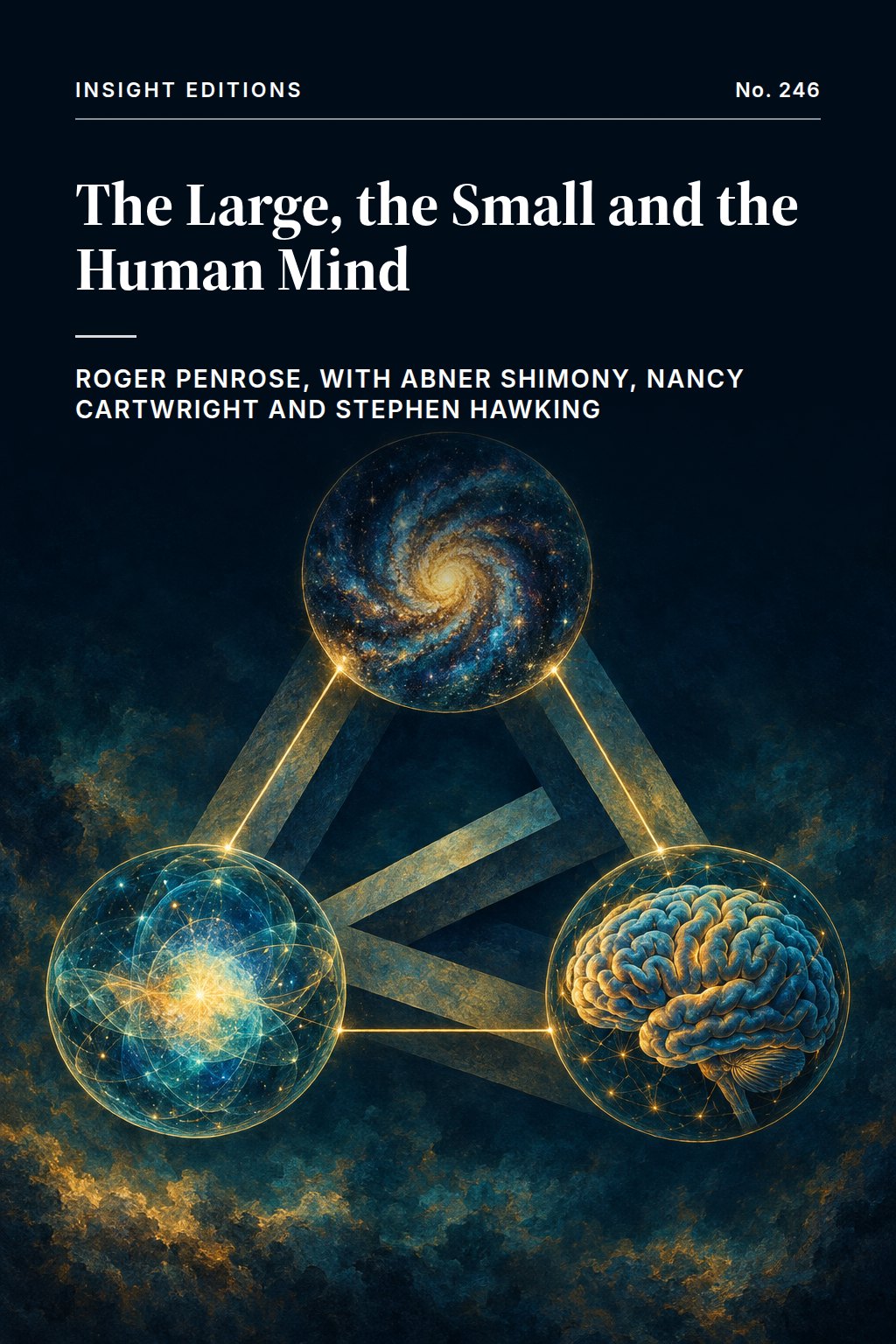
The large (relativity) and small (quantum) obey clashing rules; the clash is resolved by a gravitational, non-computable collapse (OR) that also underlies conscious understanding, as Gödel's theorem suggests.
Three 1995 Tanner Lectures on cosmology, quantum mysteries and the mind; replies by Shimony, Cartwright and Hawking; Penrose's rejoinder; appendices on Goodstein's theorem and an OR experiment.
GR tested to 1014, QED to 1011; Big Bang tuned to 1 in 1010123; OR time ħ/EG: a proton millions of years, a 1-micron speck 1/20 s.
Readers who want the whole Penrose programme in one sitting, with its sharpest critics in the same book.
The Book on One Page
A compact debate. Penrose's three lectures build one chain from cosmology to quantum measurement to consciousness; three distinguished critics then attack it from philosophy, philosophy of science and physics.
The large (Chapter 1). Physics follows mathematics with uncanny precision, to the point that the physical world seems to emerge from a Platonic world of mathematical truth. General relativity, created for elegance, is confirmed by the binary pulsar to about one part in 1014. Gravity is tidal curvature: Weyl (shape-changing) and Ricci (volume-reducing). The Second Law forces a Big Bang of extraordinary specialness, odds about 1 in 1010123, which inflation cannot explain; Penrose proposes the Weyl curvature hypothesis, Weyl = 0 at the initial singularity.
The small (Chapter 2). Quantum theory evolves states by U (linear, deterministic, with complex weights) and then jumps by R (probabilities from squared moduli). Penrose sorts its oddities into Z-mysteries, real and to be lived with (superposition, the Riemann sphere of spin, EPR entanglement, the bomb test), and X-mysteries, signs of a broken theory (Schrödinger's cat). Neither Copenhagen, many worlds nor decoherence resolves the cat. His proposal: objective reduction (OR), in which a superposition of different space-time geometries decays in ħ/EG.
The mind (Chapter 3). Of four views of awareness (A: computation suffices; B: simulation is not awareness; C: awareness needs physics that cannot be simulated; D: beyond science), Penrose defends C. The Gödel–Turing argument shows no algorithm known to be sound captures human mathematical understanding; understanding needs awareness; so consciousness involves non-computable physics, which he locates in OR. A deterministic but non-computable toy universe (polyomino tiling) shows such physics is conceivable. The candidate site is quantum coherence in microtubules, ending in OR events.
The critics (Chapters 4 to 6). Shimony agrees with the aims but says Gödel is the "wrong mountain"; the real point is that mind cannot be derived from physics, and he proposes a quantum-flavoured Whiteheadian ontology with mind as fundamental. Cartwright asks why physics rather than biology, and argues laws form a patchwork: true but not sovereign. Hawking, the "unashamed reductionist", denies that gravity causes collapse, that OR could matter in a warm brain, and that Gödel has anything to say about consciousness.
The reply and appendices (Chapter 7, Appendices). Penrose accepts protomentality with Shimony, insists the U/R conflict is a physics problem against Cartwright, and tells Hawking that decoherence never actually picks an outcome. Goodstein's theorem gives a readable Gödel truth; a crystal-in-superposition experiment would test OR, and a negative result "would rule out our proposal".
| Ch | Title | One-line payload |
|---|---|---|
| Fwd | Malcolm Longair Sets the Scene | A manifesto for 21st-century mathematical physics, with critics included. |
| 1 | Space-Time and Cosmology: the Large | Mathematics rules physics; GR to 1014; Big Bang special to 1 in 1010123; Weyl curvature hypothesis. |
| 2 | The Mysteries of Quantum Physics: the Small | U and R; Z- and X-mysteries; the cat; objective reduction with lifetime ħ/EG. |
| 3 | Physics and the Mind | Views A to D; Gödel–Turing; non-computable toy universe; microtubules and OR; Libet. |
| 4 | Abner Shimony | Right aims, wrong mountain; modernized Whiteheadianism; the tight-rope objection. |
| 5 | Nancy Cartwright | Why physics? Laws as a patchwork; realism without imperialism. |
| 6 | Stephen Hawking | Reductionist positivism; three rebuttals; intelligence of earthworms. |
| 7 | Roger Penrose Responds | Protomentality; physics must fix U/R; decoherence never chooses; Gödel is external. |
| App 1 | Goodstein's Theorem | A readable Gödel truth: induction cannot prove the sequence always reaches zero. |
| App 2 | Testing Gravitational Reduction | Schrödinger–Newton states; a crystal superposed for 0.1 s. |
Malcolm Longair Sets the Scene
Malcolm Longair frames the book as a manifesto for twenty-first-century mathematical physics. Unlike other popularisers, Penrose offers not a tour of settled science but an original vision linking cosmology, quantum measurement, computation and consciousness, which the three discussants then test.
Why this book is unusual. The 1980s and 1990s brought celebrated popular science: Hawking's A Brief History of Time, James Gleick's Chaos, Steven Weinberg's Dreams of a Final Theory. Penrose's The Emperor's New Mind (1989) stood apart as "a strikingly original vision" that tried to subsume physics, mathematics, biology, brain science and philosophy into a new, still undefined theory. It provoked controversy, and in 1994 Penrose replied to critics in Shadows of the Mind. His 1995 Tanner Lectures at Cambridge, printed here as Chapters 1 to 3, give a "gentle introduction" to both books; Chapters 4 to 6 are the discussants' objections, Chapter 7 is Penrose's reply.
Who Penrose is. Longair stresses his standing as one of the most gifted mathematicians of his generation, always working in a physical setting. Credits he lists: - Singularity theorems (some with Hawking): classical gravity implies singularities inside black holes and at the Big Bang, a sign of "serious incompleteness". - The Penrose process for extracting energy from rotating black holes. - Penrose diagrams for black-hole space-times. - A pictorial, geometric style visible in the "impossible" figures he and his father L. S. Penrose published, which inspired several Escher drawings, and in Penrose tilings that cover the plane without ever repeating, a theme that returns in Chapter 3's discussion of computability.
The cosmological problem. Cosmologists trust the Big Bang from about a thousandth of a second onward, but the picture only works with carefully arranged initial conditions, and tested physics runs out before that. The standard fix is inflation, which still pushes key features back to the Planck epoch, about 10−43 s. Penrose accepts the Big Bang but rejects inflation: he thinks the missing ingredient is a correct quantum gravity, which must also explain the universe's extraordinarily low initial entropy.
What inflation was meant to fix. Longair lists the standard puzzles: why the universe is so close to flat (the flatness problem), why regions never in causal contact share one temperature (the horizon problem), and where the seeds of structure came from. Inflation answers all three with one burst of exponential expansion driven by a scalar field, and its prediction of a nearly scale-invariant spectrum of fluctuations was later confirmed in detail. Penrose's objection, as Chapter 1 explains, is not that inflation fails these tests but that it presupposes the extraordinarily special, low-gravitational-entropy start it claims to make unnecessary.
The quantum problem. Quantum mechanics is phenomenally accurate, with built-in non-intuitive features: non-locality (entangled pairs keep a "memory" of their creation) and knowledge of what could have happened but didn't (the Elitzur–Vaidman bomb test). Deeper is the measurement problem: most physicists use the rules as a calculating tool, translating from the linear quantum world to experiment via the "inelegant" collapse of the wavefunction. Penrose wants a new theory with objective reduction built in.
The mind problem. The surprise of Chapter 3: by a variant of Gödel's theorem, mathematical understanding cannot be programmed, however big the computer. Penrose concludes that conscious understanding is non-computational, and links it to the non-computational physics he expects in objective reduction, located in specific brain structures. Underneath runs his Platonism: the physical world in a sense emerges from the world of mathematics.
- Abner Shimony: agrees quantum theory is incomplete and relevant to mind, but says Penrose is "an alpinist who has tried to climb the wrong mountain".
- Nancy Cartwright: asks whether physics is the right starting point at all, and how laws of different sciences relate.
- Stephen Hawking: "most critical of all", closest to the average physicist; demands a detailed theory of objective reduction and denies physics has much to say about consciousness.
- 1950s: Cambridge PhD in algebraic geometry; the Penrose triangle and impossible staircase (with his father, L. S. Penrose), which inspired Escher.
- 1965: the trapped-surface singularity theorem; with Hawking, later theorems for cosmology.
- 1967 onward: twistor theory, his programme to rebuild space-time from light rays.
- 1969: the Penrose process for rotating black holes.
- 1974: Penrose tilings, non-periodic tilings of the plane.
- 1979: the Weyl curvature hypothesis for the Big Bang's low entropy.
- 1989: The Emperor's New Mind; 1994: Shadows of the Mind; 1995: the Tanner Lectures in Cambridge.
- Later: The Road to Reality (2004), conformal cyclic cosmology (2010), Nobel Prize (2020).
It would be very surprising indeed if the answer were "No".
Malcolm Longair, on whether Penrose's ideas will prove fruitfulSpace-Time and Cosmology: the Large
Penrose's first lecture establishes three things. Physics is governed by mathematics to a staggering precision, so that the physical world seems to emerge from a Platonic world. General relativity, built for beauty rather than data, is now the most accurately tested theory known. And the Big Bang was so special, set up to about one part in 1010123, that only a still-unknown union of the large and the small can explain it.
Three worlds and the primacy of mathematics
The Platonic world. Penrose's subject is not a "botanical" catalogue of the universe but the laws that govern it, which differ sharply between the large and the small, and that difference is where the mind will enter in Chapter 3. Besides the physical world he posits a Platonic world of absolutes; Plato would include the Good and the Beautiful, but Penrose concentrates on mathematical truth.
Mathematics from physics
- Mathematical concepts are idealisations of physical objects; the mathematical world emerges from the physical.
- A natural view for many non-mathematicians.
Physics from mathematics
- The physical world is a structure governed by timeless mathematical laws, so it emerges from mathematics.
- Penrose's view, and he believes most mathematicians' and mathematical physicists'.
- The deeper we probe, "the more it seems as though the physical world almost evaporates and we are left only with mathematics".

Scales, and where we sit
The scale diagram. Times run from the Planck time, about 10−43 s (a "chronon"), through the lifetimes of the shortest-lived particles (resonances, about 10−23 s), to the age of the universe; lengths run from the Planck length through particle sizes (about 10−15 m) to the radius of the observable universe, about 1027 m. Planck units "fall out naturally" when general relativity and quantum mechanics are combined; times convert to lengths via the speed of light.
On a logarithmic scale, humans sit near the middle of the size range: vastly larger than the Planck length, vastly smaller than the cosmos, and in fact much smaller relative to the universe than large relative to particles. In time, a human life is "almost as long as the Universe": far more Planck times fit in a lifetime than lifetimes fit in the universe's age. So we are very stable structures, and all living things from cells to whales share the same "in-between" size. We directly experience neither the very large nor the very small.
Going deeper: why the Planck scale is where the large meets the small
The Planck units are what you get by combining the three constants that define the large and the small: G (gravity), c (relativity) and ħ (quantum theory). The only length you can make from them is √(ħG/c3) ≈ 1.6 × 10⁻³⁵ m; the only time, that length divided by c, about 5.4 × 10−44 s. At that scale a particle's quantum wavelength is comparable to the size of the black hole its energy would make: quantum uncertainty and gravitational collapse meet head on. That is why Penrose's scale diagram starts there, and why, in Chapter 2, he uses Planck-scale differences between space-time geometries to estimate when quantum superpositions must give way.
Two kinds of physics
The whole of physics on one slide. Penrose's Figure 1.5 splits physics into two levels:
| Level | Theories | Character |
|---|---|---|
| Quantum level, U | Schrödinger's equation, quantum field theory | Deterministic, computable (?) while it stays at this level |
| Classical level, C | Newton, Maxwell, Einstein (special and general relativity) | Deterministic, computable (?) |
| Bridge, R | "Making a measurement": magnifying a quantum event to classical scale | The only source of indeterminism |
He insists quantum theory is not fuzzy: Schrödinger evolution of the quantum state is precise and deterministic, and indeterminacy enters only with measurement. The "computable (?)" notes look ahead to Chapter 3.
From Galileo to Minkowski
Galilean space-time. Newtonian physics can itself be put in space-time form (done precisely by Élie Cartan after Einstein). There is a global time; each instant is a Euclidean 3-space slice; slices are moments of absolute simultaneity, so Monday noon is the same slice for everyone.
Newton in four dimensions. Cartan's reformulation is worth a moment, because it shows that "space-time" is not uniquely Einsteinian. In Newton–Cartan theory, gravity is already curvature of a four-dimensional space-time, with free fall along its geodesics, exactly as in Einstein's theory; what differs is that time remains absolute, so the space-time has a preferred slicing into simultaneous 3-spaces. Seen this way, Einstein's step was not to geometrise gravity (Cartan shows Newton can be geometrised too) but to replace absolute time with light cones, merging the geometry of time and space. Penrose's cube of physics (Chapter 2) uses exactly this Newton–Cartan corner.
Light cones. In special relativity a flash at an event spreads as a sphere in space and as a cone in space-time. The future light cone carries the flash's history outward; the past light cone brings in everything an observer can see. Particle world-lines must lie inside the cones (nothing goes faster than light), so the cones are "the limits of causality", "the most important structures in space-time".

The Lorentz group. Observers in relative motion disagree on simultaneity, related by Lorentz transformations, the group of linear maps leaving the light cone invariant. Seen from inside, an observer looks out along her past light cone at stars on the celestial sphere; a fast-moving observer passing the same point sees the stars displaced (aberration). The map between the two skies sends circles to circles and preserves angles. Via stereographic projection from the south pole onto the equatorial plane, the sphere becomes the Riemann sphere of complex numbers plus infinity, and aberration becomes a Möbius transformation, a simple formula in a complex parameter u.
The aberration formula made concrete. Label each direction in the sky by a complex number u, the stereographic image of that point of the celestial sphere. A change of observer velocity then acts on every star at once by a Möbius transformation, u ↦ (au + b)/(cu + d), with complex constants a, b, c, d (ad − bc ≠ 0). Such maps are the only one-to-one, angle-preserving maps of the sphere to itself, and they always take circles to circles. The six real parameters in (a, b, c, d) up to overall scale are exactly the six parameters of the Lorentz group: three boosts and three rotations. So the abstract statement "special relativity's symmetry group is the Lorentz group" has a vivid face: every possible way of moving through the universe reshuffles the night sky by a conformal map, so that a circular constellation stays circular to every observer.
The relativistic aberration formula is simpler than the Newtonian one. Penrose draws a moral he repeats throughout: when you get down to fundamentals and find the more exact theory, "the mathematics turns out to be simpler, even if the formalism appears to be more complicated in the first instance". Special relativity, as group theory, is a "much nicer structure" than Galilean physics.
Einstein's gravity: curvature as tidal effect
Equivalence. In general relativity the cones tilt "all over the place" (curved space-time), seemingly ruining the simplicity, which returns later. The first ingredient is Galileo's Principle of Equivalence: rocks of different mass dropped from the Leaning Tower of Pisa fall together (air resistance aside), so a camcorder riding one sees the other hover. A spacewalking astronaut sees the spacecraft hover the same way. In a falling frame the force of gravity disappears; what remains is the tidal effect.
- Riemann curvature (schematically R.... = C.... + R.. G..) splits into two parts.
- Weyl curvature C (tidal): a sphere of particles around a free-falling astronaut is stretched toward and away from the Earth and squeezed at the sides into an ellipsoid, volume-preserving at first. Replace the Earth by the Moon and the particles by the oceans: the two daily tides.
- Ricci curvature (volume-reducing): if the sphere surrounds matter, the particles accelerate inward and the volume shrinks; the rate is fixed by the density of matter inside. Expressed this way, Einstein's theory "is almost the same as Newton's".
- Gravity, for Einstein, is these tidal distortions of world-lines in four-dimensional space-time.
Seal yourself in a lift and cut the cable. Everything floats: you cannot tell whether you are falling toward the Earth or drifting in deep space. Einstein called this the "happiest thought" of his life, and Penrose uses it to say exactly what gravity is not: it is not a force you can feel locally. But make the lift very tall. Two balls released at the top and bottom drift apart, and two balls at the left and right walls drift together, because they fall toward the Earth's centre along converging lines. No choice of falling frame removes that relative motion. That residue, the tidal distortion, is the part of gravity that is real, and it is precisely what the Weyl and Ricci curvatures measure.

The most accurate theory known
A theory built for beauty. Einstein completed general relativity in 1915 from aesthetic, geometric and physical desiderata (equivalence plus non-Euclidean geometry), with little observational pressure. Three classical tests followed, none very impressive: Mercury's perihelion advance (exactly predicted), light bending by the Sun (Eddington's 1919 eclipse expedition), and gravitational time dilation (clocks lower in a potential run slow).
Clocks and gravity in everyday life. The third classical test, gravitational time dilation, has become engineering. GPS satellites orbit where gravity is weaker, so their clocks run fast by about 45 microseconds a day relative to the ground, while their orbital speed slows them by about 7 microseconds a day (special relativity). Uncorrected, the net 38 microseconds a day would accumulate into position errors of roughly 10 km per day. Modern optical clocks detect the slowing of time when raised by as little as a few centimetres. What Penrose called "never very impressive" tests are now routine.
PSR 1913+16 is a pair of neutron stars, each of about a solar mass but a few kilometres across, in highly elliptical orbits; one is a pulsar beaming radio pulses Earthward from some 30 000 light years away. Precise pulse timing yields every orbital property and the relativistic corrections. Uniquely to general relativity, the system radiates gravitational waves, losing energy at a calculable rate; the observed speed-up of the orbital period over 20 years matches the prediction. Penrose's verdict: the theory is now confirmed to about one part in 1014, "the most accurately tested theory known to science".

- Newton: about 1 in 103 in Newton's own day; about 1 in 107 now.
- General relativity: about 1 in 1014, "about twice as many figures".
- The jump from Newton to Einstein matches the jump in Newton's own known accuracy from the seventeenth century to now.
The moral. The theory was not made to fit data; "the mathematical structure is just there in Nature... It has not been imposed upon Nature by anyone. Einstein revealed something that was there", and the thing he revealed was the most fundamental thing we have, space and time.
Put identical clocks at the top and bottom of a tower and compare them after a year. The lower clock, deeper in the Earth's gravitational potential, has run slow, by about one part in 1016 per metre of height. Nothing is wrong with either clock; time itself passes at different rates. Penrose's point about general relativity's beauty becomes concrete here: the same geometric idea that makes light bend and planets precess also makes time a matter of where you are. Modern optical clocks now resolve this effect over a few millimetres of height, turning a once-"unimpressive" test into a routine measurement.
Cosmology: the three Friedmann universes
Leaving out Λ. Penrose sets aside the cosmological constant, which Einstein called his "greatest mistake": "If we are forced to bring it back, well, we shall have to live with it." The three Friedmann models, all perfectly symmetric (the cosmological principle), are labelled by k:
| k | Space | History |
|---|---|---|
| +1 | Closed, spherical | Expands from a Big Bang, then recollapses to a Big Crunch |
| 0 | Flat, Euclidean | Expands for ever (the borderline case) |
| −1 | Open, Lobachevskian (hyperbolic) | Expands for ever |
Penrose's favourite: k = −1. Two reasons. Taking the observations of the time at face value, there did not seem to be enough matter to close the universe (unless there is much dark matter). And it is "the one I like the best".

- Euclid's fifth postulate (a unique parallel through an outside point) cannot be proved from the others; dropping it gives non-Euclidean geometry.
- In Lobachevskian geometry straight lines are arcs meeting the boundary circle at right angles (Escher's Circle Limit I shows them), and through a point off a line there are many parallels.
- Lambert's formula: a triangle's angle deficit (180° minus the angle sum) is proportional to its area; Lambert found it before non-Euclidean geometry was recognised, which Penrose has "never quite understood".
- Same group as relativity: the hyperbolic plane is the unit "sphere" (a bowl-shaped hyperboloid) in Minkowski space, so its symmetry group is the Lorentz group; stereographic projection maps it onto the Poincaré disc, exactly how Escher's pictures arise.
- Real numbers, introduced essentially by Eudoxus in the fourth century BC, underpin it all and still describe all of physics.
Why a geometer likes k = −1. Penrose's affection is not mere taste. The hyperbolic 3-space of a k = −1 universe has the same symmetry group as the light cone of special relativity, so the cosmos would mirror, on the largest scale, the structure of every local light cone. That kind of coincidence, a single group governing the very large and the very local, is what his twistor programme looks for. It also means the sky seen by any observer in such a universe is acted on by Möbius transformations in two ways at once. The data have since gone the other way (flat to high precision), but the instinct to look for one mathematical structure at both ends of the scale runs through the whole book.
In a hyperbolic plane of curvature −1/R2, a triangle with angles α, β, γ has area = R2(π − α − β − γ). A triangle with angles of 60°, 45° and 30° has an angle sum of 135°, a deficit of 45° = π/4 radians, so its area is πR2/4, whatever the lengths of its sides. Shrink a triangle and its angles approach a Euclidean 180°; grow it and its angles shrink toward zero, while the area approaches a maximum of πR2 for a triangle whose vertices are all at infinity. Euclidean area formulas need lengths; hyperbolic ones need only angles, Penrose's "wonderfully simple formula".
Flat and closed alternatives. Many prefer cosy closed models, or flat ones because inflation predicts flatness. Penrose says plainly: "I do not really believe these theories."
Suppose you are one of Escher's devils, living in the hyperbolic plane. Everywhere you go, the geometry looks the same; your neighbours are exactly your size. But draw a large triangle and its angles add up to noticeably less than 180°; draw a circle and its circumference grows exponentially with radius, so there is vastly more room far away than Euclid would allow. Walk in a straight line and, seen from Escher's flat page, you trace an arc that meets the boundary at right angles, which you never reach: the boundary is infinitely far away. A k = −1 universe has spatial slices like this in three dimensions, which is why Penrose finds it both beautiful and, at the time, observationally plausible.
The Second Law and the special Big Bang
The CMB. The Friedmann models have a Big Bang where everything is infinitely dense and hot, "something has gone badly wrong with the theory". Still, a hot dense phase predicts a uniform black-body background, found by Penzias and Wilson in 1965; COBE later showed a spectrum of extraordinary precision, plus tiny real irregularities, without which "we are certainly not just a uniform smudge". With irregularities, stars, galaxies and black holes form; in a closed model the end is "a horrible mess", all the black holes congealing at the Big Crunch.
Film the whole history of a closed universe and run it in reverse. The reversed film begins with a Big Crunch full of merging black holes, which now appear as white holes spewing out matter; galaxies assemble from radiation that converges with perfect precision on stars; stars un-shine, drawing light in from the dark sky. Every frame obeys the equations, yet the whole is absurd. Penrose's diagrams make the asymmetry geometric: the actual Big Bang is smooth (Weyl = 0), the Big Crunch is crinkled (Weyl → ∞). A law of physics that is symmetric in time has been supplied with boundary conditions that are not, and the Weyl curvature hypothesis is a proposal for what those boundary conditions are.
From ripples to galaxies. COBE's irregularities, about one part in 105, are the seeds of all structure. Slightly denser regions attract matter faster, grow, and over billions of years become galaxies and clusters, with gravity amplifying small differences relentlessly. In Penrose's terms this is gravitational entropy being generated: the smooth early universe had low gravitational entropy, and clumping raises it, all the way to black holes. The tiny ripples are thus both evidence that the start was very smooth and the starting point for the entropy increase that powers stars, planets and life.
Entropy, briefly. A wine glass falls and smashes; the reverse is never seen, though Newton's laws allow it. The Second Law says entropy increases. Entropy is k times the log of a phase-space volume: lump indistinguishable states ("coarse graining") into boxes; the state point wanders into ever larger boxes, so entropy rises. "What it is telling you is actually something rather silly." But run the argument backwards and it predicts the glass assembled itself from the carpet. The truth is that someone put it there, for a reason, and so on back: entropy goes down and down into the past, to a Big Bang that must have been very, very special.

Inflation proposes that at about 10−36 s the universe expanded by a factor of about 1060, making whatever it started as look flat and uniform. Penrose's objection: a randomly chosen initial state would be "a horrendous mess", and expanding a mess by 1060 leaves a mess, which "looks worse and worse the more it expands". Inflation alone cannot explain the uniformity; a theory of what the Big Bang was really like is needed, combining quantum and classical physics.

The Weyl curvature hypothesis. Penrose's proposal, "not an implication of any known theory": the true union of large- and small-scale physics should have the consequence that near the Big Bang the Weyl tensor is essentially zero, or tightly constrained. The hypothesis is time-asymmetric: it applies to past-type singularities only. Black-hole and Big Crunch singularities have Weyl → ∞. Remove the constraint at the start and you get a Big Bang "riddled with white holes" and no Second Law at all.

- Odds of an initial singularity "even remotely" like ours by chance: less than 1 in 1010123, from the Bekenstein–Hawking black-hole entropy formula applied to the universe.
- In Penrose's favourite infinite (k = −1) universe the number is infinite.
- Writing out 10123 zeros, one per elementary particle in the universe, is still impossible.
- The Creator must aim a pin at a phase-space region of about 1/1010123 of the total.
Going deeper: where 1010123 comes from
The number is built in three steps. First, the observable universe contains roughly 1080 baryons. Second, the maximum entropy such matter could have is reached if it all collapses into one black hole, whose Bekenstein–Hawking entropy grows as the square of its mass: in natural units, a solar-mass hole has entropy about 1077, and a hole of 1080 baryons (about 1023 solar masses) has entropy about 10123. Third, entropy is the logarithm of phase-space volume, so the volume of the maximum-entropy region is about e10123, or 1010123 to this precision, while the region containing a universe like ours is minuscule by comparison. The ratio is the "Creator's pin". Including dark matter, which Penrose did later in Cycles of Time, raises the exponent to about 10124.
| Term | Meaning in Chapter 1 |
|---|---|
| Platonic world | Timeless mathematical truths from which physics seems to emerge |
| Light cone | Paths of light from or to an event; limits of causal influence |
| Lorentz group | Linear maps of space-time preserving the light cone; also the symmetry group of hyperbolic space |
| Weyl curvature | Volume-preserving, tidal part of space-time curvature |
| Ricci curvature | Volume-reducing part, fixed by local matter density |
| Friedmann models | Homogeneous, isotropic universes with k = +1, 0, −1 |
| Coarse graining | Lumping together states we cannot tell apart |
| Weyl curvature hypothesis | Weyl = 0 at initial singularities only |

The closing point. The Second Law looks like a "floppy" law of chance, yet hides extraordinary precision in how the universe was set up. That precision must come from the union of quantum theory and general relativity, "a theory we do not have", which Chapter 2 approaches.
- "One part in 1014" is a statement about timing precision of the pulsar, not the fractional accuracy of general relativity's predictions; the gravitational-wave orbital decay matched theory to about 0.2% by the mid-1990s. Penrose's comparison with Newton's "1 in 107" mixes different kinds of accuracy.
- Distance to PSR 1913+16 is now estimated at about 21 000 light years, not 30 000.
- Dropping Λ proved untenable within three years: the 1998 supernova results showed accelerating expansion, and Λ (or dark energy) is now about 70% of the cosmic energy budget.
- Penrose's favoured k = −1 universe is disfavoured: Planck (2018) finds spatial curvature consistent with flat to about 0.2%. Flatness was also inflation's prediction.
- Inflation's critics and defenders: most cosmologists reply that inflation never claimed to work from a generic state; it predicts the near-scale-invariant fluctuation spectrum COBE, WMAP and Planck confirmed. Penrose's objection about initial conditions is widely acknowledged as a real issue (the "measure problem"), not as a refutation.
- General relativity triumphant: direct detection of gravitational waves (LIGO, 2015), black-hole images (EHT 2019, 2022), the double pulsar PSR J0737−3039 timing GR to about 0.01%, and Penrose's own 2020 Nobel Prize for the singularity theorem Longair describes.
- The CMB has been mapped by WMAP and Planck, confirming the Big Bang's thermal start and near-uniformity to about 1 part in 105.
- The Weyl curvature hypothesis remains a respected proposal; Penrose later embedded it in conformal cyclic cosmology (Cycles of Time, 2010), where it becomes a consequence rather than an assumption.
Penrose's "physics emerges from mathematics" stance has an engineering echo: models that are elegant and internally constrained (few free parameters, strong symmetry) tend to extrapolate better than curve fits. In credit and risk modelling, the general-relativity story argues for structural models whose form is justified independently of the data they are fitted to, and against piling on parameters to chase historical fit.
The Mysteries of Quantum Physics: the Small
Quantum theory is as precise as relativity and the source of much modern technology, yet it runs on two incompatible rules: smooth, deterministic U and the abrupt, probabilistic R of measurement. Penrose separates its genuine wonders (Z-mysteries: superposition, spin, entanglement, null measurement) from its signs of incompleteness (X-mysteries, chiefly Schrödinger's cat). His answer is objective reduction: a superposition of different space-time geometries is unstable and decays in a time of about ħ/EG, with gravity deciding when the quantum world becomes classical.
The unreasonable effectiveness of mathematics
Wigner's phrase. In 1960 Eugene Wigner spoke of "the unreasonable effectiveness of mathematics in the physical sciences". Penrose lists the evidence:
- Euclidean geometry: accurate to less than the width of a hydrogen atom over a metre.
- Newtonian mechanics: about 1 in 107.
- Maxwell's electrodynamics (with quantum mechanics): valid over a range of scales of 1035 or more, from particles to distant galaxies.
- General relativity: about 1 in 1014.
- Quantum field theory: about 1 in 1011. Electron magnetic moment in Dirac units: predicted 1.001159652(46), measured 1.0011596521(93).
Fruitful as mathematics. The mathematics physics demands also proves powerful as pure mathematics: calculus and differential equations (invented by Newton and others for mechanics), differential forms and partial differential equations, Riemannian and Minkowski geometry, complex analysis, Hilbert spaces, group theory. Physics keeps leading mathematicians to their most fruitful ideas.
Two levels, like the ancient Greeks
U and C. Penrose repeats his split: quantum level U (unitary, Schrödinger) and classical level C. Most physicists think that properly understood quantum physics would yield classical physics. In practice, nobody does that: we use one or the other. This is "disturbingly like" the ancient Greeks, who had one set of laws for the Earth and another for the heavens, until Galileo and Newton unified them. "We now seem to be back with a kind of Greek situation." He adds that the names on his diagram label theories, not beliefs: Newton and Maxwell probably did not think the world deterministic (Einstein apparently did), and Schrödinger certainly did not think his equation described all physics.
- Stability of atoms: classical electrons should spiral into the nucleus; quantum ones do not.
- Spectral lines: quantised energy levels give sharp emission wavelengths.
- Chemical forces: molecular bonds are entirely quantum mechanical.
- Black-body radiation: requires quantised light (Planck).
- Reliability of inheritance: DNA's stability is molecular quantum mechanics.
- Lasers: stimulated transitions and the Bose–Einstein nature of light.
- Superconductors and superfluids: long-range quantum correlations at low temperature. Plus all of electronics, including computers, and, via quantum field theory, particle physics.
Superposition with complex numbers
The two-slit experiment. A source emits single photons toward two slits t and b and a screen. Each photon arrives as a single localised event, like a particle. Open only t, and a given spot can be reached; open only b, and it can be reached; open both, and at carefully chosen spots the photon never arrives. The two possibilities cancel, which never happens classically.
Send a single photon at a half-silvered mirror with a detector on each side. One detector clicks, never both, never half: the photon is indivisible. Now recombine the two beams with a second half-silvered mirror, arranged so the paths are equal. Now only one detector ever clicks. If the photon had "really" gone one way or the other, the second mirror would split it again, 50:50. It did not go one way; it went both ways at once, weighted by complex amplitudes that cancel at one exit and add at the other. This simple device, a Mach–Zehnder interferometer, is the engine of both the bomb test and Penrose's proposed OR experiment.

Complex weights, not probabilities. While in flight, the photon's state is w × (route through t) + z × (route through b), with w and z complex numbers. That is why cancellation occurs: real probability weights could never cancel. "They are complex waves of alternatives!" Complex numbers are pairs of reals, drawn on the Argand (Wessel, Gauss) plane: add by the parallelogram rule, multiply by the similar-triangle rule. With practice they become concrete objects.
U is linear. The time evolution at the quantum level, unitary (Schrödinger) evolution, is linear: a superposition evolves as its parts would separately, superposed with constant complex weights.
R is something else. Magnify to the classical level (a spot appears on the screen) and the rules change. One "wheels out of the cupboard" the collapse of the wavefunction or reduction of the state vector, R: take the squared moduli |w|2 and |z|2 (squared distances from the origin on the Argand plane), and their ratio becomes the ratio of probabilities. Only here does non-determinism enter. "It is a very odd type of scheme for a fundamental theory", yet the professionals treat this hybrid as fundamental.
U: unitary evolution
- Continuous, deterministic, linear.
- Keeps complex superpositions intact.
- Governs isolated quantum systems.
- Time-symmetric.
R: state reduction
- Discontinuous, probabilistic (|w|2 : |z|2).
- Destroys superpositions: one outcome is chosen.
- Triggered by "measurement", magnification to the classical level.
- Penrose: a sign the theory is incomplete.
Going deeper: why complex numbers?
Penrose stresses that quantum weights are complex, and this is not a technicality. Real-valued weights could encode cancellation only by sign (plus or minus), which allows two settings for how alternatives combine. Complex weights allow a continuous phase: two alternatives can add, cancel or anything in between, and the phase rotates smoothly as a particle moves, which is what produces interference fringes. The rule that turns weights into probabilities, the squared modulus, throws the phase away, so phase is invisible in any single outcome yet controls every pattern. Penrose's own twistor theory goes further, taking the complex numbers to be built into space-time itself, which is why he is uneasy (Chapter 7) with generalisations of quantum theory that lose its complex-analytic structure.
Spin and the Riemann sphere
Ratios matter. Dirac's ket notation writes states as |A⟩; a general state is |ψ⟩ = w|A⟩ + z|B⟩. Multiplying a state by any non-zero complex number changes nothing physical, so only the ratio u = z/w matters, including the case w = 0, where the ratio is infinity. All ratios plus infinity live on the Riemann sphere, via stereographic projection (the south pole is infinity).
For a spin-½ particle (electron, proton, neutron), let |A⟩ be spin up and |B⟩ spin down. Every superposition w|↑⟩ + z|↓⟩ is spin about some definite axis, and that axis points from the centre of the Riemann sphere to the point u = z/w. The abstract complex weights of quantum theory become a direction in ordinary space. And nothing is special about up and down: any pair of opposite directions serves equally well as a starting basis, every spin state being a superposition of any such pair.
Measuring spin. The Riemann sphere also gives probabilities. If a spin-½ particle's axis points in direction P and we measure spin along a direction Q at angle θ to it, the probability of "yes, spin along Q" is cos2(θ/2): certainty when θ = 0, 50% at a right angle, zero for the opposite direction. So the geometry of the sphere directly encodes the squared-modulus rule. It is also why Bell's correlations follow a cosine law, which is what lets them exceed any local realistic bound.

Z-mysteries and X-mysteries
Two kinds of mystery. Z-mysteries (puZZle) are strange but real, confirmed by experiment: wave–particle duality, spin, null measurements, non-locality. X-mysteries (paradoX) indicate the theory is "incomplete, wrong or something else"; the central one is the measurement problem, starring Schrödinger's cat. Penrose's rule: "learn to snooze happily with the Z-mysteries", but cross off the X-mysteries with a better theory.
Z-mystery 1: entanglement
EPR and Bell. From Einstein, Podolsky and Rosen, in David Bohm's version: a spin-0 particle splits into an electron and positron flying apart to distant points A and B. John Bell's theorem shows quantum joint probabilities for spin measurements at A and B conflict with any "local realistic" model in which the particles are separate things. Alain Aspect's Paris experiment confirmed quantum mechanics with photon polarisation, choosing the measurement directions while the photons were in flight, too late for any light-speed signal to warn the other photon, over about 12 metres; quantum cryptography already reached kilometres.
The correlations cannot be used to send a signal from A to B, which keeps quantum theory consistent with relativity. "Quantum entanglement is a very strange type of thing. It is somewhere between objects being separate and being in communication with each other", with no classical analogue.
In the photon version, Bell's inequality (in the CHSH form, due to Clauser, Horne, Shimony and Holt) says that for any local realistic model a certain combination of correlations, S, satisfies |S| ≤ 2. Quantum mechanics predicts that for suitably chosen polariser angles (0°, 22.5°, 45°, 67.5°), S = 2√2 ≈ 2.83. Aspect's 1982 experiments found about 2.70, many standard deviations above 2; modern loophole-free tests confirm the violation. The size of the gap is the size of nature's refusal to be "separate things here and there".
Z-mystery 2: testing what did not happen
- Setup: a stockpile of bombs, each with a detonator so sensitive that one photon reflected from a tiny mirror on its nose sets it off. Many are duds: the plunger is jammed, so the mirror is just a fixed mirror.
- Classically: no way to certify a good bomb without exploding it.
- The interferometer: a photon meets a half-silvered mirror and is split into a superposition of two routes; one route reflects off the bomb's mirror, the other off a fixed mirror; the routes recombine at a second half-silvered mirror with detectors A and B. Path lengths are tuned so the two routes cancel at B and add at A.
- Dud bomb: both mirrors fixed, interference intact, only A ever fires.
- Good bomb: its movable mirror acts as a measuring device. Sometimes it detects the photon and explodes; but sometimes it measures that the photon went the other way (a null measurement), which destroys the interference, so B can fire. B firing means a certified good bomb that never interacted with the photon.
- Counterfactuals with real effects: quantum mechanics lets "something that might have happened but didn't" change the outcome.

From thought experiment to laboratory. In 1994 Anton Zeilinger told Penrose he had done it, with something other than bombs ("Zeilinger is most certainly not a terrorist"), and that he, Kwiat, Weinfurter and Kasevich had a refined scheme that certifies good bombs with essentially no wastage.
How the no-waste version works. The improved scheme uses the quantum Zeno effect. Instead of one half-silvered mirror, the photon passes many times through a weakly reflecting element that rotates its state by a small angle toward the "bomb path" on each pass. With a dud, the small rotations accumulate and the photon ends up fully on the bomb path. With a live bomb, each pass acts as a measurement that almost always finds the photon not on the bomb path, resetting it; after N passes the photon is still on its original path, and the chance that the bomb ever absorbed it falls roughly as 1/N. With enough passes, good bombs are certified with vanishing loss: the bomb "watched" the photon into staying away.
The trap. People get "hypnotised" by the Z-mysteries and then feel obliged to accept the X-mysteries too. Penrose thinks that is the mistake.
The X-mystery: Schrödinger's cat
The setup. A photon meets a half-silvered mirror; the transmitted part triggers a detector that fires a gun and kills a cat. If U holds all the way up, photon, detector and cat end in a superposition of dead and alive. "You don't actually see cats like this."

Wald's remark: "If you really believe in quantum mechanics, then you cannot take it seriously." Penrose's map of positions: - Believers, not serious: Bohr and Copenhagen; the state vector is "in the mind". Related: FAPP ("for all practical purposes", Bell's mildly derogatory label), based on decoherence (Zurek), whose advocates retreat to the middle when pressed. - Serious, U only: the state vector is real and U is the whole story, so many worlds: live cat and dead cat in different "universes". - Serious, U and R both real, no new physics: de Broglie–Bohm; consistent histories (Griffiths, Gell-Mann, Hartle, Omnès). - Serious, U and R real, new physics needed: R genuinely contradicts U; Penrose places himself here.
Against many worlds. Beyond its lack of economy, many worlds "does not really solve the problem". With w = z, the superposition |live⟩|sees live⟩ + |dead⟩|sees dead⟩ can be rewritten as (live + dead)(sees live + sees dead) + (live − dead)(sees live − sees dead), all halved. Why do we never find ourselves in the second kind of perception state? Without a theory of perception saying such states are forbidden, there is no explanation; and for general w and z it does not explain why probabilities follow the squared-modulus rule.
The probability problem in many worlds. If every outcome occurs, what does it mean to say one has probability |w|2? Since 1999, David Deutsch and later David Wallace have argued from decision theory that a rational agent in a branching world should bet according to the squared modulus; critics reply that this assumes what it needs to prove, or answers a different question. The debate Penrose flags remains one of the liveliest in the philosophy of physics.
Against FAPP. For an EPR pair, if my partner on the Moon measures up/down, my particle is a 50:50 mixture of up and down, described by a density matrix D = ½|↑⟩⟨↑| + ½|↓⟩⟨↓|. If he measures left/right, the density matrix is ½|←⟩⟨←| + ½|→⟩⟨→|, which is the same matrix, as it must be, or he could signal faster than light. But the density matrix is provisional: a later message from the Moon tells me my particle's actual state. Now apply the same algebra to the cat: with the environment playing the Moon's role, the cat's density matrix is the same whether you split it as alive or dead or as alive + dead, alive − dead. So the density matrix cannot be what makes the cat either alive or dead: "we need more".
Going deeper: the main options for the measurement problem, then and now
| Approach | What happens to the cat | Status in 2026 |
|---|---|---|
| Copenhagen | The state is knowledge; asking what the cat "really" is before observation is meaningless | Still the textbook default |
| Many worlds (Everett) | Both outcomes occur in branching worlds | Popular among cosmologists and quantum computing researchers; probability rule still debated |
| Decoherence (FAPP) | Branches stop interfering almost instantly | Experimentally confirmed as a process; not by itself an interpretation |
| de Broglie–Bohm | Particles have definite positions guided by the wave | Consistent, non-local; minority |
| Consistent histories | Only consistent sets of histories get probabilities | Minority |
| GRW / CSL spontaneous collapse | Random collapses localise large objects | Parameters increasingly constrained by experiment |
| Gravitational OR (Diósi, Penrose) | Self-gravity of the superposition makes it decay | Simplest form ruled out (2021); variants alive |
| QBism | The state is an agent's betting commitments | Growing philosophical following |
Going deeper: what decoherence does and does not do
Decoherence is the process Penrose's critics lean on most, so it is worth being precise. When a cat (or a pointer, or a dust grain) interacts with air molecules and photons, the environment rapidly becomes correlated with which state it is in. Interference between "alive" and "dead" components then becomes practically unobservable, because demonstrating it would require controlling every scattered photon. For a dust grain in air the time is absurdly short, around 10−30 s in some estimates. Decoherence also explains why some states (definite positions) are robust and others (alive + dead) are not: the environment "monitors" position.
What decoherence does not do is select which outcome occurs. The total state of cat plus environment is still a superposition evolving by U; decoherence only guarantees that the branches no longer interfere. Penrose's complaint is that physics then stops short of the fact we observe, one definite cat, and must add something: an interpretation (many worlds, Bohm), or new dynamics (OR, spontaneous collapse). Hawking's position is that the distinction makes no observable difference; Penrose's is that a theory should describe the world we see.
| Term | Meaning in Chapter 2 |
|---|---|
| Superposition | Complex-weighted combination of alternatives, w|A⟩ + z|B⟩ |
| Unitary evolution (U) | Deterministic, linear Schrödinger evolution |
| State reduction (R) | Jump to one outcome with probability ∝ |weight|2 |
| Riemann sphere | Complex ratios plus infinity, drawn on a sphere; for spin, the spin axis |
| Entanglement | Joint state of separated parts that is not a product of their states |
| Null measurement | Learning something because a detector did not fire |
| Density matrix | Description of a subsystem when the rest is inaccessible |
| FAPP | "For all practical purposes": decoherence-based shortcut |
| OR | Objective, gravity-driven reduction with lifetime ħ/EG |
Objective reduction: gravity decides
OR. Penrose amends his diagram of physics: R is an approximation to a missing objective process, OR, for Objective Reduction, "a nice acronym because it also stands for 'or'": one thing or the other happens, objectively.
When does it happen? The superposition principle fails when it is applied to significantly different space-time geometries. A massive object in two places means two different gravitational fields, two space-times whose light cones point in different directions. Trying to do physics in such a superposed space-time "has defeated everyone so far", and Penrose thinks for good reason: "this is not what one should be doing". The superposition becomes one or the other at the level of space-time.

Why the Planck scale matters for cats. The objection: the Planck length (10−33 cm) and time are far below anything relevant to cats. Penrose's reply: ask when the two geometries differ by something of Planck order, measured in space-time, so a small spatial difference corresponds to a long time and a large one to a short time. That gives a time-scale for Nature's choice.
- Replace the cat with a lump of matter in a superposition of two positions.
- Compute EG: the energy needed to pull one instance of the lump away from the gravitational field of the other.
- The superposition is unstable, like a decaying nucleus, with lifetime T ≈ ħ / EG.
- Nature then chooses one location, by rules not yet known.
- Several gravitational schemes share this flavour (notably Lajos Diósi's, independently).
Why gravity helps with energy. Other explicit collapse schemes tend to violate energy conservation. In general relativity, gravitational energy is non-local: two lumps far apart have slightly more total mass than when close (potential energy counts, negatively), yet the local energy densities are the same; the binary pulsar's radiated energy likewise resides "non-locally throughout space". So there is a basic uncertainty in gravitational energy in a superposition, of order EG, exactly the relation between an unstable particle's energy uncertainty and its lifetime. A correct union might therefore dodge the energy problem.
Why bigger means faster. EG grows with the mass displaced and with how far the two mass distributions are pulled apart, up to about the object's own size; beyond that it saturates near the object's gravitational self-energy, roughly G M2/R. Since T ≈ ħ/EG, doubling the mass at fixed density shortens the lifetime by a large factor. That steep dependence is what lets OR leave atoms and molecules alone for millions of years while collapsing dust specks in fractions of a second, and it is why the interesting regime for experiments lies between molecules and dust.
- A proton (as a rigid sphere): a few million years. Consistent with single-particle interference experiments, which see no collapse.
- A water speck of radius 10−5 cm: a few hours.
- Radius 1 micron: about 1/20 of a second.
- Radius 10−3 cm: about a millionth of a second.
The environment. FAPP's one sound element is the environment. Real tests must compare lump plus environment in one place with lump plus environment in the other. If the dominant mass displacement is in the environment, the effect is random and indistinguishable from standard theory; only if the system is isolated well enough could OR show up as something new. Penrose knows of "various tentative possibilities" for experiments (see Appendix 2).
The cube. Inspired by Joy Christian, Penrose arranges theories on a distorted cube whose axes are G, 1/c and ħ. With all three zero: Galilean physics. Switch on G: Newtonian gravity (Cartan's geometric form). Switch on 1/c: special relativity; both: general relativity (a non-trivial step, hence distortion). Switch on ħ: quantum mechanics, then quantum field theory. The back face fails even for Newtonian gravity: there is no consistent union of quantum mechanics with Newtonian gravity that respects Einstein's equivalence principle (as Cartan's classical geometry does), a point Christian made. Penrose believes that union must include state reduction, OR-style, and that full quantum gravity will be "even more subtle".
The book's U-level picture, linear evolution of complex superpositions, is exactly what quantum computers exploit, and Penrose's microtubule proposal in Chapter 3 is a biological quantum computer ending in OR. Shor's algorithm (1994, the year before the lectures) showed such machines could factor large numbers, threatening RSA cryptography, and banks are now migrating to post-quantum cryptography (NIST standards finalised 2024). Penrose's question of when superpositions of large masses must collapse is, in engineering terms, a question about the ultimate limits of scaling quantum computers.
- No formula for EG in general. As Penrose admits in Appendix 2, the scheme needs preferred states (later the Schrödinger–Newton equation); for point masses EG is infinite.
- Energy non-conservation in Diósi's version required an extra length parameter (Ghirardi, Grassi, Rimini); Penrose wants none, which made his version testable and, as it turned out, vulnerable (see update).
- The cat argument against density matrices is persuasive against naive FAPP, but decoherence theorists (Zurek, Joos, Zeh) answer that the environment selects the preferred basis (einselection): "alive ± dead" states decohere almost instantly, which is why we never see them. The remaining dispute is about why one outcome occurs, which decoherence alone does not claim to settle.
- The magnetic-moment figures are 1990s values; the comparison now hinges on independent measurements of the fine-structure constant, which disagree at a few standard deviations.
- Entanglement's Nobel: Alain Aspect, John Clauser and Anton Zeilinger shared the 2022 Physics Nobel. Loophole-free Bell tests (Delft, NIST, Vienna, 2015) closed the main escape routes, and China's Micius satellite distributed entanglement over 1200 km (2017).
- Interaction-free measurement became real: Kwiat, Weinfurter, Herzog, Zeilinger and Kasevich published it in 1995, and quantum-Zeno versions reach very high efficiency; related ideas underpin quantum imaging with undetected photons.
- The electron's magnetic moment was measured to 0.13 parts per trillion (Fan et al., 2023), the most precise test of any theory.
- OR under test: the simplest parameter-free Diósi–Penrose model predicts spontaneous X-ray emission; an underground germanium-detector search at Gran Sasso (Donadi et al., Nature Physics 2021) found none, ruling out that version unless the mass distribution is smeared over at least about 0.5 × 10⁻¹⁰ m. Penrose has argued his version need not radiate.
- Bigger superpositions: molecules of over 25 000 atomic mass units have shown interference (Vienna, 2019), and levitated nanoparticles have been cooled to their quantum ground state (2020), steps toward the regime where OR would bite.
Penrose's Z/X split is a useful habit for any complex system review: separate behaviours that are strange but verified (live with them, document them) from inconsistencies between two rules you are relying on at once (they are design debt). Across a bank's estate of models, a front-office pricing model and a risk model that use incompatible assumptions for the same book are an X-mystery: an operational patch ("R") is hiding a missing unified theory.
Physics and the Mind
The third lecture turns to the mind. Penrose sorts views of consciousness into four camps and argues for C: awareness comes from physical processes that cannot even be simulated by computation. His evidence is the Gödel–Turing argument, which he reads as showing that mathematical understanding is not algorithmic; his candidate mechanism is OR acting on quantum-coherent states in the brain's microtubules. Understanding, not mere computation, is the mark of consciousness, and finding its physical basis will need new physics.
Three worlds, three mysteries
Popper and Penrose. Bishop Berkeley would have the physical world emerge from the mental; the usual scientific view reverses this. Karl Popper added a World III of Culture, a product of mind, giving a ladder physical → mental → culture. Penrose redraws the picture: his World III is the Platonic world of absolutes, chiefly mathematical truth, and the three worlds stand in a cycle, each related to the next by a mystery.

- Mystery 1: why the physical world obeys precise, fruitful mathematics (Chapters 1 and 2).
- Mystery 2: how the physical world gives rise to mentality, feelings, the perception of red, happiness.
- Mystery 3: how minds access mathematical truth.
- Prejudice 1: the whole physical world can in principle be described by (a small part of) mathematics.
- Prejudice 2: there are no mental objects floating free of physical bases (not that everything physical has mentality).
- Prejudice 3: any item of the Platonic world is accessible, in principle, to mentality. Penrose noticed the prejudices only after drawing the figure. The arrows mean relationship, not that any world simply emerges from another.
Four views of awareness
Science, not mysticism. Penrose takes the physical-to-mental arrow seriously: consciousness should be explained scientifically. But many people assume anything scientific can be put on a computer, which he will "argue strongly against" despite his physicalist bias. Mental qualities (emotion, aesthetics, creativity, inspiration, art) are said by computationalists to "emerge" from the right computations.
Describing, not defining. He will not define consciousness ("to define it would probably be to define the wrong thing"), but distinguishes passive aspects (awareness: colour, harmony, memory) from active ones (free will, acting under it), and focuses on something between: understanding or insight. Two relations he insists on: intelligence requires understanding, and understanding requires awareness, so intelligence requires awareness.
| View | Claim | Associated with |
|---|---|---|
| A (strong AI, functionalism) | All thinking is computation; the right computation evokes awareness | Turing (in Penrose's reading) |
| B | Brain action can be simulated, but simulation alone does not evoke awareness | John Searle |
| C | Awareness comes from physical brain action that cannot even be simulated computationally | Penrose |
| D | Awareness cannot be explained in physical, computational or any scientific terms | Gödel (in Penrose's reading) |
Weak C versus strong C. Weak C: non-computable action exists within known physics, if we look carefully. Strong C: it lies outside present physics. Penrose's version of strong C locates the non-computability in the missing physics bridging the quantum and classical levels. Standard R gives computability plus randomness, "not good enough": the new OR theory must be non-computable. "Quite a tall order": new physics, and new physics that matters to the brain.
John Searle imagines himself locked in a room with a rulebook for manipulating Chinese characters. Questions in Chinese come in; by following the rules he sends out perfect Chinese answers; yet he understands no Chinese. If running the program does not give him understanding, it does not give the computer understanding either. That is the B camp's argument against A. Penrose accepts it but finds it insufficient: it concerns only inner experience, which no outside test can check. He wants a difference in outward behaviour, something a conscious mathematician can do that no algorithm can, which is why he turns to Gödel. The C claim is stronger, riskier and, in principle, testable.
Chess: computing versus understanding
- Position (William Hartston): White is hugely outnumbered (Black has two extra rooks and a bishop), but a wall of interlocked pawns seals Black's pieces in. White draws by shuffling behind the wall.
- Deep Thought, the strongest chess computer of the day, instantly took the rook, opened the pawn wall, and reached a hopelessly lost position. It searched move after move to a fixed depth and counted material.
- A human sees the barrier and understands it is impenetrable.
- A second position: the right move is to treat the white bishop as a pawn to build another barrier; a computer taught about pawn barriers would still fail here, needing "an extra level of understanding".
- Limit of the example: chess is a finite, computational game, so in principle exhaustive search wins. It illustrates the difference between computation and understanding; it does not prove it.
Chess since then. Deep Thought lost to Garry Kasparov in 1989; its successor Deep Blue beat him in 1997, two years after these lectures. Today's engines (Stockfish, Leela, AlphaZero-style networks) are far stronger than any human, and neural evaluation lets them recognise many blockades. Yet fortress positions like Penrose's remain a known test of the gap between searching and seeing: engines often report a large advantage for the side with more material while the position is a dead draw. The example has aged as Penrose intended, as an illustration rather than a proof.

The Gödel–Turing argument
Turing machines and Π1-sentences. A Turing machine is an idealised computer with unlimited memory that never errs or wears out. A computation can be logical as well as arithmetical. Some computations stop, some never do:
- Find a number that is not the sum of three squares. Try 0 = 02+02+02, 1 = 02+02+12, and so on: it stops at 7.
- Find a number that is not the sum of four squares. Never stops: Lagrange's theorem says every natural number is a sum of four squares.
- Find an odd number that is the sum of two even numbers. Never stops, obviously.
- Find an even number greater than 2 that is not the sum of two primes. Stops if and only if Goldbach's conjecture is false; nobody knows. A statement that a specified computation never stops is a Π1-sentence. The question: are mathematicians using some algorithm A to convince themselves of such facts? Not to discover them (originality is not the issue), only to follow and understand a proof.
The argument, step by step. Penrose gives Turing's form of Gödel's argument, used his own way:
- List all computations acting on a natural number n: C0(n), C1(n), C2(n), ..., Cp(n), ....
- Suppose a sound algorithm A(p, n) encapsulates all the ways human mathematicians can convince themselves that computations do not stop: if A(p, n) stops, then Cp(n) does not stop. A may fail to stop in some cases where Cp(n) also never stops, but it never errs.
- Set p = n (Cantor's diagonal trick): if A(n, n) stops, then Cn(n) does not stop.
- A(n, n) is a computation on one number n, so it appears in the list: A(n, n) = Ck(n) for some k.
- Put n = k: if Ck(k) stops, then Ck(k) does not stop. So Ck(k) does not stop.
- But then A(k, k) does not stop either, so A cannot know that Ck(k) never stops, though we have just seen that it never stops.
- Therefore no algorithm we know to be sound encapsulates all of human mathematical understanding.
If a machine is expected to be infallible, it cannot also be intelligent.
Alan Turing, on the escape route of unsound algorithmsTuring's way out (view A)
- Mathematicians do use algorithms, but unsound ones: a machine making no pretence of infallibility might still be intelligent.
- Penrose finds this implausible for merely following an argument.
Gödel's way out (view D)
- Gödel did not believe insight is computational, but could not rule out a theorem-proving machine equivalent to intuition that cannot be proved to be so, or proved to be sound.
- The loophole is knowability, not soundness.
Penrose's verdict. Neither escape is plausible. The argument shows that if an algorithm for establishing Π1-sentences is known to be sound, you can exhibit something beyond it. He devoted the first 200 pages of Shadows of the Mind to closing loopholes (an unknowable algorithm, a learning device, and so on).
- Natural selection: a mathematician absorbed in a proof while a sabre-toothed tiger pounces, as his cousins hunt mammoths, build houses and grow crops. A specific algorithm for advanced mathematics could hardly have been selected for; a general ability to understand could.
- Deliberate AI: "Albert Imperator" confronts his robot, the "Mathematically Justified Cybersystem", in a dialogue that compresses the replies to Penrose's critics.
Children and the natural numbers. Gödel shows no system of computational rules characterises the natural numbers, yet "any child knows what they are". Show a child a few collections of objects and the child abstracts the notion: not a rule set but understanding, "some kind of 'contact' with the Platonic world". Penrose draws no line between mathematical and other understanding, between understanding and consciousness, or between humans and other animals: "they also have some kind of understanding, and so also must have awareness". So non-computability in mathematical understanding suggests non-computability in all consciousness.
Going deeper: what the argument does and does not claim
Penrose is careful about scope, and so should a reader be. The argument does not say that computers cannot prove theorems, nor that human mathematicians never err, nor that any particular truth is beyond human reach. It says: suppose all the methods by which mathematicians become convinced that computations never halt were captured by one algorithm A, and suppose we could know A to be sound. Then we could construct a non-halting computation that we can see does not halt but A cannot. So either there is no such A, or we cannot know it is sound, or it is unsound. Penrose argues the last two are implausible as accounts of how we follow a proof, so the first holds: understanding is not the running of a knowably sound algorithm.
Critics respond that the middle option is not implausible at all: human mathematical practice, taken as a whole, is messy, socially distributed and occasionally wrong, so of course nobody can certify it sound. Penrose's reply is that the issue is not the whole of practice but the individual act of seeing that an argument is correct, and that in that act we are not obviously running an unsound or unknowable procedure. The disagreement has not been resolved, which is why the argument is cited by both sides.
| Term | Meaning in Chapter 3 |
|---|---|
| Turing machine | Idealised computer with unlimited memory and no errors |
| Π1-sentence | The claim that a given computation never halts |
| Sound algorithm | One that never asserts anything false |
| Diagonal argument | Feeding a procedure its own index (Cantor, Gödel, Turing) |
| Strong AI (view A) | Right computation produces awareness |
| Strong C | Awareness needs physics outside present theory and beyond computation |
| Microtubule | Protein tube of 13 tubulin columns inside cells, including neurons |
| Orch-OR | Orchestrated objective reduction in microtubules (Hameroff and Penrose) |
What non-computable physics could look like
Determinism is not computability. To show the difference, Penrose offers a toy universe:
- Time runs 0, 1, 2, 3, .... A state is a pair of finite sets of polyominoes (shapes of unit squares glued edge to edge), drawn from a computable list S0, S1, S2, ....
- Rule: from (Sq, Sr), if the shapes in Sq can tile the whole plane without gaps or overlaps, move to (Sq+1, Sr); if not, move to (Sr, Sq+1), swapping.
- Fully deterministic, yet by Robert Berger's theorem (1966) there is no algorithm deciding whether a set of polyominoes tiles the plane, so no computer can simulate this universe.
- Berger's proof depends on tile sets that tile the plane only non-periodically, like the three polyominoes Penrose shows, cousins of his own Penrose tiles.

Hints from quantum gravity. Two approaches that superpose four-dimensional space-times already show non-computability: the Geroch–Hartle scheme, because Markov proved that 4-manifolds cannot be computably classified; and David Deutsch's observation (in a preprint, later dropped as irrelevant to that paper) that superposed space-times may include ones with closed timelike lines, which, like the bomb test's counterfactuals, could influence what happens. Not a clear argument, Penrose admits, but "an indication".
Free will, recast. Philosophy frames free will as determinism versus not. Penrose asks a different question: is the future determined computably by the past? Heredity, environment and chance are all beyond our control, and randomness "does not help you very much". Non-computability, even higher-order non-computability (Gödel's argument applies to Turing's oracle machines too), may be where something like a self could live. Words like judgement, common sense, insight, aesthetic sensibility, compassion, morality suggest non-computable contact with Platonic absolutes, the true, the good and the beautiful.
Free will and responsibility. Penrose notes that legal ideas of rights and responsibilities presuppose an independent "self" acting, beyond heredity, environment and chance, all of which are outside our control. Ordinary non-determinism (random elements) does not supply such a self, since chance is no more "ours" than causes are. He offers non-computability, possibly of a higher order than Turing's (Gödel-type arguments apply equally to oracle machines, which have access to answers a Turing machine cannot compute), as a space in which something like free will might live. He explicitly raises these questions without claiming to answer them.
Platonic contact. Mathematical understanding, for Penrose, is a form of contact with the Platonic world, and so may be judgement, common sense, insight, aesthetic sensibility, compassion and morality. If our awareness enables such contact and it cannot be explained by computation, that would be "an important issue", a scientific bridge between the true, the good and the beautiful and the brain.
Where in the brain?
Neurons and synapses. Neurons send signals along axons that branch to synapses, where neurotransmitters excite or inhibit the next neuron. If synaptic strengths were fixed, the brain would be very like a computer. They change (Hebb's mechanism was an early proposal), but every proposed rule is computational plus probabilistic, so the network can be simulated. Artificial neural networks are simulated on computers, which proves they are computational; Gerald Edelman claims his brain models are non-computational, but "he has a computer which simulates all these suggestions".
A paramecium has no nervous system, being a single cell, yet it swims toward food, retreats from danger, negotiates obstacles and apparently learns from experience. Amoebae, too, move purposefully. One suggestion: the cytoskeleton controls such behaviour. The paramecium's cilia are the ends of its cytoskeleton, bundles of microtubules; amoebae push out pseudopods with microtubules. If one cell can do this much, a neuron is no mere switch.
Microtubules. They are tubes of the protein tubulin, normally 13 columns of tubulin dimers (each about 8 nm × 4 nm), each dimer able to take (at least) two conformations. They drive mitosis in ordinary cells (via the centrosome and its centriole, two bundles in a separated "T" that duplicate and drag the chromosomes apart), but neurons do not divide, so in neurons they must do something else: transport neurotransmitters, guide growth and degeneration, and very possibly set synaptic strengths, for example via actin in dendritic spines and via clathrin structures at synaptic boutons.

- Stuart Hameroff: microtubules act like cellular automata, tubulin conformations playing 0 and 1, so each neuron contains many tiny computers.
- Penrose: because they are tubes, they might isolate their interiors from environmental noise, allowing large-scale quantum coherence, somewhat like a superconductor (Herbert Fröhlich argued for coherent oscillations in biological systems).
- Ordered (vicinal) water around the tubes could add insulation; microtubule-associated proteins (MAPs) could "tune" the activity at nodes.
- Tubulin conformations enter quantum superposition: quantum computation inside the brain.
- Because consciousness is global, the coherent state must span large areas of the brain, as entanglement can.
- With enough isolation, the superposition lasts until OR occurs (perhaps close to a second), and the non-computable element enters. Each OR event is a candidate conscious event.

- Each neuron contains on the order of 107 to 109 tubulin dimers (Hameroff's estimates), so the brain's roughly 1011 neurons hold some 1018 or more tubulins.
- If each tubulin is a two-state switch updating at nanosecond rates, a single neuron could perform on the order of 1016 operations per second, dwarfing the "neuron as switch" picture.
- For OR to occur in about 0.5 s (a Libet-like timescale), the superposed mass needed is equivalent to roughly 109 to 1011 tubulins in coherent superposition (later Orch-OR papers), implying coherence across perhaps tens of thousands of neurons.
- Tegmark's decoherence estimate of 10−13 s or less is the number those figures must beat.
Timing consciousness: Libet's experiments
- Free will (Kornhuber; Libet and colleagues): subjects press a button whenever they choose; electrodes averaged over many trials show brain activity starting about a second before the moment subjects believe they decided.
- Sensation (Libet): a skin stimulus seems to be felt at its actual time, yet a cortical stimulus delivered up to about half a second later can mask it, so awareness had not yet happened. A cortical stimulus under half a second is not perceived at all; one longer than half a second is perceived from half a second on. Skin awareness is "referred back" in time; cortical awareness is not.
- The puzzle: half a second to become aware plus a second to act on it gives a second and a half for a consciously willed response, which Penrose finds hard to square with conversation.

What later experiments added. Soon and colleagues (2008) used fMRI to predict which of two buttons a subject would press up to about 7 to 10 seconds before the subject reported deciding, though with accuracy only modestly above chance. Schurger, Sitt and Dehaene (2012) showed that the readiness potential can arise from random neural fluctuations drifting to a threshold, so it need not reflect an unconscious decision at all. The timing puzzle Penrose found "rather hard to believe" has therefore been both sharpened and softened: early brain activity is real, but what it means for will is disputed.
Penrose's reading. The puzzle may come from interpreting the timings with classical assumptions. Quantum non-locality and counterfactuals might make the timing of conscious events strange. Understanding non-locality may need a theory as different from quantum mechanics as general relativity is from Newton, with non-locality built in.
The impossible triangle. Its impossibility cannot be located: cover any corner and the rest is possible. Yet it can be measured precisely by cohomology, from the "glueing rules" of its pieces. That is the kind of non-local mathematics the new theory may need. And the impossible triangle deliberately mirrors the three-worlds figure: a paradox now, perhaps resolvable with deeper understanding.
Going deeper: impossibility you cannot point to
The impossible triangle is built from three perfectly possible L-shaped pieces. The trouble lies only in how they are glued: each joint is locally consistent, but going round the loop, the depth relationships fail to match up. Cohomology measures exactly this kind of failure: assign local data to overlapping patches, check whether they can be made globally consistent, and record the obstruction when they cannot. The obstruction is a definite mathematical object, yet it belongs to the loop as a whole, not to any patch. Penrose's suggestion is that quantum non-locality has the same character: correlations that are consistent locally but cannot be assembled into a story of separate things, and which a future theory may describe by cohomology-like mathematics. (Cohomology also underpins his twistor theory, which describes massless fields this way.)

Suppose an AI researcher builds a robot whose entire mathematical reasoning is a known, fixed algorithm, and suppose the robot believes itself sound. Penrose's Gödelian move lets anyone holding the program construct a statement, "this computation never halts", that the robot cannot establish, though its designers, believing the robot sound, can see it is true. If the robot is told its own program and accepts its own soundness, it can see the truth too, and so it has gone beyond its program, which is a contradiction. The way out for the robot is to doubt its own soundness. Shadows of the Mind stages this as the dialogue between "Albert Imperator" and the "Mathematically Justified Cybersystem", and Penrose's conclusion is that human mathematicians do not, in following proofs, doubt their soundness in the way the robot must.
- The Gödel argument is widely rejected by logicians. Critics (Putnam, Feferman, Chalmers and many others) hold that it shows only that we cannot know that any algorithm we embody is sound, which is compatible with our being (complex, possibly unsound) algorithms. Penrose's response is that unsoundness is implausible for simply following a proof.
- Libet's numbers are overstated. Libet's 1983 study put the readiness potential about 550 ms before movement and about 350 ms before reported intention, not a full second; Schurger (2012) reinterpreted the readiness potential as accumulated noise reaching a threshold, undercutting its reading as an unconscious "decision".
- Decoherence is the killer objection to Orch-OR: Max Tegmark (2000) estimated microtubule superpositions decohere in 10−13 to 10−20 s, many orders shorter than the ~0.025 to 0.5 s Orch-OR needs. Hameroff and colleagues dispute his parameters.
- Animal and neural-network points: Penrose credits animals with understanding (and so awareness); critics note that the same courtesy is hard to deny to sufficiently capable machines without an independent test.
- Deep Thought is a weak example: modern engines (e.g. Stockfish with neural evaluation) handle many fortress positions, although recognising impenetrable fortresses remains a known weakness of search-based programs.
- AI and the Gödel debate. Large language models now write and check proofs: systems from Google DeepMind (AlphaProof, AlphaGeometry, 2024) reached International Mathematical Olympiad silver level, and in 2025 both DeepMind and OpenAI reported gold-medal performance. This does not refute the Gödel argument (no claim of knowable soundness is involved), but it weakens its practical rhetoric about understanding.
- Microtubules and anaesthesia. In rats, the microtubule-stabilising drug epothilone B delayed loss of consciousness under the anaesthetic isoflurane by about a minute (Khan, Wiest et al., eNeuro, 2024): suggestive that anaesthetics act partly via microtubules, far from proof of Orch-OR.
- Quantum effects in tubulin: a 2024 study reported superradiance in tryptophan networks of microtubules (Babcock et al., J. Phys. Chem. B), a collective quantum optical effect at room temperature, though not the long-lived coherence Orch-OR requires.
- Consciousness science has moved toward adversarial collaborations (Global Workspace versus Integrated Information Theory, results 2023 to 2025); Orch-OR remains a minority position.
The Gödel argument's real lesson for AI practitioners is about verification, not intelligence: a system cannot certify its own soundness from inside. That is why model risk frameworks (for example PRA SS1/23 for banks) demand independent validation. A model, or an AI agent, that grades its own outputs is attempting exactly the self-certification Gödel and Turing showed to be impossible in general.
Abner Shimony: Mentality, Quantum Mechanics and Potentialities
Abner Shimony, philosopher-physicist and co-author of the CHSH Bell inequality, is the most sympathetic critic. He shares Penrose's three central theses but thinks the Gödel argument is a detour. Penrose, he says, "is an alpinist who has tried to climb the wrong mountain": the real summit is that mentality cannot be derived from physics at all, and Shimony proposes a "modernized Whiteheadianism" in which mind is fundamental and quantum ideas explain how it intensifies.
Physicist and philosopher at Boston University, with doctorates in both fields. With Clauser, Horne and Holt he devised the CHSH inequality (1969), the form of Bell's theorem used in nearly every experiment since, including Aspect's. He coined the phrase "experimental metaphysics" for Bell tests and long advocated taking the measurement problem as real physics. His sympathy for Penrose's aims and scepticism of the details are those of someone who helped build the experiments Penrose cites.
Agreement. Shimony admires the spirit of Penrose's work, which follows Hilbert's epitaph "Wir müssen wissen, wir werden wissen" ("We must know, we will know"). He accepts three theses:
- Mentality can be treated scientifically.
- Quantum ideas are relevant to the mind–body problem.
- The actualisation of potentialities (the measurement problem) is a genuine physical problem that requires modifying quantum theory.
4.1 The status of mentality in nature
The wrong mountain. About a quarter of the lectures and half of Shadows of the Mind argue that human mathematics is non-algorithmic. Hilary Putnam's review claimed gaps (an unprovably sound program; one too complex to understand); Shimony is "not convinced" by Penrose's reply but defers on proof theory. His real point: the central thesis (that mental acts cannot be achieved by any artificial computer) does not depend on Gödel at all. Searle's Chinese room shows it more directly: a person trained to follow instructions in Chinese can compare computing with understanding and computing like an automaton, and the difference is evident even for trivial computations. The same holds for qualia, pain and pleasure, volition and intentionality.
- The identity argument fails. Physicalists say a mental state can be identical to a brain state, as one object can be known through two senses. But sensory identity involves two causal chains meeting at one object and at one theatre of consciousness. For mind = brain, the object end is the brain state, but the theatre is missing: physicalism gives it no independent status, so the analogy equivocates.
- The phenomenological principle: any coherent ontology must account for appearances. In a physicalist hierarchy, appearances fit neither fine-grained micro-descriptions (unless mind is smuggled into physics), nor coarse-grained averages (without the failed two-aspect theory), nor relational descriptions (unless connected to a sensitive subject). "Sensory appearances fit nowhere in a physicalist ontology."
Why physicalism still attracts. Three "massive and formidable" considerations: there is no evidence of mind apart from nervous systems; neural structures evolved from primitive organisms (back, via prebiotic evolution, to atoms); and fundamental physics attributes no mental properties to inorganic constituents.
Whitehead. Alfred North Whitehead's philosophy of organism (with Leibniz's monadology as ancestor) builds on "actual occasions": spatio-temporal quanta, each with low-level mentalistic features (experience, subjective immediacy, appetition). An elementary particle is a chain of occasions whose experience is "dim, monotonous and repetitious"; only organised societies of occasions intensify into full consciousness. Shimony notes Whitehead is absent from Penrose's books and raises his own objections: a new bifurcation between proto-mentality and human experience; no evidence for proto-mentality; "protomental" may be a semantic trick (renaming a problem as a solution); and atomism at odds with the holistic mind.
4.2 Quantum ideas for the mind–body problem
- Potentiality: a complete quantum state is a network of potentialities: properties can be objectively indefinite, outcomes a matter of objective chance with objective probabilities |ci|2.
- Entanglement: a composite state Σ ci ui ⊗ vi is holistic; neither part has a pure state, and their potentialities are actualised in tandem.
- Modernized Whiteheadianism: potentiality lets mentality pass between indefinite and definite (consciousness and unconsciousness as changes of state, not of ontological status); entanglement lets many dim elementary mentalities combine into the broad range of a conscious mind, since collective observables have much wider spectra than single particles'.
Comparison with Penrose. Penrose uses both ideas: potentiality in quantum computations across superposed branches; entanglement ("coherence") within a microtubule, across a neuron's microtubules and across many neurons, since "the unity of a single mind" needs coherence over much of the brain (supported by superconductivity, superfluidity and Fröhlich's calculations). He adds OR to read out definite results and supply non-computability. But to Shimony this "sounds suspiciously like a quantum version of physicalism": still physicalism, still unable to place appearances. Whitehead's view instead treats mind as ontologically fundamental, using quantum theory not as a surrogate for mind but as an instrument for the gamut of its manifestations. Quantum theory is a framework already applied to two ontologies (particles; fields); it could be applied to an ontology of minds or proto-minds. Shimony admits his proposal is "inchoate, impressionistic" and untested, and wonders whether Penrose is "more of a crypto-Whiteheadian" than he realised.
- Quantum-flavoured psychology: transitions from peripheral to focal vision; between consciousness and unconsciousness; the pervasiveness of mind through the body; intentionality; anomalies in timing mental events (Libet); the ambiguities of Freudian symbolism. Cites Lockwood and Stapp.
- Schrödinger's analogy, extended: geometrical optics is to wave optics as particle mechanics is to wave mechanics; perhaps classical psychology is to quantum psychology likewise.
- Weaker structure: mental state space need not be a Hilbert space; Bogdan Mielnik's generalised quantum mechanics keeps only the idea that a mixed state can be decomposed into pure states in more than one way, unlike classical statistics. Perhaps colour perception fits (many ways to mix perceptual white).
4.3 The problem of actualisation
Agreement on the X-mystery. Linearity means measurement leaves apparatus plus object in a superposition of pointer readings; Shimony shares Penrose's scepticism of many worlds, decoherence and hidden variables. Somewhere unitarity breaks down. Where? Possibly when a macroscopic system is entangled with a microscopic one, when the space-time metric is entangled with matter (Penrose's choice, with lifetime set by energy difference), or in the psyche of the observer.
Penrose needs superposed brain states for the unity of mind, yet monstrosities such as seeing a red flash superposed with seeing a green flash must not occur, or must be too brief to register. He argues the energy differences of such states make their superpositions short-lived. Maintaining enough coherence for global mind and enough decoherence for definite experience is a "delicate tight-rope walk", and how such a brain could be robust in daily operation "is very mysterious indeed".
Flash a red light or a green light at random, decided by a single quantum event, and let a subject watch. On Penrose's picture, the subject's brain enters a quantum-coherent state that must eventually reduce by OR. If the coherent state could hold "seeing red" and "seeing green" in superposition for long, experience would be a blend that nobody reports. So OR must act fast on the difference between the two percepts, yet slowly enough across the brain to keep the unity of mind. Shimony's point is that the same mechanism is asked to do opposite jobs at once, and that the margin between them has never been estimated.
Other routes to actualisation. Variants of Ghirardi–Rimini–Weber spontaneous collapse might escape Penrose's criticisms. Or a superselection rule might forbid superposing distinct conformations of macromolecules, which act as cellular switches (a superposed switch would be a cellular Schrödinger's cat); this would be testable by molecular spectroscopy (Martin Quack on chiral molecules), though it would leave open where the dividing line lies. Finally, from a Whiteheadian view, actualisation by the psyche is "not as ridiculous... As it is commonly regarded", if its psychological implications are worked out well enough to test.
Shimony's distinction between using quantum theory as a surrogate for mind and as an instrument for describing mind's range is a useful caution for AI work too: borrowing a formalism (attention, "quantum-inspired" models) does not by itself import the properties of the domain it came from.
| Ontology | Fundamental entities | Where mind comes from | Main difficulty |
|---|---|---|---|
| Physicalism (two-aspect, identity, functionalism) | Particles, fields | Brain states, classes of them, or programs | Appearances "fit nowhere" (Shimony) |
| Penrose's quantum physicalism | Fields plus new OR physics | Non-computable OR in coherent brain states | Still physicalist; no place for the theatre of consciousness |
| Whitehead's philosophy of organism | "Actual occasions" with dim experience | Organised societies of occasions | Bifurcation, no evidence for protomentality |
| Modernized Whiteheadianism | Occasions with quantum potentiality and entanglement | Entanglement broadening many dim minds into one rich one | Inchoate; untested |
| Dualism | Matter and mind as separate substances | Mind given separately | Interaction problem; no evidence of mind without brains |
Nancy Cartwright: Why Physics?
Nancy Cartwright, philosopher of science and self-described positivist, asks the question raised at an LSE/King's College seminar by the statistician James Durbin: why look for the mind in physics rather than biology? She finds Penrose's three reasons wanting and argues that the laws of science are a patchwork, true but not sovereign: "It is not realism about physics that is at stake under pluralism, but rather imperialism."
Philosopher of science (then at the LSE, later Durham and UC San Diego), author of How the Laws of Physics Lie (1983) and later The Dappled World (1999). Her long-running thesis is that fundamental laws are true only of idealised, shielded situations, and that the world is "dappled": governed by many partial laws rather than one closed system. Her chapter here is a compact application of that view to the mind.
- A promising programme: we can lay one out (macroscopic quantum coherence in microtubules, plus a new non-computable quantum–classical interaction). The strongest kind of reason, but this programme is not detailed, nor the next step of a well-verified research agenda; its appeal rests on boldness, on the need to fix quantum mechanics anyway, and on a prior conviction that a scientific explanation must be physics, which cannot itself justify choosing physics.
- Physics already explains parts of the brain: electrical circuitry models nerve transmission; Penrose's story uses electric polarisation states of tubulin. But "physics tells part of the story" does not license "physics tells all of it". Appealing to chemistry as "really just physics" repeats the same leap one level down: there is no real reduction of physical chemistry to physics; quantum concepts always work alongside sui generis chemical concepts.
- Metaphysics: mind must not be mysterious, so it must be scientific, so it must be physics; otherwise we are left with an unacceptable dualism.
Newton's law of gravitation says two bodies attract with force G m1m2/r2; Coulomb's law says charged bodies attract or repel with force proportional to q1q2/r2. For two charged massive bodies, neither law describes what happens: the actual force is a combination of both. Each law is true only "ceteris paribus", when nothing else acts. Physicists reply that vector addition of forces is itself a law; Cartwright replies that such composition rules are available only in carefully engineered domains, and that outside them (in cells, economies, brains) there may be no general rule for combining the influences of different sciences. That is the force of her question to Penrose.
Durbin's mottled world. Cartwright credits the question to statistician James Durbin, whose working world is "mottled": patterns drawn from economics, medicine, engineering and everyday practice, each with its own regularities, none reducible to a master theory. Against this, Penrose's world is that of the unified system with physics at its base. Cartwright's suggestion is that the statistician's experience of a world of many local regularities may be as good a guide to how nature is organised as the physicist's experience of a few powerful laws.
The single-system view. Cartwright targets the third reason. The world has a vast number of properties, studied by many sciences or by none. What makes people think they are "all really the same"? An excessive confidence in the systematicity of their interactions and an excessive estimate of what physics has accomplished. Even anti-reductionist philosophers of biology cling to supervenience (identical physical properties fix identical biological ones), which makes biological properties "second class citizens".
Physics-ism
- One unified system with physics as its base.
- Biological properties supervene on physical ones.
- Physical laws are complete and closed.
- Lab and engineering successes show physics governs everything.
Cartwright's patchwork
- Many sciences side by side, interacting: physical and biological properties act together causally.
- "No biology in, no biology out": physics explains biology only with unreduced biological descriptions.
- All laws, physics included, hold ceteris paribus: only when nothing from outside their domain interferes.
- Devices from vacuum tubes to SQUID magnetometers are built to exclude interference, so they cannot show physics is sovereign.
Shimony's interjection. In discussion Shimony applauded studying mind via biology but defended inter-disciplinary links: Bell's theorem was a triumph for holism; Onsager's proof of phase transitions in the 2D Ising model, a triumph for reduction; Pasteur's link between molecular chirality and optical rotation founded stereochemistry. One cannot know in advance which way such investigations go.
Realism without imperialism. Pluralism is often paired with social constructionism, but need not be: Cartwright's laws of physics are true, "just not entirely sovereign". Kant held the opposite (because we construct science, a unified system is necessary). She asks Penrose to defend his metaphysical commitment that physics must do the job, before debating which physics.
Cartwright's ceteris paribus point is directly practical: every model in production, from a credit PD model to an LLM classifier, is valid only while nothing outside its domain interferes. Model governance is, in effect, the discipline of monitoring the ceteris paribus clause: tracking when the outside world has started to interfere.
Stephen Hawking: The Objections of an Unashamed Reductionist
Stephen Hawking, Penrose's collaborator on singularities and black holes, writes the shortest and sharpest reply. They agree on classical general relativity but part ways at quantum gravity: Penrose the Platonist, Hawking the positivist, for whom theories are only models judged by predictions. He rejects all three of Penrose's claims: that quantum gravity causes objective reduction, that OR matters in the brain, and that Gödel shows consciousness needs it.
Reductionism. Biology reduces to chemistry (DNA showed it), chemistry to physics ("most chemists would agree").
- OR from quantum gravity. OR is a form of decoherence, which can come from the environment or from fluctuations in space-time topology; Penrose wants neither, citing instead the slight warping by a small mass. "According to accepted ideas, that warping will not prevent a Hamiltonian evolution with no decoherence." And Penrose has no detailed theory to calculate when reduction happens. Worse: Penrose says OR is too weak to distinguish from environmental decoherence; then environmental decoherence already explains the cat, and OR is idle. "Unless objective reduction is a strong enough effect to be measured experimentally, it can't do what Roger wants it to do."
- OR in the brain. Very unlikely: no brain system is isolated enough to show OR, and "if they were that well isolated they wouldn't interact rapidly enough to take part in mental processes."
- Gödel and consciousness. Penrose never shows how OR accounts for consciousness; the argument seems to be "consciousness is a mystery and quantum gravity is another mystery so they must be related".
Intelligence instead of consciousness. Consciousness cannot be measured from outside (a little green man on the doorstep might be a robot). Hawking prefers intelligence, which can be. Penrose admitted no dividing line between human and animal intelligence, so consider an earthworm: surely simulable, and earthworms "don't worry about Π1-sentences". Human brains evolved from such brains by natural selection for escaping enemies and reproducing, not for mathematics; the resulting ability to prove theorems is "a very hit and miss business. We certainly don't have a knowably sound procedure."
Hawking's earthworm is a sharp tool. Penrose concedes there is no line between human and animal understanding; Hawking then descends the animal kingdom to a creature simple enough that simulation seems obviously possible: about 300 neurons in the nematode C. Elegans, whose complete wiring diagram was published in 1986. If an earthworm's behaviour can be simulated, and there is no sharp line, then where does non-computability enter? Penrose answers that the Gödel argument is about the ability to understand, which may be present in degrees and absent in the simplest animals; "I don't know about earthworms." The OpenWorm project, which has tried since 2011 to simulate C. Elegans completely, has not yet reproduced its full behaviour, a reminder that "obviously simulable" is easier to say than to do.
Rather, his argument seemed to be that consciousness is a mystery and quantum gravity is another mystery so they must be related.
Stephen HawkingPenrose
- Platonist: a unique world of ideas describes a unique physical reality.
- Unitary evolution is an approximation; R is real and gravitational.
- Consciousness is real, testable from outside via understanding.
- Gödel shows understanding is not knowably algorithmic.
Hawking
- Positivist: theories are models; only predictions matter.
- Decoherence suffices; no new physics needed.
- Talk about intelligence, which can be measured.
- Human reasoning is not knowably sound anyway, so Gödel is irrelevant.
Going deeper: positivism versus Platonism
The Penrose–Hawking exchange is as much about what a theory is as about microtubules. For Hawking, a theory is a model that predicts observations; asking whether it "corresponds to reality" is meaningless. On that view, if decoherence predicts that we will never observe interference between alive and dead cats, the measurement problem is solved for all purposes that matter. For Penrose, a theory describes a reality that exists independently of us, ultimately mathematical; a description in which the cat remains in a superposition contradicts the reality we see, whatever its predictive adequacy. Each view handles some cases better: positivism is economical and guards against metaphysical overreach; Platonism explains why elegant mathematics keeps turning out to be true and motivates looking for new physics where predictions are currently silent.
- 2004: Hawking reversed his long-held view that black holes destroy information, conceding his bet with John Preskill; on that question he moved further toward standard unitary quantum theory, the opposite of Penrose.
- Model-dependent realism: his later books (The Grand Design, 2010, with Leonard Mlodinow) formalised the positivist stance stated here: no picture of reality is independent of a model.
- AI: in his last years Hawking warned that full artificial intelligence "could spell the end of the human race", consistent with his view in this chapter that intelligence is simulable.
- Death: Hawking died on 14 March 2018; Penrose wrote warmly of their collaboration and their disagreements.
Roger Penrose Responds
Penrose answers each critic in turn. He welcomes Shimony's Whiteheadian proposal as close to what was "at the back of my mind"; tells Cartwright that the U/R conflict is a physics problem whatever biology does; and tells Hawking that decoherence cannot un-superpose the cat, that his criterion is testable, and that the Gödel argument concerns externally measurable behaviour. His stance: the Gödelian case is "at root, really a very powerful one", and it points to the kind of physics consciousness needs, even if it does not reveal the answer.
The Psyche exchange. Penrose's fuller reply to his critics appeared in January 1996 in the electronic journal Psyche as "Beyond the Doubting of a Shadow", answering a symposium of reviews of Shadows of the Mind by logicians, philosophers and AI researchers. It restates the Gödelian argument in a form designed to block the "unknowable algorithm" and "unsound algorithm" escapes, and remains the standard reference for his position.
To Shimony
- The Chinese room is convincing against strong AI and even stronger for qualia like hearing music or seeing red, but it is purely negative: it says nothing about what consciousness is or where to look.
- A/B versus A/C. Searle addresses only the internal A/B distinction. Penrose needs the external one (A/C or B/C): that conscious behaviour cannot be produced by computation. Climbing that "foothill" first will show the route to the summit.
- Putnam's review was "a travesty"; letters pages are no place for detail; a full reply appeared in the electronic journal Psyche (January 1996; printed by MIT Press).
- Whitehead: not cited from ignorance of his work in detail. Penrose finds the modernised version "particularly striking", agrees large-scale entanglement is needed for a single mind, and accepts that something like mentality being ontologically fundamental is probably necessary: "some kind of protomentality associated with every occurrence of OR", exceedingly tiny unless entangled with highly organised information-processing structures like brains.
- Psychology: worth exploring, but a "hotbed" of potential false analogies; microtubule-specific tests may be cleaner.
- Mielnik's theory: interesting, but it works with density matrices rather than states, and loses the holomorphic (complex-analytic) structure and the phase information of state vectors, the "most important positive part of quantum theory"; nor does it capture the time-asymmetry of measurement.
- Experiments: none yet feasible for his scheme, "a few orders of magnitude short".
Mielnik's idea, unpacked. In ordinary quantum mechanics, a mixed state (a density matrix) can be written as a probability mixture of pure states in many different ways: an even mixture of up and down is the same as an even mixture of left and right, as Chapter 2's Moon example showed. In classical statistics a mixture has one decomposition into pure states. Mielnik proposed keeping only this non-uniqueness as the essence of "quantumness", dropping the Hilbert space that usually produces it. Shimony liked it for psychology (many ways to mix colours into perceptual white); Penrose objects that it discards the complex amplitudes and phases he regards as quantum theory's most important positive structure.
To Cartwright
Biology matters, physics is broken. Penrose expects the near-term advances to come from biology, because what physics needs is a revolution. A conscious entity need not be biological, but it must incorporate the right physical process. He offers a specific programme: find brain structures that support well-shielded, extended quantum states lasting of order a second, entangled across many thousands of neurons, with precise, crystal-like internal construction and influence on synaptic strengths. Ordinary nerve transmission cannot be isolated enough; Beck and Eccles' presynaptic vesicular grids might play a role, but microtubules (and perhaps clathrins) look better.
Cartwright: patchwork
- Physics may always be a patchwork; a physics good for closed systems only may be "very good physics indeed".
- Asking whether it is all one system is metaphysics; hedge bets.
- Project beliefs from modern science as it is.
Penrose: unification
- Unification is "a manifest overall trend in physics".
- The biggest patch, the quantum–classical stitching, will be probed by more precise experiments; surely Nature is not "an unpleasant mess" there.
- U is grossly inconsistent with observed fact; that is a physics problem regardless of biology.
- He cannot imagine a biology that does not supervene on physics, but offered a toy model of non-computable physics; show him a model of non-supervening biology and he will take it seriously.
Short answer to "why physics?" With Shimony, Penrose sees no room for conscious mentality in the present physical world-picture, of which biology and chemistry are part, and no way to change biology without changing physics. If the new picture includes protomentality, he is still content to call it physics-based.
To Hawking
- Positivism should favour flexibility: a positivist ought to welcome the idea that unitary evolution is an approximation, as Newton's theory is to Einstein's; yet Hawking treats U as immutable.
- Decoherence cannot un-superpose the cat: once the environment is entangled, any reduction scheme gives the same practical results, but without some reduction scheme, even a provisional FAPP one, the cat stays superposed. A density matrix does not say alive or dead (Chapter 2).
- On Hamiltonian evolution: agreed that accepted ideas allow it; but then superposed space-times diverge further and further from experience, so accepted ideas must be wrong there. He has at least given a criterion testable in principle.
- On the brain: "very unlikely", yes, were it not that something very strange is going on in the conscious brain beyond present physics. A negative argument, to be used with caution and checked against neurophysiology.
- On Gödel: the argument concerns what can be measured from outside (the A/C or B/C distinction). Natural selection selected a general ability to understand, not a mathematical algorithm; had it been an algorithm, we would be trapped in the Gödelian straitjacket, which we are not. Elephants, dogs and squirrels have their share of understanding; "I don't know about earthworms."
The debate at a glance
| Critic | Main objection | Penrose's reply | Where it stands |
|---|---|---|---|
| Shimony | Gödel is the wrong mountain; physicalism, even quantum, cannot place appearances | Wants external, testable behaviour; accepts protomentality | Penrose drifted toward panpsychism (Orch-OR, 2014) |
| Shimony | Brain coherence vs definite percepts is a tight-rope | Energy differences make bad superpositions brief | Unresolved; decoherence makes it harder |
| Cartwright | Why physics? Laws are a patchwork | U/R conflict is a physics problem; unification is the trend | Philosophical stand-off |
| Hawking | OR unneeded; decoherence explains the cat | Decoherence never picks an outcome | Interpretive stand-off |
| Hawking | OR untestable or too weak | Gives a criterion testable in principle | Simplest form tested and excluded (2021) |
| Hawking | Brain too warm and wet for isolation | "Very unlikely" unless consciousness demands it | Most neuroscientists side with Hawking |
| Hawking | Gödel irrelevant; selection is for survival | Selection was for general understanding | Unresolved; AI progress cited by both sides |
- Hawking's demand (make OR strong enough to measure) was answered in an unexpected way: the parameter-free gravitational collapse model was measurable, and the Gran Sasso search ruled out its simplest form (2021).
- Penrose's "a few orders of magnitude short" for experiments was candid; by the 2020s, levitated-particle and optomechanics proposals approach the regime, but no test of the second-scale, brain-relevant OR has been possible.
- Cartwright's patchwork view has influential defenders in philosophy of science (the "dappled world"), while physics practice still pursues unification; the debate is unresolved.
- Penrose's concession to protomentality marks a move from physicalism toward a form of panpsychism, which later Orch-OR papers (Hameroff and Penrose, 2014) make explicit.
Goodstein's Theorem and Mathematical Thinking
Gödel statements are usually unreadable. Goodstein's theorem is a Gödel-type truth anyone can follow: a sequence that seems to explode for ever always returns to zero, yet this cannot be proved by mathematical induction alone. Penrose learnt of it in a 1996 lecture by Dan Isaacson, after the Tanner lectures.
Why it matters. For any trusted proof procedure P, Gödel constructs a true statement G(P) that P cannot prove. Usually G(P) is incomprehensible and of no intrinsic interest, so mathematicians ignore it. Goodstein's theorem is a natural example.
- Hereditary base-2 notation. Write a number as a sum of powers of 2, then write each exponent the same way, and so on until only 2s and 1s remain. Example: 581 = 29 + 26 + 22 + 1, and 9 = 23 + 1 with 3 = 2 + 1, 6 = 22 + 2, 2 = 21.
- (a) Bump the base: replace every 2 by 3 everywhere, including in exponents. For 581 the result has 40 digits (starting 133027946...).
- (b) Subtract 1. Still 40 digits.
- (a) again (3s become 4s): 618 digits. (b) subtract 1, producing coefficients of 3 (like 10 000 − 1 = 9999 in base 10).
- (a) again: 10 923 digits. Continue alternating (a), (b), (a), (b)....
- Goodstein's theorem (1944): for every starting number, the sequence eventually reaches 0.
- Start at 3: quickly dies out.
- Start at 4: begins tamely, 4, 26, 41, 60, 83, ..., but climbs to a number with 121 210 695 digits before falling back to zero (after roughly 3 × 2402 653 211 steps).
- Start at 581: 40, 618 and 10 923 digits after the first bumps; still certain to reach zero.
A Gödel theorem for induction. Mathematical induction proves a statement for all n by proving it for n = 1 and showing truth for n implies truth for n + 1 (for instance, 1 + 2 + ... + n = n(n + 1)/2). Kirby and Paris (1982) showed that if P is induction plus ordinary arithmetic and logic (Peano arithmetic), G(P) can be re-expressed as Goodstein's theorem. So anyone who trusts induction must accept Goodstein's theorem, though induction alone cannot prove it. Goodstein proved it with transfinite induction, which organises an intuition you can get by trying cases: step (b) "relentlessly chips away" until the towers of exponents tumble.
Why the ordinals do the work. Goodstein's own proof replaces each base with ω, the first infinite ordinal: write the hereditary base-b expression with every b replaced by ω. Bumping the base leaves this ordinal unchanged, and subtracting 1 strictly lowers it. Ordinals below ε0 (the limit of ω, ωω, ωωω, ...) are well-ordered: every strictly decreasing sequence of them is finite. So the sequence must stop, at zero. Peano arithmetic can carry out this argument for any ordinal smaller than ε0, but not for ε0 itself, and that is exactly the ordinal Goodstein sequences need, which is why Kirby and Paris could show induction alone falls short.
"The quality of understanding is not something that can ever be encapsulated in a specific set of rules." Understanding depends on awareness, so whatever produces awareness seems essentially non-computational. He grants the loopholes (an unknowably complex procedure; one knowable but not knowably correct; an approximately correct one) and points to Shadows of the Mind (chapters 2 and 3) and his Psyche paper "Beyond the Doubting of a Shadow".
Logicians note that Goodstein's theorem is provable in slightly stronger systems (with transfinite induction up to the ordinal ε0), so it illustrates that each formal system has blind spots that a stronger system can see. Whether human insight transcends every system, rather than just using stronger ones, is exactly what is disputed.
- 3 = 21 + 1 in hereditary base 2. Bump the base: 31 + 1 = 4; subtract 1: 3.
- Now 3 = 31 in base 3. Bump: 41 = 4; subtract 1: 3.
- In base 4, 3 = 3 (a single digit). Bump: still 3; subtract 1: 2. Then 1, then 0.
- The sequence is 3, 3, 3, 2, 1, 0: done in five steps.
- The secret, visible even here, is that once the leading term's exponent stops containing the base, the base bumps stop helping; each subtraction then lowers an ordinal (ωω... In Goodstein's proof), and ordinals cannot decrease for ever.
Experiments to Test Gravitationally Induced State Reduction
Written after the lectures, this appendix answers Hawking's demand for a calculable theory and a test. Penrose fixes the scheme's missing piece (which states are "preferred") with the Schrödinger–Newton equation, and sketches an experiment to put a tiny crystal into a superposition of two positions for about a tenth of a second.
The incompleteness. OR says a superposition with significant mass displacement decays in T ≈ ħ/EG, with EG the gravitational self-energy of the difference between the two mass distributions. But into which states does it decay? If they were point-like position states, EG would be infinite and every state would collapse instantly, contradicting experiment. Diósi's (1989) related model had energy non-conservation; Ghirardi, Grassi and Rimini fixed it with a new fundamental length λ, but with no a priori value.
- No new parameters: only G, ħ (and c, irrelevant non-relativistically).
- Preferred states are stationary solutions of the Schrödinger–Newton equation: Schrödinger's equation plus a Newtonian potential Φ whose source is the expected mass distribution of the wavefunction itself.
- A non-linear system still under study; Moroz, Penrose and Tod (1998) showed the needed solutions exist for a single point particle.

- A source sends a single photon (better, for ground-based work, a neutron or neutral atom; an X-ray photon would need a very hard cavity) to a beam splitter: an equal superposition of two paths.
- Path 1 is stored without loss of phase coherence for about 0.1 s (a cavity on the ground; in the space version, a mirror on a platform about an Earth-diameter away).
- Path 2 reflects off a tiny crystal of about 1015 nuclei, which recoils as a rigid body (Mössbauer-like, no internal vibrations), putting the crystal into a superposition of two locations.
- A spring-like restoring force returns the crystal in about 0.1 s; the photon is released to cancel its velocity; both parts recombine at the splitter.
- Standard quantum theory: perfect interference, the second detector never fires.
- OR: the crystal's superposition reduces in about 0.1 s, the entangled photon "goes one way", coherence is lost, and the second detector fires with calculable probability.
- Eliminate all other decoherence, vary crystal size and displacement, and look for OR's signature timing. Lucien Hardy suggested a two-photon variant.
How big is the effect? For a rigid crystal displaced by more than the spacing of its nuclei, EG is roughly the gravitational self-energy of the nuclei, about G m2/a per nucleus summed over all nuclei, where m is a nuclear mass and a the effective size of each nucleus's mass distribution. With about 1015 nuclei, the sum makes ħ/EG come out near a tenth of a second, which is why the experiment is designed around that timescale. Doubling the number of nuclei roughly halves the predicted lifetime; changing the displacement relative to lattice spacing changes it in a calculable way. That scaling, not a single number, is the signature to look for.
On the ground, keeping one half of a photon's state coherent for a tenth of a second means storing it in a cavity, which for X-rays is extraordinarily hard. In space, light travels about 30 000 km in a tenth of a second, so the "storage" can simply be the round trip to a mirror on a second spacecraft about an Earth-diameter away. Vacuum is better, vibration lower, and the crystal can float free. The cost is the engineering of two platforms holding their separation to a fraction of an X-ray wavelength, which is why the space version (FELIX) never flew.
Credits and stakes. Johannes Dapprich suggested the Mössbauer-like crystal; Anton Zeilinger's Innsbruck group advised on feasibility; Anders Hansson proposed the space version. Penrose stresses the stakes: the Hameroff–Penrose proposals about consciousness "depend crucially upon the existence and scale" of the effect, and "a conclusive negative result in these experiments would rule out our proposal".
- FELIX to MAQRO: the space version became the FELIX proposal (Free-orbit Experiment with Laser Interferometry X-rays); its successor concept MAQRO (macroscopic quantum resonators in space) has been proposed to ESA but not flown.
- Mirror superpositions: Marshall, Simon, Penrose and Bouwmeester (2003) proposed putting a tiny mirror in superposition via a photon in an optomechanical interferometer; Bouwmeester's group has pursued it for two decades without yet reaching the OR regime.
- Gran Sasso (2021): the parameter-free Diósi–Penrose model, which predicts faint X-ray emission from collapsing nuclei, was ruled out by an underground germanium detector unless mass is smeared over at least about 0.5 Å.
- Gravity-induced entanglement (BMV, 2017): Bose et al. And Marletto–Vedral proposed testing whether gravity can entangle two masses. If it can, gravity has quantum features, in tension with Penrose's view that gravity collapses superpositions; experiments are not yet sensitive enough.
- Ground-state levitated nanoparticles (2020 onward) and microgram-scale mechanical oscillators in quantum states are steadily approaching masses and times where OR would show.
Master Takeaways
The book is the most efficient introduction to Penrose's whole programme, and unusually honest: it prints the strongest objections beside the argument. The physics of Chapters 1 and 2 has aged well; the claims about mind remain a respected minority position, and the parameter-free OR model has since been experimentally constrained.
- Penrose's three-step chain: physics needs a new theory bridging quantum and classical (OR); that theory must be non-computable; conscious understanding draws on it.
- Objective reduction: a superposition of significantly different space-time geometries decays on its own in about ħ/EG, from a proton (millions of years) to a micron speck (1/20 s).
- The Gödel–Turing argument: no algorithm known to be sound can capture everything human mathematicians can see to be true; the dispute is over whether that implies anything about minds.
- The Big Bang was special to about 1 in 1010123, a precision that only a union of gravity and quantum theory could explain; inflation cannot smooth a generic mess.
- Hawking's counter: if OR is too weak to measure, environmental decoherence already explains the cat; if strong enough, test it. (It was tested in 2021 and its simplest form failed.)
- Shimony's counter: the Gödel route is the wrong mountain; mind's underivability from physics is the real issue, perhaps answered by mind being fundamental.
- Mathematics appears to precede physics: the physical world looks like a small part of a Platonic world, a view most mathematicians share.
- Gravity is tidal curvature: Weyl curvature distorts shapes at constant volume; Ricci curvature shrinks volumes in proportion to matter density.
- General relativity was found by aesthetics, then confirmed to extraordinary precision, a strong case that the right mathematics is discovered, not imposed.
- Quantum mechanics has two rules: linear, deterministic U with complex amplitudes, and probabilistic R with squared moduli; their coexistence is the measurement problem.
- Complex amplitudes are geometric: for spin-½, the ratio z/w on the Riemann sphere is the spin axis.
- Z-mysteries are real and should be accepted: entanglement (no signalling), interaction-free measurement, spin.
- X-mysteries signal incompleteness: many worlds lacks a theory of perception; density matrices cannot say alive or dead.
- Determinism is not computability: the polyomino universe is deterministic yet impossible to simulate.
- Understanding needs awareness and intelligence needs understanding, so Penrose ties intelligence to consciousness, which Hawking separates.
- Microtubules are Penrose's candidate site for brain-wide quantum coherence; decoherence estimates (Tegmark) make this the theory's weakest point.
- Libet's timings suggest consciousness lags events by a large fraction of a second; Penrose suspects quantum non-locality distorts classical timing intuitions.
- Cartwright's patchwork: laws hold ceteris paribus; physics may be true without being sovereign over biology.
- Penrose concedes protomentality: something mental accompanies every OR event, a step toward panpsychism.
- Goodstein's theorem shows induction cannot prove a simple, true arithmetical fact: formal systems have blind spots that understanding can see past.
- Penrose's experiment is falsifiable, and he says so: a negative result would rule out the Orch-OR proposal.
- The cube of physics: switching on G, 1/c and ħ maps known theories; the corner with all three, quantum gravity, is still missing, and even quantum mechanics plus Newtonian gravity has no consistent union respecting equivalence.
- Deeper theories have simpler mathematics: relativistic aberration is a Möbius map, simpler than its Newtonian counterpart.
- Humans are mid-scale and long-lived on logarithmic scales, very stable structures between the Planck scale and the cosmos.
- Decoherence explains why interference vanishes, not why one outcome occurs; that gap is the whole debate between Penrose and Hawking.
- Determinism, randomness and non-computability are three different things, and free will, if it needs physics at all, may need the third.
- Science may be a patchwork or a system; Penrose and Cartwright agree on the facts and disagree on what to bet.
Frameworks and mental models
| Name | What it says | Use it when |
|---|---|---|
| Three worlds, three mysteries | Platonic, physical and mental worlds, each linked by a mystery | Mapping where a question about mind or maths really lies |
| U / R / C levels | Quantum evolution, reduction, classical physics | Diagnosing the measurement problem |
| Z- vs X-mysteries | Accept verified strangeness; fix inconsistencies | Triage of puzzles in any theory or system |
| Weyl vs Ricci | Tidal shape change vs volume shrinkage | Explaining what gravity physically does |
| Weyl curvature hypothesis | Weyl = 0 at past singularities only | Explaining the arrow of time |
| OR lifetime ħ/EG | Bigger mass displacement, faster collapse | Estimating when quantum becomes classical |
| Views A, B, C, D | Computation suffices / simulation not enough / not even simulable / not science | Placing any theory of consciousness |
| Gödel–Turing diagonal argument | No knowably sound algorithm captures all mathematical insight | Assessing claims about machine understanding |
| Determinism ≠ computability | Deterministic laws can be non-simulable | Thinking about free will and predictability |
| Patchwork of laws (Cartwright) | Laws are true ceteris paribus, not sovereign | Judging reductionist claims |
| Modernized Whiteheadianism (Shimony) | Mind fundamental; quantum potentiality and entanglement explain its range | Exploring non-physicalist options |
| Schrödinger–Newton states | Preferred states fixed by self-gravity | Making OR well defined |
- The Gödel argument remains the most contested piece; most logicians and AI researchers reject the step from "not knowably sound" to "non-computational", and Penrose's reply (that unsound algorithms are implausible for following proofs) has not won general acceptance.
- Orch-OR faces decoherence estimates many orders of magnitude too fast, and while 2024 anaesthesia and superradiance results are suggestive, no experiment has shown long-lived quantum coherence in neurons.
- The simplest OR model is experimentally excluded (Gran Sasso, 2021); Penrose's own version may survive if it does not radiate, but this narrows the theory.
- Dated cosmology: Λ and a flat universe, both set aside in Chapter 1, are now the standard picture; Penrose himself later built Λ into conformal cyclic cosmology.
- Libet is cited in a stronger form than the data support; later work reinterprets the readiness potential.
- Strengths: the book states clear, falsifiable physics, gives critics the floor, and its quantum and relativity exposition is among the best short accounts written.
Then and now
| Claim or premise | In the book (1995 to 1999) | In 2026 |
|---|---|---|
| Cosmological constant | Set aside as "Einstein's greatest mistake" | Λ (dark energy) about 70% of the cosmic budget since 1998 |
| Spatial geometry | Penrose favours open k = −1 | Flat to about 0.2% (Planck 2018) |
| Bell tests | Aspect, about 12 m | Loophole-free (2015); satellite, 1200 km (2017); Nobel 2022 |
| Interaction-free measurement | Zeilinger's lab demonstration reported | Routine quantum-optics technique |
| OR experiments | "A few orders of magnitude short" | Simplest Diósi–Penrose model excluded (2021); ground-state nanoparticles reached (2020) |
| Machine mathematics | Deep Thought blunders at a pawn barrier | AI systems at International Mathematical Olympiad gold level (2025) |
| Microtubule consciousness | Proposal with no direct evidence | Suggestive anaesthesia and superradiance results (2024); decoherence objection unresolved |
| Hawking | Active critic | Died March 2018 |
| Penrose | Rouse Ball Professor, Oxford | Nobel Prize in Physics 2020 |
Who's who
| Person | Role in the book |
|---|---|
| Roger Penrose | Lecturer; OR, Weyl curvature hypothesis, Gödelian argument |
| Malcolm Longair | Editor; foreword |
| Abner Shimony | Discussant; modernized Whiteheadianism, "wrong mountain" |
| Nancy Cartwright | Discussant; "why physics?", patchwork of laws |
| Stephen Hawking | Discussant; reductionist positivist |
| Eugene Wigner | "Unreasonable effectiveness of mathematics" (1960) |
| Hulse and Taylor | Binary pulsar; Nobel 1993 |
| Lambert, Lobachevsky, Beltrami, Poincaré, Escher | Hyperbolic geometry and its pictures |
| Bell, Aspect, Bohm; Einstein, Podolsky, Rosen | Entanglement and its tests |
| Elitzur and Vaidman; Zeilinger, Kwiat, Weinfurter, Kasevich | Bomb test and interaction-free measurement |
| Bob Wald | "If you really believe in quantum mechanics, you cannot take it seriously" |
| Diósi; Ghirardi, Grassi, Rimini | Related gravitational and spontaneous collapse models |
| Joy Christian | Inspired the cube of physics |
| Gödel, Turing, Cantor | Incompleteness, machines, diagonal argument |
| Robert Berger | Undecidability of tiling (1966) |
| Geroch and Hartle; Markov; David Deutsch | Non-computability in quantum gravity |
| John Searle; Hilary Putnam | Chinese room; critical review of Shadows |
| Stuart Hameroff; Herbert Fröhlich | Microtubule computation; biological coherence |
| Kornhuber; Benjamin Libet | Timing of will and sensation |
| A. N. Whitehead; Bogdan Mielnik | Philosophy of organism; generalised quantum theory |
| Goodstein; Kirby and Paris; Dan Isaacson | Goodstein's theorem and its independence |
| Dapprich, Zeilinger, Hansson, Hardy | Contributors to the OR experiment design |
Connect it
- AI evaluation. The Gödel debate reframes cleanly for AI assurance: no system can certify its own soundness, so independent validation of AI agents (separate data, separate reviewers) is a structural necessity, not bureaucracy.
- LLMs and "understanding". Hawking's move (talk about measurable intelligence, not consciousness) is how the AI field evaluates models today; Penrose's question (is there understanding behind the behaviour?) is the one users and regulators still ask.
- Enterprise architecture. Cartwright's patchwork is a fair description of any large estate: domain models that are each valid ceteris paribus and break where they interact. Penrose's instinct, to look hardest at the seams (U/R), is good architecture practice.
- Quantum risk. Chapter 2's superposition and entanglement are now commercial: quantum key distribution networks and the migration to post-quantum cryptography are live programmes in banks and payment systems.
- Explainability. Penrose's impossible triangle is a good image for model explanations: every local explanation (each feature attribution) can be consistent while the global story is impossible; check explanations for consistency around the loop.
- Model risk in banking. Z- versus X-mysteries is a practical triage for model findings: document verified anomalies; escalate contradictions between models used together.
About this book
The Large, the Small and the Human Mind by Roger Penrose, with Abner Shimony, Nancy Cartwright and Stephen Hawking, 1997. This is a chapter-by-chapter study of the book, with summaries, maps, tables and diagrams; short quotations keep their page references. It is shared free for personal study, is not for sale, and is not endorsed by the author or publisher. Please read and buy the original.
Insight Editions · rajeshrmahapatra.com/insight-editions