Insight Editions · No. 390
The Killers
The Human Pool Table and the Mummery-Cult of Pairs Set Free
Adi Da Samraj
A study edition of Adi Da's 1999 prepublication booklet from Ruchira Tantra Yoga: an early-1960s story of two boys hunting, a spoken 1996 memoir of Coney Island as a rite of passage, and a 1998 poem on the 'cult of pairs'.
A study guide to The Killers by Adi Da Samraj. Shared free for personal reading; not for sale and not endorsed by the author or publishers. Please read and buy the original.
CORE CLAIM
Adulthood requires the "voluntary death of childhood": leaving the parents' world, passing real rites of passage, and then turning even the bond of the couple, the "cult of pairs," upward into love of the Divine.
SCOPE
Three pieces from the "Source-Text" Ruchira Tantra Yoga: a short story written in the early 1960s, a spoken memoir of 31 January 1996 (Hawaii), and a poem spoken on 1 February 1998 (Fiji). Dawn Horse Press prepublication edition, 1999; about 20,000 words.
KEY FIGURES
Raymond Darling and Leland "Butch" Stocking, sixteen; Mr. Mill; Klik-Klak, the grinning face of George C. Tilyou's Steeplechase Park; Adi Da's father; Narcissus, Romeo and Juliet, "Mom and Dad."
BEST FOR
Readers of The Mummery Book who want its sources, and students of Adi Da's teaching on emotional-sexual maturity, the first three stages of life, and fidelity.
The Book on One Page
Three forms, one theme. A boy goes into the woods with a gun and finds a lake no adult would believe in. A man recalls the rides that made him one. A poem tells lovers that their bond is a trap unless it is turned to God.
| Piece | Pages | Payload |
|---|---|---|
| A Note About This Book | 7 | Where the three pieces sit in the "Source-Text" and when they were made |
| The Killers, I: Dawn | 9 to 16 | Two boys sneak out past a slaughter clearing; Butch's fantasy of shooting his father |
| The Killers, II: The Guns | 17 to 31 | Browning versus Mossberg; a squirrel beheaded; Raymond's doubts |
| The Killers, III: The Lake | 31 to 37 | Lost; Butch turns back, Raymond goes on and finds the beaver lake |
| The Human Pool Table, I: Klik-Klak's Dome | 39 to 47 | Coney Island as "ego-Land"; the skirt-blowing stage; the Holy Jumping-Off Place |
| The Human Pool Table, II: The Ride | 47 to 66 | Years of watching; the barber-pole tower; the chute; the whirling disks |
| The Human Pool Table, III: Father, Ring, Whirlpool | 60 to 77 | The urinal initiation; the repeated gold ring; "the dick says which tests you have to pass" |
| The Mummery-Cult of Pairs, I | 79 to 92 | The world of kliks and klaks; the "poor" he and "poor" she |
| The Mummery-Cult of Pairs, II | 92 to 107 | "Eternal commitment, each-to-each"; Fidelity as the Way to My House |
About This Book
All three pieces belong to Ruchira Tantra Yoga, one of "The Seventeen Companions Of The True Dawn Horse," which accompany The Dawn Horse Testament.
- "The Killers" is Part Thirteen. Adi Da wrote it "in the early 1960's"; it is "related in various ways" to his liturgical drama The Mummery.
- "The Human Pool Table" is Part Fifteen. He spoke it to devotees on 31 January 1996 at Da Love-Ananda Mahal, Hawaii, and preserved it "very much as He originally Spoke it."
- "The Mummery-Cult of Pairs Set Free" is the Epilogue. He spoke it on 1 February 1998 at Adidam Samrajashram, Naitauba, Fiji, then "Worked" it "into its present poetic form."
The edition was for "formally acknowledged devotees" and "members of the public who may be moved to respond," and opens with a legal note that readers, "not Avatar Adi Da Samraj," are responsible for their choices. The register shifts sharply between pieces: literary fiction, crude oral reminiscence, and scriptural verse. Readers should not expect a single tone.
Dawn at Lake Hemple
The story opens on a corpse. Doc Miller and Warden Arm stand over a body in the shallows, "swollen, stiff, bloodied, bleached," its eye torn out, and fret that it will "kill the season." Only later does the reader see that the "old chief" is a great fish, the lake's legend.
Then the two boys, before dawn in July, cross the road "like a tightrope between Lake Hemple and Lake Sam":
| Raymond Darling | Leland "Butch" Stocking | |
|---|---|---|
| Manner | Small, nervous, leading | Tall, silent, "sliding behind like a glacier" |
| Dress | Gray wool, sweatshirt, Levi's, sneakers full of holes | Golf cap with green visor, pressed pants, polished cordovans |
| Family | Mom and Dad on a two-week vacation at Mill's Lodge | Father golfs at the Sewanhakee club; mother "has furs" |
They pass the cages of the "Beeble Confehrhence," a religious camp under a giant sign, GIVE US THIS DAY OUR DAILY BREAD!, and beside it a clearing "for slaughter": ice picks in stumps, knives, a turkey's neck nailed high on a birch. "Damn!" Stocking says. "Barbarians."
Waiting for the golfers, Butch imagines firing through the trees: "We hit one I hit one We hit one." In the fantasy his Father lies on the first tee "his arms extended in a holy gesture ... and a small bullet-hole singing in the center of his forehead," embarrassing the Millers. Darling breaks the spell: "Do you golf, too?"
The title's "killers" are first of all these boys, and what they are killing is their own childhood and its fathers.
The prose is dense, rhythmic and often obscure, in the manner of early-1960s experimental fiction. OCR damage in the source makes a few passages hard to read. The symbolic reading (patricide as leaving childhood) is invited by the subtitle, not stated in the text.
The Guns
Safe on a hidden truck road, the boys open Butch's case: a Browning Automatic, engraved "with filigree, and birds, and scenes from the hunt." "Five hundred and sixty bucks. Six hundred and ninety, with the case ... A work of art."
- Class, through guns. Raymond's Mossberg 144-LS cost $26, paid for from a drugstore job. Butch's was a gift from Father "for my B in science"; at home are three engraved pistols worth $3,590.
- Two kinds of fun. Butch shoots bottles "from the waist" and newts on the path. Raymond holds a newt in his palm "and he wanted to let it go, to save it from Butch."
- Two versions of the lake. Raymond believes old Mr. Mill: a beaver lake "full of fish," never fished, found only by those he trusts. Butch says it is just "Secret Lake," where "everybody goes there for picnics."
- Licences. Both pinned "brand-new non-junior true-adult hunting licenses" to their shirts; each also secretly carries his fishing licence, "just in case."
Butch's $3.50 squirrel call works. He shoots one, then cuts off the head to mount it: "This is hunting, right?" Raymond walks away near tears. Alone, Butch buries the body under crossed sticks, "Amen," and thinks: "perhaps it is too late to fish. Too late for me."
Raymond's long interior monologue follows: resentment of Butch's money, love of his tired "Good Dad," contempt for the "holy rollers" on the lake, and one hope: "I hope it's really true. I hope we see the lake."
Hunting and fishing carry the moral weight here: killing for display versus the boyish hope of finding something alive. The contrast is clear, perhaps too neat, with the rich boy cast as the cruel one and the poor boy as the sensitive one.
The Lake
They look back and "there was no road at all." No cars, no families, "no oatmeal and scotches." They are lost, and frightened. Butch yells into the woods and the echo mocks him.
The split comes here. Butch stops, "preoccupied with doubt," "worried hot about what Father would say," planning to say "Raymond made him do it." The narrator's verdict: "Stocking did not love enough to make his independent leap to life ... Fathered back to Mother's bed." Then: "Look! Look! How the true son becomes a man!"
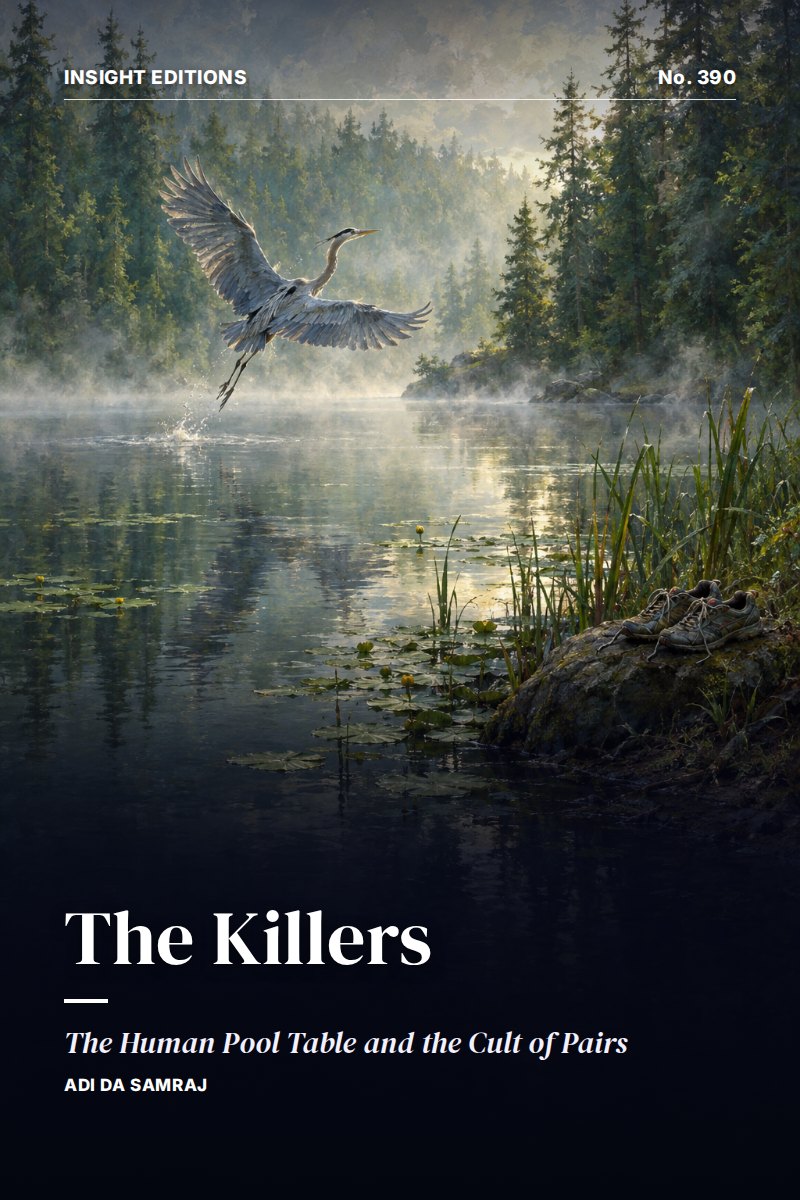
A thing came up before him! He stood hot by the water. He looked out over the endless water. Blessing! The thing crept up from the surface, without a sound! ... A giant bird! Yes! A gray bird! Twenty feet, from tip to tip!
The KillersRaymond, alone, reaches the beaver lake. He screams "Holy! Holy! Holy! Holy!", takes off his sneakers, fires his rifle into the air ("I'll get the old chief the old fish the old lake!") and sits all day in the mud among the fish. The story ends with him crying "for a good glass rod, and a sure way home. And Mom and Dad are even dead."
The story ends with two deaths. The old fish, the town's proof that "there must be fish out there," floats dead at Lake Hemple. And the parents are "dead" to Raymond, who has gone where they never went. Childhood dies voluntarily, by going on alone.
Read beside Adi Da's later teaching, the story is a parable of the "independent leap" beyond parental approval. Read on its own, it is an ambiguous coming-of-age tale whose ending holds as much grief as release.
Klik-Klak's Dome
The second piece is spoken, frank and often crude. It opens with "one of the earliest archetypal images I can remember": Klik-Klak, the "smiling, somehow psychotic clown face" of George C. Tilyou's Steeplechase Park at Coney Island, "big gold teeth showing, and the eyeballs staring out."
- Not Disneyland. Disney "accommodates the child point of view." Coney Island "manifested all kinds of signs of the adult in every child," "even all the naughty things."
- Made of wood. The Steeplechase Dome felt "like Geppetto's workshop," "something like being in a tree."
- "ego-Land." "Walls alive, animated with fear and pleasure."
- The horse race. Wooden horses on a track around the building's outside edge, "flying with your now or future girlfriend-boyfriend."
The stage below the elephant
Riders exit into a vast amphitheatre where dwarfs dressed as clowns steer women onto a spot and an air-jet blows their skirts over their heads before "a thousand people." A giant elephant stands in the corner with a man inside "like a terrible Maharajah." "This was considered family entertainment!" Adi Da adds that both sexes "have been dreaming a common dream," and that "My Mummery-Book contains all of these things."
The slide
For a seven-year-old the long wooden slide was "the Holy Jumping-Off Place": "This is the confrontation with death ... the end of Franklin as the world knew him." The attendant who waxes it is "the Klik-Klak man." At the bottom "you proved yourself to be a man once more," and look up to see Klik-Klak "still grinning back."
The skirt-blowing stage was a real Steeplechase attraction (the "Blowhole Theater"). Adi Da's claim that women "want to be there exposed" is an assertion, not an observation, and many readers will find the passage's sexual commentary dated or uncomfortable.
The Ride
The Human Pool Table was "a large flat surface" of polished wooden disks whirling "likewise, opposite, and askew," throwing riders against the rail. To a seven-year-old it looked like "an ocean ... the very bed of Klik-Klak."
For years he only watched. "How do you get there?" There was no sign; "it was kept a mystery." He compares the wait to "a great male actor" refusing King Lear "until he achieves a certain age."
| Element | Meaning he gives it |
|---|---|
| The barber-pole tower | "The daddy tower. The man tower" |
| The chute inside | "Inside, it is ... like the birth canal" |
| The flat whirling table | "A woman's place ... a birth-place for males" |
| Blood | "Her red sign"; better yet, no blood |
| Arms folded on the chest | Keeping your skin on, "like the Witness-Position" |
The ascent: he and the neighbourhood boys walk to the tower without looking at each other, climb a pitch-black stair, sense that the boy ahead "wasn't there," and are grabbed and sat down "like you might get put into a roller-coaster car." Then a near-vertical spiral "in the dark," "slamming against wooden walls," "Birth speed."
Then, all of sudden: ZAP! You are on the Human Pool Table ... And, if once you have done it, you know you never have to do it again. But you also know you still wouldn't want to do it again, either. It is that kind of knowledge that makes you a man.
Adi Da SamrajHe has "no recollection of blood": "I was a man when I got up off that Table." The ride's lesson for adults: "You spend your entire life complaining about the very things you should be using as great initiations that made you strong." Staying in "the infant-position," all you feel is that "'they' have abused you. What if they did? This is Klik-Klak-Land here."
"Glad for the blows" is a strong teaching for resilience, but it is spoken by a teacher to devotees, and the line that follows ("lay it down at My Feet") ties forgiveness to the guru. Readers can value the reframe of hardship as initiation without accepting that link.
Father, Ring, Whirlpool
Three more memories fill out the rite. Each adds a piece: the father, the sign, and the first hurdle.
The urinal
Before a long wait for the Steeplechase, his father took him to the men's room, "clean, all tile," like "the barber shop." Standing "urinal to urinal, man to man," he saw that "a man's dick is bigger than a boy's, but it is also built upon it." "There was no sexual fascination ... It was manhood-recognition." His father spat at the end: "I wouldn't have a Mummery without it." His father's saying: "I went to the school of hard knocks."
The gold ring
On the outside merry-go-round a wooden arm offers rings: silver ones "don't mean anything," a rare gold ring buys another ride. Around puberty, alone on the ride at dusk, he caught the gold ring "four or five, six times" running, until "I didn't have to reach for the gold ring anymore." He links it to his later "Great Storm over the sea," when "I saw All The Pattern ... Like Krishna, big before Arjuna."
The Whirlpool
A spinning wooden hub; the aim is to be "the last one to be flown off." Then "you whirl ... with no fixed image of 'self' or 'other'." "It is a first hurdle," taken before puberty, "a taste of what you've got to do altogether."
| Stage | Ride | Test |
|---|---|---|
| Small child | Kiddie slides, the big carousel | None: "where the mothers took the smaller kids" |
| Boy | The slide, the Whirlpool | Facing the drop; staying on the hub |
| With father | The men's room | Recognition of the male body |
| Puberty | The gold ring | A sign, repeated until it is understood |
| Youth | The Human Pool Table | The manhood ordeal, taken "on My own" |
He closes with a complaint about the present: "In that day, it was rather straightforward ... But these days, what tests are you supposed to pass?" "Father can only take you so far. All he can do ... is show you his dick."
The binary view of gender here ("If you are female, you've got to pass the womanhood tests") reflects mid-century assumptions and will read as narrow to many. The underlying point, that modern culture has lost clear rites of passage, is widely shared by anthropologists and writers on initiation.
The Pair
The epilogue is a long poem in short lines, addressed to a couple in his presence and to every couple. The human world, "made thin and homeless in heart and mind / by overmuch society," is "always too much of one another, / and never enough of Me."
- The klik-klak world. "A wheeling wheel / of kliks and klaks, / a play without intention," made "to seem" by "such as you, / Narcissus," "always gazing / at your 'Lovely.'"
- Shakespeare. "There is no God / on Shakespeare's stage, / but only human complication." The couple are "Romeo and Juliet, / Called from vanity / to Me."
- The "poor" he. "He should have said / 'I love you' / long ago. / He did not do what he thought. / He did not say what he felt." His words are now "alone and sour."
- The "poor" she. "Never yet loved enough," she "needs to give love Up / to Love Itself."
- "Mom and Dad." Ordinary love's end-state: each ready for "the good boy's sleep / and the civic household bacon-maker's / traditional dead reward."
All ordinary human love / is like this dead-eyed metaphor / of solemn Mom and Dad ... The first stroke said by delight, / the later stroke, / by progression, / time after time, / degraded, / until it becomes complaint.
The Mummery-Cult of Pairs Set FreeThe poem's sexual imagery is graphic and its portraits of the "poor" he and she are harsh. It reads as a teacher's rebuke delivered in verse to particular people, which makes its general claims about "all ordinary human love" sweeping.
The Vow and the House
The turn is unexpected. Having mocked the couple, Adi Da does not tell them to separate. He demands the opposite: "eternal commitment, / each-to-each."
- Stay. "Until you are sundered to a vacuum, / even by death ... there should be / only one another, / again and again."
- Suffer the fault. Remain "in the little cult of pairs, / you awful two," to "find out the faulty consequence / of your small love's / immense and mortal / bonding."
- Turn it. "If love's dead-necessary bondage / is to turn out Free, / it must be revolved, / from lust's brief body-choice, / to love of Love Itself."
- Exclude all others. "By this unbreakable forever vow ... you each oblige the other / to Find / the Only-One / again."
- Arrive at One. "Not a two, / or even three (including Me), / but only One."
The arc of every couple: "All are glad at the beginning. / All suffer in the middle. / All are vacuous at the extreme. / All fly Free / to My House / at the end."
- Truth is not caused. "Truth is not achieved / by any means of sex-in-love, / or even by sex-efforting alone." It is "re-Gained / in your patient overcoming."
- The price. The wedding is "that most expensive and endless week of ordinary life," the "lovers' debt of time."
- "Raymond's problem." The Way is for "all who suffer / Raymond's cause and problem: / that the loved-one ... will die." The poem ties back to the boy at the lake.
- A Mahavakya. "If you cannot be a vow of love, / you are not True to Me. / This Is a Mahavakya, / My Straight Word."
- Not your kingdom. "Do not seek to mortgaging / My House, / as if you could be prince and princess There."
The final warning: do not live "the mostly Shakespeare-minded life ... as only Narcissus does it," or the world will be "an endless day of amateurs, / in hot and cold theatrical strife, / forever, / without a Way or House to Find Me."
The poem's ideal of lifelong fidelity contrasts with accounts of Adi Da's own community in the 1970s to 1990s, where former members described partner exchanges and multiple relationships around the teacher. The text itself makes fidelity a test of devotion; readers will weigh that against the history.
Master Takeaways
Read together, the three pieces trace one path: leave childhood, pass the ordeal, then convert the adult bond itself.
- Childhood must die voluntarily: you go on alone past the parents' approval.
- The one who turns back out of fear of the father stays a child, "Fathered back to Mother's bed."
- The lake no adult believes in is found only by the one who keeps going.
- Killing for display (the squirrel's head) is the counterfeit of manhood.
- Wealth and gifts do not make the passage; the cheaper gun reaches the lake.
- Amusement parks once held real tests: body, emotion, mind, intelligence.
- The ordeal must be faced alone; "Father can only take you so far."
- A father's role is recognition, not protection.
- Signs repeat until understood, like the gold ring.
- Hardship can be used as initiation, not as a grievance: "Glad for the blows."
- The infant-position feels only that "they" abused you.
- Modern culture has lost clear rites of passage: "what tests are you supposed to pass?"
- Ordinary love decays from delight to complaint.
- Narcissus stands for the self-reflecting ego that makes the world a "play without intention."
- The answer is not leaving the pair but staying, faithfully, until the bond is turned upward.
- Fidelity is the discipline: "eternal commitment, each-to-each."
- Truth is not caused by sex or love; it is re-gained by patient overcoming.
- All couples face death, "Raymond's problem," and the Way is for that.
- "If you cannot be a vow of love, you are not True to Me."
Frameworks and mental models
| Name | What it says | Use it when |
|---|---|---|
| Voluntary death of childhood | Growth means leaving the parents' frame by choice | Facing a step others won't approve |
| Klik-Klak | Life as a grinning machine of change that tests you | Reframing hardship as training |
| Steeplechase curriculum | Graded ordeals from slide to Pool Table | Thinking about rites of passage for the young |
| Arms folded, like the Witness | Hold your centre while the disks throw you | Staying steady under pressure |
| Glad, suffer, vacuous, free | The four phases of every couple | Understanding a long relationship |
| Revolve the bond | Keep the pair but turn it to "love of Love Itself" | Deciding whether to stay or leave |
The booklet is valuable as a window onto the personal sources of Adi Da's teaching: the early fiction, the Coney Island memories behind The Mummery Book, and the late scriptural voice. Its insight about lost rites of passage and about using hardship as initiation is real. Its limits are the dated gender framing of the memoir, the harshness of the poem toward ordinary love, and the gap between its demand for lifelong fidelity and what former members report about relationships around Adi Da himself.