Insight Editions · No. 120
The Horizons of Being
The Metaphysics of Ibn al-'Arabi in the Muqaddimat al-Qaysari
Dawud al-Qaysari · Translated and edited by Mukhtar H. Ali
Dawud al-Qaysari's prolegomenon to Ibn al-'Arabi's Fusus al-hikam presents a metaphysics of being, divine names, cosmological worlds, prophecy, and sainthood.
A study guide to The Horizons of Being by Dawud al-Qaysari, translated and edited by Mukhtar H. Ali. Shared free for personal reading; not for sale and not endorsed by the authors or publishers. Please read and buy the original.
About the Book
Mukhtar H. Ali's The Horizons of Being is the first English translation of Dawud al-Qaysari's Muqaddima, the Prolegomena to his commentary on Ibn al-Arabi's Fusus al-hikam, printed with the Arabic and with a running commentary in the footnotes. In twelve short chapters Qaysari sets out the whole metaphysics of Ibn al-Arabi's school, from Being itself to prophethood and sainthood.
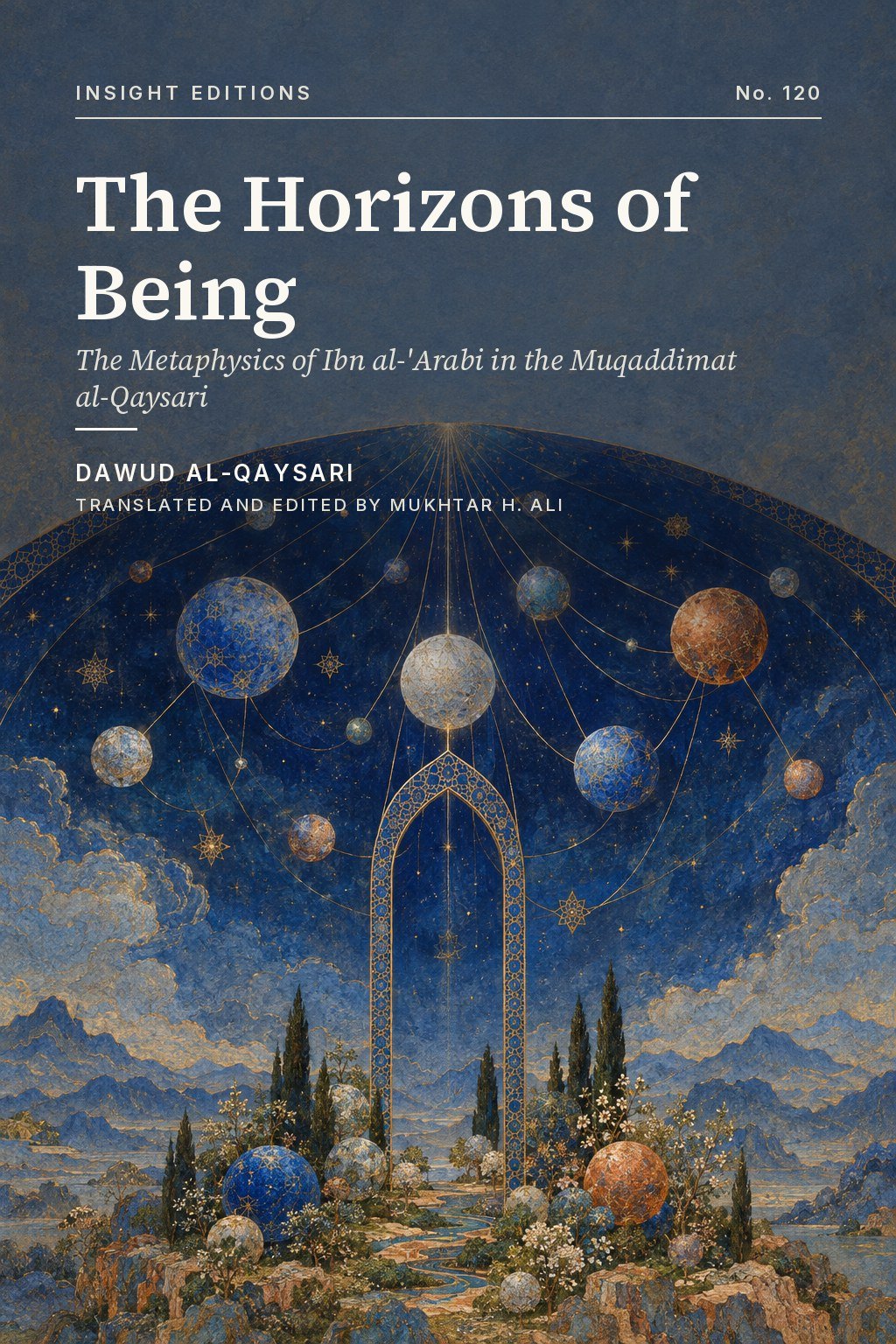
First is Qaysari, a fourteenth-century Anatolian scholar who studied philosophy under a student of Tusi and the Fusus under his Sufi master Kashani, and who wrote the Muqaddima so that students could read the Fusus at all. Second is the footnote commentary, which Ali builds from Ashtiyani, Kashani's lexicon, Jami, Haydar Amuli, Mulla Sadra and modern scholars. Third is Ali's own eighteen-page Introduction. The thread that runs through all three is the title image: the chapters are horizons, relative boundaries through which one Being shows itself.
In one sentence: Qaysari takes the philosophers' vocabulary (quiddity, substance, accident, necessity, intellect) and shows, chapter by chapter, that each term names a degree of one manifesting Being, which the human being contains and can travel back through to its source.
Argument map
Chapter map
| Ch. | Printed pp. | One-line gist |
|---|---|---|
| Intro | 1-18 | Qaysari's life and place; Ashtiyani on Sufism's rank; translation choices |
| 1 | 25-65 | Being is beyond categories, necessary, graded only in manifestation; the degrees named |
| 2 | 67-91 | Names as Essence plus attribute; groups, periods; knowledge is not the Intellect |
| 3 | 93-111 | Archetypes in knowledge; the two emanations; possible and impossible |
| 4 | 113-131 | Substance mirrors the Essence; the three modalities; individuation |
| 5 | 133-145 | Five Presences; worlds as books; the human as their replica |
| 6 | 147-161 | The Imaginal World; true and false visions; two barzakhs |
| 7 | 163-179 | Unveiling in form and meaning; heart as source; inspiration vs revelation |
| 8 | 181-187 | The world is the form of the human reality |
| 9 | 189-201 | The Muhammadan Reality as Pole; five kinds of hour |
| 10 | 203-213 | Ten names of the spirit; degrees of the soul |
| 11 | 215-223 | Return as annihilation; what union means |
| 12 | 225-237 | Prophet, messenger, saint; three certainties |
1. The Book, the Commentator and the Translator
Ali's eighteen-page Introduction places Qaysari in the line of Ibn al-Arabi's interpreters, explains why the Muqaddima is studied before the Fusus, translates Ashtiyani's case for the nobility of Sufism, defends his translation choices, and summarises the twelve chapters that follow.
Why this short text matters
Ibn al-Arabi, born in Murcia in 560 H/1165 CE and given the title the Greatest Master, wrote over a hundred works. The Meccan Openings alone runs to 10,000 pages in 560 chapters, while the Fusus al-hikam, received in a vision of the Prophet, is the quintessence of his thought. Ali notes that between the 7th and 11th centuries alone the Fusus drew over 195 commentaries. Qaysari's commentary stands third in a direct line through Kashani, Jandi and Qunawi, and its Prolegomena, the Muqaddima, is the subject of this book.
The editor's first point: the Muqaddima is not a preface but a summary of a whole metaphysics. Ali puts it in one sentence: if the Futuhat holds the whole of Ibn al-Arabi's metaphysics, distilled in the Fusus, then the Muqaddima "can be read not just as a précis of the Fuṣūṣ but as a summary of Ibn al-ʿArabī's doctrine."
| Step | Text in the traditional curriculum |
|---|---|
| 1 | Qaysari's Muqaddima, read whole and independently |
| 2 | Often with Ibn Turka's Tamhid al-qawa'id |
| 3 | The Fusus al-hikam |
| 4 | Qunawi's Miftah al-ghayb through Fanari's Misbah al-uns |
| 5 | Ibn al-Arabi's al-Futuhat al-makkiyya |
Ali adds a footnote: Hasanzada Amuli advises studying the Tamhid before Qaysari, since it holds one of the most elaborate discussions of Being, the subject of the Muqaddima's first chapter.
Qaysari's life as the book gives it
Qaysari was born in Kayseri around 660/1260 and died in 751/1350. He studied in Kayseri, spent years in Egypt, then studied philosophy and mathematics under al-Maraghi, a student of Tusi, meeting the writings of Ibn Sina, Tusi and Abu-l-Barakat al-Baghdadi. In Sufism he was the disciple of Kashani, who taught him the Fusus and guided him on the path. Munawi calls him "the ascetic Sufi" who mastered the intellectual disciplines and then Sufism. In 1336, Ali writes, Sultan Orkhan Ghazi appointed him to direct the first Ottoman school system, a post he held until 1350, which spread Ibn al-Arabi's teaching through the Ottoman lands. His influence runs to Fanari and Bursevi on the Ottoman side, and to Haydar Amuli and Mulla Sadra on the Persian side.
Mystics speaking the philosophers' language
Ali frames the first four chapters as a dialectic between Sufism and philosophy. Qaysari writes for readers trained in philosophy and theology, uses their terms (quiddity, substance and accident, predication, the First Intellect, divine knowledge), and refutes positions that clash with Ibn al-Arabi.
Ashtiyani on the noblest discipline
Ali translates the opening of Jalal al-Din Ashtiyani's commentary. A discipline's worth follows its comprehensiveness: philosophy, which studies existence, outranks mathematics, which studies quantities, and music depends on mathematics. Worth also follows subject: medicine is as noble as the human body. Sufism studies God, His names and the perfection of the human being, so it ranks first. Why not theology, which also studies God? Because Sufism also teaches the method by which the wayfarer reaches perfection: it is "not only a theoretical discipline but also a spiritual way".
Ashtiyani gives Qaysari's definition of the field:
| Element | Content |
|---|---|
| Subject | The unitary Essence, its qualities and attributes, the emergence of multiplicity from it and the return; in short, God and His relation to creation |
| Principles | The divine names and attributes, in three kinds: names of the Essence, of the attributes, of the acts |
| Method | The wayfaring of God's folk, their practices, and the outcome of their efforts |
The translator's choices
This section matters for every later page, since Ali's terms differ from those many readers know from Chittick. Ali's starting point is honest: Sufism is first experiential and only then language, and Arabic words carry several meanings that Sufis bend to new uses.
| Arabic | Ali's rendering | Common alternative he notes |
|---|---|---|
| wujud | Being (divine); existence (creation) | |
| al-haqq | God, or Truth where stressed | the Real (Chittick) |
| ta'ayyun | individuation | entification |
| al-a'yan al-thabita | Permanent Archetypes (after Izutsu) | fixed entities (Chittick) |
| mazhar | manifestation, or locus of manifestation | |
| hadra | Presence, sometimes plane | |
| tajalli | theophany (after Chodkiewicz) | self-disclosure (Chittick) |
| 'arif / ma'rifa | gnostic / gnosis | |
| wilaya | sainthood |
Two notes stand out. First, Qaysari rarely says "Sufi"; he speaks of the gnostic, God's folk and the Group, and Ali keeps "Sufism" only to follow modern convention. Second, kalima, "word", is a technical term: Ibn al-Arabi says "existent beings are the words of God which do not cease," and every entity is a word of God. On wilaya, Ali separates walaya (proximity, love, friendship) from wilaya (governance, authority, sainthood) and defers the full account to chapter twelve.
Sources and the shape of the commentary
The commentary is a body of footnotes. Ali studied the Muqaddima with Akram al-Majid and then at Berkeley with Hamid Algar, and relies most on Ashtiyani's commentary and Kashani's lexicon, since Qaysari studied the Fusus under Kashani. He calls the result "a synthesis of comments and clarifications of past and present masters."
The title explained
Ali closes by naming the twelve chapters "the horizons of Being, the ontological orientations through which reality unfolds." A horizon has no independent existence; it seems fixed only to the one who looks. As there are endless horizons, divine manifestation never stops. He ends with Imam Ali's line that God is in all things but not by being mixed with them, and separate from all things but not isolated from them.
2. Chapter 1: Being, and That It Is the Truth
The longest chapter of the Muqaddima (printed pp.25-65) sets the foundation: what Being is not, what it is, why it is necessary, why gradation belongs to its manifestations only, and how the Group names its universal degrees.
The preface: knowledge without prior reflection
Qaysari opens by praising God, who individuated the Archetypes through the Holiest Emanation and made Adam vicegerent over the manifestations of His names. He tells how, studying the Fusus under Kashani, he was "singled out among my companions to have received knowledge and acquire meanings without prior reflection and learning." Because the mysteries of the Fusus depend on the agreed principles of the Group, he sets them out in twelve chapters. Ali's first footnote quotes the Fusus on why Adam was made: God wished to see His own Essence in a comprehensive being, "This is because the vision a thing has of itself is not the same as the vision it has through something else which acts like a mirror." The mirror theme, introduced on the first page, returns in almost every later chapter.
What Being is not
It is neither a universal nor a particular, nor categorized by generality or particularity.
The chapter then removes, one by one, every category that might contain Being. It is one, but not by a oneness added to it. It is not a substance, which would need Being in order to be realized, and not an accident, which would need a prior locus. It is not merely conceptual, "as posited by the unjust," since it is real without any perceiver, as the hadith says: God was and nothing else was with Him. It is simple, so it has no genus, differentia or definition, and it does not intensify or weaken in its Essence.
| Denied of Being qua Being | Reason given |
|---|---|
| External or mental existence | Each is only a type of existence |
| Absolute or restricted, universal or particular | These belong to its manifestations |
| Substance or accident | Both need Being added to them |
| A mere concept | It is realized without perceivers |
| Parts, genus, differentia, definition | It is simple |
| Contrary or like | Nothing can stand facing it; "Nothing is like unto Him" |
What Being is
Being is self-evident in its realization yet the most hidden thing in its reality; hence the Prophet's prayer, "We have not known You as you ought to be known." Nothing exists in mind or world except through it; it sustains all things, "rather it is one with them." There is nothing between Being and non-being, while quiddity stands between its own existence and non-existence. Through Being contraries are realized, so in Being itself the two sides of a contradiction are joined and differ only conceptually.
Qaysari then turns from philosophy to theology, as Ali points out in a note: Being is absolute good, without beginning or end, the First, the Last, the Manifest and the Hidden, Omniscient because it encompasses all things by its Essence. Being is "pure light, since all things are perceived through it."
Shadows of a shadow
Expansive Being, al-wujud al-munbasit, which spreads over the Archetypes in divine knowledge, is a shadow of the Essence; mental and external existence are "shadows of that shadow". Ali glosses Expansive Being with an image he uses often: it is the isthmus between the hidden degree and the Archetypes, "in the same way that the breath in the human being is an isthmus between ideas and speech." God is identical with all things by appearing in the clothing of the names, and other than them by His hidden Essence. At the Greater Resurrection He removes their individuation and says, To whom does sovereignty belong today? In the Lesser Resurrection, after death, things pass from the Visible to the Unseen.
Comments for the rationalists
The section headed "A Comment for the Insightful in the Language of the Rationalists" gives four arguments that Being is necessary.
- If Being were contingent it would need a cause and would precede itself. Even a concept needs a perceiver as its cause, and the perceiver exists only through Being.
- Everything contingent is substance or accident; Being is neither, so it is necessary. Nor can Being be a natural universal waiting for individuals, since what individuates a natural universal comes after it and cannot cause it.
- Everything contingent accepts non-being; Being cannot, for that would be inversion of a thing into its opposite. Even the contingent does not truly cease but "disappears and enters the Unseen from which it had emerged." What ceases is only a relation to a quiddity.
- In the statement "This existence is existence", what unites subject and predicate is Being, and what separates them is "this-ness", so Being is identical with relative existents.
Gradation in manifestation only
Opponents say Being applies to cause and effect by priority, to substance and accident by primacy, to the strong and the weak by intensity, so it is graded. Qaysari accepts gradation only with respect to quiddities. As Being descends, "its hiddenness intensifies, its manifestations and perfections weaken." Ali's footnote lays out three views:
| Type of gradation | Claim |
|---|---|
| General (Peripatetic) | Independent existential realities; similarity not in the same aspect |
| Specific (light model) | One graded reality; strong and weak light share and differ in the same quality |
| Gnostic | One reality differing only in the intensity of its manifestation |
The human case shows what is at stake. Human beings differ more than any other creature, so some rise above the angels and others fall below the animals. Ali's note adds that in the hereafter each person will be raised as a unique species whose genus is human, since only humans hold both angelic and bestial qualities and the free will to shape the outcome.
The universal degrees and their names
Section 5 gives the Group's vocabulary, built on the logic of conditions.
| Being considered as | Name in the Group's terms |
|---|---|
| Conditioned by nothing | Singularity (al-ahadiyya), Comprehensive Union, Ultimate Reality, the Cloud |
| Conditioned by all names and attributes | Divinity (al-uluhiyya), Unity (al-wahidiyya), Station of Union; as bringing names to perfection, Lordship |
| Unconditioned either way | The Ipseity permeating all existents |
| By universals only | The Merciful, Lord of the First Intellect: Tablet of Decree, Mother of the Book, Highest Pen |
| By universals as particulars | The Compassionate, Lord of the Universal Soul: Guarded Tablet, Manifest Book |
| By mutable particular forms | The Effacer and Establisher: Book of Effacement and Establishment |
| By receptivity to forms | The Receiver, Lord of Universal Prime Matter: Unfurled Parchment |
| By the power to affect | The Active, Lord of Universal Nature |
| By immaterial spiritual forms | The Omniscient, Lord of the Rational Intellects and Souls |
| By Unseen material forms | The Fashioner, Lord of the Imaginal Worlds |
| By visible material forms | The Absolute Manifest, Lord of the Kingdom |
| The union of all | The Perfect Human, also the Degree of the Cloud |
The translation table between the schools is worth keeping: what the philosophers call the Immaterial Intellect the gnostics call the Spirit; their Immaterial Rational Soul is the Heart; their Soul is the Impressed Animal Soul. The Perfect Human matches the Degree of Divinity except that one has Lordship and the other receptivity, which is why he became God's vicegerent. Ali's note quotes the Fusus: "In fact, he has obtained (his vicegerency) only because of his comprehensiveness."
Attributes identical with the Essence
The chapter ends by explaining the formula that God's attributes are His Essence. At the Degree of Singularity there is "neither attribute, nor possessor of attributes, nor name, nor named, but only the Essence." At the Degree of Unity, knowledge, power and will become distinct, the names multiply, and their manifestations follow. Imam Ali's sermon supplies the proof text: the perfection of sincerity is to negate attributes of Him.
3. Chapter 2: The Divine Names and Attributes
God is every day in a new state. Chapter 2 (pp.67-91) explains how one Essence becomes many names, how the names are ranked and grouped, how their rule rises and wanes, and why divine knowledge cannot be the First Intellect.
States, attributes and names
The chapter opens with the verse Every day He is in a [new] state (55:29). God has states and theophanies, and through them attributes and names. Ali's note quotes the Futuhat: "God never discloses Himself in a single form to two individuals nor in a single form twice." These attributes are manifestations of the Essence within the Degree of Divinity, which revelation calls the Cloud, "the first multiplicity occurring in existence", an isthmus between the Singularity of the Essence and creation.
| Kind of attribute | Examples | Feature |
|---|---|---|
| Affirmative, essential | Life, necessity, subsistence | No relation presupposed |
| Affirmative, purely relational | Firstness, lastness | Conceived with an opposite |
| Affirmative, relative | Lordship, knowledge, will | Needs an object |
| Privative | Self-sufficiency, Holiness, Sanctity | Negative predication |
A name is the Essence plus one attribute in one of its theophanies. The Merciful is the Essence qualified by mercy, the Compeller the Essence qualified by compulsion. The spoken words are only "the names of the names." This is how Qaysari reads the old formula that the name is identical to the Named.
Beauty and Majesty
The Essence requires contrasting attributes: gentleness and severity, mercy and wrath. Names of gentleness are names of Beauty, names of severity are names of Majesty. Yet each holds the other: beauty brings awe, and majesty hides gentleness, as in the verse In retribution, there is life for you. Ali's note on the human being is one of the book's best: the human is the Great Isthmus, the union of Beauty and Majesty. Facing God, the spirit is closest and tastes intimacy while the body is farthest and bears hardship; within the microcosm the roles swap, spirit showing transcendence and body showing immanence. He quotes Murata: "The outward dimension of the human being is related to servanthood and the inward dimension is to lordship and vicegerency."
The Keys of the Unseen and the root of multiplicity
The multiplicity of names traces back to the Keys of the Unseen, intelligible meanings in God's Being that never enter existence themselves; what enters existence are the names individuated through them. From another angle, multiplicity begins in God's knowledge of His own perfections, and divine love makes each attribute appear first in knowledge and then outwardly. Ali's note cites the Hidden Treasure saying, and records Ibn al-Arabi's own caution that it is "sound on the basis of unveiling, but not established by way of transmission". Another note gives the dynamic that drives the whole system: every name seeks to show its properties, governance and period, and since some are names of Beauty and some of Majesty, this creates conflict in the cosmos.
Ranking and grouping the names
| Grouping | Members | Logic |
|---|---|---|
| Seven Leaders (Mothers) | Life, Knowledge, Will, Power, Hearing, Sight, Speech | Universal scope; knowledge presupposes life, power both, and the last three the first four |
| Four Mothers | First, Last, Manifest, Hidden | Under the comprehensive names Allah and the Merciful |
| Essence / attributes / acts | e.g. Allah, the Holy; the Living, the Merciful; the Creator, the Provider | By what shows in them; most names combine aspects |
| Keys of the Unseen | Reserved names | Known only to God and those He chooses |
| Keys of the Visible | Names of outward existence | Under the Last and the Manifest |
Qaysari defines Hearing, Sight and Speech precisely: Hearing is knowledge connected to God's own speech, not by vision; Sight is knowledge relating to realities by vision; Speech joins will and power to reveal what is in the Unseen, as in the command Be! The name Lord combines all three aspects at once, meaning "permanent" for the Essence, "sovereign" for the attribute and "reformer" for the act. The long lists of names of the Essence, attributes and acts are copied, Qaysari says, from Ibn al-Arabi's Insha' al-dawa'ir "without modification or alteration in order to gain blessing".
Ali's note on the name Allah adds that its root may mean "to be perplexed", making it "that about which the minds are perplexed."
The rule of the names rises and wanes
The first Comment sorts the names of the acts by the span of their governance.
| Span | What they govern |
|---|---|
| Pre-eternal and post-eternal | Holy spirits, angelic souls, all that lives in eternal time (dahr) rather than time (zaman) |
| Post-eternal only | The Hereafter, which appears only when the world ends |
| Neither | Everything in time and the worldly plane |
When a name's rule ends, its objects either pass to the Absolute Unseen or hide under a more comprehensive name. Names have dominions and periods, linked to the orbits of the seven planets, each lasting a thousand years, and to the religious Laws: "every Law has a name that lasts as long as its dominion lasts". Entities are the loci where names show. A human can show every name, a different aspect at every moment; an angel shows only some.
Is God's knowledge the First Intellect?
The third Comment argues against earlier philosophers (Ali's note says Amuli identifies Thales) who held that God's knowledge of contingents is the First Intellect with forms subsisting in it. Qaysari's objections:
- The First Intellect is originated and preceded by non-being; God's knowledge is eternal and identical with Him.
- Whatever is brought into being must first be known, so knowledge precedes the Intellect.
- The Intellect is a substance and knowledge a relative attribute or accident.
- God is equally able; making the Intellect His knowledge and not His power is preference without a reason.
- It would make God need His own effect for His highest attribute, and leave Him unaware of particulars.
The gnostic can still say the Intellect is identical with God's knowledge in the sense that every manifestation is one with the Manifest, but then every knower could be called the Omniscient. The key move is that locus and occupant are one thing seen two ways: "there is neither a locus nor that which occupies a locus". Actuality (nafs al-amr) is God's essential knowledge holding the forms of all things, and creaturely knowledge is a shadow of it. The chapter ends: "None knows the reality of knowledge or its mode of connection with its objects except God."
4. Chapter 3: The Permanent Archetypes
Chapter 3 (pp.93-111) explains the forms of the names in God's knowledge, the two emanations that carry them into being, the possible and the impossible, and why the Archetypes have not smelled the fragrance of existence.
Forms of the names in knowledge
The divine names have intelligible forms in God's knowledge, since He knows His Essence, names and attributes through Himself. These forms, identical with the Essence yet individuated, are what God's folk call the Permanent Archetypes; the rationalists call their universals "quiddities" and "realities" and their particulars "ipseities". Ali's note explains the name: they are "Permanent" because they exist in divine knowledge and do not change.
Two emanations do the work of the whole cosmology.
The Shaykh's line, as Qaysari quotes it, is "The recipient is only due to the Holiest Emanation." The capacity to receive is itself a gift.
Possible and impossible entities
| Type | Status | Relation to God's knowledge |
|---|---|---|
| Possible entities | Seek outward existence; all eventually appear | Forms of names in knowledge, related to the Hidden where it meets the Manifest |
| Impossible: mental hypotheses | A partner for God, contraries joined in one place | Known only as products of the imagination; no essence in knowledge |
| Impossible: established | Forms of the reserved names that flee the Manifest | Exist only in knowledge; reached only through prophethood and sainthood |
The idea of "real" impossibles is one of the book's strangest teachings. Some divine realities have, as their nature, the absence of outward manifestation, just as the possible ones have manifestation as theirs. Qaysari says "The rationalists have no understanding of this category and the intellect has no share in it."
"Not smelled the fragrance of existence"
Every possible reality, though fixed in knowledge forever, "has not smelled the fragrance of existence." Yet through its outward loci it does exist, and none stays unmanifest, since each asks for existence "by the tongue of their [existential] dispositions". Had the Magnanimous not answered, He would not be the Magnanimous; had He answered some and not others, it would be arbitrary preference. In paradise the same law runs instantly: the hadith says a believer's wish for a son brings gestation, birth and teething in the moment of wishing.
Mapping names onto worlds
| World | Manifestation of |
|---|---|
| Archetypes | The First and the absolute Hidden |
| Spirits | The relative Hidden and relative Manifest |
| Imaginal World | The meeting of Manifest and Hidden; an isthmus |
| Visible | The absolute Manifest and the Last |
| Hereafter | The absolute Last |
| Perfect Human | The name Allah, inclusive of all four; governs all worlds |
High genera manifest the Mothers of the Names, middle and low genera the names beneath them, and individuals the endless combinations of names. That is the secret of the verse that the sea would run dry before the words of the Lord. Qaysari then assigns the heavens: the Throne is the manifestation of the Merciful, the Pedestal of the Compassionate, the seventh sphere of the Provider, down to the first sphere, the manifestation of the Creator.
Comments on the Archetypes
Not made. Archetypes cannot be called "made" (maj'ula), because only what exists outwardly is made; otherwise the impossibles would be made too. God's single knowledge of His Essence requires the Archetypes without delay.
Two faces. As forms of names, the Archetypes are like bodies for spirits; as realities of external things, they are like spirits for bodies. They have servitude, receiving emanation, and lordship, nurturing their forms. So "it should not be imagined that the Archetypes have only receptivity and the names have only activity."
No middle between existent and non-existent. Against the Mu'tazilite view, quiddities are not halfway things; they are specific existents in knowledge. A quiddity exists four ways:
| Plane | Mode |
|---|---|
| Spiritual (Intellectual) world | occurring (husul) |
| Imaginal World | manifesting (zuhur) in corporeal form |
| Sensory world | realized (tahaqquq) |
| Our minds | subsisting (thubut) |
Our mental forms are shadows of the forms in divine knowledge, which is why knowing things as they are is hard except for one whose heart is lit by God's light. Even he is veiled in proportion to his selfhood, so "the utmost gnosis of the gnostics is their confession of inadequacy and deficiency".
Closing: non-being as a garment
As individuations distinct from Absolute Being, the Archetypes return to non-being; as reality, they are Being. When gnostics say the Archetypes are "in non-being", non-being is not a container, since it is nothing; the Archetypes are clothed in outward non-existence until God clothes them in a garment of existence. Ali's note gives the full dialogue of Kumayl and Imam Ali on Reality, which ends: "Extinguish the lamp (al-sirāj) for the dawn (al-subḥ) has arrived!"
5. Chapter 4: Substance and Accident According to God's Folk
Chapter 4 (pp.113-131) takes the philosophers' pair, substance and accident, and reads it as a mirror of the Essence and its names. It ends with the three modalities and a short theory of individuation.
A parallel between metaphysics and physics
Look into things, Qaysari says, and some are antecedent and some attached. The antecedents are substances, the attached are accidents, and existence joins them. Substance is to accidents as the Essence is to the names.
| The divine side | The cosmic side |
|---|---|
| The Essence, veiled by the names | Substance, enveloped in accidents |
| Essence plus attribute becomes a name | Substance plus a universal meaning becomes a specific substance |
| Names combine to engender names | Simple substances combine into compounds |
| Some names encompass others | Some substances encompass others |
| Mothers of the Names are finite | Genera and species are finite |
| Branches of the names are infinite | Entities are infinite |
Ali's note gives the standard lists: five categories of substance (matter, form, body, soul, intellect) and nine of accident, and adds that for Qaysari substance is the reality of Being itself, though Being qua Being is neither.
The Breath of the Merciful
This single reality has many names among God's folk: the Breath of the Merciful, Universal Prime Matter, and, once individuated, the divine words. Ali's note traces the image to the hadith of the Breath of the Lord from Yemen and to the Futuhat, where God's Breath is His emergence from the Unseen, manifesting letters that are containers for meanings. Qaysari's commentary gives the formula: "If the Breath of the Merciful is realized externally and individuated, it is called substance." The chapter includes verses on this reality:
And all affairs are veils for its face
In the language of the rationalists
The rationalist Comment argues that substance is identical with substances externally and that they differ only by accidents. It cannot be a general accident added to them, or substances would not be substances in themselves; nor can it be partly inside and partly outside them. Species arise from universal accidentals, individuals from particular ones. The worked example: speech joined to animal gives human, neighing gives horse, braying gives donkey.
Then comes a surprising claim. The principle of speech, the rational soul, is not peculiar to humans: "this principle is with everything, even the inanimate objects as well", since everything shares in Dominion and Invincibility. The Prophet heard animals and stones speak, and the verse says all things glorify God though we do not understand. Qaysari mocks later scholars who say animals do not perceive universals: they have no evidence, and the ignorance of a thing does not negate its existence. The editor's note: this is an argument from humility about other minds, set inside a logic lesson.
Necessity, contingency, impossibility
These three are purely intellectual relations with only mental existence, states that follow the Archetypes in divine knowledge.
The contingent is the absence of necessity towards either existence or non-existence.
Necessity is positive; contingency and impossibility are privative. Necessity-through-another applies only from the angle of lordship and servitude; from the angle of absolute oneness there is only necessity through the Essence. Because these relations arise in divine knowledge, some great scholars held that "the plane of contingency is the same as the plane of knowledge." Qaysari adds a claim about method: these arguments may look unlike speculative philosophy, but they are "in fact its outward spirit arising from the lights of prophethood".
Overlap:Philosophical Sufism quotes the same two definitions from its own translation; the wording here is from this book.
On individuation
Individuation is what distinguishes a thing so that nothing else shares it. It can be the Essence itself, as with the Necessary Being and the Archetypes in knowledge, or something added, positive (a writer), privative (an illiterate), or both (a writer who is not a tailor). Do essences then differ only by individuation? Yes: before individuation in knowledge they were nothing but the divine Essence. Ali's note on the hadith "God was and nothing else was with Him" records Ibn al-Arabi's point that the verb kan denotes existence, not time.
6. Chapter 5: The Universal Worlds and the Five Divine Presences
Chapter 5 (pp.133-145) is short but structural: what a "world" is, the five Presences that contain every world, the worlds as divine books, and the human being as the book that contains them all.
A world is a sign
The Arabic al-'alam comes from 'alama, a mark: lexically "that through which something is known," technically everything other than God. Through each entity a divine name is known, even through the fly, the mosquito and the flea. The First Intellect is a universal world through which the Merciful is known; the Universal Soul, holding in detail what the Intellect holds in summary, makes known the Compassionate; the Perfect Human, holding all in summary by his spirit and in detail by his heart, makes known the name Allah.
Since every individual is a sign of a name and every name holds every other, every individual is a world, and the worlds are infinite. But the universal Presences are five.
Relative Unseen splits in two because spirits have both imaginal forms, matching the Visible, and immaterial intellectual forms, matching the Unseen. Ali's note adds the term nasut for the Visible, the last stage of the Arc of Descent.
Overlap:Philosophical Sufism builds a chapter on the same five Presences; this guide follows the wording of this book.
The worlds as divine books
Every world is a divine book because it contains God's Complete Words.
| Book | Cosmic form | In the Perfect Human |
|---|---|---|
| Mother of the Book | First Intellect (things in summary) | His spirit and intellect |
| Manifest Book / Guarded Tablet | Universal Soul (things in detail) | His heart |
| Book of Effacement and Establishment | Soul Imprinted on the Universal Body | His soul |
Ali's note distinguishes "books", the world individuated and separated, from "words", the world in summary form and God's command Be! Another note gives Kashani's reversal: for Ibn al-Arabi the Great World is the Perfect Human and the Small World is creation, since creation without the Perfect Human would not contain everything. Qaysari quotes verses attributed to Imam Ali:
While the Great World is folded within you
And the Shaykh's own couplet begins "I am the Qurʾān and the seven repeated verses".
Intellect as spirit, Soul as heart
The First Intellect stands to the Great World as the human spirit to the body; the Universal Soul is the world's heart as the rational soul is man's. That is why the world is called the "Great Human". The forms in the Intellect are not copies apart from realities: outward things are their shadows, and the Intellect knows them through the emanating forms, not by abstracting from outside. The unity of all realities in the Intellect is like the unity of all Adam's children in Adam; indeed the First Intellect "is the true Adam", confirmed by the hadith that the first thing God created was the Prophet's light.
Only the elemental plane veils the human from the realities he holds. As veils lift, realities appear in him, and his knowledge becomes like the First Intellect's, even more active, since he is the vicegerent who governs all worlds. Ali's note quotes Qunawi: the human is "the comprehensive isthmus (al-barzakhiyya al-jāmiʿa) between the properties of necessity and possibility since he encompasses both."
7. Chapter 6: The Imaginal World
Chapter 6 (pp.147-161) describes the intermediate world where spirits take form and forms are spiritual. It covers the two imaginations, perspicacity, why visions are true or false, dreams, apparitions of angels and saints, and the two barzakhs.
A luminous isthmus
It is neither a composite body nor an immaterial intellect but a barzakh between them. Ali's note quotes Ibn al-Arabi's definition: an isthmus separates two things "in the same way a line separates a shadow from sunlight", so that the senses may miss it while reason knows it is there. Qaysari insists that substantial realities are present in every world with forms suited to each, so the imaginal forms are not cut off from their realities.
| Name | Meaning |
|---|---|
| Imaginal World (mithal) | Holds forms of everything corporeal; first formal representation of the Archetypes |
| Discrete Imagination (al-khayal al-munfasil) | The independent cosmic imagination, the Great World's |
| Connected Imagination (al-khayal al-muttasil) | The imagination joined to the human, the Small World |
| Absolute vs Delimited Imaginal World | The cosmic world vs each thing's own imaginal share |
Every meaning or spirit has an imaginal form, since each shares in the name the Manifest. Hence the narrations of Gabriel seen with six hundred wings, and of angels created from every drop as he leaves the River of Life. This world holds the Throne, the Pedestal, the seven heavens and their angels, which explains the Prophet's ascent: Adam on the first heaven, John and Jesus on the second, Joseph on the third, Enoch on the fourth, Aaron on the fifth, Moses on the sixth, Abraham on the seventh.
Perspicacity and the faces of the soul
Sensible forms are shadows of imaginal forms, so the gnostic reads a person's state from his form by the perspicacity of unveiling, as the hadith says: "Be wary of the believer's perspicacity, for he sees with the light of God." Everything, down to metals and plants, has a delimited imaginal world, a spirit and a share in glorification. Personal imaginings are a sample of the great Imaginal World, connected to it as "streams and rivers connect to the sea". Ali quotes the Futuhat on imagination as "the most comprehensive of engendered things and the most perfect of existent things."
When is a vision true?
If the wayfarer passes through his delimited imagination into the Absolute Imaginal World, what he sees matches the forms in the Guarded Tablet, and he can come to know his own Archetype. Inside his own imagination, a vision may be correct or a figment.
| Source | Causes of true seeing | Causes of false seeing |
|---|---|---|
| Soul | Full attention to God, truthfulness, turning to the spiritual world, purification, praiseworthy traits | Preoccupation with worldly pleasures, corrupt fantasy, desire, disobedience |
| Body | Soundness, balanced constitution and mind | Ill disposition of the mind, deviant constitution |
| Both | Religious duties, good deeds, moderation, constant ablution, invocation from evening until sleep | All that adds darkness and veils |
The editor's summary of the rule: visions follow outward states. In Qaysari's words, "if [the former] are good then [the latter] are good". Confused dreams carry no meaning; true events may be seen directly or need interpretation. Satan can make the false look real, so "the wayfarer needs a guide who guides him and saves him from perils." Philosophers have logic to sort truth from falsehood; the people of tasting have criteria from their unveilings, and the general criterion is the Quran and hadith. Ali's notes add the three kinds of dream from the hadith and Najm al-Din Razi's typology of confused and sound dreams.
A ring in a desert
Everything in the sensory world exists in the Imaginal World, but not the reverse: the relation is "like a ring thrown in an endless desert." When God wills to show in sensory form what has no form here, it takes shape by correspondence, as Gabriel appeared as Dihya al-Kalbi. Perfected human souls, freed from their bodies, can do the same; they are called the Substitutes (al-budala'). People of tasting can tell them from angels; the virtuous without unveiling can only guess from tokens such as knowledge of hidden thoughts.
Two barzakhs, not one
The final Comment separates the barzakh before this world, on the arc of descent, from the barzakh after death, on the arc of ascent, since the degrees of Being's descent and ascent are circular. The forms of the later barzakh are the forms of one's actions. Ibn al-Arabi calls the first the possible Unseen and the second the impossible Unseen, and notes that many unveil the first but few see the states of the dead. Ali's note quotes Mulla Sadra: according to the habits that predominate in a soul, "so will he rise up in a corresponding form on the Day of Rising."
8. Chapter 7: The Degrees of Unveiling
Chapter 7 (pp.163-179) is the book's theory of knowledge. Unveiling comes in form and in meaning, rises through degrees from the delimited imagination to the plane of divine knowledge, starts in the heart, and differs from revelation and from the tricks of Jinn and Satan.
Lifting a veil
Kashf lexically means removing a veil, as a woman uncovers her face; technically it is "gaining awareness of hidden meanings and existential realities from behind a curtain", and it occurs in meaning and in form. Ali sets the key in his first note with Ibn al-Arabi's verdict: "He who has no unveiling has no knowledge." In a further note he separates the two sides of one event: seen from its source it is theophany or manifestation; seen from the perceiver it is unveiling or witnessing.
Unveiling in form: the five senses of the spirit
Unveiling in form happens in the Imaginal World through spiritual counterparts of the five senses, each illustrated by a hadith.
| Mode | Example in the book | Governing name |
|---|---|---|
| Sight | Seeing corporealized spirits and lights | the All-Seeing |
| Hearing | Revelation heard as metered speech, a bell, the humming of a bee | the All-Hearing |
| Smell | "I find the Breath of the Merciful coming from the direction of Yemen" | |
| Touch | The Prophet felt the coolness of God's palm between his shoulders and knew all in heaven and earth | |
| Taste | Milk drunk in a dream, its excess given to Umar, interpreted as knowledge |
All are theophanies of names, and all serve under the Omniscient.
Worldly unveiling is a trap
Unveilings about worldly events, such as knowing that Zayd will return with a thousand dinars, are called divination. The people of wayfaring ignore them and treat them as istidraj, a gradual descent into ruin. Many ignore even unveilings about the hereafter, since their aim is annihilation in God and subsistence by Him. The realized gnostic sees everything as theophany, gives each thing its due, and is not deceived. Ali's note quotes Tilmisani via Amuli: those with unveiling of forms "only inform about creation because they are veiled from God."
The ladder of witnessing and hearing
Ali's note quotes Imam Ali's sermon on those to whom God speaks "in the depths of their intellects", who see what people do not see and hear what they do not hear.
The heart is the book
The source of unveiling is the heart and the enlightened practical intellect. The heart has its own sight and hearing: It is not the eyes that are blind, but blind are the hearts in the breasts. These spiritual faculties are the origin of the bodily senses; when the veil between them lifts, the root and the branch unite. The wayfarer starts in the delimited imagination, passes to the Absolute Imaginal World, then up through the heavens to the Guarded Tablet and the First Intellect, and finally to the Archetypes in divine knowledge, the highest witnessing open to a servant. Above that is the Essence, where the servant is annihilated. Qaysari quotes the Fusus: "Do not covet nor tire yourselves because it is extremity above which there is no extremity."
Unveiling in meaning, by level
| Level | Name of the unveiling | Feature |
|---|---|---|
| Reflective faculty | intuition (hads) | Conclusions without syllogism; the lowest form, since the faculty is bodily |
| Rational faculty | sanctified light (al-nur al-qudsi) | Not in the body; intuition is a flash of it |
| Heart | inspiration (ilham); witnessing of the heart | Meanings of the Unseen; realities, spirits, Archetypes |
| Spirit | witnessing of the spirit | Receives directly from the Omniscient; a perfected one emanates downward |
| Mystery (sirr), hidden (khafi) | no name | Beyond reference or description |
Ali's note places insinuation in the breast and inspiration in the heart, since Satan reaches only the breast (114:5). When this becomes a stable station, "his knowledge unites with God's knowledge as the branch unites with its root." Because aptitudes differ, the stations of unveiling cannot be counted; the truest belong to those whose spiritual constitution is most balanced, the prophets and the perfected saints. Miracles such as raising the dead or turning wind into water come from the attribute of power and the governing name, through a spirit of Dominion or directly.
Inspiration versus revelation
| Revelation (wahy) | Inspiration (ilham) |
|---|---|
| Through an angel | Directly from God, by a mode present in every creature |
| Witnessed unveiling, including meaning | Meaning only |
| Belongs to prophethood; outward | Belongs to sainthood |
| Conditioned by propagation | No duty to propagate |
That is why hadith qudsi, though God's speech, is not called revelation or Quran.
9. Chapter 8: The World Is the Form of the Human Reality
The shortest chapter (pp.181-187) turns the macrocosm-microcosm idea around: the world is the outward form of the human reality, which is the manifestation of the Supreme Name, Allah.
Two aspects of the name Allah
The name Allah includes all names and precedes each. It relates to them in two ways: its essence shows in each name, as one reality appears in each of its members, and it contains them all as the Degree of Divinity, as a whole contains parts identical with it. From this follows the chapter's thesis: the realities of the world, in knowledge and in actuality, "are manifestations of the human reality, which is the manifestation of the Supreme Name, Allah." The spirits of the world, celestial, elemental and animal, are particulars of the human Supreme Spirit.
Ali's note names this original human reality as the Muhammadan Reality and quotes Qaysari's commentary: the first to emanate through the Holiest Emanation was his Archetype, and the first to exist through the Holy Emanation was his sanctified spirit.
So God's folk call the world the "Great Human", and the human, holding all divine secrets, deserves vicegerency. The chapter quotes verses:
Concealing the piercing brilliance of His divinity
The first manifestation of this reality is the First Intellect, the undifferentiated form of the Cloud; then the other intellects, souls, nature, matter and bodies. Ali's note quotes the Futuhat: nothing in the "dust" was closer to receiving the Light "than the reality of Muḥammad, also called the Intellect."
The Sermon of Disclosure
Qaysari cites Imam Ali's sermon: "I am the dot under the bāʾ of bismillah", the Pen, the Guarded Tablet, the Throne, the seven heavens and earths. Mid-sermon, Qaysari says, the theophany of oneness withdrew, Ali returned to the human world and continued, confessing servitude and weakness. Hence the Perfect Human must pervade creation as God does, which happens in the third journey, from God to creation through God, bringing the truth of certainty.
Qaysari then quotes the Futuhat on the Pole: one whom God makes Pole, descending from the third journey, must witness every human God will bring into existence until the Resurrection, and also know their ranks.
The human as a small copy
| In the human | In the Great World |
|---|---|
| Immaterial spirit | First Intellect |
| Heart | Universal Soul |
| Animal soul | Universal Nature; Soul Imprinted on Celestial Bodies |
| Subtle ethereal (animal) spirit of the physicians | Universal Prime Matter |
| Blood | Universal Body |
| Limbs | Body of the Great World |
Qaysari points readers to Ibn al-Arabi's Tadbirat al-ilahiyya for detail. Ali's notes add that the heart, unlike the Universal Soul, can reflect, and that the soul and its powers are themselves books on which ideas, intentions and deeds are inscribed: Read your book! Your soul suffices as a judgment against you this day (17:14).
10. Chapter 9: The Vicegerency of the Muhammadan Reality
Chapter 9 (pp.189-201) makes the Muhammadan Reality the Pole of Poles: lord of the world by its reality, servant by its humanity, appearing as every prophet, handing polehood to the saints after prophethood ends, and ending in resurrection and the five kinds of "hour".
Lord by reality, servant by humanity
Every name has a form in knowledge, the Archetype, and outward forms it lords over. The Muhammadan Reality is the form of the comprehensive name, so it lords over the forms of the whole world outwardly and its inward side inwardly, holding the Supreme Name and absolute lordship. The Prophet says he was singled out by the Fatiha, which opens with Lord of the worlds.
The key distinction of the chapter is between station and humanity.
| By his reality (station) | By his humanness |
|---|---|
| Lord over the worlds | A servant, needy of his Lord |
| "You did not throw when you threw, but it was God who threw" | "Say, I am only a man like you receiving revelation" |
| "Not an atom's weight escapes your Lord" | "You are more aware of the affairs of your world" |
| Bestows life, death, kindness, anger | Weeps, is annoyed, feels constriction |
Because it combines divinity and servitude, its bestowal is derivative, not essential, "and this is vicegerency." Even descent is a perfection: "deficiencies are also perfections from another perspective". Ali's note quotes the Fusus on the Perfect Man as the seal on the king's treasury: "the world will be preserved for as long as the Perfect Man subsists therein."
One reality, many prophets
Since God speaks to humans only through revelation or from behind a curtain, a vicegerent is needed in every era. The Reality could not show all its perfections at once, so it appeared in forms suited to each time, governed by the name Time (al-dahr): these are the prophets. Seen through individuation, they differ; seen through Unity, "We do not differentiate between any of His messengers." Ali's note cites the hadith "Curse not time for God is Time".
The Pole and its succession
The Pole, axis of existence from pre-eternity to everlastingness, is the Muhammadan Reality. Before prophethood ended the Pole could be a manifest prophet, such as Abraham, or a hidden saint, such as Khidr in the time of Moses. After legislative prophethood ended, polehood passed to the saints, until the seal of absolute sainthood. Ali's note gives Ibn al-Arabi on Poles ranked by the prophet each inherits from, all drawing from the lamp-niche of Muhammad.
Resurrection as inversion
When that circle closes, resurrection follows under the Hidden and the name born of Hidden and Manifest: "everything that was form becomes meaning, and everything that was meaning becomes form." What hid in the soul appears in its true form. Ali's note quotes the Futuhat: return cannot be linear, so "there is no escape from circularity in both the suprasensory and sensory domains."
Paradise and hell exist in every world, since their Archetypes are in divine knowledge: Adam and Eve were expelled from a paradise in the spiritual world; the world is a prison for the believer; the grave is a garden or a pit. In the human being, the stations of spirit and heart are paradise and the station of the soul and its desires is hell.
Five kinds of hour
| Hour | What happens |
|---|---|
| Every moment | Theophanies come from the Unseen into the Visible and return: the new creation |
| Natural death | "Whoever dies his resurrection has begun" |
| Voluntary death | "Die before you die"; the wayfarer's Lesser Resurrection (some call it Intermediate) |
| The promised Hour | The sun of the singular Essence rises; "To whom belongs the sovereignty today" |
| Annihilation in God | What gnostics reach before it: the Greater Resurrection |
11. Chapter 10: The Supreme Spirit and Its Names in the Human World
Chapter 10 (pp.203-213) maps the inner human being. The one Supreme Spirit takes ten names according to its aspects, the soul climbs from commanding to tranquil to heart, and the spirit relates to the body as God to the world.
One spirit, cosmic and human names
The Supreme Spirit, "which is the human spirit in reality," is the manifestation of the Essence as lordship; none reaches its essence but God. In the Great World it is the First Intellect, the Highest Pen, the Light, the Universal Soul, the Guarded Tablet. In the Small World it has ten names, each tied to a verse or hadith. Ali's note quotes Jurjani: the Supreme Spirit is also called the First Intellect, the Muhammadan Reality, the Unified Soul, "the greatest vicegerent".
| Name | Why so called (Qaysari) | Proof text |
|---|---|---|
| Mystery (sirr) | Only possessors of hearts perceive its lights | He knows the mystery and the hidden (20:7) |
| Hidden (khafi) | Its reality is concealed even from gnostics | same verse |
| Spirit (ruh) | Lordship over the body; origin of sensory life | The spirit is a command from my Lord (17:85) |
| Heart (qalb) | Turns between God and the animal soul | for one who possesses a heart (50:37) |
| Word (kalima) | Appears in the Breath of the Merciful as a word in breath | A word from God (3:39) |
| Inner heart (fu'ad) | Affected by its source; fa'd means injury | The heart did not deny what it saw (53:11) |
| Breast (sadr) | The side facing the body, foremost in it | Did we not expand your breast? (94:1) |
| Mind (ru') | Awe before the Compeller; ru' indicates fear | Hadith: the Holy Spirit inspired into my mind |
| Intellect ('aql) | Perceives itself and its Originator; binds what it knows | Hadith: the intellect is a fetter against ignorance |
| Soul (nafs) | Attachment to and governance of the body | By the soul and Him who fashioned it (91:7) |
Ali's notes bring in Tirmidhi's treatise on the heart: "The breast is to the heart what the shell is to the pearl."
The ladder of the soul
When the heart's receptivity is complete, it "becomes the mirror of divine theophany" and takes the name heart, the meeting of the two oceans and the two worlds, and so the Throne of God: "Neither My earth nor heavens embrace Me", says the hadith, but the heart of the believing servant does. Ali's note gives a saying of Imam Ali on four souls (vegetal, animal, sacred rational, universal divine), and Kashani's reading of the Light Verse: the niche is the body, the glass the heart, the lamp the spirit, the tree the soul.
Are these ten one thing or many? Both: "If one considers that it is a single reality presented with these aspects and holds that it is one thing, it is correct." And considering them as separate is also correct.
Spirit and body, God and world
Two equations close the chapter. The degree of the spirit is the shadow of Singularity and the degree of the heart the shadow of Unity. And the spirit permeates the body "as God, the Absolute Being permeates all things", not by indwelling or union as the philosophers held. Whoever understands how creation is and is not identical with God understands how the body is and is not identical with the spirit. Ali's note adds the reason for embodiment: the spirit needs the body to gain perfections proper to the physical world, knowledge of particulars and the spiritual outcomes of deeds.
Overlap:Philosophical Sufism has a chapter on the Supreme Spirit built on this one; quotations here are from this book only.
12. Chapter 11: The Spirit's Return at the Greater Resurrection
Chapter 11 (pp.215-223) explains the Return as annihilation: the individuations of creation vanish in the theophany of the Essence, either now for the perfected or later at the promised Hour. It closes by defining what the Group means by "union".
Return as the lifting of veils
The names have periods of rule. The hereafter comes when veils lift and God appears in true singularity, everything in its true form. The spirit is the place of this theophany, so it and all its manifestations are annihilated in it. The trumpet blows and all swoon "except whom God wishes," those for whom the Greater Resurrection has already begun. Ali's note quotes the Futuhat on the two resurrections: the lesser, from this world to the barzakh in the imaginal body, and the greater, the Supreme Gathering.
"Everything returns to its origin." Individuations are extinguished and servitude is effaced in Lordship, "like the disappearance of individual droplets that reach the ocean and the melting of ice when the sun of reality rises." The sky is rolled up like a scroll, which Qaysari reads as removing the celestial individuation so that it returns to Absolute Being. Ali's note quotes Sadra's image: the Rising relates to this world as a human to the womb and a bird to the egg.
Three ways of disappearing
| Mode | Image | Result |
|---|---|---|
| Constant transformation | The new creation; "Yet, they doubt a new creation" | Seen by one whose eye is anointed with the light of faith |
| Servitude hidden in Lordship | Stars disappearing in sunlight | The Lord manifest, the servant hidden |
| Human attributes replaced by divine ones | "I become his hearing" (hadith of supererogatory works) | He acts in existence by God's will |
The names that require resurrection include the Compeller, the One, the Single, the Solitary, the Eternal, the Restorer, the Giver of Death and the Effacer. Those who deny it, Qaysari says, have weak faith in the prophets. A poem quoted in the chapter, which Ali's note attributes to Abu Nuwas, catches the second mode:
My eye sees my time but it does not see me
The disappearance may be immediate, for the perfected who keep only their form in the world, or deferred, which is the promised hour.
Not merely intellectual
What the Group means by union
Understanding this explains the Group's term ittihad: the unity of each name with its locus, of names with one another, of loci with one another, like raindrops joined after being many, or many lamps in one house. Forms changing within one prime matter in the world of generation and corruption prove it even for dense bodies. Qaysari's closing sentence rules out the reading critics feared: "Indwelling (ḥulūl) and union (ittiḥād) between two things that are distinct in every aspect are considered polytheism for God's folk". Ali's note points readers to Rustom's article on whether Ibn al-Arabi's ontology is pantheistic.
13. Chapter 12: Prophethood, Messengership and Sainthood
The final chapter (pp.225-237) explains why the world needs a prophet, distinguishes prophet, messenger and saint, defines sainthood as annihilation and subsistence, and closes on the ordinary and the supernatural.
A just arbitrator among the names
The manifest side of God is bound to multiplicity: each name seeks its own dominion, so the external entities, veiled from each other by the name the Manifest, fall into conflict. The divine affair requires a just arbitrator. This is the real prophet, the eternal Pole, the Muhammadan Reality, as in the hadith "I was a prophet while Adam was between water and clay," which Qaysari glosses as between knowledge and corporeality. Ali's note quotes Amuli: the Prophet precedes all prophets in reality and follows them in form, "We are the last, the first."
Below the names, the prophet who reaches prophethood after manifestation stands in for the real prophet: a guide sent to lead creatures to the perfection their Archetypes allow. Prophethood is a divine designation received by the Archetype through the Holiest Emanation, and since many claimed the station, it came with miracles as a test.
Three circles
| Station | Aspect it expresses | Scope and duration |
|---|---|---|
| Sainthood (wilaya) | The reality annihilated in God | Widest circle; never ends, since al-Wali is a divine name |
| Prophethood (nubuwwa) | The angelic aspect that receives revelation | Finite circles of differing scope; sealed |
| Messengership (risala) | The human aspect facing the human world | Law-giving; messengers with complete scope are the possessors of resolve |
The ranking holds inside one person. It does not mean a saint outranks a prophet: the messenger, combining all three, is highest; then the prophet; and each prophet's own sainthood is higher than his prophethood. Ali's note quotes the Fusus: wilaya "is the sphere which encompasses all other spheres, and for this reason, it has no end in time."
Sainthood as annihilation
General sainthood belongs to all believers who do good; specific sainthood belongs only to those who have arrived, annihilated in God and subsisting through Him. Annihilation is not the servant's non-existence but the human aspect overcome by the divine aspect every servant has. Qaysari's image is one of the most memorable in the book:
it slowly ignites until it becomes fire, taking on all of the properties of fire such as burning, producing flames, emitting light
The turning is possible only through the essential love latent in the servant: "Love, therefore, is the mount and piety, its provision." After annihilation comes subsistence in God, whose individuations are never removed. All stations are divinely designated from the Archetype; they appear gradually through means, though "those who are veiled suppose they are acquired through exertion".
Ali's note gives a saying attributed to Imam Ali about the wine God has for His saints, ending in union with the Beloved, and Kashani's account of wilaya as the central point of each name: whoever reaches it is a saint, and if he returns to inform others he is a prophet.
Not the one who only knows or sees
Sainthood begins at the end of the first journey, from creation to God. Mere knowledge of certainty or visionary unveiling is not enough, "unless the witness is annihilated in the witnessed and the worshipper is effaced in the worshipped." A gnostic with fine character who has not passed through annihilation of acts, attributes and essence has arrived in knowledge or witnessing but not in reality. "God only reveals Himself to one whose trace is effaced and name is erased."
| Degree | Definition (Qaysari) |
|---|---|
| Knowledge of certainty | Conceptualizing things as they truly are |
| Vision of certainty | Witnessing them as they truly are |
| Reality of certainty | Annihilation in God and subsistence through Him, in state and not only in knowledge |
There is no limit to sainthood's perfection, so the levels of saints are infinite. Qaysari also explains why the Fusus orders the prophets by station, not by time.
Closing: the ordinary and the supernatural
The ordinary follows the eternal decree as divine custom; the supernatural is decree as a display of power. It appears through saints as karama, or through naturally powerful souls who are not saints. Of these, the good-natured become saints if they arrive, or remain among the virtuous; the wicked are sorcerers. Both kinds have authority in the world and, if causes favour them, become masters of their age in outward rule.
Qaysari ends: "This all that we wished to elucidate in the introduction". Ali's last note gives Sabzawari's "ten complete" degrees, rising from Muslim through believer, worshipper, ascetic, gnostic, saint and messenger to the possessors of resolve and the seal.
14. Notes on the Text: Slips Kept as Printed
The items below are inconsistencies and misprints in the printed text, listed so readers can see them. Page numbers are the book's printed pages.
Contradictions and doubtful dates
| Page | What the book prints | The problem |
|---|---|---|
| 149 vs 153 | p.149 and n.3: the Discrete Imagination is independent, the Connected belongs to the human. p.153 n.12 (quoting Chittick): the Discrete Imagination is the soul's faculty, connected to the viewing subject | The terms appear swapped in the second place; the note also has a closing quotation mark with no opening one |
| 7 vs 23 | The Introduction quotes the preface as singled out amongst my companions ... perceive meanings ... He affirms; the translation itself reads among ... acquire meanings ... He is affirms | Two versions of the same sentence |
| 58 n.78 | Imam Ja'far al-Sadiq (d. 148/176) | The second figure cannot be a CE year for 148 H |
| 181 n.3 | Fayd Kashani (d. 1090/1769), a student of Mulla Sadra (d. 1050/1640 on p.2) | The CE figure does not fit 1090 H or a student of Sadra |
| 69 n.13 | A saying given in the text to Amir al-Mu'minin; the note says both hadith collections attribute it to the Prophet | Ali flags this himself; kept |
| 179 n.23 / 235 n.14 | The same passage of Amuli (Jami' al-asrar, 458) printed twice, with small wording changes | Repetition |
| 29 n.27 | Amuli: the severity of His manifestation | Philosophical Sufism prints intensity for the same line |
Grammar and misprints in the translation
| Page | As printed (italics, not quotation) |
|---|---|
| 21 | may God gave him success |
| 23 | because He is affirms by His support |
| 27 | it is not an mental attribute |
| 31 | is the identical with all others |
| 61 | (al-aḥadiyya)negates (no space) |
| 63 | for one perceives the pervasiveness (who missing) |
| 87 | [to the view the philosophers] |
| 93 | theopanies; given that are identical |
| 95 | divied; may God be please with him |
| 103 | a stray closing quotation mark after essentially; an existential a temporal delay; in latter |
| 105 | servitude and lordship, servitude and lordship (doubled) |
| 109 | ocurring, becomming; Aware.If (no space) |
| 119 | a apparent accompanying attribute |
| 121 | does not necessitate in the composition |
| 123 | does pertain to the animal and does support [their argument], where the sense needs a negative |
| 129 | from all from others |
| 141 | it the [First Intellect] is the true Adam |
| 155 | The reasons for their falsity contravenes |
| 167 | worldy |
| 171 | For the heart possess sight |
| 185 | By this journey. one obtains |
| 187 | corresponds to the form the Universal Soul |
| 189 | possesses external form |
| 197 | their Archetypes exists |
| 199 | and so one, |
| 233 | may God have mercy on Him (capital, of the Shaykh); the highest in degree than the others |
| 237 | This all that we wished to elucidate (is missing) |
Misprints in the notes
| Page | As printed |
|---|---|
| 12-13 | The Sibawayh quotation breaks off mid-sentence (manages their Essences based on Qūnawī's discussion) and resumes on the next page |
| 27 n.8 | discusses this hadith is his treatise |
| 29 n.14 | something becomes is realized |
| 33 n.25 | Ibn al-Arabi's line on causes is attached to the note on the Degree of Unity |
| 59 n.80 | Toshiko, Sufism and Taoism |
| 67 n.1 | Qurʾān ((al-Raḥmān) |
| 71 n.25 | Hirtenstien |
| 79 n.33 | the God's knowledge |
| 115 n.2 | So the entities in Breath of the Merciful like letters (no verb) |
| 137 n.7 | in the view of the Ibn al-ʿArabī |
| 147 n.1 | because it the first representation |
| 167 n.9 | before the God's presence |
| 179 n.23 | between revelation inspiration |
| 181 n.1 | The first that thing to emanate |
| 193 n.10 | Ibn al-Arabi's name printed with a hamza sign, twice |
| 195 n.14 | no distinction to be made between with regards |
| 205 n.11; 207 n.14; 217 n.7; 223 n.20 | Quotations opened and not closed |
| 205 n.11 | Todd, The Doctrine of Man (elsewhere The Sufi Doctrine of Man) |
| 231 n.12 | four principle journeys |
| 235 n.14 | know that the although |
Spelling variants
Ikhwan al-Safa' is printed with a long a on p.187; Dihya al-Kalbi with and without a long final a on p.159; Kumayl's sahw with and without the dot on p.111; the word qudsi with a misplaced dot on p.177.
15. Synthesis
- The Muqaddima is a summary of a whole metaphysics, studied before the Fusus, not a preface to it.
- Qaysari is a Sufi first and a philosopher second; the arguments communicate what was seen.
- Being qua Being is neither external nor mental, universal nor particular, substance nor accident; all such terms belong to its manifestations.
- Being is the most evident thing in its realization and the most hidden in its reality.
- God is identical with things by appearing in the names, and other than them by His hidden Essence.
- Gradation belongs to manifestation, not to Being itself: as Being descends, hiddenness grows and perfections weaken.
- The Group's vocabulary of degrees (Singularity, Unity, Divinity, Lordship) comes from asking under what condition Being is considered.
- A name is the Essence plus one attribute; spoken names are names of names.
- Every name holds its opposite: beauty has awe, majesty hides gentleness.
- Names have periods of rule, as religious Laws do; a name's rule can end or hide under a wider name.
- Every individual is a name, united with it as rays with the sun.
- God's knowledge is not the First Intellect; knowledge precedes everything it brings into being.
- Two emanations do the work: the Holiest gives the Archetypes and their capacities; the Holy brings things out by those capacities.
- The Archetypes have not smelled existence, yet all appear through their loci.
- Some "impossibles" are real divine realities whose nature is never to appear.
- Substance is to accidents as the Essence is to the names; the one substance is the Breath of the Merciful.
- Five Presences contain every world; the human is the fifth, holding the other four.
- The Imaginal World is a luminous isthmus where spirits take form and deeds take shape.
- Visions follow outward states; a guide is needed against deception.
- Unveiling starts in the heart, rises from intuition to the spirit, and ends below the Essence.
- Worldly unveiling is a trap; what matters is unveiling of the hereafter and of God.
- Inspiration comes directly and belongs to sainthood; revelation comes through an angel and belongs to prophethood.
- The world is the outward form of the human reality, which is the manifestation of the name Allah.
- The Muhammadan Reality is lord by its reality and servant by its humanity; prophets are its forms in time.
- Resurrection happens on five scales, from every instant to the final Hour; annihilation is existential, not merely intellectual.
- Sainthood is the widest circle and never ends; the saint is coal that has become fire.
Frameworks in the book
| Framework | Chapter | Use |
|---|---|---|
| Privative and positive properties of Being | 1 | Says what Being is by removing categories |
| Conditions of consideration (by nothing, by something, unconditioned) | 1 | Generates the names of the degrees |
| Three kinds of gradation | 1 | Locates difference in manifestation |
| Kinds of attribute (essential, relational, relative, privative) | 2 | Sorts what can be said of God |
| Seven Leaders; four Mothers; Essence, attributes, acts | 2 | Ranks the names |
| Spans of governance (pre-, post-, neither) | 2 | Times the rule of each name |
| Holiest and Holy Emanations | 3 | Explains multiplicity without loss of unity |
| Possible and two kinds of impossible | 3 | Maps what God's knowledge holds |
| Four modes of a quiddity's existence | 3 | Same reality on four planes |
| Essence/names = substance/accidents | 4 | Theology read through physics |
| Three modalities as states in knowledge | 4 | Logic placed in God's knowledge |
| Five Presences | 5 | Layered map of the cosmos |
| Three books (Mother, Manifest, Effacement) | 5 | Cosmos and human as texts |
| Causes of true and false vision | 6 | Discipline for the visionary |
| Five spiritual senses; degrees of meaning | 7 | Theory of knowledge |
| Revelation vs inspiration | 7 | Separates prophet and saint |
| Microcosm correspondences | 8 | Human as copy of the world |
| Station vs humanness | 9 | Lordship without deification |
| Five kinds of hour | 9 | Eschatology on every scale |
| Ten names of the spirit; degrees of soul | 10 | Inner anatomy |
| Three circles; three certainties | 12 | Ranks of sainthood and prophethood |
How the parts connect
The book's order is its argument. Being comes first because everything is a mode of it. The names follow because they are how one Being relates to many; the Archetypes because names need forms in knowledge before anything appears outwardly; substance and accident because the philosophers' pair must be shown to fit. With the Presences the logic becomes a map; with the Imaginal World and unveiling the map becomes travellable; with the human reality the traveller appears as the one who contains the map. The last four chapters close the loop: the Muhammadan Reality governs the circle, the spirit's inner names give it a geography, the Return ends it in annihilation, and prophethood and sainthood are the offices that guide it.
The isthmus. Where two orders meet, a third holds both: the Cloud, the Imaginal World, the heart, the human, the Pole.
Two aspects. A face toward God and a face toward creation: the Archetypes' servitude and lordship, the Prophet's station and humanness, the saint's annihilation and subsistence.
Overlap with Philosophical Sufism
Ali says in Philosophical Sufism that it grew out of the commentary on this translation, and the overlap is heavy. Both follow the Muqaddima's order (Being, names, Archetypes, substance, Presences, Imaginal World, unveiling, vicegerency, Supreme Spirit, return, prophethood), and many footnotes here reappear there as running text: the prism and breath images, Amuli on invisibility through nearness, the three gradations, the definitions of the modalities, the ten names of the spirit, coal in the fire. What this book has that the other lacks is the full translation itself, the Comments in the language of the rationalists, the arguments against the First Intellect as God's knowledge, and the Arabic text. What the other adds is Ali's own continuous exposition and a broader survey of the school. Where the two print the same passage, they sometimes differ in a word (severity and intensity).
A closer look
Limits. The footnotes are a chorus more than an analysis: they gloss from within the tradition and rarely test Qaysari against objections. Some cite hadith from Shi'i and Sunni collections side by side without comment on their standing. The rationalist sections are dense and the translation sometimes follows Arabic syntax closely, which leaves sentences hard to parse (as on pp.119-123). A number of misprints survive (Part 14), and one note on imagination contradicts the text it glosses. The Introduction promises that the twelve chapters are horizons but does not return to the image at the end.
Who's Who (book dates only)
Iraqi: d. 688/1289. Farghani: d. ca. 699/1300. Nasafi: d. ca. 661/1262. Shabistari: d. 741/1340. Haydar Amuli: d. 787/1385. Jili: d. ca. 831/1428. Fanari: d. 834/1431. Ibn Turka: d. 835/1432. Jami: d. 898/1492.
Mulla Sadra: d. 1050/1640. Fayd Kashani: d. 1090/1769 as printed. Bursevi: d. 1137/1725. Qomsha'i: d. 1306/1888. Sayyid Reza Larijani: d. 1270/1853-4. Jalal al-Din Ashtiyani: d. 1426/2005.
Orkhan Ghazi: d. 761/1360; appointed Qaysari in 1336. Munawi: d. 1031/1621. The Ikhwan al-Safa' are placed in the fourth/tenth century. Others named without dates in the book (Maraghi, Hamid Algar, Akram al-Majid, Dagli, Chittick) are listed without them.
Reading this book well
Read the translation first and the notes second; the notes can swallow the text. Expect each doctrine three times: as philosophy, as a verse or hadith, and as an image (mirror, shadow, breath, ring in a desert, coal in fire). Keep the glossary open, since Ali's terms (individuation, Permanent Archetypes, theophany) differ from those in many English studies. And take Qaysari at his word that the subject is known by tasting: the book describes a map, and claims the map is walked, not read.
Passages to reread
| Page | Passage | Why |
|---|---|---|
| 25-29 | The opening of Chapter 1 on what Being is not | The whole book in miniature |
| 49-51 | Gradation and Ali's note on three kinds | Where the school parts from the philosophers |
| 69 | Beauty and Majesty, with the note on the human as Great Isthmus | The names applied to a life |
| 97 | "has not smelled the fragrance of existence" | The Archetypes in one phrase |
| 155 | Causes of true and false visions | The practical core of Chapter 6 |
| 171-175 | The heart as source of unveiling; degrees of meaning | The theory of knowledge |
| 191 | Station and humanness of the Prophet | How lordship and servitude coexist |
| 221 | Knowing about love versus enduring it | The book's own warning against reading only |
| 229 | Coal becoming fire | Sainthood in one image |
Questions to take away
- If Being is beyond every category, what is gained by the long negative definition in Chapter 1, and what would be lost without it?
- Qaysari places difference in manifestation, not in Being. Is a difference in manifestation a real difference?
- If every name seeks its own rule and the names conflict, is conflict in the world a sign of disorder or of the divine names at work?
- What would count, for Qaysari, as evidence that a vision is true, and who decides?
- The Prophet is lord by station and servant by humanity. Where else does one person hold two such aspects, and how should others treat each?
- If the five hours happen at every scale, what would it mean to live as one whose resurrection has begun?
- Can a reader who has not tasted what the book describes understand it at all, by Qaysari's own standard?
16. Glossary
Key terms in Ali's renderings, with the Arabic as the book gives it (without diacritics). Definitions summarise the book.
| Term | Meaning in this book |
|---|---|
| Being / existence (wujud) | Being for the divine, existence for creation; one reality behind all manifestation |
| God / Truth (al-haqq) | Ali's rendering where Chittick has "the Real" |
| Essence (dhat) | God's very existence; Absolute Being divested of conditions |
| Quiddity (mahiyya) | The defining limit of a thing; for gnostics, the Permanent Archetype |
| Individuation (ta'ayyun) | Particularization of the Essence in its descending degrees; Chittick's "entification" |
| Singularity (al-ahadiyya) | Being conditioned by nothing; all names effaced |
| Unity (al-wahidiyya) | Being conditioned by all names; the Degree of Divinity |
| Lordship (al-rububiyya) | The degree that brings the names' manifestations to perfection |
| Cloud (al-'ama') | The first multiplicity; isthmus between Singularity and creation |
| Expansive Being (al-wujud al-munbasit) | Shadow of the Essence spread over the Archetypes; the Breath of the Merciful |
| Ipseity (huwiyya) | He-ness; the Essence as pervading all |
| Names of Beauty / Majesty (jamal / jalal) | Names of gentleness and of severity |
| Keys of the Unseen (mafatih al-ghayb) | Intelligible meanings in God's Being that never enter existence |
| Reserved Names (al-asma' al-musta'thara) | Names God keeps in the knowledge of His Unseen |
| Permanent Archetypes (al-a'yan al-thabita) | Forms of the names in God's knowledge; Chittick's "fixed entities" |
| Holiest Emanation (al-fayd al-aqdas) | Brings the Archetypes and their capacities into knowledge |
| Holy Emanation (al-fayd al-muqaddas) | Brings things into outward existence according to capacity |
| Actuality (nafs al-amr) | The plane where a thing is realized; here, God's essential knowledge |
| Breath of the Merciful (al-nafas al-rahmani) | The one substance from which beings are formed as words from breath |
| Word (kalima) | A reality or individuation of God; every entity is a word of God |
| Five Presences (al-hadarat al-khams) | Absolute Unseen, two relative Unseens, Visible, and the human |
| Invincibility / Dominion / Kingdom (jabarut / malakut / mulk) | Worlds of intellects, of souls and imaginal forms, of the visible |
| Mother of the Book (umm al-kitab) | The First Intellect; things in summary |
| Guarded Tablet (al-lawh al-mahfuz) | The Universal Soul; the Manifest Book; things in detail |
| Imaginal World ('alam al-mithal) | Luminous intermediate world; Discrete (cosmic) and Connected (human) imagination |
| Isthmus (barzakh) | What separates and joins two things; also the world after death |
| Perspicacity (firasa) | Reading inner states from outward form by God's light |
| Unveiling (kashf) / witnessing (shuhud) | Perceiving hidden realities, named from the perceiver's side |
| Theophany (tajalli) | God's self-manifestation; Chittick's "self-disclosure" |
| Intuition (hads) | Conclusions without syllogism; the lowest unveiling of meaning |
| Inspiration (ilham) / revelation (wahy) | Direct, for saints / through an angel, for prophets |
| Divination; istidraj | Worldly unveiling; gradual descent into ruin |
| Perfect Human (al-insan al-kamil) | The union of all degrees; God's vicegerent |
| Great World / Small World | Macrocosm and microcosm (reversed in Kashani's reading of Ibn al-Arabi) |
| Muhammadan Reality (al-haqiqa al-muhammadiyya) | Form of the comprehensive name; the Pole of Poles |
| Pole (qutb) | Axis around which the governance of the world turns |
| Supreme Spirit (al-ruh al-a'zam) | The human spirit in reality; the First Intellect |
| Mystery, hidden (sirr, khafi) | Innermost names of the spirit |
| Heart, inner heart, breast (qalb, fu'ad, sadr) | The spirit facing God and body; affected; facing the body |
| Commanding, reproachful, tranquil soul | Degrees of the soul before it becomes heart |
| Annihilation and subsistence (fana', baqa') | The human aspect effaced in the divine, then individuated anew |
| Union (ittihad); indwelling (hulul) | Unity of names and loci; union of two distinct things, rejected as polytheism |
| Sainthood (wilaya / walaya) | Authority and sainthood / nearness and friendship; the widest circle |
| Prophethood, messengership (nubuwwa, risala) | Informing; law-giving mission |
| Possessors of resolve (ulu-l-'azm) | Noah, Abraham, Moses, Jesus, Muhammad |
| Knowledge, vision, reality of certainty | Conceiving, witnessing, being annihilated |
| Karama | A wonder through a saint |
| Eternal time (dahr) / time (zaman) | Vessel of immaterial beings / of material beings |
About this book
The Horizons of Being: The Metaphysics of Ibn al-'Arabi in the Muqaddimat al-Qaysari by Dawud al-Qaysari, 2020. This is a chapter-by-chapter study of the book, with summaries, maps, tables and diagrams; short quotations keep their page references. It is shared free for personal study, is not for sale, and is not endorsed by the author or publisher. Please read and buy the original.
Insight Editions · rajeshrmahapatra.com/insight-editions