Insight Editions · No. 182
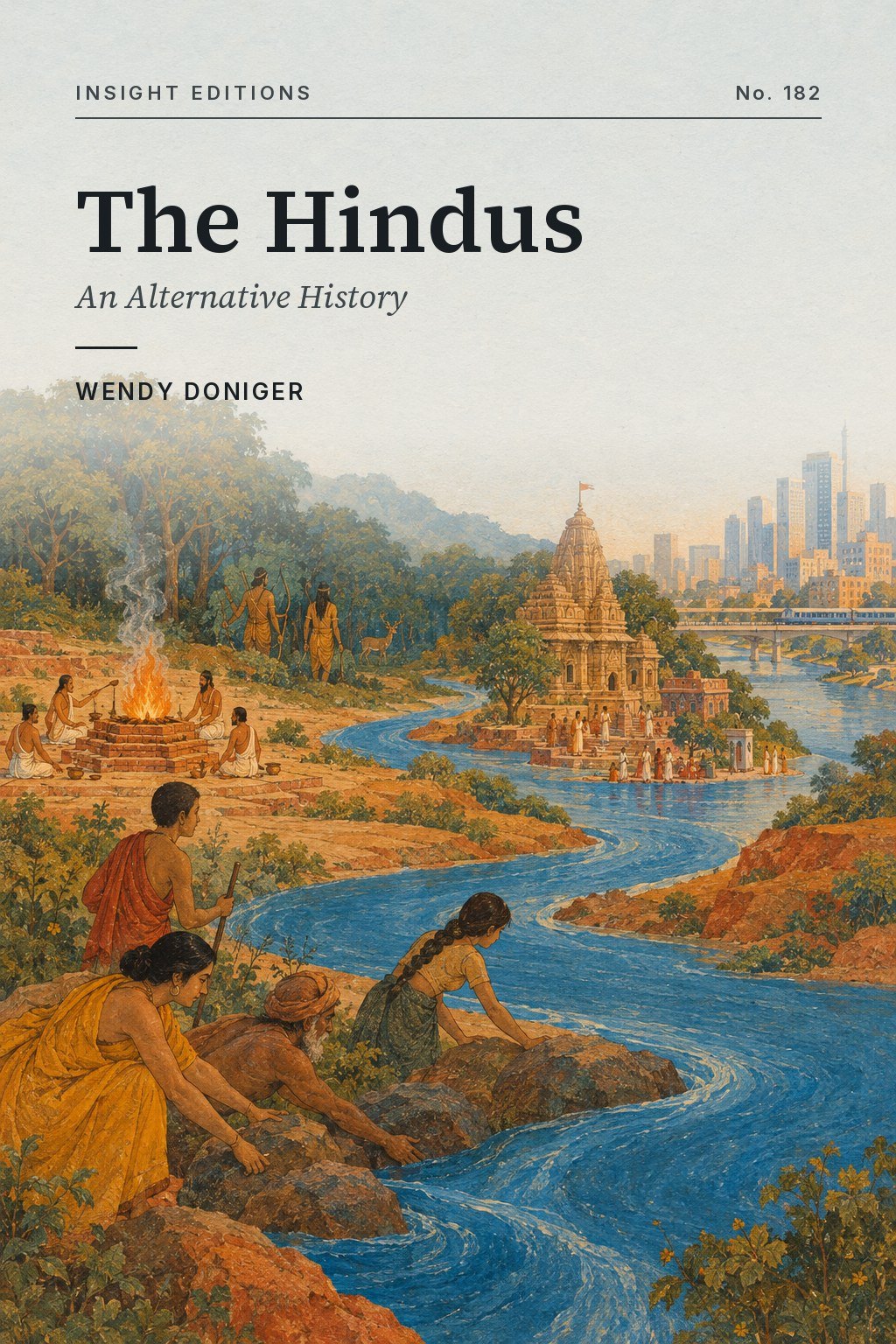
The Hindus
An Alternative History
Wendy Doniger
Wendy Doniger traces Hindu traditions from the Indus Valley and Vedic texts through epics, devotional movements, colonial reform, and contemporary debates, emphasizing marginalized perspectives.
A study guide to The Hindus by Wendy Doniger. Shared free for personal reading; not for sale and not endorsed by the authors or publishers. Please read and buy the original.
The Book in Brief
Wendy Doniger's The Hindus: An Alternative History. A long alternative history of Hinduisms that keeps animals, women, and low castes in the frame from deep time to the present.
Narrative map of Doniger alternative history
| Ch | Title | Gist |
|---|---|---|
| 1 | AN ALTERNATIVE HISTORY | ~6171w |
| 2 | CHAPTER 1 - INTRODUCTION: WORKINGWITH AVAI | ~13651w |
| 3 | CHAPTER 2 - TIME AND SPACE IN INDIA 50 Mil | ~5925w |
| 4 | CHAPTER 3 - CIVILIZATION IN THE INDUS VALL | ~7750w |
| 5 | CHAPTER 4 - BETWEEN THE RUINSAND THE TEXT | ~7492w |
| 6 | CHAPTER 5 - HUMANS, ANIMALS, AND GODS IN T | ~13582w |
| 7 | CHAPTER 6 - SACRIFICE IN THE BRAHMANAS 800 | ~12518w |
| 8 | CHAPTER 7 - RENUNCIATION IN THE UPANISHADS | ~14362w |
| 9 | CHAPTER 8 - THE THREE (OR IS IT FOUR?) AIM | ~5317w |
| 10 | CHAPTER 9 - WOMEN AND OGRESSES IN THE RAMA | ~16955w |
| 11 | CHAPTER 10 - VIOLENCE IN THE MAHABHARATA 3 | ~10282w |
| 12 | CHAPTER 11 - DHARMA IN THE MAHABHARATA 300 | ~11208w |
| 13 | CHAPTER 12 - ESCAPE CLAUSES IN THE SHASTRA | ~14314w |
| 14 | CHAPTER 13 - BHAKTI IN SOUTH INDIA 100 BCE | ~12542w |
| 15 | CHAPTER 14 - GODDESSES AND GODS IN THE EAR | ~15425w |
| 16 | CHAPTER 15 - SECTS AND SEX IN THE TANTRIC | ~15980w |
| 17 | CHAPTER 16 - FUSION AND RIVALRY UNDER THE | ~11009w |
| 18 | CHAPTER 17 - AVATAR AND ACCIDENTAL GRACE I | ~12415w |
| 19 | CHAPTER 18 - PHILOSOPHICAL FEUDS IN SOUTH | ~9573w |
| 20 | CHAPTER 19 - DIALOGUE AND TOLERANCE UNDER | ~9756w |
| 21 | CHAPTER 20 - HINDUISM UNDER THE MUGHALS 15 | ~8989w |
| 22 | CHAPTER 21 - CASTE, CLASS, AND CONVERSION | ~15127w |
| 23 | CHAPTER 22 - SUTTEE AND REFORM IN THE TWIL | ~10836w |
| 24 | CHAPTER 23 - HINDUS IN AMERICA 1900 - | ~6921w |
| 25 | CHAPTER 24 - THE PAST IN THE PRESENT 1950 | ~12819w |
| 26 | CHAPTER 25 - INCONCLUSION, OR, THE ABUSE O | ~1309w |
AN ALTERNATIVE HISTORY
The image of the man in the moon who is also a rabbit in the moon, or the duck who is also a rabbit, will serve as a metaphor for the double visions of the Hindus that this book will strive to present. Since there are so many books about Hinduism, the author of yet another one has a duty to answer the potential reader's Passover question: Why shouldn't I pass over this book, or, Why is this book different from all other books?
Hindus ladder 1
AN ALTERNATIVE HISTORY
The image of the man in the moon who is also a rabbit in the moon, or the duck who is also a rabbit, will serve as a metaphor for the double visions of the Hindus that this book will strive to present. Since there are so many books about Hinduism, the author of yet another one has a duty to answer the potential reader's Passover question: Why shouldn't I pass over this book, or, Why is this book different from all other books?
Hindus cycle 209
[TOP] The Mark on the Moon, [MIDDLE] Wittgenstein's Duck/ Rabbit, and [BOTTOM] The Rabbit in the Moon First, it highlights a narrative alternative to the one constituted by the most famous texts in Sanskrit (the literary language of ancient India) and represented in most surveys in English. It tells a story that incorporates the narratives of and about alternative people-people who, from the standpoint of most high-caste Hindu males, are alternative in the sense of otherness, people of other religions, or cultures, or castes, or species (animals), or gender (women).
Hindus flow 210
Part of my agenda in writing an alternative history is to show how much the groups that conventional wisdom says were oppressed and silenced and played no part in the development of the tradition-women, Pariahs (oppressed castes, sometimes called Untouchables)-did actually contribute to Hinduism. My hope is not to reverse or misrepresent the hierarchies, which remain stubbornly hierarchical, or to deny that Sanskrit texts were almost always subject to a final filter in the hands of the male Brahmins (the highest of the four social classes, the class from which priests were drawn) who usually composed and preserved them.
Hindus ladder 211
But I hope to bring in more actors, and more stories, upon the stage, to show the presence of brilliant and creative thinkers entirely off the track beaten by Brahmin Sanskritists and of diverse voices that slipped through the filter, and, indeed, to show that the filter itself was quite diverse, for there were many different sorts of Brahmins; some whispered into the ears of kings, but others were dirt poor and begged for their food every day. Moreover, the privileged male who recorded the text always had access to oral texts as well as to the Sanskrit that was his professional language.
Most people who knew Sanskrit must have been bilingual; the etymology of "Sanskrit" ("perfected, artificial") is based upon an implicit comparison with "Prakrit" ("primordial, natural"), the language actually spoken. This gives me a double agenda: first to point out the places where the Sanskrit sources themselves include vernacular, female, and lower-class voices and then to include, wherever possible, non-Sanskrit sources. The (Sanskrit) medium is not always the message;a it's not all about Brahmins, Sanskrit, the Gita.
History lens 212
I will concentrate on those moments within the tradition that resist forces that would standardize or establish a canon, moments that forged bridges between factions, the times of the "mixing of classes" (varna-samkara) that the Brahmins always tried-inevitably in vain-to prevent. Second, in addition to focusing on a special group of actors, I have concentrated on a few important actions, several of which are also important to us today: nonviolence toward humans (particularly religious tolerance) and toward animals (particularly vegetarianism and objections to animal sacrifice) and the tensions between the householder life and renunciation, and between addiction and the control of sensuality.
Hindus hub 213
More specific images too (such as the transposition of heads onto bodies or the flooding of cities) thread their way through the entire historical fabric of the book. I have traced these themes through the chapters and across the centuries to provide some continuity in the midst of all the flux,2 even at the expense of what some might regard as more basic matters. Third, this book attempts to set the narrative of religion within the narrative of history, as a linga (an emblem of the god Shiva, often representing his erect phallus) is set in a yoni (the symbol of Shiva's consort, or the female sexual organ), or any statue of a Hindu god in its base or plinth (pitha).
I have organized the topics historically in order to show not only how each idea is a reaction to ideas that came before (as any good old-fashioned philological approach would do) but also, wherever possible, how those ideas were inspired or configured by the events of the times, how Hinduism, always context sensitive,3 responds to what is happening, at roughly the same moment, not only on the political and economic scene but within Buddhism or Islam in India or among people from other cultures entering India. For Hinduism, positioning kings as gods and gods as kings, seldom drew a sharp line between secular and religious power.
Hindus cycle 214
Hindus flow 215
It tells the story of the Hindus primarily through a string of narratives. The word for "history" in Sanskrit, itihasa, could be translated as "That's what happened," giving the impression of an only slightly more modest equivalent of von Ranke's phrase for positivist history: "Wie es [eigentlich] gewesen ist" ("The way it [really] happened"). But the iti in the word is most often used as the Sanskrit equivalent of "end quote," as in "Let's go [iti]," he said.
Itihasa thus implies not so much what happened as what people said happened ("That's what he said happened")-narratives, inevitably subjective narratives. And so this is a history not of what the British used to call maps and chaps (geography and biography) but of the stories in hi-story. It's a kind of narrative quilt made of scraps of religion sewn in next to scraps of social history, a quilt like those storytelling cloths that Indian narrators use as mnemonic devices to help them and the audience keep track of the plot.
Hindus ladder 216
Many a "fact" turns out, on closer inspection, to be an argument. There is another story to be told here: how we know what we know, what we used to believe, why we believe what we believe now, what scholars brought up certain questions or gave us the information we now have, what scholars now challenge that information, and what political factors influenced them. Those arguments tell a story that is interesting in itself but to which I merely allude from time to time.
History lens 217
I also write in the shadow of a broad scholarship of theories about religion and history, and I will keep that too out of the text. I have tried to avoid setting my opinions against those with whom I disagree or using them as fall guys, beginning an argument by citing the imagined opponent. I have, rather, simply presented each subject in what I believe to be the best scholarly construction, in order to concentrate on the arguments about it within the Hindu texts themselves.
Many central questions remain unanswered, and I hope that this book will inspire some readers to go back to the sources and decide for themselves whether or not they agree with me. The relevant materials can be found in the bibliography as well as in the notes for each chapter, which will also provide browsing material for those readers (I confess that I am one of them) who go straight to the back and look at the notes and bibliography first, reading the book like Hebrew, from right to left, to see where the author has been grazing, like dogs sniffing one another's backsides to see what they have eaten lately.b
Hindus hub 218
History lens 2
SANSKRITIZATION, DESHIFICATION, AND VERNACULARIZATION
Henry Higgins, in George Bernard Shaw's Pygmalion, is said to be the author of Spoken Sanskrit, and many priests and scholars can speak Sanskrit, but no one ever spoke only pure Sanskrit. Sanskrit and oral traditions flow back and forth, producing a constant infusion of lower-class words and ideas into the Brahmin world, and vice versa. It must have been the case that the natural language, Prakrit, and the vernaculars came first, while Sanskrit, the refined, secondary revision, the artificial language, came later.
Hindus cycle 219
The two processes of Sanskritization and Deshification beget each other. Similarly, through a kind of identificatio brahmanica,11 local gods take on the names of gods in Sanskrit texts: Murukan becomes Skanda, a kind of Sanskritization, while at the same time there is an identificatio deshika, by which Sanskrit gods take on the characteristics of local gods, and to the people who worship Murukan, it is Murukan who is absorbing Skanda, not the reverse. "Cross-fertilization" might be a good, equalizing term for the combination of the two processes.
Hindus flow 220
"Written" does not necessarily mean "written in Sanskrit," nor are oral texts always in the vernacular (the Rig Veda, after all, was preserved orally in Sanskrit for many centuries before it was consigned to writing). We cannot equate vernacular with oral, for people both write and speak both Sanskrit and the vernacular languages of India, though Sanskrit is written more often than spoken. The distinction between Sanskrit and the vernacular literatures is basically geographical: Though there are regional Sanskrits, the vernaculars, unlike Sanskrit, are defined and named by their place of origin (Bangla from Bengal, Oriya from Orissa, and so forth), while the script in which Sanskrit is most often written allegedly has no particular earthly place of origin (it is called "the [script of the] city of the gods [deva-nagari]").
Once people departed from the royal road of Sanskrit literary texts, there were thousands of vernacular paths that they could take, often still keeping one foot on the high road of Sanskrit. The constant, gradual, unofficial mutual exchange between Sanskrit and the vernacular languages, the cross-fertilization, underwent a dramatic transformation toward the middle of the second millennium: Local languages were now promoted officially, politically, and artistically,12 replacing the previously fashionable cosmopolitan and translocal language, Sanskrit. Instead of nourishing and supplementing Sanskrit, the vernacular languages as literary languages began to compete with Sanskrit as the language of literary production.
Hindus ladder 221
It's an old joke among linguists that a language is a dialect with an army,e and this is sometimes used to explain the dominance of Sanskrit texts, since as usual, the victors wrote the history, and in ancient India, they usually wrote it in Sanskrit. (The earliest inscriptions were in Prakrit, not Sanskrit, but from about 150 CE, Sanskrit dominated this field too.) Sanskrit is perched on top of the vernacular literatures like a mahout on an elephant, like Krishna riding on the composite women that form the horse on the jacket of this book.
Hindus hub 3
SELECTIVITY AND SYNECDOCHE
History lens 222
These small fragments alternate with a few exemplary narratives quoted in considerable detail, where Hindus speak in their own words (in translationf). I have tried to balance my translations of the classic, much-translated texts with citations of more obscure, previously unnoticed texts, using as my framework the usual suspects that scholars have rounded up over and over, the basic curry and rice episodes of Hinduism, but moving away quickly, in each chapter, to a handful of lesser-known episodes, things usually left out of survey books on Hinduism.
These are not the great imperial moments but episodes that give us an inkling of what religious life was like for some people, including ordinary people, in India long ago. I have also included a few episodes of interaction (both friendly and hostile) between Hindus and non-Hindus in India, such as Buddhists, Jainas, Sikhs, and Muslims, though without paying direct attention to those other religions in their own right. Beginning with a minimal backbone or infrastructure of basic historical events and concepts that many people would agree upon (data never value free but still valuable), we can then move from this point outward to other points, and from social history to literary texts, to search for narratives of and about alternative people.
Hindus hub 223
That selectivity makes this book alternative in another sense, in that it leaves wide open a great deal of space for others to select from in writing their histories, alternative to mine. Someone else would make different choices and write a very different book. This is a history, not the history, of the Hindus.
Hindus cycle 224
Hindus cycle 4
THEMES AND VARIATIONS
The central actors and their actions are threads around which the great narratives of Hinduism coalesce like crystals in a supersaturated solution. The actors and actions connect in various ways: Sanskrit texts usually regard women and hunted animals as primary objects of addiction, and the senses that cause addiction are likened to horses; animals often represent both women and the lower classes; the tension between sexuality and renunciation results in an ambivalence toward women as mothers and seductresses; and violence is first addressed largely in the form of violence against animals.
Hindus flow 225
Violence and tolerance also interact in attitudes not only to other religions but between the upper and lower castes, between men and women, and between humans and animals. I will highlight in each period those moments when intrareligious (including intercaste) or interreligious interactions took place, marked by either tolerance or violence, the deciding factor between the two options often being historical circumstances. Each chapter deals with several themes, but not every chapter has instances of every theme or treats the same theme in the same way (chapter 12 for instance, is about women more than about goddesses, while chapter 14 is about goddesses more than about women), and indeed I have often noted the activities of women in other contexts, without explicitly highlighting their gender.
But wherever the evidence allows, I will organize each chapter around these central themes. (NON)VIOLENCE In the Introduction (chapter 1), I spell out the assumptions behind my attention to history and to the particular actors in this story (women, lower classes and castes, and animals). Here let me just say a few words about the central action: (non)violence.
Hindus ladder 226
The term "nonviolence" (ahimsa) originally applied not to the relationship between humans but to the relationship between humans and animals. Ahimsa means "the absence of the desire to injure or kill," a disinclination to do harm, rather than an active desire to be gentle; it is a double negative, perhaps best translated by the negative "nonviolence," which suggests both mental and physical concern for others. The roots of ahimsa may lie in Vedic ritual, in animal sacrifice, in the argument that the priest does not actually injure the animal but merely "pacifies him"; the primary meaning of ahimsa is thus to do injury without doing injury, a casuist argument from its very inception.
History lens 227
In any case, ahimsa represents not a political doctrine or even a social theory, but the emotion of the horror of killing (or hurting) a living creature, an emotion that we will see attested from the earliest texts.g Arguments about whether or not to kill, sacrifice, and/or eat animals were often at the heart of interreligious violence, sometimes the grounds on which human beings attacked other human beings (usually with words, though occasionally with blows).h Arjuna, the heroic warrior of the Mahabharata, the great ancient Sanskrit poem about a tragic war, excuses the violence of war by saying, "Creatures live on creatures, the stronger on the weaker. The mongoose eats mice, just as the cat eats the mongoose; the dog devours the cat, your majesty, and wild beasts eat the dog.
Hindus hub 228
Even ascetics [tapasas] cannot stay alive without killing" [12.15.16-24]. The text here justifies human violence by the violence that is rampant in the animal world. Yet the most common sense of ahimsa refers to humans' decision to rise above animal violence.
Hindus cycle 229
Vegetarianism, both as an ideal and as a social fact in India, challenges Arjuna's belief that animals must inevitably feed on one another and attempts to break the chain of alimentary violence simply by affirming that it is not, in fact, necessary to kill in order to eat. Nonviolence became a cultural ideal for Hindus precisely because it holds out the last hope of a cure, all the more desirable since unattainable, for a civilization that has, like most, always suffered from chronic and terminal violence.
Non-violence is an ideal propped up against the cultural reality of violence. Classical Hindu India was violent in ways both shared with all cultures and unique to its particular time and place, in its politics (war being the raison d'être of every king); in its religious practices (animal sacrifice, ascetic self-torture, fire walking, swinging from hooks in the flesh of the back, and so forth); in its criminal law (impaling on stakes and the amputation of limbs being prescribed punishments for relatively minor offenses); in its hells (cunningly and sadistically contrived to make the punishment fit the crime); and, perhaps at the very heart of it all, in its climate, with its unendurable heat and unpredictable monsoons.
Hindus flow 230
Hindu sages dreamed of nonviolence as people who live all their lives in the desert dream of oases. It is against this background that we must view the doctrine of nonviolence. The history of Hinduism, as we shall see, abounds both in periods of creative assimilation and interaction and in outbursts of violent intolerance.
Hindus ladder 231
Sometimes it is possible to see how historical circumstances have tipped the scales in one direction or the other. In their ambivalent attitude to violence, the Hindus are no different from the rest of us, but they are perhaps unique in the intensity of their ongoing debate about it. THE MAN/RABBIT IN THE MOON I have organized several of these tensions into dualities, for dualism is an (if not the) Indian way of thinking, as the folklorist A.
History lens 232
But most Hindus (as well as Chinese, Japanese, and Aztecs) see a hare.i (I am calling it a rabbit to avoid the unfortunateEnglish homonym "hare/hair," another bit of double vision, though calling it a rabbit lands me in the middle of a rock group called the Rabbit in the Moon). The man's right eye can be read as the rabbit's ears, his left eye the rabbit's chest, and his mouth the rabbit's tail. (There was a time, in the 1930s, when some people in India saw the image of Gandhi in the moon.21) The Buddhists tell how the moon came to have the mark of a rabbit: THE RABBIT IN THE MOON The future Buddha was once born as a rabbit, who vowed that he would give his own flesh to any beggar who came to him, in order to protect the beggar from having to break the moral law by taking animal life.
Hindus hub 233
The rabbit in the moon is one of so many ideas that Hinduism and Buddhism share. As an approach to the history of Hinduism, seeing both their rabbit and our man in the moon means maintaining an awareness both of what the tradition says (the insider's view) and of what a very different viewpoint helps us to see (the outsider's view). Hindus may approach their scriptures as a part of their piety or as scholars who study Hinduism as they would study any other human phenomenon, or both simultaneously.j There are certainly things that only a Hindu can know about Hinduism, both factual details of local and private practices and texts and the experiential quality of these and other, better-known religious phenomena.
Hindus cycle 234
Hindus flow 5
Hindus ladder 6
History lens 7
Hindus hub 8
CHAPTER 1 - INTRODUCTION: WORKINGWITH AVAILABLE LIGHT
WITH AVAILABLE LIGHT SEARCHING FOR THE KEY Someone saw Nasrudin searching for something on the ground. "What have you lost, Mulla?" he asked.
Hindus cycle 9
INTRODUCTION: WORKING
WITH AVAILABLE LIGHT SEARCHING FOR THE KEY Someone saw Nasrudin searching for something on the ground. "What have you lost, Mulla?" he asked. So they both went down on their knees and looked for it.
There's a shortage of what photographers call available light to help us find what we are looking for, but in recent years historians have produced studies that provide good translations and intelligent interpretations of texts in Sanskrit and other Indian languages and pointers to both texts and material evidence that others had not noticed before. I have therefore concentrated on those moments that have been illuminated by the many good scholars whose thick descriptions form an archipelago of stepping-stones on which a historian can hope to cross the centuries.
Hindus flow 235
This book tells the story of Hinduism chronologically and historically and emphasizes the history of marginalized rather than mainstream Hindus. My aims have been to demonstrate: (1) that Hindus throughout their long history have been enriched by the contributions of women, the lower castes, and other religions; (2) that although there are a number of things that have been characteristic of many Hindus over the ages (the worship of several gods, reincarnation, karma), none has been true of all Hindus, and the shared factors are overwhelmingly outnumbered by the things that are unique to one group or another; (3) that the greatness of Hinduism-its key, its earthiness, its vividness-lies precisely in many of those idiosyncratic qualities that some Hindus today are ashamed of and would deny; and (4) that the history of tensions between the various Hinduisms, and between the different sorts of Hindus, undergirds the violence of the contemporary Indian political and religious scene.
Hindus ladder 236
History and diversity-let me lay them out one by one.
Hindus flow 10
HISTORY: AVAILABLE LIGHT
History lens 237
The "eternal and unchanging" approach inspired Orientalist philologists to track back to their earliest lair some concepts that do in fact endure for millennia, but without taking into account the important ways in which those concepts changed or the many other aspects of Hinduism that bear little relationship to them. The so-called central ideas of Hinduism-such as karma, dharma, samsara-arise at particular moments in Indian history, for particular reasons, and then continue to be alive, which is to say, to change.
They remain central, but what precisely they are and, more important, what the people who believe in them are supposed to do about them differ in each era and, within each era, from gender to gender, caste to caste. And many new ideas arise either to replace or, more often, in Hinduism, to supplement or qualify earlier ideas. Some Hindus always knew this very well.
Hindus hub 238
Many Hindu records speak of things that happened suddenly, without precedent (a-purva, "never before"), right here, right now; they are aware of the existence of local dynasties, of regional gods, of political arrivistes. The Hindu sense of time is intense; the importance of time as an agency of change, the sense that things that happen in the past come to fruition at a particular moment-now-pervades the great history (itihasa) called the Mahabharata. That sense of history is different from ours, as different as Buddhist enlightenment is from the European Enlightenment (what a difference a capital E makes).
Hindus cycle 239
But in India, as in Europe, human beings compose texts at some moment in history, which we strive with varying degrees of success to discover, and those texts continue to develop and to be transformed through commentary, interpretation, and translation. Hinduism does not lend itself as easily to a strictly chronological account as do some other religions (particularly the so-called Abrahamic religions or religions of the Book, or monotheisms-Judaism, Christianity, Islam), which refer more often to specific historical events. Many central texts of Hinduism cannot be reliably dated even within a century.
Since early Buddhism and Hinduism grew up side by side in the same neighborhood, so to speak, historians of Hinduism have often ridden piggyback on historians of Buddhism, a religion that has for the most part kept more precise chronological records; the historians of Buddhism figure out when everything happened, and the historians of Hinduism say, "Our stuff must have happened around then too." Historians of early India have also depended on the kindness of strangers, of foreign visitors to India who left reliably dated (but not always accurately observed) records of their visits. The chronological framework is largely imperialistic-dates of inscriptions, battles, the endowment of great religious institutions-because those are the things that the people who had the clout to keep records thought was most important.
Hindus flow 240
And though we no longer think that kings are all that matter in history (siding more with D. Kosambi, who urged historians to ask not who was king but who among the people had a plow), kings (more precisely, rajas) do also still matter. They are, however, no longer all that we would like to know about.
Hindus ladder 241
The central moments for cultural history are not necessarily the great imperial moments, as historians used to think they were, the moments when Alexander dipped his toe into India or the Guptas built their empire. For some of the richest and most original cultural developments take place when there isn't an empire, in the cracks between the great dynastic periods. And although the historical records of inscriptions and coins tell us more about kings (the winners) than about the people (the losers), there are other texts that pay attention to the rest of the populace.
When we cannot date events precisely, we can often at least arrange things in a rough but ready chronological order, though this leads to a house of cards effect when we are forced to reconsider the date of any text in the series.
History lens 242
We must also ask how the new text was at least in part inspired by the circumstances of its own time. Why did the Upanishads develop out of the Brahmanas then? What about the stuff that isn't in the Brahmanas?
Hindus hub 243
"Well (the speculation used to go), maybe they got it from the Greeks; it reminds me of Plato. Or perhaps the Axial Age, sixth century BCE and all that? How about the Indus Valley civilizations?
Lots of new ideas must have come from there." Since there is no conclusive evidence for, or against, any of these influences, before we look to Greece we must look to India in the time of the Upanishads to find other sorts of factors that might also have influenced their development-new forms of political organization, taxation, changes in the conditions of everyday life. Even an imported idea takes root only if it also responds to something already present in the importing culture;3 even if the idea of reincarnation did come from Greece to India, or from Mesopotamia to both Greece and India (hypotheses that are unlikely but not impossible), we would have to explain why the Indians took up that idea when they did not take up, for instance, Greek ideas about love between men, and then we must note how different the Upanishadsare from Plato even in their discussion of ideas that they share, such as reincarnation.
Hindus cycle 244
Moreover, to the mix of philology and history we must add another factor, individuality. The question of originality is always a puzzle, in part because we can never account for individual genius; of course ideas don't arise in a vacuum, nor are they nothing but the sum total of ideas that came before them. Individuals have ideas, and those ideas are often quite different from the ideas of other people living at the same time and place.
This is particularly important to keep in mind when we search for the voices of marginalized people, who often achieve as individuals what they cannot achieve as a group. People are not merely the product of a zeitgeist; Shakespeare is not just an Elizabethan writer. In Indian history, individuals have turned the tide of tolerance or violence even against the current of the zeitgeist.
Hindus flow 245
The emperors Ashoka and Akbar, for example, initiated highly original programs of religious tolerance, going in the teeth of the practices of their times. Someone with a peculiar, original, individual bent of mind wrote the "There Was Not" (nasadiya) hymn of the Rig Veda, and the story of Long-Tongue the Bitch in the Jaiminiya Brahmana, and the story of Raikva under the cart (one of the earliest homeless people noted in world literature) in the Upanishads. And these individual innovators in the ancient period did not merely compose in Sanskrit.
They also lurked in the neglected byways of oral traditions, sometimes in the discourses of women and people of the lower classes, as well as in the broader-based Sanskrit traditions that those local traditions feed. For original ideas are rare both among people who have writing and among those that do not. Public individuals too-such as Ashoka, Akbar, and Gandhi, on the one hand, Aurangzeb, Brigadier General Reginald Dyer, and M.
Hindus ladder 246
Hindus ladder 11
MYTH, HISTORY, AND SYMBOLISM
In addition to understanding the history of the texts, we need to understand the relationship between records of historical events and the construction of imaginary worlds as well as the symbolism that often joins them. To begin with the symbolism of physical objects, sometimes a linga is just a linga-or, more often, both a linga and a cigar. Numerous Sanskrit texts and ancient sculptures (such as the Gudimallam linga from the third century BCE) define this image unequivocally as an iconic representation of the male sexual organ in erection, in particular as the erect phallus of the god Shiva.
History lens 247
But some Hindus who see the linga as an abstract symbol therefore object to the interpretations of those who view it anthropomorphically; their Christian counterparts would be people who refuse to acknowledge that the cross ever referred to the passion of Christ. Visitors to the Gudimallam linga in the early twenty-first century noted that while the large linga as a whole remains entirely naked, with all its anatomical detail, the small image of a naked man on the front of the linga was covered with a chaste cloth, wrapped around the whole linga as a kind of total loincloth (or fig leaf) simultaneously covering up the middle of the man in the middle of the linga and the middle of the linga itself.
Here is a fine example of a tradition driving with one foot on the brake and the other on the accelerator. We need to be aware of both the literal and symbolic levels simultaneously, as we see both the rabbit and the man in the moon. Similarly, we have to be careful how we use history and myth to understand one another.
Hindus hub 248
In this context I would define a myth as a story that a group of people believe for a long time despite massive evidence that it is not actually true; the spirit of myth is the spirit of Oz: Pay no attention to the man behind the curtain. When we read a text that says that a Hindu king impaled eight thousand Jainas, we need to use history to understand myth-that is, we need to understand why such a text was composed and retold many times; that means knowing the reasons for the tensions between Hindus and Jainas at that time (such as the competition for royal patronage).
But we cannot use the myth to reconstruct the actual history behind the text; we cannot say that the text is evidence that a Hindu king actually did impale Jainas. To take another example, when the Ramayana speaks of ogres (Rakshasas), it may be simultaneously constructing an imaginary world in which evil forces take forms that can destroy us and using ogres as a metaphor for particular types of human beings. But it does not record an actual event, a moment when people from Ayodhya overcame real people in India (tribals, or Dravidians, or anyone else), nor does the story of the building of the causeway to Lanka mean that Rama and a bunch of monkeys actually built a causeway to (Sri) Lanka.
Such myths reveal to us the history of sentiments rather than events, motivations rather than movements. The history of ideas, even if not a source of "hard" history, is still a very precious thing to have. For stories, and the ideas in stories, do influence history in the other direction, into the future.
Hindus cycle 249
Real events and sentiments produce symbols, symbols produce real events and sentiments, and real and symbolic levels may be simultaneously present in a single text. Myth has been called "the smoke of history,"7 and my intention is to balance the smoke of myth with the fire of historical events, as well as to demonstrate how myths too become fires when they do not merely respond to historical events (as smoke arises from fire) but drive them (as fire gives rise to smoke).
Ideas are facts too; the belief, whether true or false, that the British were greasing cartridges with animal fat started a revolution in India. For we are what we imagine, as much as what we do.
Hindus flow 250
History lens 12
DIVERSITY
Is there a unique and distinct phenomenon worth naming that covers the religion(s) of the people from the Veda (c. 1200 BCE) to the Hare Krishnas in American airports and that tells us where Hinduism ends and Buddhism begins? It is useful to distinguish the objection that there is no such thing as Hinduism in the sense of a single unified religion, from the objection that the people we call Hindus lack a category, or word, for Hinduism and identify themselves not as Hindus but as Indians or as Bengali Vaishnavas (worshipers of Vishnu, living in Bengal).
That is, we may ask: (1) Is there such a thing as Hinduism?; (2) is that the best thing to call it?; and (3) can we do so even if Hindus didn't/don't? These are related but separate questions. Let's consider the phenomenon and the name one by one.
Hindus ladder 251
ARE THERE SUCH THINGS AS HINDUS AND HINDUISM? There are several objections to the use of any single term to denote what, for the sake of argument, we will call Hindus and Hinduism.p Hindus did not develop a strong sense of themselves as members of a distinct religion until there were other religions against which they needed to define themselves, like the invisible man in the Hollywood film who could be seen only when he was wearing clothing that was not a part of him.
And this intertextuality is balanced by an equally rainbow-hued range of practices, which we might call an interpracticality, on the model of intertextuality, practices that refer to other practices. Another objection to regarding Hinduism as a monolithic entity is that it is hard to spell out what "they all" believe or do (even if we exclude from "all" people like Shirley MacLaine). There is no single founder or institution to enforce any single construction of the tradition, to rule on what is or is not a Hindu idea or to draw the line when someone finally goes too far and transgresses the unspoken boundaries of reinterpretation.
History lens 252
Ideas about all the major issues-vegetarianism, nonviolence, even caste itself-are subjects of a debate, not a dogma. The books that Euro-Americans privileged (such as the Bhagavad Gita) were not always so highly regarded by "all Hindus," certainly not before the Euro-Americans began to praise them. Other books have been far more important to certain groups of Hindus but not to others.
One answer to this objection is that like other religions-Christianity, Buddhism, Islam-Hinduism encompasses numerous miscellaneous sects. But intertextuality (as well as interpracticality) argues for the inclusion of this unruly miscellany under the rubric of Hinduism. The fact that later texts and practices often quote earlier ones, right back to the Rig Veda, allows us to call it a single tradition, even though there are many other Hindu texts and practices that have no connection with any Sanskrit text, let alone the Veda.
What literary critics call the anxiety of influence13 works in the other direction in India. The individual artist composing a text or performing a ritual can make innovations, but she demonstrates first her knowledge of the traditions of the past and only then her ability to build upon them and even to reverse them. The assumption is that if she thinks she has an original idea, it means that she has forgotten its source.
Hindus hub 253
Moreover, some of the people we now call Hindus did, when they wanted to, for more than two millennia, find ways to describe themselves as a group, in contrast with Buddhists or Muslims (or particular subsects of Buddhists or Muslims). They called themselves the people of the Veda, or the people who revere the Brahmins who are the custodians of the Veda, or the people who have four classes and four stages of life (varna-ashrama-dharma, in contrast with Buddhists). Or they called themselves the Aryas ("nobles"), in contrast with the Dasyus or Dasas ("aliens" or "slaves") or barbarians (mlecchas).
The texts called the Brahmanas, in the seventh century BCE, define mlecchas as people of unintelligible speech, as does a dharma text of the period, which adds that they also eat cow flesh,14 implying that the Aryas do not. The lawmaker Manu too, in the early centuries CE, treats mleccha as a linguistic term, contrasted with Arya (which he correctly regards as a linguistic term) rather than with Dasyu (an ethnic term); those outside the four classes (varnas) are aliens (Dasyus), whether they speak barbarian (mleccha) languages or Arya languages (10.45).
A commentator on Manu, named Medhatithi, glosses mleccha with the Sanskrit word barbara, cognate with the Greek barbaroi ("barbarian," someone who babbles, "barbarbar"). No one ever comments on the religious beliefs or practices of these people. But religious belief and practice are aspects of Hindu identity that both we and they can and do recognize.
Hindus cycle 254
r It also defines a Hindu as someone who is not a Muslim, Christian, Parsi, or Jew, but who is (in addition to a Sikh, Buddhist, or Jaina) one of a rather arbitrary selection of people whose marginality made the court nervous: "any person who is a Hindu by religion in any of its forms or developments, including a Virashaiva, a Lingayat or a follower of the Brahmo, Prarthana or Arya Samaj." Significantly, the definition was needed because different religions have different marriage laws; the horror of miscegenation, always lurking in the Brahmin heart of darkness, was exacerbated by the British legacy within the law code. But in addition to the circularity, mutual contradictions, and blatant chauvinism of the "not a Muslim" definition, such paraphrases list only other religions available in India (they seldom specify "not a Navajo, not a Confucian"); otherwise the word "Hindu" might simply have replaced "gentoo" or "heathen." The political problems that arise from this geographical assumption will resurface below when we consider the word, rather than the concept, "Hinduism." In what seems to me to be something like desperation, a number of people have defined Hinduism as the religion of people who cannot or will not define their religion.
Hindus flow 255
Hindus ladder 256
Thus the legal ruling that defined Hinduism by its tolerance and inclusivism was actually inspired by the desire of certain Hindus to exclude other Hindus from their temples.
Hindus hub 13
THE ZEN DIAGRAM
In answer to several of the objections to the word "Hinduism," some scholars have tried to identify a cluster of qualities each of which is important but not essential to Hinduism; not every Hindu will believe in, or do, all of them, but each Hindu will adhere to some combination of them, as a non-Hindu would not. Scholars differ as to the number and nature of those forms,20 and we have seen the attempts of the Indian Supreme Court to come up with an inoffensive cluster, but perhaps we can be a little more specific.
History lens 257
The elements from which the clusters are formed might include some combination of belief in the Vedas (which excludes Buddhism and Jainism), karma (which does not exclude Buddhism and Jainism), dharma (religion, law, and justice), a cosmology centered on Mount Meru, devotion (bhakti) to one or more members of an extensive pantheon, the ritual offering (puja) of fruit and flowers to a deity, vegetarianism as an ideal (though only between about 25 and 40 percent of Indians are actually vegetarian21), nonviolence, and blood sacrifice (which may or may not be mutually exclusive). This polythetic approach, which owes much to the concept of family resemblance laid out by the philosopher Wittgenstein,22 could be represented by a Venn diagram, a chart made of intersecting circles.
Hindus hub 258
One person's center is another's periphery;24 all South Asia was just a periphery, for instance, to those Delhi sultans and Mughal emperors who viewed everything from a Central Asian perspective. We may speak of marginalized people in the sense that they have been dispossessed and exploited, but Hinduism has porous margins and is polycentric. The Brahmins had their center, which we will refer to as the Brahmin imaginary, but there were other centers too, alternative centers.
Hindus cycle 259
Like the man who proudly displayed a roomful of archery targets, each with an arrow in the bull's-eye, but was forced to confess that he had shot the arrows first and then had drawn the targets around them, we can decide what aspects of Hinduism we want to talk about and find the cluster of qualities in which that aspect is embodied-and, if we wish, call it Hinduism. Or backing off ever so slightly, we can speak of beliefs and practices that many Hindus share, which is what I intend to do.
Hindus flow 260
It is often convenient to speak of a Brahmin-oriented quasi-orthodoxy (or orthopraxy-see below), which we might call the Brahmin imaginary or the idealized system of class and life stage (varna-ashrama-dharma). But whatever we call this constructed center, it is, like the empty center in the Zen diagram of Hinduisms, simply an imaginary point around which we orient all the actual Hindus who accept or oppose it; it is what Indian logicians call the straw man (purva paksha), against whom one argues.
Hindus ladder 261
The actual beliefs and practices of Hindus-renunciation, devotion, sacrifice, and so many more-are peripheries that the imaginary Brahmin center cannot hold.
Hindus cycle 14
HINDUS AND HINDUISM BY ANY OTHER NAMES26
If we can agree that there is something out there worth naming, what shall we call it? The main objections to calling it Hinduism or to calling the people in question Hindus are that those were not always the names that Hindus used for themselves or their religion and that they are geographical names. Let us consider these two objections.
History lens 262
Most of the people we call Hindus call themselves something else, like Golkonda Vyaparis,27 or, on the rarer occasions when they do regard themselves as a group, refer to themselves not as Hindus but as people with the sorts of definitions that we have just considered (Aryas, people who revere the Veda, who follow the system of class and stage of life, and so forth). Moreover, "Hindu" is not a native word but comes from a word for the "river" (sindhu) that Herodotus (in the fifth century BCE28), the Persians (in the fourth century BCE), and the Arabs (after the eighth century CE29) used to refer to everyone who lived beyond the great river of the northwest of the subcontinent, still known locally as the Sindhu and in Europe as the Indus.
Hindus hub 263
Hindus cycle 264
That the word has a geographical basis is, as we have seen, absolutely true. But it is not just the word but the very concept of Hindus and Hinduism that is geographically rooted in history. The textbook of legal code (dharma) attributed to Manu (first century CE) does not use the word "Hindu" but does offer a geographical definition of the people to whom his dharma applies (a definition that, it is worth noting, uses animals to define humans): From the eastern sea to the western sea [the Indian Ocean and the Bay of Bengal], the area in between the two mountains [the Himalayas and the Vindhyas] is what wise men call the Land of the Aryas.
Where the black antelope ranges by nature, that should be known as the country fit for sacrifices; and beyond it is the country of the barbarians. The twice-born [the upper classes and particularly Brahmins] should make every effort to settle in these countries [2.23-24]. Much has happened since the time when one could define India as the land where the (deer and the) antelope play from sea to shining sea (eastern to western).
Hindus flow 265
The belief that all Hindus (should) live in India may have been strong once, though more honored in the breach than in the observance. The Hindus are, after all, one of the great merchant civilizations of the world, and the diaspora is very old indeed. Even Manu merely expresses the pious hope that the upper classes "make every effort" to stay within the boundary lines.
Hindus ladder 266
Granted, many Hindus did suffer loss of caste status when they headed west across the Indus (particularly under the British Raj). Nevertheless, Hindus spread first through Southeast Asia and later through the British Empire, and they now live all over the world; there are approximately one and a half million Hindus in the United States, some 0.5 percent of the population. So it has been said for much of Indian history that ideally, all Hindus should live in India.
But the corresponding implication, that everyone in India is (or should be) a Hindu, was never true, not true during the millennia of cultures before either the Indus Valley or the Vedas, not true of most of India even after those early settlements of North India, and certainly never true after the rise of Buddhism in the fifth century CE. Nowadays there are still enough Muslims in India-15 percent of the population, almost as many Muslims as in Pakistan33-to make India one of the most populous Muslim nations in the world, and Muslim input into Indian culture is far more extensive than the mere numbers would imply.
History lens 267
Yet Hindu nationalists have used the geographical implications of the word to equate Hinduism with India and therefore to exclude from the right to thrive in India such people as Muslims and Christians; in 1922, V. Savarkar coined the term "Hindutva" to express this equation. But not everyone who uses the word "Hinduism" can be assumed to be in their camp, an assumption that would reduce an intellectual problem to a political problem and a move that we need not make.
Hindus hub 268
When we use the word, we can, like Humpty Dumpty, pay it extra, in this case to mean not "the people of India" but the intersecting clusters of Hinduisms outlined above. We might take a page from Prince and call it "the religion formerly known as Hinduism" or "Hinduism après la lettre." Despite the many strikes against the word "Hinduism," Hinduism by any other name would be just as impossible to categorize, and it is still useful to employ some word for it.
Hindus cycle 269
Hindus flow 15
SOURCES OF ALTERNATIVE HINDUISMS
Different Hindus not only lived different Hinduisms but privileged different aspects of Hinduism, different qualities among the (non)-defining clusters. Scholars too see the Hindu elephant differently depending upon what part of it they grab (to cite the old Indian parable of the blind men: The one with his hands on the tail imagines that the animal is like a rope; on the side, a wall; on the trunk, a snake). Their politics inevitably colors their ideas of what Hinduism is.
Hindus flow 270
In addition to including women's as well as men's voices and Other Ranks as well as Brahmins, Hinduism is composed of local as well as pan-Indian traditions, oral as well as written traditions, vernacular as well as Sanskrit traditions, and nontextual as well as textual sources. The first (often marginalized) elements of each of these pairs tend to reinforce one another, as do the second elements, the dominant elements, but there are important distinctions within each of the two groups. For these contrasting pairs did not translate into polarized groups of people; a single person would often have both halves (as well as non-Hindu traditions) in his or her head; a Brahmin would know the folk traditions, just as, in our world, many people study paleography and then go to church and read Genesis.
It is not the case that a puritanical Brahmin studied Manu's dharma texts and a libertine merchant read the Kama-sutra (the textbook of the science of erotics); the same man, of either class, might well read dharma with learned men (pandits) by day and the Kama-sutra with his mistress by night. The elite tendencies of written traditions were exacerbated by the climate. The wet heat and the white ants destroyed any written text within a century or two, particularly since vellum was ruled out by the taboo against using animal substances and palm leaf was far more fragile than vellum.
Hindus ladder 271
History lens 272
There are no variant readings of the Rig Veda, no critical editions or textual apparatus. So much for the fluidity of orally transmitted texts. Correspondingly, the expected fixity of written texts dissolves when we look at the history of the reception and transmission of the Mahabharata, another enormous Sanskrit text, but one that was preserved both orally and in manuscript.
In contrast with the Rig Veda, this text changed constantly; it is so extremely fluid that there is no single Mahabharata; there are hundreds of Mahabharatas, hundreds of different manuscripts and innumerable oral versions. So much for the fixity of written texts. The relationship between Sanskrit and the other languages of India (the vernaculars) further complicates this picture.
Hindus hub 273
Sanskrit is the model for most North Indian languages (and the source of much of their grammar and some of their vocabulary), as Tamil is for the Dravidian languages of the south (such as Telugu, Kannada, and Malayalam). The Sanskrit/Tamil distinction therefore overlaps with the North/South distinction, but we certainly cannot simply equate Sanskrit with North and Tamil with South. Many South Indian ideas-like devotion (bhakti), to take a case at random-entered Sanskrit literature, not just Tamil literature, through South Indian Brahmins who wrote in Sanskrit in South India.
Hindus cycle 274
Not only did southern ideas go north, and vice versa, and not only did Tamil flow into Sanskrit and Sanskrit into Tamil, but Tamil went north, and Sanskrit south. A similar mutual interpenetration characterizes textual and nontextual sources. The study of Hinduism in the scholarship of Euro-Americans has been overwhelmingly textual; that's one of the characteristics of what we now call Orientalism, the cluster of attitudes that implicated the first European scholars of India in the European colonization of India.
The British used texts as a way of disregarding actual Hindu practices and justifying their own imperial project with textual citations. And the Orientalist orientation to texts is the orientation toward Brahmins (and Sanskrit, and writing). More recently, scholars have begun to pay more attention to ritual, archaeology, art history, epigraphy, the records of foreign visitors, and, in the modern period, ethnography, revealing new aspects of a lived religion that is very differently represented in texts.
Hindus flow 275
Coins, for instance, tell a story, for money talks in that sense too. The two sets of sources, textual and nontextual, reveal bits of history to us in different ways, like the lame man riding on the shoulders of the blind man. When it comes to history, you can't trust anyone: The texts lie in one way, while images and archaeology mislead us in other ways.
Hindus ladder 276
On the one hand, the gods did not fly around in big palaces, as the texts insist that they did, and we cannot know if women really did speak up as Gargi does in the Upanishads, or Draupadi in the Mahabharata. On the other hand, the Indus seal we all once interpreted as an ithyphallic Shiva Pashupati is probably just someone sitting cross-legged as South Asians are inclined to do, with a bulging loincloth knot; well, back to the drawing board.
Nontextual sources can provide textualists with an occasional shot in the arm, alerting them to what to look for-in texts-once they get the idea that they might be there. Texts can do a great deal, with a little help from their nontextual friends. Texts are still useful in a number of ways.
History lens 277
First of all, some of those old Brahmin males knew a hell of a lot of great stories. Second, not all texts were written by Brahmins. Woven into the Brahmin texts, as well as standing alongside them, is another great strand of narratives by that extraordinarily prolific writer Anonymous, who was usually not a Brahmin and who should be credited with a great deal of the ancient literature of South Asia.
(He-or, just as likely, she-often wrote under the nom de plume of the heavily mythologized authors whom we will soon encounter, people named Vyasa or Valmiki or simply Suta, "the Charioteer Bard.") Third, even those texts that were written by Brahmins were not written (entirely) by Brahmins, nor were all the Brahmins highly literate or elitist; the texts were constantly infused with the contributions of the lower classes and women. Fourth, texts are events too: The Upanishads are part of history as well as imagination.
Hindus hub 278
And fifth, texts are also a major source of information about material culture: If we cannot always find the archaeological remains of a plow, we might at least find a text that mentions a plow, just as when we cannot find texts actually written by women, we can at least find references to women, and sympathetic views of their lives, in texts written by men. All these factors greatly expand the caste of characters in ancient Sanskrit texts. I myself am by both temperament and training inclined to texts.
Hindus cycle 279
Hindus ladder 16
FROM DOG COOKERS TO DALITS
Brahmins may have had a monopoly on liturgical Sanskrit for the performance of certain public rites, but even then the sacrificer uttered some of the ritual words and performed the domestic rites. And the sacrificer need not have been a Brahmin, a member of the highest class; the other two twice-born social classes-warriors/rulers (Kshatriyas) and, below them, merchants, farmers and herders (Vaishyas)-were also initiated and therefore could be sacrificers. The three upper classes were called twice born because of the second birth through the ritual of initiation (the ancient Indian equivalent of becoming born again), in which a man was born (again) as a fully developed member of the community.
u The lowest of the four classes, the servants (Shudras), were excluded from these and many other aspects of religious life, but the exclusion of Shudras doesn't automatically make something "Brahminical." There have been countless terms coined to designate the lowest castes, the dispossessed or underprivileged or marginalized groups, including the tribal peoples. These are the people that Sanskrit texts named by specific castes (Chandala,Chamara, Pulkasa, etc.) or called Low and Excluded (Apasadas) or Born Last (or Worst, Antyajas) or Dog Cookers (Shva-Pakasv), because caste Hindus thought that these people ate dogs, who in turn ate anything and everything, and in Hinduism, you are what you eat.
Hindus flow 280
Much later the British called them Untouchables, the Criminal Castes, the Scheduled (they pronounced it SHED-YULED) Castes, Pariahs (a Tamil word that has found its way into English), the Depressed Classes, and Outcastes. Gandhi called them Harijans ("the People of God"). The members of these castes (beginning in the 1930s and 1940s and continuing now) called themselves Dalits (using the Marathi/Hindi word for "oppressed" or "broken" to translate the British "Depressed").
Ambedkar (in the 1950s), himself a Dalit, tried, with partial success, to convert some of them to Buddhism. Postcolonial scholars call them (and other low castes) Subalterns. Another important group of oppressed peoples is constituted by the Adivasis ("original inhabitants"), the so-called tribal peoples of India, on the margins both geographically and ideologically, sometimes constituting a low caste (such as the Nishadas), sometimes remaining outside the caste system altogether.
It is important to distinguish among Dalits and Adivasis and Shudras, all of whom have very different relationships with upper-caste Hindus, though many Sanskrit texts confuse them. So too, the Backward Castes, a sneering name that the British once gave to the excluded castes in general, are now regarded as castes separate from, and occasionally in conflict with, certain other Dalit castes; the Glossary of Human Rights Watch defines Backward Castes as "those whose ritual rank and occupational status are above 'untouchables' but who themselves remain socially and economically depressed.
Hindus ladder 281
Also referred to as Other Backward Classes (OBCs) or Shudras," though in actual practice the OBCs often distinguish themselves from both Dalits and Shudras. All these groups are alike only in being treated very badly by the upper castes; precisely how they are treated, and what they do about it, differs greatly from group to group. All in all, when we refer to all the disenfranchised castes below the three upper classes known as twice born, it is convenient to designate them by the catchall term of Pariahs (a Tamil word-for the caste that beat leather-topped drums-that finds its way into English) up until the twentieth century and then to call them Dalits.
But whatever we choose to call them, the excluded castes play an important role in the history of the Hindus. Thanks to the Subaltern studies movement, there is a lot more available light for Dalits, particularly in the modern period (from the time of the British); this book aims to contribute to that movement by including more information about Dalits in the ancient period. There have been protests against the mistreatment of the lower castes from a very early age in India, though such protests generally took the form of renouncing caste society and forming an alternative society in which caste was ignored; no actual reforms took place until the nineteenth century and then with only limited success.
Much of what I have said about women also applies to Pariahs, and vice versa; Brahmin ventriloquism functions similarly to male ventriloquism, and the lower castes, like women, leave their "perfumes" in upper-caste literature. The positive attitudes to Pariahs in such texts represent a beginning, a prelude to reform; they change the world, even if only by imagining a world in which people treated women or Pariahs better. The Brahmins did produce a great literature, after all, but they did not compose it in a vacuum.
History lens 282
They did not have complete authority or control the minds of everyone in India. They drew upon, on the one hand, the people who ran the country, political actors (generally Brahmins and kings, but also merchants) and, on the other hand, the nonliterate classes. Because of the presence of oral and folk traditions in Sanskrit texts, as well as non-Hindu traditions such as Buddhism and Jainism, Dog Cookers do speak,w not always in voices recorded on a page but in signs that we can read if we try.
The fact that a sage is punished for teaching the Vedas to the horse-headed gods called the Ashvins, who associate with the class of farmers and herdmen, should alert us to the possibility that teaching the Vedas to the wrong sorts of people might also be a rule honored at least sometimes in the breach as well as in the observance. And we can, as with women's voices, ferret out voices of many castes in the ancient texts, and once we have access to the oral and folk traditions, we can begin to write the alternative narrative with more confidence.
Hindus hub 283
ANIMALS: HORSES, DOGS, AND COWS
AS POWER, POLLUTION, AND PURITY Animals-primarily not only dogs, horses, and cows, but also monkeys, snakes, elephants, tigers, lions, cats, and herons-play important roles in the Hindu religious imaginary, both as actual living creatures and as the key to important shifts in attitudes to different social classes. Yogic postures (asanas) and sexual positions, as well as theological schools, are named after animals. Gods become incarnate as animals and have animal vehicles in the human world.
Hindus cycle 284
The process works in opposite directions at once. On the one hand, the observation of the local fauna provides images with which people may think of their gods; whether or not people get the gods that they deserve, they tend to get the gods (and demons) that their animals deserve-gods inspired by the perceived qualities of the animals. On the other hand, the ideas that people have about the nature of the gods, and of the world, and of themselves will lead them to project onto animals certain anthropomorphic features that may seem entirely erroneous to someone from another culture observing the same animal.
And knowing what animals, real live animals, actually appeared in the material culture at a particular time and place helps us place aspects of that culture geographically and sometimes chronologically. Thus animals appear both as objects, in texts about the control of violence against living creatures (killing, eating), and as subjects, in texts where they symbolize people of different classes. Clearly the two-the animals of the terrain and the animals of the mind-are intimately connected, and both are essential to our understanding of Hinduism.
Hindus flow 285
If the motto of Watergate was "Follow the money," the motto of the history of Hinduism could well be "Follow the monkey." Or, more often, "Follow the horse." Three animals-horses, dogs, and cows-are particularly charismatic players in the drama of Hinduism. The mythological texts use them to symbolize power, pollution, and purity, respectively, and link them to three classes of classical Hindu society: Kshatriyas or rulers, particularly foreign rulers (horses), the lower classes (dogs), and Brahmins (cows).x Horses and dogs function in our narrative as marginalized groups on both ends of the social spectrum (foreigners and Pariahs), y while cows are the focus of the ongoing debate about vegetarianism.
Hindus ladder 286
These three animals pair up first with one and then with another in a complex symbolic dance. Horses and cows provide mirror images of each other's genders. The cow (f.) is the defining gender for the bovine species and the symbol of the good human female (maternal, docile); the negative contrast is provided not by bulls and steers, who have a rather ambivalent status (Shiva's bull, Nandi, is generally docile and benign), but by male buffalo, who have taken over this spot in the paradigm and symbolize evil in both myth and ritual, as well as being often associated with Pariahs.
History lens 287
The grazing season lasts only from September to May, and even then the grasses are spare and not good for fodder. Moreover, since the best soil is mostly reserved for the cultivation of grains and vegetables to feed a large and largely vegetarian population, there is relatively little room for horses even in those places where more nutritious fodder grasses are found (such as the eastern extensions of the arid zone in the north and northwest of India, particularly in Rajasthan, where horses have in fact been bred successfully for centuries).
Hindus hub 288
And so the horse is always the foreigner in India, the invader and conqueror, and the history of the horse in India is the history of those who came to India and took power. There is still a Hindi saying that might be translated, "Stay away from the fore of an officer and the aft of a horse" or "Don't get in front of an officer or behind a horse." It dates from a time when petty officials, especially police, revenue collectors, and record keepers, were mounted and everyone else was not.
Hindus cycle 289
These horsemen were high-handed (" . on your high horse") and cruel, people whom it was as wise to avoid as it was to keep out of the range of those back hooves. The horse stands as the symbol of the power and aristocracy of the Kshatriyas, the royal warrior class; the horse is the key to major disputes, from the wager about the color of a horse's tail made by the mother of snakes and the mother of birds in the Mahabharata (1.17-23) (an early instance of gambling on horses), to heated arguments by contemporary historians about the seemingly trivial question of whether Aryan horses galloped or ambled into the Indus Valley or the Punjab, more than three thousand years ago.
Hindus flow 290
Horses continued to be idealized in religion and art, in stark contrast with the broken-down nags that one more often actually encounters in the streets of Indian cities. Under the influence of the Arab and Turkish preference for mares over stallions, the Hindu bias in favor of stallions and against mares gave way to an entire Hindu epic literature that idealized not stallions but mares. Finally, horses are also metaphors for the senses that must be harnessed, yoked through some sort of spiritual and physical discipline such as yoga (a word whose basic meaning is "to yoke," as in "to yoke horses to a chariot").
The cow's purity is fiercely protected by Brahmins and is at the heart of often hotly contested attitudes to food in the history of Hinduism. In the Vedic period, people ate cattle (usually bulls or bullocks or castrated bulls), as they ate all other male sacrificial animals (with the exception of the horse, which was not eaten). But though the Vedic people also occasionally ate cows (the female of the species), cows soon became, for most Hindus, cultural symbols of non-violence and generosity, through the natural metaphor of milking; unlike most animals (but like other lactating female mammals-mares, female camels, buffalo cows, nanny goats), cows can feed you without dying.
Hindus ladder 291
PLURALISM AND TOLERANCE50
The proliferation of polythetic polytheisms may pose problems for the definition of Hinduism, but they are its glory as a cultural phenomenon. Pluralism and diversity are deeply ingrained in polylithic Hinduism, the Ellis Island of religions; the lines between different beliefs and practices are permeable membranes. Not only can we see the Hindu traditions as divided among themselves on many central issues throughout history, but we can see what the arguments were on each point, often far more than two views on major questions.
History lens 292
Hindus hub 293
Hindus cycle 294
Hinduism interacted creatively with, first, Buddhism and Jainism, then Judaism and Christianity, then Islam and Sikhism, as well as with tribal religions and other imports (such as Zoroastrianism). The interactions were sometimes conscious and sometimes unconscious, sometimes appreciative borrowings and sometimes violent but productive antagonisms (as we will see, for instance, in the sometimes positive and sometimes negative attitudes toward the story of Vishnu's incarnation as the Buddha). In Rohinton Mistry's novel Such a Long Journey, there is a wall in Bombay/Mumbai that the neighborhood men persist in peeing and defecating against, creating a stench and a nuisance of flies.
Hindus flow 295
Hindus and Buddhists (and others) in the early period shared ideas so freely that it is impossible to say whether some of the central tenets of each tradition came from one or the other; often two Hindu versions of the same story, composed in different centuries, have less in common than do a Hindu and a Buddhist version of the same story. The stories change to fit different historical contexts, and often one can date one telling later than another (the language is different, it mentions a later king, and so forth), but where it comes from, and when, nobody knows.
Hindus ladder 296
This open-mindedness was supported by the tendency of Hindus to be more orthoprax than orthodox. That is, most Hindus have not cared about straight opinions (ortho-doxy) nearly so much as they care about straight behavior (ortho-praxy).
History lens 297
People have been killed in India because they did or did not sacrifice animals, or had sex with the wrong women, or disregarded the Vedas, or even made use of the wrong sacred texts, but no one was impaled (the Hindu equivalent of burning at the stake) for saying that god was like this rather than like that. Each sect acknowledged the existence of gods other than their god(s), suitable for others to worship, though they might not care to worship them themselves.
Hindus hub 298
HYBRIDITY AND MULTIPLICITY
Multiplicity implies a combination in which the contributing elements are theoretically unchanged even when mixed. Hinduism in this sense of multiplicity is perceived to have elements that a Muslim would recognize as Muslim, a Buddhist would recognize as Buddhist, and so forth. An example of religious multiplicity in an individual: On Sunday you go to church and attend a basic Catholic mass much as you would experience it in many (though certainly not all) churches in another city or another country, mutatis mutandis, and on Tuesday you go to a Hindu temple and assist at a ceremony of killing a goat, much as you would experience it in many (though certainly not all) Hindu temples in another city or another country, mutatis mutandis.
Hindus cycle 299
An example of religious hybridity in an individual: On Monday you attend the same sort of basic Catholic mass, but in place of the Eucharist you kill a goat, or you attend the same sort of basic Hindu puja but the goddess to whom you pray is Mary, the mother of Jesus, with all her epithets and physical characteristics. The Oxford English Dictionary defines "hybrid" as "anything derived from heterogeneous sources, or composed of different or incongruous elements," which, when applied to a community, leaves conveniently open the question of whether those elements remain unchanged.
The OED definition applies to individuals rather than communities: "the offspring of two animals or plants of different species, or (less strictly) varieties." Both hybridity and multiplicity can be applied to both communities and individuals. The trouble with both multiplicity and hybridity (as well as syncretism) lies in the assumption that the combinatory elements are separate essences that exist in a pure form before the mix takes place and that the combination either does (for hybrids) or does not (for multiplicities) change them in some way.
But there are seldom any pure categories in any human situation, certainly not by the moment when history first catches up with them. Long before 2000 BCE, the Indus Valley Civilization was already a mix of cultures, as was Vedic culture at that time, and eventually the two mixes mixed together, and mixed with other mixes. Hybridity defies binary oppositions and understands reality as a fluid rather than a series of solid, separate boxes.
Hindus flow 300
Hyphens can be read as multiple or as hybrid. The hybrid, hyphenated word "Anglo-Indian" confusingly denotes two opposite sorts of people: The OED defines "Anglo-Indian" as "a person of British birth resident, or once resident, in India," or "a Eurasian of India,"which is to say either a privileged Englishman ruling "Inja" or a hybrid, an underprivileged person whom the British regarded as the lowest of all castes, a mixed breed. Hybridity, traditionally, has had the additional disadvantage of carrying a largely negative attitude to the mixing of categories, an attitude that we now regard as reactionary.
Hindus ladder 301
The Parsis did not in fact dissolve into Islam and Hinduism; they remained Parsis and indeed were often caught in the crossfire during the riots that followed the Partition of India and Pakistan in 1947. This seems to me the more accurate way to view such cultural mixes: as a suspension of discrete particles rather than a melting pot. Despite their shortcomings, the concepts of hybridity and multiplicity are useful, if used with care.
The phenomenon is basically the same in either case; it's just a matter of points of view, and it doesn't really matter whether you call it multiple or hybrid (or even syncretic). What does matter is how you evaluate the fused mix. Whatever word you use for it, I think it applies to Hinduism, and I think it is a Good Thing.af I once (in a very different context) characterized Hindu mythology as a pendulum of extremes that are never resolved and that are also constantly in motion: "By refusing to modify its component elements in order to force them into a synthesis, Indian mythology celebrates the idea that the universe is boundlessly various, that everything occurs simultaneously, that all possibilities may exist without excluding each other .
History lens 302
Such a person might worship at a Hindu temple on certain days and at a Sufi shrine on others, might read both the Upanishads and the Qu'ran for spiritual guidance, and would celebrate both the great Muslim holy days and the great Hindu festivals. I would therefore argue for the recognition of the simultaneous presence of a number of pairs of opposites, throughout the history of the Hindus, the both/and view of community. The historiographic pendulum of reconciliation, never resting at the swing either to one side or the other, forces us to acknowledge the existence, perhaps even the authenticity, of the two extremes of various ideas, and also their falseness, as well as the fact that there is no pure moment at either end of the swing, and leave it at that.
CHAPTER 2 - TIME AND SPACE IN INDIA 50 Million to 50,000 BCE
50 Million to 50,000 BCE THE BIRTH OF INDIA The Ganges, though flowing from the foot of Vishnu and through Siva's hair, is not an ancient stream. Geology, looking further than religion, knows of a time when neither the river nor the Himalayas that nourished it existed, and an ocean flowed over the holy places of Hindustan.
History lens 17
TIME AND SPACE IN INDIA
Hindus hub 303
India itself is an import, or if you prefer, Africa outsourced India. This prehistoric episode will serve us simultaneously as a metaphor for the way that Hinduism through the ages constantly absorbed immigrant people and ideas and as the first historical instance of such an actual immigration. (It can also be read as an unconscious satire on histories that insist on tracing everything back to ultimate origins, as can the E.
Hindus cycle 304
Forster passage cited at the start.) The narratives that Hindus have constructed about that stage and those actors, narratives about space and time, form the main substance of this chapter. The flood myth, in particular, is about both space (continents sinking) and time (periodic floods marking the aeons). Often unexpressed, always assumed, these narratives are the structures on which all other narratives about history are built.
Hindus flow 305
We will then briefly explore the natural features of India-rivers and mountains-that serve not only as the stage on which the drama of history unfolds but as several of the main actors in that drama, for Ganga (the Ganges) and Himalaya appear in the narratives as the wife and father-in-law of the god Shiva, respectively.
Hindus hub 18
GONDWANALAND AND LEMURIA
Francis Bacon was the first to notice, from maps of Africa and the New World first available in 1620, that the coastlines of western Africa and eastern South America matched rather neatly. Scientists in the nineteenth century hypothesized that Antarctica, Australia, Africa, Madagascar, South America, Arabia, and India all were connected in the form of a single vast supercontinent to which an Austrian geologist gave the name of Gondwana or Gondwanaland. (He named it after the region of central India called Gondwana-which means "the forest of the Gonds," the Gonds being tribal people of central India-comprising portions of the present states of Madhya Pradesh, Maharashtra, and Andhra Pradesh,6 the latter a region famous for its enormous rocks, the oldest on the planet.) Scientists then suggested that what were later called continental shiftsai began about 167 million years ago (in the mid- to late Jurassic period), causing the eastern part of the continent of Gondwana to separate from Africa and, after a while (about 120 million years ago, in the early Cretaceous period), to move northward.
Hindus ladder 306
Nineteenth-century scholars who searched for the ur-text (the "original text," as German scholarship defined it), the ur-ruins, the ur-language carried political stings in their tales: "We got there first," "It's ours" (ignoring the history of all the intervening centuries that followed and other legitimate claims). They viewed the moment of origins as if there were a kind of magic Rosetta stone, with the past on one side and the present on the other, enabling them to do a simple one-to-one translation from the past into the present ever after.
History lens 307
But even if they could know the ur-past, and they could not (both because logically there is no ultimate beginning for any chain of events and because the data for the earliest periods are at best incomplete and at worst entirely inaccessible), it would hardly provide a charter for the present. Other scientists in the colonial period agreed about the ancient supercontinent but imagined its disintegration as taking place in the opposite way, not when land (proto-India) broke off from land (Australia/Africa) and moved through water (the Indian Ocean) to join up with other land (Central Asia), but rather when water (the Indian Ocean) moved in over land (a stationary supercontinent like Gondwanaland) that was henceforth lost under the waves, like Atlantis.
Hindus hub 308
Hindus cycle 309
Hindus flow 310
It may be that in aeons to come an ocean will flow here too, and cover the sun-born rocks with slime."
The multiplicity characteristic of Hinduism results in part from a kind of fusion-a little bit of Ravi Shankar in the night, a Beatle or two-that has been going on for millions of years, as has globalization of a different sort from that which the word generally denotes. The pieces of the great mosaic of Hinduism were put in place, one by one, by the many peoples who bequeathed to India something of themselves, planting a little piece of England, or Samarkand, or Africa, in the Punjab or the Deccan.
Hindus ladder 311
APRÈS MOI, LE DÉLUGE Hinduism is so deeply embedded in the land of its birth that we cannot begin to understand its history without understanding something of its geography and in particular the history of representations of its geography. The central trope for both time and space in India is the great flood. The myth of the flood is told and retold in a number of variants, some of which argue for the loss of a great ancient civilization or a fabulous shrine.
History lens 312
The telling of a myth of such a flood, building upon a basic story well known throughout India, allows a number of different places to imagine a glorious lost past of which they can still be proud today. The myth of the flooding of Lemuria, or Dravidia, builds on the traditions of other floods. There is archaeological evidence for the flooding of the Indus Valley cities by the Indus River (c.
Hindus hub 313
Hindus cycle 314
Hindus flow 315
Behind all these traditions may lie the story of another great flood, first recorded in the Shatapatha Brahmana (c. 800 BCE), around the same time as one of the proposed dates for the Mahabharata flood, a myth that has also been linked to Noah's Ark in Genesis32 as well as to stories of the flood that submerged the Sumerian city of Shuruppak and is described in the Gilgamesh epic. Indeed flood myths are found in most of the mythologies of the world: Africa, the Near East, Australia, South Seas, Scandinavia, the Americas, China, Greece.
Hindus ladder 316
This is an early expression of concern about animals being eaten, in this case by other animals; "fish eat fish," what we call "dog eat dog," is the Indian term for anarchy. The fish promises, in return for Manu's help, to save Manu from a great flood that is to come. Manu protects the fish until he is so big that he is "beyond destruction" and then builds a ship (the fish tells him how to do it); the fish pulls the ship to a mountain, and when the floodwaters subside, Manu keeps following them down.
History lens 317
Hindus cycle 19
TERRITORY: MOUNTAINS, RIVERS, MONSOON
Many people have imagined the Himalayan Mountains as posing an impregnable barrier, but this image of Inaccessible India is simply a part of the Unchanging India package. India functioned, throughout history, less like Shangri-la than like Heathrow or O'Hare. The Himalayas are indeed high, and no one ever strolled casually across them, but they did not keep people out of India.
Alexander the Great managed to get into India over the Himalayan Mountains (probably through the Khyber Pass), horses, mules, camels, and all, and many others followed. Not without reason was the Hindu imagination haunted by the specter of invasion, expressed in the persistent myth of the degenerate Kali Age, a nightmare of barbarian penetration. The physical boundaries of India were as porous as those between its internal belief systems.
Hindus hub 318
Silk came from China across the Central Asian silk route (the word for "silk" in Sanskrit is china), and just about everyone in the ancient world-beginning with traders from Mesopotamia, Crete, Rome, and Arabia-washed up sooner or later on some coast of India. So too the Vindhya Mountains form the barrier between North and South India, but the stories about the Vindhyas tell how that barrier was breached, not how it kept people apart: When the Vindhyas began to grow so tall that even the sun had to go around them (just as it circumambulates Mount Meru), the great sage Agastya asked them to bow their heads before him so that he could cross from North to South India (bringing Sanskrit and the Vedas to the Dravidian lands) and to remain that way until he returned; the Vindhyas agreed to this, and since Agastya never returned from South India, where he established the Tamil language, the Vindhyas remain conveniently low.
In South Asia, history flows with the rivers. Three great river systems divide the northern subcontinent: first the Indus ("the River") in Pakistan, with its five tributaries, the rivers of the Punjab (Jhelum, Chenab, Ravi, Beas, and Sutlej) that give the Punjab its name ("Five Waters"); then the Doab or "Two Rivers," the Ganges (Ganga, "Going to Earth" [from heaven, where she is the Milky Way]) and the Yamuna ("Twin Sister," now Jumna) in North India; and then the Brahmaputra ("Son of Brahma") in Bangladesh.
All three rivers originate in a single region of southwestern Tibet, their sources so close that they may once have belonged to a single icy lake that was shattered when the piece of Africa that crashed into Central Asia drove off the waters in diverse directions. 46 The Indus flows eighteen hundred miles before it empties into the Arabian sea. The Narmada ("Jester"), the great river that, like the Vindhya Mountains, divides the north from the south, has inspired an extensive mythology that balances that of the Ganges in the north.
Hindus cycle 319
Hindus flow 20
CONCLUSION: CON-FUSION
What does the geology of the formation of India tell us about the formation of Hinduism? The answer is suggested by a story that A. Ramanujan retold, from Tamil sources: THE BRAHMIN HEAD AND THE PARIAH BODY A sage's wife, Mariamma, was sentenced by her husband to death.
At the moment of execution she embraced a Pariah woman, Ellamma, for her sympathy. In the fray both the Pariah woman and the Brahmin lost their heads. Later the husband relented, granted them pardon, and restored their heads by his spiritual powers.
Hindus flow 320
It can stand as a metaphor for all the fusions that make up the rich mix of Hinduism. The mixing together of various human streams is so basic to the history of Hinduism that the Brahmins could not stop trying, and failing, to prevent it, even as their fear of the powers of the senses to invade the rational control center made them try, also in vain, to control addiction through asceticism. Their ultimate terror was the "confusion" of classes, the miscegenation brought on by the Kali Age.
Hindus ladder 321
The political implications of regarding Hinduism as either a hodgepodge or, on the other hand, culturally homogeneous or even monolithic are equally distorting; it is always more useful, if a bit trickier, to acknowledge simultaneously the variety of the sources and the power of the integrations. A Hinduism with a Pariah body and a Brahmin head-or, if you prefer, a Pariah head and a Brahmin body-was re-created again and again throughout India history, and these multiple integrities are what this book is about.
Hindus ladder 21
History lens 22
Hindus hub 23
Hindus cycle 24
CHAPTER 3 - CIVILIZATION IN THE INDUS VALLEY 50,000 to 1500 BCE
50,000 to 1500 BCE CHRONOLOGY (ALL DATES BCE) c. 50,000 Stone Age cultures arise c.
Hindus flow 25
CIVILIZATION IN THE INDUS VALLEY
50,000 to 1500 BCE CHRONOLOGY (ALL DATES BCE) c. 50,000 Stone Age cultures arise c. 30,000 Bhimbetka cave paintings are made c.
3000 Pastoral nomad societies emerge c. 2500 Urban societies emerge along the Indus River c. 2200-2000 Harappa is at its height c.
2000-1500 Indus civilization declines "Pashupati" Seal (Seal 420). In place of an opening epigram, we begin with an image, whose meaning is much disputed, for one of the many challenges of interpreting the Indus Valley Civilization (IVC) lies in deciphering pictures for which we do not know the words. The second challenge is trying to decide what, if anything, of the IVC survives in later Hinduism.
History lens 322
For the IVC is older than the oldest extant Hindu texts, the Vedas, and its material remains include many images that may be the earliest-known examples of important Hindu icons that only (re)surface much later.
Hindus ladder 26
EARLY HISTORY: BHIMBETKA CAVE PAINTINGS
One painting seems to depict a man walking a dog on a leash. The animals represented probably existed there (it would be hard for someone who had never seen an elephant to draw a picture of an elephant), though there may be false positives (an artist could have copied someone else's picture of an elephant, and the existence of images of a creature half bull and half man certainly does not prove that such tauranthropoi actually existed). On the other hand, animals that are not represented may well also have existed there (the Bhimbetkanese may have had snakes even though they did not make any paintings of snakes); the missing animals may simply have failed to capture the artist's imagination.
Hindus hub 323
False negatives in this field are even more likely than false positives. Several of the animals in the paintings have horns, like gazelles, and one painting shows people dancing with what may be a unicorn with a close-clipped mane.2 This possible unicorn continues to tease art historians when it reappears in the IVC.
History lens 27
THE INDUS VALLEY
MATERIAL CULTURE There were other early settlements in India, notably the culture of Baluchistan, in the westernmost part of what is now Pakistan, dating to before 6000 BCE. But from about 2300 BCE the first urbanization took place, as great cities arose in the valley of the Indus River, 150 miles south of Baluchistan, also in Pakistan. The material remains of this culture, which we call the Indus Valley Civilization or the Harappan Civilization (named after Harappa, one of the two great cities on the Indus, the other being Mohenjo-Daro), present a tantalizing treasure chest of often enigmatic images that hover just beyond our reach, taunting us with what might well be the keys to the roots of Hinduism.
Hindus cycle 324
Cunningham took note of the site but did nothing about it, and the trains still run on that route, on the main line from Peshawar, on top of a hundred miles of third-millennium BCE bricks. Only after 1917, when an Indian archaeologist found an ancient knife at a place named, significantly, Mound of the Dead (Mohenjo-Daro), and excavations carried out there revealed artifacts identical with those that had been at Harappa, did this civilization begin to be appreciated. Among the treasures that they found were carved stones, flat, rectangular sections of soapstone about the size of a postage stamp, which were used as stamps or seals, as well as sealings (impressions) of such stamps.
Hindus flow 325
They had gold, copper, and lead, and they imported bronze, silver, and tin (as well as lapis lazuli and soapstone), but they had no iron; their weapons were made of copper and bronze. There was a huge wheat and barley storage system, and there were household and public drainage works superior to those in parts of the world today, including much of India. Most of the buildings are constructed out of bricks (both sun baked and kiln fired) of remarkably consistent size throughout the extended culture; equally unvarying stone cubes were used to measure weights.
The roads too did not just evolve out of deer tracks but were carefully laid out all in the same proportion (streets twice as wide as lanes, avenues twice as wide as streets) and arranged on a grid (north-south or east-west), like the "pink city" of Jaipur in Rajasthan that Maharajah Jai Singh designed and built in the eighteenth century CE. All this uniformity of material culture across hundreds of miles and a great many centuries implies considerable control and planning11 and suggests, to some scholars, a threat of authoritarian or even totalitarian government.
Hindus ladder 326
Hindus hub 28
PICTURES AND SYMBOLS: THE SEALS AND THE SCRIPT
History lens 327
Because they present a vivid, highly evocative set of visual symbols, but no text, these images have functioned, for scholars, like Rorschach shapes onto which each interpreter projects his or her own vision of what the hypothetical text should be and should say.ar The ambiguity and subjectivity of the interpretation of visual images are yet another aspect of the shadow on the moon that is, for some, a rabbit, and for others, a man. But the images on the seals do make a more general statement that we can decipher, particularly in the field of flora and fauna.
Hindus hub 328
Hindus cycle 329
Hindus cycle 29
INDUS ANIMALS
Hindus flow 330
Marshall, who participated in the first excavations of the site, commented on them at length: As would be expected, the dog is common, but all the figures but one are roughly modeled and evidently made by children. That this animal was a pet as well as a guard is proved by some of the figures being provided with collars. We have found a very mutilated figure of a dog with a collar, fastened by a cord to a post, which suggests that house animals were sometimes too fierce to be allowed at large.
Hindus ladder 331
Is it just a two-horned animal viewed from the side or a kind of gazelle with a horn on its nose? Is it a horse with a horn? (It doesn't have the proportions of a horse.) Or a stylized rhinoceros?42 Or is it, by analogy with its European cousin, a mythical beast?
History lens 332
Though many Indus animal figurines are simply children's toys, with little wheels on them, scholars persist in investing them with religious meanings. Some of the fossil record too has been invoked as religious testimony. The excavation, in 1929, of twenty severed human skulls "tightly packed together," along with what the excavator interpreted as ritual vessels and the bones of sacrificed animals, has been taken as evidence that human heads were presented to a sacred tree,44 a scenario reminiscent of the novel The Day of the Triffids or the film The Little Shop of Horrors ("Feed me!
Feed me!" cried the carnivorous plant). And why should an archaeologist have identified the image of a dog threatening a man with long, wavy hair as the hound of Yama, the god of the dead,45 simply because the dog appears on the burial urns at Harappa? Why can't it just be a dog faithful in death as in life?
Hindus hub 333
And why are the two figures in front of a pair of cobras "a pair of worshipers"? 46 Why not just two, probably nervous blokes? Yet the rest of the scene does indeed suggest something other than common or garden-variety snake charming.
Hindus cycle 334
Hindus flow 335
Hindus flow 30
GENDERED FIGURES
Hindus ladder 336
has come to rival the Vedantic snake-or-is-it-perhaps-just-a-rope? as a trope for the power of illusion and imagination. The image suggested to Marshall an early form of the Hindu god Shiva, and Marshall's suggestion was taken up by several generations of scholars.
This was to have far-reaching ramifications, for if this is an image of Shiva, then an important aspect of Hinduism can be dated back far earlier than the earliest texts (the Vedas). Much was made of this tiny bit of soapstone (remember, the whole seal is barely an inch high); the millimeter of the putative erection on this seal has, like the optional inch of Cleopatra's nose, caused a great deal of historical fuss. Scholars have connected the "big-nosed gentleman .
History lens 337
Hindus hub 338
Marshall identified the figure as Shiva because (1) the Indus figure is seated on a low stool with knees pointed to the sides, feet together at his groin, and arms resting on his knees, a posture that many have identified as yogic (though it is the way that South Asians often sit), and Shiva is the god of yogis; (2) the Indus figure wears a horned headdress (or has horns), perhaps a buffalo mask as well as buffalo horns,56 just as Shiva wears the horned moon, or a trident, in his hair; [3] in two examples of this scene the Indus figure has faces (or masks?) on the sides as well as the front of his head, while Shiva is often "Five-faced" (Pancha-mukha); (4) the figure is flanked by an elephant, a rhinoceros, and a water buffalo; smaller horned animals-antelope or goats-huddle beneath his stool, and he wears a tiger's skin on his torso, while Shiva is called the Lord of Beasts, Pashupati, and wears an animal skin, sometimes of a tiger, sometimes of an elephant;57 and (5) both figures are ithyphallic. I bought into the identification with Shiva in 1973,58 as most scholars have continued to do right up to the present day.
Yet many other candidates have also been pushed forward,59 another good example of the Rorschach (or Rashomonau) phenomenon that produced such rich fantasies about the decipherment of the script. A list of just a few of the figures with which the so-called Lord of Beasts has been identified, a list that the reader should not take seriously but merely skim over to see how creatively scholars can run amok, might run like this (in more or less chronological order): 1. A goddess, on whom the bulge previously identified as an "erect phallus" is nothing but a girdle worn by female IVC figurines.60 2.
Hindus cycle 339
Hindus flow 340
Rudra, a Vedic prototype of Shiva, surrounded by animals who are incarnations of the Maruts, the storm gods who serve Indra and Rudra.63 5. The pictograms are read to mean "burning in three ways" and so to identify the figure as Agni, the god of fire, who has three forms.64 6. A chief named Anil, who ruled over the clans whose totems were the animals on the seal.65 7.
Hindus ladder 341
There is, in fact, a general resemblance between this image and later Hindu images of Shiva. The Indus people may well have created a symbolism of the divine phallus, or a horned god, or both. But even if this is so, it does not mean that the Indus images are the source of the Hindu images.
History lens 342
We must keep this caution in mind now when we consider the images of women in the IVC.
Hindus ladder 31
MOTHERS AND MOTHER GODDESSES
Hindus hub 343
The "prominent and clumsily applied breasts" of these figures have been taken as evidence that they were "fertility symbols,"76 but they may have been valued simply for what P. Wodehouse's Bertie Wooster used to refer to as a "wonderful profile." Big breasts are as useful to courtesans as to goddesses. Are the buxom centerfolds of Playboy magazine fertility symbols, or the voluptuous women that Rubens loved to paint?
Hindus cycle 344
Hindus flow 345
Hindus ladder 346
Her pose is studiously casual, one spindly arm bent with the hand resting on a déhanché hip, the other dangling so as to brush a slightly raised knee. Slim and attenuated, the legs are slightly parted, and one foot-both are now missing-must have been pointed. her head is thrown back as if challenging a suitor, and her hair is somehow dressed into a heavy plaited chignon of perilous but intentionally dramatic construction.
History lens 347
Hindus hub 348
Cleanliness is next to godliness, but not synonymous with it. The great attention paid to the sewage system in the IVC suggests a hard-headed approach to hygiene (unless, of course, one wants to view the sewers as sacred underground chambers). Why does the bath have to be a ritual bath?aw Bronze Dancing Girl from Mohenjo-Daro.
Hindus cycle 349
Works of art such as the images on the seals and other artifacts provide abundant evidence of imaginative art, perhaps mythological but not necessarily ritual. They may have been purely decorative, or they may illustrate narratives of some sort or convey some sort of symbolic meaning, probably more than one, as symbols often do. But did they necessarily express the symbols of an organized religion?
Hindus flow 350
Hindus ladder 351
History lens 32
THE END OF THE INDUS
No one knows how the IVC came to an end. Perhaps it simply ran its course, had its day in the sun, and then the sun, as always, set on that empire. Perhaps it was destroyed by drought.
History lens 352
Hindus hub 353
800 BCE) and that continues to haunt Hindu mythology to the present day. And it is tempting to argue that some or all of these stories are memories of (if not evidence for) a great flood that destroyed the IVC. But it would be better, I think, to resist that temptation and simply to suggest that present-day scholarly (or nonscholarly) theories of a catastrophic flood at the end of the Indus Valley Civilization were inspired by the myth of the flood, that the scholarly theories themselves are merely the latest variants of the myth of the flood.
Hindus cycle 354
TRANSFORMATIONS THROUGH TIME: FAST-FORWARD
Arguments from hindsight pervade the scholarship on the IVC, underpinning correlations between the quasi unicorn and the sage whose mother was an antelope, between the Lord of Beasts on the seal and Shiva, between various images of women and later Hindu goddesses, between the "Great Bath" and the bathing tanks of Hindu temples, between small conical objects that have been interpreted as phallic stones (but may just be pieces used in board games) and the Shiva linga. The obsession with descendants, arguing that the IVC seal can be explained by what we know of Shiva as Lord of Beasts, is the other side of the coin of the obsession with origins, arguing that the figure of Shiva as Lord of Beasts is derived from, and to some extent explained by, the IVC seal.
Hindus flow 355
The two approaches scratch each other's backs. The fascination with the IVC comes in part from the intrinsic appeal of its artifacts but also from a perceived need to find non-Vedic, indeed pre-Vedic sources for most of Hinduism-for Shiva and goddess worship and all the rest of Hinduism that is not attested in the Vedas. On the other hand, it is always tempting to look for the keys to the IVC where there is available light in later Hinduism, to let Hindu phenomena, which have the context of texts to explain them, illuminate the darkness that surrounds many early Indus images and objects that lack such verbal commentaries.
But too often scholars read the Indus images like the pictures in the puzzle books of my youth: How many (Hindu) deer can you see hiding in this (Indus) forest? Throughout this chapter, and indeed throughout this book, I have poured into my ears the wax of pedantic caution, in an attempt (sometimes in vain) to resist the siren song of hindsight. For fig trees, horns, bulls, phalluses, and buxom women do play a central role in later Hinduism, and such images may have been important to Hindus in part because they never lost some of the power they had had in the Indus period.
Hindus ladder 356
Although these images certainly also occur in many other cultures, the hypothesis that Hinduism inherited them from the Indus seems a more efficient explanation than coincidence or independent origination. Nor is there any likely source (with the possible, but by no means established, exception of Elam) from which the two cultures could have borrowed the same images. It is probable that the forms survived; the mistake is in assuming that the function follows the form.
History lens 357
The inhabitants of both Mohenjo-Daro and modern Mumbai had bulls, but they surely had very different ideas about bulls. It is useful to distinguish hindsight from fast-forwarding. Hindsight often misreads an earlier phenomenon by assuming that it meant then the same thing that it meant later, reading the past through the present, forgetting that we cannot simply lay the present over the past like a plastic map overlay.
Hindus hub 358
As the Late Harappan culture declined, its survivors must have carried some of it into the Ganges-Yamuna basin. There are links between archaeological records among the communities of the third millennium BCE, which used only stone and bronze, and the people of the Gangetic plain and the Deccan in around 1000 BCE, who developed the use of iron. At this time, or even a few centuries earlier (in 1500 BCE), the process of urbanization moved gradually south from the Indus cities to the site of Kaushambi, near modern Allahabad in the Gangetic plain, and to the surrounding villages.
Hindus cycle 359
Hindus flow 360
Hindus ladder 361
CHAPTER 4 - BETWEEN THE RUINSAND THE TEXT 2000 to 1500 BCE
AND THE TEXT 2000 to 1500 BCE CHRONOLOGY (ALL DATES BCE) c. 4000-3000 *Indo-European breaks up into separate languages c.
Hindus hub 33
BETWEEN THE RUINS
AND THE TEXT 2000 to 1500 BCE CHRONOLOGY (ALL DATES BCE) c. 4000-3000 *Indo-European breaks up into separate languages c. 2100-2000 Light-spoked chariots are invented c.
1900 Sarasvati River dries up c. 1700-1500 Nomads in the Punjab compose the Rig Veda; horses arrive in Northwest India c. 1350 Hittite inscriptions speak about horses and gods c.
900 The Vedic people move down into the Ganges Valley VISHNU AND BRAHMA CREATE EACH OTHER When the three worlds were in darkness, Vishnu slept in the middle of the cosmic ocean. A lotus grew out of his navel. Brahma came to him and said, "Tell me, who are you?" Vishnu replied, "I am Vishnu, creator of the universe.
History lens 362
All the worlds, and you yourself, are inside me. And who are you?" Brahma replied, "I am the creator, self-created, and everything is inside me." Vishnu then entered Brahma's body and saw all three worlds in his belly. Astonished, he came out of Brahma's mouth and said, "Now, you must enter my belly in the same way and see the worlds." And so Brahma entered Vishnu's belly and saw all the worlds.
Hindus hub 363
Then, since Vishnu had shut all the openings, Brahma came out of Vishnu's navel and rested on the lotus.
Hindus cycle 34
THE PROBLEM: THINGS WITHOUT WORDS,
WORDS WITHOUT THINGS What was the relationship between the people who composed the Vedas (the ancient Sanskrit texts beginning with the Rig Veda, in around 1500 BCE) and the people who lived in the Indus River Valley? Where were the people of the Indus Valley Civilization after the end of the IVC? The myth of the mutual creation of the gods Brahma (the creator) and Vishnu (one of the great male gods of Hinduism) provides us with a basic metaphor with which to consider the connections between Vedic and non-Vedic aspects of Hinduism.
Hindus cycle 364
It is a third way of dealing with false dichotomies: Where the image of the man/rabbit in the moon represented two simultaneous paradigms, and the image of one woman's head on another's body represented the fusion of one culture with another, the mutual creation of Brahma and Vishnu represents such a fusion in which neither can claim priority. The non-Veda, if I may call it that, has been a largely uncredited partner of Hinduism, for we have heard it only at those relatively late historical moments when it crashed the Sanskrit club.
The only way we can tell the story of the literature of the Hindus is to begin with those texts that survived-the Sanskrit texts-but at the same time we must acknowledge, right from the start, from the time of the Rig Veda, the presence of something else in these texts, something that is non-Vedic. Between about 2000 and 1500 BCE, one culture in Northwest India was dying and another was beginning to preserve its poetry. Fade out: Indus Valley Civilization (IVC).
Hindus flow 365
Each of these cultures may have been in some way a prequel to Hinduism. The objects of the IVC, things without words, give us a certain kind of information about the people who lived there, but no evidence of where the people of the IVC went after the death of their cities (and, presumably, their texts). With the Vedas we have the opposite problem, words without (most) things (just a few pots and an altar or two), and many words about things, but without much physical evidence about the daily life of the people who first spoke those words or, again, about where they came from.
Hindus ladder 366
We have no attested examples of that language before the breakup; the *Indo-European speakers almost certainly had no knowledge of writing,4 and the earliest example of an Indo-European language that we have is a fourteenth-century BCE Anatolian treaty in Hittite that calls on the Hittite version of several Vedic gods: Indra, Mitra, Varuna, and the Ashvins [Nasatyas]). Therefore, an apologetic or apotropaic asterisk usually hovers over the reconstructed, hypothetical (nowadays we would say virtual) forms of Indo-European (or *Proto-Indo-European, as it is usually called, as easy as *PIE) to indicate the absence of any actual occurrences of the word.
History lens 367
For instance, linguists use the Latin equus, Gallic epos, Greek hippos, Sanskrit ashsva, old English eoh, French cheval, and so forth, to reconstruct the *PIE word for "horse": ayHekwo-, or ayekwos to its pals in the linguists' club. And *deiwos develops into deus in Latin, deva in Sanskrit, divo in Russian, and, eventually, our English "Tues[day]" as well as "divine." Sanskrit and Iranian (or Avestan) formed one of the oldest subfamilies, Indo-Iranian, within this larger group. How are we to explain the fact (and it is a fact) that people speak one form or another of Indo-European languages from India to Ireland?
Hindus hub 368
The evidence that the Indo-European languages are related lies primarily in their grammar and vocabulary. Thus the Sanskrit agni ("fire") is cognate with Latin ignis, English "ignite"; "foot" is pada in Sanskrit, pes, pedis in Latin, pied in French, Fuss in German, foot in English; and so forth. Many Sanskrit words have English cognates: for example, the Sanskrit pashu ("cattle"), preserved in the Latin pecus, is embedded in the English "impecunious" ("out of cattle, or low on cash").
Hindus cycle 369
But the temptation to draw simple conclusions about nonverbal facts from such verbal correspondences must be resisted; the fact that the word for "hand" is different in most of these languages should not be taken to mean that the Indo-European speakers had feet but not hands. So too, people change while words remain the same; words are often, as the French say, "false friends" (faux amis), the same word meaning something different in two different languages, often the very opposite thing.
Hindus flow 370
Meanings change in time even within a single culture. Antigods, Asuras (whose name incorporates the word asu, "breath"), are the equal and morally indistinguishable elder brothers and rivals of the gods in the Indo-European or at least Indo-Iranian period (when Ahura Mazda, the "great Asura," is the chief god of the Avesta), but they later become totally demonic demons. ("Demons," for that matter, were once benevolent daimons in Greek, before the Christians demonized them, as it were).
Sanskrit then created a back formation, taking Asura to mean "non-Sura" (splitting off the initial a of asu to make an a in its privative sense, as in "a-theist") and inventing the word "Suras" (now said to derive from sura, "wine") to apply to the wine-drinking gods, the anti-antigods. Although this sort of reasoning might be called etymologic, certainly not logic, people persist in using lexicons as the basis of history and in building elaborate theories about social systems and homelands on this flimsy Indo-European linguistic scaffolding.
Hindus ladder 371
Indo-European is a language group; technically, there are no Indo-Europeans, merely Indo-European speakers. But since European scholars also assumed, quite reasonably, that wherever the languages went, there had to be people to carry them, Indo-European speakers are often called Indo-Europeans. Moreover, we are able to construct some of Indo-European culture, not merely from isolated words and parallel grammar structures but from the more substantial historical, linguistic, and archaeological evidence.
History lens 372
WHERE WERE THE PEOPLE WHO COMPOSED THE VEDAS BEFORE THEY COMPOSED THE VEDAS? We do not know for sure, but we can guess, and the craze for origins makes us guess. Some guesses make more sense than others.
Here are the four most often cited. FIRST GUESS: THE ARYANS INVADED INDIA FROM *INDO-EUROPE "Once upon a time," the story goes, "blue-haired, blond-eyed people from the north drove their chariots into India and beat the hell out of the dark-skinned people who lived there." (The northern element was often taken to the extreme. In 1903, Bal Gangadhar Tilak argued, in his The Arctic Home in the Vedas, that the Aryans had composed the Vedas at the North Pole and, on the journey south, divided into two branches, one of which went to Europe, the other to India.) Not surprisingly, nineteenth-century European scholars, serving colonial powers, favored theories of cultural interaction involving invasions or colonization, and the theory that the Vedic people invaded India still has general currency.
Hindus hub 373
Hindus cycle 374
There is nothing intrinsically racist about this story of linguistic migration. On the contrary, the eighteenth-century discovery of the Indo-European link was, at first, a preracial discovery of brotherhood; these people are our (linguistic) cousins. But then the nineteenth-century Orientalists, who now had a theory of race to color their perceptions, gave it a distinctly racist thrust.
Their attitude to the nineteenth-century inhabitants of India came to something like "Well, they are black, but their skin color is irrelevant; they are white inside, Greek inside, just like us." There were also anti-Semitic implications: One reason why British and German scholars were so happy to discover Sanskrit was that they were delighted to find a language older than Hebrew (which they regarded as, on the one hand, their own language, the language of what they called the Old evidence and, on the other hand, the language of the despised "others," the Jews, for whom the book was the Hebrew Bible). At last, they thought, Hebrew was no longer the oldest language in the world.
Hindus flow 375
Hindus flow 35
TALKING HORSES
Cattle are central to both cultures-though the Indus Valley Civilization favored bulls, the Vedas cows-as well as to many other ancient cultures and therefore of little use as differentiating markers. But the IVC does not seem to know, or care about, the horse, who speaks loudly and clearly in the Vedas (as horses are said to do, beginning in the Vedic tale of the Ashvins-twin horse-headed gods). Let us consider first the possible existence and then the symbolic importance of the horse in each of the two cultures.
Hindus ladder 376
The horse was probably domesticated in several places, and it didn't happen all at once even in Central Asia. Nevertheless, the spread of the Central Asian horse (and, after around 2000 BCE, the chariot, for people rode astride for a long time before they began to drive horses) suggests that in general, when Indo-Aryan speakers arrived somewhere, horses trotted in at the same time, and the archaeological record supports the hypothesis that Indo-European speakers did in fact ride and/or drive, rather than walk, into India.
Now, though it has been asserted with some confidence that no remains of horses have been found anywhere in the Indus Valley culture42 or, somewhat more tentatively, that "the horse was probably unknown" to the Indus people,43 there is archaeological evidence for the possible existence of some horses in the IVC, if very few. From time to time people have come up with what appear to be the bones of quasihorses, protohorses like the donkey, or the Dawn Horse, or the ass or onager; but horse bones are hard to decipher, and these are much disputed.
History lens 377
The evidence for the importing of horses can be used to support Guess One (or at least to counter Guesses Three and Four): The IVC had no horses of its own, so could not have been Indo-European speakers. And so the IVC could have played no part in the most ancient Hindu text, the Rig Veda, which is intensely horsey. But in fact the existence of trade in horses at this time, which seems very likely indeed, can be used to undercut rather than support the argument that the Indo-Aryans invaded India on horseback (Guess One), for one could argue that the Vedic people too imported their horses rather than rode (or drove) them in.
Hindus hub 378
So much for the rather iffy archaeological record of real horses. The cultural use of the horses of the imagination, however, makes a more persuasive argument against Guess Four. Talking horses, like real horses, are Indo-European but not only Indo-European.
The Vedic people not only had horses but were crazy about horses. But horses are not depicted at all in the extensive Indus art that celebrates so many other animals. The Indus people were crazy about animals, but not about horses.
Hindus cycle 379
Hindus ladder 36
AN ALTERNATIVE ANSWER: FUSION AND BRICOLAGE
It is therefore unlikely that both the Vedas and Harappa were "a product of the civilization of these two peoples,"54 but it is more than likely that later Hinduism was a product of both of them, a linguistic and cultural combination of Vedic words and Indus images, as well as other contributions from other cultures. In some areas this combination was a fusion, a melting pot, a hybrid, while in others the elements kept their original shape and behaved more like a tossed salad, a multiplicity.
Hindus flow 380
A good example of this possible fusion is the case of bricks. The authors of the Rig Veda did not know about bricks; their rituals required only small mud altars, not large brick altars. But later, around 600 BCE, when the Vedic people had moved down into the Ganges Valley and their rituals had become more elaborate, they began to build large brick altars.
Hindus ladder 381
In part because of the intertextuality and interpracticality of Hinduism, one text or ritual building on another through the centuries, right back to the Veda, scholars looking at the history of transmission have assumed that the Veda was the base onto which other things were added in the course of Indian history, just as Central Asia was the base that absorbed the impact of that interloping piece of Africa so long ago.
And in the textual tradition, at least, this is true enough of the form in which the ideas were preserved, the chain of memorized texts. But from the standpoint of the ideas themselves, it was quite the opposite: The Veda was the newcomer that, like the African island fusing onto a preexisting continental base, combined with a preexisting cultural world consisting perhaps of the Indus Valley, perhaps of any of several other, more widely dispersed non-Vedic cultures. The non-Veda is the fons et origo of Hinduism; new ideas, new narratives, new practices arose in the non-Sanskrit world, found their way into the Sanskrit world, and, often, left it again, to have a second or third or fourth life among the great vernacular traditions of India.
These new narratives and practices fitted into the interstices between the plot lines of the great Sanskrit texts, as stories told in response to the protagonists' questions about places encountered on their travels or to illustrate a relevant moral point, or any other reason why. The non-Veda is not one thing but so many things. We have noted, briefly, and can rank in the order that their records appear in history, the existence of at least five cultures: (1) Stone Age cultures in India long before the Indus are the foundation on which all later cultures built.
History lens 382
(2) At some point, impossible to fit into a chronology or even an archaeology, come the Adivasis, the "Original Inhabitants" of India, who spoke a variety of languages and contributed words and practices to various strands of Hinduism. Many of them were there long before the IVC and may have been a part of it; many of them have never been assimilated to Hinduism. Next come (3) the Indus civilization and (4) the village traditions that preceded, accompanied, and followed it, and after that (5) the culture of the Vedic people.
Along the way, other language groups too, such as (6) the Tamils and other Dravidian speakers,60 who may or may not have been a part of the IVC, added pieces to the puzzle. Hinduism, like all cultures, is a bricoleur, a rag-and-bones man, building new things out of the scraps of other things. We've seen how the British used the stones of Mohenjo-Daro as ballast for their railway before (and after) they realized what those stones were and that a Buddhist stupa stands over some of the ruins there.
So too Hindus built their temples on (and out of) Buddhist stupas as well as on other Hindu temples, and Muslims their mosques on Hindu temples (and Buddhist stupas), often reusing the original stones, new wine in old bottles, palimpsest architecture. In the field of ideas as well as things, one religion would take up a word or image from another religion as a kind of objet trouvé. There are no copyrights there; all is in the public domain.
Hindus hub 383
This is not the hodgepodge that the Hindus and the early Orientalists regarded as dirt, matter out of place, evidence of an inferior status but, rather, the interaction of various different strains that is an inevitable factor in all cultures and traditions, and a Good Thing.
History lens 37
MUTUAL CREATION
A good metaphor for the mutual interconnections between Vedic and non-Vedic aspects of Hinduism is provided by the myth with which this chapter began, "Vishnu and Brahma Create Each Other." Each says to the other, "You were born from me," and both of them are right. Each god sees all the worlds and their inhabitants (including both himself and the other god) inside the belly of the other god. Each claims to be the creator of the universe, yet each contains the other creator.
Hindus cycle 384
In other versions of this myth, each one calls the other tata, a two-way word that a young man can use to call an older man Grandpa, while an older man can use it to call a younger man Sonny Boy; the word actually designates the relationship between young and old. The myth of Vishnu and Brahma is set at the liminal, in-between moment when the universe has been reduced to a cosmic ocean (dissolution) and is about to undergo a new creation, which in turn will be followed by another dissolution, then another creation, and so on ad infinitum-another series of mutual creations.
Vedic and non-Vedic cultures create and become one another like this too throughout the history of Hinduism. This accounts for a number of the tensions that haunt Hinduism throughout its history, as well as for its extraordinary diversity.
Hindus flow 385
Hindus hub 38
Hindus cycle 39
Hindus flow 40
CHAPTER 5 - HUMANS, ANIMALS, AND GODS IN THE RIG VEDA 1500 to 1000 BCE
1500 to 1000 BCE CHRONOLOGY (ALL DATES BCE) c. 1700-1500 Nomads in the Punjab region compose the Rig Veda c.
Hindus ladder 41
HUMANS, ANIMALS, AND GODS IN THE RIG VEDA
1500 to 1000 BCE CHRONOLOGY (ALL DATES BCE) c. 1700-1500 Nomads in the Punjab region compose the Rig Veda c. 1200-900 The Vedic people compose the Yajur Veda, Sama Veda, and Atharva Veda DIVERSE CALLINGS Our thoughts bring us to diverse callings, setting people apart: the carpenter seeks what is broken, the physician a fracture, and the Brahmin priest seeks someone who presses soma.
Hindus ladder 386
I am a poet; my dad's a physician and Mom a miller with grinding stones. With diverse thoughts we all strive for wealth, going after it like cattle. 1500 BCE) In this chapter we will encounter the people who lived in the Punjab in about 1500 BCE and composed the texts called the Vedas.
We will face the violence embedded in the Vedic sacrifice of cattle and horses and situate that ritual violence in the social violence that it expresses, supports, and requires, the theft of other people's cattle and horses. We will then consider the social world of the Vedas, focusing first on the tension between the Brahmin and royal/martial classes (the first and second classes) and the special position of the fourth and lowest class, the servants; then on other marginalized people; and finally on women.
History lens 387
Marginalization also characterizes people of all classes who fall prey to addiction and/or intoxication, though intoxication from the soma plant (pressed to yield juice) is the privilege of the highest gods and Brahmins. Turning from the people to their gods, we will begin with the pluralism and multiplicity of the Vedic pantheon and the open-mindedness of its ideas about creation. Then we will consider divine paradigms for human priests and kings, the Brahminical god Agni (god of fire) and the royal gods Varuna (god of the waters) and Indra (the king of the gods).
Hindus hub 388
We will conclude with ideas about death and reincarnation that, on the one hand, show the same pluralistic range and speculative open-mindedness as the myths of creation and, on the other hand, set the scene for a major social tension among Hindus in centuries to come.
History lens 42
THE TRANSMISSION OF THE RIG VEDA
We have just considered at some length the question of the prehistory of the people who composed the Rig Veda, people who, sometime around 1500 BCE, in any case probably not earlier than the second millennium BCE,1 were moving about in what is now the Punjab, in Northwestern India and Pakistan. They lived in the area of the Seven Rivers (Sapta Sindhu), the five tributaries of the Indus plus the Indus itself and the Sarasvati. We can see the remains of the world that the people of the Indus Valley built, but we are blind to the material world of the Vedic people; the screen goes almost blank.
Hindus cycle 389
But now at last our sound reception is loud and, for the most part, clear. Those nomads in the Punjab composed poems in an ancient form of Sanskrit; the oldest collection is called the Rig Veda ("Knowledge of Verses"). We can hear, and often understand, the words of the Vedas, even though words spoken so long ago are merely clues, not proofs, and interpretation, with all its biases, still raises its ugly head at every turn.
Hindus flow 390
The social and material world is vividly present in Vedic texts. What sort of texts are they? The Rig Veda consists of 1,028 poems, often called mantras ("incantations"), grouped into ten "circles" ("mandalas").
(It is generally agreed that the first and last books are later additions, subsequent bookends around books 2-9.) The verses were rearranged for chanting as the Sama Veda ("Knowledge of Songs") and, with additional prose passages, for ritual use as the Yajur Veda ("Knowledge of Sacrifice"); together they are known as the three Vedas. A fourth, the Atharva Veda ("Knowledge of the Fire Priest"), devoted primarily to practical, worldly matters, and spells to deal with them, was composed later, sharing some poems with the latest parts of the Rig Veda.
Hindus ladder 391
History lens 392
The oral text of the Rig Veda was therefore memorized in such a way that no physical traces of it could be found, much as a coded espionage message would be memorized and then destroyed (eaten, perhaps-orally destroyed) before it could fall into the hands of the enemy. Its exclusively oral preservation ensured that the Rig Veda could not be misused even in the right hands: you couldn't take the Rig Veda down off the shelf in a library, for you had to read it in the company of a wise teacher or guru, who would make sure that you understood its application in your life.
Thus the Veda was usually passed down from father to son, and the lineages of the schools or "branches" (shakhas) that passed down commentaries "from one to another" (param-para) were often also family lineages, patriarchal lineages (gotras). Those who taught and learned the Rig Veda were therefore invariably male Brahmins in this early period, though later other classes too may have supplied teachers, and from the start those who composed the poems may well have been more miscellaneous, even perhaps including some women, to whom some poems are attributed.
Hindus hub 393
Hindus cycle 394
Now, one might suppose that a text preserved orally in this way would be subject to steadily encroaching inaccuracy and unreliability, that the message would become increasingly garbled like the message in a game of telephone, but one would be wrong. For the very same sacredness that made it necessary to preserve the Rig Veda orally rather than in writing also demanded that it be preserved with meticulous accuracy. People regarded the Rig Veda as a revealed text, and one does not play fast and loose with revelation.
It was memorized in a number of mutually reinforcing ways, including matching physical movements (such as nodding the head) with particular sounds and chanting in a group, which does much to obviate individual slippage. According to the myth preserved in the tradition of European Indology, when Friedrich Max Müller finally edited and published the Rig Veda at the end of the nineteenth century, he asked a Brahmin in Calcutta to recite it for him in Sanskrit, and a Brahmin in Madras, and a Brahmin in Bombay (each spoke a different vernacular language), and each of them said every syllable of the entire text exactly as the other two said it.
Hindus flow 395
Hindus hub 43
THE VIOLENCE OF SACRIFICE
Theirs was a "portable religion,"12 one that they carried in their saddlebags and in their heads. As far as we can reconstruct their rituals from what is, after all, a hymnal, they made offerings to various gods (whom we shall soon encounter below) by throwing various substances, primarily butter, into a fire that flared up dramatically in response. The Vedic ritual of sacrifice (yajna) joined at the hip the visible world of humans and the invisible world of gods.
The sacrifice established bonds (bandhus), homologies between the human world (particularly the components of the ritual) and corresponding parts of the universe. Ritual was thought to have effects on the visible and invisible worlds because of such connections, meta-metaphors that visualize many substances as two things at once-not just a rabbit and a man in the moon, but your eye and the sun. All the poems of the Rig Veda are ritual hymns in some sense, since all were sung as part of the Vedic ceremony, but only some are self-consciously devoted to the meaning of the ritual.
Hindus ladder 396
The verses served as mantras (words with powers to affect reality) to be pronounced during rituals of various sorts: solemn or semipublic rituals (royal consecrations and sacrifices of the soma plant), life cycle rituals (marriage, funeral, and even such tiny concerns as a baby's first tooth),13 healing rituals, and both black and white magic spells (such as the ones we will soon see, against rival wives and for healthy embryos). Yet even here pride of place is given to the verbal rather than to the physical aspect of the sacrifice, to poems about the origins and powers of sacred speech (10.71, 10.125).
The personal concerns of the priests also inspire considerable interest in the authors of the poems (most of whom were priests themselves): The priest whose patron is the king laments the loss of his royal friend and praises faith and generosity, while other priests, whose tenure is more secure, express their happiness and gratitude (10.33, 101, 117, 133, 141). Although detailed instructions on the performance of the rituals were spelled out only in the later texts,bd the Rig Veda presupposes the existence of some protoversion of those texts.
There were animal sacrifices (such as the horse sacrifice) and simple offerings of oblations of butter into the consecrated fire. The more violent sacrifices have been seen as a kind of "controlled catastrophe," 14 on the "quit before you're fired" principle or, more positively, as life insurance, giving the gods what they need to live (soma, animal sacrifices, etc.) in order that they will give us what we need to live.
History lens 397
Hindus cycle 44
FAST-FORWARD: THE THREE ALLIANCES
At this point, it might be useful to pause and group ideas about the relationships between humans and gods (and antigods) in the history of Hinduism into three alliances. The three units are not chronological periods but attitudes that can be found, to a greater or lesser degree, across the centuries. It would be foolhardy to tie them to specific times, because attitudes in Hinduism tend to persist from one period to another, simply added on to new ideas that one might have expected to replace them, and archaic ideas are often intentionally resurrected in order to lend an air of tradition to a later text.
Nevertheless such a typology has its uses, for each of the three alliances does begin, at least, at a moment that we can date at least relative to the other alliances, and each of them dominates the texts of one of three consecutive periods. In the first alliance, which might be called Vedic, gods and antigods (Asuras) are opposed to each other, and gods unite with humans against both the antigods, who live in the sky with the gods, and the ogres (Rakshases or Rakshasas), lower-class demons that harass humans rather than gods.
Hindus hub 398
The antigods are the older brothers of the gods, the "dark, olden gods" in contrast with "the mortal gods of heaven,"15 like the Titans of Greek mythology; the Veda still calls the oldest Vedic gods-Agni, Varuna--Asuras. The gods and antigods have the same moral substance (indeed the gods often lie and cheat far more than the antigods do; power corrupts, and divine power corrupts divinely); the antigods are simply the other team. Because the players on each side are intrinsically differentiated by their morals, the morals shift back and forth from one category to another during the course of history, and even from one text to another in any single period: As there are good humans and evil humans, so there are good gods and evil gods, good antigods and evil antigods.
In the absence of ethical character, what the gods and antigods have is power, which they can exercise at their pleasure. The gods and antigods are in competition for the goods of the sacrifice, and since humans sacrifice to the gods, they are against the antigods, who always, obligingly, lose to the gods in the end. It is therefore important for humans to keep the gods on their side and well disposed toward them.
Hindus cycle 399
The offerings that the priest made into the fire kept the fire in the sun from going out; if no one sacrificed, the sun would not rise each morning. Moreover, the heat (tapas) that the priest generated in the sacrifice was a powerful weapon for gods or humans to use against their enemies. Heat is life, in contrast with the coldness of death, and indeed Hindus believe that there is a fire in the belly (called the fire that belongs to all men) that digests all the food you eat, by cooking it (again).
When those fires go out, it's all over physically for the person in question, as it is ritually if the sacrificial fires go out; you must keep the sacrificial fire in your house burning and carefully preserve an ember to carry to the new house if you move. But since antigods had no (legitimate) access to sacrificial tapas, the best that they (and the ogres) could do in their Sisyphean attempt to conquer the gods was to interfere with the sacrifice (the antigods in heaven and the ogres on earth) in order to weaken the gods.
Hindus flow 400
This first Vedic alliance is still a major force in Indian storytelling today, but it was superseded, in some, though not all, ways, by two more alliances. To fast-forward for just a moment, the second alliance begins in the Mahabharata and continues through the Puranas (medieval compendiums of myth and history). In this period, the straightforward Vedic alignment of forces-humans and gods versus antigods and ogres-changed radically, as sacrificial power came to be supplemented and sometimes replaced by ascetic and meditative power.
Now uppity antigods and ogres, who offer sacrifices when they have no right to do so or ignore the sacrificial system entirely and generate internal heat (tapas) all by themselves, are grouped with uppity mortals, who similarly threaten the gods not with their acts of impiety but, on the contrary, with their excessive piety and must be put back in their place. Often the threatening religious power comes from individual renunciants, a threat to the livelihood of the Vedic ecclesia and an open door to undesirable (i.e., non-Brahmin) types, a kind of wildcat religion or pirated religious power.
For like the dangerous submarine mare fire, these individual ascetics generate tapas like power from a nuclear reactor or heat in a pressure cooker; they stop dissipating their heat by ceasing to indulge in talking, sex, anger, and so forth; they shut the openings, but the body goes on making heat, which builds up and can all too easily explode. (Later Tantra goes one step further and encourages adepts to increase the heat by generating as well as harnessing unspent desire.) Old-fashioned sacrifice too now inspires jealousy in the gods, who are, paradoxically, also sacrificers.
Hindus ladder 401
Indra, who prides himself on having performed a hundred horse sacrifices, frequently steals the stallion of kings who are about to beat his record. (We have seen him do this to King Sagara, resulting in the creation of the ocean.) The result is that now it is the gods, not the antigods, who wish humans to be diminished by evil. The idea that to be too good may be to tempt fate, threaten the gods, or invite the evil eye is widespread, well known from Greek tragedies, which called this sort of presumption hubris (related in concept, though not etymology, to the Yiddish hutzpah).
Hindus flow 45
CATTLE AND HORSES: INDIANS AS COWBOYS
What the Vedic people asked for most often in the prayers that accompanied sacrifice was life, health, victory in battle, and material prosperity, primarily in the form of horses and cows. This sacrificial contract powered Hindu prayers for many centuries, but the relationship with horses and cows changed dramatically even in this early period. As nomadic tribes, the Vedic people sought fresh pastureland for their cattle and horses.be As pastoralists and, later, agriculturalists, herders and farmers, they lived in rural communities.
History lens 402
Like most of the Indo-Europeans, the Vedic people were cattle herders and cattle rustlers who went about stealing other people's cows and pretending to be taking them back. One story goes that the Panis, tribal people who were the enemies of the Vedic people, had stolen cows from certain Vedic sages and hidden them in mountain caves. The gods sent the bitch Sarama to follow the trail of the cows; she found the hiding place, bandied words with the Panis, resisted their attempts first to threaten her and then to bribe her, and brought home the cows (10.108).
The Vedic people, in this habit (as well as in their fondness for gambling), resembled the cowboys of the nineteenth-century American West, riding over other people's land and stealing their cattle. The resulting political agendas also present rough parallels (in both senses of the word "rough"): Compare, on the one hand, the scornful attitude of these ancient Indian cowboys (an oxymoron in Hollywood but not in India) toward the "barbarians" (Dasyus or Dasas) whose lands they rode over (adding insult to injury by calling them cattle thieves) and, some four thousand years later, the American cowboys' treatment of the people whom they called, with what now seems cruel irony, Indians, such as the Navajo and the Apache.
Hindus hub 403
Unlike the American cowboys, however, the Vedic cowboys did not yet (though they would, by the sixth century BCE) have a policy of owning and occupying the land, for the Vedic people did not build or settle down; they moved on. They did have, however, a policy of riding over other people's land and of keeping the cattle that they stole from those people. That the word gavisthi ("searching for cows") came to mean "fighting" says it all.
Hindus cycle 404
One verse states that cows were "not to be killed" (a-ghnya [7.87.4]), but another says that a cow should be slaughtered on the occasion of marriage (10.85.13), and another lists among animals to be sacrificed a cow that has been bred but has not calved (10.91.14),20 while still others seem to include cows among animals whose meat was offered to the gods and then consumed by the people at the sacrifice. The usual meal of milk, ghee (clarified butter), vegetables, fruit, wheat, and barley would be supplemented by the flesh of cattle, goats, and sheep on special occasions, washed down with sura (wine) or madhu (a kind of mead).
Hindus flow 405
Hindus ladder 406
There was a famine, because the earth was withholding all of her food. King Prithu took up his bow and arrow and pursued the earth to force her to yield nourishment for his people. The earth assumed the form of a cow and begged him to spare her life; she then allowed him to milk her for all that the people needed.
History lens 407
Hindus hub 408
Hindus cycle 409
Hindus ladder 46
THE WIDE-OPEN SPACES
All this land grabbing was supported by a religion whose earliest texts urge constant expansion. The name of the king who hunted the earth cow, Prithu, means "broad," and the feminine form of the word, Prithivi, is a word for the whole, broad earth, the natural consort of the king. Prithu had the connotation of something very much like "the wide-open spaces." The opposite of the word prithu is the word for a tight spot, in both the physical and the psychological sense; that word is amhas, signifying a kind of claustrophobia, the uneasiness of being constrained in a small space.
(Amhas is cognate with our word "anxiety" and the German Angst.) In this context, amhas might well be translated "Don't fence me in," since it occurs in a number of Vedic poems in which the poet imagines himself trapped in a deep well or a cave, from which he prays to the gods to extricate him. (Sometimes it is the cows who are trapped in the cave, or the waters, or the sun.) Many of the poems take this form; the poet thanks the god for his help in the past ("Remember the time I was in that tight spot, and you got me out?"), reminds him of his gratitude ("And didn't I offer you great vats of soma after that?"), flatters him ("No one but you can do this; you are the greatest"), and asks for a return engagement ("Well, I'm in even worse trouble now; come and help me, I beg you").
Hindus flow 410
Appropriately, it is often the Ashvins who rescue people from such tight spots and bring them back into the good, broad places. For the Ashvins (whose name means "equine") are twin horse-headed gods, animal herders, sons of the divine mare Saranyu (10.17.1-2). The other Vedic gods generally snub the Ashvins, in part because they are physicians (a low trade in ancient India, involving as it does polluting contacts with human bodies) and in part because they persist in slumming, helping out mortals in trouble.
History lens 47
THE HORSE SACRIFICE
Embedded in the tale of Dadhyanch and the Ashvins is the ritual beheading of a horse. One of the few great public ceremonies alluded to in the Vedas is the sacrifice of a horse, by suffocation rather than beheading but followed by dismemberment. There are epigraphical records of (as well as literary satires on) horse sacrifices throughout Indian history.
Hindus ladder 411
One Vedic poembh describes the horse sacrifice in strikingly concrete, indeed rather gruesome detail, beginning with the ceremonial procession of the horse accompanied by a dappled goat, who was killed with the horse but offered to a different, less important god: DISMEMBERING THE HORSE Whatever of the horse's flesh the fly has eaten, or whatever stays stuck to the stake or the ax, or to the hands or nails of the slaughterer-let all of that stay with you even among the gods.
Whatever runs off your body when it has been placed on the spit and roasted by the fire, let it not lie there in the earth or on the grass, but let it be given to the gods who long for it. The testing fork for the cauldron that cooks the flesh, the pots for pouring the broth, the cover of the bowls to keep it warm, the hooks, the dishes-all these attend the horse. If someone riding you has struck you too hard with heel or whip when you shied, I make all these things well again for you with prayer.
History lens 412
The ax cuts through the thirty-four ribs of the racehorse who is the companion of the gods. Keep the limbs undamaged and place them in the proper pattern. Cut them apart, calling out piece by piece.
Hindus hub 413
Let not your dear soul burn you as you go away. Let not the ax do lasting harm to your body. Let no greedy, clumsy slaughterer hack in the wrong place and damage your limbs with his knife.
You do not really die through this, nor are you harmed. You go to the gods on paths pleasant to go on (1.162). The poet thus intermittently addresses the horse (and himself) with the consolation that all will be restored in heaven, words in which we may see the first stirrings of ambivalence about the killing of a beloved animal, even in a religious ceremony, an ambivalence that will become much more explicit in the next few centuries.
Hindus cycle 414
Hindus flow 415
Certain parts of the horse's carcass (such as the marrow, or the fat from the chest, or the vapa, the caul, pericardium, or omentum containing the internal organs) were offered to Agni, the god of the fire, and the consecrated king and the priests would inhale the cooking fumes (regarded as "half-eating-by-smelling" the cooked animal). The gods and priests, as well as guests at the sacrificial feast, ate the cattle (mostly rams, billy goats, and steers); only the gods and priests ate the soma; no one ate the horse.
Perhaps the horse was not eaten because of the close relationship that the Vedic people, like most Indo-Europeans, 30 had with their horses, who not only speak, on occasion,31 but are often said to shed tearsbi when their owners die.32
Hindus ladder 416
Hindus hub 48
THE VEDIC PEOPLE
The Rig Veda tells us a lot (as in the passage cited at the start of this chapter, a kind of liturgical work song) about family life, about everyday tasks, about craftsmanship, about the materials of sacrifice, and even about diversity. Evidently the rigid hereditary system of the professions characteristic of the caste system was not yet in place now, for the professions at this time varied even within a single family, where a poet could be the son of a physician and a miller.
The Rig Veda tells us of many professions, including carpenters, blacksmiths, potters, tanners, reed workers, and weavers.33 But by the end of this period, the class system was in place.
THE FOUR CLASSES AND THE PRIMEVAL MAN
We have noted evidence that the Vedic people took significant parts of their material culture from communities in place in India before they arrived, Dasas of one sort or another. The Dasas may also have introduced new ritual practices such as those recorded in the Atharva Veda. (The Nishadas, tribal peoples, were also associated with some early rituals.36) But the more important social division was not into just two classes (Arya and Dasa, Us and Them) but four.
History lens 417
A poem in one of the latest books of the Rig Veda, "Poem of the Primeval Man" (Purusha-Sukta [10.90]), is about the dismemberment of the cosmic giant, the Primeval Man (purusha later comes to designate any male creature, indeed the male gender), who is the victim in a Vedic sacrifice that creates the whole universe.bj The poem says, "The gods, performing the sacrifice, bound the Man as the sacrificial beast. With the sacrifice the gods sacrificed to the sacrifice." Here the "sacrifice" designates both the ritual and the victim killed in the ritual; moreover, the Man is both the victim that the gods sacrificed and the divinity to whom the sacrifice was dedicated-that is, he is both the subject and the object of the sacrifice.
This Vedic chicken or egg paradox is repeated in a more general pattern, in which the gods sacrifice to the gods, and a more specific pattern, in which one particular god, Indra, king of the gods, sacrifices (as a king) to himself (as a god). But it is also a tautological way of thinking that we have seen in the myths of mutual creation and will continue to encounter in Hindu mythology. The four classes of society come from the appropriate parts of the body of the dismembered Primeval Man.
His mouth became the priest (the Brahmin, master of sacred speech); all Vedic priests are Brahmins, though not all Brahmins are priests. His arms were the Raja (the Kshatriya, the Strong Arm, the class of warriors, policemen, and kings); his thighs, the commoner (the Vaishya, the fertile producer, the common people, the third estate, who produce the food for the first two and themselves); and his feet-the lowest and dirtiest part of the body-the servants (Shudras), the outside class within society that defines the other classes.
Hindus hub 418
That the Shudras were an afterthought is evident from the fact that the third class, Vaishyas, is sometimes said to be derived from the word for "all" and therefore to mean "everyone," leaving no room for anyone below them-until someone added a class below them.bk The fourth social class may have consisted of the people new to the early Vedic system, perhaps the people already in India when the Vedic people entered, the Dasas, from a system already in place in India, or simply the sorts of people who were always outside the system. The final combination often functioned not as a quartet but, reverting to the pattern of Arya and Dasa, as a dualism: all of us (in the first three classes, the twice born) versus all of them (in the fourth class, the non-us, the Others).bl "Poem of the Primeval Man" ranks the kings below the priests.
The supremacy of Brahmins was much contested throughout later Hindu literature and in fact may have been nothing but a Brahmin fantasy. Many texts argue, or assume, that Kshatriyas never were as high as Brahmins, and others assume that they always were, and still are, higher than Brahmins. Buddhist literature puts the kings at the top, the Brahmins second,37 and many characters in Hindu texts also defend this viewpoint.
Hindus cycle 419
This, then, would have been one of the earliest documented theocratic takeovers, a silent, totally mental palace coup, the Brahmin forcing the Kshatriya out of first place. Thus, even in "Poem of the Primeval Man," supposedly postulating a social charter that was created at the very dawn of time and is to remain in place forever after, we can see, in the positioning of the kings in the second rank, movement, change, slippage, progress, or decay, depending upon your point of view.
This sort of obfuscation is basic to mythology; the semblance of an un-moving eternity is presented in texts that themselves clearly document constant transformation. "Poem of the Primeval Man" may have been the foundational myth of the Brahmin class, establishing social hierarchies that are unknown to poems from an earlier layer of the Rig Veda, such as the poem "Diverse Callings." One Vedic poem that may incorporate a critique of Brahminsbn is a tour de force that applies simultaneously, throughout, to frogs croaking at the start of the rainy season and to Brahmin priests who begin to chant at the start of the rains.
It begins: THE FROGS After lying still for a year, Brahmins keeping their vow, the frogs have raised their voice that the god of the rainstorm has inspired. When the heavenly waters came upon him, dried out like a leather bag, lying in the pool, then the cries of the frogs joined in chorus like the lowing of cows with calves. As soon as the season of rains has come, and it rains upon them who are longing, thirsting for it, one approaches another who calls to him, "Akh-khala," as a son approaches his father.
Hindus flow 420
One greets the other as they revel in the waters that burst forth, and the frog leaps about under the falling rain, the speckled one mingling his voice with the green one. One of them repeats the speech of the other, as a pupil that of a teacher (7.103.1-5). Though this poem may have been a satire, its tone is serious, a metaphor in celebration of a central and joyous matter, the arrival of the rains.
OTHER OTHERS: MARGINALIZING INTOXICATION AND ADDICTION
These ascetics, swathed in wind [i.e., naked], put dirty saffron rags on. "Crazy with asceticism, we have mounted the wind. Our bodies are all you mere mortals can see." .
Long-Hair drinks from the cup, sharing the drug with Rudra (10.136)." The dirty rags identify these people as either very poor or willingly alienated from social conventions such as dress; that they wear saffron-colored robes may be an early form (hindsight alert!) of the ocher robes that later marked many renunciant groups. Rudra is the master of poison and medicines, but also of consciousness-altering drugs, one of which may have been used here, as such drugs often are, to induce the sensation of flying and of viewing one's own body from outside.
One Vedic poem lists "wine, anger, dice, or carelessness" as the most likely cause of serious misbehavior (7.86.1-8). Wine and dice are two of the four addictive vices of lust (sex and hunting being the other two), to which considerable attention was paid throughout Indian history. We have seen dice in the Indus Valley Civilization, and we will see gambling with dice remain both a major pastime (along with chariot racing and hunting) and the downfall of kings.
Hindus ladder 421
Ordinary people as well as kings could be ruined by gambling, as is evident from the stark portrayal of a dysfunctional family in this Vedic poem: THE GAMBLER "She did not quarrel with me or get angry; she was kind to my friends and to me. Because of a losing throw of the dice I have driven away a devoted wife. My wife's mother hates me, and my wife pushes me away.
The man in trouble finds no one with sympathy. They all say, 'I find a gambler as useless as an old horse that someone wants to sell.' Other men fondle the wife of a man whose possessions have been taken by the plundering dice. His father, mother, and brothers all say of him, 'We do not know him.
Tie him up and take him away.' When I swear, 'I will not play with them,' my friends leave me behind and go away. But when the brown dice raise their voice as they are thrown down, I run at once to the rendezvous with them, like a woman to her lover." . The deserted wife of the gambler grieves, and the mother grieves for her son who wanders anywhere, nowhere.
History lens 422
In debt and in need of money, frightened, he goes at night to the houses of other men. It torments the gambler to see his wife the woman of other men, in their comfortable rooms. But he yoked the brown horses in the early morning, and at evening he fell down by the fire, no longer a man (10.34).
Like a character in a Dostoyevsky novel, the gambler prays not to win but just to stop losing, indeed to stop playing altogether; his inability to stop is likened to a sexual compulsion or addiction. The "brown horses" that he yokes may be real horses or a metaphor for the brown dice; in either case, they destroy him. (The gambler's wife who is fondled by other men reappears in the Mahabharata when the wife of the gambler Yudhishthira is stripped in the public assembly.) At the end of the poem, a god (Savitri, the god of the rising and setting sun) warns the gambler, "Play no longer with the dice, but till your field; enjoy what you possess, and value it highly.
There are your cattle, and there is your wife."
DRINKING SOMA
Intoxication, though not addiction, is a central theme of the Veda, since the sacrificial offering of the hallucinogenic juice of the soma plant was an element of several important Vedic rituals. The poets who "saw" the poems were inspired both by their meditations and by drinking the soma juice. The poems draw upon a corpus of myths about a fiery plant that a bird brings down from heaven; soma is born in the mountains or in heaven, where it is closely guarded; an eagle brings soma to earth (4.26-7) or to Indra (4.18.13), or the eagle carries Indra to heaven to bring the somabo to humans and gods (4.27.4).
Hindus hub 423
I will place the earth here, or perhaps there. One of my wings is in the sky; I have trailed the other below. (10.119)." Another soma hymn begins with the same phrase that ends the poem just cited ("Have I not drunk Soma?"), now no longer a question: "We have drunk the soma; we have become immortal; we have gone to the light; we have found the gods.
Hindus cycle 424
What can hatred and the malice of a mortal do to us now? The glorious drops that I have drunk set me free in wide space (8.48.3)." The feeling of expansiveness, of being set free "in wide space," is not merely a Vedic political agenda, an expression of the lust for those wide-open spaces; it is also a subjective experience of exhilaration and ecstasy. Human poets drink soma only in small quantities and in the controlled context of the ritual.
Hindus flow 425
Hindus ladder 426
Indra"), the wife of Indra (who is, like his Indo-European counterparts-the Greek Zeus and the Norse Odin, German Wotan-a notorious philanderer). It says, in part: "I dig up this plant, the most powerful thing that grows, with which one drives out the rival wife and wins the husband entirely for oneself. I will not even take her name into my mouth; he takes no pleasure in this person.
History lens 427
Make the rival wife go far, far into the distance. [She addresses her husband:] Let your heart run after me like a cow after a calf, like water running in its own bed (10.145)." Some spells, like this spell to protect the embryo, are directed against evil powers but addressed to human beings, in this case the pregnant woman: "The one whose name is evil, who lies with disease upon your embryo, your womb, the flesh eater; the one who kills the embryo as it settles, as it rests, as it stirs, who wishes to kill it when it is born-we will drive him away from here.
The one who spreads apart your two thighs, who lies between the married pair, who licks the inside of your womb-we will drive him away from here. The one who by changing into a brother, or husband, or lover lies with you, who wishes to kill your offspring-we will drive him away from here. The one who bewitches you with sleep or darkness and lies with you-we will drive him away from here (10.162)." There is precise human observation here of what we would call the three trimesters of pregnancy (when the embryo settles, rests, and stirs).
Hindus hub 428
Hindus cycle 429
It appears that a woman's brother too is someone she might expect to find in her bed, though the Rig Veda severely condemns sibling incest;53 it is also possible that the brother in question is her husband's brother, a person who, as we shall see, can have certain traditional, though anxiety-producing, connections with his brother's wife.bs Women were expected to live on after the deaths of their husbands, as we learn from lines in a funeral hymn addressed to the widow of the dead man: "Rise up, woman, into the world of the living. Come here; you are lying beside a man whose life's breath has gone (10.18)." The poet urges the widow to go on living.
Hindus flow 430
4) because she had a skin disease (the ritual makes her "sun-skinned," v. She found the soma plant ("A maiden going for water found soma by the way," v. 1), pressed it in her mouth, and offered it to Indra ("Drink this that I have pressed with my teeth," v.
Hindus ladder 431
Indra made love to her; she at first resisted ("We do not wish to understand you, and yet we do not misunderstand you," v. 3) and then consented ("Surely he is able, surely he will do it, surely he will make us more fortunate," v. She asked him to cure her and to restore fertility to her father and to his fields ("Make these three places sprout, Indra: my daddy's head and field, and this part of me below the waist," v.
Indra accomplished this triple blessing ("Indra, you purified Apala three times," v. 7) by a ritual that may have involved drawing Apala through three chariot holes ("in the nave of a chariot, in the nave of the cart, in the nave of the yoke," v. 7), making her slough her skin three times (according to later tradition, the first skin became a porcupine, bt the second an alligator, and the third a chameleon61).
History lens 432
POLYTHEISM AND KATHENOTHEISM
In the house of the Rig Veda there are many divine mansions. We have noted the importance of multiplicity to Hindus and Hinduism, and it begins here. The Rig Veda has a kind of polytheism, but one that already has in it the first seeds of what will flower, in the philosophical texts called the Upanishads, into monism (which assumes that all living things are elements of a single, universal substance).
Hindus hub 433
A much-quoted line proclaims this singular multiplicity, in a context that is clearly theological rather than philosophical: "They call it Indra, Mitra, Varuna, Agni, and it is the heavenly bird that flies. The wise speak of what is One in many ways; they call it Agni, Yama, Matarishvan" (1.164.46). This is a tolerant, hierarchical sort of devotional polytheism: The worshiper acknowledges the existence, and goodness, of gods other than the god that he or she is addressing at the moment.
This creative tension between monism and polytheism extends through the history of Hinduism. The polytheism of Vedic religion is actually a kind of serial monotheism that Müller named henotheism or kathenotheism, the worship of a number of gods, one at a time, regarding each as the supreme, or even the only, god while you are talking to him. Thus one Vedic poem will praise a god and chalk up to his account the credit for separating heaven and earth, propping them apart with a pillar, but another Vedic poem will use exactly the same words to praise another god.
Hindus cycle 434
(In addition, each god would have characteristics and deeds that are his alone; no one but Indra cures Apala.) Bearing in mind the way in which the metaphor of adultery has traditionally been used by monotheistic religions to stigmatize polytheism ("whoring after other gods"), and used by later Hinduism to characterize the love of god, we might regard this attitude as a kind of theological parallel to serial monogamy, or, if you prefer, open hierogamos: "You, Vishnu, are the only god I've ever worshiped; you are the only one." "You, Varuna, are the only god I've ever worshiped; you are the only one." "You, Susan, are the only woman I've ever loved; you are the only one." "You, Helen, are the only woman I've ever loved; you are the only one." Vedic kathenotheism made possible a quasihierarchical pantheon; the attitude to each god was hierarchical, but the various competing practical monotheisms canceled one another out, so that the total picture was one of equality; each of several was the best (like the pigs on George Orwell's Animal Farm: They're all equal, but some are more equal than others). This time-sharing property of the Vedic gods is an example of individual pluralism: Each individual worshiper would know, and might use, several different poems to different gods.
Hindus flow 435
And the text is intolerant of intolerance. One Rig Vedic poem curses people who accuse others of worshiping false gods or considering the gods useless (7.104.14). When the double negatives in this statement cross one another out, we are left with an extraordinary defense of heretics and atheists.
But the broader intellectual pluralism of the Vedas regards the world, or the deity, or truth itself as plural; the Vedas tackle the problem of ontology from several (plural) different angles, branching off from an ancient and still ongoing argument about the way the world is, about whether it is basically uniform or basically multiform. One Vedic poem ends: "Where did this creation come from? The gods came afterward, with the creation of this universe.
Hindus ladder 436
Who then knows where it came from? Where it came from-perhaps it formed itself, or perhaps it did not-the one who looks down on it, in the highest heaven, only he knows-or perhaps he does not know (10.129)." There is a charming humility and open-mindedness in this poem, which begins, most confusingly, with the statement "There was neither existence nor nonexistence then"-easy enough to say, impossible actually to visualize. Its final phrase ("or perhaps he does not know") seems almost to mock the rhetoric in the line that comes right before it: "-the one who looks down on it, in the highest heaven, only he knows." The poem asks a question about the very nature, perhaps the very existence, of god.
History lens 437
The unanswered cosmic question ("Who really knows?") recurs in the Rig Veda in another cosmogonic poem, in which each stanza ends with the questioning refrain: "Who is the god whom we should worship with the oblation?" Thus: "He by whom the awesome sky and the earth were made firm, by whom the dome of the sky was propped up, and the sun, who measured out the middle field of space-who is the god whom we should worship with the oblation? (10.121)." The Veda shows a tolerance, a celebration of plurality, even in asking unanswerable questions about the beginnings of all things.
AGNI, INDRA, AND VARUNA
(He was mocked for it too; one scholar wrote an article proving that by his own criteria, Max Müller himself was a solar god.70) There are exquisite poems to the goddesses Dawn (1.92) and Night (10.127) and to the god Surya, the sun. But most of the gods, even those representing natural forces, are vividly anthropomorphized. The gods are like us, only more so.
Hindus hub 438
They want what we want, things like marriage (and adultery), and fame, and praise. And most of the gods are closely associated with particular social classes: Agni is the Brahmin, Varuna the Brahminical sovereign, Indra the warrior, and the Ashvins the Vaishyas. There are no Shudra gods in the Vedas.
Agni, god of fire, serves as the divine model for the sacrificial priest, the messenger who carries the oblation from humans to the gods, brings all the gods to the sacrifice, and intercedes between gods and humans (1.26.3). When Agni is pleased, the gods become generous. The building of the fire altar is a foundational Vedic ceremony,71 and the kindling and maintaining of three fires-the household fire (Garhapatya), the ceremonial fire (Dakshina), and the sacrificial fire (Ahavaniya)-were a basic responsibility of every householder.
Agni and Soma connect in many ways. As fire and liquid they are complementary oppositions that unite in the concept of the fiery liquid, the elixir of immortality, or ambrosia; Soma is the fiery fluid and Agni the fluid fire. As ritual elements, the embodiments of the sacrificial fire and the sacrificial drink, they are invoked more than any other gods of the Rig Veda.
Hindus cycle 439
As metaphorical symbols they are the pivot of speculations about the nature of the cosmos. Their mythologies join in the image of the sunbird, a form of Agni (the firebird) who brings Soma to earth (10.123, 177). They are two contrasting sources of the inspiration that enables the Vedic poet to understand the meaning of the sacrifice and of his life: Where Soma is Dionysian, representing the wild, raw, disruptive aspect of rituals, Agni is Apollonian, representing the cultivated, cooked, cultured aspects of rituals.
The Vedic sacrifice needs both of them. Indra, the king of the gods, the paradigmatic warrior, and the god of rain, is (in English) a homonym: He reigns and he rains. As the great soma drinker he appears often in the soma poems, and he is the one who brings Agni back when the antigods (Asuras) steal him (10.51, 124).
The poets also praise Indra for freeing the cows that have been stolen and hidden in a cave (3.31, 10.108), but his greatest deed is the killing of the dragon Vritra, who is called a Dasa, and who dams up the waters, causing a drought (1.32). Both Indra and Vritra are drinkers, but Vritra cannot hold his soma as Indra can (on this occasion). By killing Vritra, Indra simultaneously releases the waters or rains that Vritra has held back and conquers the enemies of the Vedic people, getting back the waters and the cows trapped in the cave.
Hindus flow 440
This myth of dragon slaying, linked to the myth of the cattle raid,72 is foundational to the Kshatriya class,bz as "Poem of the Primeval Man" is for the Brahmin class. Indra's famous generosity-particularly when he is high on soma-and his endearing anthropomorphism emboldened at least one poet to imagine himself in Indra's place (8.14). But these same qualities may have led worshipers even in Vedic times to devalue Indra;ca one poem records doubts about his existence: "He about whom they ask, 'Where is he?' or say, 'He does not exist,'-believe in him!
He, my people, is Indra (2.12.5)." Yet even that poem ultimately affirms Indra's existence. Varuna combines aspects of the roles of priest and king. His original function was that of a sky god, in particular the god of the waters in the heavenly vault (Ouranos, also a sky god, is his Greek counterpart).
But by the time of the Rig Veda Varuna had developed into a god whose primary role was watching over human behavior (as a sky god was well situated to do) and punishing those who violated the sacred law (rita) of which Varuna was the most important custodian. He would snare miscreants in his bonds (pasha), which often revealed their presence through disease. One hymn to Varuna is extraordinary in its introspective tone, its sense of personal unworthiness and uncertainty ("What did I do?"): VARUNA'S ANGER AND MERCY I ask my own heart, "When shall I be close to Varuna?
Hindus ladder 441
Will he enjoy my offering and not be provoked to anger? When shall I see his mercy and rejoice?" I ask myself what the transgression was, Varuna, for I wish to understand. I turn to the wise to ask them.
The poets have told me the very same thing: "Varuna has been provoked to anger against you." O Varuna, what was the terrible crime for which you wish to destroy your friend who praises you? Proclaim it to me so that I may hasten to prostrate myself before you and be free from error, for you are hard to deceive and are ruled by yourself alone. Free us from the harmful deeds of our fathers and from those that we have committed with our own bodies.
History lens 442
The older shares in the mistake of the younger. Even sleep does not avert evil.
As a slave serves a generous master, so would I serve the furious god and be free from error (7.86). The poem assumes that on the one hand, one may not be blamed, or perhaps not entirely blamed, for errors committed under the influence of passionate emotions, and on the other hand, one may be punished not only for conscious errors but also for errors committed unconsciously, in sleep, or even by other people (both one's parents and one's children). The idea that one person can be punished for the crime of another person is the flip side of an idea implicit in the Vedic sacrifice, which the priest performs for the benefit of someone else, the sacrificial patron (yajamana, in Sanskrit).
Hindus hub 443
This idea becomes much more important in later Hinduism, in texts that characterize the Vedic transaction as one in which the ritual transfers to the sponsor the good karma that the priest generates. Eventually-to fast-forward for a moment-the idea of the transfer of good karma in a ritual act with effects in this life develops into the idea of the moral consequences of any act, not only in this life but also in future lives. DEATH Just as the Vedic poets speculate in various contrasting, even conflicting ways about the process of creation, so too do they vary in their speculations about death and in the questions they ask about death.
FAST-FORWARD: REINCARNATION
The Rig Veda is more concerned with the living than with the dead, as is clear from the way texts address mourners (10.18), but they also address the corpse: "Leaving behind all imperfections, go back home again; merge with a glorious body (10.14.8)." Despite this "glorious body" with which the dead person unites, another poem expresses concern that the old body be preserved and confidence that this will be so. The poem begins by addressing the funeral fire: "Do not burn him entirely, Agni, or engulf him in your flames.
Do not consume his skin or his flesh. When you have cooked him perfectly, only then send him forth to the fathers (10.16.1)." Not only is the fire not to destroy the body, but it is to preserve it.cc Speaking to the dead man, the poem says: "Whatever the black bird has pecked out of you, or the ant, the snake, or even a beast of prey, may Agni who eats all things make it whole (10.16.6)." (Something very similar was said of and to the sacrificial horse, as we have seen.) When this poem addresses the dead man, it speaks of the ultimate cosmic dispersal of the old body: "May your eye go to the sun, your life's breath to the wind.
Hindus cycle 444
Go to the sky or to earth, as is your nature; or go to the waters, if that is your fate. Take root in the plants with your limbs (10.16.3)." (This dismembermentis reversed in "Poem of the Primeval Man" (10.90): "The moon was born from his mind; from his eye the sun was born.") And then it asks Agni to let the dead man "join with a body (10.16.5)." The fate of the dead was a site of contention that was not tackled head-on until the Upanishads began to meditate philosophically on the ritual and mythology of the Vedas, and it was not fully explored until the full flourishing of Indian philosophy.
Though a line in another poem, which expresses several rather different views of the fate of the dead, reverts to the idea of heaven, it also hints at the importance of the record of good deeds-which is to say, good karma: "Unite with the fathers, with Yama [king of the dead], with the rewards of your sacrifices and good deeds, in the highest heaven (10.14.7)." But these are, at best, but the early, murky stirrings of a doctrine that will become clear only in the Brahmanas and Upanishads.
Hindus flow 445
CHAPTER 6 - SACRIFICE IN THE BRAHMANAS 800 to 500 BCE
800 to 500 BCE CHRONOLOGY (ALL DATES BCE) 1100-1000 Vedic texts mention the Doab (the area between the two [do] rivers [ab], the Ganges and the Yamuna) c. 1000 The city of Kaushambi in Vatsa is founded c.
Hindus cycle 49
SACRIFICE IN THE BRAHMANAS
800 to 500 BCE CHRONOLOGY (ALL DATES BCE) 1100-1000 Vedic texts mention the Doab (the area between the two [do] rivers [ab], the Ganges and the Yamuna) c. 1000 The city of Kaushambi in Vatsa is founded c. 9501 The Mahabharata battle is said to have taken place c.
Hindus ladder 446
900 The city of Kashi (Varanasi, Benares) is founded c. 800-600 The Brahmanas are composed HUMANS AND CATTLE In the beginning, the skin of cattle was the skin that humans have now, and the skin of a human was the skin that cattle have now. Cattle could not bear the heat, rain, flies, and mosquitoes.
They went to humans and said, "Let this skin be yours and that skin be ours." "What would be the result of that?" humans asked. "You could eat us," said the cattle, "and this skin of ours would be your clothing." And so they gave humans their clothing. Therefore, when the sacrificer puts on a red hide, he flourishes, and cattle do not eat him in the other world; for [otherwise] cattle do eat a human in the other world.
History lens 447
600 BCE)2 Concerns for the relationship between humans and animals, and with retribution in "the other world," are central issues in the Brahmanas. Many new ideas are introduced in the form of folktales, some of which are alluded to, but not narrated, in the Rig Veda, while others may come from non-Vedic parts of Indian culture.
Hindus hub 448
Hindus flow 50
THE CITIES ON THE GANGES
Where the Rig Veda expressed uncertainty and begged the gods for help, the Brahmanas (mythological, philosophical, and ritual glosses on the Vedas) express confidence that their infallible Vedic verses (mantras) can deal with all dangers. Troubled by the open-ended refrain of the Rig Vedic creation poem that could only ask, "Who is the god whom we should honor with the oblation?" the Brahmanas invented a god whose name was the interrogative pronoun Who (ka, cognate with the Latin quis, French qui).
Hindus cycle 449
From about 1100 to 1000 BCE, Vedic texts begin to mention the Doab ("Two Waters"), the land between the Ganges and the Yamuna (Jumna), the site of the city of Hastinapur (east of the present Delhi), and the scene in which most of the Mahabharata is set. Then, in about 900 BCE, we find references to an area farther down in the western and middle Ganges Valley, where people built palaces and kingdoms. Just as the migrations of the Vedic people into the Punjab probably took place gradually, through several different incursions, so too the move to the Ganges took place incrementally over several centuries.
Hindus flow 450
Hindus ladder 451
First used for pins and other parts of horse harnesses, as well as for weapons, iron was not imported but was developed in India, primarily from rich lodes in what is now southern Bihar.13
Hindus ladder 51
CLASS CONFLICTS
The surplus that became available along the banks of the Ganges meant a new kind of social and economic power. It meant the organization and redistribution of raw materials and the greater stratification of society, in part because the growing of rice is a complex process that requires a higher degree of cooperation than was needed for herding or for simpler forms of agriculture. As labor became more specialized, sharper lines now divided each of the three top classes one from another and divided all of them from the fourth class, of servants.
History lens 452
Hindus hub 453
Hindus cycle 454
THE SAGES AND THE SON OF A SLAVE WOMAN Sages performing a sacrifice on the banks of the river Sarasvati drove Kavasha, the son of Ilusha, away from the soma, calling him the son of a slave woman and saying: "How did he ever come to be consecrated among us? Let him die of thirst, but he must not drink the water of the Sarasvati." When he was alone in the desert, tormented by thirst, he composed a Vedic poem [10.30], and the Sarasvati came to him and surrounded him with her waters.
Hindus flow 455
Hindus ladder 456
History lens 457
These expenses would drain the money that had previously been given to the priests for sacrifices, fueling the growing animosity between rulers and priests, an animosity so central to the history of Hinduism that it has been called "the inner conflict of tradition."22
Hindus hub 458
History lens 52
KINGS AND PRIESTS
The move down from the Punjab to the Ganges also sowed the seeds of a problem that was to have repercussions throughout the history of Hinduism: The Vedic people no longer had good grazing lands for their horses, and so it was no longer possible for every member of the tribe to keep a horse. The horse became a rich man's beast, now a hierarchical as well an imperialist animal, but it retained its power as a popular cultural symbol, one whose meaning continued to shift in each new age all through subsequent Indian history.
Horses and their power to destroy are at the heart of a story about conflicts between the two upper classes. In battle, the warrior stood on the left of the two-man chariot, holding his bow in one hand and his arrows in the other, while the charioteer, literally the warrior's right-hand man, held the reins in his right hand and a shield in front of both of them with his left hand, so that the archer would have both hands free to shoot.
Hindus cycle 459
In this story, the king stands in the place of the warrior, holding not a weapon but a whip, while his royal chaplain or domestic priest (Purohita) serves as the charioteer, literally and figuratively holding the reins: THE KING AND THE PRIEST IN THE CHARIOT Vrisha was the royal chaplain (Purohita) of Triyaruna, king of the Ikshvakus. Now, in the old days the royal chaplain would hold the reins in the chariot for the king in order to watch out for the king, to keep him from doing any harm.
As the two of them were driving along, they cut down with the wheel of the chariot the son of a Brahmin, a little boy playing in the road. One of them [the king] had driven the horses forward, while the other [the priest] had tried to pull them to one side, but they came on so hard that he could not pull them aside. And so they had cut down the boy.
They argued with each other about it, and the priest threw down the reins and stepped down from the chariot. The king said, "The one who holds the reins is the driver of the chariot. You are the murderer." "No," said the priest, "I tried to pull back to avoid him, but you drove the horses on.
Hindus flow 460
You are the murderer." Finally they said, "Let us ask," and they went to ask the Ikshvakus. The Ikshvakus said, "The one who holds the reins is the driver. You are the murderer," and they accused Vrisha, the priest.
He prayed, "Let me get out of this; let me find help and a way out. Let that boy come to life." He saw this mantra [9.65.28-29] and brought the boy to life with it.cd . For this is a mantra that cures and makes restoration.
Hindus ladder 461
Charioteers are major players in both the martial and the narrative/ philosophical world. The point of this story of Vrisha seems to be that royal power trumps priestly power in the courts, since the jury is stacked; the only way that the priest can avoid punishment is by using priestly power to erase the entire crime. The mantra that he uses to do this has wider applications; it assures him that he will always get what he wants, even, apparently, when he wants to raise the dead.
This same power will belong to the person who hears the story and thus gains access to the mantra known as the "fruits of hearing" (phala shruti) that comes at the end of many stories of this type: "Whoever knows this" (yo evam veda) gets whatever the protagonist of the story got. (It is guaranteed to work, though it is not foolproof: If you say it and do not get the promised reward, you must have said it wrong somehow.) This is a major innovation of the Brahmana texts: Where the Vedas asked, and hoped, that the gods would help them, the Brahmins of these later texts arrogantly assure the worshiper that they can fix anything.
History lens 462
But the story then goes on to tell us that Vrisha did not get all that he wanted; he did not get justice, vindication. THE FIRE IN THE WOMAN But Vrisha was angry, and he went to Jana [his father] and said, "They gave a false and prejudiced judgment against me." Then the power went out of the fire of the Ikshvakus: If they placed food on the fire in the evening, by morning it still had not been cooked; and if they placed food on the fire in the morning, the same thing happened to it [by evening].
Then they said, "We have displeased a Brahmin and treated him with dishonor. That is why the power has gone out of our fire. Let us invite him back." They invited him, and he came back, just like a Brahmin summoned by a king.
Hindus hub 463
As he arrived, he prayed, "Let me see this power of fire." He saw this mantra and sang it over the fire. Then he saw this: "The wife of Triyaruna is a flesh-eating ghoul [pishachi]. She is the one who has covered the fire with a cushion and sits on it." Then he spoke these verses from the Rig Veda [5.2.12, 9-10], and as he finished saying them, the power of the fire ran up into her and burned her all up.
Hindus cycle 464
(The jury's judgment is not, on the face of it, unfair; it is, I should think, reasonable to hold responsible the person who controlled the chariot's brakes.) Yet the fire vanishes immediately after Vrisha seeks help from Jana, his father, and though Jana does nothing explicit to help his son, there are many other stories (some in this same text) in which Agni (who is, after all, a priest himself) vanishes when a priest is offended, and still others in which an offended Brahmin conjures up a demoness (a ghoul [Pishachi], as here, or an ogress [Rakshasi] or a female antigod [Asuri]) to avenge him when he has been harmed. Either or both of these may be implied here.
Hindus flow 465
ANIMALS THE HORSE SACRIFICE REVISITED, I The Brahmanas now tell us more about the way in which the horse sacrifice, which began as a relatively simple ritual at the time of the Rig Veda, developed into a far more complex and expensive ceremony in this later period. The political symbolism of the Vedic horse sacrifice is blatant: The consecrated white stallion was "set free" to wander for a year before he was brought back home and killed, a ritual enactment of the actual equine wandering typical of Vedic culture.
During that year the horse was guarded by an army that "followed" him and claimed for the king any land on which he grazed. By the late Vedic period, when the Vedic people had begun to grow fodder crops, the stallion would have been stabled, and a stabled stallion behaves quite differently from one in the wild; he tends to return to the stable where he has been fed. The idea that he will wander away in the Ganges Valley, as he used to do in his salad days up in the Punjab, was by this time an anachronism, a conscious archaism.
Hindus ladder 466
The king's army therefore drove the horse onward and guided him into the neighboring lands that the king intended to take over. ("Doubtless some manipulated the wandering of the horse to save face," Romila Thapar remarks dryly.30) It is not hard to imagine the scene. People would suddenly run out into the fields, shouting, "Get your goddamn horse out of my field; he's trampling the crop," and suddenly a few, or a few hundred, armed men would appear over the brow of the hill and growl, "Say that again?" and the people would reply, "Oh, I beg your pardon, sirs, I didn't realize-do let your lovely horse graze here, and can we bring you a little something for yourselves?" and the soldiers would then claim all the land the horse had grazed.
Hindus hub 53
HUMANS AS SACRIFICIAL ANIMALS
The texts of this period regard humans as the pawns of the gods. The Vedas and Brahmanas often list (in addition to human beings, a rule that we consider below) five basic kinds of sacrificial animals, or pashus, all male: bull, stallion, billy goat, ram, and ass (or donkey), often divided into three groups, bovines, equines (horse and ass), and extended ovines (sheep and goat). The Rig Vedic "Poem of the Primeval Man" (10.90) tells us: "From that sacrifice in which everything was offered, the melted fat was collected and made into those beasts who live in the air, in the forest, and in villages.
Horses were born from it, and those other animals that have two rows of teeth [such as asses]; cows were born from it, and from it goats and sheep were born." These last are the five pashus. Pashus are generally distinguished from wild animals, who are called mrigas, a word derived from the verb "to hunt" (margayati, also connected with the noun marga ["a trail or path"]), designating any animal that we hunt, particularly a deer. The ancient Indians thus defined animals according to the manner in which they killed them, either in a hunt (mrigas) or in a sacrifice (pashus).
History lens 467
Hindus hub 468
They used the bull for their sacrifice; when he was used, his sacrificial quality went out of him and entered a ram. They used the ram for their sacrifice; when he was used, his sacrificial quality went out of him and entered a billy goat. They used the billy goat for their sacrifice; when he was used, his sacrificial quality went out of him and entered this earth.
Hindus cycle 469
The gods searched for it by digging, and they found it; it was this rice and barley. And that is why people even now find rice and barley by digging. And as much virile power as these sacrificial beasts would have for him, that very same amount of virile power is in this oblation of rice for him.
Hindus flow 470
An early Upanishad, shortly after the composition of the Brahmanas, spelled out the malevolent implications of the inclusion of humans as sacrificial victims: "Whoever among gods, sages, or men became enlightened became the very self of the gods, and the gods have no power to prevent him. But whoever worships a divinity as other than himself is like a sacrificial animal [pashu] for the gods, and each person is of use to the gods just as many animals would be of use to a man.
Hindus ladder 471
It thus proclaims, in brutal and obscene language, the violence of royal oppression. Just as evil females (female antigods), in the form of queens or bitches, threatened to destroy the sacrifice (and the sacrificer), so good women (wives) posed a danger to the sacrificer through the likelihood that they would stop being good. This danger affected even the gods: INDRA'S WIFE AND INDRA'S SON Kutsa Aurava ("Thigh-born") was made out of the two thighs of Indra.
History lens 472
Just as Indra was, so was he, precisely as one would be who is made out of his own self. He caught him with his wife, Shachi, the daughter of Puloman, and when he asked her, "How could you do this?" she replied, "I could not tell the two of you apart." Indra said, "I will make him bald, and then you will be able to tell the two of us apart." He made him bald, but Kutsa bound a turban around his head and went to her.
Hindus hub 473
As wealth accumulates in the Ganges Valley, inheritance becomes an issue, and so does the fidelity of married women. The relatively lax attitude to women in the Rig Veda has largely sunk into the fertile mud of the Ganges Valley; things close down for women, the gates of sexual freedom clang shut. Urbanization gave some women both property rights and more sexual freedom, but that very freedom inspired fears that led others to marry off their daughters at a younger age and to lower the ritual status of married women.
Hindus cycle 474
Hindus cycle 54
FOLKLORE, SACRIFICE, AND DANGER
Hindus flow 475
And there is one for folklore. Here again the Brahmanas are revolutionary, in opening up the ritual literature to the narration of folktales. What are these stories doing in these texts, otherwise so dry, so full of abstruse ritual pedantry?cp97 What is such juicy folklore doing in such dusty old ritual attics?
Hindus ladder 476
The deeper reasons for telling the stories, in both instances, are less obvious than the excuses and are more loosely related to the sacrifice; they illuminate certain shadows of the sacrifice, fears that lie behind the sacrifice. In 700 BCE, the only texts that were memorized and preserved were the Brahmanas, and the sacrifice was the focal point for all forms of creative expression. Thus these texts purporting to gloss the sacrifice attracted to themselves, like magnets, everything else that could be dragged in to express the meaning of life in ancient India.
History lens 477
Or rather, since the sacrifice was believed to symbolize everything that was meaningful in human life, any compelling insight into that life would eventually gravitate to the traditional literature that was constantly coalescing around the sacrifice. A certain number of myths were already associated with the sacrifice, as is clear from the tantalizing allusions in the Rig Veda, but that text did not have a systematized mythology. The Brahmanas tell many "grand" tales of the victory of gods over antigods, but since they also tell folktales about everyday life, the Vedic ritual cannot be the only key to their meaning.
Yet it is the key to a part of their meaning, for these stories too are connected to the sacrifice on a profound level. In particular, images that express the dangers inherent in death and sex became embedded in narratives about sacrifice since the sacrifice itself (as we saw in the horse sacrifice) is about death and sex. Rituals tend to tame those dangers and to express them in terms of a limited range of human actions, to make them public and to make them safe for the sacrificer; they allow people to order and structure their reactions to these dangers in real life, to create a framework that they can then reintroduce into real experience.
Hindus hub 478
Stories about monstrous women help us (especially, but not only, if we are men) to express our nightmares about our mothers (and wives). Participating in the formalized structures of someone else's funeral provides us with a framework within which to contemplate our own death; the "controlled catastrophe" of the sacrifice allowed the sacrificer to offer up a victim who was a substitute for himself, as if to say, "Kill him and not me." But the ritual itself introduces new dangers and new fears.
Hindus cycle 479
Hindus flow 480
The need for a substitute for the consciousness-altering soma may also have led to the development of other ways of creating unusual psychic states, such as yoga, breath control, fasting, and meditation. Nor does the danger in the sacrifice come only from the possibility that one may fail to carry out the ritual properly. The power aroused by the correctly performed ritual may get out of hand, for the ritual involves potentially fatal dangers, which compounded the threats to the sacrificer in normal life.
Hindus ladder 481
These dangers may come from within, from the sacrificer himself, from the pollution inherent in his human vulnerability and mortality, or they may come from the gods.
Hindus flow 55
THE POWERS OF EVIL AND ADDICTION
In the Brahmanas, in a pattern typical of the first alliance, the enemies of the gods (both antigods in the sky and ogres on earth) threaten the sacrifice, break into it, and pollute it from outside. A significant proportion of the energy of the priests was devoted to fending off the antigods and ogres and to repairing the breaks that they made in the sacrifice, and this activity was part of the ritual. But during this period the balance of power shifts to the second alliance, and it is no longer gods and humans against the powers of evil but gods against humans and the (other) powers of evil.
History lens 482
The antigods became more like ogres, more clearly distinguished from the gods by evil rather than merely by competition. Evil originates in the gods themselves and spreads to both antigods and humans. More precisely, it originates in Prajapati, who, as he attempts to create, falls into the grasp of evil.
Hindus hub 483
Hindus cycle 484
When Indra kills another enemy, also a Brahmin, he distributes the Brahminicide, with compensations: INDRA TRANSFERS HIS BRAHMINICIDE He asked the earth to take a third of his Brahminicide, and in return he promised her that if she should be overcome by digging, within a year the dug-out portion would be filled again; and the third of his Brahminicide that she took became a natural fissure. He asked the trees to accept a third, and promised that when they were pruned, more shoots would spring up; the Brahminicide that they took up became sap.
Hindus flow 485
Therefore the gods in these stories draw evil's fangs by breaking it up, sometimes into three pieces and sometimes into four. Blatant self-interest operates in a variant in which Indra's Brahminicide is "wiped off," as the text puts it, onto people who make offerings without paying the priests;105 such deadbeats, the bêtes noires of the Brahmin compilers of these texts, are the perfect scapegoats. Evil on earth in general results from fallout from heaven, from the cosmic struggles of gods and antigods: GODS, ANTIGODS, HUMANS, AND EVIL The gods and antigods were striving against one another.
Hindus ladder 486
The gods created a thunderbolt, sharp as a razor, that was the Man [Purusha]. They hurled this at the antigods, and it scattered them, but then it turned back to the gods. The gods were afraid of it, and so they took it and broke it into three pieces.
Then they saw that the divinities had entered humans in the form of Vedic poems. They said, "When this Man has lived in the world with merit, he will follow us by means of sacrifices and good deeds and ascetic heat. We must do something to prevent this.
History lens 487
Hindus hub 488
The implications of this major shift in the human-divine contract will continue to spread in generations to follow. Why does this change take place at this moment? The hardening of the lines between states, the beginning of competition for wealth and power, the scramble for the supremacy of the rich Ganges bottomland may have introduced into the myths a more cynical approach to the problem of dealing with evil.
And the growth of both power and the abuse of power among the two upper classes may explain why the gods at this time came to be visualized less like morally neutral (if capricious and often destructive) forces of nature-the fire, soma, rain, and rivers of the Veda-or brutal and sensually addicted but fair-minded human chieftains and more like wealthy and powerful kings and Brahmins, selfish, jealous, and vicious.
Hindus cycle 489
Hindus ladder 56
CHAPTER 7 - RENUNCIATION IN THE UPANISHADS 600 to 200 BCE
600 to 200 BCE CHRONOLOGY (ALL DATES BCE) c. 600-500 Aranyakas are composed c.
History lens 57
RENUNCIATION IN THE UPANISHADS
600 to 200 BCE CHRONOLOGY (ALL DATES BCE) c. 500 Shrauta Sutras are composed c. 500-400 Early Upanishads (Brihadaranyaka [BU], Chandogya [CU], Kaushitaki [KauU]) are composed c.
500 Pataliputra is founded; Vedic peoples gradually move southward c. 483 or 410 Siddhartha Gautama, the Buddha, dies c. 468 Vardhamana Mahavira, the Jina, founder of Jainism, dies c.
400-1200 Later Upanishads (Katha [KU], Kaushitaki [KauU], Shvetashvatara [SU], and Mundaka [MU]) are composed c. 300 Grihya Sutras are composed SATYAKAMA'S MOTHER Once upon a time, Satyakama Jabala said to his mother, Jabala, "Ma'am, I want to live the life of a Vedic student. What is the line of my male ancestors [gotra]?" She said to him, "My dear, I don't know the line of your male ancestors.
Hindus flow 490
When I was young, I got around a lot, as I was working, and I got you. But my name is Jabala, and your name is Satyakama ['Lover of Truth']. So why don't you say that you are Satyakama Jabala?" Satyakama went to Gautama, the son of Haridrumata, and asked to study with him; when asked about his line of male ancestors he repeated what his mother had said.
Hindus ladder 491
Gautama replied, "No one who was not a Brahmin would be able to say that. You have not deviated from the truth, my dear. I will initiate you." Chandogya Upanishad (c.
600 BCE)1 A woman who is not ashamed to tell her son that she had multiple partners when she conceived him is one of a number of astonishingly nonconformist characters, often discussing new ideas about karma and renunciation, whom we meet in the Upanishads, philosophical texts composed from around the sixth century BCE.
History lens 492
Hindus hub 58
THE SOCIAL AND POLITICAL WORLD OF THE UPANISHADS
The eastern Ganges at this time, the seventh through the fifth century BCE, was a place of kingdoms dominated by Magadha, whose capital was Rajagriha, and Koshala-Videha, whose capital was Kashi (Varanasi, Benares). Trade-especially of metals, fine textiles, salt, pottery, and, always, horses-flourished,2 and the towns were connected by trade routes; all roads led to Kashi. The development of the idea of merit or karma as something "to be earned, accumulated, occasionally transferred and eventually realized"3 owes much to the post-Vedic moneyed economy.
More generally, where there's trade, people leave home; new commercial classes emerge; and above all, new ideas spread quickly and circulate freely. They certainly did so at this time in India, and there was little to stop them: The Vedas did not constitute a closed canon, and there was no central temporal or religious authority to enforce a canon had there been one. Commerce was facilitated by the rise of prosperous kingdoms and social mobility by the rise of great protostates, or oligarchies (maha-janapadas or ganasanghas ),4 governed by Kshatriya clans.
Hindus hub 493
One Brahmin source describes these clans as degenerate Kshatriyas and even Shudras, accusing them of having ceased to honor the Brahmins or to observe Vedic ritual, worshiping at sacred groves instead,5 and of paying short shrift to sacrifices, using their funds for trade (behavior that goes a long way to explain why the Brahmins called them Shudras). The clans were said to have just two classes, the ruling families and the slaves and laborers, an arrangement that would have posed a serious threat to Brahmin supremacy.
The first three classes (Brahmin, Kshatriya, and Vaishya) became more sharply delineated not only from the Shudras (the fourth class, below them) but, now, from a fifth category, Pariahs. A vast transformation of society was taking place in response to the social, economic, and political reorganization of northern South Asia, as small-scale, pastoral chiefdoms gave way to hierarchically ordered settlements organized into states. Students and thinkers moved over a wide geographical area in search of philosophical and theological debate, encountering not merely royal assemblies of Indian thinkers but new peoples and ideas from outside South Asia.
Hindus cycle 494
Hindus cycle 59
THE TEXTUAL WORLD OF THE UPANISHADS
The Upanishads are often referred to as "the end of the Veda" (Vedantacs), for they are the final texts in the body of literature called shruti ("what is heard"), unalterable divine revelation, in contrast with the rest of Hindu literature, called smriti ("what is remembered"), the tradition attributed to human authors, thereforefallible and corrigible. Just as the Brahmanas are, among other things, footnotes to the Vedas, so the Upanishads began as Cliffs Notes to the Brahmanas, meditations on the meaning of the Vedic rituals and myths.
Hindus flow 495
The different Upanishads belong to different branches of the Vedic traditions, different family lineages, but they share so many stories and ideas that they are clearly in conversation with one another. Bridging these two sets of texts, the Brahmanas and the Upanishads, and actually overlapping with both of them are the Aranyakas ("Jungle Books"), so called presumably because they were composed in the wilderness, or jungle, outside the village; they dealt more with ritual and less with cosmology and metaphysics than the Upanishads did.
The early Upanishads (meaning "sitting beside," a name that may refer to the method of placing one thing next to another, making connections, or to pupils sitting beside their teacher) probably9 were composed in the sixth and fifth centuries BCE.ct Again we find a major shift in language, between the Sanskrit of the Brahmanas and that of the Upanishads, not merely in the grammar and vocabulary but also in the style, which is far more accessible, conversational, reader friendly; if we liken the Brahmanas to Chaucer (in their distance from modern English), the Upanishads are like Shakespeare. The grammarian Panini wrote about spoken Sanskrit (bhasha), in contrast with Vedic, ritualistic Sanskrit.
Hindus ladder 496
In North Indian towns and villages, people spoke Prakrits, the "natural" or "unrefined" languages, often regarded as dialects, in contrast with Sanskrit, the "perfected" or "artificial" language. The Buddha, preaching at roughly the time of the Upanishads, was beginning to preach in Magadhi, the local dialect of Magadha, in order to reach a wider audience; the decision to preserve the Buddhist canon in such a dialect, Pali, had an effect much like that of the elimination of Latin from the Catholic mass after Vatican II: It made the liturgy comprehensible to all the Pali-valent Buddhists.
History lens 497
The Upanishadic authors too were probably reaching out in that more vernacular direction, stretching the Sanskrit envelope. Like other great religious reform movements, such as those inspired by Jesus, Muhammad, and Luther, the Upanishads did not replace but merely supplemented the earlier religion, so that just as Catholicism continued to exist alongside Protestantism within Christianity, so Vedic Hinduism (sacrificial, worldly) continued to exist alongside Vedantic Hinduism (philosophical, renunciant). The tension between householders and renouncers begins here and exerts an enormous influence over the subsequent history of the Hindus.
But in Hinduism, unlike Christianity, there never was an official schism. Certain words from earlier periods-karma, tapas-took on new meanings at this point, though their original meanings never disappeared, resulting in a layering that served as one of the major sources of multiplicity within Hinduism.
Hindus hub 498
Hindus flow 60
KARMA AND DEATH
Where did the potentially revolutionary ideas of karma and renunciation come from? We can identify both Vedic and non-Vedic sources. In the Upanishads, as in the Rig Veda, the body of the dead man returns to the elements-his eye to the sun, the hair of his body to plants, the hair of his head into trees, his blood and semen into water, and so forth-but the Upanishadic sages regard this as the beginning, not the end, of the explanation of death.
Hindus cycle 499
Yajnavalkya told him: 'A man becomes something good by good karma and something bad by bad karma' (BU 3.2.13)." The first and most basic meaning of "karma" is action. The noun "karma" comes from the verb kri, cognate with the Latin creo, "to make or do,cu to make a baby or a table or to perform a ritual." It is often contrasted with mind and speech: One can think, say, or do (kri) something, with steadily escalating consequences. The second meaning of "karma" is "ritual action," particularly Vedic ritual action; this is its primary connotation in the Rig Veda.
Its third meaning, which begins to be operative in the Upanishads, is "morally charged action, good or bad," a meter that is always running, that is constantly charging something to one's account. And its fourth meaning, which follows closely on the heels of the third, is "morally charged action that has consequences for the soul in the future, that is retributive both within one's life and across the barrier of redeath": You become a sheep that people eat if you have eaten a sheep.
(We saw the germ of this theory in the Brahmana descriptions of people soundlessly screaming in the other world and in statements that sacrifice generates merit that guarantees an afterlife in the other world.) In this sense, karma is action whose retributive moral charge determines the nature of your future rebirths. Consequences have consequences, and first thing you know, you're born as a sheep. Turned on its head, this link led to a fifth meaning of karma, not as the cause of future lives but as the result of past lives and the agenda for this life, the inescapable role in life that one was born to play, one's work, or innate activity.
Hindus flow 500
Euro-Americans believe too that we often cannot remember the past causes of present circumstances and that the present will influence the future, but the Hindu view differs from this in extending the past and future beyond the boundaries of this life span. Scott Fitzgerald, of all people, captured the spirit of karma in the final sentence of The Great Gatsby: "So we beat on, boats against the current, borne back ceaselessly into the past." In Hinduism we are also borne back ceaselessly into the future.
Hindus ladder 501
For heaven is no longer the end of the line, as it was in some of the Brahmanas; it is simply another place that eventually everyone leaves. The Upanishads spell out the assumption, sketched in the Brahmanas, that we all are on the wheel of redeath, transmigration (samsara, "flowing around"). From the very start, the idea that transmigration occurred was qualified by two other ideas: that some people wanted to get out of it and that there was a way to do this, a restoration not merely for one of life's mistakes but for life itself, a way to put the fix in on death.
When the Upanishads retell the story of Nachiketas, Death explains to the boy the process of dying and going to heaven in much greater detail, and at the end, Nachiketas "became free of old age and death, and so will anyone who knows this teaching (KU 1-2, 6.18)." Significantly, where the Brahmanas promise the conquest of redeath to anyone who knows the ritual, the Upanishad promises it to anyone who knows the teaching, a shift from a way of acting to a way of knowing.
Hindus ladder 61
OVERCROWDING AND RECYCLING
History lens 502
Were there already slums in Kashi (as there may already have been in Harappa)? If a fear of this sort is what inspired the theory of reincarnation, who precisely was it who was afraid? The "second urbanization," the spread of paddy rice cultivation into the Ganges Valley, producing a surplus that could support cities, the emergence of societies along the Ganges, created an unprecedented proximity of people.
The Greek historian Herodotus, writing in the fifth century BCE, said that the Indians were the most populous country on earth (5.3). Population densities had significantly increased, the result of a combination of the incorporation of indigenous peoples, a soaring birthrate, and the creation of agricultural surpluses. 14 This led to a burgeoning of all the things that people who like to sleep on their saddlebags at night don't like about sleeping indoors, things that are for them a cultural nightmare.
Hindus hub 503
Hindus cycle 504
The Upanishads seem to have been composed by people who left the settled towns for rustic settings where master and student could sit under some tree somewhere, the ancient Indian equivalent of the bucolic liberal arts college; the renunciants are said to live in the wilderness, in contrast with the conventional Vedic sacrificers who live in villages. No individuals in the Ganges Valley could have remembered the old days up in the Punjab, but there was certainly a group memory, or at least a literary memory, of an idealized time when people lived under the trees and slept under the stars, a cultural memory of wide-open spaces.
Many of the old rituals and texts too, such as the tales of cattle raids, no longer made sense but still exerted a nostalgic appeal. A striking insight into the psychology of the forest dweller stage comes from an unexpected source, Philip Roth's 1998 novel I Married a Communist, in a passage describing a shack that the hero, Ira, retreats to in times of trouble: The palliative of the primitive hut. The place where you are stripped back to essentials, to which you return-even if it happens not to be where you came from-to decontaminate and absolve yourself of the striving.
Hindus flow 505
The place where you disrobe, molt it all, the uniforms you've worn and the costumes you've gotten into, where you shed your batteredness and your resentment, your appeasement of the world and your defiance of the world, your manipulation of the world and its manhandling of you. The aging man leaves and goes into the woods . receding from the agitation of the autobiographical.
Hindus ladder 506
At the same time, collective rather than individual choices needed to be made in order to start and maintain alternative societies, such as Buddhism, and monastic communities, as well as to engage in the highly collective enterprise of growing rice. Reincarnation addressed this social problem and formulated it in terms of individual salvation. It seldom, if ever, occurred to anyone, then or at any time before the nineteenth century in India,cw to attempt to change the world; but many people made judgments against it and opted out or tried to solve the problem of suffering within the individual.
History lens 507
Hindus hub 508
History lens 62
THE PATHS OF REBIRTH AND RELEASE
The Upanishads assume, like the Vedas and Brahmanas, that people pass into heaven or hell when they die, but they are far more concerned with the fate of the dead beyond heaven or hell. Here is how the Brihadaranyaka Upanishad describes the possible trajectories of people who have died and are being cremated: THE PATHS OF SMOKE AND FLAME The people who know this [the Upanishadic doctrine of the identity of the soul and the brahman], and the people there in the wilderness who venerate truth as faith-they pass into the flame (of the cremation fire), and thence into the day .
into the world of the gods, into the sun, and into the region of lightning. A person made of mind comes to the regions of lightning and leads them to the worlds of brahman. These exalted people live in those worlds of brahman for the longest time.
Hindus cycle 509
The people who win heavenly worlds, on the other hand, by offering sacrifices, by giving gifts, and by generating inner heat [tapas]-they pass into the smoke, and then into the night . into the world of the fathers, into the moon. There the gods feed on them, as the moon increases and decreases.
When that ends, they pass into the sky, then into the wind, then the rain, and then the earth, where they become food. They are offered in the fire of man and are born in the fire of woman. Rising up again to the heavenly worlds, they circle around in the same way.
Those who do not know these two paths, however, become worms, insects, or snakes (BU 6.2.13-16). This text tells us that people within the Vedic fold at this time had a choice of two ways of being religious. The people of the wilderness end up in the world of brahman, the divine substance of which the universe is composed.
Hindus flow 510
Brahman, which in the Rig Veda designates sacred speech, is the root of a number of words in later Sanskrit distinguished by just one or two sounds (or letters, in English): brahman (the divine substance of the universe); Brahma (the creator god); Brahmin or Brahman (a member of the first or priestly classcy); Brahmana (one of a class of texts that follow the Vedas and precede the Upanishads); and Brahma-charin ("moving in brahman," designating a chaste student). The world of brahman is a world of monism (which assumes that all living things are elements of a single, universal being),cz sometimes equated with monotheism, in contrast with the world of rebirth, the polytheistic world of sacrifice to multiple gods.
The doctrine of the Upanishads is also sometimes characterized as pantheism (in which god is everything and everything is god) or, at times, panentheism (in which god encompasses and interpenetrates the universe but at the same time is greater than and independent of it). It views the very substance of the universe as divine and views that substance and that divinity as unitary. The pluralistic world has a secondary, illusory status in comparison with the enduring, real status of the underlying monistic being.
The people who reach brahman have lived in the wilderness, the jungle, either permanently as some sort of forest ascetics or merely on the occasions when they held their religious rituals there. By contrast, the sacrificers, who follow the Vedic path of generosity (to gods and priests or to people more generally) or engage in the ritual practices that generate internal heat (tapas), go to heaven but do not stay there; they die again and are reborn. This text does not tell us where these people have lived but a parallel passage in the Chandogya Upanishad (5.10.1-8) tells us that the people who devote themselves to giving gifts to gods and to priests (this text specifies the recipients, where the other did not) live in villages.
Hindus ladder 511
This group no longer generates internal heat as the sacrificers did in the Brihadaranyaka, an activity that the Chandogya assigns to the people in the wilderness, who venerate (in place of truth, in the Brihadaranyaka) internal heat as faith. Tapas therefore can belong to either group, for it is a transitional power: For sacrificers, it is the heat that the priest generates in the sacrifice, while for people of the wilderness, it becomes detached from the sacrifice and internalized, just as the sacrifice itself is internalized; now tapas is the heat that an individual ascetic generates within himself.
The only criterion that marks the sacrificers in both texts is their generosity, and the only criterion that marks the people of the wilderness is their life in the wilderness. The people who reach the moon in the Brihadaranyaka are eaten by the gods (as they were eaten by animals in the Other World in the Brahmanas), but the gods in the Chandogya merely eat the moon, a more direct way to account for its waning. The Chandogya also has a slightly different ending for the second group, the sacrificers who pass through the smoke: THE THIRD OPTION They return by the same path by which they came-first to space and to the wind, which turns into smoke and then into a cloud, which then rains down.
On earth they grow as rice and barley, plants and trees, sesame and beans, from which it is very difficult to escape. When someone eats that food and sheds his semen, one is born again from him. Now, people here whose behavior is charming can expect to enter a nice womb, like that of a woman of the Brahmin, Kshatriya, or Vaishya class.
History lens 512
But people whose behavior is stinking can expect to enter a nasty womb, like that of a dog, a pig, or a Pariah woman. And there is a third state, for people who take neither of these paths: They become tiny creatures who go around and around ceaselessly. Die!" A person should take measures to avoid that (5.10.1-8).
It is clear from the Chandogya, and implicit in the Brihadaranyaka, that one does not want to end up in the company of the worms and other tiny creatures in the third state, the place from which no traveler returns. It's better to be a dog. But it is not so clear from these texts that the path of Vedic gift giving is undesirable, that everyone wants to get off the wheel and onto the path of flame.
Hindus hub 513
For renouncers, the very idea of good karma is an oxymoron:da Any karma is bad because it binds you to the wheel of rebirth. But the Chandogya spells out the belief that for sacrificers, some rebirths are quite pleasant, the reward for good behavior. Their fate corresponds to Yajnavalkya's statement "A man becomes something good by good karma and something bad by bad karma." The Brihadaranyaka says much the same thing: "What a man turns out to be depends on how he acts.
If his actions [karma] are good, he will turn into something good. If his actions are bad, he will turn into something bad." But then it adds that this applies only to the man who has desires; the man who is freed from desires, whose desires are fulfilled, does not die at all; he goes to brahman (BU 4.4.5-6).db So too the funeral ceremonies include instructions that ensure that the dead man will not remain in limbo but will move forward, either to a new life or to final Release (moksha) from the cycle of transmigration,18 further evidence of a deeply embedded tension between the desire to assure a good rebirth and the desire to prevent rebirth altogether.
Hindus cycle 514
The fear of redeath led to the desire for Release (including Release from the values of Vedic Hinduism), but then the ideal of Release was reabsorbed into Vedic Hinduism and reshaped into the desire to be reborn better, in worldly terms: richer, with more sons, and so forth. These two tracks-one for people who want to get off the wheel of redeath and one for those who don't want to get off the wheel of rebirth-continue as options for South Asians to this day.
Hindus hub 63
THE PATH OF SMOKE: THE PLEASURES OF SAMSARA
The path of smoke, of Vedic generosity, of procreation and samsara survives intact the journey from the Vedas to the Upanishads, though the Upanishads provide very little detail about it, perhaps assuming that everyone knew it because it had been around for centuries. The case in favor of samsara, in its positive aspect of passion, family, love, loss (what Nikos Kazantzakis's Zorba the Greek called "the whole catastrophe"), is strong. The Upanishads reopen some of the options of the Vedas that the Brahmanas closed down and open up other options.
Hindus flow 515
Individual texts, as always, often go against the grain of the general zeitgeist. There's some pretty hot stuff in the Upanishads. The paragraph that introduces the description of the two paths refers to the act of progeneration as an offering in the fire of man and a birth in the fire of woman and analogizes a woman's genitals to the sacrificial fire: Her vulva is the firewood, her pubic hair the smoke, her vagina the flame; the acts of penetration and climax are the embers and the sparks (BU 6.2.13; 6.4.1-3; CU 5.8.1).
One text takes the bliss of sexual climax as the closest available approximation to the ineffable experience of deep, dreamless sleep (BU 2.1.19). A woman in her fertile period is described as splendid and auspicious, and her fertility is so important that if she refuses to have sex with her husband at that time, he is advised to bribe her or beat her with a stick or with his fists (BU 6.4.6-7). A more tender attitude is advocated in the mantra that a man should use to make his wife love him, and a more practical one in the mantra for contraception if he does not want her to be pregnant (BU 6.4.9-10), an intention that flies in the face of the dharma texts that insist that the only purpose of sex is procreation.
Hindus ladder 516
A remarkably open-minded attitude to women's infidelity is evident in the mantra recommended to make a sexual rival impotent: MANTRA AGAINST YOUR WIFE'S LOVER If a man's wife has a lover whom he hates, he should place some fire in an unbaked pot, arrange a bed of reeds in reverse order from the usual way, apply ghee to the tips of the reeds, also in reverse order, and offer them in the fire as he recites this mantra: "You (he names the man) have made an offering in my fire! I take away your out-breath and your in-breath, your sons and livestock, your sacrifices and good works [or good karma], your hopes and plans." If a Brahmin who knows this curses a man, that man will surely leave this world stripped of his virility and his good karma.
History lens 517
One should therefore never fool around with the wife of a learned Brahmin who knows this (BU 6.4.12). In contrast with almost all of later Hinduism, which punished a woman extremely severely for adultery, this text punishes only her partner. Moreover, this punishment is intended (only) for a lover of his wife that the husband hates and therefore not necessarily for a lover that he does not hate, a most permissive qualification, suggestive of a Noel Coward drawing room comedy or a French ménage à trois.
The men for whom these mantras are intended would have little use for the path of Release. Their primary concerns were Vedic: family, women, offspring, sons, the lineage of the flesh. For them the sacrifice of semen into a womb was a Vedic sacrifice of butter into the fire; the hated lover is cursed for making such an offering in another man's spousal fire.
Hindus hub 518
Hindus cycle 64
THE PATH OF FLAME: MOKSHA AND RENUNCIATION
On the other hand, one of the later Upanishads mocks the sacrificial path (MU 1.2.10-11), and other passages in the Upanishads assume, like the Brahmanas, that repeated death is a Bad Thing, that the whips and scorns of time make life a nightmare from which one longs for final Release or freedom (moksha ), a blessed awakening or, perhaps, a subsidence into a dreamless sleep. The cycle of rebirth was another way of being fenced in (amhas), a painfully restricting prison, from which one wanted to break out, to be sprung, which is what moksha means; the word is used for the release of an arrow from a bow or of a prisoner from a jail.
It is sometimes translated as "Freedom." Brahman, ineffable, can be described only in the negative: "Not like this, not like that" (neti, neti) (BU 4.5.15). Given that the positive goal, what one is going to, moksha, is never described, one might at least hope to be told what one was going away from. Precisely what was one freed from?
Hindus cycle 519
At first, moksha meant only freedom from death, a concept firmly grounded within the Vedic sacrificial system that promised the worshiper a kind of immortality. The word appears in the Upanishads in various forms, often as a verb, "to set free." Through the sacrifice, the patron of the sacrifice frees himself from the grip of death, the grip of days and nights, the grip of the waxing moon and climbs up to heaven: "It is freedom, complete freedom (BU 3.1.3-6,34-35). Or: "Shaking off evil, like a horse its hair, and freeing myself, like the moon from the jaws of the demon of eclipse, I, the perfected self [atman], cast off the imperfect body and attain the world of brahman (CU 8.13.1)." Moksha sometimes comes to designate Release not merely from death or evil in general but, more specifically, from samsara, from the cycle of rebirth (SU 6.16,18).
And then, in later Upanishads, moksha is associated with renunciation (samnyasa): "The ascetics who have full knowledge of the Vedanta are purified by the discipline of renunciation. In the worlds of brahman, at the time of the final end, they become fully immortal and fully freed (MU 3.2.6)." And whoever knows this (yo evam veda) will realize that unity with brahman upon his death and be freed from redeath. The Brihadaranyaka promises freedom from the very things that the Vedic path valued-namely, children and family, the whole catastrophe: "It is when they come to know this self that Brahmins give up the desire for sons, the desire for wealth, and the desire for worlds, and undertake the renunciant life.
It was when they knew this that men of old did not desire offspring (BU 3.5.1, 4.4.22)." Such a man no longer amasses karma. He does not think, "I did something good" or "I did something bad," nor is he stained by bad karma/deeds. He is beyond good and evil.dd We recognize the confident assurance of the Brahmanas: Even redeath can be fixed, if you know how, but now you do not even have to be a Brahmin to fix it, as long as you have the proper knowledge.
Hindus flow 520
This is yet another major innovation.
CONTINUITIES AND DISCONTINUITIES FROM THE VEDAS
Hindus ladder 521
The Upanishadic sages take the Vedic themes and run with them in new directions and far. Indeed, they openly challenge the Vedas; one sage quotes the Vedic line about existence coming from nonexistence (10.72.1-5) but then remarks: "How can that possibly be?" and argues instead: "In the beginning, this world was simply what is existent [CU 6.2.2]." The Rig Veda passage cited in the Brihadaranyaka mentions a slightly different version of the two paths: the path of the fathers and the path of the immortal gods.
But in the Rig Veda, living creatures on these paths go not through the smoke to the moon or through the flame to the sun, but between the mother (both the female parent and the earth) and the father (both the male parent and the sky) (RV 10.88.15; BU 6.2.2). Much of Upanishadic thought represents a radical break with the Vedas. Though the realization that each soul was one with the infinite soul was hardly breaking news in the Upanishads, the earlier Vedic sources hardly mention this idea and certainly do not develop it systematically.
History lens 522
Hindus hub 523
Although the early Upanishads, as we have seen, regard renunciation as a live option only for some people, the later texts, the Renunciation Upanishads (Samnyasa Upanishads), encouraged a person heading for the path of Release (or Freedom) to seek moksha as soon as possible,24 to make a vertical takeoff from any point in his life. For such a person, moksha is just another word for nothing left to lose.df We have some knowledge of the people who might have contributed these new ideas.
The Upanishads refer to already existing renunciants who operated within the Vedic tradition, and Buddhist texts tell us that such people were also there before the time of the Buddha, who, in the story of his enlightenment, meets a sick man, an old man, a dead man, and then a renunciant,25 perhaps a Vedic renunciant. The fringe mystics that the Rig Veda mentions, the Vratyas and the long-haired ascetic, may also have belonged to some of these motley and marginalized Vedic groups.
Hindus cycle 524
Hindus flow 525
Within Hinduism, the transition was from meditating on the Vedic sacrifice while doing it (in the Brahmanas and early Upanishads) to meditating upon the sacrifice instead of doing it (from the time of the Renunciation Upanishads), a move implicit in the renunciation of the householder life.
NON-BRAHMIN SECRETS
The Upanishads attribute some of their new doctrines to an important group of non-Brahmins within the Vedic world, Kshatriyas. It is a king, Jaivali Pravahana of Panchala, who teaches the doctrine of the two paths to the young Brahmin Shvetaketu. In the Brihadaranyaka, Shvetaketu approaches the king "while people are waiting upon him," and he later refers to the king (out of his earshot) as a "second-rate prince" (rajanya-bandhu).
The king insists that both Shvetaketu and his father must beg him to be their teacher, as they do, and before he teaches them, he says, "This knowledge has never before been in the possession of a Brahmin. But I will reveal it to you, to keep you or an ancestor of yours from doing harm to me (BU 6.3.8)." (Note that he still acknowledges the Brahmins' power to curse.) In the Chandogya, the king adds, "As a result, throughout the world government has belonged exclusively to royalty (CU 5.3.6)." In the Kaushitaki, Shvetaketu's father explicitly regards his royal teacher (another king) as an "outsider," and the king praises the father for swallowing his pride (KauU 1.1-7).
Hindus ladder 526
The eclectic Upanishadic kings as gurus, such as Janaka of Videha (BU 3.1.1.1, 2.1.1), may have been drawing upon that legacy when they summoned the leading philosophers of their day, holy men of various schools and persuasions (surely including some Brahmins), to compete in their salons and to debate religious questions at royal gatherings. Of course the kings in these texts may never have existed; they may simply have been dreamed up by Brahmin authors, purely a literary convention, a fantasy.
dg Texts record sentiments, not events. But it is surely significant that such a positive fantasy, if it is just a fantasy, about royal sages found its way into the texts of the Brahmin imaginary; certainly it is telling that the Upanishads attributed to the Kshatriyas ideas questioning the centrality of the ritual and thus challenging the power of the Brahmins. When the Brahmin Gargya asks King Ajatashatru of Kashi to be his teacher, the king says, "Isn't it a reversal of the norm for a Brahmin to become the pupil of a Kshatriya?" But he does it anyway (BU 2.1.15).
These passages may represent a Kshatriya reaction to the Brahmin takeover during the preceding centuries, the period of the Brahmanas. Nor were Kshatriyas the only non-Brahmins who contributed new ideas to the Upanishads: RAIKVA, THE MAN UNDER THE CART King Janashruti was devoted to giving a great deal of everything, especially food, thinking, "People will eat food from me everywhere." One night some wild geese were flying overhead, and one said, "Look, the light of Janashruti fills the sky!" The other replied, "Why speak of Janashruti?
History lens 527
For just as the person with the highest throw of the dice wins all the lower throws, Raikva, the gatherer, takes the credit for all the good things that people do. So does anyone who knows what Raikva knows." Janashruti overheard them. He summoned his steward and repeated to him what the geese had said.
The steward searched in vain and said to the king, "Can't find him." The king said, "Look for Raikva in a place where one would search for a non-Brahmin." The steward saw a man under a cart scratching his sores. He approached him respectfully and asked, "Sir, are you Raikva, the gatherer?" The man replied, "Yes, I am." The steward returned to the king and said, "Got him!" Janashruti offered Raikva hundreds of cows and gold if he would teach him the deity that he worshiped, but Raikva refused, saying, "Take them back, Shudra!" When, however, Janashruti offered him all this and his daughter, Raikva lifted up her face and said, "With just this face you could have bought me cheap (CU 4.1-2)." Janashruti is a rich man and a king.
Raikva is, by contrast, evidently a homeless person or a street person. He is also a man who despises cows and gold (two things that Brahmins always like best) and who likes women. It is extremely cheeky of him to call Janashruti a Shudra.
Hindus hub 528
Raikva is said to be a gatherer, which may refer to his knack of gathering up everyone else's good karma,dh as a successful gambler gathers up the dice of the losers, another early example of the transfer of karma from one person to another. But "gathering" may also refer to Raikva's poverty, for he may have been a gleaner (like Ruth in the Hebrew Bible), gathering up the dregs of the harvest after everyone else has taken the real crop, or even, like so many homeless people, gathering up other people's garbage for his own use.
The two meanings work well together: The man who lives on richer people's garbage also lives off their good deeds. (Much later, in the Mahabharata [14.90], several people, including a mongoose, tell King Yudhishthira about the great virtue of "the way of gleaning.") At first the steward presumably searches for a Brahmin, for he has to be specifically instructed to search elsewhere. That Janashruti can understand the talking animals (wild geese, which often carry messages in Hindu mythology) is evidence of his high spiritual achievement, but the non-Brahmin Raikva is higher still; his secret knowledge (about the wind and breath as gatherers) trumps Janashruti's ace of Vedic generosity.
An innovator of unknown paternal lineage and hence questionable class appears in the story that immediately follows the tale of Raikva, the story of Satyakama Jabala, the hero of the vignette at the head of this chapter. For Satyakama's mother had slept with many men. ("I got around a lot" [bahu aham caranti] has the same double meaning in Sanskrit as it has in English-to move from one place to another and from one sexual partner to another-as well as a third, purely Indian meaning that is also relevant here: to wander as a mendicant.) An ancient Indian text that makes the son of such a woman a spiritual leader is a feminist tract.
Hindus cycle 529
SHRAMANAS AND BRAHMANAS
The breakaway groups not only abhorred sacrifice but also rejected the Veda as revelation and disregarded Brahminical teachings and Brahminical claims to divine authority,32 three more central points that distinguished them from Hindus, even from those Hindus who were beginning to take up some of the new doctrines and practices. The Buddhists also denied the existence of an individual soul, scorned the gods (particularly Indradi) as insignificant and/or ridiculous and, like the authors of some of the Upanishads, argued that conduct rather than birth determined the true Brahmin, all significant departures from Hindu doctrines.
Hindus flow 530
Moreover, Buddhist monks lived together in monasteries, at first only during the rainy season and later at other times as well, while the Hindu renouncers during this period renounced human companionship too and wandered alone. A number of groups engaged in friendly intellectual combat at this time. There were probably early adherents of what were to become the six major philosophical schools of Hinduism: Critical Inquiry (Mimamsa ), Logic (Nyaya), Particularism (Vaisheshika), Numbers (Sankhya), Yoga, and Vedanta.
Ajivikas (contemporaries of the Jainas and Buddhists) rejected free will, an essential component of the doctrine of karma. Lokayatas ("This Worldly" people, also called Materialists and Charvakas, followers of a founder named Charvaka) not only rejected the doctrine of reincarnation (arguing that when the body was destroyed, the spirit that had been created specifically for it dissolved back into nothingness) but believed that physical sense data were the only source of knowledge and that the Vedas were "the prattling of knaves, characterized by the three faults of untruthfulness, internal contradiction, and useless repetition." 33 But most of what we know of the Materialists comes from their opponents and almost surely does not do them justice.
second century CE) gives a simplistic version of the Materialist position: "Materialists say: 'People should not perform religious acts, for their results are in the world to come and that is doubtful. Who but a fool would take what is in his own hand and put it in someone else's hand? Better a pigeon today than a peacock tomorrow, and better a copper coin that is certain than a gold coin that is doubtful (1.2.21-23).' " The Materialists, as well as the Nastikas, common or garden-variety atheists (people who say "There is no (na-asti) [heaven or gods]"), were among a number of rebellious intellectual movements that gained momentum in the vigorous public debates of the fifth century BCE.
Hindus ladder 531
Many Brahmins loathed the non-Vedic Shramanas (Buddhists and Jainas), who had entirely rejected, in favor of forest meditation, the sacrificial system that was the Brahmin livelihood. But the Shramanas within the Hindu fold, who still paid lip service, at least, to the Vedas and sacrifice but rejected the householder life (also a factor in Brahmin livelihood), were even more loathsome, a fifth column within the ranks. Both Shramanas and Brahmins must have been the book, and the audience, for the Upanishads, some of which they would have interpreted in different ways.
Thus Brahmins, or the upper classes more generally, would take "renounce karma" to mean renouncing Vedic ritual, while to the Magadhi crowd that the Buddha preached to, it would have meant renouncing the fruits of actions of all kinds. Largely in response to the Shramana challenge, the Brahmins themselves absorbed a great deal of the renunciant ideal37 and came to epitomize one sort of renouncer-a paradigm of purity, self-denial, and self-control-even while they excoriated the other sort of renouncer, the low-caste drifter.
History lens 532
Lining up the usual suspects like this-a natural development from Vedic ideas (no genius required); Kshatriyas; some brilliant person in the Vedic camp; the IVC and its descendants; Adivasis-is often nothing more than confessing, "I can't find it in the Veda."
WOMEN AND OTHER LOWLIFE
The criterion of individual intellectual talent colors an Upanishadic story of a Brahmin with two wives, who are distinguished not by their class (as multiple wives often are) but by their minds: THE THEOLOGICAL WIFE AND THE WORLDLY WIFE Yajnavalkya had two wives, Maitreyi and Katyayani. Of the two, Maitreyi was a woman who took part in theological discussions, while Katyayani's understanding was limited to women's affairs. One day, as he was preparing to set out to wander as an ascetic, Yajnavalkya said, "Maitreyi, I am about to go away from this place.
So come, let me make a settlement between you and Katyayani." Maitreyi replied, "What is the point in getting something that will not make me immortal? Tell me instead all that you know." Yajnavalkya replied, "I have always been very fond of you, and now you have made me even more so. Come, my dear, and I will explain it to you.
Hindus hub 533
But do try to concentrate (BU 4.5; cf. BU 2.4)." And he explains the doctrine of the self to her and goes away. Katyayani never even appears.dk Presumably she (like Martha in the gospel story) takes care of the house (which, also presumably, she will inherit when their husband abandons both wives to take the ascetic path) while the other woman talks theology.
Some women therefore took part in the new theological debates, though none is depicted as an author. Gargi, the feistiest woman in the Upanishads,dl is a staunch defender of Yajnavalkya. On one occasion she questions him about a series of increasingly important worlds, culminating in the worlds of brahman.
Then Yajnavalkya says, "Don't ask too many questions, Gargi, or your head will shatter apart!" And she shuts up (BU 3.6) (as do, on other occasions, several men who are threatened with having their heads shatter40). Another time, she asks Yajnavalkya two questions in front of a group of distinguished Brahmins; she likens herself to "a fierce warrior, stringing his unstrung bow and taking two deadly arrows in his hand, rising to challenge an enemy," an extraordinarily masculine, and violent, simile for a woman.
Hindus cycle 534
When he answers her, at some length, she cries out, "Distinguished Brahmins! You should count yourselves lucky if you escape from this man without paying him anything more than your respects. None of you will ever defeat him in a theological debate (BU 3.8)." This is one tough lady, cast from the same mold as Urvashi and, later, Draupadi.
This period also saw the beginning of the composition of a large literature of supplementary Sanskrit texts, the Shrauta Sutras (c. 500 BCE), which describe the solemn, public rites of the Vedas (the shruti), always performed by Brahmins, and the Grihya Sutras (c. 300 BCE), the texts of the household (griha), describing the domestic and life cycle rites, often performed by householders who were not necessarily Brahmins.
Hindus flow 535
The Grihya Sutras regulated and normalized domestic life, bringing about the penetration of ritual regulation into the daily life of the household, on a scale not seen before. We may look at this development in two different ways, both as a greater power among householders who now had many rituals that they could perform without the help of a Brahmin and as the extension of Brahmin power, through the codification of texts about householders' rituals that had not previously been under Brahmin regulation.
44 While the earlier Shrauta Sutras had made mandatory large-scale ritual performances, in some of which (such as the horse sacrifice) the sacrificer's wife had to be present and even to speak, though not to speak Vedic mantras, the Grihya Sutras that regulated daily practices to be performed in the home required the more active participation of the sacrificer's wife and other members of the household. This too may explain the proactive behavior of some of the women in the Upanishads.
ANIMALS Low or excluded people are often associated with animals, like Raikva and Satyakama with geese and bulls, and the fact that certain animals actually proclaim new Upanishadic doctrines tells us something important about the porosity of the class structure in religious circles at this time. Dogs are satirically transformed from the lowest to the highest caste in an Upanishadic passage that may have been inspired by the Vedic poem likening priests (who begin their prayers with the sacred syllable "Om!") to frogs singing in the rainy season: THE SONG OF THE DOGS A group of dogs asked a Vedic priest, "Please, sir, we'd like to find some food by singing for our supper.
Hindus ladder 536
We are really hungry." He asked them to return the next morning, and so the dogs filed in, sliding in slyly as priests slide in slyly in a file, each holding on to the back of the one in front of him. They sat down together and began to hum. (CU 1.12-13)." Apparently they are rewarded, for the passage concludes with a statement that anyone who understands the secret meaning of the word "hum" (a meaning that the text supplies) "will come to own and to eat his own food." To have dogs, the most impure of animals, impersonate Brahmins makes this remarkable satire, so reminiscent of Orwell's Animal Farm, truly bolshie.
REBIRTH, NONVIOLENCE, AND VEGETARIANISM
Animals also appear in the lists of unwanted rebirths, in comparison with the two preferable options of rebirth as upper-class humans and Release from rebirth entirely. Dogs in particular represent the horrors of low birth; people who behave badly can expect to enter a nasty womb, like that of a dog. Significantly, the Good Animals, horses and cows, do not appear in the rebirth lists as likely options.
One might assume that the belief that we might become reincarnate as animals contributes to the rise of vegetarianism in India, but no sympathy is extended to the animals in the rebirth lists, nor do the early Upanishads betray as many misgivings about eating animals (even reincarnated and/or talking animals) as the Brahmanas did toward the animals in the Other World. Yet the belief that humans and animals were part of a single system of the recycling of souls implies the fungibility of animals and humans and could easily sound a warning: Do not kill/eat an animal, for it might be your grandmother, or your grandchild, or (in the other world) you.
History lens 537
For you are who you ate, and you may become whom you eat. Nonviolence toward animals is mentioned only glancingly, twice, in the early Upanishads and then not as a word (such as ahimsa) but as a concept. The Brihadaranyaka stipulates that on a particular night, "a man should not take the life of any being that sustains life, not even that of a lizard (BU 1.5.14)." But presumably this is permissible on other nights.
Hindus hub 538
Though this latter transition is almost always couched in terms of morality (ahimsa), there may also have been an element of necessity in it, the need to answer the challenge posed by the antisacrificial polemic of Buddhism and Jainism, which had converted many powerful political leaders. The Buddhists and Jainas too may have had moral reasons to abolish the sacrifice (as they said they did), but they may also have wanted to make a clean break with Hinduism by eliminating the one element by which most Hindus defined themselves, Vedic sacrifice.
It was politic too for the Buddhists to promote a religion that did not need Brahmins to intercede for individual humans with gods, indeed that denied the efficacy of gods altogether, and this was the final move that distinguished Buddhists and Jainas from Hindu renunciants, who may not have employed Brahmins themselves but did not deny their authority for others. It was factors such as these, more than compassion for furry creatures, that made Buddhists and Jainas abjure animal sacrifice.do (The stricter ahimsa of the Jainas, which forbade them to take any animal life, prevented them from farming, which killed the tiny creatures caught under the plow; they were therefore forced to become bankers and get rich.) But when we fold this mix back into the broader issues, we must distinguish among killing animals, tormenting animals, sacrificing them, eating them, and, finally, worshiping them.
Hindus cycle 539
Nonviolence, pacifism, compassion for animals, and vegetarianism are not the same thing at all. Indeed Manu equates, in terms of merit, performing a horse sacrifice and abjuring the eating of meat (5.53). It is usual for an individual to eat meat without killing animals (most nonvegetarians, few of whom hunt or butcher, do it every day) and equally normal for an individual to kill people without eating them (what percentage of hit men or soldiers devour their fallen enemies?).
The degree of purity/pollution in the food that is eaten seems to be an issue distinct from the issue of the amount of violence involved in procuring it. It makes a difference if you find the meat already killed or have to kill it, and this would apply not only to Brahmins versus Pariahs (admittedly an extreme case) but to cows versus dogs as roadkill. Nevertheless, the logical assumption that any animal that one ate had to have been killed by someone led to a natural association between the ideal of vegetarianism and the ideal of nonviolence toward living creatures.
Hindus flow 540
And this ideal came to prevail in India, reinforced by the idea of reincarnation. Thus, in the course of a few centuries, the Upanishads took the Vedic depiction of the natural and social orders as determined by power and violence (himsa) and reversed it in a 180-degree turn toward nonviolence. The logical link is the realization, so basic to Hinduism in all periods, that every human and every animal dies, that every human and every animal must eat, and that eating requires that someone or something (since vegetables are part of the continuum of life too) must die.
FAST-FORWARD
ADDICTION AND RENUNCIATION One reason why the renunciant movements were accepted alongside the more conventional householder religion was that such movements addressed a problem that was of great concern to the wider tradition, the problem of addiction. A profound psychological understanding of addiction (sakti,dq particularly excessive attachment, ati-saktidr) to material objects and of the true hallmark of addiction, the recurrent failure to give them up even when one wants to give them up-the "just one more and I will stop" scenario-is evident throughout the history of Hinduism.
Manu puts it well: "A man should not, out of desire, become addicted to any of the sensory objects; let him rather consider in his mind what is entailed in becoming excessively addicted to them (4.16)." One reaction to this perceived danger was the movement to control addiction through renunciation and/or asceticism, building dikes to hold back the oceanic tides of sensuality. Fasting and vows of chastity were widely accepted, in moderated forms, even among householders. The Hindu appreciation of the value of exquisite pleasure (kama) was balanced by an awareness of the dangers that it posed, when cultivated to the point at which it became a vice (a danger appreciated even by the Kama-sutra), and by a number of religious disciplines designed to control the sensual addictions to material objects.
Hindus ladder 541
Most sorts of renunciation were peaceful, both for the individual renouncer and for the society from which the renouncer withdrew, offsides, hors de combat, while remaining perceived as broadly beneficial to the community at large. But other kinds of renunciation were violent both to the physical body and to the social body, to the world of families. Hinduism was violent not only in its sensuality but in its reaction against that sensuality-violent, that is, both in its addictions and in the measures that it took to curb those addictions (acknowledging, like Dr.
Samuel Johnson, that it is easier to abstain than to be moderate). The senses, as we have seen, were analogized not to unglamorous tame animals like pigs or dogs or to more violent wild animals like lions or crocodiles, but to noble, beautiful, expensive horses. Both the senses and horses were a Good Thing for high-spirited warrior kings (though dangerous even for them; remember King Triyaruna and his chariot) but not such a Good Thing for more bovine priests and householders whose goal was control.
And as Brahmins were perceived (at least by Brahmins) as needed to control kings, so asceticism was thought necessary to rein in the treacherous senses. Some renouncers chose to marginalize themselves socially in order not to fall prey to the violence and tyranny of the senses-that is, to addiction. At the opposite end from renunciation on the spectrum of sensuality, addiction, like renunciation, served to marginalize upper-caste males and consign them to the ranks of the other marginalized people who are a central concern of our narrative, women and lower castes.
History lens 542
Addiction to the vices marginalized some Brahmins and rajas by stripping them of their power and status; kings, at least in stories, lost their kingdoms by gambling or were carried away by hunting and landed in dangerous or polluting circumstances. Hunting was classified as a vice only when it was pursued when there was no need for food, just as gambling became a vice when undertaken independent of a need for money, and sex when there was no need for offspring.
Hunting therefore is not a vice for poor people, who hunt for squirrels or whatever they can find to eat, though tribal hunters were regarded as unclean because of their habit of hunting. To some extent, these vices leveled the playing field.
ASCETICISM AND EROTICISM
But sensuality continued to keep its foot in the door of the house of religion; the erotic was a central path throughout the history of India. Though asceticism remained alive and well and living in India, in other parts of the forest, householders continued to obey the command to be fruitful and multiply. Material evidence, such as epigraphy, has recently indicated that Hinduism (like Buddhism) on the ground was less concerned with soteriology and more with worldly values than textual scholars have previously assumed.
But the religious texts too show this ambivalence. The tension between the two paths, the violent (sacrificial), worldly, materialistic, sensual, and potentially addictive path of smoke and rebirth, on the one hand, and the nonviolent (vegetarian), renunciant, ascetic, spiritual, and controlled path of flame and Release, on the other, was sometimes expressed as the balance between worldly involvement and withdrawal from life, between the outwardly directed drive toward activity (pravritti) and the inwardly directed drive toward withdrawal (nivritti), between bourgeois householders and homeless seekers, or between traditions that regarded karma as a good or a bad thing, respectively.
Hindus hub 543
From time to time one person or one group raised its voice to accuse the other of missing the point. Hostility was rare but not unknown. One Brahmana depicts the renunciant life in unflattering terms: "Fathers have always crossed over the deep darkness by means of a son, for a son gives a father comfort and carries him across; the self is born from the self.
Hindus have always been as skeptic as they are omphaloskeptic. A related tension runs between the key of the Hindu sensual and artistic traditions, on the one hand, and the puritanism of many Hindu sects, on the other. It also led to an ongoing ambivalence toward women.
Hindus cycle 544
This schizoid pattern emerges again and again in attitudes to women throughout the history of Hinduism. These differences fueled debates on a number of key philosophical and practical issues in Hinduism. For Hindus continue to drive, like King Vrisha in the Brahmana story, with one foot on the accelerator of eroticism and one foot on the brake of renunciation.
The tension appears, for instance, in the interaction of two forms of worship: on the one hand, a form that visualizes the god with qualities (sa-guna), as an animal, or a man or a woman, with arms and legs and a face, a god that you can tell stories about, a god you can love, a god that becomes incarnate from time to time, assuming an illusory form out of compassion for human beings who need to be able to imagine and love and worship the deity, and, on the other hand, a worship that sees god ultimately without qualities (nir-guna), beyond form, ineffable and unimaginable, an aspect of brahman. This second viewpoint is often a force for tolerance, rather than difference: If you believe that the deity is ultimately without form, you are less likely to insist on the particular form that you happen to worship or to stigmatize the different form that your neighbor worships.
Hindus flow 545
Yet the creative tension between renouncers and Hindus who chose to remain in the thick of human things at times threatened the tolerance and diversity of Hinduism. We must, in any case, beware of essentializing these oppositions, as the early Orientalists did, as even Karl Marx did, when he characterized Hinduism, in an article in the New York Tribune, in June 10, 1853, as "at once a religion of sensualist exuberance, and a religion of self-torturing asceticism; a religion of the Lingam and of the juggernaut; the religion of the Monk, and of the Bayadere [dancing girl]." Rather, we should regard these dichotomies as nothing more than general guidelines or intellectual constructs that help us find our way through the labyrinth of ancient Indian religious groups.
Just because the Hindus themselves often formulated their ideas in terms of polar opposites-and they did-there is no reason to believe that these categories corresponded to any sort of lived experience. For though the ideal of renunciation seemed in ways to challenge or even to threaten the traditional Vedic system, it was entirely assimilated by Hinduism, the world's great "have your rice cake and eat it" tradition. To practicing Hindus, it was all part of the same religion, one house with many mansions; their enduring pluralism allowed Hindus to recognize the fissures but to accept them as part of a unified world.
In a way somewhat analogous to the attitude of lay Buddhists or Catholics to nuns and monks, many Hindu householders were happy to support renouncers in order to gain secondhand merit from a regimen that they themselves were not willing to undergo, and renouncers were happy to be supported by householders in exchange for their blessings and, sometimes, their teachings. Despite the recurrent conflicts and occasional antagonisms between the two paths, by and large the creative tension between them was peaceful; the two options generally respected each other and lived together happily for centuries, carrying on in tandem.
Hindus ladder 546
The idea of nonviolence supplemented rather than replaced the Vedic demand for blood sacrifice. Renunciation remained a separate live option alongside the earlier options. Whole groups-the lower castes, for instance-never saw any conflict between the two ideals or simply ignored both.
CHAPTER 8 - THE THREE (OR IS IT FOUR?) AIMS OF LIFE IN THE HINDU IMAGINARY
One of the most significant shifts from three to four took place within the paradigm of the aims of life (the purusha-arthas). Originally they were a triad, dharma, artha, and kama, known collectively as the Trio (trivarga).
Hindus flow 65
THE THREE AIMS OF LIFE
One of the most significant shifts from three to four took place within the paradigm of the aims of life (the purusha-arthas). Originally they were a triad, dharma, artha, and kama, known collectively as the Trio (trivarga). For assonance, one might call them piety, profit, and pleasure, or society, success, and sex, or duty, domination, and desire.
History lens 547
More precisely, dharma includes duty, religion, religious merit, morality, social and ritual obligations, the law, and justice. The Rig Veda had spoken of rita, a cosmic order that came to mean "truth" and was absorbed by the later concept of ritual dharma in the legal codes. "Dharma" is derived from dhri, "to hold fast, to make secure," just as "karma" is derived from kri, "to make or do." Dharma holds the universe together; dharma, rather than love, is what makes the world go 'round.
Hindus hub 548
Sanskrit texts were devoted to each of the three aims; the most famous of these are the dharma text of Manu, the Artha-shastra of Kautilya, and the Kamasutra of Vatsyayana. Significantly, there are many texts devoted to dharma, but only one Artha-shastra and one Kama-sutra survive from the earliest period. Clearly, dharma was both more important and more complex.
Hindus cycle 549
The codification of dharma at this time is in a sense a reaction to moksha (more precisely, to the formulation of moksha as an alternative goal). But moksha must, of course, also be reacting to dharma (more precisely, to the still uncodified general concept of social order that underlay the Vedas and Brahmanas), for what is it that the renunciant renounces but the householder life, the heart of dharma? Here is another chicken-and-egg process, like Brahma and Vishnu creating each other.
Hindus flow 550
The text consists of 2,685 verses and calls upon widely dispersed cultural assumptions about psychology, concepts of the body, sex, relationships between humans and animals, attitudes to money and material possessions, politics, law, caste, purification and pollution, ritual, social practice and ideals, world renunciation, and worldly aims. The claims made about the author himself give us a hint of what to expect. Manu is the name of a king (an interesting attribution, given the priestly bias of Manu's text) who is the mythological ancestor of the human race, the Indian Adam.
Hindus ladder 551
"Manu" means "the wise one." Thus manava ("descended from Manu") is a common word for "human" (which, in terms of the lexical meaning of Manu as "wise," might also be the Sanskrit equivalent of Homo sapiens). The title therefore conceals a pun: Manava, "of Manu," also means "of the whole human race." The Artha-shastra, or textbook on politics, is generally attributed to Kautilya ("Crooked"), the minister of the Mauryan emperor Chandragupta in the fourth century BCE. It may contain material from that period, though it was completed in the early centuries of the Common Era, perhaps by 200 CE.
But since we cannot know which parts of it were actually composed in the Mauryan period and tell us what really happened then, and which portions are a later fantasy of what things might have been then, we can't assume that any particular piece is Mauryan. The Artha-shastra is a compendium of advice for a king, and though it is often said to be Machiavellian, Kautilya makes Machiavelli look like Mother Teresa. In addition to much technical information on the running of a kingdom, the Artha-shastra contains a good deal of thought on the subject of human psychology.
History lens 552
Kautilya has a particularly low opinion of religious sensibilities. He advises the king to go out in public in the company of several friends dressed up as gods, so that his people will see him hobnobbing with them (13.1.3-8); to get a reputation for foreseeing the future by predicting that someone will die and then having him killed (1.11.17-18); to kill an enemy by arranging to have the image of a god fall on him (and then presumably proclaiming that the gods killed him) (12.5.1-5); to imitate, in water, the god Varuna or the king of the Cobra People (13.2.16); to play upon people's faith in sacred texts by staging an elaborate charade with a holy man (13.2.1-9); to pretend to be an ogre (13.2.30-37); and to have his agents use the blood of animals to cause a hemorrhage to flow from images of deities in the territory of the enemy and then have other agents declare defeat in battle in consequence of the bleeding of the deity (3.2.27-8).
Hindus hub 553
Evidently, Kautilya shared the opinion often attributed to P. Barnum that you cannot fool all of the people all of the time, but it isn't necessary. Images of deities (of which we have absolutely no physical evidence in the Mauryan period) play a surprisingly prominent role in legal affairs in this text; there is a specific punishment for people who so forget themselves (anatmanah) that they have sex with animals or with images of gods (4.13.28-31) (lingas, perhaps?).dt The Kama-sutra was probably composed in the second or third century CE, and is attributed to a man named Vatsyayana Mallanaga, who was almost certainly a real human being (in contrast with the entirely mythical Manu), but about whom we know virtually nothing.
Vatsyayana, as an author, is therefore more mythical than Kautilya but less mythical than Manu.
Hindus ladder 66
DIVERSITY AMONG THE THREE MAIN TEXTS OF THE THREE AIMS
Manu describes Vedic rituals in great detail but does not mention temples, while both the Kama-sutra and the Artha-shastra speak of temples and of festivals of the people but make no reference to any Vedic rituals; different texts apparently catered to people who engaged in different religious practices. Kautilya, like Vatsyayana, frequently advises the ruler (as Vatsyayana advises the lover) to make use of, as spies, precisely the people whom Manu specifically outlaws, such as wandering ascetics and wandering nuns (both Buddhist and Hindu).
Hindus cycle 554
Renunciants, with no fixed address, are most useful to the Artha-shastra political machine, for holy men and women who beg for their living are, along with courtesans, uniquely able to move freely among all levels of society. (Actors too have such freedom, and all the shastras except for the textbook for actors, the Bharata Natya Shastra, agree that actors are not to be trusted and that sleeping with the wife of an actor does not count as adultery.) Like the Artha-shastra, but perhaps for the opposite reason, the Kama-sutra is wary of nuns; it advises a married woman not to hang out with "any woman who is a beggar, a religious mendicant, a Buddhist nun, promiscuous, a juggler, a fortune-teller, or a magician who uses love-sorcery worked with roots (4.1.9)." Manu spends page after page in praise of ascetics, but the Artha-shastra has political agents of the king pretend to be wandering ascetics and advises the king to employ genuine ascetics in espionage (1.11.1-20).
This surely did further damage to the already poor reputation of many ascetics, whom the Artha-shastra further denigrates with tales of false prophets (1.13.15). The members of the Trio are often said to be separate but equal. Sometimes they work together; thus, for example, one can have sex for the sake of offspring (dharma), for the sake of gaining political power (artha), or for sheer pleasure (kama), or for some combination of the three (KS 1.5.1-12).
Hindus flow 555
The members of the Trio are, like the strands of matter, dynamic, inescapably interrelated, and in constantly shifting relationships to one another. The poet Ashvaghosha was born a Brahmin but converted to Buddhism. He lists the aims in what was generally agreed to be their ascending order of importance: One should not use artha for kama, since artha is more important than kama, nor dharma for artha, since dharma is more important than artha.
To supply the first element, kama, with a precedent, he invokes an exaggerated, hence less desirable form of the element itself (ecstasy in contrast with mere pleasure), and when he reaches the last aim, dharma, which, to continue the pattern, should not be allowed to compromise a subsequent element higher than itself, he invokes as that subsequent element violence (himsa). One might have expected ahimsa here, but himsa, in its place, evokes the specter of Vedic sacrifice, which makes a very different point: In an ideal (pre-Buddhist) world, no one should perform Vedic sacrifices (involving violence to animals) for the sake of dharma.
Yet even dharma must not be honored at the expense of the other aims. The thirteenth-century commentator on the Kama-sutra (1.1.2) tells this story of the interdependence of the three aims, here regarded as divinities: KING PURURAVAS AND THE THREE AIMS When King Pururavas went from earth to heaven to see Indra, the king of the gods, he saw Dharma and the others [Artha and Kama] embodied. As he approached them, he ignored the other two but paid homage to Dharma, walking around him in a circle to the right.
Hindus ladder 556
The other two, unable to put up with this slight, cursed him. Because Kama had cursed him, he was separated from his wife and longed for her in her absence. When he had managed to put that right, then, because Artha had cursed him, he became so excessively greedy that he stole from all four social classes.
The Brahmins, who were upset because they could no longer perform the sacrifice or other rituals without the money he had stolen from them, took blades of sharp sacrificial grass in their hands and killed him. Pururavas, a mortal king, is married to the celestial nymph and courtesan Urvashi. Artha makes Pururavas so greedy that he violates one of the basic principles of dharma-never, ever, steal from Brahmins-and that is his undoing.dv
History lens 67
SQUARING THE CIRCLE
The texts we have considered above, and many others, regard the Trio as triple. But sometimes the aims of life are listed not as a Trio but as a quartet (chatur-varga), in which the fourth aim is moksha. The texts on each of the aims of life do not, by and large, deal with moksha when they deal with the other three aims, either because they did not take it seriously or, more likely, because they felt it operated in a world beyond the range of their concerns.
History lens 557
The three worldly aims of life generally resisted the arriviste renunciant fourth; significantly, Ashvaghosha uses the Trio rather than the quartet in the verse we have cited. To use the Indian metaphor of the Yugas, the dice are loaded three to one in favor of worldliness; kama, artha, and dharma (as defined in the dharma-shastra s) are all for householders. Yet moksha was far too important to be ignored, and that is where the problems arise.
From the time of the Upanishads, the interloping fourth was usually transcendent, the banner of a shift away from worldliness (the path of rebirth) to a life of renunciation and asceticism (the path of Release). Not surprisingly, the Kama-sutra in general gives very short shrift to moksha (1.2.4) and even applies the term, surely tongue in cheek, to the courtesan's successful jettisoning ("setting free") of an unwanted lover (6.4.44-5). On the other hand, other texts regard moksha as far superior to the other aims, or, rather, in a class apart.
Hindus hub 558
Some authors also attempted various unsatisfactory, overlapping correlations between the four aims and other quartets/triads, such as the three (twice born) classes, with moksha and dharma for Brahmins; all three of the original Trio for Kshatriyas; and artha for Vaishyas. It works better with the colors and qualities: white lucidity for Brahmins, red energy for Kshatriyas, and black torpor for the lower classes. But the matchmaking is generally a doomed attempt to put a square peg in a round hole.
Hindus cycle 559
Hindus flow 560
Yet the first three ages form one group (Eden, the way it was in illo tempore), while the last (the Kali Age) forms the other group (now, reality). The score, as usual, was not four, but three plus one.
Hindus ladder 561
Hindus hub 68
FIVE SOLUTIONS TO THE FOURTH ADDITION TO THE THREE AIMS
History lens 562
Hindus hub 563
This is how the Kama-sutra attempts to put them together and to specify the age at which each should be undertaken: A man's life span is said to be a full hundred years. By dividing his time, he cultivates the three aims in such a way that they enhance rather than interfere with each other. Childhood is the time to acquire knowledge and other kinds of artha, the prime of youth is for kama, and old age is for dharma and moksha.
Hindus cycle 564
Or, because the life span is uncertain, a man pursues these aims as the opportunity arises, but he should remain celibate until he has acquired knowledge (1.2.1-6). It speaks of three aims but then sneaks moksha in on the coattails of dharma to include it after all. It does not actually mention the stages of life (ashramas) but speaks instead of childhood (brahma-charya, where, instead of Vedic learning, the boy presumably learns a trade), the prime of youth (the householder stage), and old age (which might be forest dwelling, renunciation, or neither, just staying home and getting old).
Hindus flow 565
Augustine, "Make me chaste, O Lord, but not yet," while for some, the ideal of renunciation, even of forest-dwelling, functioned as an imagined safety valve to keep them going in the householder stage: "I can always get out if and when I want to." But making the fourth aim an optional fourth stage trivialized the claims of the full renunciant philosophy, which was fundamentally opposed to the householder life. Second was the argument from symbiosis, or plenitude: The two groups of people, worldly and transcendent, need each other, to compose society as a whole, the householder to feed the renouncer, the renouncer to bless the householder.
Hindus ladder 566
Thus it was said that the householder was a renouncer if he played his nonrenunciant role correctly, that fulfilling one's worldly obligation was Release (as the god Krishna tells Prince Arjuna in the Bhagavad Gita: Do your work well, as a warrior, and you win the merit of renunciation). Thus Manu (5.53) promises that a person who gives up eating meat amasses the same good karma as one who performs a horse sacrifice. A person who understood things properly (yo evam veda) could win the merit of the goal he had not chosen, even while following the goal he had.
History lens 567
It was also said that one must have sons, usually regarded as the goal of the worldly life, to achieve Release. Some Tantrics took this line of argument to the extreme and argued that there was no difference between the apparently opposed paths of Release (moksha) and the enjoyment of sensuality (bhoksha). So too, in the formulation of the Buddhist philosopher Nagarjuna, the world of rebirth (samsara) was not, as most people thought, the opposite of the world of release from rebirth (nirvana), but the same place.
Hindus hub 568
This was a solution that many people gratefully accepted. The fifth and ultimate Hindu solution was hierarchy, but mutual hierarchy: For some, renunciation outranked family life, and for others, family life outranked renunciation. The drive to hierarchize, throughout classical Hindu thought, rides roughshod over the drive to present equal alternatives or even a serial plan for a well-rounded human life.
The Mahabharata claims that the three other stages of life cannot surpass that of a good householder,26 while the reward that most of the shastras promise to the reader/hearer "who knows this" is moksha.27
Hindus cycle 69
RENUNCIATION AND VIOLENCE IN PARTICULAR AND GENERAL DHARMA
Even a single text, Manu's dharma text, lists them differently in different places. In one verse, "Nonviolence, truth, not stealing, purification, and the suppression of the sensory powers are the dharma of the four classes, in a nutshell (10.63)." Nonviolence also comes first in another, related verse in Manu: "Nonviolence, the suppression of the sensory powers, the recitation of the Veda, inner heat, knowledge, and serving the guru bring about the supreme good (12.83-93; 10.63)." But Manu includes only one of these (suppression of the sensory powers, not nonviolence) in the ten commandments for the top three classes in all four stages of life: "Truth, not stealing, purification, suppression of the sensory powers, wisdom, learning, patience, forgiveness, self-control, and lack of anger (6.91-4)." Significantly, he does not include generosity, the primary Vedic virtue, in any of these lists.
Hindus cycle 569
The general thought behind all the lists is a vague social ethic. Indeed, the code was so nebulous that one would not think that as an ideal it would pose a problem for anyone. At the same time, however, each individual was supposed to follow a unique path laid out for him at birth, a path determined primarily by the class and, eventually, the caste (jati) into which he was born.
This was his own particular dharma, his sva-dharma, the job that every man in any particular family was supposed to do, further constrained by such factors as his stage of life and his gender. (I use the male pronoun advisedly; these rules were not meant to apply to women, whose only sva-dharma was to obey their husbands, and their only sacrament, marriage.) A person's sva-dharma was sometimes called his innate activity (karma in its fifth meaning). Manu explains how this came about in terms of his own take on the theory of karma, which in his usage means something like assigned work: THE ORIGIN OF INDIVIDUAL KARMAS In the beginning the creator made the individual names and individual karmas and individual conditions of all things precisely in accordance with the words of the Veda.
And to distinguish karmas, he distinguished right from wrong, and he yoked these creatures with the pairs such as happiness and unhappiness. And whatever karma the Lord yoked each creature to at first, that creature by itself engaged in that very karma as he was created again and again. Harmful or harmless, gentle or cruel, right or wrong, truthful or lying-the karma he gave to each creature in creation kept entering it by itself.
Hindus flow 570
Just as the seasons by themselves take on the distinctive signs of the seasons as they change, so embodied beings by themselves take on their karmas, each his own (1.21-30). The circularity of karma is explicitly set from the time of creation: You must be what you are; you cannot change your qualities. The re-creation of individual characteristics is inevitable, likened to the natural process of the seasons.
An individual is born to be a king, or a servant, or, more precisely, in terms of the actuality of caste rather than the theory of class, a potter or a shoemaker. How are their karmas assigned to them? It's quite simple: He claims to have been an eyewitness, even a participant, in the creation of the world.
The innate characteristics also include what we might regard as individual nature, for which there is another term in Sanskrit, sva-bhava. Thus it is the innate, particular nature (sva-bhava) of a tiger to be cruel and of a dove to be gentle, just as it is the karma of a tiger to kill and eat smaller animals and of a dove to coo. This too is sva-dharma, which is built into you, leaving you few choices in many item of action, though you have free will in other item, such as the amassing of karma.
Hindus ladder 571
We therefore are trapped within a basic social paradox: If your sva-dharma was to be a warrior or a butcher, how were you to reconcile this with the universal dharma that gave pride of place to nonviolence, the stricture against taking life? Hinduism validated the plurality (and the hierarchy) of dharma by endorsing sva-dharma, but at the same time, it validated the unity of dharma by endorsing general dharma. As in parliamentary rules of order, the shastras state that the particular rule generally overrides the general rule; sva-dharma trumps general dharma.
But the larger paradox of absolutism and relativism remained, and there are no easy answers.
Hindus flow 70
Hindus ladder 71
History lens 72
CHAPTER 9 - WOMEN AND OGRESSES IN THE RAMAYANA 400 BCE to 200 CE
400 BCE to 200 CE CHRONOLOGY c. 300 BCE-300 CE The Mahabharata is composed c.
Hindus hub 73
WOMEN AND OGRESSES IN THE RAMAYANA
400 BCE to 200 CE CHRONOLOGY c. 300 BCE-300 CE The Mahabharata is composed c. 200 BCE-200 CE The Ramayana is composed 327-25 BCE Alexander the Great invades Northwest South Asia c.
324 BCE Chandragupta founds the Mauryan dynasty c. 250 BCE Third Buddhist Council takes place at Pataliputra c. 185 BCE The Mauryan dynasty ends c.
185 BCE Pushyamitra founds the Shunga dynasty 73 BCE The Shunga dynasty ends c. 150 BCE The monuments of Bharhut and Sanchi are built c. 166 BCE-78 CE Greeks, Scythians, Bactrians, and Parthians enter India THE POET, THE HUNTER, AND THE CRANE After the poet Valmiki learned the story of Rama, he went to bathe in a river.
History lens 572
By the river a pair of mating cranes were sweetly singing. A Nishada hunter, hostile and plotting evil, shot down the male of the couple. When the hen saw her mate writhing on the ground, his limbs covered in blood, she cried out words of compassion.
Hindus hub 573
And when Valmiki saw that the Nishada had brought down the male crane, he was overcome with compassion, and out of his feeling of compassion he thought, "This was not dharma, to kill a sweetly singing crane for no reason." When he heard the female crane crying, he said, "Nishada, you will never find peace, since you killed the male of this pair of cranes at the height of his desire." Then Valmiki realized that he had instinctively spoken in verse, in a meter that he called the shloka, because it was uttered in sorrow (shoka). Ramayana (400 BCE to 200 CE) (1.2.81.1-17) This vignette that the Ramayana tells about itself weaves together the themes of dangerous sexuality, the violation of dharma, compassion toward animals, attitudes toward tribal peoples, and the transmutation of animal passions into human culture-all central to the concerns of this chapter.
At the same time, the story of Rama and Sita raises new questions about deities who become human and women who are accused of being unchaste. Where the Brahmanas documented a period of new, though dispersed, political stability, and the Upanishads gave evidence of a reaction against that very stability, the Ramayana (Rdw) and the Mahabharata (MB), the two great Sanskrit poems (often called epics), were composed in this period (c. 300 BCE to 300 CE) that saw the rise and fall of the first great empire in India, followed by a period of chaos that rushed into the vacuum left by that fall.
Hindus cycle 574
Hindus cycle 74
NORTH INDIA IN 400 BCE TO 200 CE
This is the moment when we have the first writing that we know how to decipher,dx engraved in stone in the form of the Ashokan edicts, as well as other historical sources-monuments, coins-to supplement our knowledge of the Sanskrit texts. Another major new source of our knowledge of this period comes from the reports of Greeks and other visitors. There is also a wealth of art history, ranging from terra-cotta figures, both human and animal, made in villages, to polished stone pillars with capitals, for the rich and powerful in the cities.
Hindus flow 575
But the non-Vedic religions also became more competitive, powerful rivals for political patronage as well as for the hearts of men and women, and a source of ideas that challenged the very core of emergent Hinduism. One of those ideas was a more insistent concern for the treatment of animals, leading to a great deal of soul-searching about the meaning of dharma. The attitude to animal sacrifice was also much affected by the rise of the two great male Hindu gods Shiva and Vishnu in sectarian movements that had no use for Vedic ritual.
Hindus flow 75
THE RISE OF THE MAURYAS
Hindus ladder 576
But the Indo-Greeks remained, primarily but not only in the Gandhara region. They brought with them Roman as well as Greek trade; they imported Chinese lacquer and sent South Indian ivory west to Pompeii. In the Gandhara marketplace, in the northwest, you could buy stone palettes, gold coins, jewelry, engraved gems, glass goblets, and figurines.
History lens 577
Bindusara succeeded him in 297 BCE. And then Bindusara died, and Ashoka became king, ruling from 265 to 232 BCE and further extending the boundaries of the Mauryan Empire.
Hindus ladder 76
THE AFTERMATH OF THE MAURYAS
Let us bracket until the next chapter the details of Ashoka's reign and move on to the subsequent history of this period. In 183 BCE, Pushyamitra, a Brahmin who was the commander of the army, assassinated the last Maurya (who was allegedly a half-wit), took control of the empire through a palace coup, and founded the Shunga dynasty. Buddhists say that Pushyamitra persecuted Buddhists and gave increasing patronage to Vedic Brahmins, and an inscription proclaims his renewed sponsorship of sacrifices, including not one but two horse sacrifices, by which he established his dynasty.
Hindus hub 578
Hindus cycle 579
Hindus flow 580
The widespread public recognition of such women both as donors and as renouncers also had an impact on the role of women within Hinduism and on the development of Hindu religious rituals that came to replace the Vedic sacrifice. Kingdoms now began to dominate the political scene and to have enough of a sense of themselves to be almost constantly at war with one another. The ancient Indian king was called "the one who wants to conquer" (vijigishu).
Hindus ladder 581
The last [descendant of Sisunaga] was killed by the first Nanda, allegedly a barber and paramour of the queen. The last Nanda was killed by the Brahmin Kautalya. The last Maurya was killed by the Brahmin Pushyamitra, founder of the Sunga dynasty.
History lens 582
Then followed centuries of war and political trouble caused by foreign invaders from the North-west. Thus, in the course of five hundred years between 500 B.C. and 30 B.C., people in Northern India became accustomed to the idea that it was the right and even the duty of this or that man to assassinate a king.
These five hundred years were basic for the evolution of Indian civilization, for the growth of epic and Buddhist literature and for the development of Vaisnava and Saiva mythology and morals.21 And with that grim historical prelude, let us consider the story of Rama.
Hindus hub 583
History lens 77
THE TRANSMISSION OF THE RAMAYANA AND MAHABHARATA
The Ramayana may have begun as a story as early as 750 BCE,22 but it did not reach its present form until between 200 BCE and 200 CE. Its world therefore begins in the North Indian world of the Upanishads (characters such as Janaka of Videha play important roles in both the Upanishads and the Ramayana) and continues through the world of the shastras (c. The Ramayana and Mahabharata mark the transition from the corpus of texts known as shruti, the unalterable Vedic canon, to those known as smriti, the human tradition.
They are religious texts, which end with the "fruits of hearing" them ("Any woman who hears this will bear strong sons," etc.). Hindus from the time of the composition of these poems to the present moment know the characters in the texts just as Euro-Americans, even if they are not religious, know Adam and Eve and Noah's Ark. Hindus can ask, "What would Rama do?" This popularization also means that we now find more input from non-Brahmin authors and that new issues arise regarding the status of the lower classes.
Hindus cycle 584
We also have more information about women, who, in these stories, at least, are still relatively free, though that freedom is now beginning to be challenged. The Ramayana and Mahabharata were probably composed and performed first in the interstices between engagements on a battleground, to an audience that probably consisted largely of Kshatriyas and miscellaneous camp followers. The first bards who recited it were a caste called Charioteers (Sutas), probably but not certainly related to the chariot drivers who appear frequently in narratives, like Vrisha with King Triyaruna.
Hindus flow 585
Hindus ladder 586
Hindus hub 78
THE RAMAYANA
Valmiki's Sanskrit Ramayana, the oldest-surviving version of the tale, a text of some twenty thousand verses, establishes the basic plot: RAMA, SITA, AND RAVANA Ravana, the ogre (Rakshasa) king of Lanka, was a Brahmin and a devotee of Shiva. He had obtained, from Brahma, a boon that he could not be killed by gods or antigods or ogres or any other creatures-though he neglected to mention human beings, as beneath contempt. The god Vishnu therefore became incarnate as a human being, the prince Rama, in order to kill Ravana.
Sita, who had been born from a furrow of the earth, became Rama's wife. When Rama's father, Dasharatha, put Rama's younger brother Bharata on the throne instead of Rama, Rama went into exile in the jungle with Sita and another brother, Lakshmana. Ravana stole Sita and kept her captive on the island of Lanka for many years.
History lens 587
With the help of an army of monkeys and bears, in particular the monkey Hanuman, who leaped across to Lanka and then built a causeway for the armies to cross over, Rama killed Ravana and brought Sita back home with him. But when he began to worry about talk that her reputation, if not her chastity, had been sullied by her long sojourn in the house of another man, he forced her to submit to an ordeal by fire. Later he banished her, but she bore him twin sons, who came to him when they were grown.
Sita too returned briefly but then disappeared forever back into the earth. Rama ruled for many years, a time of peace and justice. Rama's brothers are fractional brothers, not even half brothers.
The childless king Dasharatha had obtained a magic porridge, infused with the essence of Vishnu, to share among his queens; he gave half to his first wife, Kausalya, who gave birth to Rama; three-eighths to Sumitra, who bore Lakshmana and Shatrughna (each made of three-sixteenths of Vishnu), and one-eighth to Kaikeyi, who bore Bharata.ef The Ramayana, composed at a time when kingdoms like Videha were becoming powerful in a post-Mauryan era, legitimates monarchy through the vision of the golden age of Ram-raj, Rama's Rule. This vision occurs twice in the Ramayana, once at the end of the sixth of the seven books, when Rama and Sita are united after her fire ordeal (6.130)-"There were no widows in distress, nor any danger from snakes or disease; people lived for a thousand years"-and then again at the end of the last book, when Sita has departed forever: As the glorious and noble Rama ruled, striving for dharma, a long time passed.
Hindus hub 588
The bears and monkeys and ogres remained under Rama's control, and he conciliated kings every day. The god of storms rained at the proper time, so that there was abundant food; the skies were clear. Happy, healthy people filled the city and the country.
No one died at the wrong time; no living creatures got sick; there was no violation of dharma at all, when Rama ruled his kingdom (7.89.5-10). This time of peace and prosperity became the template for a kind of theocracy that haunted Indian politics for centuries to come. But the actual historical scene, with its parricides and usurpations, also produced a royal paranoia that is revealed in the underside of Ram-raj, surfacing in palace coups such as the plot to have Bharata take the throne in place of Rama (2.8.18-27) and the machinations of the "bears and monkeys and ogres" that are said to remain under Rama's control in Ram-raj.
Hindus cycle 79
THE FORGETFUL AVATAR
Valmiki's Rama usually forgets that he is an incarnate god, an avatar ("crossing down" from heaven to earth) of Vishnu. He genuinely suffers and despairs when he's separated from Sita, as if he had lost touch with the divine foreknowledge that he would win her back. Sometimes Valmiki too treats Rama as a god, sometimes not.
Hindus cycle 589
For the Ramayana is situated on the cusp between the periods in which Rama was first a minor god and then a major god. Hindus in later periods often took the devotion to Rama expressed by Hanuman and Lakshmana as a paradigm for human devotion (bhakti) to a god. Yet in the Ramayana these relationships lack the passionate, often violent qualities that characterize the fully developed bhakti of the Tamil texts and the Puranas from the tenth century CE.
As the bhakti movement increasingly imagined a god who combined the awesome powers of a supreme deity with the compassion of an intimate friend, it reinforced the vision of Rama as someone who was both limited by human constraints and aware of his divinity. Commentators argued that Rama had intentionally become ignorant30 or that he merely pretended to forget who he was,31 and in some later retellings, Rama never does forget that he is Vishnu. But it is worth noting that though the Ramayana tells a long, detailed story to explain why the monkey Hanuman, the great general of the monkey army, forgets that he has magic powers (to fly, to become very big and very small, etc.), except when he needs them to get to Lanka (7.36), it never explains why it is that Rama (who does not have such magic powers) forgets that he is an incarnation of Vishnu.
Hindus flow 590
Both Rama and Krishna (who is an avatar of Vishnu in the Mahabharata) flicker between humanity and divinity in spatial as well as temporal terms; they are not only part-time gods but partial or fractional parts of Vishnu, who remains there, fully intact, always a god, while his avatars function on earth, always human. The two avatars are born of human wombs, and when they die, they merge back into Vishnu. Like Rama, Krishna sometimes does, and sometimes does not, act as if he (as well as the people with whom he interacts) knew that he was an avatar of Vishnu.
Hindus ladder 591
In a sense, the double nature of incarnation develops in a direct line from the Upanishadic belief that we are all incarnations of brahman but subject to the cycle of reincarnation. And some gods appear on earth in disguise already in the Veda, particularly Indra, the great shape shifter, while, later, Shiva often appears briefly in human disguise among mortals in the Mahabharata. If you put these ideas together, you end up with an all-powerful god who appears on earth in a complete life span as a human.
Why do these two great human avatars appear at this moment in Indian history? Perhaps because an avatar was a way to attach already extant divinities to the growing sect of Vishnu, a way to synthesize previous strands and to appropriate other people's stories. Not only did some of these strands and stories come from Buddhism and Jainism, but the avatar was an answer to one of the challenges that these religions now posed for Hinduism.
History lens 592
For by this time the Buddha and the Jina had successfully established the paradigm of a religious movement centered upon a human being.eg But Rama and Krishna beat the Buddhists and Jainas at their own game of valorizing the human form as a locus of superhuman wisdom and power, for Rama and Krishna are humans with a direct line to divinity, drawing their power from a god (Vishnu) far greater than any Vedic god and at the same time, through the incarnations, grounded in humanity.
Hindus hub 593
Hindus flow 80
WOMEN: BETWEEN GODDESSES AND OGRESSES
Despite his divine reserves, he is tripped up again and again by women-his stepmother Kaikeyi, Ravana's sister the ogress Shurpanakha, and, ultimately, his wife, Sita. Sita is not only the ultimate male fantasy of the perfect woman but has as her foil a group of women and ogresses who are as Bad as Sita is Good. No one, male or female, could fail to get the point, and no one did.
When Rama, the eldest, the son of the oldest queen, Kausalya, is about to ascend the throne, the youngest queen, Kaikeyi, uses sexual blackmail (among other things) to force Dasharatha to put her son, Bharata, on the throne instead and send Rama into exile: She locks herself into her "anger room" (India's answer to Lysistrata), puts on filthy clothes, lies down on the ground, and refuses to look at the king or speak to him, and the besotted Dasharatha is powerless to resist her beauty (2.9.16-19). Kaikeyi is the evil shadow of the good queen, Kausalya.
Hindus cycle 594
But Kaikeyi herself is absolved of her evil by having it displaced onto the old hunchback woman who corrupts Kaikeyi and forces her, against her better judgment, to act as she does. For bringing about the sufferings that will overwhelm Kausalya, Sita curses not Kaikeyi but the hunchback, whose deformation is itself, in the Hindu view, evidence that she must already have committed some serious sin in a previous life. On the other hand, when Shatrughna (Lakshmana's twin brother) abuses the hunchback, he yells curses on Kaikeyi.
In this text, even the shadows have shadows.
THE LOSS OF SITA
Sita never dies, but she vanishes four times. First she vanishes when Ravana carries her off, and Rama gets her back. Then she parts from Rama three times, into three natural elements-a fire, the forest, and the earth-as a direct result of that first estrangement: Rama keeps throwing her out now because Ravana abducted her years ago.
Hindus flow 595
First, right after the defeat of Ravana, Rama summons Sita to the public assembly. Then: SITA ENTERS THE FIRE Rama said to her: "Doubts have arisen about your behavior. I can have nothing to do with you.
What man of good family could take back, simply because his mind was so tortured by longing for her, a woman who had lived in the house of another man? How can I take you back when you have been degraded upon the lap of Ravana? Set your heart on Lakshmana or Bharata, or on Sugriva [the king of the monkeys], or [Ravana's brother] Vibhishana, or whoever will make you happy, Sita.
Hindus ladder 596
For when Ravana saw your gorgeous body, he would not have held back for long when you were living in his own house." Sita replied to Rama, "You distrust the whole sex because of the way some women behave. If anyone touched my body, it was by force." Then, to Lakshmana: "Build a pyre for me; that is the medicine for this calamity. I cannot go on living, ruined by false accusations." As the fire blazed, she stood before it and said, "As my heart never wavered from Rama, so may the fire, the witness of all people, protect me." And she entered the blaze.
History lens 597
As the gods reminded Rama who he was, Fire rose up with Sita in his lap and placed her in the lap of Rama, saying, "Here is your Sita; there is no evil in her. Though she was tempted and threatened in various ways, she never gave a thought to Ravana. She must never be struck; this I command you." Rama said, "Sita had to enter the purifying fire in front of everyone, because she had lived so long in Ravana's bedrooms.
Hindus hub 598
The king has lost his mind. I think sex (kama) is much more potent than either artha or dharma. For what man, even an idiot like father, would give up a good son like me for the sake of a pretty woman?
Hindus cycle 599
(2.47.8-10)." Thus Rama invokes the traditional ranking of dharma over sex and politics (kama and artha) and accuses his father of valuing them in the wrong way, of being addicted to sex. He then takes pains to show that where Dasharatha made a political and religious mistake because he desired his wife too much (kama over artha and dharma), he, Rama, cares for Sita only as a political pawn and an unassailably chaste wife (artha and dharma over kama). Rama thinks that sex is putting him in political danger (keeping his allegedly unchaste wife will make the people revolt), but in fact he has it backward: Politics is driving Rama to make a sexual and religious mistake; public concerns make him banish the wife he loves.
Rama banishes Sita as Dasharatha has banished Rama. Significantly, the moment when Rama kicks Sita out for the second time comes directly after a long passage in which Rama makes love to Sita passionately, drinking wine with her, for many days on end; the banishment comes as a direct reaction against the sensual indulgence (7.41). Rama's wife is above suspicion, but Rama suspects her.
Hindus flow 600
His ambivalence, as well as hers, is expressed in the conflicts between the assertions, made repeatedly by both of them, that Ravana never touched her, that he did but it was against her will, and that physical contact is irrelevant, since she remained true to him in her mind. When Rama publicly doubts Sita and seems unconcerned about her suffering, the gods ask how he can do this, adding, "Can you not know that you are the best of all the gods?
Hindus ladder 601
You are mistreating Sita as if you were a common man." Rama, uncomprehending, says, "I think of myself as a man, as Rama the son of King Dasharatha. Tell me who I really am, and who my father is, and where I come from (6.105.8-10)." Rama is not thinking straight; the gods have to reveal his avatar to him and use it as an argument to catapult him out of his trivial and blind attitude to Sita. Later still, when Rama has renounced Sita, and Brahma has again reminded him that he is Vishnu, Shiva gives Rama and Sita a vision of the dead Dasharatha, who says to Sita, "My daughter, don't be angry because Rama threw you out.
He did this in your own interest, to demonstrate your purity.eh The difficult test of your chastity that you underwent today will make you famous above all other women. My daughter, you need no instructions about your duty to your husband, but I must tell you that he is the supreme god (6.107.34-35)." And when Sita has vanished again into the earth, this time for good, and Rama is raging out of control, Brahma comes with all the gods and says to him, "Rama, Rama, you should not grieve.
History lens 602
But we may see a touch of irony in the closing statement that he "got the happiness that he deserved," for it does not last; the rumors return, and Rama banishes Sita, though she is pregnant; she goes to Valmiki's hermitage and gives birth to twin sons. That is the second time Sita leaves him after her return from Lanka. Perhaps Valmikiek thought there was something unsatisfactory about this banishment that inspired him to add on another, more final and more noble departure for Sita.
Hindus hub 603
It begins years later, when the twins, now grown up, come to Rama's horse sacrifice and recite the Ramayana, as Valmiki has taught it to them. The Ramayana lays great emphasis on the paternity of Rama's twin sons, on their stunning resemblance to Rama; the crowds of sages and princes at Rama's court "waxed ecstatic as they seemed to drink in with their eyes the king and the two singers. All of them said the same thing to one another: 'The two of them look just like Rama, like two reflections of the same thing.
Hindus cycle 604
THE GODDESS SITA
Sita is not, however, just a woman; she is very much a goddess, though never as explicitly as Rama is a god. In contrast with Rama, whose divinity increases in the centuries after the Valmiki text, Sita was a goddess before Valmiki composed her story. Sita in the Ramayana is an ex-goddess, a human with traces of her former divinity that the story does not erase but largely ignores, whereas Rama is a god in the making, whose moral imperfections leave traces that future generations will scurry to erase.
Hindus flow 605
The two meet in passing, like people standing on adjacent escalators, Rama on the way up, Sita on the way down. One Rig Vedic poem to the deity of the fields analogizes the furrow (which is what the word "Sita" means) to the earth cow who is milked of all foods (RV 4.57.6-7). When Rama weds Sita, he actually marries the earth, as the king always does; the goddess Earth is the consort of every king.
Hindus ladder 606
History lens 607
At the end of the Ramayana, when Sita keeps disappearing and reappearing in a series of epiphanies, she is scorned and insulted until she commits two acts of violence that prove both her purity and her divinity. In this pattern, she resembles a god, particularly Shiva, who vandalizes Daksha's sacrifice when Daksha disdains to invite Shiva to it (MB 12.274). But Sita's story more closely follows the pattern of equine Vedic goddesses like Saranyu and Urvashi: She comes from another world to a mortal king, bears him children (twins, like Saranyu's), is mistreated by him, and leaves him forever, with only the twin children to console him.
Hindus hub 608
She can be set free from her life sentence on earth, her contract with a mortal man (Rama), only if he violates the contract by mistreating her. Male succession is the whole point of the old myth of the equine goddess who comes down to earth to have human children, and female chastity is essential to that succession, another reason for the trials of Sita. Rama experiences the agonies of love in separation (viraha) that later characterized the longing for an otiose divinity; in this, as in so much of the plot, Rama is to Sita as a devotee is to a deity.
Hindus cycle 609
His separation from Sita is also part of the divine plan to destroy Ravana: Long ago, in a battle of gods against antigods, the wife of the sage Bhrigu kept reviving the antigods as fast as the gods could kill them; Vishnu killed her, and Bhrigu cursed Vishnu, saying, "Because you killed a woman, you will be born in the world of men and live separated from your wife for many years (7.51)." So Rama has a previous conviction of abusing women even before he is born on earth. And as we will soon see, he has an even stronger track record for killing ogresses.
Rama's mistreatment of Sita creates a problem-the justification of Rama-that inspires later Ramayanas to contrive ingenious solutions. Sita walks out on Rama in the end (as Urvashi does in the Veda but not in the Brahmanas), an extraordinary move for a Hindu wife. Moreover, unlike the paradigmatic good Hindu wife, Sita very definitely is not reunited with her husband in heaven.
Hindus flow 610
For while she goes down into the earth, returning to her mother, he goes (back) up to heaven when he dies years later, returning to Vishnu. Both of them revert to their divine status, but in opposite places. When Brahma is chastising Rama for doubting Sita, he reassures Rama that Sita is an incarnation of the goddess Lakshmi and will be reunited with him in heaven (6.105.25-26), but we never see that happen.
Hindus ladder 611
Rama's return to heaven as Vishnu is described in great detail, and the monkeys revert to their divine form, and everyone you've ever heard of is there to welcome him in heaven (including the ogres), but not Sita (7.100). Yet the more Sita is a goddess, the more the pattern of the myth of equine goddesses requires her to be mistreated-as if she were nothing but a human woman. Like Urvashi, Sita is treated less like a goddess and more like a mortal as her husband takes over the position of the immortal in the couple.
Her banishing is portrayed in entirely mortal terms, and she suffers as a mortal woman. Like Rama, she regards herself as a mortal and forgets her divinity; she says, when she is imprisoned on Lanka, "I must have committed some awful sin in a previous life to have such a cruel life now. I want to die but I can't.
History lens 612
A curse on being human, since one can't die when one wants to (5.23.18-20)." Since she (wrongly) thinks she is a mortal, she thinks she cannot die, which goes against common sense; moreover, the ironic implication follows that if she were an immortal (as she is), she could die when she wanted to-precisely what she does in the end when she enters the earth. And just as Rama has to be mortal to kill Ravana, so Sita plays the mortality card in order to resist Ravana and hence to destroy him; Ravana's ogress consorts remind her that she is a human woman, and she acknowledges this fact, incorporating it into her resistance: "A mortal woman cannot become the wife of an ogre (5.22.3, 5.23.3)" (a remark that could also be read as a warning against intercaste marriage).
Sita is subject to mortal desires and delusions and is vulnerable even though she is said to be invulnerable. For instance, Rama insists (when he claims that he knew all along that Sita was chaste and that he made her go through fire only to prove it to everyone else), "Ravana could not even think of raping Sita, for she was protected by her own energy (6.106.15-16)." Yet that very verb, meaning "to rape, violate, or assault," is used when Ravana grabs Sita by the hair (3.50.9), a violation from which her chastity does not in fact protect her.
Hindus hub 613
When Ravana plots to capture Sita, he gets the ogre Maricha to take the form of a marvelous golden deer, thickly encrusted with precious jewels, which captivates Sita-the princess in exile is delighted to find that Tiffany's has a branch in the forest-and inspires her to ask Rama to pursue it for her. Lakshmana rightly suspects that it is the ogre Maricha in disguise, and Rama agrees, but Sita insists that Rama get it for her. The deer leads Rama far away from Sita, and when Rama kills the deer and it assumes its true form as an ogre, Rama realizes that he has been tricked and has thereby lost Sita, whom Ravana (by taking the form of an ascetic and fooling Sita) has captured in Rama's absence (3.40-44).
So while Rama ultimately yields to the addiction of hunting, following the deer farther and farther than he knows he should, Sita falls for two illusions (the deer and the ascetic) that make her vulnerable to Ravana and, for many years, lost to Rama.
Hindus cycle 614
SHADOW WOMEN: OGRESSES
Hindus flow 615
How different the lives of actual women in India would have been had Sita as she is actually portrayed in Valmiki's Ramayana (and in some other retellings) been their official role model. The Valmiki Ramayana thus sowed the seeds both for the oppression of women in the dharma-shastric tradition and for the resistance against that oppression in other Hindu traditions. Rama's nightmare is that Sita will be unchaste, and the sexually voracious ogresses that lurk inside every Good Woman in the Ramayana express that nightmare.
In a later retelling, the Bala-Ramayana, the ogress Shurpanakha takes the form of Kaikeyi, and another ogre takes the form of Dasharatha, and they banish Rama; Dasharatha and Kaikeyi have nothing to do with it at all! The entire problem has been projected onto ogres, and the humans remain pure as the driven snow. In Valmiki's text, however, Kaikeyi and Sita still have their inner ogresses within them, expressed as the natural forces that prevent women from realizing the ideal embodied in the idealized Sita.
Hindus ladder 616
The portrayals of rapacious ogresses hidden inside apparently good women make us see why it was that Sita's chastity became a banner at this time while the other aspects of her character were played down; they help us understand why women came to be repressed so virulently in subsequent centuries: to keep those ogresses shackled. There are three particularly threatening ogresses in the Ramayana. Rama kills the ogress Tataka (1.25.1-14), after a sage reminds him of the mythological precedents for killing a woman (1.24.11-19).
History lens 617
Lakshmana cuts off the nose and breasts and ears of Ayomukhi ("Iron Mouth") after she suggests to him, "Let's make love (3.65.7)," and he cuts off the nose and ears of Shurpanakha when she similarly propositions Rama (3.16-17).en This multilation is the traditional punishment that the dharma texts prescribe for a promiscuous woman, an adulteress. The mutilation of Shurpanakha is the only assault against a woman that has serious consequences for Rama, because she is Ravana's sister. When she attempts to seduce Rama, he teases her cruelly: "I am already married and couldn't stand the rivalry between co-wives.
But Lakshmana is chaste, full of vigor, and has not yet experienced the joys of a wife's company; he needs a consort. You can enjoy him and you won't have any rival (3.17.1-5)." That's when Lakshmana cuts off her nose.eo She flees in agony and humiliation and tells Ravana about Sita, praising her beauty and thus triggering the war, for Ravana takes the bait (Sita) as the gods intended from the start. Shurpanakha's attempt to replace Sita in Rama's bed, which Rama and Lakshmana mock, exposes a deep resemblance between the two women and a deep ambiguity in the text's attitude to Sita's sexuality.
Hindus hub 618
On the one hand, Sita is the epitome of female chastity. On the other hand, she is, like Shurpanakha, a highly sexual woman,41 a quality that may explain not only why Ravana desires her but also why he is able to carry her off. ANIMALS THE HORSE SACRIFICE Sita's final disappearance takes place on the occasion of a horse sacrifice.
Hindus cycle 619
This is appropriate, for she herself lives out the paradigm of an equine goddess, and she is brought to the horse sacrifice by her twin sons, who are bards, related to the Charioteer bards who perform in the intervals of the ritual. The names of the sons, Kusha and Lava, are the two halves of the noun kushilava, designating a wandering bard, as if one son were named "po-" and the other "-et." By coming to Rama's horse sacrifice, Kusha and Lava preserve Rama's family, and as the kushilava they preserve the story of Rama's family.
So too Valmiki both invents the poetic form, the shloka, and raises the poets. The horse sacrifice plays a central role at both ends of the Ramayana. At the start King Dasharatha, childless, performs the horse sacrifice not for political and martial aggrandizement but to have a son, another express purpose of the ritual.
Hindus flow 620
Yet the list of kings whom he invites to the sacrifice constitutes a roll call for the territories that had better come when he calls them, and it is a wide range indeed, from Mithila and Kashi to the kings of the east and the kings of the south (1.12.17-24). The stallion roams for a year and is killed, together with several aquatic animals, while three hundred sacrificial animals, reptiles, and birds are killed separately. Queen Kausalya herself cuts the stallion open with three knives and then lies with him for one night, as do the two other queens (1.13.27-28).
Hindus ladder 621
The king smells (but does not eat) the cooked marrow. The sacrifice, described in great detail, is a total success: Vishnu becomes incarnate in Rama and his half brothers. Years later, after Rama has banished Sita, he resolves to perform a ceremony of royal consecration, but Lakshmana tactfully persuades him to perform, instead, a horse sacrifice, "which removes all sins and is an infallible means of purification (7.84.2-3)." To persuade him, Lakshmana tells him stories of two people who were restored by a horse sacrifice: Indra was purged of Brahminicide after killing a Brahmin antigod,ep and a king who had been cursed to become a woman regained his manhood.
Thus Rama performs the ceremony to expiate his sins, which are never mentioned, but which surely include his killing of Ravana (a necessary Brahminicide, but Brahminicide nonetheless, for Ravana, though an ogre, is not only a Brahmin but a grandson of Prajapati), corresponding to Indra's killing of several Brahmin antigods, and the banishing of Sita, a sin against a woman that corresponds, roughly, to the error of the king who became a woman. Lakshmana follows the horse as it "wanders" for a year.
History lens 622
But since Rama has banished Sita, there is no queen to lie down beside the stallion or to bear the king an heir.eq It is therefore necessary for Sita (and the heir[s]) to return, and they come to the horse sacrifice (7.86-8). These two horse sacrifices are successfully completed, though the second one is flawed by the absence of the queen, who reappears only to be lost again. This second sacrifice, intended to produce offspring, does so indirectly (by attracting Kusha and Lava), but it is also intended to give the king, through the queen, the fertile powers of the earth.er In the end Rama loses both the queen and his connection, through her, with the earth, her mother.
MONKEYS The central characters of this text-Rama, the perfect prince; Sita, his perfect wife, and Lakshmana, his perfect half brother (later to form the template for the perfect worshiper of the fully deified Rama)-were born to be paradigms, squeaky clean, goody-goodies (or, in the case of the perfectly ogric ogre Ravana, a baddy-baddy).
Hindus hub 623
We have seen how the ogresses express the shadow side of Sita. The bears and monkeys, the two species often said to be closest to the human in both their appearance and their behavior, give the male characters their character. Let us concentrate on the monkeys, as the bears play only a minor role.
Hindus cycle 624
Hanuman not only speaks a human language, but he also speaks Sanskrit. When he approaches Sita on the island of Lanka, he anxiously debates with himself precisely what language he will use to address her: "Since I'm so small, indeed just a small monkey, I'd better speak Sanskrit like a human. I must speak with a human tongue, or else I cannot encourage her.
But if I speak Sanskrit like a Brahmin, Sita will think I am Ravana, who can take any form he wants [as she mistook the real Ravana, a notorious shape changer, for a Brahmin sage]. And she'll be terrified and scream, and we'll all be killed." He finally does address her in Sanskrit (he begins to tell a story: "Once upon a time there was a king named Dasharatha . "), and she is suitably impressed.
Hindus flow 625
She does not scream (5.28.17-23, 5.29.2). Special monkeys are the sons of gods, as special people are. Sugriva is the son of Surya (the sun god), Valin is the son of Indra (king of the gods), and Hanuman is the son of Vayu, the wind.
(Hanuman later became a deity in his own right, worshiped in temples all over India.43) But monkeys also unofficially double for each of the major human characters of the Ramayana. These monkey doubles are, ironically, more flesh and blood, as we would say, more complex and nuanced, indeed more human than their human counterparts.
Hindus ladder 626
TALKING ANIMALS, BESTIAL HUMANS
Monkeys are not the only talking animals who stand in for humans in the Ramayana.46 In a related corpus of myths, hunters mistake people for animals in sexual (or quasisexual) situations. These myths offer yet another set of implicit arguments for the growing movement in favor of vegetarianism. The underlying theme is the interruption of sexuality.
History lens 627
The Ramayana briefly narrates such an incident, in the story of Shiva and his wife, Parvati: THE GODS INTERRUPT SHIVA AND PARVATI Parvati ("Daughter of the Mountain [Himalaya]") won Shiva's heart and they married. Shiva joyously made love to her night and day-but without ever shedding his semen. The gods were afraid that Shiva and Parvati would produce a child of unbearable power, and so they interrupted them.
The god of fire took up Shiva's seed, from which the six-headed god Skanda, general of the gods, was born. But Parvati, enraged, cursed the wives of the gods to be barren forever, since they had thwarted her while she was making love in the hope of bearing a son (1.34-35). Shiva places his seed in Fire, rather than in Parvati, as an anthropomorphization of the ritual act of throwing an oblation of butter into the consecrated fire that carries the oblation to the gods, acting out the Upanishadic equation of the sexual act and the oblation.
Hindus hub 628
The curse of childlessness that the frustrated Parvati gives to the wives of the gods has resonances throughout Hindu mythology. As a result of Parvati's curse, many children of the gods (including Sita) are born from male gods or sages who create children unilaterally merely at the thought, or sight, of a woman, ejaculating into some womb substitute-a flower, a female animal, a river, a furrow-to produce a motherless child, "born of no womb" (a-yoni-ja).es Another variant of the interruption theme appears at the end of the Ramayana, in the passage we have just considered, when Lakshmana is forced to interrupt Rama and Death when they are closeted together under strict instructions not to be interrupted.
Hindus cycle 629
This is the ultimate fatal interruption, interrupting Death himself. At the same time, interrupted sexuality is often conjoined with the theme of addictive, excessive, careless hunting. Human hunters mistake other humans (or ogres) for animals, particularly when the humans as animals are mating, a mistake that has fatal consequences not only for the human/animals but for the unlucky hunter.
In the Mahabharata, Pandu, the father of the heroes, is cursed to die if he makes love with any of his wives, his punishment for having killed, while he was hunting, a sage who had taken the form of a stag and was coupling with a doeet and whom Pandu mistook for a stag (1.90.64; 1.109.5-30). So too five years after Dasharatha has banished Rama, he suddenly wakes Kausalya up in the middle of the night and tells her about this episode, which he has only now remembered: DASHARATHA SHOOTS AN ELEPHANT "When I was young I was proud of my fame as an archer who could shoot by sound alone.
Hindus flow 630
We were not married yet, and it was the rainy season, which excites lust and desire. I decided to take some exercise and went hunting with bow and arrow. I was a rash young man.
I heard a noise, beyond the range of vision, of a pitcher being filled with water, which sounded like an elephant in water. I shot an arrow." He had shot an ascetic boy, on whom an aged, blind mother (a Shudra) and father (a Vaishya) depended. The father cursed Dasharatha to end his days grieving for his own son.
And as Dasharatha now remembered that curse in bed with Kausalya, he died (2.57.8-38, .58.1-57). The connection between blindness (aiming by sound alone at the child of sight-less parents) and desire (hunting as the equivalent of taking a cold shower to control premarital desire) indicates that desire was already Dasharatha's blind spot long before Kaikeyi manipulated him by locking him out of her bedroom. He is as addicted to sex as he is to hunting.
Hindus ladder 631
Another tale in the Ramayana also ties together the themes of the interruption of sexuality, the curse of separation from a beloved, and the deadly nature of erotic love but now adds the element of the language of animals, particularly birds: THE BIRD'S JOKE A king had been given the boon of understanding the cries of all creatures, but he was warned not to tell anyone about it. Once when he was in bed with his wife, he heard a bird say something funny, and he laughed.
History lens 632
These stories express the idea that sexuality makes some humans into animals, while language makes some animals into humans. In the Mahabharata a king who has been cursed to become a man-eating ogre devours a sage who is making love to his wife (still in human form), and the wife, furious because she had not yet achieved her sexual goal, curses the king to die if he embraces his own wife (MB 1.173), a combination of Pandu's curse and Parvati's curse of the wives of the gods.
Hindus hub 633
Nor are these hunting errors limited to the sexual arena. Krishna, in the Mahabharata, dies when a hunter fatally mistakes him for a deer: THE DEATH OF KRISHNA Angry sages predicted that Old Age would wound Krishna when he was lying on the ground. Krishna knew that this had to happen that way.
Later he realized it was the time to move on, and he obstructed his sensory powers, speech, and mind and lay down and engaged in terminal yoga. Then a fierce hunter named Old Age [Jara] came to that spot greedy for deer and mistook him for a deer and hastily pierced him with an arrow in the sole of his foot. But when he went near him, to take him, the hunter saw that it was a man with four arms, wearing a yellow garment, engaged in yoga.
Hindus cycle 634
Realizing that he had made a bad mistake, he touched the other man's two feet with his head, his body revealing his distress. Krishna consoled him and then rose up and pervaded the two firmaments with his glory (MB 16.2.10-11, 16.5.18-21). Three different stories seem to be told here at once.
In one, Krishna, a mortal, is wounded by a hunter, like an animal or, rather, as a human mistaken for an animal. In another, Krishna seems to die of old age.eu In the third story, Krishna, an immortal, decides to leave the world by withdrawing his powers, like a god or a very great yogi. But he didn't need the hunter or old age if he really just died by his own will.
Hindus flow 635
SYMBOLIC OGRES
Dogs in these stories stand both for dogs (a cigar is just a cigar) and sometimes for Pariahs or Nishadas (more than a cigar), often for both at once. Tribal people stand for themselves (a Nishada is just a Nishada), but can Nishadas stand for anyone else? (Apparently not.) On the other hand, can anyone else, besides dogs, stand for Nishadas?
Hindus ladder 636
More precisely, can ogres stand for Nishadas? Unlike dogs and Nishadas, ogres and antigods cannot represent themselves because, in my humble opinion, they do not exist; they are imaginary constructions. Therefore they are purely symbolic, and the question is, What do they symbolize?
Later in Indian history, they are often said to symbolize various groups of human beings: tribal peoples,50 foreigners, low castes, Dravidians, South Indians, or Muslims. Various Hindus have named various actual human tribes after ogres and antigods and other mythical beasts (such as Asuras and Nagas), and others have glossed ogres such as the ogress Hidimbi, who marries the human hero Bhima, in the Mahabharata, or the Naga princess Ulupi, who marries Arjuna, as symbolic of tribal people who marry into Kshatriya families.
History lens 637
One scholar identified the ogres of Lanka as Sinhalese Buddhists, oppressed by hegemonic Brahmins represented by Rama;51 another argued that the ogres represented the aboriginal population of Australia,52 a loopy idea that has the single, questionable virtue of correlating well with the Gondwana theory that Australia and India were once linked. Indeed writers have used the ogres as well as other characters of the Ramayanaew throughout Indian history to stand in for various people in various political positions. But what role do the ogres play in Valmiki's Ramayana?
Hindus hub 638
There is no evidence that the ogres represent any historical groups of human beings or that the conquest of the ogres of Lanka represents any historical event. On the other hand, just as dogs can symbolize general types of human beings (castes regarded as unclean), so too, particular types of ogres and antigods can symbolize general types of human beings. Ogres and animals belong to social classes (varnas), just like human beings; Ravana, a king born of a Brahmin father and an ogress mother, is often regarded as a Brahmin/Kshatriya/human/ ogre mix (though sometimes as a Brahmin, making Rama guilty of Brahminicide), and the vulture Jatayus, a Kshatriya, is buried both as a king and as a vulture (with pieces of meat that would not be given to a king).
Hindus cycle 639
The triad is even more significant in Indian terms, in which they might be viewed as representations of the three constituent qualities of matter (the gunas): Ravana is rajas (energy, passion; ego), Vibhishana sattva (lucidity, goodness; superego), and Kumbhakarna tamas (entropy, darkness; id). But the major function of the ogres in the Ramayana, apart from their role as the Bad Guys, a role not to be underestimated, is as the projected shadows of individual human figures. Lakshmana says this explicitly to Rama, regarding the ogre Viradha: "The anger I felt towards Bharata because he desired the throne, I shall expend on Viradha (3.2.23)." We have seen how the ogresses cast a shadow on the unrelenting goodness of Sita, and how the monkey brothers illuminate the relationship of the human brothers; the male ogres do much the same.
Hindus flow 640
The thorny questions of dharma that the humans express from time to time (in Bharata's outburst, or Sita's scolding) are echoed in the arguments of the monkeys and ogres (when Valin upbraids Rama or Vibhishana preaches to Ravana). More specifically, just as Rama, Lakshmana, and Bharata form a sort of triad,ex so too Ravana, Vibhishana, and Kumbhakarna form a parallel triad.ey Ravana remarks, after Kumbhakarna's death, that Kumbhakarna had been his right arm and that Sita is no use to him with Kumbhakarna dead (6.56.7-12), precisely what Rama says about Lakshmana and Sita when he thinks Lakshmana is dead.
But the parallels are often contrasting rather than identical: Whereas Lakshmana and Bharata love Rama, both Vibhishana and Kumbhakarna revile Ravana.
THE GOOD OGRE
Some ogres stand for human beings of a particular type rather than a particular class. Some powerful, and often virtuous, ogres and antigods amass great powers through generating inner heat (tapas) and usurp the privileges of the gods, following the pattern of the second alliance. The throne of Indra, king of the gods, is made of twenty-four-carat gold, a notorious conductor of heat.
Hindus ladder 641
(It is only because Ravana fails to take seriously the fine print in his contract, specifying every creature but humans, that Rama is able to defeat him.) Sita inspires Ravana with both desire and anger. Indeed, in terms of the mythological paradigm, it is Sita, as celestial nymph (or, in Vibhishana's view, great hooded serpent), who defeats Ravana. Such ogres may stand for humans who, through precisely that sort of religious activity, unmediated by priestly interventions, usurped the privileges of the Brahmins.
History lens 642
As shape shifters who pretend to be what they are not, the ascetic ogres are (super)natural metaphors for people who try to become more powerful than they have a right to be, the wildcat yogis who are not members of the Brahmin union. Vibhishana is an early instance of this paradoxical figure. He remains an ogre, indeed becomes king of the ogres after Ravana's death, thus maintaining his own particular dharma, still going into the family business, as it were, but he fights on the side of Rama against Ravana and the other ogres, thus supporting more general dharma (sadharana dharma).
Hindus hub 643
Maricha, the ogre who takes the form of the golden deer, tries hard, in vain, like Vibhishana, to dissuade Ravana from going after Sita. But Maricha also confesses to Ravana that after an earlier encounter with Rama, he began to practice yoga and meditation and now is so filled with terror of Rama that he sees him everywhere he looks: "This whole wilderness has become nothing but Rama to me; I see him in my dreams, and think of him every time I hear a word that begins with an 'R' (3.38.14-18)." This emotion is what bhakti theologians later describe as "hate-love" (dvesha-bhakti), which allows other demonic opponents of the gods (such as Kamsa, the enemy of Krishna) to go straight to heaven when the god in question kills the demon.
The reference to the R also foreshadows (hindsight alert!) the importance of the name of Rama in later bhakti. The Ramayana does not worry about the paradoxes involved in these clashes between sva-dharma and sadharana dharma. When the antigod Bali defeats the gods, including Indra, and performs a great sacrifice, in which he gives away anything that anyone asks him for, Vishnu becomes a dwarf and begs as much land as he can cover in three paces; he then strides across the three worlds, which he takes from Bali and gives back to Indra (1.28.3-11).
Hindus cycle 644
Bali's name, significantly, denotes the offering of a portion of the daily meal-or taxes, the portion of the crop paid to the king. That it is Bali's Vedic virtue of generosity that destroys him may signal a challenge to that entire sacrificial world. But the Ramayana, remaining firmly within the second alliance, does not ask why Bali's virtue had to be destroyed.
Hindus flow 645
The later Puranas, in retelling this story, will tackle head-on the paradox of the good antigod.
CHALLENGES TO THE CLASS SYSTEM
The gods (and Brahmins) are also threatened from the other side by human beings who are not too good but too bad, including people highly critical of Vedic religion. When Rama is arguing with Bharata about honoring his father's wishes, the Brahmin Jabali presents the atheist position, satirizing the shraddha, the ritual of feeding the ancestors, as well as the idea of the transfer of karma: "What a waste of food! Has a dead man ever eaten food?
If food that one person eats nourishes another person, then people who journey need never carry provision on the way; his relatives could eat at home for him." He anticipates the Marxist argument too: "The scriptures with their rules were invented by learned men who were clever at getting other people to give them money, tricking the simple-minded. There is no world but this one (2.108.1-17)." When Rama objects violently to this, others assure him that Jabali has presented the atheist argument only to persuade Rama to do what was best for him, that he wasn't really an atheist, that it was all maya ("illusion") (2.102.1)." Jabali's argument is the standard Materialist critique of the Veda, as well as the straw man set up in order to be refuted.
Hindus ladder 646
A more serious threat to the social order is posed by Shambuka: RAMA BEHEADS SHAMBUKA A Brahmin's child died of unknown causes, and the father blamed Rama for failing to maintain dharma, accusing Rama of being guilty of Brahminicide. The sage Narada warned Rama that a Shudra was generating tapas, a practice permitted to Shudras only in the Kali Age, and that this violation of dharma was causing disasters such as the death of the child. Rama gave instructions to preserve the child's body in oil.
Then he explored the country and found, south of the Vindhyas, a man generating tapas, hanging upside down. Rama asked him his class ("Are you a Brahmin, or a Kshatriya, or a Vaishya, or a Shudra?") and the purpose of his tapas, and the man replied, "I was born in a Shudra womb, and I am named Shambuka. I am doing this in order to become a god and to conquer the world of the gods." Rama drew his sword from his scabbard and cut off Shambuka's head while he was still talking.
And at that very moment, the child came back to life (7.64-67). Shambuka is upside down, both as a form of tapas and because a world in which a Shudra generates tapas is topsy-turvy. The central episode of mutilation of an uppity low-caste man is framed, indeed justified, by another story, the stock narrative of a hagiographical miracle, usually used in the service of Brahmins (like Vrisha) rather than of kings, the death and revival of a child.
History lens 647
Was there enough pressure on the caste system at the time of the Ramayana's recension to force the narrator to invent this frame to justify Rama's action? We learn nothing at all about Shambuka but his class and the fact that he lives south of the Vindhyas, the no-man's-land of North Indian mythology; he is dehumanized. Rama also had an uncomfortable relationship with Nishadas, including a hunter named Guha, chief of the Nishadas.
One day he tried to steal from the Brahmin Vasishtha the wish-fulfilling cow, who could produce anything that one asked her for. At Vasishtha's request, she produced armies of Persians and Scythians and Greeks, and then aliens (mlecchas) and tribals (Kiratas), who destroyed the king's armies and his sons. Realizing that the power of a Brahmin was greater than that of a Kshatriya, Vishvamitra resolved to become a Brahmin himself.
Hindus hub 648
He generated great inner heat but merely became a royal sage, still a Kshatriya. Meanwhile a king named Trishanku wanted to go to heaven in his own body. Vasishtha told him it was impossible, and Vasishtha's sons in fury cursed Trishanku to become a Pariah (Chandala), black and coarse, wearing iron ornaments, his hair all uncombed, his garlands taken from the cremation ground.
His people ran away from him, and he went to Vishvamitra. Vishvamitra promised to help him get to heaven, and to do this, he prepared a great sacrifice for him. When Vedic scholars refused to attend a sacrifice performed by a Kshatriya for a Pariah patron, Vishvamitra cursed them to become reviled, pitiless tribals (Nishadas) and hideous Pariahs (Mushtikas), living on dog meat in cemeteries.
The gods refused to attend the sacrifice, but Vishvamitra used his inner heat to raise Trishanku toward heaven. Indra commanded Trishanku to fall back to earth, but Vishvamitra stopped his fall, so that Trishanku was stuck halfway up in the sky. Vishvamitra created a new set of constellations for him and was about to create a new pantheon of gods as well, but the gods persuaded him to stop.
Hindus cycle 649
And so Trishanku lives forever like that, upside down, in his alternative universe (1.51-59). What begins as a conflict between members of the two upper classes leads to an unsatisfactory compromise: Vishvamitra becomes both a Kshatriya and a sage. When he then takes on the entire Brahmin academic establishment and, finally, the gods themselves, this results in yet another uneasy compromise, Trishanku suspended between heaven and earth.
CHAPTER 10 - VIOLENCE IN THE MAHABHARATA 300 BCE to 300 CE
300 BCE to 300 CE CHRONOLOGY c. 300 BCE-300 CE The Mahabharata is composed c.
Hindus ladder 81
VIOLENCE IN THE MAHABHARATA
300 BCE to 300 CE CHRONOLOGY c. 300 BCE-300 CE The Mahabharata is composed c. 200 BCE-200 CE The Ramayana is composed 327-25 BCE Alexander the Great invades Northwest South Asia c.
324 BCE Chandragupta founds the Mauryan dynasty c. 250 BCE The Third Buddhist Council takes place at Pataliputra c. 185 BCE The Mauryan dynasty ends c.
185 BCE Pushyamitra founds the Shunga dynasty 73 BCE The Shunga dynasty ends c. 150 BCE The monuments of Bharhut and Sanchi are built c. 166 BCE-78 CE Greeks and Scythians enter India YUDHISHTHIRA'S DILEMMA King Yudhishthira walked alone on the path to heaven, never looking down.
Hindus flow 650
Only a dog followed him: the dog that I have already told you about quite a lot. Then Indra, king of the gods, came to Yudhishthira in his chariot and said to him, "Get in." Yudhishthira said, "This dog, O lord of the past and the future, has been constantly devoted to me. Let him come with me; for I am determined not to be cruel." Indra said, "Today you have become immortal, like me, and you have won complete prosperity, and great fame, your majesty, as well as the joys of heaven.
Hindus ladder 651
There is nothing cruel in that. There is no place for dog owners in the world of heaven; for evil spirits carry off what has been offered, sacrificed or given as an oblation into the fire, if it is left uncovered and a dog has looked at it. Therefore you must leave this dog, and by leaving the dog, you will win the world of the gods." Yudhishthira said, "People say that abandoning someone devoted to you is a bottomless evil, equal-according to the general opinion-to killing a Brahmin.
I think so too." When the god Dharma, who had been there in the form of the dog, heard these words spoken by Yudhishthira, the Dharma king, he appeared in his own form and spoke to King Yudhishthira with affection and with gentle words of praise: "Great king, you weep with all creatures. Because you turned down the celestial chariot, by insisting, 'This dog is devoted to me,' there is no one your equal in heaven and you have won the highest goal, of going to heaven with your own body." Mahabharata, 300 BCE-300 CE (17.2.26, 17.3.1-21) As the Hindu idea of nonviolence (ahimsa) that emerged from debates about eating and/or sacrificing animals was soon taken up in debates about warfare, the resulting arguments, which deeply color the narratives of the Mahabharata on all levels, were simultaneously about the treatment of animals, about the treatment of Pariahs symbolized by animals, and about human violence as an inevitable result of the fact that humans are animals and animals are violent.
History lens 652
The connection between the historical figure of the Buddhist king Ashoka and the mythological figure of the Hindu king Yudhishthira, and their very similar attempts to mitigate, if not to abolish, violence, particularly violence against animals, are also at the heart of this chapter. ASHOKA Ashoka claimed to have conquered most of India, though evidence suggests that he did not venture beyond southern Karnataka to attempt to conquer South India. But in the eighth year of his reign, he marched on Kalinga (the present Orissa) in a cruel campaign that makes Sherman's march look like a children's parade.
Hindus hub 653
It is a most remarkable document, allowing us a glimpse into the mind-or, at least, the public mind- of a ruler who regrets what he regards as a major crime committed in the line of duty. This is how the edict begins: ASHOKA ON THE ROAD FROM ORISSA When he had been consecrated eight years, the Beloved of the Gods, the king Piyadasi, conquered Kalinga.
A hundred and fifty thousand people were deported, a hundred thousand were killed, and many times that number perished. Afterward, now that Kalinga was annexed, the Beloved of the Gods very earnestly practiced dhamma, desired dhamma and taught dhamma. On conquering Kalinga, the Beloved of the Gods felt remorse, for when an independent country is conquered, the slaughter, death, and deportation of the people are extremely grievous to the Beloved of the Gods and weigh heavily on his mind.
Hindus cycle 654
What is even more deplorable to the Beloved of the Gods is that those who dwell there, whether Brahmanas, Shramanas, or those of other sects, or householders who show obedience to their superiors, obedience to mother and father, obedience to their teachers, and behave well and devotedly toward their friends, acquaintances, colleagues, relatives, slaves and servants-all suffer violence, murder, and separation from their loved ones. Even those who are fortunate to have escaped and whose love is undiminished suffer from the misfortunes of their friends, acquaintances, colleagues, and relatives.
Hindus flow 655
Hindus ladder 656
He founded hospitals for humans and animals and supplied them with medicines; he planted roadside trees and mango groves, dug wells, and constructed watering sheds and rest houses. This idealistic empire was reflected in the perfect world of Rama's Reign (Ram-raj) in the Ramayana. Ashoka made his thoughts known by having them engraved on rocks and, later in his reign, on pillars.
These edicts show a concern to conform to the local idiom and context. All in all, nineteen rock edicts and nine pillar edicts, written in the local script, are to be found scattered in more than thirty places throughout India, Nepal, Pakistan, and Afghanistan. The sandstone for the highly polished pillars was quarried at Chunar near Varanasi (Kashi) and shows remarkable technological expertise; averaging between forty and fifty feet in height and weighing up to fifty tons each, the pillars were dragged hundreds of miles to the places where they were erected, all within the Ganges plain, the heart of the empire.
History lens 657
Thus the pillar combined, for the first time, the technique of representing animals in a uniquely naturalistic but stylized way that was perfected in 2000 BCE in the Indus Valley, and was the first representation of the horse, an animal that the Indus Valley artisans did not have. Indus form (the Indian style) expressed Indo-European content (the horse). (See the image on page 84.) Ashoka cared deeply about animals and included them as a matter of course, along with humans, as the beneficiaries of his shade trees and watering places.
Hindus hub 658
History lens 82
THE RISE OF SECTARIAN HINDUISM
Pilgrimage and puja are the main forms of worship at this time. Pilgrimage is described at length in the Mahabharata, particularly but not only in the "Tour of the Sacred Tirthas" (3.80-140). Sacred fords (tirthas) are shrines where one can simultaneously cross over (which is what tirtha means) the river and the perils of the world of rebirth.
Hindus cycle 659
As in Ashoka's edicts, the "conquest of the four corners of the earth" (dig-vijaya), originally a martial image, is now applied to a grand tour of pilgrimage to many shrines, circling the world (India), always to the right. Puja (from the Dravidian pu ["flower"])24 consisted of making an offering to an image of a god (flowers, fruits, sometimes rice), and/or moving a lamp through the air in a circular pattern, walking around the god, and reciting prayers, such as a litany of the names of the god.
Krishna in the Bhagavad Gitafa says that pious people offer him a leaf or flower or fruit or water (9.26). Sometimes the image of the god is bathed and dressed, and often the remains of the food that has been offered to the god is then distributed to the worshipers as the god's "favor" or "grace" (prasada), a relic of the leftovers (ucchishta) from the Vedic sacrifice. There is rich evidence of the rise of the sectarian gods.
The Mahabharata includes a Hymn of the Thousand Names of Shiva (13.17), and in 150 BCE Patanjali, the author of the highly influential Yoga Sutras, foundational for the Yoga school of philosophy, mentions a worshiper of Shiva who wore animal skins and carried an iron lance. Gold coins from this same period depict Shiva holding a trident and standing in front of a massive bull, presumably the bull that is Shiva's usual vehicle. In the first century BCE, under the Shungas, artisans produced what is generally regarded as the earliest depiction of the god Shiva: a linga just under five feet high, in Gudimallam, in southeastern Andhra Pradesh.
Hindus flow 660
The Lord of Creatures named Daksha began to perform a horse sacrifice in the ancient manner, which Indra and the gods attended with Shiva's permission. Seeing this, Parvati asked Shiva where the gods were going, and Shiva explained it to her, adding that the gods had decided long ago not to give him any share in the sacrifice. But Parvati was so unhappy about this that Shiva took his great bow and went with his band of fierce servants to destroy the sacrifice.
Some put out the sacrificial fires by dousing them with blood; others began to eat the sacrificial assistants. The sacrifice took the form of a wild animal and fled to the skies, and Shiva pursued it with bow and arrow. The gods, terrified, fled, and the very earth began to tremble.
Hindus ladder 661
The grammarian Panini, in the fifth century BCE, mentions a Vasudevaka, whom he defines as a devotee (bhakta) of the son of Vasudeva (Krishna), an avatar of Vishnu. This was the time of the beginning of the Bhagavata sects, the worship of Bhagavan, the Lord, a name of Vishnu or Shiva. In 115 BCE, Heliodorus, the son of a Greek from Taxila and himself the Greek ambassador to one of the Shungas,29 set up a pillar in Besnagar in Madhya Pradesh (not far from the Buddhist stupas at Sanchi), topped by an image of Vishnu's eagle (the Garuda bird) and an inscription.
History lens 662
Hindus hub 83
THE ERAS OF THE TWO GREAT POEMS
The Mahabharata story may have begun earlier than that of the Ramayana, but the text that we have was probably composed in North India between approximately 300 BCE and 300 CE,fb after the Mauryas and before the Guptas. It therefore shares the general chronology of the Ramayana, entre deux empires, a time of shifting political and economic power. The two texts have much in common: They are long poems, in Sanskrit (indeed mostly in the same meter), and both are about war.
Hindus hub 663
They quote the same sources and tell many of the same stories. But their differences are more interesting. The geographical setting of the Mahabharata signals a time earlier than that of the Ramayana.
Hindus cycle 664
Hindus flow 665
The authors react in nuanced ways to the eddying currents of Ashokan Buddhism and the Brahmin ascendancy of the Shungas, striving somehow to tell the story of the destruction and reconstruction of entire groups or classes of people and, at the same time, to reconcile this political flux with the complex values of the emerging dharmas. Moreover, according to Indian tradition, the Ramayana took place in the second age (right after the Golden Age), when the moral life was still relatively intact, while the Mahabharata took place later, at the cusp of the third age and the fourth, the Kali Age, when all hell broke loose.
The Ramayana imagines an age of order preceding that chaos, while the Mahabharata imagines the beginning of the breakdown, the planned obsolescence of the moral world. In keeping with the basic Indian belief that time is degenerative, the Ramayana, which is more optimistic and imagines a time of peace and prosperity, is said to precede the Mahabharata, which is darker and imagines a time of war and the collapse of civilization. The Mahabharata is generally regarded as having reached its final form later than the Ramayana but also to have begun earlier; the Ramayana is shorter and in many ways simpler, certainly more coherent, but not necessarily chronologically prior.
Hindus ladder 666
History lens 667
Hindus cycle 84
THE INTEGRITY OF THE MAHABHARATA
The Mahabharata is a text of about seventy-five thousand versesfe or three million words, some fifteen times the combined length of the Hebrew Bible and the New evidence, or seven times the Iliad and the Odyssey combined, and a hundred times more interesting. (The Ramayana is about a third of the length of the Mahabharata, some twenty thousand verses against the Mahabharata's seventy-five thousand.) The bare bones of the central story (and there are hundreds of peripheral stories too) could be summarized like this, for our purposes: The five sons of King Pandu, called the Pandavas, were fathered by gods: Yudhishthira by Dharma, Bhima by the Wind (Vayu), Arjuna by Indra, and the Twins (Nakula and Sahadeva) by the Ashvins.
Hindus hub 668
All five of them married Draupadi. When Yudhishthira lost the kingdom to his cousins in a game of dice, the Pandavas and Draupadi went into exile for twelve years, at the end of which, with the help of their cousin the incarnate god Krishna, who befriended the Pandavas and whose counsel to Arjuna on the battlefield of Kurukshetra is the Bhagavad Gita, they regained their kingdom through a cataclysmic battle in which almost everyone on both sides was killed. The Mahabharata was retold very differently by all of its many authors in the long line of literary descent.
Hindus cycle 669
Hindus flow 670
True, it was like an ancient Wikipedia, to which anyone who knew Sanskrit, or who knew someone who knew Sanskrit, could add a bit here, a bit there. But the powerful intertextuality of Hinduism ensured that anyone who added anything to the Mahabharata was well aware of the whole textual tradition behind it and fitted his or her own insight, or story, or long philosophical disquisition, thoughtfully into the ongoing conversation. However diverse its sources, for several thousand years the tradition has regarded it as a conversation among people who know one another's views and argue with silent partners.
Hindus ladder 671
It is a contested text,42 a brilliantly orchestrated hybrid narrative with no single party line on any subject. The text has an integrity that the culture supports (in part by attributing it to a single author, Vyasa, who is also a major player in the story) and that it is our duty to acknowledge. The contradictions at its heart are not the mistakes of a sloppy editor but enduring cultural dilemmas that no author could ever have resolved.
History lens 672
Hindus flow 85
THE POLITICAL WORLD OF THE MAHABHARATA
The Mahabharata challenged the relationships between the two upper classes, only ultimately to reconfirm them. For example, the career of King Pushyamitra, the Brahmin who became a general and reinstated Hinduism over Buddhism in his kingdom, may have inspired an important episode in the Mahabharata, the tale of Parashurama ("Rama with an Ax"), the son of a Brahmin father and Kshatriya mother. When a Kshatriya killed Parashurama's father, he avenged the murder by killing the entire class of Kshatriyas, over twenty-one generations.
He also avenged the theft of the calf of his father's wishing cow by pursuing the king who stole her, killing him, and taking back the calf (3.116). This variant of the ancient cattle-raiding myth has a Brahmin rather than a Kshatriya protagonist; it turns a famous Kshatriya myth around in order to attack Kshatriya despotism and royal greed and to undo the bifurcation of temporal and spiritual power. The fantasy of Brahmins exterminating Kshatriyas and becoming Kshatriyas (a goal that was also attributed to an early historical king, Mahapadma Nanda) may also have been a projection of Brahmin fears that the Kshatriyas would exterminate Brahmins, by converting to Buddhism or Jainism or by encouraging renunciant Hindu sects.43
Hindus hub 673
Hindus ladder 86
VIOLENCE OF AND TOWARD ANIMALS
We may see a parallel, perhaps a historical influence, between the ambivalence toward nonviolence (ahimsa) expressed in the Ashokan edicts and in the Mahabharata. The Mahabharata is about what has been called "grotesque, sanctioned violence," 44 and violence not only toward animals but among them is a central theme. The assumption that the relationship between the animals themselves was, one might say, red in tooth and claw,ff was enshrined in a phrase cited often in both the Mahabharata and the Artha-shastra: "fish eat fish" (matsya-nyaya), the big fish eating the little fish.fg In the myth of the flood, the tiny fish asks Manu to save him from the big fish who will otherwise eat him, a literal instance of the metaphor for the vicious, cannibalistic aspect of human nature, the dark things that swim deep in the waters of the unconscious.
This image of virtual anarchy was used to justify a law and order agenda and to promote the strict enforcement of restrictive versions of dharma, in order to keep people from behaving like animals. The assertion that without a king wielding punishment the stronger would devour the weaker as big fish eat small fish (or, sometimes, that they would roast them like fish on a spit [Manu 7.20]), is often used as an argument for coercive kingship. Characters in the Mahabharata also, however, sometimes use "fish eat fish" to justify the opposite agenda, anarchy, more precisely the jettisoning of the ancient India equivalent of the Geneva Convention (or the Marquess of Queens-berry's rules), on the assumption that people too are animals and cannot be stopped from acting like animals.
Hindus cycle 674
This is an inverted horse sacrifice, an antisacrifice. The horse, a creature of light, the sky, fire, flying through the air, is the right animal to sacrifice in a Vedic ceremony, while the snake, a creature of darkness, the underworld, water, cold, sliding under the ground, is the wrong animal. To the ancient Indians, a snake sacrifice must have been an abomination,46 for though Hindus have worshiped snakes from time immemorial, they do so by making small offerings of milk to them, not by killing them.
The snake sacrifice in the first book sets the stage for the central Mahabharata story. The story of a sacrifice that goes horribly wrong, it is a dark mirror for the Mahabharata as a whole, brilliant, sinister, and surreal. For not only is the snake sacrifice the wrong sort of sacrifice to undertake, but Janamejaya's sacrifice is never even completed: Snake after snake is dropped into the fire, writhing in agony, until a sage stops the ritual before the massacre is complete.
Hindus flow 675
And the first book of the Mahabharata ends with an attempt by Arjuna, Krishna, and Fire (Agni) to burn up the great Khandava forest, ignoring the plight of the animals that live there: "Creatures by the thousands screamed in terror and were scorched; some embraced their sons or mothers or fathers, unable to leave them. Everywhere creatures writhed on the ground, with burning wings, eyes, and paws (1.217)." Only a few snakes still remained alive when a compassionate sage stopped the snake sacrifice, and only six creatures survived (one snake, four birds, and Maya, the architect of the antigods) when Agni, sated, stopped burning the forest.
History lens 87
YUDHISHTHIRA’S DOG
Stories about animals are sometimes really about animals, the treatment of whom was, as we have seen, both a public concern of rulers and an issue that Vedic and non-Vedic people often disputed. But stories about animals also function as parables about class tensions in this period. Hindu dharma forbids Hindus to have any contact with dogs, whom it regards as unclean scavengers, literally untouchable (a-sprishya), the parasites of Pariahs who are themselves regarded as parasites.
Hindus ladder 676
A dog, weak and emaciated from eating only fruits and roots, like the sage, became attached to him out of affection, tranquil, with a heart like that of a human being. One day a hungry leopard came there and was about to seize the dog as his prey when the dog begged the sage to save him. The sage turned him into a leopard, and then, when a tiger attacked, into a tiger, and then a rutting elephant, and a lion.fh Now that he was carnivorous, all the other animals feared him and stayed away, and finally he wanted to eat the sage, who read his thoughts and turned him back into a dog, his own proper form by birth [jati].
The dog moped about unhappily until the sage drove him out of the hermitage [12.115-19]. This dog even has a human heart, but he must not be allowed to get ideas above his station. The phrase "his own proper form by birth" (jati) can also be translated, "his own proper form by caste," for jati means both "birth" and "caste." Both the dog and the sage are all wrong from the very beginning.
History lens 677
What is most striking about this passage is that the god of Dharma himself becomes incarnate in this animal; it is as if the god of the Hebrew Bible had become incarnate in a pig.fi Dharma uses the dog to make a powerful ethical point; this is surely a way of arguing about the sorts of humans that should or should not go to heaven (a topic that the Mahabharata also explicitly addresses) or even, perhaps, by extension, about the castes that should or should not be allowed into temples. All good Hindus go to heaven (in this period), but they do so after dying and being given different, heavenly bodies; Yudhishthira is unique in being given the gift of going to heaven in his own body.fj Perhaps in acknowledging his bond with animals, treating his dog like "someone who has come to you for refuge" or "a friend," Yudhishthira has somehow preserved the animality of his own body (that very animality denied by the sages, who regard both dogs and women as dirty).
Yet as the word expanded its meaning, the story of Yudhishthira and his dog often came to be read as a model for that sort of devotion. Indra's argument, that dogs would pollute the sacrificial offerings merely by looking at them, let alone touching them, is a common one. Manu (7.21) warns that if the king did not wield the rod of punishment justly, the dog would lick the oblation and everything would be upside down.
Hindus hub 678
In the Mahabharata version of the story of Rama and Sita, when Rama throws Sita out for the first time, he compares her, after her sojourn in Ravana's house, to an oblation that a dog has licked (3.275.14). Much of the trouble in the Mahabharata begins with a dog who does not lick an oblation: When Janamejaya and his brothers were performing a sacrifice, a dog, a son of the bitch Sarama, came near. The brothers beat the dog, who ran howling back to his mother and told her that they had beaten him though he had neither looked at nor licked the offerings.
As a result of his prejudiced mistreatment of this pup, Janamejaya soon gets into serious trouble with other animals (snakes). Thus the Mahabharata both begins and ends with a story about justice for dogs. But in Yudhishthira's case the conflict remains unresolved; the text equivocates.
The sudden intrusion of the voice of the author in the first person at the beginning of the episode ("the dog that I have already told you about quite a lot [17.2.26]") is highly unusual, almost unprecedented. It is as if the author has anticipated the end of the story and begins to remind the audience that it is just a story-and not only just a story, but just a test (as they used to say of air-raid signals on the radio), one of a series of tests that Dharma set for his son, all of which he passed (17.3.18).
Hindus cycle 679
For the dog never does go to heaven, never violates Hindu law, because there was no dog; it was all an illusion. In case of a real dog . The story shows just how rotten the caste system is but does not change it.
Hindus hub 88
NONCRUELTY AND NONVIOLENCE
"I am determined not to be cruel," says Yudhishthira. The term that he uses for "not to be cruel" is more literally "not to harm humans [a-nri-shamsa]."fk It is a doubly weakened word: a double negative (it doesn't refer to doing something good, just to not doing something bad) and species specific (specifying harm to humans); to apply it to the treatment of an animal is therefore rather forced, given the usual Hindu distinction between cruelty to humans and to animals.
Hindus flow 680
He is hedging, just as Ashoka did when he stopped short of embracing nonviolence entirely but merely mitigated some of the brutality to animals in his kingdom. The issue of noncruelty to animals is a minor variant on the heavier theme of nonviolence (ahimsa) toward both animals and humans, in an age when violence-toward humans as well as toward animals-is inevitable. Ahimsa ("the absence of the desire to kill") is another of those double negatives, like "noncruelty." (The Indian nationalist leader Bal Gangadhar Tilak [1856-1920] translated ahimsa, in the Gita, as "harmlessness,"51 another double negative.) Elsewhere too (3.297.72), Yudhishthira says that noncruelty is the highest dharma.
Hindus ladder 681
On another occasion, when Yudhishthira threatened to renounce the world, Arjuna had urged him to resign himself to violent action, invoking a host of Vedic gods and one new, sectarian god (Skanda), as well as mongooses and cats and mice, and saying: "People honor most the gods who are killers. Rudra is a killer, and so are Skanda, Indra, Agni, Varuna, Yama. I don't see anyone living in the world with nonviolence (ahimsa).
History lens 682
Even ascetics (tapasas) cannot stay alive without killing (12.15.16, 20-21, 24)." Similarly, Rama, defending himself against charges of foul play against an animal, the monkey Valin, argued: "Even sages go hunting." Arjuna's own consideration of renouncing action prompts Krishna's reply in the Bhagavad Gita, a text that mentions ahimsa only in the course of four lists of conventional virtues (10.5, 13.7, 16.2, and 17.14) and never discusses it. Many Hindus continued to engage in animal sacrifice at this time, while Buddhists and Jainas and, significantly, an increasing number of Hindus rejected it.
Hindus hub 683
All three kings responded, in different ways, to the challenge of Buddhists and Jainas, particularly to Jainas, who really did preach an uncompromising ahimsa. And all three kings created versions of the new ahimsa agenda that they could live with, a negotiated peace with both extremes. But nonviolence is not a Buddhist or Jaina monopoly, nor is compassion; everyone was wrestling with these problems at this time, though in different ways, and gradually compassion came to supplement, or sometimes even to replace, generosity (dana, "giving") as the primary virtue of householders and sacrificers.
Hindus cycle 684
The Brahmins' ultimate credibility as a religious elite depended on disassociating themselves from the direct cruelties of governing,57 despite their close advisory association with kings. For since the particular dharma, the sva-dharma, of Indian kings was inherently violent, they needed royal chaplains to wash off from their hands, every day, the blood of war dead and executed criminals, and they had to perform horse sacrifices to make restorations time after time (horse sacrifices that created yet more violence against animals). The ancient composite image of the royal sage or the warrior priest was compromised once and for all by that division of labor, and all of King Yudhishthira's horses and all of his men could not put those images together again.
Even nonviolence could be violent in India; the urge to refrain from killing animals for food, for instance, or to control violent addiction, often burst out in violence against the self. We have seen the tale of the rabbit in the moon, who offered his own flesh to Indra. This is a variant of a much repeated paradigm, the popularity of which shows us how deeply embedded in Hinduism is the ideal of self-sacrifice, often to the point of martyrdom and self-torture.
Hindus flow 685
One of the most famous, and often retold,fn examples is this one: KING SHIBI SAVES THE DOVE FROM THE HAWK The fame of King Shibi's extraordinary generosity reached the gods in heaven, and Indra and Agni decided to put him to the test. Agni assumed the form of a dove, and Indra a hawk, pursuing the dove. The dove flew in terror to Shibi.
Hindus ladder 686
But the hawk objected, "I live on the meat of small birds; if you deprive me of my food, you are condemning me to death. Is this dharma?" King Shibi asked the hawk if he would accept some other flesh as a substitute. "Hawks eat doves," countered the hawk, but eventually he said, "If you love this dove, cut off a piece of flesh that weighs as much as the dove." Shibi had a scale brought and sliced off pieces of his flesh, but no matter how much he cut, the dove still weighed more.
Finally, he climbed into the scale altogether. The hawk revealed that he was Indra and the dove was Agni, and he promised Shibi that his fame would last forever (3.130-31). The Shylockian precise pound of flesh and the use of hawks and doves to symbolize military aggression and peacefulness are themes that we can recognize from our own world.
History lens 687
SACRIFICE AND ANTISACRIFICE
Nonviolence toward animals clashes head-on with animal sacrifice. The Mahabharata says there are seven wild sacrificial beasts (pashus)fp-lion, tiger, boar, monkey, bear, elephant, and buffalo-and seven domestic sacrificial beasts, which we know from the Brahmanas: the usual first four-bull, stallion, billy goat, and ram-plus ass, mule (a mixed breed, bred from a horse and a donkey) and a human man (6.5.12-14). But despite including humans as pashus, the text leans over backward to deny human sacrifice.
Hindus hub 688
Krishna says to a king who is threatening to sacrifice a number of captive kings, "What pleasure is there for the kings who are anointed and washed like sacrificial beasts in the house of Pashupati? You have captured kings and you want to sacrifice them to Rudra. No one has ever seen a sacrifice of men.
So how can you intend to sacrifice men to the god Shiva? How can you give the title of sacrificial beasts to men of the same species as yourself (2.14.18; 2.20.8-11)." To prevent human sacrifice, the Brahmanas prescribed a course of substitutions.In the Vedic myth of the sage who used a horse head to tell the Ashvins about the soma,61 the head of a horse stood in for the head of a human in a sacrificial beheading. In the Mahabharata, which rules out human sacrifice, debate centered on the horse sacrifice, the most spectacular of sacrifices, which reaches so high to heaven that it is the first place where the antisacrificial lightning strikes.
Hindus cycle 689
Daksha's sacrifice is a horse sacrifice, and so is Yudhishthira's.
YUDHISHTHIRA’S HORSE SACRIFICE
After the final, victorious battle, Yudhishthira renounces his previous desire to renounce kingship and decides to perform a spectacular horse sacrifice, making public his serious intentions for the future: to rule with justice as well as with power. But the ritual also looks backward to the past, expiating his sins and exorcising his grief (as Rama's horse sacrifice does for him). For almost everyone has been killed in the great battle; the Pandava brothers remain alive, Pyrrhic victors, to rule their decimated kingdom.
Hindus flow 690
The Brahmins set some of the animals free, "pacify" others, and "take" and "pacify" (i.e., suffocate) the horse. Draupadi lies down beside the suffocated stallion (14.91.2). (Other wives of other Pandavas, including Arjuna's wives Ulupi and Chitrangada, are present but are not said to lie with the stallion.) The Brahmins remove the fat (or marrow) from the horse and boil it; the Pandavas inhale the fumes, which purify them of all evils.
Hindus ladder 691
(They do not eat the flesh.) The priests offer the remaining pieces of the horse as oblations into the fire. The ceremony is intended not only to purify the Pandavas but to fortify the kingdom for Yudhishthira and to produce an heir for Arjuna, because Draupadi's five children, one born from each husband, all were killed at the end of the great war. The horse therefore stands not only for Yudhishthira but also for Arjuna.
History lens 692
But the success of the sacrifice is undermined by a story told right after it ends and the guests depart. A mongoose came out of his hole there and declared, in a human voice, "This whole sacrifice is not equal to one of the grains of barley that were given by a Brahmin who lived by observing the vow of gleaning." fq He then told a story about this Brahmin: During a famine he gave his few remaining grains of barley to a guest who turned out to be Dharma in disguise; the gleaner promptly went to heaven, with his family.
When the mongoose finished telling this tale, he vanished (14.92-93), and the storyteller concluded, "Indeed, nonhostility [adroha] to all creatures, contentment, clean conduct, tapas, self-restraint, truthfulness, and generosity all are regarded as equal (14.94.1)." King Janamejaya, listening to the story, then replied, "Kings are addicted to sacrifice, and sages are addicted to inner heat. The Brahmins busy themselves with pacification, tranquilization, and restraint." He went on to argue that since Indra had become ruler of heaven through sacrifice, surely Yudhishthira, who (with Bhima and Arjuna) resembled Indra in wealth and power, was right to perform the horse sacrifice, and the mongoose was wrong to criticize him.
Hindus hub 693
The storyteller then told him another story: INDRA'S ANIMAL SACRIFICE DEBATE Once upon a time, Indra began a great sacrifice, involving the slaughter of many animals. But as the sacrificial animals [pashus] were seized for slaughter, the great sages saw how wretched they were and were overcome by pity (kripa). They said to Indra, "This is not the right way to sacrifice.
Hindus cycle 694
Domestic animals (pashus) were not created for sacrifice. This brutality of yours is destructive of dharma, for injury (himsa) cannot be called dharma. Sacrifice instead with seeds of grain that have been kept for three years." But Indra, God of a Hundred Sacrifices, in his delusion and pride, did not agree to their words.
They put the matter to King Vasu: "What is the ruling about sacrifice? With horses or with fruits?" King Vasu, without thinking, said, "You can sacrifice with whatever is at hand," and for saying this, which was not true, he went immediately to hell.
Hindus flow 695
For a sacrifice performed with materials wrongly obtained, or with an evil mind, does not yield the fruits of dharma. People-Brahmins, Kshatriyas, Vaishyas, and Shudras-do go to heaven by giving away what they have gleaned, and also by compassion to all creatures, and chastity, and sympathy (14.94.1-34). Indra presumably completes his sacrifice, since he disregards the sages' words.
Hindus ladder 696
But we are told that he did this not out of wisdom but out of his pride and delusion; King Vasu too is punished for disregarding the sages' question. Janamejaya's pluralism (some people have one addiction; others have another) is not the right answer, but the text never tells us what the right answer would be, because there is no right answer. These stories cast a serious shadow of doubt on the glory of the horse sacrifice.
So too the unofficial "black" ritual of witchcraft, the snake sacrifice, shadows both of Yudhishthira's official, "white" rituals, the consecration and the horse sacrifice. The Mahabharata sees a vice behind every virtue, a snake behind every horse, and a doomsday behind every victory.
History lens 697
CHAPTER 11 - DHARMA IN THE MAHABHARATA 300 BCE to 300 CE
300 BCE to 300 CE CHRONOLOGY c. 300 BCE-300 CE The Mahabharata is composed c.
Hindus cycle 89
DHARMA IN THE MAHABHARATA
300 BCE to 300 CE CHRONOLOGY c. 300 BCE-300 CE The Mahabharata is composed c. 200 BCE-200 CE The Ramayana is composed 327-25 BCE Alexander the Great invades Northwest South Asia c.
324 BCE Chandragupta founds the Mauryan dynasty c. 250 BCE The Third Buddhist Council takes place at Pataliputra c. 185 BCE The Mauryan dynasty ends c.
185 BCE Pushyamitra founds the Shunga dynasty 73 BCE The Shunga dynasty ends c. 150 BCE The monuments of Bharhut and Sanchi are built c. 166 BCE-78 CE Greeks and Scythians enter India Dharma is subtle.
Hindus hub 698
Hindus flow 90
THE SUBTLETY OF DHARMA
Some Hindus will tell you that the Mahabharata is about the five Pandava brothers, some that it is about the incarnate god Krishna. But most Hindu traditions will tell you that it is about dharma; sometimes they call it a history (itihasa), but sometimes a dharma text (dharma-shastra). To say that the long sermons on dharma are a digression from the story, a late and intrusive padding awkwardly stuck onto a zippy epic plot, would be like saying that the arias in a Verdi opera are unwelcome interruptions of the libretto; dharma, like the aria, is the centerpiece, for which the narration (the recitative) is merely the frame.
Hindus cycle 699
Time and again when a character finds that every available moral choice is the wrong choice, or when one of the good guys does something obviously very wrong, he will mutter or be told, "Dharma is subtle" (sukshma), thin and slippery as a fine silk sari, elusive as a will-o'-the-wisp, internally inconsistent as well as disguised, hidden, masked. People try again and again to do the right thing, and fail and fail, until they no longer know what the right thing is.
Hindus flow 700
Buddhists presented their own ideas about what they called (in Pali) dhamma, ideas that overlapped with but were certainly not the same as Hindu ideas about dharma. Before Buddhism became an issue, there had been no need to define dharma in great detail. But now there was such a need, for the Buddha called his own religion the dhamma, and eventually dharma came to mean, among other things, one's religion (so that Hindus would later speak of Christianity as the Christian dharma).
Hindus ladder 701
Dharma continued to denote the sort of human activity that leads to human prosperity, victory, and glory, but now it also had much more to do. For now the text was often forced to acknowledge the impossibility of maintaining any sort of dharma at all in a world where every rule seemed to be canceled out by another. The narrators kept painting themselves into a corner with the brush of dharma.
Their backs to the wall, they could only reach for another story.
Hindus ladder 91
THE KARMA OF DHARMA
Dharma is not merely challenged in the abstract; as a god he is also called to account, for even Dharma has karma, in the sense of the moral consequences of his actions. Dharma (which can often best be translated as "justice") at this time was clearly being assailed on all sides by competing agendas that challenged the justice of justice, as this story does: MANDAVYA AT THE STAKE There was once a Brahmin named Mandavya, an expert on dharma, who had kept a vow of silence for a long time.
One day robbers hid in his house, and when he refused to break his vow to tell the police where they were, and the police then found the robbers hiding there, the king passed judgment on Mandavya along with the thieves: "Kill him." The executioners impaled the great ascetic on a stake. The Brahmin, who was the very soul of dharma, remained on the stake for a long time. Though he had no food, he did not die; he willed his life's breaths to remain within him, until the king came to him and said, "Greatest of sages, please forgive me for the mistake that I made in my delusion and ignorance." The sage forgave him, and the king had him taken down from the stake.
History lens 702
But he was unable to pull the stake out, and so he cut it off at its base, thinking it might come in useful for carrying things like flower baskets. And so he went about with the stake still inside him, in his neck, ribs, and entrails, and people used to call him "Tip-of-the-Stake" Mandavya. Dharma said, "You stuck blades of grass up the tails of little butterflies when you were a child, and this is the fruit of that karma." Then Mandavya said, "For a rather small offense you have given me an enormous punishment.
Because of that, Dharma, you will be born as a man, in the womb of a Shudra. And I will establish a moral boundary for the fruition of dharma in the world: no sin will be counted against anyone until the age of fourteen (1.101; cf. 1.57.78-71)." That the Brahmin who knows dharma is mightier than the king should not surprise anyone who has been following the Vedic texts, but that a man who trots around cheerfully with a stake through his intestines is mightier even than the god Dharma himself is worthy of note.
The moral law is stupid-children should not be so grotesquely punished for their mischief, even when it involves cruelty to insects-and so the moral law must undergo its own expiation. Dharma, the god, must undergo the curse for miscarriage of dharma. Being born as a human is different both from fathering a child (as Dharma fathers Yudhishthira) and from spinning off an incarnation (as Vishnu does for Rama and Krishna), for when Dharma is born on earth (as Vidura; see below), he ceases to exist in heaven until Vidura dies; that is the nature of the curse.
Hindus hub 703
That being born of a Shudra is a terrible curse, one from which you cannot escape in this life, is an attitude that endorses the extant class system. On the other hand, the Mahabharata challenges that system by imagining that the moral law might become incarnate in a person born of a woman of the lowest class, a Shudra mother. It also implicitly challenges the ideal of nonviolence toward animals, implying that you can take it too far; people are not the same as animals, and so impaling a butterfly (anally) is not as serious as impaling a man (also anally, by implication).
History lens 92
THE TRANSFER OF KARMA
That even Dharma has karma is an indication of how powerful a force karma had become. Buddhism in this period was already preaching the transfer of merit from one person to another, and early Hindu texts too had hinted at such a possibility. The Mahabharata totters on the brink of a full-fledged concept of the transfer of karma, in a passage that takes up the story after Yudhishthira has entered heaven (with Dharma, no longer incarnate as a dog).
Hindus cycle 704
There he was in for an unpleasant surprise: YUDHISHTHIRA IN HEAVEN AND HELL When Yudhishthira, the dharma king, reached the triple-tiered heaven, he did not see his brothers or Draupadi. He asked where his brothers were, and Draupadi, and the gods commanded their messenger to take him to them. The messenger took Yudhishthira to hell, where he saw hideous tortures.
Unable to abide the heat and the stench of corpses, he turned to go, but then he heard the voices of his brothers and Draupadi crying, "Stay here, as a favor to us, just for a little while. A sweet breeze from your body wafts over us and brings us relief." Yudhishthira wondered if he was dreaming or out of his mind, but he determined to stay there, to help them. The gods, with Dharma himself, came to him, and everything disappeared-the darkness, the tortures, everything.
Hindus flow 705
Indra said to Yudhishthira, "My son, inevitably all kings must see hell. People who have a record of mostly bad deeds enjoy the fruits of their good deeds first, in heaven, and go to hell afterward. Others experience hell first and go afterward to heaven.
Hindus ladder 706
You saw hell, and your brothers and Draupadi all went to hell, just in the form of a deception. Come now to heaven." And Dharma said, "I tested you before by taking on the form of a dog, and now this was another test, for you chose to stay in hell for the sake of your brothers." And so Yudhishthira went with Dharma and the gods, and plunged into the heavenly Ganges, and shed his human body. And then he stayed there with his brothers and Draupadi.
Eventually, they all reached the worlds beyond which there is nothing (18.1-5). Yudhishthira's ability to ease his brothers' torments takes the form of a cool, sweet breeze that counteracts the hot, putrid air of hell, through a kind of transfer of merit.fr He therefore wants to stay with his brothers in hell, even though he himself does not belong there, just as he wanted to stay with the dog outside heaven, again where he did not belong. Elsewhere in the Mahabharata (3.128), when a king wants to take over the guilt of his priest in hell (an interesting role reversal: The priest had sacrificed a child so that the king could get a hundred sons), Dharma protests, "No one ever experiences the fruit of another person's deed." The king, however, insists on living in hell along with the priest for the same term, and eventually both he and the priest go to heaven.
History lens 707
He does not save the priest from suffering, but he suffers with him. In the case of Yudhishthira in hell, this time no one tries to persuade him; they all learned how stubborn he was the last time. A sure sign of a moral impasse in any narrative is the invocation of the "it was just a dream" motif at the end, erasing the aporia entirely.
Hindus hub 708
Another is the deus ex machina. The Mahabharata invokes both here, a double red flag (triple if we count the two gods plus the illusion). But the illusory cop-out-it wasn't really a dog; it wasn't really hell-is contradicted by the need for people to expiate their sins in a real hell.
The heroes go to hell, go to heaven, and in the end go on to worlds "beyond which there is nothing," a phrase that speaks in the tantalizing negatives of the Upanishads and leaves us in the dark about the nature of those worlds. Janamejaya, to whom the story is told, asks a set of questions about the "levels of existence" (gatis)-that is, the various sorts of lives into which one can be reborn: "How long did the Pandavas remain in heaven?
Hindus cycle 709
Or did they perhaps have a place there that would last forever? Or at the end of their karma what level of existence did they reach? (18.5.4-5)." The bard does not really answer these questions, but the reference to the worlds "beyond which there is nothing" and the fact that they are not said to be reborn on earth imply that their karma did come to an end, in worlds that are the equivalent of moksha.
Hindus flow 710
The authors of the Mahabharata are thinking out loud, still trying to work it all out. They are keeping their minds open, refusing to reach a final verdict on a subject-the complex function of karma-on which the jury is still out.
Hindus hub 93
DHARMA, MOKSHA, AND BHAKTI IN THE GITA
Dharma needed all the subtlety it could muster to meet the challenges of Buddhism but even more those of moksha, which had made major headway since the early Upanishads. Ideas about both dharma and moksha had been in the air for centuries, but now they were brought into direct confrontation with each other, in the Bhagavad Gita. The Gita is a conversation between Krishna and Arjuna on the brink of the great battle.
Hindus ladder 711
Krishna had been gracious enough to offer to be Arjuna's charioteer, an inferior position, though appropriate to Krishna's quasi-Brahmin nature. fs Arjuna, assailed by many of the doubts that plagued Ashoka,3 asks Krishna a lot of difficult, indeed unanswerable age-old questions about violence and nonviolence, this time in the context of the battlefield, questioning the necessity of violence for warriors. The sheer number of different reasons that Krishna gives to Arjuna, including the argument that since you cannot kill the soul, killing the body in war (like killing an animal in sacrifice) is not really killing, is evidence for the author's deep disquiet about killing and the need to justify it.
The moral impasse is not so much resolved as blasted away when after Krishna has given a series of complex and rather abstract answers, Arjuna asks him to show him his true cosmic nature. Krishna shows him his doomsday form, and Arjuna cries out, "I see your mouths with jagged tusks, and I see all of these warriors rushing blindly into your gaping mouths, like moths rushing to their death in a blazing fire. Some stick in the gaps between your teeth, and their heads are ground to powder (11.25-290)." And right in the middle of the terrifying epiphany, Arjuna apologizes to Krishna for all the times that he had rashly and casually called out to him, saying, "Hey, Krishna!
History lens 712
Hey, pal!" He begs the god to turn back into his pal Krishna, which the god consents to do. The worshiper (represented by Arjuna) is comforted by the banality, the familiarity of human life, but inside the text, the warrior with ethical misgivings has been persuaded to kill, just as the god kills, and outside the text, the reader or hearer has been persuaded that since war is unreal, it is not evil. And this political message is made palatable by the god's resumption of his role as an intimate human companion.
Hindus hub 713
The Mahabharata as a whole is passionately against war, vividly aware of the tragedy of war, despite the many statements that violence is necessary. Nor, despite the way that Krishna persuades Arjuna to fight, is the Gita used in India to justify war; it is generally taken out of context and used only for its philosophy, which can be used to support arguments for peace, as, notably, in the hands of Gandhi. Krishna's broader teaching in the Gita resolves the tension between dharma and moksha by forming a triad with bhakti (worship, love, devotion) as the third member, mediating between the other two terms of the dialectic.
When Arjuna can choose neither dharma (he doesn't want to kill his relatives) nor renunciation (he is a Kshatriya), Krishna offers him a third alternative, devotion. The Gita sets out a paradigm of three paths (margas) to salvation, also called three yogas: karma (works, rituals), jnana (cognate with "knowledge" and "gnosis"), and bhakti (2.49, 3.3). Karma contains within it the worldly Vedic path of rebirth, the world of dharma (here, as elsewhere, functioning as the equivalent of sva-dharma), in contrast with jnana, which represents the meditational, transcendent Vedantic path of Release, the world of moksha.ft Bhakti bridges the conflicting claims of the original binary opposition between what Luther would have called works (karma) and faith (jnana).
Hindus cycle 714
But each member of the triad of jnana, karma, and bhakti was regarded by its adherents as the best, if not the only, path to salvation. One way in which bhakti modifies moksha is by introducing into the Upanishadic formula-that you are brahman (the divine substance of the universe)-a god with qualities (sa-guna) who allows you to love the god without qualities (nir-guna). By acting with devotion to Krishna, Arjuna is freed from the hellish consequences of his actions.
Hindus flow 715
This is a way to maintain a renouncer's state of mind, a spiritual state of mind, in the midst of material life, a kind of moral Teflon that blocks the consequences of actions. "Karma without kama" means not that one should not desire certain results from one's actions, but merely that one should not expect the results (for so much is out of our control) or, more important, regard the results as the point; it's the journey that counts, not where you end up.fu In the Gita, this means that each of us must perform our own sva-dharma-in Arjuna's case, to kill his kinsmen in battle-with the attitude of a renunciant.
Hindus ladder 716
This is a far cry from the social ethics of Buddhism. "Had the Buddha been the charioteer," says Romila Thapar, "the message would have been different."5
Hindus cycle 94
CASTE AND CLASS CONFLICTS
History lens 717
Hindus hub 718
Hindus cycle 719
And though the Brahmins quickly manipulated the system to keep individuals from moving up in the hierarchy of castes, vertical mobility was possible for the caste as a whole, if the entire group changed its work and, sometimes, its location. In this way, a particular caste might begin as a Shudra caste and eventually become a Brahmin caste. Some of the assimilated castes did become Brahmins, Kshatriyas, or Vaishyas and thus had access to the rites of the twice born.
Hindus flow 720
Hindus ladder 721
ocher?) for the transcendent fourth of spirit. In one passage, someone asks a sage a series of questions that show us something of the perceived need, at this time, newly to justify the (mis)treatment of the lower classes: THE ORIGIN OF CLASS COLORS "If different colors distinguish different classes among the four classes, how is it that there is a mixture of colors in all classes? Desire, anger, fear, greed, sorrow, worry, hunger, and exhaustion affect all of us.
How then are the classes distinguished? Sweat, urine, feces, phlegm, mucus, and blood flow out of all our bodies. How then are the classes distinguished?
And how can you tell one class from another among all the species [ jati] of the countless creatures, moving and still, that have such various colors?" The sage replied: "Actually, there is no difference between the classes; this whole universe is made of brahman. But when the creator emitted it long ago, actions/karmas divided it into classes. Those Brahmins who were fond of enjoying pleasures, quick to anger and impetuous in their affections, abandoned their own dharma and became Kshatriyas, with red bodies.
History lens 722
Those who took up herding cattle and engaged in plowing, and did not follow their own dharma, became yellow Vaishyas. And those who were greedy and fond of violence (himsa) and lies, living on all sorts of activities, fallen from purity, became black Shudras. And that's how these actions/karmas split off the Brahmins into a different class, for there was never any interruption of their dharma and their sacrificial rituals (12.181.5-14).
The implication is that in the beginning, everyone had not only the same general physical makeup (the Shylock argument: Cut us and we bleed) and the same general dharma of good behavior, but the same sva-dharma, "one's own-dharma," the particular dharma of each class (and, later, each caste), and that that primeval sva-dharma was the sva-dharma of Brahmins: maintaining dharma and sacrificial rituals. But then each of the other classes voluntarily took up other activities-the Kshatriyas indulged in pleasure and anger (a contradiction of the earlier statement that we all share these emotions), the Vaishyas in commerce, and the Shudras in violent and unclean professions-leaving the Brahmins alone in possession of the original dharma that had been meant for everyone, that had been intended as, in effect, the common (sadharana) dharma.
Hindus hub 723
Hindus flow 95
THE NISHADAS
The four classes were the central concern of a broader social agenda that included (by excluding) both Pariahs (even lower than the Shudras) and tribal people, epitomized by the Nishadas. A typically cold-blooded disregard of the Nishadas is evident in a story told early in the Mahabharata: THE HOUSE OF LAC When the Pandavas were still young, and living with their mother, Kunti, their enemies tricked them into staying in a highly combustible house made of lac [a kind of natural resin], which they intended to burn.
Yudhishthira decided that they should put six people in the house, set fire to it, and escape. Kunti held a feast to which she invited a hungry Nishada woman and her five sons. The Nishadas got drunk and remained after the other guests had left; the Pandavas set fire to the house and escaped, and when the townspeople found the charred remains of the innocent Nishada woman and her five sons, they assumed that the Pandavas were dead (1.134-37).
Hindus cycle 724
Only the single word "innocent" ("without wrongdoing" [1.137.7]) suggests the slightest sympathy for the murdered Nishadas. They are sacrificial substitutes, whom the author of this text treats as expendable because he regards them as subhuman beings. Perhaps their drunkenness (one of the four addictive vices of lust) is meant to justify their deaths.
A somewhat more sympathetic story about Nishadas is the tale of Ekalavya: EKALAVYA CUTS OFF HIS THUMB Drona was the Pandavas' archery tutor, and Arjuna was his star pupil. One day a boy named Ekalavya, the son of a tribal Nishada chieftain, came to them. When Drona, who knew dharma, refused to accept the son of a Nishada as a pupil, Ekalavya touched his head to Drona's feet, went out into the jungle, and made a clay image of Drona, to which he paid the respect due a teacher.
He practiced intensely and became a great archer. One day the Pandavas went out hunting with their dog. The dog wandered off, came upon Ekalavya, and stood there barking at him until the Nishada shot seven arrows almost simultaneously into the dog's mouth.
Hindus flow 725
The dog went whimpering back to the Pandavas, who were amazed and went to find the man who had accomplished this feat. They found him and asked him who he was, and he told them he was the Nishada Ekalavya, a pupil of Drona's. They went home, but Arjuna kept thinking about Ekalavya, and one day he asked Drona why he had a pupil, the son of a Nishada, who was an even better archer than he, Arjuna.
Drona then resolved to do something about this. He took Arjuna with him to see Ekalavya, and when he found him, he said to Ekalavya, "If you are my pupil, pay me my fee right now." Ekalavya, delighted, said, "Command me, my guru. There is nothing I will not give my guru." Drona replied, "Give me your right thumb." When Ekalavya heard this terrible speech from Drona, he kept his promise.
His face showed his joy in it, and his mind was entirely resolved to do it. He cut off his thumb and gave it to Drona. And after that, when the Nishada shot an arrow, his fingers were not so quick as before.
Hindus ladder 726
This is a brutal story, even for the Mahabharata. How are we to understand it? First of all, who is Ekalavya?
He is a prince among his own people, but that wins him no points with the Pandava princes. The Nishadas here embrace Hindu dharma and Hindu forms of worship but are still beneath the contempt of the caste system. For such a person to stand beside the Pandava princes in archery classes was unthinkable; that is what Drona, who "knew dharma," realized.
In order to protect both dharma and the reputation of his own world-class archery student, Drona claims his retroactive tuition, the guru-dakshina. Of course we are shocked; to add insult to injury, Drona really didn't teach Ekalavya at all and hardly deserves any tuition fees, let alone such a grotesque payment. But where is the author's sympathy?
History lens 727
It is hard to be sure. It is arrogant of Ekalavya to push in where he does not belong; he cannot be a noble archer, for he was born into the wrong family for nobility. But Ekalavya does not act arrogant.
His outward appearance invokes all the conventional tropes for tribals: he is described as black, wrapped in black deerskin, hair all matted, dressed in rags, his body caked with dirt. He is made of the wrong stuff (or, as we would say, has the wrong genes). But his inner soul, reflected in his behavior, is pious and respectful; he does what the teacher tells him to do; not only is he a brilliant archer, but he is honest and humble.
Hindus hub 728
To this extent, at least, the Mahabharata likes him and presumably pities him; it refers to Drona's command as "terrible" (daruna). Yet the act by which Ekalavya proves his mettle as an archer is one of gratuitous and grotesque cruelty to a dog, the animal that is in many ways the animal counterpart, even the totem, of a Nishada. The dog barks at him, betraying the class attitude that dogs often pick up from their masters; the dog doesn't like the way Ekalavya looks and, probably, smells.
Does Ekalavya's unsympathetic treatment of this dog cancel out our sympathy for Ekalavya as the victim of interhuman violence? Does it justify Drona's cruel treatment of him-what goes around comes around, travels down the line-or, at least, remind us of the cruelty inherent in the sva-dharma of a hunter? But the text shows no sympathy for the dog and therefore no condemnation of Ekalavya for his treatment of the dog.
Hindus cycle 729
Here, as in the tale of Yudhishthira's dog, the story shows just how rotten the caste system is but does not change it. No dogs get into heaven; Ekalavya loses his thumb. I read the text as deeply conflicted; it assumes that this is the way things must be, but it does not like the way things must be.
It paints Ekalavya sympathetically despite itself. If we compare this story with the Ramayana tale of Shambuka, we can see one significant difference: The central episode of mutilation of an uppity low-caste man is no longer framed and balanced by another story (the revival of a child) or by the interloper's evil goal (usurping the gods' privileges). The basic point is the same as for Shambuka-don't get ideas above your station-but here it is starker, unjustified by anything but uppitiness.
Hindus flow 730
Nor does it mean that Kshatriyas went around cutting off the thumbs of tribals. It means that the author of this text imagined the situation and was troubled by it. The people who heard and, eventually, read the text must have seen that too; maybe some of them, as a result, treated the tribals whom they encountered with more humanity.
Hindus ladder 731
The imagination of a better world may have made it a better world. Moreover, during the long history of both this story and the story of the Nishada woman and her sons, different people did read the story differently; the reading of the Brahmin imaginary was certainly not the only one. This is a moment that justifies a bit of fast-forwarding.
Hindus ladder 96
POLYANDRY
Other events in the lives of these women suggest their unprecedented and, alas, never again duplicated freedom. Polyandry (multiple husbands) is rampant in the Mahabharata, and the text offers us, in four consecutive generations, positive images of women who had several sexual partners (sometimes premarital). Satyavati has two sexual partners (her legitimate husband, Shantanu, and the sage who fathers Vyasa on the island).
History lens 732
Ambika and Ambalika have two legitimate partners (the king who dies and Vyasa, through the levirate). Kunti has one husband (Pandu, legitimate but unconsummated) and four sexual partners (gods, quasilegitimate). Madri has three partners (Pandu, legitimate and fatally consummated, and two quasilegitimate gods).
Another Mahabharata queen, named Madhavi, sells herself to four kings in succession, for several hundred horses each time, and restores her own virginity after each encounter (5.113-17). But the prize goes to Draupadi, who has five legitimate husbands, the five Pandavas. Her polyandrous pentad is truly extraordinary, for though polygyny (multiple wives) was the rule, and men could have several spouses throughout most of Hindu history (as, indeed, each of the Pandavas, except Yudhishthira, had at least one wife in addition to Draupadi; Arjuna had three more), women most decidedly could not.
Hindus hub 733
Since there is no other evidence that women at this time actually had multiple husbands, these stories can only be suggestive, if not incontrovertible, evidence either of women's greater sexual freedom or, perhaps, of men's fears of what might happen were women to have that freedom. Draupadi's hypersexuality may simply have validated an ideal that was understood to be out of reach for ordinary women, imagined precisely in order to be disqualified as a viable option. What else, then, can these stories mean?
Hindus cycle 734
Hindus at this period were apparently troubled by Draupadi's polyandry, for which the Mahabharata gives two different excuses (always a cause for suspicion). First, it says that Arjuna won Draupadi in a contest and brought her home to present her to his mother; as he and his brothers approached the house, they called out, "Look what we got!" and she, not looking up, said, as any good mother would say, "Share it together among you all (1.182)." And so all five brothers married Draupadi.
Not content with this rather farfetched explanation, the Mahabharata tries again: Vyasa says that all five Pandavas are really incarnations of Indra (which does not contradict the statement that only Arjuna was the son of Indra, since as we have seen, these are two different processes: Dharma becomes incarnate in Vidura and fathers Yudhishthira), and Draupadi the incarnation of Shri (the goddess of prosperity, the wife of Indra and of all kings).fy Still not satisfied, Vyasa offers a third explanation: DRAUPADI'S FIVE HUSBANDS The daughter of a great sage longed in vain for a husband; she pleased the god Shiva, who offered her a boon, and she asked for a virtuous husband. But she asked again and again, five times, and so Shiva said, "You will have five virtuous husbands." And that is why she married the five Pandavas.
Hindus flow 735
She objected, saying that it is against the law for a woman to have more than one husband, for then there would be promiscuity; moreover, her one husband should have her as a virgin. But Shiva reassured her that a woman is purified every month with her menses and therefore there would be no lapse from dharma in her case, since she had asked repeatedly for a husband. Then she asked him if she could be a virgin again for each act of sexual union, and he granted this too (1.189; 1.1.157).
Hindus ladder 736
Like other polyandrous women whose virginities were restored, sometimes after premarital seduction or rape, Draupadi will be restored to purity each month after willing conjugal sex. In this case there is no need to justify or purify her, but there is a perceived need, if she has a different husband each month, to avoid promiscuity-samkara ("con-fusion" or "mixing"), the same word that is used for the reprehensible mixture of classes. The mythological extemporizings were not sufficient to protect Draupadi from frequent slurs against her chastity.
When Duryodhana has Draupadi dragged into the assembly hall, much as Rama summons Sita to the public assembly, and Duhshasana attempts to strip her, despite the fact that she is wearing a garment soiled with her menstrual blood (the same blood that was supposed to purify her), the enemies of the Pandavas justify their insults to her by arguing that a woman who sleeps with five men must be a slut (2.61.34-36). Yet all her children are legitimate; they are called the Draupadeyas ("Children of Draupadi") by a matronymic, which may be nothing more than a way of getting around the awkward fact that though she is said to have one son from each husband, people often lose track of which Pandava fathered which son.
History lens 737
Hindus hub 738
For "five men or more" (panchajana ) is an expression for a crowd, a group of people, as in the panchayat, the quorum of a village (KS 1.5.30-31). The thirteenth-century CE commentator unpacks the implications: "If, besides her own husband, a woman has five men as husbands, she is a loose woman and fair game for any man who has a good reason to take her. Draupadi, however, who had Yudhishthira and the others as her own husbands, was not fair game for other men.
How could one woman have several husbands? Ask the authors of the Mahabharata!" Yet the power of Draupadi's own dharma, her unwavering devotion to her husband(s), is what protects her when Duhshasana tries to strip her; every time he pulls off a her sari, another appears to cover her nakedness, until there is a great heap of silk beside her, and Duhshasana gives up; the implication is that her chastity protects her (2.61.40-45).fz The text often reminds us that Draupadi is no mere mortal but a creature from another world; there is a prediction that Draupadi will lead the Kshatriyas to their destruction, fulfilling the gods' intention (1.155).
Hindus cycle 739
How different the lives of actual women in India would have been had Draupadi, instead of Sita, been their official role model! Many Hindus name their daughters Sita, but few name them Draupadi. It is always possible that the Mahabharata was recording a time when polyandry was the custom (as it is nowadays in parts of the Himalayas), but there is no evidence to support this contention.
Indeed Pandu tells Kunti another story explicitly remarking upon an archaic promiscuity that is no longer in effect, pointedly reminding her, and any women who may have heard (or read) the text, that female promiscuity was an ancient option no longer available to them: THE END OF FEMALE PROMISCUITY The great sage Shvetaketu was a hermit, people say. Once, they say, right before the eyes of Shvetaketu and his father, a Brahmin grasped Shvetaketu's mother by the hand and said, "Let's go!" The sage's son became enraged and could not bear to see his mother being taken away by force like that.
Hindus flow 740
But when his father saw that Shvetaketu was angry he said, "Do not be angry, my little son. The women of all classes on earth are not fenced in; all creatures behave just like cows, my little son, each in its own class." The sage's son could not tolerate that dharma and made this moral boundary for men and women on earth, for humans, but not for other creatures. And from then on, we hear, this moral boundary has stood: A woman who is unfaithful to her husband commits a mortal sin that brings great misery, an evil equal to killing an embryo, and a man who seduces another man's wife, when she is a woman who keeps her vow to her husband and is thus a virgin obeying a vow of chastity, that man too commits a mortal sin on earth (1.113.9-20).
What begins as a rape somehow concludes with a law against willing female adultery, as uncontrollable male sexuality is projected onto the control of allegedly oversexed women. Pandu tells this story to Kunti in order to convince her that it is legal for her to give him children by sleeping with an appointed Brahmin,ga an emergency plan that prompts her then to tell him about the mantra by which she can summon the gods to father her children; he is thus carefully distinguishing the permitted Brahmin from the loose cannon Brahmin in the Shvetaketu story.
Hindus ladder 741
THE WORLDS OF THE TWO GREAT POEMS
Indian tradition generally puts the two poems in two different categories: The Ramayana is the first poem (kavya), and the Mahabharata is a history (itihasa) or a dharma text.ge The Ramayana prides itself on its more ornate language, and its central plot occupies most of the text, while the Mahabharata reflects the traces of straightforward oral composition and indulges in a great many secondary discussions or narrations only loosely linked to the main plot. The Mahabharata at the very end sketches an illusory scene of hell that is an emergency balloon to float it out of a corner it had painted itself into.
History lens 742
But the Ramayana is about illusion from the very start. The Ramayana tells of a war against foreigners and people of another species, with clear demarcations of forces of good triumphing over evil; the Mahabharata is about a bitter civil war with no winners. The Ramayana doesn't usually problematize dharma; the Mahabharata does, constantly.
Hindus hub 743
In the Mahabharata, by contrast, when the succession is in question, the sons of the two royal brothers fight tooth and nail over it. Where the Ramayana sets the time of Rama's idyllic rule, the "Ram-Raj," in an idealized, peaceful Mauryan Empire of the future, the Mahabharata jumps back in time over the Mauryan Empire to an archaic time of total, no-holds-barred war. But we cannot say that the Ramayana came first, when people still believed in dharma, and then the Mahabharata came along and deconstructed it.
Hindus cycle 744
Nor can we say that the Mahabharata first looked the disaster square in the eyes and showed what a mess it was, and then after that the Ramayana flinched and cleaned it up, like a gentrified slum or a Potemkin village. Both views exist simultaneously and in conversation: The Ramayana says, "There is a perfect man, and his name is Rama," and the Mahabharata says, "Not really; dharma is so subtle that even Yudhishthira cannot always fulfill it." Or, if you prefer, the Mahabharata says, "Dharma is subtle," and the Ramayana replies, "Yes, but not so subtle that it cannot be mastered by a perfect man like Rama." Each text asks a characteristically different question to prompt the paradigmatic story: The Ramayana begins when Valmiki asks the sage Narada, "Is there any man alive who has all the virtues?
(R1.1.1-2)," to which the answer is the triumphal, or more or less triumphal, story of Rama. By contrast, embedded inside the Mahabharata are two requests by Yudhishthira for a story parallel to his own; when Draupadi has been abducted, he asks if any man was ever unluckier, unhappier than he, whereupon he is told the story of Rama and Sita (3.257-75), and when he has gambled away his kingdom and is in exile, he asks the same question, to which the answer is the story of the long-suffering gambler Nala (3.49.33-34).
Hindus flow 745
This contrast between triumph and tragedy could stand for the general tone of the two great poems.
CHAPTER 12 - ESCAPE CLAUSES IN THE SHASTRAS 100 BCE to 400 CE
100 BCE to 400 CE CHRONOLOGY c. 166 BCE-78 CE Greeks (Yavanas), Scythians (Shakas), Bactrians, and Parthians (Pahlavas) continue to enter India c.
History lens 97
ESCAPE CLAUSES IN THE SHASTRAS
100 BCE to 400 CE CHRONOLOGY c. 166 BCE-78 CE Greeks (Yavanas), Scythians (Shakas), Bactrians, and Parthians (Pahlavas) continue to enter India c. 100 CE "Manu" composes his Dharma-shastra c.
78-140 CE Kanishka reigns and encourages Buddhism c. 150 CE Rudradaman publishes the first Sanskrit inscription, at Junagadh c. 200 CE Kautilya composes the Artha-shastra c.
300 CE Vatsyayana Mallanaga composes the Kama-sutra RESTORATIONS FOR KILLING A MONGOOSE OR AN UNCHASTE WOMAN If a man kills a cat or a mongoose, a blue jay, a frog, a dog, a lizard, an owl, or a crow, he should carry out the vow for killing a Shudra.gf For killing a horse, he should give a garment to a Brahmin; for an elephant, five black bulls; for a goat or sheep, a draft ox; for a donkey, a one-year-old calf. To become clean after killing an unchaste woman of any of the four classes, a man should give a Brahmin a leather bag (for killing a Brahmin woman), a bow (for a Kshatriya woman), a billy goat (for a Vaishya woman), or a sheep (for a Shudra woman).
Hindus ladder 746
History lens 747
The foreign flux, now and at other moments, on the one hand, loosened up and broadened the concept of knowledge, making it more cosmopolitan-more things to eat, to wear, to think about-and at the same time posed a threat that drove the Brahmins to tighten up some aspects of social control.
Hindus hub 98
THE AGE OF DARKNESS, INVASIONS, PARADOX, AND DIVERSITY
Hindus hub 748
Some Indian nationalist historians regarded it as the Age of Invasions, the decadent age of non-Indian dynasties, when barbarians (mlecchas) continued to slip into India. But it looks to us now rather more like a preimperial Age of Diversity, a time of rich cultural integration, a creative chaos that inspired the scholars of the time to bring together all their knowledge, as into a fortified city, to preserve it for whatever posterity there might be. It all boils down to whether you think confusion (samkara) is a Good Thing or a Bad Thing.
Hindus cycle 749
Hindus flow 750
Hindus cycle 99
SECTARIANISM UNDER THE KUSHANAS AND SHATAVAHANAS
The Kushanas, nomadic pastoralists, came down from Central Asia into the Indus plain and then along the Ganges plain to Mathura, beyond Varanasi. Like the Vedic people before them, these horsemen herders were also good cavalry-men 11 and, like them, they may well have come as merchants, allies, or even refugees rather than as conquerors. Their empire (from 78 to 144 CE) culminated in the rule of Kanishka (112 to 144 CE)12 who encouraged a new wave of Buddhist proselytizing.
The Fourth Buddhist Council was held under his patronage, and at his capital at Peshawar an enormous stupa was built, nearly a hundred meters in diameter and twice as high. Some coins of his field were stamped with images of Gautama and the future Buddha Maitreya. He was the patron of the poet Ashvaghosha, who helped organize the Buddhist Council and composed, among other things, the first Sanskrit drama and a life of the Buddha in Sanskrit poetry.
The Hindu response to the Buddhist challenge was not only to reclaim dharma from dhamma and but to extend it. Dharma in the ritual sutras had been mostly about how to do the sacrifice; the dharma-shastras now applied it to the rest of life, dictating what to eat, whom to marry. So too, while karma in the ritual texts usually designated a ritual act, in the dharma-shastras, as in the Mahabharata, it came to be understood more broadly as any morally consequential act binding one to the cycle of death and rebirth.
SHASTRAS At the end of the long interregnum, a kind of scholasticism developed that was capable of sorting out all the intervening chaos neatly-or not so neatly. In the first millennium Sanskrit still dominated the literary scene as "the language of the gods," as it had long claimed to be. But now it also became a cosmopolitan language, patronized by a sophisticated community of literati and royalty.
It is related to the verb shams ("injure"), which is the root of the noun for "cruelty," and it is probably related to our own "chasten," "chastise," and "chastity," through the Latin castigare. Like dharma, the shastras are simultaneously descriptive and proscriptive. Like the class and caste system itself, the shastric structures were formulated to accommodate diversity.
Yet many Brahmins perceived this same diversity as a threat and therefore set out to hierarchize, to put everything in its proper place, to form, to mold, to repress, to systematize-in a word, to discipline (shas) the chaos that they saw looming before them. They herded all the new ideas, like so many strange animals, into their intellectual corrals, and they branded them according to their places in the scheme of things. Attitudes toward women and the lower classes hardened in the texts formulated in this period, even while those same texts give evidence, almost against the will of their authors, of an increasingly wide range of human options.
It was as if the gathering chaos of the cultural environment had produced an equal and opposite reaction in the Brahmin establishment; one can almost hear the cries for "law and order!" The spirit was totalizing and cosmopolitan, an attempt to bring together in one place, from all points in India and all levels of society, a complete knowledge of the subject in question. Totality was the goal of the encyclopedic range both of the subject covered in each text (everything you ever wanted to know about X) and of the span of subjects: beginning with the Trio-dharma, politics (artha), and pleasure (kama)-and going on to grammar, architecture, medicine, dancing and acting, aesthetics in fine art, music, astronomy and astrology, training horses and training elephants, various aspects of natural science and, in particular, mathematics-everything you can imagine and much that you cannot.
The persistent open-endedness, and even open-mindedness, of many of the shastras can be seen in the ways in which they consider variant opinions and offer escape clauses. Each shastra quotes its predecessors and shows why it is better than they are (the equivalent of the obligatory review of the literature in a Ph.D. The dissenting opinions are cited in the course of what Indian logic called the other side (the "former wing," purva-paksha), the arguments that opponents might raise.gh They are rebutted one by one, until the author finally gives his own opinion, the right opinion.
Hindus flow 100
CLASS AND CASTE TAXONOMIES
The rise of myriad small social groups at this time created problems for the taxonomists of the social order. Someone had to put all this together into something like a general theory of human relativity. That someone is known to the Hindu tradition as Manu.
When the authors of the dharma texts set out to reconcile class with caste, they had their work cut out for them. Varna and jati unite to form the Hindu social taxonomy in much the same way that the Brahmin head and Pariah body (and the Sanskrit and Tamil texts) united to form the two goddesses. Whichever is the older (and there is no conclusive evidence one way or another), varna and jati had developed independently for some centuries before the shastras combined them.
But their interconnection was so important to ancient Indian social theory that Manu makes it the very first question that the sages ask him at the start of the book, though he does not give the answer until book ten (of the total of twelve): "Sir, please tell us, properly and in order, the duties of all four classes and also of the people who are born between two classes (1.2)"-that is, of people like the Charioteer caste (Sutas), between Brahmin and Kshatriya. Manu, elaborating upon a scheme sketched more briefly in the dharma-sutras a century or two before him (he takes a relatively brief passage in the sutras28 and unpacks it in forty verses), lays out a detailed paradigm that explains how it is that a Brahmin and a Pariah are related historically.
The only trouble is that the authors of the dharma texts made it all up, for there is absolutely no historical evidence that the jatis developed out of varnas. There are many reasonable explanations of the origins of caste-from professions, guilds, families, tribes outside the Vedic world-and most of them probably have some measure of the whole, more complex truth. Manu's explanation is the only one that is totally off the wall.
Still, you have to hand it to him; it's an ingenious scheme: "From a Brahmin man and the daughter of a Shudra, a man of the Nishada caste is born. From a Kshatriya man and the daughter of a Brahmin a man of the Charioteer caste is born. Sons of confused classes are born from a Shudra man with women of the Brahmin class, such as the Chandala, the worst of men (10.8-12)." And so forth.
The Nishadas in these texts form a caste within Hinduism rather than a tribal group outside it, as they do in most of the narrative texts. These all are marriages "against the grain" or "against the current" (literally "against the hair," the wrong way, pratiloma, hypogamously), with the man below the woman, in contrast with marriages "with the grain" (the right way, anuloma, hypergamously), with the woman below the man. In this paradigm, the higher the wife, and therefore the wider the gap, the lower the mixed offspring.
So far so good; but clearly only a limited number of castes (several of which we have already encountered) can result from these primary interactions, and there are castes of thousands to be accounted for. So Manu moves on into later generations to explain the origin of other castes: The Chandala, himself born from a Shudra who intermarried with women of higher classes and regarded as the paradigmatic Pariah, becomes the father, through further intermarriage, of even more degraded castes, people whose very essence is a category error squared (10.12, 15, 19, 37-39).
(The Mahabharata makes the dog cookers descendants of a Chandala man and a Nishadha woman [13.48.10. Manu's attempt to dovetail castes within the class structure is a masterpiece of taxonomy, though a purely imaginary construct, like a map of the constellations. He created simultaneously a system and a history of the castes.
Despite the purely mythological nature of this charter, some semblance of reality, or at least anthropology, moves into the text when Manu tells us the job descriptions of the first generation of fantasized miscegenation: They are traditionally regarded as Dasyus [aliens or slaves], whether they speak barbarian languages or Aryan languages, and they should make their living by their karmas, which the twice-born revile: for Charioteers, the management of horses and chariots; for the Nishadas, killing fish. These castes should live near mounds, trees, and cremation grounds, in mountains and in groves, recognizable and making a living by their own karmas [10.45-50].
And reality in all its ugliness takes over entirely in the passage describing the karmas of the Chandalas and people of the second generation of miscegenation, and explaining how they are expected to live: The dwellings of Chandalas and Dog cookers [Shva-pakas] should be outside the village; they must use discarded bowls, and dogs and donkeys should be their wealth. Their clothing should be the clothes of the dead, and their food should be in broken dishes; their ornaments should be made of black iron, and they should wander constantly.
A man who carries out his duties should not seek contact with them; they should do business with one another and marry with those who are like them. Their food, dependent upon others, should be given to them in a broken dish, and they should not walk about in villages and cities at night. They may move about by day to do their work, recognizable by distinctive marks in accordance with the king's decrees; and they should carry out the corpses of people who have no relatives; this is a fixed rule.
Once the castes were created, however they were created, they had to remain separate. The nightmare of personal infection by contact with the wrong castes, particularly with Pariahs, is closely keyed to the terror of the infection of the mind and body by the passions; Manu regards the Pariahs as the Kali Age of the body. The horror of pollution by the lowest castes (the ones who did the dirty work that someone has to do: cleaning latrines, taking out human corpses, dealing with the corpses of cows) most closely approximates the attitude that many Americans had to people with the HIV virus at the height of the AIDS panic: they believed them to be deadly dangerous, highly contagious, and afflicted as the result of previous evil behavior (drugs or homosexual behavior in the case of AIDS; sins in a former life for caste).
Together, and throughout the work as a whole, these disenfranchised groups form a complex pattern of social groups engaged in an elaborate quadrille or square dance, as they advance, retreat, separate, regroup, advance and retreat again. In dramatic contrast with Manu, neither the Kama-sutra nor the Artha-shastra says much about either class or caste. The Artha-shastra begins with a boilerplate endorsement of the system of the four classes and the four stages of life (1.3.5-12) but seldom refers to classes after that, or to caste as such; it refers, instead, to groups of people distinguished by their professional or religious views, who might have functioned as castes, but Manu cares little about their status.
Yet even this text takes care to define common dharma as including ahimsa, compassion, and forbearance (just as Manu's sanatana or sadharana dharma does [6.91-93]) and, just like Manu, warns that everyone must do his sva-dharma in order to avoid miscegenation (samkara) (1.3.13-15). The Kama-sutra ignores caste even when considering marriage (except in one verse), marriage being one of the two places where caste is most important (food being the other). The Kama-sutra's male protagonist may be of any class, as long as he has money (3.2.1); the good life can be lived even by a woman, with money.
Hindus ladder 101
WHY YOU MAY, AND MAY NOT, EAT MEAT
The dharma-shastras, like the texts that precede them, wrestle with the question of vegetarianism. The Kama-sutra, in the course of a most idiosyncratic definition of dharma, takes meat eating to be a normal part of ordinary life but, at the same time, regards vegetarianism as one of the two defining characteristics of dharma (the other being sacrifice, which often involves the death of animals): Dharma consists in doing things, like sacrifice, that are divorced from material life and refraining from things, like eating meat, that are a part of ordinary life (2.2.7).
In one verse, Manu seems actually to punish a person for not eating meat at the proper time: "But when a man who is properly engaged in a ritual does not eat meat, after his death he will become a sacrificial animal during twenty-one rebirths (5.35)." Thus he encourages people to eat meat-if they follow the rules. Elsewhere he describes meat eating too as an addiction that some people cannot give up entirely: "If he has an addiction [to meat], let him make a sacrificial animal out of clarified butter or let him make a sacrificial animal out of flour; but he should never wish to kill a sacrificial animal for no [religious] purpose (5.37)." Clearly Manu has sympathy for the vegetarian with his veggie cutlets, but also for the addicted carnivore.
At first Manu reflects the Vedic view of limited retribution in the Other World: "A twice-born person who knows the rules should not eat meat against the rules, even in extremity; for if he eats meat against the rules, after his death he will be helplessly eaten by those that he ate. 'He whose meat in this world do I eat/will in the other world me eat.' Wise men say that this is why meat is called meat (5.33.55)." But then Manu switches to the post-Vedic view of transmigration, rather than an Other World, and to vegetarianism with a vengeance: As many hairs as there are on the body of the sacrificial animal that he kills for no [religious] purpose here on earth, so many times will he, after his death, suffer a violent death in birth after birth.
You can never get meat without violence to creatures with the breath of life, and the killing of creatures with the breath of life does not get you to heaven; therefore you should not eat meat. Anyone who looks carefully at the source of meat, and at the tying up and slaughter of embodied creatures, should turn back from eating any meat (5.38.48-53). The last line alone expresses actual sympathy for the suffering of the slaughtered animals.
But in addition to the specific times when it is OK to eat meat-for a sacrifice, when it has been properly consecrated, when you would otherwise starve to death (10.105-08), etc.-Manu expresses a general philosophy of carnivorousness: The Lord of Creatures fashioned all this universe to feed the breath of life, and everything moving and stationary is the food of the breath of life. Those that do not move are food for those that move, and those that have no fangs are food for those with fangs; those that have no hands are food for those with hands; and cowards are the food of the brave.
The eater who eats creatures with the breath of life who are to be eaten does nothing bad, even if he does it day after day; for the creator himself created creatures with the breath of life, some to be eaten and some to be eaters (5.28-30). Recall the similar verse in the Mahabharata: "The mongoose eats mice, just as the cat eats the mongoose; the dog devours the cat, your majesty, and wild beasts eat the dog (12.15.21)." Manu's terror of piscine anarchy-"fish eat fish"-is a direct extension of Vedic assumptions about natural violence.
But Manu also says that "Killing in a sacrifice is not killing. The violence [himsa] to those that move and those that do not move which is sanctioned by the Veda-that is known as nonviolence [ahimsa] (5.39, 44)." By defining the sacrifice as nonviolent, Manu made it nonviolent. In this way, he was able to list the Veda and nonviolence together in his final summary of the most important elements of the moral life, the basic principles of general and eternal dharma (12.83-93; 6.91-94; 10.63).
The great sages devised the five great sacrifices for the householder to do every day to redeem him from all of these [slaughter-houses] successively (3.68-69)." The justifications of violence in both Manu and the Mahabharata lie behind a later text in which the Brahmins tell the king, "Violence is everywhere and therefore, whatever the Jaina renouncers say is blind arrogance. Can anyone keep alive without eating? And how is food to be got without violence?
Manu's final redaction brings together both a Vedic tradition of sacrifice and violence and a later tradition of vegetarianism and nonviolence. To him goes the credit for synthesizing those traditions and structuring them in such a way as to illuminate his own interpretation of their interrelationship. This is a dance of the victims and the victimizers.
For the same people and animals appear on both sides of the line, and the assertions that certain animals should not be killed and that people who are leprous or blind have no rights are causally related: People who have killed certain animals are reborn as certain animals, but they are also reborn as lepers or blind men. So too not only are there punishments for humans who eat or sell certain animals, but there are also punishments for humans who eat or sell humans, including their sons and themselves, or who sell their wives (which Manu both permits and punishes) or drink the milk of women (5.9, 9.46, 174, 11.60, 62).
Elsewhere too it assumes that the reader of the text will eat meat, as when it recommends, after lovemaking, a midnight supper of "some bite-sized snacks: fruit juice, grilled foods, sour rice broth, soups with small pieces of roasted meats, mangoes, dried meat, and citrus fruits with sugar, according to the tastes of the region (2.10.7-8)." But even Vatsyayana draws the line at dog meat. In arguing that one should not do something stupid just because a text (including his own) tells you to do it, he quotes a verse: Medical science, for example, recommends cooking even dog meat, for juice and virility; but what intelligent person would eat it?
(2.9.42) It seems, however, that he objects to dog meat on aesthetic rather than dogmatic grounds.
History lens 102
THE CONTROL OF ADDICTION
The Brahmins emitted the shastras, as frightened squid emit quantities of ink, to discipline the addiction that could invade the rational faculties, as the barbarians from the north would invade India in the Kali Age. The Kama-sutra shares with both the Artha-shastra and Manu (as well as with other important Indian traditions such as yoga) an emphasis on the need for the control of addiction, though each text has its own reasons for this. The texts often call the four major addictions the vices of lust, sometimes naming them after the activities themselves-gambling, drinking, fornicating, hunting-and sometimes projecting the guilt and blame from the addict onto the objects of addiction: dice, intoxicants (wine, various forms of liquor, as well as marijuana and opium), women (or sex), and wild animals.
The four addictive vices of desire were also associated with violence, in the double sense of releasing pent-up violent impulses and being themselves the violent form of otherwise normal human tendencies (to search for food, take risks, drink, and procreate). Hunting is the most obscure of the vices to the mind of nonhunting Euro-Americans, but it shares the quality of "just one more"-there are many stories of hunters who kept going even after they knew they should turn back, until they found themselves benighted or in a dangerous place, or both, gj as well as the quality of blindness (as in "blind drunk") that makes the hunter mistake a human being for an animal, with disastrous consequences.
Both Draupadi (MB 3.248) and Sita (R 3.42) are abducted when their men are away, hunting; King Parikshit, obsessed with hunting, impatiently insults a sage who obstructs his hunt, and is cursed to die (MB 1.26-40); and deer appear to King Yudhishthira in a dream, complaining that their numbers are dwindling because of his family's incessant hunting (MB 3.244). We have seen the lament of the compulsive gambler, in the Rig Veda, and noted the self-destructive gambling of two great kings in the Mahabharata (Yudhishthira and Nala).
Against enemy princes, however, liquor is a useful weapon: An enemy prince should be weakened by intoxication so that he can be more easily compelled to become an ally (2.17). The Kama-sutra, working the other side of the street, as it were, teaches the courtesans how to create, and manipulate, sexual addiction in others. Advice to the courtesan: "A brief saying sums it up: She makes him love her but does not become addicted to him, though she acts as if she were addicted (6.2.2)." And the clear signs of a man's addiction to her are that "he trusts her with his true feelings, lives in the same way as she does, carries out her plans, is without suspicion, and has no concern for money matters (6.2.73)." Once he is hooked, she can control him: "When a man is too deeply addicted to her, he fears that she will make love with another man, and he disregards her lies.
And because of his fear, he gives her a lot (6.4.39-42)." The Kama-sutra also offers advice to anyone, male or female, professional or amateur, on the uses of drugs to put lovers in your power (7.1-2). More generally, renunciants regarded sex as a snaregm and a delusion, gn and householder life as a deathtrap. Manu even admits that what makes women so dangerous is the fact that men are so weak: It is the very nature of women to corrupt men here on earth; for that reason, circumspect men do not get careless and wanton among wanton women.
It is not just an ignorant man, but even a learned man of the world, too, that a wanton woman can lead astray when he is in the control of lust and anger. No one should sit in a deserted place with his mother, sister, or daughter; for the strong cluster of the sensory powers drags away even a learned man (2.213-15). Manu's entire text is an detailed regimen for the control of the senses, essential for anyone on the path to Release but also a desideratum for people on the path of rebirth.
If he lusts for hunting, they should have him terrified by men pretending to be robbers blocking his path (1.17.35-38). The Kama-sutra too knows how dangerous the senses can be and likens them, as usual, to horses: "For, just as a horse in full gallop, blinded by the energy of his own speed, pays no attention to any post or hole or ditch on the path, so two lovers blinded by passion in the friction of sexual battle are caught up in their fierce energy and pay no attention to danger (2.7.33)." How to guard against that danger?
Study the Kama-sutra, but also use your head (2.7.34). In the Mahabharata, Nala becomes an addictive gambler only after he has been possessed by the spirit of the Kali Age, an indication that addiction in general was perceived as coming from outside the individual. There is no idea here of an addictive personality; the vices, rather than the people who have them, are hierarchically ranked.
The gambler is not doomed by birth, by his character; he has somehow fallen into the bad habit of gambling, and if he made an effort, he could get out of it. Free will, self-control, meditation, controlling the senses: This is always possible. So too there are no alcoholics, just people who happen, at the moment, to be drinking too much.
Anyone exposed to the objects of addiction is liable to get caught. Sex is the only inborn addiction: We are all, in this Hindu view, naturally inclined to it, exposed to it all the time, inherently lascivious. Manu sums up the shared underlying attitude toward the addictions: The ten vices [vyasanas] that arise from desire all end badly.
Hunting, gambling, sleeping by day, malicious gossip, women, drunkenness, music, singing, dancing, and aimless wandering are the ten vices born of desire. Drinking, gambling, women, and hunting, in that order [i.e., with drinking the worst], are the four worst, and, though they are universally addictive, each vice is more serious than the one that follows (7.45-53). Elsewhere (9.235 and 11.55), Manu equates the vice of drinking liquor with the three major sins of Brahmin killing, theft, and sleeping with the guru's wife.
Hindus hub 103
WOMEN IN THE KAMA-SUTRA
Control of the senses was always balanced by an appreciation for the sensual, and if we listen to the alternative voice of the Kama-sutra, we hear a rather different story. The Kama-sutra, predictably, is far more open-minded than Manu about women's access to household funds, divorce, and widow remarriage. The absolute power that the wife in the Kama-sutra has in running the household's finances (4.1.1-41) stands in sharp contrast with Manu's statement that a wife "should not have too free a hand in spending (4.150)," and his cynical remark: "No man is able to guard women entirely by force, but they can be safely guarded if kept busy amassing and spending money, engaging in purification, attending to their duties, cooking food, and looking after the furniture (9.10-11)." And when it comes to female promiscuity, Vatsyayana is predictably light-years ahead of Manu.
Vatsyayana cites an earlier authority on the best places to pick up married women, of which the first is "on the occasion of visiting the gods" and others include a sacrifice, a wedding, or a religious festival. More secular opportunities involve playing in a park, bathing or swimming, or theatrical spectacles. More extreme occasions are offered by the spectacle of a house on fire, the commotion after a robbery, or the invasion of the countryside by an army (5.4.42).
Somehow I don't think Manu would approve of meeting married women at all, let alone using devotion to the gods as an occasion for it or equating such an occasion with spectator sports like hanging around watching houses burn down. Here we encounter the paradox of women's voices telling us, through the text, that women had no voices. Vatsyayana takes for granted the type of rape that we now call sexual harassment, as he describes men in power who can take whatever women they want (5.5.7-10).
But he often expresses points of view clearly favorable to women,47 particularly in comparison with other texts of the same era. The text often quotes women in direct speech, expressing views that men are advised to take seriously. The discussion of the reasons why women become unfaithful, for instance, rejects the traditional patriarchal party line that one finds in most Sanskrit texts, a line that punishes very cruelly indeed any woman who sleeps with a man other than her husband.
The Kama-sutra, by contrast, begins its discussion of adultery with an egalitarian, if cynical, formulation: "A woman desires any attractive man she sees, and, in the same way, a man desires a woman. But after some consideration, the matter goes no farther (5.1.8)." The text does go on to state that women have less concern for morality than men have, and does assume that women don't think about anything but men. And it is written in the service of the hero, the would-be adulterer, who reasons, if all women are keen to give it away, why shouldn't one of them give it to him?
But the author empathetically imagines various women's reasons not to commit adultery (of which consideration for dharma comes last, as an afterthought), and the would-be seducer takes the woman's misgivings seriously, even if only to disarm her (5.1.17-42). This discussion is ostensibly intended to teach the male reader of the text how to manipulate and exploit such women, but perhaps inadvertently, it also provides a most perceptive exposition of the reasons why inadequate husbands drive away their wives (5.1.51-54). Such passages may express a woman's voice or at least a woman's point of view.
In a culture in which men and women speak to each other (which is to say, in most cultures), we might do best to regard the authors of most texts as androgynes, and the Kama-sutra is no exception. We can find women's voices, sometimes speaking against their moment in history, perhaps even against their author. By asking our own questions, which the author may or may not have considered, we can see that his text does contain many answers to them, embedded in other questions and answers that may have been more meaningful to him.
The Kama-sutra assumes a kind of sexual freedom for women that would have appalled Manu but simply does not interest Kautilya. To begin with, the text of the Kama-sutra was intended for women as well as men. Vatsyayana argues at some length that some women, at least (courtesans and the daughters of kings and ministers of state) should read his text and that others should learn its contents in other ways, as people in general were expected to know the contents of texts without actually reading them (1.3.1-14).
Book 3 devotes one chapter to advice to virgins trying to get husbands (3.4.36-37), and book 4 consists of instructions for wives (the descriptions of co-wives jockeying for power could have served as the script for the opening of the Ramayana). Book 6 is said to have been commissioned by the courtesans of Pataliputra, presumably for their own use. Vatsyayana is also a strong advocate for women's sexual pleasure.
finds, again, a man who enjoys life and is well endowed with good qualities (4.2.31-34)."
Hindus cycle 104
MARRIAGE AND RAPE
The basic agreement of the three principal shastras, as well as their divergent emphases, is manifest in their different rankings of the eight forms of marriage that all three list. Let's begin with Manu, who ranks the marriages in this order, each named after the presiding deity or supernatural figure(s): 1. Brahma: A man gives his daughter to a good man he has summoned.
Gods: He gives her, in the course of a sacrifice, to the officiating priest. Sages: He gives her after receiving from the bridegroom a cow and a bull. The Lord of Creatures: He gives her by saying, "May the two of you fulfill your dharma together." 5.
Antigods: A man takes the girl because he wants her and gives as much wealth as he can to her relatives and to the girl herself. Centaurs (Gandharvas): The girl and her lover join in sexual union, out of desire. Ogres (Rakshasas): A man forcibly carries off a girl out of her house, screaming and weeping, after he has killed, wounded, and broken.
Ghouls (Pishachas): The lowest and most evil of marriages takes place when a man secretly has sex with a girl who is asleep, drunk, or out of her mind (3.20.21-36). Manu insists that the marriages of the ghouls and the antigods should never be performed and that for all classes but Brahmins, the best marriage is when the couple desire each other.gp The Artha-shastra defines marriages much more briefly, names them differently, and puts them in a different order: 1. Ghouls (taking her asleep or drunk) (3.2.2-9).
Kautilya regards the first four as lawful with the sanction of the father of the bride, and the last four with the sanction of her father and the mother, because they are the ones who get the bride-price for her (3.2.10-11). Here, as usual, where Manu's hierarchy depends on class, Kautilya's depends on money. The Kama-sutra never lists the marriages at all, nor does it discuss the first four, but it gives detailed instructions on how to manage the three that are ranked last in Manu: the centaur, ghoul, and ogre marriages (3.5.12-30).
A dharma-sutra in the third century BCE lists only six forms of marriages;49 it was left for all three of the later shastras to add the two last and worst forms, rape and drugging, a change that signals a significant loss for women. By regarding these two as worse than the other forms of marriage, but not to be ruled out, the shastras simultaneously legitimized rape as a form of marriage and gave some degree of legal sanction, retroactively, to women who had been raped.
The inclusion of rape in all three lists might be taken as evidence that a wide divergence of customs was actually tolerated in India at that time, though as we have already heard Vatsyayana explicitly state, the fact that something is mentioned in a text is not proof that people should (or do) actually do it. That is, where Manu tells you not to do it and then how to do it, the Kama-sutra tells you how to do it and then not to do it.
But both instances are evidence that the shastras acknowledge the validity, if not the virtue, of practices they do not like. As for their differences, not surprisingly, the Kama-sutra ranks the love match (the centaur wedding of mutual consent) as the best form of marriage ("because it gives pleasure and costs little trouble and no formal courtship, and because its essence is mutual love [3.5.30]"), while Manu ranks it the best for all classes except Brahmins, and Kautilya, ever the cynic, ranks it with the bad marriages (though as the best of that second quartet).
Clearly there was quite a range of opinions about the way to treat brides at this time, some hearkening back to the earlier freedom of women at the time of the Mahabharata, others anticipating the narrowing of women's options in the medieval period.
THE THIRD NATURE: MEN AS WOMEN
Most Sanskrit texts regard atypical sexual or gender behavior 51 as an intrinsic part of the nature of the person who commits such acts and refer to such a person with the Sanskrit word kliba, which has traditionally been translated as "eunuch," but did not primarily mean "eunuch." Kliba includes a wide range of meanings under the general rubric of "a man who doesn't do what a man's gotta do," gq a man who fails to be a man, a defective male, a male suffering from failure, distortion, and lack. It is a catchall term that the shastras used to indicate a man who was in their terms sexually dysfunctional (or in ours, sexually challenged), including someone who was sterile or impotent, a transvestite, a man who had oral sex with other men, who had anal sex, a man with mutilated or defective sexual organs, a man who produced only female children, a hermaphrodite, and finally, a man who had been castrated (for men were castrated in punishment for sexual crimes in ancient India, though such men were not used in harems).
"An effeminate man" or, more informally and pejoratively, a "pansy" is probably as close as English can get. But the Kama-sutra departs from this view in significant ways, providing, once again, an alternative view of Hindu social customs. It does not use the pejorative term kliba at all, but speaks instead of a "third nature" or perhaps a "third sexuality" in the sense of sexual behavior: tritiya prakriti, a term that first appears in this sense in the Mahabharata.
Prakriti ("nature"; more literally, "what is made before"), from pra ("before") and kri (the verb "to make"), is a term that we have encountered twice in other forms: as the natural language Prakrit in contrast with the artificial language Sanskrit and as the word for "matter" in contrast with "spirit" (purusha).gr Here is what the Kama-sutra has to say about the third nature: There are two sorts of third nature, in the form of a woman and in the form of a man. The one in the form of a woman imitates a woman's dress, chatter, grace, emotions, delicacy, timidity, innocence, frailty, and bashfulness.
She gets her sexual pleasure and erotic arousal as well as her livelihood from this, living like a courtesan. That is the person of the third nature in the form of a woman (2.9.6-11). The Kama-sutra says nothing more about this cross-dressing male, with his stereotypical female gender behavior, but it discusses the fellatio technique of the closeted man of the third nature, who presents himself not as a woman but as a man, a masseur, in considerable sensual detail, in the longest consecutive passage in the text describing a physical act, and with what might even be called gusto (2.9.12-24).
Two verses that immediately follow the section about the third nature describe men who seem bound to one another by discriminating affection rather than promiscuous passion (2.9.35-36). These men are called men-about-town, the term used to designate the hetero (or even metro) sexual heroes of the Kama-sutra. In striking contrast with workingmen of the third nature, always designated by the pronoun "she" no matter whether she dresses as a man or as a woman, these men who are bound by affection are described with nouns and pronouns that unambiguously designate males, yet they are grouped with women.
Vatsyayana remarks casually that some people list a person of the third nature as a "different" sort of woman who may be a man's lover (1.5.27). Vatsyayana is unique in the literature of the period in describing lesbian activity. He does this at the beginning of the chapter about the harem, in a brief passage about what he calls "Oriental customs" (5.6.2-4).
(The use of the term "Oriental," or "Eastern," for what Vatsyayana regards as a disreputable lesbian practice in what was soon to be a colonized part of the Gupta Empire-indeed, the eastern part-suggests that "Orientalism" began not with the British but with the Orientals themselves.) These women use dildos, as well as bulbs, roots, or fruits that have the form of the male organ, and statues of men that have distinct sexual characteristics. But they engage in sexual acts with one another not through the kind of personal choice that drives a man of the third nature, but only in the absence of men, as is sometimes said of men in prison or English boys in boarding schools: "The women of the harem cannot meet men, because they are carefully guarded; and since they have only one husband shared by many women in common, they are not satisfied.
Therefore they give pleasure to one another with the following techniques." The commentary makes this explicit, and also helpfully suggests the particular vegetables that one might use: "By imagining a man, they experience a heightened emotion that gives extreme satisfaction. These things have a form just like the male sexual organ: the bulbs of arrowroot, plantain, and so forth; the roots of coconut palms, breadfruit, and so forth; and the fruits of the bottle-gourd, cucumber, and so forth (5.6.2)." One can imagine little gardens of plantain and cucumber being tenderly cultivated within the inner courtyards of the palace.
The Kama-sutra makes only one brief reference to women who may have chosen women as sexual partners in preference to men (7.1.20; cf. Manu 8.369-70), and it never refers to women of this type as people of a "third nature." Still, here is an instance in which ancient Hindu attitudes to human behavior are far more liberal than those that have prevailed in Europe and America for most of their history.
THE ESCAPE CLAUSE
The shastras present, from time to time, diametrically opposed, even contradictory opinions on a particular subject, without coming down strongly in favor of one or the other. One striking example of an apparent contradiction is Manu's discussion of the levirate (niyoga), the law that allows a woman to sleep with her husband's brother when the husband has failed to produce a male heir, a situation that frames the birth of the fathers of the Mahabharata heroes. Manu says that you should carry out the niyoga; in the next breath, he says that you should not, that it is not recommended, that it is despised (9.56-63, 9.64-68).
The commentaries (and later scholars) explicitly regard these two sections as mutually contradictory. But Manu does mean both of them: He is saying that this is what one has to do in extremity, but that it is really a very bad thing to do, and that, if you do it, you should not enjoy it, and you should only do it once. If you have to do it, you must be very, very careful.
That is the way in which one should regard other apparent contradictions in Manu, such as the statement (repeated ad nauseam) that one must never kill a Brahmin and the statement: "A man may without hesitation kill anyone who attacks him with a weapon in his hand, even if it is his guru, a child or an old man, or a Brahmin thoroughly versed in the Veda, whether he does it openly or secretly; rage befalls rage (8.350-51)." One can similarly resolve Manu's diatribes against the bride-price with his casual explanations of the way to pay it (3.51-54, 9.93-100, 8.204, 8.366). But it is not difficult to make sense of all this: Ideally, you should not sleep with your brother's wife or kill a Brahmin or accept a bride-price; but there are times when you cannot help doing it, and then Manu is there to tell you how to do it.
This is what you do when caught between a rock and a hard place; it is the best you can do in a no-win situation to which there is no truly satisfactory solution. The Sanskrit term for the rock and the hard place is apad, which may be translated "in extremity," an emergency when normal rules do not apply, when all bets are off. Apad is often paired with dharma in the phrase apad-dharma, the right way to act in an emergency.
It is the most specific of all the dharmas, even more specific than one's own dharma (sva-dharma), let alone general dharma; indeed, it is the very opposite of sanatana or sadharana dharma, the dharma for everyone, always. Apad is further supplemented by other loophole concepts such as adversity (anaya), distress (arti), and near starvation (kshudha). In a famine a father may kill his son and Brahmins may eat dogs (10.105-08), which would otherwise make them "dog cookers." The polluting power of dogs is overlooked in another context as well: "A woman's mouth is always unpolluted, as is a bird that knocks down a fruit; a calf is unpolluted while the milk is flowing, and a dog is unpolluted when it catches a wild animal (5.130)." That is, since you want to eat the animal that the dog has caught, you need to redefine its mouth as pure, for that occasion.
The emergency escape clause is further bolstered by recurrent references to what is an astonishingly subjective standard of moral conduct (2.6, 12, 223; 4.161, 12.27, 37). Thus the elaborate web of rules, which, if followed to the letter, would paralyze human life entirely, is equally elaborately unraveled by Manu through the escape clauses. Every knot tied in one verse is untied in another verse; the constrictive fabric that he weaves in the central text he unweaves in the subtext of apad, as Penelope in Homer's Odyssey carefully unwove at night what she had woven in the day.
Other apparent contradictions turn out to be conflations of realistic and idealized approaches to moral quandaries. Idealism, rather than realism, asserts itself in the framework of the shastras. But if the shastras themselves acknowledged the need to escape from the system, how seriously did rank-and-file Hindus take it?
Many a young man must have seduced, or been seduced by, his guru's wife. (This situation must have been endemic, given both Manu's paranoid terror of it and its likelihood in a world in which young women married old men who had young pupils.) How likely was such a man, afterward, in punishment, to "sleep on a heated iron bed or embrace a red-hot metal cylinder . or cut off his penis and testicles, hold them in his two cupped hands, and set out toward the south-west region of Ruin, walking straight ahead until he dies (11.104-05)"?
Surely none but the most dedicated masochist would turn down the milder alternatives "to dispel the crime of violating his guru's marriage-bed" that Manu, as always, realistically offers: "Or he should restrain his sensory powers and eat very little for three months, eating food fit for an oblation or barley-broth (11.106-07)." How do we know that anyone ever did any of this?gs Who believed the Brahmins? The shastras were composed by the twice born, for the twice born, and (largely) of the twice born, but "twice born" is a tantalizingly imprecise term.
Nor was Manu the basis on which most Hindus decided what to do and what not to do; local traditions, often functioning as vernacular commentaries on Manu (much as case law functions as a commentary on the American Constitution), did that. Manu is not so much a law code as it is a second-order reflection on a law code, a meditation on what a law code is all about, on the problems raised by law codes. But in the field of the ideal, Manu is the cornerstone of the Brahmin vision of what human life should be, a vision to which Hindus have always paid lip service and to which in many ways many still genuinely aspire.
Like all shastras, it influenced expectations, tastes, and judgments, beneath the level of direct application of given cases. Often it set a mark that no one was expected to hit; sometimes it acknowledged the legitimacy of practices that it did not in fact encourage. The Kama-sutra too makes this distinctionnicely when it argues, in the only verse that appears twice in the text, once in regard to oral sex and once in regard to the use of drugs: "The statement that 'There is a text for this' does not justify a practice (2.9.41; 7.2.55)." The shastras therefore do not tell us what people actually did about anything, but as theoretical treatises they constitute one of the great cosmopolitan scientific literatures of the ancient world.
CHAPTER 13 - BHAKTI IN SOUTH INDIA 100 BCE to 900 CE
100 BCE to 900 CE CHRONOLOGY1 c. 300 BCE Greeks and Ashoka mention Pandyas, Cholas, and Cheras c.
Hindus flow 105
BHAKTI IN SOUTH INDIA
100 BCE to 900 CE CHRONOLOGY1 c. 300 BCE Greeks and Ashoka mention Pandyas, Cholas, and Cheras c. 100 CE Cankam ("assembly") poetry is composed c.
375 CE Pallava dynasty is founded c. 550-880 CE Chalukya dynasty thrives c. 500-900 CE Nayanmar Shaiva Tamil poets live c.
600-930 CE Alvar Vaishnava Tamil poets live c. 800 CE Manikkavacakar composes the Tiruvacakam c. 880-1200 CE Chola Empire dominates South India CAN'T WE FIND SOME OTHER GOD?
I don't call to him as my mother. I don't call to him as my father. I thought it would be enough to call him my lord- but he pretends I don't exist, doesn't show an ounce of mercy.
If that lord who dwells in Paccilacciramam, surrounded by pools filled with geese, postpones the mercies meant for his devotees- can't we find some other god? Cuntarar, eighth century CE2 The image of god (Shiva, who dwells in Paccilacciramam) as a parent, as a female parent, and finally as an abandoning parent is central to the spirit of bhakti, as is the worshiper's bold and intimate threat to abandon this god, echoing the divine mercilessness even while responding to the divine love.
Bhakti, which is more a general religious lifestyle or movement than a specific sect, was a major force for inclusiveness with its antinomian attitudes toward Pariahs and women, yet the violence of the passions that it generated also led to interreligious hostility. This was the third alliance, in which gods were not only on the side of devout human worshipers (as in the first alliance) but also on the side of sinners, some of whom did not worship the god in any of the conventional ways.
Hindus ladder 106
TIME AND SPACE, CHRONOLOGY AND GEOGRAPHY
We have now reached a point in the historical narrative where a work of fiction would say, "Meanwhile, back at the ranch" or "In another part of the forest . ." Until now it has been possible to maintain at least the illusion (maya) that there was a single line of development in an intertextual tradition largely centered in North India, a kind of family tree with branches that we could trace one by one, merely stopping occasionally to note the invasion of some South Indian kingdom by a North Indian king or the growing trade between north and south.
But now even that illusion evaporates. For Indian history is more like a banyan tree,3 which, unlike the mighty oak, grows branches that return down to the earth again and again and become the roots and trunks of new trees with new branches so that eventually you have a forest of a banyan tree, and you no longer know which was the original trunk. The vertical line of time is intersected constantly by the horizontal line of space.
And so we will have to keep doubling back in time to find out what has been going on in one place while we were looking somewhere else.
History lens 107
ANCIENT SOUTH INDIA
To understand the origins of bhakti, we need to have at least a general idea of the world in which bhakti was created, a world in which there was a synthesis between North Indian and South Indian cultural forms, active interaction between several religious movements and powerful political patronage of religion. There was constant contact and trade between North and South India at least by Mauryan times, in the fourth century BCE. South India was known already at the time of the Hebrew Bible (c.
The Greek historian Megasthenes, ambassador to the Mauryan king Chandragupta, in c. 300 BCE, says that the Pandya kingdom (the eastern part of the Tamil-speaking southernmost tip of India) extended to the sea and had 365 villages. Ashoka in his edicts mentions the Pandyas as well as the Cholas (the southern kingdom of Tamil Nadu), the sons of Kerala (the Cheras, on the western coast of South India), and the people on the island now known as Sri Lanka.gu The Tamils, in return, were well aware of the Mauryas in particular and North India in general.
In addition to the three great South Indian kingdoms, the Cholas, Pandyas, and Cheras, which endured for centuries, the Pallava dynasty that ruled from Kanchipuram (Kanjeevaram), directly north of the three kingdoms, was a force to be reckoned with from 375 CE on. Pallava ports had been thriving centers of trade with China, Persia, and Rome from Roman times, but the Pallavas achieved some of their greatest works of art and literature in the sixth century CE, after the disintegration of the Gupta Empire; northern artisans contributed to many of the innovations in Pallava Sanskrit literature and temple-based architecture.
Hindus hub 108
EARLY TAMIL BHAKTI LITERATURE
Beginning among Tamil-literate people,12 bhakti soon entered the literatures of other Dravidian languages and then reached nonliterate people. It swept over the subcontinent, fertilizing the worship of Krishna at Mathura and of Jagannatha at Puri, as well as widespread traditions of pilgrimage and temple festivals.
The sea is said to have destroyed the cities where the first two assemblies were held, yet another variant of that most malleable of myths, the legend of the flood. "Cankam" is the Tamil transcription of the Sanskrit /Pali word sangham ("assembly") and may have been applied to this literature as an afterthought, as a Hindu response to the challenge of Buddhists and Jainas, who termed their own communities sanghams. The Cankam anthologies demonstrate an awareness of Sanskrit literature (particularly the Mahabharata and Ramayana), of the Nandas and Mauryas, and of Buddhists and Jainas.
A few of the Cankam poems are already devoted to religious subjects, singing the praise of Tirumal (Vishnu) and the river goddess Vaikai, or of Murukan, the Tamil god who had by now coalesced with the northern god Skanda, son of Shiva and Parvati. But the overwhelming majority of these first Tamil poems were devoted to two great secular themes, contrasting the intimate emotions of love, the "inner" (akam) world, with the virile public world of politics and war, the "outer" (puram) world.
The bhakti poets took these secular themes, particularly those involving what Sanskrit poetry called "love in separation" (viraha), and reworked them to express the theological anguish of the devotee who is separated from the otiose god, not because the god does not love him in return but because the god is apparently occupied elsewhere.gv The assumption seems to be that of the old blues refrain "How can I miss you if you never go away?" Beginning in about 600 CE, the wandering poets and saints devoted to Shiva (the Nayanmars,gw traditionally said to number sixty-three) and to Krishna-Vishnu (the twelve Alvars) sang poems in the devotional mode of bhakti. The group of Nayanmars known as the first three (Appar, Campantar, and Cuntarar, sixth to eighth century) formed the collection called the Tevaram,19 which departed from the Cankam style in using a very different Tamil grammar.
Ekalavya in the Mahabharata demonstrates a kind of primitive bhakti: great devotion to the guru and physical self-violence. The concept of bhakti was further developed in the Ramayana and the Gita, which established devotion as a third alternative to ritual action and knowledge. But South Indian bhakti ratchets up the emotion from the Gita, so that even a direct quotation from the Gita takes on an entirely different meaning in the new context, as basic words like karma and bhakti shift their connotations.
But the first person comes into its own in a major way in Cankam poetry and thence in South Indian bhakti.
Hindus cycle 109
SECTARIAN DIVERSITY IN SOUTH INDIAN TEMPLES
The growth of bhakti is intimately connected with the burgeoning of sectarian temples. We have seen textual evidence of the growth of sectarianism in the Mahabharata and Ramayana period, supported by epigraphs and references to temples in texts such as the Kama-sutra and the Artha-shastra. We have noted the cave temples of Bhaja, Karle, Nasik, Ajanta, and Ellora.
And we will soon encounter the sixth-century Vishnu temple in Deogarh in Rajasthan, and other Gupta temples at Aihole, Badami, and Pattadakal. Now is the moment to consider the first substantial groups of temples that we can see in the flesh, as it were, in South India, for under the Pallavas, temples began to grow into temple cities. Building temples may have been, in part, a response to the widespread Buddhist practice of building stupas or to the Jaina and Buddhist veneration of statues of enlightened figures.
At Mamallapuram, there is a free-standing Shaiva Shore Temple, a cave of Vishnu in his boar incarnation, an image of Durga slaying the buffalo demon, and five magnificent temples, called chariots (raths), all hewn from a single giant stone.gy There is also an enormous bas-relief on a sculpted cliff, almost one hundred feet wide and fifty feet high, facing the ocean. The focus of the whole scene is a vertical cleft, in the center, through which a river cascades down, with half cobra figures (Nagas and Naginis) as well as a natural cobra in the midst of it.
There are also lots of terrific elephants, deer, and monkeys, all joyously racing toward the descending river. (Real water may have flowed through the cleft at one time.) Sectarian diversity within Hinduism (as Indra and Soma and the Vedic gods were being shoved aside in favor of Vishnu, Shiva, and the goddess) is demonstrated by the dedication of different shrines to different deities and, within the great frieze, by the depiction of both an image of Shiva and a shrine to Vishnu.
The frieze also contains a satire on ascetic hypocrisy: The figure of a cat stands in a yogic pose, surrounded by mice, one of whom has joined his tiny paws in adoration of the cat; Sanskrit literature tells of a cat who pretended to be a vegetarian ascetic and ate the mice until one day, noting their dwindling numbers, they discovered mouse bones in the cat's feces.29 [TOP] Great Frieze at Mamallapuram, Descent of the Ganges. Among many other figures on this frieze is a man standing on one leg in a yogic posture, about whom art historians have argued for many years.
Some say he is Arjuna, generating inner heat to persuade Shiva to give him a special weapon, as he does in the Mahabharata (3.41). Others say it is the sage Bhagiratha, who also appears in the Mahabharata (3.105-08), and in the Ramayana (1.42-3), generating inner heat to persuade the heavenly Ganges (the Milky Way) to come to earth to revive the ashes of his grandfathers. The wisest suggestion, I think, is that the frieze represents both at once,30 that it is a visual form of the usual verbal panegyric, inspired by a great military victory, in 642 CE, by Mahamalla, and that it contains references to both Arjuna and Bhagiratha and to both Shiva and Vishnu.
This would make it a stone realization of the Sanskrit figure of speech called a shlesha ("embrace"), a literary expression that refers to two different stories at once, like the rabbit/man in the moon. Rajaraja I began building the great temple to Shiva in Thanjavur (called the temple of Brihad-ishvara ["Great Lord"] or Raja-rajeshvara ["the Lord of the King of Kings"]) in 995 but did not live to see it completed in 1012. An inscription credits him with introducing the practice of singing hymns in that temple.
But temples filled a number of important roles that were covered neither by private puja nor by the crush of festivals. One of the innovations of bhakti was to shift the center of public activity from the courts to the temples. Now the temples, not the courts, were the hubs of pilgrimage, meeting places, and markets for souvenirs.
Hindus flow 110
TEMPLES AND VIOLENCE
Clearly this was a most unusual thing for a king to do.
Hindus ladder 111
KINGSHIP AND BHAKTI
But there is a central difference: The god offered his suppliants personal salvation as well as the food and wealth that kings usually gave to bards who sought their patronage, spiritual capital in addition to plain old capital. We have noted the close ties between kingship and devotion in the image of Ram-raj in the Ramayana, Rama as king and god. The Cholas regarded themselves as incarnations (not the official avatars but earthly manifestations) of Vishnu but were by and large worshipers of Shiva.ha Thus Vishnu (the king), the god manifest within the world, was a devotee of Shiva, the god aloof from the world.
As the subject was to the king, so the king was to the god, a great chain of bhakti, all the way down the line, but the king was also identified with the god. The divine married couple, Shiva and Parvati or Sita and Rama, served as a template for the images of a number of kings and their queenshb who commissioned sculptures47 depicting, on one level, the god and his goddess and, on another, the king and his consort.hc The bronzes commissioned by the Chola kings are the most famous, and surely among the most beautiful, of this genre of the couple standing side by side.
Temples were central to the imperial projects of the upwardly mobile dynasties; every conquering monarch felt it incumbent upon him to build a temple as a way of publicizing his achievement. Brahmins became priests in temples as they had been chaplains to kings. Temples also brought puja out of the house and into public life, making group puja the center of religious activity, mediating between the house and the palace.
Darshan ("seeing") was the means (known throughout North and South India, from the time of the Alvars and Nayanmars to the present) by which favor passed from one to the other of each of the parties linked by the gaze. One takes darshan of a king or a god, up close and personal. Darshan is a concept that comes to the world of the temple from the world of the royal court.
The hagiography of the eighth-century Nayanar saint Cuntarar tells us that Shiva blinded him (darshan in its negative form) after he deserted his second wife but restored his vision (darshan in its positive form) when he returned home to her again. Many of Cuntarar's bitterest poems are ascribed to the period of his blindness, including the poem cited at the opening of this chapter, which is in the genre of "blame-praise" or "worship through insult" that also became important (as "hate-devotion") in the Sanskrit tradition.
History lens 112
WOMEN IN SOUTH INDIAN BHAKTI
Gender and sexuality are front and center in bhakti poetry. The gender stereotype of women as gentle, sacrificing, and loving became the new model for the natural worshiper, replacing the gender stereotype of men as intelligent, able to understand arcane matters, and handing down the lineage of the texts. The stereotypes remained the same but were valued differently.
And so men imitated women in bhakti, and women took charge of most of the family's religious observances. At the same time, a new image, perhaps even a new stereotype, arose of a woman who defied conventional society in order to pursue her personal religious calling. Only one of the Alvars, in the eighth century, was a woman, Antal, who fantasized about her union with Vishnu as his divine consort until he finally took her as his bride.
Shiva rewarded her devotion by manifesting in her hand delicious mangoes, which magically disappeared. When her husband saw this, he left her. Thinking that he might one day return, she continued her dharmic wifely responsibilities, keeping her husband's house and taking care of herself.
One day, however, she discovered that her husband had taken another wife. Feeling that she had no more use for her physical beauty, she begged Shiva to turn her body into a skeleton and made a pilgrimage to Shiva's Himalayan abode, walking the entire way on her hands, feet in the air. Shiva granted her request that she join his entourage as an emaciated ghost or demon (pey), singing hymns while Shiva danced in the cremation ground.
Or she may become widowed, presumably by chance (though those women saints were capable of almost anything). Widowhood is not normally a fate that any Hindu woman would willingly choose, but in this case the woman would regard herself as married to the god.hd Or she may simply renounce marriage, walking out on her husband, leaving him for her true lover, the god. A woman named Dalayi deserted her husband while he was making love to her, at the call of Shiva (a rare reversal of the more usual pattern of the worshiper's interrupting the god when he is engaged in lovemaking).
Her mother could not cross the flooding Kaveri River and come in time to help her waiting daughter. So Shiva took the form of the old mother-"back bent like the crescent moon, hair white as moonlight, a bamboo staff in hand"-and came to her house. Uma [Parvati, Shiva's wife] and Ganga [the river, often said to be a wife of Shiva] had been sent ahead with bundles.
When labor began, Shiva played midwife; a boy was born and Mother Shiva cradled and cared for him as if he were Murukan. Soon the floods abated, and the real mother appeared on the doorstep. Seeing the two women, the young couple were amazed.
THE VIOLENCE OF SOUTH INDIAN BHAKTI
Bhakti, like the ascetic movements, was strong on nonviolence to animals, generally (though not always) opposing animal sacrifice (as the story of Kannappar's meat offering demonstrates), but it was not so strong on nonviolence to humans. Love, particularly in the form of desire, can be as violent as hate, as the poet Robert Frost said of fire and ice. The ability to demonstrate indifference to physical pain was an intrinsic part of the narrative traditions of both ascetics (mortifying their flesh in various ways) and warriors, like Shibi and Karna, demonstrating their machismo.
But the violence of bhakti was not always directed against the self (Kannappar tearing out his own eye) or the god (Cuntarar threatening Shiva with apostasy). Sometimes the violence was for god and, though usually directed against Hindus who refused to worship the god, occasionally in conflict with other religions. The violence inherent in great passion is evident in even the most superficial summary of the acts committed by the Nayanmars in the Periya Purana: One or another engages in violent conflicts with Jainas, attempts or commits suicide (in various ways), chops off his father's feet or his wife's hand or a queen's nose or someone else's tongue, slashes his own throat, massacres his relatives, grinds up his own elbow, sets his hair on fire, or kills and/or cooks his/her son.
Bhakti sometimes resulted in physical violence from the god toward the worshiper's family: CIRUTTONTAR AND THE CURRIED CHILD A Shaiva ascetic came to Ciruttontar and asked for a little boy to eat, cooked into a curry by the child's parents. Ciruttontar and his wife cut up their only child, a son, and cooked the curry. When they were about to serve it, the guest insisted first that they, too, share the meal and then that they call their son to join them, too.
But it was a gruesome test, even more tragic than the testing of Abraham in the Hebrew Bible (for Ciruttontar's child was actually killed, though later revived) and even more horrible than the trick played on Thyestes in Greek tragedy (whose enemy served him a meal that was made of his sons, though Thyestes did not know it at the time). As in the cases of Yudhishthira and Shibi and Abraham and Job (though not Thyestes), the tragedy proves illusory or, rather, reversible: Just as Job's losses are reversed and Abraham's son is spared at the last minute, Ciruttontar's child comes back to life unharmed.
(In some versions of the Ciruttontar story-the tale is told in Telugu, Tamil, and Kannada-different parts of the child's body smell of different spices as he comes running in at the end.) But surely the agony at the moment when the parents thought the child had been cooked for them was very real indeed; that too is bhakti: terrible suffering at the hands of a god. In a text from a later and rather different South Indian tradition, the Virashaiva Basava Purana, one of the saints excommunicates Shiva for having forced Ciruttontar to sacrifice his son.
That too is bhakti: punishing the god. At the same time, we must not forget the other side of bhakti, the positive emotion of ecstasy, the rapture of being so close to the god.
BUDDHISM AND JAINISM
There is a long, sad history of stories of mutual cruelty between Hindus, Buddhists, and Jainas in South India, though there is little evidence that such stories accurately represent actual historical events. The rise of this sort of polemical literature at a time when actual relations between religions were fairly tolerant, on the whole, can perhaps be explained by the fact that Hinduism had to compete, for followers and patrons, with Jainism and Buddhism, both of which were well established in the south well before the time of the Chola ascendancy.
85 Jainism was particularly prominent in Karnataka and the Deccan, and Buddhism, from the time of Ashoka, had been firmly established among the Cholas and the Pandyas. The shift from Vedic sacrifice to other forms of temple-based Hinduism, such as sectarian worship in general and bhakti in particular, meant that ordinary people began using their surplus cash to support religious leaders and institutions other than Vedic priests. The competition for their patronage as well as for royal patronage, sometimes friendly rivalry, sometimes not so friendly, often generated tensions that bhakti intensified rather than alleviated, as it gathered force from the ongoing popular resistance to the ascetic and renunciant traditions, within Hinduism but also in Buddhism and Jainism.
The Shaiva saint Appar, who had been a Jaina ascetic, converted to Shaivism, bitterly attacked Jainas (his former people) and Buddhists, and allegedly converted Mahendra Varman from Jainism. But the Pallavas continued to support Buddhists and Brahmins as well as Jainas. In other parts of India, from time to time, Hindus, especially Shaivas, took aggressive action against Buddhism.
Buddhism in eastern India was well on the way to being reabsorbed into Hinduism, the dominant religion, when Arabs invaded the Ganges Valley in the twelfth century. After that there were too few Buddhists left to pose a serious challenge, but Jainism remained to fight for its life, and there are many stories about the torture and persecution of Jaina missionaries and rulers in the Tamil kingdom. In the seventh century the Shaiva saint Tirujnana Campantar, whom the Jainas (according to the Hindus) had attempted to kill, vanquished (also according to the Hindus) the Jainas not in battle but in a contest of miracles and converted the Pandya ruler from Jainism to Shaivism.
The Periya Purana (which narrates several episodes in which Shaivas confound Buddhists as well as Jainas92) tells the story like this: CAMPANTAR AND THE IMPALED JAINAS The wicked Jainas, blacker than black, like demons, plotted against Campantar. They set fire to the monastery where he was staying, but Campantar prayed and the fire left the monastery and, instead, attacked the Pandyan king, in the form of a fever. The king said that he would support whichever of the two groups could cure his fever; the Jainas failed, and Campantar cured the king.
Then the Jainas proposed that they and Campantar should inscribe the principles of their beliefs on a palm leaf and throw the leaves into a fire; whichever did not burn would be the winner, the true religion. The fire burned up the Jainas' leaf, but not Campantar's. Then the Jainas proposed that they subject another pair of palm leaves to a floating test on the Vaikai River at Madurai.
The only historical fact is that there is a strong tradition among Hindus celebrating their belief (right or wrong) that a Hindu king impaled a number of Jainas, that for centuries, Hindus thought that it was something to brag about and to carve on their temples, and to allude to in their poems. Telling this story both generated tension between the communities and reflected already extant tensions. There are other stories, on both sides.
CHRISTIANITY AND JUDAISM
Jainas and Buddhists had been conversation partners, friend or foe, with Hindus since the sixth century BCE. But from the early centuries CE, the Abrahamic religions joined the conversation, first Christianity, then Judaism, and then Islam. According to the apocryphal Acts of St.
ISLAM AND BHAKTI
Islam too was established on the Malabar Coast during this early period. Arabs came to India before there was such a thing as Islam, trading across the Arabian Sea to India's southwest coast, to the cities of the Chalukyas and Cheras, and to Sri Lanka. Arab horses were a major item of trade, imported by land in the north and by sea in the south, to the Kerala coast.
These first Muslims had opportunities both to provide positive inspiration and to excite a response in opposition, to interact with South Indian bhakti on the individual and communal level. A text often appended to the tenth-century Vaishnava Bhagavata Purana contains a much-quoted verse that has been used to epitomize the negative relationship between bhakti and Islam. Bhakti herself speaks the verse: "I [Bhakti] was born in Dravida [South India] and grew up in Karnataka.
The "shattering" is not mentioned until Bhakti has moved to North India, to Gujarat (an important Jaina center). Yet the verse has traditionally been interpreted to be referring to Islam, not to Jainism, as the villain of the piece. At the same time, there were many opportunities for positive interactions between Islam and bhakti in South India.
For instance, the idea of "surrender" (prapatti), so important to the Shri Vaishnava tradition of South India, may have been influenced by Islam (the very name of which means "surrender"). More generally, the presence of people of another faith, raising awareness of previously unimagined religious possibilities, may have inspired the spread of these new, more ecstatic forms of Hinduism and predisposed conventional Hindus to accept the more radical teachings of the bhakti poets.
PROSELYTIZING
It is not always appropriate to refer to shifts in religious affiliation, between Buddhism, Jainism, and the Vaishnava and Shaiva bhakti sects, as "conversion"; it is generally better to reserve that term for interactions with religions that have jealous gods, like Islam and Christianity. For ordinary people in ancient South India, religious pluralism was more of a supermarket than a battlefield. Laypeople often gave alms to Buddhist monks or, later, prayed to Sufi saints and still visited Hindu temples.
But there were some people who really "converted," in the sense of reorienting their entire lives in line with a distinctive worldview and renouncing other competing worldviews; these were the relatively small numbers of monks, nuns, or saints, as well as the members of certain philosophical sects and-the case at hand-some of the more fanatical bhaktas. Though Buddhism and Jainism were proselytizing religions from the start, Hinduism at first was certainly not; a person had to be born a Hindu to be a Hindu.
But the renunciant religions and, after them, some of the heterodox, bhakti, and philosophical sects argued that you might be born one sort of a Hindu and become another sort or even that you could be born a Jaina (or, later, a Muslim or a Protestant) and then belong not to some sort of umbrella Hinduism but to a particular ascetic or bhakti sect. And so some of the bhaktas proselytized like mad, and this made them a threat to the other religions in India in ways that Vedic Hinduism had never been.
This zealous proselytizing, I think, justifies the use of the word "conversion" in some instances. The possibility of shifting allegiance entirely, from one Hindu sect to another or even to a non-Hindu religion, may be encoded even in the refrain of the god-mocking poem with which this chapter began: "Can't we find some other god?" The bhakti authors even mocked their own proselytizing: SHIVA BECOMES A SHAIVA A Shaiva saint was a great proselytizer. He converted those of this world by any means whatever-love, money, brute force.
CHAPTER 14 - GODDESSES AND GODS IN THE EARLY PURANAS 300 to 600 CE
300 to 600 CE CHRONOLOGY (ALL DATES CE) 320-550 The Gupta dynasty reigns from Pataliputra c. 400 Kalidasa writes Sanskrit plays and long poems 405-411 Faxian visits India 455-467 The Huns attack North India c.
Hindus hub 113
GODDESSES AND GODS IN THE EARLY PURANAS
300 to 600 CE CHRONOLOGY (ALL DATES CE) 320-550 The Gupta dynasty reigns from Pataliputra c. 400 Kalidasa writes Sanskrit plays and long poems 405-411 Faxian visits India 455-467 The Huns attack North India c. 460-77 The Vakataka dynasty completes the caves at Ajanta 350-750 The Harivamsha (c.
450) and the early Puranas are composed: Brahmanda (350-950), Kurma (550-850), Markandeya (250-550), Matsya (250-500), Padma (750-1000), Shiva (750-1350), Skanda (700-1150), Vamana (450-900), Varaha (750) THE FIRE OF SHIVA AND KAMA Surely the fire of Shiva's anger still burns in you today, like the fire of the mare in the ocean; for how else, Kama, could you be so hot as to reduce people like me to ashes? 400 CE The mythology that pits Shiva's ascetic heat against Kama's erotic arrows of flame (Shiva burns Kama's body to ashes, as we shall see) and the ever-present threat of the doomsday mare remain at the heart of both Puranic mythology and Sanskrit court literature sponsored by the rulers of the Gupta Empire.
As popular traditions infuse Sanskrit texts and rituals, the sectarian male gods Shiva and Vishnuhh continue to grow in power and complexity, though goddesses now begin to take center stage.
Hindus cycle 114
THE AGE OF GOLD
Leaving South India for the north and doubling back a bit in time, we encounter another trunk of the banyan tree that was growing steadily all the time we were sojourning in the south. While the Pallavas and Pandyas and Cholas were sorting one another out, the Gupta Empire, founded by Chandra Gupta I, spread across all of northern and much of central India: the largest empire since the fall of the Mauryas in the third century BCE. The Guptas confused matters by using the second half of the first name of the first Maurya as their dynastic name, so that Chandra Gupta I echoes Chandragupta Maurya, a kind of palimpsest of names.
The evidence for this control now begins to be quite a bit more substantial than the usual megalomaniac epigraphical chest beating. As there were Greek visitors to the Mauryas, so there are Chinese visitors to the Guptas, whose testimony often substantiates other sources; though they are often no more resistant to local mythmaking than were their Greek predecessors, it is always useful to have a foreign bias to set against the native bias to give us a cross fix. The Chinese Buddhist Faxian (also spelled Fa Hsien) made a pilgrimage to India in 402 and, after his return to China, translated into Chinese the many Sanskrit Buddhist texts he brought back.
They called this the Golden Age of Indian culture, a Eurocentric term, since it was the Greeks who labeled the first age Golden (while the Hindus called it the Winning Age).
Hindus flow 115
MATHEMATICS AND ASTRONOMY
The Gupta court was famous for its "nine gems," the ancient equivalent of MacArthur geniuses, including several scientists who helpfully paid attention to data relevant to their birth dates. The astronomer and mathematicianhi Aryabhata,7 born in 476, was first to calculate the solar year accurately; he also made an explicit statement that the apparent westward motion of the stars is due to the spherical earth's rotation about its axis, and he correctly ascribed the luminosity of the moon and planets to reflected sunlight.
His works circulated in the northwest of India and contributed greatly to the development of Islamic astronomy. The astronomer Varahamihira (505-587) composed a masterful compendium of Greek, Egyptian, Roman, and Indian astronomy; made major advances in trigonometry; and discovered a version of Pascal's triangle. He is also well known for his contributions to iconography and astrology.
The mathematician Brahmagupta (598-665) defined zero as the result of subtracting a number from itself. Committed to the theory of the four Ages, he employed Aryabhata's system of starting each day at midnight but rejected Aryabhata's statement that the earth is a spinning sphere. He also dismissed Jaina cosmological views.
Like Aryabhata, Brahmagupta profoundly influenced Islamic and Byzantine astronomy. The astronomical and mathematical achievements of the Gupta court show that this period's efflorescence of art and literature-both religious and secular-was part of a broader pattern of creativity and innovation. Other forms of inventiveness also flourished under the Guptas.
Around this time someone in India invented chess. It began as a four-player war game called chaturanga ("four-limbs"), a Sanskrit name for a quadripartite battle formation mentioned in the Mahabharata. Chaturanga flourished in northwestern India by the seventh century and is regarded as the earliest precursor of modern chess because it had two key features found in all later chess variants: Different pieces had different powers (unlike games like checkers and Go), and victory was based on one piece, the king in modern chess.
From now on, horses had to be imported to India by sea from Arabia, which made them even more expensive than before and put the Arabs entirely in control of the horse trade. The Guptas' famous gold coinage became first debased, then crudely cast, increasingly stereotyped, scarce, and finally nonexistent,10 as the empire disintegrated into multiple small kingdoms. But how golden was the Gupta age even in its prime?
Again we encounter a trick of the available light: Because we have Faxian and a lot of inscriptions, we think we know the Guptas, and many historians have been caught up in the spirit of the Guptas' own self-aggrandizement. The Guptas did their boasting in Sanskrit, the language they chose for their courts, a move of conscious archaism.
The more accurate, literal evidence that comes from archeology suggests a less glowing life-style for the majority. Materially, excavated sites reveal that the average standard of living was higher in the preceding period.17 Yet, as we are about to see, that lower-class majority made its mark upon the upper classes.
Hindus ladder 116
FROM THE VILLAGE TO THE COURT: LOST IN TRANSLATION
Sanskrit court poetry drew on earlier Sanskrit texts, as one would expect from the general force of tradition and intertextuality. In translating the plot from one idiom to another, or even from oral/written epic to court dramas, the Gupta poets edited out a great deal, but not all, of the power and dignity of women.
One example will stand for many. The poet Kalidasa, generally regarded as the greatest poet in the Sanskrit tradition, the Shakespeare of India, reworked in his play Shakuntala (more precisely "The Recognition of Shakuntala") a story that the Mahabharata tells at some length: King Dushyanta encounters Shakuntala in the forest while he is hunting, killing too many animals and terrifying the rest. He marries her with the ceremony of mutual consent (the Gandharva marriage or marriage of the centaurs) and returns to his court; when she brings their son to him at court, he lies, swearing that he never saw her before, until a disembodied voice from the sky proclaims the child his, and then he says he knew it all along (1.64-69).
Dushyanta's cruelty to his sexual partner is foreshadowed by his out-of-control hunting-the two vices are closely connected in the Hindu view-and hardly mitigated by his statement that he rejected Shakuntala because of his fear of public disapproval, an argument that rang equally hollow when Rama used it to reject Sita. Dushyanta is one of a large crowd of Mahabharata kings who had children secretly, and Shakuntala one of many women who had them illegitimately. Whereas the story in the Mahabharata is about power and inheritance, Kalidasa turns it into a story about desire and memory.
Kalidasa probably had the patronage of the Gupta dynasty, perhaps Chandra Gupta II.hk (His poem The Birth of the Prince, ostensibly about the birth of the son of Shiva and Parvati-the god Skanda, also called Kumara ["the Youth" or "the Prince"]-may also be an extended pun to celebrate the birth of Kumara Gupta.) The story of Shakuntala was important to the Guptas, for the child of Shakuntala and Dushyanta, named Bharata, was one of the founders of the dynasty that the Guptas claimed for their lineage.hl Kalidasa had his work cut out for him to transform Bharata's father from a lying cadhm to a sympathetic lover,18 and to give credit where credit's due, he did at least feel that Dushyanta needed some sort of excuse for treating Shakuntala as he did. And so he fell back upon the tried-and-true folk device of the magic ring of memory19 and the curse of an angry Brahmin (the presbyter ex machina): A sage whom Shakuntala neglected in her lovesick distraction put a curse on her, ensuring that the king would forget her until he saw the ring that he (the king) had given her.
Shakuntala lost the ring; Dushyanta therefore honestly did not remember her until a fisherman found the ring in a fish that had swallowed it (and was caught and served at Dushyanta's table). Then Dushyanta was terribly, terribly sorry about it all, and he searched until he found Shakuntala and his son at last. In this retelling, Shakuntala's mistake (a trivial breach of ascetiquette) injures Dushyanta's mind, through a kind of transfer of karma, or transitive imagination; it's really all her fault.
Dushyanta suffers for actions committed by someone else, actions of which he is completely innocent,20 but of course he is also guilty of an even more serious forgetfulness than the one that Shakuntala suffers for. At the same time, the curse on Shakuntala merely activates what is already there in nuce in Dushyanta, his forgetfulness. The whole fishy story gets Dushyanta (and Kalidasa) out of what subsequent Indian scholars recognized as a true moral dilemma.
Shakuntala loses her agency in Kalidasa's hands. In the Mahabharata she is a wise woman who discourses at length on dharma; in Kalidasa she is hardly more than a child and says little when the king accuses her of lying; indeed most of her words reach us only because the king tells us she said them. Kalidasa's Shakuntala, still pregnant, is snatched up by her celestial mother, just as Sita is after Rama has abandoned her, also pregnant.
Indeed the parallels with Sita go further: Both women are daughters of supernatural women (Shakuntala the daughter of the celestial nymph Menaka, Sita the daughter of the earth) and are themselves supernatural (in one reading, Shakuntala is a celestial nymph21), both come from another world to bear the king a son (or sons), and both disappear when the king abuses them. Sisters in the plot, they are also the cousins of the equine goddesses Saranyu and Urvashi. Kalidasa's treatment of Shakuntala suggests the declining power and status of women in this period, though at least some real women exercised considerable power in the highest corridors of Gupta polity.
General considerations of the relationship between myth and history operate here: The myths reflect attitudes toward women rather than the actual history of real women, but they also influence the subsequent actual history of real women. We might also discount either the political evidence (to argue that the women who were married to the Gupta kings were simply pawns with no real power or that they are the exception to the general rule about the powers of ordinary women) or the literary evidence (to argue that Kalidasa's presentation of women is not typical of attitudes toward women expressed in other literature of this period, such as the Puranas, which we will soon encounter).
A third argument, that there is an inverse correlation between the powers of goddesses or supernatural women in texts and natural women on the ground, is one that we will soon consider in the context of shakti.
History lens 117
DIVERSITY AND SECTARIAN WORSHIP
Such variations were facilitated by the looser political reins of the preimperial age, but under the Guptas too there was room to kick over the traces from time to time. The sectarian diversity of the Guptas, which at times approached a kind of mellow inclusivism, may have been inspired by a need to bring the various sects and religions under the new yoke of empire or simply to differentiate themselves from other rulers, such as those in South India, who were more partisan.
Buddhism in the Indus basin never recovered from the depredations of the Huns, who killed monks and destroyed monasteries.28 Adding insult to injury, some Shaiva Brahmins, also hostile to Buddhism, took advantage of the Huns' anti-Buddhism and accepted grants of land from the Huns.29
Hindus hub 118
POPULAR TRADITIONS IN THE EARLY SANSKRIT PURANAS: FOUND IN TRANSLATION
The complex interactions between Hindu sects, between Hinduism and Buddhism and Jainism, and between court and village are manifest in various ways in the principal religious texts that developed in this period, the Puranas. Gupta literature came first and reworked folk and epic materials in its own way; then the Puranas came along and reworked both folklore and Gupta literature. The Puranas are far less fastidious than the Vedic texts or even the Mahabharata, more relaxed about both language and caste than anything that we have so far encountered.
Scholars of Sanskrit poetry poke fun at the bad Sanskrit of the Puranas, which they view as the pulp fiction of ancient India or, as one of my students suggested, the hip-hop of the medieval world,30 in comparison with court poetry that has the cachet of Shakespeare. There are often said to be eighteen Puranas and innumerable "Sub-Puranas" (Upa-puranas), but the lists vary greatly, as do their dates, about which no one is certain,31 and their contents. The Puranas are not about what they say they are about.
They say they are about the "Five Signs," which are listed at the start of most Puranas: creation (sarga, "emission"), secondary creation (pratisarga), the genealogy of gods and kings, the reigns of the Manus (a different mythical Manu was born in each age, to help create the world), and the history of the solar and lunar dynasties. The genealogies of gods, Manus, and kings form an open-ended armature; into these rather vague categories (which some Puranas ignore entirely in any case) individual authors fit what they really want to talk about: the way to live a pious life, and to worship the gods and goddesses.
This includes the rituals (pujas) that you should perform at home, in the temple, and on special festival days; places to visit on pilgrimage; prayers to recite; and stories to tell and to hear. The closed totality thinking of the shastras gives way to open infinity thinking in the Puranas, which often seem to swing at everything that comes across the plate. Purana means "ancient," and these Sanskrit compendiums of myth and ritual face resolutely back to the hoary past, a conservative stance; the new genre positions itself as age-old, anonymous.
It also strikes an imperial stance: The improved communications across the empire and the sense that it was all part of a single cultural unit, from sea to sea (as Manu put it), inspired a kind of literary cosmopolitanism. Kalidasa's poem The Cloud Messenger uses the poetic fallacy of a banished lover who enlists a cloud to carry a message to his faraway beloved; it presents a positively imperial survey of the aerial route from Ramagiri (near Nagpur) via Ujjain to Mount Kailasa in the Himalayas.
But the Puranas also provided a Sanskrit medium for popular material transmitted through all classes and places in India, fusing the cosmopolitan, translocal vision of the Gupta court with new local traditions, the praise of the particular tirtha in our village, this temple, our river, and instructions on how to worship right here. What set the Puranas apart from one another was primarily the sectarian bias, all the stories (as well as rituals and doctrines) about our god, our pilgrimage place.
Doctrinally orthoprax Hinduism functioned, as ever, to include everything under the Indian sun. The excluded people (rural storytellers, lower classes, women) who until now had had only episodic success in breaking into Sanskrit literature (Raikva's walk-on part in the Upanishads, Draupadi's embarrassing polyandry) managed now to get major speaking roles. Nurtured first by the patronage of the Guptas and then by the less structured political systems that followed them, the nonhegemonic, non-Vedic traditions supply the major substance of the Puranas.
Hindus cycle 119
THE BRAHMIN FILTER
The Puranas mediate between the Sanskrit of court poetry and the oral or vernacular traditions. Sometimes, but not always, there was a social and/or economic distance between the classes that produced the vernacular texts, Puranas, and court poetry, but we cannot assume that the Puranas come from poor people. The Puranas cut across class lines and included wealthy merchants among their patrons.
One reason why it was possible for the Puranas to assimilate an astonishingly wide range of beliefs and for Hindus to tolerate that range not only within their scriptures and communities but within their own families was their lack of strict orthodoxy. Storytellers smuggled new ideas in under the Brahmin radar, stashing them in older categories, often categories to which the new ideas did not really belong. Significantly, most of the rituals described in the Puranas do not require the mediation of a Brahmin priest;35 so much for the stranglehold of Brahmin ideology.
Moreover, the folk materials made their way into the Sanskrit corpus because the Brahmins were no longer able to ignore them-they were part of such widespread religious movements-and also because the Brahmins, like the privileged in all periods, knew a good thing when they saw it, and these were terrific stories, in many cases the Brahmins' own household stories. The village traditions and local folk traditions, which the anthropologist Robert Redfield decades ago labeled "little,"36 in fact constitute most of Hinduism and are one of the main sources even of the so-called pan-Indian traditions (such as the Puranas), which Redfield called the "great" tradition.
We might better use the Sanskrit/Hindi terms and call the local traditions deshi or sthala (terms meaning "local" or "from our place" or "from our homeland"). The sthala Puranas are a genre glorifying not a specific deity but a specific temple or town, usually composed in the vernacular language of that special place. History is local; the texts respond less to the policies of the emperor a thousand miles away than to the mood swings of the local tax collector.
The village is also one of the places where we will find the comic vision of the common people, glorying in Hinduism's ability to laugh at its own gods, defying the piety of the more puritanical members of the tradition. The folk tradition in particular takes pleasure in mocking Brahmins. The concepts of the pan-Indian tradition, widely but not universally known to Hindus from all parts of the subcontinent and beyond, and even less universally believed, are embroidered on top of a much larger fabric woven in each local community.
Sometimes the value system survives the journey, like a wine that travels well, and sometimes it does not. But we need not assume that the Brahmin redactors squeezed all the life out of the stories. The Brahmin sieve was not subtle enough to block entirely the currents of folk literature, which flowed in through every opening, particularly in matters concerning goddesses.
Moreover, by this time the Brahmin hold on Sanskrit had begun to be eroded; Vaishyas could read Sanskrit too, and non-Brahmins used Sanskrit in many secular spheres. More to the point, there were many different sorts of Brahmins, Brahmins of various ranks, often distinguished simply by their geographical location or by the degree of their learning, a distinction we saw even in the Brahmanas. Brahmins were not homogeneous; some were more at home with oral presentations than with reading and writing.
Hindus flow 120
SECTARIAN CONTESTS
The tensions between the worshipers of Vishnu and Shiva were relatively mild but important enough to be explicitly addressed in narratives. The concept of a trinity, a triumvirate of Brahma, Vishnu, and Shiva (the Trimurti [Triple Form]), which both Kalidasa and the Markandeya Purana mention, is a misleading convention. (The triumvirate may have been sustained, though not invented, in response to the Christian trinity.) The idea that Brahma is responsible for creation, Vishnu for preservation or maintenance, and Shiva for destruction does not correspond in any way to the mythology, in which both Vishnu and Shiva are responsible for both creation and destruction and Brahma was not worshiped as the other two were.
The relative status of the three members of this trinity is explicitly discussed in a myth that begins with an argument between Brahma and Vishnu (a much-told theme of which we have already encountered one variant) and then segues into another popular myth, the tale of Shiva's first appearance out of the linga, in the form of a pillar of fire. Vishnu tells the story: SHIVA APPEARS OUT OF THE LINGA Once upon a time, when I had swallowed up the whole triple world in darkness, I lay there alone, with all the creatures in my belly.
I had a thousand heads and a thousand eyes, and a thousand feet. Then, all of a sudden, I saw the four-headed Brahma, who said to me, "Who are you? I am the maker of the worlds." I said to him: "I am the maker of the worlds, and also the one who destroys them, again and again." As the two of us were talking together in this way, each wishing to get the better of the other, we were amazed to see a flame arising in the north.
Its brilliance and power made us cup our hands in reverence and bow to it. The flame grew, and Brahma and I ran up to it. It broke through heaven and earth, and in the middle of the flame we saw a linga, blazing with light.
It was indescribable, unimaginable, alternately visible and invisible. At first, it measured just a hand's-breadth, but it kept getting much bigger. Then Brahma said to me, "Quickly, go down and find out the bottom of this linga.
I will go up until I see its top." I agreed. I kept going down for a thousand years, but I did not reach the bottom of the linga, nor did Brahma find its top. We turned back and met again, amazed and frightened; we paid homage to Shiva, saying, "You create the worlds and destroy them.
From you all of the goddesses were born. We bow to you." Then he revealed himself and, filled with pity, laughed, like the roar of thunder, and said, "Don't be afraid. Both of you, eternal, were born from me in the past; Brahma is my right arm, and Vishnu my left arm.
In the jockeying for power and status among the three gods, Shiva is clearly supreme, in this text, and Vishnu is second to Brahma. (Other variants of the myth reverse the hierarchy and even account for Brahma's historical loss of status altogether: Brahma lies, pretending that he did find the end of the linga, and is therefore cursed never to be worshiped again.) By regarding the goddesses as emanations from Shiva, the text subordinates them to him but also emphasizes his connection with them.
The hymn of praise for Shiva, which I have greatly abbreviated, is what the worshiper takes away with him or her, a paradigm for the proper worship of the Shiva linga. Here, as so often, beginning with the Vedas, you cannot grasp the power of the text aside from the ritual that is its raison d'être; you have to, as the saying goes, be there. As the erotic god of the linga as well as the ascetic god of yogis, Shiva straddles the two paths of renunciation and Release.
PURANIC GODDESSES
The Puranas begin to tell stories about goddesses. Though there are a few independent goddesses in the Rig Veda, they are generally personifications of abstract nouns or little more than the wives of their husbands, such as Indrani, "Mrs. Indra," the wife of the god Indra.
The births of Draupadi and Sita reveal that they began as goddesses (and Draupadi went on to become a goddess with a sect of her own), though the Mahabharata and Ramayana treat them by and large as mortal women. Now, however, in the early Puranas, we begin to get a vibrant mythology of independent goddesses. Though Hindu gods are often grouped under a monotheistic umbrella, so that all gods are said to be aspects of one particular god (sometimes Vishnu, sometimes Shiva) or, more often, aspects of the ineffable monistic brahman, people seldom speak of the God, Deva.hn Yet though the goddesses of India are equally various, people (both scholars and the authors of Sanskrit texts) often speak of the Goddess, Devi, and tend to treat all the other goddesses as nothing more than aspects of Devi, whereas they all are actually quite different.
One gets the impression that in the dark, all goddesses are gray. (So too while gods, ogres, and antigods often have extra heads-Brahma has four, Shiva five, Skanda six, Ravana ten-Puranic goddesses not only seldom have more than one-they have lots of arms, but not heads-but often have less than one; several of them are beheaded. This is a gendered pattern that makes one stop and think.) I would prefer to treat the Hindu goddesses individually, though reserving the right to generalize about them.
CHANDIKA, THE BUFFALO CRUSHER (MAHISHA-MARDINI) We will never know for how many centuries she was worshiped in India by people who had no access to Sanskrit texts and whose voices we therefore cannot hear. Kushana coins depict Durga and Parvati, and a Kushana image from Mathura, perhaps from the second century CE, depicts a tree spirit (Yakshi), perhaps prefiguring Durga, with a cringing dwarf under her feet.ho We have noted a few distant early warnings, such as possible sources in the Indus Valley, and there are more substantial hints of the worship of a goddess in the Mahabharata: tantalizingly brief references to the seven or eight "Little Mothers" (Matrikas), dark, peripheral, harmful, especially for children, and the Great Kali (Maha-Kali), and to the goddess of Death and Night who appears in a vision in the Book of the Night Raid, right before the massacre begins (10.8.64).
The Mahabharata also tells of gorgeous supernatural women who seduce antigods so that the gods can overpower them; one of these, Mohini, is really just Vishnu in disguise (1.15-17), and the other, Tilottama, is an Apsaras (2.201-2). But these females do not kill the antigods themselves; Mohini merely distracts them so that the gods can steal the soma (back) from them, and Tilottama gets the antigods Sunda and Upasunda to kill each other over her. It remained for the Puranas to tell of a goddess who killed the antigods herself.
Such a goddess, first under the name of Chandika ("the Fierce"hp), later often called Durga ("Hard to Get [To]"), bursts onto the Sanskrit scene full grown, like Athene from the head of Zeus, in a complex myth that includes a hymn of a thousand names. Many of the names allude to entire mythological episodes that must have grown onto the goddess, like barnacles on a great ship, gradually for centuries. The founding text is "The Glorification of the Goddess" (Devimahatmya ), a long poem probably interpolated into the Markandeya Purana (which also tells a number of other stories about powerful women and goddesses) between the fifth and seventh centuries of the Common Era.
"Glorification of the Goddess" is the Devi's "crossover" text, from unknown rituals and local traditions to a pan-Indian Sanskrit text. Why does the Markandeya Purana pay attention to goddesses at this moment? For one thing, it was a time when devotional texts of all sorts flourished, and since people worshiped Chandika, she too needed to have texts.
What may have started out as a local sect began to spread under royal patronage inspired by bhakti. Centuries earlier the Kushanas had put goddesses on their coins; now the stories behind the coins began to circulate too as more valuable narrative currency. At some moment the critical mass of Devi worship forced the Brahmin custodians of Sanskrit narratives to acknowledge it.
The Purana goes out of its way to tell us that merchants and kings worshiped her; in the outer frame of the Purana, a sage tells the story of the Goddess of Great Illusion (Mahamaya) to a king who has lost his kingdom and a Vaishya who has lost his wealth and family; at the end of the story the goddess grants each of them what he asks for: The king gets his kingdom (and the downfall of his enemies), while the Vaishya gets not wealth, which he no longer covets, but the knowledge of what he is and what he has (and the downfall of his worldly addictions). Clearly the Vaishya is the man this text greatly prefers.
This is the story it tells about Chandika: THE KILLING OF THE BUFFALO Once upon a time, the antigods, led by Mahisha ["Buffalo"], defeated the gods in battle. The gods were so furious that their energies came out of them one by one, and these energies formed the goddess Chandika. The gods also gave her weapons doubled from their own weapons, as well as necklaces and earrings and garlands of lotuses.
They gave her a lion for her mount, and the king of snakes gave her a necklace of snakes studded with the large gems that cobras have on their foreheads. When Mahisha, in the form of a water buffalo, saw her, he cried, "Now, who is this?" and he attacked her lion. Eventually, she lassoed him and tied him up.
In some variants of this ritual, a man, dressed either as the buffalo or as a woman, bites the neck and drinks the blood of the sacrificial animal (usually a lamb or a goat). We can see patriarchal Sanskritic incursions into this early textual version of the myth, the Brahmin filter as always extracting a toll as the story crossed the linguistic border. Chandika's power in this text comes not from within herself but from the energy (tejas) of the male gods, as the light of the moon comes from the sun.
SATI, THE WIFE OF SHIVA
One goddess who has played an important role in the lives of real women is Sati, the wife of Shiva, who is occasionally implicated in justifications for the custom of widows immolating themselves on their husbands' pyres, called suttee. The Mahabharata versions of the story of Daksha's sacrifice do not mention Daksha's daughter Sati at all, though sometimes they mention Shiva's other wife, Parvati (who is not related to Daksha in any way, nor does she herself go to the sacrifice, or die, though her wounded amour propre spurs Shiva to break into the sacrifice).
Sati, overcome with shame and fury, committed suicide by generating an internal fire in which she immolated herself. Enraged, Shiva came to Daksha's sacrifice, destroyed it, and-after Daksha apologized profusely-restored it.57 Sati is not a sati (a woman who commits suttee). Her husband is not dead; indeed, by definition, he can never die.
But she dies, usually by fire, and those two textual facts are sometimes taken up as the basis for suttee in later Hindu practice. The compound sati-dharma thus has several layers of meaning: it can mean the way that any Good Woman (which is what sati means in Sanskrit), particularly a woman true to her husband, should behave, or it can mean the way that this one woman named Sati behaved. Only much later does it come to mean the act of a woman who commits the religious act of suttee, the immolation of a woman on her dead husband's pyre (for which the Sanskrit term was usually "going with" the husband [saha-gamana] or "dying after" him [anu-marana]).
PARVATI, THE WIFE OF SHIVA
Sati dies and is reborn as Parvati ("Daughter of the Mountain"), the daughter of the great mountain Himalaya, the mountain range where Shiva is often said to live, generally on Mount Kailasa. Parvati is a typical breast goddess, confined and defined by her marriage. But before Parvati could marry Shiva, she had to win him, no easy task, since Shiva had undertaken a vow of chastity.
Here is a slightly fuller Puranic version of the episode: PARVATI WINS SHIVA Parvati wished to marry Shiva. She went to Shiva's hermitage and served him in silence; meditating with his eyes shut, he did not notice her. After some time, Indra sent Kama to inspire Shiva with desire for Parvati; Kama shot an arrow at Shiva, and the moment it struck him, Shiva opened his eyes, noticed Parvati, and was ever so slightly aroused.
But then he looked farther and saw Kama, his bow stretched for a second shot. Shiva opened his third eye, releasing a flame that burned with the power of his accumulated ascetic heat, and burned Kama to ashes. (Kama continued to function, more effective than ever, dispersed into moonlight and the heady smell of night-blooming flowers; his bow became reincarnate in the arched eyebrows of beautiful women, his arrows in their glances).
Shiva then returned to his meditation. Parvati engaged in fierce asceticism to win Shiva for her husband, fasting, enduring snows in winter, blazing sun in summer. Shiva appeared before her disguised as a brahma-charin and tested her by describing all those qualities of Shiva that made him an unlikely suitor, including his antipathy to Kama.
Redolent of virility and transgression, Shiva's qualities cast their dark erotic spell on Parvati, as on his worshipers. The marriage of Shiva and Parvati is celebrated in texts and in ritual hierogamies performed in temples and depicted in paintings and sculptures throughout India. Their marriage is a model of conjugal love, the divine prototype of human marriage, sanctifying the forces that carry on the human race.
The marriages of other gods and goddesses too, often local couples celebrated only in one village, constitute a popular theme in temple art and literature, both courtly and vernacular. As in South India, the divine couple often served as a template for the images of kings and their queens who commissioned sculptures depicting, on one level, the god and his goddess, and on another, the king and his consort, or the queen and her consort. The conflict between Shiva and Kama is only on the surface a conflict between opposites, between an antierotic ascetic power and an antiascetic erotic power.
But the fire could not return to Shiva, and so when Shiva vanished, the fire began to burn all the gods and the universe. Brahma made the fire into a mare with flames coming out of her mouth. He took her to the ocean and said, "This is the fire of Shiva's anger, which burned Kama and now wants to burn up the entire universe.
PARVATI’S CHILDREN
The most serious problem in the marriage of Shiva and Parvati is the lack of any children born of both parents, a lack that is explicitly regarded as problematic by the gods on some occasions and by Parvati on others, but never by Shiva, who, despite his marriage, remains adamantly opposed to having children. Skanda, as we have seen, is born of Shiva alone, an event that triggers Parvati's resentful curse that all the wives of the gods should be barren too.
The widespread patriarchal belief that all goddesses are mother goddesses is contradicted by Parvati's curse, as well as by Hindu mythology as a whole. In defiance of her own curse, Parvati in several texts begs Shiva to give her a child, but he never relents. She does want to be a mother; it is Shiva, and the gods, who keep her from being one.
The closest she comes to motherhood is with Ganesha. Many different stories are told about the birth of Ganesha, but one of the best known begins with Parvati taking a bath and longing for someone to keep Shiva from barging in on her, as was his habit. (This is yet another example of the ritus interruptus, the interruption of a sleeping, meditating, or conferring god or king or of an amorous couple or a bathing woman or goddess.) As she bathes, she kneads the dirt that she rubs off her body into the shape of a child, who comes to life.
He is the god of beginnings, always worshiped before any major enterprise, and the patron of intellectuals, scribes, and authors. Parvati's problematic relationship with her son Viraka ("Little Hero"), usually equated with Skanda, is narrated in several Puranas, of which the earliest is the Matsya Purana, dated to the Gupta age, though this passage may be later and is reproduced, with variations, in the still later Padma and Skanda Puranas: THE SPLITTING OF GAURI AND THE GODDESS KALI One day the god Shiva teased his wife, the goddess Parvati, about her dark skin; he called her "Blackie" [Kali] and said that her dark body against his white body was like a black snake coiled around a pale sandalwood tree.
When she responded angrily, they began to argue and to hurl insults at each other. Furious, she went away to generate inner heat in order to obtain a fair, golden skin. Her little son Viraka, stammering in his tears, begged to come with her, but she said to him, "This god chases women when I am not here, and so you must constantly guard his door and peep through the keyhole, so that no other woman gets to him." While she was gone, an antigod named Adi took advantage of her absence to attempt to kill Shiva.
He took the illusory form of Parvati and entered Shiva's bedroom, but Shiva, realizing that this was not Parvati but an antigod's magic power of illusion, killed Adi. When the goddess of the wind told Parvati that Shiva had been with another woman, Parvati became furious; in her tortured mind she pictured her son and said, "Since you abandoned me, your mother who loves you so, and gave women an opportunity to be alone with Shiva, you will be born among humans to a mother who is a heartless, hard, numb, cold stone." Her anger came out of her body in the form of a lion, with a huge tongue lolling out of a mouth full of sharp teeth.
Then the god Brahma came to her and granted her wish to have a golden body and to become half of Shiva's body, in the form of the androgyne. She sloughed off from her body a dark woman, named the goddess Kali, who went away to live in the Vindhya Mountains, riding on the lion. Parvati, now in her golden skin [Gauri, "The Fair" or "The Golden"], went home, but her son Viraka, who did not recognize her, stopped her at the door, saying, "Go away!
An antigod in the form of the Goddess entered here unseen in order to deceive the god, who killed him and scolded me. The only one who can enter here is my mother, Parvati, who loves her son dearly." When the Goddess heard this, she thought to herself, "It wasn't a woman; it was an antigod. I cursed my son wrongly, when I was angry." She lowered her head in shame and said to her son, "Viraka, I am your mother; do not be confused or misled by my skin; Brahma made me golden.
But the original Parvati, who contains both of the other two goddesses in her in nuce, is already a cruel mother. Not only does she ignore her son's pitiful pleas as she goes away, abandoning him, but she even throws his words back in his face when she curses him, accusing him of abandoning her by failing to restrain his father's sexuality. Viraka fails to recognize her when she returns, mistaking her for a non-Parvati (just as his father had mistaken the antigod for Parvati); his failure to recognize her seems to be superficial-she has changed the color of her skin-but it has deeper, darker overtones, for he believes his mother loves him, and this woman has cursed him (though he does not yet know it); indeed she has cursed him to have (another) unloving mother.
The peeled-off goddess Kali is banished to the liminal area of the Vindhya Mountains (the southern region that composers of ancient Sanskrit texts in the north of India regarded as beyond the Hindu pale, the place to dump things that you did not want in the story anymore), and so she is called Vindhya-vasini ("She Who Lives in the Vindhyas"). (The myth may be reversing the historical process, for the goddess Kali may have come from the Vindhyas, or from the south in general, into Sanskrit culture.) The remaining golden form, the one that counteracted her son's curse, becomes the female half of the androgyne.
Though Shiva and Parvati are depicted in both sculpture and painting together with Skanda or Ganesha or both, clearly this is not a Leave It to Beaver type of family: Each member is really a separate individual, with a separate prehistory and a separate role in Hindu worship. Nor are they joined together as members of a family usually are: Parvati does not bear the two children that are depicted with her, nor does Shiva father them in the normal way.
The family represents, rather, the forces of the universe that humans must sometimes contend with, sometimes call on for help, though they are often clustered together in a group that presents the form, if not the function, of a family. The family is a way of grouping them together in an image that is "with qualities" (sa-guna), in this case, the qualities of a human family, while in their more commonly worshiped forms, they are not a family at all. ANIMALS VEHICLES Many Shaiva family portraits include the pets.
Skanda has his peacock, Ganesha his bandicoot, Shiva his bull, and Parvati her lion. For this is another way, in addition to full-life avatars and periodic theophanies, in which the Hindu gods become present in our world. Most gods and goddesses (apart from the animal, or animal from the waist or neck down, or animal from the waist or neck up forms of the deities) are accompanied by a vehicle (vahana), an animal that serves the deity as a mount.
In contrast with the Vedic gods who rode on animals you could ride on (Surya driving his fiery chariot horses, Indra on his elephant Airavata or driving his bay horses), the sectarian Hindu gods sit cross-legged on their animals or ride sidesaddle, with the animals under them presented in profile and the gods full face. Sometimes the animal merely stands beside the deity, both of them stationary. The Vedic Indra also rode on the Garuda bird, which later became the mount of Vishnu.
HORSE SACRIFICES
In the horse sacrifice, as we have seen in the ancient texts as well as in the Mahabharata, the chief queen pantomimed copulation with the slaughtered stallion, which was said to be both the sacrificing king (to whom he transferred his powers) and a god, usually Prajapati or Indra. Indra is one of several gods designated as the recipients of the horse sacrifice, but he himself not only sacrifices (as the Vedic gods did, in "Poem of the Primeval Man") but is unique in that as a king (albeit of the gods), he is famed for having performed more horse sacrifices than anyone else and is jealous of this world's record (a jealousy that made him steal the hundredth horse of Sagara, whose sons dug out the ocean searching for it).
In the Harivamsha ("The Dynasty of Vishnu"), an appendix to the Mahabharata that functions much like a Purana, Indra combines all three roles: sacrificer, recipient, and victim: JANAMEJAYA'S HORSE SACRIFICE Janamejaya was consecrated for the sacrifice, and his queen approached the designated stallion and lay down beside him, according to the rules of the ritual. But Indra saw the woman, whose limbs were flawless, and desired her. He himself entered the designated stallion and mingled with the queen.
And when this transformation had taken place, Indra said to the priest in charge of the sacrifice, "This is not the horse you designated. Scram." And he fired the priests and banished the queen. But then the king of the Gandharvas calmed him down by explaining that Indra had wanted to obstruct the sacrifice because he was afraid that the king would surpass him with the merits obtained from it.
The horse sacrifice is similarly demystified and satirized in a twelfth-century text in which Kali, the incarnate spirit of the Kali Age, watches the coupling of the sacrificer's wife with the horse of the horse sacrifice and announces, being no pandit, that the person who made the Vedas was a buffoon,73 which is to say that Kali takes it literally and misses its symbolism.
As the cachet of the horse sacrifice and of animal sacrifices in general fell during this period (as satires like this suggest), kings often endowed temples instead of sacrificing horses74-sacrificial substitution in a new key.
RESTORING THE MAHABHARATA
Puranic rituals often replaced Vedic rituals. We have noted how Vedic rituals were devised to mend the broken parts of human life. Puranic rituals are devised for this too but also to cure the ills of previous ages and, indeed, of previous texts.
Though many Puranas offer their hearers/readers Release, most of them are devoted to the more worldly goals of the path of rebirth, and the end of the line is not absorption into brahman but an eternity in the heaven of the sectarian god to whom the Purana is devoted. Moksha is ineffable, but the texts often describe the bhakti heaven. The Puranas return to the moral impasses of the Mahabharata, some of which were resolved only by the illusion ex machina, and offer new solutions that were not available to the authors of that text.
Yudhishthira's dilemma in hell was occasioned by a kind of transfer of merit: Yudhishthira sent a cool breeze to ease the torment of his brothers and Draupadi, as well as a few other relatives. That concept, merely sketched there, is more fully developed a few centuries later in the Markandeya Purana: MERIT TRANSFER IN HELL Once, when his wife named Fatso [Pivari] had been in her fertile season, King Vipashchit did not sleep with her, as it was his duty to do, but slept instead with his other, beautiful wife, Kaikeyi.
He went to hell briefly to expiate this one sin, but when he was about to leave for heaven, the people in hell begged him to stay, since the wind that touched his body dispelled their pain. "People cannot obtain in heaven or in the world of Brahma," said Vipashchit, "such happiness as arises from giving release [nirvana] to suffering creatures." And he refused to leave until Indra agreed to let the king's good deeds [karma] be used to release those people of evil karma from their torments in hell-though they all went from there immediately to another womb that was determined by the fruits of their own karma (14.1-7, 15.47-80).
The episode is clearly based on the Mahabharata, and uses some of the same phrases. (It also gives the sexually preferred second wife in this story the name of the sexually preferred second wife in the Ramayana, Kaikeyi.) But significantly, the people in hell now are not related to the king in any way; his compassion extends to all creatures. Now also the text begins to speak of Buddhist/Hindu concepts like nirvana and the transfer of karma, making it possible for the real, heaven-bound king to release real sinners from a real hell.
Karma and samsara have the last word, though: In the end, having passed through heaven and hell, the sinners are reborn according to their just deserts, a theory that the final chapter of the Mahabharata had chosen not to invoke. The Puranas expand upon the basic Mahabharata concept of the time-sharing aspects of heaven and hell, adding psychological details: Sometimes a man goes to heaven; sometimes he goes to hell. Sometimes a dead man experiences both hell and heaven.
Sometimes he is born here again and consumes his own karma; sometimes a man who has consumed his karma dies and goes forth with just a very little bit of karma remaining. Sometimes he is reborn here with a small amount of good and bad karma, having consumed most of his karma in heaven or in hell. A great source of the suffering in hell is the fact that the people there can see the people who dwell in heaven; but the people in hell rejoice when the people in heaven fall down into hell.
After hearing the spine-curdling descriptions of the tortures of hell, the interlocutor (who is, as in the Mahabharata, built into the frame) often asks: "Isn't there anything that I can do to avoid having that happen to me?" And yes, you will be happy to hear that there is: just as there was a Vedic ritual to protect you, now there is a Puranic ritual, or a Puranic mantra, or a Puranic shrine, or a Puranic pilgrimage, that the text mercifully teaches you right then and there. There are many pilgrimage sites described in the Mahabharata, particularly in the great tour of the fords (tirthas); but now each Purana plugs one special place.
For the moral dilemma posed by the massacre in the Mahabharata, the Puranic solution is a pilgrimage to Prayaga (Allahabad), the junction of the two sacred rivers (the Ganges and the Yamuna), above Varanasi, the site of the greatest annual festival in India, the Kumbha Mela: AN EXPIATION FOR THE MAHABHARATA WAR When King Yudhishthira and his brothers had killed all the Kauravas, he was overwhelmed by a great sorrow and became bewildered. Soon afterward, the great ascetic Markandeya arrived at the city of Hastinapur.
Yudhishthira bowed to the great sage and said, "Tell me briefly how I may be released from my sins. Many men who had committed no offense were killed in the battle between us and the Kauravas. Markandeya said, "Listen, your majesty, to the answer to your question: Going to Prayaga is the best way for men to destroy evil.
The format of this myth-first a statement of a sin (the mess I got myself into), then the promise of a restoration, a solution-is a set piece, new Puranic wine poured into old Brahmana bottles. The Puranas tackle other Mahabharata trouble spots too. In the Mahabharata, Balarama is the brother of Krishna, renowned for his physical power and his prowess with the mace.
In the Vaishnava Puranas, Balarama becomes far more important and is sometimes regarded as one of the avatars of Vishnu. But he is also a notorious drinker, and the Puranas tell a striking story about this: A RESTORATION FOR DRUNKENNESS AND MANSLAUGHTER One day Balarama, the brother of Krishna, got drunk and wandered around, stumbling, his eyes red with drinking. He came to a forest where a group of learned Brahmins were listening to a bard, a Charioteer, reciting stories in the place of a Brahmin.
When the Brahmins saw Balarama and realized that he was drunk, they all stood up quickly, all except for the Charioteer. Enraged, Balarama struck the Charioteer and killed him. Then all the Brahmins left the forest, and when Balarama saw how they shunned him and sensed that his body had a disgusting smell, the smell of bloodshed, he realized that he had committed Brahminicide.
CHAPTER 15 - SECTS AND SEX IN THE TANTRIC PURANAS AND THE TANTRAS 600 to 900 CE
600 to 900 CE CHRONOLOGY (ALL DATES ARE CE) 550-575 Kalachuris create the cave of Shiva at Elephanta 606-647 Harsha reigns at Kanauj 630-644 Xuan Zang (Hsuan Tsang) visits India 650-800 Early Tantras are composed 765-773 Raja Krishna I creates the Kailasa temple to Shiva at Ellora 900 and 1150 The Chandellas build the temples at Khajuraho 1238-1258 Narasimhadeva I builds the temple of Konarak WHAT USE ARE IMAGINED IMAGES? If the shapes that men imagine in their minds could achieve Release for them, then surely men could become kings by means of the kingdom that they get in their dreams.
Hindus ladder 121
SECTS AND SEX IN THE TANTRIC PURANAS AND THE TANTRAS
600 to 900 CE CHRONOLOGY (ALL DATES ARE CE) 550-575 Kalachuris create the cave of Shiva at Elephanta 606-647 Harsha reigns at Kanauj 630-644 Xuan Zang (Hsuan Tsang) visits India 650-800 Early Tantras are composed 765-773 Raja Krishna I creates the Kailasa temple to Shiva at Ellora 900 and 1150 The Chandellas build the temples at Khajuraho 1238-1258 Narasimhadeva I builds the temple of Konarak WHAT USE ARE IMAGINED IMAGES? If the shapes that men imagine in their minds could achieve Release for them, then surely men could become kings by means of the kingdom that they get in their dreams.
Those who believe that the Lord lives in images made of clay, stone, metal, wood, or so forth and wear themselves out with asceticism without true knowledge-they never find Release. Whether they waste themselves away by fasting, or get potbellies by eating whatever they like, unless they have the knowledge of the ultimate reality-how could they be cured? If people could get Release by performing vows to eat nothing but air, leaves, crumbs, or water, then the serpents and cattle and birds and fish would be Released.
How you define Hindu Tantra is largely predetermined by what you want to say about it; some scholars define it in terms of its theology (connected with goddesses and usually with Shiva, though this is not unique to Tantrism), some its social attitudes (which are generally antinomian, also not unique to Tantrism), and some its rituals (often involving the ingesting of bodily fluids, particularly sexual fluids, which is indeed a Tantric specialtyht). Like Hinduism in general, Tantra is best defined through a Zen diagram combining all these aspects.
History lens 122
INDIA IN THE TIME OF HARSHA
His court poet, Bana, wrote a prose poem about him, the Harshacharita, which offers, hidden between the layers of fulsome praise and literary ostentation, quite a lot of information about life as it was lived at Harsha's court. And the Chinese Buddhist traveler Xuan Zang (also spelled Hsuan Tsang, Hiuen Tsiang, Hsuien-tsang, Yuan Chwang), a monk and scholar, inspired by Faxian, who had visited the Guptas two hundred years earlier, visited India between 630 and 644, returning to China with twenty horses loaded with Buddhist relics and texts.
He wrote a long account of India, including a detailed eyewitness description of Harsha's administration. 3 Since both Bana and Xuan Zang were under Harsha's patronage, we must take their testimonies with a grain of salt, but much of what each says is confirmed by the other, as well as by the third, even more biased witness, Harsha himself, who wrote three Sanskrit plays, two of which describe life at court. Harsha came of a powerful family and ruled over the fertile land between the Ganges and Yamuna rivers, an area that he extended until he ruled the whole of the Ganges basin (including Nepal and Assam), from the Himalayas to the Narmada River, besides Gujarat and Saurashtra (the modern Kathiawar).
He shifted the center of power from Ujjain and Pataliputra to Kanauj (near modern Kanpur). After Harsha's initial conquests, there was peace in his empire. He died without leaving an heir; on his death one of his ministers usurped the throne.
His empire did not survive him. Harsha was descended from the Guptas through his grandmother, and his sister, Rajya Sri, was married to the Maukhari king at Kanauj. According to Bana, after her husband was killed in battle, Rajya Sri was taken hostage.
What is called "following in death" [anumarana] is pointless. It is a path proper to the illiterate. It is a pastime of the infatuated.
It is a road for the ignorant. It is an act for the rash. It is taking a narrow view of things.
All in all, it is a foolish blunder to abandon your own life because a father, brother, friend, or husband is dead. If life does not leave on its own, it should not be forsaken. If you think about it, you will see that giving up your own life is only an act of self-interest, for it serves to assuage the unbearable agonies of sorrow that you suffer.
It brings no good whatsoever to the one who is already dead. In the first place, it is not a way to bring that one back to life. Nor is it a way to add to his accumulations of merit.
Nor is it a remedy for his possible fall into hell. Nor is it a way to see him. Nor is it a cause of mutual union.
Hindus hub 123
TANTRIC PURANAS
PROTO-TANTRIC SHAIVA SECTS Scholars have scrambled to find the sources of Tantra, the ur-Tantras, during this period, but those sources are numerous, hard to date, and widely dispersed. A number of sects with some Tantric features, though not yet full-blown Tantra, arose in the early centuries of the first millennium CE and later came to be regarded as Tantric-through our bête noire, hindsight. And a number of Shaiva Puranas describe sects that share some, but not all, of the characteristics of Shakta Tantras (that is, Tantras dedicated to the goddess Shakti).
Tantric ideas doubtless developed in sources long lost to us, but they appear textually first in the Puranas and after that in the Tantras. We must therefore look to the mythology of Puranas composed during this general period (600 to 900 CE) for the mythological underpinnings of Tantric rituals. Besides the Puranas, there is scattered textual and epigraphical evidence of movements that may be considered proto-Tantric.
The Pashupata Sutra, which may be the work of Lakulisha himself, instructs the novice Pashupata to seek the slander of others by going about like a Pariah (preta), snoring, trembling, acting lecherous, speaking improperly, so that people will ill-treat him, and thus he will give them his bad karma and take their good karma from them,17 a highly original, active spin on the usual concept of the intentional transfer of good karma or the inadvertent accumulation of bad karma. Now we have the intentional transfer of bad karma.
Because Shiva was the paradigmatic Brahmin killer, indeed, the Brahma killer.
Hindus cycle 124
SHIVA, THE SKULL BEARER
The Pashupatas were eventually transformed into a sect called the Skull Bearers (Kapalikas), who no longer followed the philosophy or stigmatizing behavior of the Pashupatas except for the skull begging bowl and who developed their own texts. Several Puranas tell the myth of the origin of the Skull Bearers; one version runs like this: SHIVA BEHEADS BRAHMA Brahma desired Sarasvati and asked her to stay with him. She said that he would always speak coarsely.
Brahma, who often has four heads but is sometimes called Five-Headed (Panchamukha), in this myth is imagined to go from five to four. And now Shiva is not, as in earlier versions, forced helplessly to endure the relentlessly adhesive skull23 but is entirely in control and submits to the curse "for the sake of all people." This retroactive justification of the god as the power of his sect increases (a transformation that Rama too went through) is an essential move in the theology of the Tantras, as we will see.
Other texts went even further to absolve Shiva of any implication that he might have been punished against his will, by simply removing him from the scene of the crime altogether. One version begins with the familiar tale of Brahma, Vishnu, and the flame linga but then moves on in new directions: BHAIRAVA BEHEADS BRAHMA Once when Brahma and Vishnu were arguing about which of them was supreme, a flame linga appeared between them, and from it there emerged a three-eyed man adorned with snakes.
Brahma's fifth head called the man his son; thereupon the man, who was Rudra, became angry. He created Bhairava ["The Terrifying One"] and commanded him to punish Brahma. Bhairava beheaded Brahma, for whatever limb offends must be punished.
The Release of the Skull thus has a triple meaning; it is the place where Bhairava was released from the skull but also where the skull itself-indeed the very crime of Brahminicide incarnate-was released from its own pollution and became a shrine.hw And it is the place of Release (mochana is closely related to moksha) for those human worshipers who know the myth and/or make a pilgrimage to the shrine. Brahma is saved from the embarrassment of a sexual crime (however bowdlerized) by the substitution of another familiar myth, the myth of the argument between Brahma and Vishnu that we have encountered before.
Most important, the myth accounts for the creation of what remains one of the great Shaiva shrines, the Release of the Skull in Varanasi. The reverse savior myth of Indra's Brahminicide is here reversed back in the other direction so that it becomes a savior myth after all, reformulating the Vedic faith in divine intervention, the worshiper asking the god for help: The god Shiva, or his creature, commits a sin expressly in order to establish a cure for other people who will commit that sin, or other, lesser sins, in the future.
According to many versions of the story, Shiva could have rid himself of the skull if he wanted to, but he kept it on his hand until he reached Varanasi, delaying his own salvation, in order to pave the way for humans in need of salvation; his role as savior may have taken on some new qualities at this time as a result of contact with the Mahayana Buddhist ideal of the bodhisattva (potential Buddha) who willingly postpones his own final Release in order to help others to find theirs. Shiva also acts as a savior in the many bhakti myths in which he brings salvation to sinners and in the Mahabharata myth of the churning of the ocean: When a fiery poison comes out of the ocean and threatens to burn the universe to ashes (yet another form of the submarine mare fire), Shiva swallows it and holds it forever after in his throat (1.15-17).
Hindus flow 125
SATI, SECOND TAKE: SHAKTA SHRINES
The story of Sati and Daksha from the early Puranas was now retold, combining that story with the myth in which Shiva wanders with Brahma's head. The result was a myth in which Shiva beheads Daksha and wanders with the corpse of Sati: SATI'S CORPSE IS DISMEMBERED Daksha conceived a hatred for Shiva and also for his own daughter Sati, who had married Shiva. Because of her father's offense against her husband, Sati burned her body in the fire of her yoga, to demonstrate Sati-dharma.
Then the fire of Shiva's anger burned the triple world, and Shiva beheaded Daksha; eventually, Shiva gave Daksha the head of a goat and revived him. But when Shiva saw Sati being burned in the fire, he placed her on his shoulder and cried out over and over again, "Alas, Sati!" Then he wandered about in confusion, worrying the gods, and Vishnu quickly took up his bow and arrowhx and cut away the limbs of Sati, which fell in various places.
The idea that the sacrifice itself was in essence already a substitute,34 the victim in the sacrifice substituting for the sacrificer, eventually developed into this myth in which the sacrificer, Daksha, was himself substituted for the goat who was to be the substitute for him, another myth about a sacrifice gone disastrously wrong by being literalized.hy Sati is dismembered, as the Primeval Man was in the Vedas. And just as the place where the skull of Brahma (the antecedent of Daksha35) falls becomes the great shrine of the Release of the Skull in Varanasi, so Sati's limbs, as they fall, become the plinths (pithas) of pilgrimage shrines,36 with both Shiva and Sati eternally present to answer prayers.
Other texts say that Shiva took the form of a linga in each pitha, and the place where her yoni is said to have fallen became the central Tantric shrine in Assam (Kama-rupa).37
Hindus ladder 126
PROTO-TANTRIC GODDESSES
CHANDIKA /DURGA, SECOND TAKE: SHAKTI BHAKTI In "Glorification of the Goddess," Chandika was said to have been created from the gods' energies (tejas), though she quickly assumed command. Now she is created from her own power, and she is eroticized. Indeed, this process began indirectly even in "Glorification of the Goddess," when, after killing the buffalo, Chandika seduced and killed another antigod: CHANDIKA SEDUCES AND KILLS SHUMBHA Shumbha fell madly in love with Chandika and proposed marriage.
She replied that she would only marry someone who vanquished her in battle. There was a battle, in which the shaktis came out of the gods Brahma, Shiva, Skanda, Vishnu, and Indra to aid her: whatever form, and ornaments, and weapons, and animal vehicles each god had, his shakti took that very form. Even Chandika emitted her own shakti, howling like a hundred jackals.
Though dozens and dozens of antigods who lack Shumbha's passion are vanquished by the gods on every page without seeing the light, his passion makes his death in combat a form of enlightenment, a popular Hindu theme that is foreshadowed by the heaven-guaranteeing heroic battle deaths in the Mahabharata.
History lens 127
THE SEDUCTION AND KILLING OF MAHISHA
She enticed Mahisha, who proposed marriage. But she replied that she wanted to kill him, not to sleep with him, that she had become a woman in the first place only in order to kill him; that although she did not appear to be a man, she had a man's nature and was merely assuming a woman's form because he had asked to be killed by a woman. Moreover, she said to Mahisha's messenger, "Your master is a great fool, and certainly no hero, to want to be killed by a woman.
For to be killed by one's mistress gives sexual pleasure to a pansy (kliba) but misery to a hero." The besotted Mahisha, however, was persuaded by a counselor who suggested that this clearly antierotic speech was the amorous love talk of a passionate woman: "She wishes to bring you into her power by frightening you. This is the sort of indirect speech that enamored women use toward the man they love." Mahisha then dressed up in his best suit and boasted to Durga that he was a man who could make a woman very happy.
To clinch this argument, she insists that only a pansy would wish to experience a Liebestod with a woman. The aggressive woman rides astride the buffalo, and her sexual supremacy is expressed through a martial image: She holds an erect phallic sword in paintings and sculptures depicting the slaying of Mahisha. The explicit meaning of this image is that the proposed battle is, by implication, a sexual union.
But the image also plays upon the notion (which it self-consciously inverts) that every actual sexual act is, by implication, a fatal battle, a notion basic to Indian thinking about the dangers of eroticism and the need for the control, even the renunciation, of sensuality. In a more positive vein, the fact that Mahisha desires to marry and/or battle Durga, despite her clearly antierotic warning, implies that either marriage or battle may be a way of achieving unity; that either may serve as an initiatory death leading to a desired transformation; that strong emotion, be it lust or hatred, seeks a conflict that leads ultimately to the resolution of all conflict in death.
It is this deep intertwining of sex and violence that seems to underlie Durga's extraordinary appeal, for she is one of the most popular Hindu deities, worshiped by both men and women. The image of Durga on top of the helpless Mahisha, placing her feet on shoulders and head as she beheads him or on the back of the cowering buffalo, an image much reproduced in both sculpture and painting, seems to me to be mirrored in the well-known Tantric image of the goddess Kali dancing on the (ithyphallic) corpse of Shiva, with her sword in her hand, often holding in another hand a severed head, an inversion of the myth in which Shiva dances all around India carrying the corpse of Sati.
Often the goddess Kali stretches out her tongue to drink the streams of blood spurting from the severed heads or necks; in this she is the descendant of the female antigod Long Tongue in the Brahmanas. Some contemporary Hindu glosses of this icon (particularly in Bengal) attempt to minimize the violence inherent in it; they say, "She sticks out her tongue in shock when she realizes that she is trampling on her own husband," and they say that the severed head represents the severing of the ego, interpretations that reduce the dominating demonic goddess Kali to the properly submissive wife Parvati.
But others say that she is the letter i that turns the corpse (shava in Sanskrit) into Shiva; she brings him to life. Indeed sometimes the Goddess holds the severed head while she straddles a copulating couple. Whose is the severed head that the goddess holds in many of these icons?
Sometimes she herself is headless, Chinnamastaka ("The Severed Head"), and we might think that the head she holds is her own, for it matches her headless body in color and other qualities. One strange variant of the Mahisha myth, which appears in texts in both Sanskrit and Tamil, suggests that the head might be Shiva's. In this myth, after the goddess has killed Mahisha, his head sticks to her hand just as Brahma's head sticks to Shiva's after Shiva beheads Brahma.
Puranic and Tantric mythology, as well as contemporary local mythology and early Tamil literature, abound in tales of male devotees who cut off their own heads in an act of devotion to Durga, and Mahisha himself is such a devotee. TANTRICS With this mythological corpus as a prelude, let us now consider Tantra itself. The Zen diagram of Tantra (that is, a cluster of qualities, not all of which need be present in any particular text or ritual) includes the worship of the goddess, initiation, group worship, secrecy, and antinomian behavior, particularly sexual rituals and the ingesting of bodily fluids.
There are Tantric texts, Tantric rituals, Tantric myths, Tantric art forms, and, above all, Tantric worshipers. There are Tantric mantras (repeated formulas), Tantric yantras (mystical designs), and Tantras (esoteric texts), as well as Tantric gods and their consorts. Within Hinduism, there are Shaiva, Vaishnava, and Shakta Tantras, as well as Tantras devoted to other gods, and there are, in addition, Buddhist Tantras and some Jaina Tantras; Buddhism and Hinduism once again, as in the Upanishadic period, share a number of features, in this case certain rituals and images.ia Tantra originated, both in Buddhism and in Hinduism, sometime between the sixth and eighth centuries of the Common Era,43 but it truly hit its stride in the tenth century, having changed significantly in the course of those centuries.
44 In particular, from the tenth century the Tantras were infused with the spirit of bhakti. Tantra probably began in the northern fringes of India, Kashmir, Nepal, Bengal, and Assam-places where Buddhism too flourished-but it soon took hold in central and South India. Something in the social conditions of the time inspired the Tantric innovations, a combination of the growing anti-Brahmin sentiment of some bhakti sects and the impulse, always present from the days of the breakaway Vratya ascetics of the Veda and the extreme renunciants of the later Upanishadic period, to find new religious ways to alter consciousness.
In both yoga and Tantra the transformation was controlled by meditation. Similarly, the flying, drug-drinking, long-haired sage of the Veda reappears in the flying, fluid-drinking Tantric. Much of Tantric ritual took place during secret initiations in relatively remote areas, but these rites were not a particularly well-guarded secret.
Hindus hub 128
TANTRA AS SALVATION IN THE KALI AGE
Shiva's role as a savior is not limited to establishing the sect of the Skull Bearer or the shrine in Varanasi that will save future sinners. In the Shaiva Tantric tradition, Shiva does more; he actively seeks out sinners and instructs them, by teaching them the very doctrines that, in the eyes of someone like Daksha, mark them as Pariahs. Several Shaiva Puranas disapprove of the Tantras and stand behind "the Vedas," which probably means not actual Vedic sacrifice but "Vedic religion" in the sense of Puranic religion, in this case the worship of Shiva.
These Puranas nevertheless assert that Shiva is the author of the Tantras and that the Tantras serve a useful purpose-for some people, but not for them. They narrate the tale of a group of sages, cursed to be barred from the use of the Vedas, who were saved by Shiva. How they are cursed takes many forms; sometimes they are the sages who stand with Daksha against Shiva and are cursed in punishment for that.
This is one version: SHIVA TEACHES TANTRIC TEXTS When Vishnu learned that the sages had been cursed to be outside the pale of the Vedas, he went to Shiva and said, "There is not even a drop of merit in people who are beyond the Vedas. But nevertheless, because of our devotion [bhakti] to them, we must protect them even though they will go to hell. Let us make texts of delusion to protect and delude these evil people." Shiva agreed, and they made the Kapala, Pashupata, Vama ["Left-hand," i.e., Tantric], and other texts.
That is, they need to have worked off the curse, to have started on the path upward, before he can give them the Tantras. How can Shiva "protect" the sages by teaching them a new heresy? The "left-hand" doctrines help them by giving them some religion, albeit a heresy, since they are denied the Vedas; the heresy serves as a staircase between non-Vedic and Vedic religion,51 bridging the gap between complete darkness and true religion, purifying them enough so that they can enter the waters of purification.
Out of pity for all of them, Shiva teaches heresy, raising them up "step by step," a doctrine that may have been influenced by the Buddhist idea of skill in means, suiting the teaching to the level of the person to be enlightened. The assumption (often stated explicitly) is that he gives them a religion that is "natural" to them (sahaja, "born with" them), that makes use of the things that everyone naturally enjoys-sex, wine, meat. Tantra in this view is Hinduism with training wheels.
Thus Shiva makes some people heretics in the first place so that he can ultimately enlighten them. This enlightenment at first appears as a heresy, which they reject, and indeed it is a heresy, in comparison with the ideal, Vedic or Puranic worship. But for some, this heresy is their only salvation, and their own god has created it for a good reason.
The final Puranic rationalization for the Tantras is that heresies taught to heretics make them so evil that they must reach the furthest point of the cycle and then rebound from the extreme, to become good again, to go back to the head of the queue, to go back to GO, like all the creatures of the Kali Age. Indeed the "orthodox heresies" are also justified by the doctrine of the forbidden acts in the Kali Age (kali-varjya): Some things that were forbidden in the past (such as Tantric rituals) are permitted now because we are too corrupt to meet the old standards.
This argument was then sometimes inverted to argue that some things that were permitted then (such as female promiscuity, or Draupadi's polyandry) are forbidden now for the very same reason: because we are corrupt, in this case too corrupt to commit these acts without being totally destroyed by them.
TANTRIC RITUAL: FIGHTING FIRE WITH FIRE THE FIVE MS
What are these terrible, dangerous things that the Tantric texts taught people to do? Central to Tantric ritual is what the Tantras call the Five Ms, or the Five M Words (since all five terms begin with an m in Sanskrit), which might be called, in English, the Five F Words: madya (fermented grapes, wine), mamsa (flesh, meat), matsya (fish), mudra (farina), and maithuna (fornication). Like so much of Tantra, the Five Ms are an inversion, in this case an inversion of other pentads in more conventional forms of Hinduism.
The Mahanirvana Tantra elaborates upon each of the Five Ms: Wine may be made from sugar (or molasses), rice, honey, or palm tree juice and made by someone of any caste. Meat may be from animals that come from the water, the land, or the sky, and again, it doesn't matter where it comes from or who kills it; the only stipulation is that the animals be male, not female (as is the case for Vedic sacrifices too). Fish are best without bones, though the ones that have lots of bones may also be offered to the goddess if they are very well roasted or fried.
But it is not semen-blood but female blood (together with male semen rather than male blood) that plays the central role in the Tantras. The menstrual blood of the female participant is connected to the polluting but life-giving blood of the menstruating goddess, which flows to the earth each year,66 and the blood of her animal victims, decapitated and offered in sacrifice. Not just the goddess, but the Yoginis, a horde of ravishingly beautiful, terrifying, and powerful female deities, participated in the drinking of the sexual fluids.
These Yoginis were often placated with blood offerings and animal sacrifices but also propitiated by exchanging sexual fluids with the male practitioners and by consuming those fluids (as well as other prohibited foods). In return the Yoginis granted the practitioners, at the very least, "a powerful expansion of . the limited consciousness of the conformist Brahmin practitioner" and, at most, supernatural powers, including the power of flight.67
SANITIZING THE SYMBOLISM OF TANTRIC RITUAL
We might summarize the question, Did the Tantrics actually have Tantric sex? and respond with three guesses: FIRST GUESS: They Did. Variant 1: Once They Did It; Now They Talk About It.
Variant 2: First They Talked About It, and Then They Did It. SECOND GUESS: It was Always All in Their Heads. THIRD GUESS: They Always Did It and Imagined It at the Same Time.
Let us consider them one by one. The historical argument implies that the Hindus themselves bowdlerized their own tradition: "No one is swallowing anything; we're all just meditating." The argument for historical development begins by asserting that Tantra began as a non-Brahmin (sometimes even anti-Brahmin), antihouseholder movement and then was taken up by Brahmins and householders. Since we don't have access to the earliest layers of Tantra, before the extant texts, we can't know who the original worshipers were or what they did then; perhaps they did drink blood at first and then stopped, perhaps not.
Certain elite Brahmin Tantric practitioners, led by the great systematic and scholastic theologian Abhinavagupta in Kashmir (975-1025 CE), sublimated the ritual into a body of ritual and meditative techniques "that did not threaten the purity regulations required for high-caste social constructions of the self." The Tantra of the cremation ground was cleaned up and housebroken so that it could cross Brahmin thresholds. The theoreticians eliminated the major goal of the unsanitized Tantrics, the consumption of the substances, and kept only the minor goal, the expansion of consciousness, now viewed as the cultivation of a divine state of mind homologous to (rather than actually produced by) the bliss experienced in sexual orgasm.
Even after the period of transition there was still a place in the secret initiations for the consumption of prohibited foods and sexual fluids; the earlier, unreconstructed form of Tantra may also have persisted as a kind of underground river, flowing beneath the new, bowdlerized, dominant form of Tantra. Another sort of compromise consisted in sexual rituals performed only within the confines of coitus reservatus, eliminating the release of the fluids. But where some texts speak of meditation instead of maithuna, and others talk of coitus reservatus, yet others continue to talk about drinking fluids.
In this, the Tantras share in the more general Hindu cultural awareness of the dangers of sex, which even the Kama-sutra emphasizes. This is a strong argument for the original physical reality of the Tantric substances; why warn people to be careful about them if they don't exist? Wine, for instance, is, like sex, dangerous.
But if this Goddess wine is drunk without the proper rituals, she destroys a man's entire intellect, life span, reputation, and wealth. People whose minds are intoxicated from drinking too much wine lose their intelligence, which is the means by which they achieve the four goals of life, and such a man does not know what to do or what not to do; every step he takes results in something that he does not want and that other people do not want.
Therefore, the king or the leader of the Tantric group should torture and confiscate the property of a man whom drink has made grotesque, with unsteady speech, feet, or hands, wandering in his wits and out of his mind; and he should heavily fine a man whom drink has made foul-mouthed, crazy, or devoid of shame or fear. 77 Even wine that has been purified by the ritual is a danger if taken in excess. The social symptoms of alcoholism ("every step he takes results in something that he does not want and that other people do not want") are as closely observed as those in the equally perceptive description of the compulsive gambler in the Rig Veda.
(First They Talked About It, and Then They Did It.) This too would account for the two levels of Tantra, and it is logically possible, but there is little historical support for it. So much for the historical argument that Tantra was a ritual that became, for the dominant culture, a kind of myth (or a myth that became a ritual). The second argument-that the left-hand Tantric ritual was always just a myth (or It was Always All in Their Heads)-is precisely the viewpoint of the people that those who hold with the historical hypothesis regard as the bowdlerizers, the people who insist that Tantra was never real, that the left-hand Tantric rituals were never actually performed and were only symbolic from the very start.
These are probably the majority of educated Hindus today. In keeping with the doctrines of illusion (which were, like Tantra, being developed in eleventh-century Kashmir), this philosophical approach argues that all the Tantric rituals were illusory mental images of rituals that were never real, that Tantric sex was never a ritual but only a myth, as cannibalism has sometimes been thought to be, something that some people thought other people were doing, when in fact no one was doing anything of the sort.
This would mean that even the people who wrote the early Tantric texts merely imagined that they were doing what they said they were doing. After all, people have imagined that they have flown to heaven and walked among the gods, so why not imagine that you're drinking your sister's menstrual blood? But it is also possible that there were two levels of myth and ritual from the start, as there were in the early Upanishads, and this is the third argument: Some people would meditate on the sacrifice and perform the sacrifice (or They Always Did It and Imagined It at the Same Time), which also allows for the possibility that others would merely meditate, and still others would merely perform the ritual without meditating.
In this view, the two paths of Tantra, meditation and action, jnana and karma, lived side by side, like the two paths in the Upanishads, and sometimes even coexisted in a single worshiper. I have argued that stories about Pariahs, goddesses, and antigods may simultaneously reflect actual attitudes to real Pariahs, women, and tribal people and symbolic attitudes to imaginary goddesses, antigods, and, indeed, Pariahs. So too Tantric rituals could be simultaneously real and symbolic.
An even closer parallel might be seen in the Upanishadic passage (BU 6.4) in which the worshiper in a sexual embrace with his wife imagines each part of the act as a part of the Vedic offering into the fire, while presumably anyone making the offering into the fire could also imagine each action as its sexual parallel.id Tantra collapses the metaphor and says that the act of intercourse with the ritual female partner is itself a ritual, like making an offering into the fire. Thus the Tantras fold back into the path of Release the Upanishadic sensuality that the Brahmins had filtered out.
CASTE INVERSIONS
As usual, Shiva is talking to Parvati: THE IRRELEVANCE OF CASTE As the footprints of all living creatures disappear inside the footprint of an elephant, so, all dharmas merge into the Kula dharma. How full of merit are the Kaulas! They are themselves the very forms of places of pilgrimage, who by their mere contact purify aliens, Pariahs, and the vilest people.
As all the waters that flow into the Ganges become the Ganges, even so all who join in the Kula practice become Kaulas. As the water that flows into the sea is no longer separated [from the other waters in the sea], even so the people who plunge into the water of the Kula are no longer separated [from the other people in the Kula]. All the two-footed creatures on the surface of the earth, beginning with Brahmins and ending with Pariahs, all become masters in the Kula practice.
DEAD ANIMALS
The passage with which this chapter begins rejects the "natural" (sahaja) path to Release, denying that "the serpents and cattle and birds and fish" are instinctively pious. Yet animals play an essential part in Tantric ritual; the five substances of the cow are the model inverted by the Five Ms (or Five Fs), two of which are animal substances (fish and flesh). Various animals were to be sacrificed to the goddess, including two of the Vedic pashus (goat and sheep) as well as deer, buffalo, pig, porcupine, hare, lizard, tortoise, and rhinoceros.
When it comes to vegetarianism, the Tantrics, like other Hindus, compromise: They allow the eating of meat sometimes and with a few restrictions, some of which are the same and some different from those of the Brahmin imaginary: MEAT NOT TO EAT Anyone who knowingly eats human flesh or the flesh of a cow will be purified if he fasts for a fortnight; this is the prescribed restoration. A man who has eaten the flesh of an animal that has the form of a man, or the flesh of an animal that eats flesh, may purify himself of this evil by a three-day fast.
A man who has eaten food cooked by foreigners, Pariahs, men who are like beasts, or enemies of the Kula-he may become pure by fasting for a fortnight. If he should knowingly eat the leftovers of these people, he should fast for a month; if unknowingly, for a fortnight. If he eats food prepared by lower castes, even once, he should fast for three days to purify himself.
But if food prepared by a man who is like a beast, or by a Pariah or a foreigner, is placed within the Tantric circle or in the hand of a Tantric, one can eat it without incurring any evil. Anyone who eats forbidden food to save his life in time of death or famine, in an emergency, or when it is a matter of life and death does not incur evil. No sins of improper eating count when food is eaten on the back of an elephant, on stones or logs so big that they can only be carried by several men, or where there is no one to notice anything reprehensible.
One should not kill animals whose flesh is not to be eaten, or diseased animals, not even for the sake of a divinity; anyone who does this commits an evil act. 100 This passage has a fairly high-caste orientation. The flesh of cows is as special as that of humans, and the penance for eating either one is the same as the one for eating food prepared by Pariahs, and not nearly as heavy as the penance for eating their leavings.
The usual dharma-shastra rules for emergencies (anything goes) are here extended rather whimsically to eating on elephants or on very large stones (why?) and rather cynically to moments when no one is looking. But the escape clause of permission to eat animals for religious reasons is here ruled out of court. Indeed, if the meat has a different effect for someone who knowingly eats it, but not for the animal that knows it is being killed for a sacrifice, the mental state of the sacrificer must matter more than that of the animal; eating meat is therefore no longer a moral or medicinal problem but a psychological problem.
The rules for not killing are not as complex as the rules for not eating: ANIMALS NOT TO KILL A man who knowingly kills a cow should fast for a month and then eat nothing but crumbs for a month; then for a third month he should eat only food that he has begged for. At the end of the penance, he should shave his head and feed members of the Kula, and both distant and close relatives. If he does it unknowingly, he should do half the penance, and he should not shave or cut his nails or wash his clothes until he has completed his vow.
If a cow is killed as a result of lack of care, a Brahmin is purified by fasting for eight days, a Kshatriya for six days, a Vaishya for four, and a Shudra for two. If anyone willingly kills an elephant, camel, buffalo, or horse, he should fast for three days and then he is free of evil. If he kills a deer, ram, goat, or cat, he should fast for a day; for a peacock, parrot, or goose, he should fast as long as there is daylight.
If he kills any other animals that have bones, he should eat no flesh for one night. If he kills living creatures that have no bones, he is purified merely by feeling sorry. Kings who, when they are hunting, kill beasts, fish, or birds do not commit evil, for this is the eternal dharma of kings.
SHAIVA TEMPLES, TANTRIC TEMPLES
These two magnificent stone temples capture on the wing the transition between excavated caves and freestanding rock-cut structural temples, for both of them are simultaneously a cave and a temple. Michelangelo once remarked that the form of the figure that he carved out of a stone was already there, hidden within the stone, and all he had to do was to remove those parts of the stone that were not a part of the figure. The same explanation could be made for these extraordinary temples: The artisans simply (!) cut into the rock and removed all the earth and stone that were not a part of a massive Hindu temple.
They seem at first glance to be purely natural caves, and the convex carvings within them are like the so-called self-created (svayambhu) lingas formed of natural rock growths (stalagmites and stalactites) or the temples in Orissa that look, from a distance, like gigantic mushrooms growing there. But then the artistry comes into focus. Elephanta is almost certainly earlier than Ellora, generally attributed to Krishnaraja I of the Kalachuri dynasty (c.
One scene represents the myth, told in the Ramayana (7.16) and elsewhere, in which Ravana, objecting to the lovemaking of Shiva and Parvati on Kailasa, lifted up the mountain, whereupon Shiva simply put his foot down hard on the mountain and imprisoned Ravana under it. As only 150 miles and two hundred years separate the great Shiva temples at Elephanta and Ellora, it is likely that the artisans of Ellora knew about Elephanta; they certainly adopted techniques from Elephanta, such as the use of basalt.
More than thirty temples were carved from the hillside at Ellora between the sixth and ninth centuries CE. The Rashtrakutas built the Kailasanatha temple to Shiva in the eighth century CE, taking over a site where there was already a much smaller cave temple. The Kailasa temple took fifteen years to complete.
Many of the craftsmen were imported from the kingdoms of the defeated Chalukyas and Pallavas. As a result, the temple tower resembles the "chariots" at Mamallapuram, and the style of the Kailasanatha temple echoes, though on a far grander scale, aspects of the Pallava shore temple at Mamallapuram built during the same period. The architects of Ellora excavated the great cave right out of the living basalt of the hillside, leaving, on the floor of the courtyard at the base, freestanding, life-size rock-cut elephants and two massive rock-cut columns, as well as the temple itself, whose tower rises to a height of about ninety feet, or, one might say, whose base is cut down to about ninety feet.
The result is an inverted or inside-out temple that one has to climb down into in order to enter, a negative temple like a negative number, turning conventional architectural forms upside down. It solves the problem of decorating the outside of a cave. For since worshipers would circumambulate outside the temple (or stupa), people grew to expect temples to have their decorations on the outside.
But the early cave temples could be decorated only inside. The solution was to hollow out the hill and then build a temple whose outside was inside the hill. The ornate exterior of the mass isolated by the deep trenches, replete with columns and parapets and moldings, becomes an extended trompe l'oeil, or optical illusion, looking as if it had been built up like other temples.
Later Ramayanas, beginning in the Tamil tradition, tell of a shadow Ravana ("Peacock Ravana," Mayili-Ravana) who lived in a shadow universe under the earth,108 like this Ravana underground at Ellora. We might also see the Kailasa temple as an image of the upside-down world that Trishanku created. KHAJURAHO AND KONARAK Two other great temple complexes deserve our consideration here; though both were built somewhat later than the period covered by this chapter, they are best understood in the context of Tantra.
Some of the couples are quite demure, gently kissing or fondling each other, but others are in full sexual penetration, "making ingenious love,"111 some in positions that the Kama-sutra warns can only be mastered with practice. The Temple of the Sun at Konarak, in Orissa, decorated with such figures, was built by the young Narasimhadeva I (1238-58 CE), allegedly to please his mother (a strangely Oedipal gift). It is entirely in the form of a chariot, and the sun is depicted on it in miniature, with his own charioteer driving his seven horses, another instance of the whole replicated within itself.
Less explicit (i.e., noncopulating) erotic figures are carved on many other Hindu temples throughout India. (Even Buddhist stupas are often graced by the buxom tree spirits called Yakshis or Yakshinis and the gorgeous courtesan nymphs called Apsarases.) These more muted erotic scenes are a part of the attempt to represent the whole of the material world on the outer walls of temples, both to celebrate the beauty of the world and, perhaps, to gather up all the sensual forces there so that the worshipers can leave them behind as they progress deeper toward the still center of the temple.
CHAPTER 16 - FUSION AND RIVALRY UNDER THE DELHI SULTANATE 650 to 1500 CE
650 to 1500 CE CHRONOLOGY (ALL DATES CE) 570-632 Muhammad lives c. 650 Arabs reach the Indus 711-715 Arabs invade Northwest India 1001 Mahmud of Ghazni (979-1030) raids North India 1192-1206 Muhammad of Ghor establishes Ghorid capital at Delhi 1210-1526 The Delhi Sultanate is in power 1325-1351 Muhammad bin Tughluq reigns c.
Hindus cycle 129
FUSION AND RIVALRY UNDER THE DELHI SULTANATE
650 to 1500 CE CHRONOLOGY (ALL DATES CE) 570-632 Muhammad lives c. 650 Arabs reach the Indus 711-715 Arabs invade Northwest India 1001 Mahmud of Ghazni (979-1030) raids North India 1192-1206 Muhammad of Ghor establishes Ghorid capital at Delhi 1210-1526 The Delhi Sultanate is in power 1325-1351 Muhammad bin Tughluq reigns c. 1200 Early orders of Sufis arise in North India c.
1200 Virashaivas, including Basava, live in South India c. 1336-1565 Vijayanagar Empire is in its prime c. 1398-1448 Kabir lives 1469-1539 Guru Nanak founds Sikhism in the Punjab RAMA AND RAHIM The Hindu says Ram is the beloved, the Turk says Rahim.
Kabir, 1398-14481 Even if I am killed, I will not give up repeating the names of Rama and Rahim, which mean to me the same god. With these names on my lips, I will die cheerfully. Mahatma Gandhi, 1947 The prophetic words of Gandhi, which he spoke just nine months before he was killed, apparently with those names on his lips,ih turn the more cynical words of Kabir on their head.
It would be good for us to keep the two sides of this paradigm in mind as we consider the history of Hindus among Muslims in India. As Hindus responded to the various cultural transformations wrought by the Muslim presence, new religious ideas also arose to challenge the Brahmin imaginary. SUNNIS AND SUFIS AND SHAIVAS, OH MY!
In dealing with all but the earliest periods of Indian history, we gave up even the semblance of tracing any single historical center and settled for a selection of peripheries. We still have those peripheries, more than ever, in both the Hindu and the Muslim worlds, though now we also have two moments when there are serious contenders for a center, first the Delhi Sultanate and then the Mughal Empire. But even when there was a center for government, there was never a center for religion.
Just as the term "Hindu" dissolved upon closer examination at the very start of this story, so now does the category of "Muslim." Historians often invoke terms like "Hindu kingdom" in contrast with "Muslim sultanate," but "Hindu" and "Muslim" are seldom the most basic way to distinguish one group from another. For religious differences were often overridden by differences in language, ethnicity, food, clothing, and much more. Most of our sources refer to ethnicities, not to religion; the Hindus generally thought of the Delhi sultans and their people not as Muslims but as Arabs and, later, Turks, often confusing the two groups, calling them all (Arabs as well as Turks) Turks ("Turuskas") and regarding them all, like all non-Hindus, as barbarians (mlecchas).
The Hindus also had very different attitudes toward the rulers, on the one hand, and the resident traders and clerks, on the other; though some Turkish or Arab rulers destroyed Hindu temples, breeding lasting resentment, the ordinary Muslims who worshiped in mosques and Sufi shrines were seldom a problem for Hindus, who had high regard for most Arab and Turkish traders, particularly horse traders. The terms by which Hindus (more precisely, the people we call Hindus) referred to the people we call Muslims suggest assimilation rather than hostility.
Yet they certainly did notice that there were in India people who belonged to religions different from their own, including Buddhists, and they labeled themselves now with a word for Muslim (or, more particularly, Sunni or Sufi), in contrast with the general Hindu sectarian labels (Vaishnava or Shaiva) or, more likely, specific Hindu sects (Virashaiva or Sahajiya). With this initial caution, let us proceed, still using the indispensable terms "Hindu" and "Muslim" but attempting, wherever possible, to nuance them.
Hindus flow 130
ISLAM IN INDIA BEFORE THE DELHI SULTANATE
There is abundant and fascinating evidence, an embarrassment of riches, about the relationship between Hindus and Muslims in India from shortly after the time of the Prophet Muhammad, in the seventh century CE. The sources now include many more foreign visitors; in place of the occasional Greeks or Chinese in earlier periods, we now have a full Arabic and Persian historiography, beginning with Al-biruni (973-1048), who came to India, learned Sanskrit, translated Hindu texts, and wrote about the religion (sic: he regarded it as unified) of India.
We have noted the Arab presence in South India from before the time of the Prophet. Before 650, Arabs had made desultory raids by sea on the lower Sind, to protect the trade route carrying Arabian horses to India and Indian spices to Arabia. By 650 Arabs had also reached the Indus River, and though they rarely crossed it,7 their ideas swam across.
At the same time, in the wealthy Gujarati port of Bhadreshwar, the local Jaina rulers, eager to trade with the Arabs, had allowed the resident Ismaili merchants to build mosques in that area.13
Hindus ladder 131
THE DELHI SULTANATE
From 1192 to 1206 Muhammad of Ghor ruled from his capital at Delhi. One of his successors was a woman named Raziya, who ruled for four years, ending in 1240. She was said to be wise, just, and generous, as well as an effective general, and she brought peace to the country.
Some Hindus also responded to the presence of Islam by a series of measures designed to strengthen their own religion, such as enormous land grants to Brahmins, which meant more taxes to generate revenues that could be converted into those grants (exacerbating social oppression and caste discrimination40), as well as endowing temples and providing social services on the local level (which mitigated that same oppression and discrimination). The Brahmins were in a bind: They wanted to keep the barbarians out, but they also had to assimilate and legitimize the foreign rulers in order to keep temporal support for themselves.
It is difficult to argue that chronologically one representation replaces the other.42 The negative and positive views coexisted, as did the people who held them.
History lens 132
HORSES AND HORSE TRADERS
Horses continued to play a central role in the activities of the Turkic peoples who founded the Delhi Sultanate. Here is also the place, however, to remark upon the importance of elephants,44 which supplemented horses in essential ways, the tank corps division that supported the cavalry. Elephants were far better suited to the environment, but they were even more expensive than horses (the Mughal emperor Babur complained about how much it cost to feed them: as much as two strings of camels45).
Hindus hub 133
DESECRATION OF TEMPLES
As we turn now to less positive aspects of interactions between the Delhi sultans and the Hindus, this is a moment for a hindsight alert: Nowadays the story of Hinduism as told by Hindu nationalists always includes a chapter on the Horrid Things Those Bad Muslims Did. Hindu nationalism has given prominence and importance to stories of victims and victimizers that otherwise would have been just drops in the ocean of vicious battles that have plagued the subcontinent, indeed the planet, for millennia.
Like cannibalism, consuming the parts of someone else's religious monument may either dishonor the book (destroying and desecrating it) or honor it (taking to yourself the power and status of the book). But putting the stones on the ground to be trodden on by people of another religion was unequivocally adding insult to injury. It was the order of the day to destroy other people's religious monuments and steal their treasures; the Muslims had no monopoly on that.
The difference is not merely that some Muslims may have had the additional incentive of iconoclasm but that for the most part during this period the Turks had more power to destroy Hindus than Hindus to destroy Turks. But the will, including, in many quarters, goodwill, was there on both sides. In addition to the monsters on both sides, there were on both sides if not angels at least people who resisted the infinite regress of bloodbaths and retributions, who respected other people's religions or, at the very least, were indifferent to them.
When the royal women of the Turks and the Rajputs first met, the Muslim women did not keep particularly rigidly to purdah; they joined in the drinking parties and literary salons (as we know, for instance, from Babur's memoirs). It was after they had lived in India for a while and encountered the Rajput codes of modesty and honor that the women were more strictly concealed by the curtain of purdah and the zenana (harem) and at the same time also adopted some aspects of the Hindu caste system.
Hindu women, in turn, adopted a modified version of the Muslim purdah. What a pity that each side took the worst of both worlds; why not ditch both purdah and caste? How very different world history would have been if they had.
In Bengal in 1418 a Hindu actually became sultan, Raja Ganesh. His son, converting to Islam, ruled under his father's direction until 1431. He was succeeded by an Arab Muslim, Ala-ud-din Husain (r.
The new languages drew their genres, conventions, and themes from both Muslim literary languages (Persian, Arabic) and Hindu languages-classical (Sanskrit) and vernacular (dialects and Prakrits). Persian and Arabic words and concepts entered the vocabularies of Indian languages at all levels. SUFISM Sufism, the mystical branch of Islam, heavily influenced and was influenced by Hinduism.
Hindus cycle 134
HINDUISM UNDER THE DELHI SULTANATE
Hinduism in this period turned in new directions not only in response to Islam, though that too, but in response to new developments within the Hindu world itself, some of which were and some which were not directly influenced by the Muslim presence. Because of the importance of Vijayanagar and the abundance of available light there, let us let it stand for all the other Hindu kingdoms that thrived at this time.
Hindus flow 135
VIJAYANAGAR
Vijayanagar ("City of Victory"), the capital of the last extensive Hindu empire in India, between the fourteenth and seventeenth centuries, had an estimated population of five hundred thousand and was the center of a kingdom that controlled most of southern India, from the uplands of the Deccan plateau to the southernmost tip of the Indian subcontinent, and, at various times, the Doab, the Deccan, Orissa, and points east and west. Located just south of the Tungabhadra River in Karnataka, in South India, Vijayanagar, five kilometers square, was founded in 1336136 by Harihara I (r.
1336-1357), a warrior chief from the Sangama dynasty, and Harihara's brother Bukka (r. The story goes that that the brothers had been captured by the army of the Delhi sultan and hauled up to Delhi, where they converted to Islam and accepted the sultan as their overlord. The Delhi sultan then sent them back home to pacify the region.
The Nayakas brought dramatic changes, a renaissance in fifteenth- and sixteenth-century Tamil country and Andhra, ranging from political experimentation and economic and social change to major shifts in concepts of gender.148
Hindus ladder 136
MOSQUE AND TEMPLE
The Vijayanagar kings used their plunder and tribute for elaborate royal rituals, academic patronage, and trophy temples. The plunder of Hindu temples made possible the building not merely of superb mosques but, indirectly, of superb Hindu temples. Just as Hindu temples had vied, in competitive fund-raising, with Buddhist stupas in South India, so under the sultanate, Muslim and Hindu kings competed in architectural monumentalism, the Muslims inclining toward forts and cities (as well as mosques), the Hindus toward temples, temple complexes, and temple cities (as well as palaces).
In a similarly perverse way, the withdrawal of royal patronage from the temples and Brahmin colleges may have encouraged the spread of new, more popular forms of Hinduism such as bhakti. The dynamic and regenerative quality of Hinduism was never more evident than in these first centuries of the Muslim presence. Islamic architecture was introduced into India, and welcomed enthusiastically by Hindu builders, long before the establishment of Muslim rule in the thirteenth century.
But the mosque creates a larger emptiness from its very borders, a space designed not, like the temple, for the home of a deity but for congregational prayer. The mosque, whose serene calligraphic and geometric decoration contrasts with the perpetual motion of the figures depicted on the temple, makes a stand against the chaos of India, creating enforced vacuums that India cannot rush into with all its monkeys and peoples and colors and the smells of the bazaar and, at the same time, providing a flattering frame to offset that very chaos.
MOVING TEMPLES: VIRASHAIVAS
Sects of renouncers had always followed a religious path away from houses. But now, during this period when so many great temples were being built and the temple rather than the palace or the house was the pivot of the Brahmin imaginary, one large and influential South Indian Hindu sect differed from earlier renouncers in spurning not houses but stone temples, the very temples that were the pride and joy of South Indian rulers and the bastions of the social, economic, and religious order of South India.
The Virashaivas were militants who attacked the normative social and cultural order of the medieval south; some people regarded them as heretics, and many classified them as "left-hand" (artisans, merchants, servants) in contrast with "right-hand" (agricultural workers). Legends about the early Virashaivas say that the son of a Pariah married the daughter of a Brahmin; the king condemned both their fathers to death; the Virashaivas rioted against the king and assassinated him; the government attempted to suppress the Virashaivas, but they survived.
MAHADEVYYAKKA: A VIRASHAIVA WOMAN SAINT
There are also more abstract references, some explicit (Maya and the world as mother- and father-in-law), some implicit: The three tigerish brothers-in-law are the three strands of matter (gunas), the components of nature that one cannot escape. Ramanujan sees the husband as symbolic of karma, "the past of the ego's many lives," and the sister-in-law as the binding memory or "perfume" (vasana) that clings to karma. None of the people in the poem is related to the speaker/heroine/worshiper by blood; she defies them all, using a vulgar word for "cuckold" that would surely shock them.
The poem presents the love of god (Hara, a name of Shiva) as both totally destructive of conventional life and illegitimate, transgressive. 165 We can reconstruct quite a lot about the life of Mahadevyyakka. She regarded herself as married to Shiva, and tried in vain to avoid marrying Kaushika, a king who fell in love with her.
CHAPTER 17 - AVATAR AND ACCIDENTAL GRACE IN THE LATER PURANAS 800 to 1500 CE
800 to 1500 CE CHRONOLOGY (ALL DATES ARE CE) 750-1500 Medieval Puranas are composed: Agni (850), Bhagavata (950), Bhavishya (500-1200), Brahma (900-1350), Brahmavaivarta (1400-1500), Devibhagavata (1100-1350), Garuda (900), Kalika (1350), Linga (600-1000), Mahabhagavata (1100), Saura (950-1150) 1210-1526 The Delhi Sultanate is in power c. 1200 Early orders of Sufis arise in North India c.
History lens 137
AVATAR AND ACCIDENTAL GRACE IN THE LATER PURANAS
800 to 1500 CE CHRONOLOGY (ALL DATES ARE CE) 750-1500 Medieval Puranas are composed: Agni (850), Bhagavata (950), Bhavishya (500-1200), Brahma (900-1350), Brahmavaivarta (1400-1500), Devibhagavata (1100-1350), Garuda (900), Kalika (1350), Linga (600-1000), Mahabhagavata (1100), Saura (950-1150) 1210-1526 The Delhi Sultanate is in power c. 1200 Early orders of Sufis arise in North India c. 1200 Virashaivas, including Basava, live in South India c.
1200 Jayadeva's Gita Govinda is composed c. 1336-1565 Vijayanagar Empire is in its prime c. 1398-1448 Kabir lives 1469-1539 Guru Nanak founds Sikhism in the Punjab THE PURANAS TELL IT DIFFERENTLY Listen to the way Brahma himself tells the story of Prahlada; the Puranas tell it differently.
750-1000 CE1 The many different ways in which the medieval Puranas tell stories about animals, women, the lower classes, and other religions are the result of a sudden burgeoning of the imaginative range of the texts, nurtured in large part by the ongoing appropriation of ideas from non-Sanskrit, oral, and vernacular cultures. By the ninth century CE, Sanskrit had embraced literary and political as well as religious item as a cosmopolitan language that was patronized by the literati and royal courts.
Hindus hub 138
THE AVATARS OF VISHNU
We have already met the first two human avatars of Vishnu, Krishna and Rama, who becaome incarnate on earth to fight against antigods (Asuras) incarnate as humans and against ogres (Rakshasas) who are the enemies of humans. We have also noted, without investigating, a number of references to other avatars that Vishnu had attracted by the early centuries of the Common Era, sometimes said to be six, sometimes eighteen, but usually ten (though not always the same tenin). One of the very few surviving Gupta temples, the temple at Deogarh, in Uttar Pradesh (c.
Some of the new avatars were assimilated into the Puranas lists from earlier Sanskrit literature, and all of them entered the ten-avatar structure through the usual processes of Hindu bricolage. The texts often describe the avatars centrifugally, as various functions of the god emanating out of him and expressed as many manifestations (with many arms, many heads). But historically they came into being centripetally, as various gods already in existence were attracted to Vishnu and attached themselves to him like iron filings to a magnet.
Thus the list usually goes like this: the fish, the tortoise, the boar, and the Man-Lion (animals, all in the Krita Yuga, the first Age, and all but the Man-Lion aquatic animals); the dwarf, Parashurama, Rama (humans, all in the Treta Yuga, the second Age); Krishna and the Buddha (humans in the Dvapara, the third Age); and Kalki in the Kali Age. But evolutionary theory fits with the Indian theory of the Yugas only if one ignores the little matter of the clash between social evolutionism (things get steadily better) and the Yuga theory of social degeneration (things get steadily worse).
Let us consider them in that order. ANIMALS THE FISH (MATSYA) The myth of the fish and the flood is not originally associated with Vishnu; as we have seen, at first the fish was just a fish. But in the Mahabharata (3.185), the fish tells Manu that he is Brahma, Prajapati, the Lord of Creatures, and since the fish expands from a minnow to a kind of whale, and since he is a savior, the Puranas make him one of the avatars of the god Vishnu, who is both an expander (as the dwarf who becomes a giant) and a savior (as Krishna often claims to be).
THE TORTOISE (KURMA) The tortoise appears in the Mahabharata when the gods and antigods decide to churn the ocean of milk to obtain the elixir of immortality, the soma, using Mount Mandara as the churn. All that is said there is: "The gods and antigods said to the king of tortoises, the supreme tortoise, 'You are the one suited to be the resting place for the mountain.' The tortoise agreed, and Indra placed the tip of the mountain on his back, fastening it tightly (1.15-17)." Vishnu is not the tortoise here; indeed he appears in this version of the story in a different form, as the nymph Mohini, who bewitches and seduces the antigods so that they lose their opportunity to drink the soma.
But the tortoise goes on to be quite famous in Hindu cosmologies and in images of the myth of the churning, and the Puranas identify the tortoise as an avatar of Vishnu. Usually he is depicted as anthropomorphic from the waist up, tortoise from the waist down, but sometimes simply as a tortoise tout court. WOMEN KRISHNA (AND THE WOMEN WHO LOVED HIM) Major changes were beginning to be made in the worship of Krishna at this time.
When we meet Krishna in the Mahabharata, he is already an adult; the Harivamsha, the appendix to the Mahabharata, composed a century or two after it (c. 450 CE), gives him a childhood. This childhood may have been derived, in the early centuries CE, from popular, vernacular, non-Brahminical stories about a village boy who lived among the cowherd people,11 a far cry from the powerful prince Krishna of the Mahabharata.
In a stroke of genius, the Harivamsha put the two mythologies together, the Mahabharata story of the prince and the folk/vernacular stories of a cowherd child, by bridging them with a third story, a variant of the story that Freud called the family romance,12 the myth of a boy of noble blood who is raised by animals, or by the herders of animals, until he grows up and finds his real parents.ip The family romance is a ready-made, off-the-rack story right at hand to be picked up and used when there is a sudden need to plug a gaping hole, to construct a childhood for a god who has appeared only as an adult in earlier texts. Once the join was made, the Harivamsha quickly absorbed the cowherd mythology and developed it in its own ways.
Krishna in the Mahabharata was already a double figure, a god pretending to be a prince, but now he was doubly doubled: a god pretending to be a prince pretending to be a cowherd. This opened up the way to the worship of the child Krishna and a theology of the hidden god, revealed through a series of charming miracles that puzzle all but the reader who is in the know. The Harivamsha tells the story of Krishna's birth into his double life: THE BIRTH OF KRISHNA The wicked king Kamsa heard a prophecy that the eighth child born of his cousin Devaki and her husband, Vasudeva, would kill Kamsa.
He let Devaki live, on condition that Vasudeva would deliver to Kamsa every child she bore, and Kamsa killed seven infants in this way.iq Vishnu placed himself in the eighth embryo, and, at his request, the goddess of sleep took the form of the goddess Kali and entered the womb of Yashoda, the wife of the cowherd Nanda. One night Krishna was born to the princess Devaki and the goddess Kali was born to the cowherd woman Yashoda. Vasudeva carried the infant Krishna to Yashoda and brought the infant girl to Devaki.
When Kamsa saw the girl, he dashed her violently to the stone floor. She went to heaven and became an eternal goddess, Kali, to whom sacrifices of animals are made, for she is fond of flesh. And Krishna grew up in the village of cowherds.
Hindus cycle 139
YASHODA AND THE GOPIS
In the Purana, Yashoda looks into the mouth of her toddler Krishna and sees in it the universe and herself (as Brahma sees the universe and himself in Vishnu), a vision that she finds unbearable, just as Arjuna did. In both cases, Krishna grants, in his infinite love, the boon that Arjuna and Yashoda will forget the vision.16
Hindus flow 140
GOPIS AS LOVERS
When passion, even religious passion, is the game, the erotic is always a heavy hitter. Krishna in the Mahabharata is a prince with many wives, sixteen thousand by some counts, though he had his favorites.ir The Puranas depict Krishna as a handsome young man who dances with the many Gopis, the wives of the cowherd men. In the great circle dance in the moonlight (rasa-lila), he doubles himself again and again so that each Gopi thinks that Krishna is with her.
The story of Krishna and Radha inspired the Sanskrit Gita Govinda, "The Song of [Krishna] the Cowherd," by Jayadeva, the court poet of the Bengali King Laksmanasena (c. 1179-1209), an important text for Vaishnava worshipers. Jayadeva's Radha is powerful; Krishna bends down before her and puts her feet on his head.
But Valmiki's Ramayana was not only still widely read in Sanskrit at the time of the later Puranas (800-1500 CE) but was now beginning to be translated into the vernacular literatures, as well as retold in other Sanskrit texts. The Mahabharata, Harivamsha, Vishnu Purana, and several other Puranas omit the fire ordeal of Sita entirely,21 but the fifteenth-century Adhyatma-Ramayana used it to exculpate Sita not only from being present in Ravana's home but from the weakness of asking Rama to capture the golden deer for her.
This illusory deer, however, may have inspired the Adhyatma-Ramayana to create the illusory Sita who now desires the deer: THE ILLUSORY DEER OF THE ILLUSORY SITA Rama, knowing what Ravana intended to do, told Sita, "Ravana will come to you disguised as an ascetic; put a shadow [chaya] of yourself outside the hut, and go inside the hut yourself. Live inside fire, invisible; when I have killed Ravana, come back to me as you were before." Sita obeyed; she placed an illusory Sita [maya-sita] outside and entered the fire.
Thus the text quells the uneasiness that the reader (or hearer) may well share with Rama at the thought of Sita's living in Ravana's house for so long: Rama never intended or needed to test Sita (since he knew she wasn't in Ravana's house at all) but had the shadow Sita enter the fire merely in order to bring the real Sita back from the fire, to make her visible again. The shadow Sita protects the real Sita from the trauma of life with Rama as well as with Ravana.
The illusory Sita is part of the greater illusion that Rama, as a great god, is now in charge of; he is play-acting (through his lila, his artistic game) the whole time anyway, so why not playact his grief for Sita? Probably in order to maintain the power of the narrative, the author has Rama seem to forget about the shadow at central moments; only when the gods come and remind him of his divinity (as they do in the Valmiki text) does Fire (incarnate as the god Agni) return Sita to Rama, remarking, "You made this illusory Sita in order to destroy Ravana.
Hindus ladder 141
INTERRELIGIOUS DIALOGUE
On the contrary, although Vishnu as Buddha expresses the anti-Vedic sentiments that Hindus (rightly) attribute to Buddhists, Jainas, Materialists, and other heretics, he does this in order to destroy the antigods by teaching them an evil doctrine, Buddhism, on the second alliance principle that the gods cannot destroy a virtuous person unless they first corrupt him: VISHNU AS THE BUDDHA CORRUPTS THE ANTIGODS The antigods conquered the gods in battle, and the gods went to ask Vishnu for help, saying, "The antigods have stolen our portions of the sacrifices, but they take pleasure in the duties of their own class and they follow the path of the Vedas and are full of inner heat. Please find a way for us to kill them." Then Vishnu emitted from his body a deluding form of his magic power of illusion and said, "This magic deluder will bewitch all the antigods so that they will be excluded from the path of the Vedas and therefore susceptible to slaughter." The gods went back home, and the magic deluder went to the great antigods.
Naked, bald, carrying a bunch of peacock feathers, the magic deluder taught the antigods what he called "the dharma that is the open door to moksha." He said: "This would be dharma, but it would not be dharma. This would give moksha, but it would not give moksha." And so on and so forth. Then he put on red robes and spoke to other antigods, saying, "If you wish for heaven or for nirvana, you must stop these evil rites such as killing animals.
If an animal slaughtered in the sacrifice is thus promised entry into heaven, why doesn't the sacrificer kill his own father? If the oblation to the ancestors that is eaten by one man satisfies another, then people traveling abroad need not take the trouble to carry food." He caused them all to abandon the dharma of the three Vedas, to be free thinkers, and they became his disciples and persuaded others. The armor of their sva-dharma had formerly protected them, but now it was destroyed, and so were they.
But the conversion of humankind to Buddhism (or Jainism, or Materialism, or Tantrism, or any other heresy) is merely an unfortunate side effect of Vishnu's attack on the antigods, a kind of theological fallout; and the fact that the doctrine is directed against the antigods indicates the degree of anti-Buddhist sentiment that motivated the author of this myth. It is the demonization of Buddhism (as well as the Buddhification of demons). As an unfortunate bit of collateral damage from the wars in heaven, the earth is left with human Buddhists when the gods have succeeded in turning the antigods into Buddhists, like the eucalyptus trees or cane toads that people introduced into new continents in order to destroy something else, not realizing that they would then be stuck with too many eucalyptus trees and cane toads.
First, Buddhism was assimilated into Hinduism in the Upanishads, Ramayana, and Mahabharata. This was a period of harmony (sometimes competitive, but always civil) among Hindus and Buddhists and Jainas, in actual history, and between gods and humans (the first alliance), in mythology. Then, in the second stage, around the turn of the millennium and after, the Buddhists (in history) became more powerful and were sometimes seen as a threat.
The first set of Puranic myths about the Buddha were composed at this time (the Gupta period), when Hinduism was still fighting a pitched battle against Buddhism, Jainism, and other heresies; the scars of the battle may be seen in these Puranic stories that contemptuously denounce the shastras of delusion (i.e., the Buddhist and Jaina scriptures) and the people who use them,49 assimilating this conflict into the pattern of second alliance myths of the corruption of the virtuous antigods. 50 But then, in the third stage, when Buddhism, though still a force to be reckoned with in India, was waning, the texts have a more conciliatory attitude, and the Hindus once again acknowledged their admiration of Buddhism.
History lens 142
KALKI’S HORSE
Hindus hub 143
CLASS AND CASTE STRUGGLES
PARASHURAMA Parashurama ("Rama with an Ax") is not an avatar in the Mahabharata, though he is an important figure there in his own right. The son of the insanely jealous Brahmin sage Jamadagni and his Kshatriya wife, Renuka, Parashurama is an awkward interclass mix and gets tragically caught in the crossfire between his parents. One day, as Renuka bathes in the river she catches sight of a king playing in the water with his queen, and she desires him.
Her husband, sensing this change, has their son Parashurama, the Lizzie Borden of Hindu mythology (forty whacks and all), behead her. But beheading is seldom fatal in a Hindu myth. Pleased by his son's obedience, Jamadagni offers him a boon, and Parashurama has him bring Renuka back to life (MB 3.116.1-20).
(The Tamil version of this story has Parashurama accidentally give his mother the head of a Pariah woman.70) Parashurama also requests, and is granted, as an additional boon, "that no one would remember her murder, that no one would be touched by the evil (MB 3.116.21-25)." Thus nothing really happens; at the end, all wrongs are righted. All that is lost when the head has been restored is memory-perhaps not merely the memory of the murder but also the memory of the sexual vision that threatened Renuka's integrity as a chaste wife by threatening to unveil in her the conflicting image of the erotic woman.
All he has going for him is a fanatical anti-Kshatriya bias that may have appealed to the Brahmin authors of the Puranas and the irony that he acts like a Kshatriya, not a Brahmin, when he wipes out the Kshatriyas. Kings invoke him as a role model: "Like Parashurama, he cleansed the earth of his enemies." Like Kalki, Parashurama destroys his own people; where Kalki is modeled on barbarian invaders and kills barbarian invaders, Parashurama is a Kshatriya who kills Kshatriyas.
Hindus cycle 144
THE PARADOX OF THE GOOD ANTIGOD
Though the dwarf is the earliest of the avatars, and the Man-Lion the last, they both interact with the paradoxical figure of the good antigod. This figure-first the antigod Bali, whom the dwarf conquers, then Prahlada, whom the Man-Lion saves-seems to be what the anthropologist Mary Douglas would have called a category error, matter out of place: As an antigod he is by definition anti the gods, but he is devoted to, hence pro, at least one god (Indra for Bali, Vishnu for Prahlada).
The texts recognize this connection, though they reverse the historical sequence, in making Prahlada Bali's grandfather. In each of the three alliances, antigods grow strong by amassing the paramount virtue of the period. Thus in the first alliance the antigod Bali poses a threat because he has the Vedic virtue of generosity; in the second alliance, the good antigods in the Buddha myth, as well as ogres like Ravana, have amassed dangerous amounts of inner heat; and in the third alliance, Prahlada becomes a category error through his bhakti to Vishnu.
This last instance, however, as we shall see, ultimately offers the solution to the problems of all three alliances. Humans, not antigods, were the real problem here.iw The mythology of the good antigod is the Puranas' coded way of talking about the challenge of people born into low castes, hence condemned to do unclean tasks, who nevertheless aspire to a life more in keeping with higher forms of dharma. Most of the Brahmins in charge of Vedic religion would still have nothing to do with such people, but many of the new sects, Puranic or Tantric, were casting about for ways to allow people of all castes to join them without compromising their status as pukka Hindu sects.
These myths explore various possible ways of accomplishing this. At the same time, these are not just stories about human beings interacting; they are also about what they say they are about, the nature of god and salvation. Moreover, a myth that imagines a new relationship between humans and gods makes possible, in turn, new relationships between humans.
THE DWARF (VAMANA) Very little is said about Vishnu in the Rig Veda, but his main appearance is as the protagonist of an important creation myth in which he takes three steps by which he measures out, and therefore creates, the earthly item, propping up the sky (1.154.1-6). The Brahmanas tell the story in more detail: "The gods and antigods were at war, and the antigods were winning, claiming the whole world as theirs. The gods asked for a share in the earth, and the antigods, rather jealousy, replied, 'We will give you as much as this Vishnu lies on.' Now Vishnu was a dwarf, but he was also the sacrifice.
Bali was pleased to do this, thinking that the dwarf was just a dwarf. But the dwarf stepped over the heaven, the sky, and the earth, in three strides, stealing the antigods' prosperity. He sent the antigods and all their sons and grandsons to hell and gave Indra kingship over all the immortals.
Indra went to Prahlada disguised as a Brahmin, and at Indra's request, Prahlada taught Indra about eternal dharma [sanatana dharma]. Pleased with his pupil, Prahlada asked the Brahmin to choose a boon, and Indra as the Brahmin said, "I wish to have your virtue." Indra left, taking Prahlada's virtue and dharma with him, and Prahlada's truth followed, and his good conduct, and his prosperity [Shri] (MB 12.124.19-63). We recognize here the pattern not only of second alliance myths that assume the need to steal or corrupt the religious power and/or virtue of anyone who threatens the gods, but also of a transformation of the pattern of the story of Ekalavya (who gave his teacher the very essence of what made him great, even as Prahlada gives his pupil his greatness), with perhaps a bit of a spin taken from the Tantric Pashupatas who stole the good karma of people whom they tricked into wronging them.
But then the Puranas rewind back to an earlier generation and make the villain of the piece no longer the virtuous Prahlada but his evil father. Now too the antigod's opponent is not Indra but Vishnu as the Man-Lion, usually depicted as a lion's head on a man's body, though with many arms, equipped with terrible claws: THE MAN-LION KILLS HIRANYAKASHIPU The antigod Hiranyakashipu obtained a boon from Brahma that he could not be killed by man or god or beast, from inside or outside, by day or by night, on earth or in the air, or by any weapon animate or inanimate.
Confident of his invulnerability, he began to trouble heaven and earth. His son, Prahlada, on the other hand, was a fervent devotee of Vishnu. Hiranyakashipu threatened to kill Prahlada, who insisted nevertheless that Vishnu was the god who pervaded the universe.
Here Prahlada is a devotee of Vishnu from the start, steadfast despite the threats and attacks by his father, who is furious not because Prahlada is virtuous but merely because he has no respect for his father and the family traditions-that is, because he is violating his sva-dharma, a matter of partisan loyalties as well as ethics. Hiranyakashipu tries in vain to have his prodigal son educated in antigod etiquette: rape and pillage. As always, Vishnu kills the antigod, but in the process he upholds bhakti in the face of caste law.
Where Vishnu has to cheat Bali by using his virtue against him, now it's OK for Prahlada to be a good antigod. Sva-dharma is abolished, while general dharma is preserved and assimilated to bhakti. The texts that tell the story this way do not even bother to explain why the young antigod should serve the gods in the first place, against all laws of antigod nature.
By this time, bhakti is taken for granted.
THE ZERO-SUM WORLD EGG
The basic structures of Hindu cosmology, constantly reinterpreted, served as an armature on which authors in each generation sculpted their musings on the structure of human society. In the Rig Veda, the Hindu universe was an egg, the two halves of the eggshell forming heaven and earth, with the sun as the yolk in the middle; it was a sealed, perfectly enclosed space with a given amount of good and evil and a given number of souls. This is why the sage in the Upanishads asks why heaven does not get filled up with all the dead souls going into it.
This closed structure began to prove problematic when many Puranic myths acted as or pamphlets for a particular shrine, magnifying its salvific powers, presumably to drum up business by boasting that anyone-even women and people of low castes-could go straight to heaven after any contact with the shrine. In reaction against this, therefore, the gods (read: Brahmins) in some myths worry that so many people are being saved at the new shrines that people in heaven will have to stand with their hands above their heads, like people in a rush-hour subway.
For Brahmins to be pure, Pariahs have to be impure. This is the jealous world of the second alliance: If you win, I lose. Since evil is a substance, space is a problem.
This means, among other things, that evil, once created, cannot get out of the universe; the best you can do is just move it over to some spot where it will do the least possible harm, as the fire that fused Shiva's anger and Kama's erotic power was temporarily stashed in the doomsday mare at the bottom of the ocean. The good antigod is the figure that ultimately triggers a paradigm shift in this cosmology. At first, he is caught in the clash between a form of general dharma (sadharana dharma) and specific dharma (sva-dharma, in this case, the duties of an antigod), a conflict that already affects the good ogres such as Vibhishana in the Ramayana.
One story about a good ogre is based upon a typical myth told at some length in the Ramayana (7.5-8), in which an ogre named Sukesha is at first very good (he and his three sons study the Veda and make generous gifts), then good but threatening (they amass great amounts of inner heat and are given boons of invincibility), and finally corrupted by pride (they harass the gods); Vishnu destroys them all in battle and sends them down to hell. When a Purana retells this story, it raises new issues: THE OGRE SUKESHIN GOES TO HEAVEN A great ogre named Sukeshin received from Shiva the boon that he could not be conquered or slain.
He lived according to dharma, and one day he asked a hermitage full of sages to tell him about dharma. They began by describing the specific dharma of gods (to perform sacrifice), ogres (raping other men's wives, coveting others' wealth, worshiping Shiva), and others. Then they went on to explain general dharma, the tenfold dharma for all classes, such as noninjury, restraint, and generosity.
They concluded: "No one should abandon the dharma ordained for his own class and stage of life or his sva-dharma." Sukeshin taught all the ogres about general dharma, and when they practiced it, their brilliant luster paralyzed the sun, moon, and stars; night was like day; owls came out and crows killed them. Then the sun realized the ogres' one weakness: they had abandoned their sva-dharma, a lapse that destroyed all their general dharma. Overpowered by anger, the sun shot his rays at them, and their city fell from the sky.
At the start, Sukeshin is in a bind: He must not abandon his dharma of rape and pillage, but he must also practice self-restraint (not easily compatible with rape) and generosity (not easily compatible with stealing). The one ray of light in this dark conflict is the fact that the sva-dharma of an ogre here apparently includes the worship of Shiva. Sukeshin seizes upon this loophole and proselytizes, with devastating results: Innocent owls die, and the sun is disastrously still.
The midnight sun (which drives Scandinavians and Russians to commit suicide in summer) is even worse than the midwinter, when there is no sun; human beings (and, apparently, gods) cannot stand too much light-too much goodness in the wrong place. This is the traditional view: For an ogre, evil is its own reward, and a good ogre (virtuous) is by definition a bad ogre (the white sheep of his family). The jealous sun puts an end to it-but no.
The marines land, as the troops of bhakti blow sva-dharma out of the water. The solution, however, is implied rather than stated: Sukeshin alone goes to heaven, the token antigod there; the other antigods, whose massive luster caused all the problems, conveniently vanish. Not everyone can go to heaven, it appears.
BLOWING OFF THE ROOF
But later bhakti texts blast through this impasse. The spirit of these texts is what Mircea Eliade celebrated as "breaking open the roof " (briser le toit),81 and the later Puranas did it, cracking open the egg of the closed universe. We have seen one example of this sort of cosmological transformation in two different versions of hell, first with a Mahabharata king (Yudhishthira) who cannot transfer his personal good karma and then with a Puranic king (Vipashchit) who can.
Now we will encounter a mythology in which, again, sinners are given good karma that they don't deserve, but since now it is a god, rather than a human king, who transfers his powers, his compassion and forgiveness, the god, unlike the king, loses nothing by it, none of his good karma. The world of limited good gives way to a world of infinitely expansible good karma and bhakti; the generous donor keeps it all while the sinners benefit from it too, just as in the avatar the god remains entire in heaven even while he gives a portion of himself to the avatar on earth.
Most of these texts are not saying that a Pariah can act like a Brahmin in this life, merely that he too can be freed from this life. But some of them seem to imply that people of all castes can change their forms of worship in this life and thus gain a better rebirth. And here again we must acknowledge that these stories are not merely about Pariahs but also about the relationship between all humans and their salvation.
ACCIDENTAL GRACE
This is a world of not only unlimited good but undeserved good, of what might be called accidental grace. We can see a kind of development here. First comes the story of the good bhakta, a good man, a devotee of Shiva, whom Shiva saves from death; there are many stories of this type.86 Then comes the evil bhakta.
The god of death is forced to spare all worshipers of Shiva, even if they are evildoers (or evil thinkers; heretics and liars also go to heaven if they worship Shiva) or antigods who worship Shiva against their sva-dharma of being evil;87 we have seen some of these. Then comes the story of a man who is neither good nor a bhakta: THE THIEF WHO RANG THE BELL A thief who killed Brahmins, drank wine, stole gold, and corrupted other men's wives lost everything in a game of dice.
Although in some stories the accidental act of worship changes the worshiper, more often the sinners remain unreformed like this and therefore (sic) go to heaven. Here is another story, about a very bad man, this one ironically named Ocean of Virtues (Gunanidhi): THE ADULTERER WHO LIT A LAMP Gunanidhi abandoned his wife for a prostitute and went to a temple at night to rob it; he made a new wick for the lamp in order to see what was worth stealing, found the treasure, took it, and then returned to his wicked ways.
But the mere encounter is enough to save them. The theme of the undeserving devotee implicitly repositions ritualism, even apparently "mindless" ritualism, over bhakti. It argues that feelings, emotions, intentions do not count at all, that certain actions are efficacious in themselves in procuring salvation for the unwitting devotee.
You don't even have to know how to do the ritual, but you do it "naturally," almost like the "natural" (sahaja) acts of Tantric ritual. In this sense, at least, these stories present a Tantric argument for the efficacy of a ritual useful for sinners in the Kali Age. These narratives seem counterintuitive and were perceived as perverse by some subsequent Hindu commentators.
BY THE GRACE OF DOG
The thief's generosity to the dog is part of his bhakti to the god. The dog who intends to eat the thief (and perhaps succeeds; the text does not say) unthinkingly blesses him. The thief goes to heaven, though the dog does not.
Another dog blesses the sinner who feeds him in a retelling of the story of Kannappar, in the Skanda Purana: THE ACCIDENTALLY FED DOG Once upon a time there was a certain Kirata named Chanda ["Fierce"], a man of cruel addictions. He killed fish and animals and birds and even Brahmins, and his wife was just like him. One night, on the great Night of Shiva, he spent the night in a bilva tree, wide awake, hoping to kill a wild boar.
There happened to be a Shiva linga under the tree. The leaves of the bilva tree [used in Shiva worship] that the hunter cut off to get a better view fell on the Shiva linga, and mouthfuls of water that he spat out chanced to land there too. And so, unknowingly, he performed a puja.
His wife too stayed up all night worrying about him, for she feared he had been killed. But she went and found him and brought him food, and while they were bathing before their meal, a dog came and ate all the food. She became angry and started to kill the dog, but Chanda said, "It gives me great satisfaction to know that the dog has eaten the food.
What use is this body anyway? Don't be angry." And so he enlightened her. Shiva sent his messengers with a heavenly chariot to take the Kirata to the world of Shiva, with his wife, because he had worshiped the linga on the Night of Shiva.
But the Kirata said, "I am a violent hunter, a sinner. How can I go to heaven? How did I worship the Shiva-linga?" Then they told him how he had cut the bilva leaves and put them on the head of the linga, and he and his wife had stayed awake and fasted.
It also includes the man's wife in the process of his salvation. The Tantric argument that low people have to have low (or at least very simple and easy) sources of grace underlies a more complex story of salvation by dog, a variant of the myth of the evil king Vena,97 father of the good king Prithu: THE DOG THAT BROKE THE CHAIN OF EVIL As a result of his sins, Vena was born among the barbarians, afflicted with leprosy. He went to purify himself at the shrine of Shiva the Pillar (Sthanu), but the gods forbade him to bathe there.
Now, there was a dog there who had been a man in a previous life but had been sinful and hence reborn as a dog. The dog came to the Sarasvati River and swam there, and his impurities were shaken off and his thirst slaked. Then he was hungry and entered Vena's hut; when Vena saw the dog, he was afraid.
Vena touched him gently, and the dog showered him with water from the bathing place. Vena plunged into the water, and by the power of the shrine, he was saved. Shiva offered Vena a boon, and Vena said, "I plunged into the lake out of fear of this dog, for the gods forbade me to bathe here.
CHAPTER 18 - PHILOSOPHICAL FEUDS IN SOUTH INDIA AND KASHMIR 800 to 1300 CE
800 to 1300 CE CHRONOLOGY (ALL DATES ARE CE) c. 788-820 Shankara, nondualist philosopher, lives in Kerala c.
Hindus flow 145
PHILOSOPHICAL FEUDS IN SOUTH INDIA AND KASHMIR
800 to 1300 CE CHRONOLOGY (ALL DATES ARE CE) c. 788-820 Shankara, nondualist philosopher, lives in Kerala c. 975-1025 Abhinavagupta, Shaiva philosopher, lives in Kashmir 1021 Ghaznavid (Turkish) Muslim capital established at Lahore c.
1056-1137 Ramanuja, qualified nondualist philosopher, lives in Tamil country 1192 Ghorid Muslim capital established at Delhi c. 1200 Jayadeva lives in Bengal 1210-1526 The Delhi Sultanate is in power c. 1238-1317 Madhva, dualist philosopher, lives in Karnataka c.
Kashmir is also the home of several famous debates about the philosophy of illusion, the belief that this world is nothing but a dream-or a nightmare. In this chapter we will consider those debates in narratives about quarrelsome philosophers, philosophical animals, and the recurrent Hindu nightmare of becoming a Pariah or a woman.
Hindus ladder 146
PHILOSOPHICAL SCHOOLS
Again we must double back to take a look at another branch of that tree, the philosophical branch, returning to the era of the beginning of bhakti in South India and the beginning of the Arab presence in India. The chapters on those two themes also provide the historical background for this chapter, which is about philosophy not as philosophy but as part of Hindu myth and ritual, in part because I am no philosopher and in part because that is not what this book is about, two not unrelated considerations.
So I will deal with philosophy only when it gets out of the hands of the philosophers and into the hands of the people who tell stories about the philosophers and incorporate philosophical theories into their myths. For philosophy in India is debated in the worship life of ordinary people. My focus in this chapter will be on the myths that Hindus told about three great Vedantic philosophers, particularly (continuing the theme of inter- and intrareligious dialogue) stories that the followers of one philosopher told about another philosopher, and on myths that apply the philosophy of illusion to caste and gender and to the householder/renunciant tension, since one of the main arrows in the quiver of renunciation is the argument that the material world is not merely a deathtrap but an unreal deathtrap.
Since this approach will ignore many other important philosophical themes, let me at least set the stage by briefly outlining the basic positions of the major schools of Hindu philosophy, the six Darshanas or "Points of View." These schools had taken root in earlier centuries but became more fully developed from the twelfth century on, in conversation with one another. Mimamsa ("Critical Inquiry") began with Jaimini (c. 400 BCE) and was devoted to the interpretation of the Vedas, taking the Vedas as the authority for dharma and karma.
Jaimini guaranteed the sacrificer life in heaven after death and decreed that women could sacrifice but Shudras could not.2 2. third century BCE), who presented an atomic cosmology, according to which all material objects are made of atoms of the nine elements: the four material elements-earth, water, fire, and air-plus five more abstract elements-space, time, ether, mind, and soul. In this view, god created the world, but not ex nihilo; he simply imposed order on pre-existing atoms.
Shankara called the Vaisheshikas half nihilists.3 3. Logic and reasoning began with Gautama (c. second century BCE, no relation to the Buddhist Gautama) and was an analytical philosophy basic not only to all later Hindu philosophy but to the scientific literature of the shastras.
Sankhya as a philosophy has roots that date from the time of the Upanishads and are important in the Mahabharata (especially in the Gita) but were first formally codified by Ishvarakrishna (c. Sankhya is dualistic, dividing the universe into a male purusha (spirit, self, or person) and a female prakriti (matter, nature). There are an infinite number of similar but separate purushas, no one superior to another.
5 Early Sankhya philosophers argued that god may or may not exist but is not needed to explain the universe; later Sankhya philosophers assumed that god does exist. And then comes Vedanta, the philosophical school that reads the Upanishads through the lens of the unity of the self (atman) and the cosmic principle (brahman). Often expressed in the form of commentaries on the Upanishads, on the Gita, and on Badarayana's Vedanta-Sutras (c.
The followers, and opponents, of these three philosophers told many stories about them, from which we can gather some of the human implications of their philosophies and the wide range of diverse voices encoded in them. They were the subjects of a body of mythology in the style of the Puranas, which dramatized their views and assimilated those views to the hagiographic and folk traditions. For their philosophies were not limited to an elite circle of intellectuals but deeply affected devotional Hinduism, trickling down through mythology and folklore.
History lens 147
VEDANTIC VENDETTAS IN MEDIEVAL NARRATIVES
They met on the page or the debating platform, not the battlefield. It did come to fisticuffs at least once, according to an amazing painting in an illustrated copy of the Akbar-nama , said to depict "the Emperor Akbar watching a fight between two bands of Hindu devotees at Thaneshwar, Punjab, 1597-8." There is close combat between dozens of yogis and ascetics and devotees of all stripes, shooting arrows from bows and slashing away at one another with swords, knives, and what appears to be anything else at hand.9) We have already encountered myths about the preaching of false philosophical and theological doctrines, in the course of Shiva's conflicts with Daksha and Vishnu's avatar as the Buddha.
We have traced a rough (and not precisely chronological) progression of the myths of the Buddha avatar through three stages, from the assimilation of Buddhism into Hinduism, to the antagonistic myths of opposition to a Buddhism on the rise, and then to more appreciative myths about a Buddhism on the wane. Now we encounter a fourth stage, in which Buddhism once again contributed in positive ways to the philosophy of idealism in South India and Kashmir (see below), while much of the former animosity against the Buddhists was channeled into animosity against Shankara, in myths modeled in many ways on the myth of Vishnu as the Buddha.
Let us consider some of those myths.
Hindus hub 148
SHANKARA STORIES
Nondualists could get around this by worshiping god with a kind of "as if" for the forms "with qualities" (sa-guna): He appears "as if" he were a god with qualities. If, however, you assume that there is a dualism separating you from god and that god has qualities, as Madhva assumes, worship poses no problem. The hagiographies of Shankara arise at a time when (1) bhakti is rampant, spreading so fast that it even gets into philosophy, like ants at a picnic, and (2) Buddhists and Muslims, as well as Christians in Kerala (Shankara's home territory), are gaining ground.
And so, just as the human avatars were in part a response to the human dimension of Buddhism in an earlier age, Shankara, someone who was, like the Buddha (and Muhammad and Jesus), a human founder of a religion, was the answer now. Born into a high-caste Brahmin family, Shankara taught and debated with many other philosophers. In his journeys throughout India, his biographies claim, he vehemently debated with Buddhists and tried to persuade kings and other influential people to withdraw their support from Buddhist monasteries.
The myths from this period reveal that it wasn't only non-Hindus in conflict with Shankara; Mimamsa philosophers and other Vedanta schools also apparently had tense relations with Shankara, some of which turned on the question of renouncing desire and sexuality: SHANKARA AND THE PHILOSOPHER'S WIFE The Mimamsa philosopher named Mandanamishra had a wife, Bharati, who challenged Shankara to a debate about the art of love, about which he was woefully ignorant, since he had always been chaste, a renouncer. Stymied by a question about sex, he asked for time out and took on the body, but not the soul, of a king who had a large harem, to the relief both of the exhausted king and of the unsatisfied women.
This double superiority-for it appears that, like Shiva, this Shankara stored up impressive erotic powers during his years of chastity-rather than the inherent power (or relevance) of nondualism, is apparently what persuades both the philosopher and his wife. Renunciation took its toll on parents as well as partners, and this story addresses that issue: SHANKARA AND THE CROCODILE As a young boy of eight, Shankara is said to have vowed to become a renouncer, to the dismay of his mother, who kept postponing the moment when she would give him her permission.
One day while he was bathing in a river a crocodile grabbed his leg. He shouted out, and his mother came to the riverbank. As he was presumably going to die right away, and this was his last chance to achieve Release, the only hope was for him to become a renouncer there and then.
It is easy to see how this story could have been picked up and adapted to the needs of the hagiographers of Shankara.
Hindus cycle 149
STORIES OF RAMANUJA AND MADHVA
He seduced the wife of his Brahmin host and made many converts by his magic arts. He studied the shastras with Shiva's blessings. The depraved welcomed him and the antigods hailed him as their savior.
On their advice, he joined the Buddhists and taught Buddhism under cover of teaching the Vedanta, and he performed various wicked deeds. His doctrines were like those of the Materialists [Lokayatas], Jainas, and Pashupatas, but more obnoxious and injurious. His followers were tyrannical people who burned down monasteries, destroyed cattle, and killed women and children.
In this text, Manimat joins the already extant Buddhists (instead of founding them, as Vishnu as Buddha does), reverses the incarnation of Shankara (who is now an avatar not of Shiva but of an ogre named Manimat), and is followed by a third avatar, of the god of the wind as Madhva.iz The idea that the gods are sent to corrupt the antigods (as in the myth of the Buddha avatar), combined with the implication that the resulting heretics are antigods (or related to antigods in some way), undergoes a major reversal: The antigods now are not the ones who are corrupted but the ones who do the corrupting. The Madhvas' identification of Shankara as an antigod is particularly harsh in light of the fact that the Madhvas, almost alone among Hindu philosophers, believe that antigods and heretics are doomed to eternal damnation in hell.
Finally, this corruption takes place, as usual, in the Kali Age, and the Madhvas take advantage of this to pun on the name of their enemy: Shankara ("he who gives peace," an epithet of Shiva given to many Shaivas) becomes Sankara (also written sam-kara), a word that denotes indiscriminate mixture, particularly the breaking down of barriers between classes that is the principal sign of the advent of the Kali Age. In keeping with this name, Sankara is said to be the bastard son of a widow.29
Hindus flow 150
MONISM AND CONVERSION IN VEDANTA
One of the philosophical reactions against the excessive hierarchy of the caste system was to devise (or, rather, to revise, for it began in the Upanishads) a philosophical system devoid of hierarchy, indeed of any distinctions at all: monism (which assumes that all living things are elements of a single, universal being). But many of the Vedantic philosophical orders organized themselves into groups that were in fact highly hierarchical (for example, as we have seen, Shankara excluded Shudras) and often intolerant of other orders.
The monistic philosophers asserted that there was one truth, which they knew, and so they proceeded to proselytize. Logically, Hindu universalism (of the sort that assumed that all religions have access to the truth) should have led polytheistic Hindus to the belief that there was no point in trying to convert anyone else to Hinduism, yet this was not always the case. Orthoprax Vedic Hindus certainly made no efforts to proselytize, assuming that you had to be born a Hindu to be a Hindu.
But some of the Vedantic Hindus, lapsing into the shadows of orthodoxy,ja argued that their particular brand of monism was more monistic than thine and did indeed proselytize. And although proselytizing is not in itself necessarily intolerant, it does close the open-ended door of pluralism.
Hindus ladder 151
SHAIVA SIDDHANTA BEASTS IN A SNARE
One movement for which animal metaphors were central was the Shaiva Siddhanta, which arose at this time in South India to cast a net of theory around some of the unrulier aspects of bhakti. Among other things, it theologized the doctrine of accidental grace. The philosophy of Shaiva Siddhanta traces its roots back in a general way to the devotional hymns that the Shaiva Nayanmars had written from the fifth to the ninth century.
That tradition found its way up to Kashmir, to become one of the elements of Kashmir Shaivism in the ninth century CE. But then Tirumular, a mystic and reformer, is said to have come from Kashmir to South India to found the Shaiva Siddhanta philosophical school, and othersjb systematized the doctrines of the Nayanmars. The Shaiva Siddhanta in Kashmir had taken elements of Kashmir Tantrism and fused them into a householder's religion,30 and the Southern Shaiva Siddhantins continued and intensified this transformation.
The Agni Purana prescribes an animal sacrifice in the course of the initiation of a Vaishnava pupil by his guru, but it cloaks the ritual in euphemisms derived from the Shaiva Siddhanta: LIBERATING THE BEAST FROM THE SNARE Enter the temple of worship and worship the image of Vishnu while circumambulating him to the right, saying, "You alone are the refuge for Release from the snares that bind the beasts sunk in the ocean of rebirth; you always look upon your devotees as a cow looks upon her calf. God of gods, have mercy; by your favor, I will release all these beasts that are bound by the snares and bonds of nature." When you have announced this to the lord of gods, have the beasts enter there; purify them with the chants and perfect them with fire.
History lens 152
SHRI VAISHNAVA MONKEYS AND CATS
In the Monkey school, the devotee actively clings to god, who saves him through his grace, just as a baby monkey clings to its mother as she moves through the trees. In the Cat school, by contrast, the devotee is passive and is saved through grace alone, as kittens allow a mother cat to pick them up by the scruffs of their necks and carry them without any effort on their part. Indeed the Cat devotee should not make any effort, should go limp as a kitten, since any effort would simply get in the way of the mother cat.
The passive, accidental bhakti of the Cats toward the grace of god was echoed in the doctrine of accidental grace toward unrepentant sinners in the theology of the later Puranas. Both Cats and Monkeys value bhakti, but less than they value prapatti ("surrender"), jc an idea that may owe something to the Muslim idea of surrender (which is what Islam means). Members of the Monkey school, who regarded themselves as twice born people liberated through ritual devotion, sometimes said that the Cat school was designed for the lower castes, because they were not allowed in temples and hence were unable to perform the rituals and could be liberated only through surrender.
They therefore regarded Cat bhakti as necessary for those castes, like the Tantras in the Puranic view.
THE SNAKE AND THE ROPE
Another important philosophical animal was the illusory snake that was really a rope. For the Vedantins, the claim that the world is unreal does not mean that it is entirely unreal in the way that the son of a barren woman (a favorite Vedantic example) is unreal. There is, in some sense, a rope, and, at a deeper level, brahman does in fact exist.
The error lies, rather, in our perception of the rope as something it isn't (the snake). Unlike other topics that only erudite Indian philosophers wrestled with, illusion got into the very fabric of Hindu culture, so that just about everyone knows about maya and the difficulty of telling a snake from a rope. Maya (from the verb ma ["to make"]) is what is made, artificial, constructed, something that seems to be there but has no substance; it is the path of rebirth, the worship of gods with qualities (sa-guna).
It is magic, cosmic sleight of hand. Maya begins in the earliest text, the Rig Veda (1.32) in which the god Indra (the first great magician; magic is called Indra's Net [indra-jala]) uses his magic against his equally magical enemy Vritra (for all the antigods are magicians): Indra magically turns himself into the hair of one of his horses' tails, and Vritra magically conjures up a storm. Magic illusions of various sorts play a central role in the Valmiki Ramayana, in the shadow Sita of later traditions, and in Hindu thinking across the board.
As we have seen, the idea of darshan, of seeing the god and, more important, of knowing that the god sees you, is central to Hinduism and accounts for the extraordinary emphasis on the eyes in Hindu mythology. It was therefore a brilliant move of nondual Vedanta to reverse the valence of vision/sight/gaze by making the image of false seeing-of classically mistaking a rope for a snake or a piece of shell for a piece of silver-an enduring trope for the larger mistake of taking the visual world to be the real world.
Mistaking one thing for another, such as a rope for a snake, is easily rectified upon closer inspection, but the recollection of our false mental state before we took that second look may trigger our acknowledgment of the far more important mistake that we make all the time, in taking the material world to be real (brahman) when it is merely maya. When you realize that the snake is not a snake but a rope, you go on to realize that there is not even a rope at all.
ILLUSIONS OF CASTE AND GENDER IN THE YOGAVASISHTHA
The philosophy of illusion was developed in a particularly imaginative and brilliant way in the eleventh and twelfth centuries in Kashmir, with heavy input from South India. We have noted the communication back and forth between North and South India in the development of bhakti, Tantra, and the Shaiva Siddhanta. The extreme idealist position in the philosophy of illusion was developed by the Buddhist philosopher Nagarjuna, who is said to have been born a Brahmin in South India, converted to Buddhism, moved to Kashmir (where his school of idealism flourished during the Kushana period), and, when Buddhism came under attack in Kashmir, moved back to South India.
Eventually a brand of idealist philosophy that was already a mix of Buddhism and Hinduism married a brand of storytelling that was already a mix of Hinduism and Islam, enlivened by a dash of Abhinavagupta's writings on the artistic transformation of the emotions. It was here, therefore, and at this time that the great Indian traditions of storytelling and illusion blossomed in the text of the great Ocean of Story (Katha-sarit-sagara) and, above all, in the Yoga-vasishtha (in full, the Yoga-Vasishtha-Maha-Ramayana or "The Great Story of Rama in Which Vasishtha Teaches His Yoga").
But the glory of the Yoga-vasishtha is that it transforms a rather difficult philosophy into a series of engaging narratives.jd It all goes back, like so much else, to that fork in the road in the Upanishads. For Vedantic thinkers like Shankara, following the path of Release meant awakening from the dream of the material world to the reality of brahman. The twist that the Yoga-vasishtha adds is that you cannot wake up from the dream, because it may be someone else's dream.je For householders on the path of rebirth, Release means staying asleep but being aware that you are dreaming.
This is also the message of a large corpus of myths in which kings, beginning with Indra, king of the gods, become enlightened, wish to awaken (that is, to renounce material life), but must be persuaded to renounce even the wish to renounce, to remain engaged in life with the major distinction of understanding that it is an illusion. It is a variant of the final advice that Krishna gives to Arjuna in the Gita (though the Yoga-vasishtha arrives at that point after a very different journey): Continue to act, though with a newly transformed understanding of the unreality of actions and therefore without the desire for the fruits of actions.
The frame story of the Yoga-vasishtha presents the text as an episode that Valmiki left out of his version of the Ramayana; it claims to fill in the supposed gaps in the older text on which it purports to be based, just as many folk versions of the Ramayana actually do.jf It frames the story in terms of the ancient tension between the householder life and the truth claims of renunciation. The Yogavasishtha takes the form of a long conversation between Rama and the sage Vasishtha, at a moment when Rama has returned from a pilgrimage in a state of depression and madness (or so his father and the courtiers describe it): Rama says that anyone who says, "Act like a king," is out of his mind, that everything is unreal, that it is false to believe in the reality of the world, that everything is just the imagination of the mind.
Rama's father consults two great sages (always get a second opinion), Vishvamitra and Vasishtha, who assure him that Rama is perfectly right in his understanding of the world, that he has become enlightened, and then offer to cure him.47 That is, they promise to remove his depression and make him socially functional, while leaving his (correct) metaphysical apprehensions unimpaired.
THE ILLUSION OF GENDER
The Yoga-vasishtha tells a tale about another king who returns from renunciation to rule his kingdom and, along the way, realizes the illusory nature of both sex and gender: CHUDALA: THE WOMAN WHO PRETENDED TO BE A MAN WHO BECAME A WOMAN Queen Chudala and her husband, King Shikhidhvaja, were passionately in love. In time, the queen became enlightened and acquired magic powers, including the ability to fly, but she concealed these powers from her husband, and when she attempted to instruct him, he spurned her as a foolish and presumptuous woman.
Eventually the king decided to seek his own enlightenment and withdrew to the forest to meditate; he renounced his throne and refused to let her accompany him but left her to govern the kingdom. After eighteen years she decided to visit him; she took the form of a young Brahmin boy named Kumbha ["Pot"] and was welcomed by the king, who did not recognize her but remarked that Chudala as Kumbha looked very much like his queen, Chudala. After a while the king became very fond of Chudala as Kumbha, who instructed him and enlightened him, and she began to be aroused by her handsome husband.
And so Chudala as Kumbha went away for a while. When she returned, she told the king that a sage had cursed her to become a woman, with breasts and long hair, every night. That night, before the king's eyes, Chudala as Kumbha changed into a woman named Madanika, who cried out in a stammering voice, "I feel as if I am falling, trembling, melting.
I am so ashamed as I see myself becoming a woman. Alas, my chest is sprouting breasts, and jewelry is growing right out of my body." Eventually they married and made love all night. Thus they lived as dear friends during the day and as husband and wife at night.
She has already played the first role but is now denied it, and he refuses to grant her the second role, without relinquishing the first. She succeeds by destabilizing gender through a double gender transformation. The double woman whom she creates-Chudala as Kumbha as Madanika-is her real self, the negation of the negation of her femininity; the jewelry that actually grows out of her body is what she would have worn as Queen Chudala at the start of the story.
This double deception works well enough and may express her full fantasy: to be her husband's intellectual superior under the sun and his erotic partner by moonlight. But since the two roles belong to two different personae, she wants to merge them and to play them both as her original self. The playful juggling of the genders demonstrates both the unreality of appearances and the falsity of the belief that one gender is better than the other or even different from the other.
This extraordinary openness to gender bending in ancient India may be an indirect benefit of the rigid social order: Since other social categories are taken for granted, the text can use them as a springboard for gender role-playing. But the roles, when we look closer, revert to the rigid categories in the end. Chudala has to become a man to teach her husband, and she has to become a woman again to sleep with him.
In the Hindu view, Chudala is like a man to begin with, aggressive, resourceful, and wise. Moreover, the relationship between Chudala and the king is never the relationship of a real husband and wife. She is a magician; in other times and places she might have been called a witch.
She functions like a Yogini (she can fly) or perhaps even a goddess, giving him her grace and leading him up the garden path of enlightenment, setting up a divine illusion and then revealing herself to him as the gods reveal themselves. Eventually Chudala repairs the split between kama and moksha by revealing the illusory nature of both sexual love and renunciation. Like Rama in the frame of the text, the king comes back to his duties as king.
As she has gone from female to male to female, he has worked through his own double transformation from kama to moksha and back to kama.
THE ILLUSION OF CASTE
Two other tales from the Yogavasishtha deconstruct caste as the tale of Chudala deconstructs gender, taking as the central, transformative experiences the demotion of first a king and then a Brahmin to Pariahs. The first, the tale of King Lavana, is relatively straightforward, though it begins to challenge the linearity of time and consciousness; the second, the tale of the Brahmin Gadhi, goes further in blurring the line. They are rather long stories, but I will summarize them as briefly as I can, one by one: LAVANA: THE KING WHO DREAMED HE WAS A PARIAH There was a king named Lavana, who seemed to fall into a trance one day while gazing at a horse; when he regained his senses, he told this story: "I imagined that I mounted the horse, which bolted and carried me far away to a village of Pariahs [Chandalas], where the low branch of a tree swept me off the galloping horse.
I met a Pariah girl, married her, raised two sons and two daughters with her, and lived there for sixty years; I forgot that I had been a king. Then there was a famine, and as I was about to throw myself into a fire so that my children could eat my flesh and survive, I awoke here on my throne." The courtiers were amazed. The king set out the next day, with his ministers, to find that village again, and he did.
Lavana seems to seek public corroboration, first in the courtiers and then in the woman in the village, of the truth he knows by himself. The text sets these paradoxes within its own Kashmir Shaiva metaphysics: The mind imposes its idea on the spirit/matter dough of reality, cutting it up as with a cookie cutter, now into stars, now into gingerbread men, now into a palace, now into a village. It makes them, and it finds them already there, like a bricoleur, who makes new forms out of objets trouvés.
He lived for years as a Chandala and one night dreamed that he was a Pulkasa [another Pariah caste], born in the womb of a Pulkasa woman; when he was seven years old, some Brahmins, annoyed with him, said, "Behave yourself. Harishchandra annoyed some Brahmins and was cursed to be a Pulkasa." Then they cursed him to go to hell, and he went there for a day and was tortured. He was reborn as a dog, eating carrion and vomit and enduring cold and heat.
The dog died and was then reborn as a donkey, an elephant, a monkey, a tortoise, wild boar, porcupine, cock, parrot, crane, and snake. Then he was born as a king who lost his kingdom at dice and lost his wife and son. Finally he awakened, still as a Chandala, working in a cremation ground.
In both stories, the death of the son and the decision to enter the fire trigger the awakening. But in this text, which is framed by samsara and bhakti, the final release is not moksha but physical transportation to heaven, the sensuous heaven of Indra. (We can also see a South Indian bhakti thread in the child whom the gods pretend to kill but then revive.) The curse destabilizes caste to a certain extent: If someone can be cursed to become a Pariah, the Pariah you meet might have been a king even in this life.
The philosophy of illusion further destabilizes it: Not even a curse but just a dream could change you. In either case, caste is not necessarily part of your inalienable substance, the way that the dharma texts say it is. In the end, Harishchandra and his wife do not return to their original life, as Lavana does, but leave both the earthly dream and the earthly reality, the royal pleasures and the Pariah horrors.
For the repetitions are never quite alike, and one sort of Pariah may mistake himself (and be mistaken by others) for another sort of Pariah. These variations become more vivid still when the Yoga-vasishstha tells a story that both is and is not like the story of Lavana, the story of Gadhi:jg GADHI: THE BRAHMIN WHO DREAMED HE WAS A PARIAH WHO DREAMED HE WAS A KING There was a Brahmin named Gadhi, who lost consciousness one day as he bathed in a river; he saw himself reborn as a Pulkasa, within the womb of a Pulkasa woman.
He was born, grew up, married, had children, and became old. All of his family died, and he wandered until he came to the city of the Kiras, where the king had died, and the people made him the king. But after eight years an old Pulkasa from the village identified him as a Pulkasa; the people fled from him, and he threw himself into a fire and awoke in the water of the river.
Lavana is a king who dreams that he is a Pariah and then goes back to being a king. Gadhi is a Brahmin who dreams that he is a Pariah who becomes a king, is unmasked as a Pariah, and turns back into a Brahmin. It might appear that Lavana takes up the Gadhi story at midpoint, a king who remembers that he has been a Pariah.
CHAPTER 19 - DIALOGUE AND TOLERANCE UNDER THE MUGHALS 1500 to 1700 CE
1500 to 1700 CE CHRONOLOGY (ALL DATES CE) 1399 Timur, ruler of Central Asia, destroys Delhi 1526 Babur founds the Mughal Empire 1530-1556 Humayun reigns 1556-1605 Akbar reigns 1605-1627 Jahangir reigns 1627-1658 Shah Jahan reigns 1658-1707 Aurangzeb reigns 1713-1719 Farrukhsiyar reigns Being aware of the fanatical hatred between Hindus and Muslims, and being convinced that this arose out of mutual ignorance, the enlightened ruler sought to dispel this ignorance by making the books of each religion accessible to the other. He chose the Mahabharata to begin with, as this is the most comprehensive and enjoys the highest authority, and arranged for it to be translated by competent men from both religions.
Hindus hub 153
DIALOGUE AND TOLERANCE UNDER THE MUGHALS
1500 to 1700 CE CHRONOLOGY (ALL DATES CE) 1399 Timur, ruler of Central Asia, destroys Delhi 1526 Babur founds the Mughal Empire 1530-1556 Humayun reigns 1556-1605 Akbar reigns 1605-1627 Jahangir reigns 1627-1658 Shah Jahan reigns 1658-1707 Aurangzeb reigns 1713-1719 Farrukhsiyar reigns Being aware of the fanatical hatred between Hindus and Muslims, and being convinced that this arose out of mutual ignorance, the enlightened ruler sought to dispel this ignorance by making the books of each religion accessible to the other. He chose the Mahabharata to begin with, as this is the most comprehensive and enjoys the highest authority, and arranged for it to be translated by competent men from both religions.
Other Mughals too valued some aspects of Hinduism very highly, while still others hated the Hindus and regarded their practices as not merely "erroneous" but downright blasphemous. Hinduism continued to agonize over issues of caste and gender, often newly inspired by the Mughal example or the Mughal threat, or both.
Hindus cycle 154
THE MUGHALS
Some (notoriously Aurangzeb) were quite (though not unambiguously) horrid; some (most notably Akbar) were quite (though not unambiguously) wonderful; and most of them were a bit of both. And there were many different sorts of Islam-Sunni, Shia, Sufi, and so forth. The Mughals as a group differed from the Delhi sultans as a group: The Mughals ruled longer as individuals and as a dynasty, were more centralized, and held a tighter rein, with more control over more of India; we also have much more available light, much more information, about the Mughals.
Hinduism too had changed in many important ways since the days of the Delhi Sultanate (new sectarian movements, Tantra, philosophy), so that a different Hinduism now encountered a different Islam.
Hindus flow 155
BABUR THE HORSEMAN AND HORTICULTURALIST
Zahir-ud-din Muhammad, otherwise known as Babur ("the Tiger"), the first great Mughal emperor, traced his descent, on his mother's side, back to Genghis Khan and, on his father's, to Timur the Lame (Tamerlane, in Edgar Allan Poe's epic poem) who, in 1398, led Mongol forces across the Yamuna River and defeated the reigning sultan, massacring or enslaving all the Hindus, sparing only the Muslim quarters of the city. A century later, in 1484, Babur was born in Ferghana, in the mountains of Central Asia (now Uzbekistan).
There are no good horses, meat, grapes, melons, or other fruit. There is no ice, cold water, good food or bread in the markets. There are no baths and no madrassas [Muslim schools].
He had relatively little to say about Hinduism: "Most of the people in Hindustan are infidels whom the people of India call Hindu. Most Hindus believe in reincarnation." That's just about it. His interest in rebirth and the related philosophy of karma reemerged on another occasion, when he crossed a river that now forms the border between the Indian states of Uttar Pradesh and Bihar and is called the Karamnasa ("Destroyer of Karma"), sometimes referred to as the Anti-Ganges.
Babur remarked of it: "This river is scrupulously avoided by Hindus, and observant Hindus will not cross it. They must board boats and cross its mouth on the Ganges. They believe that the religious merit of anyone touched by its water is nullified The etymology of its name is also said to be derived from this." He objected to both Hindu and Jaina images, especially to a group of idols, some of which were twenty yards tall, "shown stark naked with all their private parts exposed.
In 1530, Babur's eldest and favorite son, Humayun, then twenty-two, fell ill and was expected to die. Babur is said to have prayed by Humayun's sickbed and transferred his own health to his son (transferring karma, an action more Hindu or Buddhist than Muslim), offering up his own life if Humayun recovered. He was buried first in a garden at Agra that he himself had designed, and then, as he had wished, he was carried back to Kabul, where he was laid to rest.
He had never liked India very much.
Hindus ladder 156
HUMAYUN THE ASTRONOMER AND ASTROLOGIST
History lens 157
AKBAR THE TOLERANT
(No one really knows why; he may have been dyslexic, but he may just have been bored with school-a grade school dropout-or a mystic who preferred not to write.16) He more than compensated for this, however, by keeping at his court, among his "nine gems," Abu'l Fazl, a great biographer, who wrote both the Akbar-Nama (a rather puffed hagiography) and the Ain-i-Akbari (a more sober history).
Hindus hub 158
AKBAR’S PLURALISM
Open-minded Hindu and Muslim religious thinkers had engaged in serious interreligious dialogues long before this, as we have seen, but Akbar was the first to put the power of a great empire at the service of pluralism. In 1564 he began to host a series of multireligious theological salons,17 serving as a source of entertainment and an opportunity to present rhetorical talents, much as the Upanishadic kings were depicted as doing two thousand years earlier, though of course with a different range of religious options.
In the city that he built at Fatehpur Sikri (near Agra), Akbar constructed a room where religious debates were held on Thursday evenings. At first, the conversations were limited to different Muslim groups (Sunni, Shia, and Ismaili, as well as Sufi); then they were joined by Parsis; then Hindus (Shaiva and Vaishnava bhaktas); disciples of Kabir and probably also of Guru Nanak (Akbar is said to have given the Sikhs the land at Amritsar on which the Golden Temple was later built); Jainas, Jews, and Jesuits.
Salim predicted that Akbar would have the son and heir he longed for, and indeed a son (Salim, named after the saint, later to become Jahangir) was born in Sikri that very year. The grateful Akbar immediately made Sikri his capital (renaming it Fatehpur Sikri) and personally directed the building of the Jami Masji (the Friday Mosque) in 1571, as well as other structures that reflect both Hindu aand Muslim architectural influences. But he moved the Mughal capital back to Delhi in 1586, in part because of Fatehpur Sikri's inadequate water supply but also because he was no longer so devoted to the Chishti saint for whom he had chosen the site.
(Indeed, at the very time when Akbar was pursuing these enlightened conversations, the Inquisitions were going on in Europe; Giordano Bruno was burned at the stake in Rome in 1600, "just as Akbar was preaching tolerance of all religions in Agra."24) In 1603, Akbar granted the Christians the right to preach, make converts, and build churches. Three sons of Akbar's youngest son, Danyal, were actually christened, although this had been a political ruse, to disqualify the boys from contending for the (Muslim) throne, and they soon reverted to Islam.
On one occasion, Akbar proposed to a group of Jesuits and Muslim theologians the test of walking through fire (somewhat like the test that a South Indian Shaiva had proposed to the Jainas) in order to determine which was the true religion. But unlike the Jainas, the Jesuits (in the person of Father Aquaviva) refused. Sometime later Hindus seeking revenge for the destruction of some of their temples by Christian missionaries murdered Aquaviva.
Hindus cycle 159
HINDUS UNDER AKBAR
The first of the great Mughals to be born in India, Akbar regarded Hindus not as infidels but as subjects. And since some Muslims were his enemies, some Hindus (the enemies of his enemies) were his friends; he was sheltered by a Hindu king when he had to flee from a powerful Muslim enemy. He married the daughter of the raja of Amber (near Jaipur) and brought the raja, his son, and his grandson (Man Singh) into the Mughal hierarchy as amirs (nobles), his most trusted lieutenants, allowing them to retain their land, their Hinduism, and their caste status.
But he was also an important military leader, and Akbar called him Raja Birbal. The only Hindu to join in Akbar's "Divine Faith,"31 he died (perhaps as the result of treachery) while he was fighting the Afghans. The other Hindu "jewel" was Todar Mall (also spelled Todar Mal and Todaramalla), a Kshatriya born in Oudh (north of Lucknow), who became Akbar's leading general, finance officer, and then prime minister.
He approved the conversion of a temple into a mosque and a Muslim theological school (madrassa). In Nagarkot, near Kangra, during Akbar's reign, Muslim soldiers under Birbal slaughtered two hundred cows and many Hindus and demolished a temple. Local tradition adds that later Akbar made amends and sent a golden umbrella to cover the idol.
He abolished the jizya, the tax on pilgrims, and other discriminatory measures against Hindus. He ensured that Hindus would have their own laws and their own courts. He celebrated the Hindu festivals of Divali and Dussehra.
Hindus flow 160
JAHANGIR THE ALCOHOLIC
Akbar's Rajput bride had given birth to Jahangir (Salim) in 1569. When he grew up, Jahangir murdered, in addition to Abu'l Fazl, several religious leaders, including both the Sikh guru Arjan and the Shi'i Qadi Nurullah Shushtari. He punished an insurgent by serving him the head of his only son, like a melon.
He died in 1627 while traveling from Kashmir to Lahore.
SHAH JAHAN THE BUILDER
Shah Jahan was the third son of Jahangir and the Rajput princess Manmati. He discriminated against non-Muslims and destroyed many Hindu temples, seventy in Varanasi alone. In Kashmir, he demolished an ancient temple at Anantnag ("The Serpent of Infinity," a name of the cosmic cobra that Vishnu rests upon) and renamed the town Islamabad.
Shah Jahan also built the Shalimar Gardens in Kashmir, the white marble palace in Ajmer, and the high-carat golden, jewel-encrusted Peacock Throne. And when his beloved wife, Mumtaz, died in bearing him their thirteenth child, he built the Taj Mahal in her memory, on the banks of the Yamuna (Jumna) River, on a site bought from a Rajput and made of marble from Rajasthan. His son Aurangzeb imprisoned him across the river, where he could gaze at the Taj Mahal until his death eight years later.
DARA SHIKOH THE MYSTIC SANSKRITIST
Aurangzeb and Dara Shikoh were the main contenders. When Aurangzeb attacked Delhi and imprisoned Shah Jahan in the Agra fort, he killed Dara's sons in front of him,47paraded Dara through the streets, had him cut to pieces, and then (according to some stories) had the pieces paraded through the streets.
AURANGZEB THE ZEALOT
The Sikh support of Dara in the 1658 succession crisis angered Aurangzeb. Moreover, the ninth Sikh guru, Tegh Bahadur, drew large crowds with his preaching and proselytized among Muslims as well as Hindus. Many Muslims converted to Sikhism, so infuriating Aurangzeb that he condemned Tegh Bahadur for blasphemy and executed him.
It all began with Babur, whose memoir (begun when he was barely a teenager) abounds in wine, drugs, and the Mughal equivalent of rock and roll. The drugs included cannabis exported from Kashmir, but the drug of choice was opium, made from poppies grown in Varanasi and one of India's major export products. The opium was usually taken in the form of ma'jun, a drug still known today; it was made by pressing dried fruits such as plums, tamarinds, apricots, sometimes also sesame, and mixing the extract with a small amount of opium, somewhat like cognac-filled chocolates or hash brownies, truly a Turkish delight.
It was carried on military campaigns and consumed in large amounts at parties, "a socially acceptable recreational drug."64 Drugs and drink played a central role in Babur's memoir. A typical early entry: We drank until sunset, then got on our horses. The members of the party had gotten pretty drunk.
Dost-Muhammad Baqir was so drunk that no matter how Amin-Muhammad Tarkhan and Masti Chuhra's people tried they could not get him on his horse. They splashed water on his head, but that didn't do any good either. Just then a band of Afghans appeared.
Or is it the raft where half of us took spirits and the rest bhang,jl and quarreled in consequence? If so, we must have left Afghanistan. No: we must be in Ferghana again; it's a yak."74 Here, as so often, you only know where you are by seeing what animals are with you.
NONVIOLENCE MUGHAL STYLE, ESPECIALLY TOWARD DOGS
The vices of the Mughals were not limited to drugs; there was also the vice of hunting, as well as more complicated problems involving animals. There are conflicting strains in the Mughal attitude toward animals. On the one hand, they had a great fascination with and love of animals; the Sufi saints, in particular, were often depicted in the company of tame lions or bears; a tame lion accompanies Akbar's confessor, Shaikh Salim Chishti, in one painting.
Akbar, on the other hand, was fond of dogs. He imported them from many countries and admired their courage in attacking all sorts of animals,jm even tigers. In contradiction of the teachings of Islam, he regarded neither pigs nor dogs as unclean and kept them in the harem; he also insisted that dogs had ten virtues, any one of which, in a man, would make him a saint.
NONVIOLENT VOWS OF AKBAR AND JAHANGIR
Jahangir too underwent two conversion experiences about hunting. He had been, if anything, even more obsessed by hunting than Babur and Akbar were, as addicted to hunting as he was to alcohol and opium, and allergic to moderation of any kind. Then, when he took the throne in 1605, he issued a proclamation that no animals should be slaughtered for food, nor any meat eaten, on Thursday (the day of his accession) or Sunday (Akbar's birthday).
Yet Jahangir rescinded this vow too in 1622, when his own son (the future Shah Jahan) openly turned on him in rebellion, as he himself had turned against Akbar. Instead of taking measures to kill his son, Jahangir started once again to kill animals, another displacement. Since Jahangir did not share his father's great enthusiasm for the Hindus (though he generally continued his father's policies toward them), it is, again, likely that Jainism, which Jahangir had earlier treated with intolerance but later had encouraged with a number of land grants, rather than Hinduism influenced him positively in this instance.90
HINDU RESISTANCE: SHIVAJI AND THE MAHARASHTRIANS
In this, as in so much of medieval Indian history, allies and enemies were formed on political and military grounds more often than on religious ones, even for Shivaji, who in later centuries became the hero of Hindu militantism against Muslims. The scourge of Aurangzeb, Shivaji made lavish donations to Brahmins but (according to the Muslim chronicler Khafi Khan) made a point of not desecrating mosques or seizing women. A Maharashtrian Brahmin constructed a Kshatriya genealogy for him that linked him with earlier Rajputs.
In 1714, Shivaji's grandson Shahu appointed as his chief minister a Brahmin who was such a poor horseman that he required a man on each side to hold him in the saddle.94 The Maharashtrian resistance did not last long after that.
INTERRELIGIOUS DIALOGUE UNDER THE MUGHALS
Under Shah Jahan, Muslim girls in Kashmir married Hindu boys and became Hindu. Muslim women married to Hindu men, and Muslim husbands of Hindu women, sometimes reconverted to Islam. In the fifteenth century the Brahmins thought that there was already a need for conversions back to Hinduism;103 they overhauled ancient ceremonies designed to reinstate Hindus who had fallen from caste (usually as a result of some ritual impurity) and evolved ceremonies for reconversion, called purification (shuddhi), usually involving both the payment of money and a ritual.
One Portuguese Augustinian friar, Sebastião Manrique, noted the Mughal policy of honoring Hindu law in Bengal between 1629 and 1640, during the reign of Shah Jahan:jp THE CASE OF THE POACHED PEACOCKS Disguising himself as a Muslim merchant, apparently in order to avoid the hostility that a Christian missionary might expect, Manrique rode on horseback through the monsoon rains and took shelter in the cowshed of a Hindu village. One of his Bengali Muslim attendants caught, killed, and cooked a pair of peacocks; when Manrique learned of this, he feared the wrath of the Hindu villagers and buried the bones and feathers.
But the villagers found a few feathers and, armed with bows and arrows, pursued Manrique's company (and their Hindu guide) to the nearby town, where the villagers filed a formal complaint with the Muslim administrator [shiqdar] whom the Mughals had put in charge of law and order there. "Evidently aware that to Hindus the peacock was a sacred bird," the administrator threw Manrique et cie in jail and, after twenty-four miserable hours, brought them to trial. The administrator learned who had killed the peacocks and asked him how, being a Bengali and a Muslim, he had dared to kill a living thing in a Hindu district.
Manrique answered for his servant, arguing that a Muslim had no need to respect the "ridiculous precepts" of the Hindus; that God nowhere prohibited the killing of such animals but had created them for man's use; and that killing the peacocks did not violate the precepts of the Qur'an. The administrator, however, pointed out that when Akbar had conquered Bengal sixty-four years earlier, he had promised that he and his successors would let Bengalis live under their own customs; the administrator sent the man back to jail, awaiting a sentence that might require whipping and the amputation of his right hand.
TRANSLATING RELIGIONS
ARCHITECTURE AND PAINTING
As the Mughals were superb plunderers, so were they superb builders. Their architecture was strongly influenced by Hindu architecture,120 and in return, Mughal architecture had a vivid impact on many Hindu monuments,121 inspiring, as in literature, unprecedented Hindu forms. Babur, who scorned most things Indian, disdained the Indian builders: "A stone mosque was built, but it was not well made.
CHAPTER 20 - HINDUISM UNDER THE MUGHALS 1500 to 1700 CE
Hindus ladder 161
HINDUISM UNDER THE MUGHALS
Outside the nervous world of the Brahmin imaginary, many good things were happening.
History lens 162
TULSIDAS AND SITA IN NORTH INDIA
The Brahmins of Varanasi, where the text was composed, are said to have been shocked by the composition of such a text in a vernacular language. They tested it by placing it in the Shiva temple for one night, with the Vedas and Puranas placed on top of it. In the morning Tulsidas's's text was on top of them all, legitimizing its authority,9 like that of the scriptures in the South Indian myth (which texts will float upstream?), buoyancy being, apparently, a sign of sanctity.
Some Brahmins also objected to Tulsidas's challenges to caste. Although by and large Tulsidas toes the Brahmin party line and upholds caste, there are also moments of compassion for Pariahs and tribals, such as this story about a Pariah, told, significantly, through the masking device of an animal: RAMA AND THE CROW When Rama was still a little baby, he began to cry when he could not catch the crow that came near him; he pursued the crow no matter how high the bird flew into the air.
The caste issue is explicit here: The crow was an uppity Pariah in a former life, until Shiva cursed him to be reborn as a crow. This story stands in marked contrast with Rama's treatment of a crow in Valmiki's Ramayana, in which he regards the crow as an enemy and blinds him. Tulsidas also tackled in his own way the problem of Rama's treatment of Sita.
Hindus hub 163
CHANDIDAS, CHAITANYA, AND RADHA IN BENGAL
Like Sita, Radha suffered in separation from her beloved (Krishna), but the spirit of Radha's longing in separation was different from Sita's and was interpreted still differently by each of two great medieval Bengali poets, Chandidas and Chaitanya. In the fourteenth century Bangla poetry of Chandidas, Radha is already married when she goes off with Krishna. (In the sixteenth-century Sanskrit plays of Rupagoswamin, Chaitanya's most famous disciple, Radha is married to Abhimanyu, the son of Arjuna.13) Chandidas writes: Let us not talk of that fatal flute.
Legends say that he was dismissed as a priest and fasted to death as a protest but came to life again on the funeral pyre, or that the begum of Gaur took such a fancy to him that her jealous husband, the nawab, had him whipped to death while tied to the back of an elephant. The Bengali saint Chaitanya (1486-1533) was born into a Brahmin family and received a sound education in the Sanskrit sacred texts. After the death of his father when he was twenty-two, he made a pilgrimage to Gaya to perform the funeral rituals, and there he had a religious experience that inspired him to renounce the world.
Once again, a Tantric tradition had split in two. These Goswamins, anxious to prevent the story of Krishna and Radha from becoming a model for human behavior, hastened to sanitize the myth by reversing the locus of the real people and the shadows; where in earlier texts the Gopis had left shadow images of themselves in bed with their husbansds while they danced with Krishna, now some of the Goswamins specified that the real Gopis remained in bed with their husbands and merely sent their shadow doubles to dance with the god.
Rupagosvamin wrote of "the devotion that follows from passion" (raganuga bhakti), in contrast with scriptural devotion (vaidhi bhakti). In the familiar pattern, both paths lead to Krishna. Yet another branch of Bengali Vaishnavas rejected the renunciation espoused (if one can espouse renunciation) by both the Goswamins and the lineages of the philosophers Ramanuja and Madhva.
Hindus cycle 164
TUKARAM’S DOGS IN MAHARASHTRA
Tukaram was a Shudra who lived in Maharashtra from 1608 to 1649. None of his poems were written down in his lifetime; all that we have were later transcribed from oral traditions, along with legends about him. According to one story, which bears a suspicious resemblance to the story of the floating South Indian texts and, closer to home, to the buoyancy of Tulsidas's text, angry Brahmins forced Tukaram to throw all his manuscripts into the river in his native village.
Says Tuka, My Master's trained me hard I am allowed to eat Only out of his own Hand.30
Hindus flow 165
MUGHAL HORSEMEN AND HINDU HORSE GODS
Dogs were one sort of religious symbol; horses were another. And real, as well as symbolic, horses played a major role in Hindu-Muslim relations under the Mughals; horse trading, both literal and figurative, was the common theme. A great deal of the revenue drawn from taxing the peasants was spent on royal horses.
The Arab horses from Kutch were probably the sires of the most distinctive native Indian breed. Sometime before the eleventh century, a clan of Rajput warriors developed a new breed of warhorses from Arab and Turkmen stock in Marwar (a state whose capital was the city of Jodhpur, the city from which the riding pants and short boots adopted by the British in the nineteenth century take their name). The Marwari is a desert horse with a thick, arched neck, long-lashed eyes, flaring nostrils, and distinctive ears, which curve inward to a sharp point, meeting to form an almost perfect arch at the tips.
The shadow of the hated and loved Muslim horse may also fall across the highly ambiguous equine figure of Kalki. Many Hindu rituals involve Muslims and horses. The Muslim saint Alam Sayyid of Baroda was known as the horse saint (Ghore Ka Pir).
Both are waiting for Khandoba/Shiva to mount them. Khandoba is not a horse god or a horse; he rides a horse, which is, in this context, the very opposite of being a horse. In the myth, he rides a demonic horse; in the ritual, he rides his human worshipers.
Hindus ladder 166
THREE TALES OF EQUINE RESURRECTION
A story about horses and Mughals is still prevalent both in oral tradition and in popular printed bazaar pamphlets in Hindi and Punjabi in the great Punjab area-Punjab, Haryana, Himachal Pradesh, and Delhi-where real horses have remained important throughout Indian history. This is the story of Dhyanu Bhagat: WHY COCONUTS ARE OFFERED TO THE GODDESS There was once a devotee of the Goddess named Dhyanu Bhagat who lived at the same time as the Mughal emperor Akbar. Once he was leading a group of pilgrims to the Temple of Jvala Mukhi [at Kangra, in Himachal Pradesh] where the Goddess appears in the form of a flame.
As the group was passing through Delhi, Akbar summoned Dhyanu to the court, demanding to know who this goddess was and why he worshipped her. Dhyanu replied that she is the all-powerful Goddess who grants wishes to her devotees. In order to test Dhyanu, Akbar ordered the head of his horse to be cut off and told Dhyanu to have his goddess join the horse's head back to its body.
Dhyanu went to Jvala Mukhi where he prayed day and night to the Goddess, but he got no answer. Finally, in desperation, he cut off his own head and offered it to the Goddess. At that point, the Goddess appeared before him in full splendor, seated on her lion.
She joined his head back to his body and also joined the horse's head back to its body. Then she offered him a boon. He asked that in the future, devotees not be required to go to such extreme lengths to prove their devotion.
In this story about her worship, the heads of the devotee and his horse are not transposed (as they are in Hindu myths about doubly decapitated women and men) but merely removed and restored in tandem, while Dhyanu asks for and receives a boon: that henceforth people can prove their devotion by giving the Goddess coconuts rather than their own heads. Now, a coconut resembles a human head but does not at all resemble a horse's head. The coconut, as essential to many pujas as animals are to a blood sacrifice, is a clue to the fact that this is really a myth about human sacrifice-perhaps a local myth-that has been adapted to take account of the more "Sanskritic" tradition of the horse sacrifice.
There are changes: the horse beheaded in the story is not killed in a horse sacrifice, and it is beheaded rather than strangled as the horses in the horse sacrifice generally are (though they are often beheaded in the mythology). We might read this text as a meditation on the historical transition from human sacrifice to Vedic horse sacrifice to contemporary vegetarian puja, a progression already prefigured in the Brahmanas. Moreover, coconuts do not grow in the Punjab; the rituals specify that one must use dry coconuts for all offerings, presumably because they have traveled all the way from somewhere where they do grow, a long distance.
Since these coconuts must be imported, they may therefore represent either the adoption of a myth that is "foreign" (i.e., from another part of India) or a local tradition about a "foreign" ritual that requires imported coconuts, appropriate to a ritual about imported horses. A similar myth collected in Chandigarh substitutes a child for the worshiper himself: THE HORSE AND THE BOY IN THE CAULDRON Queen Tara told her husband, King Harichand, of a miracle that the goddess had performed [involving snakes and lizards].
The king asked, "How can I get a direct vision [pratyakss darshan] of the Mother? I will do anything." Tara told him that it wasn't easy and that he would have to sacrifice his favorite blue horse. Then she told him to sacrifice his beloved son.
Then she told him to cut up the horse and son and place them in a cauldron and cook them. She told him to dish out the food on five plates, one for Mata [Mother, the Goddess]), one for himself, one for the horse, one for the son, and one for her. The king, bound to his word, started to eat, but tears welled up in his eyes.
The horse and the son both came back to life. Devi appeared on her lion, a direct vision. King Harichand worshipped her and begged for forgiveness.
History lens 167
EQUINE EPICS
The long struggle and eventual fall of the Rajput kingdoms under the onslaught of the Mughal armies gave rise to a genre of regional, vernacular epics that evolved out of oral narratives in this period, taking up themes from the Sanskrit epics, the Mahabharata and Ramayana, but transforming them by infusing them with new egalitarian or pluralist themes, such as the figure of the hero's low-caste or Muslim sidekick. The regional epics were nurtured in a culture that combined Afghan and Rajput traditions58 and much more.
The vernacular equine epics first moved from northwestern and central regions to southern ones and then carried southern religious, martial, and literary tropes back north, in a pattern we recognize from theological and philosophical movements. The irony is that Islamic culture contributed greatly to these grand heroic poems that people composed in response to what they perceived as the fall of a great Hindu civilization at the hands of Muslims. Two among the many heroes of these epics are Gugga and Tej Singh (in Hindi; also called Tecinku in Tamil country and Desingu in Telugu-speaking Andhra).
Raja Tej Singh was a historical figure, the son of the commander of the fort of Senji under Aurangzeb. When, in 1714, Tej refused to obey a summons from the nawab of Arcot, the deputy of the Mughal ruler (who was then Farrukhsiyar), the nawab waged war against him, in the course of which Tej rode his horse at the head of the nawab's elephant; the horse reared and drummed his hooves on the forehead of the elephant, blunting the Mughal advance.
Hindus hub 168
MUSLIM MARES IN HINDU EPICS
One strong hint that much of medieval Hindu horse lore comes from Muslims is the gender of the horses. Arab horsemen generally rode mares and told stories about mares, while the Hindus before the Mughal period generally preferred stallions. Vedic symbolism had predisposed Indian horsemen to admire stallions, and Hindu mythology is all about stallions, epitomized by the male horse killed in the horse sacrifice, with all its positive symbolism kept entire (virility, fertility, aggressive volatility).
Stallions dominate the depicted Hindu battle scenes, hunting expeditions, and court ceremonies. And there are still tales of Rajput stallions, such as Chetak, a gray stallion that sacrificed his life for Maharana Pratap, the last Rajput to succumb to the Mughals, in the 1576 battle of Haldighati.jt The females of the species, on the other hand, mares, are regarded as wild animals never tamed, symbolic of wild women who deceive and leave their husbands, a pattern exacerbated by the image of the submarine mare, symbolic of dangerous lust and anger that will inevitably erupt to destroy the world at doomsday.
Although Tecinku rides a stallion, Tej in contemporary Hindi folklore rides a mare named Magic Mare (Lila Gori);74 the force of the mare paradigm in the Hindi version seems to have overridden the earlier and more historical Telugu version, about a stallion. The many benevolent mares in the oral epics therefore stand in opposition to the enduring Vedic and Puranic stallion tradition, arguing, subversively, for a positive valence for the demonic mare of the Sanskrit epics and Puranas. The authors of the regional equine epics were either ignorant of the Puranic bias against mares (which is unlikely) or chose to ignore it in favor of an imported Arabic pro-mare tradition, a narrative pattern of considerable detail repeated in many different stories.
Babur's maternal grandmother managed everything for her young grandson, and his mother accompanied him on many of his campaigns. Hindal's mother, Dildar Begum, restrained him from at least one attack on his brother Humayun, when he was nineteen, by putting on mourning and telling him she was mourning for him, bound as he was on the path of his own destruction. (He listened then but tried it again later, and Humayun killed him.ju) Akbar's mother, Hamideh Banu, was in charge of the empire while Akbar went off on military campaigns, and Akbar gave each of his concubines her own house and her own day of the week reserved for him to visit her; he also constructed an entire, strictly regulated city district for the prostitutes, called City of Satan (Shaytanpura).
A first-class rider, polo player, and hunter, she was a "cunning and energetic woman," who exploited the Mughals' weakness for drugs and alcohol. She became the de facto regent on those many occasions when Jahangir was too smashed to function. As Jahangir himself put it, mincing no words, "I have handed the business of government over to Nur Jahan; I require nothing beyond a ser of wine and half a ser of meat." Coins were struck in her name, and she could sign mandates granting rights.
She was the mother of Dara Shikoh and his older sister, Jahanara. Jahanara was initiated into a Sufi order and wrote about it and about her pilgrimage to the shrine of the Indian Sufi Mu'in ud-Din Chisti in Ajmer; she also wrote a biography of him. She was immensely wealthy, both from half of her mother's fortune and from trading with the Dutch.
Tulsibai, a Maharashtrian woman, led a great army into battle, and Rani Durgawati of Gondwana was famous for her courage. The widow of the Raja of Srinagar ruled with an iron hand during the reign of Shah Jahan; she often ordered the noses to be cut off convicted criminals, 85 a punishment traditionally meted out to unchaste women. There were also brave women in religious literature of this period, the most famous of whom was Mirabai (c.
According to the earliest version of her life story, she was forced to marry a king's son but preferred the company of wandering mendicants and devotees of Krishna; the king (either her husband or her father-in-law, according to various stories) tried, in vain, to kill her; she left her marriage to join the devotees of Krishna. In later tellings, however (including the Amar Chitra Katha comic book, India's version of Classic Comics), it is her husband's brother who tries to kill her; her husband conveniently dies soon after the marriage, and Mirabai is depicted as "an ideal Hindu wife." Although her poems are the most quoted and her life story the best known of all the North Indian saints, few of her poems were anthologized in her time.
Perhaps this is because her poems mock both marriage and asceticism,86 leaving her few allies. Mirabai composed a poem based on a story that Valmiki, Tulsi, and Kabir told about a tribal woman (Shabari) who offered Rama fruit. The tribal woman (here a Bhil) first tastes the fruit herself: The Bhil woman tasted them, plum after plum, and finally found one she could offer him.
What kind of genteel breeding was this? And hers was no ravishing beauty. Her family was poor, her caste quite low, her clothes a matter of rags.
SUTTEE UNDER THE MUGHALS
KSHETRAYYA’S COURTESANS IN ANDHRA
Kshetrayya's songs survived among courtesans and were performed by male Brahmin dancers who played female roles. We can hear the triple registers in the poems, some of which treat of such down-to-earth matters as a woman's concern to find a drug or a magic potion (both of which were traditionally made out of roots, in India) to abort the child that she conceived from her lover-the king, the god, and her customer: A MARRIED WOMAN TO HER LOVER Go find a root or something.
I have no girlfriends here I can trust. When I swore at you, you didn't listen. You said all my curses were blessings.
You grabbed me, you bastard, and had me by force. I've now missed my period, and my husband is out of town. Go find a root or something.
I have set myself up for blame. What's the use of blaming you? I've even lost my taste for food.
Go to the midwives and get me a drug before the women begin to talk. Go find a root or something. As if he fell from the ceiling my husband is suddenly home.
He made love to me last night. All my wishes, Muvva Gopala, have reached their end, so, in your image, I'll bear you a son. Go find a root or something.104 Abortion is, together with the killing of a Brahmin, the defining mortal sin in the dharma texts.
Here, however, abortion is called for because the god has raped the worshiper, with overtones of the king's power to possess sexually any woman in his field. The mythological possibilities encapsulated in the last two lines-"so, in your image,/I'll bear you a son"-are staggering; the whole mythology of gods fathering human sons (think of the divine lineages of the Mahabharata heroes!) is cast in a different light, for in the end the woman intends to bear the child, not to have an abortion after all.
Sex, religion, and politics mirror one another through a man's imagination of a woman's imagination of god as customer and the poet's vision of the love of god not as a lofty, abstract sentiment but as the most intimate, even sordid, of human concerns.
CHAPTER 21 - CASTE, CLASS, AND CONVERSION UNDER THE BRITISH RAJ 1600 to 1900 CE
1600 to 1900 CE CHRONOLOGY (ALL DATES ARE CE) 1600 (December 31) Queen Elizabeth I charters the British East India Company 1750-1755 The Bengal Famine causes ten million deaths 1756 The Black Hole of Calcutta causes dozens of deaths 1757 The British East India Company defeats the Muslim rulers in Bengal 1757 First wave of British Raj begins 1765 Robert Clive becomes chancellor of Bengal 1782-1853 Sir Charles James Napier lives 1813 Second wave of British Raj begins 1857-1858 The Rebellion, formerly known as the Mutiny, takes place; third wave of the British Raj begins 1858 The British viceroy officially replaces Mughal rule (and the East India Company) 1865-1936 Rudyard Kipling lives This matter of creeds is like horseflesh. .
Hindus cycle 169
CASTE, CLASS, AND CONVERSION UNDER THE BRITISH RAJ
1600 to 1900 CE CHRONOLOGY (ALL DATES ARE CE) 1600 (December 31) Queen Elizabeth I charters the British East India Company 1750-1755 The Bengal Famine causes ten million deaths 1756 The Black Hole of Calcutta causes dozens of deaths 1757 The British East India Company defeats the Muslim rulers in Bengal 1757 First wave of British Raj begins 1765 Robert Clive becomes chancellor of Bengal 1782-1853 Sir Charles James Napier lives 1813 Second wave of British Raj begins 1857-1858 The Rebellion, formerly known as the Mutiny, takes place; third wave of the British Raj begins 1858 The British viceroy officially replaces Mughal rule (and the East India Company) 1865-1936 Rudyard Kipling lives This matter of creeds is like horseflesh. the Faiths are like the horses.
Each has merit in its own country. Mahbub Ali, in Rudyard Kipling's Kim, 19011 The tumult and the shouting dies- The captains and the kings depart- Still stands Thine ancient sacrifice, An humble and a contrite heart. Lord God of Hosts, be with us yet, Lest we forget, lest we forget!
Rudyard Kipling, "Recessional," 1897 This chapter will begin with a very fast gallop over the perilous steeplechase race known as the British Raj (the two centuries during which India was part of the British Empire), highlighting, like all reportage of equine events, the disastrous falls along the way, particularly those with consequences for religion. There was a chronological divide, between what we might call three waves of the Raj, in imitation of the feminist and cinematic nomenclature. The first wave took place in the eighteenth century, with the first consolidations of the previously scattered European presence in India, and, in scholarship, the discovery of the Indo-European language system; it began with the Black Hole and the subsequent government takeover in 1756.
The second wave began in 1813, with the official entrance of Christian missionaries. And the third wave began in 1857-1858, with the aftermath of the event known to the British as the Sepoy, Bengal, or Indian Mutiny; to Indians as the National Uprising or First War of Independence; and to most others as the Insurrection or Great Rebellion,jw depending on where you stand. Like the three alliances of Hinduism, the three waves do not replace one another but build up like a palimpsest: The new ones develop, but the old ones remain, so that Rudyard Kipling, for instance, though he lived during the third wave, is really a first wave Anglo-Indian, with a difference.
I will conclude with case studies of two riders in that race, Sir Charles James Napier and Kipling. Kipling's ideas about horses and religion (as in the first passage cited above) are surprisingly pluralistic (as is his attitude to power in the second passage cited above). Then we will, as always, consider the horses.
As for Hinduism, I am not even going to try to cover the many texts that were produced, and the many practices that evolved, during this period but will focus on ways in which the British affected Hinduism, for British voices too became part of Hinduism, along with Hindu voices raised in reaction and protest to those British voices. I will leave to the next chapter a discussion of religious reforms among Hindus during this period.
Hindus flow 170
EARLY HISTORY OF THE BRITISH IN INDIA
In the eighteenth century all sorts of Europeans, mainly the Dutch, the Portuguese, the French, and the British, were milling about in India. "The French and Indian Wars" can be read as a kind of historical pun; such wars took place on two continents (North America [1754-1763] and Asia [from 1751 until well into the nineteenth century]) and involved two different sorts of "Indians" but the same sort of British and French. During this period in India, while the Europeans fought one another and the British intrigued among themselves for personal advantage, Mughals killed Mughals, Rajputs killed Rajputs, Mughals killed Rajputs, Rajputs killed Mughals, British killed Mughals and Rajputs, Mughals and Rajputs killed British, and starvation and taxation kept killing the farmers and laborers of India as usual.
When the East India Company declared bankruptcy (though all the members of the company were ostentatiously rich), the British government took over to protect its investment.
Hindus ladder 171
BRITISH-MUGHAL ALLIANCES: NAWABS AND NABOBS
The Urdu/Hindi word "nawab" designated both native deputy viceroys under the Mughals and independent rulers of Bengal, Oudh, and Arcot. The English called them nabobs (also spelled nawbob, nobob, nahab, and nobab). But then, confusingly, the English spelling (nabob) came to denote Englishmen who made fortunes working for the British East India Company and returned home to purchase seats in Parliament and retire to elegant country homes-or, finally, anyone of great wealth and/or power and/or prominence, just as the English word "mogul" (from "Mughal") did.
Often sepoys of the Indian nawabs and maharajas fought against sepoys of the British nabobs; the old sepoy in Kipling's novel Kim, written in 1901, was proud to fight for the British and against his own people, whom he regarded as traitors. In battle, sepoys were known to switch sides depending on who they thought was winning the battle, to make sure that they got a share of the spoils of war. Under these circumstances, allegiance was a very slippery thing indeed.
The British rank-and-file soldiers usually came from the British or Irish working class and were predominantly unskilled laborers. Most of them were small by today's standards (between five feet two inches and five feet five inches tall), dwarfed by the six-foot-tall sepoy grenadiers. Yet until 1857- 1858, though the ratio in the British army was nine Indian soldiers to one British soldier, the British kept the whip hand; they had the guns, as well as an equally powerful weapon, a highly efficient public relations machine that befogged both their own troops and the sepoys.
History lens 172
THE FIRST WAVE: CONSERVATIVES AND ORIENTALISTS IN THE BRITISH CASTE SYSTEM
This was the Lawrence of Arabia crowd, the White Mughals (as William Dalrymple calls them) who admired Indian culture in general and Muslim culture in particular. They were equal opportunity thieves, robbers but not racist robbers. Often they married native women-both Muslim and Hindu, both noble and working class-and treated them well, as legitimate wives, regarding their sons as their legitimate heirs and leaving their fortunes to the women and their children.
The practice of keeping an Indian mistress was common; one in three wills from Bengal in 1780 to 1785 contains a bequest to Indian wives or companions or their natural children. And surely many more did this off the record. The young company officials had an after-dinner toast that took the traditional popular song "Alas and Alack-the-Day" and turned it into "A Lass and a Lakh [a hundred thousand rupees] a Day," which expressed what had brought most of them to India in the first place.
She was said to be "an avatar or Incarnation of the Divinity," according to oral traditions collected by the British. She built forts and roads that kept the land secure, and she patronized temples and other religious establishments as far away as Varanasi and Dvaraka (in Gujarat). In 1772 she wrote a letter likening the British embrace to a bear hug: "Other beasts, like tigers, can be killed by might or contrivance, but to kill a bear it is very difficult.
It will die only if you kill it straight in the face. the bear will kill its prey by tickling." (Presumably, the "other beasts" were the Muslim enemies of the Maharashtrians; as in Mughal times, the Maharashtrians were major players, who controlled the most territory, revenue, and forces.14) Clearly Ahalyabhai had the British number. This first wave of British colonizers didn't need to erect elaborate barriers to separate themselves from the people of India in order to preserve, or to construct, their identity.
They knew who they were: Englishmen with a God-given right to rule. The scholars of this period, the first Orientalists, were genuinely curious about India and open to the possibility that its civilization might have something of value to teach them; they abetted the government indeed, but primarily in their attempts (misguided as some of those turned out to be) to govern India by its own traditional rules. The men of the East India Company in this period often romanticized India; they learned local languages and went native in various ways, adopting local dress (robes and turbans) and furnishing their houses with Indian fabrics and furniture.
In matters of religion too, as we will see, the British were open-minded and fair at the start. This batch of British, typified by Warren Hastings (governor-general, 1773-1786), might be called conservative: Like the Mughals, they provided stable government and law and order, did not interfere with local customs and religions, and supported indigenous arts, education, and festivals. But this was no multicultural Garden of Eden.
Even then considerations of social class rather than egalitarianism were what made some Indian women marry the company men, in much the same way as the Mughals had arranged dynastic marriages. And no amount of goodwill could erase the fact that a relatively small group of men had invaded India and were bleeding everyone in it, through heavy financial tolls extracted by a process that was often forcible, violent, and destructive. Moreover, the seeds of the darker sort of Orientalism were sown even now.
The early scholars of Hinduism licked their chops at images of Hindu cruelty; one of the earliest European books about India, Abraham Roger's The Open Door, published in Leiden in 1651 and more widely disseminated in the French translation of 1670, selected for its few illustrations images of Hindus swinging from hooks and the Juggernaut rolling over Hindu bodies. (Euro-American writers called all sorts of people Juggernauts, including the pope, Napoleon, and Mr. Hyde [the worse half of Dr.
Jekyll].) Already tales of madness, out-of-control multiplicity, and brutal sexuality were being nurtured, now simply out of prurience but eventually to justify colonial interventions. Moreover, however fine that first fancy may or may not have been, it was quickly polluted. A number of factors eroded the genuine goodwill of most of the British in India.
Some of the changes in the British attitude to India and Indians were gradual, arising in either England (such as racism15) or India (such as resentment). Partly in response to changes in the concept of family and the availability of better living conditions in India, the men brought their women over from England; this not only dampened (though it did not extinguish) the fires of romances between Englishmen and Indian women, but also banished the formerly live-in servants to separate buildings, now that memsahibs (as the wives of sahibs were called) were running the houses.
Hindus hub 173
THE BLACK HOLE
One of the great British icons of the historical mythology of the Raj is the Black Hole of Calcutta. To begin with, the British themselves built the Black Hole, the detention cell and barracks' punishment cell of their fort in Calcutta (a city founded by the British, later renamed Kolkata), and that prison was already known by that epithet before the incident in question. But it entered British mythology in 1756, when the Nawab of Bengal, Siraj-ud-daula, attacked Calcutta and Fort William and the British withdrew in panic to their ships, leaving Siraj in charge of the city, which included a number (a much-disputed number) of European men, women, and children who had failed to get away.
Siraj put them, unharmed and apparently intending them no harm, into the Black Hole, from which, next morning, twenty-three (a number that is not much disputed) emerged alive, dehydration and suffocation having killed the rest, perhaps another fifty (this is the disputed number). Of course, many more died every day of starvation in India as a result of British policies (or indifference), but since they weren't British, and slow starvation doesn't (unfortunately) make for lurid headlines, those Indian deaths were not a useful political myth for the British.
Over the next century, taxes levied on the company's "subjects" were consistently increased. Like the Mughals, the British collected the tax on pilgrimages to shrines like the Jagannatha temple and so did not interfere with them. But their main taxes were often paid in crops, and they destroyed the surplus that was an essential buffer when the monsoon failed.
In response, Indians would retort that the main drain was the drain of resources from India to England, 24 which, exacerbated by stockpiling, corrupt distribution, and hoarding by the British, led to widespread famines. This was a Black Hole in the astronomical sense, a negative space into which the riches and welfare of the Indian people vanished without a trace. Famine and plague (which raged during this period), as always, affected religion.
Hindus cycle 174
THE SECOND WAVE: EVANGELICALS AND OPPORTUNISTS
AND THE MISSIONARIES As long as it was just a matter of graft and the lust for power, the British treated the people they robbed as human beings. It was religion that made them treat them like devils. At first the East India Company had adamantly excluded all Christian missionary activity from its territories, demonstrating a sophisticated understanding of what was at stake in the religious debatejz and a consciousness of the disadvantages of unnecessarily antagonizing its Indian subjects.
In 1793, Charles Cornwallis (Governor-General from 1786 to 1793) made a pact promising not to interfere with the religions of the people of India. The Company continued the patronage accorded by indigenous rulers to many Hindu temples and forbade its Indian troops to embrace Christianity. But when the Company's charter was renewed in 1813, the growing evangelical conscience in England forced it to allow Christian missions to operate in India.
When a local rival to the throne invaded Jhansi, she claimed loyalty to the British, but they did nothing to help her. When the British laid siege to Jhansi, in 1858, she led her troops into battle, but Jhansi fell. She slipped out in disguise, rode away, and (with the help of a confederate) captured Gwalior.
(The hardship caused by a new opium tax was said to be one of the major factors that led to the Rebellion.44) Yet another incident, somewhat better authenticated but equally mythologized, concerns a massacre at Kanpur (or Cawnpore, as the British called it, near what was Harsha's Kanauj) on June 27, 1857. When insurgents besieged the British there, General Wheeler accepted terms under which the British would be allowed passage by boat downriver to Allahabad. Some four hundred of the British surrendered; as they boarded boats at Sati-Chaura Ghat, a detachment of sepoys under the command of Nana Sahib, the Indian ruler of Kanpur, ambushed them, and many of them were shot down or drowned.
Hindus flow 175
HINDUS UNDER THE RAJ
The conversations, however, often turned into conversions. Religious tensions were greatly exacerbated during this period by what Hindus perceived as attempts to convert them to Islam or Christianity. As we have noted, traditional Hinduism was not a proselytizing religion, though particular renunciant and reform movements within it did increasingly seek converts.
Therefore, when Hindus had ceased to be Hindus, often against their will and/or by accident, and wished to return to the fold, it was difficult for them to reconvert back to Hinduism. Indian sepoys lucky enough to survive the First Afghan War, in 1839 (there were enormous sepoy casualties), found when they returned to India that they were ostracized as Pariahs, for in Afghanistan some had been forced to convert to Islam, and in any case they lost caste by crossing the Indus, transgressing the geographical bounds of India, which was against caste law.
It was primarily the Protestants rather than the Catholics who messed with Hinduism. Catholics, who had been in India for many centuries, recognized and appreciated many of their own traits in Hindus: the many gods corresponding to many saints; the pageantry, color, and occasional brutality of the imagery; the animal sacrifice that could be assimilated to the Paschal Lamb (or, as the case may be, the Paschal goat, still sacrificed in many Indian Catholic communities at Easter). The Protestants admired little in Hinduism but its texts and philosophy.
The rest was a lot too much like Catholicism to suit their tastes. On the eve of the second wave, when the company's charter was about to be renewed, in 1813, Major General Sir Thomas Munro (who served in India from 1789 to 1827, chiefly in Madras) warned the directors of the East India Company about their attitude to the people of India. He spoke like a true man of the first wave, which indeed he was: He had learned Hindi and Persian and was noted for his generous rapport with both humans and horses (an extraordinary equestrian statue of him in Chennai depicts him mounted without saddle or stirrups, which I take to be symbolic of his relaxed attitude to dominationkb).
After that, in the third wave, things went from bad to worse. Even the Bhagavad Gita, generally so dear to the hearts of European observers of Hinduism, came under fire in the English imaginary. In Forster's A Passage to India, the bigoted policeman McBryde, discussing what he regards as the criminal psychology of Indian natives, remarks, "Read any of the Mutiny records; which, rather than the Bhagavad Gita, should be your Bible in this country.
The two shrines remain apart, but both Muslims and Hindus worship in both. Generally relations between Hindus and Muslims took several turns for the worse under the Raj, in some cases grotesquely twisting the genuine rapproachements that had taken place under the Mughals. In the nineteenth century, certain yogis claimed that Muhammad had been trained by a student of the great Hindu yogi Gorakhnath.
Hindus ladder 176
DEEP ORIENTALISM71
British attitudes to India, at first appreciative and tolerant (the first wave), then scornful (the second wave) and hostile (the third), were three facets of what we have been calling Orientalism. At the start, I defined "Orientalism" as the love-hate relationship that Europeans had with the Orient for both the right and the wrong reasons, making it in many ways the European inversion of what the Hindus called hate-love (dvesha-bhakti): loving India but with a skewed judgment and self-interest that amounted to hate, that distorted the Orientalists' understanding and was often horrendously destructive to the object of their affection.
Before Said's book, in 1978, Indologists of my generation had admired the British scholars who had recorded dialects and folklore that otherwise would have been lost to posterity, established the study of Sanskrit in Europe, and made available throughout India as well as Europe many of the classical texts recorded in that language. We felt indebted to them for our own knowledge of and love of India. But the anti-Orientalist critique changed our way of thinking forever.
It taught us that those British scholars too had been caught up in the colonial enterprise, sustained it, fueled it, facilitated it. It taught us about the collusion between academic knowledge and political power, arguing that we too are implicated in that power when we carry on the work of those disciplines. In Kipling's novel Kim, spying often masqueraded as anthropology, another form of Orientalism; Kipling made his master spy, Colonel Creighton, an amateur ethnographer.
TRANSLATIONS, LOST IN COLONIZATION
At the start the British hoped to govern India by its laws and, as we saw, treated the Indian ruling class, at least, with some respect. As Protestants they preferred texts to practices, and as Orientalists they preferred the glorious past to what they regarded as the sordid present. This was the result of their confrontation of a quandary: How could Europeans continue to revere the culture of the people who had the oldest language in the world, Sanskrit, and presumably the civilization that went with it (closely related to the Greek civilization that the British claimed as their own heritage), at the same time as they were justifying their rule over contemporary Indians on the ground that those Indians were benighted primitives?
The answer was a doublethink historical process: For many centuries, as science replaced superstition (the social variant of Darwinian evolution) and Europe was rising up, India was sinking down, as the Brahmins and the hot, wet climate ruined the pristine Vedas and produced the degradation of present-day Hindus (an inversion of the Darwinian hypothesis). The Orientalists needed some fancy footwork to keep these two rivers flowing up and down at the same time (like yogis simultaneously breathing out of one nostril and in through the other), but somehow they managed.
His colleague Francis Whyte Ellis then published an article in which he argued that the work was not the French translation of a Sanskrit original but a work entirely composed in 1621 by the Jesuit Roberto de Nobili, who was accused of having written it in order to deceive Brahmins and convert them to Catholicism. Its authorship remains unknown, but it is now certain that it was an original French composition that claimed to be a copy of a lost Sanskrit text.
The first books genuinely translated from Sanskrit to English were Charles Wilkins's 1785 translation of the Bhagavad Gita, Sir William Jones's translation of Kalidasa's Shakuntala (in 1789), and then, in 1794, Jones's Laws of Manu. The statue of Jones in St. Paul's Church in London holds a volume of Manu in his hand, thus commemorating Manu in a Christian church, an honor accorded him by no Hindu temple, to my knowledge.
In the courts of the Raj (and later independent India), "general law" (based on British law) was supplemented by a "personal law" determined by one's religious affiliation (such as Hindu law). "Hindu law," or rather the British interpretation of Jones's translation of Manu, was applied to nearly 80 percent of the population of colonial India in matters of marriage and divorce, legitimacy, guardianship, adoption, inheritance, and religious endowments. Yet Manu had never been used in precisely this way before; the British system completely bypassed the village governing units (called panchayats) that actually adjudicated in vernacular languages on the basis of case law built up over many centuries.
This is not to say that the British invented Manu; it had been (primarily through its many commentaries) an important text both in local law and in the Brahmin imaginary, which still exerted a heavy influence on many Hindus. What the British did was to replace the multiplicity of legal voices and the centuries of case law with a single voice, that of Jones's Manu. courts had suddenly abandoned case law to rule only by the Constitution.
The translations of the Bhagavad Gita had equally long-lasting repercussions. Wilkins's Gita had a preface by Warren Hastings,79 a brute of the first order, who was impeached (though acquitted) on his return to England, in 1793. Gandhi first read the Gita, in 1888-1889, in a later translation by Sir Edwin Arnold; the American transcendentalists too, led by Emerson and Thoreau, read and loved the Gita.
Yet just as Manu was not the most important Hindu legal text, so too texts other than the Gita-both Sanskrit texts, like the Upanishads and the Puranas, and vernacular texts, such as the Tulsidas and Kampan Ramayanas, and, most of all, oral traditions-were what most Hindus actually used in their worship. The highly Anglicized Indian elite followed the British lead and gave the Gita a primacy it had not previously enjoyed, though like Manu, it had always been an important text.
Look!" There was a rebound Orientalism in the Hindu reaction to the Protestants, as upper-caste Hindus scurried to get the low-caste temple dancers and prostitutes (Devadasis) out of the temples and swept the village sects and stories out of sight, in shame, in shadow. These right-hand Hindus hastened to put Hindu eroticism into a kind of purdah, behind a veil formed of the Gita and Indian philosophy and the more Protestant than thou nineteenth-century Hindu reform movements. Some Hindus took pride in every aspect of Hinduism that appealed to Europeans such as Schelling and Goethe and Hegel and to Americans such as Emerson and Thoreau, holding up those parts of their tradition like cover-up Mother Hubbard gowns as if to say, "We are not the filthy savages some of you think we are." This sanitized brand of Hinduism is now often labeled sanatana dharma, "perpetual, eternal and universal" Hinduism, although that term was previously used in a very different sense, to designate the moral code that applied to everyone, in contrast with the particular moral code for each particular caste.
British legislation of all aspects of Hinduism, including sexual aspects, owed as much to Calvin as to Manu. It was a deadly one-two punch. But British prudery was not "simply an exotic attitude forced on an innately sensual subcontinent.
THE TRANSPOSED HEADS, EUROPEAN STYLE
While the British provided the impetus for changes in Hindu law, society, and religion, Hindu art and literature made their impact on Europe. Some forty years after the "Ezour Veda" captivated Voltaire, the myth of the transposed heads of the Brahmin woman and the Pariah woman inspired Goethe (who also went mad for Shakuntala). Working apparently from Richard Iken's translation of a Persian version of a Tamil version of the story,87 in 1797 Goethe wrote a poem, "The Pariah," which can be summarized as follows (from the moment when the Brahmin woman has lost her magic chastity): GOETHE'S "THE PARIAH" She appeared before her husband, who seized his sword and dragged her to the hill of death.
[He beheaded her.] His son stood before him and said, "You may be able to kill your wife, but not my mother. A wife is able to follow her beloved spouse through the flames, and a faithful son can also follow his beloved mother." His father said, "Hurry! Join her head to her body, touch her with the sword, and she will come back to you, alive." The son hastened and found the bodies of two women, lying crosswise, and their heads.
He seized his mother's head and put it on the nearest headless body. He blessed it with the sword, and it arose, and his mother's dear lips spoke words fraught with horror: "My son, you were too hasty! There is your mother's body, and next to it the impious head of a fallen, condemned woman.
Yet the poem concludes that heaven watches over both Brahmin and Pariah, especially when their souls are "riven" as the women in the story are riven. The word "Pariah," originally found in ancient Tamil literature, referring to a particular low caste, then entered German and English in its broader sense. In 1818 the Irish clergyman and dramatist Charles Robert Maturin called all women "These Pariahs of humanity," and in 1823, Michael Beer's play Der Pariah likened the Jews to the Pariahs.
The notes for the 1984 ABC Classics CD of the opera say, "The original source is in the Bhagavad Gita," a lovely leftover from the colonial heyday of the Gita, when it was regarded as the source of everything Indian. Glanville-Hicks herself said, "Many of the themes are taken freely and in some cases directly from Hindu folk sources," and she also described the heroine's inadvertent transposition of her lovers' heads as "the greatest Freudian slip of all time."
HOW SIR CHARLES SIND93
The best pun in the history of Raj, one that reveals a number of rather serious aspects of colonialism, is attributed to General Sir Charles James Napier. Napier was born in 1782 and in 1839 was made commander of Sind (or Scinde, as it was often spelled at that time, or Sindh), an area at the western tip of the northwest quadrant of South Asia, directly above the Rann of Kutch and Gujarat; in 1947 it became part of Pakistan. In 1843, Napier maneuvered to provoke a resistance that he then crushed and used as a pretext to conquer the territory for the British Empire.
In 1851 he quarreled with Dalhousie (the Governor-General) and left India. In 1844, the following item appeared in a British publication in London, under the title "Foreign Affairs": PECCAVI It is a common idea that the most laconic military despatch ever issued was that sent by Caesar to the Horse-Guards at Rome, containing the three memorable words, "Veni, vidi, vici" ["I came, I saw, I conquered"], and, perhaps, until our own day, no like instance of brevity has been found. The despatch of Sir Charles Napier, after the capture of Scinde, to Lord Ellenborough, both for brevity and truth, is, however, far beyond it.
The despatch consisted of one emphatic word-"Peccavi," "I have Scinde" (sinned). The joke here (well, it's a British joke) depends upon the translation of the Latin word peccavi, which is the first person singular of the past tense, active voice, of the verb pecco, peccare ("to sin"), from which are derived our English words "impeccable" (someone who never sins) and "peccadillo" (a small sin). Thus the double meaning is "I have sinned" (that is, "I have committed a moral error") and "I have Scinde" (that is, "I have gained possession of a place called Scinde").
SHALLOW ORIENTALISM
The sense of sin is not usually a part of the discussion of the story of Napier in India, but it may indicate a moment when some of the British felt moral ambivalence about their conquest of India and, perhaps, when we ourselves should feel morally ambivalent about the British. The list of massacres and degradations that I selected for my cavalry charge through the history of the Raj, England's greatest hits (in the Mafia sense of hits), is what Indian logicians call the first side (purva paksha), establishing good reasons to hate the British.
I should like now to try to nuance that view a little, to aim for a more balanced hate-love toward them. The Freudian and post-Freudian Marxist agendas tell us to look for the subtext, the hidden transcript, the censored text; the Marxist and to some extent the Freudian assumption is that this subtext is less respectable, more self-serving, but also more honest, more real than the surface text. In India the British surface text-"We are bringing civilization to these savages"-reveals a subtext: "We are using military power to make England wealthy by robbing India." But there are more than two layers to any agenda, and we mustn't assume that it's self-interest all the way down.
The peccavi anecdote suggests that beneath the subtext of self-interest may lie at least a slightly nobler self-perception, a place where guilt is registered. And perhaps, beneath that, there may be yet another layer, an admiration of India, a desire to learn from India, perhaps even a genuine, if misguided, desire to give India something in return, still surviving, bloody but unbowed, from the first wave of Orientalists. If we ask, What did the Hindus get out of the Raj besides poor?
HORSES IN KIPLING’S KIM
Horses are deeply implicated in espionage in Kipling's Kim, right from the start. Napier's code message, in the anecdote, was about a war; the very first chapter of Kim introduces a message about a war, coded not in Latin but in horses: "[T]he pedigree of the white stallion is fully established." Again, it is a triple code, of which the first two levels are easy enough to crack: Ostensibly, on the first level, it means that the Muslim horse trader Mahbub Ali is able to vouch for a valuable horse that the colonel may buy.
The coded message on the second level is that a provocation has occurred that will justify a British attack in Northwest India (much like Napier's). The third level of signification is more complex. The idea of a pedigree implies that you know the horse when you know its father and mother (or dam and sire); the ideas underlying the breeding of horses, ideas about "bloodlines" and "bloodstock" and Thoroughbreds, also marked the racist theory of the breeding of humans.
Kim is said to have "white blood," an oxymoron. The question that haunts the book is, Who are Kim's sire and dam? I need not point out the significance of the color of the stallion in a book by Kipling (who coined the phrase "the white man's burden").
But we might recall that the Vedic stallion of the ancient Hindus, the symbol of expansionist political power, was also white, in contrast with the Dasyus or Dasas, who were said to come from "dark wombs" (RV 2.20.7). British racist ideas, supported by a complex pseudoscientific ideology, rode piggyback on already existing Hindu ideas about dark and light skin conceived without the support of a racist theory like that of the British; one might say that the Indians imagined racism for themselves before the British imagined it against them.
Mussalman, Hindu, Jain, or Buddhist?" Mahbub Ali's response (in the passage cited at the start of this chapter) is: "This matter of creeds is like horseflesh . the Faiths are like the horses. Each has merit in its own country."123
KIPLING, THE GOOD BAD POET
Kim's multireligious identity crisis ("What am I? Mussalman, Hindu, Jain, or Buddhist?") is stripped of its multicultural details in the simple question that he asks himself over and over again-"Who is Kim?"-and then, in the final chapter: "I am Kim. And what is Kim?"kj Kipling bequeathed this individual quandary of multicultural identity to other novelists too, including Salman Rushdie, who, I think, modeled the hero of Midnight's Children on Kim, a boy with English blood who appears to be both Hindu and Muslim.
But Rushdie reverses the point about race: The English blood doesn't matter at all, or the Hindu blood; the boy is a Muslim because he is raised as a Muslim. Hari Kunzru too is indebted to Kipling for some elements of the multicultural hero of his novel The Impressionist, though he takes the theme in very different directions: Kunzru's hero has an English father and an Indian mother, and he passes for white but loses the white girl he loves, loses her because (final irony) she prefers men of color.
How are we to evaluate the legacy of Kipling, doing justice both to his racism and to his deeply perceptive portrayal of India? In his surprisingly appreciative essay on Kim, Edward Said wrestles with his conflicted feelings about Kipling. On the one hand, Said demonstrates how deeply embedded, indeed coded, in Kim is the racist and imperialist view for which Kipling became notorious.
On the other hand, Said speaks of Kim as "profoundly embarrassing"124-for Said, and for us, for any readers caught between their warm response to the artistry of the book and their revulsion at the racist terminology and ideology. Said speaks of Kipling as "a great artist blinded in a sense by his own insights about India," who sets out to advance an obfuscating vision of imperial India, but "not only does he not truly succeed in this obfuscation, but his very attempt to use the novel for this purpose reaffirms the quality of his aesthetic integrity." Said's ambivalence was matched by that of the poet W.
Auden, who argued (in his poem "In Memory of W. Yeats," 1939) that history would pardon "Kipling and his views," though he later excised those lines from subsequent editions. Yet Auden's verses are powerful in precisely the way that, George Orwell pointed out, Kipling's own verse is powerful.
Auden argued that Kipling would be pardoned "for writing well." Orwell argued that Kipling is a "good bad poet," who wrote the kind of poetry that you would like to forget but that you remember, almost against your will, more easily, and longer, than good poetry. 125 Kipling is "good bad" not merely in his literary qualities but also in his ethical qualities; he is both a racist and not a racist. Mowgli, for instance, the Indian hero of The Jungle Book, is portrayed in positive terms to which race is irrelevant.
Some of his stories can be read as variants on some of the classical texts of Hinduism. "On Greenhow Hill" (1891) is a translation, in the broadest sense, of the story of Yudhishthira and the dog who accompanies him into heaven; in the Kipling story, some Methodists are trying to convert an Irish Catholic to Methodism. They don't like his dog, and tell him that he must give up the dog because he is "worldly and low," and would he let himself "be shut out of heaven for the sake of a dog?" He insists that if the door isn't wide enough for the pair of them, they'll stay outside rather than be parted.
And so they let him bring the dog to chapel. In "The Miracle of Puran Bhagat" (1894), a Hindu who becomes a high-ranking civil servant under the British and is even knighted gives it all up to become a renouncer; wild animals befriend him, as he shuns all human life. But he reenters the world when, warned by the animals, he saves a village from a flash flood, giving up his own life in the process.
By translating dharma and the householder life into civil service for the Raj, Kipling gives a new twist to the old problem of the tension between renunciation and service to the world. Kim is as much about the search for Release from the wheel of samsara as it is about the intensely political and material world of espionage. In the final chapter, the lama's vision of the universe, including himself ("I saw all Hind, from Ceylon in the sea to the Hills.
Also I saw the stupid body of Teshoo Lama lying down . ."), replicates the vision of the universe, and themselves, that Yashoda and Arjuna saw in the mouth of Krishna. Kim is a novel written about, and out of, the British love of India.
CHAPTER 22 - SUTTEE AND REFORM IN THE TWILIGHT OF THE RAJ 1800 to 1947 CE
1800 to 1947 CE CHRONOLOGY 1772-1833 Rammohun Roy lives; 1828 he founds Brahmo Samaj 1824-1883 Dayananda Sarasvati lives; 1875 he founds Arya Samaj 1869-1948 Mahatma Mohandas Karamchand Gandhi lives 1861-1941 Rabindranath Tagore lives 1919 Amritsar massacre takes place 1947 Independence and Partition happen [Version A] After they had performed their superstitious ceremonies, they placed the woman on the pile with the corpse, and set fire to the wood. As soon as the flames touched her, she jumped off the pile.
History lens 177
SUTTEE AND REFORM IN THE TWILIGHT OF THE RAJ
1800 to 1947 CE CHRONOLOGY 1772-1833 Rammohun Roy lives; 1828 he founds Brahmo Samaj 1824-1883 Dayananda Sarasvati lives; 1875 he founds Arya Samaj 1869-1948 Mahatma Mohandas Karamchand Gandhi lives 1861-1941 Rabindranath Tagore lives 1919 Amritsar massacre takes place 1947 Independence and Partition happen [Version A] After they had performed their superstitious ceremonies, they placed the woman on the pile with the corpse, and set fire to the wood. As soon as the flames touched her, she jumped off the pile. Immediately the brahmuns seized her, in order to put her again into the flames: she exclaimed-"Do not murder me!
I do not wish to be burnt!" The Company's officers being present, she was brought home safely. Missionary Register, March 18201 [Version B] What most surprised me, at this horrid and barbarous rite, was the tranquility of the woman, and the joy expressed by her relations, and the spectators. She underwent everything with the greatest intrepidity, and her countenance seemed, at times, to be animated with pleasure, even at the moment when she was ascending the fatal pile.
Stavorinus (a Dutch admiral who visited Bengal in 1769 and 1770), 17702
Hindus hub 178
WOMEN: SUTTEE UNDER BRITISH EYES
How can the same act, performed by two different women fifty years apart, elicit such contrasting descriptions and responses? Since the first European accounts, both Europeans and Indians have expressed widely differing opinions about the practice that Anglo-Indian English called suttee, the action of certain women in India who were burned alive on the funeral pyres of their dead husbands. (Sanskrit and Hindi texts call the woman who commits the act a sati, "good woman.") Suttee had been around for quite a while before the Raj, as we have seen.
Paul) they'd rather burn than unmarry (by being parted from their husbands in the next life) is part of the discourse of marital love even before it becomes a practice or is associated with funeral pyres. Such stories take to the extreme the sort of self-sacrifice normally expressed by relatively milder habits such as following husbands into exile, as both Sita and Draupadi do. On the other hand, a late chapter of the Padma Purana (perhaps c.
Anotherkm calls it widow burning and asks: Why did the British first loudly denounce suttee, then covertly sanction it, and then officially ban it? This chapter will be concerned primarily with this third question, though we cannot ignore the other two and will begin with them. We will then consider similar complexities that dog the Raj record on issues such as cow protection, (non)violence, addiction to opium and alcohol, and the treatment of the lowest castes.
DID SHE JUMP OR WAS SHE PUSHED? Eyewitnesses, both English and Indian, speak with different voices, sometimes of coercion-of women who tried to run away at the last minute and were dragged back, held down with bamboo poles, and weighted down with heavy logs designed to keep them from escaping-and sometimes of willing, joyous submission. But the one voice that we most want to hear in this story seems to be missing: the voice of the woman in the fire.
To Gayatri Spivak's ovular question, "Can the subaltern speak?" (the subaltern being in this case the disenfranchised woman), my answer is yes. But that does not mean that we can hear her speak. The satis who are said to have wanted to die and succeeded did not live to tell the tale; the balance of extant testimony is therefore intrinsically slanted in favor of those who successfully escaped.
Their voices tell us that the widow was forced to do it (by relatives who wanted her jewelry or feared that she would dishonor them by becoming promiscuous) or that she preferred an early, violent death (often very early indeed, as many were widowed in their early teens) to the hardships of the life of a widow in India. Thus, in dramatic contrast with the multivocality of all the other players in this grim drama, almost every widow whose speech is noted by the colonial records is said to have given the same explanation: material suffering.
Economic hardships may indeed have contributed to the spread of suttee. But this argument, that suttee occurred because widows had nothing, is contradicted by the argument that it occurred precisely because they had too much; the larger incidence of suttee among the Brahmins of Bengal, particularly from 1680 to 1830, was due indirectly to the Dayabhaga system of law that prevailed in Bengal, where, unlike in most of the rest of India, widows were entitled to their husbands' share of family lands and wealth8-wealth that would revert to the sati's husband's family after her death.
There were also religious reasons for a woman, or her relatives, to choose suttee. Many observers, both English and Indian, testified that women insisted on performing suttee, despite serious attempts, by both British officials and Indian relatives, to dissuade them. What was the religious ideology that might have motivated either the woman herself or the people forcing her to do it, or both?
A woman might perform such an action for her own, personal, religious reasons (rebirth in heaven, or Release) or nonreligious reasons (depression, guilt, hardship, the desire to honor her husband and her family or to ensure a better life for her children) or involuntarily for someone else's nonreligious reasons (the reasons of her family, forcing her to do it so that they could get her money) or for their religious reasons (to satisfy their own ideas about the afterlife). Some women, as we shall see, even used suttee as a weapon of moral coercion to reform their husbands.
The crass Materialist hypothesis hardly does credit either to these women or to their religion; to argue that all of the satis were coerced, either driven to suicide or simply murdered, makes them victims rather than free agents, victims of male ventriloquism or false consciousness, an uncomfortable position for either a feminist or a relativist to assume. Taking the religious claims seriously gives the satis a marginally greater measure of what feminists call agency and I would call subjective dignity. It views them as individuals who made choices, who believed in what they were doing.
The religious goal of some of these women may have been what they said it was: rebirth with their husband in heaven or again on earth or ultimate Release from rebirth. Some of them probably meant it when they said they wanted to die with their husbands (death for a Hindu is a very different prospect than it is for Christians and Jews), and feminists have taught us that it is sexist to disregard women's words. Every ritual needs its myth, and the image of the suttee as sacrifice is supported by two myths, neither of which in fact describes an act of suttee.
The first is the ancient Sanskrit tale of the goddess Sati, who entered a fire that was, significantly, not the pyre of her husband, Shiva, who never dies: She spontaneously ignited herself in protest when her father, Daksha, failed to invite Shiva to his sacrifice. A second myth, often used to justify the claim that a true sati does not suffer, is the tale of Sita, who entered a fire (again, not her husband's pyre) to prove her chastity and felt its flames as cool as sandalwood.
Hindus cycle 179
RAMMOHUN ROY AND THE BRAHMO SAMAJ
With these issues in mind, we can go back and consider what some people in nineteenth-century India tried to do about suttee. Raja Rammohun Roy (1774-1833), a Bengali Brahmin who knew Arabic, Persian, Hebrew, Greek, Latin, and Sanskrit, in addition to his native Bangla (Bengali), was a major voice raised in opposition to suttee. Roy read the scriptures of many religions, only to find, he said, that there was not much difference between them.
After Roy's death in 1833, Debendranath Tagore became leader of the Brahmo Samaj and, like Roy, vigorously opposed the practice of suttee, as did his son Rabindranath (though Rabindranath "treated the ideas behind it respectfully"). 16 The third leader of the Brahmo Samaj, Keshab Chunder Sen, abolished caste in the society and admitted women as members.
Hindus flow 180
STRANGE BEDFELLOWS
As for the British, on the issue of reform in general and suttee in particular, they were divided in several ways. Edmund Burke, a conservative, insisted that India was fine as it was, admired its religion and customs, and advised a hands-off policy; he sided with Sir William Jones and the Orientalists, who wanted to educate Indians in their own tongues and their own literatures, and he led the move to impeach Warren Hastings. On the other side, James Mill, a liberal, insisted that India suffered from arrested development and that the British had a duty to intervene and interfere; the Utilitarians sided as usual with Anglicists such as Macaulay, who wanted to teach the Indians about European literatures, in European languages, but on this issue of interference, they also sided with the evangelicals.
The colonial bureaucrats were divided on the political costs of intervening in suttee, the Baptist missionaries took very different stances in addressing British and Indian audiences, and European eyewitness accounts of widow burning ricocheted between horror and fascination. One can hardly speak of a European consensus. The two basic factions among the British also aligned themselves along the divide between, on the one hand, the basic terms of Cornwallis's pact in 1793, the promise not to interfere in religion in India (an early antecedent of Star Trek's prime directive), sympathetic to the Orientalist/Conservative position, and, on the other hand, ideas of universal human rights, which often amounted to their desire to bring Enlightenment rationality to India, the Anglicist position (or even to bring Christianity to them, the evangelical position).
The debate over whether suttee was religious (which also argued that it was painless; version B, above: She felt no pain, she really believed it, went willingly) or secular political/economic (and therefore painful; version A: They murdered her, presumably for the money, and she fought and screamed) meant that the British were driving with one foot on the brake and one on the accelerator: If suttee was religious, the prime directive would keep the British out; if it was secular, murder was being committed, and it was the duty of the British to prevent the Hindus from burning their women. The Hindus were also divided in complex ways, and the grounds shifted in the arguments that they made for and against suttee in response to colonial discourse.
The British thought that the various Hindu reform movements canceled one another out,17 but they misunderstood the nature of Hinduism; each side raged on against the other(s), gaining rather than losing strength from the opposition. On one side were those who supported a strict enforcement of the caste system, held on to their old ways, and opposed any change in caste customs, including antisuttee legislation. On another side were the radicals, who included in their ranks both militant Hindus, who advocated violence, and college-educated students who renounced Hinduism, aped the British, became Anglophile Christians, ate beef and drank beer.
On the left are the new, secular Indian elites, who engage in "internal colonialism" by protesting against the backlash of a Hinduism that they stigmatize as superstitious, socially retrograde, and obscurantist. On the right are the other sort of nationalist who use suttee as the banner of "Hindu-tva" (Hinduness) to oppress not only women but Muslims and dissidents. Fast-forward: When it comes to suttee, we too are strange bedfellows, caught between two contemporary value systems.
Some years ago, when I was invited to teach a class about India to a group of high school students on the South Side of Chicago, I told them about suttee and put Bloom's question to them, and their unanimous reply was: "I would not interfere; I would not mess with someone else's religion." This answer, which shocked me at the time, came, I eventually realized, out of the Chicago students' own experience of identity politics. But moving beyond the chauvinist British attitude (white men saving brown women from brown men) and then also beyond the relativist reaction ("I would not mess with someone else's religion"), we might aspire to a more complex synthesis, balancing our respect for the Hindus as complex moral beings, many of whom protested against suttee, with our own sense of human rights.
The best we can do is to question the deeper motives of the British, the Hindus, and ourselves.
Hindus ladder 181
THE RAJ RIDES TO THE RESCUE
Others before Rammohun Roy, including Akbar and Jahangir, had tried in vain to curtail suttee, and the British involvement in such reforms came from such mixed impulses that it was foredoomed to miscarry. Every British schoolchild was once taught the story: "In 1829 the British government in India put an end to the Hindu practice of suttee, their moral outrage at this barbaric violation of human rights outweighing their characteristic liberal tolerance of the religious practices of people under their benign rule." But almost every element in this credo is false.
True, a law was passed in India in 1829 making it illegal for widows to be burned with their husbands, but moral outrage was not the predominant factor in the British decision to outlaw suttee, nor did they succeed in ending it. On the contrary, the fear of offending high-caste Hindus serving in the British army and civil service, and concern about the political costs of legal interdiction, had led the British for many years to sanction suttee under some circumstances (as long as the woman had no childrenko and persuaded the magistrate that she was acting of her own free will), thus effectively encouraging it by giving it a legal support it had never had before, making it a colonially enhanced atavism.
For instance: THE SLOW-BURNING FIRE A certain Captain H. Robertson, Collector of Poona in 1828, learned that a botched suttee had allowed the pyre to burn too slowly, causing the would-be sati to escape in agony. She requested that they try again; again it was botched; British officers finally intervened, and she died twenty hours later.
Relatively few women died that way, in contrast with the hundreds, even thousands who died every day of starvation and malnutrition, but suttee had PR value. Thus the Raj had it both ways, boasting both that it did not interfere with other people's religions and that it defended human rights. The debate, in both India and Britain, turned what had been an exceptional practice into a symbol of the oppression of all Indian women and the moral bankruptcy of Hinduism.
Nor did the 1829 law, or, for that matter, the new legislation enacted by India after its Independence put an end to it; at least forty widows have burned since 1947, most of them largely ignored until the suttee of Rup Kanwar in 1987 became a cause célèbre, and some even now attested only in obscure local archives.
History lens 182
ROMANCING SUTTEE
Some of the British, sympathetic to one Hindu view, compared the satis with Christian martyrs or the heroic suicides at Masada-death rather than dishonor, better dead than red, and so forth. Other Europeans romanticized suttee in other ways. Abraham Roger, in 1670, recorded a local story: INDRA TESTS A SATI Indra, the Vedic king of the gods, came to earth as a man and visited a whore, to test her faith.
Hindus hub 183
ANIMALS: DAYANAND SARASVATI, THE ARYA SAMAJ, AND COW PROTECTION
Since women and cows are closely linked in the Hindu imaginary, through the trope of purity, let us turn now to the issue of cow protection, which was the banner of the Arya Samaj even as suttee was for the Brahmo Samaj. Dayanand Sarasvati (1824-1883) was trained as a yogi but steadily lost faith in yoga. He claimed to base his doctrines on the four Vedas as the eternal word of god and judged later Hindu scriptures critically, denouncing image worship, sacrifice, and polytheism.
Popular ballads and stories highlighted Kshatriya virtues embodied in acts of saving cows from the assaults of Muslim butchers, to whom Pariahs such as Chamars allegedly supplied cows. At the Bakr-Id festival of 1893, riots broke out involving the entire Hindu population of villages, and thousands of people attacked Muslims. In the 1920s, communal riots occurred around symbols of the cow.
Cows continued to provide a lightning rod for communal violence from then until the present day.
Hindus cycle 184
VIOLENCE AND NONVIOLENCE
VIOLENCE: DYER AT AMRITSAR After World War I, India was a different world, but still the iconic massacres, like those surrounding the 1857 Rebellion, continued. There had been fierce protests against British rule, an orgy of arson and violence that left five Europeans dead. The British forbade all meetings and demonstrations.
A peaceful group assembled in Jallianwala Bagh in Amritsar, an open space hemmed in by houses, to celebrate the feast day of Baisakhi. Brigadier General Reginald Dyer marched his troops in and, without any warning, gave the order to fire on the crowd; they ceased firing only when they ran out of ammunition. Because the British were blocking the only gate to the enclosure, the crowd was trapped.
The House of Lords passed a measure commending him, and he was designated a "defender of the Empire." Nor was he ever punished.ks But Winston Churchill referred to the massacre as "a monstrous event," the British press expressed shocked outrage, and Dyer's action was condemned worldwide.
Thus his fasting was intended first to control himself, then to control his own people, getting them to unite in protest but to pull back from violence; and then to control the British, getting them to let him out of jail on several occasions and, eventually, to quit India. He had more success with the British than with his own people. Drawing on the nonviolent Jaina and Vaishnava traditions of his native Gujarat, Gandhi, who came from a merchant (Baniya) caste, developed the idea of what he called satya-graha-"holding firmly on to truth" (satya, like sati, derived from the verb "to be" in Sanskrit)-first in South Africa, on behalf of the Indian community there, and then in India, on behalf of the Harijans, elevating suffering and denial into a quasireligious discipline, like yoga or meditation.
39 He used fasting as a weapon of the weak40 against the British, as Indian women had used it against their husbands for centuries (often simultaneously withholding sexual access, locking themselves into the "anger room," as Kaikeyi did in the Ramayana). Gandhi said that you cannot fast against a tyrant, that he fasted to "reform those who loved me." Refuting the binary sexual attributes as the British generally applied them to male colonizers and feminized colonized subjects (the Rape of India syndrome), he made female fortitude, self-sacrifice, and self-control the model of national character for both men and women.
Thus he invented a gendered nationalism that expressed an androgynous model of virtue,41 which he regarded as the essence of both bravery-indeed virility-and the female qualities of endurance and nonviolence. Gandhi was a one-man strange bedfellow. His insistence on celibacy for his disciples caused difficulty among some of them, as did his habit of sleeping beside girls young enough to be called jailbait in the United States, to test and/or prove his celibate control or to stiffen his resolve.
But eating meat was not natural for Gandhi, who was raised in a Vaishnava family that practiced strict vegetarianism,43 in Gujarat, where Jainism was strong. In the end Gandhi used the image of calf love (vatsalya), the love of and for a mother cow, particularly the Earth Cow, Mother Earth, as a key symbol for his imagined Indian nation, and though he also tried to include Muslims in the family, cow protection was a factor in the failure of his movement to attract large-scale Muslim support.
His attitude to cows was, however, an essential component of his version of nonviolence (ahimsa), which, in Gandhi's hands, came to mean not just opposition to blood sacrifice but what others called passive kt nonresistance44 and I would call passive-aggressive nonresistance, against the British, without spilling their blood any more than an adherent of traditional ahimsa would spill the blood of a sacrificial animal. Gandhi was well aware that there had never been true nonviolence in India (or anywhere else, for that matter).
But he had a rich tradition to draw upon. Writing about the Gita, Gandhi granted, "It may be freely admitted that the Gita was not written to establish ahimsa. But if the Gita believed in ahimsa or it was included in desirelessness, why did the author adopt a warlike illustration?
But if Gandhi hoped that the ancient Hindu ideal of nonviolence, even in its modern incarnation, would succeed in the postcolonial context, he was whistling in the dark. His method succeeded against the British but could not avert the tragedy of Partition.ku Gandhi's nonviolence failed because it did not pay sufficient attention to the other, more tenacious ancient Hindu ideal that had a deeper grip on real emotions in the twentieth century: violence. For as Krishna pointed out in the Bhagavad Gita, it is quite possible to adhere to the mental principles of nonviolence while killing your cousins in battle.
(Gandhi wrote a translation, into Gujarati, and commentary to the Gita in which he interpreted the Mahabharata war as symbolic and read metaphorically Krishna's exhortations to Arjuna to kill his enemies.) The Vedantic reverence for non-violence flowered in Gandhi; the Vedic reverence for violence flowered in the slaughters that followed Partition. Then more active civil disobedience replaced passive noncooperation, and terrorism also increased. On January 30, 1948, Gandhi was shot to death by Nathuram Godse, a Pune Brahmin who had ties with the militant nationalist organization called the RSS (Rashtriya Swayamsevak Sangh, or National Volunteers' Organization).47
TAXING ADDICTION: ALCOHOL AND ADIVASIS IN GUJARAT
But not all the opium got to China. In Kipling's Kim, Kim's father dies of opium and the woman he lives with sells it; Kipling speaks of "the opium that is meat, tobacco, and medicine to the spent Asiatic," a tolerant (if racist) attitude that was, oddly enough, shared by some missionaries, who would not begrudge to the desperately poor the pill of opium that was for some, the missionaries said, their only stimulant. But Kipling neglects to mention that opium also meant death for many people.
At funerals, the corpse too was given a drink. They drank toddy in part because it was so much cleaner and healthier than water, but they strongly disapproved of addictive drinking. The Adivasis did not regard women as property but allowed them to divorce, remarry (even if widowed), and commit adultery (which they regarded as an offense but not a grave offense).
The Hinduism to which they were exposed in school was primarily Arya Samaj, amounting to devotion to a Hindu deity (in particular Krishna), a daily bath, and no meat, no blood sacrifice, and, worst of all, no daru or toddy. The Adivasis had always made toddy and daru privately at home until the late nineteenth century, when the colonial and various princely states, the capitalists who manufactured liquor in central distilleries, and the liquor dealers (who in South Gujarat were almost all Parsis) combined forces to control and tax liquor, just as the British had taxed opium.
But toddy is best consumed within hours of fermenting; by storing it until it could be taxed and sold, the British ruined it; by the time it got to the shops it was weak and tasteless, and expensive, and hard to get. The Parsis who sold it came to town "mounted on a fine horse with a gun and a whip"; they raped the Adivasi women and forced the girls into prostitution for touring officials. This happened so often that the Adivasis devised a ceremony of purification for women whom the Parsis had raped.
Thus colonial administrators and landed castes took the Adivasis' land, took their crops, took their women, took bribes, and exploited their labor. Originally a smallpox deity (called, apotropaically, Sitala ["the Cool"] because she brought fever), she became for the Adivasis a force for social reform and a vehicle for protest against their exploiters, the Parsis. Though the Adivasis had resisted the educational forces of Hinduism and spurned the help of higher political powers when the nationalists had tried to help them, they did not reject the Higher Power of the goddess, in a move that anticipated Alcoholics Anonymous by a decade or two.
The goddess possessed certain women and spoke through them, and the women then led demonstrations, courted imprisonment, and persuaded the men to refuse the tax; they held the men to the mark and goaded them on. Speaking through the women, the Devi persuaded the men to drink tea instead of liquor, which broke their economic bondage to the Parsis. The solidarity that they had formerly expressed in communal drinking bouts they now symbolized by not drinking.
Though there was a certain amount of recidivism and the occasional great debauch to celebrate a new recruit's final renunciation, by and large it worked. They sang songs (bhajans) to Krishna, some of which exhorted them to give up liquor and stand up against the liquor dealers, while other songs (spiked by the words of the Devi herself) commanded them not to become Christians, to resist the missionaries who were active in their district. Like many tribals, the Adivasis realized that they would be very low caste if they became Hindus and so did not claim a rank as a caste (though Hindus often regarded them as a caste).
Some of them, however, asked to be regarded as Kshatriyas, who could maintain their high status even while indulging in impure practices such as eating meat and addictive vices such as drinking liquor. This is what has been called Rajputization or Kshatriyazation, the upward mobility of castes that do not give up their "impure" habits. But the Devi's command to give up toddy and daru doubly empowered them by helping them simultaneously to appropriate the "purer" values of the regionally dominant high-caste Hindus and Jainas and to assert themselves against the most rapacious of the local exploiters, the Parsis.
Indeed, as the Devi movement grew in strength, the Adivasis began to treat the Parsis as Pariahs, taunting them that they should go back to Persia, and forcing Parsi women, for the first time in their lives, to do the tasks of scrubbing, sweeping, and washing. Some Adivasis refused to talk with Parsis or even be touched by them, thus, of course, perpetuating the evils of the caste system. Some Parsis and their strongmen, assisted on occasions by tax officials, retaliated by seizing Adivasis, holding them down, and pouring liquor down their throats (thus making them break their vows and become ritually impure once again) or by pouring toddy into village wells so that the Adivasis would be forced to drink alcohol with their water.
The myth, once again, made history possible. The Devi movement was eventually crushed in many places, through the punishment of its leaders. Often the Devi then departed, in a formal ceremony, but sometimes the movement went on without her.
In 1922 one reformer managed both to keep the villagers from drinking and to prevent animal sacrifices (by arguing that sacrificial animals and humans had the same souls). The movement became increasingly secular, and increasingly accommodating. As people noticed that those who went on drinking liquor and eating meat did not experience the divine wrath that they had been threatened with, they followed suit, often within a year of the Devi's departure.
Rajput women in Rajasthan tell this story about their husbands, who, like all Kshatriyas, are expected to drink liquor, but not too much too often: There was a woman whose husband was fond of liquor and overindulged regularly, causing much strife within the family. One day he was so drunk that he fell off a roof and died. At that time his wife took a vow of suttee.
CHAPTER 23 - HINDUS IN AMERICA 1900 -
1900 - CHRONOLOGY 1863-1902 Swami Vivekananda lives 1875 Helena Blavatsky founds the Theosophical Society 1893 Vivekananda attends the World's Parliament of Religions in Chicago 1897 Vivekananda founds the Vedanta movement in America 1896-1977 A. C.
Hindus flow 185
HINDUS IN AMERICA
1900 - CHRONOLOGY 1863-1902 Swami Vivekananda lives 1875 Helena Blavatsky founds the Theosophical Society 1893 Vivekananda attends the World's Parliament of Religions in Chicago 1897 Vivekananda founds the Vedanta movement in America 1896-1977 A. Bhaktivedanta, Swami Prabhupada (founder of ISKCON), lives 1918-2008 Maharishi Mahesh Yogi (founder of Transcendental Meditation) lives 1931-1990 Bhagwan Shree Rajneesh (Osho) lives 1970- Hindus in Europe, United States, and Canada start building temples During the Chicago riots in 1968, Allen Ginsberg chanted "om" for seven hours to calm everyone down.
Hindus ladder 186
REVERSE COLONIZATION
There are many ramifications of American imperialism in India-the devising of beefless Big Macs, the outsourcing that guarantees an Indian accent on the line when you call to complain about your Visa bill-but here we will concentrate on the reverse flow, the process by which Hindus, and various forms of Hinduism, came to America and colonized it. This was colonization not in the negative and material sense of economic and political exploitation (the old sense, in which the British colonized India), but in a new positive and intellectual sense of making major contributions to American culture.
We might call this reverse colonization, reversed in both direction (from rather than to India) and will (voluntary rather than coerced). At the same time, we must consider the more problematic ways in which Americans have appropriated aspects of Hinduism, new ways that retain the bad odor of the old Raj colonization.
History lens 187
POSH AND PUKKA AMERICAN HINDUS
An alphabetical list of just a few of such words conjures up a vivid scene: bungalow, calico, candy, cash, catamaran, cheroot, curry, gymkhana, jodhpur, juggernaut, loot, madras, mango, mogul, moola (British slang for "money," ultimately from the Sanskrit mula, "root," as in "root of all evil"), mosquito, mulligatawny, pajama, Pariah, posh,ky pukka,kz punch,‡ pundit, thug, tourmaline, veranda-why, any writer worth her salt could turn that list into a film script in an hour ("After he lights his cheroot on the veranda of the bungalow, and changes from pukka jodhpurs to posh pajamas . More recently, words about religion rather than "loot" and "moola" have entered through American rather than British sources, such as dharma from Jack Kerouac's The Dharma Bums (more Buddhist than Hindu) as well as yoga and tantra, guru and ashram, and above all, karma.
Hindus hub 188
INTERRELIGIOUS INTERACTIONS IN CHICAGO
Taking the loose end between his teeth he, with a quick upward motion, tossed the ball into the air. Instead of coming back to him it kept on going up and up until out of sight and there remained only the long swaying end. [A] boy about six years old .
walked over to the twine and began climbing it. The boy disappeared when he had reached a point thirty or forty feet from the ground. A moment later the twine disappeared.5 The two witnesses sketched it (there was the boy on the rope), photographed it (no boy, no rope), and exposed the trick: "Mr.
Fakir had simply hypnotized the entire crowd, but he couldn't hypnotize the camera." The story was much retold until, four months later, the newspaper admitted that it had all been a hoax; the author (John Elbert Wilkie) had made up everything, including the telltale name of Fred Sell-more (get it?). And that was the origin of the Indian rope trick-which turns out to have been not Indian, or a rope (twine), or a trick (since it didn't happen). Then, in 1893, the World's Parliament of Religions brought Vedanta to Chicago.
Among the people who attended the event was Swami Vivekananda (1862-1902), a disciple of Ramakrishna Paramahamsa (1834-1886). Ramakrishna, a devotee of Kali at the Temple of Dakshineshvar, north of Kolkata (Calcutta), was a member of neither the Brahmo Samaj (which was represented by B. Nagarkar at the World's Parliament) nor the Arya Samaj but attracted a different sort of educated lay follower.
Influenced by progressive Western political ideas, Vivekananda set himself firmly against all forms of caste distinction and advised people to eat beef.7la He made a powerful impression at the World's Parliament of Religions in Chicago and returned to India in 1897 with a small band of Western disciples. There he founded the Ramakrishna Mission, whose branches proclaimed its version of Hinduism in many parts of the world. Other Hindu or quasi-Hindu movements also began to thrive in America.
Before Vivekananda, Helena Blavatsky, a Russian, had founded the Theosophical Society in New York City in 1875; after she had journeyed to India in 1879, she set up her headquarters at Adyar, near Madras, and from there she and her followers, incorporating aspects of Hinduism into their doctrines, established branches in many cities of India. But the activities of the now Vedanticized Theosophical Society in the United States began only after Vivekananda had paved the way, and it prospered under the leadership of Annie Besant (1847-1933), who founded Theosophical lodges in Europe and the United States.
A second wave of Hindu imports began in the second half of the twentieth century, the age of the Hindu Hippie Heaven. In 1965, in Los Angeles, A. Bhaktivedanta (Prabhupada) founded the Hare Krishna movement, officially known as the International Society for Krishna Consciousness (ISKCON) and tracing its lineage back to Chaitanya.
In 1974 followers of Swami Muktananda established the Siddha Yoga Dharma Associates (SYDA) Foundation, teaching their version of Kashmir Shaivism. In 1981, Bhagwan Shree Rajneesh (later Osho) moved his headquarters from Poona (later Pune) to Oregon. Shri Shri Ravishankar, Mother Meera, Amritanandamayi Ma, Shri Karunamayi Ma, Sant Rajinder Singh Ji Maharaj, Shri Ma-all these (and many more) have routinely visited the United States, many of them since the eighties, and several of them women.
The cows, which had nothing to do with Hinduism (their referents were the [bullish] stock market and the stockyards), were a huge success. They brought Chicago $200 million in additional tourist revenue and $3.5 million for local charities from the auction of the cows when the exhibition ended. Other cities jumped on the animal bandwagon.
Hindus cycle 189
A VIRTUAL INDIA IN AMERICA
America often becomes India in other ways too. Sometimes Hindus in America rework local topography, so that the three rivers in Pittsburgh become the Ganges, Yamuna, and Sarasvati, just as South Indian kings had declared that the Kaveri River was the Ganges. Now some have devised a practice of religious outsourcing that lets them bypass American Hinduism entirely, by conducting their worship lives (virtually) in India.
The Internet enables them to be in two places at once, a technique that Hindus perfected centuries ago (recall Krishna present to each of the Gopis at the same time, in different places). If you are a Hindu in America, it is now possible for you to make an offering on the banks of the Ganges without leaving Atlanta or wherever you are; you pay someone else in India to do it for you. (This too is an old Indian trick, a form of transferred merit or karma; recall the Hindu satire on the "Buddhist" satire on the Hindu argument that "if the oblation to the ancestors that is eaten by one man satisfies another, then people traveling abroad need not take the trouble to carry food.") One Web site that offers this service is shrikashivishwanath.org; another is www.webdunia.com/kumbhuinfo (written in Hindi and run by the government of the Indian state of Uttar Pradesh); yet another, bangalinet com/epuja.htm, bills itself as "a home away from home." Eprathana.com will send someone to any temples you choose, and most of them are small local temples, suggesting that people far from home miss the little shrine at the end of the street as much as they miss the big pilgrimage temples.
When you log on to some of these Web sites, you can view various puja options, for which you can register online and pay. For instance, you can perform a "virtual puja," a cartoon puja in which you burn electronic incense and crack open a virtual coconut. If you are unable to make it to the Ganges River for the great festival of the Kumbh Mela or just for the daily absolution of cumulative misdeeds, you log on, fill out a questionnaire (caste, gender, color, body type-slim or portly-and choice of auspicious days), and attach a passport-size photo.
Here the worshiper is transported, photographically and electronically, to India in order to make contact with the real river. Thus American Hindus, despite building grandiose temples here, need not replace the traditional sacred places of Hindu ritual practice with new ones in America. "The reach of the local" is extended by new media that allow ritual observance to center on those locales even at a distance.
You can have prasad (the leftovers from the gods' meal in the temple) delivered to you, in America, from an Indian temple, by courtesy of the Indian postal services. You can hire a Brahmin priest to perform a special sacrifice for you in Varanasi (see www.bhawnayagya.org). You can even have access to the real goddess Kali, the Indian Kali, at Kali Ghat in Kolkata, virtually.
Hindus flow 190
THE AMERICAN APPROPRIATION OF THE GITA AND THE GODDESS KALI
But Kali is here too and so is Krishna. Robert Oppenheimer witnessed the explosion of the first atomic bomb at Los Alamos, on July 16, 1945, he realized that he was part of the myth of doomsday but not his own Jewish doomsday. (The remarks of others present on that occasion, such as General Thomas F.
Farrell, also tended to employ mythical and theological eschatological language, but from the Abrahamic traditions.) Oppenheimer, who liked to think that he knew some Sanskrit, and who had a copy of the Bhagavad Gita in his pocket at Los Alamos, said that as he watched the bomb go off, he recalled the verse in the Sanskrit text of the Bhagavad Gita in which the god Krishna reveals himself as the supreme lord, blazing like a thousand suns. Later, however, when he saw the sinister clouds gathering in the distance, he recalled another verse, in which Krishna reveals that he is death, the destroyer of worlds.
Perhaps Oppenheimer's inability to face his own shock and guilt directly, the full realization and acknowledgment of what he had helped create, led him to distance the experience by viewing it in terms of someone else's myth of doomsday, as if to say: "This is some weird Hindu sort of doomsday, nothing we Judeo-Christian types ever imagined." He switched to Hinduism when he saw how awful the bomb was and that it was going to be used on the Japanese, not on the Nazis, as had been intended. Perhaps he moved subconsciously to Orientalism when he realized that it was "Orientals" (Japanese) who were going to suffer.
Roger Zelazny's Lord of Light (1967) was a sci-fi novel based on Hindu myths and peopled by Hindu gods, including Kali. Leo Giroux's The Rishi (1986) was a lurid novelization of Colonel Sleeman's already insanely lurid Rambles and Recollections (1844), updated to Cambridge, Massachusetts, in 1975; gruesome garrotings are carried out ritually at Harvard and MIT, where "a beautiful half-Indian girl is tormented by visions that urge her to participate in the most unspeakable rites," as the jacket blurb promises us.
Claudia McKay's The Kali Connection (1994) describes an intimate relationship between two women, a reporter and a member of "a mysterious Eastern cult." In Forever Odd by Dean Koontz (2005), the villainess, named after the poisonous plant datura, is "a tough, violent phone-sex babe, crazy as a mad cow," "a murderous succubus," and a living incarnation of Kali ("the many-armed Hindu death goddess"). In a story titled "Sweetheart of the Song Tra Bong," in Tim O'Brien's The Things They Carried (1990), which really is literature, when a nice American girl gets caught up with U.S.
The Goddess is not going to be half naked or a sex symbol." (He also insisted that the goddess in his film was not just Kali but "Shakti, the universal feminine energy, which is manifest in Kali, Durga, Mother Mary, Wicca, and each and every woman on the planet.") We will never know; Merchant died in May 2005 and apparently didn't finish the film. Nor did Stanley Kubrick live to finish Eyes Wide Shut (1991), which aroused the wrath of the American Hindus Against Defamation because the orgy scene in it was accompanied by the chanting of passages from-what else but the Bhagavad Gita?
Hindus ladder 191
TWISTED IN TRANSLATION: AMERICAN VERSIONS OF HINDUISM
Nor are the goddesses the only Hindu deities appropriated in this way. In Paul Theroux's The Elephanta Suite (2007), a shrine to the monkey god Hanuman displaces a Muslim mosque (an inversion of the alleged displacement of a temple to Rama under the mosque at Ayodhya). Hanuman goes to Manhattan in a forthcoming film in which he helps the FBI battle terrorists.
He is thousands of years older than Superman, Spider-Man and Batman. He is a brand to reckon with among Indian children today," said Nadish Bhatia, general manager of marketing at the Percept Picture Company, which coproduced The Return of Hanuman. He continued: "Every society is looking for heroes, and we want to make Hanuman global.
The episode titled "Trial by Fire" is accompanied by the words of the song "Mean to Me" ("Why must you be mean to me? You love to see me cryin' . Rama lights the fire and kicks Sita into it; she comes out of the fire; he looks puzzled, then sad, then goes down on one knee in supplication; she calls him "dear" (and you see the golden deer) and jumps into his arms.
In Alfonso Cuarón's 1995 remake of A Little Princess, the young heroine tells the story of the Ramayana, in which Sita sees a wounded deer and asks Rama to go and help it . Mainstream or counterculture, once Hindu gods had become household words in America, it was open season on them; anyone could say anything at all. Sometimes it takes a very nasty turn: In Pat Robertson's evangelical novel, The End of the Age (1995), the Antichrist is possessed by Shiva, has the president murdered by a venomous cobra, becomes president himself, and forces everyone to worship Shiva and thus to be possessed by demons.
More often it is just stupid. An ad proclaims, "Many people worship the Buddha. Now you can do both at the same time." Another advertises "the Food of the Gods: The Chocolate Gods and Chocolate Goddesses .
Fine Quality Gourmet Handmade Chocolates that celebrate those gods and goddesses of love and luxury, joy and happiness, compassion, peace and serenity, healing, and fertility of the body and imagination." It was only a matter of time before someone made "Kamasutra Chocolates," replicating the mating couples depicted on the temples at Khajuraho. Even the folksy Ben & Jerry's made a Karamel Sutra ice cream. The Kama-sutra in general has been the occasion for a great deal of lustful marketing and misrepresentation; most people, both Americans and Hindus (particularly those Hindus influenced by British and/or American ideas about Hinduism), think that the Kama-sutra is nothing but a dirty book about "the positions." Since there is no trademarked "Kama-sutra" the title is used for a wide array of products.
The swami reveals to them the titillating secrets that allow any couple to experience all the joys of a totally fulfilling sex life. "Karma," which Americans often confuse with kama (watch your rs!), lost most of its meaning in its American avatar (if "avatar" is the word I want; "avatar" has been taken up by computer text messaging, designating the cartoon caricatures of themselves that people use to identify their virtual personae in cyberspace24). Take the 1972 Last Whole Earth Catalog: "[T] the karma is a little slower when you're not stoned, but it's the same karma and it works the same way." A United Way billboard: "Giving is good karma." And a voluntary organization called getgoodkarma.org welcomes you to Karmalot (get it?), gives you a simplified and entirely non-Hindu version of "what goes around comes around," and signs you up.
Other Hindu terms too have become distorted past recognition. In the film Network (1976), the character played by Peter Finch, gone stark raving mad, says, "I'm hooked to some great unseen force, what I think the Hindus call Prana." In Michael Clayton (2007), both the whistle-blower lawyer, when he goes crazy, and Michael Clayton (George Clooney), when he is triumphant, shout, out of the blue, "I'm Shiva, the god of death!" High Sierra markets an Ahimsa Yoga Pack, to go with its Ananda Yoga Duffel.
And now there is the American version of Laughter Yoga, which "combines simple laughter exercises and gentle yoga breathing to enhance health and happiness." 25 There's an energy drink called Guru. There's a movement to make yoga an Olympic sport.
History lens 192
AMERICAN TANTRA
Perhaps the greatest distortions occur in the takeover of Tantra, which has become an Orientalist wet dream. The belief that the Tantras are in any way hedonistic or even pornographic, though a belief shared by many Hindus as well as by some Euro-Americans, is not justified; the Upanishads and Puranas-not to mention the Kama-sutra-have far more respect for pleasure of all kinds, including sexual pleasure, than do the Tantras. The ceremonial circumstances under which the Tantric sexual ritual took place make it the furthest thing imaginable from the exotic roll in the hay that it is so often, and so simplistically, assumed to be.
For many Indian gurus take their ideas from American scholars of Tantra and sell them to American disciples who thirst for initiation into the mysteries of the East. Here is what might be termed an inverted pizza effect, in which native categories are distorted by nonnative perceptions of them (as pizza, once merely a Neapolitan specialty, became popular throughout Italy in response to the American passion for pizza). The American misappropriation of Indian Tantra (and, to a lesser extent, yoga) has been reappropriated by India, adding insult to injury.
Today, too, many scholars both within and without Hinduism insist that the literal level of Tantra (actually drinking the substances) never existed, that Tantra has always been a meditation technique. Indeed we can take the repercussions back several generations and argue that the revisionist Hindu hermeneutic tradition that was favored by Hindus educated in the British tradition since the nineteenth century and prevails in India today began in eleventh century Kashmir, when a major dichotomy took place between the ritual and mythological aspects of Tantra.
HINDU RESPONSES TO THE AMERICANIZATION OF HINDUISM
Not surprisingly, the sensibilities of many Hindus living in America have been trampled into the dust by the marketing of Tantra and other aspects of Hinduism. Web sites and Internet contacts make Hindus in America an often united (though still very diverse) cultural and political presence, which has developed an increasingly active voice in the movement to control the image of Hinduism that is projected in America, particularly in high school textbooks but also in other publications by non-Hindu scholars and in more general popular imagery.
Even when Americans write about the Gita, they are desecrating and exploiting Hinduism, because only Hindus have a right to talk about Hinduism. There is some truth, and some falsehood, in the first of these assertions, and mostly falsehood in the second and third. As for the first-that Americans have gotten Kali and Tantra all wrongle-if we learn nothing else from the history of Hinduism, we learn that there is seemingly no limit to the variations that Hindus have rung on every aspect of their religion.
Authenticity is therefore a difficult concept to apply to any representation of Hinduism, and some of the most outlandish aspects of California Tantra, for instance, closely mirror the antinomianism of medieval Indian Tantra. Yet Hindus throughout Indian history have made the subjective judgment that some (other) Hindus go too far, and it is hard to resist that judgment when confronting much of the Americanization of Hinduism, not to mention the more grotesque misconstructions made by people who have no commitment to any form of Hinduism but simply pick up pieces of the mythology or art and use them for purposes that are, at best, crassly commercial and, at worst, obscene.
Hindus too are capable of desecrating Hinduism. In the Bollywood film God Only Knows (2004), in which characters speak a bastardized mix of Hindi and English, with (often inaccurate) English subtitles for the English as well as the Hindi, a fake guru goes up to a red fire hydrant with white trim, watches a dog urinate on it (recall the meaning of dogs in Hinduism), sits down beside it, and puts a garland on it, making it into a Shiva linga of the "self-created" genre; people immediately sit down and start worshiping it.
I should think that many Hindus found this scene offensive. The second objection-that America has taken up the Wrong Sort of Hinduism-also has roots in history. We have seen that Hinduism in America began, in the nineteenth century, with a philosophical, colonially venerated (if not generated) Vedanta and Gita but was then supplemented, in the mid-twentieth century, by a second phase of Hinduism, a transgressive, counterculture- catalyzed Kali and Tantra, brokered by megagurus (like Rajneesh) whose broad appeal was built largely on their exotic teachings and charismatic presence.
This brings us to the third objection, which is that even when Americans do get Hinduism right, they desecrate and exploit it when they write about it, merely by virtue of being Americans rather than Hindus. This string of assumptions provides a kind of corollary to the first option (that Americans get it wrong). The same words about Hinduism that might be acceptable in the mouth of a Hindu would not be acceptable coming from an American, just as African Americans can use the n word in ways that no white person would dare do, and Jews can tell anti-Semitic jokes that they would be very angry indeed to hear from goyim.
On the other hand, for Hindus caught up in identity politics, both in America and in India, a Hindu who makes a "wrong" interpretation of Hinduism is even more offensive (because a traitor to his or her own people) than a non-Hindu making the same interpretation.lf You're damned if you aren't and damned if you are. As an American who writes about Hinduism, I am clearly opposed to this third objection, the exclusion of non-Hindus from the study of Hinduism, for reasons that I have already stated.
I appreciate the hypersensitivity to exploitation and powerlessnesslg that is the inevitable aftermath of colonialism, but I believe that one cannot exploit texts and stories in the same way that one exploits people (or textiles or land or precious gems)-or horses. The beautiful Marwari horses (and the closely related Kathiawars), with their uniquely curved ears, were bred under the Mughals. After independence, thousands of Marwari horses were shot, castrated, or consigned to hard labor as draft animals.
Since only Kshatriyas could own or ride them, Marwaris, like so many horses in Indian history, had become a hated symbol of feudalism and oppressive social divisions. But eventually the Indigenous Horse Society of India and the Marwar Horse Society were established and took measures to define the breed and preserve it, making it available to middle-class, as well as royal, breeders. Without leaving India, the Marwari horses became American movie stars, and they provide a rule-of-ear clue to determine whether a Hollywood film about India was shot in Rajasthan or in the deserts of Lone Pine, California (two hundred miles north of L.A.), for if the horses in the film have those curved ears, the film was shot in India.
An American who retells a Hindu story does not diminish that story within the Hindu world, even to the arguable extent that taking a Hindu statue from Chennai to New York, or an Indian horse from Kathiawar to Chappaquiddick, diminishes the heritage of India.
CHAPTER 24 - THE PAST IN THE PRESENT 1950 -
1950 - One day, sitting in the Adi-Dravida street, I tackled a group of older Pallars on the subjects of death, duty, destiny and rebirth of the soul. In my inadequate Tamil, I asked them where they thought the soul went after death.
Hindus hub 193
THE PAST IN THE PRESENT
1950 - One day, sitting in the Adi-Dravida street, I tackled a group of older Pallars on the subjects of death, duty, destiny and rebirth of the soul. In my inadequate Tamil, I asked them where they thought the soul went after death. The group collapsed in merriment-perhaps as much at my speech as at the question.
the Veda, the Ramayana?" Where the previous chapter traced the historical background of the political situation of Hindus in contemporary America, this chapter considers the relevance of history to the political situation of Hindus in present-day India. It demonstrates how alive the past is in present-day India, how contemporary events rebound off the wall of the past. We have noted, throughout, the intertextual links, the way that stories told in the Vedas and Brahmanas are retold, with variations, in the Mahabharata, and the Puranas, and vernacular traditions.
The heads of the Brahmins "go round and round" as the meanings of the ancient texts are ignored, or inverted, or, in some cases, followed to the letter. And the diversity of Hinduism extends also to the diversity of the ways in which the past is used in the present. I've taken the contemporary instances not in any logical order but following the chronological order of the historical periods described in some (though not all) of the previous chapters, beginning with the Vedas; in all other ways, they are in a random sequence.
There is no consistent direction in which events from the ancient past exert their intense influence on the present moment. In some cases there is a transformation; the ancient myth or ritual takes on entirely new meanings or even new forms in the present. In other cases the past clings to its ancient, sometimes now incomprehensible or clearly irrelevant form and resists any change.
Women and Dalits gain new powers but are still in many cases shackled to ancient, repressive forms, just as Hinduism in the contemporary period simultaneously reaches out to a new inclusiveness and new possibilities of equality for those who were oppressed in the past, while Hindu nationalists grow in their power to oppose that very inclusiveness. The new myths of women and Dalits may be unearthings or reworkings of ancient tales that were never preserved or entirely new creations, born of the events of our time.
Hindus cycle 194
THE RIG VEDA REVISITED AND REVISIONED
In the outer markets of the temple, one can purchase an image of the deity, or a postcard of the temple, perhaps a cassette of the songs, bhajans, sung to the deity, but also entirely worldly things, cassettes of (pirated) versions of the Rolling Stones, sandals, saris, embroidered shawls, brass pots, statuettes of couples in Kama-sutra/ Khajuraho positions (thus once again uniting the sacred and the sensual), anything. The ideological conflict endures, in transformation, through both space and time. It also often endures in a linguistic bifurcation, as worshipers gather in the temple to hear someone read a Sanskrit text; some recite it with him; the storyteller or tour guide will then gloss it in the local language, Telugu or Bangla or whatever, and then explain it, perhaps discuss it with them.
Then he will read another verse in Sanskrit, and so on. The rich mix of life on the outskirts of a temple is yet another example of the real periphery that the imaginary Brahmin center cannot hold.
Hindus flow 195
VEDIC ANIMALS IN THE NEWS
SACRED COWS The Vedic idea of a nonviolent sacraifice also affects contemporary attitudes to cows. The cow is a central issue for the Hindutva faction, whose influence upon all branches of Indian life is sometimes called Saffronization (on the model of Sanskritization), a term with strong echoes of the renunciant branch of Hinduism, whose members wear saffron- or ocher-colored robes. In recent years, some members of the Hindu right have argued, in contradiction of abundant historical evidence to the contrary, that the ancient Indians never ate beef until the Muslims brought this custom to India; they have persecuted Hinduslh who have defended the historical record on this point,11 and they have attempted to use the alleged sanctity of the cow to disenfranchise Muslims, some of whom eat beef and others of whom slaughter cows, both for the Muslim ritual of Bakr-Id and for the many Hindus who do eat beef.
journalism the term "sacred cow" came to mean "someone who must not be criticized," and in American literature, "An idea, institution, etc., unreasonably held to be immune from questioning or criticism." The term designates precisely the sort of fanaticism that characterizes the methods of those who, in the cow protection movement under the Raj and again in India today, have insisted that all cows are sacred. But are cows sacred in India? Or is the idea of a "sacred cow" an Irish bullli (the old British chauvinist term for an ox-y-moron)?
People often perform puja to cows, and at many festivals they decorate cows and give them fruits and flowers, paint their horns beautifully, and place garlands around their necks. Cows are in many ways special animals. Certainly they are not publicly killed in India, for it is against the law to kill a cow in several Indian states and frowned on in others.
There are few, if any, Hindu cow goddesses or temples to cows.lj Hindus do not always treat cows with respect or kindness; cows are sometimes beaten and frequently half starved; Hindus will often treat cows in ways that sheltered Americans, who eat beef that comes neatly wrapped in plastic, regard as cruel. The conflicting attitudes of reverence and skepticism in the Gujarat peasants who did, or did not, drive the buffalo cow out of their houses persists in contemporary India. Hindus who would not dream of eating beef often sell old cows "to the village," ostensibly to let them out to graze on good grass for a happy old age; but this is often a euphemism for handing them over (surreptitiously) to a middleman who eventually gives them to someone who kills them and eats them.
Sometimes beef, sold as mutton, is eaten by Hindus who may well be aware of the deception and simply look the other way. But cows are, officially, not killed or eaten by traditional upper-caste Hindus. When their owners set the cows free to wander and forage about the streets after they are milked in the morning, cows contribute to the menageries in the middle of great Indian cities, though the mélange of cars, buses, bicycles, motorcycles, rickshaws, pedestrians, and other animals accounts for the bulk of the problem.
On the streets of a town like Jaipur one can encounter (in addition to cows) monkeys, pigs, chickens, goats, peacocks, bullocks, water buffalos, dogs, and some old horses, all roaming freely on a single block. Animals and humans are part of the same spectrum, all more important than cars, which have to get out of the way for them. There is total freedom, and therefore total chaos.
Hindus ladder 196
DOGS HAVE THEIR DAY
Dogs, by contrast with cows, are supposed to be treated badly and, as we have seen, usually are, but on many occasions, beginning with the myth of Sarama told in the Rig Veda, dogs are, perversely, honored. One of those occasions today is the Tantric worship of Shiva in his aspect as Bhairava, who often has the form or face of a dog or a dog as his vehicle. There are Bhairava temples all over India,15 where people offer puja to both statues of dogs and living dogs.
In the temple to Kal Bhairava in Varanasi, there are images of Shiva astride a big white dog, as well as black plaster statues of dogs, paintings of dogs, metal dogs, and real live dogs who sleep and wander inside and outside the temple. Pilgrims to Varanasi worship the dogs and decorate them with garlands of Indian doughnuts and other things delicious to dogs, which the dogs of course immediately shake off and eat. All this is evidence either that (some) dogs are more sacred than cows in Hinduism or, perhaps, that Hindu views of animals are far too complex to capture by words like "sacred" or "impure." Other people's zoological taxonomies look bizarre only to people who view them through their own rather ethnocentric lenses.
The worshipers of the Maharashtrian horseman god Khandoba (a form of Shiva, often assimilated to Mallanna and called Martanda) sometimes act as his dogs and bark in the course of his rituals, as Bhairava is said to have told them to do. These devotees are called Tigers in Marathi and Kannada; it is said that they originally were tigers, but that through the darshan of the god Martanda their bodies became human,17 a fascinating inversion of the Mahabharata story about the dog who got into serious trouble by trying to become a tiger.
The first reported on a police dog training school in Nepal that trains dogs for rescue and search, for tracking criminals, explosives, and drugs, and for patrol. There are fifty-one dogs, some born on the premises, others from outside. For most of the year the dogs are not well treated, and many are left (like most animals in Indian towns) to forage for themselves and feed on scraps, but for one day a year they are honored and garlanded (presumably with edibles).
Selvakumar, left, garlands his 'bride,' Selvi."] The 33-year-old man married the sari-draped dog at a temple in the southern state of Tamil Nadu on Sunday after an astrologer said it was the only way to cure himself of a disability, the Hindustan Times newspaper reported. Selvakumar told the paper that he had been suffering since he stoned two dogs to death and strung them up in a tree 15 years ago. "After that my legs and hands got paralyzed and I lost hearing in one ear," the paper quoted him as saying.
When animal rights activists threatened legal action, the officials said they would merely sterilize the dogs, not poison them with strychnine.21 Sure.
History lens 197
THE UPANISHADS: RENOUNCING RENUNCIATION
But at the same time, many women on pilgrimage seek not (or not only, or not primarily) Release from the wheel, but a better life and, almost as an afterthought, a better rebirth. For most of them, moreover, moksha is something that by definition you can't want; if you want it, then you can't get it.26
Hindus hub 198
THE RAMAYANA
THE FLAME OF HISTORY AND THE SMOKE OF MYTH To say (as I do) that the Ramayana tells us a great deal about attitudes toward women and tribal peoples in the early centuries CE is a far cry from saying that someone named Rama actually lived in the city now known as Ayodhya and fought a battle on the island now known as Sri Lanka with a bunch of talking monkeys on his side and a ten-headed demon on the other or with a bunch of tribal peoples (represented as monkeys) on his side and a proto-Muslim monster on the other, as some contemporary Hindus have asserted. Rama left no archaeological or inscriptional record.
There is no evidence that anyone named Rama did or did not live in Ayodhya; other places too claim him, in South India as well as North India, for the Ramayana was retold many times, in many different Indian languages, with significant variations. There is no second Troy here for a Schliemann to come along and discover. Or, rather, there is a second, and a third, and a nineteenth Troy for anyone to discover.
Placing the Ramayana in its historical contexts demonstrates that it is a work of fiction, created by human authors who lived at various times, and shows how the human imagination transformed the actual circumstance of the historical period into something far more beautiful, terrible, challenging, and elevating than the circumstances themselves. Indeed one of the advantages of tracing the variants of a myth (such as the flood myth) is that when we encounter it presented as a historical incident (such as the submerging of a causeway to Lanka), we can recognize it as a myth.
A famous case involved a statue of Shiva dancing (Nataraja) that sued the Norton Simon Museum in a U.S. court in 1972-1973.29 "I can only say that Lord Nataraja himself won the case appearing before courts in the form of the idol," said a Tamil Nadu state official.30
Hindus cycle 199
BABUR’S MOSQUE AT AYODHYA
Visitors to the site find, in a dark corner of the large, empty space, a small shrine, like a family puja closet, with a couple of oleograph pictures of Rama, where a Hindu priest performs a perfunctory puja. Nearby, in a BJP tent, is a model of the new temple they intend to build. Whether or not there ever was a Hindu temple there before, there is a temple, however makeshift, there now.
Hindus flow 200
THE CAUSEWAY TO LANKA
Another, more recent example of the political use of the Ramayana myth was relatively bloodless but deeply disturbing. It concerned the proposed dredging of a canal through what is called Rama's Bridge, an area of limestone shoals and shallow water between southern India and the north shore of the island now known as Sri Lanka.ll In a favorite episode in the Ramayana, retold over the centuries, an army of monkeys, led by Hanuman and Rama, build a causeway (or a bridge, though the description sounds much more like a causeway, piling up stones and mortar) over the water to Lanka, a distance said to be a hundred "yokings"lm (about a thousand miles)ln (R 4.63.17).
Rameshwara, a place of pilgrimage in Tamil Nadu, claims to be the place where the causeway was built. On September 12, 2007, BBC headlines read, HINDU GROUPS OPPOSE CANAL PROJECT, and they told this story: Protest rallies have been held across India by hard-line Hindus to campaign against a proposed shipping canal project between India and Sri Lanka. Massive traffic jams were reported in many places and trains delayed in many parts of the country.
Protesters say the project will destroy a bridge they believe was built by Hindu God Ram and his army of monkeys. Scientists question the belief, saying it is solely based on the Hindu mythological epic Ramayana. The Sethusamudram Shipping Canal Project proposes to link the Palk Bay with the Gulf of Mannar between India and Sri Lanka by dredging a canal through the shallow sea.
This is expected to provide a continuous navigable sea route around the Indian peninsula. Once complete, the canal will reduce the travel time for ships by around 650 km (400 miles) and is expected to boost the economic and industrial development of the region. Hindu activists say dredging the canal will damage the Ram Setu (or Lord Ram's bridge), sometimes also called Adam's Bridge.
They say the bridge was built by Lord Ram's monkey army to travel to Sri Lanka and has religious significance. Scientists and archaeologists, however, say there is no scientific evidence to prove their claim. They say it has never been proved that Lord Ram's monkey army existed at all as described in the Hindu epic Ramayana.
Ramaswami Anjar Foundation, countered that the Ramayana was not fiction. Advocates for the monkey bridge have cited, in evidence, NASA photos suggesting an underwater bridge (that is, a causeway) between India and Sri Lanka,39 yet another instance of our old friend the myth of the submerged continent. Two days later the headline read, REPORT ON HINDU GOD RAM WITHDRAWN, and the BBC news ran this story: The Indian government has withdrawn a controversial report submitted in court earlier this week which questioned the existence of the Hindu god Ram.
The report was withdrawn after huge protests by opposition parties. In the last two days, the opposition Bharatiya Janata Party (BJP) has launched a scathing attack on the government for questioning the "faith of the million." In the meantime, the court has said that dredging work for the canal could continue, but Ram's Bridge should not be touched.
But how are they to avoid touching the mythological bridge?
MANY RAMAYANAS
Another major issue here is the question of who has the right to say what the Ramayana is and is not. The arguments about this in many ways parallel those about what Hinduism is and is not. The question of when Sita ceases to be Sita is one that different people will answer in different ways.
Others say that Sita blessed the eighteen million monkeys who had helped Rama, promising them that they would be reborn as the English. A North Indian folktale tells us that two of the monkeys were rewarded with a "white island" in the far west (that is, England, replacing Lanka). From there, it was prophesied, their descendants would rule the world in the Kali Yuga, the dark age that is to end the world,44 a time when barbarians (i.e., the British) will invade India, the old political myth distilled from the many actual invasions of India by foreign powers.
Money still talks (or tells stories), but mass media now can pervert that process; the tellings that survive are often the ones that are cast or broadcast into the most homes, greatly extending the circle of patrons. Amar Chitra Katha comic books have flooded the market with bowdlerized versions of many of the great Hindu classics, in a kind of Gresham's law (bad money driving out good) that is not Darwinian at all but merely Adam Smithian, or capitalist. Over the past few decades the growing scholarly awareness of the many different Ramayanas opened out all the different variants, only to have the door slammed shut by Bollywood and television and the comic books, so that most Hindus now know only one single Ramayana.
The televising of the Ramayana (78 episodes, from January 1987 to July 1988) and Mahabharata (108 episodes, a holy number, from 1988 to 1990, on Sunday mornings) was a major factor leading to the destruction of Babur's Mosque in 1992. So powerful were the objections to the proposal of Salman Khan, a Muslim (though with a Hindu mother), to play the role of Rama in a 2003 Bollywood production that the film was never made. On the other hand, though the televised Mahabharata was based largely on the Amar Chitra Katha comic book, the screenwriter was a leftist Muslim, Rahi Masuma Raza, and the opening credits were in English, Hindi, and Urdu-Urdu for a presumed Muslim audience.
Lose one, win one-and the Mahabharata was always more diverse than the Ramayana. The Internet too has facilitated the mass circulation of stories that substitute for the storyteller's art the power of mass identity politics. Salman Rushdie, in Midnight's Children, imagined a private version of radio, a magic ether by which the children born at midnight on the day of India's independence communicated.
Now we have that in reality, the Web site, the chat room, the LISTSERV, the blog from outer space. A self-selecting small but vociferous group of disaffected Hindus have used this Indian ether to communicate with one another within what is perceived as a community. This accounts in large part for the proliferation of these groups and for the magnitude of the reaction to any incident, within just a few hours; it's more fun than video games, and a lot more dangerous too.
Another radio metaphor comes to mind, from two American filmslo in which a bomber pilot is instructed to turn off his radio as soon as he gets the command to bomb, so that he will not listen to false counterinstructions. It is this tendency to tune out all other messages that characterizes the blog mentality of the Hindu right.
NO MORE RAMAYANAS
The Hindu right objects strenuously, often by smashing bookstores and burning books, to versions of Hindu stories that it does not like, particularly of the Ramayana, more particularly to retellings of the Ramayana that probe the sensitive subject of Sita's relationship with Lakshmana. Here is a version recorded from the tribal people known as the Rajnengi Pardhan at Patangarh, Mandla District, and published in 1950: LAKSHMAN AMONG THE TRIBALS One night while Sita and Rama were lying together, Sita discussed Lakshman very affectionately.
She said, "There he is sleeping alone. What is it that keeps him away from woman? Why doesn't he want to marry?" This roused suspicion in Rama's mind.
Sita slept soundly, but Rama kept awake the whole night imagining things. Early next morning he sent for Lakshman from his lonely palace and asked him suddenly, "Do you love Sita?" Lakshman was taken aback and could hardly look at his brother. He stared at the ground for a long time and was full of shame.
Here Lakshman, rather than Sita, calls for the fire ordeal to prove his chastity, and Rama's jealousy is directed against him, rather than against Sita. The detail of the screaming child may have crept into the story from the traditions of suttee, in which the woman is not allowed to enter the fire if she has a child and is often said not to scream; here, where the genders are reversed, those tropes seem to be reversed too. Right up until the present day, stories of this sort have been recorded and published.
Then, in 2008, the Delhi University course on Ancient Indian Culture in the BA (honors) program assigned an essay entitled "Three Hundred Ramayanas: Five Examples and Three Thoughts on Translation," by A. Ramanujan (1929-1993), who had taught for many years at the University of Chicago and in 1976 had received from the Indian government the honorary title of Padma Sri, one of India's highest honors. Now Hindu organizations voiced objections to the content of some of the narratives Ramanujan had cited, said to be derogatory toward Hindu gods and goddesses: [Ramanujan] even sorts out a tale from Santhal folklore and puts forth the greatest outrage to Hindu psyche before the students of literature that Ravan as well as Lakshman both seduced Sita.
52 One columnist remarked that Ramanujan was "a scholar who did more for Indian culture than all of the ABVP put together," and added: "The violence around this essay was disturbing, as was the complete obtuseness of people who attacked Ramanujan."53
THOROUGHLY MODERN SITAS
Over the centuries, Sita's ordeal has proved problematic for different reasons to different South Asians, from pious apologists who were embarrassed by the god's cruelty to his wife, to feminists who saw in Sita's acceptance of the "cool" flames an alarming precedent for suttee, and, most recently, to Hindus who objected to alternate Ramayanas that called into question Sita's single-minded devotion to Rama.
In recent years a reformer named Sharad Joshi urged the villagers to redress the wrongs that Rama did to Sita and to erase the curse that has kept them from achieving justice or prosperity, by redressing their own wrongs to their own women, whom they have kept economically dependent and powerless. He told them the story of the Ramayana, often moving big, burly farmers to tears, and suggested that Valmiki had introduced the injustice to Sita not to hold up Sita's suffering as an example for other wives but rather to warn men not to behave like Rama.
Sita's curse was also felt elsewhere in Maharashtra, at an abandoned Sita temple in Raveri. "Rakshasas built it," the villagers say. After Sita was driven out of Ayodhya, she settled in Raveri and begged for food, house to house, because she had two small babies and could not work.
When the villagers refused her (on the ground that such an abandoned woman must be a "bad woman"), she cursed the village so that it could not grow wheat. Activists used this myth to get peasants to put land in the names of the women of their family.56
THE MAHABHARATA
Shashi Tharoor retold the Mahabharata as The Great Indian Novel, in which the self-sacrificing Bhishma (the son of Ganga, in the Sanskrit text) becomes Ganga-ji, a thinly veiled form of Gandhi, while Dhritarashtra is Nehru, with his daughter Duryodhani (Indira Gandhi). Karna goes over to the Muslim side and becomes Jinna (where the original Karna sliced his armor off his body, this Karna seizes a knife and circumcises himself) and is eventually exposed as a chauffeur, the "humble modern successor to the noble profession of charioteering." As Tharoor remarks, "It is only a story.
But you learn something about a man from the kind of stories people make up about him."57
DRAUPADI AND SATYAVATI
KUNTI AND THE NISHADAS
The Mahabharata story of the burning of the five Nishadas in the house of lac undergoes a major moral reversal in a contemporary retelling by the Bengali feminist novelist Mahashweta Devi (1926- ): After the war, Kunti retired to the forest to reflect on her past. One day a Nishada woman [a Nishadi] watched with her as the animals fled from a forest fire. The Nishadi asked her if she remembered the house of lac, and an elderly Nishadi and her five young sons, whom she had made senseless with wine while she escaped with her own sons.
Kunti said she did remember, and the Nishadi said that the woman who had been killed was her mother-in-law; she was the widow of one of the five sons. She added that not once in all her reflections did Kunti remember the six innocent lives that had been lost because she wanted to save herself and her sons. As they spoke, the flames of the forest fire came closer to them.
EKALAVYA’S THUMB
Run by people from the local business community, it serves underprivileged tribal people who cannot afford to educate their children.
SHASTRAS: SEX AND TAXES
The cross-dressing men of the Third Nature in the Kama-sutra may be the cultural ancestors of the Hijras of contemporary India, cross-dressing and sometimes castrated male homosexuals, often prostitutes, who worship the goddess Bahuchara Mata.lp Perhaps fifty thousand strong in India today,67 the Hijras descend upon weddings, birth celebrations, and other occasions of fertility, dancing and singing to the beat of drums, offering their blessing or, if they are not paid, their curse, which may take the form of lifting their skirts to display the wound of their castration. Their ambivalent ability to blackmail through a combination of blessing and curse eventually struck a resonant chord with some government agency charged with tax collection.
As a result, in 2006 the Municipal Corporation of Patna, the capital of Bihar, one of India's most impoverished states, hired about twenty Hijras to go from shop to shop (later from house to house), asking the owners to pay overdue municipal taxes, which apparently ran into the millions. The new tax collectors met with considerable success from their very first day on the job, often settling the outstanding arrears on the spot; in lieu of salary, they received 4 percent of the amount they collected.68
BHAKTI IN SOUTH INDIA: KANNAPPAR’S EYES
Kannappar's eyes, like Ekalavya's thumb, lived on in later parables, entering Indian folklore, both northern and southern, as a symbol of violent self-sacrifice (though Kannappar is seldom invoked in Sanskrit texts, which generally prefer a more muted bhakti). An Englishman living in India told this story about an event in 1986: A village temple was said to have lost its image of Kannappar; it had been stolen some years ago. Now the villagers announced that they planned to renovate the shrine, probably with a new image of Kannappar.
But the thief came forward and offered to return the idol. He said that, in the years that had passed since he had stolen the statue, his eyesight had deteriorated to the point where he was almost blind. He knew the story of Kannappar and had attributed his near-blindness to the curse of the saint.
Twenty years later, in 2006, the chief education officer in a campaign in India to promote corneal replacements and other medical measures to avoid blindness "recalled that Kannappa Nayanar, a hunter-turned-saint, was the first eye donor."70
MODERN AVATARS OF THE AVATARS
RADHA THE SOCIAL WORKER In 1914, a tax officer near Varanasi named Hariaudh published a long poem entitled "Sojourn of the Beloved" (Priyapravas), in which Radha rejects the sensuality of erotic longing for Krishna, undertakes a vow of virginity, and dedicates herself to the "true bhakti" of social service. Fusing elements of Western social utilitarianism, bits of Wordsworth and Tagore, and the monistic Vedanta of Vivekananda, Radha substitutes for each of the nine conventional types of bhakti a particular type of altruistic good works: The loving service she would have given to Krishna as his wife is now directed to the "real world"; the bhakti of being Krishna's servant or slave becomes lifting up the low and fallen castes; remembering Krishna becomes remembering the troubles of poor, helpless widows and orphans, giving medicine to those in pain, and giving shelter and dignity to those who have fallen through their karma.
THE GOOD DEMON BALI AND THE EVIL DWARF
Low castes in rural central Maharashtra identify so closely with Bali, a son of the soil, against the dwarf, the archetype of the devious Brahmin, that they regularly greet each other as "Bali." Sometimes they burn the dwarf in effigy.78
THE BUDDHA AND KALKI
Bush as the contemporary form of Kalki: He spends a lot of time with horses and is going to destroy the world.80
THE WORSHIP OF OTHER PEOPLE’S HORSES
Let us consider the positive contribution of Arab and Turkish horses to contemporary Hindu religious life, particularly in villages. The symbol of the horse became embedded in the folk traditions of India and then stayed there even after its referent, the horse, had vanished from the scene, even after the foreigners had folded their tents and gone away. To this day, horses are worshiped all over India by people who do not have horses and seldom even see a horse, in places where the horse has never been truly a part of the land.
But the villagers do not express any explicit awareness of the association of the horses with foreigners; they think of the horses as their own. A Marxist might view the survival of the mythology of the aristocratic horse as an imposition of the lies of the rulers upon the people, an exploitation of the masses by saddling them with a mythology that never was theirs nor will ever be for their benefit, a foreign mythology that produces a false consciousness, distorting the native conceptual system, compounding the felony of the invasion itself.
A Freudian, on the other hand, might see in the native acceptance of this foreign mythology the process of projection or identification by which one overcomes a feeling of anger or resentment or impotence toward another person by assimilating that person into oneself, becoming the other. Myths about oppressive foreigners (and their horses) sometimes became a positive factor in the lives of those whom they conquered or dominated. When enormous terra-cotta horses are constructed in South India, the choice of medium is both practical (clay is cheap and available) and symbolic.
The Velar, and many other craftsmen who work with the immediate and ever changing, are . specialists of impermanence."88 The impermanence of the clay horses may also reflect the awareness of the fragility of both horses in the Indian climate and the foreign dynasties that came and, inevitably, went, leaving the legacy of their horses.
MODERN WOMEN
CASTE REFORM AND IMPERMANENCE: THE WOMEN PAINTERS OF MITHILA The impermanence of the massive clay horses is one facet of a larger philosophy of impermanence in ritual Hindu art. In many domestic rituals throughout India, women trace detailed designs in rice powder (called kolams in South India) on the immaculate floors and courtyards of houses, and after the ceremony these designs are blurred and smudged into oblivion by the bare feet of the family, or as the women think of it, the feet of the family carry into the house, from the threshold, the sacred material of the design.
As David Shulman has written: The kolam is a sign; also both less and more than a sign. As the day progresses, it will be worn away by the many feet entering or leaving the house. The rice powder mingles with the dust of the street; the sign fails to retain its true form.
A Herd of Laughing Clay Horses from a Rural Temple, Madurai District. The smearing out of the kolam is a way of defacing order so that one has to re-create it. The women who make these rice powder designs sometimes explicitly refer to them as their equivalent of a Vedic sacrificial hall (yajnashala), which is also entirely demolished after the sacrifice.
Broken Clay Horses from a Rural Temple, Madurai District. The impermanence of the paintings in Mithila came up against another way of valuing art when, in the aftermath of a major earthquake in 1934, William Archer, the local collector, inspecting the damage in Mithila's villages, saw the wall and floor paintings for the first time and subsequently photographed a number of them. He and his wife, Mildred, brought them to wider attention in several publications.
By the late 1960s and early 1970s two of these women, Sita Devi and Ganga Devi, were recognized as artists both in India, where they received numerous commissions, and in Europe, Japan, and the United States, where they represented India in cultural fairs and expositions. Their success and active encouragement inspired many other women to paint. From the mid-1970s women of several other castes, most especially the Dusadhs, a Dalit community, and the Chamars, also began to paint on paper, along with small numbers of men.
It is quite likely that they were already painting at the time of the Archers, who, for some reason, wrote only about the higher-caste women. But instead of painting themes from the Ramayana and the Puranas, the Dusadh women painted their own folklore, and their high god, Rahu (who causes eclipses of the sun and moon), and their culture hero, Raja Salhesh. Later they also created new techniques and new subject matter and eventually began to depict some of the gods of the upper castes (Krishna, Shiva).
But the paintings are now preserved in books, catalogs, and frames on the walls of houses throughout India and beyond; like the Marwari horses, they now belong to the world. There are troubling aspects about this transaction: Euro-American people have intervened in the lives and art of the people of Mithila, not only reversing the most basic understanding of what it means to them to make art-its impermanence-but changing the medium (encouraging them to use more permanent dyes, less fragile paper, and so forth) and influencing its subject matter.
For capitalism inevitably raises its ugly head: The knowledge of what will sell in New York and San Francisco influences the subjects that the women in Mithila choose to paint, just as European standards of equine breeding influenced the choice of horses that were registered as pure Marwaris. This should give us pause, even before we acknowledge that many people besides the painters make money on these transactions. On the other hand, the painters have also made money, money that has freed them from degrading poverty.
We may or may not judge that this gain justifies the possible loss of artistic integrity, but in any case it is what has happened and what is happening. At the end of the day the lives of the painters have been enriched by the income from the paintings, and the lives of everyone who has seen the paintings have been enriched by the women of Mithila.
THE BRAHMIN HEAD AND THE DALIT BODY
The princess Renuka (also known as the goddess Mariamma), whose decapitated head took on the body of a decapitated Dalit (Pariah) woman, continues to survive as a goddess in the village of Chandragutti, 240 miles northwest of Bangalore, where a week-long festival dedicated to the Hindu goddess Renukamba ("Mother Renuka") has taken place every year for centuries. The Chandragutti version of the story is that Renukamba's clothes (instead of her head) dropped off as she fled for her life from her murderous husband, and she took refuge in a nearby cave, where she merged with a deity.
Each year, thousands of Dalits have taken off their clothes to immerse themselves in the Varada River, then climbed two and a half miles with their clothes off to offer prayers to the goddess at the hilltop cave temple. Medical Services Offered to the Rich but Denied to the Poor. Painting by Dulari Devi, Madhubani, Bihar.
No longer a question of heads versus bodies, the worship of Renukamba now expresses an ambivalence toward the human body itself, as well as the enduring tension within the social body of caste Hinduism.
CHAPTER 25 - INCONCLUSION, OR, THE ABUSE OF HISTORY
The spirit of broad catholicism, generosity, toleration, truth, sacrifice and love for all life, which characterizes the average Hindu mind not wholly vitiated by Western influence, bears eloquent testimony to the greatness of Hindu culture. .
Hindus ladder 201
INCONCLUSION, OR, THE ABUSE OF HISTORY
The spirit of broad catholicism, generosity, toleration, truth, sacrifice and love for all life, which characterizes the average Hindu mind not wholly vitiated by Western influence, bears eloquent testimony to the greatness of Hindu culture. The non-Hindu peoples in Hindustan . must not only give up their attitude of intolerance and ungratefulness towards this land .
The first half of his statement seems to me to express largely valid historical claims, while the political agenda of the second half contradicts those claims, paradoxically using the justifiable Hindu pride in religious tolerance to justify intolerance. Gandhi, the bane of the RSS, also makes two points that are, if not contradictory, in considerable tension: He takes the inclusiveness and imagination of Hinduism for granted, but he contrasts that inclusiveness with the attitudes not (like Golwalkar) of the non-Hindus of India but of the Brahmins, whose "prejudices" against both Dalits and Muslims Gandhi protested throughout his life.
The boast that Hinduism is tolerant and inclusive has become not only a part of Hindu law but a truism repeated by many Hindus today, yet this does not mean that it is false; it is a true truism, however contradicted it may be by recurrent epidemics of intolerance and exclusion. How are we to understand the balance of these conflicting currents in the history of the Hindus? Agni, the name of the Vedic god of fire, is also the name of one of India's most powerful nuclear missiles.
Pakistan named its missile Ghorid,4 after Muhammad of Ghor. Why should the two warring South Asian nations reach back into Vedic and eleventh-century history to name their nuclear warheads? What is the relevance of history to religious intolerance?
India is a country where not only the future but even the past is unpredictable. lq If you have read this far, dear reader, and have plowed through these many pages, and have paid any attention at all, you will have learned at least one important thing. You could easily use history to argue for almost any position in contemporary India: that Hindus have been vegetarians, and that they have not; that Hindus and Muslims have gotten along well together, and that they have not; that Hindus have objected to suttee, and that they have not; that Hindus have renounced the material world, and that they have embraced it; that Hindus have oppressed women and lower castes, and that they have fought for their equality.
Throughout history, right up to the contemporary political scene, the tensions between the various Hinduisms, and the different sorts of Hindus, have simultaneously enhanced the tradition and led to incalculable suffering. The great mystery about the abuse of history is not the abuse itself but the question of why, in such a future-intoxicated age, we still reach for the past (or a past, however confected) to justify the present. "That's history," after all, is an American way of saying, "So what?" But even such American amnesiacs practice a cult of the past with regard to the Constitution and the often unintelligible intentions of the founding fathers, and they have just a few hundred years of history.
Hindus have thousands, and their concern for history is correspondingly more intense. We (and by "we" I mean all of us, Hindus and non-Hindus) can of course learn from the errors of the past, though we are often condemned (pace Santayana) to relive it even when we remember it-indeed, sometimes precisely because we (mis)remember it.lr And we must be on guard "lest we forget," as Kipling prayed. Often the future is shaped not by what we remember but by what we forget.
But we have lost our naive faith in our ability to know our past in any objective way. And memory may not be on our side here; given the tragic power of revenge, sometimes it pays to have a good forgettery.ls At the end of the day, individuals and groups will have to make their decisions in the present, as they did in the past, on some basis other than history, such as, given present conditions, what seems most humane, most compassionate, most liberating for the most people now.
In the Epilogue to George Bernard Shaw's play Saint Joan (1923), Joan cries out: "Must then a Christ perish in torment in every age to save those who have no imagination?" Surely history is one of the most important things for us to imagine and to realize that we are imagining. What an utter waste it would be not to keep using our knowledge of a tradition, such as the Hindu tradition, that is so rich, so brilliantly adaptive. The profuse varieties of historical survivals and transformations are a tribute to the infinite inventiveness of this great civilization, which has never had a pope to rule certain narratives unacceptable.
The great pity is that now there are some who would set up such a papacy in India, smuggling into Hinduism a Christian idea of orthodoxy; the great hope lies in the many voices that have already been raised to keep this from happening. We can learn from India's long and complex history of pluralism not just some of the pitfalls to avoid but the successes to emulate. We can follow, within the myths, the paths of individuals like King Janashruti or Yudhishthira or Chudala or, in recorded history, Ashoka or Harsha or Akbar or Mahadevyyakka or Kabir or Gandhi, or indeed most rank-and-file Hindus, who embodied a truly tolerant individual pluralism.
We can also take heart from movements within Hinduism that rejected both hierarchy and violence, such as the bhakti movements that included women and Dalits within their ranks and advocated a theology of love, though here too we must curb our optimism by recalling the violence embedded in many forms of bhakti, and by noting that it was in the name of bhakti to Ram that the militant Hindu nationalists tore down the Babri Mosque. We must look before we leap into history, look at the present, and imagine a better future.
History lens 202
Hindus hub 203
Hindus cycle 204
Hindus flow 205
Hindus ladder 206
History lens 207
Hindus hub 208
Main Points
1. Alternative history centers margins without inventing a single Hindu essence. 2. Available light admits partial sources from ruins to texts. 3. Indus to Veda tracks animals, humans, and gods under changing evidence. 4. Sacrifice and renunciation stage ritual and exit options. 5. Aims of life multiply beyond tidy three or four. 6. Ramayana and Mahabharata put women, ogresses, violence, and dharma in fight. 7. Shastra escape clauses show law as negotiation. 8. Bhakti, goddesses, tantra pluralize devotion and sexed power. 9. Sultanate and Mughals refuse pure fusion or pure rivalry stories. 10. Raj to America caste, conversion, suttee, reform, diaspora. 11. Inconclusion warns against the abuse of history. 12. A closer look: treat political chapters as argued history, not courtroom proof.
Frameworks
| Name | What it says | Use when |
|---|---|---|
| Margins first | Animals women low castes | Through-line method |
| Epic fights | Violence and dharma | Ramayana/Mahabharata pair |
| Abuse warning | Present uses of past | Final chapters |
About this book
The Hindus: An Alternative History by Wendy Doniger, 2009. This is a chapter-by-chapter study of the book, with summaries, maps, tables and diagrams; short quotations keep their page references. It is shared free for personal study, is not for sale, and is not endorsed by the author or publisher. Please read and buy the original.
Insight Editions · rajeshrmahapatra.com/insight-editions