Insight Editions · No. 322
The Great Awakening
Ahmed Hulusi
Ahmed Hulusi's essay traces the movement from the shell of the separate, constructed self to the Sufi recognition that only the One truly exists.
A study guide to The Great Awakening by Ahmed Hulusi. Shared free for personal reading; not for sale and not endorsed by the authors or publishers. Please read and buy the original.
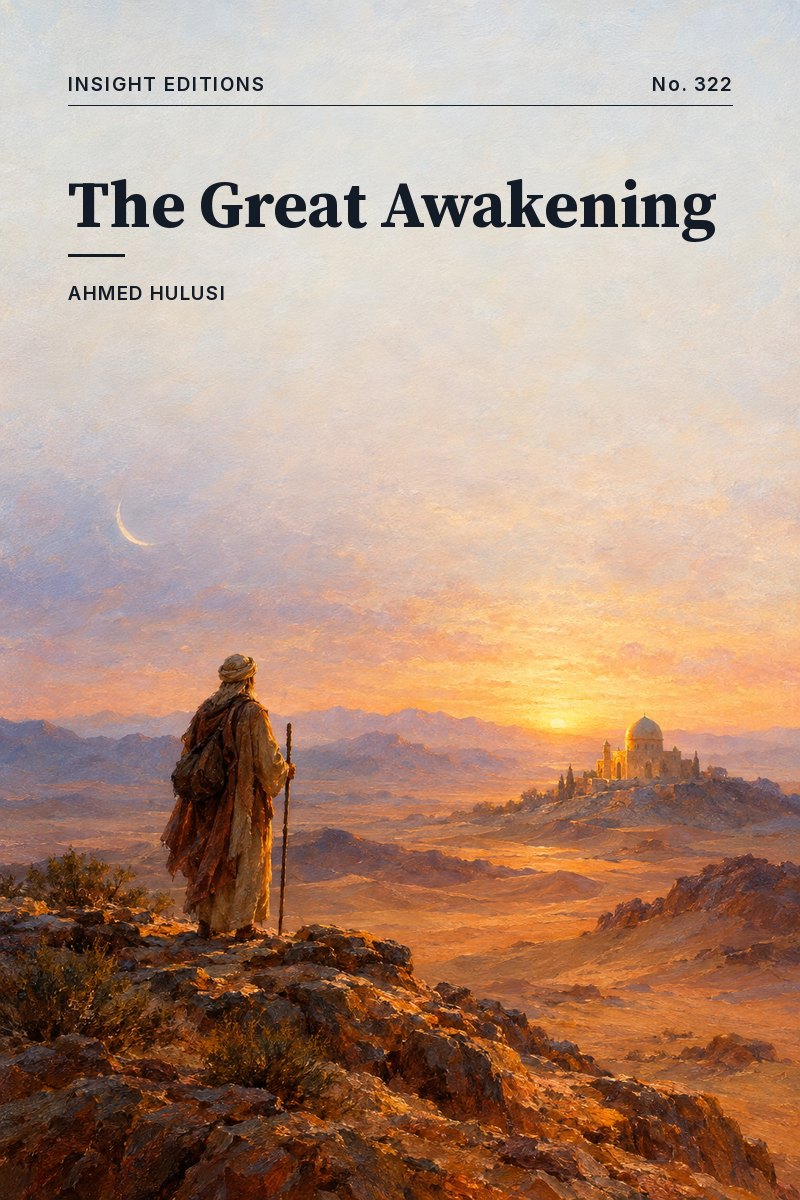
THE GREAT AWAKENING
A close reading of the movement from the constructed self to recognition of the One.
ORIGINAL SOURCE ARTWORK
The source cover, at its original pixel resolution. The green calligraphy-and-light motif is retained as a historical plate, while the Insight Edition uses its own typography.
AT A GLANCE
| CORE CLAIM | SCOPE | KEY FIGURES | BEST FOR |
|---|---|---|---|
| The decisive transformation is a change in how the self and all existence are perceived. | Divine Names, fitrah, fate, service, self-effacement, remembrance, spiritual perception. | Muhammad, Ali, Ibn Arabi, Junayd, Bayazid al-Bastami, Ghazali. | Readers seeking the structure and practical demands of Hulusi's account of nonduality. |
THE BOOK ON ONE PAGE
The Great Awakening is an early declaration of Ahmed Hulusi's nondual Sufi outlook, written in 1967 and presented in this English translation with a supporting glossary. The central move is from judging separate individuals to seeing every person and event as a manifestation within an undivided source. For Hulusi, what seems unequal or defective from the standpoint of preference does not justify the claim that a portion of existence falls outside divine governance. This is a claim about a spiritual point of view, not a laboratory observation.
His ethical consequence is demanding. Recognition of unity should appear as uncompensated service, a refusal to make one's good actions into a claim for status, and repair of harms when one's conduct injures another person. The seeker does not become less responsible by accepting divine decree. The text states that even taking precautions belongs to the unfolding of fate and that the only time one can know what was destined is after an action has taken place.
A second line of argument concerns knowledge and capacity. People receive the same instruction differently, as different soils respond differently to rainfall. Hulusi distinguishes information acquired by hearing, knowledge strengthened by reflection, and a lived recognition that changes perception. This difference governs his warning against treating a religious guide as an absolute authority. The Quran and the Rasul, rather than a personality claiming rank, remain his standards.
The main text moves from ethics to perception, then from perception to fitrah and qadar, to detachment from the ego, and finally to increasingly inward forms of dhikr. Throughout, he treats ordinary words as provisional labels whose usefulness ends at the point where their distinctions mislead. External and internal, like self and other, can refer to one reality encountered through different abilities to perceive.
The work also contains an account of the Sun, postmortem life, jinn, and subtle bodies. These passages belong to Hulusi's speculative spiritual cosmology. They must be understood faithfully as his proposal without assuming that stellar physics has established a physical location for the afterlife. His claim that scientific instrumentation can miss phenomena outside its range is a limited analogy: it cannot, on its own, confirm the existence or properties of those phenomena.
The last development distinguishes spoken remembrance, reflective remembrance, hidden remembrance (hafi), and the still more inward remembrance (ahfa). The culmination cannot be adequately captured by a public performance or an impressive vocabulary. In Hulusi's telling, one recognizes the limits of one's knowledge, stops mistaking a vehicle for its source, and continues to act constructively toward the people and things entrusted to one's care.
Original section map
| Original division | Source location | Study treatment |
|---|---|---|
| Translator's Note | pp. 15–16 | Context, date, and the nondual reading principle |
| Introduction | pp. 17–18 | The invitation to reflect rather than judge |
| From the Shell to the Core | pp. 19–54 | Main chapter, carefully sequenced into fourteen internal topics |
| Glossary of Sufi Terms | pp. 57–74 | Selected accurate definitions linked to the main argument |
TRANSLATOR'S NOTE: THE FRAME OF THE WORK
The translator, Aliya Atalay, describes this book as an early articulation of Hulusi's understanding of Sufism. The manuscript dates to 1967, whereas the English presentation appeared decades later. That difference matters when reading its cosmological vocabulary. Scientific-sounding explanations reflect the language chosen at different stages of the author's thinking, and the exposition needs to preserve the intended metaphysical meanings rather than make the terminology appear newly verified.
Her starting point is the Divine Names. The visible forms of the world do not, on this reading, constitute independent creative powers. They are forms in which divine qualities become intelligible to observers. The appropriate response is therefore less habitual criticism, greater generosity, and attention to the built-in tendency of the mind to treat its own descriptions as the full measure of what exists.
Hulusi's central question is not whether people share the same outward form, but whether the apparent differences conceal a common source of existence.
INTRODUCTION: WHY COMPREHENSION CHANGES CONDUCT
The brief introduction divides ordinary conduct into two tendencies: living for personal advantage and acting with genuine regard for the welfare of others. It does not offer this distinction as an excuse to condemn people who exhibit the first tendency. Instead, it places the reader under the same discipline. To describe someone else accurately is a different act from making oneself the final judge of that person's creation and purpose.
The Quranic phrase about each person acting according to a natural disposition (fitrah) supplies the first connection between the ethical and the metaphysical. Actions disclose a person's present capacities and patterns, but outward observation does not give the observer access to the complete source or end of that person's life. The introduction therefore asks the reader to begin with examination of their own reactions and the purposes that govern them.
Before forming a judgment, distinguish the **conduct that needs a response** from a sweeping claim about **the person's whole being**. Correct the first without claiming complete knowledge of the second.
CHAPTER 1FROM THE SHELL TO THE CORE
The shell is the identity built from possession, preference, status and separateness. The core is what becomes apparent when those claims no longer dominate perception. Hulusi presents the process as a discipline of recognizing oneness, showing mercy, understanding fate, reducing self-interest, and deepening remembrance. His measure of attainment is less what a person announces than how they behave when confronted with difference, deprivation and the opportunity to serve.
To recognize the One while treating another being as worthless would, by Hulusi's own argument, be a contradiction between insight and conduct.
1. The first reversal: from judgment to discernment
Hulusi opens by differentiating criticism based on limited perception from the understanding he calls haqq, the truth or reality beneath changing forms. Individuals compare people and events according to usefulness, pleasure, reputation and apparent success. These judgments are meaningful within ordinary practical life. His challenge concerns the elevation of relative judgments into absolute verdicts about existence itself. The observer sees one fragment of a person's conduct and decides they have exhausted the person's value.
In his account, the perfect human does not search for defects as a source of superiority. That description has an immediate ethical condition: the failure to pass judgment on the whole of creation cannot become permission to harm others or ignore their needs. Hulusi returns repeatedly to compassion, honoring trusts, and non-injury. His point is a change in the foundation of action. One can prevent wrongdoing, restore losses and refuse abuse while acknowledging that the person who acted badly remains a creature whose entire story the observer does not know.
The term amr, which the text glosses in connection with the domain of angelic forces and divine command, enters at this stage. Hulusi associates the station of divine governance with freedom from the compulsions of eating, drinking, sleeping and seeking reward. The reader should treat this as a statement about nonattachment to bodily impulses, not a literal prescription to neglect basic human needs. The practical movement is from being ruled by an impulse to recognizing the impulse without surrendering one's judgment to it.
Relative judgment: This action suited my interest, so the person is good; that action opposed it, so the person is bad.
Discernment: This action has particular consequences and calls for a response, while the complete meaning and purpose of the person exceeds my limited viewpoint.
2. The ethical proof of unity: give without a claim
The earliest extended instruction is to become an instrument of giving. Hulusi asks the seeker not to expect payment, gratitude, spiritual credit, public recognition or even a compensating favor in a future state of existence. Such expectations make the supposed act of service into a transaction that revolves around the person performing it. The deeper discipline is to let benefit reach someone else without retaining ownership of the moral achievement.
He uses deliberately extreme illustrations, including sharing food despite deprivation and directing the fruit of personal worship toward others. The force of these scenes lies in priority, not an endorsement of avoidable self-harm. The learner is asked to find out whether another person's welfare remains meaningful when it brings no reputation or advantage. Hulusi extends concern beyond the socially powerful to the smallest living things, drawing attention to the habitual ranking that makes some recipients appear beneath consideration.
The logic is internally consistent: if the same divine source underlies the created forms, then kindness cannot depend entirely on agreement, family connection, wealth, group membership or usefulness. Yet the instruction remains specific. It calls for effort, care, sharing, non-injury and attention to need, rather than a merely pleasant feeling about the world. The concrete test is not whether someone professes unity but whether they can relieve suffering without claiming to be its heroic opposite.
| Habit governed by self-interest | Alternative proposed in the chapter | Observable practice |
|---|---|---|
| Help only expected allies | Serve without a calculation of return | Assist a person who cannot reward you |
| Claim ownership of generosity | Regard oneself as a vehicle of benefit | Avoid making a public performance of giving |
| Favor appearances and status | Respect created beings without ranking their worth | Attend to someone routinely overlooked |
| Defend one's spiritual position | Examine motives and shortcomings | Acknowledge faults without self-display |
Service is the first practical test of metaphysical understanding. If insight makes a person more contemptuous, less helpful or more preoccupied with rank, something has gone wrong in its application.
3. Repentance is a correction, not an identity
The chapter's recommendations about repentance are more precise than a general call to feel sorry. The reader must acknowledge a mistake, experience genuine regret, repair the injury where possible and seek forgiveness from the affected person. Hulusi explicitly values attending to a sick person above accumulating impressive quantities of optional prayer. An obligatory responsibility to someone in need takes precedence over devotional activity that offers the performer satisfaction while leaving an immediate obligation unmet.
This standard also distinguishes an ethical orientation from a display of spirituality. Verbal repentance without change remains incomplete. So does abstract goodwill toward humanity that makes no room for someone who requires care tonight. There is no need to invent an elaborate ritual or a new spiritual office. The primary task is to do what the present injury requires, and to avoid the added offense of using repentance as a reason to seek admiration.
The passage sets an important limit on easy readings of nonduality. Recognizing that wrongdoing falls within a divine order is not a reason to deny the harm experienced by another person. Hulusi asks for both humility before the whole and responsibility within one's immediate sphere. One corrects the wound without pretending to have a comprehensive account of the cosmic meaning of the event.
Hulusi compares **one hour of necessary help for someone ill** with **thousands of optional night prayers**. The comparison makes its point through obligations rather than arithmetic: spiritual work that bypasses concrete care has mistaken a means for an end.
4. Knowledge is received according to capacity
Hulusi repeatedly warns that a truth can be spoken clearly and still be understood unevenly. He uses the metaphor of rain and soil. One surface repels water. Another holds it and permits others to drink. A third absorbs the water and produces nourishment. The rain is shared, but the effect differs because the receivers have different capacities. The corresponding practical argument is that teaching should be adapted to the listener without becoming dishonest.
Another comparison divides seekers into those who have only heard of the ocean, those who have approached and observed it, swimmers who venture far from shore, and those whose experience is so complete that the boundary between themselves and the ocean becomes difficult to describe. These are levels of relationship to knowledge, not a literal hierarchy of human dignity. The passage refers to abrar and muqarriboon as progressively deeper ways of living the knowledge rather than merely repeating it.
Hulusi does not permit a simple inference that someone with more unusual language must possess greater knowledge. A vocabulary can be borrowed without its meaning being realized. He later says that there are people who can recite and explain ideas but have not allowed them to alter their perception. His practical distinction is between memorization, interpretation, and transformation of life. That distinction is the reason to preserve examples, not to collect more terminology merely for its own sake.
Four relationships to knowledge: (1) hearing a description; (2) seeing a possibility for oneself; (3) experimenting and living by the teaching; (4) an integrated recognition that reshapes the assumed boundary between observer and observed.
5. Fate and fitrah: action without self-importance
A central question is how human conduct relates to fitrah, the person's innate disposition, and qadar, the ordering or measure of what comes to pass. Hulusi's example is two seeds placed in the same soil and given the same water. One becomes wheat and the other barley. The shared surroundings do not erase each seed's different form of development. He therefore treats a person as a manifestation shaped by a particular capacity and purpose, rather than an absolutely self-originating agent.
The argument has a dangerous surface reading: perhaps one might say that actions are predetermined and nothing matters. Hulusi refuses that shortcut by explicitly including precautions within destiny. A person acts, takes preventive measures and addresses harm. Only afterward can that person speak accurately about what occurred. One cannot use an imagined future decree as a substitute for deciding what is appropriate now, since the outcome has not yet been lived.
The same view changes boasting. A person's knowledge, fortune, faith, courage or spiritual state should not become a guarantee of permanent superiority. Hulusi illustrates reversal by referring to traditions in which the direction of a life changes near its end. His practical conclusion is humility under uncertainty. Rather than insist that a present quality has been secured forever, the seeker continues correcting conduct and resists the temptation to turn a provisional condition into an identity.
| Term | Hulusi's working meaning | Implication |
|---|---|---|
| Fitrah | The individual creation pattern or natural disposition | The same inputs may yield different forms of development |
| Qadar | The ordered unfolding of what each being will encounter and enact | Precaution, choice and their results are part of the lived sequence |
| Rida | Contentment with what has occurred within the divine order | Accept reality without inventing a different past |
| Tawbah | A truthful turning away from an error | Regret, redress and corrected behavior remain necessary |
Act on the information and duties available **before** an outcome. Afterward, examine what happened without converting either success into pride or failure into an excuse to abandon responsibility.
6. The source behind appearances: what oneness changes
Hulusi's description of the One does not claim that human observers cease to notice differences in physical shapes, languages, temperaments or abilities. It claims that these differences are relative manifestations, not independent sources of ultimate being. His lamp analogy makes the distinction concrete. Lamps are made of various materials and give different impressions of color and brightness. The electricity enabling their light is one shared principle. A person attentive only to the shade, size and casing will believe those differences exhaust the nature of what is occurring.
This model becomes important in encounters with other people. One may distinguish a destructive action from a helpful one without positing two absolute creative powers, one belonging to the acceptable person and the other to an unacceptable person. As Hulusi sees it, the same undivided basis permits more than one outward expression. That is why an account of oneness is meant to reduce contempt and soften the ego's claim to be the center from which everything else receives its value.
Yet the reasoning depends on a shift of standpoint. From the local standpoint, one thing may be dangerous, injurious or unsuitable. From the nondual standpoint, it does not acquire independent existence outside the One. Hulusi moves between these perspectives, sometimes rapidly, and the reader needs to avoid collapsing the difference. A medical problem still calls for medical care; a violated trust still calls for redress. Denying those distinctions is not what the analogy demonstrates. It asks that one recognize the difference between a practical description and an ultimate judgment.
The result is a discipline of interpretation. Someone's current state cannot be equated with the entirety of their being. The value of a manifestation is measured in relationship to its creational purpose, which Hulusi says no ordinary observer can fully know. He thus uses a metaphysical claim to curb the arrogance of judgment. A corresponding danger would be a person invoking the same claim to evade criticism of conduct. The chapter's earlier insistence on service and repair supplies the correction.
Difference: two people require different forms of assistance, and their actions can have opposite consequences.
Separation: they supposedly possess self-sufficient powers of existence outside the source. Hulusi denies the second without requiring blindness to the first.
7. The Sun, afterlife and the limits of the metaphor
At the center of the essay Hulusi turns unexpectedly to death and a future state of existence. He relates the Sun's long-term evolution to religious accounts of hell and speaks of holographic or wave-like bodies, inhabitants of the Sun, and a person's movement into a life no longer sustained by the familiar biological body. In this reconstruction, ordinary embodiment is a temporary stage and the nature of the afterlife differs so greatly that traditional language must communicate through symbols.
His main moral point is the urgency of present cultivation. Life after death is not presented as an opportunity to return and remake the unfulfilled earthly decisions. The person is urged to use capacities now, rather than postpone knowledge, generosity and self-knowledge. Hulusi also reads descriptions of milk, honey, water and wine in accounts of paradise symbolically. They represent, respectively, qualities such as faith, special knowledge, gnosis and an elevated experiential state, not a catalogue whose meaning is exhausted by its physical substances.
These passages should be held in two separate registers. The text presents a spiritual and speculative physical account in which the Sun is connected with hell, future bodies have wave-like properties and spiritual maturation affects their destination. Modern stellar models also predict substantial changes in the Sun over billions of years, but that fact does not establish Hulusi's claims about spirits, magnetic captivity or postmortem destinations. His analogies may help readers follow the internal pattern of his cosmology without serving as independent proof of that pattern.
The stronger thematic connection is with the chapter's warning against mistaking outward terminology for final meaning. The reader receives images tied to heat, radiation, abundance and transformation. Hulusi wants those images to direct attention to a condition of consciousness, the consequences of lived actions and the limits of corporeal experience. A sympathetic reading keeps that intention visible even where the proposed physical explanation goes beyond available evidence.
Observed astronomy: the Sun evolves as a star.
Hulusi's proposal: that stellar process is connected to an afterlife geography of spiritual bodies.
These are different kinds of statements. One does not scientifically verify the other.
8. No mortal becomes the absolute guide
Hulusi praises people who have cultivated discernment, yet warns sharply against individuals who claim spiritual supremacy. A seeker who lacks clarity should seek a knowledgeable person just as a thirsty traveler goes to a spring. But the spring is a means of finding water, not the owner of the water. A teacher's usefulness does not grant the teacher ownership of the seeker's mind, conscience or ultimate relationship to truth.
He applies the distinction to claims of murshid, or spiritual master. The text's normative standards are the Quran and Muhammad as Rasul, while other teachers can at most aid comprehension in a manner faithful to those standards. Hulusi criticizes people who exhibit unexamined dependencies yet declare themselves masters of other people. His objection is less that a guide lacks every imperfection than that the guide may confuse recognition received with personal power possessed.
The instruction has two simultaneous demands. One should learn from someone more capable rather than remain imprisoned by personal ignorance. One should also refuse to transfer the responsibility for reflection to a charismatic figure. Genuine teaching makes the learner more able to judge the significance of a principle, not more dependent on the teacher's status. The reader is asked to observe the difference between a person who can explain something useful and a person who demands that their explanation be accepted as proof of their own exceptional nature.
The image of the stars serves this limited role. Stars help orient someone traveling in darkness. They are not the destination. In the same way, a teacher or exemplary human conduct provides direction; the seeker still must do the work of contemplating and acting. Hulusi's description of those who have attained advanced understanding stresses kindness, lack of ostentation, and absence of coercion. These behavioral checks matter because they remain available even when the teacher makes claims about spiritual stations inaccessible to ordinary observation.
Ask three things of any teaching relationship: Does it increase **discernment**? Does it strengthen **responsible action**? Does it reduce or increase **unquestioning dependence on a person**?
9. Dying before death: the constructed 'I' loses its authority
The command to die before dying marks the next internal development. Hulusi does not advocate physical death. He describes a transition in which a person stops treating social identity, accumulated ambitions and bodily ownership as their absolute definition. The constructed self wants credit for success, guarantees against loss, admiration for virtue and the final say about every event. Voluntary self-effacement means withdrawing those claims before an involuntary confrontation with mortality makes them impossible to maintain.
This is why Hulusi distinguishes mere resignation from the station of contentment (rida). Resignation can coexist with an inward protest that reality ought to have followed another path. Contentment, as described here, is an altered relationship to the actual event. It does not erase grief or bodily pain by decree; it releases the additional insistence that the world must validate the personal will. The author portrays this as a state in which the apparent observer becomes less preoccupied with defending its separate importance.
The process must be grounded in conduct. Hulusi instructs the reader to examine why an action is being performed. He proposes a direct comparison between acting for one's own prestige and becoming a means through which good reaches another being. As the motive matures, even the habit of taking possession of the good intention may begin to dissolve. A person can continue working while loosening the idea that every achievement is a piece of private property belonging to a permanent, independent self.
He connects this to the verse about the earth and heavens being changed. The transformation is read as an alteration in the system through which consciousness perceives, as well as in external conditions. Earlier, one saw a sharp opposition between self and world. Now the apparent duality is recognized as dependent on a limited form of perception. The practical change is a shift in behavior and relation to life, not the acquisition of a license to declare oneself beyond accountability.
Event → impulse → claimed motive → honest motive → response. Ask what is actually being sought, such as admiration, protection, possession, escape or helpfulness. Act without disguising the private incentive as spiritual accomplishment.
10. The water and the vessel: no final shape contains the truth
Hulusi invokes Junayd al-Baghdadi's image of water taking the color of its container. The water remains water while glass, bowl, cup or channel alters its visible appearance. In Hulusi's use of the image, teachers, communities, concepts and the experiences of seekers are vessels. They transmit something, but the appearance of what is transmitted depends on the limited form receiving and presenting it.
He expands the image into a sequence of cup, pond, river and ocean. One shouldn't deny that the cup contains real water because they have heard of an ocean. Yet neither should they think the contents of one vessel define every possible encounter with water. A teaching can be genuinely beneficial at a particular level and still fail to exhaust the subject. The appropriate movement is to recognize the value of each stage while remaining open to a broader understanding.
This is a corrective both to contempt and complacency. An advanced seeker has no reason to ridicule someone whose understanding is elementary, because that person may be making the most of their present capacity. But the less experienced seeker should not conclude that the first adequate explanation must be the final one. Hulusi repeatedly returns to the idea that knowledge deepens, and that anyone who treats their level as unsurpassable has turned an instrument of learning into a new limitation.
The passage's metaphor also helps explain why the same source may be described differently by distinct contemplative traditions. Hulusi does not invite careless mixing of words, since he repeatedly anchors his own outlook in the Quran and the Rasul. Instead, he identifies a problem of representation: no form of explanation should be mistaken for the unlimited source to which it points. The capacity for true learning depends in part on preserving that distinction.
A **cup of water** does not become unreal when the seeker discovers an **ocean**. Its limitation is quantity and container, not absence of water. The same is true of a useful teaching that does not yet contain everything that could be known.
11. Adam and Iblis: the danger of judging by material composition
Another turning point is the story of Iblis and Adam. Hulusi focuses on the comparison of their outward constitutions. Iblis judges the figure before him by material origin and refuses to perceive the divine qualities that the story attributes to Adam. In this reading, the failure is not simply a breach of etiquette or refusal to perform a gesture. It is an error of insight: believing that the visible material description exhausts what the created being signifies.
The story supports the chapter's larger demand to abandon ranking by superficial appearance. It is easy to treat wealth, education, physical shape, professional skill, social association or the language of a different tradition as proof of ultimate worth. Hulusi sees these as examples of attachment to surfaces. A person who perceives the underlying source can still distinguish necessary roles and abilities, but is less likely to mistake social comparisons for knowledge of the whole individual.
He also uses the language of breath and spirit to interpret Adam's constitution. The notion of divine breath points, in his account, toward the manifestation of the Names, rather than the literal insertion of humanlike breath from a spatial deity. The distinction matters because his theology rejects the idea that Allah is one object located next to other objects. The vocabulary of creation describes a relationship of manifestation and dependence that cannot be reduced to ordinary physical proximity.
The ethical test remains unchanged. Someone who claims to see a divine quality in all created beings should not become more eager to shame or discard people who lack status. The same recognition should produce humility, consideration, and a refusal to make external signs the final criterion of value. The story thus brings the text from abstract unity back to the concrete temptation of comparing human beings.
12. The hidden ones: a spiritual station is measured by service
Hulusi calls attention to servants whose spiritual standing is concealed. In the narrative of these people, they neither announce themselves as possessors of secrets nor attempt to establish an institution around their rank. They may be overlooked precisely because others judge by appearance, fame and title. Hulusi describes them as mirrors, reflecting the state of the person who approaches them, and as people whose service reaches others without dependence on recognition.
He links their conduct to Rijal al-Ghaib, a theme developed in his other books, but the essential feature in this short work is plain: a person's inner claims are not independently established by the claimant's prestige. The seeker should observe whether contact with someone makes them more capable of kindness and careful thought. The passage also warns against mistaking impressive declarations or eccentricity for spiritual attainment. To quote a mystical term is easier than to surrender the ego's demand to dominate an audience.
One of the sharper demands concerns responding to those who are hostile or dismissive. Hulusi idealizes servants who continue helping without demanding admiration or insisting on winning every argument. This is not a requirement to accept exploitation or danger. It is a way of describing freedom from the need to turn service into conquest, a freedom that would be impossible if the individual's central purpose remained proving their own superiority.
In the internal movement of the essay, these exemplars appear after the reader has considered fitrah, fate and self-effacement. Their placement matters. Without those earlier principles they could be mistaken for a secret elite whose existence supplies more reasons to rank people. Here they are offered as a picture of the opposite: a cultivated person who has relinquished the urge to make rank the central issue.
Junayd al-Baghdadi: associated with the water-and-container analogy. Bayazid al-Bastami: a figure for the social misunderstanding of advanced contemplative language. Ghazali: invoked in connection with the authority of the Quran over sectarian identity. Sa'd: the reported example of contentment with divine decree even amid loss.
13. Remembrance moves from the tongue to consciousness
The final third of the essay examines dhikr, remembrance of Allah. Hulusi differentiates several modes rather than treating repetition as a single homogeneous practice. At an introductory level, spoken dhikr gives the mind a stable activity and directs attention away from habitual distractions. The next stage requires contemplative engagement: the person considers what the Divine Names signify and recognizes their implications in ordinary thought and conduct.
The text then introduces hidden remembrance (hafi) and an even more concealed form (ahfa). As Hulusi presents the sequence, words become less prominent because the orientation of consciousness changes. The practice is no longer merely reciting a term about reality; it becomes the person's manner of regarding experience. He recognizes that description itself becomes inadequate when the distinctions supplied by language no longer match what the seeker reports experiencing.
His examples make a important editorial point. Unfamiliar language is not automatically nonsense, but neither is it automatically proof of an authentic experience. The text compares a measurement instrument whose limited operating range can yield misleading readings. A detector that registers zero might be measuring the wrong scale. Hulusi uses this comparison to warn against denying all experience beyond one's knowledge. The converse also matters: the possibility of a limited instrument does not establish any specific undocumented phenomenon. Responsible interpretation can recognize a limit of measurement while withholding factual certainty about what lies beyond it.
The sequence does not license the abandonment of outward conduct. Hulusi explicitly says that the physical and external obligations of religious practice remain relevant, citing Muhammad's own practice. This is one of the book's firmest safeguards against using inner states to escape concrete responsibility. The person whose inward understanding deepens must still live among others, handle obligations and respond to needs. The status of spiritual insight is tested in the world where an action helps or harms.
| Stage in Hulusi's account | Dominant activity | Possible confusion |
|---|---|---|
| Vocal dhikr | Recitation and deliberate recollection | Treating repetition as a complete outcome |
| Contemplative dhikr | Reflecting on the Divine Names and their expression | Accumulating concepts without changed conduct |
| Hafi | Interior remembrance beyond ordinary verbal attention | Claiming a station on the basis of terminology |
| Ahfa | The still more inward recognition beyond adequate description | Mistaking another person's description for one's own experience |
Remembrance becomes substantial when it changes what a person notices, values, and does, rather than merely increasing the number of words repeated.
14. Spirit, perception and the acknowledgement of limits
The closing pages turn to the spirit (ruh). Hulusi stresses that the term can refer to different meanings. A Grand Spirit, associated with the universal life or source of existence, differs from the personal spirit, which his interpretation relates to the brain and the individual's continuing form of consciousness. This distinction is important for reading his scientific analogies. A term used for the essence of life cannot be treated as though it always refers to a measurable substance with one consistent set of physical properties.
He connects the Quranic reference to spirit being from the command of the Rabb (amr) with the idea that the matter cannot be exhausted by the questioner's existing categories. What people call properties of the spirit may refer to experiences and judgments produced by the brain. He also rejects the notion that a person can simply summon a departed spirit at will. That position serves his larger theme: the unknown cannot be made into a private possession merely because someone employs the right formula or title.
A reader should separate the text's theological interpretation, its statements about subjective experience, and any claims about brain-produced fields or wave bodies. The first concerns religious meaning, the second can be explored through reports and reflection, and the third would require independently testable physical evidence. Hulusi's belief that the brain participates in the formation of the personal spirit is a part of his model; it is not an established result of neuroscience.
The book ends with an admission of incompleteness. Each person receives and evaluates understanding according to capacity. Even a teacher can speak only within the scope of what has been grasped. The correct endpoint, then, is neither triumphal certainty nor contempt toward another approach. It is an active humility before what remains unknown, joined to an insistence that one should continue learning and serving as long as one can.
The book's enduring questions about **perception, identity, responsibility and contemplation** are distinct from its physical assertions about **radiation, souls, distant dimensions and the Sun**. Present each in its correct category. An analogy can illuminate Hulusi's reasoning without constituting experimental evidence for it.
SYNTHESIS: MASTER TAKEAWAYS
Relative judgment is not a verdict on being. A person can identify an injurious action and protect those affected without treating a limited observation as complete knowledge of another human's existence or purpose. The distinction between evaluating conduct and condemning an entire being governs the opening of the essay.
The first result of unity should be service. Hulusi demands that a person's claimed recognition of the One appear as practical kindness: providing help, keeping trusts and reducing the drive for personal credit. If spiritual language increases contempt, the understanding has not reached its ethical destination.
Repentance requires restitution. Admitting a wrong and regretting it matters, but where another person has been injured the next step is to repair what can be repaired and seek forgiveness. Optional devotional displays do not cancel a concrete obligation to care for someone in need.
Fitrah explains different responses to the same conditions. Two seeds given the same resources do not become the same plant. Hulusi uses that observation to express a theory of distinct created dispositions, while insisting that no observer fully knows another person's possible future development.
Precautions are also part of destiny. Recognition of qadar does not make preventive action meaningless. One must act before an outcome is known. Treating an unobserved future as a reason to avoid responsibility confuses knowledge of what happened with a claim to know what must happen.
The separate self is the principal obstacle. The identity that claims exclusive authorship of good, demands immunity from loss and interprets every encounter as a comparison of status obscures the spiritual source the text wants the reader to recognize. Diminishing that claim is the meaning of voluntary self-effacement.
The same content reaches different levels of understanding. The rain-and-soil image identifies at least three responses to teaching: rejection, temporary retention and beneficial cultivation. The practical question is how to strengthen receptivity, not how to humiliate an apparently less receptive person.
Hearing a truth differs from living it. A person can repeat an accurate expression without possessing the understanding it names. The distance between intellectual agreement and habitual conduct is the space in which contemplation, honest self-examination and practice occur.
The teacher is a guide, not the source. The image of stars orienting a traveler allows a person to learn from another's experience without treating a charismatic individual as an unquestionable owner of spiritual truth. Hulusi anchors his own religious measure in the Quran and the Rasul.
The cup and ocean describe levels, not competing realities. A limited teaching may be genuinely beneficial at its scale while failing to exhaust the subject. To understand a wider perspective does not justify despising the narrower one from which learning began.
Action has both an outer result and an inner motive. Two people may offer materially identical help, while one seeks status and the other seeks to serve. Hulusi's repeated question about why an action is performed directs attention to this hidden dimension of ordinary decisions.
Contentment differs from indifference. The text's picture of rida is not a command to deny pain, surrender responsibility or refuse prudent measures. It is the release of a further conflict with the reality that an event has occurred and cannot be replaced by an imagined alternative past.
The external form does not determine the whole of a creature. In the Adam and Iblis example, judgment by material composition obscures another level of meaning. The same error recurs when a person's visible characteristics are treated as the complete measure of that person's worth.
A deeper station should reduce the appetite for rank. Hulusi's hidden servants do not use claims of special knowledge to secure dominance. They are portrayed as helpful, restrained and free of the need to announce their accomplishments. Their role in the book is an ethical model, not a license to invent unverifiable status hierarchies.
Remembrance must develop beyond sound. The sequence from vocal recollection to contemplation and hidden remembrance describes increasing integration of meaning. Repeating a formula can be useful as a beginning while remaining inadequate as the entire end of the practice.
Inner realization cannot eliminate external duties. The essay explicitly keeps formal religious practice and service to others in view. An inward state that permits neglect of necessary care or moral correction would conflict with the requirements that gave the journey its direction.
The limits of an instrument matter. Hulusi's detection analogy warns against equating a missing measurement with proof that no phenomenon exists. But the analogy also gives no permission to assert particular phenomena without evidence. Inquiry requires both intellectual openness and restraint in conclusion.
Spiritual cosmology and stellar astronomy are different explanatory registers. The Sun's evolution is an astronomical question, while the proposed relation between the Sun, spirits and hell belongs to Hulusi's theological reconstruction. Understanding his model does not require making the two forms of explanation indistinguishable.
Scriptural imagery can bear a nonliteral purpose. The author reads descriptions of food, drink, fire and journeys as vehicles for speaking about consciousness, knowledge and consequences. Such readings are interpretive choices. Their value lies in explaining the proposed meanings without falsely presenting a single symbolic interpretation as the only established meaning of the text.
The word 'spirit' requires a declared context. Hulusi distinguishes the life-source or Grand Spirit from individual consciousness and the personal spirit. Readers must keep those senses separate before comparing them with any term in physics, physiology or psychological experience.
The end of one description opens a further question. The book repeatedly warns that a finite account of what is infinite can become a new mental prison. The difference between justified confidence and final certainty is particularly important for anyone who claims to speak about realities beyond ordinary perception.
Humility is an outcome of knowledge, not a substitute for it. The final prayer acknowledges error and limitation while urging the reader to keep contemplating. Hulusi's teaching does not end in saying that nothing can be known. It ends by requiring responsible learning that never turns the present state of understanding into an object of pride.
FRAMEWORKS AND MENTAL MODELS
| Framework | What it means in this book | Use it when |
|---|---|---|
| The shell and the core | Acquired identity and preferences versus the perceived essential source | Asking which fear or desire is driving a reaction |
| Relative and absolute judgment | Useful local distinctions are not complete judgments on existence | Responding to wrongdoing without condemning the entire person |
| Unrequited service | Help is not a transaction for prestige, gratitude or spiritual ownership | Giving, volunteering, caring and supporting family or neighbors |
| Rain and soil | One instruction affects different capacities differently | Teaching or learning without confusing pace with human worth |
| The seeds of fitrah | Distinct created dispositions unfold in different ways | Considering differences in temperament and life course |
| Qadar and precaution | The completed outcome is known afterward, while action remains necessary beforehand | Facing uncertainty and making practical plans |
| Water and vessel | The form of a teaching is narrower than its possible meaning | Encountering different expressions of a deep idea |
| Death before death | Relinquish absolute identification with ego and possessions while alive | Examining status, ownership and fear of loss |
| The mirror of the hidden servant | Claims of rank are less important than concrete restraint and help | Evaluating a spiritual teacher or one's own aspirations |
| The stages of dhikr | Recitation, reflection and increasingly inward recognition | Checking whether a regular practice changes daily conduct |
| The spirit distinction | One word may point to the source of life or an individual form | Reading passages that mix theology and physical vocabulary |
SELECTED GLOSSARY FOR THIS EDITION
Allah. The name Hulusi uses for the infinite and indivisible source of existence, not an externally located deity that exists alongside an independently real universe. This meaning supplies the premise of his rejection of duality.
Al-Asma, the Divine Names. Qualities through which the source becomes manifest in different created forms. They should not be mistaken for separate gods or independent powers. The concept connects cosmology with the concrete differences between individuals.
Rabb. In this book, the governing source of a created being, understood through the qualities comprising that being's essential reality. Hulusi's frequent possessive phrase 'my Rabb' should not be reduced to an ordinary location or a human patron.
Fitrah. The disposition or creation pattern attributed to an individual. Hulusi's seed analogy supplies its simplest explanation: apparently similar conditions can bring forth different expressions because created beings are not identical in constitution.
Qadar. Divine measure, ordering or fate. The practical consequence is humility about outcomes, with necessary action and precaution remaining within the unfolding sequence.
Haqq. Truth or reality in a sense that exceeds an individual's preference. To observe by haqq is to avoid reducing the value of existence to the advantages it offers one's constructed self.
Amr. Command or the divine ordering, related in the book to the source of spirit and to an aspect of existence not adequately described by bodily appetite or physical appearance.
Rida. Being content with divine governance, a station in which inward protest against the already actual loses its claim to rule the person's attention. Hulusi's discussion should be read alongside his expectation of ethical action.
Fana. The disappearance of the illusory claim of an independent ego. It does not mean annihilating the biological body, abandoning obligations, or eliminating the practical distinctions necessary for human care.
Dhikr. Remembrance. At first it may employ words, but its depth is measured by contemplation and a transformed way of perceiving and acting.
Hafi and ahfa. Increasingly inward or concealed forms of remembrance in Hulusi's account. These descriptions present a proposed progression in spiritual experience, not measurable classifications of brain states.
Basirah. Insight or an inner capacity for discernment. The emphasis lies on seeing beyond automatic valuations, without making the claim that all interpretations are therefore equally reliable.
Ruh. Spirit. Hulusi uses the term for different aspects of life and consciousness, and the specific sense should always be determined by context before the statement is assessed.
Rijal al-Ghaib. Hidden or unknown spiritual servants. Within this essay, their characteristic is less a catalogue of supernatural offices than an absence of self-advertisement combined with service.
Tawbah. Repentance or turning back. It involves confession of wrong, regret and, where an injury occurred, efforts to rectify it rather than mere verbal performance.
CRITICAL LENS ON THE COMPLETE BOOK
This is a study of Hulusi's proposed Sufi metaphysics, not a scientific demonstration of metaphysical facts. It presents a coherent moral progression from perception and unity to service, nonattachment, remembrance and humility. Its strength is the repeated demand that claims of spiritual knowledge be tested against the seeker's real behavior toward others. Its main interpretive limitation is the tendency to move quickly from useful analogies in optics, astronomy and instrumentation to strong claims about spiritual bodies, locations in the afterlife and consciousness. Those transitions should be identified as Hulusi's interpretations.
The author's position must also be read in the context of his own vocabulary. The English words body, spirit, brain, dimension, energy, projection and knowledge do not necessarily retain their ordinary technical meanings when he moves into theology. No two are interchangeable simply because both appear in a metaphor. As with every historic spiritual text, scriptural citations and traditions should be understood as the quotations and readings presented in this specific source edition rather than automatically treated as verified independent scholarship.
EIGHT THOUGHT EXPERIMENTS FOR READING AGAINST HABIT
1. An inconvenient stranger. Imagine helping an unfamiliar person who has previously criticized your beliefs. Separate the necessary practical judgment about what help is safe from the automatic thought that the stranger has forfeited human worth. Hulusi's approach asks whether you can answer the immediate need without making your resentment the center of the encounter.
2. The unseen recipient. Suppose you can give anonymously or publicly, and the material benefit to the recipient is identical. Observe what changes in your willingness when your identity disappears from the story. The exercise does not prove anonymity is always required. It reveals the extent to which recognition and praise are influencing the decision.
3. Repentance after an injury. You have spoken unfairly about a colleague. You now regret it. Compare saying a prayer in private with correcting the record and apologizing to the person. Hulusi's distinction requires attention to the actual harm rather than treating inner regret as a substitute for every act of repair.
4. Wheat, barley, and education. Two people attend the same class and apply the same exercises but learn differently. Consider whether the difference supports the claim that one has less inherent worth. The seed analogy offers a different account of capacity. It also reminds the teacher to change the method of support, not to assume that every learner should respond identically.
5. Fate before the result. A costly decision has an uncertain outcome. Write down the available evidence, the reasonable precautions, and a decision before acting. Afterward, record the result. Notice how different it is to say that an outcome occurred and to claim beforehand that one knew what fate demanded. The distinction prevents both arrogance and fatalism.
6. The impressive guide. A teacher uses elevated terminology and claims access to truths few others can understand. Assess their conduct by looking for coercion, dependency, generosity, honesty and tolerance of questions. A strange claim is neither discredited nor validated merely by its strangeness. The test asks whether the relationship improves discernment and conduct.
7. Two forms of remembrance. Repeat a chosen phrase for a short period, then spend an equal period reflecting on what it asks of your behavior toward a difficult person. Compare verbal continuity with concrete changes in attention and action. Hulusi's stages are not reducible to a timer; the comparison clarifies why he distinguishes recitation from contemplative integration.
8. The detector and its limits. Imagine a device correctly showing no radiation within its measurable range. Compare three statements: it recorded nothing; nothing of that kind exists; therefore a particular unknown field must exist. Only the first follows directly from the measurement. This exercise preserves the useful epistemic warning in Hulusi's analogy while avoiding unsupported positive claims.
CONNECT IT
- Attention and information processing. The distinction between raw encounter and habitually conditioned judgment offers a useful introspective exercise for knowledge workers, without claiming that neuroscience demonstrates a nondual theology.
- Leadership and moral agency. Hulusi's contrast between authority based on service and authority based on rank suggests examining how responsibility, reputation and incentives shape one's decisions.
- Model limitations. The water-and-vessel and detector analogies caution against mistaking one representation of a problem for every possible representation. This is a useful epistemic habit even outside the book's spiritual claims.
COMPLETE SOURCE GLOSSARY: 159 INDEXED ENTRIES
| Term in source | Definition as presented by Hulusi |
|---|---|
| Al-Adl | The One who provides each of His manifestations their due right in consonance with their creation program. The One who is absolutely free from unjustness or tyranny. |
| Al-Afuw | The One who forgives all offences except for ‘duality’ (shirq); the failure to recognize the reality of non-duality prevents the activation of the name al-Afuw. |
| Ahadiyyah | The absolute oneness of existence. |
| Ahlul Haqiqah | The intimates of the reality. |
| Ahlul Tahqiq | The people of authenticity. |
| Al-Akhir | The infinitely subsequent One, to all creation. |
| Al-Aleem | The One who, with the quality of His knowledge, infinitely knows everything in every dimension with all its facets. |
| Al-Aliy | The Highest (or the Sublime). The sublime One who observes existence from the point of reality (essence). |
| Allah | ALLAH... Such a name... It points to Uluhiyyah! Uluhiyyah encompasses two realities. HU which denotes Absolute Essence (dhat) and the realm of infinite points in which every single point is formed by the act of observing knowledge through knowledge. This act of observing is such that each point signifies an individual composition of Names. |
| Aql al-Awwal | The First Intellect; the first disclosure of universal consciousness. |
| Aql al-Qull | The Universal Intellect; universal consciousness. |
| Arsh | Throne. Denotes universal prolificacy, though not in terms of the perceived material world. |
| Ashraf al-Mahluq | The most honored of all creation. |
| Al-Awwal | The first and initial state of existence, the essential Name. |
| Al-Aziz | The One who, with His unchallengeable might, disposes as He wishes. The One whose will to do as He likes, nothing can oppose. This name works in parallel with the name Rabb. The Rabb attribute carries out the demands of the Aziz attribute! |
| Al-Azim | The magnificent glory beyond any manifestation’s capacity of comprehension. |
| Al-Badee | The incomparable beauty and the originator of beautiful manifestation! The One who originates innumerable manifestations, all with unique and exclusive qualities, and without any example, pattern, specimen etc. |
| Al-Baith | The One who constantly transforms new dimensions of existence. |
| Al-Basit | The One who opens and expands; the One who enables dimensional and in-depth sight. |
| Al-Basir | The One who is constantly observing His manifestations and evaluating their outputs. |
| Al-Bari | The One who fashions all of creation (from micro to macro) with unique functions and designs yet all in conformity with the whole, like the harmonious functioning of all the different organs in the body! |
| Al-Barr | The One who eases the actualization of individual temperaments and natural dispositions. |
| Al-Batin | The unperceivable reality within the perceivable manifestation! The source of the unknown (Awwal, Akhir, Zahir, Batin, HU!) |
| Al-Baqi | The Everlasting. The One who exists beyond the concept of time. |
| Barzakh | The intermediary dimension. |
| B-izni-hi (by permission of Allah) | The suitability of the Name composition comprising his essence. |
| Ad-Darr | The One who afflicts individuals with various distressing situations (sickness, suffering, trouble) in order to make them turn to Himself! |
| D’hul Fadhlul Azim | Possessor of great bounty. |
| D’hul-Jalali Wal-ikram | The One who makes individuals experience their ‘nothingness’ by enabling them to comprehend the reality that they were created from ‘naught’ and then bestowing them ‘Eternity’ by allowing them to observe the manifestations of the Names comprising their essence. |
| Dhu’l Quwwati’l Matin | Possessor of enduring strength. |
| Arham-ar-rahimeen | The One who manifests the infinite qualities of His Names with His grace. |
| Fath | Self-conquest. |
| Al-Fattah | The One who generates expansion within individuals. The One who enables the recognition and observation of Reality, and hence, that there is no inadequacy, impairment, or mistake in the engendered existence. The One who expands one’s vision and activity, and enables their proper usage. The One who enables the recognition and use of the unrecognized (overseen). |
| Fuad | Heart - heart neurons. The reflectors of the Names to the brain. |
| Furqan | The ability and knowledge to differentiate the right from the wrong or the criterion by which the reality may be differentiated from falsity. |
| Gabriel | The disclosure of the knowledge of Allah. |
| Al-Gaffar | The One who, as requisites of divine power or wisdom, ‘conceals’ the inadequacies of those who recognize their shortcomings and wish to be freed from their consequences. The One who forgives. |
| Al-Ghafur | The One who’s Mercy should never be doubted or given up on. The One who enables necessary cleansing and triggers the name Rahim to bestow blessings. |
| Al-Ghani | The One who is beyond being labeled and limited by the manifestations of His Names, as He is Great (Akbar) and beyond all concepts. The One who is infinitely abundant with His Names. |
| Al-Habir | The One who is aware of the manifestations of His Names at all times. The One who allows his manifestations to discern the level of their comprehension via their outputs. |
| Al-Hadi | The guide to the truth. The One who allows individuals to live according to their reality. The articulator of the truth. The guide to reality. |
| Al-Hafiz | The One who provides all requirements to preserve and maintain existence. |
| Al-Hakam | The Absolute Judge whose judgment (verdict) is irresistibly applied. |
| Al-Hakim | The One whose power of knowledge appears under the guise of ‘causes’, hence creating causality and leading to the perception of multiplicity. |
| Al-Halim | The One who refrains from giving sudden (impulsive) reactions to events, but rather evaluates all situations in respect of their purpose of manifestation. |
| Hamd | The evaluation of the corporeal worlds created with His Names, as He wills. |
| Al-Hamid | The One who observes and evaluates His universal perfection on worldly forms manifested by His Name al-Waliyy. |
| Al-Haqq | The absolute and unequivocal reality! The source and essence of every function in manifestation! |
| Al-Hasib | The One who maintains individuality by holding them to account of their behavioral output through the mechanics of ‘consequence’. |
| Al-Hayy | The source of names! The One who gives life to the Names and manifests them. The source of universal energy, the essence of energy! |
| Hu | Whether via revelation or through consciousness, HU is the inner essence of the reality of everything that is perceived... To such extent that, as the reflection of Akbariyyah, first awe then nothingness is experienced and, as such, the Reality of Hu can never be attained! Sight cannot reach HU! HU denotes absolute obscurity and incomprehension! As a matter of fact, all names, including Allah are mentioned in connection with HU in the Quran! |
| Huda | Guidance; enabling the comprehension of one’s essential reality. |
| Ind’Allah | From Allah; the forces that are revealed through dimensional emergence to consciousness from the Names of Allah that comprise one’s essence. |
| Insan al-Kamil | The Perfect Man. |
| Isra | The supersensible and dimensional travel by night. |
| Al-Jabbar | The One whose will is compelling. The corporeal worlds (engendered existence) are compelled to comply with His demands! There is no room for refusal. This ‘jabr’ (compelling) quality will inevitably express itself and apply its laws through the essence of beings. |
| Al-Jalil | The One who, with His magnificent comprehensiveness and perfection, is the sultan of the world of acts. |
| Al-Jami | The One who observes the whole of existence as a multi-dimensional single frame in His Knowledge. The One who gathers creation according to the purpose and function of their creation. |
| Al-Kabir | The magnitude of the worlds He created with His Names are incomprehensible. |
| Kashf al-Nurani | Enlightened discovery. |
| Kashf al-Dhulmani | Purification through suffering. |
| Al-Karim | The exceedingly generous and bountiful One who bestows His bounties even upon those who deny His existence. The ability to READ (iqra) is only possible through the activation of this Name, which lies dormant within the essence of every individual. |
| Al-Khafid | The One who abases. The One who capacitates a state of existence which is far from reality. The creator of the ‘asfali safileen’ (the lower state of existence). The former of the vision of ‘multiplicity’ to conceal the reality. |
| Al-Khaliq | The ONE Absolute Creator! The One who brings individuals into the existence from nothingness, with His Names! Everything al- Khaliq creates has a purpose to fulfill, and according to this unique purpose, possesses a natural predisposition and character. Hence it has been said:“characterize yourselves with the character of Allah” (Tahallaku biakhlakillah) to mean:Live in accordance with the awareness that you are comprised of the structural qualities of the Names of Allah! |
| Kitab al-Mubin | The Clear Book. |
| Kursi | Footstool – the actualization and dominance of the reality of the Names. |
| Ladun | The potential of the Names comprising one’s essence. |
| Al-Latif | The One who is subtly present in the depths of every manifestation. The One whose favors are plentiful. |
| Al-Maalik’ul-Mulk | The One who governs His Sovereignty as He wishes without having to give account to any individual. |
| Mahshar | The place of gathering. |
| Maiyyah | Unity of existence. |
| Al-Majeed | The One whose majestic glory is evident through His magnificent manifestations! |
| Al-Majid | The magnificent and glorious One with unrestricted, infinite generosity and endowment (benevolence). |
| Mala-i A’la | The Exalted Assembly. |
| Al-Maleek | The Sovereign One, who manifests His Names as he wishes and governs them in the world of acts as He pleases. The one who has providence over all things. |
| Al-Mani | The One who prevents those from attaining things they do not deserve! |
| Manna | The force of power in the names of Allah comprising your essence. |
| Marifah | Gnosis. |
| Al-Matin | The One who sustains the world of acts, the steadfast, the creator of robustness and stability, the provider of strength and resistance! |
| Mawla | Protector. |
| Michael | The force that guides to and enables the attainment of both physical and spiritual sustenance. |
| Al-Mu’akhkhir | The One who delays manifestation in consonance with His name al-Hakim. |
| Al-Mubdi | The One who originates the whole of creation in the corporeal worlds, all with exclusive and unique qualities. |
| Al-Mudhill | The One who exposes dishonor in some and degrades below others. The One who deprives from honorable qualities and compels to humiliation with the veil of ‘I’ness (ego). |
| Al-Mughni | The One who enriches individuals and raises them above others in wealth and emancipates them. The One who enriches with His own riches. The One who grants the beauty of infinity (baqa) which results from ‘fakr’ (nothingness). Al-Muhaymin The One who maintains and protects the manifestations of His Names with His own system. Al-Muhaymin also designates the One who safeguards and protects (the trust). |
| Al-Muhsi | The creator of the ‘forms’ (micro to macro) comprising the seeming multiplicities, each equipped with unique qualities and attributes, within UNITY. |
| Al-Muhyi | The One who enlivens and enlightens! The One who enables the continuation of the individual’s life through the application of knowledge and the observation of one’s essential reality. |
| Al-Mu’id | The One who restores life to those who turn back to their essence. |
| Al-Mu’izz | The Giver of Honor. The One who bestows honor to whom he wishes and holds them in esteem over others. |
| Al-Mujib | The One who unequivocally responds to all who turn towards Him (in prayer and invocation) and provides their needs. |
| Al-Mu’min | The One who enables the awareness that He, by respect of His Names, is beyond what is perceived. This awareness reflects upon us as ‘faith’ (iman). All believers, including Rasuls and angels, have their faith rested upon this awareness, which frees the mind from the enslavement of illusion. While illusion can deter the mind, which uses comparison to operate, it becomes powerless and ineffective in the sight of faith. Muqarraboon: Those who have attained the state of divine closeness. |
| Al-Muntaqim | The One who makes individuals live the consequences of their actions that impede in the realization of their essence.Al-Mumit: The One who enables a ‘taste’ (experience) |
| Al-Mutakabbir | The One to whom the word ‘I’ exclusively belongs. Absolute ‘I’ness belongs only to Him. Whoever, with the word ‘I’, accredits a portion of this Absolute ‘I’ness to himself, thereby concealing the ‘I’ness comprising his essence and fortifying his own relative ‘I’ness, will pay its consequence with ‘burning’ (suffering). Majesty (Absolute ‘I’ness) is His attribute alone. |
| Al-Musawwir | The fashioner of forms. The One who exhibits ‘meanings’ as ‘forms’ and devises the mechanism in the perceiver to perceive them. |
| Al-Muqeet | The One who facilitates the expression of the Name al-Hafiz by providing the necessary material and spiritual platform for it. |
| Al-Muqaddim | The One who expedites (or prioritizes) the manifestation of Names according to their purpose of creation. |
| Al-Muqsit | The One who applies justice, as the requirement of His Uluhiyya, by endowing every individual their due, based on their unique creation purpose. |
| Al-Muqtadir | The Determiner. The absolute possessor of all power pertaining to creation, governance, and disposition. |
| Al-Muta’ali | The limitless, boundless Supreme One, whose supremacy encompasses everything! The One whose reality can never be duly reflected by any engendered, conceptualized existence. The One who is beyond being limited by any mind or intellect. |
| Muttaqeen | Those who live in line with their essential reality. |
| An-Nafi | The One who prompts individuals to engage in good thoughts and actions to aid them towards beneficent and auspicious outcomes. |
| Nafs | Self, individual consciousness. Nafs-i Ammarah: The Inciting Self. Nafs-i Lawwama: The Self-Accusing Self. Nafs-i Mulhima: The Inspired Self. Nafs-i Mutmainna: The Peaceful Self. Nafs-i Radhiya: The Pleased Self. Nafs-i Mardhiya: The Pleasing Self. Nafs-i Safiya: The Pure Self. |
| Names | Divine Names – structural and compositional qualities comprising existence. |
| Nubuwwah | The function of enabling people to read and apply the necessary practices of the system of Allah. |
| An-Nur | The Knowledge that is the source and essence of everything! The essence of everything is Nur; everything is comprised of knowledge. Life subsists with knowledge. Those with knowledge are the ever-living ones (Hayy), while those who lack knowledge are like living dead. |
| Al-Qabid | The One who exercises His verdict by retaining the essence of an individual’s Name reality. The One who restrains and enforces withdrawnness. |
| Al-Qadir | The One who creates (discloses, manifests) and observes His knowledge with His power without depending on causality. The One who is absolutely boundless! |
| Al-Qahhar | The One who executes the effects of His Name ‘Wahid’ and renders invalid the seeming existence of the relative ‘I’ness. |
| Al-Qayyum | The One who renders Himself existent with His own attributes, without the need of anything. Everything in existence subsists with al-Qayyum. |
| Al-Qawwi | The One who transforms His power into the enabling potential for the manifestation of existence (hence comprising the force of the whole of existence). |
| Al-Quddus | The One who is free and beyond being defined, conditioned and limited by His manifest qualities and concepts! Albeit the engendered existence is the disclosure of His Names, He is pure and beyond from becoming defined and limited by them! |
| Qurbiyyah | The state of divine closeness. |
| Rabb | The Name composition/divine qualities comprising one’s essence. |
| Ar-Rafi | The One who exalts. The one who elevates conscious beings to higher states of existence; to enable the realization and observation of their essential reality. |
| Ar-Rahman | Ar-Rahman signifies the materialization of the essence of every iota with Allah’s Names in His knowledge. In modern terms, it designates the quantum potential. It is the potential of the source of the entire creation. It is the name of the Dimension of Names! All things obtain their existence at the level of knowledge and will with the attributes denoted by this name. |
| Rahmaniyyah | The quantum potential. |
| Rahmah | Grace. |
| Ar-Rahim | Ar-Rahim is the Name that brings the infinite qualities of ar-Rahman into engendered existence. In this sense, it is the ‘observation’ of the potential. Ar-Rahim observes itself through the forms of existence, by guiding the conscious beings to the awareness that their lives and their essential reality are comprised of and governed by the Names. |
| Ar-Raqib | The One who watches over and keeps under control the manifestations of His Names, with His names, at all times. |
| Ar-Rashid | The guider to the right path. The One who allows individuals, who recognize their essential reality, to experience the maturity of this recognition! |
| Rasul | One through whom the reality is disclosed - the articulation of Allah’s knowledge. |
| Al-Ra’uf | The compassionate and pitying One who protects individuals who turn to Him from all kinds of behavior which may cause harm or trouble to them. |
| Al-Razzaq | The One who provides all necessary nutrition for the survival of any unit of manifestation regardless of its plane of existence. |
| Rububiyyah | Compositional qualities denoted by the Names comprising existence. |
| Ruhu’l Azam | The Grand Spirit; the observing One. |
| As-Salam | A state of emancipation from the conditions |
| As-Sabur | The One who waits for each individual to execute his creation program before rendering effective the consequences of their actions. Allowing the tyranny of the tyrant to take place, i.e. activating the Name as-Sabur, is so that both the oppressor and the oppressed can duly carry out their functions before facing the consequences in full effect. Greater calamity forces the creation of increased cruelty. Samad/Samadiyyah: The Absolutely Self-Sufficient and Whole One. |
| As-Sami | The One who perceives His manifestations at every instance. The One who enables awareness and comprehension. |
| Sayr al-Afaqi | The recognition of the universal realities. |
| Sayr al-Anfusi | The recognition of the individual realities or the path of the inward journey. |
| Shadid al-Iqab | Severe in enforcing the due consequence of an offence. |
| Ash-Shahid | The One who witnesses His existence through His own existence. The One who observes the disclosure of His Names and witnesses His manifestations! |
| Ash-Shakur | The One who allows the proper use of His bestowals in order that He may increase them. The One who enables the due evaluation of resources such that more can be attained. This name triggers the name al- Karim. |
| Shirq | Duality – the state of assuming the separate existence of an ‘other’ besides Allah. |
| Subhan | One who is beyond being limited or conditioned by any of His manifestations. |
| Sunnatullah | The mechanics of the system of Allah. |
| Tanzih | The incomparability of the divine. |
| Taqwa | Protecting yourself in the way of Allah from the inadequacies of your identity. |
| Tasbih | Glorify, exalt – to continue one’s existence through Him. |
| Tashbih | The similarity/comparability of the divine. |
| At-Tawwab | The One who guides individuals to their essence by enabling them to perceive and comprehend the reality. The One who allows individuals to repent, that is, to abandon their misdoings and to compensate for any harm that may have been caused. The activation of this Name triggers the name Rahim, and thus benevolence and beauty is experienced. |
| The Divine Reflections | The Hidden – Reflection of attributes. The Secret – Reflection of the Names. The Spirit – Fuad: Reflectors of the Names. The Heart – Consciousness. The Self – Identity – Individual consciousness. |
| Ubudiyyah | Servitude of the ‘self’ or individual consciousness by means of fulfilling its specific function and purpose of creation. |
| Ulul Albab | The intimates of the reality through whom Allah hears, sees and speaks. |
| Al-Wahhab | The One who bestows and gives unrequitedly to those He wishes, oblivious of deservedness. |
| Al-Wahid | The One and only! ‘ONE’ness far beyond any concept of multiplicity. The ONE, that isn’t composed of (or can be broken into) parts (as in pantheism). The ‘ONE’ness that renders duality obsolete! The ‘ONE’ness that no mind or intellect can fully comprehend! |
| Al-Wakil | The One who provides the means for self- actualization. The One who advocates and protects those who place their trust in Him, providing them with the most auspicious outcomes. |
| Al-Wali | The One who governs according to His own verdict. |
| Wajh | Divine countenance. |
| Al-Wasi | The All-embracing. The One who embraces the whole of existence with the expressions of His Names. |
| Vicegerent | Conscious beings who will live with the awareness of the Names. |
| Al-Wadud | The creator of attraction. The creator of unconditional and unrequited love. The essence within every beloved! |
| Al-Wajid | The One whose qualities and attributes are unfailingly abundant. The manifest One. The One, from which nothing lessens, despite the abundance of His manifestations. |
| Al-Waliyy | The One who guides and enables an individual to discover their reality and to live their life in accordance to their essence. It is the source of risalah (personification of Allah’s knowledge) and nubuwwah (prophethood), which comprise the pinnacle states of sainthood (wilayah). It is the dispatcher of the perfected qualities comprising the highest point of sainthood, risalah, and the state one beneath that, nubuwwah. |
| Waliyy | Friend, guardian/protector. |
| Al-Warith | The One who manifests under various names and forms in order to inherit and protect the possessions of those who abandon all their belongings to undergo true transformation. When one form is exhausted, He continues His existence with another form. |
| Yakeen | The state of certainty; to be in complete submission as a result of an absolute comprehension. a. The knowledge of certainty (ilm al-yakeen) b. The eye of certainty (ayn al-yakeen) c. The reality of certainty (haqq al-yakeen) |
| Az-Zahir | The self-evident One, the explicit, unequivocal and perceivable manifestation. |
| Zawj | While its most common usage is to mean ‘partner in marriage’ it has also been used in the context of consciousness, implying the partner or equivalent of consciousness. |
About this book
The Great Awakening by Ahmed Hulusi, 2009. This is a chapter-by-chapter study of the book, with summaries, maps, tables and diagrams; short quotations keep their page references. It is shared free for personal study, is not for sale, and is not endorsed by the author or publisher. Please read and buy the original.
Insight Editions · rajeshrmahapatra.com/insight-editions