Insight Editions · No. 71
The God Equation
The Quest for a Theory of Everything
Michio Kaku
Michio Kaku traces the history of physics through successive unifications, explains the conflict between general relativity and quantum mechanics, and assesses string theory as a possible theory of everything.
A study guide to The God Equation by Michio Kaku. Shared free for personal reading; not for sale and not endorsed by the authors or publishers. Please read and buy the original.
All four forces may follow from one equation an inch long; string theory is Kaku's candidate because it alone unites gravity and quantum theory with finite answers.
2,500 years of unification: Greek atoms, Newton, Maxwell, Einstein, the quantum, the Standard Model, black holes, cosmology, strings and M-theory, and the question of God and meaning.
SU(3)×SU(2)×U(1); ~20 free parameters; 10/11 dimensions; Planck energy 10^15 × LHC; vacuum-energy error 10^120; dark energy 68.3%.
Readers who want the whole arc of fundamental physics and an honest map of what string theory claims, and what it has not shown.
The Book in Brief
Kaku's book is a history of unification told as a single argument: every time physicists merged two forces through a deeper symmetry, civilization was transformed, and one final merger, of general relativity with quantum theory, remains. He argues that string theory is the only candidate that passes all three tests (contain Einstein, contain the Standard Model, stay finite), while admitting it has no experimental support.
- Unification is the engine of physics and of history. Newton joined heaven and Earth (machine age); Faraday and Maxwell joined electricity, magnetism and light (electric age); Einstein joined space with time and mass with energy; quantum theory gave transistors, lasers, DNA and the information age.
- Symmetry is the tool. From X² + Y² = R² to four-dimensional space-time, from E ↔ B duality to Gell-Mann's quark symmetry and SU(3)×SU(2)×U(1), each advance came from finding an invariance. In quantum theory symmetry becomes essential, because it cancels infinities and anomalies.
- The Standard Model is a "theory of almost everything". It fits every particle experiment, but it is a patchwork of three theories with about twenty arbitrary constants, three copies of each particle family, and no gravity.
- Gravity resists quantization. Treat the graviton as a point particle and the corrections are infinite; seventy years of renormalization tricks fail. Quantizing only matter in curved space gives Hawking radiation, wormholes, time machines, inflation and the multiverse, and a 10^120 error in the energy of empty space.
- String theory's offer. Particles are notes on vibrating strings; the graviton is built in; supersymmetry pairs bosons with fermions so infinities cancel; consistency demands ten dimensions (eleven in M-theory); Maldacena's duality links gravity to nuclear forces and suggests a holographic universe.
- String theory's problems. No evidence; the Planck energy is a quadrillion times the LHC's; a vast landscape of universes weakens prediction. Kaku's replies: indirect echoes (dark matter, gravitational waves, short-range gravity tests), a theory still being excavated like a pyramid, and a final proof by computing the Standard Model's constants.
- Meaning. The final equation may be unique because all others are inconsistent ("God had no choice"); the universe may be a quantum fluctuation in nothing; the multiverse fits both Genesis and Nirvana; and we must make our own meaning, perhaps escaping a dying universe through quantum gravity.
| Ch | Title | In one line |
|---|---|---|
| Intro | Introduction to the Final Theory | The prize (an inch-long equation), the candidate (strings) and the critics (no evidence, multiverse) |
| 1 | Unification: The Ancient Dream | Greeks to Newton to Maxwell: each unification builds a technological age; by 1900 the two pillars secretly clash |
| 2 | Einstein's Quest for Unification | Constant light speed fuses space-time and mass-energy; gravity becomes curvature; the unified field theory fails for lack of the nuclear force |
| 3 | Rise of the Quantum | Quanta, wave-particle duality, Schrödinger and Dirac explain atoms, spin and antimatter; probability ends determinism; fusion and fission follow |
| 4 | Theory of Almost Everything | QED, quarks, Yang-Mills and the Higgs build the Standard Model; it works but is a patchwork, and the graviton breaks it |
| 5 | The Dark Universe | Quantum matter in curved space: Hawking radiation, wormholes, time travel, CMB, inflation, multiverse, dark energy and the 10^120 mismatch |
| 6 | Rise of String Theory: Promise and Problems | Strings, supersymmetry, 10/11 dimensions, M-theory and holography; the case against; tests; the landscape; Kaku's pyramid |
| 7 | Finding Meaning in the Universe | God, Aquinas, a unique consistent equation, something from nothing, Genesis plus Nirvana, and meaning we create |
Introduction to the Final Theory
Kaku frames the whole book around one equation, perhaps an inch long, that would unite gravity, electromagnetism and the strong and weak nuclear forces and let us "read the mind of God." His candidate is string theory, and he admits from page one that it has no direct experimental evidence and predicts a bewildering multiverse. The introduction sets out both the prize and the case against it.
The dream and the boy who met it
Kaku first met the problem at age eight, when newspapers in 1955 printed a photograph of Einstein's desk with an open notebook: the greatest scientist of the age had died with his unified field theory unfinished. That image set his career. A final theory, if found, would be physics' crowning achievement: a single formula from which every other equation could in principle be derived, from the Big Bang to the end of the universe, closing a question the Greeks first asked, "What is the world made of?" Stephen Hawking even titled a lecture "Is the End in Sight for Theoretical Physics?"
The road is littered with failures. Freeman Dyson said the path to unification "is littered with the corpses of failed attempts." Yet Kaku claims that many leading physicists now believe we are converging on the answer, and that the leading (in his view, the only) candidate is string theory.
In string theory, electrons, quarks and neutrinos are not points but tiny vibrating loops. Each mode of vibration is a different particle, so physics is the harmonies of strings, chemistry the melodies, the universe a symphony, and Einstein's "mind of God" becomes cosmic music resonating through space-time.
Why unification matters outside the lab
Kaku's recurring thesis, stated here and repeated in every chapter, is that each time a force is decoded, civilization is remade:
- Newton's laws of motion and gravity laid the groundwork for the machine age and the Industrial Revolution.
- Faraday and Maxwell's electricity and magnetism lit cities and gave us motors, generators, radio and TV.
- Einstein's E = mc² explained starlight and helped unlock the nuclear force.
- Schrödinger, Heisenberg and the quantum pioneers gave us lasers, supercomputers and the internet.
The four forces a final theory must merge are gravity, the electromagnetic force, and the strong and weak nuclear forces. If it succeeds, it may answer the deepest open questions:
- Before the Big Bang. What happened before it, and why did it bang at all?
- Black holes. What lies on the other side of one?
- Time travel. Is it physically allowed?
- Wormholes. Are there gateways to other universes?
- Higher dimensions. Do more than three spatial dimensions exist?
- The multiverse. Is there a set of parallel universes?
An army of critics
Kaku lists the objections openly. First, no solid, testable evidence: the Large Hadron Collider (LHC) near Geneva found the Higgs boson but nothing that points to strings, and there is no guarantee that a costlier successor collider will find new particles, since nobody knows the energy at which they appear. Second, and more damaging, string theory is unique as a theory but has a near-infinite number of solutions, the landscape problem in its technical sense. If our universe is one solution among an ocean of others, what does the theory predict? Critics ask whether it is a "theory of everything or a theory of anything."
The promise
- One framework for all four forces.
- Finite quantum gravity where other attempts diverge.
- Unique starting equation, rich mathematics, and a library of research.
The problem
- No experimental confirmation; LHC found only the Higgs.
- Multiverse of solutions: which one is ours?
- Einstein's question, "Did God have a choice?", left open.
Kaku declares his stake: he has worked on string theory since 1968, when it "emerged accidentally, unannounced," and has watched it grow from a single formula into a field that dominates research at leading laboratories. He promises a balanced account of breakthroughs and limits.
- It must contain all of general relativity.
- It must contain the Standard Model of particles.
- It must give finite answers. Failures: Schrödinger's proposal did not reduce to Einstein's theory or yield Maxwell's equations; Pauli and Heisenberg's unified fermion theory was not renormalizable and predated quarks; Einstein's antisymmetric extensions of the metric never produced Maxwell's field. Adding matter to gravity diverges at one loop, and the only known cure is supersymmetry. Kaluza's 1919 five-dimensional trick (curl one dimension and Maxwell appears) survives as the ancestor of string theory. Loop quantum gravity is a theory of pure gravity with no Standard Model, so Kaku does not count it as a unified theory.
Calling string theory "the only candidate" is Kaku's own position, not a consensus. Loop quantum gravity, asymptotic safety, causal sets and causal dynamical triangulations are actively pursued, and their advocates reply that unifying matter is a separate problem from quantizing gravity. Kaku's endnote dismissing loop gravity as "pure gravity" is fair as a statement of scope but it frames the contest on string theory's home ground.
Unification: The Ancient Dream
Unification began with Greek guesses (atoms and mathematical harmony) and became science with Newton, who made one law of gravity govern apples, cannonballs, the Moon and comets. Faraday and Maxwell then fused electricity, magnetism and light, and each unification built a technological age. By 1900 the two pillars, Newton and Maxwell, looked like a theory of everything, but they secretly contradicted each other.
Two Greek routes to order
Facing what Stephen Crane called a universe with no "sense of obligation," the Greeks proposed two ways to find order. Aristotle reduced matter to earth, air, fire and water, but two older ideas proved more fertile:
- Democritus and atoms. Everything is made of tiny, indestructible, invisible particles ("atoms" means indivisible). Critics said atoms could never be seen; Democritus answered with indirect evidence: a gold ring wears down over years, so invisible bits must be leaving it.
- Pythagoras and vibration. Plucking a lyre string and hammering metal bars produced tones in fixed frequency ratios, so music, and perhaps all diversity in nature, follows the mathematics of resonance.
Kaku plants the book's method here: most of modern science is indirect. We know the composition of the Sun, the structure of DNA and the age of the universe without visiting any of them. Any proof of a unified theory will likewise be indirect, because the Planck scale lies far beyond direct reach.
With the collapse of classical civilization the idea of a single explanatory paradigm was lost for almost a thousand years, replaced by superstition and magic.
The Renaissance: persecution and the telescope
In the seventeenth century, Johannes Kepler, imperial adviser to Emperor Rudolf II, applied mathematics to planetary motion and perhaps escaped persecution by adding religious elements to his work. Giordano Bruno, a former monk, was not so lucky: in 1600 he was burned at the stake in Rome for heresy, his chief crime being the claim that life may exist on planets around other stars. Galileo, father of experimental science, recanted under threat of death; his telescope showed craters on the Moon, phases of Venus (proof it orbits the Sun) and moons of Jupiter. He died under house arrest, blind. In the year he died a baby was born in England who would finish his and Kepler's work.
Newton: one law for heaven and Earth
Isaac Newton, in Kaku's judgment perhaps the greatest scientist who ever lived, wrote down universal laws of the heavens and invented calculus to handle them. Steven Weinberg dated "the modern dream of a final theory" to Newton. In 1666, aged twenty-three, with Cambridge closed by plague, Newton saw an apple fall and asked: if an apple falls, does the Moon also fall?
The Church taught two kinds of law: corrupt earthly laws and perfect heavenly ones. Newton's notebook sketch dissolved that split. Fire a cannonball from a mountaintop faster and faster and it lands farther away, until it circles the Earth and returns to the mountain. The Moon is simply a cannonball that never stops falling.
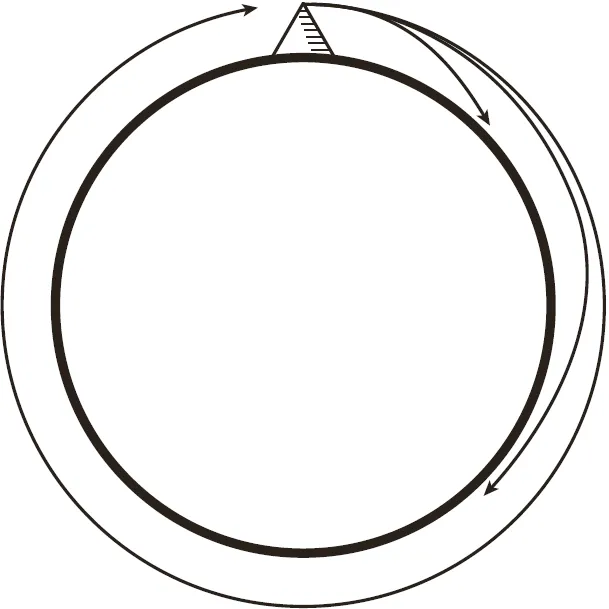
Newton's tool was the concept of force: objects move because universal, measurable forces push or pull them, not because they "yearn" to rejoin the Earth, as some theologians held. That is the birth of unification as a scientific idea.
A blazing comet over London in 1682 sent astronomer Edmond Halley to Cambridge. Newton, already famous for splitting white light with a prism and inventing the reflecting telescope, told him comets move in ellipses around the Sun and that he could predict their paths. Halley paid to print Mathematical Principles of Natural Philosophy (Principia), and calculated that the 1682 comet would return in 1758. It appeared on Christmas Day 1758, sealing both reputations after their deaths. NASA still steers probes with Newton's laws.
Nature and Nature's laws lay hid in night: God said, Let Newton be! And all was light.
Alexander PopeSymmetry: the hidden key
Newton's gravity has a rotational symmetry: the force is identical everywhere on a sphere around the Earth. That is why planets and stars are spheres and not cubes; gravity compresses them evenly. Small asteroids are lumpy because their gravity is too weak to do so.
- Definition. An object or equation is symmetric if, after rearranging its parts, it is invariant (left the same). A sphere is invariant under rotation.
- The orbit example. As the Earth circles the Sun, its coordinates X and Y change constantly but the radius R does not. By Pythagoras, X² + Y² = R², so Newton's equations keep the same form however the frame is rotated.
- Why it matters. Kaku insists symmetry is not window dressing but a sign of a deep physical principle; it will be the main tool for every later unification.
Kaku's endnote concedes that Newton never wrote symmetry in coordinate form; the Principia is purely geometric. The X² + Y² = R² presentation is a modern gloss. Also, the claim that Galileo went blind from looking at the Sun is a legend Kaku repeats with "it was said"; historians attribute his blindness to cataracts and glaucoma in old age.
Newton's laws confirmed, and the first technological revolution
In the nineteenth century Uranus wobbled off its predicted path. Rather than doubt Newton, Urbain Le Verrier calculated where an unseen planet must be; in 1846 astronomers found Neptune within one degree of the prediction on the first try, the first time pure mathematics revealed a major celestial body.
Newton's mechanics then explained heat as molecules in motion, colliding like steel balls; summing trillions of collisions gave the laws of gases. Engineers used this to perfect the steam engine, raising the energy available to a worker to hundreds of horsepower, laying railways and replacing slow, secretive craft guilds with mass production. Kaku shows students the 1940 Tacoma Narrows Bridge collapse as the price of misapplying Newton.
Faraday: the field
Michael Faraday, poor and almost unschooled, rose from bottle-washer at the Royal Institution to one of history's great experimenters. He found that moving a magnet through a wire loop makes current, and that the reverse also holds, so electricity and magnetism are two sides of one coin. That principle runs hydroelectric dams (water spins a magnet that drives electrons) and vacuum cleaners (current spins a magnet).
Lacking mathematics, Faraday drew lines of force, like iron filings round a magnet, and invented the field: lines of force spread through space. Today every known force is described in Faraday's language of fields. The Earth's field arises because charges inside the spinning Earth move; why a bar magnet, with nothing spinning, has a field is a puzzle Kaku defers to the quantum chapter. Ernest Rutherford called Faraday the "greatest scientific discoverer of all time."
At his famous Christmas Lectures, Faraday stood in a room lined with metal foil, electrified it, and stayed unharmed: charge spreads over the surface, so the field inside is zero. The Faraday cage now shields microwave ovens, delicate electronics and airliners struck by lightning. Kaku repeated the stunt for the Science Channel at the Boston Museum of Science, with bolts of up to two million volts hitting his cage.
Kaku says Faraday got a Royal Institution job "as a child." In fact he was a bookbinder's apprentice who attended Humphry Davy's lectures and was hired as Davy's laboratory assistant in 1813, aged 21. The rags-to-riches point stands; the timeline is compressed.
Maxwell: light is electromagnetism
James Clerk Maxwell codified Faraday's fields in vector calculus, just as Kepler and Galileo prepared the way for Newton. His equations say a changing magnetic field creates an electric field and a changing electric field creates a magnetic field. Maxwell's leap: let each create the other in an endless chain and you get a self-sustaining travelling wave.
- Maxwell's calculated wave speed: 310,740 km/s.
- Measured speed of light (modern): 299,792 km/s.
- Conclusion: light is an electromagnetic wave. Maxwell wrote that "we can scarcely avoid the inference" that light and electromagnetism share one medium.
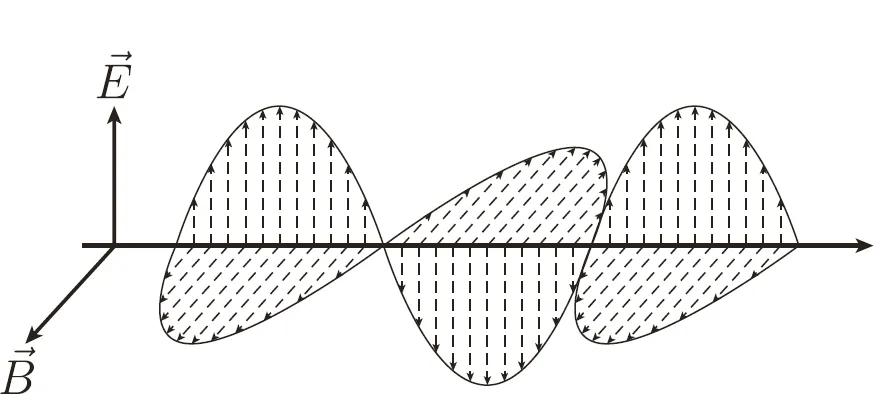
Unification again rests on symmetry. Maxwell's equations have a duality: swap the electric field E and the magnetic field B and the equations (in empty space) keep their form. That E-B duality is why electricity and magnetism are one force. Kaku's endnote admits the symmetry is imperfect: electrons source electric fields but no magnetic monopole has ever been seen, which is why some physicists still hunt for one.
Hertz, Marconi and wireless
The Berlin Prize was offered for producing Maxwell's waves in the lab. In 1886 Heinrich Hertz made a spark in one corner and induced current in a coil several feet away: radio. Guglielmo Marconi turned it into public communication, eventually sending messages across the Atlantic. Kaku contrasts this with 490 BCE, when a runner carried news of Marathon 26 miles to Athens after already running 147 miles to Sparta, and, legend says, dropped dead. A modern phone call chains energy conversions: voice → vibrating diaphragm → magnet → electrical impulse → microwaves → tower → across the globe.
Kaku dates Marconi's public debut to 1894 and links it to Atlantic crossings in the same breath. Marconi began experimenting around 1894 to 1895, but the first transatlantic signal came in December 1901. The Marathon runner's 147-mile Sparta run is from Herodotus; the Athens run and death are later legend.
The invisible spectrum
Newton split white light in the 1660s; in 1800 William Herschel placed a thermometer below the red end of a prism's rainbow and watched it warm: infrared, a "color" the eye cannot see. Visible light is the tiniest sliver of an EM spectrum running from radio and TV (long waves) through infrared, visible and ultraviolet to X-rays and gamma rays (short waves). Bees see ultraviolet, which helps them find the Sun on cloudy days, and flowers evolved patterns that are even more striking in UV.
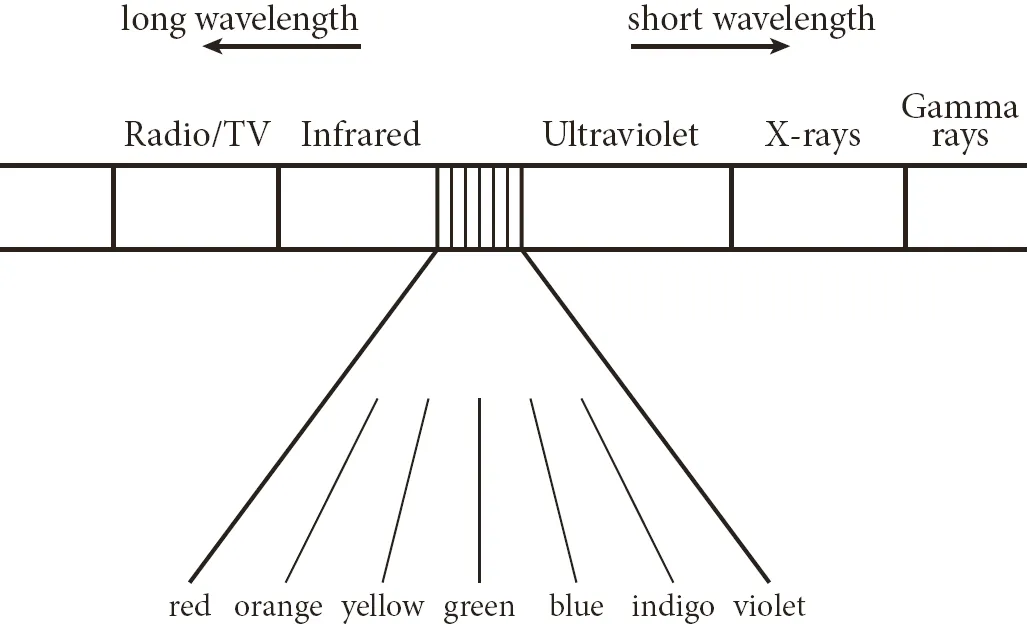
Why do we see only a sliver? An antenna is roughly the size of the wavelength it handles. A phone is a few inches long because its antenna is; retinal cells see wavelengths of their own size. Eyes with house-sized cells would see radio; atom-sized cells would see X-rays.
Edison versus Tesla: the price of ignoring Maxwell
Maxwell's equations also made electric power transmissible "with the flick of a switch," unlike coal and oil hauled by ship and train. Thomas Edison (light bulb, motion pictures, phonograph, ticker tape, wiring of Pearl Street in Manhattan) championed direct current (DC), which never changes direction or voltage. Nikola Tesla, a former Edison employee, championed alternating current (AC), reversing about sixty times a second. General Electric backed Edison, Westinghouse backed Tesla, with millions at stake.
Edison's DC
- Constant voltage, one direction.
- Low voltage loses heavy energy over miles of wire.
- Cannot be stepped up or down by transformers, because static fields do not convert.
Tesla's AC
- Reverses direction ~60 times per second.
- High-voltage lines waste little energy over distance.
- Transformers (changing magnetic fields making currents) drop thousands of volts to 110 V at the house.
Edison scorned mathematicians; he would ask job candidates to calculate a light bulb's volume and then simply fill it with water and pour it into a beaker. But not understanding Maxwell cost him the battle of the currents and the fortune he had sunk into DC. AC won because only a changing current can be transformed.
Corporate detail is loose: General Electric was formed only in 1892 from the merger of Edison General Electric and Thomson-Houston, after the fiercest phase of the "war of the currents"; the rival to Westinghouse in the late 1880s was Edison Electric. Ironically, GE then sold AC equipment.
The end of science, and the crack in the pillars
By 1900 Newton plus Maxwell seemed to explain everything known, and prominent scientists declared "the end of science." What they missed was that the two pillars contradict each other. One had to fall, and the key was held by a boy born in 1879, the year Maxwell died, who would ask at sixteen what it would be like to race a light beam.
- Monopoles still missing. No magnetic monopole has been detected; MoEDAL at the LHC and ATLAS continue to set tighter limits, so Maxwell's E-B duality remains broken in nature.
- Maxwell everywhere. Maxwell's equations now underpin 5G/6G radio, fiber optics and the global internet, extending Kaku's "each force builds an age" thesis into the information age.
- Indirect evidence wins prizes. Kaku's Democritus point has aged well: the 2017 Nobel for gravitational waves and the 2020 Nobel for the Milky Way's central black hole both rested on indirect inference, exactly the kind of evidence any final theory will need.
Einstein's Quest for Unification
Einstein resolved the clash between Newton and Maxwell by making the speed of light constant and letting space and time bend instead, which fused space with time and mass with energy (E = mc²). Ten more years of work turned gravity itself into geometry: gravity does not pull, curved space-time pushes. His third ambition, a single field theory joining gravity and electromagnetism, failed because a whole force, the nuclear force, was still missing.
Racing a light beam
As a teenager Einstein read Aaron Bernstein's Popular Books on Natural Science, which asked readers to imagine racing alongside a telegraph signal. Einstein replaced the wire with a light beam. At sixteen he reasoned that, running neck and neck with light, he should see a frozen wave, as Newton's addition of velocities predicts. But no one had ever seen frozen light. He pondered the problem for ten years.
His early career looked like failure. Professors disliked his bohemian habits and class-cutting and wrote poor references; he was rejected for every academic post, was fired from a tutoring job for arguing, considered selling insurance, and wrote that he was "nothing but a burden to my relatives." He finally became a clerk, third class, at the patent office in Bern, a humiliation that gave him quiet time to think.
Special relativity: Newton or Maxwell
As a student Einstein asked what happens to Maxwell's equations if you move at light speed. Newton says velocities add: a ball thrown forward from a train moves at train speed plus throw speed. Maxwell's equations said instead that light always moves at the same speed, however fast you travel. Either Newton or Maxwell had to be wrong.
In spring 1905, on a tram in Bern, "a storm broke loose in my mind." Since speed is measured with clocks and metersticks, and light's speed is fixed, space and time themselves must distort to keep it constant.
- Time dilation. Clocks on board tick slower; the crew appears to move in slow motion.
- Length contraction. Everything on board is compressed along the direction of motion.
- Mass increase. Everything on board is heavier; the extra mass comes from energy of motion.
- Relativity of view. To the crew everything looks normal; "What time is it?" depends on how fast you have been moving.
Einstein said, "I owe more to Maxwell than to anyone." The effect is now routine: an atomic clock flown on an airliner runs slow relative to a ground clock by about one part in a trillion.
E = mc²
If space and time vary, so must everything measured with them, including matter and energy. Some energy of motion becomes mass, and the exact exchange rate is E = mc². That answered an ancient question, why the Sun shines: crushing hydrogen at enormous temperatures converts a little of its mass into energy. For Kaku, relativity is unification twice over: space with time, and matter with energy.
Beauty is symmetry
To a physicist, beauty means symmetry: rearrange the parts of an equation and it stays invariant. A kaleidoscope turns jumble into order by symmetric copying; a snowflake is unchanged by a 60-degree rotation; a sphere by any rotation. Mathematician G. H. Hardy wrote that "beauty is the first test: there is no permanent place in the world for ugly mathematics."
- 2D orbit: X² + Y² = R²; coordinates change, the radius is invariant.
- 3D globe: X² + Y² + Z² = R²; wander the Earth's surface and R stays fixed (Kaku's footnote builds the sphere from stacked circles of latitude).
- 4D space-time (Einstein): X² + Y² + Z² − T² is invariant (with c = 1). Rotating space into time leaves the equations unchanged, so time becomes the fourth dimension.
- The minus sign: time enters with opposite sign, which is why you move freely back and forth in space but not in time; otherwise time travel would be commonplace.
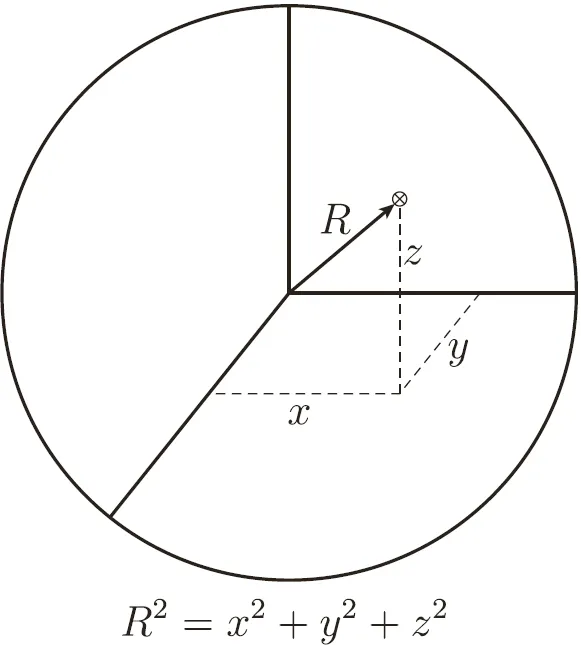
Maxwell's equations, written around 1861 (the year the American Civil War began), secretly had this four-dimensional symmetry all along: shuffle X, Y, Z and T and they are unchanged. Had physicists not been blinded by Newton's success, Kaku says, relativity could have been discovered during the Civil War.
General relativity: gravity as curved space
Special relativity said nothing about gravity or acceleration. Max Planck warned Einstein off: "you won't succeed, and even if you do, no one will believe you," though success would make him "the next Copernicus." The conflict was stark: if the Sun vanished, Einstein said Earth would feel it after eight minutes; Newton's formula contains no speed of light, so gravity would act instantly, violating relativity.
Age 16 to 26 (1895 to 1905): the light-beam puzzle, ending in special relativity. 1907: the "happiest thought of his life": leaning back in his chair, he nearly fell and realized a falling man feels weightless. Age 26 to 36 (1905 to 1915): the long struggle with gravity, including a near breakdown, ending in general relativity. 1919: eclipse confirmation; global fame. 1921: Nobel Prize. 1920s to 1955: the failed search for a unified field theory.
The equivalence principle
Galileo knew a falling person is momentarily weightless; Einstein exploited it. In an elevator whose cable snaps, you and the floor fall together, so you float: gravity is exactly cancelled by acceleration. This is the equivalence principle: acceleration in one frame is indistinguishable from gravity in another. Astronauts look weightless on TV not because space lacks gravity (the solar system is full of it) but because they and their capsule are in free fall together, like Newton's cannonball.
The merry-go-round and the warped stage
Spin a merry-go-round toward light speed. The rim moves faster than the center, so relativity contracts the rim more, and the flat floor warps into an upside-down bowl. A rider cannot walk straight and blames an invisible centrifugal force; an outsider sees only curvature. Swap the merry-go-round for the solar system and the conclusion follows: gravity does not pull; space pushes.
Newton's stage
- Space is a flat, static stage (Shakespeare's "all the world's a stage").
- Bodies pull each other with a force acting instantly.
- You sit in your chair because gravity pulls you down.
Einstein's stage
- The stage is curved and warped; you stagger "like a drunk."
- Mass warps space-time; bodies follow the warps; changes travel at light speed.
- You sit in your chair because Earth's mass warps the space above your head, and that warp pushes you down.
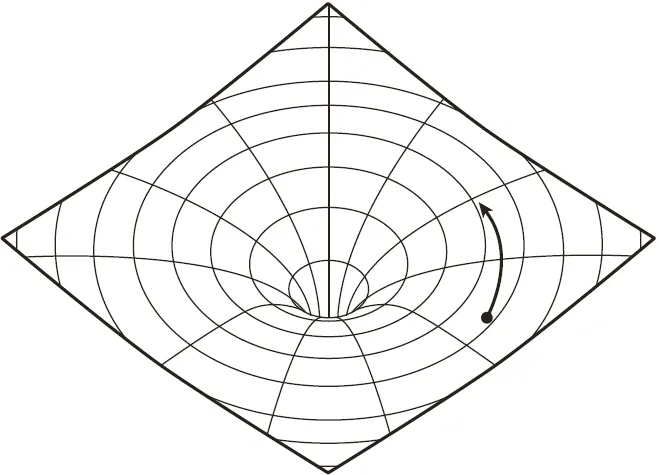
Kaku adds ants on crumpled paper, who feel a mysterious tug where we see only folds. General relativity is more powerful and more symmetric than special relativity because it handles continually changing accelerations at every point in space-time, and almost everything in the universe, from racing cars to rockets, is accelerating.
The tests: Mercury, the eclipse, GPS
Mercury's orbit is not a perfect ellipse; its perihelion precesses in a flowerlike pattern that Newton could not fully explain. Astronomers, remembering Neptune, invented a hidden inner planet, Vulcan, and never found it. Einstein's equations produced the anomaly exactly: 42.9 arc-seconds per century. "For some days, I was beyond myself with excitement."
Einstein predicted that the Sun's gravity would bend starlight from stars visible near it only during an eclipse; compare photographs with and without the Sun and the stars should shift. Asked what he would think if he were wrong, he said God must have made a mistake, because the theory was too beautiful to fail. Arthur Eddington's 1919 expedition found agreement, and gravitational lenses ("Einstein lenses") are now a standard astronomical tool.
Fame followed. At a film premiere with Charlie Chaplin, mobbed by autograph hunters, Einstein asked what it all meant; Chaplin replied that they cheered him because everyone understood him, and cheered Einstein because no one understood him. Critics raged; Columbia's Charles Lane Poor said reading relativity felt like having tea with the Mad Hatter. Planck consoled Einstein that new truths triumph not by converting opponents but because "the opponents eventually die."
- 31 GPS satellites in orbit, moving at roughly 17,000 mph.
- Special relativity: speed makes satellite clocks run slower (about 7 microseconds per day).
- General relativity: weaker gravity in orbit makes them run faster (about 45 microseconds per day).
- Net: about +38 microseconds per day; uncorrected, positions would drift by roughly 10 km per day. "Without special and general relativity working in tandem, you would be lost."
Several details need correcting. Einstein studied at the Swiss Federal Polytechnic in Zurich (ETH), not "École Polytechnique," which is in Paris. His 1921 Nobel Prize (awarded in 1922) was explicitly for the photoelectric effect, not relativity, which the committee still considered too contentious. A phone needs signals from at least four GPS satellites, not three, because it must solve for time as well as three coordinates. The Chaplin premiere was City Lights in 1931, not 1933. And Eddington's 1919 data were marginal: some plates were discarded and later critics argued he leaned toward Einstein; clean confirmation came with later eclipses and radio interferometry in the 1970s.
Newton and Einstein: opposites with two shared gifts
Newton was a loner, without lifelong friends or small talk; Jeremy Bernstein said everyone who met Einstein came away with a sense of his "nobility," a humanitarian. Yet they shared two traits:
- Ferocious concentration. Newton forgot to eat or sleep and scribbled on napkins and walls; Einstein focused for decades and nearly broke down over general relativity.
- Thinking in pictures. Newton wrote the Principia in geometric diagrams rather than algebra, the harder route; Einstein's papers are full of trains, metersticks and clocks.
The failed third act
Einstein produced two triumphs: special relativity (light, space-time, four-dimensional rotation symmetry) and general relativity (gravity as curvature). He then spent decades trying for a unified field theory joining Maxwell's electromagnetism with his gravity, and failed. (Faraday had tried first, dropping magnets off London Bridge to detect a gravity-magnetism link; he found nothing.)
Einstein failed for a structural reason: in the 1920s a whole force was missing. Unification of gravity and electromagnetism alone ignores the strong and weak nuclear forces, which only the quantum theory would reveal. Ironically, Einstein, a founder of the quantum, became its greatest adversary, and his philosophical objections still resonate.
- Gravitational waves. Predicted by general relativity in 1916, they were detected by LIGO in September 2015 (announced 2016, Nobel 2017). The LIGO-Virgo-KAGRA O4 run (2023 to 2025) added hundreds of new merger candidates before ending in November 2025, and the 2025 event GW250114 gave the cleanest test yet of Hawking's area theorem for black holes.
- Black holes imaged. The Event Horizon Telescope imaged M87* (2019) and Sagittarius A* at our galaxy's center (2022), both matching general relativity's predicted shadow size.
- Speed of gravity measured. The 2017 neutron-star merger GW170817 arrived within 1.7 seconds of its gamma rays after 130 million years of travel, confirming that gravity moves at light speed, exactly Kaku's "eight minutes" point.
- Equivalence principle. The MICROSCOPE satellite (final results 2022) confirmed it to about one part in 10^15.
The GPS story is a model of reconciling two correct but opposing corrections in one system. Enterprise systems face the same pattern with clock skew in distributed ledgers and payment rails: timestamps from different frames must be reconciled by an explicit model, or settlement "drifts" just as uncorrected GPS would.
Rise of the Quantum
While Einstein rebuilt space and time, a second revolution asked what matter is made of. Radioactivity, the hollow atom, Planck's quanta, wave-particle duality and the equations of Schrödinger and Dirac explained the periodic table, magnetism and antimatter. The price was determinism: the electron's wave is a wave of probability, and Einstein never accepted it. The same physics explained sunlight and, within a decade, produced the atomic bomb.
From alchemy to the periodic table
After his gravity work Newton spent years on alchemy; his bouts of depression may have come from mercury poisoning. Little was learned until the 1800s, when chemists isolated elements by patient lab work rather than mathematics. In 1869 Dmitry Mendeleyev dreamed of the elements falling into a table, arranged the sixty or so known elements into a repeating pattern, left gaps, and predicted the properties of missing elements, which were then found. The open question was why the pattern repeated.
Radioactivity and the age of the Earth
In 1898 Marie and Pierre Curie isolated unstable new elements. Radium glowed with no power source, apparently violating conservation of energy, and elements were seen decaying into other elements, ending the belief that elements are eternal. Decay rates could be measured in thousands to billions of years.
Lord Kelvin
- A molten Earth cools in a few million years, so the Earth is young.
- Kelvin knew nothing of a heat source inside the Earth.
The geologists
- Rock formation is so slow the Earth must be billions of years old.
- They were right: radioactive decay of uranium and thorium heats the core, powering earthquakes, volcanoes and continental drift. All of it comes from the nuclear force.
The hollow atom
In 1910 Ernest Rutherford aimed a narrow beam from radium in a lead box at a thin gold sheet. Most of the radiation passed straight through, so atoms are mostly empty space. Kaku demonstrates this by putting harmless uranium in students' hands over a Geiger counter: it clicks away "because their body is hollow." The raisin-pie (plum-pudding) model, electrons dotted through a pie of positive charge, gave way to a swarm of electrons around a tiny dense nucleus. Counting the rare deflections and their angles, Rutherford found the nucleus 100,000 times smaller than the atom. The nucleus was later shown to hold protons (positive) and neutrons (neutral), so the whole periodic table seemed buildable from three particles: electron, proton, neutron.
Kaku tells the gold-foil story backwards. The experiment (by Geiger and Marsden under Rutherford, 1909, explained in 1911) used alpha particles, and passing through was expected under the plum-pudding model. The shock was that about 1 in 8,000 bounced back at large angles, which Rutherford compared to a shell rebounding off tissue paper. That backscatter is what proved a dense nucleus.
Planck's quanta
The quantum was born in 1900 when Max Planck asked why hot objects glow, red, then yellow, then blue as temperature rises (a candle flame is bluish at its hot base, reddish at its cool tip). Applying Newton (hotter atoms vibrate faster) and Maxwell (vibrating charges radiate) to a blackbody, a perfect absorber, fit the data at low frequencies but predicted infinite energy at high frequencies. To a physicist, an infinity is a sign that the equations have broken.
Planck's "innocent hypothesis": energy comes not continuously but in discrete packets, quanta. Tuning their size by hand, he reproduced the observed spectrum exactly. The same physics tells us the Sun's surface is about 5,000 °C without any thermometer: we read its temperature from the wavelength of its light.
- Planck's constant: h = 6.6 × 10⁻³⁴ joule-seconds, found by fitting data by hand.
- Set h → 0 and quantum theory reduces to Newton; that tiny value is why daily life looks Newtonian.
- Quantum corrections: the small deviations physicists spend careers computing.
- Nucleus/atom size ratio: 1 : 100,000.
In 1905, the year of special relativity, Einstein showed light also comes in packets, photons. Light has two faces: particles (photons) whose surrounding electric and magnetic fields are waves obeying Maxwell. That gives the modern picture of particles and the fields around them.
Electron waves
If light is both wave and particle, so is the electron. In the double-slit experiment, electrons fired at two slits build up not two spots but bands of interference, the pattern made by two synchronized splashes in a bathtub. Each electron seems to pass through both slits at once. Other experiments show electrons vanishing and reappearing elsewhere. If Planck's constant were large, objects in daily life would vanish, reappear and sit in two places at once.
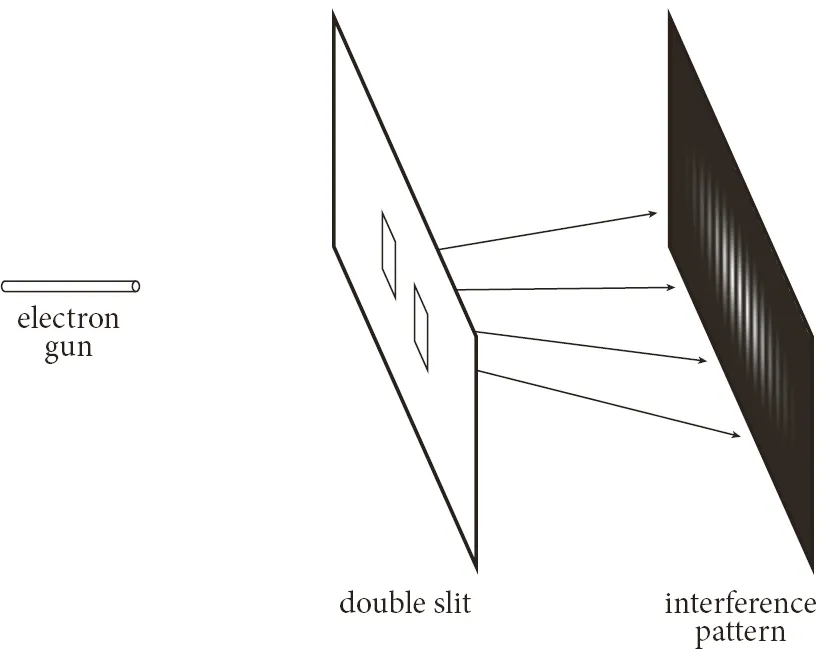
In 1925 Erwin Schrödinger wrote the equation governing these particle-waves. Applied to hydrogen (one electron, one proton) it reproduced the measured energy levels exactly, and in principle the whole periodic table is a solution of it.
Why the periodic table repeats
An electron wave around a nucleus survives only if a whole number of wavelengths fits around the orbit; others cancel themselves and cannot form stable atoms. So electrons sit in discrete shells; adding electrons fills shells farther out, and each new shell mimics the chemistry of the one below, giving Mendeleyev's repeating rows. Singing in the shower is the same effect: only frequencies that fit the walls are amplified.
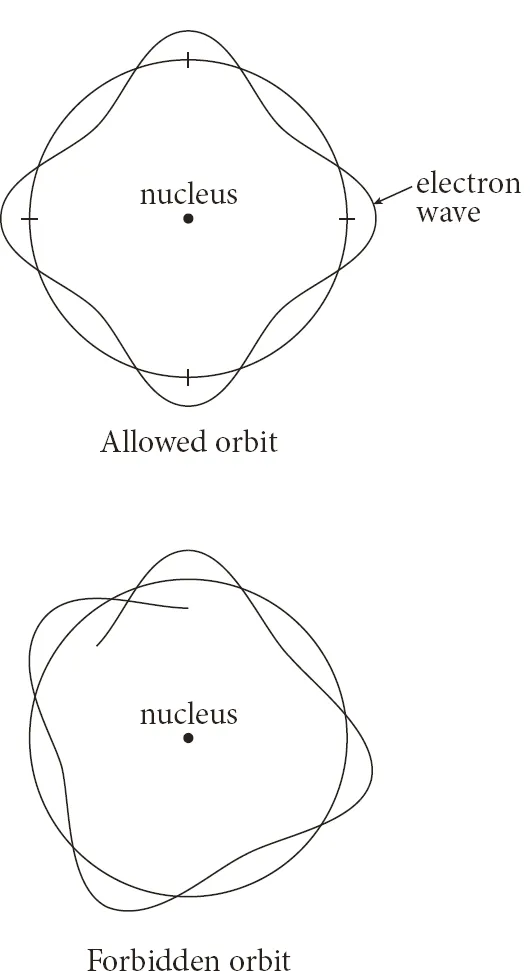
In one year physics went from unable to describe the atom to calculating inside it. Kaku tells his graduate students that everything around them, atoms, molecular bonds and therefore all chemistry, is in a sense a solution of Schrödinger's equation. But the equation was non-relativistic: it ignored light speed and photons, and it was ugly.
Dirac: beauty that predicts
Paul Dirac wrote a wave equation obeying special relativity, merging space and time with four-dimensional symmetry. The ugly terms of Schrödinger's equation collapsed into one compact line; Kaku, struggling with Schrödinger in high school, says he cried when he first saw Dirac's equation.
- Electron spin. The equation builds in an intrinsic spin (a mathematical property, not a spinning ball) that produces the electron's own magnetic field, matching measurement exactly.
- The bar-magnet mystery solved. A magnet's field comes from the aligned spins of electrons inside the metal, answering the puzzle left open since Faraday. All subatomic particles turned out to have spin.
- Antimatter. Every particle has an opposite-charge twin; the positron is a positive electron. Anti-atoms are possible, and matter meeting antimatter annihilates in a burst of energy. A final theory must give every particle an antimatter partner.
- A new view of symmetry. Symmetry went from "aesthetically pleasing" to a tool that predicts unseen phenomena.
What is waving?
In 1926 Max Born answered: the wave is the probability of finding the electron at each point. Werner Heisenberg's uncertainty principle codified it: you cannot know an electron's position and velocity precisely at once. You can no longer predict the future, only the odds.
That broke determinism, the Newtonian clockwork in which knowing every particle's position and velocity fixes all future events (Shakespeare's Macbeth: say "which grain will grow and which will not"). Einstein wrote that "the more successful the quantum theory becomes, the sillier it looks." Even Schrödinger rejected Born's reading of his own equation. Richard Feynman: "nobody understands quantum mechanics."
Clash of titans
- Einstein and Schrödinger: started the quantum revolution, then opposed its probabilistic meaning.
- Niels Bohr and Werner Heisenberg: creators of the new theory and its Copenhagen interpretation.
- Paul Ehrenfest: witness; recalled Einstein walking calmly with an ironic smile while Bohr trotted beside him "extremely upset," muttering "Einstein... Einstein..."
- John Wheeler: called it "the greatest debate in intellectual history."
The clash peaked at the sixth Solvay Conference, Brussels, 1930. Einstein raised objection after objection; Bohr answered each. When Einstein repeated that God does not play dice, Bohr reportedly replied, "Stop telling God what to do." Historians mostly give the debate to Bohr, but Einstein exposed a "towering giant standing on philosophical feet of clay."
Schrödinger's cat
Put a cat in a sealed box with uranium, a Geiger counter and a gun. If an atom decays, the gun fires. Since decay is a quantum event, before the box is opened the cat is the sum of two waves, dead and alive; opening the box collapses the wave function. On the Copenhagen view, observation (which requires consciousness) determines existence. Einstein found this worse than Bishop Berkeley's falling tree: the unobserved tree would be a superposition of burnt tree, sapling, firewood and plywood until someone looked. He asked visitors, "Does the moon exist because a mouse looks at it?"
Copenhagen
- Observation collapses the wave function; before it, no definite cat.
- Raises the puzzle of what counts as an observer; some versions bring in consciousness.
Many worlds
- The universe splits: one branch with a live cat, one with a dead cat.
- Branches decohere, falling out of step like radio stations, so we can never visit them; Kaku says this view is gaining popularity.
Whatever its meaning, the theory works: tested to eleven decimal places, it is the most accurate theory ever. Einstein conceded it held part of the truth and in 1929 nominated Schrödinger and Heisenberg for the Nobel Prize.
Kaku says Copenhagen "has fallen into disfavor" because nanotechnology lets us manipulate single atoms. That is his reading, not a consensus: surveys of physicists still show Copenhagen-style views as the largest group, with many-worlds, Bohmian mechanics, QBism and objective-collapse models all competing. Also, Dirac was 25, not 22, when he published his equation in 1928, and Schrödinger's equation appeared in print in 1926.
Why the Sun shines
Sun gods ruled myth, from Helios to Aztec, Egyptian and Hindu deities. Renaissance scientists saw the puzzle: a Sun of wood or oil would have burned out, and fire needs air that space lacks.
In 1842 the French founder of positivism, Auguste Comte, declared one question forever beyond science: what the Sun and planets are made of, since no one could bottle sunlight's source. Within a few years physicists answered: mostly hydrogen. Comte's error was forgetting that most science is indirect. A spectrograph heats a substance, spreads its light through a prism, and reveals dark bands where electrons jump between orbits; each element has a fingerprint of bands (forensic labs use the same trick on mud, toxins and fibres). Solar spectra also revealed an unknown element, helium, named for the Sun and found there before it was found on Earth. Stellar spectra showed stars are made of the same elements as Earth, so the laws of physics are universal.
The chronology here is scrambled. Fraunhofer mapped the Sun's dark lines around 1814 and died in 1826, so he could not have "answered" Comte, whose famous claim appeared in 1835 (Kaku says 1842). The lines were decoded as chemical fingerprints by Kirchhoff and Bunsen in 1859, and the finding that the Sun is mostly hydrogen came only in 1925, from Cecilia Payne's doctoral thesis. Helium was spotted in 1868 (Janssen, Lockyer). The Sun's surface is closer to 5,500 °C than 5,000.
Hans Bethe assembled the answer: the Sun's gravity squeezes hydrogen until protons fuse into helium (and heavier elements); helium weighs slightly less than its ingredients, and the missing mass becomes energy via E = mc².
Quantum mechanics goes to war
1933: Hitler takes power; physicists flee. Brownshirts beat Schrödinger for defending Jewish shopkeepers, stopping only when one recognized a Nobel laureate; he leaves Austria. 1930s: Planck pleads with Hitler to stop the brain drain; Hitler rants about Jews. Planck: "it was impossible to talk to such a man." Planck's son, implicated in the plot against Hitler, is tortured and executed. Late 1930s: German physicists show uranium splits when hit by neutrons, releasing more neutrons. Leo Szilard sees the chain reaction: 1 → 2 → 4 → 8 → 16 → 32 → 64 neutrons, an exponential release that could level a city. 1939: The Nazis seal Bohemian pitchblende mines; Einstein, a pacifist, writes to President Roosevelt; the Manhattan Project follows. 1944: Heisenberg heads the German bomb effort. The OSS sends ex-Brooklyn Dodgers catcher Moe Berg to Heisenberg's Zurich lecture with orders to kill him if the German bomb looked close (Nicholas Dawidoff, The Catcher Was a Spy).
For decades Einstein had said one atom's energy was too small to be useful; Szilard's chain reaction made it a weapon. The German project was underfunded, late and bombed, and Heisenberg had not solved the critical mass problem; Kaku gives the answer as roughly twenty pounds of uranium-235, "held in the palm of your hand."
Two further slips. Szilard conceived the chain reaction in 1933, five years before Hahn and Strassmann discovered fission (1938), so the order in the text is reversed. And a bare sphere of uranium-235 has a critical mass of about 52 kg (115 lb); Little Boy carried 64 kg. With a neutron reflector the figure drops to roughly 15 kg, still well above Kaku's "twenty pounds in the palm."
- Quantum foundations rewarded. The 2022 Nobel Prize (Aspect, Clauser, Zeilinger) honored the Bell-test experiments that ruled out local hidden variables, settling Einstein's hope for a classical reality underneath.
- Quantum technology. Kaku's "most accurate theory" now drives quantum computers: Google's Willow chip (December 2024) showed error rates falling as qubit arrays grew, a key threshold for error correction, and the 2025 Nobel Prize went to Clarke, Devoret and Martinis for macroscopic quantum tunnelling in circuits, the basis of superconducting qubits.
- Interpretation still open. A 2025 Nature survey of more than 1,100 physicists for the quantum centenary found no majority interpretation: Copenhagen led with roughly a third, and many respondents were unsure their preferred view was correct.
The double slit is a good mental model for anyone building probabilistic AI systems. A language model, like Born's wave function, gives a distribution over outcomes, not a single answer; "measurement" (sampling) collapses it.
Theory of Almost Everything
Einstein isolated, and the "crazy enough" test
After the war Einstein felt like a "petrified object, rendered blind and deaf by the years." His earlier work had a guiding principle (invariance under swapping X, Y, Z, T for special relativity; the equivalence principle for general relativity), but his unified-field notebooks, which Kaku has studied, show "plenty of ideas but no guiding principle." Einstein knew it: progress required finding "some general principle from nature." He once said "God is subtle, but not malicious," and late in life wondered whether God might be malicious after all.
- Schrödinger, 1947. Wrote to Einstein that Einstein was "on a lion hunt" while he spoke "of rabbits," then announced his own unified theory at a Dublin press conference attended by Irish prime minister Éamon de Valera: "I shall look an awful fool if I am wrong." Einstein had already tried and rejected the same idea, and it had no electrons or atoms.
- Heisenberg and Pauli, 1958. Pauli, physics' biggest cynic ("What God has torn asunder, let no man put together"), presented their joint theory at Columbia. Bohr stood up: "We in the back are convinced your theory is crazy. What divides us is whether your theory is crazy enough." Jeremy Bernstein called it an "uncanny encounter of two giants." The theory was wrong.
Bohr's quip carries a real lesson: every obvious unified theory had been tried and had failed, so the true theory must be radically different, "crazy enough" to be right. Kaku later argues that string theory meets this test.
QED and the trick of renormalization
The postwar breakthrough was quantum electrodynamics (QED), the quantum theory of electrons and photons joining Dirac's electron with Maxwell's light under special relativity (joining Dirac with general relativity was thought far too hard). In 1930 Robert Oppenheimer, later head of the bomb project, found the problem: the quantum corrections diverge, giving infinite answers, though they were supposed to be small. For nearly two decades nobody could fix it.
In 1949 three young physicists working independently cracked it: Richard Feynman and Julian Schwinger in the US and Shin'ichiro Tomonaga in Japan.
- Start with Dirac's and Maxwell's equations and give the electron a "bare" mass and "bare" charge.
- Compute the quantum corrections: they come out infinite (Oppenheimer's problem).
- Assume the bare mass and charge were themselves infinite, of opposite sign to the corrections.
- Let the infinities cancel, leaving the finite, measured mass and charge. Kaku's slogan: infinity minus infinity gives a finite number.
It works spectacularly. QED predicts the electron's magnetic strength to about one part in a hundred billion. Steven Weinberg called the agreement "perhaps the most impressive in all science," like measuring Los Angeles to New York to the width of a hair. Schwinger had the symbol of his result carved on his gravestone.
Results
- Most precise prediction in science.
- Became the template for the Standard Model.
- Physicists spend careers computing the next decimal place.
Distaste
- Thousands of terms must cancel exactly; one slip ruins the calculation.
- Dirac hated it: "not sensible mathematics"; you neglect quantities when small, not because they are infinite and unwanted.
- Kaku calls it "supremely ugly," but "you cannot argue with results."
Kaku omits Freeman Dyson, who in 1949 proved the Feynman and Schwinger-Tomonaga approaches equivalent and showed QED is renormalizable to all orders; the 1965 Nobel went to Feynman, Schwinger and Tomonaga. Modern physics also reads renormalization less as "sweeping infinities under the rug" and more, after Kenneth Wilson, as a statement that low-energy physics is insensitive to unknown high-energy details.
The third revolution: transistors, lasers, DNA
QED and quantum mechanics powered Kaku's third technological revolution, the high-tech age.
- Transistor. An electronic valve: a small current controls a much larger flow of electrons, so a small signal is amplified. It underlies computers, telecoms and the internet.
- Laser. Pump a gas tube with electric current so trillions of electrons jump to higher levels. One electron drops and emits a photon that triggers a neighbor to emit a second photon vibrating in unison; mirrors at both ends build an avalanche of in-step photons. Lasers are in checkouts, hospitals, computers, concerts and satellites; in principle only the stability of the lasing material and the power supply limit their energy, so science-fiction beam weapons are not ruled out.
Kaku's laser recipe starts with "a tube of hydrogen and helium." The classic gas laser is helium-neon.
What is life?
Science long assumed a life force or soul animating matter (dualism). Schrödinger's 1944 book What Is Life? argued that heredity is a code stored in the arrangement of a master molecule obeying quantum mechanics, banishing the life force as Einstein had banished the ether. James Watson and Francis Crick read it. Molecules are smaller than visible-light wavelengths, so they used X-ray crystallography: X-rays, whose wavelength matches molecular size, scatter off a crystal into a pattern that encodes its atomic structure. Using Rosalind Franklin's X-ray photographs and Tinkertoy-style models of bond angles, they found DNA's double helix, showing that reproduction works at the molecular level. This led to the Human Genome Project and, as Darwin foresaw, a molecular family tree of all life. Kaku's verdict: quantum unification also unified the tree of life.
Calling Watson and Crick's work "using quantum mechanics to decode DNA" stretches the point; X-ray diffraction is classical wave optics and their model-building drew on structural chemistry (Pauling's bond rules, themselves quantum-derived). Kaku also passes over the controversy that Franklin's "Photo 51" reached them without her knowledge. The Human Genome Project gave a base sequence, not an "atomic description" of DNA.
The nuclear forces and the particle zoo
The nucleus should fly apart, since protons repel each other. The strong nuclear force holds it together, keeping many nuclei stable since the beginning of time, especially when protons and neutrons are balanced. Nuclei with too many protons burst from electric repulsion; with too many neutrons they decay. A free neutron decays into a proton, an electron and an anti-neutrino.
Kaku writes that "half of any collection of free neutrons will decay in fourteen minutes." The neutron's half-life is about 10 minutes; its mean lifetime is about 14.7 minutes (880 s). He also says the weak force "is not strong enough to hold the neutron together"; in fact the weak force is what causes the decay.
Accelerators
Probing a nucleus 100,000 times smaller than an atom required the particle accelerator. Ernest Lawrence's cyclotron (1929) bends protons in a circle with a magnetic field and kicks them with an electric field every lap, reaching millions, then billions of electron volts. (Kaku built a betatron electron accelerator in high school.) Smashing protons is crude, like throwing a piano out a window and deducing its properties from the crash, but it is almost the only way inside the proton.
In the 1950s accelerators produced a zoo of unexpected particles. Oppenheimer proposed giving the Nobel to the physicist who did not discover a new particle that year; Enrico Fermi said he would have become a botanist had he known there would be so many Greek names. Some feared humans were simply not smart enough, as a dog cannot learn calculus.
Quarks
Murray Gell-Mann at Caltech proposed that protons and neutrons contain three quarks. Like Mendeleyev, he predicted particles from gaps; the omega-minus, found in 1964, confirmed the scheme and won him the Nobel. The model unified the zoo because it rested on a symmetry: shuffle the three quarks in the equations and nothing changes.
Feynman
- Showman and clown, ribald stories in a working-class accent.
- Cracked the Los Alamos safes holding atomic-bomb secrets and left a cryptic note, causing panic.
- Floated in an isolation tank (Kaku says a hyperbaric chamber) hoping for an out-of-body experience.
Gell-Mann
- Gentleman, precise in word and manner.
- Pastimes: bird-watching, antiques, linguistics, archaeology.
- Same drive as Feynman, different temperament, both at Caltech.
The weak force and the ghost particle
The weak force, about a million times weaker than the strong force, drives radioactive decay, and so the heat behind volcanoes and earthquakes. In beta decay a neutron becomes a proton and an electron, but the energy books balance only with a third particle, the neutrino. It passes through planets; neutrinos from space stream through your body now, and some could cross a block of lead reaching to the nearest star. Pauli predicted it in 1930 ("I have committed the ultimate sin... a particle that can never be observed"); it was detected in 1956 using the enormous neutrino flux from a nuclear reactor.
Pair the electron and neutrino in a symmetry, couple it to Maxwell's symmetry, and you get the electroweak theory of Steven Weinberg, Sheldon Glashow and Abdus Salam (Nobel 1979). Light, which Einstein wanted to join with gravity, preferred to unite with the weak nuclear force.
Yang-Mills, the gluon and QCD
The question remained: what holds the particles together? In 1954 Chen Ning Yang and Robert Mills generalized Maxwell's single field into a family of fields that shuffle into one another under the same kind of symmetry Gell-Mann used for quarks. If Maxwell's field holds the atom together, perhaps Yang-Mills fields hold quarks together. For decades the idea stalled: the quantum corrections were infinite and Feynman's tricks could not renormalize them.
Then a Dutch graduate student, Gerard 't Hooft, ploughed through the infinities by brute force with computer help; when his program printed zeros for the corrections, he knew he was right. Glashow: "Either this guy's a total idiot, or he's the biggest genius to hit physics in years!" 't Hooft and his adviser Martinus Veltman won the 1999 Nobel. Applied to quarks the Yang-Mills particle is the gluon; computer simulations show the field condensing into a taffy that binds quarks. With quarks in three "colors" obeying Gell-Mann's symmetry, the theory became quantum chromodynamics (QCD).
The Higgs: breaking the perfect symmetry
The last piece was the Higgs boson ("God particle"). Symmetry alone cannot be the whole story, because today's universe is not symmetric: the four forces look unrelated. Run time backward and they converge, perhaps into one superforce at the instant of creation, obeying a master symmetry that rotates every particle into every other. Kaku's "God equation" is the equation of that superforce. As the universe expanded and cooled, the symmetry broke into the fragments of the Standard Model.
- The dam. Water behind a dam is symmetric but sits in a higher-energy, unstable false vacuum; when the dam bursts it rushes to the true vacuum in the valley. Symmetry is lost, the ground state is reached.
- Boiling water. Just before boiling, water is symmetric but unstable; bubbles of lower energy form, expand and merge.
- The Higgs field. Fills all space like Faraday's field. Originally all particles were massless and symmetric in a false vacuum. Bubbles formed in the Higgs field; inside them particles gained different masses. The bubble expanded with the Big Bang, and we now live inside one giant bubble of broken symmetry.
The Standard Model: the theory of almost everything
By the 1970s physicists had glued three symmetries together: one shuffling three quarks (strong force), one shuffling electron and neutrino (weak force), and Maxwell's (electromagnetism). Kaku's endnote gives the group: SU(3) × SU(2) × U(1), where SU(n) symmetry arises naturally from n fermions. It predicts matter's behavior back to a fraction of a second after the Big Bang.
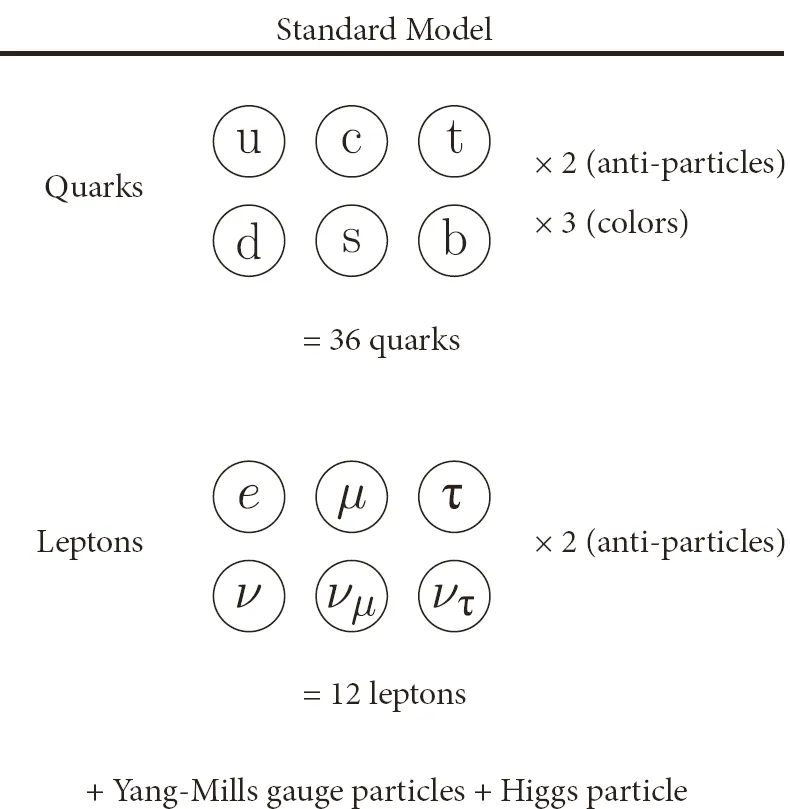
| Component | What it is | Count / detail |
|---|---|---|
| Quarks | u, d, c, s, t, b | 6 flavors × 3 colors × 2 (with anti) = 36 |
| Leptons | e, μ, τ and three neutrinos | 6 × 2 = 12 |
| Gluons | Yang-Mills field of SU(3) | bind quarks (QCD) |
| W⁺, W⁻, Z | Yang-Mills fields of SU(2) | carry the weak force |
| Photon | Maxwell field, U(1) | electromagnetism |
| Higgs boson | excitation of the Higgs field | breaks symmetry, gives mass |
| Free parameters | masses, couplings, mixings | about 20 put in by hand |
- No gravity. Adding it makes quantum corrections infinite; the model says nothing about before the Big Bang or inside black holes.
- A patchwork. Three theories spliced by hand; one physicist compared it to taping a platypus, an aardvark and a whale together and calling it nature's most elegant creature.
- About twenty arbitrary constants (quark masses, interaction strengths) with no explanation.
- Three identical generations of particles: why would nature triplicate itself?
Two small corrections: generations apply to quarks and leptons, not gluons, as Kaku's list implies; and the usual count is 19 parameters, rising to about 26 once neutrino masses are included.
- Robert Oppenheimer: found QED's infinities (1930); joked about the particle zoo.
- Feynman, Schwinger, Tomonaga: renormalized QED (1949).
- Murray Gell-Mann: quarks; omega-minus (1964).
- Wolfgang Pauli: predicted the neutrino (1930).
- Weinberg, Glashow, Salam: electroweak theory (Nobel 1979).
- Yang and Mills: generalized Maxwell field (1954).
- 't Hooft and Veltman: renormalized Yang-Mills (Nobel 1999).
Kaku never names Peter Higgs, François Englert and Robert Brout, who proposed the mechanism in 1964 (Nobel 2013 to Higgs and Englert), nor George Zweig, who proposed quarks ("aces") independently of Gell-Mann. The omega-minus was predicted by Gell-Mann's Eightfold Way (1962), a symmetry scheme that came before quarks; his 1969 Nobel was for that classification.
The LHC and the wall of gravity
The Large Hadron Collider near Geneva, the largest machine ever built, cost more than $12 billion and runs almost 17 miles (27 km) in circumference under the Swiss-French border. Counter-rotating proton beams collide at 14 trillion electron volts (14 TeV), and supercomputers sift the debris. In 2012 it found the Higgs boson, completing the Standard Model. Yet every deeper probe in the past revealed more elegant symmetry, so a slapdash theory at the bottom of nature looks like a warm-up act, not the finale.
Physicists then tried the same recipe on Einstein: represent gravity by a point particle, the graviton, surrounding smooth space-time with a cloud of them. The seventy-year bag of tricks failed: graviton corrections are infinite and cannot be reabsorbed. As a fallback they quantized matter only, leaving gravity classical, and this opened the door to black holes, wormholes, dark matter and dark energy, time travel and the creation of the universe, all of which a theory of everything must now explain.
- Higgs measured. At 125 GeV the Higgs couplings to top, bottom, tau, W and Z match the Standard Model within errors; evidence for decays to muon pairs (CMS 2020, ATLAS 2025) is the first sign of a coupling to a second-generation particle. Run 3 at 13.6 TeV (not the 14 TeV design energy) continues to 2026, followed by the High-Luminosity LHC shutdown.
- No new particles. No supersymmetric partners, extra dimensions or leptoquarks have appeared at the LHC.
- Anomalies that faded. Fermilab's final muon g-2 result (June 2025) reached about 127 parts per billion, and the 2025 Theory Initiative prediction, now based on lattice QCD, agrees with it, dissolving the much-hyped "new physics" hint. The CDF W-mass anomaly (2022) was not confirmed: ATLAS (2024) and CMS (2024) measured values matching the Standard Model.
- Next collider. The CERN Council's 2026 update of the European Strategy named the electron-positron Future Circular Collider (FCC-ee, about 91 km) as the LHC's preferred successor, a Higgs factory rather than a discovery machine aimed at strings; construction funding is still to be secured, and China weighs its rival CEPC.
The Standard Model is the canonical "works in production, ugly in design" system: patched together from three subsystems, about twenty hard-coded constants, perfect test results.
The Dark Universe
Applying quantum theory to the matter inside Einstein's curved space-time (while leaving gravity itself classical) revived relativity and produced its strangest predictions: black holes that glow and evaporate, spinning black holes with wormholes, time machines, a universe with a beginning, inflation and a multiverse, and a cosmic acceleration driven by dark energy. The naive quantum estimate of that dark energy is wrong by a factor of 10^120, the largest mismatch in the history of science. Every open question in the chapter points to the same missing piece: a quantum theory of the graviton.
The picture that reignited relativity
In 2019 the Event Horizon Telescope published the first image of a black hole: a ring of hot gas around a black silhouette in galaxy M87, 53 million light-years away, weighing five billion Suns. The whole solar system, past Pluto, would fit inside the shadow. Linking radio dishes around the globe and merging their data on supercomputers produced a virtual telescope the size of Earth, sharp enough in principle to see an orange on the Moon.
For fifty years general relativity had stagnated: equations with hundreds of variables and experiments needing miles-wide detectors. Ironically, its renaissance came from Einstein's bête noire: applying the quantum theory to stars and black holes, while setting aside the too-hard graviton.
The M87* mass is about 6.5 billion Suns and its distance about 55 million light-years. The 2017 EHT campaign used eight observatories at six sites, not five. Small slips, but symptomatic of the book's brisk handling of numbers.
What a black hole is
From Newton's cannonball to Michell's dark stars
Fire Newton's cannonball straight up fast enough and it reaches escape velocity and never returns. For Earth that is 25,000 mph, the speed Apollo needed in 1969. In 1783 John Michell asked what happens if escape velocity equals light speed: light would fall back, giving "dark stars." With little known about stars or the exact speed of light, the idea languished.
Schwarzschild's solution
In 1916, serving as an artilleryman on the Russian front, Karl Schwarzschild read Einstein's 1915 paper and found an exact solution for the simplest object, a point mass, which approximates any spherical star seen from afar. Einstein was ecstatic: he could now compute light-bending and Mercury's orbit exactly instead of approximately. Schwarzschild died soon after; Einstein wrote his eulogy.
- Event horizon (Schwarzschild's "magic sphere"): the point of no return; far outside it, gravity looks Newtonian.
- Trapped light: near the horizon you meet light beams orbiting for billions of years.
- Spaghettification: tidal gravity on your feet exceeds that on your head, stretching you until even atoms are torn apart.
- Frozen clocks: to a distant observer your ship's time slows and stops at the horizon; to you, nothing seems unusual until you are torn apart.
- Singularity: at the center, gravity becomes infinite, a sign the theory has failed.
Resistance, then acceptance
Arthur Eddington wanted "a law of Nature to prevent a star from behaving in this absurd way!" In 1939 Einstein published a paper arguing that a whirling ball of gas could never be compressed inside its horizon. That same year Robert Oppenheimer and Hartland Snyder showed that a star 10 to 50 times the Sun's mass, after exhausting its fuel and exploding as a supernova, can leave a remnant that collapses into a black hole. Our Sun is too light; its horizon would be only about four miles across, and nothing can squeeze it that small.
Stellar black holes
- Remnants of giant stars after a supernova.
- A few to tens of solar masses.
Galactic black holes
- At the centers of galaxies, perhaps every galaxy.
- Millions to billions of solar masses. Ours, in Sagittarius, is two to four million Suns; dust hides it, but without dust it would be a blazing fireball outshining the Moon.
Hawking: black holes glow
Stephen Hawking was an unfocused Cambridge graduate student until he was diagnosed with ALS and given two years to live. He resolved to spend them on the hardest problem: quantum theory plus gravity. The disease progressed far more slowly than predicted; Kaku, invited to a Hawking conference, saw his gadgets, including an automatic page-turner for journals.
Too wise to attack graviton corrections head on, Hawking quantized only the matter near a black hole. He saw a contradiction: perfect blackness violates the uncertainty principle, since even blackness must be uncertain. So black holes must emit a faint quantum glow, and it is blackbody radiation.
- The vacuum churns. Even "nothing" seethes with uncertainty; electron and anti-electron pairs pop out and annihilate.
- The horizon splits pairs. In an intense gravitational field one member of a virtual pair falls in while the other escapes.
- The black hole pays. The energy comes from the hole's gravity field, so its mass and energy fall.
- Evaporation. Black holes radiate for aeons and finally die in a fiery explosion; even they have a finite lifetime. In the far future, after the stars go dark, only black holes will remain, and then only drifting particles.
The information paradox
Quantum mechanics says information is never lost: burn a book and in principle the molecules let you reconstruct it. Hawking argued that a book thrown into a black hole is lost forever, so quantum mechanics fails inside. Answering Einstein's "God does not play dice," he said "sometimes God throws the dice where you cannot find them." Other physicists, using string theory, showed how information could be preserved; Hawking conceded and proposed that the information comes back out encoded in Hawking radiation. Kaku: the question is still debated and may need the full quantum theory of gravity.
Through the wormhole
Einstein's equations predict an infinite gravitational field at a black hole's center and at the start of time, which "makes no sense." In 1963 Roy Kerr solved them for a spinning black hole, now thought to be by far the most common kind, and found something stranger.
- Ring, not point. It collapses into a rapidly spinning ring; centrifugal force stops the ring from collapsing.
- Finite gravity inside the ring. Fall through and you may not be crushed.
- A parallel universe. Passing through the ring may take you into a sister universe, like a straw piercing two stacked sheets of paper: the straw is a wormhole, the ring Alice's looking glass.
- Many universes in sequence. Re-enter the ring and reach another universe, like riding an elevator floor by floor.
- A shortcut in our own universe. Or you emerge elsewhere in our universe, a subway through space-time, possibly faster than light or backward in time.
Wormholes date to Einstein and Nathan Rosen (1935): two black holes joined like two funnels; fall into one and emerge from the other uncrushed.
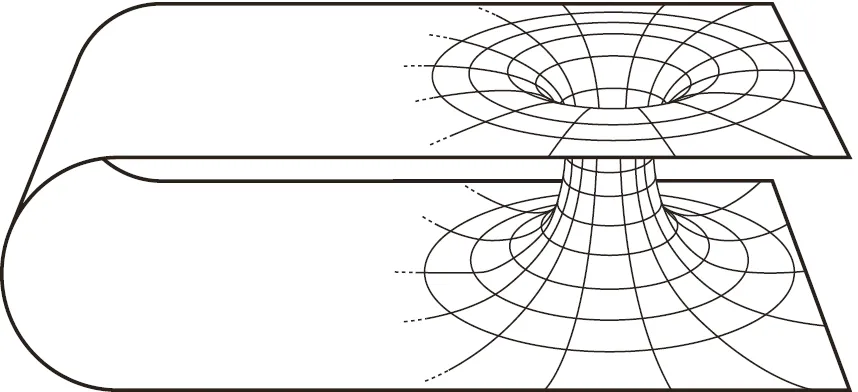
T. H. White's line "Everything not forbidden is compulsory" is taken seriously by physicists: if no law forbids wormholes, perhaps primordial ones were stretched by the Big Bang and await discovery.
- Positive energy on the scale of a black hole to open the gateway; a civilization far beyond ours.
- Negative matter or negative energy to hold it open. Negative matter (not antimatter) would fall up and would long ago have been flung off Earth; negative energy exists (for example in the Casimir effect) but only in minuscule amounts.
- Graviton radiation might make the wormhole explode the moment it forms.
Some physicists propose that matter falling into a black hole emerges from a white hole, a time-reversed black hole that spews matter out. None has been found, but perhaps the Big Bang was a white hole, with every star flung out about fourteen billion years ago.
Kerr's tunnel is a feature of the idealized, eternal solution. Realistic analyses find the inner (Cauchy) horizon unstable ("mass inflation"): infalling radiation piles up there and likely seals the passage. Most relativists treat traversable Kerr wormholes as mathematical artefacts, a point Kaku's enthusiasm passes over.
Time travel
Newton's time
- An arrow: uniform, the same everywhere; clocks can be synchronized across the universe.
Einstein's time
- A river: speeds up and slows down near stars and galaxies; may contain whirlpools (closed timelike curves, CTCs) sweeping you to the past, or fork into parallel universes.
Hawking proposed a chronology protection conjecture, a yet-unknown law forbidding time machines, but never proved it. He also joked that time travel is impossible because "where are the tourists from the future?"
- Grandfather paradox (making the present impossible). Kill your grandfather as a child and you cannot exist.
- Information from nowhere. A future visitor hands you the secret of time travel; years later you give it to your younger self. Who invented it?
- Becoming your own mother (Heinlein). An orphan girl becomes a man, travels back, fathers a girl with her younger self, and leaves the baby at the same orphanage: she is her own mother, father and daughter.
Kaku's resolution: the time line splits. Save Abraham Lincoln at Ford's Theatre and you save him in a parallel universe; in yours he still dies. Splitting removes all the paradoxes, but only a quantum theory of gravity can say whether time machines exist.
How was the universe created?
Creation myths range from an Egyptian cosmic egg on the Nile to a Polynesian cosmic coconut and Genesis's "Let there be light!"
Bentley's letter and Newton's fix
In 1692 clergyman Richard Bentley wrote to Newton: if the universe is finite and gravity only attracts, all stars should merge into one; if infinite, the infinite pulls from left and right should tear every star apart. Newton replied that an infinite, perfectly uniform universe is balanced, but saw the flaw: it is a house of cards, and the tiniest unevenness makes it collapse. His conclusion was that God must occasionally tweak the stars to keep them from collapsing.
Why is the night sky black?
In an infinite, uniform, eternal universe every line of sight ends on a star, so the night sky should blaze white: Olbers' paradox. Kepler answered that the universe is finite; others blamed dust, but dust would heat up over infinite time and glow too. The answer came from Edgar Allan Poe in 1848: the sky is dark because the universe has a finite age, so light from an infinite past never reaches us. By pure thought, without any experiment, one can conclude that the universe had a beginning.
Einstein, Hubble and the "greatest blunder"
In the 1920s astronomers told Einstein the universe was static, but his equations demanded expansion or contraction (which also answers Bentley: expansion counters collapse). He added a fudge factor, the cosmological constant, to freeze it. In 1929 Edwin Hubble, at Mount Wilson, found galaxies redshifted (light stretched by recession, like a Doppler shift), so the universe is expanding. Visiting in 1931, Einstein called the constant his "greatest blunder", a blunder that has since returned as dark energy. Running the expansion backward first gave an age of 1.8 billion years, embarrassingly less than the Earth's 4.6 billion; the Planck satellite now gives 13.8 billion.
Kaku credits the expanding universe to Hubble and Einstein alone. Alexander Friedmann (1922) derived expanding solutions and Georges Lemaître (1927) predicted the velocity-distance law and derived a rate from published data two years before Hubble; the IAU renamed it the Hubble-Lemaître law in 2018. The "greatest blunder" line comes only from George Gamow's recollection and may be apocryphal.
The afterglow and the quantum seeds of galaxies
Satellite maps of the microwave background now show tiny ripples required by the uncertainty principle: a perfectly smooth Big Bang would violate quantum mechanics. Those ripples grew into galaxies, so we exist because of quantum fluctuations at creation. Had satellites not found them, the program of applying quantum theory to the universe would have collapsed.
Inflation
Fresh from the Standard Model's success, Alan Guth and Andrei Linde applied its lessons to the Big Bang. Two puzzles demanded it:
- Flatness problem. Space-time should have some curvature, but the universe is flat to within experimental error.
- Uniformity problem. The fireball should have been lumpy, yet the sky looks the same in every direction.
Inflation solves both: a turbocharged expansion far faster than the ordinary Big Bang flattened any curvature and blew a tiny uniform patch up to cosmic size. Hence our visible universe is an infinitesimal piece of a much larger one we will never see.
Its engine borrows the Higgs mechanism: a new field, the inflaton, sat in a false vacuum driving rapid expansion; quantum bubbles of true vacuum formed, inflation stopped inside them, and our universe is one bubble. Because quantum events repeat, Big Bangs may happen again and again, producing a "bubble bath" multiverse. What drove inflation in the first place needs a theory of everything.
The runaway universe
Vikings foresaw Ragnarok, Christians the Four Horsemen. Physicists traditionally had two endings, and since 1998 a third.
| Fate | Condition | What happens |
|---|---|---|
| Big Freeze | Low density | Expansion forever; stars burn out, black holes evaporate, a supercold sea of particles |
| Big Crunch | High density | Gravity reverses expansion; galaxies collapse in a fiery crunch, perhaps bouncing into an oscillating universe |
| Big Rip | Accelerating expansion | Kaku: expansion so fast that light from neighbors never arrives; the sky goes black, all approaches absolute zero |
In 1998, by studying distant supernovae, astronomers found the expansion speeding up, entering a runaway mode. The driver appears to be Einstein's discarded cosmological constant, the energy of the vacuum, now called dark energy: more than 68.3% of the universe's matter and energy (distinct from dark matter).
- Dark energy: 68.3% of matter-energy.
- Naive quantum prediction / observed value: 10^120, a 1 followed by 120 zeros.
- Age: 13.8 billion years (Planck satellite); Hubble's first estimate 1.8 billion.
- CMB: predicted ~5 K (1948), measured 2.73 K.
Kaku blurs two endings. What he describes (black sky, approach to absolute zero) is the Big Freeze / heat death, the expected outcome of a constant dark energy. A true Big Rip requires "phantom" dark energy that grows with time and eventually tears apart galaxies, planets and atoms in finite time. He also leaves unnamed the 1998 discoverers, Saul Perlmutter, Brian Schmidt and Adam Riess (Nobel 2011).
Wanted: the graviton
Everything so far quantized matter moving in curved space-time, not gravity itself. Kaku recaps the recipe: the photon with Maxwell's fields and Feynman's tricks gives QED; replace Maxwell with Yang-Mills and add 't Hooft's tricks for the Standard Model. The graviton, a point particle at light speed wrapped in waves obeying Einstein's equations, is the natural next step. But when gravitons collide with each other or with atoms, the infinities cannot be removed, and seventy years of tricks all fail. Since every easy idea has been tried, the answer must be "crazy enough": string theory.
- Sagittarius A* imaged. The EHT released the image of our galaxy's black hole in 2022: about 4.3 million solar masses, consistent with general relativity, at the top of Kaku's 2 to 4 million range.
- Dark energy may be weakening. DESI's first (2024) and second (March 2025) data releases, combined with supernovae and the CMB, prefer dark energy that evolves over time at roughly 2.8 to 4.2 sigma, short of the 5-sigma discovery threshold. If it holds, the cosmological constant is not constant and the 10^120 puzzle changes shape.
- Hubble tension. Local measurements give about 73 km/s/Mpc, the CMB-based value about 67 to 68. JWST Cepheid checks (2023 to 2024) confirmed the local distance ladder is not simply wrong, while some JWST-based tip-of-the-red-giant analyses give lower values; the tension remains unresolved.
- Inflation tests. Primordial B-mode polarization (the gravitational-wave signature of inflation) is still undetected; BICEP/Keck limits (r < 0.036) have ruled out the simplest inflaton models, and the Simons Observatory began observing in 2024 to 2025.
- Wormholes in the lab, sort of. A 2022 Google quantum-processor "wormhole" experiment simulated a holographic teleportation protocol on 9 qubits; it was widely over-reported, and critics showed the signal did not require any wormhole interpretation.
- Black-hole mergers. GW231123 (announced 2025) involved the most massive black-hole merger yet, about 225 solar masses total, with black holes in a mass range standard stellar evolution struggles to produce.
The 10^120 mismatch is the ultimate example of a model that is locally exact and globally absurd: QFT nails every lab measurement yet gets the vacuum energy wrong by 120 orders of magnitude. Risk teams validating models at a bank face a milder version: back-testing on in-sample data says nothing about an extrapolation regime the model was never built for.
Rise of String Theory: Promise and Problems
Kaku's central chapter makes the case for string theory: born by accident in 1968, it turns every particle into a note on a vibrating string, contains gravity automatically, and, through supersymmetry, cancels the infinities that wreck every other quantum theory of gravity. Its price is ten (or, as M-theory, eleven) dimensions, no experimental evidence, an energy scale a quadrillion times beyond the LHC, and a near-infinite "landscape" of possible universes. Kaku answers the critics with indirect tests, a pyramid still being excavated, and the hope that one equation will one day compute the Standard Model's constants.
History repeats: two pillars again
Around 1900 the pillars were Newton and Maxwell; Einstein saw they clashed and one had to fall. Today the pillars are general relativity (black holes, Big Bang, expansion) and quantum theory (subatomic particles), built on different principles, different mathematics and different philosophies. The next revolution should merge them.
An accidental theory
1968: Gabriele Veneziano and Mahiko Suzuki, browsing math books, find that an eighteenth-century formula of Leonhard Euler describes the scattering of two subatomic particles. Around 1970: Yoichiro Nambu, Holger Nielsen and Leonard Susskind realize the formula describes two interacting strings; it is generalized to any number of strings (the subject of Kaku's PhD thesis), then to spinning particles. 1970s: Kaku and Keiji Kikkawa write the theory in the language of fields, string field theory: "all of string theory... in an equation just one inch long." 1984: John Schwarz and Michael Green show the theory is free of the anomalies and infinities that doomed rivals. 1995: Edward Witten unveils M-theory in eleven dimensions. 1997: Juan Maldacena's duality between ten-dimensional strings and four-dimensional gauge theory.
Particles as notes
Like Pythagoras, string theory says each vibration of a string is a particle: electrons, quarks and Yang-Mills particles are different notes on the same string. That answers the old question of why there are so many particles.
Gravity is forced on you
The theory's strongest feature: the graviton appears automatically as one of the string's lowest vibrations, with no extra assumptions. Had Einstein never lived, his theory of gravity could have been read off the string's lowest note. Witten: in quantum field theory gravity is impossible, but "it's obligatory in string theory."
Ten dimensions
Most theories can be written in any number of dimensions, and we pick four because we live in three of space plus time (meet someone at 5th Avenue and 42nd Street, tenth floor, at noon). String theory is different: its quantum consistency fixes space-time at ten dimensions; in any other number it breaks down. Physicists were shocked; at Caltech Richard Feynman would ask John Schwarz in the elevator, "Well, John, and how many dimensions are you in today?" Over the years rival theories died of infinite or anomalous corrections (an anomaly is a quantum correction that violates the theory's own symmetry), until Green and Schwarz showed in 1984 that strings had none. The picture: the universe began ten-dimensional, was unstable, and six dimensions curled up too small for our atoms to enter.
The superstring needs ten dimensions, but the original bosonic string, which Kaku does not mention here, needs twenty-six and contains a tachyon (an unstable faster-than-light state). The dimension count is a consistency output, which is impressive, but it does not by itself predict which six-dimensional shape (Calabi-Yau space) the extra dimensions take, and that choice drives the landscape problem later in the chapter.
Supersymmetry: symmetry as the sword
Quantizing gravity means breaking it into gravitons; graviton-graviton and graviton-electron collisions give infinities that defeat the tricks of Feynman and 't Hooft. String theory removes them, again through symmetry. Kaku's point: in quantum theory symmetry stops being a luxury and becomes the sword that slays the dragons of divergence and anomaly.
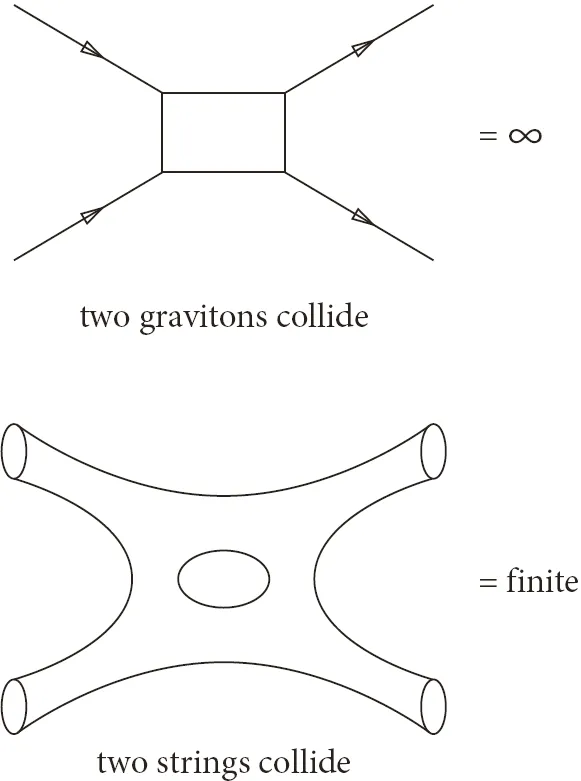
Bosons and fermions
All particles have spin, in two kinds.
| Type | Spin | Role | Examples | Named after |
|---|---|---|---|---|
| Bosons | integer: 0, 1, 2 | carry forces | photon and Yang-Mills (spin 1), graviton (spin 2) | Satyendra Nath Bose |
| Fermions | half-integer: ½, 3/2 | make matter | electron, neutrino, quarks (spin ½); built up into protons and neutrons | Enrico Fermi |
Bunji Sakita and Jean-Loup Gervais showed that string theory contains supersymmetry (SUSY), a symmetry that swaps bosons and fermions, now the largest symmetry ever found in physics. Every particle gets a superpartner ("sparticle"): selectron for the electron, squark for the quark, slepton for leptons.
In string theory the quantum corrections from fermions and bosons are equal in size and opposite in sign, so they cancel, leaving a finite result without renormalization. That would satisfy Dirac, who hated adding and subtracting infinities, and it is the source of the excitement: no other theory unifies gravity with the quantum and stays finite.
Einstein compared gravity to marble (smooth, geometric) and matter to wood (gnarled, irregular), and dreamed of a theory made entirely of marble. Supersymmetry turns marble into wood and back: bosons are marble, fermions are wood, two sides of one coin. There is no experimental evidence for it, yet its elegance captivates; Weinberg said the hidden symmetries suggest "nature is much simpler than it looks."
- Creates order out of disorder. The periodic table and the Standard Model arrange chaotic elements and particles neatly.
- Fills in gaps. Predicts missing elements and particles.
- Unifies the seemingly unrelated. Space and time, matter and energy, electricity and magnetism, fermions and bosons.
- Reveals unexpected phenomena. Antimatter, spin, quarks.
- Eliminates fatal consequences. Cancels divergences and anomalies in quantum corrections.
- Alters the classical theory itself. Quantum consistency of strings fixes the number of dimensions.
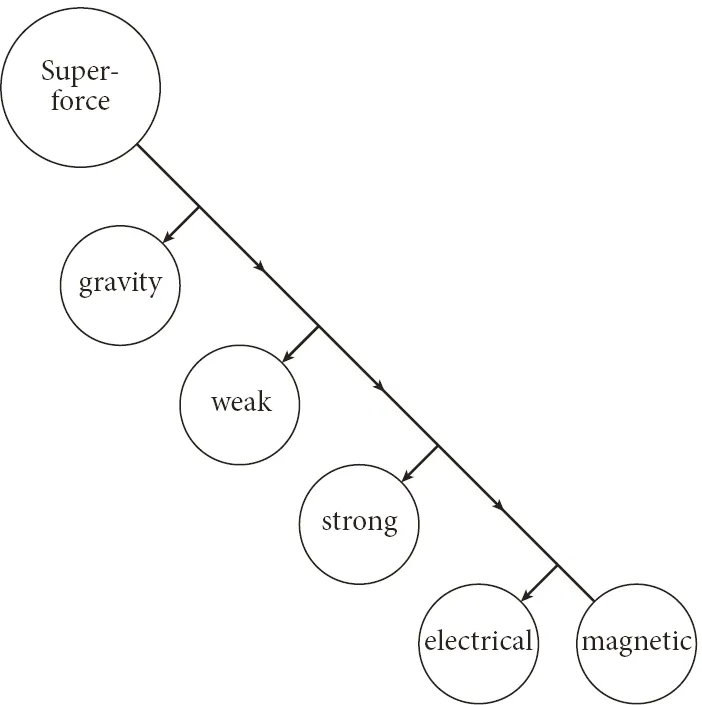
M-theory: the elephant in eleven dimensions
The theory still lacks its fundamental principle: no one can derive it from one equation. In 1995 a puzzle sharpened: there were five distinct, finite string theories in ten dimensions, differing in how their spins are arranged. Why five, if the universe is unique? Edward Witten found a hidden eleven-dimensional M-theory built on membranes (like sphere or doughnut surfaces), not just strings. There are exactly five ways to collapse an eleven-dimensional membrane into a ten-dimensional string, so the five theories are five faces of one theory.
The beach ball
- Let air out of a beach ball: it becomes a sausage, then a string. A string is a membrane with the air let out.
- An eleven-dimensional ball can be deflated into a ten-dimensional string in five ways.
The blind men and the elephant
- One touches the ear (flat, like a fan), one the tail (a rope, one-dimensional), one the leg (a drum, three-dimensional).
- Step back into a higher dimension and see the whole animal. The five string theories are ear, tail and leg; M-theory is the elephant, still not fully revealed.
The holographic universe
In 1997 Juan Maldacena showed that a supersymmetric Yang-Mills theory in four dimensions is dual, mathematically equivalent, to a string theory in ten dimensions (precisely, N = 4 super Yang-Mills and type IIB strings). By 2015 about 10,000 papers cited it, making it the most influential paper in high-energy physics.
- Symmetry: rearrange the parts of one equation and it stays the same.
- Duality: two entirely different theories turn out to be mathematically equivalent.
- Examples: Maxwell's E ↔ B duality (terms like E² + B² are unchanged when the fields rotate into each other, like Pythagoras); the web of dualities linking the five string theories in the same dimension; and Maldacena's unheard-of duality across different dimensions (10D gravity = 4D gauge theory).
The stakes are practical. Nobody has an exact solution of the Yang-Mills equations that bind quarks, yet if 4D gauge theory equals 10D string theory, quantum gravity may hold the key to the nuclear force, even to computing the proton's mass. Nuclear physicists, used to scoffing at higher dimensions, found themselves learning ten-dimensional string theory.
The hologram
A hologram encodes a 3D image on a 2D sheet; shine a laser and the image appears (R2-D2's Princess Leia, Disneyland's Haunted Mansion ghosts). Black holes may work the same way: the information in an encyclopedia thrown in is spread over the 2D event horizon. Perhaps our 3D world is itself a shadow of a real ten- or eleven-dimensional one, and our true selves move in higher dimensions as our shadows follow us on the pavement.
Because string theory keeps revealing unexpected layers, Kaku concludes that we do not yet understand its basic principles; it may not even be "about strings," since in eleven dimensions strings become membranes. Hence his claim that it is premature to compare it with experiment.
The great schism
Carl Sagan: "remarkable claims require remarkable proof." Kaku imagines Pauli's put-downs ("so confused that one could not tell whether it was nonsense or not"; "I do object when you publish more quickly than you think") applied to strings. Not since Solvay 1930 has physics split so deeply.
The skeptics
- Sheldon Glashow: years of effort by the best and brightest "have yielded not one verifiable prediction, nor should any soon be expected." He admits being "a dinosaur in a world of upstart mammals."
- Gerard 't Hooft: the hype resembles "American television commercials."
- Sabine Hossenfelder: beautiful theories "ruled out in the hundreds... wrong, wrong, wrong."
The defenders
- David Gross: Einstein would have liked the goal and the underlying geometrical principle, though "we don't really yet understand" it.
- Steven Weinberg: strings are like the North Pole on old maps, a gap every compass pointed to, until Robert Peary stood there in 1909.
- Dirac: strive "mainly for mathematical beauty"; he found his electron equation by playing with formulas, not data.
Four criticisms and Kaku's replies
- It is all hype.
- Beauty is an unreliable guide. Kepler nested the five Platonic solids like Russian dolls to fit the planets' orbits: beautiful and totally wrong. Keats's "Beauty is truth, truth beauty" is poetry, not method.
- It predicts too many universes (the landscape).
- It is untestable, the most serious charge.
On beauty Kaku concedes the point partly but argues that supersymmetry is not idle decoration: it is essential for cancelling quantum-gravity divergences, and while not every beautiful theory is physical, every fundamental theory found so far has had beauty or symmetry built in.
Can it be tested?
- Planck energy (the energy of gravitons where strings show directly): about 10^19 GeV, a quadrillion (10^15) times the LHC's energy.
- Direct test would need an accelerator the size of the galaxy.
- Each solution is a whole universe, so a direct test means making baby universes: "only a god can truly test the theory directly."
- Composition of the universe: atoms 4.9%, dark matter 26.8%, dark energy 68.3%.
Kaku's reply: science is mostly indirect, so look for echoes of the tenth and eleventh dimensions.
Echo 1: dark matter
Dark matter is invisible, has weight but no charge: held in your hand it would sift through your fingers, fall through the floor and the Earth's core, and oscillate between you and the far side of the planet. We know it exists because galaxies spin too fast: with only visible mass, Newton's laws say they should fly apart, yet they have been stable for billions of years. Either Newton fails on galactic scales or unseen mass holds them, the same logic that found Neptune.
A leading candidate class is WIMPs (weakly interacting massive particles), and Kaku's favorite is the photino, the photon's superpartner: stable, massive, invisible, neutral. Earth moves through a dark-matter wind; a photino striking a proton might create a detectable shower. About twenty groups run swimming-pool-sized tanks of liquid xenon and argon deep in mine shafts, shielded from cosmic rays. A match between measured dark-matter properties and string predictions "would go a long way."
Two technical slips. The usual supersymmetric dark-matter candidate is the neutralino, a quantum mixture of the photino, zino and higgsinos, not the pure photino. And xenon detectors do not look for a proton "shattering into a shower"; a WIMP would give a whole nucleus a tiny recoil of a few keV, detected as faint flashes of light and charge. Kaku also leaves the discoverers unnamed: Fritz Zwicky (1933) inferred missing mass in galaxy clusters, and Vera Rubin and Kent Ford (1970s) measured flat galaxy rotation curves.
Echo 2: the next colliders
- International Linear Collider (Japan): electrons on positrons in a straight tube; 12 years to build; clean collisions (electrons are elementary, protons are messy bags of quarks and gluons) make Higgs bosons at only 250 GeV.
- Circular Electron Positron Collider (China): start ~2022, finish ~2030, $5 to 6 billion, 240 GeV, 100 km ring.
- Future Circular Collider (CERN): eventually 100 TeV, about 100 km around.
These might make dark-matter particles or mini black holes, harmless ones with the energy of subatomic particles; cosmic rays far more energetic than any collider strike Earth constantly without harm.
Echo 3: the Big Bang as atom smasher
The microwave background is smooth with quantum ripples, but also has unexplained blotches. The CMB cold spot has been speculatively read as a bruise from a collision with a parallel universe; if confirmed, the multiverse would win converts.
Echo 4: gravitational waves and LISA
Einstein predicted gravitational waves in 1916, ripples at light speed like rings on a pond, but thought them too faint to find. A hundred years later (announced 2016) detectors in Louisiana and Washington State, giant L-shaped laser interferometers, caught two black holes colliding about a billion years ago. Rainer Weiss, Kip Thorne and Barry Barish won the 2017 Nobel. The space-based LISA (Laser Interferometer Space Antenna), three satellites in a triangle about a million miles on a side linked by lasers, might catch waves from the instant of the Big Bang, which could be "run backward" and compared with string-theory predictions of the pre-Big Bang universe, perhaps even an umbilical cord to a parent universe.
Echo 5: gravity at short distances
In N spatial dimensions, gravity falls off as 1/r^(N−1): inverse-square in three dimensions, inverse-cube in four. Newton's law has been tested over astronomical distances but rarely in the lab, where gravity is feeble. A deviation at short range would signal a hidden dimension. The first tabletop tests, in Colorado, found none, which "means only that there are no added dimensions in Colorado."
Several "tests" are more hopeful than Kaku lets on. Mini black holes at colliders require large extra dimensions (a specific 1998 scenario), not string theory in general, and the LHC has found none. The cold spot has mundane explanations (a statistical fluke or a foreground void) and no collision signature has survived scrutiny. LISA targets merging supermassive black holes; seeing a primordial background "from the instant of the Big Bang" would require exotic early-universe physics, not standard inflation. And Peary's 1909 North Pole claim is disputed; many historians doubt he reached it.
The landscape problem
The criticism that troubles theorists most: string theory has infinitely many solutions, each a well-behaved finite theory of gravity, most nothing like our universe; in many the proton decays into electrons and neutrinos and atoms cannot exist. Even if these are "only mathematical," the theory cannot say which universe is ours.
Kaku notes this is not unique: Newton's and Maxwell's equations also have infinitely many solutions, one for each light bulb or laser, fixed by initial conditions. But for the whole universe, supplying the Big Bang's conditions by hand feels like cheating: a theory of everything should contain its own initial conditions. So: can string theory predict our universe? Yes. Can it predict only ours? Probably not.
Anthropic answer
- Our universe is special because we are here to ask; among countless universes, ours has the conditions for intelligent life.
- Kaku's second-grade teacher said God put Earth "just right" from the Sun; with thousands of exoplanets mostly too hot or cold, we are simply on one that works.
- Explains fine-tuning: weaker nuclear force, no ignition; stronger, Sun burned out long ago; weaker gravity, Big Freeze; stronger, Big Crunch. Freeman Dyson: "the universe knew we were coming." The universe is a crapshoot, and we won the roll.
Kaku's answers
- Find the final equation first; it is premature to judge.
- Compute the constants: if the one-inch equation yields the ~20 Standard Model parameters (quark masses, couplings) from first principles, that is proof, with no new experiment needed.
- Stability selection: in Hawking's space-time foam, bubble universes live about a Planck time (10^-43 s); ours has lasted 13.8 billion years, so ours may be the stable survivor others decay into.
- Put it on a computer: as lattice QCD solves Yang-Mills (whose quark binding is still unproven after fifty years) on a grid, solve M-theory on a lattice. Though a supercomputer might answer, as in The Hitchhiker's Guide to the Galaxy, "forty-two."
Kaku's own view: excavating a pyramid
Working on strings since 1968, Kaku has seen about three revolutions; the theory is "evolving backward," revealing its mathematics before its principles. His image: brush sand off a pebble in the desert and find the tip of a pyramid; each floor holds new chambers and surprises, and we are not yet at the bottom floor. "The theory is smarter than we are." String field theory gives five one-inch equations in ten dimensions, but M-theory has no field-theory form, because membranes vibrate in too many ways; it remains scores of disjointed equations that miraculously describe one theory.
String theory is like the top of a mountain: clearly visible, yet it seems to recede the closer the climbers come.
David Gross, as paraphrased by KakuKaku answers the public's impatience with history: atomic theory took 2,000 years to vindicate, and black holes, predicted by Michell in 1783, were imaged only in 2019. The decisive evidence may come not from a giant collider but from someone finding the final mathematical formulation and computing the known constants of nature. He is "sure that we will eventually find the theory of everything."
- "Finite" is not fully proven. Perturbative finiteness is established order by order at low loops; an all-orders proof, and a non-perturbative definition outside special backgrounds such as AdS, are still missing.
- The landscape numbers. Kaku says "infinite"; the usual estimate is 10^500 or more flux vacua (some counts reach 10^272,000), and whether stable de Sitter (positive dark energy) vacua exist at all is disputed.
- Selective witnesses. The "dinosaur" Glashow is quoted, but the more systematic critiques of Peter Woit (Not Even Wrong, 2006) and Lee Smolin (The Trouble with Physics, 2006) go unmentioned.
- Computing the constants is Kaku's proposed proof, but no string vacuum has yet reproduced the Standard Model's spectrum, let alone its numbers.
- Supersymmetry not found. After LHC Run 2 and much of Run 3, gluinos are excluded below roughly 2 to 2.3 TeV and squarks of the first generations below about 1.5 to 1.9 TeV in simple models, pushing SUSY above the range where it most naturally solves the Higgs-mass puzzle.
- Dark matter still unseen. LZ's December 2025 result (417 live days) set world-leading WIMP limits and detected boron-8 neutrinos from the Sun's core: direct-detection experiments are entering the "neutrino fog," where solar neutrinos mimic the signal. Axions and other non-SUSY candidates now attract much of the effort.
- Colliders. The ILC remains unapproved; China left the CEPC out of its 2026 to 2030 five-year plan (October 2025); the CERN Council's 2026 strategy update named FCC-ee as the preferred successor, with any 100 TeV hadron stage decades away.
- Gravity at short range. The Eöt-Wash group (Seattle) has confirmed the inverse-square law down to about 50 micrometres (2020), ruling out the largest proposed extra dimensions.
- LISA adopted. ESA formally adopted LISA in January 2024, with launch targeted for the mid-2030s and arms of 2.5 million km.
- Exoplanets. Kaku's "four thousand planets" has passed 6,000 confirmed (NASA, 2025).
- The swampland. Since 2018 the swampland program (Vafa and others) argues many low-energy theories cannot come from strings, and conjectures that stable de Sitter vacua are impossible; DESI's hint of evolving dark energy (2025) has been read as mildly favoring this view, so it may turn the landscape problem into a testable prediction.
- Holography's dividend. Building on Maldacena, 2019 "island" and replica-wormhole calculations reproduced the Page curve, showing how information can leave an evaporating black hole, the strongest progress yet on Hawking's paradox. The "It from Qubit" program and ER = EPR link space-time geometry to quantum entanglement; the amplituhedron (Arkani-Hamed and Trnka, 2013) recasts particle scattering geometrically without space-time.
Kaku's lattice idea, "if you cannot solve it, put it on a grid and let the computer converge," is exactly how lattice QCD finally settled the muon g-2 dispute in 2025. For enterprise AI the analogy is honest: when a closed-form model of a business process is impossible, simulation with calibrated discretization beats elegant theory that cannot be computed, provided you prove convergence as the grid shrinks.
Finding Meaning in the Universe
A theory of everything would change daily life very little, since it operates at the Planck energy, but it would reshape the oldest philosophical questions: God, creation, why there is something rather than nothing, and whether the universe has a purpose. Kaku, an agnostic, argues that the final equation is unique because every alternative is mathematically inconsistent, that the universe arose as a quantum fluctuation in nothing, and that the multiverse reconciles Genesis with Buddhist Nirvana. Meaning is not handed down; we create it, and quantum gravity might one day be a lifeboat out of a dying universe.
What a final theory would change
Each unification launched a revolution: Newton → Industrial Revolution, Faraday and Maxwell → electric revolution, Einstein and the quantum → high-tech revolution. Suppose a theory of everything is found, tested and accepted. Its direct impact will probably be minimal: each solution is a whole universe, and it matters at the Planck energy, a quadrillion times the LHC's, the scale of creation and black holes, "not the affairs of you and me." The real impact is philosophical: time travel, what came before creation, where the universe came from. Thomas Huxley (1863) called "man's place in Nature and his relation to the Cosmos" "the question of all questions."
Einstein's two Gods
Einstein's secretary Helen Dukas said he was overwhelmed by letters asking the meaning of life and whether he believed in God. In 2018 his late private "God letter" sold at auction for $2.9 million, beyond the auction house's expectations.
The personal God
- The God you pray to, who smites the Philistines and rewards believers.
- Intervenes in human affairs.
- Einstein did not believe in this God.
Spinoza's God
- The God of order: a universe that is beautiful, simple, elegant, when it could have been ugly and random.
- Does not intervene.
- Einstein did believe in this God.
Einstein felt like a child in a vast library, hoping to read a few chapters. He left open whether the library has a librarian or an author, which becomes: if all laws follow from the theory of everything, where did that equation come from? And his driving question: did God have a choice in creating the universe?
Proving or disproving God
Hawking, an atheist, argued the Big Bang happened so fast there was no time for God to create anything. But in the multiverse, our universe is one bubble among bubbles being born continually; each began in an instant, but the whole multiverse could be eternal, so time may have existed before our Big Bang. The theory of everything therefore leaves God's existence open.
Of Thomas Aquinas's five thirteenth-century proofs, three are redundant; with Anselm's ontological proof there are three independent arguments: - Cosmological. Things move because something pushes them; the First Mover or First Cause is God. - Teleological. Complexity everywhere implies design, and every design a designer; the First Designer is God. - Ontological (Anselm). God is the most perfect being imaginable; a non-existent God would be imperfect, so God must exist.
- Ontological: refuted by Kant, because perfection and existence are different categories; being perfect does not imply existing.
- Teleological: answered by evolution: given enough time, chance plus survival of the fittest builds sophisticated designs from simpler ones. No first designer of life is needed.
- Cosmological: still standing. Run the film backward to the Big Bang; explain the Big Bang by the multiverse; explain the multiverse by the theory of everything; then where did the theory come from? "At this point, physics stops, and metaphysics begins." The theory's symmetry comes from mathematics, and physics is silent on where mathematics comes from.
Kant's refutation of the ontological argument appeared in the Critique of Pure Reason in 1781, the eighteenth century, not the nineteenth. Philosophers would also object that Kaku's treatment is thin: Aquinas's cosmological argument concerns sustaining causes, not a first event in time, so a beginning-less multiverse does not straightforwardly bear on it, and the teleological argument has a modern form, cosmic fine-tuning, that evolution does not touch (Kaku's own anthropic discussion in chapter 6 is the relevant reply).
Kaku's view: agnostic, but struck by the single page
Kaku finds it "utterly staggering" that all known physical law fits on one sheet of paper: Einstein's relativity in a line, the Standard Model taking most of the page. Its brevity makes it "hard to avoid the conclusion that this was all planned in advance," which he calls the strongest argument for God.
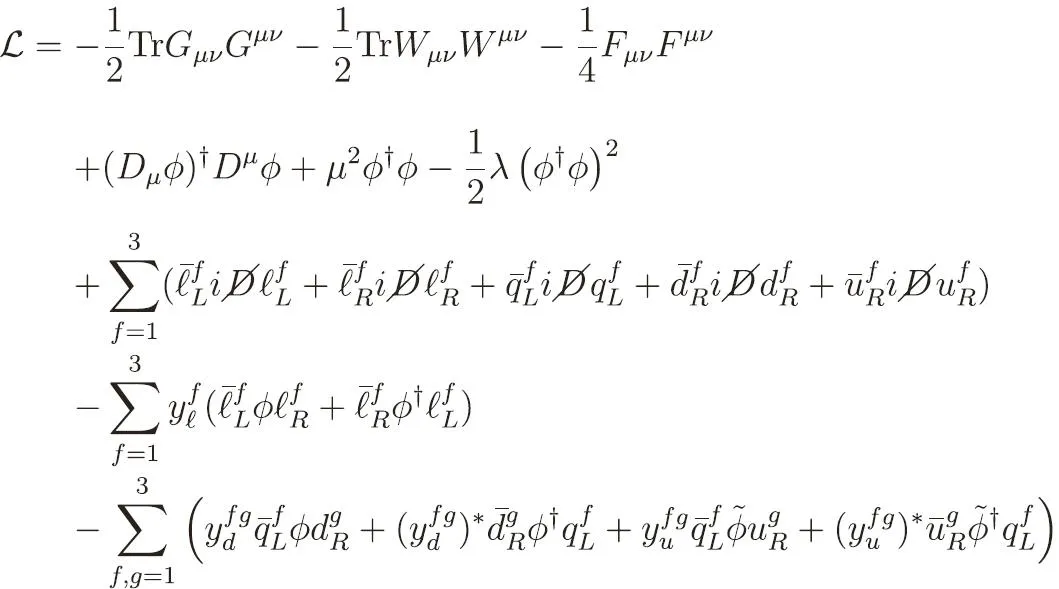
But science rests on what is testable, reproducible and falsifiable. Unlike literary criticism, which grows more complicated (what did James Joyce mean?), physics grows simpler and more powerful. Some things are beyond science, because you cannot prove a negative: you cannot prove unicorns do not exist on some unexplored island, nor that God does not exist somewhere unexplored. So in a hundred years people will still debate God, and Kaku is an agnostic: "it is presumptuous to make declarations" about the whole universe far beyond our instruments.
Did God have a choice?
Kaku's answer to Aquinas's First Mover: the theory of everything exists because it is the only mathematically consistent theory; any alternative eventually proves 2 + 2 = 5. Quantum corrections usually blow up (divergences) or ruin the symmetry (anomalies), and only one structure survives.
In string theory's quantum corrections the anomalies carry a factor (D − 10), where D is the number of space-time dimensions; set D = 10 and they vanish. With membranes in M-theory the factor is (D − 11). A fifteen-dimensional universe would contradict itself. So God had no choice: there is one consistent equation. It may have infinitely many solutions (the landscape), but the equation itself is unique.
Why is there something rather than nothing?
In quantum theory absolute nothing does not exist. Black holes are not black but gray and evaporate. You cannot reach absolute zero, because atoms in their lowest state still vibrate with zero-point energy; zero energy would mean zero uncertainty, which the uncertainty principle forbids. Even the vacuum froths with matter and antimatter popping in and out.
So the Big Bang was most likely a quantum fluctuation in Nothing. In the space-time foam, bubble universes far smaller than atoms constantly appear and vanish; occasionally one does not collapse but keeps expanding and inflates into a universe. Ours is a bubble that jumped out of the foam and kept going.
Beginning or no beginning: Genesis meets Nirvana
Kaku once saw a meditation society poster reproducing the supergravity equations with arrows labelling terms "peace," "tranquility," "unity," "love." He doubts that any term in a physics equation means love. Yet the theory may bear on meaning. Raised Presbyterian by Buddhist parents, he faced two opposite cosmologies.
Christianity
- An instant of creation. Georges Lemaître, Catholic priest and Big Bang pioneer, saw Einstein's theory as compatible with Genesis.
- The universe had a beginning.
Buddhism
- No creator God.
- No beginning or end; only timeless Nirvana.
The multiverse dissolves the contradiction: our universe had a beginning (Genesis), while Big Bangs happen all the time in inflation's bubble bath inside a larger eleven-dimensional hyperspace, a "Nirvana" with no beginning. One theory can hold both.
Two framing problems. Lemaître in fact resisted using the Big Bang to support Genesis, and in 1951 discouraged Pope Pius XII from presenting it as proof of creation, insisting science and faith stay separate. And Nirvana in Buddhism is a state of liberation from suffering, not a cosmological arena; mapping it onto eleven-dimensional hyperspace is Kaku's metaphor, not Buddhist doctrine. The term "space-time foam" was coined by John Wheeler (1955), not Hawking.
Meaning in a dying universe
Kaku's conclusion: we create our own meaning. A guru descending from the mountain with "the meaning of life" defeats the purpose; meaning comes from struggle and sacrifice. The threat is physics' death warrant: the second law of thermodynamics says everything in a closed system decays, so the universe should end in a Big Freeze, wiping out whatever meaning we assign.
- The key word is "closed." In an open system, energy from outside can reverse local decay.
- Air conditioner: cools chaotic hot air because a pump brings outside energy.
- Life on Earth: converts "hamburgers and french fries into a baby" in nine months, because sunlight pours energy in; evolution to higher forms depends on it.
- The cosmic version: our descendants, facing the universe's death, might gather enough positive energy to open a wormhole, stabilize it with negative energy from the Casimir effect, master the Planck energy, and escape to a warmer universe.
Quantum gravity then becomes a "cosmic interdimensional lifeboat," "our only salvation."
The lifeboat is speculation stacked on speculation: traversable wormholes need exotic negative energy in quantities no known process supplies (Casimir energy is minute and its use for this is unproven), a Planck-energy technology about 10^15 beyond the LHC, and a "warmer universe" to go to. It is a moving image, offered as hope rather than physics. Also, a second-law "escape" into another universe would itself be a larger closed system unless the multiverse is truly open.
The Flatlanders' jewel
Kaku's closing parable: in Flatland a perfect three-dimensional crystal shattered at the beginning of time and rained down in pieces. Over centuries the Flatlanders assembled two great pieces, gravity and quantum theory, that would not fit. One day a Flatlander suggested, to general laughter, lifting one piece into an imaginary third dimension; the pieces fitted and a shimmering jewel of perfect symmetry appeared. The symmetries we see in a sunset or a breeze are fragments of the original superforce symmetry broken at the Big Bang.
If we find the answer to that, it would be the ultimate triumph of human reason, for then we would know the mind of God.
Stephen Hawking, A Brief History of Time- "No choice" under pressure. Kaku's uniqueness argument (only D = 10 or 11 is consistent) stands, but the landscape and the swampland debate since 2018 show that uniqueness of the equation does not yet give uniqueness of our universe.
- Something from nothing. Quantum-cosmology models of creation "from nothing" (Vilenkin, Hartle-Hawking) remain unconfirmed; Hawking's final paper with Thomas Hertog (2018) argued that eternal inflation gives a much smaller, smoother multiverse than the bubble bath Kaku describes, and Hertog's 2023 book On the Origin of Time recasts the laws as evolving.
- The fate of the universe. If DESI's hint of weakening dark energy holds, the far future could differ from a simple Big Freeze, with some models allowing eventual recollapse, so the "death warrant" is less settled than Kaku assumed in 2021.
Kaku's "only consistent equation" argument is a constraint-satisfaction view of nature: impose enough hard consistency rules and the solution space collapses to one structure. Architects use the same move when regulatory, security and latency constraints leave only one viable design; the lesson is that strong constraints can do the work people expect from taste.
Main Points
The book's lasting value is its map of unification and its frank ledger of what string theory promises versus what it has delivered. Read it as the best case for strings by a lifelong insider, then weigh it against five years of null results and new ideas since 2021.
- Every unification has remade civilization: Newton's mechanics gave the machine age, Maxwell's fields the electric age, relativity and quantum theory the nuclear and information ages.
- Symmetry is the master key: invariance under rotation, Lorentz transformation, E ↔ B duality, quark reshuffling and boson-fermion exchange drove each advance.
- In quantum theory symmetry is not optional: it is what cancels divergences and anomalies, and in string theory it even fixes the number of dimensions.
- The Standard Model is a "theory of almost everything": SU(3)×SU(2)×U(1), about 20 hand-set constants, three generations, and no gravity.
- Quantizing gravity like the other forces fails: graviton corrections are infinite and cannot be renormalized.
- String theory's core claim: particles are vibrational modes, the graviton appears automatically, and supersymmetric cancellations make quantum gravity finite.
- Gravity does not pull; curved space-time pushes: the equivalence principle turns force into geometry.
- E = mc² explains starlight: fusing hydrogen loses a little mass as energy; fission chain reactions scale the same law into weapons.
- The quantum wave is a wave of probability (Born, Heisenberg): determinism ended, and the interpretation is still unsettled.
- Renormalization works but is ugly: infinity minus infinity yields QED's one-part-in-a-hundred-billion accuracy; Dirac never accepted it.
- Symmetry breaking via the Higgs field explains why today's forces look unrelated: we live inside one expanded bubble of broken symmetry.
- Black holes evaporate by Hawking radiation, raising the information paradox, now the main testing ground for quantum-gravity ideas.
- Spinning black holes and wormholes permit, on paper, shortcuts and time machines; exotic negative energy and stability are the obstacles.
- The universe had a beginning: the dark night sky (Poe), Hubble's expansion and the 2.73 K afterglow all say so; quantum ripples seeded galaxies.
- Inflation solves flatness and uniformity and implies a bubble-bath multiverse.
- Dark energy (68.3%) is physics' biggest failure of prediction: the naive quantum estimate is 10^120 too large.
- Most science is indirect, and any proof of a final theory will be too: dark matter, gravitational waves and short-range gravity are the candidate "echoes."
- The landscape problem is the deepest objection: one equation, near-countless universes, little predictive power; the anthropic principle is a contested answer.
- Kaku's proposed proof: derive the Standard Model's constants from the one-inch equation, perhaps by lattice computation.
- "God had no choice": if only D = 10 or 11 is self-consistent, the equation is unique even if its solutions are not.
- Something from nothing: the quantum vacuum is never empty, so a universe can bubble out of "Nothing."
- Meaning is made, not found; the second law dooms closed systems, and Kaku's hope is that quantum gravity could open an exit.
Frameworks & mental models
| Name | What it says | Use it when |
|---|---|---|
| Unification → revolution | Each merger of forces seeds a new technological age | Judging the long-run value of basic research |
| Symmetry as invariance | Beauty = what stays the same under transformation; it predicts gaps and new phenomena | Searching for structure in messy data or systems |
| Three tests for a final theory | Contain general relativity, contain the Standard Model, stay finite | Evaluating any quantum-gravity proposal |
| Equivalence principle | Acceleration and gravity are indistinguishable locally | Reasoning about free fall, orbits and GPS |
| Renormalization | Absorb infinities into measured parameters; low-energy physics is insensitive to unknown high-energy detail | Building effective models with unknown micro-foundations |
| Symmetry breaking (false → true vacuum) | A symmetric but unstable state decays into an asymmetric stable one | Explaining masses, phase transitions, inflation |
| Duality | Two different-looking theories are mathematically identical | Translating a hard problem into an easy equivalent |
| Holographic principle | Information in a volume is encoded on its boundary | Black-hole information, AdS/CFT, entropy bounds |
| Indirect evidence | Infer the unobservable from its effects (gold ring, spectra, rotation curves) | Any test of physics beyond direct reach |
| Anthropic selection | We observe a life-permitting universe because only such universes have observers | Interpreting fine-tuning in a multiverse |
| Open vs closed systems | The second law dooms closed systems; outside energy can reverse local decay | Thinking about life, evolution, cosmic fate |
| Crazy enough (Bohr) | After obvious ideas fail, the right theory must be radically different | Deciding when to abandon incremental fixes |
- An advocate's book. Kaku has worked on strings since 1968 and calls them "the only candidate"; rivals (loop quantum gravity, asymptotic safety, causal sets) get one dismissive endnote.
- Testability is not resolved. None of the proposed "echoes" is specific to strings: dark-matter particles, gravitational waves or a deviation in gravity would fit many theories, and the LHC has found no supersymmetry.
- Historical and numerical slips recur: Fraunhofer and Comte (wrong chronology), Rutherford's gold foil (backwards), Einstein's ETH and Nobel, GPS's three satellites, neutron half-life, critical mass, M87 numbers, Big Rip versus Big Freeze, Kant's century, Lemaître on Genesis.
- Omissions of people: Higgs, Englert and Brout; Zweig; Dyson; Lemaître and Friedmann for expansion; Zwicky and Rubin for dark matter; Perlmutter, Schmidt and Riess for acceleration; Payne for solar hydrogen.
- Philosophy is brisk: the treatment of Aquinas, Buddhism and the "unique equation" argument is suggestive but would not satisfy a philosopher.
- Strengths: a clear, chronological explanation of why unification matters; honest airing of Glashow, 't Hooft and Hossenfelder; and a vivid account of symmetry as physics' organizing idea.
Who's who
| Person | Why they matter here |
|---|---|
| Democritus / Pythagoras | Greek philosophers. Atoms; mathematics of vibration (strings' ancestor) |
| Isaac Newton | Physicist. First unification: heavenly and earthly gravity; calculus |
| Michael Faraday | Experimenter. Induction; invented the field concept |
| James Clerk Maxwell | Theorist. Unified electricity, magnetism and light |
| Albert Einstein | Theorist. Special and general relativity; failed unified field theory |
| Max Planck | Theorist. Quanta (1900); warned Einstein off gravity |
| Erwin Schrödinger | Theorist. Wave equation; What Is Life?; the cat; failed unified theory (1947) |
| Werner Heisenberg / Niels Bohr | Theorists. Uncertainty and Copenhagen; opponents of Einstein at Solvay |
| Paul Dirac | Theorist. Relativistic electron equation: spin and antimatter |
| Feynman, Schwinger, Tomonaga | Theorists. Renormalized QED (1949) |
| Murray Gell-Mann | Theorist. Quarks and their symmetry |
| Weinberg, Glashow, Salam | Theorists. Electroweak unification (Nobel 1979) |
| Yang and Mills; 't Hooft and Veltman | Theorists. Generalized Maxwell fields; made them finite |
| Karl Schwarzschild / Roy Kerr | Theorists. Black-hole solutions, static (1916) and spinning (1963) |
| Stephen Hawking | Theorist. Black-hole radiation, information paradox, chronology protection |
| Guth and Linde | Cosmologists. Inflation |
| Gamow, Alpher, Herman; Penzias and Wilson | Cosmologists / astronomers. Predicted and found the CMB |
| Veneziano, Suzuki, Nambu, Nielsen, Susskind | Theorists. Birth of string theory (1968 to 1970) |
| Green and Schwarz | Theorists. Anomaly-free superstrings (1984) |
| Edward Witten | Theorist. M-theory (1995) |
| Juan Maldacena | Theorist. Gauge/gravity duality (1997) |
| Glashow, 't Hooft, Hossenfelder / Gross, Weinberg | Critics / defenders. The string-theory schism |
| Michio Kaku | Author. String field theory with Kikkawa; agnostic; "God had no choice" |
The God Equation
INSIDE: THE IDEAS THAT MATTER MOST
- Every unification has remade civilization: Newton's mechanics gave the machine age, Maxwell's fields the electric age, relativity and quantum theory the nuclear and information ages.
- Symmetry is the master key: invariance under rotation, Lorentz transformation, E ↔ B duality, quark reshuffling and boson-fermion exchange drove each advance.
- In quantum theory symmetry is not optional: it is what cancels divergences and anomalies, and in string theory it even fixes the number of dimensions.
- The Standard Model is a "theory of almost everything": SU(3)×SU(2)×U(1), about 20 hand-set constants, three generations, and no gravity.
- Quantizing gravity like the other forces fails: graviton corrections are infinite and cannot be renormalized.
- String theory's core claim: particles are vibrational modes, the graviton appears automatically, and supersymmetric cancellations make quantum gravity finite.
About this book
The God Equation: The Quest for a Theory of Everything by Michio Kaku, 2021. This is a chapter-by-chapter study of the book, with summaries, maps, tables and diagrams; short quotations keep their page references. It is shared free for personal study, is not for sale, and is not endorsed by the author or publisher. Please read and buy the original.
Insight Editions · rajeshrmahapatra.com/insight-editions