Insight Editions · No. 116
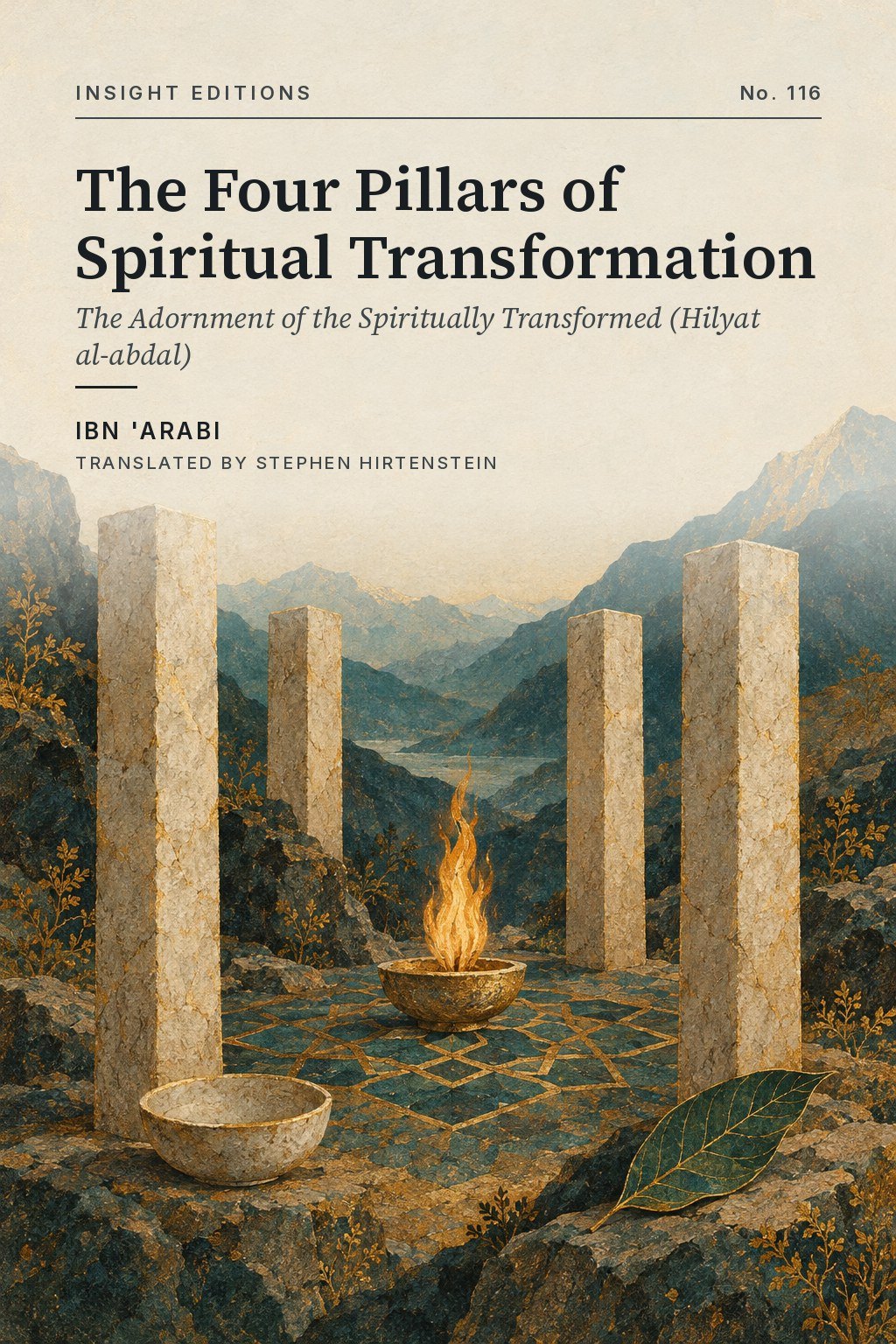
The Four Pillars of Spiritual Transformation
The Adornment of the Spiritually Transformed (Hilyat al-abdal)
Ibn 'Arabi · Translated by Stephen Hirtenstein
Ibn 'Arabi describes how silence, seclusion, hunger, and vigilance cultivate spiritual knowledge and transform the seeker into one of the spiritually realized.
A study guide to The Four Pillars of Spiritual Transformation by Ibn 'Arabi, translated by Stephen Hirtenstein. Shared free for personal reading; not for sale and not endorsed by the authors or publishers. Please read and buy the original.
Overview
The Four Pillars of Spiritual Transformation is Stephen Hirtenstein's translation and new Arabic edition of Ibn 'Arabi's Hilyat al-abdal, "The Adornment of the Spiritually Transformed". It explains how the abdal, the Substitutes, reach their state through four practices: silence, seclusion, hunger and vigilance. The volume adds a long introduction and a translation of Chapter 53 of the Futuhat on the same themes, for seekers who have not yet found a teacher.
What the file is. The Drive PDF is the complete book (Anqa, 2008): introduction (pp. 1-24), the translation (pp. 25-40), Appendix A on Futuhat Chapter 53 (pp. 41-48), Appendix B on manuscripts (p. 49), bibliography, index and the Arabic text. The English text runs to about 16,000 to 18,000 words with notes.
The book makes three claims. First, real practice serves an aim: the four disciplines matter only as preparation for Reality. Second, each pillar works on two levels: the beginner's outward practice and the inward condition of those "brought close". Third, each pillar yields its own knowledge: silence gives knowledge of God, seclusion of the world, hunger of Satan, vigilance of the self. When all four come together, a person is transformed.
Ibn 'Arabi wrote the treatise in an hour, in Ta'if in January 1203, at the request of two companions. It is short, practical and among his most copied works. The full title he gives is "The Adornment of the Spiritually Transformed and those spiritual knowledges and states that manifest from it".
Argument Map
Edition Map
Ten Ideas to Carry Away
- We only seek because we are sought.
- Discipline is worth only what it aims at: Reality alone.
- The Way and the Companion go together: the road and the One always present.
- Most seekers still act from self-interest, even in renunciation and worship.
- Silence of the heart outranks silence of the tongue.
- Thinking badly of yourself is wiser than thinking badly of others.
- Hunger is a tool, not a feat; overdone, it harms reason and health.
- Vigilance means living in the present moment.
- Each pillar gives a knowledge: God, world, Satan, self.
- Seek a teacher, and practise the nine principles until you find one.
Why this book still matters in practice
The Hilya is short enough to hold in one sitting and dense enough for a lifetime. Hirtenstein's introduction gives the abdal doctrine without burying the reader. The treatise itself sorts desire, tells the Marchena story, and walks each pillar on two levels.
Part 1. The Introduction
Hirtenstein's introduction, pp. 1-24: the two sides of the Way, how and where the treatise was written, who the abdal are, Ibn 'Arabi's meetings with them, the meaning of the title, the seven-part structure, and the four pillars of knowledge with their states, stations and fruits.
Epigraph: empty the place of reception
The introduction opens with words of Ibn 'Arabi preserved by his disciple Ibn Sawdakin in the Wasa'il al-sa'il. The wise make spiritual discipline, abandonment of this world and related practice their first condition, so that thought can be free enough to receive spiritual matters. "Spiritual things do not impart their effects unless the place [of reception] is emptied, made ready and turned towards their standpoint of view." Those who know God know that "the relationship of all things to God is [but] one single relation." Thus they witness Him in everything, and nothing veils them from Him.
The Way of the Lord and the way of the soul
Ibn 'Arabi began to give himself to the Way in earnest in 580/1184, among masters in Seville. Several had been disciples of Ibn Mujahid (d. 1178), whose rule was the hadith: "Reckon with yourselves before you are brought to the Reckoning". Every night he reviewed his day's thoughts, words and acts, what he had heard and similar things. After the nightfall prayer he secluded himself, repented of what needed repentance, and gave thanks for what called for gratitude. He then compared his actions with what the Sacred Law required. He slept and prayed in turns through the night, rising for his litanies (wird) according to the Prophet's custom. When the Almohad Sultan Abu Ya'qub asked whether he was lonely living alone, he answered: "Intimacy with God abolishes all loneliness , how can I be alone when He is always present with me?"
Two facets of the Way. Like all great masters, Ibn 'Arabi marks two complementary sides: on the one hand, belief and knowledge of how things are, based on God's Unity and the ways He has revealed Himself (destination and aim); on the other, practice, the means that start from where each person finds themselves, still ignorant of reality. Writers in every tradition have listed pitfalls and stages. Ibn 'Arabi's own "method" tends toward dialectic and paradox, as the Seville story shows.
Ibn 'Arabi plays on the rhyme of tariq and rafiq: God is both present now and the end of the journey. Even when we are full of chatter, lost in states, filled with wants, asleep and forgetful of our real nature, there remains a spark from the One "who is closer to [man] than his jugular vein" (Q 50:16). Turning toward Him is already a response, because we are sought. He exhorts: "Therefore, my brother, follow this Path and say 'the Companion, the Companion', so that you can join with Him without any separation, and separate from Him without any connection, and your shadows will always bow down to Him, morning and evening!"
Writing the treatise
The Hilyat al-abdal ranks among Ibn 'Arabi's most popular short treatises, attested by many manuscript copies. Two close companions in Mecca asked for it: Badr al-Habashi and Muhammad b. Khalid al-Sadafi. They wanted something "from which they could benefit concerning the Path of the hereafter (tariq al-akhira)".
Hirtenstein calls the Meccan years the fulcrum of Ibn 'Arabi's life. Born in Murcia in 560/1165, he spent some 36 years in the West (Maghrib), some 36 in the East (Mashriq), and about 3 in Mecca between them. Those three years both connect and differentiate the two halves of his life.
| In Mecca | What happened |
|---|---|
| The Youth with no name | Silent instruction; start of the Futuhat al-Makkiya |
| Vision of the Prophet | Confirmed as Seal of Muhammadian Sainthood |
| Dream of the two bricks | Encounter with the Ka'ba |
| Nizam | Love of women evoked; inspiration of the Tarjuman al-ashwaq |
| Marriage | Married Fatima b. Yunus; first son Muhammad 'Imaduddin almost certainly born in Mecca |
| Writing | Ruh al-quds, Mishkat al-anwar (hadith qudsi), Taj al-Rasa'il (eight love-letters to the Ka'ba), the Hilya |
The Hilyat al-abdal was written in 599 / January 1203 in Ta'if, "in the space of an hour", during a visit to the tomb of the Prophet's cousin 'Abd Allah Ibn 'Abbas (d. Ta'if AH 68 / AD 687), famed for Quran interpretation and prodigious memory. Ibn 'Arabi counts him among the singulars (afrad). He quotes Ibn 'Abbas on a verse about the seven heavens (Q 65:12): "If I were to explain its true meaning, you would stone me for being an unbeliever". Hirtenstein finds the place fitting: as Ibn 'Abbas explained revelation, Ibn 'Arabi explains a revelatory event from his own experience. Ta'if lies some two days from Mecca, known as the garden of the Hijaz for its climate and green fields. The Fihrist specifies the timing of composition.
In his own introduction Ibn 'Arabi says he wrote the booklet for his companions and entitled it "The Adornment of the Spiritually Transformed and those spiritual knowledges and states that manifest from it" (Hilyat al-abdal wa ma yazharu 'anha min al-ma'arif wa al-ahwal), that it may assist them and others on the Path to true happiness.
Who are the abdal?
Badal means substitute or successor, and also generous or noble. The hadith reports differ. One says the abdal in the community number 30 and resemble Abraham. Another, which 'Ali quotes when urged to curse the people of Syria, says they are in al-Sham (Greater Syria) and number 40: "whenever one of them dies, God substitutes him with another. By means of them God brings down the rain, gives victory over their enemies, and averts punishment from the people of al-Sham." A "Cave of the Forty" in Damascus is still linked to the replacement of one saint by another.
For Ibn 'Arabi, saints (awliya') are those taken in charge (tawalla) by God against four enemies: the passions (hawa), the self (nafs), the world (dunya) and the devil (shaytan). Knowing these "pillars (arkan)" is the knowledge spoken of by al-Muhasibi (d. 243/857), the Baghdad jurist and theologian nicknamed for introspective self-examination (muhasaba), teacher of Junayd, author of the Kitab al-Ri'aya. Ibn 'Arabi usually counts seven abdal, under the Pole (qutb), able to appear in two places at once. The term can also cover the elite: Pole, two Imams and four Supports (awtad), though more often the Supports are treated as a further category.
Each of the seven guards one of the seven climes (iqlim; Greek klima): zones of the inhabited world under the seven planetary bodies. Each follows a prophet of the seven heavens.
| Badal | In the footsteps of | Heaven | Planet |
|---|---|---|---|
| 1 | Abraham | 7th | Saturn |
| 2 | Moses | 6th | Jupiter |
| 3 | Aaron | 5th | Mars |
| 4 | Enoch (Idris) | 4th | Sun |
| 5 | Joseph | 3rd | Venus |
| 6 | Jesus | 2nd | Mercury |
| 7 | Adam | 1st | Moon |
John the Baptist alternates between Aaron and Jesus in some accounts. Each badal also serves one of seven Divine Names: 'Abd al-Hayy (Living), 'Alim (Knowing), Murid or Wadud (Desiring / Ever-Loving), Qadir (Powerful), Shakur (Grateful), Sami' (Hearing), Basir (Seeing). The first four Names correspond to the Supports (awtad); Hayy is like the Pole.
| Day | Prophet / figure | Aspect |
|---|---|---|
| Sunday | Idris | Hearing |
| Monday | Adam | Life |
| Tuesday | Aaron | Seeing |
| Wednesday | Jesus | Will |
| Thursday | Moses | Power |
| Friday | Joseph | Knowledge |
| Saturday | Abraham | Speaking |
Each holds one Quranic verse as his station. The seven verses trace a person's growth into a full human being, from "There is nothing like His Likeness" (Q 42:11) through the seas that would run out (Q 18:109), "within yourselves, do you then not see?" (Q 51:21), "O would that I were dust!" (Q 78:40), questioning the people of remembrance (Q 16:43), "I commit my affair to God" (Q 40:44), to the trust that man accepted (Q 33:72). Only the seventh, the trust, reaches the full rank of Adamic Man in the Divine image.
Seven letters stand for the abdal: alif for the Pole, waw and ya' for the two Imams, nun for the fourth Support, plus ta', kaf and ha'. The pronominal suffixes for I, you and he are aspects of one person. Hirtenstein reads that interchangeability as why the abdal can stand in for one another. A remark quoted from Gril: "the letters, like Man, receive the Divine Discourse."
Meetings with the abdal
The name, Ibn 'Arabi says, comes from their ability to be in two places at once, leaving a "substitute" behind. The root b-d-l means to change or substitute, as in "God will change their evil deeds by substituting for them good deeds" (Q 25:70).
Ibn 'Arabi comments on the last story: "So this person had manifested in the form of someone else." For him, Hirtenstein writes, the abdal are a coded reference to people transformed by spiritual ascension. They show what is possible for any human being, so how they reach that state matters to everyone.
The title and the structure
The title echoes Abu Nu'aym al-Isfahani's (d. 430/1038) great Hilyat al-awliya' ("Adornment of the Friends of God"), but this book holds no saints' tales beyond one anecdote; it is practical advice. Hilya means adornment or ornament (as in Q 16:14); its root gives tahalli, being qualified by Divine traits. For Ibn 'Arabi that always means showing true servanthood, "but most people do not understand this". Like a mirror image, the pure servant has nothing of his own, and is "one who can no longer be described or named at all".
Hirtenstein finds seven sections, matching the seven abdal:
| Section | Content |
|---|---|
| 1 | The request of the two companions |
| 2 | Forms of spiritual desire (irada): natural will versus desire for the Real (ikhlas); aspirants and verifiers (people of Ba' and Lam) |
| 3 | The Marchena anecdote with 'Abd al-Majid b. Salama |
| 4-7 | The four pillars, then the closing poem of exhortation |
In the Awrad prayer Ibn 'Arabi says "thus I am the desired and You are the Desirer". Section 2 distinguishes renunciation, trust, aspiration and worship still moved by self-interest from the gnostic who aims at union, and further distinguishes people of Ba' (bi-llah, "through God": wisdom and gnosis; God is the tongue by which they praise) from people of Lam (li-llah, "to God": governance and knowledge; God praises Himself by their tongue). Both are verifiers (muhaqqiqun). The hadith of supererogatory works underlies this: when God loves the servant, He becomes the hearing by which he hears, the seeing by which he sees. A four-line poem hints that the treatise was composed in clear insight (bayyina) and a Divine Address (khitab).
The four pillars of knowledge
Silence, seclusion, hunger and vigilance are the four pillars of spiritual knowledge (arkan al-ma'rifa). They parallel the five pillars of Islam (shahada, prayer, alms, fasting, pilgrimage), the first equating to spiritual knowledge, and Ibn 'Arabi's four pillars of religion: faith (iman), sainthood (wilaya), prophethood (nubuwwa) and envoyship (risala). The Futuhat treats each in a pair of chapters with its opposite: Chapters 80/81 (seclusion and leaving it), 96/97 (silence and speech), 98/99 (vigilance and sleep), 106/107 (hunger and abandoning hunger). These pairs show the non-stop movement through states and stations. In Chapter 53 he calls hunger and seclusion acts of commission, vigilance and silence acts of omission, and seclusion the "chief of the four". "Hunger includes vigilance, and seclusion includes silence."
"Man's reality is to be totally indigent, and one who is indigent cannot be self-important or proud."
"The servant returns to his own special quality, which is utter servanthood ('ubuda) in which Lordship does not compete. He is adorned (tahalla) by that, seated in the house of his potential reality, not his existence in Being."
From negative Names such as the Proud (mutakabbir) and the Compeller (jabbar), the servant secludes himself because of the harm those Names do when a human manifests their properties. Yet further is the one who secludes himself from all the Divine Names, since they belong to God alone, and returns to his native land: absolute servanthood. The terminology of adornment (tahalli) links this chapter to the Hilya's title.
Hirtenstein tabulates the Hilya's exposition (adapted from Valsan's introduction):
| Pillar | State (aspirant) | State (verifier) | Station / secret | Knowledge |
|---|---|---|---|---|
| Silence (samt) | Safety from harm | Intimate converse | Inspiration (wahy) | God (Allah) |
| Seclusion ('uzla) | Transcendent of all attributes | Divine Unity (wahdaniyya); Uniqueness (ahadiyya) | This world (dunya) | |
| Hunger (ju') | Humility, submission, servility, lack of self-importance, calm, indigence, no base thoughts | Delicacy, serenity, intimacy, non-worldliness, transcendence of ordinary humanness | Eternal Self-Subsistence (samadaniyya) | Satan (shaytan) |
| Vigilance (sahar) | Cultivating the moment | Cultivating the moment, assuming lordly attributes | Everlasting Self-Existence (qayyumiyya) | The self (nafs) |
Four, for Ibn 'Arabi, is the most perfect number, associated with the earthly and receptive principle (as against the heavenly and active): the four sub-lunar spheres, the four qualities of Universal Nature, the four categories of existence. Hirtenstein compares the four pillars to the Prophet's night journey (isra') from Mecca to Jerusalem, which came before the ascent through the heavens (mi'raj): an Abrahamic journey from the "place of Ishmael" to the "place of Isaac", preparation for those of "pure virtue and noble eminence".
Part 2. The Treatise
The Hilyat al-abdal itself, pp. 25-40: the request and date, wisdom and governance, the kinds of seekers, the night visitor at Marchena, the four pillars one by one with states, stations and knowledges, the transformation they bring, and the closing poem.
Date, place and purpose
Ibn 'Arabi "consulted God on Sunday night the 12th of Jumada II in the year 599", 27 January 1203 by the translator's note, at Al Mayyah in Ta'if, beside the tomb of Ibn 'Abbas. His companions Badr al-Habashi and Muhammad b. Khalid al-Sadafi al-Tilimsani had asked for guidance on the Path of the hereafter. Notes add that al-Habashi was his freed slave and companion for some 24 years, from the Fez ascension of 594/1197 until he died in Malatya in 618/1221. The treatise is to be "a chapter that brings together the various forms of spiritual desire (irada)". He writes of the "totality of the Words" and of being rescued by terror cast into the hearts of enemies.
Wisdom and governance, gnosis and knowledge
True governance (hukm) is the fruit of wisdom (hikma), and true knowledge ('ilm) is the fruit of gnosis (ma'rifa). There are two kinds of realized people. The knower belongs to God and is firmly existent (lillah qa'im); the gnostic exists through God and is halted (billah waqif). Those with wisdom and gnosis are the people of the letter Ba' (bi-llah, "through God"): God is the tongue by which they praise, the hand with which they take. Those with governance and knowledge belong wholly to God; they are the people of the letter Lam (li-llah, "to God"): God Himself renders His Own praise through their tongue. Emir 'Abd al-Qadir's reading of three kinds (through selves, through God, to God) is noted in the apparatus as a related map.
The renunciate abandons the world to be repaid; the truster hands over his affairs to get what he wants; the aspirant seeks ecstasy for relief; the worshipper strives from longing; the gnostic aims at union. The true knowers stay hidden in the Unseen, unknown to all of them. They have relinquished the illusion of possessing not only qualities and powers but even selfhood. "the Real God (haqq) only reveals Himself to one who can no longer be described or named at all."
"But what veils the Essence from Its own attainment is none other than you, though this be merely speaking in imagery."
"If the created world (kawn) did not exist, the Essence" would still be; the army of doubt and the swords of annihilation are among the images of the poem that closes this section.
A note explains Ibn 'Arabi's pun on 'ilal: an effect, a weakness or pretext, and a cause. What we take for causes are also effects, even defects, since God causes all. Natural irada differs from desire for the Real with sincerity (ikhlas).
The night visitor at Marchena
At Marchena of the Olives, some 45 km south-east of Seville, lived 'Abd al-Majid b. Salama, a Quran teacher, jurist who knew Quran and hadith by heart, and servant of the poor. One night, his head between his knees in prayer, he felt a presence. Someone pulled out his prayer-mat and put a palm-leaf mat in its place: "Perform your prayers on that!" The door was shut and locked, and he was afraid. (A note links a shut door to a heart impenetrable to admonition.)
Ibn 'Arabi calls the four the supports and foundations of the Way: "One who does not involve himself in them or is not deeply grounded in them strays from the Way of God". His aim in the pages that follow is to speak of them in four sections and of the knowledges and states they bestow.
Silence (samt)
There are two silences. Silence of the tongue means not speaking of anything other than God with anything other than God, altogether. Silence of the heart means refraining from every thought in the soul that concerns any created thing at all.
| Tongue | Heart | Result |
|---|---|---|
| Silent | Not silent | Lightens the burden |
| Silent | Silent | Inmost consciousness (sirr) manifest; Lord reveals Himself |
| Not silent | Silent | A speaker with the tongue of wisdom |
| Not silent | Not silent | Under Satan's domination and ridicule |
Silence of the tongue belongs to all seekers (salikun); silence of the heart to those brought close (muqarrabun), people of true contemplation. Its state is safety from harm for seekers and intimate converse with God for the close. One who maintains silence in all states has no speech except with his Lord. Complete inner silence of the tongue is impossible for a human being: thus if he withdraws from talk with others in favour of converse with his Lord, he becomes delivered, brought close, endorsed when he speaks, speaking according to what is proper and hitting the mark, for he speaks "out of God" ('an Allah). Of the Prophet: "And he does not speak out of passion." "Speaking according to what is proper is the fruit of silence", which is refraining from error. Conversing with other than God is an error in every case; speaking of other than God is bad in every respect.
God says: "There is no good in much of their secret discourse, except for one who enjoins alms-giving or what is equitable or promotes reconciliation amongst people" (Q 4:114), observing all their conditions. He also says: "They were given no order except to worship God, pure in devotion to Him" (Q 98:5). Connected to the state of silence is the station of Inspiration (wahy) in its various forms. "Silence bequeaths knowledge of God (Allah)".
Seclusion ('uzla)
Seclusion leads to silence, since one who withdraws from human company has no one to talk to, and that naturally yields silence of the tongue. The root '-z-l means to put aside or separate; for Ibn 'Arabi 'uzla may be external or internal. For aspirants (muridun) it means not associating physically with others. For verifiers (muhaqqiqun) it means having no contact with created things in the heart: their hearts have no room for anything other than the knowledge of God, the witness (shahid) of the Truth that remains after contemplation.
| Motive for seclusion | Rank |
|---|---|
| Fear of others' evil reaching you | Lowest: thinks badly of others |
| Fear of your evil reaching others | Higher: "thinking badly of oneself is better since you are more knowledgeable of yourself" |
| Preferring the company of the Master of the Sublime Assembly | Highest: "the most elevated of men is one who parts from himself out of preference for the company of his Lord" |
One who prefers seclusion to company prefers his Lord to what is other than Him. No one can know what gifts and mysteries God showers on the one who prefers his Lord. Seclusion never happens in the heart unless the heart feels estrangement from what one leaves and intimacy with the One toward whom one turns. Seclusion includes silence of the tongue, but not always silence of the heart, since one can still converse with oneself about other than God. That is why silence counts as a pillar in its own right.
One who makes seclusion their practice grasps the mystery of Divine Unity (wahdaniyya). This brings the secrets of Uniqueness (ahadiyya) insofar as it is a quality. The true spiritual state of seclusion, for seeker or verifier, is to be transcendent of all attributes. The highest seclusion is retreat (khalwa), a seclusion within seclusion, and its fruit is stronger. One who makes seclusion his practice must have certainty regarding God, until no thought distracts him beyond the confines of seclusion. If he lacks certainty, he should prepare until seclusion itself strengthens it by what is revealed there. "There is no other way." "Seclusion bequeaths knowledge of this world (dunya)".
Hunger (ju')
Hunger includes vigilance, as seclusion includes silence. There are two kinds: voluntary hunger for seekers, and obligatory (involuntary) hunger for verifiers. The verifier does not impose hunger on himself: his physical nourishment decreases in the station of intimacy (uns) and increases in the station of awe (hayba). When verifiers eat a large quantity, it is a sure sign of the force with which the lights of Reality rush upon their hearts in contemplation of Majestic Grandeur ('azama). Eating little is a sure sign of the converse they enjoy in contemplation of Intimacy. For seekers, more food shows distance from God, banishment from His Door, and enslavement to the covetous animal self; less food shows that "scents of Divine Generosity" are passing over their hearts, making them oblivious to bodily needs.
Hunger is, in every state, a means for seeker and verifier to attain a more exalted degree: for the seeker in states, for the verifier in mysteries. A note distinguishes this emptiness of the belly from ritual fasting (sawm); the root also suggests desire and longing, "being hungry for something".
Its state for seekers is humility, submission, servility, lack of self-importance, indigence, discretion, tranquil emotions and absence of base thoughts. For verifiers it is delicacy of feeling, serenity, intimacy, disappearance of worldliness and transcendence of ordinary human characteristics through Divine Might and Lordly Dominion. Its station is Eternal Self-Subsistence (al-maqam al-samadani), most elevated, characterized by mysteries, revelations and states. Ibn 'Arabi treats related matters in Mawaqi' al-Nujum, written in Bijaya in Ramadan 597 / June 1201, on the journey from Marrakesh to Tunis when he left the Maghrib for good. Ordinary physical hunger only "restores good temperament and brings bodily health, nothing more." "Hunger bequeaths knowledge of Satan".
Vigilance (sahar)
"Vigilance is the fruit of hunger, for an empty stomach drives away sleep." There is vigil of the eye and vigil of the heart. The heart's vigil is waking from the sleep of forgetfulness; the eye's vigil keeps up the night-converse with God. A note explains that sahar also describes a camel that gives milk freely and a spring that runs night and day, which suggests constancy tied to qayyumiyya. The heart's objective in vigil is contemplation of its previous vigil; to observe anything else is not possible. The benefit is keeping the heart active and ascending to high abodes in God's safekeeping.
Notes explain takhalluq, tahaqquq and ta'alluq as interrelated headings under which Ibn 'Arabi describes each Divine Name: relation to the Essence, realization of qualities, and manifestation of those qualities in the servant.
"Vigilance bequeaths knowledge of the self."
| Pillar | State (seeker / close) | Station | Knowledge |
|---|---|---|---|
| Silence | Safety from harm / intimate converse | Inspiration | God |
| Seclusion | Beyond all attributes | Divine Unity; Uniqueness | This world |
| Hunger | Humility / delicacy, serenity | Eternal Self-Subsistence | Satan |
| Vigilance | The present moment / plus lordly traits | Everlasting Self-Existence | The self |
The transformation
When knowledge turns around these four, God, self, world and Satan, the pillars of knowledge are complete. Then a person withdraws from the world and from himself, silences his inner voice so that his Lord can mention him, gives up bodily food and stays awake while others sleep. "his humanity is transmuted into angelic nature and his servanthood into mastery". His unseen reality becomes visible.
The closing poem
Speaking in his own voice, as one person to another rather than as the inspired author of the treatise, Ibn 'Arabi says:
Do not hanker after them in vain, for you cannot be one of them without emulating their spiritual states.
Silence your heart, seclude yourself from all that brings you down to other than the Beloved Master,
Be wakeful and hunger. Thus shall you be given their station and their company, in all your coming and going.
The House of Sainthood has various pillars, and our masters who live there are of the Substitutes.
Amidst silence and seclusion unceasing, hunger and vigilance, live those of pure virtue and noble eminence!"
He prays that God grant success in accomplishing these pillars and the grace of the abodes of perfection (ihsan): "Indeed He is the most Munificent Friend!"
Part 3. Before the Master: Futuhat Chapter 53
Appendix A, pp. 41-48: Ibn 'Arabi's chapter on what a seeker can do before finding a teacher, the nine principles of goodness, a second telling of the Marchena story and the dream of his wife; and Appendix B on the manuscripts.
Seek the teacher
The chapter opens with a poem: "If you haven't encountered a teacher, then be as someone who takes refuge, who disciplines his soul, and breaks up the night into portions for glorifying and reciting (quran), made sleepless by the One who faces him, the One who smites him down and revives him." The first duty of a newcomer is to seek a teacher until he finds one. A note reminds us that God is the true Master, and the human teacher is a means of bringing down His teaching. Meanwhile, nine practices should be undertaken: "the very principles of number", matching the nine celestial spheres. "These nine are the mothers of all good."
| Kind | Principles | Mode |
|---|---|---|
| Exterior four | Hunger, seclusion, vigilance, silence | Hunger and seclusion active (commission); vigilance and silence receptive (omission) |
| Interior five | Veracity, trust, patience, resolution, certainty | Received through Maryam's dream as the method of the People of God |
Hunger and seclusion are active, vigilance and silence receptive; again "Hunger includes vigilance, and solitude includes silence." Silence here means not speaking with people beyond what God commands, such as the recitation in prayer, and turning to the heart's remembrance. The four are to be practised so that one "becomes firmly established in the affirmation/realization of Unity (tawhid)". Seclusion is "the chief of the four" for the People of God.
The Marchena story, told again
'Abd al-Majid told Ibn 'Arabi the story in AH 586. In this version the visitor greets him by name, throws away his cloth prayer-mat, unrolls a small straw mat, then takes him out of the country through an unknown land and brings him home. Ibn 'Arabi himself then prayed on the mat.
The four, in practice
| Pillar | Inward | Outward guidance |
|---|---|---|
| Seclusion | Free the heart of attachment to family, wealth, children, friends; seclude also from negative Divine Names (Proud, Compeller) | Live where unknown, or by the coast or in mountains; if wild animals grow friendly and speak, withdraw from them too; hidden remembrance; a portion of the Quran each night |
| Silence | Stop the self's chatter about what one hopes for; "the heart cannot include both chatter and remembrance together" | Do not engage creatures, jinn or the highest assembly beyond what is required; answer only as required |
| Hunger | Eat only to stand in obligatory prayer | Sit for extra prayers rather than eat for strength; "Fullness leads to excess" |
| Vigilance | Be occupied with God in all one does; open the eye of the heart | Less water and food bring less sleep; sleep passes into the barzakh with whatever one fell asleep with |
Four knowledges and four enemies
From these four practices come the four knowledges which al-Muhasibi (AH 165-243 / AD 781-857) pursued above all: God, the soul, this world and Satan. Some put passion in place of God, quoting the verse "Iblis, the world, my soul and passion". A note quotes al-Muhasibi: "For 30 years my ear listened to nothing but my own conscience, but for 30 years since then my state has been such that my conscience has listened to none but God."
The Futuhat later treats each principle with its opposite in paired chapters: trust and abandoning trust (118/119), certainty and abandoning it (122/123), patience (124/125), veracity (136/137), a sign, Hirtenstein says, of the constant movement through states and stations.
The manuscripts
Osman Yahya lists 75 copies, and there are more. The base text is Yusuf Aga 4868, copied in Malatya in AH 602, about three years after composition and checked as correct. Yahya thought it was in Ibn 'Arabi's hand; Hirtenstein weighs this and suggests a disciple may have imitated his script. It belonged to Sadruddin al-Qunawi. Twenty-eight more were consulted, including Milli A571 (Konya, AH 668) and Veliyuddin 1800 (AH 707), the latter from a copy certified by the author in Damascus in AH 617. Printed in Damascus (1929) and Hyderabad (1948), the work was first translated into a European language by Michel Valsan (1950; republished 1992). The back cover of the Anqa edition reproduces the first page of Yusuf Aga 4868.
Synthesis
A revision map of the book: takeaways, frameworks, closer look, Who's Who, and connections that stay inside the Hilya's own spiritual and practice distinctions.
The Argument in Brief
The introduction sets the Way between two poles, the road (tariq) and the ever-present Companion (rafiq), and presents the abdal as people transformed by ascent, models of what any human can become. The treatise sorts seekers by the purity of their desire and names four pillars, silence, seclusion, hunger and vigilance. It gives each a two-level description, a state, a station and a knowledge, and ends with the transformation that follows when all four are united. Chapter 53 turns this into practical advice for those without a teacher, adding five inner principles received through Maryam's dream.
Takeaways
- We seek because we are sought; turning to God is already a response.
- Discipline is worth only its aim: Reality alone.
- Advice depends on the adviser's state; both "concern yourself with your Lord" and "with your soul" can be right.
- Self-review each night was the method of Ibn 'Arabi's early teachers.
- Most spiritual motives still serve the self.
- The Real shows Himself only to one who can no longer be described or named.
- Gnosis can be a veil, and wisdom a door where one stops.
- The abdal are a coded name for people transformed by spiritual ascent.
- Do not turn the hierarchy of saints into a system.
- Silence of the heart outranks silence of the tongue.
- Right speech is the fruit of silence.
- Suspect yourself before others: you know yourself better.
- The best seclusion is preferring God's company, not fearing people.
- Seclusion needs certainty, or must build it.
- Hunger is a tool, not a feat; overdone, it damages reason and health.
- Without a master, moderate: less food, ordinary fasting, one meal a day.
- Vigilance is the present moment.
- Silence, seclusion, hunger and vigilance yield knowledge of God, the world, Satan and the self.
- United, the four transform humanity into angelic nature and servanthood into mastery.
- First seek a teacher; until then practise the nine principles.
- The heart cannot hold chatter and remembrance together.
- Seclusion is chief of the four for the People of God.
- Adornment (hilya / tahalli) means true servanthood, not display.
- Desire without the requisite actions is vain hankering.
Frameworks at a Glance
| Framework | Elements | Use |
|---|---|---|
| Way and Companion | tariq and rafiq | Hold practice and aim together |
| Ladder of desire | Aspirants, Ba', Lam | Check one's motives |
| Tongue and heart | Four combinations | Diagnose silence |
| Three motives | Fear others, fear self, prefer God | Why withdraw |
| Pillar table | State, station, knowledge | Map progress |
| Nesting | Hunger includes vigilance; seclusion includes tongue-silence | See which pillar still needs its own work |
| Nine principles | Four outer, five inner | Practice without a teacher |
| Four enemies / knowledges | Passions, self, world, devil / God, self, world, Satan | Muhasibi's map under the pillars |
A closer look
Strengths. The book is compact, carefully edited and well annotated, with a new Arabic text based on the oldest manuscripts. The pillar table and Chapter 53 make it unusually practical. The introduction gives just enough of the abdal doctrine without burying the reader. Paired Futuhat chapters show the non-stop movement through states that the Hilya's succinctness can hide.
Limits. The abdal material, with saints walking on water and appearing in two places, will strain some readers, and the book presents it without critical distance. The ascetic advice reflects a medieval setting; Ibn 'Arabi's own warnings about health and the need for a master are essential. Counts of abdal (7, 12, 40, and the wider 365 / 589) are left deliberately unsettled.
Who's Who
| Person | Role in the book |
|---|---|
| Ibn 'Arabi (born 560/1165) | Author; wrote the Hilya in Ta'if, 599/1203 |
| Stephen Hirtenstein | Translator, editor, introduction |
| Badr al-Habashi (d. 618/1221) | Companion who requested the work; ~24 years |
| Muhammad b. Khalid al-Sadafi | Second requesting companion |
| Ibn Mujahid (d. 1178) | Master of nightly self-reckoning |
| al-'Uryani, al-Martuli | Seville masters: Lord and soul |
| Ibn 'Abbas (d. AH 68 / AD 687) | Prophet's cousin, at whose tomb it was written |
| al-Muhasibi (AH 165-243 / AD 781-857) | Source of the four knowledges; muhasaba |
| Abu Talib al-Makki | Named the four things in the Qut al-Qulub |
| 'Abd al-Majid b. Salama | Met the badal at Marchena (story told AH 586) |
| Mu'adh Ibn Ashras | The badal visitor |
| Maryam bt. Muhammad al-Bija'i | Wife; dream of the five principles |
| Abu Nu'aym al-Isfahani (d. 430/1038) | Author of the Hilyat al-awliya' |
| Abu Madyan; al-Sadrani | Bijaya link via the 586/1189 meeting |
| Sadruddin al-Qunawi | Owned the Malatya base manuscript |
| Michel Valsan | First European translator (1950); table source |
| 'Abd Allah b. Junayd | Near Ronda; denied qayyumiyya until persuaded |
Applying It
- Reckon nightly, as Ibn Mujahid did: review the day, repent, give thanks, compare with what the Law requires.
- Check motives: am I renouncing to be rewarded, trusting to get my wish, seeking ecstasy for relief?
- Speak from silence: let right speech come from refraining; prefer converse with the Lord.
- Rank your withdrawal: fear of others, fear of harming others, or preference for God's company?
- Find a teacher; meanwhile moderate hunger, do not punish the body, keep the five inner principles.
Discussion Questions
- Why are both "concern yourself with your Lord" and "concern yourself with your soul" correct?
- Why does gnosis count as a veil?
- Why is suspecting oneself higher than suspecting others?
- How do the four knowledges fit the four pillars?
- What should a modern reader make of the abdal stories as the book presents them?
- Why insist on a master for hunger but treat silence as available to all seekers?
- How does the isra' / mi'raj analogy change the reading of the four as mere techniques?
- Why does Chapter 53 call seclusion the chief of the four?
Glossary
| Term | Meaning in this book |
|---|---|
| Abdal (sing. badal) | Substitutes; the spiritually transformed; also generous, noble |
| Hilya | Adornment; visible qualities; root of tahalli |
| Tahalli | Being qualified by Divine traits as true servanthood |
| Irada | Spiritual desire or will (natural vs desire for the Real) |
| Ikhlas | Sincerity; desire for the Real alone |
| Murid / salik | Aspirant, seeker |
| Muhaqqiq / muqarrab | Verifier; one brought close |
| Ba' / Lam | Through God (bi-llah) / to God (li-llah) |
| Term | Meaning in this book |
|---|---|
| Samt | Silence (tongue and heart) |
| 'Uzla | Seclusion (external or internal) |
| Ju' | Hunger; emptiness of belly (distinct from sawm) |
| Sahar | Vigilance, wakefulness at night; also free-flowing spring |
| Khalwa | Retreat: seclusion within seclusion |
| Arkan | Pillars (of knowledge, of religion, of Islam) |
| Hal / maqam | Spiritual state / spiritual station |
| Ma'rifa | Gnosis, spiritual knowledge |
| Term | Meaning in this book |
|---|---|
| Hukm / hikma | Governance, authority / wisdom |
| 'Ilm | Knowledge (fruit of gnosis) |
| Takhalluq | Assuming the traits of the Names |
| Tahaqquq | Realization of the qualities of a Name |
| Ta'alluq | How a Name relates to the Essence |
| Samadaniyya | Eternal Self-Subsistence (station of hunger) |
| Qayyumiyya | Everlasting Self-Existence (station of vigilance) |
| Wahdaniyya / ahadiyya | Divine Unity / Uniqueness |
| Term | Meaning in this book |
|---|---|
| Tariq / rafiq | The Way / the ever-present Companion |
| Qutb / awtad / afrad | The Pole / Supports / Singulars |
| Nuqaba' | Chiefs; alternate count of abdal (12) |
| Barzakh | Intermediate world, entered in sleep |
| Dhikr | Remembrance |
| Muhasaba | Self-examination (al-Muhasibi) |
| Isra' / mi'raj | Night journey / heavenly ascent |
| Tawhid | Affirmation / realization of Unity |
| Wahy | Inspiration (station of silence) |
| 'Ubuda | Utter servanthood |
| Term | Meaning in this book |
|---|---|
| Irada / ikhlas | Spiritual desire; sincerity as desire for the Real alone |
| Muridun / salikun | Aspirants / seekers on the path |
| Muhaqqiqun / muqarrabun | Verifiers / those brought close |
| Sirr | Inmost consciousness, manifest when tongue and heart are silent |
| Shahid | Witness of the Truth that remains after contemplation |
| Uns / hayba | Intimacy / awe (stations that change a verifier's appetite) |
| 'Azama | Majestic Grandeur, in contemplation of which appetite may rise |
| Takhalluq rabbani | Assuming lordly attributes (verifier's increase in vigilance) |
| Tawalla | Being taken in charge by God (definition of the saint) |
| Iqlim | Clime; zone of the inhabited world under a planet |
| Haykal | Corporeal habitation (Kirmani story) |
| Bayyina / khitab | Clear insight / Divine Address (composition of the treatise) |
| Sawm | Ritual fasting; distinct from ju' (hunger) in the treatise |
| Nuqaba' | Chiefs; alternate count of abdal (twelve) |
| Afrad | Singulars (Ibn 'Abbas named among them) |
About this book
The Four Pillars of Spiritual Transformation: The Adornment of the Spiritually Transformed (Hilyat al-abdal) by Ibn 'Arabi, 2008. This is a chapter-by-chapter study of the book, with summaries, maps, tables and diagrams; short quotations keep their page references. It is shared free for personal study, is not for sale, and is not endorsed by the author or publisher. Please read and buy the original.
Insight Editions · rajeshrmahapatra.com/insight-editions