Insight Editions · No. 15
The Buddha Smiles
Humor in the Pāli Canon
Ṭhānissaro Bhikkhu
The comic stories and sharp wit in the discourses, and what the humor teaches.
© 2015 Ṭhānissaro Bhikkhu. CC BY-NC 4.0
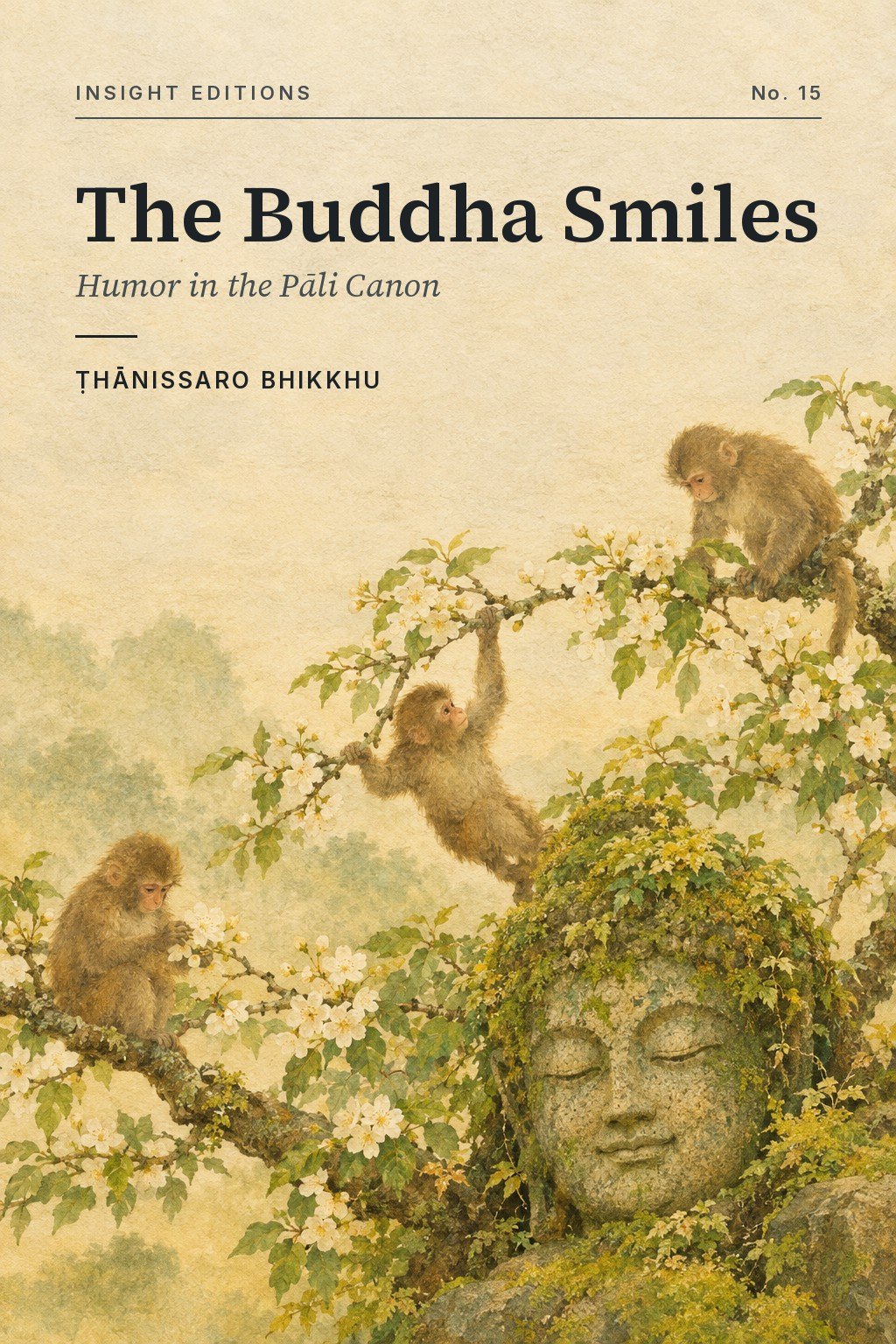
Humor loosens attachment and encourages skillful practice.
87 insertions; 23 terms; 14 citation keys.
The Book in Brief
Humor can loosen attachment and make demanding practice attractive. Ṭhānissaro Bhikkhu reads this selection from the Pali Canon through two complementary uses: satire creates distance from what once seemed desirable; joy gives energy to develop the path. The point is neither compulsory cheerfulness nor the claim that laughter itself awakens anyone.
The nine Introduction topics explain how to read the nine anthology chapters; they are not the chapters themselves. The collection preserves 74 passages, including extended dialogues, verse, similes and Vinaya origin stories.
The first six anthology chapters puncture glamour without flattening every scene into ridicule. Heavenly rank fails to guarantee knowledge; sensual eloquence meets detachment; royal power proves vulnerable. Rival positions are tested through their reasoning, while human foibles and psychic displays reveal how familiar weaknesses persist in impressive settings. The reported voices include the Buddha, awakened disciples, ordinary speakers and the narrator's arrangement of events.
The final three chapters shift toward the pleasures and benefits of training. Compassion, goodwill, appropriate attention, correction, solitude and persistence receive memorable forms. A medical bargain and Nanda's promised nymphs introduce temporary strategies; Gavesin's wish to excel ends as a wish for his followers' shared release. These endings matter as much as their amusing beginnings.
The details carry the argument. Pāyāsi's repeated tests expose a method problem; Saccaka's boasts precede a specific cross-examination; paired lists distinguish eight excuses from eight reasons to act.
Read the humor with attention to voice and limits. The compiler interprets motives and literary effects; canonical narration reports miracles and karmic histories; translator notes explain contexts.
Chapter map
| Ch | Title | In one line |
|---|---|---|
| Intro | Introduction | Nine topics explain voices, cultural context and the two uses of humor. |
| 1 | 1 : Devas, Brahmās, & Other Non-human Beings | Heavenly prestige, misunderstanding and ordinary standards of conduct. |
| 2 | 2 : Sensuality | Sensual language meets detached reply and a reversed wedding custom. |
| 3 | 3 : Palace Life | Love, responsibility, bodily limits and the risks of royal proximity. |
| 4 | 4 : Opposing Viewpoints | Tests, analogies and dialogues expose flawed views and attachment to them. |
| 5 | 5 : Human Foibles | Pride, excuses, resistance to correction and the consequences of misconduct. |
| 6 | 6 : Psychic Powers | Psychic displays leave familiar weaknesses and social consequences intact. |
| 7 | 7 : Advantages of Dhamma Practice | Compassion, goodwill, mindfulness, solitude, persistence and careful use. |
| 8 | 8 : Dhamma Strategies | Temporary inducements end through a cure or release from clinging. |
| 9 | 9 : The Buddha Smiles | Gavesin and the 500 move from imitation toward shared release. |
| Ref | Glossary | All 23 definitions, including contextual qualifications and Sanskrit forms. |
| Ref | Abbreviations | Fourteen Pali citation keys and the Royal Thai Edition basis. |
Introduction
Humor can train discernment by loosening attachment and making good practice attractive. Ṭhānissaro Bhikkhu finds both satire and joy in the Dhamma in a Canon often dismissed as humorless. His nine introductory topics explain the cultural setting, narrative techniques and practical purposes of the nine anthology chapters that follow.
This Introduction paraphrases Ṭhānissaro's interpretive essay. Its nine numbered topic subsections are not the anthology chapters: they prepare the reader for those chapters. His explanations of motives, literary conventions and the Buddha's unspoken thoughts remain compiler interpretations; the later numbered passages preserve the separate voices of canonical speakers, narrators and translator notes.
Why readers miss the humor
The reputation for humorlessness has real textual grounds. In AN 3:107, excessive laughter that exposes the teeth is called childish, while a monk's joy in Dhamma should issue in a smile. MN 61 instructs Rāhula not to lie deliberately even as a joke. In Sk 51, a former actor's joke about the Saṅgha prompts a monastic prohibition on jokes about the Buddha, Dhamma or Saṅgha. Dhp 146 asks why people laugh and rejoice while burning and surrounded by darkness instead of seeking a lamp. The Buddha also rarely smiles in the Canon, and the occasions are never hilarious.
Yet the Canon can be funny without announcing a joke. The Introduction quotes the monks of Āḷavī, whose unsponsored, privately intended huts had no standard measurements and never reached completion. Their incessant requests ran through men, labor, oxen, wagons, machetes, axes, adzes, spades, chisels, rushes, reeds, grass and clay. Harassed villagers fled, took other routes, turned away or shut their doors when monks appeared. Eventually they fled even from cows, mistaking them for monks. The accumulation of requests and the final mistaken recognition do the comic work.
Subtle, dry, deadpan humor is easy to overlook when a reader expects broad jokes signaled in advance. Translators can compound the problem by treating a humorous passage as solemn instruction and rendering it in flat, pedantic language. The absence of a modern joke format is not the absence of wit.
Four sources of humor and two uses of discernment
Wise speech is true, beneficial and timely; right speech avoids falsehood, divisiveness, harshness and idle chatter. Ṭhānissaro says canonical humor follows these standards for the most part, unlike humor based on exaggeration, nationalism, racism or mere silliness. The qualification matters because the Canon reports several kinds of people, not only the Buddha.
| Source of humor | Distinction the reader must retain |
|---|---|
| The Buddha's reported speech | Usually the most subtle and sophisticated use. |
| Awakened disciples' reported speech | Another source, not automatically the Buddha's own words. |
| Ordinary lay or monastic speakers | May be sarcastic or crude; quotation does not make their style a universal standard. |
| The canonical compilers' narration | Selection, detail and arrangement can make the situation funny even without a speaker telling a joke. |
Style and function vary with the speaker, but the compilers selected what to preserve. Even a crude or sarcastic quotation can therefore be examined for its larger purpose in the narrative. Ṭhānissaro sees a general purpose in developing discernment, through two different capacities.
First, discernment gains distance from what previously held the mind. SN 35:80 connects liberating knowledge with seeing things as separate. Dhp 28 pictures the heedful wise person on a high tower of discernment or a mountain summit, free of sorrow while observing the sorrowing, heedless crowd below. That distance need not be coldness: compassion continues, but without becoming entangled in the causes of sorrow.
Kamma gives this compassion its limits. One can help people act for happiness, but cannot make them accept help; their freedom to resist calls for equanimity toward their choices. Ṭhānissaro connects this perspective with the Buddha's awakening-night vision of beings dying and being reborn according to their actions. The vast view gave him distance from the activities of his own mind and supported release. A good-humored recognition that an attachment is foolish can make the same movement away from attachment less painful.
Six topics use irony and satire to foster disenchantment: devas, Brahmās and other non-human beings; sensuality; palace life; viewpoints opposed to the Dhamma; human foibles and weaknesses; and psychic powers. These are attractive or dangerous especially while practice remains weak. Humor reveals less substance behind the glamour than the audience had assumed. Its tone ranges from gentle to biting, including the Buddha's comparison of brahmans with dogs. Ordinary people's sarcasm can also show that awakening is not required to recognize foolish conduct or ideas.
Second, discernment motivates beneficial action that initially looks unattractive. Three topics foster joy in the Dhamma: the advantages of practice, Dhamma strategies, and stories that make the Buddha smile. All three demonstrate strategic discernment, so in that sense all belong to the second of those three categories, Dhamma strategies. AN 4:115 links this capacity with mature stamina, persistence and effort. Similes, parables, stories and analogies can draw a warm or knowing smile that helps someone begin and sustain the path.
Satire makes unskillful attachments less attractive; joy in the Dhamma makes skillful effort more attractive. Both support the fourth tradition of the noble ones, delighting in abandoning unskillful qualities and developing skillful ones (AN 4:28), and the breath-meditation task of gladdening the mind (MN 118).
Why the long details matter
Not every canonical joke aims at a quick payoff. Ṭhānissaro cites T. W. Rhys-Davids, a British scholar writing in the late 1800s, who called the love of a long, detailed comic tale an American sense of humor. The compiler thinks Rhys-Davids probably had Mark Twain's patient, observant narration in mind. This identification is an inference, not a supplied bibliographic reference.
The enjoyment lies partly in the telling itself, especially in the Dīgha Nikāya or Long Collection. A monk seeking an answer from Great Brahmā visits every intervening heavenly rank, including beings absent from the standard list. Two fortune-seekers moving through abandoned villages do not jump directly from hemp to gold: each commodity of increasing value appears in turn. The first sequence shows that an impressive hierarchy can be ignorant throughout; the second makes stubborn attachment visible through repeated opportunities to change. These repetitions carry argument and characterization, not dispensable decoration.
Much of it addresses persistent human tendencies, but some jokes depend on subtle wording or ancient cultural conventions. The nine discussions below supply the background needed to recognize them.
1. Devas, Brahmās, & other non-human beings.
Ṭhānissaro contrasts the Buddha's cosmos with religions that treat supernatural beings as worthy of highest worship and their revelations as supreme knowledge. In his account of the Buddhist view, devas and Brahmās enter and leave their states according to kamma, often without special insight. Their knowledge is inferior to the Buddha's. The satire therefore has two protective uses: a meditator who encounters such beings should not believe everything they say, and a claim to divine origin should not by itself establish a religion's truth.
These satires overlap with the critique of opposing views, particularly Brahmanism's claim to a divine creator as its source. In §1.1, the compiler reads the monk's question as asking, in effect, how far the physical universe extends. Great Brahmā answers with his creator titles rather than an explanation. Like Yahweh in the Book of Job, in Ṭhānissaro's comparison, he invokes status; unlike Job, the monk refuses to be cowed. The monk keeps distinguishing the question asked from the claim offered. At last Brahmā takes him aside and admits ignorance, unwilling to disappoint his admiring retinue. The compiler calls this vanity and fraud, and points forward to §4.3, where the creator claim rests on a misunderstanding of cosmic development.
In §1.2, a devatā attempts to seduce a bathing monk and fails to understand his reversals of her own language. When he takes her to the Buddha, the teachings she receives are much higher than she can grasp. Ṭhānissaro reads the encounter as a lesson that punctures her pride: after lofty Dhamma, she can retain only the elementary resolve to avoid evil and sensuality.
The satire does not always target the divine visitor. In §1.3, a monk asks a devatā to keep warning him whenever he misbehaves. She refuses the role of hired hand and returns responsibility for his conduct to him. Access to devas confers no entitlement to personal favors. Rejecting worship does not cancel ordinary manners and respect.
2. Sensuality
The two most elaborate erotic dialogues use literary skill against lust rather than to encourage it. Ṭhānissaro explains this through rasa, the savor an audience enjoys at an aesthetic distance from a character's emotion. Emotion and savor differ: a character's grief can hurt while the audience enjoys the artistic experience of it. Classical theory distinguished eight principal savors, including the comic. Although theorists disagreed about combinations, the compiler says they generally joined the comic to the sensitive or erotic, not the horrific: humor could intensify erotic pleasure.
The Canon reverses that partnership. In §2.1, Sakka sends the gandhabba Pañcasikha to put the Buddha in a receptive mood. Gandhabbas have a reputation here as the heavenly world's adolescents, preoccupied with music and sex. The musician sings beautifully of his longing for SunDazzle, comparing his fixation with the Buddha's one-pointed jhāna and the growth of his desire with the merit of a gift to an arahant. He fails to see either the mismatch in his comparisons or the impropriety of presenting them to the Buddha.
The Buddha responds with technically informed courtesy about the performance. His palace upbringing makes that musical knowledge unsurprising. The compiler finds part of the joke in imagining the Buddha's unspoken thoughts while he politely indulges someone so deluded; those thoughts are Ṭhānissaro's invitation to interpretation, not words reported in the discourse.
In §2.2, a libertine's sophisticated poetry creates the very sensual atmosphere that the nun Subhā abruptly destroys. He finally says that her eyes are what he loves most; she removes one and offers it to him. The conjunction of horror, detachment and comic literalness violates the expected separation of comic and horrific savors. Ṭhānissaro suggests that she is inwardly amused by her own bravado, while acknowledging how easily a reader misses the humor. The canonical poem itself supplies the action, not a report of her laughing.
Refinement is therefore not identical with refined sensual taste. Human culture may judge sophistication by appreciation of excellent wine, food or art, but these passages depict a rejection of sensuality by someone acquainted with palace pleasures and still greater divine pleasures. For the compiler, the rejection arises from seeing their vanity, not from ignorance or a lack of cultivation. §2.3 is formally more conventional but also subversive: an origin story converts the wedding custom of throwing dust, ashes and cow dung over a bride into a remnant of disgust at sexual intercourse.
3. Palace life
Palace pleasures conceal danger, and kingship is less enviable than it looks. The danger extends to kings, residents and visitors. Ṭhānissaro applies these satires more broadly to today's rich, powerful and famous, and to people who live close to them. He explains the often gentle tone partly through the Saṅgha's need for royal goodwill to exist; gentleness can make the satire easy to miss.
The intimate exchange in §3.1 disappoints a royal lover's expected reassurance. The compiler imagines Pasenadi wanting Mallikā to say that she loves him more than herself, the answer a conventional romantic film would supply. Instead she says no and gets him to admit the same about himself. Her truthfulness defeats both the king's expectations and the fantasy that power can secure the precise love one wants.
Other scenes expose age, humiliation and danger. In §3.4, the 80-year-old king sometimes cannot place a foot where he intends, yet would conquer more territory, even beyond the ocean. Ṭhānissaro calls him still a child from a Dhamma standpoint and reads his attendants as eager for his death; the later canonical scene reports their predictions of his death without explicitly stating eagerness. §3.5 gives even Bimbisāra, usually depicted as wiser than Pasenadi, no protection from his wives' crude teasing. §3.6 shows how serving a palace can put the physician Jīvaka's life in danger.
The extended visit in §3.2 makes royal responsibilities into obstacles to learning. Pasenadi serves as messenger for Somā and Sakulā, whom the Introduction calls his wives, misses the Buddha's gentle joke about that service, moves restlessly among subjects and sometimes asks the wrong question. He can pronounce the answers reasonable without reaching deeper certainty. His court supplies misinformation, competing accusations and thoughts of expulsion; Ṭhānissaro suspects that the king himself is the imaginable target of such political preoccupations. Sañjaya's alleged role in spreading the misinformation remains unresolved, leaving suspicion in place. The audience ends when a courtier says it is time, not when the king's questions are exhausted. Position becomes a spiritual liability rather than an asset.
4. Viewpoints opposed to the Dhamma
Ṭhānissaro rejects the assumption that every ridicule of another teacher is partisan wrong speech. On his reading, reporting X's misconduct to Y for Y's genuine welfare is compassionate warning, not divisive tale-bearing. If a wrong view leads its adopter to a bad destination, compassion can require exposing its error. Internal inconsistency and the behavior of its proponents can make ridicule an effective way to clarify a real difference between right and wrong.
The chief targets are brahmans, Nigaṇṭhas or Jains, and, in §4.12, materialists. Brahmanical cosmology receives criticism in §1.1 and §§4.3, 4.5 and 4.6, but the main target is hereditary superiority, which the compiler calls racism. The Buddha credits admirable customs among earlier brahmans while faulting their abandonment by later ones. §4.4 makes the sharpest contrast: dogs follow the relevant customs better than brahmans themselves.
The Nigaṇṭhas' account of kamma invites a different criticism. Their belief that austerity burns away old bad kamma, examined in §§4.14-18, can generate pointless suffering. Because it superficially resembles the Buddha's teaching, Ṭhānissaro says the distinction needs extra care. A recurring irony is that opponents become most harmful when most pleased with their own cleverness: Saccaka's debating tricks (§4.13) and Prince Pāyāsi's cruel experiments to test survival after death (§4.12) exemplify it.
5. Human foibles
Calling a weakness merely human can give it more respect than it deserves. Looking at the same weakness in someone else makes its foolishness and harm easier to see; applying that perspective inward prevents laughter from becoming mere superiority. The intended movement is from laughing at another's folly to recognizing one's own. The Buddha's stories, similes and parables can make an otherwise unwelcome correction attractive.
- Reward memorization. People required to remember detailed, repetitive rule discussions also get entertaining stories worth remembering.
- Make self-correction easier. Amused distance from another's behavior can become distance from one's own impulses, increasing willingness to observe the rule that restrains them.
- Make the rules easier to trust. A rule-makers' sense of humor can prevent the body of rules from feeling oppressively humorless.
- Show continuity in human behavior. Jokes that still work suggest an understanding of stable human tendencies; for Ṭhānissaro this reinforces the claim that the rules apply wherever the Saṅgha goes.
6. Psychic powers
Concentration can yield powers that the Canon depicts as useful and dangerous. The Buddha uses them in teaching in Mv I.15-22, while Cv VII.2-4 depicts his cousin Devadatta using them to attract followers and producing kamma so harmful that hell awaits him. Other stories treat the difficulties caused to users and onlookers more lightly. Many are Vinaya origin stories, extending the previous topic of ordinary human weaknesses into extraordinary circumstances.
The first comic function is to reduce fascination and prevent trouble. Psychic power is not proof of spiritual maturity; enthrallment with it can obstruct release, the higher goal. The compilers can therefore mention powers casually and make the surrounding follies ridiculous. In §6.5, Mahaka shows Citta an especially deft marvel but then leaves promptly rather than face the difficulties publicity could bring. The Canon does not say whether this occurred before or after the prohibition on displays in §6.1, and the Introduction preserves that uncertainty.
The second function is literary credibility. One of the eight savors is the astounding, appropriate to miraculous events. Trying too hard to astonish can make a narrator seem ridiculous. A little humor signals, in the compiler's account, that the narrator has not lost contact with ordinary reality. It places marvels within everyday experience and encourages listeners to retain perspective if they encounter such powers themselves or in others. This is a claim about how the narrative works, not independent verification that its miracles occurred.
7. The advantages of Dhamma practice
The mood changes from deflating glamour to welcoming the benefits of practice. §§7.8-9 describe disciples' attitudes and conduct through the extended, detailed style Rhys-Davids called American. Most other passages use similes and parables, often about animals, to show the benefits lightly and warmly.
Irony remains available for obstacles to practice. The man in §7.2 who tries to make the earth cease being earth is an example. But the principal response sought is a happy, warm-hearted smile of joy in the Dhamma, not the satirical pleasure of seeing prestige punctured.
8. Dhamma strategies
The Buddha as doctor is a model of strategic teaching. Iti 100, AN 3:22 and AN 10:108 describe him as treating illnesses of heart and mind. The four noble truths resemble diagnosis of symptoms, discovery of the cause, affirmation that a cure is possible and prescription of the treatment that brings it about.
| Kind of treatment | Medical comparison | Path comparison in the Introduction |
|---|---|---|
| Useful after the cure | A healthy diet continues. | Virtue, mindfulness and concentration can still function after awakening; MN 79; SN 54:11. |
| Used until its job is done | Medicine is stopped after recovery. | Craving and desire can serve the path but must eventually be relinquished; SN 51:15; AN 3:40; AN 4:159. |
Jīvaka illustrates what the audience understood a good doctor to be able to do. Beyond selecting treatment, he induces patients to undertake and continue an unpleasant course. Ṭhānissaro describes this as tricking them without lying into acting for their own benefit. The canonical compilers admire the wit of such strategies. The Buddha likewise has to get followers to persist against the wishes of their defilements; the two passages in Chapter 8 place the physician's and teacher's strategies beside each other.
§8.2 works through a culturally familiar misunderstanding of celibacy. Ancient Indian audiences could assume that a man renounced human sex to obtain divine sensual pleasure after death. The Buddha initially encourages his brother Nanda to practice for heavenly nymphs. Fellow monks shame him as a hired hand; he becomes serious, awakens fully and loses all interest in the promised reward. Along with §9, this shows a defilement temporarily recruiting effort that eventually goes beyond defilement.
9. Stories that make the Buddha smile
The Introduction counts three such stories in the Pali suttas. MN 81 and MN 83 each contain an extended recollection of a previous life: Ānanda notices the Buddha's smile, asks why, and receives a story with a moral. The story chosen for §9 is, in the compiler's judgment, the most humorous, though unlike the other two it does not concern a previous life of the Buddha.
Its protagonists use conceit to compete in practice, then abandon competition at the highest attainment. This illustrates Ānanda's principle in AN 4:159 that one relies on conceit in order to abandon conceit. Across all three stories, people both practice themselves and encourage others to practice. The Buddha elsewhere calls this acting for one's own and others' benefit (AN 4:95-96; AN 4:99). His smile is warm joy, neither irony nor satire, and invites the reader to live in a way that could deserve the same response.
A motive can start a training without defining its destination. Nanda's desire and the competitors' conceit become usable incentives only because the training eventually removes the incentive itself. The Introduction does not recommend permanent dependence on craving or rivalry.
1 : Devas, Brahmās, & Other Non-human Beings
A heavenly rank does not guarantee knowledge, insight or good conduct. The five passages expose prestige without understanding, a seductive visitor who cannot follow the teaching she requests, a monk who tries to outsource conscience, and two unsettling encounters with non-human beings. Their humor depends on the exchanges and reversals, not merely on a moral extracted from them.
The accounts of heavenly travel, yakkhas and a moving corpse are presented as the Canon's narratives, not externally established events.
§1.1 A question travels up the heavenly hierarchy
The Buddha tells the householder Kevaṭṭa about a monk seeking where the four great elements cease without remainder. The four are earth, liquid, fire and wind properties. The monk enters concentration until a route to the devas becomes apparent, then takes his question upward. At each station the beings confess that they do not know, but recommend a higher and more sublime authority who should know. The full series matters: the impressive administrative scale keeps multiplying without producing an answer.
| Stage | Being or group approached |
|---|---|
| 1 | Devas of the retinue of the Four Great Kings. |
| 2 | The Four Great Kings. |
| 3 | Devas of the Thirty-three. |
| 4 | Sakka, the deva-king. |
| 5 | Yāma devas, glossed by the translator as devas of the Hours. |
| 6 | Suyāma. |
| 7 | Tusita devas. |
| 8 | Santusita. |
| 9 | Nimmānaratī devas, glossed as devas who delight in creation. |
| 10 | Sunimmita. |
| 11 | Paranimmitavasavattī devas, glossed as those who control others' creations. |
| 12 | Paranimmita Vasavatti, subsequently called Vasavatti. |
| 13 | Devas of Brahmā's retinue. |
| 14 | Great Brahmā, the authority whom the retinue expects to know. |
To reach Brahmā's retinue, the monk again enters the concentration through which that route appears. The retinue claims that Great Brahmā must know because he is higher and more sublime. Their titles describe him as Brahmā, Great Brahmā, Conqueror, Unconquered, All-Seeing, All-Powerful, Sovereign Lord, Maker, Creator, Chief, Appointer and Ruler, and Father of all who have been or will be. Yet they cannot say where or in what manner he is. They know only the signs of his arrival: light and radiance appear. Soon they do, and Brahmā arrives.
The monk asks the same question; Brahmā answers with the same grand titles. On the second inquiry, the monk explicitly says he has not asked who Brahmā is: he has asked where the four elements cease without remainder. Brahmā repeats his titles. On the third inquiry, the monk again refuses to accept rank as an answer. The dialogue's repetition exposes the attempted substitution rather than permitting the claim to end discussion.
Brahmā then takes the monk by the arm and speaks privately. His retinue thinks there is nothing he does not know, see, understand or realize; that is why he would not admit ignorance in front of them. He says the monk made a mistake by bypassing the Buddha to search elsewhere. The monk should return, ask the Buddha and remember the answer exactly as given. The supposedly supreme authority has become a referral back to the teacher whom the monk originally left.
The monk disappears from the Brahmā world and appears before the Buddha as quickly as a strong man straightens or bends an arm. After bowing and sitting aside, he repeats the question. The Buddha responds first with the shore-sighting bird carried aboard an ocean-going merchant ship. When no shore is visible, the sailors release it. It searches east, south, west, north, straight upward and the intermediate directions. If it finds shore it stays there; otherwise it returns to the ship. The monk's search as far as Brahmā, followed by his return without an answer, follows that pattern.
The Buddha then changes the question, not simply the location of its answer. Instead of asking where the elements cease, ask where water, earth, fire and wind have no footing, and where long and short, coarse and fine, fair and foul, name and form stop without trace. The reply names consciousness without surface, without end, luminous all around. There the elements have no footing and all the listed distinctions cease. The verse ends by saying that with the cessation of the aggregate of consciousness, supplied parenthetically in the translation, each is brought to a stop. The passage does not ask the reader to identify that aggregate with the consciousness described at the verse's opening.
Kevaṭṭa is gratified and delights in the Buddha's words. The narrative moves from rank-based referrals, through a concealed admission of ignorance, to a reframing of the question. Ṭhānissaro's Introduction uses it to warn against mistaking divine status for knowledge. Source: DN 11.
A hierarchy can keep passing a question upward while every level remains unable to answer it. The comic delay in §1.1 is the evidence for that failure; removing the successive referrals would remove part of the argument.
§1.2 Samiddhi and the devatā who misunderstands him
The Buddha is staying at Tapodā monastery near Rājagaha. As night ends, Samiddhi bathes in the Tapodā Hot Springs, then stands drying his limbs in only his lower robe. A radiant devatā illuminates the springs and addresses him while hovering in the air. Her opening verse advises him to enjoy sensuality before living on alms: do not let his time pass unused.
Samiddhi turns her language toward mortality. He does not know his time; it is concealed and cannot be seen. Precisely because he does not want that unknown time to pass, he goes for alms without first enjoying sensual pleasures. The devatā comes down to earth and spells out her objection: he is young, black-haired and in life's first stage, yet has renounced without enjoying human sensuality. He should not give up what is visible now for something delayed by time.
He reverses her contrast again. He says he has abandoned what is subject to time for what is visible here and now. The Buddha describes sensuality as time-bound, bringing much stress, despair and greater drawbacks, while the Dhamma is well taught, visible here and now, timeless, inviting verification, pertinent and to be experienced by the observant themselves. When she asks him to explain the distinction, he does not pretend to expertise: he is new to this Dhamma and discipline and cannot give a detailed account.
Samiddhi directs her to the Buddha, but heavenly rank makes even access difficult. She says influential devas surround him, so it is not easy for beings like her to approach. If Samiddhi asks, she will accompany him and listen. He agrees, goes to the Buddha, bows, sits aside and reports the conversation. The translation's bracketed narrative bridge specifies that he recounts it in full. He adds that if the devatā was truthful she must be nearby. She announces that she has got through and urges him to ask.
The Buddha gives three increasingly demanding verses, each ending by asking the yakkha whether she understands. In the first, beings perceive through signs, take a stand on them and, failing to comprehend them, enter the bonds of death. One who fully comprehends signs does not suppose a signifier; yet there is no basis for saying that no thought occurs to that person. The devatā confesses that she cannot understand the detailed meaning of the brief statement and asks for an explanation she can follow.
The second verse addresses comparison. Whoever supposes equal, superior or inferior has grounds for dispute; for someone unaffected by the three, the categories equal and superior do not arise. She again says she does not understand and requests a fuller explanation. Her repetition is part of the scene: the supposedly fortunate heavenly being is not keeping pace with the teaching.
The third verse concerns release beyond classification. The person who has shed classifications, gone beyond conceit, and cut craving for name and form is free from bonds, trouble and longing. Human beings and devas cannot find such a person, however they search here or beyond, in heaven or any abode. Asked once more whether she understands, she gives a much simpler answer: in every world one should do no evil by speech, body or mind; one should abandon sensuality, remain mindful and alert, and not associate with suffering, stress or what fails to serve the goal. Source: SN 1:20.
Source Note 1 following §1.2
The following explanation belongs to the translator's standalone Note, not to the dialogue. Kāla, time, can mean ordinary time or one's time of death; a dead person is said to have done his or her time. These senses underlie the opening exchange. Kālika, subject to time, can mean either obtainable only after some time or good only for a limited time. Their second exchange turns on that difference. The phrase visible here and now shifts meaning too: the devatā uses it for human sensuality, supposing Samiddhi renounces for a reward after death; the Note says that Samiddhi, having tasted the deathless, uses it for his actual goal, unbinding. The failure to understand him shows how much a fortunate birth can leave unlearned.
§1.3 A thief of a scent asks for ongoing supervision
A monk in a Kosalan forest grove returns from his almsround, finishes his meal and goes to a lotus pond. He sniffs a red lotus. The grove's devatā, moved by sympathy and a wish to bring him to his senses, says that smelling an ungiven flower contains an element of stealing: he is a thief of a scent.
The monk answers by comparing his harmless-looking act with a worse one. He takes nothing and damages nothing, but smells from a distance. Why rebuke him rather than someone who digs up stalks and injures flowers? The devatā responds that she has nothing to say to a ruthless, grasping person, whom she compares to a soiled nursing diaper. She addresses this monk because he is unblemished and constantly seeks purity; for such a person, evil as small as a hair-tip looms like a cloud.
He accepts that she understands and wishes him well, then asks her to warn him whenever she sees another fault. She refuses the extra appointment: she neither depends on him for a living nor works as his hired hand. He must know for himself how to reach the good destination. Chastened, he comes to his senses. The rebuke begins with subtle scruples and ends with personal responsibility, not a promise of permanent divine monitoring. Source: SN 9:14.
§1.4 The tremendous blow and the slight headache
While the Buddha stays at Rājagaha's Bamboo Grove, the Squirrels' Sanctuary, Sāriputta and Mahā Moggallāna are staying at Pigeon Cave. On a moonlit night, the newly shaven Sāriputta sits outdoors in concentration. Two companion yakkhas, flying north to south on unspecified business, notice his head. One announces an urge to strike it. The other warns him not to touch an outstanding contemplative of great power and might. The urge and warning recur three times.
Ignoring all three warnings, the first yakkha delivers a blow that could topple an elephant seven or eight cubits high or split a great rocky crag. The attacker immediately cries that he is burning and falls into the Great Hell. Moggallāna, seeing the blow through the divine eye described as pure and beyond human sight, goes to check on Sāriputta's health, comfort and pain.
Sāriputta says he is well and comfortable, apart from a slight headache. Astonished, Moggallāna repeats the force of the blow and praises his companion's power. Sāriputta returns the compliment with a different measure of power: Moggallāna saw a yakkha, while he himself did not see even a dust devil. The mutual admiration turns on the difference between seeing an extraordinary event and remaining almost undisturbed by it. Source: Ud 4:4.
§1.5 A corpse follows its cloak
A monk takes discarded cloth from a body in a charnel ground before the body has decomposed. The dead person's peta or ghost still inhabits it and asks him not to take its cloak. He disregards the request and walks off with the cloth.
The body gets up and follows directly behind him. The monk enters his dwelling and closes the door; the body falls down there. Source: Pr 2.
Neither awe nor entitlement is a reliable response to non-human beings. Brahmā conceals ignorance, Samiddhi's visitor misunderstands freedom, and one yakkha acts disastrously; another devatā gives sound advice while rejecting a monk's demands. The stories leave room for ordinary respect, discrimination and responsibility, not a single rule that all such beings are wise or all are foolish.
2 : Sensuality
Fine language can reveal the absurdity of lust as readily as it can intensify it. A heavenly musician serenades the Buddha with an erotic song, a nun answers a persistent seducer with devastating literalness, and a cosmic origin story reverses the meaning of a wedding custom. Each passage preserves the sensual appeal and the turn against it, rather than replacing the scene with a general warning.
The three sections below paraphrase canonical narrative and verse. Ṭhānissaro's Introduction supplies the interpretation that their literary sophistication deliberately turns erotic conventions against themselves.
§2.1 Pañcasikha's song for the wrong audience
Sakka, king of the devas, wants to visit the Buddha at Indasāla Cave. He tells Pañcasikha, a gandhabba-son, that the Buddha is on Vediyaka mountain, in Magadha east of Rājagaha, north of the brahman village Ambasaṇḍa. Pañcasikha agrees and brings his yellow beluva-wood lute. Accompanied by the devas of the Thirty-three and escorted by the musician, Sakka disappears from their heaven and reappears on the mountain as swiftly as a strong man bends or straightens an arm.
The visitors' radiance lights both mountain and village so intensely that the villagers think the mountain is burning. They repeat that it is on fire, ablaze and burning, terrified and with hair standing on end. Sakka meanwhile worries about etiquette: it is difficult for a being like him to approach the Buddha while he enjoys jhāna in seclusion. He sends Pañcasikha ahead to charm the Buddha so that the meeting will go well.
The musician stands neither too close nor too far away, where the Buddha can hear him. He plays and sings a song that expressly touches on the Buddha, Dhamma, Saṅgha and lust. The song is addressed to Lady SunDazzle, daughter of the gandhabba king Timbaru. Its sequence of analogies and wishes is the comic substance, because sacred accomplishment is repeatedly recruited to describe sexual desire:
- Her father receives reverence first. Pañcasikha honors Timbaru for producing the beautiful woman who is the source of his joy.
- She promises relief. She is as welcome as a breeze to the sweating, a drink to the thirsty, and Dhamma to an arahant. She should soothe him as medicine soothes illness, food answers hunger and water puts out a fire.
- His desire becomes an elephant's movement. Like an elephant oppressed by summer heat diving into a cool lotus pond full of pollen and stamens, he wants to plunge into her bosom and breasts.
- Desire also defeats restraint. Like an elephant beyond control of goad, lance or hook, he loses his sense of proper conduct under the effect of her thighs. Like a fish that has swallowed a hook, his yearning heart cannot turn back.
- He begs for physical intimacy. He asks the woman with beautiful thighs and languid eyes to embrace and hold him tightly; that is his highest wish.
- He borrows the scale of merit. His desire, small at first, has multiplied like a gift to an arahant. He asks that the fruit of merit from his deeds for arahants, and from all his deeds in the world, ripen as union with her.
- He borrows the Buddha's concentration. As the Buddha is one-pointed, intent and mindful in jhāna, a sage seeking the deathless, so Pañcasikha longs for SunDazzle. As a sage rejoices at supreme awakening, he would rejoice in mingling with her.
- He chooses her over every other wish. If Sakka offered a boon, she would be his choice. The song ends by again honoring her father, comparing the gesture to bowing before a Sal tree newly in bloom.
The Buddha comments on musicianship rather than endorsing the desire. Words and music flow together, neither outrunning the other. He asks when Pañcasikha composed these verses on the Buddha, Dhamma, Saṅgha and lust. The courteous technical response leaves the inappropriate subject matter exposed without an explicit reprimand.
Pañcasikha explains the song's romantic history. Soon after the Buddha's awakening, while he was at the goatherd's banyan beside the Nerañjarā River near Uruvelā, Pañcasikha was in love with SunDazzle. She loved Sikhaṇḍi, the son of the charioteer Mātali, instead. Unable to win her otherwise, he took the lute to Timbaru's residence and sang the song. The translation supplies a bracketed bridge indicating that he repeats all the verses as he recounts the event.
SunDazzle said she had never met the Buddha but had heard of him while dancing in the devas' Sudhamma assembly hall. Because the song praised him, she agreed to get together with Pañcasikha that day. He adds the small, deflating qualification that they did get together, not right then, but later. A second translator bridge closes the excerpt: Sakka judges the Buddha ready for the meeting and asks Pañcasikha to announce him. Source: DN 21.
The musician's eloquence does not prevent him from confusing the longing for sensual union with the pursuit of freedom from longing. Ṭhānissaro reads the Buddha's informed courtesy as evidence that rejecting sensuality need not mean lacking refinement.
§2.2 Subhā answers the libertine
Subhā the nun is walking through Jīvaka's pleasant mango grove when a libertine blocks her way. The translator identifies him in brackets as a goldsmith's son. She asks what wrong she has done him and says that touching a woman who has gone forth is improper. She respects the Master's training and is pure and unblemished. His mind is agitated and passionate; hers is unagitated, without passion and entirely free. She asks him to let her pass.
He treats her renunciation as a waste of youth and beauty. She should discard the ochre robe and enjoy the flowering grove with him. Spring's sweetness, pollen and blossoming trees moving as if moaning in the breeze supply his invitation. Then he changes tactic: the same grove is lonely and frightening, filled with wild beasts and rutting elephants. Why go there alone? The shift from romantic invitation to manufactured danger is part of his attempt to make his company necessary.
He promises a life of adornment, comfort and service. She will resemble a golden doll or a goddess in a heavenly garden, shining in delicate, smooth Kāsī fabrics. He will obey her every wish, for no creature is dearer to him. If she comes to his house, palace calm, waiting women, garlands, creams and varied ornaments of gold, jewels and pearls await her. He offers a costly bed with sandalwood carving, a clean beautiful coverlet and a new woolen quilt. If she stays in the holy life, he warns, she will age unseen like a blue lotus in water where no one lives.
Subhā redirects attention from imagined beauty to the body's fate. What essence does he find in this body, a producer of corpses destined to break apart? His answer concentrates the whole seduction on her eyes: they resemble a fawn's or a mountain sprite's, and the tips of blue lotuses in her spotless golden face. Looking at them increases his desire. Even if she goes far away, he will remember her clear, long-lashed gaze; nothing is dearer to him.
She describes the impossibility of his project through three images. He is leaving the road, asking for the moon as a toy, or trying to leap over Mount Sineru by pursuing someone born of the Buddha. Nothing in the cosmos with its devas can now become an object of passion for her. The path has killed passion at its root. Like embers scattered from a pit or poison evaporated from a bowl, the passion he imagines is no longer there to activate.
Her refusal rests on completed practice, not on a contest of flirtation. Someone unreflective or untrained in the Master's instruction might be seduced; attempting it with one who knows will bring him pain. Her mindfulness stands through praise and blame, pleasure and pain. Seeing the unattractiveness of compounded things, her mind grasps none of them. She follows the Well-Gone on the eightfold path, has removed the arrow, is free of effluents and enjoys an empty dwelling.
She next takes apart the appearance that holds his attention. A painted puppet dances by means of sticks and strings. Remove and scatter them, tear and smash the puppet, and there is nowhere for the mind to make its home in it. Her body likewise does not function when deprived of its dhammas, the wording preserved in the translation; the poem does not provide a separate list here. His perception resembles being misled by a mural colored with yellow orpiment. An evaporated mirage, a golden tree in a dream, and a magic show in a crowd are further images of pursuing what is unreal.
Finally she describes the eye as assembled physical parts rather than an independent object of enchantment. It resembles a ball of sealing wax set in a hollow, with a bubble at its center, bathed in tears and producing secretions. The various parts are rolled together. She then removes the eye without attachment or regret and offers it to him. The response is exact enough to defeat his claim that this is what he wants.
His passion vanishes immediately, and he asks forgiveness. He promises not to do it again and wishes the holy-life follower well. Harming someone like her, he says, is like embracing a blazing fire or seizing a poisonous snake. Released from the encounter, Subhā goes to the Buddha. The poem ends with a miraculous restoration: on seeing the mark of his excellent merit, her eye becomes as it was before. Source: Thig 14.
§2.3 The wedding custom with a forgotten meaning
Addressing Vāseṭṭhas, the Buddha describes beings living for a long time on rice that ripens in unplowed ground and is ready without boiling. As they continue eating it, their bodies grow coarser and distinctions of beauty and ugliness become more evident. Female and male sexual organs appear. Women stare excessively at men and men at women; the repeated looking produces passion, then bodily fever, then intercourse.
Other beings respond with disgust, throwing dust, ashes and cow dung. They call the participants vile and ask how one being could do that to another. The Buddha compares this with the contemporary practice in some places of throwing the same substances while a bride is led to the groom. Those celebrants retain the ancient custom, he says, but no longer understand its meaning. Source: DN 27.
Their distinct voices, forms and endings should not be flattened into one generic denunciation of pleasure.
3 : Palace Life
Royal power cannot command love, prevent aging, share out pain or make dangerous service safe. The seven passages move through intimate conversation, a distracted royal audience, judicial frustration, an old king's unspent appetite for conquest and two medical adventures. The final ten dangers make explicit why access to a palace can burden someone who has gone forth.
These are paraphrases of the translated canonical scenes, with their original passage numbers and citations. The Introduction's interpretation of their satire is distinct from what the dialogues actually say. Modern medical advice is not being supplied by the accounts of ancient treatments; their place here is in the book's stories of competence, gratitude, humiliation and royal danger.
§3.1 Mallikā will not supply the expected answer
While the Buddha stays at Jeta's Grove, Anāthapiṇḍika's monastery near Sāvatthī, King Pasenadi Kosala and Queen Mallikā go to the upper palace. The king asks whether anyone is dearer to her than herself. She says no, then returns the question. He too says that no one is dearer to him than himself.
Pasenadi leaves the palace and reports the entire exchange to the Buddha. The Buddha's response takes their self-regard as a reason for restraint: search in every direction with awareness and no one is dearer than oneself; other people are likewise deeply dear to themselves. Therefore a person who loves himself or herself should not harm others. The compiler finds a frustrated romantic expectation in the scene, but the canonical conclusion turns from the royal couple to a general basis for non-harming. Source: Ud 5:1.
§3.2 A king's audience keeps changing subjects
The Buddha is staying among the Udaññans at the Deer Park in Kaṇṇakatthala, and Pasenadi has come to Udañña on business. The king sends a man to bow in his name and ask whether the Buddha is free of illness and affliction, carefree, strong and comfortable. The messenger is also to announce that the king will visit after his morning meal. He carries out both instructions.
The sisters Somā and Sakulā hear about the visit and approach Pasenadi while his meal is being served. They ask him to convey the same formal reverence and health inquiry for them. When the king arrives, bows and sits aside, he delivers their message. The Buddha asks whether the sisters could not find another messenger. Pasenadi misses or declines the gentle tease, explains their request in full, then repeats their greeting. The Buddha wishes them happiness.
Pasenadi next asks whether a reported statement about omniscience is authentic. He has heard that Gotama says no contemplative or brahman could claim all-knowing, all-seeing knowledge without exception. Are people repeating this accurately and in line with Dhamma, without grounds for a knowledgeable person's criticism? The Buddha says that this report misrepresents him with something untrue and unfactual.
The king immediately turns to General Viḍūḍabha to identify who brought the claim into the palace. The general names Sañjaya, the brahman of the Ākāsa clan. Pasenadi sends a man to summon him. While waiting, he asks whether the mistake might have arisen from a statement meant in a different sense. The Buddha recalls saying that no contemplative or brahman can know and see everything all at once. Pasenadi says that this seems reasonable and logical. The qualification all at once is the difference; the scene does not simply confirm the original report.
The next question concerns the four castes: noble warriors, brahmans, merchants and workers. Asked whether they differ, the Buddha initially answers in terms of current social treatment: noble warriors and brahmans are considered foremost in receiving homage, hospitality, salutation and polite service. The king clarifies that he means their future life, not the present one. The Buddha responds with five factors for exertion, applicable to members of every caste:
- Conviction in the Tathāgata's awakening. The practitioner trusts him as worthy and rightly self-awakened, complete in clear-knowing and conduct, well-gone, expert regarding the cosmos, the unexcelled trainer of people fit to be trained, teacher of devas and humans, awakened and blessed.
- Health suitable for effort. The practitioner is free from illness and discomfort, with good digestion, neither too cold nor too hot and of moderate strength, making exertion possible.
- Honesty about one's condition. Neither fraudulent nor deceitful, the practitioner presents himself as he actually is to the Teacher or to observant companions in the holy life.
- Aroused persistence. Effort steadily abandons unskillful qualities and develops skillful ones, without shirking the duties involved.
- Penetrating discernment. Noble understanding leads to the arising of the goal and the right ending of stress.
Any of the four castes endowed with these five factors would gain long-term welfare and happiness. Pasenadi presses the comparison: would people who possess the factors nevertheless differ? The Buddha answers that differences lie in the diversity of exertion. He asks the king to compare two tamable elephants, horses or oxen that are trained with two that remain untrained. The trained animals acquire the habits and status of the tamed; the untrained do not. Likewise, the accomplishment of one with conviction, health, honesty, energy and discernment cannot be expected from someone without conviction, sickly, deceitful, lazy and dull.
The king then specifies equal right exertion as well as possession of the five factors. Under those conditions, the Buddha says there is no difference between one person's release and another's. A fire made from dry Sal, dry saka, dry mango or dry fig wood does not differ in glow, color or radiance because of its fuel's name. The translator tentatively glosses saka as “teak?”, leaving the identification uncertain. In the same way, power kindled by persistence and exertion gives no caste-based distinction in release.
Pasenadi finds this reasonable and logical, then asks whether devas exist. The Buddha asks why he is asking; the king means to ask whether they return to this life. The answer distinguishes afflicted devas, who return, from unafflicted devas, who do not. General Viḍūḍabha adds a political question: can afflicted devas oust or expel the unafflicted from their place?
Ānanda thinks that the king's son should be counseled by the Buddha's son, meaning himself. He cross-questions the general. Within the territory where Pasenadi rules independently, can he expel a contemplative or brahman, whether meritorious or not, whether observing the holy life or not? Yes. Beyond the territory he has conquered, can he do so? No. Has the general heard of the devas of the Thirty-three? Yes, as has the king. Can Pasenadi expel them? The general admits that he cannot even see them, much less expel them.
Ānanda applies the same limit to the proposed divine coup. Afflicted devas who will return cannot even see the unafflicted devas who will not return; therefore they cannot oust or expel them. Pasenadi asks the monk's name. Told Ānanda, with Joy supplied as a translator gloss, he exclaims over what a joy Ānanda is. He then asks whether Brahmās exist, and again clarifies that he means whether they return. The Buddha gives the same distinction: afflicted Brahmās return, unafflicted Brahmās do not.
Sañjaya arrives before the accusation is settled. Asked who brought the original report into the palace, he names General Viḍūḍabha; the general names Sañjaya again. A court attendant then announces that it is time to leave. No verdict resolves the competing accusations, and neither man's reliability is established.
Pasenadi gives a formal summary of his satisfaction. He has asked about omniscience, the purity of the four castes, higher devas and higher Brahmās; the Buddha has answered all four, pleasing and gratifying him. Many duties and responsibilities now call him away. The Buddha tells him to do what he thinks it is time to do. The king rises, bows, and departs with the Buddha on his right. Source: MN 90.
Social honor, training and release answer different questions. Two castes receive greater conventional honor, but the five factors of exertion are open across all four. Differences in effort affect attainment; with the factors and right exertion, release has no caste-based difference. Keeping those stages separate prevents the dialogue from being reduced to a slogan.
§3.3 A judge has had enough
Pasenadi tells the Buddha what he has just observed while sitting in judgment. Even wealthy nobles, brahmans and householders, already possessing large stores of gold, silver, valuables, commodities, wealth and grain, deliberately lie because of sensuality, for sensuality's sake. Material abundance has not made them truthful or satisfied.
His response is weary and comic rather than sovereign. He has had enough of judging; some other fine fellow can gain the reputation for giving judgments. The short passage ends with that wish to give up the responsibility, without adding a resignation or a later reform. Source: SN 3:7.
§3.4 Koravya recognizes every lesson but still wants more
King Koravya asks Raṭṭhapāla why he became a renunciant without suffering the usual four losses. Men often shave their heads and beards, take ochre robes and leave home because of aging, illness, lost wealth or lost relatives. Raṭṭhapāla has suffered none of those. What did he know, see or hear that prompted him?
Raṭṭhapāla answers with four Dhamma summaries taught by the Buddha, who knows and sees. He left because he had understood these, not because his circumstances had already collapsed. The king asks about each in turn, and his own admissions become the evidence:
| Summary | Evidence Koravya supplies |
|---|---|
| The world is swept away and does not endure. | Former martial strength has given way to an 80-year-old body whose feet do not always go where intended. |
| The world has no shelter or protector. | Troops cannot share the king's pain during recurring illness. |
| The world offers no ownership that can be carried onward. | Wealth passes to others; the king proceeds according to kamma. |
| The world is insufficient, insatiable and enslaved to craving. | Even after ruling prosperous Kuru, he would seize additional countries in every direction and beyond the ocean. |
For the first summary, Raṭṭhapāla recalls the king at twenty or twenty-five. He was skilled with elephants, horses, chariots, bow and sword, strong in arms and thighs, fit and seasoned in battle. Koravya says his strength then seemed almost supernormal and unrivaled. Now he is 80, in life's last stage; sometimes a foot lands somewhere other than where he intends. Raṭṭhapāla identifies precisely this loss of endurance as the Buddha's meaning. The king marvels at the statement's truth.
For the second, Koravya initially cites his defenses. He has elephant troops, cavalry, chariots and infantry to guard against danger. Yet he admits a recurring wind-illness, during which friends, advisers, relatives and kin stand around saying that this time he will die. Raṭṭhapāla asks whether he can command all those people to divide his pain among themselves so that he feels less. The king cannot: he must feel it alone. This, rather than the absence of an army, is the lack of shelter and protector being described. Again he recognizes the teaching as true.
For the third, the king points to gold and silver stored underground and in attic vaults. Raṭṭhapāla asks whether enjoying the pleasures of the five senses now guarantees enjoying those same pleasures, supplied by the same possessions, after death. Koravya admits it does not. Others inherit the wealth while he proceeds in line with his actions. He accepts that he must leave everything behind, despite his present stores.
For the fourth, Raṭṭhapāla tests the reach of the king's appetite. Koravya already rules prosperous Kuru. Suppose a trusted messenger arrives from the east, describing a powerful, prosperous, crowded country with abundant elephant troops, cavalry, chariots and infantry; ivory work; worked and unworked gold and silver; and women available for capture. Suppose the messenger says the king's present forces could conquer it. Koravya says he would conquer and rule it.
The test then expands to the west, north, south and even the other side of the ocean. With the same report of wealth, forces, population and available women, would he seize another country? He would rule that one too. Thus the man who acknowledges his body's decline, the solitude of his pain and the eventual loss of his possessions still accepts every prospect of acquisition. He recognizes the fourth summary as well: the world really is insatiable and enslaved to craving. The passage ends with recognition, not with a claim that he renounces his ambition. Source: MN 82.
Understanding a description of craving is not the same as ceasing to obey it. Koravya agrees with every lesson while his answers still offer new conquests to the appetite the final lesson describes.
§3.5 Bimbisāra's illness and Jīvaka's reward
King Seniya Bimbisāra of Magadha has a hemorrhoid that stains his cloth with blood. His queens tease him that he has begun menstruating, is having his first period and will soon give birth. Embarrassed, he tells Prince Abhaya both the illness and the repeated joke, then asks for a doctor who can treat him.
Abhaya recommends the young and talented Jīvaka Komārabhacca. At the king's request he sends the physician to attend him. Jīvaka carries a little medicine under his fingernail, asks to examine the condition and, in the narrative, dries up the hemorrhoid with one application.
The cured king orders 500 women to put on all their jewelry, take it off and pile it up. He offers the entire heap to Jīvaka. The physician declines, asking only that the king remember his service. Bimbisāra instead appoints him to care for the king, the palace women and the Saṅgha headed by the Buddha; Jīvaka accepts. Royal gratitude therefore becomes an ongoing responsibility rather than the accepted gift of the ornaments. Source: Mv VIII.1.14-15.
§3.6 The physician escapes the patient he cures
King Pajjota of Ujjeni has jaundice that distinguished physicians from every direction have failed to cure. They leave after taking substantial payment. He sends to Bimbisāra for Jīvaka, and Bimbisāra orders the physician to go. After examining Pajjota, Jīvaka proposes a preparation of ghee, but the king refuses: he finds ghee disgusting and loathsome and demands treatment without it.
Jīvaka thinks the illness cannot be cured without ghee. He combines it with medicines that give it an astringent color, smell and taste. This solves the immediate obstacle of taking the treatment but leaves another: digestion will make the king belch, exposing what he drank. Pajjota is vicious and may have the doctor killed. Jīvaka decides to arrange his exit before administering it.
The request for access is phrased as a medical necessity. Doctors sometimes need to dig roots and gather medicines, he tells the king. Let the stables and gates permit him to take any mount, use any gate, and leave or enter at any time. Pajjota grants the order. His little female elephant Bhaddavatikā is a fifty-leaguer, which the translator glosses as able to travel fifty leagues in a day.
Jīvaka offers the disguised medicine as an astringent, gets the king to drink it and immediately leaves on Bhaddavatikā. As predicted, the king digests it, belches, realizes he has drunk ghee and angrily orders his people to find the physician. Learning of the escape, he sends his slave Kāka, a sixty-leaguer said to have been sired by a non-human being. Kāka must bring Jīvaka back and is explicitly warned: doctors have many tricks, so accept nothing from him.
Kāka catches up while Jīvaka is having breakfast on the road at Kosambī. He delivers the order. Jīvaka asks him to wait and invites him to eat; Kāka initially refuses and repeats the king's warning. The physician is eating an emblic myrobalan, inserting medicine with his fingernail, and drinking water. He invites Kāka to take fruit and water too. Seeing the physician apparently consume the same harmless things, Kāka relaxes his suspicion and eats half a myrobalan with water.
The half-fruit purges Kāka immediately. Frightened, he asks whether he will live. Jīvaka reassures him that both he and the king will soon be well, but refuses to return because Pajjota could kill him. He gives Bhaddavatikā back to Kāka, then travels by stages to Rājagaha and tells Bimbisāra the story. Bimbisāra approves the refusal to return, agreeing that Pajjota is dangerous enough to have had him killed.
Once cured, Pajjota sends another message, this time offering a reward. Jīvaka again declines and asks only that the king remember his service. The narrative makes the patient's recovery and the physician's need to escape coexist: curing a ruler does not make that ruler safe. Source: Mv VIII.1.23-29.
§3.7 Ten dangers in the king's inner palace
The Buddha lists ten dangers for a monk entering the inner palace. The first nine show how access or familiarity can create suspicion without evidence; the last adds a setting saturated with unsuitable sensory attractions.
- A smile becomes evidence of sex. The king is on a couch with the queen when a monk enters. If either the queen smiles at the monk or the monk at the queen, the king suspects that they have already had sex or are about to.
- The king forgets his own visit. Busy with many duties, he has sex with a woman and forgets it. When she becomes pregnant, he wonders whether the renunciant, seemingly the only visitor, is responsible.
- A valuable disappears. The same assumption about exclusive access makes the monk a suspect in theft.
- A secret consultation becomes public. The king suspects the renunciant of spreading confidential matters from inside the palace.
- Father and son become estranged. Whether the son turns from the father or the father from the son, they suspect the monk of causing it.
- Someone is promoted from a low to a high position. Those displeased attribute the decision to the king's familiarity with the monk.
- Someone is demoted from a high to a low position. Again the disappointed people suspect that the monk's influence caused it.
- The army is sent out at the wrong time. People angered by the decision blame the renunciant close to the king.
- The army leaves at the right time but turns back midway. Those displeased with the reversal make the same attribution.
- The environment draws the senses. The palace is crowded with elephants, horses and chariots, and enticing sights, sounds, smells, tastes and tactile sensations unsuitable for one who has gone forth.
The passage ends with the tenth danger, without adding a promise that good intentions remove the others. Familiarity can expose the monk to jealousy, blame for decisions he did not make, and sensual attractions unrelated to his purpose. Source: Pc 83.
4 : Opposing Viewpoints
A clever argument can conceal ignorance, protect prestige or rationalize suffering. These twenty passages test views through their implications, their practical consequences and the behavior of their defenders. Their satire ranges from a one-line challenge to elaborate stories in which a failed test, an evasive reply or a refusal to reconsider becomes visible through repeated exchanges.
The book reports polemical canonical voices, not a neutral survey of every tradition criticized. Its representations of brahmans, Nigaṇṭhas and other teachers remain attributed to those narratives.
§4.1 The elephant seen one part at a time
The Buddha tells the monks about a king in Sāvatthī who had everyone blind from birth brought together. An attendant gathered them, reported to the king, then showed each group only one part of an elephant, telling them that this was what an elephant was like. After the attendant reported completion, the king asked whether they had seen the elephant. They said they had and confidently supplied incompatible descriptions:
| Part encountered | What the group said the elephant was like |
|---|---|
| Head | A jar. |
| Ear | A winnowing basket. |
| Tusk | A plowshare. |
| Trunk | A plow's pole. |
| Body | A granary. |
| Foot | A post. |
| Hindquarters | A mortar. |
| Tail | A pestle. |
| Tail's terminal tuft | A broom. |
Each group insisted that the elephant was as it described and not as the others said. They struck one another with their fists, gratifying the king. The Buddha applies the scene to wanderers of other sects who, he says, do not distinguish benefit from harm or Dhamma from non-Dhamma. They quarrel and wound one another with verbal weapons, insisting on their own account of Dhamma. The concluding verse describes contemplatives and brahmans attached to one-sided seeing, fighting over it. The passage's stated point is a criticism of their limited knowledge and attachment, not an explicit declaration that every position is equally true. Source: Ud 6:4.
§4.2 Sakka's prospective teachers become his pupils
Sakka tells the Buddha that the answer he has just received has ended doubt and perplexity. Other contemplatives and brahmans gave him no opportunity to have his questions answered; the Buddha has answered at length and removed the arrow of uncertainty. Asked whether he recalls questioning those others, Sakka says yes. The Buddha courteously asks for the story if telling it is no inconvenience; Sakka says there is none when he sits with the Buddha or someone like him.
Sakka had visited people he regarded as contemplatives and brahmans in isolated wilderness dwellings. His questions left them at a loss. Instead of answering, they asked his name. When he identified himself as Sakka, king of the devas, they asked what kamma had brought him to that state. He taught what Dhamma he had heard and mastered, and they were satisfied merely to have seen him and received answers. He had arrived to become a pupil; they became his pupils instead. He ends by identifying himself as the Buddha's disciple, a stream-winner, steadfast, no longer destined for states of woe and headed for awakening. Source: DN 21.
§4.3 A creator doctrine grows from a limited memory
The Buddha describes a long cosmic cycle in which the world first devolves and later evolves. During devolution, beings mostly enter the company of the Radiant brahmās, remaining mind-made, feeding on rapture, self-luminous, moving through the air and established in beauty for a long time. During renewed evolution an empty Brahmā palace appears. A being whose lifespan or merit has run out falls from the Radiant company and is reborn there, retaining those same qualities.
After a long solitary stay, the first inhabitant becomes dissatisfied and agitated and wishes others would appear. Other beings later exhaust their lives or merit among the Radiant and arise in the palace. The first concludes that his wish produced them. He identifies himself as Brahmā, Great Brahmā, Conqueror, Unconquered, All-Seeing, All-Powerful, Sovereign Lord, Maker, Creator, Chief, Appointer and Ruler, Father of all who have been and will be. The later arrivals agree that he created them, but for a different inadequate reason: he was already there when they arrived.
The mistake gains support from unequal lifespans, beauty and influence. The first being lives longer and is more beautiful and influential; later beings have less of each. One of the later arrivals may then fall into the human world, go forth, and develop concentration through ardency, exertion, commitment, heedfulness and right attention. He remembers that previous existence but nothing earlier.
A real but limited recollection becomes a sweeping metaphysical claim. He declares Brahmā the eternal, constant, changeless creator who will endure forever, while those Brahmā created are impermanent, short-lived and subject to falling into this world. The story explains the view through sequence mistaken for causation, unequal conditions and a memory that stops too soon. Its cosmology remains the Canon's narrative framework, not an externally verified origin of every creator belief. Source: DN 1.
§4.4 Five old brahmanical customs now better kept by dogs
The Buddha says five ancient brahmanical practices survive among dogs but no longer among brahmans. Each comparison explicitly contrasts past brahmans, present brahmans and present dogs. The point depends on all three terms, not on a general insult detached from the claimed customs:
| Ancient custom attributed to brahmans | Present departure and canine contrast |
|---|---|
| Males mated only with brahman females. | Present brahman men mate within and outside their caste; male dogs mate with female dogs, not non-dogs. |
| Mating occurred only in season. | Present brahmans mate in and out of season; dogs mate in season. |
| No buying or selling females; reproductive cohabitation arose through mutual attraction. | Present brahmans buy and sell women as well as joining through attraction; dogs do not buy or sell mates and pair through attraction. |
| No hoarding wealth, grain, silver or gold. | Present brahmans accumulate those stores; dogs do not. |
| Morning food was sought in the morning and evening food in the evening. | Present brahmans eat until their bellies swell, then carry away leftovers; dogs seek each meal at its time. |
The closing statement repeats the count of five traditions. The analogy attacks the gap between a claimed inherited dignity and actual conduct, through the especially unflattering choice of the animal comparison. Source: AN 5:191.
§4.5 Prayer cannot make a boulder float or oil sink
At Nāḷandā's Pāvārika Mango Grove, the headman Asibandhakaputta approaches the Buddha. He describes western brahmans who carry water pots, wear garlands of water plants, purify with water and worship fire as able to lift out a dead person's spirit, instruct it and send it to heaven. He then credits the Buddha with the greater ability to ensure that everyone reaches a good destination after death.
The Buddha tests that expectation against ten kinds of misconduct. Suppose a person kills, steals, engages in illicit sex, lies, speaks divisively, speaks harshly, indulges in idle chatter, is greedy, bears ill will and holds wrong views. A crowd gathers to pray, praise and circumambulate, hands joined at the heart, wishing him a heavenly rebirth. Would the ceremony alone produce it? The headman says no.
A boulder in a deep lake supplies the comparison. However many people circle it and pray that it rise, float and come ashore, it will not. Likewise, the Buddha says, the person with those ten forms of misconduct goes to deprivation, a bad destination, hell, notwithstanding the crowd's wishes.
The second test reverses both conduct and the crowd's intention. A person refrains from killing, stealing, illicit sex, lying, divisive speech, harsh speech and idle chatter, is not greedy, bears no ill will and holds right view. If people perform the same ceremony wishing that person a bad destination, would they succeed? Again the headman says no.
A jar of ghee or oil breaks in a deep lake: its shards sink while its contents rise. Prayers commanding the ghee or oil to sink, submerge or descend cannot make it do so. In the same way, the Buddha says the person of the second description reaches a good, heavenly destination, despite hostile wishes. The paired examples deny that ceremonial intention by others overrides the conduct being evaluated. Source: SN 42:6.
The satire repeatedly separates a claim of power from the capacity to deliver. Divine rank did not answer the monk's question in Chapter 1; a creator's memory may be limited; and ritual praise cannot, in §4.5, reverse the consequences assigned to conduct. The arguments target how authority is justified, not only how impressive its bearer looks.
§4.6 Puṇṇikā asks why the brahman is shivering
Puṇṇikā says that she carries water in the cold because she fears her mistresses' beatings, angry words and harassment. What does the brahman fear, she asks, that he too keeps entering the water with shivering limbs? He says she should know: he is doing skillful kamma and warding off evil. Anyone, young or old, can wash away bad kamma through bathing.
Her reply follows that rule to consequences he has not mentioned. If water frees beings from bad actions, then frogs, turtles, serpents, crocodiles and every other aquatic creature would go to heaven. Sheep-butchers, pork-butchers, fishermen, trappers, thieves, executioners and other wrongdoers could likewise wash their actions away. And if rivers carried off old bad kamma, why would they not carry off merit too, leaving the bather with nothing? She calls the doctrine instruction passed from the ignorant to the ignorant. The excerpt ends with that reversal, not a narrated answer from the brahman. Source: Thig 12.
§4.7 Birth through the mouth and washing with a loofah
The brahman student Assalāyana arrives with a large group of brahmans, exchanges courtesies and presents their superiority claim. Brahmans alone are superior rather than inferior, fair rather than dark, pure rather than impure, and the children and heirs of Brahmā, born from his mouth and created by him. He asks the Buddha's response.
The Buddha answers with what can plainly be seen of brahman women. They menstruate, become pregnant, give birth and nurse. Their children come through a birth canal, yet claim a different origin through Brahmā's mouth. Assalāyana says that even so, brahmans continue to think themselves superior and Brahmā's special offspring.
The next retained exchange asks about a more ordinary kind of purity. Is a brahman the only person who can take a loofah and bath powder to a river and scrub away dirt? Assalāyana admits that noble warriors, brahmans, merchants and workers, all four castes, can do it. The Buddha asks what strength or assurance is left in the claim that brahmans alone are pure and superior. The anthology excerpt does not reproduce every intervening exchange from the discourse. Source: MN 93.
§4.8 The dog practitioner gets the answer he feared
Puṇṇa Koliyaputta, an ox-practice ascetic, visits the Buddha with the naked dog-practice ascetic Seniya. Puṇṇa bows and sits aside; Seniya exchanges greetings and sits hunched like a dog. Puṇṇa praises the difficulty and long perfection of Seniya's practice, including eating food thrown on the ground, then asks his future destination.
Twice the Buddha asks him to put the question aside. Puṇṇa persists a third time. The Buddha says he has apparently not been allowed to avoid answering; the translator's inserted words explicitly clarify this attempted avoidance. He then distinguishes the result of the animal practice from the practitioner's hoped-for reward.
Someone who develops dog-practice, dog-habit, dog-mind and dog-behavior fully, without lapse, is reborn among dogs. If he believes the habit, practice, austerity or holy life will instead make him a deva, that is wrong view. The two destinations named for wrong view are hell and an animal womb. Thus successful dog-practice leads to an animal birth; unsuccessful practice leads to hell.
Seniya sobs, and the Buddha reminds Puṇṇa that this was the answer he had sought permission not to give. The translator repeats the clarifying insertion at this point. Seniya explains that he is not crying because of the Buddha's words as such: he is crying because he has already spent so long perfectly following the dog-practice. The labor invested is the source of the grief, not a rebuttal to the result. Source: MN 57.
§4.9 Stick-in-hand leaves without an argument
The Buddha, staying among the Sakyans at Kapilavatthu's Banyan Park, completes his almsround and meal, then enters the Great Wood for the day. He sits beneath a young bamboo clump. Daṇḍapānin, whose name the translator glosses as Stick-in-hand, comes there while walking for exercise, greets him and asks what doctrine he teaches.
The Buddha describes a teaching in which one does not keep quarreling with anyone. His list spans the cosmos with devas, Māras, Brahmās, contemplatives, brahmans, rulers and ordinary people. In this teaching, perceptions no longer obsess the brahman who is apart from sensuality, without perplexity, with uncertainty cut off, and free of craving for becoming and non-becoming.
Daṇḍapānin responds with his face and body rather than a counterargument. He shakes his head, wags his tongue and raises his eyebrows until his forehead has three furrows. Leaning on his stick, he leaves. The physical reaction provides the scene's conclusion. Source: MN 18.
§4.10 A view that dislikes everything meets itself
At the Boar's Cave on Vulture's Peak Mountain near Rājagaha, the wanderer LongNails greets the Buddha. He announces that his view is that nothing is pleasing to him. The Buddha addresses him as Aggivessana and asks whether this very view is also not pleasing to him. The excerpt ends with the question applying the announced universal rule to itself. Source: MN 74.
§4.11 A question about present fruit receives an evasion
The translator identifies the speaker as King Ajātasattu recounting an encounter to the Buddha. He had visited Sañjaya Velaṭṭhaputta, exchanged greetings, and asked whether contemplative life offers a fruit visible here and now, comparable with the fruits of ordinary occupations.
The king's examples cover a complete working and military economy. He names elephant trainers, horse trainers, charioteers, archers, standard bearers, camp marshals, supply officers, high royal officials, commandos, military heroes, armored warriors, leather-clad warriors, domestic slaves, confectioners, barbers, bath attendants, cooks, garland makers, laundry workers, weavers, basket makers, potters, calculators and accountants, along with similar craftspeople. Their work supports happiness for themselves, parents, spouses, children, friends and colleagues, and permits generous offerings to contemplatives and brahmans that promise a happy heavenly rebirth. Can a renunciant point to something comparably evident?
Sañjaya replies instead with evasions about another world, transmigrating beings and the Tathāgata after death. For each subject the passage cycles through affirmation, negation, both and neither, with the textual anomaly in the last set noted below. Even if he thought one alternative true, he refuses to declare it, moving through a verbal sequence of not thinking so, not thinking that way, not thinking otherwise, not thinking not, and not thinking not-not. His answer never reaches the question about present benefits.
Ajātasattu compares this to answering a question about a mango with a breadfruit, or a question about a breadfruit with a mango. He privately judges Sañjaya the most foolish and confused of those teachers. Yet a king should not disparage a contemplative or brahman living in his territory, he thinks. He therefore neither applauds nor protests, conceals his dissatisfaction, does not accept or adopt the teaching, and leaves. Source: DN 2.
§4.12 Pāyāsi's experiments and Kassapa's long replies
The translator identifies the disputants as Prince Pāyāsi and the monk Kumāra Kassapa. Pāyāsi defends three connected denials: no other world, no spontaneously reborn beings, and no fruit or result of good and bad actions. Kassapa answers with questions and extended analogies. The prince repeatedly renews the same conclusion after each answer, so the reader watches both the reasoning and the persistence with which he protects it.
The friends who never return
Pāyāsi begins with dying friends, colleagues and relatives whose conduct is bad. They kill, steal, commit illicit sex, lie, divide others through speech, speak harshly, chatter idly, covet excessively, bear malice and hold wrong views. When he knows they will not recover, he tells them that some teachers predict hell for such conduct. If those teachers are right and his friends arrive there, they should come back and tell him that the other world, spontaneous rebirth and karmic results exist. He trusts them enough to treat their report as his own sight. They agree, but neither return nor send a messenger. He takes their silence as evidence for all three denials.
Kassapa asks about a condemned thief under the prince's own authority. The prince's men arrest the wrongdoer; the prince orders him bound with his arms behind him, shaved, paraded through streets and crossroads to a harsh drum, and taken out the south gate to the southern execution ground. Could the prisoner get permission to visit his friends before the sentence is carried out? Pāyāsi admits the executioners would not grant leave, but would execute him while he was still talking. If a human prisoner cannot obtain leave from human executioners, Kassapa asks, why assume that people in hell can obtain leave from its wardens to report back? The answer challenges the inference from non-return, and Kassapa presents it as a reason to accept the three propositions Pāyāsi denies.
The prince remains unconvinced and supplies the opposite case. Other friends and relatives refrain from the seven bodily and verbal wrongs, are not excessively greedy or malevolent, and hold right view. On their deathbeds he asks them to report back if they reach the heavenly destination predicted for such conduct. They too promise, but neither return nor send a messenger. He repeats the same threefold denial.
Kassapa responds with a man rescued from a cesspool and installed in a palace. The prince orders his men to pull the man out, scrape away the filth with bamboo scrapers, scrub him three times with yellow loam, anoint him with oil and bathe him three times with fine soap powder. They trim his hair and beard, provide expensive garlands, ointments and clothes, then lead him into the palace to enjoy the five strings of sensuality. Clean, adorned and dressed in white, would he want to return to the cesspool? Pāyāsi says no: it is filthy, foul-smelling, disgusting and loathsome, and recognized as such.
The analogy reverses the prince's assumption about the appeal of returning home. To devas, Kassapa says, humans are similarly filthy, foul-smelling, disgusting and loathsome; their smell rises 100 leagues. Why assume that friends who have reached heaven will want to return? Again the prince's silence-from-the-dead argument is challenged, and again he repeats that he does not believe in the other world, spontaneous rebirth or results of actions.
He next specifies good friends expected to join the devas of the Thirty-three. Kassapa answers with their timescale: one human century equals one divine day and night; thirty divine days make a month; twelve such months make a year; and their average lifespan is 1,000 divine years. Suppose the new arrivals decide to enjoy divine sensual pleasures for just two or three days before visiting. Would Pāyāsi still be alive to receive them? He admits he would have been dead a long time. A promised return need not occur within the observer's lifetime. Yet he again asserts his original denials.
The prince's lethal searches for a soul
Pāyāsi now cites experiments on people his men have arrested as wrongdoers. In the first, a living prisoner is shut inside a clay jar, its mouth sealed with damp skin and a thick layer of wet clay, and the jar heated in a furnace until he dies. When the vessel is opened, the watchers do not see a soul escape. The anthology moves onward with an ellipsis; it does not retain a separate Kassapa reply to this test.
The next experiment compares a prisoner's weight before and after strangulation with a bowstring. Pāyāsi reports that the living person was lighter, more flexible and more malleable, while the dead person was heavier, stiffer and less malleable. He uses the reported difference to repeat his threefold denial.
In the third test, the prince orders a death that leaves outer skin, inner skin, flesh, tendons, bones and marrow undamaged, hoping to see a departing soul. While the person is half-dead, the attendants place him on his back, face down, on one side, on the other side, upright and upside down. They strike him with a hand, stone, stick and knife, then shake him downward, side to side and upward. No soul appears. Although eyes and visible forms remain, hearing organs and sounds remain, and likewise the nose, tongue, body and their objects, the dying person is no longer responsive through those senses. Pāyāsi treats this as further confirmation of his denials.
Kassapa answers with villagers who do not know how a conch-trumpet works. A trumpeter enters an outlying village, plays three times, sets the instrument down and sits aside. The villagers, captivated by the delightful sound, ask what made it. Told that it is a conch-trumpet, they ask the object to speak. They then reproduce the prince's whole futile procedure: laying it on its back, face down, on each side, upright and upside down; striking it with hand, stone, stick and knife; shaking it down, sideways and up. It remains silent.
The trumpeter recognizes their ignorance, picks it up and plays three times while they watch, then leaves with it. The villagers finally infer that the sound requires a person, effort and wind; absent those, the object does not sound. Kassapa says the body similarly depends on life-force, warmth and consciousness to go, return, stand, sit, lie down, see forms, hear sounds, smell aromas, taste flavors, feel tactile objects and cognize ideas through the intellect. Without those conditions it does none of them. A failed procedure for producing a response does not establish the sweeping conclusion Pāyāsi drew from it. Kassapa again presents his account as support for the other world, spontaneous rebirth and the results of actions; Pāyāsi again refuses it.
The final bodily experiment searches by cutting progressively inward. The prince reports examining outer skin, inner skin, flesh, tendons, bones and bone marrow, finding no soul at any stage. Kassapa's answer changes the object of the mistaken search from sound to fire.
The boy who destroys the fire-starter
A coiled-haired fire worshiper lives in a leaf hut in the wilderness. A migrating caravan camps nearby for one night and leaves. Searching its abandoned camp for something useful, the hermit finds a baby boy lying on his back. He decides it would be wrong to watch a human being die, takes the child home, feeds him and brings him up.
When the boy is ten or twelve, the hermit has business in the countryside. He tells the boy to tend the fire and keep it from going out; if it does, he points out the ax, sticks and fire-starter for making another. The boy becomes absorbed in play and lets the fire go out. Remembering the instruction but not understanding the method, he cuts the fire-starter open to find the fire.
The search becomes more destructive without becoming more intelligent. He divides it into two, three, four, five, ten and twenty pieces, reduces it to shavings, pounds them in a mortar and winnows them in a high wind. None of that produces fire. When the hermit returns and asks what happened, the translation supplies the bridge that the boy tells him the whole story. The hermit judges the search foolish, inexperienced and inappropriate, gets another fire-starter, makes a fire in front of him and contrasts that method with what the boy tried.
Kassapa applies the story directly to Pāyāsi's search for the next world. It too uses an inappropriate method. He urges the prince to abandon the harmful view rather than let it cause long-term suffering. The prince now gives a reason that is no longer an experiment: King Pasenadi of Kosala and more distant rulers know his public doctrine. If he changes it, they will call him a fool for having held it. He says he will keep it from anger, contempt and spite.
The dung-carrier will not put down his burden
A swineherd visits another village and finds discarded dry dung that could feed his pigs. He spreads his upper robe, heaps the dung on it, ties it into a bundle, lifts it onto his head and heads home. An out-of-season downpour falls. He continues carrying the load as it dissolves over him, leaving him smeared and dripping even to his fingernails.
Passersby ask whether he is mad to keep carrying it. He replies that they are mad: this is food for his pigs. Kassapa tells Pāyāsi that his defense sounds like the dung-carrier's, and again urges him to relinquish the view before it brings lasting harm. The prince repeats his concern about Pasenadi and the other rulers, the humiliation of admitting a bad position, and his determination to persist from anger, contempt and spite. The narrative lets the audience hear his self-description twice after it has ceased to be a defense of the evidence.
The two fortune-seekers keep choosing differently
Two friends set out for a countryside whose inhabitants have migrated away, hoping to find wealth. In the first village they discover discarded hemp, tie up bundles and carry them onward. At the next village they find hemp thread. One friend says that this is what they wanted the hemp for and proposes exchanging the raw material for the better product. The other refuses: he has carried his hemp with difficulty, it is well tied, and it is enough for him. His companion may do as he likes.
The adaptable friend discards his old load at each improvement, while the other keeps the hemp and the same explanation. Finding cloth is another chance to admit that the earlier material was only a means. Later villages keep providing more valuable materials.
| Find | What the adaptable friend carries away |
|---|---|
| Hemp | A tied bundle of hemp, like his friend. |
| Hemp thread | Thread instead of hemp. |
| Hemp cloth | Cloth instead of thread. |
| Wool | Wool instead of hemp cloth. |
| Wool thread | Thread instead of wool. |
| Wool cloth | Cloth instead of wool thread. |
| Cotton | Cotton instead of wool cloth. |
| Cotton thread | Thread instead of cotton. |
| Cotton cloth | Cloth instead of cotton thread. |
| Iron | Iron instead of cotton cloth. |
| Copper | Copper instead of iron. |
| Tin | Tin instead of copper. |
| Lead | Lead instead of tin. |
| Silver | Silver instead of lead. |
| Gold | Gold instead of silver. |
At the gold, he explicitly recalls every earlier material as something they had wanted for the sake of such wealth. He proposes that his friend abandon hemp while he abandons silver, so both can take gold. The answer is still that the hemp was difficult to bring and securely tied. One returns with gold, the other with hemp. The hemp-carrier brings no delight to parents, wife, children, friends or colleagues, and gains none himself. The gold-carrier gives all of them delight and gains joy and happiness himself.
Kassapa compares Pāyāsi with the hemp-carrier and again urges him to relinquish the view. Pāyāsi now claims that the first analogy had already satisfied and persuaded him, and that he maintained opposition only to hear Kassapa's artful answers. That is the prince's closing claim, not a retrospective narrator guarantee about what he felt throughout. He praises Kassapa as one who sets upright what was overturned, reveals what was hidden, guides someone lost and sets a lamp in darkness for those with eyes. He goes for refuge to Gotama, the Dhamma and the Saṅgha, asking to be remembered as a lay follower from that day for life. Source: DN 23.
§4.13 Saccaka brings an audience to watch his victory
Saccaka the Nigaṇṭha-son finds 500 Licchavis assembled in a meeting hall and urges them to watch his debate with Gotama. If the Buddha takes the same position as his well-known disciple Assaji, Saccaka says he will handle him statement by statement as a strong man drags a long-haired ram to and fro, or as a distillery worker drags a large strainer through a deep water tank. He adds the image of a rough distillery worker shaking and thumping a horsehair strainer, then of a sixty-year-old elephant enjoying a hemp-washing game in a deep pond. He will amuse himself with Gotama in just that way.
The Licchavis divide in their predictions of who will defeat whom. All 500 accompany Saccaka to the Gabled Hall in the Great Forest. Monks doing walking meditation tell him that the Buddha is spending the day under a tree farther inside the forest. Saccaka goes there with the crowd and exchanges courtesies.
With permission to question him, Saccaka asks how the Buddha trains his disciples. The Buddha names form, feeling, perception, fabrications and consciousness, first as inconstant, then as not-self. He adds the broader statements that all fabrications are inconstant and all phenomena are not-self.
Saccaka offers the earth as a counter-analogy. Seeds grow, increase and proliferate in dependence on earth, and strenuous activities are performed with earth as their support. Likewise, he says, a person takes form as self, stands on form and produces merit or demerit; the same applies to feeling, perception, fabrications and consciousness. Asked directly whether he asserts each of the five as his self, he says yes and tries to enlist the multitude as sharing his view. The Buddha tells him to leave the crowd out and attend to his own assertion. He repeats it personally.
The cross-questioning begins with political power. Can consecrated warrior kings such as Pasenadi of Kosala or Ajātasattu Vedehiputta of Magadha execute, fine or banish people in their own domains? Saccaka says yes; even Vajjian and Mallan oligarchies have those powers, much more such kings, who both possess and deserve to possess them. The Buddha then asks whether claiming form as self gives Saccaka authority to command, let my form be this, not that.
Saccaka is silent at the first question and silent again when it is repeated. The Buddha says this is no time for silence and states that someone who fails to answer a legitimate question put by the Tathāgata up to three times has his head split into seven pieces. The narrative then depicts Vajirapāṇin, identified by the translator as a yakkha and glossed Thunderbolt-in-Hand, hovering over Saccaka with an iron thunderbolt and intending to carry out that threat if he will not answer. Both the Buddha and Saccaka see him.
Terrified, with his hair standing on end, Saccaka seeks shelter, asylum and refuge in the Buddha. He asks to be questioned and promises to answer. Asked again about control over form, he says no. The Buddha tells him to attend carefully: the later answer contradicts the earlier assertion. The question is extended to feeling, perception, fabrications and consciousness, and Saccaka again denies having the proposed command.
The Buddha then applies the same three questions to all five aggregates. Are they constant or inconstant? Inconstant. Is the inconstant easeful or stressful? Stressful. Is what is inconstant, stressful and subject to change fit to be regarded as mine, my self or what I am? Saccaka answers no. The book spells out the exchange for form and consciousness and abbreviates the repeated application to feeling, perception and fabrications.
The argument turns from a definition to the cost of attachment. Can someone who clings to stress as mine and self comprehend it or live having completely destroyed it? Saccaka admits that he cannot. Does Saccaka himself adhere to stress in just that way? He admits that he does.
A plantain trunk supplies the Buddha's assessment of Saccaka's position. A man seeking heartwood takes a sharp ax into the forest, cuts down a straight, young plantain trunk, removes its crown and unfolds its leaf sheaths. He finds not even sapwood, much less heartwood. Likewise, under questioning Saccaka's assertion has proved empty and mistaken. The Buddha recalls Saccaka's public boast in Vesālī: no teacher or group leader, even a self-declared awakened arahant, could debate him without trembling and sweating; he could make even an unfeeling stump shake.
The visible result is the reverse. Sweat drips from Saccaka's forehead, soaks his upper robe and reaches the ground. The Buddha says he has no sweat and uncovers his golden-colored body before the assembly. Saccaka falls silent, abashed, shoulders drooping, head lowered, brooding and unable to answer.
Dummukha, glossed by the translator as BadMouth, then asks leave to offer a simile. Children bathing in a pond catch a crab, place it on land and break off each leg it extends with sticks or stones. With all its legs disabled, it cannot return to the water. Dummukha compares the legs with Saccaka's evasions, capers and contortions, all disabled by the Buddha, leaving him unable to return for another debate.
Saccaka tells Dummukha to wait and calls him a big-mouth. They are taking counsel with Gotama, not with him. A translator bridge marks Saccaka's turn back to the Buddha; he then dismisses his own and other ordinary contemplatives' and brahmans' earlier talk as prattled prattling. The excerpt ends there, preserving his attempt to retreat from the public humiliation. Source: MN 35.
§4.14 Counting how often a killer does not kill
At Nāḷandā's Pāvārika Mango Grove, the Buddha questions Asibandhakaputta, here identified as a Nigaṇṭha disciple. How does Nigaṇṭha Nāṭaputta teach? The headman reports two claims: all who kill, steal, commit illicit sex or lie are destined for deprivation and hell, and one's rebirth follows whatever one keeps doing frequently.
The Buddha tests the second claim against the first. Taking day and night together, does someone who kills spend more time killing or not killing? The headman admits that the time not killing is much greater. On the stated frequency rule, he then agrees, no one would reach deprivation or hell in the way Nāṭaputta has described. Source: SN 42:8.
§4.15 Pain changes when present effort changes
The translator identifies the Buddha as the speaker recounting his questions to Nigaṇṭhas. When they strive fiercely, do they feel sharp, racking pain from harsh treatment, and when they do not strive fiercely, is that pain absent? They agree to both. He says this does not support their claim that every experience of pleasure, pain and neither pleasure nor pain is caused entirely by past action.
The contrast with the counterfactual is explicit. If the same painful effects occurred with and without the fierce exertion, their proposed explanation would fit that observation. But because the pain appears with the exertion and does not appear without it, they cannot properly attribute it all to what was done in the past. The argument keeps present conduct in the causal picture. Source: MN 101.
§4.16 Painful austerity meets a pleasure the ascetics overlooked
The Buddha tells Mahānāma about a visit made while staying on Vulture Peak near Rājagaha. Nigaṇṭhas at Black Rock on the slopes of Isigili were continuously standing, refusing seats and enduring severe pain from exertion. Leaving seclusion late in the afternoon, he asked why.
They appealed to Nāṭaputta's claim of uninterrupted omniscience. Whether walking, standing, asleep or awake, he claimed to have knowledge and vision continuously established. He told them that old evil actions should be exhausted through painful austerity, while current restraint of body, speech and mind prevents new evil. Their complete proposed sequence is destroy old action through austerity and do no new action; stop the flow into the future; end action; end stress; end feeling; exhaust all suffering and stress. They approved, preferred and were gratified by this teaching.
The Buddha asks what they actually know about the work they think they are doing. They do not know whether they existed previously, whether they then committed evil, or which particular actions they committed. They cannot say how much stress is already exhausted, how much remains or what amount of exhaustion would complete the task. Nor do they know what presently constitutes abandoning unskillful qualities and attaining skillful ones. Each answer is no. After repeating the full inventory of ignorance, he gives the sharp implication: on their logic, people reborn from careers as bloody-handed murderers and cruel wrongdoers would be those who join the Nigaṇṭhas to endure such pain.
They switch to a claim that pleasure must be attained through pain, never through pleasure. Otherwise, they argue, King Seniya Bimbisāra of Magadha, who lives more pleasantly than Gotama, would attain it. The Buddha says they have asserted the comparison rashly instead of first asking who actually lives in greater pleasure. They acknowledge the haste and ask the question properly.
He tests pleasure without bodily movement or speech. Can Bimbisāra remain sensitive to unmixed pleasure for seven days and nights, or six, five, down to one day and night? They say no. The Buddha says he can do so for one, two, three, four, five, six and seven days and nights, without moving his body or speaking. Asked who therefore lives more pleasantly, they concede Gotama, not the king. Their argument had assumed that royal sensual comfort was the highest available pleasure. Source: MN 14.
§4.17 Ten deductions from painful striving
The Buddha presents ten grounds for criticizing the Nigaṇṭhas' teaching and calls the resulting striving fruitless. The book's ten bracketed numbers are enumeration markers, not references to absent notes. The first five test five proposed sources of pleasure and pain; the last five state that censure remains whether or not each proposed explanation is accepted:
- Past action: if experience depends on past deeds, their present fierce pain indicates bad deeds in the past.
- A supreme creator: if experience depends on a supreme god's creative act, their pain indicates an evil creator.
- Sheer luck: if experience depends on luck, their pain indicates bad luck.
- Birth: if experience depends on birth, their pain indicates an evil birth.
- Present effort: if experience depends on present exertion, their pain indicates evil present efforts.
- Past action, accepted or rejected: if pleasure and pain come from past action they deserve censure, and even if not, they still deserve it.
- A creator, accepted or rejected: if pleasure and pain come from a god's creation they deserve censure, and even if not, they still deserve it.
- Luck, accepted or rejected: if pleasure and pain come from chance they deserve censure, and even if not, they still deserve it.
- Birth, accepted or rejected: if pleasure and pain come from birth they deserve censure, and even if not, they still deserve it.
- Present effort, accepted or rejected: if pleasure and pain come from present effort they deserve censure, and even if not, they still deserve it.
Source: MN 101.
§4.18 Citta does not need to take it on trust
When Nigaṇṭha Nāṭaputta arrives at Macchikāsaṇḍa with many followers, Citta visits with a large group of lay followers. After courteous greetings, Nāṭaputta asks whether he believes Gotama's statement that concentration without directed thought and evaluation exists, and that these activities can cease. Citta says he does not go by conviction in that statement.
Nāṭaputta mistakes this for agreement with his own denial. Looking smugly at his followers, he praises Citta as straightforward, unfraudulent and undeceitful. Imagining the cessation of directed thought and evaluation, he says, is like imagining one can catch wind in a net or enclose the Ganges' current in a fist.
Citta, whose speaker label is supplied in the translation, asks which is better: knowledge or conviction. Nāṭaputta answers knowledge. Citta then reports that he can enter and remain in each of the four jhānas whenever he wishes:
| Jhāna | Complete defining features retained in the excerpt |
|---|---|
| First | Secluded from sensuality and unskillful qualities; rapture and pleasure born of seclusion, with directed thought and evaluation. |
| Second | Directed thought and evaluation stilled; rapture and pleasure born of concentration, unified awareness free from those activities, and internal assurance. |
| Third | Rapture fades; equanimity, mindfulness and alertness remain, with bodily pleasure; noble ones call it a pleasant abiding that is equanimous and mindful. |
| Fourth | Pleasure and pain are abandoned after the earlier disappearance of elation and distress; purity of equanimity and mindfulness, neither pleasure nor pain. |
Knowing and seeing this, Citta does not rely on any contemplative's or brahman's assurance that such concentration exists. Nāṭaputta now looks askance at his followers and denounces him as unstraightforward, fraudulent and deceitful. Citta recites the praise he first heard and the denunciation he now hears: if the first statement is true, the second is false; if the second is true, the first is false. His original words have not changed, only the teacher's understanding of them. Source: SN 41:8.
§4.19 The unsurpassed contemplative is a baby
The carpenter Pañcakaṅga visits Uggāhamāna and hears his definition of the highest practitioner. Someone who does no evil bodily action, speaks no evil speech, forms no evil resolve and uses no evil livelihood is, he says, complete and foremost in skillfulness, an invincible contemplative at the highest attainment. Pañcakaṅga neither approves nor objects, but leaves to learn the meaning from the Buddha and reports the conversation in full.
The Buddha says that on this definition an uncomprehending baby lying on its back would qualify. The thought body has not occurred to it, so its bodily misconduct amounts to no more than a little kicking. Without the concept speech, it produces only a little crying. Without the concept resolve, there is only a little bad temper. Without the concept livelihood, it lives on its mother's milk. The four absences do not by themselves distinguish trained excellence from an infant's undeveloped capacities. Source: MN 78.
§4.20 A view that also knows its escape
Anāthapiṇḍika leaves Sāvatthī at midday to see the Buddha at Jeta's Grove, his own monastery. Realizing that the Buddha and the mind-developing monks will be in seclusion, he visits the park of other wanderers instead. They are noisily discussing what the narrative calls bestial topics. Seeing the white-clad disciple of Gotama approach, they hush one another: these disciples like quiet, train in it and praise it, so a display of quiet may induce him to join them.
After greetings, they ask him to state Gotama's views. He says he does not know them entirely. They then ask the monks' views; again he does not know them entirely. Pressed for his own, he says he can readily explain, but asks them to state their positions first. Each speaker claims that only his position is true and anything else worthless. The complete set is:
- The cosmos is eternal.
- The cosmos is not eternal.
- The cosmos is finite.
- The cosmos is infinite.
- Soul and body are the same.
- Soul and body are different.
- A Tathāgata exists after death.
- A Tathāgata does not exist after death.
- A Tathāgata both exists and does not exist after death.
- A Tathāgata neither exists nor does not exist after death.
Anāthapiṇḍika examines how the first view arises and what attachment to it entails. It comes from inappropriate attention or dependence on someone else's words. It is brought into being, fabricated, willed and dependently originated; what has those conditions is inconstant, and what is inconstant is stress. Its holder therefore clings and submits to stress. The translation's bridge explicitly applies the same analysis to all the other positions, not merely the first.
They demand his own position after having stated theirs. He gives the same account of what is brought into being, fabricated, willed, dependent, inconstant and stressful, then adds that what is stress is not me, not what I am, not my self. They try to turn his reasoning against him: since his view too is conditioned and stressful, he must be clinging to stress as they are.
His reply includes the step they have omitted. Having seen with right discernment that such conditioned stress is not self, he also discerns the higher escape from it as it actually is. Their reply repeated the analysis of conditioned views but left out both its not-self use and its movement toward escape. The wanderers fall silent, abashed, shoulders drooping, heads lowered and at a loss for words. Source: AN 10:93.
The final passage distinguishes using a view to understand and escape attachment from holding a view as something to defend at any cost. Pāyāsi's fear of embarrassment, Saccaka's public boasting and Nāṭaputta's reversal of praise all show other ways a discussion can become tied to prestige rather than understanding.
5 : Human Foibles
Ordinary weaknesses become easier to examine when a story makes their excuses visible. These twenty passages test calm under provocation, expose pride in gifts, contrast laziness with energy, and describe resistance to correction. The later Vinaya origin stories preserve awkward, sometimes crude incidents in which misconduct, appearances and public trust intersect.
The opening seven passages are teachings and similes; the later thirteen carry translator-supplied Vinaya contexts. Those contexts identify the rules whose origin stories are excerpted, but the full rule texts and every exception are not reproduced in these extracts. The book's quoted sarcasm, sexual behavior and violence remain attributed to their speakers and narratives, not recast as the editor's advice or approval.
§5.1 Kālī tests her mistress's calm
Lady Vedehikā of Sāvatthī is widely known as gentle, even-tempered and calm. Her slave Kālī is diligent, deft and neat. Kālī wonders whether her mistress actually lacks anger, merely conceals it, or has no occasion to display it because the work is always done well. She decides to test the reputation by changing her own reliable behavior.
First Kālī rises after daybreak. Asked why, she says there is no reason. Vedehikā calls her a wicked slave and scowls in anger. Kālī concludes that anger is present but ordinarily remains hidden, and tests further by rising later on the second occasion. The same question and same answer now provoke angry grumbling.
On the third occasion Kālī gets up later still and again gives no reason. Vedehikā grabs a rolling pin and strikes her head hard enough to wound it. Kālī goes bleeding to the neighboring women and sarcastically invites them to admire the handiwork of the gentle, even-tempered, calm lady. How could the mistress strike her only slave this way for getting up after daybreak, she asks? The circulating reputation changes to vicious, foul-tempered and violent.
The Buddha applies the test to monks who seem calm only while speech remains agreeable. Genuine gentleness becomes known when disagreeable words reach them. Likewise, he does not call a monk easy to admonish if the monk cooperates only because he receives robes, almsfood, lodging and medicinal requisites, then becomes difficult when those supports are absent. The required training is to make oneself receptive to correction from esteem, respect and reverence for the Dhamma itself, not as an exchange for supplies. Source: MN 21.
Calm that depends on nobody frustrating you has not yet passed the test of calm. In §5.1, the parallel test for a monk is whether receptiveness to correction survives unpleasant speech and the loss of material inducements.
§5.2 The well-fed beetle looks down on its neighbors
The Buddha calls gains, offerings and fame a cruel, harsh and bitter obstacle to the highest rest from bondage. A dung-eating beetle, stuffed with dung and facing a large dung heap, congratulates itself and despises other beetles. Its boast sounds grand to itself while the object of its pride makes it ridiculous to the listener.
A monk can make the same mistake after a successful almsround. He adjusts his lower robe, takes bowl and outer robe, eats his fill in a village or town and receives an invitation for the following day. Back among the monks he boasts of the meal, tomorrow's invitation and his supplies of robes, food, lodging and medicine. Other monks, he says, have little merit or influence and receive little. Conquered by gain and reputation, he looks down on well-behaved monks, bringing long-term harm and suffering on himself.
The training instruction concerns the mind's response to gifts already received. Put aside gains, offerings and fame and do not allow them to consume the mind. The text does not present a large supply of food as evidence of superior conduct; that mistaken inference is what the beetle comparison exposes. Source: SN 17:5.
§5.3 The turtle insists that the cord is harmless
A large turtle family has lived for a long time in a freshwater lake. One turtle warns another not to visit a particular area. The second goes anyway, is struck by a hunter's harpoon, and returns. Asked whether he went there, he admits he did. Asked whether he has been injured, he says no: there is only a cord dragging behind him.
The first turtle refuses that description of the situation. He is wounded and hurt; the same sort of cord brought his father and grandfather to misfortune and disaster. The turtle tells him to go: he is no longer one of them. Denying the significance of the tether does not remove it.
The Buddha assigns each part of the image explicitly. The hunter is Māra, the Evil One; the harpoon is gains, offerings and fame; the cord is delight and passion. A monk who relishes those gains has been harpooned and can be manipulated by the Evil One. The passage repeats that they obstruct the highest rest from bondage and gives the same training as §5.2: put them aside and do not let them occupy the mind. Source: SN 17:3.
§5.4 The same eight conditions justify opposite responses
The Buddha sets eight grounds for laziness beside eight grounds for arousing energy. In each lazy response, the monk lies down and does not strive. In each energetic response, he makes an effort. The stated aim throughout is attaining what has not been attained, reaching what has not been reached and realizing what has not been realized, rather than simply staying busy.
| Situation | Ground for laziness | Ground for energy |
|---|---|---|
| 1. Work is ahead. | After working the body will be tired, so lie down now. | During the work it will be hard to attend to the Buddha's message, so practice beforehand. |
| 2. Work is finished. | The work has tired the body, so lie down now. | The work prevented attention to the message, so resume effort now. |
| 3. A journey is ahead. | The journey will tire the body, so lie down first. | During travel it will be hard to attend to the message, so practice before leaving. |
| 4. A journey is finished. | Travel has tired the body, so lie down. | Travel prevented attention to the message, so make the effort now. |
| 5. The almsround brings less coarse or refined food than desired. | The underfed body is tired and unfit for work, so lie down. | The body is light and suitable for work, so make an effort. |
| 6. The almsround brings all the coarse or refined food desired. | The full body is heavy and unfit, as if stuffed with beans, so lie down. | The body is light and suitable for work, so make an effort. |
| 7. A slight illness begins. | Being ill is a reason to lie down. | It may become worse, so practice beforehand. |
| 8. Recovery is recent. | The body remains weak and unfit, so lie down. | Illness may return, so use the opportunity to practice. |
The contrast is between excuses for postponement and reasons to act in the same circumstances. The extract speaks of a slight illness and recent recovery; it is not a modern instruction to disregard serious illness or medical needs. Source: AN 8:95.
§5.5 Eight unruly horses and eight uncorrectable responses
The Buddha asks the monks to listen closely to eight faults in horses and their eight human counterparts. Each horse is goaded and told to go by the charioteer. Each monk is accused of an offense by other monks. The analogy concerns the different ways a subject defeats correction, not simply a single trait called stubbornness.
| No. | Horse's response | Accused monk's response |
|---|---|---|
| 1 | Backs up and pushes the chariot backward with its hindquarters. | Denies the offense by repeatedly saying he does not remember. |
| 2 | Jumps backward into the carriage railing and breaks the triple bar. | Attacks the accuser as an incompetent fool and challenges his standing to speak. |
| 3 | Kicks and stamps on the chariot pole. | Counteraccuses the speaker of the same offense and demands that he make amends first. |
| 4 | Leaves the road and overturns the chariot. | Changes the subject, strays beyond the matter and displays anger, irritation and sulkiness. |
| 5 | Rears and paws the air. | Speaks while waving his arms about in the Saṅgha. |
| 6 | Ignores the goad, bites through the bit and goes wherever it wishes. | Ignores both Saṅgha and accuser, leaves as he pleases and remains an offender. |
| 7 | Goes neither forward nor backward, standing like a post. | Neither admits nor denies the offense, but vexes the Saṅgha with silence. |
| 8 | Pulls in front and rear feet and sits down on all four. | Calls the correction persecution, renounces the training and returns to lay life, then sarcastically hopes the monks are satisfied. |
The eighth counterpart includes the action after the threat. The monk actually abandons the training before delivering his final reproach. The closing count retains eight unruly horses and eight unruly men, with the correspondence of each pair intact. Source: AN 8:14.
§5.4 compares eight circumstances under lazy and energetic interpretations; §5.5 compares eight evasive behaviors with eight horse faults. The first shows how a mind can reverse its use of a situation. The second distinguishes denial, attack, counteraccusation, diversion, display, flight, silence and withdrawal instead of treating every failure to accept correction as identical.
§5.6 The donkey declares that it is a cow
A donkey follows a herd of cattle insisting that it too is a cow. Its color, voice and hoof do not match a cow's, but it continues following and declaring its identity. The Buddha compares it with a person who follows the monastic Saṅgha and keeps saying that he too is a monk.
The missing resemblance is willingness to undertake the three trainings. He lacks the other monks' desire for heightened virtue, heightened mind and heightened discernment; the translator glosses heightened mind here as concentration. The prescribed training is to make the desire for all three strong. Following the group and repeating the title do not supply the work by which the title becomes meaningful. Source: AN 3:83.
§5.7 Upāli's forest plans and the rabbit in deep water
Upāli asks the Buddha for time in isolated wilderness and forest lodgings. The Buddha cautions that such places are difficult to endure, seclusion difficult to maintain and solitude difficult to enjoy. Forests can, as he puts it, plunder the mind of a monk without concentration. Entering them without that preparation is like sinking or being carried away.
A bull elephant seven or seven and a half cubits tall enters a great freshwater lake. It splashes water into its ears and over its back, bathes, drinks, emerges and goes where it pleases. Its large body can find footing in the depth. A rabbit or cat sees this and asks what difference there is between itself and an elephant. It imagines the same bathing, drinking and carefree departure, then rashly jumps in without reflection.
The small animal cannot find footing and is liable to sink or float away. The Buddha repeats the application to a monk seeking wilderness isolation without having gained concentration. The image contrasts capacities, not the mere desirability of the destination. Source: AN 10:99.
§5.8 Begging until even the animals leave
Translator context: this comes from the origin story for the rule against an excessively large hut built without a sponsor. The Āḷavī monks are having huts built through their own requests, for themselves, with no sponsors and no standard measurements. Construction never ends. They constantly ask or hint for a man, labor, an ox, a wagon, a machete, an ax, an adz, a spade, a chisel, rushes, reeds, grass and clay.
The villagers become afraid of encountering monks. They flee, change their route, turn away or close doors, and eventually run even from cows mistaken for monks. After finishing the Rains retreat at Rājagaha, Mahā Kassapa travels by stages to Āḷavī and stays at the Chief Shrine. The next morning he experiences that same avoidance on his almsround. After his meal he asks the monks why a place formerly easy for food and support through gleanings and patronage has become so difficult. They tell him what has happened.
The Buddha later travels from Rājagaha to the same Chief Shrine. Kassapa reports the matter. The Buddha convenes the Saṅgha and puts the complete allegation to the Āḷavī monks, including the unfinished huts, constant requests and frightened villagers. They admit it. He rebukes the conduct as unseemly, unbecoming, unsuitable, unworthy of a contemplative and improper.
The rebuke preserves a full contrast of aims. His teaching is for dispassion, not passion; unfettering, not fettering; letting go, not clinging, yet their hearts move in the opposite directions. He has taught fading of passion, sobering of pride, subduing of thirst, destruction of attachment, severing of the round, depletion of craving, dispassion, cessation and unbinding. He has advocated abandoning sensual pleasures, understanding sensual perceptions, subduing sensual thirst, destroying sensual preoccupations and calming sensual fevers. Their behavior creates neither new faith nor stronger faith, but disbelief among the faithless and wavering among some already faithful.
The nāga who becomes less frightening than his absence
After teaching suitable conduct, the Buddha tells of two hermit brothers on the Ganges. Maṇikaṇṭha, the nāga-king, comes from the river to the younger brother, coils around him seven times and spreads his great hood over his head. The young hermit is so frightened that he grows thin, wretched, unattractive and jaundiced, with visible veins. His older brother notices, hears the reason, and asks whether he wants the nāga to stop returning. He does.
The older brother asks whether the visitor possesses anything. The younger has seen a jewel at his throat. He is told to request that jewel, saying he wants it. At the next visit he asks after Maṇikaṇṭha arrives and stands aside; the nāga thinks the hermit wants his jewel and hurries away. On the second occasion, the hermit asks while the nāga is still approaching from a distance, and he again leaves. On the third, the request comes as the nāga is just emerging from the river.
Maṇikaṇṭha answers in verse and refuses to return. The jewel produces abundant excellent food and drink, and he will not surrender it. The hermit asks too much, frightening him like a young man with a sharp sword. He repeats both the refusal to give the stone and the refusal to revisit the hermitage, then leaves permanently.
The younger brother becomes even more wasted, this time from missing the lovely nāga. Asked why by his elder brother, he admits that the absence he requested now makes him miserable. The elder's verse warns against begging a cherished person for something one covets: excessive requests are detested, and the nāga asked for his jewel has vanished for good. The Buddha applies the lesson to the monks: begging and hinting displease even animals, much more human beings. The emotional reversal is part of the story, not omitted because it complicates the apparent success of the advice.
The birds asked to contribute feathers
A monk lives in a large forest grove on the Himalayan slopes near a broad, low-lying marsh. A great flock feeds in the marsh all day and roosts noisily in the trees at night. Annoyed, he visits the Buddha. Asked about his health, journey and origin, he says he is well, has traveled with little fatigue, and explains the birds' noise as the reason he came.
The Buddha asks whether he wants them gone for good, then gives a precisely repeated request. Return to the forest and announce in the first watch of the night, three times, that every roosting bird must give him one feather. Do the same three times in the second watch and three times in the third. The translation's inserted bridge says the monk does as instructed. The birds, hearing that he wants feathers, leave and never return.
The Buddha closes by repeating the comparison with human donors. Even ordinary animals find begging and hinting unpleasant; people have still more reason to avoid it. The two animal stories expose the social cost of persistent requests from different sides: one unwanted visitor becomes missed, while a noisy flock is successfully driven away. Source: Sg 6.
§5.9 Nandivisāla refuses to be called a brute
Translator context: this is an origin story for the rule against insulting another monk. A brahman in Takkasilā owns an ox named Nandivisāla. The ox tells him to wager 1,000, glossed by the translator as gold pieces, with a financier that it can pull 100 linked carts. The brahman arranges the wager, joins the carts and yokes the ox, then orders the brute to pull. Nandivisāla does not move, and the brahman loses his money.
When the ox asks why he is brooding, the brahman blames it for the lost 1,000. Nandivisāla asks why he disgraced an animal that was not a brute by calling it one. He proposes a new wager of 2,000, on the same 100 carts, provided the insult is not repeated. This time the brahman addresses him as civilized one, and the ox pulls the entire load.
The verse urges appealing rather than unappealing speech. Addressed well, the ox gives up his offended mood, drags the load and brings wealth. The Buddha closes by saying that abuse and insult were unappealing to him even then, and are still less appealing now. That line links his own perspective with the remembered episode; the story is more than a rule about extracting labor efficiently. Source: Pc 2.
§5.10 Hatthaka cannot allow the other side to win
Translator context: this excerpt introduces the rule against telling a lie. Hatthaka the Sakyan, a monk defeated in debate, has been conceding points he previously denied, denying points he previously conceded, answering questions with other questions, telling deliberate lies and failing to attend arranged debates. Adherents of other religions criticize the conduct publicly.
Other monks hear the complaints and ask Hatthaka whether the full list is true. His answer defends the goal rather than denying the acts: those adherents of other religions must be beaten somehow, and one cannot simply give them the victory. The book leaves the self-justification exposed, rather than giving him a successful argument or absolution. Source: Pc 1.
§5.11 Collecting cloth for people who already have enough
Translator context: the rule concerns requesting too much cloth after robes are lost, stolen or destroyed. Some group-of-six monks tell monks whose robes were stolen that the Buddha permits them to ask an unrelated male or female householder for replacements. The affected monks say they already have enough cloth. The group-of-six reply that they are asking on their behalf, and receive permission to proceed.
The collectors ask many unrelated householders to give because monks have arrived without robes. Later, men in a meeting hall compare notes: one gave, another gave, and another also gave. They criticize the monks' lack of moderation and ask whether these Sakyan sons plan to become cloth traders or open a shop. An allowance for need becomes a pretext for excess, revealed when donors finally speak to one another. Source: NP 7.
§5.12 The monk with a merchant's bundle
Translator context: this comes from the rule against carrying wool for more than three leagues. A monk traveling through the Kosalan districts toward Sāvatthī acquires wool, ties it into his upper robe and continues carrying the bundle.
Onlookers tease him as though he were trading. They ask what he paid and how much profit he expects. The short passage offers the public misreading, not an actual sale or profit calculation. Source: NP 16.
§5.13 The spectator takes an arrow
Translator context: this is from the origin of the rule against going to watch a battle. A group-of-six monk visits a battlefield and is hit by an arrow. People sarcastically hope the fight went well and ask how many points he scored. The spectator's injury makes the joke possible; the extract does not supply a battle victory or a later recovery. Source: Pc 50.
§5.14 The door left open during a daytime sleep
Translator context: the story accompanies permission for monks to close a door while lying down during the day. A monk goes to the Gabled Hall in the Great Wood at Vesālī, lies down and sleeps with the door open. The book describes limbs stiff with wind forces; the translator explicitly glosses the condition as an erection.
A large group of women carrying garlands and scents comes to the dwelling. Seeing the sleeping monk, they use his erect penis for sexual intercourse, take their pleasure, call him a bull of a man, gather their garlands and scents, and leave. The monk is reported asleep; no consent is described. The narrative explains a precaution for daytime rest, not voluntary participation by the sleeper. Source: Pr 1.
§5.15 Seyyasaka's improved complexion raises questions
Translator context: this is from the rule against intentional emission of semen. Seyyasaka is unhappy with the celibate life and has become thin, wretched, unattractive and pale, with visible veins. Udāyin notices and asks whether dissatisfaction is the cause. Seyyasaka says yes.
Udāyin recommends eating, sleeping and bathing as much as he likes, then masturbating when dissatisfaction and lust arise. Asked whether it is permissible, he treats his own practice as sufficient authority: he does it himself. Seyyasaka follows the advice and soon has rounded features, a clear complexion and bright skin.
His friends notice the improvement and ask whether he has been taking medicine. He says no, then describes the eating, sleeping, bathing and masturbation. They ask whether he uses the very hand with which he eats the faithful's gifts. He answers yes. The passage ends on that bodily and social incongruity, not on a medical claim that the suggested behavior is a prescribed treatment. Source: Sg 1.
§5.16 Udāyin's former wife offers to wash his robe
Translator context: the rule forbids a monk from having a nun wash his used robe. Udāyin's wife has also gone forth, becoming a nun, and the two often visit each other's dwellings. One morning he goes to hers for a meal-donation with bowl and outer robe. Sitting opposite each other, he exposes his penis and she her vagina. His passionate looking leads to ejaculation.
He asks her to fetch water so that he can wash his lower robe, but she offers to wash it herself. She takes some semen into her mouth and inserts some into her vagina; the narrative reports that she conceives a child. Other nuns accuse her of having broken celibacy because she is pregnant. She denies their description and explains what happened. They then criticize Udāyin for getting a nun to wash his used robe. The pregnancy and her denial remain statements within the story; no further verdict or biological explanation is added. Source: NP 4.
§5.17 The carefully sewn robe conceals an obscene design
Translator context: this passage introduces the rule against a monk sewing a robe for an unrelated nun. Udāyin, now skilled at robe-making, receives a nun's request. He sews, dyes and stitches the robe well, but embroiders an obscene design in its center, folds it and puts it aside.
When she asks for the robe, he gives it to her still folded with particular instructions. She should keep it that way, then put it on when the nuns go for exhortation and walk behind them. She follows the instructions. People assume the embroidery is the nuns' work and criticize them as brazen, mischievous and shameless.
The nuns ask who made it, and she names Udāyin. They answer that such a thing would be unattractive even from the brazen, mischievous and shameless, much less from him. The story turns on concealed authorship and displaced public blame, with skill in craft used for an indecent trick. Source: Pc 26.
§5.18 A formal confession is mistaken for a lovers' quarrel
Translator context: the rule forbids a nun from formally confessing her offenses to a monk. Nuns who meet a monk on a main road, a side road or at a crossroads put their bowls down, arrange the upper robe over one shoulder, kneel and join their hands at the heart to confess.
Onlookers interpret the public gestures as an intimate reconciliation. Offended and annoyed, they say these are the monks' mistresses and the monks their lovers: after scorning them the night before, the women are now asking forgiveness. The passage reports the public allegation, not evidence that the imagined sexual relationship existed. Source: Cv X.6.2.
§5.19 The cemetery ascetic takes the wrong discarded food
Translator context: this comes from the rule against eating food not formally offered by a layperson. A monk living in a cemetery supports himself entirely with discarded things and does not want to receive people's gifts. He therefore takes and eats offerings for dead ancestors left in cemeteries, under trees and on thresholds.
People object that he is taking what they dedicated to their dead. His robust strength prompts a darker suspicion: perhaps he eats human flesh. The book reports the accusation, not an act of cannibalism. Refusing direct gifts has not spared him a misunderstanding about how he obtains food. Source: Pc 40.
§5.20 The wilderness monks fail the thieves' practical test
Translator context: the passage concerns protocols for monks living in the wilderness. A group has set out neither drinking water, washing water, fire nor fire-generating sticks. They know neither zodiac asterisms nor cardinal directions. The translator explains the asterisms as the major stars used to track the moon's progress across the sky.
Thieves arrive and question them about each resource. There is no drinking water, no washing water, no fire and no fire-starter. Which constellation is in lunar conjunction today? They do not know. Which direction is this? They do not know that either.
The thieves decide that people so unprepared must be thieves rather than monks. On that mistaken identification, they give them a beating and leave. The story's final reversal makes practical incompetence into a failure of recognizable monastic conduct; it does not turn the attackers' inference into a correct identification. Source: Cv VIII.6.1.
The chapter repeatedly tests whether behavior matches a claimed identity. A calm mistress, a well-supported monk, an aspiring forest dweller, a supposed master of debate and an unprepared wilderness resident each meet a situation that makes the gap visible. The practical reading is to examine one's own conditions, motives and habits, not to use the stories merely as ammunition against someone else.
6 : Psychic Powers
Extraordinary abilities do not remove ordinary weaknesses. These seven narratives bring psychic displays into contact with vanity, intoxication, suspicion, acquisitiveness, curiosity and public misunderstanding. The comedy often lies in the gap between what a person can do and how people respond to it.
Those contexts identify the associated rules; the excerpts do not reproduce every rule, exception or chronological relationship. The Introduction's interpretation of their humor remains the compiler's interpretation.
§6.1 A display wins a bowl and a rebuke
Translator context: the rule forbids monks from displaying psychic powers to lay people. A Rājagaha financier acquires a costly block of sandalwood heartwood. He decides to have an alms bowl carved from it, keep the chips for his own enjoyment and give the bowl away. He suspends it by a string from a bamboo pole mounted on a series of other bamboo poles. Any brahman or contemplative who is a worthy one, glossed by the translator as arahant, and has psychic powers may fetch it down and keep it.
Six teachers ask for the reward without performing the announced test. First Pūraṇa Kassapa says that, because he is a worthy one with psychic powers, the financier should give him the bowl. The reply is to fetch it down. The same exchange is repeated for Makkhali Gosāla, Ajita Kesakambalin, Pakudha Kaccāyana, Sañjaya Velaṭṭhaputta and Nigaṇṭha Nāṭaputta. The book's abbreviated repetition keeps the distinction between claiming the qualification and doing the task.
Mahā Moggallāna and Piṇḍola Bhāradvāja encounter the challenge on their morning almsround. The narrator identifies both as worthy ones with psychic powers. Piṇḍola urges Moggallāna to fetch the bowl; Moggallāna returns the invitation. Piṇḍola rises into the sky, takes it and circles Rājagaha three times. In his compound, the financier stands with his wife and children, palms joined over his heart, asking him to land there. Piṇḍola lands; the financier takes the bowl, fills it with costly non-staple foods, and returns it to him. He then goes back to the monastery.
The reward arrives with a noisy following. People who hear about the feat follow Piṇḍola, making a shrill, great noise. The Buddha asks Ānanda what it is; Ānanda explains the display and the excited crowd. The Buddha convenes the Saṅgha, questions Piṇḍola, and receives his admission.
The rebuke reverses the scale of value. The Buddha calls the conduct inappropriate, unfitting for a contemplative, improper and not to be done. Why display a superior human state to lay people for a miserable wooden bowl? His deliberately coarse comparison is to a woman exposing her sexual organ for a miserable wooden coin. The object admired by the crowd becomes evidence of a demeaning exchange in the rebuke. Source: Cv V.8.
§6.2 The conqueror of a nāga cannot face a salamander
Translator context: the rule concerns alcoholic beverages. Sāgata enters the fire building at the hermitage of the coiled-hair ascetic of Ambatittha, spreads a grass mat, sits cross-legged with an erect body and establishes mindfulness. The translator locates the nāga in that building. Upset by the visitor, it emits smoke; Sāgata emits smoke. The nāga blazes up in rage; Sāgata enters the fire element and blazes up. His fire consumes the nāga's fire, and he leaves for Bhaddavatikā.
News of the encounter reaches Kosambī before the Buddha's touring party arrives. After welcoming the Buddha, the lay followers visit Sāgata, bow and ask what the monks like but find hard to obtain. Some group-of-six monks answer for him: prepare the strong drink called pigeon's liquor. The translator attributes its description as the color of pigeons' feet specifically to the Commentary.
House after house prepares the gift, and Sāgata drinks at house after house. Leaving the city after his almsround, he passes out at its gate. The Buddha, coming out with monks, sees him and orders them to carry him to the monastery. They lay him with his head toward the Buddha. He turns around and sleeps with his feet toward the Buddha.
Two pairs of questions expose the loss of control. Was Sāgata formerly respectful and deferential to the Tathāgata? Yes. Is he so now? No. Did he fight the Ambatittha nāga? Yes. Could he now fight even a salamander? No. The point is made through the contrast between his earlier feat and his present helplessness, not through a new contest. Source: Pc 51.
An extraordinary power is not a substitute for restraint. In §6.2, the nāga-conqueror becomes unable to manage his posture or face a salamander. In §6.1, success at the feat itself does not make the display appropriate.
§6.3 A grass garland becomes gold, then the gifts become a problem
Translator context: the rule forbids keeping tonics such as honey, butter or sugar for more than seven days. During a festival in Pilinda Village, little girls play wearing ornaments and garlands. Pilindavaccha, on his morning almsround without bypassing a donor, sits at a monastery attendant's house. The attendant's wife's daughter is crying for an ornament and a garland like the other girls'. Her mother explains that their poverty leaves them unable to provide either.
Pilindavaccha supplies a circle of grass and tells the mother to place it on the girl's head. It becomes an exquisite gold garland, with no equal even in the king's harem. Reports reach King Seniya Bimbisāra of Magadha. How could such a poor household possess it? People infer theft, and the king has the whole family imprisoned.
A second almsround reveals the cost of the gift. Pilindavaccha returns to the house, again not bypassing donors, and asks the neighbors where the family has gone. Learning of the imprisonment, he visits the king. After the king bows and sits, Pilindavaccha asks why he imprisoned them. Bimbisāra repeats the inference: the garland surpasses anything in his own harem, so the poor man must have stolen it.
The answer makes the same inference absurd on a royal scale. Pilindavaccha wills the entire palace to become gold, then asks where the king obtained so much gold. The king recognizes the monk's psychic power and releases the family. The narrative presents the transformation as a correction of an unsupported accusation, not as proof that poverty itself is suspicious.
Public delight produces a second, less splendid chain of consequences. People pleased by the wonder give Pilindavaccha the five tonics: ghee, fresh butter, oil, honey and sugar. He already receives them ordinarily, so he distributes the new gains among his company. The recipients live abundantly, fill pots and pitchers, and hang filled water strainers and bags in their windows. Their stores ooze and seep; their dwellings crawl with rats. Visitors criticize the Sakyan-son monks for having inner storerooms like the king. The episode ends with abundance turning into a problem of storage and reputation. Source: NP 23.
§6.4 Late arrivals ask for a longer light show
Translator context: this is an origin story for protocols governing monks newly arriving at a monastery. For monks arriving at night, Dabba Mallaputta enters the fire element to assign dwellings by its light. The translator explains that his finger glows like a lamp.
Some monks begin arriving late deliberately to see the marvel. They ask Dabba for lodgings; he asks where they would like them. They deliberately choose distant places, naming Vulture's Peak Mountain and Robber's Cliff among the examples retained in the excerpt. Dabba enters the fire element and walks ahead with his glowing finger while they follow in its light. The practical service has become something the beneficiaries prolong for entertainment. Source: Cv IV.4.4.
§6.5 Mahaka accepts the praise and leaves for good
Citta the householder serves senior monks exquisite milk-rice mixed with ghee. After they finish and rinse their bowls and hands, they leave. Citta orders the remaining food to be given away and follows them. The weather is hot and sweltering; after the rich meal the monks' bodies seem to be melting.
Mahaka, the most junior monk in the company, asks whether a cool wind, a thundering cloud and scattered raindrops would be welcome. The senior monk says yes. Mahaka wills that combination into being. Citta reflects with amazement that this is the power of the most junior monk. Reaching the monastery park, Mahaka asks whether it is enough; the elder says that what he has done and offered is enough. They go to their separate dwellings.
Citta now asks Mahaka for a demonstration personally. He bows, sits and requests a superior human attainment, a miracle of psychic power. Mahaka tells him to spread his upper robe on the porch and put grass on it. He enters his dwelling, bolts the door, and wills flame to come through the keyhole and spaces around the door. The grass burns; the robe does not. Citta shakes out the robe and stands in awe with his hair on end.
Mahaka asks again whether it is enough, and Citta offers permanent support. Yes, it is enough, he says; may Mahaka delight in the charming Wild Mango Grove at Macchikāsaṇḍa. Citta will provide robes, almsfood, lodging and medicinal requisites. Mahaka calls the offer admirably expressed. Then he puts his dwelling in order, takes bowl and robes, and leaves Macchikāsaṇḍa for good, never to return. The abrupt departure is the narrative's last reversal. It does not report Mahaka's private explanation for it. Source: SN 41:4.
The audience can create the difficulty even when the immediate act helps someone. A gold garland provokes suspicion and then excessive gifts; a glowing finger invites deliberately inconvenient requests; relief from heat leads to a private demand for another display. These are distinct sequences in §§6.3-6.5, not one generic warning against ability.
§6.6 A smile, a disturbing vision and a charge of boasting
Translator context: the rule concerns false claims to superior human states. Descending Vulture Peak Mountain, Mahā Moggallāna smiles at a certain place. Lakkhaṇa asks why. Moggallāna tells him to ask in the Buddha's presence, not at that moment. They later bow to the Buddha and sit, and Lakkhaṇa repeats the question.
Moggallāna reports seeing a man immersed head and all in excrement, eating it with both hands. He had thought it amazing and astounding that such a being exists. Some monks complain that he is boasting of a superior human state.
The Buddha distinguishes a true report from a false claim. Disciples with vision and knowledge can know, see and bear witness to such things, he says. He himself once saw that being but did not disclose it because others would not believe him, to their long-term harm. He identifies the being as a corrupt brahman of that same Rājagaha in the time of the Buddha Kassapa. Having invited a Saṅgha to a meal, the brahman filled a trough with excrement, announced the meal time and invited the monks to eat and take as much as they wished.
The narrator's karmic history supplies the background to the vision. According to the Buddha's account, the man was boiled in hell for many years, hundreds, thousands and hundreds of thousands of years, and now experiences this existence as the remainder of the same action's result. Moggallāna spoke truthfully, the Buddha concludes; there is no offense for him. Source: Pr 4.
§6.7 The supposedly boring exhortation becomes too long
Translator context: the rule forbids a monk from exhorting nuns after sunset. It is Cūḷapanthaka's turn to teach them. The nuns predict an ineffective exhortation because he will merely repeat the same old stanza. On their arrival they bow and sit. He asks whether everyone is present and whether the eight rules of respect are being maintained; they answer yes to both. He introduces the exhortation and repeatedly recites the stanza.
The verse praises a sage whose mind is heightened and heedful, trained in the ways of sagacity. Such a person is Such, without sorrows, calmed and always mindful. These are the stanza's teaching elements, not only filler in the scene. The nuns say among themselves that their prediction was right: the same old verse is all they will hear.
Cūḷapanthaka hears the complaint and changes the presentation. He rises into the air, walks back and forth, stands, sits, lies down, emits smoke, emits flames and disappears, reciting both that same stanza and many other sayings of the Buddha. The nuns now call the exhortation amazing, astounding and more effective than any they have previously heard.
Its success creates a practical failure of timing. Cūḷapanthaka continues until nightfall, then dismisses them. The city gates are closed, so they spend the night outside the walls, entering only after daybreak. People allege that they are unchaste and have spent the night with monks in the monastery. That is the public's accusation, not what the narrative says happened. Source: Pc 22.
The ordinary consequences remain visible after the wonder. Crowds make noise, alcohol incapacitates, stores leak, visitors demand service, admirers press for demonstrations and a closed gate generates gossip. Preserving those endings prevents the stories from becoming a catalogue of supernatural accomplishments.
7 : Advantages of Dhamma Practice
The comic perspective now makes good practice attractive. Compassion wins an unexpected victory; goodwill outlasts an impossible assault; a small bird survives by keeping to its proper ground. Horses, elephants, warriors and reused cloth show different advantages of discipline, seclusion, persistence and care.
The nine passages retain their own narrative or teaching forms. Some turn on a sudden reversal; others unfold through complete paired lists or a long course of training. The warm mood does not erase the demanding practices described.
§7.1 Sakka turns back to spare the nests
The Buddha recounts a battle in which the asuras defeat the devas. The devas retreat north with their enemies close behind. Sakka, the deva-king, sees bird nests in the silk-cotton wood and addresses his charioteer Mātali in verse: avoid the nests with the chariot pole; he would rather they lose their lives to the asuras than leave the birds without nests.
Mātali obeys by turning the thoroughbred-drawn chariot around, together with its thousand-fold army. The asuras read the maneuver as preparation for another battle. Frightened, they retreat to their own city. The account concludes that Sakka gained victory through the Dhamma itself. His stated purpose was to protect the nests, not to devise a military bluff; the enemies' mistaken inference produces the unexpected victory. Source: SN 11:7.
§7.2 The man who tries to make the earth be without earth
A man arrives with a hoe and basket, declaring that he will make the great earth be without earth. He digs here and there, scatters soil, spits and urinates, repeatedly demanding that it cease to be earth. Asked whether he could succeed, the monks answer no: the earth is deep and enormous, and the man would gain only weariness and disappointment.
The Buddha applies the image to five paired aspects of speech. People may speak at the right or wrong time; truthfully or falsely; affectionately or harshly; helpfully or unhelpfully; with goodwill or inner hatred. All five contrasts remain relevant, whatever combination a particular speaker uses.
The training does not depend on receiving the favorable kind of speech. Keep the mind unaffected and speak no evil words. Remain concerned for the other person's welfare with goodwill and no inner hate. Pervade that person with goodwill, then, beginning with that person, extend it through the all-encompassing world. Like the great earth, this awareness is abundant, enlarged, immeasurable, free of hostility and ill will. Source: MN 21.
Strength can consist in refusing the opponent's terms. Sakka protects birds rather than pursuing victory at any cost; the practitioner of §7.2 refuses to let another person's speech determine the quality of the responding mind. The stories show different forms of strength, not a promise that every compassionate act wins a worldly contest.
§7.3 The quail defeats the hawk on its own ground
A hawk seizes a quail that has wandered outside its proper range. Carried away, the quail laments its bad luck and lack of merit: on its own ancestral ground, the hawk would be no match for it. Asked where that is, it names a newly plowed field with upturned clods. Without boasting of its own strength, the hawk releases it, saying that even there it will not escape.
The quail climbs onto a large clod and taunts the hawk twice to come and get it. Again without announcing its strength, the hawk folds its two wings and dives. When it is coming at full speed, the quail slips behind the clod. The hawk shatters its own breast against the earth. The stated lesson concerns the danger of moving outside one's proper range.
For a monk, the five strings of sensuality are another's territory. These are forms seen by the eye, sounds heard by the ear, aromas smelled by the nose, flavors tasted by the tongue and tactile sensations felt by the body, insofar as they are agreeable, pleasing, charming, endearing, desire-fostering and enticing. The full range of the senses matters, not just one attractive object.
The proper range is the four establishings of mindfulness. Remain focused on body in itself, feelings in themselves, mind in itself and mental qualities in themselves, in each case ardent, alert and mindful, subduing greed and distress with reference to the world. The Buddha says that within this proper ancestral territory Māra gains no opening or foothold. The story's geographical contrast becomes a contrast between ways of attending. Source: SN 47:6.
§7.4 Eight qualities of a thoroughbred and eight of a monk
The Buddha describes a king's auspicious thoroughbred as an asset, worthy of the king and almost a limb of him. He then pairs its eight qualities with eight qualities that make a monk worthy of gifts, hospitality, offerings and respect, an incomparable field of merit for the world. The book numbers both lists from one to eight; the table preserves every pair rather than turning the comparison into a general praise of discipline.
| No. | The king's thoroughbred | The monk |
|---|---|---|
| 1 | Well-born on both the mother's and father's side, in a country where auspicious thoroughbreds are born. | Virtuous, restrained by the Pāṭimokkha, complete in behavior and sphere of activity; undertakes the rules and sees danger in even slight faults. |
| 2 | Eats fresh or dried food carefully, without scattering it. | Eats coarse or refined food carefully, without complaint. |
| 3 | Feels disgust at sitting or lying in urine or excrement. | Feels disgust at bodily, verbal and mental misconduct, and at developing evil, unskillful mental qualities. |
| 4 | Composed and easy to live with; does not harass other horses. | Composed and easy to live with; does not harass other monks. |
| 5 | Reveals tricks, deceits, wiles and subterfuges honestly to its trainer, so they can be corrected. | Reveals those same faults honestly to the Teacher or observant companions in the holy life, so they can help straighten them out. |
| 6 | In harness, resolves to pull whether or not the other horses pull. | In training, resolves to train whether or not the other monks train. |
| 7 | Goes by the straight path. | Follows the straight path: right view, resolve, speech, action, livelihood, effort, mindfulness and concentration. |
| 8 | Remains steadfast to the end of life and death. | Keeps persistence aroused, willing to let flesh and blood dry up, leaving skin, tendons and bones, rather than relax effort before attaining what human steadfastness, persistence and striving can reach. |
The correspondence changes the meaning of good birth. The horse's first qualification concerns ancestry; the monk's concerns virtue and training. The closing repetition confirms that it is the entire set of eight qualities that makes the monk worthy of the honors and offerings named at the beginning. Source: AN 8:13.
The horse comparison includes receptiveness to correction as well as effort. Honest disclosure in item 5, independent willingness to train in 6, the full eightfold path in 7 and persistence in 8 work together. Selecting only the last image would distort the balance of the list.
§7.5 The Buddha and the elephant welcome the same solitude
At Ghosita's monastery near Kosambī, the Buddha is hemmed in by visitors. The narrative names monks, nuns, male and female lay followers, kings, royal ministers, sectarians and their disciples. Surrounded in this way, he lives unpleasantly and without ease and considers living alone, apart from the crowd.
He leaves without making an announcement. Early in the morning he takes bowl and robes for alms in Kosambī. After eating and returning, he puts his lodging in order. Without telling his attendant or informing the Saṅgha, alone and unaccompanied, he travels by stages to Palileyyaka. There he stays in the protected forest grove at the root of the auspicious sal tree.
A bull elephant has a parallel complaint about his herd. Surrounded by male elephants, cows, calves and babies, he eats grass whose tips have already been cut, loses his stored broken-off branches to others, drinks disturbed water, and has cow-elephants bump against him as he comes up from bathing. The crowd makes his life unpleasant and without ease. He too decides to live apart.
The elephant leaves the herd and reaches the Buddha at the sal tree. He keeps down the grass around the dwelling and uses his trunk to bring drinking water and washing water. Their solitude does not exclude this quiet companionship and service.
Each then reflects on the contrast with the former life. The Buddha recalls the same crowded human groups and recognizes his present pleasant ease without them. The elephant recalls each deprivation and its reversal: grass with uncut tips, uneaten stores of branches, undisturbed water and no cows bumping him after bathing. The two trains of thought run in parallel, with the elephant's homely concerns making the shared relief concrete. Source: Ud 4:5.
§7.6 The solitary tusker scratches his itch
A second elephant passage turns the relief of solitude into an explicit meditation analogy. A wilderness tusker becomes irritated, upset and disgusted when elephants, cows, calves and babies go ahead and break the grass tips, devour his gathered branches, muddy his bathing water with their trunks, and bump against him while he bathes. He recognizes that being hemmed in causes these frustrations and resolves to live alone.
Once apart, every condition reverses. The grass tips are unbroken, his branches uneaten, the water clear and his bathing undisturbed. Recalling the contrast, he breaks off a branch with his trunk and scratches his body with it, gratified as he relieves the itch.
The human parallel begins with the same crowded groups as §7.5. A monk hemmed in by monks, nuns, male and female lay followers, kings, royal ministers, sectarians and their disciples decides to live apart. He seeks a wilderness, tree shade, mountain, glen, hillside cave, charnel ground, forest grove, open air or heap of straw. Returning from alms after his meal, he sits cross-legged, holds the body erect and establishes mindfulness.
The excerpt then moves, across an ellipsis, to abandoning the five hindrances. It calls them corruptions of awareness that weaken discernment. Secluded from sensuality and unskillful qualities, the monk enters and remains in the first jhāna: rapture and pleasure born of seclusion, with directed thought and evaluation. Gratified, he too relieves his itch. The translator adds a repetition bridge: similarly for the remaining concentration attainments. This bridge extends the comparison; it does not supply detailed descriptions of those attainments in this excerpt. Source: AN 9:40.
§7.7 Five warriors and the training that counts as victory
The Buddha distinguishes five warrior-like individuals among monks. The military images mark different stages at which a practitioner fails or persists. The first three declare their weakness, leave the training and return to the lower life; the fourth commits the sexual act without first renouncing the training. That distinction is part of the comparison, not an interchangeable description of all four failures.
- The cloud of dust. A monk merely hears of a woman or girl in a village or town who is shapely, good-looking, charming and endowed with a foremost lotus-like complexion. The report alone makes him falter and faint, unable to steel himself or continue the holy life. He leaves after declaring his weakness, like a warrior unable even to face the dust of an approaching army.
- The top of the enemy's banner. This monk withstands the report but then sees the woman or girl himself. Seeing the beauty formerly described makes him falter, fail to steel himself and leave the training after declaring his weakness. He is like a warrior who can face the dust but not the banner.
- The tumult. This monk withstands hearing and seeing. In the wilderness, at a tree's foot or in an empty building, a woman approaches and giggles, calls out, laughs aloud and teases him. He falters at this engagement and leaves after declaring his weakness, like a warrior defeated by the approaching forces' noise.
- Hand-to-hand combat and a wound. This monk withstands the previous stages. In one of the same secluded settings, a woman sits beside him, lies beside him and throws herself all over him. He engages in sexual intercourse without renouncing the training or declaring his weakness. The comparison is to being struck and falling wounded in close combat.
- Endurance and victory. In the same setting and under the same close approach, the monk extricates himself, frees himself and goes where he wishes. He can handle dust, banner, tumult and hand-to-hand combat. But the book does not end his victory with physical withdrawal: it proceeds through a complete course of meditation and release.
The fifth monk seeks a secluded place and establishes the posture for practice. The list includes wilderness, a tree's foot, mountain, glen, hillside cave, charnel ground, forest grove, open air and haystack. In wilderness, at a tree's foot or in an empty building, he sits cross-legged, erect and mindful. He then cleanses the mind of each hindrance with its corresponding quality:
| Hindrance abandoned | The condition cultivated in its absence |
|---|---|
| Covetousness regarding the world | Awareness without covetousness; the mind cleansed of it. |
| Ill will and anger | Awareness without ill will, sympathetic to the welfare of all living beings. |
| Sloth and drowsiness | Awareness without them, mindful, alert and perceiving light. |
| Restlessness and anxiety | An undisturbed mind, inwardly stilled. |
| Uncertainty | Having crossed beyond uncertainty, with no perplexity about skillful qualities. |
- First jhāna: seclusion from sensuality and unskillful qualities; rapture and pleasure born of seclusion, accompanied by directed thought and evaluation.
- Second jhāna: directed thought and evaluation are stilled; rapture and pleasure born of concentration, unification of awareness without directed thought and evaluation, and internal assurance.
- Third jhāna: rapture fades; he is equanimous, mindful and alert, sensing pleasure with the body. The noble ones describe this as an equanimous, mindful and pleasant abiding.
- Fourth jhāna: pleasure and pain are abandoned, with elation and distress having disappeared earlier; purity of equanimity and mindfulness, neither pleasure nor pain.
This concentrated mind is purified, bright, unblemished and free of defects, pliant, malleable, steady and imperturbable. He directs it toward knowledge of the ending of the effluents. He discerns, as they have actually come to be, stress, its origination, its cessation and the way to its cessation; he likewise discerns the effluents, their origination, their cessation and the way to their cessation. Both fourfold analyses are stated, not only the first.
Knowing and seeing in this way, his heart is released from three effluents: sensuality, becoming and ignorance. With release comes knowledge that it is released. He knows that birth is ended, the holy life fulfilled, the task done and nothing further remains for this world. This is the victory that places the fifth warrior at the very head of the battle. The passage closes by reaffirming that these are the five kinds, rather than introducing a sixth type beyond the training. Source: AN 5:75.
§7.8 Five hundred robes lead to five hundred more
King Udena is enjoying the park with his harem when the women hear that their teacher Ānanda is sitting under a nearby tree. They ask permission to see him, and the king grants it. They bow, sit and hear a Dhamma talk that instructs, urges, rouses and encourages them. They offer 500 upper robes, approve and delight in his words, then depart after bowing and circling him with their right side toward him.
On their return, the king asks whether they saw Ānanda and whether they gave him anything. Hearing the quantity, he criticizes, complains and spreads the accusation about: does the contemplative intend to trade in cloth or open a shop? He visits Ānanda, exchanges courteous greetings, sits and verifies that the women came and gave the 500 robes.
The king asks what will happen to so much cloth, then keeps asking about the worn-out remainder. Ānanda will distribute the new robes to monks whose robes are worn. The older cloth will pass through a complete sequence of uses:
| Cloth at the end of one use | Its next use |
|---|---|
| Worn-out robes | Canopies. |
| Worn-out canopies | Mattress covers. |
| Worn-out mattress covers | Floor coverings. |
| Worn-out floor coverings | Foot-wiping cloths. |
| Worn-out foot-wiping cloths | Dust-rags. |
| Worn-out dust-rags | Pounded, kneaded with clay and spread as plaster. |
The final answer changes the king's interpretation of the original gift. He concludes that the Sakyan-son monks use things appropriately and do not waste them. He gives another 500 upper robes. The narrative calls this the first robe-alms of 1,000 robes received by Ānanda. The repeated questions make the increase in generosity intelligible: the suspicion of commerce gives way to confidence in careful use. Source: Cv XI.1.13-14.
§7.9 Puṇṇa answers each escalation
The translator identifies the speakers as Puṇṇa and the Buddha. Puṇṇa intends to live in Sunāparanta. The Buddha warns that its people are vicious and rough, then tests how he would respond to increasingly severe treatment. At each of the first five stages, Puṇṇa calls them civilized, very civilized, because they have not inflicted the next, worse injury.
| If they do this | Puṇṇa's stated comparison |
|---|---|
| Insult and ridicule him | They have not hit him with their hands. |
| Hit him with their hands | They have not hit him with a clod. |
| Hit him with a clod | They have not hit him with a stick. |
| Hit him with a stick | They have not hit him with a knife. |
| Hit him with a knife | They have not taken his life with a sharp knife. |
The last question is what he would think if they did take his life with a sharp knife. Puṇṇa answers that some disciples, horrified, humiliated and disgusted by the body and life, have sought an assassin; he would have met one without looking for him. This is Puṇṇa's attributed answer in the dialogue. The Buddha praises his calm and self-control and says he is fit to live among the Sunāparantans. The excerpt ends with that judgment; it does not narrate the proposed journey's outcome. Source: SN 35:88.
Across the chapter, the practical advantages arise through specific capacities: goodwill, appropriate attention, honest training, solitude, persistence and careful use.
8 : Dhamma Strategies
A temporary inducement can keep someone engaged until the reason for needing it disappears. A physician secures a longer commitment than treatment will require; the Buddha offers Nanda an incentive that awakening will make irrelevant. The stories retain their separate settings, methods and endings rather than becoming a general license to manipulate.
The compiler places a medical narrative beside a training narrative. The connection to teaching strategy is an interpretive framing.
§8.1 Seven months at a time, for a cure in three weeks
A Rājagaha financier has suffered a headache for seven years. Leading physicians from every direction have tried unsuccessfully to cure him, taken substantial payments and left. They now give up: some predict that he will die on the fifth day, others on the seventh.
The urban council asks the king for help because the financier has served both council and king well. Its members point to the young, talented royal physician Jīvaka as a remaining possibility. They approach King Seniya Bimbisāra, repeat the failed treatment and divergent death predictions, and ask him to command Jīvaka to attend the patient. Bimbisāra does so; Jīvaka Komārabhacca obeys.
After observing the symptoms, Jīvaka asks what he would receive for a cure. The financier offers all his property and himself as a slave. Jīvaka then secures three separate promises: can the patient lie on one side for seven months, on the other side for seven months, and on his back for seven months? He agrees to each.
The narrative describes a direct operation. Jīvaka has the financier lie on a bed and binds him to it. He incises the skin of the head, drills a hole in the skull and removes two creatures, one large and one small, showing them to the people. He explains that the doctors who predicted death on the fifth day had seen the large creature, which would have consumed the brain by then. Those predicting the seventh day had seen the small creature, which would have done the same by that later date. He calls both predictions well-seen. He then closes the skull opening, stitches the skin and applies ointment. These are the details of the book's account, not a modern diagnosis of the headache.
The first seven days expose the patient's limit. He tells Jīvaka he cannot remain on that side for seven months. Reminded of his promise, he acknowledges it but says that he will die if he must continue. Jīvaka tells him to lie on the other side for seven months instead.
After seven more days, the second promise fails in the same way. The financier says he cannot keep lying on the other side for seven months. Jīvaka recalls the agreement; the patient admits it but again says he will die. This time Jīvaka directs him to lie on his back for seven months.
After the third seven-day period, the same objection returns. Again the promise is recalled and acknowledged; again the financier says he cannot keep it and will die. Jīvaka now reveals the reason for the exaggerated time frame: without it, the man would not have remained lying down even this long. He had known beforehand that the cure would take three times seven days. He tells the patient to get up and know that he is cured.
Jīvaka asks for his reward, and the original extravagant offer is repeated. All the property and the financier himself as a slave are offered again. Jīvaka refuses both total possession and servitude. Instead he asks for 100,000 for the king and 100,000 for himself. The financier pays each amount. The story holds both the strategic promise and the physician's limit on what he ultimately accepts. Source: Mv VIII.1.16-20.
| Stage | Commitment secured beforehand | Actual period before the next change |
|---|---|---|
| First side | Seven months. | Seven days. |
| Other side | Another seven months. | Another seven days. |
| Back | Another seven months. | A third seven days, completing the cure in the narrative. |
The excerpt presents Jīvaka as knowing the needed recovery time in advance. That is why his explanation resolves the repeated promises within this story. It does not establish the creatures as a modern diagnosis, validate these surgical details for present use, or supply a general rule permitting deception in treatment.
§8.2 Nanda no longer needs the promised nymphs
At Jeta's Grove, Anāthapiṇḍika's monastery near Sāvatthī, Nanda announces that he cannot continue the holy life. The narrative identifies him as the Buddha's brother, the son of his maternal aunt. He tells many monks that he no longer enjoys the training and will give it up for ordinary life. One monk reports this to the Buddha, who sends a monk to call Nanda in the Teacher's name. Nanda comes, bows, sits and confirms the report.
His reason is a remembered parting scene. As he left home, a Sakyan girl, called the envy of the countryside, looked up with her hair half-combed and told him to hurry back. Remembering her words prevents him from enjoying or sustaining the training. The incompleteness of the interrupted grooming is part of the scene he cannot put aside.
The Buddha takes Nanda by the arm and brings him to the heaven of the Thirty-three. The narrative compares their disappearance from Jeta's Grove and reappearance there to a strong person's extending a bent arm or bending an extended one. About 500 dove-footed nymphs have come to attend Sakka, the deva-king. The Buddha asks whether Nanda sees them, then which is lovelier, better looking and more charming: the Sakyan girl or these nymphs.
Nanda answers with a harsh reversal of his earlier attraction. Beside the 500 nymphs, he says, the girl is like a cauterized monkey with ears and nose cut off. She does not count, is not even a small fraction, and cannot compare. The disparaging comparison is Nanda's speech, not the editor's description of the woman. The Buddha tells him to take joy and offers to be his guarantor for obtaining the 500 nymphs. On that condition, Nanda agrees to enjoy leading the holy life under him.
The return repeats the arm-taking and instantaneous travel. Back at Jeta's Grove, the monks hear that Nanda is practicing for nymphs and that the Buddha guarantees them. His companions address him as a hired hand and a person who has been bought: he has been hired, bought, and is leading the holy life for the promised reward.
Humiliation, shame and disgust at that treatment lead him into secluded practice. Nanda lives alone, heedful, ardent and resolute. Before long he directly knows and realizes, here and now, the supreme goal for which people rightly leave home for homelessness. He knows that birth is ended, the holy life fulfilled, the task done and nothing further remains for this world. He becomes an arahant. The narrative does not merely report that he changes his mind about the bargain; it reports the attainment that removes its basis.
A radiant devatā brings news in the far end of the night. Lighting all of Jeta's Grove, she approaches, bows, stands to one side and reports that Nanda, through the ending of the effluents, has realized effluent-free awareness-release and discernment-release directly for himself here and now. The narrative also says that knowledge of this arises within the Buddha. The heavenly report and the Buddha's knowledge are both retained, not combined into a single hearsay report.
After the night has passed, Nanda formally releases the Buddha from the promise. He bows, sits and refers specifically to the guarantee of 500 dove-footed nymphs. The Buddha replies that he already knew Nanda's release by comprehending Nanda's awareness with his own, and that a devatā also informed him. When Nanda's mind was released from the effluents through lack of clinging, the Buddha was thereby released from the promise. The spoken cancellation acknowledges a freedom already achieved; it does not create it.
The closing exclamation describes the released monk through three images of completion. He has crossed the mire of sensuality, crushed its thorn and reached the ending of delusion. He does not quiver because of pleasures or pains. This verse closes the movement away from the initial sensual reward. Source: Ud 3:2.
The successful inducement ends by making itself unnecessary. Nanda's story does not conclude with delivery of the nymphs. The promise loses its hold when clinging and the effluents end. The compiler's reading of skillful strategy depends on this ending, not simply on substituting a larger reward for a smaller one.
Jīvaka reduces the reward he will accept after the cure; Nanda's liberation dissolves the basis of his reward. The physician still receives a stated payment. The Buddha's guarantee ends without the nymphs becoming Nanda's prize. Both stories use a temporary commitment, but their final transactions are not identical.
This is the heavenly-reward story apparently intended by the Note after §1.2. That Note prints §2.3, which concerns the origin of a wedding custom; §8.2 fits its reference to celibacy for a reward after death.
9 : The Buddha Smiles
The last story turns a wish to stand ahead of others into a wish that they share the highest release. Gavesin's followers repeatedly catch up with his new commitment. Each renewed effort carries the group further, until the distinction he once sought no longer governs his concern for them.
This chapter contains the single source passage numbered §9, not §9.1. The compiler's Introduction interprets the smile as joy rather than irony or satire. The canonical scene itself supplies the smile, Ānanda's question, the Buddha's account of Gavesin and the closing instruction.
§9 Gavesin and the five hundred keep going further
The Buddha is touring among the Kosalans with a large Saṅgha of monks. Seeing a large sal forest from the road, he leaves the road, enters deeply into the forest and smiles at a particular spot. Ānanda thinks that a Tathāgata does not smile without a purpose and asks the cause and reason.
The Buddha identifies the place as the former site of a powerful, prosperous, populous and crowded city. The earlier Buddha Kassapa, worthy and rightly self-awakened, had lived dependent on it. Kassapa's lay follower Gavesin did not practice virtue in full. Through his influence 500 others had declared themselves lay followers, but they too did not practice virtue in full.
Gavesin first measures himself against the people he inspired. He is their benefactor and leader, yet his incomplete virtue is no better than theirs. They are exactly even; he has nothing extra. Wanting something extra, he tells the 500 that from now on they should know him as someone who practices virtue fully.
The followers respond by imitating, not resisting, the improvement. Their benefactor and leader is going to practice virtue fully; why should they not do so too? They visit Gavesin and announce that he should henceforth regard all 500 as fully practicing virtue. The step that was to distinguish him becomes their common standard.
Gavesin notices the equality again and raises the commitment to celibacy. He tells them that he will practice the celibate life, the life apart, abstaining from intercourse, called the act of villagers in the book. The 500 repeat their reasoning: their leader is undertaking this, so why should they not? They announce the same commitment to celibacy and abstention from intercourse.
The third cycle adds eating only one meal a day. Gavesin reviews both their shared virtue and their shared celibacy and again finds no extra distinction for himself. He announces that he will eat one meal daily, refrain at night and abstain from eating at the wrong time. The followers again consider his example and undertake exactly that practice, including its timing restrictions. The repetition is the engine of the story: a new difference repeatedly becomes a new equality.
Gavesin reviews all three shared practices and makes a fourth move. Still wanting something extra, he goes to the Buddha Kassapa and requests both Going-forth and Acceptance. He receives both. Not long afterward he lives alone, secluded, heedful, ardent and resolute, and directly realizes here and now the supreme goal for which people rightly leave home. He knows that birth is ended, the holy life fulfilled, the task done and nothing further remains for this world. Gavesin becomes an arahant.
The followers imitate his going forth as they imitated the earlier commitments. Their benefactor has shaved his hair and beard, put on the ochre robe and left household life for homelessness. Why should they not? They approach Kassapa, request Going-forth and Acceptance, and receive both. The book distinguishes these two stages rather than referring vaguely to joining him.
Gavesin's next thought changes the pattern. He now obtains the unexcelled bliss of release at will, without difficulty or hardship. Instead of asking how to get ahead of the 500, he wishes that they too might obtain that same release at will, without difficulty or hardship. This is a wish for a shared attainment, not a renewed search for an exclusive advantage.
The 500 practice to the same completion. Living alone, secluded, heedful, ardent and resolute, they soon directly know and realize the supreme goal here and now. They know that birth is ended, the holy life fulfilled, the task done and nothing further remains for this world. Headed by Gavesin and striving for what is more excellent and more exquisite, they realize unexcelled release.
The Buddha closes by addressing Ānanda's training, not simply explaining an old smile. He tells Ānanda and the others to train in striving for what is more and more excellent, more and more exquisite, so as to realize unexcelled release. The story's repetitions establish the course of effort that the final instruction asks them to continue. Source: AN 5:180.
The decisive change is from wanting an advantage over the group to wishing the group the same release. The earlier commitments matter: virtue, celibacy, one meal a day, Going-forth and Acceptance are not skipped. The final wish changes the relation to others without erasing the effort that brought him there.
The first three cycles follow the same public pattern: Gavesin notices equality, announces a further commitment, and the followers adopt it too. The fourth brings ordination and realization. Afterward, his thought no longer seeks something extra for himself, but ease of release for the others. Replacing the whole sequence with “competition can be useful” would miss the transformation.
The final scene invites further practice rather than a final laugh at someone else's folly. Read beside the compiler's account of delight in developing and delight in abandoning, the smile makes the destination attractive.
Glossary
Arahant. A worthy one or pure one, whose mind is free from defilement and who is therefore not destined for further rebirth. The title applies to the Buddha and to the highest level of his noble disciples.
Asura. A member of the race of beings who fought the devas for sovereignty in heaven and lost. The book compares them with the Titans of Greek mythology.
Brahman. In ordinary usage, a member of the priestly caste, which claimed the highest caste position in India on the basis of birth. In specifically Buddhist usage, the word can also mean an arahant, making excellence depend on qualities attained in the mind rather than birth or race.
Brahmā. An inhabitant of the heavenly planes of form or formlessness. The spelling and meaning are distinct from brahman above.
Deva (devatā). Literally a shining one; an inhabitant of terrestrial or heavenly worlds higher than the human.
Dhamma. The book gives five senses: (1) event or action; (2) a phenomenon in and of itself; (3) a mental quality; (4) doctrine or teaching; (5) nibbāna. It qualifies the fifth by noting that some passages describe nibbāna as the abandoning of all dhammas. Sanskrit: Dharma.
Gandhabba. A celestial musician, belonging to the lowest level of celestial devas.
Jhāna. Mental absorption: strong concentration focused on one sensation or mental notion. It derives from jhāyati, to burn with a steady, still flame. Sanskrit: Dhyāna.
Kamma. An intentional act. Sanskrit: Karma.
Māra. The personification of temptation and all forces, internal and external, that obstruct release from saṁsāra.
Nāga. A magical serpent, technically classified as a common animal, but possessing many deva powers, including assuming human form. Metaphorically, Great One can refer to an arahant.
Nibbāna. Literally the mind's unbinding from passion, aversion and delusion, and from the entire round of death and rebirth. Because the word also denotes extinguishing a fire, it suggests stilling, cooling and peace. Total nibbāna can mean the experience of awakening in some contexts, and an arahant's final passing away in others. Sanskrit: Nirvāṇa.
Nigaṇṭha. Literally one without ties; an ascetic in the Jain religion.
Pāṭimokkha. The basic monastic disciplinary code: 227 rules for monks and 311 for nuns.
Peta. A hungry ghost.
Saṁsāra. Transmigration: wandering through repeated states of becoming, with their attendant death and rebirth.
Saṁvega. Dismay at the meaninglessness and futility of life as ordinarily lived, combined with strong urgency to find a way out.
Saṅgha. On the conventional, sammati, level, the communities of Buddhist monks and nuns. On the ideal, ariya, level, the Buddha's followers, whether lay or ordained, who have attained at least stream-entry.
Sutta. A discourse.
Tādin. Such, an adjective for one who has attained the goal. It indicates an indefinable state not subject to change or influences of any kind.
Tathāgata. Literally one who has become authentic, tatha-āgata, or is truly gone, tathā-gata. In ancient India it was an epithet for someone who had reached the highest religious goal. In Buddhism it normally denotes the Buddha, though it sometimes also denotes one of his arahant disciples.
Vinaya. The monastic discipline, whose rules and traditions occupy six volumes in printed text.
Yakkha. A spirit, a lower kind of deva, sometimes friendly to humans and sometimes not, often living in trees or other wild places.
Abbreviations
Pali Suttas
| Key | Full name |
|---|---|
| AN | Aṅguttara Nikāya |
| Dhp | Dhammapada |
| DN | Dīgha Nikāya |
| MN | Majjhima Nikāya |
| SN | Saṁyutta Nikāya |
| Thig | Therīgāthā |
| Ud | Udāna |
Pali Vinaya
| Key | Full name |
|---|---|
| Cv | Cullavagga |
| Mv | Mahāvagga |
| NP | Nissaggiya Pācittiya |
| Pc | Pācittiya |
| Pr | Pārājika |
| Sg | Saṅghādisesa |
| Sk | Sekhiya |
Translation basis. All translations in the book are based on the Royal Thai Edition of the Pali Canon, published in Bangkok by Mahāmakut Rājavidyālaya, 1982. This identifies the compiler's translation basis; the present study edition paraphrases and reorganizes the printed English source with attribution.
Main Points
The first six also appear on the back cover; the linked passages retain the arguments, narrative sequences and qualifications behind each point.
- Use humor to change attachment, not only mood. Satirical distance and joy in practice support delight in abandoning and developing; neither means laughter alone produces release. Introduction.
- Separate status from insight. Brahmā's titles conceal an unanswered question; royal resources cannot stop aging, share pain or satisfy craving. Prestige is not the evidence these scenes require. §1.1, §3.4.
- Follow the inference, not the performance. Pāyāsi's elaborate experiments do not make an unsuitable method suitable. Challenging a failed test also does not independently establish every afterlife claim. §4.12.
- Train the capacities the attractive examples display. Goodwill, mindfulness, honesty, persistence and receptiveness to correction make the warm stories practical; their pleasing images do not replace those disciplines. Chapter 7.
- Let temporary motives become unnecessary. Nanda's awakening ends the bargain for nymphs. Gavesin's concern changes from getting ahead to wishing others the same release. §8.2, §9.
- Read for your own blind spots, not permission to mock. The compiler treats recognizable foibles as openings for self-correction. Introduction, topic 5, §6.7.
- Track who misunderstands whom. Samiddhi and the devatā use time and present visibility in different senses. The devatā's fortunate birth does not equip her to understand his freedom. §1.2 and its Note.
- Do not reduce the sensual poems to a warning label. Pañcasikha's elaborate comparisons and Subhā's dismantling of a bodily ideal supply the reversals. Their artistry and sequence are part of what the passages do. §2.1, §2.2.
- A correct description does not guarantee a changed desire. Koravya acknowledges every summary Raṭṭhapāla explains, yet still wants another conquest. Understanding craving's pattern and relinquishing it are distinct. §3.4.
- Do not infer guilt from proximity or appearance. The ten palace dangers show how access generates suspicion; the gold garland and the nuns' late return show accusations outrunning what happened. §3.7, §6.3, §6.7.
- Keep a comparison's scope exact. The blind people and the elephant expose one-sided attachment; the passage does not say that all positions are equally true. A memorable image is not permission to add a different conclusion. §4.1.
- Do not confuse verbal agility with an answer. Sañjaya's evasions never reach the king's question about present benefits. Saccaka's confidence also fails when the proposed control of the aggregates is tested. §4.11, §4.13.
- Examine a view's conditions and its escape. Anāthapiṇḍika accepts that his own stated analysis is conditioned, then adds not-self and discernment of release from it. He does not defend a view simply as his possession. §4.20.
- Test calm when the supporting conditions change. Vedehikā's reputation depends on reliable service; the monk's willingness to receive correction must survive disagreeable speech and the loss of gifts. §5.1.
- The same circumstance can serve as an excuse or a reason to practice. Work, travel, food, slight illness and recovery appear on both sides of the eightfold comparison. Keep the book's exact conditions and repeated food wording. §5.4.
- Notice the form resistance takes. Denial, attack, counteraccusation, diversion, display, flight, silence and withdrawal are eight distinct responses to correction in the horse comparison, not one undifferentiated flaw. §5.5.
- Exceptional ability leaves ordinary consequences in place. A psychic display can attract noise, intoxication, inconvenient requests or excess supplies. The chapter's endings prevent the marvel from becoming the whole lesson. Chapter 6.
- A stable response need not copy the other person's hostility. Speech can be untimely, false, harsh, harmful or hateful; the training is to maintain goodwill first toward that person, then throughout the world. §7.2.
- Choose the ground on which attention operates. The quail's safety becomes a teaching about sensual enticement and the four establishings of mindfulness, each practiced ardently, alertly and mindfully. §7.3.
- Persistence belongs with honesty and a complete path. The thoroughbred analogy includes disclosure of faults and willingness to train without waiting for peers, as well as all eight path factors and sustained effort. §7.4.
- Distinguish withdrawal from completed release. The fifth warrior frees himself from the encounter, then abandons hindrances, develops four jhānas and knows the ending of the effluents. The first success is not the final attainment. §7.7.
- Careful use can answer suspicion more effectively than a boast. Ānanda explains every further use of worn cloth, ending with plaster. Udena's suspicion of a cloth business becomes another gift of 500 robes. §7.8.
- Judge a temporary strategy by its stated end and limits. Jīvaka's three seven-month promises secure three seven-day periods; he then rejects total property and slavery. This story is not a general license to deceive. §8.1.
- Keep moving toward what is more excellent without making superiority the destination. Gavesin's followers repeatedly adopt his commitments. The final instruction concerns unexcelled release, and his final wish concerns their sharing it. §9.
Models and patterns
| Name | What it says | Use it when |
|---|---|---|
| Two uses of humor | Satire supports distance and abandoning; joy supports energy and developing. Introduction. | An amusing passage seems either merely negative or merely entertaining. |
| Four reported sources of humor | Introduction. | A quoted insult or crude joke is being attributed indiscriminately to the compiler or Buddha. |
| Rank versus competence | Titles, position and audience approval do not answer the question or remove the limitation. §1.1, §3.4. | Authority is being used instead of relevant evidence. |
| Method before inference | An observation made by the wrong test cannot justify the proposed conclusion. §4.12. | A dramatic demonstration is being mistaken for a well-designed inquiry. |
| Conditioned view and escape | Recognize fabrication, instability, stress and not-self, then discern release rather than cling to the analysis. §4.20. | A useful explanation becomes an identity to defend. |
| Eight circumstances, two responses | The same work, travel, food and health circumstances can rationalize postponement or prompt effort. §5.4. | A reason not to begin seems compelling only in one direction. |
| Eight forms of resistance | The horse comparison separates denial, retaliation and other avoidance patterns. §5.5. | Correction keeps failing, but in different ways. |
| Proper range | Sensual enticement is contrasted with body, feelings, mind and mental qualities attended to mindfully. §7.3. | The location of attention matters more than winning an argument about the object. |
| Eight thoroughbred qualities | Conduct, careful receiving, moral disgust, composure, honesty, initiative, path and persistence form one training. §7.4. | Effort is being isolated from character or correctability. |
| Five warrior types | Hearing, seeing, provocation, contact and full victory are distinct tests; victory includes the complete release sequence. §7.7. | An early success is being counted as the whole accomplishment. |
| Inducement with an endpoint | A temporary motive or commitment supports action until treatment or liberation changes its relevance. Chapter 8. | Evaluating a strategy requires asking what ends it, not only what starts it. |
| Imitation into shared release | A leader's repeated commitments become the group's commitments; his final wish is for their common attainment. §9. | An example motivates progress but status competition threatens to become permanent. |
Who's who
Names can recur with different roles, so identification matters to the joke or argument. This cast table follows the book's named speakers and characters without adding biographies that the anthology does not provide.
| Person or group | Role in these passages | Why the role matters |
|---|---|---|
| The Buddha | Teacher, questioner and narrator; the final smiling figure. | Distinguish his words from an ordinary character's speech and the compiler's interpretation. |
| Ṭhānissaro Bhikkhu | Compiler, translator and Introduction writer. | His explanation of the humor is a different layer from the selected passage. |
| Ānanda | Disciple, teacher of Udena's harem, and questioner about the final smile. | Connects careful service, the cloth dialogue and the account of Gavesin. |
| Great Brahmā | Heavenly ruler who cannot answer the monk's question. | His title recital and private confession expose the gap between prestige and knowledge. |
| Sakka and Mātali | Deva-king and charioteer. | Sakka appears as learner, visitor and protector of nests, not one fixed comic type. |
| Pañcasikha and Subhā | Celestial musician and nun. | Their elaborate sensual and anti-sensual speech gives Chapter 2 its contrasting reversals. |
| Pasenadi, Mallikā and Koravya | Royal figures in Chapter 3. | Intimacy, responsibility and continued ambition reveal different limits of royal power. |
| Raṭṭhapāla | Monk questioned by Koravya. | His four summaries are tested against the king's own admissions. |
| Jīvaka and Bimbisāra | Physician and Magadhan king. | Their medical and patronage stories preserve practical strategy, danger and reward. |
| Pāyāsi and Kumāra Kassapa | Prince and monk debating another world, rebirth and results of action. | Repeated experiments, analogies and refusals make the reasoning unfold. |
| Saccaka | Debater who arrives with 500 Licchavis. | Public confidence is tested through the question of control over the aggregates. |
| Vedehikā and Kālī | Mistress and slave. | A reputation for calm meets a deliberate test, ending in actual injury. |
| Anāthapiṇḍika and Citta | Lay practitioners engaging other teachers. | Their questions distinguish direct knowing or discerned escape from allegiance alone. |
| Piṇḍola, Sāgata and Pilindavaccha | Monks in psychic-power origin stories. | Each wonder leads to a different ordinary consequence. |
| Mahaka and Cūḷapanthaka | Monks whose displays alter an audience's response. | One departs after an offer of support; the other's effective exhortation runs too late. |
| Nanda | Monk tempted to leave, then induced to practice for nymphs. | His release removes the basis of the promised reward. |
| Gavesin and the 500 | Leader and followers in the time of the earlier Buddha Kassapa. | Repeated emulation ends in shared release rather than a permanent ranking. |
Connect it
These are bounded modern analogies, not claims that the anthology supplies contemporary operating standards. Their value is in the questions they help us ask.
- AI evaluation: test the intended capacity. Pāyāsi's method problem suggests asking whether a benchmark or demonstration can detect what is claimed. A failed proxy and a successful performance each require interpretation; neither settles unrelated capabilities. This is an analogy to §4.12, not a technical evaluation protocol.
- Enterprise architecture: make escalation expose ownership, not just hierarchy. The monk's successive referrals in §1.1 resemble a question passed upward without an accountable answer. The useful design question is who can supply evidence and resolve the issue, not whose title sounds highest.
- Banking and control work: reward disclosure and examine rationalization. Honest presentation of faults in §7.4 and the paired excuses in §5.4 offer lenses for reviewing an organization's response to correction. They do not replace current regulation, risk assessment or professional judgment.
Translation basis. The book states that all translations are based on the Royal Thai Edition of the Pali Canon (Bangkok: Mahāmakut Rājavidyālaya, 1982). The present edition paraphrases and reorganizes the printed English text.
License and permitted use. The book is offered under Creative Commons Attribution-NonCommercial 3.0 Unported, linked at creativecommons.org/licenses/by-nc/3.0. Its notice explicitly treats any sale, including nonprofit sale, as commercial use. Keep this attribution and source-license notice with noncommercial sharing.
Coverage and hierarchy. The complete Introduction has nine topic subsections, followed by nine anthology chapters containing 74 passages. The last is §9, not §9.1.
| Layer | What belongs to it | How to read it |
|---|---|---|
| Compiler commentary | Introduction, explanations of humor, literary background and inferred motives. | |
| Canonical selection | Speakers, narrators, dialogue, poems, similes and reported events. | Keep speaker and scene context; quotation does not mean endorsement of every character's conduct. |
| Translator apparatus | Rule-origin contexts, glosses, supplied names, repetition bridges and the standalone Note. | Retain their explanatory function; extracts of origin stories are not complete rule codes with every exception. |
| Attributed Commentary | For example, the pigeon-feet color explanation in §6.2. | Preserve the attribution instead of presenting the gloss as part of the narrated event. |
| Overview, synthesis, diagrams, comparison tables, modern connections and critical notes. | Use them to study the book, not as additional canonical passages or externally verified history. |
Source anomalies retained openly
The Note after §1.2 prints and links §2.3 when discussing celibacy for a reward after death. The actual §2.3 concerns sexual behavior and a wedding custom. §8.2, Nanda's story of the promised heavenly nymphs, appears to be intended. See the retained Note and Nanda's story.
The chapter's critical note records the anomaly explicitly.
Bibliographic limits remain limits. The Introduction mentions T. W. Rhys-Davids, Mark Twain, the Book of Job and ancient Indian literary theory without complete bibliographic specifications.
Image and font policy. The book's only raster image is its cover, excluded from the study body.
The reflowable EPUB uses high-resolution raster exports of those same diagrams and covers, complete label alt text, dark headings and labeled stacked table rows for conservative reader compatibility. Structural and local reflow checks do not establish universal device compatibility or formal EPUBCheck conformance.
Source and license
The Buddha Smiles: Humor in the Pāli Canon by Ṭhānissaro Bhikkhu, copyright 2015. The original is published under Creative Commons Attribution-NonCommercial 4.0; the author asks that it never be sold, including by nonprofits. The full original text is free at dhammatalks.org.
This study guide condenses and rearranges the book’s teaching and adds summaries, diagrams and tables. Quoted passages keep their original citations. It is shared free for personal study and is not endorsed by the author or publisher.