Insight Editions · No. 107
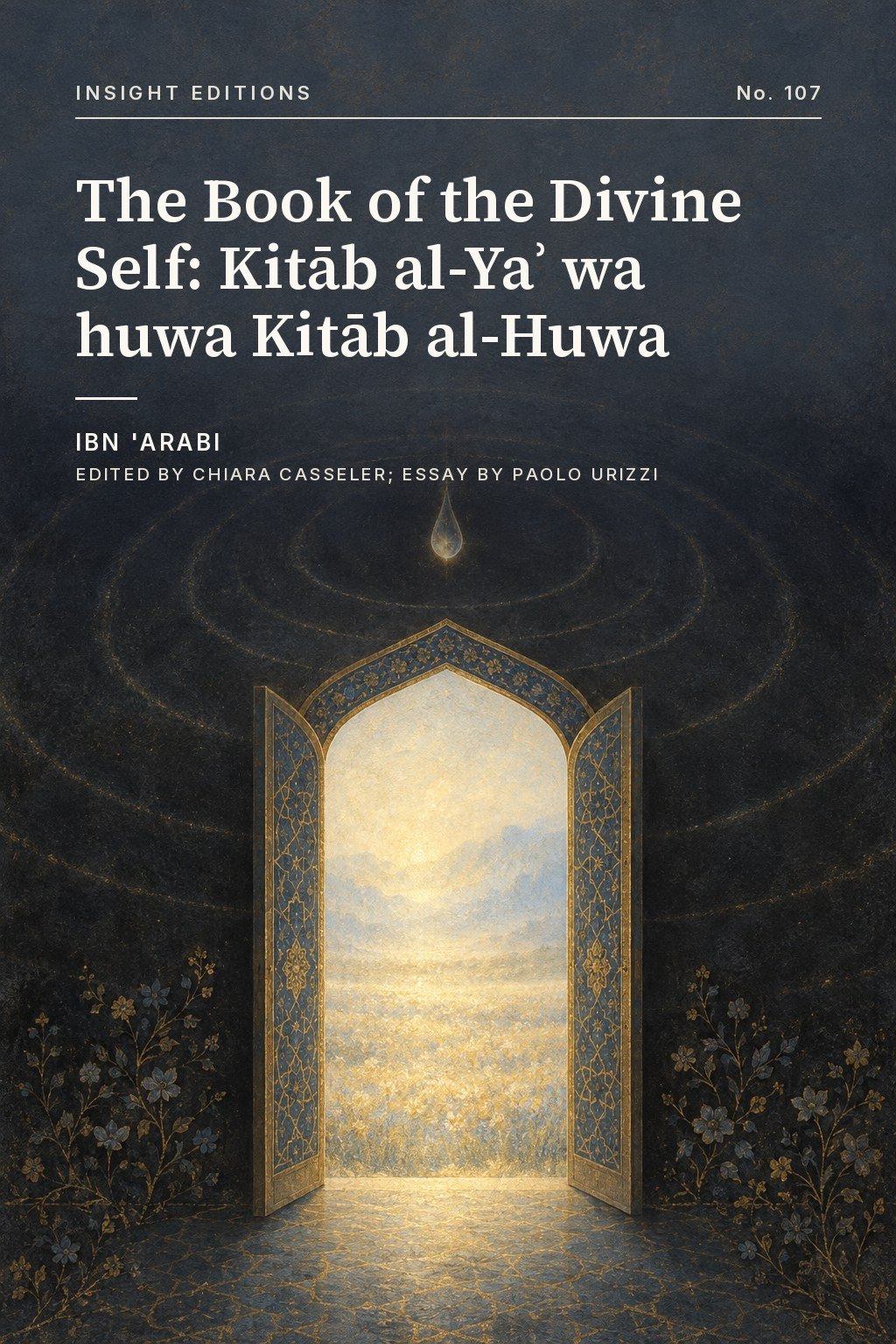
The Book of the Divine Self: Kitāb al-Yaʾ wa huwa Kitāb al-Huwa
Ibn 'Arabi · Edited by Chiara Casseler; essay by Paolo Urizzi
Ibn 'Arabi interprets the pronoun Huwa, the Arabic “He,” as a sign of the unknowable divine Essence and relates pronouns, letters, and spiritual realization.
A study guide to The Book of the Divine Self: Kitāb al-Yaʾ wa huwa Kitāb al-Huwa by Ibn 'Arabi, edited by Chiara Casseler; essay by Paolo Urizzi. Shared free for personal reading; not for sale and not endorsed by the authors or publishers. Please read and buy the original.
About the Book
A short treatise on a single pronoun. Ibn 'Arabi takes the Arabic word for "He", Huwa, and uses it as a doorway to the Essence that can never be seen.
What the book is
The Kitab al-ya', also called the Book of the Divine Self (Kitab al-Huwa), is one of Ibn 'Arabi's shortest works. According to the editor, it was written in Jerusalem in 601/1204, in the same year as two companion pieces: the Kitab al-jalala (the Book of Majesty, on the Name "Allah") and the Kitab al-alif (the Book of the letter alif). Casseler calls the three a single set, "an ideal parure of different gems". The treatise itself runs to only a few pages.
- an introductory essay by Paolo Urizzi, "The Factors of the Transcendent Synthesis", which reads the treatise alongside other traditions;
- a long introduction by the translator, Chiara Casseler, which unpacks the treatise section by section;
- the translation, with dense notes;
- a glossary, a Quran index and a bibliography.
The volume appeared in 2004 from Il Leone Verde in Turin, as number 5 in the series The Jewels. It writes "Koran" and "Cor." for Quran references and its phrasing is often awkward. Quotations below are reproduced exactly as printed, so some of them sound stiff.
Argument map
Chapter map
| Part | Covers | Source |
|---|---|---|
| 1. The Transcendent Synthesis | Urizzi's essay: I, you and he; the Cloud; the two arcs | Introductory essay |
| 2. Letters and the Absent One | Context, Science of Letters, Huwa and huwiyya | Casseler intro |
| 3. Ipseity and the Name Huwa | Supreme Identity, non-Station, ha' and waw | Casseler intro |
| 4. Declension, Wedding, Syllogism | Hu, Ha, Hi; the triad; Kun | Casseler intro |
| 5. The Pronouns of the Divine Person | Huwa and ya'; Ana; Jesus and John | Casseler intro |
| 6. Jonah and the Letter Nun | Anta, the whale, the circle, Hallaj | Casseler intro |
| 7. The Treatise Read Closely | The text, paragraph by paragraph | Translation |
| 7b. What the Notes Add | Double meanings, manuscripts, guardrails | Translator's notes |
| 8. The Intimate Conversations | Munajat of Huwa, Ana, inna, Anta | Translation |
Ten ideas to carry away
| # | Idea |
|---|---|
| 1 | Huwa is a metonym of essential Unity, and Unity cannot be perceived by eyes or minds. |
| 2 | Every theophany of "I" or "you" hides Huwa within it. |
| 3 | The divine Names come after Huwa as "interpreters"; the Self stays veiled. |
| 4 | Ha' is the innermost letter and waw the outermost, so Huwa spans all speech. |
| 5 | Huwa and the letter-name ya' are both worth 11; ya' is the nearest metaphor of Huwa. |
| 6 | Pronouns do not decline, so they suit divinity more than nouns do. |
| 7 | Unification is impossible: whoever says "I" is either himself or He. |
| 8 | "You" is the most veiled station and needs transcendence as a safeguard. |
| 9 | Existence comes from three: Huwa, Hiya and the Ha' that joins them, the Kun. |
| 10 | The goal is a non-Station: "you have no place to stay". |
Reading paths
| If you want | Read |
|---|---|
| The core in 30 minutes | This part, Part 7, takeaways in the Synthesis |
| The letter mysticism | Parts 2, 3, 4 |
| The psychology of "I" and "you" | Parts 1, 5, 6, 8 |
| Comparisons with other traditions | Part 1 and the A closer look |
1. The Transcendent Synthesis
Paolo Urizzi's opening essay asks what the three grammatical persons, "I", "you" and "he", tell us about how we know. His answer prepares us to read the treatise as a map of knowledge rather than a grammar lesson.
Three persons, three standpoints
Urizzi begins with the Shaykh's own instruction at the end of the treatise: study it carefully, because it contains secrets that the masters of the Way have hidden. He then sets out the key distinction. In Arabic the third person is called the "absent one" (gha'ib). The pronoun of absence is the one Ibn 'Arabi chooses for the Essence. The first person, "I" (ana, or the suffix ya'), and the second, "you" (anta), are kept for degrees of manifestation.
Urizzi maps the three persons onto three ways of looking at reality:
| Person | Standpoint | Corresponding attitude |
|---|---|---|
| "I" | The microcosm, the knowing subject | Idealism: reality as the mind's content |
| "You" | The macrocosm, the world over against me | Materialism: reality as outer object |
| "He" | What transcends both | The transcendent view, neither subject nor object |
He adds that a philosopher and a contemplative may reach similar words for very different reasons. His image for this is the gap between the reasons "of the builders of Stonehenge from those of the scientists of the Mount Palomar observatory in California". Similar results do not prove the same purpose. The comparison works as a warning against reading Ibn 'Arabi as a philosopher of language.
The veils and the failure of knowing
Urizzi recalls a tradition he quotes as saying that "Allâh is hidden by seventy thousand veils of light and darkness". Each degree of spiritual realization, considered as a degree, is still a veil. Every station reached is a veil of the next. From this he draws a line of Sufi sayings, all of which the book attributes to named figures with printed dates:
- Ansari (d. 1089) wrote verses holding that whoever declares God's Oneness in words still speaks as a separate subject.
- Bistami (d. 874) is said to have repented even of saying the formula of Oneness, because it is made of voice and letters.
- Abu Bakr's saying that the powerlessness to understand is itself understanding returns in the treatise.
- Kharraz (d. 890) summed it up: «apart from God, no one is allowed to say "I"».
The Self that is never an object
Urizzi brings in Shankara (VIII-IX c.) and the Vedanta notion of superimposition: we pile the attributes of the "you" (the object) onto the "I" (the subject) and the reverse. The inner Self, he argues, is not an object that can be pointed at, though it is not yet the absolute non-object either. It is the witness. He also quotes an Upanishad saying that the Self is "the ear of the ear, the mind of the mind". Urizzi's point is structural: the knower can never be found among the things known. The treatise says the same thing in its own terms: "one can only understand what is other than the Self".
The Cloud
The second half of the essay is about the hadith of the Cloud ('ama'). Asked where God was before creating the world, the Prophet answered that He was in a Cloud with no air above or below it. Urizzi treats the Cloud as:
- the thing closest to God, the supreme isthmus (barzakh) between Principle and manifestation;
- the Breath of the All-Merciful, in which the forms of the cosmos take shape;
- a counterpart of the Indian notion of Maya, in his comparison;
- the ground of the claim he quotes from Ibn 'Arabi: «All of existence is an imagination within the imagination».
He links this to the saying "God is and nothing is with Him". Some people add a further clause to it, and Urizzi is blunt about that: «And He is now as He was», he says, "not only does not make any sense and has not been handed down". The verb "was" in the hadith is an absolute present, not a past tense, so nothing needs to be added to update it.
Two arcs and the line that is you
The essay's last image comes from chapter 427 of the Futuhat on the "distance of two arcs". A circle split by its diameter gives two arcs, and the diameter seems to divide God from the cosmos. But the diameter is only imagined. Urizzi turns it into direct address: "You yourself, therefore, are the imaginary straight line that divides them". The line has no width of its own, and the separation of Creator and creature exists only from the creature's side.
This prepares the treatise's goal. The supreme degree is a non-Station (la maqam), which the Quran voices in the verse addressed to the people of Yathrib: you have no place to stay. In the munajat of Huwa, Ibn 'Arabi sails in a "Yathribite Muhammadan ark", is told to dive, and finds rest. Urizzi ends on the line from that passage: "I found relief from the worry of the quest".
2. Letters and the Absent One
Casseler's introduction places the treatise among Ibn 'Arabi's works, explains the Science of Letters that it relies on, and explains why the pronoun of absence names the Essence.
A gem among related gems
The Kitab al-ya' belongs to a group. Besides the Book of Majesty and the Book of the alif from the same year, Casseler points to a strong thematic link with the Kitab al-mim wa-l-waw wa-l-nun, an epistle on three further letters. She also places it in time. It "synthetically prefigures" themes of the Fusus al-hikam, written about twenty-five years later. When he wrote it, Ibn 'Arabi had been working on the Futuhat al-makkiyya for "no more than three years".
She stresses that his writings refer to one another, so that each point connects to every other. She calls this the "spherical" character of the work and quotes the Shaykh: "Each part of our discourse is connected with the others, since it is a single entity".
| Related text | Link to the Kitab al-ya' |
|---|---|
| Kitab al-jalala | Same year; on the Name Allah; calls Ana an outward degree of Huwa |
| Kitab al-alif | Same year; the alif as axis, Unity and the number one |
| Kitab al-mim wa-l-waw wa-l-nun | Weak letters, the nun, Gabriel's station |
| Futuhat ch. 2 | Technical survey of the Science of Letters, cosmological side |
| Futuhat ch. 198 | Breath of the All-Merciful; 36 Quranic statements of Oneness |
| Fusus al-hikam | Same themes developed some 25 years later |
Casseler separates two sides of the Science of Letters. Chapter 2 of the Futuhat is concerned with its cosmological and "alchemical" side. The Kitab al-ya', like the Book of Majesty and the epistle on mim, waw and nun, takes the metaphysical side, with attention to initiatory realization. Chapter 198, on the Breath of the All-Merciful, goes back over the treatise's themes "more than once".
What the Science of Letters assumes
The foundation is the sacred character of Arabic as the vehicle of the last Revelation. Its structure is taken to mirror the spiritual laws that govern the universe. Casseler likens traditional grammar to the Hindu nirukta and quotes the principle of "a close relationship between the metaphysics of language and that of manifestation". If the world is spoken into being, then studying speech can trace the world back to its source. Man, the "compendium of the world", can use language to retrace the stages of manifestation "backwards" up to his Origin.
The material is available to everyone because everyone speaks. Man is defined as the "rational-talking animal" (hayawan natiq). Speech depends on breath, inhaled and exhaled. Breath is the image of the Breath of the All-Merciful, which gives existence to the immutable essences.
A word's value is the sum of its letters. Words with the same value share "a symbolic identity, at least in some way". Casseler calls this principle "basic and founding" for the treatise, even where it stays implicit.
Huwa: the pronoun of the absent
Huwa is the third person masculine singular pronoun in the nominative, "He". Arabic grammar calls the third person gha'ib, "the absent one". From the same root, GHYB, comes ghayb, which means the Mystery and also the Invisible or Unmanifested. In the metaphysical reading, Huwa is the Self as ghayb, which is to say "the supreme Essence (al-Dhât), unconditioned and absolute".
The usage is Quranic. In Futuhat chapter 272, Ibn 'Arabi notes that sura 112 opens with "He, God is One" although nothing earlier in the sura names who "He" refers to, as grammar would normally require. Nor does the sura mention anything belonging to manifestation. The reason given is that the Ipseity of the Absolute "does not belong any relationship (ta'alluq) with the cosmos".
From Huwa comes the abstract noun huwiyya, "Ipseity", the Self's "being himself". In Futuhat chapter 73 Ibn 'Arabi asks "what is Huwa?" and answers: "It is the mystery of the Essence (al-ghayb al-dhâtî) to which no contemplation (shuhûd) belongs". Huwa is neither manifest nor a place of manifestation. Yet it is "the Object of research (al-matlûb) clearly indicated by every language". It is absent in the sense that it can never be contemplated, not in the sense that it is missing.
The first determination and the cloak
In itself the Principle has no determination at all. Yet there is a logical aspect by which the Essence relates to itself, and through this "the Essence determines itself as the unique Entity". This is the first determination, a metaphysical mirror that makes every later distinction possible. Those distinctions are nothing but modes of self-manifestation (tajalliyat).
Casseler borrows the image of a cloak. A cloak is one garment with an inside and an outside. In the same way the Essence is, from within, the Supreme Essence in its total Unity, and from without, the Essence of forms, which implies multiplicity. The treatise itself says that Unity "cannot be perceived either by faces with their looks, nor by intellects with their thoughts". What the faculties can reach is only "the Essence of change and of forms".
3. Ipseity and the Name Huwa
What cannot be seen in metaphysics is what is realized on the Way. Casseler traces how Ipseity becomes the Supreme Identity, why the summit is a non-Station, and how the two letters of Huwa contain all speech.
The reversal on the initiatory side
Metaphysically, Huwa never appears. On the Way the statement flips: "In the one who adores and in the Object of adoration there is no manifests but His Ipseity". Casseler names this the realization of the Supreme Identity (tawhid). Two aspects of Ipseity are involved:
- essential Unity: Ipseity is always one and identical to itself;
- all-inclusiveness (ihata): nothing falls outside it. The book's term for this is "the all-encompassing Ipseity".
Realization does not end in a clear sight of the Essence. It ends in perplexity (hayra). Casseler quotes: "The Supreme Identity, which is the synthesis of opposites, escapes any perception or understanding". And: "here impotence (al-'ajz) is the limit of perception". To know the Principle is to know that one does not know what It is.
Two more images belong here:
- The West (al-gharb), where light sets, stands for the theophany of Ipseity in the heart. The heart is lifted "to the World of Transcendence and Mystery".
- The invisible theophany of the Fusus chapter on Shu'ayb. It is the Essence's self-manifestation to itself, "whose proper reality (haqîqa) is non-manifestation". In the same passage God "gives the heart its essential predisposition".
The non-Station
The highest spiritual condition matches the principial non-determination. It is called al-la maqam, the non-Station. The treatise calls it the "Yathribite Muhammadian Sphere". Yathrib is the old name of Medina, and the link is Quran 33:13: "O people of Yathrib, you do not you have a place to stay". Muhammadan perfection cannot be stated positively, since any statement limits. It can only be described apophatically:
"Axial" (qamat) shares its root QWM with the "straight path" (sirat mustaqim) of the first sura. The negation la is written with lam and alif, and the alif, a single upright stroke worth one, is "the symbol par excellence of tawhîd".
| Station (maqam) | Non-Station (la maqam) |
|---|---|
| A definite inner condition | Beyond every condition |
| Can be named and described | Only apophatic description |
| Holds the traveller in place | "you have no place to stay" |
| Belongs to a degree | Mirrors principial non-determination |
| Many stations along the Way | The Muhammadan, Yathribite Sphere |
| Can still veil | Axial: multiplicity taken back into Unity |
The name contains what it names
Casseler's next heading claims that the word Huwa pictures what it means. This follows from the correspondence (munasaba) linking every level of manifestation.
- Ha' is a soft aspirate. By place of articulation it is the first letter, "the letter of the chest", because its point of articulation is innermost, in the throat. It is undifferentiated breath and belongs to the letters of the unmanifested. Its round written shape suggests envelopment.
- Waw is a weak letter. It is both a semivowel and the lengthening of a short "u". It is the last letter by place of articulation, the outermost labial. Its shape suggests movement outward, and it stands for the manifested world.
Every other sound is formed between the throat and the lips. So Huwa, made of the first and the last letter, is "the Name of Synthesis", a meeting of innermost and outermost, of the First and the Last, the Inward and the Outward.
The treatise says this in a night-journey image. Through Huwa, "Unity completes the nocturnal journey" through all the degrees of the letters until it reaches waw. "There is no force (quwwa) in a letter that is not granted to it by the hâ'". The opening of the waw "is the source of Generosity and the door of Mercy".
Grammar as doctrine
Four grammatical facts each carry a doctrine:
| Grammatical fact | Doctrinal reading |
|---|---|
| Huwa is only ever the subject (fa'il) | He is the one Agent in the universe |
| Outside the nominative it becomes the suffix -hu, same sound and shape | "its immutability in a single form that does not change" |
| Ha' opens Huwa and closes Allah | The Name Allah leads back to Ipseity |
| -hu in "His Throne" (11:7) | A metonym of the Essence: the Throne of Ipseity |
The Throne "was upon the water". Water is the element from which all things come, so this is the Throne of Life. Ibn 'Arabi calls it "the Throne of Ipseity". Its centre is a "Non-place", "without limits of time and space".
The Spirit of ya'
The suffix -hu also occurs in the verse on Adam's creation: He "insufflated it with His Spirit" (32:9). Two other verses (15:29 and 38:72) give the same event in the first person: "My Spirit". Futuhat chapter 268 calls this the Spirit of ya' (ruh al-ya'). The first-person ya' marks the Station of ennoblement, the high origin of man. Another passage reads: "The Spirit of yâ' refers (ja' ala) to the being (wujûd) of the Spirit itself". This shift from "His" to "My" is the shift from Huwa to ya' that the rest of the treatise builds on.
4. Declension, Wedding, Syllogism
A variant reading of the title, Kitab al-Hu, opens onto the treatise's account of how anything comes to exist: a pair joined by a third. The same triad appears as a grammar, a marriage, a logical proof and the creative word Kun.
Hu, Ha, Hi: declining a letter
Casseler points out "a curious and surprising fact". Besides the usual reading Kitab al-Huwa, the tradition passes down Kitab al-Hu. The consonants are the same and only the vowels change. In ordinary grammar there is no such word as Hu. Two ways of reading it are offered:
- By number: h + w = 5 + 6 = 11, the same value as the name of the letter ya' (10 + 1).
- By morphology: Hu can be read as the nominative of a noun declined with long vowels, like ab, "father". The other cases would then be Ha (accusative) and Hi (oblique). Ha is in fact the feminine suffix pronoun, and Hi is another reading of Hiya, "she".
Remove the long vowels and what is left is not a word but a single letter, ha', behaving like a noun and taking case endings. The ha' is "the graphism of pure breath", almost unvoiced. It contains all other phonemes as its modifications. It is therefore "the symbol of the Self inalienably present in everything" and the image of each being's own divine Face.
The descending letter
The long vowels are formed by the three weak letters alif, waw and ya'. Casseler links them to a principle from Futuhat chapter 198, al-harf al-hawi. The phrase is hard to translate. The root HWY gives both "air" and "passion", so hawi means both "who loves passionately" and "who is precipitated". The principle is called a "letter", but it is not one of the letters. It "comes down by blowing" in three degrees:
| Weak letter | Vowel | Degree of descent | Function |
|---|---|---|---|
| Alif | a | Directly from Allah | Cause of causes; the divine Order (amr) and the Kun |
| Waw | u | Through the higher Spirits | The angelic mission (risalat al-malak) |
| Ya' | i | Through the lower natural bodies | The human mission (risalat al-bashar) |
In the epistle on mim, waw and nun, the names of those three letters form a special set. Each name repeats one sound at its start and end with a weak letter in the middle. So nun corresponds to waw, mim to ya', and waw to alif.
Two needs a third
The declension belongs to a wider doctrine with two linked notions: triplicity (tathlith) and marriage (nikah). The treatise says: "The Hâ' is a thing that unites Huwa and Hiya". It joins them "as the middle term which links the two premises". Waw is "exalted and lofty", so Huwa is the bridegroom (ba'l). Hiya is high in effect but low in its vowel "i", so she is the bride (ahl).
Futuhat chapter 333 (matched with sura 51, which says all things were created "in pairs") puts the rule plainly: "Know that the one does not derive anything from him and that the first of the numbers is only the two". Not even two produce anything "until there is the three that couples and binds them". Three is the first odd number (fard) and also the smallest plural (jam'). It is both "singular" and "synthesis".
Kun: the word with a hidden middle
Kun, "Be!", has three letters: kaf, a waw that is not written, and nun. The hidden waw means "and", so it is the joining letter. The treatise maps the Quranic verse "Our word is to say to it only Be!" (16:40) onto the triad:
| Phrase in 16:40 | Treatise's term | Letter of Kun |
|---|---|---|
| "the thing" | Hiya | nun |
| "We want it" | Huwa | kaf |
| "just say it" | Ha', the middle term | the link between them |
"In this way here is a circle", the treatise says, and the Order of God sits between kaf and nun. Ha' and waw are counterparts in number too: h + a = 6, like w = 6.
At the level of the Principle, the triad appears as "His Ipseity, His self -orientation (tawajjuh) and His Word". Seen from the Essence, it is the Essence, its Power and its Will.
Three kinds of marriage
Futuhat chapter 21 calls this "the science of embrace (iltihâm) and marriage (nikâh)". Marriage produces "something that was not previously there", so it is "the root (asl) of all things".
| Kind | Where | What it produces |
|---|---|---|
| Sensible (hissi) | Nature | A child from two parents |
| Intelligible (ma'nawi) | Ideas | A conclusion from two premises |
| Divine (ilahi) | Divine science | The world, from Power joined to Will |
Chapter 198 adds that the divine assembly that produced the worlds happened only through the Name al-Rahman. Existence means Mercy, and Casseler points out that rahma comes from rahim, "womb".
The syllogism as intelligible marriage
The treatise twice calls the Ha' a middle term. Casseler explains the logic. A syllogism has two premises and a conclusion, which looks like four terms, but one of them repeats. Chapter 198 puts it this way: "There will always be an A - B [ratio] and a B - C [ratio], with B repeating". The repeated B corresponds to the union of the spouses. There is also a condition for fruitfulness. The major premise must apply more generally, including the cause, which is the middle term. Only then is the conclusion, called matlub, "the object sought", true.
Casseler is careful about one point. Duality alone does not produce. A third is needed, "a particular movement according to a particular aspect". Male and female principles, each existing in itself, yield nothing until they move together.
5. The Pronouns of the Divine Person
If Huwa is only ever Huwa, how does it reach the world? Through the ya', its numerical twin, and through the other pronouns, each a degree of manifestation of one Person. The treatise ranks them and rejects the idea that "I" unites with God.
Huwa Huwa, and then the ya'
What comes from the Essence's self-orientation through its Word? The world, says Casseler, or, looking from the other side, Man: the Universal Man, "Spirit of the World" and its compendium. Ibn 'Arabi writes: "Man is the son generated (mutawallid) of Heaven and Earth, who are to him as his father and mother". In number this is 5 (an earthly number, ha') joined to 6 (a heavenly number, waw), which makes 11, both Huwa and ya'.
Ultimately there is only the identity Huwa Huwa, the Self with Itself. Saying this, Casseler notes, "communicates nothing", except that its essence cannot be drawn on. Turned outward, it becomes the all-pervading Ipseity (huwiyya sariyya). The Self is the ground of every being without simply coinciding with any of them. Casseler is clear that the second would be "a pantheistic contradiction". Grammar mirrors this as well, since huwa also serves as the copula in Arabic sentences and so occurs everywhere.
The ya' has the same value as Huwa, but its shape, sound and function differ. It is identical in essence and different in itself. Ibn 'Arabi gives it "an immense power (sultân 'azîm)".
The power of the ya'
The ya' has a strong effect (ta'thir). Attached to a noun, it cancels the case endings, so that kitab-i, "my book", has one form in every grammatical position. It reduces many to one. The treatise builds an arithmetic on this: "Huwa is worth 11, ie it is the name of the Unity". Unity takes one and leaves 10. Huwa does not itself have the value 10, "therefore yâ' is indispensable". That is why God says of Himself innî, "verily I", rather than "Huwa".
The Book of the alif makes the same point about the alif, "the immutable axis of all letters". It runs through every place of articulation as the number one runs through every number. Long u and long i resemble it "in terms of omnipervasion".
A ladder of pronouns
The treatise ranks the pronouns by their nearness to Huwa. Since one Person speaks through all of them, the ranking describes degrees of manifestation, not different speakers.
| Comparison | Treatise's verdict |
|---|---|
| Ana and ya' | "Anâ is farther from Huwa than yâ'" |
| Ana and Anta | Ana is closer to Huwa than Anta and Ka |
| Nahnu and Ana | Nahnu is closer to Huwa than Ana and inna |
| Ana and inna | Ana is stronger, since inna undergoes the ya' |
| Suffixes and free pronouns | -na, -ni, -ka are closer than Ana, Anta, inna |
| Proximity and remoteness | "To Nahnu belongs proximity (qurb), while to Huwa belongs remoteness" |
"We" is close and "He" is far. The verse "We are nearer to him than his jugular vein" (50:16) is spoken by Nahnu. Remoteness belongs to Huwa, and that remoteness is what keeps the Essence pure of every comparison.
Why pronouns beat names
Casseler states the principle. Nouns, the divine Names included, even "Allâh", take case endings and so change with their setting. Pronouns do not. The treatise draws the conclusion that pronouns "belong by ontological right (istahaqqat) to the function of Divinity (ulûhiyya), to an even greater extent than the Names". "Nouns cannot defend themselves the way pronouns defend themselves." A second reason comes from usage. A pronoun must refer back to something already established, so it "necessarily leads back to a confirmed reality (amr muqarrar)". The referent of Huwa is Ipseity itself.
No unification through "I"
Some people, the treatise says, think Ana is "the noblest of metonymies, by way of unification". Ibn 'Arabi rejects this outright. "I" always marks off a speaker from what is spoken of. The argument runs:
The practical rule follows. If the speaker knows Huwa, clear-sighted saying of "I" is not allowed. If he does not, he must seek and ask forgiveness for that "I" "as sinners ask for forgiveness". "Huwa is the most intact (aslam) in every aspect and in every station, for the wise as for the veiled."
Casseler adds the descending side. In the Book of Majesty, Ana is an outward degree (zahir) of Huwa. The highest use of the divine "I" belongs to prophecy. Angels descend with the command: admonish that there is no god but Me (16:2). Through the prophet, God speaks without intermediaries.
Jesus and John
The Fusus contrasts two Quranic greetings of peace:
| Jesus (19:33) | Yahya / John (19:15) | |
|---|---|---|
| Person | First: "Peace be upon me" | Third: "Peace be upon him" |
| Perfect in | Unification: theophany without an individual go-between | Union and belief: less room for error |
| Link | Ana | Huwa; "the memory-mention of the yâ'" |
Ya' is also the prefix of the third-person imperfect verb, so Yahya's rank "seems to pertain directly to Huwa".
6. Jonah and the Letter Nun
"You" is the hardest station. Casseler reads it through Jonah, who cried "There is no god but You" from inside the whale, and through the round letter nun, whose halves join into the circle of Ipseity.
The danger of "You"
If Ana is an inward mode, Anta is an outward one. "Anta is the furthest from Huwa", because it arises while the "I" remains alongside the manifestation of Huwa. The veil stays in place. The treatise says: "As for Anta, existence (wujûd) demands it". Anta is more thickly veiled (akthaf hijaban), because it shows itself "only in the form of science", that is, in the form of the knower's own knowledge.
The Tawhid of affliction
The one Quranic statement of Oneness in the second person is Jonah's, cried "in the darkness": "There is no god but You!", followed by the confession that he was in the wrong (21:87). Chapter 198 calls it "the Tawhîd of affliction". Casseler follows the words:
| Word | Root sense | Reading |
|---|---|---|
| ghamm, affliction | ghamma, "to cover, veil, hide" | The second person arises under a veil |
| zulumat, darkness | ZLM | Not perceiving the real |
| zalim, unjust | ZLM, the same root | Duality as a bent perception |
| tanfis, relief | breath, release | The exit from the whale |
Only from inside the dark does Jonah address an Other. Futuhat chapter 33 traces it to his anger: "Anger (ghadab) is darkness of the heart". Because of his rank, the anger left a visible mark outside him. The whale gave him back the condition of the embryo, which knows only its Lord. His cry then reverses the blame. As Casseler quotes him, "my darkness has returned upon me. It is not You who have treated me unjustly". What was inside showed outside, "and the light (nûr) has moved into my interior".
Second birth
The whale casts Jonah onto bare land, "exhausted" (37:140). Ibn 'Arabi reads this as a second birth: the whale brought him out "like a calved one ( mawlûdan) according to the intact primordial nature". He came out "as weak as an infant". The Fusus chapter on Moses adds that the newborn lives in the purity of the fitra and is close to its Creator, since its existence is recent.
God then makes a yaqtin plant grow over him. Casseler says the word occurs only once in the Quran. Ibn 'Arabi explains that the infant cannot keep off flies, so God covered him with a tree whose soft leaves the flies avoid, "like cotton (qutun)". The tree is the protecting shade of the divine womb over a heart with no will left. Chapter 33 calls this a "narrow" Station that only a small elite reaches. It purifies every intention until only the divine Command remains.
Nun: ark, whale and inkwell
The Quran calls Jonah "the one of the nun". Nun means "whale" and is also the name of the letter n, which is drawn as a round bowl with a dot. Casseler builds on its shape:
- The ship Jonah boarded is fulk, the same word as Noah's ark. Falak, from the same consonants, means "sphere".
- Gabriel's station. In the epistle on mim, waw and nun, the first nun is spiritual, the waw is the angelic mission, and the second nun is the bodily world. The nun "confers the [divine] gifts in a synthetic way", and the waw distinguishes them, "since it is the Calamus".
- Inkwell. Cosmologically, nun is the inkwell from which the Pen (the First Intellect) writes on the Guarded Tablet (the universal Soul).
The treatise itself calls the nun the semi-diameter (nisf qutr) of the sphere of the waw, and calls the ya' a double nun.
The circle of Ipseity
The circle, Ibn 'Arabi says, is the first and best form, holding the same rank among shapes "that the alif has among the letters". The nun in Kun is the visible lower half, from which "sensible realities appear". The upper half, unseen, governs spiritual realities. Casseler matches the lower half to the ark of the Law and the upper to the rainbow joining Heaven and Earth.
Futuhat chapter 427, on the "distance of two arcs", links the halved circle to Ipseity. The diameter seems to split the cosmos from Allah, but: "Ipseity (huwiyya) is the circle itself". "And the imaginary straight line that divides them is you (anta)." The universe, relative to the Principle, has only an imaginary existence.
The dot in the nun is Jonah in the whale's belly (batn). The treatise's own phrase, Huwa "concealed within" each theophany, takes up the same root: mabtun, "made hidden".
Hallaj's sentence on Huwa
Casseler closes her introduction with a passage of Hallaj (d. 922), which she reads as proof of the coherence of the Sufi tradition. It is a series of denials: no before, no after, no where, no how.
7. The Treatise Read Closely
The text itself, section by section. It is short and dense, and it moves from a definition of Huwa, through a ranking of pronouns, to the triad, ending with a lament and a warning to read carefully.
Opening and definition
After the basmala and a prayer that God make good things easy, Ibn 'Arabi names the work: "the book of yâ', or the book of the divine Self". It contains subtle allusions (isharat) and essential truths (haqa'iq) "for the People who know how to perceive the True in impediments and bonds". The first claim follows straight away: "Huwa is a metonym (kinâya) of essential Unity". The proof text is "Say: He, God is One" (112:1).
Speech that never leaves the Self
Only direct divine Speech (fahwaniyya) stays joined to the Self. Other speech knows only "I", "truly I" and "you". The knowers are always "bound" to the Self, even inside "you". The treatise reads three famous sayings as showing this:
| Saying | Where Huwa hides |
|---|---|
| "I cannot calculate praise to You" | In the "You" |
| "You have praised Yourself" | In "You" and "Yourself" |
| "The powerlessness to attain knowledge is knowledge" | In knowing that one cannot know |
| "And beyond him whom we praise?" | In the "beyond", past I, Thou "and their sisters" |
The epistemology fits in one line: "If the Self were understood, then it would not be the Self". Then come the formula and the doctrine of all-pervasion. "There is no self but Huwa". Created beings have existence and subsistence only "through the Self". So everything after the Self is "a substitute" of Huwa or an "explanatory affixation", which spells out degrees that belong to Huwa without being Huwa. The Self remains "in Its undifferentiated synthesis (ijmâl) and in Its glorious inaccessibility".
Verses that begin and end with Huwa
"He is God, Whom there is no deity but Him" (59:22) "began with Huwa, concluded with Huwa". The Names that follow (Merciful, First, Last, Knower of the Mystery, King, Creator) each show an aspect of contingency. What comes after Huwa is therefore either a gloss on its rank or a stand-in for it. Everything other than God "is found in the Tu, not in the Huwa".
The ya' and the defence nun
The middle section, covered in Part 5, works through the grammar of ya', inna, the defence nun, the verbs, and the ranking of Ana, Anta, Nahnu and the suffixes. Two details are worth adding:
- Moses. The election of Moses brings out Ana, and inna takes the defence nun "so that inna remained unharmed". In the same way, someone who seeks to be "traced back" to Him through Him is protected by Him.
- The wise and the ignorant. "The noblest of them is he whose perpetual invocation (hijjîr) is Huwa." Those who do not know the difference between "the Essence of forms and change" and "the unconditioned Essence" take Ana for the highest pronoun.
Completion: Ha', Huwa and Hiya
The section titled "Completion and integration" sets out the triad covered in Part 4. Some lines need close attention:
- "Huwa was and nothing was with him": on its own, none of the three gives existence. "Huwa, as he is Huwa, from him there is no wujûd". The same is said of Hiya and of Ha'.
- "The science found in the yâ' of innî precedes existence", so that the realities of the Names may appear. That knowledge is what sets Huwa and Hiya in motion.
- Kun is the meeting. "The kâf of Kun is Huwa, while the nûn of Kun is Hiya", and the Ha' is the link, "that the Order of God is found between the kâf and the nûn".
Then come verses. They are hard to follow in this English, but two lines stand out. "The yâ' of innî is none other than the wâw of Huwa, yet it is not the same thing". And the Ha' speaks: "I am imprisoned, by your prayer, between the starting point of your generosity and [its] extreme limit".
A lament
The text turns personal. The Station was realized by Muhammad, "firmly established" in it, and by the greatest masters. Most people of the Way take it for a degree of the soul. "Ever and never!" The secret of existence is everywhere, so what can veil it? "It is only habits that veil".
The lament matters for the doctrine. "I can't find a place to stay" uses the vocabulary of the non-Station. The author's homelessness is itself the Yathribite condition, felt as weariness.
Mercy in the opening
Through Huwa's night journey the waw "is opened". The opening is Generosity and Mercy: "What God opens to men of Mercy" (35:2). An objector cites 23:77, where a door of torment is opened. Ibn 'Arabi answers that despair, which is distance, comes paired with the opening. Their torment is "a torment that is a mercy, in comparison with another torment". Even an opened door of punishment is a lesser mercy. Only one verse is "terrible": being thrown "into a narrow place, bound together" (25:13).
The weak letters and the nun
The treatise ends on letters. Ha, Huwa and Hiya are linked to the three noblest letters, waw, alif and ya'. These are the letters "of weakness", "of assimilation" and "of influence". The same middle position recurs:
| Pronoun | Letter in the middle | Between |
|---|---|---|
| Huwa | Ha' as middle term | Huwa and Hiya |
| anâ | alif | hamza and nun |
| innî | ya' | hamza and nun |
| anta | nasal nun | ta' and hamza |
The nun resembles waw and ya' more than alif, because alif "is never vocalized". The nun also stands in for the long vowels in verb endings (yaf'aluna, taf'alani) and is dropped in the construct state, just as vowels are. "Because of this similarity it enters anta", where it takes the place of waw in huwa, alif in ha and ya in hiya.
7b. What the Translator's Notes Add
Casseler's 172 notes to the treatise do more than gloss words. They point out double meanings, settle readings between manuscripts, admit where the text defeats her, and put several doctrinal guardrails in place.
Words with two faces
Many notes show that Ibn 'Arabi chooses words that work at two levels at once.
| Word | Two senses | What it adds |
|---|---|---|
| dama'ir | "intimates" and "pronouns" | The opening praise of souls is already about grammar |
| kinaya | metonym; personal pronoun | "even the pro-noun is a noun used instead of another" |
| mabtun | latent; root of batn, "belly, womb" | Huwa hidden as Jonah in the whale |
| fath | "opening", "spiritual enlightenment"; the vowel a | The waw of Huwa carries the vowel a, so it is "opened" |
| rif'a | elevation; the vowel u of the nominative | Huwa's exaltation is also its case ending |
| fulk / falak | ship; sphere | The ark of the munajat is also a celestial sphere |
Two more stand out. Damâ'ir, "pronouns", comes from a root meaning "to hide", while the zawahir, "evident" nouns, come from a root meaning "exterior". The grammar's own vocabulary already sets hidden pronouns against outward nouns. And in the Huwa munajat, 'ama-ka, "your cloud" (also "your blindness"), is almost the same letters as ma'a-ka, "with you". The line "You are in your dark Cloud and nothing is with you" is a sound-pun as well as a doctrine.
Fahwaniyya: speech mouth to mouth
The treatise's term for direct divine Speech, fahwaniyya, comes from the root for "mouth". Casseler calls it "a technical term rarely used by Ibn 'Arabî". Metaphysically it is the existential Word, the Kun that brings an immutable essence out of possibility into being. On the Way, Ibn 'Arabi defines it as the direct Discourse of the Truth through a face-to-face encounter "in the imaginal world". She cites a French rendering, "mouth to mouth", and connects it with munazala, the "half-way meeting" between God and the traveller.
Readings, editions and admitted obscurity
The translation draws on several witnesses, and Casseler says when they disagree:
- The opening invocation "is not present in the Cairo edition nor in the Paris manuscript".
- For the munajat of inna, the Hayderabad edition "contains many inaccuracies and errors". In the absence of a critical edition she also used a Paris manuscript (Nat. 6640) and the Cairo edition of 1954.
- The verses are in kamil meter, and the editions differ so much that none "seems to be more probable than the others".
- The sentence placing the ya' of inni "between the hamza and the nûn" gets a frank "Sic?" because it "remains incomprehensible to us": in writing, the alif stands there.
- On the weak letters she offers "a hypothesis of illustration", since "some points remain, for us, still obscure".
- The Anta conversation is "difficult to read, in the absence of a certain manuscript tradition".
Doctrinal links the notes supply
| Passage | Note's addition |
|---|---|
| "Essence of change and of forms" | A Resurrection hadith: God changes into the form in which believers first saw Him; theophany meets belief |
| "There is no self but Huwa" | Built like the shahada, but with no gap between ilah and Allah: full identity |
| The veil of inaccessibility | Hadith qudsi: Greatness is My cloak, Power My loincloth, the two pieces of the pilgrim's dress |
| Moses' Station | Removing the two sandals (20:12) means leaving duality behind |
| The jugular vein verse (50:16) | Ch. 386: "By His Ipseity he is with us and by His Names he is nearer to us than ourselves"; Nahnu stands for the many Names |
| Huwa meets Hiya | The verb is used of two seas meeting with an isthmus between them (55:19); the Ha' as supreme barzakh |
Further links follow from the same notes:
- Hiya and Eve. Hiya adds up to 15, the same as Hawa', Eve's Arabic name. The note adds that the initial h of Hawa' is a different letter.
- Spirit, soul, body. Following a French translation of the Book of Majesty, waw goes with the Spirit, alif with the soul, and ya' with the body. The order of the declension "perfectly reproduces the descending order of the manifestation process".
- "Huwa was and nothing was with him". The saying normally has "Allah". Kana is a perfect tense with "the value of the intemporal present", so it also reads "Allâh is and nothing is with Him".
- The thing God wants in 16:40 does not yet exist, but it is "seen" in divine Science as an immutable essence.
- Return. The command "Come back, then!" in the voyage grounds the notion of ruju', the descending phase of realization.
- Perplexity. "We went astray" may be read "we were perplexed", a reading tied to a Futuhat line: "Who are we and Who is «He»?"
Smaller notes worth keeping
- Munajat = 100. The letters of munajat add up to 100, the value of qaf, a metonym of the Pole and name of the Polar Mountain.
- The lost companion book. The "Book of alif and qaf" that the treatise mentions is known only by title. Casseler asks whether it is the known Book of the alif.
- The defence shield. Mijann, "shield", comes from the root of jinn and janna, "garden": "the instrument by which one protects oneself".
- Sobriety. The clear-sighted "I" that is not permitted uses sahw, sobriety, as opposed to spiritual drunkenness (sukr).
- The inna conversation as isthmus. It sits between those of Ana and Anta, "almost as if it were considered an isthmus" between two persons otherwise irreducible.
- "You are you and He is He". A Futuhat line Casseler cites on discrimination: distinction holds even within synthesis.
8. The Intimate Conversations
The treatise closes with four short munajat, intimate conversations addressed to Huwa, Ana, inna and Anta. Here the argument becomes drama: each pronoun answers back, and each answer corrects the speaker.
The conversation with Huwa
It begins with hiddenness. "Our elements have hidden us from ourselves", and so "we are immersed in desire". Huwa answers: "Stop on what is hidden from you by you!" Then comes a sea voyage:
- Request and grant. "We asked for confirmation and you confirmed. We asked for help (imdâd) and You helped."
- Departure. "We have risen in a shoreless sea within the Yathribite Muhammadan ark." The fish marvel as the sails go up, seeking an end in what has none.
- The call. The Yathrib verse sounds: "you have no place to stay (lâ muqâm la-kum)! Come back, then!"
- No shore. They turn back, but the shore "had become sea", so turning back was like going forward.
- The Cloud. Huwa speaks: "I was in the dark Cloud and nothing was with Me. I am as I was". The sea they sail is their own dark Cloud. They can never pierce it. "And this dark Cloud is the Self (al-Huwa) that belongs to you."
- The dive. "O Huwa al-Huwa, 'Self of the Self,' what can I do in the Self?" He replied, "Dive in!"
Casseler points out the pair of words. 'Uryan, "naked", means without clothes, which can be taken off. Munsalikh, "skinned", means without skin. It is said of a snake that sheds, and the verb also means "to come out of the wrapping". Something deeper than clothing is shed: the limits of ordinary individuality. The parallel with Jonah is close. Both are in darkness (zulma), both leave the vessel, and both obey: Jonah is cast out, and Ibn 'Arabi dives on command.
Casseler then turns to skin itself. Bashara means "skin" and bashar means "human being". The related word mubashara means direct contact. In Futuhat chapter 73, man is called bashar because God made him with the two Hands, through "direct contact (mubâshara)". Skin is both the limit to be shed and the sign of man's dignity.
A "noble descent" follows in verse: "To Reality [corresponds], in existence (wujûd), a reality and to Man a man, and to the Koran a Koran." The instruction is to see with the eye of synthesis and enjoy in separation.
The conversation with Ana
"I called out: «O Anâ!», but I didn't hear an answer". Ana explains: "you have invoked only your selfishness. So answer yourself about yourself!" The speaker protests that he meant Ana "as One in One is One". Ana agrees, but holds its ground: "I, Ana, never manifest Myself to you as Ana". Invocation presupposes separation, while Ana implies the union of union.
The conversation with inna
The speaker says he has realized himself through inna, "Verily I", yet he cannot bear to be separated from himself. He claims no inna of his own: "I have no inna except through Your inna". Inna replies: "You are right, on the one hand, but you are wrong on the other."
| The speaker's claim | Inna's correction |
|---|---|
| My "truly I" is only Yours | "Inna belongs to you, authentically", and to Me as well |
| We could share one inniyya | "We will never meet in the manifestation of two inniyya" at once |
| I keep myself, joined to You | "If you want innî, let no determination ('ayn) remain in you" |
| Union of natures | "My Station is incompatible with individual nature" |
One "truly I" at a time. If the creature's inna is removed, what appears from God appears from the creature, and onlookers wrongly credit it to the creature.
The conversation with Anta
The last conversation asks whether it is true, in reality and not just by convention, that God says "You" to the speaker. Anta answers with questions of its own: "Maybe you're not there when you say «Anta» to me?" The speaker's first-person speech "is the inner manifestation of My inniyya". The ruling is: "As for Anta, existence (wujûd) demands it, therefore your speaking in the first person is legitimate". Anta then seems to close the matter: "for truly I (innî) will not let you know." But the conversation goes on, and it turns into a test.
The speaker says he never asked to be told, only to be given. Anta answers with a verse: "Man is the most arguing of creatures" (18:54). In the last ruling, Ka, the suffix "you", has no intimate conversation of its own and is included in Anta, "as Nahnu and the wâw of the plural are included in Anâ and Huwa". The author then says the book's purpose was only this short excerpt, which he calls the "cream" (zubda), and closes: "The book is finished."
Synthesis
What the treatise and its two essays add up to, how to use them, and where to be careful.
Twenty takeaways
| # | Takeaway |
|---|---|
| 1 | Huwa names the Essence by its absence: the "absent one" of grammar is the Unseen of metaphysics. |
| 2 | Every "I" or "you" theophany has Huwa concealed within it. |
| 3 | The divine Names are interpreters; the Self stays in its inaccessibility. |
| 4 | One Essence, two aspects: unconditioned, and the Essence of forms. |
| 5 | Knowing the Principle ends in perplexity; impotence is the limit of perception. |
| 6 | Ha' (innermost) and waw (outermost) make Huwa the Name of Synthesis. |
| 7 | Allah reduces letter by letter to the ha', meaning Huwa. |
| 8 | Huwa = 11 = the name of the letter ya': ya' is the nearest metaphor. |
| 9 | The ya' cancels case endings; its power is to reduce many to one. |
| 10 | Pronouns do not decline and so suit divinity more than Names do. |
| 11 | To "We" belongs nearness, to "He" remoteness. |
| 12 | Unification through "I" is impossible; one speaks as oneself or He speaks. |
| 13 | "You" is the most veiled and dangerous station; transcendence guards it. |
| 14 | Two never produce alone; a third joins them, and existence follows. |
| 15 | Huwa, Ha' and Hiya are groom, union and bride, and also the kaf, link and nun of Kun. |
| 16 | The syllogism is an intelligible marriage, with the repeated middle term as the union. |
| 17 | Existence means Mercy; the root rahma is "womb". |
| 18 | Jonah shows the Tawhid of "You": blame turned inward, light restored. |
| 19 | The line splitting God and world is imaginary, and it is you. |
| 20 | The summit is the non-Station: no place to stay, dive in, relief from seeking. |
Frameworks at a glance
| Framework | Elements | Use |
|---|---|---|
| Three persons | I, you, he | Locate where a claim is spoken from |
| Pronoun ladder | Huwa, Nahnu, suffixes, Ana, inna, Anta | Rank degrees of nearness |
| Productive triad | Two terms plus a joining third | Explain how anything comes about |
| Three faces of a letter | Sound, shape, number | Read the Science of Letters |
| Descending letter | Alif, waw, ya' | Order, angelic, human missions |
| Circle and diameter | Two arcs, imaginary line | Picture non-duality without fusion |
A closer look
2. Number arguments. Equal letter values are taken to show "a symbolic identity, at least in some way". The editors present this as a hermeneutic principle, not a proof. Readers outside the tradition will treat it as a symbolic device.
3. Comparisons. Urizzi sets Ibn 'Arabi beside Shankara, the Upanishads and Maya. These are the essayist's parallels, and the treatise makes none of them.
4. The "now as He was" tension. The munajat's "I am as I was" sits uneasily with the rejection of that added clause. Urizzi reads it from the Principle's side, but the strain is real.
5. Pantheism. Casseler explicitly rejects the idea that the Self simply coincides with each thing. The all-pervading Ipseity should be read with that limit in mind.
6. The text itself. There is no critical edition. The translator compares Hayderabad, Cairo and a Paris manuscript, marks one sentence "Sic?", and calls several passages obscure.
Who's Who
Bistami (d. 874): repented even of the formula of Oneness, made of voice and letters.
Kharraz (d. 890): "apart from God, no one is allowed to say I".
Hallaj (d. 922): the letters of Huwa were created by Him.
Ansari (d. 1089): verses on the declaration of Oneness.
Shankara (VIII-IX c.): superimposition of "you" and "I", in Urizzi's comparison.
Abu Bakr: the saying that powerlessness to know is knowledge (no date printed).
Jonah, Moses, Jesus, Yahya: Quranic figures read as stations.
Applying it
2. Guard the "you". When you picture God as a "You", remember "there is nothing like Him".
3. Judge rather than be judged. Value discernment over spiritual states, as in Ana's rule.
4. Turn blame inward. Jonah's "my darkness has returned upon me" is a model of self-review.
5. Stop looking for a station. Treat the wish to arrive as the last veil.
Discussion questions
- Why should a pronoun of absence be a better name for God than any Name?
- Is the dilemma of "I" convincing? Is there a third option the treatise misses?
- What does it mean that "you" is both demanded by existence and the most veiled?
- Does the productive triad apply outside metaphysics, for example in human cooperation?
- How should a modern reader take arguments from letter values?
- Is the shore that "had become sea" a picture of despair or of freedom?
- Why does the conversation with Anta end in a refusal to explain?
Glossary
Pronouns and persons
| Term | Meaning |
|---|---|
| Huwa | "He"; the Self; metonym of essential Unity |
| Hiya | "She"; the bride; the "thing" of Kun |
| Ana | "I"; the first person; an outward degree of Huwa |
| Anta / Ka | "You"; the most veiled degree |
| Nahnu | "We"; a synthesis like the Name Allah; nearness |
| inna / inni | "Truly" / "verily I" |
Letters
| Term | Meaning |
|---|---|
| ha' | Letter of the chest; pure breath; value 5 |
| waw | Outermost labial; "and"; value 6 |
| ya' | Suffix "my"; value 10; letter-name worth 11 |
| alif | Upright stroke; one; axis of letters |
| nun | Whale, inkwell; half circle; the "defence nun" |
| al-harf al-hawi | The descending "letter" of Breath in three degrees |
Metaphysics
| Term | Meaning |
|---|---|
| huwiyya | Ipseity; the Self's being itself |
| ahadiyya | Essential Unity |
| ghayb | The Unseen, Mystery; root of gha'ib, "absent" |
| tajalli | Theophany, self-manifestation |
| ta'ayyun | Determination; the first is the Essence's self-relation |
| 'ama' | The Cloud of the hadith; also "blindness" |
Way and realization
| Term | Meaning |
|---|---|
| la maqam | Non-Station; the Yathribite Sphere |
| hayra | Perplexity at the end of the Journey |
| ittihad | Unification; declared impossible |
| tanzih | Transcendence; safeguard of the Anta station |
| fahwaniyya | Direct divine Speech |
| munajat | Intimate conversation |
Language and logic
| Term | Meaning |
|---|---|
| kinaya | Metonym; Huwa's relation to Unity, ya's to Huwa |
| ta'thir | Influence; the ya's power over endings |
| tathlith | Triplicity |
| nikah | Marriage; sensible, intelligible, divine |
| al-sabab al-rabit | Middle term of a syllogism |
| fard | Odd and single; three as first odd number |
From the book's own glossary
The book closes with a glossary of about 220 Arabic terms. Most are already explained above. These entries add terms that appear only briefly in the treatise or its introduction:
| Term | Book's gloss |
|---|---|
| qalb aghlaf | "uncircumcised heart" |
| sujud al-qalb | prostration of the heart |
| wiratha | prophetic inheritance |
| Muhit | He who embraces and contains everything; circumference |
| nu'ut al-salb | apophatic qualities |
| munazala | "meeting halfway" |
Text witnesses named in the notes
| Witness | How the translator uses it |
|---|---|
| Hayderabad edition | Base text; "many inaccuracies and errors" in the inna conversation |
| Cairo edition (1954) | "more convincing in more than one point"; some variant readings |
| Paris manuscript (Nat. 6640) | Used where the text is most uncertain; preferred reading jammala-ha |
| Kitab al-jalala | Parallel wording, e.g. "there is no self but Huwa" |
| Kitab al-alif | Parallel on the triad, fard and the bride |
| Kitab al-mim wa-l-waw wa-l-nun | Parallel on nun, waw and the double nun |
About this book
The Book of the Divine Self: Kitāb al-Yaʾ wa huwa Kitāb al-Huwa by Ibn 'Arabi, 2004. This is a chapter-by-chapter study of the book, with summaries, maps, tables and diagrams; short quotations keep their page references. It is shared free for personal study, is not for sale, and is not endorsed by the author or publisher. Please read and buy the original.
Insight Editions · rajeshrmahapatra.com/insight-editions