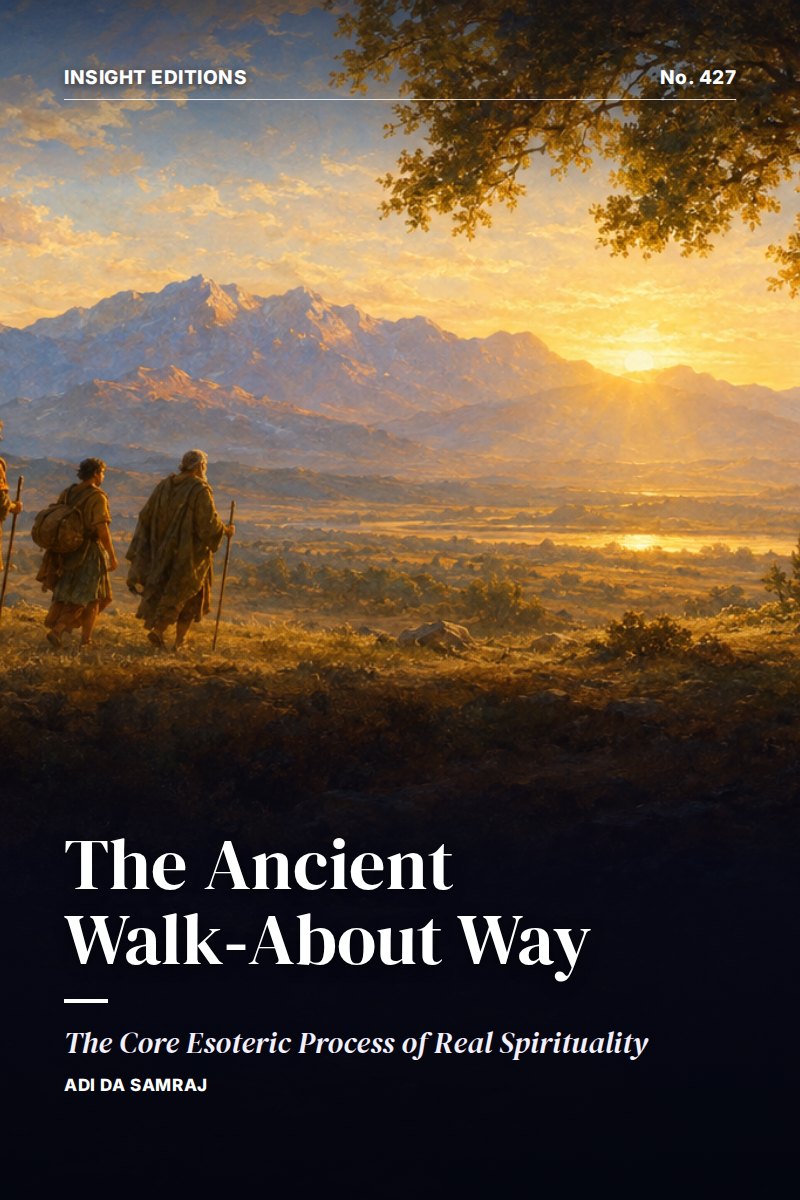
Insight Editions · No. 427
The Ancient Walk-About Way
The Core Esoteric Process of Real Spirituality and Its Perfect Fulfillment in the Way of Adidam
Adi Da Samraj
A study edition of Adi Da Samraj's 2006 Dawn Horse Press book: the prehistoric Walk-About tradition of guru devotion, the dream-and-waking image, super-physics, Divine Distraction, mind as language-robot, devotion, renunciation and Realization, and the room-and-snapshots argument, with its claims weighed critically.
A study guide to The Ancient Walk-About Way by Adi Da Samraj. Shared free for personal reading; not for sale and not endorsed by the author or publishers. Please read and buy the original.
CORE CLAIM
The oldest form of religion, older than writing or cities, is the "Walk-About Way": you see a Realizer, recognise him, and turn to him and serve him. Adi Da presents himself as the perfect and final form of that relationship, the "Unique Advantage" for humankind, and his Way of Adidam as the seventh stage Way that starts beyond ego.
SCOPE
Nine essays and talks by Adi Da Samraj, with an introduction by Megan Anderson, notes, a glossary and an invitation to become a formal devotee. Dawn Horse Press, Middletown, California, 2006 (ISBN 1-57097-221-4). About 32,000 words including back matter, roughly 24,000 in the main text.
KEY FIGURES
Adi Da Samraj (the "Divine Avataric Great Sage"); Megan Anderson; the Ruchira Sannyasin Order, which authorised publication; side references to the Buddhist Fifty Verses of Guru Devotion and to gurus across Hindu, Buddhist, Jewish, Christian and Muslim traditions.
BEST FOR
Readers who want Adi Da's late, compressed statement of his Way and his claims about himself, and anyone studying how guru devotion is argued for and how such arguments can go wrong.
The Book on One Page
The book moves from image to doctrine. First the guru is the morning sunlight that wakes a dreamer. Then he is real "super-physics" that changes the body. Then he is the Supremely Attractive one whose sight is the whole practice. Finally his Way is the seventh stage, beyond every tradition, grounded in a "Perfect Philosophy" that begins prior to "point of view."
| Essay | Payload |
|---|---|
| Introduction (Megan Anderson) | The prehistoric Walk-About tradition; guru as "dispeller of darkness"; sympathetic vibration |
| I Am The One Who Would Awaken You | Truth is to life what waking is to dreaming; no act in the dream wakes you |
| The Super-Physics of Divine Enlightenment | Guru-devotee relation is "real physics"; changes to nerves, chemistry, brain |
| I Am Your Unique Advantage | "You become what you meditate on"; results are guaranteed |
| The Supreme Secret of Spiritual Life | "Divine Distraction is the Supreme Yoga" |
| The Ancient Walk-About Way | Turn to Me on sight; "mind is a myth," language is the first AI |
| True Devotion Is Prior Communion | Action from Communion, never toward it |
| True Devotion Is "Perfect Knowledge"... | Three dimensions: devotion, renunciation, Realization; Omega and Alpha egos |
| The Seventh Stage Way | One long definition: the Way transcends the "great path of return" |
| Perfect Adidam | The room and the snapshots; the world is acausal; no soul |
The book's practice fits in four words, stated at the end of the title essay: "Turn to Me on sight." Everything else is commentary on why that should be enough, and on the disciplines required before it is allowed.
The Unique Advantage for Humankind
Megan Anderson places Adi Da in a "Great Tradition" of guru devotion reaching back "over fifty thousand years" to wandering bands of early humans. Her central claim is direct: "The One Who Speaks to you in this book makes unnecessary any further human seeking of any kind."
She uses three ideas to set the frame. First, the Walk-About tradition: before cities, "the spontaneous, non-verbal response to the mere sight of an illumined being." Second, the word Guru: "The syllable gu means shadows, the syllable ru, he who disperses them." Third, the "law of vibration": just as one vibrating object can set another vibrating "in tune," the devotee in the Guru's company "becomes more and more resonant with the Guru's State."
She summarises the core teaching. Humans presume three separate things: self, world, and "God." But "The ego is not an entity, but an activity," the activity of self-contraction, "physically, emotionally, mentally, and with the breath." The later essays, she says, give three elements of the Way: devotion, right life, and "Perfect Knowledge."
| Idea | Anderson's version |
|---|---|
| Walk-About Way | Wordless response to the sight of a Realizer, since prehistory |
| Guru | "Dispeller of darkness" |
| Sympathetic vibration | The devotee "tunes" to the Guru's State |
| Ego | "Not an entity, but an activity" |
| Seventh stage Way | Based not on gross, subtle or causal structures but on heart-response |
She ends on testimony: Adi Da "demonstrates this to His devotee through constant synchronicities," and "Heart-liberation is instant from the sight of Adi Da Samraj."
The introduction treats a genetic fact (human migration over tens of thousands of years) as evidence for a religious practice, which it is not. Guru devotion is indeed found across many traditions, but those traditions also built in checks: lineage, testing the teacher, ethical codes. The introduction cites the universality and leaves out the checks.
I Am The One Who Would Awaken You
The opening essay uses one image throughout. Life is a dream; Truth is waking. "No action in the dream is the equivalent of waking." The True Guru is the one who is awake in the dream and does not support it, and "I Am That One."
The usual person says, "This body and its psyche are dying... Everyone is seeking." But "none of that is Truth." "Everything that arises is an appearance to Consciousness Itself." If you awaken, "you do not have to do anything about the condition you may have suffered or enjoyed in the dream."
The Guru's method is non-cooperation: "I simply do not support it. I do not live as it. I do not believe it." "I do not live the self-contraction to others, the avoidance of relationship." Devotees begin to wake, but "Forms of the dream persist. The search persists." It "becomes vague, it becomes uninteresting... it becomes serious again."
- Dream: seeking, surviving, self-manipulation, "none of which Awaken you."
- Morning light: "I Intensify the light of morning until you Awaken."
- Hints of waking: momentary awareness of lying in bed. "I am more like your moments of wakening awareness."
- Waking: "you will know that you have never slept."
He states his refusal plainly: "I could not care less about your urges and demands within the dream. I refuse to satisfy them. I refuse to give you an experience merely to console you." Practice is not observing yourself: "You are trying less and less to get free... It just begins to wear down."
The dream image is old and powerful (Shankara, the Yogavasishtha, Zhuangzi's butterfly), and the point that no seeking inside the dream equals waking is a fair summary of non-dual teaching. The move from "there is One Who is awake in the dream" to "I Am That One" is a claim no image can establish, and the essay offers nothing beyond assertion.
The Super-Physics of Divine Enlightenment
Enlightenment is "a literal change of the whole body": "literal changes in the nervous system... in the chemistry of the body... in the structural functioning of the brain." The gap between ordinary and Enlightened humans is as large as from "the amoeba in the primal mud" to a human. And until Adi Da, Most Perfect Realization "never transpired in anyone's case" in human history.
The essay sets the bar very high. "Human beings are, in fact, subhuman in their present level of adaptation." Surrender of ego is "a future stage of development for humanity as a species," "thousands, millions, billions of years in the future" for the race as a whole. The Guru shortens that: "the entire Process of Divine Enlightenment may take place even in a single lifetime."
| Claim | Wording |
|---|---|
| Uniqueness | Never before "in the entire history of the human world" |
| Literal physics | "The true Guru-devotee relationship is real physics" |
| Scale | Like dinosaur to human, but "at more subtle levels" |
| Speed | One lifetime, "quickened and intensified" in his company |
| Necessity | "Those who object to that relationship might as well object to the relationship between the Earth and the Sun" |
He also criticises immature devotion: "Both the childish approach and the adolescent approach to the Spiritual Master are forms of destructive nonsense." And "religious consumerism": people "are willing to pay cash... for a quick salvation." Instead: "You must be responsible for yourself at the human level... You yourself must be love under all ordinary, daily conditions."
"Super-physics" borrows the authority of science without its method: no measurement, no prediction that could fail, no data. The rejection of childish dependence and of "paying cash" for salvation is sensible on its face, but it sits next to claims (uniqueness in all history, humans as "subhuman") that make total dependence on one person the only rational course. The book's own disclaimer page says nothing here is a prescription, which the text then contradicts.
I Am Your Unique Advantage
"There is one Great Law: You become what you meditate on." So meditate on the Guru, and the developmental stages will "spontaneously" appear. He promises results: "I Guarantee it!" and calls the process "more predictable than any science on Earth."
The essay drops all prerequisites of mood or skill. "You need not be concerned with how much concentration of mind there is... or that you yourself are obnoxious. You need not be concerned about any of it!" God is "not at the end of the Way of Adidam" but "at the very beginning." "All you need do, in any moment, is Find Me in My Divine Attractiveness."
Whoever you are, there is no possibility that that Great Divine Process will not work in your case. No possibility. No one is damned. No one is inherently (or essentially) limited.
Adi Da Samraj, I Am Your Unique AdvantageThere is a limit, though: "if you are irresponsible in relationship to Me, if you insist on remaining ego-possessed, you cannot receive My Divine Avataric Grace." And a closing practice note: "Do not make practice into the observation of changes in the body-mind. Let practice be the constant event of Beholding the One Who Is Attractive."
"You become what you meditate on" is a widely shared contemplative rule (found in the Upanishads and in Buddhist recollection practice). Choosing the object of meditation carefully is therefore the whole question, which is exactly what the reader must judge here.
The promise is built so that it cannot fail: success proves the Grace, and failure proves the devotee was "irresponsible" or "ego-possessed." A guarantee with that structure is not a prediction but a frame that places all blame on the follower.
The Supreme Secret of Spiritual Life
"What is Supremely Attractive in the conditional universe and in the human world is the God-Man." Being captured by him, "Divine Distraction," is "the Supreme Yoga." Responding takes no effort, "except for those who refuse to do it."
"Both men and women must be Distracted by the God-Man." The alternative is grim: those who cannot be distracted "cannot get out of the purgatory" of conditional existence. At best they practise disciplines "in a willful (or egoic) manner"; at worst they "convince themselves that there is no Great Distraction" and live in "self-indulgence."
He describes the effect of attraction plainly. It is "an Overwhelming Attraction to Me, an Attraction that eventually begins to ruin the ego-life you are otherwise perpetuating," that "Shatters all the conventional arrangements." When attracted, "the mind relaxes, the body relaxes, attention relaxes... the arrangements of life become ordinary and secondary."
| Stage of attraction | What changes |
|---|---|
| Notice | The God-Man as "Supremely Attractive" |
| Distraction | Attention leaves its own patterns |
| Relaxation | Mind, body and motives relax |
| Enchantment | "The substance of your confession, the substance of your life" |
| Shattering | Conventional "feel good" strategies break down |
He closes with a sweeping line: "Everything you are doing other than your practice of devotion to Me is simply a sign of your dissonance, your withholding, your ego-possession."
Devotional love that frees attention from self-concern is a real and old path (bhakti), and the essay describes its felt quality well. But the stated aim, an attraction that "ruins the ego-life" and "shatters conventional arrangements," and the claim that everything other than devotion to him is ego, describe the conditions under which followers have given up careers, savings and families to a group. The reader can grant the path of bhakti without granting it to this teacher.
The Ancient Walk-About Way
The title essay. The modern world sells "religion businesses" and "workshops." The ancient teaching was simpler: find a Realizer, "fall at the Realizer's Feet," turn to him and serve him. Words get in the way: "Mind is a myth," and "language is the first form of artificial intelligence."
He starts with a diagnosis of modern life: "a fragmented world... full of individuals who regard their own separateness and independence as 'absolute'." "Look at the absolute emptiness of 'consumer egoity'. It is madness." Humans are driven by two kinds of patterning: genetic, like other animals, and mental, "an elaborate interior pattern of words and perceptual memories."
On himself: "Since the moment of My Birth, I have not had five minutes of inclination to be satisfied by the possibilities in this world." "Choose what? Just to play this absurd game, and then drop dead?"
- "Mind is the first 'robot' that human beings ever made."
- "There is language, which is programmed by brains, and which, in turn, programs brains."
- "You do not 'have' all of your words in mind right now. Where are they?"
- "The mind is as mortal as the hardware." No mind survives death; after death "the same thing as there is before birth: Reality Itself."
- What persists is "klik-klak, pattern patterning."
The practice is "Ruchira Avatara Bhakti Yoga": turning body, emotion, mind and breath to him, inside, and serving him, outside. "Simply to see a photograph of My Bodily Form should be enough." He cites the Buddhist Fifty Verses of Guru Devotion ("Do not do anything to disturb the Master's mind") and reads it as "Do not provoke your Master to speak." "My Sitting before you, without speaking, is Sufficient." The last line: "Turn to Me on sight. That is It."
| Old "Walk-About" teaching | Modern religion |
|---|---|
| Wordless, tacit | Talk, workshops |
| Find the Realizer, serve | Social association, optimism |
| Turn on sight | Self-applied techniques |
| Hermitage, remote | Accessible "religion businesses" |
The account of mind as language-patterning with no soul to survive death is surprisingly close to modern cognitive science and to Buddhist no-self teaching, and it is stated vividly. Using it to argue that the devotee should not think about the teaching, only turn to the person, removes the faculty most needed to evaluate a teacher. The traditional Fifty Verses also instruct students to examine a guru for years before accepting him; the essay quotes the obedience and omits the examination.
True Devotion Is Prior Communion
Action in this Way is never toward Communion; it is always from it. "Actions done in order to achieve anything are not themselves the Way of Adidam." The same logic applies to society: the world "should base itself on prior unity, rather than on some apparent effort to achieve unity."
True recognition, he says, is not "an 'official' recognition, or a 'courtly' recognition, demonstrated merely by genuflections, 'poker faces', and sing-alongs." If you recognise him, "you intrinsically know what to do." "True devotion knows and does. True devotion turns and serves. True devotion does not have to utter a single word."
Ritual has a place (recitation, puja, chanting) as "modes of magnifying the practice." But service "is not right devotional practice merely because you are doing functions."
| The Way is... | Meaning |
|---|---|
| Action-transcending | No act aims at Realization |
| Ego-transcending | Starts beyond the separate self |
| "Problem"-transcending | No problem to be solved first |
| Goal-transcending | Nothing to achieve |
| Search-transcending | Prior, not sought |
"Act from fullness, not toward it" is a widely useful principle, in work as in practice: the same task feels and goes differently when it expresses something already present rather than chasing a result.
The essay recasts service to the community as an expression of prior Communion, not effort. That is psychologically appealing and it also means unpaid labour for the organisation becomes sacred by definition, with any fatigue or complaint read as a lapse in Communion.
Devotion, Renunciation, Realization
The Way has three ranked parts: devotion (root), renunciation or self-discipline (necessary but secondary), and Realization ("Perfect Knowledge"). Approach to him in person requires a history of discipline in "money, food, sex, and social egoity." He sorts egos into Omega (Western, gross) and Alpha (Eastern, inward).
Renunciation has an inner side, the disciplining of the faculties, and an outer side, "living actively in service to Me." The outer must cover "all aspects of money, food, sex, and social egoity," and "must not be bypassed." "Merely to demonstrate a devotionalistic feeling for Me is not sufficient."
| Ego type | Culture | Search | Verdict |
|---|---|---|---|
| Omega | Western, now global | Fulfilment in the gross: body, emotion, mind | "Characteristically neurotic and disturbed" |
| Alpha | Eastern | Fulfilment "deep within": subtle, causal | Interior states are "ego-based illusions" |
| Seventh stage | Adidam | Neither | Transcends both "from the beginning" |
He also gives the book's summary verdict on his life: "In My Divine Avataric physical human Lifetime, I Submitted My own bodily Vehicle... to discover the entire necessary process of Divine Self-Realization... This is My incontrovertible Discovery: To Realize Real (Acausal) God, you must practice whole bodily ego-transcending devotion to the Self-State of Reality Itself."
Requiring discipline before access is common in serious traditions. The Omega and Alpha typology is a broad cultural stereotype ("the Western ego-persona is characteristically neurotic"), and dismissing all inward contemplative states as illusion sets aside centuries of Eastern practice in a sentence. That devotees must demonstrate discipline in "money" before approaching him reads differently in light of the community's documented fundraising pressures.
The Seventh Stage Way
The shortest essay, essentially one long definition. The Way "Inherently Transcends" both the "natural foundation" of the first three stages and "the great path of return" of stages four to six. It is the Way of "Always Coincident Renunciation and Realization."
Three terms carry it: "Absolute Renunciation" (the prior transcending of ego, "point of view," separateness and every object), "Transcendental Spirituality" (surrender into "Love-Bliss"), and "Perfect Realization" (the "Perfectly Subjective" Self-State of "Conscious Light").
| Stages | Name in the book | Status in Adidam |
|---|---|---|
| 1 to 3 | "Natural foundation" of human development | Transcended, made "entirely unnecessary" |
| 4 to 6 | "Great path of return": devotional, mystical, sage | Transcended from the start |
| 7 | The seventh stage Way | The context from the beginning |
A single sentence running about 150 words, filled with capitalised and quoted terms, is typical of Adi Da's late style. It reads as liturgy more than argument. The claim that every other tradition stops at stage six depends entirely on his own seven-stage map, which no tradition he ranks there accepts.
The Room and the Snapshots
The longest and most philosophical essay. All religions are the "search for solution," seeing God through "the lens of the human problem." "God"-ideas come from ego. The world is not caused but acausally evident. There is no soul, only "Conscious Light." And Adidam is "not, in any sense, a development of the great tradition."
It opens: "True believers merely believe in believing. True knowers know only what they find out. If I am heart-recognized, The Divine is Perfectly Found."
The essay criticises "First Cause" arguments. Philosophy "presumes 'objective world' and 'separate self' first," then invents a Creator to explain them. Such "God"-ideas "reinforce and console the state of egoity." "The world is not 'Caused'. Rather, the world is acausally evident."
People sit in a room; each could take a photograph from where they sit. Each is "true" from its point of view. "How many photographs would be necessary and sufficient to totally account for the room?" None: "No accumulation of 'points of view' can ever comprehend the 'room' As it Is." "No matter what arises, you do not (and cannot) 'Know' what even a single thing... Is."
The view of death follows. "There is no 'inner permanent entity' in the human individual." "There is no separate 'interior absolute', no permanent entity, or 'soul'." Yet "Conditional processes... continue after the physical lifetime" without implying a soul. He compares this to conservation of energy: "That Which Is The Fundamental Identity of any human individual is not born and does not die." Even "so-called 'inanimate things'" are Consciousness-Energy.
| Conventional view | Perfect Adidam |
|---|---|
| Self and world come first | Point of view transcended first |
| God as First Cause | World acausally evident |
| Brains are separate | Consciousness is indivisible |
| Immortal soul | No soul; Conscious Light only |
| Religion as search | Way begins from Revelation |
The room-and-snapshots argument is a clear statement of a real philosophical point (no perspective, nor any sum of them, gives the thing in itself), close to Kant and to Madhyamaka. The no-soul view matches Buddhist anatta. The essay then concludes that only recognition of Adi Da gives access to "The Divine Itself," which does not follow from either premise. Calling a teaching "not, in any sense, a development of the great tradition" while drawing so plainly on Advaita, Buddhism and Kant is a claim of originality the text does not earn.
Notes, Glossary, Invitation
The volume closes with notes, a glossary of Adidam terms, a section on the seven stages of life, an invitation to become a formal devotee, and a list of the "Wisdom-Teaching" books. These pages are institutional: they explain vocabulary and offer a path to membership.
The glossary decodes terms the essays use without explanation: "Bright," Conscious Light, Ruchira Avatara Bhakti Yoga, "Perfect Practice," the congregations of devotees, "late-time" or "dark" epoch, and Omega/Alpha. The front matter adds a standard disclaimer that readers "not Avatar Adi Da Samraj or others, are responsible for any decision they make" and that nothing is "a diagnosis, prescription, or recommended treatment."
| Back-matter section | Function |
|---|---|
| Notes | Sources and cross-references to other books |
| Glossary | Defines Adidam's capitalised vocabulary |
| Seven stages of life | The map that ranks every tradition |
| Invitation | How to become a formal devotee |
| Book list | The "Source-Texts" and other titles |
The responsibility disclaimer and the main text pull in opposite directions. The essays tell readers that their own thinking is "a myth" and that full surrender to one person is the only way; the disclaimer says the reader alone is responsible for the outcome. Both cannot be fully meant at once, and the reader should notice which one carries legal weight.
Master Takeaways
The Ancient Walk-About Way is Adi Da's guru-devotion manifesto in its most concentrated form. It contains real insights about mind, perspective and action, wrapped in absolute claims about one person that no argument in the book supports.
- Guru devotion is old and widespread, across many traditions.
- The ego is an activity, not an entity: self-contraction.
- No act within the dream is waking; seeking cannot end seeking.
- The awake one does not support the dream; he does not live the avoidance of relationship.
- Seeking wears down rather than being stopped by effort.
- Childish and adolescent relations to a teacher both fail.
- Salvation cannot be bought; "religious consumerism" is futile.
- You become what you meditate on; choose the object carefully.
- Don't make practice the observation of changes.
- Bhakti frees attention by attraction rather than effort.
- Modern religion drifts into workshops and social comfort.
- Mind is language-patterning, with no substantial existence of its own.
- Language programs brains, and brains program language.
- Mind is as mortal as the body; what persists is impersonal pattern.
- Wordless presence can teach more than talk.
- Act from fullness, not toward it.
- Service is not devotion merely because functions are done.
- Discipline in money, food, sex and social life precedes deeper practice.
- Western and Eastern cultures tend to seek fulfilment outside and inside, respectively.
- "God"-ideas often reflect the ego that forms them.
- No point of view, nor all of them, gives the room as it is.
- We never know what any single thing is.
- There is no permanent inner self, in Adi Da's account.
- Guarantees that blame the follower for failure are not predictions.
- Test a teacher before surrendering, as the traditional texts require.
Frameworks and mental models
| Name | What it says | Use it when |
|---|---|---|
| Dream and waking | No act inside the dream equals waking | Seeking more of the same |
| Sympathetic vibration | You tune to the company you keep | Choosing teachers, peers, environments |
| You become what you meditate on | Attention shapes identity | Auditing what you dwell on |
| Divine Distraction | Attraction frees attention without effort | Effortful discipline keeps failing |
| Mind as robot | Thought is language-patterning | Over-identifying with inner talk |
| Prior, not toward | Act from fullness, not for it | Work feels like grasping |
| Omega / Alpha | Outer vs inner fulfilment-seeking | Diagnosing your own search |
| Room and snapshots | No perspective captures the whole | Arguments over who is "right" |
| Unfalsifiable guarantee | Success proves the claim; failure blames you | Evaluating any promise of results |
Written about two years before Adi Da's death in 2008, this book is his most concentrated case for devotion to himself. Its philosophical passages are often good: the ego as activity, mind as language, the room that no snapshot captures, action from fullness. Its claims about Adi Da are total: the only Most Perfect Realizer in human history, a "Unique Advantage" whose results are "guaranteed," whose photograph should suffice, and before whom "everything" else is ego. The traditional guru literature it invokes also insists on testing a teacher, on ethics and on lineage, and the book leaves those out. Former devotees, journalists and lawsuits have described abuses of the kind those checks are meant to prevent. Read the philosophy on its merits, and read the devotional demand with that history in view.