Insight Editions · No. 103
The Alchemy of Human Happiness
Chapter 167 of the Meccan Illuminations
Ibn al-Arabi · Translated by Stephen Hirtenstein
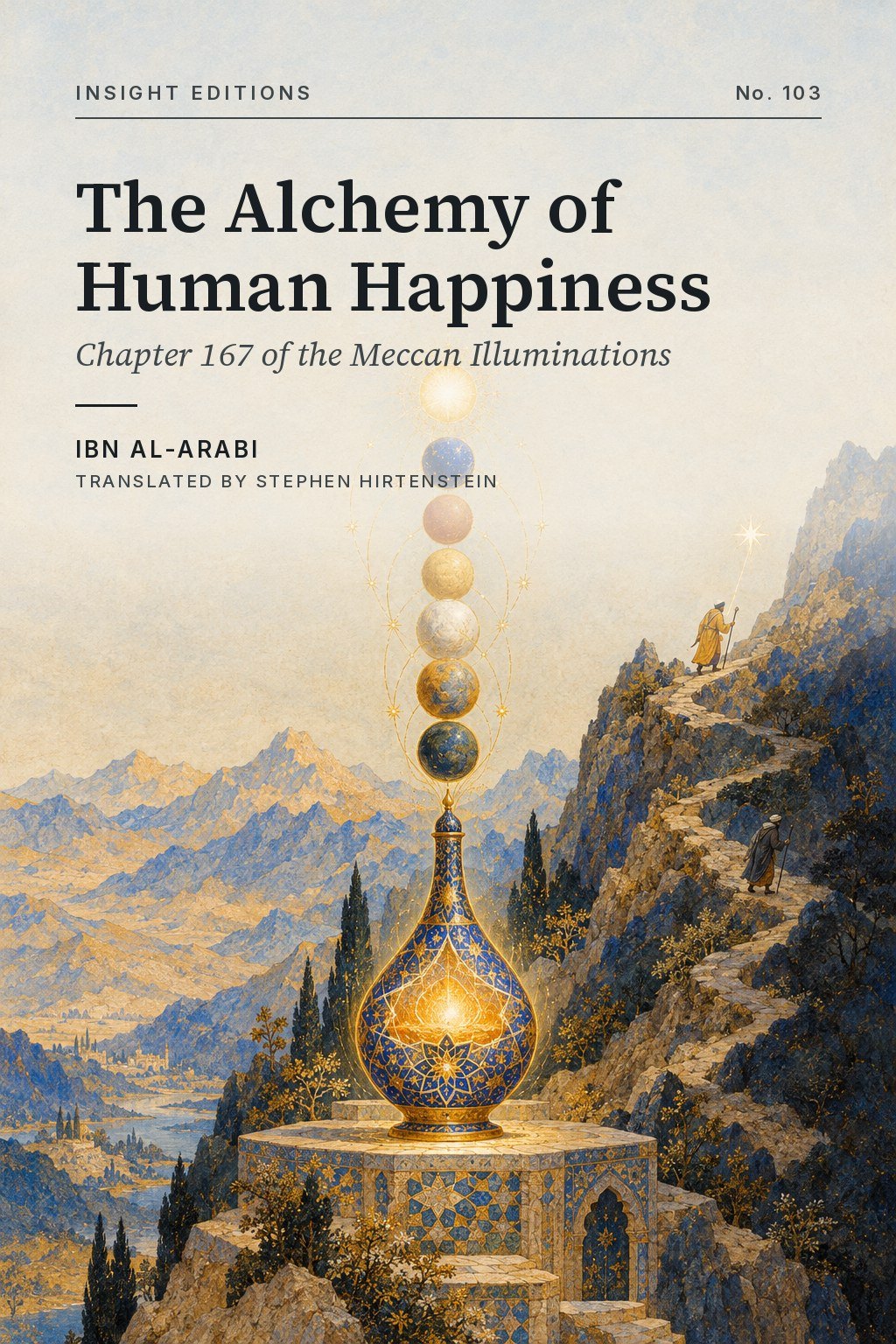
Ibn al-Arabi interprets alchemy as the transformation of the soul and recounts two travellers’ ascent through the seven heavens, contrasting prophetic guidance with unaided reason.
A study guide to The Alchemy of Human Happiness by Ibn al-Arabi, translated by Stephen Hirtenstein. Shared free for personal reading; not for sale and not endorsed by the authors or publishers. Please read and buy the original.
About the Book
Chapter 167 of Ibn al-Arabi's Meccan Illuminations reads alchemy as a science of the soul, then tells the story of two travellers who climb the seven heavens together, one following a prophet and one trusting only his own reason.
What the book is
The Alchemy of Human Happiness is Stephen Hirtenstein's translation of chapter 167 of the Futuhat al-Makkiyya, published by Anqa in Oxford in 2017. The Arabic title, given in the introduction, is 'On the inner knowing of the alchemy of human happiness'. The volume contains:
- a note on the translation and an introduction of about forty pages, with its own 71 notes;
- the translation in two parts. Part I is a short treatise on mineral alchemy. Part II is the long ascension of the two travellers, through the seven heavens and beyond, to the Cloud and back;
- 327 endnotes to the translation, which often run longer than the passage they gloss;
- Appendix A, a table of the 28 degrees of existence from chapter 198, and Appendix B, tables of correspondences between the cosmos and the human being;
- a bibliography and the Arabic text, printed from the back of the book.
The book has no glossary and no index.
Argument map
Ten ideas to carry away
| # | Idea |
|---|---|
| 1 | Alchemy is measure. It is knowledge of weights and measures in bodies and meanings alike. |
| 2 | Every metal is gold delayed. Defects of season and place hold it back. |
| 3 | Two ways: slow healing of a defect, or the instant work of the elixir. |
| 4 | Happiness and perfection differ. All the perfect are happy; not all the happy are perfect. |
| 5 | Perfection is the rank of khalifa, which may be earned, while prophethood cannot. |
| 6 | The private face joins each thing to God without intermediary. Reason cannot see it. |
| 7 | The thinker learns what the follower learns, but not the reverse. |
| 8 | Forms change; essences do not. The staff was always a staff and always a snake. |
| 9 | The polished heart mirrors the whole world, like the sage's burnished wall. |
| 10 | Mercy has the last word, even in the reading of Pharaoh and of punishment. |
Reading paths
- One hour: this section, Part 4, the Abraham pages in Part 6, and the Synthesis.
- The story: Parts 5, 6 and 7 in order. They follow the journey heaven by heaven.
- Alchemy and cosmology: Parts 2, 4 and 8, with Figures 6, 9 and 36.
- For teachers: the ten ideas, the frameworks and the discussion questions.
1. Setting and Sources
Where chapter 167 sits in the Futuhat, why its title borrows al-Ghazali's, and how the translator traces alchemy from Egypt through Hermes to Idris.
A borrowed title, a different book
The translator opens with Ibn al-Arabi (1165-1240), born in Murcia in 560/1165, who reached Mecca in 598/1202 at the age of 37. The date of chapter 167 is unknown. The introduction thinks it plausible that it was written within the next ten years.
The title echoes al-Ghazali (d. 505/1111) and his Kimiya' al-sa'ada, a Persian abridgement of his great Revival. Ibn al-Arabi uses the same words for a different aim. Al-Ghazali's book works with the intellect; chapter 167 is about ma'rifa, knowledge by direct experience. A note adds that several of Ibn al-Arabi's works borrow Ghazalian titles, and that al-Ghazali's book has appeared in English several times as The Alchemy of Happiness.
Two other voices frame the question. Ibn Sina (d. 428/1037) doubted that alchemists could change one metal into another: he wrote that it is "not in their power to bring about any true change of species". The Persian poet Attar (d. 618/1221), in his Ilahi-nama, tells of a king whose sixth son longs for the elixir, and turns the longing inward. For Ibn al-Arabi, the translator says, alchemy is physical, spiritual and divine at once, and its goal is a return to the 'finest stature' of Q.95.4.
Place in the Futuhat
| Fact | As printed |
|---|---|
| The whole work | 560 chapters, 37 volumes, 259 parts, 6 sections |
| Autograph | Evkaf Muzesi MSS 1845-81, Istanbul |
| Chapter 167 | MS 1859, vol. 15, fols. 16b-43b |
| Status | A complete 'part' on its own: Part 108 |
| Section | The second section, on dealings (mu'amalat) |
| Neighbours | Chapters 164-166 lead into it; chapter 168 is on spiritual courtesy |
The translator notes that 167 is a prime number and suggests, given Ibn al-Arabi's interest in numbers, that this may have played some part. The chapter falls into two divisions: alchemy, and the ascension (mi'raj). Facing the first and last pages of the translation, the book reproduces the opening and closing folios in the author's own hand.
Alchemy and the Hermetic tradition
The word al-kimiya' comes, the introduction says, through Syriac from the Greek chemeia, and perhaps from Egyptian keme, 'black'. A note explains keme as the black land, in contrast to deshr, red. The translator then names the figures the tradition remembered:
| Figure | Role in the story told |
|---|---|
| Maria the Jewess (fl. 2nd or 3rd c. CE) | Early practitioner |
| Hermes Trismegistos | Identified with Idris (Enoch); 'three Hermes' in later reports |
| Ibn al-Nadim (d. 380/990) | Records the Hermes lore in his Fihrist |
| Ikhwan al-Safa' | Idris spent thirty years in the sphere of Saturn |
| al-Suyuti (d. 911/1505) | Hermes "could make lead into shining gold" |
| al-Kindi (d. ca. 260/873) | Souls rise through the spheres after death |
| Ibn Masarra (d. 319/931) | Andalusian thinker behind ideas used in the Tadbirat |
A note gives the root of Idris as d-r-s, meaning both 'to study' and 'to erase'. The difference the translator stresses is that Ibn al-Arabi puts prophetic realities, not planets, at the centre of the ascent. The planets are servants. In chapter 167 each one waits on a prophet, as a vizier or scribe waits on a king.
2. Gold, Order and the Elixir
Before the translation, Hirtenstein sets out the mineral alchemy that the chapter takes for granted: why gold, how the cosmos is ordered, how metals grow, and what the elixir is.
Transmutation into gold
Gold is the measure of perfection because it does not tarnish. The introduction recalls the gold of Egypt, notes that a papyrus map of gold-bearing regions survives, and observes that in modern times Elkington's electroplating (1840) made gilding cheap. Gold is element 79. A note mentions that among some Amerindian peoples gold was the sign of the earth's fertility. The point for the chapter is simpler: gold is the metal that has reached its goal.
Cosmic order
The old physics rests on four elements, each a pair of qualities. Ibn al-Arabi uses the same scheme for the body, where the elements become the four humours. The translator gives the correspondences in a note:
| Humour | Temperament | Element | Qualities |
|---|---|---|---|
| Yellow bile | Choleric | Fire | Dry and hot |
| Blood | Sanguine | Air | Moist and hot |
| Phlegm | Phlegmatic | Water | Moist and cold |
| Black bile | Melancholic | Earth | Dry and cold |
The human being is the small world that mirrors the large one. Metals were thought to grow in the earth like plants, from sulphur, the male and fiery principle, and quicksilver, the female and watery one. Given time and balance they ripen to gold. The alchemist only hastens what nature already intends. The introduction ties this to Q.4.1, the creation of all from a single soul.
The elixir
The word al-iksir comes, a note says, from a Greek term for a medical powder. The introduction describes two elixirs:
| Elixir | Linked to | Transmutes |
|---|---|---|
| White | Moon | Copper into silver |
| Red | Sun | Silver into gold |
Jabir ibn Hayyan, the Latin Geber, stands behind much of this lore. The red sulphur became a name for the spiritual master, and later writers called Ibn al-Arabi himself by it: a note cites al-Sha'rani (d. 973/1565) and his book The Red Sulphur. In the Tadbirat, Ibn al-Arabi speaks of 'the revered stone' found in every thing, and of a 'stone of bewilderment', which he calls "the essential point within the heart".
Happiness and its contents
Sa'ada is the Quran's word for the happy, set against the wretched; the translator compares Greek eudaimonia. One sentence he cites from elsewhere in the Futuhat sums up the theme: 'all happiness lies in knowing God'. The chapter then sets happiness below perfection. It opens with a poem on elixirs, contrasts the ordinary human (bashar) with the true human (insan), names two alchemies, of origination and of the removal of defect, and moves into the ascension of Q.17.1. A note marks the difference between the two words for human: bashar is linked to skin or surface, insan to familiarity.
The introduction stresses that the ascension is never repeated. It quotes the Fusus: "In the Divine Presence, due to its vastness, nothing is ever repeated." It also defines the meeting at the top with a word, munazala, and a note insists that in that meeting it is only the divine that descends.
3. Two Travellers, the Private Face, and Idris
The introduction's three key ideas: the follower and the thinker, the direct link between each thing and God, and the prophet who heals.
Follower and thinker
The chapter's story turns on two people. One is the follower (muqallid, later tabi'), who learns from the prophet. The other is the rational thinker (sahib al-nazar), who insists on finding the way alone. The translator links them to Ibn al-Arabi's famous meeting in Cordoba with the philosopher Ibn Rushd (d. 595/1198), who asked the young man: "What kind of solution have you found through divine unveiling and illumination?" The answer was Yes and No. Revelation, the translator comments, is at once reasonable and beyond reason.
He refuses the modern reading of the pair as religion against science. He quotes William Chittick that Muslim mystics and philosophers sometimes opposed one another, but "never does their relationship even approach incompatibility." The pair, he argues, describes two ways of learning inside every person:
| Follower | Rational thinker | |
|---|---|---|
| How it learns | Mimesis: receives a thing on its own terms | Analysis: fits a thing into what it already knows |
| First seen in | A baby learning a language | The growing sense of 'I' |
| Meets in the heavens | The prophets | The planets |
| Learns | Truths about Reality | Effects of the spheres on matter |
| Returns | By a new road, transformed | By the same road, unchanged |
Here the translator draws on a modern writer on the brain's two hemispheres, and on research into mirror neurones, to argue that imitation is not copying but empathy, and that what we imagine becomes part of us. These are his parallels, not the chapter's. Within the text, the follower is "plunged into the supreme light, where love-ecstasy overcomes him", while the thinker, in the translator's phrase, stays in Sisyphean labour until he takes the path of following. The goal is not to drop reason but to integrate the two.
The introduction also cites Ibn al-Arabi's own night-journey: "My journeying took place only within me, and my direction was only towards me." He ends that passage by saying he came to know he was "a pure servant, without any trace of lordship in me."
The private face
The follower's advantage has a name: the private divine face (al-wajh al-khass). The thinker, the chapter says, "has no knowledge of this face at all." Everything has two ways of looking. One faces the single centre and is private to each being; the other faces the circumference of things and is shared with others. Through the private face each thing is taught directly by God, aware of it or not. The only difference between people of God, a passage holds, is whether they know it.
This does not abolish causes. The prophets the follower meets are like candles lit from one flame. Ibn al-Arabi writes that God is "the One who is revealed in the forms of secondary causes, and that the secondary causes, which are the forms, are a veil over Him."
Idris, the Healer of Wounds
The last section of the introduction reads chapter 167 alongside chapter 15, on the 'spiritual breaths'. There Ibn al-Arabi recalls a vision in Cordoba of prophetic figures named by quality. The first three are the Separator (Adam), the Healer of Wounds (Idris) and the Weeper (Noah). The Healer brings knowledge that "cannot be contained in a book."
A note links words (kalim) and wounds (kalm): both can cut, and both can teach. Chapter 15 already names the two ways of alchemy: a slow cure over time, and a change into gold 'through a special way', 'an astounding mystery', which the translator reads as the instant work of the red sulphur. Ibn al-Arabi defines the art there as "nothing but the science of weights and measures."
He also tells of a retreat of 36 days to learn about Idris directly: "I came to know the matter from [Idris] exactly as it is". Idris is the Pole, in the sphere of the sun at the centre of the heavens. In the chapter he says: "I was a prophet, calling them to the word of tawhid, not to tawhid [itself]". The translator notes, with thanks to a friend, that 36 recurs: chapter 198 counts 36 forms of the formula of unity, Sura 36 is Ya Sin, and the letters of ilah add up to 36. He closes with a later Ottoman, Mehmed Uftade (d. 988/1580): 'union is the only remedy for separation'.
4. Part I: The Alchemy of the Two Ways
A poem and a short treatise on mineral alchemy, which quietly set up everything the ascension will say about the soul.
The opening poem
The chapter begins with alchemical elixirs, which "are an evident proof, showing what can be altered and replaced" in all that exists. The plural matters; a note says it signals more than two kinds of elixir, seen and unseen. The poem's second image is moral. An enemy who receives the elixir of divine Grace in the right measure can pass from enmity to friendship with God. A note explains the pair: the enemy is also the one who is far, the friend the one who is near.
The poem then gives an order: "Correct the weight, [using] the scales of our revealed Law". It defines its subject in one line, "Alchemy is [a science of] determined measures", and promises that the one who reflects will rise "beyond the world of mere human." The note on that last word is bashar, the unregenerate human the angels saw as sowing corruption.
The definition
The prose begins with the definition the whole chapter relies on: "'Alchemy' is an expression for the knowledge that pertains to weights and measures". It covers bodies and meanings, the sensible and the intelligible, and their power to change. It is "at once natural, spiritual and divine." It is divine because of the attributes of being seated, descending and being 'with', and because the many Names point to One Named.
Two parts in action
The science of the elixir has two parts. One is originating something, like gold ore. The other is eliminating a defect and ailment, like worked gold, which counts as equal to natural gold.
All minerals come from one source, which by nature seeks "goldenness". On the way, defects of season and place befall it: summer heat, winter cold, autumn dryness, spring moisture, the heat or cold of the mine. When one defect wins, a form appears called sulphur or quicksilver. These are the two progenitors. A further defect in their union yields lesser metals; a balanced union yields gold. The book is a "breath" on the divine side and a "vapour" in Nature.
| Stage | What happens | Human parallel drawn |
|---|---|---|
| Source | One substance seeking gold | Every child born in primordial nature |
| Defect | One quality grows dominant | The parents make the child Jew, Christian or Zoroastrian |
| Lesser metal | Iron, copper, tin, lead or silver | 'Imperfectly formed' (Q.22.5) |
| Gold | Balance kept to the end | 'Perfectly formed'; the Virtuous City |
Each metal, while it forms, is ruled by the angel of one planet. Iron is ruled from the seventh heaven. A note points out that iron usually goes with Mars in the fifth; here Ibn al-Arabi seems to tie it to cold, dry Saturn to stress its hardness. The translator thanks a friend for the point.
The physician and the judge
The first method is healing. The alchemist, like an astronomer who sees a planet stray above or below its place, finds the quality in excess, "decreases the amount where it is too much and increases it where it is too little." This is physic. He then nurses the metal through convalescence, "protecting it from draughts". A note observes that the word for draughts is related to the word for passions.
Once gold, the metal is beyond the physician. Ibn al-Arabi adds a legal image. A judge can only rule against someone who leaves the path of truth; one clothed in gold has no case to answer. "One who adheres to the path of truth goes beyond the level of being judged and becomes [himself] a judge of things." He claims priority: "I have not seen anyone on that [path] who was aware of this".
The elixir and its agent
The second method is the elixir. A dirham's weight of it, cast on a thousand measures, turns tin or iron to silver, and copper, black lead or silver to gold. Cast on quicksilver, it turns it into a second elixir, an agent that can do the elixir's work. Notes supply the scale: a weight dirham was just over 3 g by the French count in Napoleon's Egypt, and the Damascus ratl about 600 dirhams, 1.8 kg. A note also reads the agent as a prophetic heir.
That note is one of the most useful in the book. It says the two ways match two teachings Ibn al-Arabi received from his Andalusian masters, al-Martuli and al-Uraybi: to attend to one's soul, which removes defects, and to attend to God alone, which is original formation.
Happiness and perfection
Why is this the alchemy of happiness? Because happiness lies inside it, and it brings one to complete perfection. Then comes the distinction the chapter is built on: "Not everyone who has found happiness is accorded perfection, for while all who are perfect are happy, not every happy one is perfect." Perfection is "assuming the likeness of the Source." A note stresses that the 'man' (rajul) of perfection is a spiritual rank open equally to men and women, and cites the hadith that names Asiya and Mary among the perfect.
5. The Khalifa and the First Three Heavens
Part II opens with the rank humans are made for, stages the quarrel between the two travellers, and takes them through the heavens of Adam, Jesus and John, and Joseph.
Representation, not just message
Part II begins: the perfection for which the human being is created "is really the rank of [divine] representation." Adam obtained it through Grace. It is more specialised than being a messenger, "since not every messenger is a [divine] representative." A messenger only announces. When God also gives him authority to judge, and he wields the sword, he holds full perfection and shows every pair of Names: giving and withholding, honouring and humbling, life and death. A note observes that the list begins with a positive term and, by reversing the last pair, ends with one, so that mercy has the final word.
Two limits follow. A khalifa is appointed by God, not chosen by the people; a note adds that allegiance by the community is only a later ratification. And while representation 'may be earned', the text says, prophethood cannot. The path can be walked; what one receives at the door depends on one's appointment. Souls come from one Soul, so each has an aptitude, and Nature becomes their 'second father'. Like the metals, "the human being is created for perfection".
The quarrel
Souls rule their bodies as khalifas and so want to know who appointed them. A messenger rises among them and offers the way. One soul says: "That is exactly what I have been looking for. So do teach me knowledge of this path that I may follow it." The other answers: "There is no difference between me and you, so I would like to discover the path to knowing Him by myself." A note points to a play on words: 'teach me' here is from the same root as ma'rifa, the chapter's word for inner knowing.
The text is careful about gender: they might be two women, or one woman and one man. Both take up training, endeavour and devotion; one is guided by reason, the other by the law-giver. Once free of the grip of nature, they set off.
First heaven: Adam and the Moon
The follower meets Adam, who seats him at his side; the thinker meets the spirit of the moon. The moon is Adam's vizier, and its knowledge reaches only the elemental spheres below it. The thinker sees that Adam knows what is above and below, grows distressed, and vows to follow the messenger once he returns. From this point, a note says, the text calls the follower tabi' rather than muqallid: having met the first prophet, he no longer merely imitates.
Here the private face enters the story. "The knowledge of the private face is the science of the elixir in natural alchemy, and it is the elixir of the mystics." Ibn al-Arabi says he would not have mentioned it had he not been told to counsel all God's servants; a note cites the dream in which God said to him, "I require nothing from you" except counsel to His servants. The rule of the whole journey is stated plainly: "Everything that the rational thinker acquires is also acquired by the disciple", but not the other way round. The thinker "cannot grow and develop except in sadness and distress", like a dreamer who does not believe he will wake.
The heaven also rules the seventh month of pregnancy, when the foetus waxes and wanes with the moon. A note maps the seven heavens onto seven stages of the embryo and seven Quranic words for Adam's clay. It adds that Ibn al-Arabi, against the natural scientists of his day, held that a child is created "from the fluid of the man and the fluid of the woman".
Second heaven: Jesus, John and Mercury
Mercury takes the thinker in, then apologises: "Please do not wait for me, for I am in the service of Jesus and John". A note explains that the name used for Mercury here means 'the scribe'. Jesus and John teach the follower the miracle of the Quran's eloquence, the science of letters (not incense and blood-offerings), and the secret of the word 'Be' (kun): written with two letters, its root has three, and the hidden middle letter, waw, is the mark of the true human standing between Creator and creation.
This heaven helps orators and prose writers, not poets. Muhammad, given 'the totality of the Words', was not taught poetry because he was sent to make things clear, while poetry comes from feeling; a note gives the pun on shi'r and shu'ur. Here too the follower learns how a cause can work at once: "What [normally] comes about from a cause over a long period of time can take place from that cause in the blinking of an eye or even shorter." The true knower affirms the cause but not its temporal sequence. After this, the thinker walks ahead of the follower "like a servant before his master".
Third heaven: Joseph and Venus
Joseph is master of dream interpretation and the imaginal. God showed him the earth made from what was left of Adam's clay, the 'market of Paradise', and how meanings take form: years as cows, fat or lean, knowledge as milk, steadfast religion as a cord. A long note gives the story from chapter 8: the leftover clay made the palm tree, Adam's sister, and from a sesame-sized remainder a boundless earth in which all things lie "like a ring lost in one of our deserts".
This heaven helps poets, and teaches composition, geometry and beauty. It also orders the elements (air set between fire and water) and the four humours, ending with black bile, "the characteristic of death". Poetry, like the body, rests on four principles: two cords and two pegs. The note explains that a verse in Arabic is a 'tent' (bayt), held up by cords and pegs.
6. The Heavens of Idris, Aaron, Moses and Abraham
The central heaven, a long defence of Pharaoh's last-minute faith, the lesson of Moses' staff, and Abraham's house of the heart, where the thinker's road ends.
Fourth heaven: Idris and the Sun
The travellers seek "the central heaven, which is the heart of all the heavens." A note places it at the centre of the 28 degrees of Appendix A. Here Idris teaches the constant turning of divine realities, and the hadith that "the heart is between two of the fingers of the Compassionate". A note gives Ibn al-Arabi's gloss elsewhere: because the fingers are the Compassionate's, "He only turns the heart from one mercy to another".
The follower sees night and day each act as father and mother in turn, and learns the sciences of seen and unseen, veil and disclosure, life and death. A note reports Chodkiewicz's reading: the children of the day are saints whose perfection shows, the children of the night those hidden from view. The Name Manifest appears inwardly through the private face, the Name Hidden outwardly.
Fifth heaven: Aaron, Mars and Pharaoh
Mars is surprised at how warmly Aaron receives the follower. Aaron explains: "This is the heaven of awe, fear, severity and affliction". A guest who comes by following the messenger deserves openness. It is also the heaven of representation for humankind, where a leader is weak in authority and is told to be gentle with tyrants. Aaron makes the point sharply: "Nobody is ordered to speak with gentleness except one whose strength is greater than that of the one he is sent to".
Then comes the longest digression in the chapter, on Pharaoh. Ordered to speak gently, Moses and Aaron worked like leaven on a heart that was inwardly humble. At drowning Pharaoh said: "I believe in the One in whom the children of Israel believe, and I am one of those who submit." Ibn al-Arabi reads this as true faith:
| Verse or phrase | The chapter's reading |
|---|---|
| 'perhaps he may be mindful' | 'Perhaps' from God is a necessity |
| 'Only now?... and were one of those who spread corruption' | Past tense: no longer one of them; good news |
| 'Today We shall deliver you with your body' | Deliverance is a Sign; only his outward part was punished |
| 'he led them down to the Fire' | Not said that he entered it |
| 'Bring in the Pharaoh's people!' | Not 'Pharaoh and his people' |
| 'answers the constrained when he calls' | None more constrained than one drowning |
"The judgment of deeds depends on how they are completed." He was taken at the moment of his best act. "The Mercy of God is more all-encompassing than to be unable to embrace the faith of one who is constrained by need." A note calls this a contentious interpretation, contrasts the people of Jonah, who were saved in this world, and sets Pharaoh beside Faust, who never believed he could be forgiven. That contrast is the translator's.
The moral turns back to the travellers: "for proud souls can be won over by gentle persuasion." Aaron tells the follower to be kind to the thinker. He knows humiliation first-hand: Moses seized him by the beard, and he pleaded "O son of my mother". Aaron also turns the bloodshed of Mars into sacrifice, so that animals may reach the human degree that carries the Trust.
Sixth heaven: Moses, Jupiter and the staff
Jupiter is Moses' minister; the thinker does not even recognise Moses. Moses teaches 12,000 sciences (a note links the figure to the twelve springs struck from the rock), and that God's self-disclosure comes in the forms of beliefs and needs. He sought fire for his family, and God appeared in fire because fire was his need.
Then the lesson of forms. Essences do not change; forms are put on and taken off. Ulaym al-Aswad touched a column in Mecca and a man saw it as gold, and Ulaym told him: "Listen, the essential realities are unalterable". God asked Moses what was in his hand, though He knew. Moses threw down the staff and it was a serpent. "The staff did not become a snake, nor did the snake become a staff." One substance took one form, then another. A note gives the pun: 'transformations are impossible' in Arabic uses one root twice.
The follower is told: "Observe His Face in every happening of existence, / And do not try to tell anyone else about It". Then the two leave, "the Muhammadian upon the litter of divine Grace" and "the rational thinker upon the steed of reflective thinking." A note contrasts the effortless litter with the steed that must be ridden.
Seventh heaven: Abraham and Saturn
This heaven, seventh going up, is first coming down. Saturn lodges the thinker in "a dark, deserted and desolate house" and tells him it is the house of his brother, meaning his own soul. Abraham sits against the Visited House, through which, a note reports, 70,000 angels pass each day and never return. He welcomes the follower as a son: "What an excellent and devoted child." The three lights he once called his lord, star, moon and sun, were a hunter's snare for his people's wandering thoughts.
His counsel is the heart of the chapter: "Make your heart like this Visited House, by being present with God in every state." Nothing can hold God "except the heart of the believer". The thinker hears and laments: "If only I had not taken my intellect as a guide, and followed it on the path of thinking!"
Both travellers can reach the polished mirror. The follower goes further only by the private face, toward what is not depicted in the world. From this heaven too come the hidden ruses of God, a mercy that teaches, says a note; that all creatures but humans and jinn are blessed; and that the wretched stay only for a set term, "since Mercy and Compassion is precedent to Anger".
Abraham asks: "Who is this stranger with you?" "He is my brother." Milk-brother or blood-brother? "My water-brother". Only milk kin enter the presence of Supreme Happiness, since knowledge appears as milk. The thinker leaves by the door he came in. He is told he cannot go on, since this is the end of smoke. He offers to submit, but this is not the place; he must go home first.
7. Beyond the Heavens, the Return, Faith and Knowledge
The follower goes on alone through the Lote-Tree, the spheres of stars and constellations, the Footstool, the Throne and the Universals to the Cloud, then comes home by a new road. The thinker follows at last.
The Lote-Tree
At the lote-tree of the furthest limit the follower sees the forms of the actions of the blessed, his own among them. He sees four rivers. A great river feeds three large ones and many streams. He is told: "the great river is the Quran, and the three [other] rivers are the three Sacred Books of the Torah, the Psalms and the Gospel." The streams are the scriptures of the other prophets. "Whoever drinks from any of these rivers or streams is an heir to the one from whom he has drunk." A note remarks that the picture inverts the earth, where streams flow into rivers and rivers into the sea.
The tree is veiled in light and is 'the tree of purification', which is why its leaves are used to wash the dead. Blessed actions are stored here until the Reckoning. The seventh heaven below, where the thinker waits, is "the furthest limit of smoke", the domain of changing form; a note explains smoke as the heavenly side of nature, from which the heavens were made.
Mansions, Gardens and constellations
In the sphere of the lunar mansions the follower meets more than a thousand stellar angels and the way-stations of travellers. Ibn al-Arabi compares al-Harawi's Way-Stations of the Spiritual Travellers, with a hundred stations of ten each, to his own Pathways of Ascent, with 300 stations of ten each, 3,000 in all. A note says the latter work does not appear to have survived. On the sphere's surface he finds the dark-green Garden, his own paradise, and three kinds of Garden: of Inheritance, of Favour, and of Works. He meets his own heavenly form among Adam's children.
In the sphere of the constellations he learns that Paradise is formed by this sphere's motion and Hell by that of the fixed stars, whose concave side is Hell's roof and whose upper surface is the earth of Paradise. Everything is renewed. Without renewal, boredom would overtake the people of Paradise; instead each mouthful has a taste never met before. "He is constantly creating and the creation is perpetually in need."
The thinker knows none of this, because it is prophetic teaching. Each faculty has its own field: when reason leaves its field it errs, and the inner eye may see where proofs slip.
Footstool, light and Throne
At the Footstool the one Word divides into command and prohibition. The follower kisses the Two Feet: the Foot of Confirming Truth that settles the people of Paradise, and the Foot of All-Compelling Power over the people of Hell. Paradise is 'a gift uninterrupted'; for Hell the Quran says only that God does what He wishes. Mercy embraces all and precedes wrath, so "existence is mercy with respect to every existent". A note draws the conclusion: punishment, coming after mercy, must have a beginning and an end. In the 'supreme light' love-ecstasy seizes him. Ecstasy in music, or love for any person, is love of divine beauty clothed in imagination, as in the hadith "God is beautiful and loves beauty".
| At the Throne | Knowledge found |
|---|---|
| Adam and Israfil | Forms: the bodies of the world |
| Gabriel and Muhammad | Spirits breathed into those forms; the elixir's spirit |
| Michael and Abraham | Nourishment; the elixir as food that restores gold |
| Ridwan and Malik | Happiness and misery, Paradise and Hell |
A note traces these pairs to Ibn Masarra's saying that the carried Throne is the kingdom of body, spirit, nourishment and degree. The Throne is the limit of bodily form. Beyond it lie the Measures, then the Universals: the dark Universal Substance from which lights are drawn off, Bountiful Nature, the Preserved Tablet and the Supreme Pen. The Tablet's 'mothers' number 360 squared, and the world lasts that many years. The Pen's writing is engraving, not ink, so the Tablet is preserved from erasure. At the Pen the rank of khalifa begins.
The Cloud and the thread
At the Cloud, seat of the Name Lord as the Throne is seat of the Compassionate, the follower reaches "the first degree of 'where'". A note cites the hadith that before creation the Lord was in a cloud with no air above or below. Up to here only the Names of Acts operate.
All the while a subtle thread runs out from the thinker left in the seventh heaven. It shows and hides as the follower climbs:
From the Cloud the follower rises through the Names of transcendence until he sees that "transcendence limits Him". He can hold neither transcendence nor immanence, "for there is no-one there". Here he loses the thinker for good. The verse runs: "There is then naught but God, nothing other than He".
The return
He comes back by a different path: "This is a way that just cannot be talked about." A note adds, with evident pleasure, that the phrase lapses into Andalusian vernacular. The thinker comes back the way he went. Home again, he pledges himself to the messenger or his heir, with the follower as witness. His faith now rests on God's prescription, not his own proof. A light he never knew lets him see at a glance all he saw before; this time he climbs as a follower, to the Cloud, and finds that what reason called impossible "actually has to be so".
He receives the elixir of bringing into being and sees bodies gathered from stage to stage. A poem weaves Suras 81 and 82: the heaven split, the stars thrown down, the mountains moving, Paradise brought near. "I ask Her: 'What is it You desire?' / And She replies: 'Wild beasts driven together'". A note reads the wild beasts as scattered energies brought into line.
Faith and knowledge
Last, the convert asks to see those who earned Hell. Knowledge is "the noblest vestment, and ignorance the basest ornament." He sees faith without knowledge, and knowledge without faith.
Ibn al-Arabi then tells a story from his own life. A doctor of philosophy heard this teaching and scorned it, until an unveiling showed him it was true. "He came to me weeping for his soul and for being so remiss." He repented and said: "I have seen no greater sorrow than this". The chapter closes on two divine warnings against ignorance: a gentle counsel to the aged Noah and a firm command to the young Muhammad.
8. What the Notes and Appendices Add
The 327 notes are almost a second book. With the two appendices they give the chapter's vocabulary, its Quranic ground, its cosmology and the translator's own views.
Kinds of note
Reading the notes in full shows five kinds, and it helps to know which is which.
| Kind | Example from the notes |
|---|---|
| Arabic word and root | Taqlib (turning) shares a root with qalb (heart); madhhab (way) with dhahab (gold), so a creed is 'the golden path' |
| Quran and hadith | Full texts of the verses the chapter only touches, such as Pharaoh at Q.10.90-92 |
| Ibn al-Arabi elsewhere | Parallels from the Futuhat, Fusus, Tadbirat, Isfar and Awrad |
| Text and manuscript | A reading chosen against the Mansoub edition; ambiguous pronouns |
| Translator's parallels | Bohm, dark matter, Schelling, Faust, Celtis australis for the lote-tree |
Words worth keeping
Several notes turn a single word into a lesson. Mublisun, the 'despair' of the people of Hell, comes from the root of Iblis. Wajd, ecstasy, is cognate with wujud, being. Kafir is one who covers the truth. Kawn is used of created being, against wujud, which belongs to God. Al-Mahdawi, Ibn al-Arabi's teacher in Tunis, is cited for a chain made by adding one letter at a time: jud, generosity, to wujud, existence, to mawjud, the existent. A Quran verse about the staff turning into a 'snake' (hayya) puns on 'life' (hayah). The word for the poet's help, imdad, signals inspiration from a level below the divine.
Doctrine in the notes
Many notes carry teaching that the text assumes:
- Trickery as mercy. Chapter 231 defines God's ruse: He gives a servant "knowledge that demands practice, and then deprive him of the practice". In the end the ruse teaches true need.
- The Footstool is Knowledge. "His Footstool - which is His Knowledge - embraces the heavens and the earth". The highest treasury is the Footstool; the lowest is what reflective thought stores up in mortal man.
- Renewal at each breath. The reality of every person, a note quotes, is renewed "at each breath".
- Levels, not persons. One who knows that excellence "pertains to the levels", not to his own self, will never think himself better than another.
- Adam and Muhammad. Adam is the father of human bodies, Muhammad the father of the heirs, prophet "while Adam was between water and clay".
- The Throne in five degrees. An early treatise lists thrones of Life, Glory (Pen), Grandeur (Tablet), Mercy and Noble Generosity (Footstool).
The notes also record facts the text needs: Mary and Elizabeth were cousins, both descended from Aaron; Jupiter is 'the larger star of good fortune', Venus the lesser; Mars and Saturn were the planets of misfortune; al-Harawi (396/1006-481/1089) wrote the Way-Stations, and al-Kashani (d. 730/1329) commented on it.
The introduction's own notes
The 71 notes to the introduction add the history behind it. They suggest that Ibn al-Arabi may have met practising alchemists in Egypt, either on his first visit in 598/1202 on the way to Mecca, or during his stay in Cairo in 603/1207. They list his earlier ascension writings: the Book of the Night-Journey, written in Fez in about 594/1197 at the age of thirty-three; the Epistle of Lights, written in Konya in 602/1205; and chapter 367 of the Futuhat. They explain that the human journey has three stages: a descent into the world at birth, the ascent, and a return to this world in full awareness. They set the horizontal night-journey from Mecca to Jerusalem against the vertical ascension through the heavens.
Other notes record the sources of the Hermes lore: Ibn Juljul, quoting the astrologer Abu Ma'shar (d. 272/886), whose Book of Thousands is lost. They contrast Ibn al-Arabi's view of revelation, which builds through the prophets to Muhammad, with Marsilio Ficino's idea of an ancient theology that grows weaker as it passes down. They give the legal meaning of taqlid, accepting a scholar's ruling, and stress that Ibn al-Arabi means something else: holding to the Prophet's teaching directly, without a go-between. They also list the four enemies al-Muhasibi (d. 243/857) names: the world, the self, passion and Satan. The note on chapter 15 says the expertise of the Healer of Wounds covers all four.
Appendix A: the cycle of creation
Appendix A tabulates chapter 198's 28 degrees, each with a letter of the alphabet and a divine Name. The number 28 matches the lunar mansions and the letters; the appendix adds that 28 is the second perfect number, after 6. The descent starts at the Pen. The ascent starts at the human, the 27th degree, the 'lowest of the low', and re-gathers every degree within; the 28th is the perfect human. But the scheme is really a circle, each degree a spoke to the centre. The translator calls this "another way of expressing the centrality of the 'private face'". He concludes: the journey "is not to Him, but in Him."
Note one detail. The appendix, following the descent, numbers the heavens from the top: Saturn is its 'first heaven' and the Moon its seventh. Counted that way, Venus and Joseph fall in its fifth heaven and Mercury and Jesus in its sixth. Chapter 167 counts upward from the earth, so the same heavens are its third and second, as Figure 21 shows. The order is the same; only the direction of counting differs.
Appendix B: correspondences
| Universe | Human being |
|---|---|
| The Throne | The body |
| The Footstool | The soul, which receives command and prohibition |
| The Visited House | The heart |
| Saturn / Jupiter / Mars | Knowledge / memory / intellect |
| Sun / Venus / Mercury / Moon | Thinking / conjecture / imagination / the senses |
| Earth's seven layers | Seven layers: skin, fat, flesh, veins, nerves, muscles, bones |
The table is drawn from chapter 6 of the Futuhat and from the Tadbirat, which Ibn al-Arabi wrote in al-Andalus. The translator notes that it uses different names for the planets from chapter 167, and that he has left out a fourth world, of relations, and a section on precious stones.
Names on the wheel
Appendix A pairs every degree with a divine Name. A few show the logic of the scheme:
| Degree | Name as printed |
|---|---|
| Supreme Pen (1) | al-Badi', the Inventor |
| Preserved Tablet (2) | al-Ba'ith, the Sender |
| Throne (7) | al-Muhit, the All-encompassing |
| Fourth heaven, Sun (14) | al-Nur, the Light |
| Human (27) | al-Jami', who reunites and synthesises |
| Appointment of degrees (28) | Rafi' al-darajat, who elevates the degrees |
The Sun's heaven, the heart of the composite world, carries the Name Light and the Polehood of Idris. The human, last but one, carries the Name that gathers all the others, which is why the ascent can re-gather every degree inside one person.
Synthesis
What the chapter teaches when its parts are read together, how to use it, and where to question it.
Twelve takeaways
| # | Takeaway |
|---|---|
| 1 | Measure before metal. Alchemy is the knowledge of weights and measures in bodies and meanings. |
| 2 | Defect is not essence. Every metal and every person is gold held back by imbalance. |
| 3 | Cure has two speeds: patient removal of excess, or the instant elixir. |
| 4 | Perfection is more than happiness: it is the rank of khalifa, likeness to the Source. |
| 5 | The path is earned; the appointment is given. |
| 6 | The private face is the elixir of the mystics. Each thing is taught by God directly. |
| 7 | Reason is real but bounded. It errs only when it leaves its own field. |
| 8 | Following is not copying. It is open, imaginative receptivity. |
| 9 | Forms change, essences remain. Perception is true; error lies in judgement. |
| 10 | Gentleness is a sign of strength, and it wins proud souls. |
| 11 | Polish the mirror. The heart can hold what the heavens cannot. |
| 12 | Mercy precedes wrath, so existence itself is mercy. |
One alchemy, read twice
The chapter's two parts are one process told twice, first for metals and then for souls. Part I gives the grammar; Part II gives the story. Setting them side by side shows how closely the ascension follows the furnace.
The parallel also explains the thinker's fate. Quicksilver is the metal the elixir can turn into a second elixir, because it is wholly receptive. The thinker, once he goes home and follows, receives a light and climbs again "in the manner of a follower". What resisted in the first ascent becomes, in the second, an agent of the same change.
Frameworks
| Framework | Elements | Use |
|---|---|---|
| Two ways of alchemy | Remove defect / originate | Choose between gradual repair and a transforming intervention |
| Physician's cycle | Diagnose excess, rebalance, convalesce, guard | Any recovery: health, a team, a system |
| Two travellers | Follower / thinker | Notice which mode of learning you are using |
| Centre and rim | Private face / chain of causes | Respect causes without making them ultimate |
| Planet and prophet | Effect / meaning | Ask what a fact means, not only what it does |
| Faith and knowledge | Four combinations | Test whether knowledge is changing the knower |
A closer look
- The thinker is a type, not a portrait. The chapter needs him to fail at each stage. Real philosophers, the introduction itself admits, were never wholly opposed to the mystics.
- The claim of priority. Ibn al-Arabi twice says no one before him has spoken of these things. The book gives no way to test this.
- The old physics. Growing metals, seven planets and four humours frame the argument. The spiritual reading can survive without them, but the reader should see the frame.
- Pharaoh. The translator himself calls this reading contentious. It is an argument from Quranic wording, and it can be weighed as such.
- The translator's bridges. Brain hemispheres, mirror neurones, Bohm and dark matter help modern readers, but they belong to the introduction and notes, not to the chapter, and they are offered as analogies only.
Who's Who (dates as printed)
Applying it
Discussion questions
- Why does the chapter start with metals rather than with the soul?
- Is the thinker's distress a punishment, or the beginning of his cure?
- What would it mean, in your own learning, to follow without copying?
- Can you name a case where the same thing was truly a 'staff' to one person and a 'snake' to another?
- Does the Pharaoh reading widen mercy too far, or show how wide it is?
- Why does only the follower return by a new road?
Glossary
The book has no glossary. These terms are drawn from the translator's notes, in simplified transliteration.
| Term | Meaning |
|---|---|
| kimiya' al-sa'ada | The alchemy of happiness |
| iksir | Elixir; first a medical powder |
| kibrit / zi'baq | Sulphur (hot, dry) / quicksilver (cold, moist) |
| i'tidal | Equilibrium; the golden mean |
| 'illa / marad | Defect (also cause) / ailment |
| na'ib | Agent; the elixir's deputy |
| Term | Meaning |
|---|---|
| khalifa | Representative, viceroy, successor |
| muqallid / tabi' | Imitator / follower |
| sahib al-nazar | The rational or speculative thinker |
| al-wajh al-khass | The private divine face |
| ma'rifa / 'arif | Inner knowing / one who knows inwardly |
| dhawq | Tasting; direct experience |
| Term | Meaning |
|---|---|
| mi'raj / isra' | Vertical ascension / horizontal night-journey |
| al-bayt al-ma'mur | The Visited House; the heart |
| sidrat al-muntaha | Lote-tree of the furthest limit |
| kursi / 'arsh | Footstool (Knowledge) / Throne (Mercy) |
| al-'ama' | The Cloud; first degree of 'where' |
| raqiqa | Subtle link or thread |
About this book
The Alchemy of Human Happiness: Chapter 167 of the Meccan Illuminations by Ibn al-Arabi, 2017. This is a chapter-by-chapter study of the book, with summaries, maps, tables and diagrams; short quotations keep their page references. It is shared free for personal study, is not for sale, and is not endorsed by the author or publisher. Please read and buy the original.
Insight Editions · rajeshrmahapatra.com/insight-editions