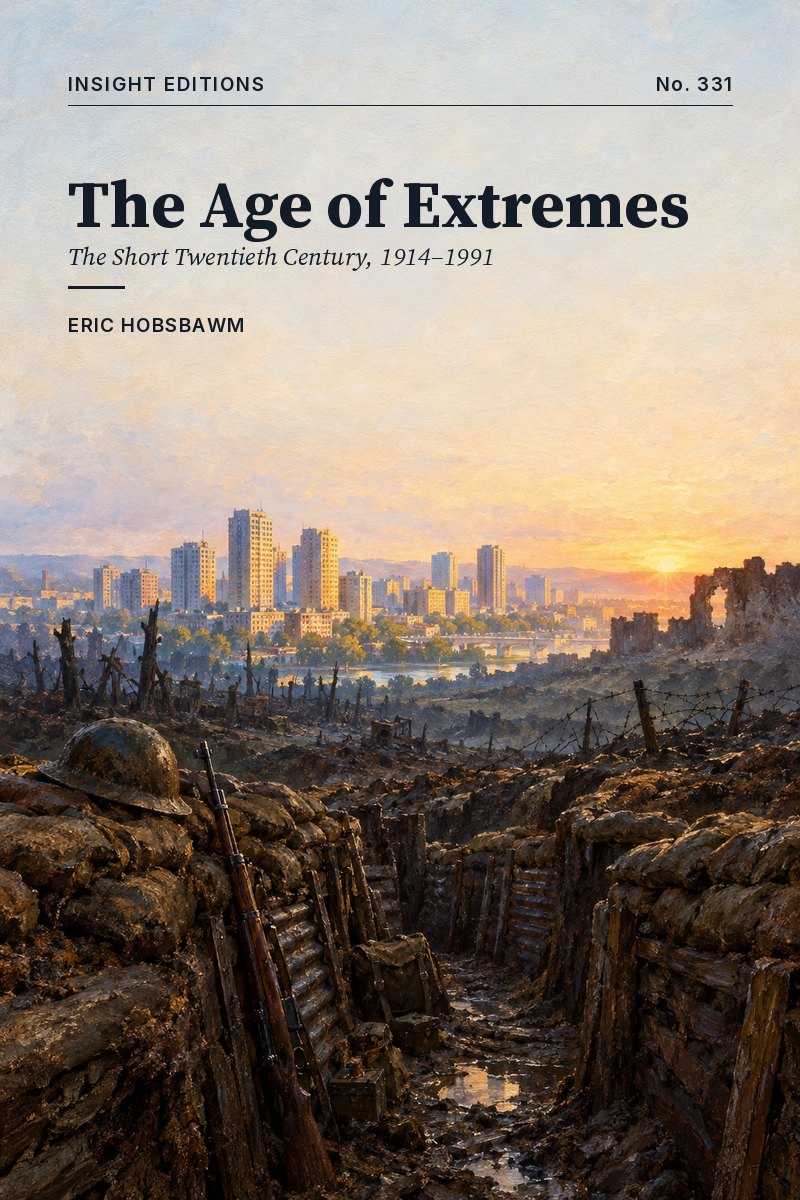

The Short Twentieth Century
An Insight Edition of Eric Hobsbawm’s Age of Extremes, 1914–1991
The governing insight. The twentieth century cannot be understood simply as ninety years of improvement punctuated by two wars. Industrial and scientific capacities multiplied while the restraints on violence and the inherited institutions of social life proved disturbingly fragile. The historian's task is to explain how these outcomes belonged to one interconnected transformation.
Reader’s orientation: the scale of the problem
Hobsbawm calls the period from 1914 to the Soviet collapse of 1991 the Short Twentieth Century. This choice is analytical rather than calendrical. It begins at the shattering of Europe's long nineteenth-century order and ends when the ideological opposition around which the post-1945 world had been organized ceased to provide its principal map. Both dates are approximate hinges, not an assertion that every society experienced exactly the same century or that 1991 brought history to an end.
The book develops three linked movements. Catastrophe, beginning in 1914 and extending beyond 1945, broke the European liberal-bourgeois world and generated revolution, depression, fascism, decolonization and mass death. The Golden Age, roughly from the late 1940s into the early 1970s, combined unprecedented growth with rapidly changing work, agriculture, technology, family life and social expectations. The ensuing Crisis Decades exposed economic instability, the limits of both rival systems, the erosion of older social bonds and finally the collapse of the Soviet bloc. The triptych is not three sealed compartments: the wartime expansion of economic management shaped the postwar boom; growth destabilized customary institutions; and globalization amplified the final crises.
| Analytical period | Dominant change | What the period leaves behind | What the label must not imply |
|---|---|---|---|
| Catastrophe, 1914–mid-1940s | Total war, collapse of empires, revolution, slump, ideological violence | Powerful states, techniques of mass mobilization, weakened colonial empires | That non-European histories were merely appendages to Europe's wars |
| Golden Age, c. 1947–1973 | Fast productivity growth and deep social transformation | Mass education, urbanization, expanded consumption, rapid communications | That prosperity was evenly distributed or universal |
| Crisis Decades, mid-1970s–1991 | Stagflation, restructuring, widening transnational connections, exhaustion of Soviet arrangements | New global interdependence without comparably strong collective governance | That 1991 ended conflict, ideology or historical change |
Preface — The historian inside his own century
Memory as evidence and impediment
For the earlier volumes of his history Hobsbawm could write about a world beyond direct personal experience. For the twentieth century he had to acknowledge that his own biography was woven into the events he sought to explain. He remembered being fifteen in Berlin when Hitler was appointed chancellor. He had watched cities, families, work and political loyalties change. The preface therefore does not claim the impossible impersonality of an eyewitness suddenly transformed into an archive; it sets the terms under which lived memory and historical inquiry can coexist.
The advantage is interpretive texture. An historian who has returned to a city after several decades may recognize a transformation that aggregate indicators alone do not convey. He can remember which political categories felt self-evident to participants and how quickly they later ceased to be credible. The danger is selectivity. Memory privileges what a particular cohort saw, feared and argued over. Hobsbawm is unusually explicit about this imbalance: twentieth-century specialist literature had grown far beyond what even a learned general historian could master, and his familiarity with it was uneven. His position as a witness is thus neither proof of a general historical thesis nor a defect to conceal; it is one source to weigh alongside other evidence.
An unusually open acknowledgement of method
Rather than pretend that a large narrative can settle every controversy, the preface identifies several layers of assistance. Conversations with people who could speak candidly mattered more to him than encounters with prominent officeholders whose public remarks were constrained. Students at the New School brought knowledge of Turkey, Latin America and social mobility. Colleagues advised on science and economics; World Institute for Development Economics Research discussions informed his understanding of development and the late Soviet system. Press reporting and statistical reports from the United Nations, the World Bank and the League of Nations provided a documentary skeleton. These sources have different evidentiary statuses: institutional compilations can be indispensable yet use shifting definitions, journalists can capture a crisis without seeing its longer logic, and memory can detect lived discontinuity without measuring its extent.
The author's bibliography also has a specific role. It is primarily a register of works actually cited, including data and particular claims, rather than a comprehensive map of all writing on twentieth-century history. The footnotes, meanwhile, often qualify or amplify rather than authenticate each sentence. These distinctions matter when a historical figure later turns out to be disputed. The presence of a name and date in a bibliography does not, by itself, supply modern corroboration.
Source discipline. Hobsbawm consciously writes as both participant and historian. A useful reading asks, each time, whether a statement is personal recollection, contemporary observation, general causal interpretation, or a quoted numerical estimate. These are all valuable, but they do not warrant identical degrees of confidence.
The Century: A Bird’s Eye View
Twelve witnesses, no common verdict
The introductory sequence gives twelve remarkably different appraisals of the century. Berlin, Caro Baroja, Dumont and Golding stress atrocity, violence or the contrast between peaceful private routines and disastrous public events. Primo Levi draws attention to an ethical problem of testimony: survivors can speak, yet the people who met the machinery of murder at its absolute limit often could not return to tell the story. Menuhin describes unprecedented hopes wounded by disillusion. Gombrich places demographic multiplication at the center; Ochoa celebrates scientific advances; Firth sees electronics and a movement away from confident rationalism. Levi-Montalcini points to emancipation and the rise of women and the previously subordinated. Valiani holds that liberty makes a renewed struggle for justice possible after defeat. Venturi refuses closure: the century remains an object of continuing understanding.
The opening is not an opinion poll whose contradictory answers should be averaged. Each respondent employs a different unit of account: moral harm, private experience, survival, demographic change, science, political emancipation, ideas or an historian's self-doubt. The apparent disagreement is the point. A civilization can be technologically successful, politically inventive and morally disastrous at the same time. Any single measure—aggregate national income, battlefield deaths, years of schooling, number of independent states—can be indispensable for one question and misleading for another.
Historical amnesia as a political hazard
In June 1992 François Mitterrand visited Sarajevo on the anniversary of the 1914 assassination that precipitated the First World War. Hobsbawm reads the timing as a deliberate warning against a European catastrophe reopened by miscalculation; the allusion was largely missed. His argument is deeper than the complaint that young people fail to memorize dates. The institutions connecting generations to a common public past had weakened. Historical references once carried through monuments, treaties, place names and political conversation became opaque. Society consequently acquired an especially dangerous combination: immense power to intervene in events and a thin sense of earlier interventions' unintended consequences.
Hobsbawm's prescription is not nostalgia. History is indispensable when remembered precedents alter the judgment of policymakers, even if no analogy is exact. The 1919 peace settlements matter to officials after 1989 not because Yugoslavia in 1992 is Versailles in miniature, but because national self-determination, mixed populations, external security guarantees and punitive boundaries can again create combinations that good intentions cannot stabilize. A responsible historical analogy states which conditions are comparable, which are not, and what mechanism is proposed to connect them.
Categories that once seemed natural
For much of the century, political imagination arranged industrial society into two large opposed categories: capitalism and socialism. Hobsbawm insists that this was a historically produced classification, not a timeless description of every economy. The grouping compressed substantial differences among the United States, Sweden, South Korea, Brazil and Japan, just as it grouped divergent centrally planned systems under one emblem. The collapse of Soviet rule did not erase the economic histories of the countries contained in the old categories, but it destroyed the plausibility of the earlier binary as a complete explanation of modernity.
The same caution applies to moral history written by victors. Nazi aggression and genocide demand clear judgment, yet the historian still needs to understand how the system operated rather than declare explanation equivalent to pardon. Defeated regimes are often remembered only in the victor's vocabulary; states that survive become the custodians of normality. Hobsbawm rejects the notion that understanding perpetrators entails forgiving them. Historical explanation attempts causal accuracy, not moral exoneration.
The three periods form a causal sequence
The nineteenth-century order had combined capitalism, constitutional liberalism, bourgeois culture, a powerful belief in scientific progress, and European global dominance. The First World War did not destroy each component overnight. It fractured their coexistence. Political breakdown made socialist revolution practicable in Russia; depression gave the Soviet economic experiment international plausibility; fascism endangered parliamentary regimes; and the Soviet war effort helped defeat Hitler. Hobsbawm's striking paradox is that a revolutionary movement dedicated to ending capitalism also helped save capitalist democracy in war, and indirectly stimulated its peacetime reform. This is his interpretation of a historical relation, not an assertion that Soviet power was benevolent or that Western democracy had no other sources of resilience.
The post-1945 Golden Age emerges from precisely this unusual combination of fear, reconstruction, investment, productive capacity, institutional learning and technological diffusion. Hobsbawm frankly concedes that the exact origin of the extraordinary growth remained debated. There is no single magic policy behind his periodization. The period nevertheless deserves its place because of the scale of social effects: most visibly, the erosion of a human world in which the majority lived by agriculture. An economy might grow rapidly while society remained recognizably agrarian; the postwar transformation compressed occupational, familial and geographical change into a generation.
Crisis did not simply reverse the Golden Age. Transnational production, finance, communication and consumption had made national political jurisdictions insufficient to govern the forces passing across their borders. The very integration that contributed to productivity made local employment, currencies, social promises and fiscal policy vulnerable to shocks elsewhere. Soviet institutions were strained by their own rigidities and by a changing global environment; Western countries responded with market liberalization and austerity, often without relieving their underlying social costs. The final Cold War collapse exposed tensions on both sides of the old divide.
Three transformations larger than the Cold War
Hobsbawm's final comparison between 1914 and the early 1990s is qualitative. First, Europe lost the unquestioned centrality it had possessed before the world wars. Its demographic proportion fell, industry and influence spread elsewhere, and even the new project of European integration revealed that the old great-power arrangements could not simply be restored. This is not equivalent to the decline of all Western economic or technological power: the United States remained central, and the advanced industrial economies collectively controlled much wealth and knowledge. The proper claim is therefore the erosion of European primacy, not the disappearance of Western influence.
Second, the world had become a single operating environment for many activities. Long-distance messages, scientific collaboration, global production and markets crossed borders with increasing ease, while representative institutions and public loyalties remained predominantly territorial. National governments retained enormous coercive and administrative powers, but their inherited scale could no longer describe the entire problem. This divergence between the reach of economic systems and the reach of political accountability anticipates many contemporary difficulties; it should not be confused with the claim that states were already powerless.
Third, the social relations that supported industrial modernization were themselves transformed. Earlier capitalism had not relied only on isolated market calculation. It had drawn on family obligation, religious discipline, trust, occupational communities, deferred consumption and institutions inherited from older societies. Long-run commercialization and the postwar revolution in domestic life weakened those inherited arrangements. Hobsbawm provocatively argues that capitalism was consuming some of the nonmarket social resources that had sustained it. Whether the process is best described as disintegration, emancipation or recomposition depends on whose experience is foregrounded: traditional household discipline could provide solidarity and also hierarchy; its erosion could produce autonomy and loneliness together.
Material triumph and moral unease
The century ended with far more people, longer lives, expanded literacy, extraordinary productivity and communications that previous generations could not have imagined. It also ended under the weight of state violence, genocide, forced migration and social insecurity. Hobsbawm's discomfort with simple progress accounting is justified: improvements in life expectancy do not cancel the destruction of particular lives, and a collapse in public restraints cannot be measured solely by how many consumer goods exist. At the same time, a study edition must be careful not to transform his moral contrast into the claim that nineteenth-century colonial or racial violence had been negligible. The comparison of what contemporary elites considered civilized behavior differs from a representative global tally of suffering.
This distinction is especially important for the figure of roughly 187 million violent twentieth-century deaths Hobsbawm cites from a contemporary source. It is an author's cited estimate tied to a particular definition of deaths by human decision, not a modern audited count. His comparison with the global population of 1900 makes the scale vivid but is not a mortality rate for the people actually exposed over the century. Historical populations changed, births and deaths accumulated, and the causes included heterogeneous events. The correct conclusion is that organized violence occurred on immense scales, while the exact totals and denominators remain source-dependent.
Insight. A century can be exceptionally successful at making goods and exceptionally unsuccessful at preventing human destruction. The analytical challenge is to explain how organizations, technologies and political loyalties made both capacities possible.
Part One — The Age of Catastrophe
The first part opens where the long nineteenth century ceased to function as a recognizable system: a European war that became a worldwide crisis of government, industrial coordination, sovereignty, political legitimacy and human security. The heading concerns an age, not just a battlefield. Military mobilization and civilian death changed expectations of authority; state organization changed industrial life; peace settlements redistributed populations; and revolutionary claims to universal emancipation arose amid collapsing empires. Chapter One supplies the opening mechanism: the transformation from limited conflicts into sustained, socially comprehensive war.
Chapter One — The Age of Total War
Three opening voices: the trench, the planner, the survivor
Hobsbawm places a soldier's poetic terror beside an interwar document treating restrictions on aerial bombardment as politically inconvenient, and a postwar observation of prematurely grey-haired young women. The choices set the chapter's ethical range. The experience of war belongs to frightened individuals, but its development increasingly depends on abstractions made by distant planners. Its consequences remain written into ordinary bodies long after campaigns and peace conferences end. Those perspectives must remain together. Tactical innovation without civilian consequences misses the subject; moral condemnation without explanation of administrative capacity also misses it.
The chapter's chronological framework is a thirty-one-year era of world conflict, from 1914 to 1945. That does not mean constant fighting by every country. It means that the settlement of the first war failed, the global economy was destabilized, and the unresolved political order generated the conditions in which the second world war was fought. The point is a historical connection across two distinct conflicts, not that they were one literal campaign.
I. Why 1914 broke the older pattern
Scale, duration and the global reach of troops
The earlier major-power system had witnessed colonial conquest and violent regional wars, and it would be wrong to describe the decades before 1914 as peaceful for the colonized. Hobsbawm's contrast is more precise: European great powers had not engaged in a prolonged general war against one another since the Napoleonic period. Their most recent conflicts had often been geographically narrower and shorter. Modern armies in Europe were therefore prepared for decisive campaigns, not an ordeal of mass industrial attrition over years.
In 1914 a confrontation among the European great powers mobilized an empire-spanning labour force. Indian soldiers fought outside India, Chinese labourers supported the western Allied effort, African troops served European armies, and Canadians, Australians and New Zealanders fought far from home. The conflict was truly global through manpower, materials, finance and shipping even where the principal land operations were concentrated in Europe and the Middle East. Gallipoli in particular entered Australian and New Zealand national memory, while American military participation in 1917 reshaped the balance of resources. World war should therefore be defined by intersecting mobilization circuits, not just by counting continents containing battles.
The western front as an attrition machine
Germany's plan to defeat France rapidly and then shift its strength against Russia miscarried near the Marne. Both sides improvised fortified positions extending from the Channel to the Swiss frontier. A local defensive adaptation became a continent-scale operational trap. Heavy artillery, barbed wire and machine guns punished infantry attacks more efficiently than commanders could restore mobility. The attacker had to cross devastated ground while the defender could concentrate fire; preparation bombardment warned the enemy and destroyed the terrain the attackers needed. The resulting system consumed men and matériel while moving front lines very little.
Hobsbawm describes Verdun and the Somme to show what this system did to whole generations. His original printed language, however, appears to conflate deaths with all casualties in the Somme passage. The figure near 420,000 applies to British killed, wounded and missing over the entire campaign, not to 420,000 British dead; approximately 57,470 British casualties occurred on 1 July 1916, of whom 19,240 were killed. This is an independent documentary distinction recorded by the Imperial War Museums and the National Army Museum, not a silent change to the historian's original source text. A reader must not combine a battle-long casualty total with a first-day death total as though they measured the same event or denominator.
That qualification does not reduce the human catastrophe. France lost enormous numbers of fighting-age men; battlefield trauma reshaped public culture; veterans returned with disabilities, changed relationships and different political expectations. Hobsbawm distinguishes two opposing reactions: revulsion against another general war and a minority of veterans for whom combat generated a cult of violent brotherhood. Political movements could capitalize on both. The first fostered reluctance to fight in the 1930s; the second helped furnish cadres for extremist movements. Neither reaction can be inferred from every veteran's experience.
| Measure cited or corrected | Original unit of count | Period | Reading caution |
|---|---|---|---|
| Hobsbawm's Somme British figure around 420,000 | Printed text calls these “dead”; independent museum sources treat similar total as casualties | Full Somme campaign, 1916 | Do not report as deaths |
| First day, British casualties 57,470 | Killed, wounded and others counted as casualties | 1 July 1916 | Single day, not entire campaign |
| First day, British killed 19,240 | Fatalities | 1 July 1916 | Subset of first-day casualties |
| Verdun, roughly one million casualties in Hobsbawm's narrative | Reported battle casualties in the source's framing | 1916 | The number and battle date span require independent source-specific validation if used quantitatively |
Other fronts and the problem of strategic coordination
The eastern fighting remained mobile. Germany exploited weaknesses in Russian command, pushed eastward and helped destabilize the Romanov state. Austria-Hungary's uneven military performance and the strength of national movements brought its imperial legitimacy into question. Italy's mountain front inflicted enormous suffering without delivering the rapid gains that interventionists had expected. At sea, the British blockade and German submarine warfare turned civilians' access to food and traded goods into strategic targets. The submarine campaign intensified pressure on neutral shipping and contributed to the United States' entry into the war.
The military sequence is not independent of political collapse. Russia withdrew from war amid revolution and Germany secured an advantageous eastern treaty, allowing it to concentrate forces in the west in 1918. That opportunity arrived too late. Allied access to American resources and reinforcements helped contain the final German offensives. Exhaustion overtook the Central Powers, and the end of military resistance was accompanied by revolutionary upheavals across much of central and eastern Europe. Total war made the domestic legitimacy of governments conditional on an extraordinarily burdensome promise of victory.
Why neither side accepted a limited peace
Hobsbawm's larger causal argument is that the Great War pursued expansive goals incompatible with negotiated restraint. Germany sought a world standing comparable to Britain's, while Britain and France defended power and security they feared losing. Industrial-era commercial competition furnished a metaphor of unlimited expansion, and governments translated it into political ambitions in which concession appeared to postpone rather than solve the conflict. Unlike a dynastic dispute over a bounded territory, such rivalries were difficult to settle by exchanging a few border districts. War aims hardened as casualties mounted: those who had already paid immense costs demanded a decisive outcome.
The consequence was asymmetric ruin. The defeated empires collapsed, but the victors inherited heavy debts, weakened societies and a settlement whose stability they could not guarantee. Keynes's critique of the peace conditions receives a sympathetic place in Hobsbawm's account because European production, trade and reparations could not be stabilized merely by declaring Germany politically subdued. The argument is not that every military or moral objective was negotiable, nor that expansionism would have become harmless if rewarded. It is that a peace architecture cannot function if its declared military hierarchy contradicts enduring economic capacities.
The settlement problem had several dimensions
The victors had to deal with revolutionary Russia, limit Germany's military resurgence, replace collapsed imperial jurisdictions, satisfy domestic political electorates and build a general mechanism to deter another war. These objectives conflicted. Self-determination created states containing substantial minorities and strategic anxieties. The nation-state was simultaneously presented as the remedy for empire and was often made by amalgamating populations whose languages, religions and memories differed. The new settlement tried to contain Soviet Russia through a belt of independent states, but the durability of borders depended on powers omitted from the agreement. The league-based project of collective security was weakened by American nonparticipation and the reluctance of great powers to risk force on behalf of it.
The label Treaty of Versailles is itself too broad when used for the whole settlement. As Hobsbawm's own authentic original endnote explains, Versailles governed Germany; other treaties dealt with Austria, Hungary, Bulgaria and the Ottoman state. The little-known Åland Islands settlement illustrates that international mediation could work on a limited question of minority rights and autonomy, yet the system failed when challenged by major aggressive powers. Success in a local dispute must not be mistaken for proof that the architecture could constrain the most powerful actors.
The peace settlement's long weakness should also not be reduced to an automatic, inevitable line from 1919 to 1939. Hobsbawm emphasizes structural vulnerabilities and then describes political choices, economic crisis and escalating aggressions that made a second war. The distinction between a settlement that is precarious and a war that is predestined preserves historical agency. History offers conditions and mechanisms, not an oracle.
II. How a second world war emerged
Revisionism, aggression and failed resistance
For Hobsbawm the initiative behind the Second World War is less obscure than the chain leading to the first: expansionist governments in Germany, Japan and Italy broke the existing order through repeated uses of force. The sequence includes Japan's invasion of Manchuria, Italy's attack on Ethiopia, intervention in Spain, German territorial annexations and the coercion of Czechoslovakia, followed by aggression against Poland. Each step matters in two ways. It changed the distribution of territory and military access, and it revealed to aggressors how much opposition they could expect. The League of Nations and the European democracies repeatedly failed to create credible collective resistance. Hobsbawm does not absolve the aggressors because other governments were ineffective. He separates the instigator from the failed attempts to contain it.
Germany and Japan both needed quick victories because a long combined war against the industrial resources of their eventual opponents would be ruinous. Japan's maritime vulnerability and need for imported materials made control of nearby territory attractive to military planners, but also made confrontation with the United States catastrophic. German planning similarly assumed campaigns could be decided before the opposing coalition could mobilize its full productive power. An apparently successful series of offensives concealed dependence on a favorable timetable.
From European victory to global overreach
In 1939–40 Germany occupied Poland and rapidly defeated several western European states, leaving Britain isolated. Air power and sea power constrained the possibility of invading Britain, but British forces had no ready means of retaking continental Europe. These conditions made German domination appear durable. Hitler's decision to invade the Soviet Union in June 1941 transformed the war: eastern territorial ambitions, ideological extermination and a profound misjudgment of Soviet resilience committed Germany to an enormous attritional struggle. The rapid advance toward Moscow was real; so were the distances, reserves and eventual capacity of Soviet forces to recover. Stalingrad marked a decisive reversal, after which the Red Army's advance absorbed vast German resources.
Japan's December 1941 attack on Pearl Harbor brought the United States fully into the war, while Hitler's declaration of war on the United States strengthened the coalition Germany could least afford to face. For Hobsbawm these were strategic acts of overreach, not examples of inevitable tactical defeat on every battlefield. The Axis reached extraordinary territorial heights after making decisions that undermined the possibility of sustaining those gains. The outcome depended on mobilizing industrial and human resources, coalition warfare, and the continuing capacity to replace losses. Japan, unlike Germany, avoided formal war with the Soviet Union until the final phase, so the two strategic theaters never had identical alliance structures.
Combat, civilians and the price of unconditional surrender
The second war differed from the first in being an overtly ideological and existential struggle for many of those resisting Nazi occupation. The Nazi regime's genocidal practices and campaigns of enslavement rendered compromise morally and politically different from a nineteenth-century negotiated settlement. Nevertheless, total commitment brought immense civilian suffering and a practice of strategically targeting urban societies. The mass killing of European Jews, the destruction of eastern European communities, forced labour and large-scale bombardment cannot be treated as collateral footnotes to a sequence of generals' maneuvers.
Hobsbawm's published passage on Holocaust numbers reflects an outdated and misleading skepticism about six million Jewish victims. The United States Holocaust Memorial Museum documents the murder of approximately six million Jews by Nazi Germany and its collaborators; it also identifies large categories of other victims. The study therefore leaves Hobsbawm's original wording intact in the source archive while explicitly using the established historical figure in the reading commentary. A rhetorical question about exactitude does not justify reducing or blurring the documented scale of genocide.
The choice to use atomic bombs against Japan also deserves honest treatment as a contested decision. Hobsbawm's account invokes speed of surrender, saving American lives and Soviet strategic considerations. These were not equivalent motivations, and historians continue to debate their relative force, the likely alternative outcomes, the role of Soviet entry into the war and the significance of Japan's internal politics. The defensible analytical point is that military, diplomatic and moral decisions were entangled at the end of the war. The chapter should not convert a controversial explanation into a settled counterfactual certainty.
III. Total war as a new economic institution
Mobilization is a productive system, not merely conscription
A modern war does not become total solely by recruiting huge armies. It must keep those armies supplied with fuel, ammunition, food, clothing, transport, medical services, intelligence and communications for years. This shifts the governing question from how to finance a campaign to how to allocate society's physical resources. Money alone cannot summon steel, trained workers, shipping tonnage or agricultural labour when these are already fully committed. Governments moved toward price controls, rationing, allocation boards, compulsory priorities and planned production even where peacetime doctrine praised unregulated markets.
The magnitude of the adjustment appears in Hobsbawm's shell examples: French daily artillery output increased from prewar planned thousands to wartime quantities around two hundred thousand. The exact figures depend on the source's definition and period, but the causal point is plain. Machines, factories, raw materials, labour and logistics became operational weapons. The armed forces were both military organizations and demanding industrial consumers. Civilian labor—especially women entering expanding wartime industries—was therefore central to the fighting capacity of states. Gender changes caused by the two wars were uneven and need not be described as a single permanent liberation in every economy; in some places employment shifted back after the first armistice and expanded again during the second war.
Planning, ideology and the efficiency paradox
It is tempting to assume that authoritarian discipline automatically yields effective war production. Hobsbawm argues the opposite from his comparison of wartime economic management. Britain and the United States developed substantial coordination capacities, while Nazi Germany's overlapping authorities, resource exploitation and political priorities made efficient mobilization more difficult than its reputation for military administration suggested. Democratic governments also faced organized workers and civilian welfare demands, which could lead them to ration and distribute essential goods with a stronger concern for fairness. The association between political freedom and a particular output result should not, however, be treated as a universal law: countries entered the wars with very different industries, trade access, enemy occupation and strategic burdens.
The contradiction is most visible when occupation and slavery enter the calculation. German production extracted goods and workers from conquered territories while systematically subordinating or destroying those workers' human welfare. It is therefore misleading to evaluate output as though coerced labor were just another neutral input. Britain experienced falling civilian consumption yet achieved certain wartime public-health improvements through distribution and welfare. These outcomes must be considered in light of differences in initial health, bombing, supplies, measurement and whose lives count in the record.
Innovation can accelerate without compensating for destruction
War brought public expenditure to problems whose cost and risk would have deterred many private investors. Nuclear technology, aviation, radar, computing and production organization all developed under intense military pressure. But a discovery made in wartime should not automatically be labeled a net economic benefit of war. Innovation has opportunity costs; industrial capital, food systems and housing were devastated across regions; and lives cannot be rebuilt by later productivity. Hobsbawm's contrast between the United States and the Soviet Union is illuminating precisely because the geographical and industrial burden was so uneven. The United States expanded production far from the principal destruction and supplied allied war economies; the Soviet Union lost people, farmland, factories and towns on a terrible scale.
A careful ledger therefore separates innovation, production under emergency demand, damaged capital, lost labour and welfare, and distribution of gains among countries. To claim that a military technology later proved useful is not to claim that the war was socially profitable. Hobsbawm's broader lesson is institutional: the state demonstrated that unprecedented economic coordination was possible, leaving organizational precedents that could be adapted after 1945 to quite different ends.
IV. Brutalization, displacement and the memory of war
How distant decisions made violence routine
Total war altered the relationship between a decision maker and those harmed by the decision. Aircrews saw targets rather than the faces of those beneath them; administrators constructed rail and resource schedules; officers assessed gains by aggregate losses. This does not imply that preindustrial killing was humane or that every operator was indifferent. It identifies a mechanism by which technology and bureaucracy could remove the experience of victims from immediate judgment. Public demonization reinforced that distance by treating entire populations as morally interchangeable with their governments. The resulting cruelty was sometimes exercised not in a frenzy but through forms, routines, targets and ordinary professional competence.
Hobsbawm also connects wartime mobilization to political polarization. A mass electorate could demand peace and still accept extreme violence once an enemy was cast as an existential threat. Some veteran movements normalized force as proof of political seriousness. Yet the historical record should distinguish brutalizing effects from uniform psychological destiny. The same war experience sustained pacifists, resisters and institutional internationalists. Mass suffering opened contradictory political possibilities rather than determining one ideology.
Refugees as a measure of collapsed jurisdiction
The mass movements following both wars were not simply long journeys. They often involved a juridical rupture: people expelled across newly defined national borders, deprived of recognized citizenship, or forced to rely on documents such as Nansen passports created for the stateless. Post-1918 transfers among Greece, Turkey, Bulgaria and parts of the former Russian empire made population administration a fundamental concern of international order. The far larger upheavals following 1945 included displaced forced laborers, Germans leaving or expelled from eastern territories, partition-related migration on the Indian subcontinent and refugees generated by later regional wars. These are different processes and cannot be summed without inspecting dates, whether counts measure stock or flows, and whether the same individual appears in more than one category.
The violence of partition in South Asia belongs within world history, not in a residual category of European postwar effects. Hobsbawm explicitly includes millions uprooted when British India was divided. It is important to preserve people's different degrees of agency: coerced expulsion, flight from violence, repatriation against one's wishes and economic resettlement are distinct experiences. A safe political haven for one group might be associated with dispossession of another. The history of refugees is therefore also a history of where legal sovereignty comes from and which communities political authorities decided to recognize.
Two wars, two kinds of aftermath
Hobsbawm ends by making a comparison that complicates the thirty-one-year unity of his chapter. Both wars brought exceptional killing and redrew international power. But the first left a fragile settlement, embittered losers, disappointed expectations and an economy vulnerable to depression. The second—after even more terrible violence—produced for several decades relatively stable superpower boundaries, the reconstruction of defeated industrial states, an expanding Western economy and a large socialist bloc. The contrast is not an endorsement of the human price. It describes different institutional outcomes: one postwar order remained unable to incorporate essential powers; another found means to organize rival blocs without direct major-power war, although conflict was often displaced to the decolonizing world.
The revolutions following the wars differed accordingly. The First World War's upheavals often arose from rebellion against apparently meaningless slaughter and state collapse. The Second World War's transformations frequently drew legitimacy from resistance to fascist occupation and colonial domination. Both remade empires and class politics, but their participants assigned very different meanings to sacrifice. Without that distinction, the historian's thirty-one-year frame would obscure the people whose lives it was meant to explain.
Chapter thesis. Total war was not merely warfare on a larger battlefield. It fused organized killing, industrial production, state planning, mass public participation, ideological claims and forced movement of people. The World Wars transformed what states could do and what societies would tolerate. Their radically different settlements explain why the first catastrophe was followed by renewed disaster, while the second opened an extraordinary—but uneven and time-limited—period of reconstruction.
Source integrity, provenance and unanswered questions
The completed portions above draw on the full edition source units corresponding to Hobsbawm’s Preface and Acknowledgements source/), The Century: A Bird’s Eye View (source/) and Chapter One: The Age of Total War (source/), with the intervening authentic original Part One leaf (source/). The native publisher text, source edition and its sole native image, the cover, are archived separately. The original publisher's 68-item illustration list survives as original source text, but the supplied edition contains only one JPEG asset; absent illustration photographs have not been manufactured or falsely counted as retained inline source art. The four original footnote texts and the original source bibliography have also been archived and hashed without representing modern edition-page research as completed.
Source-critical corrections introduced here are separated from the author’s original wording: the Somme casualty/death distinction (Imperial War Museums and National Army Museum), the approximately six million Jewish victims of the Holocaust (United States Holocaust Memorial Museum), and the contested explanatory weight of atomic bombing and Soviet intervention in Japan's surrender (Atomic Heritage Foundation/Nuclear Museum). They qualify the reading edition, not the preserved source bytes.
Chapter Two — The World Revolution
Chapter thesis. The revolution of 1917 succeeded in a country its own leading Marxists regarded as socially unprepared for socialism. War destroyed the monarchy and incapacitated its intended liberal successor; organized revolutionaries learned to work through the demands of soldiers, workers and peasants. Yet the international revolution on which the Bolsheviks depended did not materialize. What spread instead was a political organizational form, a repertoire of revolution, and eventually another wave of Communist-led regimes created through war, occupation and predominantly rural armed resistance. Hobsbawm's question is not simply why revolution happened, but why its expected mechanism failed while its institutions proved extraordinarily durable.
The three epigraphs establish three different historical horizons
The Bukharin statement recorded by Arthur Ransome imagines European and global revolutionary victory as a process extending across generations, not a single insurrection. Brecht's troubled reading of Shelley in 1938 asks whether even a future age will still be protesting exploitation. The Italian partisan's wall newspaper in 1944 reinterprets the Russian experience as a promise that ordinary people can defeat an overwhelmingly powerful invader. Each witness belongs to a different setting: early post-October revolutionary expectation, the persistence of oppression amid fascism, and antifascist resistance late in the Second World War. They are not interchangeable endorsements of one political outcome. Their sequence announces the chapter's transition from an imagined imminent world uprising to a long twentieth century in which the meaning and the makers of revolution changed.
The basic distinction follows. An event, the fall of a particular state, need not produce a regime, the institutions able to govern after the fall. An ideology, the claimed direction of history, need not predict a pathway, the coalition and military conditions by which the new regime takes power. And international resonance, a revolution admired abroad, is not international replication, a chain of victorious revolutions. Much of the chapter is an inquiry into the distance between those four things.
I. Why total war made revolution possible in a place thought unready for socialism
Russia's double impossibility: not ready for socialist revolution, but not equipped for liberal revolution either
Hobsbawm begins with an apparent contradiction rather than with Lenin's genius. Educated observers had expected Tsarism to fall for decades, especially after the upheaval of 1905–06. But Russia remained a predominantly peasant society; the industrial working class was numerically small, though concentrated in sites—capital-city factories, transport nodes and arsenals—whose interruption could disable the state. For Marxists who identified mature capitalism as socialism's precondition, a direct transition to proletarian socialism was therefore an implausible national sequence. The conventional expectation was an initial liberal or bourgeois transformation, followed by an eventual struggle between the emerging capitalists and workers.
The conventional transition had its own missing actor. The Russian liberal bourgeoisie lacked a large autonomous organizational base, deeply rooted parliamentary institutions and broad popular legitimacy. Hobsbawm mentions the Kadets' representation of less than 2.5 percent of the deputies to the Constituent Assembly elected in 1917 and assembled in 1918. This is an assembly-seat proportion, not a measured proportion of every Russian adult's ideological preferences, nor a substitute for the actual distribution of constituency votes. It is evidence of the political weakness of one liberal party in a revolutionary electoral moment, not a complete census of the middle class. Russia's political opening would therefore have to be made by groups seeking land, food and an end to war, even if a liberal government hoped to inherit it.
Trotsky's revival of permanent revolution gave one answer: if workers and peasants initiated the break, they might move beyond the goals the liberal bourgeoisie was expected to pursue. Lenin's eventual position was more pragmatic than a claim that Russia had suddenly acquired the mature productive and class structure of Britain or Germany. Revolutionary Russia might begin a transformation that would become viable if workers seized power in the more industrialized European countries. This dependence on a hoped-for international sequel explains why October, in its architects' eyes, was supposed to be an opening battle rather than a self-sufficient national model.
The war changed what a state could compel
Not every military defeat creates a revolution. Hobsbawm stresses the peculiar demands of the First World War: mobilization on a scale that strained agriculture and transport, unprecedented carnage, long endurance with no visible exit, and an industrial workforce central to armaments production. By 1916 the European emotional balance had altered. Formerly isolated opponents of war became less isolated. Skilled shop-floor representatives and naval mechanics, situated in militarily indispensable workplaces, could turn industrial bargaining into political opposition. The analogy between a modern ship and a floating factory is analytically important: an armed institution can become a center of agitation when its crews possess collective technical skills and a shared grievance.
Habsburg military censors provide one of the chapter's unusual forms of evidence. The letters they monitored move from yearning for peace to expecting political action; after October, soldiers' correspondents attributed hopes to Russia, revolution or some combination. In Hobsbawm's sample of censored letters between November 1917 and March 1918, roughly a third hoped for peace from Russia, another third from revolution, and a further fifth from both. These categories describe the sampled letters' stated expectations, not a plebiscite of all imperial subjects, and the passage does not establish the sample's selection method here. Still, the letters illuminate how the language of peace and social overturn merged before revolutionaries were able to control its meaning.
Friedrich Adler's assassination of the Austrian prime minister in October 1916 is a deliberately jarring example of how the wartime crisis reordered tactics and publicity; it is not presented as the central cause of the Habsburg collapse. The larger structure matters more: military exhaustion, shortages, political delegitimation, and workers able to disrupt strategic sectors accumulated together. Revolution appears as a breakdown in a web of obedience, not an autonomous ideology marching from pamphlet to palace.
II. The two revolutions of 1917: spontaneous collapse and organized capture of an opening
March: bread, crowds, soldiers and the loss of coercive credibility
Hobsbawm's original authorial note 5 is indispensable for dating this passage. Russia still used the Julian calendar, thirteen days behind the Gregorian calendar. The revolution named February took place in March 1917 in the calendar used by most of the modern world; the revolution named October occurred on 7 November 1917 Gregorian. Retaining both names and the calendar distinction prevents a misleading invented forty-eight-hour chronology. The original note also observes that calendar and spelling reform revealed how far the revolution reached into daily institutions.
The February/March uprising involved working-class women mobilizing around Women's Day and the need for bread, an industrial dispute at the Putilov works, and the passage of crowds into Petrograd's center. The immediate decisive question was whether troops would attack. Their refusal, fraternization and eventual mutiny destroyed the monarchy's capacity to defend itself. This sequence does not require a secret plan by a single faction. Indeed Lenin was abroad and, just weeks earlier, doubted he would live to witness such a breakthrough. The Provisional Government inherited offices without automatically inheriting compliance.
The episode is also a reminder that popular uprising is not synonymous with a bloodless event. Hobsbawm's original note 7, citing Chamberlin, lists 53 officers, 602 soldiers, 73 policemen and 587 civilians who were injured, wounded or killed during the February revolution. These four figures identify categories within an aggregate of harms; they are not four death counts. They total 1,315 reported injured, wounded or killed in that cited account, not a demonstrated fatality total. Nor does Hobsbawm's cinematic comparison of injuries during Eisenstein's October versus the actual Winter Palace seizure quantify the same episode: it refers to the later transfer of power in November, not March. The notes belong to different revolutionary moments and measures.
Dual authority did not mean two equally capable governments
After the monarchy's fall, one institution claimed formal national authority; a proliferation of workers', soldiers' and local councils enjoyed influence on streets, in barracks and workplaces. The Soviets were not invented from nothing by the Bolsheviks. Hobsbawm's authorial note 8 relates them to earlier Russian council experience in 1905 and to more general practices of elected delegates among organized workers. Their significance is that they often possessed de facto power to block commands, while not yet being a unified governing alternative. Calling this merely a conflict of two parties misses a crisis of jurisdiction: who had the recognized right to command people who had stopped obeying the old state?
The city poor demanded food, wages and shorter hours; agricultural households demanded land; soldiers wanted peace and relief from abusive discipline, though their initial willingness to defend Russia was not simply zero. Hobsbawm says approximately 80 percent of Russians lived by agriculture in this context. It is an approximate share of people tied to the agrarian economy, not the percentage of military units who deserted or of households voting for one party. The Bolsheviks' growth from a few thousand members in March to roughly 250,000 by early summer 1917 is a claim about party membership at two dated moments, not a vote total or a final measure of social control. Their unusual strength was to translate a widening cluster of needs into intelligible slogans and to revise doctrine when practical demands contradicted it.
The sharpest example is land. A theoretical commitment to large-scale socialist ownership did not prevent Lenin from accepting peasants' wish to divide estates into family holdings. In other words, a project called socialist acquired peasant support in part by protecting a form of small-proprietor economic individualism. The Social Revolutionaries remained the main rural beneficiary for much of 1917; their left wing later briefly entered the Bolshevik government. It would be historically false to dissolve this complicated rural party landscape into a nation uniformly converted to Bolshevik doctrine.
The Provisional Government worsened its predicament by trying to restore workplace discipline and continue the military offensive. Its summer campaign accelerated the soldiers' return to villages and reinforced peasant land seizures. The attempted counterrevolutionary move by General Kornilov in August then forced the government to rely on the very organized revolutionary elements it wished to contain. By autumn the Bolsheviks were more powerful in Petrograd, Moscow and important army formations than their national numbers alone suggested.
November: a strategic decision taken inside an already dissolved order
Hobsbawm rejects two simplifications: a heroic revolution mechanically expressing one people's unanimous choice, and a putsch manufactured by a conspirator with no social backing. Lenin regarded the moment as fleeting because the balance of forces could shift; several Bolshevik leaders were hesitant. The October seizure in the capital met relatively limited organized resistance because the government could no longer count on effective defenders. That is not the same as proving that Lenin had secured a durable nationwide democratic majority. His deeper problem appeared the next morning: who could govern an armed, hungry, administratively fragmented society once its former rulers had gone?
The Bolsheviks initially authorized practices already occurring on the ground, such as workers' control, and took over banks while struggling to keep production operating. Hobsbawm's original note 9 preserves a January 1918 remark attributed to Lenin about workers learning from their mistakes while maintaining useful production. This is evidence of a leadership forced to improvise, not a detailed economic blueprint written before October. The Constituent Assembly's dissolution, addressed later in the chapter, also makes clear that the outcome was not the creation of a durable electoral parliamentary republic. A serious reading can recognize genuine popular demands, a well-timed seizure of executive power and the suppression of representative alternatives within the same history.
| Historical item | Figure or date in the source | Correct referent | Comparison that must not be made |
|---|---|---|---|
| Kadets | Below 2.5% | Delegates in the elected Constituent Assembly | Not the share of every adult who favored liberalism |
| Agrarian Russia | About 80% | People living by agriculture | Not the peasants' single-party vote share |
| Bolshevik rise | Few thousand → about 250,000 | Estimated party membership, March to early summer 1917 | Not 250,000 soldiers, voters or all later Communist members |
| February/March losses | 53 + 602 + 73 + 587 = 1,315 | Different groups injured, wounded or killed in one cited account | Not 1,315 documented deaths |
| Gregorian date of October | 7 November 1917 | One revolution with another calendar name | Not a separate November revolution |
III. Survival without the world revolution: why civil war remade the project
The regime survived a punitive peace with Germany at Brest-Litovsk, territorial separations, the arrival of multiple foreign forces and devastating civil war. Its borders contracted drastically before military victory and reconsolidation. Hobsbawm emphasizes that the Bolsheviks' revolutionary program could not dictate the choices imposed by immediate survival. Wartime decisions about army building, requisition, central control and political coercion accumulated into institutions quite different from the emancipatory possibilities imagined in 1917. This is a causal observation about crisis governance, not a claim that every later Soviet institution was already fully formed on the October night.
His explanation of Red victory has three distinct components. First, a centralized, disciplined Communist Party had become an unusually effective organizer, with a membership he describes as approximately 600,000 in the later context of survival. That is not the same dated population as the early-summer 1917 membership of around 250,000. Second, in the face of a disunited White counterrevolution and the threatened fragmentation of Russia, some former imperial officers and other patriotic Russians supported a force capable of holding much of the state together. Third, large numbers of Great Russian peasants believed—often for quite practical reasons—that they were more likely to keep the land they had taken if the Reds prevailed than if landlords returned with the Whites. The regime's later treatment of peasants means that an immediate strategic alignment must not be mistaken for permanent concord or consent to collectivization.
The foreign interventions likewise need their proper place in the model: intervention was real, and Hobsbawm names several participant states, but Allied governments were often reluctant to rely on troops disinclined to fight Soviet forces. The rival Whites were divided, and their relationship to agrarian Russia made them politically costly allies. Military victory is therefore a compound of organizational strength, opponent weakness, patriotic state-preservation incentives and property expectations, not solely an armed expression of ideological enthusiasm.
Interpretive hinge. A revolution can survive because its opponents offer a less acceptable immediate future, even when supporters disagree deeply about the society its leaders intend to create. Civil-war legitimacy, constitutional legitimacy and peasant economic preferences are different things.
IV. Why Europe heard the signal but did not reproduce October
International inspiration had a wider geography than Communist state-building
Hobsbawm deliberately travels beyond Petrograd. Cuban tobacco workers adopted council terminology, Spanish militants named a phase of unrest after Bolshevism despite their strong anarchism, Chinese students agitated, and Argentine university reform spread across Latin America. M. N. Roy moved through Mexican revolutionary politics toward the Communist International; Dutch socialist mediation helped carry news of October into the Indonesian Sarekat Islam milieu. He describes sympathy among Turkish readers, Australian shearers and Finnish immigrants in the American mining districts. These are examples of diffusion through labour networks, anti-colonial movements, migrant communities and political imagination. They do not prove that each place experienced an October-style overthrow or accepted Leninist party discipline.
The German, Austrian and Hungarian imperial breakdowns after the First World War offered a much more immediate test. Wartime strikes and naval mutiny connected discontent to radical organizations; defeated monarchies collapsed; independent states emerged. Wilsonian national self-determination competed with Bolshevik universal revolution as an explanation for political reconstruction. Hobsbawm reads the settlement of small states as, in part, a barrier erected against the perceived revolutionary contagion. This is an account of one motivation of peacemaking, not an assertion that every national demand was merely a Western conspiracy: the nationalist movements had their own histories and constituencies.
The war's end itself drained much revolutionary energy. German sailors and workers helped overthrow the emperor, but the Social Democrats and surviving state institutions proved more enduring than radicals expected. In the early republican German elections Hobsbawm's original note 11 assigns just under 38 percent of votes to the moderate SPD and approximately 7.5 percent to the Independent Social Democrats. These are distinct parties' election vote shares, not percentages of working-class members or revolutionary street demonstrators. They should also not be conflated with the later electoral strength of German Communists. Violence against Rosa Luxemburg and Karl Liebknecht, the Bavarian revolutionary experiments and the brief Hungarian Soviet Republic of March–July 1919 reveal both the genuine reach and the vulnerability of radical alternatives.
The hinge in 1920: a revolutionary international constructed during ebb tide
The Communist International sought not a loose network of socialists impressed by Russia, but parties fashioned on a highly centralized Leninist model. That choice required discipline, sometimes exclusion and schism. Hobsbawm argues that the organizational design made sense only if a sequence of imminent revolutions was actually underway. Yet by the time its demands hardened, the revolutionary wave in the industrial West was receding. In 1920 the Red Army's unsuccessful approach to Warsaw and the lack of the expected Polish worker uprising marked one material limit on the hope of carrying socialism westward by military advance.
The paradox is severe. Socialists in several countries were initially open to joining the new International, but its requirements split or excluded many who did not accept subordination to the Moscow-inspired structure. The resulting minority Communist parties often became extraordinarily dedicated while the larger movement of socialist workers remained outside them. At its Third Congress the International sought a united front with other socialists, partly recognizing the absence of an immediate revolutionary breakthrough. That adaptation did not undo the institutional separation already achieved. Historians must keep distinct a party's revolutionary effectiveness per activist, its total membership, its share of socialist votes, and its success at gaining government: the Leninist model excelled at some of these and not automatically at all.
Asian possibilities then seemed to displace an exhausted European horizon. The Communist partnership with Sun Yat-sen's Kuomintang and the Northern Expedition of 1925–27 promised to combine national liberation with social upheaval. Chiang Kai-shek's subsequent suppression of Communists in 1927 demonstrated a vulnerability concealed by the apparent success of the alliance. Russia's October could inspire a coalition, but did not guarantee that nationalist military power would ultimately share revolutionary political authority.
| Setting | The principal opening | Why the October analogy was limited | Consequence emphasized by Hobsbawm |
|---|---|---|---|
| Russia, 1917 | State breakdown, land seizure, councils, militant workplaces | Peasant social base; no matured liberal transition | Bolshevik government sustained through civil war |
| Germany, 1918–19 | Military defeat, sailors' revolt, councils | Intact administrative and moderate socialist traditions | Republican institutions, failed socialist uprisings |
| Hungary and Bavaria, 1919 | Acute postwar disorder | Thin institutions and short military survival | Brief Soviet republics suppressed |
| Poland, 1920 | Red Army advancement westward | National allegiance did not dissolve into class rebellion | Warsaw setback curbed military export |
| China, 1925–27 | Nationalist-Communist anti-imperial coalition | Divergent party command and military objectives | Coalition ruptured, urban Communists attacked |
V. The Soviet state and the international movement did not have the same interests
Hobsbawm treats the Comintern's later crises as a change in the very nature of the revolutionary enterprise. Once the Soviet state sought diplomatic recognition, borders, economic survival and a tolerable international environment, its reasons of state could conflict with what revolutionaries elsewhere thought they should do. In Hobsbawm's interpretation, Stalin increasingly subordinated the International to Soviet interests, intervening in its structures and leadership. The ultra-left sectarian language of 1928–34, during a period when the author says the movement was not actually positioned to seize power internationally, is more intelligible against Soviet party politics than as a confident measurement of imminent revolutions abroad. The later antifascist turn altered the parties' reach again.
The claim must be expressed with its original uncertainty. Moscow's behavior varied by country and period; to say that Soviet interests came first is Hobsbawm's broad historical interpretation, not proof that every communist activist abroad lacked initiative or that all later Communist victories were designed in Moscow. He points to Yugoslavia and China as examples in which revolutionary success could proceed despite Soviet misgivings. He also notes Soviet assistance to South Africa's African National Congress long after immediate victory seemed implausible, demonstrating that an international emancipatory vocabulary sometimes still had practical financial and military effects. These examples complicate a clean story of either permanently pure internationalism or permanently cynical national power.
Revolutionary careers made ideology a lived transnational institution
The chapter's portraits of Olga Benario and Otto Braun are not decorative biographies. Their different trajectories—from German radicalism through Brazil or China and back through tragedy, exile and changing party commitments—show how professional revolutionary organization could make one person's political life geographically transcontinental. Hobsbawm distinguishes the relatively small professional cadres from the millions of local Communist sympathizers and participants. The few hundreds of internationally mobile full-time professionals suggested in his discussion and the millions of local supporters are not rival estimates of the same universe. They describe different layers of an institution: a professional international network, national party organizers, and broad constituencies rooted in class, community or cultural commitments.
Communism's power to absorb older revolutionary traditions is also an argument about language and prestige. Anarchism had once dominated much militant revolutionary activism; by the 1930s Moscow-aligned communism had become the main recognized language of organized social revolution, with Spain a conspicuous exception. Trotsky's Fourth International provided a prominent dissenting inheritance but not a comparable governmental engine. The splits of 1956 and the post-1960 Maoist and Trotskyist alternatives altered the map of the radical Left without erasing the organizational shadow of October. The chapter's reference to 1968 is intentionally retrospective: the author is following the transformation of a revolutionary tradition across the Short Twentieth Century, not treating 1968 as an event of the interwar period.
VI. The revolutionary masses did not always want what the revolutionary leadership prescribed
The vanguard party was an effective apparatus for holding power; it was not a machine that could manufacture every popular motive. Hobsbawm's sharpest test case is Spain in 1936. The military rebellion against the Popular Front set off a social upheaval in which anarchist militants collectivized property, while mass anticlerical violence reflected an older moral and communal conflict that political leaders often did not endorse. In the cited research, about 7,000 clerical persons killed represented approximately 12–13 percent of priests and monks; that denominator is priests and monks, not all Spaniards, all Spanish Catholics, or the total wartime dead. Hobsbawm separately mentions more than 6,000 images destroyed in the diocese of Gerona. Images and people are different counts. Neither figure measures the extent of collectivization, and neither should be used as the death toll of the whole Spanish Civil War.
This episode reveals a disjunction between a leadership's economic analysis and the social symbolism of an insurrection: some participants experienced overturning the moral order of village society as the revolution's main content. Hobsbawm considers the gendered character of violent iconoclasm, while indicating that the counterfactual requires serious research rather than a confident generalization about women. His broader comparison with Iran in 1979 is instructive precisely because Iran's religious organization gave the emerging post-Shah order more prior institutional shape; both episodes were mass mobilizations, but they were not structurally identical.
From the middle of the century, many political overturns followed another route: an officer-led coup or a prolonged insurgency rather than a general urban insurrection. Hobsbawm cites Egypt's Free Officers in 1952, Iraq in 1958, recurrent Syrian upheavals, Libya in 1969 and Portugal's 1974 Carnation Revolution. These are not all identical social revolutions; their inclusion establishes a recurring mechanism whereby junior officers with access to coercive institutions, careers and political grievance can capture a capital before developing a replacement order. In the industrial West, by contrast, Hobsbawm sees armed institutions as more likely to sustain the political Right. He also registers the politically uneven contribution of colonized soldiers to European wars and resistance, including the approximately 50,000 Indian soldiers he cites as joining the Japanese-backed Indian National Army. That number is a cited estimate for one military alignment, not a count of all Indian anti-colonial participants.
Key distinction. A coup can give leaders control of central offices without giving them a mobilized society. A mass rising can destroy authority without producing an agreed government. A long rural insurgency can build its own armed territorial administration while leaving most city dwellers waiting for a change they did not directly organize.
VII. How the second revolutionary wave grew out of resistance and guerrilla war
The Chinese problem: staying alive outside the cities
Hobsbawm's sixth section deliberately reverses the political geography of classical European socialism. Parties shaped in factories and capitals came to power, in important later cases, through countryside campaigns. In China, the breakdown of central administration and the Kuomintang's 1927 repression of the Communists made rural armed refuge an option that some Communist leaders, especially Mao, pursued. Mao could also draw on familiar Chinese traditions of social banditry and mountain strongholds; Hobsbawm's allusion to the classical novel The Water Margin explains a cultural repertoire rather than proving that fictional bandits were Communist guerrillas. The movement's military defeat in its earlier central-southern territories forced the 1934 Long March to a remote northwestern base. The Long March was a strategic retreat and reconstitution, not a victorious march into Beijing.
The subsequent war against Japan opened new political and military space. Hobsbawm emphasizes that the Communists' expansion accelerated especially after Japan attempted the conquest of China's main populated regions from 1937. The distinction matters: Mao's post-1927 rural turn did not already guarantee the 1949 outcome; foreign invasion reorganized military competition and the possibilities for recruitment, administration and legitimacy. Some key mechanisms were learned in war rather than dictated by revolutionary scripture.
Local alliances complicate the image of a united people
A guerrilla movement needs protection, food, intelligence, recruits, and a local infrastructure. Yet rural society contains its own divisions. Hobsbawm's account of Chinese red and black villages explains how a land or clan alliance could bring a network of one lineage into a movement while simultaneously alienating its rivals. That is neither a proof that peasant support was fake nor evidence that every village supported the same cause. The unit of analysis is a local social network with inherited disputes, not an undifferentiated national peasantry. His use of Milovan Djilas's Yugoslav memoir similarly resists the sentimental idea of one unanimous population rising against occupation.
The Second World War provided the broad catalytic setting missing from the earlier interwar insurgencies. Communist-led armed resistance acquired authority in parts of occupied Europe and Asia; in Yugoslavia and Albania partisan success helped underpin new regimes, while Greece became a violent case of blocked revolutionary outcome under substantial British and later American involvement. In China, Korea and French Indochina the struggle over occupation and the collapse of Japanese power likewise created opportunities, but the postwar settlements were highly different. The second wave is thus not a replay of Petrograd's regime collapse. Where the First World War helped produce revolution through popular revulsion against continuing slaughter, the second enabled revolutionary governments through sustained military mobilization, anti-occupation structures and a victorious coalition's control of territory.
Urban insurrection could still matter at the end of war: Paris in 1944 and Milan in 1945 became significant as German defeat made military success plausible. Warsaw's uprising in 1944 illustrates the grave danger of rising before the surrounding military balance could support a city. These examples must not be reduced to a single claim that all European resistance was Communist or that resistance forces defeated the Axis independently of Allied armies. Hobsbawm explicitly emphasizes the indispensable role of major regular armed forces and the international balance of occupation and liberation.
VIII. The longer legacy: a world altered both by Communist victory and by fear of it
By the late 1940s Communist-led governments covered a vast Eurasian region. Hobsbawm refers repeatedly to approximately one third of humanity living under regimes directly derived from Communist political organization by roughly the generation after October. That is a population-share characterization over a later historical horizon, not a count of states in 1917, a plebiscite of sincere ideological allegiance, or a timeless figure maintained unchanged through 1991. His argument is that the organizations and struggles initiated by October acquired geopolitical consequences far beyond the territory of the original Russian uprising.
The outcome nevertheless did not fit Lenin's original expectation of a chain of industrial European proletarian insurrections. Successful Communist revolutions had been most readily achieved in societies where capitalism was weak, contested or accompanied by colonial domination. The postwar rulers therefore faced tasks of reconstruction and state-building, often among exhausted or divided populations, while expecting hostility from rival great powers. Hobsbawm places Western anxiety beside Soviet anxiety as mutual fears that helped establish the Cold War. These fears were powerful historical causes; treating them as causes is not the same as proving every extreme scenario feared by either side was objectively about to happen.
The indirect effects may be as consequential as the regimes that called themselves Communist. The prospect of revolutionary challenge helped European governing institutions incorporate moderate socialists into parliamentary government, encouraged social reform, energized decolonization struggles and sharpened counterrevolutionary politics, including fascist alternatives. In Hobsbawm's final paradox, the Soviet state was involved in defeating Nazi Germany and, by presenting a rival economic model, helped push capitalist societies toward planning, welfare and reform. That claim is an interpretive argument about competing incentives alongside many other sources of reform—not proof that Western social democracy had no independent roots or that every reform was introduced solely out of fear of the USSR.
The chapter closes by insisting that neither Soviet collapse nor repudiation of Communist rule can erase the transformations it produced. Political property orders, national borders, institutions, memories and the social consequences of their overthrow continue beyond the ideology's declared end. The historical significance of revolution is therefore neither identical to its revolutionaries' original intentions nor dissolved when their particular model loses legitimacy.
Original authorial apparatus and audit boundary
Hobsbawm's original chapter has seven Roman sections I–VII, three opening epigraphs, and nine genuine original endnotes numbered 5–13 on the shared endnotes text page. The edition chapter contains no publisher inline figures; the single native cover JPEG remains intact in the complete cumulative offline reading edition.
How to read the numbers: the 1917 Kadet figure measures assembly representation; the agrarian estimate measures people dependent on agriculture; Bolshevik membership is time-specific party membership; the February/March toll combines injuries and deaths; the 1918–19 German percentages are election votes for two different socialist parties; the Spanish anticlerical figures separately count persons killed and material religious images destroyed; the 'one third of humanity' estimate concerns populations under later Communist-led regimes. The new diagrams are original analytical aids, not artefacts found in Hobsbawm's source; all are fully XML-editable, titled and described for assistive technology.
Synthesis. Hobsbawm's world revolution has two quite different histories. One is the anticipated wave of mass urban socialist risings after war, largely defeated outside Russia. The other is the remarkably durable organization of Communist parties and states, amplified by civil war, rural insurgency, antifascist resistance and geopolitical rivalry. The mismatch is not a historical footnote. It explains both why October was so influential and why the world it made differed so profoundly from the world its first revolutionaries had envisaged.
Chapter Three — Into the Economic Abyss
Two opening voices and one historical puzzle
Hobsbawm begins with two documents separated by fourteen years and almost an entire political world. President Calvin Coolidge's address to Congress in December 1928 confidently presents American wealth, production and consumption as evidence of a secure future. A London newspaper in January 1943 describes unemployment as one of modern civilization's most destructive experiences. Neither text is a neutral economic series. The first is an incumbent leader's public interpretation of prosperity near the top of a boom; the second is a retrospective judgment made during another world war. Together they expose the chapter's question: why did societies that could manufacture ever more goods find themselves unable to employ, trade with and sustain the people who might use them?
The explanation is not contained in the stock-market crash alone. A market panic belongs to a larger sequence involving war debts, unstable currencies, farm prices, trade, household borrowing, social provision, and the willingness of governments to maintain a particular international order. Hobsbawm also asks why contemporaries regarded this crisis as something larger than a severe phase of an ordinary trade cycle. Earlier commercial contractions had destroyed firms and livelihoods without convincing so many observers that the economic system itself might cease to work. Between the wars, a crisis in transactions became a crisis of confidence in political and economic institutions. The chapter traces that transition without assuming that a global economic contraction must produce a single political ideology.
Thesis — Three scales, one feedback problem. Productive capacity, international payments and people's ability to earn an income can move in different directions. The catastrophe develops when each scale transmits pressure to the others; a rising long-term output index by itself does not imply a healthy system of trade, credit and employment.
I. A worldwide system loses the means of remaining worldwide
An expanding factory economy can have a shrinking international economy
Hobsbawm starts with a deliberately counterfactual question. Had the war merely interrupted an otherwise sound order, the world might have reconstructed its infrastructure and resumed something like its previous trajectory. He rejects that expectation as a description of what actually occurred. The recovery of industrial technique did not restore the old links among people, capital and trade. He recalls the familiar seven-to-eleven-year commercial cycle, longer nineteenth-century swings and Kondratiev's conjecture of fifty-to-sixty-year waves. The existence and explanation of the long waves remain disputed even within Hobsbawm's source; his original authorial note [14] explains why he nonetheless regarded a suggestive forecast as relevant. An uncertain macrohistorical rhythm is not proof that a particular stock-market crash was mechanically inevitable.
The key distinction is between world output and integration of the world economy. On Hobsbawm's figures, American real GNP per head grew only about 0.8 percent annually between 1913 and 1938, and world industrial output increased somewhat more than 80 percent over the twenty-five years after 1913. These measures indicate impaired rather than completely absent growth. The very different picture appears in international movement. Nearly fifteen million people arrived in the United States in the final fifteen years before 1914, compared with around five-and-a-half million in the next fifteen years; across the 1930s and war years arrivals fell below three-quarters of a million. The periods are consecutive spans, not annual flows, and include different legal and wartime regimes. Iberian emigration to Latin America fell similarly, from about 1.75 million in 1911–20 to less than 250,000 in the 1930s. Neither series describes every migrant or forced refugee in the world.
World trade's physical volume stood scarcely above its pre-1914 level in 1948, Hobsbawm reports, after having more than doubled between the early 1890s and 1913; it would multiply again several-fold from 1948 to 1971. That comparison is particularly surprising because the postwar breakup of empires created additional frontiers. Movement that had once been recorded within a single empire should now sometimes appear as cross-border trade even with no additional goods moving. New refugees might similarly be expected to raise migration totals, yet the dominant indicators of international economic exchange weakened. Classification boundaries can change while underlying economic connectedness declines: that is the statistical paradox he asks us to notice.
The original chapter also reports a drop of more than ninety percent in international lending from 1927 to 1933. Lending is a capital flow, not an index of the remaining stock of foreign investment or the value of goods crossing borders. A decline in trade volume, a fall in credit and restrictive migration policy reveal different doors closing, often for mutually reinforcing reasons. Hobsbawm notes the relative self-sufficiency of the United States as one explanation, but regards broad government decisions to shield national economies as the more immediately visible response. The defense of a national market looked individually prudent even when simultaneous defenses threatened the network on which all depended.
| Reported indicator in Hobsbawm's original chapter | Comparison period | Denominator or kind of measurement | What must not be inferred |
|---|---|---|---|
| US real GNP per head roughly +0.8% a year | 1913–38 | Annual growth rate per person, not total GDP | That every person or region experienced the average |
| World industrial output somewhat more than +80% | Approximately 1913–38 | Cumulative increase in physical/industrial production | That global commerce or employment rose in tandem |
| US immigrant arrivals nearly 15m → 5.5m | Last fifteen years before 1914 vs next fifteen | Arrivals during different fifteen-year intervals | That these are stocks of immigrants resident in the US |
| International lending down more than 90% | 1927–33 | International lending flow | That world foreign-owned asset stocks fell exactly 90% |
| World trade 1948 scarcely above 1913 | Physical volume, distant endpoints | Global goods moving internationally | That economic production stood still for thirty-five years |
Monetary restoration could reproduce the weaknesses of the old system
Following 1918, employers and governments wished to revive prewar financial practices: stable exchange rates, balanced public finances, a gold-defined currency, and a weaker bargaining position for labour. Hobsbawm does not portray the immediate 1920 collapse as a harmless return to health. It curtailed organized labour's power; in Britain unemployment remained abnormally high, and unions eventually lost roughly half their memberships over a dozen years. The social consequence was not automatically renewed investment and employment. Pursuit of a prewar monetary normality ran ahead of the conditions that had made that normality function.
The hyperinflations of central and eastern Europe must be distinguished from the deflationary orthodoxies imposed elsewhere. Hobsbawm's Germany 1923 example describes the monetary unit's collapse relative to its 1913 value, with people dependent on cash savings and fixed incomes suffering catastrophic losses. In original note [15] he comments on nineteenth-century familiarity with stable or falling prices, and in note [16] qualifies the geographic claim: Balkan and Baltic governments experienced serious inflation but did not lose control of it in exactly the same way. His family recollection of an Austrian life-insurance payment that purchased scarcely more than a drink is an evocative memory, not a household budget survey. The result, beyond personal ruin, was a shortage of domestic working capital and increased reliance on foreign borrowing in German recovery.
American capital helped power the apparent prosperity of the middle 1920s, particularly in Germany, while primary producers already faced oversupply and weak prices. The author reports that roughly half of world capital exports in 1928 went to Germany; his quoted German borrowing figures require special caution about currency denomination and the edition's printed units and should not be casually added to reparations totals. The economic point is the maturity mismatch: obligations and industries with long lives depended on foreign funds that might be recalled at short notice. Once American financing contracted, local fragility propagated internationally. The mechanism is more informative than a seductive but unsupported claim that a single borrower or market crash alone caused the Great Depression.
The slump destroyed households before it overturned textbooks
Hobsbawm distinguishes several social shocks that aggregate national output concealed. Export-crop farmers were exposed to a price-collapse loop: as tea, wheat, raw silk, cocoa, coffee and rice prices dropped, an indebted grower might attempt to sell more to maintain cash income, reinforcing market excess supply and pushing prices lower still. At his reported prices, tea and wheat fell by about two thirds, and raw silk by around three quarters; these are price changes for particular commodities, not declines in tonnage, purchasing power or every farmer's net household income. Brazil's destruction of unsold coffee became emblematic, but he explicitly notes that rural subsistence possibilities could cushion some households while exposing paid urban workers more completely. In West Africa, he cites sharp drops in imported food products and gin after cocoa prices collapsed, which demonstrates a contraction in purchased goods rather than directly measuring calorie intake.
In the industrial states the defining shock was unprecedented and long-lasting unemployment. The chapter gives worst-slump unemployment estimates for 1932–33 of roughly 22–23 percent in Britain and Belgium, 27 percent in the United States, 32 percent in Denmark and as much as 44 percent among German workers; the entire cross-country series uses historically uneven categories and should not be mistaken for a single harmonized contemporary survey. Worse, weak insurance and relief arrangements made the loss of earnings a cumulative catastrophe. Britain, the source says, insured less than sixty percent of the labour force even as the relatively more extensive British system; most other European jurisdictions provided much narrower eligibility, with Germany an important exception. The percentage insured is a coverage share of workers; the unemployment percentage is a share without work. They are not complements and cannot be subtracted to calculate the unemployed who received benefits without additional evidence.
A worker who kept a job could be better off in real terms as some prices fell. An unemployed person's consumption could nonetheless collapse with savings and grocery credit. Neither statement contradicts the other. The emblematic hunger march or soup kitchen expressed a public experience not adequately represented by the average real wage of surviving wage-earners. Hobsbawm's further observation that as much as eighty-five percent of German Communist Party membership in the closing pre-Hitler months was unemployed measures the party's membership composition, not the proportion of all unemployed people who belonged to that party. The political importance of joblessness comes from insecurity and collective expectations, not from mechanically multiplying one percentage by another.
Measurement warning. A commodity price decrease, unemployment rate, insurance coverage share, political-party composition and national-output change are different statistical objects. The chapter's most striking numbers illuminate specific mechanisms only when the denominator, country and reference year remain attached.
Three responses that made the nineteenth-century market order unrecoverable
The immediate responses of individual states sometimes deepened the international contraction. Hobsbawm reports world trade falling approximately sixty percent in four years, 1929–32; this aggregate is presented in the author's source and should not be silently combined with the separate international-trade volume comparisons for 1913 and 1948. Tariffs, quotas, currency management and commercial preferences diverted business to national or imperial channels. Original note [17] explains the easily misunderstood most-favoured-nation clause: despite its name, the signatories agree not to disadvantage the partner relative to another favoured trading country. When the clause was restricted or omitted from many agreements in the 1930s, the legal architecture of broad nondiscrimination weakened.
The monetary turn was similarly visible. Britain abandoned the gold standard in 1931, the United States departed in its own subsequent policy transition, and remaining gold adherents in continental Europe retreated during the decade. Hobsbawm's note [18] identifies the classical convertibility mechanism—an amount of currency linked to a specified gold weight—and should not be confused with a vague claim that government possessed some gold reserves. He also reports Britain's retreat from the free-trade identity it had cultivated since the 1840s. This is an analytical watershed in Hobsbawm's narrative, not proof that all regulation was absent before 1929 or that all trade thereafter ended.
Longer-term policies prioritized securing farm income through purchase programs, guaranteed prices and production controls; stabilizing workers' livelihoods through relief and insurance; and maintaining demand through employment. Hobsbawm connects the US Social Security Act of 1935 and postwar Western commitments to full employment to the fear of repeating the slump. Keynesian arguments supplied a theory of aggregate demand but social fear supplied political urgency. These were not identical achievements. Legislation could be passed before adequate coverage was realized, and a commitment to full employment did not eliminate recessions for every country or worker.
The third response was interest in planning. A Soviet economy that appeared immune to mass unemployment attracted foreign attention when capitalist economies were collapsing. Hobsbawm reports Soviet industrial production at least tripling between 1929 and 1940 and its share of world manufactures moving from about five percent in 1929 to eighteen percent in 1938. The numerator in the first measure is Soviet output over time; the latter expresses a changing fraction of world manufacture, enlarged in part by falling production elsewhere. Neither figure establishes productivity per worker, consumer welfare, or moral legitimacy. Hobsbawm himself describes forced collectivization, coercion and inefficiency, which must remain adjacent to rather than erased by the industrial statistics. A planning fashion spread far beyond communism: social democrats, British establishment reformers and conservatives explored forms of economic coordination. Shared vocabulary did not make their methods, rights or objectives interchangeable.
II. Why a world economy dependent on the United States could fail so completely
An indispensable country that did not stabilize the system
Hobsbawm's first explanation begins with a structural asymmetry. Before the First World War Britain had organized finance, long-distance trade and a sterling-centered payments system while relying heavily on importing food and materials. After the war the United States became an even more powerful creditor and producer but remained comparatively self-sufficient. The source reports that America contributed more than forty-two percent of world industrial output in 1929, compared with less than twenty-eight percent collectively for Germany, France and Britain. This is a share of a measured world manufacturing total in one year, not the proportion of global population, gross world income, or exports. It reinforces the argument that disruption in American credit and demand could hurt distant markets disproportionately.
The United States, formerly a debtor, became a leading international lender, while the British and French financial positions were weakened by the war and revolution. American imports mattered to primary producers from Latin America to Asia, even though imports and exports were relatively small shares of the gigantic American domestic economy. A country can be globally decisive without being equally dependent on the rest of the world. Hobsbawm presents, but does not wholly resolve, the question of whether American reluctance or inability to act as systemic stabilizer magnified the crisis. The argument is partly interpretive: a historical comparison with Britain's earlier role does not demonstrate that one government could have stopped every shock by supplying credit or keeping markets open.
Reparations and loans: when the same money travels in a circle
The European problem involved war debts as much as trade. German reparations, Allied obligations to Washington and US loans to Germany formed a fragile circular payment arrangement. The 1921 reparations schedule was set at 132 billion gold marks, which Hobsbawm regards as far beyond a credible transfer. The Dawes Plan in 1924 and Young Plan in 1929 attempted to regularize and revise payments. A borrower can borrow dollars to pay reparations abroad; the recipient can use that receipt to service its debts to Washington; the apparent continuity of payments can therefore rely on newly extended US funds rather than on an enduring German trade surplus. The circle works only while refinancing continues.
This is why Keynes's early warning about European recovery mattered to Hobsbawm. German production and economic stability could not be politically sacrificed indefinitely without weakening the recovery of trade among its neighbours. French security concerns and Anglo-American payment interests constrained one another. The issue should not be reduced to an uncomplicated tale of debtor versus lender. Governments disputed legitimate security, who would bear real costs, and whether the transfer should come in goods or in money. An American capital-market reversal could interrupt all the connections at once. Hobsbawm notes that, for practical purposes, both reparations and Allied debt service came to a halt in 1932. The initial nominal reparations demand, yearly required payments and actual cash transfers are different quantities and should not be conflated.
The credit-driven consumer boom had a particular weakness
The author's second explanation concentrates on deficient demand relative to rising productivity. Wages did not automatically increase with profits or the capacity of Fordist mass industry. When the purchasing-power distribution lagged production, private credit helped sustain consumption. This is an interpretation of the boom and bust; Hobsbawm acknowledges continuing debate among historians and economists rather than demonstrating a single sufficient cause of 1929. He records that many observers, particularly those around Keynes, concluded that weakness of purchasing demand was central.
The mechanism depends on the kind of consumption financed. Groceries are necessary up to a floor; large purchases such as houses and automobiles can be delayed when incomes or confidence deteriorate. Instalment debt therefore supports rapid growth while confidence lasts but exposes factories and lenders to a discontinuous fall when households cease buying new durable goods. Hobsbawm reports American automobile purchasers owing about $1.4 billion of $6.5 billion in short- and medium-term personal obligations, and almost half of US home mortgages being in default in 1933. These are respectively a subset of personal credit and an estimated share of mortgages in default, not a common credit-balance denominator. Banks failed and foreclosure became a social as well as a financial event; original note [20] emphasizes the American banking system's then fragmented local and state reach. His note [19] about optimistic self-suggestion mocks a period mood, not a tested causal theory of fraud or household behavior.
A recovery in some industries and countries after 1932 did not end the sense of crisis. Japan, Sweden and Germany experienced distinct production rebounds, yet American automobile manufacturing remained below its earlier peak, with another recession in 1937–38. The late-1930s American situation cannot be generalized to all economies, and Germany's falling officially measured unemployment cannot be severed from its regime's coercion, militarization and altered labor arrangements. Hobsbawm also observes that plastics, radio, motion pictures and illustrated publishing expanded even while aggregate confidence collapsed. Technological dynamism and economic stability are not synonyms: a new industry may flourish amid widespread hardship, and inexpensive cinema can attract audiences who cannot afford durable household goods.
The unresolved explanations must remain alternatives, not an artificial single law
These arguments operate on different levels. The lender-centered view examines an international system dependent on one country whose obligations to the system were weaker than its power within it. The demand-centered view examines the distribution of purchasing power, consumer borrowing and the collapse of expectations inside that country. Reparations and currencies constitute additional transmission channels; commodity-price loops and protectionism amplified the shock. None of these explains the geographical distribution of suffering by itself. The chapter is strongest when the reader follows their interaction rather than announcing that one school of macroeconomics has permanently settled every historical dispute.
| Possible cause or amplifier | Mechanism emphasized in Hobsbawm | Scale of effect | Qualifying question |
|---|---|---|---|
| US-centered asymmetry | Globally critical American demand and credit, limited stabilizing role | International settlements and trade | Was the state's capacity or its policy choice decisive? |
| Reparations and short-term refinancing | Obligations paid using loans rather than sustainable net earnings | US–German–Allied financing | Which flows are nominal claims, actual transfers and new debts? |
| Weak mass purchasing demand | Industrial productivity outruns wage-supported buying power | Household and industrial demand | How much did distribution versus other shocks matter? |
| Consumer credit and bank fragility | Durable purchases postponed; lenders contract; defaults spread | US banking, housing, motor vehicles | Was a quoted figure a balance, a borrower count or a default rate? |
| Deflation, tariffs and gold constraints | National protection reduces collective trading capacity | International economic order | How did timing differ across countries? |
III. How economic failure opened political alternatives without choosing one outcome
Classical remedies lost legitimacy because people watched them fail
Hobsbawm ends by asking what people were to think when respectable experts maintained that mechanisms of market equilibrium would prevent precisely the unemployment and demand collapse they were living through. The argument is about intellectual credibility in an historical emergency. Budget austerity, defense of a fixed gold price and cuts in public spending could appear financially virtuous while shrinking aggregate expenditure. Keynes's critique challenged the assumption that lower interest rates or private investment would automatically fill the gap left by lost consumption. The author's polemic about the short memory of economists is itself a retrospective opinion, not direct proof that every later liberalization policy repeated the same conditions of 1932.
An adequate reading keeps his contrast between policies and regimes precise. Some governments experimented with social insurance or public works while remaining democratic; others consolidated authoritarian control and employed coercion as a supposed solution to social fear. The crisis made old formulas less credible but did not dictate what would replace them. Movements already possessed organizational networks, memories, class alliances and enemies before the crash; countries also differed in party systems, electoral rules, military influence and colonial status. A shared economic shock need not produce a shared political consequence.
The immediate fate of Communist parties was often the opposite of the expected one
Hobsbawm explicitly resists the hindsight story that capitalism's collapse immediately strengthened communist revolution everywhere. In Germany the Communist International's hostility to social democrats isolated potential opponents of National Socialism. Original note [21] gives the pointed instance of Moscow's insistence on doctrinal separation even as Hitler came to power. Hobsbawm records the destruction of the German Communist Party and the weak position of Communist organizations in much of Europe by 1934, while the Chinese movement was retreating from its earlier bases. The Communist International's prediction that crisis would yield social revolution does not count as evidence that it did so.
The broader Left also suffered. German and Austrian social democracy were suppressed; the British Labour government divided during the 1931 crisis; weakened unions found themselves on the defensive. In contrast, American voters elected Roosevelt, while Mexican agrarian reform under Cárdenas and Canadian prairie movements offered different kinds of interventionist or leftward alternatives. Hobsbawm names Social Credit and the Co-operative Commonwealth Federation, organizations not simply identical to Soviet communism or to one another. Even his note [22], which refers to Chilean and Cuban Communist parties in comparison with Peru's APRA, underscores that party organization and mass political reach must be studied within national cases rather than inferred from the direction of a continent's economic indicators.
Latin America and colonies: the same commodity shock, many political routes
The author's world comparison is particularly valuable because he does not force every Latin American government change into a single political type. Argentina moved toward military and conservative arrangements; Chile passed through a leftward and unstable sequence including a brief socialist republic; Brazil's Old Republic gave way to Getúlio Vargas's nationalist-populist rule; Peru's APRA organized workers but did not achieve the revolution it sought; Colombia experienced a more reformist liberal turn; Cuba's political rupture emerged under strong US influence. These are genuine distinctions in Hobsbawm's narrative, not separate evidence that every self-described reform movement achieved its program.
Colonial economies faced an additional contradiction. Metropolitan governments protected their own industries and agriculture while maintaining overseas possessions that relied on exporting commodities to those markets. Cocoa and sugar shocks contributed to social unrest in West Africa and the Caribbean. Egypt's Muslim Brotherhood, founded in 1928, and Indian mass mobilization under Gandhi had different origins and strategies, though both operated in an interwar environment reshaped by depression and imperial authority. Hobsbawm cautiously suggests that Ireland's 1932 election may be interpreted in a related anticolonial frame; he does not offer a deterministic rule that economic depression automatically generated independence movements at the same moment everywhere.
Three competing projects emerged, but their choices were not morally equivalent
The chapter concludes with three potential successors to the discredited ideal of a self-adjusting liberal capitalism. Soviet communism appeared capable of planning industrial expansion through the collapse, but its apparent achievements were inseparable in practice from a coercive Soviet state. Reformed capitalism, ultimately joined to social-democratic employment and welfare commitments, learned to treat economy-wide demand and social insecurity as collective policy responsibilities; Keynes's major General Theory appeared in 1936, while comprehensive national income accounting developed unevenly. Original note [23] supplies the source's counts for countries possessing national-income estimates at different dates, a reminder that the instruments of macroeconomic government themselves had a history. Fascism, especially National Socialism, turned unemployment and the wreckage of liberal politics into support for dictatorship, rearmament and violent exclusion. Hobsbawm acknowledges the regime's measured employment successes in the short run but does not thereby establish that repression was economically necessary or socially beneficial. The alternatives differed profoundly in rights, violence, institutions and human consequences.
This is not a tidy victory diagram. Hobsbawm's threefold scheme is a historical reading from the vantage of the 1990s: post-1945 reform capitalism became enormously influential, while the Soviet system later collapsed and fascism suffered military defeat. Those later outcomes do not erase the uncertainty faced by contemporary people in 1932. His claim that the world of 1913 had become unthinkable is therefore best read as an argument about lost expectations, not proof that trade, markets, political liberty or traditional organizations vanished altogether. The depression destroyed the credibility of returning unchanged to that particular prewar settlement.
Chapter thesis — The depression was a crisis of coordination and legitimacy. Productive capacity survived; the ability to distribute purchasing power, settle external claims and sustain trust did not. As governments defended themselves against others, individual protective actions damaged the wider order. The political settlement of this dilemma remained open, and the search for security led to very different forms of planning, reform and authoritarian coercion. The history of the 1930s cannot be narrated as a single inevitable journey from Wall Street to Hitler.
Authentic original apparatus, qualified interpretation and the continuing book
This study's original analysis is grounded in the authenticated original Chapter Three source and is not presented as a reproduction of Hobsbawm's prose. His predictions and descriptions are attributed to him where interpretation remains debatable, and quantitative examples retain their reference period and unit. The next original chapter will examine the consequences for liberal institutions, political conflict and the ideological right; its arguments should not be silently pulled backward as though already proved by the economic data reviewed here.
Chapter Four — The Fall of Liberalism
Two witnesses at the threshold: explanation and responsibility
This chapter begins with an historian confronting the limits of explanation and a wartime volunteer confronting what violence does to the person who performs it. Ian Kershaw's retrospective account places Auschwitz at the extreme of what historical analysis must try to understand without making morally ordinary. The other voice, from a young man writing from the milieu of the Italian Social Republic in 1943–45, gives ideological violence an intimate first-person register. These are deliberately dissonant witnesses. The analytical problem is not simply why institutions broke down. It is how a civilization that proclaimed reason, legal restraint and civil rights could furnish the cultural, administrative and technological means of systematic persecution and killing. A satisfying explanation of regime formation would still leave the ethical fact of the crimes intact.
Hobsbawm's argument has a sequence. First comes the unexpectedly widespread retreat of constitutional regimes after the First World War. Next comes a classification of the authoritarian Right: old-conservative rule, hierarchical corporatism and genuinely fascist movements were allies at times but not identical species. He then explains the particular novelty of fascism, its social recruitment and the indispensable complicity of establishment conservatives. The Depression explains the conversion of previously marginal forces into mass parties; the capture of a major European state explains their enormous international impact. Finally he asks why elections and parliaments survived in some places and collapsed in others. The answer is an account of legitimacy, cross-group political compatibility, the expanding task of government and material security—not the prediction that depression inevitably produces fascism.
Yellow thesis — what must not be compressed. A failed parliament is not necessarily a fascist state; a traditional dictator is not necessarily a fascist; an electoral victory is not itself the total conquest of government; and an economic crisis does not select one inevitable ideological outcome. Hobsbawm's chapter depends on keeping all four distinctions visible simultaneously.
I. Constitutional liberalism's retreat and the varieties of the authoritarian Right
Institutions spread before they ceased to guarantee political liberty
The apparent paradox matters. The First World War seemed to finish the age of old absolute monarchies. Several postwar states began with representative bodies, elections, constitutional promises or presidential offices. Even the Russian and Ottoman imperial traditions had confronted constitutional demands before 1914; after the war, parliamentary forms were conspicuous across Europe. That was a genuine institutional expansion. It was also an unreliable indicator of lived constitutional government. A ballot can coexist with colonial subjection, emergency executive power, police intimidation, property restrictions, narrow competition or the systematic exclusion of large social groups. In the independent states of the interwar world, an election was not the same proposition as a durable capacity to replace a government peacefully.
Hobsbawm takes pains to identify his population at risk when he counts countries. His global sample of about sixty-five independent states is not the entire world population or every administratively defined territory: roughly one-third of humanity lived under colonial rule. The figures he gives for states without any election in 1919–47 name Ethiopia, Mongolia, Nepal, Saudi Arabia and Yemen; a second group held only one. His comparison of roughly thirty-five or more constitutional elected governments around 1920, perhaps seventeen by 1938 and perhaps twelve out of sixty-four states in 1944 is explicitly approximate and dependent on contested classification. It is a count of political units, not a percentage of human beings under democracy, nor a standardized present-day democracy index.
A second sequence concerns Europe: legislative assemblies were dissolved or disabled in two countries in 1918–20, six more in the 1920s, nine in the 1930s, and German wartime occupation eliminated constitutional authority in another five. The author's grouping involves different mechanisms, dates and units; it must not be plotted as an uninterrupted survey of equally measured annual democratic losses. Britain, Finland (with qualification), the Irish Free State, Sweden and Switzerland form his short list of uninterrupted interwar European democratic institutions. He gives a comparably short western-hemisphere list—Canada, Colombia, Costa Rica, the United States and Uruguay—while stressing that electoral practice in Latin America varied. Japan, Turkey and Thailand illustrate movements that were neither straightforward replicas of European fascism nor stable liberal democracies; colonized populations of South Africa cannot be made democratic simply by counting the constitutional rights of white citizens.
| Author's quantity or classification | Actual observational unit | Why a facile comparison fails |
|---|---|---|
| About 35+ (1920), 17 (1938), 12 of about 64 (1944) | Approximate independent states counted as constitutional/elected | No claim that equivalent proportions of the world's population exercised equal rights; country definitions and war conditions changed. |
| Two, six, nine, then five disrupted European assemblies | Separate cohorts of European parliamentary collapse and occupation | Occupation is not the same causal process as an endogenous coup or cabinet emergency. |
| One-third of world population under colonial rule | Persons in colonies, not sovereign states | Independent-state tables conceal vast disenfranchised populations. |
| Five continuously functioning European democracies | Named states over the interwar span | These are continuity judgments, not claims of equal franchise, suffrage or civic inclusion. |
Why the dangerous Right was neither uniformly fascist nor politically uniform
The author sees three families of anti-liberal rule, with ordinary military coups complicating the typology. A traditionalist authoritarianism sought order, class privilege, nationalism and suppression of the Left without always desiring a completely reconstituted mass society. Hungarian regent Miklós Horthy maintained an oligarchic parliamentary setting while suppressing democratic opposition; Finland's Mannerheim, Poland's Piłsudski, Yugoslavia's King Alexander and Spain's Franco enter the chapter as differently situated cases, not as a single bloc. Britain's Winston Churchill could approve aspects of Mussolini and remain hostile to Hitler's expansion because the security interest of his state cut across affinities on the Right. Political alignment was conjunctural.
The second family consisted of corporatist or organic-state projects. Their appeal was an imagined harmony between fixed social estates and occupational groups, under a central authority that would arbitrate rather than permit class-based contestation. The promise sounded participatory only if one forgot who selected or controlled the participants. Representation of labor, business and professional interests could substitute for individual political rights, independent unions and genuinely competitive elections. Salazar's Portugal and Austria's authoritarian interlude of 1934–38 are key examples, with elements in Franco's Spain. In the author's usage, Portugal's 1927–74 right-authoritarian regime is an especially long-lived contrast to the spectacularly aggressive German variant. It should not be silently relabelled as a Nazi-style mass movement merely because it shared some enemies or constitutional restrictions.
Third came fascism proper: politics that did not merely silence the masses, but sought to recruit, stage and fuse them into a novel counterrevolutionary mobilization. The practical boundaries were porous. Corporatism also circulated in Italian fascist thinking; clerical authoritarianism could imitate fascist uniforms and slogans; and fascists could ally with traditional elites while aiming to supersede their authority. The test is a bundle of organizational features and modes of power, not a single adjective such as nationalist, anti-Communist or racist.
The Church as an especially revealing border case
Hobsbawm's treatment of Catholic politics is an explanation of an institution's internal tension, not a one-line verdict on individual believers. Nineteenth-century Catholic hierarchy resisted liberal secularism, while Catholic social teaching eventually conceded serious obligations toward workers. The author points to Rerum Novarum (1891) and its later development through Quadragesimo Anno, a connection stated in his genuine endnote [25]; he follows the history forward to the postwar Christian Democratic period, deliberately beyond the chapter's nominal dates. A Catholic corporatist could reject political individualism, and a social Catholic trade unionist could instead acquire practical experience in defending organized labor. Fascist expansion and resistance to occupation made still other alignments possible. The incompatibility of an independent church with a totalizing secular state did not prevent political accommodation between people within the Church and authoritarian governments. Nor did the existence of politically active social Catholics make the interwar institutional hierarchy predominantly democratic.
The chapter's specific examples are crucial: the Italian Popular Party permitted under Benedict XV, Belgium's Rexist movement, the strong support of many Spanish Catholics for Franco and the tiny minority publicly backing the Republic; wartime resistance gave some Christians a non-ideological patriotic justification for active opposition to occupation. The later achievement of Christian Democracy has to remain a later outcome, not retroactive proof that the church as a whole was defending parliamentary democracy in 1933. This is the kind of historical time reversal that a source-faithful study must actively prevent.
Distinction — the organized Right. Traditional conservative rulers, clerical corporatists and revolutionary-style fascist organizers could share anti-socialism without sharing methods, constituencies, visions of the state, or their ultimate relationship to one another. Alliance does not erase different causal histories.
II. The particular novelty of fascism: mass politics turned against liberal politics
A movement of crowds rather than merely a cabinet without elections
Italian Fascism gave the term its name and Germany made it appear globally consequential. Hobsbawm assigns that second step enormous importance: Mussolini's party was a source of style and precedent, but Hitler's capture of a major industrial power in 1933 furnished a new scale of prestige, financing, foreign alliances and threat. The story is not simply one regime influencing another. It is the transformation of a scattered category of local anti-liberal groups into the seeming vanguard of a global future. Hungary's Arrow Cross—reported here as receiving 25 percent of votes in a secret ballot in 1939—and Romania's Iron Guard illustrate local political milieus; the figure is a vote share in a specified electoral setting, not a general poll of Hungarian support at all dates. Croatia's Ustaša belongs to the story of external patronage and state violence, again not a miniature replica of Berlin.
Fascism's radical novelty lay in the paradox of counterrevolution using the technology of revolution. Where old reactionaries preferred passive obedience, fascist organizations brought crowds into public life through processions, spectacle, disciplined uniforms and ritual performances. Their leaders claimed to embody the authentic will of the people against party politics, and made repeated symbolic demonstrations of collective unity. The cultural packaging borrowed from the socialist Left even as left-wing organizations became principal targets. A mass meeting can empower citizens to deliberate; it can equally be staged to make any independent assembly impossible. The same visible crowd is not proof of the same kind of politics.
There was no stable doctrinal definition adequate to distinguish fascism by one feature. Corporatism was not uniquely fascist, and National Socialism soon subordinated many corporatist theories to a purportedly indivisible national community. Italian Fascism before 1938 and Hitler's antisemitic state differed dramatically on racial doctrine. Hobsbawm notes this distinction without denying later Italian state participation in persecution. His original endnote [26] adds a further wartime complication: Italian military authorities in occupied zones resisted German efforts to seize Jews, while Jewish Italians nevertheless suffered catastrophic murder and persecution in the overall war. These observations must not be combined into the misleading proposition that Italian Fascism was harmless or that every fascist government implemented identical genocidal policy at identical dates.
Invented tradition could coexist with the newest technology
The author draws a precise difference between honoring a genuine inherited practice and manufacturing a usable imagined past. Fascist mythology used putative ancient racial identities, a domesticated model of female fertility, warlike masculinity and ritualized national community. The source's discussion of the nineteenth-century development of racial pseudo-science and eugenics stresses that supposedly prehistoric identities were modern ideological inventions. A language of anti-modernity need not impede tanks, radio, public-relations techniques or administrative sophistication. On the contrary, a technologically modern state could recruit technical expertise while pursuing monstrous ends justified through false biological theories. The contradiction is institutional and moral rather than a simple lack of knowledge.
There is another paradox in recruitment. The lower-middle strata of businesspeople, clerks, white-collar employees, public servants and students feared being pushed down in status between great corporations and organized labor. Yet movements most committed rhetorically to national unity drew upon social antagonism: resentment of perceived outsiders, urban newcomers, immigrants and those whose growing collective bargaining power disrupted occupational hierarchy. The author uses the historical mass movement of Poles out of their country and seasonal migration to explain the climate for xenophobia. His phrase about roughly fifteen of every hundred Poles leaving permanently measures a portion of the population in that historical example; the additional half million seasonal migrants each year is a flow and cannot be added to the permanent migrant percentage. His comparison with later xenophobia is a retrospective analogy, not a claim of identical parties or electorates across a century.
A particularly important source-level numerical test appears in Austrian Nazi political recruitment. Of National Socialists elected to district councils in Vienna in 1932, the source says 18 percent self-employed, 56 percent office and public employees, 14 percent manual workers. Of counterparts elected in five provincial assemblies, the corresponding selected categories are 16, 51 and 10 percent. These are percentages of elected local Nazi representatives in two different samples, not shares of the Austrian electorate, all Nazi members, or all adult workers. The listed occupation categories do not exhaust the total. They can illuminate cadre composition while leaving open the quite different demographic distribution of actual mass voters. Hobsbawm himself immediately notes that the Arrow Cross drew working-class votes, the Iron Guard found poor peasant supporters, and workers elsewhere could shift after trade-union organizations were defeated. Social support was never a single occupational pie chart.
The student figures require the same discipline. Thirteen percent of Italian Fascist members in 1921 were students; in Germany about 5–10 percent of students in 1930 belonged to the Nazi party. The first denominator is party members, the second all students—an unusually seductive pair of percentages that cannot be placed in one column labelled “student support.” Veteran status introduces a further cohort: Hobsbawm says 57 percent of early Italian fascists had served in the armed forces, a selected early movement membership share, not the number of veterans in Italian society or the probability that any former soldier turned fascist.
| Original figure | Numerator / population actually counted | Scope that must stay attached |
|---|---|---|
| Vienna Nazis 18% self-employed, 56% white-collar/public, 14% manual | Elected Nazi district councillors | Vienna, 1932, selected occupational groups; not vote shares. |
| Five Austrian assemblies: 16%, 51%, 10% | Elected Nazi representatives in five assemblies | Non-Vienna sample, same period; not national membership. |
| Italian fascists: 13% students | Membership of the movement | Italy, 1921; unlike the German student statistic. |
| German students: about 5–10% Nazi members | All students as denominator | Germany, 1930; different direction of conditional percentage. |
| 57% veteran share | Early Italian fascist recruits | Selected early cadre, not veteran population. |
Why traditional conservatives could open the door they hoped to keep
The chapter distinguishes fascist organizers from the larger bourgeois Right. A middle-class banker or civil servant could vote for an anti-left party without joining a violent paramilitary organization; industrialists could prefer a conventional conservative cabinet rather than a Nazi one; old regimes could imagine that fascist crowds would protect traditional property and then return to subordinate place. The decisive moment came when establishment leaders offered or legally opened office to movements they believed they could use. Mussolini in 1922 and Hitler in 1933 did not simply overthrow functioning state institutions by a frontal revolutionary coup. The author insists on the role of traditional governing elites in their access to executive power. The subsequent liquidation of competitors was a different phase: approximately 1922–28 for Italian consolidation, 1933–34 for Germany.
In that sense, “seizing power” compresses three distinct events: mobilizing a movement, entering state office with consent or connivance from older authorities, and dismantling the constitutional and social restraints that had formerly limited officeholders. This three-stage sequence also clarifies why ideological enthusiasm, electoral performance, cabinet appointment and total dictatorship are not synonyms. Where the army, conservative parties and bureaucracy remained cohesive enough, fascist organizations were not needed to contain the organized Left. Britain furnishes the striking case of Oswald Mosley's short-lived visibility and the early favorable coverage from parts of the press without durable institutional capture.
Critical box — responsibility cannot be outsourced. The anti-left fear of conservatives explains alliances with fascism; it does not excuse them. Political elites who authorized entry into government retained agency. Nor can Nazi murder be explained away as a supposedly automatic reaction to crimes committed by communist opponents. Hobsbawm explicitly rejects that exculpatory retrospective construction.
III. Why the postwar Right became capable of winning
War experience, revolution anxiety and broken ruling machinery
It would be too neat to derive fascism from one cause, even from the Russian Revolution. Hobsbawm accepts that the threat of social upheaval mattered enormously. The Right understood communism as an existential opponent. But the feared object was often a much broader increase in organized working-class power, including socialist parties, unions, the eight-hour-day demand and the possibility of collective bargaining with leverage. This matters because the principal victims of violent counterrevolution often belonged to moderate parties rather than small Communist insurrectionary cells. The author points to the murder of socialist Giacomo Matteotti in Italy and to the fact that anti-left reaction in Spain targeted a broad Popular Front and working-class mobilization, not simply a local group of Bolsheviks.
The First World War furnished a separate recruitment mechanism. A minority of veterans experienced postwar civilian life as a loss of purpose, discipline, status and the heightened solidarity of military violence. Hobsbawm gives the early Italian veteran figure precisely to describe this source of organized paramilitary manpower. German Freikorps and Italian squadristi put the aesthetics and practices of armed action into party competition. Veterans were not uniformly fascist; the point is that a minority whose political identity had been formed in wartime violence could form an unusually effective contingent when an old political order was helpless to sanction it.
The third component was the condition of the established state. Anti-liberal agitation existed before 1914, yet in constitutional states with functioning traditional elites it rarely took executive power. Where ruling coalitions collapsed after war, national humiliation, inflation and uncertainty, a newly mobilized radical Right could present itself as the missing instrument for preserving property and social order. Germany and Italy are Hobsbawm's chief successes, not automatic exemplars of every dictatorship. Poland's authoritarian government, the relatively durable Czech democracy, Franco's regime and Hungary under Horthy show that oppressive anti-left government did not itself require a mass fascist party. The argument is a conjuncture of feeble elites, disoriented electorates, a threatening yet not victorious organized Left, and resentment over the peace settlements. Any one ingredient isolated from the rest would misstate the explanation.
Revolutionary rhetoric and actually changed property relations
Two simple explanatory shortcuts are explicitly rejected. The first takes fascist rhetoric of a transformative national revolution as proof of actual socialist redistribution. Hitler's state did not implement the socioeconomic program implied by “Socialist” in the party name; militants who demanded such social radicalism were suppressed. Fascism disrupted established elites and bureaucracies, sometimes dramatically, but preserved a non-liberal capitalist industrial order. The second shortcut treats fascism as the direct, unmediated instrument of monopoly capital. That claim cannot explain why many large firms initially preferred conventional conservatives, why support grew unevenly or why Mussolini's early movement drew recruits outside the highest business class.
Big business did come to terms with fascist officeholders; some corporations collaborated in dispossession and slave labor. The institutional payoffs were concrete: unions destroyed, independent labor constraints removed, management discipline bolstered, contracts and military production expanded. In Hobsbawm's cited Kuznets comparison, the highest five percent of consuming units experienced a 20 percent decline in their share of national income in the United States between 1929 and 1941, whereas the German top five percent enjoyed a 15 percent rise during a comparable period. “Change in a group's share” is not the same as “20 percent fall in its own absolute income” or “15 percent rise in all German incomes”; the American and German dates, measurement conventions and counterfactual baselines cannot be silently equated. The point is a comparative distributional direction attributed to Hobsbawm's named historical source, not a modern independently reconstructed time series.
Hobsbawm also distinguishes economic recovery, military mobilization and social benefit. Nazi policy may have suppressed mass unemployment faster than some orthodox deflationary alternatives while moving decisively toward rearmament and coercion. Volkswagen plans, sports, holidays and propaganda theater were not substitutes for freedom or protections from state violence. Technical modernization under dictatorship says nothing favorable about its human purposes. His comparison of Germany's war economy with Italy's relatively weak wartime production further warns against treating “fascist industrial efficiency” as a uniform property of the ideology.
IV. The Depression, German scale and influence outside Europe
An electoral avalanche is neither a permanent majority nor an automatic constitutional revolution
Between the temporary German stabilization after 1924 and the collapse beginning in 1929, Nazism was an electoral fringe. Hobsbawm puts Nazi electoral support in 1928 at approximately 2.5–3 percent; in 1930 it exceeded 18 percent; in the summer 1932 it surpassed 37 percent. These are national election vote percentages at three dates, not combined totals, parliamentary seat shares or membership counts. The 1932 result was a peak rather than an indefinitely sustained free-election majority; Hobsbawm notes erosion before the final end of competitive politics. When conservative political leaders named Hitler chancellor, their choice changed the meaning of every subsequent election. The Depression made such a candidate politically plausible; elite action made him head of government; the destruction of safeguards subsequently rendered opposition unfree.
The argument would still lack the geopolitical dimension without Germany. Italian Fascism had already established a style of anti-liberal rule. Germany possessed sufficient industrial, military and geographic weight to make aggressive dictatorship look like a world-historical winner. Hobsbawm thus separates an ideology's domestic constituency, its access to power in a pivotal state, and its foreign demonstration effect. Other regimes could imitate uniforms, ritual and corporatist rhetoric without sharing the actual social ecology of German National Socialism. External imitation tells one little about the imitator's original political mechanism.
Germany, Japan and the danger of classifying allies by resemblance
Hobsbawm describes a serious ideological affinity between German militarist racism and Japanese imperial ultranationalism while nevertheless refusing to call Japan a fascist state in the specifically European mass-movement sense he has established. The military, monarchy, hierarchy and emperor-centered source of authority were fundamentally different from a newly organized plebeian party with a self-made leader claiming to eclipse the old ruling order. The author's typology is deliberately narrower than a list of all extremely violent or expansionist states. This distinction is not a moral ranking and does not diminish Japanese military crimes. It explains why common atrocities, military alliance and an ideology of superiority are insufficient, by themselves, to establish identical institutional histories.
The same principle applies to groups seeking support from Berlin or Rome. Some European movements became dependent on Axis force and embraced fascist doctrine. Others approached Germany opportunistically to injure a rival empire or gain independence; an association of convenience does not prove ideological identity. The chapter's Frank Ryan example is particularly effective: an Irish activist who had fought on the anti-Franco side could later engage with Germany in anti-British strategy. Hobsbawm treats such moves as contingent wartime alignments, not evidence that the same individual suddenly acquired a coherent fascist philosophy. Historical comparison must distinguish alliances, transferred ideas, state coercion, and party ideology.
The Americas: fascination with technique, but different social coalitions
In the United States, imported European fascist organizations remained marginal; homegrown racist and authoritarian groups arose from different political traditions. Father Coughlin's mass radio message, Huey Long's highly personal and repressive populism, parts of immigrant politics, and the Ku Klux Klan cannot all be described as branches of one imported party model. Their social bases, rhetoric and actual political genealogy differed. Hobsbawm's point is especially sharp when he observes that a demagogic movement could claim a radical democratic mandate even while disabling constitutional checks. Liberalism can be weakened by techniques that borrow democracy's vocabulary.
Latin America supplies a different pattern. Italian and German examples impressed rulers looking for administrative consolidation, nationalism and economic independence from an increasingly resented United States. The specific regime of Vargas's Estado Novo in Brazil, 1937–45, and the emergence of the political styles associated with Gaitán and Perón show selective borrowings rather than carbon copies. The striking fact about Perón in the source is not his admiration for parts of European authoritarianism; it is the centrality of organized Argentine working-class and trade-union support, a coalition that would appear incongruous if one simply imposed the social map of an Austrian or German fascist cadre onto Latin America. Vargas too cultivated labor organizations while constraining them from above. When Hobsbawm says regional elites could admire Axis dynamism without importing the full European model, he identifies a circulation of styles and state techniques rather than a universal fascist party template.
V. Democracy's four difficult operating conditions
The crash was a severe stress test, not an identical political verdict everywhere
If fascism were only the inevitable political translation of the Depression, Britain, Scandinavia and the United States should have followed Germany. They did not. Britain’s 1931 crisis fractured a Labour cabinet and produced a Conservative-dominated National Government without abolishing Parliament. Hobsbawm's original endnote [27] records the Labour split and electoral sequence; that governmental reshuffling should not be described as an authoritarian abolition of elections. In the United States Roosevelt's New Deal extended policy-making within electoral constitutional structures; in Scandinavia social democratic reforms widened state obligations without copying Nazi dictatorship. Latin American exporting states, by contrast, were vulnerable to commodity-price collapses affecting narrow fiscal revenue bases; coups often displaced incumbents, while Chile and Colombia also registered shifts in the opposite direction. The same global economic downturn had multiple political endpoints.
The author then makes a larger claim: representative democracy needs enabling circumstances not manufactured automatically by the existence of representative institutions. His four conditions form the structural synthesis of the chapter. First, the regime must enjoy recognizable legitimacy across changes of government. Second, competing communities and classes must be able to inhabit a common political people even when they disagree. Third, the government must possess institutions capable of performing the real administrative tasks its citizens require. Fourth, there must be sufficient material prosperity or mechanisms of redistribution to prevent every political contest from appearing to be a fight for bare survival. These are interacting conditions, not a necessary-and-sufficient law by which all democracies can be predicted from a scorecard.
Legitimate elections depend upon some acceptance of losing
An electoral minority does not need to love the victorious program; it must believe there will be another meaningful contest and that elementary rights survive defeat. Democracies with long-established turnover gain a stock of credibility from repeated peaceful transitions. Hobsbawm emphasizes that many new post-1918 states possessed no equivalent reservoir. Their borders, identities, elites and sometimes official languages were contested, while their election mechanisms were expected instantly to produce consent. A constitution written amid a nationalist settlement may communicate statehood to one population and dispossession to another. The author counts at least ten European states as newly formed or substantially remade after the war, a statement about institutional discontinuity, not a count of ethnically homogenous nations.
The second condition makes the abstraction of “the people” concrete. Liberal legal theory imagines votes from individuals combined arithmetically; actual voters also belong to religious, national, class, regional and linguistic communities whose political demands cannot always be divided or traded. A proportional electoral rule may represent competing groups accurately while failing to produce an acceptable governing majority. Yet an exclusionary majoritarian rule can equally deprive a minority of any realistic route to shared authority. Hobsbawm's remarks on Bosnia, Northern Ireland and Somalia are retrospective analogies from his late-twentieth-century vantage point, not interwar case studies. They should illuminate the difficulty of making a divided polity governable without being promoted to a deterministic assertion that democracy can never exist in a plural society. History offers negotiated institutions and examples of coexistence; his more modest central argument is that interwar tensions frequently denied governments the settlement and economic slack needed for such bargains.
Parliaments built to supervise power had to start exercising it
In the nineteenth-century ideal, parliamentary institutions largely checked executives and protected rights while commerce, property and civil society were thought capable of organizing much of daily life. This assumption failed when governments confronted continent-wide unemployment, emergency credit, mass housing needs and industrial mobilization. Parliaments that had long behaved as brakes suddenly needed to act as engines, though their rules often rewarded veto and division more readily than executive initiative. Nonpartisan civil services helped administer policy through cabinet turnover, but they could not by themselves create legitimate political consent for controversial decisions.
Representation rules sharpened the problem. Original note [29] treats electoral systems as attempts to make the representation-stability tension manageable; note [30] contrasts Britain's winner-take-all tendency with Germany's divided proportional assemblies and the constitutional temptation of emergency executive powers. The source says that the Liberal Party could poll around ten percent of the national vote despite parliamentary marginalization in a later comparison; this is explicitly a vote share, not a seat share. Conversely, the German problem was not a mathematical proof that proportional representation alone destroys democracy. No governing bloc could command durable legitimacy and the constitutional emergency mechanism could be invoked by leaders who no longer trusted parliamentary compromise. The system of party competition, state capacity, social antagonism and presidential emergency authority formed a political whole.
The material foundation: prosperity and credible compromise
Political competition is easier when government can distribute growth, make bargains with unions and employers, and compensate losers without treating concessions as an existential defeat. Interwar unemployment, inflation and the Depression rapidly dissolved the available bargaining surplus. Hobsbawm compares the political consequences of the crisis in Germany to its very different outcome in Britain, and uses the cross-national alliances of the Czechoslovak Agrarian Party to show that practical material benefits could sometimes cross ethnic lines even in fragile new states. When those mechanisms collapsed, parties increasingly became delegates for incompatible group claims. Voting then counted conflicts without resolving them.
There is a crucial limitation to the late chapter's pessimistic voice. The same author, writing after 1945 and looking at the early 1990s, could see democracy unexpectedly recovered in places whose interwar prospects looked hopeless. Thus any assertion that post-1918 institutions were destined to fail would contradict his own historical counterexample. He closes instead with a contingent warning: legitimacy, political solidarity, governing capacity and material security must continually be reproduced. Their erosion can make political liberties seem less valuable, which is precisely when preserving the institutions of opposition, independent association and rights becomes most consequential.
Yellow synthesis — one crisis, multiple mechanisms. Economic collapse can delegitimize a regime, but its outcome depends on whether elites defend institutions, whether organized citizens can bargain across lines of conflict, whether executive and legislative machinery can govern, and whether mass parties mobilize to enlarge freedom or abolish it. The historical specificity of Mussolini, Hitler, Salazar, Franco, Vargas, the British National Government and the New Deal is the point of the comparison, not an obstacle to it.
Original authorial apparatus, numerical discipline and source boundaries
The original chapter is a historian's retrospective interpretation, and this edition does not turn each quotation or estimate into a newly independently verified archival discovery. Electoral proportions are labelled as votes, membership, officeholders or representatives exactly where the source indicates; worldwide counts of governments are never treated as population-weighted civic freedom; source historical dates and author look-ahead are differentiated. Original publisher imagery is preserved where present: this specific genuine edition Chapter Four text has no original inline picture This added study is newly composed editorial analysis rather than a source transcription.
The continued reader advances next, in original order, to Chapter Five, rather than revisiting any of the three already complete books.
Chapter Five — Against the Common Enemy
The two voices at the threshold: a political cause, and a person about to die
Hobsbawm begins not with the famous wartime conferences of heads of government but with two very different expressions of antifascism. A 1937 poem by W. H. Auden describes the relation between a future ordinary life and an immediate demand for struggle. A final letter by Spartaco Fontanot, a young metalworker executed as a member of the French Resistance, places the cost of that struggle inside a family. It would be a serious mistake to flatten the two into decorative declarations of courage. One speaks in the language of historical choice; the other is a record of impending death, attachment to parents, the mundane need for warmth and the possibility of a pension. The chapter's ensuing account of diplomacy, armed resistance and postwar planning must be read with that difference continually in view.
The apparent riddle is that liberal capitalism and Soviet communism, systems organized around incompatible economic and political premises, temporarily cooperated against fascist expansion. Hobsbawm treats their cooperation as more than a military convenience but less than a durable reconciliation. It reorganized domestic parties, strategic loyalties and expectations of what governments should do for their populations. Yet the convergence was neither equally persuasive in colonial societies nor immune to reversal once the Axis was defeated. Its achievement and its fragility belong to the same explanation.
Central thesis. An enemy can make previously incompatible political forces capable of common action without making their institutional projects identical. Antifascism generated exceptionally broad coalitions; the conditions under which they formed explain both their wartime strength and their postwar breakup.
The argument proceeds at three scales that must not be confused. International alignment means agreements or actual co-belligerency between states. Domestic united fronts mean electoral and social alliances among organizations within one polity. Personal resistance means dangerous participation by individuals, sometimes against the policy of their recognized national governments. Wartime rhetoric called all three resistance to the same enemy, but each had different incentives, possibilities and results. The difference becomes particularly important in Spain, in occupied Europe, and in the colonies of the Allied powers.
I. The brief window in which ideological enemies became preferred partners
The survey is an indication of preference, not a plebiscite for Soviet government
Hobsbawm uses an early application of public-opinion polling to unsettle hindsight. In January 1939, people in a United States survey who were asked which side they preferred in a hypothetical German–Soviet war chose the Soviet side by 83 per cent to 17 per cent. The two percentages describe the distribution of responses to that particular forced comparison. They do not mean that 83 per cent supported Stalin's domestic institutions, that the entire American public supported Soviet communism, or that the United States had committed to entering a war. Precisely because Stalinist repression was conspicuous, the result says something forceful about contemporary apprehensions of Germany.
Hobsbawm places the unusual rapprochement within two time frames. An outer diplomatic boundary runs from the United States' recognition of the USSR in 1933 to the crystallization of Cold War opposition by 1947; the tighter period of effective common antifascist purpose is 1935–45. Neither boundary turns diplomatic sympathy into uninterrupted military alliance. The Soviet–German pact of August 1939 interrupted anti-Hitler diplomacy; Germany's invasion of the Soviet Union in 1941, followed by the widening of the world war, transformed alignment again. A chronology which depicts a seamless alliance from 1933 simply destroys the paradox the chapter wants to explain.
The decisive distinction is between a revisionist great power whose territorial demands might be accommodated through ordinary calculation and a regime whose expansionist aims derived from ideological commitments that made a stable settlement implausible. Hobsbawm's interpretation is that Hitler Germany eventually forced very different actors to recognize the latter situation. He does not say everyone recognized it at the same moment, or that the Soviet government never made cynical state bargains. His examples deliberately include French and British concessions, the Soviet nonaggression pact, and the initially selective participation of Italy and Japan. The historian is looking backward at how a sequence of individually rational-looking calculations became collectively catastrophic.
An international civil war inside the war among states
For the European and American societies with which this part of the chapter principally deals, Hobsbawm suggests that the conflict resembled an international ideological civil war. It was international because similar political families confronted one another across frontiers; it was civil because people inside the same state supported opposite sides. The conceptual dividing line was not simply private property against socialism. Conservatives who defended national independence could fight Germany beside communists, while other conservatives treated communism as the greater danger. A Communist militant might place loyalty to the USSR above a government's national strategy; a fascist sympathizer could aid an invading army. These uncomfortable possibilities matter because the legitimacy of governments, patriotism and political conscience came apart.
The Cambridge and Sorge espionage circles, collaborationist currents, and the opposite example of national resistance illustrate forms of international loyalty without making them morally or strategically equivalent. Hobsbawm's note [31] advances a specific retrospective argument about the value of Richard Sorge's information concerning Japanese intentions in late 1941. It should be read as a cited historical argument about intelligence and Soviet military decisions, not as independently proven causation established by this edition. The same care is needed over his discussion of Slovak and Croatian wartime statehood: his note [32] expressly disclaims any justification of the atrocities committed in the name of these states. The language of patriotic aspiration cannot be allowed to excuse the methods of collaborationist regimes.
De Gaulle's June 1940 appeal is an especially productive test case. A French patriot could reject the decision of the recognized French government to stop fighting Germany and remain loyal to a quite different idea of France. He was not merely obeying his state; he was disputing which political action expressed the nation's legitimate continuity. Churchill's national imagination, fierce anticommunism and resistance to German domination likewise cannot be compressed into a single ideological label. Hobsbawm's central insight is that the actions of these figures became part of a larger antifascist alignment even where their reasons were rooted in national and imperial tradition rather than socialist internationalism.
The East Asian and imperial theatres require a qualification from the beginning. An Indian nationalist under British rule, a Chinese resister confronting Japan, and an anti-Nazi French patriot did not confront the same moral map. The foreign government that offered constitutional liberty to its metropolitan citizens could deny it to colonial subjects. Hobsbawm postpones a full reckoning with this asymmetry until section VII; the reader should resist treating his Western account of international civil conflict as a universal explanation of the entire war.
Aggression accumulated more quickly than an effective coalition
The source's sequence beginning in 1931 is not a list of isolated crises. Japan occupied Manchuria in 1931 and increased pressure on China; Germany's Nazi regime consolidated from 1933; Austria's democracy was destroyed amid a complicated conflict between its authoritarian government and Austrian Nazis; German rearmament and Italian conquest of Ethiopia challenged the post-1919 order; the Rhineland remilitarization and the Spanish conflict made collective restraint look progressively less credible. The Rome–Berlin connection and German–Japanese Anti-Comintern Pact then gave these developments an interlocking strategic dimension. Japan's large-scale invasion of China in 1937 extended the same pattern beyond a merely European balance.
Yet the common chronology should not be mistaken for identical institutions. German National Socialism, Italian fascism and Japanese military ultranationalism were associated powers with different political origins. Hobsbawm's use of an Axis trajectory is primarily an account of escalation, mutual reinforcement and the widening of war. One cannot infer that every participant in an Axis offensive subscribed to the same racial ideology or organized its state in an equivalent way. What mattered operationally was the cumulative effect of aggression upon a divided international response.
| Level of explanation | What this chapter actually supplies | What the conclusion does not establish |
|---|---|---|
| US polling in January 1939 | A 83:17 preference between Soviet and German victory under a hypothetical question | Approval of Soviet internal rule or a measured preference for US belligerency |
| 1933–47 and 1935–45 | Broad and tighter retrospective horizons for an anomalous common purpose | Continuous treaty alliance across the 1939 Soviet–German pact |
| Germany, Italy and Japan | Cumulative aggression that made a loose Axis relationship globally dangerous | Uniform fascist governmental constitutions or identical war aims |
| De Gaulle and wartime collaboration | A split between legitimate government, national claims and individual political judgment | A blanket moral acquittal of actors invoking patriotism |
II. Popular Fronts, collective security and the failure to act in time
Three calls for unity crossed three different veto systems
The Communist International's strategic turn toward antifascist unity, associated in Hobsbawm's account with Georgi Dimitrov and the Popular Front line, tried to bring liberals, socialists and communists into common action. It had at least three practical expressions: agreement among parties facing the domestic radical Right; an alliance among states against interstate aggressors; and social mobilization broad enough to persuade reluctant societies to bear the burdens of defense. An electoral arrangement alone could not deter Germany. A diplomatic signature alone could not mobilize reluctant voters. Broad sentiment against fascism did not, by itself, supply governments with operational military plans.
The French and Spanish Popular Front victories are therefore important but limited evidence. The source stresses how coordinated lists and the distribution of seats could amplify relatively modest changes in votes. Parliamentary majorities, popular vote shares, and the absolute number of antifascist supporters are different magnitudes. What front-building did decisively was reduce the penalty of the previous divisions among the Left and center. It did not suddenly convert all electoral majorities into unconditional enthusiasm for communism. Nor did it settle the conflict between defending constitutional institutions and pursuing social revolution.
Intellectuals occupy a distinctive place in this account. People whose work exposed them to fascist rhetoric and to reports of persecution were often early and vocal opponents of the Nazi project. Hobsbawm emphasizes that students were still a socially narrow category and that journalism carried knowledge beyond intellectual circles. Their mobilization was politically influential without being numerically representative of national populations. This helps explain the intense international attention later given to Spain: a comparatively distant and relatively poor European country became, through networks of writers, volunteers and political organizations, a moral center of a global struggle.
Collective security was conceptually simple and institutionally difficult
The proposal associated with Soviet foreign commissar Maxim Litvinov—collective resistance to aggression, ideally through an international institutional framework—required governments to treat a common danger as weightier than their separate distrusts. Yet governments were responsible for different geographies. Britain had a vast maritime empire it feared it could no longer defend in several theatres at once. France faced Germany with a weakened demographic and strategic position and inadequate reliable allies. Eastern European states had reasons to fear both Germany and renewed Russian influence over lands detached after 1917. The United States' political priorities and public opinion were not Europe's. For all parties, military readiness, public consent and diplomatic geography imposed constraints the slogan of collective security did not dissolve.
Hobsbawm allows the reader to see the failure not as one missing speech but as a coordination problem containing multiple rational fears. British military planners worried about fighting in several seas; French leaders relied on fortification and hoped for stronger allies; Eastern Europeans doubted whether Western promises were operational. This does not vindicate inaction. It explains why detecting aggression and jointly stopping it were different achievements. The same governments sometimes used constitutional deliberation or antiwar sentiment as a convenient excuse, but the source refuses the simple claim that democracy alone was responsible for inaction.
The memory of the Great War had enormous causal force. Leaders and voters saw the prospective cost of another general European war through the slaughter, debt and dislocation of 1914–18. To prefer negotiation was not necessarily cowardice or doctrinal pacifism. Hobsbawm notes that outright refusal to fight remained a minority position, and he separates the desire to avoid another war from an inability to accept resistance once war came. The noncommunist Left faced the additional problem of wanting to stop militarism without denying governments the rearmament that resistance would eventually require. A party that opposed war could nevertheless recognize fascism as a grave danger; it still needed to explain the means of stopping that danger.
Appeasement changed its historical character as the evidence changed
A retrospective claim that every concession in the 1930s was obviously irrational ignores the pressures of empire, finance, memory and military weakness under which British and French ministers operated. Hobsbawm makes this point even while judging the eventual policy disastrous. Some early bargains could be contemplated as ordinary rearrangements of an unsustainable postwar order. But with Hitler's territorial ambitions continuing, expansion ceased to be a finite claim that could be permanently satisfied. The operative difference was whether one was bargaining with limited demands or treating a project of continuing conquest as though its demands were limited.
The historian singles out the period after Munich and the destruction of what remained of Czechoslovakia in March 1939. He argues that public attitudes in Britain hardened as the earlier argument that concessions would bring stability was undercut by events. The guarantees then extended in eastern Europe could not constitute a fully credible system of deterrence without serious arrangements with the Soviet Union. On his account, slow and inadequate negotiations reinforced Stalin's fear of being left to confront Germany without reliable Western partners, contributing to the August 1939 Soviet–German pact and its secret territorial arrangements. This is a causal interpretation about diplomatic incentives, not an exoneration of the pact or its victims.
Hitler's invasion of Poland and the declarations of war that followed did not magically supply Britain or France with a clear offensive strategy. Hobsbawm's account of the subsequent western inactivity dramatizes the gap between resolve and preparation. He calls attention to the fact that actions appropriate to a deterrence display are not necessarily those required after deterrence has failed. The period leading into the collapse of France in 1940 exposes a costly mismatch among military capabilities, political intentions and the fear of what the war would do to existing empires.
The paradox of Churchill in this analysis is carefully limited. Hobsbawm regards Churchill as wrongheaded on numerous previous strategic questions yet unusually clear that Hitler's expansion could not be reconciled with his conception of Britain's survival. Churchill's judgment emerged from a deeply imperial and romantic nationalism, not from an embrace of socialism. This example makes the chapter more exacting than a story in which ideology is simply irrational and realpolitik sound: a principled perception of an unacceptable objective can sometimes produce a more realistic forecast than a seemingly pragmatic plan to bargain with it.
| Situation | Apparent short-term attraction | Source-specific strategic cost |
|---|---|---|
| Concessions to a revisionist power | Delay a general war; amend a settlement seen as unstable | Repeated success can strengthen demands when the power's objective is not limited |
| National rearmament | Deterrence and military capacity | Expense, democratic dissent, competing imperial theaters |
| USSR included in collective security | Essential continental military depth | Eastern European fear of Soviet access; strong anticommunism in western institutions |
| Soviet–German pact, August 1939 | Soviet attempt to gain time and territorial security | Destruction of antifascist diplomacy; exposure of populations to partition and war |
| Western guarantees without military coordination | Public display of resolve | Commitments can outrun means of effective fulfillment |
Hobsbawm's note [33] is a useful warning against simplifying the evidentiary terrain. It discusses the Reichstag fire and separates the judicially unsubstantiated accusation against the communists from the involvement of the arrested Dutch arsonist, while noting an absence of support for one particular claim of prior Nazi orchestration in the scholarship available to him. The note is part of the author's historically situated apparatus. An edition that attributes this cautious statement to Hobsbawm must not silently transform it into a freshly completed survey of all later scholarship.
III. Spain as the moral rehearsal—and military failure—of antifascist unity
Why a comparatively peripheral country seized the political imagination
The Spanish Civil War provides Hobsbawm's sharpest example of the separation between immediate geopolitical effects and profound symbolic effects. He expressly rejects a simple equation of the Spanish conflict with the opening campaign of the Second World War. Spain remained outside that larger war, and Franco's victory did not by itself make the subsequent European settlement. His regime was authoritarian and drew important help from fascist powers, but its domestic conservative, military, monarchist and clerical composition differed from Germany's National Socialism. At the same time, the conflict became the place where the abstract choice between constitutional politics, social change and counterrevolution could be experienced as a direct and sometimes lethal political obligation.
The Spanish Republic emerged from the fall of the monarchy in 1931. Hobsbawm describes liberal and anticlerical republican leaders confronting immense agrarian and urban social pressures they could not effectively resolve. Conservative governments that followed the early republic treated unrest primarily as a policing problem; repression, including in the context of the Asturian miners' rising of 1934, deepened polarization. The Popular Front then offered an electoral response to a Left too divided to defend the republic effectively on its own. In the election of February 1936, cooperation converted a relatively narrow majority of votes into a substantial advantage in seats. Readers must keep those measures distinct rather than treating a larger assembly majority as evidence of a much larger popular-vote landslide.
The Popular Front was not a single doctrinal party. It brought together incompatible social projects, and even anarchists, traditionally contemptuous of parliamentary participation, saw an immediate reason for supporters to vote. Hobsbawm notes the paradox without saying anarchist organizations suddenly became electoral candidates. Victory opened an opportunity for urgent social demands that parliamentary leadership could not straightforwardly command. Revolutionary expectations among workers and landless or poor peasants heightened conservative fears. Political militancy on both sides preceded the generals' attempted coup; it cannot be understood solely as an effect of the civil war.
A failed coup produced a long war because society did not obey the signal
The generals' rising beginning on 17 July 1936 did not immediately take the principal cities. Hobsbawm contrasts the older Spanish practice of a military declaration acquiring effect because civilian society and uncommitted soldiers accepted its authority with the resistance generated by a politicized electorate. The attempted seizure of the state succeeded in some places and failed in others. Where soldiers and armed citizens resisted it, the revolt could accelerate the social transformation it sought to prevent. The result was a territorial and institutional split—not an instantaneous transition of the whole Spanish state into the hands of one or another uniform ideology.
Franco's coalition, as depicted in the source, eventually contained the army, conservative monarchists, Catholic traditionalists, Carlists and the local Falange. Neither the history of the republic nor the classification of Franco's regime can be explained by giving its subordinate fascist elements the whole agency. Hobsbawm's note [35] identifies Carlism as a monarchist movement with an older regional and dynastic tradition, strong especially in Navarre. This is evidence of the historically layered Spanish Right, not an ornamental footnote. His note [34] likewise reminds the reader that Spain retained colonial enclaves and territorial interests despite the loss of most of its former global empire; recruitment and military history were not purely peninsular.
The republic's legitimacy as an elected government did not secure equivalent external support. Italy and Germany supplied the insurgents with men and material, while the Soviet Union came to assist the republic. France's willingness to offer support was constrained by its domestic divisions and Britain's demand for non-intervention. The official non-intervention framework professed to stop foreign involvement while failing to block the effective aid reaching Franco. Hobsbawm's interpretation is not simply that states were passive: the asymmetry of enforcement made an ostensibly neutral policy consequentially unequal. This strategic asymmetry made the USSR more attractive to antifascists regardless of their attitude toward Stalin's internal policies.
The source stresses that Soviet assistance intensified from September 1936 and that the Communist International took a major role in recruitment and support. It is important to distinguish several organizational levels: Soviet government policy, Comintern international networks, the Spanish Communist Party, noncommunist participants in Spain, and independently arriving volunteers. Treating them as one institution would obscure who supplied weapons, who joined the front, who tried to govern the republic and who held a different view of social revolution.
The International Brigades were a political movement, not an army of hired adventurers
According to Hobsbawm, more than 40,000 young volunteers from more than 50 countries eventually fought for the republic, compared with no more than about 1,000 foreign volunteers on the Franco side. These figures are estimates for particular classes of volunteers, not total personnel sent by foreign states; they cannot be converted into relative total military intervention by dividing 40,000 by 1,000. German and Italian regular deployments, Soviet personnel, equipment deliveries and foreign mercenaries have different denominators. In note [36], the author records examples of countries of origin and cautions that several thousand Russians cannot simply be grouped with ordinary volunteers. Counts by origin are not a complete nationality census and should remain tied to their cited historical compilation.
Men and women who organized fundraising, sheltered refugees and pressed their governments belonged to the wider mobilization without being counted as combatants. The political field was therefore much larger than the brigades. Hobsbawm remembers a moment in which international commitment became available through individual action even while official foreign governments refused action. There is autobiographical weight to his judgment that Spain remained, for his generation, an unusually compelling cause. Such witness is indispensable for reconstructing political consciousness but does not render every tactical decision of the republican leadership successful.
The chapter's military evaluation is severe. The republic failed to achieve a durable unified command or to match its opponent's strategic coherence early enough. Hobsbawm also criticizes the failure to develop guerrilla warfare on the scale that later wars would show to be powerful against conventionally stronger opponents. This is a comparative historical argument; it is not a way of denying the courage of republicans or the weakness of their external support. Franco's victory in 1939, mass deaths, exile and the destruction of much of Spanish intellectual life are recorded as the concrete consequences of that strategic and diplomatic defeat. The author's mention of several hundred thousand dead and refugees should not be converted into a precise demographic total or attributed entirely to one military mechanism without independent demographic accounting.
| Question about Spain | Distinct evidence and interpretation | Common category mistake |
|---|---|---|
| Electoral basis in February 1936 | Narrow popular-vote advantage magnified by coordinated seats | Calling an assembly-seat majority a vast increase in votes |
| Beginning of civil war | July military coup stopped from securing the whole state | Describing Spain as instantaneously captured by one unified dictatorship |
| Foreign intervention | Axis supplies and forces, Soviet support and varied western policies | Treating formal diplomatic non-intervention as material neutrality |
| Foreign volunteer numbers | More than 40,000 on the republican side; approximately 1,000 or fewer with Franco in Hobsbawm's account | Treating the volunteer ratio as an estimate of all military force or expenditure |
| Franco's political regime | Military-authoritarian amalgam including fascist components | Assuming the Falange alone supplied every institution and objective |
| Legacy | Moral and political anticipation of later broad antifascist fronts | Assuming that Spain was literally the first military campaign of the Second World War |
IV. What an unsuccessful Popular Front taught victorious wartime coalitions
The defense of democracy changed what revolutionary parties could plan
The surprising outcome of Spain, Hobsbawm argues, was not that the republic won—it emphatically did not—but that its alliances anticipated patterns eventually used by the victorious Allies and resistance movements. Communist forces found themselves defending a constitutional government alongside liberals and noncommunist socialists, while revolutionary social transformations were occurring around them. Comintern rhetoric in 1936 increasingly described the possibility of a new kind of democracy produced through an antifascist war rather than a classic immediate insurrection against all capitalist institutions.
The intellectual shift matters. Expropriation of particular landlords and enterprises could be justified as a penalty for assisting an armed rebellion or an occupation, not as an instant abolition of all private property on abstract class grounds. State direction of production could arise from the requirements of war mobilization, not solely from adherence to an economic doctrine. Broad cooperation could therefore bring genuine distributive change without every participant signing up to the same long-term social system. Hobsbawm does not claim that the ideological tensions disappeared; he shows why those tensions no longer made all coordinated action impossible.
His note [37] preserves a Comintern formulation describing the Spanish conflict at once as popular, national and antifascist revolution. This is the organization's self-description, a programmatic document with a political purpose. It helps explain strategic vocabulary; it is not proof that the social constituencies were seamless, or that all social groups participating accepted communist control. The next note, [38], points to the continuing language of pluralist-looking new democracy even at the formation of the Cominform after the war. The persistence of an official formulation should not be confused with how soon particular postwar party systems actually became monopolies.
The second world war made these problems universal in occupied Europe. Broad coalitions pursued liberation; states or underground organizations coordinated production, rationing and allocation; collaborationist capital could be taken into public ownership; social protection came to appear integral to rebuilding rather than a discretionary postwar gift. Thus the political meaning of a successful liberation frequently exceeded the simple reinstallation of prewar executives. Hobsbawm stresses that the Allied victory was also widely understood as a mandate for a more competent and socially protective order.
Britain offers an especially useful contrast with Spain. The Beveridge Report in 1942, published during a precarious stage of the war, represented an orientation toward comprehensive social security amid national emergency. The general aim of full employment and welfare became associated with the expectation that victory must prevent a return to interwar insecurity. There is a difference between a report recommending and framing a system, a wartime coalition accepting reform as legitimate business, and later governments passing particular laws. Keeping those stages separate clarifies why the argument is about transformed expectations as much as completed policy.
The United States' reconstruction debates were also shaped by the Great Depression and fear of returning to mass unemployment, not only by the problem of how to prevent a second Hitler. European movements divided differently according to the circumstances of liberation. Hobsbawm notes national-unity administrations spanning communists, liberals, conservatives and social democrats in parts of postwar Europe; he immediately qualifies this as an unusual and temporary political arrangement. Where Red Army occupation or revolutionary guerrilla victory shaped the local state, pluralism came under pressures unlike those prevailing in western parliamentary countries.
For the reader, the consequence is to keep three registers of success independent: the success of a military front in defeating Germany, the success of a political coalition in obtaining postwar legitimacy, and the success or failure of its promised social program. A victorious coalition need not be a permanent coalition, and a broad political coalition need not produce a broad distribution of actual governmental power.
V. Occupied Europe: what resistance did, who carried it, and who later claimed it
A political foundation can be much stronger than its immediate military contribution
The German invasion of the USSR and the widening of war in 1941 brought the possibility of a broad antifascist front into an unavoidable strategic setting. Yet the western occupations created a difficult asymmetry. Armed underground groups could strike at occupying forces and demonstrate that collaboration was not universal; they could not routinely defeat a modern army in open battle. Hobsbawm emphasizes that the military weight of most European resistance movements before Italy's withdrawal from the war in 1943 was comparatively small, with important regional exceptions and qualifications. This judgment about battlefield weight must not be confused with a judgment that resistance was politically insignificant. It provided leaders, symbols, organization and claims to a legitimate future state.
France is his most uncomfortable example. De Gaulle's postwar account of an enduring France that had never accepted defeat supplied necessary political continuity to a state whose 1940 government had accepted defeat and collaborated. Hobsbawm considers the account of a universally resisting French nation a political construction, not a literal sociology of occupied France. Organized and especially armed resistance developed unevenly and often comparatively late. But the fact that a legitimating national story exaggerated earlier participation did not make the individuals who risked their lives fictitious. Distinguish the reality of underground actions, the proportion of society directly involved, and the postwar use of those actions to establish legitimate continuity.
The unusually strong armed mobilization in northern and central Italy in 1944–45, following the regime's collapse and German occupation, shows a different route. Hobsbawm reports up to 100,000 partisan combatants and 45,000 dead in the sources he cites. These figures must be presented as figures with distinct definitions and windows; they are not automatically a denominator and numerator for a calculated mortality rate. The account emphasizes the politically transformative visibility of Italian resistance after more than two decades of fascism. It allowed postwar Italian institutions to present themselves as emerging from antifascism in a way unavailable on the same terms to defeated Germany, whose armed opposition had remained far more constrained and whose regime retained considerable popular obedience until the end.
The postwar purge of collaborators also has a later Cold War complication. Hobsbawm's original note [40] recounts claims about clandestine anticommunist networks, including Gladio, whose exposure belongs to 1990 and whose organizational origins he locates in the early Cold War. The reader should not read this footnote as an event from 1939–45 or as a comprehensive, independently adjudicated finding about every alleged later terrorist operation. It is retrospective historical commentary by the author, and its claims remain explicitly attributed. Its argumentative function here is to show why being politically disqualified in 1945 did not make former far-right personnel forever unavailable to states that prioritized anticommunism after the coalition split.
Why clandestine communists were more prominent than their prewar electoral size predicted
Hobsbawm's structural explanation is stronger than a claim that Communist Party doctrine was simply more attractive to every occupied population. Small illegal parties had been forced to build disciplined cadres accustomed to secrecy, courier systems, danger and arrests. Organizations designed for illegal revolutionary work were in certain respects better fitted to occupation than mass parliamentary parties whose normal capacities depended on public meetings, trade-union offices and elections. The latter might retain social roots while becoming temporarily unable to operate publicly. It follows that a guerrilla organization's wartime efficiency cannot be directly interpreted as a plebiscite on its preferred future constitution.
The resulting electoral changes were, nonetheless, substantial. The chapter reports Communist vote shares around 10–12 per cent in particular postwar elections in Belgium, Denmark and the Netherlands, far higher than before the war but not majorities. It notes Communist electoral primacy in France in 1945. In Italy, the Communist Party is described as emerging from repression into a movement of about 800,000 members, approaching two million in 1946. These are different quantities—votes for parliamentary parties, a party's rank in a contested election, and dues-paying or organizational membership. An increase in Italian membership must not be used as if it measured the share of Italians voting for communists; neither can it be compared directly with French seats without electoral-system adjustment.
The chapters on earlier revolutionary movements explain why this transformation was so striking. Italian communists had been deeply weakened by repression; German communists had suffered devastating destruction in 1933 and had no equivalent rapid revival. The resistance created radically unequal opportunities across countries. In Yugoslavia and Albania, communist-led partisans attained a much more direct military and political authority. Greece followed a deeply contested course. Even Churchill's British government, fiercely anticommunist, eventually preferred material aid to Tito over continued support for the royalist Mihailović, once the relative efficacy of the two forces against Germany appeared decisively different. That was a wartime judgment about effectiveness, not ideological conversion of Churchill's government.
Hobsbawm gives internationalism a practical meaning. Republican Spanish refugees, displaced Jewish workers, Polish and Armenian immigrants and other non-French participants could resist in France without a simple, exclusive national framework. The Manouchian group forms the human center of his example. He also estimates, through a cited work, perhaps 12,000 Spanish republican fighters in southwest France before D-Day. That is a geographically and chronologically qualified claim; it is not a count of all resistance fighters of all origins in France. His note [41] adds a personal recollection of a friend involved in propaganda directed at German troops, further demonstrating the overlap between underground warfare, communications work and cosmopolitan solidarity.
There is a second, less comfortable strand. Hobsbawm draws attention to the capacity for sacrifice, disciplined violence and ruthlessness within Communist resistance networks. Refusal to sentimentalize those choices makes the historical analysis more credible. He attributes to the French Communist Party a claim of at least 15,000 militants executed by the enemy, while recording that the party leadership inspired distrust even among some other communists. This is a historically cited party-associated figure with its own population definition and evidentiary problems, not a verified total of all resistance deaths. It sits beside stories of personal bravery, anti-Nazi action, and the later cultural prestige that communism acquired among intellectuals in France and Italy.
Stalin's diplomatic purpose was not identical to every communist guerrilla's objective
At the international level the chapter reconstructs Stalin's expectation of a durable accommodation with the western Allies. Hobsbawm argues that Moscow pressed communist parties to maintain broad wartime political coalitions and did not generally favor unilateral socialist seizures of power where such moves might jeopardize coexistence. In his telling, Communist victories in Yugoslavia, Albania, and eventually China departed significantly from Stalin's preference. He cites Soviet pressure even to accommodate a Yugoslav monarchy and the unusual position of British communists who initially did not want to dissolve the Churchill wartime national coalition at the moment when Labour's independent electoral campaign was about to win power.
This is not proof that local communist parties were politically liberal or that Moscow never sought to control them. It is evidence that a war-winning tactical coalition, a planned postwar Soviet security sphere, and a long-run revolutionary aspiration could pull in different directions. Hobsbawm points to the Soviet dissolution of the Comintern in 1943 and the reorganization of the American communist party in 1944 as signals of a strategy aimed at lowering western suspicion. Those gestures must be read within their precise dates and political contexts rather than projected backward onto the more sectarian Comintern line of the early 1930s or forward onto the fully polarized Cold War.
He ends this part by acknowledging the mismatch between anticipated cooperation and the subsequent division of Europe. The eventual demarcation of spheres of influence did not preserve political fraternity, but it did shape how intensely opposing power blocs confronted each other during the decades that followed. Treat the later stability of a strategic division as an outcome reconstructed in hindsight, not as proof that every partisan, diplomat or voter knew the coming division in 1944.
| Original source measure | Appropriate meaning | Invalid inference |
|---|---|---|
| Italy: up to 100,000 partisans and 45,000 dead, author-cited | Distinct approximate wartime partisan and fatality reports | A precise casualty rate with proven common denominator |
| Belgium, Denmark, Netherlands: around 10–12% Communist votes after war | National election vote shares within each polity | Majority support across occupied Europe |
| Italy: about 800,000 party members, later nearly two million in 1946 | Organizational membership at two different times | Share of the Italian electorate, or a seat count |
| Southwest France: possibly 12,000 Spanish refugee fighters before D-Day | One migrant contribution in a bounded region/period | Total strength of all French resistance |
| French communist militants: at least 15,000 executed, as reported | Author-cited political martyrdom claim | An independently audited count of all French resistance casualties |
| Balkan partisan leadership | Military control and liberation linked closely to political power | Free national plebiscite for communist institutions |
VI. Liberation created expectations of reform; it did not produce a single European verdict
The election result and the policy aspiration are separate evidence
Hobsbawm's contrast between military victory and social renewal is especially clear in Britain. The election of 1945 removed Winston Churchill as prime minister even though his wartime leadership was admired. The source describes a roughly 50 per cent increase in the Labour vote relative to the comparison it uses. This is a relative increase in votes in Hobsbawm's formulation, not a claim that Labour's 1945 national vote share was itself merely 50 per cent or that every admirer of Churchill rejected him personally. Voters could credit wartime leadership while preferring another party to deliver employment, welfare and reconstruction.
Different western countries did not follow identical trajectories. Electoral alignments shifted left partly because fascist and collaborationist forces had been removed or discredited and partly because demands for economic security had become unusually forceful. Public choice therefore reflected both changes in preference and changes in the legal pool of political competitors. A change in the apparent balance between left and right cannot automatically be translated into a stable percentage change in ideological conviction across an unchanged electorate.
Eastern and southeastern Europe require even more caution. The author notes wartime genocide, expulsions and population displacement, which altered the social composition of entire states between supposed prewar and postwar comparisons. Red Army occupation imposed severe limits on political competition in many places; guerrilla victories could be genuinely welcomed by some large sections of society while also creating new unaccountable power. A military victory is not a poll of political preferences. Hobsbawm describes differing environments in Poland, the Baltic region, Bulgaria, Czechoslovakia, Yugoslavia, Greece, Romania and Hungary, not a single unbroken eastern European mandate.
In Czechoslovakia, the communists entered the postwar period with substantial pre-existing organization and strong electoral support. In Poland, opposition to both German domination and Russian domination complicates every binary alignment. The Balkan partisan story differs from places liberated primarily by external armies. In the Yugoslav case the chapter includes severe ethnic and political divisions that victory could not erase. Hobsbawm's original note [42] qualifies his account of Tito's base, identifying different communities' participation and locating a great deal of combat in Bosnia. This is not a footnote to skip: the author's main-text national shorthand requires regional, ethnic and military differentiation.
There is also a paradox in the source's treatment of the superpowers. The Soviet Union and the United States emerge as the two major belligerents in which the war did not bring an equivalent systemic change of governing institutions, despite immense differences in their lived wartime experiences. Stalin's state survived and mobilized patriotism during existential danger; in the USSR the war was framed as the Great Patriotic War. Hobsbawm contends that racial and colonial contempt in Nazi policy prevented a more durable collaboration by disaffected Soviet populations. That interpretation should not be expanded into a claim that all Soviet citizens held the same loyalties, or that the coercive strains of wartime society were negligible.
The planned order could follow many political routes
Social transformation through victory was not the exclusive property of communist regimes. Western welfare reforms, public investment and full-employment policy, the public economic roles of new states, and centrally planned command economies drew on different ideologies and mechanisms. The war showed that governments could direct production on a scale which earlier market doctrines had treated with skepticism. The Great Depression showed that governments would be judged by their capacity to prevent mass insecurity. Together those lessons helped define the postwar horizon, but they did not answer the distinct questions of individual liberty, pluralist party competition, labor rights, coercion or who controlled the state.
That is why postwar social reform cannot be collapsed into political revolution. Britain's Labour legislation within parliamentary democracy, an eastern European party monopoly emerging beneath Soviet security influence, and radical anticolonial state-building might all invoke social equality and planning. Their means of authorizing power and constraining rulers differed profoundly. Hobsbawm's argument is about the cross-ideological prestige of an active social state, not proof of equivalence among constitutional systems.
VII. The colonial contradiction: the enemy of an empire need not be an antifascist
A European political map becomes misleading when empire enters the frame
At the beginning of this section Hobsbawm deliberately breaks the predominance of European experience in his narrative. For colonized peoples, the most immediately consequential government might not be fascist at all. The rulers imposing external jurisdiction were frequently Britain, France, the Netherlands, Belgium or the United States—states which on the European continent appeared among the defenders of liberal civilization. In a colonial setting, a local independence campaign could therefore experience the liberal-democratic camp as its opponent. The equation that places every antifascist automatically alongside every freedom movement is untenable without acknowledging that structural conflict.
The political issue was not only race, though the imperial racial hierarchy mattered profoundly. Colonial authorities controlled public office, commercial privileges, police power and much of the legally permitted sphere of organization. Anticolonial nationalists wanted a transfer of authority that their metropolitan wartime allies might resist. Thus a state battling Axis conquest in Europe could simultaneously require colonial subordination elsewhere. A demand that colonized people subordinate independence to Allied victory could appear as a demand to postpone the very liberty that the Allies professed to defend.
Japan exploited this contradiction by presenting itself as an Asian challenge to white domination. Hobsbawm makes clear that Japanese empire had its own record of conquest, violence and ethnic hierarchy in Korea, Taiwan and China. Accordingly, short-term cooperation with Japanese forces by anticolonial militants is not evidence that those militants fully endorsed Japanese imperial institutions. It could represent a tactical attempt to weaken the previously dominant empire, with dangerous consequences when the new armed patron proved no less interested in retaining power. An Axis alignment, an anti-European desire for liberation, and genuine sympathy for Nazi or Japanese supremacist theories are three different propositions.
India's wartime dilemma was both international and immediately domestic
The Soviet–German pact in 1939, followed by the German attack on the USSR in 1941, changed the instructions coming from communist internationalism. A colonial communist could initially concentrate on contesting British or French imperial power but then be instructed to give priority to the defeat of Germany and Japan because the survival of the USSR had become the paramount objective. The switch made organizational sense inside a Soviet-centered movement, yet it could look strategically incoherent to local activists at precisely the moment when European empires appeared vulnerable.
The Quit India movement of 1942 illustrates the alternative choice made by Congress leadership in wartime Britain’s greatest colony. Hobsbawm places Jawaharlal Nehru's anticolonial struggle alongside a continuing socialist orientation and favorable expectations of a future Soviet partnership. These elements coexist without constituting obedience to the Comintern's immediate directives. Subhas Chandra Bose's effort to raise an Indian force in collaboration with Japan from prisoners of war illustrates a different tactical gamble: weakening British rule with the armed aid of its current enemy. The fact that a leader shares an enemy with an Axis state does not establish identity of ultimate political goals, but the collaboration cannot be made politically innocent merely by naming its anticolonial purpose.
Similar tensions arose in Burma and Indonesia, where Japanese occupation opened possibilities and dangers for independence movements. Hobsbawm also discusses an extremist attempt in Palestine to approach Germany with the aim of weakening British rule, associating the episode with a militant who later became an Israeli prime minister. This should be read as a historically particular and extraordinary example of the 'enemy of my enemy' logic, not as an essential description of Zionism, Palestinian Arab movements, or all Jewish resistance to British policy. The author himself presents such contacts as tactical and exceptional while insisting that Nazi racial ideology was hostile to Jewish political and personal security.
Why so many postwar independence leaders looked left
The colonial story does not end with nationalist deals against the Allies. Hobsbawm asks why anticolonial politics nevertheless converged to a remarkable extent with international left-wing movements. He emphasizes organizational and intellectual pathways: socialist, communist and some liberal opponents of empire supplied theories of colonial exploitation, sympathetic networks in imperial capitals and concrete international conferences. The Baku Congress of the Peoples of the East in 1920 belongs to the history of Soviet support for anticolonial causes. Activists educated or working in metropolitan cities encountered left-wing milieus more receptive to their claims than the avowedly racial nationalism of European fascism.
The individuals making these arguments often came from small, western-educated or otherwise socially distinctive minorities. They were not identical to the large rural and urban populations they sought to mobilize. Their aspirations frequently joined national independence with modernization, industrialization, secular public authority and an end to the hierarchy of colonial status. This social distance from the mass constituency is an important explanatory variable: it helps account for the attraction of universalistic programs while warning the reader against assuming every later citizen shared the elite's political philosophy.
The chapter notes significant religious mass mobilization, including the Egyptian Muslim Brotherhood established in 1928. Hobsbawm recognizes the potential affinities between some exclusivist or anti-liberal ideas and aspects of fascist political style, but his longer argument traces how many leaders of Arab and Muslim-majority postcolonial states advanced ostensibly secular and modernizing projects instead. His examples include the Egyptian officers' movement which came to power in 1952, the Syrian Baʿth movement formed in the 1940s, and later Algerian political declarations. These examples are retrospective extensions outside the immediate chronology of the Second World War. They illuminate the author's claim about the postwar political culture but should not be silently recast as actions occurring in 1939–45.
Algerian independence politics is a particularly sharp case of the difference between popular religious language and a movement's official social objectives. Hobsbawm refers to a 1956 statement rejecting a definition of the independence struggle as primarily a religious war. The date falls well after the Axis defeat, as do some of the other cases. A careful study edition must preserve the date rather than importing future evidence into the wartime years as if all the tendencies had already reached their later institutional form.
The final outcome also differed widely across Asia. Where anti-Japanese resistance and communist national liberation overlapped—especially in China, Korea and parts of Indochina—communist parties could acquire direct postwar political authority. Elsewhere, independence leadership tended to come from movements that were broadly on the Left or reformist but not organizationally communist. Hobsbawm's discussion of Vietnam includes the distinct problem that French colonial administration had accommodated Japanese control, allowing resistance to colonial rule and wartime anti-Japanese action to merge in complicated ways. There is no single universal transfer mechanism from antifascism to postcolonial communism.
| Political location | Immediate enemy in Hobsbawm's account | Why an antifascist slogan alone was insufficient |
|---|---|---|
| Occupied France and much of western Europe | German military occupation and domestic collaborators | Liberation could be framed directly as national antifascism, but still required defining postwar government |
| British India | British colonial rule; global Axis war presented a second imperative | Congress independence priorities and Soviet-aligned communist wartime priorities diverged sharply in 1942 |
| Burma and Indonesia | Existing European imperial rule, followed by Japanese occupation | Anti-European tactical collaboration could collide with Japanese imperial exploitation |
| China and Korea | Japanese imperial domination | Resistance and revolutionary state-building could fuse, though national and communist projects did not become identical |
| Arab regions and North Africa | Various colonial and mandate administrations | Religious mass politics, nationalism, socialism and elite modernization had different institutional timelines |
| Imperial metropolitan societies | Axis aggression abroad alongside defense of overseas possessions | Political liberty at home did not automatically entail willingness to grant independence to colonial subjects |
Two measures of the postwar opening
The end of the Axis war mattered to colonial liberation in two ways. It damaged the military, administrative and moral authority of European empires. It also produced a world in which the USSR and United States, however inconsistent their practice, could not simply restore nineteenth-century colonial legitimacy without argument. Britain's postwar Labour government offered a further sign of change in the leading empire. But imperial withdrawal was contested and frequently violent; the potential for decolonization was not identical with immediate self-government everywhere.
Hobsbawm ends with a provisional convergence between two aspirations that had started from different enemies: the metropolitan project of antifascist reconstruction and the colonial project of anti-imperial self-determination. That convergence was unstable, contingent and uneven. It did not cancel the record of wartime imperial coercion, nor make the ideological commitments of individual independence leaders interchangeable. Its real historical importance lay in making large social and constitutional changes appear newly possible to movements far outside Europe.
VIII. Victory remade the horizon of government—and dissolved the alliance that won
Defeat delegitimized fascism without erasing every surviving institution or sympathizer
The final section compares the failure of fascism as a postwar international promise with the much wider appeal of antifascist legitimacy. Hobsbawm describes a movement which had looked unstoppable in the 1930s becoming incapable of offering most populations a credible route to rebuilding after 1945. Its defeat did not remove all former officials from employment or all authoritarian attitudes from society. It undercut the prestige of the political project by exposing the consequences of its conquest and annihilation. He points to a limited surviving neofascist party tradition in Italy and the rapid reorganization of Austrian postwar politics as examples, without claiming that public life instantly became free of discriminatory or authoritarian currents.
The idea that fascism lacked a universal postwar reconstruction program should be kept separate from the observation that individual extremists, collaborators and institutions persisted. Hobsbawm argues that the movement's political appeal had been particularly tied to war, national grievance, status anxiety and crisis; with military defeat, the coherence of that appeal collapsed. The conclusion is historical and bounded by his account of the postwar decades; it does not constitute a timeless guarantee that dangerous movements cannot later adopt different names or reappear under other conditions.
Shared aims were strongest where they did not settle the ultimate ownership of power
Antifascism gathered conservatives, liberal constitutionalists, democratic socialists, communists and anti-imperial modernizers around an overlapping vocabulary of progress, political participation, education and an enlarged social role for the state. The point is not that all those promises were fulfilled or that constitutional liberalism and Stalinist rule granted equivalent freedoms. Their shared public aspirations acquired unusual legitimacy after defeat of a regime openly built around racial hierarchy and expansionist war.
Economic planning is central to that shared vocabulary. Western governments tried to avoid another depression and the corresponding political radicalization. Soviet planners continued to regard centralized production as an organizing principle. Many newly independent countries expected state initiative to overcome poverty and external dependency. The contrast with advocates of minimally constrained markets becomes particularly visible in the reception of Friedrich Hayek's 1944 warning, which Hobsbawm uses as a marker of the market-liberal opposition to these trends. The existence of prominent opposition confirms that postwar state intervention was a contested orientation, not an ideologically unanimous consensus.
The source's final authorial note [43] observes the tendency of political accounts to neglect women's large roles in war, resistance and liberation. Its placement matters. The narrative's named decision-makers, parties and commanders are overwhelmingly male, but the social transformations it analyzes depended also upon women in clandestine work, production, family survival and public mobilization. A comprehensive edition has to acknowledge that the original historian himself flags this representational deficiency; it should not imply that a party roster can stand in for the entire participating society.
Three distinctions keep the optimistic postwar rhetoric from becoming an inaccurate celebration of uniformity. Commitment to racial equality as an international public value did not itself remove segregation, empire or discrimination. Commitment to social reform did not dictate parliamentary competition rather than single-party coercion. Commitment to state economic direction did not entail equal ownership structures, political rights or accountability. Hobsbawm's periodization depends on seeing a postwar turning point across incompatible institutions, not on declaring those institutions equivalent.
The apparent triumph also contained the next rupture. Once the Axis was defeated, the threat that had joined the Soviet Union and western capitalism lost its power to override their fundamental differences. The wartime coalition disintegrated into Cold War suspicion and strategic confrontation. Thus the chapter's beginning and ending form a single argument: a common enemy explains the creation of a politically extraordinary alliance, while that enemy's removal explains why the alliance could not be sustained in its wartime form.
Historical apparatus and fidelity boundaries for Chapter Five
The authorial notes record important exceptions: intelligence about Japan and Moscow [31], atrocities under wartime satellites [32], the limits of the Reichstag fire allegation in the scholarship cited by the author [33], Spain's African context and Carlist history [34–35], volunteer-origin estimates [36], Comintern strategic language and postwar formulations [37–39], later clandestine Cold War networks [40], migrant resistance and Yugoslav partisan composition [41–42], and omitted women in the memorial history of liberation [43]. Each is preserved as an original author's note, not presented as something the present study independently discovered or globally verified.
Chapter Six — The Arts 1914–1945
Central thesis — two revolutions, not one. The years of war, depression and dictatorship made the artistic avant-garde more visible, more politically committed and more useful to designers, publishers and filmmakers. Yet the period's most consequential cultural revolution was also taking place in a different world: among ordinary readers, cinema audiences, radio listeners and the creators of popular music. The first revolution changed the vocabulary of art; the second changed who could encounter culture, how it travelled, and how everyday life was organized. Hobsbawm follows both without pretending that they had the same audience or the same politics.
The source sets Walter Benjamin's uncanny surrealist city beside H. L. Mencken's skepticism about the reception of modern architecture in the United States. These are deliberately uneven witnesses. Benjamin finds a mode of seeing in which improbable connections become intelligible; Mencken questions whether architectural reformers can persuade anyone beyond particular technical settings. The two observations announce the chapter's principal difficulty: imaginative breakthroughs, institutional recognition, everyday adoption and mass enthusiasm are not interchangeable achievements. A painter can profoundly change commercial typography while remaining almost unknown to the purchaser of the resulting book. A radio broadcast can reshape millions of evenings without having invented a new aesthetic language. The historian therefore needs more than a chronological list of celebrated creators.
Hobsbawm also speaks from inside the cultural world he describes. His recollection of finding surrealism bewildering in London in 1936, of discovering Duke Ellington's music through a 1933 London visit, and of absorbing contempt for Vienna's nineteenth-century buildings are eyewitness evidence of a sensibility, not universal measurements of reception. The chapter is especially valuable where that personal scale meets the larger history of patronage, industrial production, migration, revolutionary hopes, censorship and changing audiences. Its claims about the relative cultural weight of individual countries and movements should be read as an influential historian's comparative judgments, not as experimentally established rankings.
I. The older modernist revolution enters an age of catastrophe
A modernism already mature in 1914
The first chronological correction is disconcerting precisely because the period is remembered as the birth of modern culture. Hobsbawm argues that much of the formal language ordinarily called modernist had been invented before the First World War. In painting, cubism, expressionism, futurism and abstraction had already challenged inherited depiction. In music, the stability of tonality had been contested. Literature had begun to break linear narrative, plausible continuity and standardized voice. Architecture's modernist attack on applied ornament was also underway. Consequently the new political period did not simply generate an entirely new artistic period. It inherited innovations whose creators, educated in a world they were repudiating, remained authorities for decades afterward.
This matters for how historical causes are assigned. To say that art anticipated bourgeois civilization's breakdown is not to say artists foresaw the particular war, revolution, crash or dictatorship. It means that aesthetic authority was destabilized before the institutional order whose values it criticized collapsed. Artists might reject straightforward representation, harmonic resolution or decorous writing because an established culture seemed inadequate, even while their society's constitutional and financial systems persisted. Hobsbawm's note [44] emphasizes the prior generation: Matisse and Picasso, Schoenberg and Stravinsky, Gropius and Mies van der Rohe, Proust, Joyce, Mann and Kafka, Yeats, Pound, Blok and Akhmatova. Note [45] reminds us that younger figures such as Babel, Le Corbusier, Hemingway, Brecht, Lorca, Eisler, Weill, Sartre and Auden later joined the canon. The contrast is generational, not a claim that younger artists made nothing new.
An informative counterfactual follows: if the First World War had not happened, cubist painting or experiments in musical form might still have evolved. What the catastrophe especially changed was their meaning, their sponsors, their political surroundings and the routes through which audiences saw them. Distinguishing formal invention from social expansion keeps us from making every later innovation the direct effect of a single political event.
Dada's refusal and surrealism's positive wager
For the established interwar avant-garde, Hobsbawm singles out two especially consequential extensions: Dada, later partly transformed into surrealism in western Europe; and constructivism, emerging in the revolutionary east. These did not represent identical solutions. Constructivists attempted to make art a spatial, material and sometimes moving organization of new forms, bringing artistic method toward buildings, manufactured objects, exhibitions and collective life. Tatlin's project for a monument to the Communist International became an emblem of structural audacity whose grand scheme was never built. An unrealized design can be historically effective as a proposal, yet must not be depicted as a completed building or proof of industrial adoption.
Dada, formed among wartime exiles in Zurich in 1916, challenged the premise that respectable aesthetic form possessed an unquestionable cultural legitimacy after civilized societies had organized mechanized slaughter. Its provocations, collage and adoption of ordinary objects undermined the boundary between art and anti-art. Duchamp's 1917 urinal gesture makes sense in this setting as a test of who confers artistic status, rather than an effort to make a traditionally beautiful sculpture. This opposition was abrasive and public. It would be mistaken to describe the movement as a consistent style identifiable only by a common palette or material: the shared act was negation, performed differently by participants.
Surrealism inherited protest and shock but gave them a more affirmative research program: the possibility that dreams, coincidences, unconscious associations, symbols and apparent irrationality might reveal connections suppressed by conventional reason. This was not necessarily a commitment to carelessly made art. Dalí's painstaking illusionistic technique and Magritte's precise surfaces could make an impossible event more disturbing by rendering its individual parts ordinary. Automatic writing took almost the opposite technical route; both methods challenged the sovereignty of deliberate conscious control. The radical proposition concerned the operations of imagination, not obligatory brushwork. Hobsbawm treats surrealism as fertile across poetry, painting, photography and film; its connection to Luis Buñuel, Jacques Prévert and Henri Cartier-Bresson matters because camera images became a bridge to much larger audiences than exhibition rooms reached.
There is a geographical qualification. Hobsbawm places special weight on Paris and French-speaking or French-influenced networks, while tracing consequences in Spain and Latin America through Lorca, Neruda and others. This is a claim about circulation and influence, not an assertion that Latin American writers were passive importers or that later magical realism can be reduced to a single French origin. His own discomfort at the 1936 London exhibition usefully shows that even individuals disposed toward cultural experimentation might experience surrealist work as ludicrous or indecipherable at first. Canon formation takes time; remembered shock and later prestige describe different points in reception.
From scandal to institution: opera, ballet and the cultivated audience
Once cultural elites began treating modernism as evidence of seriousness, its social function altered. Before the war, a post-impressionist exhibition or dissonant concert could invite derision. Afterwards, a similar work might supply the very credentials by which a person demonstrated cultural sophistication. Yet this did not mean the old repertoire disappeared. The institution of opera continued to favor largely prewar composers; Hobsbawm's original note [46] contrasts official operatic venues with new musical-stage productions such as The Threepenny Opera, Mahagonny and Porgy and Bess. What changes is the layering of institutions: new work can become culturally decisive outside establishments that keep performing older work.
The Russian impresario Sergei Diaghilev provides a revealing intermediate case. The Ballets Russes combined dance, visual design, music, fashionable celebrity and elite entertainment. The 1917 Parade enterprise drew on Picasso's design, Cocteau's theatrical conception, Satie's score and Apollinaire's commentary; later associations involved painters and composers whose experimentation had previously seemed too esoteric for conventional audiences. Ballet lowered the cost of cultural encounter. A spectator did not have to seek out an isolated cubist painting or attend an uncompromising new-music recital: artistic experimentation appeared in a glittering composite event with performers, costume, music and social prestige. Institutional packaging mattered as much as individual daring.
The economic implication is not that avant-garde art became democratically accessible. A fashionable ballet audience was still a minority. Rather, the mechanisms of legitimation changed: scandal could become stylish, and stylishness could create jobs for artists who had formerly needed patrons prepared to tolerate ridicule. The reader should hold two conclusions simultaneously. Modernist forms entered recognized culture; the taste of most ordinary people remained largely elsewhere.
Multiple European avant-gardes, not one international school
The map of interwar innovation was fractured. Paris retained enormous prestige, reinforced by expatriates including American writers. But a Moscow–Berlin axis connected revolutionary art, music, design and film through different political and material networks. Weimar Germany, post-revolutionary Russia and the fragments of vanished central European empires generated distinct creative environments; major poetry communities in Spanish and comparatively untranslated eastern European languages occupied still other circuits. Hobsbawm notes that visual and musical art was not automatically borderless: audiences might know minor Parisian artists yet have heard little about comparable German painters; Hindemith's reputation and Poulenc's did not mean the same thing at home and abroad.
The first lesson is methodological. A supposed international artistic movement is often the history of a limited set of travel routes, exhibitions, commercial exchanges, translations and intellectual friendships. Writing a single unified map would disguise unequal access to translation and the disproportionate authority of particular capitals. The second lesson concerns displacement. The refugee networks created by authoritarianism and the Spanish Civil War transmitted previously local traditions elsewhere, but only through the great human and political costs of exile. Artistic cosmopolitanism was partly a response to political catastrophe rather than evidence that national differences had ceased to matter.
The camera and jazz as cross-border languages
Hobsbawm regards film and jazz as the two modern arts that most readily won acceptance across otherwise different avant-garde scenes. Both came from outside the old European fine-art hierarchy, but their prestige among intellectuals worked unevenly. Chaplin could become a near-universal symbol of modern humanity; Eisenstein's 1925 Battleship Potemkin became exemplary for cinematic editing and revolutionary emotion. The famous Odessa Steps sequence exercised disproportionate artistic influence despite being a few minutes within one film. German and Soviet experiments in cinema influenced highbrow screenings and future filmmakers while the wider public continued going in vast numbers to commercial picture palaces.
Hollywood was not hermetically separate from the avant-garde. Producers adapted central European visual methods, technical expertise and displaced talent. German expressionist atmospheres found uses in American horror movies, and émigré directors, cinematographers and designers altered the American film industry. The mechanism is worth specifying: mass entertainment may borrow a formal device for its usefulness while ignoring or rejecting its originator's ideology. An elaborate set, a shadow pattern or an editing rhythm can move between institutions more freely than a manifesto.
Jazz provides a caution about admiration at a distance. Many European artists hailed its syncopation, modern instruments and perceived break with the past before they had developed a deep interest in its particular harmonic, rhythmic or improvisational achievements. Hobsbawm distinguishes jazz as a fashionable emblem of the machine age from serious attention to musicians such as Duke Ellington. His autobiographical mention of Ellington's 1933 London appearance marks his own educational shift; it does not quantify how widely that musical shift occurred. This prevents the historian from equating elite enthusiasm for an imagined American modernity with informed listening to Black American innovators.
Canons rewrite the past when they claim to discover it
Every successful avant-garde eventually faces a paradox: the oppositional work becomes a syllabus, a museum possession and a benchmark of respectability. British literary culture supplied especially revealing cases. A schoolboy might be expected to discuss Eliot, Pound, Joyce and Lawrence even without enjoying or finishing their work. Critics redrew the map of older poetry, rescuing John Donne at the expense of figures now treated as unfashionable. F. R. Leavis's declared novelistic 'great tradition' selected and excluded according to evaluative commitments rather than offering an exhaustive historical sequence. Hobsbawm's note [47] adds that Leavis eventually revised, somewhat, his severe appraisal of Dickens. The episode demonstrates that authority is historically mutable, not that one critic's selection is an objective description of all literary achievement.
Visual tastes shifted in parallel. El Greco could be reinterpreted as a precursor of modern distortion, while conventional nineteenth-century academic painting and much Victorian architecture became practically invisible to self-identified modern connoisseurs. Hobsbawm's recollection of growing up among the Ringstrasse monuments in Vienna gives this selective perception a particularly vivid setting. Much of the architecture could physically remain in place while an educated population learned not to see its merits. Conservation movements emerging later were forced to defend buildings still associated with a discarded moral and aesthetic regime. Indeed, demolition of earlier architecture later in the century showed that historical contempt could have durable material consequences.
Methodological question: when a generation says it has discovered artistic value, has it uncovered an overlooked achievement, created a new criterion, or both? The chapter supplies multiple examples but no simple decision procedure. A rigorous study of reception should distinguish historical reputation from the properties of the work itself, and an artist's popularity from their structural influence.
Modernism becomes ordinary by ceasing to advertise itself
Modernity spread through things not principally encountered as masterpieces: furniture, books, posters, advertisements, packaging, stage scenery, household appliances and the planning of interiors. Breuer's tubular chair carried the prestige of formally radical design to specialists, yet variants of steel-frame chairs could become useful ordinary products for people indifferent to the original program. Art Deco refined angular experiment into fashionable decoration; American streamlining transferred aerodynamic associations onto goods for which actual air resistance hardly mattered. Tschichold's influence on Penguin's publishing identity illustrates how modernist typography could make a new book format appear lucid, disciplined and recognizably contemporary.
These outcomes require three different explanations. Functional fit makes some sparse forms practical for manufacturing and cleaning. Commercial branding makes a distinct shape useful even where function does not demand it. Institutional education makes a style reproducible by designers trained in a shared system. Treating all three as pure aesthetic triumph would hide the profit motives, technical constraints and schooling through which modernism actually traveled. Nor did the arrival of simple furniture mean monumental civic buildings immediately became modernist. Hobsbawm notes that much interwar public housing, including projects associated with Vienna's municipal left, owed relatively little to avant-garde formal doctrine. The space between a useful object and a remade city remained enormous.
The Bauhaus as school, workshop, social ambition and object of suspicion
The Bauhaus (1919–33), first associated with Weimar and subsequently Dessau, became important partly because it organized relationships between artistic invention and production. Gropius, Mies van der Rohe, Klee, Kandinsky, Moholy-Nagy and others worked within or near an environment experimenting with visual composition, material construction, publicity, products and architecture. Hobsbawm stresses the shift, from 1921, toward usefulness and industrial design, away from the earlier dependence on fine-art prestige and handcrafted objects. Furniture, transport interiors, posters and even emergency designs for inflation-era German banknotes illustrate how the school could place artistic procedures at the service of ordinary administrative or commercial needs.
The Bauhaus therefore served less as a single style than as an institutional experiment in making design teachable, collaborative and repeatable. A classroom exercise could test elementary shapes; a workshop could translate the discovery into prototypes; producers could choose or adapt some for ordinary manufacture. Not every ambitious project entered mass production, and not every useful commodity derived from the school. Its influence should not be measured only by famous architects who passed through it. A school closed by National Socialist power in 1933 could continue shaping an international professional vocabulary through exiled teachers and students. Political suppression and intellectual transmission were parts of one historical process.
Hobsbawm deliberately leaves unresolved the proportions of modern design attributable to nineteenth-century arts-and-crafts reform, Art Nouveau, Russian constructivism, industrial suitability and Bauhaus experimentation. This acknowledged uncertainty matters. It prevents the celebrated school's reputation from absorbing the work of many predecessors, manufacturers and anonymous designers. The diagram below maps routes of influence without pretending they can be given percentages from this source.
Politicization is not identical to left-wing consensus
Artistic commitments became unusually intense as revolution, depression and fascism moved into daily life. The Russian and German left exerted powerful attraction. Dadaists, surrealists, filmmakers, architects and composers frequently attached creative innovation to the hope of fundamental social change. Moscow offered commissions and revolutionary prestige; interwar German institutions such as Prussia's social-democratic opera patronage provided experimental venues. Yet the young Soviet state did not automatically welcome all avant-garde activity, and an artist's affiliation could change across years or genres. The history of the revolution's cultural promise should not be compressed into a fantasy of unanimous artistic enthusiasm.
Nor were great artists uniformly progressive. Eliot, Pound, Yeats, Hamsun, Lawrence and Céline occupy sharply different positions across conservative, reactionary, anti-democratic and fascist sympathies. A British or Norwegian writer's position cannot be deduced from stylistic daring, and literary stature does not absolve political choice. The case of Russian émigrés requires extra caution: refusal of Bolshevism was shared by people whose attitudes toward monarchy, liberalism and democratic socialism differed greatly. The category 'anti-communist artist' tells us little about each individual's positive political program.
The severe irony is that regimes which mobilized gigantic public ideological ambitions often rejected experimental art. Nazi authorities attacked cultural modernism; Stalinist institutions increasingly enforced their own kinds of acceptable representation; authoritarian architects preferred monumental mass, ceremony and legibility to difficult formal exploration. Fascist Italy, especially where futurist motifs retained some influence, was a partial exception to an otherwise powerful pattern. The general distinction is between radical politics and radically unfamiliar form. Mass parties may seek cultural material that instructs and rallies reliably, while experimental art thrives on ambiguity and dissent. The artists who imagined that social revolution would automatically protect aesthetic autonomy encountered the opposite possibility: political victory could destroy the setting in which their experiments had flourished.
The central European catastrophe as an artistic climate
Hobsbawm's contrast between central Europe and the more secure western democracies is interpretive but illuminating. Vienna, Prague, Berlin and their surrounding worlds contained people living through the loss of dynasties, currencies, nations, languages, class confidence and legal protection. Their culture could turn toward apocalypse or absurdity rather than confident reform. Berg's Wozzeck, Brecht and Weill's musical theater, Babel's Red Cavalry, Döblin's Berlin Alexanderplatz, Kraus's satirical indictment of war, Hašek's Švejk, Roth's elegy for the Habsburg order and Musil's analytic search for a vanished social structure demonstrate different artistic responses to broken authority. It is important not to flatten irony, lament, narrative fragmentation and documentary realism into one uniform 'tragic style'. They are heterogeneous forms facing a shared crisis.
Hobsbawm uses Walter Benjamin's response to Klee's Angelus Novus to name a particularly severe conception of historical progress: successive apparent advances can appear to a witness as accumulating human wreckage. The point is not that Benjamin found the future unknowable or rejected history itself, but that official progress narratives could be incapable of accounting for their victims. The historian also notes the catastrophes that silenced or dispersed artists under Hitler and Stalin. Later admiration for the creative achievements of interwar Germany and Russia cannot detach them from this political loss.
The western comparison is deliberately relative. British and French artists also lived through war and depression, and the same western world contained profound reactionary disillusionment. But its artists could more easily imagine rescue of threatened values or renewal of a still recognizable political order. Hobsbawm identifies Auden's tragic awareness, Waugh's black comedy, Henry Moore's sculpture and Britten's music as quite different expressions of this comparative continuity. Neither central Europe's art nor the west's should be assigned one mandatory emotional temperature.
The art of the non-European world and the question of whose modernity
A European definition of the avant-garde measures distance from European traditions. Hobsbawm stops to ask whether that is the right scale everywhere. Writers and painters in India, China, Japan, Turkey, Latin America and other settings often confronted a more basic linguistic and political task: how to make inherited literary idioms address contemporary mass life, colonial domination, national reform and ordinary suffering. The question was sometimes whether to write in a vernacular rather than an elite sacred or classical language. An artist who developed realistic accounts of workers and villagers could therefore be revolutionary without imitating abstraction in Paris.
The chapter's examples cut across regions. The Mexican muralists linked modern painting to revolutionary public instruction, although their positions on Stalin and Trotsky diverged. Diego Rivera's contested attempt to include Lenin in work commissioned for New York's Rockefeller Center gives that conflict a highly visible commercial setting. Some Japanese writers explored European formal experiment while sustaining a proletarian tendency. Hobsbawm discusses Chinese writer Lu Xun, whose attraction to Russian accounts of oppression complicates the notion that artistic globalization meant simple westernization. Bengali literary modernity, new questions about Urdu and Turkish, and the Indian desire to depict social reality place national language and political agency at the center of artistic change.
A major caution is required: Hobsbawm's phrase that realism was the movement for much non-European creative work is a comparative generalization. It must not erase India's, China's, Japan's, the Arab world's or Latin America's varied experiments; nor does it imply that representational art is inherently less inventive than European abstraction. Here realism describes a historically urgent claim to make ignored people visible. Modernism names a particular set of aesthetic institutions and techniques, while modernization can name an even larger transformation of language, schooling and public life. These three categories overlap but are not synonyms.
II. The media of mass life become the central artistic machinery
Reportage and the new authority of witnessing
The second half of the chapter turns from specialists who changed high culture to devices and industries that brought culture to the majority. Newspaper reporting, still photography, moving pictures, records and broadcast sound expanded the circulation of representations of ordinary people. Hobsbawm does not credit their invention to the post-1914 period. The change was in their combination, density, public visibility and self-conscious claim to tell the truth about modern life. The journalist could become a cultural innovator rather than a mere recorder of fleeting events.
Egon Erwin Kisch's energetic reportorial persona, Soviet documentary experiments and John Dos Passos's intercutting of newsreel and camera-eye prose illustrate different strategies for embedding observed fragments inside artworks. Dziga Vertov's documentary ambitions helped give new importance to how film organizes evidence rather than merely reproducing staged theatre. The documentary movement could speak for social critique; publishers and newsreel companies later appropriated some of its devices to make magazine pages and movie journalism feel authoritative and dramatic. This is a two-way flow: radical artists borrowed journalistic speed and fragments, while commercial news organizations borrowed radical visual grammar.
The resulting claim to truth was powerful but unstable. A picture can prove that a camera recorded light under particular conditions; it cannot, by itself, establish the complete cause of what happened outside the frame. Selection, captioning, sequence and distribution influence interpretation. Hobsbawm's discussion of the belief in the camera's truthfulness is best read as evidence about period confidence in mechanical witnessing, not as endorsement of an infallible photographic record. New portable cameras—including the Leica introduced in 1924 in Hobsbawm's chronology—made unstaged-looking situations easier to capture. The business of illustrated magazines, among them Life, Picture Post and Vu, made such pictures culturally ubiquitous on different national schedules.
Cinema makes the public, not simply the masterpiece, central
The cinema shared the capacity for mass distribution with popular print, but made fewer literacy demands and imposed a different visual rhythm on audiences. A movie could deliver a sequence of faces, crowds, cuts and gestures to thousands in a week, and similar sequences could be shown across borders. This explains why theorists and practicing artists cared so deeply about film even when older institutions continued to award prestige to opera or oil painting. Hobsbawm cites a late-1930s British contrast: approximately two purchased cinema tickets for every person purchasing a daily newspaper. The two sides describe transactions or buyers in different media, not necessarily different unique human audiences, and should not be mistaken for per-capita exposure of exactly twice as many individuals.
Hobsbawm praises French sound cinema in the 1930s for combining cultivated ambition with story, humor, love and crime. He distinguishes it from avant-garde works which often stayed within a small circle and from the vastly larger body of Hollywood commercial entertainment. The three audiences overlap. A film historian's favorites need not be a nation's most attended films; a popular producer can incorporate techniques from Germany or Soviet Russia without making an avant-garde film. The high-art/mass-art opposition therefore describes networks of production, criticism and reception, not an immutable border between types of image.
The account of Hollywood's technical system, professional migration and studio-scale production should be read together with the recognition of non-American filmmaking. Hobsbawm cites Japan as a major producer and India as a large audience and industry, while stressing the global reach of American film business and the English language. One sentence of the supplied text appears internally garbled around a 'Bollywood' production comparison and a 1937 total of 567 films: its country-industry labels conflict with the surrounding distinction between Hollywood and India. The edition preserves the underlying source untouched, flags the textual anomaly, and does not confidently assign that 567 figure to a corrected industry without consulting a reliable independent edition. Similarly, counts of films made, audience numbers and international distribution share are different measurements. No graphic below silently converts one into another.
The detective puzzle offers an unexpected theory of social order
Not all popular entertainment undermined cultural certainties. The spectacular growth of British puzzle-detective fiction represented, for Hobsbawm, a stylized defense of social continuity. A murder interrupts the routine of a country house or professional milieu; a member or sympathetic interpreter of that milieu reconstructs events by logic; the guilty individual is removed; the wider order becomes intelligible again. Agatha Christie's success and the international influence of British models make the genre a revealing counterpart to modernist fragmentation. Each can be formally sophisticated while offering an opposite emotional response to social crisis.
The pattern is not a claim that all mysteries have conservative politics, or that every reader consciously wishes to restore an aristocratic order. It identifies the recurrent social setting, narrative solution and implicit reassurance of a specific puzzle tradition. Hobsbawm's note [51] distinguishes this from a more demotic history of hard-boiled detective fiction, especially the pulp experience of Dashiell Hammett, and credits Georges Simenon with transforming another kind of detective narrative into literature. The note prevents the generalization from swallowing the entire detective genre. It also points toward later secret-agent thrillers, whose insecurity and expansive conspiracies were less comfortable with the bounded world of the country-house mystery.
Newspapers, literacy and the statistical problem of circulation
Printed periodicals expanded substantially from an already established base. Hobsbawm reports that United States newspaper circulation doubled from 1920 to 1950, while population did not. He cites newspaper purchasing ratios of roughly 300–350 copies per hundred people in typical developed settings, and roughly 600 copies per thousand in his British example. Those ratios have different denominators as printed: one is expressed per hundred and the other per thousand. Neither may be safely placed in one bar chart as raw numbers; the units must be normalized and the source's apparent inconsistency flagged. It may also be that the cited category means editions or purchases rather than distinct daily readers; each requires a definition not fully supplied here.
Pictures, comic strips, punchy headlines and the simplification of written language helped periodicals reach readers beyond a narrow educated minority. These forms altered the expectations with which people approached prose and entertainment. But the international reach of the newspaper was constrained by literacy, distribution networks and language. Film could operate across those barriers more easily, at least during the silent era. The arrival of sound cinema brought language to the foreground again. Hobsbawm suggests that globally distributed American sound films helped familiarise audiences with English, without asserting that one industry alone caused the twentieth century's linguistic hierarchy.
Radio creates shared public time inside private rooms
Radio is the chapter's most socially intimate technological revolution. Instead of joining a crowd at a cinema or buying a printed sheet, listeners could receive news, music and stories at home. The apparatus initially required a purchase and reliable infrastructure, which skewed adoption toward relatively prosperous countries. Hobsbawm nevertheless describes remarkably rapid penetration among modest-income households, including Britons whose weekly income he reports in the £2.5–£4 band. His figure of nine million radio sets in Britain in 1939 is a number of sets, not a count of nine million separate listeners or families; a set could serve several people. He reports that about half the sets had been bought by people in that income band and another two million by earners below it, but these are reported category assignments, not representative survey raw data shown in full.
For the United States he gives an expansion from about ten million households with sets at the time of the 1929 crash, to more than twenty-seven million by 1939, and more than forty million by 1950. These are household counts across different years; they cannot be treated as a three-point measure of sets per inhabitant unless household populations are also provided. Their historical meaning lies in the normalization of a domestic sound environment. For someone confined at home by childcare, poverty, disability or distance, a broadcast carried otherwise inaccessible performance and public information into the room. Hobsbawm particularly stresses poor and housebound women. That change is about social connection and autonomy even where radio produced no new artistic form.
Radio's simultaneity then created a paradox. People listened privately, but millions could recognize one another's probable experience the following day: a broadcast speech, a match, a comedy or a serialized drama. Leisure acquired a public timetable without requiring a common meeting place. Rulers and advertisers soon recognized that the same infrastructure could make each listener feel personally addressed by one voice. Roosevelt's 'fireside chats' and Britain's royal Christmas broadcasts mark prominent forms of political intimacy, while commercial broadcasting and the BBC's public monopoly illustrate different institutional arrangements for commanding a mass audience. Hobsbawm gives the first as beginning in 1933 and the second in 1932 in this comparison; one should preserve the exact attribution to this source if using those as a paired timeline.
It is tempting to describe radio simply as propaganda technology, but that would sacrifice much of the chapter's argument. News bulletins, sports commentary, serial drama, music, publicity and government messages could all compete for time on the receiver. The institution might be commercially dominated, state-run or mixed, yet the listener's daily experience remained a blend of education, leisure, companionship and persuasion. Technical reach, political ownership, types of program, household access and actual audience belief must be analytically separated.
Recorded music, migration and living vernacular forms
Recording and broadcasting did not create musical innovation from nothing. They altered its duration, economics, location and audience. A gramophone record could carry a performance across distance but was constrained by recording length, reproduction quality, price and commercial distribution. A radio service could circulate longer works and unfamiliar styles without requiring a separate record purchase for each listener. Hobsbawm makes an important distinction: the technology changed music's place in life more decisively than it changed musical composition itself. It turned sound into something available in domestic routine—sometimes attended to closely, sometimes forming a constant acoustic background.
Meanwhile genres grew in particular urban and social worlds rather than in broadcasting studios alone. Tango's expansion from dance to song in the Río de la Plata found an international identity through records and Carlos Gardel's stardom. Samba emerged from changing participation in the Rio carnival, not merely from an export campaign. In the United States, jazz evolved from the work of largely Black professional musicians, shaped by migration from the American South into northern and midwestern cities. These histories place creative agency among dancers, working musicians and migrants whose experiences can vanish if the historian records only the big commercial companies that eventually distributed their music.
Hobsbawm argues that American economic and industrial scale gave popular culture a remarkable international advantage, while allowing for regional influence such as Egyptian music in the Islamic world and Caribbean and Latin American influences on dance music. The claim that other cultures were 'provincial' by comparison expresses the reach of a market network as the historian sees it, not the intrinsic value of all cultures. Regional circulation can be historically rich without dominating a global recording industry. The late transformation of blues-derived idioms into rock-and-roll falls beyond most of this chapter's period and must not be imported into the 1920s as if already worldwide youth culture.
Football as an instructive exception to American cultural hegemony
Sport presents a final asymmetry. American films and recordings circulated widely, yet the globally adopted sport was association football, transmitted through Britain's earlier economic presence and expatriate clubs. Cricket stayed much more closely within Britain's imperial world; baseball followed another distribution pattern, often attached to American power. Football required comparatively simple equipment, open ground and rules accessible to participants from many backgrounds. The 1930 World Cup, won by Uruguay, made its emerging international framework especially visible. These are different routes of cultural diffusion, not evidence that the game achieved worldwide dominance by one unique psychological cause.
Hobsbawm's closing perspective also limits the analogy with present-day mass sports. In the interwar world, leading athletes were still often amateurs within older class structures or professionals paid on a wage scale much closer to skilled labor than to later entertainment celebrities. Radio could translate the excitement of a match into the pitch of a commentator's voice; it could not yet offer the common synchronized image that television would make ordinary. A sport could already be global before its economic system resembled modern entertainment. Separating diffusion from commercialization, and athletic participation from spectacular mediation, completes the chapter's central distinction.
An integrated account: what changed, for whom, and under whose control?
The chapter permits a causal map with three intersecting axes. First comes the invention or renewal of forms—dissonant music, abstraction, collage, automatic writing, montage, modernist typography. Second comes the institutional path—schools, impresarios, cinemas, recording firms, newsrooms, state patrons, public broadcasters and commercial studios. Third comes the audience and its circumstances—a small elite, workers buying a ticket, a housebound listener, a colonial public seeking linguistic autonomy, a mass electorate addressed over the air. A revolution at one axis need not coincide with a revolution at another. This is why the phrase 'modern art' has to be opened up historically rather than used as one label for all change between 1914 and 1945.
| Form or medium | Primary innovation or historical shift in the source | Institution and channel | Principal limitation or disputed assumption |
|---|---|---|---|
| Dada and surrealism | War protest; later investigation of dreams, chance and the unconscious | Artistic circles, exhibitions, poetry, film | High later prestige did not imply contemporary mass acceptance |
| Constructivism and Bauhaus design | Structural experimentation; functional objects and industry-oriented schooling | Schools, workshops, manufacturers and public commissions | Unbuilt schemes differ from manufactured products; influence is multi-source |
| Modernist ballet | Experimental visual and musical work reaches fashionable mixed audiences | Diaghilev's performances and elite patronage | Social diffusion is not universal access |
| Politicized avant-garde | Artistic movements move toward ideological causes and state commissions | Left networks, party institutions and authoritarian regimes | Radical political power could suppress radical aesthetics |
| Cinema and illustrated reportage | Montage, documentation and portable photographic witnessing | Studios, picture magazines, cinemas, newsreels | Framing and editing limit any claim of neutral optical truth |
| Puzzling detective fiction | Narratively re-establishes a bounded intelligible social world | Mass books, commercial publishers | Not the whole genre; hard-boiled writers differ |
| Popular press | Expanded volume, illustrated popular idiom | Newspaper ownership, presses, literacy systems | Copies purchased ≠ people reached; denominators require care |
| Radio | Synchronous domestic access to sound, public affairs and serial culture | Households, BBC, commercial networks, state governments | Household ownership ≠ unique listeners or political agreement |
| Jazz, tango and samba | Urban, migrant and popular musical creativity reaches recording audiences | Performers, dance cultures, recordings, radio | Industrial reach is not the measure of local artistic originality |
| Association football | Expansion of one sport across economic and cultural networks | British expatriate clubs, public fields and World Cup | Diffusion preceded television celebrity and present-day pay scales |
Yellow thesis — the modernist object becomes ordinary when its origin becomes invisible. A poster, chair, radio performance or movie sequence can transmit avant-garde techniques to people who would reject the artistic program if asked about it abstractly. The artistic history of everyday life therefore depends on tracing designs and distribution channels, not only on enumerating exhibition attendance or famous manifestos.
Source and uncertainty note. This is a newly authored editorial reconstruction of the complete Chapter Six, not a reproduction of Hobsbawm's prose. It follows both native original Roman divisions, preserves the distinction between an author's testimony and verified numerical comparison, and retains all eight genuine original notes [44]–[51] and the original bibliography in the source-inclusive archive. The source's anomalous film-industry label and circulation units are flagged rather than silently repaired. The supplied native chapter contains no inline publisher photographs; its actual edition cover is preserved, and no lost print-edition imagery is fabricated. The project remains a partial reading edition through Chapter Six, not an assurance that later chapters have been authored.
Chapter Seven — End of Empires
Two opening witnesses: insurgency and the machinery of colonial consent
Hobsbawm opens with two deliberately incompatible perspectives on how imperial rule lasted and how it became vulnerable. Kalpana Dutt recalls a revolutionary whose political vocabulary was already international before he could command a national army: the Chittagong militants borrowed the organizational example and republican imagery of Irish resistance. M. Carritt, looking from inside colonial administration, describes the more routine mechanism by which favors, appointments and personal loyalty could sustain rule without requiring that every beneficiary literally take a cash bribe. The first testimony points to a transnational repertoire of resistance; the second to institutions that convert dependence into obedience. These are not competing descriptions of one method. They are different levels of a political order, and the end of that order required change at both levels.
The chapter's main problem is thus larger than the familiar chronology of flags being lowered. How did societies governed by a small number of metropolitan states acquire mass movements capable of contesting them? Why was economic subordination often more durable than formal sovereignty? Why did nationalist leaders whose public language drew upon distinctive local civilizations frequently design states around institutions and techniques associated with the countries they opposed? And why did a world that could imagine colonial empires surviving in 1939 so rapidly make their demise seem foreordained after 1945? Hobsbawm answers with a long sequence of uneven connections: elite education, integration into commodity markets, the First World War, the Depression, the collapse of imperial military prestige during the Second World War, and the eventual strategic adjustment of metropolitan governments.
His retrospective framework also deserves an explicit boundary. He often writes from the standpoint of the Short Twentieth Century, in which twentieth-century history has a global center of economic and military gravity. Such a causal emphasis need not make the populations beyond that center passive. Indigenous institutions, local religious communities, labor organization, revolutionary networks, inherited agrarian relations and the decisions of millions of people matter to the account. In fact, its strongest evidence often arises precisely where imported institutions collided with locally specific needs. The analytical task is to recover those interactions while retaining the historian's emphasis on unequal international power.
I. The paradox of anti-imperial modernization
The models of progress came from the same world as the imperial challenge
The nineteenth-century conquest of large parts of Asia and Africa relied on asymmetries in arms, organization, science, finance and transport, but it also exported a model of what a powerful state was supposed to do. To evade subordination, a nationalist movement could seek the instruments of its subordinators: a regular administration, schools, industrial capacity, print media, military competence, party organization and national planning. After 1917 the Soviet Union provided a second large-scale reference point, one that rejected private enterprise and liberal political institutions while retaining the project of rapid material and technological transformation. For Hobsbawm, capitalism and socialism were competing methods of governing development rather than two escapes from the question of development itself.
This argument does not license identifying Western values with every successful technological practice, or using technological adoption as a measure of human worth. Hobsbawm explicitly objects to the contempt with which wealthy societies have treated poorer ones. His more precise—though historically contestable—claim is that leaders seeking rapid improvements in state power and productive capability during this period lacked an equally operational rival institutional package. Roads, ports, military organization and telecommunications could be given very different moral meanings; their mechanical utility did not depend upon professing the political beliefs of the engineers who introduced them. A cultural tradition could offer an incisive criticism of the injuries inflicted by capitalism while still being unable, on its own, to equip a government to make and maintain a modern communications network.
The distinction between a technical possibility, a moral argument and a political program is essential. A movement could be right that commodification dissolved old obligations and yet have no workable plan for financing a modern transportation system. Another could be capable of building factories and yet destroy communities or lives while doing so. These are different standards of assessment. In particular, success in achieving sovereignty does not prove that the chosen path of development was humane, and success in building an administrative state does not establish consent from everyone governed by it.
Numerically tiny educated groups held unusually broad political responsibilities
Hobsbawm's social portrait begins with an asymmetry between education and political consequence. He describes a predominantly illiterate Indian subcontinent before independence and gives the illustrative estimate of roughly half a million people literate in English among approximately 300 million inhabitants before 1914: about one in six hundred. These are a particular language-literacy estimate and a particular population-and-date denominator, not a claim about the number who could read any language, nor a measure of the people politically capable of action. The small elite nonetheless supplied lawyers, journalists, industrialists, diplomats and leading members of parties because colonial courts, newspapers and commercial organizations disproportionately rewarded their skills.
Several examples prevent this from becoming a sociological caricature. In the Bombay Presidency, a relatively small Parsi population played an outsized role in finance and industry; the source attaches a count of 38,000 Parsi men to the end of the nineteenth century and states that over a quarter were English-literate. Its cohort of one hundred advocates admitted to the Bombay High Court between 1890 and 1900 included figures subsequently central to the histories of both India and Pakistan. That observation concerns an occupational group, not an implication that lawyers alone created nationalism. Hobsbawm also recounts a family whose members moved among colonial professional success, a woman minister in a 1937 provincial government, communist politics, army command and post-independence state office. The family reveals how the same credentialed stratum could scatter across rival ideological careers without losing its shared institutional capacities.
An educational statistic for Bengal is similarly easy to misuse. The source records 272 college students per 100,000 residents in West Bengal for 1949–50, around five times the level in a northern Indian comparison region. A university-enrollment ratio in a specified locality in 1949–50 is neither a national 1914 literacy rate nor evidence that a district's peasants lacked political ideas. The lesson is about the relationship between specialized institutions and organizational opportunity. A constituency may be politically vast while the people able to negotiate with a colonial ministry, draft a constitutional scheme or operate a party printing press remain relatively few. The organizations built by that minority can then become vehicles through which masses reshape their aims.
Mass appeal and elite modernization pulled in different directions
The central difficulty for early nationalism was not simply how to persuade people to oppose foreign rule. It was how to connect that opposition with the elites' ambition to transform social and economic life. Hobsbawm compares Bal Gangadhar Tilak's use of protective religious and cultural symbols with Gandhi's broader repertoire of spiritual language and disciplined mass non-cooperation. A symbol capable of mobilizing Hindu public feeling could simultaneously alienate Muslims; a gesture respectful of inherited hierarchy could also obstruct reform. Gandhi tried to assemble an unusually wide coalition while making nonviolence itself an instrument of popular political agency, and while opposing untouchability and seeking a moral language in which change could be understood as renewal rather than surrender.
The author judges Gandhi's reconciliation of mass religious feeling with elite modernizing aims to have been unstable. Yet his account of Gandhi as merely a traditionalist would be mistaken: he makes the opposite point, that Gandhi partly remade the repertoire of modern mass politics. The asymmetry becomes clearest after independence. Nehru and those who shared his admiration for technological and administrative modernization exercised much of the actual governmental power, even though anti-modernist cultural opposition remained electorally and morally significant. Hobsbawm's references to contemporary parties and the supposed eclipse of Gandhi's synthesis register the historian's own political judgment at the time of writing, not an uncontested finding about Indian religious life in every later decade.
The comparison with Islamic political societies shows both common structure and divergent means. Hobsbawm identifies reformist intellectual networks around Jamal al-Din al-Afghani, Muhammad Abduh and Abdul Hamid Ben Badis as addressing educated audiences through colleges, schools and religious argument. He distinguishes them from Atatürk's secularizing revolution, which transformed script, dress and the relationship of state and religion. He also argues that religious traditionalism could mobilize larger masses than the initial reformist schools. These distinctions describe different movements, locations and generations; they are not a general law that Islamic belief is politically anti-modern or that all modernizers are unbelievers. The footnote on Sufi holy men in North Africa specifically identifies a local institution with which some reformers disagreed, and should not be flattened into a universal judgment about Islamic spirituality.
This is where the first part of the chapter yields a durable political problem: the institutions that make a national liberation movement capable of administering a state may not be the institutions that make people willing to follow it. The resulting negotiation can be productive, coercive, or both. It helps explain why sovereignty alone does not settle the questions of identity, modernization, religion, equality and whose voice counts inside the nation.
II. Commodity dependence and the geography of industry
In a world market, integration did not imply equal industrial opportunity
The Atlantic-centered expansion of the nineteenth century brought ports, investment, railways, banks, exports and imports into relationships of strikingly unequal bargaining power. Hobsbawm's distinction is between the formal extension of market relations and control over industrial transformation. Colonies and dependent countries supplied food, minerals, fibers and fuels while buying many finished manufactures. Their governments frequently received foreign finance for transport, infrastructure and public debt. The source estimates that in 1913 over three quarters of Britain's overseas investment was concentrated in government securities and transport-related categories such as railways, ports and shipping. That is a share of British overseas investment in specified assets at a specified date, not three quarters of all British national wealth, nor a world total for every lending country.
The same transport network that brought rural regions into the world economy could bind them to a primary-product role. The political economy was therefore not a simple exchange of oppression for rails and telegraph lines. Productive capacity and commercial dependence could rise simultaneously. A port might become a thriving city without turning the surrounding countryside into an integrated industrial economy; an export boom could enrich traders and some producers yet leave tax and commodity-price shocks to be borne by small farmers and wage earners.
Hobsbawm's account of Lancashire cotton is especially revealing because the intended hierarchy did not reproduce itself perfectly. British manufacturers wanted customers for finished textiles and an environment in which dependent markets would keep purchasing them. Yet the very creation of urban markets, transport links, technical familiarity and production skills made it plausible to manufacture goods near their consumers. Local weaving, cotton and other industries were never entirely absent from the Asian economies. Protective opportunities created by the First World War let producers in Ahmedabad or Shanghai compete more effectively with expensive distant imports. The outcome damaged the older Lancashire industry even though industrial development of colonies had not been the primary objective of metropolitan policymakers. The empire had provided conditions for its own commercial challenger, not a straight mechanical path from one predetermined policy to one result.
The early industrial map changed much less than later decades make it appear
A second paradox concerns timing. Looking backward from a late twentieth-century world of dispersed factories can obscure how concentrated industrial production remained well after formal empires began to fragment. Hobsbawm cites an estimate that Western Europe and North America still accounted for more than 70 percent of gross world output and almost 80 percent of manufacturing value added in 1960. Those are two distinct measures, and his categories exclude or include regions according to a particular dataset. His roughly four-percent figure for Japan refers to world industrial production around 1960, not its share of population or exports. The impressive Soviet industrialization under the Five-Year Plans is a separate transformation of the interwar industrial geography. The large shift toward a new international division of industrial labor came later, especially from the 1970s onward.
The temptation is to infer that empire mechanically prohibited manufacturing outside Europe. Hobsbawm rejects a wholly simple version of that argument even while giving the dependency critique much weight. Colonial states often protected metropolitan producers, but distance, communications, technology, market sizes and the organization of the industrial firm also helped keep factories near existing clusters. At the same time wars could change a ruler's calculations. The military supply weaknesses exposed in India during the First World War encouraged policies more favorable to local industrial production. Depression-era collapses in revenues prompted colonies to raise duties; those barriers could give overseas firms an incentive to make their products within the colonial market rather than export from Europe.
Japan supplies a sharply different path: it fostered heavy industry in parts of its colonial sphere, including Korea and Manchuria, because production there could serve metropolitan strategic needs and its home islands faced raw-material constraints. The case proves that one could have imperial coercion together with industrial development, not that development justified imperial control. Its purpose, beneficiary and associated violence must be distinguished from independent industrialization for citizens' welfare. More generally, factories can be established for economic independence, metropolitan profit, war supply or strategic extraction, and the same gross-output statistics cannot identify the political character of these very different histories.
| Original comparison | Denominator or period | Historical inference Hobsbawm draws | Editorial boundary |
|---|---|---|---|
| British overseas holdings invested in government and transport-related assets | More than three quarters of British overseas investment, 1913 | Export-led infrastructure occupied a central role in imperial finance | Not a percentage of every country's investment or of all British wealth |
| Traditional industrial regions' output | Over 70% of gross world output in 1960 | Old productive centers retained overwhelming weight | Do not silently equate gross output with manufacturing value added |
| Western Europe and North America's manufacturing | Almost 80% of global manufacturing value added in 1960 | Factory location remained concentrated late in the century | Not an estimate of these regions' share of population |
| Japanese industrial production | Roughly 4% of total world industrial production in 1960 | Japan's later prominence should not be back-projected | Industrial-output share, not Japanese export growth or household income |
| Colonial protection of industry | Especially after war and 1929–33 revenue shocks | Policies could change under military or fiscal pressure | Protection need not equal self-government or popular welfare |
Yellow thesis — an empire could lose authority before its economic structure disappeared. The liberation of a territory from foreign administration and the transformation of its position in world markets are connected problems, not synonyms. A state can acquire its own flag while retaining export dependence, debt obligations, concentrated landholding and industrial weakness. Equally, modest indigenous manufacturing can develop well before independent sovereignty if conditions make local production profitable or strategically necessary. The chronology of states and the chronology of factories must be read together without being collapsed.
III. Who could imagine a sovereign state, and who could mobilize one?
Territory was often imperial history made into a postcolonial map
Hobsbawm rejects the hindsight assumption that every people was always organized around the demand for a sovereign territorial state with fixed borders. China's, Iran's and Turkey's long political traditions gave collective opposition to foreigners a comparatively recognizable state reference, although they too contained substantial regional and social diversity. Elsewhere, people's practical obligations might be organized around kin groups, villages, religious authorities, transhumant networks, customary law, overlapping political jurisdictions or cities. A national boundary drawn by imperial competition could cut through pre-existing social worlds or enclose several together. After empire, the new states frequently inherited these lines because the old administrative territories had become the available framework for recognition, revenue and government.
This is a claim about the historical making of state form, not a denial of local political thought or of the political rights of communities that lacked a European-style sovereign territory. A people can have obligations, memory, identity and authority without an internationally recognized border. Conversely, a colonial boundary may gradually acquire national reality through taxation, courts, schools, parties, migrations and shared struggles, even if nobody once chose it. Hobsbawm's comparison between the directly ruled colonies of Asia and Africa and Latin America's formally independent republics sharpens the distinction: a country may be economically subordinated or militarily pressured while already occupying a seat in the community of sovereign states. Anti-imperial politics in one setting seeks the expulsion of a formal colonial administration; in another it contests debt dependence, intervention and informal tutelage.
The language that organized protest was not always the language of the eventual state
Early nationalism confronted ordinary people who might reject imported commercial practices or foreign customs more urgently than they desired a centralized modern government. The people most outraged by religious disrespect, agrarian dispossession, racial arrogance or disrupted customary law were not automatically in agreement with secular, industrializing lawyers. Yet the lawyers needed them in order to prevent nationalist politics from remaining a negotiation within a tiny educated minority. The result was an unstable but powerful coalition. Politics moved between a popular moral idiom and a leadership plan for fiscal, bureaucratic and educational reform.
Hobsbawm's narrative of India after 1905 demonstrates the mechanism, but it must be read as a period-specific interpretation, not as a permanent two-person opposition of elite and mass. Tilak's public symbolism, Gandhi's disciplined noncooperation, Nehru's secular development and Muslim movements were themselves heterogeneous and changed through conflict. What matters analytically is that the set of people capable of making a government work is not automatically coextensive with the set of people willing to struggle for independence. Political skill consisted in making those groups cooperate long enough to defeat the empire, often while leaving the deepest disagreements for the postcolonial state.
The First World War damaged one imperial structure earlier than others
The first world war destroyed the German and Ottoman empires and unsettled Russia's imperial framework, although Soviet authorities soon reasserted control over important Asian territories. The victorious British and French also expanded their overseas possessions through mandates and related arrangements. For Britain this territorial maximum concealed weakness: war had mobilized colonial resources, disturbed society and turned self-government into a serious political demand. Egypt's Wafd movement pressed its case amid Wilsonian rhetoric and social unrest, forcing a formula of limited independence under continued British influence between 1919 and 1922. Iraq and Transjordan were managed under related but not identical arrangements, while Palestine became a particularly unstable exception as mutually incompatible wartime commitments and direct imperial administration collided.
In India, the 1919 Amritsar massacre, a wave of industrial strikes, Muslim protest over the post-Ottoman settlement and Gandhi's campaigns turned a largely professional nationalist movement into a mass challenge. Hobsbawm emphasizes that London could still repress the movement and that Congress leaders themselves feared an uncontrolled uprising. Gandhi's withdrawal of the 1922 noncooperation campaign following violence at Chauri Chaura reflects a moral and strategic choice: mobilization was formidable, yet its organizers could not guarantee its conduct or agree on its next steps. The source's prediction of independence by the end of 1921 belongs to Gandhi's contemporaneous claim, not an event that occurred. British elites increasingly concluded that some version of Indian self-rule had to be negotiated even when their preference was to preserve as much imperial influence as possible.
In contrast, French administration in North Africa and Indochina faced a different political calendar. Hobsbawm presents Abd el-Krim's Rif resistance in Morocco, including the Rif Republic and its defeat with French participation in 1926, as a military challenge whose national effects did not yet match those of the Indian movement. Anticolonial organizations spread in France's territories later, while many French decision-makers failed to see why formal withdrawal might eventually be preferable to reconquest. That contrast is an institutional explanation, not a moral claim that British officials were inherently generous or French officials unusually irrational. London had already experienced costly mass nationalism at the empire's center; Paris would encounter some analogous lessons under different and often more violent conditions.
| Arena and era | Form of imperial arrangement | Source-grounded source of political pressure | What remained unresolved |
|---|---|---|---|
| India, 1905–1922 | Direct British Raj with limited reforms | Congress, Muslim movements, strikes and mass noncooperation | How mass authority and elite constitutional strategy could be reconciled |
| Egypt, 1919–1922 | British protectorate then qualified independence | Wafd mobilization and postwar anti-imperial agitation | Continuing military and political British influence |
| Iraq, Transjordan and Palestine after 1918 | Distinct British mandate and administrative frameworks | Competing national claims under the post-Ottoman settlement | Sovereignty and the incompatible external commitments over Palestine |
| Morocco's Rif, 1920s | Spanish and French colonial military control | Abd el-Krim's regional armed resistance | The relationship between regional armed struggle and national institutions |
| French Indochina in the interwar years | Formal French colonial administration | Educated nationalists, organized labor and communist movements | When organized opposition would become an irrepressible mass force |
IV. The Depression makes the world market a political experience
Transformations of household life were occurring before organized anticolonial parties saw them
A central virtue of Hobsbawm's account is its insistence that integration into the world economy altered communities even when people had little knowledge of international finance. A railway or export crop does not simply add one more commodity. It shifts relations between land, family, inheritance, migration, credit and gender. His example from Negeri Sembilan in Malaya begins with matrilineal rice land and different arrangements for newly cleared plots; the more remunerative rubber economy then gave male-controlled property new economic value. Religious and political authorities could use the change to press for rules favorable to patrilineal inheritance. The mechanism is concrete: a world-market price affects what land is worth, and what land is worth affects who has authority inside a household. These changes need not be described as an abstract victory of capitalism over tradition; they involved ongoing contest within local customary institutions.
In coastal Peru, the commercialization of sugar and livestock holdings between 1900 and 1930 accelerated labor migration and conveyed national political ideas to remote mountain communities. Hobsbawm's village example involves Huasicancha high in the Andes, where a community debated which political party might best defend its interests. The detail matters because the mass constituent did not need to enter a metropolis to become politically informed. Seasonal workers, traders, letters, disputes over wages and land, and movement between coast and highland could make an ostensibly distant national conflict intimate. Similar circuits linked migrant Chinese traders and villages in Southeast Asia, and factory workers to commercial cities such as Bombay, Shanghai, Buenos Aires or Casablanca.
The scale of the cities reinforces the chronology but is not a complete measure of political mobilization. Hobsbawm notes Shanghai's growth from around 200,000 people in the mid-nineteenth century to roughly 3.5 million by the 1930s, and Casablanca's rise to about 250,000 less than three decades after its modern port opened. These figures concern urban population stocks at different places and times; they cannot be summed as comparable migration totals, rates of political unionization or independent-country populations. Their significance lies in the urban concentration of wage earners, readers, traders and organizers at critical links between interior producers and international commerce.
The 1929–33 price shock made remote power visible
For people who sold agricultural or mineral products while importing manufactured goods, the Depression generated a harsh and uneven terms-of-trade shock. Prices for primary goods fell sharply relative to many manufactured goods, while taxes, debt payments and essential imports could remain pressing. A household might produce nearly the same crop but receive far less purchasing power. A government dependent on export revenues had less to spend at precisely the moment grievances multiplied. Hobsbawm argues that this made a previously remote international system appear as a source of identifiable human-made injury rather than as an impersonal cycle of nature.
The 1930s therefore brought an important conversion: educated nationalist minorities began reaching larger bodies of peasants, miners, port workers and migrants through conflicts that were immediately economic. This was not equivalent to an identical surge of left-wing revolutionary belief in every territory. In India, Congress mobilization expanded after renewed civil disobedience and reforms. The author supplies the illustrative rise in Congress members in the Ganges heartland from about 60,000 in 1935 to roughly 1.5 million at the end of the decade. It is a membership comparison in a specified region and interval, not the number of votes Congress received in an election or the entire Indian population. In the British Caribbean, oilfield and plantation strikes brought new union leadership into public life. In Algeria, migrant workers with experience of French labor movements became a political conduit. In Vietnam, a communist nationalist organization developed agrarian connections. Each is a different organizational route across the same crisis.
The author also insists that the African timeline was not a void. Industrial strikes spread after 1935 in the central African copper belt and more widely, while educated urban Africans sustained newspapers, associations and nationalist argument. He names the Gold Coast and Nigeria as places where editors, student movements and future political leaders were already visible, even though most colonial administrators did not yet regard these organizations as immediate existential threats. Religious movements, new churches, prophetic networks and circulating Black internationalism all helped make the political field larger than the labor unions alone. In some regions discontent was more social than explicitly anticolonial, but an inability to distinguish the two was increasingly dangerous for colonial authority.
War shattered military prestige faster than domestic constitutional reform could
Hobsbawm includes his own memory of communist students in 1939 who still could not imagine imminent liquidation of almost every empire. That autobiographical evidence does not prove what everybody thought; it makes the retrospectively easy story of inevitable decolonization more difficult. The Second World War changed conditions by defeating or humiliating metropolitan armies, exposing the weakness of colonial defenses, and providing nationalist groups with military and political openings. Japan seized European possessions in Southeast Asia; France's collapse damaged a central symbol of European invulnerability; and Italy's empire in the Horn of Africa was lost. Even where Japan's occupation was oppressive rather than liberating, its defeat of European forces irreversibly changed what local populations and leaders could believe possible.
The distinction between a nationalist leader's use of Japanese assistance and support for Japan's imperial project is important. Hobsbawm cites Subhas Chandra Bose and an Indian National Army whose ranks he places at up to 55,000 Indian soldiers who went over to the opposing side. The figure is a source attribution to a particular wartime force, not the number of all Indians who opposed the British. The Japanese-sponsored rhetoric of regional liberation and an Asian assembly in 1943 mixed anticolonial messages with occupation, client regimes and Japanese strategic goals. Vietnamese, Chinese, Burmese, Indonesian and Indian experiences differed. Nor did the victorious USA and USSR share an unconditional anti-imperial policy; Washington's later containment of communism quickly qualified its stated hostility to the old colonial order.
The war thus altered both sides of the balance: liberation movements gained organization, confidence and arms while imperial governments lost wealth, prestige, military resources and international room to maneuver. The process explains why formal sovereignty arrived sooner in some regions than a 1939 observer would have predicted, but not why it arrived through identical means everywhere. That problem belongs to the chapter's final comparison.
V. Decolonization followed several routes and left different inheritances
Asia broke the pattern first, but independence dates concealed unequal conflict
Hobsbawm's chronological sequence begins with the destruction of the Japanese empire in 1945 and the wave of declarations, transfers and contested independence that followed. Syria and Lebanon obtained independence in the mid-1940s; the Philippines achieved US-recognized independence in 1946; India and Pakistan emerged from British rule in 1947. Burma and Ceylon became independent in 1948. Indonesia proclaimed independence earlier and secured Dutch recognition after armed and diplomatic struggle; the source's compressed date label should not silently convert proclamation, recognition and effective control into one uniform event. The same caution applies to Palestine/Israel: a historical date attached to one state's creation is not evidence that every competing claim to sovereignty was settled.
Indochina demonstrates the costly refusal to yield. The Vietnamese independence struggle was led by a communist-led movement that had fought Japanese domination. France attempted reconquest and was defeated in 1954. American intervention subsequently prevented a straightforward reunification of the divided country, and the fighting became a major US war, ending in withdrawal and Vietnamese victory in 1975. Hobsbawm summarizes this entire sequence as part of the long end of empires, but each period had a distinct state actor, political strategy and international Cold War context. It would be false to describe 1945, 1954 and 1975 as interchangeable dates of a single uncontested transfer of authority.
Indonesia differed again. Local nationalist and religious organizations were divided; the new republican leadership had confronted a communist uprising in 1948, a fact that influenced US judgments of the Dutch attempt at recolonization. Dutch forces could not reassert lasting rule over the archipelago against nationalist resistance and changing great-power incentives. The source's ironic claim that the Dutch avoided the British-style partition problem should be read alongside the political diversity of the islands rather than converted into praise for colonial policy. Western New Guinea remained contested well after Indonesian independence. Strategic circumstances and the ability to secure a favorable external interlocutor mattered alongside nationalist legitimacy.
Malaya and Singapore show a third sequence. A communist-influenced insurgency, often drawn from the Chinese community, confronted British forces and a political order shaped by sultanates and Malay–Chinese relations. Hobsbawm records a British counterinsurgency of twelve years from 1948 involving around 50,000 troops, 60,000 police, and a home guard of 200,000. These are three different force categories, not civilian casualties or three estimates of the same troop strength. The colony's tin and rubber earnings gave London an economic stake in securing a noncommunist political settlement. Independence in 1957 and Singapore's later separation in 1965 arose from distinct bargains; neither event simply follows from the other as an administrative footnote.
India: an orderly transfer at the center, a catastrophic partition in society
The Indian subcontinent supplies the chapter's most painful contrast. In one administrative sense Britain relinquished formal power in 1947 without a final war of reconquest. In a social sense the transfer involved massive communal violence and displacement. Hobsbawm estimates several hundred thousand deaths and millions uprooted. These are approximate historical casualty and forced-migration categories, not exact census totals; the full range and distribution remain contested. A sentence that praises the British Labour government's orderly decision to retreat must therefore not be allowed to erase the human tragedy that occurred while sovereignty was partitioned.
Hobsbawm reads the formation of Pakistan as a contingent outcome of political decisions under conditions intensified by war. He notes Congress's electoral strength under the 1935 constitutional structure, the initial weakness of the Muslim League in many areas, and Jinnah's eventual demand for a separate Muslim state. His interpretation places weight on Congress's failure to accommodate some Muslim fears and British wartime reliance on communal divisions when the Congress leadership opposed imperial war mobilization. In 1940 Jinnah's stance changed decisively; wartime mobilization, imprisonment and competing constituencies narrowed the options. The historian's causal assignment is substantial and arguable rather than the only possible judgment about a field of decisions that involved local parties, communal violence, external war and British institutions.
The colonial administration could marshal manpower and resources on a remarkable wartime scale even as it hollowed out the legitimacy on which it claimed to depend. Hobsbawm judges wartime division tactics to have fatally damaged the empire's stated capacity to hold a multi-religious polity together under an impartial law. The larger analytical irony is severe: a government can be most effective at extracting resources for one last war when it is least capable of negotiating a durable political community. Distinguishing wartime state efficiency from postwar political legitimacy prevents the end of empire from appearing as an uncomplicated administrative success.
Suez, Algeria and the dissolution of formal metropolitan power
After the first Asian wave, North Africa and the Middle East became another central theater. Hobsbawm links Iran's oil nationalization under Mohammad Mossadegh in 1951, his overthrow in the 1953 Anglo-American-backed coup, the Egyptian Free Officers revolution in 1952, and Nasser's anti-imperial policies to a wider deterioration of the old European strategic position. These events differed in their state forms and outcomes. Oil sovereignty in Iran, republican reform in Egypt, and changes of regime in Iraq and Syria were not the same process. Yet each exposed the limits of old metropolitan influence when popular mobilization and global Cold War rivalries changed the price of intervention.
The 1956 Suez expedition offers a revealing strategic endpoint. Britain and France joined Israel in a military operation intended to reverse Nasser's challenge, but pressure from the United States forced the European powers to abandon their course. Hobsbawm treats the episode as a conspicuous demonstration that London and Paris no longer enjoyed an independent imperial capacity to dictate Middle Eastern outcomes. That retrospective clarity must be kept separate from the calculations of the governments which launched the operation. Suez was neither the first defeat of European imperialism nor the literal date at which all dependent territories became free; it dramatized a changed hierarchy of power.
Algeria furnishes a still more costly form of reckoning. French settler presence and metropolitan political commitments made withdrawal extraordinarily difficult. The independence war from 1954 to 1962 involved organized insurgency, mass repression, torture, contested identities and acute political crisis in France itself. Hobsbawm stresses that techniques of torture were normalized among organizations that represented themselves as civilized guardians of order. The Algerian struggle contributed to the collapse of the French Fourth Republic in 1958 and threatened the Fifth during the subsequent crisis. Its outcome differed from negotiated independence for Morocco and Tunisia in 1956, and from the British decision to leave Sudan as control in Egypt changed. The idea of one typical colonial exit cannot survive these comparisons.
Africa's acceleration, the Portuguese exception and the persistence of dependence
By the late 1950s, much of the remaining British, French and Belgian administrative order had begun to accept formal independence as the likely outcome. London, Paris and Brussels made different decisions, but a recurring calculation favored withdrawal and continuing influence through commerce, aid, language, diplomacy and investment over indefinite armed conflict. The Gold Coast became Ghana in 1957 under Kwame Nkrumah; Guinea's refusal of de Gaulle's proposed French Community produced an early and economically difficult break in 1958; many more African territories became independent around 1960. The Belgian Congo stands out for the violent crisis into which its exceptionally rapid transition collapsed. Britain's Kenyan emergency against the Mau Mau insurgency also makes it wrong to label all British African withdrawal peaceful simply because many subsequent handovers were negotiated.
Hobsbawm's distinction between formal sovereignty and economic dependence remains central. A former colonial power could lose the right to appoint ministers while keeping commercial networks, cultural institutions, currency arrangements and influence over investment. That strategy was not automatically successful; new governments could nationalize, ally with other great powers, or adopt ideological alternatives. But replacing a costly occupying bureaucracy with a state whose external options were constrained could preserve parts of the international hierarchy in altered form. The historian's word neocolonialism identifies a real question about leverage, not proof that every postcolonial government was only a puppet.
Two resistant configurations demand separate treatment. Portugal held to its African colonies in part because the metropolitan political economy and authoritarian regime were poorly placed to replace direct exploitation with an effective informal relationship. South Africa and Southern Rhodesia had substantial white-settler political projects whose leaders resisted rule by black majorities. Southern Rhodesia's 1965 white-minority declaration should not be conflated with an anticolonial independence led by the colonized majority. Struggles in these regions therefore continued on different timetables from metropolitan retreat elsewhere.
The Caribbean and smaller islands entered the story through still other schedules, with larger British territories becoming independent during the 1960s and smaller territories in later decades. By the end of the period the old great European territorial empires were largely gone, but the map still contained conflicts over settlers, remaining colonial possessions, strategic islands and the legal meaning of self-determination. An empire's disappearance as a system of direct authority did not close every dispute arising from the boundaries and institutions it left behind.
| Historical route | Concrete source example | Immediate mechanism | Risk of a misleading shorthand |
|---|---|---|---|
| Military defeat of the colonial power | Japan's victories against Western administrations, 1941–45 | Imperial prestige and defensive capabilities collapse | Defeat of one empire does not make another occupier a liberator |
| Negotiated transfer from an already mobilized colony | India, 1947 | Metropolitan concession amid organized mass nationalism | An administratively orderly transfer could coexist with murderous partition |
| Protracted reconquest and anticolonial war | Indochina, Algeria | Rulers resist organized liberation and incur escalating costs | A war's end, recognition and lasting internal peace are separate events |
| Anti-communist security transition | Malaya, 1948–57 | Military counterinsurgency and negotiated noncommunist settlement | Force-category headcounts are not civilian losses or unique combatants |
| Rapid formal independence with continuing ties | Ghana, French and Belgian African colonies | Political concessions preserve some economic connections | Sovereignty is neither the absence nor the proof of informal dependence |
| Settler-state and metropolitan refusal | Southern Rhodesia, South Africa, Portuguese Africa | Minority rule and direct control defended against majority claims | A settler declaration of independence need not be a liberation of the indigenous majority |
Conclusion: five different clocks, one end of an era
The chapter's sweep can be understood through five clocks that rarely moved in synchrony. The political clock counted legal transfers of sovereignty. The military clock registered the loss of imperial coercive superiority in wartime defeats, local insurgencies and attritional wars. The economic clock measured industrial capacity, external credit, commodity dependence and domestic development. The social clock followed changing gender relations, migration, literacy, party organization and ordinary people's capacity to demand a public voice. The international clock counted the strategic choices of the USA, the USSR and other powers, which could hasten one movement while frustrating another. The old empires collapsed as these clocks interacted, not because every society awoke on one morning with the same fully formed national idea.
This interpretation also improves the transition to later parts of Age of Extremes. The world after empire was not simply the old Atlantic system with new governments inserted into its colonial territories. Independent states had to build administrations, industrialize or negotiate dependence, manage inherited boundaries and social divisions, and find a position between Cold War blocs. Their new claim to international equality coexisted with immense inequality of capital, knowledge, technological power and military capacity. Hobsbawm treats the end of imperial administration as one of the fundamental changes of the century, but the form of its ending explains why decolonization did not itself settle development or democracy. Those are the problems to carry forward, rather than prematurely celebrating a completed march from dependence to freedom.
Yellow thesis — legal independence is an event, historical emancipation a sequence. It is possible to end foreign government on a recognized date while continuing to debate citizenship, inherited borders, communal security, internal class domination, relations with world markets and foreign military leverage for decades. The strongest history of the end of empire records both the sovereignty that was achieved and the other problems that independence made possible to confront.
Part Two — The Golden Age
The second movement of Hobsbawm's Short Twentieth Century begins with an apparent historical contradiction. A world recently devastated by depression, state terror and total war entered an extended period of prosperity, technological diffusion and institutional rebuilding. Yet this world of rising living standards also lived under the organized expectation of nuclear catastrophe. Part Two is not an escape from the Age of Catastrophe but a study of the order constructed out of it. The Cold War fixed many boundaries within which the long boom, welfare settlements, industrial reconstruction and the remaking of daily life unfolded. It also exported violent confrontation to places beyond the main European dividing line.
The original source places the brief Part Two divider before Chapter Eight, Cold War. That placement matters. The bipolar rivalry was not merely one more diplomatic event alongside economic growth. It helped create the security umbrella, capital flows, planning assumptions, technological priorities and political exclusions within which growth occurred. The next chapter will investigate the Golden Age economy directly; this chapter first asks why a nuclear stand-off could function for decades as a relatively stable international order, why its costs were distributed so unevenly, and what vanished when it ended.
Chapter Eight — Cold War
Two original opening witnesses: fear of Russia, and the institutions of permanent war
Hobsbawm opens with two observers who look at the same conflict from different angles. British diplomat Frank Roberts, assessing the USSR in 1946, disputed the analogy between Soviet Russia and Nazi Germany: he expected a government pursuing interests and influence, not an immediate repeat of Hitler's expansionary war. Richard Barnet, writing decades later, considered the dense web of personnel, contracts, laboratories and industrial livelihoods sustained by continued preparations for nuclear destruction. These are not two competing estimates of the same thing. One addresses intent and threat at the beginning; the other addresses the institutions that reproduce confrontation once rivalry acquires its own occupational and material foundations.
The distance between these opening voices is the argument of the chapter. Why did officials plan for a war that each superpower increasingly recognized would be ruinous? Why could politicians declare an ideological contest to be existential while accepting an everyday geographical division of power? Why did a geopolitical settlement that appeared so durable in Europe become uncertain in Korea, Vietnam, Angola or Afghanistan? Finally, why did the apparent military victor of the rivalry encounter a disorderly peace rather than a settled international system? A convincing answer has to separate objective power, subjective insecurity, mobilizing rhetoric, institutions, and the delayed consequences of dependent states' political choices.
I. The stable boundary beneath the unstable rhetoric
An armed peace is not a conventional peace
Hobsbawm invokes Hobbes to clarify why a period with no direct superpower battle still deserves the name of war. An enduring capacity and publicly understood willingness to fight can organize political life even when the fighting never begins. The nuclear age intensified this condition because the weapons made the moment of miscalculation potentially terminal. People did not need to believe that Washington or Moscow positively desired global destruction to fear the system. Accidents, misread signals, overconfident local commanders and technical failures could all turn a posture of deterrence into disaster. This makes the name Cold War analytically different from a mere metaphor for hostility.
It is necessary, however, not to reverse the argument and mistake permanent fear for proof that an actual world war was always imminent. Hobsbawm's sharply argued, retrospective assessment is that, for much of the period, both leaderships tacitly respected an established division of power and took care not to initiate a head-on military clash. The original historian's strong formulation—that no immediate world-war danger existed in an objective sense—should be read alongside his own acknowledgments of escalation and accident, not as a measurable assurance that danger was zero. Intentions to avoid war, successful routine bargaining and the possibility of misjudgment belong in separate columns of any risk assessment.
The geographical settlement after 1945 was asymmetric, not balanced in every region
The wartime defeat of Germany left Soviet armies and allied communist forces in an eastern European zone; American maritime, financial and military predominance extended over a far larger part of the capitalist world. In Europe the lines reflected military occupation, summit bargains and the inability of any other army to change the facts without major fighting. West Berlin remained a Western foothold within Soviet-controlled East German territory. Germany became divided; Austria eventually acquired a neutral position following withdrawal of the occupying powers. Hobsbawm describes these arrangements as substantially accepted despite propaganda that treated every frontier as a decisive ideological test.
The settlement was not simply a globe divided into two clean halves. Japan came under predominantly American occupation, whereas the end of European empires in Asia made new sovereign states' alignment unpredictable. The communist success in China did not initially follow a centrally commanded Soviet expansion plan. Hobsbawm's author note [57] draws attention to Soviet and Cominform behavior toward China before Mao's victory; it complicates the easy assumption that every communist advance was a Soviet instrument. Newly independent states could reject alignment while also rejecting old colonial domination. Many had anti-communist domestic governments and foreign policies that were not automatically loyal to Washington. This is why the principal arenas of armed friction were often outside the most firmly guarded European frontier.
The distinction between control, influence, and ideological resemblance is crucial. To occupy territory and command its armed forces is not the same as to arm a sympathetic government; and to share a political vocabulary is not to surrender national strategy. Yugoslavia's separation from Moscow and China's later divergence show that the map of states calling themselves communist was not identical to a single Soviet chain of command.
| Postwar arena | Principal configuration in the source | What remained contestable | Why the denominator matters |
|---|---|---|---|
| Soviet-occupied eastern Europe | Predominant Soviet military and political power | Regime composition and dissent, rarely Western troop intervention | Occupation and patronage, not an independent public mandate |
| Western Europe | American security dominance with varied domestic democracies | Economic rebuilding, European integration, parties and welfare settlements | Alliance membership did not erase different national social systems |
| Germany and Austria | Special occupation settlements and contested legal status | German partition, Berlin access; Austrian neutrality | Occupation sectors, state sovereignty and arms deployment are separate questions |
| East and Southeast Asia | US power in Japan; revolutionary and postcolonial uncertainty elsewhere | China, Korea, Indochina and independent states' alignment | Communist revolution was not automatically a Soviet military acquisition |
| Postcolonial non-aligned world | New sovereignty under strong pressure from both camps | Bases, aid, development models and national legitimacy | Nonalignment was a diplomatic position, not proof of ideological neutrality |
Deterrence made some crises negotiable and others terrifying
Hobsbawm's examples are selected to show that the adversaries often preserved an unspoken restraint. During the Korean War, Soviet aircraft and personnel operated behind misleading public descriptions; Washington had reasons to avoid forcing public recognition of the scale of Soviet involvement. During the East German uprising of 1953 and the Hungarian revolution of 1956, Western governments did not attempt a direct military overturning of the Soviet security zone, however ferocious their anti-communist rhetoric. Such restraint is not moral approval of the repression of East Germans or Hungarians. It is an account of the constraints under which powerful states chose between intervention and catastrophic escalation.
The Cuban missile crisis makes the separation of appearance and intent most vivid. The public story could present an unambiguous victory for one side, but decision-makers on both sides were also trying to find a nonfatal exit. Hobsbawm's original note [59] locates Soviet missiles in Cuba in relation to US missiles in Turkey, records their removal on both sides of the bargain, and observes the political distinction between military balance and public presentation. These claims belong to the author's cited reconstruction, not to an independently reviewed dossier in this reading edition. The interpretive consequence is clear even without treating any secret exchange as self-proving: a government's prestige is a strategic variable when leaders fear that backing down will alter their future credibility.
The most dangerous early years cannot stand for every subsequent decade
The 1947 Truman Doctrine set out a universalized American commitment to resistance against coercion. The following years combined European social emergency, the deterioration of the wartime alliance, Soviet possession of the occupied east, Communist victory in China, the Yugoslav breach with Moscow, the Berlin crisis and a war in Korea. Hobsbawm treats the interval from the doctrine's announcement to Truman's dismissal of General MacArthur in 1951 as unusually explosive. MacArthur's removal exposed the difference between conventional battlefield ambition and the civilian leadership's responsibility to avoid escalation into a wider war.
The arms chronology in the source should not be collapsed into a single moment of equality. The United States used atomic weapons in 1945. Hobsbawm dates the Soviet atomic breakthrough to 1949 and notes the much narrower difference in the arrival of thermonuclear weapons in 1953. These are different technical categories and a different comparison from the number of deliverable warheads, bombers, bases, launchers or complete military systems. The existence of a device does not imply parity in every means of deploying it. The fear that even a weaker force could inflict unacceptable damage is the part of the calculation that matters most for mutual restraint.
The source raises, without fully resolving, whether nuclear threats against third parties ever carried an intention to fire. American discussion concerning Korea and French Indochina, Soviet pressure during Suez, and later Soviet discussion of China are not interchangeable events; each involved different targets, diplomatic settings and feasible options. Hobsbawm is explicit that intention remains uncertain in some cases. The editorial discipline here is not to turn a recorded threat, a contingency plan and an irrevocable decision into synonyms.
Yellow thesis — the Cold War was both a policy of restraint and a system for manufacturing extreme danger. One can say that both sides usually respected essential security boundaries and still criticize the machinery by which they threatened destruction, misrecognized rivals and delegated danger to people outside those boundaries. The absence of a world nuclear war is evidence of an outcome, not proof that the system was inherently safe.
II. Why confrontation became a crusade
Economic fear preceded some of the most expansive military language
The next original section asks a sharper causal question. If both camps mostly accepted a division of power, why were the political claims so enormous? Hobsbawm locates much of the answer in the anxieties of 1945–47. American policymakers remembered the disastrous interwar economic slump and saw Europe's cities, production and households shattered. They feared that poverty and social dislocation might strengthen parties advocating a radically different political economy. Even economists who later became symbols of the postwar consensus initially anticipated severe demobilization and unemployment. The dreadful harvest and winter of 1946–47 compounded the sense that the social ground under European governments was fragile.
One must keep two levels of explanation distinct: there was a real urgent problem of feeding and rebuilding European populations, and there was an American interpretation of that problem as a strategic opportunity for communist movements. The first did not logically require every part of the second. In this period communist parties had high prestige because of antifascist resistance, armed sacrifice and local organization. Their possible electoral or coalition strength in France and Italy was a matter of domestic political contest as well as a question for American strategy. Hobsbawm's point is that Washington tended to see the pieces as one vast global movement.
The Soviets were simultaneously formidable in their zone and weak globally
Hobsbawm rejects a simple equivalence between Nazi Germany's wartime offensive power and the devastated Soviet Union's immediate ability to conquer additional regions. The USSR had paid enormous human and industrial costs for victory. The Red Army was rapidly demobilized from its enormous wartime strength; rebuilding, food and internal security competed for resources. The text's contrast between almost twelve million troops at the 1945 peak and about three million by late 1948 concerns troop strength at two dates, not military spending, total mobilizable manpower or usable nuclear delivery capacity. Political control of the occupied east remained real; global readiness for another major war did not follow from it.
Nor does describing Stalin as strategically cautious beyond his main sphere imply that his internal policy was moderate. The USSR was authoritarian, its repression severe, and its hold on satellites coercive. Hobsbawm's interpretation that Moscow's immediate posture was primarily defensive concerns the geopolitical limits of the USSR in a particular interval. It does not absolve the state's violence or settle every regional diplomatic dispute. The author notes [57] and [61] add nuance to claims about Soviet expectations in China and the existence of alarming early American planning concepts; neither establishes that every plan was politically executable.
The historian also makes an important claim about the planned political forms in eastern Europe. Before the consolidation of one-party systems, some communist programs promoted multi-party or mixed arrangements rather than immediate replicas of Soviet institutions. A declared program is not proof that it would remain binding under all later pressures. Yugoslavia's different trajectory similarly illustrates how revolutionary forces outside direct Soviet occupation could resist Stalin's strategy. These are distinctions between declared policy, actual coercive leverage, and subsequent outcomes, not a homogeneous indictment or vindication of an entire camp.
Kennan, Stalin and the incompatibility of each side's safety requirements
The source characterizes George Kennan's containment doctrine as a theory of Russian power politics shaped by assumptions about geography, insecurity and autocratic tradition, sharpened by communism but not reducible to a reading of Marxist doctrine. For an American strategist the Soviet state appeared to demand perpetual counterpressure. From Moscow, by contrast, concessions on the postwar territorial settlement appeared to threaten the one security buffer acquired at extraordinary cost. The contest therefore could harden without either side needing to plan the immediate conquest of the entire world.
Stalin had good reasons to judge his bargaining position weak in resources but entrenched in his occupied zone. The opposition could offer goods and credits; it could not easily make Moscow feel secure if the price was relaxing political or military control. The US had an overwhelming economy and demanded concessions for assistance. Hobsbawm's reference to the small number of early American atomic weapons and limited ready delivery capacity is an illustration of the difference between military prestige and operational systems. It should not be generalized into a claim that atomic weapons carried no strategic force in that interval.
The structure resembles a security dilemma: each side's defensive minimum looked aggressive from the other side. That concept helps explain reciprocal intransigence, but not every difference in rhetoric and institutions. A security dilemma can be real while states also choose policies for domestic support, ideological prestige and the benefit of particular bureaucracies. We need both explanations rather than substituting one for all others.
Domestic electoral mobilization and one-sided rhetoric
Hobsbawm advances a pointed explanation for the apocalyptic pitch of American public speech. Washington was a global power with elections, congressional budget battles and a public historically ambivalent about permanent foreign commitments. Presenting the Soviet antagonist as a direct existential danger could bring together voters, tax revenue, foreign-policy legitimacy and support for global security commitments. Anti-communism also drew on private-enterprise ideals and immigrant memories of Soviet-dominated eastern Europe. The domestic campaigns associated with McCarthyism had a political logic in this setting even when particular accusations were unsubstantiated or abusive.
This argument is about incentives and rhetoric, not a demonstration that every American leader privately disbelieved the threat. There were sincerely frightened officials, strategic planners, electoral opportunists, and people whose interpretations varied over time. The Soviet state had ideological campaigns and political repression of its own, but did not face competitive elections on the same terms. Hobsbawm's distinctive claim that Washington supplied much of the crusading tone is an attributed interpretation that could be debated by historians without denying Soviet imperial coercion in eastern Europe. The distinction between containment of rival power and a declared mission to eliminate a rival system is especially valuable.
A permanently mobilized security state also changed the menu of acceptable policy. Massive retaliation in the 1950s held out the possibility of answering limited conventional attacks with nuclear force, partly because reliance on threatening weapons appeared less expensive than maintaining much larger conventional forces. But a posture can be fiscally attractive and tactically dangerous: it may leave little credible action between inaction and disproportionate escalation. This contradiction made small regional crises appear more dangerous than the initial stakes alone warranted.
The military-industrial complex and the persistence of the threat market
Hobsbawm uses Eisenhower's warning about the military-industrial complex to widen the analysis from ideology to institutions. Laboratories, military procurement systems, subcontractors, bases, intelligence networks and specialized professional careers formed organizational constituencies for continuing high expenditure. A force built to deter an adversary could justify new missions, equip friendly governments, and find customers for weapons that were not the latest generation reserved for the superpowers. At the same time nuclear weapons remained concentrated in a small set of states; the subsequent acquisition of some capability by Britain, France, China and other countries did not create simple bipolar parity among all possessors.
This is not an argument that armaments firms alone caused the Cold War. The firms, agencies and strategic doctrines grew together within a mutually reinforcing system. A real international rivalry produced contracts, contracts produced organizations, and those organizations acquired expertise and incentives that could survive a softening of the original rivalry. The costs were not only budgetary. Weapons exported to client governments and irregular forces might remain in circulation after strategic patrons changed policy. The closing section of the original chapter returns to exactly this afterlife of the arms market.
Yellow thesis — reciprocal insecurity explains confrontation; domestic politics and institutions explain why confrontation became so expansive and durable. A diplomatic system should be analyzed across several interacting causal levels: distribution of power, coalition politics, public persuasion, procurement incentives, and the choices of states that resisted both patrons. No single cause mechanically determines every crisis.
III. The institutional division of Europe and the economic alliance
Hot wars, asymmetric casualties and polarized domestic politics
The third original division turns from the rhetoric of catastrophe toward what the Cold War actually reorganized. Korea ended without the unification sought by the American-led intervention; Vietnam ended in a US defeat; Soviet military involvement in Afghanistan eventually ended in withdrawal. These are distinct wars, different belligerent structures and different chronologies. The existence of nuclear weapons between superpowers did not make war impossible for Koreans, Vietnamese or Afghans. Nor did it make superpower assistance to opposing forces inconsequential. An analysis confined to nuclear nonuse would ignore much of the military suffering generated beneath the bipolar ceiling.
Within Europe, anti-fascist unity governments broke apart. Communist ministers were excluded from Western cabinets; Moscow consolidated exclusive control of eastern regimes, while the Yugoslav leadership resisted. Hobsbawm gives particular attention to Finland: unlike Soviet satellite states directly occupied and rearranged after the war, it retained a different domestic institutional position despite military vulnerability. The author declines to claim certainty about why Stalin accepted this limit. A credible study should preserve that question rather than smuggle in a definitive motive.
The permanent exclusion of powerful parties from governing can stabilize a diplomatic alignment and damage domestic political competition at the same time. Hobsbawm's examples are Italy and Japan, where durable governing coalitions developed under American strategic preferences. He connects prolonged exclusion of the main opposition to entrenched patronage and corruption, later exposed in the early 1990s. The analytical point is not that Italy and Japan lacked elections or every political alternative; it is that formal party competition and realistic access to executive office diverged for an unusually long interval.
Christian democracy and the narrowed postwar political spectrum
The destruction of fascist regimes removed overt fascism from the range of legitimate public alternatives in most Western European systems. Christian Democratic parties combined strong anticommunist credentials with antifascist participation and social reformist elements; consequently they could form broad coalitions acceptable to both conservative constituencies and American security requirements. Social democrats, moderate liberals and other center-left and center-right forces also operated within that alliance environment. The political settlement did not abolish domestic welfare legislation or economic disagreements; it established boundaries beyond which national foreign policy was unlikely to move.
Hobsbawm notes a difference between overt exclusion of former fascists from mainstream political respectability and the continued use of individuals with fascist backgrounds in intelligence or other less visible work. Original note [64] makes this distinction explicit. It warns against treating the public boundary of party legitimacy as a comprehensive test of administrative personnel or covert policy. The people and institutions present within a government can have older histories than its proclaimed democratic identity.
Why the European Community was built both with and against American power
A major, often underappreciated effect of the Cold War was the invention of institutions tying European economies and legal arrangements together. Hobsbawm emphasizes French fears of renewed German strength alongside French dependence on American protection against the USSR. Paris sought arrangements that would bind German coal and steel production and make renewed Franco-German war materially and politically harder. Such schemes drew on the security context but also preserved a distinct European capacity for economic decision-making rather than simply accepting a wholly American-designed federation.
The chronology must remain visible. A French coal-and-steel proposal emerged in 1950; the European Economic Community was constituted in 1957 by six states—France, West Germany, Italy, the Netherlands, Belgium and Luxembourg. Hobsbawm then describes later enlargement to twelve by the end of the Short Twentieth Century and the naming of the European Union from 1993. The original's claim that this order was inseparable from the Cold War is an interpretive thesis, not an assertion that every legal treaty contained a Cold War clause. Its historical causal chain runs through fear of Soviet power, German rearmament, American assistance and the strategic need for a dependable Western European core.
| Institutional choice | Historically distinct purpose | Cold War constraint in Hobsbawm's account | Source-fidelity caution |
|---|---|---|---|
| Marshall recovery assistance, launched 1947 | Restore European productive and payments capacity | Help avoid social crisis and strengthen Western allies | Grants, loans, security alliance and later common-market rules are not one mechanism |
| NATO, established 1949 | Collective military defense | Lock West European security to American capacity | US leadership did not remove national political differences |
| Coal-and-steel integration, proposal 1950 | Interlock strategic industrial sectors | Bind France and West Germany despite mutual historical mistrust | Original proposal year is not equivalent to EEC founding year |
| EEC, founded by six members 1957 | Deepen economic integration | Develop regional strength inside an American-led security order | Count founding members separately from later membership |
| German rearmament and West European security | Reinforce conventional capacity against the USSR | Reconcile German recovery with French fears | An ally's economic recovery is not automatically national military autonomy |
| Suez 1956 | Test independent Anglo-French colonial initiative | American pressure could frustrate allied action | Anglo-French motives and American incentives should be analyzed separately |
Dollar scarcity gives way to dollar strain
The economic dimension of the alliance changed after reconstruction. In the late 1940s Europeans and Japanese needed dollars to acquire imports; many countries could not simply adopt instantaneous free trade and currency convertibility. American plans had to accommodate the balance-of-payments constraints of recovering economies. Economic cooperation therefore advanced by negotiation and adaptation rather than by the direct imposition of the American ideal.
Success created a new configuration. Europe's and Japan's rebuilding diminished America's proportionate economic dominance while military responsibilities and domestic spending generated growing US external pressures. Hobsbawm traces the weakening of the dollar's gold link through the failure of the gold-pool arrangement in 1968 and the formal end of dollar convertibility in August 1971. A stock of reserves, a flow of dollars, a market gold price and the convertibility commitment are different measurements. They must not be reduced to a single assertion that the US suddenly lost its economic power at a precise instant.
This is also why he contrasts the way a massive US-led operation in the 1991 Gulf War was partly financed by other supportive states with the earlier assumption that Washington could bear the costs of global military predominance largely from its own resources. The claim concerns financing and leadership in that operation, not a general moral endorsement of it; indeed Hobsbawm's discussion of Iraq is explicitly unsentimental about the population subject to military action.
Yellow thesis — European economic autonomy grew inside American strategic predominance. The paradox is not that NATO and European integration were secretly antagonists. They were overlapping responses to different fears: Soviet military power, renewed Franco-German conflict, the possibility of abandonment by Washington, and dependence on American liquidity. Economic success altered the balance within the security alliance that had supported recovery.
IV. From détente to a Second Cold War and then to the end
Stabilization after Cuba was neither friendship nor disarmament
The fourth original section is a chronology of changing perceptions. The crises of Berlin and Cuba, the repression and unrest in the Soviet bloc after Stalin, and Khrushchev's fluctuating diplomacy produced serious anxiety. Yet the early 1960s also yielded recognition of limits: communication channels improved, the Berlin Wall fixed one disputed passage across the German division, and a communist Cuba remained a fact of geopolitics. The Soviet-Chinese split complicated Moscow's capacity to present itself as the center of one global communist movement. Hobsbawm's portrait of Khrushchev and Kennedy is deliberately judgmental; it is his historian's personal assessment, not a premise that the reader must accept to follow the institutional sequence.
In the following years, arms-control treaties, strategic discussions, partial constraints on testing, an anti-ballistic missile framework and gradually expanding trade reflected a practical willingness to manage rivalry. A treaty limiting particular weapons categories did not abolish weapons, dissolve alliances or remove the incentives for cheating and brinkmanship. Détente is best measured as changes in the rules governing risk, not as a state of mutual trust. It operated unevenly across theaters and could coexist with intense competition in countries experiencing revolution or civil war.
The oil shocks and the defeat in Vietnam altered prestige more than basic nuclear capability
Hobsbawm locates the deterioration of détente in a confluence of economic crisis, American political trauma, new revolutionary governments and Soviet optimism. The Vietnam War divided the United States domestically and demonstrated that conventional power could not necessarily impose a preferred political settlement. European allies did not undertake the same land war. In the 1973 Middle Eastern conflict, US resupply of Israel and European concerns over oil supply revealed divergent priorities inside the alliance; petroleum-producing states obtained leverage that was not derived from conventional superpower arsenals.
Distinguish the relevant quantities: a rise in an international oil price is not a reduction in the US nuclear arsenal, nor does an inability to compel allied governments to cooperate prove immediate strategic parity with the USSR. Washington's public experience of constraint was important partly because an ideology of virtually unlimited global power had made it difficult to interpret lesser setbacks. Hobsbawm highlights exactly this gap between the perception of decline and the persistence of a large American advantage in technology, productive resources and alliance wealth.
The geopolitical consequences of anticolonial revolutions and wars were no less real for being located outside Europe. Portuguese Africa, the Horn of Africa, Central America and movements elsewhere appeared to offer new partners and ports for Soviet diplomacy and military aid. Individual actors pursued independence, local power or ideological projects not reducible to Soviet orders. The source describes the rise of indirect interventions in the Third World after the traumatic American experience of deploying large conventional forces in Vietnam. In this reading, the so-called Second Cold War was not a return to the precise strategic conditions of 1947.
Arms quantities, technological capacity and economic burden diverged
Brezhnev's USSR could expand its military inventory and feel strategically confident even while lacking the adaptive economic capacity of the West and Japan. Hobsbawm cites annual real growth in Soviet defense expenditure across the two decades after 1964 and notes that counts of missile launchers reached parity in 1971 and a numerical lead by 1976 while warhead totals remained a different comparison. A launcher count cannot stand in for warheads, accuracy, survivability, submarines, logistics or industrial capacity.
The author's contrasting example—Soviet heavy industrial volumes in the mid-1980s versus the challenge of software and microelectronics—captures his distinction between quantity in familiar sectors and fitness for a transformed world economy. The ratio of steel or tractors produced is not a direct metric of military victory or civilian welfare. It illustrates the misfit between an industrial structure optimized for earlier modes of production and the accelerating demands of information-intensive technological competition.
Reagan's public militancy and the end of the conflict must be distinguished
In Hobsbawm's account, American conservative mobilization around 1980 reflected both the humiliation associated with Vietnam and Iran and a domestic revolt against welfare-state economic policy. Reagan and Thatcher came to symbolize more than foreign-policy hawkishness: they advanced a broader market-oriented ideological challenge to the postwar political economy. The same rhetorical framework could present Soviet communism abroad and social-democratic state intervention at home as members of one moral family. These are claims about political language and coalition formation, not evidence that all welfare institutions were dismantled or that every American strategic initiative originated in a single ideology.
Hobsbawm is skeptical of the retrospective story that Reagan decided to bankrupt the USSR and thereby ended the Cold War through uniquely hard-line policy. He points to the evident absence of confident American anticipation of imminent Soviet collapse, despite later victory narratives. His alternative emphasizes Gorbachev's initiative and Reagan's eventual willingness to accept that the Soviet leader meant to reduce nuclear danger. Their 1986 Reykjavik meeting and the 1987 Washington summit become turning points because leaders attempted to overcome the institutional mutual suspicion built up over four decades.
This interpretive emphasis does not require treating diplomacy as magic. Conditions had changed: economic pressure mounted in the USSR; different generations entered office; arms management had accumulated precedents; and the Soviet leadership faced problems that propaganda about military parity could no longer solve. At Reykjavik the capacity to imagine radical reduction was not the same as negotiating a fully implemented abolition of nuclear arsenals. The historian's judgment that the Cold War ended for practical purposes at the 1986–87 summits should be distinguished from the later disintegration of Soviet authority across eastern Europe and the Union itself.
Why the weaker economy collapsed: interaction, not simple military defeat
The original chapter offers a paradox that is central to its value. Isolation from the capitalist world protected some of the centrally planned system's structural deficiencies from immediate external competition. Expanded trade, international borrowing, commodity revenues and increasing technological comparison created new opportunities and new vulnerabilities. Soviet leaders often exploited oil earnings and available credit rather than undertaking institutional reform adequate to the new conditions. Hobsbawm therefore argues that détente and the opening of connections helped expose the system more powerfully than direct military hostility alone.
The comparative economic quantities require discipline. The source estimates Soviet defense costs at perhaps a quarter of national output while giving US military outlays around seven percent of GDP in the mid-1980s. These estimates are from different statistical systems, uncertain measurement conventions and economic structures; they are not interchangeable exact national-account observations. Hobsbawm also places the European Community and Japan together at a scale about sixty percent larger than the US economy at the end of the 1970s, and describes Soviet dependents as a fiscal burden rather than successful self-financing allies. Even when the original comparative ratios are taken as the author's estimates, their logic matters more than treating each printed percentage as a timeless immutable fact.
The Soviet system's inability to compete with a technologically evolving capitalist world was a structural condition. The timing and mechanism of political collapse also depended on Gorbachev's institutional choices, the withdrawal of coercive support for satellites, popular mobilization and the internal nationalities crisis. Hobsbawm's distinction between the end of nuclear confrontation and the end of socialism is therefore meaningful: the first was a negotiated alteration in relations between states, the second a dissolution of an economic and political order. They were connected events but not synonyms.
Yellow thesis — the rivalry ended before all the institutions and states built around it dissolved. The sequence matters: recognition of excessive nuclear danger, summit-level diplomatic change, loss of Soviet power over satellite regimes, dissolution of the Soviet Union, and post-Soviet economic disorganization were not one event on one date. Any account assigning everything to one president, one budget or one speech is too small for the transformation described in the source.
V. The Cold War's institutional afterlife
The old European power rivalries were suspended, not erased from history
The final Roman section asks what kind of order the Cold War had created and why its disappearance was disruptive. It subordinated many historical rivalries to the logic of two security blocs. France and Germany could construct an unprecedented partnership not because the memory of war disappeared but because the alliance system and shared institutions changed what German strength could mean in practice. Japan and West Germany reemerged as powerful economies while remaining constrained in their independent military choices. When the old structure dissolved, questions suppressed by bloc discipline could reappear in new forms.
A crucial analytical distinction here is between reducing a conflict and freezing its political terms. A frozen settlement may prevent states from testing their claims with force while leaving claims or resentments intact. Germany illustrates the unstable mixture of military occupation, state identities, frontiers, national citizenship and expectations about reunification. Hobsbawm's precise legal and territorial descriptions reflect his early-1990s vantage and should not be taken as final descriptions of every subsequent European treaty or border. Their historical purpose is to show how the end of bipolar authority unsettled arrangements that had appeared enduring.
Stable alignments could protect fragile states and exclude unwanted parties
The superpowers repeatedly acted to prevent allies from leaving their strategic sphere. Washington was hostile to left-wing governments or electoral breakthroughs that it associated with communism in places such as Guatemala and Chile; Moscow intervened coercively in Hungary and Czechoslovakia. These are not identical events in their legal forms or casualties, but they expose a shared structural tendency: rival leaders prioritized bloc alignment above some local political choices.
The source also insists that Soviet control over sympathetic states outside its core satellites was much weaker than the language of the 'communist camp' implied. Yugoslavia, Albania and China escaped or rejected Soviet discipline; Cuba and Romania sometimes pursued national courses. Military supplies to Third World governments could buy influence without securing command. Conversely, American-aligned governments could object to US initiatives while remaining within the alliance. The distinction between independence, nonalignment, tactical bargaining and complete realignment is indispensable.
The Cold War could unintentionally preserve governments lacking strong administrative capacity or popular legitimacy, especially where outside patrons regarded their survival as strategically valuable. Some small states enjoyed external guarantees that made their immediate survival more certain than their domestic institutions alone could assure. Hobsbawm's provocative statement that the period was unusually favorable to certain mini-states should not be turned into a general rule that all small states prospered. It identifies one stabilizing effect of global rivalry that could coexist with severe repression and dependence.
Weapons outlived the reasons for supplying them
The third legacy is material. Decades of expanding arms production, military subsidies, aid to clients, commercial exports and guerrilla conflict left conventional weapons in circulation after the strategic patrons changed their objectives. Hobsbawm's examples of Angola, Somalia and Afghanistan concern different political histories, yet share a mechanism: guns and trained armed networks could persist when the original sponsor wished the conflict to stop. In Afghanistan, portable anti-aircraft missiles delivered to forces opposing Soviet aviation later became an uncontrolled commodity. The author's cited US buyback offer is an example of the price of reversing earlier tactical supply choices; its precise dollar figure and reported success belong to his early-1990s source record, not to an independently verified current inventory of weapons.
One can separate three durable effects: the physical stock of firearms, munitions and equipment; the organizational stock of armed groups and trafficking routes; and the political stock of unresolved grievances and rival claims. Ending superpower competition does not automatically eliminate any of these. An anti-communist insurgent movement, a former satellite government's army and a criminal market may find reasons to continue using the same objects after the names of international alliances change.
Victory without a usable replacement order
Hobsbawm is dissatisfied with celebrations that treated the collapse of the USSR as the automatic birth of a stable single-superpower order. The bipolar world had constrained regional disputes, organized financial and security assistance, shaped domestic parties and created expectations about which crises would attract intervention. Its sudden removal coincided with profound economic shocks in the former socialist states and with recessionary or financial stresses elsewhere. The institutions and mental maps used by governments were not designed for the new situation.
He contrasts the determined American response to Western Europe's perceived emergency in 1947 with the relatively hesitant response of wealthy countries to Eastern Europe's transformation around 1989–91. The comparison is a judgment about political urgency, institutional imagination and the difficulty of defining a new threat—not a controlled experiment proving that an identical recovery plan would have produced an identical result in the former socialist states. Political leaders could identify an antagonist more readily than they could specify how to support complex economic and constitutional transitions. The end of an adversary did not supply a new model of legitimate international order.
The chapter closes by directing attention away from the famous missile and Berlin crises toward the transformations in production, technology and everyday social life that developed during the Cold War era. This is not an invitation to forget political terror or military violence. Rather, it states the larger comparative program of Part Two: a period can be organized in collective memory by its exceptional dangers while being transformed most radically by its ordinary economic and social processes.
Integrated framework: five sections, three explanations, two ends
The source's five Roman sections form a coherent sequence. Section I establishes that military confrontation and tacit restraint could coexist. Section II explains how insecurity, ideology, electioneering and vested institutions enlarged the danger. Section III traces domestic and regional political structures, NATO, reconstruction and European integration. Section IV follows détente, renewed conflict, the technological-economic inequality and the diplomatic transition under Gorbachev and Reagan. Section V examines frozen state arrangements, political dependency and an arms stock that survived the original contest. The same framework yields three kinds of causation—structural distribution of power, institutional reproduction of a confrontation, and decisions by actors with their own aims—and two distinct endings, the diplomatic end of the superpower contest and the political-economic dissolution of Soviet state power.
| Analytical question | Hobsbawm's distinctive source argument | What the reader must not conflate |
|---|---|---|
| Why a war that did not become a world battle? | Nuclear destruction made direct conflict unacceptable while rhetoric and fear remained | Nonuse with no real danger; avoidance of global war with peace in Korea or Vietnam |
| Why such apocalyptic public claims? | American ideological identity, electoral incentives and genuine postwar fears enlarged confrontation | Government strategy with every citizen's belief, or US rhetoric with Soviet innocence |
| Why did Europe become stable? | Occupation boundaries, alliance discipline, aid and economic integration fixed the major alignments | A fixed border with just governance or freely chosen institutions in all states |
| Why was the Third World violent? | Decolonization and national revolutions created more uncertain alignments and proxy struggles | Local agency with a superpower puppet relationship; postcolonial sovereignty with autonomy from finance |
| Why did détente fail and recur? | Public prestige, new revolutions, oil shocks, arms procurement and policy coalitions changed | Missile counts with strategic strength, or a relaxation of rules with the absence of conflict |
| What ended in 1986–91? | Summit diplomacy preceded the Soviet bloc's collapse and the breakup of the Union | Bilateral nuclear tension with all Cold War legacies or socialism's fate with one treaty |
| What remained? | Weapons, client networks, disputed borders, economic institutions and confused crisis-response systems | Declared victory with the creation of a stable international replacement order |
Yellow thesis — the durability of an international system is not the same as its goodness, and its disappearance is not the same as liberation from every problem it produced. The Cold War was a violent form of order that often prevented a superpower war, protected certain states, shaped a long economic boom, channeled revolutionary change and fed global armament. It could restrain one kind of danger while increasing others. That double history, rather than a simple story of which side won, explains why the early 1990s felt at once like an extraordinary opening and a loss of familiar political coordinates.
Chapter Nine — The Golden Years
Two introductory witnesses: the arrival of abundance, and the manufacture of desire
Hobsbawm opens with a local history of Modena and an economic diagnosis by John Kenneth Galbraith. They identify different sides of the same transformation. In the first, people who had long lived with uneven, slow improvement suddenly encountered the comfort once reserved for a minority. In the second, abundance altered the problem facing production: selling another good to someone who had already eaten, dressed and found shelter required the cultivation of preference. The industrial system had moved from making essentials scarce to making discretionary choice economically central. The consequence was not that deprivation had disappeared; it was that producers, employers and states in the affluent core increasingly organized themselves around sustaining purchasing power and creating new wants. The chapter follows this movement from retrospective discovery, through technology and institutional reconstruction, into an international economy that exceeded the nation-state—and finally to the political bargains that prosperity both enabled and exhausted.
Yellow thesis — a golden age is not one number, one country or one institution. Hobsbawm's phenomenon combined unusually rapid production, enlarging consumer markets, managed employment, rising welfare, cheaper energy and a permissive international framework. The same arrangement differentiated the affluent core from the poorer world and helped produce new environmental, technological, financial and political vulnerabilities. Its internal achievements and external limits must be held in view simultaneously.
I. Prosperity becomes visible only after it has become normal
An exceptional world expansion that first appeared ordinary
The name of an era often comes after its ending. People living through the 1950s could see that life was improving without recognizing a historically singular economic regime. Britain's 1959 election slogan invoking unprecedented material comfort worked because it could be tested against ordinary experience. Yet only during the troubles of the 1970s and 1980s did economists and historians begin to separate the postwar surge from the ordinary upswing of a business cycle. French retrospective language made three decades of expansion into a coherent epoch; Anglo-American accounts usually narrowed the period. That discrepancy is already revealing: the boundaries of an age of affluence depend on the region and the social measure selected.
For the United States, the transition looked especially continuous. The mainland had escaped wartime destruction, and war production had enlarged its national product by roughly two thirds, by Hobsbawm's cited measure. In 1945 it accounted for nearly two thirds of world industrial output. From such a high starting point, even a strong rate of continued growth could look less miraculous than the rebuilding of countries whose factories, housing and transport had been devastated. Hobsbawm's comparison of 1950–73 growth rates therefore must not be mistaken for a simple ranking of living standards. The United States grew more slowly than most other industrial countries but remained far richer at the beginning. Japan and western Europe could grow rapidly precisely because adapting an existing productive frontier was easier than inventing it. A narrower gap in output per working hour signified convergence, not American immiseration.
The distinction between a level and a growth rate matters everywhere in this chapter. Hobsbawm juxtaposes US per-person national product in 1950—roughly twice the French and German levels, more than five times the Japanese level, and substantially above Britain's—with the pace at which those economies approached the American frontier. The numerators, denominators and units in those statements are different. Productivity per hour, total industrial output, total national product and national product per inhabitant do not tell the same story, and treating them as interchangeable would destroy the historical mechanism. His original extracted text occasionally prints the gross domestic product acronym as “GOP”, an obvious transcription irregularity that remains unchanged in the authentic archive; the study uses unambiguous economic terms rather than silently accepting a nonstandard statistic.
Reconstruction, delayed popular benefit and the full-employment turn
The first postwar task in Europe and Japan was to regain what had been lost. Recovery benchmarks referred backward to prewar capacity, not forward to the possibilities of a transformed society. The political atmosphere reinforced caution: the persistence of strong communist organizations and the anxieties of the early Cold War mattered even in western economies that had regained much of their former output by 1950. The working household did not encounter the “Golden Years” as a simultaneous cross-border announcement. British living standards changed recognizably in the mid-1950s; the industrial regions of Italy offered another schedule. Hobsbawm uses Emilia-Romagna to expose the gap between a celebrated postwar regional success and the later arrival of mass affluence in daily life.
Employment, rather than aggregate income alone, made this shift decisive. Continental western European unemployment averaged around 1.5 percent in the 1960s in Hobsbawm's cited series, yet Italian unemployment in the 1950s was still near eight percent. Neither percentage describes all residents: both concern people counted in the labour force under particular national definitions. Falling involuntary unemployment changed bargaining, family spending and expectations of security. The household could buy a durable good on the premise that wages would continue arriving. This feedback between jobs and consumption gave a boom the power to change social habits while also preparing the wage and inflation conflicts that became visible near its end.
An illuminating reversal followed. In 1972 the international institutions that had learned to measure expansion treated continued growth as the normal future. Forecasts for the major developed capitalist economies moved upward through the 1960s, above five percent in a medium-term projection cited by Hobsbawm. Such projections do not prove that policymakers were foolish: they show how a regime whose favourable conditions had lasted for a generation produced a new baseline of expectation. The historian writing after 1973 could identify contingencies that an economist forecasting within the boom scarcely thought needed names. The text is therefore an account of changing belief as well as of changing production.
One world boom, radically different worlds of subsistence
Hobsbawm defines the Golden Years' central engine within developed capitalism, which accounted for around three quarters of world production and more than four fifths of manufactured exports by the estimates he cites for the period. But he does not confine growth itself to capitalist states. In the 1950s, the Soviet Union and several eastern European states displayed very rapid increases from different starting points. The evidence did not immediately indicate that one system would outpace the other. East Germany's relative underperformance against the Federal Republic is presented as a significant counterexample to claims of uniform socialist advantage. By the 1960s, Hobsbawm judges the capitalist economies to have pulled ahead. That is his retrospective comparative interpretation, not a reason to erase the earlier timing or to count all Eastern Bloc countries as identical.
The poorer world likewise showed development without general popular affluence. Rising population can increase the total number of people in precarious conditions even while deaths fall and food supply per person grows. Hobsbawm stresses that African, east Asian and south Asian populations more than doubled over roughly thirty-five years after 1950, with Latin American growth faster still in his account. Life expectancy also lengthened, though the increase varies with the comparison years. The meaning of “seven more years” over one window differs from “seventeen more years” between the late 1930s and late 1960s. In the 1950s food production per head rose in the developing world's major regions, with Latin American growth more modest. In the 1960s performance remained positive but frequently small. By the 1970s and 1980s a global average concealed severe divergence: Hobsbawm contrasts portions of east Asia and Latin America with falling per-person agricultural production in much of Africa and other specified regions. The famine associated with Chinese political decisions is expressly treated as an exception to the broad food-supply trajectory, not as an event that the aggregate trend makes impossible.
In richer countries the problem often had the opposite surface: public institutions and producers disposed of agricultural surpluses. European support mechanisms created stocks of butter and milk, and low-priced exports could undercut producers abroad. The image of abundance beside hunger is analytically inadequate if it stops at indignation; Hobsbawm asks how the distribution of purchasing power, trade rules, agricultural productivity and state support allowed both to coexist. A glut in a protected market does not by itself create an income entitlement for people living elsewhere. The chapter's country comparisons require us to separate calories available nationally, agricultural output per inhabitant, prices received by producers and the population's ability to buy food.
| Source measurement in the original discussion | Actual denominator or comparison | What it can support | What it cannot establish |
|---|---|---|---|
| Developed capitalist production, around three quarters of world total | Global output of all countries for an identified period | The location of the principal boom | The share of humanity whose households became affluent |
| More than four fifths of manufacturing exports | Cross-border trade in manufactures, not all production | Concentration of export capacity | A direct measure of every region's industrial employment |
| Western European unemployment near 1.5% in the 1960s | Labour force counted as unemployed | Exceptional labour-market tightness | The joblessness of every national, age or gender subgroup |
| Life expectancy gains with different reference windows | Expected years of life at birth in the sampled populations | Health and survival change over time | Equal health gains or a world without famine and coercion |
| Per-person agricultural production | Food output divided by population | Supply capacity relative to population growth | Food access or nutritional security for each household |
The unpriced transformation of nature
The speed of the world boom becomes vivid when Hobsbawm changes from wages and populations to goods moved. He reports manufacturing output roughly quadrupling between the early 1950s and the early 1970s, while world trade in manufactures expanded around tenfold. Agricultural improvements relied increasingly on greater yields, not simply the addition of cultivated land; world fisheries expanded sharply as well. These are production and trade measures of different kinds. A tenfold rise in traded manufactured goods does not mean output rose tenfold, because a growing proportion of goods crossed frontiers and productive stages began to move between countries.
Material change imposed costs that contemporaries tended not to count. The industrial growth consensus treated mastery over nature as progress. Socialist heavy industries also prioritized coal, steel, infrastructure and output without much attention to environmental damage. Western developers often mistook rising urban land prices for evidence that reconstruction and speculative demolition were socially beneficial. Entire built environments were replaced by quick, repetitive construction, while historically distinctive centres suffered irreversible loss. The analogy between factory methods and public housing is particularly revealing: productive efficiency can build many dwellings and still fail to produce humane neighbourhoods.
There were simultaneously real local improvements. Hobsbawm uses cleaner urban smoke conditions and renewed life in the Thames to show why a metropolitan resident could see environmental progress. Such evidence is not incompatible with a rise in total energy use and global atmospheric emissions. His original record associates cheap Saudi oil—averaging under two dollars a barrel across 1950–73—with the extraordinary energy intensity of industrial and consumer expansion. US total energy use is said to have tripled during those years. But energy consumption is a flow, fossil reserves a stock, and a local decline in visible soot neither measures carbon accumulation nor reverses the growth of traffic and chemical pollutants.
Hobsbawm's discussion of carbon dioxide also demands especially careful editing: he juxtaposes something like a tripling of emissions with a much smaller annual percentage change in atmospheric concentration. These are separate quantities with different bases, and the text's proximity can tempt a reader into treating them as the same measurement. Chlorofluorocarbons and ozone depletion add a further process distinct from both soot and carbon dioxide. Even where the numeric historical series is reproduced faithfully from Hobsbawm's edition, the original measurements and his inference must remain attributed rather than promoted into current independently reverified climatology. The larger conclusion is secure within his argument: a system organized around rapidly cheaper throughput made long-lived environmental effects external to its ordinary balance sheet.
II. The consumer revolution and the labour that prosperity would eventually displace
Fordism leaves America and becomes daily life
The postwar economic transformation was initially recognizable as the international spread of a production model pioneered in the United States. The assembly line joined high-volume manufacture to standardized products, regular wages and sales to mass markets. Motor vehicles provide Hobsbawm's clearest comparison: Italian private cars grew from roughly three quarters of a million in 1938 to about fifteen million in 1975. These figures count vehicles in a country, not cars produced there in one year. In many poorer countries the number of commercial trucks, rather than household cars, better indicated a shift in transport and regional market connectivity. The economic significance of a truck in a developing region could exceed the social significance of a second family car in an affluent suburb.
Mass tourism brought the same conversion of luxury into routine consumption. Hobsbawm contrasts the limited prewar movement of North Americans to Central America and the Caribbean with growth from hundreds of thousands in 1950 to several million in 1970. Spain's later figures—above fifty million foreign visitors a year by the end of the 1980s—belong to a later date and a different national destination; they should not be read as Golden-Age totals for the 1950s. Housing appliances, refrigerators and telephone access show a new expectation of comfort, though the distribution was heavily skewed towards affluent states. Worldwide telephone installations in 1971 and the increase over the next decade are device stocks, not telephone calls or universal access to a household line.
The consumer market also reorganized time. Paid holidays, refrigeration, domestic mechanization and cheap transport allowed ordinary activities once controlled by servants, proximity to markets or daylight hours to be handled through machines and purchases. Standardization did not abolish class; it transformed what counted as a marker of class. A durable appliance could signal inclusion in a common national mass market even where households still differed profoundly in housing, schooling, savings and occupational security.
Technology is more than a catalogue of gadgets
The most striking technological advances were not all invented after 1945. Synthetic polymers, radar, jet propulsion and recording technologies had complicated interwar and wartime origins; what changed was the speed and scope of their civilian application. Hobsbawm treats the transistor, early civilian digital computing, integrated circuits, lasers and later miniaturized electronics as successive stages of an innovation system. Science no longer sat far upstream from production as an occasional inspiration. Industrial research, engineering, procurement, manufacture, distribution and advertising formed a continuous, costly chain in which the next product could appear while the preceding one was still new.
The first consequence was material remaking of everyday objects. Food preservation, pharmaceuticals, engineered textiles, household cleaners, recording media and plastic household equipment changed what a kitchen, workplace, shop and radio set contained. Portable batteries and transistor radios carried information into areas that electric grids, landline telephones and national newspapers had reached less effectively. Agronomic methods associated with the Green Revolution modified farming practices and yields. Such diffusion was uneven, and the ability to buy a device should not be confused with the presence of a functioning institution that could repair, teach or finance it. A technology can spread geographically while its maintenance, patents and most profitable manufacturing remain geographically concentrated.
The second consequence was organizational. The route from laboratory discovery to mass production required increasing finance, engineering skill, research personnel and institutions prepared to bear failure. Hobsbawm compares scientists and engineers per million inhabitants in wealthy economies—often above one thousand in the 1970s—with much lower contemporary counts in Brazil, India, Pakistan, Kenya and Nigeria. These are people per million residents, not percentages of graduates or a measure of talent. The implication concerns the size of organized research capacity and the easier commercial path available to already industrialized societies. Intellectual capacity existed everywhere; the capital and institutions for converting it into marketable systems did not.
The third consequence was labour substitution. Technology generally enlarged output with less labour per unit produced, especially outside highly skilled design and development jobs. This potential remained partly hidden because the overall boom was expanding so fast that firms hired rural migrants, postwar labour reserves, migrants from other countries and increasing numbers of women even while productivity rose. Hobsbawm's warning is therefore temporal. A society could achieve full industrial employment during the decades when machinery made each item easier to produce; it could not assume that a permanent economy of automated abundance would need human workers in exactly the same numbers. Yet it still needed humans as consumers. The central paradox is not merely job loss. It is the potential decoupling of production capacity from the wage incomes used to buy production.
Prosperity made problems seem permanently solved
The postwar industrial economies appeared to disprove the bleakest interwar expectations. Recessions seemed manageable, basic security could be expanded and recurrent mass unemployment could be prevented. In Hobsbawm's cited 1960s comparison, Japan and western Europe had extremely low labour-force unemployment. These observations help explain why Anthony Crosland's mid-1950s vision of a reformed capitalism sounded plausible to contemporaries, not merely naive to hindsight. Poverty, labour insecurity and industrial decay had been central reasons for socialist critique; their reduction required reformers to rethink what democratic socialism would do inside a durable consumer economy.
A conceptual trap remains. Reducing the probability of severe unemployment is not equivalent to abolishing the business cycle; a welfare entitlement is not the same as an indestructible tax base; a labour-saving invention does not guarantee fair distribution of the goods it produces. The interwar catastrophe was a powerful negative memory. By the late 1960s a younger worker could regard uninterrupted paid employment as normal, which helped produce a new willingness to demand higher wages. Thus the successful solution to the demand problem eventually altered the behaviour upon which the original settlement depended.
| Element of technological change | Economic mechanism | Immediate Golden-Age benefit | Structural tension in Hobsbawm's account |
|---|---|---|---|
| Mass standardization | Greater output per production line and lower unit cost | Consumer goods reach ordinary households | Requires sustained, solvent mass demand |
| Applied scientific research | Faster movement from discoveries into products | New industries and improved services | Concentrates research capital and patent power |
| Miniaturization and communications | Portability and broader reach | Information and tools spread beyond metropolitan centres | Access may spread faster than local productive control |
| Capital-intensive automation | Greater output with fewer routine labour hours | Higher productivity and potentially higher real wages | Wage incomes can cease growing with output |
| State-backed welfare and employment | Stabilized purchasing power | Less household fear and broader consumption | Fiscal, wage and political consensus must endure |
III. Why postwar capitalism could do what prewar capitalism could not
Long waves explain recurrence, not the exceptional scale
Hobsbawm acknowledges the attraction of placing the boom within Kondratiev's long economic waves. A broad expansion after disorder had precedents in the middle Victorian decades and in the later nineteenth-century upswing. Periodicity, however, does not explain why the post-1945 acceleration had such broad social reach. Saying that the economy was due for another upswing describes a pattern; it does not identify the institutions through which incomes, investment and international production rose together. The original account explicitly rejects a single satisfactory cause for the sheer scale. Its two major explanatory families are the reconstruction of capitalism within countries and the internationalization of production and exchange.
The domestic change was a mixed economy. Markets remained central to allocation, enterprise and incentives, but public authorities assumed responsibility for employment, stabilization, modernization and social insurance. This was not a uniform formula for nationalizing industry. France planned and steered private and public investment aggressively; West Germany had its own distinctive institutional balance; Japan guided industrial development; Scandinavian social-democratic governments often left privately owned productive sectors intact. Hobsbawm's comparison of Norway and West Germany in 1960 is especially useful because it undermines the shortcut that a social-democratic governing party must entail a larger public ownership share than a conservative one.
The system also enlarged demand. A family compelled to spend most income on food and basic shelter can buy little beyond them. Engel's observation about the declining expenditure share devoted to necessities provides the mechanism connecting higher incomes with mass consumer industries. Hobsbawm's US comparison—food around one third of household spending in the 1930s, compared with roughly thirteen percent by the early 1980s—uses percentages of household expenditures, not changes in calories or in the price of one meal. Rising real earnings and greater security opened a market for previously exceptional goods, while those goods themselves became ordinary household expectations.
The design of a postwar settlement was a political decision
Reform was deliberate in Hobsbawm's reconstruction. The economists, officials and politicians who planned the world after 1945 had lived with the Great Depression, the breakdown of trade and the political rise of fascism. A return to the arrangements of 1913 or the optimistic improvisation after 1918 was not considered safe. American economic predominance gave the dollar a possible organizing role once held by sterling, but the transition from a British-centred system was an institutional problem, not simply a change in flag.
The political lesson had four strands. International markets and finance had to be made less vulnerable to autarkic collapse; the currency centre had to reflect actual financial power; the unregulated market could not be trusted to maintain stable employment; and mass unemployment could not again be allowed to destroy confidence in democratic institutions. These were practical judgments shaped by catastrophe, not the result of a single school winning a seminar. The experience of wartime mobilization demonstrated that governments with very different ideological declarations could direct investment and production when survival required it.
The postwar consensus consequently cut across nominal political families. Liberal capitalists could defend planning, conservative governments could administer welfare and labour organizations could accept the continued operation of private companies. Such agreement did not eliminate conflict; it changed the range of policies that large parties treated as legitimate. Hobsbawm presents Friedrich Hayek's opposition to state interference as an ideological countercurrent that gained wider practical influence only after the boom faltered. A faithful reading need not accept the caricature of every market advocate as a doctrinaire ideologue. What matters is Hobsbawm's chronological observation: during the phase of unusually strong growth, politicians and administrators mostly treated deliberate economic management as ordinary governance.
Left parties, planners and the institutions of legitimacy
Hobsbawm's survey of European social democracy is sharply unsentimental. Organized labour and left parties wanted higher wages, better working conditions, protection from unemployment and increased public provision. Many did not have a coherent operational programme for replacing the market economy. Scandinavian politicians often accepted private enterprise as the productive base of social spending. British Labour nationalized important sectors after 1945 but, in Hobsbawm's interpretation, did less systematic modernization planning than contemporary France. The French example separates the presence of a planning apparatus from socialist party control and warns against making party labels stand in for economic practice.
Public enterprises, corporatist negotiation, national plans, market competition, international trade and welfare expenditure were combined differently by different states. This diversity is a feature of the historical explanation rather than a difficulty to smooth away. The social compact could be common while the institutions that expressed it differed. Its political legitimacy depended partly on being sufficiently successful: productivity and investment expanded the resources that could be shared, and workers gained material reasons to accept a reformed capitalist order rather than demanding its immediate abolition.
Consider what each partner gave up. Owners accepted progressive taxation, labour rights, wage negotiation and some constraints on economic discretion. Organized labour accepted private investment and profits as the funding foundation of employment and much welfare. Governments accepted responsibility for reducing unemployment and ensuring that major economic failures did not destroy political stability. None of these concessions was costless or complete. But together they formed a structure that promoted investment and made the expansion of purchasing power mutually reinforcing. Hobsbawm credits deliberate policy with important successes while explicitly leaving contested claims about the effectiveness of particular recipes to economists. His reference to French productivity convergence between 1950 and 1979 is evidence that state-guided modernization coincided with major gains; it is not a controlled experiment proving one individual policy's isolated causal impact.
IV. From an international economy to production without a single homeland
Bretton Woods was not a perfectly executed blueprint
The wartime planners hoped to rebuild trade and currency stability through a set of multilateral institutions. The 1944 Bretton Woods settlement gave practical form to the International Monetary Fund and the international reconstruction bank, later central to the World Bank. Their functions involved financial stability and long-term lending; they were not a guarantee that all states would have the same bargaining power. The much more ambitious planned international trade organization did not emerge as intended. Instead, the General Agreement on Tariffs and Trade provided a more modest framework for negotiation and reducing barriers. Other proposals, including arrangements for stabilizing primary commodity prices and coordinating full employment, were never implemented in the anticipated form.
For Hobsbawm this was a paradox: the system often worked better in practice than its incomplete institutional design would have suggested. The dollar and American industrial and financial preponderance supplied stability even while international organizations diverged from their intended structures. The United States held around sixty percent of advanced capitalist capital stock and output in 1950 in his cited comparison and still retained more than half of their capital stock and near half their output around 1970. These estimates concern the defined advanced capitalist group, not all investment in the planet. The dollar's relation to gold made the system credible for a time; tensions in the late 1960s and the 1971 suspension of dollar convertibility exposed a contradiction between expanding world liquidity and maintaining the old monetary promise.
Harry Dexter White and Keynes did not agree about every institutional detail. Hobsbawm observes that American negotiating power prevailed on significant questions. His original note about White's later persecution in the United States adds the complexity that a policy architect could be targeted by the anticommunist climate his era helped consolidate. Institutional history here should neither become a tale of harmonious expert consensus nor reduce every outcome to the unilateral will of Washington. Competing proposals were shaped by unequal bargaining strength and by a common fear of repeating interwar collapse.
The Cold War helped rebuild competitors, at real political cost
Hobsbawm argues that fear of communist expansion made American policymakers less committed to maximizing immediate US exports and more prepared to rebuild potential economic rivals. Economic support for western Europe and Japan was thus not separate from geopolitical strategy. The Marshall programme and related American decisions made resources and markets available to states whose recovery also served the western alliance. West Germany's reindustrialization and Japan's role as a production base during the Korean War and, later, the Vietnam War illustrate the link. Hobsbawm attributes Japan's exceptional late-1960s growth partly to this environment, citing 14.6 percent annual growth for 1966–70. This percentage is a growth rate over that country-period in the cited historical account; it is not the contribution of American military contracts to Japan's GDP.
The argument remains explicitly bounded. Hobsbawm judges it exaggerated to treat the Cold War as the single engine of global capitalism's boom. Recovering societies had independent productive capacities, domestic firms, skilled labour, policies and technological opportunities. Superpower strategic priorities eased access to capital, markets and security guarantees, while diverting substantial resources into armaments and entrenching unequal political arrangements. West Germany and Japan could put a lower proportion of national resources into their own militaries partly because security relationships were structured by defeat, occupation and alliance. Whether this was a benefit to living standards or a constraint on sovereignty depends on which outcome is being measured.
International trade remained national; transnational command did not
An international economy consists of producers and states exchanging across borders. A transnational economy increasingly organizes production, finance and strategic decision-making across those borders as if state territories were operational complications rather than the essential units. Hobsbawm places the first decisive change during the 1960s and its maturation around the early 1970s. Exports rose rapidly, but simple export-to-GDP comparisons show that many major economies still produced and consumed most of their output at home. He notes that even at the Golden Age's peak US exports represented under eight percent of national product, and Japan's not vastly more in the cited series. The share should not be confused with the proportion of economic decisions made by global firms or the growth of cross-border supplier relations.
Three developments made the difference. Large companies expanded their foreign operations; production stages moved across borders; and financial markets escaped some controls of the country where the relevant currency originated. Hobsbawm uses offshore jurisdictions and Eurodollar markets to show how firms could choose legal locations and lending structures that did not coincide with customers, factories or employees. London became an important centre for dollar deposits held outside US domestic banking arrangements. He traces the net Eurocurrency market from around fourteen billion dollars in 1964 to about 160 billion in 1973 and close to five hundred billion five years later. These are estimated market amounts or balances at specified dates—not annual government expenditures or a count of all financial assets—and the author's own language marks their approximate nature.
Corporations, offshore jurisdictions and the shrinking reach of boundaries
The growth of multinational firms was not itself a postwar invention. What changed was the scale at which headquarters could direct plants, affiliates and intermediate exchanges across many countries. Hobsbawm contrasts the number of foreign affiliates of American firms in 1950 and 1966 and supplies examples from German chemicals and the car industry. A corporation's exports may include transactions between its own units, which means country-based trade statistics cannot tell the whole story of ownership or command. A car assembled in one place may have its design, finance, engine components, labour and final customers in several jurisdictions.
The original notes expressly warn that estimates relating the largest firms' sales to world income are only orders of magnitude. Hobsbawm cites the sales of the largest 200 corporations as equivalent to around seventeen percent of the relevant non-socialist world's national product in 1960 and around twenty-six percent by 1984. Annual corporate sales and a country's value added are not the same accounting object; components may be counted more than once when sales from successive firms are aggregated. The historical comparison can signal enormous scale without authorizing a precise direct corporate share of world output. His conclusion is qualitative: big firms did not necessarily optimize for the prosperity of their original home societies once far-flung operations and capital returns pulled in different directions.
Overseas free production zones offered another model, often involving young women in low-paid manufacturing. Firms could distribute stages of a production process internationally when communications and transport costs permitted coordination. Hobsbawm's example of production distributed among Houston, Singapore and Thailand identifies a new geography of the factory: what had been a production line inside one building could operate across borders. Volkswagen's plant locations in Latin America, Africa, Europe and elsewhere illustrate the spread of manufacturing facilities. The Third World's share of global manufactured exports is reported as roughly five percent before a more than doubling during 1970–83; this is a share of export categories, not the proportion of worldwide factories that moved in those years.
The proliferation of small sovereign jurisdictions then acquired a new economic interpretation. Some provided access to global services, financing, registration and favourable tax arrangements even without large populations or domestic industrial bases. Hobsbawm lists Hong Kong, Singapore and Gulf financial centres alongside offshore havens, while distinguishing the micro-state's ability to prosper from its ability to exercise independent bargaining power. His final political warning is particularly sharp: secession from a larger state does not automatically amount to economic self-determination if the resulting jurisdiction must negotiate alone with highly mobile corporate capital. That is a historian's general inference, not a theorem guaranteeing the same outcome for every actual case.
| Cross-border form | Unit controlled | Historical example within the source | Why national statistics can mislead |
|---|---|---|---|
| Trade between national firms | Goods exchanged internationally | Rapid manufactured export expansion | Exports do not equal all domestic production |
| Multinational production | Foreign affiliates and common corporate control | Automotive and chemicals networks | Recorded trade can be internal corporate exchange |
| Offshore legal domicile | Registered seat of a business | Small regulatory and tax jurisdictions | Paper location may not match labour or customers |
| Offshore currency market | Deposits and lending outside currency's home jurisdiction | Eurodollars through London | Currency denomination differs from regulator's territory |
| Segmented global factory | Different production stages spread among countries | Electronics and export-processing zones | Value and jobs arise in several locations |
| Small jurisdiction serving world markets | Financial, trading, logistics or registration services | City-state and Gulf examples | GDP can grow while strategic power remains limited |
V. A productive bargain with an expiration date
The government–labour–business triangle
The postwar compromise worked because it connected mass production to a mass market. Owners needed investment and dependable demand; workers wanted stable jobs, improving wages and protection from disasters; governments sought employment, growth and the political legitimacy that accompanied them. Hobsbawm describes the outcome as a triangular arrangement, mediated in part by formal or informal negotiations among firms, unions and the state. The German vocabulary of social partnership captures its self-image, though it should not conceal unequal power or conflict within firms and societies. Modern retrospective labels such as “corporatism” can also confuse this bargaining regime with different interwar authoritarian institutions; Hobsbawm rejects an easy assimilation.
Investment had to rise for productivity and real pay to grow together. For a sample of sixteen advanced market economies he cites investment growing around 4.5 percent annually during the postwar expansion, roughly triple the rate over 1870–1913 in the cited comparison. That is the annual growth of investment, not an investment share of output and not a promise that every country's growth rate was identical. The deal endured while employers could pay higher wages without losing expected returns, workers accepted the profit system as a continuing employer, and governments could maintain public services through expanding revenues. Some governments made generous income-maintenance promises during the period when few expected large, long-lasting unemployment to return; those commitments were exposed when the favourable assumptions failed.
Political calm concealed important differences among countries
Governmental labels do not line up neatly with economic policy. After the war strong reformist and labour parties helped create or extend social protections; by the 1950s moderate conservatives often presided over the boom. That shift did not necessarily reverse the reform settlement. Scandinavian social democrats continued to govern in some countries, while Christian democrats, conservative coalitions and Japanese governing elites accepted much of the mixed-economy framework. Hobsbawm highlights a postwar Germany where independent institutions and national elections were restored on a different schedule from the wartime Allied democracies. Broad anti-communism helped narrow coalition possibilities in western Europe, but Cold War alignment alone cannot explain each election outcome.
His note on the 1951 British general election underscores why votes cannot be silently converted into seats or office. The Labour Party received 48.8 percent of the popular vote by the note's figure but lost government under the electoral system despite having a larger national vote share than the Conservatives. This is an especially useful reminder that historical accounts of “rightward shifts” must distinguish changes in mass preferences, coalition rules, district boundaries and electoral mechanics. Hobsbawm's account of the 1960s movement toward moderate left governments should be understood with those institutional differences in view.
A welfare state became the state's central business
In Hobsbawm's stricter sense the full welfare state was not merely a government that offered unemployment benefits. It was a public institution in which income support, healthcare, education and similar activities constituted the largest body of public employment and the greater part of spending. In the middle 1970s he cites welfare-service workers as around forty percent of public employment in Britain and forty-seven percent in Sweden, while some states devoted more than sixty percent of total public outlays to welfare later in the decade. These percentages have different denominators: employees versus government spending. Neither percentage demonstrates what fraction of an entire national workforce or GDP was public welfare activity.
A striking American comparison complements the spending figures. During the Vietnam War, education employees surpassed military and civilian defence personnel in the cited measure around 1970. The result was not that military commitments vanished; it was that domestic public provision had become a major employer even under a state engaged in overseas war. Hobsbawm sees the rapid maturation of welfare regimes as integral to the Golden Age's political equilibrium and also as a future budgetary problem once growth slowed. The welfare state's success created obligations whose funding could no longer be taken for granted under a weaker economy.
The wage explosion mattered differently from the campus explosion
The apparent calm began to fray during the later 1960s. Labour reservoirs emptied, productivity growth showed signs of slowing in some countries, workers accustomed to full employment began to perceive stronger bargaining power, and pressure on prices and wages increased. The older postwar generation remembered depression and insecurity; younger workers had been formed by rising wages and ordinary expectations of a job. The same expectations that made consumer capitalism socially stable reduced employees' willingness to accept restrained negotiated increases. That altered employer profits and the conditions required for investment.
Student protest around 1968 made the breakdown of complacency highly visible. Hobsbawm nonetheless ranks its direct economic importance below changed labour bargaining. Student radicalism drew disproportionately on a growing educated youth population often not yet incorporated into the wage economy. Its cultural effects were profound, and the political meaning differed between affluent democracies, dictatorships and postcolonial societies. But student rallies did not alone bring down Bretton Woods, and the global wage-price spiral cannot be inferred from their newspaper prominence. Hobsbawm's distinction prevents a vivid cultural symbol from replacing a slower account of work, productivity and money.
The final sequence was cumulative rather than a single event. US economic predominance weakened relative to its partners. The dollar–gold monetary promise failed under growing international strains. Wage demands and inflation accelerated, capital flows became increasingly difficult to control, and the commodity and oil shocks of 1972–73 arrived in an overheated system. Hobsbawm cites a very rapid annual rise in OECD real output and industrial production during the twelve months after July 1972. Those are one-year growth measures during overheating, not evidence that the entire 1970s enjoyed a renewed boom. The 1974 contraction revealed vulnerabilities that could not be explained merely as bad luck or the greed of oil-producing governments.
Integrated argument — one spectacular achievement, five mechanisms of fragility
The Golden Years deserve their name only if both halves of the story remain intact. Mass production, research and modern agriculture made more goods available; high employment and increasing real earnings enlarged access; reformed capitalist institutions made public management and social security politically legitimate; American monetary and strategic power created room for trade, recovery and investment; and transnational production distributed expertise and manufacturing across new locations. Those are not five competing monocausal explanations. They interact. The same energy-intensive apparatus created pollution, the same full-employment compact generated wage and price tensions, the same international financial success produced offshore instruments beyond national control, and the same great-power settlement narrowed political choices in weaker states.
| Historical mechanism | Gain during the Golden Years | Longer-term limit exposed by Hobsbawm |
|---|---|---|
| Catch-up and productivity | Extraordinary output growth in recovering economies | Catch-up rates cannot continue indefinitely |
| Mass consumption and social insurance | Stable demand, lower insecurity and broad access to durables | Purchasing power depends on jobs and fiscal capacity |
| Cheap energy and fast technological diffusion | Low unit costs, new industries and mobility | Environmental externalities and labour-saving substitution |
| Dollar-centred rules and strategic recovery | Stronger trade and reconstruction across US allies | Monetary contradiction and geopolitical asymmetry |
| Multinationals, offshore finance and global factories | Larger markets and finer international specialization | National taxation, labour standards and monetary control erode |
The significance of 1973 is therefore neither that the world suddenly ceased to produce more nor that all the achievements of the previous generation were abolished. It is that growth ceased to reproduce the mutually supportive arrangement that had made prosperity appear normal. The reference to Modena at the opening of the chapter remains a valid witness to material transformation. Galbraith's witness to the managed consumer remains equally important: an economy capable of producing abundance must secure incomes and create desires to realize its sales. The historian's task is to hold both truths without turning the first into nostalgia or the second into a conspiracy theory.
Yellow thesis — the Golden Years could make the ordinary household rich enough to participate in industrial abundance before the institutions guaranteeing that participation had proved durable. Its deeper legacy was a permanently changed social expectation. It transformed what people regarded as a normal home, workplace, illness, old age, vacation, university education, telephone, source of food and claim against government. Those expectations survived the collapse of the economic arrangements that had first made them credible.
Chapter Ten — The Social Revolution 1945–1990
Two opening witnesses: the end of inherited time and the new public screen
The two voices with which Hobsbawm opens this chapter perform different historical jobs. Studs Terkel's young interviewees know the Depression through family memory, a story inherited rather than an economic disaster they endured. Régis Debray's observation about the enormous growth of French television ownership during de Gaulle's political lifetime describes a different sort of separation: an audience now encounters authority inside the household through a screen. These are not ornamental epigraphs. Together they introduce a generation for whom scarcity has become the past and a political culture in which media, work and sociability have acquired new locations. This chapter asks what else has moved—literally from field to city, socially from family trade to university, institutionally from factory union to individualized consumer, and politically from the restricted sphere of male authority toward contested rights for women.
Yellow thesis — the defining revolution was not simply that people became richer. Vast populations ceased to reproduce the places, occupations, educational expectations and forms of collective identity into which previous generations had been born. Aggregate economic growth helps explain the transformation, but no national growth rate alone tells us why an Indian cultivator's child became a city resident, why a French student could confront a president, why a British skilled worker ceased to vote Labour, or why a married woman might insist upon a career independent of her husband's. These were changes in the rules linking generations.
The argument unfolds through four unequal social histories, corresponding to the book's four actual Roman divisions. First comes the immense contraction of the agricultural share of employment and the construction of an urban planet. Second, mass education creates the student as a social and political force. Third, the industrial working class changes its geography, internal structure and capacity to think collectively even before it begins to shrink across the rich world. Fourth, women's work, education and claims upon public life expose how differently a social revolution can affect people whose formal rights seem comparable. The transformations overlapped, fed one another and occurred at markedly different speeds in different places.
I. The sudden end of the predominantly agrarian world
Why the new vocabulary of “after” revealed uncertainty, not knowledge
The proliferation of intellectual labels beginning with post- announced the failure of inherited categories to describe familiar life. To call a society postindustrial does not establish that factories have vanished; to call culture postmodern does not identify a single new common style. Such terms are provisional descriptions from people recognizing a boundary behind them without knowing what lay on the other side. This caution matters because Hobsbawm writes from the early 1990s about changes that had seemed gradual to participants. His broad characterization of the second half of the century as an extraordinary universal transformation is an interpretation from that vantage, not a universally measured ranking of every revolution in world history.
Someone moving from a village to a city to improve income may not conceive of herself as abolishing a millennia-old rural civilization. A household installing its first television does not normally reflect on the altered balance between domestic leisure and the political street. Hobsbawm's recollections of Valencia, of a returning Sicilian prisoner startled by buildings in former vineyards, of altered clothing around Cuzco during less than a decade, and of pocket calculators appearing in a Mexican market are valuable because they show the sudden visibility of cumulative change to a visitor. Yet anecdotes cannot establish the scale or its unevenness. They explain what a structural discontinuity feels like; the occupational evidence establishes where and to what extent it occurred.
Conceptual distinction. The end of a predominantly peasant society is neither the disappearance of farming nor the end of rural residents. It refers to the decline of agriculture as the normal occupation of the majority or a large fraction of people. A country can produce vastly more food with fewer paid agricultural workers, and a village can retain buildings and extended families while losing its old economic function. Equally, a low measured agricultural share can conceal unpaid women's labour and households sustained by male wages earned elsewhere. The numbers therefore require denominators: share of workers in agriculture, share of all people, share living outside cities, and share of household income from farming are different questions.
The occupational break in Europe, Japan and North America
Hobsbawm observes that before the Second World War agricultural labour remained significant in countries already described as industrial. In his comparative figures, Germany and the United States had roughly one quarter of their occupied populations tied to agriculture and fishing, while France, Sweden and Austria had about 35–40 per cent. The British exception had long supported an exaggerated mental model of a wholly urban European industrial society. Even Belgian agriculture stood below the 20 per cent threshold before the war; this was unusual rather than typical.
By the early 1980s, the author reports that agricultural workers accounted for fewer than three in a hundred in Britain, Belgium and the United States. For Spain and Portugal, the occupation contracted from just under half around 1950 to respectively 14.5 per cent and 17.6 per cent about thirty years later. The original percentages are not a direct measure of urban residence; nor should a comparison of a 1950 share and an early-1980s share be treated as simultaneous cross-sectional observations. They are country-specific occupational transformations at stated endpoints.
Japan supplies an unusually sharp lifetime contrast: 52.4 per cent in agriculture in 1947, compared with nine per cent in 1985, in Hobsbawm's reported series. Finland supplies another, with the author's description of 57 per cent engaged in farming and forestry around 1940 falling below ten per cent by the middle age of someone then an infant. An individual could be born into farm work, enter urban education and eventually hold national political responsibilities without changing countries or waiting for descendants to make the transition. A revolution completed within one adult life alters the meaning of occupational inheritance and is faster than the gradual industrial transition imagined by nineteenth-century social theory.
A genuine risk in reading these numbers is to turn every agricultural percentage into a single precise statistic. Hobsbawm sometimes moves between people and occupied populations, and between farming alone and farming-plus-forestry. His source periods also differ. The responsible interpretation uses his specific historical estimates for illustration while recording that the underlying data series and classification boundaries are not identical. The central trend is robust within his account; the false precision of a globally standardized table assembled from mismatched categories would not be.
The exceptional story was that people left farming without industrial prosperity
The wealthy-country explanation is straightforward but incomplete. Tractors, harvesting machinery, chemicals, improved breeding, storage and transport greatly increased output per worker. Seasonal tasks previously requiring farm households throughout the year could increasingly be performed by specialists moving between agricultural regions. Hobsbawm's example of New Zealand shearers employed seasonally in Scotland highlights the growing geographical scale of the farm labour market. Farm production could rise as the number of regular farmers fell, so the disappearance of agricultural jobs was compatible with abundance.
That account becomes inadequate where mechanization was limited and industry could not employ everyone leaving villages. Hobsbawm points to Latin American and Middle Eastern cases in which agriculture's employment share fell quickly despite conspicuous poverty and limited industrial absorption. Colombia's proportion was approximately halved over 1951–73, Mexico's over 1960–80, while Brazil approached that reduction over 1960–80. The author gives even larger proportional contractions for Venezuela, the Dominican Republic and Jamaica in differing twenty-to-thirty-year spans. In his western Islamic comparisons, Algeria is described as moving from roughly 75 per cent agricultural to 20 per cent; Tunisia from 68 to 23 per cent over slightly more than three decades; Iran from roughly fifty-five per cent around 1955 to twenty-nine per cent about three decades afterward. One must not infer from this that each country possessed the same rural economy or followed the same causal route.
The differences pose a demanding question: if farming still uses manual labour, why leave it? Population pressure and subdivided holdings may matter, but sparse-settlement regions also emptied. Some families sought wages, services and schools; others fled insecure or subordinate rural work, or migrated into informal urban employment not counted as a successful industrial job. The argument is therefore about a social exit from inherited rural institutions, not a simple textbook transfer from low-productivity farms to high-productivity factories. Mechanization, population change, access to land, political power and urban expectations pull in different combinations.
Agricultural science deserves a further distinction. In the author's original note [74], the Green Revolution means the introduction, mainly from the 1960s, of new high-yielding crop varieties combined with methods suited to them. It should not be reduced to the word “seed”: water, fertilizer, cultivation regimes and unequal access to inputs mattered. Irrigation and the new crops helped feed growing populations in parts of Asia, while the long-term distributional and environmental consequences remained, in his account, disputed. The gains are real possibilities under specified techniques, not grounds for pretending that all rural producers benefited in the same way. Nor should the USSR's visible idealization of the tractor be mistaken for agricultural performance equivalent to that of the most productive wealthy farming systems.
The remaining agrarian regions were not simply waiting at an earlier historical stage
Hobsbawm distinguishes sub-Saharan Africa, South and continental Southeast Asia, and China as large regions where the rural world still dominated during much of his period. In his figures, Nepal remained above 90 per cent in agriculture, Liberia about 70 per cent, Ghana about 60 per cent, while India still had 66.4 per cent in agricultural occupation in 1981 after remaining around 70 per cent for much of the first quarter-century after independence. That last figure belongs to India and a particular occupational count; it is not a share of the combined Asian continent.
Even apparent stability can mislead. Southern African households described as agricultural might rely heavily on men's earnings from white-controlled mines and towns while women sustained farming and the household. The village's visible work concealed an economically urban connection. East Asian industrializers moved far more quickly: Hobsbawm notes that South Korea still had more than 60 per cent in the fields as recently as 1961. Pakistan, Sri Lanka, Bangladesh and parts of maritime Southeast Asia differed from the Indian pattern. Turkey remained a predominantly farming society near Europe's southeastern margins in the mid-1980s. These are not minor residuals to be swept away by the grand phrase “the death of the peasantry.” At the close of the author's period, regions of continuing agrarian predominance still contained an enormous proportion of humanity.
A historically serious account must therefore describe two revolutions simultaneously: the overwhelming change in the world distribution of occupations and the continued survival of rural majorities in some very populous regions. This is why an assertion such as “farming had disappeared by 1990” would be incompatible with Hobsbawm's own evidence. What ended was the agricultural majority as an almost universal social norm, not agriculture, food insecurity or the household dependence of huge populations upon the land.
Cities swelled while the definition of a city changed
Leaving the land did not necessarily mean arriving at a well-paid industrial city. Hobsbawm estimates 42 per cent of the world population urban by the mid-1980s. The complement is still rural; the urban share is not yet a global majority. In Kenya, an urban share of 14.2 per cent around 1980 coexisted with strong concentration within its towns: roughly six in ten urban residents lived in Nairobi, compared with four in ten two decades before, according to the author's source account. These are nested denominators. The Nairobi proportion is a fraction of urban residents, not sixty per cent of all Kenyans.
The expanding capitals of Asia were expected in contemporary demographic projections to become much larger by 2000. Seoul, Tehran, Karachi, Jakarta, Manila, New Delhi and Bangkok are discussed as cities between about five and eight-and-a-half million around 1980, with later predictions of roughly ten to thirteen-and-a-half million. Prediction is not observation: the projected turn-of-century totals should be presented as what forecasters expected when the book was written, not automatically as what later happened. Hobsbawm's large-city comparisons also reveal different metropolitan definitions and therefore warrant caution in fine rankings.
At the same time wealthy-world central cities spread outward into suburbs and satellite settlements as manufacturing and consumption decentralised. Mass car ownership created the need for new rapid transit even where automobiles had first appeared to promise a private escape from congestion. The central business district could become conspicuous through tall buildings while the metropolitan employment and residential system extended far beyond it. Hobsbawm's author note [75] locates the new prevalence of these high-rise central districts mainly after 1950, contrasting them with New York's earlier exception.
Poorer megacities also expanded discontinuously through self-built settlements, mixed public and informal transport, and extraordinarily long commutes. Hobsbawm's contrast between the relatively green peripheries of developed cities and underserved shantytowns should not be turned into two unchanging types. The important relational difference is the infrastructure and property system through which dispersed urban residents gain access to work, schools and public space. Migrants could escape land dependence without obtaining secure housing, regular employment or metropolitan citizenship on equal terms.
| Genuine historical measure in Hobsbawm's discussion | Reported period or magnitude | What the measure does not establish |
|---|---|---|
| Global urban population | About 42% in the mid-1980s | That a majority of humanity was already urban, or that cities were uniformly affluent |
| Kenya's urban share | About 14.2% in 1980 | That 14.2% lived in Nairobi |
| Nairobi within Kenyan urban population | About six-tenths around 1980, up from four-tenths around 1960 | That six-tenths of the national population lived there |
| Japan agricultural share | 52.4% in 1947; 9% in 1985 | The decline of food production, rather than agricultural employment |
| India agricultural share | 66.4% in 1981 in the author's series | That the Indian experience represented all Asian countries |
| Original note [73] geographical scope | Roughly three-fifths of inhabited land area, excluding Antarctica | That the same fraction of global population had left agriculture |
Yellow thesis — the urban century was not created by manufacturing alone. Urbanization brought opportunities, displacement and new forms of dependence into the same geography. It accelerated the social revolution even in places where the promised urban industrial economy was incomplete. Understanding this breaks the too-easy causal arrow “tractors → factory employment → modern city.”
II. The educational revolution and the political discovery of students
Literacy was the floor; mass tertiary education remade the ceiling
It is tempting to collapse the educational revolution into the expansion of literacy. Hobsbawm refuses that simplification. Almost every postwar government claimed an ambition to make basic reading and writing universal, and revolutionary regimes sometimes made striking, genuine progress. But reported national literacy rates require skepticism when the state has an incentive to declare success and when definitions differ. The author wryly observes that only governments especially willing or compelled to admit failure confessed very large illiterate populations. One cannot infer equal literacy from a common public commitment to it.
The sharper discontinuity involved secondary and, especially, university education. In Hobsbawm's source comparison, Germany, France and Britain together had roughly 150,000 university students before World War II, out of a combined population near 150 million—about one tenth of one per cent of all inhabitants, including children and older people. By the later 1980s, several countries counted their university students in millions. In some educationally ambitious states, students represented more than 2.5 per cent of the *total population***, and in exceptional cases three per cent or more. An entirely different, age-specific indicator could show approximately **20 per cent of people aged twenty to twenty-four enrolled in formal education. The 2.5 and 20 per cent figures are not rival measurements of the same population. Their difference exposes why keeping denominators is indispensable.
Before the war, higher education was often a small recruiting channel for clergy, civil administration, legal and professional elites. By the 1960s and 1970s it increasingly became a normal aspiration among families with no university tradition. A dramatic expansion of supply followed demand: new campuses, faculties and institutions multiplied, publicly supported in much of Europe and in other regions through different combinations of state and private funds. The construction of a university was also an act of national assertion in newly independent countries—an institution beside the flag and civil service through which a state claimed the ability to train its own experts rather than import them.
The source's European ratios illustrate expansion without making it a uniform global curve. Across 1960–80, the number of students often multiplied by three or four, and much more in some countries: four-to-five-fold in the Federal Republic of Germany, Ireland and Greece; five-to-seven-fold in Finland, Iceland, Sweden and Italy; seven-to-nine-fold in Spain and Norway. These are increases in numbers of students, not automatically identical increases in the percentage of the same-age population. The observed scale is striking, but changing population sizes, institutions and age structures complicate a country-by-country performance ranking.
The university as a household strategy of mobility
Hobsbawm proposes that the expansion outran what even enthusiastic state planners had calculated would be needed for technical experts, teachers and administration. Families were not simply acting as the state's labour-force planning department. They often understood a degree as a route to respectability, security and status in a social hierarchy that had previously been difficult to enter. Surveyed Latin American students in the mid-1960s expressed very high expectations of upward social-class movement—roughly 79–95 per cent across surveyed groups—while smaller shares, roughly 21–38 per cent, expected a much higher economic position than their families. These are expectations expressed in one historical survey, not evidence that such aspirations were all realized.
For a modest household, putting one child through extended study could be a generational investment financed through genuine sacrifice. The Korean image of farmers selling their cattle to fund a child's education is a vivid source anecdote, not a national accounting series. The deeper mechanism is intelligible: a family that could not transmit land, a professional practice or state connections might transmit a credential. Expanding jobs and household incomes helped, while student subsidies and public universities lowered some costs. The social force of the degree could outstrip its immediate cash return, especially where entry to higher offices conferred connections, legal authority or privileged access to scarce employment.
Yet it was not a fully equalizing revolution. Families with disposable income, schooling knowledge and support during years out of paid work retained advantages. More institutions could expand mobility and reproduce inequality at the same time. This tension is part of the history, not a defect to be removed from its narrative. It helps explain why students who seemed privileged to their parents felt frustrated by hierarchical universities, crowded classrooms, restricted housing and the uncertain promise that education would eventually be rewarded.
The socialist exception reveals the difference between planning and demand
Countries whose rulers emphasized mass literacy and technical progress did not necessarily produce the largest university participation ratios. Hobsbawm notes less intense tertiary growth in parts of the socialist world, an initially paradoxical outcome. Where the state's priority was an assigned number of technical specialists and places were rationed by institutions, rapidly escalating familial demand had less direct effect. China during the Cultural Revolution supplies an extreme disruption rather than a typical socialist trajectory; the author describes higher education as severely curtailed under Mao's political campaigns. One should therefore neither classify every socialist educational system as having failed nor compare the Chinese disruption with a stable Western country's enrolment curve as though they represented equivalent policy years.
The original author's note [76] explicitly connects expansion pressures with the lower consumer responsiveness of socialist systems. Note [77] identifies a further counterexample: young people in late Soviet Russia did not collectively play the same political role as students elsewhere when communism collapsed. For Hobsbawm, educational status was never an automatic producer of identical political behaviour. Economic arrangements, permitted forms of organization and the kind of political regime determined how a student body could act.
A campus was a new institution for collective action
Students concentrated large numbers of people of similar age in dense spaces where living arrangements, reading, argument and protest could spread rapidly. Their common occupational identity was temporary—most expected to leave the university—but during those years they possessed unusual opportunities to assemble, coordinate and communicate. They were neither a small collection of wealthy heirs nor a homogeneous political class. Their capacity for mobilization came partly from institutional concentration: a march at one campus could become the next day's demonstration in a city, and ideas moved across national boundaries through correspondence, travel and shared media.
The flashpoint 1968 is therefore not an explanation in itself. It was a convergence: an exceptional mass of students, universities still carrying older disciplinary assumptions, criticism of war and authoritarian rule, and a generation unfamiliar with the deprivation against which its elders measured progress. France supplied one visible epicentre; the United States, Mexico, Poland, Czechoslovakia and Yugoslavia demonstrate that protest belonged neither to one welfare regime nor to a single ideology. Hobsbawm connects the late-1960s disorders with changes to de Gaulle's France, the credibility of American Democratic leadership, efforts at liberalization in central-European communist regimes and the subsequent political life of Mexico after the massacre at Tlatelolco.
Those consequences differ and must not be flattened. A French general strike, a student uprising against Soviet-backed political authority, a demonstration against American conscription and a Mexican state's lethal repression were not stages of one unified revolution. The common feature was a student movement capable of focusing attention and provoking decisions far beyond the number of students themselves. Its internal causes and the state's response, however, remained specific to each place.
Hobsbawm's distinction between detonator and engine clarifies the limits. Students could often initiate disruption and help wider dissatisfaction become visible; they could not by themselves reorganize production, govern a state or permanently control the loyalty of its major social groups. In France and Italy, student agitation helped spark major working-class strikes. But workers in late-1960s full-employment economies often sought higher wages and improved conditions, not the revolutionary overthrow anticipated by a minority of student militants. Overlap in demonstration time is no proof of identity of ultimate political goals.
The later pattern reinforces this qualification. Student mobilization in authoritarian settings such as South Korea, China and Czechoslovakia could challenge regimes more directly where other organized public voices were denied. The violence against students and citizens in Beijing in 1989 belongs to that repressive political context; the outcomes were not interchangeable across these places. Small-group revolutionary violence that followed the disappointments of 1968 also varied. Hobsbawm stresses that spectacular acts could secure publicity without achieving the transformation their perpetrators imagined. State responses—repression, negotiation, bribery or torture—were historically and morally different even when they all diminished a movement's prospects.
Why privileged prospects could coexist with radical dissent
The oldest materialist reflex says people should become less radical as their conditions improve. Hobsbawm challenges this without claiming that affluence automatically causes revolt. Students whose parents remembered unemployment and hungry decades had grown up amid an expectation of improvement. For them prosperity was ordinary background, not a miracle. They could judge the world less by the question Is it better than 1932? than by Why must it operate this way at all? Universities made wider alternatives discussable and gave younger people enough temporary freedom from work hierarchies to test them.
In the developed countries, student populations had often been conservative or politically disengaged before 1939. Rapid expansion therefore changed not only numbers but the mix of origins, status and institutional frustrations. In France, Hobsbawm reports fewer than 100,000 students just after the war, above 200,000 by 1960 and about 651,000 by 1970. This produces an obvious organization problem: facilities designed for a small elite suddenly receive a mass public. His source also prints an irregular expression for France's 1970 age-group educational participation; rather than silently reconstruct an exact digit from damaged text, the edition treats the securely stated direction—rapidly wider participation—as established within the source, with the corrupted detail left unasserted.
The explanation must nonetheless resist stereotyping every student as a revolutionary. Most wanted the degrees and careers for which their families were sacrificing. A conspicuous militant minority could dominate the walls, meetings and press photographs while a quieter majority concentrated on exams and employment. Where militancy concentrated on the Left, its symbolism could come from Marx, Lenin or Mao while its supporters disagreed sharply about what change would require. The category student movement names a new social capacity, not a complete or unanimous political doctrine.
Yellow thesis — higher education became a machine for both aspiration and dissatisfaction. States and families expanded it to create skilled careers and mobility; the process concentrated an unusually questioning generation and gave it methods of public action. Its political effects depended on alliances beyond the campus. The degree could be a personal exit route and the university a collective theatre of opposition at precisely the same moment.
| Educational indicator or episode | Actual distinction preserved | Why it matters |
|---|---|---|
| c. 150,000 university students in Germany, France and Britain before WWII | Students across three countries; joint population around 150 million | Describes exceptional tertiary participation, not national primary literacy |
| More than 2.5% of the whole population enrolled in ambitious states by the 1980s | All ages in denominator | Cannot be compared directly to a 20–24-year-old enrolment ratio |
| Up to around 20% of the 20–24 age group in formal study | Selected age cohort | Records opportunities among young adults, not percentage of all citizens |
| French number rising above 200,000 (1960) to approximately 651,000 (1970) | Number of students, not their uniform ideological affiliation | Scale changed campus politics and admission demands |
| 1968 and the following years | Multiple national crises with different constitutional outcomes | Student action could ignite other organizations but was insufficient alone |
| Student note [77] on Soviet Russia | Particular exception around communist collapse | Mass education did not compel one common route to political radicalism |
III. The working class did not simply disappear; its unity became harder to sustain
Industrial decline arrived later than the language of “postindustrial” society
A central correction in Hobsbawm's account is chronological. To speak of the death of the working class during the prosperous 1950s and 1960s conflates very different developments. In many rich industrial countries manufacturing workers continued to represent a comparatively stable proportion of employed people until about 1980; some new industrial countries added large numbers of factory workers; socialist industrialization multiplied workers in Eastern Europe. The United States began an earlier relative decline, particularly after the mid-1960s, but it is an exception from which the world's industrial demography cannot be safely inferred.
The author's comparison of twenty-one OECD states states that in eight of them the relevant manufacturing employment proportion continued to rise over 1960–80. He describes the classic industrial workforce of several older manufacturing economies as about one third of their occupied population through much of the Golden Age. This does not mean that every country possessed that exact ratio or that industrial employment is measured consistently across countries. It rebuts a popular causal order: the crisis of labour politics became evident before a comparable global collapse of industrial workers. The statistical category was not yet evaporating everywhere; the institutions that once united workers were changing.
New industry grew outside the earlier industrial heartlands. Manufacturing multiplied in Brazil, Mexico, India, South Korea and in parts of eastern Europe. Conversely, old factories in Britain, Belgium and the United States closed or automated; iron and steel, shipbuilding, clothing and textiles acquired new national centres. The same product category could survive and expand globally while disappearing from the town where it had previously defined employment. A former steelmaking or coal-mining centre might therefore experience something close to social catastrophe at the very time world industrial output and even total factory employment were rising.
The term industrial decline needs at least three measurements: workers in the industry, industry's share of all national employment, and output or productivity. These can move in different directions. An economy can produce more manufactured goods with fewer workers; a declining proportion can still coexist with rising absolute headcount when total employment expands; a whole industry can shift internationally rather than cease. Hobsbawm's discussion of an American steel workforce becoming smaller than a hamburger company's employees is a comparison of headcounts in different occupations and historical moments, not a claim that fast-food restaurants have become an identical substitute for steel production.
Rustbelt history and the relocation of industrial labour
Coal is a particularly powerful case because the social landscape made miners visible as a collective force. Hobsbawm recalls mining districts in South Wales where more than 130,000 people earned their living as miners near the start of the Second World War, and surviving men later showed tourists the underground work of a vanished economy. The museum does not prove that coal, steel or energy needs disappeared. It records the collapse of a regional occupational world and the conversion of formerly productive places into objects of nostalgia, heritage and new service work.
Clothing and textiles demonstrate the same process in a less spectacular manner. German domestic textile and clothing employment is reported to have fallen by more than half between 1960 and 1984, while the clothing industry's overseas labour connections expanded greatly. Hobsbawm gives thirty-four foreign workers per hundred German workers for the German clothing industry in the early 1980s, compared with fewer than three per hundred in 1966. That denominator is domestic industry workers, not a thirty-four-per-cent foreign ownership share or thirty-four per cent of all German employment. The data show how manufacturing became a cross-border organization of labour, not merely an exodus of shoppers or a change in European taste.
In the early 1980s the crisis acquired a new scale. Hobsbawm reports a British loss described as 25 per cent of manufacturing industry during 1980–84, and roughly seven million manufacturing jobs disappearing across six old-industrial European countries between 1973 and the late 1980s, about half within 1979–83. The British expression requires caution: its wording cannot automatically be converted into the precise number of workers, factory establishments or percentage of manufacturing value added lost. The six-country estimate specifically concerns people employed in manufacturing. Preserving the units prevents a dramatic claim from being multiplied through an incorrect inference.
Fordism and the industrial district were different social architectures
The mass-production plant was more than a production method. A city such as Detroit or Turin could organize residence, local politics, commuting, sports, shops and union identity around a giant employer. A conveyor-belt industry gathered large numbers of workers whose jobs and collective bargaining possibilities resembled one another. The factory did not eliminate skill hierarchy or gender difference, but it made institutional solidarity easier to organize across many workers facing the same bargaining partner.
The later industrial landscape could be quite different. The new enterprises Hobsbawm associates with northern and central Italian regions—Veneto, Emilia-Romagna and Tuscany—formed smaller, specialized networks spread across towns and countryside. Workshops and technologically sophisticated manufacturers could cooperate through supply chains without a single dominant plant or a population of workers concentrated in one residential district. The original author uses the label post-Fordism, and note [79] traces its circulation in left-wing social thought through Alain Lipietz and an earlier conceptual vocabulary associated with Gramsci. It is a model of organizational difference, not proof that all large factories closed by 1990.
The anecdote in which Bologna's mayor is relieved not to welcome a giant new industrial plant makes sense only inside this contrast. Hobsbawm personally reports the conversation in note [80]. A city whose prosperity rests on dense smaller-firm networks need not regard a spectacular factory investment as unambiguous progress. It could bring wage opportunities and technical capacity but also the problems of a single-employer industrial city, large-scale land use and volatile dependence upon corporate decisions. Such trade-offs disappear if manufacturing is counted only as a total quantity of output.
From “we” to “I”: how collective identity had been manufactured
The classic working class was never as homogeneous as political myths suggested. Men and women worked in different trades and endured different domestic obligations; some skills commanded substantial bargaining power and others little. Yet shared material vulnerability, residential segregation, recognizable habits of public life and dependence on organizations made a coherent labour politics possible. Unions, mutual-aid networks, socialist parties, street associations and collective leisure supplied both practical protection and a language through which disparate wage earners could recognize common interests.
The physical conditions mattered. Small rented dwellings meant that much ordinary enjoyment, conversation and courtship occurred in streets, public houses, parks, football grounds and meeting rooms. Workers did not organize because they were inherently nobler in collectivism than other people. Their choices were constrained in a way that made shared spaces economical and socially central. The fact that a labour-party branch meeting also offered companionship or entertainment did not invalidate its politics; it made the organization a durable part of everyday life.
The original note [81], following an account of segregated worker housing, reinforces the role of industrial organization in the spatial separation of classes. Another essential qualification is that the married working-class woman was often excluded from male public leisure by the burden of the home. “Collective working-class culture” can therefore describe a real form of solidarity while concealing the unequal division of its costs. One cannot honestly trace its decline without first noticing whose access to it was restricted.
Television, consumption and a more private working-class life
The prosperity of the Golden Age weakened some foundations of working-class collective identity precisely because it improved living standards. A television provided entertainment at home; ownership of a car expanded the range of family travel; modern kitchens reduced some household tasks; private communication displaced public errands and visits. These conveniences were genuinely liberating in important respects. But they also reduced routine dependence on public spaces where class solidarity had been reproduced almost without thinking.
A family moving into a separate house, obtaining a car and choosing a private holiday could remain a manual-worker family. It need no longer live in the same block, attend the same football ground or go to the same party meeting as neighbours doing similar work. Consumer goods also blurred old visible distinctions. Hobsbawm's comparison of a modest mass-market car with an expensive one is less important for its brands than for its threshold: owning any car when one's parents had none could change how a household felt about its place in society. Among younger workers, spending on music, clothes, cameras and entertainment further separated consumption choices from parents' frugal norms.
Here Hobsbawm's diagnosis can seem paradoxical: capitalism made workers prosperous enough to disrupt the social forms that had made labour movements strong, while those movements had helped obtain the pay and protection underpinning that prosperity. This is not proof that welfare or prosperity inevitably destroys solidarity. It is a historically specific account of how shared hardship and public life, combined with new market opportunities, altered the practical incentives for membership and participation.
Differentiation by skill, welfare and migration
A second split appeared when full employment ended. Skilled or supervisory workers might adjust to new technologies and preserve secure earnings; workers with jobs most easily replaced by automated equipment could lose bargaining power abruptly. Hobsbawm describes the growing distance between top and bottom of the manual workforce, with especially sharp political implications under Thatcher. The original author note [82] supplies a separate American measure: craftspeople and foremen fall from 16 to 13 per cent of occupied people between 1950 and 1990, while labourers fall from 31 to 18 per cent. These are occupational proportions, not the rise or fall of two particular wage deciles. They help locate the internal transformation behind the label “worker.”
Some prosperous skilled workers came to perceive redistribution and public welfare as taxes supporting people whose lives seemed remote from their own. Hobsbawm interprets this as part of the electoral realignment that helped British Conservatism and weakened Labour's old coalition. It is an argument about contingent historical interests and perceptions, not an endorsement of the stigmatizing label applied to recipients of social assistance. The original note [83] similarly cites a contemporary socialist reflection on segments of middle classes and well-paid workers withdrawing support from redistributive politics after the crisis of the 1970s.
Labour migration added another axis of differentiation. Hobsbawm contrasts earlier segmented ethnic occupational niches with postwar European labour markets in which migrants increasingly entered positions resembling those held by citizens. Where migrants had inferior guest-worker rights, the distinction was legally maintained. Where rights were formally similar, actual promotion, racist prejudice, local competition and employer bargaining practices could generate tension. An earlier history of Jews concentrated in the garment sector or workers from Sylhet in South Asian restaurants illustrates occupational concentration; it is not evidence that ethnic groups naturally belong to fixed trades or cannot move beyond them. The exception involving divided Protestant and Catholic access to skilled occupations in Northern Ireland, discussed in original note [84], warns against presenting occupational segmentation as universally peaceful.
The critical issue is whether workers understand their conditions as linked. In an older factory town they might assume a common wage increase and stronger collective agreement would aid most of them. In a differentiated service-and-manufacturing economy, secure supervisory staff, precarious migrant labour, public employees and unemployed former manual workers might disagree about the same policy. Even without a demographically disappearing working class, the political category through which the class understood itself could fracture. That is Hobsbawm's principal corrective to the premature rhetoric of a postindustrial age.
| Distinct change | Time and evidence in the original account | What it changes socially |
|---|---|---|
| Manufacturing employment mostly stable in many wealthy states | Frequently through the 1970s; US relative decline earlier | Rejects an immediate worldwide disappearance of industrial labour |
| Old industries relocate and automate | Ruhr, British coal areas, German clothing; overseas workers counted against domestic garment workers | Splits industry's world survival from a locality's collapse |
| Fordist giant factory vs specialized industrial districts | Classic Detroit/Turin compared with parts of northern and central Italy | Alters workplace proximity and the practical geography of union organization |
| Manufacturing employment losses in six older European countries | Around seven million across 1973–late 1980s; about half during 1979–83 | Captures the delayed employment shock more accurately than a generic 1960s decline claim |
| Consumption and private leisure | Television, cars, telephones and household goods expand after 1945 | Weakens some public sociability without erasing manual work |
| Skill, migration and welfare divisions | Especially visible after the 1970s downturn | Makes common political interests less automatic even among wage earners |
Yellow thesis — the labour movement's crisis began as a change of social cohesion, not simply a change in how many people wore overalls. Industry moved geographically, organization changed inside it, improved consumption privatized part of life, and later insecurity divided differently situated workers. The global total of industrial employment cannot tell us the political meaning of any of these processes on its own.
IV. Women's revolution: paid work, professional entry and the unfinished private sphere
The decisive change was not simply that women worked
Women's labour was never a postwar invention. Families had always relied on unpaid food production, market activity, childcare and domestic work, while paid work by unmarried women existed in factories, shops, offices and nursing long before 1945. Hobsbawm's claim is more precise: married women increasingly entered or remained within paid employment, transforming household economics and the expectations attached to marriage itself. This change interacted with service-sector expansion, rising educational participation, fertility changes and the gradual disappearance of children as contributors to household wages in rich countries.
The source presents a dramatic United States comparison: under 14 per cent in 1940 and more than half by 1980 for a category described as married women living with husbands and working for pay. The extracted original wording also names a broad female-population denominator that is difficult to reconcile with the likely married-women population measure. Editorial measurement caution: do not convert this damaged or ambiguously labelled source series into an independently verified percentage of all women of all ages. What is safely conveyed from the original account is the exceptionally steep increase in married women's labour-force participation, particularly across 1950–70, not an invented harmonized statistical table.
Office, retail and public-service work had long provided openings for women and grew with the service economy. The composition of factory jobs changed differently according to the country. Established female-intensive textile employment contracted in some older industrial regions, while labour-intensive export manufacturing expanded in parts of the developing world, frequently drawing on poorly paid women. Hobsbawm offers Mauritius as an extreme increase in the local share of women in industrial work—approximately twenty per cent in the early 1970s to above sixty per cent by the middle 1980s. Its category needs to be kept local and sector-specific; it cannot establish the same trajectory for every island, every female worker or every type of employment.
The spread of paid work was liberating for some women, necessity for others, and exploitation for others still; often it mixed all three. A woman compelled to earn wages because a partner had migrated to a mine abroad did not necessarily obtain new authority over household property or family decisions. An educated married professional might regard employment as indispensable recognition of personal identity even when the second income did little to increase the household's spending money after childcare costs. Hobsbawm's insistence on these differences prevents the inaccurate equation employment = emancipation.
Higher education opened professions, but not all occupations equally
The university's new scale mattered immensely for women because access to advanced training was a route into public professions. Hobsbawm says that immediately after World War II women commonly made up about 15–30 per cent of university students in developed countries, with Finland already close to 43 per cent, an exception deserving explicit notice. By 1980 women constituted half or more of students in the United States, Canada and six socialist countries in the author's comparison. Only a small group of European countries then remained below forty per cent in the stated series. These ratios refer to women among students, not the share of all women attending universities.
Increasing the proportion of female students did not automatically make every profession egalitarian. Hobsbawm's American occupational data around 1981 show women's rapid entry into bank-management and property-brokerage work, teaching, computing and natural science alongside almost complete male dominance of several skilled manual trades. He gives 2.7 per cent female truck drivers, 1.6 per cent electricians and 0.6 per cent automobile mechanics in those categories, versus much higher female representation in certain office and managerial occupations. The occupational categories, country and year must accompany any comparison. A statistic for all women employed in shops is not comparable to one for women as a share of electricians.
The professional contrast also reveals the class location of organized feminist lobbying. It is reasonable that educated activists sought careers, admission to professional bodies and protection against discriminatory hiring, since they had the qualifications to enter those positions but encountered formal or informal exclusion. That struggle could open legal pathways for other women, yet it did not necessarily begin with the priorities of textile operatives, cleaners, factory workers and mothers trying to secure paid maternity leave. The distinction is analytical, not an attempt to trivialize either struggle.
Voting rights were necessary political changes, not measurements of everyday autonomy
The postwar era spread women's suffrage into additional countries, frequently through decolonization, antifascist settlement and revolutionary constitutional change. Hobsbawm places much of this broadening after the earlier wave of enfranchisement following World War I and the Russian Revolution. By the 1960s, he argues, women's exclusion from voting was increasingly exceptional where competitive elections existed, while important exceptions remained. This is a generalization within his historical survey, not a claim that every woman in every country faced a functioning democracy.
A legal right to vote did not settle questions of paid work, domestic violence, education, control of reproduction, inheritance or the division of household work. Nor did a woman occupying the highest office automatically reveal the standing of ordinary women. Several female heads of state or government in Asia and elsewhere first reached the summit through existing elite family networks: daughters, widows or relatives of powerful men. Hobsbawm compares such hereditary channels with older royal succession to emphasize that prominent exceptional careers can coexist with subordinate conditions for the majority. The argument is about the mechanism of access and the difficulty of interpreting a few rulers as measures of broad emancipation.
The change was still genuine: a female premier in Sri Lanka in 1960 helped establish that women could hold an office scarcely imagined for them in republican government before the war. Hobsbawm counts women as former or current heads of government in sixteen states by 1990 in his cited compilation. Yet the direction of causality is unresolved: did a society advance women enough to permit a ruler, or did a political family provide a route despite the society's continued inequality? These are different possibilities. The source also reports an approximately 11 per cent female share of elected Latin American parliaments in the 1980s, a regional snapshot that cannot be converted into a direct measure of household status or a comprehensive ranking of emancipation against North America.
The second feminist mobilization changed the questions politics had to answer
Hobsbawm treats the revival of feminist organization from the 1960s, especially in the United States and later across affluent Western societies, as a response to the new combination of paid work, education and frustrated personal expectations. The movement's concerns were not reducible to obtaining voting rights already secured in many places. It asked whether adult women could control careers, domestic arrangements, sexual choices and public speech on terms not mediated by fathers or husbands. The very concept of social progress began to change when women's autonomy could no longer be treated as an inevitable by-product of general prosperity.
The Italian referendums on divorce in 1974 and abortion legislation in 1981, cited by Hobsbawm, are particularly instructive. They were decisions about the relationship of family, conscience, civil law and religious authority; they were not simply a vote on whether women should work. His discussion of Mary Robinson's 1990 election as president of Ireland similarly identifies changes in public moral authority. These episodes belong to specific Roman Catholic political environments and cannot be used as an indiscriminate proxy for political trends in every Catholic society or, still less, all women everywhere.
The reappearance of gender differences in opinion surveys required parties to reconsider electoral coalitions. This was significant at the same time that traditional labour constituencies were weakening or becoming more differentiated. Female voting behaviour could now be regarded as a structured political factor rather than an assumed reflection of a husband's social class. But a women's political movement was never a homogeneous electorate. Work, class, education, religious identity, national history and family obligations shaped the priorities women placed before it.
The socialist paradox: formal participation and the double load
In the socialist world, near-universal female paid work in parts of Eastern Europe coexisted with persistent male control of political leadership, domestic authority and many high-status institutions. Hobsbawm points to the Russian revolutionary commitment to equality and the exceptional access some regimes created to education and professions. Original note [86] discusses more liberal abortion legislation in the German Democratic Republic than the Federal Republic and the resulting complications around German unification. Original note [87] gives specific party-leadership ratios, including six women among sixty-three KPD central-committee members and candidates in 1929, and approximately seven per cent of 504 selected leading party members during 1924–29. These figures refer to party elites and years before state socialism in East Germany, not a 1980s share of all women in employment.
Formal equality could also change the value of work in unintended ways. Hobsbawm notes that a heavily feminized profession such as medicine in the Soviet Union had less prestige and remuneration than its counterpart where entry remained more male-dominated. A legal route into professional employment was therefore not identical to social valuation of that profession. At home the woman might still carry food preparation, childcare, cleaning and kinship obligations after a full paid working day. The double burden was not an abstract theory; it was a daily allocation of time that law alone did not redistribute.
The source's critique must also recognize gains. Access to education, paid work, abortion under specified regimes, and freedom to form certain personal relationships could be substantially wider than under the preceding traditional order. Some legal rights remained more generous than in comparable capitalist neighbours. Hobsbawm nevertheless argues that party monopoly over political organization prevented independent feminist movements from developing in the same form as Western ones. No independent feminist movement does not mean no gender inequality, and more women at work does not mean greater household freedom. These are three different historical observations.
Equal treatment and sex-specific protection are not the same demand
The American civil-rights legislation of 1964, extended to prohibit discrimination on grounds of sex, became a powerful legal instrument. Equal rights mattered because an employer or professional guild should not be able to exclude a qualified woman merely for being female. The analogy to other prohibitions on discrimination advanced access to universities, office work and professional life. But the legal language of identical opportunity did not completely address pregnancy, maternity, care obligations and exposure to violence, for which specific provisions can be necessary if a formal right is to become an effective one.
The original author's note [88] explores this tension through affirmative action and illustrative occupations. A temporary preference designed to undo historical exclusion is not conceptually the same policy as permanent accommodations for bodily or reproductive differences. Treating these two problems as if they demand one legal formula risks making women's equality depend upon their ability to imitate a male life without care responsibilities. Conversely, describing pregnancy or care as a permanent “natural” limit on women's prospects can freeze social arrangements that need not be fixed at all. The point is to ask what barrier a policy is removing and which obligations a society should share.
The distinction was politically consequential because early organized middle-class feminism concentrated on career and equal opportunity while poorer women often worked because their household required a second income. Hobsbawm's account notes the decline of child labour and the rising costs of prolonged education. A household once partially supported by children's wages increasingly had to fund schooling for them. In those circumstances a mother's employment could become a financial necessity irrespective of the ideology attached to it. The spread of washing machines, prepared food and smaller families reduced some tasks but did not remove the need to care for dependents or negotiate who performed domestic work.
Middle-class motivations changed over time as well. A married professional's first reason for working might be the wish to be recognized as an independent person rather than only through the husband's position. As families became accustomed to paying for lengthy education and managing two earners' expectations, both incomes could later become essential to maintaining their lifestyle. The historical sequence matters: a decision first framed as freedom may become financially indispensable within a household economy built around that freedom. Neither motive invalidates the other.
The geography of marriage begins to change
Careers create physical decisions as well as legal ones. If spouses receive suitable positions in different cities, whose work determines the household location? Hobsbawm's example of the commuting marriage, made more practicable by new transport and communications, dramatizes a challenge to the old presumption that a wife's professional ambitions should follow her husband's. Original note [89] adds that men also increasingly faced the reverse choice, although less commonly. Recognition that either spouse has a legitimate claim upon career location is a subtle but consequential measure of equality: it changes the distribution of decision-making power inside families.
The account also insists upon geographical variety. Educated women in wealthy cities did not necessarily resemble rural women in dependent economies, wives of migrant labourers in southern Africa, or women in religiously conservative communities. Across parts of the Middle East and Asia a small educated female elite could find a public sphere unavailable to most other women. Some rising religiously conservative movements restricted that space. In parts of socialist Europe women's work was routine but public autonomy lagged; in the wealthier West paid careers multiplied while domestic care remained unequally assigned. To write a universal liberation story with one date and one leader would destroy the diversity of experiences Hobsbawm is trying to show.
The chapter finishes by opening rather than closing a further problem. When women's paid work, expectations and obligations change, the conventional family and household must also be re-examined. A society cannot permanently retain the same idea of marriage, parenthood, sexuality and domestic hierarchy if the economic roles and public agency of half its adult population have changed so much. The next original chapter develops this moral and cultural transformation. Here the study stops at the historically warranted handoff; it does not invent the missing later chapter or pretend its full argument is already written.
| Dimension of women's social change | Evidence and distinction in Hobsbawm's source | Unresolved equality problem |
|---|---|---|
| Married women's paid employment | Strong rise after 1945; original USA 1940/1980 denominator wording requires caution | Paid wages do not measure control of income or division of housework |
| Women in higher education | About 15–30% of university students in many developed states after WWII; Finland nearly 43%; parity in several systems around 1980 | Access to college does not guarantee entry to every profession |
| Female parliamentary or executive office | Sixteen states had or had had women government heads by 1990 in the author's account; many elite-family paths | Exceptional rulers can coexist with pervasive social subordination |
| Organized feminism | Renewed in the 1960s, with varied country and class bases | Equal treatment, reproductive autonomy, maternity provision and care obligations need distinct tools |
| Socialist formal equality | High women's employment and education with male-dominated authority | The double workday and restriction of independent political association |
| Two-career household | Longer education, two incomes and geographically separated jobs | Who moves, who cares, and who bears the costs of autonomy? |
Integrated framework — one revolution, four demographic and institutional transitions
The transition away from rural occupational majorities supplied enormous migration and a pool of potential urban workers, but did not guarantee organized factory employment. Expanded secondary and tertiary education offered children of modest households routes away from inherited rural and working-class status, while placing an unusually mobile and critical group in collective campus settings. Industry continued to employ millions and moved into new countries, but its giant factories, spatial concentration and older cultures of public solidarity were increasingly replaced or qualified by diverse production networks and individualized consumption. Women entered higher education and paid work on new scales, and feminist claims asked why the private household should remain governed by assumptions that public life was abandoning. Each transition affected the others.
These processes do not fit a single ladder of development. A poor urban megacity could exist beside scarce formal employment; mass college enrolment could grow in a society with limited high-status jobs; a prosperous industrial district could have weak class-wide organization; a society could grant female suffrage while demanding near-total domestic submission. The correct comparative unit is the interaction of occupational structure, educational routes, political association, legal rights, household bargaining and physical geography, at a specified historical moment. One visible transformation is not a reliable substitute for the others.
Thought experiment — four children born in 1950. Imagine one born on a Japanese farm, one in a Latin American agricultural region, one in a British mining town and one to a Soviet urban family. By forty, the first may inhabit an economy in which farmers are a small minority; the second may have moved to a precarious metropolitan settlement rather than a secure factory job; the third may experience the disappearance of the local industry around which generations organized their lives; and the fourth, if a woman, may be highly educated and paid yet perform most family care. These are possible historical trajectories built from the chapter's processes, not descriptions of actual named individuals or statistically representative families. The usefulness of the experiment is its refusal to confuse a shared period of transformation with a shared social destination.
The chronology, too, is layered. Some occupations began changing in the nineteenth century; wartime mobilization and postwar reconstruction accelerated the shift; prosperity made private consumption and mass university attendance ordinary by the 1960s; crises in the 1970s and 1980s revealed divisions concealed by full employment; and new movements transformed the language of rights and personal identity. A social revolution can begin before participants name it, become visible at different dates to different generations, and remain unfinished long after its statistical turning point. That is the chapter's most durable contribution to a history of the short twentieth century.
Chapter Eleven — Cultural Revolution
Opening witnesses — what a film review and a television spectacle reveal
Hobsbawm introduces his cultural revolution through two voices that belong to different public worlds. A late-1980s review of Pedro Almodóvar's film describes identities and erotic relationships difficult to fit into older, fixed categories. Pierre Bourdieu observes that a small number of demonstrators skilled at producing an arresting media event may command attention comparable to that of a much larger march. The first witness concerns the visibility of personal life; the second concerns the transformation of visibility itself into an instrument of politics. Their conjunction is deliberate. The subject is not simply a change of taste, a new set of songs, or the relaxation of particular prohibitions. It is a transformation in the institutions that tell individuals what sort of people they are allowed to become, who may judge their conduct, and how their demands are made public.
Yellow thesis — the cultural revolution was a change in the relationship between personal autonomy and collective obligation. The ability to choose a household, an appearance, a sexual identity, a political cause or a musical allegiance expanded dramatically for parts of the world's population. Yet individual choice never arose outside society. Markets provided the goods through which freedom could be displayed; peer groups administered new conventions; states defined the boundaries of legal liberty; employers, landlords and welfare institutions still controlled material possibilities. The distinction between escaping one social order and living without any social order is the central tension of Hobsbawm's chapter.
This study follows the four actual Roman divisions of the original. The first concerns the apparent unmaking of the stable Western household and the rules governing sexuality. The second explains why an autonomous youth culture had the spending power, social density and communications infrastructure to speak across national borders. The third considers the upward movement of styles associated with urban working people, the politics of personal liberation and the paradox of selling rebellion as a commodity. The final division asks what happens when the inherited habits of family, neighbourhood and mutual trust weaken faster than impersonal public institutions can replace their practical work. The historian's pessimism deserves close attention, but so do the limitations of its categories, examples and moral vocabulary.
I. Family, sexuality and the unsettled architecture of everyday life
A persistent institution can change rapidly without having begun as one universal model
Hobsbawm begins farther back than the 1960s. Formal marriage, sex differentiated by status, parental authority, respect for elders and household cooperation appeared in very different social settings, but the resemblance among these institutions should not be mistaken for identity. The co-resident group might include servants, siblings, cousins or several married couples; claims on property and care could follow different lines; obligations to distant relatives might be decisive even when only parents and children ate together. A couple with children, in other words, did not suddenly appear because the bourgeoisie invented individualism. The nuclear domestic core had often existed within much wider structures of practical cooperation.
The South Slav joint household, or zadruga, helps clarify the distinction. A woman could spend much of her working day supporting a large common establishment while giving priority in certain tasks to her own husband and children. Neither the narrow family group nor the wider cooperative arrangement cancels the other. Hobsbawm draws on Jack Goody's comparative research to stress the danger of taking Western legal marriage and residential arrangements as a timetable for everyone else. His discussion of the relative rarity of polygyny in Eurasia and its greater prevalence in parts of Africa is an attributed period synthesis, not a claim that one marriage practice exhausts African family systems or that a continent can be represented by one fraction.
The important analytical move is to separate residential form, legally defined marriage, emotional attachment, household labour and kinship-based mutual aid. Each can change without the others changing at the same time. A household of one person is not necessarily isolated from siblings. A divorce changes a legal status but may leave both parents actively caring for children. An unmarried birth is neither a direct count of absent fathers nor a measurement of social disadvantage. Conversely a formally intact family may contain coercion, unpaid work or severe dependence. These distinctions make it possible to understand Hobsbawm's striking figures without treating any single family form as a universal index of virtue.
Divorce: a new relationship between marriage, law and expectation
The author's English and Welsh comparison is arresting: about one divorce for every fifty-eight weddings in 1938, against roughly one divorce for every 2.2 new weddings in the middle 1980s. This is a comparison between counts occurring in particular years, not the probability that one marriage eventually ends in divorce. A year's divorces dissolve unions formed in many earlier years; that same year's weddings are a different cohort. The ratio is useful as a rough indicator of the relative annual scale of legal dissolution, but would be badly misread as a marital survival table. The chapter separately reports a late-1970s level exceeding ten divorces per thousand married couples, about five times the figure in 1961; that is a different denominator and answers a different question.
The change did not belong only to Britain. Hobsbawm reports a rough trebling between 1970 and 1985 of annual divorces per thousand inhabitants in Belgium, France and the Netherlands. Denmark and Norway, already possessing relatively liberal reputations, experienced further large increases, though not in exact synchrony. The simple story that Catholic countries resisted divorce while Protestant ones invented it would miss both the speed of movement within particular countries and the difference between legal permission and actual partnership practice. As divorce became legally obtainable and less socially ruinous, the state began registering breakdowns that older regimes may have hidden within separations, desertion, estrangement or households unwilling or unable to dissolve a formal union.
A comparative figure therefore needs three concentric questions. What changed in the law? What changed in the choices available to a particular spouse? What changed in the incentives and social penalties attached to ending a union? For a married woman without independent income, the legal right to separate could be formally present but materially remote. For someone whose religion or neighbourhood imposed ostracism, a permissive statute did not automatically produce permission in everyday life. Hobsbawm's chronology suggests convergence toward greater choice across much of the developed world, while recording that the route and rate differed sharply.
| Place and period in Hobsbawm's account | Period measure actually given | What it supports | What it cannot establish |
|---|---|---|---|
| England and Wales, 1938 and mid-1980s | Divorces during a year relative to weddings that year: approximately 1:58, then 1:2.2 | Legal marital dissolution became far more visible in annual records | Lifetime likelihood of divorce for a marriage cohort |
| England and Wales, 1961 and late 1970s | Divorces per 1,000 existing married couples, rising to more than ten and about five times the earlier figure | Breakdown registered against the population already married | Equality of divorce risk across class and duration of marriage |
| Belgium, France, Netherlands, 1970–85 | Crude annual divorce counts per 1,000 total residents roughly tripled | Similar change across several national legal-cultural environments | Strict cross-country equivalence of divorce law or marital composition |
| Japan, South Korea, Iberian and Latin American examples | Author's differing year-specific divorce/wedding comparisons | The pace of transition was geographically uneven | A stable global league table or a direct judgement of family welfare |
Living alone does not mean living outside relations
The composition of households altered at least as visibly as their legal status. Britain had roughly six per cent of households containing one person during much of the earlier twentieth century; the proportion later increased from approximately twelve per cent in 1960 to twenty-two per cent in 1980, passing one quarter by 1991. These are shares of households, not shares of people living alone. A family containing five people and a flat containing one each count as one household. The denominator makes a great difference, particularly when comparing large multigenerational households with smaller urban ones. The population share living alone is usually lower than the household share, and cannot simply be substituted.
The traditional image of a married couple with their children also ceased to describe the majority of units in places where it had long served as the public ideal. Hobsbawm's American series falls from forty-four to twenty-nine per cent of all households between 1960 and 1980. His Swedish comparison moves from roughly thirty-seven to twenty-five per cent; he also notes that by the mid-1980s nearly half of Swedish births occurred to unmarried mothers. The number of households including single adults, childless couples, lone parents or residents past the age of rearing children naturally increases when people marry later, live longer, postpone childbirth or choose separate residences. The statistics register changes in composition; they do not identify a single shared cause.
The author includes stark figures from the United States concerning Black families and births in the early 1990s, and contrasts them with mid-century figures using the racial categories then employed by the cited surveys. Those categories are historical source labels, not neutral or preferred present-day descriptions. Moreover, share of families headed by one woman, share of children born outside marriage, and share of children living without a resident father are three different quantities. Hobsbawm's quoted figures should remain historically attributed rather than used as interchangeable proof that any racial group has an essential family pattern. Income, segregation, labour-market conditions, residential policy, mortality, access to contraception, incarceration and the design of public assistance may all affect households, but the numbers alone cannot rank those mechanisms. His argument becomes stronger, not weaker, when it resists turning a descriptive contrast into a verdict about an entire population.
Sexual practice, public permissibility and the state move at different speeds
A decisive part of the transformation was the widening gap between what people did, what they could disclose, and what law or custom acknowledged. Hobsbawm contrasts a British retrospective estimate that about one per cent of women in the 1950s had lived for a time with their future husbands before marriage with roughly twenty-one per cent in the early 1980s. These figures concern a specified behaviour and cohort definition, not all cohabitation among all people. The author uses the difference to argue that convention often changed at the household level before legislative reform could produce or ratify it. The law could make a practice easier, but did not create every social demand for it.
The Italian case permits a more detailed chronology. Divorce entered law in 1970, its legitimacy was confirmed by referendum in 1974, access to contraception and information was liberalized in 1971, a family-law overhaul followed in 1975, abortion was legalized in 1978 and then confirmed at referendum in 1981. These separate institutions did not move all together: marital exit, sexual knowledge, spouses' legal standing and reproductive decision-making have distinct histories. The changes occurred in a country whose dominant church opposed much of the direction of reform, a particularly striking example of how public religious identification and daily practice can cease to be coextensive.
For same-sex conduct and sexual identity Hobsbawm points to legal liberalization in Britain in the later 1960s and to Illinois in 1961 as an early American state example. His compressed reference must not be read to mean that all consensual same-sex activity became legal throughout the United States in 1961; jurisdiction, the conduct covered and later national developments are separate matters. Visibility, organized political claims, and decriminalization also have different chronologies. The emergence of a self-described public community does not prove that the people or relationships concerned were previously absent. It demonstrates a change in what could be named, organized and defended in public.
The geography of change defeats any single moral timetable
Hobsbawm is especially careful to note that the pace of formal divorce remained very unequal. Catholic Southern Europe and much of Latin America retained more durable legal marriages than Britain or the United States in the examples he presents; Japan exhibited a markedly lower divorce ratio than France; South Korea combined rapid economic change with continued restrictions on dissolution; and the Soviet Union differed from several other socialist states. Some of his divorce-to-wedding expressions in the extracted text are typographically unstable, notably the Cuban comparison, and should not be silently turned into precise modern comparable percentages.
One should therefore distinguish the tendency he wants to explain from a claim of universal convergence. The tendency is that established authorities were less able to prescribe a single successful household life. It grew out of changing earnings, access to contraception, physical mobility, city residence, educational paths and the public legitimacy of choice. The degree of formal legal reform depended also on church-state relations, courts, citizenship law and party politics. What may have looked from one Western capital like a uniform sexual revolution was a set of connected but differently timed transformations.
Key synthesis — the family did not simply disappear. Its residential composition, legal durability, responsibilities and the authority to define a respectable life changed. Extended kin support survived in cities; marriage persisted even when alternatives became legitimate; and autonomy often increased alongside unresolved dependence in care and money. Hobsbawm's chapter documents a real shift away from compulsory conventional form, while requiring the reader to distinguish liberation, dislocation and statistical reclassification.
II. Youth becomes a market, a political actor and a transnational style
Why age mattered in ways earlier societies could not reproduce
The autonomy of youth is the second axis. Adolescence had always been recognized as a transition: a person old enough to work or reproduce but not yet granted all the authority of an elder. The novelty after the Second World War was the concentration of large numbers of young people in schools, universities, shops, offices and urban leisure spaces, while rising prosperity gave them money they could spend without always surrendering it to parents. A social position formerly treated as an apprenticeship to adult status acquired its own markets, public heroes, standards of appearance and political claims. Hobsbawm characterizes this as youth becoming an agent of history rather than merely a population being prepared for one.
Biological timing contributed but did not determine the result. Earlier puberty and changing height or health might extend the socially uncomfortable interval in which a young person looks adult yet possesses a child's legal position. Much more consequential were full-time education, a growing service economy, a widening distinction between school-leavers and university students, and the relatively secure employment environment of the Golden Age. In an economy where a young worker expected to find a new job, the power of the household to demand total wage contribution could weaken. In a university, the cohort of students lived simultaneously as learners, consumers and an audience for ideas and forms of protest that circulated rapidly among peers. These conditions were strongly uneven by country and class, and should not be projected back onto all young people in every decade.
The distinction becomes visible in Hobsbawm's discussion of student protest. Youthful political movements in the 1960s and 1970s were rarely directed by veterans who had come of age before 1914. In France during 1968 and Italy's labour unrest of 1969, young workers could interact with students and supply energy that a purely campus-centered account misses. The radical Paris and Italian slogans expressed immediacy and a refusal to wait for authority to confer adulthood. This did not mean all youths shared one political position. The Chinese Cultural Revolution, in which an elderly Mao mobilized young people within an authoritarian struggle, is a sharp warning against treating the words youth mobilisation as synonymous with emancipatory democracy.
The new value of youth and the old age of power
One of Hobsbawm's most revealing paradoxes is that the imagined pinnacle of desirable life moved downward in age at the very moment many of the world's presidents, monarchs and party chiefs remained conspicuously old. Churchill, Adenauer and de Gaulle among the Western elders; Stalin, Mao, Tito and their peers in communist politics; and leading figures of national liberation, including Nehru, emerged from political experiences that younger citizens had never undergone. To celebrate youth as the highest form of authenticity was a judgement about cultural prestige, not a description of who commanded armies, companies or ministries.
The musician who died before middle age could become the eternal face of one cohort. Hobsbawm gathers artists associated with rock and its adjacent styles to show how early death became a powerful cultural symbol. Their lives, causes of death, countries and individual artistic histories were of course not identical. The mechanism lies in reception: music can remain the sound of permanent youth even while every actual listener and performer ages. A film actor may change roles over decades; a pop idol permanently pictured at twenty-five can appear to have escaped aging entirely. The industry benefits from a symbolism that no consumer can reproduce indefinitely.
The institutions of old age sometimes conceded. The British scouting movement modified its presentation in the 1960s as militaristic juvenile costume seemed outmoded. Several Western states reduced their voting age to eighteen during the broader period. Clothing firms, cosmetics sellers and advertisers increasingly used youth as the normative public image even for affluent older customers. The irony becomes sharper when the author notes that longer lives and growing proportions of elderly people accompanied this cult of the young. Retirement could begin earlier, while experienced workers over forty sometimes found it difficult to be hired following redundancy. An ideology of youth does not abolish an aging society; it can make its older residents feel excluded from its most admired self-portrait.
Music sales and their correct denominators
The postwar music market supplies one of the few quantitative series in the chapter whose commercial magnitude is visible immediately: according to Hobsbawm, record sales in the United States rose from approximately $277 million in 1955 to $600 million in 1959 and $2 billion in 1973. These are the author's reported nominal sales receipts at three dates. They are not adjusted for inflation, population or recording formats, and they do not establish that every additional dollar came from teenagers. The author separately reports substantial buying power among consumers aged roughly fourteen to twenty-five in the commercial rock market, and states that by 1970 the per-person record expenditure of Americans aged five to nineteen was several times its 1955 level. A careful comparative graph should label cash revenue as revenue, age-market importance as a different measure, and peer identity as a cultural interpretation rather than a measurable financial column.
The British teenage market relied significantly on young women working in growing offices and shops. Their wages could be relatively steady, their direct costs sometimes low while they still lived at home, and a substantial share of their spending went toward records, clothing and cosmetics. Earlier histories of youth culture narrated largely through male rebels or male bands conceal this important purchasing constituency. At the same time, a salaried girl with discretionary income did not thereby achieve parity of educational access, promotion or control over household decisions. The capacity to buy a record is one dimension of economic agency, not the sum of emancipation.
The contrast across rich and poorer European countries likewise matters. Hobsbawm reports much greater record expenditure per young person in countries such as the United States, Sweden, West Germany, the Netherlands and Britain than in Italy or Spain during his comparative period. The unit is expenditure per head, not a claim about musical taste, political enthusiasm or talent. A rock style could spread to societies unable to afford the same share of branded records. Radio, informal copying, performances and shared public space could carry a culture farther than retail accounting suggested.
| Hobsbawm's United States record-industry series | Reported nominal receipts | Interpretation permitted | Qualification essential |
|---|---|---|---|
| 1955 | Approximately $277 million | Starting scale as rock becomes commercially prominent | Not all receipts from young listeners |
| 1959 | Approximately $600 million | Rapid commercial expansion over four years | Inflation, population and product mix not controlled |
| 1973 | Approximately $2 billion | Much larger mass recorded-music market | Cannot read as a constant-price comparison |
| 1955 to 1970 youth spending | Author reports at least fivefold per-person spending growth for ages five to nineteen | Change in a specified youth market | This is an age-group measure, unlike total industry receipts |
The three novelties: youth as ideal, buyer and global citizen
Hobsbawm identifies three qualities that made this age-culture historically distinctive. First, it came to represent an endpoint of aspiration rather than a temporary stage before honorable adult accomplishment. In the cultural imagination, authority and maturity lost glamour to improvisation, sexual attraction and the appearance of unspent possibility. Second, the young became an exceptionally powerful market, whose money and demand could turn fashion and music into industries organized around a newly specified age segment. Third, youth culture appeared unusually international, crossing national and political borders through immediately recognizable clothing, sounds and images.
The three parts reinforced one another but were not identical. A politically conservative young customer might buy the same jeans as an antiwar demonstrator. A Black American musician's musical vocabulary could shape white middle-class style while racial segregation and recording-industry ownership remained unequal. A young person in the Soviet Union might embrace a particular sound without endorsing American diplomacy or capitalism. The products carried aspirations across borders, but the meanings given to them depended on local institutions and experiences.
Blue jeans became a useful global sign partly because the item was unremarkable enough to move across social boundaries: casual, practical, and visually distinct from the suit of an older professional. English-language rock lyrics could be sung or recognized even where many listeners did not understand every word. The mass culture's vehicle changed too. Hobsbawm places interwar cinema at the centre of earlier American influence; in 1960, he says, American film production was no more than one sixth of reported world output even before including Japan and India. Production totals must not be mistaken for audience shares, cultural influence or profits. By the late century, records, tapes, radio, photographs, tourist travel and fast-moving student networks could disseminate style outside Hollywood's studio system. Britain could serve as a relay through which American forms returned abroad in altered accents and images.
A rupture in memory, not simply a quarrel between parents and children
The generation gap mattered most when younger people did not merely disagree with their elders' values but lacked the experiences by which those values had been formed. Many born after roughly 1950 had not lived through the economic catastrophe of the 1930s or the beginnings of world war. Older adults often considered a secure job a shelter acquired through struggle; those raised amid sustained postwar employment could treat work as replaceable, a temporary position before travel or experiment. That contrast depends on country, class and the date at which prosperity ceased. It describes a historically situated perception, not an everlasting psychological property of the young.
The gap was visible outside rich capitalist societies. In India a young citizen might know the Indian National Congress principally as a governing party, while a parent remembered it as the institutional vehicle of the independence struggle. In Germany and Japan, defeat, occupation and a reluctance to speak about compromising earlier loyalties could make family memories discontinuous. A child leaving agricultural life might never have handled the tools or understood the daily work that had structured a grandparent's identity. Hobsbawm's farmyard classroom anecdote suggests that teachers could no longer assume their students knew the material meaning of rural vocabulary. Cultural transmission had lost some of its ordinary paths.
The author also compares older South African exiles returning in the early 1990s with younger township activists who had grown up during the imprisonment of Nelson Mandela. A shared movement flag did not erase their different histories of risk, organization and action. For someone born after an iconic leader's incarceration, the leader might first exist as an image and symbol. Such differences can sharpen solidarity or create conflicts over strategy and legitimacy; the text supports the existence of the gap, not a presumption that one generation's political claims were automatically more authentic.
The demographic dimension mattered particularly where child mortality had declined faster than fertility. Hobsbawm describes societies in which around two fifths to one half of residents might be younger than fourteen during phases of the demographic transition. This is a population age share, not a figure for students, voters or youths buying records. It explains why a large gap could open between the knowledge of adults and the expectations of their children even without Western consumer prosperity. Age concentration and purchasing power should never be presented as the same cause.
Synthesis — youth culture had the architecture of a transnational public before transnational politics possessed an equivalent shared authority. Audiences recognized signals and adopted styles; commercial supply chains followed; student activists learned tactics from distant campuses. Yet employment, racial boundaries, citizenship and parental authority continued to be governed largely through local institutions. The resulting politics were powerful precisely because the cultural community seemed universal while practical equality remained partial.
III. The upward movement of popular style and the uneasy politics of liberation
What changed when the respectable copied the supposedly disreputable
Hobsbawm turns from the composition of households and the age structure of markets to a reversal in the direction of cultural borrowing. Older societies did not lack fascination with the lives of those below the elite. Romantic collectors had promoted folk songs; wealthy people occasionally dressed as peasants; an urban bohemian could deliberately prefer disreputable haunts. The distinctive mid-century development was not that well-born people noticed popular life for the first time. It was that broad strata of respectable youth adopted commercial music, clothes, speech and styles associated with urban workers as models of attractiveness rather than temporary amusements or curiosities to be domesticated.
Hobsbawm stresses that much earlier mass entertainment remained under middle-class discipline even where it drew on popular energy. The interwar Hollywood studio system packaged stories for a family-oriented mass public. Gangster films might flirt with unconventional heroes, but the dominant public moral code required recognizable limits and consequences. The Production Code imposed from the 1930s to the 1960s illustrates how a medium may be commercially mass-based while formally policed by elite conceptions of acceptable behaviour. Broadway musicals took musical influences from jazz yet addressed the sensibilities of an urban, comparatively affluent audience. Comedies descended from vaudeville carried a rougher inheritance, although these too could be adapted to respectable conventions.
The change after 1950 was consequently double: styles associated with marginalized performers reached new buyers, and those buyers began defining themselves against the conventions of their own social milieu. American rhythm and blues marketed through racially segmented catalogues became an indispensable source for rock music consumed by white adolescents, including young people whose families would previously have considered such music unsuitable. This movement cannot be narrated without acknowledging Black American creativity, segregation in media and the economic role of record companies. A general language of democratic cultural diffusion is incomplete if it treats the originators as an anonymous supply of raw material for better-financed intermediaries.
One example is the shift in the clothing market. Jeans and trousers became widely acceptable across sexes and classes. Hobsbawm notes that 1965 was the first year in which French women's clothing production yielded more trousers than skirts. That is a measure of garments manufactured by a particular national industry, not a global record of what every woman wore. But its symbolism is revealing: a practical item associated with work and casual life could become everyday fashionable dress even in the home country of elite couture. Fashion houses adapted, lending prestigious names to mass-market products through licensing and ready-to-wear arrangements rather than relying entirely on exclusive custom garments.
Speech offered a still sharper signal. Upper-class young Britons experimented with accents drawn from London's working class, eroding pronunciation's function as an automatic signal of inherited education. Formerly unacceptable swear words moved into more ordinary conversation, especially among youth and in performance media. Such changes may look small beside constitutional reform, but they alter the daily markers by which people classify strangers, signal deference and recognize a group. Hobsbawm also notes Brazilian intellectual enthusiasm for samba and the importance of new LGBTQ subcultures in metropolitan fashion; those examples remind us that the traffic of styles was neither strictly European nor reducible to an exchange between just two class categories.
The market sells refusal: an explanatory loop rather than a contradiction to be wished away
Why did commerce become so adept at making rebellion attractive? A buyer could show that she rejected formal respectability by acquiring something other buyers also desired: jeans, records, distinctive hair, concert tickets, magazines or a linguistic style. Producers could copy and distribute the sign of refusal on the scale required to make it recognizable. Once a sign became mass-market, it sometimes lost the exclusivity that had made it rebellious and a new form was required. This provides a repeated cycle: subculture differentiates itself; advertisers and firms identify the signal; commercial repetition broadens visibility; wider use invites a new subcultural distinction.
This is not a claim that every rebellion was manufactured by advertisers. Students opposed wars, discriminatory rules and entrenched inequalities for reasons that cannot be explained by clothing purchases. Nor does a commodity lose all meaning when bought in a shop. Rather, the cycle shows that personal expression in a consumer economy depends on infrastructures whose aims may not be the same as those of the expressive community. The same record could offer genuine pleasure, encode collective memory, create commercial profit and give a group a badge of opposition. Analytically these functions can coexist.
| Cultural form in the original historical argument | Earlier dominant organization | Later distinctive movement | Interpretive limit |
|---|---|---|---|
| Hollywood film | Commercial mass entertainment under respectable production controls | Youth-styled media and diversifying circulation channels contest inherited limits | Annual film output does not measure political or aesthetic influence |
| Popular music | Segmented markets including racialized rhythm-and-blues catalogues | Rock becomes a widely shared marker of urban youth | Commercial borrowing coexists with unequal control of royalties and representation |
| Clothing | Elite fashion strongly influences lower-status aspiration | Jeans and working-class styles acquire prestige among middle-class young | A 1965 French production statistic is neither a world fashion count nor a measure of rights |
| Speech and manners | Accent and polite vocabulary enforce class distinctions | Casual and demotic expression becomes an emblem of generational identity | Public style can change faster than property or occupational hierarchy |
| Political performance | Parties and unions emphasize organization, programme and numbers | Public event design, images and conspicuous dissent gain importance | Visibility must not be equated with durable institutional change |
Personal liberation becomes a political language
In the public culture of the late 1960s, the new grammar of individual desire entered politics. The Paris demonstrations of 1968 produced slogans that intentionally treated conventional prohibitions as an object of revolt. Jerry Rubin's provocative American rhetoric belonged to a related world in which a public persona might be designed to scandalize inherited authorities. Such declarations did not always amount to a programme for reorganizing wages, housing, foreign policy or the state. They signalled a political mood in which the act of refusing to obey had its own moral standing, even when participants disagreed about the society that ought to replace the old one.
Bourdieu's opening observation about media spectacle is relevant here. A well-framed action by a small group might seize television attention disproportionate to its membership. That is a statement about news selection and publicity, not proof that fifty performers normally possess the same organizational force as hundreds of thousands of striking workers. The spectacle may shape how the event is discussed; a union or party may have greater power to impose demands through collective bargaining. The two kinds of effect should be kept analytically distinct. Their collision is central to twentieth-century protest: a memorable image can mobilize others, but a movement must still confront the durability of institutions.
The feminist proposition linking private experience to public power supplied one of the most consequential durable insights of this generation. Labour within the household, reproduction, access to paid work, violence, education and bodily autonomy had often been called private matters despite being profoundly shaped by law, property and unequal authority. When women organized around these issues, they did not merely ask governments to recognize an existing set of personal wishes; they questioned why the division of matters into public and private should immunize power within the home from scrutiny. Hobsbawm sometimes hears an extreme version in which any private dissatisfaction can call itself political. That possible overextension should not obscure the more exact claim: a distribution of power does not cease to be social merely because it occurs behind the front door.
Sexual freedom and its differing institutional meanings
Sexual liberalization combined several changes that are too easily collapsed into a single story. Laws criminalizing consensual conduct might be repealed. Medical information and contraception became more accessible. Personal relationships once concealed could become discussable. Some people adopted new forms of partnership; others continued old forms without feeling obliged to justify them as the only respectable ones. These developments did not automatically travel together. An urban community could become culturally visible while members still faced police violence; contraceptive rights could expand while paid work and reproductive healthcare remained unequal.
Hobsbawm reads Philip Larkin's humorous dating of a new sexual era to 1963 as a comment on changed public presentation, not as a statement that intimate relations were historically invented at that date. A much older array of behaviours was being disclosed and reinterpreted. The Lady Chatterley prosecution and the Beatles became markers because public debate, literary language and popular art changed their treatment of sexuality at a recognizable historical moment. A change in the public status of an act need not imply a matching change in how frequently the act itself occurred. This distinction is especially important for histories built from police records, newspaper reports or surveys of previously concealed conduct.
The language of declaring a stigmatized identity gained political significance because private life could no longer remain the only site of its recognition. Cities including New York and San Francisco became influential settings for explicitly organized gay public cultures and political pressure in the later 1960s and 1970s, according to the source's period framing. The concrete history of these movements involves particular organizations, laws and exclusions not fully reconstructed in this chapter; Hobsbawm's point is that public association became feasible, visible and politically consequential. Declaring oneself in public changes relations to employers, families, neighbours and the state even when the underlying identity is not new.
Drugs occupy a separate and more troubled position in the argument. Tobacco and alcohol were established legal consumer goods in many countries; marijuana, heroin and cocaine were subject to different prohibitions, risk profiles and criminal markets. Hobsbawm argues that some young people valued using a prohibited drug partly because disobedience itself carried prestige. His comparative assessment of relative harm is a period historian's assertion, not a contemporary clinical finding endorsed by the edition. The broader economic observation is that demand for prohibited substances, especially later affluent cocaine markets and earlier heroin distribution, could make organized illegal commerce a large enterprise. The politics of punishment, addiction, policing and unequal incarceration require distinct evidence; a claim about rebellion alone cannot explain all of them.
Unconventional conduct did not escape conventions altogether
The culture of unrestricted choice was often heavily standardized by peers. Someone refusing parental rules might face equally powerful demands about clothes, acceptable partners, music, political gestures or the correct vocabulary of liberation. Hobsbawm's pairing of antinomianism with consumer imitation is important: refusing one source of discipline does not abolish discipline as such. The question becomes who enforces the rule and how it is made persuasive. A neighbour's judgement, a church decree, a trendsetting friend, a fashion advertisement and an online-style media audience all use different mechanisms of sanction, although the last should not be imported anachronistically as a claim about 1968 technology.
He observes a further paradox: demands for autonomous desire and the psychology of mass consumer selling could share an image of persons as agents entitled to satisfy preferences. This does not establish that political liberation is simply advertising in another costume. Rights against coercion have a different moral basis from the desire to buy a product. Rather, the historical irony is that radicals hostile to capitalism could speak a language that contemporary business found unusually congenial. The same cultural revolution could enlarge room for difference and encourage markets to define individual fulfilment through consumption.
Synthesis — the most significant cultural inversion was not the triumph of one musical or clothing style. It was the weakening of a monopoly on respectable taste and the appearance of new ways to form publics. Those ways enabled demands for equality and individuality while creating new commercial pressures, new social conformity and new conflicts between attention and durable power.
IV. When social obligations become optional, institutions inherit their neglected work
Hobsbawm's large claim: the individual moves ahead of inherited social structure
The chapter's final division asks readers to move beyond visible changes in clothing or sexual practice. Behind them, Hobsbawm sees a historic displacement of inherited rules by individual decision-making. Families, villages, religious institutions, professional obligations and neighbourhood conventions had provided scripts for conduct even when those scripts were unjust, restrictive or inconsistently obeyed. People knew, at least broadly, what others expected of them. With rapid social transformation, norms could cease to command assent before new shared conventions had developed. The resulting uncertainty was not only a sentimental yearning for the past. It affected bargaining over care, obligations to others, trust among strangers and the very definition of public responsibility.
His example of a Brazilian man raised within a code of honour and confronted by an armed robbery is constructed to show the conflict between a socially inherited ideal and a judgement about immediate safety. The traditional code demanded that a man defend the person accompanying him at personal risk and that a woman preserve a particular ideal of sexual honour. In the dangerous circumstances of the example, resisting might make violence more likely. The point is not to endorse the old possessive code or treat sexual assault as a moral stain on the victim. It is to show how an expectation can remain emotionally binding long after its practical or ethical justification has been rejected. To act safely may still feel like failure when inherited roles have been internalized.
Less dramatic contexts produce similar coordination problems. A family member may refuse an old convention of obedience yet retain an expectation of support. Two partners may agree that both possess equal formal autonomy but discover that neither knows how paid work, childcare, ageing parents and mobility should be divided. Freedom from a predetermined script creates space for negotiation; it also makes negotiation necessary. The problem can be addressed through new conventions and explicit institutions, rather than by restoring arbitrary old authority. Hobsbawm is right that a transition can be painful, but the existence of pain alone does not vindicate the regime that preceded it.
Kinship networks were economic institutions, not only repositories of feeling
In many societies kin and neighbours supplied information about jobs, migrants' routes, access to a trustworthy lender, short-term accommodation, childcare and emergency aid. These are concrete services. Family reputation could substitute for a distant legal enforcement mechanism where contracts were expensive or courts unreliable. Community membership could function as an informal savings scheme or a route to apprenticeships, sometimes helping households survive otherwise unmanageable shocks. Hobsbawm argues that this functional economic importance was especially apparent in poor countries and among migrants navigating unfamiliar urban environments.
The argument must not be romanticized. Kinship assistance can reproduce rigid hierarchies, force obligations onto women, exclude outsiders and subordinate individual preference to group honour. It can channel employment to relatives who are not the most suitable candidates, and it can make exit from abuse extremely costly. The same network that protects a person from homelessness may require an economically dependent member to endure unacceptable treatment. The proper analytical question is therefore neither family good nor family bad, but which services it provides, who bears their cost, who may leave it and what credible alternatives exist.
The modern corporation and state extended alternatives to family coordination. Hobsbawm invokes Alfred Chandler's history of large business management to show that the corporate organization could coordinate complex supply chains at scale. But the apparent autonomy of the market from personal ties remained partial. Formal contracts still required enforcement; informal trust made repeated dealing possible; firms depended upon work habits, loyalty, reputation and willingness to invest effort before reward was guaranteed. Trading networks among religious and ethnic minorities, including Jews, Quakers and Huguenots in the historical examples, often combined specialized expertise with trust sustained across distance. That observation concerns historically situated networks, not an inherent economic trait ascribed to any group.
When institutions withdraw, who receives the displaced responsibility?
Hobsbawm's account of mental-health policy in the Anglophone West captures a recurring mistake: dismantling a damaging institution is not the same thing as constructing a working substitute. Critics of confinement rightly objected to the neglect and harm suffered by many institutionalized people. The aspiration to provide care in ordinary communities was understandable. But a policy that releases a person into a locality without housing, clinical support, a dependable social network or properly funded public services changes the location of need without meeting it. The failure lies in the incomplete transfer of resources and responsibilities, not in the principle that people should live outside coercive institutions whenever possible.
The source describes homelessness in American cities and the prison system's increasing role as a receptacle for unmet social and psychiatric need. Its printed or extracted 1991 numerical line is partially garbled around the percentage of prisoners described as mentally ill; Hobsbawm also cites approximately 426 prisoners per 100,000 population for the US incarceration rate in the relevant period. It would be misleading to silently correct the ambiguous percentage into a confidently verified modern statistic. The figures belong to a historical source whose categories, source coverage and physical transcription have limitations. What survives the ambiguity is the institutional argument: law enforcement cannot substitute comprehensively for care, income, housing and social support.
Churches, gender and the separation of law from lived authority
Organized Western religion is another arena in which official rules survived after they had lost their former practical grip. Hobsbawm's striking Quebec figure describes Mass attendance falling from about eighty to twenty per cent during the 1960s, alongside changes in fertility relative to Canadian averages. The source presents this as an unusually rapid weakening of an institutional culture that had linked family reproduction, education, public ritual and authority. A decline in attendance is not a count of unbelievers, nor does it tell us that every person disengaging from a church became hostile to religion. It measures one important practice and its weakening capacity to enforce communal norms.
The rise of contraception, abortion reform and divorce exposed conflicts within Catholic social orders from Italy to Ireland and, under changed political circumstances, Poland. Women's choices mattered because the household had often been the setting in which institutional moral authority was reproduced across generations. A doctrine can retain members' formal affirmation while failing to govern their decisions about education, earnings or marriage. In Hobsbawm's reading, the rapid disappearance of clerical influence was part of a wider institutional unraveling. A more cautious interpretation also recognizes that Catholics could reinterpret their tradition, remain religious while questioning one policy, or sustain new forms of communal service. The data demonstrate altered obedience more directly than the disappearance of every form of belief or solidarity.
Rights and reciprocity: the hardest philosophical issue in the chapter
Hobsbawm is particularly troubled by the tendency to use the language of market choice as an all-purpose moral theory. He considers domestic care and pregnancy unlike ordinary exchanges of goods because they implicate several persons whose needs may not be reducible to separate bargaining positions. His genuine note [94] explicitly distinguishes the legitimacy of a claim from the arguments offered in its support: women may have strong reasons for equal household treatment and reproductive autonomy without those relationships being wholly explicable as consumer transactions. The distinction merits serious attention. It is possible simultaneously to defend autonomy from coercion and to argue that relationships create positive duties whose performance markets cannot guarantee.
But there is a risk in the author's rhetoric. Invoking mutual obligations must not restore unequal control over a woman's body or allow a household to define its vulnerable members as property. Rights make certain obligations non-negotiable, especially when dependence is greatest. Care obligations likewise require time, money, social infrastructure and enforceable rules. A defensible synthesis does not equate freedom with selfishness or duty with subordination. It asks how rights, shared responsibilities and public provision can be organized so that people are not forced to choose between material survival and personal liberty.
This question belongs to the history of capitalism as much as to the history of culture. The market depends on trust between people who may never meet, the ability of organizations to plan beyond one transaction, public infrastructure, honest records, education and social dispositions against immediate opportunism. The economic textbook may model each person as pursuing utility, but firms and finance do not operate successfully when everybody assumes that every promise can be broken whenever profitable. Long relationships, legal enforcement, professional ethics and state capacity all help make exchange reliable. These contributions are not identical to profit-seeking, even where they make profit possible.
The 'underclass' label and the hazard of explaining exclusion by stigma
The final pages introduce the term underclass, which Hobsbawm treats as a symptom of anxiety in market societies after the era of secure full employment. The word itself is not an innocent description. It can classify people as a permanent exterior to ordinary society and suggest that their poverty is a failure of character rather than a condition produced by jobs, wages, housing or institutions. Hobsbawm sometimes adopts strongly condemnatory period language about urban young men, crime and family breakdown. That language should be recorded as his historically situated viewpoint, not reproduced as a neutral social-scientific classification.
He contrasts a putatively stable majority enjoying market integration with people relying heavily upon public housing, welfare and precarious or informal employment. The division is attributed partly to the German Social Democrat Peter Glotz's period phrase about a society whose benefits reach roughly two thirds of its people. This is a political metaphor, not a calibrated universal survey finding that precisely one third of every developed country's residents occupied the same condition. Nor is receipt of welfare evidence that a person is detached from productive life: it may sustain work, childcare, disability-related needs or retirement. A social category should be analyzed through measurable conditions, not treated as a substitute for them.
Hobsbawm's racialized discussion of poverty in the United States requires equally careful attribution. His source uses some older designations for Black Americans, accompanied by his genuine note [98] discussing changing respectful terms. The reproduced research context explains the vocabulary but does not make its generalizations universally valid. Racially segregated housing markets, discrimination, violence, industrial decline and patterns of incarceration shape opportunity; household form can be both a response to and an influence on those conditions. Without independent controlled evidence the causal arrows cannot be assigned to one supposed cultural deficiency. The edition retains the problem of exclusion while refusing to turn the author's sharper prose into a timeless verdict on Black urban communities.
A world in which inequality and insecurity are not the same measurement
The author contrasts the material inequality of poorer societies with the loneliness and insecurity he perceives in affluent metropolises. In mid-1980s Brazil, he quotes a distribution in which the highest-income twenty per cent received more than sixty per cent of income, while the lowest forty per cent received around ten per cent or less. These are shares of aggregate national income accruing to ranked segments of a population, not percentages of the poor or numbers of unemployed people. A strong kinship network cannot make that inequality disappear. Equally, the inequality series by itself does not reveal which Brazilians had practical access to secure work, schools, healthcare or family assistance.
The comparison with Northern Ireland is intentionally provocative. Hobsbawm suggests that some dimensions of social order could remain comparatively secure even in a place shaped by long-running conflict, while anonymity and fear could be severe in large British cities. Such a comparison is conditional on the measures chosen, the neighbourhoods compared and the people exposed to violence. One should not inflate it into a verified universal ranking of safety or overlook the real harms of political conflict. What it usefully conveys is that income, community attachment, political violence, crime and psychological security are different variables. One cannot reliably measure all five with gross domestic product or one household statistic.
Nostalgia, identity and the problem of social belonging
Hobsbawm associates the weakening of common scripts with stronger appeals to national, ethnic, religious and nostalgic identities in late-century politics. A person who loses a durable factory occupation, parish network or extended family role may seek a new community capable of conferring recognition, mutual help and a trustworthy account of the world. Such a search can produce generous associations or exclusionary movements; shared need does not predetermine their moral or political direction. Nostalgia may refer to a past that never existed in the harmonious form imagined by its adherents. A programme promising to restore an uncomplicated social order may exploit anxiety rather than resolve the practical causes of dislocation.
The author thinks this helps explain widespread support for punitive politics even where severe sentences fail to address the social roots of crime. Public demands for punishment can communicate anger and fear as much as calculated policy evaluation. The analyst's task is to distinguish the expressive value of punishment from its empirically demonstrated effects on safety, while refusing to deny victims' suffering or the possibility of legitimate enforcement. The same distinction applies elsewhere: a politician may claim to defend the family but have no policy for childcare; may invoke community while dismantling public transport, schools or local healthcare; may praise enterprise while undermining the stable employment on which local mutual aid once rested.
The capitalist irony: markets had consumed more inherited social capital than theory noticed
Hobsbawm ends with an argument connected to Karl Polanyi and the limits of classical rational-economic thought. Nineteenth- and twentieth-century capitalism could expand because it operated within a world containing habits that market arithmetic did not fully create: promises could be trusted, employees often cared about the quality of work, household members postponed gratification, people invested in collective arrangements and firms could rely upon more than the threat of immediate legal penalties. These inherited expectations were not always admirable; some rested on hierarchy and exclusion. But their capacity to sustain durable cooperation was economically consequential.
The unfettered takeover culture of Britain and the United States during the 1980s appears in his argument as a sign of what happens when immediate financial returns displace the productive continuity of the firm. He contrasts this with Germany, Japan and France, where institutional barriers or expectations made certain forms of hostile asset-raiding less routine. This is his historical comparison, not proof that any national model was incapable of speculation or that every hostile takeover destroyed productive capacity. The exact relation between shareholder claims, long-term investment, corporate governance and social welfare demands evidence at the level of particular markets and enterprises.
His more general point is both subtler and harder to dismiss. Profit incentives may be powerful, but they do not independently explain the formation of norms that allow strangers to cooperate. Public courts, reliable money, professional training, health systems, predictable contracts and trust are inputs to the market even when they are not themselves sold as ordinary products. Historical societies accumulated them through state building, religion, kinship, habit and collective struggle. If those forms weaken, they must be renewed by other credible institutions. Believing that price signals alone will fill the gap mistakes the success of an economy for the self-sufficiency of its theory.
| Inherited or public capacity | Economic service it actually supplies | Failure if it is absent | Modern alternative that need not restore old coercion |
|---|---|---|---|
| Informal trust and reputation | Reduces the cost of repeated transactions and cooperation | Opportunism or expensive constant monitoring | Enforceable contracts, professional ethics, transparent records |
| Intergenerational care | Supports children, older relatives and people who cannot earn independently | Unpaid needs are ignored or shifted onto the vulnerable | Public care services, family leave, shared domestic responsibilities |
| Local kin and neighbour ties | Housing introductions, migration help, emergency loans and information | Isolation, exploitation or homelessness during shocks | Credible municipal services, unions, cooperatives and accessible social security |
| Commitment to productive organization | Long horizons for skill, maintenance and reinvestment | Short-term asset extraction with neglected capabilities | Governance that evaluates productivity, workers and future obligations |
| Shared public rules | Coordinates competing claims without arbitrary private force | Uncertainty over contracts, safety, property and rights | Impartial institutions and participatory rule-making |
| Freedom of association and identity | Lets people leave oppressive networks and build new solidarities | Old hierarchy becomes the only source of practical assistance | Protected rights, plural voluntary associations and inclusive public provision |
Reading the argument without inheriting all of its pessimism
The final thesis is often condensed to the claim that capitalism prospered partly because it was sustained by practices that were not simply capitalist. In the context of this book, that is not a licence to idealize patriarchal families, deny sexual freedom or condemn every form of individualism. It is a warning against a historical blind spot: the institutions that make freedom practicable are easy to notice only when they cease to function. Someone can be formally free to leave home but unable to afford rent. A woman can possess legal control over her reproductive life while having no reliable childcare. A worker may be legally entitled to negotiate but lack a durable workplace association. These discrepancies are failures of social organization rather than proof that liberty itself is the problem.
The chapter also reveals limits in Hobsbawm's categories. His largest contrasts often oppose an imagined integrated community to an isolated contemporary individual, a stable family to a fragmented modern household, or a disciplined productive capitalist economy to an excessively financialized one. Real households and markets are less binary. Historical communities could be violent or unequal; modern urban neighbours often built new forms of mutual aid; chosen families could care more reliably than compulsory blood ties; markets occasionally created networks of trust rather than merely consuming them. The claim should therefore be treated as a historical diagnosis of particular late-century pressures rather than a universally applicable law of modernity.
Integrated reading map — four transformations acting on one another
The original chapter's movement is carefully staged. Changes in marriage, household form and sexual permissibility reveal a weakening of compulsory conventional authority at close range. The rise of youth makes that break collectively visible and commercially powerful. Popular culture moves across status boundaries, while media transform personal expression into a political spectacle and a consumer product. The final division shows why the resulting autonomy is not merely liberating: once inherited social arrangements cease to coordinate support, law, welfare, neighbourhood association and institutions of production must take up functions they never fully replaced. Hobsbawm's deepest historical insight is not that old rules were good, but that a change in the source of the rules alters an entire society's capacity to coordinate everyday life.
The causal structure has feedback loops. Prosperity supplies the disposable income that sustains a youth market; the youth market circulates images of choice; changing expectations increase pressure for legal reform; reform makes new household and sexual arrangements more sustainable; these arrangements affect labour-force participation, family care and public services; markets respond to the new consumers; and both political and commercial actors learn to speak the language of personal autonomy. A recession or withdrawal of public provision can then reveal dependence that a prosperous household concealed. There is no single switch labelled “1968” whose movement causes everything else. The same process gathers speed on different dates in different countries, with the historian writing afterward imposing a periodization on uneven changes.
Thought experiment — the same household, four institutions. Imagine a young adult in a mid-century city with wages sufficient to leave the parental home. A landlord accepts an application, a contraceptive service supplies reliable care, a music scene provides friends, and a public transport network makes employment possible. Remove any one institution: independence becomes more precarious, even though the person remains legally free to choose. Now imagine the family insists on total obedience as the price of housing or care. The state cannot repair that inequality simply by refusing assistance to the person who leaves. A meaningful social contract combines the right to exit with practical alternatives that make exit viable. The thought experiment is analytical, not a description of a particular verified individual.
Master distinction — freedom from a relationship is not freedom from dependence. Modern life substitutes some relationships for others; it seldom eliminates the need for cooperation. Formal liberty, real choice, social belonging, market opportunity and public protection can reinforce one another, but their alignment is never automatic. Hobsbawm's contemporary fear that old social disciplines were disappearing becomes historically valuable when reframed as a question about replacement capacities: who performs essential care, builds trust, integrates strangers and provides stability after old obligations lose their legitimacy?
The chapter consequently belongs beside the book's account of social revolution rather than being dismissed as a separate history of music and private morals. Large-scale economic and demographic change broke inherited working and living patterns. Cultural change developed the new expectations by which individuals interpreted those breaks. Politics then confronted the gap between emerging rights and institutions built for an older social world. To understand the late twentieth century, one must trace the economy, the body, the household, the generation and the state together, while resisting the temptation to call either the lost past or the new present a unified civilization.
Chapter Twelve — The Third World
Opening witnesses: fear, reciprocity, and a world being remade from below
The two opening testimonies ask the reader to abandon the reassuring habit of treating independence as the story of politicians and national flags. In the first, an observer of Egyptian country life learns that the ostensible tranquillity of the landowner's veranda conceals a danger visible to the people who live nearby. The second, drawn from village talk several decades later, records older residents lamenting that help has become a calculation rather than a duty freely accepted. The witnesses are not interchangeable. One concerns the security of property and the social distance between the landowner and surrounding community; the other concerns the strain that monetized exchanges can impose on older expectations of mutual assistance. Neither proves that an earlier village was just, that its inhabitants were universally generous, or that a new money economy destroyed solidarity by itself.
Hobsbawm deliberately uses these very different entrances to a political and economic history. The great mid-century changes moved at once through states, populations, farms, bureaucracies, wars, schools, migration networks and personal expectations. Most lived experiences of that transformation did not begin with a diplomatic declaration. A family deciding whether to send a child to school, a peasant petitioning for an ancestral pasture, a migrant learning to drive, a soldier deciding to arrest a ministry or a village adapting to money earned in a distant city could all be participating in the same history without agreeing on its purpose.
Yellow thesis — the name “Third World” identified a historical relationship of poverty, dependence and postcolonial aspiration, not one coherent type of society. Hobsbawm's argument has a beginning, a period in which the label possessed practical political force, and a conclusion in which increasing divergence renders the label inadequate. His final achievement is to insist that even the fractured category still names a common modern transformation. The apparent contradiction is the point: a world can become more interconnected while the material prospects of its inhabitants move further apart.
I. Demographic revolution: more states, many more people, and unequal starting points
The population balance changes faster than the political vocabulary
Independence dramatically increased the number of recognized states, but counting countries does not tell us how many people acquired nominal sovereignty, or what resources they could command. Hobsbawm notes that the count of recognized independent Asian states became roughly five times larger, while an African continent with one internationally independent state in 1939 eventually contained around fifty. He also points to roughly twelve additional independent polities in the Americas beyond the republics created in the nineteenth century. These are historically located comparisons of internationally recognized political units. They are not equivalent measures of the population emancipated from colonial rule, and the count depends on the author's chosen classification and date.
A more consequential denominator is the share of humanity living in the wealthy industrial world. The author's long-run comparison places Europe-origin populations at under one-fifth of world inhabitants around 1750 and about one-third around 1900; the later comparison uses membership in the Organisation for Economic Co-operation and Development as a rough proxy for developed capitalist countries and places their population at approximately 15 percent of humanity toward the late 1980s. The categories differ. The first is an origin-based population estimate, the second a membership-based grouping containing countries with diverse histories and incomes. They should not be combined as though a single, consistently defined series runs uninterrupted from 1750 to 1990. What is consistent is his larger observation: the demographic centre of gravity shifted away from the countries that had dominated world industrialization.
Hobsbawm calls the acceleration exceptional. His writing-era example is a global population that doubled over approximately four decades from 1950, and he quotes a contemporary expectation that Africa might double in under thirty years. Both are period statements about total population over time, not annual fertility rates. His hypothetical society in which 60 percent of the population is younger than fifteen dramatizes the burden on schools, employment preparation and household dependency, but should not be mistaken for a verified figure for every country of the region. Author note [99] gives the numerical rhetoric in which the world's successive billions seemed to arrive progressively faster, and explicitly reports a contemporary late-1980s population estimate and projection. Those projections are evidence of the historian's viewpoint, not facts established for the future.
The causal mechanism is mortality falling before fertility
The crucial mechanism is neither mysterious nor merely a political consequence of independence. In many poorer regions, births had long been numerous, but high mortality had restrained the number of surviving children and adults. From roughly the 1940s, medicines, public health interventions and improved connections enabled mortality to fall much more rapidly than the preceding European historical experience. Hobsbawm cites a comparative estimate that the decline occurred four or five times faster than the nineteenth-century European decline, and gives Mexico as an instance in which the death rate fell by more than half over the twenty-five years following 1944. These are death-rate comparisons across specified windows. They are not evidence that Mexican births rose by the same proportion, or that pharmaceuticals alone account for all national differences.
The original places antibiotics and DDT in the period's inventory of life-saving intervention. A responsible reading keeps their historical role as examples of what contemporary public-health campaigns could deploy, without thereby claiming universal safety, an identical effect across all ecosystems, or a present-day medical recommendation. Transport mattered because it changed whether remedies, workers, supplies and information could reach dispersed settlements. Hobsbawm's larger claim is that important population outcomes could improve sharply before comparable improvements in productivity, government and social institutions had occurred. Mortality reduction therefore changed the problem that economic planners had to solve even when their budgets and administrative capacity were not transformed.
Imagine two economies whose measured aggregate production doubles across thirty years. In the first, population scarcely grows; in the second, it doubles as well. The first experiences approximately doubled output per inhabitant; the second has approximately the same output per inhabitant, assuming the figures are comparable in prices and coverage. This is an arithmetic illustration, not an assertion that output, welfare and living standards are identical. Distribution can change within either society; public goods and informal production may escape the national accounts. The distinction between the level of total national product and the level per person is nevertheless indispensable when comparing the postwar developmental record.
The demographic transition is a historical possibility, not a universal timetable
The demographic transition describes a possible long-run movement toward fewer births alongside already reduced deaths. Hobsbawm regarded evidence from parts of East Asia as encouraging by the end of the Short Twentieth Century but did not regard the transition as complete across the poorer world. His argument depends on age structure, survival, access to services and household choices being shaped by historical institutions, not mechanically forced by rising income alone. To equate a population's poverty simply with large families would erase the separate effects of property distribution, education, gender relations, war, disease and international economic power already present in his account.
The coercive politics of population control make those distinctions morally urgent. The original identifies India's sterilization campaign of the 1970s and China's one-child policy as examples of states responding to demographic anxiety through compulsion. His expectation that these measures would not solve the population problem is the author's judgement, not a causal experiment. It matters that a state can change the official number of births without creating the education, security, reproductive autonomy or conditions in which families make choices without fear. A policy's numerical target must not become the sole measure of its social consequences.
| Original comparison | Actual unit and period | Interpretive guardrail |
|---|---|---|
| Asia's independent states multiplied | Internationally recognized states, postcolonial decades | Not a count of citizens made equal or prosperous |
| Africa: roughly one to around fifty | Sovereign-state count, 1939 versus later postwar period | Classification of sovereignty is historically situated |
| About 15% in the affluent OECD grouping | Share of world population, late 1980s | OECD membership is not identical to European ancestry |
| Mexico's death-rate reduction exceeded half | Death rate, about twenty-five years after 1944 | Not the fertility rate or per-capita-income change |
| World population approximately doubled | Total population over roughly forty years after 1950 | Not a fixed annual growth rate or future prediction |
Tinted distinction. Demographic increase can amplify demand for food, health and schooling, but a region's poverty is not reducible to a head count. Hobsbawm's historical argument is strongest where it compares the speeds of population and institutional change; it becomes much less secure if a heterogeneous set of societies is treated as merely a collection of surplus people.
II. Postcolonial states: constitutional vocabulary, military power, and development by government
Imported forms do not carry their supporting institutions with them
Political independence furnished a constitution, a flag and a claim to representation, but there was no guarantee that the machinery needed to make those promises effective had been built. New administrations borrowed parliamentary procedures from former imperial powers or, where a revolutionary movement won state power, adopted the language and organization of one-party socialist republics. A printed institutional design cannot by itself supply trustworthy elections, local representation, taxation, a professional public service, an independent judiciary or mechanisms by which opponents can lose office without inviting the army to intervene.
Hobsbawm is not making the simplistic claim that democracy belongs to Europe or that non-European populations cannot sustain it. Indeed, he singles out India as an exceptionally important example of sustained elected civilian government in the developing world, while remaining careful about what counts as government for and by the people. The author also notes that official names containing terms such as people's or democratic may convey a government's desired ideological location rather than the distribution of authority in everyday life. His note [100] supplies a dated catalogue of states using such titles; the inclusion of any country on that list is not evidence of particular electoral practices.
The comparability of political systems therefore requires an institutional test. Who can remove the government? Who commands the armed forces? Can the state collect resources without extortion? Do voters possess a meaningful choice of organized opposition? What happens in the provinces, villages and settlements outside the capital? A government might satisfy one of these tests while failing another. The analytical problem is precisely why formal constitutional similarity and actual political experience diverged so widely after empire.
Why soldiers acquired an unusually powerful political position
Hobsbawm contrasts the relative rarity of open military governments among internationally sovereign states in 1914 with the frequency of coups later in the century. His description of Latin America's earlier military traditions includes the particular example of revolutionary Mexico; his broader comparison is between visible rule by serving soldiers and other ways in which officers exerted pressure. The distinction matters: an influential officer corps, covert military intrigue and a cabinet openly installed by a coup are three different arrangements. His generalization about 1914 is a period-specific historical interpretation, not a census of every coercive institution on Earth.
After 1945 two conditions strengthened the soldiers' hand. Many new states possessed fragile administrative networks and limited experience of succession through agreed political procedures; simultaneously, the Cold War increased the international resources flowing to armed forces. A subsidized military establishment might command transport, communications, salaries, weapons and territory more reliably than any civilian ministry. In this account a coup is often a symptom of an unevenly constructed state, even though the coup may subsequently deepen its weakness. The distinction avoids romanticizing either the uniformed reformer or the civilian government whose breakdown made intervention attractive.
The source contrasts divergent outcomes. In the socialist core the civilian ruling party normally asserted control over officers, while in a number of regimes with socialist names military rulers nonetheless took command. In Western-aligned Europe, Spain after Franco and Portugal after its imperial wars show different negotiated or contested paths back toward civilian politics; Greece's colonels represent an authoritarian seizure that survived from 1967 until the mid-1970s. These examples establish neither a uniform Western democratic virtue nor a single route out of dictatorship. They underline the importance of specific institutional traditions and international constraints.
Economic independence made an effective state indispensable
The new governments did not merely want better labels. Many sought to escape the economic structure in which the colony supplied raw materials and imported finished products. Industrial development required credit allocation, construction, administrative expertise, schools and a strategy for competing with already established producers. Planned production in the Soviet model and import substitution through domestic industrial protection were different choices, but each normally increased what political leaders asked the state to organize. If the state was the least developed of the country's institutions, an ambitious development programme magnified the very weaknesses it aimed to overcome.
The oil case displays a more favourable bargaining position. With the Mexican nationalization of 1938 as a precedent, some governments assumed direct ownership of petroleum production. Others renegotiated concessions, as in Hobsbawm's account of the 1950 ARAMCO offer to Saudi Arabia of an equal split of oil revenue between producer government and company. That 50/50 refers to the division of particular resource revenues under a negotiated arrangement, not to a universal tax rate or identical company ownership in every producing state. OPEC later acquired leverage because concentration of reserves, producer sovereignty and coordination altered bargaining power. Control over a valuable resource could be meaningful without producing an efficient or egalitarian state.
The source presents Ghana as a powerful counterexample to easy promises of planning. It describes the use of roughly two hundred million in accumulated monetary reserves for state-led industrial schemes, followed by difficulties with cocoa prices, a small domestic market, protection-dependent enterprises and the administrative problems attending Kwame Nkrumah's ambitions. The overthrow of Nkrumah in 1966 did not resolve the development dilemma. This is an account of a particular policy mix and historical sequence, not a proof that government investment always fails. Hobsbawm's period narrative offers much less evidence for a counterfactual in which an entirely laissez-faire Ghana automatically prospered.
Brazil and Mexico supply a contrast rather than a universal opposite. Large home markets and prolonged import-substitution programmes supported industrial expansion, despite acknowledged waste, concentrated privilege and bureaucratic distortions. Hobsbawm reports annual growth of approximately seven percent over long stretches for both, and specifies Brazilian public activity measured against gross domestic product and a Mexican public payroll measured against national employment and wages. These are distinct denominators: public output share, workforce share and wage-bill share cannot be combined into one measure of a state's economic weight. East Asian governments often shaped development less through direct state ownership than through financial discipline, preferential credit and selected private firms. For Hobsbawm the common mechanism is an active state; the significant variation lies in the methods and consequences of intervention.
| Historical route | State instrument in the source | Principal opportunity | Limitation in the source account |
|---|---|---|---|
| National resource control | Nationalization or renegotiated concessions | Larger national claim on petroleum revenue | Dependence on a narrow export base and political spending choices |
| Import-substituting industrialization | Tariffs, public enterprises and domestic demand | Build factories and skills behind initial protection | Small markets, excessive protection, bureaucracy and exclusion |
| East Asian export-oriented coordination | Directed finance, selected firms and investment strategy | Combine domestic learning with world-market sales | Access and discipline vary by country and period |
| Soviet-influenced planning | Central production targets and state ownership | Direct resources toward politically prioritized industry | Technical capacity, coercion and distorted feedback may constrain it |
| Military-led modernization | Concentrated force and command | Short-term capacity to impose decisions | Legitimacy, institutional weakness and repeated coups persist |
Yellow thesis — the state could be the main instrument of industrialization and its principal bottleneck at the same time. Hobsbawm's evidence does not authorize either automatic praise of all planning or the claim that market forces would have supplied the missing schools, infrastructure and administrative skills without political action. The relevant questions are what the government tried to accomplish, with which capacity, under whose control and with what distribution of benefits.
III. Rural majorities: schooling, land, and the difference between reform on paper and reform in use
Risk-averse peasants were not simply ignorant of development
For much of Asia, Africa and the wider postcolonial world, the first generation after independence remained predominantly agrarian. Hobsbawm resists the modernizer's habit of treating subsistence cultivators as people waiting to hear that markets are superior to their own arrangements. Households exposed to variable harvests, uncertain prices, rent claims, predatory officials or insecure possession had reasons to avoid high-return ventures that could also destroy their subsistence. Reducing risk and maximizing money profit are different strategies. In a rural environment without insurance, savings or a trustworthy state, the first can be a highly rational response to limited choices.
The distinction between city and countryside had political force as well as geographic meaning. Coastal and urban centres held offices, transport, schools and the capacity to deal in written documents; the back country often had less access to such resources even though it supplied much of the food, labor and tax revenue. A ministry's language could be unintelligible to the governed, and its statistical categories could miss village arrangements altogether. This does not make rural societies timeless or uniform. It means that a state using literacy as the gateway to representation transferred power to a narrow group whose biographies differed sharply from those of most citizens.
Hobsbawm's figures make the disparity concrete. In the prospective Ghanaian national assembly, 68 of 104 representatives had education beyond the primary stage; in the Telangana legislative assembly 97 of 106 had secondary or higher education, including 50 graduates. He describes surrounding populations as largely illiterate. These comparisons measure the educational qualifications of legislators within two different assemblies; they do not measure the literacy of all adult Ghanaians or Telanganans with a harmonized test. His Hyderabad example is still more revealing: in an election field of 34 candidates, only three were said not to know English. That is a share of candidates in one election and place, not a general count of English speakers in India.
Education promised access to government employment, and government employment could also become a conduit for family resources. In Hobsbawm's 1960s Uganda comparison, the legal salary of a senior public employee could reach about 112 times national average income per inhabitant, against an attributed British comparison of roughly ten to one. This is a ratio between an official's salary and the per-capita income of the population, not a differential between equal-grade public servants in two countries. Even without dishonest income, a post represented enormous local power. A village's decision to support the schooling of one child could therefore be a collective investment in future protection and access, not merely a personal ambition.
Migration and skill acquisition could be acts of economic imagination
The source's remembered Quechua migrant in Lima illustrates a practical pathway from rural exclusion to urban opportunity. Driving an ambulance became an initial foothold, after which the migrant helped younger relatives learn to operate vehicles. Formal education was highly valued, but the effective asset might be a license, familiarity with a machine, a contact or fluency in an urban market. Hobsbawm's Chilean communist organizer found that even teaching football was a way to respond to Mapuche villagers' desire to learn. The examples do not prove that schooling or migration always succeeded. They show why people who appeared attached to village life could simultaneously make costly investments in entry to the city.
The policy vocabulary of “backwardness” hides a conflict over who defines progress. The ambitious politician may imagine a dam, a steelworks or a new administrative capital, while the smallholder thinks first of securing irrigation, the village commons, a legally recognized boundary, safe transport or access to a school. Both may be engaged in modernization, but they count its gains differently. A serious reading must preserve that conflict of scale instead of treating popular reluctance as a cultural defect.
Land redistribution has several meanings and several measures of success
Land reform could mean removing the obligations attached to tenure, breaking large estates, reducing rent, returning communal lands, nationalizing property, forming cooperatives or ordering farms into collectives. The phrase itself does not identify the beneficiary or the eventual system of cultivation. Hobsbawm dates an exceptionally broad wave of reforms to the decade after the war and observes that around half of humanity, by an expansive definition, lived in countries engaged in some version of reform between 1945 and 1950. This is a share of the world population living within reforming polities, not half of all people becoming owners of land, not a land-area measure and not a uniform success rate.
In Japan, Taiwan and Korea, occupying or postwar authorities transformed agrarian ownership arrangements. Communist revolution brought other forms to Eastern Europe and China. Newly independent governments tried reform in South Asia and the Middle East; Bolivia and Mexico offered contrasting Latin American trajectories. Hobsbawm's source specifically distinguishes the immediate production difficulties reported for Bolivia in 1952 and Iraq in 1958 from rapid productive gains in such places as Egypt, Japan and Taiwan. A short-term drop can result from the disruption of ownership and administration, even if reform eventually has political or distributive benefits. Conversely a good output result need not mean that peasants gained control over the decisions that matter most to them.
The economic argument has to be separated into productivity, security, equality, and authority over land use. The historian contends that the strongest long-run case for redistribution may be distributive justice rather than a promise of increased tonnage. His comparison of relatively egalitarian reformed East Asian societies with more unequal Latin American societies illustrates the possibility that unequal land ownership narrows domestic demand and social opportunity. But it does not, by itself, isolate the causal effect of land reform from war, industrial policy, education, class organization and international trade.
The Peruvian experience of 1969 reveals a further problem of purpose. A reforming military government tried to replace great estates with cooperative ownership arrangements. Some Indigenous highland communities understood justice differently: their central claim was to restore identifiable ancestral commons and pastures, not to become shareholders of a reorganized enterprise. Hobsbawm observes that disputes over the land could continue even after formal reallocation because the state had changed the legal vehicle but had not resolved the social memory of dispossession. His contrast with Mexico's communal ejido system in the 1930s recognizes that an arrangement can enjoy substantial local legitimacy while playing a limited role in later national industrial growth.
| Policy or example | What reformers wanted | What affected villagers might want | Outcome or caution attributed in the source |
|---|---|---|---|
| Rural redistribution generally | Support, fairness, higher production | Secure plots or local common rights | Goals can coexist but need not coincide |
| Japan, Taiwan and Korea | Reordered agrarian tenure and productivity | Land security and new farm incentives | Hobsbawm highlights differing growth and inequality effects |
| Bolivia (1952), Iraq (1958) | Redistribution after political upheaval | More secure control over cultivation | The source reports initial production disruption |
| Peru (1969) | Replace great estates with cooperatives | Restoration of historically claimed communal pastures | Legal ownership did not automatically settle old boundaries |
| Mexican communal ejidos | Recognized and protected village land | Community-level control and continuity | Strong political significance, distinct from later industrial development |
Tinted caution. Land reform succeeded is meaningless without saying by which criterion: redistribution to whom, security for how long, farm output under what conditions, rural equality, or recognition of communities' own political claims. The original chapter's distinctive contribution is to expose these divergent evaluations rather than reduce every reform to a single growth figure.
IV. The political invention of a “Third World”: nonalignment and conflicts that were never merely proxies
A coalition becomes possible because its members are different
The category entered political language because distinct postcolonial and dependent societies recognized a practical common interest. Hobsbawm dates the term's introduction to the early 1950s and places the Bandung meeting of 1955 at the centre of the nonaligned movement's development. The member states shared neither religion, language nor a uniform programme of property ownership. What many shared was a recent experience of external domination, an ambition to organize economic development under national authority, and a reluctance to let their independence become an obligation to follow either superpower into war.
The movements' prominent figures reveal their diversity. India's Jawaharlal Nehru, Indonesia's Sukarno, Egypt's Gamal Abdel Nasser and Yugoslavia's Josip Broz Tito did not represent the same constitution, political economy or relationship with the Soviet Union. Some described their goals as versions of socialism while rejecting Soviet command over their foreign policy; others accepted assistance from one bloc while refusing to sign up to its military discipline. Nonalignment was therefore not an equal emotional distance from Moscow and Washington. It was a claim to decide the purposes of one's own foreign policy. Whether that claim survived dependence on particular trade and military suppliers had to be assessed country by country.
The American construction of alliance systems sharpened the incentive to avoid compulsory alignment. Hobsbawm mentions the Central Treaty Organisation and Southeast Asia Treaty Organisation as efforts to extend anti-Soviet containment across regions where political and military circumstances made their effectiveness uncertain. The nonaligned answer was not simply to form another durable military bloc. It sought bargaining space, access to resources and an international voice that would not be exhausted by the strategic concerns of wealthy capitals. Cuba's 1959 revolution later gave the movement an additional Latin American dimension and further exposed the difficulty of being nonaligned in a hemisphere dominated by one great power.
Superpower rivalry did not explain every war
The original places two especially persistent conflict zones outside any adequate explanation based solely on US-Soviet competition: the subcontinent divided after British rule and the Middle East shaped by imperial partition, nationalism, migration and competing claims to territory. Great powers tried to influence both, but the disputes possessed histories and political constituencies of their own. To say the Cold War affected the choice of armaments or diplomatic patrons is not to say it created the claims over borders, national identity and land.
Hobsbawm explicitly reviews the 1962 Sino-Indian border war, the 1965 India-Pakistan war and the conflict surrounding Bangladesh's emergence in 1971. A careful editor must distinguish the parties, immediate causes and chronology rather than turn these events into repeated identical episodes of a “regional war.” The source's retrospective judgements about who won each conflict are those of the historian and can be debated; they cannot replace the histories of partition, border-making and competing national aspirations. His treatment of US and Soviet diplomatic efforts further cautions against assuming that all international involvement was a direct battlefield alliance.
The Middle East makes the failure of a two-bloc model even clearer. The account runs from the formation of Israel and the displacement of Palestinians through successive Arab-Israeli wars, changes in Egypt, Iraq and Syria, Iran's revolution, Kurdish struggles, conflict in Cyprus and the Iran-Iraq war. These are different kinds of struggles: territorial dispossession, interstate war, state-making, revolution, autonomy claims, sectarian and national competition. The chapter attributes a particular interpretation of Israeli expansion and a period estimate concerning displaced Palestinians to the author and his cited historical literature. Neither should be silently converted into a universally agreed modern account, while the displacement and the persistence of unresolved rights must not be erased. His reference to the brutal treatment of Kurds, including chemical weapons in the 1980s, serves as another reminder that a map of formal state sovereignties leaves entire populations without the political autonomy they sought.
The original's comparison with Greece and Turkey helps separate alliance discipline from local antagonism. Both countries belonged to NATO, yet tensions culminated in the partition of Cyprus after Turkish intervention in 1974. The alliance reduced some kinds of superpower exposure without settling the dispute between the parties. In the Persian Gulf, revolution in Iran in 1979, the subsequent eight-year Iran-Iraq war and the war involving Iraq, the United States and allied states in 1991 unfolded through strategic relationships that cannot be captured as permanent capitalist and communist camps.
Latin America: old independence, new dependency, and an unstable generalization
Latin America entered this postwar category with a different chronology: most of its mainland political independence preceded the twentieth century. For Hobsbawm it could nevertheless belong to a developing-world coalition because financial, commercial and strategic dependence persisted. The United States' influence operated by intervention, diplomacy, business and the decisions of local ruling groups; it was not identical in Mexico, Argentina, Brazil, Cuba and smaller Caribbean republics. The Organization of American States, founded in 1948, exemplifies the institutional asymmetry the author sees in the hemisphere. Cuba's exclusion after its revolution becomes in that narrative a test of what could happen when one republic broke decisively from Washington's expectations.
The source also makes broad statements about language, racial hierarchy and ethnic conflict in Latin America. Its contrast between different kinds of social mixing and the ethnic politics of other continents reflects Hobsbawm's period synthesis and vocabulary, not a neutral guarantee that race ceased to matter or that exclusion vanished with shared language. His references to presidents from Indigenous and immigrant backgrounds show that certain offices could be attained within particular political conditions, not that all citizens enjoyed equivalent access to power. The core political argument is about historically variable routes into sovereignty and dependence, not about assigning fixed qualities to cultures.
| Regional conflict or grouping | Relationship to Cold War | Political question the Cold War does not settle |
|---|---|---|
| Bandung/nonalignment | Seeking diplomatic room outside formal opposing blocs | Who represents postcolonial interests, and how independently? |
| India-China, 1962 | External great-power influence was not the sole cause | Competing border claims and national histories |
| India-Pakistan/Bangladesh, 1965 and 1971 | Great powers interacted with different parties | Partition, political recognition and national self-determination |
| Israel, Palestinians and neighbouring states | Alliances and arms supplies affected conflict | Displacement, territory, security and national rights |
| Greece-Turkey/Cyprus, 1974 | Both antagonists were NATO members | Sovereignty and the island's divided communities |
| Iran-Iraq, 1980–88 | Alliances varied within a regional war | Revolution, territorial rivalry and the Gulf's strategic order |
| Latin America and the OAS | Strong asymmetric US influence | Whether nominal independence included autonomous economic and political choice |
Yellow thesis — nonalignment names a political strategy, not an identity shared by every government that used its language. A state could seek military supplies abroad and still defend diplomatic independence; another could profess regional solidarity while coercing its population at home. The author invites the reader to hold foreign policy, domestic power and social development apart even as their interactions are studied.
V. The category fractures: oil wealth, industrial takeoff, extreme poverty, and human movement
A widening gap can coexist with very different outcomes within the poorer world
By the 1970s the label that had once proved useful was becoming misleading. Hobsbawm observes that the measured gap in gross national product per inhabitant between his developed OECD grouping and the grouped low- and middle-income economies widened from roughly 14.5 to one in 1970 to more than 24 to one by 1990. Those are comparative averages across historical statistical categories, not the income ratio of a typical rich household to a typical poor household. They depend on which national economies enter each group, the exchange and valuation conventions used, and whether gross national product accurately captures the living conditions of their citizens. The ratio can rise even if both groups' absolute incomes rise. It can also conceal countries moving sharply upward within the lower grouping.
The dramatic example is the oil-producing state with few inhabitants. After the price shocks and new bargaining power of OPEC, some exporters possessed extraordinary petroleum revenues divided statistically among a small registered population. The original contrasts the United Arab Emirates' 1975 gross national product per inhabitant, reported above $13,000, with approximately $130 for Pakistan in the same comparison. The contrast is between estimates of annual national product per head, not money paid into each individual's account. It cannot by itself tell us the distribution of gains among ruling families, local workers, women, foreign workers or firms. A resource boom can enlarge state revenue while leaving a society vulnerable to price changes and public-spending decisions. Hobsbawm's accompanying note [105] reminds readers that wasteful expenditure after sudden resource wealth was not exclusive to one geographic category.
The second divergence followed the industrial rise of East Asian economies and several large Latin American countries. The source sets South Korea and Papua New Guinea beside one another, noting a comparable measured gross national product per inhabitant around 1969 but a very different relationship by the late 1980s. It simultaneously states that industrially successful South Korea remained relatively poor when compared with established Western European states. Neither industrial ranking nor per-capita income alone can exhaust the transformation. The newly industrializing-country category was itself unstable: lists included different mixtures of East Asian export producers, very large home-market economies and rapidly industrializing states elsewhere. A label meant to classify the transition could not stay fixed while the transition proceeded.
The new international division of labour crosses the old three worlds
Hobsbawm associates the 1970s with the recognition that manufactured production for world markets was moving from older industrial countries to other locations. Cheap labour was part of the calculation, but the explanation requires more. Improvements in communications and transport allowed firms to divide production among plants and suppliers spread across borders. Governments developed ports, educated workers, shaped credit and sometimes helped exporters gain access to customers abroad. Older import-substitution strategies could therefore coexist, compete or give way to export-oriented industrial policies. The resulting networks were transnational without being politically placeless.
The South Korean example carries two very different denominators. The source says agriculture accounted for close to 80 percent of the working population at the end of the 1950s, while the agricultural contribution to national income was described as almost three quarters. By the late 1980s, it attributes only 10 percent of gross domestic product to agriculture. A share of employment, a share of income and a share of GDP are not the same series. Their divergence is precisely one reason industrialization can move workers and change productivity unevenly. Hobsbawm connects the country's industrial transformation to its first five-year development plan in 1962 and a substantially more export-oriented position later; he does not offer an isolated causal experiment proving that one plan alone produced the whole outcome.
At the bottom of the same new global economy lay a group of countries and populations that did not attract similar investment. Hobsbawm's writing-era tabulation gives about three billion people in a low-income developing grouping an average gross national product per head of approximately $330 in 1989, beside smaller and much more affluent groupings. His comparison also places a top affluent group of about eight hundred million inhabitants at a much higher statistical figure per person. These are population-weighted category comparisons based on reported national product, not literal distributions in which every person received exactly the listed sum. The distinction matters especially where large informal economies, uneven income distribution and incomplete statistical reporting complicate the meaning of a national average.
The author's more severe claim is that global capitalism could ignore places from which it anticipated insufficient financial return. That is an argument about investment incentives, not a verdict on the ability of their inhabitants to create value. The sources of marginalization included weak infrastructure, political instability, debt, disease burdens, colonial trade legacies, unequal market access and the loss of strategic subsidies. The post-Cold War reduction of military assistance had special consequences for states such as Somalia, in the original account, but aid dependence and conflict do not explain African societies as a single failed unit. The continent included sharply different histories, resources and state institutions.
Migration turns classification into lived contradiction
Differences in wealth and opportunity could not hold people immobile. Some movements were chosen for wages or education; others were forced by famine, political terror and war. Hobsbawm sets tourism entering poorer regions beside labour migration toward richer industrial centres and the oil-producing states of the Gulf. For the middle of the 1980s he compares the number of annual tourist arrivals with the resident population of Malaysia, Tunisia and Jordan. An arrival is not necessarily a unique person, an overnight stay, a labour migrant or a permanent resident; the comparison simply conveys the new scale of cross-border movement.
The source's 1975–1980 comparison places foreign workers in selected oil-producing Middle Eastern countries and Libya rising from approximately 1.8 million to 2.8 million. That is a change in the number of workers counted in a defined regional group over five years, not a global total of migrant workers and not a percentage of the Gulf's entire population. The migration included many people from surrounding states and workers arriving from South Asia and further away. The movement of people became essential to the labour system even where citizenship and political participation remained restrictive.
Hobsbawm sees a growing contradiction in developed countries that professed humanitarian obligations but erected barriers against poorer migrants. A refugee fleeing political persecution and a worker seeking higher wages may travel along the same routes without having the same legal status. Governments often needed labour while fearing the domestic politics of immigration. The rise of xenophobic public pressure made the gap between economic interdependence and political exclusion sharper. His broad contrast of the United States, Canada and Australia with other rich destinations refers to that period's immigration regimes and cannot be mechanically applied to every later decade.
| Statistical contrast in the original | Denominator and period | What it cannot establish on its own |
|---|---|---|
| Developed/low-and-middle-income ratio, 14.5:1 to >24:1 | Average GNP per person, 1970 and 1990 groupings | Individual household inequality or unchanging memberships |
| UAE versus Pakistan, $13,000-plus versus $130 | National GNP per person, 1975 comparison | Household incomes, citizenship rights or equal access to oil revenue |
| South Korea agricultural change | Employment share late 1950s versus GDP share late 1980s | A single like-for-like productivity time series |
| Low-income grouping around $330 | Reported GNP per person, 1989 for about three billion people | Actual income received by every individual |
| Gulf/Libya foreign workforce, 1.8m to 2.8m | Workers counted in selected oil-producing states, 1975–80 | Total worldwide migrant stock or migration motive |
| Tourist flows into Malaysia, Tunisia and Jordan | Annual tourist arrivals in 1985 | Distinct individual travellers or residents |
Tinted distinction. Increasing global integration does not entail convergence in welfare. Factories can move toward workers while income remains unequal; migrants can supply essential labour without acquiring political rights; a nation can become rich in resources yet leave large communities vulnerable. The changing meaning of the Third World follows from this unevenness, not simply from the disappearance of the Cold War blocs.
VI. An interwoven modernity: villages and cities, informal livelihoods, cultural conflict, political realignment
The modern world reaches people in ordinary objects before it reaches official plans
After the discussion of states, statistics and alliances, Hobsbawm returns to everyday experience. Buses and trucks linked settlements to towns; petrol pumps, plastic goods, battery radios and cheaply manufactured clothing or watches brought distant industries into daily life. A radio could deliver national events to people who had never entered a secondary school. A relative employed in the capital could bring cash, skills, new language and unfamiliar habits back to the village. The apparent contrast between an “old” rural world and a “modern” city was becoming porous through circulation rather than only through resettlement.
The historian's street images of Andean musicians in European cities and West African traders selling goods abroad can be understood as examples of labour, commerce and cultural exchange rather than as ethnographic definitions of the people portrayed. A market economy made new livelihoods possible, but it also made older cultural skills commodities sold to strangers. Whether the transaction empowered the seller or reproduced inequality depended on the prices, relationships and options involved. The interesting reversal is that colonized and dependent communities no longer participated only as producers of goods consumed elsewhere; they also circulated as sellers, performers and entrepreneurs in places that once claimed exclusive authority to define modern life.
The city is neither complete liberation nor a simple betrayal of the village
A migrant to Lima might find a wider choice of employment, schooling and social contacts, while bringing kinship expectations and community obligations into a settlement shaped by precarious tenure and irregular income. The original illustrates this tension through the reported complaint of a young man disturbed by his companion's adoption of metropolitan manners. The story says more about a dispute over gender, style and status than about the cultural inferiority of either partner. A woman whose new public conduct is condemned by a male companion may be making a claim to freedom; she may also be meeting demands imposed by a new urban peer group. The old rule and the new fashion are social pressures, not a choice between a natural life and life without convention.
A more material collision appears in Hobsbawm's account of Colombian frontier settlements caught up in the coca and cocaine economy during the 1970s. Small farmers, guerrilla organizations, traders and armed traffickers did not approach the same landscape with the same economic incentives. The sharply higher but unstable price of a cash crop could defeat the subsistence household's strategy of diversification and relative autonomy. Planes and processing facilities brought global demand into a region newly settled by people fleeing insecure land relations. The result was not proof that farmers suddenly embraced modernity without reservation; it was the transformation of their available options by outside prices, coercion and violence.
The source also describes the “black homelands” of apartheid South Africa as communities heavily dependent on migrants' income from the areas controlled by white rule. An estimated 10–15 percent of residents' income generated inside the designated territories means the rest was attributed to earnings from outside; that estimate pertains to the artificial political economy of specific apartheid territories, not rural African income in general. Remittances could keep households on the land even as the local production base weakened. Elsewhere a migrant family's knowledge of metropolitan fruit markets could help sustain a highland settlement. Migration therefore might undermine a village, finance it, or do both at once.
Informal work is an economic system, not simply a statistical absence
Hobsbawm concludes that an expanding group of petty traders, small-scale service providers and migrants occupied a vast informal economy that national surveys could measure poorly. Calling work informal identifies the limitations of formal registration, taxation, labour protection or statistical collection; it does not mean the activity is effortless, socially disorganized or outside the market. A fruit seller may use sophisticated knowledge of transport schedules, trust networks and price movements. A driver may be managing risk and accumulating productive assets. The same person can combine several livelihoods because one precarious occupation does not secure the household's needs.
This matters for political interpretation. A government may count workers in a factory or civil service and miss many people whose urban status is shaped by money earned across several activities. When new middle and lower-middle social groups arise through these routes, their demands need not resemble those of organized industrial workers. They may favour business opportunity, public schooling, religious community, welfare security or opposition to corrupt officials in different combinations. The decline of the old gulf between a highly educated ruling minority and a silent rural population can create political participation without reproducing the political parties that led the original independence movement.
Why cultural modernization did not make every society more secular or more liberal
Hobsbawm is especially careful to say that resistance to modernity could itself be a modern response. Some movements called “fundamentalist” rejected aspects of secular elites' language and policies, yet organized themselves through mass politics, schools, publications and the communications technologies of the era. Author note [107] makes the qualification explicit: conversion to certain Protestant movements in Latin America might be a break with established religious authority rather than a simple retreat into an unchanged past, while other movements were more aptly understood through ethnic nationalism. The same umbrella word concealed quite different social projects.
In North Africa and parts of the wider Islamic world, the source places secular military-led state traditions in conflict with increasingly influential Islamic mass politics. There is no single inevitable outcome. Authority over women's rights, law and public institutions could be defended through undemocratic means by regimes claiming to guard modernization, while opponents demanding popular legitimacy did not necessarily defend civil equality. Such a conflict cannot be reduced to Islam versus democracy, or religion versus the West. It involves competing institutions, classes, generations and claims to national authenticity under particular historical conditions.
The source also discusses Hindu nationalist mobilization in India and ethnoreligious violence in Sri Lanka. In the latter example it draws on an interpretation connecting social upheaval, unequal educational mobility, village anxieties and changing expressions of religious identity. This is an attributed social explanation, not evidence that one religion or ethnic population has a timeless tendency toward violence. The practices through which people assert community may become more public and formal precisely when everyday relationships are being disrupted. Nostalgia for continuity can thus produce novel rituals and political organizations.
From old independence parties to new working and professional publics
Change was not entirely unpredictable. Countries possessing older political organizations could absorb new demands through recognizable channels. Hobsbawm cites the Congress tradition in Indian elections and distinctive regional left political traditions in West Bengal as examples of continuity amid social transformation. Such continuity does not mean their membership or ideas never changed; it means later competitors had to address a language of legitimacy already familiar to wide sections of the population. The absence of such established party systems could make political mobilization much more volatile.
Rapid industrialization also created constituencies that resembled, in selected respects, Europe's earlier workers' movements. Factory employment, union organization and demands for wages, representation and civil liberties became important in Brazil, South Korea and Taiwan, each in distinctive circumstances. Brazil's Workers' Party is especially revealing because the author connects it to industrial workers, intellectuals and Catholic clergy. The original note [109] compares aspects of its social coalition with Poland's Solidarity, while explicitly recognizing their opposite ideological orientations. That is a comparison of organizational ingredients, not an assertion that the two movements pursued identical politics or experienced identical political outcomes.
A parallel growth of educated professionals could generate pressure for legal and political liberalization even among those not committed to revolutionary restructuring of property. Such groups benefited from the expanding schools and cities that economic development had produced. They did not necessarily identify with the older ruling elite, but neither were they simply representatives of industrial labour. Political change therefore had multiple engines: workers seeking collective security, professionals seeking civic autonomy, migrants seeking recognition, religious movements challenging cultural elites, and communities contesting the distribution of land and opportunity.
Synthesis: there was no return to an untouched earlier world
The chapter ends with a problem of historical visibility. Decisions made inside villages, households and informal markets did not always appear in state records at the time. By the moment historians could observe new parties, urban cultures or commercial networks, the practices enabling them had often been developing for years. The author's example of Congolese popular music crossing borders before colonial administrators recognized the strength of social change makes the point. Cultural evidence can sometimes reveal a transformation that official political accounts have not yet registered. But the argument also cautions against claiming to know exactly when popular consciousness changed: available records and surviving interpretations are uneven.
Across the six Roman parts, the picture is deliberately unsettled. Faster survival produced rapid demographic growth; independence produced political instruments whose capacity lagged behind aspirations; schooling empowered people while creating new inequalities; land reform could meet a ministry's target while frustrating a community's claim; nonalignment sought room for national choices yet could not prevent local wars; industrial globalization created spectacular winners, excluded regions and growing migrant circuits; new urban cultures challenged the older elites without agreeing on what should replace them.
Yellow thesis — the Third World did not vanish because everyone became alike; the label lost coherence because different societies entered shared global processes on radically unequal terms. Hobsbawm's continuing insight is to follow these different levels together. Sovereignty, output, income per person, distribution, schooling, agrarian security, cultural autonomy and political representation answer separate questions. A historian of the postcolonial era must ask all of them before assigning success, failure or historical destiny to a country.
Six-part argument map: claims, counterweights and reading discipline
| Original Roman movement | Governing historical question | Main explanatory mechanism | Qualification that must remain visible |
|---|---|---|---|
| I. Population | Who made up a growing share of humanity? | Rapidly falling mortality ahead of fertility decline | Period demographic projections are not settled future facts |
| II. Government | Could sovereignty become effective administration? | Imported constitutions, military leverage and state-led development | Formal democratic labels do not measure lived political power |
| III. Land and schooling | What did progress mean to rural majorities? | Unequal access to written authority, migration and competing land claims | Output gains, distributive justice and ancestral rights can diverge |
| IV. Nonalignment | Could recently independent countries determine their own strategic interests? | Postcolonial coalition formation amid rival blocs | Local war and autonomy claims are not merely proxy conflicts |
| V. Divergence | Why did a single poor-world category fracture? | Oil wealth, industrial takeoff, exclusion, production networks and migration | GDP per head, employment shares and migration stocks differ |
| VI. Social transformation | Who spoke for societies transformed from below? | Urbanization, transnational culture, informal livelihoods and new movements | Mass politics need not reproduce elites' secular development programme |
Original notes and textual boundary. This study follows the entire authentic original Chapter Twelve, its two opening testimonies, all six Roman subdivisions and the complete eleven genuine authorial notes [99]–[109] in the supplied edition. The note on population projections, lists of officially “democratic” states, urban–rural divisions, public jobs, Argentina, OECD composition, sudden oil wealth, bribery, varied religious movements, changing gender norms and Brazilian labour coalition comparisons is preserved in the source archive. The quoted original English source and its complete bibliography remain byte-unchanged there; this independently written study does not present the historian's period categories or his contested regional judgements as independently established contemporary findings. The manuscript is still a partial Book Four reader through Chapter Twelve, with original Chapters Thirteen–Nineteen awaiting full source-first treatment.
Chapter Thirteen — “Real Socialism”
Opening witnesses: an example becomes a theory, and a formal economy acquires an unofficial partner
Hobsbawm places two quite different observations at the entrance to this chapter. The first, attributed to Göran Therborn, is about a rupture in socialist thought: after 1917 a real state could serve as the model for what socialism meant, displacing analyses of the relations and tendencies of capitalism. The second, from Moshe Lewin, is about the everyday workings of that state. A centrally administered economy could possess an official vocabulary of plans, outputs and allocations while depending for much of its actual operation on unofficial exchange, negotiation and improvisation. Read together, the epigraphs warn against confusing a political ideal, an institutional design and an experienced society.
That distinction matters throughout. The Soviet order demonstrably industrialized a vast, poor region, educated millions, organized military production and influenced social movements far beyond its borders. It also imposed extraordinary coercion, made agriculture less capable of providing for its population, proliferated administrative hierarchies and struggled to adapt to changing products and preferences. These statements do not cancel one another. They operate at different levels, refer to different periods and often concern different groups. The historical problem is to explain why they could be true together rather than decide in advance which one must be suppressed to defend a verdict.
Key thesis. The system created to overcome Russian backwardness through concentrated state command was capable of extraordinary mobilization precisely where it was weakest at adjustment, feedback and legitimate disagreement. Its founding emergency outlived the emergency itself.
I. Revolution, isolation and the making of a command economy
The survival of an empire was not the same as the arrival of an industrial socialist society
The first comparison is political rather than economic. The Habsburg and Ottoman imperial structures broke under the First World War, while much of the old Romanov realm reassembled under a revolutionary government. Hobsbawm reads this survival in part as an effect of Bolshevik state formation: a new centralized power could hold together a multiethnic territory whose older dynasty had fallen. That is a historical inference, not evidence that revolution automatically reconciled the national aspirations of the peoples incorporated in the new union. Indeed, the later breakup reveals the extent to which constitutional unity, political assent and the sheer administrative capacity to maintain a state must be separated.
The state that survived was desperately poor. Its rulers had expected an advanced socialist transformation to depend on revolution in industrial Europe, above all Germany. This was not a merely decorative feature of revolutionary Marxism. The imagined sequence placed an industrially mature economy before the socialization of its productive apparatus. In 1917–18 a wider uprising seemed possible; its failure transformed the problem. The Bolsheviks were no longer preparing to join a technologically developed socialist world. They were governing an isolated, predominantly peasant society that had to create the industrial foundation that earlier theory had presupposed. The original Communist International's use of German rather than Russian is a small but telling clue to the founders' expectations.
The world of twentieth-century state socialism later became geographically enormous, especially after the Second World War. Eastern European regimes came within the Soviet sphere; communist victories extended the political family into China and parts of Korea and Indochina; Cuba followed in 1959 and some African alignments later. Because China was so populous, the combined socialist region accounted, in Hobsbawm's period description, for roughly a third of humankind. That fraction is a share of population, not a share of world output, trade or independently participating democracies. Nor did shared official language mean identical institutions, domestic support or degrees of policy independence. The national and colonial histories of Yugoslavia, Czechoslovakia, China and North Korea would prove essential to their differences.
Hobsbawm's original account uses a date for the East German republic that should be treated as part of his supplied text, not silently transformed into a verified chronology. Its wider claim is that the postwar Soviet occupation zone became a separate state within the socialist camp. The careful historical reader should distinguish occupation, state formation and later consolidation; the label of a state does not settle when or why its external boundaries and internal authority were accepted.
A largely separate world economy, with important qualifications
During the Golden Age the planned economies had surprisingly modest trade with the advanced capitalist economies. Hobsbawm reports that something like 4 percent of exports from developed market economies went to centrally planned countries, while about two-thirds of socialist foreign trade in 1965 took place within their sector. The first denominator is exports from the developed capitalist economies; the second is the trade of the socialist economies themselves. Neither figure measures domestic production, foreign ownership or the total economic effect of trade barriers. His note [110] further specifies that the underlying series strictly concerns the USSR and associated states and should be treated as an order of magnitude, not an exact total for every country ever described as socialist.
The isolation was neither purely an inevitable property of public ownership nor purely the choice of the Soviets. Immediately after 1917 both revolutionary hostility to world capitalism and foreign governments' hostility to a subversive new regime restricted exchange. The Bolsheviks failed to obtain much of the investment Lenin was prepared to admit; the Soviet state remained without United States diplomatic recognition until 1933. Later, Cold War restrictions bound foreign trade to state-to-state political negotiations. Yet Hobsbawm correctly insists that one could have organized a centrally planned domestic economy while trading extensively with market economies. His example of Finland's substantial Soviet trade in 1983 illustrates conceptual possibility, not a claim that Finland had the same economic system as its eastern supplier.
By the 1970s and 1980s this old separation was weakening. Hobsbawm views greater economic contact as one of the conditions under which the Soviet model's comparative weaknesses became harder to conceal. The argument is interpretive: opening a closed system does not mechanically cause its collapse. It increases encounters with different production methods, consumer expectations, currencies, prices and opportunities to judge alternative arrangements. This new information becomes politically combustible when domestic feedback has long been discouraged.
The emergency institutions outlive their first justification
War Communism was not a completed economic theory. Civil war and foreign intervention demanded extraordinary state controls, industrial nationalization, grain requisitions and the distribution of scarce necessities. Hobsbawm points to a German wartime planning precedent that influenced Lenin and notes that all belligerents had expanded public control over economic activity. But the Soviet version carried those mechanisms into a revolutionary crisis accompanied by collapsing output. In the historian's figures, iron and steel production fell from roughly 4.2 million tons in 1913 to 0.2 million tons in 1920. These are annual production amounts in different years, not percentages of GDP, nor a comparison of raw ore reserves.
The New Economic Policy of 1921 deliberately reintroduced market exchange and limited private initiative. The retreat mattered because it recognized that confiscation and orders could not restore agriculture or industry by decree. Meanwhile the economic situation made rapid modernization urgent. GOELRO, the electrification programme, and the 1921 Gosplan embodied both the need for technical infrastructure and the growing conviction that national investment should be coordinated deliberately. Planning as a wartime expedient, planning as an investment programme, and planning as comprehensive compulsory allocation were historically related but not identical ideas. The shift between them should not be represented as a doctrine already fully worked out by Marx and Engels.
The 1920s dispute between radical accelerators and the gradualists around Bukharin was substantive. The first camp feared that continued market production, especially peasant production, would cement social relations they had fought to replace. The second saw the countryside's weight in society and the fragility of state capacity as reasons for caution. Lenin's illness and death limited his role in the final conflict. Hobsbawm notes that later reformers invoked these debates, sometimes projecting their own late-Soviet concerns back upon the 1920s. A retrospective analogy between Bukharin and Gorbachev is helpful only if it does not erase the radically different institutional conditions in which they acted.
Accumulation by order: why the Five-Year Plans could build steel and still waste resources
The first Five-Year Plans made industrial construction into a mobilization campaign. Their priorities were coal, steel, electricity, oil, machinery and the basic infrastructure of a modern industrial state. In a country rich in many requisite materials and short of trained managers, a small number of measurable physical targets could mobilize immense resources. A ton of steel, a new power station and a railway segment are administratively legible achievements. Their measurements can be issued down a chain of command, aggregated, inspected and, at least in principle, punished when missed.
This is also why the same design invited waste. A manager ordered to meet a quantity target might sacrifice quality, ignore maintenance or hoard inputs as insurance against late deliveries. If the plan rewards measurable tonnage rather than the usefulness of final goods, repeated successes on paper can coexist with bottlenecks in ordinary life. Hobsbawm depicts cycles of frantic pushes in which emergencies became the routine method of management. His source note [111] emphasizes the burden concentrated at the planning center in the absence of intermediate planning levels. The central office's possession of authority did not grant it the local information required to make millions of coordinated decisions well.
Nevertheless, the mobilization could genuinely work for a certain historical task. Hobsbawm assigns great importance to the transformation of the Soviet Union into an industrial power and its ability to sustain a devastating war against Nazi Germany even after losing vast territory and industrial capacity. That is an argument about a particular state's productive and military capabilities under existential threat. It does not excuse the state's treatment of its population, nor prove that this method was the unique possible route to industrialization. The wider comparison remains open because alternative paths would have confronted their own social constraints and international environment.
The countryside was not a mere input store
The starkest institutional failure appeared in agriculture. Forced collectivization uprooted peasant decision-making and extracted resources for investment. Hobsbawm attributes a sharp fall in grain output and a collapse of livestock numbers to the upheaval, with the famine of 1932–33 as an enormous human consequence. His argument rejects the fiction that the rural majority could be sacrificed as a technical adjustment without changing the nature of the society being built. A policy's contribution to industrial investment is not a complete evaluation of its economic or moral effects.
The collective sector struggled over the longer term to supply food; by the 1970s grain purchases abroad became recurrent and, at times in Hobsbawm's account, could reach about one quarter of Soviet needs. This is an imported share of a specified food requirement in particular periods, not an assertion that a quarter of total Soviet GDP was imported. Small private plots, covering about 4 percent of farmed area in 1938 in his discussion, acquired significance out of proportion to their land area because they supplied goods poorly served by collective distribution. These plots are an uncomfortable but important example of the gap between official ownership categories and real working arrangements.
Hobsbawm's own note [113] prevents a simplistic generalization that shared or collective cultivation must fail by nature. He compares successful Hungarian collective agriculture with production and trade in France and Poland, carefully involving different farmland areas, commercial export values and dates. The Soviet failure therefore requires explanation in its actual coercive institutions, incentives, shortages and ecological conditions. It is not enough to invoke one abstract ownership label as either vindication or condemnation.
Bureaucracy, technical invention and the 'second economy'
Administrative expansion became a second major cost of the command model. Under conditions of scarce managerial skill, concentrating authority could temporarily compensate for weak local capacity; later, the number of approvals, inspections and agencies made the same concentration a source of inertia. Hobsbawm cites an argument by Moshe Lewin that terror may also have been used in a struggle against a bureaucracy that could evade commands. That speculative explanation must not be mistaken for a justification of terror or proof that bureaucratic resistance caused the purges. The historian also reports that administration expanded faster than general employment in the late 1930s; ratios drawn from particular staffing categories should not be presented as universal Soviet occupational shares.
The economy's ability to reproduce existing products in growing volume was not an equal ability to change product design, service quality or consumer choice. Scientific invention is not the same as civilian diffusion. Note [114] quotes a late-1980s estimate that only a portion of recorded inventions found an economic application, with diffusion rarer still. Such an estimate depends on how 'invention', 'application' and the relevant reporting universe were defined. Its interpretive force lies in the incentive problem: a plant might face costs and disruption from an innovation without receiving the commercial rewards of a market competitor.
The unofficial service economy compensated, at a price. A citizen might obtain the planned material through formal entitlement but rely on contacts, tips or private services to make it usable. Hobsbawm reproduces period estimates for private consumer, medical and legal services and additional tips. Because unauthorized transactions are intrinsically underrecorded, these numbers are indicators rather than census totals. The second economy should be interpreted neither simply as heroic resistance nor simply as corruption. It arose from the intersection of genuine demand, scarce supply, discretionary gatekeepers and the practical ingenuity of those trying to live within the system.
Education and security: durable gains do not erase their price
There were important social achievements. Industrial employment, public health provision, pensions, regulated housing costs and especially mass education changed life chances for rural people whose earlier options had been narrow. Hobsbawm regards the modernization of a predominantly illiterate society as an outstanding achievement. He also emphasizes the limits of consumption and the emergence of privileges for the official elite. The same family could experience upward educational mobility and material deprivation; the same factory could train a skilled workforce and subject its employees to arbitrary production campaigns.
Measured gains require period and distributional care. A job guarantee was not the same as an efficient allocation of labour; a low administered rent was not a guarantee of comfortable housing; universal entry to schooling did not guarantee intellectual freedom. Conversely, shortages do not nullify the value of literacy or improved access to medicine. The method here is to disaggregate social minimums, output, quality, coercion and the availability of meaningful choices. Hobsbawm does not insist that only one of these should count. His chapter's difficulty and strength arise from their coexistence.
Why emergency rule hardened into personal domination
The Bolshevik party's pre-1917 conspiratorial and revolutionary organization was not designed for ordinary pluralist administration. Civil war then reinforced the belief that political rivals represented a threat to a besieged state. The monopoly of political office, restricted criticism and fusion of party with administration put enormous power into the hands of those who controlled appointments. Hobsbawm distinguishes this from saying that every feature of Stalinism was present as a settled blueprint from the first revolutionary day. The historical sequence involves crisis, contestation, concentration, purges and later individual domination.
The source note [115] makes the difference between constitutional wording and constitutional operation particularly clear. A written constitution could formally provide representative guarantees while a one-party apparatus prevented meaningful independent competition. A party called its methods democratic centralism, yet the binding effect of central leadership could dominate the democratic component. A persuasive evaluation must examine how officials were selected, how removal worked, who could dissent without coercion and whether institutional constraints were real.
Hobsbawm offers unusually searching reflections on Stalin's personal authority and terror. The ideology of an infallible leadership combined with organizational incentives to portray disagreement as treachery. Purges that attacked the governing party itself destroyed not merely opponents but the capacity to correct policy through experienced colleagues. Earlier forms of coercion and later mass terror need separate chronology and evidence. Historians' estimates of deaths and imprisonment remain uncertain because of changing definitions, reporting categories, incomplete records and political distortions; note [119] explicitly warns against treating demographic reconstruction as exact. The ethical weight of state killing does not depend on manufacturing an exact death total.
Hobsbawm also challenges a sweeping use of 'totalitarian'. His objection is not that the Soviet state lacked ambitions to control belief or lacked terrible means. It is that many sectors of ordinary life were not actually controlled in the comprehensive fashion suggested by the strictest formulation of that word. Citizens learned to separate official pronouncements from practical beliefs; family, household bargaining and unofficial networks persisted. This is a statement about the limits of effective penetration, not an exoneration of dictatorship or denial of the risks posed by a monopolistic party. The distinctions between intended control, institutional coercion and actual everyday obedience are essential.
The post-Stalin regime relaxed the most extreme risks while keeping much of the single-party order. Hobsbawm observes that ordinary life could become more predictable and, for some, secure; he also suggests that the disappearance of terror changed the way bureaucracy could entrench itself. His striking formulation implies a historical irony: a state in which officials no longer feared arbitrary murder became more humane in a crucial respect, but could become less capable of disciplining its administrative hierarchy. One must not romanticize terror as an efficient management tool because of that tension.
An argument map of the Soviet transformation
| Transition in the author's argument | What became possible | What the same structure obstructed | Evidence boundary |
|---|---|---|---|
| Empire to revolutionary state, 1917–early 1920s | Territorial survival and a new apparatus of rule | Stable representation of very different national aspirations | Political consolidation is not voluntary assent |
| Civil-war requisition to NEP, 1918–21 | Immediate wartime mobilization, then recovery by exchange | The idea that emergency controls could form a permanent allocation system | Annual iron/steel tonnage is not a GDP percentage |
| NEP to compulsory planning, 1928 onward | Heavy industry, infrastructure and military supply | Peasant autonomy, quality signals and innovation | Output targets can conceal waste and shortages |
| Command growth to mature economy | Education, employment and subsidized services | Consumer preference, services and adaptive coordination | Formal entitlement is not realized consumption |
| Party monopoly to Stalin's personal rule | Rapid enforcement of decisions | Institutional correction, safety of criticism and the rule of law | Coercion and its casualties are not a single precise number |
| Mature socialist state to reform dilemma | Limited security, increasing technical capacities | Flexible enterprise incentives and politically safe reform | System weakness is not identical in all socialist states |
II. The enlarged socialist family: national variation and the limits of Moscow's command
A bloc could be imposed militarily without every supporter being a puppet
The post-1945 systems usually took the Soviet political model as their official template, but their origins differed. In some countries the Red Army made the regime possible and communist parties lacked a broad independent electoral base; in others communist resistance, wartime leadership or national liberation movements had built genuine legitimacy. Yugoslavia's partisans and the Chinese communists cannot be understood simply as extensions of the Soviet security bureaucracy. Their victories created organizations capable of governing and fighting with resources rooted in their own societies.
The distinction between regime formation and later control matters. A government can initially enjoy support for land reform, national reconstruction or anti-fascist leadership and still progressively eliminate pluralism. Conversely, a state can be installed from outside and subsequently develop social constituencies with interests of their own. Hobsbawm treats the 'socialist camp' as a political arrangement held together by Soviet power while insisting that its components possessed histories not exhausted by Moscow's instructions.
Tito in 1948: loyal ideology, independent command
Yugoslavia was both a communist government and an inconvenient exception to the assumption of Soviet infallibility. Tito's wartime movement possessed domestic organization and coercive capacity. Moscow discovered in 1948 that even a leadership visibly committed to socialism would not accept every external directive. The Cominform episode dramatized the difference between shared political vocabulary and geopolitical subordination. Soviet expectations that communist loyalty would override Yugoslav national control proved mistaken.
Stalin answered defiance by reinforcing discipline elsewhere. The resulting show trials and purges did not create an intellectual solution to the conflict; they raised the expected cost of dissent. The case also undercuts a simplistic belief that Soviet-directed uniformity was a necessary ingredient in every communist victory. Independent revolutionary organization could produce a communist government that resisted Moscow, although such independence offered no guarantee of domestic liberalism.
1953 and 1956: de-Stalinization fractures the image of unity
Stalin's death in 1953 and Khrushchev's 1956 denunciation of the previous era damaged the conviction that one authoritative center could supply a consistent interpretation of the revolution's meaning. The speech was directed at a restricted party gathering; its effects rapidly escaped that setting. Parties and populations who had lived through coercion, shortages and imposed orthodoxy could now use an admission from the center to question institutions that the center still wished to preserve.
Poland and Hungary illustrate sharply different results. A new Polish leadership was accepted after crisis and protest; in Hungary the reform movement under Imre Nagy escalated from political change to withdrawal from the Warsaw Pact and neutrality. The Soviet intervention in November 1956 marks the limit at which Moscow saw the security architecture of its bloc threatened. Hobsbawm allows that some reforms might have been conceivable without the proposed departure from the alliance. This is a counterfactual reading of divided Soviet preferences, not a claim that the Hungarian revolution was otherwise assured of peaceful success.
Worker protest under a government that claimed to govern for workers
The Polish sequence is especially revealing. Heavy industrial development had created a concentrated working class with the collective capacity to stop production. Under a one-party socialist state that class could challenge officials over food prices, subsidies and the conditions of everyday life. The clash did not resemble an abstract confrontation between an exploiting capitalist and a communist party defending workers' interests. Workers could oppose the party in the name of their own livelihoods while the party continued to speak the language of worker rule.
Repeated attempts to reduce consumer subsidies through price rises produced strikes, political crisis and temporary concessions. Over time organized labour, allied with intellectuals and other networks, acquired the political strength that would be associated with Solidarity. Hobsbawm points to the intellectual paradox: the kind of worker organization that Marxism had celebrated developed an ideology directed against a socialist government. The observation concerns the movement's historical orientation, not an assertion that every participant sought the same version of capitalism or that union power represented one class interest without internal difference.
Hungary under János Kádár chose another constrained path after the defeat of its 1956 revolution. Limited liberalization and economic reforms sought to make ordinary life tolerable without crossing the Soviet security boundary. Hobsbawm regards the Hungarian experience as comparatively successful for part of its life. It remains a relative comparison within state socialism rather than proof that deep political accountability had been achieved.
Prague 1968: an economic argument becomes a question of political sovereignty
Czechoslovakia exposed why attempts to reform production could become constitutional crises. A more developed economy required choices about enterprise organization, investment and the use of information. Reformers also demanded room for intellectual debate and political participation. The combination was explosive because the economic system was not simply supervised by a party: the party's claim to exclusive authority was part of the way the system distributed power and authorized any change.
Alexander Dubček's leadership drew support from Slovak grievances within the binational state and from a powerful strand of disillusioned but still idealistic communists, including those formed by wartime resistance. Hobsbawm treats that biography seriously. They were not necessarily opponents of socialist ideals. Their painful awareness of the gulf between their aspirations and official practice motivated demands for a more humane and effective form of socialism.
The Prague Spring challenged other leaders as much by its possible example as by its immediate measures. East German and Polish hardliners feared that an opened debate in one state would destabilize their own monopoly. The Yugoslav and Romanian leaderships, for different reasons, gave signs of support; Romania's national distance from Moscow did not make Ceaușescu a domestic political liberal. Soviet military intervention held the alliance together by force, but weakened the notion of an international movement united by persuasion or freely shared conviction.
Declining growth was a sequence, not a single collapse date
The system continued to produce goods and services long after its capacity to lead development had become doubtful. Hobsbawm's cited Soviet GNP growth sequence is 5.7 percent annually in the 1950s, 5.2 percent in the 1960s, 3.7 percent in the first half of the 1970s, 2.6 percent in the latter half, and 2.0 percent in 1980–85. These are estimated annual growth rates in different spans, not absolute levels, and not five annual observations from one time series. Even a falling positive rate means an economy may still expand in measured output. Yet it also means the projected future gains from repeating the old model become much smaller.
Reform attempts under Kosygin and elsewhere recognized the declining efficiency of centralized coordination. A command bureaucracy might decentralize some enterprise decisions while still restricting the prices, procurement channels, financial accountability and political discussion needed to make the decisions meaningful. A manager could be formally told to innovate yet remain answerable for fixed targets established elsewhere. Hungary achieved a measure of flexibility, but the broader bloc struggled to revise the premises on which its officials had built their careers and authority.
Yugoslavia's self-managed enterprises likewise demonstrated that departing from Soviet planning did not guarantee success. There were different possible failures: uncoordinated investment, uneven regional development, weak discipline, inflation or politically negotiated subsidies. This matters because Hobsbawm's account is not a simple market-versus-plan morality play. Institutional design, the inherited economic structure and the political limits on revising either are all part of the explanation.
The economic and political stories cannot be cleanly separated
By the 1970s and 1980s observers no longer confidently expected Soviet-style economies to overtake the West. Relative technological capability, quality and adaptability mattered more as the leading industrial economies changed what they produced. But a decline in expectations is not itself a precise date of political failure. Hobsbawm closes the chapter at a moment when the system looked more problematic than in its earlier industrial surge yet was not generally regarded as facing imminent dissolution. The crises described in the following chapters would expose how much the survival of the Soviet order depended on institutions unable to absorb new strains.
In that sense the title's qualification, real, has done analytical work. The real institutions produced the achievements and the injuries, the loyalties and the disaffections, the educated populations and the constrained public sphere. Their history cannot be derived directly from the promise of socialism or from an inevitable collapse written into the promise. It must be read through the concrete interactions of technology, administrative incentives, class formation, interstate power and the citizens whose lives the official model sought to organize.
A final comparative ledger: what a label cannot tell you
| Case | Origin of political authority | Central reform pressure | Binding political limit | Lesson |
|---|---|---|---|---|
| Early USSR | Revolution and civil-war consolidation | Rebuild production and secure grain | Party monopoly, foreign isolation and coercive state capacity | Emergency instruments can form durable institutions |
| Stalin's USSR | Central leadership inside one-party state | Build industry rapidly | Terror, administrative target hierarchy and peasant dispossession | Physical growth and human welfare are distinct evaluations |
| Yugoslavia | Indigenous partisan movement and communist victory | Independence from Moscow; enterprise self-management | Party rule, national economic tensions and practical coordination | Political autonomy does not automatically yield efficiency or pluralism |
| Poland | Soviet-backed postwar state with a large industrial workforce | Consumer subsidies, wages and organized worker representation | Party monopoly and Soviet strategic interest | A working class may challenge a government claiming to act in its name |
| Hungary | Post-1956 Soviet-backed settlement | Limited liberalization and enterprise flexibility | Warsaw Pact boundary and constrained pluralism | Reform can improve life without ending strategic dependence |
| Czechoslovakia | Postwar communist support under Soviet security rule | Market coordination plus intellectual and political opening | Intervention against perceived bloc destabilization | Economic reform can become inseparable from sovereignty |
Reading boundary. These chapters' original numerical series and interpretive claims remain attributed to Hobsbawm and his cited sources. The two opening testimonies, both original Roman divisions and full genuine authorial notes [110]–[120] are retained unchanged in the accompanying authenticated source edition and research archive. The editorial text is an independently written reading guide, not a substitute for the original or a claim of outside academic specialist certification. No inline original chapter photographs exist in the supplied edition; the diagrams above are explicitly new editable XML SVGs.
Part Three — The Landslide
The third part of the book concerns the period when assumptions consolidated by the postwar boom began to fail. It is not another catastrophe of precisely the 1930s type. It is a world richer in productive capacity and more densely interconnected than before, yet less secure about how to employ its people, govern its exchanges or hold its states together. Chapter Fourteen begins with these connections between economic mechanisms, social trust, politics and authority.
Chapter Fourteen — The Crisis Decades
Opening witnesses: a company without a national horizon, and workers without a reliable future
The first epigraph comes from a business executive describing an enterprise whose competitive field no longer matches the country where its head office sits. The second, from an OECD secretary-general, warns that persistent unemployment could estrange young people from an organized workforce divided between protected and precarious participants. The two witnesses illuminate each other. Capital and production networks can become more mobile at exactly the moment when people discover that their labour, qualifications, community support and social rights remain tied to places. What appears as flexibility at the level of the firm may appear as insecurity at the level of a household.
Hobsbawm therefore begins with a problem of historical coordination rather than with a single business cycle. During the Golden Age, rising productivity, expanding markets, employment, wage growth and welfare arrangements frequently reinforced one another. After 1973 the mechanisms could move in opposite directions. Production rose without equivalent local employment; international trade expanded while national policy seemed less effective; governments retained substantial budgets but struggled to keep promises made under faster growth. His 'Crisis Decades' denotes a long change in the organization and distribution of gains, not the unsupported assertion that every society's total output was continually shrinking.
Yellow thesis. A world economy can become more productive and more insecure at the same time. The historical crisis was not simply a shortage of goods; it was a breakdown of the institutions that had linked growth to jobs, social protection and confidence in public authority.
I. Prosperity loses its stabilizers: stagflation, unemployment, the welfare bargain and ideology
First distinguish an end to the Golden Age from another world depression
The comparative task is crucial. The combined output of rich capitalist economies did not reproduce the prolonged collapse of the Great Slump. Hobsbawm notes continued aggregate expansion, new industries, the persistence of international trade and the dynamism of East and Southeast Asia. Even after recessions in 1973–75 and 1981–83, the developed capitalist world as a whole ended the period materially richer than it had begun. To speak of universal depression would therefore erase the chapter's first argumentative distinction.
Yet an aggregate increase could conceal different national trajectories and painfully unequal outcomes within countries. Hobsbawm's original series for Africa, Western Asia and Latin America describes a harsh 1980s in which income per head stagnated or declined in many places. In the former Soviet bloc the early 1990s brought a sharp production collapse, which he contrasts with the continued strong Chinese expansion. These are different regions, years, denominators and mechanisms. The historian's reported 17 percent fall in Russia's output in 1990–91, 19 percent in 1991–92 and 11 percent in 1992–93 are consecutive period changes. Adding them as if they were a single percentage loss from the initial base would be mathematically wrong; compounding, changed measurement conventions and an unstable statistical system all matter. They are presented here as Hobsbawm's period-source estimates, not independently modern revised national accounts.
In much of Western Europe, unemployment became the most visible indictment of the new order. Hobsbawm gives averages of 1.5 percent in the 1960s, 4.2 percent in the 1970s, 9.2 percent in the European Community during a late-1980s boom, and 11 percent in 1993. These are differently bounded geography-and-time comparisons, not a single monthly observation series. For 1986–87 he also reports that roughly half the unemployed had been without jobs for over a year. A long spell of unemployment damages skills, relationships and a person's expectation of being wanted, even when published production totals rise. Youth unemployment posed a special challenge because entry to the labour market is a transition, not merely a reversible interruption of established employment. Original note [121] supplies age-cohort changes and national youth statistics; its age and country definitions should remain distinct from the whole-workforce averages.
Automatic stabilizers existed, yet the political bargain was changing
This was puzzling precisely because the postwar economies had accumulated tools unavailable in the 1920s. Governments collected and spent larger shares of income; unemployment insurance, pensions and health services partly preserved purchasing power when private demand weakened. These stabilizers acted even without an emergency act of parliament. Hobsbawm describes their combined weight as on the order of a third of output in the mature welfare economies, depending on what is counted. One should not confuse the transfer component with purchases of new goods or treat social expenditure as entirely discretionary spending that could vanish overnight.
The tools were powerful but not omnipotent. Maintaining household purchasing power does not automatically resolve rapid increases in energy costs, weak investment, technological displacement, changing currency arrangements or trade competition. It can protect the unemployed from starvation while leaving them outside workplaces and institutions that give life structure. In a slower-growing economy, commitments to high profits, rising real wages and expanding social services could come into visible conflict. The postwar compromise had rested partly on an expanding distributable surplus; when its growth slowed, conflicts previously settled quietly became political battles.
Why stagflation produced a dispute about society, not just interest rates
Stagflation combined weak or stagnant activity with rapid price rises, a conjunction that challenged simple versions of demand management. Keynesians emphasized employment, effective demand and the social institutions that supported mass consumption. Neoliberal critics argued that state intervention, rigid bargaining systems and excessive costs held back profits and investment, and that price stability and market competition should be restored. These positions comprised technical claims about inflation and unemployment, but Hobsbawm insists that they also embodied conflicting visions of solidarity, freedom, obligation and the state's proper role.
The argument is richer than the slogan 'Keynes versus the market'. Different Keynesian measures can have different effects on prices, employment and confidence; not every rule or public programme is efficient; competition does not guarantee equal opportunity or adequate provision of goods with shared benefits. Hobsbawm's example of voluntary versus paid blood donation makes the point at the moral level. A transaction might be administratively efficient while discouraging forms of social trust a community has reason to preserve. His note [126] ties this discussion to the HIV-contaminated blood scandals known when he wrote. The inference should not be simplified into the claim that all paid medical provision is unsafe or all volunteer-based systems safe; it illuminates how markets, institutions and ethical commitments interact.
The social-democratic Swedish model tried to preserve employment through active public policy, work sharing, subsidies and expanding services. The very effort exposed fiscal and wage constraints when growth became slower. Hobsbawm regards the model's later retreat as a historically significant pressure on the Golden Age consensus. It did not prove that the benefits of high employment or public services had ceased to matter. Conversely, the United States under Reagan expanded deficits and military procurement despite the rhetoric of fiscal restraint. An administration's stated economic doctrine is not an adequate description of everything it actually did. One of the chapter's central methodological demands is to compare implemented budgets, exchange-rate decisions and labour policies, not merely speeches.
Neither ideology had a ready solution to a world economy that crossed borders
Global firms could relocate investment, components and production in ways that weakened the link between a national government and the income earned inside its territory. The state still raised taxes, insured risks and answered to its citizens, but it could no longer assume that the industries employing those citizens had no alternatives elsewhere. Expansion of international finance gave mobile funds new leverage over domestic policy. That was not an overnight extinction of national sovereignty. It was a growing mismatch between the spatial scale of markets and the jurisdiction of elections, welfare institutions and labour bargaining.
Neoliberals were right to identify some rigidities, distorted incentives and ineffective forms of subsidy. Social democrats were right that markets do not automatically secure everyone's livelihood or create trust where people have been abandoned. Neither insight by itself solved the political question of how social obligations are financed and enforced in a transnational economy. Hobsbawm's criticism that policy proclamations could contradict actual nationalist practice is especially visible when governments demanded open markets abroad but protected favoured sectors or used state power to influence currency prices.
Work is the bridge between the new technology and social distress
Industrial technologies had long replaced particular human tasks while creating other employment. Earlier expansions absorbed many workers into factories and services; the Golden Age appeared to support the expectation that new opportunities would keep pace with displaced occupations. Hobsbawm now points to increasingly rapid labour-saving change, including the decline of telephone operators while call volumes rose. His figures concern numbers of operators versus telephone calls over specified decades, not an industry-wide employment series for every occupation. Automation changes the ratio between an activity's output and the workers directly performing it.
The problem was intensified when international production moved between regions. A factory could close in a long-industrialized district while production expanded in another country. Consumers might benefit from lower costs while the affected community lost training pipelines, tax revenue and a dense local social network. The resulting disruption should not be described only as friction between two jobs. Some older occupations vanished permanently, and retraining could be expensive or inaccessible to people with families and mortgages. Formal labour-market adjustment theory did not adequately describe the pain of place-bound losses.
Hobsbawm's decisive distinction is between cyclical layoffs, which can reverse as demand revives, and structural displacement, where a technology or new division of labour changes the number or location of jobs required to produce the same goods. The two often coexist. A recession can accelerate installation of labour-saving equipment; when orders return, output may grow with fewer employees. The presence of unemployment in a recovering economy is thus not a contradiction. It may be a sign that the composition of production and the bargaining position of workers have changed.
The social safety net moderated destitution in wealthy countries, but it did not automatically recreate self-respect, occupational identity or prospects for those left outside. For countries lacking comparable systems, involuntary moves between rural livelihoods, urban informal work and transnational migration were even more consequential. Technical capability and the institutions that distribute its benefits cannot be evaluated separately.
A five-part mechanism map for the opening crisis
| Change | Why total output can still rise | Why people may nevertheless lose security | What the underlying source actually measures |
|---|---|---|---|
| Recession and automatic fiscal stabilizers | Transfers soften the demand fall | Benefits can preserve subsistence without restoring jobs | Government income and programme expenditures |
| Computerization and mechanization | More services per worker and cheaper production | Whole occupations or local career ladders shrink | Occupation headcounts versus sectoral output |
| International relocation | New producers and customers enter supply chains | Older industrial towns lose investment and wages | Geography of production and trade, not a universal national loss |
| Inflation plus weak demand | Nominal spending may still expand | Real income and planning horizons become unstable | Price changes and real activity must be kept separate |
| Welfare and wage bargaining under slower growth | Social insurance cushions risk | Political conflict over financing and eligibility intensifies | Benefit commitments, employment rates and tax systems |
II. Political disorientation: the weakening of established parties and the rise of rejection politics
Discontent did not automatically assemble a coherent alternative
The loss of economic security weakened the parties that had organized the postwar compromise. Industrial labour and social-democratic organizations found it harder to promise rising wages and employment together; conservative organizations could no longer assume that stable economic growth would reward incumbency. People disillusioned with both did not necessarily turn toward one new doctrine. Hobsbawm describes a heterogeneous array: xenophobic movements, separatists, single-issue parties and other challenges to the established party systems.
The unifying feature was often rejection rather than a programme able to govern. Some movements opposed a tax burden; some blamed immigrants; some defended threatened regional autonomy or local culture. Their differences are not superficial. An anti-immigrant organization, an environmental movement and a constitutional secessionist project can share discontent with the same governing parties while disagreeing fundamentally about rights, public resources and the future of the state. A meaningful account of late-century politics must preserve that distinction.
The social mechanism links labour-market insecurity to weakened identification with familiar collective institutions. Workers who expected a stable career and collective bargaining had reasons to trust a union or party linked to that career. When plants closed, temporary contracts expanded and communities fragmented, those institutions lost some ability to represent an identifiable constituency. None of this proves that unemployment inevitably produces extremism; organization, memories of earlier conflicts and specific political leaders influence the response.
Identity and disorientation interact but remain different concepts
Hobsbawm's phrase 'old politics' describes a settlement in which party competition, class interests and national bargaining formed recurring patterns. Its erosion opened space for affiliations based on identity, locality or a single issue. A citizen could move between these affiliations over time. Dislocation made the claims compelling because they offered something employment insecurity often removed: a firm account of who belongs and who deserves protection. Yet the causal chain from dislocation to exclusion remains contingent and morally contestable.
A historian cannot treat every expression of anger as political clarity. The positive content of a movement matters: whether it proposes workable economic institutions, respects minorities and can coordinate with other populations. What makes the decades a crisis of politics is that many old promises had lost credibility before adequate replacements developed. This predicament would appear in new form after the Soviet bloc's collapse, when apparently victorious economic ideas encountered their own unresolved social problems.
III. East and West within one crisis, but not the same institutions
A world-system comparison requires two different political structures
The exhaustion of state socialism began before its final dramatic political collapse. Its economies were affected by global financial and technological changes, but in a system where the state and ruling party directed employment, prices and production. The same international changes therefore had different channels into domestic life. Hobsbawm makes a suggestive comparison: both sides suffered from slowing growth, increasingly conspicuous problems and declining confidence in arrangements inherited from an earlier era. He does not say they were identical crises.
In Western democracies parties could lose office while the state, law, currency and basic private institutions remained. In the Soviet system the legitimacy of public office and the foundational economic regime were much more tightly fused. To abandon the planning principle or the party monopoly was not just to substitute a programme; it was to call the system's continuity into question. The capacity to survive policy failure depends partly on whether the system can change governments without denying its own existence.
Reforming communism toward social democracy was a difficult institutional crossing
Many reformers in socialist states looked toward mixed European economies with political liberties, enterprise flexibility and extensive welfare guarantees. Hobsbawm evokes Stockholm as a more attractive reference than a crude immediate adoption of laissez-faire capitalism. But institutional systems cannot be converted by changing their slogans alone. A welfare state funded by taxes on a productive market sector, a legally accountable enterprise sector and pluralist politics requires property rules, administrative skills and durable legal commitments that differ from a command economy's routines.
Reforming managers confronted an information problem; citizens confronted the question of whether authorities who had promised results would permit meaningful dissent. The collapse after 1989 combined accumulated weaknesses with the disorganization of a rapid institutional transition. It should not be explained as if every job loss in 1991 followed mechanically from the same cause as a Western factory closure in 1981.
Two crucial contrasts: social security and the ability to replace rulers
The earlier socialist system had long guaranteed employment and subsidized basic goods, albeit with shortages and low quality. A transition might remove guaranteed security before establishing stable alternatives. Western institutions had larger private production networks and politically revisable social programmes. They could also borrow externally under familiar legal arrangements. Socialist governments lacked comparable options when their money, suppliers, distribution channels and international trade system were all being reorganized together.
The relative depth of economic crisis was therefore linked to the totality of institutional change. A politics that equates the end of a single-party government with the instantaneous appearance of an efficient competitive market mistakes the dismantling of one administrative order for the creation of another. Hobsbawm's contrast between the Soviet-zone contraction and Chinese growth warns against treating all communist-labelled states as economically interchangeable.
IV. Debt, restructuring and the uneven geography of the poorer world
Debt had become the shared denominator of otherwise unlike states
For the diverse societies grouped as the Third World, Hobsbawm is especially cautious about sweeping statements. Some were undergoing rapid industrialization; others depended on agriculture and mineral exports; some had large domestic markets and technical workforces; others did not. Their shared post-1970 predicament was exposure to rising external debt and volatile international finance. The relevant measure is external debt obligations in particular years, not a single moral condition of 'living beyond their means'.
During the era of easy lending, banks could continue to earn interest even as the principal became unlikely to be repaid in full. Hobsbawm cites an average 9.6 percent interest rate for 1982 in the context of his source discussion. A rate charged on a debt balance is not itself an annual percentage increase in national GDP or the nation's net wealth. Financial actors' immediate incentives to renew loans could diverge from a country's long-term capacity to use borrowed money productively.
Debt crises were transmitted through commodities, exchange rates, capital flows and government budget choices. If export earnings collapsed while obligations were denominated in internationally accepted currencies, repayment required an increasing share of local production. A government might respond by cutting public investment or imports needed by industry, thereby weakening its future ability to repay. Restructuring could protect lenders in the short term while deepening the borrower's productive problems. Hobsbawm's analysis treats debt as a political relationship as well as an accounting one.
Global investors did not distribute capital according to need
The crisis made visible a harsh asymmetry: poor states often had the greatest need for investment but the weakest ability to promise high short-term returns. Capital did not flow automatically to where social deprivation was greatest. It followed security of repayment, legal guarantees, markets, infrastructure and expectations of profit. A society could require schools, clinics and roads while being excluded from the investment flows that might improve its future productive capacity.
The gap between developing regions widened in the same period. Some East Asian economies entered global industrial supply chains; parts of sub-Saharan Africa endured collapsing income per head. Aggregate comparisons must distinguish national averages from household distribution, and the deflator used to compare purchasing power from an official exchange-rate estimate. Note [134] explicitly describes the importance of purchasing power parities and a United Nations category of least-developed countries. These labels are useful statistical conveniences but not unchanging facts about every citizen living within them.
Why it is dangerous to write a single story of 'underdevelopment'
A country with rising manufacturing exports could still have unequal landownership, dangerous working conditions and migration pressure. A country with natural-resource revenues could have high GDP per person but fragile employment outside the resource sector. A more populous society might gain in total output while losing ground in output per person. Debt figures, wage levels, poverty rates and investment must therefore be read on different axes rather than arranged into a single ladder of historical achievement.
The source's moral emphasis is on vulnerability: people whose livelihoods depend on international decisions in which they have little voice. Yet the historian does not absolve domestic governments of their choices. Political repression, extraction by elites and ineffective administration can turn external hardship into a catastrophe. Both national and international mechanisms belong in the account.
V. The territorial state under pressure: secession, identity and international authority
Why economic globalization did not simply make political borders disappear
The nation-state had become the standard instrument of public policy after 1945. It taxed, educated, policed, employed and represented the population of a bounded territory. International business, migration and finance loosened the assumed correspondence between those activities and a nationally contained economy. Yet just as markets crossed borders, secessionist movements multiplied demands for new borders. Hobsbawm finds this paradox central to the end of the century. The pressure on existing states did not necessarily diminish people's desire to control a state of their own.
Some movements defended a language or a historical community; some drew strength from the economic resources of a region. Other claims rejected central government because richer territories resented redistribution to poorer ones. Distinguish these motives carefully. A linguistic grievance need not be fraudulent because it occurs in a prosperous region, and the existence of an economic interest does not automatically erase a population's cultural claims. But the fairness of interregional transfers, the rights of minorities and the viability of public services are indispensable questions for any proposed independence.
The collective egoism of wealth and the problem of solidarity
Hobsbawm points to affluent regions seeking to limit financial obligations toward poorer ones: Northern Italy, rich parts of Spain and contested territories of the dissolving Yugoslav and Czechoslovak states. The exact historical causes and violence involved in those cases differ enormously. His category 'collective egoism of wealth' should be used as an explanatory hypothesis about one recurring motive, not as a complete account of nationalism, much less as an equivalence between peaceful constitutional movements and ethnic cleansing.
A consolidated territorial state redistributes through taxation, pensions, schools and infrastructure. If wealthy regions depart, the fiscal base supporting poorer regions changes. If poorer areas are excluded from institutions of equal citizenship, prosperity in the seceding territory can be purchased partly at the expense of those left behind. The justification for any particular redistribution must still be discussed democratically; a moral preference for solidarity does not by itself specify the correct tax rate or administrative boundary.
Group identities are real social experiences but unsafe substitutes for public programmes
Hobsbawm argues that increasingly fluid, urban societies encouraged some people to define identity as primordial and exclusive. Communities often preserved memories, languages and practices through adaptation and mixture, not through biological isolation. A politics that insists only one group can inhabit a territory legitimately can turn everyday diversity into an occasion for discrimination or expulsion. The historian's original examples range across very different communities and contain period-specific phrasing that should not be adopted indiscriminately as today's explanatory vocabulary.
His critical point is institutional: language, ethnicity and religion alone cannot tell a government how to secure jobs, regulate debt, operate hospitals or protect people outside its preferred category. Identity can motivate solidarity and the defence of rights, but a viable public order must still deal with residents who hold more than one identity, migrate, intermarry or dissent from the presumed group majority. Note [137] identifies a related phenomenon of political movements organized among diasporas at considerable distance from the territory in dispute. Distance may intensify symbolism while weakening accountability for consequences experienced by residents.
The chapter's polemic against supposedly sealed cultural truths should also be handled carefully. All groups bring perspectives shaped by history; acknowledging that experience is not the same as claiming that knowledge in physics, public administration or justice is literally inaccessible to outsiders. Scientific and commercial collaboration commonly crosses cultural boundaries, but such collaboration need not require surrendering language, faith or autonomy. Universality and particularity are not exhausted by a binary choice between homogenization and exclusion.
An increasingly integrated world lacked an equally integrated democratic government
The number of international organizations rose rapidly. Hobsbawm cites 365 intergovernmental and 4,615 nongovernmental bodies by the mid-1980s, source-era enumerations that depend on the categories and date used. These are counts of organizations, not populations represented, treaty compliance rates or evidence that every organization possessed coercive authority. Environment, oceans, fisheries, trade and cross-border financial instability created practical demands for coordination. Yet sovereign governments negotiated slowly and had unequal capacity to enforce agreements.
Two forms of international authority expanded in distinct ways. European integration involved governments agreeing to bind some national policy choices through supranational institutions. This could increase bargaining power and continuity, but also create a perceived distance between voters and decisions. The Bretton Woods bodies, especially the IMF and World Bank, acquired leverage when highly indebted states needed international financing and major creditor governments influenced lending decisions. Their capacity to impose conditions and the affected populations' capacity to challenge those conditions were not symmetrical.
Hobsbawm is particularly critical of policies imposed as universal free-market formulas on governments whose crises were diverse. His argument is not that every privatization is inherently harmful or every public monopoly desirable. It is that the fit between an institutional reform and the structure of a specific economy cannot be settled by a lender's doctrine alone. Policies governing trade, employment, property and finance require local institutional knowledge and public accountability. Credit may be necessary; dependence can make consent formally voluntary while drastically narrowing the borrower's practical alternatives.
Closing synthesis: the crisis of political scale
At the end of Hobsbawm's century, three scales of power were increasingly misaligned. Individuals sought employment, protection and belonging in particular communities; companies and capital operated across national boundaries; states and international institutions possessed different and incomplete capacities to govern the resulting relations. Political parties could win elections without controlling every decisive economic process. International agencies could set conditions without being directly answerable to many of those who bore their consequences.
The diagnosis is severe but not a forecast that representative democracy must disappear. It identifies a problem to be solved. Institutions can distribute risks, negotiate cross-border standards and allow citizens to change governments, but they must be built and defended. The 'Crisis Decades' are instructive precisely because technologies and markets continued to innovate while many of the social contracts surrounding them weakened. A reader should leave the chapter with the distinction between more global wealth and more equitable, secure or democratically governed life intact.
Complete five-part reading map
| Original Roman part | Central claim | Distinct mechanism | Necessary qualification |
|---|---|---|---|
| I. Economic destabilization | Postwar institutions could not guarantee full employment after 1973 | Stagflation, slower growth, global capital and labour-saving technology | The world as a whole did not undergo an unbroken 1930s-style depression |
| II. Political realignment | Established parties lost representational stability | Work insecurity and the decline of traditional class-party alignments | Protest movements differ ideologically and institutionally |
| III. Crisis of socialism | Central planning lost credibility amid rising complexity | Weak feedback, declining dynamism and inseparable party/state legitimacy | East and West experienced linked pressures through different institutions |
| IV. Uneven poor-world outcomes | Debt intensified vulnerability in highly diverse economies | Commodity exposure, interest, credit, restructuring and differential investment | External debt, income per capita and total output are different measures |
| V. Sovereignty and authority | Globalizing markets weakened the fit between state and economic process | Regional secession, identity formation and expanding supranational bodies | Shared identity does not replace the work of a rights-respecting government |