Insight Editions · No. 12
Ten Perfections
A Study Guide
Ṭhānissaro Bhikkhu
Generosity, virtue, renunciation and the other perfections as qualities to develop in daily life.
© 2013 Ṭhānissaro Bhikkhu. CC BY-NC 4.0
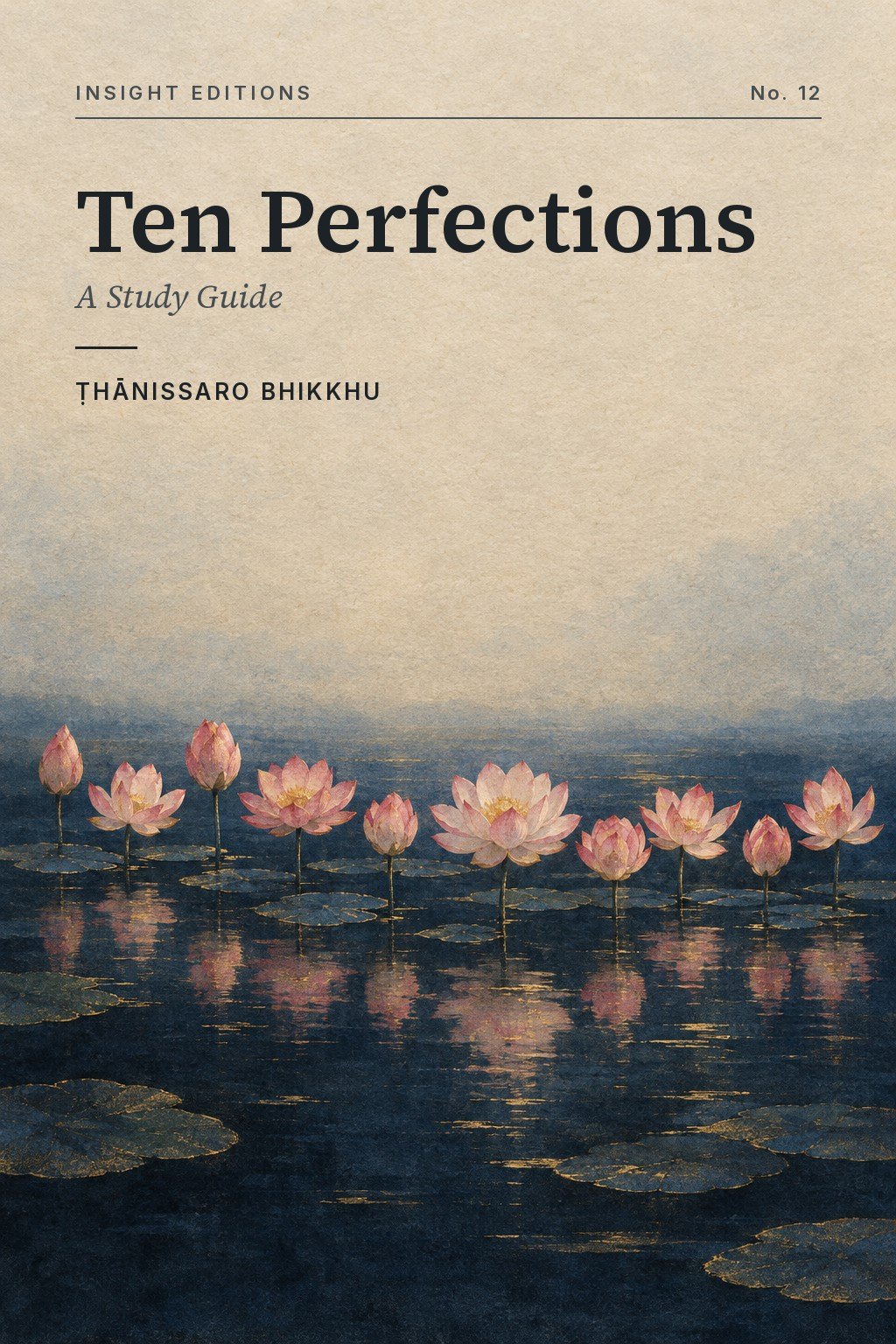
Wise determination turns good qualities toward ending suffering.
The Buddha, Ṭhānissaro Bhikkhu and Ajaan Lee Dhammadharo.
The Book in Brief
The ten perfections turn ordinary choices into training only when wise priorities govern them. In this study guide, Ṭhānissaro Bhikkhu organizes generosity, virtue, renunciation, discernment, persistence, endurance, truth, determination, good will and equanimity under four aspects of determination: discernment, truth, relinquishment and calm. The measure is not activity, intensity or a pleasing self-image. It is whether qualities are developed in a way that ends suffering.
Discernment decides what a situation calls for. Instruction and thought matter, but judgment matures through practice, observation and correction. The readings distinguish appropriate intervention from unnecessary struggle, goodwill from compulsory closeness, right resolve from fixation on one's righteousness, and a useful path from attachment to the path. Good will gives judgment a non-hostile aim without removing the need for boundaries, worthwhile companions or self-training.
Truth makes the training answerable to what is actually happening. A person can report conviction honestly without claiming knowledge, recognize a first realization without claiming completion, and expose misconduct without disguising it. Virtue extends that honesty into bodily, verbal and mental action; persistence sustains the work. The effort must be chosen and tuned: abandon what is unskillful, develop what is skillful, and do not mistake either needless pain or slackness for progress.
Relinquishment depends on seeing a better happiness. Giving involves an object, a motive, a manner, a donor and a recipient; transferring property is different from releasing a possessive claim. Renunciation becomes attractive when the drawbacks of sensuality are understood alongside an alternative ease. The two arrows distinguish bodily pain from the resistance added to it, while the four requisites show that renunciation still uses food, clothing, shelter and medicine for their proper purposes.
Calm is tested where comfort and approval disappear. Endurance includes patience with painful contact, willingness to hear correction and deliberate nonhatred under harsh speech. It also requires discrimination: some conditions should be endured, some dangers avoided, and some thoughts abandoned. Equanimity has levels, and none should be treated as the goal merely because it feels even. Concentration, energy and equanimity need timely adjustment; even a refined supporting state can become something to relinquish.
The endpoint is release, not a permanent identity as a good practitioner. The book repeatedly separates the quality being trained, the function it serves and the attachment that can grow around it. The map below shows their organizing relationships, not a compulsory sequence of ten exercises.
Chapter map
| Ch | Title | In one line |
|---|---|---|
| Intro | Introduction | Determination organizes the ten perfections and preserves their different functions. |
| I | Discernment | Train judgment through observation; give good will a wise, non-hostile scope. |
| II | Truth | Keep claims honest, conduct restrained and persistence properly directed. |
| III | Relinquishment | Distinguish giving, relinquishing ownership and the happiness of renunciation. |
| IV | Calm | Endure without hatred, avoid needless danger and surpass dependent equanimity. |
Introduction
The ten perfections turn daily life into a field of training, provided that wise priorities govern what one does. Ṭhānissaro Bhikkhu organizes this study guide around determination and its four aspects, rather than presenting ten separate virtues. Discernment keeps the other qualities directed toward the end of suffering, instead of allowing any mindful activity to count as practice.
Character as a lasting accomplishment
Generosity, virtue, renunciation, discernment, persistence, endurance, truth, determination, good will and equanimity are the complete list of ten perfections in this guide. Ṭhānissaro proposes viewing life as an opportunity to develop them. A skillful activity or relationship can then become part of Dhamma practice when undertaken wisely and in balance, not only because it occupies one's day.
Work and relationships do not supply dependable measures of a life, in the Introduction's argument: their apparent achievements can disappear. Developed qualities of character are more reliable and carry a person through changing circumstances. The compiler connects this claim to two proposed etymologies of pāramī: carrying one to the farther shore, paraṁ, and being of foremost importance, parama. The practical conclusion is to give these qualities priority when deciding what life is for and how to organize it.
The list's connection with lay life comes through the Jātaka stories, accounts of the Buddha's previous lives. In many, the future Buddha develops the necessary character while living as a lay person. Ṭhānissaro suggests that this background helps explain why the perfections can structure ordinary activities outside formal meditation. He places growing interest in these stories in the early centuries after the Buddha's death.
Three aspirations and a disagreement about their qualities
Three paths to awakening became formally distinguished, according to the compiler's historical account:
- Sāvaka, a disciple's awakening, follows the teaching of a Buddha.
- Pacceka-buddha, a private Buddha's awakening, is achieved independently, but without the ability to teach others the path of practice.
- Sammā sambuddha, a Rightly Self-awakened Buddha's awakening, is the third aspiration and, in this account, the one all Buddhists agreed took by far the longest.
The schools did not agree on the list of perfections. The Theravādins specified ten, arranging their Jātaka collection to culminate in ten tales that each exemplify a perfection. The Sarvāstivādins specified six and arranged their collection accordingly. The shared idea of character development therefore did not mean an identical classification.
A second disagreement concerned quantity versus kind. If a Buddha develops more of the same qualities that an arahant develops, the early canons can guide the Buddha aspiration by extending the arahant's training. If Buddhahood requires qualitatively different qualities, those canons cannot by themselves supply the additional instructions. Ṭhānissaro describes seekers in the latter group using meditation to induce visions of bodhisattvas and Buddhas in other world-systems, hoping to learn the full Buddha path from them.
The compiler traces a second body of teachings to those visionary experiences. He describes those teachings as diverse, dates a concerted attempt to collate them to the third century C.E. and the Yogācāra school, and links that attempt to what is now called the Mahāyāna movement. He maintains that the differences prevented full unity. His resulting contrast is between guidelines drawn from the early canons and traditions arising from visionary experiences beginning around the start of the common era. This guide deliberately takes the first approach.
Theravāda is not limited to the disciple aspiration, Ṭhānissaro argues. He points to Theravādins who have vowed to become bodhisattvas and trained in the ten Jātaka perfections. Because this approach treats the difference from arahant practice as quantitative, people aspiring to arahantship can also use the perfections to understand their daily training. His examples are giving donations to develop generosity and undertaking building projects to develop endurance.
Why determination organizes the whole guide
Determination is the eighth perfection in the tenfold list, but it provides this book's organizing frame. Ṭhānissaro gives four reasons for that choice:
- A beginning needs direction. Determination supplies focus, motivation and a course to follow before a person can undertake sustained development of the perfections.
- Its four aspects cover all ten. Discernment, truth, relinquishment and calm, properly understood, encompass the whole list. This illustrates his wider claim that each perfection, properly practiced, includes all ten.
- A priority must survive temptation. Wise determination chooses worthy aims and holds to them when lesser aims become attractive. It checks the self-deception that anything done mindfully must belong to the path.
- Discernment keeps the training aimed at release. Ṭhānissaro calls this perhaps the most important reason for his organizing choice. Without wise distinctions, the perfections remain generic virtues found in many cultures. Such virtues may produce pleasant results without leading to the transcendent ending of suffering.
Mindful performance alone does not make an activity part of the path. The test includes its aim, its consequences and its fit with wise priorities. Determination must be guided by discernment rather than by the mere intensity of commitment.
The book's structure preserves those relationships. It does not turn the ten perfections into ten consecutive chapters. Determination frames the whole; the four main chapters and their named subsections supply the rest of the organizing scheme.
| Main source heading | Named subsections | Function in the organizing frame |
|---|---|---|
| I. Discernment | Good Will | Make wise distinctions about aims, conduct and relationships. |
| II. Truth | Virtue; Persistence | Be honest in commitment and behavior; sustain appropriate effort. |
| III. Relinquishment | Generosity; Renunciation | Give up what obstructs the higher aim. |
| IV. Calm | Endurance; Equanimity | Train responses to difficulty without mistaking a means for the goal. |
The distinctions the reader must keep making
Good will does not require personal involvement with everyone. Ṭhānissaro uses §18 to distinguish wishing others happiness from wanting to engage with them; this is why he cautions against treating good will as necessarily the same thing as loving-kindness. §§20-21 combine good will for everyone with selective friendship. §22 makes the further distinction between good will and entanglement.
Persistence is not brute force. In §36, the kind of effort must fit the mental quality being addressed. §§37-38 require an additional judgment about the nature of the difficulty and one's available energy. The amount of effort and the method of effort are both questions for discernment.
Renunciation does not mean rejecting every physical pleasure. The Introduction directs readers to §§56-57 for standards that distinguish pleasure compatible with the path from pleasure that obstructs it. These references point forward to Chapter III.
Endurance requires both discrimination and practical help. §70 distinguishes what should be endured from what should not, while recommending ordinary care to avoid unnecessary danger. §§62-66 supply ways to make hardship more bearable: good will and sympathy for all; recollection of people who endured difficulties before; the rapture of concentration; and depersonalizing experience so that added stories do not multiply physical and mental pain.
Equanimity has different levels and is not the final destination. Ṭhānissaro points to §§72-73 to counter the assumption that equanimity itself completes the path. It serves a higher purpose. The recurring question is what a quality is doing for the end of suffering, not whether its name sounds virtuous.
Keep the aim and the distinction together. Universal good will can coexist with selective friendship; persistence can require less strain or a different method; endurance can coexist with avoiding needless danger. These paired distinctions are the compiler's safeguards against turning a useful quality into an indiscriminate rule.
The four determinations
The book closes its Introduction with MN 140. In paraphrase, its four instructions are to remain diligent about discernment, protect truth, devote oneself to relinquishment, and train only for calm. They supply the four chapter headings that follow.
Discernment
Discernment learns from consequences and chooses what leads to lasting welfare. The canonical readings connect it with right view, appropriate attention and the ability to correct mistakes. Ajaan Lee develops these themes through practical experiments, breath meditation and the distinction between outward appearances and the mind's actual condition. The chapter's second section shows why good will needs boundaries, wise companions and self-training.
Learning to judge causes and consequences
1. Three sources of discernment
DN 33 names three kinds: discernment from listening, sutamaya-paññā; from thinking, cintāmaya-paññā; and from development or meditation, bhāvanāmaya-paññā. The list distinguishes receiving instruction, considering it and developing understanding through practice. The later Ajaan Lee selections explain how these activities work together rather than treating information alone as completed wisdom.
2. Recognizing one's foolishness
Dhp 63 gives self-recognition a limited but real value. A fool who recognizes foolishness has wisdom to that extent. Thinking oneself wise while remaining foolish removes even that opening for correction; the verse calls this the fuller form of foolishness.
3. Acknowledgment and rightful pardon
AN 2:21 identifies two failures and their corresponding forms of wisdom. One person does not recognize a transgression as a transgression; another refuses the rightful pardon of someone who has confessed. Wisdom means both seeing one's own wrong clearly and granting the appropriate pardon to another who acknowledges theirs. The qualification matters: the passage speaks of rightful pardon, not indiscriminate approval of misconduct.
4. Taking the right burden
AN 2:99 calls two opposite mistakes foolish: taking on a burden that has not fallen to oneself, and refusing a burden that has. Responsibility requires discrimination, neither automatic intervention in everything nor avoidance of one's actual obligations.
5. The questions that lead to discernment
MN 135 directs a visitor to question a contemplative or brahman about conduct and its results. The complete inquiry asks what is skillful or unskillful; blameworthy or blameless; to be cultivated or not cultivated; and conducive to one's long-term harm and suffering or long-term welfare and happiness. The questions turn attention from the immediate attraction of an action to its quality and consequences.
6. When enjoyment and benefit point in different directions
AN 4:115 tests stamina, persistence and effort in two difficult cases. When an action is unpleasant but beneficial, the fool avoids it because it is unpleasant and thereby loses the benefit. The wise person reflects on its beneficial result and does it. When an action is pleasant but harmful, the fool does it because it is pleasant and receives the harm; the wise person considers the harmful result and refrains. The book describes this as a test of manly stamina and effort; its operative distinction is the capacity to act according to consequences rather than immediate feeling.
The hard test of discernment is the action whose immediate feel conflicts with its eventual result. The task is to do the unpleasant good and decline the pleasant harm, not to assume that difficulty itself proves value or that pleasure itself proves fault.
Right view and the training that supports it
7. Right view and right resolve
SN 45:8 defines right view through four kinds of knowledge: stress, its origination, its cessation, and the path of practice leading to its cessation. It defines right resolve through renunciation, freedom from ill will and harmlessness. The first identifies the problem and its solution; the second directs intention accordingly.
8. Mundane and transcendent forms
MN 117 distinguishes a merit-oriented right view that still has fermentations and produces acquisitions from a transcendent right view without fermentations. The former affirms the significance of giving, offerings and sacrifice; the fruits of good and bad actions; this world and the next; mother and father; spontaneously reborn beings; and rightly practicing contemplatives and brahmans who directly know these worlds and proclaim that knowledge. These are the passage's actual commitments, not merely a generic belief in being ethical.
Transcendent right view is the discernment active in a noble mind developing the noble path. The passage describes the same capacity as discernment itself, its faculty, its strength, analysis of qualities as an awakening factor, and right view as a path factor. It is noble, free from fermentations and fully associated with the noble path, rather than only a conviction supporting merit and further acquisitions.
Right effort and right mindfulness work with right view. Effort tries to abandon wrong view and enter right view; mindfulness remembers to abandon the wrong and to enter and remain in the right. Thus view, effort and mindfulness support the establishment of right view. Mindfulness here is selective and sustaining, not an instruction to treat right and wrong views alike.
Right view also precedes and distinguishes resolve. Wrong resolve aims at sensuality, ill will and harmfulness. The merit-oriented form of right resolve reverses those aims through renunciation, non-ill-will and harmlessness, but still belongs to the side with fermentations and acquisitions of becoming. The transcendent form consists of thinking, directed thinking, resolve, mental absorption, mental fixity, focused awareness and verbal fabrications in a noble mind developing the path without fermentations.
The same three supports surround right resolve. Right view recognizes which resolve is right; right effort abandons the wrong and enters the right; right mindfulness abandons the wrong and enters and remains in the right. The two kinds of right view and the two kinds of right resolve therefore must not be collapsed into one undifferentiated achievement.
| Factor in MN 117 | Merit-oriented form | Transcendent form |
|---|---|---|
| Right view | Convictions about giving, action and results, worlds, parents, rebirth and direct knowing | Discernment functioning as a noble, fermentation-free path factor |
| Right resolve | Renunciation, freedom from ill will and harmlessness while acquisitions remain | The listed thinking and focusing activities within the noble path |
| Supporting activity | Abandon the wrong; enter and sustain the right | Right view, effort and mindfulness cooperate rather than compete |
9. The faculty of discernment
SN 48:10 describes a noble disciple's discernment of arising and passing away as noble, penetrating and directed toward the right ending of stress. That person knows stress, its origination, its cessation and the path as they actually occur. Observation of change is thus joined to the four-truth task, not presented as a detached interest in change for its own sake.
10. Feeding analysis of qualities
SN 46:51 identifies appropriate attention as nourishment for analysis of qualities, an awakening factor. The relevant distinctions are skillful and unskillful, blameworthy and blameless, gross and refined, darkness-oriented and light-oriented qualities. Attending appropriately to these distinctions both brings the factor into being when absent and makes it grow when already present.
Ajaan Lee on experimental understanding
11. Learn as a craftsperson learns
Ajaan Lee, Inner Strength, compares meditation with pottery, tailoring and basket weaving. A teacher can explain how to make an object, but proportion and beauty require the learner's own observation. His basket example makes the method concrete: make a basket, inspect whether it is too short or tall, then whether the next is too thin or broad; keep correcting until one is well proportioned from every angle. That finished basket supplies a working standard, good enough to begin a business.
The discernment comes from evaluating one's own actions. Once an improved standard is available, the previous failed baskets need not remain a preoccupation. Instruction provided a start, but the ingenuity and judgment grew through making, inspecting, adjusting and trying again. The point is not to repudiate teachers; it is to do the observational work that a teacher cannot do for the student.
Breath meditation requires the same care. Observe the breath and adjust it until it is proportionate throughout the body, flows evenly and does not falter. Ajaan Lee names slow in and slow out; fast in and fast out; long; short; heavy; and refined breathing, aiming for comfort on both inhalation and exhalation. The desired skill is to find ease as soon as attention goes to the breath, whatever the occasion.
He describes both bodily and mental results. The body feels easy, light, open and spacious; he further says unobstructed breath and blood make it strong, healthy and awake and deny disease an opening. Mentally, mindfulness and alertness lead to stillness, while negligence leads to distraction and restlessness. Continuing to observe, evaluate and improve the causes develops concentration step by step and brings understanding from experience.
12. Know causes and effects together
Ajaan Lee, The Skill of Release, requires knowledge of both cause and effect. Knowing an effect without its cause, or a cause without its effect, is incomplete. Their connection must be known with mindfulness and alertness. Books, testimony and conjecture alone cannot provide the all-around knowledge he means.
His silver-coin experiment distinguishes a label from knowledge of properties. Knowing that other people call the coins money does not reveal what they are. Smelting them, discovering their composition and seeing what else can be made from them brings knowledge through one's own action. In meditation he distinguishes five causal patterns: effects originating in bodily properties; effects originating in the mind; mental causes with bodily effects; bodily causes with mental effects; and body and mind acting together.
13. Diagnose stress without fighting every condition
Ajaan Lee, Inner Strength, opens with the Dhamma of attainment: cool, clean and clear, beyond birth, aging, illness and death. Earnest study and practice, he says, lead to attainment, but attainment is paccattaṁ, something a person must know individually. It cannot be transferred as another person's report.
He returns to all three forms of discernment. Listen to what deserves attention; evaluate it without immediate acceptance or rejection; test it and practice accordingly. Development culminates in liberating insight, which knows what stress should be remedied and what should not. Some conditions call for intervention; others call for accurate observation and then being left alone.
The rusty watch illustrates over-intervention. Removing more rust than necessary and taking the whole mechanism apart can stop a working watch permanently. Once natural conditions have been understood, indiscriminately tampering with them adds a burden instead of removing one. A similar image is dismantling an entire house because the front step has cracked: a response can become more destructive than the original problem.
The woman who drowned her matches illustrates indiscriminate aversion. After cooking and eating, she lights a cigar from an ember and burns her mouth. Blaming fire, she wets every match, only to discover that she can no longer cook or light her home and must ask neighbors for help. Ajaan Lee adds the opposite mistake: too small a fire leaves the rice cooking for three hours. Understanding means knowing how to use something and how much is enough, rather than hating everything associated with pain.
He first distinguishes two kinds of stress: the physical stress inherent in natural conditions, and the mental stress of defilement. Birth brings aging, illness and death; a campaign to abolish aging can occupy a person until old age arrives. Illness moves from one body part to another, in his image, like an eel slipping from every attempted grasp. Treating bodily conditions never makes the body permanently immune to its nature.
He then distinguishes illness by response to treatment. If an illness goes away with treatment, he says to use medicine; if it resolves whether treated or not, he questions unnecessary treatment. He warns against spending time and money without understanding the problem. He further attributes disease either to imbalanced physical elements or to kamma: the former calls for food and medicine; stress rooted in the heart calls for the Buddha's medicine, the Dhamma, rather than food or drugs.
A second perspective distinguishes stress's shadow from its substance. Aging, illness and death are called its bodily shadows or effects; the mind contains the stress that requires direct attention. Trying to kill an enemy by stabbing the enemy's shadow cannot work. Ajaan Lee calls neglect of the heart while attacking only the shadows avijjā, unawareness. This perspective supplements his instruction to treat appropriate bodily problems; it does not erase that earlier distinction.
A third perspective traces both shadow and substance to craving. He compares a person who accumulates a houseful of wealth and then kills the thieves it attracts with a person who hates suffering while doing nothing about its internal conditions. The illustration redirects attention to one's own contribution to the problem.
All three cravings must be recognized: craving for sensuality, craving for becoming, and craving for no becoming. They are fabricated in the heart and must be identified with one's own mindfulness and discernment. It is not enough to recognize the names; the practitioner must identify which kind is operating in an actual mental state.
Ajaan Lee gives an additional developmental image. He says craving appears in subtle, intermediate and blatant forms, comparing its development to youth, middle age and old age. Sensual craving is the youthful thirst; the mind's wavering and movement are craving for becoming; the ensuing fixed pursuit becomes craving for no further becoming. He pictures a sambhavesin stretching its neck toward an object, making itself suffer through the search.
The sensory example makes his sequence concrete. Attraction to sights, sounds, smells and flavors fixes attention on them and creates stress. He warns against preoccupation with objects that provoke greed, anger and delusion; the mind then wavers outward in concepts and repeatedly maintains that movement. The book associates these movements with its three cravings, including the unusual description of continued wavering as craving for no further becoming.
The remedy is anulomika-ñāṇa, knowledge in accordance with the four noble truths. Know directly the ease and pleasure when all three cravings disappear. That is knowing the reality of disbanding; the cause of stress and the path to its disbanding are to be known as well. The analysis must reach the experience of cessation, not remain a classification of difficulties.
Shadows can also be mistaken for virtue and concentration. Trying to ride a car's shadow results in injury, not transport. In the same way, words and deeds are virtue's shadows, while its substance is the heart at normalcy. Concentration's substance is a mind firmly centered on one preoccupation without disruptive concepts or labels.
Fixed penetration is tested across postures. A mind established at this level does not waver when sitting, standing, walking or lying down. Discernment then becomes available without being hunted for, like an imperial sword that is sharp and bright when drawn and returns to its scabbard when no longer needed. Ajaan Lee invokes mano-pubbaṅgamā dhammā, mano-seṭṭhā mano-mayā to emphasize the mind's precedence and its role as the source of Dhamma.
The conclusion joins virtue, concentration and discernment with the four truths. Knowing stress, its cause, its disbanding and the path constitutes their substance and leads to release, nibbāna. Study and practice are to produce attainment within the practitioner. Ajaan Lee describes this as sandiṭṭhiko, visible in the present, and akāliko, bearing fruit without dependence on a particular time or season, and urges continued practice.
14. Right resolve and release from attachment to rightness
Ajaan Lee, Inner Strength, locates harm to others after an initial harm to oneself. The intention to harm first opens a route inside one's own house, so to speak, before it goes outside. At minimum it consumes time and destroys an opportunity for good. He proposes replacing it with the intention not to harm, developed through concentration. Like putting unused land to work, this frees capacity for doing the available good rather than wasting it.
He explains three forms of right resolve in practical terms. Nekkhamma-saṅkappo, renunciation, is ease in quiet, solitary places. Abyāpāda-saṅkappo, non-anger, avoids brooding over one's own or others' bad points. Avihiṅsā-saṅkappo, harmlessness, avoids creating trouble for oneself: dwelling on personal faults can depress the mind, then spread like wildfire into dwelling on others' faults. Lift thought toward goodness so that good will for oneself can extend to others. In this passage the target is destructive preoccupation, not the honest acknowledgment of transgression required in §3.
The three energies support a wider capacity to see. Ajaan Lee likens them to a three-legged table that can spin in every direction, or a high vantage from which one can photograph what is above and below. Discernment becomes a bright light or magnifying binoculars. He calls it ñāṇa, intuitive awareness, and invokes lokavidū, knowing the world. He explicitly attributes to this intuitive awareness the ability to know everything in the world. These descriptions belong to his account of a special cognitive skill of the Noble Path, not ordinary information gathering.
His image of three eyes describes discrimination without distress. The heart sees the world's reds and greens, highs and lows, and looks at Dhamma before, behind, above, below and around itself. It understands the ins and outs of good and evil while remaining at ease. He associates this with vijjā-caraṇa-sampanno, being fully equipped with cognitive skill.
At the deeper level, discernment sees equality rather than rank. Rich and poor, high and low, and different homes share inconstancy, stress and not-self. Ajaan Lee compares this equality to democracy. He attributes burglary, robbery and confusion to failing to see it: people rank one house above another as a place to eat or sleep and act on those discriminations. This is his explanatory illustration, not a complete social account of crime.
The path eventually releases attachment even to its own achievements. Ajaan Lee says virtue, concentration and discernment disband when the Noble Path reaches nibbāna: knowing continues without making intelligence an essential possession or identity. Do not be stuck on virtue, concentration or discernment, or on stream-entry, once-returning or non-returning. Nibbāna is not attached to the world, and the world is not attached to nibbāna; he reserves arahant for this freedom.
His deliberately paradoxical language concerns release from clinging to descriptions. People may correctly call things inconstant, stressful or not-self, yet remain wrong through attachment to their own rightness. Roads are usable by people and animals, sane and mentally disturbed people, whether or not every user was in the builder's original purpose. Similarly, anyone can observe precepts, sit in concentration or discuss discernment; outward participation does not settle the quality of understanding.
Worldly valuables do not provide the pleasure he seeks. They may count as good within the world but remain stressful and are unnecessary to nibbāna. Right and wrong views belong to the work of the world; the goal is not possession of either. Abandon wrong view and develop right view until right view itself can fall from one's grasp. The sequence matters: release is not permission to skip the development of right view.
Good Will
15. Extend good will in every direction
SN 42:8 describes an awareness without covetousness, ill will or bewilderment, maintained with alertness and mindfulness. Pervade east, the second, third and fourth directions, then above, below and all around, until the whole cosmos is encompassed. The good will is abundant, expansive, immeasurable and free of hostility. A strong conch-trumpet blower whose sound reaches all four directions without difficulty supplies the comparison.
16. Leave no category of being outside the wish
Sn 1:8 wishes happiness and rest for every being. Its inclusive pairs are weak or strong; long or large, middling or short; subtle or blatant; seen or unseen; near or far; born or seeking birth. The practice also has behavioral content: do not deceive another, despise anyone anywhere, or through anger and resistance wish another to suffer. Universal scope and absence of hostile intention belong together.
17. Wish others the capacity for ease
AN 10:165 formulates good will as a wish that beings be free of animosity, oppression and trouble, and that they look after themselves with ease. The wording does not require possessing, supervising or personally satisfying every being; it wishes them a condition in which they can fare well.
18. Good will can ask for distance
AN 4:67 extends good will to footless, two-footed, four-footed and many-footed beings, and asks each category not to cause harm. It wishes good fortune and freedom from evil to all creatures, breathing things and beings, without exception. The blessing is not restricted to creatures a person finds attractive.
The protection includes a request that the beings depart. The text calls the Buddha, Dhamma and Sangha limitless, while creeping creatures have a limit, naming snakes, scorpions, centipedes, spiders, lizards and rats. Having made a safeguard and protection, the speaker asks them to leave. This is the Introduction's concrete evidence that good will does not necessarily mean wanting close involvement.
19. Eleven benefits attributed to developed good will
AN 11:16 makes its eleven predictions about a thoroughly developed release of awareness through good will, not a passing friendly thought. The practice has been cultivated, developed and pursued, given command and grounding, steadied, consolidated and undertaken well. The expected benefits are:
- Easy sleep. One sleeps without difficulty.
- Easy waking. One wakes without difficulty.
- No evil dreams. Dreams do not carry that disturbance.
- Dearness to human beings. People hold one dear.
- Dearness to non-human beings. The stated benefit extends beyond human relationships.
- Protection by devas. The passage explicitly includes divine protection.
- Immunity from fire, poison and weapons. The text says these cannot touch the practitioner.
- Quick concentration. The mind gathers readily.
- A bright complexion. A bodily appearance benefit is included.
- An unconfused death. Confusion does not dominate dying.
- A Brahma-world destination if no higher penetration occurs. This last benefit is conditional, not the highest possible attainment.
20. Choose company without narrowing good will
Sn 2:4 names three features of the highest protection: not associating with fools, associating with the wise, and honoring those worthy of honor. Universal good will does not abolish judgment about whose example to trust or whose company to seek.
21. Admirable friendship is learning by association
AN 8:54 describes a lay person spending time with virtuous householders or householders' sons, whether young or old, in their own town or village. Discussion and conversation provide contact with the qualities to emulate: consummate conviction, virtue, generosity and discernment. Age is not the deciding qualification; the person's developed qualities are.
22. Courtesy without entanglement
AN 8:30 says the Dhamma is for seclusion rather than entanglement. A monk living alone may be visited by monks, nuns, lay men, lay women, kings, royal ministers, members of other sects and their disciples. He remains inclined toward seclusion and appreciative of renunciation, speaking only as much as is needed for the visitors to take their leave. The example preserves necessary conversation while protecting the purpose of the retreat.
23. The acrobats and reciprocal protection
SN 47:19 tells of a bamboo acrobat and his assistant, Frying Pan, who climbs the pole and stands on his shoulders. The master proposes that each watch the other so they can display their skill, earn their reward and descend safely. The assistant corrects him: each should watch after themselves; that is how the joint performance will succeed. The discourse explicitly approves her reply in that situation.
The lesson has two complementary directions. Establish mindfulness with the intention of protecting oneself and with the intention of protecting others. Protecting oneself protects others through pursuing, developing and devoting oneself to the practice. Protecting others protects oneself through endurance, harmlessness, kindness and sympathy. The story is not an argument for ignoring others; it shows how one's own trained balance supplies protection that anxious supervision cannot replace.
Good will has universal scope, not compulsory intimacy. §§18 and 20-23 put distance, wise friendship, seclusion and personal training alongside the wish for everyone's welfare. The bamboo acrobats add the reciprocal point: self-training and care for others strengthen each other when each performs its proper work.
24. Anger as an uninsured fire
Ajaan Lee, Food for Thought, describes anger losing every ordinary restraint. It may cease to distinguish good and evil, right and wrong, or the claims of spouses and children; a quarrel can end in murder, imprisonment or a death sentence. He calls this worse than a burned house because the losses reach the whole life. Observing the five or eight precepts is his image of life insurance: treating the open sores of unwise thought, speech and action, even when they cannot all be removed at once.
The fire must be reduced and finally extinguished. If some remains, let it be no more than enough to cook or light the house, rather than burn it down. He identifies meditation and thoughts of good will as the only way to put out anger, hatred and ill will. Sympathy grows by considering causes and effects carefully and recognizing that people seek goodness but do not develop it equally.
His argument against demanding identical behavior uses division of labor and the body. A world of only farmers would lack merchants and officials; a world of only officials would have no farmers and would starve. Fingers differ in length and size; ten identical fingers would make a monstrous hand. From these examples he urges forgiveness instead of expecting identical thoughts, words and deeds from everyone. His prediction that the world would collapse within only a few days if everyone were equal and identical, whether equally good or bad, belongs to this analogy; it is not a measured social finding.
Forgiveness lets good will reach people at high, low and intermediate levels. The interior fire goes out as sympathy replaces the demand that everyone be alike. This is compatible with §14's different claim that people share the three characteristics: shared impermanence, stress and not-self do not mean identical behavior or capacities.
The concluding method is tranquility meditation with buddho. Ajaan Lee says sensual desire, ill will, lethargy, restlessness and uncertainty disappear as the mind becomes firmly concentrated. Directed thought keeps it with the meditation word; evaluation develops inner lightness and ease. Rapture becomes the mind's own food and nourishment. He concludes that whatever one does in thought, speech or action is then sure to succeed, because the mind has an internal source of support instead of feeding on anger.
Truth
Truth begins with refusing deception, including deception of oneself. These readings distinguish honesty about what one knows from direct realization, and direct realization from completed attainment. The chapter then follows truth into virtue and persistence: conduct must match intention, and effort must be steady enough to work without becoming destructive strain.
Being teachable requires being honest
25. The straightforward student
MN 80 invites an observant person who is neither fraudulent nor deceitful to receive instruction. With a straightforward nature and practice according to the teaching, the passage says that person soon knows and sees for themselves the right release from the bondage of ignorance. Truthfulness is a condition for effective instruction, not a decorative virtue added after insight.
26. Expose the tricks that need correction
The compiler introduces AN 8:13 as a characteristic of a thoroughbred monk. Such a monk shows tricks, deceptions, wiles and subterfuges as they actually are to the Teacher or knowledgeable companions in the holy life. Disclosure gives those people something real to straighten out. Concealment would preserve the very habits the training is meant to change.
27. Rāhula and the water dipper
MN 61 places the lesson at the Mango Stone, where Ven. Rāhula prepares a seat and foot-washing water for the Buddha after the Buddha emerges from afternoon seclusion. The Buddha uses the remaining water and the dipper to make four distinct comparisons with a contemplative who feels no shame about deliberate lying:
- A little remaining water: very little of the contemplative life remains in such a person.
- Water thrown away: what remains of that life is discarded.
- The dipper turned upside down: the contemplative life is overturned.
- The dipper returned upright, empty and hollow: the claimed contemplative status has no substance.
The royal war elephant adds the idea of a final restraint. The immense, pedigreed, battle-trained elephant has tusks like chariot poles and fights with its forefeet, hindfeet, forequarters, hindquarters, head, ears, tusks and tail, but initially protects its trunk. The trainer sees that it has not given its life entirely to the king. Once it also uses the trunk, nothing is held back. Likewise, the Buddha says, a person unashamed of deliberate lying has no evil left that they would refuse. Rāhula is to train not to tell a deliberate lie even as a joke.
28. The breached restraint
Iti 25 states the warning without the elephant story. For one who crosses the boundary of deliberate lying, no evil deed remains excluded. The passage's force lies in the loss of an internal restraint, not simply in the immediate factual error produced by one false statement.
29. Truth does not require saying everything true
AN 4:183 records a discussion at Rājagaha's Bamboo Grove, the Squirrels' Sanctuary, with Vassakāra, the brahman minister to the king of Magadha. Vassakāra proposes that there is no fault in reporting what one has seen, heard, sensed or cognized as such. The Buddha refuses both blanket permission to say everything in those categories and a blanket ban on saying it.
The discriminating test is its effect on the speaker's mental qualities. If speaking about something increases unskillful qualities and decreases skillful qualities, it should not be spoken about. If it decreases the unskillful and increases the skillful, it should be spoken about. The rule applies to all four categories, including cognition, rather than to sensory reports alone. Vassakāra leaves pleased with the response. Accuracy is necessary but does not settle whether an utterance is skillful.
Safeguarding truth is not yet realizing it
30. From inherited conviction to verified attainment
MN 95 begins with Kāpadika Bhāradvāja defending the ancient brahman hymns. The hymns have been transmitted orally and included in the brahman canon, whose adherents conclude that their account alone is true and everything else worthless. The Buddha asks whether that certainty rests on anyone's actual knowing and seeing: a living brahman, a teacher or teacher's teacher across seven generations, or one of the original seers. Bhāradvāja answers no at every level.
The passage names all ten ancient hymn-makers: Aṭṭhaka, Vāmaka, Vāmadeva, Vessāmitta, Yamataggi, Aṅgīrasa, Bhāradvāja, Vāseṭṭha, Kassapa and Bhagu. Their hymns are still sung, chanted and repeated, but repetition does not supply a missing claim to direct knowledge. The Buddha compares the lineage to blind people holding one another in a row: the first, middle and last do not see. An unbroken chain can transmit a claim without repairing its evidential gap.
Bhāradvāja then shifts from conviction to unbroken tradition. The Buddha distinguishes five fallible bases for belief: conviction, liking, unbroken tradition, reasoning by analogy, and agreement reached by pondering views. Any can go either way in the present: a strongly held or well-pondered proposition can be empty and false, while a proposition lacking that support can be genuine and accurate. The same two-way possibility applies to liking, tradition and reasoning. Their presence alone does not justify exclusive certainty, and their absence alone does not refute a claim.
Safeguarding truth means accurately reporting one's present basis. A person may say that something is their conviction, what they like, their tradition, their analogical reasoning, or what they accept after reflection. That acknowledgment protects truth by not claiming more than has been established. It is not yet awakening to truth. The passage does not ask a person to pretend to have no beliefs; it asks them not to turn an identified basis into a false claim of final knowledge.
Awakening to truth begins with examining a teacher. A householder or householder's son observes a monk living near a town or village for qualities rooted in greed, aversion and delusion, taking each in turn. The question is whether such a quality could overcome the monk so that he claims to know without knowing, claims to see without seeing, or directs someone toward long-term harm and pain.
The examination uses conduct and teaching together. Bodily and verbal behavior should show the absence of the corrupting quality. The Dhamma taught is described as deep, difficult to see and realize, tranquil, refined, beyond conjecture, subtle and personally experienced by the wise; the passage reasons that such teaching would not be easy for a greedy, averse or deluded person to give. Only after observing purification with respect to all three roots, rather than relying on prestige or lineage, does the student place conviction in the monk.
The passage then gives a complete sequence from confidence to realization. The steps are cumulative, not interchangeable:
- Place conviction in the examined teacher. Trust follows the investigation just described.
- Visit and grow close. Confidence leads to sustained access rather than distant admiration.
- Lend an ear. The student becomes willing to listen.
- Hear the Dhamma. Actual teaching is received.
- Penetrate the meaning. Retention becomes understanding of what the teachings say.
- Reach agreement by pondering them. Reflective consideration finds the teaching acceptable.
- Allow desire to arise. Interest becomes a wish to undertake the training.
- Become willing. The wish becomes readiness to act.
- Contemplate or weigh. The translator glosses the verb as weighing or comparing, preserving its deliberative sense.
- Make an exertion. Consideration issues in actual practice.
- Realize and see. The student realizes the ultimate meaning of truth with the body and sees it by penetrating it with discernment.
This is awakening to truth, not yet its final attainment. For final attainment, the Buddha prescribes cultivating, developing and pursuing those same qualities. Bhāradvāja's repeated questions therefore distinguish three achievements: honest guarding of one's epistemic position, direct realization through the sequence of training, and completion through continued development.
| Stage in MN 95 | What has been achieved | What must not be claimed yet |
|---|---|---|
| Safeguarding truth | One states one's belief and its basis without exaggeration | That one's position is uniquely true merely because of that basis |
| Awakening to truth | Examination, learning and exertion reach embodied realization and discernment | That this first realization is already final attainment |
| Final attainment | Those same qualities have been cultivated, developed and pursued | No shortcut from lineage, preference or initial conviction is supplied |
A truthful report of conviction is not the same thing as knowledge, and an initial realization is not the same thing as completion. MN 95 holds both epistemic restraint and a practical route forward: investigate, learn, practice, realize, and continue developing.
31. Do not betray the aim you honestly choose
Ajaan Lee, Food for Thought, portrays the Buddha rejecting unstable worldly pleasure in favor of happiness that will not turn into something else. He leaves family and friends for seclusion and reflects that he is born and dies alone: no one hired him for either event, so he takes himself to be beholden to no one and afraid of no one. In Ajaan Lee's telling, he will not do something considered right by the world if it is wrong in truth and wrong in his heart.
The decisive exercise is an honest, binding answer about one's highest aim. Ask what is most wanted in a human life and how one wants it, answer without falsity, then hold to the answer like a law carrying one's seal. Do not put a second seal over the first or become a traitor to oneself. The answer in the account is the highest, most dependable ease and happiness, one that does not change into anything else; nothing else is wanted as the final aim.
The account joins truth of intention with truth of effort. The Buddha keeps that aim firm, does not let what would stain or distract the heart lodge there, and persists with all his strength until realizing liberation. Ajaan Lee insists that truth cannot escape someone true in intention and action, whereas someone untrue to themselves will not find the true happiness the Buddha found. Saying one wants happiness while knowingly entering fire or drinking poison illustrates behavior that contradicts the stated wish.
Even animals seek happiness, yet human actions often undermine their declared intention. Ajaan Lee uses the monastery visitor who gives offerings, observes precepts or meditates for praise and reputation as his example. He judges that there is no real merit in those actions when done for such motives. When they do not produce the hoped-for happiness, the visitor blames the practices, then the Buddha, Dhamma and Saṅgha, rather than examining the dishonesty in the motive. He insists that an untrue approach prevents a person from knowing the truth of the teachings.
Royal robes and jewels cannot transform a monkey into royalty. Ajaan Lee compares virtue, concentration and discernment to ornaments that should beautify the heart. If the heart is not true, it soils and tears the fine clothing like a monkey dressed for a show. The soldier's cap and uniform add the same test: the outfit is genuine, but its wearer is still not a soldier. His conclusion requires sincerity in generosity, virtue, concentration and discernment, not playacting in any of them. He concludes that genuine practice in these activities surely bears the fruits of one's own truthfulness.
Virtue
32. Five restraints as five great gifts
AN 8:39 calls five forms of abstention ancient, original and unadulterated gifts, not suspect to knowledgeable contemplatives and brahmans. The complete list is abstention from taking life, taking what is not given, illicit sex, lying and intoxicants. Their value is explained as what other beings receive, not only what the observer avoids.
Each restraint gives the same three freedoms to limitless beings: freedom from danger, animosity and oppression. In giving those freedoms, the disciple gains a share in them. This reciprocal consequence belongs to each of the five gifts, rather than only to non-killing or non-stealing. The text's description as enduring and unfaulted makes the gifts a stable standard, not a fashion in conduct.
33. Ten forms of purified action
AN 10:165 divides purified conduct into three bodily, four verbal and three mental actions. The details matter because abstention has both a negative boundary and a positive manner of living. It is not enough to preserve the number ten while omitting what the actions involve.
The three bodily forms are:
- Do not kill. Put down rod and knife and live scrupulously, mercifully and compassionately for the welfare of all living beings.
- Do not take what has not been given. Whether in a village or wilderness, do not take another person's property as a thief.
- Do not engage in sensual misconduct. The book prohibits sexual involvement with people protected by mother, father, brother, sister, relatives or Dhamma, with those who have husbands, those whose involvement entails punishment, or those crowned with flowers by another man.
The four verbal forms are:
- Speak truthfully. When called as a witness before a town meeting, group, relatives, guild or royalty, distinguish knowing from not knowing and seeing from not seeing. Do not knowingly lie for oneself, another person or reward. Remain firm, reliable and non-deceptive.
- Speak for concord rather than division. Do not carry what is heard in one place to another in order to break people apart. Reconcile the divided and strengthen the united; value and speak for concord.
- Use non-abusive speech. Speak words that are pleasant to hear, affectionate, heartfelt, polite and broadly appealing, rather than coarse or injurious.
- Avoid idle chatter. Speak at the right time, factually, in accordance with the goal, Dhamma and Vinaya. Speech should be worth keeping, reasonable, appropriately bounded and connected to its purpose.
The three mental forms are:
- Non-covetousness. Do not wish another's possessions were one's own.
- Good will. Keep the heart free of corrupt resolve and ill will; wish beings freedom from animosity, oppression and trouble, and the ability to look after themselves with ease.
- Right view. Affirm the significance of giving, offerings and sacrifice; results of good and bad actions; this world and the next; mother and father; spontaneously reborn beings; and rightly practicing contemplatives and brahmans who directly know and proclaim these worlds. This repeats the specified view in §8, not only a favorable attitude.
34. Which losses compromise one's future
AN 5:130 distinguishes five losses: relatives, wealth, health through disease, virtue, and views. It says that loss of relatives, property or health is not what causes rebirth after death in a bad destination, deprivation or hell. Loss of virtue and loss of right views do cause that danger in the passage's account. The comparison ranks moral and cognitive damage above ordinary misfortune; it does not deny the pain of bereavement, poverty or illness.
35. Ajaan Lee's three levels of virtue
Ajaan Lee, The Path to Peace & Freedom, distinguishes lower, middle and higher virtue, then gives a second classification into mundane and transcendent virtue. His exposition moves from observable conduct to the mental qualities supporting it. Its later correspondences between hindrances and precepts are his interpretive analysis, not additional quotations from the preceding canonical passages.
Lower virtue as orderly words and deeds
Heṭṭhima-sīla, lower virtue, is normalcy in words and deeds. Its bodily restraints are not killing, not stealing and not engaging in sexual misconduct. Its verbal restraints are not lying, not speaking divisively, not speaking coarsely or abusively, and not speaking idly. Classified by the rules and the people undertaking them, the book names the five, eight, ten and 227 precepts.
There are two duties even at this preliminary level. Pahāna-kicca concerns behavior to abandon. Bhāvanā-kicca concerns behavior to develop, including good manners and proper use of food, clothing, shelter and medicine, the four necessities. Thought, word and deed should become orderly and becoming. This outward observance, Ajaan Lee says, supplies manussa-sampatti, the accomplishment of being fully human.
Middle virtue as upright mental action
Majjhima-sīla keeps the harmlessness of words and deeds and adds three forms of mental uprightness. The first is anabhijjhā-visamalobha, not coveting what belongs to others or lies beyond one's scope and capacities. Do not spend thought building castles in the air. Instead, use intelligence and ingenuity to tend the resources already available so they can grow.
The banana-tree example makes this a work-based principle. Water a single tree, fertilize it, loosen the soil around its roots and protect it from danger; it can produce further banana trees. Similarly, existing resources can become a livelihood through care. A person who wants acquisition without work may fail to support themselves even after gaining much wealth. Ajaan Lee criticizes greed that demands beyond one's capacity while neglecting the available work, rather than all material development.
The second quality is abyāpāda, freedom from ill will, hatred and vengeance. Disappointment in relationships of association and mutual help becomes dislike, then brooding, hurt, anger and retaliation. He asks the practitioner to look at a person from several sides: someone who does not act well toward oneself may speak well, or if neither conduct nor speech is good, may still possess some well-meaning intention. The aim is to interrupt totalizing hatred without pretending every behavior is good.
He gives two deliberate ways to replace anger:
- Recall the person's good toward oneself. Remember actual instances that can support affection, love and good will.
- Consider the cost of taking in the bad. Anger is like scum over clean lake water: swallowing it misses the nourishment underneath and may cause sickness. A person behaving badly is compared to someone in filth; hating them is like choosing to sit in it too. Continue this reflection until ill will and anger fade.
The third quality is sammā-diṭṭhi, right view rather than mental darkness. Ajaan Lee rejects the ideas that beings arise merely by accident, mother and father have no special significance, good and evil do not exist, or death is annihilation. He argues that these views discourage restraint of evil and development of good. Correct them through Dhamma education and association with wiser people who can show a better course.
Well-maintained middle virtue makes a human being heavenly in character, in his account. Guarding thought, speech and action qualifies one for heaven, and the resulting qualities already make one divine in virtue within this lifetime. This benefit grows from human values rather than dispensing with them.
Higher virtue and the five hindrances
Uparima-sīla is higher virtue, where virtue joins Dhamma in mental activity. Again there are qualities to abandon, pahāna-kicca, and qualities to develop, bhāvanā-kicca. The five kinds to abandon are:
- Kāmachanda: affection, sensual desire, laxity and infatuation.
- Byāpāda: ill will and hatred.
- Thīna-middha: discouragement, drowsiness and sloth.
- Uddhacca-kukkucca: restlessness and anxiety.
- Vicikicchā: doubt, uncertainty and indecision.
Ajaan Lee then connects these mental disturbances with the precepts. The order of his explanation differs from the order of the list. Each correspondence explains how an apparently inward habit can undermine moral normalcy:
- Ill will corresponds to killing. It destroys one's own and others' goodness; once the mind can destroy goodness, restraint against killing people or animals is weakened.
- Restlessness corresponds to taking what is not given. The mind wanders into other people's affairs and makes them its own. Borrowing their good points at least offers nourishment, like taking silver or gold; feeding on bad points is like taking scraps and bones from their rubbish. When people guard those faults and one still seizes them for thought, he classifies that as mental taking.
- Sensual desire corresponds to sensual misconduct. Attraction to past or future sights, sounds, smells, tastes and touch, or to passion, aversion and delusion, can make one forget oneself and overstep appropriate bounds.
- Doubt corresponds to lying. An uncertain mind without stable, truthful principles drifts under whatever thoughts and preoccupations arise.
- Drowsiness corresponds to intoxication. Discouragement, dullness and forgetfulness leave the mind without mindfulness and restraint, as if drugged or drunk.
His developed alternatives form a connected meditation method, not five disconnected slogans. Begin with attention to the in-and-out breath and maintain it. Then observe results, adjust the breath, allow the body and mind to become nourished, and bring the mind to steady normalcy.
- Sati and vitakka, mindfulness and directed thought. Place thought on the in-and-out breath and steady it there through the entire inhalation and exhalation. This discipline prevents slipping into external objects and is said to remove sensual desire.
- Vicāra, evaluation. Check whether the breathing produces relaxation and comfort. If not, adjust it through the book's full set of examples: long in and long out; long in and short out; short in and short out; short in and long out; slow in and slow out; fast in and fast out; gentle in and gentle out; strong in and strong out; and whole-body inhalation and exhalation. When the results benefit body and mind, Ajaan Lee says the practitioner will be able to eliminate ill will and hatred.
- Pīti, rapture. As subtle breath sensations merge and flow through the whole body, body and mind feel satisfied and full. Ajaan Lee compares breath to an electric wire, bodily parts such as bones to poles, and mindfulness and alertness to the power source. Awareness becomes bright; rapture counters drowsiness.
- Sukha, pleasure. With restlessness and anxiety disappearing, body and mind experience ease. This pleasure counters restlessness rather than functioning as an excuse for distraction.
- Ekaggatā, singleness of preoccupation. Doubt and uncertainty recede as the mind settles into normalcy and equilibrium. The discipline of mindfulness, sati-vinaya, maintains this firmness, steadiness and stability, which Ajaan Lee identifies as the essence of virtue.
| Disturbance | Ajaan Lee's moral correspondence | Developed counterquality |
|---|---|---|
| Sensual desire | Sensual misconduct through losing oneself in objects and defilements | Mindfulness and directed thought hold the meditation object |
| Ill will | Killing one's own and others' goodness | Evaluation adjusts the breath toward bodily and mental ease |
| Drowsiness | Intoxication through dullness and lost restraint | Rapture supplies fullness and brightness |
| Restlessness | Taking over other people's affairs | Pleasure and ease settle the disturbance |
| Doubt | Untruthfulness through lack of firm principles | Singleness establishes stability and equilibrium |
The resulting solitary calm is virtue's flavor or nourishment. Ajaan Lee calls this inner freedom sīlānussati, mindfulness of virtue. It is higher virtue because it can lead to the paths, their fruitions and nibbāna, rather than remaining only external conformity. His classification of external, intermediate and internal virtue is thus a progression in what the practitioner actually trains.
Keep the classification levels separate. In §35, three levels describe the movement from words and deeds, through mental uprightness, to collected mental normalcy. Two ultimate categories, mundane and transcendent, ask whether the fetters have actually been cut. Performing the advanced method is not, by its label alone, proof of transcendent attainment.
Mundane and transcendent virtue
Mundane virtue maintains ordinary human moral standards without reaching the transcendent stages. The book names stream-entry, once-returning, non-returning and arahantship. Before those attainments, the saṅyojana, fetters, still bind the heart to the influences of the worlds. Moral conduct can be genuine and valuable without that bondage yet being broken.
Transcendent virtue is steady, certain and directly nourishing to the heart. Ajaan Lee attributes it to tranquility and insight meditation, identifying tranquility as cause and insight as result. Insight discovers the true nature of properties, aggregates (khandhas), and senses, and sees the four noble truths to the extent that the path has been developed. His account specifies abandonment of the first three fetters:
- Sakkāya-diṭṭhi, self-identity views. These identify the body or aggregates with self, put them within self, or treat them as belonging to self. An ordinary intellectual conviction that such views are wrong does not necessarily remove them. Clear right view sees their error decisively, including the ideas that the body belongs to self, self is the five aggregates, or the five aggregates are in self.
- Vicikicchā, doubt. The person knows what is genuine rather than counterfeit. Right view establishes that the quality awakened to is always present and that the qualities enabling awakening exist and become effective through the practice being followed. Doubt about the Buddha, Dhamma and Saṅgha is cleared away. Ajaan Lee calls this person niyata-puggala, certain and sure.
- Sīlabbata-parāmāsa, attachment to theories and procedures of moral observance. The heart no longer merely fondles theories or clings to manners and activities. Good and evil are accomplished through the heart; activities are distinguishable from that interior accomplishment. The person continues to do good, taking precepts, giving gifts and offerings, and meditating in accordance with good customs, but is not caught by those actions.
The third fetter's release includes both particulars and purposes. Ajaan Lee distinguishes byañjana, the activities or particulars, from attha, their meaning or intent. The heart rests in virtue's nourishment, tranquility, stability and normalcy, rather than fastening onto either. Someone nourished by food need not cling to the food or its flavor once its benefit pervades the body; the same analogy explains a virtue that continues to work without attachment to its forms.
This is the first stage of nibbāna in his account, not necessarily the end of all future birth. Such people may be reborn but are no longer ordinary in their attainment. Their dependable wealth resembles gold ingots usable across countries, unlike paper money confined to particular countries. The comparison says that a heart which has truly attained virtue keeps its value in this life and in lives to come: it possesses part of the Noble Wealth.
Persistence
36. Four different jobs for effort
SN 48:10 defines the faculty of persistence as steadfast effort to abandon unskillful qualities and take up skillful ones. A noble disciple remains solid in effort and does not shirk the duties associated with skillfulness. The active pattern is to generate desire, endeavor, arouse persistence, uphold intent and exert it for four distinct jobs:
- Prevent evil, unskillful qualities that have not arisen from arising.
- Abandon evil, unskillful qualities that have already arisen.
- Bring into being skillful qualities that have not arisen.
- Maintain and develop skillful qualities already present, preserving them from confusion and bringing their increase, fullness, development and culmination.
The four jobs prevent persistence from becoming indiscriminate repetition. One does not maintain every present state or oppose every new state. The quality's skillfulness and whether it is already present determine the appropriate work.
37. Exertion or equanimity according to the cause
MN 101 rejects unnecessary self-burdening. A monk not already loaded with pain does not manufacture more, and does not reject pleasure consistent with the Dhamma, although he remains free of infatuation with it. The standard is fruitful striving, not the greatest possible discomfort.
Different causes of stress require different responses. For one cause, exerting a fabrication produces dispassion or fading; for another, looking on with equanimity produces dispassion. Apply the method that actually removes the stress arising from that cause, rather than treating exertion or equanimity as the universal answer.
38. Soṇa and the tuned instrument
AN 6:55 finds Ven. Soṇa in seclusion in the Cool Wood near Rājagaha, disappointed that strong persistence has not released his mind from fermentations through non-clinging. The compiler's bracketed background says that walking meditation had split the skin of his soles and left them bleeding. Soṇa considers leaving the training: his wealthy family would let him enjoy possessions while continuing to make merit.
The discourse depicts the Buddha knowing Soṇa's thought and appearing before him from Vulture Peak Mountain, as quickly as a strong person extends a bent arm or bends an extended one. After Soṇa confirms the thought, the Buddha asks about his former skill at the vina. Strings too taut do not make the instrument tuneful or playable; neither do strings too slack. Correct pitch makes it usable.
The application is precise. Over-aroused persistence produces restlessness; excessively slack persistence produces laziness. Soṇa should establish the right pitch for persistence, attune the five faculties to it, and then take up his meditation theme. The book glosses being tuned as literally being established, and supplies the number five in its parenthetic clarifications. It does not prescribe the same intensity for every practitioner.
The Buddha returns to Vulture Peak as he came, and Soṇa tests the instruction. He adjusts persistence and the faculties, resumes the theme, and lives alone, secluded, heedful, ardent and resolute. He soon realizes the goal of the holy life for himself and remains in it, knowing that birth has ended, the holy life is fulfilled, the task is done and nothing further remains for this world. The story concludes with Soṇa becoming an arahant, not merely feeling less strained.
39. Do not let the available moment pass
Ven. Mātaṅgaputta's verses, Thag 3:5, oppose habitual excuses. Saying it is too cold, too hot or too late in the evening allows the moment for work to pass. The verse describes someone who regards cold and heat as no more than grass, performs the required work and does not lose ease. Its language of manly duty accompanies a concrete image of pushing forward with the chest through spear-grass, ribbon-grass and rushes, cultivating a heart directed toward seclusion.
Soṇa corrects excessive strain, while Mātaṅgaputta rejects evasive delay. Calibrating effort is not abandoning commitment, and commitment is not a command to maximize strain.
Relinquishment
Relinquishment exchanges a limited happiness for a greater one. Generosity trains the release of possessions, while renunciation loosens the mind's dependence on sensual pleasure. These readings distinguish where one chooses to give from what makes giving fruitful, material transfer from relinquished ownership, and rejection of pleasure from the development of a more dependable pleasure.
40. Give up the smaller ease for the larger
Dhp 290 makes the comparison conditional and practical. If forsaking a limited ease would bring an abundance of ease, the enlightened person gives up the smaller for the larger. Relinquishment is justified by the higher benefit, not by an assumption that losing something is intrinsically good.
41. Suppiya's exchange
Ven. Suppiya, Thag 1:32, describes the trade as aging for the Ageless and burning for the Unbound. The intended gain is the highest peace and unsurpassed rest from the yoke. The exchange goes beyond trading one favorable worldly circumstance for another.
Generosity
42. Four bonds that hold fellowship together
AN 4:32 names giving, kind words, beneficial help and consistency as the four grounds of fellowship. Consistency applies amid events, and each response must fit the particular case. These bonds work like the linchpin of a moving cart: they hold a relationship together while life is in motion.
The family illustrates what would fail without them. Mother and father would not receive the honor and respect their children owe them if these bonds were absent. The passage says that wise people who respect the bonds achieve greatness and praise. Generosity therefore belongs within a broader practice of speech, assistance and reliability, rather than replacing those other duties.
43. Freedom to give and the fruit of the gift
King Pasenadi Kosala asks two different questions in SN 3:24. Asked where a gift should be given, the Buddha answers in terms of where the giver feels confidence. Asked where a gift produces great fruit, he distinguishes the recipient's virtue: a gift to a virtuous person rather than an unvirtuous one bears great fruit. The second judgment does not cancel the distinction between the questions or replace the first answer with a command about the donor's choice.
44. Five ways a person of integrity gives
AN 5:148 connects five qualities of giving with five corresponding results. Every case includes the stated future result of riches, much wealth and many possessions wherever that gift's result ripens. The additional results differ:
- With conviction. The giver also becomes well built, handsome, inspiring and endowed with a lotus-like complexion.
- Attentively. Children, wives, slaves, servants and workers listen carefully, lend their ears and serve with understanding hearts. These are the household categories used by the book.
- At the appropriate time. The giver's own goals are fulfilled in season.
- With an empathetic heart. The giver's mind inclines toward enjoying the five strands of lavish sensuality.
- Without harming oneself or others. Property is not destroyed by fire, water, kings, thieves or hateful heirs.
These are the passage's karmic predictions about a person of integrity's gifts. They preserve differences among conviction, attention, timing, empathy and harmlessness, rather than reducing all giving to the amount transferred.
45. The same gift can express different purposes
AN 7:49 tells Sāriputta why gifts of the same kind can differ greatly in fruit and benefit. It distinguishes the motive of making the gift an ornament and support for the mind from all of the following motives:
- Personal return: seeking one's own profit, attachment to reward, storing up for oneself, or expecting enjoyment after death.
- The judgment that giving is good: giving because it is regarded as a good act.
- Family continuity: preserving a practice maintained by one's father and grandfather rather than allowing the old custom to end.
- An obligation of prosperity: judging that, because one is well off and others are not, withholding a gift would be wrong.
- Imitating ancient great sacrifices: distributing gifts like the sages Aṭṭhaka, Vāmaka, Vāmadeva, Vessāmitta, Yamataggi, Aṅgīrasa, Bhāradvāja, Vāseṭṭha, Kassapa and Bhagu.
- The immediate mental reward: giving because serenity, gratification and joy arise from it.
The compiler's bracketed note says those preceding motives lead to different heavenly levels, but not to non-returning. With the ornament-and-support motive, the passage instead describes rebirth among Brahma's Retinue. After that action, power, status and sovereignty are exhausted, the giver is a non-returner who does not return to this world. The distinction concerns the purpose shaping the act, not a different material gift or a claim that the lesser motives have no benefit.
46. Three donor factors and three recipient factors
AN 6:37 describes a donation with six factors. The donor is glad before giving, bright and clear in mind while giving, and gratified afterward. The recipients are free from passion or practicing to subdue it; free from aversion or practicing to subdue it; and free from delusion or practicing to subdue it. Actual practice toward freedom qualifies in each case; completed freedom is not the only possibility named.
The ocean comparison describes the resulting merit as immeasurable. An ocean is not readily counted in buckets, hundreds, thousands or hundreds of thousands of buckets; it is a great mass of water. Likewise, a donation possessing the six factors produces an incalculable mass of merit and skillfulness, nourishing bliss, heavenly and leading to heaven, conducive to what is desirable, pleasing, charming, beneficial and pleasant. The scale of the claim belongs to the canonical passage.
47. Five forms of stinginess obstruct development
AN 5:256-257 says five kinds of stinginess must be abandoned: possessiveness about one's monastery or lodgings; one's family of supporters; one's gains; one's status; and the Dhamma. The bracketed explanations identify the intended senses of monastery and family. Without abandoning these five, one cannot enter and remain in the first, second, third or fourth jhāna, or realize stream-entry, once-returning, non-returning or arahantship. The obstruction includes hoarding access, standing and teaching, not only money.
48. Four visible fruits and one later fruit
AN 5:34 identifies four fruits of generosity visible now. A master of giving is dear and appealing to people generally; admired by good people of integrity; widely known for a fine reputation; and confident rather than embarrassed when approaching an assembly. The assemblies named are those of noble warriors, brahmans, householders and contemplatives. The fifth fruit concerns the next life: after death the generous person reappears in a good, heavenly destination. The distinction between present and future benefits is explicit.
The value of giving depends on more than the object: motive, manner, timing, consequences, the donor's mind and the recipient's qualities all matter. §§43-48 keep those judgments distinct while explaining why stinginess itself obstructs the training.
49. Convert unstable property into inner wealth
Ajaan Lee, Food for Thought, names seven kinds of inner wealth according to the texts: conviction, virtue, conscience, scrupulousness, breadth of learning, generosity and discernment. In simpler terms, these are qualities built within oneself. Money and material possessions have no permanent owner: they can be one's own today and someone else's tomorrow, even when the property is fixed to the ground as a farm or orchard.
His analogy is a claim to land that has not been cultivated. He attributes the instruction to plant crops and benefit from the land to the Buddha. Planting makes the land useful and, in his account of the example, leads the government to recognize the claim and issue a title. He says the government will not recognize an idle claim and its rights will be lost; even a court case would not rescue it.
The corresponding use of material wealth is generosity. Giving develops a quality over which the giver has dependable rights, rather than merely leaving externally vulnerable possessions unused. Ajaan Lee says that this inner wealth benefits its owner into future lives. Discernment about the instability of property should therefore lead to its fruitful use, not simply anxiety about losing it.
50. Giving, relinquished possession and daily dispassion
Ajaan Lee, Starting out Small, presents teaching people to let go rather than hold on as an important purpose of the Buddha's Dhamma. Understanding Dhamma increases the ability to let go. A little understanding permits a little relinquishment; more understanding permits more. He distinguishes dāna, giving material things; cāga, relinquishing rights of possession; and relinquishment of upadhi, acquisition-defilements in the mind. The last requires investigation leading to total release.
Dāna uses an outward act to train a difficult inward release. Without giving something away, one usually continues to claim it as one's own. The gift ends that claim. Ajaan Lee identifies three dangers of held possessions: they can harm their owner; they can harm the people who steal them; and the thieves then assert ownership themselves. Learning to give is his response to these dangers.
Habitual generosity brings both present and future rewards in his account. The giver has many friends, receives trust, and has a lighter heart because there is no longer a need to protect the given object. He compares the continuing return to planting one bucket of rice grains and harvesting ten buckets. This is his analogy for the abundant fruits of goodness, not a measured return promised for an investment.
Cāga demands that possession end in the heart at the moment of giving. Ajaan Lee contrasts material donation, which even an unwise or mentally disturbed person can perform, with relinquishment requiring discernment. He regards material things as common property, not truly one's own or another person's. In his formulation, seeing them as one's own is kāmasukhallikānuyoga, addiction to sensuality, while seeing them as belonging to others is attakilamathānuyoga, addiction to self-affliction. These are his interpretive contrasts; the passage is addressing attachment, not issuing instructions to disregard legal ownership.
Birth and death expose the limits of the claim. A person brings no belongings at birth and takes none away at death. For a gift to count as cāga, the heart's sense of possession must fall away, not only move from one imagined permanent owner to another.
The third level can be practiced every day, whether or not anything is physically given. Let go inwardly of what one has and what one does not have. Ajaan Lee compares this with washing the mouth and hands after eating: repeated cleaning prevents accumulation. Refusing to let stinginess and grasping become enemies of the heart is virāga-dhamma, dispassion. Without that cleaning, a person remains dirty and asleep rather than awake. Dāna and cāga occur on particular occasions; dispassion can be developed continuously.
| Level in Ajaan Lee's account | What changes | Frequency and depth |
|---|---|---|
| Dāna | A material object is given and its former claim surrendered | An outward occasion that trains letting go |
| Cāga | The personal sense of possession ends with giving | A wiser relinquishment, not transfer with inward ownership retained |
| Relinquishing upadhi | Grasping at what is possessed or unpossessed is cleaned from the heart | Daily dispassion, developed toward total release |
Giving and letting go are related but not identical. §50 moves from the transferred object, to the relinquished ownership-claim, to the recurring mental habit of grasping. Its highest practice does not have to wait for a new occasion to donate.
Renunciation
51. Why renunciation can begin to look like peace
AN 9:41 brings Ven. Ānanda and the householder Tapussa before the Buddha. Tapussa enjoys and celebrates sensuality, so renunciation looks to him like a sheer drop. Yet he has heard that very young monks respond to it with confidence, firmness and peace. He sees this as the point where the doctrine and discipline run against the great mass of people.
The Buddha describes having faced the same gap before awakening. As an unawakened Bodhisatta he could judge renunciation and seclusion good without his heart becoming confident, steadfast or firm about them. He diagnosed two missing forms of familiarity: he had not pursued the drawbacks of sensual pleasure, and had not understood and become familiar with the rewards of renunciation. Merely approving renunciation in principle did not change the heart's preference.
He first considered the possibility that pursuing both themes might make the heart welcome renunciation with confidence, firmness and peace. He then tested that possibility by pursuing both sides of the comparison. Reflecting on sensuality's drawbacks and becoming familiar with renunciation's rewards made the heart welcome it as peace. Withdrawn from sensuality and unskillful qualities, he entered and remained in the first jhāna, with rapture and pleasure born of seclusion, directed thought and evaluation. When attention to sensual perceptions then intruded, it felt like illness disturbing a healthy person: what formerly seemed attractive had become an affliction against the newly known ease.
52. Sensuality is not identical with attractive objects
AN 6:63 lists five strands of sensuality: attractive forms seen by the eye, sounds heard by the ear, aromas smelled by the nose, flavors tasted by the tongue and tactile sensations felt by the body. Each may be agreeable, pleasing, charming, endearing, desire-producing and enticing. The passage expressly distinguishes these strands from sensuality itself.
Sensuality is passion for one's intentions, according to the verse. The world's beauties remain where they are while wise people subdue their desire. Renunciation therefore concerns the mind's activity toward experience, rather than requiring the elimination of everything beautiful from the world.
53. Seeing the drawback is not enough without another ease
MN 14 gives two necessary elements in the contrast. Even a noble disciple who clearly sees sensuality's stress, despair and greater drawbacks can still be tempted without rapture and pleasure apart from sensuality and unskillful qualities, or something more peaceful. When that clear discernment is joined to the alternative attainment, sensuality cannot tempt the disciple. The passage supplies an assurance under those combined conditions, not merely advice to condemn sensual pleasure more strongly.
54. One arrow or two
SN 36:6 distinguishes bodily pain from the mental pain added to it. The uninstructed person responds with sorrow, grief, lamentation, beating the breast and distress, experiencing two pains, physical and mental. The comparison is someone shot with an arrow and immediately shot again. The well-instructed noble disciple experiences the bodily pain without that added mental reaction, like being struck by only the first arrow.
Resistance and reliance on sensuality create the further entanglement. The uninstructed person resists painful feeling and becomes obsessed by that resistance. Seeing no escape except sensuality, the person turns toward it and becomes obsessed by passion for the pleasurable feeling. What is missing is discernment of the feeling's origination, passing away, allure, drawback and escape.
The instructed disciple knows another escape. Without resisting painful feeling, the disciple does not develop the obsession of resistance; knowing another escape, the disciple does not delight in sensuality and therefore does not acquire passion-obsession for that pleasurable feeling. All five aspects of feeling are discerned as they are. The practical difference concerns the response to feeling, not denial that physical pain exists.
The distinction covers all three feeling tones. The uninstructed person experiences pleasure, pain and neither-pleasure-nor-pain as joined to them; the instructed person experiences each disjoined from it. The discourse accordingly describes the first as joined to birth, aging, death, sorrow, lamentation, pain, distress, despair and stress, and the second as disjoined from them. The metaphor's two arrows are an entry to that wider account of non-entanglement.
55. A warm house does not remove the inner fever
AN 3:35 places the Buddha near Āḷavī, seated on leaves beside a cattle track in a siṁsapā forest. Hatthaka of Āḷavī, walking for exercise, asks whether he has slept easily. The Buddha says that he has. Hatthaka sees many reasons to doubt it: the cold winter night, the snowy Between-the-Eights period, hoof-hardened ground, a thin bed of leaves, sparse overhead foliage, thin ochre robes and the cold Veramba wind. The compiler identifies Between-the-Eights as a period in February.
The counterexample supplies every ordinary comfort. A householder or householder's son has a gabled, internally and externally plastered house, free of drafts, with close-fitting doors and windows closed to the wind. Inside is a horse-hair couch, long-fleeced and white wool coverlets, an embroidered coverlet, a kadali-deer-hide rug, a canopy and red cushions on both sides. A lamp burns and four charming wives attend him. Hatthaka agrees that such a person would sleep in ease.
The Buddha asks about a different source of sleeplessness. Bodily or mental fevers born of passion could still make that protected householder sleep miserably. The Tathāgata has destroyed passion at the root, like a palmyra stump, deprived it of conditions and made future arising impossible. The book explicitly applies the same point to aversion and delusion.
The concluding verse locates ease in release. The totally unbound brahman does not adhere to sensual pleasure, has no acquisitions and is cooled. Ties are cut, fear subdued and awareness at peace. In those conditions he always sleeps easily, regardless of the contrast between a luxurious room and the forest bed.
56. The four requisites and their purposes
MN 2 makes appropriate reflection govern the use of four necessities. Renunciation does not mean refusing what supports the body and the holy life. The purposes and exclusions are specific:
- Robes: counter cold, heat, flies, mosquitoes, wind, sun and reptiles, and cover the parts of the body associated with shame.
- Alms food: not for play, intoxication, adding bulk or beautification, but for the body's survival and continuance, ending its afflictions and supporting the holy life. Destroy old hunger without producing new feelings from overeating, as the book's bracketed explanations specify; maintain oneself blamelessly and in comfort.
- Lodging: counter the same cold, heat, flies, mosquitoes, wind, sun and reptiles; protect against harsh weather and allow the enjoyment of seclusion.
- Medicine and requisites for sickness: counter pains of illness that have arisen and seek maximum freedom from disease.
57. Painful effort should end when its task is done
MN 101 describes a practitioner who tests the results of different ways of living. Living according to pleasure increases unskillful qualities and decreases skillful ones; exertion with stress and pain reverses that pattern. Under those conditions the monk undertakes the painful effort and obtains the beneficial change. Later, after attaining the goal of that effort, he no longer continues it.
The fletcher's two flames explain the stopping condition. Heating and warming an arrow shaft between them makes it straight and pliable; once that goal has been achieved, continued heating is unnecessary. The passage similarly justifies difficulty by the work it accomplishes, not by suffering as a permanent ideal. Read with §37, it does not overturn the rejection of needless self-burdening.
Develop a non-sensual ease, use necessities for their proper purposes, and apply difficult effort only where its actual results justify it. The aim is freedom from dependence, not a competition to possess the least comfort.
58. Bhaddiya's unguarded happiness
Ud 2:10 records Ven. Bhaddiya Kāligodha repeatedly exclaiming over his happiness in a forest, at a tree's foot or in an empty dwelling. Other monks assume he dislikes the holy life and is remembering the pleasures of his former kingship. They report that inference to the Buddha, who has Bhaddiya summoned and asks what he actually means.
Bhaddiya contrasts external protection with internal freedom. As a ruler he stationed guards inside and outside the royal apartments, inside and outside the city, and inside and outside the countryside. Despite all six layers, he remained fearful, agitated and distrustful. Now alone in those secluded places, he is fearless, unagitated, confident, unconcerned and unruffled, with his wants satisfied and his mind like a wild deer. His happiness comes from this reversal, not nostalgia for the guarded life.
Calm
Calm reaches beyond managing agreeable circumstances to the stilling of fabrication and craving. Endurance trains the mind under pain, criticism and temptation, but does not require tolerating every danger or every mental state. The final readings distinguish levels of equanimity, show why concentration and energy must accompany it, and end with release from the heart's claims of self and possession.
59. The bliss of total stilling
DN 16 describes fabricated things as inconstant, arising and passing away, disbanding even as they arise. Their complete stilling is bliss. The opening points beyond securing a favorable fabrication that can somehow be exempted from change.
60. What peace names
AN 9:36 identifies the exquisite peace in a full series of descriptions: pacification of all fabrications, relinquishment of all acquisitions, the ending of craving, dispassion, cessation and Unbinding. This is the chapter's orientation; the endurance and equanimity taught next are to be understood in relation to that release.
Endurance
61. The foremost austerity
Dhp 184 calls patient endurance the foremost austerity. The emphasis falls on patiently sustaining the training under difficulty, not on devising an impressive outward hardship for its own sake.
62. Bodily pain without the arrow of distress
SN 4:13 finds the Buddha at the Maddakucchi Deer Reserve near Rājagaha, his foot pierced by a stone sliver. The resulting bodily feelings are excruciating, sharp, fierce and disagreeable, yet he remains mindful, alert and unperturbed. His outer robe is folded in four and laid out; he rests on his right side in the lion's posture, one foot on the other, maintaining mindfulness and alertness.
Māra challenges the meaning of his rest. He suggests stupor, intoxication with poetry, meager goals or a dreamer's sleepiness. The Buddha explicitly denies stupor and intoxication with poetry, and replies that his goal is attained and he is free of sorrow, resting alone with sympathy for all beings. Even people with an arrow in the chest and a rapidly beating heart can sleep; why should someone whose arrow has been removed not sleep?
The reply distinguishes rest from fear and negligence. He is neither kept awake by worry nor afraid to sleep; days and nights do not oppress him, and he sees no threat of decline in any world. Sympathy for all beings accompanies his sleep. Realizing he has been recognized, Māra disappears sad and dejected. The account preserves severe bodily pain alongside freedom from the distress that Māra tries to attribute to it.
63. Yasoja's undaunted practitioner
Ven. Yasoja's verses, Thag 3:8, portray a lean, veined body with limbs knotted like a kālā plant, joined to moderation in food and drink and an undaunted heart. Amid gnats and horseflies in the wilderness and great forest, the practitioner is to remain mindful and endure. An elephant at the head of a battle supplies the comparison for steadiness under contact.
64. Vakkali's three supports in the forest
Ven. Vakkali, Thag 5:8, faces sharp, wind-like pains in a harsh forest grove with limited access to alms. He names three supports for remaining there: suffuse the body with abundant rapture and joy while enduring hardship; recollect resolute practitioners whose persistent effort and concord remain firm; and recollect the Self-awakened One, self-tamed, centered and untiring day and night. Endurance here has nourishment and inspiring examples, rather than relying on a bare order to put up with pain.
65. Calm tested by provocation
MN 21 begins in Sāvatthī with Lady Vedehikā's reputation for gentleness, even temper and calm. Her enslaved worker Kālī is diligent, deft and neat. Kālī wonders whether anger is truly absent or simply never exposed because the work is done well, and tests the difference on three successive occasions.
Each later rising reveals a stronger reaction. First Kālī gets up after daybreak and gives no reason; Vedehikā calls her a wicked slave and scowls in anger. Next she rises later, again without giving a reason; Vedehikā grumbles. When she rises later still, Vedehikā hits her with a rolling pin, cutting her head. Kālī shows the injury to the neighbors and denounces the supposedly calm mistress's treatment of her only slave. Vedehikā's public reputation becomes vicious, foul-tempered and violent. Unprovoked composure had concealed a disposition that the test exposed.
The discourse applies the test to monks facing disagreeable speech. A monk who seems gentle only before criticism has not yet demonstrated gentleness under criticism. Nor is a monk genuinely easy to admonish if that behavior depends on receiving robes, alms food, lodging and medicines: without those requisites he would cease to cooperate. The required basis is esteem, respect and reverence for Dhamma itself, and the monks are instructed to train in being easy to admonish for that reason.
Five independent aspects of others' speech must be anticipated: timely or untimely; true or false; affectionate or harsh; beneficial or unbeneficial; spoken with good will or with inner hatred. In every case, the training is to keep the mind unaffected, speak no evil words, remain sympathetic to the speaker's welfare, and sustain good will without inner hatred. Begin by pervading that person with good will, then extend it to the whole world, abundant, expansive, immeasurable and without hostility or ill will.
Four separate similes develop the required capacity. Each returns to that same fivefold range of speech and the same outward expansion from the speaker to the world:
- The great earth. Someone arrives with a hoe and basket, digs and scatters soil, spits and urinates, demanding that the earth become earthless. Its depth and enormity defeat the effort; the person gains only fatigue and disappointment. Train good will as ample as the earth, not something a provoker can easily exhaust.
- Space. Someone brings lac, yellow orpiment, indigo or crimson to paint pictures in space. Space is formless and featureless, so the attempted pictures do not take hold; again the result is weariness and disappointment. Train good will equal to space.
- The Ganges. Someone tries to boil the deep, enormous river with a burning grass torch. The inadequate flame cannot produce the intended result and leaves its wielder tired and disappointed. Train good will equal to the Ganges, rather than easily heated by the provoking act.
- The softened catskin bag. A bag has been thoroughly beaten until soft, silky and free from rustling and crackling. Someone tries to make it noisy with a stick or shard, but the material's trained softness defeats the attempt, leaving the assailant weary and disappointed. Train good will like that bag, unresponsive to an attempt to provoke an abrasive reaction.
The saw simile carries the standard to the extreme. Even if bandits used a two-handled saw to cut a person apart, the Buddha says that allowing anger into the heart would not fulfill his instruction. The same training remains: no evil words, sympathy, good will, no inner hatred, and awareness spreading from the attackers to the whole world.
The monks are to keep attending to that admonition. Against the extreme test, they acknowledge no slight or gross form of speech that could not be endured. Continually remembering the simile is prescribed for long-term welfare and happiness, and the monks receive the discourse with delight. The argument connects a test of ordinary irritability with a much more exacting standard of non-hatred.
Calm that depends on nobody challenging us has not yet passed the test described in MN 21. Its method combines honest testing, respect for the teaching, refusal of harmful speech and deliberately expanded good will. The four similes supply different images of a mind that cannot readily be made hostile.
66. Depersonalize the contact without losing resolve
MN 28 describes a monk insulted, maligned, exasperated or harassed. He recognizes a painful feeling born of ear-contact, dependent on contact rather than independently established. He sees contact, feeling, perception and consciousness as inconstant. With the body's physical properties as the mind's object and support, as the book's bracketed explanation specifies, the mind becomes uplifted, confident, steadfast and released.
The same approach is extended to bodily assault by fists, stones, sticks or knives. The monk understands the body as subject to such contacts and remembers the saw instruction in §65. He resolves on untiring persistence, established and unconfused mindfulness, a calm and unaroused body, and a centered, unified mind, allowing bodily contact without making hatred the response.
67. Eight ways to resist correction
AN 8:14 compares eight responses to an accusation with eight faults in an unruly horse. In each horse example, the charioteer has goaded, ordered and told it to go. The human examples concern a monk's response when fellow monks accuse him of an offense:
- Denying recollection. He says he does not remember. The horse backs up and pushes the chariot backward with its hindquarters.
- Attacking the accuser. He dismisses the speaker as an inexperienced fool unworthy to address him. The horse jumps back against the carriage railing and breaks the triple bar.
- Counteraccusing. He claims the accuser committed the same offense and must make amends first. The horse kicks and tramples the chariot pole.
- Changing the subject in anger. He strays from the issue, moving between topics while displaying irritation and sulkiness. The horse leaves the road and overturns the chariot.
- Disruptive gesticulation. He speaks while waving his arms amid the Saṅgha. The horse rears up and paws the air.
- Walking away without resolving the offense. He ignores the Saṅgha and accuser and goes where he wishes, still an offender. The horse ignores the goad, bites through the bit and goes its own way.
- Vexing silence after a declaration. The printed wording is anomalous: “I've neither committed an offense, nor have I committed an offense.” He then troubles the Saṅgha by falling silent. The horse neither advances nor retreats, but stands like a post.
- Abandoning training in resentment. He complains of persecution, disavows the training, returns to the lower life and tells the others he hopes they are now satisfied. The horse draws in both forefeet and hindfeet and sits down on all four.
68. Resilience through all five senses
AN 5:139 calls an elephant with five kinds of resilience worthy of the king, a royal asset and like a limb of the ruler. On entering battle, it does not falter or faint but steels itself and engages despite the following:
- Sights: troops of elephants, cavalry, chariots and foot soldiers.
- Sounds: those same four forces, together with the din of drums, cymbals, conchs and tom-toms.
- Aromas: the urine and feces of pedigreed royal elephants accustomed to battle.
- Flavors: going without its ration of grass and water for one, two, three, four or five days.
- Tactile sensations: being pierced by one, two, three, four or five flights of arrows.
The monk's parallel is freedom from passion and the ability to center the mind. With a sight seen by the eye, a sound heard by the ear, an aroma smelled by the nose, a flavor tasted by the tongue, or a sensation touched by the body, even an object capable of inciting passion does not produce it. A monk endowed with all five forms of resilience is worthy of gifts, hospitality, offerings and respect, an unsurpassed field of merit for the world. The elephant's deprivations and wounds belong to the simile, not to a prescribed schedule of monastic deprivation.
69. Five warriors and five responses to temptation
AN 5:75 first describes five warriors by the point at which they fail or succeed. The first cannot face the enemy's dust cloud; the second withstands dust but not the banner's top; the third withstands both but not the tumult; the fourth gets through those tests but falls wounded in hand-to-hand combat. The fifth withstands all four and, victorious, emerges at the head of the battle. The printed bracketed notes explain the dust as stirred up by the enemy army and the tumult as the sound of approaching forces.
Five kinds of monk are then compared with those warriors. These are the passage's examples of a male celibate practitioner's encounter with temptation, not a characterization of women in general:
- Defeated by a report. Merely hearing of a woman or girl in a certain village or town who is shapely, attractive, charming and lotus-complexioned is enough. The monk declares weakness in training, renounces it and returns to the lower life. This is the dust cloud.
- Defeated by seeing. He can withstand the report, but actually seeing the person brings the same formal acknowledgment of weakness and departure from training. This is the banner's top.
- Defeated by an approach. In the wilderness, under a tree or in an empty building, a woman approaches, giggles, calls out, laughs aloud and teases. Unable to withstand that interaction, he declares his weakness and leaves the training. This is the tumult.
- Defeated in contact without first renouncing. In those secluded places, a woman sits or lies beside him and throws herself over him. He engages in sexual intercourse without disavowing the training or declaring weakness. The distinction from the first three cases is explicit: this is the warrior wounded in hand-to-hand combat.
- Extricating himself and completing the training. Faced with the same sitting, lying and embracing, he frees himself and leaves. But escaping that encounter alone is not yet the full victory described; the passage continues through a complete course of meditation and release.
| Warrior's test | Monastic counterpart | Outcome in the comparison |
|---|---|---|
| Dust | Hears a report of beauty | Declares weakness and leaves |
| Banner | Sees the attractive person | Declares weakness and leaves |
| Tumult | Receives flirtatious approaches | Declares weakness and leaves |
| Close combat | Engages in sexual intercourse | Violates the training without renouncing it first |
| Victory | Extricates himself, then develops the full path described below | Realizes release, not simply temporary escape |
Seclusion and clearing the hindrances
The fifth monk chooses an actual secluded place. The options listed are wilderness, a tree's foot, a mountain, a glen, a hillside cave, a charnel ground, a forest grove, open air or a haystack. Having gone to wilderness, a tree's foot or an empty building, he sits cross-legged, holds the body upright and brings mindfulness to the fore.
He cleanses the mind of five hindrances, called corruptions of awareness that weaken discernment:
- Covetousness toward the world: abandon it and remain with an awareness free of covetousness.
- Ill will and anger: abandon them and remain sympathetic to the welfare of all living beings.
- Sloth and drowsiness: abandon them and remain mindful, alert and perceiving light.
- Restlessness and anxiety: abandon them and remain undisturbed, with the mind internally stilled.
- Uncertainty: cross beyond it, with no perplexity about skillful mental qualities.
All four jhānas
The discourse then specifies four successive absorptions, each entered and maintained:
- First jhāna: withdrawal from sensual pleasures and unskillful qualities, with rapture and pleasure born of seclusion, accompanied by directed thought and evaluation.
- Second jhāna: directed thought and evaluation become still; rapture and pleasure arise from concentration, with unified awareness free of those activities and internal assurance.
- Third jhāna: rapture fades; the monk remains equanimous, mindful and alert, experiencing pleasure with the body. The noble ones describe it as a pleasant abiding for one who is equanimous and mindful.
- Fourth jhāna: pleasure and pain are abandoned, following the earlier disappearance of joy and distress. There is purity of equanimity and mindfulness, with neither pleasure nor pain.
Knowing the two fourfold analyses
The prepared mind is concentrated, purified, bright, unblemished, free of defects, pliant, malleable, steady and imperturbable. The monk directs it to knowledge of the ending of mental fermentations. He knows stress, its origination, its cessation and the way to its cessation, and separately knows fermentations, their origination, their cessation and the way to their cessation, as they actually are.
Knowing and seeing in that way releases the heart from three fermentations: sensuality, becoming and ignorance. Release is accompanied by knowledge of release, and the realization that birth has ended, the holy life is fulfilled, the task is done and nothing further remains for this world. That is the fifth monk's victory, corresponding to the warrior who emerges at the front after winning the battle. The analogy's endpoint is therefore much more demanding than resisting one occasion of attraction.
Preserve the whole victory sequence. In §69, extrication → seclusion → five-hindrance cleansing → four jhānas → knowledge of stress and fermentations → release is one connected account. The tactical success of leaving an encounter creates room for the training; it does not substitute for it.
70. Tolerate, avoid or destroy according to the problem
MN 2 assigns three different responses to different sources of fermentation, vexation and fever. Each begins with appropriate reflection. When the appropriate response is made, the distressing mental consequences that would otherwise arise do not arise. Endurance cannot be detached from this discrimination.
Tolerate the conditions that call for endurance. The list includes cold, heat, hunger, thirst; flies, mosquitoes, wind, sun and reptiles; ill-spoken and unwelcome words; and bodily feelings that are painful, racking, sharp, piercing, disagreeable, displeasing or threatening to life. The point is to prevent the additional fermentations that intolerance would produce.
Avoid the dangers that call for avoidance. The book names a wild elephant, horse, bull or dog; a snake; a stump; brambles; a chasm; a cliff; a cesspool; and an open sewer. It also includes sitting in unsuitable seats, frequenting unsuitable places or associating with bad friends, where any of those choices would make knowledgeable companions in the holy life suspect misconduct. Avoidance prevents the fermentations that encountering or associating with these things would otherwise produce.
Destroy the mental states that should not be tolerated. Do not accommodate an arisen thought of sensuality, ill will or cruelty, or any arisen evil, unskillful mental quality. Abandon, destroy, dispel and eliminate it. This prevents the fermentations that would arise from leaving it active.
71. Endurance and truthfulness under obstruction
Ajaan Lee, Starting out Small, presents persistence and endurance as necessary for release, because goodness encounters forces trying to obstruct it. Even the Buddha, in his account, was pursued by Māra's armies. He did not waver, become discouraged or abandon effort; truthfulness drove those forces back until they were utterly defeated, with his life at stake and his heart solid, brave and unflinching. His right self-awakening supplies a fatherly example for later practitioners to take to heart.
The images explain why a valuable undertaking attracts difficulty. Sweet fruit attracts worms and insects. In his categorical comparison, an empty-handed traveler attracts no attention, while someone carrying valuables attracts would-be thieves. Dogs and cats try to snatch food from a carrying hand but do not pounce on an empty one. Ajaan Lee uses these comparisons to say that obstacles must be met with endurance and the full extent of one's abilities when cultivating goodness.
He asks for a heart as hard and solid as diamond or rock. His image treats them as unburning and as retaining their hardness even when smashed into pieces. He then attributes the Buddha's surviving cremation relics to purity and truthfulness, urging purification of body and mind until they become so elemental that fire cannot burn them. If that level is out of reach, he offers tamarind seeds inside their casing: insects may consume the surrounding flesh without overcoming the seeds' hardness.
They do not establish physical fire resistance in a practitioner, or supply a reason to test oneself against fire. The practical theme carried by the passage is unbroken commitment despite obstruction, not a verified material property of the body.
Equanimity
72. Three levels that must not be confused
SN 36:31 first defines worldly equanimity by its dependence on the five strands of sensuality. These are agreeable, pleasing, charming, endearing and enticing forms, sounds, aromas, flavors and tactile sensations, fostering desire through eye, ear, nose, tongue and body. Equanimity arising in connection with those strands is worldly, even if it feels undisturbed.
Unworldly equanimity is the fourth jhāna. Pleasure and pain have been abandoned, with elation and distress already gone; the attainment has purity of equanimity and mindfulness, neither pleasure nor pain. This differs from being neutral toward sensual experience.
An even more unworldly equanimity belongs to one free of fermentations reflecting on release. It arises while that person considers the mind's freedom from greed, aversion and delusion. The passage distinguishes this reflection by an already released person from the equanimity of the concentration attainment itself.
73. Transcend multiplicity, then singleness
MN 137 distinguishes equanimity dependent on multiplicity from equanimity dependent on singleness. Multiplicity concerns forms, sounds, smells, tastes and tactile sensations.
Singleness concerns four formless spheres: infinite space, infinite consciousness, nothingness, and neither perception nor non-perception. By relying on equanimity from singleness, abandon and transcend equanimity from multiplicity. Then, by relying on non-fashioning, abandon and transcend equanimity from singleness as well. The instruction makes equanimity a resource that can itself be surpassed, not an unconditional final goal.
74. The goldsmith's three attentions
AN 3:103 describes a goldsmith or apprentice setting up a smelter, firing its receptacle and placing gold into it with tongs. The craft requires three periodic activities: blowing on the gold, sprinkling it with water and examining it closely. If only blown on, it might burn; if only watered, it might grow cold; if only inspected, it might never reach full refinement.
Alternating the activities makes the gold pliant, malleable, luminous and non-brittle, ready to serve the intended work. The book names a belt, earring, necklace or gold chain as possible ornaments. The result depends on fitting different activities together rather than maximizing any one of them.
A practitioner intent on heightened mind attends periodically to concentration, uplifted energy and equanimity. Exclusive concentration can tend toward laziness; exclusive uplifted energy toward restlessness; exclusive equanimity can leave the mind not rightly concentrated for ending the fermentations. Periodic attention to all three makes the mind pliant, malleable, luminous and non-brittle, rightly concentrated for that ending.
Equanimity is not a substitute for energy and concentration, and the ability to remain neutral is not by itself the completed path. §§72-74 distinguish what the equanimity depends on, what it can surpass, and what must still surpass it. The goldsmith's method keeps the qualities useful by attending to each periodically.
75. From one to zero
To purify the heart, Ajaan Lee, Inner Strength, ends the guide by asking for disentanglement from self, body, mental phenomena and every object entering through the senses. Keep the mind intent on concentration and one at all times, rather than two, three, four, five or more. His numerical image says that making one into zero is easy: cut off the little head of the numeral and join its two ends. Turning a multiplied mind into zero is a much longer, harder task.
The placement of zero changes the comparison. Put it after other numbers and they become ten, twenty, thirty, forty, fifty, hundreds, thousands and on toward infinity. Put zeros first and even ten thousand of them count for nothing. Ajaan Lee compares this with a heart made zero and placing that zero first: others may praise or criticize, but the input no longer counts as an addition to an appropriated self. He says good does not count and bad does not count in this image.
The final qualification is direct knowing. Ajaan Lee says this cannot be conveyed merely through writing or reading; it must be understood for oneself. The guide closes with that distinction between words about letting go and the actual inward release.
Synthesis and Main Points
The first six are repeated on the back cover; the reading numbers point to the fuller methods, stories and qualifications.
- Choose the function before praising the quality. Good will can require distance, effort can require adjustment, and equanimity can require being surpassed. Judge a virtue by what it does toward ending suffering, not by its agreeable name. Introduction; §§18, 37-38, 72-74.
- Truthfulness starts by limiting the claim. State conviction as conviction, not as knowledge. Then investigate, practice and develop what has been realized: safeguarding truth, awakening to truth and final attainment remain different achievements. §§25-30.
- Relinquishment needs a better happiness. Seeing sensuality's drawbacks is insufficient while no other ease is available. The training develops an alternative and releases the possessive claim, rather than merely reducing possessions or suppressing desire. §§50-53.
- Calibrate effort rather than maximizing strain. Some stress ends through exertion, some through equanimity. Like Soṇa's vīṇā, persistence needs the right pitch; once difficult effort has done its work, continuing the pain is no accomplishment. §§36-38, 57.
- Nonhatred is compatible with boundaries and safety. Good will does not require intimacy, approval of misconduct or exposure to avoidable danger. The demanding endurance passages must be read beside the explicit instruction to avoid hazards and abandon harmful thoughts. §§18-23, 65, 70.
- Do not turn the path into a possession. Virtue, concentration, discernment and refined equanimity have work to do, but fixation on their status can obstruct release. The guide ends with letting go of self-appropriation, not collecting further spiritual credentials. §§14, 35, 73, 75.
- Discernment has to be trained in contact with results. Hearing and thinking are beginnings. Ajaan Lee's basket-maker learns through making, inspecting and correcting; the breath instructions similarly require observation and adjustment rather than memorized approval. §§1, 11-13.
- Diagnosis precedes intervention. The rusty watch and cracked front step expose over-intervention. The woman who wets every match after burning her mouth shows indiscriminate rejection of something useful; the three-hour cooking fire shows too little applied. Discernment distinguishes these failures rather than condemning every discomfort. §13.
- The hard test concerns actions whose immediate and eventual effects differ. Discernment persists with difficulty that leads to benefit and declines pleasure that leads to harm. The unpleasant is not automatically good, and the pleasant is not automatically dangerous. §6.
- Good will includes the quality of one's own training. In the acrobat comparison, self-protection and protection of others reinforce each other through mindfulness, endurance, harmlessness, kindness and sympathy. Concern for another person does not substitute for becoming reliable oneself. §23.
- Truth is more demanding than the ability to state a fact. The Rāhula water-dipper lesson links deliberate lying to the loss of trustworthy restraint. The Vassakāra passage also asks what speaking does to skillful and unskillful qualities, rather than granting every true statement an automatic warrant. §§27-29.
- Virtue gives freedom as well as setting limits. The five restraints are five gifts of freedom from danger, animosity and oppression. The ten courses of purified conduct extend the examination across three bodily actions, four verbal actions and three mental actions. §§32-33.
- Keep Ajaan Lee's classifications distinct. His lower, middle and higher virtue form one developmental account; mundane and transcendent virtue form another distinction. His comparisons between hindrances and moral violations are interpretive analogies, not additional wording from the canonical precepts. §35.
- Persistence has four jobs, not one emotional tone. Prevent unarisen unskillful qualities, abandon arisen ones, bring skillful qualities into being, and maintain and develop those already present. A single instruction to try harder cannot perform this discrimination. §36.
- Giving well is not reducible to the size of the transfer. The book distinguishes freedom to choose a recipient from the fruit of the gift, and separately examines conviction, care, timing, empathy, harmlessness, motives and the qualities of donor and recipient. §§43-46.
- Ownership can survive donation. Ajaan Lee distinguishes giving an object from letting go of the heart's claim to it, then from relinquishing the acquisitions that feed suffering. The latter work can be cultivated daily without waiting for another occasion to donate. §50.
- Sensuality is the mind's passion, not simply the attractive object. The five strands name appealing sights, sounds, aromas, flavors and tactile sensations. The distinction explains why removing one object does not by itself end the desire that can seek another. §52.
- The second arrow is an added response, not a denial of pain. The instructed disciple still experiences bodily pain but does not resist it. Knowing another escape, the disciple does not delight in sensuality, so no corresponding passion-obsession arises; the distinction between being joined and disjoined extends to pleasant, painful and neutral feeling. §54.
- Requisites are evaluated by purpose. Robes protect, food sustains the body and practice, lodging shelters and supports seclusion, and medicine addresses illness. Neither indulgence nor needless deprivation replaces appropriate reflection on what each is for. §56.
- Approval is a weak test of calm. Lady Vedehikā's reputation collapses under provocation; the difficult standard in MN 21 concerns the mind's response when speech is ill-timed, false, harsh, unbeneficial or hateful. Its four similes supply complementary images of nonreactivity. §65.
- Being corrigible is part of endurance. The eight horse comparisons expose denial, counterattack, counteraccusation, diversion, disruption, evasion, silence and abandonment of training. Enduring discomfort while refusing every correction would preserve the obstruction the passage diagnoses. §67.
- A temporary escape from temptation is not the whole victory. The fifth warrior comparison continues through seclusion, cleansing the five hindrances, all four jhānas, knowledge of stress and fermentations, and release. Preserve the sequence rather than treating one successful withdrawal as completion. §69.
- Equanimity needs its supporting conditions identified. The guide distinguishes worldly, unworldly and even more unworldly equanimity. Separately, equanimity based on multiplicity is surpassed through singleness; reliance on non-fashioning then transcends equanimity based on singleness. Evenness alone is not proof of an unconditional endpoint. §§72-73.
- Balance is active adjustment, and release is not another accumulation. The goldsmith alternates heating, cooling and inspection; the practitioner attends periodically to concentration, uplifted energy and equanimity. Ajaan Lee's zero image then challenges the habit of adding every attainment to an appropriated self. §§74-75.
Models and patterns
| Name | What it says | Use it when |
|---|---|---|
| Four determinations | Discernment, truth, relinquishment and calm organize the ten perfections; determination supplies the governing priorities. | A valued activity needs a clear relation to the path rather than a flattering label. |
| Three sources of discernment | Hearing, thinking and development supply different contributions to understanding. §1. | Instruction has been received but not yet tested in practice. |
| Practice and inspection | Make an attempt, observe the result and improve the next attempt; the basket and breath examples keep judgment experiential. §§11-13. | Borrowed knowledge is being mistaken for a trained ability. |
| Good will with boundaries | Universal nonhostility can coexist with distance, wise company and protection through one's own training. §§18-23. | Care is being confused with compulsory involvement. |
| Three relations to truth | Safeguard the basis of belief, awaken through investigation and practice, then cultivate toward final attainment. §30. | A report risks claiming more than its present basis supports. |
| Four exertions | Prevent, abandon, develop and maintain, with the target distinguished by skill and whether it has arisen. §36. | Effort feels intense but its actual job is unclear. |
| Tuned persistence | Over-aroused persistence produces restlessness; slack persistence produces laziness. Set the right pitch, attune the five faculties to it, then take up the theme. §38. | Practice alternates between overstrain and collapse. |
| Gift and relinquishment | Dāna gives the object; cāga releases possessive rights; relinquishing upadhi addresses the acquisitions feeding suffering. §50. | A generous act leaves an inward claim intact. |
| Two arrows | Bodily painful contact and the mental reaction added to it are distinguishable. §54. | Pain is being compounded by resistance and an assumed single escape. |
| Three responses to trouble | Appropriate reflection distinguishes what to tolerate, avoid and destroy. §70. | Endurance is being applied indiscriminately. |
| Levels of equanimity | Worldly equanimity depends on sensuality; unworldly is fourth jhāna; even more unworldly is a fermentation-free person's reflection on the released mind. Separately, transcend multiplicity through singleness, then singleness by relying on non-fashioning. §§72-73. | Evenness is being treated as proof of completion. |
| Goldsmith's adjustment | Periodically alternate attention to concentration, uplifted energy and equanimity. §74. | One useful quality is being maximized at the expense of the others. |
Connect it
- AI evaluation: separate the claim from its evidence. The distinction in §30 suggests labeling a proposed capability, a successful test and a reliably developed ability differently. It does not make a model's benchmark performance equivalent to awakening or supply a technical evaluation protocol.
- Enterprise architecture: diagnose before intervening. The different responses in §§11-13 and 70 invite asking whether a problem calls for repair, restraint, avoidance or removal. This is a decision discipline, not evidence that one modern architecture or control design is correct.
- Organizational learning: make correction usable. §§3 and 67 distinguish acknowledging a fault from defending against every accusation, while §§37-38 distinguish sustained effort from overstrain. The analogy concerns honest review and proportionate action; it does not ask staff to accept abuse or treat organizational goals as spiritual liberation.
| Voice | What is being reported | How it is identified |
|---|---|---|
| Pāli Canon | The selected passages and their narrative or doctrinal claims. | Collection abbreviation and discourse or verse reference. |
| Ajaan Lee Dhammadharo | His explanations, practice instructions, classifications and comparisons. | Named teacher and source work at the relevant reading. |
| Ṭhānissaro Bhikkhu | The guide's organization, Introduction, framing and compiler notes. | Compiler attribution, including supplied bracketed explanations. |
| New explanatory paraphrase, comparative aids and cautions. |
Reading numbers belong to this study guide. A reference such as §54 points to its numbered selection, while SN 36:6 identifies the cited canonical discourse. Preserve that distinction when checking a passage. The book abbreviations below remain case-sensitive where needed.
| Abbreviation | Source collection | Distinction |
|---|---|---|
| AN | Aṅguttara Nikāya | Numbered discourses. |
| Dhp | Dhammapada | Verse collection. |
| DN | Dīgha Nikāya | Long discourses. |
| Iti | Itivuttaka | Short discourses. |
| MN | Majjhima Nikāya | Middle-length discourses. |
| SN | Saṁyutta Nikāya | Connected discourses; not Sn. |
| Sn | Sutta Nipāta | Verse and discourse collection; not SN. |
| Thag | Theragāthā | Verses of the elder monks. |
| Ud | Udāna | Inspired utterances. |
Source license: Creative Commons Attribution NonCommercial 3.0 Unported. The book defines commercial use as any sale, including nonprofit sale. This derived edition is for free, noncommercial distribution. The original source and its license record accompany the recovery package. Read the CC BY-NC 3.0 terms.
The book contains no informative book figures to reproduce; its decorative cover is not reused.
Coverage and verification are different from endorsement. The book's 27,587 substantive words are covered through detailed study prose, not reproduced verbatim. Lists, methods, examples, qualifications and compiler notes remain in their source positions. The book anomaly in §67 and the boundaries on historical, medical and protective claims remain explicit in the chapter notes.
Source and license
Ten Perfections: A Study Guide by Ṭhānissaro Bhikkhu, copyright 2013. The original is published under Creative Commons Attribution-NonCommercial 4.0; the author asks that it never be sold, including by nonprofits. The full original text is free at dhammatalks.org.
This study guide condenses and rearranges the book’s teaching and adds summaries, diagrams and tables. Quoted passages keep their original citations. It is shared free for personal study and is not endorsed by the author or publisher.