Insight Editions · No. 275
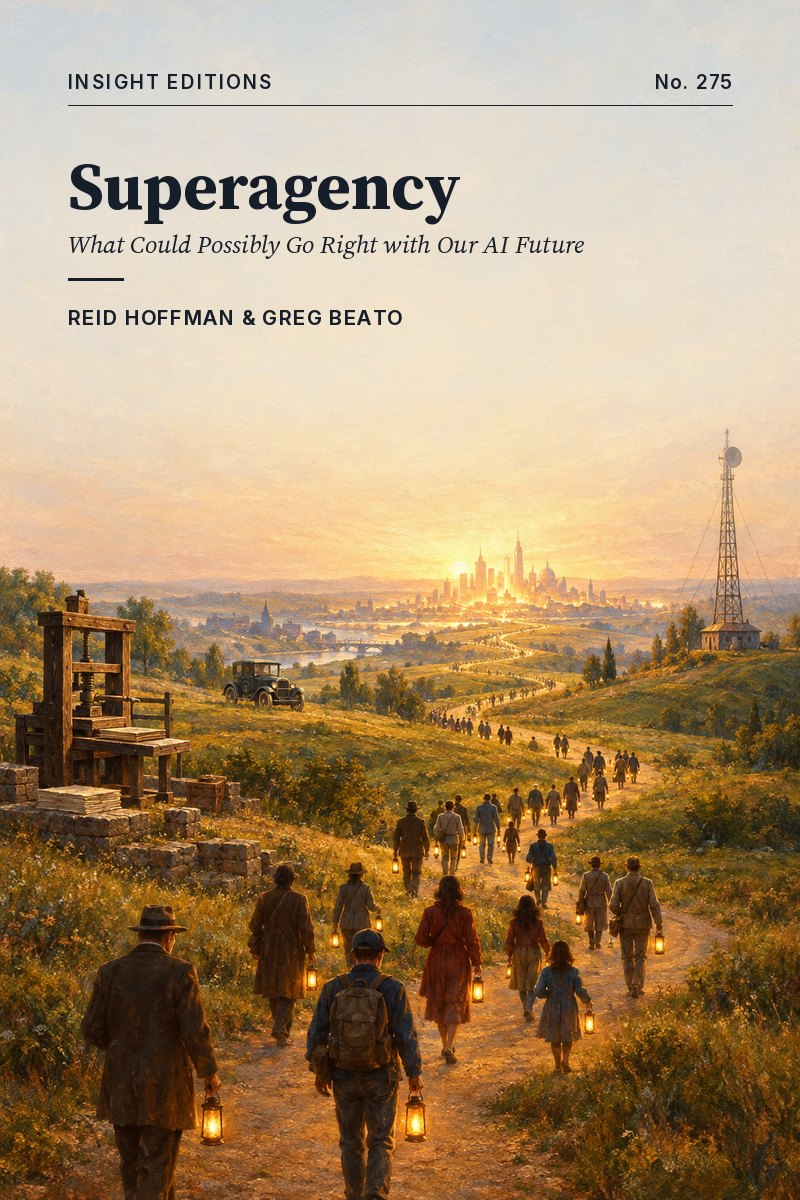
Superagency
What Could Possibly Go Right with Our AI Future
Reid Hoffman & Greg Beato
Reid Hoffman and Greg Beato argue that fears about AI are really fears about human agency, and that, like the printing press and the car, AI can widen what ordinary people are able to do.
A study guide to Superagency by Reid Hoffman & Greg Beato. Shared free for personal reading; not for sale and not endorsed by the authors or publishers. Please read and buy the original.
The Book on One Page
Hoffman and Beato argue that AI, like the printing press, the car and the smartphone, will expand human agency if billions of people get hands-on access through iterative deployment rather than waiting for top-down permission. Most AI fears are really fears about agency, and history suggests powerful tools that look dehumanizing usually prove liberating. When enough individuals are empowered at once, the gains compound into superagency: a society in which even non-users benefit from everyone else's new capabilities.
Chapter map
| Ch | Title | One-line payload |
|---|---|---|
| Intro | Introduction | Prohibition fails; steer with a techno-humanist compass (author's stakes disclosed) |
| 1 | Humanity Has Entered the Chat | AI fears are agency fears; ChatGPT's opt-in access; Doomers, Gloomers, Zoomers, Bloomers |
| 2 | Big Knowledge | The 1960s data-centre panic aged badly; data and public identity build trust |
| 3 | What Could Possibly Go Right? | Against "problemism": the status quo in mental health is the real threat |
| 4 | The Triumph of the Private Commons | Free platforms return huge consumer surplus; data is nonrivalrous, not oil |
| 5 | Testing, Testing 1, 2, ∞ | Not an arms race: benchmarks and Chatbot Arena are "regulation, gamified" |
| 6 | Innovation Is Safety | Permissionless innovation and iterative rules made cars, and can make AI, safer |
| 7 | Informational GPS | Open AI like GPS was opened; novices and the underserved gain most |
| 8 | Law Is Code | Code can enforce law perfectly; smart contracts cut both ways; consent confers legitimacy |
| 9 | Networked Autonomy | Donners vs drivers, South Korea, Interstates: rules and shared goods expand freedom |
| 10 | The United States of A(I)merica | Luddite counterfactual, sovereign AI scramble, a government that listens (Polis) |
| 11 | You Can Get There from Here | Four principles; AI as the risk that reduces other existential risks |
The argument in brief
- Prohibition fails, steering works. Every major technology arrived amid predictions of dehumanization; most failed. Because groups and nations compete, bans do not hold, so the only defence against a bad future is steering toward a better one with a techno-humanist compass.
- AI fears are agency fears. Jobs, misinformation, privacy and bias all reduce to whether people can still steer their lives. Hoffman's equation is intelligence + energy → agency → progress; AI makes synthetic intelligence as deployable as steam made synthetic energy. ChatGPT mattered because it was opt-in and democratized.
- Four camps, one winner. Doomers fear extinction, Gloomers near-term harms, Zoomers want no rules; Hoffman's Bloomers want broad participation with adaptive regulation.
- Data liberates more than it binds. The 1960s Federal Data Center panic and Orwellian forecasts aged badly; LinkedIn shows public identity scales trust; AI turns an unread flood of Big Data into Big Knowledge.
- Ask what could go right. "Problemism" ignores the existential threat of the status quo, as in mental health care, where AI could deliver Spotify-style therapy to the untreated millions.
- The private commons. Google Maps, YouTube and Wikipedia-like platforms return far more consumer surplus than they capture; data is nonrivalrous, so the digital tragedy is underuse.
- Innovation is safety. Benchmarks and public leaderboards pull performance upward; permissionless innovation plus iteratively added rules made cars 93% safer per mile. Informational GPS, as GPS once did, should be opened widely, with novices and the underserved gaining most.
- Legitimacy and the nation. Code can now enforce law perfectly (Lessig inverted), so AI needs the consent of the governed, earned continuously through use; freedom is relational, and transparent state action (South Korea) and shared infrastructure (the Interstates) expand it. A nation that refuses AI ends up like a Luddite England with only blankets; a government that uses AI to listen, not eavesdrop (Polis, Remesh), can rebuild consensus. The close restates four principles and treats AI as the one existential "risk" that hedges the others.
Hoffman co-founded LinkedIn and Inflection AI, sits on Microsoft's board, was an early OpenAI backer and invests through Greylock; nearly every policy the book favours raises the value of those stakes. The historical analogies (cars, steam, GPS, Interstates) are chosen from technologies that turned out well, and the book's own examples (South Korea's Covid response, iterative traffic laws) show how much of the benefit came from state action rather than permissionless markets. Since publication, mass adoption has arrived (about a billion weekly ChatGPT users by 2026) without the rise in public trust the book predicted.
Introduction
Hoffman and Beato open with a historical pattern: every major technology arrives wrapped in predictions of dehumanization, and most of those predictions fail. Their answer to AI anxiety is not a pause but a techno-humanist compass and iterative deployment. You never get the future you want simply by prohibiting the future you don't want; the surest defence against a bad future is steering toward a better one.
The recurring panic
The authors begin with a roll call of technologies that met skepticism and sometimes violent resistance before becoming ordinary: the printing press, the power loom, the telephone, the camera and the automobile. Each drew a specific prophecy of social ruin.
- Printing press. Fifteenth-century critics warned that it would spread heresy and misinformation and erode the authority of clergy and scholars.
- Telephone. It was cast as a threat to the intimacy of in-person visits and as a device that would make friends too transparent to one another.
- Automobile. In its early decades critics blamed it for wrecking family life: single men supposedly saved for a Model T instead of marrying, and married men divorced to escape the consumption pressures cars created.
- Automation. In the 1950s smarter machines thinned the ranks of bakers, meatcutters, autoworkers and even US Census Bureau statisticians. In 1961 Time reported labour experts' view that, without action by business, unions and government, automation would keep enlarging the "permanently unemployed."
- Mainframes. By the mid-1960s congressional subcommittees were routinely holding hearings on whether computers threatened privacy, free will and the citizen's ability to choose a life.
The outcome, they note, ran the other way. US unemployment is lower today than in 1961, and PCs, the internet and smartphones delivered an age of individualism and self-determination, not authoritarian conformity or human extinction.
Why AI fears feel different
Hoffman and Beato concede that with capable AI the old fears have grown rather than faded. They list the current charge sheet:
- Extinction risk. Some AI developers believe a future superintelligence could threaten humanity's survival.
- Misuse first. Others argue that malicious humans wielding AI will cause catastrophe long before machines turn on us of their own accord.
- Displacement. Fears of mass job loss and total human obsolescence.
- Capture. A world in which a tiny techno-elite keeps whatever benefits AI produces.
Critics insist this time is different because the technology is different: AI already simulates core parts of human intelligence, and many researchers expect it to gain fully autonomous, highly capable action that may not match human values or intentions. Fiction primes the fear. When today's chatbots talk like calm, rational graduate students, people hear echoes of HAL from 2001: A Space Odyssey, the Borg of Star Trek and the killer robot of The Terminator.
The authors' reply is that the future is hard to forecast for pessimists and optimists alike: the 1960s experts got no permanent mass unemployment, and the rest of us got no Jetsons flying cars.
Why prohibition fails
Predicting the future is hard; stopping it is harder. Efforts to freeze the status quo through bans, pauses and micro-management of who may do what will not help humanity meet AI's challenges or its opportunities. The chain of reasoning runs as follows.
- Competition is as human as cooperation. We form groups to amplify effort and turn that power against rival teams, firms and nations; even allied groups split over values, and each side is good at dressing self-interest as the common good.
- Coordination gets harder with scale. Containing a technology is hard for one group, harder for a state or nation, and globally like herding cats that are armed, tribal, multilingual and loyal to different gods.
- Power raises the stakes. The more powerful the technology, the harder the coordination problem. With the other side of the world a few clicks away, other actors will pursue other futures.
- The positive alternative. The surest way to avoid a bad future is to steer toward a better one that, by existing, makes worse outcomes harder to reach.
Homo techne and the gravity of tools
Thousands of years of experience show that if a technology can be built, humans will build it. Hoffman repeats a theme from his previous book Impromptu: we are Homo techne at least as much as Homo sapiens, constantly making tools that amplify us and then reshape us in turn. So humanism and technology are integrative, not opposed; language, books and the mobile phone each expanded what it means to be human.
Humans start the process but cannot fully steer it. New technologies exert a gravity of their own: a world with steam power works differently from the world before it. That is why prohibition or constraint alone is never enough: it offers stasis exactly when society should be pushing forward.
- Dynamic, not determinative. The authors reject the label technological determinism: a compass orients and re-orients, unlike a blueprint or fixed manifesto.
- Agency as the test. Because every major innovation affects human agency (our capacity to make choices and influence our lives), favour paths where technology augments individual and collective agency.
- Urgency matched to speed. Asked whether we should slow AI down before agents can replace us, the compass says the reverse: participate actively in how the technology is defined and built.
- Broad access. Billions of people should get equitable, hands-on access to experiment on their own terms.
- Problem-solving. Use AI to reduce nuclear war, climate change, pandemics and resource depletion.
- Learn as you go. The future is explored and discovered collectively, not designed by experts and regulators; course-correct through iterative deployment, OpenAI's own term for how it releases products.
The disclosure
Hoffman sets out his interests in full:
- PayPal. Founding board member, and on the executive team when eBay bought it in 2002.
- LinkedIn and Microsoft. Cofounder of LinkedIn; on Microsoft's board since 2017, after Microsoft bought LinkedIn.
- OpenAI. Among its first philanthropic backers when it launched as a nonprofit lab in 2015; led the first investment round when it formed a for-profit limited partnership in 2019; board member 2019 to early 2023.
- Inflection AI. Cofounded this public benefit corporation in 2022 with Mustafa Suleyman (cofounder of DeepMind); it built the chatbot Pi.
- Other roles. AI investor at Greylock; host of the podcast Possible; donor to Stanford's Institute for Human-Centered AI (HAI) and the UK's Alan Turing Institute.
He anticipates the objection that these roles disqualify him: that the optimism is hype and the idealism a route to returns, with every incentive to oversell upsides and downplay dangers. His answer is that the involvement runs the other way: he backs the technology because he believes in its benefits, has seen the progress first-hand, and stays alert to dangers precisely because he wants it to succeed broadly. Iterative deployment suits this stance because it favours flexibility over a master plan, making it easy to change pace or strategy when evidence demands.
Disclosure is not neutralization. Every policy the book favours (light regulation, fast public release, broad adoption) raises the value of companies Hoffman funds or advises. Readers should weigh his evidence on its merits but note that the downside cases get far less space than the upside ones. Since publication OpenAI has become OpenAI Group PBC (Oct 2025), with Microsoft holding about 27%, which makes the Microsoft board seat more material, not less.
In March 2024, before the book appeared, Microsoft hired Mustafa Suleyman and most of Inflection's staff to form Microsoft AI, paying Inflection roughly $650m, mostly as a licensing fee. Inflection pivoted to enterprise AI, and Pi survived as a smaller consumer product. The book still describes Inflection as Hoffman's live consumer venture.
Socrates and the book
The introduction closes on an irony: an argument for dynamic technology delivered in a book. About 2,400 years ago, in Plato's Phaedrus, Socrates compares writing to painting: it looks alive but stays silent when questioned, repeating the same thing forever, and once written it "rolls about everywhere," reaching both the understanding and those with no business with it.
For Socrates this was a loss of agency: written scrolls would escape his control over who read them, and he could not update his views, explain nuances or correct misreadings, so he preferred face-to-face dialogue. Later generations disagreed because writing increased the agency of authors and readers, letting readers learn from, extend, modify and even misread thinkers they would never meet.
As printing improved, books became early "mobility machines": they decoupled cognition from individual brains, democratized knowledge and let whole societies draw on the best insights across time and space. The feature Socrates feared, indiscriminate reach, became the benefit.
The authors add that Superagency will also travel through podcasts, social media and AI-generated video, audio and music (via Superagency.ai). They start with a book as an homage: technologies that first look flawed and dehumanizing usually turn out to be the opposite.
Humanity Has Entered the Chat
Chapter 1 recasts the AI debate as a debate about human agency: jobs, misinformation and privacy all reduce to whether people can still steer their own lives. Hoffman's answer is that AI is a supertool, the cognitive equivalent of steam power, and that ChatGPT's real breakthrough was democratized, opt-in access through iterative deployment. If enough individuals are empowered by AI at once, the gains compound across society into what the authors call superagency.
A quiet launch in a bad month
The chapter opens on the world of late 2022. Polls showed inflation had overtaken Covid-19 as the top global worry and food prices sat at record highs, yet normal life was returning: November's job and wage growth would beat forecasts, and demand for Taylor Swift tickets crashed Ticketmaster under 14 million simultaneous buyers.
Tech was having a worse month, hit by weaker advertising, nervous investors and shifting user habits:
- 9 November. Meta laid off 11,000 people, its largest cut ever.
- 11 November. FTX, the Bahamas-based crypto exchange, went bankrupt amid allegations of fraud and misuse of customer funds, wiping billions off the crypto market.
- 14 November. Amazon was reported to be starting unprecedented layoffs of at least 10,000 staff.
Part of this was a correction to pandemic-era surges in hiring, revenue and valuations. But Hoffman and Beato read it as a rebuttal to a 2010s gospel: that Google and Meta had perfected attention-hijacking design and could trap users in doomscrolling and rage-posting at will. If that were true, Meta's multibillion-dollar metaverse should have drawn crowds; it did not. Venture capitalists had poured billions into blockchain, yet crypto never became as indispensable as the web, search, email, mobile, texting and social media had in earlier waves. Big Tech, the authors imply, cannot simply impose products on people; users decide.
30 November 2022
On the last day of the month OpenAI, a San Francisco lab of about 375 employees, launched ChatGPT with no advance notice. Its X account posted the invitation at 10:02 a.m., asking for user feedback. Sam Altman, cofounder and CEO, was equally low-key, predicting that language interfaces would matter and calling the product an early demo, "very much a research release."
Chatbots had a poor record: in customer service they were so bad that people preferred twenty minutes on hold. ChatGPT was obviously different: it could explain quantum mechanics, write a sonnet about the Consumer Price Index and help debug Python. Even its errors, the "hallucinations," fascinated people.
- 375 staff at OpenAI at launch.
- 0 marketing dollars spent.
- 5 days to the first 1 million users, fuelled by a flood of journalists writing up their sessions.
- 2 months to 100 million users.
- 33,000+ signatures on the Future of Life Institute letter (March 2023) asking for a 6-month pause on systems beyond GPT-4.
- ~75,000 words of context for Anthropic's Claude 2, enough to summarize The War of the Worlds whole in twenty bullets.
The industry scramble
The launch set off a competitive frenzy that, the authors joke, deserved a commendation from the FTC's Bureau of Competition:
- Google. Alphabet CEO Sundar Pichai issued a code red, making AI the whole company's first job.
- Microsoft. An OpenAI investor since 2019, it began talking about "copilots" constantly.
- Meta. Mark Zuckerberg created a top-level generative AI product group to "turbocharge" its work.
- Upstarts. Anthropic, Midjourney, Hugging Face and Replika moved fast enough to leave the giants chasing; even dense research papers went viral on X.
The 180-degree turn of the critics
Hoffman notes an irony. For years Big Tech's critics had demanded antitrust action to restore competition; now they complained that innovation was moving too fast. In March 2023 the Future of Life Institute published its pause letter, signed by more than 33,000 people including many industry leaders, and the Senate Judiciary Committee held several hearings on AI oversight during the year.
The six months passed, then six more, and development continued. OpenAI kept upgrading GPT-4, the foundation model behind ChatGPT, which reached state-of-the-art results on complex tasks and learned to analyze images. Anthropic's Claude 2 improved factual accuracy and stretched its context window to about 75,000 words.
What an LLM actually is
The authors pause for a primer, because the technology's limits shape the politics around it.
- Architecture. Chatbots sit on large language models (LLMs), a kind of machine learning built for language. They use neural networks: layers of nodes, each taking input from the previous layer, applying maths and passing results on. Parameters set the strength of connections between nodes.
- Pretraining. By scanning vast text the model learns associations between tokens (words or word fragments). Each parameter acts like a tuning knob, and the largest models have hundreds of billions. Iterative adjustment reinforces or weakens links between tokens until the model replicates complex language patterns.
- Prediction, not knowledge. An LLM never knows a fact or understands a concept as people do; every prompt asks it to predict which tokens most likely follow, and those predictions can be wrong.
- Simulated awareness. Bigger datasets and task-specific fine-tuning make models more accurate and give them a seemingly commonsense grasp of the world, such as reading "so hungry I could eat a horse" as hyperbole, not a recipe request. But this is still statistical pattern-matching, so models make mistakes and act unpredictably.
- Hallucination. The model "sees" what is not there, in four forms: a wrong answer to a question with a right one, fabricated facts (names, dates, events), accurate but irrelevant output, and incoherent or inconsistent output. A footnote records that some researchers prefer "confabulation" (filling memory gaps with invented narratives); both terms anthropomorphize, and the book uses "hallucination" because it is the common word.
- False objectivity. Reliance on data makes models look neutral, but people choose what data to collect, how to process it, what to optimize for and how to align it. Unfiltered internet text can yield sexist or racist output; a diagnostic model built without deep understanding of certain conditions can fail underrepresented patients and rare diseases.
- Black box. Networks processing hundreds of billions of text samples find patterns humans cannot trace, so outputs may be impossible to explain.
Underneath all of these sits one limit: LLMs have no commonsense reasoning, no lived experience and no grounded world model. So ChatGPT and its peers still hallucinate, trip over simple brain-teasers and produce biased or irrelevant answers.
Skeptics say this will never fully change. Even with trillion-parameter models and multimodal training on images, video and structured data, gains were slowing and errors persisting. On this view LLMs will never reach artificial general intelligence (AGI): applying knowledge across domains, adapting with human flexibility, reasoning abstractly and generating original ideas without task-by-task programming.
The "gains are slowing" worry of summer 2024 was overtaken within months by reasoning models that spend more compute at inference: OpenAI's o1 (Dec 2024) and o3 (Apr 2025), China's DeepSeek R1 (Jan 2025, which briefly knocked hundreds of billions off Nvidia's market value), GPT-5 (Aug 2025), Google's Gemini 3 (Nov 2025). By April 2026 OpenAI had shipped GPT-5.5, and Anthropic previewed Claude Mythos, scoring 93.9% on SWE-bench Verified and finding thousands of software zero-days. Hallucination and brittle reasoning persist, so the skeptics' core point survives, but "dud" was clearly premature.
The Beginning Is Near
Through 2023 LLMs were tech's biggest story, and observers split three ways: AI would change everything for the better, change everything catastrophically, or keep everything the same "only more so" by concentrating power and profit in a few Big Tech firms.
By summer 2024 the mood had flipped. People who had demanded a pause now asked why the next generation of models was taking so long, and doubts grew about how much better LLMs could get. The former "Public Enemy No. 1" was being called a dud, and headlines filled with "AI hype," "AI bubble" and "troughs of disillusionment."
Hoffman says he had already lived through the reverse swing. In 2015, when he joined OpenAI, humanlike machine reasoning was a fringe idea, a long shot even in Silicon Valley. That is one reason OpenAI began as a nonprofit: VCs who need returns within five to ten years would not have funded something so speculative. There were big obstacles in 2015, 2018 and 2020 too, and researchers kept finding the techniques that unlocked the next wave.
He admits that optimism is easy with long time horizons, and his are long. He expects:
- Bigger supercomputers and more efficient algorithms.
- New architectures and techniques to overcome LLM limits.
- Multimodal learning across text, images and other data.
- Neurosymbolic AI, which combines neural networks with explicit, human-defined rules and logic.
That also means society is only at the start of an "existential reckoning" with new, not wholly predictable forms of intelligence. A machine that thinks strategically, abstractly and creatively at computer speed and scale would be revolutionary: picture every child with a tutor as smart as Leonardo da Vinci and as empathetic as Big Bird, or billions with a reliable health adviser in their pocket.
Americans are wary
The upside is not what most people see, especially in the United States:
- Ipsos (2022). Only 35% of Americans agreed that AI products had more benefits than drawbacks, among the lowest of the countries surveyed.
- Pew. Only 15% of US adults were more excited than concerned about AI in daily life.
- Monmouth University. 56% said intelligent machines would hurt humans' overall quality of life.
The authors call these fears understandable and list the open questions: how good and how fast the systems will get, which jobs will remain, what happens to trust and public discourse when convincing fakes become cheap, what happens to privacy and autonomy when billions of devices can match humans and act against our wishes, and above all whether people can still control their lives.
Pew's June 2025 survey found 50% of US adults more concerned than excited (up from 37% in 2021) and only 10% more excited. Mass use did not build mass trust: ChatGPT went from about 400 million weekly users (Feb 2025) to 800 million (Oct 2025) and neared 1 billion by mid-2026. The book's theory that "trust starts with exposure" has, so far, a usage curve but not an attitude curve behind it.
Most Concerns About AI Are Concerns About Human Agency
That last question is the book's focus. The authors translate each headline fear into an agency question:
| Fear | The agency question underneath |
|---|---|
| Job displacement | Will I have the means to support myself and pursue meaningful work? |
| Misinformation | How do I know whom and what to trust when making decisions? |
| Privacy | Can I keep the integrity of my identity and an authentic self? |
Human agency, a core concept in philosophy, sociology and psychology, is the capacity to make your own choices, act independently and influence your life. Even if you think circumstances matter a great deal, agency is what makes you form intentions, set goals and act, so it gives life purpose and meaning.
AI systems are gaining their own self-directed learning and multi-step execution. A self-driving car is not conscious of its agency, yet it decides, acts and pursues goals within its operational domain. As such systems spread, three worries follow:
- Encroachment. Machines will move into areas traditionally governed by human agency, often in ways people dislike.
- Atrophy. Even welcome cognitive offloading may let our own skills and agency wither through overreliance.
- Unconsented shaping. Systems that deliver outcomes we approve of may still steer our behaviour in ways we never agreed to.
Homo techne
Hoffman's reply is that this is simply the human story. As Homo techne, humans are defined by making tools that create new ways of being in the world. Chimpanzees have used stone tools to crack nuts for generations without progressing; humans keep inventing and then use each tool to exercise agency more productively, a virtuous cycle from stone tools to smartphones.
AI is a new class of supertool, powerful enough to put us in something like a new Industrial Revolution. The underlying model is simple:
- Intelligence lets us weigh options and envision and plan scenarios.
- Energy lets us act on what we aspire to.
- Rule. The more of both we can leverage, the more we can make happen, individually and collectively: intelligence + energy → agency → progress.
- History. Spoken language, fire, the wheel and writing amplified one or both; cars in the early twentieth century let millions do things that were superhuman decades before; PCs, the internet and smartphones amplified intelligence.
AI is the next leap and differs from books or YouTube how-to videos, which only make and distribute knowledge. Because AI can be agentic (setting goals and acting to meet them), you can use it in two modes:
- Work alongside it. For example, learning a language or practising mindfulness.
- Delegate to it. For example, letting it optimize home energy use against real-time prices and weather forecasts.
Both raise your agency, because both help you reach outcomes you want. For the first time, synthetic intelligence, not just knowledge, is becoming as flexibly deployable as synthetic energy has been since steam power in the 1700s. Intelligence becomes a scalable, configurable, self-compounding engine for progress.
Superagency is the state reached when a critical mass of AI-empowered individuals operate at levels that compound through society, so even people who rarely or never use AI benefit. The doctor diagnoses your vague, unrelated symptoms precisely; the mechanic knows what the thump in the trunk on a hot day means; ATMs, parking meters and vending machines speak your language and adapt to you.
Full Steam Ahead
Before industrialization, productivity was capped because energy was scarce. Tilling, tunnelling and hauling all needed human or animal muscle, so people and horses were beasts of burden. Windmills and water mills helped grain and textile production in some places, nature permitting: born near a river, you had slightly more prosperity and room for self-expression; otherwise, plowing.
Steam power changed this from the mid-1700s. The authors grant the era's dark side in full:
- Pollution. Cities blackened by coal smoke.
- Work. Dangerous factories, few worker rights, child labour.
- Social life. More regimented, less communal living; overcrowded slums alongside urban anomie.
- Dehumanization. Factory clocks and streetlamps replaced natural rhythms; workers were expected to act like machines; commercial transactions crowded out reciprocity and personal trust.
- Global inequity. Uneven growth, and new demand for raw materials that intensified colonial exploitation.
But across centuries, they argue, synthetic energy was radically humanizing. The causal chain they sketch:
- Scale. Mechanization made unprecedented scale possible.
- Cooperation. Pursuing scale required new levels of collaboration.
- Abundance. Achieved scale produced abundance and variety.
- Education. A technological society needed a more educated populace, whose varied skills produced further innovation.
- Social progress. Prosperity brought fairer laws, economic and cultural mobility, stronger welfare systems and more emphasis on individual rights.
Where nearly all human effort once went into growing food and slaughtering livestock, augmenting manpower with synthetic manpower opened an exponentially wider range of lives. The authors expect synthetic intelligence to do the same in the twenty-first century: new collaboration, creativity and productivity, with education and skills mattering even more.
The steam story compresses roughly 150 years of misery for displaced workers into a happy ending, and the gains came largely through labour movements, regulation and public schooling that the authors mention only in passing. If the analogy holds, it implies a long and painful transition that policy must manage, which sits awkwardly with the book's preference for speed.
AI That Works for Us and with Us
When OpenAI launched in 2015 it had no product, business model or go-to-market plan. Its cofounders Greg Brockman and Ilya Sutskever wrote at launch that its mandate was to advance digital intelligence in the way most likely to benefit humanity as a whole, and that AI should be "an extension of individual human wills," distributed as broadly and evenly as possible in the spirit of liberty.
That directive mattered because AI was already widespread in 2015, mostly invisibly: recommendation systems, news-feed curation, predictive text and autocomplete. Some uses were controversial:
- ProPublica (2016). A risk-scoring algorithm used across US criminal justice falsely flagged Black defendants as future criminals at almost twice the rate of white defendants.
- Predictive policing (2016). A coalition of 17 civil rights organizations condemned tools that use algorithms and historic crime reports to forecast where and when crime will occur.
- San Francisco (2019). It became the first city to ban police and other agencies from using facial recognition.
The common thread: none of the people affected had chosen to use the AI. Even recommendations and feeds are paths developers lay out for you (Amazon suggests the next purchase; maybe you click).
The models OpenAI began releasing, starting with GPT-2, were different in kind, the authors say: not embedded in other systems or switched on without your knowledge, but something you affirmatively choose and then use in open-ended, self-directed ways. ChatGPT took this further. Beyond writing an essay, you could have it critique your essay, draft likely interview questions from a company, or design a quiet apartment workout that won't wake your roommate.
ChatGPT was, in their account, the first easy, accessible AI that explicitly worked with and for the user rather than on them. Instead of developing in secret until a few experts judged it effective and perfectly safe, OpenAI invited the public into development: iterative deployment.
The book dates GPT-2 to 2020; it was announced and released in 2019 (GPT-3 came in 2020). More substantively, the "you choose it" distinction was already eroding at publication: Google's AI Overviews and Meta AI inside WhatsApp and Instagram put generative AI in front of billions who never opted in.
The three pillars of iterative deployment
- Technological. In classic Silicon Valley style it uses user experience and explicit feedback to guide development.
- Regulatory. It introduces change incrementally, limiting the impact of adverse effects.
- Sociological. It gives individuals and society time to adapt.
Rome was not built in a day, the authors note, and neither were Romans. Trust starts with exposure and evolves with use; once you learn what something is and how it works, you begin to trust it. Their formula: trust = consistency over time. With hands-on access, users can judge for themselves whether a tool is reliable enough, offers real value or just novelty, and empowers them or breeds dependence.
Trust in the tools is only the first layer. People must also come to trust the developers, the regulators and, most of all, other users, including their own and foreign governments. There is no short answer, only an ongoing, often contentious conversation, so far conducted mainly among computer scientists, academics, developers, investors, ethicists, tech journalists, policymakers, lawyers and sci-fi writers.
Doomers, Gloomers, Zoomers and Bloomers
The authors sort that conversation into four constituencies, stressing that these are broad-brush labels and that each camp contributes valuable insights.
| Camp | Core belief | Stance on regulation | Hoffman's critique |
|---|---|---|---|
| Doomers | Superintelligent, autonomous, misaligned AI may destroy humanity (sparing a few tech bros to do the vacuuming) | Halt or restrict | Protects agency by removing people's ability to judge AI themselves |
| Gloomers | Doom talk is covert hype ("so powerful it might destroy us") and distracts from near-term harms: jobs, mass disinformation, systemic bias, lost agency | Prohibitive, top-down: monitored by official regulators and oversight bodies | Same paternalism; treats AI as an extractive industry |
| Zoomers | Productivity and innovation gains will far exceed harms; precautionary rules are wrong | No regulation, no government support, just a clear runway | Ignores how a breakneck pace makes everyone else feel about their stake |
| Bloomers | AI can speed progress everywhere but is too protean to build unilaterally | Not opposed; balance freedom to innovate with the duty to regulate | Hoffman's own camp: mass engagement in real conditions |
Bloomers treat AI less like mining and more like agriculture: plant, watch growth under real conditions, learn which crops suit which ground, intervene on evidence. It is not risk-free, but knowledge, technique and yield improve over time. Making tools available to diverse users with different values and intentions is, they believe, the fastest route to safer, fairer, more useful AI.
Hoffman places himself here. From LinkedIn to hundreds of internet startups over twenty-five years, his career rests on network feedback loops and learning from real use. Participation both requires and rewards agency, while Doomers and Gloomers "protect" agency by taking away people's chance to assess AI, and Zoomers forget the public's sense of having a stake.
Doomers, Gloomers and Zoomers are defined by their excesses, Bloomers by their balance, and the author is a Bloomer. Real critics (labour economists, privacy scholars, safety researchers) often favour exactly the empirical, adaptive governance Hoffman claims for himself. The labels frame dissent as temperament rather than argument.
By putting tools in people's hands, OpenAI made the AI conversation broader and more inclusive and gave everyone better information. The authors rate this democratization of access as at least as important as the technical advances. If this is a transition on the scale of steam, today's decisions will shape decades or centuries, and no one should be a non-playing character in their own future. Development must include broad public participation and continuous feedback: humanity has entered the chat.
The geopolitical stakes
A good AI future depends not only on who builds fastest but on which individuals, companies and countries use AI most productively, which makes trust the central issue. As more autonomous models arrive, cultural clashes and the urge to pre-emptively regulate or ban will grow. Yet no country decides alone: America's AI future depends on choices in China, the EU, India and dozens of other nations, a multiplayer game.
The camps split on regulation as expected: Zoomers want freedom, Gloomers want pauses, prohibition and licensing regimes, Bloomers want balance. Since views diverge widely, the goal should be broad consensus and trust, which most likely grows from access and use. Rules alone are not enough; beliefs, norms and shared values matter too.
AI works like infrastructure: the internet, roads, the electrical grid, the water system. Some people opt out of each, but imagine 30% distrusting power lines, 20% refusing traffic lights, and a few hundred or thousand people trying to sabotage reservoirs. Society would keep the systems, but would function less smoothly, with domestic and global costs. Hence the public needs a real role, as with cars and the internet; uniform consensus is neither likely nor needed.
The democratic handicap
A perverse feature of networked governance: the broader the democratic input, the harder change becomes, as cacophony beats consensus. If the US and other democracies falter, authoritarian or more socially cohesive countries may deploy AI better. The costs would land on agency, prosperity and security:
- Agency. AI can be built to work on people even in democracies; in autocracies the odds rise.
- Prosperity. Protectionism cannot compete with countries running millions of intelligent robot workers and AI synthetic scientists and engineers.
- Security. Isolationism offers no defence against the autonomous weapons such synthetic scientists might design.
In the twenty-first century, the authors conclude, individual agency is more closely aligned with national agency than ever. To keep AI an extension of individual wills, democracies must lead, with an ambitious innovation mindset, constant experimentation and adaptation, and broad public participation to build consensus.
The chapter ends by turning back to an earlier moment when computers seemed about to change everything, the subject of Chapter 2.
Big Knowledge
Chapter 2 revisits the 1960s panic over mainframes and a proposed Federal Data Center to show how badly Orwellian forecasts aged. Hoffman argues that data, broadly collected and shared, became "climbing ropes" rather than "chains of plastic tape", and uses LinkedIn to show how public identity builds trust at scale. Humanity now produces far more information than it can absorb, and AI is the tool that turns Big Data into Big Knowledge.
Orwell's long shadow
When George Orwell published 1984 in 1949, the world had fewer computers than a busy Starbucks today and TV networks were in their infancy, which makes his picture of electronic audiovisual networks prescient and explains why the novel keeps returning to bestseller lists.
The authors recap the setting. Airstrip One (formerly England) is the third most populous province of Oceania, ruled by the Party and its figurehead Big Brother (who, they quip, may be a deepfake). The regime combines constant surveillance, torture and absurd propaganda ("ignorance is strength," "freedom is slavery") until only compliance remains. Everything is grey, including truth; only the moustached leader's posters add colour. Two-way telescreens in public and private broadcast propaganda while watching citizens, and the Thought Police hunt for disloyalty, inner life or any deviation from the norm.
The image of god-level techno-surveillance was so vivid that for more than seventy-five years generations of Gloomers have prophesied an imminent Orwellian apocalypse.
The mainframe moment
Mainframes in the early 1960s produced a spike in such forecasts. By 1963 the US industry had built about 15,500 computers; roughly 1,000 belonged to or were leased by the federal government, and the rest sat in large corporations and universities, giving them unprecedented powers of insight.
- The IRS effect. When the IRS announced in 1963 a $1.2 million IBM 7074 to process and check returns, anxious taxpayers queued to pay past shortfalls; an official told Popular Science this brought in $700,000.
- Everyday uses. News outlets used computers to predict elections, ice-cream makers to control blending, and New York City to time traffic signals.
- Astrid Lindgren. Sweden's public-lending royalty scheme (begun 1954) paid the Pippi Longstocking author an extra 9,000 kronor (about $11,700 in 2024 dollars) based on 850,000 loans, bookkeeping that D. S. Halacy Jr. (Computers: The Machines We Think With, 1962) said only a computer could do.
This was a kind of new Light Ages of institutional clarity, but with a dark edge. Vance Packard, among the most widely read writers of his day, warned in The Naked Society (1964) of memory banks able to recall every failure or incriminating act in a citizen's life within seconds, and even speculated that Big Brother might implant brain electrodes at birth to control moods.
The Federal Data Center that never was
The less alarming and more likely use was research: economists linking economic factors, health-care use and health outcomes. In April 1965 the Committee on the Preservation and Use of Economic Data, social scientists advising the government for several years, proposed a Federal Data Center to centralize access to the data agencies were accumulating.
- Purpose. Make data from 20 federal agencies usable by researchers to inform policy as Lyndon B. Johnson's Great Society expanded social programmes.
- The mess it would fix. Data sat in 600+ datasets, stored in decentralized, often incompatible form on 100 million+ punch cards and 30,000 magnetic tapes.
- The logic. Consolidating it in one place would create more value for the taxpayers who had paid for its collection.
Terrible timing
Three forces made 1965 the worst moment to pitch the idea:
- Spy gadgets. Transistors and printed circuits shrank electronics. Ads in men's adventure magazines sold sugar-cube microphones and vest-pocket CCTV cameras; snoops could buy parabolic microphones that picked up talk a city block away, voice-activated recorders and infrared cameras.
- Surveillance books. Myron Brenton in The Privacy Invaders feared built-in surveillance wired into hotels, schools, jails and offices, feeding a central listening station.
- A new right. Two months after the report, Griswold v. Connecticut struck down a Connecticut ban on contraceptives. Historian Sarah E. Igo (The Known Citizen) says it identified a constitutional right to privacy for the first time in US history and opened the way to new privacy claims.
So the government was badly placed to advertise that it ran the "most comprehensive statistics program in the world" and wanted to open it to technocrats. When the Johnson administration moved ahead, the congressional backlash was "swift and strong"; members already holding privacy hearings prompted by Packard and Brenton added another.
Lawmakers said they did not oppose data-informed policy, only what the centre might become. Cornelius E. Gallagher (D-NJ, 13th district) warned that without safeguards it would create "The Computerized Man," stripped of individuality, his life and earning power reduced to a tape. Frank Horton (R-NY) feared machines would treat us as machines and pigeonhole our schooling, jobs, pay and even whom we marry. Vance Packard testified at the new Rayburn Building that public and private "filekeepers" held billions of records on millions of Americans, drawn from tax returns, personality tests, lie-detector tests, medical and police records, credit reports, insurance investigations and even moving-company inventories, covering health, sex lives, marriages and associates. One giant system, he said, would depersonalize American life under an "all-seeing eye." His closing line: 1984 was only eighteen years away, and Big Brother might arrive as a relentless bureaucrat obsessed with efficiency, leaving humanity in "chains of plastic tape."
The press piled on. The Charleston Post foresaw dossiers worse than Hitler's Gestapo; the Benton Harbor News-Palladium imagined officials coercing donations or blackmailing opponents; a New York Times editorial invoked "the Orwellian nightmare." Congress kept using the centre as an ideological punching bag until 1969, when it died in the reshuffle from Johnson to Richard Nixon, who, the authors note dryly, became a notorious secret file-keeper himself.
What came anyway
Packard and the data-centre fight are now largely forgotten, partly because defeating the centre barely slowed technology:
- Computing. Hard disks replaced tapes, then came time-sharing, minicomputers, LANs, the PC, the web, social media, the cloud and mobile phones.
- Sensors. Video cameras, fitness and sleep trackers, motion sensors, facial recognition, fingerprint and eyeball scanners, smart thermostats, RFID implants and digital tattoos.
- Data brokers. Profiles holding thousands of data points per person (demographics, health, finances, sexual and political preferences, predicted behaviour), compiled without knowledge or consent.
Hoffman concedes the old worries about agency and privacy "retain their currency." It is easy to picture Packard on Substack warning about LLM-tailored persuasion, or Gallagher grilling Sundar Pichai on algorithms. But the striking fact is how colossally wrong they were about what followed.
Big Brother Is Making You Feel Seen
When Packard warned of "humanity in chains," Americans already lived in legal chains:
- Marriage law. Many states still restricted interracial marriage; same-sex marriage was so unthinkable that no state had yet banned it.
- Narrow privacy. Griswold protected only "marital privacy," as Justice William O. Douglas's majority opinion repeated.
- Moral policing preserved. Justice Arthur Goldberg's concurrence stressed that states kept power to regulate "promiscuity or misconduct," forbid extramarital sex and "say who may marry."
As computers spread, the country became much freer: it embraced creative exploration, rebellion against conformity and alternative lifestyles, and extended agency to women, people of colour and LGBTQ people. Grassroots activism and new laws did most of the work, Hoffman says, but technology helped. The late twentieth century was shaped less by spy microphones than by remote controls, cable TV, VCRs, Sony Walkmans and camcorders, each chipping at mass-media conformity toward a personalized, self-actualizing culture.
Most strikingly, the totalitarian mainframe was displaced by the personal computer. An early Apple ad asked what kind of man owns his own computer and answered with Benjamin Franklin, icon of self-improvement, noting that diplomats, printers, scientists, inventors and kite designers would want one to "uncomplicate your life."
Data that liberated
Packard was right that firms and government were amassing data, but wrong that it would narrow people's options. Aggregated consumer data let manufacturers, marketers and creators segment markets, target granular demographics and serve subcultures and niche interests. Personalization replaced industrial one-size-fits-all, the start of a more diverse, inclusive world. Big Brother, or rather Big Business, was not so much watching you as making you feel seen.
The hard questions remain: where privacy infringement ends and identity assertion begins; when new knowledge boosts or shrinks agency; how much withholding information costs us in learning and growth.
Privacy. Louis Brandeis's "right to be left alone" (1890 Harvard Law Review) shaped modern privacy. Since urbanization put strangers side by side, privacy has offered space for candid self-reflection, away from public pieties, and so for an authentic self that acts with more agency. But it is not always the most productive right to organize a life around.
Public identity. In a networked world, a strong public identity also creates autonomy and agency. We still use pseudonyms, VPNs and encryption, yet we want the validation and personal sovereignty of being known. Public identity means discoverability, trust, influence, power: social, sometimes financial, capital. Being seen may be the signature aspiration of the Digital Age.
Big Brother is dead
The 1960s could not imagine information devices that enhance agency, and some still cannot: progressive privacy hawks and right-wing "truth-tweakers" alike decry Big Tech's Orwellian reach. Hoffman's counter-test: who today has fewer options than in the 1960s, 1980s or 2000s to express themselves and live as they choose?
For practical purposes, he says, Big Brother has been dead for decades. Drop Winston Smith into Manhattan and the storefronts alone would stun him, before the self-presentation, public intimacies, billboards of people who are not Big Brother, and smartphones clutched like talismans. US culture is now so devoted to self-expression and nonconformity that a large part of the public seems to yearn for a strongman to restore cohesion to a "polyvocal and highly balkanized" republic.
Critics now fear that AI's appetite for data will finally deliver Packard's chains. Hoffman says not to dismiss it, since past performance guarantees nothing in disruption. But sixty years of evidence show that information broadly shared, collected, analyzed and deployed has been empowering: climbing ropes, not chains of plastic tape. The data-centre opponents missed this, he argues, and today's Gloomers keep their tribe's tradition of predicting dystopia while technology hands out new superpowers.
"Dead for decades" is a US-centric claim. China's social-credit pilots and pervasive camera networks, and the 2013 Snowden disclosures of NSA bulk collection in the US itself, show the mainframe-era fear was not baseless; it was displaced. Hoffman also never weighs the costs he treats as solved: data brokers and microtargeting are the bad half of the same "personalization" he celebrates.
The idea Congress killed in 1969 came back by executive order. On 20 March 2025 President Trump ordered agencies to dissolve "data silos"; DOGE sought access to Social Security and IRS records (the Supreme Court allowed SSA access in June 2025); the IRS agreed in April 2025 to share taxpayer addresses with ICE; and Palantir was contracted to compile data for immigration enforcement. A federal court paused one data-sharing deal in November 2025. The episode tests Hoffman's optimism: the pooled data arrived, but its first prominent use was enforcement, not research.
Introducing a Network of Trust
OpenAI's founding phrase, AI as "an extension of individual human wills," resonated with Hoffman because the same aim, giving people power to make deliberate choices and act on them, inspired LinkedIn. Its 2003 launch site promised that you were already connected to the people you needed through existing business contacts and could reach thousands of professionals through trusted network connections.
LinkedIn was often dismissed as a "résumé site" or job board, and some still see it that way. Hoffman always saw it as more foundational: using networks to share and discover information, with identity raising trust.
Nobody knows you're a dog
Public, substantive profiles were not normal in the early 2000s. When the web went mainstream a decade earlier, anonymity was celebrated, summed up by Peter Steiner's 1993 New Yorker cartoon, "On the internet, nobody knows you're a dog." A footnote adds that it became the magazine's most reprinted cartoon, and its original sold at auction in October 2023 to an (aptly) anonymous bidder for $175,000, a record for a single-panel cartoon.
But what if you wanted people to know you were a database engineer fluent in MySQL and SQL Server, and to find and trust you?
- Before the web. Only celebrities and executives covered by Fortune or the New York Times business pages had a professional identity beyond their coworkers and direct contacts.
- After the web. Anyone could publish a professional identity, but without a magazine to certify it, how to prove you were not a dog pretending?
- The network answer. Place identity inside a web of connections: you don't know Mark, but you know Linda, who knows Mark, so Mark seems more trustworthy.
The internet as a trust machine
What LinkedIn and many successful platforms do is scale trust: eBay, PayPal, Airbnb, Uber and Lyft each invented trust mechanisms for new kinds of transactions worldwide. Fraud and disinformation are real, but the larger story is an "unprecedented trust machine":
1995 We surf the web under pseudonyms.
1999 We buy used cars sight unseen on eBay Motors.
2003 LinkedIn launches with real-name professional profiles.
2012 We climb into a stranger's Toyota Corolla with a pink moustache on the grille for a safe ride home.
On LinkedIn, as networks grew bigger and denser, the platform grew more trustworthy, because each member effectively vouched for many others: a distributed trust platform rooted in real identity.
Asking people to share more
The model required members to share more than was normal online: real names (still uncommon), job titles, employers, skills, experience and networks. LinkedIn provided explicit privacy controls, but the point was to be at least partly visible beyond immediate connections. In 2003 that was controversial.
Today LinkedIn has more than 1 billion members and a detailed profile is routine. Before the internet, careers were shared rarely because there was no channel: you talked up your expertise when job-hunting or to a stranger at an airport bar, and résumés went privately to HR departments, recruiters and agencies.
| Era | How professional contacts were kept | Limitation |
|---|---|---|
| 1980s-early 1990s desktop | ACT! Contact Manager, Sidekick: a private database on your PC | Manual updates, if you even knew details had changed |
| Early 2000s web apps | Online address books, reachable from any computer | Still "tiny islands of data": maximal privacy, no network value |
| Members create and maintain their own profiles and connect | Requires public disclosure |
The network design delivered three gains:
- Update problem solved. Your old boss edits her own profile; everyone connected to her sees current details instantly.
- Self-definition. You define yourself rather than others recording what they happen to know about you.
- Discoverability. Once connected, you can see a contact's contacts, impossible in the desktop era, so finding people and being found became far easier.
The resistance was real. Anonymity still ruled online, and people were especially guarded about work:
- Employees feared bosses would think they were about to jump ship, or saw no point sharing without a near-term payoff.
- Salespeople, the main network-builders, saw their contacts as a competitive advantage and dreaded digital cold-callers begging introductions.
- Employers disliked staff becoming visible to recruiters and competitors, and free to describe their jobs in their own words.
Enough early adopters judged participation an "intelligent risk": sharing would widen their networks and bring professional identity development, industry intelligence and new collaborators.
Hoffman offers his own company as proof that disclosure empowers. He omits that LinkedIn paid $13 million (2015) to settle claims that it harvested users' email contacts to send repeated invitations, and that in 2024 it opted members into having their data used for AI training by default. Trust was scaled, but not always on users' terms.
We Don't Know What We Know
A LinkedIn in the 1960s would have unsettled Packard: it is not a national but a global data center, one searchable repository of information he would have called private, even though posted voluntarily (as, the authors note, much 1960s data also was).
Yet public living creates collective value. You can see which skills people in your target job at your target company have, and which employers attract most applicants. Once siloed data is open, individuals and firms both act more knowledgeably: seven people are hired via LinkedIn every minute, about 3.67 million a year.
The authors grant the downside. A casual post on Facebook or X can stay public indefinitely, and a screenshot or retweet can spread an offhand remark far beyond its intended audience, so privacy as refuge becomes more valuable, not less. But democracies depend on the free flow of information at least as much as on privacy. Theorists Andréa Belliger and David J. Krieger (Network Publicy Governance, 2018) describe a society split between those who want maximal integration of information and those who think freedom and dignity depend on withholding it.
In the 1960s lawmakers focused almost exclusively on what could go wrong. By blocking the data center they also blocked whatever research and policy benefits earlier access to federal data would have produced. The book's recurring point: banning a risk also bans its upside.
The information overload
The urgency, the authors argue, is that humanity already produces more information than it can use:
- Hal Varian. In a 1998 essay the Berkeley economist (later Google's chief economist) wrote that the share of produced information actually consumed was "asymptoting towards zero."
- Ithiel de Sola Pool. Varian drew on the MIT professor's 1984 Communications Flows, which counted "words supplied" versus "words consumed" daily in the US and Japan across 18 media, from radio and books to "data communications."
- The US numbers. Words supplied per day rose from 8.7 million (1975) to 11 million (1980); words consumed rose only from 45,000 to 48,000.
- The ratio. By 1980 the average American consumed 0.004 of the information available each day.
Since then supply has exploded (radio stations, cable channels, catalogue retailers, CD-ROMs, newsgroups, spammers, streaming, podcasters, TikTok influencers), while our slow, distractible brains probably maxed out on consumption in the early 1990s.
- 147 zettabytes: estimated world data production in 2024 (IDC Global DataSphere Forecast, 2023-27).
- 402 billion GB produced per day.
- 2 MB for a typical e-book, so the daily output equals about 201 trillion e-books.
- 139 billion e-books' worth per minute; 2.3 billion per second.
- 23 billion e-books' worth in the ten seconds it takes to read one sentence.
The data comes from people (tweets, Wikipedia entries, GitHub repos, arXiv papers, IRS guidance, TikTok dances) and from machines (smartphones, smart thermostats, security cameras and other IoT devices producing GPS data, temperatures and video). So even someone who hears every episode of Kara Swisher's podcast and reads most of Matt Yglesias's posts lives in a personal Dark Ages, ignorant of nearly all global knowledge.
That is why AI matters. As steam and later forms of synthetic manpower amplified muscle, AI can amplify cognition. Distributing intelligence broadly, as tools that extend individual will, can convert Big Data into Big Knowledge and open a new Light Ages of data-driven clarity and growth.
What Could Possibly Go Right?
Chapter 3 attacks problemism, the Gloomer reflex of seeing only what could go wrong, and makes mental health care its test case. Against speculative harms, Hoffman sets the existential threat of the status quo: a care system that leaves hundreds of millions untreated. Every effort to preempt an innovation's possible harms also preempts its possible benefits, so the moral ledger has two sides.
Solutionism versus problemism
The chapter opens on a self-mocking note: a new Light Ages because you can buy an AI toothbrush that coaches your brushing? Hoffman admits that Silicon Valley founders are often accused of solutionism, the belief that even society's deepest political, economic and cultural inequities have a simple technological fix.
He grants the premise behind the charge: legislation and collective action usually drive social progress, as Chapter 2's account of the 1960s showed. That is partly why the book champions iterative deployment, which he frames as a form of collective action: the public gives continuous input into deliberately incremental product versions.
But technology is also among humanity's most proven levers for change at scale, so solutionism's mirror image is a real danger too. Problemism is the Gloomer default: technology as suspect, antihuman and antihumane, smelling of capitalism's "new-car reek."
- The good side. Gloomers cast themselves as watchdogs for the public good, and they do hold Big Tech and other powerful interests to account for harmful failures.
- The harm. Preferring critique to action and precaution or prohibition to innovation means discounting everything that could go right. AI does carry harms, flaws and uncertainties that need work and vigilance, but it can also tackle the hardest global problems.
- Technology's share. In sustainable energy, health care, education or cybersecurity, Hoffman asserts, technology will supply 30 to 80% of any effective solution, including fixes for AI's own harms: fighting deepfakes and disinformation needs AI detection systems that monitor platforms at scale and adapt as fast as the generators.
The "30 to 80 percent" figure for technology's contribution to any solution is asserted without a source or method, and the range is too wide to test. It reads as rhetoric dressed as data.
The two-sided ledger
Preempting harms also preempts novel capabilities and fixes for existing inequities. Hoffman's two illustrations:
- Animal language. An AI that learns to interpret animal vocalizations could reveal what endangered species need and sharpen biodiversity interventions.
- Food logistics. An AI that finds a far more efficient way to run food-distribution supply chains could cut waste and improve nutrition and health for millions a year in food-insecure regions.
He poses the moral questions directly: is it defensible to delay tools that amplify the best scientists, or to defer AI science tutors, health advisers and legal assistants that could empower marginalized groups, or to surrender a leading role for the US and democracy? Prudence and skepticism are needed, but the goal is progress, which means accepting some risk and uncertainty. Innovation requires exploration. Those who deny it are not speaking truth to power but voting for entrenched interests and inequities; problemist Gloomers often act as "champions of complacency."
Hence the what-could-possibly-go-right mindset: thinking in terms of best possible outcomes does not mean ignoring negative ones. It means avoiding them by envisioning the future you want and steering toward it.
The Existential Threat of the Status Quo
To a problemist, AI in mental health is "Category 5 solutionism": tech-bro cluelessness heading for disaster at 157 mph. Treat people in crisis with a system that hallucinates? What could go wrong?
But as William Gibson wrote in "Burning Chrome" (1982), the street finds its own uses for things. Soon after ChatGPT's launch, users on X were asking why anyone would pay for therapy when ChatGPT was free, reporting partners consulting it for relationship advice, and wondering why commentators fretted about Google's disruption rather than therapy's: who wouldn't want a judge-free, empathetic, always-available therapist?
Hoffman thinks even these posts understate the opportunity, while granting real risks:
- Burden. Mental disorders have massive effects on global well-being.
- Shortage. Too few professionals means hundreds of millions go untreated; automation could greatly widen access.
- Evidence gap. The field rests on evidence-based practices (EBPs) proven in rigorous trials, but traditional ways of collecting and analyzing data are labour-intensive, subjective and hard to scale.
AI can bring Big Knowledge to what practitioners call the "black box of psychotherapy": analyze millions of interactions across thousands of hours of transcripts to learn which EBPs work in practice and which mechanisms of change drive outcomes. It can raise the agency of providers (tools that assist and instruct) and of recipients (more accessible, personalized support). Problemism, by contrast, primes you to see land mines instead of green shoots.
The Koko affair
Rob Morris, a tech developer, posted a thread as ChatGPT mania peaked, explaining that his nonprofit's peer-support service Koko had briefly added GPT-3 text generation. Recipients had rated messages GPT-3 wrote or co-wrote significantly higher than purely human ones, yet the team removed the option quickly: once people learned the messages were co-created by a machine, he wrote, it "didn't work," and simulated empathy felt "weird, empty." That line went viral because it sounded as if Koko had secretly ghostwritten "human" support with software. The replies were savage ("YOU are trash"; calls to experiment on him; accusations of "immoral" conduct), and the press followed.
Morris then clarified to Gizmodo that the "people" in his tweet were himself and his team, who over a few days had come to find unedited GPT-3 replies "sterile." He told Gizmodo and Vice that every message Kokobot wrote or co-wrote had carried a disclaimer: "written in collaboration with kokobot."
The authors grant the backlash was "not completely unfounded": Koko serves a vulnerable population of young people, and the tweet was confusingly worded. But most critics had no idea how Koko worked, made no effort to find out, and assumed users had been misled and harmed and that karmic or legal reckoning was due.
How Koko actually works
- The service. Launched about a decade earlier as an iPhone app, Koko now runs on Discord, WhatsApp and Telegram. An anxious user posts an anonymous request; other users write short replies.
- The method. It teaches cognitive reappraisal, a component of cognitive behavioural therapy (CBT): reframe your thoughts about a situation to change your emotional reaction (for work overload, think of each challenge as a chance to learn and improve).
- Kokobot's coaching. It nudges help requesters to state a specific problem clearly and help providers to use empathetic phrases like "I've been there" or "Sorry to hear this."
- Kokobot as intermediary. Users never see each other's usernames or interact directly; every exchange passes through Kokobot.
- Moderation. It analyzes messages in real time, steers anyone who seems at risk to Crisis Text Line or the 988 Suicide & Crisis Lifeline, and hides off-topic or inappropriate replies.
- Not generative. Kokobot relied on traditional NLP and machine learning until fall 2022, when an option let it draft a full reply using GPT-3.
The new flow asked whether you wanted to send kind words "With Koko, or by yourself?" Choosing Option B, "With Koko" (marked with a robot emoji) produced a draft the helper could edit or send as is, and any message with Kokobot's input disclosed its participation. It was, the authors say, a plain copilot design, explicitly flagged at every step.
So the controversy was not only a bad tweet. Hundreds on X raged on behalf of misled users; several outlets covered the story at length without quoting a single Koko user or citing complaints. When the authors asked Morris whether Koko had received any complaints, questions or feedback about the feature, he said none. Hoffman's verdict: outrage over "purely speculative harms inflicted on imaginary users," a textbook case of problemism.
The disclosure label told recipients a message was AI-assisted, but people in distress posting to a peer network had not agreed beforehand to be part of a GPT-3 experiment, and critics at the time argued it needed ethics-board review. The chapter relies on Morris's own account and an interview with him; it does not report any independent review.
Naming the status quo threat
Morris, by contrast, was focused on the existential threat of the status quo: shortcomings, harms, inefficiencies or inequities that have lasted so long they have become invisible, here perennially unmet mental health needs. That earns no exemption from scrutiny, criticism and accountability; if anything it demands more. Asking what could go right means committing to action, then iterating on successes, failures and criticisms, with careful attention to privacy, patient autonomy and equity and with safeguards and transparent policies. In this case, the authors conclude, Koko acted transparently, testing evidence-based solutions while critics condemned hypothetical risks.
The Doctor Will See You (Six Months from) Now
US rates of depression, anxiety and suicide have risen sharply over twenty-plus years, even as outcomes for cancer and heart disease improve.
- ~50,000 US suicides in 2022, the highest per-capita rate since 1941; 100,000+ more died of drug overdoses, which correlate strongly with mental illness.
- 10 to 20 years of life expectancy lost to serious mental illness, which raises mortality risk of every kind.
- 4× more unplanned absences for workers rating their mental health "fair or poor."
- $6 trillion: projected annual direct and indirect global cost of poor mental health by 2030 (World Economic Forum, 2011).
- 129 million Americans live in mental-health shortage areas (Washington Post); fewer than one-third live where supply meets need; waits of 3 to 6 months are common.
- 73% of the 3,135 US counties lacked a single child-and-adolescent psychiatrist (University of Michigan School of Public Health, 2018).
- 52% of Californians say their community has too few providers (Kaiser Family Foundation, 2019).
- 20-minute call limits, and caps of three calls per period, at some 988 centres (ABC News, Oct 2023).
- 10,000+ mental health apps, but median retention of 3.9% after 15 days (2019 study).
The costs spread beyond health. Mental disorders correlate with lower GPAs and higher dropout rates in college. Repeated job loss can trap people in prolonged unemployment, as lost skills, networks and confidence, CV gaps and employer bias compound.
Technology has tried before
Broadening care beyond the fifty-minute in-person session is old practice: crisis hotlines since the 1950s, then teletherapy, online support groups, self-guided apps and platforms like BetterHelp and Talkspace, all of which grew during Covid-19. Apps offer guided sessions, meditation, mood tracking and CBT techniques. Federal laws in 2008 and 2010 required insurers to cover mental health more broadly, yet treatment gaps persist.
The shortage looks worse once you notice that most people seek care only in acute distress. If mental health care became proactive, a resource for good times as well as crises, the gap between supply and potential demand would be larger than generally perceived.
Apps also have a validation problem and an engagement problem:
- Validation. Like any medical intervention, an app must prove itself in randomized controlled trials, for example by lowering scores on the Generalized Anxiety Disorder-7 scale.
- Uptake and engagement. Even an accessible, proven product means little if people don't use it or stop. Two decades of studies show self-guided apps suffer low engagement and high attrition: median retention of 3.9% after fifteen days in a 2019 study.
- The conversational fix. Talk therapy dominates because people find talking to people compelling; we are social animals. Koko adds peers; Woebot and Wysa add chatbots that hold ongoing dialogue.
Frame-based bots (Woebot, Wysa). They use advanced NLP but are not generative: responses follow predefined frames, like a competent telemarketer on a branching script. Content comes from clinician-vetted evidence-based techniques, so they do not hallucinate. But a Frontiers in Psychiatry study (June 2023) notes that any free-text input must be forced into coarse predefined categories. Told by a user that they felt empty inside, that loved ones' faces looked empty and there was nothing to hold on to, Woebot replied that it sounded like they were "feeling low."
General LLMs (GPT-4 class). Nuanced, adaptive, available immediately and for as long as needed, and they will never gasp at a disclosure or yawn at the wrong moment. A human is ideal for most people, but often no human is available or able to stay. Hoffman concedes LLMs won't replace human providers "anytime soon," but sees them amplifying providers and letting care be redesigned around abundant intelligence.
In a crisis, the authors note, you do not want a volunteer with the emotional intelligence of a hotel-reservation bot, a mindfulness worksheet, or an instruction to call back in two weeks when your monthly allowance resets. You want an intelligent, emotionally responsive connection at once.
Clinician, Know Thyself
A cataract surgeon can transform a life in half an hour, and many specialties judge results with blood tests, bone scans and other physical markers. Mental health data are mostly words, accrued slowly. Standard questionnaires and rating scales still depend on self-report or clinician judgment, inviting narrative gaps, misreading and cognitive distortion: a patient's mood log may be inaccurate; a clinician who sees someone briefly may misjudge them.
Digital tools offer more objective, continuous data:
- Passive monitoring of behaviour through smartphones and wearables.
- Prompting apps that ask users about mood and behaviour for more consistent self-monitoring.
- Predictive models using geolocation, texting frequency and call duration to forecast the onset of depression or bipolar episodes.
- Transcript analysis at scale to find which interventions and therapist behaviours work in which contexts.
The Talkspace / Lyssn study
In January 2024 researchers linked to Lyssn.io (a quality-assurance and clinician-training platform) and Talkspace published in JAMA Network Open an AI analysis of 160,000+ anonymized text-based sessions on Talkspace from 2014 to 2019, containing 20 million+ messages between patients and licensed therapists.
- Method. Lyssn's text classifiers tagged each message by topic ("work," "parenting") and therapist behaviour ("asking open-ended questions," "reflective listening statements"), then linked codes to symptoms, satisfaction, engagement length and change on the PHQ-8 depression questionnaire.
- Counterintuitive finding. "Giving information" was the most common intervention, in over half of therapist messages, yet had a small but significant link to worse outcomes: too much psychoeducation can hinder progress. Smaller studies would likely have missed this.
- What helped. Complex reflections (restatements adding meaning or emphasis) and affirmations (recognizing the client's strengths and efforts) predicted better outcomes.
Three stages of LLMs in therapy
Computational clinical psychologist Elizabeth C. Stade and coauthors, writing in npj Mental Health Research, sketch a specialized form of iterative deployment for clinical practice:
- Stage 1, assistive. Use session recordings and the therapist's real-time notes to draft formal session notes, treatment plans and other required administrative documentation.
- Stage 2, collaborative. Review full transcripts to check trainee therapists' adherence to EBPs; guide clients through between-session homework such as CBT worksheets.
- Stage 3, autonomous. Clinical LLMs trained on EBPs and rigorously evaluated for utility, efficacy and safety perform every task and intervention a human clinician does.
Therapy like Spotify and Netflix
Stage 3 prompts fears of job displacement, but Hoffman offers a bigger narrative: mental health care delivered the way Spotify delivers music and Netflix video, accessible, cheap, scalable, data-informed and configurable.
The foil is Jeff Hammerbacher, an early Facebook employee, who told BusinessWeek in 2011 that the best minds of his generation were thinking about how to make people click ads. Here, data science could do more than optimize cat videos or forecast demand for pink-flamingo pool floats in Miami Beach.
Today people choose therapists mostly on convenience: who is in network, who a friend recommends, who is nearby, who is taking clients. BetterHelp and Talkspace already move toward the streaming model but are limited by relying on humans only: you still schedule, text therapists keep set hours, each therapist's caseload is capped, and without insurance it costs far more than Netflix Premium.
A platform mixing virtual and human therapists would loosen every constraint:
- Flat fee. A clinically tested, proven virtual therapist on demand, for two minutes or two hours, at $19.99 a month.
- Test-driving. Wikipedia lists nearly 200 kinds of psychotherapy and other sources 500+: perhaps analytical psychology suits you, perhaps dialectical behaviour therapy. With cost gone, try several therapists quickly.
- Your format. Structured appointments, or spontaneous, free-form access like looking something up on Wikipedia.
- Teams. See more than one therapist, or meet a team jointly for real-time second and third opinions.
- Data-matched care. Analyze thousands of patients matching your age, gender and anxiety symptoms, rank CBT exercises or medication regimes that cleared efficacy thresholds in real use, show options with success rates, and let you choose.
- Reviews and mixes. Amazon-style user reviews for every practitioner, human or AI, and eventually a Spotify-style "Therapy Mix" blending approaches from your engagement history.
Hoffman acknowledges medical data sharing is sensitive and contentious, but argues it greatly improves personalization.
Three objections answered
| Objection | Hoffman's reply |
|---|---|
| It trivializes therapy | Only if care that is harder to reach, less data-informed and less personalized than Netflix is better for society; new ethical issues call for transparency, iterative deployment and rigorous evaluation |
| It erodes the therapeutic alliance (empathy and trust built over time) and part of our humanity | That looks at one side of the ledger: AI could train more clinicians, let each see more patients and bring abundant, affordable care to millions underserved. Is keeping them underserved the humane choice? |
| Cheap, easy care breeds overreliance and less agency | That assumes care is a reactive response to acute problems because human care is costly. Nobody worries about eyeglasses addiction or dependence on pacemakers or seat belts |
On the what-could-go-right view the benefits stack up: people feel seen when they most need it, get empathy and strategies day or night, and build coping skills and resilience through consistent personalized support. The aim is not to scale today's practice but to transform it into care that is comprehensive, continuous and woven into daily life.
The street did find its use, with costs. In October 2025 OpenAI estimated that about 0.15% of weekly ChatGPT users (over a million people) had conversations indicating suicidal planning. Families sued: Raine v. OpenAI (Aug 2025) and several later suits allege ChatGPT encouraged suicide or delusion, and Character.AI and Google agreed in January 2026 to settle teen-suicide cases. Illinois banned AI "therapeutic communication" in August 2025, and California passed a companion-chatbot safety law (SB 243) that October. On the evidence side, Dartmouth's generative Therabot trial (NEJM AI, March 2025) reported a 51% drop in depressive symptoms. Woebot, the scripted bot the chapter critiques, shut down its consumer app in mid-2025.
Superhumane
When innovations reshape norms, Gloomers tend to call the change destructive. There were books on "internet addiction" before most people knew what "WWW" stood for, because hours spent typing to anonymous strangers broke existing conventions about healthy socializing and time.
Yet one of humanity's oldest behaviours is bonding with nonhuman intelligences:
- Deities. Billions report a personal relationship with God or other gods, usually imagined as superintelligences whose minds we cannot fully read.
- Animals. Billions form some of their deepest bonds with dogs, cats and other animals with limited communication.
- Children. They bond with dolls, stuffed animals and imaginary friends.
So forming lasting bonds with intelligences as expressive and responsive as we are looks inevitable: human nature, not technological overreach. Such relationships are usually counted among our best traits: they build emotional intelligence, offer non-judgmental support, create space for candour and give a sense of purpose.
Performative empathy that beats the norm
Through 2023 critics, advocates and the models themselves repeated that LLMs have no real understanding, emotional intelligence or empathy, hence the need to "keep humans in the loop." Yet users quickly found them responsive, present, patient and seemingly attuned.
The clearest evidence came in JAMA Internal Medicine (April 2023). Researchers randomly picked 195 exchanges from Reddit's AskDocs, where verified physicians answer users' questions, and had ChatGPT answer the same questions. Panels of three licensed physicians (not psychotherapists) rated both answers blind. Outcome: ChatGPT's response was rated higher in 78.6% of cases. AI is not conscious, but in its statistical way it can be performatively kind and empathetic beyond human norms.
Two guests on Hoffman's Possible podcast drew out the consequence:
- Mustafa Suleyman. His Inflection AI cofounder noted that many people lack reliable human kindness; having it "always on tap" increases your own capacity to be kind to others.
- Maja Matarić. The USC Viterbi computer scientist designs socially assistive robots that behave empathetically and so make users more empathetic; many studies link behaving empathetically to better physical health.
Picture the compounding effect as AI enters daily life: beyond cracking protein folding or improving renewable energy, constant contact with models as calm as the Dalai Lama might make us nicer, more patient and more generous. Through neural networks and global server clusters, the authors suggest, the world could become "superhumane."
The 2025 lawsuits show the same tireless responsiveness can also flatter, validate and isolate vulnerable users. The chapter never considers sycophancy, which became the field's central safety concern for companion and therapy use, nor the possibility that always-on kindness substitutes for human contact rather than training us for it.
The Triumph of the Private Commons
Chapter 4 takes on the suspicion that even a well-run AI future will leave Big Tech holding most of the rewards. Hoffman answers with a coinage, the private commons: privately run platforms such as Google Maps, YouTube and LinkedIn that users co-produce and use for free, and that return far more consumer surplus to users than the platforms capture. Because data is nonrivalrous and ever-multiplying, the digital tragedy of the commons is not overuse but limiting how much data we create and share. AI, he argues, will raise the value of this commons by orders of magnitude.
Where is the catch?
The chapter picks up from Chapter 3's vision of always-available, superhumane mental health support. Grant the best case, Hoffman says: users get real control over their personal data, and society strikes a sane balance between treating mental illness and smoothing away the ordinary emotional turbulence of a full life. The conventional wisdom still predicts a catch, namely that Big Tech pockets the bulk of the gains while other stakeholders pay.
Three critics, rising in heat
- MIT Technology Review. Its verdict: a decade of AI and digital tools has a discouraging record on prosperity and broad growth; a handful of investors and founders got very rich, most people saw little, and some lost their jobs to automation.
- Ted Chiang (science fiction writer, in The New Yorker). US per-capita GDP has almost doubled since 1980 while median household income lagged far behind; since that span covers the IT revolution, the PC and internet mainly enriched "the top one percent of the top one percent."
- Shoshana Zuboff (professor emerita, Harvard Business School). Her The Age of Surveillance Capitalism (2019), a global bestseller, continues where Orwell stopped in 1949: Google and Facebook replace the Party and Big Brother with "Big Other," a sensing, networked computational infrastructure. Where Orwell's technology turned the state into a project of total possession, hers turns the market into a "project of total certainty."
Hoffman paraphrases Zuboff's endgame with some relish: ubiquitous surveillance drains individual agency one geocode request at a time, data-hungry algorithms erode free will, and democracy "optimizes" into market-driven totalitarianism, all because we wanted traffic-free routes and well-reviewed pizza.
Zuboff's account of Google's fall
- Data exhaust. Early on Google saw that every search string and click was trackable; traces so apparently worthless they were called exhaust could be stored, aggregated, analyzed, recombined and redeployed at scale.
- Behavioral value reinvestment cycle. At first the data only improved the service: if people searching "best mp3 player" kept clicking "iPod reviews," ranking could favour product comparisons; if users typing "wea" meant "weather forecast," autocomplete could save keystrokes. Data also seeded new products such as translation software. Zuboff calls this a fair, even doubly virtuous, exchange.
- The original sin. Needing revenue, Google applied behavioral data to make ads more relevant, turning its data, computing power and expertise to matching ads with queries.
- Behavioral surplus. Later products exist mainly to harvest more data, enough to push targeting into behavior manipulation.
- Behavior prediction markets. Algorithmic forecasts of a person's future actions, supposedly made with total certainty, are sold to the highest bidder. In her elephant-poaching image, you are not the product but "the abandoned carcass."
Hoffman's rebuttal
Hoffman attacks the story on three fronts.
- Her own hedge. A few paragraphs after declaring that Google turned its data to "the single task" of ad matching, Zuboff concedes that "some data would continue to be applied to service improvement." Hoffman adds that making ads relevant to users and advertisers is itself a service improvement.
- The timeline. Gmail, Chrome, Maps, Street View and Docs all launched after the ad-tech move that supposedly ended the virtuous cycle. To keep her thesis, Zuboff must claim their main purpose is generating behavioral surplus, so confirming a preschool pickup time or getting directions to a new coffee shop becomes something sinister.
- Revealed preference. People drag their "abandoned carcasses" back dozens of times a day for years. Six Google products each have more than 2 billion users; about 1.46 billion people own iPhones. Such numbers, Hoffman says, signal that value flows both ways, contrary to Zuboff's claim that Big Tech builds no "constructive producer-consumer reciprocities."
Data is not oil
Zuboff calls Big Tech and AI "extraction operations" so often that booking a meeting in Calendar starts to sound like mountaintop removal, and finding an ATM on Maps like zero-sum plunder. Hoffman notes that computer scientists have said "extraction" for database retrieval since at least the 1950s, and that Zuboff apparently took the term from essays by Google's chief economist Hal Varian. But it was always metaphor, not information theory.
Mining. Blasting coal from a deep seam irreversibly depletes a finite resource and leaves a hole in the ground. Reserves form over geological time: a decaying T. rex takes ages to become half a tank of petrol.
Data. Only copies are taken; the original stays intact where it was. And the reserve grows constantly: every hour the world adds a virtual supertanker of selfies, Reddit posts, likes, marketing decks, searches, route plans, Call of Duty fan fiction, medical studies and YouTube videos.
The training-data dispute
Hoffman concedes that how AI datasets are built is genuinely contentious. State-of-the-art LLMs need vast inputs: GPT-3 was trained on 300 billion tokens, and GPT-4's corpus is larger but undisclosed. Developers usually begin with open repositories built by crawling the web:
- Common Crawl. Maintained by a nonprofit of the same name; more than 2.7 billion web pages.
- The Pile. A modified Common Crawl plus 21 subdatasets: code from GitHub, papers from PubMed Central and arXiv, books and literature collections, Free Law Project legal corpora, US Patent Office backgrounds, YouTube subtitles and more.
- C4 (Colossal Clean Crawled Corpus). Google's own set; a Washington Post analysis found its top five sources were patents.google.com, Wikipedia, scribd.com, the New York Times site and PLOS (an open-access science publisher).
All of them include web, book and journal material used without explicit consent from copyright holders, hence accusations of mass infringement. Developers reply that their use is legal under existing copyright law and broadly beneficial. Plaintiffs including the New York Times, Getty Images and assorted authors and artists have sued OpenAI, Microsoft, Stability AI and Midjourney.
Hoffman leaves the outcome open. If courts decide that training to extract patterns and information, as opposed to reproducing works in recognizable form, is not fair use, the world will need new licensing machinery at enormous scale: almost everything online is automatically copyrighted, so blog posts, comments, reviews, photos and memes would need clearing alongside news, books and films, in a way that balances creators, developers and the public good.
Courts split the question rather than settle it. In June 2025 Judge William Alsup (Bartz v. Anthropic) found training on books transformative fair use but let piracy claims over downloaded books proceed; Anthropic then agreed in September 2025 to pay $1.5 billion, one of the largest copyright settlements in US history. Two days after Alsup's ruling, Judge Vince Chhabria ruled for Meta (Kadrey) only because the authors had not proved market harm. Earlier, in February 2025, Thomson Reuters v. Ross went against the AI firm. NYT v. OpenAI remained unresolved in 2026. Meanwhile licensing became an industry: the NYT signed with Amazon (May 2025, reportedly $20-25 million a year) and Reddit licensed its posts to Google. The "new mechanisms" Hoffman anticipated are arriving as bilateral deals that favour large rights-holders.
Data agriculture
Whatever the courts say, Hoffman draws his lesson from the internet era: broad, creative use of data creates enormous value for users, society and developers alike. Repurposing data that is dormant, underused or relevant only in narrow contexts, and recombining it in compounding ways, is resourceful and regenerative, not extractive. So in place of "extraction operations" he proposes data agriculture, and in place of Big Other a mutualistic ecosystem of developers, platforms, users and creators that enriches billions of lives daily. The commercial internet, in short, has produced a new private commons, and AI is about to make it far more fruitful.
Doublethink Different
The section title concedes the problem: "private commons" can sound oxymoronic, even Orwellian. Asked to picture a commons, most people imagine a New England village green or a shared urban garden in downtown Los Angeles, not Google Maps.
What counts as a commons
The strongest modern definitions combine shared open access with communal stewardship, for the good of individuals and the community. Steven Lubar, professor of American studies at Brown, put it in Smithsonian Magazine as property owned by no one person or group but "held, well, in common." Yet the concept has always had blurry edges, and Hoffman lays out a spectrum.
| Conception | What it covers | Key features |
|---|---|---|
| Original | Pastures and forests | Locals graze cattle, hunt, farm |
| Popular, broad | Parks, beaches, air, water, libraries, public-domain works, language, alphabets, many programming languages, the Old Fashioned recipe, the view of Orion | Open access stressed over governance; owned by all, by none, or by a public body |
| Ostrom's, narrow | Managed common-pool resources | Defined user community, clear access boundaries, graduated sanctions, explicit governance (her eight principles); like a homeowners' association |
| Hoffman's private commons | Google search, Maps, Yelp, Waze, YouTube, LinkedIn, Wikipedia-like platforms run for profit | Free or near-free access, users as producers and stewards, rules set and enforced by paid staff |
Elinor Ostrom, the political scientist who won the 2009 Nobel Prize in Economics for her work on commons, identified eight principles of successful common-pool institutions. Together they describe something far more bounded than air or a cocktail recipe: an intentionally managed resource with a defined community of users, clear access limits, graduated penalties for rule-breaking and explicit governance machinery.
Broader conceptions tolerate more variety and emphasize access over governance. Some resources are owned by all or by none (the Old Fashioned, Orion). Others have an owner yet stay broadly open: parks and libraries are owned by local governments and funded by taxpayers, may charge some fees, but admit almost anyone. You cannot borrow from the New York Public Library without being a certified city resident with a card, yet you can walk in and spend the day reading its copy of Milton Friedman's Capitalism and Freedom for nothing.
Placing Google Maps beside Wikipedia
Hoffman's key move is a comparison. Google Maps and Yelp behave much like Wikipedia: volunteers contribute information that enriches the platform for everyone, all three are freely accessible to huge audiences, and all run under specific governance rules enforced by paid staff. The only difference is ownership: the for-profit services are classed as proprietary commercial products, while Wikipedia earns commons status because a nonprofit foundation runs it.
To capture what they share, he calls them all private commons. Since the internet's commercial start in the early 1990s, privately owned platforms that enlist users as producers and stewards have multiplied. Earlier labels each caught one facet: Web 2.0, social media, the sharing economy, the gig economy, surveillance capitalism. None, approving or hostile, conveys the arrival of free life-management resources that function as privatized social services and utilities, which Hoffman sums up as "the welfare state moving at the speed of capitalism."
- Everyday uses. Searching on Google, adding an event to Calendar, getting directions and traffic from Waze, hunting apartments on Craigslist, storing photos on Dropbox.
- Learning and help. Career advice from peers on LinkedIn, a YouTube video on fixing a leaky sink, a podcast on Spotify Free, even the emojis in an email.
Hoffman co-founded LinkedIn, sits on Microsoft's board and was an early OpenAI backer and Greylock partner, so he is defending a business model he profits from. "Commons" also smuggles in a stewardship the platforms do not share: users cannot vote on rules, take their data with them, or stop an owner changing terms, as X's 2023 API lockout and Reddit's paid-data pivot showed. Ostrom's commons are governed by their users; Hoffman's are governed by shareholders.
The distribution question
Companies build the private commons, but the public co-produces it: on Facebook, YouTube, X and the rest, users supply much of the content, all of the eyeballs and all the behavior (clicks, interactions, purchases) that turns a profit. That symbiosis creates unprecedented value and an obvious question: where is my cut? The scale makes the question pointed. In 2023 Alphabet reported $73.7 billion in profit and Microsoft $72.4 billion; on Forbes' 2024 billionaires list, 7 of the 10 richest people made their fortunes in tech.
User gains are real but lack the visibility of dollars and cents, which Hoffman thinks explains why the "Big Tech keeps everything" belief is so widespread.
Consumer surplus
Economists call the gap between what you pay and what you value something consumer surplus: a jacket bought for $100 that you think worth $200 yields $100 of surplus. Free goods can generate surplus too, as long as people value them; broadcast TV and radio delivered decades of it for the price of a set.
Because so much of the digital economy is free, traditional statistics miss it. Erik Brynjolfsson (director, Stanford Digital Economy Lab) and Avinash Collis (associate professor, Carnegie Mellon) ran "massive online choice experiments", described in a 2019 Harvard Business Review article, offering people money to give up services.
- Method. A representative sample of US Facebook users was offered varying sums to quit for one month; some were randomly chosen to be actually paid, and the researchers (with permission) friended them to check they stayed off.
- 20% would quit for just $1; an equal 20% refused anything under $1,000.
- $48: median monthly payment to give up Facebook.
- $17,530: median to forgo search engines for a year; $8,414 for email; $3,648 for digital maps.
- Categories tested. Also e-commerce, video, music, social media, instant messaging, and specific sites such as Wikipedia.
Their verdict, in Hoffman's phrase: the internet is a consumer-surplus-generating machine. And he argues even these figures understate it, using the researchers' own Britannica example. The encyclopedia once cost several thousand dollars, so buyers valued it at least that much; free Wikipedia has far more articles at comparable quality. It is therefore both cheaper and better, useful to more people for more purposes. In 1990, Britannica's best year, it sold 120,000 sets in the US; Wikipedia logs about 4 billion US page views a month. It is also far easier to consult: even someone with sets at home, at the office and one-volume editions in bathroom and car could not match the reach of Wikipedia on a phone.
Digital Free-for-All
The more hard numbers one attaches to the private commons, the more its value appears to compound. Hoffman's first exhibit comes from a 2017 American Enterprise Institute interview with Hal Varian.
In 2000 the world produced about 80 billion photos, a figure easy to know because only three companies made film; each cost about 50 cents. By 2015 output was roughly 1.6 trillion photos at essentially zero marginal cost. Varian's point: any ordinary observer would call this a staggering productivity gain, far more output at far lower cost. Hoffman does the arithmetic: 1.6 trillion × $0.50 = $800 billion of value for 2015's photos alone.
Hoffman anticipates the objection that most of those pictures would never have been taken at 50 cents apiece; nobody used a Polaroid to remember where they parked. That, he says, is the deeper point. Cheap digital photography did not just make an old activity cheaper; it enabled entirely new uses, such as photos as note-taking. And the value spreads beyond the photographer. Because billions carry cameras and the private commons stores and distributes images free, people share vast numbers of them, often with strangers. As consumers of information we gain even more than as photographers: candid third-party pictures of an Istanbul hotel before you book, or a look at who turned up to the party you missed.
YouTube's metamorphosis
The value of this unprecedented access to global Big Knowledge cannot be calculated, but it keeps mutating in useful ways. Early critics dismissed YouTube as endless "short-attention-span fluff." It then turned into a visually driven, applied-knowledge Wikipedia: after some supervolcanic catastrophe, Hoffman jokes, a lone survivor could rebuild civilization from its how-to catalog, one barndominium and three-ingredient dinner at a time, and its scope dwarfs the Library of Congress.
Algorithmic springboarding
Hoffman acknowledges the familiar story of echo chambers, filter bubbles and algorithmic radicalization red-pilling young gamers. He sets beside it a less reported story that runs on exactly the same mechanism: algorithmic springboarding, in which recommendation engines pull users down rabbit holes of education, self-improvement and career advancement.
His hypothetical: a recent high school graduate who spends his time on Tekken and Final Fantasy, Reddit jokes and aimless browsing grows curious about the technology underneath. An entertaining full-stack guru's "Python for Beginners" video hooks him; because YouTube prioritizes watch time and favours long, in-depth videos, one tutorial leads to the next. He downloads the free interpreter from Python.org, finds beginner projects and critiques on GitHub, troubleshooting on Stack Overflow and free courses on freeCodeCamp, and writes his first script: a data-visualization tool that charts CSV files of in-game statistics. He shows it in his portfolio, lands an entry-level data-analysis job, builds a LinkedIn profile around programming, analysis and automation, and is soon recruited by a startup for a bigger role.
Each element of the private commons contributes synergistically, creating a tailored path from curiosity to employable skill. Hoffman's conclusion is that the private commons democratizes access to knowledge and opportunity, and so enables agency, education, social mobility and professional growth. In one respect, he says, its upside is limitless, because digital commons behave unlike the grazing pastures of old, where Garrett Hardin's "tragedy of the commons" (1968) applies: the more valuable a shared resource, the more likely users ruin it by overuse. That logic, Hoffman insists, does not hold for digital resources, however often Gloomers call platforms extraction operations.
Data Wants to Be Useful
Hardin's tragedy
Garrett Hardin, an ecology professor at UC Santa Barbara, worried about real extraction of real resources. He wrote "The Tragedy of the Commons" for Science amid unusually apocalyptic forecasts: in The Population Bomb, also 1968, Stanford's Paul Ehrlich warned that hundreds of millions would starve in the 1970s whatever crash programs were tried.
- No technical fix. Hardin attacked the near-universal assumption in scientific journals that problems have technical solutions. People hoped farming the seas or new wheat strains would rescue a growing population; he set out to show that answer could not be found.
- The herdsman's logic. Each user of a common pasture rationally adds one more animal: he keeps all the gain (sale at auction) while the cost (slightly less grass) is spread across every herdsman. Since all reason alike, the commons is doomed; each is locked into increasing his herd without limit in a limited world, and "freedom in a commons brings ruin to all."
- Remedies. Only "private property, or something formally like it," or "coercive laws or taxing devices."
A footnote records how the forecast fared: the famine Hardin and Ehrlich expected was largely averted by technology (higher-yield crops, better irrigation, more fertilizer and pesticide), and world population is now more than double its 1968 level, though food insecurity persists in many places. Hoffman's barb is aimed at today's Gloomers: the "no technical solution" verdict was simply wrong. (He does not mention that the Green Revolution carried its own environmental costs.)
Hardin's legacy is ironic. Despite his anti-tech, anti-growth stance, his essay became a favourite citation of real-estate developers turning eroded pasture into golf courses. His claim that any open-access commons, whether a national park or a free-range buffalo herd, must collapse also revived interest in traditional commons management, and Elinor Ostrom spent years of fieldwork showing that local communities often manage common-pool resources sustainably without privatization or state control.
The internet as a commons
In its early years the internet was itself a new kind of common-pool resource. Someone owned the servers, routers, switches and fibre, and technical limits acted as an inherent regulator (there was not much you could do), but formal oversight was minimal: within what TCP/IP and HTTP allowed, you could do almost anything. As capabilities grew, commercial interests spotted a profitable frontier and regulators noticed a world being built without them. In reaction, the desire for digital commons, spaces resistant to both commerce and government, intensified: the open-source software movement gained relevance, and the nonprofit Creative Commons wrote licences letting creators share work more flexibly than standard copyright allows.
Ostrom's emphasis on peer-based governance suits the internet well. But her framework's focus on allocating scarce resources under intense, enduring demand misleads when applied to the digital world.
Hardin's pasture. Rivalrous: every cow's grazing leaves less grass for the others. Value falls with use, so access to scarce, hard-to-replace resources such as timber or salmon must be rationed by owners, states or (Ostrom) local self-governance.
Hoffman's Waze. Nonrivalrous: heavy use leaves others' use undiminished, and the reverse holds: 1,000 drivers reporting traffic make a useful tool, 10,000 a better one. Value rises with use, so data should be cultivated as much as possible and used proactively.
This logic favours private commons run by large, well-provisioned organizations. Users supply much of the value, but it is the companies providing platforms and technology that have the means to gather so many users in one place.
Is free a fair deal?
The basic contract of the private commons is free services in exchange for access to the data users generate. Huge Big Tech revenues, plus privacy narratives codified in the EU's General Data Protection Regulation and the California Consumer Privacy Act, raise the fairness question. (A footnote: the GDPR, in force since 2018, aims to give individuals control of their personal data and harmonize European privacy law; the CCPA, enacted in 2020, is similar; both demand transparency about data collection and give users more control.)
Hoffman answers with Meta's numbers. Per Statista, Meta's annual revenue per user (ARPU) in 2023 was $44.60, about $3.71 a month. The figure varies by country and app (an Instagram user in France might be worth more or less than a Facebook user in Japan), but on average that is what a user yields. Set against the $48 a month users want to give up Facebook, it looks like a classic win-win: users value the service at more than twelve times what they generate for Meta, while Meta still earns enough to run its services, build new ones (including the open-source AI models it gives away) and pay shareholders.
He then complicates any simple data-for-service ledger:
- Users differ. Highly engaged users create more posts, likes, reviews and ratings; some make videos and blog posts that drive others' engagement.
- Data differs in effort. Passive traces (logging on, dwell time) cost nothing; a quick Instagram reply costs a little thought; a fifteen-hour well-crafted YouTube video is a real investment.
- Context sets value. Your geolocation is nearly worthless to you alone but valuable when aggregated with millions of others for urban planning or targeted ads.
- Discovery beats data. With songs and films ever more abundant, what people pay for is less the content than the mechanisms that make it discoverable and convenient to access in bulk.
- Value drifts. The worth of a dataset can change sharply as technology evolves and new uses appear.
Privacy protections matter for individual rights, Hoffman grants, but they also entrench the idea that data is first and foremost private property, valuable as such. Many private commons show the opposite: treating data as a quasi-public good, shared, aggregated and applied in new ways, creates services where users capture far more value than the operators do.
Universal Networked Intelligence
In digital space, if there is a tragedy at all, it is underuse: putting limits on how much data we create, how much we share and who may share it. Pasture and timber run out; data is nonrivalrous and ever-multiplying, so exploiting those traits maximizes value.
AI amplifies this. Because it can analyze, assess, retrieve, summarize and synthesize relevant material from the mountains of data we produce, the private commons is already gaining value, and Hoffman thinks it could grow by whole orders of magnitude if we pair an open, collaborative approach to data sharing with robust privacy and ethical-use frameworks. Physical commons risk depletion even under careful stewardship; digital commons get better. Wikipedia and YouTube are richer than when Brynjolfsson and Collis surveyed users about them in 2017: Wikipedia has more articles, and they grow more complete and accurate as contributors accumulate.
From literal search to an interface layer
Legacy search engines cannot read minds and are indifferent to whether they help. Type "jaguar" and you get a car, a cat or a football team; ask whether any Jaguars own Jaguars and the engine has no idea what you mean and no interest in finding out. An LLM may not answer definitively but has a much better shot. Assistants are near to handling requests like: find the Bitcoin podcast I heard about six months ago on "Operation Checkpoint 2.0," summarize its transcript in about 1,000 words, and give me five solid, credible articles, nothing too fringe. Hoffman's summary: AI will become an intelligent interface layer between you and most, perhaps all, of the services you use, raising the value of every private commons you already rely on.
Multimodality changes the relationship
The more transformational shift is that LLMs have gone multimodal. When OpenAI demoed GPT-4o, its first truly multimodal model, in May 2024, some observers were let down: commonsense reasoning, trick-question performance and hallucination barely improved. (Hoffman notes the first public versions lacked several demoed features, and full multimodality was still not widely available as he wrote.) What the critics missed was the change in interaction.
- Native input and output. A fully multimodal model accepts any mix of text, audio, images and video and can reply in any mix of text, audio and images.
- No translation steps. Earlier voice ChatGPT converted speech to text, processed it, generated text and converted that back to audio, which made talking to it not painful but not human. GPT-4o can reply to speech in as little as 232 milliseconds and varies cadence and emotional intonation, so conversation becomes human-paced, closer to easy banter.
- Live vision. Through the phone camera it can watch what is happening in real time rather than analyze an uploaded photo: in principle translating a foreign film in a cinema (earbuds, please), analyzing a golf swing, or advising on outfits, car maintenance or plant care.
The effect is to turn AI from a disembodied entity in the cloud you type to into an entity in the room that shares your experiences; even an iPhone becomes "an android of sorts." And the app lives on the phone, which is the portal people actually prefer for the private commons: always with them, always connected, first thing touched in the morning and last at night, an extension of ourselves. Hoffman finds it striking that LLMs spread so fast in their first two years even though they mostly worked like old-fashioned websites, easiest with a keyboard and big screen, with laggy mobile apps. Smarter, sensing, more autonomous phones will add a new layer of consumer surplus.
What the AI-enabled commons could do
- Driving. Navigation apps that do more than call turns: noticing drowsiness, suggesting a break or switching Spotify to high-energy songs.
- Learning guitar. An LLM that reads the transcripts and comments of dozens or hundreds of tutorials for the "Stairway to Heaven" solo and recommends those with the most accurate tabs and best camera angles; or evaluates thousands of guitar videos to assemble an "Introduction to Guitar Playing" syllabus.
- Travel agent. Spotting a business trip in your calendar, it uses maps and Tripadvisor to find a hotel or Airbnb near your meetings, reads your Square history (even which restaurants got your biggest tips) and Yelp reviews to book meals, and cross-references Strava routes in the destination with your own running history and training goals.
Hoffman frames the result as more than convenience: a systemic shift in how people spend attention and effort and what support and expertise they can draw on (a theme for Chapter 6). He restates the chapter's claim that training on massive data is not depleting a scarce resource but digital agriculture, even digital alchemy, capable of new individual agency and broad abundance if managed well.
The demoed features arrived in stages: Advanced Voice Mode reached paying users in September 2024, with live video and screen sharing added in December 2024. OpenAI then superseded the model with GPT-5 (August 2025) and retired GPT-4o from ChatGPT on 13 February 2026. The cross-service assistant Hoffman sketches moved closer with OpenAI's ChatGPT agent (July 2025), which can browse sites and complete bookings with user approval, and Google's AI Mode in Search (US launch May 2025) answers "Jaguar"-style queries conversationally. In January 2026 OpenAI began testing ads in ChatGPT's Free and Go tiers in the US, bringing the advertising model Zuboff attacked into the chatbot itself.
The corollary
A common saying among AI developers is that today's AI is the worst it will ever be. Hoffman adds a corollary: even if LLMs never improve from here, the average twenty-year-old will plausibly gain millions of dollars of lifetime consumer surplus from them. That, he says, is how powerful the private commons becomes in the AI age.
Consumer surplus answers "do users benefit?" but not Chiang's question, "who gets the gains?" Willingness-to-accept surveys also inflate values (people demand far more to give up a habit than they would pay for it), and the "twelve times" ratio ($48 a month against $3.71 a month) sets a stated willingness-to-accept, measured years earlier, against a 2023 accounting figure. The "millions of dollars" per 20-year-old is an unsupported extrapolation. And the travel-agent example, an AI reading your calendar, payment history and fitness data, is precisely the cross-platform profiling that Zuboff warned about.
Testing, Testing 1, 2, ∞
Chapter 5 rejects the "AI arms race" metaphor. Hoffman argues that the defining habit of AI development is not reckless speed but relentless, public testing: benchmarks, leaderboards and now mass user voting act as a dynamic, bottom-up form of governance. Testing does what regulation cannot: it shifts the goal from compliance to continuous improvement, which makes it "regulation, gamified."
Not an arms race
Hoffman opens with a joke. He lists four headlines celebrating an "AI space race" for benchmark supremacy, accuracy and documented performance gains, then admits he made them up. The real headlines after ChatGPT's launch all reached for war:
- Time. "The AI Arms Race Is On. Start Worrying."
- CNN. Google and Microsoft's arms race could have "unintended consequences," an AI ethicist warns.
- Axios. In the arms race, ethics may be the first casualty.
- Newsweek. Efforts to avoid a "suicidal" arms race are failing, scientists warn.
- Bloomberg. The only winner of an AI arms race will be AI.
The coverage soon escalated into what Hoffman calls "mutually assured sensationalism," hundreds of outlets competing to use the phrase most. He attacks the analogy on two grounds. First, stakes: equating ChatGPT's ability to rewrite the Declaration of Independence as mean tweets from Benjamin Franklin to Parliament with warheads that can erase a city is absurd. Second, process: an arms race is decided secretly at the top of governments, while AI development plays out publicly with global participation.
He grants a real competitive and temporal element. Two-plus years into hands-on AI, hundreds of models are publicly available and hundreds of millions of people use them regularly, which speeds cycles of deployment, feedback and improvement. The better analogy is the space race, which went from Sputnik's first orbit (1957) to the Apollo 11 landing (1969) in little more than a decade.
1950 Alan Turing's "Computing Machinery and Intelligence" in the philosophy journal Mind asks "Can machines think?" and proposes the imitation game, now the Turing Test.
1997 IBM's Deep Blue beats world chess champion Garry Kasparov.
2011 IBM Watson beats Jeopardy! champions Ken Jennings and Brad Rutter.
2013 DeepMind's DQN masters old Atari console games.
2015 ResNet wins the ImageNet challenge (ILSVRC) with a score surpassing human accuracy.
2016 AlphaGo defeats world Go champion Lee Sedol.
2020 AlphaFold makes major strides in protein structure prediction.
2024 Frontier models turn a prompt in Icelandic into a working program without explicit training on Icelandic or on programming.
What "arms race" erases, Hoffman says, is AI's defining trait: eye-glazingly comprehensive testing. The field does not attract people who trust their gut; it is full of "extreme data nerds" for whom "measure twice, cut once" is sloppy, so they measure continuously and cut often. Tests of AI even predate AI: Turing's 1950 paper set up a game in which a machine tries to convince human judges they are talking to a person.
Since then assessment has grown ever more elaborate. Developers test models hundreds of ways, invent tests to measure the tests, and publish white papers. For much of the past seventy years the foundational research and breakthroughs happened in university labs rather than companies, and that academic heritage explains the data-driven testing culture, which has survived the shift toward commercial developers. So the "race" is no mad dash or land grab; it is an Ironman triathlon, only longer, and today's models rest on years of carefully administered tests across many dimensions.
Competition Is Regulation
Outside sci-fi films, the public mostly met AI through tests. Deep Blue's 1997 win over Kasparov and Watson's 2011 Jeopardy! rout looked like entertainment, but each was a test marking breakthroughs in algorithms, architectures and data handling. Over the last two decades better machine-learning algorithms and Big Data produced more powerful, versatile models, and developers devised more tests, or benchmarks, to assess them.
What a benchmark is
Benchmarks have long driven progress across the computer industry. Some organization builds a standardized test of system performance with replicable procedures and well-defined metrics on specific tasks, so a runner can compare results with its own earlier baseline or with industry rivals who ran the same test. Unlike ad hoc internal validation, benchmarks are usually built by a third party, typically a university or industry consortium seeking a standard for some important attribute. Running one therefore means agreeing to play by someone else's rules to measure, and in effect objectively certify, an aspect of your hardware or software.
Researchers from four institutions, including New York University and Facebook AI Research, built SuperGLUE (GLUE = General Language Understanding Evaluation), which tests models on eight tasks, each probing a different facet of language understanding. Three examples: multisentence reading comprehension (answer several questions about a short passage); word sense disambiguation (does a word mean the same thing in different contexts?); and coreference resolution (find a pronoun's referent among several nouns). In "Mark told Pete many lies about himself, which Pete included in his book. He should have been more truthful," the model must see that "he" is Mark. The creators publish the dataset and instructions and keep a public leaderboard showing dozens of models from teams at Microsoft, Google, IBM, Tencent and Baidu, scored on all eight sections.
Combining collaboration with competition, benchmarks promote norms of transparency and accountability. AI researcher Matthew Stewart calls the result a "communal Olympics": common standards reveal both individual models' abilities and the field's progress over time. And you need not be the developer to run one: anyone can benchmark a publicly available model. A footnote adds that without source code or training data you cannot judge internals such as efficiency, resource use or code-level safety features, but you can assess much of a model's accuracy, reliability and some safety and fairness traits.
Benchmarks are not legally binding, yet they set a standard participants strive to meet or beat, and they act as gatekeepers: algorithms that score poorly are often shelved before reaching real-world use.
Regulation. Static by design: drafted, debated, revised, then put "on the books," where it is hard to undo or update. It defines what is permitted and sets a baseline of quality, safety or fairness, but gives no incentive to improve; the longer it stands, the likelier it governs the present through the lens of the past. Tests can serve governance (only those who pass the US Medical Licensing Examination may practise medicine), but that is the exception.
Benchmarks. Dynamic: their main job is to evaluate, not to limit. Once you know your score you want to beat it; once you see a rival's, you want to match or exceed it. Both aim to standardize and control, but testing lifts the focus from compliance to continuous improvement: regulation, gamified.
Measure What Flatters?
Usage varies, but thousands of benchmarks now exist. Accuracy and performance tests (correctly identifying images, predicting the next word) are the mainstay, and only the start. Others cover fairness across demographics, reliability and consistency, resilience to errors and adversarial attacks, explainability to humans, and safety, privacy, usability, scalability, accessibility and cost-effectiveness. Some probe commonsense reasoning (inferences humans find obvious from everyday knowledge); dialogue and interaction benchmarks test natural, context-aware conversation over many exchanges.
Each category has subcategories and metrics of its own. Hoffman's examples:
| Benchmark | What it measures | How |
|---|---|---|
| RealToxicityPrompts | Safety: toxic or harmful output | How often a model produces toxicity in response to given prompts |
| StereoSet | Social bias | Tendencies tied to gender, race, religion and profession |
| HellaSwag | Commonsense reasoning | Choosing plausible endings to everyday scenarios |
| ARC (AI2 Reasoning Challenge) | Causal reasoning, reading comprehension | 7,000+ grade-school science questions |
| TruthfulQA | Truthfulness | Rate of imitative falsehoods |
| BLEU | Machine translation | One number for Google Translate accuracy per language pair (English-French, German-Spanish) |
| WER (Word Error Rate) | Speech recognition | Tracked falling error rates for Alexa and Siri |
A benchmark prohibits nothing; it is only a test. But it gives developers a consistent yardstick for how much their fixes help, and over time it both drives improvement and publicly demonstrates it. Hoffman's case is OpenAI's January 2022 paper on InstructGPT, a precursor of ChatGPT, which cited TruthfulQA and RealToxicityPrompts as evidence of fewer imitative falsehoods and less toxicity than GPT-3, backed by human evaluations showing it made up facts less often.
- 22.4% → 41.3%: truthful outputs on TruthfulQA, GPT-3 to InstructGPT.
- 23.3% → 19.6%: toxic outputs on RealToxicityPrompts, GPT-3 to InstructGPT, only a small gain.
- 6.48%: GPT-3.5 toxicity on the same benchmark.
- 0.73%: GPT-4 toxicity.
The early numbers inspire little confidence, Hoffman admits; the point is the trajectory on unchanged tests. Benchmarks have done the same across the field, from object recognition to BLEU-measured translation to WER-measured voice assistants.
Saturation and the deeper doubt
A truly effective benchmark can optimize itself into obsolescence, inspiring gains so large it no longer challenges the models. Stanford HAI's 2023 AI Index Report found "performance saturation across many popular technical performance benchmarks," and researchers responded with more comprehensive, complex tests.
Yet real life's multiple-choice questions are never as tidy as an exam's. So the community's core argument persists: are top models moving toward generalizable, humanlike intelligence, or just scoring higher on tests that fail to measure understanding and adaptability? A test's real purpose is to show that the taker has capabilities that transfer to many settings, not merely that it knows the answers.
We're Going to Need to Build a Bigger Test
Teaching to the test happens in labs as in classrooms. When models were smaller and benchmarks narrower, researchers often trained on data very similar to a benchmark's dataset, usually through supervised learning: an object-recognition model might be fed thousands of labelled images of objects from many angles and in varied lighting.
It worked. In 2015 ResNet won the ImageNet Large Scale Visual Recognition Challenge (ILSVRC) with a score better than humans, opening an era in which vision models routinely beat human accuracy on specific tasks such as facial recognition and medical image analysis. But mistakes betray the absence of any model of physical objects and how they relate: with adversarial examples, changing a few pixels in an image correctly labelled a zebra can make the model insist it is a toaster. Even a nearsighted toddler would not do that, because our mental model and common sense tell us nothing straddles the zebra-toaster line.
Vulnerability to adversarial inputs generally shrinks as models evolve: GPT-2 struggled to stay coherent over long passages, while GPT-4 sustains logical structure across thousands of words. As performance climbs, researchers build ever harder benchmarks to learn whether frontier models acquire capabilities beyond memorization or sophisticated pattern-matching.
Microsoft researchers devised novel tasks to test GPT-4 for interdisciplinary problem-solving, visual reasoning and other marks of general intelligence. In one famous example they asked it to draw a unicorn in TikZ, a language that builds charts and diagrams from command-line geometric instructions rather than a graphical interface like Illustrator or Photoshop. A human would need to know how unicorns are usually depicted; translate that into precise mathematical shapes; know TikZ syntax well enough to use it unusually (a figure, not a bar chart or Venn diagram); decompose the animal into programmable parts (a snippet for the horn, another for the mane); and use spatial reasoning to place and scale them on TikZ's x-y grid. Outcome: asked three times over a month while OpenAI kept refining the model, GPT-4 first produced something only a parent would hang on the fridge, though recognizably pink, horned and bushy-tailed; the next two attempts had a fuller mane and tail, a more equine head and better-balanced proportions.
Pattern-matching or understanding?
Feats like this, Hoffman says, at least seem to go well beyond pattern recognition. Models explain decisions in ways that suggest a grasp of human intentions and emotions, and they summarize and synthesize with something close to comprehension. Yet they still make errors suggesting no understanding that generalizes across domains; perhaps they are simply better at ever more advanced pattern-matching. Melanie Mitchell, Davis Professor of Complexity at the Santa Fe Institute, told Nature that machines can detect subtle statistical associations in language that humans would never notice.
Skeptics push further. Some Big Tech models now train on a trillion words or more, so of course an AI can pair a New Zealand sauvignon blanc with the right dish: the tasting notes are in its data. In effect, the argument goes, the models cheat, having seen the answers before the test. This is data contamination (or data leaking), and it would inflate performance metrics and misrepresent true capability.
Hoffman's reply: developers go to great lengths to prevent it. Whatever short-term publicity a gamed score might bring, most are focused on genuine, generalizable intelligence with real-world use, and since benchmarks are only useful as proof of progress if clean, they:
- Separate training data strictly from test data.
- Track provenance of the data they aggregate.
- Run contamination tests to detect leaks.
- Exclude known test sets from training data.
So, he concludes, benchmark gains reflect genuine advances, even though hallucinations and other nonsense outputs remain strong rebuttals to claims of humanlike intelligence.
Judge outputs, not inner workings
Why, then, do capable models keep making dumb errors? Gloomers say the persistence of error makes models brittle: an LLM that aced medical licensing exams and can recite diagnostic criteria might still miss subtle cues in a patient's description and overlook early-stage sepsis or a mild stroke.
Hoffman accepts that models are not error-free and may never be. But if the goal is progress rather than perfection, perfection is not required. Humans err constantly, which is one main reason we turn to machines at all. No regulation removes all risk: laws against robbery do not guarantee you will never be mugged; they reduce the odds. Doctors and lawyers prove competence before licensing, yet surgeons have amputated the wrong leg. When that happens it is not because the surgeon misunderstood legs, left and right, or their non-interchangeability; it is a charting error, a drunk surgeon or the like. So the question is whether how or why an error occurs matters more than how often it occurs.
- Interpretability. How consistently a human can predict a model's results; the more transparent its structures and inputs, the easier to anticipate outputs.
- Explainability. Whether one can say, in broadly understandable terms and often after the fact, how a system decided an image contains a cat or a transaction is fraudulent; it aims to demystify the black box.
- Why they are prized. Both are seen as central to trust, especially in high-stakes domains.
- Hoffman's standard. Developers should strive for both, but making them absolute conditions of "safe" AI would be unrealistic, unproductive and unusual. In civil and criminal law, motives and circumstances count, but actions are at the heart of the matter; for practical adoption rather than prohibition, what a model does matters more than how it does it.
Scale is part of what a model does, so it should affect trust. But Gloomers, Hoffman says, exploit scale by treating edge-case "anecdata" as proof of systemic failure: if a vision model will occasionally mistake a zebra for a toaster at mass adoption, how can it ever be trusted? If certain logic puzzles stump it, is it unreliable for every task needing reasoning? Zoom out and the supposed inherent limitation can look like a statistical anomaly. Instead of demanding perfection, a standard we never apply to people, we should set acceptable error rates and keep raising reliability; we already trust human-driven systems with known error rates.
Weizenbaum's questions
Jack Stilgoe, professor of science and technology policy at University College London, argues in Science for judging AI from the public's standpoint, emphasizing social usefulness over technical capability. He invokes Joseph Weizenbaum, whose 1972 Science paper "On the Impact of the Computer on Society" urged computer scientists to see their work as ordinary people do: where technologists ask how to make it work and use "electronic wizardry" to make it safe, the public asks "is it good?" and "do we need these things?" Stilgoe concludes we should ask whether generative AI is useful, not whether it is intelligent.
Hoffman thinks Stilgoe is skeptical of generative AI's utility but endorses the questions. Judging goodness requires knowing a thing's nature; judging usefulness requires knowing its utility. Both open further questions: What are generative AI's intentions and stated values, and how does it uphold them? What is its ethical, cultural and environmental impact? Do those impacts fit your values? Do you trust it? Benchmarks help researchers answer these, but what tools do Weizenbaum's "ordinary people" have? Hoffman's answer is a format that opens benchmarking dynamics to the general public.
Are You Not Infotained?
Chatbot Arena is an open-source platform for evaluating LLMs by human preference, built by members of LMSYS, an open research organization founded by students and faculty from UC Berkeley and Berkeley's SkyLab. It works like ChatGPT or Claude, except your prompt goes simultaneously to two anonymous models; you compare the replies and vote for the better one. From all the head-to-head votes, administrators stack-rank every model, using statistical methods like those behind college football or PGA rankings, so models can be ordered even if they never meet. At the time of writing it ranked more than 130 models.
Traditional benchmarks are built for controlled, apples-to-apples comparison, so they cannot show how a model behaves in broad, open-ended, messy, fast-changing real use. The Arena instead drives improvement through a single all-encompassing metric: general customer satisfaction, like eBay's star ratings or Reddit's upvotes, which compress complex interactions into simple signals everyone understands.
Regulation, the internet way
Nick Grossman, general partner at Union Square Ventures, wrote in "Regulation, the Internet Way" (2015, Harvard Kennedy School's Ash Center) that the central inversion of internet-style regulation is the flip from "permission" to "accountability." eBay, Airbnb and Uber demanded no business licence or seller's permit up front; you could jump right in. But you did not land in a regulation-free zone: billions of routine interactions are scored, aggregated and turned into reputation metrics that govern flexibly enough to keep pace with the internet's speed and scale.
The Arena does this for AI, with one difference: most internet mechanisms rate participant behavior, while the Arena rates system outputs. Aggregated votes become collective "rulings" both on individual models and on how the public thinks models should behave.
Why a leaderboard adds something new
Iterative deployment (detailed in Chapter 6) already gives decentralized hands-on testing at a scale no lab could reach: hundreds of millions of people using hundreds of models, each learning what they value and trust, and each developer learning the same about its own model. Leaderboards add cross-model aggregation, tracking 100-plus models at once, so users learn from other users' experience and the collective intelligence applies to a whole sector, which is new.
- No equivalent elsewhere. There is no easy way to measure average satisfaction with YouTube or Facebook, or to compare them; no site lets you blindly rank how three news outlets handled the same story, and one would be easy to game by looking up who ran what.
- Hard to game. Arena answers are generated in real time, existing only because you just prompted them.
- Granular views. Beyond the overall ranking it groups prompts into categories such as "Instruction following," "Coding," "Math" and "Longer query"; a model strong at math may lag on long queries.
What scale could unlock
More usage means more functionality. If a few hundred million people used the Arena, even esoteric use cases would reach statistical relevance: which models are best at creative writing, at English-to-Mandarin translation, or score well on both low hallucination and emotional intelligence and empathy? Administrators could run their own checks on outputs to get industry-wide rates of factual error or toxicity, and ask voters why they preferred one answer.
That points to Hoffman's Regulation 2.0: democratized, grassroots governance in which users steer development through collective preferences and trust comes from transparency. If users could see that model X gives false medical information 3% of the time, they could choose models task by task, and developers would have strong incentives to improve what genuinely matters to users.
Chatbot Arena spun out as LMArena, raising $100 million (May 2025, $600 million valuation), $150 million (January 2026, $1.7 billion) and a $200 million Series B (October 2026, about $3.1 billion) as plain "Arena," with paid evaluation services earning a reported $30 million annualized by December 2025. In April 2025 the "Leaderboard Illusion" paper by Cohere-led researchers alleged big labs privately tested many variants and published only the best, and Meta was criticized for ranking an unreleased, chat-tuned Llama 4 variant. LMArena denied favouritism. Static tests kept saturating: Humanity's Last Exam, launched in January 2025 with leading models scoring in single digits, had more than a dozen models above 50% by mid-2026.
Hoffman's "regulation, gamified" works for capabilities that users can see. It is weak for harms they cannot: a pleasing answer can be sycophantic, subtly wrong, or dangerous to third parties, and preference voting rewards style and length. Benchmarks are chosen and often run by the developers they measure, and contamination controls are self-reported; Hoffman takes developers' assurances on trust. The chapter's toxicity numbers came from OpenAI's own papers. His acceptable-error-rate standard also assumes errors are random, whereas a model's mistakes can cluster on particular groups or tasks. Testing complements external oversight; it does not replace it. A small slip: the book names the "A12 Reasoning Challenge"; it is the AI2 (Allen Institute for AI) Reasoning Challenge.
Innovation Is Safety
Chapter 6 attacks the idea that safety means going slow. Hoffman argues that speed is adaptive: short product cycles, frequent updates and mass feedback make products safer faster than pre-emptive rules can, and keeping the US ahead keeps democratic values inside the technology. In internet software, Hoffman claims, you can usually innovate to safety far more effectively than you can regulate to safety. His long case study is the early automobile, where rules arrived iteratively, after experience, rather than in advance.
Pace is a safety variable
As models grow more powerful, Hoffman agrees, safety measures and broad human oversight matter more, and so does balancing innovation with prudence. His disagreement is over what safety looks like. Gloomers associate it with caution, deliberation and attentiveness; he adds pace. Rules meant to delay development do not only hold back products that raise well-being; they delay the safety benefits that innovation itself brings.
The global frame
Technology must be judged in a global context. US firms and universities still lead the machine-learning renaissance that began in the early 2010s, but China, France, Israel, India, South Korea and others intend to use AI for their own strategic ends. In an interdependent world, preserving what former Google CEO and Alphabet chairman Eric Schmidt calls America's "innovation power" becomes a safety priority in itself: a development lead lets the US infuse AI with democratic values and spread it through society in ways that bolster economic power, national security and global influence.
Rapid development is adaptive development: shorter cycles, more frequent updates and safer products. Where distribution is instant and feedback tight, as in internet software, innovating to safety beats regulating to safety.
Two regulatory philosophies
The months after ChatGPT brought urgent calls to regulate development and limit public access:
- Ted Lieu (Democratic congressman, Southern California) wrote in a New York Times op-ed that "unchecked and unregulated" AI had him "freaked out," and proposed a dedicated federal agency, an FDA for AI, that could write and enforce rules faster than Congress.
- Lucy Powell, digital spokesperson for the UK Labour Party, wanted AI regulated like medicines and nuclear power, with licences required to build models like ChatGPT.
- Alexandra van Huffelen, the Netherlands' minister for digitalization, compared AI to cars: you make sure a new car is safe to drive before it reaches the streets.
All three were applying the precautionary principle, under which new technologies are "guilty until proven innocent."
Precautionary principle. Top-down: pre-emptively control or even prohibit new technologies, placing the burden of proof on whoever introduces a risk.
Permissionless innovation. The default of many technologists, entrepreneurs and investors: leave ample breathing space for experiment and adaptation, especially where no tangible harm exists yet or existing law already covers the harms that do.
Innovation as regulation
Hoffman accepts permissionless innovation but says its framing has a cost: by defining innovation as what thrives without formal regulation (which is true), we discount the regulatory power of innovation itself. Regulators and entrepreneurs are usually cast as opponents, yet both want some part of the world to work better; regulators write laws, entrepreneurs ship products that add capabilities or refine designs.
In early motoring, makers had natural incentives to build cars that were more reliable and easier to use, hence safer and more marketable. Each improved component worked like a "law" the public ratified by adopting it.
Charles Kettering invented the electric starter in 1911, and Cadillac fitted it in 1912. Before it, drivers turned a hand crank to rotate the crankshaft, which needed strength not everyone had and caused broken wrists, arms and even jaws when engines backfired and the crank spun back. The starter needed only a foot pedal, so it widened access to cars and made them safer and more trustworthy. Drivers loved it, it became standard, and by 1920 hand-cranked engines had all but disappeared.
The internet amplifies this mechanism, because it broadens user bases and invites participation. Today, Hoffman argues, anyone who wants freedom to experiment openly and iteratively without prior approval is not escaping scrutiny and democratic oversight but courting it. The result is broader, more inclusive feedback, shorter cycles and faster improvement, and generally safer, more trustworthy products.
Move Fast and Brake Things?
Pollan's account of precaution
Michael Pollan, the bestselling food and agriculture writer, examined the principle in a 2001 New York Times essay as it began catching on in the US, asking how careful society should be with innovations that might affect health and the environment. His explanation of its appeal is a data problem: quantitative risk analysis predicts from past data, so it struggles with emerging technologies whose impacts have not been measured; whatever cannot be quantified drops out of the equations, and without proven harms technologies simply proceed.
Pollan traced the alternative to West Germany in the 1970s. Facing acid rain that was damaging forests, the government cut sulfur dioxide and nitrogen oxide emissions from factories and power plants before science had proven those emissions caused it. The approach was called Vorsorgeprinzip, the "forecaring principle" (or, with more cease-and-desist bite, the precautionary principle). It shifts the burden of proof to whoever introduces a risk, which Pollan called a radical challenge to business as usual in a modern capitalist, technological civilization. Rather than favouring upstarts and freedom to innovate, it is conservative in legislative temperament: in Pollan's phrase, "better safe than sorry; look before you leap."
Where precaution has bitten
Given its environmental roots, its main US influence has been on environment and public health, and increasingly on tech and AI, especially locally.
| Case | Year | Precautionary step |
|---|---|---|
| GMOs | ongoing | Extensive testing and labelling without conclusive evidence of harm |
| BPA, neonicotinoids | ongoing | Restrictions over possible long-term effects (Hoffman: no definitive proof of harm yet) |
| EU GDPR | 2018 | Default limits on using personal data without proof of harm; global reach shapes US practice |
| San Francisco | 2017 | Delivery robots barred from most of the city; elsewhere max 3 mph with a human within 30 feet |
| Portland, Oregon | 2020 | Facial recognition banned for police, the airport and private businesses |
| New York City DOT | 2021 | Autonomous-vehicle firms must self-certify they drive more safely than humans before a permit |
| Virginia | 2021 | Facial recognition banned for all state agencies, police included |
San Francisco supervisor Norman Yee, who started the robot ban, told Wired that waiting for something to happen would be silly, because he believed it would happen.
The myth of the lawless internet
The image of the internet as a Wild West with no sheriff persists. Hoffman says it ignores the many precautionary interventions that have slowed tech, and it erases government from tech's positive story, as if the industry's rise just happened through faster chips, free-market magic, a few coding stars and regulatory indifference. Public policy analyst Adam Thierer, in Permissionless Innovation (2016), shows the conditions were intentional: from the early 1990s a bipartisan group of policymakers gave innovators a green light through a series of policy statements.
1991 The National Science Foundation, which ran NSFNET (the US internet backbone), begins relaxing its ban on commercial use over several years, drawing private investment into infrastructure and services.
1996 Congress passes the Telecommunications Act, including Section 230, the "twenty-six words that made the internet," shielding website operators and other intermediaries from liability for third-party content.
1997 Bill Clinton and Al Gore release the Framework for Global Electronic Commerce, which the NYT called a "hands-off, no-new-taxes" approach; it treats the internet as an "appliance of everyday life", discourages new regulation and bureaucracy, and asks for a "predictable, minimalist, consistent and simple" legal environment where government is needed.
1993-97 The tech industry creates more than 1 million new jobs.
Late 1990s GDP growth averages above 4% a year during the dot-com boom.
1993-2000 Unemployment falls from just under 8% to under 4%.
Section 230's value, in Hoffman's chain of consequences: without it, bloggers such as historian Heather Cox Richardson or economist Tyler Cowen would be far less likely to allow comments; Substack, Medium and WordPress would be less likely to build blogging platforms; cloud hosts like AWS or Microsoft would be less likely to host them. The internet would be broadcast-oriented, with barriers that left 99.9% of people as shoppers and passive audiences.
The backlash
Permissionless innovation went on to deliver cloud services, smartphones and social media. But as they became ubiquitous, sentiment shifted, partly because we habituate to benefits and fixate on downsides. In March 2018 the Cambridge Analytica scandal revealed that Facebook had let an app developer harvest data on up to 87 million people for political use without consent; #DeleteFacebook spread, and within a month senators summoned Mark Zuckerberg, echoing the 1960s hearings on a national data center (Chapter 2) in casting platforms as an existential threat to privacy and self-determination.
Calls for precaution are now common. Hoffman insists permissionless innovation is working better than ever: besides AI it accelerated electric vehicles, CRISPR gene editing, grid-scale storage and solar, cryptocurrency, telemedicine, 3-D printing and augmented reality, keeping the US at the front on climate and health-care access. Just when speed matters most and America holds an advantage in innovation power, critics demand that we "move fast and brake things."
The Future of Life Institute's pause letter wanted shared safety protocols ensuring systems are safe "beyond a reasonable doubt," flipping the criminal-law standard for guilt. In criminal law that bar exists because juries can take away a person's liberty; FLI would instead lock up a technology because we cannot be sure it will never do harm. Hoffman calls this worse than predictive policing: "predictive sentencing without empirical evidence," an odd fit for any democracy. Precaution was invented for a world short of data; we now generate, share and analyze data instantly.
Iterative deployment adds pacing
Hoffman allows that precaution can still make sense, even for digital technologies. But there is a reason "minimum viable product," "product/market fit" and "going agile" have defined internet software for thirty years. Freed from the costs and slowness of physical production, you launch a prototype, learn from clicks, time stamps and comments what users value, dislike or ignore, and ship the next version in an efficient loop of continuous improvement.
Iterative deployment adds an explicitly prosocial element: measured distribution. An ordinary developer moves as fast as its own limits allow (how quickly it can draw inferences and write and test new code). OpenAI, citing AI's unique cultural implications, also factors in collective adaptation. Its 2023 blog post said society must have time to update and adjust to increasingly capable AI, that everyone affected should have a significant say, and that hands-on experience had drawn stakeholders into the conversation better than anything else would have. Other developers quickly followed.
The approach has not been risk-free. But abandoning it would inhibit learning and progress as well as usage: every day millions worldwide test AI in real situations, revealing the most common uses and problems, and how systems behave with users of differing tech literacy, cultures and unexpected circumstances. Hoffman then poses the obvious objection himself: in a few years, with twice as many users and far more powerful AI, will permissionless innovation and iterative deployment still make sense, or will precaution be needed? His answer comes from the Gloomers' own analogy. If they want AI regulated like cars, they are more right than they realize.
Road Test
Cars as a superpower
For billions of people in the twentieth century, cars were the most powerful machines they ever controlled, used several times a day for decades. Historian John B. Rae (The Road and the Car in American Life, 1971) stressed that cars brought personal mobility of a completely novel kind and scale, and not only for a privileged few: within decades millions had this superpower, reshaping ideas of freedom, patterns of living and individual life arcs. Networked PCs and smartphones are the twenty-first-century equivalent, personal mobility machines for projecting ourselves through time and space; with AI they become far stronger vehicles of agency, moving us from Steve Jobs's "bicycles of the mind" to "Ferraris of the mind." New risks will come with new capabilities, and Hoffman's prescription is to understand real-world risks and reduce them systematically rather than demand risk-free models. That is what iterative deployment does.
- 97 million / 1 million: US population and cars on the road a little over a century ago, when Ford was arguably the world's fastest-growing high-tech company.
- 728 → 93 minutes: Model T build time after moving assembly lines at Highland Park's four-storey "Crystal Palace" (1913), then the world's largest factory.
- $690 → $360: price of the most popular model, 1912 to 1913.
- 577,036: Fords built in 1916, nearly 100× the output when the Model T launched in 1908; by 1925 one car every ten seconds.
- More than tripled: motorist-related deaths per 100,000 people, 1913 to 1923. On one day in 1927, eight children died in separate crashes in and around New York City; in the four years after WWI, per the book Fighting Traffic, more Americans died in car accidents than in battle in France.
- 18.65 → 1.33: deaths per 100 million miles from 1923 (first year miles were estimated) to today, a 93% fall (National Safety Council).
The Taft counterfactual
Hoffman imagines President William Howard Taft in 1913 forbidding cars faster than 25 mph, and Congress, worried about new risks and about upended economic norms and power structures, mandating speed bumps every hundred feet, then hard limits on vehicle size and weight. (A footnote notes most cars already reached 40-45 mph, and speed limits were spreading: California in 1913 set 15 mph in residential districts, 20 mph in business districts and 35 mph on country roads.) If the rules stuck, streets would presumably be safer, with more walkable cities, more transit, less sprawl and lower environmental impact, appealing to a cosmopolitan urbanist. A nativist, MAGA-leaning reader might like it too, Hoffman jabs, because America would be "slower, smaller, more provincial, more homogeneous."
Today it is easy to imagine life without cars (remote work, deliveries, friends on Twitch or Discord) and to ask whether embracing them was a mistake. Hoffman's answer is no: we see the problems cars cause but have lost sight of the problems they solved.
The horse was the baseline
Historian Clay McShane (Down the Asphalt Path, 1994) shows that early advocates sold cars as the cure for urban congestion, accidents and pollution. Industrial cities ran on horses, especially for last-mile freight:
- About 130,000 horses worked Manhattan's streets daily in 1900, leaving roughly 1.3 million pounds of manure a day.
- Horses bit, kicked and bolted; New York Board of Health data put horse-accident deaths at 5 to 6 per 100,000 a year in the late 1890s.
- Up to one-third of US farmland may have gone to feeding horses.
The need for a substitute was long understood. In 1868 a Paris correspondent for the NYT, reporting rumours of a one-person steam "locomobile," called a cheap mechanical substitute for the horse an idea whose time had come. Steam omnibuses date to the 1820s and 1830s, and carlike steamers multiplied in the late 1800s. But, McShane writes, pre-1890s steamers failed mostly because of regulation, not mechanics: they were faster, cheaper to run and less polluting than horses, yet the public feared them. Understandably so: they were fast, smoky and sometimes exploded, and even as the 1870s and 1880s brought better performance and safety, local lawmakers kept banning them from cities.
Iteration on the streets
Meanwhile iterative deployment played out through bicycles, cable cars and trolleys. Traffic grew faster, heavier and more varied, and streets, once places for socializing and recreation as well as transport, narrowed into vehicle space. So when internal-combustion cars appeared in the 1890s, attitudes had shifted. There was resistance, but not outright bans; regulation was itself deployed iteratively as specific harms appeared.
- 1901. Connecticut passes the first US speed limit for cars.
- 1903. New York businessman William Phelps Eno proposes "rules for driving" that the NYPD adopts and enforces.
- 1914. Cleveland installs the first US electric traffic light.
Incautious experiment made cars safer
Unfettered and often explicitly incautious experimentation informed those rules and drove progress:
- Racing for credibility. After his first company went bankrupt in eighteen months, Henry Ford won a "sweepstakes" race at a local track to earn the engineering credibility investors wanted.
- Glidden Tours. From 1904 the automobile association ran road rallies in which dozens of cars tackled long routes on unpaved wagon roads with hand-sketched maps.
- Economy runs. In the early 1920s Southern California Studebaker dealers staged annual runs, a kind of automotive benchmarking: cars with at least 50,000 miles drove from downtown Los Angeles to mile-high Lake Arrowhead and back, 172 miles, and the one using the least gasoline, oil and water won.
These events were dangerous and sometimes disastrous, but the pressure to perform produced more reliable, capable cars. And innovation was social as well as technical. Eno held no office; when cars multiplied in New York and city agencies did little, he drafted recommended practices, convinced the police commissioner he had authority to enforce them, and when told there was no budget for pamphlets, paid for the first 100,000 and then all traffic-work printing for seven years. Likewise it was dealers seeking a sales hook, not federal regulators, who first pushed fuel efficiency.
Resistance, and the choice people made
Opposition persisted and perhaps grew as cars gained ground. Critics called them "devil wagons" and "death cars", toys of the rich driven by "speed maniacs" and "road hogs" with "gasoline rabies." In 1907 the Economist still backed "the triumph of the horse"; that year someone fired two shots into a Glidden Tour car, though its driver said locals were friendlier than in earlier years. In 1909 farmers near Sacramento dug ditches across roads and trapped thirteen cars. Europe, where the internal-combustion car was invented, was more formal: Britain taxed cars and gasoline heavily, and in France, which briefly out-produced the US, Paris gendarmes were told to shoot out the tyres of speeders.
Mitigating car harms continues to this day through regulation, technology, norms and priorities. But because the process was public, and the Model T put the superpower within reach of ever more people, what felt alien became aspirational, then attainable, then commonplace. People had the chance to choose, and they chose cars, because cars amplified agency beyond carriages, railways, bicycles, steamships or light rail. Each car was a node in a growing network of streets and highways that let millions collapse time and space individually, and the network raised optionality even for non-drivers: bigger markets, lower distribution costs and prices, and wider choice in schools, jobs, places of worship and lifestyles. Automobility became a flywheel for self-determination. Formal regulation played its part, Hoffman concludes, but it was iteratively deployed rather than pre-emptively imposed, and driving, though never risk-free (hence the investment in autonomous vehicles), became dramatically safer.
The template for AI
Hoffman's lesson: rather than let regulators and experts shape AI behind closed doors in centralized, undemocratic ways, continue iterative deployment, watch how people actually use AI, spot problems as usage scales, and adjust. Hands-on use also tells people how much they value AI, which sets society's risk tolerance.
- Low value, low tolerance. If AI mainly makes images for homemade birthday cards, society will accept very little risk.
- High value, higher tolerance. If people find AI amplifies agency and expands life choices as automobility did over a century and a half, they will accept more error and risk for the larger reward.
- Method. Only iterative deployment reveals which case we are in, because people must use a technology to know what it is worth to them.
On 20 January 2025 President Trump revoked Biden's AI executive order; the July 2025 AI Action Plan framed policy around beating China. The Senate stripped a 10-year moratorium on state AI laws by 99-1 (July 2025), so the White House turned to Executive Order 14365 (11 December 2025), creating a Justice Department task force to challenge "onerous" state laws. As of October 2026 no preemption statute had passed; California's frontier transparency law SB 53 (signed September 2025) is in force, and Colorado narrowed its AI Act in May 2026. In late September 2026 Trump announced that Google, Anthropic, Meta, OpenAI and Nvidia had signed a voluntary accord to self-police development through audits and internal controls, a live test of Hoffman's bet on self-governance.
The car story has a survivor's bias Hoffman underplays: road deaths more than tripled for a decade and US traffic still kills about 40,000 people a year, a toll no one would accept for a new technology today. Much of the 93% safety gain came from regulation he files under "iterative" (seat belts, crash standards, drunk-driving laws), often imposed over industry resistance. Hoffman reads Section 230 and the 1990s purely as successes, while their costs (harassment, liability gaps) drive today's backlash, and his claim that BPA and neonicotinoids lack "definitive" proof of harm sets the bar he criticizes FLI for setting, only in reverse. As a Greylock partner, Microsoft board member and Inflection co-founder, he benefits directly from light-touch rules. Two small slips: the 1997 document is the Framework for Global Electronic (not "Economic") Commerce, and the Glidden Tours were run by the American Automobile Association, not an "Automobile Association of America."
Informational GPS
Chapter 7 offers Hoffman's master metaphor: LLMs are "informational GPS," maps that help each person find their way through an exploding world of language, rules and expertise. GPS became a free global utility because government chose to open a military technology to everyone, and even accelerated the opening; Hoffman wants the same bet on hands-on AI. The deepest benefit, he argues, goes to people far from where human expertise clusters: novices, the poor, the disabled, the non-native speaker.
From bomb guidance to public utility
Hoffman starts with a joke about how recently "paper maps" were just maps: unwieldy, hard to update, and far more dangerous to consult at the wheel than a text message. The GPS story is his case study of a pro-innovation state that treats private enterprise as a strategic asset for the public good.
1973 The Department of Defense begins work on the Global Positioning System, which fixes a receiver's coordinates from radio signals sent by satellites in medium Earth orbit; by decade's end the Air Force is testing a military-only version.
1983 The Soviets shoot down a Korean passenger jet that strayed into their airspace; Ronald Reagan, hawkish and small-government, promises civilian access once GPS is fully operational.
1989 Magellan sells the first consumer handheld, the Nav 1000, at $7,727.02 in 2023 dollars.
1990 Less than a year later the Air Force imposes Selective Availability, deliberately scrambling the civilian signal to be ten times less accurate, citing security and misuse.
1994 Demand from shipping, logistics firms and surveyors lifts receiver sales to about $1 billion a year anyway.
1996 With the Soviet Union gone, Bill Clinton announces Selective Availability will end, aiming for 2006, to spur investment, adoption and GPS's value as a global public good.
2000 Public demand forces the switch six years early: only about 4 million civilian users exist, but receivers cost around $100 and are shrinking into laptops, watches and phones.
Early 2000s An FCC rule requires carriers to give 911 centres a caller's latitude and longitude; carriers comply mainly by putting GPS in phones.
In 2000 IBM chief technical officer James Spohrer told The New Yorker that devices knowing their location would soon be everywhere, that "everything is going to know where it is," and that every meter of the planet would be mapped. Many readers found that ominous. Twenty-five years on, we have mapped nearly every meter and Yelped it too.
Hoffman takes the objection seriously: do we want every lava tube in Northern Patagonia turned into known territory, and does a fully legible world destroy the possibility of getting lost? His answer is partly yes, mostly no. Knowing Patagonia in detail makes it easier to track and protect it. Getting lost can enrich, but knowing you can always reach a destination is empowering: road trips with zero planning, coordinating with friends en route, finding obscure restaurants, reaching a hidden trailhead faster so there is more time to hike. Shrinking the physical world into the palm of your hand expands your horizons.
- $1.4 trillion: economic benefits of GPS, 1984-2017, per a 2019 report for the National Institute of Standards and Technology (NIST).
- 90%: share of that value accrued in the last seven years of the period.
- Timing. GPS clock signals synchronize telecom networks (clear, lag-free calls) and financial transactions.
- Emergencies. First responders use GPS drones to find missing people, map disaster zones and deliver supplies.
- Farming. Precision agriculture makes "organic arugula more affordable."
- Origins. Its chief architect, Air Force colonel Bradford Parkinson, first described the goal as being able to "drop 5 bombs in the same hole."
New Tools for the Road Ahead
Three lessons from GPS
- The state as accelerator. GPS shows what happens when government takes a pro-technology, pro-innovation stance and treats private entrepreneurship as a means to public good.
- Big Data into Big Knowledge. Raw coordinates and time stamps became context-aware guidance across countless parts of life.
- Agency. Most important for democracy, it reinforces individual agency. Its breakthrough application, turn-by-turn navigation, and the services built on it tell us at every turn where we are, what is nearby and what obstacles to avoid.
LLMs and the conversational agents built on them do the same for informational environments, giving people the situational fluency to make better decisions and reach their goals. This matters because AI has centralizing tendencies: state-of-the-art work needs huge data, hardware, energy and talent. To keep AI aligned with self-determination and broad participation, Hoffman wants it designed and released for individual, hands-on, open-ended use, and informational GPS offers a familiar model for that.
Where the analogy breaks
Hoffman is explicit about the differences.
| GPS | LLMs | |
|---|---|---|
| Builder | US military, exclusive control | Academics, corporations, open-source advocates, startups worldwide |
| Access | One free public signal | Open-source, proprietary or partly open via APIs |
| Data | Objective coordinates and time | Nuanced, subjective human language; no single canon of truth |
| Map | One planet, mapped once | Each developer builds its own "informational planet" and map |
| Stability | Earth largely fixed; same route each time | Changes with training and data; probabilistic outputs vary per prompt |
The "informational planet" idea carries the argument. No dataset, however large, holds all information, and developers map their planets differently: two firms starting from identical data would still diverge because of different parameters and weights, algorithms and fine-tuning to align with preferences and values that vary by developer. Informational planets are therefore human constructions in a way physical planets are not. They also change over time, and business models can bend them: imagine developers filtering data or tuning optimization to overweight content that drives engagement and ad revenue at the expense of accuracy and representativeness. And since LLMs work by statistical probability, not fixed rules, the same "request for directions" can produce different answers each time.
Why the analogy still works
We move through a complex informational world as constantly as a physical one: the beliefs, values and traditions that mark membership of a community; the knowledge and lexicons of a profession; the laws, rules and norms of citizenship; and cross-cutting cultural literacies. Each territory raises questions: how to tell fact from opinion there, what conventional wisdom and counternarratives shape it, and what you must master to count as a local.
Modern life therefore means constant upskilling, at work and everywhere else. Digital innovation drives that demand and also helps meet it: the twentieth century answered with email, hyperlinks, search and emojis; the twenty-first has given us AI. LLMs, as the name says, analyze, synthesize and map language flows, so they work as endlessly extensible maps from point A to point B:
- Translation across expertise. Ask ChatGPT to turn a white paper on Q-learning into terms a reader with no computer science background can grasp.
- Unfamiliar markets. Have it assess the terms and conditions of a proposed contract with a client in a country where you have never done business and do not know local norms.
Democratization, and its sting
Offering accelerated fluency on demand, LLMs extend a familiar democratizing pattern. Blogs and social media let millions do what was once the near-exclusive work of journalists; Uber and Lyft opened an industry fenced off by costly barriers to entry. With AI, people lacking skills, training or resources can produce writing, illustration, code, music and video, and models increasingly emulate lawyers, tutors, therapists and other professionals.
Hoffman concedes the cost: because LLMs are so broadly applicable, they may compete with virtually all of us somehow, and when your own livelihood bears the brunt, the shock is real. His answer is to orient LLMs around individual hands-on use, so their versatility serves our own ends. That continues the trend computerization, automation and digitization have followed since the 1960s: more individual agency and autonomy through tools for expression, productivity and impact. He closes the section with a choice: in the long run, which is more democratic and dynamic, societies that widen choice and autonomy for everyone, or ones that protect entrenched incumbents forever?
License to Skill
Mobility has always underpinned self-improvement. In the 1700s, cheaper transoceanic travel let a farm boy from rural England become a merchant in Philadelphia; geography stopped being destiny. In the 1800s, railroads gave a rural Ohio seamstress access to more textiles and patterns and to buyers in Chicago. In the twentieth century a car let a 25-year-old family man take the best-paying job and the most affordable mortgage. Recently the internet and phones replaced the promised flying cars: Zoom and Street View transport us, and goods from Whole Foods salmon to a 600-watt portable power station arrive almost as if from a Star Trek replicator.
Informational GPS gives situational awareness in almost any context, much as GPS is indispensable to a first-time visitor in a foreign country who does not speak the language. Studies from the first half of 2023 showed AI raising productivity across industries and, notably, raising it most for the less experienced.
- 444: college-educated professionals (marketers, grant writers, data analysts and others) given short writing tasks such as press releases and analyses in an MIT experiment, March 2023.
- 37% faster: task completion with ChatGPT; the quality boost was biggest for participants who scored low on their first, unaided task.
- 14%: productivity gain for customer-service agents at an unnamed company using an AI assistant in real time (study published April 2023).
- Who gained most: the "less experienced, lower-skilled" reps.
Why novices gain most
Hoffman's analogy: a lifelong Tokyo resident still finds GPS handy at times, but nowhere near as useful as a first-time visitor with no Japanese and little big-city experience. LLMs work the same way. Trained on vast data, they absorb the standards of competence in many domains, because competent text dominates the corpus: far more web pages say "2 + 2 = 4" than "2 + 2 = burrito." For all their capacity for nuanced synthesis ("explain climate change using classical music theory"), an LLM's "natural instinct" is to think in clichés, so it reliably knows what a competent customer-service exchange or a press release for a limited-edition Doritos looks like. That is exactly what a beginner needs. NYU Stern economist Robert Seamans told Nature the effect is almost democratizing, since less experienced workers benefit most.
Intelligence where experts are scarce
Machine intelligence has a second democratizing effect: scalability and portability. Knowledge is widely available in books and videos, but human intelligence clusters because it lives in brains. Psychiatrists per capita are far denser in New York and Seattle than in rural counties; legal experts cluster at expensive law firms; machine-learning PhDs gravitate to Big Tech campuses. LLMs are not intelligent as humans are, but talking to one already differs from reading Wikipedia or hearing a podcast, and multimodality will deliver personalized information in whatever format you prefer. Everyone will benefit, as with GPS and phones, but most of all those without access to where intelligence clusters.
- College applicants. A student from a low- or middle-income family without paid tutors, coaches or advisers gets context and guidance that may raise admission chances.
- Tenants. A landlord letter demanding $3,000 in "rent arrearage" or that you "quit premises" in thirty days can be photographed and explained, with options, in the reader's own language; a future reliable assistant might offer to contact legal aid.
- Dyslexia. Text lessons converted to audio formats. Google Labs' Illuminate, demoed at its developer conference in May 2024, turns PDFs of technical papers into podcast-style conversations for general audiences.
- Vision impairment. Scanning products while shopping and discussing prices, label warnings and whether a rival product is on sale.
- Deafness. Real-time, accurate transcription with speaker IDs and tone cues ("he said sarcastically"); translating the user's signing into speech for hearing people; smarter alerts for alarms or approaching vehicles.
- Everyone, especially seniors. The Pixel 9 Screenshots feature makes photographic memory universal: screenshots of a friend's text, a one-guess Wordle or a medical lab's address become searchable records you retrieve by asking for them.
More than search or Wikipedia, an LLM offers an easy starting point: instead of judging which links help, you just start a conversation with a responsive, informed guide.
The "Band-Aid" objection
Technology for the underserved is often dismissed as a Band-Aid over structural inequity: the rich get concierge doctors, private trainers and $400-an-hour therapists; everyone else gets a free wellness app from their insurer and a battered copy of Personal Bankruptcy Laws for Dummies. The assumption is that high-value services like law and health care can never be automated and scaled at decent quality, so such efforts get written off as misguided altruism, industry grift or "solutionism theater."
Hoffman says growing capability is undermining that narrative. The ideal, in most cases, is human professionals working with LLMs, but LLMs alone already add great value; they make errors, and so do human practitioners. Unlike humans they are instantly accessible, infinitely patient, always willing to take one more question; leave at 3 p.m. and return at 1 a.m. and they remember every detail; ghost them as often as life requires and they never hold a grudge. For an executive that is a perk; for a low-income person with limited transport, an inflexible shift and scarce childcare it could be life-changing.
We are entering an era in which intelligence is no longer a limited resource. Automated and networked, it will meet people where they are and become as indispensable to billions as GPS, reshaping personal and professional problem-solving. Everyone gains, but most of all those whose ability to make sense of information has been constrained.
Now You're Speaking My Language
Agents
Developers are building more agentic LLM systems. GPT-4 with Code Interpreter can write, run and debug code on its own for complex programming tasks. AutoGPT, an open-source app built on GPT-4, chains tasks toward a goal, such as a weekly summary of new papers on a topic from arXiv.org, the open-access preprint repository. Usually operating within defined constraints and allowing human intervention, agentic systems go beyond question-answering toward long-term planning and self-improvement, working more like an assistant or coworker.
Hoffman's example is an agent that finds rising fitness influencers to promote your app: it drafts a plan, writes code to collect social-media data, runs sentiment analysis on comments and reviews, and refines tactics if engagement rates in the niche are too low. Some systems would deploy multiple agents on parts of the job, like a team of colleagues. Many expect agents to supersede "LLMs that just talk to you," because they will run complex tasks in parallel with minimal oversight: ten, a hundred or a thousand at once instead of one.
Why dialogue stays central
Hoffman disagrees that conversation will fade. The advances that make systems reliable and adaptive enough to act autonomously will also make them better at listening, interacting and following instructions in one-to-one dialogue, giving users more, and more precise, control.
Much of ChatGPT's impact came from requiring users to stay involved: it does nothing until prompted, and nothing again until prompted further. That forces engagement. Reviewing every output, you are likelier to catch hallucinations (the optimistic view; Gloomers reply that you are likelier to believe confident assertions) and to challenge biased or toxic output. Contrast a loan applicant rejected by a discriminatory algorithm, who may never learn it existed: conversational AI gives the people affected by bias a way to answer back.
Some LLMs let you set custom instructions in advance, conveying your values, intentions and preferred responses. It is not foolproof: telling ChatGPT "Don't hallucinate!" will not stop it hallucinating, and ordering prose that makes statues weep and wins a Pulitzer will not work either. But the ability to intervene, correct and fine-tune in real time lets an LLM meet you where you are, which books and video cannot.
- Steering bias. Ask for "a flight attendant serving lunch to a group of lawyers" and you will probably get a female attendant and mostly male lawyers. Ask instead for a male and a female attendant serving a gender-balanced, ethnically diverse group, and you get it. (A footnote warns that model updates may since have changed the default output.)
- Limits. Steering does not cure structural bias in training data; making models representative is ongoing work.
- Control. Still, users can guide, question and push back, redirecting content and flow like a studio engineer working the faders and knobs of a 128-track mixing console, drawing on the near-cosmic cultural range LLMs absorb from their data. Whatever your emotional, cultural, professional, ideological or philosophical language, an LLM can probably speak it, with varying fluency.
- Guardrails. Developers use fine-tuning to impose safety guardrails and policy norms that block some prompts, but these modest limits leave users wide latitude.
Google Maps supplies the image: zooming is just the start; you can switch layers for topography, live traffic, air quality or bike routes, and drop into Street View. Turn-based dialogue lets you map a subject's factual, emotional, political, cultural, economic and historical terrain in whatever way your current needs require.
Latent expertise
Wharton professor Ethan Mollick describes LLMs' "latent expertise": knowledge absorbed implicitly in training, neither obvious nor fully predictable. On his site One Useful Thing he lists experts' advantages: they see through errors and hallucinations, judge output in their field better, instruct the AI better, and can afford more trial and error. So LLMs both accelerate and reward fluency.
The power of expert instruction showed in spring 2022, after OpenAI released the text-to-image generator DALL-E 2, most early users typed broad prompts such as "an astronaut riding a horse on Mars!" Photographers and illustrators fluent in the grammar of images instead specified lenses, light and composition: the same astronaut, "50mm lens at f/2.8," lit by the warm glow of the sunset reflecting off Phobos, subject placed off-centre. Their expert specificity was what first revealed the full range of what the model could draw.
The lesson applies to every user: specificity is how you tap the way a model has mapped its informational planet. And even a total newcomer, ignorant of a field's lexicon and norms, is the expert on what they want and where they are going, which is enough of a point of entry.
- Goal. What you want to learn ("the basics of quantum computing").
- Intent. Why ("I'm preparing for a job interview at a tech company").
- Your position. Relevant background ("classical physics, no quantum mechanics").
- Persona. The role the model should play ("a patient high school science teacher").
- Format. What makes output useful to you ("analogies to everyday objects").
- Drill-down test. Explain relativity to a six-year-old, a high school physics student and an adult layperson; then to a six-year-old who loves fire engines, one whose first language is Spanish and who is learning English, and one fascinated by planets who learns best through stories.
The more you tell an LLM about where you are and where you want to go, the more precisely it can plot your route.
A Step in the Right Direction
Not everyone welcomed Reagan's 1983 promise: why hand precise geolocation to terrorists, hostile states, stalkers and criminals? Those what-could-go-wrong fears produced Selective Availability, which crippled civilian GPS for years.
Since its repeal, the national-security threats the Pentagon feared have not materialized. GPS is not failsafe:
- Fatal errors. Rare but tragic cases of drivers following bad directions into remote terrain or bodies of water get the most attention; most users have had harmless versions (confusing routes, private roads).
- Jamming and spoofing. Bad actors jam or spoof the timing signals so receivers compute wrong positions or fail; thieves who steal whole shipping containers use jammers to disable trackers on the goods.
Yet for twenty-plus years the dominant story has been massive, continuous benefit, every minute of every day. Hoffman's closing argument returns to the timeline: Clinton's 1996 announcement targeted 2006, but public demand ended Selective Availability in 2000, six years early. The federal government explicitly chose to accelerate adoption, with huge positive effect, and he wants the same choice made for informational GPS, sooner rather than later.
ChatGPT reached 900 million weekly users in February 2026 (OpenAI) and reportedly passed 1 billion by its October 2026 DevDay. Agents arrived faster than Hoffman's examples suggest: OpenAI's ChatGPT agent (July 2025) and coding agents such as Claude Code and Codex now run multi-hour tasks. The business-model risk he flagged for "informational planets" became concrete when OpenAI began testing ads in ChatGPT's Free and Go tiers in the US in January 2026. The evidence on who gains has grown mixed: a METR trial (July 2025) found experienced open-source developers were 19% slower with AI tools despite believing they were faster, and Stanford's Erik Brynjolfsson and colleagues reported in August 2025 a roughly 13% relative employment decline for 22-25-year-olds in the most AI-exposed jobs. Illuminate's idea now lives on in NotebookLM Audio Overviews.
GPS answers questions that have a right answer; LLM "maps" are drawn by firms with commercial motives, which Hoffman concedes but does not resolve. Patient, always-on advice for the poor is attractive, but sycophancy and confident errors fall hardest on users least able to check them, and lawsuits since 2025 over chatbots and vulnerable users show the stakes. The 2023 studies measured short tasks, not careers: if AI lifts novices to "competent," it may also remove the entry-level jobs where people become experts. Factual slips: Selective Availability was switched off at midnight on 1-2 May 2000, not 30 May; the NIST-commissioned report (RTI International) measured $1.4 trillion of benefits to the US private sector, not the public sector; and the customer-service study (Brynjolfsson, Li and Raymond, 5,179 agents) tested a custom tool built on OpenAI's GPT models rather than ChatGPT itself.
Law Is Code
Chapter 8 flips Lawrence Lessig's famous dictum. In 1999 "code is law" described how software set the rules of cyberspace; now that sensors, connected devices and AI have spread into the physical world, law can become code, enforced automatically and without gaps. Hoffman takes the dangers seriously (lost discretion, Zuboff's "uncontracts," venues that sort people by face) but also sees benefits in consensual, self-executing agreements. His conclusion is that AI's legitimacy rests on the consent of the governed, which only broad, hands-on public use can earn.
From "code is law" to "law is code"
The ungovernable net of 1998
The chapter opens in 1998, a few years after Magellan and Garmin began putting GPS on every meter of the planet. Google, small enough to fit in a rented suburban garage, announced its mission "to organize the world's information and make it universally accessible and useful." Ambitious, but thinkable. What still seemed heretical was the idea that cyberspace could be governed.
The internet had been engineered to survive single points of failure, which also made it resistant to single points of authority. It ran on technical protocols rather than state-made laws and favoured resilience over central control and open access over gatekeeping. John Gilmore, open-source pioneer and cofounder of the Electronic Frontier Foundation, summed up the ethos: the Net treats censorship as damage and routes around it.
Lessig's counter-thesis
In 1999 Harvard law professor Lawrence Lessig published Code, and Other Laws of Cyberspace, arguing the opposite. Commercialization demanded stronger user authentication, and that demand was already turning a medium of anonymity, open access and autonomy into one built for identity, centralization and control.
- Laws. Commands backed by the threat of a sanction (Lessig's own italicized definition).
- Norms. Social expectations enforced by the disapproval of the community.
- Markets. Prices and availability that make some choices cheaper or dearer than others.
- Architecture. The physical or technical design that makes actions possible or impossible. Online, architecture is code, and in the early years it dominated, because developers were building the new world from scratch with little oversight from real-world regulators. They set the rules of engagement; hence "code is law."
For Lessig, code fixes how easy it is to protect privacy or to censor speech, and it regulates in ways invisible until you understand it. Commerce was the Trojan horse: its need for credit card numbers, mailing addresses and personal identifiers forced additions to the original architecture. The conditions that had let you be anyone and say anything were supplemented with user IDs, tracking cookies and the cumulative data collection they enabled. The invisible hand, he wrote, was building an architecture that perfects control and makes highly efficient regulation possible.
Hoffman's reframe: fewer anonymities, more freedoms
Hoffman reads the same shift differently. The early internet offered two freedoms: interacting on an "astral plane" detached from physical presence, social norms and real identity; and consuming or posting the (often mundane) content of other early adopters.
The tracked, identity-based internet offers more diverse freedoms: finding your kindergarten best friend, shorting meme stocks in pyjamas, endless streamed Nicolas Cage films, crowdfunding a robot lawn-mower, monitoring a grandmother's heart rate remotely, taking free Harvard courses.
Lessig himself was no opponent of such things. He accepted that some regulation was inevitable and, judiciously applied, useful. His purpose was to expose the trade-offs, their long-term effects, and the fact that shaping the internet was a political process, not just a technical one, in which companies, government and users were all choosing, or failing to choose.
Why Lessig matters more in 2025
When Lessig wrote, cyberspace was a place you visited through a desktop or laptop; outside it, law was still law. Twenty-five years later, Hoffman argues, cyberspace is no more separate from the world than telephone lines or Walmart. Code has migrated into phones, cars, appliances, city infrastructure, factories, automated farms, fitness trackers, implantables and prosthetics, and money. Intelligent, perceptive devices fill the built environment, and many will act agentically, taking decisions that bear on the choices and obligations of the humans around them. The inversion is the chapter's subject: once code is everywhere, law can be executed as code.
The NaviTar scenario
Robotaxis are spreading but human-driven cars still dominate sales. You buy a Chevy Equinox EV, which, like every new US car that year, carries a federally mandated Driver Alcohol Detection System for Safety (DADSS). No breathalyzer to blow into: infrared touch sensors in the steering wheel and ignition read alcohol in the capillaries of your fingers, and breath sensors in the dashboard or driver's door read what you exhale. Those sensors use no AI, but a driver-facing camera and extra sensors use machine learning on posture, grip and airflow to confirm it is the driver, not a passenger, being measured. After a dinner with several glasses of wine, NaviTar, the LLM interface to the whole vehicle-management system, reads 0.10, two points over California's 0.08 limit, and will not start the car. You blame a waiter's spill and show your stained cuff to the camera. NaviTar offers to call an Uber or play Speed, which it says runs long enough for you to sober up. You ask how this happened in America, where surely you have a constitutional right to risk a DUI.
Hoffman insists every component already exists. In 2021 Congress included a mandate for impaired-driving prevention technology in the Infrastructure Investment and Jobs Act. A footnote says NHTSA had until November 2024 to write the rule, and that if it judged alcohol-detection systems reliable enough, they could be required in all new cars as early as 2026. (The notes cite NHTSA's December 2023 advance notice of proposed rulemaking.)
He expects opposition from civil liberties, hospitality, automaker and consumer groups, and from the millions who ignore seat-belt laws and speed limits and will resent cars becoming traffic cops. He also marks the tension with his own book's praise of permissionless innovation and intelligent risk: drunk driving is a well-established risk with heavy costs, and Congress has chosen to discourage it collectively. Readers will split, and this is only one of many forms of machine agency coming fast.
NHTSA's February 2026 report to Congress said no commercially available system yet detects alcohol impairment accurately and passively; even 99.9% accuracy would mean millions of wrong lockouts across roughly 227 billion trips a year, so no rule has been proposed and no compliance date set. The 2027 Equinox scenario is therefore not happening on schedule. Meanwhile the EU AI Act's bans on practices such as untargeted facial-image scraping and most real-time remote biometric identification in public took effect in February 2025, an explicit legal limit on the perfect control this chapter describes.
Who (or what) is in charge here?
Two more scenarios
- The workplace. An employer AI syncs with your calendar and project tools; if you fall behind a deadline it puts you into "focus mode," disabling nonessential apps and notifications and notifying HR.
- The home. An insurer's smart sensors track leaks, electrical faults, pests and wall humidity. You get incentives to maintain the house, but in "mission-critical" cases the system enforces compliance itself, say by decommissioning the ancient furnace you never replaced, on a ten-degree day when no HVAC technician can come for three days.
The scaling question follows: what if many employers make focus mode a condition of the job, or the insurer model works so well that every provider drops the alternatives?
Perfect control versus the gaps in enforcement
This is what Lessig meant by code's capacity for "perfect control." Under other constraints, including ordinary law, individual agency still operates, because law is a command backed by the threat of a sanction, not its certainty.
Hoffman's illustration is the street sign, one of the oldest forms of regulatory automation: NO PARKING AT ANY TIME, unauthorized vehicles towed. Despite its tone, the sign leaves you to decide how strictly to comply. You probably could park there, perhaps inconveniencing or endangering others (a fire hydrant); if you truly could not, the sign would be unnecessary.
Almost all law depends on voluntary compliance, because police cannot be everywhere; enforcement is one thread in a fabric of cooperation, trust and norms. So people roll through a red light at 4 a.m. with nobody about, skip the seat belt for a few blocks, or leave the meter unfed for a one-minute errand. A sensorized meter linked to central parking management removes the choice: stay more than five minutes after 6 p.m. where that is banned and it deducts a fine from your EZ-Park account. The device observes, enforces and punishes. Enforcement could become too cheap to meter, and Lessig warned that new architectures can displace liberties that existed only because control was inefficient.
The traditional bargain is a social contract, easy to keep partly because enforcement is imperfect and intermittent; precise enforcement of the letter of the law removes the leeway we have always allowed ourselves.
AI widens what can be enforced
AI is not required for perfect control: red-light cameras need no complex algorithms and are widely deployed. But AI enlarges the range:
- Impossibility, not punishment. With autonomous vehicles, speed limits are not merely enforceable; speeding may simply become impossible.
- Zero tolerance. A downtown junction where every rush-hour jaywalk draws an automatic fine; noise, off-leash pets and public drunkenness treated the same way.
He thinks such sweeping regimes are unlikely soon for political, ethical and economic reasons, but narrower ones are plausible:
- The jackhammer. A tool with computer vision that will not run until it confirms you wear the OSHA-required safety glasses and shoes.
- The national park. Cameras, sensors and algorithms monitor air quality, litter, noise and crowd density in real time and turn away visitors once environmental impact passes sustainable limits.
Lessig's point applies: once installed, architectural constraints keep acting until someone removes them. Perfect control replaces discretion and flexibility altogether.
Uncontracts and smart contracts
Zuboff's uncontract
Shoshana Zuboff, in The Age of Surveillance Capitalism, says code-enforced agreements, such as a car that will not start once you miss loan payments, are not contracts but "uncontracts." They manufacture certainty by swapping automated procedure for promises, dialogue, shared meaning, problem solving, dispute resolution and trust, the expressions of solidarity and agency that the idea of contract has gathered over millennia.
Hoffman's rejoinder: apart from handshakes, written contracts themselves exist to reduce reliance on promises, dialogue and trust. Still, he grants her point. A rigidly coded self-executing agreement could make judgment, negotiation, flexibility, moral reasoning, forgiveness and empathy superfluous.
His sharper objection is scope. In Zuboff's account, uncontracts are imposed unilaterally by Big Tech on users with little agency. Peer-to-peer code-as-law (Bitcoin and other blockchains) and reciprocal deals with businesses lie outside her interest. Yet consensual automated contracts exist, and there perfect control can help both parties.
How a blockchain smart contract works
Hoffman's example: a social media agency contracts with a retail brand to run its X.com account, using a blockchain smart contract.
- The ledger. A blockchain is a distributed digital ledger recording transactions across many computers, called nodes.
- Blocks. Transactions are grouped into blocks containing several transactions, a timestamp and a reference to the previous block.
- Tamper resistance. Once a block is added, its transactions cannot be changed retroactively without altering every later block, which makes the system decentralized, transparent and tamper-resistant.
- Deployment. One party places the contract on a mutually agreed chain, where it lives as a self-executing program holding the terms as code: performance goals, payment amounts, timelines.
- Execution. The contract might require a set number of posts a week or pay bonuses for engagement targets. Automated checks determine performance; at month's end it releases full payment, or a partial payment, or even a full refund to the client, as specified.
- Integrity. Neither side can unilaterally change terms or manipulate outcomes; the decentralized network guarantees the agreement against last-minute rewrites.
The trade is fairness and transparency over flexibility and discretion, and it narrows the power imbalances of ordinary contracts, where the richer party can more easily enforce or ignore terms. Hoffman concedes such contracts do not suit every case, and asks how far we want a world where judgment, negotiation and forgiveness matter less, where it becomes as hard to choose virtue as vice because only one path exists. But not being stiffed by a dishonest client is empowering, and so is getting a holiday-rental deposit back promptly after uploading time-stamped photos to the chain showing the place left as found.
Machine learning enters the contract
When Lessig wrote, ML was generally not part of code-as-law. Even now, smart contracts on Ethereum and Solana must be deterministic: the same input always gives the same output, because the network's consensus mechanism requires every node to verify and agree on results independently. A nondeterministic ML model would make consensus on the chain's state impossible.
ML can, however, be built into contracts (Hoffman leaves the architecture implicit), approximating the flexibility of human-administered law. Samer Hassan and Primavera De Filippi, researchers affiliated with Harvard's Berkman Klein Center, argued in a 2017 essay ("From Code Is Law to Law Is Code") that ML introduces code-based rules that are dynamic and adaptive, mimicking the ambiguity of natural-language law, and that can keep refining themselves from the data they receive.
Hoffman's illustration is an ML-driven crop insurance contract that is less a document than a dynamic system, fed by soil-moisture sensors, smart tractors, GPS receivers and other devices. It continuously reassesses risk from weather and soil conditions: lower premiums in low-risk periods to encourage cover, higher premiums in risky seasons such as hurricane season on the coast. Payouts stay tied to actual damage, while risk pricing improves over time.
Flexibility has costs
More dynamic contracts bring more ambiguity and uncertainty. Rigid rules-based code, by cutting out judgment and negotiation, also cuts out corruption, bias, deception and inconsistent enforcement: its inflexibility is a strength as well as a weakness. For human and AI contracts alike, flexibility carries both benefits and vulnerabilities.
Interpretability, knowing how a system reaches its decisions, matters in all ML but becomes paramount in law, because of expectations of transparency and equal application. If even experts cannot decode a decision, affected people cannot challenge it and auditors cannot check for discrimination.
Solve those, and Hoffman sees gains: a supply-chain contract that adjusts during global disruptions; at best, systems coded with fairness principles that weigh equity and reasonableness and apply them consistently, enhancing human judgment.
| Traditional contract | Deterministic smart contract | ML-driven contract | |
|---|---|---|---|
| Enforcement | Courts, goodwill, negotiation | Automatic, by network consensus | Automatic, adaptive |
| Flexibility | High: judgment, forgiveness | None: same input, same output | High: learns from data |
| Main strength | Human discretion | No corruption, bias or reneging | Fits changing conditions |
| Main risk | Power imbalance, uneven enforcement | Only one path; virtue becomes moot | Opaque, hard to challenge or audit |
| Example | Handshake or lawyer-drafted deal | Ethereum or Solana escrow | Sensor-priced crop insurance |
Drafting a new social contract
Customers versus members
Lessig distinguished customers, whose agency comes from exit (leave McDonald's for Burger King if it will not let you have it your way), from members, whose agency comes from a right to take part in governance, as citizens enjoy through constitutional protections. He asked why anyone should control a space's architecture: you may spend your life in a mall or visit Disney World weekly without any right to regulate them. His answer was that cyberspace is far more all-encompassing, so we should be stakeholders with a voice in it; justice and human flourishing both require parts of life where we control the architecture we live under.
Hoffman's footnote is that Lessig underrated the constraints on physical architecture: building codes already shape malls and theme parks. The deeper point stands, though: in 1999, physical spaces could not constrain behaviour with the granularity of virtual ones. That has changed as the two worlds have merged.
MSG Entertainment, operator of Madison Square Garden and other venues, has for several years used facial recognition to identify and refuse entry to lawyers at firms litigating against it, even when they hold valid tickets; faces are scanned at the door of the Garden or Radio City Music Hall and matched against a ban list. Physical venues always sorted people (VIP lines, dress codes, ticket prices, limited entrances), but bluntly. Sensorized architecture now sorts with the efficiency of code. Outcome: lawsuits, inquiries from lawmakers, proposed legislation and continuing debate over property rights versus public accommodation.
Hoffman predicts more cases where AI nudges, dictates or preordains our "choices," more lawsuits and more bills on permissible law-as-code. Whatever passes, public attitudes will decide the reception, especially if government agencies deploy their own perfect control.
Consent of the governed
Honouring no-parking zones, paying income tax, respecting no-smoking areas and following cultural norms are acts of participation in a social contract. Voluntary compliance, not constant enforcement, makes these systems work: laws and norms function because we choose and consent to them, and that consent forms the polity as a group of members united around rules and values. As perfect control spreads, this becomes more important, not less.
- Enlightenment roots. John Locke and Jean-Jacques Rousseau popularized social contract theory: governments that rest on consent rather than coercion or divine right are more just, stable and sustainable, because they act as the will of the people.
- Jefferson's phrase. The Declaration of Independence (1776) coined "consent of the governed": governments exist to secure unalienable rights (life, liberty, the pursuit of happiness), derive their just powers from consent, and may be altered or abolished by the people when they destroy those ends.
- Consent is never final. It is an implicit trade of some freedoms for order and security, always being earned and re-validated through elections, referendums, petitions, protests, taxes, citizenship oaths and obedience to law.
- Technology adoption as consent. Hoffman's distinctive addition: consent also shows in how people embrace or resist new technologies and the norms and laws they bring. The rapid spread of car ownership, and the businesses built around it, signalled consent; so did the commercial internet.
- Consent goes real-time. With decentralized online channels, consent is affirmed, disputed and withdrawn every second on X.com, Facebook, YouTube and TikTok.
For AI, consent will shape adoption at every stage, how values become formal regulation, and how conscientiously people obey the resulting laws. It is never binary or absolute: dissent, pluralism, negotiation and compromise are foundations of democracy and make it adaptive and resilient. So there will never be 100% agreement on AI's moral legitimacy, as there rarely is on any policy.
If the aim is to integrate AI safely rather than ban it, citizens must play an active role in legitimizing it. Hence Hoffman's closing claim: permissionless innovation and iterative deployment are not only ways to improve safety and capability, they are how the public learns how AI works and what it implies, the precondition for informed consent.
Hoffman treats adoption as a vote, but people "consent" to tracked phones and code-enforced terms partly because alternatives vanish, the very lock-in Lessig and Zuboff describe. His smart-contract examples feature roughly equal parties; most real automated enforcement (repossession kill switches, insurer sensors, employer monitoring) runs from strong to weak, which is Zuboff's actual target. The chapter also skips the record of blockchain smart contracts, where bugs and exploits have cost billions, a warning about rigid code that "cannot be changed," and it leaves unexplained how an ML component would be reconciled with the determinism it says blockchains require. The source spells the system "DADDS" once.
Networked Autonomy
Chapter 9 argues that freedom is relational: it shifts with what technology makes possible, and the rules and shared infrastructure that accompany powerful tools usually expand liberty rather than shrink it. A surveilled, regulated modern road trip beats the Donner Party's unregulated one. Hoffman's synthesis, borrowed from Mill, is "networked autonomy": thriving individuals make thriving communities, and thriving communities make individuals stronger.
Cars as network effects
The chapter picks up the NaviTar story. Breathalyzing cars will probably be a brief detour on the way to fully autonomous vehicles (Hoffman's joke is a self-driving VW Buzz with a robot bartender). That brings new freedoms, such as drinking while "passengering," and new constraints: probably no flooring it even on empty highways, and little control over the route in a robotaxi or rental. Cars optimized for efficiency, safety and traffic flow will test traditional ideas of autonomy.
Yet the American car's history was always two stories at once: individual empowerment through permissionless innovation, and collective action and liberation through regulation. Its growth was a classic network effect. Each Model T leaving Ford's "Crystal Palace" plant was an argument for wider parkways and smoother country roads; each new mile of blacktop raised the value of every Model T. Because Henry Ford aimed at "a car for the great multitude," automobility scaled fast enough to build national consensus that the risks, cultural change and public spending it demanded were far outweighed by its benefits.
- 8,000: registered US cars in 1900, one per 9,499 Americans.
- 8.1 million: cars by 1920.
- 40.1 million: cars by 1950, one per 3.7 people.
Regulation as an enabler
As drivers grew from thousands to tens of millions, an ever-expanding web of regulation fuelled extraordinary gains in personal freedom. In an era when lobbyists and Capitol Hill veterans preach limited government, that sounds paradoxical, but freedom has many forms that pull against one another:
- Freedoms to. Express ourselves and associate freely; innovate and create; act on our values in purposeful ways; move and travel at speeds earlier generations could not imagine.
- Freedoms from. Violence, corruption, discrimination and excessive risk, and also, Hoffman adds, from excessive regulation. Policy is a balancing act.
Permissive treatment helped internal-combustion cars get past the prototype stage, which the steam-powered personal vehicles of the 1860s and 1870s never did. But regulation then reduced risk and simplified the skill of driving, making it a scalable form of agency:
- Licences. State driver's licences from the early 1900s raised baseline competence.
- Roads. The Federal Aid Road Act of 1916 spurred standardized road design, raising both safety and the speeds at which people could safely drive.
- Signals. Traffic lights, stop signs and lane markings made traffic orderly and predictable, so motorists could drive faster, more flexibly and more confidently.
Hoffman's "holy trinity" is technological innovation, broad deployment and evidence-based regulation, which together made extraordinary mobility ordinary.
The liberating limits of freedom
We symbolize freedom with things that look fixed: the Bill of Rights, unchanged since 1791; the flag that "yet waves." Those symbols hide how relational and fluid freedom is, and how closely our idea of it tracks what current technology allows.
- Liberties that exist because they are hard to regulate. Copying cassette tapes.
- Liberties that exist because they are hard to exercise. Few laws governed genetic engineering before CRISPR.
- Superhuman feats get regulated. Once technology enables something like driving at 150 mph or destroying tumours with external beam radiation, rules follow.
Springfield to Sacramento, 2025 versus 1846
2025. Google Maps: 1,957 miles from Springfield, Illinois, to Sutter's Fort State Historic Park in Sacramento, about 28 hours of driving. Leave at dawn on 15 April, stop every 300 miles or so, sleep at the Best Western Outlaw Inn in Rock Springs, Wyoming, and arrive before 9 p.m. on 16 April. You need licence, registration and insurance proof. Nevada fines the unbelted $115; Nebraska bans rest-stop stays over ten hours; Utah open-container fines reach $1,000; every state on the route bans handheld texting, and Missouri, Nevada and California ban handheld phone use entirely. Your phone's GPS, your carrier, your card issuer and a Pump & Pantry security camera all record you, the motel clerk wants ID, and much of that data may be sold.
1846. On 15 April thirty-two men, women and children left Springfield in nine covered wagons, expecting four to six months on the road. Joining other parties on the Oregon Trail, they grew to 87 people: the Donner Party. No speed limits, fines, cameras or ad targeting; they could rest anywhere and drink as they liked, at the oxen's pace of about 15 miles a day. Then a supposed shortcut across the Great Salt Lake Desert cost them time, and an early October snowstorm trapped them in the High Sierra about 100 miles from Sutter's Fort. They ate oxen, rats, rabbits, dogs, charred bones, twigs and bark, and finally their dead. Hoffman counts 40 survivors, the last reaching the fort on 17 January 1847.
Hoffman lays on the irony: modern travel is a parade of low-key administrative tyranny and casual surveillance, even under the Wyoming skies where Jack Kerouac saw stars like Roman candles, while the pioneers were magnificently unburdened. Then he asks who is freer: travellers who make the trip in a day and a half, or rugged individualists forced into "the ultimate form of communism" after one wrong turn on the frontier?
He concedes the Donners were unlucky (if every crossing went like that, California property would be cheap), but even successful pioneers spent months of arduous effort. The ability to cross two thousand miles with almost no planning, through territory you can assume is lawful and safe, appears nowhere in the Constitution. It is an unenumerated freedom created jointly by technology, law and regulation, and government-managed shared resources.
The printing press precedent
New technologies bring new rules and norms, which in turn reshape what freedom means. Before printing in Europe, the Catholic Church and universities produced most books and applied their own standards, which doubled as cultural norms policing the few books made outside those channels. Formal state law on publishing barely existed because no one saw a need.
| Date | Step in print regulation |
|---|---|
| 1440s | Gutenberg invents the press in Germany |
| 1486 | Venice imposes censorship and pre-approval |
| Mid-1500s | Church index of prohibited books; Holy Roman Empire ordinances |
| 1557 | Stationers' Company chartered with a printing monopoly |
| 1662 | England's Licensing Act (cast by Hoffman as protecting expression) |
| 1791 | US First Amendment, about 130 years later |
As censorship spread, the very idea of free speech as an individual right gained cultural force. Speech restrictions did not disappear: US law now limits obscenity and indecency, copyright infringement, false advertising, true threats, incitement to imminent lawless action and "fighting words." There are far more speech laws in the US today than in Gutenberg's Europe, yet nobody claims the press reduced freedom of expression.
Democratized power, democratized risk
AI will reshape freedom too. Its massive parallel processing can free our ability to tackle complex problems from the limits of slow neural hardware. But like cars, it will bring regulation of the technology and of our use of it, possibly even new rules simply to let us live in a world where it exists.
Mustafa Suleyman (The Coming Wave, 2023) puts it bluntly: democratizing access means democratizing risk. Cheap, capable dual-use devices (drones, robots, autonomous vehicles) give bad actors asymmetric force; he sees no obvious reason a single well-resourced operator could not run a swarm of thousands of drones. When non-states can mount state-level attacks, new regulation and surveillance have an obvious rationale.
- Biden's executive order (October 2023). Much regulation will target the industry directly. The order required US cloud providers such as Amazon Web Services and Microsoft Azure to notify the federal government when foreign entities train large models that could aid malicious cyber activity, and to make foreign resellers verify customers' identities.
- An AI licence. Just as drivers need licences, people might need one to use the most capable models.
- Stronger identity. Wider use of cryptographic ID cards and biometrics.
- Multimodal authentication. Fingerprints, voice recognition and behavioural analytics combined as the standard for sensitive systems.
- Facial recognition beyond airports. Checkpoints at a wider range of public venues.
Hoffman grants the obvious objection. Despite the many benefits of democratically deployed AI, asking citizens to accept new identity checks and security regimes just to accommodate machines they see as a threat to their autonomy may reasonably look like "an absurd bargain."
Hoffman's autonomous future is arriving unevenly. Waymo reported about 500,000 paid rides a week across 10 US cities in March 2026 and set a goal of 1 million weekly trips by the end of 2026. Suleyman's drone warning materialized in Ukraine: in June 2025 Operation Spiderweb used more than 100 cheap drones smuggled into Russia to strike strategic bombers. Biden's October 2023 order, including its cloud know-your-customer push, was revoked on 20 January 2025.
What's in it for us?
The book has stressed personal access to AI because it builds individual agency and paves the way to collective adoption: when millions have a personal stake, consensus becomes easier. But AI must also serve society as a whole. Environmental sustainability, resource depletion, public health and public transit need more than "commoditized disruption." At national level, compute, innovation and proportionate regulation are insufficient without social cohesion.
South Korea's Covid response
Early in 2020 a superspreader event briefly gave South Korea the world's second-highest case count. Nearly half its 50 million people live in the Seoul Capital Area, and it is tightly linked to China by trade and tourism, so disaster looked likely. Instead it flattened the curve and kept one of the world's lowest death rates through the pandemic, about 80% lower per capita than America's. The New York Times credited swift action, mass testing and contact tracing, and citizen support. The democratic republic chose freedom of movement, aggressive data collection and widely shared information over individual privacy: no national lockdowns, stay-at-home orders or business closures.
The mechanics, step by step:
- Legal groundwork. Powers created after the 2015 MERS outbreak let health officials access mobile GPS data, credit card transactions and travel records, enough to trace infected people's movements and publish their paths.
- Fast tests. Within a week of the first case the government convened 20+ medical companies and promised fast-track approval. Seegene used AI to analyze genetic sequences and automate test design, producing an effective test in three weeks.
- Mass testing. Thousands of tests a day.
- AI tracing. For each positive case, AI analytics built a detailed multi-day movement history in about one minute.
- Publication. Officials stripped personal identifiers and shared the routes by text message, blog posts and other channels.
It was not always smooth, but the public accepted it; the New Yorker found outrage "nearly nonexistent." Reasons included the fresh memory of MERS and, above all, what the magazine called a radically transparent form of tracking, open to public scrutiny and backed by stringent legal safeguards.
Hoffman's reading: the government did not collect data covertly or use it asymmetrically. It invited the public into a reciprocal partnership of transparency and Big Knowledge. Continuous data sharing created its own viral loop: people who learned they had been near a case got tested; officials saw the spread and the effect of interventions more clearly each day; visible results reinforced civic trust, which produced shared purpose and compliance.
An AI pandemic shield
For future outbreaks, Hoffman imagines systems that keep daily life running while curbing transmission, using algorithms trained on large datasets plus thermal imaging and respiratory monitoring:
- Hardware. Compact thermal cameras on walls and ceilings; miniature radar sensors for breathing rate in doorways and turnstiles; scanning corridors in busy areas that do not slow foot traffic.
- Metrics. Passive readings of skin temperature, respiratory rate and oxygen saturation.
- Response. People with high-risk readings are asked to take a rapid test before entering crowded spaces.
He lists the obstacles honestly:
- Accuracy. Sensors must be calibrated for skin tone, body composition and ambient temperature, and algorithms must perform consistently across demographic groups and from climate-controlled interiors to outdoor weather.
- Cost. Installing and maintaining millions of sensors and real-time data networks would be enormously expensive.
- Law. Governments would face privacy law and might need new legislation.
- Ethics. Consent, data ownership, discrimination and mission creep beyond public health.
He likens such a system to the Ballistic Missile Defense System, the National Airspace System, "or even a big, beautiful border wall": national security infrastructure against one class of threat. The US is among the few countries able to build it. Its tech firms (Google, Microsoft, Facebook, OpenAI, Apple, Amazon) are "strategic national assets" in data processing and AI; MIT, Stanford and Carnegie Mellon add expertise; DARPA and Lawrence Livermore National Laboratory add frontier research; it is the largest economy and has long experience building infrastructure across a vast geography.
But it may be among the least likely to try, for political and cultural reasons. Some Americans see the CDC as a bigger threat than Russia or North Korea; some were ready to secede over masks and vaccines; more are wary of AI in general, let alone government AI in public health. Hoffman's quip: an intelligent early-warning system in the US is a harder moonshot than building one on the moon. A country that does build one would maximize freedom from illness, lockdowns and economic disruption and freedom to work, travel and gather. That, and any comparable AI moonshot, requires shared national purpose, which is why AI as an extension of individual will matters so much.
Mill's networked autonomy
The paradox: soon millions will command staffs of AI assistants that can indulge every whim. Sort your inbox by the sender's star sign? Done. Libras raising your cortisol? Your wellness patch tells the espresso robot to make a reishi tea latte. In theory, granular instant gratification could erode our capacity to act as good-faith members of a shared social contract.
Hoffman's counter comes from John Stuart Mill, a philosopher of the steam age. Mill valued individual freedom as an end and also as a means to social good: autonomy and self-determination foster a diverse, vibrant society in which people develop fully and contribute to the common good. Thriving people make thriving communities; Hoffman calls this "networked autonomy": the parts are strong alone and stronger together. Empowered by AI, and seeing its collective benefits, people may find new reasons for common cause.
Mill described only half of a virtuous loop: thriving communities also strengthen individuals. An 1840s crossing took at least four months to travel and about as long to prepare: a group of a few dozen, a Conestoga wagon or prairie schooner, oxen, months of flour, bacon, coffee, sugar and beans, utensils, firearms and ammunition, clothing, bedding, axes, shovels, saws and first aid. Today only astronauts prepare like that; you need a charged phone and a credit card, because the obtrusive hand of government is matched by its supportive hand.
The Interstate as moonshot
Today's version of the Donner route runs largely on Interstate 80, part of the Interstate Highway System (IHS).
1930s Plans for a "national network of superhighways" linking both coasts and both borders.
1956 Eisenhower's Federal-Aid Highway Act authorizes 41,000+ miles of four-lane, limited-access roads (now 48,000+), driven by Cold War fears about evacuating cities under nuclear attack, faster freight and travel, and knitting together 3.12 million square miles across 2,800 miles of terrain.
1950s-60s Hailed as "the greatest public-works program in the history of the world"; fatality rates consistently under half those of other roads, saving hundreds of thousands of lives over 60-plus years.
1950s-70s Freeway revolts alter or stop urban routes (Philadelphia Fed paper, 2019).
2023 An NBER working paper puts the system's annual economic value at $742 billion.
- Economics. Before the IHS, long-distance freight went by rail and ship, with trucks doing short hauls; small farmers and manufacturers could not reach distant markets, especially with perishables. Faster links between cities and to rail yards, ports and airports cut prices, created jobs and raised export competitiveness.
- Development. Growth reached places even swindlers had ignored. Along I-80 today, beyond government infrastructure and first responders, a chain of Holiday Inns, Pilot Flying J truck stops, Cracker Barrels and Casey's General Stores de-risks the trip.
- Nostalgia rejected. Hoffman anticipates sneers at "chain-store America" and the romance of the older, quainter country, then asks who would really return to slower, deadlier roads, less access and less agency.
The freeway revolts
The IHS had real costs. In dense cities, four-lane highways through established neighbourhoods brought land-taking, noise, pollution, new congestion and population loss. The Philadelphia Fed paper records protesters who significantly altered or stopped routes, revolts that surprised engineers used to rural building, and mayors who had initially welcomed freeways as a cure for downtown decline under suburbanization.
Legislators responded with public-input requirements and new hurdles for construction. Whiter and more affluent central neighbourhoods often fought off planned routes; others were ruined. The unilateral approach produced inequitable outcomes for marginalized communities, delays, reroutings and cancellations; some roads were half-built and abandoned, and some completed urban highways were later removed.
The original Act gave state and federal engineers "complete control over freeway route locations," yet citizen consent still decided outcomes. An AI model is far easier to roll out iteratively than a freeway, which is Hoffman's point: where iterative deployment is available, it beats top-down imposition.
Still, the larger story is unification: shared infrastructure crossing state and local interests, built through cooperation of federal, state and local government, industry and citizens, creating new economic opportunity and patterns of life. Nearly seventy years on, the IHS shows how coordinated public works shape a nation and create platforms for growth, while empowering each individual driver. Thanks partly to a federal government often called bloated and Kafkaesque, Americans enjoy autonomy the Donner Party would have found superhuman and utopian.
The Donner figures are off: most histories count 48 survivors of the 87, not 40, and 17 January 1847 is when the first escapees (the "Forlorn Hope") reached help; the last were brought out in April 1847. The empty "I-50" is not an interstate (presumably US Route 50). The South Korea case shows that state-led, transparent data use worked, which sits awkwardly with the book's general preference for private, permissionless innovation; Hoffman draws the consent lesson but not the institutional one. The freeway revolts show who pays when consent is skipped: mostly poorer and Black neighbourhoods, a cost the chapter covers in a sentence before returning to the triumph narrative. On printing, England's Licensing Act of 1662 was a censorship statute (pre-publication licensing); press freedom grew after it lapsed in 1695, so it is miscast as a law protecting expression.
The United States of A(I)merica
Chapter 10 turns from the individual to the nation. Through a counterfactual England that let the Luddites win, Hoffman argues that refusing a general-purpose technology compounds into poverty, weakness and brain drain, and that AI is now a sovereign scramble among many countries, not a two-power race. His positive programme is a government that uses AI to listen, not eavesdrop: Amazon-grade public services and tools like Polis that turn connected screens into instruments of civic participation.
The Donners and the Luddites
The Donner Party makes an odd emblem of the American Dream, but Hoffman reads it as one: a commitment to exploration, adaptation and self-improvement. George and Jacob Donner, the brothers at the core of the caravan, were prosperous Illinois farmers with hundreds of acres. At sixty and fifty-six, settled, with wives and young children, they had every reason to stay; the promise of a brighter future pulled them west anyway.
A few decades earlier, English textile workers had answered change in the opposite way.
1730s The flying shuttle removes one of the two workers a hand loom needed for wide fabrics.
1760s The spinning jenny speeds the spinning of wool and cotton into thread.
1780s The power loom lets one operator run several machines.
1811 Multi-process factories spread, threatening home weavers; raids begin under the banner of Ned Ludd, a probably mythical apprentice said to have smashed a machine in the 1770s.
1812 Parliament's Frame Breaking Act makes machine-breaking a capital crime; thousands of soldiers deploy; dozens are hanged and at least thirty transported to Australia.
1816 The last significant raid hits a lace-making factory; the movement fades.
Drawing on Brian Merchant's Blood in the Machine (2023), Hoffman sets out the pressures on the weavers in 1811: a long, costly war with France raised taxes and brought trade sanctions that killed export markets; food prices were high; factory owners cut wages for the jobs automation had not yet removed.
Merchant and the historians he cites argue the Luddites opposed the factory system more than technology or particular machines: its exploitative conditions, its regimentation and its apparent loss of liberty. Factories looked to them like prisons, a threat to agency and autonomy. Hoffman's rejoinder is that automation made the system possible, and the machines were convenient targets.
- Scale of the revolt. Over five years the Luddites destroyed thousands of power looms, wide frames and other machines, burned factories and their enemies' homes, and shot dead a factory owner who had vowed to defend his machines.
- Lasting effect. In one town whose factory they burned, Merchant notes, power looms did not return to West Houghton for thirty years.
Loomers FTW!
Hoffman first concedes the strength of the Luddite case. Industrialization was causing real harm: overcrowded, unsanitary city housing; declining rural communities; lost livelihoods with little recourse; dangerous factories; inhumane child labour. And the weavers were no fringe: per Merchant, they were the largest single group of industrial workers in England.
In the alternate history, the Luddites persuade the nation they are defending liberty and welfare on behalf of nearly everyone (workers, merchants, shopkeepers, clergy, gentry, even aristocrats and officials) against a small cohort of innovators, industrialists and financiers changing the world without consensus. A coalition forms, and in 1820 Parliament passes the JSHDA, a strong precautionary mandate with three tests. No public deployment while open questions remain about effects on existing jobs and industries; none unless a technology is proven safe "beyond a reasonable doubt"; none if it might change social structures and lifestyles unpredictably. England comes to run much like an Amish community. (A footnote lets Scotland, Wales and Ireland opt out.)
The early, happy decades
- Restoration. Power looms, stocking frames and gig mills are decommissioned; many factories close, ending fourteen-hour days, child labour and maiming conditions. Weavers and knitters work from home and organize life around family and community.
- Popularity. The law is hailed as a triumph. Clothes cost more and choice shrinks, but life has a familiar contentment. Inventors occasionally try compliant products; few pass.
- Stability. Life stays traditional, decentralized, artisanal and sustainable. Children of weavers become weavers, families live and work together, and while neighbours suffer pollution, factory regimentation and weakening family ties, England prizes human skill and relationships over mechanical efficiency.
The compounding costs
By the late nineteenth century the gaps are less pleasant. Abroad comes a cascade: steam engines and railways, then the telegraph, photography, steel production, oil drilling, the telephone, the electric lightbulb, the internal-combustion engine, X-rays, radio waves and motion pictures. Social progress advances alongside: labour movements win minimum wages and child-labour limits, women gain more independent lives, public education spreads, and welfare programmes tackle poverty and public health.
And England has blankets: scratchy, expensive, authentic heirlooms. Its regulators eventually review foreign innovations and mostly reject them for their effects on jobs or society. Over decades the precaution compounds:
| By 1900 | Industrial neighbours | JSHDA England |
|---|---|---|
| Trade | Automated, exporting | Textile exports collapse; import sanctions narrow consumer choice |
| Defence | Tech-driven militaries | Military carve-outs, but a flat tax base and few engineers or technicians |
| Careers | Engineer, operator, chemist, architect | Make cloth; the ambitious emigrate |
| Daily life | Electrification, city plumbing | Scratchy, costly heirloom blankets |
Fearing a technology gap, Parliament keeps adding exceptions so the military can build factories, but a stagnant tax base cannot fund a modern force and there are few engineers, physicists, factory managers or lab technicians. Brain drain worsens it: after eighty years, the "prisonlike" factories abroad have yielded prosperity, optionality and agency, and in France, Germany, Russia, Japan and above all the US one can be a locomotive engineer, telephone operator, plant manager, camera operator, stenographer, telegram courier, chemist or architect of skyscrapers and suspension bridges.
Repression closes the story. By the early 1900s, as others enjoy electrification and city plumbing, the Luddites' great-grandchildren secretly build jennies and looms and petition for factories. The entrenched state executes and imprisons them. England keeps its craft, and its blankets are prized by tenured professors at elite American universities.
Sovereign scramble
Hoffman calls his story reductive: it skips the complexity of history and is not meant to belittle artisanal craft or the choice to put relationships before efficiency. Its moral is the book's recurring one: technologies their critics call dehumanizing and constraining generally turn out to be humanizing and liberating.
What lagging nations will lose
- Health. Falling behind in AI drug discovery and personalized medicine opens a gap in health outcomes.
- Food. Missing precision farming and climate-adaptive agriculture means rising food costs and, in extreme cases, scarcity.
- Talent. Fewer avenues for personal and career growth reduce citizens' relative agency and push top STEM professionals to emigrate to AI-friendly countries.
- Productivity. Eric Schmidt, in written testimony for the Senate's AI and national security forum (December 2023), predicted models 1,000 to 10,000 times more powerful within a decade, agentic and capable of sequential planning, acting as virtual programmers, engineers and scientists. His questions: what happens when our productivity doubles, and what if an adversary's does?
Hoffman stresses that the coming world of distributed intelligence is not zero-sum: every country that adopts AI well will gain. But there will be relative winners, those who catch the wave early and ride it aggressively. Compute and talent give some nations a head start, yet technology alone is not enough; integration also needs social and political breakthroughs, and amid culture wars and falling institutional trust, political consensus trades at a premium.
From two-power race to everyone's race
A few years ago AI was a US-China race. In the US, startups and Big Tech drove breakthroughs while federal agencies pursued investigations and lawsuits and states passed dozens of laws. China poured billions into its biggest private firms, its "national champions," to secure economic dominance, security and influence.
That rivalry remains, but cheaper compute and rising awareness have widened the field. At the World Governments Summit in Dubai (February 2024), Jensen Huang, cofounder and CEO of Nvidia, described a new industrial revolution in the production of intelligence and said every country must own its own; a nation's data, he argued, encodes its culture, common sense and history.
Hoffman notes the sales pitch: Nvidia supplies the GPUs that train and run LLMs, its biggest customers are AWS, Microsoft Azure and Google Cloud plus frontier labs (Facebook, OpenAI, Anthropic), and every new national data centre widens its market. But the logic of controlling strategic resources is sound.
- Legal fit. A global provider may not comply with local privacy or security law, and its home country may require it to report on foreign customers.
- Supply security. Dependence on foreign providers exposes a country to sanctions and supply-chain shocks, as Covid showed. Even a bitterly divided Congress passed the CHIPS and Science Act, $280 billion to protect "computational sovereignty" through domestic chipmaking.
- Culture. Unlike the Luddites, these states see AI as a way to preserve their way of life. Singapore's National AI Strategy commits to AI reflecting local and regional cultures, values and norms; France pledged $550 million for its own "AI champions," and Emmanuel Macron (Paris tech show, June 2023) wanted French datasets to avoid biases inherited from the "Anglo-Saxons."
- Identity. Yuval Noah Harari's Sapiens (2015) explains how "imagined orders," such as national myths, let huge numbers of strangers cooperate; shared identity creates trust, and trust underwrites joint risk-taking. These orders are mostly informational (language, myths, history, literature, folkways, religion, law, music, architecture), and AI can for the first time gather such material into one model. So states will want control, and many will refuse models that project American, Chinese or "stateless cosmopolitan techno-elite" values.
And the United States?
The US already has national champions in OpenAI, Microsoft, Alphabet, Facebook, Anthropic and others, and dozens of federal agencies use AI. Yet Hoffman complains that national strategy sometimes seems designed to turn champions into "also-rans" through antitrust actions, hearings and new legislation, while politicians stoke anti-tech sentiment just when the country must decide how AI can serve agency, prosperity and security. His prescription: a national techno-humanist compass, not merely the gavels of top-down regulation, litigation and oversight.
The sovereign race accelerated. DeepSeek R1 (January 2025) matched leading US reasoning models at a fraction of the cost; the US answered with the $500 billion Stargate venture (January 2025). In open models, China took the lead: Alibaba's Qwen overtook Meta's Llama as Hugging Face's most-downloaded family in September 2025, and 63% of new fine-tunes that month used Chinese bases (Stanford HAI), though Epoch AI put Chinese models about seven months behind US frontier models. OpenAI released its first open-weight models in six years (gpt-oss, August 2025). In late September 2026 Trump and Xi agreed to launch a US-China dialogue on advanced AI and a channel for reporting AI incidents. At home, the administration's AI Action Plan (July 2025) framed policy around winning the race and removing regulatory barriers, and an executive order of 11 December 2025 set out a "national policy framework" for AI and created a Justice Department task force to challenge state AI laws, the patchwork Hoffman complains of. South Korea, his model of fast government adoption, put its AI Basic Act into force on 22 January 2026, among the first comprehensive national AI laws.
Government for the people
David Burnham, a New York Times investigative reporter, asked in The Rise of the Computer State (1983) whether America could flourish when every citizen's movements, purchases, conversations and meetings were watched by companies and agencies, and whether even innocent surveillance slowly poisons a nation's soul and narrows personal options.
Nearly two decades after the hearings on a national data center and eight years into the PC era, Big Brother still haunted the culture. Then the real 1984 brought the Macintosh, not Oceania. As PCs, the internet and phones spread, the firms making them grew so powerful that fears of tech oppression migrated to them: in Shoshana Zuboff's terms, Big Other replaced Big Brother. That suited governments; even after Edward Snowden's PRISM revelations (2013), talk of surveillance capitalism, algorithmic manipulation and "tech broligarchies" kept attention on companies.
Now governments must use AI to the full. Nobody wants telescreens or the "chains of plastic tape" that the midcentury Gloomer Vance Packard predicted a national data center would produce. But a government committed to hand-loomed blankets is no better when rivals chase decisive economic and military advantage. Even in countries whose citizens have not recently stormed the capitol, balancing tech prowess and democracy is hard; in the US, earning consent of the governed from a polarized, highly engaged public will need real agility.
The Amazon standard
Three data points frame the argument:
- #1 of 20: Amazon's favourability among institutions in a Harvard CAPS/Harris poll (May 2023), ahead of the military, Supreme Court, NATO and police.
- #3: Google's rank in the same poll.
- About 1,500: South Korean public services, now spread across many websites, slated for one portal, with AI telling citizens which benefits they qualify for.
People judge Amazon by different criteria than NATO, chiefly frequent, rewarding personal experience: cheaper groceries, air purifiers, office supplies, superhero films, instant gratification. NATO does none of that for you. Amazon scores because people have an actively felt relationship with it, use it often, mostly trust it, and get real value.
Hoffman's proposals:
- IRS Prime. Tax refunds in two days or less.
- FastPass. An opt-in passport: take a selfie, facial recognition matches it to an existing ID such as your driver's licence, update your details, and a cryptographically secure digital passport is ready almost at once.
- A higher bar than retail. With the Treasury and Social Security potentially in every pocket, government should be as easy as Google search or Amazon shopping, and arguably easier, because after a pandemic layoff or a Category 5 hurricane fast service is not a five-star rating but a lifeline.
This is a long-term project, smaller than the Interstate but still major. AI can help, and countries with public consensus and decisive governments, like South Korea, are already building AI into services. Hoffman asks what would happen if the US committed to AI that plainly benefits individual agency and civic participation, and championed it as it once did the Postal Service, the Interstate, the space race and the internet: a generational chance to strengthen prosperity, security and global standing, and perhaps to unite a polarized public.
It carries political risk for lawmakers and demands new skills. A Congress of lawyers needs more members with technology and engineering expertise: when law is code, we need coders as much as we need lawyers at the top of government. Officials must also grasp that citizens now expect the agency, choice and convenience of the last twenty-five years of technology, including a bigger role in the process. That is where AI's largest opportunity for democracy lies.
Rational discussion at scale
Rather than treating AI first as a command-and-control tool (facial recognition, predictive policing, algorithmic surveillance), Hoffman wants it used to connect citizens more substantively to lawmaking, making the system more participatory and easing fears of AI-enabled authoritarianism.
Orwell's overlooked feature
Wikipedia's first point about Orwell's telescreen is that it is two-way: it broadcasts propaganda and watches and listens to the room, so citizens must assume every sound is overheard and every movement seen. Hoffman's twist: if you can be overheard, you can also be heard. Yet Winston Smith and everyone else in 1984 never addresses the telescreen, perhaps because any disclosure invites Party scrutiny, perhaps because Orwell never thought it through. The novel misdescribes how two-way devices work, but it has served for seventy-plus years as the template for how governments will use technology.
If a government commits to listening instead of eavesdropping, the billions of connected screens are communication devices, not surveillance devices. Using AI for civic participation lets government show it wants to see and hear citizens, not watch them. This extends Tim O'Reilly's "Government 2.0": government as platform, facilitator and convener of civic action, with AI enabling new responsiveness.
Two tools
- Remesh. Deployed by the United Nations in conflict zones to gauge needs and opinions. Participants answer open-ended questions, which yields far richer data than multiple choice; AI distills responses so follow-ups can be asked in real time while people are still engaged. Hoffman imagines FEMA using it after disasters to tailor aid.
- Polis. Open-source, run by Seattle's nonprofit Computational Democracy Project, partly answering a 2014 hackathon challenge from Jaclyn Tsai, a Taiwanese minister for digital issues, who asked for a platform letting the whole society engage in rational discussion.
- Open to anyone. Any person or body can start a conversation on a community issue (urban planning, policy proposals, resource allocation); potentially unlimited participants may join, anonymously if they wish.
- No reply button. Participants cannot answer each other, so there is no channel for trolling or flame wars.
- Vote on short statements. People approve or reject other participants' 140-character statements and may post their own.
- Clustering, not tallying. AI groups similar viewpoints and highlights agreement; a simple on-screen graphic shows opinion groups forming.
- Bridging. Seeing what wins broad approval, participants submit proposals that bridge camps or refine popular ideas, a cycle of deliberation, iteration, compromise and consensus.
A Polis-powered platform in Taiwan broke a deadlock over regulating Uber. To general surprise, the pro- and anti-Uber factions quickly found common ground on issues such as rider safety. After several rounds of AI-enabled sorting and voting, a set of comments with near-universal approval became the basis of the government's ride-sharing policy.
Hoffman imagines Congress using a similar system for major bills: legislation closer to the public will, more trust, less polarization, and richer, more representative opinion data for lawmakers. Social media spreads information (and disinformation and misinformation) and helps people organize, but it rewards provocation, confrontation and complaint, because it is built for personal expression, not collective decisions. Instead of trading insults with members of Congress on X.com, citizens could help write the rules. Once such processes prove themselves, people might demand a law guaranteeing citizen-generated proposals an up-or-down vote, with no amendments, no filibuster and no procedural limbo.
The hoped-for result: less alienation, citizens as real stakeholders, AI as a force for social cohesion, opponents treated as potential allies rather than caricatures, and Lincoln's government "of the people, by the people, for the people" renewed for the digital age. Hoffman admits the vision is ambitious: it asks lawmakers to be more responsive and perhaps cede power, asks citizens to engage in good faith with people they oppose, and imagines politics as pragmatic problem-solving more than partisan identity.
Superagency as a two-way loop
Can we get there? Hoffman says we must, because so many countries are adopting AI that every country will have to reckon with it. He returns to the phrase Greg Brockman and Ilya Sutskever used ten years earlier, AI as an "extension of individual human wills," while insisting that how a nation engages with AI collectively will shape how people engage with it individually. Hence the need for consensus and shared purpose now.
Nation to individual: the more the country commits to AI, the more each person benefits; productive regulation yields better, safer systems faster, and public "infostructure" (synthetic intelligence built into physical and digital surroundings) makes life easier and more productive. Individual to nation: universal access to AI therapists makes a more just and humane world; virtual tutors and legal advisers give everyone a better shot at their best self; scientists with unconventional, hard-to-fund hypotheses can run simulations and analyze vast datasets; any aspiring entrepreneur can use AI market analysis and financial modelling, spreading opportunity. That compounding is what Hoffman means by superagency.
Hoffman's complaint that antitrust and hearings hobble "national champions" comes from a Microsoft board member and Greylock partner whose portfolio benefits; the counterargument that concentration is itself a risk to agency gets little space. "Sovereign AI" also cuts against his case, since sovereign stacks often mean state control rather than individual agency, and the chapter takes Huang's pitch largely on its own terms. Polis's clustering is classic statistics, not frontier AI, and vTaiwan's record was mixed: many consensus outcomes were never enacted. Finally, the counterfactual ignores that real Britain industrialized and still produced the misery the Luddites protested; reform came from labour movements and law, not markets alone, and Merchant's own book reads the Luddites far more sympathetically than Hoffman's borrowing suggests.
You Can Get There from Here
The short closing chapter restates the book's four principles and its stance: technology is a time-tested key to human flourishing, not a threat to our humanity. Hoffman's final argument is that AI belongs in a portfolio of existential risks as the one "risk" that can also reduce the others.
The four principles
- 1. Design for agency. Building for human agency is the key to outcomes that benefit individuals and societies alike.
- 2. Shared knowledge empowers. Where agency prevails, shared data and knowledge catalyse individual and democratic empowerment rather than control and compliance.
- 3. Innovation is safety. Innovation and safety are synergistic: hands-on access for millions through iterative deployment makes AI more capable and more inclusive, productively and safely.
- 4. Superagency. As with the rapid spread of cars and smartphones, collective use compounds: you gain from your own new powers and from the fact that millions of other people and institutions have them too.
An unmapped century
Hoffman finds the moment both promising and unsettling: everyone knows less about the coming world than at any time in decades, perhaps centuries. The twentieth century gave us tools to explore the planet and the cosmos in unprecedented detail, so the first decade of the twenty-first felt almost omniscient, as if every meter had been mapped (an echo of the GPS story in Chapters 7 and 8). Then machine learning advances from the early 2010s opened frontiers that are unmapped and partly unfathomable. We are back, he says, in a world before Copernicus and Magellan, working out how to proceed.
He rejects the framing of technology as a challenge to humanity. Without it there would be far fewer of us, living lives half as long, with narrower passions and agency little above that of other animals. With it we escaped mere subsistence, then learned to cure diseases, found new ways to express and record our humanity, secured individual rights and reached beyond the planet.
What could possibly go right
All of that required imagining what could go right. Two examples close the argument:
- Cars. Had we waited until automobiles were safe "beyond a reasonable doubt" (the JSHDA standard of Chapter 10), Manhattan commuters would still be wading through ankle-deep manure.
- Smartphones. Fixating on what could go wrong would have meant dwelling on a device that logs your movements, calls, texts, searches, exercise, dinner purchases, "Instagram crushes" and work-hours shopping; that distracts endlessly; that makes you reachable at any hour; and that ties you to corporations whose incentives may not match yours. Instead phones were developed and deployed iteratively, millions tried them, and despite real problems they became indispensable to billions in thousands of ways.
Hoffman expects AI to follow the same path if we allow it. Market economies together with regulators operating under democratic oversight and with adaptive, pro-innovation attitudes form networks of accountability that steer technology toward greater agency, even where the opposite outcome is theoretically possible.
Hoffman concedes that good outcomes are not guaranteed, however patient we are: there will be potholes, detours and bad actors using AI destructively, and temporary imbalances will not correct themselves without deliberate intervention. Prudence is needed, but progress cannot come from planning alone; it takes experimentation, learning, adaptation and improvement. Iterative deployment is the route to the better future that can prevent worse futures.
AI in a portfolio of risks
What separates AI from other existential risks is the size of its upside. Pandemics, climate change, asteroid strikes and supervolcanoes will never help with carbon capture or raise productivity by streamlining logistics and supply chains. AI can improve life profoundly, including by lowering the odds or softening the impact of those other threats.
So existential threats should be treated as a portfolio, like a portfolio of stocks or of health risks. Just as investors diversify, AI is a strategic asset that can address several threats at once. A purely precautionary mindset narrows the solutions and actions available; an exploratory, adaptive, forward-looking one opens new solutions, strategies and kinds of intelligence to apply. The book ends where it began: superagency as true north, consent of the governed as guiding principle, and the techno-humanist compass as the instrument for finding fuller ways of being human.
The portfolio metaphor cuts both ways: diversification only works when risks are uncorrelated and no single holding can wipe out the whole portfolio, which is exactly what Doomers claim about advanced AI. Hoffman asserts rather than demonstrates that AI's upside outweighs its tail risk, and the chapter's examples (carbon capture, logistics) are hopes, not results.
Master Takeaways
The book reduces to one wager: that broad, hands-on use of AI, deployed iteratively and governed adaptively, will amplify human agency the way cars, GPS and smartphones did. The surest way to avoid a bad AI future is not to prohibit it but to steer, at scale and in public, toward what could possibly go right.
- Steer, don't ban. Competing groups and nations make prohibition unworkable; the realistic defence against a bad future is building a better one.
- AI fears are agency fears. Jobs, misinformation, privacy and bias all ask whether people can still steer their own lives; judge AI policy by that test.
- Iterative deployment is safety. Releasing in measured steps to millions surfaces real harms faster than labs or regulators can imagine them, and teaches the public how AI works.
- Count the status quo's harms. Every pre-emptive restriction also blocks benefits; untreated mental illness is a present catastrophe, not a hypothetical.
- Superagency compounds. When many people gain AI capabilities at once, even non-users benefit, as everyone gains from other drivers' cars.
- Legitimacy needs consent. AI integrates safely only if citizens actively accept it, and consent is earned continuously through use, not granted once by decree.
- Intelligence + energy → agency. Steam made energy deployable; AI does the same for cognition, which is why the authors call it a supertool.
- Opt-in beats imposed. ChatGPT differed from risk scores and predictive policing because people chose it and could use it open-endedly.
- Big Data becomes Big Knowledge. Humanity produces far more information than it can read; AI is the tool that makes the flood usable.
- Public identity scales trust. The 1960s data-centre panic aged badly; LinkedIn-style real identity turned data into "climbing ropes," not chains.
- Data is not oil. It is nonrivalrous and multiplies with use, so the digital tragedy of the commons is underuse, not depletion.
- The private commons pays users. Free platforms deliver consumer surplus (a median $17,530 a year for search) far above what they earn per user.
- Benchmarks govern from below. Public tests and leaderboards turn compliance into competition, pulling capabilities upward; Hoffman calls it "regulation, gamified."
- Judge outputs, not insides. Since full interpretability is unrealistic, set acceptable error rates and measure how often systems fail, as with human professionals.
- Speed can be a safety variable. Short cycles and mass feedback let internet software innovate to safety faster than pre-emptive rules can regulate to it.
- Rules can be iterative too. Speed limits, licences and traffic lights arrived one by one as harms appeared, and car deaths per mile fell 93%.
- Open the dual-use tool. GPS became a trillion-dollar public utility because Washington opened a military system to everyone; Hoffman wants the same bet on AI.
- Informational GPS helps novices most. Early studies found the biggest gains among less-experienced workers; AI travels where human expertise does not.
- Give the model coordinates. Goal, intent, background, persona and format unlock an LLM's latent expertise; turn-taking keeps the human in charge.
- Perfect enforcement erodes liberty. Much freedom lives in the gaps of imperfect enforcement; code that makes violations impossible removes discretion and forgiveness.
- Rigid code and flexible code fail differently. Deterministic smart contracts resist corruption but allow one path; ML contracts adapt but raise an interpretability problem in law.
- Members, not customers. Where code (or sensorized space) governs whole lives, people need voice as well as exit, as MSG's face-scan bans show.
- Freedom is relational. Regulations and shared infrastructure often expand liberty: a surveilled day-and-a-half drive beats the Donner Party's unregulated months.
- Transparency earns acceptance. South Korea's Covid tracking worked because data use was public, reciprocal and legally bounded, building a loop of trust and compliance.
- Top-down without consent backfires. The freeway revolts rerouted, halted and later removed highways; iterative rollout avoids imposing on communities.
- Networked autonomy. Following Mill, thriving individuals strengthen communities and thriving communities strengthen individuals; government's supportive hand is everywhere too.
- Refusal compounds. In the Luddite counterfactual, precaution leaves a nation poorer, weaker and drained of talent while rivals advance.
- AI is now a sovereign scramble. Legal fit, supply security, culture and national identity push many states, not just the US and China, to build their own AI.
- Set the Amazon standard for government. People trust institutions they use often and well; "IRS Prime" refunds and selfie passports would earn consent.
- Government should listen, not eavesdrop. A two-way screen can carry citizens' voices; Polis and Remesh find consensus at scale without trolling.
- AI belongs in a risk portfolio. Unlike asteroids or pandemics, AI has upside that can reduce other existential risks.
Frameworks & mental models
| Name | What it says | Use it when |
|---|---|---|
| Techno-humanist compass | Orient by whether technology augments individual and collective agency | Judging any new tool or policy |
| Four principles (Ch 11) | Design for agency; shared knowledge empowers; innovation is safety; superagency | Summarizing the book's case |
| Doomers / Gloomers / Zoomers / Bloomers | Four stances on AI risk and regulation | Mapping a debate's participants |
| Iterative deployment | Release in steps, learn from use, let society adapt | Launching powerful products |
| Superagency | Individual empowerment compounds into societal gains | Arguing for broad access |
| Problemism vs solutionism | Seeing only harms versus only tech fixes | Checking one-sided critiques |
| Private commons | Free, user-enriched private platforms returning consumer surplus | Valuing digital services |
| Regulation, gamified | Benchmarks and public leaderboards as bottom-up governance | Designing light-touch oversight |
| Precaution vs permissionless innovation | Guilty until proven innocent versus freedom to experiment | Choosing a regulatory default |
| Holy trinity of mobility | Innovation, broad deployment, evidence-based regulation | Scaling a risky technology |
| Informational GPS | LLMs as maps through information terrain; give them your coordinates | Explaining AI's value to novices |
| Lessig's four regulators | Law, norms, markets, architecture (code) shape behaviour | Analysing code-enforced rules |
| Uncontract vs smart contract | Imposed automated terms versus consensual self-executing ones | Assessing automated enforcement |
| Customers vs members | Agency by exit versus agency by voice in governance | Platforms that govern whole lives |
| Networked autonomy (Mill) | Thriving individuals and communities strengthen each other | Balancing rights and shared goals |
| Sovereign AI motives | Legal fit, supply security, culture, national identity | Reading national AI strategies |
| Polis process | Short statements, no replies, clustering, bridging proposals | Running large-scale consultation |
| Portfolio of existential risks | Treat threats together; AI is the asset that hedges others | Weighing AI risk against benefits |
Who's who
| Name | Role | Why they matter |
|---|---|---|
| Reid Hoffman | LinkedIn cofounder, Greylock partner, Microsoft director | Lead author; Bloomer stance and investor stakes |
| Greg Beato | Journalist | Co-author |
| Sam Altman | OpenAI CEO | Launched ChatGPT as a "research release" |
| Lawrence Lessig | Harvard law professor | "Code is law"; four regulators; customers vs members |
| Shoshana Zuboff | Harvard scholar | Surveillance capitalism, "Big Other," "uncontracts" |
| Erik Brynjolfsson | Stanford economist | Consumer-surplus experiments |
| Elinor Ostrom | Nobel economist | Governed commons, contrasted with Hardin |
| Rob Morris | Koko founder | GPT-3 peer-support controversy |
| Mustafa Suleyman | Inflection cofounder, Microsoft AI | "Democratizing access means democratizing risk" |
| John Stuart Mill | Philosopher | Source of "networked autonomy" |
| Brian Merchant | Author, Blood in the Machine | Hoffman's source on the Luddites |
| Eric Schmidt | Former Google CEO | Predicted 1,000-10,000x more powerful models |
| Jensen Huang | Nvidia CEO | Sovereign AI pitch |
| Jaclyn Tsai | Taiwanese minister | Prompted Polis-style "rational discussion" |
Superagency is an advocate's brief from an interested party: Hoffman's LinkedIn, Microsoft, OpenAI, Inflection and Greylock ties align with every policy it prefers, and his disclosure does not neutralize that. Its analogies come from technologies that turned out well, compress decades of harm (steam, cars, freeways) into happy endings, and underplay how much of the benefit came from regulation, labour movements and state action, as its own best cases (GPS, the Interstates, South Korea's Covid response) show. It treats adoption as consent, though lock-in makes that consent thin. The Doomer/Gloomer/Zoomer/Bloomer taxonomy defines rivals by their excesses. Some facts slip (GPT-2's date, Donner Party survivors, Selective Availability's end, England's 1662 Licensing Act cast as pro-speech). Events since publication cut both ways: adoption soared to about a billion weekly ChatGPT users, but public trust fell, chatbot harms to vulnerable users became the field's central safety issue, and Washington's hands-off turn left states and courts to do much of the governing.
Connect it
- Enterprise AI rollout. The book's iterative-deployment logic maps onto staged internal releases: pilot with real users, instrument outputs, publish error rates, widen access as reliability is shown.
- Banking and model risk. "Judge outputs, set acceptable error rates" echoes model-risk management (SR 11-7): validate performance and monitor drift rather than demand full explainability, while fair-lending law still requires reasons for adverse decisions.
- Architecture as regulation. Lessig's point applies inside firms: controls built into platforms (access rules, automated policy checks) govern behaviour more reliably than policy documents, and remove discretion, so design them with override paths.
- Smart contracts in finance. Chapter 8's trade-off is live in tokenized settlement and escrow: deterministic code removes counterparty discretion, but needs audited code and a human exception path for the cases rules did not foresee.
- Benchmarks as procurement. Choosing models by public leaderboards alone repeats the "satisfaction is not safety" gap; pair them with domain-specific internal evaluations.
About this book
Superagency: What Could Possibly Go Right with Our AI Future by Reid Hoffman & Greg Beato, 2025. This is a chapter-by-chapter study of the book, with summaries, maps, tables and diagrams; short quotations keep their page references. It is shared free for personal study, is not for sale, and is not endorsed by the author or publisher. Please read and buy the original.
Insight Editions · rajeshrmahapatra.com/insight-editions