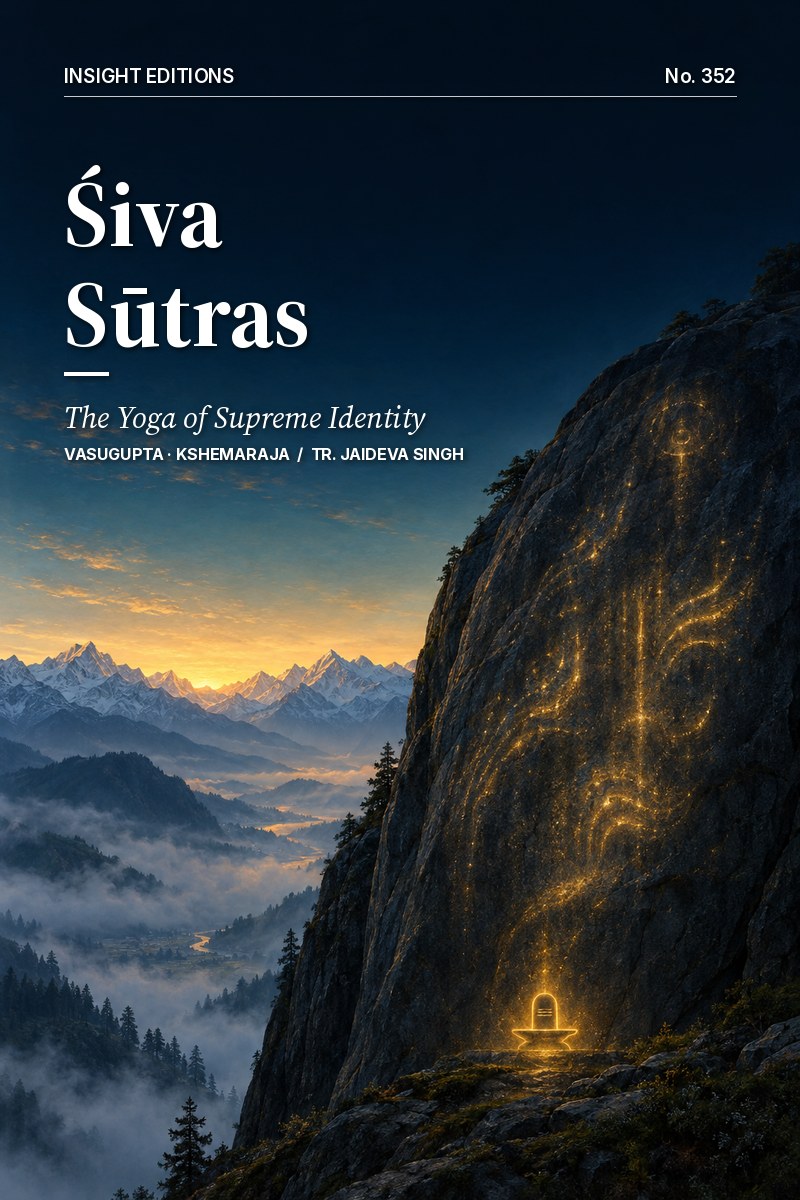
Insight Editions · No. 352
Siva Sutras
The Yoga of Supreme Identity
Vasugupta · Kshemaraja · translated by Jaideva Singh
The Siva Sutras of Vasugupta with Kshemaraja's Vimarsini, in Jaideva Singh's translation: consciousness as the Self, knowledge as bondage, the power of the letters, the three upayas, the fourth state poured through waking, dream and sleep, and delight as a doorway. All seventy-seven sutras, the introduction, a glossary and a graded practice path, with critical notes.
A study guide to the Siva Sutras of Vasugupta with the Vimarsini of Kshemaraja, in the translation by Jaideva Singh (Motilal Banarsidass). Shared free for personal reading; not for sale and not endorsed by the author or publishers. Please read and buy the original.
CORE CLAIM
Consciousness is the Self (caitanyam atma). Bondage is not a chain but a contraction of knowledge, kept alive by inner speech; liberation is recognition of what was there all the while, reached by the way of Siva, of Sakti or of the individual.
SCOPE
Jaideva Singh's Preface and Introduction, Kshemaraja's opening and epilogue, all seventy-seven sutras in three sections with the Vimarsini and Singh's Expositions, a glossary, a master synthesis and a graded practice path: about 50,000 words.
KEY FIGURES
Vasugupta (recipient of the sutras); commentators Kshemaraja and Bhaskara; Kallata and Abhinavagupta; translator Jaideva Singh, with Swami Lakshman Joo, Gopinath Kaviraj and Swami Muktananda in the background.
BEST FOR
Readers who want the foundational scripture of Kashmir Saivism sutra by sutra: the three upayas, matrka, the junctions of breath and state, delight as doorway, with critical notes on siddhis, letter mysticism, polemic and the guru frame.
How to Use This Guide
The Siva Sutras open with three words that carry the whole system: caitanyam atma, "consciousness is the Self". Everything else in the seventy-seven aphorisms follows from that claim. If the Self is consciousness that is absolutely free to know and to act, then bondage cannot be a real chain; it can only be a contraction of knowledge, and liberation can only be recognition, the uncovering of what was always the case. The sutras then lay out three ways of uncovering it, from the most direct to the most gradual: Sambhavopaya, the way of Siva, where a flash of pure I-consciousness breaks through when thought falls still; Saktopaya, the way of Sakti, where the mind works with one pure idea and with the power of mantra until the idea dissolves into what it points to; and Anavopaya, the way of the limited individual, which starts from breath, body, sound and the objects of meditation and climbs from there.
The book you are reading is three layers thick. There are Vasugupta's sutras, revealed (the tradition says) on a rock on Mahadeva mountain near Srinagar in about the early ninth century. There is Kshemaraja's Vimarsini, an eleventh-century commentary that reads every sutra through the mature non-dual philosophy of his teacher Abhinavagupta. And there is Jaideva Singh, who translated the commentary with the help of Swami Lakshman Joo and who adds notes, Sanskrit glosses and an "Exposition" of each sutra in his own words. This guide tries to keep all three voices distinct.
For each sutra the guide gives:
- The core argument: what the sutra says and what Kshemaraja makes it say, in the order he says it.
- Teaching notes: the ideas unpacked one at a time, with every Sanskrit technical term explained when it first appears.
- Insights: what is distinctive, subtle or easy to miss, and how the sutra links to the rest of the system.
- Critical lens notes: where the text asserts rather than argues, where it is doing sectarian work against rival schools, where it promises powers that cannot be checked, or where the translator shapes what you read.
- Key terms and reflection: a short glossary and practical questions or exercises.
Three warnings before starting. First, the Sanskrit sutras and commentary are printed in Devanagari, and the digital copy loses most of it; the guide works from the Roman transliteration of each sutra and from Singh's English. Second, Kshemaraja's commentary is dense with quotations from Tantras, many now lost, and he uses them as proof texts; they tell you what his tradition believed, not that it is true. Third, Singh is a devoted insider. His Preface calls a rival translation "a literary crime"; his Introduction compares the system favourably with Kant, Vedanta, Samkhya and Krishnamurti. He is a careful and honest scholar, but he is not a neutral one, and the guide flags where his enthusiasm runs ahead of the evidence.
The Shape of the Whole Book in One Page
The sutras fall into three sections, one for each way (upaya):
- Section I, Sambhavopaya (22 sutras). Consciousness is the Self (1). Bondage is limited knowledge (2), reinforced by the body-making power of maya and by karma (3), all rooted in the hidden power of letters and words, Matrka (4). "Udyamo Bhairavah": the upsurge of consciousness is Bhairava (5). Union with the circle of powers dissolves the separate universe (6). The fourth state, turya, persists through waking, dream and sleep (7). Waking is knowledge, dream is fancy, sleep is non-discrimination (8 to 10). The one who enjoys all three states as the fourth is lord of the senses (11). Then the yogi's wonders (12), will (13), the world seen as his own body (14, 15), union with pure principle (16), self-knowledge (17), the bliss of samadhi (18), creation of bodies (19), uniting and separating elements (20), mastery of the wheel of powers through pure knowledge (21), and the experience of the potency of mantra through union with the great lake of power (22).
- Section II, Saktopaya (10 sutras). "Cittam mantrah": the mind is mantra (1). Effort brings attainment (2). The secret of mantra is the being of the body of knowledge (3). Limited powers in the mind are only dreamlike knowledge (4). With the rise of innate knowledge comes khecari, the state of Siva (5). The guru is the means (6). Awakening to the wheel of letters (7). The body is the oblation (8). Knowledge is food (9). When knowledge subsides, dream-like thought arises (10).
- Section III, Anavopaya (45 sutras). "Cittam atma": the mind is the limited self (1). Its knowledge is bondage (2). Maya is non-discrimination of the principles (3). Dissolving the body's principles in their source (4). The yogic powers of breath control and their limits (5, 6). Conquest of delusion and the rise of innate knowledge (7). Waking as the second ray (8). The Self as actor, the inner self as stage, the senses as spectators (9 to 11). The higher mind and freedom (12 to 14). Attention to the seed (15), easy immersion (16), creation (17), no more birth (18), the danger of Mahesvari and the letter deities (19). The fourth state poured through the other three like oil (20 to 25). The yogi's vow, japa, gift and teaching (26 to 29). The universe as the unfolding of his powers (30, 31). Pleasure and pain seen as external (32 to 34). Bondage of the deluded and the yogi's new creation (35 to 37). Vitalising every state and every object with the fourth (38, 39). Desire and the fall into transmigration (40). The end of the limited soul and the yogi's likeness to Siva (41 to 43). The central breath and the end of difference (44, 45).
Why This Book Matters
The Siva Sutras are the founding scripture of the non-dual Saivism of Kashmir. Singh calls them "the most important Agama of the Trika system". The Spanda-Karikas expand them; the Pratyabhijna school gives them a philosophical defence; Abhinavagupta's Tantraloka builds the whole cathedral; and Kshemaraja's Pratyabhijnahrdayam (No. 346 in this series) is a pocket digest of the same view. If you want to read one primary text of the tradition, this is the one the tradition itself would hand you first.
The book is also the clearest map the tradition offers of how practice is graded. The three upayas are not three religions; they are three entry points into one realisation, and the book insists that they flow into one another: the gradual way leads into the way of power, and the way of power ends in the sudden way. That map is useful well beyond Kashmir Saivism: it is one of the earliest explicit statements in any tradition that "effortless" and "effortful" practice are complementary rather than rival.
How the Book Is Laid Out
Each sutra is given in Devanagari and Roman script, then a word-by-word gloss, then a translation of the whole sutra, then Kshemaraja's Sanskrit commentary, then Singh's translation of the commentary, then numbered notes, and finally an Exposition, Singh's summary in his own words. A long Introduction (pp. xv to lviii) explains the philosophical background and the three upayas, and a "Summary of the Contents of the Sutras" (pp. lix to lxx) gives a one-paragraph abstract of each sutra. At the end come a glossary of technical terms, an index of Sanskrit words and an alphabetical index of the sutras.
the guide cites page numbers in two forms. Front-matter and Introduction pages are given as printed Roman numerals where they survive, otherwise as the PDF page; text pages are given as Singh's Arabic page numbers (the Vimarsini on Sutra I.1 begins on p. 5). Where the OCR of a page is damaged, the guide paraphrases rather than quoting.
Dedication, Blessing and Preface (pp. v to ix)
The front matter tells you who stands behind the translation. It is dedicated to Gopinath Kaviraj, the great Varanasi scholar of Tantra, "who was a source of inspiration in life and remains a beacon-light in death". It carries a short blessing by Swami Muktananda. And the Preface explains that the whole book exists because Kaviraj, a year before his death, asked Singh to correct what he saw as gravely mistaken translations then in circulation. Singh studied the text word by word with Acarya Rameshvara Jha and then with Swami Lakshman Joo in Kashmir, and he followed Kshemaraja's commentary because it had "practically elbowed every other commentary out of existence".
The Dedication and the Blessing
The dedication is to MM. Dr. Gopinath Kaviraj (Mahamahopadhyaya, "great among great teachers", a title of Sanskrit scholarship). Kaviraj (1887 to 1976) was principal of the Government Sanskrit College in Varanasi and the most respected Indian scholar of the Tantric traditions in the twentieth century; he was also Singh's guru.
The Blessing by Swami Muktananda is three sentences: the Siva Sutras are "a highly respected treatise of Kashmir Saivism"; they contain "the highest truth as expounded by Lord Siva"; "one can attain the truth by just understanding the meaning of the sutras". Singh had also dedicated his Spanda-Karikas to Lakshman Joo and printed a Muktananda blessing there. Muktananda's Siddha Yoga movement did much to spread Kashmir Saiva vocabulary in the West in the 1970s, and his support helped these translations reach an international readership.
Muktananda's later reputation was seriously damaged by credible allegations, made after his death in 1982, of sexual misconduct with young women devotees. That does not touch the quality of Singh's translation, but it is a reason to read the blessing as a sign of the book's social setting rather than as a guarantee of anything. The claim that one can attain the truth "by just understanding the meaning of the sutras" is also stronger than the sutras themselves make: they repeatedly insist on grace, on the guru, and on practice.
The Preface: Why a New Translation
Singh's Preface is short and unusually sharp. A year before his death, Kaviraj called him and said: "Recently one translation of Siva-Sutras into Hindi and another into English have been brought to my notice. I have been both pained and shocked by the flagrant errors committed by these translators. It is my earnest wish that you prepare another translation of this great book into English."
Singh gives one example of the errors. Sutra I.5 reads "udyamo Bhairavah". A previous translator rendered udyama as "exertion". But Section I teaches Sambhavopaya, the way of Siva, and "even the veriest tyro of Saivagama knows that Sambhava upaya has nothing to do with exertion". In context udyama must mean a sudden upsurge, an emergence of consciousness, not effort. Singh adds that the rival translators had "twisted and tortured" the grammar "to yield certain pre-conceived meanings", and calls the result "a literary crime".
He then explains his method:
- Teachers. He first studied the text with Acarya Rameshvara Jha, "a great Sanskrit scholar fully conversant with Saivagama", and then with his "old Guru, Svami Laksmana Joo of Kashmir", who "taught me the sutras together with the commentary of Ksemaraja and gave luminous exposition of some very knotty problems".
- The commentary followed. Four commentaries survive: Kshemaraja's prose Vimarsini; the anonymous prose Sivasutravrtti; Bhaskara's verse Varttika; and Varadaraja's verse Varttika. The Vrtti "is so close to Vimarsini that it appears to be either a preliminary draft or a later abstract", and Singh thinks Kshemaraja probably wrote it. Varadaraja's work "is only a rehash of the Vimarsini in verse". Bhaskara's is the only independent commentary; "he differs at places from Ksemaraja", and Singh notes the differences.
- The plan. Devanagari and Roman text of each sutra; word meanings; translation; Sanskrit commentary; English commentary; "copious notes"; and a "running exposition" in Singh's own words. A long Introduction, a summary of each sutra, a glossary and an index.
He ends: "For me, this work has been a labour of love, without any financial and secretarial assistance whatsoever." Kaviraj died before it was finished; the dedication is Singh's consolation. The Preface is dated Varanasi, 1 January 1979.
the "udyama" example is a good one, and it teaches a principle you will need throughout: in this text, the section decides the meaning of the word. The same Sanskrit word can mean different things in the Sambhava, Sakta and Anava sections, and Kshemaraja (with Singh after him) reads each word through the upaya it belongs to. That is a reasonable interpretive rule, but notice that it makes the reading partly circular: the section is labelled "Sambhavopaya" by the commentator, and the label then fixes the meaning of the words inside it.
Singh does not name the translations he is attacking. Readers have often assumed that one of them was a widely read English version of the 1970s; whatever its identity, the important point is that the "error" is an error relative to Kshemaraja's tradition. Bhaskara, the other early commentator, sometimes reads the sutras differently, and a historian of religion might reasonably ask what Vasugupta meant before Kshemaraja's reading became standard. Singh's strong language reflects his loyalty to a lineage; it is not a neutral philological verdict.
Key Terms from the Front Matter
- Vimarsini: "that which examines"; Kshemaraja's commentary, "based on sound investigation and critical examination".
- Varttika: a verse commentary; Bhaskara's and Varadaraja's works.
- Vrtti: a brief prose gloss; the anonymous Sivasutravrtti.
- Saivagama: the scriptural tradition of Siva; here specifically the non-dual Saivism of Kashmir.
- Upaya: means, way of approach.
Reflection
- Singh calls a mistranslation a "literary crime" because it "goes against the very spirit and tradition of the system". When, if ever, is it right to judge a translation by its fidelity to a later commentator rather than to the text alone?
- Notice your own expectation as you begin: do you expect a spiritual text to ask for effort or to forbid it? Hold that expectation in view; the book will challenge it in both directions.
The Sources of the System (pp. xv to xxi)
The Introduction begins by placing the Siva Sutras within the literature of Trika, the non-dual Saivism of Kashmir. That literature falls into three groups: Agama (revealed texts, both doctrine and practice), Spanda (texts that work out the Agama from the side of Sakti, power), and Pratyabhijna (texts that defend the doctrine by argument). The Siva Sutras are the chief Agama of the system, "revealed to counter the effects of dualism".
Teaching Notes
1. Sastra means discipline, not just doctrine. The system is called Trika-Sasana or Trika-Sastra, also Rahasya-sampradaya (the secret tradition). Both sasana and sastra come from the root sas, "discipline". "A Sastra in India never meant merely an intellectual exposition of a particular system... A Sastra was not simply a way of thought but also a way of life." That sentence is the key to reading the whole book: every metaphysical statement is meant to be lived.
2. Why "Trika"? Because it is the philosophy of a triad: Siva, Sakti and Nara (the bound soul), or in another formulation para (the highest), parapara (identity in difference) and apara (difference).
3. The three groups of texts.
| Group | What it does | Main works |
|---|---|---|
| Agama Sastra | Revelation by Siva; lays down principles and practices | Malinivijaya, Svacchanda, Vijnanabhairava, Mrgendra, Netra, Rudrayamala, and above all the Siva Sutras |
| Spanda Sastra | Elaborates the Siva Sutras "mainly from the point of view of Sakti" | Spandakarika, with commentaries by Utpala Vaisnava (Pradipa), Ramakantha (Vivrti), Kshemaraja (Spandasandoha, Spandanirnaya) |
| Pratyabhijna Sastra | "The philosophy proper of the system", by argument and discussion | Somananda's Sivadrsti; Utpaladeva's Isvarapratyabhijna (Pratyabhijna-sutras) with his own Vrtti and Vivrti; Abhinavagupta's Pratyabhijnavimarsini and Vivrtivimarsini; and his Tantraloka with Jayaratha's commentary, plus its digest Tantrasara |
Singh notes that most of the Tantras in the Agama group "taught generally the dualistic doctrine"; the Siva Sutras matter because they give the non-dual reading.
4. Three stories of the revelation. The sutras were revealed to Vasugupta, who lived on Mahadeva mountain in the valley of the Harvan stream behind the Shalimar garden near Srinagar. There are three accounts:
- Kallata (in his Spandavrtti): Siva taught the sutras to Vasugupta in a dream.
- Bhaskara (in his Varttika): they were revealed in a dream by a Siddha, a perfected semi-divine being.
- Kshemaraja (in the Vimarsini): Siva appeared in a dream and said that the secret doctrines were inscribed on a rock on Mahadeva mountain; Vasugupta found the rock, which "turned up" at a mere touch, and the sutras were written on it. The rock is still called Samkaropala ("Siva's stone"); Singh prints a photograph (Plate 1) and notes drily that "the rock is there, but there is no trace of the sutras".
Singh draws two common points: "There was no human author of the Sutras. They originated from Siva", and "They were revealed to Vasugupta". How they were revealed, he says, is "irrelevant to the main issue of the revelation".
the three accounts are a useful lesson in how a tradition grows. The earliest source (Kallata, Vasugupta's own pupil) says "a dream". The later sources add a Siddha, or a rock with writing on it that turns over at a touch. The rock story is the most vivid and the latest, and it is the one that became standard. From a historian's point of view, the simplest reading is that Vasugupta composed or compiled the sutras, perhaps from oral teachings he had received, and that the tradition then attributed them to Siva. Singh's statement that "there was no human author" is a statement of faith, which he is entitled to, but it is not a historical finding.
5. Date. The Rajatarangini (the twelfth-century chronicle of Kashmir) says Kallata flourished under King Avantivarman, who reigned in the ninth century. Vasugupta was Kallata's teacher, so he "must have flourished either in the last part of the 8th century or the beginning of the 9th century". That is the date of the "discovery".
6. The four commentaries.
| Commentary | Author | Form | Singh's view |
|---|---|---|---|
| Vrtti | Unknown (perhaps Kshemaraja) | Prose | "Tallies with Vimarsini not only in interpretation but also mostly in words" |
| Varttika | Bhaskara (c. 11th century) | Verse | Independent; differs from Kshemaraja at places; gives a teacher lineage Vasugupta, Kallata, Pradyumnabhatta, Prajnarjuna, Mahadevabhatta, Srikanthabhatta, Bhaskara |
| Vimarsini | Kshemaraja (pupil of Abhinavagupta; Singh says 10th century) | Prose | "Lucid and detailed", rich in quotations from lost works, "the oldest and the most learned" |
| Sivasutravarttikam | Varadaraja alias Krsnadasa (late 15th century) | Verse | "Only a rehash of the Vimarsini in verse" |
Singh lists Kshemaraja's other works: Pratyabhijnahrdayam, Spandasandoha, Spandanirnaya, Svacchandoddyota, Netroddyota, Vijnanabhairavoddyota, Sivasutravimarsini, Stavacintamanitika, Parapravesika, Tattvasandoha and a commentary on Utpala's Stotravali.
there is a small tension in Singh's dating. He says Bhaskara "flourished in the 11th century" and that the Vimarsini "is the oldest" surviving commentary, written by Kshemaraja "in the 10th century". Most modern scholars date Kshemaraja's active career to roughly AD 1000 to 1050, so the Vimarsini and Bhaskara's Varttika may be close contemporaries; which is older is not certain. Bhaskara's lineage, which traces his teaching back to Kallata through a chain of named teachers, is a reminder that Kshemaraja's reading was one reading among others, not the only one available in Kashmir.
Insight: Agama, Spanda, Pratyabhijna as Three Registers
It helps to hear the three groups as three registers of one voice. Agama speaks as revelation and instruction ("do this, and this will happen"). Spanda speaks as description of experience from the side of power ("watch the pulse here, at the gap"). Pratyabhijna speaks as argument ("here is why the rival view fails"). The Siva Sutras are mostly in the first register, but Kshemaraja's commentary constantly borrows from the other two: he quotes the Spandakarikas as proof of what a sutra means, and he argues against rival schools in Pratyabhijna style. So when you read the Vimarsini you are reading all three registers at once.
Key Terms
- Trika: "the triad"; the non-dual Saivism of Kashmir.
- Agama: traditional, revealed doctrine that "commands faith".
- Spanda: the creative pulsation of consciousness; also the school that teaches it.
- Pratyabhijna: "recognition"; the philosophical school of Somananda, Utpaladeva and Abhinavagupta.
- Samkaropala: "Siva's stone", the rock on Mahadeva mountain where the sutras were said to be found.
The Philosophical Background: Reality and Manifestation (pp. xxi to xxxii)
"Siva-sutras are a treatise on Yoga, but this Yoga is based on a definite system of Philosophy." Singh sets out that philosophy under four heads: Ultimate Reality, Manifestation (the world process), Bondage and Liberation. Ultimate Reality is consciousness that knows itself and is free to act; manifestation is that consciousness expanding into thirty-six levels (tattvas) from Siva down to earth; and the individual is that same consciousness contracted.
1. Ultimate Reality: Prakasa and Vimarsa
Ultimate Reality is cit or parasamvit, "non-relational consciousness", "the changeless principle of all changes". In it there is no distinction of subject and object, of I and This. In Pratyabhijna language it is prakasa-vimarsa-maya:
- Prakasa is "the Eternal Light without which nothing can appear". It is Siva.
- Vimarsa is Sakti, the very nature of Siva, "the mirror in which Siva realizes His own grandeur, power and beauty". It is the power of doership (kartrtva sakti).
Why both? Because "mere prakasa cannot be the nature of Reality. Even diamond is prakasa, but the diamond does not know itself as prakasa." Vimarsa is the aspect of light by which it knows itself, and that self-knowing is an activity. Kshemaraja (Parapravesika) defines it as "akrtrimaham iti visphuranam", "the uncontrived flashing forth of I", and adds: "if Ultimate Reality were merely prakasa and not also vimarsa, it would be entirely powerless and inert". Vimarsa has many names: parasakti, svatantrya, aisvarya, kartrtva, sphuratta, sara, hrdaya, spanda.
Against Sankara. Singh then makes the system's standard argument against Advaita Vedanta. Because Sankara's Brahman is only prakasa, "light or illumination without any vimarsa or activity", it "is impotent to create" and must "invoke the help of Maya". "But whence does this Maya drop in?" If maya is extraneous to Brahman, the system becomes dualism; if it is Brahman's own power, Brahman cannot be inactive. Samkhya and Vedanta "take the word activity in a very crude sense. Surely, Brahman or Atma does not work like a potter or watch-maker." The divine will is "spiritual energy of incalculable force that can proliferate into any form".
Svatantrya, "unimpeded sovereignty", is "the characteristic par excellence of Siva". It expresses itself as iccha (will), which at once becomes jnana (knowledge) and kriya (action). This all-inclusive consciousness is called Anuttara, "that beyond which there is nothing", both visvottirna (transcendent) and visvamaya (immanent).
the diamond example is the heart of the whole system and worth slowing down for. A diamond shines, but it does not know it shines. A purely "witnessing" consciousness that only illuminated and never knew itself or acted would be like the diamond: bright, but not alive. Kashmir Saivism's claim is that real consciousness is self-aware, and that self-awareness is already a kind of act. Once you grant that, creation is not a fall or an illusion; it is what self-aware consciousness naturally does.
the argument against Sankara is effective as a debating point but somewhat unfair to Advaita. Advaitins do not say Brahman "creates like a potter"; they say creation is apparent (vivarta), and they explain maya as indeterminable (anirvacaniya), neither real nor unreal, precisely to avoid the dilemma Singh poses. One can still prefer the Saiva answer, and many do, but it is not true that Advaita simply failed to notice the problem. The Pratyabhijna school's actual polemic with Advaita (and even more with Buddhism) is more careful than the summary given here.
2. Manifestation: The World as Self-Expression
"It is the svabhava or very nature of Ultimate Reality to manifest. Creativity is of the very essence of Divinity." Abhinavagupta: if the Highest did not manifest in infinite variety "but remained cooped up within its solid singleness, it would neither be the Highest Power nor Consciousness, but something like a jar".
The image Singh uses is the banyan seed: "As the great banyan tree lies only in the form of potency in the seed, even so the entire universe... lies as a potency in the heart of the Supreme." The power of the Supreme is called Citi, parasakti or paravak (supreme speech).
Five main powers. Parama Siva has infinite powers, but five are basic:
| Power | Meaning | Aspect of the Supreme |
|---|---|---|
| Cit | Self-revelation, "the changeless principle of all changes" | Siva |
| Ananda | Absolute bliss, also called svatantrya | Sakti |
| Iccha | Will | Sadasiva (Sadakhya) |
| Jnana | Knowledge | Isvara |
| Kriya | Power of assuming any form | Sadvidya (Suddha Vidya) |
"Cit and ananda are the very svarupa or nature of Parama Siva. The rest may be considered to be His Saktis." The universe "is simply an opening out (unmesa) or expansion (prasara) of the Supreme as Sakti".
3. The Thirty-Six Tattvas
The Introduction then walks through the thirty-six tattvas (principles, levels of reality). This is the map you need for the whole of the Siva Sutras.
I. The pure order: tattvas of universal experience (1 to 5). Up to Sadvidya "all experience is ideal", so this is called suddhadhva, the pure path, "a manifestation in which the real nature of the Divine is not yet veiled".
| No. | Tattva | Predominant power | Experience |
|---|---|---|---|
| 1 | Siva | Cit | "The initial creative movement (prathama spanda) of Parama Siva" |
| 2 | Sakti | Ananda | Polarises consciousness into Aham and Idam, I and This; "His unmukhata or intentness to create" |
| 3 | Sadasiva / Sadakhya | Iccha | "I am this", with "this" still hazy (asphuta) |
| 4 | Isvara | Jnana | "This am I", with "this" more defined (sphuta) |
| 5 | Sadvidya / Suddhavidya | Kriya | I and This "equally balanced like the two pans of an evenly held balance"; diversity in unity (bhedabheda) |
The artist image is Singh's: "Just as an artist cannot contain his delight within himself, but pours it out into a song, or a poem, even so Parama Siva pours out the delightful wonder of His splendour into manifestation."
II. Maya and the five kancukas (6 to 11). "Now begins the play of Maya tattva." From here on is asuddhadhva, the impure order. Maya comes from ma, "to measure out": it "makes experience measurable, i.e. limited, and severs the This from I and I from This". Up to Sadvidya, "this" meant "all this"; under maya it means "merely this, different from everything else". Maya's products are five kancukas, "coverings" or "cloaks":
| Kancuka | What it limits | Result in us |
|---|---|---|
| Kala | Universal authorship (sarvakartrtva) | Limited power to act |
| Vidya | Omniscience (sarvajnatva) | Limited knowledge |
| Raga | All-satisfaction (purnatva) | Desire for particular things |
| Kala (time) | Eternity (nityatva) | Past, present and future |
| Niyati | Freedom and pervasiveness | Limitation of cause, space and form |
(The first and fourth are both written "kala" in transliteration; in Sanskrit they are different words, kalaa "part, small power" and kaala "time".)
The Kant comparison. Singh spends two pages arguing that "the Trika Philosophy of Kashmir had anticipated the German philosopher Kant a thousand years before". Hume had reduced experience to a flow of ideas; Kant showed that experience is organised by a priori forms (space and time) and categories (causality and the rest) that the mind imposes. The Trika parallel: the empirical individual's experience is constituted by maya and the kancukas; kala and niyati correspond to Kant's time and space; niyati also covers causality; vidya covers Kant's categories of quantity, quality and modality. But Trika goes further in three ways: it has two kancukas (kala as limited agency and raga as craving) that concern action and valuation, which Kant's theory, "confined only to epistemology", lacks; it derives both form and matter of knowledge from maya, so avoiding Kant's dualism of mind and nature; and it holds that self, world and God, unknowable by the categories, can be known through sadhana, not merely postulated by moral faith.
the Kant comparison is suggestive but loose, and Singh presses it too far. Kant's forms and categories are conditions of any possible experience for finite minds, argued for transcendentally; the kancukas are cosmic powers that contract a universal consciousness, asserted on the authority of scripture. The structures look alike because both describe experience as limited by something prior to it, but the arguments, the aims and the metaphysics are very different. "Anticipated Kant" is a phrase of its period (Indian scholars in the twentieth century often sought such parallels, partly in answer to colonial dismissals of Indian thought); it is better to say that the Trika analysis invites comparison with Kant than that it anticipated him.
III. The limited individual (12, 13). Siva, through maya's limitation of his knowledge and power, "becomes Purusa or the individual subject", also called anu ("atom", the limited one). Purusa is the subjective side; Prakrti is the objective side. Unlike Samkhya, which has one Prakrti for all souls, Trika says "each Purusa has a different Prakrti". Prakrti has three gunas: sattva (brightness, joy, goodness), rajas (activity, craving, ambition) and tamas (inertness, delusion, degradation). In Trika the gunas are "only the polarization of His Saktis of jnana, iccha and kriya respectively", so there is "perfect non-dualism, not dualism of Prakrti and Purusa".
IV. Mental operation (14 to 16). The antahkarana (inner instrument): buddhi (ascertaining intelligence), ahamkara (the I-maker, "the power of self-appropriation"), manas (which builds perceptions with the senses and by itself builds images and concepts).
V to VII. Sensible experience (17 to 31). Five jnanendriyas (powers of smelling, tasting, seeing, touching, hearing), five karmendriyas (speaking, handling, locomotion, excreting, sex and restfulness), and five tanmatras (sound-as-such, touch-as-such, colour-as-such, flavour-as-such, odour-as-such). Singh stresses that "the indriyas are not sense-organs but powers which operate through the sense-organs".
VIII. Materiality (32 to 36). The five mahabhutas: ether from sound, air from touch, fire from colour, water from flavour, earth from odour.
4. The Individual Self
"Caitanya or Siva forms the very core of the being of every individual." Around that core are: the gross body (five elements); prana sakti, by which he is sustained; the antahkarana; and the puryastaka, the "group of eight" (manas, buddhi, ahamkara and the five tanmatras), which forms the subtle body in which the soul leaves the body at death. In each individual lies Kundalini, a form of Sakti, dormant at the base of the spine.
Each individual normally knows three states: waking, dream and deep sleep. There is a fourth, turiya, "the consciousness of the central Self or Siva in each individual", a witnessing consciousness of which we are normally unaware. The mind is conditioned by vasana, habit-energy from previous lives; when yoga "deconditions" it, one attains turiya and becomes a jivanmukta, liberated while living.
Insight: Why the Tattva Map Matters for Practice
The thirty-six tattvas can look like cosmology for its own sake, but in the Siva Sutras they are a ladder for attention. Sutra III.4 will tell the yogi to dissolve the body's tattvas back into their sources one by one; Sutra I.6 and II.7 speak of the "wheel of powers" and the "wheel of letters", which map onto the same levels. And the first five tattvas are, in effect, five textures of experience you can learn to notice: pure I (Siva); I quivering towards expression (Sakti); "I am this", with "this" faint (Sadasiva); "this am I", with "this" clear (Isvara); and a balanced awareness of both (Suddhavidya). Much of the later practice is about returning from the "merely this" of maya to the "all this" of Suddhavidya.
Key Terms
- Prakasa / Vimarsa: light of consciousness / its self-awareness and power.
- Svatantrya: absolute freedom, sovereignty.
- Anuttara: the Absolute, "that beyond which there is nothing".
- Tattva: principle, level of reality.
- Suddhadhva / Asuddhadhva: pure order (tattvas 1 to 5) / impure order (6 to 36).
- Kancuka: "cloak"; the five limitations produced by maya.
- Anu: the limited individual, Purusa.
- Puryastaka: the eightfold subtle body.
- Turiya / turya: the fourth state.
Reflection
- Take one ordinary perception (a cup on the table). Can you notice a moment in which it is only "this", separate and limited, and a moment in which it is part of a wider field of experience? That shift, the Introduction suggests, is the difference between maya and Suddhavidya.
- Which of the five kancukas do you feel most strongly in your own life: limited power, limited knowledge, craving, time pressure, or the sense of being boxed into one place and form?
Bondage, Liberation and the Four Upayas (pp. xxxiii to xxxvi)
Bondage is due to three malas ("impurities", limiting conditions): anava mala, the innate sense of being small and imperfect; mayiya mala, the sense of difference produced by maya; and karma mala, the residue of desire-driven action. Liberation is recognition (pratyabhijna) of one's true nature, "the original, innate, pure I-consciousness". It comes through grace (saktipata), and grace is prepared for by upaya, practice. There are four upayas: anupaya, sambhavopaya, saktopaya and anavopaya.
The Three Malas
| Mala | What it is | Which power is limited | Character |
|---|---|---|---|
| Anava | "Innate ignorance", the jiva's sense of being "a separate entity cut off from the universal stream of consciousness"; "consciousness of self-limitation and imperfection" | Iccha (will) | Primary; cosmic; the individual has no control over it |
| Mayiya | Bhinna-vedya-pratha, "the consciousness of difference owing to the differing limiting adjuncts of the body etc." | Jnana (knowledge) | Cosmic; gives the soul its gross and subtle bodies |
| Karma | The vasanas, residual traces of actions done under desire; "it is the force of these vasanas that carries the jiva from one life to another" | Kriya (action) | Produced by the individual |
Liberation and Grace
"Liberation, according to the system, means the recognition (pratyabhijna) of one's true nature which means akrtrima-ahamvimarsa, the original, innate, pure I-consciousness." The ordinary "I" is relational: it knows itself by contrast with the not-self. The pure "I" is immediate awareness. Abhinavagupta (Tantraloka): "Moksa or liberation is nothing else but the awareness of one's true nature."
But there is a higher attainment than self-realisation: "Siva-consciousness in which the entire universe appears as I or Siva", and this "comes by saktipata, the descent of Divine Sakti or anugraha (Divine grace)". "In order to earn grace, one has to undergo spiritual discipline. This is known as upaya or yoga."
there is a real tension in the phrase "in order to earn grace". Elsewhere the tradition insists that grace is the free act of Siva and cannot be earned; Abhinavagupta's own account of saktipata makes its intensity depend on Siva's will, not on the disciple's merit. Singh's wording here leans towards a more effort-based reading than the classical sources would accept. The more careful formula would be that practice prepares for, or expresses, a grace that is already at work. Keep the tension in mind: the whole structure of the three upayas depends on how effort and grace are related, and the sutras themselves will say both "effort is Bhairava" (in Kshemaraja's special sense) and "the guru is the means".
Anupaya
The prefix an- here means "little". "When through extreme saktipata, only by once hearing a word from the guru, the aspirant realizes the real Self and gets absorbed in the divine consciousness without any particular effort, one is said to have attained Self-realization through anupaya." The Siva Sutras leave anupaya aside because it "transcends all yogic activity" and "no description of it can be given". Abhinavagupta's verse: "Even innumerable means cannot reveal Siva. Can a jar reveal the Sun? Pondering thus, one with a lofty vision gets absorbed immediately in Siva who is Self-luminous."
Sambhavopaya: The Way of Siva
The Introduction now gives a sutra-by-sutra preview of Section I (which the guide will cover in full) and then a long account of Sambhava yoga.
Udyama is not exertion. Sutra I.5, "udyamo Bhairavah", "gives in a nut-shell the description of Sambhava yoga". It is known as icchopaya or iccha-yoga: it "occurs by a mere orientation of the Will". It is abhedopaya, "a yoga in which there is complete identification of I and Siva", in which the "so-called I", "a psycho-physical complex, a mere nama-rupa", disappears. It is nirvikalpa yoga, for it happens "when there is complete cessation of all thought-constructs". "There is no active process either of body or prana or manas or buddhi." Kshemaraja reads udyama as unmajjana-rupah, "a form of emergence", a surfacing of Siva-consciousness.
Three marks of Sambhava yoga, in Kshemaraja's words: a sudden flash of the I-consciousness of Siva; complete cessation of ideation; and it occurs "to those whose entire consciousness is absorbed in the inner Bhairava principle". The Malinivijaya definition: Sambhava-samavesa "occurs to one who has freed himself of all ideation by an awakening imparted by the guru or by an intensive awakening of his own".
Reality is siddha, not sadhya. Singh's own prose here is among the best in the book:
"Reality is an Eternal Presence within ourselves. It is siddha, an ever-present Fact, not sadhya, not something to be brought into being by our efforts. It cannot be caught by our vikalpa-jala, by the net of our thought constructs, however cleverly we may cast it. The more we try to catch it, the more we try to grasp it, the more does it recede from us. We are prisoners of our own mind. Thought has to commit suicide in order to know our real Self."
He quotes Shelley ("like a dome of many-coloured glass stains the white radiance of eternity", slightly misquoted) and then Abhinavagupta: "Neither reject anything nor accept; abide in your essential Self which is an Eternal presence."
Krishnamurti, Taoism and Zen. Singh notes that "Mr. J. Krishnamurti, a modern Yogi uses these very words (neither accept nor reject) and calls it choiceless awareness". Awareness "is not thought... not discipline, not habit. It cannot be practised. It is alertness from moment to moment." He finds "parallel attitudes" in Taoist wu-wei, the Zen "let-go", and choiceless awareness.
Reinforcements. In Tantrasara, Abhinavagupta says Sambhava may be reinforced by jnana sakti: realising that the whole universe abides in the Self "as its reflection", that "my own Saktis being reflected within me appear as the thirty-six tattvas", and that the Saktis appear as Matrka, the letters from ka to ha, whose reflection is the tattvas from Siva to earth. And Kshemaraja adds a Spanda practice at the end of his commentary on I.5: "While one is engaged in one thought, and another arises, the junction-point between the two is the unmesa", the revelation of the Self that is the background of both. Singh notes that Krishnamurti describes the same experience in "The First and Last Freedom" (p. 211) and calls it "the creative moment".
Effortless, therefore hardest. "This Sambhava upaya is, in one sense, the simplest, in another, the most difficult. It is simplest, because no particular effort or discipline is needed for it. It is most difficult, because vikalpa-making is the habit, the very life of citta or mind. In attempting to be vikalpa-free, the mind begins to make all kinds of vikalpa. To try to become vikalpa-free is like trying to jump out of our own skin. It is given to very few mortals."
Atmavyapti and Sivavyapti. The "Concluding Remarks" on Section I set the goal. Samkhya-yoga and Vedanta both aim at kaivalya, isolation: Samkhya from Prakrti, Vedanta from Maya. Saivagama aims higher, at Sivatva-yojana, "acquiring the status of Siva". There are two stages:
- Atmavyapti, pervasion by the Self: self-realisation, with "limited jnana-kriya". Saivagama counts this a lower ideal.
- Sivavyapti, pervasion by Siva: "Siva-Sakti-samarasya, fusion and union of Siva and Sakti", in which the universe appears "as a magnificent expression of Siva's, one's own, Sakti". This "comes about only when unmana sakti is developed".
"In Vedantic liberation, Maya disappears and along with it goes the wretched universe which was only a fiction conjured up by her. In Siva-vyapti, the universe appears as a magnificent expression of Siva's Sakti." In Samkhya the liberated self has no positive bliss; in Vedanta there is atmananda, the delight of Self; in Sivavyapti "the entire universe gleams as the wondrous delight of I-consciousness".
The mind is not an alien. In Samkhya-yoga and Vedanta the citta at liberation "reverts to its causal matrix", a reabsorption Patanjali calls pratiprasava. "The citta can never be allowed to enter the sacred precincts of Purusa. It is an alien and has to be repatriated." Saivagama "has a word of cheer even for the poor citta": the mind of the realised person is "regenerated, transformed, transfigured into Cit". Singh cites Pratyabhijnahrdayam sutras 5 and 13: citi contracts into citta in descent, and citta "by inward movement becomes citi" in ascent.
the contrast between Atmavyapti and Sivavyapti is the most important idea in the Introduction for anyone who has practised another non-dual path. Many contemplative traditions aim at a pure witness standing apart from the world. Kashmir Saivism treats that as a stage, not the goal. The goal is to recognise the world itself as one's own expression, without losing the witness. This changes how a practitioner should regard the return of thoughts, sense impressions and activity after deep meditation: in this system they are not failures of practice but the field in which Sivavyapti is to be realised.
Singh's comparisons with Vedanta and Samkhya are drawn sharply to make Saivism look better. "The wretched universe which was only a fiction" is not how Advaitins describe the world at the level of ordinary experience, and Advaita has its own idea of the jivanmukta who lives and acts in the world. Likewise his parallels with Krishnamurti, Zen and wu-wei are attractive, but they lift ideas out of very different settings. Krishnamurti rejected gurus, mantras, techniques and traditions, all of which the Siva Sutras affirm; Zen "letting go" belongs to a Buddhist frame that denies the permanent Self this text proclaims. The overlap is real at the level of attention to the gap between thoughts; it is not an overlap of doctrine.
Saktopaya: The Way of Power
For those who cannot stop making vikalpas, there is Saktopaya, also called Sakta yoga, jnanopaya, jnanayoga, bhavanopaya, mantropaya. "In Sambhava upaya, one has to resort to Siva or Sambhu as prakasa... In Saktopaya, one has to resort to cit-sakti or vimarsa-sakti (the Divine I-consciousness)." The last sutra of Section I (I.22) is "a propaedeutic" to it, with its three key words: mahahrada (the great lake, mahasakti), anusandhana (close mental examination with a view to union), mantravirya (the potency of mantra).
Catch one pure vikalpa. "It is not possible for most people to become vikalpa-free. Is there no way out for them? There is, says Saktopaya. Catch hold of one suddha vikalpa. That will prove to be a veritable boat by which we can cross the turbulent waters of phenomenal existence."
- Asuddha vikalpa (impure thought): ideas by which "one considers his psycho-physical organism, his mind-body complex to be the Self". "I am thin, weak, ignorant" are examples. Abhinavagupta: "People consider themselves bound on account of vikalpa... Therefore when an opposite vikalpa arises, it dispels the vikalpa that is the cause of transmigratory existence."
- Suddha vikalpa (pure thought): Abhinavagupta: "That which is unlimited consciousness transcending all limited expressions of Reality from earth right up to Siva, that alone is the highest Reality; that am I. Therefore I am both transcendent to and immanent in the universe."
Can thought reach Reality? No. "The highest reality is everywhere and in every way self-luminous. Vikalpa can neither help nor hinder it." "No discipline or practice can be possible with regard to the highest Reality... Nothing can be added to or removed from" it. Then what is suddha vikalpa for? Negatively, it removes the sense of duality, which "is only the ignorance of one's essential nature". Positively, it works in three interconnected ways:
- Mantra sakti. The first sutra of Section II is "cittam mantrah", the mind is mantra. Here citta means the mind "seriously bent on reflecting over and finding out the highest reality": cetyate vimrsyate anena param tattvam iti cittam. "Mantra" is man (to reflect, be aware) plus tra (that which saves): "that mental awareness by which one feels one's identity with the highest Reality enshrined in a mantra and thus saves oneself from a sense of separateness". "Muttering of the syllables mechanically is of no avail." The source of all mantras is purnahanta, the full I-consciousness of Siva. The Tantrasadbhava: without that imperishable sakti, "all the mantras are as useless as autumnal clouds". Singh explains the four levels of speech: para vak (the supreme I-consciousness beyond thought and speech); pasyanti (word and object as an undivided whole); madhyama (division begun at the level of thought, a subtle inner speech); vaikhari (gross, spoken speech, "when the bodily organs are employed in utterance"). And Matrka: the letters are "not meaningless jargon" but "symbols of the creative Saktis of the Divine". The word aham (I) itself runs from a (the first letter, prakasa, Siva) to ha (the last, vimarsa, Sakti), with the bindu (the dot) signifying that Siva, though manifested down to earth, "is not divided thereby". When the aspirant reflects on a mantra through suddha vikalpa and feels identity with Siva, Matrka "transforms the citta"; "his suddha vikalpa which was only an ideation is dissolved; his citta is transformed into citi".
- Sat-tarka leading to bhavana. The aspirant learns from guru or scripture that his Self is Siva. Abhinavagupta: "The function of the agama is to awaken in the mind suddha vikalpa." Sat-tarka ("right reasoning") is the reflection that keeps such ideas continuous. It leads to bhavana, "creative contemplation", "a power of spiritual attention", "that contemplation by which a thing which though real and existent appeared as non-existent... reappears as manifest reality by sheer clarity". Singh calls it "a sort of auto-suggestion which sinks into the unconscious and fishes out surprising reality from its mysterious depth".
- Suddha vidya. Under its influence the known appears as a form of knowledge, knowledge ends in the knower, and finally the transcendental I displaces all three.
There is also a Spanda route within Saktopaya: liquidating thoughts by "grasping mentally the spanda or dynamic reality which reveals itself in the interval of two thoughts", the unmesa.
A whole life of practice. For one awakened to the wheel of letters, "his whole life becomes yoga". Rituals are transformed: instead of pouring butter into fire, he pours "his thought of the gross and subtle bodies as the self into the fires of cit" (II.8); his food is the knowledge of the Self (II.9). Abhinavagupta adds: offering everything to God by bhavana is his yaga; repetition of "the perfect, infinite God is my real Self" is his japa; viewing body and jar "as simply an aspect of God" is his vrata. "A door gently swings open; a force arises from within which embraces our so-called I to death. The limited I dies to live in the universal I."
Singh names Ramana Maharshi as the modern teacher who "may be said to have set the best example of Sakta yoga", because Sakta yoga "is a process of self-inquiry".
the move from impure to pure vikalpa is the most usable idea in the book for ordinary people. It does not ask you to stop thinking; it asks you to think one true thought about yourself until the thinking dissolves into the fact. "I am weak" is replaced not by silence but by "I am the consciousness in which all this appears". That is a cognitive practice, and it has the honesty to admit that the thought is still a thought, a raft to be left on the far shore. Singh's word "auto-suggestion" is revealing: it is a modern psychological term, and it is fair to ask whether bhavana uncovers something that was there, as the tradition says, or produces a conviction by repetition, as a sceptic would say. The text answers that the test is the dissolution of the thought in direct experience; a mere conviction would not dissolve.
Anavopaya: The Way of the Individual
In Sambhavopaya "the means of approach is, if it can be called means at all, alert passivity or choiceless awareness", with no support for the mind: niralamba yoga. In Saktopaya the mind is used "for seeking the source of its being". In Anavopaya, "anu, the limited, conditioned individual takes up some limited aspect as buddhi, prana, body, some object in space from which he starts". Section III's first sutra is "cittam atma", the mind is the self, where atma is used in the sense of the psychological complex that "moves about from one form of existence to another" (atati iti atma). Because it uses something different from the essential Self as its support, it is bhedopaya; because kriya predominates, it is kriyopaya.
Not watertight compartments. "Anavopaya has to lead to Saktopaya and finally to Sambhavopaya." That is why the sutras, while describing one upaya, keep mentioning the others as aids.
The Malinivijaya lists five supports for anava practice: uccara, karana, dhyana, varna and sthana-kalpana.
| Support | What the mind rests on | Main practice |
|---|---|---|
| Dhyana | Buddhi | Meditate on knower, knowing and known as one; pour all objects, gathered by the sense powers, into the lit fire of inner consciousness; or dissolve the tattvas from earth to Siva into gross, subtle and causal bodies (laya-bhavana, III.4); or imagine Kalagni Rudra rising from the right big toe and burning the body (daha-bhavana) |
| Uccara | Gross prana in its five functions | Attention to prana, apana, samana, udana, vyana, yielding seven blisses |
| Varna | Subtle prana as inner sound | Awareness of the unstruck sound, anahata nada; the hamsa mantra of the breath |
| Karana | The body (gross, subtle, causal), including mudras | Seven karanas from grahya to aksepa |
| Sthana-kalpana | External supports | The two dvadasantas of the breath, the body, an image or picture |
The seven blisses of uccara. Resting on the subject alone gives nijananda; on the absence of objects, nirananda; on prana and apana together, parananda; on samana, brahmananda; on udana, mahananda; on vyana, cidananda; and full realisation of prana sakti gives jagadananda, "in which there is no division or limitation, for it flashes forth all round". Its marks: ananda (delight), udbhava (an inner leap), kampa (trembling), nidra (sleep to outer objects), ghurni (reeling with delight). "This prana yoga is entirely different from pranayama which is only an exercise of breath control."
The unstruck sound. From the uccara of general prana "there vibrates an imperceptible, inarticulate sound which is known as varna", sounded by no one: Svacchanda Tantra, "No one sounds it voluntarily, nor can anyone prevent its being sounded. The deity abiding in the heart of living creatures sounds it himself." In it all the letters lie latent; it is anahata, unstruck. Its intensive awareness is varna yoga or dhvani yoga, called nadanusandhana in the Yogataravali, and known in the Gorakhnath tradition, among Kabir and the North Indian saints, and in the Radhasoami movement as surati-sabda yoga.
Hamsa. The breath goes out with sa (the "creation seed") and in with ha (the "withdrawal seed"); so every being repeats hamsah "21,600 times" a day without effort: the ajapa-japa, the "unrepeated repetition", also called ajapa gayatri. Awareness of it equalises prana and apana, and the dormant Kundalini, coiled "three and a half" times at the base of the spine, rises. "A number of pleasant sounds is heard. But the aspirant should not dwell on these sounds." She pierces the brahmagranthi, the muladhara, svadhisthana and manipura cakras, the visnugranthi, anahata and visuddha, the rudragranthi and ajna, and enters the sahasrara, from which ambrosia rains down. Singh adds: "The nadis and cakras are not physical constituents. They are in the pranamaya kosa, the vital sheath in the subtle body. Only their impact is felt through the nerves and ganglia." (His plates nonetheless label the cakras with nerve plexuses: cardiac, solar, sacral.) Beyond sound comes jyoti, light, and the stages of subtle nada from bindu to unmana. "Upto samana, there can be only atma-vyapti"; only at unmana, also called sahaja vidya, does maya cease and Sivavyapti become possible.
The seven karanas. Grahya (assimilating objects into the sense powers), grahaka (assimilating these into the knower), samvitti (into consciousness), sannivesa (being fully established in consciousness, with "no trace of the object as something extraneous"): these four are purely anava. Vyapti (pervading every object with consciousness, by bhavana) and tyaga (abandonment of all effort) reach the Sakta level. Aksepa, the projection of universal consciousness into the whole universe, is Sambhava.
Sthana-kalpana. For those who cannot rest even on buddhi or inner sound. The breath goes out twelve finger-breadths from the centre of the body, and comes back the same distance: the external and internal dvadasanta. Fixing the mind on these two points dissolves vikalpas. Failing that, the body, or an idol or picture.
three cautions about this section. First, the numbers (21,600 breaths a day, three and a half coils) are traditional symbolic figures; 21,600 works out to fifteen breaths a minute, which is in the range of normal adult breathing, but nothing hangs on the exact count. Second, the cakra-plexus correlation in the plates was a common twentieth-century attempt to make yogic anatomy look scientific; Singh himself says the cakras are not physical, and the two claims sit uneasily together. Third, the Kundalini sequence is presented here as a smooth, positive progression; other sources in the same tradition, and modern clinical reports, describe disturbing and sometimes harmful experiences when such practices are forced. The text's own warning, "the aspirant should not dwell on these sounds", applies to all the phenomena: they are signposts at most.
the most important sentence in the account of Anavopaya is the plainest: "Anava yoga has to lead to Sakta yoga and Sakta yoga has to lead finally to Sambhava yoga." Breath, sound, posture and visualisation are not ends. The test of every anava technique is whether it eventually lets the mind rest in the knower rather than in the technique.
Key Terms
- Mala: impurity, limiting condition; anava, mayiya, karma.
- Saktipata: descent of power, grace.
- Anupaya / Sambhavopaya / Saktopaya / Anavopaya: the four ways, from "no means" to the way of the individual.
- Vikalpa: thought-construct; suddha (pure) or asuddha (impure).
- Bhavana: creative contemplation.
- Matrka: the "unknown mother", the power of the letters.
- Para, pasyanti, madhyama, vaikhari: the four levels of speech.
- Atmavyapti / Sivavyapti: pervasion by the Self / by Siva.
- Unmana: "beyond mind", the highest stage of subtle sound and of Sakti.
- Ajapa-japa: the natural, unrepeated repetition of hamsa in the breath.
- Dvadasanta: the point twelve finger-breadths from the centre where the breath ends.
Reflection
- Sit for five minutes and simply notice how thoughts arise. Singh says that "in attempting to be vikalpa-free, the mind begins to make all kinds of vikalpa". Do you notice this? What happens if, instead of stopping thoughts, you look for the gap between two of them?
- Write down three "impure vikalpas" you habitually hold about yourself ("I am anxious", "I am not clever"). Then write one "pure vikalpa" from the text. Repeat it slowly for a week and notice whether it stays a sentence or becomes a felt fact.
- Watch the breath as it ends outside the body and inside the body. Is there a pause? What is there in the pause?
Summary of the Contents of the Sutras (pp. lix to lxx)
Before the text proper, Singh gives a one-paragraph abstract of every sutra. It is the fastest way to see the logic of the whole book, and it shows how Kshemaraja reads the sutras as a progression from realisation, through power, to practice and its fruits.
The Arc of Section I
The first four sutras define the problem: the Self is free consciousness (1); bondage is the innate sense of limitation (2), reinforced by maya and karma (3), and rooted in words and letters, Matrka (4). Sutra 5 gives the solution in a phrase: the emergence of Bhairava "shatters the shackles of ignorance". Sutras 6 and 7 show the effect: the universe appears as Sakti, and the delight of the fourth state becomes "a constant feature even of the three states of waking, dream and profound sleep", "not only in meditation but also in the usual, normal course of life". Sutras 8 to 11 redefine waking, dream and sleep and name the one who enjoys all three as the fourth "master of his senses". Sutras 12 to 21 describe the yogi's experiences and powers, ending in his establishment in Suddha vidya and lordship over the wheel of powers. Sutra 22 introduces the great lake of the Highest Sakti and the potency of mantra, leading to Section II.
The Arc of Section II
"When the mind broods constantly over the mantra of the Highest Reality... it gets identified with it. Thus the mind itself becomes the mantra." The secret of mantra is the communion of the individual mind with the divine I-consciousness that includes the universe (3). If the aspirant is "satisfied with mayic limited powers, he has fallen from the high ideal" (4). With supreme knowledge comes khecari mudra, the state of Siva (5). The guru is a help, "or the divine grace acts as a guru" (6). All words and objects come from letters, and the letters from the supreme I-consciousness: "knowing that this Supreme I-consciousness is our real Self, one is liberated" (7). The bodies are thrown as oblation into the fire of real I-consciousness (8). Knowledge is food (9). When pure knowledge subsides, thoughts full of difference arise again, or (Bhaskara) the old world-knowledge is remembered "only like a dream" (10).
The Arc of Section III
The conditioned mind is the limited self (1), its knowledge is bondage (2), and maya is the failure to tell the real Self from the pseudo-self built of the kancukas (3). Then the anava practices: dissolution of the tattvas (4); breath control, withdrawal and concentration, which yield powers over the elements (5) but which, being "the outcome of moha (delusion)", "cannot realize the Highest Reality" (6). Only the conquest of maya brings sahaja vidya (7). Then the great images: the Self as actor, the inner self as stage, the senses as spectators (9 to 11). Then the yogi's alertness, the danger of the letter-deities (19), and the instruction to let the fourth state permeate the other three "even as oil permeates its receptacle completely" (20). The yogi's vow is to remain in the body until prarabdha karma is exhausted (26); his speech is japa (27); his gift is knowledge of Self (28). Pleasure and pain become external to him "like blue, jar, etc." (32 to 34). He becomes kevali, a knower as pure consciousness (34). His desires vanish and he is "like Siva" (40 to 43). He keeps the body because prana links it to the divine will (43); by constant attention to the central breath there is nirvyutthana samadhi, samadhi with no coming out, "in all conditions" (44); and the soul that had forgotten itself "recognizes its divine nature again" (45).
the summary shows something the sutra-by-sutra reading can hide: every section ends in the same place. Section I ends with the yogi resting in the potency of the supreme I. Section II ends with the warning that when knowledge subsides, the dream returns. Section III ends with recognition in all conditions. The three upayas are three roads to one view, and the book is honest that the view can be lost: the warnings in II.10, III.19 and III.22 to 25 are as important as the promises.
about a third of the sutras, read with Kshemaraja, describe supernormal powers: creating bodies at will (I.19), joining and separating elements across space and time (I.20), creating "another form of world" (III.36). The book treats these as real and as signs of attainment, while also warning that limited powers are a trap. A modern reader can respect the warning without accepting the claims. There is no reliable evidence that any yogi has ever created a body or a world by will, and the history of guru movements (including some associated with this tradition in the twentieth century) shows how easily claims of power become instruments of control. Read these sutras for what they say about attention and identity, and treat the miracle language as the idiom of a premodern culture.
Kshemaraja's Opening Verse and Introduction to the Sutras (pp. 1 to 5)
Kshemaraja begins with a verse of praise to the consciousness of Samkara, explains why he is writing a new commentary (the existing vrttis were inconsistent with the teaching of the gurus), and tells the story of Vasugupta's discovery of the sutras. Every element of the opening is doing double work: devotion, a statement of the subject, and a claim to authority.
The Invocation
"That consciousness of Samkara is (ever) victorious which in its wholeness is non-dual in reality though having an appearance of duality, from which the class of Rudra and ksetrajna springs and in which it comes to rest, which is the fundamental Reality, from which bursts forth into view the universe, whose form is this universe, from whose unimpeded Free Will ever leaps forth his divine power which is a mass of bliss, bringing about the unsurpassed, immortal spanda principle."
Singh's notes unpack each phrase:
- Samkara: "sam (the bliss of the revelation of the supreme non-dualism) karoti (brings about)", one who brings the bliss of non-dual revelation. Caitanya is his "unimpeded Free Will in knowledge and action".
- Tajjayati, "that is victorious": "in spite of its varied manifestation as subject, object etc. ever abides in its autonomy and bliss".
- Ksetrajna: the bound soul, pasu, "full of anava mala, from Brahma down to the tiniest creature". Rudras: free souls in the category of pati (lord), who carry out emergence, maintenance and withdrawal of the world according to individuals' karma. Siva himself is directly concerned only with vilaya (veiling) and anugraha (grace).
- Anuttara spanda tattva: the first cosmic pulsation, which "comes into being on account of ananda that wells up (ucchalat) from Parama Siva". Spanda is "difficult to translate": "the cosmic creative pulsation of the Absolute, throbbing with life, quickening to manifest".
The verse also hints at the five powers: "from which Rudra and ksetrajna arise" suggests kriya and iccha; "which is the fundamental Reality" suggests jnana; "whose form is the universe" suggests ananda; "consciousness" suggests cit.
Why a New Commentary
"Having noticed confusion in the Siva-sutra-vrttis owing to inconsistency with the sacred tradition (amnaya) of the teachers, I am expounding the Siva-sutras according to their real meaning." Singh notes that it is not clear which vrttis are meant, and that the word viganatah has a double meaning: "as opposed to" the tradition (the vrttis' fault) and "with a definite, clear understanding" (Kshemaraja's virtue).
Vasugupta and the Rock
"On the mountain Mahadeva there was a Guru by the name Vasugupta, a great personage and a devotee of Mahesvara, who owing to excess of devotion which blossomed forth by divine grace, did not accept the teaching of Nagabodhi and other Siddhas obtaining in the inferior philosophical systems." Singh's note identifies Nagabodhi as a Buddhist Tantric teacher, author of a work on the Guhyasamaja Tantra; "other Siddhas" refers to "other accomplished Buddhist" teachers.
Siva, "with the intention that the esoteric traditional teaching may not be lost in the world of the living which was mostly influenced with dualistic philosophical view", told Vasugupta in a dream: "On the yonder mountain, there is the esoteric doctrine under a big stone-piece. Having obtained it, reveal it to those who are fit for grace." Vasugupta found the stone, "which turning round by a mere touch of the hand, confirmed his dream". He taught the sutras to Kallata and others, and "collected and expounded them in the Spandakarikas". Kshemaraja adds that he has already explained those Spanda verses "in Spandanirnaya".
The first target. Kshemaraja then says that the first sutra teaches, "in opposition to those who hold that there is a difference between nara (the human self) and Isvara (the Supreme Lord), that Consciousness of Siva alone is, in the highest sense, the Self of the entire universe". Singh's note: this may refer to the Naresvarapariksa of Sadyojyoti, a dualist Saiva Siddhanta work.
the opening frames everything that follows as a correction of two kinds of rival. One is outside Saivism: the Buddhists (Nagabodhi and the Siddhas) whom Vasugupta "did not accept". The other is inside it: the dualist Saivas of the Siddhanta, for whom the soul and the Lord are eternally distinct. Much of Kshemaraja's commentary on the early sutras is aimed at these two targets, and recognising them makes his arguments much easier to follow.
there is a polemical edge in the story of the rock. Kshemaraja says Siva revealed the sutras because the world was "mostly influenced with dualistic philosophical view"; the revelation is thus presented as divine intervention against the dualist Saiva Siddhanta, which was in fact the dominant Saiva school in Kashmir at the time. Historians read this as part of the non-dual school's long effort to establish its authority against a more established rival. Notice also that Kshemaraja says Vasugupta himself composed the Spandakarikas; Singh's own Spanda translation records the alternative view that Kallata wrote them. Kshemaraja consistently makes his own lineage look as early and as authoritative as possible.
Key Terms
- Ksetrajna / pasu: the bound soul.
- Rudra / pati: liberated soul exercising cosmic functions.
- Vilaya / anugraha: veiling / grace, Siva's own two acts.
- Amnaya: sacred tradition, lineage.
- Mangala-sloka: auspicious opening verse.
Sambhavopaya: The Way of Siva
Section I teaches the most direct way. It begins with a definition of the Self (I.1), explains bondage (I.2 to I.4), gives the means in two words (I.5), and then describes, in seventeen further sutras, what life looks like when that means has done its work: the universe seen as power, the fourth state running through the other three, the yogi's will, body, joy and powers, and finally the experience of the potency of mantra that leads into Section II.
Kshemaraja reads this section as Sambhavopaya throughout, but he repeatedly notes that particular sutras teach a Saktopaya "as an aid". The section is therefore not a single technique; it is a portrait of realisation with practical hints set into it.
Caitanyam Atma: Consciousness Is the Self (pp. 5 to 15)
Caitanyam atma. Singh's gloss: caitanyam, "awareness which has absolute freedom of knowledge and activity"; atma, "Self or nature of Reality". Translation: "Awareness which has absolute freedom of all knowledge and activity is the Self or nature of Reality." Kshemaraja proves that nothing exists outside consciousness, that this consciousness is defined by freedom, that it is one in all beings (against the doctrine of many separate selves), that it is not the body, the breath, the intellect or the void, and that it cannot be proved by any means of knowledge because every means of knowledge depends on it.
Teaching Notes
1. Nothing is outside consciousness. "In this world, nothing exists which is outside the range of consciousness (acetitasya)." Singh's note on prakasa: it is "the light of consciousness by which even physical light is visible. Hence wherever there is any appearance, there is prakasa." He cites the Katha Upanisad: "No physical light such as the sun, moon or stars or lightning shines there... It shining, everything else shines in its wake."
2. Caitanya means freedom, not mere awareness. Grammatically, caitanya is the abstract noun from cetana, "a conscious being... one who conscires (thinks), who is absolutely free in all knowledge and activity". So caitanya "connotes absolute freedom in respect of all knowledge and activity (paripurnam svatantryam)". Only Parama Siva has it fully. Other beings, "from the sakalas up to anasrita-Siva", depend on him and so lack it. Why define the Self by freedom and not by eternity or all-pervasiveness? Because "eternity etc. are possible elsewhere also" (the Nyaya schools say ether and atoms are eternal), but absolute freedom belongs only to Siva. The abstract noun picks out the one attribute that is unique.
Singh's note on svatantrya lists three ideas: absolute freedom to create, "not depending on any external material or means"; vimarsa, ever-present self-consciousness; and jnana and kriya. "Siva in this system is not like the inactive Brahman of Samkara Vedanta."
3. Against many selves. Kshemaraja argues against "pluralists". Are the many selves conscious or not? If not, they are matter and not selves. If they are consciousness, "there can be no valid reason for considering one atman or Self as different from another". Difference cannot come from space, time or form: if these are outside consciousness, "being deprived of the light of consciousness, they cannot appear at all"; if they appear, "they are consciousness itself". Nor can difference come from mala, because mala is "not something outside consciousness", and it ceases at liberation anyway. If some residue of mala remains in the liberated, "then those so-called liberated souls would still be in the state of transmigratory existence". The target here is the Saiva Siddhanta view that liberated souls become "equal to Siva" yet remain eternally many and below the anadi-Siva, the "beginningless Siva" who was never bound. Kshemaraja: "Consciousness (as consciousness) is only one Self."
4. Not body, breath, intellect or void. In answer to "what is Self?", Kshemaraja lists and rejects four rivals: "not the body, as maintained by the common folk and the materialists (Carvaka), not the vital principle (prana) as maintained by the followers of the Vedas, not the ascertaining power of the mind as maintained by the Yogacara Buddhists, nor the Void as maintained by the Madhyamika Buddhists". Even those who mistake the body for the self are, in fact, conscious subjects: in them too "the caitanya shines forth as the true subject".
He quotes the Netra Tantra ("Consciousness is the nature of Self which verily is the Divine Self freed of all limiting conditions"), the Vijnanabhairava (verse 100: "the same Self characterized by consciousness is present in all the bodies"), and two Spanda verses (I.6 and 7) on the source by which the inert senses "acting like a conscious being" move forward, maintain and withdraw.
5. The universe is consciousness. Because the sutra names no particular being, atma can also mean svabhava, nature: consciousness is "the atma or nature of the entire universe", including objects like a jar and imagined ones like a "sky-flower". The Ucchusmabhairava: "so long as there are no knowers, how can there be anything known. The knower and the known are really the same principle." And Spanda II.3 and 4: "There is no state which is not Siva. It is only the experient who always and everywhere exists in the form of the experienced."
6. It cannot be proved. "In order to prove it, the means of right knowledge (pramanas) are inadequate, for these means of right knowledge are themselves dependent for their proof on the Self-luminous consciousness." The Trikahrdaya gives a famous image: just as one who tries to jump over the shadow of his own head never gets his head where his feet are, so it is with baindavi kala. Singh explains baindavi kala as "the power of knowership of the Highest Self", "the power of the Self by which it is always the knower and never the known".
Singh's Five Points
Singh closes with five points to remember:
- Caitanyam means not mere consciousness but "sarvajnanakriyamayam paripurnam svatantryam", the perfect freedom of knowing and doing.
- Atma means both Self and nature; "the knower, knowledge, and known are all various forms of consciousness".
- Caitanya is "not simply prakasa but is also imbued with Universal I-consciousness which is the source of all manifestation".
- It "cannot be proved by any logical means, for all means of proof owe their existence to it".
- The system is "against the theory of the plurality of Self".
His note on the word consciousness is honest: "There is no word for caitanya in English. The word consciousness has a relational colour (of subject-object duality), but caitanya is non-relational. Perhaps the word awareness or Being-Awareness may be better."
the image of jumping over one's own shadow is the best key to the whole sutra. Any attempt to make consciousness an object, to prove it, find it or grasp it, puts consciousness in the position of the one doing the proving, finding and grasping. It is always "behind" the attempt. This is why the later sutras will not say "find the Self" but "notice that you already are the knower" (I.18, III.38): the move is a turning-round of attention, not a search.
the argument against plurality is clever but contains a step many philosophers would question. It assumes that if two selves are "both consciousness", they must be one consciousness. But two drops of water are both water without being one drop. Kshemaraja's answer would be that consciousness is not a stuff that can be divided by space or time, since space and time are themselves appearances in consciousness; that answer works only if you already accept that space and time have no reality outside consciousness. In other words, the argument is persuasive within an idealist frame and much less so outside it. The rejection of Buddhist positions is also brief: Yogacara and Madhyamika thinkers had detailed replies to arguments of this kind, and the Pratyabhijna authors engaged them at length elsewhere; here they are dismissed in a line.
Key Terms
- Caitanya: awareness as absolute freedom of knowledge and action.
- Svatantrya: self-dependence, sovereignty.
- Pramana: means of valid knowledge (perception, inference and so on).
- Baindavi kala: the power by which the Self is always knower, never known.
- Anadi-Siva: the "beginningless Siva" of the dualists, never bound.
- Carvaka, Yogacara, Madhyamika: materialists; Buddhist idealists; Buddhist philosophers of emptiness.
Reflection
- Try to observe "the observer". What happens? Is there an object you can find, or does the attempt keep turning back on itself?
- Notice that the experience of a sky-flower (an imagined thing) and of a real flower are both appearances in awareness. What, in experience itself, makes one "real"?
Jnanam Bandhah: Knowledge Is Bondage (pp. 15 to 21)
If everything is consciousness, how is there bondage? Jnanam bandhah: "Ajnana or ignorance of one's real nature which is a kind of shrunken or limited knowledge is the cause of bondage." Kshemaraja notes that the sutra can be read in two ways. Joined to the first by Sanskrit sandhi, "caitanyam atma" plus "ajnanam bandhah" yields caitanyam atma-ajnanam bandhah; read alone it is jnanam bandhah. Either way, bondage is a kind of knowledge, not its absence.
Teaching Notes
1. Mala is not a separate substance. "The dualists maintain that there are two separate realities, viz. Siva and mala." But nothing is separate from consciousness, so "how can there be separate existence of mala and how can this mala veil consciousness"? The Malinivijaya: "Mala... is nothing but ajnana or ignorance of one's real nature." Kshemaraja says he argued this "at great length" in his commentary on the Svacchanda Tantra.
2. A self-limitation by Siva. The limitation is "made to appear by the Highest Lord in His own being which is pure like the sky", in the forms from anasrita-Siva down to the maya-pramata (the subject under maya). It is due to Mahamaya, "simply a form of Self-veiling brought about by His power of absolute freedom".
3. Two forms of ignorance. Singh's note: ajnana appears as atmani anatmabhimana, "considering the real Self as not-Self", and anatmani atmabhimana, "considering the not-Self, i.e. body etc. as the Self". Ajnana "does not mean complete absence of knowledge, but sankucita jnana", contracted knowledge.
4. Two ways of losing freedom. Since caitanya is freedom of both knowing and doing, anava mala can come in two forms. There may be bodha (knowledge) without kartrtva (doership, I-consciousness), as in the Vijnanakala, an experient "below suddhavidya but above Maya" who "has pure awareness but no agency". Or there may be doership "full of abodha", taking the body to be the self, as in the sakala, the ordinary embodied person. The Isvarapratyabhijna: "both are due to one's loss of the grip of one's essential nature".
5. Spanda support. Spanda I.9: the empirical self "is reduced to inefficiency on account of his innate impure limiting conditions. He is driven to desire various objects, but owing to his inefficiency is never fully satisfied". And III.14: "The pasu has all his knowledge born of sense and ideation", and so "loses the enjoyment of the ambrosia of the Highest Self".
6. Singh's exposition. "Ignorance or ajnana is not negative; it is positive, a kind of positive jnana, a shrunken, vitiated knowledge." Its source is "a wonderful power of Siva... A person may conceal everything, but he cannot conceal his own nature. But Siva has this wonderful power of veiling his real nature." This self-veiling "is His technique or stratagem for the play of life in varied, multiple forms".
"knowledge is bondage" sounds paradoxical until you see what kind of knowledge is meant: knowledge with a boundary drawn round it. "I am this body, here, now, limited, short of what I need" is not ignorance in the sense of a blank; it is a definite, constantly reinforced belief. That is why the remedy in the later sutras is not "learn more" but a different kind of knowing, one without the boundary.
the claim that bondage is Siva's own "stratagem for the play of life" is the system's answer to the problem of evil and suffering, and it is worth noticing how much it asks. It means the suffering of every being is, at the deepest level, a game the Absolute is playing with itself. Some readers find this liberating (nothing is ultimately outside the divine). Others find it morally troubling, because it can make real cruelty look like theatre. The text does not stop to address that objection.
Key Terms
- Ajnana: ignorance, as contracted knowledge.
- Mahamaya: the great self-veiling power.
- Vijnanakala: an experient with pure awareness but no agency.
- Sakala: the ordinary embodied subject, with all three malas.
- Maya-pramata: the subject under maya (includes pralayakalas and sakalas).
Yonivargah Kalasariram: Maya and Karma Also Bind (pp. 21 to 24)
Is anava mala the only cause of bondage? No. Yonivargah kalasariram: "Mayiya mala and karma mala are also the cause of bondage." Yoni is the source of the objective world, maya; varga is the class of elements she produces; so yonivargah is mayiya mala. Kala is "that which divides the world of entities into separate things", "activity"; sarira is form; kalasariram is "that whose form is activity", karma mala.
Teaching Notes
1. The kancukas in the Svacchanda. Kshemaraja quotes a long list from the Svacchanda Tantra that is a perfect summary of the impure tattvas: caitanya "is suppressed by mala, provided with kala and vidya, tainted by raga, limited in respect of kala (time), restrained by niyati, magnified by the sense of being a Purusa, furnished with the disposition of Prakrti, endowed with the three gunas, buddhi, ahamkara and manas, organs of sense and action, tanmatras and the gross elements".
2. Built on anava. Mayiya and karma mala are "attached to anava mala as their base". The Isvarapratyabhijna: "When there is ignorance of real Self, then anava mala being present, there arise mayiya mala bringing about a sense of difference in respect of every object, and karma mala which brings about birth and experience of pleasure and pain." All three are brought about by "the Maya Sakti of Siva", which Singh distinguishes from maya tattva, the material source of objects.
3. Bhaskara's different reading. Bhaskara reads yoni as the four Saktis Amba, Jyestha, Raudri and Vama, and kala as the letters from a to ksa: these powers, through words, produce thought-constructs that bind the self. Kshemaraja's reading is more systematic; Bhaskara's anticipates the next sutra.
4. Singh's exposition. Mayiya mala provides "the physical and psychic vehicles in which he is 'cabined, cribbed, confined'" (Singh quotes Macbeth, slightly altered), and karma mala "makes him commit motivated actions. These and their residual traces are not airy nothing. They are karmika forces that drag the individual to earth-life again and again."
the order matters. Anava mala comes first and the other two are built on it. That means the root problem is not the body or one's actions but the prior sense of being incomplete. Body and karma are the forms that sense of incompleteness takes. A practice aimed only at purifying actions (karma) or disciplining the body (maya) would therefore be working on branches, not the root.
Jnanadhisthanam Matrka: The Mother Behind All Knowledge (pp. 24 to 29)
How do the three malas actually bind? Jnanadhisthanam matrka: "It is the un-understood Mother or Power of Sound inherent in the alphabet that is the basis of the limited knowledge (in the form of anava, mayiya and karma mala)." Matrka is the alphabet from a to ksa, "the mother of the entire universe". The suffix -ka in Sanskrit, says Singh, indicates something "unknown or un-understood": so Matrka is "the mother who is not properly known".
Teaching Notes
1. Three kinds of bound thought. Matrka "brings about knowledge in a limited form, e.g. 'I am imperfect' (anava mala), 'I am thin or fat' (mayiya mala), 'I am a performer of agnistoma sacrifice' (karma mala)". Such knowledge may be wordless or verbal, and "by the penetration of different communicative words in the minds of the listener brings about a feeling of sorrow, pride, joy, and passion".
2. The deities of the letters. Matrka presides "in the form of various deities". The Timirodghata: "The Mahaghora Saktis who are the deities of the pithas, who hover about the consciousness in Brahmarandhra with a terrible noose, delude people constantly." Singh's notes explain the three kinds of power: Ghora (terrible) saktis give worldly pleasures and obstruct progress; Ghoratari or Mahaghora delude the worldly-minded further; Aghora inspire beings towards liberation. Each class of letters has a presiding goddess: the vowels Yogisvari or Mahalaksmi, the ka-class Brahmi, the ca-class Mahesvari, the retroflex ta-class Kaumari, the dental ta-class Vaisnavi, the pa-class Varahi, the ya-class Aindri, and the sa-class Camunda.
3. The five kalas. Singh also explains the five kalas (subtle aspects of the objective world): Nivrtti (earth, 16 worlds), Pratistha (water to Prakrti, 23 tattvas, 56 worlds), Vidya (Purusa to Maya, 7 tattvas, 28 worlds), Santa (Sadvidya, Isvara, Sadasiva, 18 worlds) and Santyatita (Sakti and Siva, no worlds).
4. Why it binds. Because Matrka is the base of all limited knowledge, "one is deprived of the investigation of the inner non-difference... and all one's knowledge is outward-turned without ceasing for a moment". Spanda III.13 to 15: the limited self, "deprived of the knowledge of his essential Self by the kalas, i.e. the letters ka etc., falls a victim to the group of Saktis like Brahmi etc. arising from a multitude of words. Therefore he is known as pasu." And: "His Saktis are always in readiness in veiling his essential real Self, because all his ideas cannot arise without the use of words."
5. Singh's exposition. "The basis of all the three malas is word-bound ideas... Words have a tremendous influence in shaping our ideas which do not allow us to realize the splendour of Siva-consciousness imprisoned within ourselves." And in the note: "When unknown, the Matrka impels people towards all kinds of worldly activities and feelings. When the Matrka is known, i.e. when her saving power is realized, she leads one to liberation."
strip away the goddesses and this is one of the most modern-sounding ideas in the book. Our sense of who we are is built from language, and most of that building happens below awareness: we do not choose the words "I am fat", "I am a failure", "I am a sacrificer"; they arrive with an emotional charge and take over. The tradition personifies these forces as deities of the letters because they act on us rather than being acted on. The cure, given in II.7, is not to escape language but to know where it comes from: from the same consciousness that it binds.
the etymology of Matrka as "unknown mother" (from the suffix -ka) is Kshemaraja's and Singh's, and it is a devotional or hermeneutic reading rather than strict grammar. In ordinary Sanskrit, -ka is a common suffix that can form diminutives or simply nouns, and matrka is the normal word for the alphabet or for the group of "little mothers", the Mother goddesses. The "unknown" meaning is a lovely interpretation, and it fits the teaching; it should not be presented as the plain sense of the word.
Key Terms
- Matrka: the alphabet as power; the "un-understood mother".
- Ghora, Mahaghora, Aghora: the three classes of power (terrible, more terrible, not terrible).
- Pitha: seat; here the sense organs as seats of the powers.
- Brahmarandhra: the opening at the crown of the head.
- Kala (here): one of five subtle aspects of the objective world.
- Pasu: the bound soul, "the creature".
Reflection
- For one day, notice the first words that arise when something goes wrong ("I always...", "I'm such a..."). Where do they come from? Did you choose them?
- Notice the emotional charge of a single word said by someone else: a compliment, an insult. How much of your reaction is to the sound, and how much to the meaning you attach?
Udyamo Bhairavah: The Upsurge Is Bhairava (pp. 29 to 32)
Now the remedy. "The quintessence of the means for the cessation of the bondage... consists in resting in Bhairava-consciousness." Udyamo Bhairavah: "A sudden flash or opening out of transcendental consciousness is Bhairava or Siva." This is the whole of Sambhavopaya in two words.
Teaching Notes
1. What udyama means. Singh insists again: udyamah here means, as Kshemaraja says, unmajjanarupah, "sudden emergence of divine consciousness; it is an opening out, an efflorescence of consciousness". "Udyamah in this sutra does not mean exertion or effort." The word comes from ut (up) plus yam (to raise, hold): "raising up", "elevation of consciousness".
2. Kshemaraja's definition. Udyama is "an emergence of an awareness in the form of highest pratibha, which is a sudden springing up of that I-consciousness of Siva which expands in the form of the entire universe". It is Bhairava "inasmuch as Bhairava holds within Himself the entire universe by reducing all the Saktis to sameness with Himself and inasmuch as He completely devours within Himself the entire mass of ideation". And it may be called Bhairava because "it is the means for revealing Bhairava who is one's own essential Self". It "appears in those who are devoted to Him because of their whole attention being concentrated on that inner Bhairava principle".
Singh's notes: pratibha "means the Paravak, the absolutely free creative divine consciousness". Bhairava is analysed (Singh calls it "an anacrostic word") as bha (bharana, maintenance), ra (ravana, withdrawal), va (vamana, projection): "one who brings about the srsti, sthiti and samhara of the universe".
3. Guru or one's own great awakening. The Malinivijaya: Sambhava samavesa "results from an awakening imparted by the guru in one who has freed his mind of all ideation". But "another meaning of guruna pratibodhatah has also been taught by the great teachers": guru as an adjective, "great", so "by one's own great awakening". Kshemaraja keeps both readings open: the flash can come through a teacher or arise from within.
4. Bhavana as emergence. The Svacchanda: of the one who "realizes his Bhairava nature by an apprehension of an inner emergent divine nature... all the mantras become effective". Singh notes that bhavana in this verse means "an apprehension of an inner emergent divine consciousness (not meditation or contemplation)".
5. The junction between two thoughts. Spanda III.9: "While one is engaged in one thought, and another arises, the junction-point between the two is the unmesa, a revelation of the true nature of the Self which is the background of both the two thoughts. This may be experienced by every one for oneself."
6. Singh's exposition. "This immersion in divine consciousness occurs to one who is a very advanced aspirant. It is a sudden flash of divine consciousness by an orientation of the will towards the inner creative consciousness which is always present within oneself. It requires no discipline of meditation, japa etc."
the word "orientation" is the practical key. Sambhavopaya does not ask you to do anything to the mind; it asks you to turn towards what is already present, "with whole attention concentrated on the inner Bhairava principle". The junction between two thoughts is offered as a place where this is easiest to notice, because there the background is momentarily not covered by content. You cannot produce the gap; you can stop overlooking it.
there is an obvious tension between "it requires no discipline" and "it occurs to a very advanced aspirant". If no discipline is needed, how does one become advanced? The tradition's answer is that the advancement comes from grace and from the ripening of earlier practice, possibly over lifetimes. That answer is consistent within the system but impossible to test, and it means that in practice almost everyone is directed to Saktopaya and Anavopaya. Singh's sharp rejection of the translation "exertion" is right for Kshemaraja's reading, but it is worth knowing that udyama in ordinary Sanskrit does mean effort or striving, and that the "upsurge" reading is a technical, tradition-specific one.
Key Terms
- Udyama: upsurge, emergence (here not "effort").
- Unmajjana: surfacing, emerging.
- Pratibha: flash of intuitive, creative consciousness; paravak.
- Bhairava: Siva as the one who holds, withdraws and projects the universe.
- Samavesa: absorption, immersion in the divine.
- Unmesa: opening, the gap between two thoughts.
Reflection
- Notice the moment when one thought ends and before the next begins. Do not try to lengthen it. Simply notice that it happens. What is present in it?
- The text says the flash can come through a teacher or "by one's own great awakening". Have you had moments of sudden clarity that came from neither effort nor instruction?
Sakticakrasandhane Visvasamharah: The World Dissolves into Power (pp. 32 to 36)
Once Bhairava-consciousness has arisen, how is it established so that it continues "even in the usual normal course of life"? Sakticakrasandhane visvasamharah: "By union with the collective whole of saktis through intensive and fixed awareness, there is the disappearance of the universe as something separate from consciousness."
Teaching Notes
1. The circle of powers. Bhairava has "the highest svatantrya sakti". This sakti, "though fully aware of its inner nature is outwardly engaged in activity and thus seizing the entire host of its Saktis appears in the form of succession (krama), non-succession (akrama), in the transcendence of both, in the form of being greatly empty, of being not empty at all, or in the form of both empty and non-empty". Singh: this exhausts the four logical alternatives; the creative sakti both projects (as if full) and reabsorbs (as if depleted), "yet in herself she transcends all these alternatives".
2. Sandhana. When "sandhana (union by awareness) of this group of Saktis" is established "according to the appropriate manner as described in the secret Sastras", then occurs "the disappearance of the universe from Kalagni up to the ultimate kala". Kalagni is "the lowest plane of Nivrtti kala"; the "ultimate kala" is Santyatita.
3. Not a cosmic catastrophe. "Though external existence may continue in the form of the body and other external objects, it is reduced to sameness with the fire of the highest consciousness." Singh: "Visvasamhara in this context does not mean pralaya or final dissolution of the universe but the disappearance of the universe as something separate from consciousness."
4. Sources. The Bhargasikha: the aspirant "devours everything... whether it is death, or kala... or the multitude of thought-constructs, whether it is a thought-construct of identity with the Highest or thought-construct of varied things". The Viravali: "Observe that divine consciousness present in the body which has the glow like that of Kalagni Rudra and in which all things are dissolved." The Malinivijaya definition of Sakta samavesa (absorption through apprehending "that Reality which is not within the range of utterance"). And the first and last verses of the Spandakarika.
5. Only through a guru. "This comes into experience only by devotion to the lotus feet of a genuine guru. So, nothing further has been described."
6. Singh's exposition. "This sutra describes a Saktopaya as an aid to Sambhavopaya." The world "is no longer a mere material object, completely separate from consciousness, but only an expression of consciousness in a particular form". "After this the mind of the aspirant is prepared for the reception of a sudden awareness of the full I-consciousness of Siva."
the phrase "disappearance of the universe" frightens people who imagine it means losing the world. The sutra's actual claim is milder and more interesting: what disappears is the universe as something over against consciousness. You still see the tree; what goes is the sense that the tree is "out there" and you are "in here". This is close to what many meditators describe as the collapse of the observer-observed divide, and it is a shift in experience, not in physics.
Kshemaraja deliberately withholds the technique ("nothing further has been described") and sends the reader to "the secret Sastras" and a "genuine guru". This is common in Tantric texts and has two sides. It protects practices that can be misused or misunderstood; it also makes the teaching depend on an initiatory hierarchy and makes the claims untestable for outsiders. A reader without a teacher can still work with the general instruction (see every object as a form of the power of awareness), but should be aware that the text itself says this is not the whole method.
Key Terms
- Sakticakra: the wheel, collective whole, of powers.
- Sandhana: union through intensive, fixed awareness.
- Visvasamhara: withdrawal of the universe (into consciousness), not cosmic destruction.
- Krama / akrama: succession / simultaneity.
- Kalagni Rudra: the fire of time at the lowest level of manifestation; also the fire of consciousness that consumes it.
The Fourth State Runs Through Waking, Dream and Sleep (pp. 36 to 41)
For one in whom the universe has been absorbed into consciousness, "there is no difference between samadhi and vyutthana", between meditation and rising from it. Jagratsvapnasusuptabhede turyabhogasambhavah: "Even during the three different states of consciousness in waking, dreaming and profound sleep, the rapturous experience of I-consciousness of the fourth state abides."
Teaching Notes
1. Abhoga. Singh: abhoga is camatkara, "the joyous, rapturous I-consciousness of Siva which is present in everybody in the fourth state". Turya "holds together the consciousness of the other three states"; "it is the ever-present consciousness without which even the other three cannot be known as states. It is integral awareness." Some read samvid for sambhava: "there abides the experience of the rapture of the fourth".
2. The moon image. The Candrajnana: "As the moon pure like a flower shines all round and by the assemblage of its gladdening rays gladdens the world in a trice, even so... a great Yogi, when he moves about in the world, gladdens all round with the rays of his moon-like spiritual awareness the entire variegated world from avici (a particular hell) up to Siva." Spanda I.3: "Even during the occurrence of different states of consciousness like waking etc., that continuing to be the same, one never departs from one's natural state of being the knower."
3. Singh's five points. His exposition is one of the best in the book:
- The fourth state "is the ever-present witnessing consciousness of all the three". "It is the changeless permanent I that witnesses all our changing I's."
- The three states exclude one another: in waking there is no dream, in dream no awareness of waking, in deep sleep no awareness of either. In waking, body, prana, senses and mind are active; in dream only prana and mind; in deep sleep only prana. "Is there then nothing that remains the same in all these differing states? There is, declares the Saiva philosophy."
- "It is called the fourth with reference to the other three... In reality, any numerical term cannot be applied to it."
- Turya is siddha, ever present, not sadhya, produced. "If it were to be produced, it would no longer be eternal. It cannot be ordered about." "Then why all this pother about gaining the turya consciousness?" Because "we are unaware of it", and "the upayas are mentioned so that we may prepare ourselves for its reception". "When we are prepared by righteous living and by deconditioning our habitual consciousness, the turya emerges from its cryptic cell, so to speak, takes possession of our normal consciousness and becomes its active feature." "We then live sub specie aeternitatis."
- Turya "in Saiva philosophy is not merely prakasa, not merely saksi caitanya, witnessing consciousness as in Samkara Vedanta, but it is also vimarsa, full of turyabhoga", rapture.
point 2 is a genuinely good phenomenological observation, independent of the metaphysics. The three states really do exclude each other, and yet something allows us to say "I slept well" and "I had a dream" on waking. The tradition calls that something the fourth. Whether one agrees that it is a continuous consciousness (many philosophers would say it is only memory stitching the states together), the question it raises, what is it that knows all three?, is a real and useful one for practice.
Singh's statement that the fourth is "the witness" and also "not merely the witness" can confuse. The point is that Kashmir Saivism accepts the witness of Vedanta and then adds delight and power to it. The witness is real but incomplete; when it is "full of rapture" and "takes possession of normal consciousness", it is no longer a detached observer. The later sutras of Section III (III.20 to 25) will give the practical instructions for letting it permeate the other states.
Key Terms
- Jagrat, svapna, susupti: waking, dream, deep sleep.
- Turya / turiya: the fourth.
- Abhoga / camatkara: rapturous, wonder-filled experience.
- Samadhi / vyutthana: absorption / emergence from absorption.
- Saksi caitanya: witness consciousness (Vedanta).
Reflection
- On waking tomorrow, before getting up, ask: what was present in deep sleep? How do I know I slept?
- Notice a moment of pleasure during an ordinary activity. Can you feel the "I" that is enjoying it, not as a separate observer but as part of the enjoyment?
Waking Is Knowledge, Dream Is Fancy, Sleep Is Non-Discrimination (pp. 41 to 47)
Three short sutras define the three states. Jnanam jagrat (I.8): "All knowledge obtained by direct contact with the external world is included in the category of the waking state." Svapno vikalpah (I.9): "All knowledge obtained by independent activity of the mind when the subject is not in direct contact with the external world is included in the category of dreaming." Aviveko mayasausuptam (I.10): "Lack of awareness on any plane is the profound sleep of delusion." Kshemaraja gives first the usual sense, then a wider philosophical sense, then a yogic sense, and the Malinivijaya, quoted by him, generates a sixteen-fold scheme.
Teaching Notes
1. The ordinary sense. Waking: knowledge of objects by the external senses, "common to all". Dream: knowledge produced by the mind alone, "merely a thought-construct", "uncommon", particular to each. Deep sleep: aviveka, "complete lack of awareness". The definition of deep sleep "incidentally describes also the nature of Maya".
2. Each state contains all three. "The threefold character has been indicated in all of the three states." In dream, the first undifferentiated awareness is its "waking", the reveries that follow its "dream", and unawareness of reality its "deep sleep". Even deep sleep has a faint awareness at its entry, like waking, and "vikalpas in the form of residual traces", like dream.
3. The yogic sense. For the yogi, dharana, fixing the mind on an object, is his waking; the "continuous flow of the idea of that object" is his dream; and samadhi, "absence of difference between the thinker and the thought", is his deep sleep.
4. The Malinivijaya's sixteen states. Singh lays out the scheme with great care. It is worth putting in a table:
| State | Phase | What is prominent | Yogic name | Jnani's name |
|---|---|---|---|---|
| Waking (pindastha for the yogi; sarvatobhadra for the jnani) | jagrat-jagrat | The object (prameya) | abuddha (unawakened) | |
| jagrat-svapna | Knowledge of the object (pramana) | buddha (awakened) | ||
| jagrat-susupti | The knower (pramata) | prabuddha (well awakened) | ||
| jagrat-turya | Consciousness as such (pramiti) | suprabuddha (perfectly awakened) | ||
| Dream (padastha for the yogi; vyapti, pervasion, for the jnani) | svapna-jagrat | Dream world clear and stable | gatagata | |
| svapna-svapna | Dream world hazy, disorderly | suviksipta | ||
| svapna-susupti | Dream objects coherent; peaceful sleep | samgata | ||
| svapna-turya | The dreamer knows he is dreaming | susamahita | ||
| Deep sleep (rupastha for the yogi) | susupti-jagrat | Latent impressions of the world | udita (risen) | |
| susupti-svapna | Impressions fostered, thickened | vipula | ||
| susupti-susupti | Impressions subdued | santa | ||
| susupti-turya | Entry into full I-consciousness | suprasanna | ||
| Turya (rupatita for the yogi; pracaya for the jnani) | turya-jagrat | Ordinary mind retires; super-mind active | manonmana | |
| turya-svapna | Crossing the boundary of limited knowledge | ananta | ||
| turya-susupti | Everything as divine Sakti | sarvartha | ||
| Turyatita | no phases | Uninterrupted rapture; "everything is Siva" | mahapracaya |
"There is no such phase as turya-turya." Turyatita "is the state of fullest realization. There is no need of any Yogic practice now... In it even the distinction between the transcendent and the immanent disappears."
Singh's summary: "the waking state is that in which the aspect of the known is prominent, the dream state that in which knowledge or mentation is prominent, and the dreamless state that in which the knower is prominent".
svapna-turya, the dream in which "the dreamer does not lose hold of his self-consciousness" and "knows that he is only dreaming", is what modern sleep researchers call lucid dreaming, and it is one of the few states in this scheme that has been studied in laboratories. The Malinivijaya treats it not as a curiosity but as a stage of integration, "susamahita", "a fully integrated individual". Read this way, the table is a sophisticated map of how attention can be more or less present within each of the ordinary states.
the sixteen-fold scheme is elegant, but notice how much of its symmetry is imposed. Assigning "known, knowing, knower, knowing-as-such" to four phases of every state produces a neat grid; real experience is messier, and the names (gatagata, suviksipta and so on) come from a Tantra whose own explanations are terse. The scheme is best used as a set of questions to ask of your own experience (in this dream, was the world clear? coherent? did I know I was dreaming?) rather than as a fixed ladder.
Key Terms
- Pindastha, padastha, rupastha, rupatita: the yogi's names for waking, dream, deep sleep and the fourth.
- Sarvatobhadra, vyapti, pracaya, mahapracaya: the jnani's names for waking, dream, the fourth and the beyond-fourth.
- Prameya, pramana, pramata, pramiti: the known, the means of knowing, the knower, knowing itself.
- Manonmana: the state where mind is "beyond mind".
- Turyatita: beyond the fourth.
Reflection
- Keep a dream journal for a week. For each dream, note whether it was clear or hazy, coherent or disordered, and whether you knew you were dreaming.
- In waking life, notice when the object dominates (you are lost in the screen), when the act of knowing dominates (you are thinking about what you see), and when the knower dominates (you are aware of yourself seeing).
Tritayabhokta Viresah: The Enjoyer of the Three Is Lord of the Senses (pp. 47 to 51)
Tritayabhokta viresah: "Being an enjoyer of the rapture of I-consciousness in the triad (of waking, dreaming and deep sleep), he is verily the master of his senses." The one who sees the three states "as steeped in the delight of the fourth state" "enjoys unrivalled Self-sovereignty". One who does not "becomes an object of enjoyment of the forces of the waking and other states".
Teaching Notes
1. Enjoyer or enjoyed. Spanda I.17 (approximately): "He who (as witnessing consciousness) knows both what is said to be the object of experience and the subject of experience in all the three states is not tainted even while he is aware of both." The alternative is stark: either you enjoy the states, or "the forces of the waking and other states" enjoy you. "Even a yogi who has not risen up along this stream cannot be the master of his senses; he will remain only a confounded being."
2. Viras. Singh's note on viranam: when the senses work ordinarily, "they are merely vrttis", modes of getting experience. When the subject "consciously acquires the experience of the fourth state, then his senses become Saktis, divine powers intent on abolishing all sense of difference. They are not merely indriyas, but viras now. The experient now becomes their master. He uses them for the higher purpose of life, and is no longer used by them."
3. Manthana Bhairava. In the mahamnayas (great scriptures), such a person "is said to have entered the being of Manthana Bhairava", "one who churns the objective experience, withdraws it in himself and then again brings it forth". Singh explains three classes of Saiva scripture: the non-dual Bhairava Sastras (four, the mahamnayas), the identity-in-difference Rudra Sastras (eighteen), and the dualist Siva Sastras (ten).
4. Bhaskara's reading. Bhaskara reads tritaya as the three gunas; Singh prefers Kshemaraja's three states, "as tritaya comes immediately after jagrat, svapna and susupti".
the image of the senses becoming viras, heroes, instead of vrttis, mere modes, is a striking reversal of the usual ascetic attitude. In much of Indian yoga the senses are horses to be reined in or enemies to be subdued. Here they are powers to be inhabited. Mastery is not suppression; it is the senses working from a centre that is no longer pulled about by what they report.
Vismayo Yogabhumikah: The Stages of Yoga Are Wonder (pp. 51 to 52)
Are there stations along the ascent? There are. Vismayo yogabhumikah: "The stations and stages of yoga constitute a fascinating wonder." "As a person is struck with wonder by seeing something extraordinary, even so there is a pleasant surprise for the great yogi who notices in mute wonder an expansion (in the power) of his entire complex of senses, as they come fully under the influence of the inner Self."
Teaching Notes
1. Wonder without satiety. The yogi "has this experience in himself that is full of uninterrupted joy, a joy with which he never feels satiated".
2. Not cakra experiences. These are "stations indicative of the repose of the yogi in the higher consciousness", "not experiences which one may notice in muladhara or the psychic centre between the eyebrows". Singh's note: "The author means to say that the experience in these centres is inferior to the experience of the full-blown I-consciousness."
3. Sources. The Kulayukti: "When aspirants realize the Self by themselves, then the Self experiences a pleasant surprise within itself." And a verse: "How can there be the wretched transmigratory existence for him who observing his Self as the presiding power over everything abides (in that consciousness) full of pleasant surprise."
Kshemaraja's distinction between wonder at the Self and experiences in the cakras is a valuable corrective to much popular writing on Kundalini and energy work. The stations of yoga, he says, are not lights at the base of the spine or between the brows; they are an ever-fresh astonishment that the knower is what it is. That is harder to sell, and more useful.
Iccha Saktir Uma Kumari: The Yogi's Will Is Uma, the Virgin (pp. 53 to 56)
Iccha saktir uma kumari: "The Will-power of the yogi who is in communion with Siva is Uma (splendour of Siva) who is Kumari." Kshemaraja reads it three times, from three standpoints, and so models the three upayas in miniature.
Teaching Notes
1. Uma. Singh glosses uma as ma (Laksmi, splendour) plus u (Siva): "splendour of Siva". Kumari: an unwedded maiden.
2. Three readings.
| Standpoint | Upaya | Kumari means | Sense |
|---|---|---|---|
| Abheda (non-difference) | Sambhava | From kumara, "to play": the sakti "intent on the play of manifesting the universe and withdrawing it" | The yogi's will is Siva's svatantrya sakti |
| Bhedabheda (identity in difference) | Sakta | ku (the state of maya, difference) plus mari (destroyer): she who "does not allow the power of Maya to spread"; also a virgin who "remains always in the state of enjoyer, never to be enjoyed by others" | The yogi's will destroys difference while living amid it |
| Bheda (difference) | Anava | Like the virgin Uma (Parvati) who abandoned attachment and devoted herself to union with Siva | The yogi's will is always intent on union with Siva |
Kshemaraja "shows his preference for its interpretation from the abheda standpoint".
3. Will above knowing and doing. Some read iccha saktis tamas kumari and take it to show "the superiority of Will over cognition and conation". The yogi's desire "is not coarse like that of the common folk, but it is like parasakti itself, unimpeded everywhere". The Netra Tantra: "That Highest Sakti is only my Will power, inseparable from me... as heat to the fire and rays to the sun."
the three-fold reading of one sutra is the most instructive feature of this commentary. Kshemaraja shows that the same words can be heard at three depths. A dualist practitioner hears "be devoted to Siva like Parvati"; a practitioner of the middle way hears "let your will destroy difference"; the non-dualist hears "your will is already Siva's freedom at play". None is wrong; they are stages. This is also the hermeneutic method by which a non-dual school could absorb devotional and ritual texts without rejecting them.
the gendered imagery deserves a plain comment. The "virgin" who is "never to be enjoyed by others" and the goddess devoted to union with her lord are traditional images of feminine purity and devotion. Kashmir Saivism gives Sakti high metaphysical status, but its imagery was written by and largely for men, and it encodes ideals of female chastity that a modern reader need not share in order to take the point about will that is not grasping.
The World as His Body; the Mind United to the Heart (pp. 56 to 61)
Drsyam sariram (I.14): "All objective phenomena outer or inner are like his own body." Hrdaye cittasamghattad drsyasvapadarsanam (I.15): "When the mind is united to the core of consciousness, every observable phenomenon and even the void appear as a form of consciousness." I.14 states the experience; I.15 says how to arrive at it.
Teaching Notes
1. Two readings of I.14. Read as drsyam sariram, "whatever is perceptible, whether inwardly or outwardly, all that appears to this Yogi like his own body, i.e. identical with himself". His feeling is "I am this", "just as the feeling of Sadasiva with regard to the entire universe is I am this". Read the other way round, sariram drsyam, "the body appears as an objective phenomenon like blue etc., and not like a perceiver as in the case of the ignorant", whether that body is the physical body (waking), the mind (dream), prana (deep sleep) or the void (for the "sunya-pramata", the experient who identifies with emptiness). So the world becomes his body, and his body becomes one more object.
2. The peacock's egg. "In the body and in everything external, his awareness is one of undifferentiated consciousness as the plasma of the peacock's egg is undifferentiated plasma." The image recurs in Kashmir Saiva texts: the yolk of a peacock egg contains all the colours of the future peacock in undifferentiated form. The Vijnanabhairava: "Just as waves are modes of water, sparks of fire, light of the sun, even so the various modes of the universe have gone out from me."
3. I.15 word by word. Hrdaya, "the light of consciousness inasmuch as it is the foundation of the entire universe"; cittasamghattat, "the concentration of the fickle mind on that"; drsyasya, "of all objective phenomena like blue, body, prana and mind"; svapasya, "of the void, i.e. of the absence of every objective phenomenon"; darsanam, seeing everything "devoid of the distinction between subject and object". "The individual mind intently entering into the universal light of foundational consciousness sees the entire universe as saturated with that consciousness."
4. The two bowls of the heart-lotus. The Vijnanabhairava (verse 49): "He whose mind together with the other senses is merged in the ether of the heart, who has entered mentally into the centre of the two bowls of the heart-lotus... acquires the highest fortune." Sivopadhyaya's commentary: one bowl is pramana (knowledge), the other prameya (objects), and the centre is pramata, the knower. "This is Saktopaya."
5. Singh's exposition. I.15 "says that the above is not merely a metaphysical chimera. If the individual mind is united with the Central, foundational consciousness... one can find for oneself that the objective world is only an expression of that Consciousness."
the double reading of I.14 contains a complete practice. First, see the body as an object: notice that sensations, thoughts, even the felt sense of "being here" are things you are aware of. Then, see every object as equally intimate as the body: the cup, the sky, the sound of traffic are present in the same awareness and in the same way. The two moves together undo the usual arrangement in which "my body" is me and "the world" is not.
Key Terms
- Drsya: the visible, the objective.
- Hrdaya: heart; the core of consciousness.
- Samghatta: union, joining.
- Svapa: here, the void, absence of objects.
- Sunya-pramata: the experient who identifies with the void.
Reflection
- Sitting quietly, list what you are aware of: sounds, body sensations, thoughts. Is the body more "you" than the sounds? In what sense?
- Try the Vijnanabhairava image: imagine knowing and the known as two bowls of a lotus, and rest in the centre where the knower is.
Suddhatattvasandhanad Va Apasusaktih: Union with the Pure Principle (pp. 61 to 63)
Another means. Suddhatattvasandhanad va apasusaktih: "Or by constant awareness of the Pure Principle, he becomes like one in whom the binding power existing in the limited self is absent." Suddha tattva is Parama Siva. When the aspirant "becomes aware of the universe as that itself, i.e. as Siva, then he becomes the lord of the world like Sadasiva", and "a-pasu-sakti", one in whom "the binding power designated by pasu is absent".
Teaching Notes
1. Worth more than all ritual. The Laksmikaularnava: "all the religious disciplines together with joyful exclamations of praise which are prescribed for the success of initiation are not worth even the sixteenth part of that awareness which is centred on you".
2. Saktopaya again. Vijnanabhairava 63: "One should consider the entire body or the entire world simultaneously without thought-construct as a form of consciousness." Spanda II.5: "He who knows thus and regards the whole world as play (of the Divine), being ever united, is without doubt liberated even while alive." Kshemaraja labels both "Saktopaya".
3. Bhaskara splits the sutra. Bhaskara reads two sutras: "suddhatattvasandhanad va" (by intense awareness of the pure principle, one gains Siva-consciousness) and "svapadasaktih" (his own power is jnana and kriya). This is one reason Bhaskara's numbering differs from Kshemaraja's. Singh: "There is no special point in splitting the 16th sutra into two."
4. Singh's summary of I.16 and I.17. "The 16th sutra exhorts the aspirant to trace back the universe to its ultimate source, viz., Siva and regard it as His epiphany, nay, as Siva Himself... The 16th Sutra teaches that the objective world is in essence Siva; the 17th teaches that the Subject is also Siva."
the claim that ritual is "not worth a sixteenth part" of awareness is a recurring move in the Kashmir Saiva texts. It elevates inner realisation above external worship, but it comes from a tradition that also practised and prescribed elaborate ritual (Abhinavagupta's Tantraloka is full of it). Read the quotation as a statement of priority, not as permission to dismiss practice; Kshemaraja himself keeps saying "only through a genuine guru".
Vitarka Atmajnanam: Firm Conviction Is Self-Knowledge (pp. 63 to 65)
Vitarka atmajnanam: "Unwavering awareness (that I am Siva) constitutes the knowledge of Self." Singh's note: "Vitarka in this context does not mean deliberation which is merely thought-construct, but unwavering awareness, an awareness with full conviction."
Teaching Notes
1. I am Siva. "Of this Yogi, the unwavering awareness that I am Siva, the Self of the universe constitutes the knowledge of Self." Kshemaraja labels it Saktopaya.
2. Vijnanabhairava 102. "The Highest Lord is omniscient, omnipotent and omnipresent. As I have the characteristic of Siva, I am that very Siva. With this strong conviction, one becomes Siva Himself."
3. Spanda II.7. "The realization of oneself as Siva is the acquisition of ambrosia. This is verily the veritable seizure of the Self. This constitutes the diksa for Nirvana." Singh gives Ramakantha's definitions. Diksa is "a particular consecration ceremony for initiation into the higher life, conferring on the initiate the gift of knowing oneself, and casting away the impurity due to the sense of difference". Nirvana is "absolute peace resulting from the destruction of the mental disturbance caused by harbouring belief in dualism; it is the establishment of consciousness in its natural state".
4. Not by reasoning. Singh: this is "to be realized not by tarka or logical reasoning, not by vikalpa or thought-construct, but by vitarka, an awareness in which all tarka has disappeared by an indomitable, irresistible conviction".
"with this strong conviction, one becomes Siva" can sound like positive thinking. The careful point is that vitarka is the end of argument, not a stronger argument. The practitioner does not out-argue doubt; doubt simply stops arising, as it stops arising about the fact that you exist. The test is whether the conviction needs maintaining. If it does, it is still vikalpa.
there is a real psychological risk in the formula "I am Siva, omniscient and omnipotent", and the tradition knew it (see III.19 on the danger of being deluded at the moment of attainment). Taken by an unstable or grandiose personality, the identification can feed inflation rather than dissolve the ego. Kshemaraja's own answer is that the "I" in question is not the personal ego at all but the knower in which that ego appears; but a reader without guidance should hold the formula lightly and watch for signs of inflation: contempt for others, a sense of special status, refusal to be corrected.
Lokanandah Samadhisukham: The Joy of Being the Knower (pp. 65 to 68)
Lokanandah samadhisukham: "The delight that the yogi feels in abiding in his nature as the knower in respect of both the subject and object in the world, is his delight of samadhi." Singh insists: "The word samadhi in this context does not mean absorption or trance. It means maintaining continuous awareness of knowership."
Teaching Notes
1. Loka in two senses. "That which is perceived, i.e. the multitude of objects", and "he who perceives, i.e. the class of subjects". Though the distinction is evident, the yogi "experiences a unique delight of I-consciousness which results from his mindfulness of his repose in the state of a knower in every case".
2. Vijnanabhairava 106. "The consciousness of object and subject is common to all the embodied ones. The Yogis have, however, this distinction that they are mindful of this relation." Singh's note: "the common man is only mindful of the object, not of the subject. The yogi, however, is always mindful of the relation of the object to the subject without which relation the object could not be known at all."
3. The second reading: his joy spreads. Reversing the words, samadhisukham lokanandah: the yogi's delight "ends in making his delight manifest among those people also who carefully observe him in that state. This happens by the process of transmission of delight", as in the moon verse of I.7.
4. Singh's exposition. "It is not necessary for the aspirant to lock himself up in a room and plunge into trance in order to realize the delight of Self. He can find this delight in the ordinary, normal course of life if he is mindful of the subject-object relation which is involved in every bit of knowledge. When a person knows a thing, he is extroverted, wholly involved in the external environment, but if on the occasion of every bit of knowledge, he looks within, he will have a feel of the Self which alone makes that knowledge possible." And: "His delight is infectious."
this may be the most practical sutra in Section I, and it needs no metaphysics to try. Every act of knowing has two ends. Ordinarily we live only at the object end. The instruction is to let attention rest at both ends at once: hearing the sound and being aware of hearing; seeing the face and being aware of seeing. Singh's claim that this brings a quiet, steady delight is one that readers can check for themselves, which is more than can be said for many claims in the book.
the "transmission of delight" to those who observe the yogi is the root of the tradition's emphasis on darsana, being in the presence of a realised teacher. It describes something real (calm and joy are socially contagious), but it is also the claim on which much guru devotion rests, and it is easily exploited. Feeling good in someone's presence is not evidence of their realisation, and it is never a reason to set aside your own judgement about their conduct.
Key Terms
- Loka: the world; both seen and seer.
- Samadhi (here): continuous awareness of being the knower.
- Ananda: delight.
Reflection
- For one hour, each time you notice an object (a sound, a sight), add the silent note "and I am aware of this". Does the quality of the hour change?
- Recall someone whose company made you calmer. What were they actually doing? What did you project onto them?
Saktisandhane Sarirotpattih: Union with Power and the Creation of Bodies (pp. 68 to 72)
Now the powers. Saktisandhane sarirotpattih: "When with one-pointedness the yogi is fully united with Iccha Sakti, then he can acquire the power of creating any kind of body according to his desire." Kshemaraja supports it with the Netra Tantra and the Laksmikaularnava, and explains the mechanism with Spanda III.1 and 2.
Teaching Notes
1. The power of will. The Netra Tantra: from the supreme proceeds "that Power which has been indicated as Iccha, which is beyond the province of Maya and which expresses itself in the form of knowledge and activity... She is the source (yoni) of all the gods, and of all the Saktis. She is of the nature of agni and soma." Singh's footnote gives Lakshman Joo's alternative reading of yoni as "indispensable means": through her the gods realise non-difference (Sambhava), the Saktis realise it (Sakta), and empirical beings reach their goal (Anava).
2. Sandhana above all. The Laksmikaularnava: "Without sandhana, no initiation ceremony is effective, nor can there be successful completion of supernormal powers, nor can mantra... nor application of yoga."
3. How it works: moon and sun. Spanda III.1: "As the supporter of the universe when eagerly entreated with desire accomplishes all the desires existing in the heart of the embodied yogi who is awake after causing the rise of the moon and the sun." Kshemaraja: Siva fulfils outwardly the desires of the yogi "who has not yet abandoned the desire of remaining in the body", "by opening out the flow of the apana (soma, moon) and prana (surya, sun) currents and by arousing the samana sakti which brings about equilibrium". Spanda III.2 extends this to dream: Siva, "by appearing in the central nadi (madhya)", reveals the desired objects to the yogi "in accordance with his entreaty".
Singh's notes decode the symbols at three levels: for Anavopaya, soma is apana (inhalation) and surya is prana (exhalation); for Saktopaya, soma is jnana and surya is kriya; for Sambhavopaya, soma is vimarsa and surya is prakasa. The madhya is susumna, the central channel in the spinal column.
4. Singh's exposition. The yogi "can, for instance, create any kind of body that he desires". "It should be borne in mind that he can do so only by being in contact with the Divine Will Power." The method: in waking he prays for a desired object; in samadhi prana and apana stop; when he rises, "the functions of his prana and apana are re-established, and he finds that his desired object has been fulfilled by the Divine Power to which he prayed".
the moon and sun symbolism, decoded at three levels, is a good example of how Kashmir Saiva texts layer meaning. At the anava level it is a breath technique (balance inhalation and exhalation until the breath pauses in the centre). At the Sakta level it is a cognitive one (balance knowing and doing). At the Sambhava level it is metaphysical (light and its self-awareness in balance). The same sentence works as instruction for three kinds of practitioner.
here the text makes a claim that should be stated plainly: that a yogi united with divine will can create a body at will and have his desires fulfilled after samadhi. There is no credible evidence that this happens, and the mechanism offered (prayer, cessation of breath, fulfilment) is unfalsifiable: if the desire is fulfilled, it worked; if not, the union was incomplete. Kshemaraja himself places this power among those that belong to the yogi "who has not yet abandoned the desire of remaining in the body", that is, below the highest aim, and III.6 and II.4 will say that such powers are delusive. A careful reader can take the sutra as a statement of what the tradition believed realisation entailed without treating it as a goal or a fact. The psychological core (that clarity of intention and a quiet mind make action more effective) is real; the miracle language is the premodern frame around it.
Bhutasandhana, Bhutaprthaktva, Visvasamghatta: Three Further Powers (pp. 72 to 75)
Through union with Iccha Sakti, "other supernormal powers as desired accrue to the Yogi". Bhutasandhana-bhutaprthaktva-visvasamghattah: the yogi has "(1) the power of joining or putting together elements or parts in all existents, i.e. synthetical power; (2) the power of separating elements of existents, i.e. analytical power; and (3) the power of bringing together everything (removed by space and time)".
Teaching Notes
1. What the powers are for. Bhuta means "all existents like body, prana, objects etc." Bhutasandhana is joining them "for promoting growth"; bhutaprthaktva is separating elements "from body etc. for curing physical ailments"; visvasamghatta is bringing together things "removed by space and time, etc. by making them objects of his own knowledge". "This has been given in all the Agamas in the chapter on Sadhana."
2. The Spanda account. Kshemaraja cites the "well-reasoned" chapter on powers in the Spandakarika (III.6 to 8). "Just as even a weak person proceeds to do his work by taking hold of that power (of spanda), so even he who is exceedingly hungry can subdue his hunger." "Just as a thief carries away the valuables of the house, even so depression saps away the vitality of the body. This depression proceeds from ignorance. If that ignorance disappears by unmesa, how can that depression last?" And: what was dimly perceived becomes clear when observed again "with all the exertion of the Will"; so whatever existed, in whatever form, place and way, "becomes manifest immediately again to one who takes resort to the power of spanda". Singh's notes label these as control over physical needs, control over emotions, and the power of recalling past or distant things.
3. Singh's exposition. I.20 "describes further supernormal powers... the power of joining together certain elements in a body for growth and nourishment, the power of separating elements from a body or object, and the power of bringing back to consciousness all objects and events far removed in space and time (the occult power of reading past events and knowing objects far away in space)".
notice how much more ordinary the Spanda examples are than the sutra. A weak person finding strength to work, a hungry person mastering hunger, depression lifting when its root in ignorance is seen, something dimly perceived becoming clear under steady attention. These are recognisable human experiences, and Kshemaraja's choice to explain the "occult" sutra through them may be telling. The tradition's "powers" sit on a continuum that starts with the effects of concentrated attention on body and mood.
Singh presents healing by "separating elements from the body" and reading past events at a distance without comment. A modern reader should not. There is no reliable evidence for clairvoyance or psychic healing, and history is full of teachers whose claimed powers drew followers and money. The Spanda line on depression is attractive, but no one should treat clinical depression as only "ignorance" to be dissolved by insight; it is a medical condition with effective treatments, and contemplative practice can support but not replace them.
Suddhavidyodayac Cakresatvasiddhih: Mastery of the Wheel of Powers (pp. 75 to 77)
"When, however, he does not desire simply limited powers, but wants to acquire the form of universal Consciousness." Suddhavidyodayac cakresatvasiddhih: "Full acquisition of mastery over the collective whole of the Saktis through the appearance of Suddhavidya."
Teaching Notes
1. Not the tattva. Singh: this Suddhavidya "is not the Suddha Vidya tattva which is above the Maya tattva". Here it means "that supreme consciousness in which everything appears as Self. It is the unmana avastha". The Svacchanda: "as there is no other Vidya like her, she is the highest vidya. In this the yogi acquires the greatest qualities like omniscience etc. all at once." She is called Vidya "because she brings about investigation of... Svatantrya Sakti, because she brings about the knowledge of the Highest Self and because she dispels all that is not that Highest Self".
2. Spanda III.11. "When the Yogi desirous of seeing stands fixed (in concentration) covering all objects with the light of his consciousness... what is the use of talking much, he will have the experience for himself."
3. From "I am this" to "I am all". Singh's summary draws a sharp line. Sutras 14 to 20 "describe limited supernormal powers". In I.14 the yogi's consciousness is aham idam, "I am this", "with regard to every object separately". In I.21 "his consciousness is of the form aham eva sarvam, I myself am all". He "realizes the entire universe as his Self in one sweep, not in bits".
the choice in the introduction ("when he does not desire limited powers") is the hinge of this part of the book. The same union with power can be spent on particular results (I.19, I.20) or turned towards the whole (I.21, I.22). The text does not forbid the first, but it makes clear which is greater, and the next section (II.4) will call satisfaction with limited powers a dream.
Mahahradanusandhanan Mantraviryanubhavah: The Great Lake (pp. 77 to 80)
"When, however, he desires only the delight of repose within himself (and not any supernormal power)." Mahahradanusandhanan mantraviryanubhavah: "By uniting with the great lake (the infinite reservoir of Divine Power), he has the experience of the Supreme I-consciousness which is the generative source (virya) of all mantras."
Teaching Notes
1. Why a lake. The supreme consciousness, "positing Iccha Sakti as the primary Sakti, projecting the universe", is a great lake because "it sets in motion the entire group of khecari and other currents", because "it is limpid (inasmuch as it reflects the entire universe in it)", because "it is not shrouded (though it reflects the universe, the universe is unable to cast a pall over it)", and because "it is deep (inasmuch as it is not easily understandable)".
2. The four wheels of power. Singh explains the four currents. Khecari relates to the experient (it "moves in kha", space, a symbol of consciousness); gocari to the inner psychic apparatus; dikcari to the outer senses (it moves in dik, space); bhucari to outer objects (bhu, existence). They "indicate the processes of the objectification of the universal consciousness": by khecari one "is reduced from the position of an all-knowing consciousness to that of a limited experient", by gocari one gains an inner apparatus, by dikcari outer senses, by bhucari one is "confined to external objects".
3. Matrka and Malini. The Malinivijaya shows the Sakti appearing "as the entire universe in the form of Matrka and Malini with a variety of fifty letters". Singh: Matrka is the fifty letters "in the regular order"; Malini, from "malate, visvam antah dhatte", "one who holds the universe within herself", is the same fifty letters "in an irregular order" (beginning na, r, r, l, l...). The mixing of vowels and consonants in Malini symbolises the union of Siva and Sakti.
4. The mantra of I-consciousness. By inner identity with the lake, "there is the experience of the mantra of the supreme I-consciousness which is the generative source of all other mantras", and this "gleams forth as a form of one's own Self". Spanda II.1: "The mantras resorting to that power of Spanda proceed to perform their respective functions even as the senses of the embodied ones do."
5. Synonyms. Singh: "Para samvit, parasakti, parahanta, paravak, and svatantrya are synonymous terms denoting the Supreme I-consciousness."
the four "lake" qualities make a precise description of how awareness behaves, and they can be checked in experience. It moves everything (every thought and perception arises in it); it is clear (it shows whatever appears without distortion of its own); it is not shrouded (however dense the content, awareness is not dimmed by it; a loud noise does not make awareness louder); and it is deep (it cannot be made into an object of understanding). The image does the work of an argument.
Key Terms
- Mahahrada: the great lake; supreme consciousness.
- Anusandhana: inner, continuous attention; mental union.
- Virya: potency, generative power.
- Khecari, gocari, dikcari, bhucari: the four wheels of power, from experient to objects.
- Malini: the alphabet in mixed order, holding the universe within.
- Paravak / parahanta: supreme speech / supreme I-ness.
The Display of Sambhavopaya (pp. 80 to 81)
Kshemaraja sums up: this section "has been designated as the display of Sambhavopaya, for the acquisition of Bhairava-consciousness which... is sudden emergence of the Supreme I-consciousness, which sets at naught all bondage (anava, mayiya and karma)... which makes the universe full of ambrosia through its own bliss, and which secures all the supernormal powers right up to one's establishment into that mantra of Supreme I-consciousness". "In between, the nature of Sakti has also been described. That is with purpose of showing the power of Sambhava consciousness."
The colophon names Kshemaraja as "dependent on the lotus feet of the glorious Abhinavagupta". Singh's note on Sambhavopaya: "the means of spiritual realization of which the source is Sambhu (Siva) Himself and which has been handed down by Him."
The Shape of Section I
| Sutras | Theme | Upaya flagged by Kshemaraja |
|---|---|---|
| I.1 | The Self is free consciousness | |
| I.2 to I.4 | Bondage: anava, mayiya, karma mala; the role of Matrka | |
| I.5 | The upsurge is Bhairava | Sambhava |
| I.6 | Union with the wheel of powers dissolves the separate world | Sakta as aid |
| I.7 to I.11 | The fourth state pervades the three; mastery of the senses | Sambhava |
| I.12 | The stages of yoga are wonder | |
| I.13 | The yogi's will is Uma | Sambhava, Sakta, Anava readings |
| I.14 to I.15 | The world as body; the mind united to the heart | Sakta |
| I.16 to I.17 | The world is Siva; the subject is Siva | Sakta |
| I.18 | The joy of being the knower | |
| I.19 to I.20 | Supernormal powers | |
| I.21 | Mastery of the whole wheel of powers | |
| I.22 | The great lake and the potency of mantra | (bridge to Section II) |
the table shows something the commentary only hints at. Section I is labelled Sambhavopaya, but most of its practical instructions are Sakta. Pure Sambhavopaya, as Singh says, "requires no discipline"; there is very little one can be told to do. So the section is really a description of the Sambhava goal with Sakta supports. This is a useful corrective to any reader who believes they are practising "the highest way" simply because they are reading Section I.
the claim that the realised yogi "secures all the supernormal powers" is part of what Kshemaraja means by the completeness of Sambhava realisation. It reflects the ideal of the siddha, the perfected one who is both liberated and powerful, which was central to medieval Tantra. Modern readers interested in the contemplative core can set the siddha ideal aside without losing anything essential from I.1, I.5, I.7, I.15 or I.18.
Saktopaya: The Way of Mantra
"Now Saktopaya is being described." The last sutra of Section I spoke of the potency of mantra; "the second section starting with an examination of mantra first ascertains its essential characteristic". Section II has ten sutras. It defines mantra (II.1), names the effort that makes it work (II.2), gives its secret (II.3), warns against satisfaction with limited powers (II.4), describes Khecari as Siva's state (II.5), makes the guru the means (II.6), introduces awakening into the wheel of letters (II.7), and ends with the body as oblation, knowledge as food, and the loss of that knowledge as dream (II.8 to II.10).
Singh: "The main technique of Saktopaya is mantra, but mantra in this context does not mean incantation or muttering of some sacred formula... The key of Saktopaya is jnana."
Cittam Mantrah: The Mind Is Mantra (pp. 81 to 86)
Cittam mantrah: "By intensive awareness of one's identity with the Highest Reality enshrined in a mantra and thus becoming identical with that Reality the mind itself becomes mantra." Citta here is "that by which the Highest Reality is cognised"; Singh's note: not the mind in the usual sense but "aspiring mind, mind aspiring for communion with the Supreme I-consciousness of Siva".
Teaching Notes
1. Manana and trana. "Citta is that which ponders over the Highest Reality." "That by which one deliberates secretly, i.e. ponders inwardly as being non-different from the Highest Lord, is Mantra." The etymology: man (to ponder) plus trai (to protect). "Mananat trayate iti mantrah": mantra is that which, by pondering the supreme I-consciousness, protects one from transmigratory existence. "It is this mind itself which is mantra, not a mere conglomeration of various letters."
2. Scriptural support. The Sarvajnanottara: "Those are not really mantras which are only a matter of enunciation. Elated with the pride of false knowledge, even devas and Gandharvas are deluded in this matter." The Tantrasadbhava: the imperishable Sakti "is the soul of all mantras... without her, they are useless like autumnal clouds" (clouds that bring no rain). The Srikanthi Samhita: "If the practiser of the mantra is different from the mantra, then his mantra will never be successful." Spanda II.2: mantras, "not knowable as objective existents (niranjanah) and full of peace, together with the mind of their devoted practisers get absorbed in that very Spanda. Therefore, mantras have the characteristic of Siva."
3. Two great mantras. Singh's notes explain two technical terms. Prasada is "the name of the mantra sauh", which "contains within itself the entire panorama of manifestation": s (from sat, existence) stands for the 31 tattvas from earth to maya; au for Suddhavidya, Isvara and Sadasiva, "full of jnana and kriya"; and the visarga (h, written as two dots) for Siva (upper dot) and Sakti (lower dot). So sauh represents all 36 tattvas and "is known as hrdayabija, the heart-seed of Siva". Pranava has four forms in the Saivagama: the Saiva pranava (hum), the Sakta pranava (hrim), the maya pranava, and the Vedic pranava (om). Abhinavagupta's gloss on niranjanah: those "which can never be known as objects". "The mantras are full of I-consciousness; therefore they are always subjects."
4. Singh's exposition. "That which saves one by pondering over the light of Supreme I-consciousness is mantra. The divine Supreme I-consciousness is the dynamo of all the mantras." "It is not any and every citta. It is the citta that is oriented towards the Divine, that is intent on seeking its own source. This citta itself is mantra."
"the mind is mantra" turns the ordinary idea of mantra inside out. Ordinarily a mantra is a sound the mind repeats. Here the mind's turning towards its source is the mantra, and the sound is only a support for that turning. This explains why the same syllable can be powerful for one practitioner and empty for another: the variable is not the sound but the orientation of the one using it. It also gives a practical test: if repeating a mantra has become mechanical, it has, by this definition, stopped being one.
the analysis of sauh into the 36 tattvas is a good example of how Tantric exegesis works, and it is worth seeing its method clearly. The letters are assigned meanings by a combination of grammar (s from sat), convention (au for the three pure tattvas) and the shape of the written sign (two dots for Siva and Sakti). That last element depends on the Devanagari script, which came long after the sound. The analysis is a meditation aid, a way of loading a syllable with the whole cosmology, rather than a discovery about the sound itself.
Key Terms
- Citta (here): the aspiring mind.
- Mantra: from man (ponder) and trai (protect).
- Prasada / sauh: the heart-seed mantra, holding the 36 tattvas.
- Pranava: the sacred syllable (four forms).
- Niranjana: never objectified.
- Hrdayabija: heart-seed.
Prayatnah Sadhakah: Spontaneous Effort Succeeds (pp. 86 to 88)
Prayatnah sadhakah: "Zealous and spontaneous close application is effective in fulfilment." Prayatna is "the natural or spontaneous close application in firmly taking hold of the initial emergence of the desire for quest of the spirit of the mantra". This application brings "identity of the contemplator of the mantra with the deity inherent in it".
Teaching Notes
1. The kite and the arrow. "As a kite in the sky seeing a piece of meat, flying back with a spring draws it immediately towards itself with natural onset, O dear one, even so the great yogi should draw forth his mind to the light of the Self. As an arrow placed on a bow runs after its target, if the bow is stretched with intensive effort, even so, O fair one, the knowledge of the Self expands through intensive awareness." Kshemaraja explains that the yogi "draws the mind to bindu", the highest light, which then "expands by uccara".
2. Uccara is rising, not utterance. Singh: "Uccara in this context does not mean utterance or pronunciation. Uccara literally means ut plus cara, moving up, rising... the movement of the mind upwards, i.e. towards the light of the supreme I-consciousness."
3. Spanda II.6. "The appearance in the mind of the contemplator of the deity contemplated on really means this, that the aspirant realizes his identity with the nature of the deity contemplated on in the mantra with intense desire (icchatah)."
the kite image solves a puzzle that runs through the whole book. Section I kept saying that the highest way "requires no effort", and here Section II requires prayatna. The kite shows what kind of effort is meant: not grinding labour, but the instant, whole-hearted movement of a hungry bird that has seen food. There is energy in it, but no strain, because desire and action are one. Effort of this kind is not opposed to grace; it is what the "upsurge" of I.5 looks like at the Sakta level.
Singh has a habit, here and elsewhere, of rejecting the ordinary meaning of a word in favour of an etymological one (udyama as "upsurge" not "effort", uccara as "rising" not "utterance", bhavana as "emergence" not "meditation", samadhi as "awareness" not "trance"). Each case follows Kshemaraja and is defensible within the tradition. But the pattern should be noticed: the commentary consistently reinterprets technical terms of ritual and yoga in a more inward, contemplative sense. That is part of the Pratyabhijna project, and it means the Siva Sutras as Kshemaraja reads them may be more "philosophical" than the original Tantric context in which they were composed.
Vidyasarirasatta Mantrarahasyam: The Secret of Mantra (pp. 88 to 96)
Vidyasarirasatta mantrarahasyam: "The luminous being of the perfect I-consciousness which is non-different from the entire cosmos and which is inherent in the multitude of words whose essence consists in the knowledge of the highest non-dualism is the secret of mantra." Vidya is knowledge of non-dualism; sarira is essence; satta is "the luminous being of the perfect I-consciousness". This is the longest commentary in Section II, built round a long, "very occult" passage from the Tantrasadbhava.
Teaching Notes
1. Letters are Sakti, Sakti is Siva. The Tantrasadbhava: "O dear one, all mantras consist of letters. The letters are a form of Sakti. That Sakti should be known as matrka. Matrka should be known as the very form of Siva."
2. Why the potency was hidden. The Tantrasadbhava's introduction is remarkable: "People do not know their spiritual director as full of divine power nor the established practices described in the scriptures. They are intent upon hypocrisy and crookedness, indulge in sense-pleasure and are devoid of practical performance. On account of this, O goddess, the potency (of the mantras) has been concealed by me... What remain consist only of letters."
3. The cosmogony of the letters. The passage then describes how the alphabet arises. The supreme Sakti, "beyond the pale of religious practices", "enclosing within herself the central vindu sleeps coiled up in the form of a snake"; "having cast within her womb the moon, fire, the sun, the stars and the fourteen worlds she appears as if senseless owing to poison". She is awakened by "the throb (ninada) of the highest knowledge, being churned by the vindu (Siva's virile drop of light) present in her womb". The four-phased vindu "assumes a straight position by the union of the churner (Siva) and that which is churned (Sakti)". The Sakti between the two points is Jyestha; the line is amrta kundali, rekhini; with three tracks she is Raudri and Rodhini (the obstructor); Ambika is "of the shape of a part of moon". "Thus Para-sakti which is only one appears in three ways." From them come the nine classes of letters, the five mantras (Sadyojata, Tatpurusa, Isana, Vamadeva, Aghora), the twelve vowels and the fifty letters from a to ksa. "In the heart, she is said to be of one atom. In throat, she is of two atoms; ... in the root of the tongue... three atoms... All existents moving and unmoving, are pervaded by words."
4. Singh's decoding. Singh's notes translate the symbols. In the womb: the moon is prameya (objects), fire the pramata (subject), the sun pramana (knowledge), the stars thought-constructs, the fourteen worlds the fourteen vowels. Ninada is "not sound in this context, but the throb of consciousness". The four-phased vindu is iccha, jnana, kriya (of Sakti) and svatantrya (of Siva). Rodhini is "the dividing line between phenomena and noumena", with the impure path below and the pure path above: "Only those who are completely purified are allowed to cross the bar." And the decisive note: "Parasakti or Paravak is Kundalini Sakti." She expresses herself as Pasyanti (in the heart, one atom: word and object not yet divided, "the stage of vision"), Madhyama (in the throat, two atoms: division begun) and Vaikhari (at the root of the tongue, three atoms: gross speech, word fully separate from object).
5. Kshemaraja's defence of length. "As the Siva-sutras are a sort of compendium of the essentials of the occult Agamas, therefore have I undertaken all this labour to show their agreement with the Agamas. So none need criticise me (for being prolix). If even in spite of all the agreement with the Agamas that I have shown, the occult meaning is not understood, one should betake oneself to the reverential service of a good spiritual director."
6. Singh's summary. "The letters of the mantra are not merely dead symbols, they point to the I-consciousness of Siva which is their origin. It is, therefore, to this I-consciousness that the mind should be directed in each mantra."
underneath the elaborate imagery is a theory of language with real depth: the three (here sometimes four) levels of speech, Pasyanti, Madhyama, Vaikhari, from the grammarian Bhartrhari, absorbed into Tantra. It describes something we can partly observe. Before a sentence is spoken, there is a moment when we "know what we mean" without words (pasyanti); then a silent inner formulation (madhyama); then the spoken words (vaikhari). The mantra practice of this section reverses the order: from spoken sound back to inner sound, back to the wordless intention, back to the I-consciousness from which intention arises.
three cautions. First, the Tantrasadbhava passage is explicitly sexual in its imagery (the vindu "churning" in the womb of Sakti), and Singh's decoding into abstract categories, while faithful to Kshemaraja, can hide how embodied and erotic this Tantric cosmology originally was. Second, the complaint that the potency was hidden because people became hypocritical is a standard Tantric explanation for why mantras do not work as promised; it is convenient, because failure can always be attributed to the practitioner's impurity. Third, the physiological placements (one atom in the heart, two in the throat, three at the tongue's root) are symbolic maps, not anatomy.
Key Terms
- Vidyasarirasatta: the being of I-consciousness whose body is non-dual knowledge.
- Vindu / bindu: the point; the creative drop of light.
- Kundalini: the coiled power; here Paravak.
- Jyestha, Raudri, Ambika (Amba): three forms of Parasakti in letter-creation.
- Rodhini: the obstructor, the line between impure and pure manifestation.
- Pasyanti, Madhyama, Vaikhari: seeing, intermediate, and gross speech.
Reflection
- Before speaking your next sentence, notice the moment when you know what you want to say but have no words yet. What is that "knowing" like?
- Repeat any word aloud slowly, then silently, then only intend it without forming it. What remains at the last stage?
Garbhe Cittavikaso: Satisfaction in Limited Powers Is a Dream (pp. 96 to 98)
Some aspirants are not drawn to the great lake but "whose heart is set on unimportant secondary limited powers like vindu or light, nada or sound etc." To them comes garbhe cittavikaso 'visistavidyasvapnah: "Mental satisfaction in mayic, limited powers which are only a form of common inferior knowledge confusing like a dream."
Teaching Notes
1. Garbha. Garbha (womb) "means primal ignorance, mahamaya". Cittavikasa is "satisfaction in the limited phenomenal powers". This "is merely common kind of knowledge... This is mere dream, i.e. confusion full of strange fancies based on a sense of difference."
2. Patanjali agrees. Kshemaraja cites the Yoga Sutra (III.37): "They (the supernormal powers) are obstacles in samadhi; on coming back to the normal consciousness, they are powers."
3. Spanda on lights and sounds. Spanda III.10: "From this (unmesa) there appears in a short time vindu (light between the eyebrows), nada (unstruck sound of various kinds), rupa (different kinds of forms even in darkness), rasa (pleasant taste in the mouth even in the absence of anything edible). To the Yogi whose sense of identification with the body has not yet disappeared, these act at once only as disturbance."
4. Bhaskara's opposite reading. Bhaskara reads the sutra quite differently: garbhe as "in the bliss of the light of Supreme consciousness"; when the mind turns to this light it has "the highest development"; and avidya "disappears like a dream". For Bhaskara the sutra is positive; for Kshemaraja it is a warning.
this sutra, and the Spanda verse it quotes, is one of the most useful pieces of practical advice in the book. Many people who meditate seriously encounter lights, inner sounds, visions, unusual tastes or bodily sensations. The tradition's verdict is calm and clear: they are real experiences, they are signs that something has shifted, and they are not the point. Treating them as achievements makes them obstacles. This matches the advice of most contemplative traditions, Buddhist and Christian included.
there is a slight inconsistency to notice. I.19 to I.21 presented supernormal powers as genuine fruits of union with will, quoted with approval. II.4 calls satisfaction in them a dream. Kshemaraja resolves this by distinguishing having powers (acceptable, even a sign of attainment) from being satisfied with them (a trap). That distinction is sound, but it does leave the tradition both advertising powers and warning against them, which is a common pattern in religious literature and one reason powers continue to attract seekers.
Vidyasamutthane Svabhavike Khecari Sivavastha: Khecari Is Siva's State (pp. 98 to 102)
"When, however, the yogi, rejecting even the accrued limited powers as useless, sticks firmly to the highest state." Vidyasamutthane svabhavike khecari sivavastha: "On the emergence of spontaneous supreme knowledge, occurs that state of movement in the vast unlimited expanse of consciousness which is Siva's state." Vidya arises "merely by the wish of God" and "rejects all limited power as worthless".
Teaching Notes
1. Not the bodily mudra. "This Khecari is not of the usual sort which is merely a disposition of certain parts of the body." Kshemaraja quotes the physical method in order to set it aside: "A Yogi should be seated in a Padmasana posture erect like a stick and should then fix his mind on the navel and should lead the mind up to khatraya or the three Saktis situated in the space in the head... the great Yogi acquires the supernormal power of moving (flying) in the sky." Singh's note: the khatraya is Sakti, Vyapini and Samana, "extending from the middle of the eyebrows up to Brahmarandhra".
2. The real Khecari. The Tantrasadbhava: "Only when his consciousness moves in all beings, only then is it genuine Khecari." "It is only the emergence of the essential nature of the divine consciousness by setting at naught all disturbances caused by maya... It is this alone which constitutes the potency of mantras and the potency of mudra." The Kulacudamani: "There is only one seed-mantra (of Supreme I-consciousness) which pervades the entire manifestation; there is only one mudra, viz. Khecari which pertains to highest Bhairava." Spanda I.9 (second half): "When his agitation ceases then will accrue to him the highest state."
3. Three meanings of mudra. Singh's note: the Saiva Agama "does not set any store by mudra in the sense of disposition of certain parts of the physical body". It reads mudra three ways: mudam rati, "that which gives joy"; mum dravayati, "that which dissolves bondage"; mudrayati, "that which seals up (the universe into turiya)". The Tantraloka (chapter 32): mudra is "that which enables living beings to acquire Self-realization in all the states of the embodied ones", meaning waking (gross body), dream (subtle body) and deep sleep (causal body).
4. Khecari. "Literally means that which moves in the sky or empty space. Kha or empty space is a symbol of consciousness. One of the meanings of Khecara is Siva."
this sutra completes a pattern that runs from II.1. Mantra was redefined as the mind turned to its source; mudra is now redefined as consciousness "moving in all beings". Both technical practices of Tantra, the sacred sound and the sacred gesture, are taken up into awareness itself. Kshemaraja does not deny the physical forms; he subordinates them. The result is a Tantra that a contemplative without ritual training can still use.
the physical Khecari mudra of Hatha Yoga (turning the tongue back into the nasal cavity, sometimes after cutting the frenulum) is a real and risky practice, and claims that it leads to flying are legendary. Kshemaraja's dismissal of it in favour of the inner sense is sensible. Readers who meet the bodily version in other books should note that the Siva Sutras, in this reading, do not require it.
Key Terms
- Khecari: moving in the sky (kha) of consciousness.
- Mudra: seal; that which gives joy, dissolves bondage, seals into turya.
- Khatraya: the three "spaces" in the head (Sakti, Vyapini, Samana).
- Svabhavika: natural, spontaneous.
- Sivavastha: the state of Siva.
Gurur Upayah: The Guru Is the Means (pp. 102 to 103)
How is the potency of mantra and mudra actually gained? Gurur upayah: "The Guru who has attained Self-realization can alone help the aspirant in acquiring it." Guru is "one who teaches the essential Truth". Then Kshemaraja gives a second reading: guru "may be said to be the power of divine grace".
Teaching Notes
1. The qualified teacher. The Malinivijaya: "One who knows all the principles in their essentials, being able to throw light on the virility or efficiency of mantras, is a guru."
2. Spanda's closing verse. The Spandakarika does not treat the matter, "being well known", but its last verse honours "that wonderful teaching of my guru, serving as a boat in crossing the fathomless ocean of doubts".
3. Guru as grace. The Malinivijaya: the power of grace "has been said to be the collective whole of Saktis, that has been said to be the mouth of the guru". The Mantrasirobhairava: "Guru's power of grace inherent in the mouth of the guru is greater than the guru himself." "That power of grace affording a favourable opportunity to the aspirant is the means."
the second reading is the more important one, and the Mantrasirobhairava line states it exactly. The grace is greater than the person. The teacher is a channel; what matters is what passes through, not the channel itself. This gives a principled way to honour a teacher without idolising them, and to recognise that the same grace can arrive through a book, a conversation, a crisis or a moment of quiet.
"the guru alone can help" is the sentence on which much abuse in guru-centred movements has rested, and Singh's own book carries a blessing from a teacher later accused of serious misconduct (see the front matter). Kshemaraja's qualification, that the guru is "one who knows all the principles in their essentials", sets a standard, but there is no external way to check it. Practical safeguards matter more than doctrine here: a teacher who discourages questions, demands money or secrecy, isolates students from family, or crosses sexual boundaries has failed the test, whatever their claimed realisation.
Matrkacakrasambodhah: Awakening to the Wheel of Letters (pp. 104 to 118)
"Therefore, from a pleased guru." Matrkacakrasambodhah: "(From a pleased guru) accrues enlightenment regarding the group of letters." This is the longest and most technical commentary in the book: a full derivation of the Sanskrit alphabet from the five powers of Siva, following Abhinavagupta's Paratrisika Vivarana and Tantraloka (chapter 3). Sambodha "means full enlightenment consisting of communion with one's Self"; matrkacakra is "the collective whole of the previously described anuttara, ananda, iccha and other Saktis connected with the Matrka". "There is no knowledge higher than that of Matrka."
Teaching Notes
1. The vowels as the inner life of Siva. The derivation can be laid out as a table:
| Letter | Power | Note |
|---|---|---|
| a | Anuttara (cit, the unsurpassable) | "Akula": the state of Siva; "a resides in all the letters as their inner controller" (Jayaratha) |
| a (long) | Ananda (bliss) | Expansion of I-consciousness |
| i / i (long) | Iccha, unagitated / agitated | Agitated will is isana, the power of mastery |
| u / u (long) | Jnana as unmesa / unata (deficiency) | Unata "becomes the cause of objective appearance" |
| r, r, l, l (vocalic) | Iccha touched by r (fire) and l (earth) | Amrta (imperishable), eunuch vowels: "unable to produce any other letter" |
| e | a or a plus i | "Triangular" (three angles in Sarada script) |
| ai | a plus e | "Hexagonal" |
| o | a plus u | Inclusion of kriya |
| au | a plus o | "Trident": iccha, jnana and kriya "in the clearest form" |
| am (bindu) | Undivided knowledge of the universe | Bindu "means both dot and knower": vetti iti binduh |
| ah (visarga) | Inner and outer manifestation | Upper dot Siva, lower dot Sakti |
Singh's note on the "reverse movement" in the vocalic r and l: "Just as in the flash of lightning there is at first merely a faint glimmer, and then there is more bright light." These four letters are "coloured merely by semblance of objectivity" and so do not generate others.
2. The consonants as the tattvas. "From the standpoint of outer awareness" the I-consciousness "exhibits the expansion of a group of five tattvas in each group of five letters". The five stop-classes (ka to ma) correspond to the 25 tattvas from earth to Purusa: the five gross elements, five subtle elements, five organs of action, five organs of sense, and the inner apparatus with Prakrti and Purusa. Why five each? Because each of the source vowels "has all the five Saktis" of cit, ananda, iccha, jnana and kriya.
The semivowels ya, ra, la, va are antahstha, "located within", because they arise from "the mayic forces located within man": niyati, kala, raga and vidya, maya and kala. Singh adds that Abhinavagupta (Tantraloka III.154 to 158) explains the name differently (they arise from iccha and unmesa oriented to anuttara and are identified with the subject), and that the phonetic texts (Siksa) call them antahstha simply because they lie between vowel and consonant. They are also called dharana, "because they hold the universe by seizing the consciousness of the subjects".
Above maya come the usma (heat) letters, sa, sa, sa, ha, displayed "with the zealous heat of this identity-consciousness"; sa, sa, sa represent Suddhavidya, Isvara and Sadasiva. The last sa is the "perfect amrta letter", including the whole manifestation. Then ha, the pranabija, "anahata", the "unstruck" sound: "No one deliberately pronounces it, nor can anybody prevent its being sounded... It is spontaneous, ceaseless sound going on inside." Finally ksa, the kutabija, joining ka (essence of anuttara) and sa (essence of visarga).
3. Aham. The climax: "the essence of the supreme virility of the great mantra... consists in showing by means of pratyahara that the universe lies in the womb of a and ha (aham or I)." Singh explains pratyahara in its grammatical sense (Panini's device of naming a range of sounds by first and last letter). The first letter a and the last ha make aha, which contains the whole alphabet and so all objects; with the bindu it is aham, "I". "A represents Siva and ha represents Sakti, the bindu on ha represents the fact that though Siva is manifested right up to the earth through Sakti he is not divided thereby." Utpaladeva (Ajadapramatrsiddhi): "The I-concept connotes resting of the light of consciousness within itself. Inasmuch as it excludes all (external) expectancy, it is known as Repose... It is also absolute freedom, main doership and sovereign power."
4. Kundalini in three forms. Singh's long note: Kundalini is "coiled in three and a half folds": prameya, pramana, pramata, and a half-fold, prama, containing subject and object in unity. Unmanifest and coiled, she is Sakti Kundalini; turned outward to life, Prana Kundalini, where "consciousness is transferred into prana" and present "in every living being"; in the reverse movement back to consciousness, Para Kundalini, "the delightful unity-consciousness of I and the world".
5. Three levels of visarga. Para visarga, the long a, "anandavisarga", Sambhava, non-difference; parapara visarga, ah with its two dots, Sakta, identity in difference; apara visarga, ha, Anava, difference: "it only refers to the manifestation of the universe without making any reference to its source".
6. The Siddhamrta. The visarga is manifested "in five ways, one outside... and four inside: in the heart, in the throat, between the two eyebrows, and in Brahmarandhra". "Mantras devoid of the initial letter a and the final letter ma (i.e. aham) are like autumnal clouds." And: the true teacher "perceives everything as a mantra". Spanda III.16: the operative energy of Siva in the limited experient "binds the individual when unrealized. When, however, it is realized as forming a path to Siva who is one's own Self, it secures supreme success."
7. Singh's exposition. "So long as the mystery of the matrka is not understood, we are only involved in the 'fret and fever' of life. 'We nod and hurry and pass by, and do not for once possess our soul.'" "Matrka not properly understood only confines us to the feverish activities of life, and thus becomes a source of bondage. If properly understood, she becomes our saviour." The "real I-consciousness is the secret of mantra. It liberates the aspirant from his pseudo I-consciousness, from his psycho-somatic self."
the point of all this phonetic machinery is the single word aham. Every letter, and therefore every word, every name and every object named, lies between a and ha. The Sanskrit word for "I" contains the whole alphabet. As a contemplative device, this means that every word one hears or thinks can be traced back to I-consciousness. The binding power of words in I.4 and the saving power of words here are the same power, seen from opposite ends.
honesty requires saying clearly what kind of knowledge this is. It is not linguistics. The derivation depends on the order of the Sanskrit alphabet as fixed by Indian phoneticians, on the shapes of letters in the Sarada script (the "triangular" e, the "trident" au), and on the conventions of Panini's grammar. Other languages, other scripts and other orders of letters would produce different correspondences. The scheme is a sacred hermeneutic, a way of making a language that the tradition regarded as divine into a mirror of its metaphysics. Its value lies in the contemplative attitude it trains, not in any claim that the cosmos is literally built from Sanskrit phonemes. Singh, who admired the scheme, does not draw this distinction; readers should.
Key Terms
- Matrkacakra: the wheel of the powers of the letters.
- Anuttara: the unsurpassable; the letter a.
- Akula: beyond kula (the Siva-Sakti unity), or "whose body is a".
- Amrta / sandha varnas: the four "imperishable", "eunuch" vowels r, r, l, l.
- Antahstha: semivowels; usma: sibilants and ha.
- Pratyahara: Panini's abbreviation by first and last letter; here a-ha.
- Aham: I; the whole alphabet joined by the bindu.
- Visarga: emanation; para, parapara, apara.
- Sakti, Prana, Para Kundalini: coiled, life-turned, and returned forms of the creative power.
Reflection
- Say the word "I" (or "aham") slowly and attend to the moment before it is spoken. Is there an "I" before the word?
- Pick any word that has hurt you. Trace it back: who heard it, who understood it, who felt the hurt? Does the word have power apart from that awareness?
Sariram Havih: The Body Becomes the Oblation (pp. 118 to 120)
For one who has realised the wheel of letters, sariram havih: "(Of such a person) the body becomes an oblation (to be poured into the fire of the highest consciousness)." "All this gross, subtle and causal body which is affected with the idea of knower or I becomes an oblation"; "because of the annulment of the idea of the body being the Self, he is constantly steeped in the idea of pure consciousness only being his Self".
Teaching Notes
1. The inner homa. Vijnanabhairava 149: "One should pour into the fire of the Highest Consciousness all the elements, senses, and the objects of sense together with mind. This is real homa. The (self-inquiring) consciousness is the ladle."
2. Attachment. The Timirodghata: "By the extinction of attachment in one who is dear, who is a friend, who is a relation, a donor, or who is greatly beloved, the Sakti of cidakasa rises higher." Kshemaraja: "Here the main purport is the extinction of the sense of the body as the Self."
3. The Gita. Bhagavad Gita IV.27: "In the deep fire of yoga pertaining to self-control lighted with clear perception of reality do the yogis offer as oblation all the activities of the senses, and prana."
4. Kallata on Spanda. Spanda I.9: "When the disturbed condition of his mind in considering the Self as not-self and the not-Self as Self disappears, then will accrue to him the highest state." Kshemaraja notes that ksobha here "means the idea of the body etc. as the Self. This is how Bhatta Kallata has explained it."
the Vedic fire sacrifice, in which offerings were poured into the fire as food for the gods, is here turned completely inward. What is offered is not ghee or grain but the identification with the body, and the fire is awareness. This is a characteristic Kashmir Saiva move: keeping the form of the old ritual and changing its content. It also explains why this way of offering the body is not ascetic. Nothing is destroyed; what burns is the mistaken sense of ownership.
the Timirodghata line about extinguishing attachment to friends, relatives and the "greatly beloved" can read as advice to become cold. Kshemaraja's gloss limits it to "the sense of the body as the Self", and later sutras (III.18, I.18) show the realised yogi radiating delight to others. Non-attachment in this system does not mean loving less; it means loving without the grasping that comes from feeling incomplete.
Jnanam Annam: Knowledge Is Food (pp. 120 to 122)
Jnanam annam: "The limited, vitiated knowledge which is the cause of bondage is the food to be devoured." Kshemaraja gives two readings, and Bhaskara takes the second.
Teaching Notes
1. First reading: devouring limited knowledge. The "knowledge" that I.2 called bondage "becomes his food, because such limited knowledge is devoured by the Yogi". The Bhargasikha (quoted at I.6): on realising his Self "he devours death, kala, the multitude of activities, all changes for the worse... all thought-constructs of non-difference, and difference".
2. Second reading: Self-knowledge nourishes. "His knowledge of the realization of Self is food inasmuch as by affording full satisfaction it becomes the means of rest in one's own Self." Vijnanabhairava 148: "By adopting any one of the means for Self-realization, the sense of fulfilment that occurs from day to day is... a satisfaction denoting highest perfection." Kshemaraja: the "means" are "the knowledge of hundred and twelve kinds of yoga", the 112 practices of the Vijnanabhairava.
3. Spanda III.12. "One should always remain awake by observing the whole universe of objectivity with the knowledge that everything is Siva... Then he will not be afflicted with anything."
4. Bhaskara. Bhaskara reads jnana as svarupajnana, knowledge of one's own nature, matching Kshemaraja's second interpretation.
the two readings are not alternatives but two halves of one process, like eating: the food is consumed and the eater is nourished. Ordinary knowledge ("I am this body, this role, this story") is digested, broken down into the awareness from which it arose; and the result is not emptiness but satisfaction, the end of the restless hunger that I.2 and Spanda I.9 described. A useful sign in practice: if insight leaves you more agitated and hungry for further experiences, it has not yet become food.
Vidyasamhare Tadutthasvapnadarsanam: When Knowledge Fades, Dreams Return (pp. 122 to 125)
"When the yogi is not always on the alert, then even in the case of one who has acquired knowledge of the Self, there is, on the flagging of attention..." Vidyasamhare tadutthasvapnadarsanam: "On the submergence of Suddha Vidya, there is appearance of all kinds of thought-constructs arising from it." "Pluralistic thought-constructs... arise from the gradual disappearance of the impressions of Suddha Vidya."
Teaching Notes
1. Realisation can fade. The Malinivijaya: "This is instructed by Sankara (in the form of a guru) when he is fully pleased. But even when somehow the instruction is imparted, the impression of such knowledge does not remain." And: "Even when one has obtained merely limited powers but is not mindful, tempters who put obstacles in the progress of yoga egg him on to transient pleasures."
2. The plaything of nature. Spanda III.17: "Otherwise (if he is not established in his real nature), Nature as is characteristic of her is quite free in presenting objects to him both in waking and dreaming states in the same way as she does in the case of ordinary worldly persons."
3. The remedy. "Therefore it is taught that the yogi should always be intent on the awareness of Suddha Vidya." The Malinivijaya: "one who desires to realize the higher Self should not be attached to objects of pleasure". Spanda III.19 (paraphrased): one "always intent on having a clear vision of the spanda principle realizes very soon his real nature even in this very life".
4. Bhaskara's different reading. For Bhaskara, vidya means ordinary worldly knowledge: "When the knowledge common to the ordinary folk of the world dissolves (on the realization of one's true Self) then the previously apprehended delusive knowledge of the objects of the world is remembered only like a dream." So for Bhaskara this sutra describes success; for Kshemaraja it describes a lapse.
this is one of the most honest sutras in the book, at least in Kshemaraja's reading. It admits what every serious practitioner discovers: insight is not automatically permanent. A glimpse, even a deep one, can fade, and the old habits return "in the same way as in ordinary worldly persons". The tradition's answer is not more glimpses but continuity of attention, which is exactly what Section III will train.
the divergence between Kshemaraja and Bhaskara here is substantial. One reads a warning, the other a promise. Both are grammatically possible. Kshemaraja's reading has a practical motive (it creates the bridge to Anavopaya, as his conclusion says), and readers should be aware that the structure of the three sections partly depends on choices of this kind.
Saktopaya and the Bridge to Anavopaya (pp. 124 to 125)
The second section, beginning with "cittam mantrah", has shown that "in Saktopaya, the main emphasis is on the intensive awareness of the transforming power of mantra and mudra". The Malinivijaya definition (II.22): "That communion (with Siva) which is obtained only by mental reflection on the reality which is beyond the process of enunciation is designated in this tradition as Sakta." And by the last sutra, "directed towards the aspirant who is unable to maintain continuous attention, this section provides an occasion for expounding Anavopaya".
The Shape of Section II
| Sutra | Theme |
|---|---|
| II.1 | The aspiring mind is mantra |
| II.2 | Spontaneous effort (the kite, the arrow) |
| II.3 | The secret of mantra: I-consciousness in letters; Kundalini and the levels of speech |
| II.4 | Satisfaction in limited powers is a dream |
| II.5 | Khecari is Siva's state |
| II.6 | The guru, or grace, is the means |
| II.7 | Awakening to the wheel of letters; aham |
| II.8 | The body as oblation |
| II.9 | Knowledge as food |
| II.10 | When pure knowledge fades, dreams return |
Section II is shorter than the others but contains the book's densest material (II.3 and II.7). Its practical thread is simpler than its theory: turn the mind towards its source (II.1), with whole-hearted spontaneity (II.2), do not settle for side-effects (II.4), receive grace (II.6), offer the body-identification (II.8), digest ordinary knowing (II.9), and keep attention continuous (II.10). Everything about letters and Kundalini serves the first of these.
Anavopaya: The Way of the Individual
The Core Argument
"Now desirous of expounding Anavopaya, the sutrakara first of all describes the nature of anu." Section III is the longest, with forty-five sutras. It begins by defining the individual self as mind (III.1), restates bondage at this level (III.2), and then gives a sequence of practices and results: discrimination of the tattvas, concentration on the breath and the central channel, powers and their dangers, the extension of the fourth state into the other three, the yogi as actor and the world as stage, and finally the dissolution of the last limitations. Singh notes in his introduction that Anavopaya includes "uccara (breath), karana, dhyana, varna and sthana-kalpana"; most of these appear here.
Atma Cittam: The Individual Self Is the Mind (pp. 126 to 128)
Atma cittam: "The individual Self is mind (constituted by buddhi, aham, and manas)." Citta "coloured with the desire for sense-objects is always engaged in the activity of their ascertainment, appropriation to self and thought-construct", carried on by buddhi, ahamkara and manas respectively.
Teaching Notes
1. Why "atma". The word is derived here from the root at, "to move constantly": "atati iti atma, that which moves on constantly". "Owing to primal ignorance of its real nature which is pure foundational consciousness, it moves on to various forms of existence by clinging to sattva, rajas and tamas." Singh's note: sattva (manifestation) predominates in buddhi, rajas (unsteadiness) in manas, tamas (concealment) in ahamkara, "inasmuch as it conceals the nature of the real Self".
2. No contradiction with I.1. "Really speaking, there is no wandering of atma which is purely consciousness." I.1 defined the Self "with the intention of expounding its inherent, essential nature"; III.1 defines it "from the standpoint of its appearance in limitation (anava dasa)". "Therefore, there is no inconsistency between the previous and the later definition."
3. Anu. Singh: "Anu: minute, atomic, a mere point. The universal consciousness limits itself to a Point. Hence the individual self is known as anu. Anavopaya is concerned with anu." "Cit or universal consciousness during the course of manifestation becomes reduced to citta."
4. Bhaskara. For Bhaskara citta and manas are the same; extroverted, mentation is samkalpa; introverted and reflecting on the Self, it is mantra. Singh: "This interpretation does not seem to be borne out by the wordings of the Sutra."
the contrast between I.1 ("consciousness is the Self") and III.1 ("the mind is the self") is the key to the whole structure. The three sections begin from three different self-understandings. Section I starts where the Self is already recognised as consciousness. Section III starts where most people actually are: identified with the mind, the restless sequence of judgements, ownership and thoughts. Anavopaya meets the practitioner there, which is why the tradition calls it the "lowest" way and also why it is the one most people need.
the etymology of atman from at, "to wander", is a traditional one (it appears in older Indian sources), but most modern scholars connect atman with a root meaning "breath". The wandering etymology serves the point Kshemaraja wants to make. As elsewhere in this commentary, treat it as interpretation rather than philology.
Key Terms
- Citta: mind (buddhi, ahamkara, manas together).
- Buddhi, ahamkara, manas: ascertaining intellect, I-making, thought-constructing mind.
- Anu: the atomic, point-like individual.
- Anava dasa: the condition of limitation.
Jnanam Bandhah: Mind-Born Knowledge Binds (pp. 128 to 131)
The words of I.2 return at the individual level. Jnanam bandhah: "(Of this limited, empirical self) mind-born knowledge is a source of bondage." "Modes of buddhi and ahamkara which are full of pleasure, pain, and stupefaction and appearance of difference pertinent to the above modes are what constitute knowledge of the empirical self. This limited knowledge is the source of bondage."
Teaching Notes
1. Wandering. A verse: "Confined to sattva, rajas, and tamas and knowing only what the senses can inform, the embodied one wanders about in existence, moving from one station to another."
2. The puryastaka. Spanda III.17 and 18: "Being bound up by the Puryastaka that arises from tanmatras and by the modes of mind, the I-making principle and the determinative faculty, the empirical self experiences as a subservient creature pleasure and pain that result from the ideas which originate from the puryastaka." Singh: puryastaka, "the city of the group of eight", is the five tanmatras plus buddhi, manas and ahamkara; it is "a synonym for suksma-sarira or subtle body". Pratyaya (idea) in Spanda III.14 means "sense-born and word-governed ideas which lead a man towards enjoying objects of the external world"; "it is impossible to find one word in English which can do justice to such a rich" term.
3. Singh's exposition. "In practical life we have to do with particulars. Therefore, the empirical individual thinks that particulars are the sole truth of life... He misses the wood for the trees. He is unable to see 'the life that vibrates in every atom, the light that shines in every creature, the love that embraces all in oneness.'" "Because he is unable to flow with the current of life, he remains bound, chained to transient pleasures."
comparing I.2 and III.2 shows the system's method clearly. The same sentence ("knowledge is bondage") is true at two levels. At the cosmic level it means anava mala, the primordial contraction of Siva's freedom. At the individual level it means something any person can observe: the moods of the mind (pleasant, painful, dull) and the endless sorting of things into "this" and "that" keep us bound. The Section III version is the one you can work with directly.
Key Terms
- Puryastaka: the "city of eight", the subtle body.
- Pratyaya: idea; sense-born, word-governed cognition.
- Sattva, rajas, tamas: the three gunas, here pleasure, pain and stupefaction.
4. Singh's three further points. He adds that the empirical person's ideas all come from "sensori-motor perceptions, their images, and thought-constructs... and sabda-rasi, the stock of words that he has gathered by experience and study. He becomes a play-thing of the Matrka-cakra." He "builds a prison for himself in which he takes the utmost delight". Third, he takes the mind-body complex as Self and "indulges in gross physical pleasures... He does not enjoy them; they enjoy him." The Gita (V.22): "Pleasures born of contact are only sources of pain... they have a beginning and an end." And the residual traces of strong desires "are deposited in his puryastaka" and "drag him down again in the next life to a body in which those desires and cravings can be satisfied".
Singh's sermon against "gross physical pleasures" is in the ascetic register of much modern Hindu writing and goes further than Kshemaraja's commentary, which is concerned with identification, not pleasure as such. Elsewhere the tradition celebrates delight, beauty and even sensual experience as forms of Siva (Abhinavagupta's aesthetics, the Vijnanabhairava's practices with food, music and lovemaking). The tension is real: Kashmir Saivism is less world-denying than Singh's moral asides sometimes make it sound.
Kaladinam Tattvanam Aviveko Maya: Maya Is Non-Discrimination (pp. 131 to 134)
A doubt: the Vijnanabhairava says "knowledge is light that reveals, and Atma is the universal light... it is the knower himself that is revealed in knowledge". If even limited knowledge is light, how can it bind? It would not, "if through God's grace one could really realize its significance", but if through maya there is no such realisation, then kaladinam tattvanam aviveko maya: "The non-discrimination of the tattvas like kala etc. is maya."
Teaching Notes
1. What aviveka means. "Taking as identical those which are considered to be separate": the tattvas "from kala which brings about limited doership up to the earth, which are arranged in the form of kancukas and subtle and gross bodies". "Maya is only an extension of the primal ignorance of Reality."
2. A verse on maya's bondage. "The consciousness of the empirical individual is reduced to limited efficacy by kala, the objects of sense are exhibited to him in attractive light by vidya, he is emotionally affected by raga... Thus arises bondage due to Maya. This bondage is terrible for him." Spanda III.19: the particular spandas, "always intent on concealing the experient's real nature, push down people of unawakened mind into the terrible ocean of worldly existence".
3. Three senses of maya. Singh's exposition makes a distinction that is very helpful across the whole literature:
| Term | Meaning |
|---|---|
| Maya sakti | "An aspect of Siva's Svatantrya; it is His power of manifestation in different ways" |
| Maya tattva | "The constitutive principle which gives rise to limited objective experience. It is the material cause of Prakrti and insentiency" |
| Maya granthi | "The knot of insentiency and sentiency into oneness brought about by Maya", so that the kancukas, the subtle body and the physical body, which are prthak (separate from the Self), are taken as aprthak (identical with it) |
"It is in the sense of Maya-granthi that the word Maya has been used in this Sutra."
the definition of maya as non-discrimination puts the problem in a surprising place. One might expect maya to be a fog that makes things unclear. Here it is a failure to tell apart what is different: the knower and the instruments of knowing, awareness and the body. The remedy, accordingly, is discrimination (viveka), which is the classical Samkhya and Vedanta prescription. Anavopaya begins by borrowing their method before going beyond it (III.7).
there is an apparent contradiction with Section I. There the yogi was told to see everything as one consciousness, to stop separating. Here maya is defined as failing to separate. Both are true at different levels: one first separates the Self from what it is not (body, mind, kancukas), and then recognises those very things as forms of the Self. The order matters. Skipping the first step and declaring "it is all one" without discrimination is a well-known spiritual short-cut that usually produces confusion rather than realisation.
Key Terms
- Aviveka: non-discrimination.
- Maya sakti, maya tattva, maya granthi: power, principle, and knot of maya.
- Prthak / aprthak: separate / not separate.
Sarire Samharah Kalanam: Dissolving the Tattvas in the Body (pp. 134 to 138)
To end maya's bondage: sarire samharah kalanam: "Dissolution of the various parts of the tattvas in the body (gross, subtle, and causal) should be practised by bhavana." The "body" is threefold: gross (five elements), subtle (five tanmatras, manas, buddhi, ahamkara) and "the highest or the causal body consisting of prana and subtle manas up to samana". In it, one contemplates "dissolution of all the constitutive parts from the earth up to Siva into the preceding causes".
Teaching Notes
1. Two methods from the Vijnanabhairava. Verse 56: "One should contemplate successively by means of Bhuvana adhva etc. from gross to subtle and subtle to para or causal till at last the mind is completely dissolved." Singh calls this layabhavana, the technique of dissolution. Verse 52: "One should think of one's body being burnt by kalagni arising from the toe of the right foot. At last there is the realization of light which is santa." This is dahabhavana, the burning contemplation. Both are labelled "a kind of Sakta technique".
2. The five forms of Anava samavesa. The Malinivijaya (II.21): "The full samavesa which occurs by means of uccara, karana, dhyana, varna, and sthana-kalpana is known as anava samavesa." Kshemaraja: this "being gross has not been adopted in Spanda-Sastra because it deals mainly with Saktopaya". Singh's notes define each:
| Practice | Meaning |
|---|---|
| Uccara | "Holding the mind at rest on prana" |
| Karana | "Yogic or mystic operation": the body is taken as representing the universe, its divine glory admired, and finally "all as the divine Self within"; mudra belongs here |
| Dhyana | Meditation on "the foundational divine light of consciousness inherent in all the tattvas"; same as Patanjali's "continuous uninterrupted flow" |
| Varna | Concentration on nada, "an unstruck vibration (anahata nada)" in the subtle prana; also called nadanusandhana |
| Sthana-kalpana | Concentration on places: in the body (muladhara, navel, heart, throat, between the brows); on the breath; or on something external such as an image |
3. The dvadasanta. Sthana-kalpana on the breath means attending to the breath "from the centre of the body up to a distance of twelve fingers in the external space". The inner point is antar dvadasanta, the outer bahya dvadasanta. "One has to concentrate on the points where the expiring and inspiring breaths stop for a split second."
4. Samana. Singh's note: "When the unmana Sakti of Siva displays herself in the form of the universe from sunya up to the earth as thought, she is known as Samana." It is the highest level still governed by mind.
the attention to the pause at each end of the breath is the most widely practised of these methods and the easiest to verify. It is the core of several Vijnanabhairava practices and has close parallels in Buddhist and modern mindfulness instruction. The pause is short, natural and unforced, and attending to it gives the mind a point where activity stops by itself, rather than having to be stopped.
the "burning" contemplation (imagining the body consumed by fire from the right toe) is a powerful visualisation and is not suitable for everyone. People with a history of trauma, dissociation or self-harm may find such practices destabilising; they are best learned with a teacher who knows the student. The text's own placement of them as Anava, the "gross" way, is a reminder that they are tools, not achievements.
Key Terms
- Bhavana: creative contemplation; imaginative absorption.
- Layabhavana / dahabhavana: dissolution / burning contemplation.
- Uccara, karana, dhyana, varna, sthana-kalpana: the five forms of Anavopaya.
- Anahata nada: the unstruck inner sound.
- Dvadasanta: the point twelve finger-widths from the centre; inner and outer.
- Samana: the highest level of mind.
Reflection
- Breathe normally and attend only to the turning point at the end of the out-breath. Do not hold it. What is present there?
- Imagine the body as made of layers (solid, liquid, warm, moving, spacious) and let each dissolve into the next. Where does the dissolving stop?
Nadisamhara, Bhutajaya, Bhutakaivalya, Bhutaprthaktva: Breath, Elements and Withdrawal (pp. 138 to 142)
After dhyana, the sutrakara gives the supporting practices: pranayama, dharana, pratyahara and samadhi. Nadisamhara-bhutajaya-bhutakaivalya-bhutaprthaktvani: "Dissolution of the flow of prana in the nerve channels into the susumna, control over the elements, withdrawal of the mind from the elements and separation from the elements (are to be brought about by the yogi by means of bhavana)."
Teaching Notes
1. Nadisamhara (pranayama). The channels carrying prana and apana are dissolved "into the middle nadi which is of the form of udana fire", "by stopping their outer and inner flow". The Svacchanda: "One should breathe in through the left (nose) and breathe out through the right. This brings about cleansing of the nadis." Three external pranayamas (recaka, exhaling; puraka, inhaling; kumbhaka, retention) and three internal ones, through the middle channel. Singh notes the reading of the words for "left" and "right" follows Kshemaraja's commentary on the Svacchanda and is "confirmed by Svami Laksmana Joo". Udana is called fire "figuratively, because prana and apana are dissolved in it".
2. Bhutajaya (dharana). "Concentration on air at the place of the toe of the left foot, on fire in the middle of the navel, on earth in the throat, on water in the uvula, on akasa on the top of the head brings about all supernormal powers" (Svacchanda VII.299 to 300).
3. Bhutakaivalya (pratyahara). "The transition of prana from the heart to the navel, and checking it there, the withdrawal of the mind from sense-objects and its transition to the navel... this is the fourth pranayama known as the calm or tranquil one."
4. Bhutaprthaktva. "Detachment of the mind from the elements and thus its assuming the nature of pure and free Self." The Svacchanda: "having pierced through all the knots, such as the heart, the throat etc. right up to unmana... one can attain to the state of the highest freedom". Singh: unmana "literally means above the mind. It is a supramental power". The Svacchanda adds that after unmana "one develops the power of entering another body".
5. Effort versus effortlessness. The same powers listed at I.20 "happen effortlessly" there because they belong to Sambhavopaya; here, "coming under anavopaya", they "have to be acquired with effort. This is the difference."
6. Singh's exposition. "Cases have been known of yogis undergoing operation of certain parts of the body without chloroform. They withdraw their consciousness from the particular part and hence do not feel any pain. By perfection in Samadhi, the yogi can detach himself completely from his body and enter another body if he so desires."
the remark contrasting I.20 and III.5 is the clearest statement in the book of how the three upayas relate. The same result can come with or without effort, depending on where the practitioner starts. The upayas are not three different destinations but three gradients of approach to one destination.
three cautions. First, the placements of the elements (air at the left toe, earth in the throat and so on) are specific to this Tantra; other texts place them differently, so they are conventions for practice, not anatomical facts. Second, pranayama with long retentions can be harmful for people with heart conditions, high blood pressure or anxiety disorders, and should be learned carefully. Third, Singh's mention of surgery without anaesthetic is anecdotal; there are documented cases of hypnotic and meditative pain control, which is real and interesting, but "entering another body" has no evidence behind it.
Key Terms
- Nadi: channel of prana; susumna, the central channel.
- Prana, apana, udana: outgoing, incoming, and rising breath-forces.
- Recaka, puraka, kumbhaka: exhalation, inhalation, retention.
- Bhutajaya: mastery of the elements.
- Bhutakaivalya: isolation from the elements (withdrawal).
- Unmana: above mind.
Mohavaranat Siddhih: Powers Come from the Veil of Delusion (pp. 142 to 146)
The powers gained by purification, pranayama, pratyahara, dharana, dhyana and samadhi "are due to a veil drawn by ignorance, and not to the highest knowledge of reality". Mohavaranat siddhih: "Supernormal power is due to a veil drawn by ignorance." "This power does not denote the manifestation of the highest reality."
Teaching Notes
1. Even the divine can be deluded. The Laksmikaularnava: "The Lord, the divine who is self-existent... being deluded (by His own Maya Sakti) does not perceive Siva who is beyond all thought-constructs."
2. The higher sense of the limbs of yoga. Then, for "the person whose delusion has melted", Kshemaraja quotes a long passage from the Netra Tantra (VIII.11 to 18) that redefines each limb:
| Limb | Ordinary sense | Higher sense in the Netra Tantra |
|---|---|---|
| Asana | Bodily posture | "Resort to the middle prana (udana in susumna)... resorting to jnanasakti... he should take his asana there" |
| Pranayama | Puraka, recaka, kumbhaka | "The highest pulsation obtained beyond the subtle pranayama... from which there is no fall of the aspirant any more" |
| Pratyahara | Withdrawal of senses | "Leaving aside even subtle supernormal sound etc... one should enter the highest state with full I-consciousness" |
| Dhyana | Meditation on an object | "The highest Reality is all-pervasive and cannot be meditated on in any objective form... meditate on the universal consciousness as the Light experienced within oneself as the pramata or knower" |
| Dharana | Fixing the mind | "When the Highest Self is always held in consciousness" |
| Samadhi | Absorption | "If one experiences in everything the same secondless Siva as I, that is known as Samadhi" (a play on samadhi and samadhih, "the idea of sameness") |
Singh's notes: udana "developed at its highest turns into jnanasakti"; "no fall" means "he no more loses the sense of being the cit-pramata"; pratyahara from prati (reverse) plus ahara (taking) means "turning back the individual mind to the universal consciousness from which it has wandered away"; reality is nirdhyeya, "not an object of meditation", because it is "the eternal subject... the metaphysical subject apart from the psychological subject".
3. Singh's summary. III.5 gave the ordinary limbs and their powers; III.6 "warns that the individual should not aim at the attainment of such limited, inferior powers" and shows that the limbs "can all be taken in a higher mystic sense", which "pertain to Saktopaya": "anavopaya should lead to saktopaya".
4. Bhaskara. Bhaskara reads: moha veils the Self, and only by concentrating on the Highest are powers like omniscience gained. Singh: "In this interpretation, there does not seem to be any connexion between mohavaranat and siddhih."
the Netra Tantra passage is one of the finest pieces of yoga theory in the book, and it can be read as a commentary on Patanjali from the inside. Every limb of the eightfold path is kept, and each is turned around so that its object becomes the subject. Meditation is not on a thing but on the knower; withdrawal is not away from the world but back to the source; samadhi is not a trance but the recognition of sameness. A practitioner trained in classical yoga can use this table to deepen the practices they already know.
calling powers a product of "delusion" is a strong position, and it sits uneasily with I.19 to I.21, where powers were the fruit of union with divine will. Kshemaraja's resolution is that the same power is a veil when sought for itself and a natural expression when it flows from realisation. That is coherent, but it means "power" cannot be used as a sign of anyone's realisation. A teacher who displays powers proves nothing, by the tradition's own logic.
Key Terms
- Moha: delusion; here maya.
- Siddhi: supernormal power, accomplishment.
- Nirdhyeya: not an object of meditation.
- Cit-pramata: the knower as pure consciousness.
Mohajayad Anantabhogat Sahajavidyajayah: Conquest of Delusion and Innate Knowledge (pp. 146 to 150)
Mohajayad anantabhogat sahajavidyajayah: "By an all-pervasive conquest of delusive Maya is there mastery of the natural, inherent knowledge of Reality." The conquest must be "boundless", extending "up to the annulment of even the residual traces of ignorance". Then comes sahaja vidya, inherent knowledge, the same "Vidya" defined in I.21.
Teaching Notes
1. Why mention it in Anavopaya. "The mastery of sahaja vidya has been spoken of in the context of anavopaya because even anavopaya must terminate in saktopaya."
2. Atma-vyapti versus Siva-vyapti. The Svacchanda: "Abandoning identification of Self with bonds existing up to samana one views the essential nature of oneself as pure consciousness. This, however, only amounts to inherence in Self (atmavyapti). Inherence in Siva (Sivavyapti) is different from this." And: "Therefore abandoning merely pure consciousness or merely inherence in Self (as the aim), one should attach oneself to vidya tattva... unmana. Manas is only a notion in the heart. Such a kind of knowledge is only gradual... while unmana is knowledge in one sweep and perennial."
Singh's notes define the two: atma-vyapti is the Self "established in itself as pure consciousness", "considered to be an inferior state of realization in this system, because in this realization the Self is isolated from everything else and because the Self is considered to be only consciousness without kriya-sakti". Siva-vyapti is when the self "by rising to unmana enters the state of the highest consciousness-bliss of Siva". Kshemaraja (in his Svacchanda commentary) warns that this vidya tattva is not the ordinary Suddhavidya tattva of the 36.
3. Singh's exposition. "Up to samana, there is the reign of manas or mind. By conquering moha up to samana, one may be able to acquire atma-vyapti, the stage of pure consciousness. But this is the aim of Samkhya and Vedanta. According to Saiva philosophy, one should not rest content with atma-vyapti." The aspirant must "cross the boundary of Samana" to unmana, "where mental consciousness ceases and pure divine consciousness begins". "Such a high state of realization is not possible by anavopaya. It is possible only by saktopaya. But anavopaya is only a stepping stone."
the distinction between atma-vyapti and Siva-vyapti is the most important doctrinal point in Section III, and it identifies the tradition's specific claim. Many contemplative paths aim at a state of pure, detached witnessing, consciousness standing apart from all content. Kashmir Saivism says that state is real but incomplete: it isolates the Self from the world. The full realisation is when what was separated is recognised as Siva too, and consciousness is again active, not just witnessing. In practice: if you find a peaceful inner observer, that is progress, not the end.
Singh's assignment of atma-vyapti to "Samkhya and Vedanta" is fair for Samkhya (whose goal, kaivalya, is explicitly the isolation of purusa from prakrti) but too quick for Advaita Vedanta. Advaita also holds that the world is not other than Brahman, and its realised sage sees "all this is Brahman". The real difference is that Advaita denies the world ultimate reality, while Kashmir Saivism affirms it as Siva's real self-expression. Labelling Advaita as merely "isolation" is a polemical simplification found throughout this literature.
Key Terms
- Sahaja vidya: innate, natural knowledge; unmana.
- Atma-vyapti: pervasion of (isolation in) the Self.
- Siva-vyapti: pervasion of Siva; the full realisation.
- Unmana: beyond mind; knowledge "in one sweep".
Jagrad Dvitiyakarah: Always Awake, the World His Ray (pp. 150 to 152)
Jagrad dvitiyakarah: "(He is) one who is always awake, i.e. who is always at-one-ment with unmana and in whom the world appears as his effulgence of light." Dvitiya, "the second", is the world; kara is a ray. "The world appears like his own light."
Teaching Notes
1. Sources. Vijnanabhairava 117: "In whichever thing the consciousness of the universal Being is manifested through the senses, consciousness alone is the substratum of that appearance." The Sarvamangala: "There are only two entities, Sakti and the possessor of that Sakti. The possessor of the Sakti is the great Lord, and His sakti constitutes the whole world."
2. Singh's notes. "Jagrat, one who is awake: This has been used here figuratively... He has become a divinized man." "The world in his case is not a mere this, something separate from him, but a ray of his inward light. Dualism in his case has disappeared."
3. Bhaskara. Bhaskara reads jagrat as jnana-sakti and kara as "hand": the power of knowledge that "grasps" the world as non-different.
"the second" is a precise word. Our ordinary experience is always of two: I and the world. The sutra does not deny the second; it re-describes it as a ray of the first. A ray is not separate from the sun, but neither is it the sun's centre. This keeps the world real and distinct while removing its otherness, which is the exact balance the system aims for.
The Self as Dancer, the Inner Self as Stage, the Senses as Spectators (pp. 152 to 157)
Three sutras build a single image. Nartaka atma (III.9): "Such a one who has realized his essential spiritual nature is a Self that is only an actor (on the world stage)." Rango 'ntaratma (III.10): "The inner soul constitutes the stage." Preksakani indriyani (III.11): "The senses (of the yogi) are the spectators."
Teaching Notes
1. The dancer. The Self "exhibits in himself by his playful movements varied roles of his waking etc. which are based on his essential nature that is concealed within". Singh: "the nartaka in the Sanskrit drama is both a dancer and an actor". The Naisvasa Tantra, in a hymn called "Goddess and God as dancer": "In one aspect you are the inner Self, a dancer, in another aspect you are preserver of your essential nature as the Highest." Singh: "You are both in the world drama and above it."
2. The drama. Bhatta Narayana's Stavacintamani: "O Siva, you have produced a three-world drama which has in its interior Maya as the source of all the existents. You have presented the introductory portion of the drama. Where is the creative artist other than yourself who can bring about its conclusion?" Singh unpacks the double meanings: bija is both the seed of a dramatic plot and maya, the seed of the world; prastava is the prologue; samhara is both the conclusion and liberation; kah means both "who?" and Prajapati, the creator. The Isvarapratyabhijna: "When the whole world is asleep only the highest Lord, the producer of the world-drama, is awake."
3. The stage. The ranga is "the place where the Self takes delight with the intention of exhibiting the world drama", the antaratma, "the inner soul of the subtle form (puryastaka)". "Having planted his feet on that stage of the inner soul, this actor displays the world drama by means of the active movements of his inner sense (karana)." Singh: karana means both "sense" and "a dance pose". The Svacchanda: the self, "entering into the puryastaka and moving about in all forms of existence... bound by the residual traces of good and evil deeds".
4. The spectators. The yogi's senses "witness inwardly their inmost Self full of the delight in exhibiting the world drama" and "provide to the yogi fulness of aesthetic rapture". Katha Upanisad IV.1: "Some wise man, wishing to taste immortality with reverted eyes beholds the immanent Self." Singh: the ordinary person's senses "drag down the person towards the pleasures of worldly objects"; the yogi's "become introverted, and present to the yogi only the glory, the beauty and the delight of the cosmic actor... only reveal the inmost actor and no longer conceal Him."
5. Singh on the actor. "One who has attained to sahaja vidya and has risen to the unmana level does not retire to a forest or a cave, but accepts his role in the cosmic drama and carries on the duties of life. Just as an actor in a drama plays the part of a certain character but is neither affected nor deluded by the assumption of a particular role, so the Self on the world-stage is not affected."
these three sutras are where Kashmir Saivism's aesthetics and its spirituality meet. Abhinavagupta was the greatest theorist of Indian drama and poetics, and his account of rasa, the "taste" a spectator enjoys, depends on the spectator being moved without being personally caught. The Siva Sutras give the same structure to life itself: the realised person is actor, stage-manager and audience at once, playing a role fully, enjoying it fully, and not mistaking the role for the self. It is perhaps the most attractive image of liberation in Indian philosophy: not withdrawal, but performance without delusion.
the drama image has an obvious ethical risk, and readers should face it. If life is a play and I am "not affected", what becomes of responsibility? An actor who stabs another actor on stage does not really kill; but in life the knife is real. The tradition's answer is that the realised actor still "carries on the duties of life" and acts from delight rather than from grasping, which should make action better, not careless. But the image has been used in history to excuse detachment from others' suffering. The safeguard is to remember that the other characters are also Siva: playing one's role well includes caring for them.
Key Terms
- Nartaka: dancer, actor.
- Ranga: stage.
- Antaratma: the inner self; the subtle body as stage.
- Preksaka: spectator.
- Karana: sense organ; dance pose.
- Rasa: aesthetic "taste", rapture.
Reflection
- During a conversation today, notice yourself "playing a role" (friend, parent, colleague). Can you play it fully and also be aware of playing it?
- Watch a film or play and notice how you can be moved to tears without being personally harmed. What would it be like to experience your own life with a little of that quality?
Dhivasat Sattvasiddhih: Through Intuition, the Light of the Self (pp. 157 to 158)
Dhivasat sattvasiddhih: "Through the higher spiritual intelligence, there is the realization of the Light of the Self." Dhi is "the intelligence proficient in the awareness of the essential nature"; sattva "means the subtle, inner throb of the Light of the Self".
Teaching Notes
1. The double meaning. "In drama also the acting of the inner mental condition is achieved through talent." In Indian dramatic theory, sattva is the actor's capacity to show inner states (tears, trembling) and dhi is talent. Singh: here sattva "does not refer to the constituent of Prakrti, but the throb of the perfect I-consciousness and dhi does not mean mere intelligence but rtambhara prajna, inward awakening laden with truth" (a term from Yoga Sutra I.48).
2. The parallel. "The Yogi realizes the sattva (the light of the essential nature of Self) through dhi (spiritual intuition), just as the actor can act out the sattva (mental state) only through dhi (talent)."
the drama metaphor continues, and it says something about skill. A good actor does not produce tears by effort; they arise when the actor's understanding of the role is deep enough. Likewise the "throb" of the Self is not produced by technique but revealed by a kind of intuitive tact. This is a valuable reminder that practice is closer to an art than to an engineering procedure.
Freedom Achieved, Here and Elsewhere (pp. 158 to 161)
Siddhah svatantrabhavah (III.13): "Freedom is achieved." It is "freedom which is of the form of inherent knowledge and activity and can bring the entire universe under its control". Yatha tatra tatha anyatra (III.14): "As he (the Yogi) can manifest Freedom in his own body, so can he elsewhere."
Teaching Notes
1. Kali. Sri Nathapada (Avataraka-natha): "One should resort to one's Svatantrya Sakti. She is Kali, the para." Singh's etymologies: para from the root meaning "to nourish" and "to fill"; Kali from kal: "to project" (she projects the universe), "to know", "to count", and "to sound" (she knows the universe as herself). The Svacchanda: "All the tattvas, all the living beings, all the mantras and letters... are always under the control of one who has realized himself as non-different from Siva." Singh lists the fourteen kinds of beings: eight of gods, five of animals and one of humans.
2. Here and elsewhere. The Svacchanda: "He rambles about free of will in the beginning, free of will in the middle, free of will towards the end." Spanda I.6 and 7: through the spanda principle "this class of senses... though inconscient acts as conscious"; "this freedom of the Spanda principle is natural and prevalent everywhere."
3. Singh on III.14. "If one develops Svatantrya Sakti, one can acquire many powers including the power of entering another body."
the simplest reading of III.14 is also the most useful. The freedom one discovers in one's own body, that sensations, impulses and moods are known by an awareness not bound by them, is the same freedom everywhere. It is not a private achievement; it is how awareness is. What was found "here" is not local.
Singh again reads the sutra as a promise of occult powers (entering other bodies). Kshemaraja's own gloss is broader and fits the sequence (III.13 freedom achieved, III.14 freedom not confined to the body). Readers can take the contemplative reading without accepting the supernatural one.
Key Terms
- Svatantrabhava: the state of freedom.
- Kali: the power of freedom, projecting, knowing and counting the universe.
- Tatra / anyatra: there (in the body) / elsewhere.
Bijavadhanam: Attention to the Seed (pp. 161 to 162)
The yogi "should not, by acquiring the above powers, become indifferent". Bijavadhanam: "He should give full attention to the active Light of consciousness, the source of the world." Bija is "the source of the universe, the active Light of consciousness, the highest Sakti". "The Yogi should direct his attention again and again to para Sakti."
Teaching Notes
1. The Netra Tantra. "She (the Para Sakti) is the source of all the gods, and of the various Saktis in many ways. This Source is of the nature of fire and moon. From it proceeds everything" (VII.40). Singh: the fire-moon symbolism "applies to pramana-prameya, prakasa-vimarsa, jnana-kriya, etc.", and "para sakti and para vak are the same".
placed immediately after the powers of III.13 and III.14, this short sutra is a deliberate correction. Freedom and power can make a practitioner complacent; the instruction is to keep returning to the source, not to the results. It is the Anava version of II.4: do not settle for the fruits.
Asanasthah Sukham Hrade Nimajjati: Seated in Power, He Sinks Easily into the Lake (pp. 162 to 165)
Asanasthah sukham hrade nimajjati: "Established in the highest power of divine Sakti, he is, with ease, steeped in the ocean of immortality." The asana "is not physical seat, but mental": "the power of the highest Sakti". To sit there means "leaving all kinds of higher and lower practices involving effort like meditation, concentration etc., he is always mindful of that Power in an introverted way".
Teaching Notes
1. The great Netra Tantra passage. This is among the most striking quotations in the book: "Neither meditate on something above, nor on the middle, nor on something down below, neither in front, nor at the back, nor at both the sides, neither on something within the body, nor... outside. Neither one should fix one's gaze on the sky, nor on something down below. Neither one should close one's eyes nor should one keep the eyes open without blinking. Neither one should meditate on something as a support, nor on a negation of support, nor on a support over and over again, nor on the senses, nor beings, nor on sense-perceptions... Thus leaving aside every support, established in samadhi, one should only abide identified with the Highest. That has been said to be the highest state of Siva."
2. Three kinds of support. Singh distinguishes avalamba, "a support like an image, an idol, a portrait", held steadily; niralamba, negation of support (but "when the mind thinks of negation of support, the idea of support crops up within it"); and salamba, where "the support slips and the mind has to seize it over and over again". All three are set aside.
3. Samadhi. Kshemaraja's Udyota on the Netra Tantra: samadhi here is "not thinking of anything, only being mindful of one's essential nature and thus being identified with it".
4. Singh's summary. "If he is fully established in the awareness of para Sakti, then he need not go through any formal process of concentration or meditation anymore."
the Netra Tantra passage is a perfect description of non-directive or "choiceless" meditation, and the note on niralamba shows real psychological sophistication. Even "meditating on nothing" is a support, because the idea of nothing is something. What remains when every object, including the absence of objects, is let go, is not a further object but the one who was doing the meditating. This is the same point as I.1's "jumping over one's own shadow", now as practice.
it is significant that this sutra, the most "Sambhava" instruction in the book, comes in the section on Anavopaya. The tradition's view is that the formal methods (posture, breath, concentration) lead to their own abandonment. For a beginner, "leave aside every support" usually produces drowsiness or mind-wandering, not samadhi. The formless instruction is the destination of practice, not a short-cut past it.
Key Terms
- Asana: seat; here the power of Sakti as one's ground.
- Hrada: lake; the ocean of immortality.
- Avalamba, niralamba, salamba: held support, negation of support, slipping support.
Reflection
- Sit for five minutes and try the Netra Tantra instruction literally: no object above, below, inside or outside; eyes neither closed nor fixed. What happens when there is nothing to do?
- Notice when you begin to meditate on "nothingness". Is that itself a support?
Svamatranirmanam Apadayati: He Creates According to the Measure of His Consciousness (pp. 165 to 168)
Through Anava means (dissolution of the breath and so on) delusion is conquered; Suddhavidya emerges; at its height, the yogi reaches "the Sambhava state of being immersed in the most exquisite ocean of immortality". Then svamatranirmanam apadayati: "He can bring about forms in accordance with that measure or aspect of consciousness which is creative." Svamatra is "the aspect of the essence of consciousness that coagulates, i.e. that creates".
Teaching Notes
1. Consciousness determines objects. The Svacchanda: "That alone exists as gross, O dear one, owing to its desire to appear as gross." The Isvarapratyabhijna (I.5.15): "Because of the power of creative thought (vimarsa sakti), He makes Himself as the object of knowledge. The object has no separate existence of its own. If He were to depend upon an object for creation, His absolute freedom would be violated." Singh: "Objects are determined by Consciousness, not vice versa."
2. Water and ice. An Agama: "One who knows from the mouth of his spiritual director that water and ice are (essentially) the same (is liberated). He has no further obligation to discharge. He will have no further birth." Spanda II.5: "He who knows thus, regarding the whole world as the play (of the Divine), is ever united... liberated even while alive."
3. Singh's exposition. "The doubt that an object is entirely different from the subject, then how can the Yogi create an object is unfounded, for the Supreme Consciousness itself appears as both subject and object."
the water-and-ice image is the clearest picture in the book of how Kashmir Saivism thinks about matter. Ice is solid, cold and hard; water is fluid. They are not two substances but one substance in two states. The world's solidity is consciousness "coagulated"; it is real as ice is real, and it is not other than its source. Whether one accepts the metaphysics or not, the image is a powerful aid to contemplation.
III.17, like I.19, can be read as a claim to create physical objects at will. The tradition did make such claims. A more modest reading, which fits the word "measure", is that each mind creates its world in proportion to its consciousness: a contracted mind lives in a contracted world, an expanded one in an expanded world. That reading is psychologically true and needs no miracles.
Vidyavinase Janmavinasah: While Knowledge Lasts, Rebirth Is Ended (pp. 168 to 170)
Could the yogi who has created a body be bound by rebirth? No, because "he does not create according to the Law of Karma, but purely out of Iccha Sakti". Vidyavinase janmavinasah: "So long as Suddha vidya does not disappear, the possibility of another birth for him vanishes completely." Birth, "full of misery, and brought about by one's deeds together with the co-operation of ignorance", is ended "in the event of its constant appearance as an emergent reality".
Teaching Notes
1. Sources. The Srikanthi: "If leaving the world... right from Siva down to earth... one meditates over all as Siva, one will not have to undergo birth again." Singh's note: "Taking Siva as an object is also ignorance. This mentality has also to be given up." The Svacchanda: "One's liberation acquired through a tradition of spiritual teachers... Having realized it, one becomes liberated while alive, and after passing away from the world is not born again." The Netra Tantra: one who "realizes what is free of the three tattvas" by "divine Yoga" is liberated.
2. The three tattvas. Singh: nara (predominantly difference, objective), Sakti (identity in difference, cognitive), Siva (non-difference). "These tattvas are only aspects of temporal manifestation; they do not belong to eternity." "Divine Yoga" is avikalpa vimarsa, "awareness without thought-construct".
3. Bhaskara. Bhaskara reads vidya-vinase ("on the destruction of vidya") instead of vidya-avinase ("on the non-destruction"), and takes vidya as "lower, impure vidya pertaining to objects". The two readings differ by a single letter and reach the same conclusion by opposite routes.
the Bhaskara variant is a good lesson in how fragile textual tradition is. A sutra of four words changes meaning depending on whether one letter (a) is present. Both readings are coherent. A reader who meets the Siva Sutras in another translation should expect such differences and not assume one is simply "the text".
Kavargadisu Mahesvaryadyah Pasumatarah: The Mothers of the Bound Souls (pp. 170 to 174)
"When the Suddha vidya of this Yogi sinks down." Kavargadisu mahesvaryadyah pasumatarah: "Mahesvari and others who have their field of operation in ka group and other groups of letters and are the mothers of limited beings (become their governing deities)."
Teaching Notes
1. The Malinivijaya's account. Sakti, one, becomes many: as Iccha when the Lord wants to create; as jnana in the form "this object is like this, not otherwise"; as kriya in the form "well, let this thing now become". "This goddess becomes like Cintamani (a thought-gem)." As mother, she is divided into two (vowels as bija, Siva; consonants as yoni, Sakti), into nine (classes of letters), into eight (the deities such as Mahesvari) and into fifty (letters), "being the indicator of Rudras".
2. How she binds. "In all the experients, she brings about, on the occasion of knowledge with thought-constructs and knowledge without thought-constructs, the application of gross and subtle words by means of inner awareness. By means of the deities presiding over the groups and the letters... she exhibits in various ways wonder, joy, fear, attraction, aversion etc., and by concealing the unlimited independent nature of consciousness, she brings about limited, dependent embodiment." The Timirodghata verse from I.4 is quoted again.
3. Why repeat I.4? "Matrka has been spoken of in a general way in Sutra 4 under the first section. Here matrka has been mentioned with the intention of showing that even if a person has realized the truth, he is, if he happens to be heedless, deluded by Mahesi and other deities governing the limited individuals by means of the application of words."
4. Singh's exposition. "Until all the residual traces of his life are completely wiped out, there is always a possibility of fall from the high pedestal he has risen to. There are always attractions of the ordinary course of life couched in words... There are certain dark forces in the world carrying out their designs through words which have a tremendous influence on the minds of people. The Yogi should, therefore, be always on the alert."
this is the third warning about relapse (after II.10 and III.6), and its target is specific: language. Even after deep realisation, words can re-hook the mind: praise, blame, flattery, a story about oneself. A realised person who begins to believe what is said about them, good or bad, has, in this text's terms, fallen back under the Mothers. It is a remarkably psychological reading of a mythological sutra.
Singh's "dark forces carrying out their designs through words" could be read as a modern warning about propaganda and advertising, which fits well. Read literally, as malevolent spirits, it moves into territory that cannot be assessed. Either way, the practical advice is the same: notice how words act on you.
Trisu Caturtham Tailavad Asecyam: Pour the Fourth into the Three Like Oil (pp. 174 to 176)
Since a fall is always possible, the yogi must make sure Suddhavidya is not lost. Trisu caturtham tailavad asecyam: "The fourth state of Atmic consciousness should be poured like (uninterrupted flow of) oil in the three states (of waking, dreaming and deep sleep)."
Teaching Notes
1. Why oil. "As oil gradually spreading more and more pervades its receptacle, so should the fourth one be poured so that the lustrous elixir of the fourth state which appears at the initial and the final point may pervade the intervening state also by the device of firm grip."
2. Three related sutras. Kshemaraja distinguishes: I.7 only states the existence of the fourth state in the others, for those in whom it arises spontaneously or through the wheel of powers. I.11 shows dissolution of the states "by the device of hathapaka", forcible assimilation, "in accordance with Sambhava technique". III.20 states that "by the technique of firm hold appropriate to anava yoga, the three states of waking etc. should become like the sheath of a sword which may be saturated with the elixir of turya". Singh: the sheath is different from the sword but holds it completely. Hathapaka is "assimilation of an experience to the consciousness of the experient by a single obstinate, forcible" act.
3. Singh's exposition. "What usually happens in the case of the acquisition of the fourth state by anava means is that the awareness of the fourth state occurs only at the initial and final stages of waking, dreaming and deep sleep, but is missed in the intervening condition."
this is a precise and testable observation. Many meditators find that the transitions (falling asleep, waking up, the moment between activities) are when a quieter, more open awareness is most noticeable. The work of Anavopaya, in this account, is to extend those moments: to let the quality of the threshold seep into the middle of the day, the dream and the sleep. The oil image (slow, steady, spreading) describes the pace.
Key Terms
- Taila: oil.
- Asecya: to be poured, sprinkled.
- Hathapaka: forcible "cooking", assimilation.
- Kosa: sheath (of a sword).
Reflection
- Tomorrow, notice the quality of awareness in the first seconds after waking. Then try to recall it once an hour during the day.
- As you fall asleep, notice the last moments of waking. Is there something that remains while the world fades?
Magnah Svacittena Praviset: Plunge In with Your Own Mind (pp. 176 to 179)
How to saturate the states with the fourth? Magnah svacittena praviset: "One should enter it by being plunged into it with an awareness of the inner I without a thought-construct." "Giving up gross means like pranayama, meditation, concentration etc.", one enters "with an awareness without thought-construct, and of the nature of an introverted inner joy of I-consciousness", "by extinguishing the idea of the body, prana etc. as being the knower in the elixir of the joy of I-consciousness".
Teaching Notes
1. Sources. The Netra Tantra (VIII.12): give up gross and subtle pranayama, and "enter the highest state with one's mind as a knower". The Svacchanda (IV.437): "Giving up all mental activity, one should be united to Siva only with bodha." Kshemaraja glosses bodha as "only with a touch of awareness freed of all thought-construct". Vijnanabhairava 138: "when the manasa, cetana, sakti and atma, these four are dissolved, then one acquires the essential nature" (Singh: desiring mind, ascertaining intellect, prana, and the limited self). A hymn of Pradyumna Bhatta, Kallata's pupil: "When, O Mother, men renounce all mental activities and are poised in a pure state... then by thy grace is that supreme state realized at once which rains down the nectar of unlimited and unparalleled happiness."
2. Bhaskara. He reads svacitte, "in one's own mind", as svatmani, "in one's essential Self": plunge into the Self.
3. Singh's comparison. III.20 is Anavopaya (holding awareness by dharana, dhyana etc.); III.21 "suggests Saktopaya": "one takes a direct plunge into the fourth state by silencing the mind... The aspirant enters the secret chamber of the transcendental consciousness with a spontaneous immediacy of feeling as the baby slips into its mother's lap."
the movement from III.20 to III.21 is from holding to plunging. Holding (the oil) is gradual and effortful; plunging is a letting-go. Singh's image of a child slipping into its mother's lap is exact: there is no technique in it, only trust and the end of resistance. Both are needed, and the sequence suggests that the patient holding prepares the ground for the letting-go.
Pranasamacare Samadarsanam: As the Breath Spreads, Sameness Is Seen (pp. 179 to 182)
When the yogi who has entered the highest state comes out, pranasamacare samadarsanam: "When the prana of the Yogi properly and slowly spreads out, he has an awareness of all being the same, i.e. he has unity-consciousness." Singh's note: in the fourth state prana and apana "are dissolved in the middle nadi"; "when he wakes up to the usual, normal consciousness, his prana and apana breaths resume their usual course. This is what is meant by pranasamacara."
Teaching Notes
1. Sameness everywhere. The Anandabhairava: "Giving up customary practices, one should resort to non-dualism which brings about liberation. Then his attitude towards all the gods becomes the same, and also towards all the castes and asramas. He looks upon all things as the same." The commentary on the Isvarapratyabhijna: for those "free from the limitations caused by... external space, time and form, even when buddhi and prana are active, they have the experience of the entire universe as the Self". Singh: they experience jagadananda, "the bliss of the Divine made visible in the form of the world".
2. Bhaskara's order. Bhaskara reverses III.22 and III.23 and reads prana as "the power of omniscience and omnipotence", manifesting as the highest nada that enters letters, words and individuals.
3. Singh's sequence. III.21 leads the aspirant from Anava "into saktopaya"; III.22 shows that, steeped in the fourth state, "he rises to Sambhava state; the experience of the transcendental consciousness persists even in the normal course of life; he acquires cosmic consciousness. To him the whole world is apparelled in celestial light" (an echo of Wordsworth's Intimations Ode).
III.20 to III.22 form a complete miniature of the three upayas: Anava (pour the fourth into the three, III.20), Sakta (plunge in with the mind, III.21), Sambhava (the world seen as sameness as the breath returns, III.22). The book's large structure is repeated in three sutras.
the line about sameness towards "all the castes and asramas" deserves attention because it is a social statement. Kashmir Saiva Tantra, like many Tantric traditions, held that caste distinctions have no ultimate validity for the realised and, in some ritual contexts, set them aside. In practice the tradition was led by Brahmins and did not overturn caste society. The ideal is genuinely egalitarian; the history is more mixed, and it would be wrong to present the tradition as a social reform movement.
Madhye 'varaprasavah: Inferior States Arise in the Middle (pp. 182 to 183)
If the yogi "does not enter the turyatita state which is attainable by the intensity of the awareness of the inner turya, but is rather content only with the delight of the fourth state experienced at the initial and final point", then madhye 'varaprasavah: "In the intervening stage, there arise inferior states of mind."
Teaching Notes
1. Not permanently deluded. "As is the case of the Yogi described in Sutra ten of the 2nd section, he is not permanently deluded." The Malinivijaya (quoted before): "Even when one has obtained some impression of the transcendental state, if one is not on the alert, then the vinayakas induce him to transient pleasures." The vinayakas are obstructing spirits.
the word "content" is the key. The danger is not lack of experience but satisfaction with partial experience: enjoying the lovely moments at the edges of sleep and stopping there. The middle of the day, where most of life happens, is then left to the old habits.
Matrasvapratyayasandhane Nastasya Punarutthanam: Joining the Self to Objects Restores What Was Lost (pp. 183 to 185)
Even when inferior states arise, the yogi can recover. Matrasvapratyayasandhane nastasya punarutthanam: "When the real I-consciousness is joined to the objects, the transcendental state of consciousness which had disappeared appears again." The yogi "over and over again thinks of his compact consciousness in every case in the form 'I am this universe'".
Teaching Notes
1. The Svacchanda's list. "Whatever is perceived through the eye, whatever becomes an object of consciousness through word, whatever the mind thinks of, whatever the intellect ascertains, whatever is appropriated to the empirical I-consciousness, whatever exists as an object of consciousness, even what does not exist... the Light of Consciousness or Siva should be assiduously investigated there."
2. Wherever the mind goes. The Svacchanda again: "As the mind even of Yogis forcibly runs after objects..." and ending: "Wherever his mind moves, he should think of Siva there itself. As everything is Siva, where else shall his mind go to? In the apprehension of all objects, in all sense-enjoyments, in whichever condition the Yogi may happen to be placed, wherever he may investigate, there is no place where Siva does not exist."
this sutra turns distraction into practice. The ordinary instruction for a wandering mind is "bring it back". Here the instruction is: wherever it has gone, find awareness there. If the mind runs to a sound, a worry or a pleasure, that object is itself an appearance in consciousness, and recognising this is the return. The method cannot fail for lack of the right object, because every object will do.
Reflection
- Next time your attention wanders during practice, do not pull it back. Ask instead: what is aware of this thought? Where is the thought appearing?
- Take one ordinary object (a cup, a sound) and silently note "this too is in awareness" until the note becomes a felt recognition.
Like Siva; Living in the Body Is His Observance (pp. 185 to 189)
Sivatulyo jayate (III.25): "(Such a Yogi) becomes like Siva." By "the intensive practice of remaining in the turya state, he obtains the turyatita state and thus becomes like God Siva who is perfectly pure, absolutely free, and a mass of consciousness and bliss". "So long as the body-aspect does not vanish, he is like Siva. When the body perishes, he is veritable Siva."
Sarirávrttir vratam (III.26): "Remaining in the body is all his observance of a pious act." "Since there is this body, it should be ended only with full use of the objects of experience determined for the particular life"; "its continuance should not be neglected".
Teaching Notes
1. Like Siva, then Siva. Singh's notes: "like Siva" means "so long as he is a jiva, so long as there is the flow of prana and apana in him"; "the identification with Siva is, to start with, only mental. Finally, it is actual". The Kalikakrama: "having understood always and without doubt from the mouth of the spiritual director the means of union with Siva, one should contemplate over Him without any thought-construct, with unshakable zeal... till one becomes identified with Him."
2. The flame and the sky. The Svacchanda: "As in a well-kindled fire, the flame is seen in the sky, so... the Self though existing in the body and prana" is immersed in Siva. Singh decodes: body as wood, mantra as arani (the fire-drill), prana as fire; udana rises in the susumna, and the Self, "like a flame having burnt down the fuel of the body, gets absorbed in Siva".
3. Real observance. "No other observance of a pious act apart from the maintenance of the body is appropriate for him." A verse: "The wise man is always marked with higher modes of yogic poses that arise from the body. He alone is the (real) holder of yogic poses; the rest who only maintain certain gross poses of hands and the body are only holders of bones." The Kulapancasika: "The higher powers converse only with those who do not put on any perceptible (religious) mark. They do not come near those who put on visible marks of piety." Singh: these powers "never appear to one who believes only in outward marks of piety but is spiritually bankrupt".
III.26 is one of the most humane sutras in the book. It rejects the idea, common in ascetic circles, that the realised person should hasten the end of the body, starve it or neglect it. Living fully in the body is itself the vow. And the Kulapancasika verse is a sharp warning against spiritual display: robes, marks, ostentatious postures. The tradition that produced elaborate ritual also produced this critique of its outward forms.
"when the body perishes, he is veritable Siva" means that full identity, in Kshemaraja's view, comes only at death. That is a significant qualification of the promise of liberation in life (jivanmukti) that the text elsewhere makes. Both are held together: liberated while alive, but "like" Siva until the body ends.
His Talk Is Japa; Self-Knowledge Is His Gift (pp. 189 to 193)
Katha japah (III.27): "His conversation constitutes muttering of prayer." Because "he is always full of the Supreme I-consciousness... even an ordinary conversation of his amounts to the muttering of a prayer". Danam atmajnanam (III.28): "Knowledge of Self is the gift that he disseminates (all round)."
Teaching Notes
1. Japa redefined. Japa's "essential characteristic is ceaseless repetition of the awareness of the deity which is one's own Self". Vijnanabhairava 145: "That contemplation which is made over and over again on the highest state is in this subtle teaching a japa. Such an inner automatic Sound (of I) which is of the nature of a mantra should be pondered over again and again." Singh: "japa" analysed as ja (jani, birth) and pa (palana, protection): "that which protects created beings".
2. Hamsa. Vijnanabhairava 155: "The breath is exhaled with the sound sa and inhaled again with the sound ha. Therefore, the empirical individual always repeats the mantra Hamsah. Throughout the day and night, he repeats this mantra 21,600 times." Singh: this is ajapajapa, "automatic japa"; ha is Sakti (apana), sah is Siva (prana), and am is the jiva; "the aspirant has to concentrate on am which is the junction point of ha and sah". It is also the trika mantra, containing Siva, Sakti and nara. Singh does the arithmetic: one breath in four seconds, fifteen a minute, 900 an hour, 21,600 a day.
3. Four meanings of dana. Singh lays out Kshemaraja's derivations of danam: from da, "to give" (the essential nature given as a gift); from do, "to cut" (the difference of the universe from Siva cut asunder); from dai, "to purify" (maya purified by self-knowledge); and from di, "to preserve" (the Siva-nature preserved). "The main meaning of the Sutra is that Self-knowledge is disseminated by him among his pupils." A verse: "The great Yogis who are well-established in kulacara will enable people to cross the extensive ocean of worldly existence by their sight or touch." Singh: kulacara is "trikacara, the unity of nara, Sakti and Siva".
4. Singh on III.26 to 28. Vrata (observance), japa (recitation) and dana (charity) "may well begin as anavopaya, as kriya-yoga", but in the realised self they "are converted into saktopaya... not merely external routine observances but expressions of jnana".
the hamsa practice is the simplest and most portable instruction in the whole book. It needs no mantra to learn, no posture and no time set aside, because the breath is already "saying" it. The instruction is only to notice the turning points of the breath, the place Singh calls am, between inhalation and exhalation. This links III.27 with the dvadasanta practice of III.4 and with the gap between thoughts in I.5: three versions of the same pause.
Singh's arithmetic (21,600 breaths a day at four seconds each) is a traditional figure, not a physiological one. Resting adults typically breathe 12 to 20 times a minute, so the real number varies widely. The figure, which recurs across Hindu and Tantric texts, has symbolic value (it is linked to cosmic cycles); it should not be taken as a measurement. And the claim that great yogis liberate others "by their sight or touch" is, again, the foundation of darsana and touch-initiation in guru traditions, with both its genuine value and its well-documented risks.
Key Terms
- Japa: repetition; here continuous awareness of the Self.
- Ajapajapa: the "unrepeated repetition" of the breath.
- Hamsa / so'ham: the breath-mantra "I am He".
- Dana: gift; four derivations.
- Kulacara / trikacara: the conduct of the Kula/Trika path.
- Vrata: vow, pious observance.
Yo'vipasthah Jnahetusca: The Protector of the Powers Is the Source of Wisdom (pp. 194 to 195)
Yo'vipastho jnahetusca: "He who is established in the group of Saktis (who has acquired mastery over the Saktis) serves, indeed, as an agency of wisdom." Kshemaraja splits the compound: avi means "animal", pa means "protector", so avipa is "the protector of animals", that is, the deities such as Mahesvari who govern the bound beings through the letters (the pasumatarah of III.19). Sthah means "seated there", "aware of his pre-eminence", shining "as the lord of those saktis". Jna is jnana-sakti; hetu is cause. So the yogi who has mastered the powers that once bound him is "competent to awaken the seekers (from their sleep of ignorance)". "How can any body else who is under the sway of Sakti-cakra and is thus incompetent to awaken himself enlighten others?"
Teaching Notes
1. The link to III.28. Because he has gained control over the group of Saktis, "it has been rightly said in the 28th Sutra that he disseminates knowledge of Self". III.29 gives the qualification for being a teacher: only one who is free of the Mothers can free others from them.
2. A rejected reading. Kshemaraja reports a school that interprets "in accordance with every letter": yo for yogindra, vi for vijnana, pa for pada, jna for jnata (knower), he for heya (to be rejected), tu for tucchata (worthlessness), the visarga for visarga-sakti. Their reading: the great yogi, established in wisdom, is knower and doer, and sees the worthlessness of the world. Kshemaraja's verdict: "This interpretation does not appeal to us, for it is not very agreeable from the point of view of consistency of the words of the sutra. Such an interpretation of every sutra can be given in a thousand ways."
this is one of the most useful passages in the whole commentary for a modern reader, because Kshemaraja himself names the risk of letter-by-letter mysticism. Any text can be made to say anything if each syllable may stand for any word that begins with it. His own commentary uses etymological play freely (as with dana in III.28 or avipa here), but he draws a line: interpretation must remain consistent with the grammar of the sutra. That is a sound principle, and a reader can apply it to Kshemaraja himself.
III.29 also answers the question "who is qualified to teach?" in a way that cannot be checked from outside. Mastery of the inner powers is not visible. Traditions have tended to settle the question by lineage and appointment, which are visible but do not guarantee the inner qualification. A reader looking for a teacher has to rely on slower evidence: conduct over time, honesty about money and power, and whether students become more free or more dependent.
Key Terms
- Avipa: "protector of animals"; the deities governing bound beings.
- Jnahetu: cause or agency of wisdom.
- Sakticakra: the group of powers.
The Universe Is the Unfoldment of His Power (pp. 196 to 199)
Svasaktipracayo'sya visvam (III.30): "The universe is the unfoldment of his power." "From the point of view of the scriptures which maintain that 'the entire world is Siva's Sakti', this world is only a form of His Sakti." Since the yogi has become like Siva, the universe is pracaya, expansion, of his consciousness, "the unfoldment of his kriya-sakti (creative power)".
Sthitilayau (III.31): "Maintenance of the manifested state and its reabsorption are also an unfoldment of his power." Sthiti is "external appearance for some time, with reference to the various experients"; laya is "resting in the experient who is sheer consciousness". "The various knowable objects which appear and finally revert to their potential state are only a form of his consciousness-power, otherwise the apprehension of the world would be impossible."
Teaching Notes
1. Netra. The Mrtyujit (Netra Tantra IX.12): "As the Lord is sheer consciousness and His consciousness-power exists in multitudinous forms, and as He saves the restrained (limited) and therefore bound beings, therefore is He called Netra." Singh explains the nirukta: na stands for niyantritanam (the restrained), tra for tranam (saving). "Siva is called netra (lit. eye), not because He is the physical eye, but because it is He who through His grace reveals His concealed being to them who turn towards Him."
2. The Kalikakrama on consciousness and objects. "Consciousness shines in various external and internal forms. There is no existence of objects apart from consciousness. Therefore, the world is simply a form of consciousness. Objects are not known by anybody without consciousness... As knowledge and the known are apprehended together, therefore are they one and the same." Singh's note: consciousness appears externally "as a jar or blue", internally "as pleasure, pain, thought, emotion".
3. Singh on III.30. "The world, according to this philosophy, is only a congealed form of consciousness. The advanced Yogi becomes like Siva... the world in his case also is an unfoldment of his consciousness."
4. Liberation while alive. Kshemaraja closes III.31 with a verse: "He who experiences that consciousness which is entirely pure, not depending on any support (i.e. object) and is of the same form as one's deeper I-consciousness is liberated while alive; there is no doubt about it."
the Kalikakrama argument ("knowledge and the known are apprehended together, therefore they are one") is the Buddhist idealist argument sahopalambha-niyama, the rule that blue and the awareness of blue are always found together. Dharmakirti's school used it to argue that objects are not separate from cognition. Kashmir Saiva authors took it over and put it to work for a cosmic Self rather than momentary cognitions. It is a famous argument, and also a contested one: that two things are always found together does not by itself prove they are identical (the critics' standard reply). A reader should see it as a pointer to an experience (that the world is never met except in awareness), not as a knock-down proof.
III.30 and III.31 complete the shift from "the yogi has powers" to "the yogi is the one whose power the world is". Read as a statement of experience, this describes the sense, reported by many contemplatives, that appearances arise within one's own awareness rather than "out there". Read as a cosmological claim about one individual, it would be grandiose. Kshemaraja's own framing (the yogi is "like" Siva, III.25) keeps the distinction.
Tatpravrttavapy Anirasah Samvettrbhavat: No Break in the Knower (pp. 200 to 202)
A doubt: will the yogi's awareness not "suffer a break" as manifestation, maintenance and dissolution follow one another? Tatpravrttavapy anirasah samvettrbhavat: "In spite of the maintenance and dissolution of the world occurring one after another, there cannot be break in the awareness of the Yogi, because of his being the knower or Subject." "If there be a break in knowership, nothing whatsoever can appear."
Teaching Notes
1. The Kalikakrama. "With the disappearance of phenomena brought about by avidya, the nature of consciousness does not disappear. As consciousness or awareness is free of appearance or disappearance, there cannot be a real disappearance of it." "It is avidya itself which is spoken of as appearing or disappearing figuratively."
2. Karta and karya. A further quotation (I.14 to 16): "In the highest reality known as Atma, there are two aspects called karta (subject) and karya (object). Of these two, the object is perishable, the subject is imperishable. Only the effort directed towards an object ceases. On its cessation, only an ignorant chap thinks 'I am ruined'. Because of the disappearance of another (the object) there can never be the disappearance of the inner nature (subject)."
3. Singh's notes. "Even change cannot be experienced without an unchanging principle." "There can be only cessation of the effort directed towards an object, there can never be a cessation of the subject whose effort it is. Even cessation of effort only means resting of the effort in the subject."
the line "only an ignorant chap thinks 'I am ruined'" carries a whole psychology of loss. When a project fails, a relationship ends or a role is taken away, what has ceased is an effort directed towards an object. The one who made the effort has not ceased. The sense of personal ruin comes from having identified with the object. This does not make loss painless, but it locates the pain correctly, and that is often the first step out of despair.
Singh's argument that "change cannot be experienced without an unchanging principle" is a classic Indian (and also Kantian) argument for a persisting subject. Buddhist philosophers rejected it, holding that a stream of momentary cognitions with memory can account for the experience of change. The debate is unresolved in philosophy. Practically, one can test the experience directly: is there something that does not come and go while thoughts and perceptions come and go?
Reflection
- Recall a loss that felt like "I am ruined". What exactly ended? What did not?
- During the next hour, notice how many experiences begin and end. Is the noticing itself beginning and ending?
Pleasure and Pain Outside; Alone; or Bound by Delusion (pp. 202 to 207)
Sukhaduhkhayor bahirmananam (III.33): "This yogi considers pleasure and pain as something external." Pleasure and pain "born of contact with objects" are for him "a mere this, as something external to himself like blue etc., not like the common folk as something pertaining to" the self. III.30 says the universe is pervaded by his I-consciousness; it "does not mean that particular experiences like pleasure and pain are identified with his I-consciousness".
Tadvimuktas tu kevali (III.34): "Being completely free from the influence of pleasure and pain, he is rather Alone, fully established in his real Self as sheer consciousness." Vimukta means "specially freed, i.e. inwardly untouched even by the residual traces"; kevali is "one whose knowership consists in sheer consciousness".
Mohapratisamhatas tu karmatma (III.35): "But one who has become a compact mass of delusion is involved in good and evil deeds." He "becomes an abode of pleasure and pain" and "is always stained with good and evil deeds".
Teaching Notes
1. A verse on the real subject. "Those who have transcended the state of the limited subject and entered the stage of a real subject do not experience pleasure and pain even when they are presented by their respective causes... They have only the experience of the natural bliss of divine consciousness." Another verse (I.5): "When there is neither pleasure nor pain, nor object, nor (limited) subject, nor state of stupefaction or insentiency, that is the state of Absolute Reality."
2. Singh's psychology. "Pleasure and pain are experiences of antahkarana, the inner psychic apparatus. One who is identified with the psychic apparatus is bound to feel pleasure and pain." Pleasure "is caused by raga or attraction"; pain "is caused by dvesa or repulsion". "The yogi has risen above raga and dvesa." Importantly: "If there is no pleasure or pain etc. in that Reality, it does not mean that it is devoid of sentiency." Ordinary consciousness is "relational", a subject facing an object; transcendental consciousness is "non-relational".
3. The pair of "tu". Kshemaraja notes that tu ("but, rather") in III.34 marks a contrast with III.35, and the tu in III.35 a contrast with III.34. The two sutras are a deliberate pair: kevali (alone) and karmatma (bound in action), the two possible outcomes.
4. The Kalikakrama on bondage. "When enveloped in avidya and owing to the use of various thought-constructs, one does not immediately comprehend all the tattvas beginning with Siva as his own Self, then good and evil states of mind appear."
"considers pleasure and pain as something external" is a precise phrase. It does not say the yogi stops having sensations. It says he relates to them as one relates to a colour: present, noticed, not "mine" in the gripping sense. Modern pain research and mindfulness-based pain programmes describe something similar: the raw sensation can remain while the suffering (the reactive layer of "this is happening to me, it must stop") is reduced. That is a real and trainable capacity, and it is a more modest and believable reading than total insensibility.
the claim that the realised "do not experience pleasure and pain even when they are presented by their respective causes" is, if taken literally, a strong one. It is a standard feature of Indian descriptions of the jivanmukta and has been used to excuse teachers' indifference to others' pain as well as their own. Singh's correction (it is not "devoid of sentiency") matters. A liberation that made a person unable to feel would not be the fullness of consciousness the text celebrates; it would be the pralayakala's void that the system itself ranks low.
Key Terms
- Bahirmanana: regarding as external.
- Kevali: the one who is Alone, pure consciousness.
- Karmatma: one bound up in action.
- Raga, dvesa: attraction, aversion.
Another Creation; Known from One's Own Experience (pp. 207 to 211)
Even for one bound in karma, when there is "union with natural svatantrya Sakti that blossoms forth owing to the unrestrained grace of Mahesa", there is bhedatiraskare sargantarakarmatvam (III.36): "On the disappearance of difference, there accrues (to the yogi) the capacity to create a different kingdom of Nature and variety of life." Bheda is the fixed fields of experience proper to sakala, pralayakala and so on; when difference is "repelled with the emergence of compact consciousness", and the yogi gradually gains the status of Mantra, Mantresvara and Mantramahesvara, he can "create another world according to his desire".
Lest this seem impossible, karanasaktih svato'nubhavat (III.37): "One can realize the capacity of creativity from one's own experience." "From one's own experience in the matter of imagination and dreams one's capacity to create extraordinary things is well established."
Teaching Notes
1. The Svacchanda's claims. "With threefold japa, the yogi would become similar to Svacchanda (Free-Willed Bhairava)." Then: "Of the gods Brahma, Visnu, and Indra, of siddhas, daityas, and kings of serpents, he becomes the creator of fear by his curse, and the dispeller of fear by his grace. He crushes the pride of death, and knocks down even mountains." (VI.54 to 55).
2. Singh's table of experients. Vijnanakala (Mahamaya tattva: pure consciousness without agency); Pralayakala (Maya tattva: mere void); Sakala (the rest, from the gods to plants and minerals: "full of three malas... experiencing everything as different"). Mantra has realised Suddha Vidya; Mantresvara, Isvara; Mantra-Mahesvara, Sadasiva.
3. Threefold japa. Singh: "Three-fold japa is a technical term. It does not mean three times." Sambhava japa concentrates on the junction of prakasa and vimarsa; Sakta japa on the junction of pramana and prameya (knowing and known); Anava japa on the junction of prana and apana. Each has three factors: two poles and their meeting point.
4. The Pratyabhijna and the Tattvagarbha. The Isvarapratyabhijna: from "the power of conception (avabhasana) and execution (samullekha)" according to desire, the power of knowing and doing of all beings is evident. Singh: avabhasana is jnanasakti, samullekha kriyasakti. If the yogi turns to creation "with strong will", he can "create something common to all people", not only private images. The Tattvagarbha: "their Will power becomes a Kalpataru", the wish-fulfilling tree.
Singh's account of threefold japa is the most compact statement of a method that runs through the whole book: attend to the junction. Between two breaths (Anava), between knower and known (Sakta), between light and self-awareness (Sambhava), there is a meeting point, and that point is where the practitioner is asked to rest. I.5 (the gap where thought arises), III.4 and III.27 (the turning points of the breath), III.20 (the edges of waking and sleep) and III.44 (the centre between the channels) are all versions of it.
III.37 makes a fair point and then stretches it. It is true that imagination and dream show the mind creating whole worlds; that is a good contemplative argument that the experienced world depends on consciousness. The step from there to creating a world "common to all people" by will, and to cursing gods and knocking down mountains, is not supported by the dream argument, which only shows private creation. The Svacchanda's verses belong to the literature of siddhi and should be read as such.
Enliven the Three with the Principal One, Inwardly and Outwardly (pp. 211 to 217)
Tripadady anuprananam (III.38): "Of the three states, there should be enlivening by the main one (which is svatantrya Sakti full of creative bliss)." The three states are manifestation, maintenance and reabsorption, characterised by "orientation towards objects (bhavaunmukhya), interest in the objects (tadabhisvanga) and inner assimilation of the objects". The adi, the principal one, is turya. "This transcendental bliss though veiled by Maya-sakti appears (for an instant) like a flash of lightning on the occasion of the enjoyment of various objects of pleasure. Therefore though that bliss appears only for an instant... one should enliven oneself with it." Anuprananam means "vitalizing oneself by following more and more the awareness of that bliss which exists within".
Cittasthitivac charirakaranabahyesu (III.39): "As in the case of the states of the mind, so also in the case of the body, organs of sense, and external things, there should be vitalization with the bliss of the transcendental consciousness." "Even so in the extroverted condition also, he should gradually, by degrees, vitalize... the body, organs of sense, and the external objects."
Teaching Notes
1. The Vijnanabhairava on Bhairavi. "She (parasakti) is bliss that can be experienced within oneself, she can be known only when one is freed of all thought-constructs... She is one whose essential nature is full of the delight of the unity of the entire universe." (verse 15).
2. The senses as doorways. Kshemaraja then quotes the Vijnanabhairava's famous series (verses 69 to 73). On sexual union: "the final delight that ensues at orgasm betokens the delight of Brahman. This delight is that of one's own Self." Even "in the absence of a woman, there is a flood of delight, simply on account of memory". On meeting a friend or relative "after a long time, one should meditate on the delight that has arisen and become absorbed in it". On eating and drinking: "one should meditate on the perfect condition of this joy". On music: "when a Yogi mentally becomes one with the incomparable joy of song and other objects... he becomes one with it." Singh: the examples cover touch, sight, taste and sound; "One can turn even a sensuous joy into a means of Yoga." And: "since the sexual pleasure is obtained only by memory even in the absence of a woman, it is evident that the delight is inherent within."
3. Spanda. The Spandakarika (I.22 to 25): the Spanda principle is established in one "who is extremely exasperated or exceedingly delighted or is utterly bewildered... or runs to and fro (for the safety of his life)". Singh: "Whenever there is intensity of awareness, one should look for the divine principle of activity." Kshemaraja refers to his own Spandanirnaya.
4. III.20 versus III.38. "In the sutra Trisu caturtham (III.20), it has been said that the three, viz., waking, dream and deep sleep states should be vitalized with the fourth state; in the present sutra, it has been said that in all conditions in the initial, intervening and the final states, in manifestation, maintenance of manifestation, and dissolution, there should be a vitalization."
5. Nimilana and unmilana. Singh: III.38 describes "Nimilana Samadhi", "introverted contemplation whereby the citta, the mental states are bathed in the bliss of the transcendental consciousness"; III.39 describes "Unmilana samadhi", "extroverted contemplation whereby the whole world including one's body and the senses is filled with the bliss". The Vijnanabhairava: "One should consider the whole world or one's own body, as filled with the bliss of the Self." And "Ananda is, by nature, creative."
these two sutras contain the most distinctive and most humane idea in Tantric contemplation: pleasure is not the enemy. Classical ascetic paths treat sensual delight as a trap to be renounced. Here, every intense joy (a reunion, a good meal, music, love) is a moment when the mind is briefly whole and absorbed, and that wholeness is a "flash of lightning" of turya. The instruction is not to grasp the object, but to notice the delight itself and rest in it. Singh's argument from memory (the delight can arise without the object, so it was never in the object) is simple and persuasive.
two cautions. First, these verses have been widely lifted from context and marketed as "Tantric sex", which inverts their meaning. The point is to discover that the delight is not dependent on the object; a practice that increases appetite for objects has missed it. Second, the passage assumes a male practitioner ("in the absence of a woman"), which reflects the authors' world; the method itself is not gendered. Within the tradition these were not beginner's techniques. A modern reader can safely start with the gentler examples: a piece of music, the first taste of food, the joy of seeing a friend.
Key Terms
- Anuprananam: enlivening, vitalising.
- Nimilana, unmilana: inward and outward samadhi.
- Bhairavi: the Sakti of Bhairava, bliss within.
Reflection
- The next time something delights you (music, food, meeting someone), shift attention for a few seconds from the object to the delight itself. Where is it?
- Recall a past joy vividly. Notice that delight arises without the object being present. What does that suggest?
Desire Turns Outward; Its End Ends the Empirical Self (pp. 217 to 221)
When the yogi "does not feel the internal turya state as the state of Self", he becomes subject to anavamala, and abhilasad bahirgatih samvahyasya (III.40): "On account of a feeling of want and desire, there is extroversion of the empirical individual who is carried forward from one form of existence to another." Samvahya is "a bound being involved in Karma who is, together with the coverings of Maya, inner psychic apparatus, outer senses, tanmatras, and the gross elements... carried forward". Extroversion means "always an inclination towards and interest in external objects, and never an attentiveness to the inner nature".
When he "comprehends his own essential nature which has awakened owing to the grace of the highest Lord", tadarudhapramites tatksayaj jivasamksayah (III.41): "Of the Yogi whose awareness is firmly established in the fourth state, there is the ending of the state of the empirical individual with the ending of desire." Jiva-samksaya is "the annulment of the identification with the puryastaka (subtle body) as the subject".
Teaching Notes
1. The Kalikakrama on suffering. "On account of false ideation, they are tormented in hell; they are burnt by their own vices just as bamboos are burnt by their own fire." The image: bamboo, rubbing against bamboo in the wind, catches fire from its own friction.
2. Dream and waking. "As one who sees certain objects in dream, but does not see them when awake, so the Yogi contemplating over Atma as the sole reality does not see the world (as world)." Singh: "After realization, the previous experience of the world appears to the yogi as the experience of a dream. Now he sees the world in a different light."
3. The middle. "Rejecting mental modes like existents and non-existents, by resorting to the middle position between the two, renouncing the fabrications of imagination such as different and non-different... he... can acquire the state of Nirvana." Singh: these concepts are "the products of the dichotomising activity of the mind"; reality is "the background of all mind-made distincts, as lying in the middle of 'either-or'".
4. Nirvana here. Singh: "The aspirant is not doomed to be shuttle-cocked from one life to another... Nirvana in this system means Siva-Sakti-samarasya; the undifferentiated state of consciousness in which subject-object duality ceases for ever."
the bamboo image is one of the best in the book. Suffering, in this picture, is not imposed from outside; it is generated by friction within, the rubbing of desire against reality. And III.40 defines the root not as desire for this or that, but as abhilasa, a "feeling of want", the sense of being incomplete. That is anavamala in emotional form. The cure in III.41 is not suppressing particular desires but ending the sense of lack, which happens when one is "established in the fourth".
the Kalikakrama's language of "the middle position between existents and non-existents" is unmistakably Buddhist (Madhyamaka), even though Kashmir Saivism argued against Buddhism. Singh's glossary entry on "Madhyamaka" shows he knew this. It is a reminder that these traditions grew up in conversation, borrowing vocabulary and methods, and that the polemical boundaries drawn by commentators were not always as sharp in practice.
Bhutakancuki Tada Vimukto Bhuyah Patisamah Parah: The Body as a Mere Cloak (pp. 221 to 223)
A doubt: if the empirical self has ended, why does the body not dissolve at once? Bhutakancuki tada vimukto bhuyah patisamah parah: "Then, i.e. on the ending of desire, he uses the body of gross elements merely as covering and being liberated is pre-eminently like Siva, the perfect reality." His gross elements are "like kancuka, i.e. like separate covering and do not even touch the state of 'I'". "Though he still exists in the body which is to him like a mere sheath, he is not touched even by a trace of the feeling of the body being the subject."
Teaching Notes
1. Instant liberation through the guru. The Kularatnamala: "When the excellent guru reveals to the disciple that mystery in its wholeness, then he (the disciple) is undoubtedly liberated at that very moment and afterwards remains in the body only like a machine... If he is established in the highest Brahman with one-pointedness even for a moment, he is liberated himself and liberates other people." The Mrtyujit: "If one realizes Reality even for the moment of a blink, he is verily liberated immediately and does not acquire another body." The Kulasara: "if one has even intellectually assimilated it and imparts it to another (lit. to another ear), even that one is liberated instantly."
2. Singh. "Just as the sword is entirely separate from the sheath which is only a cover for it, even so the liberated one is entirely separate from the body." "He is no more interested in the body. He lives only" (the note breaks off in the scan, but the sense is: to complete his remaining karma).
the sword-and-sheath image returns from III.20, now applied to the body itself. The point is not that the body is despised (III.26 made living in it a vow) but that it does not define who one is. The sheath can be worn, cared for and used without being mistaken for the blade.
the quotations here make some of the strongest claims in the book: liberation "at that very moment" when the guru reveals the secret, liberation "for the moment of a blink", liberation even for one who has only "intellectually assimilated" the teaching and passed it on. Read generously, they mean that a single genuine glimpse is decisive and plants a seed that cannot be lost. Read literally, they set up a dynamic in which a teacher's word confers instant liberation and a student is told they are already liberated after one experience. Both readings have produced real communities. The second has a poor record. The rest of the Siva Sutras (with its repeated warnings in II.10, III.6, III.19 and III.23 about relapse) is itself the best corrective to it.
Naisargikah Pranasambandhah: The Link with Prana Is Natural (pp. 224 to 227)
Why does the gross body not fall away when the yogi is liberated? Naisargikah pranasambandhah: "The link of the universal Life force (with the body) is natural." Naisargika means "that which has come from nisarga, i.e. from nature, in other words from the power of Absolute Free Will of the Lord". "The divine consciousness, with a desire to display the variegated panorama of the universe, at first adopts the principle of contraction, assumes the state of limited experients who are a form of prana", the universal life force.
Teaching Notes
1. The Vajasaneya. "That Sakti who is the highest, subtle, all-pervading... mother of the collective whole of Saktis... Canda (terrible) brings about both manifestation and withdrawal, and she forcibly makes manifest and finally withdraws Time that expresses itself in the form of the three breath-channels (trivaham), in three forms (trividham), and in three aspects (tristham)." Singh: trivaham is ida, pingala, susumna; trividham is soma, surya, agni (object, knowledge, subject); tristham is past, future, present.
2. The Svacchanda. "The life-force appears in the individual as prana and apana with the function of exhalation and inhalation. Always imparting life, it exists within one's breast." "Ha is said to be prana which functions by itself and is of the form of a plough" (IV.257). Singh: in the Sarada script the letter ha is shaped like a plough, "the upper part of which symbolizes exhalation and the lower part symbolizes inhalation"; it is "constantly and automatically being sounded inwardly in everyone" in unstruck form.
3. Kallata. Bhatta Kallata, in the Tattvarthacintamani: "Consciousness is, at first, transformed into prana."
4. Singh's exposition. "Prana in this context does not mean life-breath. It means the universal Life-force which brings about both subject and object. It is the connecting link between consciousness and the various vehicles of man. This link is natural... The body cannot perish so long as the link of prana remains. The yogi cannot commit suicide."
Kallata's line, "consciousness first becomes prana", is a key to the whole system's practice. Because breath is the first transformation of consciousness, it is the natural bridge back. That is why so many of the methods in Section III work through the breath: the dvadasanta, the junction of prana and apana, the hamsa. The breath is where the "contracted" Siva is most accessible.
Singh's statement that "the yogi cannot commit suicide" is worth highlighting. It is a clear rejection, within this tradition, of the idea that liberation should be followed by deliberately ending the body (a practice some Indian ascetic traditions did allow). Combined with III.26, it makes the tradition's position plain: the realised person goes on living, fully, until life ends of itself. The plough-shaped ha is a lovely detail that only makes sense in the Sarada script used in medieval Kashmir, a reminder that this text grew in one specific place.
Nasikantarmadhyasamyamat: Awareness of the Centre (pp. 227 to 229)
Even while the natural link of prana lasts, the yogi "being constantly aware of the inward Supreme I-consciousness abides as a transcendental person". Nasikantarmadhyasamyamat, kim atra, savyapasavyasausumnesu: "In all the channels, left (ida), right (pingala) and susumna, the middle one, there is prana Sakti. By the constant practice of the awareness of Reality that is in the centre of the inner state of prana Sakti, there abides the awareness of that central Reality, viz., the supreme I-consciousness under all circumstances, and in all conditions."
Teaching Notes
1. Nasika is not the nose. The word is derived from nasate, "that which flows in a zigzag way, that is, prana-sakti". Antar is the inner aspect of prana, consciousness; madhya is "the centre of this inner consciousness, i.e. vimarsa or I-consciousness". By samyama on that, there is in all conditions "radiant, highest nirvyutthana" (samadhi without coming out).
2. Kim atra. "What is to be said in this matter?" Singh: "This is an exclamation, an expression of delight."
3. Not Patanjali's samyama. Singh: "Samyama here is not to be taken in the technical sense of Patanjali's Yoga which means the threefold practice of dharana, dhyana and samadhi. Here samyama means the intensity of repeated inward awareness."
4. The Vijnanabhairava (106). "The consciousness of subject-object relationship is common to all embodied beings. The Yogis have, however, this distinction that they are ever mindful of this relation", that is, of the subject without which there is no object.
5. Nirvyutthana samadhi. Singh: "the ever-present absorption of the mind in the Supreme I-consciousness in the ordinary routine of life even when the yogi is not practising formal contemplation."
the Vijnanabhairava verse is one of the most democratic statements in the tradition. Everyone already experiences subject and object; the yogi's only difference is mindfulness of the subject. Nothing has to be added to ordinary experience, only noticed in it. This sutra, with its reinterpretation of the "nose" as the zigzag flow of life and the "centre" as awareness itself, is a good example of Kshemaraja turning what looks like a physical technique (fixing attention on the nostrils) into a contemplative one.
reading nasika as "flowing zigzag" rather than "nose" is an etymological move typical of the commentary, and other readers have taken the sutra more physically, as attention to the breath at the nostrils and the channels. Both are workable practices. The physical reading is an easier starting point; the inner reading is where it is meant to lead.
Bhuyah Syat Pratimilanam: Again and Again, Within and Without (pp. 230 to 233)
"The next sutra gives the conclusion of the book by showing the final achievement of the yoga." Bhuyah syat pratimilanam: "In the case of this yogi there is over and over again the awareness of the Divine both inwardly and outwardly." Pratimilana "means both inward awareness of the Divine (nimilana), and outward awareness of the Divine (unmilana)". "He now sees the universe over and over again with an awareness in which the residual traces of difference have completely vanished."
Teaching Notes
1. Unmana. The Svacchanda (IV.332): "O Goddess, beyond the samana, there is the unmana stage; one should join one's self to it. The self united with that, completely becomes that very unmana." Singh: up to samana there is mind, "mind developed to its optimum excellence"; unmana is "the stage of consciousness beyond mind".
2. The flame that does not return. The Svacchanda (X.371 to 372): "Just as kindled fire that has risen pure and radiant from the fuel does not enter it again, even so, the Self that has arisen from the Sadadhva, freed of all anavamala, karma mala and mayiya mala... is past all the fret and fever of life. Even though still remaining in the world, he is not bound by it." Singh: Sadadhva is "the entire phenomenal manifestation", three on the subjective side (varna, mantra, pada) and three on the objective (kala, tattva, bhuvana).
3. "Again". "In saying bhuyah syat (is again) the intention of the sutrakara is this: that the Divinity (Sivahood) of this yogi is not any thing new. It is the very nature of Reality. Only on account of the perversity of one's own thought-constructs brought about by Maya-sakti, the aspirant was not able to recognize it which was there all the while. It is only manifested now by adopting the various means described in this book. May there be welfare (for all)!"
4. Singh's definition. "Nimilana is that samadhi in which the yogi is completely absorbed inwardly in the supreme I-consciousness. When after coming back to normal consciousness, he turns his attention towards the universe, he experiences the universe also only as an expression of the Divine. This is unmilana samadhi. Having both kinds of experience successively is pratimilana."
the last word of the Siva Sutras is "again". After seventy-seven sutras of method, power and warning, the conclusion is that nothing new has been gained. Sivahood was "there all the while". This is the doctrine of recognition (pratyabhijna) in a single word, and it reframes everything that came before. The methods did not produce the goal; they removed the "perversity of thought-constructs" that hid it. And the final state is not a static absorption but a rhythm: eyes closing inward, eyes opening outward, the same divinity found on both sides, "over and over again".
The book ends where Section I began. I.1 said "Consciousness is the Self"; III.45 says this was always so. The circle is complete.
Kshemaraja's Epilogue (pp. 233 to 234)
Kshemaraja closes with five verses. His commentary, "beautified by its harmony with the Saiva agamas, and by its consistency with the Spandakarika, has been written to expound the secret of Saiva yoga." The Vimarsini is "full of ever-fresh elixir of immortality". It "would stimulate the interest of those who are not interested in the doctrine of Siva" and "remove fear of death, old age, birth etc. like a flood of nectar".
The central verse: "Environed by the body, prana, pleasure etc. due to the limited sense of I-ness, man does not realize the doctrine about one's magnificent divine Self. But he who, owing to this teaching, beholds in the midst of the ocean of (spiritual) awareness the universe as a mass of its foam on all sides is said to be Siva Himself in sooth."
And the closing advice: "Ponder deeply over the sutra enunciated by Siva, radiant with its mystic truth. Taught by an excellent guru, it shines forth vigorously and joyfully enlightens the inner understanding." The colophon names him as "Rajanaka Ksemaraja who is dependent... on the lotus-feet of (his guru) Mahamahesvara Rajanaka Abhinavagupta." The work "is meant for the peace and welfare of those who reflect on life in order that they may understand the identity of their Self with Siva."
the foam-on-the-ocean image is the perfect closing picture. Foam is real, visible, endlessly varied and constantly moving, and it is nothing but water. The universe, likewise, is not denied; it is seen as the surface play of awareness. That is the difference between this tradition and illusionist readings of Advaita: the foam is not a mistake for water, it is water in a particular form.
Kshemaraja presents his work as the authentic "secret of Saiva yoga" and stresses its "consistency with the Spandakarika". As discussed throughout this guide, Bhaskara's earlier commentary reads a number of sutras differently, and modern scholarship (notably Mark Dyczkowski's work on the Spanda tradition) suggests that Kshemaraja's harmonising of the Siva Sutras, the Spanda texts and Abhinavagupta's Pratyabhijna-based synthesis was, in part, his own achievement. The epilogue's claim is one commentator's claim, made with conviction, not a neutral description of how all readers understood the text.
Key Technical Terms
Singh's book ends with a glossary of technical terms (pp. 235 to 263), one of the fullest in any English book on Kashmir Saivism, followed by a subject index and an alphabetical index of the sutras. The selection below gives the terms most needed to read this guide, in Singh's own definitions where possible (shortened where marked by dots).
| Term | Singh's sense |
|---|---|
| A | "Symbol of Siva, short form of anuttara (the Supreme); the letter pervading all the other letters of the alphabet" |
| Ajnana | "the primal limitation... does not mean absence of knowledge, but contracted or limited knowledge"; paurusa (in the self) and bauddha (in the intellect) |
| Alamgrasa | "bringing experienced object completely to sameness with the consciousness of the Self" |
| Anava mala | "innate ignorance of the jiva... which reduces universal consciousness to a jiva... and thus bringing about a sense of imperfection" |
| Anava upaya | "the Yoga whereby the individual utilizes his senses, prana and manas for Self-realization"; uccara, karana, dhyana, varna, sthanakalpana |
| Anusandhana | "repeated intensive awareness of the Source or essential Reality" |
| Anupaya / Ananda upaya | "realization of Siva-nature without any yogic discipline" |
| Asana | exoteric, "a particular posture of the body"; esoteric, "being established in the Self" |
| Bhairava | "an acrostic word, bha... maintenance of the world, ra... withdrawal... va... projection" |
| Bhairava mudra | "Attention should be turned inwards; the gaze should be turned outwards, without the twinkling of the eyes" |
| Bija | "the active light of the highest Sakti which is the root cause of the universe"; also vowel; seed syllable |
| Camatkara | "bliss of the pure I-consciousness; delight of artistic" experience |
| Citta | "the limitation of the Universal Consciousness manifested in the individual mind" |
| Hathapaka | "persistent process of assimilating experience to the central consciousness of the experient" |
| Hrada | "the Supreme Spiritual awareness; it is called a lake, because it is clear, uncovered by anything, deep, and infinite" |
| Jagadananda | "the bliss of the Self or the Divine appearing as the universe, the bliss of the Divine made visible" |
| Jagrat (esoteric) | "Jnanam jagrat", "enlightenment, undeluded awakening of consciousness at all levels" |
| Jivanmukta | "the liberated individual who while still living in the physical body is not conditioned by the limitation of his subtle and gross constitution" |
| Kancuka | "the coverings of Maya, throwing a pall over pure consciousness" |
| Khecari mudra | "the bliss of the vast expanse of spiritual consciousness... Sivavastha (the state of Siva)" |
| Mahahrada | "the highest, purest I-consciousness... the great lake because of its limpidity" |
| Mantra | "because it induces manana or reflection on the Supreme and because it provides trana or protection"; "the citta itself assumes the form of mantra" |
| Matrka | "the little unknown mother, the letter and word-power which is the basis of all knowledge" |
| Mayiya mala | "the limitation due to Maya which gives to the soul its gross and subtle body" |
| Nimilana / unmilana | inward absorption in universal consciousness / the world experienced as the Divine after coming out |
| Nirvyutthana samadhi | "samadhi which continues even when one is not engaged in formal meditation" |
| Pasu | "the empirical individual bound by avidya" |
| Pratimilana | "both nimilana and unmilana... experience of divinity both within and" without |
| Pratibha | "ever creative activity of consciousness... the spontaneous Supreme I-consciousness" |
| Puryastaka | "the city of the group of eight", five tanmatras, buddhi, ahamkara and manas; the subtle body |
| Sahaja vidya | "knowledge of the innate essential nature; unmana... pervasion into Siva-consciousness" |
| Sakta upaya | "the ever-recurring contemplation of the pure thought-construct of oneself being essentially Siva" |
| Saktipata | "descent of Sakti; Divine grace by which the empirical individual turns to and realizes his essential divine" nature |
| Sambhava upaya | "sudden emergence of Siva-Consciousness without any thought-construct by a mere hint that one's essential Self is Siva" |
| Samvit | "supreme consciousness in which there is complete fusion of prakasa and vimarsa" |
| Suddha vidya | the fifth tattva: "I am I and also this"; "identity in diversity" |
| Suddha vikalpa | "the thought of one's self being essentially" Siva; "the fixed idea that I am Siva" |
| Svatantrya | "absolute Freedom of Will; Vimarsa Sakti" |
| Turya / turiya | "the fourth state... stringing together all the states... the transcendental Self" |
| Turyatita | "the state in which the distinction of the three... is annulled... in which the entire universe appears as the Self" |
| Unmana | "the Supramental Sakti of Parama Siva... that which transcends manas" |
| Vikalpa | "difference of perception... ideation; fancy; imagination, thought-construct" |
| Vimarsa | "Self-consciousness or awareness of Parama Siva full of jnana and kriya which brings about the world-process" |
| Vinayakas | "beings who create obstacles in spiritual progress by offering temptations" |
Two entries deserve a comment. Singh defines Brahma "in Sankara Vedanta" as "pure foundational consciousness without activity", and Brahmavada simply as "Sankara Vedanta". These definitions carry the school's polemic into the glossary: Advaita Vedantins would not accept that their Brahman is "inert", and they would point out that Sankara's Brahman is not a lack of power but beyond the categories of acting and not acting. The glossary entry on Madhyamaka ("Reality lies in the middle and not in any of the tetralemma") is, by contrast, fair and accurate.
What the Siva Sutras Teaches
The Teaching in One Paragraph
Consciousness is the Self (I.1). You are not a body, a mind, a breath or a void; you are the awareness in which all of these appear, and that awareness is free, creative and identical with Siva. You have forgotten this through three limitations: the sense of being incomplete (anava), the sense of difference (mayiya) and the residue of action (karma). The power of the letters, the inner stream of words, keeps the forgetting alive (I.4). There are three ways back. In the Sambhava way, a sudden flash of awareness, often at a junction or a moment of surprise, shows the Self directly (I.5); the practitioner then recognises the whole universe as his own body and the "wheel of powers" as his own (I.6 to I.22). In the Sakta way, the mind itself becomes the mantra through steady contemplation of "I am Siva", with the help of the guru's grace (II.1 to II.10). In the Anava way, the empirical self works through breath, posture, attention and the senses, learning to pour the fourth state into waking, dream and sleep "like oil" (III.1 to III.45). Along the way, powers may arise, and the text warns again and again against stopping for them. At the end, nothing new has been gained. The yogi sees, "again and again", inwardly and outwardly, that Sivahood was "there all the while" (III.45).
The Shape of the Book
| Section | Upaya | Sutras | Central image |
|---|---|---|---|
| I. Sambhavopaya | Way of Siva, will (iccha) | 22 | "Consciousness is the Self"; "upsurge (udyamo) is Bhairava" (I.5) |
| II. Saktopaya | Way of Sakti, knowledge (jnana) | 10 | "The mind is mantra" (II.1); "knowledge is food" (II.9) |
| III. Anavopaya | Way of the individual, action (kriya) | 45 | "The Self is the actor" (III.9); pour the fourth "like oil" (III.20); "again and again" (III.45) |
The proportions are revealing. The highest way takes 22 sutras, the middle only 10, and the lowest 45. Most practitioners, the text implicitly admits, will need the long road.
The Seven Big Ideas
| Idea | Where | In brief |
|---|---|---|
| 1. The knower is the Self | I.1, III.32 | consciousness cannot be made an object; "if there be a break in knowership, nothing whatsoever can appear" |
| 2. Bondage is knowledge, not ignorance | I.2, I.4 | the problem is limited knowing, sustained by inner speech (matrka) |
| 3. The gaps are the doorways | I.5, III.20, III.27, III.37, III.44 | junctions between breaths, states, thoughts, knower and known |
| 4. The world is included, not escaped | I.14, III.30, III.39, III.45 | the universe is "foam on the ocean" of awareness; unmilana completes nimilana |
| 5. Delight is a doorway | I.12, III.38, III.39 | every intense joy is a "flash of lightning" of turya; attend to the delight, not the object |
| 6. Ritual becomes awareness | II.8, III.26 to III.28 | the body is the oblation, keeping the body is the vow, talk is japa, the gift is self-knowledge |
| 7. Relapse is always possible | II.10, III.6, III.19, III.23 | words, powers and partial satisfaction pull the realised back; vigilance is needed until the end |
How Kshemaraja Shapes the Text
| Feature of the commentary | Effect |
|---|---|
| Arranges the sutras by the three upayas | makes the text a graded curriculum; Bhaskara's divisions are similar but his readings differ |
| Reads every sutra through Abhinavagupta's Pratyabhijna and Trika | gives the terse sutras a single systematic philosophy |
| Quotes the Spandakarika constantly | binds the Siva Sutras and Spanda traditions into one canon |
| Draws heavily on Tantras (Svacchanda, Netra, Malinivijaya, Vijnanabhairava, Kalikakrama) | anchors the sutras in revealed scripture of his lineage |
| Uses etymology and letter-play | allows Sanskrit words to carry esoteric meanings (dana, nasika, avipa, japa) |
| Rejects some letter-by-letter readings | draws a line against limitless interpretation (III.29) |
| Takes the powers literally | preserves the Tantric world of siddhi |
| Stresses the guru and grace | places practice inside a lineage |
Kshemaraja and Bhaskara
Singh, unusually for a lineage translator, keeps noting where Bhaskara's Varttika differs. The main divergences in this guide:
- Sutra divisions and order differ in places (for example III.22 and III.23 are reversed in Bhaskara).
- III.18: Bhaskara reads vidya-vinase, "on the destruction of (lower) knowledge", where Kshemaraja reads vidya-avinase, "while (pure) knowledge is not destroyed".
- III.21: Bhaskara takes svacitta as the essential Self rather than the thought-free mind.
- II.10 and elsewhere: Bhaskara often gives a gentler or more devotional sense (the old world-knowledge remembered "only like a dream").
- Bhaskara's lineage (Vasugupta, Kallata, Pradyumnabhatta, Prajnarjuna, Mahadevabhatta, Srikanthabhatta) is independent of Abhinavagupta's circle.
The lesson is that the Siva Sutras, like most sutra literature, are too terse to interpret themselves. What a reader receives as "the Siva Sutras" is, in practice, the Siva Sutras as read by Kshemaraja. That reading is brilliant and coherent, and it is also a reading.
Singh's Contribution, and His Frames
What he does exceptionally well. Singh gives the full Sanskrit sutras, word-by-word glosses, a complete translation of the Vimarsini, explanatory notes on every difficult term, and a plain-English "Exposition" after each sutra. His Introduction is one of the clearest short accounts of the system's metaphysics and upayas in English. His glossary is a reference work in its own right. And he reports Bhaskara's variants, which lets the reader see the text from a second angle.
What to watch for.
- Lineage loyalty. The book exists, as the Preface says, to correct "mistaken" translations according to Kshemaraja and Lakshman Joo's tradition. Singh's verdicts are made from inside that tradition.
- Evolutionary and devotional language. Phrases such as "cosmic consciousness", "apparelled in celestial light" and "the divine plan" carry the tone of early twentieth-century Indian spirituality (Aurobindo, Wordsworth), not of the medieval text.
- Acceptance of powers. Singh rarely questions the siddhi claims (creating bodies, separating elements, cursing gods); he explains them rather than assesses them.
- The guru frame. The dedication to Gopinath Kaviraj, the blessing of Swami Muktananda and the collaboration with Lakshman Joo place the book in a modern guru culture, with its strengths and its known risks.
An Honest Assessment
Strengths.
- The opening sutra, caitanyam atma, is among the most compact and powerful statements of non-dual philosophy in any language, and the commentary's argument that the knower can never be an object is a serious philosophical point.
- The text offers a complete map of practice, from sudden insight to patient breath-work, and does not pretend that everyone can take the highest path.
- Its practical instructions (the gap between thoughts, the junctions of the breath and the day, the junction of knower and known, finding awareness wherever the mind has gone, resting in delight rather than its object) are precise, safe in their gentle forms and testable in experience.
- It treats the world, the body and the senses as expressions of the divine, not obstacles, and explicitly forbids neglect of the body (III.26) or ending it (III.43).
- It contains a sharp critique of outward religiosity (the Kulapancasika verse in III.26; the "holders of bones").
- Its repeated warnings about relapse, powers and partial attainment show an honest understanding of how spiritual life actually goes wrong.
Weaknesses.
- Many claims are unverifiable or implausible as stated: creating bodies at will (I.19, III.17), separating elements (I.20), conquering the world through mantras, the yogi who "knocks down even mountains" (III.36). The text gives no way to test them and the commentary assumes them.
- Its arguments for a permanent Self (the knower can never be absent; change needs an unchanging witness) are strong pointers but not proofs, and Buddhist philosophers had serious replies that the commentary does not engage fairly.
- The polemic against Advaita Vedanta and Buddhism often caricatures them (Brahman as "inert", emptiness as nihilism).
- The letter mysticism (the powers of the alphabet, the deities of the letter groups, etymologies that make words mean what the commentator needs) is internally rich but rests on a sacred-language theory that most modern readers will not share. Kshemaraja himself admits that such readings "can be given in a thousand ways".
- The text's dependence on the guru and on grace, combined with quotations promising instant liberation through the teacher's word, has, in modern times, supported teacher-student dynamics that have sometimes caused real harm.
- Its picture of the practitioner is male and initiated, written for a closed circle in medieval Kashmir.
Verdict. As a contemplative text, the Siva Sutras with Kshemaraja's Vimarsini is one of the summits of Indian spiritual literature, and Jaideva Singh's edition is still the most reliable and readable complete version in English. As philosophy, it is persuasive within its own premises and open to challenge outside them. As practice, it is best read as a map to be tested, not a creed to be believed, which is, in fact, how its own closing words frame it: "Ponder deeply over the sutra."
A Graded Practice Path
The practices of the book can be arranged in a sequence, from the simplest to the most subtle. Each stage builds on the previous one. Spend at least a few weeks at each, and keep a short journal of what you notice.
| Stage | Practice | Source | What to notice |
|---|---|---|---|
| 1. The knower | Several times a day, ask "what is aware of this?" without answering in words | I.1 | that the knower is never an object |
| 2. Inner speech | Listen to the stream of inner words without joining in | I.4, III.19 | how words create the sense of a limited "me" |
| 3. The breath's turns | Rest attention at the pause after the in-breath and after the out-breath | III.27, III.43 | the meeting point (am) of ha and sa |
| 4. Junctions of the day | Catch the first seconds of waking and the last before sleep | I.7, III.20 | the quiet awareness at the edges of each state |
| 5. The gap between thoughts | When one thought ends, notice the instant before the next | I.5 | the "upsurge" in which there is no object |
| 6. Wherever the mind goes | When attention wanders, do not bring it back; find awareness where it has gone | III.24 | that no object is outside awareness |
| 7. Delight | In a moment of joy (music, food, a friend), turn from the object to the delight itself | III.38, III.39 | that delight is inherent, not in the object |
| 8. Without support | Sit with no object, not even "nothing" | III.16 | what remains when every support is let go |
| 9. Inward and outward | Alternate a period of eyes-closed absorption with a period of eyes-open looking | III.45, I.12 | whether the same awareness is present in both |
| 10. Continuity | Let the quality of stages 1 to 9 spread slowly through the day, "like oil" | III.20, III.44 | how often it lapses, without self-blame |
Four cautions from the text itself:
- Do not stop for powers or experiences (I.12 to I.20, II.4, III.15). Lights, sounds, intuitions and unusual capacities are side effects, not the goal.
- Do not be content with partial tastes (III.23). Enjoying moments at the edges of sleep while the rest of the day is unchanged is the commonest stall.
- Watch the power of words (III.19). Praise, blame and stories about yourself can pull you back even after real insight.
- Keep living fully in the body (III.26, III.43). Neglect of the body is not a sign of progress.
Two cautions from this guide:
- The delight practices (III.38) are easily misunderstood. Start with gentle pleasures, and notice whether the practice is reducing your dependence on objects or increasing it.
- If you seek a teacher, judge them slowly by conduct, by honesty about money and power, and by whether their students become more free and more themselves. No text, lineage or blessing replaces that judgement. Anyone with a history of trauma, severe anxiety or dissociation should approach deep, unsupported practices (stage 8) carefully and with appropriate support.
Closing Note
The Siva Sutras begin with three words, caitanyam atma, "consciousness is the Self", and end with three, bhuyah syat pratimilanam, "again and again, within and without". Between them lies a whole curriculum: a flash of recognition for the few, a mind that becomes mantra for others, and for most of us a long, patient work with breath, attention and the ordinary day. Vasugupta is said to have found the sutras on a rock; Kshemaraja wrapped them in the most learned commentary of his school; Jaideva Singh, at the request of his teacher and with the help of another, made them available to anyone who reads English. The best way to honour all three is the simplest: at the next pause in the breath, the next gap between thoughts, the next moment of delight, stop and notice what is noticing. According to this book, it was there all the while.