Insight Editions · No. 378
Rama Gita
Talks on the Rāma Gītā of the Adhyātma Rāmāyaṇa
Swami Paramarthananda
Insight Edition of Swami Paramarthananda's 27 talks on the Rama Gita: karma yoga, the case against ritual plus knowledge, the mahavakya, Omkara meditation and liberation here and now.
A study guide to the Rama Gita talks of Swami Paramarthananda (Arsha Avinash Foundation, transcribed by A. Venkatesan). Shared free for personal reading; not for sale and not endorsed by the author or publishers.
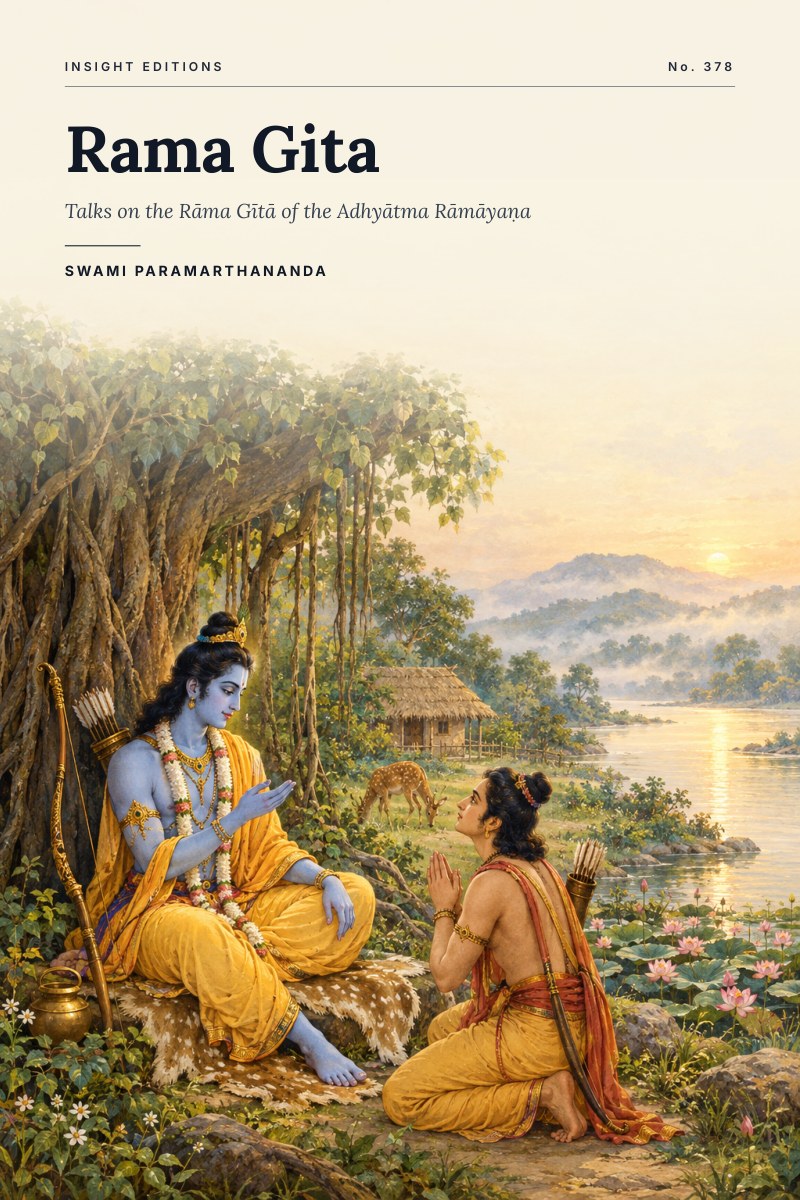
CORE CLAIM
Self-knowledge alone frees a person from saṁsāra; karma and worship only prepare the mind, and the knowledge comes from understanding "You are That" after the meaning of both "I" and "God" has been revised.
SCOPE
All 62 verses of the Rāma Gītā from the Adhyātma Rāmāyaṇa, followed through 27 talks: the setting, the case against ritual plus knowledge, the mahāvākya, nididhyāsana and Oṁkāra meditation, and the result.
KEY FIGURES
Rāma (teacher), Lakṣmaṇa (student), Swami Paramarthananda, with Swami Dayananda, Śaṅkara and Vidyāraṇya quoted throughout.
BEST FOR
Students of Vedānta who know Tattva Bodha and want one compact text that covers the whole path, and householders wondering where renunciation fits in their lives.
The Book on One Page
The Rāma Gītā is a 62-verse dialogue from the Adhyātma Rāmāyaṇa in which Rāma teaches his grieving brother Lakṣmaṇa the whole of Advaita Vedānta. Swami Paramarthananda's 27 talks read it verse by verse, filling each compressed line with the method of the Upaniṣads and Śaṅkara.
The opening verses set the frame. Lakṣmaṇa is shaken after Sītā is sent to the forest; Rāma first consoles him with stories of the law of karma, and when Lakṣmaṇa sees that no action can exhaust karma, he approaches Rāma formally as a student. Rāma's first rule is start with karma yoga: duties and worship purify the mind, but they cannot free it.
The longest argument of the first half is against combining ritual and knowledge for life. Karma is the child of ignorance and keeps the "I" busy as doer; knowledge rises only when that "I" is weakened. An objector argues for lifelong ritual, and Rāma answers that the Veda addresses different students, that it praises renunciation, and that knowledge, like a lamp, needs no helper. Paramarthananda adds that renunciation can be formal or inner, so the householder is not excluded.
The central teaching, Verses 24 to 51, is the mahāvākya, "You are That". It works only after a two-fold revision: "I" must be stripped of the three bodies and five kośas, and "God" must be stripped of the world. The method is bhāga-tyāga lakṣaṇā, keeping the common consciousness and dropping the incompatible attributes on both sides. The crystal, the red-hot iron ball and the pot space show how the original consciousness appears to take on features it never has.
The diagnosis is precise. Ignorance alone is harmless, as deep sleep proves; suffering comes from the misconception that mixes original consciousness, its reflection and the reflecting mind. Vedānta gives no new experience; it corrects the conclusions drawn from old ones, so the world becomes experientially present and factually without independent existence.
After conviction, the remaining problem is habit. Rāma prescribes nididhyāsana for life, and in Verses 48 to 51 a graded Oṁkāra meditation that dissolves waker into dreamer, dreamer into sleeper and sleeper into turīya. The practice replaces the habitual triangular format (I, God, world) with a binary format (I, the subject; the world, the object).
The result is liberation here and now, measured by falling frequency, intensity and recovery time of disturbance, and at death the jñānī merges without moving. Rāma ends realistically: the teaching is hard, so worship continues until conviction comes, and the jñānī lives in the same world with a changed perspective, butter in the palm instead of a search for ghee.
| Ch | Title | Payload |
|---|---|---|
| 1 | Why a Small Text Is Not an Easy One | Three yogas; the text is jñāna-pradhāna |
| 2 | The Law of Karma, and the Turn to a Guru | Nṛga story; karma cannot be exhausted |
| 3 | The Request, the Acceptance, and the First Rule | Begin with karma yoga |
| 4 | Why Action Can Never Free You | Map of the path; the saṁsāric wheel |
| 5 | Karma Is the Child of Ignorance | Karma cannot remove its own cause |
| 6 | The Objector's Case for Lifelong Ritual | Jñāna-karma samuccaya stated |
| 7 | Ritual Feeds the Ego, Knowledge Dissolves It | OC versus RC; knowledge as awakening |
| 8 | Three Ways to Renounce | Formal, assimilating and inner renunciation |
| 9 | Knowledge Alone, Like a Lamp in the Dark | Refutation completed |
| 10 | Two Revisions Before the Wedding | Revise "I" and "God" |
| 11 | The Method of Implication | Ṣaḍ-liṅga; bhāga-tyāga lakṣaṇā |
| 12 | Three Bodies, Defined in Verse | Gross, subtle, causal; five kośas |
| 13 | The Crystal That Never Turns Red | Attributes of the object are not the subject's |
| 14 | Suck the Juice, Spit the Peel | Extract consciousness and existence |
| 15 | How the Ever-Free Got Bound | The śāstra as mirror |
| 16 | The Container and the Content | Projection and concealment of māyā |
| 17 | Ignorance Is Harmless, Misconception Is Not | Deep sleep as proof |
| 18 | Every One of Us a Red-Hot Iron Ball | OC, RC and the medium |
| 19 | Experience Stays, Conclusions Change | Upādhi; borrowed existence |
| 20 | From Mortal Wave to Immortal Water | Habit; triangular to binary format |
| 21 | Four Kinds of Nididhyāsana | Forms of practice; sitting |
| 22 | Even the Ocean Depends on the Water | Subject and object only |
| 23 | A into U, U into M, M into Silence | Oṁkāra pravilāpana |
| 24 | Disclaim Everything, Claim Everything | Hand over; phalam begins |
| 25 | The Pot Space Merges Without Moving | Death of the jñānī; bhava |
| 26 | Butter in the Palm, Searching for Ghee | Worship until conviction; closing |
| 27 | The Rāma Gītā in Five Parts | One-sitting revision |
Why a Small Text Is Not an Easy One
Swami Paramarthananda opens with a warning: the Rama Gita is only 62 verses, but because it is a prakaraṇa grantha it spends almost all of its small canvas on jñāna yoga, the hardest of the three disciplines. The setting, Lakṣmaṇa's distress after Sītā is sent to the forest, becomes his first lesson: do not judge the characters of a Purāṇa, ask what the episode teaches you.
The three disciplines and why texts favour one
The scriptures give a seeker three disciplines. Karma yoga is proper action with proper attitude: avoid adharmic action, offer every action to the Lord as a kartā, and accept every result as a bhoktā because Īśvara's allocation is always fair. His short formula is "Dedicate, accept, move on." Upāsana yoga is the discipline of the mind through meditation on a deity, either iṣṭa devatā upāsana or the more advanced viśvarūpa upāsana. He compares an undisciplined mind to a man walking a huge dog: you wonder who is leading whom. Both disciplines need practice, not discussion: "Talk less, do more."
Jñāna yoga is the opposite. It challenges the intellect at every step: - Brahman exists. It cannot be seen, heard, smelt, tasted or touched, and Viśiṣṭādvaita rejects a nirguṇa Brahman outright. - The world does not exist independently. "Never experienced, ever exists; ever experienced, never exists." This is harder to swallow than the first claim. - I am that Brahman. The capping teaching, at which people "only smile or give me first prize for imagination".
Because the first two yogas need little talk, every prakaraṇa grantha is jñāna-yoga-pradhāna. Do not ask why they skip karma yoga; they will not discuss it.
The Bhagavad Gītā had 700 verses and could relax into many topics. The Rama Gita has 62, so it compresses the whole of Vedānta. Its name contains "Gītā", but it is not a text to read casually.
Where the text sits
The Rama Gita is a saṁvāda between Rāma and his brother-disciple Lakṣmaṇa. It is part of the Adhyātma Rāmāyaṇa, a work of about 4,000 verses that reads the whole Rāmāyaṇa philosophically and symbolically: Rāma as paramātmā, Sītā as jīvātmā, Āñjaneya as the guru who reunites them.
| Work | Character | Relation to Vedānta |
|---|---|---|
| Vālmīki Rāmāyaṇa | Dharma śāstra | Veda-pūrva, no Vedānta |
| Adhyātma Rāmāyaṇa | Brahma śāstra | Veda-anta, Rāma as Brahman |
| Rāmacaritamānasa (Tulasīdās) | Adaptation of the Adhyātma Rāmāyaṇa | Treats Rāma as Brahman throughout |
| Rama Gita | Part of the Adhyātma Rāmāyaṇa | A complete prakaraṇa on jñāna |
The Adhyātma Rāmāyaṇa is said to belong to the Brahmāṇḍa Purāṇa, attributed to Vyāsa. The dialogue is reported, as the Gītā is reported by Sañjaya: here Lord Śiva narrates it to Pārvatī. Paramarthananda draws the moral: Rāma and Śiva have no quarrel; only some Vaiṣṇavas and Śaivas do.
Verse 1: Rāma lives dharma
The first verse calls Rāma jagan-maṅgala, auspicious for the world. Maṅgala is defined as that which gives joy; Rāma pleased people by his form, his pleasant speech and his actions. The primary purpose of the avatāra was to teach dharma by living it, because values cannot be taught by words. Children imbibe what parents live, not what they say.
The verse lists three sources of dharma Rāma followed: - The Veda, the primary source. - Smṛti, the dharma śāstras based on the Veda. - The conduct of elders, the rājarṣis of the Raghu line. Follow them only where their life aligns with dharma; the Taittirīya teacher says the same to his own disciple.
He followed dharma in the forest and in the city, in adversity and in prosperity.
Verse 2: Lakṣmaṇa is disturbed
Rāma has ordered Lakṣmaṇa to take the pregnant Sītā to the forest. Lakṣmaṇa executed the order and is now in something like depression. He does not argue with Rāma or accuse him; he goes to Rāma himself for counselling.
The abandonment of Sītā is one of the most debated episodes of the epic. Paramarthananda refuses to rule on it: Purāṇas are not courts, and "poor Rāma is not even available to defend himself." The refusal is a teaching stance, not a resolution. Readers who want an ethical verdict will not find one here.
His lesson from the episode is practical. Life brings dilemmas where every dharmic choice hurts someone. "Damned if you do and damned if you don't." In such cases: - Analyse every side as objectively as possible. - Keep your motive clear and as unselfish as you can. - Decide, surrender the result to the Lord, and move on. Critics cost nothing and are always available. - Consultation helps only partly; like two astrologers on one horoscope, advisers will disagree.
Rāma suffers the loss himself, accepts it, and continues to rule. Lakṣmaṇa cannot let go, and that gap between the two brothers is what sets the teaching in motion.
The Law of Karma, and the Turn to a Guru
Rāma first consoles Lakṣmaṇa with stories about the law of karma, chief among them King Nṛga, cursed to become a chameleon for an act of negligence. When Lakṣmaṇa sees that no ritual can exhaust karma, he becomes a proper student: he finds Rāma alone, approaches him with the four qualifications, and turns his brother into his guru.
Why the tradition tells stories about karma
When pain comes without visible cause, the tradition points to the law of karma (LOK), which is itself presided over by the Lord. Nothing in creation is unfair. If something seems unjust, that shows the limits of our intellect, not a defect in God, because every situation is shaped by present karma, by the immediate past and by the remote past, most of which we cannot remember.
Remedial measures are allowed, and the Veda itself supplies many prāyaścittas. Whether they work is also governed by karma: sometimes fully, sometimes partly, sometimes making things worse, like a medicine that brings a new illness. Hence the final remedy is surrender to the Lord.
Stories help because they show that karma is universal. When Yudhiṣṭhira was depressed in the forest, sages told him tale after tale; much of the Mahābhārata is that consolation. Paramarthananda's joke: when the power fails, our first job is not to repair it but to check whether the neighbour has power. Once we see that everyone goes through ups and downs, we stop seeing ourselves as a special case.
King Nṛga. Nṛga gave many cows to a brāhmaṇa. One gifted cow wandered back to the royal shed, and the king, not knowing, gave it again to a second brāhmaṇa. Possessing what no longer belongs to you is technically theft, and gifting stolen property is a serious fault born of pramāda, negligence. The brāhmaṇa cursed him to become a chameleon (tiryaktva). The lesson is not about whether the curse was proportionate; it is that a king cannot afford negligence.
Paramarthananda's modern parallel: at any sabhā function, each honoured guest has a volunteer who takes the shawl, the citation and the fruit and carries them to the car. If a local sabhā can organise that, a king can make sure gifted cows reach their owner.
Why karma cannot be exhausted
We cannot know which karma is giving which result, any more than a traveller who ate at many places knows which meal caused the food poisoning. Our accumulated sañcita karma is vast (as Tattva Bodha teaches), so it cannot be used up in one life. Even Īśvara is bound in one sense: he must give what the karma deserves. Sooner or later a thinking person asks whether there is any way to transcend karma.
The Veda answers in two parts. The karma kāṇḍa gives prāyaścitta, a temporary remedy. The jñāna kāṇḍa at the end gives the permanent one. As Kṛṣṇa says, "the fire of knowledge burns all karma to ashes" (Gītā 4.37).
Counselling gives relief for two days; you pay and come back. Self-knowledge from a traditional teacher removes the cause. Lakṣmaṇa sees that Rāma's stories were the first kind and asks for the second.
Verse 3: Lakṣmaṇa approaches properly
Lakṣmaṇa finds Rāma seated alone, not worrying but abiding in his own nature. Had Rāma been anxious, he would only have passed the anxiety on. Lakṣmaṇa arrives with a pure mind and the sādhana catuṣṭaya sampatti:
The four Ds (sādhana catuṣṭaya) - Discrimination (viveka). The world cannot give lasting peace, security and happiness (PSH); only God or mokṣa can. This comes from enough battering by experience. - Dispassion (vairāgya). The world is a means for sādhana, not a goal. Not hatred of the world, but demoting it from goal to means. - Discipline (śamādi ṣaṭka sampatti). Mastery over one's own personality. - Desire for freedom (mumukṣutva). A deep wish to escape the shackles of saṁsāra.
He comes with śraddhā that Rāma can give liberating knowledge and with humility: "I do not know; you know." Until now Rāma was his elder brother; now Lakṣmaṇa converts him into his guru, as Arjuna converted his charioteer into his teacher in Gītā 2.7.
Verse 4: praising the teacher as Brahman
Before asking, Lakṣmaṇa praises Rāma. Paramarthananda uses this to recall his three levels of God:
| Level | God is seen as | Student |
|---|---|---|
| Eka rūpa īśvara | One deity in one place: Rāma, Kṛṣṇa, Śiva, Devī | Beginner |
| Viśva rūpa īśvara | One consciousness appearing in all names and forms, like one water as ocean, wave and rain | Graduate: "Where is God not?" |
| Arūpa īśvara | Formless pure consciousness; the forms have only borrowed existence | Post-graduate |
Lakṣmaṇa calls Rāma pure consciousness, the antarātmā of every being, formless, and the master (īśvara) rather than a helpless jīva. Rāma's body is māyā-made, taken by his own will, not by karma (Gītā 4.6). The difference between Rāma and Lakṣmaṇa is not in what they are but in what they know: the jīva takes the body to be himself, and then "my family, my house, my position, my shawl" follow.
Only those with jñāna cakṣus, the eye of wisdom, know this, and only great bhaktas become such jñānis. Paramarthananda recalls the four devotees of Gītā 7.16: the ārta who prays to solve a problem, the arthārthī who prays for success, the jijñāsu who attends class, and the jñānī.
Karma as explanation has a cost. The law of karma gives the student a way to accept what cannot be changed, and Paramarthananda uses it that way. Read carelessly, the same idea turns into judging other people's suffering as deserved. The teaching is aimed at one's own acceptance, not at verdicts on others.
The Request, the Acceptance, and the First Rule
Lakṣmaṇa praises Rāma as the formless Self of all and asks to be taught "so that I may cross the shoreless ocean of ignorance quickly and easily". Rāma accepts with a glad mind and begins, at Verse 7, with a rule for every seeker: start with karma yoga, the fivefold duties, and use them to gain a mind fit for knowledge.
How a person becomes a guru
A teacher does not become a guru by wanting the title. Guru status is caused by the prārabdha of the disciple: when someone wants knowledge and surrenders, the teacher's role appears. Arjuna's desire made Kṛṣṇa a teacher; Lakṣmaṇa's desire will make Rāma one.
Verse 4 calls the wise "bees at the lotus feet of the Lord". Paramarthananda notes the two bhaktas in the compound: a devotee who is devoted to another devotee. Bhakti toward the guru, whose own bhakti is toward the Lord. For such devotees the Lord appears as Brahman itself.
Verse 5: what Lakṣmaṇa asks for
Lakṣmaṇa takes refuge at Rāma's feet, which great seekers meditate on because they destroy saṁsāra. The request echoes Arjuna's "śiṣyas te 'haṁ śādhi māṁ tvāṁ prapannam" (Gītā 2.7). The terms are worth noting: - What he wants. Removal of self-ignorance and of saṁsāra. - The method. Teaching, consistent and systematic. There is no short cut; if there were one, Rāma and Kṛṣṇa would have used it. - The image. Ignorance is an ocean with no visible shore. We sink, puṇya lifts us up, we swallow more water, we meet the sharks. - The contract. Take me across quickly (añjasā) and effortlessly. "What a contract for Rāma." The only price Lakṣmaṇa offers is surrender.
The hardest thing for a guru to obtain is the student's mind. Students come physically while the mind "is still in residence". Lakṣmaṇa's real offer is an open, unoccupied mind, and that is why Rāma accepts.
Verse 6: Rāma accepts gladly
Rāma is described as rāja-ratna, the jewel among rulers (hence "Rāma rājya" for ideal governance), and ārti-hara, remover of distress. He removes the distress only of those who seek its removal; most people pray for everything except mokṣa. "Rāma is ready but we are not ready."
He teaches with a pleased mind (prasanna). A teacher who loves the student also gets to dwell on his own glory, since the glory of Brahman is his own. Here ignorance is darkness, and the cure is the light of knowledge.
The source is the Veda, which existed before Rāma was born, just as Kṛṣṇa milked the Gītā from the Upaniṣad-cow.
The scriptural courts. All prakaraṇa granthas, Purāṇas, even the Gītā and Brahma Sūtra are High Courts. The Veda alone is the Supreme Court. A text like the Rama Gita can never overrule the Upaniṣads, and must be read with the Upaniṣads as its background.
Verse 7: begin with karma, not jñāna
Verses 1 to 6 are the upodghāta, the introduction that brings guru and śiṣya together. From Verse 7 Rāma gives a general rule, more for other seekers than for Lakṣmaṇa, who has already reached his teacher. Jñāna alone liberates, but jñāna is not the beginning.
| Stage | What it does | Formula |
|---|---|---|
| Karma yoga | Prepares the mind | Prepare |
| Jñāna yoga | Gives knowledge | Know |
| Mokṣa | The result | Be free |
Karma yoga is worship of the Lord through pañca mahā yajña (PMY), the fivefold duties, set by one's station. In the old system that was varṇa and āśrama; today Paramarthananda reframes it: - Family role. Father, mother, husband, wife. - Work role. Your designation in the organisation. - Social role. Service groups for manuṣya yajña and bhūta yajña: temple-cleaning groups on Sundays, groups that take prasāda to hospital patients. "Temples have to be cleaned because the devotees' contribution is dirtying the temple."
The attitude matters more than the act. "I do service" produces ego; "I have the opportunity to serve the Lord as the universe" produces purity.
Sakāma karma is allowed at first
At the beginning, worldly desires may be mixed in with the desire for mokṣa. Kāmya karma is permitted as long as PMY is not dropped: "PMY is non-negotiable." As the desire for mokṣa grows, it swallows worldly desires.
Paramarthananda criticises preachers who tell audiences that no scriptural study is needed and that service or nāma alone will give mokṣa. In his view this "does disservice in the name of service" because it closes the door to jñāna. Teachers in devotional and service movements would dispute this; it is a firm traditional Advaita position, not a neutral one.
Even in the karma stage, some exposure to Vedānta is necessary, once a week or once a year, so that service is not mistaken for the end.
What the qualification is
Rāma says karma yields the qualification for knowledge, not knowledge itself. Paramarthananda distinguishes yogyatā, qualification, from jñāna. The qualification is a pure mind, and impurity has two forms: - Rāga, attachment. - Dveṣa, aversion.
Rāga-dveṣa must be converted into preferences: if available, fine; if not, equally fine. Immoral rāga-dveṣa must go entirely; harmless preferences in food or dress may stay. Once the mind is pure, the desire for mokṣa becomes intense and karma can be gradually reduced in favour of study.
Why Action Can Never Free You
Verses 7 to 10 give a bird's-eye map of the whole path. Paramarthananda fills in the stages between karma and jñāna, then follows Rāma's argument that karma is the cause of bondage, the samsāric wheel it keeps turning, and why only self-knowledge can switch it off.
Karma and jñāna in sequence, not together
The Veda has a pūrva bhāga that prescribes karma and an anta bhāga that prescribes jñāna. Both are important, but they are combined sequentially, not simultaneously, like UG, graduate and PG courses. The Veda gives the hint by its own order.
Within karma, too, there is a sequence: 1. Sakāma karma. Rituals for worldly ends, which can still purify if you promise God, "Whatever you give, I will accept without reacting." 2. Spiritually oriented karma. Every pūjā, temple visit and pilgrimage aimed at śravaṇa, manana, nididhyāsana: "Lord, give me the opportunity to study." 3. Study. The opportunity comes from puṇya; using it well needs even more puṇya.
Growth is measured by desires becoming quantitatively fewer and qualitatively weaker.
For an unprepared person, serious Vedānta does not feel meaningful; it seems disconnected from daily life. The tradition does not scold such students. It says: focus on PMY until the teaching becomes appealing. Readiness is a result of karma yoga, not of will.
Two ways to move into study
Once study becomes meaningful, there are two options:
Remain in gṛhastha āśrama and reduce PMY. Elaborate pūjās can become simpler. PORT reduction: reduce Possessions, Obligations, Relationships and Transactions. Make both time and mind available; then "you are as good as a sannyāsī".
Take sannyāsa and formally renounce both worldly and religious duties. Either way, karma's role ends in internal or external renunciation.
He adds a caution: after gaining a pure mind, do not "watch a TV serial" with the spare time; spend it on study.
Verse 7 continued: the qualifications in detail
Today agnihotra is fading and is replaced by pūjā, with an idol or picture instead of fire. Whatever the ritual, the intention should be citta śuddhi. Rāma lists more than purity: - Sense restraint (dama), including restraint of the tongue in both its jobs, eating and talking. Vivekacūḍāmaṇi calls speech the first door of yoga. - Mind control (śama), cultivated by upāsana, simplest of all mānasa japa: at least 15 minutes a day of mental chanting with 100% of the mind, "not 5% chanting and 95% worrying".
Paramarthananda repeats his standing instruction: Tattva Bodha must be studied and regularly revised by every aspirant.
Then a guru is compulsory. Rāma's word is ācārya, one with both knowledge and communication skill. One without the other does not help. The teacher's techniques are called prakriyās, and the student approaches with bhakti, properly, to gain knowledge.
Verse 8: karma produces bodies
Rāma states that karma causes saṁsāra and therefore cannot cure it. All past karma has given us only a body. We cannot choose that body. "Give your application to Brahmāji; he will put it in the waste-paper basket and look at his computer."
The same prārabdha decides favourable and unfavourable circumstances, especially in childhood before free will develops: rich or poor, spiritual or not, neglected or loved. "Richness alone is not puṇyam."
Likes and dislikes push us into pravṛtti (running after) and nivṛtti (running away). "What is life? Running and running, and in between sleeping." Every action adds puṇya or pāpa, often because we "compromise with values" and call it being practical. At death, the unexhausted karma joins the sañcita store, a new bundle becomes prārabdha, and a new body follows. Perhaps a buffalo's, which "will take its own time in the middle of the road with twenty cars honking".
At least a giant wheel can be switched off. This one goes on and on. The only switch-off board is the jñāna switch.
Swami ParamarthanandaVerse 9: the root is self-ignorance
The journey is not a merry-go-round but a "sorry-go-round", because we choose neither where, when nor how we travel. The fundamental cause is self-ignorance (ajñāna), which produces self-misconception (adhyāsa). If I knew I was pūrṇa, complete, all running would stop.
He uses a shopping image. You shop until the list is finished. Since desires never finish, you shop until you die, and then you "start shopping when born again". A baby cries for the neighbour's toy; the same problem continues into old age.
Why only knowledge works - Ignorance is not physical. It cannot be scraped out by an "ajñāna-ectomy". - Ignorance does not drop with age. Hair and teeth drop on their own; ignorance does not. - Knowledge of X removes ignorance of X. Physics ignorance goes through physics, self-ignorance through self-knowledge. - Each knowledge needs its pramāṇa. To learn a cricket score you consult the newspaper, not a mantra.
Paramarthananda says nāma saṅkīrtana is an excellent purifier but cannot give mokṣa, and claiming it does is "going away from Vedic tradition". Bhakti schools from Caitanya to the Ālvārs hold the opposite. His argument rests on the Advaita principle that only a pramāṇa yields knowledge, which those schools do not share.
After knowledge, a jñānī may still act a great deal, but the action is for others, and action done for others does not bind.
Karma Is the Child of Ignorance
Paramarthananda restates the diagnosis: self-ignorance turns Brahman into an ahaṅkāra that feels incomplete as doer, enjoyer and knower. Rāma then proves that karma cannot remove ignorance, because karma descends from ignorance, and that piling up karma actively harms the seeker. The road map ends with Vedānta vicāra under a guru, and Verse 11 opens a long objection.
The fall from Brahman to ahaṅkāra
My real nature is Brahman. Ignorant of this, I identify with the body-mind-sense complex (BMSC), the medium through which I deal with the world. This false "I" is ahaṅkāra and has three personalities:
| Personality | Sanskrit | Feels |
|---|---|---|
| Doer | Kartā | Unable to do everything |
| Experiencer | Bhoktā | Unable to enjoy everything |
| Knower | Pramātā | Unable to know everything |
From pūrṇa I become apūrṇa, and life turns into a struggle to complete the incomplete. It never succeeds: the more I know, the more I see how much I do not know. Instead of growing from small to big, "I only feel smaller and smaller", and the actions done along the way create more puṇya and pāpa.
Other solutions are palliative, like cough syrup. Desire and karma are also causes, but intermediate ones; the mūla kāraṇa is ignorance.
Verse 9: knowledge is the only path
The verse says "vidyā eva": only knowledge destroys ignorance. Paramarthananda stresses the eva. Knowledge is not one of the paths; it is the only path.
Every other activity, secular or sacred, ritual, pilgrimage or service, fails for the same reason. His example: a student who serves the physics professor, cleans his room and runs the library, but never attends class, will not learn physics.
Karma is the fourth-generation descendant of ignorance. Like a grateful child, it preserves its ancestor. "Karma is the preservative of the ignorance pickle." It is not virodhī, not opposed to ignorance the way light opposes darkness.
Isn't knowledge also an action? No. Knowledge does not come under karma. The decisive difference: karma cannot destroy ignorance; knowledge can. Paramarthananda defers the full technical discussion to a later context.
Verse 10: karma becomes a hindrance
Karma is not merely irrelevant later; past a certain point it obstructs. It is like winter clothes, excellent in winter and absurd in Chennai in May. Once a reasonable purity is reached ("100% doesn't exist"), karma must be renounced or reduced.
Pravṛtti and nivṛtti are both sādhanas - Eating is a sādhana until hunger goes; continuing out of gratitude to food destroys you. - Sleeping is necessary; waking up is equally necessary. - Karma is important; karma reduction is equally important. Kṛṣṇa prescribes "yukta āhāra vihāra" (Gītā 6.17).
Rāma adds that desires never end by fulfilling desires. Someone plans to tick off 137 desires by the age of 57 and attend Swamiji's classes at 58. But new desires arrive faster than old ones are ticked off, so the list of 138 becomes 1,380. Under pressure to fulfil them, a person even uses illegitimate means, adding pāpa.
Pedalling and praying. A man pedals a bicycle and prays, "O God, please stop this cycle." With the mouth he prays; with the legs he keeps pedalling. This is the one occasion where God himself is helpless. Bondage and freedom are in our hands. The only help the Lord gives is education, and he has already given it in the scriptures.
Vicāra means Vedānta vicāra
The intelligent seeker should reduce karma and take up vicāra. Not enquiry into the sciences, but ātma vicāra, "atmology". Every conventional instrument, the senses, microscope, telescope, faces outward and works only in the plane of objects. To see oneself one needs a mirror.
Vedānta is that mirror: it turns the vision back toward the observer, so self-enquiry is Vedānta enquiry. "I am not interested in the mirror, only in my face" makes no sense. Knowing Vedānta clearly is knowing oneself clearly, until one can declare: "I am not the body, mind or senses. I am Brahman, from which everything rises, in which everything rests, into which everything resolves."
A guru is needed because the Veda teaches karma, upāsana and jñāna together, and a student cannot tell which is primary. The teacher shows that jñāna is the goal and the others are valued means. Paramarthananda calls the ācārya "a spiritual tour operator" who takes the student smoothly from dvaita to Advaita.
The road map, and a question
With Verse 10 the map is complete: diagnosis, knowledge as solution, Vedānta vicāra. Ignorance and the mistake go; the BMSC remains as a costume for transactions, which is jīvanmukti; at death the costume drops, which is videhamukti.
Verses 11 to 23 are a pūrvapakṣa and its answer. The objector rejects any reduction of karma: - The Veda prescribes lifelong duties such as agnihotra "as long as one lives". - The Gītā says "yajña dāna tapaḥ karma na tyājyam" (18.5): these acts are never to be given up. - Īśa Upaniṣad 2: "kurvann eveha karmāṇi jijīviṣet śataṁ samāḥ", perform karma and live a hundred years.
So, he argues, sannyāsa is adharma. Rāma will refute him.
The argument rests on a premise. Calling karma the child of ignorance assumes that every action presupposes a doer born of self-misidentification. That is a premise of Advaita, not something the class proves; a Mīmāṁsaka would deny it, which is exactly why Rāma has to answer the objector in the verses that follow.
The Objector's Case for Lifelong Ritual
Rāma recaps the path, then lets an objector speak. The pūrvapakṣa of Verses 11 to 13 is jñāna-karma samuccaya: knowledge and ritual must be combined for life, just as every Vedic ritual needs supporting rituals. From Verse 14 Rāma answers, first by showing who the Vedic injunctions address, then by distinguishing the two "I"s.
The recap: karma well done leads to study
The first stage is karma yoga: reduce sakāma karma and replace it with niṣkāma karma, the fivefold duties. Even prayers for others should widen into universal prayer, "sarve bhavantu sukhinaḥ". Upāsana belongs here too. The test of a successful karma yoga is simple:
If karma yoga turns you away from Vedānta, you are doing it wrongly. Its sign of success is a growing desire for self-knowledge, and with it a dilution of worldly interest that is not hatred. "Hatred is never a spiritual sādhana."
Then comes vicāra, enquiry into the Self as revealed only in the śāstra. It is a "joint account of śāstra and guru": the scripture holds the treasure and the guru has the key.
He clarifies what renunciation means here. Sannyāsa is a specific ritual for giving up Vedic rituals. It is relevant only to someone who has formally taken up Vedic ritual, which needed the sacred thread and a wife. Retiring from a career does not require sannyāsa. "For us this discussion is only academic," because almost nobody performs śrauta rituals today.
Verses 11 to 13: the objection
The objector's argument, in order:
- Both karma and jñāna come from the same Veda. Rituals such as agnihotra are enjoined "by the mouth of the Veda", and so is jñāna. You cannot take a "step-motherly attitude" to one of them.
- Karma is a sahakāri, a supporting cause, like a catalyst. Jñāna liberates only when backed by karma.
- Giving up duty is sin. The rule "akaraṇe pratyavāyaḥ" says omission of a duty incurs a special sin. So a sannyāsī would get no mokṣa and more pāpa: a double loss.
- The analogy of the main ritual. Even rituals for "eternal" heaven (the objector believes heaven is eternal) need aṅgas, subsidiary rituals, alongside the pradhāna, the main one. By the same logic, jñāna needs the support of daily rituals.
- Taittirīya Upaniṣad says "svādhyāya-pravacanābhyāṁ na pramaditavyam": do not neglect study or teaching. Do not neglect what the Veda prescribes.
Paramarthananda's image: the objector wants jñāna inside and the tuft outside, the tuft acting as "an aerial" that boosts the signal.
Verse 14: who the commandment is for
Rāma answers from the Veda itself, using śruti, yukti and anubhava. "We are on very firm ground." The reply first used in Śaṅkara's commentaries runs:
The adhikārī principle - Every injunction has a target audience (adhikārī). A rite prescribed for a kṣatriya is not a duty for a brāhmaṇa, and he should not perform it. - Injunctions follow varṇa and āśrama. "Perform agnihotra for life" binds the gṛhastha. - The Veda also prescribes the four āśramas and their sequence (krama sannyāsa), and allows skipping stages for the qualified (akrama sannyāsa): "yad ahar eva virajet tad ahar eva pravrajet", the day you become dispassionate, that day renounce. - So a sannyāsī is outside the injunction. Omission creates no sin for him because the rule no longer addresses him.
Today the only vestige of Vedic ritual is the upanayana, "now entering the museum": families spend lavishly on photographs, and the next day the boy removes the thread. So the practical instruction is PORT reduction: fewer possessions, a simpler life, less extrovert activity outside, and less rāga-dveṣa inside. "If we take care of these two, we are sannyāsīs."
The two "I"s
Rāma's logical answer, hinted here and developed in the next class, rests on a distinction:
| Ahaṅkāra | Ātmā | |
|---|---|---|
| Known as | The conventional "I": name, date of birth, gender, address | The higher "I" the common person does not know |
| Status | Saṁsārī, with rāga and dveṣa | Asaṁsārī |
| Thinking of it | Increases worry | Increases freedom |
The aim of the teaching is to make ātmā dominant and ahaṅkāra diluted. You cannot nourish both, because nourishing one weakens the other. Every Vedic ritual nourishes the ahaṅkāra: the performer states his name and lineage and asks for results for himself, so ritual and knowledge pull in opposite directions.
A fair hearing, up to a point. The objection is stated in its strongest scriptural form, which is to the text's credit. The reply leans on the adhikārī principle, which settles the matter only if one already accepts that the Veda speaks to distinct audiences. For a reader who performs no Vedic ritual at all, the practical message, PORT reduction, matters more than the debate.
Ritual Feeds the Ego, Knowledge Dissolves It
Rāma's refutation turns on the difference between the original consciousness and its reflection. Karma presupposes and strengthens the reflected "I"; knowledge rises only when that "I" is weakened. Knowledge is a second awakening that falsifies all duality, including every accessory of ritual, so the two cannot be combined.
Recap: the small window
All forms of saṁsāra are modified ignorance: ignorance appears as mistake, mistake as doership, then desire, karma, puṇya-pāpa, birth and suffering. Karma prepares; then it becomes a burden, as eating after hunger is gone becomes a disease.
Karma is a burden only in a window. Before purity of mind, any amount of karma is fine. After knowledge, any amount is fine, because a jñānī's action is a roasted seed that cannot sprout. Between purity and knowledge, reduce karma.
OC, RM and RC
Paramarthananda's standard model of the individual:
| Term | Meaning | Name |
|---|---|---|
| OC | Original consciousness, the "reflection donor" | Ātmā, higher I |
| RM | Reflecting medium, the BMSC | Part of ahaṅkāra |
| RC | Reflected, borrowed consciousness | Part of ahaṅkāra |
The original face "donates" a reflection to the mirror simply by standing in front of it; "you need not write a cheque". RM + RC = ahaṅkāra.
Then the paradox: who gets mokṣa? The ahaṅkāra cannot, because it is always saṁsārī. The ātmā need not, because it is already free. "Then why in heaven are we attending this class?" To shift the emphasis from ahaṅkāra to ātmā.
The ahaṅkāra always has an issue. "I am fine, Swamiji. But…" And as the family grows to 20, 30, 40 members, each brings their own horoscope: "the son-in-law is considered the tenth planet."
Jñāna as a shift of significance - Sun and stars. The stars are still there in daylight but no longer stand out. Ahaṅkāra remains, but it is outshone. - VIP to VIP. From "Very Important Person" to "Very Insignificant Person". - Gītā 5.8–9. The jñānī "thinks, I do nothing at all" while seeing, hearing and acting, not sitting in a cave. - Body problems stay. The laws of prārabdha continue at the ahaṅkāra level; the jñānī accepts them without complaint.
Verse 14: why the two are opposed
Physics and Vedānta can coexist; ritual and Vedānta cannot, because they move in opposite directions. Ritual requires the performer to invoke his ahaṅkāra: name, gotra, the results he wants. Jñāna rises only through bhāga-tyāga lakṣaṇa, setting aside the reflected part of "I" to claim the original.
If ahaṅkāra dominates when I say "I am Brahman", "my own intellect will laugh at me". So surrender the ahaṅkāra to Īśvara. Īśvara returns it to be maintained as a trustee, not an owner. The ātmā cannot be surrendered, because there is no second consciousness to receive it; it can only be claimed. "Then the teaching will be swallowed easily, like a peeled banana."
Verse 15: the second awakening
Knowledge reduces the whole world, BMSC included, to a lower order of reality, as waking does to a dream.
First awakening, dream to waking, is natural. Prārabdha wakes you up because it has more experiences to deliver, "in the form of coffee, perhaps".
Second awakening, waking to Brahman, is never natural. Puṇya can only bring an opportunity: news that a class is running. One person comes 20 miles; a neighbour never asks what is happening.
Self-knowledge, Rāma says, is the "aham" pratyaya used for the ātmā rather than the ahaṅkāra. It is practice, "no mysticism, no extraordinary experience".
The two-chair exercise. Keep a saṁsārī chair and an asaṁsārī chair. Notice which one you sit in naturally. Deliberately sit in the asaṁsārī chair for ten minutes daily, "even if you feel like mocking yourself", and do not tell your family. A good moment to practise is lying awake before sleep.
Conviction must come from the śāstra's arguments (methods such as dṛg-dṛśya viveka and pañca-kośa viveka), not from "Swamiji shouting at the top of his voice". Repeated study with a guru is śravaṇa; independent reflection is manana; both must go on long. Vairāgya toward the ahaṅkāra comes only when one sees that every object that pleases it will pain it equally. If that is not clear, "life will give enough lessons."
The resulting knowledge is the last vṛtti, the "duality-ending" thought, as "I am the waker" ends the dream. Even that vṛtti is then negated. Duality does not disappear; it loses independent existence: I donate existence to it.
The Kaṭha Upaniṣad (1.2) makes the opposition explicit: Yama calls the two paths vidyā and avidyā, "far apart and leading to different ends". Karma comes under avidyā.
Verse 16: karma after knowledge
Knowledge falsifies every accessory of ritual: the kartā with gotra and sūtra, the priest, the oblations. Ritual multiplies duality while knowledge falsifies it, so they cannot be friends.
After knowledge a jñānī may still perform PMY, as Gītā 4.18 describes him seeing "inaction in action". Such action produces neither puṇya nor, if a mistake is made, pāpa. Rāma's advice amounts to a spiritual sabbatical: between purity and knowledge, take time off from karma for study.
The two-chair exercise is easy to state and hard to check. Ten minutes in the witness chair can slide into daydreaming or self-suggestion. The class guards against this by insisting that conviction come from the śāstra's arguments, not from a feeling, which is the right safeguard.
Three Ways to Renounce, and Why Ignorance Never Returns
Paramarthananda sorts renunciation into three kinds: renouncing to gain knowledge, renouncing to assimilate it, and inner renunciation within family life. Rāma then shows what happens when knowledge rises: the difference between jīva and Brahman disappears, the world becomes a movie on a screen, and ignorance, once destroyed, cannot be reborn.
Three kinds of sannyāsa
Karma is like medicine: necessary during the illness, harmful after. When intense desire for mokṣa (mumukṣutva) appears, karma has done its job.
| Type | When | What it is for |
|---|---|---|
| Vividiṣā sannyāsa (Verse 16) | Before knowledge | To gain knowledge: renounce karma, go to a guru, study |
| Vidvat sannyāsa (Verse 17) | After knowledge | To assimilate it until the ahaṅkāra is diluted |
| Internal sannyāsa | Any time | Remain a gṛhastha, with PORT reduction and minimal rāga-dveṣa |
The first two are external; the third is internal. Yājñavalkya in the Bṛhadāraṇyaka is the example of the second: already a teacher of Brahman, he takes sannyāsa not for knowledge but for nididhyāsana.
Verse 16: study with commitment
After renouncing, do not "watch more serials". Do śravaṇa and manana with a guru, sādaram, with commitment. Śravaṇa is not passive: the teacher talks, but the student must participate.
The number lock. Each class gives one digit of the combination. Only when you remember all the previous digits does the lock open. Listen to every class keeping all earlier classes in mind.
Rāma adds two conditions: - Turn the mind inward. Every transaction leaves a "hangover" in the mind; the vāsanās of the world do not leave easily. - "Die to the external world" of sense objects during study. A shallow, preoccupied mind needs to hear something 100 times; a free, deep mind grasps it with little listening.
Verse 17: injunctions apply only to the ahaṅkāra
As long as there is dehābhimāna, identification with body, mind and senses, the person has an identity of varṇa and āśrama, and Vedic injunctions apply.
Citizenship and the budget. Become a citizen and the constitution applies; change citizenship and another constitution applies. After every budget people study which rules hit them, and listen to it "better than Vedānta" because they must pay 5% more or 10% less. A sannyāsī with no income is untouched by the budget. Similarly, once you know "I am not the ahaṅkāra but the ātmā", the Vedic rules no longer address you.
A jñānī may take vidvat sannyāsa for nididhyāsana, but it is optional. He moves freely, his only job is contemplation, and he takes bhikṣā when hungry.
Sannyāsa is only the name of a conducive infrastructure, like a study room with a table, coffee in a flask, books and a good chair. A student can study anywhere if he is not distracted. Sannyāsa is optional; śravaṇa, manana and nididhyāsana are compulsory. Paramarthananda cites Vidyāraṇya's taunt in the Pañcadaśī that the householder-jñānī is as free as the sannyāsī.
Verse 18: knowledge removes the difference
Clear knowledge rises in the mind, jīva-brahma bheda-nāśaka, the knowledge that removes the difference between jīva and Brahman. According to Advaita that difference was caused only by ignorance.
The wax house burns in the Mahābhārata film; the screen is not burnt. Knowledge does not remove experience; it teaches that the experience is of a lower order. You need not switch off the movie. "He acted very well, he cried beautifully." The falsification is instantaneous. When ignorance resolves, all its products resolve too, including the accessories of ritual. Any ritual a jñānī performs becomes "movie karma", needing no expiation, just as a hero's movie sin needs no prāyaścitta.
Verse 19: no relapse
A doubt: if a patient ignores the doctor's rules, the disease relapses. Could ignorance return?
Ignorance, once destroyed by knowledge, cannot be reborn, because the only thing left is pure non-dual consciousness, and consciousness is not a cause of ignorance. When you wake, the dream world is falsified; what remains is the waker. Nothing remains from which a new ignorance could arise.
Verse 20: no doership, so no combination
If ignorance does not return, doership (kartṛtva) does not return, since it is born of ignorance. A jñānī may act, but inside his thought is Gītā 5.8: "naiva kiñcit karomi", I do nothing at all; the senses move among their objects.
Even if he tried to think "I am the doer", the teaching would ask: are you sure? Without doership, karma cannot attach to him, so jñāna-karma samuccaya is impossible. Knowledge alone gives mokṣa.
You can ask the Lord for many things you do not have. You cannot ask, "O Lord, please give me a head over my shoulders." The head is already there. You can ask for something inside the head, because that is not there.
Swami Dayananda, quoted by ParamarthanandaMokṣa is one's own nature, so not even God gives it. God helps us gain the knowledge, and we are grateful. Do karma up to a level, reduce it, gain knowledge and be free.
Optional sannyāsa is an emphasis, not the only reading. Paramarthananda's view that inner renunciation is enough suits a householder audience and has support in the Gītā and the Pañcadaśī. Śaṅkara's own commentaries often argue more strongly for formal renunciation, and readers should know both positions exist in the tradition.
Knowledge Alone, Like a Lamp in the Dark
Rāma finishes the refutation of ritual-plus-knowledge. Without doership, a jñānī's action is a cheque with no signature; the scriptures themselves glorify renunciation, which would make no sense if ritual were compulsory for life; and knowledge needs no accessories, unlike ritual. Verse 24 then turns to the positive teaching: enquiry with a guru.
Verse 20: the unsigned cheque
The first effect of knowledge is that the notion "I am a doer" drops away. A jñānī's body may still act, but that action is no longer karma in the binding sense.
The cheque without a signature. A cheque for ten crores may have every field filled in, but without a signature it is worthless. Doership is the signing authority, and knowledge has cancelled it. So the jñānī's actions produce neither puṇya nor pāpa; like a roasted seed, they cannot sprout into rebirth.
The jñānī then has two options: continue his duties as a householder, or give up ritual and take sannyāsa. Either way, mokṣa is his, because ignorance, doership and karma have all gone.
The lamp illustrates it. Oil, wick and holder were needed for the light to arrive, but none of them removes darkness. The flame does that single-handed. Karma helped knowledge arrive; it plays no part in removing ignorance.
Verse 21: the scriptures praise renunciation
If ritual were compulsory for mokṣa, then lifelong householder life would be compulsory, and sannyāsa could not exist. Yet the Veda mentions and praises sannyāsa in many places. Rāma quotes two texts:
- The praise of nyāsa. In a long Upaniṣadic hymn, after listing many disciplines, the text declares nyāsa, renunciation, the greatest of them, the one that has surpassed all others. "How dare you say karma is compulsory?"
- Bṛhadāraṇyaka 4.5. The Maitreyī dialogue appears twice in that Upaniṣad; the second version adds the line that "this much alone is the means of immortality". The emphasis falls on "this much": not an iota of karma needs to be added.
The dream example returns. In a dream you have paid 17 instalments on a loan and 32 remain. Wake up, and what happens to the remaining instalments? One simple act of waking settles them. Self-knowledge is a second waking. The difference: waking from dream removes the dream world, but waking to Brahman leaves the world in place, now understood as mithyā rather than real.
Verse 22: knowledge and ritual are not alike
The objector had argued in Verse 13 that every main ritual needs supporting rituals, as a wedding has rites before and after, so jñāna must also need karma. Rāma replies: never compare the two.
| Karma | Jñāna | |
|---|---|---|
| Result | Produces, reaches, refines or modifies something | Only removes ignorance about what already is |
| Needs | Materials, priests, wealth, many accessories | Attention, a teacher and the śāstra |
| Wealth | Required | Not required |
In the old days a guru and śiṣya could sit under a tree, both knowing the text by heart, and teach even in darkness. Today we need light, books, pens and recorders, but only for the notes. Listening and understanding need nothing more than attention; knowledge keeps happening and wears ignorance away gradually. Both teacher and student were renunciates with no possessions: "They had a dialogue, gained knowledge and said bye-bye. Both were free."
Verse 23: duties belong to the doer
Every doer has duties. Inside the Vedic fold, varṇa and āśrama add religious duties to worldly ones, like the designation in an appointment letter. Break the rules and the company takes you to task; resign and the rules no longer apply. The religious version of that punishment is pratyavāya, and every traditional householder feared it.
Duties last as long as doership lasts. Gītā 18.17: whatever a wise person does is not counted against him. This does not license wrongdoing. It shows that the jñānī's doership has been falsified, much as a court looks at the mental state behind an act before deciding guilt.
So a jñānī incurs no sin if he renounces. Renunciation itself must be formal: you cannot quit a company on a whim; you send a resignation letter and serve notice. Vedic sannyāsa is a ritual to renounce ritual, with chanting, an overnight vigil and a fire offering in which the new sannyāsī prays not to misuse his freedom. Giving up only worldly activity needs no such ritual: one changes clothes and receives a mantra from the guru. For a generation that performs no Vedic ritual, "they are already sannyāsīs."
Verse 24: the project work
The negation that began in Verse 11 is complete: mere knowledge is enough. Now Rāma addresses someone whose mind is prepared and who has more time. He gives the whole "project work" in one verse, like the synopsis of a PhD thesis.
Knowledge needs the right instrument. You cannot buy two kilos of self-knowledge in a mall, and you cannot find today's class timing by meditating with eyes closed. You read the notice board. For the Self, the only instrument is the Upaniṣad, taught in a structured tradition that shows step by step what I am not and what I am. One study reveals the truth of jīva, world and God: "three mangoes in one stone."
Proof by scriptural praise only works inside the frame. Verse 21 argues that since the Veda praises sannyāsa, ritual cannot be compulsory. That persuades an objector who shares Vedic authority; it carries no weight for someone outside it. The lamp and the unsigned cheque do more persuasive work than the citations.
Two Revisions Before the Wedding
Verse 24 condenses the whole of Vedāntic study: preparation, śravaṇa with a guru, faith, and unshakeable knowledge "like the Himālaya". Verse 25 opens the central teaching, the mahāvākya, which runs to Verse 51. Its precondition is a two-fold revision: of the meaning of "I" and of the meaning of "God".
Preparation first
The first 23 verses dealt with preparation. The third qualification, śamādi ṣaṭka sampatti, is mental and sensory discipline. "All our worries and fears are because of the lack of thought discipline alone." Without it, listening fails, and so do retention, assimilation and the emotional benefits of knowledge.
Do not enter through the back door. If you bypass karma yoga and upāsana, the mind resists Vedānta, and the student becomes "the biggest pūrvapakṣī to the teacher". If the preparation is thin, give more time to karma and upāsana and less to Vedānta. Paramarthananda suggests writing out the Gītā's lists of virtues (Chapter 13's twenty, Chapter 16's twenty-six) and sticking them on the wall.
Verse 24: study, faith, firmness
- The Upaniṣads are the primary source. The Gītā gives an idea of Vedānta; deep understanding requires Upaniṣadic study.
- Never self-study. Study needs the "lubrication" of the guru's grace.
- Śraddhā is needed more for Vedānta than for karma. Karma accepts our natural triangular format (jīva, jagat, Īśvara as three separate realities). Vedānta challenges it.
The teacher's arithmetic. 33% say Advaita is illogical. Another 33% say it is logical but not practical. Another 33% say it is logical and practical but they are not ready. "The guru has to write off 99%." Only 1% say it is logical, practical and they are ready. Every teacher must be prepared for this disappointment.
The result is aikya, oneness of jīva and Brahman, claimed as one's own nature. The mind's happiness fluctuates because it is only a reflecting medium; I am the original happiness that lends it reflection. This knowledge must be unshaken even when the mind is unhappy. A distorted face in a convex mirror does not worry me, because the distortion belongs to the mirror. An unhappy mind does not disprove that I am ānanda; it only means the reflecting medium needs repair.
Verse 25: the meaning-revision programme
From Verse 24 to 51 Rāma gives the mahāvākya vicāra; everything else is preparation (avāntara vākyas). "We can study the Upaniṣads for 50 years, but the ultimate goal is to understand the mahāvākya."
The three levels of God from Class 2 return. At first God is a person who comes, gives darśana, solves problems and leaves, "then I write a thank-you note". Next, God need not come because God is already here as the universe. Finally, within that universal God, the changing part is mithyā and the changeless consciousness is the real God.
The bride's party and the groom's party. Revising "I" down to consciousness is preparation on the bride's side. Revising "God" from personal to universal to changeless is preparation on the groom's side. The wedding of jīva and Brahman will not happen until both parties are ready.
Many resist because they are attached to a particular form of God, Balaji, Palani Murugan, Guruvayurappan, and believe it has helped them. If asked to transcend the form, they will "renounce Vedānta". The teacher can only say: continue. Even Kṛṣṇa says a personal form appears and disappears, so it cannot be the absolute.
Tat tvam asi has three words. Saying it takes half a minute; attending to the revised meaning of each word takes years.
Verse 26: peel off the upādhis
With the conventional meanings, jīva and Īśvara are opposite: proximate and remote, created and creator, worshipper and worshipped, alpajña and sarvajña. "You can fill a 300-page notebook with the differences."
The contradiction comes from upādhis, the name-and-form adjuncts, which are māyā: appearance, not reality. We do not question the appearance of the blue sky, only its reality.
Wave and ocean. By name and form the wave is small and the ocean is big; they cannot be equated. Mentally peel off name and form and both are water; even the word "both" is out of place. Peel the upādhi but keep the water. Jīva minus its upādhi is consciousness; Īśvara minus māyā is consciousness.
This is an intellectual process. As Swami Dayananda says, "Don't say intellectual knowledge, because knowledge is always intellectual. Dental or nasal knowledge is never there."
After the equation, the upādhis continue but cannot burden me. Name and form have no weight of their own: the wave weighs one gram and the ocean far more, but the weight belongs to the water.
The Method of Implication
The core teaching is "mined" from a mountain of Vedic material by ṣaḍ-liṅga, the six-mark method of interpretation. Verse 26 shows how to remove what we take for granted and find the witness that remains. Verse 27 names the exact method of reading the mahāvākya, bhāga-tyāga lakṣaṇā. Verse 28 turns it into daily practice with each layer of the self.
Mining the central message
The Upaniṣads speak of rituals, gods and creation. Rival schools claim different central messages. The tradition used the six indicatory marks (beginning and end, repetition, novelty, result, glorification, reasoning) to conclude that jīva-brahma aikya is the central message, and called its revealing statements mahāvākyas. The word "mahāvākya" is the tradition's, not the Upaniṣads'.
Teachers rarely take students through this long process, "afraid the student may not come to the next class". The student is told the conclusion and must trust it.
Verse 26: what we take for granted
Equating jīva and Brahman is like equating a mustard seed and the Himālaya. Resistance is emotional and intellectual. It is like cleaning the house: we cannot throw away even used plastic bottles "in case they come in handy". Vedānta asks us to delete much of what we think is important, including the features we thought belonged to God.
Vidyāraṇya's empty hall (Pañcadaśī). Remove the chairs and carpets and ask what is left. "Nothing, it is empty." But space remains, accommodating everything, and light remains, making the emptiness visible. Both are taken for granted. After setting aside body, mind and world, what remains is the conscious witness that was aware of them all along.
The Aadhaar card example makes it personal. Everyone says "I am so-and-so". The "I am" part is intrinsic; the "so-and-so" is extrinsic, everything on the Aadhaar card. Keep the card for transactions; in Vedānta come to the "I am". "I" is consciousness and "am" is existence. Once the extras are removed you cannot count a jīva and a Brahman separately; there is only "I alone am".
Verse 27: three kinds of implied meaning
In ordinary talk "I" includes its attributes. If someone asks how you came, you do not reply "I am all-pervading, I neither come nor go." Vedānta needs the implied meaning.
| Lakṣaṇā | Primary meaning | Paramarthananda's example |
|---|---|---|
| Jahal (exclusive) | Dropped totally; an associated meaning taken | "Semmangudi is singing today": the place cannot sing, the musician from it does |
| Ajahal (inclusive) | Kept fully and something added | "Bring water" means water in a tumbler; you need not be told |
| Bhāga-tyāga (part kept, part dropped) | Partly kept, partly dropped | "This Devadatta is that Devadatta", once thin as a drumstick, now round and grey |
Why only bhāga-tyāga works for "tat tvam asi" - Not jahal. Both words mean a mixture of consciousness and upādhi. Dropping them totally throws away consciousness too, "the baby with the bathwater". - Not ajahal. Retaining everything keeps the upādhis, and the contradiction between small and infinite stays. - Bhāga-tyāga. Drop the upādhi part in both, keep consciousness, and the equation fits, as we recognise the same person behind a young and an old body.
"Dropping the upādhi" is a mental act. It means giving up dehābhimāna, the conviction that I am the body and mind, and mamakāra, the sense of possession, about bodies we treat as permanent though they are temporary meetings of five elements. Through some prārabdha one is the wife, one the husband, one the child: a temporary union.
The mahāvākya can sit in one corner, unused. We hear that I-consciousness and God-consciousness are one, and agree. But if the identification is strong, Vedānta "happily co-exists" with saṁsāra. The fourfold disciplines, sādhana catuṣṭaya, are what let the mahāvākya actually do its job; whether or not one takes sannyāsa, the mind must be a sannyāsa mind.
When the guru says "you are Brahman" and the student asks how a mortal, ageing person can be that, the answer is: only if "I" is no longer connected to the mortal body, miserable mind or confused intellect.
Verse 28: practise it layer by layer
Bhāga-tyāga is not verbal but a mental practice, done one kośa at a time, because attachment exists at each one. As we age, senses fail one by one, and losing hearing alone can make a person withdraw from conversation and slide into depression.
The acceptance meditation. In meditation, notice what disturbs the mind: a family member, a part of the body. Take that one object and apply bhāga-tyāga: "This is anātmā." The body has two owners, Īśvara working through the laws of nature and prārabdha, and "an encroacher, me" working through free will. "There will definitely be a fight": doctor visit after doctor visit. Accept Īśvara's ownership. Take one worry per meditation, perhaps for months, then go round a second cycle: "I accept. I am willing to experience whatever I have to experience."
Without this, worry stays hidden and keeps surfacing, and knowledge and worry live together. From here Rāma takes each layer and says, "Attack."
Three Bodies, Defined in Verse
Rāma now lists what has to be set aside. What Tattva Bodha gave in prose he gives in three chantable verses: the gross body (Verse 28), the subtle body (Verse 29) and the causal body (Verse 30). Verse 31 renames the three bodies as five kośas, preparing the next step of the teaching.
Setting aside matter on both sides
Jīva is consciousness plus three bodies; Īśvara is consciousness plus the three-fold universe: gross, subtle and causal. Micro matter and macro matter can never be equated. Set both aside mentally and only consciousness remains, where there is "no micro consciousness and macro consciousness". This is bhāga-tyāga lakṣaṇā applied.
Tattva Bodha's list of anātmā has eleven factors: three bodies, five kośas, three states. Each is now defined, "for bundling and keeping aside". The bodies, Paramarthananda adds, are "meant for setting aside, not for beautification".
Verse 28: the gross body
- Made of the five gross elements: space, air, fire, water, earth.
- The residence of the experiencer. Pleasure and pain are possible only while living in it, as software needs hardware.
- Who decides pleasure and pain? Neither the world nor Īśvara: our own karma. With good karma, the same person around us seems like God; for another, because of their karma, that person is terrible.
- Its type is determined by past puṇya and pāpa, which decide whether it is a human or animal body.
- It is mithyā. Just as the dream body is projected temporarily and seems real in dream, this body seems real in waking.
It is called an upādhi, a medium of interaction, in the technical sense of something associated but unable to transfer its defects. Light on a hand is not soiled by the dirt on the hand; the screen stays untouched by the movie.
Lifespans of the three bodies. The gross body: at most 100 to 120 years. The subtle body: the entire current kalpa, dissolving only at pralaya. The causal body: beginningless, having seen "infinite" creations come and go. It is "the hardest nut to crack", broken only by jñāna, "not coffee, not tea".
Verse 29: the subtle body
The subtle body is "not very subtle" to its owner: I cannot see your mind, but I experience mine intimately. It is a toolkit, like the phones and laptops in an office.
| Group | Count | Function |
|---|---|---|
| Manas and buddhi | 2 | Doubting and emotional faculty; deciding faculty |
| Jñānendriyas | 5 | Organs of knowledge |
| Karmendriyas | 5 | Organs of action |
| Prāṇas | 5 | Physiological functions |
| Total | 17 | Instruments for the experiencer |
It is made of subtle, ungrossified elements. Its user, the bhoktā, is a mixture of original and reflected consciousness: OC alone cannot experience, and RC cannot exist without OC. In deep sleep the subtle body resolves, so contact with the world stops, like a phone line going dead: "not that the person is gone, the phone is gone". Wise people call it another body; modern science reaches only the gross body. When Arjuna asked, Kṛṣṇa placed the subtle body beyond the senses, knowable only through the śāstra.
Verse 30: the causal body
It is "causal" because the other two bodies are born from it. At pralaya only the causal body remains, holding countless karmas earned in human births, which decide the next bodies.
In Vedānta every jīva is beginningless. Nobody creates the jīva: "God doesn't create the jīva, God cannot create the jīva." Īśvara's job is to give each pre-existing jīva the subtle and gross bodies its karma requires.
It is anirvacanīya, neither existent nor non-existent, like sleep: it seems to exist in sleep and disappears on waking. Like a seed holding the future tree's trunk and branches, it is avyākṛta, undifferentiated. Collectively it is māyā, the storehouse from which the fourteen lokas and all bodies emerge.
It is called the superior body because only through it does original consciousness "come down" as reflection. Reflected in macro causal body it becomes Īśvara; in micro, jīva. Only when consciousness is reflected in the causal body does the whole drama begin: Īśvara creates, the jīva acts, and Īśvara goes on giving karma-phala.
The three internal dresses
Jīva appears different from Brahman only because of the three bodies. When I say "I", I do not include my dress; I do not say my colour is yellow or red.
Treat the three bodies as inner clothing. Use them, but let the word "I" mean only the consciousness part, non-different from Brahman. Rāma allows time: withdraw gradually (Gītā 6.25, "śanaiḥ śanaiḥ"). - From gross to subtle: the fear of mortality goes, because the subtle body survives death. - From subtle to causal: fear of the next birth remains, since problems return in the next creation. - To consciousness: all fear goes.
Verse 31: three bodies become five kośas
Like Kṛṣṇa, Rāma does "mischief": he suddenly speaks of five kośas, assuming we have studied Tattva Bodha.
The subtle body splits into three because life is "know, desire, work": you see advertisements (knowledge), want the products (desire), and buy them (action). The causal body is called ānandamaya because in sleep the mind is resolved, with no sorrow and no division. Rāma will use these five sheets in the next verses.
Cosmology as a teaching aid. The lifespans of the bodies, karma stored through pralaya and beginningless jīvas are taken from the śāstra, not argued for. Paramarthananda uses them as tools for setting the bodies aside rather than as claims to defend, and that is the useful way to read them.
The Crystal That Never Turns Red
The ātmā appears to take on the features of the five kośas, as a crystal looks red beside a red flower. Rāma gives the decisive logic: attributes of an experienced object never belong to the experiencer. Verse 32 handles the three states of experience, and Verse 33 diagnoses why life feels like a struggle.
Functional identification only
Identify with the bodies functionally, for doing your duty, and then remove the identification "like removing the uniform after coming from work". Attachment to roles creates endless problems. And the removal must be done intellectually and, more importantly, emotionally.
Verse 31: the crystal and the flower
Sphaṭika and japākusuma. A colourless crystal next to a red flower looks red. Remove the flower and it is colourless again. If the colour had really transferred, it would stay red. So it only appeared red; it never became red. In the same way, anger, frustration, depression and sorrow are attributes of the mind. I, the ātmā, am free of them all the time, "even when I tell others I am distressed".
"I am located in Sankaralayam" is a feeling, not a fact. Location, shape and limitation appear in me through proximity with the kośas. How do I know? Through śāstra and yukti, scripture and reasoning.
The core reasoning. The attributes of an experienced object always belong to the object, never to the experiencing subject. Seeing a blue sky does not make me blue. "If it did, it could be useful: to become thin, look at a drumstick." Hunger and thirst belong to prāṇa, emotions to the mind, confusion to the intellect, happiness to the ānandamaya. All are experienced by me, so none of them is me.
Deep sleep confirms it. The emotions arrive in waking and depart in sleep, while I remain as the witness of sleep. Until you fall asleep you complain about mosquitoes and heat; once asleep, all of that is gone.
Paramarthananda's short form for the features of anātmā is OMACT:
| Letter | Anātmā is | So ātmā is |
|---|---|---|
| O | an object | the subject, never an object |
| M | material | non-material consciousness |
| A | with attributes | without attributes |
| C | changing | changeless |
| T | temporary | always present, never coming or going |
Rāma's words for the ātmā here: pure, unaffected, birthless, non-dual. Bodies are many; ātmā is one.
Wear the uniform, do not get lost in it
The kośas are the uniform Īśvara gave us for transactions. Every one of them has complaints, "five notebooks" of them, because each is governed by time, place and prārabdha. Chennai in summer affects the body; each kośa arrives with its own baggage.
Life as MBBS. Get lost in the kośas and life becomes Meaningless, Burdensome, Boring and a Struggle. Then we pray, "Quickly take me away", and "Bhagavān also will be bored with this prayer." Even with passive euthanasia, doctors can stop the treatment but cannot stop prārabdha; it has to exhaust itself. Better to accept it and claim the ātmā.
Verse 32: three states, one witness
The avasthās are not substances like the bodies but attributes of the mind. Waking is the mind in contact with the external world, dream the mind in contact with its projected world, and sleep the mind resolved.
What some call a fourth state, the meditative mind dwelling on ātmā, is technically a subdivision of waking: awake, but not in contact with the outer world, not dreaming, not resolved. So there are only three states. (Rāma uses a two-syllable word for them because of the metre.)
- Waking is sāttvic because only there can we learn something new.
- Dream is rājasic: the mind is busy, but it can only replay what is recorded.
- Sleep is tāmasic.
The states are mutually exclusive: you cannot be sleeping and waking at once. Consciousness is inclusive, present in all three. Some philosophers say consciousness is absent in deep sleep. Then who reports, "I did not experience anything"? The very fact we speak of dreamless sleep shows we were aware of it.
Consciousness does two things for the states: it illumines them and it lends them existence. What borrows existence is mithyā; what lends it is satya. I am pāramārthika, like the screen; the states are vyāvahārika, like the movie.
The dog and the bone. A dog bites a dry bone, cuts its mouth, tastes blood and concludes the bone is full of blood. Someone must teach it that a dry bone has no blood; it only brings out the dog's own. Objects do not give joy; they bring out my own ānanda, which is why the objects that please vary with each person's vāsanā and karma. "Enjoy" is "en-joy": in Tamil, "en" means "my". Whenever you enjoy, remember the joy is your own.
Verse 33: miss and mess
Fail to discriminate ātmā from anātmā and "you miss, you make a mess". Identification brings ahaṅkāra, then mamakāra: I am father, mother, spouse; my son, my daughter, my in-laws. Then rāga and dveṣa follow, and the four churn the mind, which is obvious the moment we sit to meditate. As the family grows to the fourth generation, the circle of mamakāra grows with it.
Adjust the right knob. Instead of handling one knob inside, we adjust hundreds of knobs in the external world all day. Even questions to the Swami are about other family members, "to become happy by changing others". The diagnosis: the problem is identification, and the solution is inside.
Suck the Juice, Spit the Peel
Rāma explains how a "ghost I" is cooked up from ātmā and anātmā, then gives the two principles that undo it. In meditation, negate everything experienced, then ask who witnesses the blankness. From the body extract consciousness, from the world extract existence, and discard name and form, as one sucks an orange segment and spits out the rest.
Verse 33: the paan-shop "I"
Every individual is a mixture of ātmā, the real nature, and anātmā, an incidental medium. We need not reject anātmā; without the mind, ātmā cannot know "I am Brahman". The problem is adhyāsa, mixing them up.
The paan-beeda shop. The shopkeeper takes betel and nut and mixes in pinches from many silver boxes, "God knows what is inside". We have taken pure consciousness, dipped into the anātmā box, and cooked up a third "I", the doer and enjoyer. Pure ātmā cannot act, because it does not change; pure anātmā cannot act, because it is inert. The doer "I" is neither. Paramarthananda calls it the "ghost I".
This mixed "I" rises with the first thought on waking. If the doer rises, the day's list of jobs feels like a burden. If the enjoyer rises, it is never content with what it gets. The knower is in constant conflict: to buy or not, to stay at home or move to a senior citizens' home. As long as this "I" is taken as real, there is saṁsṛti, being knocked about from place to place in this life and from body to body after it.
Make anātmā a costume. Prārabdha has staged a drama, and until the body falls we play roles. Roles do not last, so never rely on them for PSH: peace, security and happiness. Use the costume to claim the higher "I", the only permanent source of all three. "Our choice is de-costume or in-costume."
Verse 34: the two principles
The help comes from the Upaniṣadic negation "neti neti": whatever you experience is not you.
- Principle one. I am different from whatever I experience. The microphone is distant anātmā; body, mind, senses, thoughts, ignorance and knowledge are closer anātmā. All are objects.
- Principle two. The attributes of experienced objects belong to those objects. If I know an attribute, it is not mine. Consciousness is not an attribute of me; it is my nature.
When everything is negated, the tendency is to say "nothing is left". But is that blankness known? I am aware of it, so I am its witness, neither blankness nor śūnya. The reflected consciousness is negated along with the mind; what remains is original consciousness, immortal.
The tug of war
Having claimed the witness, claim its glories, chief among them pūrṇatva, lacking nothing. In every role there is some complaint; only as ātmā can I say I lack nothing.
Dying as ahaṅkāra. On the deathbed the ahaṅkāra replays every wrong: did I raise the children properly, why did I send them to America, my daughter-in-law never respected me ("as though we deserve respect"). Die as ahaṅkāra and you die with regret; die as ātmā and there are no complaints.
The mind is a tug of war between ahaṅkāra and ātmā, and mostly ahaṅkāra wins, which makes life drudgery. This is the fifth "capsule": whether life is a blessing or a burden depends on what occupies the mind most of the time. A jñānī is one who has managed to keep the ātmā in mind most of the time. Kṛṣṇa's question applies: why carry all these people in your mind? Let them be where they are.
The free-time test. It does not happen naturally; it takes years. Watch where your mind goes in free time. If it goes to worries, you know which category you are in. Use free time for verses on ātmā, learned by heart or by meaning, instead of bringing up worries one by one.
Extract the essence from both sides
From the body, extract cit, consciousness, which pervades and enlivens all the kośas. From the world, extract sat, existence. Does the world exist for others when I sleep? "When you sleep, others are also not there." I lend the world its existence and it regains it when I wake.
| Pure existence | Pure consciousness | |
|---|---|---|
| Is not | A part, product or property of any object | A part, product or property of the body |
| Pervades | Every object, lending it "is-ness" | Every kośa, making it sentient |
| After resolution | Continues, but unavailable for transaction | Continues, as in deep sleep |
The orange. Peel the skin, put each segment in the mouth, suck the juice and spit out the remnants. Swallow the world, suck out existence, and spit out name and form. From the micro body-fruit extract consciousness; from the world-fruit extract existence. "That is called Vedāntic meditation."
Verse 35: the glories of the ātmā
There is nothing to complain about in ātmā; every complaint is against anātmā, and complaining will not change its nature. The body degenerates; people lose respect for us once we stop being useful. Śaṅkara's Bhaja Govindam says to stop complaining and accept it. Accept anātmā as it is; claim ātmā as it is.
Rāma borrows from the Gītā ("na jāyate mriyate vā"), which itself borrowed from the Kaṭha Upaniṣad. The ātmā is free of the six modifications of Tattva Bodha: no birth, no growth, no decay, no death. There is no "old ātmā, new ātmā, antique ātmā".
It is ānanda, pure happiness, with the same five features as existence and consciousness: it pervades the mind "now and then" as reflected happiness and survives everything.
It is self-evident. To check I am not overshooting the class time I must look at the clock. To know I am here, no effort is needed: "Throughout the one-hour class, do you have any doubt whether you are there?"
Light and the hand. The thought "I am" is located in the mind; the statement is located in the tongue. But awareness is like the light on a hand: it shows up on the hand without being confined there, and it is on the microphone and between people too. Thoughts, minds and bodies are many; consciousness has no plural.
Paramarthananda's five capsules, to be taken "three times a day": 1. I am eternal, all-pervading consciousness. 2. I am the only source of permanent peace, security and happiness. 3. By my mere presence I give life to the body, and through it I experience the world. 4. I am never affected by anything in the world or the body. 5. Forgetting my nature makes life a burden; remembering it makes life a blessing.
Is life a blessing? Only problems, says the student. But only while alive can I claim my glory, so life is an opportunity.
How the Ever-Free Got Bound
To claim the glories of Verse 35, the word "I" must exclude everything anātmā: the body belongs to the world and must be handed back. The witness of absence remains, but its dimensions can be known only through the śāstra as a mirror. Verses 36 and 37 answer the obvious question, if I am ever free, how did saṁsāra start? It started from beginningless ignorance, through projection and concealment.
Hand the body back to the world
The physical body came from food, survives on food and returns to the earth. It belongs to the annamaya world, so hand it over, not physically but by dropping ahaṅkāra and mamakāra toward it. If I claim to be all-pervading while meaning the body, the intellect sees the contradiction. Exclude body, senses, mind and thoughts, one by one, until nothing excludable is left.
"Nothing is left; I see nothing." Rāma replies that someone reports the absence. The witness of presence is also the witness of absence.
The mirror of the śāstra
What I know by myself and what I need the śāstra for. That I exist as consciousness needs no pramāṇa: "No pramāṇa will say, you exist", because the pramāṇa itself needs me. But I cannot know the size of consciousness, because I cannot objectify it. Eyes, however powerful, cannot see the face; the face needs a mirror. The śāstra is the mirror that reveals my dimension, not the size of the body or mind but of the consciousness I am.
Claiming that glory dilutes the pain of ahaṅkāra, the failures of "I" as husband, wife, mother or father. A problem-thought can be flushed out only by a counter-thought.
The stars at sunrise. At night there are countless stars. When the sun rises they are still there, yet "as good as not there". Ahaṅkāra problems are as many as the stars. Make the ātmā-sun rise and they become ignorable in one stroke. The knee pain continues, the son is still jobless, the daughter still unmarried; all stay the same, but they can be ignored.
The glories of Verse 35 dissolve each class of complaint:
| Glory | Complaint it ends |
|---|---|
| Free from modifications | Ageing, decay, death |
| One, beyond comparison | Jealousy, hatred, inferiority born of comparing with neighbours and brothers |
| Pure happiness | Dependence on objects |
| All-pervading | Complaints of place and time |
| Non-dual | All the problems that come with duality |
Verse 36: saṁsāra is self-ignorance
Rāma's answer: saṁsāra comes from superimposing anātmā on ātmā, and that superimposition comes from ignorance. So "lead me from death to immortality" is not physical travel but travel from ignorance to knowledge. Mokṣa means freedom from ignorance.
Why did God create a world with problems? Why not one where "birth is joy, growth is joy, decay is joy, death is mahā-joy"? When problems come and these questions have no answer, that is intellectual pain.
When did ignorance come? It never came. We are born with ignorance as our capital, all kinds of it, from beginningless time. We remove ignorance of economics or music through study, but "we never take ātmā as the subject for an M.Sc or PhD".
The one thing that never dies naturally. Everything else in creation is born in time and dies in time; you need not destroy the body, it will die on its own. Ignorance alone never dies naturally. It survives sleep, survives death, survives pralaya. Only knowledge removes it.
When knowledge comes you need not request ignorance, "kindly vacate". It goes instantaneously, as darkness goes when the light is switched on: nobody says the darkness "is slowly receding". Knowledge and ignorance are opposites and cannot coexist.
Verse 37: projection and concealment
Ignorance binds through two powers, vikṣepa śakti (projection) and āvaraṇa śakti (concealment). Sleep shows both.
Projecting a dream body, a dream dog, and the dog chasing the body are all fine. The trouble is that I take the dream body as myself and the dream dog as real. "The only hope is that you hit your head somewhere and wake up."
The super-waker. This waking body is another projected body, chased by the world's problems. I never say "this projected body is chased by projected problems". I say, "I am being chased. I feel like running to Rishikesh, Swamiji." Once I am real, the world, the chasing and the planets become real; then come the gems, numerology, and advice to change the spelling of "Subramanian" and write it a thousand times.
Rāma names this adhyāsa, illustrated by the rope and the snake: "Without the rope-snake example there is no Vedānta." The snake is chosen because it causes fear, and the mystery is that a non-existent snake causes real fear.
The blood test. The doctor orders a test. We search our symptoms online, find 2,576 diseases, settle on the worst, pick a hospital and check our finances. The report says nothing is wrong. All that fear came from a disease that never existed.
On the one non-dual ātmā, ignorance projects the whole world of body and objects. That is the first stage of the problem. The second, which Rāma takes up next, is that I transfer their attributes onto myself.
The Container and the Content
Rāma traces in technical detail how māyā turns the ever-free into a saṁsārī. Projection of a universe and bodies is harmless, even entertaining. The trouble starts when concealment hides that I am the enclosed consciousness, and I mix up the container and the content. From that one mix-up come doership, enjoyership, desire, attachment and fear.
Where the teaching stands
The cause of saṁsāra is ignorance (Verse 9); remove the cause and the effect goes. First gain fitness through karma and upāsana, then knowledge through śravaṇa and manana under a guru. The central enquiry is the mahāvākya, and "I" in it must mean only consciousness, with body, mind and thoughts "pushed into the annamaya world".
Delete, do not acquire. "I don't have to become Brahman or attain Brahman." By adding the wrong thing I become a jīva; by deleting the wrong things I happen to be Brahman.
From Verse 36 the teaching enters a technical phase, which Śaṅkara opens with his famous adhyāsa bhāṣya in the Brahma Sūtras.
From māyā to the enclosed consciousness
Originally only consciousness existed, called neither jīva nor Īśvara, with māyā lying in it, beginningless. Māyā has two powers: projection (vikṣepa) and concealment (āvaraṇa). When the karmas of jīvas ripen, projection creates the elements, the fourteen worlds, and all bodies, which remain inert as modifications of māyā.
The hall and the space. When a hall is built, nobody invites space in, "please come and occupy", as one applies for an electricity connection. The all-pervading space is simply available as enclosed space, and the walls only seem to divide it. In the same way, all-pervading consciousness is available inside each body-mind complex as the sākṣī, and the enclosure cannot divide it.
In living beings this enclosed consciousness shows up as self-awareness. The wall does not say "I am"; you do, without checking. If I ask about anything else you say "let me see"; asked whether you are in the class, you do not ask me to wait.
None of this is a problem: - Self-awareness is not a problem; a jñānī has it. - Body, mind and world awareness are not problems either. - The projected world is "nice entertainment". Otherwise, how long could we enjoy deep sleep?
"I am in the body, not the body. On Sundays I am in the hall, but I am not the hall."
Concealment and the great mix-up
In the ajñānī, as soon as self-awareness arises, concealment goes to work: I forget that in me the world rises, rests and resolves. Then I commit the blunder:
Instead of "the body is born", I say "I am born" and blow out the candles. Using and improving the mind is fine; concluding "I am the mind" or "I have the mind" is the mistake. Ownership is a relationship, and consciousness, like space, accommodates everything but is related to nothing.
When the mind is depressed I say "I am depressed". Distance yourself and the mind has a problem, but you have no saṁsāra, and the depression-thought weakens.
The spiralling index. Identifying with a thought is like pedalling and then complaining the cycle does not stop. "My friend lost his job, I think I will lose mine": travel along with that thought and a simple concern becomes a cyclone at 300 km an hour. Fear projects only negatives, and as someone said, the ignorant mind is the dark room where negatives are developed.
Ignorance does not create problems directly. It works through misconception and its products, which Paramarthananda sums up as HAFD: Helplessness, Anger, Frustration, Depression. As doer I cannot do what I want; I would like to change every family member, "forgetting they are trying to change us". As enjoyer I cannot get what I want. Ask such a person "How are you?" and "finished: the entire saṁsāra starts".
Verse 38: two superimpositions
The first adhyāsa is the world and body appearing on consciousness, like a snake on the rope: not a problem. The second is identifying with the body-mind: the real problem.
The pot and its smell. Put something fragrant or foul in a pot. The space in it accommodates the object, but there is no "fragrant space" or "foul space". I am asaṅga, uncontaminated by the universe, the body, the mind and even māyā. I was free, am free, will be free; I am incapable of becoming a saṁsārī.
"I am a saṁsārī" is only a thought, held with such will power that after 25 years of Vedānta we still hope mokṣa will come, "preferably in this janma". "Swamiji, can you guarantee?" We even justify the thought, so liberation becomes a future event.
The "I" now includes body, mind and prārabdha, which is why we run to astrologers: "planets are not giving us problems; planets are indicators of our prārabdha". This pseudo-I is the ābhāsa, a transferred attribute. In deep sleep there is no world and no mind; when we wake, both come, for the jñānī as well, but the jñānī never says "I am a saṁsārī".
Ātmā is nirāmaya, free from all three kinds of pain:
| Pain | Belongs to | Its voice |
|---|---|---|
| Physical | Body | The body hurts |
| Emotional | Mind | Subtler and deeper |
| Intellectual | Intellect | "Why me? I do pūjā, I attend your classes. My neighbour doesn't, and he has no problems." |
All three are containers' pains; I am the content, immanent in everything yet transcendent, like the screen under the movie.
Verse 39: desire, attachment, fear
Once identified, the ahaṅkāra appears with three faces: doer, enjoyer, knower, each with endless desires. Desire before getting becomes attachment after getting, and greater attachment means greater fear of loss.
Vedānta even calls worldly happiness potential sorrow: whatever its source it will go, and the mind worries that it will. The Gītā calls such pleasures "wombs of future pain".
Dependence is misery. We acquire more gadgets and come to depend on all of them working. If one goes for repair, a headache. "Adjusting, adjusting, and we die", not once but again and again. The more you depend, the more miserable; the less you depend, the more comfortable. Independence alone is mokṣa.
Ignorance Is Harmless, Misconception Is Not
Rāma pauses on a point Śaṅkara also stresses: self-ignorance alone does not cause suffering, as deep sleep proves. Suffering comes from misconception, and the misconception is natural because two similar things sit together: original and reflected consciousness. The red-hot iron ball shows how attributes trade places between neighbours.
Ignorance plus misunderstanding
Self-ignorance (avidyā) causes saṁsāra only by producing self-misconception (adhyāsa). The rope by itself creates no problem; ignorance plus the snake-projection is "a deadly combination".
Deep sleep is the proof. In sleep all ignorance, self-ignorance included, is present, and yet sleep is blissful; the Upaniṣads use it as their example of ānanda. Saṁsāra starts the moment I wake up, because I wake with ignorance and add misunderstanding. Everybody is a saint in sleep.
Paramarthananda maps the misconception onto the five anātmās he calls PPFBM: possession, profession, family, body, mind.
| Attachment to | Name | Expression |
|---|---|---|
| Body and mind | Ahaṅkāra | "I am male, female, father, mother" |
| Profession, possession, family | Mamakāra | "My job, my house, my family" |
Right importance and over-importance
Ahaṅkāra and mamakāra are useful, like clothes: "we don't come out without them." A jñānī uses them too; a teacher needs them to teach, or he would sit as a silent sage and no teaching would happen. The problem is over-importance.
The measure of over-importance. Whenever ahaṅkāra or mamakāra becomes the cause of emotional disturbance, I have given the five anātmās more importance than they deserve. Hence the first teaching verse of the Gītā: the wise grieve neither for the living nor for the departed. Treatment must still be given and money spent. But when we close our eyes in meditation and "all the worries make a march past", mamakāra has become overactive.
The mother cat's bite. To move a kitten, the cat carries it in her mouth. The bite must be deep enough to hold it safely, but not so deep that it injures. Under-importance neglects duty; over-importance worries over duty. The anātmās are the kitten; we are the cat.
This is why Śaṅkara's introduction to the Brahma Sūtras is called adhyāsa bhāṣya, not "avidyā bhāṣya": ignorance by itself is bliss, "you only have to sleep". The reverse also follows. Knowledge is complete only when it removes both ignorance and misconception, so ahaṅkāra and mamakāra must also be diluted.
"Swamiji, I have studied for 25 years. My family says: you go to class, what is the use?" That happens when we work on ignorance and neglect misconception.
Verse 39: the three pairs
The misconception-based thoughts come in three pairs of twins: desire and anger, attachment and fear, happiness and its twin, sorrow. These thoughts, not mere ignorance, cause saṁsāra in the ātmā. In sleep they resolve, and only ānanda is left.
A person will complain that he has to go to work daily, but he never complains that he has to go to sleep daily.
Swami Dayananda, quoted by ParamarthanandaNobody says "I slept unhappily". Waking up is never welcome; we always stretch it by a few minutes.
Verse 40: why the mix-up is natural
Two similar things in close proximity are easily confused: fake notes slipped among genuine ones, water in the milkman's milk (in Sanskrit one word can mean both). Cook green beans with green chillies cut to the same size, "and be ready", because "you bite and see heaven".
In every individual the two similar things are OC and RC, both present in the same body-mind.
Both are effulgent, as sunlight and full-moon light both light the earth, though "for an informed person, moonlight is a wrong word". Our mistake is to claim the RC and ignore the OC, and through the RC hold on to subtle body, gross body and family.
The proof that I am a mixture: I am aware of my surroundings. OC is in the wall too, but the wall is not aware. "I hope you are not a wall." The RC is the jīva that travels after death; life and death are decided by the presence or absence of RC, while OC is present in the corpse as much as in the living.
The OC is called puruṣa ("that which pervades", one of four derivations Paramarthananda lists) and kūṭastha, the changeless witness. Tattva Bodha's three mirrors show the difference: one face, three reflections, ordinary, convex and concave. Distortion belongs to the RC; the OC is undistorted, not limited by the body and asaṅga, the same word Kṛṣṇa uses in Gītā 13.
Verse 41: the red-hot iron ball
Twins are told apart only by parents. Rāma adds the crystal and the red flower, and then the iron ball.
Two expressions, two transfers. "Red-hot iron ball": heat belongs to fire, but we transfer it to iron. "Fireball": roundness belongs to the iron, but we transfer it to fire. In both, proximity causes mutual transference of attributes. So too, consciousness lends sentience to the body, and the body lends its birth, age and limits to consciousness.
Vedānta does not destroy either one; both are needed for living. Use them, knowing which is which. For transactions, say "I am sitting here". To claim your nature, "go to the green room now and then" and remember that the drama of prārabdha will have ups and downs while I remain the witness.
Every One of Us a Red-Hot Iron Ball
Rāma revises the key point of the diversion: ignorance troubles us only when a body and world are present and the "I am" experience arises as a mixture of consciousness and matter. Verse 41 analyses the mixture as OC, RC and the reflecting medium; Verse 42 gives the remedy, shifting the meaning of "I" from the mortal component to the immortal one, and keeping it there.
Ignorance needs a body to hurt
Jñāna is the primary sādhana; karma and upāsana are secondary and preparatory. "Secondary doesn't mean less important. It only means they don't directly solve the problem."
"Ignorance is bliss" is not only a proverb; we live it every night. In deep sleep, "even if a cobra moves over my body, I am not going to be worried." Ignorance is there after death until the next birth, and during pralaya, but without bodies there is no adhyāsa. "Otherwise the best way to achieve mokṣa would be to sleep continuously."
When a body is available, the "I am" experience comes, and it is always a mixture: consciousness and matter, plus the dormant ignorance. I treat this mixture as one single unit, unaware it has two components with opposite natures.
| Statement | True of | Wrongly extended to |
|---|---|---|
| "I am mortal, I am ageing" | The anātmā part | Ātmā |
| "I am sentient, I am walking" | The ātmā part | The body, which walks only because of consciousness |
Pure consciousness cannot say "I am": it has no mouth and no mind. Pure matter, inert like a corpse, cannot either. The mixture says "I am" and does all transactions. Transacting is not the problem; not sorting out the mixture is. The sorting cannot be physical, only intellectual.
Accepting the choiceless
The anātmā part's chief characteristic is that it is unpredictable and uncontrollable. With limited free will we can pray and do prāyaścitta, but how much changes is not our choice.
No resistance, no complaint, no sharing of sorrow. Kṛṣṇa's advice for choiceless situations is to go through them without resistance, complaint or "distributing" sorrow to others. Distribute happiness instead. A jñānī's prārabdha may give his body terrible suffering; his peace comes not from favourable prārabdha but from non-resistance, made possible by claiming the other component.
The one countable blessing. "Count your blessings." "Swamiji, I have so many problems I have no blessings to count." Vedānta says every human being has one: I am the eye of the cyclone. In and through all the tsunamis, the centre has no disturbance. In infinite time, the body's life is a short and insignificant period; "thinking of this miserable body, I am missing the eternal glory."
Verse 41: three components and the iron ball
Rāma presents the mixture as three: OC (original consciousness), RC (borrowed sentiency), and RM (the reflecting medium, the body-mind). RC leaves with RM; OC remains. All three are inseparably together in one place, like light on the hand: you see the hand and do not notice the light, but without it you would see nothing.
Heat an iron ball in fire and take it into a dark room. You see neither pure iron nor pure fire. "Don't touch the ball, it will burn you" gives the fire's heat to the iron; "fireball" gives the iron's shape to fire. "I am a conscious, mortal individual" does the same: "conscious" belongs to ātmā, "mortal" to the body.
Hence the prayer "mṛtyor mā amṛtaṁ gamaya", lead me from death to immortality. The mortal and the immortal are in one and the same place; there is no travel, only a shift of identification. A wave identified with its shape says "I am mortal"; the same wave, shifting identification to H₂O, says "I am immortal".
Verse 42: shift the meaning of "I"
The Gītā's jñānī is fully active, yet says boldly, "I do not do any action." He can say it without shame because his attention has shifted from anātmā to ātmā.
The process is simple but difficult, because we have practised ignorance for countless births. When we say "I", only our biography comes: son of, wife of. The biographical "I" dominates and suppresses the higher "I". Proof: "The moment oṁ śāntiḥ śāntiḥ śāntiḥ is said, all the problems surface once again."
The most choiceless situation. Most problems involve people we want to change. "You want to change your spouse, which is one of the most choiceless situations. When you are trying to change the spouse, the spouse is also trying to change you."
The remedy needs long śravaṇa from a competent guru whose teaching is based only on the śāstra; the language need not be Sanskrit, but the message must be Vedāntic. Scripture without a guru is meaningless; a guru without scripture is useless.
Done properly, knowledge arises in this very birth, with anubhava: one knows, and knows that one knows.
The halo. A student, seeing pictures of saints with halos, assumed realisation produces one. Paramarthananda once found his own photo with a halo in a student's house. "How did the halo come?" "We can tell that person, he will add it." Nothing happens outside. The sign is inner: I look upon myself as ātmā and accept choiceless prārabdha without disturbance, with FIR reduction (less frequency, intensity and recovery time of emotional disturbance).
Practise with "I" in place of "consciousness"
The five features of consciousness: 1. Not a part, product or property of body or mind. 2. An independent entity that pervades and enlivens the body. 3. Not limited by the body's boundaries. 4. Continues after body and mind perish. 5. Not available for transaction once the medium is gone.
The private substitution. In Vedāntic meditation replace "consciousness" with "I": "I am not a part, product or property of the body. I pervade the body." This is private practice; transactions still need the biographical "I". And convert worry time into ātmā time: you will find plenty of it, because "most of our time is spent worrying in the name of planning. Planning has no emotions."
Experience Stays, Conclusions Change
Vedānta gives no new experience; it corrects the conclusions we drew from old ones. Rāma's word upādhi explains how the inert universe manifests existence, consciousness and bliss in grades, and why the world, with only borrowed existence, is experientially there and factually absent. Renouncing it means two things: intellectual renunciation, seeing it as mithyā, and emotional renunciation, diluting attachment.
Knowledge removes four things
Jñāna removes ignorance (the indirect cause) and misconception (the direct cause). Misconception is fourfold: ahaṅkāra, mamakāra, rāga and dveṣa. Relationships belong to mamakāra; consciousness has none.
I empower the world and then it overpowers me. The stronger my mamakāra, the greater the capacity of people and family to disturb me, and that capacity is given by me alone. So the problem is not the world.
Not a new experience
"Don't expect mysterious experience." Before and after knowledge, the wall is a wall. What Vedānta questions is the conclusion.
The world remains ETU: Experienceable, Transactable, Useful. Keep experiencing, transacting and using it; only do not conclude that it is real. Experience is not proof of reality: "I experience the screen; is the movie real?"
The most important correction concerns myself. First I concluded "I am a saṁsārī". Then came a revised wrong conclusion: "I am a seeker of mokṣa", which assumes mokṣa will descend in a future time and place. Both must be falsified. I am mukta.
The intellect will argue. After claiming freedom, watch the intellect: "Are you sure?" Intelligent students produce clever, even śāstra-based arguments that they are not yet liberated, or "on the verge". All must be demolished. None of this is for publicity. When in private dialogue I ask "Who am I?" and can answer "I am mukta" without reservation, the journey is over.
How a jñānī looks at himself
Transformed self-perspective is the sign of clear knowledge. The jñānī does not mistake the body-mind for himself but keeps caring for it until death, because it is the instrument of transaction. He is everywhere, and in the body too. The third capsule applies: by my mere presence I give life to the body, as standing before a mirror donates a reflection.
Upādhi: the graded medium
Upādhi is a technical word for any material medium in which Brahman's nature manifests. The whole inert universe is upādhi, graded by fineness:
| Medium | Fineness | What manifests |
|---|---|---|
| The inert world | Gross | Existence (sat) only: "the world is" |
| Annamaya to vijñānamaya kośas | Finer | Existence and consciousness: "the body is, and is conscious" |
| Ānandamaya kośa | Finest | Existence, consciousness and bliss |
Without the medium Brahman exists but is not manifest, unavailable for transaction or even recognition. World, body and mind are upādhis; I am the upahita, what manifests through them.
The bombshell: the world is not
Since the world's existence is borrowed from me, I am the existence; by itself the world is as good as non-existent, like the moon.
The non-luminous moon. Experientially the moon is bright; factually it has no light of its own. So even looking at the full moon, I can say boldly it is non-luminous. Likewise the world is experientially existent and factually non-existent. Say "the world is", adding "experientially"; say "the world is not", adding "factually". One word covers both: mithyā.
Kṛṣṇa says in one Gītā verse that all beings are in him, and in the next, "mischievously", that they are not in him (9.4–5). Rāma says the upādhi is absent in the three periods of time: there is no earth, water or fire, even though we solidly experience them.
Verse 42: renounce the inert world
How can anyone renounce the world, when wherever you go the world is there? Renunciation has two senses.
- Intellectual renunciation. Knowing there is no pot apart from clay, you keep handling the pot, but "pot" is only a word; clay alone was, is and will be.
- Emotional renunciation. This is tougher: dilution, not elimination, of rāga and dveṣa toward the five anātmās of possession, profession, family, body and mind. Even the Lord has favourites: Kṛṣṇa tells Arjuna "you are very dear to me".
Every disturbance that overpowers the mind indicates non-renunciation; changing clothes to orange does not help. As Swami Dayananda says, you may change the word for food to bhikṣā and house to āśrama, but rāga-dveṣa must still be handled. Gītā 5: a householder with children, grandchildren and many problems is still a sannyāsī if his mind is not overpowered. He does his duties and says, "whatever has to happen by the law of karma, let it happen. I don't resist the future."
Verse 43: let the real "I" dominate
Nididhyāsana means dwelling on the higher "I", "finding more and more time" for it, after long study. The biographical "I" is for transactions only; it is a variable pseudo-I, and "in the previous janma we don't even know whether we were human". Knowing is not enough; the real "I" must dominate.
Rāma's description of the ātmā in Verse 43: - Self-effulgent consciousness, eternal and all-pervading. - Unborn and immortal, removing both fundamental fears: disease-decay-death, and rebirth. - Non-dual. "How, when the world is in front of me?" Because mithyā cannot be counted as a second. - Ever shining, illumining the waker's world, the dreamer's world and the sleeper's blankness. Time and space come and go with the world; I reveal their coming and going without coming or going myself.
From Mortal Wave to Immortal Water
After conviction, the only remaining problem is habit. Rāma gives two short meditations on "I am" (Verses 43 and 44) and then the rule for practice in Verse 45: lifelong, with an undivided mind, until the habitual triangular format is replaced by the binary format and ignorance's three expressions are gone.
Three steps, three convictions
Self-enquiry has three steps: śravaṇa, receiving the teaching; manana, asking the intellect, "are you convinced?" until it answers without an iota of doubt; and nididhyāsana. The conviction must cover all three components: jīva is Brahman, the world is mithyā, and Brahman is myself, the lender of existence on whom the world depends.
Nididhyāsana does not solve intellectual problems; conviction has already done that. It deals with habitual thinking entrenched in the subconscious.
The wave's courage. The habit: "I am a mortal wave depending on the ocean." The new habit: "I am immortal water; the ocean depends on me." The wave can challenge the ocean, "Can you exist without my blessing?" It looks like arrogance, but if the wave has understood, it is deep wisdom: there is no ocean apart from water.
Often we have no choice about what to think, because problems must be solved. But whenever the mind has a choice, use that time for changing the format.
Verse 43: "I am"
Rāma's meditation repeats "aham", I am, with a string of attributes:
- Ajaḥ, birthless.
- Advayaḥ, non-dual.
- Svayaṁjyotiḥ, self-effulgent.
- Atyanta-śuddhaḥ, extremely pure. A bath purifies the body, but that purity can become impure, or one bath would last forever. The ātmā is so pure it cannot become impure; no purification is required. The mind needs purification again and again.
Saṁsāra already identifies with the mind; nididhyāsana dis-identifies: "I am not the mind, I am the witness."
The ātmā is a pure mass of consciousness, "mass" meaning unmixed, because nothing else exists to mix with it. "Dream income cannot be added to the waker's income."
It is nirāmaya, free of problems and complaints. Complaints come from ahaṅkāra and mamakāra; dropping them, whatever happens is by the law of karma, governed by Īśvara. I do my duty with concern, not anxiety, and do not worry about my grandchildren's future.
The past video. Free time is spent replaying old decisions: what I decided in 1990, the first son's marriage, the second daughter's. Then the children complain: "You didn't educate me properly. You loved my brother more." Guilt, regret and worry about the future all block the benefits of knowledge, because the mind must be available to enjoy them.
Verse 44: un-saṁsārī-able
Nididhyāsana is not chanting; it is dwelling on the meaning. The goal is not to get mokṣa: what is got in time is lost in time. Through knowledge I understand I was, am and ever will be free. In Paramarthananda's coinage, "I am un-saṁsārī-able. Don't search in the dictionary."
Since Brahman and Īśvara are inseparable, claiming "I am Brahman" lets me claim "I am Īśvara", comfortable saying the glories of creation are mine, as in the Kaivalya Upaniṣad's "I am all these things". With māyā I have infinite power; as Brahman I am beyond the senses, which know only finite things.
| Term | Meaning |
|---|---|
| Nirvikāraḥ | Changeless existence and consciousness |
| Nitya | Free of time-wise limits |
| Vibhu | Free of space-wise limits |
| Time and space | In me, not I in them: they come in waking, go in sleep, and a new set comes in dream |
Then Rāma's boldest line: all wise people meditate on me; all seekers are pursuing me. Humanity runs after mokṣa or Īśvara, seeking peace, security and happiness, and that is my own nature. "Previously I thought I am a worshipper. I am now the worshipped one."
For private meditation only. "Our own mind will not accept this easily, so what about others?" One part says "I am God"; another mocks, "Are you sure?" Our inferiority complex runs deep. Repeat it and watch the mind: comfort in claiming the glory indicates knowledge.
Verse 45: for the rest of life
If śravaṇa is long, manana longer, nididhyāsana is the longest, until sleep and until death. In the old days people took sannyāsa for it; today "sannyāsīs are as busy or busier than gṛhasthas". Either way, two things are needed: time and mind.
The tenants who will not vacate. We let involuntary thoughts into the mind freely, like renting out a house. When we ask worry, fear and anxiety to vacate, they stay put, "and the court will also rule in favour of the tenant". Try ten minutes of "om namaḥ śivāya" and see where you end up. Mind management, śamādi ṣaṭka sampatti, is what nididhyāsana succeeds or fails on: "We read it in Tattva Bodha but never practise."
The mind must be ananya, undivided, "quality time" in modern language. Deliberate practice becomes habit, as you wake at a set time without the alarm after a few days of using it, or as rupee-thinking becomes dollar-thinking abroad.
When the binary format is natural, it removes all three expressions of ignorance:
| Expression | What it is | Removed by |
|---|---|---|
| Āvaraṇa | Covering of the fact | Śravaṇa |
| Saṁśaya | Doubt, wondering whether | Manana |
| Viparīta bhāvanā | Wrong thinking, held without doubt | Nididhyāsana |
When ignorance goes, its projection goes too, the way the rope-snake "goes": you understand it was never there to go. The whole universe is such a rope-snake. "Mind boggling." Where will the world go? "Nowhere, because it is not there."
The Ayurvedic course. Medicine removes disease gradually: five days of antibiotics, 21 days of Ayurveda, then convalescence. Liberation is not a mystic event "at 11.27 pm", with freedom from 11.28. Understanding grows class by class; "you will say Swamiji is teaching better and better." You cannot pinpoint the date and time of liberation.
Four Kinds of Nididhyāsana
Nididhyāsana is for one thing only: weakening the saṁsārī-centred habit of thought, as dawn removes night gradually. Paramarthananda lists the forms of practice, from listening as a senior student to sitting in formal meditation. Rāma describes the sitting in Verse 46, and Verse 47 explains the key move: dissolving the world into ātmā as pot dissolves into clay.
What nididhyāsana is not for
It is not for conviction; that comes from more śravaṇa and manana. It is not for mystic experience, nor for "nirvikalpa samādhi". It removes habitual misconceptions about myself: that I am a jīva, a saṁsārī, even a seeker. All give way to "I am Brahman", meant "from my innermost heart".
Which chair do you sit in? Imagine chairs for saṁsārīs and seekers, and one for the mukta. Where do you naturally sit? (If there is no mukta chair, write "mukta" on any chair and sit.) "This is not for pacifying the Swamiji." There will be a grey area, one day one chair, next day another. After some time the saṁsārī chair is discarded.
As Śaṅkara illustrates, night darkness does not end at 5 am sharp; it is brighter at 6 and brighter at 7. Knowledge strengthens and the saṁsārī notion recedes, like medicine removing disease and then its symptoms. The whole duality is the projection of spiritual sleep, as dreams are of ordinary sleep; on spiritual waking it is understood as another dream.
The four types
| Type | When | The rule |
|---|---|---|
| Śravaṇa-nididhyāsana | Listening after conviction | Translate every "Brahman" and "ātmā" in the class as "I" internally |
| Background nididhyāsana | During transactions | Keep the teaching humming like a tambura's drone |
| Formal meditation | 15 to 30 minutes of sitting | Dismiss anātmā thoughts at will, invoke ātmā thoughts at will |
| Writing and reflection | Earlier lists | Paramarthananda counts the types variously, first two, then three, then four |
Background nididhyāsana is Gītā 5's jñānī, who remembers through all transactions "I do nothing". An actor knows he is not involved in the good deeds on stage, nor in the murder.
Formal meditation: is the mind my instrument?
The test of mind management. If I cannot dismiss thoughts about body, age, family, property and shares at will, then the mind is an instrument of the vāsanās, not mine. Ask a fear thought to leave and it grows stronger. We study that the mind is a karaṇa, an instrument, yet it no longer obeys the one who wields it.
The aim is to say, "Enough of this bunch of thoughts. You vacate. I want to invoke ātmā-centric thoughts." We do not study Vedānta for scholarship, for saying "Gītā finished, Upaniṣad finished". Can I invoke my higher nature at will?
From that higher plane, saṁsāra's problems shrink.
The burst balloon. A baby cries because its balloon burst. For the mother it is insignificant; "she is not going to Kapaleeswarar temple to pray about it." From the standpoint of ātmā, all saṁsāra problems are balloon-bursting. Even the worst disease means at most that a body that came will go. Close up, one body seems hugely important; from the cosmic angle, so many bodies die every day.
Peace in the mind as the burden lightens is mental liberation; claiming the joy of ātmā is spiritual liberation. Kṛṣṇa's title for the one who can do this at will is yogī. "Can I do it in old age? In the hospital? On the deathbed? We should train the mind now."
Verse 46: the sitting
Rāma's instructions match Gītā Chapter 6:
- Mastery of the mind is the toughest part. For fifteen minutes I will not think of any worldly issue. Thoughts will come; "a thought cannot continue unless I support it." Tell it, "Come back after 15 minutes." This is an appointment with myself.
- Memorised verses help, not for chanting but for seeing their meaning.
- No other sādhana now. Not japa, not other upāsanas. Japa is word-centred; nididhyāsana is meaning-centred, using the word only as a support.
The meditator's third eye is opened: wisdom. The physical eye reports a world; the scientist's eye sees atoms, then energy in motion; the Vedāntin sees neither world nor atoms nor energy, only one ātmā appearing as everything, while ETU experience continues.
Not thoughtlessness. Vedānta does not prescribe a blank mind. It replaces worldly thoughts with ātmā thoughts; even a thought of the world becomes nididhyāsana when the world is seen as mithyā. The Yoga school's āsana and prāṇāyāma are useful disciplines, but its dualistic philosophy and its goal of thoughtlessness are rejected.
Verse 47: dissolve the world into ātmā
As long as there is a second thing, there is saṁsāra. How do you dissolve the world into ātmā? Not as sugar dissolves when stirred, but by understanding that the world is of one substance: existence-consciousness, whatever name you use.
Clay and pot. Clay was, is and will be. In between you gave it a shape and, for transaction, renamed it "pot". There is no substance called pot. Understanding this is "dissolving pot into clay": you do not break the pot, you keep using it. The world is the pot; ātmā is the clay; I am that ātmā, the only substance on which the world depends. This is prapañca-vilaya, dissolution of the world.
Even the Ocean Depends on the Water
Once "I" means the witness, I join the subject side, and there are only two things: I, the subject, and the world, the object, which has no existence of its own. Rāma calls practising this pravilāpana, dissolution meditation, and in Verse 48 gives its graded form, the Oṁkāra upāsana of the Māṇḍūkya, beginning with "everything is Oṁ".
From three to two
Before the teaching there were three: jīva, jagat, Īśvara. With "I" as body-mind, I belong to the world. After the revision, I am the sākṣī, and the jīva no longer exists as a separate entity: there is I, the subject (Brahman) and the world, the object (mithyā). This alone is what the five capsules say.
Whether life is a burden or blessing depends on remembering this teaching. "How not to forget the Rāma Gītā? There is only one method": nididhyāsana, because the further I drift from the teaching, the more saṁsāra is pronounced.
Verse 47: the wave's audacity
Three stages of the wave. Before knowledge: I am a wave, God is the ocean, and I look up and pray. After knowledge: I am water. Then the audacity: "O Ocean, even you do not exist separately from me, the water." Before knowledge I am wave and God is ocean; after it, God, the ocean, does not exist apart from me. "I will show my thumb to God." Paramarthananda softens it: "Let us leave aside God because it may be disturbing, and say this much: the world doesn't exist separate from me."
The is-ness of the bangle belongs to gold, of furniture to wood, of pottery to clay. The is-ness of the world belongs to Brahman, so say "me". I lend existence and then experience. In a dream I create a world, lend it existence, experience it, and then get frightened of my own creation. Understanding that the world has no separate existence is called "dissolving the world into me": a technical expression, not salt in buttermilk.
What do I get out of it?
"I have so many duties. Where is the time?" The benefit is the end of smallness.
The more I see, the smaller I feel. Beside the earth I am small; beside Jupiter, smaller; beside the sun and the galaxy, smaller still. The more I learn of the universe, the more insignificant I feel, and the feeling trickles down into insecurity. Śaṅkara says in Ātma Bodha that as long as I feel small through ignorance I remain a saṁsārī. In this meditation I am the biggest, in whom time, space and galaxies exist as names and forms. "First, remove S and M from small. I am all."
Rāma's words in Verse 47: resolve the experienceable universe (ETU: experienceable, transactable, useful) into the ātmā, the cause of everything, space included: "Space is in me. I am not in space." Then only one ātmā is left:
- Pūrṇa, complete. Nothing is lacking.
- Nothing second, outside or inside. What I experience cannot be counted, as dream money cannot be counted.
- Even God. If God is a person, God is an object and has no independent existence. "O Lord, if you want to be real, join me." That is what Kṛṣṇa does in the Gītā: "I am not Mr Kṛṣṇa standing outside you; I am the ātmā, the observer."
Verse 48: graded dissolution with Oṁ
Śaṅkara wrote a small text on this, the Pañcīkaraṇam, elaborated by Sureśvara in his Vārttika, and the Māṇḍūkya develops it. Instead of resolving the world in one shot, it is done in stages, using Oṁ as support. Sanskrit grammar splits "o" into a + u, so Oṁ has four parts: a, u, m, and the silence at the end.
The order of appearance runs from cause to product: the causal universe is always there; from it comes the subtle ("CU is father, SU is son"), and from the subtle comes the gross, the grandson. Meditation reverses it: a into u, u into m, m into silence.
The special law for the last step
Gross resolves into subtle and subtle into causal because each is the product of the next. But the causal universe, māyā, is not a product of consciousness: it is anādi, beginningless. So it cannot be resolved as effect into cause.
Resolve māyā by understanding it borrows existence. Māyā remains; it will always be there. But it has no is-ness of its own, so it cannot be counted as number two. It is the śakti, power, of Brahman, and a power cannot exist apart from the powerful, as your hearing power cannot exist apart from you. So I alone am. This is advaita.
"Everything is Oṁ"
Before starting the third type of meditation (after śravaṇa-nididhyāsana and background nididhyāsana), one must see everything as Oṁ. The Māṇḍūkya's first sentence says so: "oṁ ity etad akṣaram idaṁ sarvam".
- Oṁ is the symbol; the universe is the symbolised. As a flag stands for a country, a śivaliṅga recalls Śiva and a śālagrāma Viṣṇu.
- Plurality is accepted at the start. Gross, subtle, causal, silence: four layers, accepted because of ignorance.
- At the end, plurality is resolved. Meditation begins in duality and ends in non-duality.
"Show my thumb to God" needs its context. Out of context, the wave's challenge to the ocean sounds like spiritual arrogance. The class softens it at once, and it only makes sense after both "I" and "God" have been fully revised. Said by someone who has revised neither, it is simply ego.
A into U, U into M, M into Silence
Rāma now walks through each step of the Oṁkāra dissolution. First Paramarthananda clarifies what Vedāntic meditation is not for. Then the waker dissolves into the dreamer, the dreamer into the sleeper, and the sleeper's pseudo-non-duality into the real, ever-undivided turīya. The meditation ends not in blankness but in an absorbed thought, "I am Brahman".
Preparatory meditation and Vedāntic meditation
Before Vedāntic study there are four preparatory meditations, as described for Gītā Chapter 6: relaxation, concentration, expansion and value meditation. They prepare the mind. Nididhyāsana comes only after doubtless understanding through śravaṇa and manana.
Three things meditation is not for. Not for mokṣa, which is our very nature. Not for knowledge, which comes only through a pramāṇa, and for ātmā the scriptures are the pramāṇa. Not for mystic experiences, which are only experiences; "we are not interested in them."
Chewing, digesting, assimilating. Merely eating food does not nourish; it has to be chewed, digested and assimilated. Heard Vedānta does not nourish; digested Vedānta does. Meditation quietly dwells on what has already been received and understood.
Vedāntic meditation can dwell on any of the three teachings: jīva, jagat or Īśvara. Meditating on the mithyā-nature of the world is also nididhyāsana. All three must get equal importance, or assimilation suffers. Dissolution meditation condenses all three.
Dissolution means understanding
There is no vessel to dump the world in, and no spoon to stir it. Dissolution is the understanding that the world borrows existence from me, invoked again and again. Whenever someone says "the world is", I boldly say, "I have donated is-ness to it", as the waker can say of the dream.
The donation happened in stages: I lend existence to the causal, causal to subtle, subtle to gross. So the withdrawal is gradual too. Chant a long Oṁ, mentally visualising the gross world on "a", the subtle on "u", the causal on "m", and as Oṁ falls into silence, everything is resolved.
Verse 49: the cast before the meditation
| Letter | Individual (RC) | Cosmic | Universe |
|---|---|---|---|
| A | Viśva, the waker | Virāṭ | Gross |
| U | Taijasa, the dreamer | Hiraṇyagarbha | Subtle |
| M | Prājña, the sleeper | Antaryāmī | Causal |
| Silence | Turīya | Brahman | None |
A dream is "dream" only as part of this scheme. All these divisions exist only before the culmination of meditation. They are not absolutely real, which is why the Māṇḍūkya's seventh mantra negates each: and negation = resolution = understanding.
Verse 50: the first two stages
Resolution is purely mental. After meditation the world is as solid as before; I have only removed its is-ness and handed it to the ātmā. The difference lies in understanding, as with moonlight: it is on the moon, not of the moon. As Swami Dayananda says, Vedānta is a cognitive process.
- First stage. The waker's world is savibhāga, full of divisions: mountains, rivers, stars, carpets, chairs, pens, spectacles. Resolve "a" into "u". When the reflecting medium dissolves, its reflected consciousness dissolves with it.
- Second stage. The dreamer's world is also divided. Resolve "u" into "m", the final letter of Oṁ ("silence is not a letter at all"). This we experience in deep sleep, where all divisions outside and inside are gone.
Paramarthananda adds that the Rāma Gītā "can be fully appreciated" only after a Māṇḍūkya course; "with mere Gītā it cannot".
Verse 51: pseudo-non-duality and real non-duality
Sleep looks division-less, but the divisions are only unmanifest, like butter in milk: present, extractable by the right process. In sleep all our karmas, and those of every jīva, exist in potential form, and from that store Īśvara creates the next creation.
A fake advaita is temporary. Sleep is non-dual only while it lasts; on waking, division returns. That is why Vedānta does not value it much, and why yogic samādhi cannot give liberation: the yogī is happy only while in samādhi. Real non-duality is the turīya, undivided in waking, dream, sleep and samādhi alike, untouched by every event, as the fourth capsule says.
Resolve the pseudo-non-dual causal state into the ever-non-dual turīya, and the journey of resolution is over.
Ending in an absorbed thought
Afterwards one is not supposed to remain thoughtless; that is the Yoga school's emphasis. Even in samādhi, Vedāntic meditation keeps a thought alive: dwelling on the turīya as the Māṇḍūkya's seventh mantra describes, word by word.
India versus Pakistan. Last over, last ball, six runs needed. The viewer is absorbed: he notices nothing around him, yet his mind is not blank; it is absorbed in a wanted field. Samādhi in Vedānta is the same absorption with the field being "I am Brahman".
In that absorption the relative personalities, father, mother, husband, wife, which dominate transactions and follow us into meditation, are dropped. Every complaint belongs to some role, so without roles nothing is left to complain about: "Everything is OK." The one with knowledge as his eye sees one Brahman with many names and forms. As with screen and movie: focus on the movie and the screen is forgotten; remember the screen and the movie is only light and shadow.
Disclaim Everything, Claim Everything
Verse 51 closes the discussion of nididhyāsana: after resolving the world, dwell on the turīya and mentally hand over body, family and possessions. From Verse 52 Rāma gives the phalam, the result: tranquillity measured by FIR reduction, liberation here and now, and in Verse 53 the point that self-realisation and God-realisation are one event.
Verse 51: the turīya and the great surrender
Dissolution is understanding: the pot is name and form, its is-ness borrowed from clay. This promotes the binary format: anātmā cannot touch the ātmā, as dream rain cannot wet the waker. Using Oṁ as a ladder is optional, but all the scriptures suggest it.
Having arrived at turīya, do not go blank. Invoke the Upaniṣadic words describing it and claim them: not "Brahman is asaṅga" but "I am asaṅga".
Asaṅga means relationless. Whatever I claimed as mine, I must deliberately disclaim. It is hard, because we have embraced so many near and dear ones. Continue the duties, but never claim ownership: deeper ownership, deeper attachment, deeper anxiety. Mentally surrender body, mind, family, profession, possessions, "the special jewellery in the bank, which we carry in the head".
| As | I have |
|---|---|
| Viśva, the waker | Problems in the gross world |
| Taijasa, the dreamer | Problems in the dream world |
| Prājña, the sleeper | Unmanifest problems |
| Turīya | No problems at all |
Seen from turīya, be ready to accept whatever happens at the body level, by the law of karma or the will of God, "both are synonymous". The worries subside as we do it and mean it, and start again once we get up and transact. So go back again and again until death. It is a tug of war.
Verse 52: the result is FIR reduction
The phalam, verses 52 to 57, is the benefit the Gītā describes in its portraits of the sthita-prajña (Chapter 2), the bhakta (Chapter 12) and the guṇātīta (Chapter 14): samatvam, tranquillity amid the ups and downs.
FIR reduction: a self-test. "You need not report your progress to me. Neither God nor guru will ask you." - F, frequency. Emotional disturbances come less often. - I, intensity. Deep pain becomes shallow; a flutter, not a scar. - R, recovery time. From days or weeks to hours, maybe minutes: "I bounce back, chant the verse and move on."
You may say you need no emotional benefit since you are not the mind. But a calm mind benefits the family too; an agitated one makes them suffer. "Even if I don't want it, for the people around, it is worth working for." Mental liberation is directly proportional to the quality and time of nididhyāsana; śravaṇa alone or manana alone cannot give it.
Resources are more accessible to a calm mind; turbulence makes them inaccessible. The result: "I am Brahman" becomes the natural thought about oneself, replacing "I am a miserable individual helplessly going through irremediable prārabdha".
The mind needs many conditions to be happy; the ātmā needs none. Invoking it brings a general joy at any time, age or condition.
Duties yes, brooding no. Vedānta never asks anyone to ignore responsibilities. Invoke your roles, do what is to be done, then stop worrying. "Constantly invoking and worrying is worthless and counter-productive. Use that time for the Rāma Gītā. Lord Rāma is very, very practical."
Thinking of ānanda gives experiential happiness too, as any happy thought gladdens the mind, so the jñānī enjoys both his nature and its reflection. He is jīvanmukta, not waiting for a future date. In many other systems, the first step to liberation is dying, with no definite knowledge of what follows. Here the benefit is in this life: the jñānī is like the ocean, full and calm whether rivers enter or not (Gītā 2.70).
Verse 53: one realisation, not two
Many think of God as a third entity, a wonderful person who appears internally or externally, and call that God-realisation. Vedānta does not negate such experiences, but they are events with a beginning and end, so not the ultimate.
Real God cannot be experienced, and whatever God is experienced cannot be real God. God's real nature and mine are identical, so neither can be objectified. Claiming "I am the ātmā" without objectifying it is self-realisation and God-realisation simultaneously, not sequentially. Any difference between jīva and Īśvara lies only in the upādhis, which are mithyā.
Rāma describes the one who reaches this: - Long practice of meditation. - The world dissolved into ātmā, as ornaments are understood to be only gold. - All obstacles conquered. That he has arrived is the proof.
Paramarthananda lists five obstacles and their remedies from the Gītā:
| Obstacle | Remedy |
|---|---|
| Mental impurity: rāga-dveṣa | Karma yoga |
| Restlessness, wandering mind | Upāsana |
| Ignorance | Śravaṇa |
| Doubt | Manana |
| Habitual wrong thinking | Nididhyāsana |
The six inner enemies (desire, anger, greed, delusion, pride, jealousy) are modifications of rāga and dveṣa, so handling those two handles all.
Finally the jñānī wins the six glories of Bhagavān: lordship (aiśvarya, in Sanskrit "being the boss of all", not the Tamil sense of prosperity), valour, fame, prosperity, knowledge and dispassion. Individuals have them in tiny quantities, "over-lordship over probably a mosquito". The jñānī can claim them all, as the Kaivalya Upaniṣad's last verses do. And Rāma here means every name: Kṛṣṇa, Śiva, Devī.
The Pot Space Merges Without Moving
Rāma completes the phalam. The idea of God and the idea of I are revised in parallel until the gap closes. Verse 54: the jñānī lets prārabdha run its course without the four amplifiers, and at death merges without moving. From Verse 55 Rāma addresses all humanity: the world is bhava, ever-changing, so move from world-dependence to God-dependence to self-dependence.
Verse 53: two parallel revisions
- "I". First: I am the body that dies. Then: I am the jīva who drops bodies and travels from one janma to another, "the biggest tourist". Finally: I am neither the dying one nor the touring one, but all-pervading consciousness.
- "God". First, a person in a special loka with a special dress and vehicle, who comes, gives darśana and goes back. Then the form of all names and forms: "Seeing God doesn't require the wish of God, only opening my eyes." Still other than me, but progress. Finally, God is myself, the meanings of both words fully revised.
Until both are fully revised there is a gap. Revise both, and the gap is not revised but removed.
Verse 54: practically the end of the teaching
The seeker need not be a sannyāsī; he is someone whose primary goal is spiritual, all other goals incidental. He meditates on Rāma as himself "day in and day out": "When commitment is not there, we find so many excuses to do everything else."
He abides in the ātmā free of all shackles, the false notions about self, world and God.
What knowledge does to the three karmas. Sañcita (stored) is burnt. Āgāmi (new) is avoided. Prārabdha must be gone through at the body level, which is why different jñānīs face different situations, including disease. The jñānī lets the body go through it without resistance, without "Why me? I do pūjā, I attend your classes."
Prārabdha is not based only on current action; it comes from the remote past, including pāpa from earlier janmas. Stop asking why good people suffer.
One unit becomes four. Prārabdha gives one unit of pain. Resistance, complaint, self-pity and strong attachment to the body and family aggravate it to four units. The jñānī avoids the amplifiers, so prārabdha becomes tolerable.
The best way to reduce complaint is to see that everyone is going through something. The Buddha asked the grieving woman to bring mustard seeds from a house where nobody had died. "I am not specially targeted by God or the planets." Kṛṣṇa: the wise grieve neither for the living nor the leaving. "Are you living? Live. Are you leaving? Leave." Reduced complaint frees the mind for converting complaining time into invoking time.
When prārabdha is exhausted, the enclosed consciousness becomes un-enclosed: videha mukti.
Merger without movement. When a pot breaks, pot space "merges" into total space. Nothing moves; nothing changes colour; nothing travels. "Merger is only an expression." Only the word "individual" goes away. With sañcita and āgāmi gone and prārabdha exhausted, there is no rebirth.
Verse 55: advice to all humanity
Until now Rāma taught Lakṣmaṇa directly. Now: "O human beings, listen to my advice." The universe, including our own body-mind, is name and form governed by time, space and karma: unreliable. Hold on to it and you get two things all life long:
- Bhaya, fear, about the future: from minor anxiety to panic. Present from birth; only its causes change.
- Śoka, grief, about the past: from mild discontent to shocking sorrow.
The world is bhava because it is always changing. The root "bhū" means both to be and to become, so bhava names both God, especially Śiva, who always is, and the world, which always becomes. "Between the beginning of the class and the end, our body is one hour older."
We chase name, fame, money, position, people, possessions and titles for security, and the entire karma kāṇḍa serves such ends. Rāma says: use religion for purity of mind, not for worldly things, and soon move from world-dependence to God-dependence.
Religion used for worldly ends is risky. Vedic rituals have been replaced by temples, each advertising a benefit; "for every sickness they connect a deity of one temple." Some benefit, many do not, and then we doubt whether God exists. Using religion for anything other than purity of mind and spiritual knowledge undermines faith itself.
Drop the worldly pursuits and seek the inner self of all beings: Rāma, the self of your own body-mind too.
Verse 56: total merger
Never lose sight of the knowledge; if forgetting is possible, "we are not giving time for nididhyāsana". "I am Rāma, not a person who came on an avatāra. That is only a costume taken for a particular purpose." The merger is total, not like an earring joined to one corner of the body, not a part-whole relationship. Three examples:
| Example | What it shows |
|---|---|
| A pot of water poured into the ocean, or a river entering it | The river portion can never be told apart again |
| Milk poured into milk | No boundary between poured and original |
| Pot space and total space | Breaking the pot leaves no boundary to draw |
Verse 57: the attitude toward the world
The world's experience continues while the body lasts, so attitude matters.
The waking tiger and the dream tiger. In waking, I can imagine a tiger attacking me without fear, because I know I am the waker and it is my thought. Forget I am the waker, and it becomes the dream tiger: real, and the fear deep. What makes the tiger powerful is forgetting one's waker status. The worldly tiger becomes terrible the moment I forget I am the super-waker. "Never forget the world is mithyā."
Butter in the Palm, Searching for Ghee
The jñānī lives in the same world with a changed perspective: due importance to name and form, never over-importance. Rāma then winds up. The teaching is hard, so worship should continue until conviction comes. He tells Lakṣmaṇa why he chose this teaching for his depression, gives a last instruction for daily life, and the closing verse promises the result to any later student with faith.
Verse 57: ETU and due importance
After knowledge the jñānī keeps the body prārabdha gave him and lives in the same world. The difference is neither in body nor in world but in perspective. The triangular format is gone: jīva and Īśvara are both Brahman.
Gold has existence; ornaments have utility. Without name and form nobody can hang mere gold from the ears, nose and neck. Pure gold is real but useless as an ornament; pure Brahman is real but unavailable for transaction. Name and form are unreal but useful. So respect the world for its utility (ETU: experienceable, transactable, useful) while knowing its only content is Brahman, which I am.
Over-importance shows up as disturbance: over-value means attachment, attachment means expectation, expectation means disappointment. Under-importance neglects responsibilities. Knowing the world is mithyā is no excuse to drop duties.
Rāma's four features of the world, to remember during transactions:
| Feature | Meaning |
|---|---|
| Nānā | Manifold |
| Asāra | Pithless, worthless |
| Anitya | Impermanent: you cannot lean on it for peace |
| Māyā | No existence of its own |
The screen does not know how to attract. A movie of light and shadow holds us for three hours; the screen behind it does not. "Brahman doesn't know how to attract us, whereas māyā knows very well." Kṛṣṇa, Paramarthananda jokes, is wailing: "I am here, but nobody is after me; everyone is after my māyā."
Two examples of erroneous perception: a defective eye sees one moon as two, so one Brahman appears as many; on a cloudy day you cannot tell east from west, so cloudy ignorance confuses us about the Self.
Verse 58: if it seems too difficult
The whole teaching is two sentences: I, the formless consciousness, alone am real; upon me the world appears as names and forms. Formless is real; whatever has form is unreal. Yet Kṛṣṇa admits this is difficult, and it can stay unreached "even after 30 years of consistent and systematic study".
The wonder. If a student understands, it is a wonder; if a teacher makes a student understand, the teacher is a wonder; and if a student does not understand, that is also a wonder. He is Brahman, yet manages to miss it and goes on seeking it, "keeping butter in his palm, seeking ghee".
Rāma's concession: until you are convinced, continue to worship and keep attending classes. Worship prepares the mind, and the classes begin to make more sense: "It is possible. It is probable. It is true. It is true and nothing else is true. This is the journey."
Pray with śraddhā in three pillars: the śāstra gives the guru, the guru gives Īśvara, and Īśvara gives me to myself. Regard the scripture's words with reverence, not as words of other people. God first appears as ekarūpa (one form) or viśvarūpa (the universe); both come and go, arriving in waking and leaving in sleep. Finally the Lord is understood as arūpa, formless consciousness, myself, and can never leave. Gītā 6.30: "I don't miss God. God will not miss me. Both are not get-away-able."
Verse 59: why Rāma chose this teaching
Lakṣmaṇa came depressed after leaving Sītā in the forest. Rāma says: depression is one expression of saṁsāra, and only knowledge removes the present depression, future depressions and all forms of depression. "It is not a casual teaching but a thoughtful decision." He calls it the extract of Vedānta, rare and secret, like the Gītā's "guhyatamam".
It benefits not only Lakṣmaṇa but anyone who studies it carefully, consistently and systematically with a guru, as the Gītā still benefits us 5,000 years on. Such a person is freed instantaneously from all three kinds of karma.
Knowledge may be gradual; liberation is not. Doubts get cleared one by one, so understanding grows over time. But liberation is an awakening: on waking, do dream problems go away one by one? Both the relative dream and relative waking are falsified at once.
Verse 60: how to live the rest of life
Do every role and duty; they cannot be avoided. But remember the whole thing is māyā and do not let the world preoccupy the mind except while doing the duty. "Many people don't know what else to do. The only thing they are good at is worrying." Turn the un-preoccupied mind to the Rāma Gītā; dwell on your higher nature, and be happy, ānanda-svarūpa, free of disease and problems.
Verses 61 and 62: the blessing and the phala-śruti
Whoever worships Rāma, with form or as the formless beyond the guṇas, he purifies "with the dust particles of my feet", as sunlight purifies everything.
The closing verse calls this teaching the peerless essence of all the Vedas, from the Lord's own mouth. Studied with attention, faith in the teaching and reverence for the guru, it first goes "several feet above the head", then slowly comes down and makes sense, until the student knows doubtlessly that the essential "I" and the essential Rāma are one, as wave and ocean are one water.
The Rāma Gītā in Five Parts
Paramarthananda ends with a review of all 62 verses in five topics: introduction, the path, the central teaching, the benefit, and the conclusion. It is the best one-sitting revision of the text.
Verses 1 to 6: introduction
The war and the return to Ayodhyā are over; Sītā has been sent to the forest through Lakṣmaṇa, and Rāma rules without her. Lakṣmaṇa, dejected, visits Rāma for counselling, then decides to approach him not as a counsellor but as a guru and surrenders as a disciple. The brother-brother relationship becomes guru-śiṣya. The seeker must approach a guru.
Verses 7 to 23: the path
Spirituality has two stages, religious life and spiritual learning: karma yoga to prepare the mind, jñāna yoga to receive knowledge. Rāma only summarises karma yoga (the Gītā elaborates it): do your duties, today understood as the fivefold yajña.
The fitness test is love for the class. Without fitness, "even if you come to the class, it will be difficult to come regularly. After some time, automatically one will drop out." With fitness, gradually reduce karma time and replace it with Vedānta.
The order is sequential, krama-samuccaya: prepare the ground, then sow the seed. The Veda also offers two infrastructures, gṛhastha for karma and sannyāsa for jñāna, but they are optional; the sādhanas are not.
Rāma refutes simultaneous combination, "like washing the plate and serving the food at the same time", with two reasons:
| Argument | Karma | Jñāna |
|---|---|---|
| Doership | Presupposes and promotes "I am a doer and enjoyer" | Demolishes it |
| Plurality | Presupposes doer, instruments, deity, result | Negates all plurality |
"How can you combine production and destruction of the ego simultaneously? It is like combining light and darkness." Upāsana, though not named separately, is included in karma yoga.
Verses 24 to 51: the central teaching
Mahāvākya vicāra: jīva and Brahman are one, but only essentially. Asked whether wave and ocean are one, you should reply: "Superficially or essentially?" They differ in name, form and function; essentially they are water.
- Clean the jīva side. Negate the eleven anātmā factors (three bodies, five kośas, three states) until only the observer remains. "Before cooking you have to clean, otherwise you will become non-vegetarian."
- Clean the Īśvara side. Even Rāma's beautiful form is not the real Rāma. Negate all changing forms of the world, and what is left is the sat-rasa, the "existence juice", Rāma's new rasa beside pepper rasam and tomato rasam.
- Equate by bhāga-tyāga lakṣaṇā. Jīva minus the individual upādhi and Īśvara minus the total upādhi both leave Brahman, as chain and gold are one.
Verses 36 to 41 explain the upādhis as adhyāsa, two-fold like a dream: primary projection of the dream world, then secondary mutual transfer, where the waker's reality goes to the dream individual and the dream's problems come to the waker. "We have woken up from the first dream but are yet to wake from the second. The proof: we call the second dream 'waking'."
The section closes with śravaṇa, manana and nididhyāsana. I project, I lend existence, I enter, I suffer: "What a glory!" Pravilāpana, resolving the world into myself with Oṁ, is "the only method for liberation"; anything else gives temporary freedom from problems.
Verses 52 to 57: the benefit
Jīvanmukti: sañcita and āgāmi are gone, prārabdha continues, and the jñānī is unaffected by its events. Remembering the teaching is an "immunity injection": whatever happens, he moves from "What?" to "So what?"
At death, videha mukti: the gross body merges into the gross universe, subtle into subtle, causal into causal, and the jñānī remains as Brahman. So worshipping a jñānī is worshipping Brahman: "Shankara as Shankara doesn't exist."
Verses 58 to 62: conclusion
Three closing points. First, if the teaching seems too difficult, do not be disappointed: give more time to pūjā and service, and knowledge "will enter and go out, then enter and stay" until you wonder what the difficulty was. Second, Rāma chose this teaching deliberately, because other methods are palliative; knowledge alone is curative. Third, anyone who reads the Rāma Gītā later, "even in the 21st century", will also gain liberation.
A summary hides the hard parts. Five neat topics make the text look simpler than it is. The difficult steps, bhāga-tyāga lakṣaṇā and resolving beginningless māyā through borrowed existence, took whole classes and appear here as a line each.
What to Keep from the Rāma Gītā
Sixty-two verses carry a complete course in Advaita. What follows is the whole book reduced to what a reader can carry: the takeaways, the frameworks, an honest critique, the people, and where the ideas reach beyond the text.
Master Takeaways
- Self-knowledge alone liberates. Karma and worship prepare the mind; only knowledge removes ignorance, as only light removes darkness.
- Start with karma yoga. Duties offered to the Lord and results accepted as His fair allocation are the first rule, not an optional extra.
- Karma is the child of ignorance. Action presupposes a doer who feels incomplete, so it cannot remove the ignorance it comes from.
- Ritual and knowledge are not lifelong partners. Ritual strengthens the reflected "I"; knowledge needs that "I" weakened, so the two cannot be combined to the end.
- Knowledge needs no accessory. A lamp lights the room by itself; a jñānī's action is an unsigned cheque, binding no one.
- Renunciation can be inner. Formal sannyāsa is a conducive setting, not a condition; PORT reduction gives the householder the same benefit.
- The mahāvākya works only after two revisions. "I" must lose the bodies and kośas; "God" must lose the world. Then "You are That" is an identity, not a contradiction.
- Read the mahāvākya by implication. Bhāga-tyāga lakṣaṇā keeps the common consciousness and drops the incompatible attributes on both sides.
- What is experienced is never the experiencer. The OMACT features of anātmā show by contrast what ātmā is.
- The crystal never turns red. Consciousness only appears to take on the features of the mind and body near it.
- Extract, then discard. From the body take consciousness, from the world take existence, and spit out name and form.
- Ignorance alone is harmless. Deep sleep has ignorance without suffering; misconception is what hurts.
- The misconception is natural. Original and reflected consciousness sit together like fire and iron in a red-hot ball.
- Vedānta gives no new experience. It changes the conclusions drawn from the same experiences, so ETU experience continues.
- The world has borrowed existence. It is experientially present and factually without existence of its own.
- After conviction, the enemy is habit. Nididhyāsana is lifelong practice to replace the triangular format with the binary one.
- Dissolve the states in order. In Oṁkāra meditation, waker merges into dreamer, dreamer into sleeper, sleeper into turīya.
- Disclaim everything, claim everything. Hand over body, family and possessions mentally, and claim Brahman as oneself.
- Measure progress by FIR reduction. Less frequency, intensity and recovery time of disturbance is the test, not visions.
- Liberation is here and now. Self-realisation and God-realisation are one event, and the jñānī merges at death without moving.
- Worship until conviction comes. The teaching is hard; devotion and karma yoga continue until knowledge is firm.
Frameworks
| Name | What it says | Use it when |
|---|---|---|
| PORT reduction | Cut possessions, obligations, relationships and transactions | Simplifying life for study without formal renunciation |
| PSH | The world cannot give lasting peace, security and happiness | Testing where you look for fulfilment |
| Three renunciations | For gaining knowledge, for assimilating it, or inner | Deciding what renunciation means for you |
| OC / RC / RM | Original consciousness, reflected consciousness, reflecting medium | Analysing the "I am" experience |
| Bhāga-tyāga lakṣaṇā | Keep the common part, drop the incompatible attributes | Reading "You are That" without contradiction |
| OMACT | Anātmā is object, material, with attributes, changing, temporary | Separating the witness from what it witnesses |
| Five capsules | Gross, subtle and causal bodies arranged as five kośas | Negating what "I" is not |
| HAFD | Misconception yields helplessness, anger, frustration, depression | Tracing an emotion back to its cause |
| MBBS | Life lost in the kośas is meaningless, burdensome, boring, a struggle | Recognising saṁsāra in ordinary life |
| ETU | The world stays experienceable, transactable, useful | Keeping a practical respect for the world |
| Triangular vs binary | I, God, world versus I, the subject and the world, the object | Checking which format your thinking uses |
| Oṁkāra pravilāpana | A into U, U into M, M into silence | Graded dissolution meditation |
| Krama-samuccaya | Karma and jñāna in sequence, not together | Placing ritual and study in a life |
| FIR reduction | Less frequency, intensity and recovery time of disturbance | Measuring your own progress |
Strong as instruction, limited as argument. The Rāma Gītā and these talks are teaching, not debate. Key premises (the authority of the Veda, the reflection model of consciousness, karma and rebirth) are assumed and explained, not defended against outside critics, so the book persuades those already inside the tradition far more than sceptics. The talks also lean on Śaṅkara and later Advaita to fill each verse, and at times the commentary carries more weight than the verse itself. Against that, the practical tests (PORT, FIR, ETU) are honest and checkable, and Paramarthananda is careful to say what Vedānta does not promise: no new experience, no special states, and no escape from prārabdha.
Who's who
| Name | Role |
|---|---|
| Rāma | The teacher, presented as Brahman in the Adhyātma Rāmāyaṇa |
| Lakṣmaṇa | The student, brother and disciple |
| Sītā | Her exile is the occasion of the teaching |
| King Nṛga | Cursed for negligence, the example of karma's reach |
| Swami Paramarthananda | Teacher whose 27 talks this edition follows |
| Swami Dayananda | His guru, quoted throughout |
| Śaṅkara | Commentator whose method shapes every reading |
| Vidyāraṇya | Author of the Pañcadaśī, source of the empty hall image |
| Yājñavalkya | The Upaniṣadic sage, example of renouncing to assimilate |
Connect it
- Debugging by attribution. OC/RC/RM separates a signal from the medium that colours it, much as a good engineer separates a fault from the system that shows it.
- Simplification as architecture. PORT reduction is the personal version of reducing dependencies and transactions in a system to lower its failure rate.
- Measurable outcomes. FIR reduction turns an inner goal into three metrics, the same move a bank makes when it tracks incident frequency, severity and time to recover.