Insight Editions · No. 403
Prashna Upanishad
Six seekers, six questions, and the purusha found within this body as the seer
Swami Paramarthananda
A complete study edition of Swami Paramarthananda's lectures on the Prashna Upanishad (2015): Pippalada's year-long test, creation in four stages, rayi and prana, the two paths, values, the walkout of prana, the five pranas, dream and sleep, the witness, Om meditation, and the purusha of sixteen parts.
A study guide to Swami Paramarthananda's lectures on the Prashna Upanishad (transcribed by Sri A. Venkatesan, Arsha Avinash Foundation). Shared free for personal reading; not for sale and not endorsed by the author or publishers. Please listen to and study the original.
CORE CLAIM
Six seekers bring six questions to Pippalada. The answers climb from creation and prana to the witness of the three states and finally to the purusha of sixteen parts, found within this body as the seeing consciousness: "I am all."
SCOPE
18 lectures (March to September 2015) on all 67 mantras in six chapters, from the gurukula entry test to the closing prostration, plus a summary class.
KEY FIGURES
Teacher Pippalada; students Kabandhi Katyayana, Bhargava, Kausalya Ashvalayana, Sauryayani Gargya, Shaibya Satyakama, Sukesha Bharadvaja. Teacher of the lectures: Swami Paramarthananda.
BEST FOR
Students who have read the Mundaka and want its companion: how the Prashna develops upasana, especially prana and Om meditation, before giving the whole of Vedanta in eight mantras.
The Book on One Page
A question-and-answer Upanishad: six students, six questions, one teacher, and a steady climb from the outer world to the self.
The Prashna belongs to the Atharva Veda and complements the Mundaka. The Mundaka highlighted karma within apara vidya; the Prashna highlights upasana, especially of prana and the sun. Chapters 1 to 3 deal with sadhana: creation, the two paths after death, and the glory of prana. Chapter 4 turns to Vedanta: dream, sleep and the witness. Chapter 5 prescribes Om meditation for those who cannot gain knowledge now. Chapter 6 gives the entire teaching in eight mantras.
Look nowhere else: the purusha is within this body, not as an object but as the seer.
| Ch | Title | One-line payload |
|---|---|---|
| 1 | A Year Before the Questions | Six students, one year's wait |
| 2 | Pair, Time, Food, Beings | Rayi and prana |
| 3 | Two Paths After Death | Northern and southern routes |
| 4 | Values for Every Path | Truth, restraint, transparency |
| 5 | The Walkout of Prana | Prana is the greatest |
| 6 | The Biography of Prana | Origin to departure |
| 7 | Dream: Who Sees It | Mind projects and sees |
| 8 | Sleep and the Witness | Changeless seer of states |
| 9 | Om Meditation | Krama mukti, step by step |
| 10 | The Purusha of Sixteen Parts | One cause, all forms |
| 11 | Within This Body | Seer, not seen |
A Year Before the Questions
Mantras 1.1 and 1.2. The Upanishad introduces its teacher and six students, and sets a test before teaching begins.
A companion to the Mundaka
The Prashna is a major Upanishad: Shankara wrote a commentary on it. It is named for its form: prashna, question. Strictly, it is a prashna-uttara Upanishad, questions and answers. Its peace chant is the Atharva Veda's "bhadram karnebhih".
| Prayer | Meaning for a seeker |
|---|---|
| Health at every level | Body, senses, mind, intellect fit to attend, retain, assimilate |
| Auspicious experiences | Ultimately, to hear about and see Brahman everywhere |
| Full lifespan | Time to complete the study |
Six seekers, fuel in hand
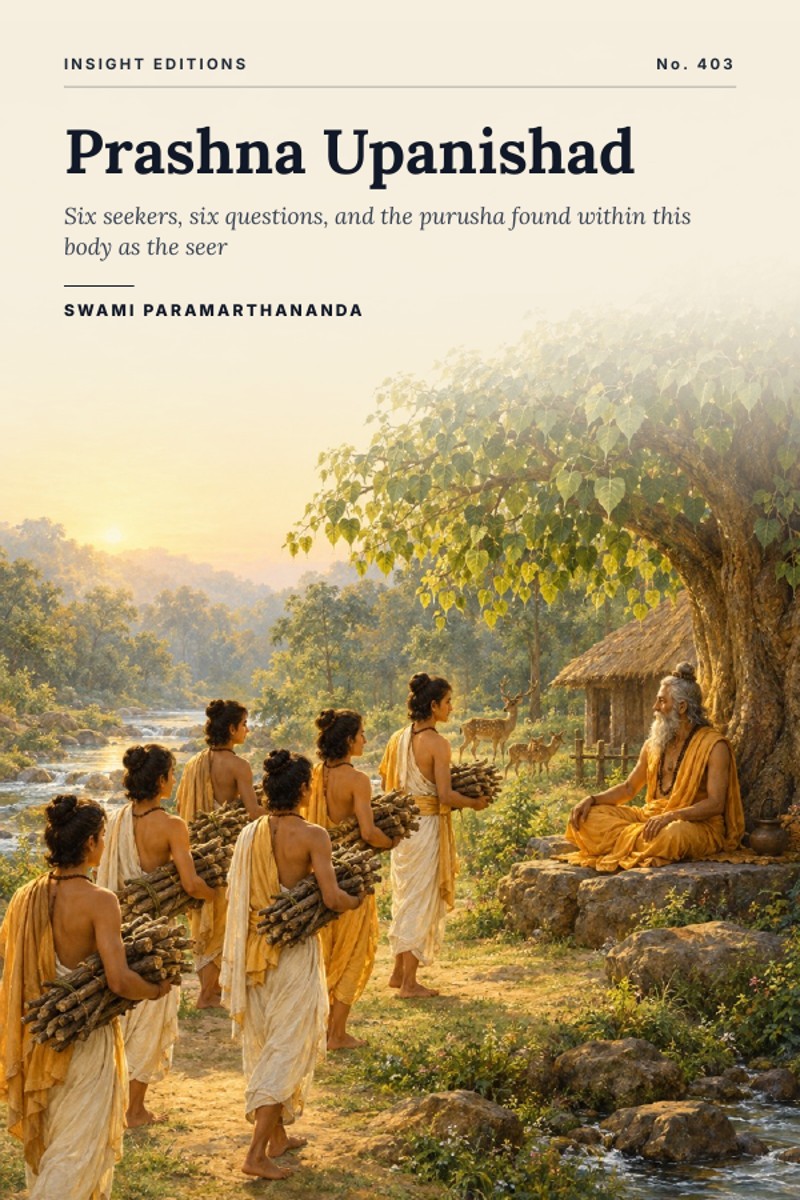
Six students, devoted to Brahman and seeking the supreme, approach Pippalada with samit in hand. He does not teach at once. He says: live here one year, with tapas, brahmacharya and shraddha; then ask, and if I know, I will tell you all.
The year is a test of character: the teacher studies whether the students are fit. The teacher notes the contrast with modern impatience: we now have two-minute phone games for a two-minute traffic signal. Vedanta requires a relaxed mind; fast life and Vedanta are diagonally opposite.
| Disciple | Question |
|---|---|
| Kabandhi Katyayana | How do beings originate? |
| Bhargava | Which powers sustain a being, and which is greatest? |
| Kausalya Ashvalayana | Prana's origin, entry, stay, sustenance, departure |
| Sauryayani Gargya | Dream, sleep, and the self |
| Shaibya Satyakama | Meditation on Om |
| Sukesha Bharadvaja | The purusha of sixteen parts |
Pair, Time, Food, Beings
Chapter 1, mantras 3 to 9. The first answer: all beings come from the Lord, through Prajapati, in four unique stages.
The smart God
God does not create directly. He creates Brahmaji (Prajapati), educates him, and delegates creation to him. Why create at all? All jivas carry punya and papa that must be exhausted, and that needs experiences, which need a world and a body.
Creation in four stages
This four-stage account is unique to the Prashna.
| Stage | What appears |
|---|---|
| Mithuna srshti | The first pair: rayi and prana, represented by moon and sun |
| Kala srshti | Time: year (northern and southern course), month (bright and dark fortnights), day (day and night) |
| Anna srshti | Food: without it, beings would be useless |
| Praja srshti | Bodies: human, animal, bird and all |
Rayi and prana, three meanings
These two words are loaded. At the macro level, rayi is the visible universe (matter) and prana the invisible one (minds, subtle elements). At the individual level, prana is the consumer (subtle body) and rayi the consumed (food, gross body). In the cosmos, the sun is prana and the moon is rayi.
The teacher calls the Prashna a Surya Upanishad. Mantra 1.6 is among the most famous Hindu prayers: the rising sun enters every quarter and gathers all beings' pranas into its rays. The sun is worshipped as samashti prana, Hiranyagarbha, even Ishvara.
Two Paths After Death
Chapter 1, mantras 9 to 13. Alongside creation, Pippalada describes the two chief sadhanas and where they lead.
Karma and upasana
Once beings exist, they have goals and need means. The two scriptural means are karma (physical and verbal action) and upasana (meditation). Done without worldly expectation, both yield sadhana chatushtaya sampatti, the four qualifications. Done for results, they yield worlds.
| Means | Path | Destination | Outcome |
|---|---|---|---|
| Karma (ishta, purta) | Southern, dakshinayana, via the moon | Lower heaven | Return; a limited visa |
| Upasana with tapas, brahmacharya, shraddha | Northern, uttarayana, via the sun | Brahmaloka | Possible krama mukti |
A person going to the lower heaven goes with a return ticket; permanent residence is not allowed.
Why upasana is superior
Brahmaloka offers the possibility of gradual liberation: one hears Vedanta there and is freed. If one does not, one too must return. The advantage is only that possibility. Even so, between the two, upasana is higher, which is why chapters 2 and 3 take up prana upasana.
The cosmology of two paths, sun and moon, is taken from Vedic ritual culture and is not open to verification. The teacher treats it as part of apara vidya: useful for orienting meditation and values, not as the Upanishad's central claim, which comes only in chapter 6.
Values for Every Path
Chapter 1, mantras 13 to 16. The first chapter closes with a second aside: values are common to all seekers.
Four values
| Value | Meaning |
|---|---|
| Satyam | Truthfulness |
| Brahmacharyam | Sexual morality |
| Tapas | A simple, austere life |
| Amaya (absence of deceit) | Transparency: no double personality |
The last one is pointed: praising someone to their face and telling stories behind their back is not acceptable for an Upanishadic student.
Karma needs values, upasana needs values, jnana needs values. Values are not a stage to be crossed but a floor under every path.
Who reaches the pure world
The chapter ends: the stainless world of Brahma belongs to those in whom there is no crookedness, falsehood or deceit. The ethics are not an add-on; they decide which path one is fit for.
- Audit transparency first. Among the four, amaya is the easiest to miss in oneself and the easiest to spot in others.
The Walkout of Prana
Chapter 2. Bhargava asks how many powers sustain a being, which claim glory, and which is really glorious.
Every organ claims credit
Many principles sustain the individual: the five sense organs, the five organs of action, the mind and intellect, prana, and the five elements. Each one claims: "Without me, this body cannot survive." The Upanishad presents them talking, like animals in a cartoon.
Prana walks out
Prana says it is the greatest. The others do not accept it. So prana begins to leave. As it rises, all the organs are forced to rise with it, like bees following the queen bee. When it settles, they settle. Convinced, they praise prana.
| Organ fails | Result |
|---|---|
| Eyes, ears | Inconvenience; life goes on |
| Any other organ | Inconvenience; life goes on |
| Prana | No life |
Life is sacred
The praise teaches that one prana is in all beings. So respect not just one's own prana but life in general. Villagers do a puja and seek forgiveness before cutting a tree, and the scriptures warn that destroying trees affects one's lineage. "When you use the mosquito bat, remember this." In cosmic terms, Hiranyagarbha sustains Virat.
The Biography of Prana
Chapter 3. Kausalya asks five questions about prana. Pippalada calls them super-questions, and answers them in twelve mantras.
Origin, entry, stay, sustenance, departure
| Question | Answer |
|---|---|
| Where does prana come from? | From Brahman, through its creative power maya; like a shadow from a person |
| How does it enter the body? | By desire and action, punya and papa, born of the mind |
| How does it stay? | By dividing into five functions in five regions |
| How does it sustain? | Inside, by the five functions; outside, as the five cosmic powers |
| How does it leave? | When prarabdha ends, udana carries all out |
Five pranas
| Prana | System | Seat |
|---|---|---|
| Prana | Respiratory | Head, eyes, ears, mouth, nose |
| Apana | Excretory and reproductive | Lower region |
| Samana | Digestive | Middle |
| Vyana | Circulatory | Spread through the nadis |
| Udana | Protection and departure | Rising through one nadi |
Your mind decides your next body
Since action is born of volition, the mind is responsible for the current body and the future bodies. What thoughts you entertain and what actions you do decide what comes next.
How the body is left
When prarabdha is about to end, the organs weaken; four pranas grow weak; udana becomes alert. Speech merges in mind, mind in prana, prana in warmth. The final thought is itself shaped by the coming karma: "coming events cast their shadow." Udana then carries the organs, pranas, mind and reflected consciousness out. A jnani does not leave; he merges.
- Treat the breath as a budget. The teacher says the number of breaths is set by karma; pranayama slows the count, a fast life speeds it.
Dream: Who Sees It
Chapter 4, mantras 1 to 6. The Vedanta proper begins. Gargya asks three questions about dream.
Five questions, three on dream
Gargya asks: in dream, which organs sleep? Which stay awake? Who sees the dream? Who enjoys the happiness of deep sleep? And on what is all this established?
| Question | Answer |
|---|---|
| Which organs withdraw? | All ten sense organs, like the sun's rays gathered at sunset |
| Which stay active? | The five pranas, the "fires" that keep the body alive |
| Who sees the dream? | The mind, pervaded by consciousness |
Mind projects, mind experiences
In dream the mind divides into two: the experiencer and the experienced world. It projects the dream from impressions registered while awake: what was seen and not seen, heard and not heard.
People wish you "sweet dreams", but you cannot decide what you dream. During dream there is no free will; "during waking itself, highly doubtful." What decides the dream? Karma, as in every other experience.
The dream world is real while it lasts and unreal on waking. That model, an experienced world projected by the mind and known by consciousness, prepares the student to see the waking world the same way.
Sleep and the Witness
Chapter 4, mantras 6 to 11. The most important mantras of the chapter: the three states change; the witness does not.
Who enjoys sleep
In deep sleep the mind is dissolved; the dissolved mind is the causal body. The causal body with consciousness is Prajna, who experiences the bliss of sleep. "Overcome by light", the mind sees no dreams.
The changeless witness
Waking, dream and sleep come and go: when one is present, the others are absent. But the three are witnessed by a consciousness that does not come and go.
If consciousness also came and went, no one could remember the other states. That I can speak of all three shows I am outside them.
Like birds to their tree
All experience has three parts, the triputi: experiencer, object, instrument. All three rest on one self, as birds return to their tree at dusk. The chapter lists everything that rests there: elements, senses, objects, mind, intellect, ego, prana.
| Element | Rests in |
|---|---|
| Earth, water, fire, air, space and their subtle forms | The self |
| Senses and their objects | The self |
| Mind, intellect, ego, memory | The self |
| Prana and what it sustains | The self |
- Use the borrowed word. The Upanishad calls the witness akshara, borrowing from the Mundaka. Who knows it becomes sarvajna: "I alone appear as everything."
Om Meditation
Chapter 5. Satyakama asks: what world does one gain by meditating on Om until death? The answer is a backup plan for liberation.
Why a backup plan
Knowledge here and now is the best path, "like a fast food restaurant." But obstacles arise: no guru, a body that will not cooperate, family situations. For such people Om upasana offers gradual liberation. Its conditions: the object must stand for the totality, the meditator must have desire for freedom, and the practice must continue until death.
One Om, three levels
| Meditation on | Represents | Result |
|---|---|---|
| First matra (a) | Virat, gross universe | Reborn as a human with tapas, brahmacharya, shraddha |
| Two matras (a, u) | Hiranyagarbha, subtle | Somaloka, then return |
| Three matras (a, u, m) | Ishvara, total, including both | Brahmaloka and krama mukti |
Only the total (para brahma upasana) gives krama mukti, because the cause includes its products; the partial ones (apara brahma) give finite results.
The meditator on the full Om is freed of sin as a snake slips out of its skin, and is led to Brahmaloka. There, says the teacher, comes "a brief stopover for breakfast": Vedanta shravana in Brahmaloka, then freedom.
The Upanishad gives this route but its own logic keeps it second best. Moksha is not a place; knowledge can arise anywhere. Om upasana is honest about that: it does not liberate by itself, it only delays the teaching to a better venue. The Bhagavad Gita's eighth chapter repeats the same plan.
The Purusha of Sixteen Parts
Chapter 6, mantras 1 to 4. The most important chapter: eight mantras that contain the whole of Vedanta.
Sukesha's honest answer
Sukesha reports that a prince, Hiranyanabha, once asked him about the purusha of sixteen parts. He replied: "I do not know it. If I knew, why would I not tell you? One who speaks untruth withers from the root." The prince left in silence. Now Sukesha asks Pippalada.
What "sixteen parts" means
Shodasha kala is a name for the universe, divided into sixteen components. Shodasha kala purusha means the purusha in the form of the universe, the Vishvarupa Ishvara.
Why only the cause can be the form of all
Gold can take the form of ornaments only because gold is their cause. So for Brahman to be in the form of the world, it must be the cause of the world. The cause alone appears in the form of all products, with different names and forms.
| Name and form | Called |
|---|---|
| Resolved | Brahman |
| Manifest | Vishvarupa Ishvara, the purusha of sixteen parts |
So Hinduism has neither many gods, nor many beings, nor many objects. "Many complain that Hinduism has many gods. We do not even accept many objects." Plurality is rejected totally; there is only one truth, the purusha.
Within This Body
Chapter 6, mantras 2 and 5 to 8. Where is the purusha? Not above, not below: here, as the seer.
Iha eva antah sharire
"Where is God?" One looks up. Pippalada says (6.2): within this very body. Then the complaint: inside are hands, legs, organs, a mind, thoughts, "a non-functioning kidney", but no purusha. The answer (6.5) is the key word paridrashta: the purusha is inside not as an object, but as the seeing consciousness, the witness, revealing all without acting.
Rivers lose their names
| Image | Meaning |
|---|---|
| Rivers flowing to the ocean | The sixteen parts moving toward the purusha |
| Reaching the ocean | Resolving in it |
| Names and forms destroyed | No separate existence remains |
| Called only "ocean" | Called only "purusha" |
As spokes in a hub, the sixteen parts are fixed in the purusha. Know it, so that death does not trouble you.
From "aal" to "all"
The teacher plays on Tamil: we start as aal, an individual, and must end in English all. "Aham eva shodasha kala purushah asmi. I am all."
The thank-you note
The six students say: "You are our father, who has taken us across ignorance to the other shore." They worship the teacher, and offer prostration to all the great rishis. That, says the teacher, is what a guru expects: a student who has understood.
Master Takeaways and Frameworks
The Prashna in one place: questions, answers, and the tools to keep.
Master takeaways
- The purusha is within this body as the seer, not as an object.
- The changeless witness of the three states is the self; that I recall all three proves it.
- Only the cause can be the form of all; Brahman with names and forms manifest is Ishvara.
- No plurality at all: not many gods, beings or objects.
- Upasana outranks karma because it can lead to krama mukti.
- Values are common to every path: truth, restraint, simplicity, transparency.
- The teacher tests students for a year; fast life and Vedanta do not mix.
- Creation runs pair, time, food, beings.
- Rayi and prana are matter and energy, consumed and consumer, moon and sun.
- The southern path returns; the northern path may free.
- Prana is the greatest power; without it there is no life.
- Life is sacred because one prana is in all.
- Mind decides the next body.
- Five pranas run breath, excretion, digestion, circulation, departure.
- The final thought is shaped by coming karma.
- In dream the mind is both seer and seen; karma picks the dream.
- In sleep the dissolved mind enjoys bliss as Prajna.
- Everything rests on the self like birds on a tree.
- Om upasana is a backup plan: total Om alone gives krama mukti.
- One who lies withers from the root.
- Rivers lose name and form in the ocean; so do the sixteen parts.
- I am all.
Frameworks
| Name | What it says | Use it when |
|---|---|---|
| Four stages of creation | Pair, time, food, beings | Reading Prashna cosmology |
| Rayi and prana | Consumed and consumer at every level | Linking body and cosmos |
| Two paths | Southern returns, northern may free | Comparing karma and upasana |
| Four values | Satya, brahmacharya, tapas, amaya | Checking readiness |
| Prana's biography | Origin, entry, stay, sustenance, exit | Studying life and death |
| Pancha prana | Five functions, five seats | Mapping physiology |
| Witness argument | Changing states, unchanging seer | Self-enquiry |
| Om by matras | Partial gives finite, total gives krama mukti | Choosing a meditation |
| Cause as form | Cause alone appears as all | Seeing Ishvara in the world |
Five of six chapters dwell on creation, prana and meditation, and only the last gives the knowledge. A reader could take the Prashna as mainly about cosmology and physiology. The teacher's reading reverses that weight: the first five chapters prepare and orient; the eight mantras of chapter 6 are the point. That reading follows the tradition's rule that the conclusion of a text shows its purport.
Who's who
| Name | Role |
|---|---|
| Pippalada | Teacher |
| Kabandhi Katyayana | Asks about creation |
| Bhargava (Vaidarbhi) | Asks which power is greatest |
| Kausalya Ashvalayana | Asks about prana |
| Sauryayani Gargya | Asks about dream, sleep, self |
| Shaibya Satyakama | Asks about Om |
| Sukesha Bharadvaja | Asks about the purusha of sixteen parts |
| Hiranyanabha | Prince who once questioned Sukesha |
| Swami Paramarthananda | Teacher of the lectures |
Connect it
- AI. The walkout test is a clean method for finding a critical dependency: remove each component in turn; the one whose absence ends the system is the core. Every other component only claims credit.
- Enterprise architecture. Brahma delegating creation to Prajapati is a model of separation of concerns: the platform owner sets the design and hands execution to a trained operator.
About This Edition
This is an independent study guide to Swami Paramarthananda's 18 lectures on the Prashna Upanishad (2015), transcribed by Sri A. Venkatesan and published by Arsha Avinash Foundation.
The edition condenses the lectures into chapter-wise summaries, tables and diagrams for personal revision, drawing on the recap at the start of each class and the closing summary class. It follows the teacher's structure and examples in its own words and does not reproduce the transcripts, which have not been verified by Swami Paramarthananda. For the full teaching, please listen to the original talks with the Sanskrit text.