Insight Editions · No. 146
Mystical Astrology According to Ibn 'Arabi
Symbolism of the Spheres, the Zodiac and the Lunar Mansions
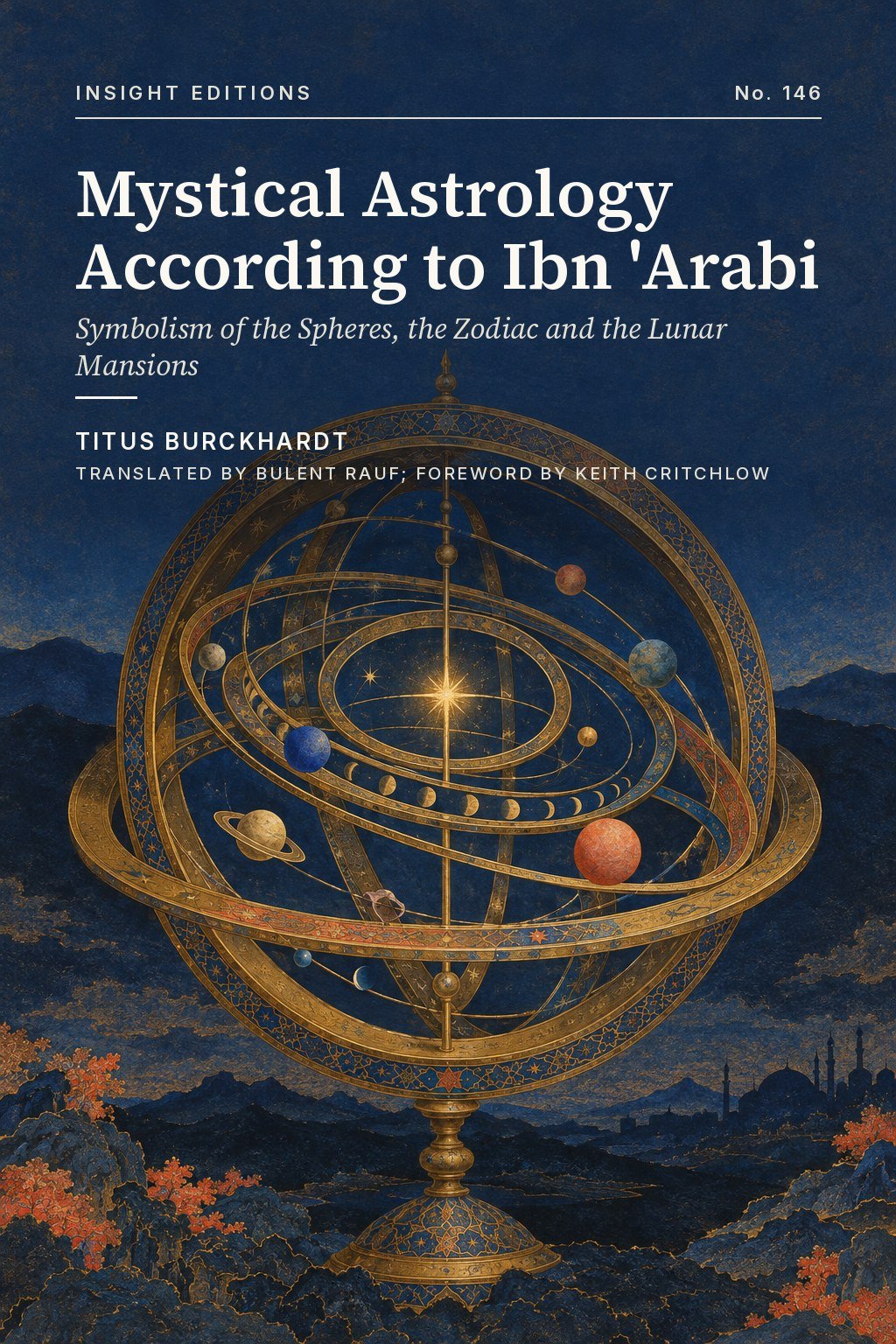
Titus Burckhardt · Translated by Bulent Rauf; foreword by Keith Critchlow
Titus Burckhardt interprets Ibn 'Arabi's account of the celestial spheres, zodiac, planets, lunar mansions, and Divine Names as metaphysical symbolism rather than predictive astrology.
A study guide to Mystical Astrology According to Ibn 'Arabi by Titus Burckhardt, translated by Bulent Rauf; foreword by Keith Critchlow. Shared free for personal reading; not for sale and not endorsed by the authors or publishers. Please read and buy the original.
About the Book
Titus Burckhardt's Mystical Astrology According to Ibn Arabi is a short study in five sections that shows how the astrology inherited from Alexandrian hermeticism can be read, through Ibn 'Arabi's cosmology, as a symbolism of metaphysical principles rather than a craft of prediction.
The book (Fons Vitae, 2001, translated from the French by Bulent Rauf, with a foreword by Keith Critchlow) runs to some fifty small pages. It opens with the hierarchy of the celestial spheres, moves to the zodiac and its twelve signs, then to the planets and the question of causality, then to the 28 lunar mansions and their Divine Names, and closes with the directions of space, the lunar mansions within the signs, and the precession of the equinoxes. A fold-out cosmological diagram drawn from the Futuhat and plates from al-Sufi's Book of the Shape of the Stars complete the volume.
In one sentence: Burckhardt argues that the sky, seen from the human centre, is a true symbol of the Divine Qualities, so that astrology rightly understood is a contemplative science of how unity unfolds into number, space and time, and becomes dangerous only when it is reduced to mechanical causes or to curiosity about the future.
What the book is and is not
Burckhardt's French study first appeared in Etudes Traditionnelles (Paris, 1950) and as La Cle spirituelle de l'Astrologie musulmane d'apres Muhyiddin Ibn Arabi (Arche, Milan, 1974). The first English translation was by Beshara Publications (Abingdon, 1977). Fons Vitae issued this illustrated edition in 2001. The book is not a handbook of horary technique. It is a metaphysical reading of hermetic astrology through Ibn 'Arabi's concentric cosmology.
| Use | What the book says |
|---|---|
| Spiritual / contemplative | Reads the sky as symbol of eternal prototypes; the subject of this study |
| Divinatory / curiosity | Oracles stay equivocal; may reinforce error; attracts "insidious interferences" |
| Fragmentary modern craft | Arrived in the West reduced to contingent applications, cut from principles |
Reading path
- Read the foreword for Critchlow's contrast of timeless present and "profane" present, and for why Ibn 'Arabi is called Son of Plato.
- Read Part 2 for the geocentric case and the fourteen degrees; keep the Sun as pole and heart.
- Read Part 3 with the square and trigon figure open; the angels table is a map, not a spell list.
- Read Part 4 for symbolic causality before any talk of "rays".
- Read Part 5 with the four quarters in view; remember Ibn 'Arabi's warning that the series is a scale, not a production sequence.
- Read Part 6 for pure and mixed signs, then the law that no cycle closes.
- Use Part 7 when a printed wording looks wrong; Part 8 to revise; Part 9 for terms.
1. The Foreword: Time and the Favourable Moment
Keith Critchlow's foreword (pp.3-5) prepares the modern reader by contrasting a traditional view of time with the "historicist" habits of the West, and by placing Burckhardt's spiritual astrology against divinatory curiosity.
- Astrology is astronomy applied to human use, so our view of it depends on what we take a human being to be.
- Illumination is instantaneous, a timeless present unlike the thin "profane" present between past and future.
- Burckhardt writes of spiritual astrology, set against divinatory astrology whose oracles stay equivocal.
- Plato's perichoresis (permeation of the divine presence) is the frame; Aristotelianism opened the divorce of mind from matter.
- Ibn 'Arabi was surnamed Son of Plato (Ibn Aflatun) because the sensible depends on the intelligible and the intelligible on Unity.
The favourable moment
Critchlow starts from the Buddha's praise of those who have seized their moment, and his lament for those for whom the moment is passed (citing Samyutta Nikaya). The explanation, he says, lies in the traditional view of time: illumination, or the goal of human existence, is instantaneous beside the long cosmic journey of passing time. It is "a comprehension of Reality which comes 'in a flash' like lightning." This favourable moment or paradoxical instant suspends duration and places the recipient in a timeless present.
That timeless present is qualitatively different from the illusive "profane" present that barely exists between two non-entities, past and future, and apparently ceases with death. The profane experience also has no bearing on the prolongation beyond time that the favourable moment brings, which Critchlow likens to a glance "outside" time.
For those educated in the values of modern Western industrial culture, he continues, the traditional view of time is as hard to grasp as the unfoldment of time represented by traditional astrological symbolism. The small book is offered as a gold-mine for the serious investigator who wants the roots of traditional principles. It is drawn specifically from the Islamic contemplative tradition as committed to writing by Muhyiddin Ibn 'Arabi, and it unfolds the timeless spectrum of the orders of being as they relate to time and space in "our" world.
Spiritual against divinatory
In this volume, Critchlow says, Burckhardt has distilled the essential symbolism underlying spiritual astrology, as in contradistinction to divinatory astrology. He quotes the book's own warning: for individual curiosity, all "oracle" remains equivocal and may even reinforce error, because "man cannot remove the veil of his ignorance except by or through something which transcends his individual will."
| Spiritual astrology | Divinatory astrology |
|---|---|
| Symbolism of orders of being in time and space | Curiosity about personal outcomes |
| Tied to metaphysical principles | Oracles stay equivocal |
| Needs what transcends individual will | May reinforce the error that traps a destiny |
| Door out of historicism | Stays inside the historicist prison |
Plato, Aristotle and Son of Plato
Burckhardt, Critchlow says, points with great clarity to the difference between this traditional viewpoint and the individualist and historicist viewpoint that contemporary Western opinion inherited from the flood-tide of Aristotelianism, which invaded the Middle Ages and has dominated its world feeling ever since. Few contemporary Western thinkers would even know of, let alone take into consideration, the principle so fundamental to the tradition represented by Plato as that of perichoresis.
This process, or "permeation of the divine presence", arises from the Platonic teaching that the world of materiality is unequivocally dependent for its being and existence on the principal first cause, and as such is merely its furthest reflection or exteriorised expression. As light both causes and permeates shadow, so the divine Presence permeates, through perichoresis, to the heart of all materiality.
Aristotelianism asserts that universals only have existence insofar as they characterise individual concrete things, thereby implying that universals only exist in the human mind that "abstracts" them from "things". This inversion of the teaching of Plato's academy (that Aristotle left) gave rise to the eventual divorce of mind from matter and spirit from body and soul, because of the irreconcilability of individual "thingness" with the traditional doctrine of the total permeability or effusion of the divine presence recognisable as the Universals.
It is no mere chance, Critchlow writes, that Ibn 'Arabi was surnamed Son of Plato (Ibn Aflatun), because of this fundamental viewpoint within the revelation of Islam: the sensible world depends on the intelligible world, and the intelligible in return on the ontological principle of Unity.
| Level | Depends on |
|---|---|
| Sensible world | Intelligible world |
| Intelligible world | Ontological Unity |
| Material "thingness" alone | (Aristotelian inversion: universals only in the mind) |
| Perichoresis | Divine presence permeating to the heart of materiality |
Effort of reorientation
To understand the starting point of this perspective of spiritual astrology, Critchlow says, one needs to make a definitive "effort of reorientation"; for "we moderns" are almost unknowingly educated in the totalitarian philosophical empiricism of Aristotelianism. The reward for the effort may not only open valuable doors onto the real significance of astrology in the traditional sense, but those same doors may lead out of the prison of historicism to that favourable moment where, as an integral person, we neither deny ourselves our own historic moment, nor consent to be solely identified with it.
2. The Spheres: A Cosmos Centred on Man and Sun
The first section (pp.9-16) explains where astrology comes from, why its geocentric frame is a valid symbol, and how Ibn 'Arabi arranges fourteen degrees of the cosmos symmetrically around the sphere of the Sun.
- Astrology owes its form to Alexandrian hermeticism; it entered Christian and Islamic esotericism because it preserved a primordial symbolism.
- The geocentric system is a coherent symbol of man's central place, not a mistake to be outgrown.
- Heliocentrism caused an intellectual imbalance by inviting a non-human point of view.
- Ibn 'Arabi sets seven degrees above and seven below the Sun, the pole and heart of the world.
- Zodiacal "towers" in the starless sky are not the twelve constellations; time contracts as it descends.
Opening claim: astrology and metaphysics
Burckhardt opens from the written work of the greatest Master (ash-shaikh al-akbar), Muhyiddin Ibn 'Arabi. That work contains considerations on astrology which permit one to see how this science, which arrived in the modern Occident only in a fragmentary form and reduced to some of its most contingent applications, could be related to metaphysical principles, and thereby to a knowledge self-sufficient in itself.
Why monotheism kept astrology at arm's length
Astrology as it spread in the Middle Ages within Christian and Islamic civilisations, and which still subsists in certain Arab countries, "owes its form to the Alexandrine hermeticism; it is therefore neither Islamic nor Christian in its essence". It could not in any case find a place in the religious perspective of monotheistic traditions, given that this perspective insists on the responsibility of the individual before the Creator and avoids all that could veil this relationship by considerations of intermediary causes.
If all the same it was possible to integrate astrology into Christian and Muslim esotericism, it is because it perpetuated, vehicled by hermeticism, certain aspects of a very primordial symbolism: the contemplative penetration of the cosmic atmosphere, and the identification of spontaneous appearances, constant and rhythmic, of the sensible world with the eternal prototypes. That answers to a mentality as yet primitive, in the proper and positive sense of the term. This implicit primordiality of astrological symbolism "flares up in contact with spirituality", direct and universal, of a living esotericism, just like the scintillation of a precious stone flares up when exposed to rays of light.
The case for geocentrism
Ibn 'Arabi encloses the facts of hermetic astrology in the edifice of his cosmology, which he summarises by a schema of concentric spheres, taking as starting point and term of comparison the geocentric system of the planetary world as the medieval world conceived it. The "subjective" polarisation of this system, the fact that the terrestrial position of the human being serves as the fixed point to which all movements of the stars are related, here symbolises the central role of man in the cosmic whole, of which man is like the goal and the centre of gravity.
This symbolic perspective, Burckhardt insists, does not depend on the purely physical or spatial reality, the only one envisaged by modern astronomy, of the world of the stars. The geocentric system, being in conformity with the reality as it presents itself immediately to human eyes, contains in itself all the logical coherence requisite to a body of knowledge for constituting an exact science.
The discovery of the heliocentric system corresponds to a development both possible and homogeneous but very particular to the empirical knowledge of the sensible world. It obviously could not prove anything against the central cognition of the human being in the cosmos. Only, the possibility of conceiving the planetary world as if one were contemplating it from a non-human position, and even as if one could make abstraction of the existence of the human being, even though human consciousness remains the "container" of all conceptions, "had produced an intellectual dis-equilibrium" which shows clearly that the "artificial" extension of empirical knowledge has in it something of the abnormal, and that it is, intellectually, not only indifferent but even detrimental.
A second note suggests the Pythagoreans already knew heliocentrism. Copernicus himself refers, in his preface addressed to Pope Paul III, to Hicetas of Syracuse and to citations of Plutarch. Aristotle, in On the Sky, says the Italic philosophers called Pythagoreans "are of a contrary opinion to most other physicians" (as printed; Part 7), affirming that the centre of the world is occupied by fire, while the earth moves in a circle around that centre. Aristarchus of Samos (Alexandria, about 250 BC; printed Aristarcus) taught the heliocentric system; al-Biruni recounts that certain Indian sages hold that the earth turns around the sun. Copernicus may then be a "simple vulgarisation" like other Renaissance discoveries. Burckhardt also likens the effects of heliocentric discovery to certain vulgarisations of esotericism: inversions of point of view proper to esoteric speculation.
Fourteen degrees around the Sun
Ibn 'Arabi, like Ptolemy, puts the Sun in the middle of the planetary order, but stresses the symmetry. He probably held the scheme from the Andalusian Sufi Ibn Masarra. Seven degrees stand on either side of the solar sphere.
| Above the Sun | Below the Sun |
|---|---|
| 1 Throne (al-'arsh) | 7 Venus |
| 2 Pedestal (al-kursi) | 6 Mercury |
| 3 Starless sky (al-falak al-atlas) | 5 Moon |
| 4 Fixed stars | 4 Ether (al-athir) |
| 5 Saturn | 3 Air |
| 6 Jupiter | 2 Water |
| 7 Mars | 1 Earth (centre) |
| SUN: pole and heart of the world | |
Mercury sits below Venus because it moves faster (n.8, p.17). Above the fixed stars: pure duration, paradises, archetypes. Below: generation and corruption.
The two supreme spheres are spherical only as symbols. They mark the passage from astronomy to metaphysical cosmology, and they are called the invisible world, the word for unseen sliding naturally into the transcendent.
A key distinction follows: the zodiac's twelve towers (buruj) in the starless sky are not the twelve constellations among the fixed stars. They are virtual determinations (maqadir), differentiated only by their relation to the stations projected on the fixed stars. Burckhardt calls this "a very important point for the understanding of Arab and occidental astrology".
Traditional cosmology does not separate a planet's visible body from its subtle counterpart, because "the symbol is essentially identified with the thing it symbolises". The sky of the fixed stars is also the sky of the stations (falak al-manazil) because planetary movements project onto it.
Time contracts as it descends
The revolution of the outermost sky is the measure of all time and so cannot itself be measured; it answers to pure duration. Moving inward, the temporal condition contracts as it meets the spatial one, and the planetary rhythms become "so many successive degrees of the temporal'contraction'". At the earth, space dominates.
3. The Zodiac: Number Crystallised in Space
The second section (pp.17-25) derives the twelve signs from the directions of space, the four natures and the three movements of the Spirit, then lists the angel of each sign from Ibn 'Arabi.
- Astrological symbolism lives where time, space and number meet.
- Every observer is a centre of the same directions; their objective and subjective orders are the basis of the horoscope.
- Fix the four points of the solar year and the circle crystallises into twelve by square and trigon.
- Four tendencies of Universal Nature times three movements of the Spirit yield the twelve signs and the meanings of the aspects.
- Signs are equal twelfths from the vernal point; constellations have drifted nearly a whole sign away.
Directions as qualities
Astrological symbolism, the section opens, resides in the points of junction of the conditions of the sensible world, above all time, space and number. Parts of the sky are simply directions, and directions express the qualitative nature of space. Their centre is every living being on earth, yet the perspective does not change from one person to another, since our lines of sight coincide when we look at one point of the vault. Burckhardt distinguishes objective directions, the same for all at one instant, from subjective ones set by each person's zenith and nadir: "it is precisely this comparison between these two orders of the directions of the celestial space that is the basis of the horoscope."
| Order | Defined by | Role |
|---|---|---|
| Objective | Same for all observers at one instant (equinoxes, solstices, poles of the day and year) | Shared sky |
| Subjective | Each person's zenith and nadir | Personal frame |
| Horoscope | Comparison of the two orders | Basis of the chart |
Square, trigon, twelve
Directions are undifferentiated until one is fixed; then all the others polarise. The fixed points are the equinoxes and solstices, where the poles of the daily turning and of the solar year diverge. Once these four are set, the ternary and senary divisions inherent in the circle produce the rest: each point of the square calls up a trigon. If the equator and the solar path coincided there would be no seasons, so their divergence is the break of equilibrium from which contrast and complement arise.
- Square: four cardinal points; same spiritual quality, contrasted elements.
- Trigon: same element, different movement of the Spirit.
- Aspects from this geometry: square = contrast; opposition = opposition; trigon = perfect synthesis; sextile (60 degrees) = affinity.
Four natures, three movements
Ibn 'Arabi identifies the four cardinal points with the four tendencies of Universal Nature (at-tabi'a). Heat and cold are active and opposed, expansive and contractive; dryness and humidity are passive. Cold goes to the solstices, which reflect polar contraction; heat to the equinoxes on the equator. The elements pair the tendencies: earth cold and dry, water cold and humid, air humid and hot, fire hot and dry. A note adds that traditional Muslim medicine reduces every illness to an imbalance of these four. The zodiac contains only the celestial models of the four elements; those models remain composed of the four tendencies of Total Nature, as Ibn 'Arabi points out.
The four are multiplied by three: the movements of the First Intellect (al-'aql), or under another relation the three worlds (this world, the next, and the barzakh between).
This ternary of the Spirit is superior to the quaternary of Nature. If it appears here in the second place, Burckhardt says, it is because the differentiations of the zodiacal sky of the archetypes proceed from manifested contrasts to arrive at their reintegration in perfect synthesis. Points related by the trigon share elementary nature but differ by the Spirit's qualities; points related by the square share spiritual quality but differ by elementary contrasts.
Burckhardt also points out a surprise: it is the fixed signs, not the synthetic ones, that govern the higher world. The synthetic signs answer to the intermediate worlds, or to a fusion of spiritual stillness and psychic expansion in the body, "in the same manner as the production of the alchemical salt" from sulphur and mercury.
| Kind of sign | Rules | Surprise? |
|---|---|---|
| Fixed | Superior, non-temporal degrees | Yes: not the synthetic signs |
| Mobile / cardinal | This world | Matches expansion |
| Synthetic / double | Barzakh; or body as fusion of stillness and expansion | Like alchemical salt |
The angels of the twelve signs
The angelic functions come from Ibn 'Arabi's book 'Uqlat al-mustawfiz, The Tie which Retains the Departing.
| Sign | Nature | The angel holds or rules |
|---|---|---|
| Mobile | ||
| Aries | hot, dry (fire) | keys of qualities and accidents |
| Cancer | cold, humid (water) | keys of the creation of this world |
| Libra | hot, humid (air) | keys of ephemeral states and changes |
| Capricorn | cold, dry (earth) | keys of day and night |
| Fixed | ||
| Taurus | cold, dry (earth) | keys of paradise and hell; under the terror of the Majesty |
| Leo | hot, dry (fire) | generous; keys of the future world |
| Scorpio | cold, humid (water) | keys of the infernal fire |
| Aquarius | hot, humid (air) | generous, under the terror of the Majesty; keys of the spirits |
| Synthetic (ruling bodies together) | ||
| Gemini | hot, humid (air) | key of metals |
| Virgo | cold, dry (earth) | the human body |
| Sagittarius | hot, dry (fire) | generous; luminous and dark bodies; key of plants |
| Pisces | cold, humid (water) | luminous and dark bodies; keys of animals |
Signs and constellations
Arab and Western astrology count twelve equal parts from the spring equinox, without regard to the constellations of the same names. Through the precession of the equinoxes a gap of nearly a whole sign has opened: "the constellation of Aries, for example, is today to be found in the 'sign' of Taurus." A note dates the last coincidence of signs and constellations to the first century of the Christian era (compare p.51, about 400 AD; Part 7).
4. Planets, Sun and Moon
The third section (pp.26-35) asks in what sense planets "act", reads the Sun and Moon as Intellect and its reflection, places seven prophets in the seven skies, and ties the 28 lunar mansions to the 28 sounds of Arabic.
- The seven planets are intermediaries that actualise the relations latent in the sphere of the sky.
- Modern talk of planetary rays of force turns astrology into superstition; all causality in manifestation is symbolic.
- A master in metaphysics need not know every field of nature; Ibn 'Arabi's view of the fixed stars still holds as symbol.
- Numbers 12, 7 and 28 mark product, sum and Pythagorean sum: archetypes, hierarchy, successive unfolding.
- Letters determine mansions, not the reverse; the series begins and ends in the letters of huwa.
Against causality by rays
The heaven of the fixed stars is called the heaven of the stations because the planets' movements project onto it. Modern astrologers would have planets act through rays of force in a quasi-material sense, and Burckhardt objects: "thence the residue of the science takes on the aspect of a true superstition." Each era's need for causality depends on its mental horizon. One forgets "that all causal linkage within manifestation is essentially symbolic", and the widest view sees things within the Unity of Existence (wahdat al-wujud). A note puts it bluntly: secondary causes are only reflections of the first cause.
| Symbolic causality (book) | Rays of force (modern residue) |
|---|---|
| Planets actualise relations latent in the sky | Quasi-material emission |
| All linkage in manifestation is symbolic | Physical-style force between bodies |
| Secondary causes reflect the first cause | Science reduced to superstition |
| Widest frame: wahdat al-wujud | Mental horizon of one era's causality need |
The fixed stars test case
Ibn 'Arabi says the Sun gives light to all stars, the fixed ones included, and is itself lit by an incessant Divine revelation. Burckhardt grants that this may look mistaken now that fixed stars are known as independent sources. His answer is direct: "the function of a Master in Metaphysics does not necessarily imply a distinctive knowledge of all the domains of nature". The theory still stands symbolically: the Sun is the centre of Divine Light for one world, the fixed stars the interference of a higher world's light.
Sun, Moon and the 28 mansions
Only Sun and Moon trace regular circles on the fixed stars. The Moon crosses the zodiac in 28 days and is given 28 mansions, counted from the spring equinox; the nodes, the head and tail of the dragon, circle the sky in 18 years, so the mansions are a symbolic summary of the true rhythms. (Printed: "the two points ... which are called the 'head' and the 'tail' of the dragon, describes" - plural subject, singular verb; Part 7.) A note says Hindu astrology counts 27 mansions and starts from a point among the fixed stars.
The numbers carry meaning. Twelve is a product (4 x 3), the mode of the archetypes, which reflect each other like mirrors. Seven, the planets, is a sum of 3 and 4, a graded hierarchy. Twenty-eight is the sum of 1 to 7, "with signifies" (as printed; Part 7: for which signifies) that the lunar rhythm unfolds in succession all the possibilities of the archetypes.
| Number | Form | Domain | Mode |
|---|---|---|---|
| 12 = 4 x 3 | Product | Zodiac, archetypes | Mirrors; no exclusion; Sun measures actively |
| 7 = 3 + 4 | Sum | Planets | Graded hierarchy; intermediaries |
| 28 = 1+2+...+7 | Pythagorean sum | Lunar mansions | Successive unfolding; Moon measures passively |
The Sun and Moon relate as Pure Intellect to its reflection in human form. The Sun actively measures the sky, like the fiat lux that draws the world out of shadow; the Moon measures passively, subject both to the directions of space and to the solar rays, a double dependence seen in her phases and in the 18-year drift.
Prophets in the skies
Islamic esotericism places the prophetic functions in the planetary skies.
| Sky | Prophet | Role noted in the book |
|---|---|---|
| Saturn | Abraham | Prophetic function in that sky |
| Jupiter | Moses | Prophetic function in that sky |
| Mars | Aaron | Prophetic function in that sky |
| Sun | Enoch (Idris) | Divine man par excellence; historic prototype of men who have realised God |
| Venus | Joseph | Prophetic function in that sky |
| Mercury | Jesus | Prophetic function in that sky |
| Moon | Adam | Primordial man; unique man (al-insan al-mufrad) |
Enoch and Adam stand as the Taoist transcendent man and true man. Adam is the primordial man, in Ibn 'Arabi's phrase the unique man (al-insan al-mufrad) as distinct from the universal man (al-insan al-kamil): the mediator between earth and Heaven.
| Term | Arabic | In the book |
|---|---|---|
| Unique man | al-insan al-mufrad | Adam; cosmic quality proper to man alone; mediator |
| Universal man | al-insan al-kamil | Opposed term; ideal model of return (returns in Part 5) |
The heart like the Moon
Ibn 'Arabi compares the Moon to the heart of the unique man, which receives the self-disclosure (tajalli) of the Divine Essence (dhat) and changes form with each essential truth (haqiqa) that leaves its imprint. The heart here is not the mental, a purely discursive faculty, but the central organ of the soul. Continual change of form should not be confused with the discursive translation of spiritual knowledge, even though reason's mediatorial role relates to the same cosmic quality that characterises the human being.
Because the individual substance cannot receive all aspects of the Essential Revelation (tajalli dhati) at once, the heart's subtle form changes constantly, "comparable both to a pulsation and to phases of the Moon." The outward change is the inverted image of an inner orientation that never changes, open only to Unity. In that double aspect the role of mediator proper to the human heart consists.
Letters before mansions
From this mediating faculty comes the turning of the primordial sound, vehicle of spiritual revelation, into articulate language, and so the correspondence of 28 mansions with 28 letters. Ibn 'Arabi reverses the expected order. In the book's words he says it is not as people think, that the mansions are the models of the letters, but that the 28 sounds determine the lunar mansions. The sounds are the human expression of the Divine Breath that moves the cosmic cycles.
Counted from the first mansion after the equinox in order of articulation, from throat to lips, and setting aside the hamza as a passage between silence and speech, the series begins with ha and ends with waw: the two letters of huwa, "symbol of the Essence one and identical to Itself."
5. The Cycle of the Mansions
The fourth section (pp.36-43) reads the diagram Burckhardt draws from the Futuhat: 28 lunar mansions carrying 28 Divine Names, 28 cosmic degrees and 28 letters, arranged in four quarters from the First Intellect to man.
- Astronomical cycles image every unfolding of possibilities under one principle, temporal or purely logical.
- The Divine Names are the first reason of all cycles; the science of the Names crowns sacred science.
- The Divine Breath relieves the Names' constriction and spreads their consequences as the world.
- The series is a fixed scale of degrees, not an order of production; Prime Matter's fourth place shows the problem.
- Four quarters run from Divine degrees through formal worlds to composite beings and reintegration in the Intellect.
Why cycles
The most profound significance of astronomical cycles, Burckhardt writes, is that they offer an image logically analogous to all successive developments of possibilities ruled by the pole of one and the same principle. They can therefore symbolise any order of manifestation, whether conditioned by time or implying a purely logical succession. One may conceive a whole hierarchy of cosmic cycles analogous among themselves, situated at different levels of existence, each reflected simultaneously and in different relationships in an astronomical cycle such as the Sun's or Moon's path on the sky of the fixed stars.
In The Revelations of Mecca (al-Futuhat al-makkiyah), Ibn 'Arabi cites cosmological correspondences that allow the tracing of a symbolic diagram (the book's inset). The diagram is built upon the juxtaposition of the zodiac and the cycle of the lunar mansions, beginning with the Spring Equinox; different orders of analogies are indicated by concentric circles.
The Divine Names stand first. The Essence itself "can never be the object of a science", since science implies distinction; the Names are its distinctive contents. The qualities or Divine Names are necessarily innumerable; but because of the simplicity of Being, one aspect of Its Unity, they can be symbolically summarised in a determined group. As there is no distinction without implicit hierarchy, the series of Names always has the character of a logical chain, and by that becomes the model of all cyclic order. In the present case the Master makes the 28 mansions correspond to as many Divine Names. Each active Name has a cosmic degree as its complement, from the first manifestation of the Intellect down to man. These degrees are a vertical hierarchy projected onto a horizontal plane.
The Divine Breath
The production of these domains from their principial determinations is the effect of the Divine Breath (an-nafas al-ilahi). Before creation the Names were in a state of divine constriction (al-karb al-ilahi), demanding their complements, until the Divine Spirit "relieved" (tanaffasa) them by deploying all the amplitude of their consequences. In other words, once Being in its first self-determination (ta'ayyun) conceives its Names, they require their logical complements, the totality of which is the world, and the Breath extends this connection existentially. It is identified with the First Substance and Universal Nature.
Thus the symbolic correspondence tying together the cycle of the Divine Names, that of the cosmic degrees and that of the 28 sounds of Arabic: the cosmic degrees are determinations of the Universal and Macrocosmic Breath, the 28 sounds those of the human and microcosmic breath; as speech is carried by physical breath, degrees are carried by the Divine expansion.
| Cycle | Carried by | Character |
|---|---|---|
| 28 Divine Names | Principial determinations | Active / creative |
| 28 cosmic degrees | Macrocosmic Divine Breath | Complements of the Names |
| 28 lunar mansions | Moon's path from the equinox | Astronomical image |
| 28 letters of Arabic | Human / microcosmic breath | Articulation of primordial sound |
Where Prime Matter belongs
Ibn 'Arabi warns that his series is a fixed scale of degrees, not an order of production, since production runs in opposite directions for the higher and the individual worlds. Production of superior states is conceived only in a purely logical fashion, as essential differentiation from the Unity of Being. Production of formal and individual worlds is envisaged with respect to their substantial or even "material" reality, as an opening of forms from the potentiality of an undifferentiated materia at the lower degree of an ascending scale.
Prime Matter (al-jawhar al-haba'i, al-hayula; printed "the principal that..."; Part 7) shows the problem. It stands fourth because it is the premise of the fifth, the Universal Body, which fills intelligible space as ether (akasha in the Hindu doctrine) fills sensible space. In its deepest sense it should stand outside the series, above or below all degrees. Its fourth place is still justified: it closes the first quaternary (First Intellect, Universal Soul, Universal Nature, Prime Matter), which sums up all Universal Existence. It answers to the Name the Last (al-akhir), being last without temporal sequence and other without essential otherness.
| Scale of degrees | Order of production |
|---|---|
| Fixed series for contemplation | Runs both ways |
| Prime Matter 4th as premise of Universal Body | Higher world: logical differentiation from Unity |
| Closes first quaternary of Universal Existence | Individual world: ascent from undifferentiated materia |
| Name: the Last (al-akhir) | Same entity can sit "first" or "last" by aspect |
The four quarters
| Quarter | Ends at | Contents |
|---|---|---|
| 1 | Summer solstice; the Throne, under al-muhit, He who englobes all; letter qaf | The Divine degrees, the world of principles (printed "principals"; Part 7) |
| 2 and 3 | Centre: the Sun at the autumn equinox; end: earth at the winter solstice | All formal worlds in their elementary existence: the celestial spheres downward |
| 4 | Last mansion: determination of all degrees | Composite beings: minerals or metals, plants, animals, angels, jinn, men; then reintegration in the Intellect |
Planets and their Names
| Sky | Divine Name | Sense given |
|---|---|---|
| Saturn | ar-Rabb, the Lord | A reciprocal relation, lord and servant; fixed for every creature |
| Jupiter | al-'Alim, the Knower | The intellectual faculty |
| Mars | al-Qahir, the Conqueror | The volitive faculty |
| Sun | an-Nur, the Light | Principle of Intellect; Truth, Revelation |
| Venus | al-Musawwir, He who forms | Painter and sculptor; the feminine form names imagination |
| Mercury | al-Muhsi, He who counts | Number and distinctive knowledge |
| Moon | al-Mubin, the Evident | Manifestation; Proof, Commentary |
A note marks this as a different perspective from the one that sets prophets in the planets. The two tables are not to be collapsed into one.
The upward turn
The winter solstice marks the lowest point, but only of the human world's passive matter, not of Prime Matter itself. From there the order rises from the simple to the composite. That angels precede jinn may seem odd, since angels belong to the informal world; but the order runs from less individualised to more. Man is the last synthesis. The final mansion corresponds, Ibn 'Arabi says, to the determination of all the degrees, "but not to their manifestation", and this is identified with Universal Man, the ideal model of man's return to the Principle. (Printed "encatonation of macrocosmic degrees" for concatenation; Part 7.)
6. Directions, Synthesis and the Precession
The last section (pp.44-52) explains how the qualities of the lunar mansions combine within each sign, draws a law of non-repetition from the mismatch of solar and lunar cycles, and ends with the great cycle of the precession.
- The directions of space mirror the Divine Qualities, in inverse analogy: one radiates from the Principle, the other converges on man.
- A resultant of several qualities is a new and unique quality, not a mixture.
- Every synthesis has a horizontal side open to calculation and a vertical side needing inspiration.
- No cycle closes: signs hold fractions of mansions; the year holds no whole lunations; Ya Sin says the Sun may not reach the Moon.
- Precession marks the edge of measure; the world is a coherent figure on a sliding base.
Directions as inverse analogy
In principle (printed "In principal"; Part 7) it is the Spirit present in man that recognises the directions of space as mirror of the Divine Qualities. The analogy is inverse: Divine Qualities radiate from the Principle; spatial directions converge on the human centre. Astrology as contemplative science lives in that recognition.
Pure and mixed signs
A sheaf of directions can be replaced by its resultant, which is a synthesis yet "also a unique thing in itself". Each mansion is such a sheaf, matching one Divine Quality. Since each sign holds seven thirds of a mansion, a sign holds either two whole mansions and a third (pure) or one whole mansion flanked by two thirds (mixed).
| Kind of sign | Mansion thirds | Pattern |
|---|---|---|
| Pure | 3/3 + 3/3 + 1/3 | Two whole mansions and a third |
| Mixed | 2/3 + 3/3 + 2/3 | One whole mansion flanked by two thirds |
| Per sign | 7 mansion aspects + 3 of the sign = 10 | Times 3 degrees of existence = 30 |
| Full circle | 30 x 12 | 360 degrees (n.1, p.46) |
Ibn 'Arabi calls this synthesis the cosmic model of logical deduction: two premises a : b and b : c, linked by the middle term, yield a : c. The world, the Master says, is the Unity of the Unified, while Divine Independence is the Unity of the Unique. Unicity is still reflected in each resultant: a child synthesises father and mother but is a new being, and his uniqueness is his face turned to his Eternal Principle. Each cosmic domain is "comparable to a tissue of relationships where each intersecting line is at the same time a centre and a part of the whole."
| Logical form | Cosmic analogue |
|---|---|
| Premise a : b | First quality relation |
| Premise b : c | Second quality relation (middle term b) |
| Conclusion a : c | Resultant: new unique quality |
| Unity of the Unified | The world as synthesised whole |
| Unity of the Unique | Divine Independence |
Calculation and inspiration
The line Critchlow quotes in the foreword belongs here: "man cannot remove the veil of his ignorance except by or through something which transcends his individual will." For individual curiosity every oracle stays equivocal and may even reinforce the error that is the fatal trap of such a destiny.
| Horizontal | Vertical |
|---|---|
| Combinations of qualities | Uniqueness of each resultant |
| Calculation | Inspiration from above |
| Open to technique | Needed for any real "exact" science |
| Mass of symbolic potentialities | Can attract inspirations of very different kinds |
No cycle closes
A zodiacal tower must hold a whole number and a fraction of mansions, Ibn 'Arabi says, without which growth and decline could not appear in becoming. The year holds no whole number of lunations either. The Quran's Sura Ya Sin says the Sun may not reach the Moon nor the night overtake the day; if it did, their common cycle would end and manifestation would return to non-manifestation. There is relative repetition every 18 years, but never effective repetition. "Analogy is the trace of the Unity, and the inexhaustible character is the reflection of the infinity of the Principle."
Precession
The same law appears in the precession, by which the equinoxes make a full round of the fixed stars in about 26,000 years. Burckhardt corrects modern astrologers: the equinox does not move from sign to sign, since signs are always counted from the vernal point; it moves among the constellations. That note dates the coincidence to about 400 AD and calls it a renaissance of astrological symbolism (contrast p.25 n.5, first century CE; Part 7).
The fixed stars symbolise a potentiality never exhausted: we see their traces but cannot name their qualities, whereas we know the qualities of the starless sky we cannot see. "we can in fact know the devolution of the world in principle, but we do not know all the 'material' potentialities that this devolution will wear out."
Ibn 'Arabi assigns these reigns in the order of the Sun's annual movement, which shows they have nothing to do with the vernal point's drift, which runs the other way. The decreasing lengths prove the division is temporal: spatial cycles divide symmetrically, purely temporal ones by the progressive contraction of time. The numbers may be purely symbolic. The sum of the reigns equals three complete precessions. Taking one precession for the first yuga of the present manvantara, in the ratio 4:3:2:1, gives 65,000 years, half a precession short of Ibn 'Arabi's 78,000. Burckhardt notes incidentally that the first sign which reigned on the world was Libra, and that this was again dominating in the era of the prophet Muhammad. He willingly leaves to others the task of conciliating these different factors. A note adds that Libra does not exist in the most ancient representations of the zodiac, while the ancient Chinese used to give the name Libra to the polar plough. Guenon is cited on time changed into space.
His last word is about limits. The cosmos cannot be a closed system, because time is measured by movement in space, and at its edges measure runs out. "The visible world is like a perfectly coherent figure, woven on a sliding base which escapes our hold." He ends with Ibn 'Arabi's formula on the Unity of the Unified and the Unity of the Unique.
7. Notes on the Text
Page numbers are printed pages; n. marks a footnote. The available scan is of poor quality, so only slips of wording, spelling of names or fact are listed; letter-level errors that could come from the scan are not.
| Page | As printed | Comment |
|---|---|---|
| 11 n.2 | are of a contrary opinion to most other physicians | In the quotation from Aristotle; students of nature (physicists) are meant, not doctors |
| 11 n.2 | Aristarcus of Samos | The usual English form is Aristarchus |
| 11 n.1, 21 n.1, 29 n.5 | Etudes Traditionelles | The French title is spelled Traditionnelles |
| 25 n.5 and 51 n. | first century of the Christian era; about 400 A.D. | Two different dates for the last coincidence of signs and constellations; the book promises to return to the matter but does not reconcile them |
| 28 | the two points ... which are called the 'head' and the 'tail' of the dragon, describes | Plural subject with singular verb |
| 30 | the Pythagorician sum of numbers from 1 to 7, with signifies | For which signifies |
| 38 | the principal that Muhyiddin Ibn 'Arabi calls al-jawhar al-haba'i | Principle is meant |
| 40 | the world of principals | Principles is meant |
| 43 | encatonation of macrocosmic degrees | For concatenation |
| 44 | In principal it is the Spirit present in man | In principle is meant |
| throughout | Pythagoricians | The translation's form of Pythagoreans, kept in quotations |
8. Synthesis
A revision map of Burckhardt's argument: takeaways, frameworks, closer look, Who's Who, and connections that stay inside the book's own distinctions.
Twenty-four takeaways
- Astrology came to Islam and Christianity through Alexandrian hermeticism and is native to neither.
- Monotheism resisted it because it can veil the creature's direct relation to the Creator behind intermediary causes.
- Esotericism could adopt it because it kept a primordial symbolism of the sky as image of eternal prototypes.
- The geocentric system is a coherent symbol of man's centrality, not a failed astronomy.
- Heliocentrism, Burckhardt holds, proves nothing against that centrality but brought an intellectual imbalance.
- Facts for their own sake, outside practical applications, have no value in the Schuon note the book quotes.
- Ibn 'Arabi sets seven degrees above and seven below the Sun, the pole and heart of the world.
- The zodiac's signs are virtual determinations of the starless sky, not the constellations.
- Directions of space are qualities; the gap between objective and subjective directions grounds the horoscope.
- Twelve signs arise from four tendencies of Nature times three movements of the Spirit.
- Fixed signs govern the higher world; synthetic signs answer to the barzakh or to bodily fusion of stillness and expansion.
- The aspects take their meaning from this geometry: square contrast, trigon synthesis, sextile affinity.
- All causality in manifestation is symbolic; planetary "rays of force" are a modern superstition.
- A master's metaphysics can be sound while his astronomy is bounded by his time.
- Sun and Moon stand as Intellect and its reflection; the Moon is the heart of the unique man, changing form.
- The 28 sounds of Arabic determine the 28 mansions, not the reverse, beginning and ending in huwa.
- The cycle of mansions carries Divine Names, cosmic degrees and letters, from Intellect to man and back.
- The Divine Breath relieves the Names' constriction; degrees ride the macrocosmic Breath as letters ride human breath.
- Ibn 'Arabi's ladder is a scale of degrees, not an order of production; Prime Matter can sit "first" or "last" by aspect.
- A synthesis is always a new, unique quality; this is why calculation needs a vertical intuition.
- No cycle closes: analogy reflects Unity, inexhaustibility reflects the Infinite.
- Signs are always counted from the vernal point; precession moves among constellations, not from sign to sign.
- The great reigns decrease by a thousand years each; temporal cycles contract, spatial ones divide symmetrically.
- The precession marks the edge of measure; the world is a coherent figure on a sliding base.
Frameworks table
| Framework | Elements | Use in the book |
|---|---|---|
| Fourteen degrees | Throne to fixed stars, three planets, Sun, three planets, four elements | Symmetry around the heart of the world |
| 4 x 3 = 12 | Hot, cold, dry, humid; descent, expansion, return | Generating the signs and aspects |
| 12, 7, 28 | Product, sum, Pythagorean sum | Archetypes, intermediaries, successive unfolding |
| Four quarters of 7 mansions | Divine degrees; formal worlds (two quarters); composite beings | Reading the Futuhat diagram |
| Pure and mixed signs | 2 1/3 or 2/3 + 1 + 2/3 mansions | Resultant qualities; 360 aspects |
| Horizontal and vertical | Calculation; intuition of the unique | Astrology as traditional art |
| Great reigns | 12,000 down to 1,000 years | Time divided by contraction |
| Unity of the Unified / Unique | World as synthesised whole; Divine Independence | Closing formula (p.52) |
| Prophets vs Names in planets | Two tables, two perspectives | Do not collapse into one |
A closer look
Who's Who
| Name | In the book |
|---|---|
| Titus Burckhardt (1908-1984) | Author; Swiss metaphysician and scholar of oriental languages; Fons Vitae series subject |
| Muhyiddin Ibn 'Arabi | The greatest Master (ash-shaikh al-akbar); source of the cosmology; called Son of Plato |
| Ibn Masarra | Andalusian Sufi from whom Ibn 'Arabi probably held the sphere-scheme |
| Keith Critchlow | Author of the foreword |
| Bulent Rauf | Translator from the French |
| Abd al-Rahman al-Sufi | Persian astronomer; wrote The Shape of the Stars in about AD 960; plates from Chester Beatty Library |
| Ptolemy | Author of the Almagest; his sphere order is the frame; source behind al-Sufi's treatise |
| Copernicus | Cited his Pythagorean forerunners in a preface to Pope Paul III |
| Hicetas of Syracuse | Pythagorean cited by Copernicus via Plutarch |
| Aristarchus of Samos | Astronomer in Alexandria about 250 BC; taught heliocentrism (printed Aristarcus) |
| Al-Biruni | Compiler of Hindu traditions who reports Indian heliocentrists |
| Frithjof Schuon | Quoted on scientific "errors" as true symbols and on objectivity |
| René Guénon | Cited on qualified space, time changed into space, and being and milieu |
| Abraham, Moses, Aaron, Enoch, Joseph, Jesus, Adam | Prophets placed in the seven skies |
9. Glossary
Arabic and technical terms as the book uses them, in simple transliteration. Meanings follow Burckhardt's English, not an outside lexicon.
About this book
Mystical Astrology According to Ibn 'Arabi: Symbolism of the Spheres, the Zodiac and the Lunar Mansions by Titus Burckhardt, 2001. This is a chapter-by-chapter study of the book, with summaries, maps, tables and diagrams; short quotations keep their page references. It is shared free for personal study, is not for sale, and is not endorsed by the author or publisher. Please read and buy the original.
Insight Editions · rajeshrmahapatra.com/insight-editions