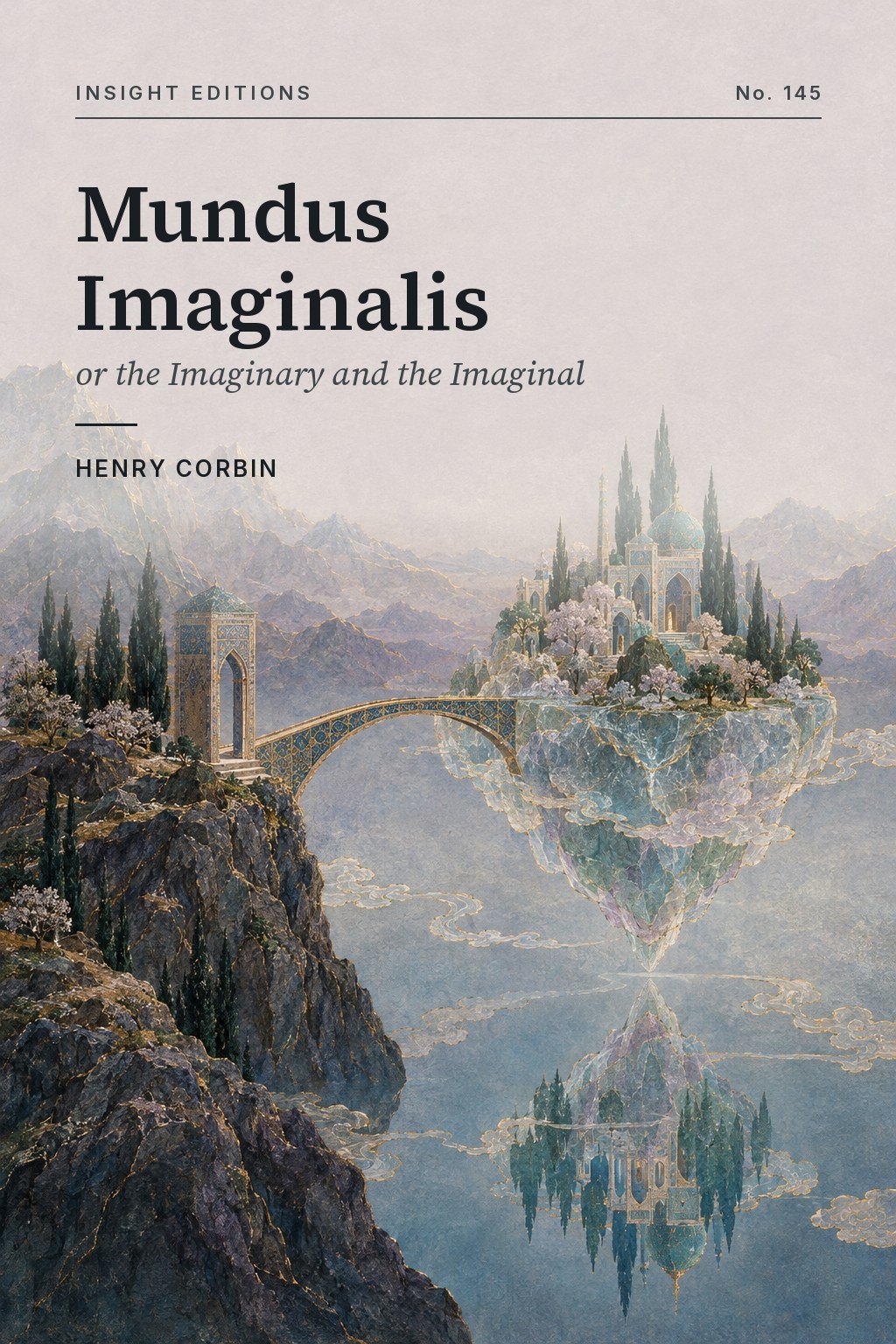
Insight Editions · No. 145
Mundus Imaginalis
or the Imaginary and the Imaginal
Henry Corbin
Henry Corbin's essay distinguishes the imaginal realm from fantasy, describing its spiritual faculty, intermediary ontology, and visionary geographies in Islamic philosophy.
A study guide to Mundus Imaginalis by Henry Corbin. Shared free for personal reading; not for sale and not endorsed by the authors or publishers. Please read and buy the original.
About the Book
Mundus Imaginalis is Henry Corbin's short programmatic essay on the imaginal world, read here in an Italian translation and dated at its close "Marzo 1964". In about ten thousand words it names a level of reality, the faculty that perceives it, and the places where visionaries say they have been.
The essay has three sections. The first, untitled, takes Sohravardi's coined Persian name Na-koja-Abad, the Land of No-where, and shows why it is not a utopia. The second, "L'Immaginazione spirituale", sets out two postulates about active Imagination. The third, Topografie dell'ottavo clima, tells Shi'i stories of journeys to the Green Island and of a meeting with the Hidden Imam, and closes with three questions to the modern reader. A brief author note follows.
In one sentence: Corbin argues that between the world of the senses and the world of pure intellect there is a third world, as real as both, that only a disciplined Imagination can perceive, and that losing it has left the West able to produce only the "imaginary".
The argument map
- The word "imaginary" now means unreal, so a new term is needed: mundus imaginalis (I).
- Sohravardi's Na-koja-Abad looks like a calque of "utopia" but names a real place outside sensible space (I).
- The theosophers place a world of "suspended images" between sense and intellect (I).
- Its organ is active Imagination, a spiritual and cognitive faculty (II).
- When the West lost this world, Imagination lost its balance and became mere fantasy (II).
- Symbol is a primary phenomenon; allegory only masks what is already known (II).
- Shi'i narratives of the Green Island show what it means to enter the eighth clime (III).
- Three questions press a "civilisation of the image" that may produce only the imaginary (III).
Reading paths
| If you want... | Read |
|---|---|
| The central distinction (imaginal vs imaginary) | Part 1 (opening) and Part 3 (Symbol against allegory; Imaginal, not imaginary) |
| The cosmology of three worlds | Part 2 (tables and the sandwich figure) |
| How one "goes out by going in" | Part 1 (Going out by going in) and Part 3 (faculty of migration) |
| Shi'i visionary topography | Part 4 (Hidden Imam; Green Island; Hamadan) |
| Corbin's challenge to modernity | Part 3 (What is real for us?) and Part 4 (Three questions) |
| A short synthesis | Part 6 |
Part 1. The Land of No-where
Section I opens with a terminological admission, then reads Sohravardi's Persian recitals until the coined name Na-koja-Abad can be distinguished from utopia, and the passage "beyond Mount Qaf" can be described as a topological inversion: going out by going in.
Why a new word
Corbin opens with an admission. He chose the two Latin words because he could not be satisfied with "immaginario". Whatever our efforts, in ordinary use the word is the equivalent of the unreal, of what remains "estraneo all'essere e all'esistente" (editor's translation: 'foreign to being and to the existent'), in short, utopian. He is not attacking those who use the word for necessity, if together we seek a positive revaluation. He simply needs another term "se non volevo confondere i lettori occidentali" ('if I did not want to confuse Western readers') (I).
If we habitually call the imaginary unreal, he adds, "questo deve essere sintomo di qualche cosa" ('this must be the symptom of something'). Against that symptom he will examine three things: the order of reality he designates as mundus imaginalis and what the Islamic theosophers call the "ottavo clima" ('eighth clime'); the organ that perceives it, "la coscienza immaginativa, l'Immaginazione cognitiva" ('imaginative consciousness, cognitive Imagination'); and examples of the topography of these interworlds, as observed by those who have really been there.
Sohravardi's recitals
The witnesses are the Persian recitals of Sohravardi, the young Shaykh who in the twelfth century was the "restauratore della teosofia dell'antica Persia" ('restorer of the theosophy of ancient Persia') in Islamic Iran. At the start of each story the visionary meets a supernatural figure of extraordinary beauty and asks who he is and where he comes from. The stories narrate essentially "l'esperienza dello gnostico, vissuta come la personale vicenda dello Straniero, il prigioniero che aspira a ritornare a casa" ('the experience of the gnostic, lived as the personal story of the Stranger, the prisoner who aspires to return home') (I).
The Red Angel
At the beginning of the story Sohravardi titles "L'Angelo Rosso", the prisoner, having escaped the watch of his jailers (or temporarily left the world of sensory experience), finds himself in the desert before a being to whom he says, seeing in him the charm of adolescence: "Oh giovane! da dove vieni?" ('O youth! where do you come from?'). He receives the answer: "Cosa dici? Io sono il primo nato tra i figli del Creatore [in termini gnostici il Protoktistos, il Primo-Creato] e tu mi chiami giovane?" ('What are you saying? I am the first-born among the sons of the Creator [in gnostic terms the Protoktistos, the First-Created] and you call me youth?'). The red of his garments is the appearing of a being of pure Light whose splendour is reduced, by the sensory world, to the red of twilight.
Mount Qaf is the cosmic mountain constituted, peak by peak, valley by valley, by the celestial Spheres enclosed one within another. What then is the road that leads outside it? How long is it? "Non importa quanto a lungo camminerai" ('No matter how long you walk'), it is said, "arriverai di nuovo al punto di partenza" ('you will arrive again at the starting point'), like the point of a compass that returns to the same place.
Two other recitals name Na-koja-Abad
Two further mystical recitals give a name to what is "al di là delle montagna di Qaf" (printed thus), the name that marks the transformation of the cosmic mountain into the psycho-cosmic mountain, the transition of the physical cosmos into what constitutes the first level of the spiritual universe.
In the recital titled "Il frullo delle ali di Gabriele" ('The rustling of Gabriel's wings') there appears again the figure Avicenna calls Hayy ibn Yaqzan ("il Vivente, figlio del Guardiano", 'the Living, son of the Watcher'), here called the Red Archangel. The obligatory question is put, and the answer is: "Provengo da Na-koja-Abad" ('I come from Na-koja-Abad').
In the recital titled "Vademecum del Fedele d'Amore" (Mu'nis al-'oshshaq), a cosmogonic triad whose dramatis personae are Beauty, Love and Sadness, Sadness appears to Ya'qab weeping for Joseph in the land of Canaan. To the question "Quale orizzonte hai attraversato per giungere qui?" ('What horizon have you crossed to arrive here?') comes the same answer: "Io vengo da Na-koja-Abad" ('I come from Na-koja-Abad') (I).
No-where is not utopia
Na-koja-Abad, Corbin says, is a strange term. It is found in no Persian dictionary and was coined, as far as he knows, by Sohravardi himself, drawing on the purest Persian linguistic heritage. Literally it means the city, the region or the territory (abad) of No-where (Na-koja). At first glance it looks like the exact equivalent of ou-topia, which itself is not found in dictionaries of classical Greek and was coined by Thomas More as an abstract name for the absence of any localisation, of any site in space experienceable and verifiable by our senses. Etymologically and literally one could translate Na-koja-Abad by outopia, utopia; yet as to concept, intention and true meaning, Corbin holds that would be a mistranslation, and it is "di fondamentale importanza" ('of fundamental importance') at least to try to determine why (I).
| Utopia (More) | Na-koja-Abad (Sohravardi) | |
|---|---|---|
| Literal sense | No-place | Land of No-where |
| Extension | None: absence of any site | Abad is a city, a land cultivated and peopled |
| Location | Unreal | Beyond Qaf: Jabalqa, Jabarsa, Hurqalya, starting on the convex surface of the Ninth Sphere |
| Access | Invention | Vision, reported by those who have actually been there |
| Question "where?" | Has no answer because there is no place | Loses sense because one has risen beyond the Sphere of directions |
Going out by going in
The word Na-koja-Abad does not indicate something non-existent, without spatial dimension. The Persian word abad certainly means a city, a cultivated and peopled land, hence something that has extension. What Sohravardi means by being "al di là del monte Qaf" is what for him and for the whole theosophical tradition of Islam represents the set of the three mystical cities of Jabalqa, Jabarsa and Hurqalya. As a topographic indication, it is said precisely that this region begins "sulla superficie convessa" ('on the convex surface') of the Ninth Sphere, the Sphere of Spheres, the Sphere that includes the entire cosmos. That means it begins at the exact moment one rises beyond the supreme Sphere that defines all possible directions on our world, the Sphere to which the cardinal points of the sky refer. Once the spatial bond is surpassed, the question "where?" (ubi, koja) loses its meaning, at least with respect to orientation in sensory space. Hence the name Na-koja-Abad: a place outside space, not a "place" contained in a place, in a topos that would let one answer with a gesture of the hand to the question "where?" (I).
Leaving the "where" is not a change of position in space, a transfer from one place to another, for that implies places contained in a single homogeneous space. As the end of Sohravardi's tale suggests with the symbol of the drop of balsam exposed to the sun in the hollow of the hand, it is a matter of entering, of passing to the inside and, by passing inside, finding oneself "paradossalmente al di fuori" ('paradoxically outside'), or in the author's language, "sulla superficie convessa" of the Ninth Sphere, in other words "al di là del Monte Qaf". The relation spoken of is essentially that between the external, the visible, the exoteric (in Arabic, zhair), and the internal, the invisible, the esoteric (in Arabic, batin), that is, the natural world and the spiritual world. To leave the 'where', the ubi, is to abandon the outer or natural appearance that encloses the inner or hidden realities, as the almond is hidden in the shell. This passage takes place so that the Stranger, the gnostic, may return 'home', or at least set out toward that return (I).
The agnostic reflex
Corbin then calls for a fight "con tutte le nostre forze, anche a costo di combattere ogni giorno" ('with all our forces, even at the cost of fighting every day') against what is called the "riflesso agnostico" ('agnostic reflex') of Western man, because it has allowed the divorce between thought and being. Many recent theories, he says, arise from this reflex, by which we hope to escape the other reality before certain experiences and evidences bring us into it, and to escape it if secretly we have been subjected to its attraction, by means of the most naive explanations, except one: the one that would allow us to attribute a true meaning to its existence (I).
Only a cosmology that goes beyond the most astonishing information available to the modern sciences about the physical universe, abandoning them to a lower level, can restore that meaning. As long as we deal with that kind of information, we remain bound to "Questo lato del monte Qaf" ('This side of Mount Qaf'). The distinctive trait of the traditional cosmology of the theosophers of Islam is that it unfolds where the worlds and interworlds "al di là del monte Qaf", that is, beyond the physical universe, are placed on intelligible levels of existence only by reason of an act of being conforming to one's presence in those worlds, and by reciprocity it is by harmony with one's own act of being that those worlds are present. What dimension, then, must this act of being have in order to be, or to become in the course of its future births, the place of these worlds that lie outside our natural space? And first of all, what are these worlds? (I)
Part 2. Three Worlds and the World Between
Still in section I, Corbin cites Sohravardi's Book of Conversations for a schema of three universes, then places between sense and intellect the ontologically real intermediate world: 'alam al-mithal, the eighth clime of suspended images, with its cities Jabalqa, Jabarsa and Hurqalya.
Sohravardi's text
Corbin can refer to only a few texts. A certain number are translated and collected in the book he titled "Corpo spirituale e terra celeste". In the "Libro delle Conversazioni" Sohravardi writes of a world endowed with dimensions and extension, different from the pleroma of the Intelligences (that is, below that of the pure angelic Intelligences), and different from the world governed by the Spirits of the Spheres (that is, a world which, though having dimensions and extension, is different from the world of sensory phenomena and superior to it, which includes the sidereal universe, the planets and the "fixed stars"), a world in which there are countless cities, among which the Prophet named Jabalqa and Jabarsa:
These few lines show a schema on which all our philosophers agree, a schema composed of three universes, or three categories of universes.
| Universe | Governed by | Organ | Human part |
|---|---|---|---|
| Sensible world (molk): earth and stars | Human souls; Souls of the Spheres | Senses | Body |
| Suprasensible world (Malakut), from the convex surface of the Ninth Sphere | The Angelic Soul or Souls | Imagination | Soul |
| Universe of pure archangelic Intelligences | (itself) | Intellect | Spirit |
A world ontologically real
In the middle of the two there is "un mondo intermedio" ('an intermediate world'), which our authors call 'alam al-mithal, the world of the Image, mundus imaginalis: "un mondo ontologicamente reale come il mondo dei sensi e dell'intelletto" ('a world ontologically as real as the world of the senses and of the intellect'), a world that requires a specific perceptual faculty, a faculty that is a cognitive function, a noetic value, fully as real as the faculties of sensory perception or of intellectual intuition. That faculty is the imaginative power, the one we must avoid confusing with the imagination that the moderns identify with "fantasia" and which, on that view, produces simple "immaginario" (I). At this point, Corbin says, we are at once at the heart of our research and of our problem of terminology.
Suspended images
The Arabic term by which it is technically indicated, 'alam al-mithal, can probably also be translated by mundus archetypus, avoiding every ambiguity. Indeed this is the same word used in Arabic to indicate the Platonic Ideas (which Sohravardi will interpret in terms of Zoroastrian angelology). When the term refers to the Platonic Ideas it is almost always accompanied by the precision mothol aflatuniya nuraniya, "gli archetipi platonici della luce" ('the Platonic archetypes of light'). When the word refers to the eighth clime instead it indicates, technically, the Archetypal Images of individual and singular things; in this case it refers to the eastern region of the eighth clime, the city of Jabalqa, where these images pre-exist and are ordered before being in the sensory world. The term also indicates the western region, the city of Jabarsa, the world or interworld in which the Souls are found after having spent their passage in the terrestrial natural world, and the world in which are found the forms of all the works accomplished, the forms of our thoughts and desires, of presentiments and behaviours. This composition constitutes the 'alam al-mithal, the mundus imaginalis (I).
| Region | Contents | Subtle correspondence |
|---|---|---|
| Jabalqa (east) | Archetypal images that pre-exist the sensible world | With Jabarsa: the Elements of the physical world |
| Jabarsa (west) | Souls after their earthly passage; forms of works, thoughts, desires | With Jabalqa: the Elements |
| Hurqalya | Heaven of the subtle world | Corresponds in the subtle world to the Heaven |
Technically, moreover, our philosophers designated it as the world of the "Immagini sospese" (mothol mo'allaqa, "suspended images"). Sohravardi and his school understood this as a mode proper to the realities of this intermediate world, which we designate as Imaginalia. The precise nature of that ontological state comes from vision and from spiritual experience, on which Sohravardi asks us to rely completely, just as in astronomy on the observations of Hipparchus or Ptolemy (I).
One must recognise that the forms and configurations of the mundus imaginalis do not subsist in the same way as the empirical realities of the physical world; otherwise anyone could perceive them. One must note that they cannot subsist in the purely intelligible world, because they possess extension and dimension, an "immaterial" materiality, certainly, in relation to that of the sensory world, but in fact a corporeity and spatiality of their own (one may think here of the expression used by Henry More, a Cambridge Platonist, spissitudo spiritualis, an expression found exactly in the work of Sadra Shirazi, Persian Platonist). For the same reason, one must exclude that they have only our thought as substrate, because then they would be unreal, nothing; on the other hand, we could not discern them, classify them in hierarchies, or formulate judgments about them. The existence of this intermediate world, mundus imaginalis, thus appears metaphysically necessary; the cognitive functions of the Imagination are ordered upon it; it is a world whose ontological level is above that of the sensible world and below that of the intelligible; "è più immateriale del primo e meno immateriale dell'ultimo" (editor's translation: 'it is more immaterial than the first and less immaterial than the last') (I).
The mirror
In short, that is the world of "corpi sottili" ('subtle bodies'), an idea that proves indispensable for demonstrating the link between pure spirit and the material body. This refers to the designation of being "in sospeso" ('in suspense'), that is, that mode of being of such an Image or Form, inasmuch as its own "matter" is independent of every substrate by which it would be found in immanence as an accident. This means it cannot subsist in the same manner in which, for example, the colour black subsists thanks to the black objects to which it is immanent. The comparison to which our authors have regularly resorted is the mode of appearance and subsistence of the Images "in sospeso" in the mirror. The material substance of the mirror, metallic or mineral, is not the substance of the image, the substance of which the image is an accident. It is simply the "luogo dell'apparenza" ('place of appearance'). This leads to a general theory of epiphanic places and their forms (mazhar, plural mazahir) characteristic of the Oriental Theosophy of Sohravardi (I).
Their world is in them
We know that when they say that the world of Hurqalya begins "sulla superficie convessa della Sfera suprema" they wish to indicate symbolically that that world stands on the border where the inversion of the relation of interiority expressed by the prepositions "in" and "all'interno di" takes place. Spiritual bodies or spiritual entities are no longer in a world, not even in their world, in the way a body occupies space, or is contained in another body. "Il loro mondo è in essi" ('Their world is in them'). Therefore the Theology attributed to Aristotle, the Arabic version of the Enneads of Plotinus, which was annotated by Avicenna and which all our philosophers have read and meditated, explains that each spiritual entity is found in the "totalità della sua sfera Celeste"; each subsists, certainly, independently of the others, but all are simultaneous and each is within every other. It would be completely false to describe the other world as an informal and undifferentiated paradise. There is, of course, multiplicity, but the relations in spiritual space differ from the relations of space under the starry vault, as being in a body differs from being "nella totalità della propria sfera Celeste". That is why one can say: "al di là di questo mondo vi è un cielo, una terra, un oceano, animali, piante e uomini celesti; ma ogni essere là è celestiale; quelle entità spirituali corrispondono a questi esseri umani, ma non vi si trova nulla di terrestre" ('beyond this world there is a sky, an earth, an ocean, celestial animals, plants and men; but every being there is celestial; those spiritual entities correspond to these human beings, but nothing terrestrial is found there') (I).
Such a description is entirely appropriate to Na-koja-Abad and its mysterious cities. In short, it follows that there exists a spiritual place and a bodily place. The transfer from one to the other does not take place at all in accordance with the laws of our homogeneous physical space. In relation to the bodily place, the spiritual place is a No-where, and for the one who reaches Na-koja-Abad everything happens in reverse of what happens in the facts of ordinary consciousness, which remains oriented within our space. From now on it is the where, the place, that is found inside the soul; it is the bodily substance that resides in the spiritual substance; it is the soul that encloses and carries the body. That is why it is not possible to establish where the place of the spirit is situated; "non è situato, piuttosto è situante" ('it is not situated, but situating'). It is the ubi and the ubiquitous. Certainly there can be topographic correspondences between the sensory world and the mundus imaginalis, with reciprocal symbolic bonds. Nonetheless there is no passage from one to the other without a break (I).
Part 3. Spiritual Imagination
Section II, "L'Immaginazione spirituale", asks what faculty makes possible the migration into the mundus imaginalis. Corbin answers with active Imagination, states two postulates, traces how the West lost its balance, distinguishes symbol from allegory, and coins "immaginale" against "immaginario".
The faculty of migration
Section II touches a decisive point to which all the preceding discourse has prepared us: precisely the faculty that allows entry into the mundus imaginalis, the migration to the "ottavo clima". What is the faculty by which the migration takes place, a migration that marks the return ab extra ad intra (from the outside to the inside), the topological inversion (intussusception)? It is not the senses and not the limbs of the physical organism, nor pure intellect, but the intermediate power whose function seems to be that of pre-eminent mediator: active Imagination. Let us be very clear in speaking of this. It is the faculty that allows the transformation of interior spiritual states into exterior states, into "visioni-eventi" ('vision-events') that symbolise those internal states. By means of this transmutation all forms of evolution in spiritual space are completed; that is, this transmutation is what "spazializza lo spazio" ('spatialises space'), what causes the space, the proximity, the distance and the remoteness that will be found there (II).
| Postulate | Content | Consequence |
|---|---|---|
| First | Imagination is a purely spiritual faculty, independent of the body | It survives the body; after death it gathers all the soul's powers |
| Second | Imagination is a cognitive faculty with its own noetic value | Its world is real, a world where time is reversible and space is a function of desire |
First postulate: independent of the body
The first postulate is that the imagination is a pure spiritual faculty, independent of the physical organism and, consequently, capable of subsisting after its disappearance. Sadra Shirazi, among others, has expressed himself repeatedly on this point "con particolare intensità" ('with particular intensity'). He affirms that just as the soul is independent of the material physical body in perceiving intelligible things, according to its intellectual power, the soul is equally independent with regard to its imaginative power and imaginative operations. Moreover, when the soul is separated from this world, since it continues to have its own active imagination at its service, it can perceive by itself, by means of its essence and of that faculty, the concrete things whose appearance, as realised in its consciousness and imagination, constitutes eo ipso the true form of the concrete existence of such things (in other words, consciousness and its objects are ontologically inseparable). All these powers are reunited and concentrated in a single faculty, active Imagination. Since it is no longer distracted by the five bodily senses, and is no longer solicited by the cares of the physical body, which is prey to the vicissitudes of the outer world, imaginative perception can finally demonstrate its essential superiority over sensory perceptions (II).
If outwardly the sensory faculties are five, each with its own corresponding organ in the body, inwardly instead they all constitute together a single synaesthesia (hiss moshtarik). "L'Immaginazione è perciò il currus subtilis" (in Greek okhema, vehicle, or [in Proclus, Iamblichus, etc.] spiritual body) of the soul, for which we have an entire physiology of the "corpo sottile" and therefore of the "corpo della resurrezione", which Sadra Shirazi discusses in this context. For this reason he also reproaches Avicenna for having identified the acts of posthumous imaginative perception with what happens in this life during sleep, because here, and even during sleep, the imaginative power is disturbed by the organic operations that concern the body. Much more is needed to reach the maximum perfection of activity, freedom and purity. Otherwise, "il semplice sonno sarebbe un risveglio nell'altro mondo" ('mere sleep would be an awakening in the other world'). It is not to this that the saying alludes, attributed by some to the Prophet or sometimes to the First Imam of the Shi'is: "Gli uomini dormono. Solo quando muoiono si risvegliano" ('Men sleep. Only when they die do they awaken') (II).
Second postulate: a cognitive power
A second postulate is that the Imagination is a cognitive faculty, evidence that must be recognised. Imaginative perception and imaginative consciousness possess a noetic (cognitive) function of their own and a value of their own in relation to the world that is proper to them, a world, we have said, that is the 'alam al-mithal, mundus imaginalis, the world of mystical cities such as Hurqalya, in which time is reversible and space is a function of desire, because it is only the exterior aspect of the interior state (II).
Imagination is thus firmly in balance between two other cognitive functions: its world symbolises that which the two other faculties (sensory knowledge and intellective knowledge) respectively register. There is consequently a form of control that prevents the Imagination from wandering and dispersing, and that allows it to assume its full functions: for example, to produce the occurrence of the events narrated in the visionary tales of Sohravardi and others analogous, because every approach to the eighth clime is accomplished by the imaginative path. One can say that this is the reason for the extraordinary solemnity of the mystical-epic poems written in Persian (from 'Attar to Jami and to Nur 'Ali-Shah), which constantly amplify the same archetypes in new symbolic forms (II).
Symbol against allegory
For this reason we cannot yet avoid the problem of terminology. Why do we not have in French (or English) a common and satisfactory term to express the idea of the 'alam al-mithal? Corbin has proposed the Latin mundus imaginalis for this reason, because we must avoid every confusion between what here is the object of imaginative or imagining perception, and what is usually called imaginary. It is so because the current attitude is to oppose the real to the imaginary, as unreal, utopian, and to confuse the symbol with allegory, to confuse the exegesis of the spiritual sense with an allegorical interpretation. Now, every allegorical interpretation is harmless; allegory is a covering, or rather a masking of something that is already known or knowable in another way, while the appearance of an Image that has the quality of symbol is a primary phenomenon (Urphanomen), unconditioned and irreducible, the appearance of something that cannot manifest itself otherwise in the world (II).
Neither the tales of Sohravardi, nor the tales of the Shi'i tradition that narrate the reaching of the "Terra dell'Imam Nascosto", are imaginary, unreal or allegorical, precisely because the eighth clime or the "Terra di Nessun-dove" is not what we commonly call utopia. It is certainly a world that remains beyond the empirical verification of our sciences. And yet anyone can find the access and the indication. It is a suprasensible world, inasmuch as it is not perceptible except by imaginative perception, and because the events that happen there can be experienced only by the imaginative or imagining consciousness. We must be sure of having understood, once again, that this is not what the language of our time calls an imagination, but a vision that is Imaginatio vera. To this Imaginatio vera we must attribute full noetic or cognitive value. If we are no longer capable of speaking of the imaginary except as "fantasia", if we cannot use it or tolerate it except thus, we have probably forgotten the rules and the norms and the "ordine assiale" ('axial order') that are responsible for the cognitive or imaginative function (II).
What is real for us?
In order to encourage ourselves on this path, we must ask ourselves: what constitutes our real, what is real for us, and if we left it, would we find something more than the mere imaginary, than utopia? And what is the real for our traditional philosophers of the East, who could access the "ottavo clima", the Na-koja-Abad, leaving sensory space without leaving reality, or rather, arriving exactly at reality? All this presupposes a gradation of being with many more levels than ours. So let us not fall into error. It is not enough to admit that our predecessors, in the West, had a concept of the Imagination that was too rationalistic and too intellectualised. If we do not possess a cosmology whose schema includes, like that of our traditional philosophers, the plurality of universes in ascending order, our Imagination will remain unbalanced, and "il suo ricorrente ritorno alla volontà di potere sarà una infinita causa di orrori" ('its recurring return to the will to power will be an endless cause of horrors'). We shall have to seek constantly a new discipline for the Imagination, and we shall have great difficulty finding it as long as we see in it a way of taking distance from what we call real, or of exercising an influence on reality. Now, the real appears to us arbitrarily limited, if we compare it to the reality that the traditional theosophers have seen, and this limitation degrades reality itself. Moreover, the word fantasy appears often as an excuse: literary fantasy, for example, or if we prefer, in the style and taste of today, social fantasy (II).
But it is impossible to avoid asking whether the mundus imaginalis, in the true meaning of the term, is necessarily lost and leaves room only for the imaginary, whether it has not been something like the secularisation of the Imaginal into the imaginary that has made the fantastic, the horrible, the monstrous, the macabre, the miserable and the absurd triumph. On the other side, the art and the imagination of Islamic culture in the traditional forms are characterised by the hieratic and the profound, by solemnity, stylisation and meaning. Not our utopias, not our science fiction, not the sinister "omega point": nothing of this kind happens by leaving this world or arriving in Na-koja-Abad. Those who knew the "ottavo clima" have not invented utopias, nor is the final thought of Shi'ism a political or social fantasy, but an eschatology, because it is the hope of the real Presence, "qui e ora, in un altro mondo" ('here and now, in another world'), and the testimony of that other world (II).
Part 4. Topographies of the Eighth Clime
Section III turns from theory to witnesses. Corbin sketches the Shi'i horizon of the Eternal Prophetic Reality and the Hidden Imam, then retells the journey to the Green Island, an older five-island topography, and the garden near Hamadan, before closing with three questions to a "civilisation of the image".
The Hidden Imam
We must now examine the general theory of the witnesses of the other world. We must ask those mystics who, in Islam, repeated the visionary experience of the Prophet Muhammad's assumption to heaven (mi'raj), which presents several analogies with that, narrated in an ancient gnostic book, of the celestial visions of the prophet Isaiah. Here the activity of imaginative perception takes on the aspect of hierognosis, high sacred knowledge. To complete the discussion, Corbin limits himself to describing some typical aspects gathered from Shi'i literature, because the world into which it will allow us to enter seems, at first sight, still our world, while in reality the events take place in the eighth clime. Not in the imaginary, but in the imaginal world, the world whose coordinates cannot be derived from our maps, where the Twelfth Imam, the "Imam Nascosto", lives a secret life, surrounded by his companions, themselves veiled by the same mystery of the Imam. A typical tale of this kind is the story of the journey to the "Isola Verde situata nel Mare Bianco" (editor's translation: 'Green Island situated in the White Sea') (III).
It is impossible to describe here, even in broad outline, what constitutes the essence of Shi'i Islam in relation to what is rightly called Sunni orthodoxy. It is necessary that one know, even vaguely, the predominant theme of the horizon of the Shi'i mystical theosophers, namely the "Eterna Realtà Profetica" (Haqiqat mohammadiya), designated as "Logos Musulmano" or "Luce Musulmana" and composed of fourteen entities of light: the Prophet, his daughter Fatima, and the twelve Imams. This is the pleroma of the "Quattordici Perfetti" by means of which the continuation of the mystery of the eternal theophany is accomplished, from world to world. Shi'ism has thus given to Islamic prophetology its metaphysical foundation and has given, at the same time, imamology as an absolutely necessary complement. This means that the sense of the Divine Revelation is not limited to the letter, to the exoteric that acts as context and container, and that was enunciated by the Prophet; the true sense is the one hidden within, the esoteric, symbolised by the surface and which it falls to the Imams to reveal to their followers. That is why Shi'i theosophy possesses "eminentemente il senso dei simboli" ('eminently the sense of symbols') (III).
Moreover, the restricted group or the dynasty of the twelve Imams is not a political dynasty in earthly competition with other political dynasties; there is projected upon them, in a certain sense, as the dynasty of the guardians of the Grail, in the Western tradition, is projected upon the official hierarchy of the Church. The ephemeral earthly appearance of the twelve Imams concluded with the twelfth who, very young, occulted himself from this world, but whose parousia was announced by the Prophet himself, the Manifestation at the end of our Aeon, when he would reveal the hidden meaning of the Divine revelation and fill the earth with peace and justice, just as until then it had been filled with violence and tyranny. Present simultaneously in the past and in the present, the Twelfth Imam, the Hidden Imam, has been for ten centuries the history of Shi'i consciousness, a history on which, of course, historical criticism cannot reason, because the events, although real, nonetheless do not possess the reality of the events of our clime, but that which belongs to the "ottavo clima", to the events of the soul, to visions (III).
Such manifestations, however, happen only on the initiative of the Imam; and if most of the time he appears in the guise of a young man of supernatural beauty, almost always, except for exceptions, the one who has obtained the privilege of seeing him will be conscious only later, some time afterwards, of who it is that he has met. These manifestations take place strictly in incognito; for this reason such a religious event can never be socialised. The same incognito covers the companions of the Imam, that elite of the elite composed of young men in his service. They form an esoteric hierarchy of strictly limited number, which remains permanent thanks to its substitution generation after generation. The mystical order of knights that surrounds the Hidden Imam is subject to the same absolute secrecy as the knights of the Grail, for which no one is permitted to reach them. But someone has been summoned there and has penetrated for a moment into the eighth clime; for a moment he has been "nella totalità dei Cieli della sua anima" ('in the totality of the Heavens of his soul') (III).
The Green Island
This was the experience of the young Iranian Shaykh 'Ali ibn Fazel Mazandarani, toward the end of the thirteenth century, an experience remembered in the "Racconto delle cose strane e meravigliose che contemplò e vide con i suoi occhi sull'Isola Verde situata nel Mare Bianco". Corbin describes only a brief summary of the tale, without entering into the details. The narrator dwells at length on the years and circumstances of his life preceding the event; we find ourselves before an intellectual and spiritual personality who has both feet firmly planted on the ground. He tells how he emigrated, how in Damascus he followed the teachings of an Andalusian shaykh, and how he was attached to his shaykh; and that when the latter went to Egypt, the protagonist and other disciples decided to accompany him. From Cairo they followed him to Andalusia, where the shaykh had been recalled by a letter from his dying father. Our narrator had barely arrived in Andalusia when a fever seized him that lasted three days. Once recovered, he arrived in a village where he saw a strange group of men coming from a region near the land of the Berbers, not far from the "penisola degli Sciiti". They told him that the journey required twenty-five days and the crossing of a vast desert. He decided to join the group. Until this point, we are more or less within the geographic maps (III).
But we are no longer certain of still being among these when our traveller reaches the peninsula of the Shi'is, a peninsula surrounded by four walls with high imposing towers; the outer limit of the enclosure touched the sea. He asked to be led to the main mosque. There, for the first time, he heard, during the muezzin's call to prayer, sounding from the minaret of the mosque the Shi'i invocation that asks "Giunga la gioia!" ('May joy come!'), the joy, that is, for the future appearance of the Imam, who is now hidden. To understand his emotion and his tears, it is necessary to think of the fierce persecution which, over various centuries and in vast areas of the territory of Islam, forced the Shi'is, the followers of the Imam, into a state of secrecy. Recognition among Shi'is takes place on the basis of the observance, typical, of the customs of the "disciplina dell'arcano" ('discipline of the arcane') (III).
| Stage | Event | Corbin's reading |
|---|---|---|
| On the map | Study in Damascus with an Andalusian shaykh; Cairo; Andalusia; three days of fever; a 25-day desert crossing | A man with both feet on the ground |
| The peninsula of the Shi'is | Four walls, high towers; the call to prayer asking for the coming joy | Tears explained by centuries of persecution and secrecy |
| Waiting | No fields; food comes twice a year by seven ships from the Green Island | Not the Canaries: other traditions put it in the Caspian, to show that no geographic coordinates fit |
| The ships come early | A shaykh who knows his name comes for him | Ardent desire shortens distance; the gnostic call, as in the Song of the Pearl |
| Sixteen days at sea | The White Sea guards the island; seven towered walls; diaphanous marble; youthful faces | The dominant symbolic plan |
| Initiation | Talks with Sayyed Shamsoddin, the Imam's grandson; a shrine on the mountain; Khezr as its guardian | Tree Tuba, Spring of Life: a constellation of archetypes |
| Return | He learns he had twice met the Imam unknowing; leaves with notes and a parting gift | The way back cannot be traced |
Our pilgrim has settled with his companions when he notices during his walks that there are no cultivated fields in the area. How do the inhabitants obtain food? He learns that food arrives to them from the "Isola Verde situata nel Mare Bianco", which is one of the islands that belong to the sons of the Hidden Imam. Twice a year, a fleet of seven ships brings the food. For the current year the first voyage has already concluded; and months will have to be waited for the next to arrive. The tale describes the pilgrim spending his days surrounded by the kindness of the inhabitants, but tormented by the wait for the arrival of the ships, walking tirelessly on the beach looking at the sea, toward the west. We might be tempted to believe we are on the Atlantic coast of Africa, and that the Green Island belongs, perhaps, to the Canaries or the "Isole Fortunate". The details that follow will be sufficient to disillusion us. Other traditions situate the Green Island elsewhere, in the Caspian Sea for example, precisely to indicate that there exist no geographic coordinates suited to this world (III).
Finally, since by the law of the "ottavo clima" ardent desire shortens distances, the seven ships arrive early and make their entry into the port. From the largest ship descends a shaykh of noble and authoritative appearance, beautiful face and magnificent clothes. They begin to converse and our pilgrim realises, astonished, that the shaykh already knows everything about him, his name and his origins. The shaykh is his Companion and reveals to him that he has come to seek him: together they will leave for the Green Island. This episode brings back the peculiar character of the gnostic feeling of always: exile, separation from one's own people, of whom one barely remembers, and the vague idea that somehow one must return to them. One day, however, a messenger sent by these arrives, as in the "Canto della Perla", in the Acts of Thomas, or in Sohravardi's "Racconto dell'Esilio Occidentale". In this case, it is something better than a messenger: it is one of the companions of the Imam in person.
Is his exile ended? From here on, he is sure that the itinerary cannot be reported on our maps. The crossing lasts sixteen days, at the end of which the ship enters a portion of sea completely white; the Green Island profiles itself on the horizon. Our pilgrim learns from his Companion that the White Sea forms an impenetrable zone of protection around the island; no ship manoeuvred by the enemies of the Imam can venture there without the waves submerging it. Our travellers dock at the Green Island. There is a city on the shores of the sea; seven towered walls protect the precincts (this is the dominant symbolic plan). The vegetation is luxuriant and the torrents abundant. The buildings are constructed of diaphanous marble. All the inhabitants have young and beautiful faces and wear magnificent clothes. Our Iranian shaykh has his heart filled with joy and from this point, for the whole second part, his tale will take the rhythm and meaning of an initiatory tale, in which we can distinguish three phases (III).
An initial series of conversations with a noble personage, who is none other than the grandson of the twelfth Imam (son of one of his five sons) and who governs the Green Island: Sayyed Shamsoddin. These conversations compose a first initiation into the secret of the Hidden Imam; sometimes they take place in the shade of a mosque, sometimes in the serenity of gardens filled with every species of fragrant trees. Then comes the visit to a mysterious sanctuary situated in the heart of the highest mountain of the island. Finally, a concluding series of decisive conversations on the possibility of accessing the direct vision of the Imam.
On the summit or in the heart of the mountain, which stands at the centre of the Green Island, there is a small temple, with a dome, where it is possible to communicate with the Imam, because it happens that he leaves there a personal message, but no one is permitted to ascend to the temple, except Sayyed Shamsoddin and those like him. This small temple stands in the shade of a Tuba tree; we know that this is the name of the tree that shades Paradise; it is the Tree of Being. The temple is placed on the shore of a spring which, gushing at the base of the Tree of Paradise, can only be the Spring of Life. To confirm it for us, our pilgrim meets the guardian of the temple, in whom he recognises the mysterious prophet Khezr (Khadir). There, in the heart of being, in the shade of the Tree and on the banks of the Spring, is found the sanctuary in which it is possible to approach the Hidden Imam. We have here an entire constellation of archetypal symbols easily recognisable (III).
The Waiting of Joy
In the Shi'i liturgical calendar, Friday is the day dedicated especially to the Twelfth Imam. Moreover, in the lunar calendar, the middle of the month marks the midpoint of the lunar cycle, and the middle of the month of Sha'ban is the anniversary of the birth of the Twelfth Imam in this world. One Friday, then, when our Iranian pilgrim is praying in the mosque, he hears a great tumult coming from outside. His initiator, Sayyed, informs him that every time the middle of the month fell on a Friday, the chiefs of a mysterious militia that surrounds the Imam gather in the "Attesa della Gioia" ('Waiting of Joy'), a sacred term dedicated, as far as we know, to indicating the wait for the Manifestation of the Imam in this world. Leaving the mosque, he meets a gathering of knights from whom a triumphant clamour comes. They are the 313 chiefs of the supernatural order of knights, always present in incognito in our world, in the service of the Imam (III).
This episode leads us gradually to the final scene that precedes the farewell. Like a refrain, the desire to see the Imam returns incessantly. Our pilgrim will then understand that he has been twice in the presence of the Imam in the course of his own life: he was lost in the desert and the Imam came to his aid. But as is the rule, he had no consciousness of it then; he can understand it now that he has been on the Green Island. Unfortunately, he must leave this island; the order cannot be disregarded; the fleet awaits him, the same with which he arrived. But even more than the outer journey, it is impossible for us to outline the itinerary that leads back from the "ottavo clima" to this world. Our traveller erases his traces, but will bring back some material proofs of his sojourn: the pages of notes taken in the course of the conversations with the grandson of the Imam, and the farewell gift that the latter gave him at the moment of parting (III).
The five islands and the garden
This tale is completed by others, because, as we have said, we know nothing so far of the islands that are governed by the extraordinary figures of the five sons of the Hidden Imam (homologues of those whom Shi'ism designates as "i Cinque del Mantello" and probably also of those whom Manichaeism calls "i Cinque Figli dello Spirito Vivente"). An older story (it is from the mid-twelfth century and the narrator is a Christian) gives us complementary topographic information. Again travellers are involved who suddenly discover that their ships have entered a completely unknown zone. They dock at the first island, al-Mobaraka, the Blessed City. Some difficulties, due to the presence among them of a Sunni Muslim, oblige them to travel further. But their captain refuses; he is afraid of navigating in that unknown region. They must procure a new crew. In order of succession, we learn the names of the five islands and the names of their respective governors: al-Zahera, the City of Budding Flowers; al-Ra'yeqa, the Clear City; al-Safiya, the Serene City, and so on. Whoever is admitted there enters into perennial joy. Five islands, five cities, five sons of the Imam, twelve months of travel through the islands (two months for each of the first four, four months for the fifth): these numbers possess a symbolic meaning. Here too, the story resolves into an initiatory tale; all the travellers finally embrace the Shi'i faith (III).
| Island / city | Name meaning (as given) | Travel |
|---|---|---|
| al-Mobaraka | The Blessed City | Two months (among the first four) |
| al-Zahera | City of Budding Flowers | Two months |
| al-Ra'yeqa | The Clear City | Two months |
| al-Safiya | The Serene City | Two months |
| Fifth island | (named among the five) | Four months |
Three questions
Corbin is aware that this tale can be commented on in many ways, according to whether we are metaphysicians, traditionalists or not, or if we are psychologists. But as a provisional conclusion, he prefers to limit himself to posing three brief questions:
- We no longer belong to a traditional culture; we live in a scientific civilisation that is extending its control, it is said, over images. It is a commonplace today to speak of a "civilità dell'immagine" ('civilisation of the image') (thinking of our newspapers, cinema and televisions). But one asks whether, like all commonplaces, this too does not hide a radical equivocation, a complete error. Because instead of elevating the image to the level of a world that would be proper to it, instead of investing it with a symbolic function, turned toward the interior sense, we have above all the reduction of the image to the level of pure and simple sensory perception, and therefore the definitive degradation of the image. Should we not say, then, that the more success this reduction obtains, the more the sense of the imaginal is lost, and the more one is condemned to produce only the imaginary?
- Would the scenic perspective of a story like the journey to the Green Island, or the sudden encounter with the Imam in an unknown oasis, be possible without the initial objective fact (Urphanomen), absolutely primary and irreducible, of the existence of a world of archetype-images, or source-images, whose origin is non-rational and whose irruption into our world is unforeseeable, but whose presupposition it is necessary to recognise?
- Is it not exactly the presupposition of the objectivity of the imaginal world that is suggested, or imposed, upon us by certain forms or symbolic emblems (hermetic, cabbalistic or mandala) that have the capacity to create the magical projection of mental images, so that they assume an objective reality?
To indicate in what sense it is possible to answer the questions on the objective reality of the supernatural figures and of the encounters with them, Corbin cites only an extraordinary text, in which Villiers de L'Isle-Adam speaks of the face of the inscrutable Messenger with eyes of clay: "non si può percepire che con lo spirito" ('one cannot perceive it except with the spirit'). Creatures experience only the influences that belong to the archangelic entities. "Gli angeli" he writes "non esistono, in sostanza, che nella libera sublimità del Cielo assoluto, dove la realtà è unita all'ideale… Essi si esternano solo nell'estasi che provocano e che è parte di loro." (editor's translation: 'The angels do not exist, in substance, except in the free sublimity of the absolute Heaven, where reality is united to the ideal... They show themselves outwardly only in the ecstasy they provoke and which is part of them.') (III)
This is what Sohravardi alludes to in his tale "L'Arcangelo Cremisi" with the words cited at the beginning: "Se sei Khezr, puoi passare senza difficoltà anche attraverso la montagna di Qaf" ('If you are Khezr, you can pass without difficulty even through the mountain of Qaf'). (Part 5 notes that the opening had titled the story "L'Angelo Rosso" and used "passerai".) The essay is dated Marzo 1964.
Author note (as printed)
The Italian edition closes with a brief note on the author. Henry Corbin (1903-1978), orientalist and philosopher, is presented as one of the greatest thinkers of the twentieth century. Pupil of Etienne Gilson and of Louis Massignon, whom he succeeded in the chair of Islamic Studies at the Ecole Pratique des Hautes Etudes of the Sorbonne, he was also one of the fundamental pillars, with, among others, C. G. Jung and M. Eliade (printed "M. Elide"), of the Eranos circle from 1949 to 1977, director of the Department of Iranology of the Franco-Iranian Institute of Tehran from 1946 to 1970, professor for more than thirty years at the University of Tehran and founding member of the Université de Saint-Jean de Jerusalem. Corbin revealed to the West the existence of a world until then completely unknown: the deep spirituality of the great Shi'i mystics and the philosophy developed in the Muslim East, in particular in Iran, after the death of Averroes. His work, centred on Islamic knowledge and spirituality, but developed in the context of the three great religions of monotheism, comprises a considerable number of studies on rites, as well as translations and editions of ancient unpublished Arabic and Persian texts, which he himself patiently recovered in the libraries of Turkey and Iran. (Author note; dates as printed.)
Part 5. Notes on the Text
Slips visible from the Italian electronic text itself. Quotations elsewhere keep the printed form; this part records the mismatch so the reader is not left guessing.
Part 6. Synthesis
A revision map of Corbin's argument: takeaways, frameworks, closer look, Who's Who, and connections that stay inside the essay's own distinctions.
Sixteen takeaways
- Mundus imaginalis names a world between sense and intellect, as real as both; it is not a synonym for fantasy.
- The Latin coinage was needed because "immaginario" already means unreal; Latin imago can still carry the sense of the Arabic 'alam al-mithal.
- Na-koja-Abad is not utopia: it has extension, cities and inhabitants, but lies outside the question "where". Utopia is a "non-dove", a place that does not exist; Na-koja-Abad is a "dove" that has no place among our maps.
- Leaving the "where" means going within, and then finding that the spiritual contains the bodily (topological inversion).
- The three worlds are sense, imaginal, and intellect; the imaginal is the necessary interworld, more immaterial than the first and less than the last.
- The eighth clime stands outside the seven climes; Jabalqa, Jabarsa and Hurqalya are its cities and region.
- Suspended images (mothol mo'allaqa) have extension without the substratum of physical matter or of mere thought; mirrors and the imaginal body illustrate the mode.
- Active Imagination is spiritual (independent of the physical body) and cognitive (it knows a real world).
- Two postulates: Imagination has a noetic and ontological value proper to it; the imaginative power has a purely spiritual function.
- Symbol is a primary phenomenon (Urphanomen); allegory only masks what is already known.
- When the world of the Soul vanished from Western cosmology, Imagination became fantasy; "imaginal" restores the lost sense.
- Shi'i narratives of the Hidden Imam show events that are real but belong to the eighth clime, not to our maps.
- The Green Island, the five islands, and the garden near Hamadan are topographies of that clime; ardent desire shortens distance; the ubi is ubiquity.
- The Imam appears in incognito; recognition is often delayed; the event cannot be socialised.
- Three questions press a "civilisation of the image": does reducing the image to sense destroy the imaginal? Can the tales stand without a world of source-images? Do symbolic emblems impose the objectivity of that world?
- The Angel, like the Imam, is seen only by one who shares its state: "l'Imam è l'ekstasis di quella coscienza".
Frameworks table
| Framework | Elements | Use in the essay |
|---|---|---|
| Three universes | Sense; Imaginal ('alam al-mithal); Intellect | Metaphysical necessity of the middle world |
| Seven + one climes | Seven geographic; eighth imaginal | Names the "ottavo clima" |
| Na-koja-Abad vs utopia | Land of No-where; non-place of nowhere | Blocks the reduction of the imaginal to the imaginary |
| Topological inversion | Body in world becomes world in spiritual entity | Explains "leaving the where" by going within |
| Two postulates | Noetic/ontological value; spiritual function of Imagination | Grounds vision-events and rites |
| Symbol / allegory | Urphanomen vs rational disguise | Keeps hierognosis from collapsing into coded message |
| Imaginal vs imaginary | Latin coinage vs everyday unreal | Terminological rescue after Averroism |
| Ekstasis | Angel / Imam as change of state | Closes the three questions without an outer criterion |
A closer look
Who's Who
| Name | In the essay |
|---|---|
| Henry Corbin (1903-1978) | Author; Eranos 1949-1977; Tehran 1946-1970; essay dated March 1964 |
| Sohravardi | Twelfth-century Shaykh of the recitals (Red Angel, Gabriel's wingbeat, Vademecum) |
| Sadra Shirazi | Persian Platonist; imaginative soul; spissitudo spiritualis parallel |
| Avicenna / Avvicenna | Hayy ibn Yaqzan; annotated Theology; two spellings in the Italian |
| Swedenborg | Swedish visionary; spatial relations of the spiritual world |
| Qazi Sa'id Qommi | Cited on situating place and the imaginal body |
| 'Ali ibn Fazel Mazandarani | Pilgrim of the Green Island, late thirteenth century |
| Sayyed Shamsoddin | Grandson of the Twelfth Imam; ruler of the Green Island |
| Khezr (Khadir) | Guardian of the mountain temple; the one who can pass Qaf |
| Villiers de L'Isle-Adam | Cited on angels existing in the ecstasy they provoke |
| Hidden Imam (Twelfth) | Occulted 260/873 and 330/942; mystical pole (qotb) |
Reading paths (recap)
- Short path: Part 1 (No-where) then Part 3 (Imagination) then the three questions in Part 4.
- Map path: Part 2 (three worlds, Jabalqa/Jabarsa) then the Green Island stages in Part 4.
- Full path: Parts 1-4 in order, then slips, then this synthesis.
Part 7. Glossary
Arabic, Persian and technical terms as the essay uses them. Meanings follow Corbin's Italian presentation (with the editor's English), not an outside lexicon.
| Term | Meaning in the essay |
|---|---|
| 'alam al-mithal | World of the Image, mundus imaginalis |
| Mundus imaginalis | Latin coinage for that world; not "immaginario" |
| Eighth clime / ottavo clima | The clime outside the seven climes of traditional geography |
| Na-koja-Abad | Land of No-where (Persian); outside the question "where" |
| Qaf | Cosmic mountain of the Spheres; threshold of the psycho-cosmic |
| Jabalqa, Jabarsa | Mystical cities of the eighth clime (east / west) |
| Hurqalya | Region / world of the eighth clime |
| Malakut | World of the Soul; threshold of subtle bodies |
| mothol mo'allaqa | Suspended images; mode of Imaginalia |
| mazhar | Epiphanic form, place of appearance |
| jism mithali | Imaginal (subtle) body |
| zahir, batin | Exoteric, esoteric (also printed zhair once) |
| Imaginatio vera | True Imagination, against fantasy |
| Urphanomen | Primary phenomenon (symbol as source, not allegory) |
| Haqiqat mohammadiya | Eternal Prophetic Reality; fourteen lights |
| qotb | Mystical pole; the Hidden Imam as pole of poles |
| mi'raj | The Prophet's heavenly assumption; model of visionary ascent |
| Isola Verde / Mare Bianco | Green Island in the White Sea; topography of the eighth clime |
| Tuba | Tree that shades Paradise; Tree of Being on the Green Island |
| Khezr (Khadir) | Mysterious prophet; guardian of the mountain temple |
| Attesa della Gioia | Waiting of Joy; Friday gathering of the 313 |
| spissitudo spiritualis | Henry More's phrase; parallel in Sadra Shirazi |
| Ekstasis | Change of state; the Angel / Imam as that departure from oneself |
| Hierognosis | High sacred knowledge; imaginative perception as vision |
About this book
Mundus Imaginalis: or the Imaginary and the Imaginal by Henry Corbin, 1964. This is a chapter-by-chapter study of the book, with summaries, maps, tables and diagrams; short quotations keep their page references. It is shared free for personal study, is not for sale, and is not endorsed by the author or publisher. Please read and buy the original.
Insight Editions · rajeshrmahapatra.com/insight-editions