Insight Editions · No. 396
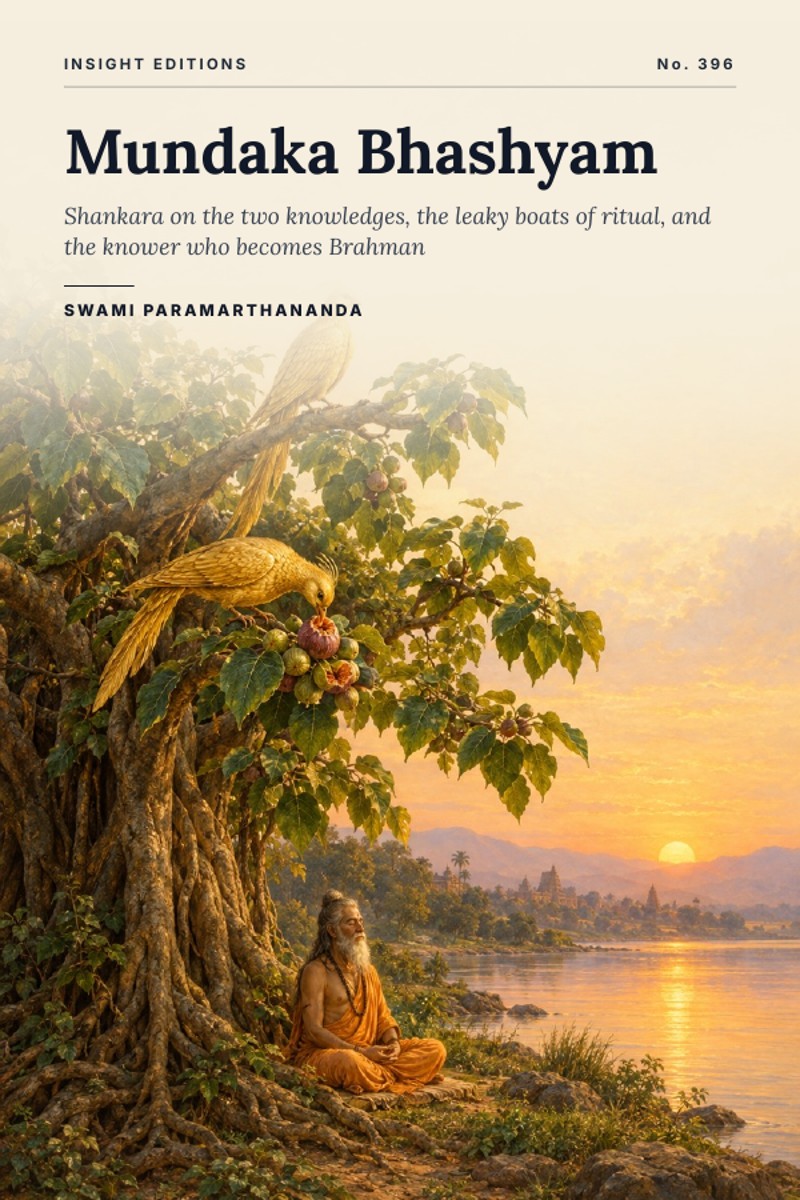
Mundaka Bhashyam
Shankara on the two knowledges, the leaky boats of ritual, and the knower who becomes Brahman
Swami Paramarthananda
A complete study edition of Swami Paramarthananda's lectures on the Mundaka Upanishad with Shankara's bhashya: Shaunaka's question, para and apara vidya, the imperishable, the limits of ritual, the guru, sparks from the fire, the bow and arrow, the two birds, satyameva jayate, and rivers entering the ocean.
A study guide to Swami Paramarthananda's lectures on the Mundaka Upanishad with Shankara Bhashyam (compiled by Divyajnana Sarojini Varadarajan, Arsha Avinash Foundation). Shared free for personal reading; not for sale and not endorsed by the author or publishers. Please read and study the original.
CORE CLAIM
Shankara reads the Mundaka as one long answer to one question: what is that, by knowing which, everything is known? The answer is akshara Brahman, known as oneself, and that knowledge alone liberates.
SCOPE
All three mundakas, six khandas and about 64 mantras with Shankara's bhashya rendered sentence by sentence, from the five teachers of 1.1.1 to the closing prostration of 3.2.11.
KEY FIGURES
Shankara, the teacher Angiras, the student Shaunaka, the lineage Brahmaji, Atharva, Angir, Satyavaha. Teacher: Swami Paramarthananda. Compiler: Divyajnana Sarojini Varadarajan.
BEST FOR
Students who know the Mundaka mantras and want Shankara's reasons: why rituals are leaky boats, why the guru is required, why Brahman is not even a cause, and why liberation is knowledge, not travel.
The Book on One Page
A householder asks one question. A teacher answers it in two knowledges, three chapters and six sections, and Shankara defends each step.
The Mundaka is a dialogue between Angiras and Shaunaka. Its three chapters (each a mundaka) have two sections (each a khanda). Chapter 1 names two knowledges, apara (all of ritual and its sciences) and para (knowledge of the imperishable), and then shows the limits of ritual so the student turns away from it. Chapter 2 teaches Brahman as the cause of everything and then as oneself, using the bow and arrow. Chapter 3 gives the two birds, the disciplines that ripen the knowledge, and its fruit: one becomes Brahman, like rivers entering the ocean.
The knower of Brahman becomes Brahman: not by going anywhere, but by dropping the notion of being other than it.
| Ch | Title | One-line payload |
|---|---|---|
| 1 | Why a Commentary | Purpose, subject, the knower |
| 2 | Five Teachers, One Question | Lineage and Shaunaka's ask |
| 3 | Two Knowledges | Apara and para defined |
| 4 | The Imperishable | Beyond subject and object |
| 5 | Spider, Earth and Hair | Cause without a second |
| 6 | The Ritual Path | Agnihotra and its reward |
| 7 | Leaky Boats | Why karma cannot free |
| 8 | The Corridor Mantras | Viveka and the guru |
| 9 | Sparks from the Fire | Creation and its purpose |
| 10 | The Bow and the Arrow | Om, self, target |
| 11 | Knots Are Cut | Fruit; the self-luminous |
| 12 | Two Birds | Jiva and Ishvara on one tree |
| 13 | Truth Alone Wins | Four supporting disciplines |
| 14 | Not by the Weak | Desire, choice, strength |
| 15 | Rivers into the Ocean | Liberation and the rules |
Why a Commentary
Shankara opens by supplying what every text must state: who it is for, what it treats, what it gives, and how the two connect.
The four preliminaries
Every scripture must state its anubandha chatushtaya before teaching. Shankara does not list them in order, but he gives all four. He starts with the benefit, because that is what makes a student listen.
| Preliminary | Meaning | In the Mundaka |
|---|---|---|
| Adhikari | Qualified student | A mature householder turned seeker |
| Vishaya | Subject matter | Akshara Brahman, one with the self |
| Prayojana | Benefit | Moksha, freedom from samsara |
| Sambandha | Link | Knowledge removes ignorance, the cause of samsara |
Where the Upanishads sit
The teacher places the text in the prasthana trayam: Upanishads, Gita, Brahma Sutras. The Veda is anadi, beginningless, and comes out of the Lord like breath, naturally and without effort. Its first part, karma kanda, guides a purposeful life; its last part, jnana kanda, gives freedom.
Shankara's commentaries are valuable because they fix the meaning. The Upanishads use Vedic idiom from another age; without a commentator, the same mantra yields many readings, and the reader picks the one that suits his preference.
The central thesis of the bhashya
Shankara states it at once: knowledge alone gives moksha. Rituals, meditation, or a combination of knowledge with ritual cannot. He will return to this when he analyses karma in chapter 1 and when he discusses renunciation at the end.
- Read the purpose first. If the goal is clear, every digression in the text is seen as serving it.
Five Teachers, One Question
Mantras 1.1.1 to 1.1.3. The text praises the knowledge by naming its teachers, then gives the question on which advaita rests.
Praise by lineage
To create interest, the Upanishad says Brahma vidya was taught by Brahmaji, the first born, to Atharva, who taught Angir, who taught Satyavaha, who taught Angiras. Shankara stresses the phrase "purvam uvacha": each teacher passed on the very same knowledge, adding nothing of his own.
Two meanings of "foundation of all knowledges"
| Reading of sarvavidya pratishtha | What it means |
|---|---|
| Ground of every subject | Every science studies some object; that object exists only in Brahman |
| Fulfilment of every subject | All other knowledge is finite; this one ends the search |
The knowledge is also called paravara: it reveals the higher (para) and the lower (avara), the cause and the effect.
Shaunaka asks
Shaunaka is a mahashala, one with a large hall for rituals. That detail tells us he has lived his householder duties well and gained a mature mind. He approaches Angiras properly, as the rules require, and asks: "Revered sir, what is that which, when known, all this becomes known?"
Shankara raises a doubt (marked by the word nanu): if Shaunaka does not know such a thing exists, how can he ask "what is it?" He should ask "is there such a thing?" Shankara answers: the longer form would need too many words, and before a great teacher one is brief. The shorter question is perfectly correct.
Two Knowledges
Mantras 1.1.4 and 1.1.5. Angiras replies that two knowledges must be known, and defines both.
The answer begins with a division
Angiras says the knowers of Brahman speak of two knowledges: apara, the lower, and para, the higher. The lower comes first in the reply, not because it answers the question, but because it must be known and set aside.
| Apara vidya | Para vidya |
|---|---|
| Four Vedas: Rig (verse), Yajur (prose), Sama (song), Atharva | The knowledge by which the imperishable is attained |
| Six angas: shiksha, kalpa, vyakarana, nirukta, chandas, jyotisha | Its subject is one: akshara Brahman |
| Teaches dharma and adharma, their causes and results | Its result is freedom from results |
| Gives punya and papa, hence rebirth | Ends avidya, hence rebirth |
Even the Upanishad is apara
Shankara makes a sharp point. Para vidya is not a set of books. The words of the Upanishad, as words, belong to apara. Para vidya is the knowledge that arises from them about the imperishable. Hearing the text without understanding is still lower knowledge.
The division is not sacred versus secular. It is finite result versus the end of results. Rituals in the Veda and science in a laboratory fall on the same side.
- Study the text, then own its meaning. Recitation and scholarship stay apara until they become "I am this".
The Imperishable
Mantra 1.1.6, a key mantra analysed in the Brahma Sutras. It defines akshara, then calls it the source of all beings.
Defined by what it is not
The mantra lists adjectives. Shankara explains each so that Brahman is seen as beyond subject and object, unconditioned by time and space.
| Word | Shankara's sense |
|---|---|
| Adreshyam | Not an object of the five senses |
| Agrahyam | Not grasped by the organs of action |
| Agotram | Without lineage or root |
| Avarnam | Without attributes such as colour or size |
| Achakshu, ashrotram | Without eyes or ears, hence not a knower either |
| Nityam, vibhum | Eternal, and appearing as manifold |
| Sarvagatam, sukshmam | All pervading, subtle |
| Bhutayoni | Source of all beings |
Negation plus a pointer
Negation alone would leave the student with nothing. So the second line gives a positive pointer: akshara is the bhutayoni, the material cause of all. Since a product has no existence apart from its material, knowing the one cause is knowing all products. This is how the mantra answers Shaunaka.
Calling Brahman the cause is a teaching device. Shankara will later say Brahman is not even a cause. A reader who stops at chapter 1 can take creation as literal and miss the advaita; the Upanishad accepts that risk to begin from what the student already believes.
Spider, Earth and Hair
Mantras 1.1.7 to 1.1.9. Three examples show how one cause becomes many without a second thing, and how creation unfolds.
Three examples, three points
| Example | What it shows |
|---|---|
| Spider and web | One being is both intelligent and material cause; needs no outside material |
| Earth and plants | Products come without effort or change in the source |
| Living body and hair | Insentient things come from a sentient source |
Together they say: the world is not a second thing produced from outside; it is the one cause appearing as names and forms.
Gradual, not sudden
Mantra 1.1.8 says creation unfolds in stages, like seed to sprout to tree, or a child in the womb to an adult. It is unlike a dream, where everything appears at once, or a fistful of fruits thrown that all fall together. The cause here is Brahman with maya, called Ishvara.
What is the Lord's tapas?
1.1.8 says Brahman "expands by tapas" but does not define it. Shankara reads it from 1.1.9: "yasya jnanamayam tapah", whose tapas is knowledge. The Lord does not strain; creation is omniscient planning, not penance.
- Look at products and see the material. A pot is clay with a name; the world is Brahman with names.
The Ritual Path
Mantras 1.2.1 to 1.2.6. Before teaching para vidya, the Upanishad gives ritual its full due.
Why describe ritual at all?
The section's aim is to lead to para vidya. But a thing is understood in its place only when it is shown with its benefits and its problems. So the Upanishad first praises apara vidya, then exposes it.
| Gain | Kind |
|---|---|
| Material: comfort here (iha loka) and hereafter (para loka) | For the one who wants results |
| Chitta shuddhi (purity) from ritual; chitta ekagrata (focus) from meditation | For the one who wants freedom |
Kinds of action
| Type | Instrument | Example |
|---|---|---|
| Kayika karma | Body | Physical ritual |
| Vachika karma | Speech | Chanting |
| Manasika karma (upasana) | Mind | Meditation |
| Upasana sahita karma | All three | Ritual with meditation, the most powerful |
Agnihotra, done well and badly
The agnihotra stands for all Vedic rituals. If done improperly or irregularly, the text says it destroys seven generations or seven worlds. Shankara reads this as strong discouragement: the Upanishad wants seekers to go for atma jnana. Done properly, the oblations, personified, carry the ritualist along the rays of the sun to svarga, speaking pleasant words: "Come, come. This is your world of merit."
The praise is real and the reward is real. That is the point: the student must see that even the best result of karma is still a result.
Leaky Boats
Mantras 1.2.7 to 1.2.11. Now the Upanishad turns, and criticises ritual and those satisfied with it.
Plava hy ete adrdhah
"These boats are leaky." The eighteen participants of a sacrifice, its materials and its acts form the means. Every karma has three parts, and each is finite.
The blind leading the blind
People who think themselves wise, living in ignorance, keep doing karma. The text compares them to the blind led by the blind. They suffer, enjoy petty pleasures in between, and stay satisfied. Shankara says such people cannot be helped while their satisfaction lasts, because even svarga is within avidya.
| Karmi's belief | Upanishad's correction |
|---|---|
| "Svarga gives immortality" | Only relative long life; one falls back |
| "Ritual is the highest sadhana" | It is a preparatory sadhana |
| "More karma, more security" | Karma binds; it cannot remove ignorance |
Shankara is not against karma
He grants that karma yoga is prescribed for every seeker at the beginning, for chitta shuddhi. His objection is to treating karma's fruit as eternal. 1.2.11 then praises upasana with a simple life in the forest: it leads to Brahmaloka, which is still finite.
The criticism is severe, even mocking. It works as shock therapy, but a modern reader may find it unfair to sincere ritualists. Shankara softens it by keeping karma yoga as the first stage; the attack is on the destination, not on the discipline.
The Corridor Mantras
Mantras 1.2.12 and 1.2.13. Two mantras carry the student from apara to para vidya, and name the qualifications on both sides.
Pariksya lokan
"Having examined the worlds gained by karma, a brahmana should gain dispassion: the uncreated is not gained by the created." This is among the most quoted mantras in Vedanta.
Samit pani: approach with fuel in hand
To know That, he must go, fuel in hand, to a guru who is shrotriya (versed in scripture) and brahmanishtha (established in Brahman). Shankara adds: even a learned person should not study on his own; he must go to a teacher.
| Side | Qualification |
|---|---|
| Student | Viveka, vairagya, mumukshutva; approaches properly; calm mind, self control, free of pride |
| Teacher | Shrotriya: can communicate; Brahmanishtha: has the knowledge |
| Teacher's duty | Must teach a qualified student, as it is, by which the imperishable is known |
The uncreated cannot be produced by any action, so it can only be known. Knowledge needs a means; for the self, that means is the teaching, handled by a teacher.
Sparks from the Fire
Mundaka 2, section 1. Para vidya begins: Brahman is the cause of all, and all is nothing but Brahman.
Two satyams?
Chapter 1 called karma "satyam". Now Brahman is called satyam. Are there two truths? No. Karma was called satyam only because its result surely comes. Brahman alone is absolutely real.
Sparks and the imperishable beyond
As thousands of sparks rise from a blazing fire, of the same nature, so beings come from akshara and return to it. Mantra 2 then says the purusha is beyond even the akshara. The teacher explains: the causal state is taught first because products are not different from cause. But Brahman is neither a product nor a cause; one can only say what it is not.
| Question | Answer |
|---|---|
| Was prana in Brahman before creation? | No, prana is born from it |
| Is Brahman with prana after creation? | No: creation is born of ignorance, so from the absolute view prana is never there |
| Then why speak of creation? | To show the world is not separate, hence mithya |
The cosmic person
Shankara calls mantra 2 the key: nirguna Brahman with maya becomes the cause, which evolves into the effect. Mantra 4 describes Virat: fire is his head, sun and moon his eyes, quarters his ears, Vedas his speech, earth his feet. Mantra 5 gives panchagni vidya, the jiva's travel through five fires between death and birth. Mantras 6 to 9 list rituals, gods, humans, plants, seven organs, mountains, oceans and rivers: all from Brahman.
Purusha evedam vishvam
2.1.10 closes: "This whole world is the purusha alone." Of the three, paramatma, jivatma, jagat, the world is negated as not separate, and the knower who sees this in the cave of the heart cuts the knot of ignorance.
- Read creation lists as one sentence. Each item is a reminder: this too is not other than Brahman.
The Bow and the Arrow
Mantras 2.2.1 to 2.2.4. Shankara answers how pure existence can be known: only as consciousness, only as the subject.
The doubt behind the section
Brahman is in everything as sat, existence. But pure existence is never an object; it is seen only with names and forms. How can it be known? Only as consciousness, recognised as "I". So almost every mantra here is a mahavakya mantra.
Support without duality
Brahman is called the support of all, then all. Why both? "Support" alone suggests two: base and based. The relation is like water and waves: water alone appears as wave. So the world rests on Brahman without duality.
The archery image
| Element | Stands for |
|---|---|
| Bow | Omkara |
| Arrow | Jivatma, sharpened by upasana |
| Target | Brahman |
| Archer's state | Apramatta, unwavering attention |
| Hit | Arrow one with target |
Omkara can mean two things. Omkara upasana is meditation; it gives liberation in stages. Omkara vichara, enquiry into Om's meaning as in the Mandukya, gives immediate freedom. Shankara reads the bow in the light of both.
Knots Are Cut
Mantras 2.2.5 to 2.2.12. The section restates identity in images, gives the fruit of knowledge, and ends with the self-luminous.
Thread and hub
In mantra 5, heaven, earth and the mind are woven on Brahman like cloth on thread: the cloth owes its existence to the thread. "Know that one self alone; give up other talk. This is the bridge to immortality." In mantra 6, the heart is a hub where the nadis meet like spokes; there the self moves as the witness.
Three results of knowing
When one sees Brahman as both cause and effect, and as "I", three things happen.
| Result | Shankara's sense |
|---|---|
| Hrdaya granthih bhidyate | Knots of the heart (desires) are cut |
| Chidyante sarva samshayah | All doubts are removed |
| Kshiyante cha karmani | Karmas (sanchita, agami) are exhausted |
The self is bound by ignorance, desire and karma; of these, desire is the strongest knot, so Shankara takes "knots" as kama.
Na tatra suryo bhati
The sun does not shine there, nor moon nor stars nor lightning, much less this fire. When it shines, all shine after it. This mantra also occurs in the Katha. The self is always the experiencer, never the experienced; it illumines every light, and nothing illumines it.
2.2.12 says Brahman alone is everything. Does that make Brahman and the world the same? No. Atma and anatma cannot be equal. Brahman is satyam; the world is mithya, existing on it. The wise see the world as Brahman alone; the ignorant see it as abrahman.
Two Birds
Mantras 3.1.1 to 3.1.4. Why another chapter, after the answer is given? To show the knowledge and the means once more, through one famous image.
Why chapter 3?
Shankara condenses chapters 1 and 2 in six lines, borrowing words from 1.1.5, 1.2.13, 2.1.10 and 2.2.3. The question is answered. Chapter 3 adds sadhana and phala in more detail: repetition is how the Upanishad underlines.
Dva suparna
Two birds, companions, sit on one tree. One eats the sweet and bitter fruit; the other looks on without eating.
| Image | Meaning |
|---|---|
| Tree | The body and mind |
| Eating bird | Jivatma, consciousness reflected in the mind, experiencing karma phala |
| Watching bird | Paramatma, the witness |
| Fruits | Joy and sorrow |
The jiva is sunk in samsara, weighed down by ignorance, identification, desire and attachment. When it sees the other, the Lord, as its own glory, its grief ends. Shankara stresses that the reflected jiva is not different from Brahma chaitanya.
The jnani as revelling in the self
3.1.4 calls the self prana, as the life of life. The jnani is atmakrida and atmarati. Shankara separates the two: krida is play that needs no instrument, rati is delight; both are in the self, while the jnani still acts in the world.
3.1.3 calls the Lord kartaram, the doer. Does that make him a samsari? Shankara answers that for the jiva, "doer" means one who does punya and papa out of ignorance; for the Lord, it means the creator, untouched. The reconciliation works, but it rests on giving the same word two meanings in one verse.
Truth Alone Wins
Mantras 3.1.5 to 3.1.10. Having stated the knowledge and its fruit, the Upanishad turns to the means.
Four supporting disciplines
Jnana is the primary discipline. Four others support it; without them, knowledge does not arise, or does not fructify into freedom.
| Discipline | Meaning here |
|---|---|
| Satyam | Truthfulness |
| Tapas | One-pointedness of mind |
| Samyak jnanam | Shravana, manana, nididhyasana |
| Brahmacharyam | Self control |
Satyameva jayate
"Truth alone wins, not untruth." Shankara notes that a quality cannot win or lose; it does not exist by itself. So truth means the truthful person. When the primary meaning does not fit, take the secondary one. By this path the seeker reaches the supreme treasure.
Not grasped by the eye
Brahman is self evident, therefore not evident to the senses or mind; whatever the mind grasps is not self evident. It is far for the ignorant and near, in the heart, for the seer. It is not reached by the eye, speech, other organs, austerity or rituals. Only a mind purified by knowledge, meditating, sees the partless self.
| Claim | Reason |
|---|---|
| Disciplines are only secondary means | They purify the mind |
| The pure mind is the unique means | Atma is recognised in the mind |
| Recognition is in the heart | Though all pervading, atma is known as the witness of each thought |
The jnani as a blessing
3.1.10: a jnani's mind is sattvik, close to Ishvara, so he gains satya sankalpa: his resolve comes true. Whoever worships him gains what they wish.
Not by the Weak
Mantras 3.2.1 to 3.2.4. The last section opens with the jnani's glory, then returns to the means, now as choice and strength.
Desire decides the next birth
A jnani gives both worldly results (by mere sankalpa) and moksha (only by teaching). What of those who want only worldly things? They are reborn with their desires, where the desires take them. Whatever strong desire is present at death becomes the cause of the next birth.
| Desire for anatma | Desire for atma |
|---|---|
| Leads to rebirth | Leads to freedom |
| Pursued for many objects | Fixes one priority |
| Ends with each result | Ends desire itself |
Nayam atma pravachanena labhyah
"This self is not gained by discourse, nor intellect, nor much hearing. It is gained by the one who chooses it." Shankara reads "choose" as mumukshutva: making the self the only priority. Intense desire brings intense effort, and effort overcomes other deficiencies.
Four more supports
| Support | Meaning |
|---|---|
| Bala | Strength drawn from the self, not from props |
| Apramada | Not slipping from the path |
| Tapas | Discipline |
| Linga | Its mark, read by Shankara as sannyasa |
- Put the self first. The text promises that seriousness compensates for weak qualifications; distraction cannot be compensated.
Rivers into the Ocean
Mantras 3.2.5 to 3.2.11. Knowledge, its two fruits, the rules of teaching, and the closing prostration.
Entry without movement
3.2.4 said the jiva "enters" Brahman. Any movement would make moksha a karma phala with a beginning and end. So the Upanishad clarifies: there is no travel, only knowledge. Entry is dropping the notion of separation.
Vedanta vijnana sunishchitarthah
This mantra is chanted when offering purnakumbha to a sannyasi, and occurs in the Kaivalya too. Seekers who have firmly ascertained the meaning of Vedanta, with minds purified by sannyasa, gain jivanmukti (paramrtah) and then videhamukti (parimuchyanti). They do not seek a destination elsewhere.
Rivers lose name and form
As rivers flowing enter the ocean and lose name and form, so the knower, freed from name and form, reaches the purusha beyond the beyond. The jiva drops punya and papa, which alone condition its individuality. The same image appears in the Prashna, 6.5.
Brahma veda brahmaiva bhavati
"The knower of Brahman becomes Brahman." Shankara answers a common worry: between jivanmukti and death, anything can happen, so what assures videhamukti? Obstacles arise only before knowledge. Once known, nothing can stop the jnani from being Brahman.
Rules for teaching
| Rule | Content |
|---|---|
| Eligibility | Studied ritual and upasana; lived karma yoga; gained four qualifications |
| Shirovrata | A vow of the Atharva Veda, linked to shaving the head; source of the name Mundaka |
| Teacher's duty | Like Angiras, never refuse a qualified student |
| Close | Namah to the great rishis, the whole lineage |
Master Takeaways and Frameworks
Shankara reads the Mundaka as one answer, defended step by step. These are the points to keep.
Master takeaways
- Knowledge alone gives moksha; ritual, meditation or a mix cannot.
- The uncreated is not produced by action; it can only be known.
- Even the Upanishad's words are apara until they yield the knowledge.
- Brahman is taught as cause, then shown as not a cause; the world is mithya.
- The knower becomes Brahman by dropping separation, not by travel.
- A guru is required: shrotriya and brahmanishtha; one should not study alone.
- Apara vidya covers all finite knowledge, sacred and secular.
- Spider, earth, hair: one intelligent and material cause, no second thing.
- The Lord's tapas is knowledge, not penance.
- Ritual is praised fully so its best result is seen as still a result.
- Karma has karaka, kriya, phala; all finite, hence leaky boats.
- Pariksya lokan: examine results, gain dispassion.
- Pure existence is known only as consciousness, as "I".
- Om is the bow, the self the arrow, Brahman the target.
- Knowledge cuts desire, doubt and karma.
- The self lights every light and is lit by none.
- Two birds: the reflected jiva and the witness on one tree.
- Truth wins means the truthful person wins.
- The pure mind is the unique means; disciplines are supports.
- Desire at death decides rebirth.
- Choosing the self as the only priority is the primary sadhana.
- Rivers lose name and form in the ocean; so does the jiva in Brahman.
Frameworks
| Name | What it says | Use it when |
|---|---|---|
| Anubandha chatushtaya | Student, subject, benefit, link | Opening any text |
| Apara and para vidya | Finite result vs end of results | Placing any study |
| Karya and karana | Product is the cause with a name | Reading creation |
| Karaka, kriya, phala | Every action has three finite parts | Testing a means |
| Viveka, vairagya, mumukshutva | Examine, detach, seek | Leaving ritual for enquiry |
| Shrotriya and brahmanishtha | Can teach, and knows | Choosing a teacher |
| Pramata, pramana, prameya | Knower, means, known | Seeing why scripture is needed |
| Primary and secondary meaning | Use secondary if primary fails | Reading "truth wins" |
| Jivanmukti and videhamukti | Free now, free at death | Reading the fruit |
The bhashya's spine is that knowledge alone liberates and that sannyasa best supports it. The first follows tightly from the logic: ignorance is removed only by knowledge. The second is more contestable: Shankara reads "linga" and "sannyasa yoga" as formal renunciation, while other readings take them as inner renunciation open to householders. The teacher's own emphasis on karma yoga and mumukshutva keeps the door open.
Who's who
| Name | Role |
|---|---|
| Angiras | Teacher in the dialogue |
| Shaunaka | Householder who asks the question |
| Brahmaji, Atharva, Angir, Satyavaha | Earlier teachers of the lineage |
| Shankara | Commentator |
| Swami Paramarthananda | Teacher of the lectures |
| Divyajnana Sarojini Varadarajan | Compiler of the notes |
Connect it
- AI. Para and apara is a clean test for any learning system: more information about objects never adds up to knowing the knower. Better data improves apara; it does not cross over.
- Enterprise architecture. The guru requirement is a governance rule: a body of knowledge stays intact across generations only when each holder passes it on as received and adds nothing, which is what "purvam uvacha" demands.
About This Edition
This is an independent study guide to Swami Paramarthananda's lectures on the Mundaka Upanishad with Shankara's bhashya, compiled by Divyajnana Sarojini Varadarajan and published by Arsha Avinash Foundation.
The edition condenses the book into chapter-wise summaries, tables and diagrams for personal revision, drawing on the introductions to each mantra and the main discussions in the bhashya. It follows the teacher's structure and examples in its own words and does not reproduce the text, whose transcription has not been verified by Swami Paramarthananda. For the full teaching, please study the original with the Sanskrit text.