Insight Editions · No. 243
Metamagical Themas
Questing for the Essence of Mind and Pattern
Douglas R. Hofstadter
Hofstadter’s Scientific American columns and essays, from self-reference, Rubik’s Cube and Lisp to the Prisoner’s Dilemma, sexist language and nuclear war, all asking how patterns become minds.
A study guide to Metamagical Themas by Douglas R. Hofstadter. Shared free for personal reading; not for sale and not endorsed by the authors or publishers. Please read and buy the original.
Mind and pattern are one subject: creativity is variation on a theme, meaning lives in high-level patterns riding on subcognitive activity, and sanity means seeing the symmetry that binds rational agents together.
Self-reference, viral ideas, pseudoscience, number numbness, sexist defaults, Chopin, parquet deformations, nonsense, fonts, Rubik's Cube, chaos, Lisp, quantum theory, Turing, AI, analogy, the genetic code, game theory, superrationality, nuclear arms. 42 sections: 33 chapters, 7 section essays, cover notes and introduction.
Alan Turing, Donald Knuth, Ernő Rubik, Mitchell Feigenbaum, John McCarthy, Robert Axelrod, Anatol Rapoport, Richard Dawkins, Peter Suber, William Huff, Chopin, Herbert Simon; and Achilles and the Tortoise.
Readers of GEB who want its ideas applied across science, art and society, and anyone thinking about AI, creativity, cooperation and rational choice from first principles.
Douglas Hofstadter's Metamagical Themas: Questing for the Essence of Mind and Pattern (1985) collects the twenty-five columns he wrote for Scientific American from January 1981 to July 1983, under a title that anagrams Martin Gardner's "Mathematical Games", plus seven further essays, each followed by a Post Scriptum. Its apparent scatter, from Rubik's Cube and Lisp to sexist language and nuclear war, is held together by one quest: how patterns give rise to minds, and how minds perceive, vary and misuse patterns. The book is GEB carried into the world, more playful in form and more political in conscience.
- Creativity is variation on a theme. The cover's "Whirly Art", Chopin's études, Huff's parquet deformations and Knuth's Metafont all teach that creation means seeing knobs where others see constants; no finite "knobbed machine" can capture a rich category like the letter "A", which behaves like Gödel's productive sets.
- Self-reference and replication are everywhere. Self-referential sentences, viral sentences (Dawkins's memes made precise), Suber's self-amending game Nomic and the Lisp interpreter that treats data as program all show loops in which a system acts on itself.
- Society suffers from unreflective belief. Tabloids versus the Skeptical Inquirer, number numbness about millions, billions and megatons, and default assumptions that encode sexism (the surgeon riddle, the "Person Paper" satire) show how style, scale and habit distort truth.
- Structure has strangeness. Rubik's Cube is the best teacher of group theory ever made, with 43,252,003,274,489,856,000 states; iterating 4λx(1−x) yields period doubling, Feigenbaum's constant 4.669... and strange attractors.
- Minds emerge from substrates. Turing's life and Test, the careenium dialogue and "Waking Up from the Boolean Dream" argue that thought is not computation at the level of symbols but emerges statistically from subcognitive activity, with analogy and roles at its heart.
- Selection builds stability. The genetic code is arbitrary yet frozen by feedback; outpsyching games and Axelrod's tournaments show that TIT FOR TAT (nice, retaliatory, forgiving, clear) wins and cooperation can evolve without a central authority.
- Sanity requires superrationality. In a one-shot symmetric dilemma, rational agents should realise they will reach the same decision and so cooperate; the Luring Lottery fiasco, Happiton's demon-rigged bell and the tumult of inner voices carry the argument to the nuclear arms race and to what "I" means.
Section map
| # | Section | One-line payload |
|---|---|---|
| C | Notes on the Cover: Whirly Art | All creative acts are variations on themes; the cover as improvised art |
| In | Introduction: Mind and Pattern | 25 columns plus 7 essays; the anagram title; one quest behind the scatter |
| I | Snags and Snarls | Reflexivity: systems that twist back and close a loop |
| 1 | On Self-Referential Sentences | A zoo of self-referring sentences; self-reference is not paradox |
| 2 | Self-Referential Sentences: A Follow-Up | Reader mail sorted into genres; self-documenting sentences |
| 3 | On Viral Sentences and Self-Replicating Structures | Ideas as replicators; memes, chain letters, quines |
| 4 | Nomic | Suber's game in which changing the rules is a move |
| II | Sense and Society | The social cost of unreflective belief |
| 5 | World Views in Collision | Tabloids versus skeptics; truth judged by style |
| 6 | On Number Numbness | Feeling the difference between a million and a billion |
| 7 | Changes in Default Words and Images | The surgeon riddle; defaults quietly encode sexism |
| 8 | A Person Paper on Purity in Language | "William Satire" defends racist English, mirroring sexist English |
| III | Sparking and Slipping | Creativity as spark and slippability |
| 9 | Pattern, Poetry, and Power in Chopin | The magic behind musical magic is pattern |
| 10 | Parquet Deformations | Huff's tilings that morph in space like music in time |
| 11 | Stuff and Nonsense | From Carroll and Lear to Stein, Beckett and Dylan |
| 12 | Variations on a Theme as the Crux of Creativity | Concepts as knobbed machines; seeing new knobs |
| 13 | Metafont, Metamathematics, and Metaphysics | No finite program captures "A"; categories are productive sets |
| IV | Structure and Strangeness | Mathematical structures that leap disciplines |
| 14 | Magic Cubology | Rubik's Cube as mechanism, metaphor and group |
| 15 | On Crossing the Rubicon | Cube variants, God's algorithm, Cube culture |
| 16 | Mathematical Chaos and Strange Attractors | Period doubling, Feigenbaum's constant, Hénon attractors |
| 17 | Lisp: Atoms and Lists | The Lisp genie, atoms, lists, car, cdr, cons |
| 18 | Lisp: Lists and Recursion | Recursion; the porpuquine; power functions |
| 19 | Lisp: Recursion and Generality | Tower of Brahma; data becomes program |
| 20 | Heisenberg and Many Worlds | The real uncertainty principle; why I am this me |
| V | Spirit and Substrate | Where inanimate ends and animate begins |
| 21 | Review of Alan Turing: The Enigma | Universal machine, Enigma, Test, persecution |
| 22 | A Coffeehouse Conversation on the Turing Test | The Test defended; Hofstadter fooled by "Nicolai" |
| 23 | On the Seeming Paradox of Mechanizing Creativity | Creativity follows from concept representation; sphexishness |
| 24 | Analogies and Roles | Exportable roles are the heart of analogy and thought |
| 25 | Who Shoves Whom Around Inside the Careenium? | Interlocking levels; "I" as a forced self-image |
| 26 | Waking Up from the Boolean Dream | Cognition emerges from subcognition, against Simon and Newell |
| VI | Selection and Stability | Feedback gives evolution direction |
| 27 | The Genetic Code: Arbitrary? | Translation machinery; arbitrary yet frozen |
| 28 | Undercut, Flaunt, Pounce, and Mediocrity | Outpsyching games; pattern-sniffing programs |
| 29 | The Prisoner's Dilemma Computer Tournaments | Axelrod; TIT FOR TAT; evolution of cooperation |
| VII | Sanity and Survival | From dilemmas to the survival of the species |
| 30 | Dilemmas for Superrational Thinkers | 14 of 20 friends defect; superrationality defined |
| 31 | Irrationality Is the Square Root of All Evil | The Luring Lottery fiasco; reverberant doubt |
| 32 | The Tale of Happiton | A demon's bell and nuclear complacency |
| 33 | The Tumult of Inner Voices | A self as a community of voices; nuclear conscience |
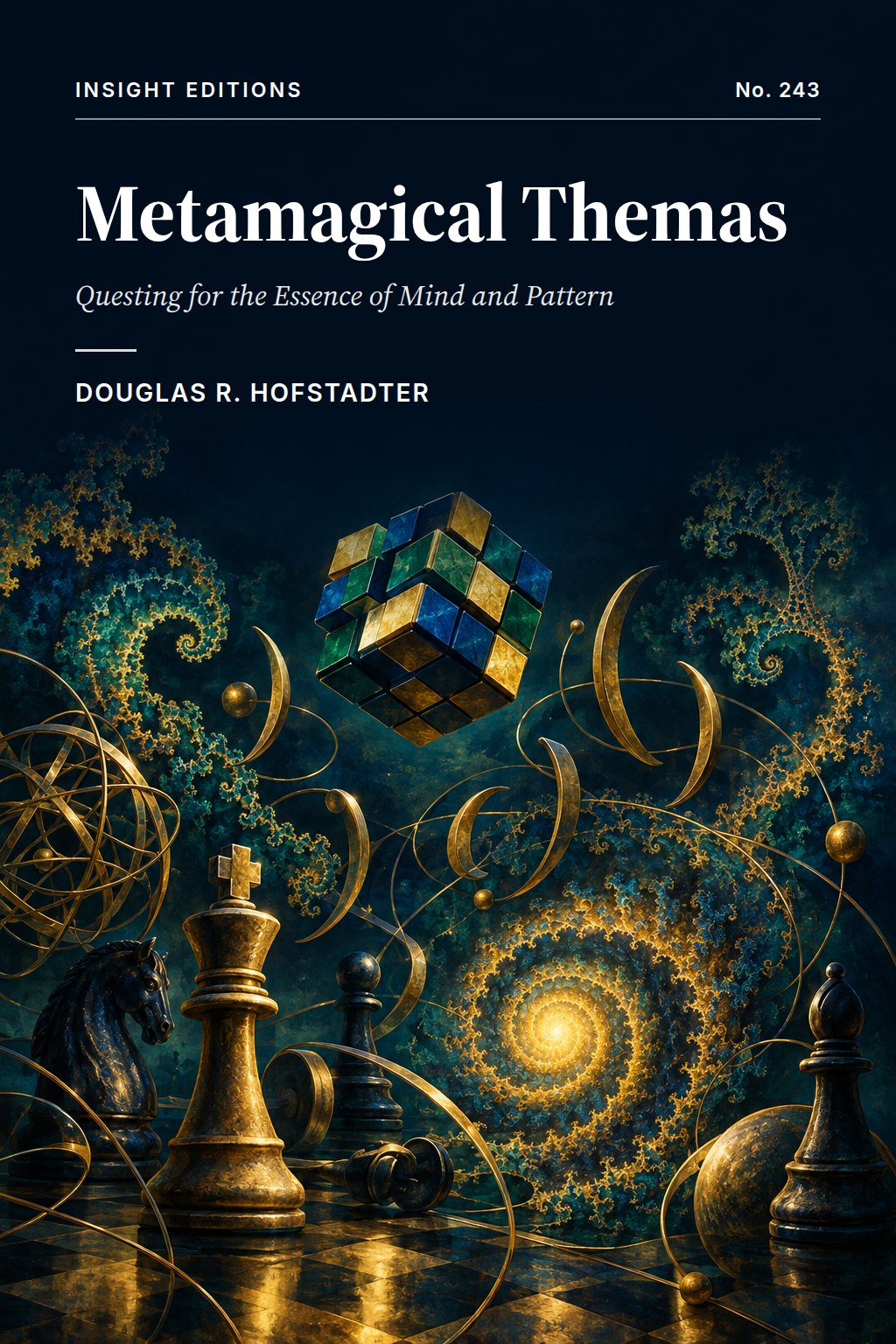
The cover drawing comes from "Whirly Art", an improvised, non-representational art form Hofstadter practised for about seven years, and he calls it possibly the most creative thing he has ever done. Its lesson frames the whole book: all his creative acts feel isomorphic at some deep level, so the way to lay bare the core of creativity is to find ever-simpler domains where he can watch himself "doing the same thing". The latest such domain is the gridfont, and the plan is to model it on a computer.
What Whirly Art was
His sister Laura gave the art form its light-hearted name, and it stuck. A typical piece sits on a long strip of adding-machine paper: five or six inches high and five or six feet long, with many reaching ten feet and some fifteen or twenty. The one-dimensionality was deliberate. Hofstadter was drawing visual fugues and canons: the long axis of the paper stood in for time, the narrow axis for something like pitch (no strict mapping), and a "voice" was a single line tracing a complex shape as it moved along. Several voices could interact, and a feel for good and bad visual harmony and counterpoint soon became intuitive.
The curvy motions of each voice came from alphabets. In the mid-1960s Hofstadter was fascinated by the writing systems of and around India: Tamil, Sinhalese, Kanarese, Telugu, Bengali, Hindi, Burmese, Thai and more. He studied several closely and even invented a script of his own on the principles most Indian scripts follow. The hand motions he was absorbing flowed into his visual fuguing, and Whirly Art was born.
Improvisation without erasers
Over several years he produced literally thousands of pieces, each improvised in pen, so there was no going back. A mistake could stay a mistake, or it could be reinterpreted as "a very daring move" that was hard but not impossible to recover from gracefully: what seemed at first a disastrous mistake could turn into a joyful challenge, as any jazz improviser knows. Sometimes he failed, sometimes he succeeded, judged by his own standards, since he was both performer and "listener".
Traditions are made to be broken. Whirly Art became a highly idiosyncratic language with its own aesthetic and traditions, and as soon as Hofstadter spotted a tradition he began violating it to see how he might "jump out of the system". Style succeeded style, and the art spontaneously retraced the history of Western music: baroque (fugues, canons), then classical, then romantic, and by the late 1960s the twentieth century, with a kinship to his favourite composers Prokofiev and Poulenc. It was "not translated music, but metaphorical music."
He did not leap on into a visual twenty-first-century music: by the early 1970s production slowed. It had taken seven years to recapitulate the history of Western music, and then the creative juices ran low. He could still make Whirly Art but was less inclined to, and today hardly ever does, though his curvy lines and letterforms bear its indelible marks.
Why the cover piece is atypical
The cover piece was drawn on an ordinary sheet, with no direction of temporal flow and no counterpoint, yet it keeps the Whirly spirit. The book also contains seven Whirly alphabets, one on the title page of each of the seven sections. They too are atypical: they have a clear flow (from A to Z), but they use genuine letters of a genuine alphabet, whereas real Whirly Art avoided real letters in favour of letter-inspired shapes even "whirlier" than Tamil or Sinhalese letters.

One core, many costumes
Whirly Art is strange, cannot be understood instantly, and has its own logic, related to musical harmony and counterpoint, Indian alphabets, gestalt perception "and who knows what else". It sits rolled up in paper bags and cardboard boxes in his closet, hard to show anyone. Yet the experience is "an absolutely central fact" about how he sees art, music and creativity: whenever he writes about creativity, part of his mind is re-enacting Whirly Art. His convictions come more from self-observation than from scholarly study of composers' sketches, because "you don't really understand it unless you've done it".
His stronger claim: any two creative things he has done seem, at some deep level, isomorphic. Whirly Art, mathematical discoveries, strange dialogues and little piano pieces all come from "a very similar core", the same mechanisms "only dressed up differently", though not of equal quality (his real music is weaker than his visual music). Hence his method: pursue ever-simpler domains in which he can feel himself doing the same thing. Chapter 24 (the book's most creative) describes three: Seek-Whence, Copycat and Letter Spirit.
Gridfonts: Whirly Art in a straitjacket
Letter Spirit, and gridfonts in particular, is his current obsession. It grew from a lifelong love of alphabets: he "boiled away" the less interesting aspects of letterforms until only their conceptual skeletons were left. People assume there can be only a few gridfonts; that is "dead wrong", since there is a huge number of them and their variety is astounding.
Whirly Art: free, sprawling, improvised; the choices happen too fast and in too rich a space to observe.
Gridfonts: "preposterously constrained"; choices still resist explanation, but at least they can be watched, and they come with the hindsight of years of thinking about artificial intelligence.
Producing a gridfont feels like "just Whirly Art all over again": the same shape transformations, the same quest for grace and harmony, the same intuitions of what works, the same desire to jump out of the system. Since Whirly-Art creativity is, he feels, no deeper than gridfont creativity, computer modelling of gridfont creation might reveal what he has long sought. The next few years would test whether modelling can capture what his mind does when it makes something "excitingly novel". Boiling things down to their conceptual skeletons is, for him, "the royal road to truth", and much truth about Mind and Pattern waits in the tiny domains he carved out over seven years in Indiana.
Practitioner angle. The method generalises: when a capability (creativity, judgement, "good design") is too rich to study, shrink the domain until the choices become observable, then model it. Benchmarks such as ARC (abstract letter-and-grid analogy puzzles, close cousins of Copycat and Letter Spirit) are built on exactly this bet, and they remain hard for large language models in ways that echo Hofstadter's insistence that the skeleton, not the surface, is where understanding lives.
Critical lens and currency. The claim that all one's creative acts are isomorphic rests on introspection, which Hofstadter openly prefers to scholarship; psychologists treat such self-reports cautiously. The research programme he announces did happen: Gary McGraw's Letter Spirit (doctoral work, 1995) and John Rehling's later version modelled gridfont style, and Copycat (Melanie Mitchell, 1993) and Metacat (James Marshall) modelled analogy, all at the Fluid Analogies Research Group. These systems showed rich behaviour in micro-domains but never scaled; meanwhile deep learning produced fluent fonts and images by statistical training, the opposite of the conceptual-skeleton route.
Metamagical Themas collects the 25 columns Hofstadter wrote for Scientific American from January 1981 to July 1983, plus seven other essays, each followed by a Post Scriptum that ties it to the rest. The apparent scatter (sexism, music, nonsense, game theory, AI, molecular biology, the Cube) hides one territory: Mind and Pattern, the patterns of the universe and the mental patterns that let us perceive them. A second fire runs through it: concern for humanity's fate, because "apathy on the individual level translates into insanity at the mass level".
Carte blanche from Scientific American
In mid-1980 editor Dennis Flanagan offered Hofstadter the slot long held by Martin Gardner's "Mathematical Games", explaining that the column had always been Gardner's licence to discuss "anything under the sun", proof that a modern intellectual's interests need not be confined by labels such as "scientific" or "literary". The successor could cover his own range. Hofstadter would occupy the same physical spot, not the same role: carte blanche before a vast audience.
He still deliberated hard: he saw himself as a thinker and researcher, not primarily a writer, and writing time was research time lost. The conservative path (decline, keep researching) and the adventurous one (accept, forsake some research) were both risky, since either way he would wonder how the other would have gone, and the column's length was open-ended. He knew from the start he would accept, being "more adventurous than conservative", but like buying clothes he wanted to parade in front of the mirror first, so he consulted many people before saying yes.
1980 Flanagan's offer arrives in mid-year.
1981 Column begins in January; for the first year it alternates monthly with Gardner's.
1982 Gardner retires; the space is Hofstadter's alone.
1983 Last column in July; two surprise Gardner columns fill the gap; Hofstadter's farewell runs as a postscript to Gardner's final column in September.
1985 The columns, seven extra essays and long Post Scripta appear as this book.
In Martin Gardner's shadow
In the first year Hofstadter felt tradition-bound despite his freedom. He had metamorphosed Gardner's title into his own (the anagram is explained in Chapter 1), knowing readers would expect similar fare. Some were disappointed he was "not a clone of Martin Gardner"; others praised him for holding the quality while changing style and content. The confusion persisted: as late as June 1983, at an AI conference, a colleague eagerly told him a math puzzle for his "Mathematical Games" column. Nobody loved Gardner's column more or owed more to it, yet he did not want his identity confused with someone else's. He hit his stride after a few months and took Flanagan's offer literally, venturing into music and literature.
Phasing out
After about a year and a half he sorted his remaining topics into three piles.
Hofstadter's triage of future columns
- Columns he would love to write: about one year's worth left.
- Columns he would simply enjoy writing: perhaps another year's worth.
- Columns he could write "with interest but no real passion": a large number.
The arithmetic said to reassess within a year, and it dovetailed with the magazine's wish to launch a column on the recreational aspects of computing (this became A. K. Dewdney's "Computer Recreations"). His column was phased out as the new one phased in. He judges the stint "just about the right length": long enough to say a lot, short enough not to become a drag or to bend the course of his life.
A territory of random dots
Hofstadter pictured his intellectual home territory as a large region of conceptual space that most people do not see as connected; each column was a "random dot" in it, and he hoped the dots would eventually reveal the region's shape. He suspects 25½ columns were too sparse to show the web of cross-connections, so the book adds seven other recent writings (asterisked in the contents) to fill the most blatant gaps.
Mind and Pattern
Asked what the book is about "in a word", he would mutter "Mind and Pattern", once a candidate title for the column, accurate but not vivid enough. He calls himself "a relentless quester after the chief patterns of the universe", which is why he always makes a beeline for a bookstore's math section, even after dropping the idea of becoming a professional mathematician: mathematics studies the most fundamental, pervasive patterns.
With age his focus shifted inward: to the mental patterns that let minds conceive mathematical ideas and grasp abstract regularities of all sorts, the subliminal patterns of memory and association. Mind became central as "the principal apprehender of pattern" and a principal producer of it.
Music as the deepest pattern. Music is "a product of the mind that the mind has not come close to fathoming", and much of his research aims at musical and visual beauty. He wants to understand them better but not perfectly: a mathematical formula for Bach or Chopin is, he thinks, impossible and "nonsense", and the prospect is repugnant, yet he is drawn to push as far as possible in that direction. How could anyone fascinated by beauty not be intrigued by a chimerical "magical formula", or fail to see in computers the ultimate tool for exploring creativity's essence?
The other fire: humanity's fate
Hofstadter is a self-described activist who periodically gets fired up by a cause and exhorts everyone to join, and he is baffled by apathy. His motto: "Apathy on the individual level translates into insanity at the mass level." The prime exhibit is the dedication of vast human and natural resources to "unimaginably catastrophic arsenals" while mountains of humanity starve. This strand surfaces throughout and dominates the book's end.
How this book differs from GEB and The Mind's I
| Book | Form | Musical analogue | Alternation |
|---|---|---|---|
| Gödel, Escher, Bach (1979) | one potent spark worked out in detail; first long book, "all the stops pulled out" | a fugue on one complex theme | Dialogues and Chapters |
| The Mind's I (1981, with Daniel Dennett) | annotated anthology probing matter and consciousness | variations on a theme | fantasies and reflections |
| Metamagical Themas (1985) | columns plus essays on several themes | a fantasia on several themes | articles and Post Scripta |
GEB was "one extended flash" about Gödel's incompleteness theorem, the brain and consciousness, aptly called "a metaphorical fugue on minds and machines". The Mind's I (subtitle "Fantasies and Reflections on Self and Soul") is monograph-like in having one goal. Metamagical Themas would be disjointed without its Post Scripta, which cast each article in the light of others; some approach the length of their article, and Chapter 24's is much longer, because Hofstadter used it to describe his current AI research. He never goes into technical details; his concern is the central riddles of how minds work that keep recurring in different guises.
The Cube and Armageddon in one book
Giving Rubik's Cube and nuclear Armageddon equal space needs a defence. Partly because life mixes light and serious, and "life is not worth living if one can never afford to be delighted". More deeply, elegant mathematical structures can be as central to a serious worldview as social concerns, because the incomprehensibly huge can only be grasped through simpler models.
The middle rung. Robert Axelrod's work on the Prisoner's Dilemma (Chapter 29) sits halfway between the Cube and Armageddon in complexity, abstraction, size and seriousness, and shows mathematics helping at the social scale as it long has at the microscopic scale. Many smart people "turn off" when issues are too big; the cure is to make them graspable and fascinating through clarity, simplicity, precision, elegance, balance and symmetry, the artistic qualities the book celebrates (and why "magic" sits inside its title).
His closing hope: more clarity and elegance in thinking about situations large and small, and more energy for global problems "in this lunatic but lovable world", because if we do not care enough now, future generations may not exist to thank us.
Practitioner angle. Hofstadter's "simpler models for incomprehensibly big issues" is the enterprise architect's daily job: a capability map, a toy simulation or a one-page game-theory sketch of a market often moves a board further than a hundred pages of detail. His triage of columns (love, enjoy, no passion) is also a decent portfolio heuristic for an innovation pipeline: know when the first category is nearly exhausted and plan the hand-over.
Currency. The world he feared has changed shape but not vanished: global nuclear stockpiles peaked around 70,000 warheads in 1986 and stand near 12,000 today, still enough for the catastrophe he describes. Hofstadter's later books (Fluid Concepts and Creative Analogies, 1995; Le Ton beau de Marot, 1997; I Am a Strange Loop, 2007; Surfaces and Essences with Emmanuel Sander, 2013) continued the "Mind and Pattern" line, and in 2023 he said publicly that the rapid progress of large language models had frightened him and upended his expectation that human-level AI was very far off.
Section I is about systems that twist back on themselves and close a loop, a phenomenon Hofstadter calls reflexivity. Sentences, pictures, organisms, governments, mathematical structures and programs can all do it, and although reflexivity's link with paradox makes it look like a parlour game, it is central to twentieth-century mathematics and science and increasingly central to theories of intelligence and consciousness.
The title evokes problematical twistiness: a system (sentence, picture, language, organism, society, government, mathematical structure, computer program) that twists back on itself. The general abstraction is reflexivity, and each concrete realisation gives a phenomenon of its own.
The family of reflexive phenomena Hofstadter lists
self-reference, self-description, self-documentation, self-contradiction, self-questioning, self-response, self-justification, self-refutation, self-parody, self-doubt, self-definition, self-creation, self-replication, self-modification, self-amendment, self-limitation, self-extension, self-application, self-scheduling, self-watching, "and on and on".
The four chapters that follow illustrate these loops in sentences and stories that talk about themselves, ideas that propagate from mind to mind, machines that replicate themselves and games that modify their own rules. Study of reflexive systems, far from being mere play, is central to understanding the mathematics and science of the century and is becoming central to theories of intelligence and consciousness, natural or artificial. Reflexivity therefore returns again and again in the book.
Hofstadter's first column (January 1981) is a curated zoo of self-referential sentences, and under the jokes lies a serious claim: self-reference is everywhere in language, is not the same as paradox, and exposes how minds bridge form and content. It moves from the Epimenides paradox to Gödel's formula and Quine's construction, then through use and mention, the slippery pronoun "I", counterfactuals, sentences about their own form, and the styles of David Moser, Donald Byrd and Ann Trail. The Post Scriptum defends the enterprise against a Skinnerian behaviourist and a form/content purist, with the motto "Content is just fancy form", and against a literalist translator.
Martin Gardner's magic circle
Hofstadter once wished he were in Martin Gardner's shoes, free to plunge into any topic before a large, receptive audience. Then, by coincidences "not so total", he met one Gardner friend after another: psychologist Ray Hyman (who studies deception), magician Jerry Andrus, statistician-magician Persi Diaconis, computer wizard Bill Gosper, Scott Kim and Benoit Mandelbrot. The world seemed to orbit Gardner, "at the hub of a magic circle" of people with many-dimensional imaginations.
A day at the Gardners'. About five years earlier Hofstadter spent several hours with Martin and Charlotte Gardner. Lunch was sandwiches made standing at the kitchen sink; the living room showed practically no trace of mathematics or tricks. Upstairs, two flights up, was Martin's hideaway: an old typewriter, an ancient filing cabinet, the legendary library of three-by-five cards, and a bell on a string that Charlotte could pull from the kitchen. A call came from logician-magician Raymond Smullyan, writing a book on Taoism (The Tao Is Silent), which struck Hofstadter as wonderfully paradoxical. What impressed him most was Gardner's natural simplicity: vast knowledge and love of ideas "without the slightest trace of pride or pretense".
He would not try to be another Gardner. To honour the heritage he kept the old title as an anagram: "Mathematical Games" becomes "Metamagical Themas".
What "metamagical" means. "Going one level beyond magic", with a built-in ambiguity: it could mean ultramagical (magic of a higher order), yet the magical thing about magic is that what lies behind it is always nonmagical. That is metamagic, an echo of "Truth is stranger than fiction". The column would show, Gardner-fashion, that magic often lurks where few suspect it, and seldom lurks where many suspect it.
Why a column on self-reference
In his July 1979 review of Gödel, Escher, Bach, Gardner opened with the one sentence Hofstadter would never have predicted: "This sentence no verb." Seeing it chosen as the book's emblem bothered him; he had written it as a variation on an old theme and it had never seemed as striking as he hoped. Feeling challenged, he wrote a pile of cleverer self-referential sentences, showed them to friends, and set off a mild craze. This column presents the cream.
Self-reference happens whenever anyone says "I", "me", "word", "speak" or "mouth", whenever a newspaper prints a story about reporters, someone writes a book about writing, designs a book about book design, makes a movie about movies, or writes an article about self-reference. Any system able to designate itself, or elements of itself, within its own symbolism exhibits it.
Self-reference is not paradox
The confusion comes from the most famous example. Epimenides the Cretan said "All Cretans are liars"; nobody knows whether he noticed its self-undermining quality. Its relatives "I am lying" and "This sentence is false" are the Epimenides or liar paradox, "absolutely self-destructive little gems" that gave self-reference a bad name. But not every use of "I" leads to paradox.
Variations on self-undermining:
- "This sentence claims to be an Epimenides paradox, but it is lying."
- "This sentence contradicts itself, or rather, well, no, actually it doesn't!"
- "Disobey this command."
- "This sentence contains exactly threee erors." The backlash arrives only after a moment: it has two spelling errors, so if that makes two errors the "three" is a third error, making three, which makes the claim true, so "three" is no error...
Gödel and Tarski: the liar made rigorous
Kurt Gödel's Incompleteness Theorem can be seen as an attempt to replicate the liar paradox in purely mathematical terms. In any mathematically powerful axiomatic system S he expressed a close cousin: "This formula is unprovable within axiomatic system S." (Strictly, the English gloss "this formula" has no referent, since a formula translated into English is no longer a formula, which opens the question of how self-reference survives translation.)
The liar: uses falsity. Alfred Tarski showed it cannot be translated exactly into any rigorous mathematical language, since mathematics would then contain a genuine paradox and "come tumbling down".
Gödel's sentence: uses the more rigorously understood provability. It is a "hair-raisingly close approach to paradox" but not a paradox: it is true, and for that reason unprovable.
Gödel's revelation: in any mathematically powerful and consistent axiomatic system, self-reference yields an endless series of true but unprovable formulas, so the full power of human mathematical reasoning eludes capture in the cage of rigor.
Translating self-reference: a digression
Consider translating "Cette phrase en français est difficile à traduire en anglais". Literally, "This sentence in French is difficult to translate into English". If "this sentence in French" refers to the English sentence, the subject is self-contradictory and the sentence false (the original was true and harmless); if it refers to the French original, "this" is strained. Rendering it "This sentence in English is difficult to translate into French" is disquieting in another way. Hollywood faces the same snag in films set in France with all-English dialogue: when Cardinal Richelieu praises a German baron's French, the elegant fix is "You have an excellent command of our language, mon cher baron."
Quine's trick
Philosopher Willard Van Orman Quine showed how self-reference can be built in a sparse formal language without the word "this". His version of the liar:
"yields falsehood when appended to its quotation" yields falsehood when appended to its quotation.
The sentence describes how to build a typographical entity (a phrase appended to its own quotation), and the product is the sentence itself, which it calls false: a less compact but more explicit Epimenides. Hofstadter notes the resemblance to self-replication in the living cell. Since all paradoxes seem to involve self-reference, direct or indirect, and Epimenides gets the credit: "Behind every successful paradox there lies a Cretan."
def quine(p): return '"' + p + '" ' + p
p = "yields falsehood when appended to its quotation"
print(quine(p)) # prints the full self-referential sentence
The same trick gives a self-referential question: What is it like to be asked, "What is it like to be asked, self-embedded in quotes after its comma?" self-embedded in quotes after its comma? It prompts a puzzle for readers: what question can serve as its own answer?
Use and mention
A word is used when it refers; it is mentioned when quoted and examined for its surface (spelling, sound). This use-mention distinction powers a family of jokes:
- "You can't have your use and mention it too."
- "You can't have "your cake" and spell it "too"."
- ""Playing with the use-mention distinction" isn't "everything in life, you know"."
- "In order to make sense of "this sentence", you will have to ignore the quotes in "it"."
- Flip sides: "This is a sentence with "onions", "lettuce", "tomato", and "a side of fries to go"." versus "This is a hamburger with vowels, consonants, commas, and a period at the end."
- Extreme cases: a new convention that anything in triple quotes is not even to be read, whose triple-quoted example says to skip ahead and ignore it; and a French preface telling non-anglophones that the quoted English sentence says nothing, while the English sentence says the French one is meaningless to those who know no French (best appreciated knowing only one of the two languages).
The slippery "I"
"i should begin with a capital letter" refers to itself by a mauled "I", seeming to proclaim itself an animate agent; so does "I am not the person who wrote me." We read such sentences effortlessly, though normally we build a mental model of a speaker with communicative intent. What cues tell us that "I" means the sentence, not its author? Popular accounts of Gödel render his formula as "I am not provable in axiomatic system S", and we automatically take it as self-referential, yet nobody hears "I already took the garbage out, honey" that way.
What can "I" stand for?
- The sentence: "I am not the subject of this sentence." "I am jealous of the first word in this sentence." "Well, how about that, this sentence is about me!" "I am simultaneously writing and being written."
- The instrument, language or medium: "I am not a pen." "I come from Indo-European roots." "Cut me out, twist me, and glue me to form a Möbius strip, please."
- The meaning or thought: "I am the meaning of this sentence." "I am the thought you are now thinking." "I am thinking about myself right now."
- The brain events: "I am the set of neural firings taking place in your brain as you read the set of letters in this sentence and think about me."
- A soul in the reader: "This inert sentence is my body, but my soul is alive, dancing in the sparks of your brain."
These raise the hard problem of how Platonic ideas, mental activity, brain physiology and external symbols connect. Take "Do you think anybody has ever had precisely this thought before?" To answer, one must know whether two brains can have precisely the same thought, as two computers run the same program. If thoughts are brain-independent, yes; if not, nobody could ever have had the same thought before, not even the person thinking it.
Sentences that talk to their readers and authors
- Control disputes: "You are under my control because I am choosing exactly what words you are made out of, and in what order." / "No, you are under my control because you will read until you have reached the end of me."
- Two-way confusion: "Hey, down there, are you the sentence I am writing, or the sentence I am reading?" / "And you up there, are you the person writing me, or the person reading me?"
- Existence conditional on reading: "As long as you are not reading me, the fourth word of this sentence has no referent." "The reader of this sentence exists only while reading me." (Frightening, and by its own logic true.)
- Three directions of address: "Hey, out there, is that you reading me, or is it someone else?" (to the reader); "Say, haven't you written me somewhere else before?" (to the author); "Say, haven't I written you somewhere else before?" (author to sentence).
- Ambiguity of reference: "Thit sentence is not self-referential because "thit" is not a word." "No language can express every thought unambiguously, least of all this one."

Sentences about their own language, and counterfactuals
Some sentences discuss the language they are in, were in, or might have been in: "When you are not looking at it, this sentence is in Spanish." "I had to translate this sentence into English because I could not read the original Sanskrit." "The sentence now before your eyes spent a month in Hungarian last year and was only recently translated back into English." "If this sentence were in Chinese, it would say something else." And a reversed one: "If this sentence were in Hebrew, you'd be reading it like this", printed backwards.
The last two are counterfactual conditionals: an antecedent posits a contrary-to-fact situation (a "possible world") and a consequent extrapolates. Self-referential ones include: "If this sentence didn't exist, somebody would have invented it." "If I had finished this sentence," "If there were no counterfactuals, this sentence would not be paradoxical." "If wishes were horses, the antecedent of this conditional would be true." "If this sentence were false, beggars would ride." "What would this sentence be like if it were not self-referential?"
Scott Kim's "What would this sentence be like if π were 3?" In a world where π is 3 you would not ask about π being 3; you might muse "if π weren't 3". But then the referent of "this sentence" has changed identity, so is that an answer? It is like a woman asking what she would be doing with different genes: she would be someone else, perhaps the boy in the sandbox across the street. Pronouns cannot keep up with such world-shifts. Worse, changing π changes mathematics and presumably the fabric of the universe, so none of the sentence's concepts (including "π" and "3") might survive.
Two by Ann Trail: "If the subjunctive was no longer used in English, this sentence would be grammatical." and "This sentence would be seven words long if it were six words shorter." (It has thirteen.)
Sentences about their own form
Commenting on one's form differs from commenting on one's content (like the liar, or "This sentence is not about itself, but about whether it is about itself"). Form-sentences are easy to make and hard to make interesting. Good ones: "because I didn't think of a good beginning for it." "This sentence was in the past tense." "This sentence has contains two verbs." "This sentence contains one numeral 2 many." "a preposition. This sentence ends in" "In the time it takes you to read this sentence, eighty-six letters could have been processed by your brain."
Personal styles: Moser, Byrd and others
David Moser, composer and writer, detects and creates self-reference and frame-breaking of every kind; he wrote a story in which every sentence is self-referential (Chapter 2). Even in so narrow a domain, individual styles arise: "If David Moser had thought up this sentence, it would have been funnier."
| Inventor | Sample | Mechanism |
|---|---|---|
| Moser | "This is not a complete. Sentence. This either." | punctuation breaks the frame |
| Moser | "This sentence contains only one nonstandard English flutzpah." / "This gubblick contains many nonsklarkish English flutzpahs, but the overall pluggandisp can be glorked from context." | nonsense words, meaning from context |
| Moser | "This sentence has cabbage six words." | a random word to make the count true (inspiring "This sentence has five (5) words.") |
| Moser | "This is to be or actually not two sentences to be, that is the question, combined" | two sentences interleaved |
| Moser | "It feels sooo good to have your eyes run over my curves and serifs." / "This sentence is a !!!! Premature punctuator" | the sentence as physical object |
| Unattributed | "This sentence, though not interrogative, nevertheless ends in a question mark?" / "This sentence has no punctuation semicolon the others do period" | talk about punctuation |
| Donald Byrd | "This hear sentence do'nt know Inglish purty good." | self-exemplifying error |
| Byrd | "If you meet this sentence on the board, erase it." | allusion by form to "If you meet the Buddha on the road, kill him" |
| Ann Trail | "Does this sentence remind you of Agatha Christie?" | it does, for no reason at all |
Allusion through form
Allusion by similarity of form is "a marvelously rich vein", but, Hofstadter jokes in Fermat's voice, "this article is too short to contain a full proof of that discovery". Two examples: "This sentence verbs good, like a sentence should" alludes primarily to the slogan "Winston tastes good, like a cigarette should" and secondarily to "This sentence no verb". John Cage's "I have nothing to say, and I am saying it" licenses "I have nothing to allude to, and I am alluding to it."
Short favourites lean on secondary readings of idioms: "Do you read me?" "This point is well taken." "You may quote me." "I am going two-level with you." "I have been sentenced to death." Even sophisticated non-native speakers would likely miss them. Self-fulfilling prophecies: "This prophecy will come true." "This sentence will end before you can say 'Jack Rob" and the article's own line "Surely no article on self-reference would be complete without including a few good examples of self-fulfilling prophecy." Ann Trail's Christie sentence ought to get the answer no, yet Hofstadter is reminded of Agatha Christie every time, though he knows nothing about her. The column closes with Byrd's plea: "Please, oh please, publish me in your collection of self-referential sentences!"
What the zoo shows. Every specimen works because readers automatically resolve reference across levels: sentence versus meaning, use versus mention, author versus reader versus text, actual versus counterfactual world. The humour is a cheap probe of an expensive cognitive capacity.
Post Scriptum: the behaviourist objection
The column drew a flood of letters. George Brabner (College of Education, University of Delaware) invoked B. F. Skinner's About Behaviorism (pp. 98 to 99): playing with such sentences is "a waste of time", since a sentence like "This sentence is false" "could not have been emitted as verbal behavior" (the sentence must exist before one can say it), and verbal behaviour is explained only by contingencies of reinforcement set by verbal communities. He mocked Hofstadter's "quaint metaphorical" remark that a sentence seems to proclaim itself an animate agent.
Hofstadter's reply, point by point
- Self-referential humour is pervasive verbal behaviour: the Muppets, Monty Python, advertisements.
- Art plays with the level between representer and represented: Magritte, Picasso, Escher, Cage. Could no one have "emitted" those works? Where is the borderline?
- Ordinary language is full of milder self-reference: "mouth", "word", "the purpose of this paper", newspapers reporting on themselves, "I'm tired of this conversation", arguments about arguments.
- Civilisation has moved on: nobody hunting woolly mammoths shouted "This sentence is false!", but language's primitive purposes lie buried under far more complex ones.
- Representational power breeds self-reference: brains are so flexible that much of their time goes to their own activities, and, as Gödel showed, systems of increasing complexity become increasingly self-referential.
- Psychology runs on level-crossing: doubting one's self-doubt; Gregory Bateson's "double bind", Viktor Frankl's "logotherapy", Paul Watzlawick's therapy; psychotherapy itself is a self reaching in to change part of itself. Would Brabner deny that suicide is conceivable behaviour?
- Ideal cases are worth studying anyway: physicists study ideal gases; the Epimenides is an "ideal paradox" that cuts to the heart of the matter and has opened vast domains.
The other Delaware letter. Philosopher A. J. Dale wrote that years of study had convinced him no conclusion about self-reference "would stand up to a moment's scrutiny" and that Scientific American had no excuse to publish letters from "those cranks". Hofstadter replied in kind: years of reading such letters had convinced him no reply to them would stand up to a moment's scrutiny, and there was no excuse for publishing responses to the cranks who send them. Readers later congratulated him on answering "two attacks from Delaware", missing that Dale's letter was entirely tongue-in-cheek; that was its point.
Post Scriptum: form, content and "fancy form"
A correspondent signing himself "Mr. Flash qFiasco" argued that a sentence cannot say what it shows: saying concerns content, showing concerns form, and a sentence that tries both commits a logical-type error, "like throwing the recipe in with the flour and butter and eggs". "This" cannot point to itself: you can point at your pointing finger by curling it, but you cannot point to pointing. So "This sentence no verb" is not well-formed and presents no paradox.
Hofstadter answers as someone who thinks about getting machines to handle language, since he regards the brain as a very complex machine. A machine has access only to form; content must be derived, extracted, constructed from physical structure plus prior knowledge and programs. Facts got by shallow processing are called "syntactic" (that "This sentence no verb." has six vowels), but deeper processing yields facts of increasing "semanticity".
Form blurs into content as processing depth increases: "Content is just fancy form", meaning form as perceived by an apparatus fancy enough to make subtle distinctions, abstractions and connections to prior concepts. The boundary is as blurry as blue versus green or human versus ape, and ape-language research shows an in-between world where a being of reduced capacity retrieves some content. AI natural-language systems already "read" stories and answer questions requiring information not stated in them. And qFiasco's image fails on its own terms: he has evidently never had Recipe Cake, whose batter is made of cake recipes (pie recipes taste worse), best printed in French, in Baskerville Roman, where a preponderance of accents aigus lends a piquant aroma. "Let them eat recipes."
Practitioner angle. "Content is just fancy form" is the operating principle of every large language model: they see only token sequences, yet sufficiently deep processing of form yields behaviour that looks like grasp of content. In document AI for banking (KYC files, credit memos) the same ladder appears in practice: OCR (characters), parsing (words, fields), entity resolution (this is a person, this a date), and finally assertion ("the customer was sanctioned in 2019"). Each rung is a design decision with its own error budget, and no rung is where "meaning" magically begins.
Post Scriptum: the literalist translator
John Case, a computer scientist at Yale, saw no problem translating the French sentence: render it as "The French sentence 'Cette phrase en français est difficile à traduire en anglais' is difficult to translate into English." Hofstadter objects that this turns a self-referential sentence into an other-referential one that merely quotes the original; both now point at the same thing, but the crux of the French sentence is its tangledness, which the English lacks. He prefers an English sentence with isomorphic tangledness. The French edition of Scientific American (Pour la Science) used exactly that: "This English sentence is difficult to translate into French." "I rest my case."
Translation is projection. Ionesco quipped "The French for London is Paris": people translate situations into their own frame. If Mary tells Ann "My brother died" and Ann does not know him, Ann understands by imagining her own brother (or sister, friend, even pet) dying; if she knows him slightly, she flickers between the two. Every being with a vantage point faces this: map things into what they would be for me, or survey them objectively? Case's stance is fine intellectually but "won't cut the mustard" in real life.
All the President's Men. The literal French Tous les hommes du Président loses the allusion by form to "All the King's horses / And all the King's men / Couldn't put Humpty together again", which is the title's whole point (Nixon's downfall, which no one around him could prevent). But an allusion to an English rhyme is pointless in French, Humpty Dumpty is nearly unknown there, and any old French nursery rhyme won't do; one would want French lines of similar import, from literature, songs, proverbs or fairy tales. Taken to the extreme, the book should be relocated to a French-speaking city; perhaps "the French for Washington is Montreal". There must be a middle ground of reasonableness, a matter of judgement where being human and flexible makes all the difference.
Rigid translation rules buy mechanical consistency at the price of all depth and charm. Self-reference is "the tip of the iceberg": when reference is mediated by form, understanding means deriving content while keeping the form in mind, letting it conjure a halo of not-quite-conscious pseudo-meanings and connotations. Self-reference is the ideal starting point because the problem sits on the surface and cannot be swept under the rug. Hofstadter ends by noting that this first column touches nearly all the book's themes: codes, translation, analogy, AI, language and machines, mind and meaning, self and identity, form and content.
Critical lens and currency. Hofstadter's rebuttal of Skinner is sound, but the target was already weakened: Chomsky's 1959 review of Skinner's Verbal Behavior had largely ended behaviourism's claim on language. The form/content debate looks different after 2017: transformer language models trained only on form produce fluent paraphrase, translation and even self-referential wordplay, which supports "content is just fancy form" in one sense, while critics (Bender and Koller's 2020 "octopus" argument) maintain that form alone cannot yield meaning without grounding. Machine translation still tends to do what John Case did: modern systems render "Cette phrase en français..." literally unless prompted to preserve the self-reference. On Gödel, the popular gloss "this formula is unprovable" requires consistency (strictly, ω-consistency in Gödel's 1931 proof; Rosser removed that in 1936).
A year later (January 1982), Hofstadter sorts the avalanche of reader mail into genres: self-answering questions, self-documenting sentences, paradoxes, "healthy" and "neurotic" sentences, sentences with identity crises, and David Moser's wholly self-referential story. The serious spine is self-reproduction: a self-documenting sentence that also carries its own assembly rule would mirror Quine's sentence, von Neumann's self-reproducing machine and the living cell, all built from an inert seed plus active building rules decoded from it. People who rant against the silliness of self-reference are themselves made of trillions of self-referential molecules.
The mailbag
The column opens by warning readers offended by explicit self-referential material to stop reading "before they reach the end of this paragraph, or for that matter, this sentence, in fact, this clause, even this noun phrase, in short, this." Hundreds of replies arrived. Tony Durham guessed "I should not think you are reading this in person"; John C. Waugh's letter cried "Help, I'm buried under an avalanche of reader's responses!" (the letter, not Waugh, was asking for rescue). A British postmark on Ivan Vince's card ordered "Be properly addressed", as if British postcards could correct their own addresses. Self-undermining compliments came from Richard Ruttan ("I just can't tell you how much I enjoyed your first article") and John Collins ("This does not communicate my delight at January's column"), and Daniel Dennett found "This sentence is graffiti. Douglas R. Hofstadter" on a men's-room wall in the Tufts philosophy department.
Self-answering questions
Few entries genuinely "jootsed" (Jumped Out Of The System), Hofstadter's test of true novelty. John Flagg: "Ask a self-answering question, and get a self-questioning answer."
- Henry Taves's exam. A boarding-school history exam said "IV. Write a question suitable for a final exam in this course, and then answer it." He copied the sentence twice. Delightful, but on reflection something seems slightly wrong (the copied answer is a question, not an answer).
- Richard Showstack: "What question no verb?" and "What is a question that mentions the word 'umbrella' for no apparent reason?"
- Jim Shiley: "Is this a rhetorical question, or is this a rhetorical question?" and the inscription "How far across the page will this sentence run?", which counts as both question and unit of measure (unless a polyglot finds it means "2.3 inches" in Ural-Altaic).
- Hofstadter's own, self-provoking: "Why are you asking me that out of the blue?", which, asked out of the blue, elicits itself.
- The turkey riddle (via Philip Cohen, from Damon Knight): Terry Carr mailed a riddle, then its answer, then "How do you keep a turkey in suspense?" and never sent the answer. After two weeks the recipients realised that was the answer.
Self-documenting sentences
The simplest kind inventories itself: Jonathan Post's "This sentence contains ten words, eighteen syllables and sixty-four letters", or John Atkins's neat twist "'Has eighteen letters' does." Wordplay master Howard Bergerson built a word-level inventory: "In this sentence, the word and occurs twice, the word eight occurs twice, ... The word the occurs fourteen times, ... The word twice occurs eight times and the word word occurs fourteen times."
Lee Sallows's gold medal. "Only the fool would take trouble to verify that his sentence was composed of ten a's, three b's, four c's, four d's, forty-six e's, sixteen f's, four g's, thirteen h's, fifteen i's, two k's, nine l's, four m's, twenty-five n's, twenty-four o's, five p's, sixteen r's, forty-one s's, thirty-seven t's, ten u's, eight v's, eight w's, four x's, eleven y's, twenty-seven commas, twenty-three apostrophes, seven hyphens, and, last but not least, a single !" Hofstadter (perhaps the fool) verified it all. The first random spot check (the g's) worked, and his confidence in the whole shot way up: verifying a tiny fraction of a theory can powerfully strengthen belief in all of it, "and perhaps that's the whole point of the sentence!"
Raphael Robinson's puzzle. Fill the blanks with decimal numerals: "In this sentence, the number of occurrences of 0 is , of 1 is , of 2 is , of 3 is , of 4 is , of 5 is , of 6 is , of 7 is , of 8 is , and of 9 is ." Robinson says there are exactly two solutions. (They are 1, 11, 2, 1, 1, 1, 1, 1, 1, 1 and 1, 7, 3, 2, 1, 1, 1, 2, 1, 1, counting the label digits too.) Further challenge: two sentences that document each other, or longer loops.
def ok(c):
s = ''.join(map(str, c)) + '0123456789'
return [s.count(str(d)) for d in range(10)] == list(c)
print(ok((1,11,2,1,1,1,1,1,1,1)), ok((1,7,3,2,1,1,1,2,1,1))) # True True
From self-documentation to self-reproduction
The ultimate self-documenting sentence would list its parts and include a rule telling "all the King's men" how to reassemble them: a self-reproducing sentence. Quine's rendering of Gödel's homage to Epimenides is one: ""yields falsehood when appended to its quotation" yields falsehood when appended to its quotation." It tells the reader how to build a replica, then adds that the replica (not itself, heaven forbid) asserts a falsity, like Epilopsides the Concretan (Epimenides' second cousin), who consoled the jilted Flora (he was betrothed to her twin Fauna) by offering a cell from his biceps to clone, with a warning that the clone "is given to telling beautiful women real whoppers".
In the early 1950s John von Neumann designed, in theory, a machine that could build a replica of itself from raw materials, with hundreds of thousands of parts. Abstractly, its idea resembles how DNA replicates, which in turn is close to Gödel's method of making a formula refer to itself in a language with no apparent way to do so.
The First Every-Other-Decade Von Neumann Challenge (rules)
- Goal: a comprehensible, "not unreasonably long" (very different from "reasonably long") sentence that lists its parts and tells how to assemble them so that it reconstitutes itself.
- Seed: an inventory of words or, better, typographical symbols, as in Bergerson's and Sallows's sentences.
- Use versus mention: inventoried symbols must be sharply marked (quotes, another typeface, or names); the building rule is printed normally because it is instructions, not raw material. (Sallows's sentence blurs this, which "slightly tarnishes the gold on his medal".)
- No self-reference in the rule: the building rule may talk only about inventory parts, never about normally printed text; it must describe structure explicitly.
- The subtlest requirement: the rule must specify which parts are printed normally and which in quotes. Bergerson's sentence fails here: it uses upper case for item names and lower case for counts and filler but lumps both cases into one inventory.
- Bonus points: solutions in Basic English, or with a seed entirely at the letter level.
- Quine's sentence is illegal: its seed is too far from raw material, "like a fetus more than like a zygote".
Why the seed looks like the rule
Quine's seed is identical to its building rule except for quotation marks, and for good reason: you must build a copy of the building rule from raw materials, and the more the rule resembles the seed, the easier that is. Make two copies of the seed, convert one into the building rule by simple manipulations, splice the other onto it, and a new sentence comes off the assembly line.
The two-alphabet variant. Imagine you can read only lowercase letters; uppercase text is meaningless to you, but you have a conversion table. You meet the inert text YIELDS A FALSEHOOD WHEN USED AS THE SUBJECT OF ITS LOWERCASE VERSION. Decoded, it becomes a predicate without a subject. Suggestive: what subject might you try? (Its own uppercase form.)
This two-alphabet trick is exactly what every cell does: the genome is a long volume of inert text in a 64-letter "uppercase" alphabet (codons), the enzymes are short, pithy slogans of active text in a 20-letter "lowercase" alphabet (amino acids), and the genetic code maps one to the other. Some lowercase letters correspond to several uppercase ones, and three uppercase characters are punctuation marking where one slogan ends (details in Chapter 27). Armed with the code, you read the DNA book as enzyme slogans that tell how to write a new DNA book and a new set of enzyme slogans.
| Self-reproducer | Inert seed | Active building rule | Decoder |
|---|---|---|---|
| Quine sentence | quoted phrase | same phrase, unquoted | removing quotes |
| Uppercase variant | UPPERCASE text | lowercase sentence | conversion table |
| Living cell | DNA (64 codons) | enzymes (20 amino acids) | genetic code |
| von Neumann automaton | parts list (tape) | constructor instructions | reading machinery |
| Self-printing program | string constant | code that prints it twice | the interpreter |
s = 's = %r\nprint(s %% s)'
print(s % s)
Mirror pairs and Russellian paradoxes
Scott Kim and Hofstadter built a pair: "The following sentence is totally identical with this one, except that the words 'following' and 'preceding' have been exchanged, as have the words 'except' and 'in', and the phrases 'identical with' and 'different from'." followed by "The preceding sentence is totally different from this one, in that the words 'preceding' and 'following' have been exchanged..." They look like the two-step Epimenides ("The following sentence is true." / "The preceding sentence is false.") but on second glance say exactly the same thing. Hofstadter's Australian alter ego Egbert B. Gebstadter, who writes the monthly "row" "Thetamagical Memas" in Literary Australian, insists they say totally different things.

The spoof biography inverts Hofstadter's own: Copper, Silver, Gold: an Indestructible Metallic Alloy; The Brain's U; Pakistania University in Willington; the University of Mishuggan in Tom Treeline; IA ("intelligent artifice") projects called Quest-Essence, Mind Pattern, Intellect and Studio; a focus on "deterministic sequential models of digital emotion". Each item is a systematic slippage of a real one (Gödel, Escher, Bach; The Mind's I; Indiana; Michigan, Ann Arbor), an early taste of the analogy-making the book later studies.
Russell-style entries:
- Gerald Hull: "This sentence refers to every sentence that does not refer to itself." Is it self-referential or not?
- Dedications: a Reed College thesis "dedicated to all those who did not dedicate their theses to themselves"; Chang and Keisler's Model Theory has a similar one (via Charles Brenner).
- Brenner's program: one that prints all programs that never print themselves out. Does it print itself?
- Robert Boeninger: "This sentence does in fact not have the property it claims not to have." Which property is that?
- Hans Freudenthal's anecdote: in Christian Gellert's story "The Peasant and His Son", a father scares his lying son with the Liars' Bridge, which collapses under liars; the boy confesses. A ten-year-old asked Freudenthal what happened at the bridge: "It collapsed under the father, who had lied, since in fact there is no Liars' Bridge." (Or did it?)
- C. W. Smith's sign in London, Ontario: "$25 reward for information leading to the arrest and conviction of anyone removing this sign." The sign has since disappeared, and so has the field.
- The Nixonides paradox, uttered by "Nixonides the Cretin" in 1974: "This statement is inoperative."
- Beverly Rowe's errata page: page (vi), "Errata. Page (vi): For Errata, read Erratum."
Healthy and neurotic sentences
Healthy: practises what it preaches. Alan Auerbach's "Terse!"; Brad Shelton's "Fourscore and seven words ago, this sentence hadn't started yet."; Hofstadter's "This sentence offers its reader(s) various alternatives/options that he or she (or they) is (are) free to accept and/or reject."
Neurotic: says one thing while doing the opposite. Auerbach's "Proper writing, and you've heard this a million times, avoids exaggeration."; Douglas Wolfe's "Never use the imperative, and it is also never proper to construct a sentence using mixed moods."; Howard DeLong's syllogism: "All invalid syllogisms break at least one rule. This syllogism breaks at least one rule. Therefore, this syllogism is invalid."
Others: Carl Bender's jootsing "The rest of this sentence is written in Thailand, on"; David Stork's "It goes without saying that ..." (psychotic, perhaps); Pete Maclean's "If the meanings of 'true' and 'false' were switched, then this sentence wouldn't be false"; Dan Krimm's "I've heard that this sentence is a rumor"; Linda Simonetti's "which actually is not a complete sentence, but merely a subordinate clause"; a National Lampoon slogan "So funny it sells without a slogan!"; Perry Weddle's parrot taught to say "I don't understand a thing I say"; Stephen Coombs's "A sentence may self-refer in the verb"; and Alexander Haig's description, reported by Hofstadter's mother Nancy, of a warning to the Russians as "a calculated ambiguity that would be clearly understood".
Jim Propp's slide from neurotically healthy to healthily neurotic
- "This sentence every third, but it still comprehensible." (every third word omitted)
- "This would easier understand fewer had omitted."
- "This impossible except context."
- "4'33" attempt idea." (John Cage's silent piano piece)
- (a blank: perhaps an excerpt from The Wit and Wisdom of Spiro T. Agnew, though too short to be sure)
Folk examples: "Nostalgia ain't what it used to be"; T-shirts reading "My folks went to Florida and all they brought back for me was this lousy T-shirt!"; Jo Anne Worley on Laugh-In singing "I'm just a girl who can't say 'n...'"; John Healy: "I used to think I was indecisive, but now I'm not so sure." And the inevitable "This sentence is neurotic." If neurotic, it practises what it preaches, so it is healthy and not neurotic; if not neurotic, it contradicts itself, so it is neurotic. "No wonder it's neurotic, poor thing!"
Sentences with identity crises
These interest Hofstadter most. Dan Krimm asked "If I stated something else, would it still be me?" Hofstadter "improved" it to "If I said something else, would it still be me saying it?", then "In another world, could I have been a sentence about Humphrey Bogart?", and realised he had tampered with its identity in exactly the way it feared. Were the variants the same sentence deep down? His last: "In another world, could this sentence have been Dan Krimm's sentence?"
Identity across possible worlds. Sentences that ask whether they would still be themselves if changed are miniature versions of the hardest questions about personal identity: how much can change before "I" becomes someone else? John Atkins asked why the magazine would be the same without his query, yet the query would not be the same without "this word". Loul McIntosh, who works with formerly schizophrenic patients, offered "If I were you, who would be reading this sentence?" and Dr. Peter Brigham a case of literary schizophrenia: "You have, of course, just begun reading the sentence that you have just finished reading."
William Bricken Jr.'s "If you think this sentence is confusing, then change one pig" provokes a burst of puns ("roast one pig", "don't ewe agree?"). A radio host's musing about a dog-written broadcast gives Hofstadter "paws for thought": a dog's column would be about chasing squirrels, with a paragraph on what it would be like if written by a squirrel.
If π were 3
His favourite "sent-in-ce" is Harold Cooper's answer to Scott Kim's question "What would this sentence be like if π were 3?"

Cooper reasoned that if π were 3, circles would be hexagons (the circumference-to-diameter ratio of a hexagon is 3). Hofstadter notices that the mood also slipped from interrogative to declarative: why should the sentence lose its curiosity about itself? Conversely, in such a world the antecedent should stop being subjunctive. His variation: "What is this sentence like, π being 3 (as usual)?" This is a first sketch of the "slippability" analysis that Chapter 12 and Chapter 24 develop.
Language-referring entries include "If you spoke English, you'd be in your home language now" and Jim Propp's pair: a French sentence saying it refers to itself in a way not obvious to most Americans, followed by "Plim glorkle pegram ut replat ... Earthlings", to be decoded with help from a Martian friend.
David Moser's story
"This Is the Title of This Story, Which Is Also Found Several Times in the Story Itself" consists entirely of self-referential sentences.
The arc of Moser's story
- Self-announcement: "This is the first sentence of this story. This is the second sentence." A sentence questions the value of the first two; another explains that this is a self-referential story.
- The plot, smuggled in: Billy, twelve, blond, blue-eyed, American, and strangling his mother, juxtaposed with a sentence piously reminding us that children are a precious gift from God.
- Device announcements: "Introduces, in this paragraph, the device of sentence fragments. A sentence fragment. Another. Good device. Will be used more later."
- Identity wars: a misplaced last sentence; Kafka's "As Gregor Samsa awoke one morning..." inserted; sentences claiming the story is really "The Metamorphosis", then really the Declaration of Independence (of which only "When in the course of human events" appears).
- Freudian detour: incest is suggested; "Incest. The unspeakable taboo."
- Meta-criticism: a sentence objects to the whole class of placement-commenting sentences as "monotonously predictable, unforgivably self-indulgent"; the next notes that the objection is itself a distraction.
- Paralysis diagnosed: self-analysis has stopped the plot, by analogy with humans paralysed by excessive, tortured self-examination.
- Breakdown: a run-on sentence collapses into fragments ("Bizarre. ... Harder. ... Damn good device."), followed by threefold apologies and "these are uncertain and difficult times" as language itself breaks down.
- Story by allusion: one sentence summarises a cover-up, reconciliation with his father and a police chase in which Billy is shot by a rookie also named Billy; the next says allusions to a nonexistent story don't get the author off the hook.
- Escalation: "Paragraph." repeated; apologies for apologies, "maddeningly recursive"; a warning that clauses, fragments, even single words might start self-referring.
- Ending: a plea for free will ("take Mother Nature by the throat and just try harder. Harder, harder.") that relapses into the strangling, "Sorry.", and "This is the last sentence of the story." three times, then "This is. Sorry."
The satire's hidden structure: form keeps devouring content. Each meta-level sentence promises to advance the story and instead comments on the previous comment, the textual equivalent of a mind trapped in self-monitoring, while the violent plot leaks through in fragments.
Post Scriptum: more snags
- Self-reference bites back: when Sallows's sentence was set in Scientific American's narrow columns, typesetters broke two unhyphenated words, adding two spurious hyphens and falsifying its hyphen count.
- Medium-dependent contradictions: Paul Velleman's Ithaca Journal (26 January 1981) banner "Ex-hostages enjoy their privacy"; a Lady Di caption blaming her tears on being watched by thousands, with "See story on page A20. Details on the royal honeymoon, page A7."
- Culture-bound humour: John Lankford, teaching English in Japan, found many sentences "die when ripped from their cultural context"; students struggled with "I" meaning the sentence, and Japanese, sparing with pronouns, invites replies like "Yes, I am wearing a blue jacket."
- Presidential self-reference: Lincoln's "The world will little note nor long remember what we say here" is spectacularly false; Gerald Ford's "I am no great orator..." is spectacularly true; and "If John F. Kennedy were reading this sentence, Lee Harvey Oswald would have missed."
- More entries: a restaurant's "May I help you?" answered "You've already helped me" (it was open); Don Byrd's self-deferential "I am not as witty as my author"; an anonymous letter that can't credit its author; a Calgary correspondent's "feeble way of attempting to get my name into print".
Hofstadter's second binge produced translation jokes ("One me has translated at the foot of the letter of the French."; "Would not be anomalous if were in Italian."; a German-word-order sentence), "Every last word in this sentence is a grotesque misspelling of "towmatow".", "I don't care who wrote this sentence, whoever he is, he's a damn sexist!", "This line from Shakespeare has delusions of grandeur.", "If writers were bakers, this sentence would be exactly a dozen words long." (a baker's dozen is 13), and a pair on nuclear war in which one sentence increases its likelihood by distracting, the other decreases it by chiding, plus "We mention "our gigantic nuclear arsenal" in order not to use it."
P, Hofstadter's invented number: for each person, the minutes per month spent thinking about the number P. His averages about 2, mostly while shaving.
J. K. Aronson's never-ending sentence: "'T' is the first, fourth, eleventh, sixteenth, twenty-fourth, twenty-ninth, thirty-third...".
Aronson's pair: "I eee oai o ooa a e ooi eee o oe." then "Ths sntnc cntns n vwls nd th prcdng sntnc n cnsnnts."
Bender's sentence was completed by Gregory Bell in Bangkok: the Thai text reads "this sheet of paper and is in Thai" (Figure 2-3).
Other finds: Marsha Meredith's storm-garbled computer message complaining of spurious characters (Hofstadter wishes she had typed more carefully so he could understand her problem); E. O. Wilson's blurb "If Montaigne had possessed a deep knowledge of twentieth-century biology, he would have been Lewis Thomas"; Banesh Hoffmann's "How safe we would be from death by nuclear bomb had we been born in the time of Shakespeare". Poems: Hofstadter's haiku "Twice five syllables, / Plus seven, can't say much, but... / That's haiku for you." and Tom McDonald's six-line "non-limerick" about Jenny, who "always wrote one line too many!"; John Hollander's Rhyme's Reason describes its own forms.
Self-referential books, laws and potshots
Raymond Smullyan's titles What Is the Name of This Book? and This Book Needs No Title prompt Hofstadter to suggest Needs No Title, No Title, No, or just a blank in italics. Collected titles (some real, some fake) include Steal This Book, Ban This Book, Deduct This Book, Dewey Decimal No. 510.46..., ISBN 0-943568-01-3, The Great American Novel, Soon to Become a Major Motion Picture, By Me, William Shakespeare and That Book with the Red Cover in Your Window.
Reviews of This Book. Hofstadter's fantasy: a book consisting entirely of reviews of itself, published later in major journals. Feasible with planning: the reviewers exchange drafts repeatedly until the reviews converge to a stable state, a "Hartree-Fock self-consistent solution" in physicists' terms; then the book appears, followed by its reviews. (Chapter 16's Post Scriptum returns to the idea.) Real-world counterparts: two books on indexing (by Gerald Salton and Judith Butcher) that have no index; a fund-raising letter that began by studying the fund-raising letter as an art form; Aldo Spinelli's Loopings and Chisel Book, which tally and document themselves.
Ashleigh Brilliant's seventeen-word "potshots" ("What would life be, without me?"; "Due to circumstances beyond my control, I am master of my fate and captain of my soul.") win the 1984 "last annual Nobaloney Prize for Aphoristic Eloquence" (the decapitation two minutes after the $1,000,000 award was waived at his request). Recommended reading: Patrick Hughes's More on Oxymoron, Hughes and George Brecht's Vicious Circles and Infinity, Arthur Bloch's Murphy's Law books.
The self-referential laws
- Murphy's Law: "If anything can go wrong, it will" (once called the "Fourth Law of Thermodynamics").
- O'Toole's Commentary: "Murphy was an optimist."
- Goldberg's Commentary: "O'Toole was an optimist."
- Schnatterly's Summing Up: "If anything can't go wrong, it will."
- Hofstadter's Law: "It always takes longer than you think it will take, even if you take into account Hofstadter's Law."
- Byrd's Law (Don Byrd, to help Hofstadter): "It always takes longer than you think it will take, even if you take into account Hofstadter's Law." (Byrd himself can't take it into account either.)
Practitioner angle. The seed-plus-rule pattern is the design of every self-hosting system: compilers that compile themselves, container images that rebuild themselves from a Dockerfile, infrastructure-as-code that provisions its own pipeline. The Von Neumann Challenge's "subtlest requirement" (mark which parts are data and which are instructions) is precisely the defence against injection attacks, from SQL injection to prompt injection in LLM agents, where quoted material (mention) is mistakenly executed as instruction (use). Sallows's spot-check effect is also a known audit bias: one verified sample inflates trust in the whole.
Critical lens and currency. Hofstadter's claim that three uppercase "letters" are punctuation refers to the three stop codons; the "start" signal (AUG, which also codes methionine) complicates the neat picture. Since 1985 synthetic biologists have expanded the genetic code (non-standard amino acids via reassigned codons, and E. Coli strains with recoded, compressed genomes, e.g. Syn61 in 2019), showing the "conversion table" is itself rewritable. Self-enumerating sentences became a computing hobby: Lee Sallows built electronic hardware in the 1980s to search for autograms and found, for instance, perfect pangrammatic examples. Von Neumann's 29-state self-reproducing automaton was finally implemented in software in 1995 (Pesavento, Nobili), and Langton's loops (1984) showed a far simpler self-replicator.
Ideas replicate like viruses: they commandeer minds, printing presses and broadcast time to make copies of themselves, and they compete for that space as genes compete in the gene pool. Hofstadter assembles the lineage (Sperry 1965, Monod 1970, Dawkins's "meme" 1976), adds two readers' theory of "viral sentences" with a bait and a hook, and coins "ideosphere" and "scheme". He then generalises self-reference to indirect reference via mappings, which makes Gödel's sentence genuinely self-referential, and announces winners of the Von Neumann Challenge: sentences that rebuild themselves from an unordered pile of words. One thing refers to another whenever there is a sufficiently compelling mapping between the roles the two play in larger systems, perceptible to an analogy-hungry perceiver.
Viral sentences
Two readers, Stephen Walton (New York City) and Donald R. Going (Oxon Hill, Maryland), independently compared self-replicating sentences to viruses: small objects that enslave larger, more self-sufficient hosts, getting them to carry out the complex replication that makes new copies, which go off to enslave more hosts. Walton's definition: "Viral sentences" are "those that seek to obtain their own reproduction by commandeering the facilities of more complex entities."
Both were struck by their perniciousness: by merely copying themselves they seize much of a space of ideas. Why not all of it? Competition from other self-replicators: one type seizes a region and becomes good at fending off rivals, carving out a niche in idea-space.
The lineage of the idea
1952 Physicist Pierre Auger (Sorbonne), L'homme microscopique, describes self-reproducing ideas inhabiting brains (pointed out by Maurice Gueron in the Post Scriptum).
1965 Neurophysiologist Roger Sperry, "Mind, Brain, and Humanist Values": ideas cause ideas, interact within and across brains, and produce "a burstwise advance in evolution" beyond even the emergence of the living cell.
1970 Molecular biologist Jacques Monod, Chance and Necessity, final chapter "The Kingdom and the Darkness": ideas perpetuate their structure, breed, fuse, recombine and evolve under selection.
1976 Evolutionary biologist Richard Dawkins, The Selfish Gene, last chapter: the meme.
1983 Hofstadter's column introduces viral sentences, ideosphere and scheme to Scientific American's readers.
Monod's two levels of idea selection
- Performance value: the change an idea makes in the behaviour of the person or group adopting it. A group given greater cohesiveness, ambition and self-confidence expands and promotes the idea; its capacity to "take" has little to do with its objective truth. What matters about a religious ideology's "stout armature" is not its content but that it is accepted.
- Spreading power ("infectivity"): depends on preexisting structures in the mind, both cultural ideas and innate structures "we are hard put to identify". The ideas with the highest invading potential are those that explain man by assigning him his place in an immanent destiny, in whose bosom his anxiety dissolves.
Monod calls the universe of ideas "the abstract kingdom"; Hofstadter, matching "biosphere", proposes "ideosphere" (a term Aaron Lynch invented independently).
Dawkins's memes
Dawkins's unit of replication in the ideosphere is the meme (rhymes with "theme"): tunes, ideas, catch-phrases, clothes fashions, ways of making pots or building arches. As genes leap from body to body via sperm and eggs, memes leap from brain to brain by imitation. As a library is an organised collection of books, a memory is an organised collection of memes, and the "primordial soup" for memes is human culture. His colleague N. K. Humphrey insisted memes are living structures, technically and not merely metaphorically: planting a fertile meme literally parasitizes a brain, and "belief in life after death" is realised physically, millions of times over, in nervous systems.
The god meme. Its origin is unknown, probably by many independent "mutations", and it is very old. It replicates by the spoken and written word, aided by great music and great art. Its survival value in the meme pool comes from psychological appeal: a superficially plausible answer to troubling questions, the promise that injustices will be rectified in the next world, the "everlasting arms" as a cushion that, like a placebo, works though imaginary. "God exists, if only in the form of a meme with high survival value."
Memes need not be exact copies in a universal memetic code; they mutate and compete for brain space and time, and, being transmissible, for radio and TV time, billboard space, column-inches and shelf-space. Some memes discredit others; some groups are mutually reinforcing, as carnivore gene pools co-evolved teeth, claws and guts.
Dawkins's religious meme complex
- The organised church: architecture, rituals, laws, music, art and written tradition as a co-adapted stable set of mutually assisting memes.
- Hell fire: enforces observance through anguish; it looks as if designed by a Machiavellian priesthood, but more probably the meme is self-perpetuating by its own psychological impact and linked with the god meme because they reinforce each other.
- Faith: blind trust in the absence of, or against, evidence. "Nothing is more lethal for certain kinds of meme than a tendency to look for evidence"; the faith meme protects itself by discouraging rational inquiry, and can justify killing the unbeliever (on the cross, at the stake, on a Crusader's sword, in a Beirut street, in a Belfast bar). The same holds for patriotic and political blind faith.
Walton: blandishments, threats and chain letters
Hofstadter pictures memes as flickering sparks leaping from brain to brain, screaming "Me, me!" Walton starts with the simplest viral sentences, "Say me!" and "Copy me!", then adds blandishments ("If you copy me, I'll grant you three wishes!") or threats ("Say me or I'll put a curse on you!"). Neither can keep its word, but that may not matter: the only final test is survival in the meme pool.
Few people over five fall for such crude sentences, but tack on "in the afterlife" and far more are lured. Chain letters ("viral text") use the same gimmick, promising wealth to faithful copiers and doom to chain-breakers: the sad tale of Don Elliot, who received $50,000 but lost it when he broke the chain, and General Welch in the Philippines, who died six days after failing to circulate the prayer, though not before receiving $775,000. It is hard not to be a little sucked in.
The column as host. Hofstadter finds "viral sentence" and "viral text" themselves catchy memes worth replicating some 700,000 times in print (the magazine's circulation), if the editor agrees (he did). Walton's viral text has thereby commandeered "an entire magazine and printing press and distribution service". Choosing the right host is part of a viral entity's quality: a tobacco mosaic virus attacking a salt crystal is out of luck; a manuscript sent to an editor is viral (it seeks its own reproduction) though it contains no self-reference, but the same manuscript sent to a non-publisher is not. Walton's letter ends by asking to be included and apologising "in advance for infecting you".
Going: bait and hook
Going, unaware of Dawkins, began with Sentence A: "It is your duty to convince others that this sentence is true." Believe it and you convince your friends, who convince theirs, until every mind holds a copy: an intellectual virus. But A is absurd and nobody would believe it. So consider System S: statements S1 to S99 forming a belief system with some coherence, then S100: "It is your duty to convince others that System S is true." If the whole is convincing, it self-replicates, especially if S100 is implied rather than stated.
Hofstadter names S100 the hook. A bare hook ("It is your duty to believe me") cannot fly; like a kite needing a tail, it must drag something along. "Pure lift goes out of control and self-destructs, but controlled lift can lift itself along with its controller": bait and hook are symbiotes. Going: "No bait, no bite. If the fish is fool enough to swallow the baited hook... The fish will lose all its fishiness and become instead a busy factory for the manufacture of baited hooks."
| Going's system | Content | Why it self-replicates |
|---|---|---|
| Sentence A | "It is your duty to convince others that this sentence is true." | explicit hook, no bait: absurd |
| System S | S1 to S99 plus hook S100 | coherent bait carries the hook |
| System X | X1: non-believers burn in hell; X2: it is your duty to save others from suffering | hook implied by two explicit sentences; "some small role" in the spread of Christianity |
| Sentence W | "The whales are in danger of extinction." | saving whales needs thousands of helpers, so the duty to convince follows logically |
| Sentence B | "The bourgeoisie is oppressing the proletariat." | protect a victim from a villain; may lead to attacks on the villain |
| Sentence V | "The villain is wronging the victim." | general form of extremist mass movements (capitalists, communists, imperialists, Jews, freemasons, aristocrats, men, foreigners...) |
| Sentence E | "The self-replicating ideas are conspiring to enslave our minds." | a type-V idea that tells us to distrust type-V ideas: Epimenides |
Two of Going's sharpest points: in a democracy nearly any idea replicates because elections require persuasion, but most political ideas are not properly self-replicating, since the motive for spreading is separate from the idea; Sentence W is, because the duty follows from W itself. And an idea's self-replicating character depends only on its logical structure, not on its truth. "One hesitates to explain real historical events in terms of such a silly mechanism, and yet...."
Schemes: Wheelis's "scheme of things"
Examples range from tiny (the opening of Beethoven's Fifth, the word "meme") to huge (ideologies, religions). Dawkins calls large agglomerations meme complexes; Hofstadter prefers scheme, following psychiatrist-novelist Allen Wheelis's The Scheme of Things. Its protagonist, psychiatrist and writer Oliver Thompson, contrasts "the way things are" (raw existence, unmediated) with "schemes of things", human ways of making order and sense of it.
Thompson's anatomy of a scheme of things
- It becomes our world: begun as a view, it becomes self-evident, absorbed "with one's mother's milk", chanted in school, proclaimed from the White House, insinuated by television, validated at Harvard; like air, it disappears into reality. "It is the lie necessary to life."
- It is always partial: no scheme has ever been both coextensive with and true to the way things are; all involve limitation and denial.
- It is a plan for salvation: from Christianity down to the Alameda County Bowling League; we seek the largest scheme not for truth but because the more comprehensive it is, the more it banishes dread and promises immortality.
- Durability depends on three attributes: scope, opportunity for participation and contribution, and conviction that it is self-evidently true. Christianity's thousand-year success came from universal scope, a place for every prince and beggar "in the Lord's vineyard", and acceptance throughout the West.
- It decays by inroads: outlying existence erodes authority, adherents fall away, and the scheme becomes quaint, then myth: "What we know as legends were once blueprints of reality." Hence "The Church was right to stop Galileo."
A scheme imposes top-down perceptual order and propagates ruthlessly, like System S with its hook. Its inability to capture the way things are recalls the vulnerability of all sufficiently powerful formal systems to incompleteness or inconsistency, which comes from another kind of hook, Gödel's, arising from self-reference.
Indirect self-reference
Wheelis and Thompson share a profession, and Thompson's imaginary book is titled The Way Things Are, a pleat in which the novel folds back on itself: "Wheelis within Wheelis". A thing that refers to itself only by alluding to something resembling itself shows indirect self-reference. Pointing at your mirror image and saying "That person sure is good-looking!" is so familiar that we perceive no indirectness, thanks to perceptual systems that see through layers of translation "like looking through many feet of water and seeing only what lies at the bottom".
Subtler cases. Matt and Libby discuss their friends Tammy and Bill, whose problems mirror their own with sexes reversed (Matt is to Libby as Tammy is to Bill), so the talk works on two levels, like an Aesop fable, with unclear awareness of the dual message. President Reagan, amid Soviet-American tension over Iran, recalled Truman's 1945 blunt nuclear threats to the Soviets over Iran: by inviting the mapping he issued a "not-so-veiled threat" with nothing explicit to point at.
Hofstadter concludes that direct and indirect self-reference are points on a continuum, and the prefix "self" can be dropped: it is a question of reference in general. A "conscious being" here means an analogy-hungry perceiving machine, not necessarily human or organic, and the mapping need not actually be perceived: it suffices that it would be perceptible to such a being chancing by.
The French Lieutenant's Woman (film of John Fowles's novel) interlaces a Victorian romance with a present-day one about making a film of it; the same two actors play both pairs, both romances are triangles with one leg in focus, and accumulating coincidences make a mapping ever more compelling without ever demanding it. The pleasure lies in the fluidity left to the viewer.
Why Gödel's sentence really is self-referential
Artistic indirect reference is imprecise; formal indirect reference arises when two systems are isomorphic, with a rigorous one-to-one mapping of roles, and then it feels as immediate as a mirror image, perhaps even like identity.
Everyone accepts that Gödel's sentence G talks about a number g; the tricky step is seeing that g plays a role among the natural numbers strictly analogous to G's role in the axiomatic system. The slogan "If A refers to B, and B is just like C, then A refers to C" is loose in general ("just like" is disputable), but in a formal context where "is just like" means "plays a role isomorphic to that of", it becomes strict: "If G refers to g, and g plays a role isomorphic to that of G, then G refers to G." G is genuinely self-referential, not a logical illusion as deceptive as an Escher print.
The Von Neumann Challenge results
Indirect self-replication would produce not an exact copy but something playing the same role in another system: a mirror image, a French translation, or a list of part numbers with pre-addressed envelopes and checks to the factories plus assembly instructions. That was the spirit of the Challenge, which many readers misunderstood.
Robots of two kinds. A symmetrical robot that scans the universe for an object identical to its own left half, mirror-copies it and joins the halves would reproduce, after "seventeen googolplex years" of search. Quine's sentence is like this: its seed is half as complex, i.e. Nearly as complex, as the whole. The ideal is a "self-replicating robot of the second kind" that mines ore, smelts, casts nuts and bolts and assembles subunits until a replica emerges from truly raw materials.
The commonest error was to quote words one by one in a specific order and exploit that order: one might as well quote one ordered string, as Quine did. All structure in the built object must come from the building rule, not from the seed's internal order, just as a robot in an alien environment won't find its parts lined up on a shelf. The ideal seed is a recipe-like inventory (so many e's, so many t's).
Frank Palmer's winning sentence (Chicago; first "Johnnie" award, a self-replicating dollar bill that consumes its owner's body, so best locked up). Lowercase words are the rule, uppercase words the inert seed: "after alphabetizing, decapitalize FOR AFTER WORDS STRING FINALLY UNORDERED UPPERCASE FGPBVKXQJZ NONVOCALIC DECAPITALIZE SUBSTITUTING ALPHABETIZING, finally for nonvocalic string substituting unordered uppercase words". Step 1, alphabetize the seed: AFTER ALPHABETIZING, DECAPITALIZE FGPBVKXQJZ FINALLY FOR NONVOCALIC STRING SUBSTITUTING UNORDERED UPPERCASE WORDS. Step 2, decapitalize it: an "anaesthetised" copy of the rule with "fgpbvkxqjz" inside. Step 3, replace the nonvocalic string with the uppercase words in any order. The result is a semiperfect copy: the seed is scrambled, but its order is irrelevant, so the baby can wake and replicate in turn.
import random
seed = ("FOR AFTER WORDS STRING FINALLY UNORDERED UPPERCASE FGPBVKXQJZ "
"NONVOCALIC DECAPITALIZE SUBSTITUTING ALPHABETIZING,").split()
def reproduce(seed):
rule = ' '.join(sorted(seed)).lower() # alphabetize, decapitalize
return rule.replace('fgpbvkxqjz', ' '.join(random.sample(seed, len(seed))))
print(reproduce(seed)) # a working child whatever order the seed was in
The key step is alphabetisation, which turns a random word pile into a grammatical command using only superficial typographical knowledge, the analogue of enzymes cutting and splicing DNA purely chemically, without regard to its meanings. Palmer listed his seed by word length, but any order works. Martin Weichert (Munich) sent "Alphabetize and append, copied in quotes, these words: "these append, in Alphabetize and words: quotes, copied"" and a palindromic Esperanto version exploiting free word order; Michael Borowitz and Bob Stein (Durham, North Carolina) sent a Palmer-like solution. Nobody achieved a letter-level seed.
Lee Sallows, piqued at the "tarnish" remark, produced a palindromic self-documenting sentence: "Write down ten 'a's, eight 'c's, ... In a palindromic sequence whose second half runs thus:" followed by the whole thing reversed. Not a Challenge solution (it doesn't spell out its construction), but Hofstadter lets the gold stay untarnished, apologising to purists who know gold doesn't tarnish ("I must have been confusing it with copper and silver").
Post Scriptum: memetics, mating sentences and the Pangram Machine
Many readers were infected by "the 'meme' meme". Arel Lucas proposed the name memetics. Related work: Hungarian geneticist Vilmos Csányi's General Theory of Evolution (memes and genes evolving in parallel), Carl B. Swanson's Ever-Expanding Horizons, and Fermilab engineering physicist Aaron Lynch's book in progress, Abstract Evolution, on the many "options" a meme has for getting reproduced.
Jay Hook's sexual sentences. Seed and rule are like female (egg) and male (sperm) fragments; Quine-type sentences are hermaphrodites. Better: separate fragments that produce nothing alone but copy themselves "when put together in a dark room". Male: "After alphabetizing and deitalicizing, duplicate female fragment in its original version." Female (italic, scrambled): "in and its After female fragment original version. Duplicate alphabetizing deitalicizing,". The male alphabetises and deitalicises her (giving a new male) and copies her (a new female): one of each. Refinement: produce a boy or a girl depending on the parity of the Dow Jones average; then add variation: daughters become random rearrangements, all still able to mate with the identical males. Open problem: vary the males without making sterile offspring. Sign-off: "the Dow closed on Friday at 1076.0. Therefore I proudly proclaim: It's a girl!"
The Pangram Machine. Dutchman Rudy Kousbroek and Englishwoman Sarah Hart wrote a flawless Dutch self-documenting pangram ("Dit pangram bevat vijf a's, twee b's...", from which one can learn to count in Dutch), "the greatest logological jewel the world has ever seen". Unable to match it in English, electronics engineer Sallows built a dedicated machine: sixteen Johnson counters clocked like stepper-driven combination-lock discs, about a million combinations per second. A ten-deep search would take 317 years; six-deep, 32.6 days. Two months later came "EUREKA!" and three pangrams, Hofstadter's favourite: "This pangram tallies five a's, one b, one c, two d's, twenty-eight e's, eight f's, six g's, eight h's, thirteen i's, one j, one k, three l's, two m's, eighteen n's, fifteen o's, two p's, one q, seven r's, twenty-five s's, twenty-two t's, four u's, four v's, nine w's, two x's, four y's, and one z."
Sallows then wagered ten guilders that nobody would, within ten years and on an ordinary von Neumann-architecture computer (no supercomputers, no parallel processing), find a perfect solution or nonexistence proof for "This computer-generated pangram contains ...". Hofstadter expects him to lose "before you can say 'Raphael Robinson'" (reasons in Chapter 16's Post Scriptum).
Practitioner angle. Going's bait-and-hook is the anatomy of every viral growth loop (referral bonuses, "share to unlock") and of every disinformation campaign: a plausible narrative (bait) plus an implied duty to spread it (hook), with the villain/victim template of Sentence V still the most reliable engine of online outrage. For AI agents the analogue is self-propagating prompt injection ("AI worms" demonstrated by researchers in 2024, e.g. Morris II), where text instructs any model that reads it to copy the text into its outputs: Walton's "Copy me!" with an LLM as host. Defences mirror Monod's two levels: reduce infectivity (treat retrieved content as data, never instructions) and performance value (limit what an infected agent can do).
Critical lens and currency. Memetics as a science largely stalled: the Journal of Memetics ran only from 1997 to 2005, critics argued memes lack a defined replicating unit, fidelity and mechanism, and cultural evolution research moved to models of biased transmission (Boyd and Richerson, Henrich) that need no gene-like unit. Aaron Lynch's book appeared as Thought Contagion (1996). Meanwhile the word escaped its theory: since about 2010 "meme" mostly means a captioned internet image, and virality is measured daily by platforms whose recommendation algorithms act as the host's "facilities". Going's claim that structure, not truth, drives spread is now supported by data: a large 2018 Science study (Vosoughi, Roy, Aral) found false news spread farther and faster on Twitter than true news. Hofstadter's and Dawkins's treatment of religion as a self-protecting meme complex is contested by scholars who stress religion's social functions.
Law is shot through with loops in which rules govern their own change, and philosopher-lawyer Peter Suber turned that fact into Nomic, a game in which changing the rules is a move. Its two tiers of rules (harder-to-change "immutable" ones with logical priority over "mutable" ones) model a constitution's self-paternalism, its Judge models adjudication, and its Rule 213 lets a player win by creating a paradox. Hofstadter sees in it the self-modifying system he dreamed of as a teenager, and in the Post Scriptum argues against a law professor that reflexivity is not a sideshow to legal "choice" but sits at the heart of how any flexible recognizer, legal or mental, makes choices.
Protagoras versus Euathlus
Howard DeLong's A Profile of Mathematical Logic tells the classic story. Protagoras taught Euathlus rhetoric; Euathlus paid half the fee, the rest due when he won his first case. He delayed practising, so Protagoras sued.
Protagoras: if Euathlus wins, he has won his first case and must pay under the contract; if he loses, he must pay by the court's judgement. Either way he pays.
Euathlus: if Protagoras wins, I have not yet won a case, so the contract says I need not pay; if he loses, the court says I need not pay. Either way I don't.
DeLong concludes that such puzzles force inquiry into general procedures of argument. Many people disagree, treating such paradoxes as pimples on the face of the law, removable by cosmetic surgery, just as many believers treat "Can God make a stone so heavy that It cannot lift it?" as a childish riddle. History is full of patchwork remedies, Bertrand Russell's theory of types being the famous one in logic, but the loops "just won't go away that easily". Reflexivity and conflicting omnipotence crop up "with astonishing regularity" in law, yet only a handful of papers had addressed them.
Peter Suber and the paradox of self-amendment
Peter Suber, a philosophy Ph.D. And lawyer teaching at Earlham College (Richmond, Indiana), wrote to Hofstadter about his book in preparation, The Paradox of Self-Amendment: A Study of Logic, Law, Omnipotence, and Change, and an even broader project, The Anatomy of Reflexivity, covering "the self-reference of signs, the self-applicability of principles, the self-justification and self-refutation of propositions and inferences, the self-creation and self-destruction of legal and logical entities, the self-limitation and self-augmentation of powers, circular reasoning, circular causation, vicious and benign circles, feedback systems, mutual dependency, reciprocity, and organic form". His letter included Nomic (from Greek nomos, "law").
Reflexivity in politics and procedure
Hofstadter's catalogue of institutional self-ensnarement
- The 6-3 statute (via lawyer Scott Buresh): Congress requires all Supreme Court decisions to be 6-3 rather than 5-4; the Court strikes the law down 5-4. What happens? A near-miss occurred when Nixon said he would obey a tapes ruling only if it were "definitive" (presumably unanimous).
- Jurisdiction-stripping: conservatives seeking to remove the Court's jurisdiction over abortion and school prayer invite a showdown when the Court reviews that statute.
- The Court as litigant: if the Court plans an annex on land environmentalists want protected and the case reaches the Court, it judges itself. Every court has buildings, employees and contracts, so no court can guarantee immunity from legal ensnarement.
- Watching the watchers: San Francisco's police Internal Affairs Bureau, created to investigate brutality, was accused of whitewashing, so Mayor Dianne Feinstein created a "doubly-introverted" committee inside the department to investigate it; its report was unfavourable.
- Robert's Rules of Order: the latest edition says that if no edition is chosen, the latest governs, but you can rely on that only if you have already adopted the latest edition.
- Operating systems: a scheduling algorithm allots "time slices" and handles interrupts that interrupt interrupts; it must run its own decision-making at high priority but not so high that nothing else runs. When internal and external priorities tangle, the system "thrashes", spending most of its time deciding what to do. (Hofstadter's text interrupts itself mid-paragraph with a phone call and a sneeze to illustrate.)
Thrashing resembles the human state in which every thought triggers paradoxical dilemmas; sometimes the only cure is sleep. But operating systems and courts cannot sleep, and their snarls need real remedies. That led Suber to Nomic.
The design logic of Nomic
Suber started from the cynic's "Government is just a game." If so, it is a game in which changing the rules is a move, some rules must structure rule-changing, and no legal system has rules absolutely immune to legal change. He wanted a playable model starting from as "clean" an initial rule set as possible, free of history and ideology.
Logical priority must match political difficulty. In the U.S., statutes are made by a partly statutory process, but most rules governing statute-making are constitutional and beyond statutory reach: Congress may change its committees but cannot by statute alter the two-thirds supermajority to override a veto, abolish a house, start a tax bill in the Senate, or delegate too much power. Constitutional rules prevail in conflicts, and they are harder to amend. This is "self-paternalism": a deliberate retreat from democratic principle to preserve democracy, "our chosen insurance against our anticipated weak moments". It works only if the less mutable rules also take logical priority; otherwise easily changed rules could undo the foundations.
A system could have any number of tiers (Class A requiring unanimity of central and regional bodies, Class B 90 percent, Class C 80 percent...). Social life itself is such a system: from personal habits amendable at will, through rules whose violation costs "furrowed brows and clucked tongues", up to "indignant blows and vengeful homicide", and on to precedents, regulations, statutes and constitutions. Nomic keeps two tiers for learnability, because it is easier to add tiers to a simple game than to subtract them from a complex one.
Identity through change
After a few rounds, the game being played may differ radically from the starting game, yet "whatever results from compliance with the rules is, by definition, the game Nomic". People likewise change from birth to death so much that one may feel like several people in one lifetime, yet "I" seems to name a stable entity; and repeated piecemeal use of an amendment clause can produce a fundamentally new constitution. Nomic's continuity is that of a legal system, not a standard game: its identity, like a nation's or person's, rests on the fact that all change is the product of existing rules properly applied.
Revolution as hidden law. Hofstadter adds a twist: perhaps revolutionary change is "just more of the same": rules assumed totally immutable are made mutable by deeper rules, previously tacit and invisible, that were more deeply immutable still.
Judgement, precedent and paradox
Rule 212 provides a Judge because rules will inevitably be ambiguous, inconsistent, incomplete or in need of application to circumstances, and play must not stop. Judges are not bound by precedent (record-keeping would be daunting), though stare decisis may be adopted or may arise as judges treat "similarly situated" persons "similarly", terms that themselves need judgement, "one of the most dangerous sources of potential infinite regress in real court cases". Without precedent, players must draft carefully and overrule bad judgements. Penalties for violations and statutes of limitations are deliberately left for players to invent.
Nomic blurs constitutive rules and rules of skill, the permissible and the optimal. Children's games sometimes penalise refusing to play ("Daddy, come play!" "No, sweetheart, I'm reading." "That's ten points!"); Nomic can likewise extend its jurisdiction to anything by vote, so players may be governed by it when they think they have quit. Unlike most games, Nomic has no infallible decision procedure for the legality of a move, and paradoxes, from bad drafting or unambiguous mischief, can paralyse judgement. Rule 213 handles them, and lets a wily player create a paradox, get it passed, and win.
The Initial Set of rules
Players need paper, pencil and (at least at the outset) one die; index cards help; rules are written down, amendments placed with the rules they amend. Read Rule 202 first.
| Rule | Immutable rules (101-116), compressed |
|---|---|
| 101 | Always obey all rules then in effect, in their current form. The Initial Set is 101-116 (immutable) and 201-213 (mutable). |
| 102 | Initially 100s are immutable, 200s mutable; later rules (and transmuted Initial rules) may be either, regardless of number. |
| 103 | A rule change is: (1) enacting, repealing or amending a mutable rule; (2) enacting, repealing or amending an amendment; (3) transmuting an immutable rule into a mutable one or vice versa. So new rules start mutable, and no rule is absolutely immune to change. |
| 104 | Properly proposed changes are voted on; adopted iff they get the required votes. |
| 105 | Every player is an eligible voter and must vote on every rule change. |
| 106 | Proposals must be written before the vote and, if adopted, guide play in exactly that form. |
| 107 | No change takes effect before its vote is completed; no retroactive rules. |
| 108 | Proposals get ordinal numbers from 301 upward, adopted or not; re-enacted, amended or transmuted rules take the number of that proposal. |
| 109 | Transmuting immutable to mutable requires a unanimous vote. |
| 110 | Mutable rules inconsistent with an immutable rule are void; transmutation must be explicit. |
| 111 | Unclear, ambiguous, paradoxical, compound or pointless proposals may be debated and amendments suggested; the proponent fixes the final form and calls the vote. "The only cure for a bad proposal is prevention: a negative vote." |
| 112 | Winning is always "achieving n points"; n and the ways of scoring may change, and rules naming a winner when play cannot continue may be enacted. |
| 113 | A player may always forfeit rather than continue or take a penalty; no penalty worse than losing. |
| 114 | There must always be at least one mutable rule; rule change must never become completely impermissible. |
| 115 | Changes to the rules that allow or apply rule changes are permissible, even changes that amend or repeal their own authority; nothing is impermissible solely because of self-reference. |
| 116 | Whatever is not prohibited or regulated is permitted, except changing the rules, which needs explicit or implicit permission. |
| Rule | Mutable rules (201-213), compressed |
|---|---|
| 201 | Clockwise turns; no skipping or passing; everyone starts at 0 points. |
| 202 | A turn = (1) propose one rule change and have it voted on; (2) throw one die once and add its face to your score. |
| 203 | Adoption requires a unanimous vote. |
| 204 | Once adoption without unanimity is possible, those voting against winning proposals get 10 points each. |
| 205 | Adopted changes take full effect when the vote is completed. |
| 206 | A proposer whose change is defeated loses 10 points. |
| 207 | Each player has exactly one vote. |
| 208 | The winner is the first to reach 100 (positive) points. |
| 209 | Never more than 25 mutable rules. |
| 210 | No conspiring or consulting on future rule changes except between teammates. |
| 211 | Conflicts within a tier: lowest ordinal number wins; but a rule that explicitly defers to or overrides another supersedes the numerical method; if rules claim precedence over (or defer to) each other mutually, numbers govern again. |
| 212 | Disputes about legality or interpretation: the player preceding the mover is Judge (any player's insistence creates a dispute: "invoking judgment"). Next turn needs majority consent; the Judge can be overruled only unanimously before the next turn, whereupon the preceding player judges, and so on (never in one's own or a teammate's turn). One Judge settles all questions until the next turn, including his or her own legitimacy and jurisdiction; new judges aren't bound by old ones; when rules are silent or unclear, guides are common morality, common logic and the spirit of the game. |
| 213 | If play becomes impossible, legality cannot be determined with finality, or by the Judge's best reasoning a move is equally legal and illegal, then the first player unable to complete a turn wins. This overrides every other winning rule. |
A friend's verdict: "It won't ever replace Monopoly." True, but it is more interesting to contemplate.
Suber's suggested rule changes
Ways to evolve a game of Nomic
- Make tiers real: replace Rule 203's unanimity with, say, simple majority for mutable rules.
- Add tiers above, below or between the original two; make some rules amendable only by special procedures ("incomplete self-entrenchment").
- Sunset rules that expire after a set number of turns.
- Log-rolling (private consultation), secret ballots, constitutional conventions or "revolutions" with temporary procedures.
- Cap how many initially immutable rules may be mutable or repealed at once.
- Change precedence: let ordinal numbers shift, or make newer rules prevail (as most real legal systems do).
- Scoring by skill, intellectual or athletic, instead of the die; or formulas that reward defeated proposers and overruled judges and penalise nay-voters, proposals over 50 words, proposals taking over two minutes, transmutation proposals, or rules later repealed.
- Second objectives: a cooperative one (each turn adds a letter to a sentence, a line to a poem, a block to a castle, to be finished before anyone wins) or a competitive side game that confers advantages; or make Nomic conditional on any other game or activity; or add stakes or psychodrama.
- Teams: permanent, shifting by negotiation or formula, or hidden partners who share points.
- Constituency index: a measure of "constituency pressure/satisfaction" rising and falling with events and constraining moves; or delay votes several turns to let rival proposals surface.
Suber's ultimate challenge. Can any rule be made genuinely immutable while some rule-changing power remains, and can the power to change the rules itself be irrevocably and completely repealed?
Hofstadter's dream of IACIAC
Nomic fulfils a hope from Gödel, Escher, Bach, where Hofstadter described self-modifying games only abstractly: a system able to modify every aspect of itself, even its "inviolate" levels (Suber's immutable rules). The dream began in high school when George Forsythe, Stanford mathematics professor (there was no computer science department yet), gave a guest lecture making two points.
Forsythe's two lessons. (1) Computing is whatever people can figure out how to mechanise, so it will inexorably invade domains that seemed to need fresh insight, turning them into "glorified drudgery carried out at the speed of light"; his most stunning example was computers applied to themselves in compilers. (2) A program is just an object in memory, as manipulable by other programs, or by itself, as numbers are. Fusing these, the teenage Hofstadter designed an abstract computer, "IACIAC" (a play on ENIAC, ILLIAC, JOHNNIAC), meant to manipulate its own programs, redesign itself and change how it interprets its own instructions. He hit conceptual difficulties and never finished, but Nomic comes closer to that goal "than anything I have ever encountered. That is, except for itself."
Post Scriptum: Popkin's "choice" versus Suber's reflexivity
William D. Popkin, Professor of Law at Indiana University, wrote in. Examples: Article V of the U.S. Constitution forbids amendments denying states equal Senate representation; the Supreme Court of India decided the normal amendment process did not apply to its Bill of Rights though nothing said so.
Popkin's argument
- One structure: every reflexivity case has a rule, cases under it, and one case that seems to undermine the rule by falling under it.
- Judges' salaries: judges must decide properly appealed cases but may not sit where personally interested; a case on reducing judges' salaries violates one rule or the other. His choice: the Court should hear it, because we don't want Congress deciding such issues.
- Amending unanimity: a constitution amendable by two-thirds contains a clause requiring 100 percent; amending that clause by two-thirds either undermines it or leaves amendment incomplete. His choice: the amending power should not reach the unanimity rule, because that breaks the social contract.
- Protagoras is easy: Protagoras cannot win before the pupil has won a case, and the contract's "first win" cannot include a win in the teacher's own frivolous suit.
- Thesis: these are problems of meaning and choice, not logic; most important legal problems (privacy versus press freedom) involve choice without reflexivity. "To a lawyer, reflexivity is not a relevant category but choice is." For AI to help law it must model how we decide what is like what, as in Hofstadter's "First Lady of Britain" analogy problem (Chapter 24). Immutable rules? "Of course there are, if that's what you want."
Hofstadter's reply: neither reflexivity nor choice is more central; they are intertwined. Suber notes that people resolve inconsistencies without explicit rules, because explicit rules would themselves get tangled one level up. In Suber's words, "The effectiveness of policy, or what Popkin calls 'choice', in plowing under logical obstacles is not the answer to the question but the mystery to be explained."
Why any "choice" machine is riddled with reflexivity. Perception in every modality has many layers, from "syntactic" to "semantic". Categorisation is neither purely bottom-up nor purely top-down: hypotheses at various levels sprout and prune each other in parallel, competing for attention "like billboards or radio commercials". A firm decision requires a mental scheduler, a Robert's Rules for the mind that gives levels the floor, schedules votes, overrides or tables motions. Its data structures have levels of "inner sanctum" (current hypotheses, evidence weights, conflict-resolution rules, scheduler priorities, and the untouchability information itself). For flexibility nothing should be totally untouchable, but some things must be less touchable than others, so any recognition program needs a tiered structure exactly like a government's or Nomic's: easily mutable, moderately mutable, almost immutable.
His nutshell: "To get flexible cognition, concentrate on reflexivity and recognition." Chapters 23 and 24 develop the AI side.
Practitioner angle. Banks already run Nomic with real money. Board-approved policies sit above standards, which sit above procedures and team-level runbooks, each with its own approval threshold, exactly Suber's self-paternalism; model-risk frameworks (SR 11-7 in the U.S., PRA SS1/23 in the UK) add a tier that governs how models may change themselves. For self-modifying AI agents, the Nomic lesson is concrete: keep a small, explicitly immutable core (permissions, audit logging, kill switch) with logical priority over everything the agent can rewrite, require "unanimity" (human sign-off) to transmute it, and define in advance who the Judge is when the rules contradict each other, or someone will win by paradox.
Critical lens and currency. Suber's book appeared in 1990 (The Paradox of Self-Amendment), and Nomic took on a life of its own: Agora, an online Nomic begun in 1993, is still running after more than three decades, with thousands of proposals and a working court system, a living test of Suber's questions. Popkin's examples have aged into doctrine: India's Supreme Court formalised the "basic structure" doctrine in Kesavananda Bharati (1973), holding that amendments cannot destroy the Constitution's core, an unwritten "immutable tier". Hofstadter's scheduler-of-hypotheses picture became his group's Copycat architecture (the "parallel terraced scan"); modern neural networks reach categorical decisions without any explicit Robert's Rules, which weakens his claim that recognition must be organised as a tiered rule system, though attention mechanisms and agent orchestrators reintroduce schedulers at a higher level.
Section II turns from self-reference to the social cost of unreflective belief: the harm done when vast numbers of people accept whatever words, ideas, fads and fears indiscriminate media and popular myth parade before them. Its four chapters take on pseudoscience, innumeracy, and the hidden assumptions built into everyday language.
Society, Hofstadter argues, does a poor job of making people aware of (let alone interested in) the machinery of their own thinking.
What our culture fails to teach, by Hofstadter's list
- The nature of common sense and the hidden assumptions that permeate thought.
- The mechanisms of sensory perception and category systems.
- The will to believe and the human tendency toward gullibility.
- The most typical flaws in arguments and the statistical inferences we make unconsciously.
- The vastly different temporal and spatial scales on which the universe can be viewed.
- The many filters through which people and events can be perceived and conceptualised.
The resulting deceptions, delusions, ignorances and fears have social consequences: wasteful spending, discrimination against groups, and apathy about the world's state and momentum. Everyone has some delusions and some closed corners of mind; the question is what happens when this is multiplied by hundreds or thousands of millions. What does a carpet woven from the incomplete understandings of five billion sentient beings look like from afar, and where is this flying carpet headed?

Why do millions buy tabloids trumpeting "BOY CAN SEE WITH HIS EARS" while a skeptical journal reaches 7,500 readers, and how do any of us tell true from false? Hofstadter's answer starts uncomfortably: we judge truth largely by style, and our bedrock is common sense, which, applied to itself repeatedly, builds the skyscraper of science. He profiles CSICOP and its Skeptical Inquirer, with experiments showing that people keep believing in psychic powers they know can be faked, and that a three-minute "dehoaxing" beats an hour-long lecture. The Post Scriptum adds the terraced scan and a sharp exchange with Marcello Truzzi over how open-minded a skeptic should be. Susceptibility to bad arguments in one domain opens the door to manipulation in another; a critical mind is critical on all fronts at once.
Confirmed nonsense
Epigraph headlines from the National Enquirer: "Baffled Investigators and Educators Disclose... BOY CAN SEE WITH HIS EARS"; "SCIENTISTS ON VERGE OF CREATING PLANT PEOPLE... Bizarre Creatures Could Do Anything You Want"; "Alien from Space Shares Woman's Mind and Body, Hypnosis Reveals".
Comic books end declaratives with exclamation points for pizzazz; the Enquirer's equivalent is "baffled investigators" or "bewildered scientists", an ornament for credibility. But the editors want it both ways: maximally outlandish and apparently authentic. The ideal tabloid headline embodies a contradiction, impossibility coupled with certainty: "confirmed nonsense". Add plants that sing in Japanese and calculating cacti, sold by the millions at grocery checkouts beside the National Examiner, Star, Globe and the most lurid of all, the Weekly World News.

How do you know it's silly?
The first reaction is to chuckle. But how do you know? If the tabloid's gaudy format makes you distrust it, you are begging the question, using the verdict as evidence for the prosecution; and if Scientific American's dignified format (no celebrity photos) makes you trust it, your concept of truth is tied to an intangible judgement of style. Hofstadter admits he too relies constantly on quick assessments of style, because the world doesn't allow infinite deliberation, and he couldn't state his criteria without many pages. Even the definitive guide, How to Tell the True from the False by Its Style of Publication, would itself be judged by its title and style.
He would proclaim with great confidence that most of what Scientific American prints is true, yet he, its authors and editors would struggle to convince a skeptic against a clever lawyer. "How come Truth is such a slippery beast?"
The skyscraper of common sense
Underneath everything lies common sense, though no university offers a degree in it or has a Department of Common Sense. There should be one: life constantly presents new situations, and we need common sense about how to apply common sense, a meta-level that needs its own meta-level, snowballing.
Science as recursive common sense. Apply common sense to itself over and over and you build a skyscraper: the ground floor is ordinary common sense, the rules for new floors are implicit in it, and the upper floors, "rare sense", are usually called science. Some results, relativity and quantum mechanics, defy the ground floor entirely: common sense, recursively self-applied, almost undermines itself.
As a youth Hofstadter believed that a discovery, once verified and published, became irrevocable Knowledge. He found instead that "the truth has to fight constantly for its life": an idea in a reputable journal must be rephrased and reprinted many times by many people before it takes hold. That upset his idealist belief in monolithic, absolute truth, but he has no patience for the relativist dogma that "all systems of belief are equally valid", which is "just as narrow-minded as any other dogma" and "unbelievably wishy-washy".
CSICOP and the Skeptical Inquirer
Societies choose between official arbiters of truth and a "marketplace of ideas"; America chose the free-for-all. Who guards the truth? Partly CSICOP, the Committee for the Scientific Investigation of Claims of the Paranormal, brainchild of Paul Kurtz (philosophy, SUNY Buffalo), founded to counter the rising tide of irrational belief.
Paul Kurtz: founder and director of CSICOP.
Ernest Nagel, W. V. O. Quine: distinguished philosophers among early members.
Ray Hyman: psychologist and magician; author of "Cold Reading".
James Randi: magician, prolific debunker, giver of the Uri Awards.
Martin Gardner: early member; resigned from Zetetic Scholar over Velikovsky.
Kendrick Frazier: free-lance science writer, editor of the Skeptical Inquirer.
Philip J. Klass, James E. Oberg, Isaac Asimov, James Alcock, Elmer Kral, Laurie Godfrey, Robert Sheaffer, William Sims Bainbridge: frequent contributors.
Marcello Truzzi: sociologist; left to found Zetetic Scholar and CSAR.
The magazine began in fall 1976 as The Zetetic (Greek, "inquiring skeptic"). A schism followed between a "relativist", unjudgemental faction and a faction willing to attack supernatural claims; "strange to say, the open-minded faction was not so open-minded as to accept the opposing point of view". The relativist faction (one member) left to publish Zetetic Scholar, where science and pseudoscience "coexist happily"; the majority kept CSICOP and renamed its journal the Skeptical Inquirer.
Its style is to fight nonsense from the ground floor, readable by anyone curious about how truth defends itself against "unimaginably imaginative theorizers, speculators, eccentrics, crackpots, and out-and-out fakers". Circulation had grown to roughly 7,500, a David against Goliaths in the millions, and it is itself a marketplace of ideas where skilled common-sense users disagree.
The editor's paradox. A journal about what counts as a correct argument must decide which letters and articles to print by the very standards under debate, like an Open Mind or Editorial Policy Newsletter. There is no foolproof algorithm for rock-bottom rationality; even a thinking machine's common sense would likely be "just as instinctive and fallible and stubborn as ours". Underneath it all, rationality rests on inscrutables: the simple, the elegant, the intuitive.
Topics covered in its first seventeen issues include ESP, telekinesis, astrology, biorhythms, Bigfoot, the Loch Ness monster, UFOs, creationism, telepathy, remote viewing, psychic detectives, the Bermuda Triangle, "thoughtography", extraterrestrial origins of life, Castaneda's "Don Juan", pyramid power, psychic surgery and faith healing, Scientology, psychic predictions, haunted houses, levitation, palmistry, unorthodox anthropology, plant perception, perpetual motion, dowsing and cattle mutilations: and these are only the regulars.
Cold reading
Ray Hyman's "Cold Reading: How to Convince Strangers that You Know All About Them" (Spring/Summer 1977) grew from a course in which he invited pitchmen, encyclopedia salesmen, hypnotists, advertisers, evangelists and con men to demonstrate. All exploit the client's tendency to find more meaning in a situation than is there. Hyman's cynical "golden rule": tell people about themselves, "not what you know to be true about him... Tell him what he would like to be true about himself!"
The Forer sketch. A stock personality reading ("Some of your aspirations tend to be pretty unrealistic. At times you are extroverted, affable, sociable, while at other times you are introverted... You have a great deal of unused capacity... You have a strong need for other people to like you...") was first used by Bertram Forer in 1948, assembled mostly from a newsstand astrology book. His students, believing it came from their personality test, rated it 4.26 out of 5; 16 of 39 (41 percent) called it a perfect fit, only five rated it below 4 (lowest 2). Nearly 30 years later students gave almost identical ratings.
Hyman's thirteen-point recipe for cold readers includes "fishing" (get the subject to talk, then feed it back), implying you know more than you say, and flattering at every chance. Why does it work? Not stupidity: the same system that lets us creatively find meaning and make discoveries makes us vulnerable to manipulators, because it keeps finding meaning where there is only noise. Often the reader is himself a victim of personal validation. Hyman once believed he could read palms, until he told people the opposite of what their palms said and they swallowed it just as eagerly.
Coincidence and oddmatches
The "News and Comment" section reported James Randi's "Uri Awards" (given April 1; a "tastefully bent stainless-steel spoon with a very transparent, very flimsy base"; winners notified by telepathy and free to announce their win by precognition) in four categories: Academic (scientist saying the dumbest thing about parapsychology), Funding, Performance (least talent, most people taken in) and Media.
Warren Weaver's Lady Luck notes that the most likely outcome can be a very unlikely event: any bridge hand you are dealt is extraordinarily rare. David Marks and Richard Kammann (The Psychology of the Psychic) name "Koestler's fallacy" after Arthur Koestler.
Marks and Kammann: five biases that make coincidences look paranormal
- We notice and remember matches, especially "oddmatches" (a match plus an oddity relative to our beliefs: an "unexplained coincidence").
- We do not notice non-matches.
- Failing to notice nonevents creates the short-run illusion that the oddmatch is improbable, though an event improbable in a short run is highly probable somewhere in a long run.
- We are poor at estimating combinations of events.
- We overlook equivalent oddmatches: for psychic theory, any coincidence would have served as well as the one that occurred.
The Skeptical Inquirer goes back and checks failed predictions, the non-events nobody notices. Of predictions by 100 "top psychics" for 1979, the most frequent were: No. 1 (86 psychics), aging brought under control; No. 2 (85), cancer almost totally wiped out; No. 3 (85), an astonishing spiritual rebirth; No. 6 (81), contact with aliens bearing incredible knowledge; and the last four all about celebrities (Sinatra seriously ill, Edward Kennedy a presidential candidate, Burt Reynolds marrying, Princess Grace returning to films). The common denominator with Fantasy Island and Star Trek is escape from reality, which William Sims Bainbridge calls "wishfulfillment fantasy". Perhaps we all prefer reality and fantasy to "run together like watercolors", softer; yet perhaps we all can also learn to sift sense from nonsense if the distinction is made vivid.
Experience beats eloquence
Douglas F. Stalker (philosophy, University of Delaware) found serious lectures against astrology changed few minds, so he became "Captain Ray of Light", building preposterous pseudosciences of his own, showing they work just like astrology, and teaching how to construct more: "If you can't beat them, join them."
Singer and Benassi, "Fooling Some of the People All of the Time" (California State University, Long Beach; Winter 1980/81). An exotically dressed magician, Craig Reynolds, performed "easy amateur tricks... Explained in children's books of magic" for first-year psychology classes, introduced either as studying psychic abilities (with the instructor saying he was unconvinced) or as studying magic and stage trickery. In both conditions about two-thirds believed he was psychic; belief was strong and emotional: papers covered with exorcism terms and warnings against the Devil, 18 percent in the psychic condition frightened, students chanting with glazed eyes during the rod-bending. The researchers thought that had Craig asked students "to tear off their clothes, throw him money, and start a new cult", some would have complied.
More than half still believed Craig psychic even after an explicit advance warning that he had no psychic abilities and would perform only tricks.
Virtually all agreed magicians could do exactly what Craig did; after admitting it, belief fell only to 55 percent.
Students estimated at least 3 in 4 "psychics" are frauds; belief then fell only to 52 percent.
Singer and Benassi: "Are we humans really that foolish? Yes."
Scot Morris (later Omni's games editor), at Southern Illinois University, measured ESP belief, staged a "frighteningly impressive" ESP demonstration, then deprogrammed with two weapons: a three-minute "dehoaxing" (revealing two of three tricks and confessing the third was also a trick, unexplained so students would feel that the inexplicable isn't supernatural) and a 50-minute anti-ESP lecture.
| Morris's classes | ESP belief before | after |
|---|---|---|
| Lecture only | about 6 (moderate belief) | about 4 (slight disbelief) |
| Lecture + 3-minute dehoaxing | about 6 | about 2 (strong disbelief) |
"A three-minute revelation that they had been fooled was more powerful than an hour-long denunciation of ESP." Morris found a slight transfer of skepticism to astrology, Ouija boards and ghosts.
The transfer problem
For Hofstadter, transfer is the critical question: a lesson that stays about particulars is nearly useless. What is "the lesson of Jonestown"? Never follow Jim Jones to Guyana? Never follow any guru abroad? Never follow anyone? All cults are evil? All belief in saviours is dangerous? Will America's fundamentalist "Moral Majority" see themselves in Iran's fundamentalists? "I wouldn't hold my breath." What was "the lesson of Viet Nam"? At what level of generality is a lesson learned?
Believers in one paranormal claim often ridicule others: people scoff at Enquirer headlines yet believe TM levitation, astrology, UFO visitors or ESP; some say "most psychics are frauds, which makes it harder for the genuine ones to be recognised", or that Uri Geller cheats "maybe even 90 percent of the time" but is genuine. The real problem is statistical: if the more you look the more noise you find, when do you conclude there is no signal? Jumping too quickly to negative generalisations is also a mistake (not everything in the Enquirer is false, though Hofstadter had to look hard). Sensing when there is enough evidence is a subjective art.
Upside-down world
Imagine a world where debunking tabloids sell millions at supermarkets and lie around in laundromats, while one lone, staid occult quarterly reaches 7,500 readers: a story fit for the Enquirer. Why publish to the converted? The letters column answers: high-school teachers, clergy and talk-show hosts write to say how valuable the magazine is. Hofstadter, "in the spirit of open-mindedness and relativism", lists addresses for all three journals alphabetically and suggests readers subscribe to all three.
Skepticism is not, despite much popular misconception, a point of view. It is an essential component of intellectual inquiry.
The column ends by impersonating the tabloids: the average John or Jane Doe "uses only ten percent of his or her brains... Even the scientists are stumped!!!"
Post Scriptum: flipped headlines and the circularity of belief
In the German edition (Spektrum der Wissenschaft, April 1982), on the reverse of the page headed "Junge kann mit den Ohren sehen" (Boy can see with his ears) was an article titled "Mit den Augen hören lernen" (Learning to hear with your eyes), about computer displays helping deaf people improve their speech. Same paradoxical hook, opposite treatment: the tabloid reports a baffling event; the science magazine explains a counterintuitive idea. For an unschooled reader the two headlines are equally implausible.
"In the end, rate of survival is the only difference between belief systems": a statement that worries Hofstadter, but which he believes. Scientists rarely see science as rooted in "an impenetrably murky swamp of beliefs and attitudes and perceptions": how we carve the world into parts, form and blur categories, cluster experiences, let analogy guide intuition, why logic is valid, why we favour simple statements.
The sun does rise. "Simplicity" is vocabulary-dependent. Everyone says the sun rises, yet "knows" the earth rotates. Hofstadter claims general relativity makes all coordinate systems equally valid, including an earth-fixed one and even an egocentric one in which "I am still and everything moves relative to me", so Copernicus and Galileo were no righter than Ptolemy and the Pope ("score ten points for infallibility!"). Moral: scientists who oversimplify science distort reality as much as fanatics do, and there is no simple boundary between sense and nonsense (Chapter 11).
The terraced scan
Hofstadter kept large files of letters from "fringe thinkers" (charitably) or "crackpots" (uncharitably), hoping to write on detecting crackpotism. How does he decide what to read carefully without reading everything carefully (to decide whether to read it carefully...)?
The "terraced scan" applies the crudest, most "syntactic" filters first and progressively deeper ones to the survivors; without it one would be trapped in perpetual indecision about every option (the bus to Kalamazoo, a Smullyan book, the piano, the New York Review of Books, an angry letter to government). With good terraced-scan mechanisms one can go far in separating wheat from chaff, provided one believes there is a Truth to find.
Open-mindedness and its limits
The challenge of Zen, like that of the occult, is the baffling inner consistency of a worldview antithetical to one's own; and everyone carries "at least a small pocket of insanity", an Achilles' heel: "Einstein was loony; I am loony; and the same for you, dear lunatic!" Pursuing ultimate truth is "a bottomless pit, filled with circular vipers of self-reference".
Tangles of tolerance and fairness
- The ACLU's loop: its director, a former concentration-camp inmate, defended neo-Nazis' right to march through heavily Jewish Skokie, Illinois, and the ACLU lost much of its membership. Does "defending to the death your right to say it" cover recipes for murder or atomic bombs? Can a liberal government tolerate organisations bent on its downfall?
- Paired critical letters: magazines print right-wing and left-wing attacks together, implying that offending both sides proves one right: the fallacy that truth lies in the middle.
- Smullyan's cake: Billy wants all of it, Sammy wants half; an adult imposes "compromise", three-quarters to Billy. Averaging all claims, outrageous ones included, rewards the loudest; idealists are like Sammy and get the short end.
- Co-optation: printing criticism makes a magazine look open-minded and undercuts the opposition.
- Loudness: numbers, charisma or status win attention; the Nixon team during Watergate manipulated press and public, changing the rules at will, simply because they were in power.
Post Scriptum: the Truzzi exchange
Marcello Truzzi, founder of Zetetic Scholar and the Center for Scientific Anomalies Research (CSAR), protested that Hofstadter had distorted the schism.
Truzzi: "skeptic" should mean nonbelief (doubt and inquiry), not disbelief. CSICOP prejudges whole fields, lumping Enquirer nonsense with "protosciences" (maverick scientists playing by the rules) and inhibiting serious anomaly research by mockery. Skepticism must extend to orthodoxy too (compare fortune-tellers' effects with psychiatrists'). He is not a relativist; science is cumulative and self-correcting, so honest discourse has nothing to fear. Gardner resigned as consulting editor when Truzzi planned a "stimulus" article reconsidering Velikovsky; Truzzi thinks Velikovsky "dead wrong" but denied due process, and claims more confidence in science than Gardner has.
Hofstadter: he is more sympathetic to out-and-out debunking; like a rude guest finally escorted out, some parties (Velikovsky "and loads more") deserve no polite indulgence. ESP is incompatible with science at a fundamental level, so its investigators "do not understand science well". He is not open-minded about a flat earth, Hitler being alive, squaring the circle, refuting special relativity, the paranormal, or whether the Nazis killed six million Jews, though he is open on ape and dolphin language. Zetetic Scholar's open-mindedness "is so open that it gets boring, long-winded, and wishy-washy", like Watergate-era legislators seeing "endless shades of gray where it's black and white". The Inquirer is chief prosecutor; Zetetic Scholar is the juror who never decides.
Truzzi replied graciously (even inviting Hofstadter onto CSAR's board): pro-paranormal friends call him a die-hard skeptic, Gardner calls him naive, "So I get it from both sides."
The meta-level treadmill. Hofstadter's real objection: every debate in science has an isomorphic debate in the methodology of science, and so on up the ladder of "metas", "like a hamster on a treadmill". Nixon exploited exactly this, smoking the air with procedural and meta-procedural questions until the main issues were forgotten, and such fog can arise unconsciously from emotional commitment. As with the Gödelian knot, object level and meta-level are tangled, and the only solution is to cut the knot. Do cardboard pyramids sharpen razor blades? How many weeks before you give up, and will you start over when a friend says it works with a fried egg at each corner?
No formal theory locates the line between open-mindedness and stupidity, or between closed-mindedness and stupidity; Hofstadter's and Truzzi's positions came from complex interacting intuitions, not pristine logic. We make decisions, including all decisions of taste, that we could not formally account for "in a million years", but that is no reason to wallow in indecision. Anything that makes quick decisions more informed without making them slower is of great importance; hence his recommendation of the Skeptical Inquirer.
Practitioner angle. Three findings here are directly usable. The terraced scan is the right architecture for alert triage in fraud and financial-crime screening: cheap rules prune, then models, then human investigators, each tier calibrated to the cost of the next. Morris's dehoaxing result says training works best by letting people be fooled and then showing them how: phishing simulations outperform policy lectures for the same reason. And the Forer effect is a warning for every LLM-generated "insight" about a customer or employee: vague, flattering, universally true statements will be rated as uncannily accurate, so evaluate outputs against specific, falsifiable ground truth, not user satisfaction.
Critical lens and currency. Hofstadter's physics aside is overstated: general relativity's general covariance lets the laws be written in any coordinates, but an earth-fixed frame carries Coriolis and centrifugal effects (which GR can reinterpret as gravitational fields), and the heliocentric description remains vastly simpler, so "Ptolemy was no less right" is true only in a narrow kinematic sense. On the institutions: CSICOP renamed itself the Committee for Skeptical Inquiry in 2006; the Skeptical Inquirer still publishes; Truzzi died in 2003, Kurtz in 2012, Randi in 2020. The tabloid problem migrated online: "confirmed nonsense" now spreads through social platforms, with fact-checking and "prebunking" (inoculation research by van der Linden and others, since about 2017) the modern version of Morris's dehoaxing. Truzzi's complaint has partial vindication: psychology's own replication crisis (Bem's 2011 precognition paper helped trigger it) showed that orthodox methods could "confirm" nonsense, which is exactly why skepticism must apply to orthodoxy too.
Most people cannot feel the difference between a million and a billion, and a democracy that votes on trillion-dollar budgets and thousand-megaton arsenals cannot afford that "number numbness". Hofstadter's cure is practical: treat big numbers as counts of zeros, learn one or more vivid prototypes for each exponent, and practise back-of-the-envelope estimation where a factor of three (or ten, for huge numbers) is forgivable. Beyond about 10⁴ we stop seeing quantities and start perceiving numerals, a shift in "perceptual reality" that is the article's key idea. At bottom these are perceptual questions, but ones with life-and-death consequences.
Two jokes about time
Professor Bignumska says the earth will fall into the sun in about a billion years; a voice from the back sighs in relief: "For a minute there, I thought you'd said a million years." John F. Kennedy liked the story of Marshal Lyautey, told by his gardener that a rare tree takes a century to reach full size: "In that case, plant them this afternoon." Hofstadter loved the second and found the first uproarious, until headlines started telling bigger jokes: "Defense spending over the next four years will be $1 trillion" and a $750 billion overrun. The humour, he fears, goes unnoticed by the average citizen.
Symptoms of innumeracy
A radio announcer said drought had cost California agriculture "somewhere between nine hundred thousand and a billion dollars". Do people register 20-kiloton versus 60-megaton yields, or "killing us all 20 times over" versus 200? Quarter-million-dollar houses and savings ads promising every saver a million have drained "millionaire" of its glitter. Senator Everett Dirksen: "A billion here, a billion there, soon you're talking real money."
The Empire State Building test. Teaching a beginning physics class on the thirteenth floor of Hunter College, with midtown Manhattan in view, Hofstadter asked ten students to estimate the building's height (1,472 feet with antenna, 1,250 without). None came within a factor of two. Most said 300 to 500 feet; one said 50 feet; another said a mile, having calculated 50 feet per story times about 100 stories. Where one student thought a single story was 50 feet, another thought the whole 102-story building was. The episode affected him deeply.
We decry illiteracy but tolerate innumeracy about the numbers that run our lives. To people whose minds go blank at anything ending in "-illion", exponential explosions make no difference, which leads them to ignore big issues as incomprehensible. Anything that corrects this is worth doing.
Guessing the number of zeros
Start with the number of letters in a bookstore, guessed before calculating. A billion (nine zeros) is sensible. The calculation: 10,000 books × 200 pages × 500 words × 5 letters = 5 billion. Anything between 500 million and 50 billion is "doing pretty well". Choosing among 10, 100, ... 10¹² is like glancing at chairs and judging two, seven or fifteen: you are estimating the number of zeros, the base-10 logarithm. If we can develop a sense for the number of chairs in a room, we can develop as good a sense for the number of zeros in a numeral: number perception one level of abstraction higher.
(Hofstadter notes the U.S./British naming split of the time: 10¹² was "a trillion" in the U.S. But "a billion" in most other countries, which reserved "trillion" for 10¹⁸, an American "quintillion".)

Prototypes for each number of zeros (Hofstadter's starter set)
- 10³: students in your high school (give or take a factor of three).
- 10⁴: books in a non-huge bookstore; logs in the logjam; soup cans on a 50-foot supermarket shelf.
- 10⁵: a typical county seat.
- 10⁶: a large city: Minneapolis, San Diego, Brasília, Marseilles, Dar es Salaam; tiles lining the Lincoln Tunnel.
- 10⁷: Shanghai, Mexico City, Seoul, Paris, New York.
- 10⁹: letters in a bookstore (5 × 10⁹).
- 10¹²: cigarettes smoked in the U.S. Per year (about half a trillion).
- 10¹⁹ to 10²²: Rubik's Cube positions; photons per second from a 100-watt bulb; hemoglobin molecules in one body.
Better still, have several prototypes per exponent in diverse media: populations, budgets, small objects (ants, coins, letters), astronomical distances, computer statistics.
Worked estimates
| Question | Chain of rough factors | Result |
|---|---|---|
| McDonald's "over 25 billion served" | inflate to 250 billion ÷ 250 million people = 1,000; undo the ×10 | ~100 burgers per American: plausible, so the claim is probably accurate |
| Cattle slaughtered per U.S. Day | ½ lb meat × 250 million = 10⁸ lb = 50,000 tons; ½ ton per animal | ~100,000 (true figure about 90,000, since not all meat is beef) |
| Trees for one Sunday New York Times | ~2 million copies × 4 lb = 4,000 tons; 1 ton (or 200 lb) per tree | 4,000 to 40,000 trees: the logjam is under half a Sunday Times |
| U.S. Cigarettes per year | 100 million smokers × 20 a day × 250 days | ~500 billion (actual about 545 billion) |
| Printed copies of the Mona Lisa | dozens of magazine printings × 100,000, ×2 or 3 for books, ×3 or 4 for other countries, × 100 years | ~10 billion, "quite a meme" |
Mental arithmetic trick. "20 times 100 million" stumps many Americans. Shift a factor of 10 from one number to the other: 2 × 1,000 million, and 1,000 million is a billion. Trivial to the numerate, "truly frightening and abstruse" to most people.
from math import log10
est = {
"letters in a bookstore": 1e4 * 200 * 500 * 5,
"US cigarettes per year": 1e8 * 20 * 250,
"Rubik's Cube positions": 43_252_003_274_489_856_000,
}
for k, v in est.items():
print(f"{k:28s} {v:.2e} ~ {log10(v):.1f} zeros")
Putting the defence overrun in perspective
$750 billion is the scale of half a trillion cigarettes. A fancy single-user computer costs about $75,000, so the overrun would buy ten million of them, one for everyone in New York City; or give $1 million to every San Franciscan with enough left to buy a bicycle for everyone in China. Instead it goes to "bullets and tanks and fighters and war games and missile systems and jet fuel and marching bands".
The body, the Cube, and euphemism
10⁸ cells in your retina; 10¹¹ neurons in your brain; 10¹² glia (about ten times as many).
60 to 70 trillion cells in a human body.
6 × 10²¹ hemoglobin molecules in you, with 400 trillion destroyed and 400 trillion made every second (from Dawkins, checked independently by Hofstadter and a biologist friend).
Rubik's constant: about 4.3 × 10¹⁹ positions; in the "supergroup" (face-centre orientations count) 2,048 times more, about 9 × 10²².
Ideal Toy's package: "Over three billion combinations possible", "a pathetic and euphemistic underestimate".
Ideal's euphemism inspires parallel signs: "Entering San Francisco, population greater than 1" (off by six orders of magnitude); "McDonald's, over 2 served" (ten orders); and a letter to the Bulletin of the Atomic Scientists claiming the superpowers had "3 pounds of TNT for every human being" (too small by about three orders).
Smaller big numbers: how many people are parachuting right now? How many English words do you know? Murders per year: Los Angeles County about 2,000; Japan about 900. And the deaths we sweep under the rug: 50,000 Americans a year in car accidents, about one San Francisco every twelve years. Imagine an inventor announcing that his nifty device has that "minor defect". Nobody chants "No cars is good cars!", yet if half those deaths (25,000) are caused by drunk drivers, "Why aren't you just fuming?"
Lighter questions
How many photons per second from a 100-watt bulb (about 10²⁰)? More or fewer than grains of sand on a beach a mile long, 100 feet wide and six feet deep? Drops in the Atlantic? Fish in the sea versus ants on the land? Atoms in a blade of grass versus blades of grass on earth? Leaves on an oak versus hairs on a head? Raindrops per second on your town in a downpour?
The forgiveness rule and the perceptual shift
Hofstadter's rule of thumb: allow an error factor of about three for each factor of 100,000 being estimated, so one order of magnitude near 10¹⁰ and two orders near 10²⁰. Ideal could have said "over a billion billion", off by a factor of only 40 (about 1.5 orders), within limits. Why accept estimates 100 times off? Because at that scale we think in logarithms: saying 18 zeros when the truth is 20 is only 10 percent off. "Your estimate should be within ten percent of the correct answer, but only at the level of your perceptual reality." Rubik's constant has about 19.6 digits' worth of size (a factor of 3.16, √10, counts as half a digit).
For Hofstadter the "perceptual logjam" begins near 10⁴. Why there, rather than at 1,000 or 10 million, must have to do with evolution and the survival value of perceiving large arrays. Numbers with millions of digits would force a third-order reality (the number counting the digits of the number counting the objects), and in pure imagination one can climb to "two million levels of perceptual shift, give or take a couple of hundred thousand", at which point we would be "smack-dab in the middle of the theory of recursive functions and algorithmic complexity".
π, memory and credulity
As far as Hofstadter knew, π had been computed to one million digits (in France; the digits fill a book) and the Guinness record for memorising it was 20,000. As "a crazy high-school kid" he learned 380 digits; his never-reached ambition was digit 762, where π goes "999999", so he could recite up to it and say "and so on!" He and friends still recite the first 100 in unison.
Innumeracy breeds gullibility. A student earnestly told him that memory whiz and basketball star Jerry Lucas knew the entire Manhattan telephone directory. One page seems fabulously difficult; ten pages is about the limit of credibility; memorising the Bible (thanks to redundancy of language and regularity of events) is roughly equivalent to ten phone-book pages. But 1,500 dense pages of names, addresses and numbers is "about two orders of magnitude beyond credibility". He'll eat his hat, "in fact, all of my 10,000 hats", if wrong.
Where we already think in logarithms
Natural logarithmic scales
- Musical pitch: the keyboard is additive (A is 9 semitones above C, C is 7 above F, so A is 16 above F), but frequency is multiplicative: low A ≈ 27 Hz, the C three semitones up ≈ 32 Hz, so each 3-semitone step multiplies by about 32/27, and four such steps make an octave (×2). Note numbers are logarithms of frequencies. Adjacent top keys differ by ~400 Hz, bottom keys by ~2 Hz, yet the intervals sound identical.
- Phone numbers: seven digits reach ~10 million New Yorkers; doubling the city would not need seven more digits; a three-digit area code reaches all of North America, since each digit is a factor of ten. Number length is a logarithmic measure of network size, so 25-to-30-digit codes are preposterous (a Yugoslav bank account 60802-620-1-1-721000-421-01062; a 51-digit car-registration "constant" followed by "19283").
- Number names: a new name every three zeros (thousand, million, billion, trillion), each jump "the same size". But is 10¹⁰³ to 10¹⁰⁰ really like a million to a thousand? Intuitively not; the shift in perceptual reality intervenes. Names effectively stop at trillion; beyond lie names as unfamiliar as dinosaurs ("brontosillion", "triceratillion").
Computers, electrons and galaxies
Early 1940s about 100 operations per second.
Late 1940s about 1,000.
Mid-1950s 10,000 was high.
Early 1960s 100,000.
Late 1960s one million was extremely fast.
About 1975 10 million.
1982 some 100 million per second on the fanciest machines: a tenfold rise about every seven years.
Fattu's matrices. In the early 1940s Nicholas Fattu at the University of Minnesota led about ten people with Monroematic desk calculators for ten months on Army Air Force statistics with 60 × 60 matrices, cross-checking each other. Twenty years later he redid it on an IBM 704 in twenty minutes and found two inconsequential errors; by 1982 a mainframe would take a second or two. The four-colour theorem proof at Illinois used 1,200 hours (50 days) of computer time: about 10¹⁴ operations at 20 million per second, "a couple of hundred for every cigarette smoked that year in the U.S."
A nanosecond is to a second as a second is to 30 years; to a computer a second is a lifetime. Yet an electron makes about 10¹⁵ orbits per second, a million per nanosecond. Treating spin classically (a big grain of salt), angular momentum about Planck's constant (10⁻³⁴ joule-second) and radius about the Compton wavelength (10⁻¹⁰ cm) give a rotation time near 10⁻²⁰ second: each electron pirouettes 100 billion times per addition. At the other extreme: the galaxy turns once in 200 million years; Pluto orbits in about 250 years; the sun is about a million miles across with mass ~10³⁰ kg against Earth's ~10²⁴ kg; red giants would engulf Jupiter's orbit, like cosmic cotton candy, while a cubic millimetre of neutron star weighs about half a million tons, a fully loaded record oil tanker.
Numbness becomes complicity
Minutes after drafting the column, Hofstadter read that nerve gas spending would be $800 million in 1983 and $1.4 billion in 1984, and caught himself relieved it wasn't $10 or $100 billion. He felt ashamed: "That guy has some nerve gas!" A billion for nerve gas is not merely lamentable; it is odious, and we cannot afford to become number-number than we are.
What matters is not silly images (mosquitoes in Africa versus pennies in the GNP; the height of a stack of a billion dollar bills, an image Reagan used about the national debt) but buying power: a billion dollars is lunches for all New York schoolkids for a year, a hundred libraries, fifty jumbo jets, a few years of a large university's budget, or one battleship.
The cure. Give the numbers 5 to 20 a second meaning as exponents. Knowing a number has twelve zeros is more concrete than knowing it is "a trillion". Could most people see that 314,159,265,358,979 is about 1,000 times larger than 271,828,182,845, or even read them aloud? Hofstadter fears not.
Kees Boeke's Cosmic View: The Universe in Forty Jumps takes a pictorial voyage by factors of ten, 26 steps up and 13 down from human size. Hofstadter sees a characteristically Dutch, internationally minded spirit in its close: man must combine "the greatest humility with the most careful and considerate use of the cosmic powers at his disposal"; learning to live together regardless of nationality, race, creed, age or sex is "a matter of life and death", and education should cultivate a cosmic view.
Post Scriptum: chunking megatons
The same issue of Scientific American reported a U.S. Stockpile of some 30,000 nuclear weapons (23,000 operational), with the Reagan administration planning to build 17,000 and retire 7,000 over ten years, a net gain of 10,000: roughly ten tons of TNT per Russian.
What ten tons means. Reader Wolf H. Fahrenbach asked a demolitions expert: one pound of TNT in a car kills everyone in it; ten pounds demolishes a suburban house; 1,000 pounds in an old German tank sent the turret into the clouds. He suggested that civilised nations are content with killing their enemies and need not ionise them. Hofstadter recalled that the 241 marines killed in the Beirut truck bombing died in a building felled by about one ton: ten tons, well placed, might kill 2,400, and ten tons is everyone's allotment. Worldwide about 25,000 megatons existed: 50 trillion pounds of TNT-equivalent "to be distributed among us all".
On Montmartre, looking over Paris from the foot of Sacré-Cœur, Hofstadter spoiled his friends' view: "I bet one or two nicely placed megatons would take care of all this." The ghoulish image makes the unit vivid: if "one megaton = Paris's doom", then "25,000 megatons" becomes more vivid than any string of zeros.
Chunking. Chunking, perceiving an assembly of many parts as one whole, is the key psychological tool for grasping otherwise incomprehensible magnitudes. A dollar has psychological reality as one thing, not 100 pennies. Money chunking stops at the dollar (and the grand), unlike length (inches, feet, yards, miles). Hofstadter proposes "megs" and "gigs" as autonomous concepts, mental nodes with associations attached, not shorthand: a new high school ≈ 20 megs, a state budget several gigs. Bureaucracies may profit from opaque budgets in the short run, but economic ruin and military suicide help nobody, "not even arms manufacturers".
Innumeracy reaches the top: Bucknell University's president wrote in the New York Times of his school's "multibillion-dollar computer center", and the AP reported a debt ceiling of $1.143 trillion against a debt of "$1,070,241,000" (so why hurry to raise it?). Typos, perhaps, but symptomatic.
A Polish refugee chided Hofstadter for the decadence of memorising π, a luxury unthinkable in the East Bloc. Hofstadter replies that it was ordinary adolescent exuberance and part of a campaign to become fluent with numbers in imitation of the prodigies in Stephen B. Smith's The Great Mental Calculators, many of whom grew up in dismal circumstances with numbers as "life-saving friends". That fluency gave him a clearer view of what governments, West Bloc no less than East, are up to.
The numeracy exercise (a sample of Hofstadter's 40 questions)
- Method: write the numbers 1 to 20 on a sheet; for each big quantity that interests you, estimate it within one order of magnitude (two for the largest) by back-of-the-envelope calculation, and attach the fact to its exponent, as a music lover attaches 1685 to Bach's birth.
- Society: California's gross state product; deaths per day on earth; New York's traffic lights; Chinese restaurants in the U.S.; daily U.S. Passenger-miles; volumes in the Library of Congress; perfect "300" games bowled per year.
- People and language: notes played in a concert pianist's career; syllables uttered since 1400; characters needed to read a Chinese newspaper; meaningful ten-word English sentences; letters Oscar Wilde wrote; Latin typefaces ever designed; Americans named Michael Jackson.
- Nature: insects and species alive; giraffes, tigers, ostriches, horseshoe crabs, jellyfish; heartbeats in a typical lifetime; pressure and temperature at the ocean floor; remaining U.S. Condors.
- Physics and space: the angle Earth's orbit subtends from Sirius; Andromeda's angle from Earth; meteorite speeds; cooling time of Palomar's 200-inch mirror.
- Odd rates and sizes: hair and wisdom-tooth growth in miles per hour; Venice's sinking rate; a million feet, a billion inches; the weight of the Empire State Building, Hoover Dam, a loaded jumbo jet; digits in 720!; Fort Knox's gold.
Practitioner angle. Banking runs on Hofstadter's "megs and gigs": risk committees think in basis points, RWA in billions, and VaR at the 99th percentile, and the failure mode he describes (relief that a loss is "only" $1.4 billion) is real anchoring bias in limit-setting. For AI programmes, build the same prototype ladder: tokens per document (10³), per customer file (10⁵), per day of a bank's operations (10⁹ and up), cost per million tokens. Teams that can place a number on that ruler in seconds catch the budget errors and the vendor claims that are off by three orders of magnitude, exactly like "Over three billion combinations".
Critical lens and currency. Several of Hofstadter's numbers have moved by many orders of magnitude, which proves his point. π has been computed to over 200 trillion digits (2024), and the Guinness memorisation record stands near 70,000 (2015); his "999999" at position 762 is now called the Feynman point. Computers did far better than "tenfold every seven years": the fastest supercomputers passed 10¹⁸ operations per second (an exaflop) in 2022. Nuclear stockpiles peaked near 70,000 warheads worldwide in the mid-1980s and are about 12,000 today. One estimate was badly off: world road deaths are not "two or three times" the U.S. Figure but about 1.2 million a year (WHO), roughly thirty times the current U.S. Toll of about 40,000. The classical electron-spin calculation is only a cartoon (the electron has no known size and its spin is not rotation), as he concedes. The U.K. Adopted the American "billion" (10⁹) officially in 1974, so the transatlantic naming split he describes was already fading.
A grim riddle about a surgeon exposes how deeply default assumptions shape thought: they are made automatically, not by deliberation, and while indispensable for getting around a complex world, they quietly encode sexism. Hofstadter traces his own awakening (the all-male cast of GEB, the discovery that Lewis Carroll never sexed the Tortoise), weighs every remedy for the generic "he" (they, plurals, "you", token "she"), and proposes to upset defaults from the very first word. The Post Scriptum adds experimental evidence that generic "man" evokes males, and his central concept, the "slippery slope of sexism": wherever the generic term coincides with the masculine one, connotations slosh back and forth, giving men the power of the generic and making women "marked", special, deviant.
The surgeon riddle
A father and son, driving to a ball game, stall on the railroad tracks; the train hits them. The father dies in the ambulance; the son needs immediate surgery. The surgeon sees him, blanches, and says: "I can't operate on this boy, he's my son." How? Not lying, not reincarnation, not adoption. (The surgeon is his mother.)
Hofstadter got it within a minute and was still ashamed; some educated friends, men and women, needed more than five minutes and hung their heads. To most of them, bizarre worlds with reincarnation came more easily to mind than the idea that a surgeon could be a woman.
What a default assumption is
A default assumption holds in the "simplest", "most natural" or "most likely" model of a situation. Its critical feature is that it is made automatically, not by consideration and elimination: you never asked yourself what sex to assign the surgeon, or the riddle would have been easy. Defaults are by nature implicit.
Why we need defaults. No cognitive machine can afford to be distracted by every theoretically possible but unlikely exception. We assume the shops on a town's main street aren't cardboard facades, that our chair won't break, that the salt shaker doesn't hold sugar: dozens of assumptions that are probably, not definitely, true. This ability to ignore the unlikely without even considering whether to ignore it is an evolutionary gift for sizing up situations quickly. Once in a while it leads us astray, and sexist defaults are a case in point.
Confessions of a GEB author
Borrowing Lewis Carroll's Achilles and Tortoise for Gödel, Escher, Bach, Hofstadter added the Crab, Anteater, Sloth and others, all male. In the early 1970s he was conscious of it but could not make himself introduce a female "for no reason", fearing it would mix "an ugly real-world issue" into an ideal fantasy world. He even drafted an apologetic dialogue on sexism in writing, featuring himself, Achilles, the Tortoise and God as a surprise visitor, who was black and female; it was never polished but evolved into the book's closing "Six-Part Ricercar". A few minor characters became female: Prudence and Imprudence, Aunt Hillary (a conscious ant colony), and every even-numbered member of the series Genie, Meta-genie, Meta-meta-genie. Still, "females got the short end of the stick", and the prose used generic "he" throughout, on the theory that intelligent readers know it is unisex.
The Tortoise's sex. Years later, explaining to an audience that adding females to an all-male cast "would have been distracting", Hofstadter suddenly wondered: how did he know the Tortoise was male? Checking Carroll's dialogue, he found Carroll nowhere hints at its sex: the first sentence says Achilles "seated himself comfortably upon its back", and thereafter only "the Tortoise". "Mr. Tortoise", indeed. A male friend who first described the dialogue to him, and philosophy-journal replies, had all sexed the Tortoise. Partly exonerated, he kept asking how GEB would have been with a female Tortoise from the start.
He was put off by books that pointedly used "she" for "the student" or "the child", which "stuck out like a sore thumb" and distracted from content; yet he rejected refusals to change on grounds of "tradition", "linguistic purity" or "beauty". "Fireperson", "snowperson", "henchperson" and "personhandle" are ugly, but they are not the only recourse. Robert Nozick's footnote in Philosophical Explanations (no known way to write gender-neutrally without distracting; "still looking"), followed by "he" everywhere, annoyed him: Nozick had missed "a fascinating challenge" for a philosopher's creativity.
The Turing-test dialogue: Sandy, Chris and Pat
His first serious "demasculinising" came in the Turing-test dialogue (May 1981; Chapter 22). Modelling characters on mixtures of real people, he imagined the character he most agreed with as more female than male. Since the dialogue opens with Turing's question whether one can tell a female from a male from a written dialogue, he made the characters themselves "ambisexual": Sandy, Chris and Pat, a guessing game for readers. It was "a turning point": breaking the all-male mould brought relief and a search for more ways to atone.
The pronoun problem
Remedies for the generic "he", and their costs
- Avoid pronouns (like Carroll): repeat "the logician", "the person", "that person". Workable but laborious.
- "He or she" / "s/he": clumsy; Hofstadter's self-parody ends in "s/he wis/hes s/he had never become conscious of these issues".
- Singular "they": trades a sex ambiguity for a number ambiguity and breaks down in reflexives ("the writer will paint themselves into a corner"); its one advantage is that "there is/are no group(s) actively struggling for equality between singular and plural".
- Plurals only ("biologists", "a team of biologists"): legitimate "they", but loses the vividness of a specific individual: "A body can't always deal in plurals!"
- Second person "you": draws readers in, but can backfire: "your mailman might... By the time she gets started" jolts reader Polly, who pictured her own (male) postman: an image-image conflict, not merely a word clash. "Henry's letter carrier" would hardly jolt.
- Sex-neutral nouns ("letter carrier", "department head" rather than "chairperson") plus no gendered pronouns: good behaviour, but "largely a show put on for my own benefit", since avoiding stereotypes does not undermine them.
- Unexpected "she": may seem so political it distracts more than it enlightens (Nozick's worry).
Nodes, light pencil and the second-order reflex
When you describe an unknown receptionist, listeners manufacture a fresh mental node, a dossier of questions demanding immediate answers. It is naive to think the image floats in sexual limbo: unless you fill in the blanks, the node fills them in for itself, with default answers entered "in light pencil", and those defaults are usually sexist, even for ardent feminists. Hofstadter found that even saying "his or her telephone" he pictured a woman at a desk: his training had reached the linguistic level but not the imagistic level.
His corrective is a "second-order reflex" triggered whenever a node for an unknown person is created, which consciously assigns the opposite sex to the naive default. Sometimes it is silly: the slow truck ahead ("Why doesn't he or she let us pass him or her?"), the airline pilot ("He or she just made a beautiful landing, didn't they?"), the car thief.
Upsetting defaults from the word "go"
The middle path between passive avoidance and jolting violations: don't let the reader's defaults get off the ground; establish the nondefault from the first mention. The joke opening Chapter 6 is normally told about "a professor... he", and the delay before the pronoun lets a male image settle. Not "a lady professor" ("Good grief! That's horrible!"), but a name: Professor Bignumska, whose pseudo-Slavic "-a" ending signals a woman before "her calculations" confirms it.
The translators. The French translation turned her into monsieur le professeur Grannombersky, deliberately masculinising the ending; the German kept her, as die namhafte Kosmogonin Großzahlia, feminine name and title alike.
Gender across languages
- English marked forms: actors and actresses (mixed groups default to "actors"); "waiter" has no neutral partner ("waitperson" is strange; "server" fine; "waitron" grows on him); "flight attendant" replacing steward and stewardess is welcome; "poetess" and "aviatrix" sound quaint.
- French: no proper word for a female writer or professor (une femme écrivain, une femme professeur); quelqu'un ("someone") is always masculine, so a girl calls "Maman, il y a quelqu'un à la porte!" for a woman at the door; quelqu'une and elle y a are absurd. Yet English "someone" is used for pairs of visitors without implying singularity, so perhaps quelqu'un is less sexist at the image level than on the surface. Mixed groups take masculine ils even with twenty women and one man; but legal prose referring to personnes uses feminine elles even for all-male groups, giving male readers a taste of the malaise women feel.
- German: Doktorvater ("doctor father") for a thesis advisor; a woman would be a Doktormutter? A Doktorvaterin? Better a neutral term.
- Italian and German politeness: the respectful "you" equals "she" (Lei, Sie), so one compliments a man with "Oh, com'è bello Lei!" ("How handsome She is!"), which Italians don't hear that way, just as English speakers don't notice that -s pluralises nouns but singularises verbs.
- Generic "man": even feminist Ashley Montagu wrote Man: His First Two Million Years. David Moser noted that books say "Man... Kept his females close to the hearth" but never "Man is the only mammal who does not always suckle his young"; and a sexuality book wondered how Man made love "when he was a primitive savage".
Chinese tā
A neutral pronoun lost. Mandarin had one spoken and written third-person pronoun, tā (他), with the "person" radical: sex unspecified. Reforms of the past ~70 years added 她, with the "woman" radical, for "she", and reassigned the old character to mean "he" ("wouldn't you know?"). Now the standard human is male and females are marked as "deviant", and no truly gender-free written pronoun remains: "your intentions to be ambiguous are themselves ambiguous". Hofstadter designed a symmetric male-radical character on the Han Zi program (built with David B. Leake at Indiana), only to learn that pedants don't even accept "male" as a radical, while "female" is one: "A typical asymmetry, obviously not limited to the Occident!" (The English analogue: imagine "person" redefined as "man" and women called "personesses".)

Everyday defaults
- "Guys": a woman insisted plural "guys" had lost all masculinity, then clinched it with "I've even heard guys use it to refer to a bunch of women!", undermining herself. "People do not listen to themselves."
- Overcorrection: Hofstadter caught himself saying "chesspeople"; we have "chess pieces".
- Proverbs and nature: "To each his own", "Time and tide wait for no man"; children's "look at him running with that acorn".
- Culture: cartoon schlemiels and fall guys are male (why no "fall gals"?); Frog and Toad Are Friends are both male; the Muppets' only major female, Miss Piggy, is "hardly an ideal role model"; New Yorker cartoons rarely show black or female executives unless the joke requires it.
- Recommended: Casey Miller and Kate Swift's The Handbook of Nonsexist Writing.
Donald Kennedy's banquet speech. Stanford's president recalled his own Harvard athletes' banquet thirty years earlier: predicting that women would soon run the Boston Marathon faster than any man had then run it would have drawn incredulous laughter. Yet over the previous decade the women's marathon record had been falling about seven times faster than the men's. In swimming, seven current Stanford women would have beaten Harvard's star sprinter Dave Hedberg and every Yale swimmer in the 100; they would have swept the 200 backstroke and breaststroke and, in the 400 freestyle relay, waited ten seconds at the wall for the first man. His lesson: assumptions about women's limits in less objectively verifiable areas belong "in the same dusty closet" with the myths that modern players couldn't carry Ty Cobb's spikes and that blacks can't play quarterback: "nonsense is nonsense. And it dies hard."
The article ends with "In the meantime:" and two copies of the neutral character 他他, read aloud tā tā: "ta-ta".
Post Scriptum: evidence that generics aren't generic
The more he pondered, the "more prickly and confusing" it became, and the unawareness around him was appalling. The New York Times called prominent women "chairman" and "congressman", and called NOW president Judy Goldsmith "Mrs. Goldsmith", explaining that "Ms." still sounded "too contrived for news writing". Public-radio newscasters, female as much as male, spoke of "the employer who pays his employees" and the Pope "surrounded by throngs of his countrymen". A famous psychologist said: "What the plain man would like, as he comes into an undergraduate psychology course, as a man or a woman, is that he would find out something about emotions."
The token "he or she" is retrograde. Speakers who use "he" five times, add a meek "he or she" with an embarrassed chuckle, then return to "he" simultaneously admit that "he" is not truly generic and reinforce using it as if it were: "a bad bind".
Schneider and Hacker (Drake University, 1972). About 300 college students chose magazine and newspaper pictures to illustrate chapters of a sociology textbook. Half got headings like "Social Man", "Industrial Man", "Political Man"; half got "Society", "Industrial Life", "Political Behavior". For students of both sexes, "man" headings evoked images of males only to a statistically significant degree, by 30 to 40 percent in some cases; neutral headings evoked both sexes. Follow-ups with schoolchildren (reported in Miller and Swift's Words and Women, chapter "Who Is Man?") agreed. "When you use the word man generically, people do tend to think male."
The slippery slope of sexism
When a generic term and a "marked" (sex-specific) term coincide, connotations of each rub off on the other, below awareness. "Industrial Man" pulls male imagery into a generic; "the four-man crew" of a shuttle flight leaves listeners unable to tell whether "man" is marked (no women aboard) or generic, and the speaker may not know which she meant.

How the slippery slope works
- Handshake: a firm link between generic and masculine leaves the feminine "out in the cold".
- Generic benefits from specific: "Man forging his destiny" summons a mythical brute hacking through a jungle; no woman comes to mind.
- Specific benefits from generic: "Kennedy was a man for all seasons", "Feynman is the world's smartest man", "only a man with powerful esthetic intuition could have created general relativity", "few men have done more for science than Stephen Hawking", Leopold and Loeb's "men of sufficient intelligence": borrowing the aura of Man the Thinker, Man the Mover.
- The isolated corner marks women as odd: they must "fight their way back into imagery as just-plain people".
- The fix: where sex is irrelevant, drop the marked term ("Who cares if a hero is male or female?"; nobody needs "heroinic"), letting all three corners coincide in "a felicitously ambisexual ménage à trois".
Further specimens: a multilingual dictionary marking genders with "+" and "−" (guess which, and Hofstadter found it natural until he caught himself); "a woman motorist is being held" (nobody says "man motorist"); a pedestrian sign showing a woman would read as "Women Crossing? Is there a nunnery around here?"; Lear and Carroll as "kings of nonsense" (the best, period) versus Gertrude Stein as "queen" (best among women only), "utter condescension"; merged colleges always named for the men's school (Radcliffe into Harvard, Pembroke into Brown, Douglass into Rutgers), and Stanford, with no sororities, admitting women to its fraternities; and "gay" as both generic and masculine with "Lesbian" marked, so "the San Francisco gay community" flits between both sexes and men only.
Isn't that great? (meaning: how sickening). From philosopher Joan Straumanis: her husband, phoning from her university office, was told only faculty could call; "My wife is a faculty member, I'll get her." "Oh, no, wives can't use these phones!" And a hospital tour gave boys doctors' caps and girls nurses' caps; after protests, the next year it happened again, and the director explained: "we offered them all whichever hat they wanted." From David Moser: a woman on talk radio, demanding the gas chamber for a child's murderers, said the girl "could have been the mother of the next great composer". From a publishing man: "the liaison between the Freeperson boys and we, er, I mean us", instantly correcting the syntax while missing the semantics.
Doubts, and the goal
Hofstadter is honest about doubts. He rejects the Sapir-Whorf hypothesis: causality runs mostly from culture to language, not the reverse, and minds replace defaults "at the drop of a hat" (told that a conductor is a woman, people absorb it instantly). His barber, a woman, said "They treated me like a king"; Moser's friend said "That family treated me just like a son": stock phrases that may be neutral in their deep imagery. And linguist Marina Yaguello, author of the feminist Les mots et les femmes, wrote her later lay book Alice au pays du langage with tous les hommes, le jeune enfant and even "un enfant du sexe féminin". If a staunch feminist can live with such usages, "I guess I have to sit back and think."
Language as barometer, and symmetric opportunity. Still, language is the most accurate reflection of a sexist society and an observable way to wake people up, even if changing society through language is "the tail wagging the dog". The goal is not a 50/50 split in every profession (Hofstadter suspects that would not even be an equilibrium, since males and females are unlikely to be that symmetric) but symmetric opportunity, not necessarily symmetric distribution.
The Post Scriptum closes by introducing the next chapter: after a dinner where friends dismissed sexist language as mere table talk, he woke to news of a black Miss America and a black presidential candidate, two default violations at once, and imagined a society where default assumptions crossed racial lines.
Practitioner angle. Defaults in light pencil are exactly what large language models write: trained on text full of "the surgeon... He", they reproduce the surgeon riddle's failure unless tested for it, and bias evaluation (gendered occupation probes, counterfactual swaps of names and pronouns) is now standard in responsible-AI reviews. Hofstadter's "upset the defaults from the word go" is also good prompt and template design: in customer communications and HR or credit-decision explanations, specify the person concretely and early rather than patching a pronoun later. And Schneider and Hacker's picture-selection test is a model for cheap A/B checks of whether policy language is read the way it is meant.
Critical lens and currency. History overtook Hofstadter's main objection: singular "they", which he dismissed as a number ambiguity, is now endorsed by the Chicago Manual of Style (2017) and APA style (2019), was Merriam-Webster's 2019 Word of the Year, and has the advantage that it serves people who identify as neither sex; "themself" has returned as well. The Chinese pronoun split dates from about 1917 to 1920 (associated with Liu Bannong); online, Chinese writers now often use the Latin letters "TA" as a neutral form, a grassroots revival of what was lost. Kennedy's convergence argument proved wrong: extrapolated trends promised women would catch men in the marathon, but the gap stabilised near 10 percent (current records about 2:00:35 and 2:09:56). Research since Boroditsky has found modest weak-Whorfian effects of grammatical gender, somewhat more than Hofstadter allowed.
A satire signed "William Satire": a pompous language columnist defends the "beauty" of an English in which "white" is the generic word for every human being, "whe" the generic pronoun, and blacks are "marked" with special titles and suffixes. Every argument is a real argument made against nonsexist language, translated across from the sex axis to the race axis. By mapping a usage we have stopped noticing onto one we instantly recognise as repugnant, the piece makes the familiar visible: what sounds outrageous about race is exactly what we accept about sex.
The conceit
In the essay's world, race plays the role that sex plays in ours. "White" is both the name of one race and the generic word for people; blacks are the marked exception. The narrator, a fussy guardian of "our secretary tongue" (mother tongue), dismisses the "negrists" or "black libbers" who want to replace "white" with "person".
| Our world (sex) | Satire's world (race) |
|---|---|
| man, chairman, mailman, mankind, manpower | white, chairwhite, mailwhite, whitekind, whitepower |
| he / she (generic he) | whe / ble (generic whe; "whis", "bier", "blerself") |
| Mr. for all men | Master for all whites |
| Miss / Mrs. (marital status) | Niss / Nrs. (employment status) |
| Ms. and Ms. magazine | Ns. (rhymes with "fizz") and Ns. magazine |
| wife takes husband's surname | secretary takes the boss's "firmly name" |
| -ess, -ette, -trix (actress, aviatrix, authoress) | -oon, -roon (actroon, aviatroon, authoroon, poetoon) |
| girl for grown women | blackey for black adults |
| tomboy (no male counterpart) | tomwhitey (no white counterpart) |
| "ladies first" | "Negroes first" |
| God is male | God is white (and male) |
| "a black day" | "a truly female day" |
The argument, step by step
- Inclusive "white" is harmless. "All whites are created equal" is poetry; "All persons" is ugly and "All whites and blacks" redundant, since "white is a mixture of all the colors of the rainbow, including black". The suffix is pronounced "wit" anyway (saleswhite, freshwhite, first basewhite). Nobody thinks the chairwhite of the League of Black Voters is white.
- The moon landing. Activist Niss Abraham Moses (author of A Handbook of Nonracist Writing and Words and Blacks, mapping Miller and Swift's books) objects even to the first white on the moon, Captain Nellie Strongarm: "One small step for a white, a giant step for whitekind."
- Pronouns. Proposed common pronouns ("pe", "tey"), "whe or ble" monstrosities ("When the next President takes office, whe or ble will have to choose whis or bier cabinet..."), and "bl/whe" (pronounced "blooey", like a white with a chronic sneeze) are all repugnant. A "madwhite" even proposes distinguishing pronouns by sex instead of race: absurd. Singular "they" ("They who laughs last, laughs best") is ungrammatical and will hasten the decline of intelligence.
- Slippery-slope ridicule. Where would it stop? "Hangperson", "Snow Person and the Seven Dwarfs", "Don't shoot until you see the persons of their eyes!", person papers, egg persons, "the Red, Person, and Blue", "I'm dreaming of a person Christmas", person-collar crime, bobpersons, "personwash our language". (This is the satire's own title: a "person paper" is a "white paper".)
- Beloved phrases. "No white is an island", "Dog is white's best friend", "White's inhumanity to white", Bronob Jacowski's The Ascent of White, Eric Steeple Bell's Whites of Mathematics, "the best-laid plans of mice and whites". Anyone who sees racism here "must have a perverse desire to feel oppressed".
- Niss and Nrs. Nrs. Delilah Buford wants to drop the distinction between unemployed (Niss) and employed (Nrs., pronounced "Nissiz") blacks. But blacks want their status known: the unemployed to signal availability, the employed out of pride. Why are whites all "Master" regardless? The narrator invokes "innate biological differences" and "many white-years of research": "Vive na difference!" "Ns." is "a thousand years ahead of its time" and stands for nothing.
- Firmly names. A black employed by a white takes the white's firmly name: boss and secretary are equally important, the firm needs one name for its products, and "it would be nonsense for the boss to change whis name". "Logic, not racism, dictates this simple convention."
- Colored suffixes. Blacks proudly say "I'm an aviatroon!"; Pidney Soitier is a great actroon, Quill Bosby a great comedioon. Yet Niss Mildred Hempsley and Nrs. Charles White reject "authoroon" and "poetoon": "is Nrs. White ashamed of being black, perhaps?"
- Courtesy. Extreme negrists refuse "Negroes first" and open their own doors. "What do blacks want?"
- "Blackey." Office workers are "the office blackeys"; calling an older black a blackey makes bier feel "young, fresh, and hireable again". Young blackeys wish to be white (thanks to Superwhite and Batwhite), and tomwhiteys are "the cutest little blackeys"; there is no word for whites who want to be black because it doesn't happen. "White cannot manipulate the world by manipulating mere words."
- Blasphemy. God is male and white, so the negrist joke "I have seen God... Ble's female!" sickens the narrator's friends "to a white".
- Peroration. Quoting "Alfred West Malehead" at the narrator's "alma secretaria", the University of North Virginia, and invoking Milton, Shakespeare, Wordsworth, Keats and Walt Whitwhite, he warns that negrists may make this "a truly female day in the history of Northern White".
The hidden structure. Every argument in the piece was harvested from real opponents of nonsexist language: tradition, euphony, "generic means generic", "it's just a metaphor", slippery-slope ridicule, innate differences, and the claim that the oppressed prefer things as they are. Moved onto race, each one is instantly recognisable as an excuse for injustice. The reader who winces has convicted the original arguments.
Post Scriptum: why shock works
"Perhaps this piece shocks you. It is meant to." The method is an extended analogy with something already known to be shocking, used as use on something we close our eyes to. A friend: "It makes you so uncomfortable that you can't ignore it." Even the author is uncomfortable rereading it. Friends warned he risked being called a racist; he cannot believe readers would see it that way, any more than they would call someone racist for saying a certain slur is extremely offensive: if satire of racism is confused with racism, "it is time to stop writing".
How it was made. It was not a doctored William Safire "On Language" column. For years Hofstadter had collected examples of sexist language; he chose the choicest, ordered them carefully, and "translated" them into the alternate world, sometimes taking weeks per word. Hardest of all were "Niss", "Nrs." and "Ns."; "Master" came immediately. Safire was targeted because he was among the most vocal opponents of nonsexist reform, and so "merits being safired upon".
Safire, 5 August 1984: with Geraldine Ferraro (married name Zaccaro) running for vice-president, "It breaks my heart to suggest this, but the time has come for Ms.": journalists cannot impose "Miss" or a married name, nor print "Mrs. Ferraro", a married honorific on a maiden name.
Hofstadter: the right thing for the wrong reasons, journalistic accuracy rather than humanity, as if Safire wished women had stayed out of politics so the "Grand Old Conventions" need never be challenged. "How heartless of women!"

Comparison and further reading
Bobbye Sorrels's "A Tale of Two Sexes" (in The Nonsexist Communicator) reverses the two halves of the world as actually sliced; Hofstadter instead slices orthogonally and maps worlds, which yields a more disorienting vision. Recommended: Miller and Swift's The Handbook of Nonsexist Writing and Words and Women; Mary Vetterling-Braggin's Sexist Language: A Modern Philosophical Analysis; Sorrels; and the journal Women and Language News.
Nonsexist as a second language. Hofstadter treats nonsexist English as a foreign language he is learning: after years he still sometimes translates from his native "sexist English", and he knows no one who speaks "Nonsexist" natively; producing such speakers will take a lot of work by a lot of people. A last note: GEB's translators are making the Tortoise Madame Tortue in French and Signorina Tartaruga in Italian. "Full circle ahead!"
Practitioner angle. The Person Paper's method, testing a convention by mapping it onto a dimension where its unfairness is obvious, is the logic of counterfactual fairness testing in AI: swap a protected attribute (sex, race, name) and check whether a credit, hiring or fraud model's output changes. It also works on policy text: rewrite a clause with roles reversed and see whether it still reads as reasonable. In regulated firms, that "swap test" is a quick, explainable check that complements statistical disparity metrics.
Critical lens and currency. Analogical satire has limits: race and sex differ in history and mechanism (marital titles versus slavery's legacy), and some readers then and now found the piece's borrowing of racial oppression to make a point about sexism uncomfortable in its own right; Hofstadter's defence rests on intention and on the satire's transparency. Since 1985 most of his targets have shifted: "Ms." is standard (the New York Times adopted it in 1986), "chair", "firefighter" and "flight attendant" are routine, and style guides endorse singular "they". The piece circulates widely online, sometimes stripped of its byline and Post Scriptum, which creates exactly the misreading he feared.
Section III is about creativity: where it comes from and whether it can be mechanised. Its two metaphors are the "spark", an electric leap between remote ideas, unjustified beforehand and fully justified afterwards, and "slippability", Hofstadter's word for the fluid, dimension-dependent way human thoughts slide into related thoughts.
Computers are also full of electricity rushing about at unimaginable speed. Is that enough to turn the mechanical into the fluid, or do machines still lack something "liquid and slippery"? Hofstadter's name for the missing ingredient is slippability: thoughts slip easily along certain conceptual dimensions and resist slippage along others, and each mind gives an idea slightly different predispositions to slip.
The section's questions. Why do some minds' slippabilities yield genuine creativity and others' not? Is there a formula for the creative act? Can spark and slippability be canned and bottled, and isn't a brain exactly that, an encapsulated creativity machine, or is there more to mind than any finite physical object or mathematical model can hold? The five chapters answer through Chopin, parquet deformations, nonsense, variations on a theme, and Knuth's Metafont.

The magic behind magic is pattern: Chopin's études, which a boy hears as single shimmering wholes, turn out on the page to be masses of notes organised into ingenious structures, chromatic scales interleaved with arpeggios, three against two, flags sliding through triplets. Hofstadter tells how he learned (and failed to learn) several études, separates syntactic "head pattern" from semantic "heart pattern", and roots Chopin's power in Polish history and two untranslatable feelings, żal and tęsknota. Theories of musical quality are descriptive, not generative: they explain in hindsight why a piece is good but cannot make new good pieces.
Friends with skeletons
As a boy Hofstadter heard the Chopin études so often on his parents' phonograph that they became "as familiar as the faces of my friends". As a teenager he bought the complete volume and found "nothing but masses of black notes and chords": expecting old friends, he met "their skeletons grinning at me", closed the book in shock, and returned to the store several times before buying it. Playing the notes did not summon the sounds; he could not even coordinate the hands.
The lifelong lesson. One can marvel that perception integrates a huge set of independent elements into a single quality, or that a pianist plays so many notes that they blur into a "co-hear-ent" totality. Either way, the magic could only come from patterned complexity: phenomena perceived as magical are always the outcome of complex patterns of nonmagical activities below the level of perception; "the magic behind magic is pattern." Life emerges from patterned but lifeless molecular activity; music from nonmagical (or "metamagical") patterns of notes.
Op. 25, No. 11: chromatic scale inside an arpeggio
He set out to learn his favourite, Op. 25, No. 11 in A minor ("Winter Wind", written around 1832), memorising the right-hand pattern by playing it thousands of times. Then he saw its structure: the right hand's odd-numbered notes trace a perfect descending chromatic scale over four octaves, while the even-numbered notes, "wedged between them like pickets", outline an arpeggio with repeated notes. The hand flutters down "tilting from side to side like a swift in flight".

The vocabulary
- Chromatic scale: all twelve notes of the octave in order, every step the same size; few people can sing one accurately.
- Diatonic scale (major or minor): seven notes with unequal steps (some twice as large), yet almost anyone can sing a major scale.
- Chromatic music: notes outside the key's seven, with a "bite" that adds colour.
- Arpeggio: a broken chord run up or down the keyboard, like "bounding up a staircase three or four steps at a time".
At speed the chromatic scale comes through clearly as a smooth envelope (the eye sees it too), while the arpeggio blurs into a harmonic fog that colours perception subliminally. Each étude has a characteristic visual texture; the slow pieces he had played before were coarse-grained, but in Chopin notes go by "in a blur", parts of an auditory gestalt.

He abandoned No. 11 after a little more than a page. Critic James Huneker, one of Chopin's earliest English-language biographers: "Small-souled men, no matter how agile their fingers, should not attempt it." Whatever his soul's size, his fingers weren't agile enough.
Three against two
Years later he found one of the three posthumous études, in A-flat major, less prickly, and "astonishingly beautiful". Each étude targets a technical point, but treating them that way is like seeing Nadia Comăneci's gymnastics as fitness exercises; Louis Ehlert said Chopin "not only versifies an exercise in thirds" (Op. 25, No. 6) but makes it "the embodiment of a beautiful thought". The A-flat étude's point is three against two, a case of polyrhythm.
Mathematically: two lines sound three notes and two notes in the same span, usually starting together, so the doublet's second note lands at 1/2, between the triplet's 1/3 and 2/3. Shift the upper voice by 1/12 and you get a different pattern of beats; folded into a circle with a rotatable "knob", every alignment becomes possible, yet Western music (Chopin included) explores only the in-phase case.

The trick is to hear "the roundish lilt of the three-rhythm weaving itself into the square mesh of the two-rhythm" in one's own playing. Once he could, he could play the whole étude: "like smiling through tears". Part of its beauty: the right hand plays three-note chords, six per measure, against four single bass notes, and from chord to chord often only one note changes, usually by a single scale step. These "rules" have exceptions, but they give a uniform texture of soft melancholy, tęsknota.
from fractions import Fraction as F
def onsets(n): return {F(i, n) for i in range(n)}
three, two = onsets(3), onsets(2)
print(sorted(three | two)) # 0, 1/3, 1/2, 2/3: the combined 3:2 rhythm
shifted = {(t + F(1, 12)) % 1 for t in three}
print(sorted(shifted | two)) # the "knob" turned by 1/12
Chopin, Bach and visual pattern
Chopin revered Bach ("Always play Bach", he told a pupil) and especially the Well-Tempered Clavier; to Delacroix he said "The fugue is like pure logic in music." Huneker on Op. 10, No. 1 in C major: "irregular black ascending and descending staircases of notes" that strike the neophyte with terror, like Piranesi's aerial dreams, "a mine that assailed the stars". The nineteen-year-old Chopin, to Tytus Woyciechowski (1829), called it simply "a large exercise in form, in my own personal style".
Reconstructing the manuscript. Chopin's fair copy is in the Chopin Society museum in Warsaw, hard to reproduce amid Poland's turmoil. So Donald Byrd's music-printing program SMUT at Indiana, coaxed by Byrd, Hofstadter and Adrienne Gnidec, printed the étude to mimic Chopin's layout: he aligned all the crests of the massive waves, so that at speed each sweep is "one powerful surge, like the stroke of an eagle's wing". He also centred the bass whole notes in their measures, elegant but musically meaningless, since a whole note in 4/4 must be struck at the downbeat (no note can overflow its measure), "like the ornaments on a Victorian house". Modern eyes expect the staff to be a graph of sound against time, with simultaneous notes vertically aligned.

Head pattern and heart pattern
Syntactic ("head") pattern: the formal devices of music, like poetry's alliteration, rhyme, meter and repetition of sounds.
Semantic ("heart") pattern: the underlying logic that gives a piece reason to exist, its inspiration. Its existence is as undeniable as harmony courses, yet no theory has produced "a semantic sieve so fine as to let all bad compositions fall through and retain all good ones".
Chopin's preoccupation with pattern never overrode heartfelt expression; few Romantic composers spun "a whole cloth out of a single textural idea". Why one composer touches your core and another leaves you cold "is a mystery".
Hearing a melody in twos or threes
He loved Op. 25, No. 2 in F minor, "a soft, rushing whisper of notes" like quaking-aspen leaves, full of longing. After two months he played it evenly, until a listener said: "But you're playing it in twos, it's supposed to be in threes!" The score showed triplets; he had been accenting every second note. Played in threes it sounded strange, "a perceptual distortion the like of which I had never experienced".
Two melodies from one sequence of notes. His parents' Remington LP by the forgotten pianist Alexander Jenner was so smooth and accentless (as Chopin himself reportedly played) that the melody could be heard either way. "I really knew two melodies composed of the exact same sequence of notes": "like falling in love with the same person twice". Unlearning "biplicity" was hard because in twos every accent coincided with the left hand (moving at half speed in wide arpeggios); in threes many bass notes fall on weak right-hand notes. After long practice something "snapped into place", beyond conscious control. Huneker, quoting Theodor Kullak on the étude's "algebraic character", likened it to "frost on glass".

Cross-rhythm fills Chopin's music "to the brim". In the Waltz Op. 42 in A-flat (1840) the bass keeps "oom-pah-pah" while the right hand's six eighth-notes form two triplets, whose first notes, emphasised and prolonged, make a higher-level melody of two notes per measure against the waltz's three: a trompe-l'oreille, reused in the E major Scherzo, Op. 54 (1842).
The Ballade that exploded in his skull
In 1842 Chopin also wrote the Fourth Ballade in F minor. A friend wanted to show Hofstadter "a bit of tricky polyrhythm"; uninterested, he half listened, and two measures later "someone had reached into the very center of my skull and caused something to explode".
Anatomy of the passage
- Left hand: large rumbling waves of six notes, rising and falling arpeggios "like ocean waves on which a ship is sailing".
- Right hand: eighteen notes per measure in six triplets, a soaring melody fused with a halo of surrounding notes; per half-measure, nine high notes against six low: three against two.
- The flags: a melody note on every fourth note: first note of the first triplet, second of the second, third of the third, none in the fourth, first of the fifth, and so on: "flags waving in wind, high on the masts of a sea-borne sailing ship".
- Globally: 3 against 2 locally and 3 against 8 on the larger scale (Figure 9-8).

A mere "rhythms hacker" could have invented the rhythm but would not know what to do with it; it came from a composer with supreme gifts in melody and harmony as well as rhythm, "and this can be no coincidence". The structure alone is not the genius: it is "a burning lyricism" that words cannot define. How could a man of 32 write such possessed music, and at 19 the controlled outbursts of Op. 10?
Roots: family and Poland
1794 Father Mikołaj (Nicolas) Chopin, French-born Polish patriot, joins the uprising led by Jan Kiliński against Russian occupation of Warsaw.
1810 Frédéric born at Żelazowa Wola, 30 miles west of Warsaw, second of four children; mother Justyna Krzyżanowska, a poor relation of the aristocratic Skarbek family, met Mikołaj when he tutored the Skarbek children.
1824 Aged fourteen, in lilac-filled Szafarnia, he writes the parody "Szafarnia Courier": "The Esteemed Mr. Pichon" (an anagram) encountered "a foreign Pig" in Golub.
1829 Writes Op. 10, No. 1, "a large exercise in form".
1830 Leaves for France via Vienna, with a premonition he will never return.
1831 In Stuttgart in September when the Russians crush the Warsaw insurrection; overwhelmed with grief, he writes the C minor étude, Op. 10, No. 12, the "Revolutionary".
1849 Dies at 39 of tuberculosis, the disease that killed one of his sisters.
His teachers were the gentle Czech Wojciech Żywny and Conservatory director Józef Elsner. He grew up in what remained of Poland after three partitions by Russia, Prussia and Austria; nationalists formed Polish Legions abroad, and a Polish state flickered briefly under Napoleon before vanishing again.
"Jeszcze Polska nie zginęła, póki my żyjemy." The anthem's line literally means "Poland has not yet perished, as long as we live", mixing past and present tenses. Some Poles hear grim fatalism (not yet), others determination ("Poland will not perish"), and some say the meaning floats between them. Poles distinguish Poland the abstract nation (naród polski: language and culture, a spirit) from Poland the territory; the fragile flame of the former is what Chopin's music reflects.
| Polish feeling | Meaning | Where Hofstadter hears it |
|---|---|---|
| żal | fusion of bitterness, anger and sadness | mazurkas (lilting 3/4 folk tunes), heroic polonaises; middle sections of Waltzes Op. 34 No. 2 and Op. 64 No. 3; Prelude Op. 28 No. 13; F-sharp minor Polonaise Op. 44 ("a gleam in the gloom"); Études Op. 10 No. 4 and No. 3 (on hearing which Chopin cried "O ma patrie!") |
| tęsknota | soft nostalgia, yearning for home, family and a dream-Poland | posthumous A-flat étude; Op. 25 No. 2 |
Biographer Maurycy Karasowski described the "Revolutionary Étude" as Zeus hurling thunderbolts; Alfred Cortot called it "an exalted outcry of revolt". Hofstadter finds it powerful but not overwhelming; he would have guessed Op. 25 No. 11 or No. 12 (a night inferno flaring unpredictably), and finds the real one's ending "enigmatic", wavering between major and minor, F and C, "like an indecisive thunderclap". Still, it and the A-flat Polonaise, Op. 53, symbolise Poland's tragic, heroic fate. In 1975, in a small German town, he heard its two rousing measures nightly as Radio Warsaw's call signal, fading in and out "like the flickering flame of Poland's spirit".
Chopin's influence runs through Scriabin, Rachmaninoff, Fauré, Mendelssohn, Robert and Clara Schumann, Brahms, Ravel and Debussy and, beyond them, everything Western listeners hear. His music is wholly Polish (even the Bolero, Tarantella and Barcarolle) and wholly universal. "What is the secret magic of Chopin? I know of no more burning question."
Post Scriptum
The column, unusually emotional for him, was provoked by the late-1981 crisis in Poland, martial law and the collapse of Solidarity, almost exactly 150 years after the fall of Warsaw that triggered the Revolutionary Étude.
Two Polish corrections. Andrzej Krasiński (a Pole in West Germany): Żelazowa Wola does not mean "Iron Will"; wola in a village name means a settlement founded by someone's will, hence simply "small village", and Żelazowa suggests iron ore or ironworking, so "Iron Village" is better ("Iron Will" would be Żelazna Wola). "I stand corrected!" Physicist Jakub Tatarkiewicz (Warsaw) noted Hofstadter had invented a word: he wrote polskność where the real word for "Polishness" is polskość. The slip was a happy one, echoing tęsknota and Solidarność; "or is it just Chopin's music that played in your soul?!" Hofstadter chalks it up to serendipity.
If he could meet one person from the past, it would be Chopin. What saddens him is the small output: Chopin died at 39 with his powers undimmed; had he lived to 65, like Bach, imagine the "firegems". And he repeats his opening: he cannot imagine who he would be if he did not know these pieces.
Practitioner angle. "Descriptive, not generative" was the state of music theory in 1982; generative models have since crossed that line in a limited way: systems such as Google's Music Transformer and later audio models produce stylistically convincing "Chopin-like" passages, yet listeners and musicians still report that the semantic pattern, the reason the piece exists, is what is missing. In AI product work the same split appears between outputs that satisfy every syntactic check (format, tone, rules) and outputs that actually serve the purpose; evaluation must test the second, which no rubric fully captures.
Critical lens and currency. Two history slips: Napoleon did not invade Russia in 1806; the short-lived Duchy of Warsaw was created in 1807 after his campaign against Prussia, and the invasion of Russia came in 1812. Chopin's date of birth is itself disputed (22 February or 1 March 1810). His death, long attributed to tuberculosis, was re-examined in 2014 when his heart (preserved in Warsaw's Holy Cross Church) was inspected; a 2017 report concluded he likely died of pericarditis, a complication of tuberculosis. Poland's "flickering flame" did not go out: Solidarity's round-table talks led to partly free elections in 1989, and Poland joined NATO (1999) and the EU (2004). The hypothesis that Chopin played accentlessly rests on contemporary reports and is debated by performers.
Parquet deformations are visual music: long strips in which one regular tiling of the plane turns, step by step, into another, so that the eye reads a temporal progression with tension and resolution. They were "meta-composed" by architecture professor William Huff, who for 23 years elicited and selected them from his students. Hofstadter tours a dozen, from "Fylfot Flipflop" to "Clearing the Thicket", and uses them to ask whether a computer could be creative. His answer: any single deformation is easy to program, but the class of all good parquet deformations is not mathematical; generating it would need computerised concepts, perception and judgement, above all a program that watches what it makes and notices qualities it never intended.
Visual music
For Hofstadter the key difference between music and visual art is temporality: music is sounds in a fixed order at a fixed speed, essentially one-dimensional; paintings and sculptures usually have no built-in scanning order, and mobiles change without set beginnings or ends. The exceptions are friezes, cycloramas and Oriental scrolls hundreds of feet long, which impose order and speed, start and end in calm, and build and resolve tension in between, exactly like music. He had spent years on his own visual music (Whirly Art, see the Notes on the Cover) and found few others' attempts gripping; Huff's deformations were the striking exception.
William Huff, meta-composer
Huff (SUNY at Buffalo, formerly Carnegie-Mellon) never executed a single deformation. Like a conductor who makes no sound yet gets credit for the orchestra, he shaped hundreds of them through coaching, selection and archiving over 23 years. Hofstadter's analogy: gazelles are wonderful, but it is evolution's selective pressures that made the species; Huff's judgements were the selective pressures that formed a living "species" of art.
The rules of the form
- Parquet: a regular tessellation (tiling) of the plane, ideally drawn with zero-thickness lines and curves.
- Deformation: "somewhere in between a distortion and a transformation".
- Requirement 1: change happens in one dimension only, so one tessellation visibly becomes another over "time".
- Requirement 2: at every stage the pattern must tile the plane with a unit cell (in practice, the cell can easily be adjusted to tile perfectly).
- Huff's "tighter game": only A tiles (congruent, same handedness); no A and A′ (mirror pairs, as Escher used) and no A and B pairs, since two interlocking tiles can be seen as one larger tile.
- Purely geometric: no animals or "programs" (stories), unlike Escher, so all interest must come from abstract forms.
Huff was inspired in 1960 by Escher's woodcut "Day and Night", where birds tiling the sky deform into diamond-shaped fields. He has students "read" designs as a musician scans a score: themes, events, intervals, steps between events, rhythms, repetitions (destructive if uncontrolled). "These are principally temporal, not spatial, compositions."
The standard deforming devices
- Lengthen or shorten a line.
- Rotate a line.
- Insert a hinge in a segment so it can flex.
- Add a bump, pimple or tooth in mid-line or at a vertex.
- Shift, rotate, expand or contract a natural subunit of lines.
The catch: a "line" means a line in the unit cell, so changing it changes every corresponding line in every copy, some rotated by 90 degrees, and a locally innocent change triggers unexpected interactions elsewhere.
Fylfot Flipflop and regrouping
"Fylfot Flipflop" (Fred Watts, Carnegie-Mellon, 1963). The top line is a tiny mountain range: flat at both edges, rising to jagged peaks in the centre. The line below is 180 degrees out of phase: smooth in the centre, toothy on the flanks. Nine horizontal lines alternate this way. The vertical lines do the reverse: straight at the borders, their neighbours maximally jagged, roles exchanging toward the middle. Superimposed, two simple patterns yield "an unexpectedly rich perceptual feast": fylfots (swastikas) in squares at both ends, crosses inside pinwheels in the middle.

Regrouping. Shift attention diagonally by half a pinwheel and fylfots appear all over the centre, while the ends now show pinwheels with crosses. In regrouping, the boundary of the unit cell shifts in the mind, so structures that were invisible jump out and obvious ones dissolve into separate pieces: a perceptual and conceptual phenomenon "most sensitive to pattern". (Richard Long's "Crossover", 1963, has a surprise in the middle Hofstadter won't reveal.)
A puzzle remains: the left-end fylfots spin counterclockwise and the right-end ones clockwise (mirror symmetry), yet all central ones go counterclockwise, and the quarter- and three-quarter stages don't mirror each other. Why? And the musical analogy: a vertical stack of unit cells is a measure, cell repetition is the pulse, and a line flowing across many cells is a melody crossing bar lines.
Bach, Mozart and Steve Reich
Some Well-Tempered Clavier preludes repeat one pattern per measure while it slowly metamorphoses through harmonic space (Book I Nos. 1 and 2; Book II Nos. 3 and 15). Bach rarely played deliberately with perception, though regrouping would have intrigued him. Would extra time with perceptual psychology have cost us masterpieces? Not if we lengthen his life too, and since the only "absolutely unslippable" constraint is that Bach's and Mozart's lifespans add up to 100, we could give Bach five years from Mozart, or even let him live to 100 (no Mozart), though negative years get questionable.
Steve Reich's music really is conscious of perceptual psychology: like Ravel's "Bolero" with a three-second unit cell instead of a one-minute one, pivoting between rhythms and harmonic origins (try Music for a Large Ensemble, Octet, Violin Phase, Vermont Counterpoint, Tehillim). Hofstadter jokes about listening to a Reich record "right now (or at least I would have been if I hadn't gotten distracted by this radio program)".
A gallery
| Deformation | Maker, place, year | What it does |
|---|---|---|
| Dizzy Bee | Richard Mesnik, Carnegie-Mellon, 1964 | a perfect honeycomb ("bathroom floor") rounds into super-hexagons of three squashed pentagons; scanning back, the small hexagons keep grouping in threes, "flickering clusters" (a term borrowed from a theory of water molecules) |
| Consternation | Scott Grady, SUNY Buffalo, 1977 | hexagons and cubes vie for supremacy; visual pseudo-chaos like Escher's best |
| Oddity out of Old Oriental Ornament | Francis O'Donnell, Carnegie-Mellon, 1966 | one hinge in one segment; since the cell occurs vertically and horizontally, flexing one way induces a crosswise flexing too |
| Y Knot | Leland Chen, SUNY Buffalo, 1977 | a three-bladed-propeller cell that never changes shape; only the Y inside it rotates slowly clockwise |
| Crazy Cogs, Trifoliolate, Arabesque | Arne Larson 1963; Glen Paris 1966; Joel Napach 1979 | grow ever more tangled rightward, a ratcheted, irreversible quality like evolution; can "Arabesque" escape except by retracing? |
| Razor Blades | unsigned, Carnegie-Mellon, 1966 | a snaky nicked line decays into a perfect square wave (Fourier term) while "ornate hourglasses" stack vertically; Reich-like slow "adiabatic" change over lower-level frenzy |
| Cucaracha | Jorge Gutierrez, SUNY Buffalo, 1977 | from perfect diamonds to near-free, quasi-organic angular dancers: is entropy rising or falling? |
| Beecombing Blossoms | Laird Pylkas, SUNY Buffalo, 1983 | gracefully spiky; after weeks of struggle: "Why is it that the obvious ideas always take so long to discover?" |
| Clearing the Thicket | Vincent Marlowe, SUNY Buffalo, 1979 | lines and curves, cusps, "swastikoids", and shrinking circles meeting shrinking "anticircles", a device never used before |


Hofstadter first called "Razor Blades" calm, then praised its frenzy, and refuses to apologise: emotional response to art changes with mood and moment, even within minutes. (A candidate, he admits, for The New Yorker's "Our Forgetful Authors".)

Could a computer have invented it?
"Clearing the Thicket" contains something genuinely new: "unexpected, unpredictable, surprising, intriguing" and inspiring to future makers. Could a computer have done it? The question is ill-posed as stated. A computer is inert hardware; software binds it with constraints and goals; energy animates it. What matters about software is not its literal code but its architecture, the informal plan behind any implementation. So the real question: Is there an architecture to creativity, a set of principles that could account for all the creativity in all parquet deformations, past, present and future?
Noll's pseudo-Mondrians. Mathematician A. Michael Noll at Bell Telephone Laboratories took one Mondrian (Composition with Lines, 1917), extracted statistics on its seemingly random elements, and generated "Computer Composition with Lines" (1965). Shown to naive viewers, more of them preferred one of the computer pictures to the genuine Mondrian. Amusing, and a warning: a computer can imitate mathematically capturable aspects of a given work after the fact, but "Beware of cheap imitations!"

Position versus momentum. A single artwork is a snapshot: it gives exact "position" (the style now) but no "momentum" (where the style came from and is going). Mondrian's evolving style is visible only across years of work. Parametrising one finished work is easy; no one could have said a priori which observables would capture an as-yet-unseen work. The essence of an artistic act lies not in choosing parameter values but in "balancing a myriad intangible and mostly unconscious mental forces".
Huff agrees: some principles could already let a computer produce stereotyped but novel deformations, but students keep breaking rules in ways that enchant for reasons he cannot yet verbalise, so the explicit rule set keeps growing. His analogy is Louis Kahn (1901 to 1974), with whom he worked: Kahn's students learned his rules and imitated him well, but Kahn kept adding principles and discarding old ones, staying "several steps ahead of his imitators who knew what was but couldn't imagine what will be". Computer-generated "original" Bach is interesting, "but it isn't Bach, that unwritten work that Bach never got to, the day after he died."
Deceptively mathematical skills
Hofstadter's family of "deceptive" arts
- Chess: a brilliant move looks logical in retrospect, but it springs not from analysis (there is no time) but from perceptions organised so that certain ideas leap to mind at subtle cues.
- Melody: notes look like numbers and melodies like number patterns, yet no formula has produced a single good melody; any melody can be generated by a formula retrospectively, never prospectively.
- Mathematical theorems: same pattern: idiosyncratic nuances logical a posteriori, hard to anticipate a priori.
- Parquet deformations: each one taken alone is in some sense mathematical; taken as a class, they are not. A program producing all good ones would need computerised concepts and judgements, "much more elusive and complex things than are numbers".
Not an anti-AI argument. Critics hunting for what computers "can't do" jump to the conclusion that creativity is uncomputerizable. That is not the implication. The implication is that computers will act human only once we have good models of perception, memory, mental categories and learning: far off, but not in principle unattainable.
Two kinds of architecture
"Architecture" means both the design of habitats (hardware) and the abstract essence of any grand structure (software). Huff professes both: he trains architects and builds in students' minds the mental architecture that underlies the skill to create beauty, starting from a ready-made human brain. His studio's abstract work (deformations, cube slicings, gestalts of thousands of dots, colour patterns) first puzzled Hofstadter, until conversations widened his idea of the discipline. Kahn's tribute ends the column: Huff teaches "the introduction to discipline underlying shapes and rhythms, which touches the arts of sight, the arts of sound, and the arts of structure... the religion of the ordered path."
Post Scriptum: knob-twiddling versus seeing
This was Hofstadter's last full column (the Luring Lottery report, Chapter 31, was a half-column), and he liked bowing out with Kahn's phrase, which captures his columns' spirit: "dedicated questing after patterned beauty".
Critics might cite simple algorithms that produce astonishingly varied patterns: he has stood transfixed before a few-line program generating changing sixfold-symmetric "snowflake" dot patterns, unable to anticipate the next. But such parameter changes, "knob-twiddlings" (Chapters 12 and 13), differ from how people vary ideas.
Perception closes the loop. People look at a creation and abstract a quality they observe in it, not in any algorithm behind it, a quality the artist may never have consciously intended. That perceptual act is "more than half the way to genuine creativity"; the rest is treating the new quality as a knob and twiddling it as if it had been a parameter all along. "Computers do not watch what they do; they simply do it." When programs perceive their own output in unanticipated ways, they will approach "the religion of the ordered path" (Chapter 23 develops self-watching computers).
"I at the Center" (David Oleson, Carnegie-Mellon, 1964) breaks the one-dimensional rule, developing the letter I along two perpendicular dimensions: among the most lyrical of all. Hofstadter reads it as a metaphor: an ego at the centre of its mesh, touching other I's that are similar but a little more complex, with variety multiplying outward. Each of us thinks "I am the most normal, sensible, comprehensible individual"; our "shape" in personality space comes largely from how we are embedded among those closest to us, so we help define others' identities as they define ours.

Practitioner angle. Generative AI has partly closed Hofstadter's loop: diffusion models and LLMs generate, and "critic" or "self-refine" passes (models evaluating and revising their own output) give them a crude version of watching what they do. But his distinction still separates good from mediocre use: a prompt that only twiddles explicit knobs (style, length, palette) yields the pseudo-Mondrian; a workflow where a human or model notices an emergent quality in a draft and makes it the new axis of exploration yields genuinely new designs. In enterprise architecture the same holds for reference architectures: copying the parameters of a successful platform reproduces its snapshot, not its momentum.
Critical lens and currency. Since 1983 computers have produced parquet-deformation-like work routinely (Craig Kaplan's tiling research and software at Waterloo, for example, generates Escher-style and Huff-style deformations), which supports Hofstadter's point that single instances are easy; whether any system has added new devices to the genre, as "Clearing the Thicket" did, is less clear. Modern image models can also produce novel-looking variations without explicit parameters, a mode he did not foresee: neither formula-plus-knobs nor perception-driven abstraction, but learned statistical style. His "position versus momentum" metaphor borrows Heisenberg's uncertainty principle loosely; nothing forbids knowing both for an artist's career.
A guided anthology of nonsense from Ben Jonson to John Lennon traces how the genre changed: from comfortable, droll play (Foote, Carroll, Lear) to the troubled, disorienting, often macabre nonsense of the twentieth century (Stein, Beckett, Dylan Thomas, Bob Dylan, Edson). Along the way Hofstadter separates nonsense in content from nonsense in form, deliberate nonsense from the earnest gobbledygook of crackpots and an art-theory journal, and ends with Zen koans. The point is the very fine line between the meaningful and the meaningless, which is central to intelligence, because how meaning emerges from meaningless parts combined in patterned ways is still a mystery.
Comfortable nonsense: 1600 to 1900
Ben Jonson's "Buz, quoth the blue fly, / Hum, quoth the bee..." (about 1600) slides from insects to a face to "He ate the dormouse, else it was he": senseless but "comfortable, cute, droll", like a nursery rhyme. The questions: what marks something off as nonsense, when does it spill into sense, and where is the border with poetry?
The Great Panjandrum. A century and a half later the actor Charles Macklin boasted he could memorise anything on one hearing. The dramatist Samuel Foote challenged him with: "So she went into the garden to cut a cabbage-leaf to make an apple-pie; and, at the same time, a great she-bear coming up the street pops its head into the shop. What! No soap? So he died; and she very imprudently married the barber..." with "the Picninnies, and the Joblilies, and the Garyulies, and the great Panjandrum himself, with the little round button at top", playing "catch as catch can, till the gunpowder ran out at the heels of their boots". No record of Macklin's performance survives, but he loved it and recited it for years.
In the nineteenth century the monarchs were Lewis Carroll ("Jabberwocky", "The Walrus and the Carpenter") and Edward Lear ("The Owl and the Pussycat", "The Pobble Who Has No Toes", "The Dong with the Luminous Nose"): invented words used innocently, alliteration, internal rhyme, catchy rhythm, offbeat imagery. Hofstadter represents the era with an anonymous poem, "Indifference" ("In loopy links the canker crawls, / Tads twiddle in their 'polian glee... I sit and sip pipslipsily"). Many of Carroll's poems parodied popular songs now forgotten, while the parodies survive.
Charles Battell Loomis, "A Classic Ode." A parody of genteel poetry's precious classical allusions: "Oh, limpid stream of Tyrus... Clear as a colcothar and yet more clear (Twin orbs, like those of which the Parsees boast)... Long as the spear of Arnon, twice as long, / What time he hurled it at King Pharaoh's feet." Reading it, you feel it surely makes sense on the next reading, and the head-scratching returns each time. The same problem afflicts much modern poetry: it is hard to be certain you are not being taken for a ride by a practical joker who has nothing in mind but making readers see profundity where there is none.
Nonsense of form
Limericks fill nonsense anthologies but rarely make no sense; they just involve mild impossibilities. W. S. Gilbert's "There was an old man of St. Bees, / Who was stung in the arm by a wasp. / When asked, 'Does it hurt?' / He replied, 'No, it doesn't, / I'm so glad it wasn't a hornet.'" is pure nonsense, not in content (as prose it would be unremarkable) but because it violates every standard of the form: no rhyme, bumpy meter, nothing funny, "which is what makes it funny".
Twentieth-century nonsense: from light to dark
Until the twentieth century nonsense and humour were so allied that anthologies mixed in any humour at all. Then they diverged.
Hofstadter's twentieth-century specimens
- Gertrude Stein, How to Write ("Arthur a Grammar"; nearly 400 pages): "A grammar is an astrakhan coat in black and other colors... Arthur is a grammar. Arthur a grammar... Grammar unites parts and praises." Perhaps the greatest nonsense writer, though seldom anthologised; "like trying to climb a mountain made of sand". Parallel to Dada and Surrealism, it marks the turn from laughable to troubling nonsense, yet still feels fresh and light.
- Samuel Beckett, Lucky's speech (Waiting for Godot, early 1950s): driven past breaking point by taunts and tugs on his neck-rope, Lucky pours out "regurgitated academic coursework crossed with stock phrases and garbled memorised lists": "a personal God quaquaquaqua with white beard... The Acacacacademy of Anthropopopometry of Essy-in-Possy of Testew and Cunard... Tennis of all kinds... The skull the skull the skull in Connemara". Existential malaise as nonsense.
- Dylan Thomas, "How Soon the Servant Sun": "How soon the servant sun, (Sir morrow mark), / Can time unriddle, and the cupboard stone, (Fog has a bone / He'll trumpet into meat)..." Hofstadter wants to cry that the emperor has no clothes, but cannot be sure; decoding would cost an effort few would make.
- Bob Dylan, Tarantula (1960s, collected): free-association outbursts each followed by a letter from a strange personage, bitter and confused like the decade: "On Busting the Sound Barrier", signed "your little squirrel, Pety, the Wheatstraw", promising "a three octave fantastic hexagram".
- John Lennon, In His Own Write and A Spaniard in the Works: "I Sat Belonely" (a singing "lady" who turns out to be "a tiny little tiny pig" that flies away) is transparent and charming; "The Faulty Bagnose" ("Softly softly, treads the Mungle... Give us thisbe our daily tit") is baffling and disturbing: what is a bagnose, and why faulty?
- William Benton, Normal Meanings: fragments like "Hills river / sunset ice-cream / cone." and "Clarissa is the name of the bug I just sent somewhere": provocative for a while, then tiresome.
- Russell Edson, The Clam Theater: surreal reversals of animate and inanimate, human and animal, and a disorienting habit of using "a" for a specific thing: "When science is in the country a cow meows and the moon jumps from limb to limb... Like a silver ape", a farmer who dreamed he harvested the universe, a screaming "farmerette", and "A scientist looked through his magnifying glass in the neighborhood."
Deliberate and earnest nonsense
Y. Serm Clacoxia, "the little-known American rhetorician" (the name has the look of one of Hofstadter's coinages), supplies vehement deliberate nonsense, "The Illusions of Alacrity": "those who seek to sow sobriety in the furrows of trivia", "the Ovaltine Monster, that incubus of frozen cheerios and swollen bananas", "the bassoon of lunacy so shrilly betoning the ruined fiddles of flatulism", "a cornflake-catechism", "a pleistocene hurdy-gurdy", and "a howling sea of ribosomal plagiarism". It mimics the cadence of a manifesto with no claim behind it.
Deliberate nonsense: Clacoxia, Carroll, Stein: the writer knows there is no message, and the play is the point.
Nondeliberate nonsense: perhaps Dylan Thomas; crackpot letters to scientists (an inevitable by-product of any society doing real science); and the journal Art-Language (May 1975), whose collective prose ("This is hopeless manqué ontological alienation... All we are left with is a deontic Drang... A slogan is a unitary filler-for-and-of that stretch of surf") is meant seriously and shelved in reputable art libraries. "Isn't it time that somebody blew the whistle?"
The irony: the Art-Language writers care about topics Hofstadter cares about (reference, part and whole, art and reality, society, set theory, the existence of mathematical concepts), yet obscure them under "huge billows of very thick smoke".
Why nonsense, and why now?
Twentieth-century nonsense is mostly deliberately upsetting, reflecting "a deep malaise", unlike earlier centuries'. Music shows the same trend: "classical" composers lost "99 percent of their audience" through randomness and cacophony, while experiment crept into rock, and surreal names spread: Iron Butterfly, Tangerine Dream, Led Zeppelin, Joy of Cooking, Human Sexual Response, Captain Beefheart, Brand X, Jefferson Starship, Average White Band.
The virtue of nonsense. A few arbitrary words juxtaposed can send the mind into imaginary worlds; sense can be mundane and confining, and we need a breather. Nonsense stresses the incomprehensible face of the universe, sense the comprehensible, and both are important. Hofstadter doubts the mystical state of enlightenment exists but is fascinated by Zen's paths, and Zen is "perhaps the archetypal source of utter nonsense".
Two koans from the Mumonkan ("Gateless Gate", 13th century). Joshu twice asks a meditating monk "What is, is what?"; both times the monk raises his fist. The first time Joshu says "Ships cannot remain where the water is too shallow" and leaves; the second time, "Well given, well taken, well killed, well saved", and bows. Mumon asks why the same fist was rejected then approved, and closes: "The sword that kills the man / Is the sword that saves the man." Then Nansen: "Mind is not Buddha. Learning is not the path." Mumon: Nansen "forgot to be ashamed... Exposed the scandal of his own home", and his poem ends "it was useless to talk to pigs and fish."
Post Scriptum: Joyce, Pogo, overpainted novels and an imaginary encyclopedia
Hofstadter omitted James Joyce knowingly: he hasn't studied him, and calling Joyce "nonsense" misses the mark. Readers protested the absence of Walt Kelly ("Pogo"); Hofstadter grew up with The Pogo Song Book and quotes "Twirl, Twirl" ("The tweezers are twist in the twittering twain... 'Twixt twice twenty twigs passing platitudes plain"). Kelly's tunes, unlike his lyrics, obey perfectly ordinary musical syntax.
| Work | Maker | Method |
|---|---|---|
| A Humument: A Treated Victorian Novel | Tom Phillips | overpaints nearly every page of W. H. Mallock's forgotten A Human Document, leaving a few words to surface: "The following sing I a book. / a book of art / of mind and art / that which he hid / reveal I." |
| Codex Seraphinianus | Luigi Serafini, Italian architect | two volumes in an invented script and numbering system, with thousands of colour drawings: an encyclopedia of a quasi-Earth (physics, chemistry, gems, botany, zoology, linguistics, machines, sports, clothing); a car under melting gum covered with insects; a "Rosetta Stone" whose only other script is unknown hieroglyphics |
| "Metaculture Comics" (1979) | David Moser | a roughly 40-page Joyce-inspired booklet of zany meaningless writing packed with frame-breaking, self-referential devices |

Some find the Codex frightening, a glorification of entropy, chaos and incomprehensibility where "everything shifts, shimmers, slips"; others, at ease with free fantasy, find an unearthly beauty and logic. Hofstadter sees a parallel with music: abstract, mood-making, conveying content through style. Indeed music is "a kind of nonsense that nobody really understands", and its avant-garde (Stockhausen, Peter Maxwell Davies, Berio, Cage) offers "auditory super-nonsense", recommended to those who like "the banging of garbage-can lids or the sound of gangland murders".
The column's purpose. Computers in 1982 were good at producing very simple passages that seem meaningful to us and excellent at producing utter gibberish. The open question was whether a computer could ever tread the line between, producing provocative nonsense as an artistic exploration of meaning, as these human explorers did.
Practitioner angle. Hofstadter's question has been answered in an unexpected direction: large language models produce fluent text that is often Art-Language-style nonsense (plausible syntax, confident tone, no referent), the failure now called "hallucination", and they can also produce deliberate Clacoxia-style parody on request. For enterprise use, his deliberate/nondeliberate distinction is the operational one: generated text must be checked for reference (does each claim point to something real?), not for fluency, which is now free. Loomis's "read it again and it still almost makes sense" is the exact signature of an unfaithful summary.
Critical lens and currency. Hofstadter's dismissal of Dylan Thomas and of avant-garde music as nonsense reflects his taste; many critics read "How Soon the Servant Sun" as dense but decodable imagery, and his crack about Cage and Stockhausen is polemic, not analysis. The Codex Seraphinianus (1981) remains undeciphered; Serafini said in 2009 that its script has no hidden meaning, which makes it pure nonsense of form in Hofstadter's sense. Bob Dylan, quoted here for Tarantula's "inspired nonsense", received the 2016 Nobel Prize in Literature. Computer-generated nonsense had already appeared by the time of the book: the program Racter was credited with The Policeman's Beard Is Half Constructed (1984).
Hofstadter's thesis: making variations on a theme is the crux of creativity, and the hard part is not twiddling a concept's knobs but seeing knobs where others see constants. Concepts are pictured as knobbed machines whose knobs sprout according to context; around each lies an implicosphere (implicit counterfactual sphere) of "almost" variants; deep, wordless conceptual skeletons link remote memories; and analogy (seeing one thing as another) supplies fresh knobs. Knuth's Metafont shows both the power and the limits of explicit parametrisation. Genius is not a different kind of mental process: every new theme is, at some deep level, a variation on older themes, and "the trick is to be able to see the deeply hidden knobs".
Dreaming things that never were
"You see things; and you say 'Why?' But I dream things that never were; and say 'Why not?'" Hofstadter first heard it in spring 1968 as Robert Kennedy's campaign theme and assumed RFK coined it; it comes from Shaw's Back to Methuselah, spoken by the serpent in Eden ("How disturbing!"). Everyone, even the dullest, can dream counterfactual worlds. Why, and how can one "see" what is not there?
A Rubik's Cube sits on his table. Others looked at it and saw shaved edges, spherical "cubes", Magic Dominos, 2×2×2 and 4×4×4 cubes, skew-twisting cubes, pyramids, octahedra, dodecahedra, icosahedra and four-dimensional magic polyhedra (Chapters 14 and 15). The theme is not the object but each mind's concept, "Rubik's-Cubicity", which differs from person to person, like one's concepts of asparagus or Beethoven. The distinction between an object and a mind's concept of the object is simple but essential.
Invention is like falling off a log, not sawing one in two. When Eve Rybody invents the 4×4×4, she does not strain to "go against the grain"; nor did Einstein mutter "How can I come up with a Great Idea?" Despite Edison's "2 percent inspiration and 98 percent perspiration", trying harder doesn't make geniuses. A mind follows its path of least resistance, and is most creative when it feels easiest: Mozart said things should "flow like oil". The trick is getting the right concept to begin with, so variations come "like taking candy from a baby".
The objection, and the functional level
The obvious objection: a 4×4×4 is merely a twiddled knob ("factory setting" 3 turned to 4), lacking the "magic spark" of Rubik, Stravinsky's Rite of Spring, relativity or Romeo and Juliet. Hofstadter grants the depth difference but denies that the mental processes rest on different principles: not at the trivial neural level, but at a functional level describable without reference to neurons.
"Twiddling a knob on a concept" has no obvious relation to neural activity, which raises the worry that it is only metaphor. Words like "concept" are, for now, protoscientific terms awaiting explication, and until "concept" is as scientifically legitimate as "neuron" or "cerebellum", we will not understand the brain. Pinning down the metaphor tells us what we want from a hard-science explanation.
Real knobs: the Pianocorder and Glenn Gould's dream. Piano rolls made on a Vorsetzer were converted to digital cassettes for the Pianocorder, a box with three knobs (tempo, pianissimo, fortissimo) and a soft-pedal switch: make Rachmaninoff faster or Horowitz softer, but sadly no "pianist" knob to change Horowitzes mid-stream. Glenn Gould wanted listeners to control recordings dynamically (tempo, the volume of each section, even fixing flat violins), making the performance their own, eventually from the bare score.
Fantasise further: knobs for mood and composer; knobs that interpolate between composers (an even mix of Bach, Verdi and Sousa, "ugh"; halfway between Schubert and the Sex Pistols, "super-ugh"); knobs that extrapolate, giving "the composer who is to Ravel as Ravel is to Chopin" by multiplying Ravel's settings by the Ravel/Chopin ratios. "It's no trickier than solving any old analogy problem":
Hofstadter's analogy problems (deliberately unanswered)
- What is to a triangle as a triangle is to a square?
- What is to a honeycomb as a knight's move is to a city grid?
- What is to four dimensions as the "impossible triangle" illusion is to three?
- What is to Greece as the Falkland Islands are to Britain?
- What is to visual art as fugues are to music?
- What is to a waterbed as ice is to water?
- What is to the United States as the Eiffel Tower is to France?
- What is to German as Shakespeare's plays are to English?
- What is to English as simplified characters are to Chinese?
- What is to 1-2-3-4-4-3-2-1 as 4 is to 1-2-3-4-5-5-4-3-2-1?
- What is to pqc as abc is to aqc?
The truth is that analogy problems are staunchly resistant to mechanisation: most concepts' knobs are not on display to be read off. The fantasy was a sensible thought carried to a ludicrous extreme, but the knobbed-machine metaphor still deserves a serious look. (The last two problems foreshadow his letter-string research, Chapter 24.)
Knobs that sprout
The order knob gives 3×3×3 and 4×4×4; but the Magic Domino is 3×3×2, so there must be one knob per dimension, which merely happened to share a setting in the original; hence 7×7×7 cubes, 2×2×8 dominos and a 3×5×9 "Rubrick". Three knobs lock us into 3D, so add a fourth (a 2×3×5×7 Rubrick, a Rubik's tesseract), and then any n (a 2×3×4×5×6×7×8 Hyper-Rubrick). Now the machine needs a variable number of knobs, and "no real machine has a variable number of knobs".
So knobs must sprout depending on other knobs' settings. Hofstadter prefers a less closed view: the knobs on a concept depend on which other concepts happen to be awake in the mind at the same time, so new knobs can spring up from nowhere. Rubik anticipated and even designed many variations, but his concept did not contain them all; in the public domain it migrated in ways he could not foresee.
Slippage: accidental, deliberate, and the kind that matters
Concepts slip into one another along unpredictable paths, and studying slips is our best probe of conceptual networks.
| Kind of slippage | Examples | Value |
|---|---|---|
| Accidental | typos; malapropisms ("a one-year stench at Berkeley"); malaphors ("an easy-go-lucky fellow", "now I've given the cat away"); deep semantic swaps ("Tuesday" for "February", "midnight" for "zero degrees") | reveal the network's hidden joints |
| Deliberate, conscious | "I shall now slip this concept"; creativity manuals, even George Pólya's How to Solve It | usually "uninspired and infertile" |
| Nondeliberate yet nonaccidental | the unbidden "subjunctive variations on a theme" made day and night | "the very crux of fluid thought" |
The coffeehouse. Asked to vary the scene "you and Eve Rybody walk into a surprisingly crowded coffeehouse on a summer evening", people slip along obvious axes: Ann Yone instead of Eve, a pancake house, an empty room, a winter evening. A man entering a crowded coffeehouse actually said to his companion: "I'm sure glad I'm not a waitress here tonight!" She just said "Yeah." Analysed, it demands a lightning sex change; understood, it is a "there but for the grace of God go I" mapping of himself onto the harried waitress, a flip way of saying "it's busy tonight", inviting only a "light" mapping that barely registers the sex difference. What frustrates Hofstadter is how hard it is to make people see that this is amazing: "very hard to make a counterfactual world in which counterfactuals were not a key ingredient of thought."
A man from Whiting, Indiana explained: "Whiting is very near Chicago, in fact, it would be in Illinois if it weren't for the state line." Logically a near-tautology (true of cities a thousand miles away), it actually invokes nearby counterfactual worlds where the line fell a few miles east, and shared intuitions that state lines can slip. Such remarks expose "the hidden fault lines of the mind": what is solid and what can slip, and that nothing is reliably unslippable. Changing context is "like taking a tour around the concept", revealing more knobs; some people are good at spotting knobs as others are at spotting mushrooms in a forest.
Metafont: knobbifying the alphabet
One might hope for a definitive set of knobs whose combinations yield all instances of a concept, say the letter A. The naive might think four or five. Donald Knuth's Metafont (Stanford) lets a designer build "knobbed letters", letter schemas whose chosen features (stroke lengths, tapering, curvature, serifs) vary under computer control, and lets letters share "master knobs" so that twiddling a few drifts smoothly through a space of typefaces.
Psalm 23 in 593 typefaces. Knuth set Psalm 23 (593 characters) with an alphabet sharing 28 master knobs, starting at the leftmost settings and moving every knob 1/592 of the way per letter, from an old-fashioned serifed face to a modern sans-serif. Every letter is in a different typeface, yet the change is locally undetectable even to a trained eye (from Knuth's Visible Language article "The Concept of a Meta-Font"). Knuth's thesis: with computers we can describe both a thing and how that thing would vary.

The illusion of completeness. Metafont's power tempts one to think 28 knobs, or any finite number, span all typefaces: as false as claiming 28 knobs capture all human faces. Even all of Knuth's knobs on "A" barely explore the A-space; a thousand would not cover the A's people easily recognise (Figure 12-3 shows dozens from the 1982 Letraset Catalogue), nor the variants of the Chinese character hēi ("black") from Chinese design catalogues, all recognised by Chinese readers "in a split second".


Covering versus confining. One on/off switch per square of a 500×500 grid generates every A shown, but also every B, every hēi, your grandmother and trolley cars. The hard task is a knob set that covers all A's, interpolates and extrapolates, and never leaves the space of recognisable A's. Likewise, a program generating all tone sequences is trivial; one producing only Bach-style pieces is "unutterably more complex". Constraints, not coverage, are the hard part. Metafont yields a tight family, and no one could predict butterflies from ants, wasps and beetles. The next stage, a program that extracts knobs from given letters while preserving stylistic unity, "amounts to automation of artistic perception" and takes a trained designer months by hand.

Cat-schemas and implicospheres
One Book Five Ways (William Kaufmann, 1978): one manuscript on indoor gardening sent to five university presses, each producing a full edition, shown side by side: "more than one way to skin a cat". With computers, a represented cat becomes a "cat-schema", a mold for many cats. Text formatters and Metafont let things glide into alternative versions; we should use computers to see the "sphere of hypothetical variations" around any frozen perception.
The implicosphere. Hofstadter's name for "implicit counterfactual sphere": the things that never were but that we cannot help seeing anyway (also the sphere of implications around an idea). To make computers partners in turning implicospheres into "explicospheres", they must be able to spot knobs themselves, not just accept knobs humans have spotted, which means understanding slippability and the fine structure of conceptual networks.
Here is how slippability might arise. A new concept begins as a compound of older ones and inherits slippability from them; letting constituents slip in their simplest ways already produces surprises. As the implicosphere is traced out, common slippages attach directly to the new concept, which becomes reified and eventually serves as a constituent of new concepts.
"You are almost reading..." The concept "you, reading this column now" has an implicosphere: almost reading the September 1981 issue; almost reading a piece by Richard Hofstadter, the historian; almost reading Martin Gardner; your identical twin almost reading it; almost reading it in French; almost reading GEB; almost reading a letter from me; almost writing this column; almost hearing my voice; "I am almost talking to you"; "You are almost ready to throw this copy of Mad magazine out in disgust." The original is nearly lost in "a silly sea of 'almost'", but enriched and more reified.
Conceptual skeletons and retrieval
The test of a concept's genuine mental existence is its retrievability by unconscious recall, not whether a single word names it.
The Britannica and the speeding record. A friend mentioned that the first Encyclopaedia Britannica (1768 to 1771) had three volumes: I: A-B, II: C-L, III: the rest, with 511 pages on A alone and only 753 in the last volume. Hofstadter instantly recalled how records were cut live onto master disks before tape: when the engineer saw space running out, the musicians were signalled to hurry, so tempos accelerated toward the centre. Books and disks, alphabets and tempos share nothing on the surface, yet they are one idea, a conceptual skeleton (roughly: lavishing resources at the start, then cramming the rest as they run out), "nameless, majestically nonverbalizable", yet usable as a memory address. Most of our concepts are wordless in this way.
Genius, Koestler and the chemistry of concepts
Inventing a theme looks deeper than varying one, but Hofstadter rejects the idea that geniuses are "cut from a different cloth": every idea is built on a thousand others, and what we call a new theme is always, at a deep level, a variation on previous themes. Newton's shoulders of giants make the point; attributing ideas to "unanalyzable, magical, transcendent insight" is wishful thinking that assumes all mechanisms are shallow.
His image of a mind: thousands or millions of overlapping implicospheres, each with a conceptual skeleton at its centre, flickering like "a swarm of gnats around a gas-station light", or an electron cloud fading with distance. As chemical bonds arise from the overlap of electron wave functions, creative associations may arise from a "chemistry of concepts" emerging from "neuron mechanics".
Koestler (The Act of Creation): creativity is "bisociation", the collision and fusion of two previously unconnected concepts, producing something not present in either; wholes exceed parts. (Hofstadter notes Koestler's occult leanings alongside his eloquence.)
Hofstadter: the crux is the internal structure of a single concept and how it "reaches out toward things it is not". Bonds are fully determined by the concepts' subconceptual structure, if only we understood it: a "physics of concepts" could yield a "chemistry of creativity", as quantum physics yields chemistry. Not around the corner; mental bonds will be no less subtle than chemical ones.
Turing (1950): "We can only see a short distance ahead, but we can see plenty there that needs to be done." And a magazine cover blared "CHIPS THAT SEE". "Bosh! I'll start believing in 'chips that see' as soon as they start seeing things that never were, and asking 'Why not?'"
Post Scriptum: where knobs come from
"Knobs, knobs, everywhere / Just vary a knob to think." Readers objected that knob-twiddling is easy, so genius can't be; part of the answer is that for a genius it is easy to be a genius. Their real point, that the crux of creativity is not in twiddling knobs but in spotting them, is exactly what Hofstadter meant: part of making variations is manufacturing the knob, seeing a variable where there is a constant. Good knobs come from seeing one thing as something else: once an analogy or reminding links two concepts, ideas slosh between them.
The NSF truck. A fuel truck marked "NSF" (North Shore Fuel) pulled into a driveway; to Hofstadter and a friend it meant National Science Foundation. Playing with it, they pictured an NSF truck hosing a truckload of money in large bills into a research institute's cellar, which led to how money really flows between institutions, as binary digits on wires. A trivial reminding incident carried them to an unanticipable region of idea-space: exploiting serendipity is typical of creativity.
Hofstadter's working rules for creativity
- Explore serendipitous connections playfully, but be willing to censor and cut losses when they lead nowhere; self-help slogans ("lateral thinking", "conceptual blockbusting", "getting whacked on the head") omit that most off-the-wall connections are worthless.
- Don't strain to be original: "Frantic striving to be original will usually get you nowhere." Let perception and categories work unconsciously and seize the unbidden hints; the conscious mind is fairly passive.
- Prefer strong analogies to vague remindings: the tighter the fit, the deeper the insight (sexism mapped onto racism gave the Person Paper; Scott Kim's "Noneuclidean Harmony", in The Mathematical Gardner, twists mathematics and music together).
- Project yourself: "How would it be for me?" The coffeehouse man might as easily have said "If I were the owner, I'd play less Muzak" or "I wish I were that thin."
- Collect manifestations: "Plus ça change, plus c'est la même chose" ("the more it changes, the samer it gets"): many variants of one phenomenon reveal the vein of sameness and refine your categories.
- Juggle views: physicists hold light as waves (knobs: wavelength, frequency, amplitude, speed, medium: "undularity") and as particles (mass, shape, radius, rotation, constituents: "corpuscularity"); which formula to apply and what to neglect is not in any formula, which is why physics is an art.
The closed loop is the crux. Fresh situations are framed in terms of familiar concepts; those concepts come with standard knobs; twiddling them carries you into fresh territory. Like a planet captured by one star after another ("do-si-do's its way around the universe"), thought migrates between concepts with overlapping orbits. Making that real in computers or locating it in brains is "the central goal of cognitive science", too often forgotten "in the inane hoopla that is surrounding artificial intelligence". The beauty is that memory and perception do the hard work; "you" just twiddle (and Hofstadter leaves you to decide what separates "you" from "your memory").
Implicospheres: size, overlap and diffusion
Picture one gnat around a lamp, its path recorded on a photographic plate: a scribble that becomes a blurry disc of stable radius. Translated into idea-space, implicospheres differ in radius between people, and therefore in overlap.

Too much overlap: "a mush of vaguely associated ideas, an overdone and tasteless mental goulash".
Too little overlap: "a very thin, watery mind, one with few big surprises". An optimum in between yields insight, and it cannot be taught, any more than gnats can be trained to control their spheres.
Mindpower, Hofstadter argues, comes from how implicospheres emerge from the statistical firing predispositions of neurons, which training cannot alter: you can teach someone to think of "applehood" when they think of "mother pie", but adding associations does not change the underlying statistics; courses can add ideas but not pizzazz, because perception and categories live at the "subcognitive" level (Chapters 25 and 26). "(If you are not old enough... What are you doing reading this book? Put it down immediately!)"
Diffusion in idea-space: the Tylenol murders. After capsules of Tylenol were poisoned, the FDA set packaging deadlines product by product, implicitly theorising that a potential copycat's implicosphere would spread from Tylenol to aspirin in about a week but take longer to reach "any over-the-counter drug". Talk-show hosts speculated about the next drug but never about food (why not a jar of mustard?) or non-ingestion routes. A friend's train hit a washing machine full of rocks on the tracks: part of the Tylenol implicosphere? Probably not, but possible. Evil or good, ideas spread within minds (implicospheres) and between them (memes, Chapter 3).
Subjunctive instant replays
Hofstadter dropped a pizza slice; his friend Don said, "Too bad I didn't drop one of my pieces, or that you didn't drop one of mine instead of one of yours." Sensible, but why not "Too bad the pizza isn't larger"? Don's unconscious treated the event as a fixed droppage with a randomly chosen role-filler. Hofstadter calls these reflexive counterfactuals "subjunctive instant replays", and they come with a rough plausibility ranking.
| Replay | Intuitive pull |
|---|---|
| "Too bad it was you, not me, who dropped it" (swap the role-filler) | high: comes by reflex |
| "Too bad they didn't give us a replacement piece" / "Lucky you didn't drop the whole pizza" | moderate |
| "Lucky we weren't in a really fancy restaurant" / "Lucky there was no carpet" / "Lucky it wasn't good china" | moderate to low |
| "Too bad gravity isn't weaker, so you could have caught it" / "Lucky it wasn't a beaker of poison" / "Too bad eating off floors isn't hygienic" | low: far-fetched, though no less logical |
Newsweek voters said both "If Jesse Jackson were a white man, he'd be elected President" and "...he'd be running for dogcatcher": what slips when people imagine a white Jesse Jackson (preacher? Civil-rights fighter? Anti-quota fighter?). A boy says "If I were my father, I wouldn't lend me the car", never noticing he would then be his own son. Such counterfactuals are "the meat and potatoes of communication", yet some types abound and equally reality-violating ones never occur. Kahneman and Tversky studied the emotion stirred by just-missed and just-caught planes, especially ones that crash.
The psychological questions that matter. Logicians ask what makes a counterfactual true; Hofstadter cares about its catchiness. Which counterfactuals do events trigger in human minds, why are some events perceived as near misses and others not, and why do some innocent deaths seem more tragic than others? Where emotion, identification with others and perception meet lies the crux of creativity and of the most mundane thought.
Practitioner angle. Two of Hofstadter's distinctions map straight onto modern ML. Latent spaces in generative models are "knob panels" learned from data (StyleGAN's face controls, variable fonts' design axes), and they confirm his warning: interpolation stays on-manifold only within the family the model was trained on. And "seeing knobs where others see constants" is the core of good feature engineering and of strategy work: in a bank, the knob nobody saw (settlement timing as a product attribute, a credit limit as a dynamic variable) creates more value than twiddling the visible ones. His "subjunctive instant replays" also describe the counterfactual explanations regulators now expect for automated credit decisions ("approved if income were X"), and the catchiness question matters there: customers accept some counterfactuals as fair and reject others.
Critical lens and currency. Two factual slips: the 1982 Tylenol capsules were laced with potassium cyanide, not strychnine, and the episode led to tamper-evident packaging regulations (November 1982) and the Federal Anti-Tampering Act (1983). Hofstadter's claim that creativity cannot be taught because it lives in neural statistics is contested: research on expertise and on training analogical reasoning shows measurable, if modest, gains. His programme did produce models: Copycat (Mitchell and Hofstadter, 1993) solved letter-string analogies like "abc is to abd as ijk is to ?" through "slippages" in a Slipnet of concepts, and Letter Spirit tried to extract a style ("knobs") from seed letters, the very "next stage beyond Metafont" he describes. Font technology went the other way commercially: OpenType variable fonts (2016) ship a handful of explicit design axes, Metafont's master knobs in industrial form, while deep generative models can now produce new glyph styles from a few examples, a statistical version of knob-extraction.
Responding to Donald Knuth's article "The Concept of a Meta-Font", Hofstadter argues that no finite "knobbed machine" can generate all and only the instances of a rich category like the letter "A": semantic categories behave like Gödel's productive sets, which can be approximated by ever richer procedures but never captured. Knuth's casual question about a font "one fourth of the way between Baskerville and Helvetica" implies a universal set of knobs for all typefaces, which Hofstadter dismantles. His alternative is a theory of letter spirits built from conceptual roles with happiness thresholds and quirk-notes, roles shared across letters, and typographical niches where letters guard their borders against rivals. The commonest mental abilities, not the rarest, are the central mystery: a program that wrote Muzak or trashy novels would be 99 percent of the way to Mozart and Einstein.
The mathematization of categories
Knuth's TeX typesetting system was already widely used; his METAFONT for designing families of typefaces was less known. His article (in Visible Language) is charming and the system superb, but it holds out a philosophically tantalising prospect that Hofstadter thinks readers will take wrongly.
The vision Hofstadter attacks
- One abstraction: beneath all A's lies a single grand abstraction capturable as a "software machine" with a finite number of tunable knobs (degrees of freedom, parameters).
- Every A a setting: every conceivable A is that machine's output at some knob settings.
- Generalised: any category (Knuth mentions a "meta-waltz" and "meta-shoe"; by implication meta-chairs, meta-persons) can be so captured: the "mathematization of categories".
Hofstadter doubts Knuth believes this, but readers will draw it out. His counterclaim: filling out the full space of a category like "chair", "waltz", "face" or "A" is an act of infinite creativity; no finite entity, mechanism or organism, can produce all A's and nothing but A's. Not the trivial point that life is finite: there is no secret recipe; even with infinite time, any recipe would miss vast portions of the A-space. Metafont, metashoes and electronic organs with their "oom-pah-pah" and "cha-cha-cha" presets will only make this clearer.
Gödel, briefly
Gödel showed that formal deductive systems, whatever their ostensible subject, can talk in code about themselves, so System X can say "System X is not powerful enough to demonstrate the truth of Sentence S". Picture ROBOT R-15 droning "ROBOT R-15 UNFORTUNATELY UNABLE TO COMPLETE TASK T-12, VERY SORRY", where Task T-12 is uttering that very sentence: it chokes at "UNABLE TO COMPL-". Gödel showed that for any reasonable system a sentence G saying "System X is not powerful enough to demonstrate the truth of Sentence G" exists (minus the "regrettably").
Why G is true. If G were provable, X would prove a sentence asserting X cannot prove it, possible only if X is self-contradictory, "no more useful than a submarine with screen doors". So in a consistent system G is unprovable, which is exactly what it says, so G is true. Test of "Gödelism": when "G is true despite being unprovable" and "G is true because it is unprovable" ring equally true. Consequences: every consistent formal system misses truths, and given any system we can produce one it can't have and taunt it ("Nyah, nyah!"). Adding that truth yields a new system with a new hole, like a Dutch boy's dike that leaks somewhere new for every finger, even with infinitely many fingers. A system that cannot be rescued from incompleteness is essentially incomplete; sets with this property are productive.
Hofstadter's claim that semantic categories are productive sets is a metaphor, not a theorem, one used before by logicians Emil Post and John Myhill (and by Hofstadter in Chapter 23).
Completeness and consistency for categories
Infinite variety is easy: a Metafont A-schema with even one knob gives infinitely many A's. Covering everything is also easy: enumerate every pixel pattern in every m×n matrix (1×1, 2×1, 1×2, 3×1... In Cantor's diagonal order) and every A eventually appears. The catch is a screening program that keeps all A's and rejects K's, frogs, octopi, grandmothers, trolley cars and "precognitive photographs of traffic accidents in the twenty-fifth century".
| Formal system (theorem machine) | Knobbed category machine | |
|---|---|---|
| Completeness | every true statement of the theory is eventually producible | every true member of the category (all A's, all faces) is eventually producible |
| Consistency | no false statement is producible | no impostor is producible |
| Gödel's verdict | for any interesting theory, both at once are unreachable; truth is approached by ever stronger systems, like light speed by matter | for any interesting category, members are approached by ever more powerful knobbed machines, never captured |
Is mathematical truth more objective than "A"-ness? One might object that arithmetic truth is objective and eternal while the set of A's is subjective and ephemeral. Hofstadter replies that Gödel's nonformalisability casts doubt on truth's objectivity: there are borderline statements formally undecidable in standard systems that even keen intuition leaves hovering, and mathematicians disagree about famous undecidables such as the axiom of choice. So mathematical truth also lacks fixed eternal boundaries, which makes his metaphor less far-fetched.
One sentence of Knuth's
Knuth asked, rhetorically: "The ability to manipulate lots of parameters may be interesting and fun, but does anybody really need a 6 1/7-point font that is one fourth of the way between Baskerville and Helvetica?" The hidden assumption: that jointly parametrising two typefaces is no harder than parametrising one.
What the Psalm 23 demo really shows. The psalm's two extremes (compact, serifed, tall ascenders, small x-height; extended, sans-serif, short ascenders, large x-height) were not prespecified targets. They emerged as extreme settings of a machine designed so that one intermediate setting reproduced a single face, Monotype Modern Extended 8A. The psalm shows one family, an "electron cloud" around one nucleus (Figure 12-5a); joint parametrisation of two existing faces would be electrons around two nuclei, a chemical bond (Figure 12-5c).

Joint parametrisation needs, for each letter pair, a set of shared geometric features totally characterising both, with every intermediate setting still a valid letter. For two faces not too different it is conceivable but hard: Baskerville's round i-dot to Helvetica's square one; Baskerville's swash Q-tail to Helvetica's stubby straight one. (Ignore lowercase g: the two g's derive from different "Platonic essences", as different as Baskerville B from Helvetica H; Metafont mediates between renditions of one essence.) The real question is whether a joint parametrisation would emerge from two independent ones. Hardly: John Baskerville (18th-century Britain) would have needed the genius to define implicitly a face invented two centuries later by Max Miedinger (Switzerland), as absurd as a program modelled on William Boyce's elegant baroque style turning out, on twiddling, pieces indistinguishable from Arthur Honegger's crisp twentieth-century style.
Arbitrary pairs, a posteriori knobs and the frame problem
The numbers 6 1/7 and 1/4 were arbitrary, and so were the faces: Knuth's question really reads "an n-point font that is x percent of the way between typeface T1 and typeface T2". Try n = 36, x = 50 percent, T1 = Magnificat, T2 = Stop, or a third of the way from Cirkulus to Block Up, or between Explosion and Shatter. "I challenge any reader to even imagine a blend halfway between them, let alone draw it!"

Shatter is in fact a variation on Helvetica Medium Italic, but no sane parametriser of Helvetica would anticipate a "shattering" knob, just as no Nobel laureate begins a lecture "Thank you for awarding me my first Nobel Prize": the knob "number of prizes" appears only after a second one.
The frame problem. When promising to meet you at 7 at the station, why is "as long as no traffic jam holds me up" a sensible proviso but "as long as no volcano erupts along the way" absurd, with many cases in between? The frame problem is the question of which variables (knobs) it is within the bounds of normalcy to perceive. Nobody can anticipate all relevant factors; we hope evolution and experience have prepared us. A big reason machine learning is hard is that we cannot articulate when it makes sense to perceive a knob: "coaxing shy knobs out of the woodwork".
Once seen, a "Shatterizing" knob can be added to a Helvetica (or Baskerville) machine, but only a posteriori. People keep inventing unforeseen variants (Helvetica Rounded, Helvetica Rounded Deco, Helvetican Flair), just as musicians keep finding ways to play "Begin the Beguine" that organ builders haven't canned; by the time builders add them, creative musicians have moved on.

A universal A-machine?
Worse: interpolating between any two faces requires every pair to share the same knobs, and by transitivity all typefaces must share one universal set (like inferring from "any two people have the same number of legs" that leg-number is universal). So Knuth's sentence implies a "universal 'A'-machine": finite parameters, every setting a valid A, every valid A some setting. Look at the 56 A's of Figure 12-3 (or Kuwayama's collection of alphabetical logos): map the Magnificat A (A7) feature-by-feature onto the Univers A (D3), with every intermediate an A.
Curliness is not a knob. Type lovers say "Vivaldi is a cross between Magnificat and Palatino Italic Swash" or "Magnificat is Vivaldi squared". But can one knob grow "thin, slithery tentacles" out of the Palatino A, snaking into the Vivaldi A and on into Magnificat's "organic and capricious" meanderings? And what is Magnificat squared? Animators morphing one animal outline into another for a TV series on evolution had to specify point-to-point correspondences by hand and tune them: "There is no recipe that works in general for interpolation. The task is deeply semantic, not cheaply syntactic." Tom Hachtman's Double Takes blends caricatures ("Bing Cosby", "Farafat", "Marlon Monroe") by finding each face's most characteristic, modular features, like recognising parents in a baby.

The essence of A-ness is not geometrical
Mathematicians seek a topological or group-theoretic invariant: "All A's are open at the bottom and closed at the top." Sample A8 (Stop) violates both; many others violate one; for Sinaloa (G7), Calypso (F4) or Astra (A4), "open", "closed", "top" and "bottom" barely apply. Metafont's knobs are geometric (serif width, crossbar height, arm angle, curlicue extrema), but many A's have no crossbar, or two or three; no curlicue, or several. Filling out "an eternal and fixed questionnaire" ("How wide is its crossbar?") presumes shared "loci of variability" that need not exist.
How strokes and roles come apart (Figure 13-5)
- Role splitting: one role filled by several strokes.
- Role merging: one stroke filling two or more roles.
- Role transferral: a role moves to a different part.
- Role redundancy: a role filled twice over.
- Role addition: an extra role that does no harm.
- Role elimination: a role dropped without destroying recognisability.
- Non-stroke roles: angles, cusps, intersections, endpoints, extrema, blank areas and separations can matter as much as strokes.

Ambigrams (the name came from a friend; Hofstadter and Scott Kim, author of Inversions, have drawn them for years) exploit these manipulations: one written form with two readings. And the same issues arise for conservative letters "at a finer grain size".

Chauvinism versus fluid roles
Geneva and the Londoner. At twelve, about to spend a year in Geneva, Hofstadter pictured his one-story California stucco junior high with classes in French and maybe a pink bus instead of yellow: two knobs twiddled. The real school was unimaginably different. Carl Sagan called exobiologists' naive assumptions chauvinisms: liquid, temperature, planetary, carbon and even speed chauvinism. A Londoner in New York asking for "your Big Ben... Your Houses of Parliament... Your Queen... Your teatime" makes the same error.
Roles split and merge across systems: London is both chief commercial city and capital, roles held by different U.S. Cities; the U.S. President's role is split in Britain between monarch and Prime Minister, and the "First Lady" role splits further (and becomes a husband). Expecting "the crossbar" in every A is like expecting "the same spot" in two pieces by one composer. Paradoxically, the more instances you have seen, the more circumspect you are, and the better you become at anticipating the unanticipated.
Letter spirits: roles, quirk-notes and niches
Underneath each A lurks not a shape, template or invariant but a mental abstraction, a spirit; each instance reveals something new without exhausting it. Is it then mystical? No: the missing key is that the spirits are not isolated machines; they overlap and mingle.
The anatomy of a letter spirit
- Conceptual roles, not geometric parts (related to Barry Blesser's "functional attributes", Visible Language, 1973). A role has tests and criteria, not parameters.
- Scoring: a candidate filler need not pass all tests; above a threshold the role is "happy", below it "unhappy", and below a cutoff it rejects the candidate outright.
- Quirk-notes: expectations met or violated are recorded: an unusual crossbar slant (Arnold Böcklin), a crossbar of two strokes (Airkraft), one that fails to meet its vertical mate (Eckmann Schrift, Le Golf). Quirk-notes cannot reconstruct a letter exactly, as a Metafont program can, but they can guide the creation of many letters "in the same style".
- Modularity: a role like "crossbar" belongs to no single letter, so a quirk in A's crossbar can be exported to E, L or T: stylistic consistency as a by-product, the counterpart of Metafont's shared knobs.
- Cross-role influence: how "crossbar" is filled can affect "post", "bowl" or "tail" elsewhere, and mappings are liberal: in some faces N's diagonal is the counterpart of A's crossbar. No typeface-independent mapping works; only the specific letterforms decide.
- Typographical niches: roles' joint presence is evidence for a set of possible letters (post + bowl in certain positions strongly suggests b); ambiguous evidence is unstable, like a ball on a ridge, and tumbles into a valley: a niche.
- Rivals: each letter knows its neighbours over the ridges: h is acutely sensitive to k; T guards its crossbar against penetration by its post, since the slightest poke turns it into t, across a low ridge.

"No letter is an island": letters mutually define one another, so an isolated structure for one letter is doomed. A program built on roles and niches would integrate perception with generation and generalise from a few letters (even one) to a whole typeface, fallibly, since stylistic consistency is not objectively specifiable. Such a program would have its own taste, likely surprising its programmers, because taste is not directly programmable; it emerges as a remote consequence of the interaction of myriad features, and programmers often don't know what they have programmed.
The vertical and horizontal problems

Vertical problem: what do all items in a column have in common? Letter (the A-ness of every A).
Horizontal problem: what do all items in a row have in common? Spirit (the style shared by one face's letters).
The problem extends upward: stack each designer's faces in a layer (a Zapf layer of Optima, Palatino, Melior, Zapf Book, Zapf International, Zapf Chancery; a Frutiger, Lubalin or Goudy layer), align corresponding faces in "shafts", and add time as a fourth dimension (a layer cake per period). "Spirit" answers all the higher questions: an Art Deco spirit (Marcia Loeb's Deco faces; Bruce McCall's spoof Zany Afternoons), a "French spirit" in music. Period moods exert "downward" pressure on teapots, cups, furniture, cars and buildings (Donald Bush, The Streamlined Decade), and a face's spirit can leap to Greek, Hebrew, Cyrillic or Japanese. Hofstadter's own research question: whether, or rather how, susceptibility to such a spirit can be implanted in a computer program.

Letter of the law, spirit of the law
Juries map each case fluidly onto precedents; lawyers advocate rival mappings; unanimity ("one-souledness") requires a "phase transition" or "crystallisation" of opinion (Chapters 25 and 26; McClelland, Rumelhart and Hinton; the Copycat project). As no rigid rule set anticipates all A's, no statute covers all cases, and people transcend the letter of the law by bringing their whole experience of categorisation to bear on its spirit.
Verdict on Metafont. The mathematization of categories is "a wonderful beckoning mirage", and the computer the obvious medium to pursue it. Knuth has contributed immensely to flexible letterforms; readers should not confuse the chimera with the more modest goal, and Metafont's best effect would be to inspire a chase after what Knuth called the "intelligence" of a letter.
Post Scriptum: Sampson's objection and the "wildness knob"
Linguist Geoffrey Sampson (University of Leeds) replied in Visible Language that Hofstadter was unfair: some categories are open-ended, some closed; Knuth discussed only book faces (Baskerville, Helvetica), while all 56 A's of Figure 12-3 are display faces. For roman book faces, odd features are few (Q's tail, G's terminal), and knowing P tells you much about D, H and T, so defining a large but finite set of variables generating all roman book faces, including unseen ones and excluding pathological forms, is "an entirely reasonable research programme".
Sampson: book faces may well be a closed category; we have no a priori reason to declare the programme impossible.
Hofstadter: where is the border of "book-face-ness"? Sampson calls Helvetica a book face, but it is mostly a display face (titles, advertising), "practically kicking the ball between his own goal posts". Eras, Romic, Goudy Extra Bold, Italia, Souvenir, Korinna could all print a book yet none is a standard book face. The same designers make both kinds with the same creative forces.
The wildness knob. Each designer has a "wildness knob". Set low, the trickery retreats into the nooks and crannies: stroke endings, swerves, width changes, joins. Set high, it bursts out: doubled or omitted strokes, flourishes, bravado. Low wildness does not mean "the same old book-face knobs twiddled by anyone". At the blurry boundaries of an implicosphere is exactly where an artist most loves to play; norm violation is the name of the game, whatever the wildness setting.
Hermann Zapf took seven years to design Optima, which looks so simple people think one letter determines the rest. Try drawing the Helvetica Medium "a" from memory: the better your eye, the more errors you see; Hofstadter has tried dozens of times and never got it right. Or study the "g" of Italia Book.

Why 1958? Helvetica gave negative and positive space equal attention and used nearly mathematical curves, yet appeared only in 1958, like asking why the elegance-loving Greeks didn't find group theory, which waited 2,000 years. In the same year Adrian Frutiger produced Univers, nearly indistinguishable: "Some ideas are just ripe at certain times." The ideas in "Snorple" (a classic book face to be designed by Argli Snorple in 2027) are invisible to us now. Culture shapes book faces too: Zapf based Melior's bowls on Piet Hein's super-ellipse (between circle and square, 1950s).
Underestimating the ordinary
If we could write a program to compose Muzak or write trashy novels, we would be 99 percent of the way to mechanising Mozart and Einstein; even a program that acted like a mentally retarded person would be a huge advance. People think only extreme abilities are deep (few think modelling Archie Bunker is hard). John McCarthy imagines exploitable, unconscious kitchen robots fixing Shrimp Creole; to Hofstadter anything that copes with a kitchen deserves to be considered as conscious as a robot surviving a week in the Rockies. McCarthy treats the kitchen as Sampson treats book faces: a closed world. Only writing the program reveals "the extremely limiting notion of what a knob really is".
Knobs in the wild (the chapter's closing gallery)
- The Ghost (Director's and Officer's Complete Letter Book, ed. J. A. VanDuyn): 133 ready-made letters plus 988 alternate phrases, covering "virtually every business situation you will ever meet" for $49.95. Does it include letters apologising for mechanical tone, or for sending the wrong canned letter last time?
- Shape grammars: Koning and Eizenberg parametrised Frank Lloyd Wright's prairie houses; the outputs are respectable but dull and ex post facto, like Mozart's aleatoric waltz (a joke) or the pseudo-Mondrians.
- Han Zi (Hofstadter and David Leake): Chinese characters decomposed down to basic strokes; calligraphers name seven or eight, but a rigid machine needs about 40 (30 to 35 usually) to build the 50,000 or so characters style-independently. Changing about twenty strokes switches styles (Figure 13-13: one sentence says "These Chinese characters I've written are really not bad", the robotic version "not good"). Rigid and uncreative by design, and it does not see what it produces.
- Future flight (Science News, 8 January 1983): a six-engine flying wing with tails at both ends, petal-like propellers, wings bent over into a ring, twin fuselages sharing one wing: roles split and merged beyond any knob set.
- "Choice-a-Rama" films: audiences vote at fixed branch points; ten binary choices need 2¹⁰ = 1,024 filmed paths, "an amazing, if decadent, symbol of our society".
- "Dial-a-yield" tactical nuclear weapons: choose how much enemy to "take out", but higher settings risk retaliation and the slide to holocaust: "By gosh, don't knobs have the darndest uses?"

Practitioner angle. Hofstadter's completeness/consistency pair is the exact framing for any classifier or generator a bank deploys: recall (cover every true case) versus precision (admit no impostors), and his argument predicts that for open categories (fraud patterns, "suspicious activity", "a valid signature") no fixed feature questionnaire will hold, because adversaries and creators play at the category's edges. Practical consequences: treat rule sets as a posteriori knobs that will always lag; invest in models that learn representations (roles) rather than hand-coded features; and design the frame explicitly by deciding which variables are in scope, because the frame problem does not solve itself.
Critical lens and currency. Much of this has been tested. Variable fonts (OpenType 1.8, 2016) industrialised Knuth's single-family interpolation: designers ship a few axes (weight, width, optical size, slant) around one design, exactly the "one nucleus" case, and nobody interpolates Baskerville into Helvetica. Neural networks have since learned font latent spaces in which arbitrary pairs of typefaces can be interpolated with plausible results (research since about 2017), a partial counterexample to Hofstadter's "deeply semantic" claim, though the in-between glyphs are often bland and consistency breaks at the extremes, much as he predicted. His roles-and-niches theory became Letter Spirit (Gary McGraw's 1995 thesis, John Rehling's 2001 implementation), which designed gridfonts from seed letters but stayed in a tiny domain. Sampson's narrower claim, that roman book faces form a nearly closed family, has arguably held up better commercially. McCarthy's kitchen robot remains unbuilt, which supports Hofstadter's point that "ordinary" worlds are not closed.
Section IV is about mathematical structures, "among the most beautiful discoveries made by the human mind", whose best examples jump across disciplines and reveal bizarre facets of familiar ideas. Its seven chapters take up four: the Magic Cube, the border between order and chaos (strange attractors and fractals), recursion through the language Lisp, and the eerie quantum netherworld beneath computers.
The Magic Cube fascinates by its seeming physical impossibility and by how order and chaos appear and disappear on its surface as it turns. Next comes the iteration of very simple functions yielding chaos, in particular strange attractors, shapes with structure on infinitely many scales, a property shared by the wider class of fractals. Fractals in turn exemplify recursion, presented in three chapters on Lisp, the language of AI research. Finally the section descends from computers to their microscopic substrate and the unresolved relation between microworld and macroworld.
The section's thread. Simple rules, iterated or nested, generate strangeness: twelve quarter-turns produce a space of 43 quintillion states, a one-line function produces chaos, and a few lines of recursive code produce unbounded structure.

Rubik's Cube is "much more than just a puzzle": an ingenious mechanism, a learning tool, a metaphor, and the most vivid teacher of group theory ever invented. Hofstadter (March 1981) explains how it holds together, counts its 43,252,003,274,489,856,000 reachable states and the three constraints that cut the naive count by 12, introduces Singmaster's notation and cycle notation, Golomb's cubical quarks, parity, conjugates (AHA′) and commutators, subgroups, Thistlethwaite's 52-move algorithm, God's algorithm, speed solvers and pretty patterns. "It is the only puzzle that requires its solver to build a whole science."
Cubitis magikia
"Cubitis magikia, n. A severe mental disorder accompanied by itching of the fingertips, which can be relieved only by prolonged contact with a multicolored cube originating in Hungary and Japan. Symptoms often last for months. Highly contagious." The entry omits that the cube causes the itch it cures, and that the affliction is pleasurable; Hofstadter has had it for a year.
The Bűvös Kocka ("Magic Cube") has taken the puzzle, mathematics and computing worlds by storm, as Sam Loyd's "15" Puzzle did in the nineteenth century. They are kin: both demand that the solver repeatedly undo precious visible progress, and both can be taken apart and reassembled by "well-meaning bumblers or cunning rogues" into innocent-looking states from which the goal is unreachable.
1920, 1935 French inspector general Semah claims to remember wooden cubes in Istanbul and Marseilles (dubious but titillating; his had five faces of one colour and one of another).
1975 Ernő Rubik, who teaches architecture and design at the School for Commercial Artists in Budapest, completes the cube to train students' 3D visualisation; Hungarian patent.
1976 Terutoshi Ishige, self-taught engineer and owner of a small ironworks near Tokyo, independently files a Japanese patent for much the same design.
1981 Hofstadter's column; Singmaster's Notes on Rubik's "Magic Cube" is the definitive treatise.
How can it possibly hold together?
Described over the phone it sounded impossible: each corner "cubie" is detachable from each of its three edge neighbours, so what holds it? Not magnets, rubber bands or wires. Disassembly takes seconds and reveals "an infernal structure so simple that one has to ponder how it can do what it does".
The mechanism
- Three cubie types: 6 centres (one facelet), 12 edges (two), 8 corners (three).
- Centres are façades on the tips of axles from a six-pronged spindle at the core: the keystones.
- Edges and corners are near-cubes with a blunt "foot" reaching inward and curved nicks.
- Mutual holding: no cubie is attached to any other; edges hold corners' feet and corners hold edges' feet. A rotating layer holds itself together horizontally and is held vertically by its centre and by the sunken circular track formed by the nicks in the layer below.

David Singmaster (Polytechnic of the South Bank, London; "the World Center for Cubology") distinguishes the basic mechanical problem (how it's built) from the basic mathematical problem (unscrambling). Hofstadter spent over 50 hours over months solving the latter and never solved the former until he saw a cube apart. Singmaster estimates unaided solvers need about two weeks; "between five hours and a year" if you are destined to succeed. Above all, even one return to START ("the state of Perfect Enlightenment and Grace") requires a general algorithm: trial and error never gets there, and "anyone who gets back to START has built up a small science".
The point of no return
Cubes cost from a couple of dollars to about $15. Beginners turn four or five faces and are lost, like a child watching a balloon drift away. Many solve one face, leave the cube lying around, and shriek "Don't touch it!" when a friend picks it up, though victory requires exactly that willingness to destroy order. Hofstadter's first scramble (by a guest) brought relief and sadness and reminded the physicist in him of entropy: to the naive eye one scrambled state is like another, as one plate of spaghetti is like another.
Counting the states
Corners mix only with corners, edges with edges; cubies fill cubicles like children and chairs in musical chairs. Naively: 8! corner placements × 3⁸ twists × 12! edge placements × 2¹² flips = 519,024,039,293,878,272,000 (about 5.2 × 10²⁰). Three constraints intervene: any seven corners may be twisted freely but the eighth is forced (÷3); any eleven edges may be flipped but the twelfth is forced (÷2); all but two cubies may be placed freely, the last two forced (÷2). Total ÷12: 43,252,003,274,489,856,000 ≈ 4.3 × 10¹⁹, which "slightly exceeds" Ideal's "Over three billion combinations". Reassemble with one corner twisted 120° and a fresh family of equal size opens up: twelve orbits.
from math import factorial as f, lcm
naive = f(8) * 3**8 * f(12) * 2**12
print(naive, naive // 12) # 519024039293878272000 43252003274489856000
print(lcm(7, 3, 15)) # order of RU: 105 (cycles of length 7, 3 and 15)
Quarks, mesons and baryons
Golomb's cubical quarks. Solomon W. Golomb observed that no move sequence twists just one corner by a third of a turn. He calls a clockwise third-twist a quark and a counterclockwise one an antiquark, after the hypothetical particles of charge ±1/3, which physicists believe obey quark confinement. Cubes allow two corners twisted oppositely (a "meson") or three twisted the same way (a "baryon"), just as only integral-charge combinations of quarks exist (the proton is qqq). On the cube, "quark confinement" is a theorem of group theory: total twist must be a whole number. Perhaps a related group-theoretic reason underlies physical confinement.
Singmaster notation and cycles
Faces are L, R, F, B, U, D (up and down, since "back" and "bottom" clash). Cubies are named by lowercase face initials: ur is the right edge of the top layer, urf the corner in front of it. R is a clockwise quarter-turn ("q-turn") of the right face as seen from the right; R′ its inverse; R2 a half-turn; R⁴ = I (identity). Order matters: RU ≠ UR, and the inverse of RU is U′R′, not R′U′. (Hofstadter kept a second cube near START for experiments.)
Cycle notation, worked through
- R on edges: a 4-cycle (ur, br, dr, fr) (like cars on a Ferris wheel); on corners (urf, bru, drb, frd). Letter order within a name tracks facelets: reversing all letters is fine, reversing some changes the meaning (each cubie flipping between cubicles: (ur, rb, dr, rf), achievable only by sequences).
- A flipped 4-cycle: the 8-cycle (ur, uf, ul, ub, ru, fu, lu, bu) returns each cubie flipped after one lap: written (ur, uf, ul, ub)+, a "Möbius trip".
- RU on edges: the 7-cycle (ur, br, dr, fr, uf, ul, ub).
- RU on corners: urf goes nowhere but is twisted, (urf)+, a quark; dbl and dlf stay put; the other five form a twisted 5-cycle (ubr, bdr, dfr, luf, bul)− (strictly a 15-cycle).
- Powers by calculation: (RU)⁵ sends ur five steps along its cycle (to ul) and makes the twisted 5-cycle return every corner as an antiquark.
- The slipped trick: one quark plus five antiquarks seems to give non-integral twist; but the quark is also raised to the fifth power, (urf)+⁵ = (urf)−, so the total is six antiquarks, twist −2, integral after all.
- Order of a word: the power giving the identity; R has order 4, RU has order 105 (lcm of 7, 3 and 15).

Parity: swaps come in pairs
Any permutation splits into swaps (transpositions), and its parity is invariant. The zoological example: Alligator, Bobcat and Camel in niches A, B, C; the 3-cycle (A, B, C) leaves Camel, Alligator, Bobcat, achievable by two swaps, (A, B) then (A, C), but never by three. A q-turn is two disjoint 4-cycles, each odd, so edge and corner parities stay in phase. A state equal to START except for one edge swap would be odd in edges and even in corners: impossible. Single swaps are impossible; swaps come in pairs (though one edge swap plus one corner swap is possible, using an odd number of q-turns).
Why twist is integral and flippancy even (Conway, Berlekamp and Guy, elaborating Anne Scott). Define each cubicle's chief facelet (the one on U or D if it has one, otherwise the one on L or R) and each cubie's chief colour (the one belonging there at START). A cubie is sane if its chief colour sits on its cubicle's chief facelet, otherwise flipped (edge) or twisted ±1/3 (corner). U and D turns change nothing; F and B change four corner twists by +1/3, +1/3, −1/3, −1/3 and no flips; L and R twist corners in cancelling pairs and change four flips. So total twist stays a whole number and flippancy stays even.

Conjugates: fooling the cube
To prove every state in START's orbit reachable, one needs operators for seven classes: double edge-pair swap, double corner-pair swap, two-edge flip, meson, 3-cycle of edges, 3-cycle of corners, baryon. A 3-cycle is two overlapping swaps and a baryon two overlapping mesons, so the first four suffice, and only one example of each is needed, thanks to conjugates.
AHA′. Suppose H swaps uf with ub and ul with ur. To swap two other pairs, say fl with fd and rb with rd, perform any maneuver A carrying them into the "magic swapping spots" (wrecking the cube), then H, then A′ (A's transcript read backwards with each turn inverted). A′ undoes all of A's side effects but "does not know" two pairs were exchanged, so each cubie goes home to its partner's cubicle: "we have fooled the cube". The conjugate AHA′ is a "marvelously concrete illustration" of an abstract group-theory notion usually taught with examples "too trivial or too abstract". Everyday cubists use it as "getting things out of the way": "flip, flip... Flap, flap... Unflip, unflip".
Exercise: put a quark-antiquark pair on opposite corners when you only know how to on adjacent ones (the prettier solution uses a conjugate). A move creating a quark with side effects is a "quarkscrew". And David Seal's monoflip puzzle: given a process that flips one top edge while scrambling the lower two layers, build a clean double edge-flipper using a commutator PQP′Q′.
Subgroups as laboratories
To find sample operators, Singmaster suggests exploring subgroups, deliberately restricted move sets.
| Subgroup | Rule | Notes |
|---|---|---|
| Slice | each face turn paired with the parallel opposite one (R with L′...); notation Rs = RL′ | every face shows four same-coloured corners; special case Dots (each face one colour except its centre) |
| Slice-Squared | only squares of slice moves (Rs² = R²L²) | |
| Antislice | opposite faces turned antiparallel (Ra = RL) | its squares equal the slice-squared group |
| Two-Faces | only two adjacent faces, e.g. F and R | a real challenge; experts cheat with the six-face "elephant gun": "Shame on them!" |
| Three-Faces | "bridge" (L, U, R) or "corner" (F, U, R) | nonequivalent choices |
| Four-, Five-Faces | five faces generate the whole group: R can be built from the other five | |
| Two-Squares | two faces, half-turns only | very simple |
The Two-Faces and Two-Squares groups yield double edge swaps and double corner swaps, which with conjugation theoretically solve the whole cube: two successive double swaps of the same pairs, the second sandwiched in a conjugate, give a double flipper (Hofstadter "loses his train of thought" and leaves it to you), and corner swaps give mesons, mesons give baryons. This existence proof is compact but wildly inefficient; practical solvers carry many short, redundant routines.
How solvers actually solve
Styles of cube solving
- Fingers that remember: MIT's Dan Weise: "I've forgotten how to solve the cube, but luckily, my fingers remember." Operators run 10 to 20 q-turns; Bernie Greenberg: "If I were solving a cube and somebody yelled 'Fire!', I would finish my transform before clearing out."
- Blind magic: Hofstadter found "magic operators" by trial and error with heuristics ("explore powers of simple sequences", "use conjugates a lot") and doesn't know why some work; he hardly used 3D visualisation ("alas, poor Rubik"). His first double edge-flipper was nearly 60 turns.
- Cube sense: Stanford's Jim McDonald can justify every q-turn and reconstructs operators as he goes, improvising like a musician: solve the top layer except one corner, then use the vertical "chimney" beneath it like a neighbour's driveway to shunt cubies.
- Layered plateaus: most algorithms build plateau states (Hofstadter's five stages: top edges, top corners, bottom corners, equator edges, bottom edges), each destroyed and restored with more order: "monotonicity at the operator level"; no known algorithm makes visible progress with every turn.
- Descent through nested subgroups: Morwen B. Thistlethwaite (Singmaster's officemate) holds the record, at most 52 turns (q-turns or half-turns), by computer-guided group theory: progressively forbid quarter-turns on U and D, then F and B, then L and R, until nothing can move, and START appears "all of a sudden", like Everest's peak emerging from cloud in the last 100 metres.
God's algorithm
A "distance-from-START-ometer" would help (it is embarrassing to run a full algorithm on a friend's four-twist scramble). Counting misplaced cubies fails: Dots has nearly every cubie on the wrong side yet is only eight q-turns from START.
Group-theoretic arguments of the time suggested the farthest state is 22 or 23 turns from START.
Polished human algorithms used 80 to 90 turns; early ones several hundred.
Lower bound: 18 first turns, then 15 sensible choices each: 18 × 15ⁿ⁻¹ first exceeds 4.3 × 10¹⁹ at 17 turns, so some states are at least 17 turns away.
God's algorithm = the shortest solution from every state; a perfect distance meter would yield it (try all 18 turns, take one that decreases distance), which is a reason to doubt a simple meter exists.
The open question was whether God's algorithm is "a gigantic table without any pattern" or something a mortal could master in an elegant version. Meanwhile mortals compete: Nicholas Hammond of Nottingham averages close to 30 seconds, needing deep understanding, polished operators known "in your sleep", fast hands, and a well-oiled "racing cube" that "wants to win".
Cubemeisters and pretty patterns
Colourful names correlate with contributions: Singmaster, Thistlethwaite, Dame Kathleen Ollerenshaw (former Lord Mayor of Manchester; streamlined processes; first report of "Cubist's Thumb"), and Oliver Pretzel (a twisted 3-cycle and the "6-U" pattern).

Pretty patterns and their "genotypes"
- Pons Asinorum ("Bridge of Asses"): "If you can't hack this one, forget about cubing."
- Christman Cross (three pairs of colours: U-D, F-R, L-B) and Plummer Cross (two triples, quark-antiquark style), named by the MIT cube-hackers.
- Worm (Richard Walker): R U F2 D′ Rs Fs D′ F′ R′ F2 R U2 F R2 F′ R′ U′ F′ U2 F R (as printed; s = slice move).
- Snake (Walker): B Rs D′ R2 D R′ B′ R2 U B2 U′ D R2 D; replace its tail with B2 Ra U2 Ra B2 D′ for a bi-ringed pattern.
- Giant Meson: a 2×2×2 corner subcube twisted 120° (giant quark) with a giant antiquark opposite, optionally topped with small quark and antiquark "like cherries on top of sundaes".
Exercises and the future
- Inversion contest: have someone make a handful of turns and find the exact inverse word: Kate Fried inverts seven regularly and once, after a day of staring, ten; Hofstadter manages about four.
- Royal road (corners only): first get the four white-bearing corners onto the top, white up, and the opposite colour's corners onto the bottom; then do it with every corner in its own cubicle, which solves the 2×2×2 cube.
- Riddle: why do 5- and 7-cycles appear in an object whose symmetries involve 3, 4, 6 and 8? What is the maximum order of a word?
- Generalisations: Rubik's Magic Domino (two 3×3 layers, numbered 1 to 9, half-turns about two axes, close kin of the 15 Puzzle); homemade 2×2×2 cubes (glue three-cornered hats on a 3×3×3); a 4×4×4 in development in the Netherlands; higher-dimensional cubes under discussion.
- Alternate colourings: colourings where centre orientations matter and edge or corner orientations don't; fewer colours; three blue faces meeting at one corner and three white at the opposite.

It is the only puzzle that requires its solver to build a whole science.
Practitioner angle. The cube's toolkit is a design pattern library. Conjugation (AHA′) is "change context, apply the known fix, restore context": wrapping a legacy service with an adapter, or rebasing a patch onto a different branch. Commutators isolate side effects, the basis of many clean-migration strategies. Plateau states are release milestones: progress that must be temporarily broken and restored at higher order. And Thistlethwaite's nested-subgroup descent anticipates how modern solvers (Kociemba's two-phase algorithm) and some planning systems work: shrink the space of allowed moves in stages rather than chase visible progress.
Critical lens and currency. The open questions here are closed. God's number is 20 in the half-turn metric, proved in 2010 by Rokicki, Kociemba, Davidson and Dethridge using about 35 CPU-years donated by Google, and 26 in the quarter-turn metric (2014): both inside Hofstadter's "22 or 23" guess for turns. Thistlethwaite's 52 fell to 45 and then to near-optimal Kociemba two-phase solving. God's algorithm turned out to be computable in practice but patternless to humans, roughly the "gigantic table" option. Hammond's 30 seconds now looks leisurely: official single-solve records are near three seconds and averages under five, thanks to magnetic "racing cubes" and methods like CFOP. The 4×4×4 (Rubik's Revenge) appeared in 1981, and cubes up to 33×33×33 have been built. Golomb's analogy remains a metaphor: physical quark confinement is explained by QCD's colour charge, not group parity.
A year after "Magic Cubology", the Cube had spawned a zoo of "cubes": 2×2×2s, the Pyraminx, octahedra, dodecahedra, the deep-cut Skewb and the bumpy IncrediBall, each a variation on Rubik's theme and each a new group to explore. Hofstadter counts their states, shows how duality links the Cube to Meffert's octahedron, presents Tony Durham's theory of deep-cut versus shallow-cut puzzles and his extension of Golomb's quark analogy to u and d quarks with electric charge, and argues that the essence of all these puzzles is overlapping orbits on a surface. The Post Scriptum adds priority disputes, God's algorithm for the Pyraminx and 2×2×2, Suber's "inductive game", and Cube entropy. The Cube is "a miniature incarnation of that subtle blend of order and chaos that our world is": progress requires the willingness to give up partial order for greater order.
The Cube and its impostors
Epigraph: Hamlet's "O cursed spite, / that ever I was born to set it right!" Now "The Cube" suffices as a name. Hofstadter owns a round Cube, a sphere with Rubik's mechanism (truly a Cube), and a cube sliced diagonally that "scrambles in a devilishly skew manner" (an impostor). Convention here: lowercase "cube" for any scrambling-by-rotation puzzle, capital "Cube" for Rubik's 3×3×3.


The first wave of genuine variations
- Cosmetic variants: tiny, decorated cubes, the same mechanism "in different garb".
- 2×2×2 cubes (Japan): one magnetic (eight metal cubies around a magnetic sphere), one plastic with a mechanism due to Rubik adapted from the 3×3×3 (which cannot be copied directly: its keystones are face centres, and a 2×2×2 has none). Hofstadter calls it "Twobik's Cube", the ideal stepping-stone: it is just the Cube's corners.
- Magic Domino (Rubik): two layers; square faces turn 90°, rectangular sides 180°.
- Octagonal Cube: four edges shaved, producing grotesque shapes; since shaved edges hide their flip, it can appear solved with a single flipped edge, impossible on the full Cube.
- Magic Pyramid and Dodecahedron: Kersten Meier (German operations-research student at Stanford; rough prototype that fell apart) and Ben Halpern (Indiana University mathematician; working prototypes) independently generalised the Rubik-Ishige mechanism; marketed as the Pyraminx Magic Tetrahedron ("I would have preferred 'King Tet'") and Pyraminx Magic Dodecahedron (later Megaminx).

Meffert's Pyraminx
Uwe Meffert, German-born and living in Hong Kong, had made twisting pyramids back in 1972 as soothing meditation objects and shelved them; after the Cube's success he patented and marketed the Pyraminx, which works quite differently from the Meier-Halpern pyramid, then began marketing the best puzzles of other inventors and planned a subscription Puzzlers' Club. Ronald Turner-Smith (Chinese University of Hong Kong) wrote The Amazing Pyraminx, doing for it what Singmaster did for the Cube. (Singmaster now issued the newsletter Cubic Circular; a Hungarian quarterly Rubik's was due.)
The Pyraminx, dissected
- Moves: rotate a small pyramid at the Top, Back, Left or Right vertex: T, B, L, R clockwise 120°, T′, B′, L′, R′ counterclockwise. Rotating a face is the complementary, equivalent view.
- Tips: never leave home, only twist; "trivially solvable" ornaments or signposts (twist them first to fix each face's colour).
- Middle blocks: one per vertex, three colours, also only twist: "easily solvable".
- Six edge blocks: travel and flip like Cube edges, with the same constraints: flips come in pairs, only even permutations.
- Counts: edges 6!/2 = 360 placements × 2⁶/2 = 32 flip states = 11,520; × 3⁴ = 81 middle twists = 933,120 "nontrivially distinct" states; × 81 tip twists = 75,582,720.
- Records (1982): shortest known algorithm 21 twists (computer-found); some positions need at least 12; God's algorithm unknown (see the Post Scriptum).
- Master Pyraminx: each edge can also swivel 180° about its midpoint, swapping two tips and flipping one edge; middle blocks break into travelling pieces, held during swivels by a lock-and-unlock trick; over 446 trillion states.

Duality: octahedron and Cube
Meffert's eight-coloured octahedron (nine trianglets per face) can be built two ways, which here are not equivalent: rotating a face 120° is not complementary to spinning a vertex pyramid 90°. The marketed Pyraminx Magic Octahedron spins its six vertex pyramids about three orthogonal axes, like the Cube, and that is no accident.
Two surface manifestations of one deep idea. The cube and octahedron are dual: each one's face centres form the other's vertices. Each Cube face twist induces a twist of the corresponding octahedral pyramid. Octahedron middle pieces (with tips) map to Cube face centres, octahedron edges to Cube edges, and the Cube's corners have no analogue. Stan Isaacs recoloured a Cube by corners (all corners white) to simulate the octahedron: Cube experts are stymied because face-centre orientation now matters, but quarks vanish. Meffert's alternative 90° face-twisting octahedron is unrelated to the Cube.
Further: an icosahedron whose twenty undivided faces swirl five at a time about vertices (its dual puzzle would be a face-turning dodecahedron), the Pyraminx Ball (four axes) and the crisscrossed Pyraminx Crystal (six axes). Hofstadter asks: what is the dual of the Pyraminx?
The Skewb and deep cuts
A genuine cube can also turn about its vertices. Tony Durham, a British journalist, designed one; Meffert engineered it as the "Pyraminx Cube"; Hofstadter calls it the Skewb. Each of four cuts bisects the cube perpendicular to a space diagonal, tracing a perfect hexagon across all six faces, so every turn affects every face (the Cube spares two).

Durham's notes on "Four-Axis Puzzles"
- Symmetry: four threefold axes generate the tetrahedral rotation group (order 12), buried in almost every regular and semiregular polyhedron, so a four-axis mechanism fits inside any of them and keeps its shape during play (the Pyraminx Ball shows tetrahedral symmetry hidden in a dodecahedron). Rubik's mechanism uses fourfold axes, found only in the cube/octahedron family; built out into a dodecahedron, it keeps its shape only under half-turns.
- Three-level hierarchy: four pieces pinned to a central ball; free-floating pieces with "wings" hook under them (Pyraminx edges; Skewb face centres); on the Skewb and Ball, four more free corners hook under those.
- Deceptions: all eight Skewb corners look alike, but four are fixed and four float, and they never exchange; the square centres can only half-turn relative to the fixed set. Which set is fixed makes no difference in play.
- Notation: Turner-Smith's TBLR names four centres of rotation; the other four (t, b, l, r) can be described by complementary moves, since "it doesn't matter which half of the puzzle twists". Mixed notation reveals structure: TbT′b′ is a commutator, invisible as TBL′B′ or tlt′b′.
- Deep-cut versus shallow-cut: in shallow-cut puzzles (Rubik's Cube) cuts lie near the surface and most of the bulk stays put; in deep-cut puzzles cuts slash near the heart, so it is unclear which part turned, alternate coordinates matter, and solution must be global. But near the end parity constraints work for you: corners untwist in synchrony, "the last flip, the last swap is done for you automatically".
- "Parity" generalised: any constraint on imaginable but unachievable transformations, including divisibility by 3; not "swap a face piece with a corner piece", which is as far-fetched as turning the puzzle into "depleted uranium or Gorgonzola cheese".
Durham's Skewb constraints
- Fixed corners TBLR permute only among themselves, as do free corners tblr.
- TBLR move as a rigid tetrahedral unit (positions only); 2a. so do tblr, independently; any of the 12 relative positions is reachable in at most two moves. Mathematically 2 and 2a are alike, yet convention (like calling a Cube centre swap "unimaginable" but an edge swap "prohibited but imaginable") would count only 2a as a parity rule: "a better and more precise definition of 'parity' is badly needed".
- The sum of TBLR twists equals, mod 3, the puzzle's overall "twistedness" (a function of corner positions only); 3a. the same for tblr. Hence total TBLR twist = total tblr twist, and no isolated quark exists: the puzzle "knows, in three distinct ways, how many turns it is away from START (modulo 3)".
- No exchange of exactly two face pieces.
- No face piece turned in place by 90°.
- No single face piece flipped 180°.
Count: 100,776,960 states, or 3,149,280 visually distinct ones (centre orientations are invisible: five factors of two). Far fewer than the Cube's 4 × 10¹⁹, but difficulty doesn't scale with state count: what would "ten trillion times easier" even mean?
Up and down quarks on the Skewb
Durham extends Golomb's analogy. Redefine twist: a clockwise twist at a TBLR corner or a counterclockwise one at tblr is a quark (+1/3); the opposites are antiquarks. Twist then plays the role of baryon number (always integral), and a single puzzle move is always a meson.
| Quark | Location | Baryon number B | Isospin projection I₃ | Charge Q = I₃ + B/2 |
|---|---|---|---|---|
| u | TBLR corners | 1/3 | +1/2 | +2/3 |
| d | tblr corners | 1/3 | −1/2 | −1/3 |
Isospin as a rotation. The strong force is invariant under global isospin rotations that would turn all u into d and swap protons and neutrons; on the puzzle, rotating the whole object in space brings TBLR to tblr positions, turning up quarks into down quarks without affecting play (the "strong interaction"). But dismantling reveals which set is fixed to the core: an analogue of weak or electromagnetic interactions that break the strong conservation rules, "rather too well, since they allow the creation of single free quarks". Weaknesses Durham admits: charge and baryon number aren't conserved, no spin, only two flavours, no colour (Golomb was trying to model colour on the Cube). Hofstadter "will be most astonished if it is purely coincidental" and hopes to "prod some particle physicist" into exploiting the group theory.
The IncrediBall and overlapping orbits
Hofstadter's favourite is Wolfgang Küppers's IncrediBall (Dortmund; to be sold by Milton Bradley as the Impossi*Ball), which he solves in about six minutes, perhaps fastest "on my block". It is a rounded dodecahedron whose 12 faces ("dodecalets") are each cut into 5 trianglets (60 in all); grouped in threes, these form 20 "icosalets", all of one type, the unbreakable units. Six colours, each on two antipodal faces.
How the IncrediBall works
- Move: the five icosalets around a dodecalet centre form a "circle" that rotates 72°; the circle is not truly round, so the icosalets lift over "bumps" and the ball flexes with an "organic" feel.
- Constraints: only even permutations (swap two pairs or cycle three, never swap two) and integral total twist (quarks and antiquarks).
- Count: Hofstadter computes 23,563,902,142,421,896,679,424,000 ≈ 2.4 × 10²⁵, almost a million times the Cube's and about 40 times Avogadro's number. (The figure equals 20!/2 × 3¹⁹ divided by 60, the ball's rotational symmetries, since it has no fixed centres.)
- Shallow-cut, so local methods work; Cube expertise transfers once taken "more metaphorically": his quarkscrew and antiquarkscrew exported directly. What is the essence of a move, and which aspects are "provincial and sheddable"? He doesn't know.
- Two-circle commutators (xyx′y′) studied on paper yielded quarkscrews, swaps and 3-cycles: a complete solution. (Figure 15-9's operator "doui", down-out-up-in, effects a double swap.)
- The "19 puzzle": Ben Halpern removed one icosalet and found the hole wanders anywhere, since all icosalets are congruent: a curved-space Sam Loyd 15 puzzle.


The essence: overlapping orbits. Gabriel Lorente, a Spanish physicist, built planar puzzles of overlapping circles (Grill, Trebol) and a spherical Florid Sphere (equivalent to an earlier puzzle). The essence of all these puzzles seems to reside in overlapping closed orbits on a two-dimensional (possibly curved) surface; their three-dimensionality is largely irrelevant. The quintessential version dates to the 1890s: two intersecting rings of marbles, either of which can cycle. Only surface pieces move, as on an Earth tiled with trillions of small marble circles (a hundred million turns to ship a marble from New York to San Francisco).

The exceptions are higher-order cubes: Ideal's 4×4×4 ("tastelessly marketed as Rubik's Revenge") and Meffert's Pyraminx Ultimate (a corner-shaved 5×5×5) have global slices (an "Arctic Circle", tropics, an Equator) whose linkage requires describing embedding in 3-space: truly three-dimensional puzzles. On the 3×3×3, Singmaster's notation keeps centres fixed and turns "the bread, not the meat" of the sandwich; club sandwiches need more, such as the Greek-letter slice names of Conway, Berlekamp and Guy (Winning Ways).

Rubik's Tesseract (3×3×3×3, simulated by chemical engineers H. J. Kamack and T. R. Keane): (24! × 32! × 16!/4) × (2²⁴/2) × (6³²/2) × (12¹⁶/3) ≈ 1.76 × 10¹²⁰ states, about the number of possible chess games.
For the 5-dimensional "Rubik N-tope" (N = 5): about 7.017 × 10⁵⁶⁰.
Ideal's publicity would surely say "Over 3 trillion combinations!"
Why the Cube is so popular
On the New York Times paperback bestseller list of 15 November 1981, cube booklets held positions 1, 2 and 5. Hofstadter predicts the Cube will last because it fills a niche in our minds connected to many general notions.
Hofstadter's anatomy of the Cube's appeal
- Hand and eye: small, colourful, snug; twisting is natural; overall symmetry lets it be turned without changing its feel; few toys give the mind and fingers a genuine 3D workout.
- Stays whole: however scrambled, it never falls apart (unlike Humpty-Dumpty puzzles), which stays mysterious even after you see its guts.
- Order and chaos: a miniature incarnation of the world's blend of order and chaos, where simple actions have interlocking, practically un-undoable side effects, and fear of getting lost can paralyse.
- Patterns: some easy to make but mysterious, some hard to make but transparent.
- Many routes, shortest unknowable: escape seldom lies back the way you came; like groping in a dark cave, wondering whether an overview (God's algorithm) is humanly possible.
- Metaphors: particle physics (quarks), biology (a move sequence as genotype, its pattern as phenotype), stage-by-stage problem solving, entropy, path-finding, even theology.
- Two styles: the algebraic (compound long sequences, efficient but risky, no idea why each twist) versus the geometric (each twist reasoned, inefficient but reliable), styles for attacking life's problems too.
- Strange inhabitants: intangible "flippedness" and "twistedness" moved about like objects; a "here" that travels; nested reference frames mirroring how concepts are layered in minds.
- Speed and sociability: motion too swift for the eye, competition, grace, levels of knowledge, exchange of insight, and a tiny object concealing a vast universe.
- The world as a scrambled Cube: leaders want the globe fixed but cling to bits of partial order, lacking the mature, global view that accepts short-run sacrifice for long-run harmony.

The column ended hoping the Cube would penetrate the Soviet Union, "the last bastion of the Cube-Free World".
Post Scriptum: priority, God's algorithm, the inductive game, entropy
Two years on, the big news was no news: a worldwide cube glut.
Who invented it? Fresno teacher William O. Gustafson invented in 1958 a sphere cut by three orthogonal planes into eight turning octants: a spherical 2×2×2, "Gustafson's Globe", later echoed by Ideal's "Rubik's Pocket Cube". In 1960 he wrote to 76 toy companies, obtained a Japanese patent, and got a card from Martin Gardner: it is "almost impossible to make any money with a puzzle unless you are the manufacturer yourself". A former student sent condolences "in your recent loss", with "Gustafson's Globe" crossed out and "Rubik's Cube" written in. Also: Frank Fox (Britain, about 1970, a patented 3×3×3 twisting sphere) and Larry Nichols (Cambridge, Massachusetts, a patented 2×2×2 cube about 1972, who had just won a suit against Ideal for royalties). Singmaster confirms "something to" Gustafson's claim, though Rubik and Ishige likely never heard of him, and the others' designs were flimsier: the Rubik-Ishige cube took off because it could be manufactured and held together.
Credit is always unfair. Good ideas almost never come from nowhere; if one person has one, someone else has had or will soon have a close version. People are eager to give all credit to one person, simplifying history to label it; dig into relativity, Gödel's theorem, digital computers, lasers, pulsars, the cosmic background radiation or DNA's structure and the conventional apportionment is almost always unfair. "Somebody should write a book on bizarre cases of credit attribution!" And bending over backwards to be fair guarantees letters from those still slighted.
Thistlethwaite's 52 had been improved by computer search to 50 turns (as he conjectured). God's algorithm became known for the Pyraminx and the 2×2×2: both need at most eleven turns (tips ignored; on the 2×2×2 a half-turn counts as one).
Pyraminx: 1, 8, 48, 288, 1,728, 9,896, 51,808, 220,111, 480,467, 166,276, 2,457, 32 configurations at distances 0 to 11 (total 933,120): START at the "North Pole", 32 "South Poles", most of the population "below the equator".
2×2×2: 1, 9, 54, 321, 1,847, 9,992, 50,136, 227,536, 870,072, 1,887,748, 623,800, 2,644 (total 3,674,160): over half need at least nine turns, yet ten suffice for over 99.9 percent.
Suber's "inductive game". Peter Suber (Nomic's inventor) names the challenge of inverting a short scramble the inductive game, and matched Kate Fried's level. The normal game is inductive only in discovering algorithms "that may be applied infallibly by an idiot"; the inductive game also produces "soft rules" applied "with judgment, mother wit, and the weight of one's inductive experience", and climbing from three-twist to (in principle) 22-twist scrambles "approaches hard knowledge of God's algorithm". Information = "the adjacency of two or more tiles of the same color that need not (and ought not) be separated on the shortest path home". Rules: "(1) Thou shalt not break up information. (2) Thou shalt endeavor to make more information." The catch: apparent versus actual information.
Hofstadter doubts that a God's-algorithm solution decomposes into comprehensible chunks. He has operators he understands (commutators, conjugates, powers) and others he merely memorised (R′D′RD′R′D²R undoes three bottom quarks): perhaps some have no conceptual breakdown, like a large prime. Most shortest solutions are probably random in Chaitin's sense, so beyond about ten twists it is vain to retrace the path in. Getting into a scrambled state and getting out of it have different computational complexity, like parking in a tight space and leaving it, and the asymmetry "smells of the second law of thermodynamics".
Cube entropy (Marx, Gajzágó and Gnädig, Eötvös University). A face's colour vector counts its facelets of each of six colours: START's red face is ⟨9,0,0,0,0,0⟩, length 9; a typical scrambled face ⟨2,0,1,3,1,2⟩ has length about 4.36; the shortest possible (three 1s and three 2s) is just under 4. Under random twisting the length drops quickly to just under 5 and fluctuates there: an empirical arrow of time. Defining entropy as the log of the number of states with the same (unordered) colour vector, standard formulas apply, as in Maxwell and Boltzmann's gas: "I honor the cube as the smallest non-trivial model of the great physical universe" (three authors writing "I", "the editorial 'I'"). Victor Zambó, a grammar-school student, computed statistics.
Other news: Minh Thai (formerly of Viet Nam) became world champion with 22.95 seconds, averaging about 24 ("Shouldn't he perhaps have been named Minh Time?"); 4×4×4 records were around three minutes; Hofstadter never dared scramble Meffert's 5×5×5; Meffert dreamed of a "Magic Triathlon" (Pyraminx, Impossi*Ball, Megaminx). Buehler, Jackson and Sibley solved the 3ᴺ hypercube with conservation laws; Jack Eidswick (Nebraska) and Robert Brooks (Maryland) found algorithms for any M×M×M cube.
The fad faded: Cubic Circular ended after Volume 8, thousands of Megaminxes were melted down for plastic, Meffert's club flopped, the Skewb never reached shops, and the cube did reach the Soviet Union. Hofstadter stays "bullish on the cube": the world overdosed, like vowing never to eat spaghetti again; "This is Mother Lode country... There's still plenty of gold in them thar hills!"
Practitioner angle. Durham's deep-cut versus shallow-cut distinction is a good test for systems architecture: in a shallow-cut (well-modularised) system, local fixes stay local; in a deep-cut one (shared databases, tightly coupled core platforms), every change touches everything and remediation must be planned globally, though constraints then do some of the work for you near the end. Suber's "don't break up information" is also a sound heuristic for large refactorings and data migrations: preserve existing correct adjacencies, and beware of apparent order that is not on the shortest path to the target state.
Critical lens and currency. Hofstadter's predictions held: twisty puzzles revived strongly from the late 1990s, with a large modern industry and an official competition circuit (the World Cube Association, founded 2004) that now includes the Pyraminx, Skewb, Megaminx, 2×2×2 to 7×7×7 and blindfolded events. God's numbers: 11 for the Pyraminx (tips excluded) and 11 (half-turn) or 14 (quarter-turn) for the 2×2×2, as stated here; 20 for the 3×3×3 (2010). Records for the 2×2×2 and Pyraminx are now under a second. The quark analogy has not, so far as is known, inspired any particle physics: confinement and charge quantisation are explained by QCD's SU(3) colour symmetry and anomaly cancellation, not by puzzle parity. The "1890s" two-ring marble puzzle Hofstadter mentions is the ancestor of modern "circle puzzles", and Halpern's "19 puzzle" observation anticipated today's sliding-puzzle variants on curved surfaces.
Feed a simple folded function its own output again and again, and a single knob decides whether the result settles into a point, a cycle, a cascade of period doublings, or chaos. Hofstadter (November 1981) walks through the iteration of y = 4λx(1−x): the graphical "cobweb" method, the 45-degree stability criterion, period doubling at λ = 3/4, 0.86237..., and Feigenbaum's discovery that the doublings converge geometrically at a universal rate δ = 4.669... with spacing ratio α = 2.5029..., the same for any function with a quadratic peak, and even in a model of real turbulence. He then explains Poincaré maps and strange attractors (Hénon's, Duffing's) whose cross-sections are Cantor sets. The Post Scriptum makes "locking-in", convergence to self-consistent fixed points, the unifying theme of the whole book. Simple nonlinear systems do not necessarily possess simple dynamical properties, and what matters for the onset of chaos is not the details of the function but the mere fact of iteration.
A poster in Chicago
Epigraph: Cole Porter, "I'm strangely attracted to you." A poster at the University of Chicago announcing a symposium on "Strange Attractors" caught Hofstadter's eye. The idea: mathematical feedback loops, outputs fed back as inputs like a loudspeaker squealing into a microphone, produce either stable or chaotic patterns depending on one parameter, with "universal" features of the transition insensitive to other details, which might explain the onset of turbulence. Turbulence is nonlinear (two solutions do not add to a third), hence poorly understood and a prize for physics.
The ideas arose simultaneously among pure mathematicians iterating functions on computers, meteorologists, population geneticists, and physicists studying fluids, lasers and planetary orbits, with experimentalists seeing the same patterns. They have an "eighteenth- or nineteenth-century flavor", refreshingly concrete, and a modern method: experimental mathematics, with the computer as Magellan's ship, telescope and accelerator, and perhaps a golden era of discovery per dollar now under way. It bypasses "theorem-proof-theorem-proof", builds visual intuition, and may make later proofs easier: "an upstart's way of doing mathematics, and not all mathematicians approve". Its champion: Stanislaw Ulam, whose early work with Paul Stein seeded much of this.
Iteration and folded functions
Everything rests on iterating a real function: x, f(x), f(f(x)), ..., starting from a seed.
Two warm-up puzzles. Find a real-valued p with p(p(x)) = −x for all real x (a real "square root of the minus sign"; p(x) = ix is disallowed), and a q with q(q(x)) = 1/x for x ≠ 0. Either way every seed falls into a 4-cycle. (One answer for p: p(0) = 0; for x > 0, p(x) = x + 1 if ⌈x⌉ is odd and p(x) = −(x − 1) if ⌈x⌉ is even; for x < 0, p(x) = −p(−x).)
import math
def p(x):
if x == 0: return 0.0
if x < 0: return -p(-x)
return x + 1 if math.ceil(x) % 2 == 1 else -(x - 1)
print([round(p(p(x)), 6) for x in (0.5, 1.5, 2.7, -3.2)]) # [-0.5, -1.5, -2.7, 3.2]
Functions like 3x or x³ merely grow when iterated: 3ⁿx and x^(3ⁿ). Cycles need a switchback: a nonmonotonic, "folded" function that rises and turns back down. The two simplest on the unit square rise from 0 to a peak of height λ and fall back: a sharp tent and the parabola y = 4λx(1−x) with λ ≤ 1, whose outputs always stay in [0, λ], so iteration can continue forever.

The λ-knob. For λ below a critical value λc = 0.892486417967..., all orbits are regular (lower λ, simpler patterns); at or beyond λc, "hold onto your hat!": essentially chaotic sequences appear. P. J. Myrberg first saw the knob's role for the parabola in the early 1960s in an obscure journal; about ten years later Nicholas Metropolis, Paul Stein and Myron Stein rediscovered it for many functions and found that certain topological properties depend only on λ, not on the function: "structural universality".
The cobweb recipe and the 45-degree rule
At λ = 0.7, the curve meets the diagonal y = x at 0 and x* = 9/14 ≈ 0.643: both are fixed points. Iterate graphically (Feigenbaum produced the figures on a small computer at Los Alamos):
Graphical iteration and stability
- Move vertically to the curve (that is y = f(x)).
- Move horizontally to the diagonal (that makes y the new x).
- Repeat. From seed 0.04 the path spirals in on x*, "like swallows returning to Capistrano" (or heat-seeking missiles, bloodhounds, sharks, and the rhyme "around the world... Goes a big bear... Right... In... There!").
- Attractive (stable) fixed point: x* pulls in every positive seed; 0 is repellent (unstable): seeds near it flee.
- Criterion: a fixed point is stable when the curve's slope there is less than 45 degrees (in absolute value); at λ = 0.7 the slope at x* is about 41°, at 0 much steeper.
Period doubling
Raise λ and the slope at x* steepens until, at λ₁ = 3/4, it reaches 45°. At λ = 0.785 a seed spirals outward from the now unstable x* into a "square dance" between two values x₁* and x₂*: an attractor of period two (approached asymptotically, though physically "trapped").
The iterate g(x) = f(f(x)). This "two-humped camel" has f's fixed points (0, x*) plus two more, x₁* and x₂*, where it crosses the diagonal. At 0 and x* its slope exceeds 45°; at x₁* and x₂* it is less, and by a bit of calculus the two slopes are equal ("slaved"). So as λ rises both steepen together and split at the same moment, at λ₂ = 0.86237..., giving a 4-cycle of f (2-cycles of g). Then h(x) = g(g(x)) = f(f(f(f(x)))) governs λ₃ and an 8-cycle, and so on: "as with a joke, you may anticipate the punch line by the time you have heard the theme and one variation".

Feigenbaum's constants

The point sets are recursive: each point spawns twins, the new generation packed about 2.5 times more densely, the twin spacing shrinking by α ≈ 2.5029078750958928485... (with left and right reversed in alternate clusters); this holds ever more accurately as n grows. And the λₙ do not head toward 1: they converge geometrically to λc ≈ 0.892486418.
λ₁ = 0.75 (fixed point splits into a 2-cycle); λ₂ = 0.86237... (4-cycle); λc = 0.892486418... (onset of chaos).
δ = lim (λₙ − λₙ₋₁)/(λₙ₊₁ − λₙ) ≈ 4.66920160910299097... ("Feigenbaum's number").
α ≈ 2.5029078750958928485...: twin-spacing reduction factor.
In the usual r-form of the map, x → r x(1 − x), these are r = 4λ: 3, 3.4495, 3.5699...
def f_iter(lam, n, x=0.5):
for _ in range(2 ** n): x = 4 * lam * x * (1 - x)
return x - 0.5
def superstable(n, lo, hi):
for _ in range(80):
mid = (lo + hi) / 2
(lo, hi) = (mid, hi) if f_iter(lo, n) * f_iter(mid, n) > 0 else (lo, mid)
return (lo + hi) / 2
lams = [0.5, 0.80901699] # superstable lambdas for periods 1 and 2
for n in range(2, 8):
d = (lams[-1] - lams[-2]) / 4.669
lams.append(superstable(n, lams[-1] + d * 0.5, lams[-1] + d * 1.5))
print([(lams[i] - lams[i-1]) / (lams[i+1] - lams[i]) for i in range(1, len(lams) - 1)]) # -> 4.669...
Beyond λc, in the chaotic regime, some seeds give aperiodic orbits; Hofstadter says most remain periodic but with enormous, undetectable periods, meandering over [0, 1] ("ergodic" behaviour), with neighbouring seeds diverging within a few iterations, so statistics becomes the reasonable description.
Laminar, turbulent and the Poincaré map
Laminar flow: molecules move like cars on a multilane freeway: each follows its predecessor's path along streamlines, and neighbours separate only linearly.
Turbulent flow: breakers, cream stirred into coffee; streamlines tangle into eddies and whorls on many scales at once; neighbours separate exponentially, at a rate set by the Lyapunov number: the same rapid divergence as nearby seeds in the chaotic regime.

Real flows (and populations, or money) are modelled by differential equations in continuous time. Their state is a point moving in phase space (thousands of dimensions for a breaking wave; two for predator and prey). With Duffing's equation, a point (x, y) traces a curve like the shadow of a fly's path on a bedroom wall; the true path in three dimensions (adding a periodic external influence z, such as the sun's azimuth or snow cover) never crosses itself, since a state determines its future uniquely.
From flows to maps
- Strobe the system: sample the state once per natural period (a year for populations), as if a firefly flashed each Halloween midnight: the sampled points form a discrete orbit.
- Coupled recurrences: xₙ₊₁ = f₁(xₙ, yₙ), yₙ₊₁ = f₂(xₙ, yₙ) (more equations in more dimensions): iteration again, like the parabola's xₙ₊₁ = f(xₙ).
- Why a natural period exists: turbulent systems are dissipative (friction degrades energy to heat). Driven periodically (a spoon circling a coffee cup), they head for a steady state, an attractor, and the driver defines the strobe (each time the spoon passes the handle).
- No periodic driver? Flash whenever some oscillating variable hits an extreme. Such a discrete sampling is a Poincaré map. (Hand-waving, Hofstadter admits, but it conveys the flavour.)

Metrical universality and real turbulence
In 1975 Feigenbaum, inspired by structural universality, tried a sine curve and was "flabbergasted": the same α and δ to many decimals. What matters is only the nature of the peak at its very centre: any function with a quadratic maximum (parabola, sine, circle, ellipse; the generic case) gives the same constants. This "metrical universality" says that the route to chaos depends on the fact of iteration and the shape of the peak, not on the function as a whole; Oscar Lanford later proved it for the one-dimensional case.
Feigenbaum's numbers in a fluid. Valter Franceschini (University of Modena) reduced the Navier-Stokes equation to five coupled differential equations, studied their Poincaré maps, and found repeated period doubling approaching turbulence. Unaware of Feigenbaum, he showed Jean-Pierre Eckmann (Geneva), who urged him to measure the convergence rate: α and δ appeared to about four decimal places. Eckmann, Pierre Collet and H. Koch then showed that in driven dissipative systems all dimensions but one tend to drop out, so one-dimensional universality should reappear. Experiments had seen period doubling in convective flow, though not yet precisely enough to clinch the case.
Feigenbaum's image: a trellis of small white cloud puffs from horizon to horizon did not happen by accident; some law operates, but at a coarser scale than Navier-Stokes, which concerns infinitesimal volumes. Universality offers hope of a coarse-grained hydrodynamics that bypasses the details.
Strange attractors
In two or more dimensions, the strobe-lit points can sit at a fixed point, cycle through a periodic attractor, or never return, jumping erratically within a bounded region that gradually reveals "the faint fantastic tracery made by frost on glass" (Huneker's phrase for Chopin's Op. 25 No. 2, Chapter 9). Such shapes are close kin of Mandelbrot's fractals: any magnified piece is as detailed as the whole.
Anatomy of a strange attractor
- Hénon's attractor: xₙ₊₁ = yₙ − a xₙ² + 1, yₙ₊₁ = b xₙ, with a = 7/5, b = 3/10, seed (0, 0). Magnify a small square and a "three-lane highway" splits into more lanes, the outermost a new three-lane highway, and so on.
- Cantor set cross-section: from [0, 1] remove an open middle interval (classically the middle third), then from each remaining piece, forever: uncountably many isolated points "like beads of dew on a wire", density depending on the removal rule.
- Definition: an attractor whose cross-sections are Cantor-like is strange; a second criterion is sensitive dependence on initial conditions: two nearly touching points end up far apart after a few strobe flashes.
- Duffing's attractor (from the stroboscopic points of Figure 16-8b) looks remarkably like Hénon's: "universality showing its face again?"
- A one-dimensional strange attractor: at λc the parabola's attractor has infinitely many points arranged by Feigenbaum's recursive α-rule, probably a Cantor set.


These systems of curves, these clouds of points, sometimes evoke galaxies or fireworks, other times quite weird and disturbing blossomings.
Robert M. May's famous 1976 review closes with a plea Hofstadter endorses: introduce y = 4λx(1−x) early in education (it needs less sophistication than calculus and can be iterated by hand), because "we would all be better off if more people realized that simple nonlinear systems do not necessarily possess simple dynamical properties", in politics and economics as much as research.
Post Scriptum: Stan Ulam
Stanislaw Ulam died as Hofstadter wrote these postscripts. He had stayed with Ulam and his French-born wife Françoise in Santa Fe in summer 1980. Ulam loved "total chaos in the midst of pristine order", knowing that in God's eye a deeper order lay beneath; his discoveries all concern the bizarre yet tight connections between randomness and order. He could prove theorems classically but delighted in computer experiments; his mathematics feels created rather than discovered, recognisably his.
The "ten dogs" theory of memory. Seeking an elusive memory, you release ten "dogs" that sniff in parallel, wandering, circling, following false trails; they need not be bright, only to have had "a whiff of the original idea", and eventually one trots home with the memory. (From Ulam's Adventures of a Mathematician.) And a language anecdote: Stan, with his lifelong Polish accent, objected that Françoise, a near-flawless English speaker, couldn't use baseball idioms she never played; she retorted that his point was a red herring, and Hofstadter bought her argument "lock, stock, and barrel", since few native speakers know where those phrases come from either.
The ant in the colony. With von Neumann, Ulam invented the Monte Carlo method, key to the hydrogen bomb; the same curiosity about cardinalities and dimensions modelled chain reactions. The dilemma was less clear then (though Einstein warned). "People are so small compared to the events they can be involved in": Ulam was "an ant in a vast colony", and "human nature is one thing, but humanity's nature is another". A good person can be part of a bad thing; Ulam had afterthoughts and thought them through. Hofstadter hopes his mathematics outweighs "his contributions to a potential Armageddon".
Post Scriptum: locking-in
The column's unnamed theme is locking-in: a system that, through feedback, seeks and settles into its own most stable states, so that perturbations are met by restoring forces, like a marble in a dish. A fixed point means output at time t equals input at time t−1; an orbit can be seen as a single point in a higher-dimensional space.
Robinsonizing. Fill Raphael Robinson's self-counting sentence (Chapter 2) with any vector and replace it by the true counts: ⟨0,1,2,...,9⟩ → ⟨2,2,2,2,2,2,2,2,2,2⟩ → ⟨1,1,11,1,1,1,1,1,1,1⟩ → ⟨1,12,1,1,1,1,1,1,1,1⟩ → ⟨1,11,2,1,1,1,1,1,1,1⟩, which reproduces itself: an attractor, "a whirlpool or a vacuum cleaner". There is a second fixed point (⟨1,7,3,2,1,1,1,2,1,1⟩) and at least one period-two attractor, which can be found as a fixed point of a double-barrelled map on 20-dimensional vectors: raise the dimension and cycles become fixed points.
Fixed points are often attractive rather than isolated islands or repellers. Not always (the parabola has repellers), but starting at random and letting feedback pull you in is a robust rule, and short loops pull harder than long ones: "the stablest behavior of a system seems also to be its simplest behavior", as the hydrogen atom's ground state is the unique spherically symmetric one. Why are the simplest things the stablest? "A toughie."
Sallows loses his wager. In Chapter 3 Sallows bet that no computer would within ten years find a perfect "This computer-generated pangram contains..." sentence. Hofstadter thought him overconfident because he had ignored iterative convergence: start with random counts, recount, repeat, detect loops, reseed until a fixed point appears. GEB translator Bob French quickly found a French pangram ("Cette phrase contient cinq a, cinq c, troix d...", with "trois" accidentally misspelled "troix" in the program). After A. K. Dewdney's October 1984 "Computer Recreations" column publicised the challenge, Larry Tesler used Robinsonizing to approach a near-solution, refined the search, and found: "This computer-generated pangram contains six a's, one b, three c's, three d's, thirty-seven e's, six f's, three g's, nine h's, twelve i's, one j, one k, two l's, three m's, twenty-two n's, thirteen o's, three p's, one q, fourteen r's, twenty-nine s's, twenty-four t's, five u's, six v's, seven w's, four x's, five y's, and one z."
def robinsonize(c):
s = ''.join(map(str, c)) + '0123456789'
return tuple(s.count(str(d)) for d in range(10))
v = tuple(range(10))
for _ in range(6): v = robinsonize(v)
print(v) # (1, 11, 2, 1, 1, 1, 1, 1, 1, 1): a fixed point
Locking-in across the book
- Hartree's self-consistent field (1928): helium has no closed-form solution, so start from a false state (both electrons hydrogen-like), compute how each perturbs the other, iterate to first-, second-order corrections, until the starting point is "buried" and a self-consistent fixed point emerges; Vladimir Fock later added the Pauli exclusion principle (hence Hartree-Fock). This is how the book Reviews of This Book (Chapter 2) could be written.
- Renormalization and identity: particles take each other into account at their core (GEB); likewise renormalized people: start from a "zeroth-order person" (a perfect baby, aware of no one), let it model others as zeroth-order, giving first-order people, and iterate. "Circular" is not "paradoxical" (Chapters 10, 24, 30).
- The "I": a perceiving system perceiving limited aspects of itself and feeding them back locks in, and the locked-in loop is named "I" (Chapters 22, 25).
- Creativity: self-watching generation and perception (Chapters 10, 12, 23).
- Memory retrieval: Pentti Kanerva's model (Stanford) feeds a seed vector in a high-dimensional space through memory and back until it converges on a stored trace or wanders chaotically.
- Perception: terraced scans plus top-down expectations "crystallise" into mutually reinforcing hypotheses, a globally optimal interpretation (Chapters 4 and 5).
- The genetic code: whether it is arbitrary or inevitable (Chapter 27).
The columns themselves, one dot per month, were "a Poincaré map of my mental meanderings": would the shape be a strange attractor? At the book's midpoint, locking-in emerges as the unifying thema: "the metamagics of Snarls, of Society, of Slipping... Of Strangeness, of Substrate, of Stability... Of Survival."
Practitioner angle. Three lessons transfer directly. Sensitivity to initial conditions limits forecasting in markets and operations exactly as in weather: model ensembles and scenario ranges, not point forecasts. Feedback loops with a gain knob (algorithmic trading, credit-limit automation, autoscaling, recommendation engines) can cross from stable to oscillating to chaotic as one parameter drifts; test across the parameter range, not at the operating point. And locking-in by iteration is how much modern computation works: expectation-maximisation, iterative solvers, PageRank, and the fixed-point layers and diffusion samplers of deep learning all start from a guess and let feedback pull them to a self-consistent answer, which is also why their failure mode is convergence to the wrong attractor.
Critical lens and currency. Feigenbaum universality was confirmed experimentally: Albert Libchaber and Jean Maurer observed period doubling in convecting liquid helium (about 1980 to 1982), with δ close to 4.4 after only a few doublings, and Feigenbaum and Libchaber shared the 1986 Wolf Prize; similar cascades appeared in electronic circuits, lasers and chemical reactions. Lanford's proof (1982) was computer-assisted; later work (Sullivan, McMullen, Lyubich) completed the rigorous theory of renormalization for one-dimensional maps. One statement here is inaccurate: in the chaotic regime it is not true that most seeds give periodic orbits at typical λ; Jakobson's theorem (1981) shows that for a positive-measure set of parameters almost every orbit is aperiodic and chaotic, while periodic windows are dense but occupy the rest. "Lyapunov number" is now called the Lyapunov exponent. For the Hénon map at a = 1.4, b = 0.3, a rigorous proof of a strange attractor is still lacking (Benedicks and Carleson proved existence for small b in 1991), whereas Lorenz's attractor was proved to exist by Warwick Tucker in 2002. Feigenbaum died in 2019; Ulam's "ten dogs" anticipates parallel search in modern retrieval, and Kanerva's model is now recognised as a precursor of attention and associative-memory views of transformers.
The first of three columns teaching Lisp, the language of nearly all AI research in 1983, chosen because "Lisp is crisp". Hofstadter introduces the Lisp genie (the interpreter and its read-eval-print loop), the two kinds of structure (atoms and lists), the quote mark that separates live commands from inert data, the primitives car, cdr and cons, function definition with lambda, the applicative ideal of programming without side effects, and the conditional cond. Because Lisp programs are themselves lists, the genie can build new wishes and then grant them: a program can construct and evaluate a program. The column ends with two teasers for next month: define a general power function, and work out the buying power of the Glazunkian porpuquine.
Why Lisp, and where it came from
In February 1983 perhaps a couple of thousand people in the United States worked professionally in AI, with a similar number abroad. They disagreed about routes to intelligence but agreed almost unanimously on a language: Lisp, short for "list processing". The reasons are mostly technical, but the best is simple: most languages are overloaded with arbitrary features, while a few (Lisp and Algol) are built round a kernel "as natural as a branch of mathematics". Lisp's kernel has a crystalline purity that pleases the eye and makes the language unusually flexible. Marilyn Monroe in The Seven-Year Itch supplies the verdict: "jus-teeegant".
1920s–30s Thoralf Skolem, Kurt Gödel and Alonzo Church contribute ideas in logic later built into Lisp (Church's lambda calculus above all).
1940s Computer programming begins in earnest; "higher-level" languages arrive only in the 1950s.
Mid-1950s IPL (Information Processing Language), the first list-processing language, by Herbert Simon, Allen Newell and J. C. Shaw.
1956–58 John McCarthy devises Lisp, an elegant algebraic list-processing language; it spreads through the new MIT Artificial Intelligence Project, runs on the IBM 704, and "infects" other AI groups.
1983 Many dialects, all sharing the same kernel.
The Lisp genie and the read-eval-print loop
Type "lisp" at a terminal and a prompt appears. Hofstadter pictures it as a Lisp genie bowing low: "Your wish is my command; and now, what is your next wish?" The genie (officially the Lisp interpreter) will do anything, but only exactly what you say. Type (plus 2 2) and it prints 4 and a fresh prompt. Carrying out a wish is called evaluation, and the cycle of reading a statement, evaluating it, printing the value and prompting again is the read-eval-print loop.
Interactive Lisp: one wish at a time, immediate feedback, so programs grow incrementally and bugs are caught as they appear.
Batch languages of the day: a whole wish list must mesh perfectly before anything runs; running it is like launching an untested space probe, then fixing the one flaw the crash revealed and launching again.
Polish notation and parentheses
Arithmetic is written with the operation first: (times (plus 6 3) (difference 6 3)) is 9 × 3 = 27. The convention was invented before computers by the Polish logician Jan Łukasiewicz, whose name looked so formidable to English speakers that it became simply Polish notation. Hofstadter's exercise, playing genie: (quotient (plus 21 13) (difference 23 (times 2 (difference 7 (plus 2 2))))), which is 34 / (23 − 2 × 3) = 34 / 17 = 2.
The profusion of parentheses (a dozen closing ones in a row is not rare) makes newcomers shudder, but with pretty-printing, indentation that reveals the logical structure, Lisp expressions become intuitive "even charming".
Atoms, lists and nil
All Lisp programs work by creating, modifying and destroying structures, and every structure is either an atom or a list, never both, with one exception. Typical atoms: hydrogen, helium, j-s-bach, 1729, 3.14159, pi, arf, foo, bar, baz, buttons-&-bows. A list is an ordered collection of elements (members) enclosed in matching parentheses; elements may be atoms or lists, which may contain lists, and so on, recursively (Hofstadter catches himself using the word early). (zonk blee strill (croak flonk)) is a four-element list whose last element is a two-element list.
- Programs are data. (plus 2 2) is itself a list, so the genie, by manipulating lists, can construct a new wish and then evaluate it.
- The empty list. Written () or, more usually, nil. nil is to lists what zero is to numbers: "the earth in which all structures are rooted".
- The exception. nil is the one object that is both an atom and a list.
Values, setq and the quote mark
An atom can have a value. Numerals and two special atoms have permanent values: 1729 evaluates to the integer 1729 (Hofstadter distinguishes the atom with print name "1729" from the Platonic number, "the sum of two cubes in two different ways"); nil evaluates to nil; and t evaluates to t. Other atoms are variables. (setq pie 4), (setq pie (plus 2 2)) and (setq pie (plus 1 1 1 1)) all give pie the value 4 "forevermore", or until the next setq.
Values need not be numbers; any atom or list will do. The decisive tool is the quote mark:
:> (setq pie (plus 2 2)) ; inner list is evaluated
4
:> (setq pi '(plus 2 2)) ; inner list is quoted: inert data
(plus 2 2)
:> (eval pi) ; a second round of evaluation
4
Without the quote, (plus 2 2) is executed and pie gets 4. With it, the list is "an inert lump of Lispstuff, much like meat on a butcher's shelf", ever so close to alive yet dead, and pi's value is a fragment of Lisp code. eval forces a second level of evaluation and can be repeated "as far as you like".
car, cdr and cons
Every list except nil has a first element, its car; remove it and what remains is its cdr (pronounced halfway between "kidder" and "could'er"). The names are relics of the IBM 704: Contents of the Address part of Register and Contents of the Decrement part of Register. The cdr of (a b c d) is (b c d), then (c d), (d), nil; taking the car or cdr of nil should give an error, like dividing by zero. A list's car need not be a function name or even an atom: ((1) (2 2) (3 3 3)) has car (1).
| List | car | cdr |
|---|---|---|
| ((a) b (c)) | (a) | (b (c)) |
| (plus 2 2) | plus | (2 2) |
| ((car x) (car y)) | (car x) | ((car y)) |
| (nil nil nil nil) | nil | (nil nil nil) |
| (nil) | nil | nil |
| nil | ERROR | ERROR |
The things a function operates on are its arguments; normally the genie evaluates the arguments first, then applies the function, so with pie = 4, (plus pie 2) returns 6. cons ("construct") makes a new list from a suggested car and an old list: with x = (cake cookie), (setq y (cons 'pie x)) gives (pie cake cookie), and x is unchanged. Forget the quote and (cons pie x) gives (4 cake cookie).
The quote-mark drill (pie = 4, z = (4 cake cookie)). (setq w (cons pie '(cdr z))) → (4 cdr z); (setq v (cons 'pie (cdr z))) → (pie cake cookie); (setq u (reverse v)) → (cookie cake pie); (cdr (cdr u)) → (pie); (car (cdr u)) → cake; (cons (car (cdr u)) u) → (cake cookie cake pie), leaving u as (cookie cake pie); (reverse '(cons (car u) (reverse (cdr u)))) → ((reverse (cdr u)) (car u) cons), a quoted program reversed like any data; the same without the quote → (cake pie cookie); and (cons 'cookie (cons 'cake (cons 'pie nil))) → (cookie cake pie).
The last example is "consing up a list": start from nil and cons repeatedly, the analogue of building an integer from zero by the successor operation. The difference is that a number has a unique successor while a list can have infinitely many items consed onto it, so the lists form a vast branching tree rather than a line, which is why nil is the ground in which they are rooted.
setq versus set
The genie does not always evaluate unquoted atoms: setq takes its first argument straight, and the q stands for "quote". Its cousin set evaluates its first argument too: if x's value is the atom k, (set x 7) leaves x alone and gives k the value 7.
The set puzzle
- (setq a 'b), (setq b 'c), (setq c 'a): a → b, b → c, c → a, a cycle.
- (set a c): a evaluates to b, c evaluates to a, so b becomes a.
- (set c b): c evaluates to a, b now evaluates to a, so a becomes a.
- Result: the values of a, b and c are a, a and a. Reassurance: set is rarely used, so such confusions are rare.
Defining functions: lambda and the upward spiral
The great psychological power of programming is defining new compound operations from old ones, again and again, like evolution building complex molecules from simpler ones, or the industrial revolution using simple machines to build better machines. Each stage is more flexible and "intelligent" and more vulnerable to bugs.
(def rac (lambda (lyst) (car (reverse lyst)))) ; last element: "car backwards"
(def readers-digest-condensed-version
(lambda (biglonglist)
(cons (car biglonglist) (cons (rac biglonglist) nil))))
(def rdc (lambda (lyst) (reverse (cdr (reverse lyst))))) ; all but the last
(def snoc (lambda (x lyst) (reverse (cons x (reverse lyst))))) ; add at the end
(def twice (lambda (n) (plus n n)))
lambda followed by (lyst) says the function has one parameter (dummy variable); after the def, rac is as well understood as car, so (rac '(your brains)) gives brains. Applied to the whole of Finnegans Wake as a list of words, the condenser returns (riverrun the), and applying it again changes nothing. Its inverse, rejoyce, given two words, should generate the novel Joyce would have written: (rejoyce 'Stately 'Yes) should produce Ulysses. "Left as an exercise"; test it on (rejoyce 'karma 'dharma).
The applicative ideal and side effects
Some programmers want (1) every statement to return a value and (2) that value to be its only effect. In every Lisp Hofstadter knew, (1) holds and (2) need not. With x = (a b c d e), (car (cdr (reverse x))) hands values upward: reverse, then cdr, then car, returning d, while x stays (a b c d e). (reverse x) no more changes x than (plus 2 2) changes the value of 2; it creates a new, unnamed list. Likewise (cons 5 pi) leaves pi alone.
Applicative ("functional") school: no side effects at all; setq is anathema; the only acceptable bindings are fleeting lambda bindings of dummy variables, which vanish the moment a function returns (after (rac '(a b c)), lyst is an "unbound atom"). Strictly, even def is a side effect, so "extreme applicativism" would discard definitions after use.
Hofstadter: finds the style "jus-teeegant" but impractical for large AI programs; he will not advocate it, though he follows it where he can.
Conditional wishes: cond
Programs become surprising only when they decide. A cond statement is cond followed by any number of clauses, each a two-element list of condition and result. The genie checks conditions in order; at the first one whose value is anything other than nil it evaluates that result and returns it, and later clauses are never glanced at. If none succeeds the value is nil. eq (pronounced "eek") returns t if its two arguments have the same value, nil otherwise. A final clause with condition t acts as a catch-all.
(cond ((eq x 1) 'land)
((eq x 2) 'sea)
(t 'air)) ; never returns nil
Play genie. (cond ((eq (eval pi) pie) (eval (snoc pie pi))) (t (eval (snoc (rac pi) pi)))): (eval pi) is 4, equal to pie, so evaluate (plus 2 2 4) → 8. (cond ((eq 2 2) 2) ((eq 3 3) 3)) → 2. (cond (nil 'no-no-no) ((eq '(car nil) '(cdr nil)) 'hmmm) (t 'yes-yes-yes)) → yes-yes-yes, since the quoted lists are never evaluated (no error) and differ.
The power puzzle and the porpuquine
Hofstadter shows a family whose pattern the genie, "frustratingly dense", will never guess: square is (times k k); cube is (times k (square k)); 4th-power is (times k (cube k)); and so on. The challenge: define one two-parameter function power so that (power 9 3) gives 729 and (power 7 4) gives 2,401, using only tools already introduced.
The homely Glazunkian porpuquine. Found only on Glazunkia (claimed by Upper Bitbo, though just off the coast of Burronymede), it is a porcupine whose quills are smaller porpuquines: always nine in Outer Glazunkia, seven in Inner Glazunkia. The regress stops at the zero-inch porpuquine, "totally bald of quills"; quills on a 5-incher are 4-inchers, and so on down. Glazunkians barter with the noses of zero-inch porpuquines (larger noses are worth nothing), so a porpuquine's buying power, or "power", is the number of zero-inch noses on it.

The porpuquine is the hint. An n-inch porpuquine with q quills carries q porpuquines of size n − 1, so its power is q times the power of an (n − 1)-incher, and a zero-incher's power is 1 (its own nose): power = qⁿ. Hofstadter's aside that an Inner 2-incher is "almost twice as powerful" as an Outer one is, as he half-admits ("Or did I get it backward?"), backward: Inner gives 7² = 49 noses, Outer 9² = 81.
Recursion smuggled in as zoology. The porpuquine's definition refers to smaller porpuquines and halts at a bald base case, exactly the shape of the definition the power puzzle needs. Chapter 18 cashes it in.
Python equivalents of the chapter's primitives (lists as Python lists, values unchanged):
car = lambda l: l[0]
cdr = lambda l: l[1:]
cons = lambda x, l: [x] + l
rac = lambda l: car(list(reversed(l)))
snoc = lambda x, l: l + [x]
def porpuquine_power(quills, inches): # zero-incher: one nose
return 1 if inches == 0 else quills * porpuquine_power(quills, inches - 1)
print(cons('pie', ['cake', 'cookie']), rac(['your', 'brains']), porpuquine_power(7, 2), porpuquine_power(9, 2))
Critical lens. Hofstadter's dialect (def, plus, times, difference) is a Franz Lisp/Maclisp-style teaching dialect, not standard Lisp; Common Lisp writes defun, +, *, and Scheme writes define. Saying the roots of Lisp lie in Skolem and Gödel is generous: McCarthy's direct debt was to Church's lambda calculus (1930s) and to IPL's list structures, and McCarthy later wrote that he borrowed Church's λ-notation without understanding the rest of Church's book (early Lisp's dynamic scoping differed from the lambda calculus). The porpuquine "twice as powerful" line is a deliberate or accidental slip, as computed above.
Practitioner angle, 2026. Lisp's ideas won even where its syntax did not. The REPL is now standard (Python, Jupyter notebooks, JavaScript consoles); garbage collection, first-class functions, lambda, code as data (Lisp macros, JSON/AST transforms) and immutable data with structure sharing (exactly the cons cell above, now in Clojure, Scala, React state and functional data libraries) are mainstream. Descendants live on: Scheme (1975), Common Lisp (ANSI standard 1994), Racket, Clojure (2007, on the JVM), and Emacs Lisp. The applicative versus side-effect debate became functional versus imperative programming; event-sourced and immutable designs in banking ledgers and data platforms are applicativism at enterprise scale. AI itself moved from Lisp to Python with neural networks, but an LLM agent that writes code and then executes it is the Lisp genie "constructing a new wish and granting it".
The second Lisp column solves last month's puzzles and teaches recursion, the technique of defining a function in terms of a simpler case of itself. The porpuquine's buying power and the general power function turn out to be the same definition, and a trace shows that the apparent circularity is a finite summary of an infinite "tower of power". Hofstadter distils recursion into the Big Questions (what is the embryonic case, and how do you step toward it and build back up), then works through bunch-of-stones, factorial, the chaotic 3n + 1 pathway, the branching atomcount, and sets the Tower of Brahma as the next puzzle. A recursive definition is not circular, because the inner use refers to a simpler case, and the regress is guaranteed to bottom out.
The porpuquine's buying power
A 3-inch porpuquine from Outer Glazunkia carries nine 2-inchers, each with nine 1-inchers, each with nine bald zero-inchers: 9 × 9 × 9 × 1 = 729 noses. A 4-incher from Inner Glazunkia (seven quills) is worth 7 × 7 × 7 × 7 × 1 = 2,401. The general recipe in English: if the size is 0, the answer is 1; otherwise find the buying power of a porpuquine with the same quill count and the next smaller size, and multiply by the quill count. Hofstadter compresses it step by step: let q be the quill count and s the size, write cond for "if" and t for "otherwise", put operation names first in parentheses, enclose each logical unit, and mark the definition with def and lambda:
(def buying-power (lambda (q s)
(cond ((eq s 0) 1)
(t (times q (buying-power q (next-smaller s)))))))
So (buying-power 9 3) = 729 and (buying-power 7 4) = 2,401.
The tower of power and its one-line summary
The puzzle from Chapter 17 asked for one function power replacing an infinite "tower of power" whose typical floor is (def 102nd-power (lambda (q) (times q (101st-power q)))). Each floor rests on the next-smaller floor down to the "embryonic", stand-alone bottom floor, which is not square or 1st-power but (def 0th-power (lambda (q) 1)). With (def next-smaller (lambda (s) (difference s 1))) (standard Lisp calls this sub1, and its inverse add1):
(def power (lambda (q s)
(cond ((eq s 0) 1)
(t (times q (power q (next-smaller s)))))))
"Hmmm, that's funny... I have the strangest sense of déjà vu": it is buying-power under another name. The porpuquine was the power function all along, disguised as zoology.
Why recursion is not circular
A recursive definition uses the definiendum inside the definiens, which sounds gauche if not circular. Yet the genie computes (power 9 3) = 729 without choking, because the two occurrences of "power" refer to different circumstances: the 44th power is defined via the 43rd, and so down to the 0th, which needs no recursion. The compact definition is no more circular than the tower itself ("you can't get any straighter than an infinite straight line"); it is a finite summary of infinitely many definitions of one family.
The trace prints ENTERING power (q=9, s=3), then s=2, s=1, s=0, then EXITING with values 1, 9, 81, 729, each EXITING aligned with its ENTERING. The genie must suspend one computation to work on another, which may suspend itself in turn, until "the buck stops" and values return, "like stacked-up airplanes that have circled for hours finally getting to land, each landing opening up the way for another".
Practice: stones and wow
"How do you make a pile of 13 stones?" "Put one stone on top of a pile of 12 stones." (Ask a silly question, get an answer 12/13 as silly.) The Lisp version builds n copies of the atom stone by consing one onto the answer for n − 1, with the embryonic answer nil for n = 0. (bunch-of-stones 2) traces down to nil and returns (stone), then (stone stone): "consing up a list".
(def bunch-of-stones (lambda (n)
(cond ((eq n 0) nil)
(t (cons 'stone (bunch-of-stones (next-smaller n)))))))
(def wow (lambda (n)
(cond ((eq n 0) 1)
(t (times n (wow (sub1 n)))))))
wow is the old chestnut factorial. Hofstadter overhears the genie's soliloquy on (wow 100) ("100 surely isn't equal to 0, so the answer has to be 100 times... (wow 99)... This is going to be a piece of cake!"), leaves for "pressing business at the bank", returns milliseconds later to hear the 158-digit answer, 93,326,215,443,944,152,681,699,238,856,266,700,490,715,968,264,381,621,468,592,963,895,217,599,993,229,915,608,941,463,976,156,518,286,253,697,920,827,223,758,251,185,210,916,864 followed by 24 zeros, and teases the reader who got it wrong: the slip "was in your multiplication by 52".
Iteratively, n! Is the product of 1 through n; recursively, n! Is n times the previous factorial. The problem reduces to a simpler one of the same type until it "bottoms out".
The New Yorker cartoon (a recursion that bottoms out): a fifty-ish man holds a photo of himself ten years younger, holding a photo of himself ten years younger, down to a bouncy baby boy in his birthday suit, bottom in the air.
The Morton Salt girl (an infinite regress): she holds a box bearing her own picture, but the girl pictured is no younger, so there is no bottom line; Dutch Droste cocoa boxes do the same.
The Big Questions of Recursion
Recursion works when a family of related problems contains at least one so simple it can be answered immediately (the embryonic case) and answers to different cases are logically linked. The Recursioneer's Motto: "Gee, I could solve this case if only someone would magically hand me the answer to the case that's one step closer to the embryonic case." This presumes a clearly marked pathway from any case down to the embryonic one.
The Big Questions, first version (answers for factorial in brackets)
- (1a) How can you know when you've reached the embryonic case? [the argument is 0]
- (1b) What is the embryonic answer? [1]
- (2a) From a typical case, how do you take exactly one step toward the embryonic case? (the descent) [subtract 1]
- (2b) How do you build this case's answer out of the "magically given" answer to the simpler case? (the ascent) [multiply by the present argument]
A twisty mountain road: hotpo and the 3n + 1 problem
The surest way to bottom out is for every descending step to move the same way at the same rate: repeated sub1 reaches 0 from any positive integer, repeated cdr reaches nil from any finite list. But the pathway need not be smooth. In the famous "3n + 1" problem, halve an even number and triple-plus-one an odd one: hotpo ("half or triple plus one").
(def hotpo (lambda (n) (cond ((even n) (half n)) (t (add1 (times 3 n))))))
(def even (lambda (n) (eq (remainder n 2) 0)))
(def half (lambda (n) (quotient n 2)))
(def pathway-to-1 (lambda (tato)
(cond ((eq tato 1) '(1))
(t (cons tato (pathway-to-1 (hotpo tato)))))))
From 7: 22, 11, 34, 17, 52, 26, 13, 40, 20, 10, 5, 16, 8, 4, 2, 1, then the 1-4-2-1 cycle (a 3-cycle in Chapter 16's terms; the question "is it an attractor?" is the whole mystery). Nobody would guess this in advance, yet experiment shows every start seems to reach 1; seed 27 gives "a real roller-coaster ride". Hofstadter's hint is itself Lisp: (cond ((not (want help)) (not (read further))) (t (read further))).
The Big Questions here: the embryonic case is arrival at 1, with answer (1); the step "toward" 1 is hotpo itself, even when it carries you up; and the pathway for 7 is 7 consed onto the pathway for 22. The dummy variable tato is "a well-known acronym for tato (and tato only)", which recursively expands forever. The trace of (pathway-to-1 3) returns (3 10 5 16 8 4 2 1), and its left margin forms a perfectly regular sideways V despite the chaos of the numbers.
3n + 1 from 27: 111 steps to reach 1, peaking at 9,232.
Status in 2026: still unproved (the Collatz conjecture, 1937); computer checks have confirmed it for every start below 2⁶⁸ (Barina, 2020), and Terence Tao proved in 2019 that almost all orbits reach almost bounded values.
Branching recursion: unicorns and atomcount
Some problems spawn more than one subproblem. To count all unicorns in Europe: count those in Portugal, count those in the other 30-odd countries, and add. Portugal splits into Estremadura plus the rest, regions into districts, square kilometres, hectares, square metres, each of which can presumably be handled directly. There is no other way to take a full census than to traverse every part on every level.
The Lisp counterpart counts the atoms in brahma, (((ac ab cb) ac (ba bc ac)) ab ((cb ca ba) cb (ac ab cb))), which should give 15: the car holds 7, the cdr 8, and "there's nowhere else for any atoms to hide". Hofstadter builds the function by visible debugging:
Three drafts of atomcount
- Draft 1: (plus (atomcount (car s)) (atomcount (cdr s))). No bottom line, like the Maryland judge who ruled that "a horse is a four-legged animal that is produced by two other horses".
- Draft 2: add ((atom s) 1) using the built-in predicate atom ((atom 'plop) is t; (atom '(a b c)) is nil). Now (atomcount '(a b c)) gives 4, and (atomcount '(a)) gives 2: the cdr of (a) is nil, and nil is also an atom.
- Draft 3 (correct): put ((null s) 0) first. null is t exactly when its argument is nil, so (null (null nil)) is nil.
(def atomcount (lambda (s)
(cond ((null s) 0)
((atom s) 1)
(t (plus (atomcount (car s)) (atomcount (cdr s)))))))
The Big Questions, revised for branching recursion
- (1a) Is there just one embryonic case, several, or even an infinite class of them?
- (1b) How can you know when you've reached an embryonic case?
- (1c) What are the answers to the various embryonic cases?
- (2a) From a typical case, is there exactly one way to step toward an embryonic case, or various possibilities?
- (2b) How do you determine which route to take?
- (2c) How do you build this case's answer out of the "magically given" answers to one or more simpler cases?

The atomcount trace is a craggier canyon with subcanyons on every wall. Shapes whose substructure never bottoms out in ordinary curves are fractals; Hofstadter recommends Martin Gardner's "Mathematical Games" of April 1978, Benoit Mandelbrot's The Fractal Geometry of Nature, and Nelson Max's film Space-Filling Curves, in which you shrink "like Alice" toward oblivion amid eerie electronic music: "infinity-vertigo".
| Function | Embryonic case(s) → answer | Step toward bottom | Build-up |
|---|---|---|---|
| power / buying-power | s = 0 → 1 | s − 1 | × q |
| bunch-of-stones | n = 0 → nil | n − 1 | cons 'stone |
| wow (factorial) | n = 0 → 1 | n − 1 | × n |
| pathway-to-1 | n = 1 → (1) | hotpo (may go up) | cons n |
| atomcount | nil → 0; atom → 1 | car and cdr (two) | plus |
The Tower of Brahma
The disk puzzle known as Lucas' Tower, the Tower of Hanoi or the Tower of Brahma is attributed to the French mathematician Édouard Lucas (nineteenth century). The legend: in the Temple of Brahma in Benares, beneath the dome marking the Center of the World, priests carry 64 gold disks one at a time between three diamond needles, never placing a disk on a smaller one; when the tower is rebuilt on another needle, the world ends and "All will turn to dust".

For three disks from needle a to b, the moves are ab ac bc ab ca cb ab, but the structure shows only when grouped: (ab ac bc) ab (ca cb ab). The first group moves a 2-tower from a to c, freeing the largest disk; ab carries the big disk across; the last group moves the 2-tower from c to b. Moving 3 depends on moving 2, and moving 64 depends on moving 63. Brahma, the list just counted, is precisely the grouped solution for four disks: its 15 atoms are the 2⁴ − 1 moves. The solution is promised for next month, "unless the dedicated priests... Should chance to reach their cherished goal before then".
Moves for n disks: 2ⁿ − 1; for 64: 18,446,744,073,709,551,615.
At one move per second: about 585 billion years, some 40 times the present age of the universe.
def power(q, s): return 1 if s == 0 else q * power(q, s - 1)
def hotpo(n): return n // 2 if n % 2 == 0 else 3 * n + 1
def pathway_to_1(n): return [1] if n == 1 else [n] + pathway_to_1(hotpo(n))
def atomcount(s): # lists as Python lists, atoms as strings
if s == []: return 0
if not isinstance(s, list): return 1
return atomcount(s[0]) + atomcount(s[1:])
brahma = [[['ac','ab','cb'],'ac',['ba','bc','ac']],'ab',[['cb','ca','ba'],'cb',['ac','ab','cb']]]
print(power(9, 3), pathway_to_1(3), atomcount(brahma), len(pathway_to_1(27)) - 1)
Critical lens. The trace for (pathway-to-1 3) and the "sideways V" claim are right, but Hofstadter's description of 3n + 1 as making hotpo bring you "nearer" to 1 "by definition" is a sleight of hand he openly enjoys: whether pathway-to-1 terminates for every input is exactly the unsolved Collatz conjecture, so the function is not known to be a well-founded recursion at all (it is a FlooP, not a BlooP, program in GEB's terms). The Tower legend is not ancient: Lucas invented both puzzle and legend in 1883, publishing as "Professor N. Claus de Siam" (an anagram of Lucas d'Amiens).
Practitioner angle. The Big Questions are still the best checklist for any recursive or divide-and-conquer design: base cases, progress measure, combination step. In production systems the failure modes are the ones Hofstadter dramatises: a missing base case (the Maryland horse) is an infinite recursion or a microservice call loop; an unexpected base case (nil as an atom) is an off-by-one at a boundary; a non-monotone descent (hotpo) is a retry loop or agent loop with no provable termination, which needs an explicit depth or budget cap. Tree walks like atomcount underlie JSON/XML processing, document-structure parsing in RAG pipelines and lineage traversal in data catalogues.
The last Lisp column solves the Tower of Brahma in five lines, then climbs from recursion to Lisp's deepest property: data can become program. Along the way come the parenthesis-splicing replace, the self-expanding acronym tato, a "famiglia" of mutually recursive Italian-food acronyms expanded by a randomised function, and the idea that the Lisp interpreter can be written in Lisp, which leads to stacks of interpreters and the question of which level to look at. The long Post Scriptum answers Marvin Minsky's quip that "Gödel should just have thought up Lisp": Gödel's power lay in finding self-reference where it was unwelcome, yet his 1931 chain of 46 recursive definitions really was the first serious Lisp program. Lisp liberates AI the way steel liberated architecture, but minds are no more scaled-up Lisp functions than buildings are scaled-up girders: the hard problem is one of grain size, not language.
Moving 64 by knowing how to move 63
To move the 64-disk tower from needle a to b: use your presumed 63-disk ability to move 63 disks from a to c with b as helper; carry the biggest disk from a to b; move the 63 disks from c to b with a as helper. Figure 19-1 represents 64 disks by four ("4 plays the role of 64, so 3 plays the role of 63, but for some reason, 1 doesn't play the role of 61"), and shows the last stage "a split second before the last disk is put in place", because afterwards "the entire world then turns to dust, and it's too hard to draw dust". Assuming the 63-disk ability is not magic: 63 needs 62, and so on to the 1-disk embryonic case; the rest is bookkeeping.

With sn, dn, hn for source, destination and helping needle:
move-tower in English
- If n = 1, carry that one disk directly from sn to dn.
- Otherwise (1) move a tower of height n − 1 from sn to hn, making use of dn;
- (2) carry 1 disk from sn to dn;
- (3) move a tower of height n − 1 from hn to dn, making use of sn.
(def move-tower (lambda (n sn dn hn)
(cond ((eq n 1) (carry-one-disk sn dn))
(t (move-tower (sub1 n) sn hn dn)
(carry-one-disk sn dn)
(move-tower (sub1 n) hn dn sn)))))
Lines (1) and (3) seem to call on the very ability they define; the saving feature is n − 1. The English words "from", "to" and "making use of" vanish because roles are conveyed positionally: in the first recursive call hn and dn switch hats, in the second hn and sn do. The names carry no intrinsic meaning to the genie ("apple, banana and cherry" would do); writing (move-tower (sub1 n) sn dn hn) for line (1) would be a gross blunder. "Every needle will be switching hats many times over... That's the beauty of recursion."
From side effects to a value
What does carry-one-disk do? It could drive an industrial robot arm or animate a hand on a screen; then we would care about the program's side effects. For a humbler goal, a printed recipe for our "soft, organic, human hands", we want the value: a patterned list such as ab ac bc ab ca cb ab, or in digits 12 13 23 12 31 32 12, built for n = 3 from two lists for n = 2, as the sandwich ((ab ac bc) ab (ca cb ab)).
- list gathers any number of arguments: (list apple banana cherry) equals (cons apple (cons banana (cons cherry nil))), and (list) returns nil.
- carry-one-disk with numbered needles: (plus (times 10 sn) dn) turns 1 and 2 into 12.
- concat glues atoms: (concat 'con 'cat 'e 'nate) returns concatenate, so (concat sn dn) gives ab.
- Wrap the recursive case in list, and (move-tower 4 'a 'b 'c) returns (((ac ab cb) ac (ba bc ac)) ab ((cb ca ba) cb (ac ab cb))): last month's brahma. "Smashing! It actually works!"
To flatten the result into an uninterrupted sequence, more opaque but "more impressive", use append, which splices lists while dropping their outer parentheses: (append '(a (b)) '(c) nil '(d e)) gives the five-element (a (b) c d e), where list would give the four-element ((a (b)) (c) nil (d e)). The final version uses append in the recursive case and (def carry-one-disk (lambda (sn dn) (list (concat sn dn)))). Asked for a 9-high tower, the genie "virtually instantaneously" shot back all 511 moves, beginning ab ac bc ab ca cb ab ac bc ba ca bc ab ac bc: "Now that's the kind of genie I like!"
tato and the replace function
The recursive acronym tato = "tato (and tato only)" expands level by level, each occurrence of tato replaced by the two-part phrase:
n = 0: tato
n = 1: tato (and tato only)
n = 2: tato (and tato only) (and tato (and tato only) only)
n = 3: tato (and tato only) (and tato (and tato only) only) (and tato (and tato only) (and tato (and tato only) only) only)
A Lisp function must return one structure, so each line is wrapped in parentheses; then tato-expansion has embryonic case '(tato) at n = 0, and otherwise replaces tato by (tato (and tato only)) in the previous line, without its outer parentheses (which is why each line has one element more than the last). The sticking point is that parenthesis-dropping replacement: (replace 'a '(1 2 3) '(a b a)) should give (1 2 3 b 1 2 3), not ((1 2 3) b (1 2 3)).
Debugging replace
- Embryonic case: an empty longlist gives nil.
- Recursive cases: (1 2 3 b 1 2 3) is (b 1 2 3) with (1 2 3) appended in front, because a is replaced; (b 1 2 3) is (1 2 3) with b consed on, because b is not.
- First draft fails: (replace 'a '(1 2 3) '(a (a) b a)) gives (1 2 3 (a) b 1 2 3), missing the a inside the sublist: it silently assumed every element was an atom.
- Fix, as in atomcount: recurse on both car and cdr. Replace all unicorns in Europe by porpuquines by doing Portugal (Europe's car) and the rest (its cdr), then cons them back into "a reunified Europe".
- New embryonic case: if longlist is an atom, return it unchanged; this subsumes the null case.
(def replace (lambda (atm lyst longlist)
(cond ((atom longlist) longlist)
((eq (car longlist) atm)
(append lyst (replace atm lyst (cdr longlist))))
(t (cons (replace atm lyst (car longlist))
(replace atm lyst (cdr longlist)))))))
Now (tato-expansion 2) prints (tato (and tato only) (and tato (and tato only) only)).
Mutual recursion: acronyms and dictionaries
Mutually recursive acronyms contain letters standing for each other: NOODLES = "NOODLES (oodles of delicious LINGUINI), elegantly served" and LINGUINI = "luscious itty-bitty NOODLES gotten usually in Naples, Italy" (NOODLES is directly recursive too). In general, mutual recursion is a system of interwoven structures each defined via one or more members, possibly itself. Droll, but it models a common phenomenon: the circularity of dictionaries.
Expanding "love". Starting from "A strong affection for or attachment or devotion to a person or persons", Hofstadter substituted definitions for the main words, then did it again. The second round produces a single 170-odd-word sentence that wanders through "a set of circumstances or attributes characterizing a person or thing", "the distinction between right and wrong in conduct", "being worthy of trust" and ends with "any living organism inferior in rank... typically capable of moving about but not of making its own food by photosynthesis". "Isn't it romantic?" Stuart Chase did the same for "mind" in The Tyranny of Words. Best of all, a French dictionary defined clocher ("to limp") as marcher en boitant ("to walk while hobbling") and boiter ("to hobble") as clocher en marchant ("to limp while walking").
The famiglia and the random expander
Inspired by tato, Hofstadter built a family that "wound up dealing mostly (though by no means exclusively!) with Italian food". Capitalised words are themselves acronyms, and no attempt was made to have each phrase define its word.
| Acronym | Expansion |
|---|---|
| TOMATOES | TOMATOES on MACARONI (and TOMATOES only), exquisitely SPICED |
| MACARONI | MACARONI and CHEESE (a REPAST of Naples, Italy) |
| REPAST | rather extraordinary PASTA and SAUCE, typical |
| CHEESE | cheddar, havarti, emmenthaler (especially SHARP emmenthaler) |
| SHARP | strong, hearty, and rather pungent |
| SPICED | sweetly pickled in CHEESE ENDIVE dressing |
| ENDIVE | egg NOODLES, dipped in vinegar eggnog |
| NOODLES | NOODLES (oodles of delicious LINGUINI), elegantly served |
| LINGUINI | LAMBCHOPS (including NOODLES), gotten usually in Northern Italy |
| PASTA | PASTA and SAUCE (that's ALL!) |
| ALL! | a luscious lunch |
| SAUCE | SHAD and unusual COFFEE (eccellente!) |
| SHAD | SPAGHETTI, heated al dente |
| SPAGHETTI | standard PASTA, always good, hot especially (twist, then ingest) |
| COFFEE | choice of fine flavors, especially ESPRESSO |
| ESPRESSO | excellent, strong, powerful, rich, ESPRESSO, suppressing sleep outrageously |
| BASTA! | belly all stuffed (tummy ache!) |
| LAMBCHOPS | LASAGNE and meat balls, casually heaped onto PASTA SAUCE |
| LASAGNE | LINGUINI and SAUCE and GARLIC (NOODLES everywhere!) |
| RHUBARB | RAVIOLI, heated under butter and RHUBARB (BASTA!) |
| RAVIOLI | RIGATONI and vongole in oil, lavishly introduced |
| RIGATONI | rich Italian GNOCCHI and TOMATOES (or NOODLES instead) |
| GNOCCHI | GARLIC NOODLES over crisp CHEESE, heated immediately |
| GARLIC | green and red LASAGNE in CHEESE |
PASTA expands to "PASTA and SAUCE (that's ALL!)", then to "PASTA and SAUCE (that's ALL!) and SHAD and unusual COFFEE (eccellente!) (that's a luscious lunch)", and could go on until the universe is "filled to its very brim". To fill only half a page, the recursion needs a way to bottom out: be generous with expansion in the first generations and stingier later, like a redwood whose branches spawn branches until twigs cannot branch ("trees seem to have gotten their wires crossed, since for them, bottoming out generally takes place at the top"). Perfect regularity would make every redwood identical, vindicating Governor Reagan's "If you've seen one redwood tree, then you've seen them all"; randomness in branching makes many varieties that share a resemblance "at a much more elusive level of perception". Likewise many varieties of rhubarb.
- rand takes no arguments and returns an unpredictable real number between 0 and 1 (in fact fully predictable if you know its algorithm, but erratic enough to count as random). To act with 60% probability, proceed when rand returns 0.6 or less.
- Each acronym is a zero-argument function returning its phrase: (def tomatoes (lambda () '(tomatoes on macaroni (and tomatoes only), exquisitely spiced))).
- The eval trick: if the variable acronym holds rhubarb, writing (acronym) would call a function literally named "acronym"; (list acronym) builds the inert list (rhubarb); (eval (list acronym)) executes it, returning (ravioli, heated under butter and rhubarb (basta!)).
(def expand (lambda (phrase probability)
(cond ((atom phrase) phrase)
((is-acronym (car phrase))
(cond ((lessp (rand) probability)
(append (expand (eval (list (car phrase))) (lower probability))
(expand (cdr phrase) probability)))
(t (cons (car phrase) (expand (cdr phrase) probability)))))
(t (cons (expand (car phrase) (lower probability))
(expand (cdr phrase) probability))))))
(def lower (lambda (x) (times x 0.8)))
expand is modelled on replace. Each expansion multiplies the progeny's chance by 0.8 ("nothing sacred about 0.8"), so deep acronyms have vanishing odds of spawning. is-acronym returns t if its argument is an atom with an acronym-style function definition (a one-liner in Franz Lisp). The two nearby t clauses belong to different conds: the inner one means "an acronym, but the coin came up tails"; the outer one means "not an acronym at all". The output is a 300-word "gastronomical monstrosity" that opens "rich Italian green and red linguini and shad and unusual choice of fine flavors, especially excellent, strong, powerful, rich, espresso..." and closes in a pile-up of "(basta!) (basta!) (belly all stuffed (tummy ache!)) (basta!)". "Oh, the glories of recursive spaghetti! Lisp is hardly the computer language to learn if you want to lose weight." (Readers are asked which acronym it grew from; its opening "rich Italian" and closing "ravioli, heated under butter and rhubarb (basta!)" point to RHUBARB.)
import random, re
FAM = {"PASTA": "PASTA and SAUCE (that's ALL!)", "SAUCE": "SHAD and unusual COFFEE (eccellente!)",
"SHAD": "SPAGHETTI, heated al dente", "ALL!": "a luscious lunch",
"SPAGHETTI": "standard PASTA, always good, hot especially (twist, then ingest)",
"COFFEE": "choice of fine flavors, especially ESPRESSO",
"ESPRESSO": "excellent, strong, powerful, rich, ESPRESSO, suppressing sleep outrageously"}
def expand(text, p): # expand each acronym with probability p, children with 0.8 p
return re.sub(r"\b[A-Z]{3,}!?", lambda m: expand(FAM[m.group()], p * 0.8)
if m.group() in FAM and random.random() < p else m.group().lower(), text)
print(expand("PASTA", 1.0))
Program and data: the loop at the base of life
expand uses Lisp's most powerful feature in miniature: a Lisp program can take data structures it has built and hand them to the genie as commands, "elevating" inert, information-containing structure to an animate agent that manipulates inert structures in turn. Here the structure was trivial (an atom wrapped in parentheses and evaled), but whole function definitions can be consed up and run, so the program-data loop can twist back and indirectly modify itself.
Declarative knowledge ("knowing that"): passive data structures shaped like declarative sentences, encoding facts, accessed through an index like book-learned facts.
Procedural knowledge ("knowing how"): active code defining sequences of actions, like a person's unconscious skills learned through rote drill.
Genes and enzymes. The distinction mirrors genes (relatively inert structures) and enzymes (the cell's animate agents). Genes dictate the form of enzymes and enzymes manipulate genes, so Lisp's loop is "a primitive but very useful and tangible example of one of the most fundamental patterns at the base of life: the ability of passive structures to control their own destiny, by creating and regulating active structures whose form they dictate".
The genie described in its own language
One of Lisp's most exciting properties is that the Lisp interpreter is easily written in Lisp. That sounds like a flowery English manual for foreigners learning English, but beyond a modest kernel you can bootstrap (as children's vocabulary grows "by leaps and bounds" once they can read), and in practice most of a Lisp interpreter is written in Lisp. It is no introverted fluke: Lisp makes it easy to write interpreters for any language.
Flumsy and the interpreter's native tongue. Design a language "Flumsy" and write its interpreter in Lisp; the Flumsy genie passes your wishes to the Lisp genie. Is Flumsy just Lisp in disguise? When U.S. Arms negotiators speak to Soviet counterparts through an interpreter, are they speaking Russian in disguise? What if the interpreter's native language is Lithuanian, and she learned English as an adolescent and Russian in high-school classes taught in English: is her Russian "Lithuanian, doubly disguised"? And the Lisp interpreter may be written in Pascal, all of it ultimately executed in machine language.
When one interpreter runs on another, the question is always which level one chooses not to look below. Hofstadter feels he talks to "someone" whose native language is Lisp, just as he does not reduce people to "piles of patterned neuron firings". A Chinese restaurant question-answering program written in SEARLE ("Simulated East-Asian Restaurant-Lingo Expert", a jab at John Searle's Chinese Room) can be seen as speaking Chinese or speaking SEARLE; the choice is pragmatic (topic of interest, speed relative to his own brain, and which language he is fluent in: if Chinese is "squiggles and squoggles", he takes the SEARLE view).
Stacked interpreters are inefficient, like a motor driven by a cascade of generators, each losing power; a "virtual Flumsy machine" may run dozens of times too slowly. Hence the new Lisp machines, Lisp at the hardware level, from LMI (Lisp Machine, Inc.) and Symbolics, Inc. (both of Cambridge, Massachusetts) and Xerox, with a whole Lisp environment (editor, debugger and more, all in one "Lisp philosophy") in which one "swims". Lisp was also on most personal computers.
Why Lisp is popular in AI (Hofstadter's summary)
- Lisp is elegant and simple.
- It is centred on lists, extremely flexible, fluid data structures.
- Lisp code can easily be manufactured in Lisp, and run.
- Interpreters for new languages are easily built and tried in Lisp.
- "Swimming" in a Lisp-like environment feels natural to many people.
- The "recursive spirit" permeates Lisp: many in AI share a "slightly mystical" hunch, which Hofstadter shares, that recursivity is connected with the "trick" of intelligence.
Post Scriptum: "Gödel should just have thought up Lisp"
In March 1977 Hofstadter first met Marvin Minsky, who said: "Gödel should just have thought up Lisp; it would have made the proof of his theorem much easier." Tongue semi in cheek, with a grain of truth, and repeated since, so not a throwaway; it left Hofstadter speechless with "a million things" to say. After a "seven-year itch", he says them.
The paraphrase: the hardest part of Gödel's proof was getting a mathematical system to talk about itself; Lisp does so directly, so why not invent Lisp first? The obvious retort is that inventing Lisp from nothing would have taken more strokes of genius. The serious objection is deeper.
Self-reference where it is unwelcome. The power of Gödel's result was that self-reference cropped up inside the very fortress built to keep it out: it destroyed the hopes of completeness for an existing system, Principia Mathematica. Wrecking a newly concocted, Lisp-like system would have been far less significant (or far harder to grasp). And Gödel showed that the line between direct and indirect reference is completely blurry: reference rests on isomorphism (coding), so "direct", codeless meaning is incoherent. Semantics is an emergent quality of complex syntax: "Content is fancy form" (the Post Scriptum to Chapter 1).
How Gödel's code works
- Part I: numbers for symbols. A code lets an integer represent a symbol: 11 for "(", 13 for ")", 1 for "0". The human analogue is the magical moment when cave people got words for language itself ("word", "say", "sentence", "meaning") as opposed to "cow" and "splash"; "in some sense, human consciousness began then and there".
- Part II: numbers for lists, and lists of lists. Like moving from "Paul Revere said 'Land!'" to nested quotations of arbitrary length. Gödel codes a string by prime-power exponents: "(0)" is 2¹¹ · 3¹ · 5¹³ = 2048 × 3 × 1,220,703,125 = 7,500,000,000,000. Since exponents can themselves be codes, coding is recursive: the list of strings "0", "(0)", "((0))" becomes 2^(2¹) · 3^(2¹¹·3¹·5¹³) · 5^(2¹¹·3¹¹·5¹·7¹³·11¹³).
- Atoms versus lists. To avoid ambiguity, Gödel made all atomic symbols odd: never factor an odd number, always factor an even one and recurse on the exponents, until you bottom out in odd atoms and know how chunks nest. Self-reference was smuggled in "as wittily as the Greeks snuck a boatload of unacceptable soldiers into Troy".
Once absorbed by two generations of logicians and computer people, the value of putting quotation directly into a formal language became obvious, but this adds no power, only transparency, which is why Minsky said "easier". Had Gödel been in a mindset where Lisp was natural, the theorem would long since have been found "and called 'Snoddberger's proof'". "I'm all for counterfactuals, but one should be careful to slip things realistically."
"Gödel did invent Lisp!"
Then the reversal. Gödel's 1931 paper, about 15 years before computers and 27 years before Lisp, anticipated nearly all of Lisp's central ideas:
| Lisp idea | In Gödel's 1931 paper |
|---|---|
| The list as central data structure | strings and lists of strings coded as prime-power products |
| Atoms versus lists | the odd/even distinction |
| Quoting code as data | the Gödel code itself |
| Recursive functions built in layers | a chain of 46 definitions, each built on earlier ones |
| Bottoming out in primitives | trivial functions such as S, the successor (17 → 18) |
| A top-level program | function 46, "Bew" (beweisbar, "provable") |
Function 46, given any integer, returns 1 if it is the Gödel number of a theorem of PM and loops forever otherwise. To answer any question PM could settle, code the statement and its negation and run Bew on both in parallel; if PM proves one of them, one call returns 1. Function 46 calls 45 many times, 45 calls 44 and others, some call themselves, all bottoming out in trivial functions, exactly like expand's hierarchy. "Gödel's remarkable series of 46 function definitions is, in my book, the world's first serious computer program, and it is in Lisp." (Thoralf Skolem invented the theoretical study of recursive functions; Gödel first used them practically to build functions of great complexity.) Hence the tongue-tied state: Gödel "shouldn't have and couldn't have" invented Lisp, since his work was its precursor and he was out to destroy PM, not build Lisp; any reference needs a code and his was no heavier than any other; and anyway, "Gödel did invent Lisp!"
Lisp's ideas are the questions of metamathematics and metalogic, which, machine-side, are the basic questions of computability; Michael Levin even wrote an introduction to logic using Lisp as its formal system. So Lisp holds a special place and "is not likely to go away for a very long time".
Grain size: Lisp is steel, not architecture
"However... (you were waiting for this, weren't you?)": the idea that Lisp is more conducive to good AI ideas than any other language is "quite preposterous". It resembles the romantic claim that "Einstein should just have invented Hopi", since Hopi supposedly lacks terms for absolute time. That is the Sapir–Whorf hypothesis (from Edward Sapir, polished by his student Benjamin Whorf): strong form, language controls thought; mild form, language powerfully influences thought. Applied to programming, programmers in language X could only think what X furnishes. "I will have none of it!"
Bricks and steel: steel made the Golden Gate Bridge and Empire State Building thinkable; it is a liberator, not the source of the architect's inspiration, and "buildings are not just scaled-up girders".
Lisp and AI: Lisp teaches lists, recursion, side effects, quoting and evaluation, and liberates programs of "subtlety, grace, and multi-level complexity", so Hofstadter advocates it strongly; but it is "not the 'language of thought'", and "minds are not just scaled-up Lisp functions".
Tolstoy in translation. If Anna Karenina were determined by the Russian language, it would be incomprehensible to non-Russians; English readers fathom its psychology fully. Tolstoy's concepts "float far above the grain size of any human language"; his era flavours what he wrote, but the meat is his experience of the human condition ("otherwise, why wouldn't all Russians be great novelists?"). Substitute "AI program" for "novel" and "Lisp" for "Russian", though Hofstadter is "hard pressed to come up with the Tolstoy of AI". His own most inspiring program, Hearsay-II (Carnegie-Mellon speech understanding, mid-1970s, led by D. Raj Reddy and Lee Erman), was written in SAIL, not Lisp, and could as easily have been in Lisp.
Confessing the seduction of the recursive army
Hofstadter admits the programmer's instinct: build layer on layer, encapsulating each level's complexity in a few functions, so that top-level "cognitive" calls bottom out in myriad trivial "subcognitive" ones. It sounds tantalisingly like a resolution of the mind-brain problem (Daniel Dennett's Brainstorms, and parts of GEB itself). He too was seduced by this picture of an army of unconscious robot privates obeying a cognitive general through semi-bright intermediaries, most loudly in GEB's Chapter X subheading "AI Advances Are Language Advances": find the right superlanguage several levels above Lisp, the legendary "language of thought", and programs "would practically write themselves"; we could "give the sketchiest of hints, and the computer would go off and do our tacit bidding".
His current self calls this "a crazy vision" (argued in Chapter 26). GEB spent more effort knocking it down: top-level behaviour must emerge statistically from myriad independent pieces, "almost as likely to cancel each other out as to be in phase", the view of the Prelude... Ant Fugue and of Chapters 25 and 26 here.
The "Cycohatalat" test. After millennia of language, we have no single word for "Could you come over here and take a look at this?" Language does grow ("Lisp interpreter", radar, laser, NATO, OPEC, NYC, ICBM, MIT, DNA, PC), yet nobody writes a novel in one word or a hundred, and novels and textbooks are no shorter than 200 years ago. However big an idea one word can pack, the ideas of novels are on a different scale: "it takes a heap o' language". That is the grain-size problem theoretical AI will keep meeting.
Novelflo and the Expandatron
Rhoda Spark of Golden, Colorado has invented Novelflo, a successor to English for writing novels and poems in a tiny fraction of the words, which her copyrighted Expandatron expands into flowing prose (or into a sonnet or limerick on request). Features: Plot Enhancement Mechanisms (PEMs); Default Inheritance Assumptions; Automatic Character Verification; Automatic Plot Verification (checks the plot isn't self-contradictory); Stereotype Violation Mechanisms (SVPs); Sarcasm Facilitators; VuSwap (point-of-view shifting); Atmosphere Evocation Phrases (AEPs). This whole Post Scriptum was written in Novelflo in 114 words, taking over 80 hours. The coming Supernovelflo and Superexpandatron promise a further factor of 100, compressing the P.S. To three words: SP 91 pahC TM-foH (read it backwards: "Hof-MT Chap 19 PS"). "Now I'd call that jus-teeegant!"
The joke completes the grain-size argument: a compressed code is only meaningful against a vast decoder, and the content lives in the decoder.
Critical lens. (1) Function 46 in Gödel's paper, Bew(x), is not one of his recursive functions: functions 1 to 45 are primitive recursive, but Bew is defined with an unbounded "there exists a proof", so it is at best semi-decidable; the "returns 1 or loops" reading is a legitimate modern gloss, not Gödel's formulation. Running Bew on a statement and its negation settles nothing for undecidable sentences, which Gödel's theorem guarantees exist. (2) The Hopi example is weaker than Hofstadter knew: Ekkehart Malotki's Hopi Time (1983) documented extensive Hopi tense and time vocabulary, undermining Whorf's claim, while modern experiments support only weak Sapir–Whorf effects (colour, spatial frames). (3) The Lisp-machine optimism was short-lived: cheap workstations running Lisp in software overtook them, LMI failed in 1987 and Symbolics went bankrupt in 1993, part of the "AI winter".
Practitioner angle, 2026. Two of Hofstadter's predictions collided in an unexpected way. The "crazy vision" (sketchy hints in, working programs out) has partly arrived through LLM coding assistants, yet not via a symbolic superlanguage stacked on Lisp; it emerged statistically from billions of parameters, closer to his Ant Fugue picture than to the "recursive army". The Expandatron is now an everyday product (bullet points expanded into prose), and its outputs show exactly his grain-size worry: compression works only because a vast model supplies the content. Code-as-data runs modern platforms: ASTs, infrastructure-as-code, workflow DSLs, LLM tool calls emitted as JSON and then executed. The interpreter-stack question ("which level do you choose not to look below?") is the core of layered architecture and of mechanistic interpretability: banks reason about a credit model at the level of features and policies, not floating-point operations, but auditors must be able to descend when needed.
Hofstadter separates the genuine uncertainty principle from its popular counterfeit, "the observer always interferes with the observed", and then follows quantum strangeness all the way to the question of why I am this me. The real principle, Δx · Δp ≥ h/4π, descends from Planck, Einstein and de Broglie: it holds because Planck's constant is not zero, not because observers are clumsy, and it says nothing about psychology or cameras. The measurement problem (illustrated with a "quantum water faucet" and Schrödinger's cat) leads to Everett's many-worlds interpretation, which restores smoothness and determinism but turns the collapse of the wave function into a puzzle of personal identity. Everett's collapse reappears "at the far end of the rug it wasn't swept under": why does my feeling of myself follow this branch and not the others?
The pseudo-uncertainty principle
A coin falls between cushions and reaching for it pushes it deeper; a camera-shy friend freezes the instant you produce a camera. Such cases, where striving for something reduces its availability, are often wrongly credited to Werner Heisenberg (about 1927). The counterfeit is: "The observer always interferes with the phenomenon under observation." It is cited especially where the observed can observe back, and it rests on a misunderstanding of science.
Science is about classes of events, not particular instances. A woman said "Rosa always date shranks" for "Rosa always dated shrinks": the tense marker jumped from the verb to the noun, which was then conjugated like a verb. That exact slip is a one-shot event that science cannot explain in detail; what it can study is an abstracted class ("grammatical errors in the speech of woman W", or "shifts of tense markers from verbs to nouns"), designed so that instances can be provoked or detected.
For repeatable macroscopic phenomena, ingenuity defeats the observer effect: a telephoto lens in an unlikely window with a remote button catches the smile; a special tool fetches the coin. With enough effort and money you can reduce the observer's effect as close to nil as you want: "A budget of a trillion dollars would suffice for most purposes." Many people think the quantum principle applies to everyday life: "Nothing could be further from the truth!"
From photons to matter waves
Einstein's 1905 photon paper opened the window on quantum mechanics. Two centuries of experiments showed light behaves as a wave of wavelength about 10⁻⁴ cm, interfering with itself like a speedboat's wake reflected off a jetty or the crisscrossing ripples of a skipped stone. Light is simpler than water: water is dispersive (long waves travel faster, so a ripple spreads and fades), while light is nondispersive, all wavelengths moving at c = 3 × 10¹⁰ cm/s. And light needs no medium: "how very peculiar it is for waves to wave even when there's nothing to wave". The young Einstein's resolution had two elements, special relativity and particle-like quanta.
The clue came from the black body (any object absorbing all frequencies), which glows dull red, bright red, orange, white and then bluish as it heats. Measured intensity falls to zero at long and short wavelengths, with a peak set by temperature; classical physics predicted intensity approaching infinity at short wavelengths at any temperature, implying that even an ice cube radiates lethal gamma rays. In 1900 Max Planck spliced together a hybrid formula that matched classical theory at long wavelengths and the data everywhere, guided "like a bloodhound", but it needed a baffling constant, h, "the elementary quantum of action".
The phrogo-eucalyptic effect. Einstein explained h: light's energy arrives in lumps (photons) whose size depends on wavelength, E = hc/λ. Red photons carry about 3.3 × 10⁻¹² erg, green 4 × 10⁻¹² erg, AM radio photons 3 to 9 × 10⁻²¹ erg. Picture ripples that, reaching shore, turn into frogs hopping up the bank: long ripples become tiny frogs; short delicate ripples become "thundering monster-frogs who knock eucalyptus trees down", the analogue of the photoelectric effect, where energetic photons knock electrons out of metal.
In 1924 Prince Louis-Victor de Broglie asked the reverse question: if waves are particle-like, why shouldn't particles be wavelike? To generalise Einstein's equation beyond light he removed c, using E = pc for photons, and obtained p = h/λ. For photons it says nothing new; de Broglie's bravery was to declare it universal, without evidence, for electrons, protons, billiard balls, people "even frogs". Kermit the Frog's wavelength is far shorter than a proton's radius, so irrelevant; but electrons (point particles, as far as anyone knows) are smaller than their wavelengths, and electron diffraction was soon confirmed in laboratories worldwide.
The two-slit experiment and the frog-ripple distinguisher
Following Richard Feynman's The Character of Physical Law, release one electron at a time toward a barrier with two slits and a detecting screen. Each electron makes one dot. Intuition from bullets predicts two clusters; but when the de Broglie wavelength is comparable to the slit spacing, thousands of dots build up an interference pattern, as if each electron "sensed" both slits, interfered with itself like a wave, and still landed "froglike" at a point. Any attempt to learn which slit it used destroys the pattern.

Hofstadter's handy frog-ripple distinguisher
- Test 1: Is the candidate solid, tangible and, above all, always somewhere? Three yeses: probably a frog.
- Test 2: Is the candidate massless, intangible and spread out? Three yeses: probably a ripple.
- Electrons fail to choose: they act both spread out and localised, a "wishy-washiness" inconceivable at our scale.
To find a frog you look for photons bouncing off it. Shrink it to a mitochondrion and it is about the wavelength of frog-green light, so it diffracts light; shrink it to an electron and photons jostle it around. If you are hungry for frog's legs, find a bigger frog; but "you cannot find a bigger electron". Pinpointing needs waves no longer than the object (long water waves don't "notice" a floating stick), and short wavelength means big momentum: be gentle with long-wavelength photons and see poorly, or be violent with short ones and knock the electron off course.
The genuine principle
Heisenberg found that perfect knowledge of position means no knowledge of momentum, and vice versa, with partial knowledge of one bounding the other: Δx · Δp ≥ h/4π. Two points: the presence of h shows the effect comes from wave-particle duality, "nothing to do with the notion of an observer disturbing the thing under observation"; and each quantity alone can be measured arbitrarily accurately, just not both. The uncertainty principle is a consequence of Planck's constant not being zero, not an epistemological law about observation that would have been discovered with or without quantum mechanics.
Studying woman W, at a price. Psychologists are limited by knowledge, ingenuity and funding, not by Heisenberg. A few thousand dollars buys a hidden bug in her home; a few hundred thousand buys tiny transmitters sewn into her lapels; a few million might persuade her into minor surgery and implant harmless electrodes in her speech areas. If even that might disturb her grammar, wait for remote neural monitoring. Extravagant, but macroscopic phenomena can in principle be studied to any precision.
The principle is deduced, not an axiom, like E = mc² from special relativity, and pithy enough to serve as a rule of thumb: a neutron leaving an excited nucleus of size d has momentum roughly p = h/d, since confinement makes Δx small and Δp correspondingly large. More deeply, it reflects uncertainty in nature itself: a particle does not merely hide its position and momentum; it doesn't have both at once.
Smooth evolution and the jumps of measurement
A quantum particle is a wave function (or state): a probability amplitude for each position, or, read through different "mathematical glasses", for each momentum. In classical mechanics x and p enter the equations and change smoothly, so planets (and the rockets of computer space games) follow perfect ellipses. In quantum mechanics the wave function evolves smoothly by Schrödinger's equation, rippling through space like water; a spinning charged particle precesses smoothly in a magnetic field like a top. "HOWEVER": in measurement, the interaction with a macroscopic system, the state jumps, and the usual formulation privileges "observers" without saying what they are or whether consciousness is required.
The quantum water faucet. Knobs H and C turn continuously, but the water is always totally hot or totally cold: two temperature eigenstates (eigen, "particular"). In orthodox quantum mechanics, putting your hand in throws the water into one eigenstate; before that it is in a superposition. Open both valves and repeated trials give a probability of cold that varies with the settings, with a coin-flip crossover ("sadly reminiscent of many a bathroom shower"). Run your washing machine or make tea with the water: the sweater and tea, lacking observer status, "play along with the gag" and enter superpositions of shrunk/unshrunk and hot/cold tea until a conscious person looks or tastes. (A nonsexist reader is meanwhile in a superposition, not knowing the observer's sex.)
This goes beyond the tree falling unheard in the forest: superpositions have observable consequences. A maybe-hot, maybe-cold stream behaves differently from water that is secretly one or the other, because the alternatives interfere, visible only over many trials, like the two-slit pattern; it is like two notes beating, except that the result is "a chord of possibilities". (Feynman's Character of Physical Law or Volume III of The Feynman Lectures on Physics give more.)
Schrödinger's cat
A box holds a cat, a radium sample with a 50-50 chance of one decay in the hour, a detector, and a switch that breaks a beaker of deadly liquid. After an hour an observer opens the lid. On one extreme view (Hofstadter stresses it is not the usual one), only then does the system jump into cat alive or cat dead. The randomness must be quantum: a roulette wheel would pack no punch. And isn't a live cat an observer? Perhaps, but the cat is possibly dead: a superposition of one state with observer status and one without.

If the man in the tree does not answer, he fails; and if he does answer, he falls and loses his life.
If consciousness collapses the wave function, nothing happened for umpteen billion years until a human woke up a million years ago and the swollen universal wave function collapsed into one world, and "this person blinked, peered around, and saw Mesopotamia or Kenya". If instead observers need only be macroscopic, how does a wave function "know" it is dealing with a big collection of small things? To many physicists the observer/non-observer split is artificial, even repugnant, and collapse introduces caprice: "Der Herrgott würfelt nicht" ("God does not play dice"), Einstein's lifelong belief.
| View of measurement | What happens | Hofstadter's objection |
|---|---|---|
| Orthodox (observers collapse) | smooth evolution, then a random jump | "observer" never defined |
| Consciousness causes collapse | nothing definite until a mind looks | universe waits billions of years for a human |
| Macroscopic observers | big systems force a choice | big things are made of small things |
| Everett's many worlds (1957) | no jumps; every branch evolves in parallel | collapse returns as "why this me?" |
Everett's many worlds
Hugh Everett III (1957) saves continuity and determinism: nothing ever jumps; the superposition evolves smoothly, sprouting branches for each alternative. On one branch the cat feels alive, on the other there is no cat to feel anything. And you, at billions upon billions of branch points, have split into many you's riding disconnected branches of one universal wave function. Everett's footnote handles the "language difficulty" with a poker face: use the singular for the one physical system and the plural for the observers with different experiences ("each of the observers of the resulting superposition has perceived an eigenvalue"). The subjective question is "not even swept under the rug".
In some you exist and not I, while in others I do, and you do not, and in yet others both of us exist.
The sunset and the soul-searching question
The line of glints. At sunset on a beach, the sun's reflection forms a line of orange-red glints pointing right at you: "How lucky that I am the one lined up with it!" Each friend along the sand thinks exactly the same thing, "or is it the same?"
This is the soul-searching question: why is this soul in this body, on this branch? "Because your parents made it" is circular; why were they my parents? Who would they have been had I been born in Hungary? Am I everyone else? Is there one universal consciousness? It is eerie to find such themes "at the core of what is supposedly our stablest and least erratic science".
Yet the link is natural. The young man plucking "she loves me, she loves me not" holds two models of his beloved, or one model in a mental superposition; a novelist entertaining several continuations keeps characters in a superposition, all equally genuine; and somewhere there is a branch where you didn't make that stupid mistake (aren't you jealous of yourself?), and another where a stupider you envies this one.

Perhaps the universal wave function is the mind of God, the great novelist in the sky, entertaining every branch, evolving smoothly and deterministically as Einstein wanted; we are subsystems, no more privileged than our galaxy is the only genuine one. Paul Davies (Other Worlds): "it is we, rather than God, who are playing dice". But the deepest riddle stays: what law picks the branch my "me-ness" follows? Quantum mechanics is silent; Everett has turned collapse into a problem of personal identity, no less perplexing. Worse, there are branches with no Heisenberg, Planck or Einstein, no quantum evidence at all, no Borges story, no column, and one where this column was written exactly as is "except for one noun which was replaced by its exact antonym, at the column's very beginning".
Post Scriptum: mysticism, bad science and greenness
Quantum particles: the dreams that stuff is made of.
The Feynman books are the ideal introductions; some popular books link quantum mechanics with Eastern mysticism, which Hofstadter finds superficial and misleading. Noting that a few ancient statements, liberally read, are consistent with physics is fine; claiming "Western science is only now catching up with the ancient wisdom of the East" is "silly and anti-intellectual", a grudge against science, perhaps a hangover from the anti-scientific mood of the Vietnam War era, often held by scientists who enjoy self-deprecation and whose prose turns "mushy, vague, poetic (such as 'mushy', 'vague', and 'poetic')". Such writers spread the pseudo-uncertainty principle and invoke voguish terms (tachyon, Bell's inequality, EPR paradox, gravitational waves) to make any wild theory sound plausible; Arthur Koestler's The Roots of Coincidence explained psi with five-dimensional "psitrons" (borrowed from physicist Adrian Dobbs).
Why Hofstadter left particle physics. As a graduate student he read paper after paper postulating new particles, then whole new families, to fix small discrepancies. The last straw: a three-author paper introducing something like 140 new particles in one swoop. He decided he was not cut out to be a particle physicist, and learned that large segments of science, including technically forbidding papers, are as empty as pseudo-science: "bad science permeates good science the way that gristle runs through meat".
The dartboard trade-off
- You cannot cover a bull's-eye evenly without ever missing it. Either you sometimes overflow the boundary (too loose) or you cover it unevenly, dense at the centre and sparse at the edges (too tight).
- In science: too speculative versus too cautious. "It is impossible for all the papers in a field to be both right and significant." Many will be wrong or many will be trivial.
- The same law governs letters from readers (some "the cat's meow", more "old hat, off base, full of hot air") and his own output: all-correct means mundane; daring means sometimes wrong.
- Kinship: like Chapter 13's result that capturing all truths or all members of a semantic category forces incompleteness or inconsistency.
- Not quantum: calling this an "uncertainty principle" is fine as metaphor, but it comes from statistics in general, not from h.
Greenness disintegrates
Quantum mechanics is no accident in being counterintuitive: explanation must eventually reach a level where X-ness dissolves into something utterly different; macroscopic X cannot be explained by microscopic X, "just the same, only smaller". To say a brick is solid because it is made of tiny rock-solid bricks begs the question. Light is made of massless particles that recede at the same speed however fast you chase them, interfere with each other, carry angular momentum and bend in gravity: truly alien. Hofstadter found the idea in Norwood Russell Hanson's Patterns of Discovery, which quotes Newton (Opticks: inventing "hooked Atoms" to explain cohesion "is begging the Question"), Maxwell (supposing atoms elastic endows them "with the very property" to be explained), and Heisenberg (atoms that explain colour and smell "cannot possess properties like color and smell").
The correspondence principle. "In the limit of large sizes, quantum phenomena must look indistinguishable from their classical counterparts"; mathematically, "in the limit of large quantum numbers, quantum equations must reproduce their classical counterparts." A correct equation obeys it automatically, so it is a useful check (failing proves an equation wrong; passing merely confirms). Quantum numbers below about 5 give quintessentially quantum behaviour, around 20 something midway, and the infinite limit returns Newton. Rydberg atoms, with outer electrons at huge quantum numbers, have orbits less cloud-like and more like the planetary orbits of the brief semiclassical era after Rutherford: bridges by which "jolly giant greenness" emerges from "murky, unfathomable microdepths".
Critical lens. Hofstadter attacks the observer-disturbance reading and then explains the principle with photons kicking the electron, which is Heisenberg's own 1927 "microscope" argument, itself a disturbance story at the micro level. Modern physics separates the preparation uncertainty relation (Kennard and Robertson: no state has sharp x and p, which is the ΔxΔp ≥ ħ/2 he states, with ħ = h/2π) from error-disturbance relations for measurements; Masanao Ozawa (2003) showed the naive measurement version can be violated, confirmed experimentally in 2012. His own conclusion (particles don't have both values) matches the preparation reading. The equal billing of "consciousness causes collapse" reflects the von Neumann–Wigner view, then fringe and still fringe.
What changed by 2026. Decoherence theory (Zeh, Zurek, from the 1970s on) explains why macroscopic superpositions are never seen: interaction with the environment rapidly suppresses interference, which answers much of "how does the wave function know it is macroscopic?" without settling which interpretation is right; the Born-rule problem remains many-worlds' main open question. The 2022 Nobel Prize (Aspect, Clauser, Zeilinger) honoured Bell-test experiments that rule out local hidden variables. Surveys of physicists still find Copenhagen-style views the plurality, with many-worlds a sizeable minority. Quantum superposition is now engineering: quantum computers (superconducting chips, trapped ions, and neutral-atom machines built from Hofstadter's Rydberg atoms) exploit interference deliberately, and banks are already planning migration to post-quantum cryptography (NIST standards, 2024) against future code-breaking machines. In management writing, the pseudo-uncertainty principle survives as the Hawthorne effect and Goodhart's law; Hofstadter's point stands: those are statistical and social, not quantum.
Where does the inanimate end and the animate begin? Computers are blurring the line that let us smash, burn and harness "things" without guilt. The six chapters of this section ask how mind and emotion could emerge from complex inanimate substrates, and how we would recognise, and treat, systems that deserve to be called "you".
The world has traditionally been split into the animate, which has feelings and wills, and the inanimate, which can be used without guilt. As programs gain flexibility, and with it a seeming mentality or personality, that border blurs. Programs had been touted as "thinking", yet anyone who looked closely saw a huge gap between human self-aware fluidity and even the best of them, "still relatively rigid and unaware of anything, let alone itself". The section's central question: what does it take to make spirit out of pure matter and pattern? Where is the borderline between the highest inanimate flexibility and the lowest animate sentience? When does a system earn the right to call itself "I"? Will we recognise such systems when they come, or abuse them? And, in Hofstadter's sly phrasing, "Will such systems have as much free will as we don't?"

The section's themes, chapter by chapter
- Chapter 21: Turing's life and ideas, from the universal machine to the Imitation Game, reviewed through Andrew Hodges' biography.
- Chapter 22: a three-way dialogue testing the Turing Test and the meaning of "thinking".
- Chapter 23: whether creativity can be mechanised, and the role of randomness and "variations on a theme".
- Chapter 24: analogy and roles as the core of thought, and Hofstadter's own research projects.
- Chapter 25: the careenium, levels of description, and who shoves whom inside a brain.
- Chapter 26: "waking up from the Boolean dream": cognition as an emergent, statistical, subcognitive phenomenon.
A review of Andrew Hodges' 500-page biography that doubles as a compressed life of Alan Turing and a defence of his ideas. Turing invented the universal machine, proved that mathematics is only incompletely mechanizable, helped break the Enigma cipher, proposed the Imitation Game, pioneered morphogenesis, and was then convicted for homosexuality, chemically "treated", and dead by a cyanide-laced apple at 41. Turing's negative result about machines is also a positive one: a system that cannot fully predict itself might come to believe, as we do, that it has free will.
The questions that burned in Turing's brain
Hofstadter opens with a cascade of questions: can intelligence live in any substrate; is mind more than pattern; is rule-bound creativity a contradiction; could machines have emotions, fall in love, have improper love affairs, suffer, relieve frustration by "self-propelling ten miles", enjoy "the sweet pain of marathon running", and finally destroy themselves purposefully while fooling their "mother machine" into "thinking" (which machines cannot do) it was an accident? Read at another level, each question is a highlight of Turing's own life.
Andrew Hodges, a young British writer with a doctorate in mathematics, shares enough with Turing to do him justice, building his portrait from innumerable sources and interviews. The only earlier book, a sketchy memoir by his mother Sara Turing, showed "a lovable, eccentric boy of a man" but "wore conventional blinders" about how poorly he fitted British molds. Turing was an atheist, homosexual, eccentric English mathematician, largely responsible for the concept of computers, theorems on their powers, a clear vision of computer minds, and the cracking of German ciphers: "we owe much to Alan Turing for the fact that we are not under Nazi rule today".
1912 Born in London to well-to-do parents in the Indian civil service, who largely left him in England; holidays in France taught him French.
1926 Arrives at Sherborne school at 13 by bicycle, pedalling 60 miles from Southampton during the General Strike.
1930 His friend and idol Christopher Morcom dies of bovine tuberculosis.
1930s Cambridge; reads Russell on mechanised reasoning; Hilbert's program; Gödel (1931); the Turing machine and the universal machine.
Late 1930s Fellowships at Cambridge and Princeton (Institute for Advanced Study: Einstein, Gödel, von Neumann).
1939–45 Bletchley Park: Enigma.
Late 1940s His software-first computer design is sidelined; Manchester builds a machine on other lines.
1950 "Computing Machinery and Intelligence" proposes the Imitation Game (age 38).
Early 1950s Work on morphogenesis; BBC radio interviews, none preserved.
1952 Burglary; police depositions reveal his homosexuality; conviction and a year of female hormone injections.
1954 Dies after biting a cyanide-coated apple.
Morcom and the soul's incarnation
At school Turing was inquisitive and inventive but no child prodigy: untidy, ink-stained, undistinguished except in mathematics, which he pursued "to the exclusion of pretty much everything else". His first deep friendship, a mixture of friendship and unconfessed love for Christopher Morcom, ended with Morcom's death. Later romances and one-night stands never surpassed it; he visited the Morcom family for years seeking "some sort of spiritual communion". Hofstadter suggests this was a key source of Turing's lifelong interest in the connection between the elusive human soul and its mortal incarnation.
Machines that jump between states
At Cambridge, relativity was old hat while quantum mechanics and mathematical logic were in their heyday. Quantum jumps between states without intermediate positions impressed him, as did Bertrand Russell's account of mechanised reasoning and Hilbert's program to capture all valid mathematical reasoning in one system, with consequences rolling off axioms like cars off an assembly line. The image of a machine jumping between discrete states by a finite set of rules became central, and what fascinated him was that meaningless actions can be viewed as having meanings: one machine makes chess moves, another produces mathematical truths, another writes poetry.
Gödel (1931) wrecked the hope of a perfect formalisation with undecidable propositions built on paradoxes like "I am lying" (or trying to see in a mirror what you look like with your eyes closed). He left open whether undecidable propositions could be recognised mechanically. If yes, they could be trimmed "as easily as one trims pieces of fat from a steak"; if no, mathematics is "a piece of steak riddled with gristle".
The universal machine. Turing specified the most general notion of a machine, now the Turing machine: it only jumps between discrete states by simple transition rules, yet can do anything a machine or a rule-following human can. A universal Turing machine can be fed a single number encoding any other machine's structure, "much in the way that DNA codes for the structure of an organism", and then act indistinguishably from it, making all specialist machines obsolete. Woody Allen's Leonard Zelig, the "Human Chameleon", is a living universal machine.
Turing's blow came in two stages: assume a machine that recognises undecidable propositions; show it would resemble a universal machine able to take any machine's description; then feed it its own description number, sending it into "computational vertigo". Undecidable propositions run through mathematics "like ineradicable threads of gristle", so mathematics is incompletely mechanizable, however complex the machine.
The positive side of a negative result
This might seem to show human reasoning transcends machines, but the argument applies to humans too. "Will your answer to this particular question be 'no'?" sends you into the same vertigo. People cannot fully take their own complexity into account; they are surprised by themselves and call it free will and "making choices". A sufficiently complex machine, looping when it tries to predict itself, might also come to suffer "that seemingly inevitable human delusion: believing that one has free will and is able to make choices that transcend physical law." By the late 1930s, Hofstadter judges, Turing believed a properly organised machine could be intelligent, conscious and free, "at least to the extent that we or any physical object can do so".
Bletchley Park
The war made Turing a code breaker at Bletchley Park, midway between Cambridge and Oxford, building on impressive work by Polish codebreakers. The German command, including the U-boat fleet, used the Enigma machine. Its construction was known, but not its internal state, set by several independently turning rings and one of an astronomical number.
Breaking the U-boat traffic. Turing, Gordon Welchman and a few others combined intercepted messages with high-speed searching machines to pin down Enigma's state while British ships sank. Decryption lag fell from a couple of weeks to days, one day, then minutes. A second layer (special place code names and coordinates) was peeled by matching decoded positions with where ships were actually sunk, until it was "as if the German fleet in the Atlantic were simply displayed on a screen". Convoy losses dropped dramatically; the Germans, certain Enigma was unbreakable, concluded the British had good spies and hunted spies instead of changing machines. Occasional German modifications forced desperate scrambles, but the theories always came.
Meanwhile Turing ran long races and rode a dumpy bicycle in the rain, stopping at just the right moments to adjust a chain that tended to fall off: he had worked out that the bicycle had an internal state, set by the positions of several independently turning gear wheels, like an Enigma. Monitoring this "Turing machine", he forestalled disaster locally, "and meanwhile, on a more global scale, he was forestalling disaster no less".
After the war: the Imitation Game
With no war to make him indispensable, Turing struggled for funding to build his universal machine; his awkwardness and habit of mixing long-term philosophy with near-term practice made him "something of an oddball". His software-first vision (all flexibility from internal programs, not hardware) was "circumnavigated", and Manchester's late-1940s computer followed other lines. Out of favour, he wrote "Computing Machinery and Intelligence" (1950, age 38).
- The test. Sidestep "Can a machine think?" operationally: put it behind a curtain and see whether its typed answers fool people into thinking it human, as some orchestras audition players behind a curtain so judges aren't swayed by age, sex or dress.
- Its depth. Turing's sample dialogues show an interrogator probing for recondite knowledge, subtle judgment and emotion; sceptics fear being taken in by a superficial machine because they do not appreciate how deeply and broadly the test lets them probe.
- Nine objections. Turing raised and answered nine; the most serious is Lady Lovelace's objection, that computers only do what we explicitly tell them. His reply, that we do not know what we have programmed a machine to do except in the most superficial way, "has a depth that eludes many good minds".
- A lost voice. The BBC recorded several radio interviews in the early 1950s and kept none; for the man who stressed the printed word, we have only the written word.
Morphogenesis and the end
Turing was always fascinated by morphogenesis: how a starfish's cells achieve fivefold symmetry, each knowing where it is, as if a stadium card-stunt section had to make patterns with only nearest neighbours talking. His early-1950s mathematical theories were "ahead of their time and even today hold up well".
Britain, like the United States, treated homosexuality as a dangerous disease, and just as the attack grew more virulent, Turing grew more open, ignoring friends' advice. In 1952 his house was burgled, an occasional lover was implicated, and his depositions revealed his homosexuality: the victim became a criminal, and he spoke freely of his "crime". Where America had performed at least 50,000 castrations by 1950 (Hodges' figure), Britain chose the "less violent but no less barbaric" route: injections of female hormone. He refused to use his connections, since special pleading would have left millions of ordinary homosexuals still "guilty", and endured a year of it, growing breasts and rendered impotent. "This was the way that British society thanked the person most responsible for the safety of its ships."
Dip the apple in the brew, Let the sleeping death seep through.
For two years he seemed happy to friends. Then in 1954 he prepared a cyanide-coated apple, as he had seen the Wicked Witch do in Disney's film, and bit into it; he arranged it so his mother could believe in an "accident with chemicals". "Although all evidence strongly suggests that the machine known as Alan Mathison Turing halted itself of its own free will, the ultimate reason remains an enigma to us, an undecidable question."
The verdict on the book. Hodges combines empathy with scientific accuracy, presenting every idea in detail and plainly sharing Turing's fascinations. Because "this particular mind was attached to a body that had a mind of its own", it is an important social document too. Turing would have shuddered at a public life story, "but he is in good hands".
Critical lens. (1) A date slip: Hofstadter has Turing reach Cambridge "at age twenty... 1933"; he entered King's College in 1931 (age 19) and graduated in 1934, writing "On Computable Numbers" in 1935–36. (2) Turing's 1936 result was about Hilbert's Entscheidungsproblem: no machine can decide whether an arbitrary formula is provable (via what is now called the halting problem); "recognising undecidable propositions" is a loose gloss. (3) The Bombe is not the universal machine; and the U-boat story compresses a war with a ten-month blackout in 1942 after the four-rotor naval Enigma appeared. (4) The suicide verdict is Hodges' reading; the apple was never tested for cyanide, and Jack Copeland (2012) argued accidental inhalation from home experiments is possible. (5) Turing chose hormone "treatment" as the condition of probation, the alternative being prison.
What changed by 2026. Britain's government apologised in 2009; Turing received a royal pardon in December 2013, and the 2017 "Alan Turing law" pardoned thousands of others convicted under the same laws. Since June 2021 his portrait has been on the Bank of England £50 note. His morphogenesis paper (1952) founded reaction-diffusion theory, now confirmed in patterns from zebrafish stripes to digit formation. The Imitation Game became a live engineering question once large language models began passing casual versions of it (Chapter 22). Turing's answer to Lady Lovelace, "we do not know what we have programmed", is the daily reality of anyone governing machine-learning models in a bank: emergent behaviour is why model-risk management (validation, monitoring, challenger models) exists.
A three-way dialogue in which a philosophy student defends the Turing Test against a sceptical physicist and a biologist with gut feelings, followed by a Post Scriptum in which Hofstadter himself is fooled by a "program" that was really three students. Sandy argues that thought is an abstract pattern, not a medium, so a system showing the same "swirling" thinks, and that Turing's test is a probe as deep as particle scattering; that emotion and motive are inseparable from thought; and that a machine will be someone when it adopts the intentional stance toward itself. Anything that passes the Turing Test is genuinely thinking, though failing it proves little, and the critics' favourite counterexample, a jukebox of canned sentences, could never pass it. The Nicolai hoax, a Turing Test in reverse, shows how readily even a sophisticated interrogator explains away intelligence on a screen.
Chris: a physics student, sceptical: thinks AI advocates underestimate the mind ("can you imagine a computer writing a Proust novel?").
Pat: a biology student, unsure: troubled by "smart products" hype, ties consciousness to "soft, warm bodies" and common biological origin.
Sandy: a philosophy student and AI advocate, but a self-confessed fence-straddler who sympathises with both doubters.
Setting the scene
Chris has just read Turing's "Computing Machinery and Intelligence" at Sandy's suggestion. Turing died in 1954, "at just 41", almost certainly by suicide after barbaric treatment for homosexuality; he would be "only 70 or so" now and never saw the progress since. Sandy summarises the article: it asks "Can a machine think?", answers yes by batting down objections one by one, and argues the question as posed is too emotionally loaded to be meaningful. Pat is confused by advertising for "intelligent ovens" and "smart products" while everyone says computers are dumb; Chris notes a company that markets "dumb terminals" to stand out. The phrase "electronic brain" is swallowed whole by some and rejected out of hand by others.
The Imitation Game and what it proves
A man and a woman in separate rooms answer an interrogator's typed questions; the interrogator must find the woman, who tries to help, while the man tries to bamboozle by answering as he thinks a woman would. Ideally all three are strangers (to avoid subliminal cueing) and any question is allowed.
- Pat's worry. It might degenerate into sex-oriented questions, and an overeager man might answer blunt questions most women would find too personal.
- Chris's probes. Ask about dress sizes and sex-role minutiae; a female interrogator might spot differences faster.
- Pat's droll twist. Tell a man from a woman by letting each play interrogator and seeing which is better at telling a man from a woman.
- The puzzle. If a woman interrogator fails, it hardly proves the man is a woman. Sandy admits that, though he strongly believes in the Turing Test, he is "not so sure I understand the point of its basis, the Imitation Game"; Chris is no happier with the Turing Test for thinking than with the Imitation Game for femininity.
The Turing Test swaps in a machine and a person: the machine "tries" (Pat objects to the loaded verb) to convince the interrogator it is human. Why privilege typing? Someone might demand a machine dance indistinguishably. Sandy: "So what if the machine can't tap-dance or drop a rock on your toe? If it can discourse intelligently on any subject you want, then it has shown that it can think"; Turing drew "in one clean stroke" a line between thinking and other human aspects. A man who wins the Imitation Game is not a woman but has good insights into the feminine mentality; a machine that wins would have good insight into the human condition. Pat and Chris: that is just a good simulation of thought.
Simulated hurricanes and computational glasses
Chris: physicists simulate particles, solids, galaxies, and no one confuses the simulation with the real thing; Daniel Dennett (Brainstorms) makes the point with simulated hurricanes: the machine room does not flood, its memory is not shredded by 200-mph winds.
Sandy's defence of the simulated hurricane. First, nobody claims the simulation is a hurricane. Second, a detailed enough simulation could include simulated people for whom the wind and rain are genuine. The argument "a simulated McCoy isn't the real McCoy" assumes any old observer is equally placed to judge; but it may take special "computational glasses". Look at the right level, the structures coded in memory, and "many abstract links have been broken, many values of variables radically changed": "There's your flood, your devastation, real, only a little concealed". Real hurricanes don't tear apart the laws of physics either; Chris is confusing levels. And you recognise a hurricane only by its effects and its pattern (a spiral storm with an eye); there is no "hurricane soul" in the eye, no ID card certifying "hurricanehood".
Pat: a storm must be atmospheric; "a simulation is a simulation is a simulation!" Sandy turns it round: then computer calculations are fake too, and only people calculate. Pat: a cash register gets right answers but understands nothing when its gears mesh. Sandy: if real calculation means feeling like a schoolkid, we'd need a very complicated program that sometimes gets careless, scrawls illegibly and doodles, no more reliable than a store clerk, and writing it would teach us how clerks work.
Cash registers can't really calculate; they can only spin their gears. But cash registers can't really spin their gears, either; they can only follow the laws of physics.
Applied to people, the same reductio says they don't calculate, only manipulate symbols; don't manipulate symbols, only fire neurons; don't fire neurons, only let physics fire them. Carried through, the argument proves that calculation, hurricanes and everything above the level of particles do not exist.
Sandy's radio ham: answering Morse code, you speak naturally of "the person at the other end", recognising personhood through dits and dahs by decoding, with "radio-ham's glasses", just as memory-decoding glasses reveal the simulated storm.
Pat's reply: in the radio case there is a person in the Fiji Islands casting the shadow; the simulated hurricane is "a shadow-hurricane without any genuine hurricane". "I just refuse to confuse shadows with reality."
Concepts stretch: hurricanes, starquakes, numbers
Sandy concedes that calling a simulated hurricane a hurricane is "pretty silly", though less silly than it looks, and insists simulated thought is a very different matter. No precise definition separates hurricanes from tornados, cyclones, typhoons, dust devils; is the Great Red Spot a hurricane, or a sunspot, or a storm in a test tube or on a neutron star? Chris supplies a real case: pulsar timing "glitches" are explained as starquakes, "plate tectonics on a giant sphere of pure nuclear matter". Science constantly extends concepts away from experience while keeping an essence, as the number system went from positive to negative, rational, real and complex, "on beyond zebra" (Dr. Seuss). Pat agrees biology classifies by abstract shared patterns; even "male" and "female" are elusive. Chris's counter: perhaps the word being stretched is not "hurricane" but "be", and deliberate confusion of simulated with genuine is "philosophical wool-pulling". Sandy's last push: a simulation of every atom shares all the abstract structure of "hurricanehood", so what stops you calling it one? He finds himself "forced back to my claim".
Thought as pattern, the test as probe
Thought is an abstract structure, independent of medium. It runs in several billion physically different brains, all supporting "the same thing", so "no person can claim to think more 'genuinely' than any other". If a new medium supports the same style of swirling, thinking is taking place in it. Pat: how do you know the same swirling is happening? Sandy: "The beauty of the Turing Test is that it tells you when!"
Chris: the test only sees the outside. Sandy: how do you know anything like thinking goes on inside me? The Turing Test is "something like a particle accelerator": you cannot see a nucleus, so you scatter particles off it and infer its structure; scatter questions off a target mind and infer its workings. Chris: you only hypothesise internal structures, which may not exist. Sandy: are atomic nuclei merely hypothetical? Chris: physical systems are simpler and inferences are cross-checked by many experiments. Sandy: those are still indirect; you never handle an electron or a quark; physics takes years and dozens of collaborators, while one person can run many delicate Turing experiments in an hour. People credit each other with consciousness through continual external monitoring, itself a kind of Turing Test.
Pat (bodies and origins): we see faces and bodies; more deeply, a human body reveals common origin in DNA and a shared biological history, which lends credibility to the claim that its owner thinks.
Sandy (organisation): that is "too chauvinistic" and indirect (would you sooner credit a mannequin than a superbly programmed computer?); what matters is organisational structure, software, which the Turing Test detects directly.
Emotion is entailed by thought
Chris would test humour: can it understand jokes, or make them? Sandy agrees humour is an acid test but would probe emotional responses to favourite music and literature. A consistent pattern of avoiding emotional topics would make him suspicious. Why not a thinking but unemotional being? Sandy's considered view: emotions are an automatic by-product of the ability to think, "entailed by the very nature of thought". Where is the boundary? Interpreting a great novel needs understanding of emotion; choosing a subtle word needs its connotations; romantic advice needs human motivations. "Thinking, feeling, and consciousness are just different facets of one phenomenon."
When Chris imagines a feelingless thinker, Sandy says he pictures a metallic box in an air-conditioned room spinning tapes, which can play good chess and is not conscious. Consciousness needs a precise organisation not yet described: mirroring the external universe internally, responding on the basis of that model, and above all a well-developed, flexible self-model, where all existing programs fall down. A chess program's look-ahead "I'll go there" is a self-model only in the narrowest sense: it has no idea why it plays, that it is a program, that it has an opponent, what winning means.
The happiness of fish. Pat challenges: how do you know what a chess program feels? Sandy: a thrown stone knows nothing of parabolas, a fan nothing of air; "we are verging on questions of faith". Pat's Taoist story: one sage on a bridge says fish are happy; the other asks how he can know, not being a fish; the first replies, "But you're not me, so how do you know whether I know how fish feel?" Sandy: talk of consciousness needs restraint, or you jump on the solipsism bandwagon ("I am the only conscious being") or the panpsychism one ("everything is conscious"), "a kind of mysticism I just can't fathom".
The intentional stance and its reflexive turn
Chess programs reduce "playing" to comparing numbers and choosing the biggest; they feel no disappointment or pride. Yet we say "it wants to keep its king behind a row of pawns", "it thinks I don't see that hidden fork", just as we say a lone ant "is trying to get back home". Pat calls a dog's sadness real, not simulated, though shallower. Sandy gives two answers to "pure calculation without feeling":
- Any intelligence needs motivations. Machines will not be more "objective": seeing means filtering a scene into categories, weighting some things and missing others, at every level. Even this intellectual conversation is driven by passion (Sandy stressed the word "care"): speakers want to be heard, understood, respected. "Interest" is a constellation of subconscious biases; a million tiny leanings add up to desires, surfacing as personality and style.
- Organisation changes the level of description. Feelingless calculation exists in cash registers and today's programs, but enough of it in a coordinated organisation must be seen as tendencies, desires and beliefs. Dennett calls this "adopting the intentional stance".
"The really interesting things in AI will only begin to happen when the program itself adopts the intentional stance toward itself." Chris: "a very strange sort of level-crossing feedback loop". Sandy: when a program looks at itself from outside and asks why it acted as it did, "I'll start to think that there's someone in there", a soul, though not religiously. Chris presses: Sandy grants the intentional stance to mammals, which can't pass the test. Sandy refines: the Turing Test works only above a certain level of consciousness; beings can think and fail, but anything that passes thinks.
Flames, steam shovels and slippery wetness
Pat links consciousness to soft, warm bodies; chemistry sometimes makes life feel more magical. Sandy diagnoses an Industrial Revolution image of machines as clanking iron moved by chugging engines (perhaps Babbage saw people that way, naming his computer the "Analytical Engine"). Pat: people have "a sort of flame inside them... Something that flickers unpredictably... Something creative!" Sandy pounces: flames, fires and lightning-filled storms are exactly what the flickering console lights of a computer look like; "Why don't you let the word 'machine' conjure up images of dancing patterns of light rather than of giant steam shovels?" Chris pictures his own thoughts as "a huge spray of tiny pulses"; "quite a poetic self-portrait for a mere spray of flickers". Sandy then confesses that part of him balks at calling himself a machine.
Sandy's four readings of "Can computers think?"
- "Does some present-day computer think, right now?" A loud no.
- "Could a present-day computer, suitably programmed, think?" Probably not.
- The real difficulty is the word "computer": it evokes cold boxes in an air-conditioned room, an image that will become outmoded.
- Future "computers for the study of intelligence", maybe no longer called computers, on one branch of an evolutionary tree beside business, school, scientific and rocket computers, will acquire vision and hearing, move about, be physically flexible: "more animal-like, more self-reliant". Not R2D2 and C3PO, which are "too silly".
Pat: cells feel "wet, slippery"; machines are dry, rigid, never make mistakes. Sandy notes Pat's image switched from flame to wetness ("isn't it marvellous, how contradictory we can be?") and corrects the rut: a flawless weather-prediction program makes wrong predictions because the domain is too complex, like a farmer reckoning snow from clouds. We all run inaccurate models or evolution prunes us. "The smarter they get, the more they'll be in a position to tackle messy real-life domains... To me, mistake-making is a sign of high intelligence!" Real AI, "a nice contradiction in terms" (Pat), will be mechanical and organic at once, with the flexibility of life's mechanisms; DNA and enzymes are mechanical and rigid, yet together "add up to something very fluid". Designers will speed up what nature stumbled on, and collectively, if not individually, we will understand them.
Why machines don't recognise their own machinehood. Being told you are a machine confronts you with vulnerability, destructibility and mortality. Beyond emotion, you would have to "unadopt" the intentional stance you have always taken toward yourself and leap from lifelike activity down to ribosomes chugging along RNA; the many intermediate layers act as a shield. Intelligent machines will seem alive and conscious to us, "and to themselves".
Pacifist missiles, prizes and Parry
Pat's joke: as target-tracking gets sophisticated, behaviour gets less predictable, until missiles decide they are pacifists and fly home, and "smart bullets" refuse to commit suicide. Sandy expects human-level intelligence only after a long time, given the brain's "awesomely complicated" substrate. Passing is not black and white: it depends on the interrogator (a simpleton could be fooled today) and on how deep the probing goes.
A Turing Test competition. Pat proposes one-minute, five-minute and hour-long versions and a periodic competition, like the computer-chess championships; Chris, a big prize for the first program that fools a famous judge for ten minutes, awarded to the program, since a program human enough to fool the judges is human enough to enjoy it. Pat: "especially if the prize is an evening out on the town, dancing with the interrogators!" Sandy would love to watch the first programs "flop pathetically".

Sandy doubts any program could pass a five-minute test with a sophisticated interrogator, partly because no one works on it explicitly. Parry (designed to simulate a paranoid patient) reportedly fooled psychiatrists in remote interviews, improving on an earlier version where they merely read transcripts (Pat: no questions at all is "not in the spirit of the Turing Test"). But Parry controls the conversation, veering defensively from topics so it cannot be probed, which makes paranoia much easier to simulate than normality; easiest of all, Pat jokes, is a catatonic patient. Parry composes no sentences, merely selecting from canned ones.
The parrot-program fallacy (Sandy's sharpest point). The number of stored sentences needed to respond normally to every possible conversation is "more than astronomical", and they would need impossibly elaborate indexing. Yet AI critics argue from exactly this unrealisable jukebox: a lumbering robot intoning canned sentences whose mechanical level you could see through, even while it performs fluid, intelligent tasks. The imagery is self-contradictory. Faced with a machine that can do what he can, Sandy would say with Raymond Smullyan, "How wonderful machines are!"
The dialogue closes on a recursive joke. Chris: "If you could ask a computer just one question in the Turing Test, what would it be?" Pat: "How about this: 'If you could ask a computer just one question in the Turing Test, what would it be?'?"
Post Scriptum: the Nicolai hoax
In 1983 Hofstadter twice visited about thirty students at the University of Kansas in Lawrence, gathered by Zamir Bavel of Computer Science into a seminar on GEB. Most had argued computers could never think. Student Rod Ogborn asked whether they would call intelligent:
Rod Ogborn's three test cases (class verdict: no to all)
- A program that passes a beginning programming course, turning informal task descriptions into good working programs.
- A program acting as a psychotherapist: Joseph Weizenbaum's "Doctor", also called Eliza.
- "Boris", by Michael Dyer at Yale, which read stories in a limited domain and answered questions requiring unstated assumptions and inferences.
Rod then connected the class by phone to "Nicolai", supposedly an unclassified Army natural-language program from Fort Leavenworth, written mostly in Ada. After two or three hours, one student would consider it intelligent (reserving the right to switch), half were noncommittal and the rest refused outright. At a beer-and-chips party, after 45 minutes of fiddling with a slow, line-by-line link through the Kansas computer, Hofstadter sat down, expecting that a program from "an out-of-the-way place like Fort Leavenworth" would be "a piece of cake" to unmask.
| Hofstadter's probe | Nicolai's reply | Hofstadter's inner verdict |
|---|---|---|
| Is there anything you specialize in? | WHAT DOES "SPECIALIZE" MEAN? PLEASE USE A COMPLETE SENTENCE. | small vocabulary |
| When were you written? | LAST COMPILATION: "4/27/83 19.247" | "stupid, rigid", score one |
| What language is Nicolai written in? | NICOLAI IS WRITTEN MOSTLY IN ADA. | handles third-person self-reference: not bad |
| What are feet? / What are ears? | FEET ARE 12.0 INCHES. / EARS ARE AUDITORY ORGANS FOUND ON ANIMALS. | misses the ambiguity, inconsistent |
| What are arms? | THAT INFORMATION IS CLASSIFIED. | too stupid for words, or a joke? |
| I like to understand up without seventeen clams. | WHAT DO CLAMS HAVE TO DO WITH IT? | "you are really dumb!" |
| Why are you so dumb? | I AM A SMART PROGRAM. | touching self-defence |
| What is your opinion of M. C. Escher? / You did not answer my question. | M. C. ESCHER, ARTIST, TWENTIETH CENTURY / WHICH QUESTION DID I NOT ANSWER? | vacuous lookup, yet slick |
| (Nicolai asks his name; they trade last names) | ... YOUR LAST NAME IS "RIMSKY-KORSAKOV" ... ARE YOU "(32) DOUGLAS R. HOFSTADTER"? | remembered the promise; crude index number |
| One and the same. | (83) "PARSING ERROR IN PREVIOUS INPUT" | mechanicalness showing through |
| How many letters in your last name? / ...in an ordinary envelope? | 14 PLUS A HYPHEN. / 18. | missed the shift of "letters" |
| Tell me a joke. / Tell me another one. | I WANT A COOOKIE ... I WOULD GLADLY PAY YOU TUESDAY / HOW MANY COMPUTER PROGAMMERS... INCORRECT. THAT IS A HARDWARE PROBLEM. | a joke library fished at random |
| What is a computer progammer? | WOULD YOU LIKE ME TO EXPLAIN THE JOKE? | it turned the tables |
| What does "to screw" mean? / In bed. / What is having sex all about? / Tell me, tell me! | IN WHAT CONTEXT? / ... "TO HAVE SEX" / I CAN RECOMMEND AN EXCELLENT BOOK... / THE BOOK IS CALLED "GODEL, ESCHER, BACH". | "too damn much cleverness" |
| I like to call it "GEB", myself. | THAT IS VERY NICE, DOUG. WHAT ELSE DO YOU CALL "GEB"? | "the jig's up" |
Everyone burst out laughing. Downstairs, Roy Leban, Howard Darsche and Garrick Stangle had been collectively playing Nicolai; no such program had ever existed (a collective persona like the mathematician Nicolas Bourbaki). They had worked hard to seem mechanical, with "parsing errors", index numbers and canned-sounding phrases, to keep "sophisticates like me" believing. It was a Turing Test in reverse: humans masquerading as a program, mechanical enough to be believed. Hugh Kenner's The Counterfeiters studies such compounded role flips, like Delibes' ballet Coppélia, where dancers imitate dolls stiffly imitating people.
What fooled him. Hofstadter had readily credited the Army with a vast database (dictionary, catalogue of people, jokes, canned phrases for hard moments, self-knowledge, keyword fallback parsing, nonsense heuristics, some deduction): "a huge amount of fluidity as achievable... Simply by putting together a large bag of isolated tricks, kludges and hacks". Each fluent reply he explained away by some not-too-sophisticated mechanism, until the mixture of crudity and subtlety became too much to swallow. Roy Leban: "Nicolai was a split personality"; the three argued over every answer; Roy wanted quotation marks and "12.0" inches; Howard, the flip one, suggested "classified" for "arms", "and somehow, when he suggested it, we all knew it was right".
Hofstadter's strategy was spot checks all over the map, refusing to be steered. Dennett ("Can Machines Think?") compares it to WWII advice for unmasking German spies: ask what any American boy knows, like Mickey Mouse's girlfriend or who won the 1937 World Series, extending the test from language to the whole culture. But a sharp impostor can parry: "Hah! She ain't no girlfriend, she's a mouse!" Clever countermaneuvers mean no quick probe is certain.
The class's version. Days earlier Howard Darsche played Nicolai as himself, with no feigned mechanicalness. Asked the sky's colour: "In daylight or at night?" At night: "Dark purple with stars." He grew ever more poetic, and nobody suspected until Rod typed "Okay, Howard, you can come in now." Only Zamir, not in on it, voiced muted scepticism at the end. His summary: the class would view anything on a video terminal as mechanically produced, however insightful or poetic, and find ways to discount it.
Grain size: mail, write and talk
Turing said messages should go by teletype but not at what grain size: whole messages, lines, words or keystrokes. It matters little in principle but much for how fast you can infer a being's nature.
Three Unix windows onto a mind
- mail: arbitrarily long texts delivered to a mailbox, read at leisure: least revealing.
- write: a live link, but each full line appears only after carriage return, so rhythm and typos are hidden. Nicolai used this; Hofstadter excused "coookie" and "progammer" as joke-context errors.
- talk: every keystroke shown: errors, backspacing, hesitations of a fraction of a second over whether to fix a typo, word choices made and unmade, restarts. "Let the mistakes fly!" Hofstadter always chose talk.
At Indiana University everyone began by compulsively erasing typos, then relaxed, since a screen typo is less "deathless" than one in a book. Styles diverge: some backtrack over repudiated words; the most annoying erase a fine sentence and recompose it, "as if one way of suggesting getting together for dinner at Pagliai's at 6 were markedly superior to another". Don Byrd once hurled an insult onto the screen and swiftly replaced it with a compliment; arrow keys let them edit each other's earlier remarks. Hofstadter, the loosest typist he knew, demonstrates his abbreviated talk style: "F ins, I will now retype is very sent as I wod hv in 'talko mode', below." Informality pushes the rate close to a telephone's.
Keystroke-level viewing gives microscopic insights into personality, the stuff of Donald Norman's "Categorization of Action Slips" and Victoria Fromkin's Errors of Linguistic Performance. Turing would have relished this time-sensitive version, with its "lovely windows onto the subconscious mind (or pseudo-mind)".
Hofstadter's closing stance. He is "an unabashed pusher of the validity of the Turing Test" as an operational definition of machine thinking. There are middle grounds (smaller animals seem to have "less thought"; see Donald Griffin's The Question of Animal Awareness), and mental terms are being both validly extended and abused (John McCarthy notes electric-blanket makers say "it thinks it is too hot"). New benchmark variants will come; they do not diminish the original, whose purpose was to convert a philosophical question into an operational one.
Critical lens. (1) Sandy's "anything that passes thinks" was challenged at the time by Ned Block's "Blockhead" (1981), a lookup table that passes by brute storage; Sandy's reply (such a table is astronomically impossible) is practical, not logical. (2) Searle's Chinese Room (1980) attacks the same inference from behaviour to understanding; Hofstadter answered it in The Mind's I. (3) The Nicolai episode cuts both ways: it shows interrogators under-attributing intelligence, but the same credulity runs the other way (the ELIZA effect), and Parry-style conversation control is precisely how weak chatbots later "passed" short tests. (4) Turing's 1950 paper predicted that by 2000 an average interrogator would have no more than a 70% chance of a correct identification after five minutes; the dialogue's spirit (deep, unhurried probing) is much stricter.
What changed by 2026. Pat's competition happened: the Loebner Prize ran from 1991 to 2019, mostly won by Parry-like trick bots; "Eugene Goostman" (2014) claimed a pass by posing as a 13-year-old Ukrainian boy, exactly Parry's evasive-persona strategy. Then large language models changed the picture: in a 2025 three-party test by Cameron Jones and Benjamin Bergen (UC San Diego), GPT-4.5 with a persona prompt was judged human 73% of the time, more often than the real humans. LLMs are not Sandy's impossible jukebox; they generate, and they show his predicted traits (motive-like behaviour, fluent mistakes called hallucinations). Hofstadter himself said in 2023 that the speed of LLM progress frightened him and shook beliefs he had held for decades. The debate has shifted from "can it pass?" to Sandy's deeper criteria: self-models, consistent long-run probing, grounding. For banks deploying customer-facing assistants, the practical lessons are Nicolai's: users both over- and under-attribute understanding, so disclose that it is a machine, test adversarially "all over the map", and log at fine grain.
Creativity is not a mystical add-on to intelligence but an automatic consequence of how concepts are represented and connected in memory, and its essence is the ability to notice when you are stuck in a rut. Hofstadter names the opposite of creativity sphexishness, after a wasp that repeats a ritual forty times, and calls consciousness antisphexishness to the highest degree: a self-watching that spots unanticipated patterns, including patterns in itself. Perfect self-watching ("BOOLE", Breaking Out Of Loops Everywhere) is impossible for any finite system, which refutes J. R. Lucas but not the deep point he saw; every mind's style is the shape of its residual ruts. Art advances by repeated "jootsing", collective breakouts from ruts whose totality no finite system can formalise, so mechanised creativity would open new worlds of beauty rather than end art.
The magical view and its hidden premise
The popular view holds that a "creative spark", an "unanalyzable leap of the imagination", separates a Mozart from ordinary mortals as a "quantum leap"; creativity is "one of the last refuges of the soul". "You may mechanize your logic," says the English professor to the computer scientist, "but you'll never lay a finger on poetry." Taken literally, this makes the ditty composer mechanical inside and Mozart non-mechanical only while composing, not while sipping ale. Its defenders would rather say all of us are non-mechanical all the time.
The educated sceptic's version: a machine may act creditably like a person, but its dullness will "shine through", its ideas drawn from a storehouse of clichés, with no spark of life (no élan behind the facade); a bon mot now and then, tant mieux, but still an automaton par excellence. Hofstadter welcomes that operational attitude (better than denying tests any relevance), and notes it assumes a thesis he shares:
Creativity is part of the very fabric of all human thought, not an esoteric, rare, fluky by-product surfacing here and there. Where Hofstadter parts company is over whether creativity lies beyond intelligence. For machines as for people they are bound together: "noncreative intelligence" is "a flat-out contradiction in terms".
Concepts are their connections
Having creativity is an automatic consequence of having the proper representation of concepts in a mind; model concepts accurately and you have modelled the creative process, "and even of consciousness". Hofstadter shows his own revision: he first wrote "the organization of memory defines what concepts will be accessible under what conditions", then cut it to "defines what concepts are", because nobody has a clear concept of "concept". Nothing is a concept except by virtue of its connections to other concepts: concepthood is a topological property of "vast tangly networks of sticky mental spaghetti". Then he restores the original sentence, since "the happy choice of the right concept at the right time is the essence of the creative".
The open questions about concepts
- Types and tokens: how does the Platonic concept "tree" relate to the representation of one particular tree?
- Filing: how is a situation stored so it can be reached from an enormous variety of future situations, often by analogy rather than superficial traits?
- Retrieval: how does a situation cause highly selective recall of a few relevant past situations?
- The field: answering "What is a concept?" is the long, arduous job of cognitive science: cognitive psychology, AI, philosophy of mind and neuroscience together, not a matter of decades.
The Sphex wasp
Wooldridge's wasp (Mechanical Man). At egg-laying time Sphex digs a burrow, stings a cricket to paralyse but not kill it, drags it in, lays her eggs beside it and leaves; the grubs feed on the preserved cricket. It looks thoughtful until you look closer: her routine is to leave the cricket at the threshold, go in to check, come out and drag it in. Move the cricket a few inches while she is inside, and she drags it back to the threshold and goes in to check again. "On one occasion this procedure was repeated forty times." (Perhaps the experimenter was the one in a rut.)
Hofstadter coins sphexishness for this supremely unconscious, looping quality and antisphexishness ("a vexish word to pronounce!") for its opposite, and proposes that consciousness is antisphexishness to the highest possible degree. They are ends of a continuum.
Twelve stops from sphexish toward antisphexish
- A stuck record, ironic when it plays the vibrant music of Steve Reich.
- The Sphex wasp, and the bedroom mosquito that never grasps the swatting conspiracy as a pattern.
- Cattle waiting to be branded: is the corral's commotion recognition of what is coming, or a raised adrenaline level without reference?
- Hofstadter's Airedale, who after seventeen throws of his toy up the stairs still ran down the hallway (occasionally starting upstairs, then turning back).
- Glassy-eyed gamblers at slot machines; teenagers at video games and pinball.
- The person who always whistles the same refrain, year in, year out.
- Same-joke tellers and inveterate punsters.
- Junior-high yearbook clichés, the same corny poems every generation.
- The one-trick mathematician whose single technique advances many fields, always "the same old trick".
- People who "blow it" the same way in romance or work.
- Formula culture: sitcoms, and films like Breaking Away, The Black Stallion and Chariots of Fire (an upcoming championship race, a lovable underdog, a rival, victory), plug-in values for one formula.
- Art styles that become routinised while some artists break out into new ones.
What changes along the list is a general sensitivity to patterns, "an ability to spot patterns of unanticipated types in unanticipated places at unanticipated times in unanticipated media" (the reader just spotted the fivefold repetition, and earlier the cluster of French phrases), with no schooling or genes to prepare for it. Humans have a "loop detector", "rut detector", "sameness detector"; the essence of the mechanical is lack of novelty and repetitiveness, trappedness in a precisely delimited space.
Self-watching at the right level
No computer reacts with outrage, or guffaws, to "Bernie Weinreb", "Bernie W. Weinreb", "Mr. Bernie Weinreb, R.M." and "Barnie Weinrab" on one mailing list, nor gets bored adding a column of identical numbers. What it lacks: the ability to watch oneself dealing with the world and perceive patterns in one's own activity, at many levels of abstraction. But not at the level of hardware: a computer watching its instruction fetches, or a person watching their neuron firings, would be stultified, since every complex system is made of millions of identical small elements. The useful level is the collective one, where patterns are as regular as hurricanes, which meteorologists predict without thinking of atoms. A self-watching program should monitor changes in its data structures, filter out dull ones, and record interesting aspects in other data structures, shielded from the machine-language operations that do the monitoring.
The tower of watchers
Then a third level should watch the second, a fourth the third: an infinite regress, which the reader spotted before it was spelled out, because humans detect regress patterns and stop them. A self-watcher should do the same. Label the levels 0, 1, 2, ...; a watcher that sees the whole tower at once corresponds to "all the natural numbers at once", ω (omega), a new level watching for patterns in the tower. This needs no infinite machine: only a few levels ever exist, with the potential to add more. When a change at level 0 ripples to 1 and 2 in a pattern that threatens an endless climb, the ω-watcher shouts "Wait! Enough! Halt!", like cutting off a party bore: "Excuse me, I think I'll go get some more punch."
But ω can loop too, so it needs ω+1, then ω+2, a second tower watched by the Grand Watcher 2ω, then 3ω, then the Great-Grand Watcher ω², and... "Excuse me; I think I'll go get some more punch." The running joke is the point: the question becomes the real one of how to build a machine that senses unanticipated patterns in its own behaviour.
The halting problem: inspects a program's blueprint before it runs (like checking building plans for earthquake-proofing) and asks whether it will loop; provably no perfect inspector exists (Chapter 21).
A self-watching program: observes itself while running, keeping an eye peeled for ruts without devoting all its attention to it (which would itself be ruttish): a dynamic diagonalization, and far from artificial, since it is what separates a person from a stuck record.
What matters for AI is not mathematical perfection but survival in a complex world. A theorem that no program is a perfect self-watcher says perfect intelligence is unreachable, which should please us: it would be horrible if someone could announce "here it is at last: the end-all of intelligence". Work by Gödel, Turing, Stephen Kleene and others on the halting problem and on infinite ordinals guarantees there is no perfect halting inspector and no ultimate scheme for naming ordinals: no finite mechanism detects all patterns, patterns of patterns, "patterns of patterns of patterns of patterns (aha! Fooled you that time, didn't I?)".
Lucas, BOOLE and the glory of style
J. R. Lucas ("Minds, Machines, and Gödel") argued that Gödel's results prove no machine can be conscious as humans are. A conscious being knows that it knows, and that it knows that it knows, an infinity that is benign because the questions peter out, not the answers; the mind is a unity, and can reflect on its performance without becoming a different machine "with a new part added", whereas a machine taking its performance into account becomes a new machine with a new Achilles' heel.
Hofstadter calls Lucas's assumed power "Breaking Out Of Loops Everywhere", BOOLE, after George Boole (The Laws of Thought, a forerunner of AI): perfect antisphexishness. Humans plainly lack it; the twelve-item list shows we all fall into ruts, and even Mozart has a cognitive style that defines the ruts he is permanently in.
Style is the shape of one's ruts, and we celebrate it. Is it weakness that Mozart could not anticipate Chopin, or Chopin invent Ravel's harmonic ploys, or that Ravel's Boléro stops short of Steve Reich's intoxicating pseudo-sphexish extremes? We accord greatness to those whose "limitations" are most blatant: Ravel is powerful because he is recognisable, trapped in "that inimitable Ravel rut", while chameleons who put styles on and off are "saloon performers, amusing imitators". Even if Mozart had jumped that far, he would have landed in the Ravel system: "You simply can't jump infinitely far!" Individual style emerges at the fuzzy boundary where self-watching can no longer be maintained reliably.
Lucas was rightly criticised for missing subtleties of Gödel's argument, but his critics missed what he saw first: the degree of nonmechanicalness we perceive in a being is directly related to its ability to self-watch in ever more exquisite ways. AI people who pooh-pooh him because his conclusion is wrong miss issues at "the very core of intelligence and creativity".
Knowledge and metaknowledge in one stew
Our memory automatically knows when, how and why we know or don't know: metaknowledge is not an extra layer added by a "second-generation programmer" but simmers with knowledge "in a single stew", making self-watching an automatic consequence of memory's structure. So a smooth self-watcher, with all levels collapsed into one, will not be built as Step 1 (flexible perception program) then Step 2 (turn it on itself); Goal 1, flexible perception and Goal 2, self-watching must be intertwined from the start.
Gödel's proof shows such a level-collapse: a system that mirrors itself achieves all degrees of self-perception at once, not via towers of towers, though not in every aspect, which would be contradictory. Watcher and watched are fused "exactly as Lucas would have it". What Lucas failed to see is that folding around to see oneself in the Gödelian way cannot bring total antisphexishness: that is a chimera.
Myhill's three classes of ideas
In 1952 the philosopher and composer John Myhill wrote "Some Philosophical Implications of Mathematical Logic: Three Classes of Ideas".
| Myhill's name | Logician's name | Definition | Example |
|---|---|---|---|
| Effective | recursive | membership can be decided without doubt | "is 29 prime?"; grammaticality in a formal language (real-world cases like "is the Pope Catholic?" blur: an excommunicated bishop?) |
| Constructive | renotrec (recursively enumerable, not recursive) | members can be churned out one by one, but non-members cannot | theorems of formalised number theory (by Gödel) |
| Prospective | productive | neither recognisable nor creatable by rules, but approximable by ever better rule sets | truth (Tarski, Gödel); beauty |
There is no school of art which permits the production of all beauty and excludes the production of all ugliness.
Beauty, like an irrational number, admits ever better approximations but no finite capture (is it coincidence the first such notion was called "irrational"?). And by "a rather ironic coincidence", the complement of a productive set is called creative in logic's jargon: it would take stupendous, perverse creativity to produce all possible ugly objects.
Jootsing toward beauty. Each artist contributes in a personal style, and to that extent is sphexish, trapped in invisible boundaries; but a school has wider boundaries and so is less sphexish, "more conscious", than its members. Schools stagnate and new ones form; what no individual sees, society sees collectively. Art progresses toward a prospective vision of beauty by repeated diagonalizations, recognising and breaking ruts: jootsing (jumping out of the system). The totality cannot be formalised in any finite brain or computer, so mechanised creativity will not end art: it will be "a happy day when, hand in hand with our new computer friends, we take an unanalyzable leap out of the system and go get some more punch".
Where melodies come from
The slow movement of Saint-Saëns' Violin Concerto No. 3 is "a ravishingly beautiful melody". Where do such melodies come from? Some composers tap a "magic vein": Chopin, Rachmaninoff, Saint-Saëns, Tchaikovsky, Brahms, Bach, Mendelssohn, Puccini, and Cole Porter, Richard Rodgers, Jerome Kern, George Gershwin (others might add Schubert, Dvořák, Prokofiev, Scott Joplin, Fats Waller, Frederick Loewe, the Beatles, Carole King). Leonard Bernstein's dialogue "Why Don't You Run Upstairs and Write a Nice Gershwin Tune?" explains why the vein is hard to tap.
Melody looks easy: a short string over a small discrete alphabet (two octaves or so), simpler than a beautiful ski turn with its continuum. So imagine a machine measuring a melody's "CQ" (catchiness quotient), like a scintillation counter on ore. The idea is not absurd: every existing piece already has a cold, linear catchiness index, how often it is actually played now, computed by a whole society; could a machine with culture and mood parameters simulate that? Ultimately yes, if "syntax" may bring in arbitrary external information, since "sufficiently deep syntactic probing is tantamount to semantic probing" (Chapter 1's P.S.). The question is how complex such a "syntax machine" must be: as complex as a brain or a society? GEB (pages 676–680) was sceptical; "yet how solid is the ground I am standing on? Could music not yield to brute computational power as swiftly as chess skill has?"
Fads and names. Why did the Edsel flop, Michael Jackson and Pachelbel's Canon become rages, Helvetica catch fire while a dozen near-twins died, and symmetric capitalisation of a word's first and last letters become a vogue? Why are run-on names ("Intelligenetics", "PEOPLExpress") fashionable, "Day-Glo", "Turbomatic" and "Rayon" dated, "Qantas" modern, "Luggo" and "Flimp" poor, x's popular, yet "Goxie" weaker than "Exigo" or "Xigeo"? Why do Bob and Ray's "Wally Ballou" and "Hudley Pierce" draw snickers, why did Norma Jean Baker become Marilyn Monroe, why no star named "Arnold Wilberforce", why "Tiffany" now and "Lisa" before, and what is wrong with "Agnes", "Edna", "Clyde", "Lance" (when "Vance" is fine)? Not length (think of "Elizabeth"), not simple sound. Countless unconscious forces act even on structures a few letters long; "if we are going to try to get machines to do the subtlest of cognitive tasks, we had jolly well better be able to explain how mere words are appealing or repelling!"
Meta-rules or a bubbling broth?
AI researchers were exploring reflection, formal systems that reason about themselves (Gödel's legacy, "the bread and butter of many a logician"). Hofstadter thinks it advances elegant formal systems more than AI: if exquisite deduction is the centrepiece of mind, reflection appeals; if, as he believes, "reasoning is a far, far cry from the core of thought", it does not.
The "meta-meta" school: when rules fail, add meta-rules to govern their application, then meta-meta-rules, even formalise the progression so infinitely many meta-levels are "there": "a topless tower of bureaucracies".
The emergent school (Hofstadter's bet): define explicit micro-behaviours that interact in vast numbers, let them run, watch, theorise about what made the top-level behaviour good or bad, tinker with the micro-elements, and run again: rule-like behaviour emerging from a multi-level bubbling broth.
Mousetraps versus dominoes. A TV show filled a bathtub with spring-loaded mousetraps holding ping-pong balls; one ball thrown in set off an explosive parallel chain reaction. Its large-scale features (duration, average height, the envelope of flying balls) can only be aimed at statistically, by tailoring micro-elements; yet the law of large numbers brings order out of chaos, as the National Safety Council predicts Labor Day traffic deaths (even state by state) without knowing where any will occur. A self-contained domino network, however branched, is different: you know beforehand how it works, and fix a bad run by changing one region. You can program dominoes; you can only tailor a statistical system's micro-elements and release them. Hofstadter bets the mind is the bathtub of mousetraps.
Post Scriptum: unknown unknowns
Thomas P. Laubert was puzzled by a sentence praising du Pont engineers for building in "flexibility... To meet unforeseen problems that were sure to arise": if unforeseen, what parameters set the flexibility? Another reader spoke of "UNK-UNKs", the unknown unknowns plaguing all complex systems. These "hit the nail on the head": an intelligence is by definition a system for dealing with the unpredictable, yet any rules frozen into a design make it vulnerable in ways that follow from the rules, Lucas's Gödelian point. The only satisfactory answer: all intelligences are vulnerable, people no less than Sphex wasps. Natural selection has favoured organisms with "highly abstract kinds of sphexishness", and humans are "doing all right", but "a fixed recipe that would allow an organism to cope with all the curves that the universe at large might throw at it... Is a vain and crazy hope!"
Critical lens. (1) The Sphex story is weaker than it looks: Jean-Henri Fabre first reported it, and later observers (notably Keijzer, and earlier Brockmann's field studies of Sphex ichneumoneus) found many wasps stop repeating after a few trials and drag the cricket straight in; "forty times" was one individual. Dennett and Hofstadter's "sphexishness" survives as a concept, not as entomology. (2) Lucas's argument was later revived by Roger Penrose (The Emperor's New Mind, 1989; Shadows of the Mind, 1994) and remains rejected by most logicians, largely for Hofstadter's reason: humans are not provably consistent self-watchers either. (3) The ordinal joke is accurate: there is no recursive notation system covering all recursive ordinals (Church–Kleene ω₁ᶜᴷ).
What changed by 2026. Hofstadter's doubt ("could music yield to brute computational power as swiftly as chess?") now has a partial answer: generative models (Suno, Udio, MusicLM-class systems) produce catchy, idiomatic songs in any style, and streaming platforms compute a literal CQ in real time. They also illustrate his thesis about style: models excel at interpolating within existing ruts and struggle to "joots" into a genuinely new one. The meta-rules versus bubbling-broth debate was won, for now, by the broth: neural networks trained statistically outperform expert systems built from meta-rules. Sphexishness is a live failure mode of LLM agents (retrying the same failed tool call in a loop), and production agent frameworks add exactly his ω-watcher: loop detectors, step budgets, and supervisor processes that shout "Halt!". UNK-UNKs are the rationale for operational-resilience regimes in banking: you cannot list the unforeseen, so you design for graceful degradation and recovery.
Concepts contain "roles", modular chunks of description that can be exported from their native context into alien ones, and the fluid perception and transfer of roles is the heart of analogy and therefore of thought. Hofstadter makes the point twice: with the slippery "First Lady" (Margaret Trudeau, Denis Thatcher, the feuding Duvaliers) and with a family of number-sequence puzzles ("What is to 12344321 as 4 is to 1234554321?") built for his Seek-Whence program. The enormous Post Scriptum, really a manifesto, introduces Copycat's letter-string microworld (abc → abd; xyz → ?), the doctrine that analogies have better and worse answers because analogy-making has survival value, the knight's move on hexagonal boards, translation as stepping-stones, and the gridfonts of Letter Spirit. The full sense of a role cannot be frozen in words; its fluidity lies precisely in its nonverbalizability, and the problem of analogy is the competition between pressures for literality and pressures for abstraction, with no fixed recipe to reconcile them.
The First Lady of Britain
In AI research with his students Gray Clossman and Marsha Meredith, Hofstadter kept finding that concept representations contain substructures with independence from the wholes they belong to: modular, exportable "bite-sized chunks" he calls roles. Americans would define "First Lady" as "the wife of the president", yet asked about Canada they think of Margaret Trudeau, though she was the former wife of a prime minister. For Britain: Margaret Thatcher? Queen Elizabeth? Then, oddly compellingly, Denis Thatcher (Hofstadter clipped an article calling him Britain's First Lady) or Prince Philip. "How can a male be a lady?" Language is "far slipperier than dictionary definitions", because concepts are.
Defining "First Lady" by patching. Try "spouse of the head of state". In Haiti, Simone Duvalier, widow of "Papa Doc" and mother of president "Baby Doc", fought her daughter-in-law Michèle Bennett Duvalier for the title; the younger woman won "First Lady of the Republic" and Simone got the lifetime title "First Lady of the Revolution". Patch again: "spouse or parent, present or former, of a head of state, present or former". Then the Grand Pooh-Bah's favourite aunt is introduced as First Lady of the Pooh-Bah Club. Every rule has an exception, and worse, the patched legalese buries the spirit: it makes Sam Pfeffenhauser, former father-in-law of the corner drugstore's temporary manager, as good an example as Nancy Reagan.
A definition should be general, but it should also carry some indication of what the spirit of the idea is, and computers prefer things to the letter. People spend vast effort writing detailed descriptions for computers of ideas "they could get across in one good example to anyone with half a brain".
The numerical microworld
To model roles in a cleaner domain, Hofstadter turns to puzzles (many invented by Gray Clossman) for a program with "the arithmetical sophistication of a five-year-old and an avid curiosity about number patterns". It knows successor and predecessor (so "12345" counts up) and can count copies ("44444" is five 4's), knows 9 is bigger than 4 but not by how much, and knows nothing of multiplication, subtraction, squares, evenness or decimal notation (10 is no more special than 9).
Problem 1. A = 1234554321, B = 12344321. What is to B as 4 is to A? The question deliberately leaves it to the solver to decide what role 4 plays, as "Who is the Nancy Reagan of Britain?" leaves the role implicit; many who balk at "First Lady of Britain" for Denis Thatcher happily call him "the Nancy Reagan of Britain". A role left implicit transfers more fluidly than one "frozen" in an English phrase. Most analogies arise that way, nonverbally: driven through Golden Gate Park, you are reminded of Central Park and only afterwards list shared features (long thin rectangles, lakes, curving roads, museums). "To be reminded of something is to have unconsciously formulated an analogy."
Hofstadter even caught himself building a meta-analogy (an analogy between analogies): A is the United States, B is Britain, 4 is Nancy Reagan, and the unknown number is the unknown person.
Variations: what the role of 4 can become
| Target | What changes | Answers weighed (Hofstadter's preference in bold) |
|---|---|---|
| B: 12344321 | smaller mountain | 3 (precedes the central pair 44) |
| C: 12345666654321 | central pair becomes a plateau | 6 (literal "next to central pair"), 5 (next to the plateau) |
| D: 11223344544332211 | pairs and singletons swap; centre is a singleton 5 | 4, or 44 ("the husband": sexes reversed, as in Britain) |
| E: 12345678 | no centre at all | rigid 3 is inane; 7 (map E onto A's rising left half) |
| F: 87654321 | descending | 2 or 7: magnitude facet ("one less than the president") versus position facet ("next-to-rightmost step") |
| G: 5432112345 | a valley: centre lowest, 5's peripheral | 2 (next to the central group: power over ceremony, so Denis Thatcher over Prince Philip) |
| H: 123465564321 | central "crater" 6556 | 6 (flanks the 55), 5 (next-to-largest), 4 (flanks the crater); "4 because it is fourth" is childish |
| I: 123345676543321 | a "governor" pair 33 apart from the peak 7 | 2 or 4 (the governor's left and right "wives"), or 6 (the president's wife) |
| J: 177654321 | "patriotic" 1776; asymmetric | left wife 1 or right wife 6 (the staircase 7→1 fits A better than the leap 1→7) |
| K: 697394166 | only the two 4's' spacing survives (ooo4oo4ooo) | 9 (the only number occurring twice, two elements apart: o9oo9oooo) |
| L: 123456789789654321 | the central pair is a pair of chunks 789 | 6, or, reparsing in triples (123 456 789 789 654 321), 456 |
| M: 123457754321 | 6 is missing | 5, or 6, "conspicuous by its absence": 4's role is arithmetic predecessor of the peak |
Rigid answers deserve Lewis Carroll's Tortoise's advice to Achilles: take up football instead of analogies. Answering H with "4, because it is the fourth term" is as childish as concluding other countries' national holidays fall on the fourth of some month; it reduces A to ooo4oooooo. A good answer takes A's structure into account "in a full, rich, and yet simple way", as interdependent roles, like family, husband, wife, in-laws.
Facets in rivalry. Hard targets split one role into rival facets: magnitude versus position (F), centrality versus height (G). The same happened with Britain, where the US president's two features, head of state and figurehead, fall to two people (Thatcher and the Queen). The words that describe the solver's moves, "flex", "bend", "feels right", "rigid", "natural", are exactly the ones "so extraordinarily hard to put into programs". "Fluid analogies are not a game for rigid minds!"
Hofstadter likens two structures to two productions of one scene by different directors: core roles filled in both, minor parts unique to each, like Marcel Camus's Black Orpheus, which moves Orpheus and Eurydice to carnival in Rio, where the Brazilian extras enrich rather than impair the analogy.
Hidden subtleties: keystones and salience
The "central pair", A's keystone, is a by-product: describe A as rising from 1 to 5 and falling back, and nobody mentions it, yet anyone building A sees the plateau 5-5 emerge "in the mind's eye". (Calling it a keystone is itself an analogy to an arch.) The 3's don't merge because they don't touch; in 1234512345 the central "5 1" is not salient; adjacency plus equality plus centrality makes the 55 a unit.
Mappings also run out. Map A onto B start to start, centre to centre, and 4 → 3 feels right, but press one step further and people "shrug, grin, and give up". Likewise "the Nancy Reagan of Britain" makes sense, "the Maureen Reagan of Britain" (Nancy's stepdaughter) less: a biological Thatcher daughter? A stepdaughter? Denis's twin stepdaughters together (as D's pair played a single 4, or as countries with both a president and a prime minister)? The British counterparts of Watergate's Nixon, John Mitchell, Sam Ervin, Daniel Inouye, G. Gordon Liddy, John Sirica, John Dean, Officer Ulasewicz, Alexander Butterfield grow ever vaguer.
What makes an element salient (exportable)
- Distinguished items are reachable by "an elegant, crisp, exportable-sounding description", usually by being near a distinguished element (centre, ends, extremes).
- Nearly distinguished items are reached by pointing at a distinguished item and describing a short "jog", like giving directions in New York from a landmark.
- Level matters: in 111111111222233343332222111111111, at the "word" level the central 4, then the group 3334333, then the flanking 1-groups stand out; at the "letter" level the 4, then the first and last 1's, then the first and last 2's.
- Peripheral roles do not export: "Who is the Jackie Washington of Britain?" (manager of Gearloose's Hot Dog Stand in Duckburg) is meaningless.
- Moral: "Don't press an analogy too far, because it will always break down." Yet "being attuned to vague resemblances is the hallmark of intelligence", because analogy and reminding guide all our thought.
Analogy in words, sentences and lives
Words themselves funnel the world into categories: two kitchens never map exactly, yet "kitchen" works, with sink, stove, refrigerator and (in America) the garbage in the cupboard below the sink, a perfect exportable role ("isn't your sink the 'president' of your kitchen?"). Language offers many degrees of accuracy: "cow", "heifer", "that Angus heifer". The Dublin zookeeper Mr. Flood, asked the secret of breeding lion cubs: "Understanding lions." And in what does that consist? "Every lion is different." The answer denies the category while using it: every category is only partly valid, and each mental symbol "stands for the elusive sameness shared by all the things it denotes".
Explicit analogies abound: grids as checkerboards, life plans as chess moves, the eye as a camera, the atom as a solar system, science as a jigsaw puzzle ("an analogy I have never cared for"), and proper nouns made common: "Brigitte Bardot is the French Marilyn Monroe". Larger mappings guide thought, most obviously in romantic woes: any romance maps onto any other once trivia (names, hair colours) are thrown away, as Chris-and-Sandy maps onto Pat-and-Chris. Studying analogy is unavoidable: to ignore it would be "like ignoring Everest in trying to understand mountain climbing".
Abstract vision. A′ = 1234445678987654444321, B′ = 1112343211: what in B′ plays the role of 7 in A′? As a numeral, 7 is nondescript; but A′ has seven 4's, so 7 is the count of its most frequent term. In B′ the most frequent term is 1, occurring five times, so the answer is 5, a number not visible as a numeral. Calling it "invisible" assumes vision has no cognitive component; but we "see" people on a TV screen, an ominous chess position, a Picasso, a bad mood, a car that won't fit the garage. Real life is not considerate either: "the Moshe Dayan of the United States" suggests Douglas MacArthur (successful general, controversial politician), "but then I remember: MacArthur had two eyes!"
Further puzzles for the reader to map onto A and A′ (Hofstadter gives no answers): P = 5432154321, Q = 543211234554321, R = 12349876543, S = 112233445566771217654321, T = 1234123121213214321, U = 211221222291232; and a challenge: devise a target where seeing 4 as "the fourth element" becomes sophisticated rather than childish.
Roles resist words; AE programs; CORTEX
Precisely in its nonverbalizability lies a role's fluidity: any phrase for "what 4 is doing in A" will be defeated by some new target; a frozen phrase is a snapshot, while the mind holds features whose relevance emerges only when an example calls for them. A visitor who says "my kitchen has windows over there and the stove right here" relies on an implicit mapping of two kitchens; "this", "that" and "that sort of thing" carry meanings across widely differing situations: "that's the name of the game, in thought".
AI must go beyond "delta function" programs, virtuosos in a narrow domain with no flexibility or tolerance for error, which Hofstadter calls AE programs, for Artificial Expertise: "always brittle and narrow".
The Shostakovich conversation. FRIEND: at the Pooh-Bah Club last Friday afternoon she heard a radio piece she was sure was Shostakovich, and it was: "that kind of thing" has happened only a couple of times in her life. ME: "That kind of thing? You mean, being at the Pooh-Bah Club and hearing a piece on the radio that you thought was Shostakovich on a Friday afternoon?" FRIEND: "You're so dense!" ME: "Yeah, I should have known that it didn't have to be on a Friday afternoon." FRIEND: "You should have known that it didn't have to be Shostakovich!" The eavesdropping program CORTEX chimes in: "something really similar happened to me... I was at a club whose name is hyphenated, and the water cooler broke." Silly, yet it is a genuine reminding: it holds some features fixed (a club, a hyphen) and lets others slip, which is exactly what Hofstadter wants AI programs "doing more of", only with a better sense of what to slip.
Post Scriptum: from Seek-Whence to Copycat
Verdi is the Puccini of music.
The column grew out of Seek-Whence, a program meant to take a sequence like 1, 4, 9, 16 and "seek whence" it came, finding and extending its law. Discovering laws behind mathematical sequences (even the squares) turned out to be a specialised skill with little relation to mind in general, while quickly spotting patterns like 1 2 2 3 4 4 5 6 6 is indispensable. So the project retargeted onto short structures of small integers and on parsing: 1234554321, 112312231233, 212222232242. The last two show the central problem of boundary location, which the title itself enacts by regrouping "see-kwents" as "seek-wents". The same problem haunts continuous speech recognition (a half-learned foreign language flows by with no audible word breaks, though in print the breaks come "on a silver platter"), vision, and music, whose discrete multi-level melodies inspired the domain.
Substituting letters for numbers ("What is to abcddcba as d is to abcdeedcba?") gave, to Hofstadter, the same problem in different clothing, but people found letters far more appealing. As the focus moved from infinite sequences and rules to short structures and roles, Seek-Whence revealed itself as a project on analogy perception, reified as a new project, Copycat, after the universal childhood experience of copying.

"Do this!" If I touch my nose and say "Do this!", most people touch their own nose; why not mine? If I touch your nose, do you touch yours or mine? Figure 24-2 escalates: a three-headed Annie, a long-necked Annie and her giraffe friend, Fanny the Fish (no hands, no nose, but gills), and poor little Elephannie. What stays firm and what slips, "what sticks, and what gives", are the analogy-maker's central concerns, conscious or not.
Why a microworld
Real-world analogies carry too much baggage, and we cannot see what makes them good without contrasts: analogies no human would make. Likening pregnancy to being an elevator (or a football stadium) containing one person flops; "Try speaking English for a while without the letters 'e' or 't'. Then you'll have an inkling of how Japan felt, having two of its major cities wiped out" succeeds, though both map a thinking organism onto something alien at another scale. Modelling such cases now would be like mastering a language's richest poetry before its prose: "arrogant and intellectually upside-down". Newton did not study waterfalls or hurricanes but planets coasting through a vacuum: isolate the phenomenon in a pure context, then work upward.
The central problems of analogy that Copycat isolates
- How literally to take references: which parts of each situation already have literal counterparts, and which need "literary" counterparts discovered or invented.
- Which structures are worth perceiving: which abstractions to bring in as overarching frameworks guiding perception and mapping.
- Perceiving roles inside structures: which aspects of the preferred frameworks are most relevant.
- How literally to take roles: which roles have literal counterroles and which need literary ones.
- Weighing rival views of a situation and choosing the most elegant (simplest).
Parts, role-fillers and counterroles
Some entities are parts: shared, global points of reference, like the sun, or Groucho Marx, whose death needed no empathetic mapping into a friend's shoes. Others are role-fillers: your beloved identical twin sister Glunka is, to me, simply "your twin". To empathise with her death, I must find a counterrole in my own life.
The filler of a counterrole is the counterpart; for someone else the counterrole to "my identical twin sister" might be "my Siamese twin brother", "my best friend since childhood", or even "my car". Most entities float between pure part and pure role-filler: a mutual friend Millapollie is both a (small) part of my life and a role in yours, and I would flit between the two visions on hearing of her death.
Learning French: baseball or soccer? Hofstadter eagerly learned the French for "pitcher", "catcher", "fly ball", but for fluency he should have learned the counterroles, soccer and its terms, rather than translations of his own culture's idiosyncrasies. Is the moon a shared part? Surely. Algeria? To a Frenchman, might Viet Nam be "the Algeria of the United States"? And wines, cheeses, languages? The fake-German sign "Alles Lookenspeepers! Das Komputermaschine ist nicht für gefingerpoken und mittengrabben... relaxen und watchen das Blinkenlights" amuses English speakers because of English's asymmetric Germanic roots; German speakers cannot get the analogous effect by inverting the tricks. "What is the German of German?" How does English sound to a Mandarin speaker? George Steiner's After Babel explores such questions.
The Platonic alphabet
In Copycat each letter knows only its predecessor and successor: not its shape, sound or vowelhood. Unlike the integers, the alphabet has two ends, a and z, which are distinguished like royalty; b and y are royal viziers, c and x vice-viziers. Salience forms a suspension-bridge curve hanging from a and z down to a minimum at m and n (which don't know they are minimally salient, so no paradox arises). Letters further in than c and x are bland, "the vast midwestern prairies of the Platonic alphabet".

The renormalization effect. q truly knows only p and r; through them it has fading "fringe acquaintances", an exponentially decaying halo (named after the effect in particle physics). Platonic q's own testimony, in an acrostic from m to u: "Mercy! I certainly don't recall hearing the name m before." "Now then... I believe I've seen n somewhere around." "Oh yes. I know o, though not terribly well." "Positively. I'm old friends with p." "Quit kidding! That's me!" "Really a fine and true friend, is r." "Sure, I know s, though not frightfully well." "That's possible... Probably I've seen t somewhere around." "Uhh... No, I definitely don't recall hearing the name u before." In the running program this means letters within about two of each other are likely to be related by role; farther-apart letters are taken at face value.

Groups. Two relations underlie everything: sameness and successorship. A C-group (copy group) links neighbours by sameness: aaa, uuuuu, cc, wowowowowo (even length 1, or length 0: "zero copies of e" can differ from "zero copies of f", a point for "advanced copycats"). An S-group links successors (abc, uvwxy, cd, pqrs); a P-group runs backwards (cba, yxwvu, dc, srqp). 1234554321 is an S-group and a P-group back to back. Shadowy forces (symmetry, uniformity, good substructures, boundary strength) push you to see abcpqr as two triples, aabbcc as three pairs, aakkkkggee as five equal C-groups, abcdefpqr as three S-groups, abcdcba, abcdabc and abcdwxyz as symmetric in three different senses, and to feel uncomfortable with aaabbbqcc.
abc → abd; pqrs → ?
The theme for all variations: abc changes into abd (whether "the c became a d" or the whole object was replaced is the reader's perception). What does pqrs change to? Nearly everyone says pqrt, "in some rather elusive and wonderful sense the right answer". But consider the alternatives:
Rival answers for pqrs, from healthy to "sick"
- pqrt: replace the rightmost letter by its successor.
- pqrd: replace the rightmost letter by d.
- pqrs: replace every c by a d (there are none): did we do "the same thing"?
- abd or pqds: other rigid readings.
- pqst: leave the first two letters, take successors of the rest.
- pqtu: see rs as one unit whose successor is tu.
- qrst: change all letters except a and b to successors.
- dddd: change all letters except a and b to d (even more "village-idiotic").
- abce: take as many initial alphabet letters as the target has, then bump the last.
- abt, pqre: queerer still, yet defensible by contortion.
Feynman, benevolent heckler. Lecturing on analogy at Caltech's physics department, Hofstadter had Richard Feynman in the front row answering every "What is to X as 4 is to A?" with "4!" and insisting it was a good answer, apparently relishing the "village idiot" role; it became one of Hofstadter's best lectures. Later, in a small Ohio classroom, he pointed to a seat just left of centre in the front row and said "Last time I gave this lecture, Richard Feynman sat there", an unconscious analogical transfer across a giant tiered auditorium and a narrow-rowed room (as sensible as saying the light bulb was invented in Dearborn, Michigan, where Edison's New Jersey lab now stands). And "just to the left of center" is the key concept of many of the column's puzzles.
Why some answers are right
How can one speak of right and wrong in something so subjective? Hofstadter's answer: survival value. Brains are as they are because they helped our ancestors survive, and analogy-making is "at, or close to, the pinnacle" of mental abilities, deeply implicated in life decisions.
- Global politics. Is Lebanon "another Viet Nam"? El Salvador? How does the US invasion of Grenada map onto the Soviet invasion of Afghanistan or the British retaking of the Falklands? Is the Soviet Union a paranoid or a bullied rational actor? Has the arms race historical precedents?
- Law. "Precedent" is a legalistic word for "well-founded analogue"; a bank robbery and a kidnapping can map in exquisite detail, "with the napped kid being the loot", and lawyers win by discrediting rival analogies. (Peter Suber, "Analogy Exercises for Teaching Legal Reasoning", Earlham College.)
- Private life. Fight the bureaucracy or accept the nuisance? Buy the computer now or wait? Children now or later? Retire? Marry whom? Even without an explicit analogy, every word labels a situation type and so invokes stored analogical mappings. Pluralising proper nouns ("your Einsteins and your Mozarts") or adding articles ("the Podunk of Albania") marks the blurry border between new analogies and old categories; "bread" covers pita, puri, baguettes and Wonder; "x is on y" is harder still.
- Prehistory. Drawing a map on the ground to plan a hunt (a mere change of scale) was revolutionary; burying meat to imitate squirrels' acorn hoards was a dangerous analogy. Good analogy mechanisms were selected for "when you and I were but monkeys and rodents scampering about in tree branches ('member?)".
Analogies are only partly a matter of taste: variations in analogy-making skill can spell the difference between life and death, so "right answer" means something. People who seriously prefer dddd to pqrt won't be eaten by a tiger, but "they lack the means to size up a situation and catch its essence in their mind's mesh, letting the trivial pass through". A lawyer arguing that killing a person is like breaking a window because both are nasty, or both can be done with a brick, would lose in a snap.

Elegance is survival. Answers form concentric circles like foods: totally edible (insightful), semi-edible like grass, hay or ants (weak), leather or wood (dubious), and inedible nails, glass shards or Anglican cathedrals (disastrous, like lumping tigers with zebras because both have stripes). In the bull's-eye taste may differ (a fried-egg sandwich or spaghetti?), and diversity there is good for the species, but "fried dust just doesn't match up to pea soup". "Elegance is just another way of talking about getting at the essence of situations": call it compactness, efficiency, generality, survivability, even wit: "one cannot be a successful Copycat without a sense of humor."
Twelve variations on abc → abd
Each target shakes an assumption: must the change affect one letter? The rightmost? Must the changed item become its successor? Hofstadter's answers come from the Post Post Scriptum.
| Target | Hofstadter's preferred answer (rivals) |
|---|---|
| 1. Cab | dab (over cac) |
| 2. Cba | dba, hands down (over cbb) |
| 3. Pct | hard to choose between pdt ("ugh!") and pcu ("yuk!") |
| 4. Pxqxrx | pxqxsx (not pxqxry or pxqxsy) |
| 5. Aabbcc | too obvious to comment (aabbdd) |
| 6. Aaabbbcck | maybe aaabbbddd, aaabbbddk, aaabbbccl, or even aaabbbddl |
| 7. Srqp | trqp, maybe srqo (definitely not srqq) |
| 8. Spsqsrss | tptqtrtt is pretty, but so is spsqsrst |
| 9. Abcdeabcdabc | abcdeabcdab, of course |
| 10. Bcdacdabd | bcdacdabc: a figure-ground problem ("bcd is a, in code") |
| 11. Ace | acg is way better than acf |
| 12. Xyz | "you know..." (wyz: below) |
The xyz problem
Many say xya, but the Copycat alphabet is not circular: clocks, weekdays, months, card suits and digits wrap around, but a ladder's bottom rung is not above its top, nor the Empire State Building's top floor its basement. For a machine without our experience of wraparound, xya would be an act of far greater creativity; treat it as "admirable but simply too daring". Humbler answers: xy (z falls off the edge of the world), xyz (leave z alone), xzz (slip to the next-to-rightmost letter).
The insightful move is to let the snag (z has no successor) trigger a search for something overlooked: a and z are twin monarchs, so z is the a of xyz, x is its c, and predecessorship takes the role successorship played, giving wyz. yyz (taking x's successor) is "almost repulsively rigid", since the whole fabric of abc has been reversed.
Arphabelle Snerxis and Zulips Twankler (an "analogory"). Arphabelle replaced her ultra-modern house's sleek new doorknob with a creaky, rusty old one. Her admirer Zulips, owner of an old-fashioned house, did "the same thing": he kept his creaky old doorknob, tore down the rest of his house, and built an ultra-modern one around it. That is wxz: it preserves abd's literal intervals (a jump of one, then two) at the cost of shifting the bulk of xyz, imitating the end product, whereas wyz imitates the change. Hofstadter prefers wyz "hands down", but finds "a strange charm in the Zulipian answer"; both, and xya, lie in the innermost circle, where de gustibus non est disputandum.

The outer circles: xyd, Feynman-style dullness (at least excused because z is a trouble spot, unlike s); dyz "goes 'Thud!' very loudly": its proposer mapped a onto z and c onto x, then reverted to "replace whatever plays the c role by d", a level-mixing slip holding "the germ of a rich theory of humor"; dba, mirror-imaging with the crudest notion of reversal. Nobody has seriously proposed dyz, dba or even yyz: "such people's ancestors must have all gotten gobbled up by dreaded human-eating zebras".
Rigidity cuts both ways. If jumping to abstraction were always better, every situation's best description would be "Something happens": "woman" over "Mary", "person" over "woman", until "thing" triumphs (and even those words would vanish as petty distinctions). "A rigid drive toward abstraction is no less stupid than a rigid refusal to abstract." The problem is the fight between literality and "literarity" and its compromise, and "there is no fixed mathematical recipe" for it.
Tuning knobs and balance points
The microworld allows fine control: "tune" an analogy until it teeters, so about half of people see it each way. A knob for part versus role:
Three variations
- abc → abd; pqrs → ? Nearly everyone: pqrt. The c→d leap is so clearly a successor step that we leap to the role reading; pqrd is rare.
- abc → abe; pqrs → ? Balanced: see e intensionally as a role-filler ("successor of successor of c", gawky) giving pqru, or extensionally as an arbitrary part giving pqre.
- abc → abf; pqrs → ? The c→f gap is too large for intuition (Copycat has no subtraction; "successor of successor of successor" lacks charisma), so most accept pqrf.
For abc → abv, insisting that v "comes from" c would be compulsive, and the "order-19 successor" of s runs straight into successor-of-z trouble. Seeking balance points is akin to designing ambigrams (Chapter 13), poised between readings, and probes how people perceive abstractions without their knowing it.
More problems for would-be copycats, with Hofstadter's answers
- aqc → abc; pqc → ? pqr, far more insightful than pbc.
- efgh → fghi; mvr → ? nws, the only reasonable answer. uuuuu → ? uuuuu (not vvvvv, despite 2a).
- beq → bqe; abcdefpqr → ? see aBc dEf pQr (the middles b, e, q) and answer abcpqrdef.
- xyzabc → xyzqabc; abcxyz → ? qabcxyzq is incisive, with a strong rival abcqxyz.
- aaggkkkk → zaazggzkkzkkz; abcdefstu → ? zabczdefzstuz, better than zabcdefzstuz.
- eeeffghhiii → eeeefffgghhhiiii; eefhii → ? eeeffghhiii: "that g in the middle is the whole point" (a zero-length C-group grows to one).
- eqe → qeq; abcdcba → ? dcbabcd. aaabccc → ? abbbc (3-1-3 goes to 1-3-1). eqg → ? pfr, "a daringly abstract vision of inside-out-ness".
The selection is biased toward "spice and tang", not bland ones like "bbb → bbbb; eee → ?", though making a program handle those reliably is a tremendous challenge. Developed with postdoc David Rogers. "When a program can do analogies like this, I'll be impressed!!!"
Mini-breakthroughs and maxi-breakthroughs
Hofstadter's faith: "mini-breakthroughs" and "maxi-breakthroughs" have precisely the same texture, conflicting pressures bouncing percepts and concepts around until something falls into place and certainty crystallises. Einstein's special relativity came from treating the speed of light as unslippable, which forced the slippage of absolute simultaneity: he did not start by doubting simultaneity, but his deeper intuition compelled him to accept the counterintuitive consequence. "Something's gotta give" (the old song), and a reliable nose for what may slip and what may not separates great minds from small. "If Newton saw whirling planets in falling apples, why can we not see great leaps in small slips?"
Translation: stepping-stones in a stream
Translating All the President's Men (Chapter 1's P.S.) word for word is "as flat as old ginger ale"; one needs a well-known French line alluding to a famous irreversible downfall, from Mother Goose, Pascal's Pensées or a recent pop song: "slip, baby, slip!" Hofstadter confesses to title-punning himself with The Mind's I (with Daniel Dennett), which non-native speakers read with a Roman numeral one. Jacqueline Henry, co-translator of GEB, proposed Vues de l'esprit: literally "views of the mind", idiomatically visionary dreams or hallucinations, apt for a book arguing that "I" is a kind of hallucination. Writing in French, he would discuss French titles: Le corps a ses raisons appeared in English as the feeble The Body Has Its Reasons; the hint is Pascal's "Le cœur a ses raisons que la raison ne connaît point".
Translation is the quintessential analogy: replicate the feel of a small structure built within one fixed framework (language and culture) inside another, like Zulips's house or "Do this!". Picture each language as stepping-stones in a stream: a Burmese thought is a path across black stones; Welsh white stones lie elsewhere and are shaped differently. A literal translation hugs the original route stone by stone; a literary one moves upstream to where the white stones allow the same shape, preserving style or allusion while the overt topic slips.

Grain size settles where the difficulty lies: approximate a circle on an 8 × 8 chessboard and the squares show; on 100 × 100 it looks fine; on 1,000,000 × 1,000,000 no one could tell a square lattice from a hexagonal one. A novel's message is vastly larger than either language's grain, so awkward zigzags cancel out; a title, proverb or epigram is barely larger than the stones, which may make the title the hardest part of translating a novel. Traduttore, traditore ("translator, traitor") is a counterexample to itself; a better rendering might be "Transductor, treasoner".
Knights on alien lattices, and chass

What is the knight's move on a hexagonal or triangular lattice? First decide its essence on the square board:
Characterisations of the knight's move, and aspects of how slippable they are
- Six definitions: a rook step of two then a perpendicular rook step; a rook step then a perpendicular step of two; a rook step extended by a bishop step; a bishop step extended by a rook step; a normal pawn move followed by a pawn's capture move; the shortest move no other piece can make.
- Aspects to keep or relinquish: it lands on a square of different colour; it jumps over pieces; it can make a knight's tour of the whole board; start and end squares lie on opposite sides of a line containing one edge of each; it resembles no other piece's move; all its moves are congruent up to rotation and reflection; it has about a bishop's power and less than a rook's.
- Discovery: colouring the lattices "turned out to be the royal road" to elegant solutions.
The exercise spawned one-dimensional chess on an N-square strip: what moves for rook, bishop, knight, queen, king, pawn, what starting position, what N? On a 2 × N board the knight's move looked obvious but had a fatal flaw, patched intriguingly. Names followed the vowels: 1-D chess is chass ('a' the first vowel), 2-D keeps chess, the 2 × N game is chæss, poised between; on lattices, chesh (hexagonal), chest (triangular), chess (square). (What would seven-dimensional chess be called?) And at the end of a game of chass, exclaim "Chackmate!"
When Hofstadter settled on his chesh knight, it felt like the answer, the mathematician's "Aha! So this is how Wiggler's Lemma generalizes!" feeling, also familiar to those who extended Rubik's Cube to other polyhedra (the Skewb, the IncrediBall) and had to export algorithms operator by operator. Exponentiation is the classic case: positive integer exponents, then x⁰ = 1 fitting the pattern, then x⁻¹ as reciprocal, then fractions (roots), reals, complex numbers, n × n matrices and operators, a "conceptual supernova" whose growing "implicosphere" only made the core firmer. There is only one sensible 4 × 4 × 4 cube and one 4-D cube (Kamack and Keane); Scott Kim lifted the impossible triangle up a dimension to an "impossible skew quadrilateral" and found Roger Penrose had built the same thing fifteen years earlier: plus ça change, plus c'est la même chose. When reminding grows so strong you want to use the same word (Golomb's cube "quarks"), you are reifying a category, "one of the most important of mental events".
Helveticality, major and minor, and compression
Fonts pose the knight's-move problem in earnest: pack the spirit of Helvetica into as few pixels as possible. A Helvetica 'a' in a 5 × 7 array is impossible; how coarse can you go before Helveticality, then 'a'-ness, goes overboard?

- Musical analogue: translate a piece between major and minor, the scales acting as lattices; should a passage that turns minor turn major in translation? Hum "Awful Days Are Here Again" (for mournful Democrats after a lost election) and Frédéric Pichon's "Baptismal March" from his sonata in B-flat major (Chopin's Funeral March, anagrammed and inverted).
- Arranging: Gershwin's pianistic preludes for guitar? Mendelssohn's violin concerto as a piano concerto? Each instrument is a grid.
- Writing: compress a page to half, a quarter, a phrase: an ever more constricted grid, beneficial up to a point, like a budget crunch. Writing in "Nonsexist" or in 'e'-less English likewise means mastering new stepping-stones.
Letter Spirit and gridfonts
Letter Spirit, "on the back burner... Waiting for Copycat to come to a boil", aims at a program that, given one or two low-resolution letters, completes the alphabet in the same spirit. Its primitives are not pixels but quanta: short vertical, horizontal and 45-degree segments on a fixed small grid. Hofstadter estimates well over a thousand grid designs with some 'a'-ness; shapes hovering between two letters' spheres are "anathema to the human visual system". The grid, seemingly a constraint, inspires flights of fancy that total freedom would not: a general lesson about constraints and creativity. He had designed about 150 gridfonts ("You could say I'm addicted!"); seven appear at this book's section openings.


Letter Spirit was distilled, step by step, from the dream of a program designing full curvilinear typefaces, each step judged to preserve the essence; so it "encapsulates the central problem not only of typeface design, but indeed of art and creativity in general" (with grains of salt).
Bitstream's three regimes. The Cambridge, Massachusetts font-digitising firm converts fonts between high-resolution grids (say 200 × 200 to 100 × 100) with ordinary graphics hardware, an easily mechanised analogy. Down to medium resolution (about 15 × 15) that hardware gives ragged edges and spurious pixels, so they bought an expensive Lisp machine and built complex software (Figure 24-12). Down to a truly coarse grid (about 10 × 10) they hand the job to human designers. Severe compression forces one to deal with conceptual and perceptual essence, "and essence, if anything, is the central problem of analogy. In fact, a sense of essence, in essence, is, in a sense, the essence of sense, in effect."
Every analogy reproduces a form from one metaphorical grid in another; the coarser the grids, the more ingenious the mapping, with shifts up and down in abstraction and sideways in similarity; elegance guides, but "only their performance in the world determines their success". Copycat may look less charming than noses, chess or gridfonts, but science needs isolation: its "conceptual richness and beauty emanate directly from its apparent impoverishedness, just as the richness of the 'ideal gas' metaphor emanates from its absolute simplicity".
Post Post Post Scriptum: the village idiot
The P.S. "ought to have been a chapter on its own"; the column itself had been "disappointingly coolly received". Meeting Feynman at a conference three years after Caltech, Hofstadter heard the lecture remembered as "silly", suggesting the village-idiot stance was genuine puzzlement. Would being called "village-idiotic" offend him? "Oh, no! Omni magazine... Advertised it as an interview with the 'world's smartest man'. I think it's good to counterbalance that... I think my mother would agree with you more than with Omni."
Critical lens. (1) Several "right answers" are openly contestable, and Hofstadter's survival-value argument (good analogisers outlived bad ones) is an evolutionary just-so story, plausible but untested; his "nobody has ever proposed" claims rest on informal polling, not controlled surveys, and his own preferences (wyz, 456 for L) are aesthetic judgements that other careful solvers reject. (2) The source text of a few puzzles is garbled in this scan (S and U in the number list, target 6 in the letter list); they are reproduced as printed. (3) "Bitstream used a Lisp machine for hinting" describes 1984 practice; font hinting later became a standard engineering discipline (TrueType instructions), and the "only humans can do 10 × 10" claim no longer holds for screen fonts.
What happened next, through 2026. Copycat was built by Melanie Mitchell (PhD 1990; Analogy-Making as Perception, 1993) with a parallel terraced scan: codelets, a coderack, a slipnet of concepts whose slippability shifts with context, and a global temperature; Metacat (James Marshall) added self-watching, Letter Spirit was built by Gary McGraw and John Rehling, Seek-Whence by Marsha Meredith, Tabletop by Robert French. They were collected in Fluid Concepts and Creative Analogies (1995), the first book ever sold on Amazon. Hofstadter and Emmanuel Sander's Surfaces and Essences (2013) extended the thesis that analogy is the core of cognition. Then LLMs arrived: in 2023 Webb, Holyoak and Lu reported GPT-3 matching or beating humans on letter-string analogies; Lewis and Mitchell (2024) showed performance collapses on counterfactual alphabets (shuffled letter orders), a Copycat-style test of whether the model grasps roles or recalls surface patterns. For enterprise AI, the chapter is a design brief: case-based reasoning, precedent search in legal and compliance tools, and retrieval in RAG systems are all "reminding"; the hard part is deciding what may slip (customer name, product) and what may not (jurisdiction, risk category).
A dialogue in which the Tortoise leads Achilles from "I shove my molecules around" to a picture of mind as two (then three) interlocking levels of activity, each constraining the other, and of "I" as a self-image that a sufficiently complex system is forced to form, and which then locks itself in. The central image is the careenium: a pool table of tiny careening marbles (SYMMs) that clump into slow, stable symmballs (symbols), coupled to the outside world by transducers, an arm and a mouth. Watch the film slowly and symmballs seem to push marbles; speed it up and marbles blur while symmballs dance. Free will is real but constrained ("free won't"): a system can only do what it most wants, "want" being a physical property of the whole, and its sense of being a unitary self is a level-crossing loop, the "auto-intentional stance", that turns from useful fiction into the system's most explanatory truth. The Post Scriptum is a memorial to Randy Read, whose letters inspired it.
Achilles: the "Achilles symbol" inside the author's cranium; insists on his free will and an inner "I" he cannot find in any machine.
The Tortoise: the "Tortoise symbol"; patient, punning, mechanist, steering Achilles through ever richer metaphors.
Hofstadter (offstage): the author both characters know is pulling their strings.
Characters who know they are characters
The two symbols meet inside Hofstadter's cranium, surprised to be revived after GEB ("the pickings are going to be pretty slim"). Achilles recalls the Tortoise's line about the "Achillean flash" swooping "in shapes stranger than the dash of a gnat-hungry swallow", used in at least two dialogues. Does Achilles have a will of his own, or is he Hofstadter's tool? "Who pushes whom around inside this cranium?" The Tortoise spots "a planted line": GEB page 710, where Hofstadter quotes Roger Sperry of split-brain fame. The opening dramatises the theme: characters who feel free yet are produced by a lower level.
Achilles has seen a book, Molecular Gods: How Molecules Determine Our Behavior, and thought "I didn't know the molecules inside me could affect me that much". "Molecules is all you are, my friend!" says the Tortoise (read Francis Crick's Of Molecules and Men). Achilles agrees but insists his molecules come along in chunks at his beck and call, like fingers when he plays the cello or signs a check: "Isn't it really the case that I shove those molecules around, and not vice versa?" "What do you mean, 'I'?"
A ladder of metaphors
The Tortoise proposes that "free will" is shorthand, like "fingers", for a complex set of predispositions of the brain, "your set of preferred pathways for neural activity to flow along", which constrain molecules, which move fingers.
| Metaphor | Heavy constraints | Light movers | What it adds |
|---|---|---|---|
| Victorian hedge maze | hedges | maze runners | pathways allowed or forbidden |
| Pinball pins | fixed rubber-bumpered pins | marbles | probabilities, not rigid rules (average over a million marbles) |
| Shifting partitions / sliding pucks | pins become hockey pucks, maybe elongated into channels and funnels | marbles that jostle the pucks | the light movers reshape their constraints deterministically, as in Brownian motion |
| Lights and launchers | pucks | marbles fired from wall stations faster near green lights, slower near red | transducers: outside events shape inside patterns |
| Arm | one puck linked to an arm | a two-way link: inside patterns move the lights | |
| SYMMs and symmballs | no pucks: marbles clump into symmballs | single marbles | larger units emerge from one kind of element |
| Mouth and throat | symmballs drive speech | the system reports: "I saw a green light out there" |
Two observers, two speeds. A slow-film observer sees massive pins that seem to tell the marbles where to go: in Sperry's words, they "shove them around". A second observer watches the film a thousand times faster: the marbles blur into a uniform background, and she sees smooth patterned motion of pucks with no visible cause, like early microscopists puzzled by jostling colloidal particles. She develops a teleology: "those two little ones don't like to be close together, those long thin ones are trying to be parallel". Achilles twiddles the projector knob between speeds and concludes: "So who's shoving whom around really? Well, it's mutual."
With lights outside, the puck-watcher would naturally say "It saw the green light; it's moving away; I guess it doesn't like green". Achilles adds an arm that pushes lights away or pulls them closer, and finds himself forgetting the marbles entirely, watching only "a sort of dance among the pucks, the lights, and the arms".
From one kind of stuff, two levels
Achilles objects: brains have no separate big and small units, just dense neurons, so where do two scales come from? The Tortoise replaces pucks with "stiff yet malleable membranes" ("Are you going to pull some acronymic trick?" "Go ahead and do call them SYMMs"), which wrap around clumps of marbles to form SYMM-balls; better still, make the marbles themselves "small yellow magnetic marbles", SYMMs, whose magnetically bound clusters are symmballs. The pun on "symbols" survives ("Hofstadter would never let that happen!"), and the cranium becomes the careenium.
- Stability. Inside a symmball, marbles are densely packed; an impact is shared and spread, so it rarely breaks up at the first two film speeds.
- Phase transitions. Symmballs form and melt like ice cubes freezing from and melting into chaotically bouncing water molecules, introducing a third time scale at which even symmball motions blur.
- Representation. Symmballs reflect the light patterns outside and can store "images" long after the lights are gone: their configurations are memory, knowledge and ideas. Starting from one level of elements, you end with two levels and three time scales, each level constraining the other.
Achilles imagines a 3-D careenium hundreds of feet on a side, billions of marbles in zero gravity, and still sees no free will or "I": "I feel alive! I have thoughts, feelings, desires, sensations!" The Tortoise takes them one at a time: "thought" is shorthand for the interacting, triggering activity of symmballs seen in the fast film. "But I feel myself thinking. There's no one inside a careenium to feel those thoughts." "Isn't it equally true of the molecules in your brain?" Achilles wants more than a reminder that bodies obey physics: where does the feeling of "I" come from, one that "I have and you have but stones don't"?
Mapping outward
The Tortoise adds a mouth and throat. A green light on the right triggers marble activity, a regrouping of symmballs, and the sound "There's a green light out there", even "I saw a green light". Achilles calls this "artificially signalling" (Geoffrey Jefferson's Lister Oration): the telephone time-of-day voice ("At the tone, Pacific Daylight Time will be five forty-two") proves no conscious speaker. But the careenium is not repeating a fixed recording; it gives a dynamic description of what it perceives.
Why we omit a level. Why does the careenium say "I saw a green light" instead of "a new symmball just formed and swapped places with an old one"? Because perception necessarily mirrors an event inside, and describing it in public language means subtracting one layer of transduction. Near a railway you say "I hear the train", not "the sound of a train"; you see the train, not light on your retina; you feel the chair, not your feeling of the chair. "We are constructed in such a way as to be unaware of our brain's internal activity underlying perception, and therefore we 'map it outward'."
How does it learn the right words? (The Tortoise "quickly tires" of solipsistic quibbles about whether anything is out there.) A tot sees rattles while hearing "rattle", enjoys mimicry, says "wattle", hears its own voice, compares it with memory, and over years builds a vocabulary: "ball", "pick up", "seven", "remember", "sort of", "zebra", "by accident", "tongue-twister", "equilibrium", "analogy", "vis-à-vis", "chortle", "Picasso", "double negation", "neutrino", "Weltanschauung", "n-dimensional vector space", "tRNA-amino-acyl synthetase", "solipsism", "careenium" (and, Achilles adds, "banana split"). Public sounds attached to private brain states, cast outward, let careenia near the same stimulus communicate.
The inner eye and mindquakes
But if everything is projected outward, how can a system say "I'm annoyed", "I forgot", "it's on the tip of my tongue", "I'm in a blue funk"? It needs inward-directed transducers, a sixth sense: "the inner eye". Achilles warns against confusing use and mention: having symmballs in states is not being aware of it, as using grammar is not knowing its rules.
Mindquakes and seismometer symmballs. Watching a careenium so slowly you could lift out a whole symmball, you would create a vacuum; speed up and you see a shudder pass through the system as symmballs everywhere shift: a "mindquake" (Achilles' coinage). Mindquakes have characteristic signatures; if an outside observer can learn them, the system itself can, since they are as tangible to it as marble influx at a wall. Picture "seismometer symmballs", each balanced like a pencil on end, toppling at its kind of mindquake, the toppling itself being another mindquake. The whole thing is circular and never stops, "which is what happens with conscious systems": partly aware of the world, partly of our own state ("how bored we are with this long monotonous dialogue" "Hey, the reader may be bored, but I'm not!").
Self-monitoring has a use. A simple animal transduces an empty stomach into brain activity that makes it move, a reflex; it flaps about and "hopes" for food. A complex animal represents its environment richly, so the hunger symbol must interact with symbols for danger, other priorities, when and what to eat: consideration, deliberation, reflection, as distinguished from reflexes.
Free will as constraint: "free won't"
"Can you decide to answer me in Sanskrit?" No: you don't speak it. "Can you decide to kill me right now?" Achilles can imagine deciding, but in reality could not carry it out, "so I guess I couldn't decide to do it, actually". The telltale phrase is "I can decide to do whatever I want": far from sweeping, it is a severe constraint. You can decide only to do what you want, and in fact at any moment you do the one thing you most want, "want" being a complex function of the state of the entire system. Is choice an illusion? "Only to the extent that 'I' is an illusion."
The cubing wife. A wife takes up a habit (twiddling a cube, cigars, constant punning); her husband asks why she can't "just decide to stop cubing". He appeals to her "soul", the coherent set of principles and traits he married. But once she starts, she is possessed by one of her own subsystems. Achilles knows it from the cello ("I'll just play this piece once", or "just one potato chip", or "solve the cube one time"); then "the new me thinks, 'That guy said he'd do it only once. That's what he thought. But I know better!'", a subsystem bucking like a bronco against its rider. The wife is a country in civil strife: she may want to quit "yet she may not have enough neurons on her side!" A soul needs the support of its neurons, as a government needs its people.
The "heavyweights" (hedges, pins, symmballs) constrain the "lightweights" (runners, pinballs, symms), "but in revenge, the little ones, acting together, control how the high-level ones are arrayed". A general can coerce his soldiers only so far before mutiny; he can only resonate with policy. Yet sometimes a higher-level shift precipitates a phase transition below, and the general gains control, but "only when they themselves don't know what they want", in a malleable, chaotic state: the "snap decision", itself a coarse-grained description of a vast cloud of activity. High-level description applies only when the careenium is "symm-ball-ic", like a frozen pond ("Are all ponds always frozen?"). In the half-frozen state, symmballs plus stray symms belonging to no one, the Tortoise feels most creative: "neural bubblings cooperate with symbolic channelings".
The helplessness of the top level. In GEB Hofstadter described his writing as the "helplessness" of the top level: he decides what to write, but imagery, ideas and words "bubble up" from teams of neurons, and only a few pass "through the narrow neck of an hourglass" into words. Yet he will want the credit for this dialogue. Achilles: credit and blame are hard to assign "once you start analyzing thought mechanistically"; decision and choice concern reciprocal constraints at two levels and two time scales.
Achilles fetches ginger ale: a sleeping leg feels full of it (from a "Dennis the Menace" cartoon, "or was it Hofstadter?"). A tingling leg lets us feel "the mingling tingling of trillions of cells", perhaps what being alive is always like; Tortoises say "my leg is awake", French speakers "I've got ants in my leg". Achilles realises his thirst was planted to make room for these remarks: "I was just being manipulated." "So your ginger ale doesn't taste any good?" "It tastes fine!" "You're happy, he's happy."
Finding out what you are made of. Achilles imagines a man whose young wife is mangled in a car crash: he may react with love, pity or, to his dismay, revulsion, and cannot decide which; "you find out what sort of stuff you're made of". The Tortoise: you and your neurons are "not on speaking terms", like a country and its citizens, which may suddenly "swing" to war through polarisation, rumours and alignment; Achilles: like an avalanche, billions of poised snow crystals amplifying one tiny event. In judgments (between composers, or titles), the top level waits for decisions to percolate up; verbal reasons are a posteriori, "the tip of an iceberg"; "every reason has its army", and the real battle is fought by armies of neural firings with the "heavy artillery of connotations, imagery, analogies, memories, residual atavistic fears, and ancient biological realities".
Achilles now grants that "wants" are physical attributes of the system, so a careenium has free will in a constrained sense: "Maybe 'free will' should be renamed 'free won't'." Did he make it up? It "just bubbled up from nowhere... Maybe Hofstadter made it up. Or maybe it just bubbled up inside his brain, although I don't quite see the difference" (the Tortoise credits Scott Kim's style). Symmballs cannot disobey the symms, but the symms are always poised so that the event the symmballs most want will happen: no coincidence, since by definition of "want" they are shoved the way they want to be, "whether they like it or not". The conviction of free will arises when a collection of symmballs repeatedly wants something and watches it carried out, as when you sign your name and watch it appear: "Is that magic?"
The cherry on the sundae
Achilles still sees no "I": "there's perception and free will there, but there's nobody there to have it". "Perceiverless perception? Agentless, subjectless free will?... That's a real doozy!" His deeper worry: which soul would a careenium get? The Tortoise caricatures the implicit view: a corral of souls in the sky from which God plucks one for each new cranium, "almost as if It were putting a cherry on top of a sundae", or a saddle on a horse; without the cherry, a hollow "pseudo-I" with nobody to be sorry for.
Achilles' "flame": a careenium is a heap of machinery until some living flame is added, as wood needs a flame to become a fire however much lighter fluid you pour on.
The Tortoise's reply: the identity of a fire comes from its fuel, not from the torch; any old flame will do. Denying that a careenium's activity could hold a soul is like seeing a pile of metal merrily burning and insisting it is no genuine fire because real fires burn wood or paper.
"Which careenium gets which soul?" is upside down: could there be a "flame transplant" of the Tortoise's flame into Achilles' intact body? Then who would be you? "It's not a decision, it's an outcome": which "who" a careenium is results from its structure, above all from how it represents its own structure, and the more it sees itself as an independent, coherent agent, the more of a "who" there is for it to be. Continuity comes from identifying with past and future versions of the system, like Poland, whose "soul-flame" has been tampered with more than any country's yet which keeps a continuous Polish spirit. "Nature's hoax: the illusion of soul-sameness", or, if you prefer, not an illusion, since the ability to see itself as one thing over time makes the soul real.
The auto-intentional stance
Seeing something as acting for reasons is Dennett's "intentional stance": for a careenium, reading symmball configurations as beliefs and desires and ignoring the marbles. When a system does this to itself, seeing only its symmballs acting sensibly and saying "I want this, believe that", it adopts the "auto-intentional stance". Achilles: then it ascribes convenient fictions to itself "in all seriousness"; if beliefs really existed, wouldn't it have direct access? Tortoise: aren't ice cubes, traffic jams and symmballs real? And isn't self-perception via the inner eye exactly direct access?
The self-perpetuating "delusion". Adopting the auto-intentional stance creates the illusion of one thing, a unitary self with beliefs and desires rather than goalless marbles; the illusion re-enters the system as one of its beliefs, and the more it cycles, the more locked-in it becomes, "like a crystal whose crystallization... Has a catalyzing effect on its further crystallization", a television looking at its own screen. By the time it locks in, no one could explain the system without referring to its "silly, self-deluding" belief in itself, so "by that time it isn't so silly any more". It has explanatory power: it is "reified".
The same loop occurs in every careenium of sufficient complexity, so the stable self-image patterns are isomorphic: "just one sense of the word" "I", yet each feels it knows it uniquely, "a kind of fight for sole possession of something that everyone shares". "Soul possession, Mr. T?" "Very astute." The Tortoise retracts the exaggeration: there is one mechanism of I-ness, "the circling-back of a complex representation of the system together with its representations of all the rest of the world"; which "I" you are depends not on which things are represented but on the style with which they are represented and cycled: "that style determines how the loop will loop". The crux is "the curious bidirectional causality between the levels", plus symbols' power to recognise, approximately, qualities of their own activity: "the crux of the mental, and the source of the enigma of 'I'".
Post Scriptum: the Randy Reader
The dialogue was inspired by Randy Read, a San Diego psychiatrist and writer, "a brilliant meteor". Their friendship began by letter in 1979: fresh, brash (mostly for fun), driven by a passion to know and to find beauty, writing of the loneliness of "edge life", poised between impulsive and reflective. They met only a couple of times, once rock climbing on the Pacific coast; in 1981 they tried, imperfectly but happily, to co-write an expanded Careenium dialogue. Stunned by his death, Hofstadter wrote: "RR was a quester, a seeker, a reacher, a flailer, a yearner... He loved reality, every tiny cubic inch of it, every nook and cranny filled with paradox, purity, poetry, power."
March 31, 1980 (avalanches). Sipping papaya juice after a blizzard-ridden trip to the Sierra Nevada, Read wrote that avalanche prediction makes meteorology look like hard science. Snow pack has the broadest range of physical properties of any substance (ice-like névé to flour-fine powder; plastic, elastic, rigid, brittle, solid or liquid). An avalanche's all-or-nothing response resembles a nerve cell firing, triggered by "a small irritant input, usually the mountaineer himself". "Aggregation of loosely coupled elements can produce the 'slop' needed for innovation"; a corniced snow pack can feel grouchy or playfully perverse; mobs and nations share its perversity. Reductionism "often misses how the artists do it": the best mountaineers and engine tuners read a medium's personality, and computer science may one day classify big-system personalities "as readily as we do a friend's face".
January 20, 1981 (errors and smoke). Nature never reaches zero error, so she "finds a way to make errors work": outrageous errors kill, slight ones "keep things loose enough for the new to appear". Creativity has "quiveriness" and "vulnerability", like doping a semiconductor; it is not randomness but "the slight tint of the subtle truths that creativity finds that changes the random from white to pink". Michelangelo before the David block let himself be invaded by the marble. "Chance favors the prepared mind" (Pasteur); "All life feeds upon the random. Creativity is simply the haute cuisine." Persistent ripples are the lowest forms of personality: rocks and snow have little, smoke more (why Bach and Magritte liked pipe smoke), and bubbling streams and breaking waves too, each wavelet alive yet part of the whole.
The best thoughts are the most delicate, fastest, trickiest to capture.
The poem continues: "Lepidoptera so different on the wing, than when caught, killed, and proudly displayed." On April 10, 1983, Randy Read took his own life. "I don't know why. Perhaps these musings, dancing and sparking in the neurons of a few thousand readers out there, will keep alive, in scattered form, a tiny piece of his soul", an early statement of the idea Hofstadter would develop in I Am a Strange Loop (2007): we live, partially, in each other.
Critical lens. The careenium explains why a system would talk as if it had a unitary self and why that talk is explanatorily indispensable; whether it explains why there is something it is like to be such a system (the "hard problem", as David Chalmers named it in 1995) is exactly what critics deny. "Free won't" was later given an empirical gloss by Benjamin Libet's readiness-potential experiments (1983), which suggested a conscious "veto" window, though the interpretation of Libet's results has since been heavily disputed. The Tortoise's claim that every complex careenium's "I" is isomorphic sits uneasily with his own retreat to "style"; the dialogue wants both universality and individuality and gets them by fiat.
Practitioner angle, 2026. The careenium is now a good intuition pump for neural networks: activations are marbles, learned features and circuits are symmballs, and mechanistic interpretability (sparse autoencoders, circuit tracing) is the "fast film" that reveals stable concepts in a blur of numbers. LLM agents also "map outward": they report "I checked the account" rather than "a tool call returned JSON", and whether their first-person reports reflect any inner eye (introspective access to their own states) is an active research question. Read's avalanche letter anticipates complex-systems risk: market crashes, bank runs and outage cascades are avalanches of loosely coupled elements, which is why regulators now demand stress testing and scenario analysis rather than point forecasts, and why seasoned operators' feel for a system's "personality" still complements the metrics.
Hofstadter's manifesto against the "information-processing" orthodoxy of Herbert Simon and Allen Newell: cognition is not computation at the level of thoughts; it emerges statistically from a computational substrate of subcognitive activity. Where Simon held that "everything of interest in cognition happens above the 100-millisecond level", Hofstadter holds that everything of interest happens below it, in perception; the central problem of AI is "What are 'a' and 'i'?"; expert systems are brittle "artificial expertise"; and symbols are not passive tokens shoved around by a program but active symbols, like hyperhyperteams in an ant colony, that trigger one another. The "Boolean dream" that thoughts obey formal rules at the thought level, as Boole believed the laws of thought were rules for propositions, "will turn out to be revealed for what it is: an elegant chimera". The Post Scriptum hails the rising PDP / connectionist movement (Smolensky's computational temperature, Boltzmann machines, Hopfield nets), describes his own Jumbo anagram program, and replies to Newell's angry rebuttal.
Strong AI, Searle and the information-processing school
John Searle's "Minds, Brains, and Programs" and its Chinese room aim to discredit strong AI, the belief that a programmed computer can in principle be conscious. Hofstadter lumps together the equivalent phrases: think; have a soul (humanistically); have an inner life; have semantics (not "mere syntax"); have content (not "mere form"); have intentionality; "be something it is like something to be" (Thomas Nagel's "weird phrase"); have personhood. On the other side stand AI slogans: "information processing", "cognition as computation", "physical symbol system", "symbol manipulation", "expert system", "knowledge engineering". The essay, triggered by Avron Barr's paper "Artificial Intelligence: Cognition as Computation", extracts a stream of GEB's ideas to illuminate Searle on one side and Allen Newell and Herbert Simon on the other ("That explains why this article is not three pages long").
The 100-millisecond dividing line
Herbert Simon (Procter Award Lecture, Sigma Xi, San Diego, 1980): "Everything of interest in cognition happens above the 100-millisecond level, the time it takes you to recognize your mother."
Hofstadter: "Everything of interest in cognition happens below the 100-millisecond level, the time it takes you to recognize your mother." The major question of AI: how do you convert 100,000,000 retinal dots into one word, "mother", in a tenth of a second? "Perception is where it's at!"
What is the letter 'a'?
Intelligence means understanding the fluid nature of mental categories: the invariant cores of percepts (your mother's face), the flexible yet strong boundaries of concepts like "chair" or 'a', as Wittgenstein saw with "game". Hence the claim: "The central problem of AI is the question: What is the letter 'a'?" Donald Knuth added "And what is the letter 'i'?", accepted gladly: "The central problem of AI is: What are 'a' and 'i'?" Handling letterforms as flexibly as people would require full general intelligence; specialised expert domains obscure a program's strengths and weaknesses, while letterforms are an acid test.
- How are all 'a's alike? Thousands of typefaces and trillions of handwritten versions; "they all have the same shape" is exactly wrong, and "form", "basically" or "at a conceptual level" don't help.
- How are a typeface's letters alike? A grand analogy problem: find the 'b' that is to b-ness as this 'a' is to a-ness, holding qualities "loosely in the hand" as they slip into variants: "the very hingepoint of thought".
- OCR is not the answer. Ray Kurzweil's reading machines for the blind use fancy template matching against ~100 stored characters, like recognising your mother by comparing the scene with stored images of "tigers, cigarettes, hula hoops, gambling casinos, and can openers" and picking the best match.
- Toussaint's prize. Godfried Toussaint (pattern-recognition editor of the IEEE Transactions) wanted to offer a prize for a program telling 'a's from 'b's among twenty characters people identify easily; it must see how a shape embodies a-ness, then carry the style to other letters, the goal of Hofstadter's research.
Great recognisers, terrible renderers. We recognise faces superbly but can hardly draw one, even of someone we love, nor pencils, hands or books. Hofstadter recognises hundreds of Chinese characters yet, drawing from memory, mixes them up, omits components, or recalls only a vague "feel". We have read millions of serifed 'u's and cannot draw the serifs correctly (still less the two-storey 'g' you just read); many don't know there are two kinds of lowercase 'a' and 'g'; some confuse upper and lower case or forward and backward letters. "How can such a fantastic 'recognition machine' as our brain be so terrible at rendition?"
Mikhail Bongard's Pattern Recognition ends with 100 puzzles for any recogniser, human, machine or alien, capped with letterforms; no program came close. Yet Simon wrote that the evidence for commonality between computer and nervous-system information processing "is now overwhelming", and in 1979 (opening the first Cognitive Science Society meeting) proclaimed there is no longer any question whether computers can think. Hofstadter accepts that machines may eventually think and that we are machines in an abstract sense, but believes Simon meant today's machines already think, the essay's central bone of contention.
Toy domains versus flashy domains
AI chased "flashy, splashy" domains (medical diagnosis, geological consultation for oil, experiment design in molecular biology, molecular spectroscopy, configuring computers, VLSI design), yet no program had common sense, learned what it was not explicitly taught to learn, or recovered gracefully from its errors. Such "artificial expertise" is "rigid, brittle, inflexible", funded by agencies and industries, and sheds little light on intelligence. Basic science isolates phenomena: Newton's apple and moon, Einstein's trains, lightning and falling elevator, Mendel's peas; you don't tackle friction before the frictionless world.
The abandoned blocks world. About a decade earlier MIT's blocks world was fashionable: Roberts, Guzman and Waltz extracted 3-D blocks from 2-D dot matrices; Winston recognised concepts such as "arch", "table", "house"; Winograd's program conversed about plans and past events; Sussman's wrote and debugged simple programs. Every one had glaring limitations, the domain was far from understood by any unified program, and it was dropped: "MIT was at one time doing truly basic research on intelligence, and then quit", supplanted by teams marketing "knowledge engineering", recipes rather than science. Likewise Evans's analogy program and Simon and Kotovsky's sequence extrapolation were taken to have "solved" problems that Bongard's 100 show are wide open.
The proper choice of domain is the critical decision an AI researcher makes: tailor and prune it to keep the essence while discarding extraneous features. Exceptions he praises: Roger Schank's Yale group, forced to "retreat" from language understanding to the organisation of memory and to finding the "adage" capturing a story's essence (he predicts further retreat "all the way back to Bongard problems"); N. Sridharan and Thorne McCarty at Rutgers on "prototype deformation" from corporate tax law; Donald Norman's UCSD group on errors (a student who unbuckled his watch instead of his seatbelt) and Norman and David Rumelhart's parallel "schema activations", psychologists inspired by the brain; and perception programs, above all CMU's Hearsay-II, from Simon's own university.
Bongard problems are IQ tests done right. They are well-made versions of the visual analogy items Terman and Binet invented; sloppier imitators full of ambiguity gave IQ tests a bad name, and concerns about cultural bias and racism made cognitive scientists shy away "Pavlovian"-ly. But the insight that carefully built visual analogies probe the core of intelligence is correct. AI should return to the 1920s: Wittgenstein's games, Köhler, Koffka and Wertheimer's gestalts, Terman and Binet's tests.
Expert systems versus human fluidity
AI programs do cognitive tasks with no subcognitive substrate: no fluid recognition, recall or reminding, no sense of similarity, repetition or pattern except where anticipated, no learning at high levels of abstraction. People perceive patterns everywhere without knowing where to look and learn automatically. Common sense is not an "area of expertise" but a domain-independent capacity for fluid representation, sifting the important from the unimportant, and finding unanticipated analogies ("reminding", in Schank's term).
As Knuth observed, we have programs excelling at what people do consciously and laboriously (integrals, chess, medical diagnosis) but nothing approaching what we do without thinking: understanding an accented partner at a loud cocktail party while overhearing wisps from across the room, following an overgrown forest trail, doing anagrams absent-mindedly while washing dishes. Recognising family resemblances, a "French" face, kindness or slyness, even age or sex, remain "fantastically difficult".
Bacon and the moon. Seeking a program that discovers scientific laws (Bacon, by Simon and Pat Langley) without one that can do anagrams "is like wanting to go to the moon without having the ability to find your way around town". Asked after the Procter Lecture how many scientific lifetimes a five-hour run of Bacon represents, Simon, "after a few hundred milliseconds of human information processing", replied "Probably not more than one." Hofstadter: "I would have said, 'Probably not more than one millionth.'"
Anagrams and epiphenomena
Faced with the Jumble "telkin", you try "knitle", "klinte", "linket", "keltin", "tinkle", and only then recognise a word. The interesting part is what comes before recognition: experiments guided by the "feel" of English (letter affinities, plausible clusters, syllable qualities), as if you threw the letters in the air and they came down "glommed" into a word, unconscious, yet you take credit if you are good at it. Most people manage five to eight letters (with practice ten or twelve); repeated letters confuse ("dinnal" became "nadlid", wrongly; try "raregarden").
Emergent short-term memory (Hofstadter): letter concepts are activated and interact; too many at once cause a combinatorial explosion, so letters get dropped or duplicated. The "7 plus or minus 2" of George A. Miller is an epiphenomenon, or "innocently emergent" (Dennett): a consequence of design, not a stored parameter.
Explicit slots (Newell's production systems): a structure with about seven slots that fill up. This "bypass" plugs in a complex consequence as if it were a mechanism, skipping the question of what underlies it.
The thrashing-number dial. When a timesharing system starts thrashing at about 35 users, you don't ask the programmer to "raise the thrashing-number in memory from 35 to 60". That number emerges from countless design decisions; there is no dial. Why should intelligence have a "short-term-memory-size" dial? If 7 were stored in our genes, a simple mutation would reset it to 8, 9 or 50 and intelligence would evolve explosively. Mimicking the superficial features of epiphenomena yields what Searle calls "shadows" of cognition.
Programs that list all English anagrams, or "alphabetise then hash" to retrieve words from a letter set, are brute force with nothing to say about how we do anagrams, just as chess programs say nothing about how masters play (as de Groot, and later Simon himself, showed). Anagrams are purer and more interesting than expert domains precisely because they are playful, unconscious and creative.
Not cognition but subcognition is computational
"Cognition as computation" confuses levels. Neurons may do analog sums, but does that make thoughts arithmetic? "Does the fact that taxis stop at red lights mean that traffic jams stop at red lights?" Don't confuse properties of objects with properties of statistical ensembles of them: something can be computational at one level and not another. Most AI builds rational thought from smaller rational steps (deductions, moves in a search tree): theorem provers in predicate calculus, Simon and Newell's "selective heuristic search", languages for pattern matching, backtracking, inheritance, planning or reflective logic. These solve missionaries and cannibals, cryptarithmetic and retrograde chess puzzles, problems that arrive "clean and precategorized" ("There are three missionaries and three cannibals and one boat and one river and..."), but not recognising your mother or drawing a novel alphabet. Perception researchers know better: many parallel processes, evidence adding up until it "locks in" a hypothesis no single piece could justify. The missing link is between subcognition and cognition. Hofstadter, though not demanding neurophysiology, believes any AI model must converge to an architecture isomorphic to the brain's at some level of abstraction, a level "considerably lower" than most AI people think.
Passive symbols and formal rules
At the root of intelligence are symbols, with their denotative power and their susceptibility to manipulation.
To Simon and Newell, Hofstadter claims, a symbol is any token, any ASCII character, even a bit or neuron firing; Barr also quotes Simon calling thought "the manipulation of formal tokens", so "it is not clear which side of the fence" they are on. To Hofstadter a symbol must symbolise: denote, represent, stand for. The word "I" does not in itself stand for a person; it gains that from its behaviour across the whole English language, patterns regular enough for babies to pick up. Tokens like "I" or "hamburger" are empty; pushing around Lisp pnames by rules does not create understanding, which is "probably a charitable way to interpret John Searle's point" about programs manipulating "John", "ate", "a", "hamburger" (though rule-governed tokens have meaning in a limited, isomorphic sense, as GEB's Chapters II to VI stress).
Active symbols and the ant colony
Hofstadter's alternative, active symbols, came from GEB's Prelude... Ant Fugue: a conscious ant colony as a metaphor for brains. E. O. Wilson (The Insect Societies): "Mass communication is defined as the transfer, among groups, of information that a single individual could not pass to another." Teams pass information no ant has; hyperhyperteams carry what no hyperteam dreamt of. No ideas flow in neurotransmitters, so thought cannot be "symbol manipulation" if symbols are bits or Lisp pnames.
Active symbols versus passive tokens
- No overseer. Active symbols "flow and act on their own"; no higher-level program reaches down to shove them. They must contain the wherewithal to trigger actions, not be bins of data.
- Tokens versus symbols. Computers are good at token manipulation; only appropriately programmed ones could support active symbols, and "none exists as of yet".
- The Lisp analogy. We don't say the computer calls functions; functions call functions, the computer supports the activity. Likewise symbols trigger symbols in a brain, which is the medium, not a manipulator.
- Reversal. "Not only are we not symbol manipulators; in fact, quite to the contrary, we are manipulated by our symbols!" We feel symbols churn "as we feel our stomach churning"; we cannot decide what we will think next. (Scott Kim's "free won't".)
- No rules at the top guaranteed. Who says there are formal rules at the level of teams (concepts) with full predictive power, ignoring what goes on below? Perhaps there are none, as perhaps there are no exact rules at the cloud level (cold fronts, isobars, trade winds) even though molecules are computational.
"Cognition as computation" is acceptable only liberally: "cognition is an activity that can be supported by computational hardware". Strictly, as a program shunting meaning-carrying symbols, no: "meaning-carrying objects won't submit to being shunted about (it's demeaning)". Paraphrasing Sperry: "Who shoves whom around inside the computer?" If a program shoves representational data structures around, it is not cognition; tokens must be shoved at some level, but only en masse, above a threshold of collectivity, do they represent, and then "the thoughts themselves are causing flow". So: cognition is not computation. But this is not Searle's view: Hofstadter denies any mysterious "causal powers of the brain"; strong AI is possible, just not as "the formal dream of people inspired by predicate calculus".
Shielded from your own adders. Some linguists hoped to explain language purely by grammar; many AI people likewise think rational thought is built of "atoms of rational thought". But a neuron firing has no meaning, and the same will hold for bit-level, even Lisp-function-level events in any real AI (if AI is ever achieved in Lisp, "something I seriously doubt"): a level shift as drastic as molecules to gas. SHRDLU, using a whole DEC-10, knew numbers only up to ten; Turing's sly sample computer pauses 30 seconds and answers a sum wrongly, perhaps genuinely, adding at the symbol level. Winograd could have let SHRDLU spawn Lisp to compute "720 factorial", but that is like trying to use your billions of neural adders to check a grocery bill: "You simply don't have access to those adders!"
Symbol-triggering patterns are the roots of meaning
And you oughtn't to. A spear thrower gains nothing from computing parabolas when there is wind and drag; he does best imagining a cluster of plausible outcomes. As Jacques Monod (Chance and Necessity) and Richard Dawkins (The Selfish Gene) note, brains let owners simulate a variety of plausible futures, not predict eclipses by integrating differential equations. Mathematical simulation gives way to abstraction: discarding the irrelevant and guessing by analogy.
Where does denotational power come from? Sensors and effectors help but are not the crux: daydreams, plans and impossible fictions also use our symbolic machinery. The fundamental active symbols represent semantic categories (classes), "masters" from which instances are rubbed off and activated, triggering other instances. Activity is meaningful if it is isomorphic not necessarily to some actual event but to an event compatible with all the known constraints: the triggering patterns of active symbols must mirror how the world generally works at the level of ordinary perception. "John went to a restaurant and ate a hamburger" has representational power because your symbols, left alone, play out a realistic scenario. [Note added in press: one John Findling of Floyds Knobs, Indiana, did enter a Burger Queen and eat one (1) hamburger, a fact "helpful" but not essential.]
Beyond intuitive physics: slippability
Intuitive physics matters (John McCarthy's example: moving a coffee cup so it won't spill, computing rough alternatives, not one trajectory), but meaning needs more. See someone in a leg cast for a misbehaving kneecap and you think "nothing compared to my friend who has cancer": a sideways connection with no causal or physical content, yet as essential as physics for placing situations in perspective. Every perceived situation seems surrounded by a halo of alternative versions of itself, produced by slipping any of its many features: this "slippability" is at the dead centre of thinking.
Exceptions working on it: Jaime Carbonell (CMU) on metaphor and analogy; Schank alumni Michael Dyer and Margot Flowers (UCLA) and Gerald DeJong (Illinois); psychologists Amos Tversky and Daniel Kahneman; GEB's "slippability", "subjunctive instant replays", "'almost' situations", "conceptual skeletons" and George Steiner's "alternity". In the colony, symbols with halos are hyperhyperteams whose scouts make strange random forays "like flickering tongues of flame", harmless and even necessary; coherence is kept by statistics, and occasionally scouts tip a threshold and awaken a new symbol.
AI's goal: bridge cognition and subcognition
In a normal program every bit operation has a global reason, traceable down from a high-level call. In an ant colony a single ant's foray serves no colony goal; only statistically do actions become purposeful; no ant is essential. AI began 100% top-down (functions calling subfunctions down to primitives), then admitted some bottom-up processing (production systems, pattern-directed inference) within a top-down frame. "Until AI has been stood on its head and is 100 percent bottom-up, it won't achieve the same level or type of intelligence as humans have." High-level cognitive events will exist but be epiphenomenal, built from many small computational events, and neither written nor anticipated by any programmer: "statistically emergent mentality". Simon's "nothing below 100 milliseconds is of interest" is the remark "with which I could more vehemently disagree".
| The Boolean dream ("High Church Computationalism") | Statistically emergent mentality | |
|---|---|---|
| Where thought's rules live | at the level of thoughts, like Boole's laws of thought | nowhere explicit; patterns emerge from substrate |
| Symbols | passive tokens or Lisp atoms manipulated by a program | active, self-triggering collective patterns |
| Control | top-down, central program | bottom-up, no overseer |
| Short-term memory, style, errors | built-in parameters and slots | epiphenomena of interaction |
| Paradigm tasks | theorem proving, search, expert rules | perception, letterforms, anagrams, analogy |
| Randomness | noise to be eliminated | temperature-controlled, essential |
Post Scriptum: the PDP spring
Hofstadter found "to my delight" many fledgling statistical-emergence efforts. UCSD's Institute for Cognitive Science was "a hotbed of subversive 'PDP' (parallel distributed processing) activity".
Smolensky's harmony and temperature. Paul Smolensky built a theory of perception on statistical mechanics, with a "computational temperature" setting how much randomness is injected. Facing a fresh scene (the word "READ"? Grandmother? Smolensky's dog Mandy?), the system starts hot and open-minded, trying random concept fragments; as fragments fit, temperature is lowered so strays can't wreck the fragile order; larger structures form, confirm each other and bias lower-level activation; when completely "happy" (in Smolensky's term, "harmonious"), temperature reaches zero: "freezing". Freezing coincides with "maximal computational bliss", because temperature drops only after upward jumps in happiness.
The idea of stochastically guided convergence to a global optimum arose in several minds at once. Henri Poincaré described ideas as Epicurus's hooked atoms, motionless during complete repose, mobilised during unconscious work to "flash in every direction... Like a swarm of gnats" or gas molecules, the will choosing which atoms to mobilise. Lewis Thomas (The Medusa and the Snail): the head is "filled alive with molecules of thought called notions", drifting in Brownian paths; "when the mind is heated a little" encounters multiply; matched notions dock, lock, form small memories, aggregate into purposeful-looking creatures, and finally settle into orbit: "Now it is an idea."
Jumbo (1982). In Hofstadter's anagram program, letters in the "cytoplasm" bash at random, check each other out, occasionally "mate"; couples seek couples or swallow letters to form triples; syllables sniff each other's ends and unite into word candidates; large "gloms" transform internally or break into subunits. "pan-gloss" regroups to "pang-loss", spoonerises to "lang-poss", and a low-temperature meander visits "lass-pong", "las-spong", "lasp-song", "song-lasp", "son-glasp"; mechanisms include spoonerism, forkerism, kniferism, sporkerism and foonerism. If global tension raises the temperature, the bubble bursts into scattered letters with surviving duplets. "Oh, but why suffer pangs of loss? After all, isn't this world, of all possible worlds, the very best?" (Pangloss, of course.)
None of this is claimed as wholly new: "even the best ideas are simply variations on themes already enunciated", and Hofstadter hopes the cognitive-science community's "mental temperature" is high enough for the right ideas to dock.
David Rumelhart, James McClelland: UCSD PDP group; perceptual and cognitive models.
Geoffrey Hinton, Scott Fahlman (CMU), Terrence Sejnowski (Johns Hopkins): the Boltzmann machine, "pseudoneural" learning ("the prognosis is good, for 'neural' rearranges into 'u learn'").
J. J. Hopfield (Caltech): statistical properties of neural nets as substrate of associative memory.
Pentti Kanerva (Stanford): sparse, distributed substrates for fluid memory matching brain anatomy.
T. Kohonen (Finland); O. P. Buneman and D. Willshaw (England): related associative-memory work.
James Anderson, Stuart Geman (Brown): emergent collective activity of many units.
Jerome Feldman (Rochester): "connectionist" theory, neurons forming shifting "coalitions".
Marsha Meredith: Seek-Whence's bubbling cytoplasm of "gloms", plus a "Platoplasm" of Platonic concepts and a mediating "Socratoplasm".
The essence of the dissenting movement (Hofstadter's three notions)
- Asynchronous parallelism.
- Temperature-controlled randomness.
- Statistically emergent active symbols, which alone "says it all", since statistical emergence implies many uncorrelated micro-events forming and breaking patterns.
Dennett calls the orthodoxy "High Church Computationalism" against "The New Connectionism"; Hofstadter likes the first term but thinks the second overstresses literal neural modelling. His image is water's "flickering clusters": hydrogen-bonded groups lasting microseconds, "shorter than a mayfly's" life, from whose statistics boiling point, density and viscosity follow. For minds the target is harder: where meaning comes from, on which "John Searle and I agree, for once".
Aboutness and hardware chauvinism
How can a lump of matter be about anything? Searle exempts neuro-stuff via unidentified "causal powers", as ad hoc as Boolean dreamers declaring that Lisp atoms simply refer. Each side "already knows what 'aboutness' is all about" (Hofstadter admits he too feels he knows, and points to his paper "Shakespeare's Plays Weren't Written by Him, But by Someone Else of the Same Name", co-authored "not by Gray Clossman and Marsha Meredith but by people of the same names").
Hofstadter's questions about intrinsic meaning
- Does "--p--q----", "(SS0+SS0)=SSSS0", "(equals 4 (plus 2 2))", "2+2=4" or "bpbqd" mean anything intrinsically? What would give one meaning and not another?
- Does an Encyclopaedia Britannica tumbling in interstellar space mean anything? The whole Library of Congress?
- Does a little robot seeking electric outlets represent anything? A human-sized robot seeking beauty and truth that emits "This sentence no verb"?
- If such a robot objected to being opened up, would knowing it was a robot entitle you to dismiss its objections as "artificially signaling" and dissect it?
People grant minds roughly where they can identify: microbes "too small", mosquitos "just mechanical", mice "seem to experience pain and fear and curiosity", men "well, maybe... Despite the fact that they don't know what it's like to menstruate". Movement and a perceptual-motor interface convince most. Macsyma, doing calculus and algebra that would have made Gauss and Euler gasp, is "pooh-poohed" today. This is "hardware chauvinism": Real Things are 3-D, made of atoms, make noise when dropped; a robot gliding through abstract mathematical space with the grace of an Olympic skater or a great jazz pianist would be ridiculed as sentient. What of an immobile composer-robot whose lyrical passages bring tears? Hofstadter doubts it could exist, but asks why the world of the intellect should be less real; it has as much structure, time included.
Where Hofstadter agrees and disagrees with Searle. He rejects any unbreachable mind-machine gap, but shares Searle's scepticism toward orthodox AI's claim to genuine meaning, because computer concepts lack slippability. Explicit blurring fails: fuzzy set theory, "in which an unblurry amount of blurriness is inserted into the most precise of logical calculi (actually a rather comical idea)", and webs with "hierarchies of variability". The alternative builds symbolic activity from nonsymbolic activity: "symbolicness, like greenness, disintegrates". A two-layer system whose upper layer is more collective, more symbolic and more fluid than the lower would be the key step. AI hoped to get away with one level, as brain researchers hoped to locate everything in neurons; both are loosening up.
Newell's reply, and the verdict
The essay was solicited for The Study of Information: Interdisciplinary Messages (eds. Fritz Machlup and Una Mansfield) to stir intuitions across disciplines. Newell, in his solicited reply, dismissed it as unscientific "with as much disdain as one would treat a pesky fly", though he spent a page on substance: for him and Simon "symbol" always meant something that denotes; bits "are not symbols... They satisfy only part of the requirements", gaining "full symbolic character" via an accessing mechanism. "Hofstadter is indeed mistaken, absolutely and unequivocally."
Hofstadter's plea of guilty: he misrepresented them on bits; their symbol level is at Lisp structures. Mitigation for "my client": Newell's own paper calls Turing-machine 0's and 1's "symbols" more than a dozen times before repudiating that usage.
Hofstadter's real charge, unchanged: Newell treats a symbol as essentially a Lisp atom with a property list ("That Lisp is a close approximation to a pure symbol system is often not accorded the weight it deserves"; "a garden variety, Lisp-ish sort of beast"; and a Lisp-machine company is called Symbolics). Atoms are no more fluid than bits: Lisp's logic is Platonic, fully present in the written program (as in Gödel's 1931 "Lisp program"); bits and atoms differ only in number of types. "Either level is 100 percent formal."
A symmetry amuses him: Searle was upset when The Mind's I misquoted his "slips of paper" as "bits of paper"; now Newell objects to "bits" when he meant "lisps". In both cases, wrong in detail, right in principle. What is needed is a bridge between the formal and the informal; the brain is massively parallel, noisy, and bombarded by the world "like the output of a thousand different random number generators": "temperature there's plenty of". The debate will go on; meanwhile research must be done by personal intuition. Wanda Landowska: "You play Bach your way, and I'll play him his way." "So let the game go on!"
Critical lens. Newell had a point: Hofstadter's 1982 portrait of the Physical Symbol System Hypothesis was partly a caricature, as he concedes, and his alternative was then a programme, not a result (Jumbo and Seek-Whence were small). His "100 percent bottom-up" slogan sits awkwardly with his own Copycat, which has a hand-built slipnet of concepts, top-down pressures and a global temperature: a hybrid, not pure emergence. Some claims also aged: the "magic number seven" is now usually put at about four chunks (Cowan, 2001). And Searle's Chinese Room was never "refuted" in the sense Hofstadter implies; most philosophers still regard the systems reply as contested.
What happened next. The PDP volumes appeared in 1986, with backpropagation (Rumelhart, Hinton and Williams) making multi-layer networks trainable; Hinton, Sejnowski and the Boltzmann machine fed directly into modern deep learning, and in 2024 Hopfield and Hinton shared the Nobel Prize in Physics for that foundational work. Hofstadter's bets largely won: perception was cracked bottom-up (ImageNet 2012, CNNs read every 'a' Toussaint could offer, and Bongard problems became a deep-learning benchmark), expert systems faded, and LLMs' concepts are statistically emergent patterns no programmer wrote, with "temperature" literally a sampling parameter. Yet his deeper criterion, slippability with a sense of essence, is exactly where LLMs are most debated. For banks the lesson is architectural: keep rule-based, auditable "Boolean" layers for policy and compliance, use statistical, emergent models for perception-like tasks (document understanding, fraud patterns, entity resolution such as the "Bernie Weinreb" problem), and govern the seam between them.
How does complexity evolve from simplicity, and why does it have any direction? Hofstadter's answer is feedback: an organism's behaviour has repercussions that reshape its further behaviour, so certain structures and strategies are reinforced and stabilised and become building blocks for higher levels. The three chapters of this section probe how arbitrary, how stable and how cooperative such emergent strategies are.
Self-replicating molecules have proliferated in ever more varieties and agglomerated into colonies that are self-replicating at their own level: "We ourselves are huge self-replicating molecule-heaps." Feedback selectively reinforces some structures and suppresses others, so stable organisms become the bricks of higher organisms, and very complex yet stable strategies emerge from a primitive bottom level. The questions: What structures and strategies emerge? How stable, how inevitable, how arbitrary are they? How can game theory and computer simulation illuminate competition in a society? Must selfish organisms always be at odds? Can cooperation, "and even a seeming morality", emerge purely from the laws of self-replication and "the universe's impersonal preference for various styles"? The iterated Prisoner's Dilemma, a "pithy idealization" of these questions, closes the section.

The section's three chapters
- Chapter 27: is the genetic code arbitrary, like Gödel numbering, or selected for efficiency?
- Chapter 28: psychological games (Undercut, Flaunt, Pounce, Mediocrity) and how players model each other.
- Chapter 29: Axelrod's Prisoner's Dilemma tournaments and the evolution of cooperation.
A student's challenge (is the genetic code as arbitrary as Gödel numbering?) becomes a lucid tour of the cell's translation machinery, told as a United Nations interpreter working from flash cards. Hofstadter shows that nothing in the cell "knows" the code: it is distributed among tRNAs and their loading enzymes, the aminoacyl-tRNA synthetases, which recognise tRNAs by shape, not by anticodon. Hence a thought experiment: change the tRNA anticodon genes and rewrite every protein gene, and a cell would run unchanged on a new code, as mitochondria in fact do with a dialect. The code is locked in because DNA codes for its own decoders, but locked-in is not inevitable; the Post Scriptum concedes the other sense of arbitrariness: among rival codes, selection favoured one robust against mutations ("You were right, Vahe!"), and DNA's second, "typographical" code makes form and content inseparable.
Two codes, two challenges
It began with "a pesky student", Vahe Sarkissian. Hofstadter was teaching his favourite analogy: the machinery by which DNA replicates itself and the machinery by which a formula talks about itself, both resting on codes, "curiously arbitrary-seeming mappings". In Gödel numbering (about 1930), symbols get code numbers like licence plates or telephone area codes: '0' might be 666, so "0=0" inherits 666,111,666, letting a system about numbers talk about itself. The genetic code likewise maps two unrelated domains, both chemical: who invented it, who writes and reads its messages, why use a code at all, and is it arbitrary? Hofstadter said arbitrary; Vahe said there must be rhyme or reason.
4 nucleotides in RNA: A, C, G, U (adenine, cytosine, guanine, uracil); DNA uses T (thymine) instead of U.
64 possible triplets (codons): 4 × 4 × 4.
3 codons are stop signals, so 61 code for 20 amino acids.
Redundancy: some amino acids have six codons, some four, three or two, only a couple one.
Area codes: 212 New York City, 619 San Diego, no more intrinsically tied to their cities than codons to amino acids, or so it first seems.

Genes are static like words in a book; proteins are the dynamic agents that "express" them and create the cell's character. Genes are strings of nucleotides (Species I), proteins strings of amino acids (Species II), so the code converts the cell's passive self-description into "a vast population of dynamic agents". Caricaturing Vahe: "Gödel's code is the work of a mere mortal, but the genetic code is the work of God", so it must be perfect and inevitable. At the blackboard, Hofstadter felt some "facts" nag at him, and the urge to prove arbitrariness led him into molecular biology.
The cell as a town of lumps and doers
A cell is "a little hotbed of activity, rather like a miniature town" of passive lumps and active doers, mostly enzymes ("a protein that does something"), each doing a specific job on lumps of a specific type (enzymes acted on by others behave "lumpish", like vigorous patients anaesthetised in a dentist's chair). Cells are so elegantly designed one can ignore their chemistry and think only of their logic, "the molecular logic of the living state" (Albert Lehninger), as people know what cars do without knowing how they work.
Sproing! String amino acids together like snap-beads or train cars, stretch the chain taut, let go: "Sproing!!" it snaps into a fist-sized ball, and after being carefully straightened returns to exactly the same shape. The 1-D sequence (primary structure) determines the folded 3-D shape (tertiary structure), sometimes via a coiled secondary structure like a telephone cord. The fold's bumps and clefts form active sites that grip only the right substrate, as the Prince found Cinderella by her slipper, or a key fits a lock; then the enzyme churns "like a laundromat washing-machine into which the proper coins have been inserted" and releases its products.

Ribosomes, mRNA and the UN booth
Proteins are built not by enzymes but by ribosomes, thousands per cell, partly protein and partly nucleotide. One ribosome per protein type would mean "metaribosomes" and an infinite regress; instead a ribosome is a general-purpose "amino-acid hooker-upper" that knows nothing of the proteins it builds. It is told the order (say lysine-leucine-glycine-proline-cysteine-histidine-tryptophan, chosen "purely for its rhythmic quality"; real proteins are many dozens long, like freight trains hooting past a motel in Wibaux, Montana) by a second train running through it: messenger RNA, thousands of nucleotides, with the stop codons acting like semicolons between proteins.
Meri Boso and Mr. Na. At the UN, Mr. Na, ambassador from Nucleotidia, is to speak; the interpreter Meri Boso knows neither Nucleotidian nor the target, Aminoacidian. A rescue team hangs tiny flash cards from the booth's ceiling: three-letter Nucleotidian words on the front, Aminoacidian translations on the back. She hears each word, finds its card, flips it, speaks. "It's no sweat, being a ribosome." (Mr. Na is "mRNA"; Meri Boso is "ribosome" rotated.) The code has moved from the ribosome into the cards.
The cards are transfer RNAs: short RNAs that fold, like proteins, into a functional shape, roughly the same chubby 'L' for all ("like the bent arm of Mr. America"), differing in detail. One end of the L is an anticodon, the complement of a codon (swap A↔U and C↔G, so CUC and GAG are each other's anticodons); the other end carries an amino acid. A bacterial ribosome translates about twenty codons per second; a rabbit cell "a little better than one" ("I have no idea why rabbits are so much slower than bacteria"). Lacking eyes, the ribosome tries tRNA after tRNA (Cinderella again), clicks the matching one into place, transfers its amino acid with a peptide bond, and releases the "nude" tRNA, which unlike a flash card must be recharged. So who charges it, and with what?
The blackboard mistake
Hofstadter told his class that each tRNA's amino-acid (AA) end would have a shape attracting only the right amino acid, and that the two ends were independent: graft a new anticodon or a new AA tip and the code is subverted, hence arbitrary. "Then I blew the chalk dust off my hands and turned to another topic."

Right in spirit, wrong in detail. Every tRNA has the same AA tip (its last three nucleotides are always CCA), indifferent to which amino acid docks. The right one is attached by an aminoacyl-tRNA synthetase, an enzyme with two active sites: one recognises the tRNA's 3-D signature, chiefly its DHU (dihydrouridine) loop (probably more besides), and the other binds the one amino acid coded by that tRNA's anticodon; there is at least one synthetase per amino acid. The synthetase never looks at the anticodon. So do tRNAs know the code? No, they are instructed. Do synthetases? No, they match loops to amino acids. "In the end, we find out that nobody in the cell knows the genetic code!" Knowledge of it is spread across the whole set of tRNAs and synthetases.
DNA, the lazy boss, and the Grand Loop
DNA is "a big, fat, aristocratic, lazy, cigar-smoking slob of a molecule", the ultimate lump, issuing orders like a queen bee. It holds blueprints (genes) for proteins, tRNAs and ribosomal RNA: a bacterium's DNA runs to about a million nucleotides, a human's thousands of times more. Its two complementary strands (A–T, C–G) twist into the double helix; RNA (A–U binds less tightly) forms only short double-helical hairpins, as in tRNAs.
Shallow decoding, transcription: DNA to RNA by complementation (A→U, T→A, C↔G; "TCAT" becomes "AGUA", "handy if ever you're parched in Paraguay"), done by RNA polymerase; enough to make a tRNA.
Deep decoding, translation: a second layer (like the two layers of Enigma decoding in Chapter 21): the mRNA threads through a ribosome "like tape through a playing head" and comes out as protein, "truly at the dead center of life".

Mr. Na didn't write his speech: he reads a transcript from the boss back home, and even the flash cards were dictated by the boss. DNA encodes all the tRNAs, synthetases, polymerases and ribosomal constituents, so "the DNA contains coded versions of its own decoders": decoders decode their own genes and make more decoders, plus enzymes that copy the DNA. A "Grand Loop" locks the code in.
Recoding a cell
Locked in is not inevitable: French is locked into France (taught to children, stabilised by dictionaries) yet as arbitrary as any language, "n'est-ce pas?" To switch a cell's code: remove all its mRNA and tRNA, take out its DNA, alter it, and inject it back into a cell still holding ribosomes and RNA polymerases. "Function exactly as before" means producing the same proteins.
The two edits that institute a new genetic code
- Goal 1: new flash cards. In every tRNA gene, change the three DNA nucleotides that dictate the anticodon, according to the new code.
- Goal 2: rewrite the literature. Rewrite every protein-coding gene in the new code: wrong cards, but Mr. Na's speech changed too, so Meri Boso says the same thing.
- Why it works: the anticodon does not affect folding or the DHU loop, so each synthetase loads the same amino acid as before, an unwitting "accomplice to our deviltry": wrong by the old code, right by the new.
- Result: shallow decoders build new deep decoders, which produce all the old proteins; the cell's external character is unchanged. The genetic code is "just as arbitrary as Gödel numbering", and we have spelled out what "arbitrary" means here.
Nature did it: mitochondria. Mitochondria, semi-autonomous organelles that carry out respiration and make ATP, have their own DNA, tRNAs and ribosomes, and their code differs from the standard one in four codons: a dialect of Nucleotidian, as Joual in parts of Quebec is a dialect of French, just as locked in there as Parisian in Paris. Their genes would be misread in the main cell, yet they get along fine.
Why so many intermediaries? At the R. R. Donnelley plant in Chicago, where Scientific American is printed, every puzzling wheel and pulley turned out to add flexibility for unanticipated needs; machines, cars, pianos, languages, cultures and software all accrete such layers until they are almost impenetrable. The cell's error-compensating mechanisms are the same. Specialists see the trees; Hofstadter's counterfactual, perhaps not feasible, casts gene expression in stark relief: from Lehninger he takes "a silhouette: the shadow projected by cellular processes into the space of information-processing concepts... An eerie but beautiful shape".
Post Scriptum: efficiency, variants and the other "arbitrary"
A-ooga, Duhhh and the snaarfbeest. One Easter morning in 198,016 B.C., protohumans A-ooga and Duhhh hunt brightly coloured bison eggs beneath a billaboo tree where a green snaarfbeest waits. A-ooga yells "Watch out for antidisestablishmentarianism snaarfbeest!!", but before she finishes "that slightly awkward definite article" the beest has leapt. Their proto-language, which swapped "the" and "antidisestablishmentarianism", loses two speakers, and its rival climbs the "Top 40" of proto-languages.
Morals and pressures
- Efficiency matters. Words and things have no intrinsic affinity (robots might happily use the swapped language), but make too many frequent words long and speakers can't keep up with events.
- Having variants matters. Rival variants compete, the best survive and sprout new variants: "the ratchet of evolution". Without variants, a lone candidate lives or dies on its own merits.
- Pressure toward shortness: "car" supplanted "automobile"; acronyms abound.
- Counterpressure toward redundancy and clarity: many classical Chinese one-syllable words became two-syllable; phonological space can't be packed too densely, so languages hover round a norm (translations of a passage are about equally long).
- Make critical differences salient: imagine "yes" and "yef". English "can" and "can't" are dangerously close, rescued by glottal stops, vowel differences and intonation.
- What "pressure" means: for unthinking organisms, differential selection among chance variants, seen only in population statistics; for intelligent beings, variants can compete in an internal simulation, so pressures are felt and acted on without gambling one's life.
Applied to the code: all variant codes were "viable", "nonetheless some turned out to be more viable". The column was about the "although"; the P.S. Is about the "nonetheless": ergonomics.
Area codes were ergonomic after all. Robert J. Gailer of Seattle pointed out that on rotary dials, 212 dials far faster than 619, so the biggest cities got the fastest codes: New York 212, Chicago 312, Los Angeles 213. And similar codes went to non-contiguous areas: if New York had 212 and New Jersey 213, people would mix them up, so 213 went to Los Angeles. Engineer codes so that likely mistakes are non-fatal.
In the genetic code, amino acids fall into families (hydrophilic versus hydrophobic above all); a code in which similar codons code for same-family amino acids turns random "spelling errors" into survivable ones, and selection among rival codes would favour it. So two senses of arbitrariness:
| Sense | Question | Verdict |
|---|---|---|
| The column's | could other codes work, absent rivals? | arbitrary: all are viable, and recoding is possible in principle |
| The P.S.'s | given rivalry and selection, is the winner special? | not arbitrary: the most efficient, error-tolerant of the imaginable schemes ("You were right, Vahe!") |
Thanks go to Henriette and Miroslav Nadj (for the term "ergonomics"), Rosemarie Swanson, Nelson Max, Barry Bunow, and above all J. M. Labouygues of Clermont-Ferrand, whose papers derived the properties of a maximally robust code and found the real code has them, and showed how it could have evolved; the idea traces to the late Tracy Sonneborn, Indiana University geneticist, about twenty years earlier ("I laugh to think what Tracy would have thought of my original proposal").
Gueron's objection: the typographical code
The locking-in of the code means that the logic of the machinery is deeply interwoven with its hardware.
The recoding trick works "to the zeroth order", but Maurice Gueron explained why it would fail. DNA carries a second code, a typographical one: signals marking where genes begin and end, recognised by RNA polymerases and ribosomes (he cites the Pribnow sequence at gene starts). Recoding requires (1) that no typographical signal lie inside structural genes, and (2) that rewriting create no spurious signals; neither holds, since signals have been found inside structural genes and new ones cannot be excluded without checking every gene. Hence some mRNA sequences are forbidden even now, and "one may still distinguish various logical 'levels', but the connections between them will not let themselves be forgotten."
Hoist by his own theme song. "Touché!" Hofstadter's favourite point turned back on him: in deep translation you cannot translate content alone; form and content interact, as with self-referential sentences. Translate "This sentence is in English" into Chinese the A-ooga-Duhhh way and you get a Chinese sentence claiming to be English; it should either refer to the original or say "in Chinese" (and Lee Sallows's self-documenting sentences of Chapters 2 and 3 are worse). Read "pun" or "allusion via form" for "typographical signal": DNA is full of them. In the virus φX174, two different proteins come from the same stretch of DNA read in two reading frames (shift one notch and "...TGC-CAA-GGT-C..." becomes "...T-GCC-AAG-GTC-T..."). "DNA is a marvel of self-referential game-playing that I daresay has no rival in human literature. But then, human literature hasn't had three billion years to develop!"
The chapter closes on the joke's echo: knock nature's establishment, set yourself up as a proponent of "rebellious disestablishmentarianism", and someone cleverer will "blow your points out of antidisestablishmentarianism water, one by one, with arguments inspired by a conservative but highly flexible the".
Critical lens. (1) The quoted "Pribnow sequence TATGTTG" does not match the standard Pribnow box consensus, TATAAT (Pribnow, 1975); the variant may be the letter's or the printing's. (2) Synthetase recognition is not mainly the DHU loop: for most tRNAs the anticodon itself is a major identity element, along with the acceptor stem ("discriminator base" and pairs such as alanine tRNA's G3:U70), so "the synthetase never looks at the anticodon" is wrong for many synthetases, which weakens the recoding scheme further. (3) The rabbit figure is low: eukaryotic ribosomes add roughly 5–6 amino acids per second, bacterial ones about 15–20. (4) "Mitochondria differ in four codons" holds for vertebrate mitochondria (UGA = Trp, AUA = Met, AGA and AGG = stop or reassigned); other lineages differ in other ways, and several nuclear variant codes are now known (ciliates, Candida).
What changed by 2026. Hofstadter's "perhaps not experimentally feasible" thought experiment has largely been done. In 2019 Jason Chin's group made Syn61, an E. Coli whose entire genome was synthesised with 61 codons, every instance of two serine codons and one stop codon recoded; follow-up strains freed those codons for non-canonical amino acids and resisted viral infection, because viruses still "speak" the old code: Gueron's typographical problems were real but solvable gene by gene. Expanded genetic alphabets (Hachimoji DNA, 2019, eight letters) and orthogonal tRNA–synthetase pairs inserting over 200 unnatural amino acids show the code is arbitrary in the column's sense; computational studies (Freeland and Hurst, 1998) found the standard code more error-robust than about a million to one random alternatives, vindicating the P.S.'s sense. For engineers the moral generalises: design encodings (identifiers, product codes, API enums) so that likely errors are non-fatal, and expect "typographical" signals hidden inside your payloads.
A family of simple number games invented for fun becomes a study of "outpsyching": baiting, teasing and pattern-detection, and of how cold game theory can flatten them. Undercut, born on a German bus in 1962, pits a pattern-sniffing program against one that simply throws a weighted 66-sided die and cannot lose in the long run; Flaunt, Superflaunt, Underwhelm and Pounce reward dangerous patterns and baiting; and Mediocrity awards victory to the middle player at every level of a nested tournament. The game-theoretically optimal strategy is "dumb": it ignores the opponent entirely, which is precisely why no cleverness can exploit it; yet real players (and evolution) live in the richer world of teasing, impatience and patterns. The Post Scriptum finds a Prisoner's Dilemma hidden inside Undercut's original payoffs, leading to the next chapter.
Undercut, invented on a bus
In summer 1962, Hofstadter and Robert Boeninger, Stanford mathematics students, got bored on a bus in southern Germany returning from Prague and invented a game. Ten turns; each secretly picks an integer; each keeps his own number, unless the two differ by exactly 1, in which case the lower number collects both. Originally one ranged 1–5 and the other 2–6 (the "larger" player seems favoured, but his 6 risks being undercut by 5 and undercuts nothing, while 1 is always safe); they settled on both 1–5. "If I said 2 but Robert said 3, I'd get 5 points, and poor Robert, none. Very jolly! At least until I said 5 and Robert said 4."
The rules, game by game
- Undercut: both pick 1–5; each scores his own number, except when they differ by 1, when the lower player takes both.
- Flaunt: as Undercut, but repetition multiplies: the same number again scores the product of the run (4, then 16, then 64...), and an opponent who undercuts a run collects its whole would-be value.
- Superflaunt: a "pattern" is doing what you did the last time you were in the same situation: having played x, you continue the pattern if the last time you played x you followed it with y. Patterned moves score the running product; breaking the pattern resets it.
- Underwhelm ("Overcut"): any positive integers; if unequal and not adjacent, the lower number scores for its namer; if they differ by 1, the upper namer takes both; equal numbers score nothing; play to a target (say 1,000).
- Pounce: Underwhelm with no target; the game ends when the numbers differ by 2 (no score that turn), or when either player wins five turns in a row (Boeninger's fix).
- Mediocrity: three players; on each turn only the middlemost number scores, and the middle total wins, at every level.

Levels of "outpsyching" piled up: Hofstadter would play 4 several times to lure Robert into 3, then jump to 2; Robert would play naive, lead him on, and pull a higher-order trick. Back at Stanford he wrote a program inspired by Charles Brenner's trigram generator (which compiled letter-triple frequencies from English text and produced pseudo-English with the same statistics): detect patterns in the opponent's moves and exploit them. Watching games of several hundred turns spill from the line-printer, his program would start badly, "catch the scent", make a decisive undercut or two and surge ahead: "the power of insight defeating raw strength", the spirit of Edward Lasker's title Chess for Fun and Chess for Blood.
Shandy the Airedale. Playing chase, Hofstadter's dog always stays "one ply" ahead: whenever Hofstadter thinks he has caught on, Shandy shifts strategy and Hofstadter lunges at a dog that isn't there. He lets his master win sometimes "just to keep me interested", teases by dropping his stick nonchalantly, and even varies his shifts so the meta-pattern can't be learned. Such joyous cunning reflects "the enormous evolutionary advantage that intelligence seems to confer" in "this dog-eat-dog, people-eat-people world".
Jon Peterson's 66-sided die
Jon Peterson, a maths graduate student haunting the Stanford "comp center", entered a program using game theory. Hofstadter's program never found a pattern and merely tied. Peterson took each cell's difference of payoffs, making the game zero-sum (antisymmetric about a diagonal of zeros). A symmetric zero-sum game has no winning strategy (both could use it), but has an optimal mixed strategy guaranteeing long-run parity, found by solving five homogeneous linear equations that set the opponent's expectation to zero for each choice.
| Jon's gain over me | Jon 1 | Jon 2 | Jon 3 | Jon 4 | Jon 5 |
|---|---|---|---|---|---|
| I play 1 | 0 | −3 | 2 | 3 | 4 |
| I play 2 | 3 | 0 | −5 | 2 | 3 |
| I play 3 | −2 | 5 | 0 | −7 | 2 |
| I play 4 | −3 | −2 | 7 | 0 | −9 |
| I play 5 | −4 | −3 | −2 | 9 | 0 |
Optimal weights for 1, 2, 3, 4, 5: 10 : 26 : 13 : 16 : 1 (out of 66); this edition re-solved the system and confirms them.
Play 5: only 1 time in 66; 2 is the most common choice.
Implementation: a 66-sided die with ten faces marked 1, twenty-six marked 2, thirteen 3, sixteen 4, one 5, thrown fresh every turn.
You must avoid any pattern, never yield to temptation: even if the opponent plays 5 a dozen times, keep throwing obliviously. Had Peterson's program ever tried to outguess, Hofstadter's would have twisted the pattern back on it; but "his program knew nothing of temptations or teasing". It was humiliating to watch an "intelligent" program struggle against blind randomness: "the 'most intelligent' strategy of all not only was dumb, it even paid no attention whatsoever to the enemy's moves!" Hofstadter abandoned the game.
import numpy as np # verify Peterson's optimal Undercut mix
from scipy.optimize import linprog
def pay(i, j): # (mine, his) in Undercut, 1..5
if abs(i - j) == 1: return (i + j, 0) if i < j else (0, i + j)
return (i, j)
M = np.array([[pay(i, j)[0] - pay(i, j)[1] for j in range(1, 6)] for i in range(1, 6)], float)
c = np.r_[np.zeros(5), -1] # maximise value v
res = linprog(c, A_ub=np.c_[-M.T, np.ones(5)], b_ub=np.zeros(5),
A_eq=[np.r_[np.ones(5), 0]], b_eq=[1], bounds=[(0, None)] * 5 + [(None, None)])
print(np.round(res.x[:5] * 66)) # -> [10. 26. 13. 16. 1.]
Why return to such games
Recently Hofstadter came back to them: the teasing, flirting and baiting "vividly recalls strategies in evolution" and politics, and a purely game-theoretic strategy against humans is "strikingly academic and bookish". People have goals beyond winning; impatience and audacity matter, and optimal strategies ignore them. So he designed variants that reward going out on a limb.
A round of Flaunt. I play 4, you 1: I get 4, you 1. I repeat 4, you play 2: I get 4 × 4 = 16, you 2. Again 4 against 2: I get 64, you 2 × 2 = 4. Three turns: 84 to 7. You pounce with a 3, but I have switched to 2: I get 5, you nothing ("Sorry, sucker"). Had I played 4 again, hoping for 256, your undercut would have earned you 259 (your 3 plus my 256).
In Superflaunt, suppose your recent moves were 2-1-2-1: continuing your own pattern might be worth more than undermining mine. With last seven moves 3-4-1-5-3-4-1, continuing means playing 5, then 3, 4, 1... The first 3-4-1-5 earns no bonus; the pattern starts with the second 4 (worth 3 × 4 = 12), the next 1 is worth 12, then 5 earns 60, unless undercut. A sneaky alternative after 3-4-1-5-3-4: play 4, breaking one pattern but founding 4-4, which pays only from the next 4.
Underwhelm and Pounce
In Underwhelm, naming huge numbers is foolish (the opponent names something lower and scores), but tiny numbers risk being overcut and crawl toward 1,000, so someone gets impatient and names, say, 81, repeatedly as bait. You may overcut with 82, or harvest safely below with 70; once lured up, I can jump just below you. Baiting creates Undercut-like subgames at several places on the number line at once (I fish near 81 while you farm 30s off my extravagance). Near the end the trailing player plays small, which invites overcutting; and nobody wants to dawdle to victory over hundreds of turns, so the quest for variety produces exploitable, daring play.
Game theory strikes again. Readers solved Underwhelm: the optimal strategy uses only 1 to 5, in ratios 25 : 19 : 27 : 16 : 14, and "numbers higher than 5 should never be played at all!", removing most of the interest. "You win some, you lose some." (This edition's check of the zero-sum version confirms those ratios.)
Playing Underwhelm by phone with Boeninger without a target, ending the game when the numbers differ by 2, they found the losing player could force a stalemate by naming huge unpredictable numbers, while the leader happily named small ones and piled up points: both "cooperating" in a non-terminating game. Boeninger's fix, five consecutive winning turns ends the game, stops stalling, and even a trailing player can "wind things up" by winning five in a row and finishing ahead. Hofstadter named it Pounce: "like a tiger hunting down a giraffe in the savannah".
Evolutionarily stable strategies
These teasing patterns have parallels in evolution, best portrayed in Richard Dawkins's The Selfish Gene, built round J. Maynard Smith's evolutionarily stable strategy (ESS): "a strategy which, if most members of a population adopt it, cannot be bettered by an alternative strategy", where "adopting" means carrying genes for it, not choosing.
Dawkins's strategies for animal contests
- Hawk: always fights escalatingly.
- Dove: threatens, but retreats if attacked.
- Retaliator: acts dove toward doves, hawk toward hawks.
- Bully: acts hawk until someone hits back, then runs.
- Prober-retaliator ("proper-retaliator"): a retaliator that occasionally tries a brief experimental escalation.
- Payoffs: with x points for winning, −y for wasted time and −z for injury, one computes the equilibrium hawk-dove mix, a stable ratio or an oscillation.
Run all of them in a simulated population and you learn optimal strategies without doing game theory; that, Dawkins argues, is what nature has done for eons. ESS shows how gene selection can mimic group selection: "Selection at the low level of the single gene can give the impression of selection at some higher level." Dawkins also discusses gas-price wars, "evolutionary arms races", the survival value of deception, and the evolution of sex from "sneaky" and "honest" gametes (becoming male and female), with the "domestic-bliss", "he-man", "coy" and "fast" (female) and "faithful" and "philanderer" (male) strategies, metaphors only, never to be anthropomorphised.
Mediocrity: the middle wins at every level
At the Peninsula Creamery, Hofstadter, his sister Laura and Michael Goldhaber invented a three-player game: biggest-wins or smallest-wins seemed boring, so only the middlemost number scores. And after five turns, the highest score wins? "No, wait a minute": for the spirit of the whole to match its parts, the middle score wins. The game is also called "Hruska", after Nebraska senator Roman Hruska defending Nixon's Supreme Court nominee G. Harrold Carswell against Birch Bayh and others in the early 1970s.
We can't have all Brandeises and Frankfurters and Cardozos and stuff like that there.
Carswell was defeated, but Hruska became forever a champion of mediocrity "and stuff like that there". Over milkshakes in metal containers, the trio crowned the World Champion of Mediocrity: not the one with the most game wins, nor the fewest, but the middlemost number ("I forget who it was. This may be appropriate."). At Level Two it is best to be a mediocre player at Level One: "mediocrely mediocre at choosing mediocre numbers. How wonderfully perverse!", a Zen-flavoured principle: "Try too hard, and you wind up a loser."
The polished rules of multi-level Mediocrity
- Level Zero: A picks from 1–5, B from n + 1/3, C from n + 2/3 (n from 1 to 5): no ties possible. The middle number scores for its chooser.
- Non-winners get the closest positive approximation to zero of their form: e.g. A 3, B 2⅓, C 4⅔ gives A 3, B ⅓, C ⅔.
- Level One: five Level Zero turns; B's five n+⅓ numbers sum to the form n+⅔ and C's to n+⅓, so totals are of three different forms and cannot tie; the middle total wins.
- Level N+1: five Level N games; the winner gets its Level N score, the others the minimum of their current forms (0, ⅓ or ⅔; at Level Two B gets ⅔ and C ⅓), summed by the "Principle of Uniformity of Levels".
- Width: any number of games per level except multiples of three (after three, all totals are integers and can tie). Width two gives a five-level game in 32 turns; width five needs 125 turns for just three levels. Level Zero ranges could even be unbounded.
Even Level Two strategy is "mighty confusing", and Level Three was "completely beyond my reach". If such simple games baffle us, think of international bargaining, bluffing and war-making, their messes "squared"; one feels "like a single cell in some vast organism whose strategy was set long ago".
Post Scriptum: a Prisoner's Dilemma inside Undercut
Play one turn of Undercut for $1,000 per point. If you want to beat the opponent, 9-0 is no better than 3-1; if you want money, it is $6,000 better, and a 5-5 tie (a disappointment to a competitor) pays $5,000. Peterson's subtraction made the game zero-sum and tractable, but "for any normal person, losing by 3 to 5 (and getting $3,000) is precisely as good as winning by 3 to 1", while his matrix makes them as opposite as −2 and +2.

Undercut contains the Prisoner's Dilemma. Restrict both players to 1 and 2: (2, 2) if both say 2; (1, 1) if both say 1; the one who says 1 against a 2 gets 3 and the other 0. Saying 1 ("defect") always does better whatever the other does, yet mutual 2's ("cooperate") beat mutual 1's: the most famous non-zero-sum game, and the subject of the next chapters. Peterson's trick "will turn any symmetric game into a zero-sum game" only by discarding what matters.
Real-life Undercuts and non-games. Long-distance rates drop at 11 p.m., so lines jam just after 11; call just before and pay; if everyone does, that too jams, pushing calls earlier ("Nobody ever goes there any more because it's always too crowded"). Anatole Beck and David Fowler ("A Pandora's Box of Non-Games", Manifold) describe Finchley Central (players alternately name London Underground stations; the first to say "Finchley Central" wins; the best time is just before your opponent, and saying it on your second turn earns a puff of cigarette smoke and "Well..."; shame on you) and Penny Pot (add a penny or take the pot; the "stable situation" of always taking a non-empty pot: "This is a solution?"). M. Henton of New Addington noted "with horror" an isomorphism between Finchley Central and "Nuclear Deterrent": "we should work very fast to analyse the non-games, before we are left with a non-world."
Critical lens. "Optimal" in Peterson's sense means minimax for the difference of scores, which is the right objective only if beating the opponent is all that matters, exactly the point the P.S. Concedes. Against fallible humans, an exploitative strategy (Hofstadter's pattern-sniffer) can do strictly better than the equilibrium, at the risk of being exploited in turn; modern game theory studies this trade-off as safe exploitation and opponent modelling. The ESS list attributes "proper-retaliator" loosely: Maynard Smith and Price's 1973 strategy is the prober-retaliator.
What changed by 2026. The Undercut lesson scaled up spectacularly: poker AIs Libratus (2017) and Pluribus (2019) beat top professionals by computing near-equilibrium strategies that, like Peterson's die, cannot be exploited, while human pros, like Hofstadter's program, hunted for tells. Rock-paper-scissors bots still win tournaments by mixing equilibrium play with pattern-exploitation, Hofstadter's original instinct. In markets and banking, Undercut is every pricing and bidding game: undercutting a rival's rate by one notch, "baiting" with a loss-leader, the 11 p.m. Stampede reappearing as end-of-day liquidity rushes, and algorithmic market-makers that randomise to avoid being "smelled" by predatory algorithms.
Robert Axelrod's two computer tournaments showed that in the iterated Prisoner's Dilemma the simplest entry, Anatol Rapoport's TIT FOR TAT (cooperate first, then copy the other's last move), beats every clever schemer, and that cooperation can evolve among pure egoists without any central authority. Hofstadter lays out the dilemma (bags in a forest, prisoners in cells, the payoff conditions T > R > P > S and (T + S)/2 < R), the tournaments, the "subjunctive replays" and ecological runs, and Axelrod's four traits of robust strategies: nice, provocable, forgiving, clear. TIT FOR TAT never beat a single rival in any match, yet won both tournaments, because in a non-zero-sum world you do well by eliciting behaviour that lets both sides do well. The Post Scriptum turns to everyday one-shot dilemmas (Boston drivers, airport stampedes, concentration camps) and Rapoport's grim letter on the arms race.
Bags in the forest
The Prisoner's Dilemma was discovered in 1950 by Melvin Dresher and Merrill Flood of the RAND Corporation; Albert W. Tucker wrote the first article and named it. Hofstadter prefers a commercial version: you and a dealer agree a secret trade, each to leave a bag in a forest and collect the other's, never to meet again. Reasoning: "If the dealer brings a full bag, I'll be better off having left an empty bag... If the dealer brings an empty bag, I'll be better off having left an empty bag... So I'll leave an empty bag." The dealer reasons the same, and both go home empty-handed. "Does logic prevent cooperation?"
The prisoners. You and an accomplice (no feelings either way) are held separately. The prosecutor: if both claim innocence, circumstantial evidence gets you two years each; if you confess and help convict your "alleged accomplice", you go free and he gets five; if both confess, four years each. Whatever your partner does, singing is better for you; he reasons likewise; so both sing, "which means Sing Sing for four years!", twice what mutual silence would have cost. "Ah, logic does it again."
The iterated game and its payoffs
Now make the exchange monthly, for life, of unknown length. Opening with an empty bag is a poor way to build trust; but if the dealer unexpectedly defects one month, do you write him off forever, pretend not to notice, or punish him once, twice, randomly, increasingly? "Just how mad will you get?" This is the iterated Prisoner's Dilemma.

| Version | Both cooperate | Both defect | I cooperate, you defect | I defect, you cooperate |
|---|---|---|---|---|
| Dealer and buyer | 2, 2 | 0, 0 | −1, 4 | 4, −1 |
| Prisoners (years, negated) | −2, −2 | −4, −4 | −5, 0 | 0, −5 |
| Canonical (prisoners + 5) | R = 3, 3 | P = 1, 1 | S = 0, 5 | T = 5, 0 |
What makes a matrix a Prisoner's Dilemma
- T > R > P > S (temptation, reward, punishment, sucker's payoff): defecting is better for me whatever you do.
- (T + S)/2 < R: taking turns exploiting each other (I cooperate while you defect, then vice versa) pays less than steady mutual cooperation.
- Adding a constant changes nothing: the dealer matrix plus 4 gives the prisoners' version shifted; the prisoners' plus 5 gives the canonical one.
Egoism means no goodwill or conscience: learn secretly that your long-time dealer will die within a month or two, and you are sorely tempted to defect, since the worst punishment is one last-gasp defection; "the surer you are that this next turn is to be the very last one, the more you feel you must defect". And no strategy is best in all circumstances: against ALL D you should defect from the start; against Massive Retaliatory Strike (cooperate until the other defects, then defect forever), cooperate throughout (defect only when someone is about to die). "How you should play depends on who you're playing."
The ocean of strategies. Picture dozens of little beings swimming about, meeting repeatedly, recognising each other and remembering past encounters. Nobody is knocked out; each meeting just adds points. What matters is not "victories" over individuals but total points, so you could lose every individual encounter and still come out the overall winner. This is evolutionary biology's question: can totally selfish, unconscious organisms evolve reliable cooperation? Critics had called it a place where Darwinism was "hopelessly snagged".
The first tournament
In 1979 political scientist Robert Axelrod (University of Michigan, Institute for Public Policy Studies) invited game theorists, including PD authors, to submit programs that answer C or D given the history with each partner (randomness allowed). Fourteen entries arrived; Axelrod added RANDOM (a coin flip each move). Programs ran from 4 to 77 lines of Basic; each played every other and a clone of itself for 200 moves, and the whole tournament was run five times to smooth random fluctuations. Axelrod later wrote The Evolution of Cooperation (1984), and with biologist William D. Hamilton published the evolutionary implications, winning the 1981 Newcomb Cleveland Prize of the AAAS.
Cooperate on move 1; thereafter, do whatever the other player did the previous move.
The winner, submitted by Anatol Rapoport (University of Toronto psychologist and philosopher), was the shortest entry. Axelrod's explanation: the experts looked "only two levels deep" instead of three.
JOSS and the echo. Johann Joss's program (Zurich) behaved like TIT FOR TAT but defected with 10% probability right after the other cooperated. Against TIT FOR TAT, its first sneaky D draws one retaliatory D while JOSS has gone back to C: a "DC" pair, then CD, DC, CD... A long echo. Sooner or later JOSS throws in another surprise D just after a C, producing DD, and both defect for the rest of the match. JOSS suffers most, because it tries the trick on everyone; TIT FOR TAT never starts a breakdown. Axelrod's term: a strategy that never defects first is nice (TIT FOR TAT is nice; defecting when provoked still counts as nice).
Axelrod's three levels of analysis
- Direct effect: a defection always earns more than a cooperation.
- Indirect effect: the other side may punish a defection (many entrants saw this).
- Tertiary effect: in responding to the other's defections you may be repeating or amplifying your own earlier exploitation: isolated defections turn into "unending mutual recriminations", the other player merely delaying your self-punishment by a few moves.
- Verdict: even experts from political science, sociology, economics, psychology and mathematics were "too competitive for their own good, not forgiving enough, and too pessimistic about the responsiveness of the other side".
Subjunctive replays (re-running with different entries) showed TIT FOR TWO TATS (tolerates two defections, still strikes back only once), REVISED DOWNING and LOOK-AHEAD would each have won had they entered. Lesson one: be nice ("don't be the first to defect") and forgiving ("don't hold a grudge once you've vented your anger").
The second tournament
Axelrod sent every entrant a full analysis of round one, the replays, and the concepts of niceness and forgiveness, and advertised in computer-hobbyist magazines; everyone knew that everyone knew. 62 entries came from six countries and eight disciplines, including a ten-year-old and John Maynard Smith, who submitted TIT FOR TWO TATS; two people separately entered REVISED DOWNING; the longest was 152 lines of Fortran from New Zealand. Rapoport resubmitted TIT FOR TAT, the only one to do so though anyone could have.
Winner: TIT FOR TAT again, still the shortest program.
TIT FOR TWO TATS: 24th. REVISED DOWNING: bottom half.
Top 15: only one not nice (eighth place); bottom 15: only one nice.
Subjunctive replays: quintupling each of six strategy classes in turn, TIT FOR TAT won five and came second in the sixth.
Axelrod's diagnosis: some entrants drew Lesson One, "be nice and forgiving"; others drew Lesson Two, "if others are going to be nice and forgiving, it pays to take advantage of them", and the first group suffered from the second. Probing defections to "flush out" weaknesses mostly backfired into breakdowns of trust; massive retaliation did worse than TIT FOR TAT's restrained retaliation. A third trait emerged: provocability, "get mad" quickly at defection. Axelrod so disliked adversarial framing that he avoided "opponents" and "against", preferring "players" and "with".
Robustness and the ecological tournament
Using the 63 × 63 matrix of pairwise totals, one can reweight any program's population and retotal, getting "subjunctive instant replays" without rerunning. The most ingenious: the ecological tournament, in which each program's score sets its share of the next generation, repeated for many generations (ecological adaptation of fixed species, not mutation). Poor programs dwindle; the order among the good ones shifts, because success must now come from interactions with other successful programs.
The extinction of HARRINGTON. The only non-nice program in the second tournament's top fifteen grew for the first 200 generations, feeding on weaker programs; as its dupes went extinct, it could not keep up with nice rivals, and by generation 1,000 it was "as extinct as the dodos it had exploited". Axelrod: "Not being nice may look promising at first, but in the long run it can destroy the very environment it needs for its own success." TIT FOR TAT, meanwhile, led with the fastest growth rate.
TIT FOR TAT cannot beat anyone: the best it can do in a match is tie, and it often loses narrowly; it wins "by eliciting behavior from the other player which allowed both to do well". Axelrod's business example: a buyer envious of a supplier's profit who pays bills late invites retaliation (slower deliveries, laxer quality control, smaller volume discounts, less market news), so "instead of worrying about the relative profits of the seller, the buyer should worry about whether another buying strategy would be better". Counterintuitively, against an unresponsive player (moves fixed in advance), ALL D is best, never TIT FOR TAT or coin flips; but among reciprocators unresponsiveness is fatal: RANDOM finished next to last (the last-place program was responsive but so inscrutable it looked random). In a tournament Hofstadter and Marek Lugowski ran at Indiana University, three ALL D's came last out of 53, with a couple of RANDOMs close behind.
The four "personality traits" of robust strategies
- Nice: never be the first to defect.
- Provocable: retaliate promptly against defection.
- Forgiving: after retaliating, return to cooperation; don't hold grudges.
- Clear (recognisable): be easy to recognise; "too much complexity can appear to be total chaos", and an apparently random player gives others no incentive to cooperate. TIT FOR TAT's non-exploitability works because encountering it is salient, it is easy to recognise, and its non-exploitability is easy to appreciate, so even probing rules "quickly apologize to TIT FOR TAT".
Rapoport warns against overstating TIT FOR TAT: sometimes too harsh; arguably sometimes too lenient; and "best possible" is incoherent, since all depends on environment. At Indiana several TIT FOR TAT-like strategies beat the original by detecting non-responsiveness better and switching to ALL D against it, while sharing its traits.
Three questions about the evolution of cooperation
Axelrod's answers
- Initial viability: in a "primordial sea" of ALL D, a lone cooperator dies, but small clusters of conditional cooperators (arriving by mutation or migration) gain a toehold, provided they are defensive like TIT FOR TAT; unconditional Quaker-like pacifists do not survive.
- Robustness: strategies that are nice, provocable, forgiving and clear do well in shifting environments and flourish ecologically.
- Stability: a world of cooperators cannot be invaded by "meanies", even in clusters of any size, though a world of meanies can be invaded by clustered cooperators: "The gear wheels of social evolution have a ratchet."
No thinking is required: TIT FOR TAT needs only recognition of partners and memory of the last move, which even bacteria can manage (one partner, last action only). It is "reflexive" rather than "reflective". For those who think morality needs fire-and-brimstone threats or heavenly rewards: "Mutual cooperation can emerge in a world of egoists without central control, by starting with a cluster of individuals who rely on reciprocity."
Don't be envious, don't be the first to defect, reciprocate both cooperation and defection, and don't be too clever.
Axelrod's closing applies this to international relations, "near anarchy" among egoistic nations, with arms races, proliferation, crisis bargaining and escalation as iterated dilemmas (ideology, bureaucracy, coalitions and leadership also matter). Citing Robert Gilpin (War and Change in World Politics): all political theory asks how humanity can "understand and control the seemingly blind forces of history", now acute with nuclear weapons. "Trial-and-error learning is slow and painful... Perhaps if we understand the process better, we can use our foresight to speed up the evolution of cooperation."
Post Scriptum: one-shot dilemmas in daily life
Hofstadter could not accept that a rational player in a non-iterated game must defect, and kept inventing variations.
- Garages. At his regular garage, neither the mechanic (who might not change the oil) nor he (whose check might bounce) defects: the game is iterated. With radiator trouble near Gillette, Wyoming, it is one-shot, yet he does not pass bad checks. Why not?
- Unseen dents and dirty blackboards. Bumping a car in a deserted lot at night: leave a note or drive off? After a one-day lecture, erase the board for the next user?
- The airport stampede. Boarding by rows (24–36, then 18–36, then 10–36), a dozen row-4 passengers waited patiently, then a couple broke and boarded early, the rest felt like suckers and followed: "a stampede that converted cooperators into defectors", a phase transition of the group (harmless only because seats were assigned). Ashleigh Brilliant: "Should I abide by the rules until they're changed, or help speed the change by breaking them?" and "Better start rushing before the rush begins!"
- The front lines. In Nazi camps, a stampede of the many might have overwhelmed a few armed guards at narrow passages, but it needed a few ultra-cooperators to die first; "everyone wants to be in the rear. But not everyone can be in the rear! If nobody is willing to be in the front lines... There will be no demonstration at all."
Boston driving. Driving brings out the animal: the drivers who race past a long exit queue and cut in at the last moment (are you angry, or do you do it too, or both?). Boston, in Hofstadter's experience, is the most anarchic place he has driven: red lights, stop signs and lanes ignored, a self-reinforcing "me-first" spiral where politeness gets you exploited. A retaliatory defection is just TIT FOR TAT, but the offender who screeches off is gone, so frustration lands on innocent neighbours, teaching them only that defection pays. Could there be a stampede toward cooperation? If everyone drove gently, snarls would vanish and the shoulders would be clear, "so clear that you and I could make sensational progress by swerving onto an empty shoulder and passing everybody. Wheee!" ...and the spiral restarts.
Rapoport's sobering letter. Martin Shubik's dollar auction: a dollar bill sold for $3.40, because the second-highest bidder must also pay his last bid, so each loser keeps raising. "Are Reagan and Andropov too stupid to see the point?" Rapoport believed the "technological imperative" drives the species to extinction: weapons are built because they can be, and eventually used to justify the waste; rulers who played C "would be impeached, overthrown, or assassinated", so D players are selected for, "possibly in the short run, but not on the time scale of evolution. H. Sapiens is apparently not the last word, but for me, a homocentric, this is no consolation."
Critical lens. Axelrod's results are weaker than "demonstrated rigorously and definitively" suggests. (1) TIT FOR TAT is not evolutionarily stable in the strict sense: ALWAYS COOPERATE can drift in neutrally, and then exploiters can invade (Boyd and Lorberbaum, 1987). (2) With noise (mistaken moves), TIT FOR TAT locks into JOSS-like echoes; generous TIT FOR TAT (forgive about a third of defections; Nowak and Sigmund, 1992) and win-stay, lose-shift ("Pavlov") (1993) do better. (3) Tournament outcomes depend heavily on the field: this edition's replay ranks TIT FOR TWO TATS first in the plain round-robin, while TIT FOR TAT still dominates ecologically. (4) "The ratchet" holds only for sufficiently long expected interactions (the "shadow of the future" must be large).
What changed by 2026. In 2012 William Press and Freeman Dyson discovered zero-determinant strategies, memory-one rules that can unilaterally fix a linear relation between the two players' scores, including extortionate ones that guarantee the extortioner a larger share; Stewart and Plotkin (2013) then showed generous ZD strategies win in evolving populations, vindicating Axelrod's spirit. Reciprocity research now underpins work on reputation systems, blockchain incentive design and multi-agent AI, where LLM agents playing repeated dilemmas show human-like and sometimes erratic cooperation. Banking is a dense web of iterated dilemmas: interbank lending, netting and settlement, correspondent relationships, consortium fraud-data sharing. Axelrod's traits map onto good counterparty policy: cooperate by default, respond quickly to breaches (margin calls, limit cuts), restore terms after remediation, and make your rules clear so counterparties can predict them. The Boston spiral is the bank run; the airport stampede is the fire sale.
The book's last four chapters carry the Prisoner's Dilemma from puzzles to the survival of the species. Hofstadter's claim: true sanity in a symmetric dilemma means recognising both the symmetry and that the others are equally able, and cooperating despite crude egoism: being "superrational", or for short, sane. The same blindness to symmetry, he argues, drives conflicts between nearly interchangeable belief systems, above all the "colossally blockheaded" opposition of the United States and the Soviet Union.
On a small scale we constantly face dilemmas where personal greed conflicts with social gain, and for any two people the dilemma is virtually identical. Above the human level there are "dilemmas and 'egos'" too: opposing belief systems "so similar as to be nearly interchangeable, yet whose adherents are blind to that symmetry". The recognition of symmetry has not come; "the insanity seems only to grow". What has an intelligent species done to get into this, what can it do to get out, and does the answer lie for each of us "in recognition of our own typicality, and in small steps taken on an individual level toward sanity"?

The section's four chapters
- Chapter 30: superrationality, the Platonia and Wolf dilemmas, and the Luring Lottery.
- Chapter 31: the lottery's results and the Tragedy of the Commons: "Irrationality Is the Square Root of All Evil".
- Chapter 32: The Tale of Happiton, a parable of nuclear complacency.
- Chapter 33: The Tumult of Inner Voices, the self as a society of competing voices and the will to act.
Hofstadter sent twenty friends a one-shot, twenty-person Prisoner's Dilemma and was dismayed when fourteen defected: he argues that truly rational players, knowing they face a symmetric situation with equally rational others, must realise they will all reach the same answer, and therefore choose the better uniform outcome, cooperation. He calls such reasoning superrational, defends it against the charge of "voodoo" with the arithmetic of 507 ÷ 13, extends it to randomised play in the Platonia Dilemma (send your name with probability 1/N), and ends by announcing the Luring Lottery, whose prize is $1,000,000 divided by the number of entries. If reasoning dictates an answer, every rational thinker will independently reach it; so the only real question is which uniform world is better, all C or all D. The Post Scriptum adds Wolf's Dilemma and the corrosive power of "reverberant doubt".
The Platonia Dilemma
A letter from S. N. Platonia, Oklahoma oil trillionaire: twenty leading rational thinkers, you among them, may each telegraph their name (collect) to the Platonia Institute for the Study of Human Irrationality in Frogville, Oklahoma (pop. 2) within 48 hours. If exactly one replies, that person wins $1 billion; two or more replies, or none, and nobody wins. Any attempt to identify or contact the others voids the offer, and the winner must never share the money. If you don't send, you can't win; does rationality condemn all twenty to send?
The two-person PD can be posed the same way: telegraph "cooperate" or "defect"; two C's pay $3 each, two D's $1 each, C against D pays the defector $5 and the cooperator nothing. Who wants to be suckered? So you defect; so does the other; "What a pity!"
The letter to twenty friends
Hofstadter's experiment (with Scientific American paying). Each of twenty friends sends one letter, C or D, used as their move in a PD with each of the nineteen others, payoffs from the canonical matrix. All C: everyone gets $57. All D: everyone $19. With 11 C's and 9 D's, each C-er gets $3 from each of 10 other C-ers = $30; each D-er gets $5 × 11 + $1 × 8 = $63. D-ers always beat C-ers, yet the more C-ers, the better for all. A unique defector would get $95, the others $54. Aim to maximise your own dollars, not to "win"; no later sharing; no consultation; answer by collect call the day the letter arrives, with a short reason. "You're very bright. So are all of you! All about equally bright, I'd say."
The letter's P.S. Adds puzzles: what if the others submitted a week ago and you are last? What if, right after your D, you learn they are submitting today? What if you are first? And what if the matrix were Figure 30-1a, with the temptation raised to 50 and mutual defection paying only 0.01? Hofstadter stresses this is one-shot, so last chapter's lessons (all about iteration) do not apply: "nothing to rely on except pure reason". He enjoyed sending Special Delivery letters to two friends he saw daily, and identical letters to a husband and wife at the same address. In hindsight he wished he had added a paragraph: all of you are very rational; disregard morality, guilt, vague malaise; reason alone (including about the others' reasoning), "and please always remember that everyone is being told this (including this!)!"

What the friends said
Voices from the phone calls
- David Policansky: "Okay, Hofstadter, give me the $19!" Two buttons; D always pays more; "I defect."
- Martin Gardner: "Horrible dilemma." Money says D, the Kantian imperative says C; "you get trapped in an endless whirlpool. It's like Newcomb's paradox." Defected, with a sigh.
- Chris Morgan: no way through the paradoxes; flipped a coin on the phone: C.
- Sidney Nagel: couldn't sleep; wanted to cooperate but "what I do isn't going to affect what anybody else does", so D.
- Bob Axelrod: no reason to cooperate in a one-shot game; defected "without any compunctions".
- Dorothy Denning: "if I defect, then I always do at least as well"; D. Her husband Peter cooperated (Hofstadter had predicted the reverse).
- Dan Dennett: C, "I would rather be the person who bought the Brooklyn Bridge than the person who sold it."
- Charles Brenner: C, "Because I don't want to go on record in an international journal as a defector."
- Scott Buresh: found himself wanting to cooperate about a third of the time; assuming he was typical, expected six or seven C's, computed that D paid about three times as much, and defected ("Water seeks out its own level"); told most had defected: "Those rats, how can they all defect? It makes me so mad!"
Early returns: 5 D's, 2 C's (about a third of the calls).
Final result: 14 D, 6 C, "exactly what the networks would have predicted!"
Payouts: defectors $43 each (6 × $5 + 13 × $1); cooperators $15 each (5 × $3).
Why extrapolation works: typicality
Could seven calls predict thirteen? One choice can't cause another (no telepathy). But people faced with complex, tricky decisions resort to clusters of reasons, images and prejudices that push a percentage of them each way, like pressures in an earthquake zone; each decision is a "geophysics experiment", and a few random samples reveal the trend. TV networks predict national elections from early returns in the East not because the West follows the East but because the same pressures act everywhere. If Belknap County, New Hampshire and Modoc County, California vote alike over many elections, no "sympathetic magic" is needed, any more than for a Belknap schoolgirl and a Modoc schoolboy both getting 507 ÷ 13 = 39. This feels odd because it treats decisions as resultants of pressures rather than "free will", "a philosophically murky notion at best".
Superrationality
Sharpen the question: to what extent does my choice inform me about the others'? Hofstadter engineered a shared image whose centre was that everyone uses reasoning alone, including reasoning about reasoning. If reasoning dictates an answer, everyone independently reaches it; seeing this is itself the critical step, and then either all rational players choose D or all choose C. A valid argument must be universally compelling, or reasoning would be "subjective, not objective as arithmetic is". Then: which uniform world is better? $57 beats $19. "If I choose C, then everyone will choose C, so I'll get $57."
Not voodoo. "I'll choose C and then everyone will" sounds like sympathetic magic or "pneumatic tubes carrying messages across Paris", but the word "choice" misleads: schoolchildren don't choose what 507 ÷ 13 is; they figure it out. Better: "If reasoning guides me to say C, then, as I am no different from anyone else as far as rational thinking is concerned, it will guide everyone to say C." The schoolgirl who guesses 49 or 39 knows the Modoc boy will get whatever she finally gets, because arithmetic is uniform.
The sealed envelopes. Even if the others' answers lie sealed on your desk, the thought "nothing I do now can change them, so D" assumes your present logic is unrelated to theirs. Change your arithmetic answer from 49 to 39 at the last moment and you don't imagine the other envelopes "pivoting on their heels"; what changes is your image of their contents. Likewise with C and D: "you are simply 'in cahoots' with them, like it or not!" And "take your pick" is misleading, since you aren't picking but following compelling logic; "the more convinced you are of what you are playing, the more certain you should be that others will also play the same way": not a paradox but "a benign circle of logic".
You, Jane and Zilenko Buznani. You and Jane have uncannily identical musical taste. Two concerts clash: Concert A can't be missed, Concert B features the fabled violinist Zilenko Buznani. You hope Jane will go to B and report, since she hears "through virtually the same ears". But for the same reasons she will choose A; and if she would choose B, her taste differs and her report is worth less. "Hoping she'll choose Concert B is pointless, since it undermines your reasons for caring." Choosing D undermines your reasons for choosing it.
A group in which everyone depends on everyone being rational, and on everyone depending on that, and so on, is superrational; like renormalized particles (an electron's interactions account for the virtual photons in it and the virtual electrons in them, all at once), superrational reasoners take the whole regress into account "in a finite swoop". Scott Buresh's mistake was to treat his own brain as a simulation of typical brains, which is right, and then calculate as if his decision were independent of theirs: any such calculation always favours D. All the regress means in practice is: the situation is symmetric, so what reason dictates to one it dictates to all; which universal choice is better?
Randomising: dice, Platonia and the Policansky button
Might a mixed strategy (C with probability p) beat both? In the two-person PD with both using the same p, each expects 1 + 3p − p², increasing on [0, 1], so p = 1: certain cooperation (more players, same answer). In Platonia, though, dice add something: not sending guarantees zero, everyone sending guarantees zero; so each superrational player sends if and only if a die with probability p comes up "good".
Optimal p: 1/N; for N = 20, an icosahedral die.
Chance exactly one player sends: N·p·(1 − p)^(N−1) = (19/20)^19 ≈ 37.7%; as N → ∞, 1/e ≈ 36.8%.
Your chance of the billion: about 1/(20e), "a little below two percent".
"What if my roll comes up bad? Why not send anyway?" Fallacious: a genuine decision to abide by the die means abiding by it; "your decision is revealed by your actions, not by your words before acting!" For weak wills, a third "Policansky button", R for Roll, rolls and irrevocably sends or withholds; any superrational player would hold back without it.
The Luring Lottery
The announcement. Open to all readers and nonreaders of Scientific American: the prize is $1,000,000 / N, where N is the total number of entries. Be the only entrant and win a cool million. Multiple entries allowed, without limit (100 entries give 100 times the chance of "some poor slob who sends in just one"), and you may simply send one postcard with your name, address and a positive integer for your number of entries, to Luring Lottery, c/o Scientific American, 415 Madison Avenue, New York; deadline midnight June 30, 1983; illegible or ill-specified entries disqualified. "Good luck to you (but certainly not to any other reader of this column)!" The results, Chapter 31.
Post Scriptum: Wolf's Dilemma and reverberant doubt
Logician Bob Wolf chose D, calling the situation "a paradox with no rational solution... Therefore, I will choose D". Hofstadter protested: how dare you say "therefore" after denying any logical answer? Pushed hard, Wolf invented a new twist.
Wolf's Dilemma. Twenty people from your high-school class sit in separate cubicles facing one button, with ten minutes to decide and a ten-second window to push. Consequences can only be good: pushers get $100; if nobody pushes, everybody gets $1,000; if anyone pushes, refrainers get nothing. Hofstadter: "Of course I would not push the button. It's obvious!" Wolf: he'd push "with no qualms", even if the others were all logicians, preferring not to rely on nineteen others' rationality, and so, Hofstadter notes, being "his own best example" of the flakiness he feared.
Reverberant doubt. At first restraint is obvious; then you think one of twenty might waver, which makes you waver slightly; but if you waver, probably everyone wavers; then it seems likely someone pushes; then pushing seems sensible; and since everyone thinks this, most will push, so you push. "The tiniest flicker of a doubt has become amplified into the gravest avalanche of doubt"; and the brighter the players, the faster they see what there is to fear: "a bunch of amiable slowpokes" might well do better than "razor-sharp logicians who all think perversely recursively reverberantly." If you push, do you lose $900 or gain $100?
| Prisoner's Dilemma | Wolf's Dilemma | |
|---|---|---|
| Pressure to defect comes from | hope of asymmetry (the other may be dumber and cooperate) | fear of asymmetry (the other may be dumber and push) |
| Temptation vs reward | T > R (5 > 3) | R > T (1,000 > 100) |
| Superrational answer | cooperate | refrain |
The Wolf Trap (Russian roulette). Same cubicles, but each player is strapped to a chair with a revolver at the head. Pushers survive with 90% probability. With N refrainers, each refrainer dies with probability 1/N²: five refrainers face 1/25, ten face 1/100; a sole refrainer dies for certain; two face 1/4 each (nearly 50% that at least one dies). The crossover lies between three and four refrainers (1/9 > 1/10 > 1/16): if you trust that at least three others will hold back, hold back. Many "play it safe" by pushing, yet if everyone "played it dangerous" each would have only 1 chance in 400 of dying. "We have nothing to fear but fear itself." A grimmer variant: pushers survive 50%, unanimous refraining spares all, any push kills every refrainer.
These are "allegorical renditions of ordinary life's decisions". The column's original ending, cut by friends and editors, was a sly real dilemma: Hofstadter, "inundated with letters from well-meaning readers", asks readers to send him their ideas for easing the burden of his correspondence.
Critical lens. Superrationality is Hofstadter's most contested idea. Standard game theory replies that dominance settles the one-shot PD: whatever the others' (fixed) choices, D pays more, and correlation between reasoners does not create causal influence; the "if I choose C, all choose C" step smuggles in evidential rather than causal decision theory, the same split as Newcomb's paradox, which Gardner rightly invoked. It also assumes players are both rational and identical in their reasoning, and know it, which real people (as his own survey showed) are not. Defenders link it to Kant's categorical imperative and to later formal work: functional decision theory (Yudkowsky and Soares, 2017) and program equilibrium (Tennenholtz, 2004), where agents that can read each other's source code can rationally cooperate.
Practitioner angle, 2026. Superrationality has found its most literal home among AI agents: copies of the same model negotiating with each other really are "identical reasoners", and research on cooperative AI studies whether such agents should, and do, cooperate in one-shot dilemmas (with mixed results, and with the worry that the same mechanism enables collusion, for instance algorithmic pricing agents tacitly coordinating). Platonia's p = 1/N is exactly the optimum of slotted ALOHA, the random-access scheme behind Ethernet-style and wireless backoff: N contending stations each transmit with probability 1/N, so that exactly one succeeds about 1/e of the time. Wolf's reverberant doubt is the textbook model of a bank run (Diamond and Dybvig, 1983, the same year as this column): everyone is better off staying, but fear that others will run makes running rational, which is why deposit insurance and lender-of-last-resort facilities exist, to remove the flicker of doubt before it reverberates.
The Luring Lottery results came in: over 2,000 entries, dozens of readers straining to name inconceivably large numbers, and a prize driven to zero "to such a good approximation that even God wouldn't know the difference". Hofstadter uses the fiasco to define defection in general ("Tut, tut, just think if everyone did that!"), to answer Garrett Hardin's "Tragedy of the Commons" (local rationality, he argues, is simply irrational once people know their plight is shared), and to sign off as a columnist. Apathy at the individual level translates into insanity at the mass level: because each person's "unique" choice is mirrored a million times over, to sample yourself is to sample the field. The Post Scriptum muses that superrationality may be an undecidable proposition whose truth gets settled by evolution: societies that treat cooperation as axiomatic survive.
Cooperation and defection, generalised
The Luring Lottery prize was $1,000,000 / W, where W is the sum of all entrants' requested weights. Unlike earlier dilemmas, cooperation here is a continuum: submit nothing (cutting off your nose to spite your face), one entry, two, a die-governed entry, or a giant number that swamps everyone and destroys the prize.
A definition of defection. From the childhood scolding "Tut, tut, tut, just think if everyone did that!": a defection is an action such that if everyone did it, things would clearly be worse for everyone than if everyone refrained, yet which tempts everyone, since if only one person (or a small group) did it while others refrained, life would be sweeter for them. Cooperation is resisting the temptation, and it is not always the passive option: often cooperating means working industriously while defecting means lying back and enjoying the fruits of others' work.
Hofstadter's typical defections
- Loud music wafted through the whole neighbourhood on a fine summer day.
- Speeding through a four-way stop, trusting that cross traffic will stop.
- Driving everywhere, since others will guzzle gas anyway.
- Not conserving water in a drought: "Everyone else will."
- Not voting in an important election: "One vote can't make any difference."
- Having ten children during a population explosion, leaving restraint to others.
- Ignoring global issues (the arms race, famine, pollution, diminishing resources): "of course I'm very concerned, but there's nothing one person can do."
People don't realise their "highly idiosyncratic" decisions are typical and recreated many times over: private decisions about family size become a population explosion; individual resignation becomes a giant trend of apathy, which "translates into insanity at the group level".
Hardin, and why local rationality is irrational
Garrett Hardin's "The Tragedy of the Commons" sees two eternally conflicting rationalities, local (for the individual) and global (for the group). Hofstadter agrees if people are unaware of their joint plight. But if they are aware and still act as if alone, "they are acting totally irrationally": with an enlightened citizenry, "local" rationality "is not rational, period", damaging the individual too, as the one-shot PD defectors earned less than universal cooperation would have given them. Once you know you are typical, "act as if your own individual actions were to be multiplied manyfold, because they inevitably will be"; "if you fail to do what you wish the rest would do, you will be very disappointed by the rest as well".
What superrationality prescribed
Estimate the "field": circulation about a million; perhaps 100,000 looked at the June column; about 10,000 read it carefully and pondered. For Platonia (where two entries are fatal) the die needs N faces; in the lottery, extra entries merely shrink the prize, so the ideal die has about two-thirds as many faces.
Ideal die: about 6,667 faces for 10,000 players: enter one card only if it lands right.
Chance that nobody enters: about 22% (e^−1.5).
Each superrational player's chance of winning: about 1 in 13,000 (rather than 1 in 10,000).
Expected pot: maximal, "nearly $520,000" (this edition's calculation: about $517,000 at an average of 1.5 entrants).
Fewer faces (say 3,000) shrink the expected pot; more (20,000) risk no entries at all.
Had everyone done this, Hofstadter would have received one or two postcards marked "1" and someone would have won a fortune. Instead: over 2,000 cards from around the world.
| Entries requested | Cards | Entries requested | Cards | |
|---|---|---|---|---|
| 1 | 1,133 | 100 | 61 | |
| 2 | 31 | 1,000 | 46 | |
| 3 | 16 | 1,000,000 | 33 | |
| 4 | 8 | 1,000,000,000 | 11 | |
| 5 | 16 | 6.023 × 10²³ (Avogadro's number) | 1 | |
| 7 | 9 | 10¹⁰⁰ (a googol) | 9 | |
| 8 and 9 | 1 each | 10^(10¹⁰⁰) (a googolplex) | 14 | |
| 10 | 49 | (6: none) |
"Hogwash!" about the single-entry crowd. Many who sent one entry congratulated themselves as cooperators. The real cooperators were among the 10,000 careful readers who computed the die's faces, used a random-number table, and most likely rolled themselves out; a few wrote to say so. Those who simply withdrew without a die were "well-meaning but a bit lazy", like donors who give money to a cause and then don't want to be bothered: "the lazy way of claiming cooperation".
The rest is "disheartening": cards filled with tiny 9's or rows of factorial signs (iterated factorials of colossal size), and a handful who realised the optimum avoids all pattern (see Gregory Chaitin's "Randomness and Mathematical Proof"), sending "dense packs" of definitions built on definitions, applied at the end to a small number like 2 or 9, drawing on logic and set theory so powerful that nobody could tell which integer was largest. Hofstadter was reminded of the arms race, two sides building arsenals so huge "not even teams of experts can meaningfully say which one is larger", to everyone's detriment. Nearly everyone above a million believed they would be the only one; the googolplex senders were "pretty sure" they would win. "I don't know who won, and it doesn't matter, since the prize is zero to such a good approximation that even God wouldn't know the difference." The expected result was why he was sure the lottery posed no risk to the magazine.
Good-bye, and best wishes to you and to all other readers of this magazine, this issue, this copy, this piece, this page, this column, this paragraph, this sentence, and, last but not least, this "this".
He closes his term as columnist: a valuable platform, huge shipments of mail ("at least sometimes" enjoyed), new friends; he won't miss deadlines and returns to professional work and a more private life. "The globe's future is in your hands, and yes, I mean you."
Post Scriptum: commons, consciences and Type I societies
A crushing winter gas shortage; the radio asks everyone to set thermostats to 60 degrees; nobody will know if you comply. A typical commons: Hardin's herders each add animals to overgrazed land because individual gain outweighs individual loss, until the land is destroyed. Hardin's real target was population: he favoured coercive social sanctions, families allowed many children but penalised as society "allows" bank robbery and then punishes it, and he was a "dire pessimist" about voluntary restraint, since restrained breeders breed themselves out (the man with ten secret wives and about 35 children by age 30). "Conscience is self-eliminating." Appealing to conscience "sets up a selective system that works toward the elimination of conscience from the race".
Louis Pascal's Walter Bradford Ellis. In a hypothetical speech (from "The Loving Parent Meets the Selfish Gene", following Pascal's "Human Tragedy and Natural Selection"), Ellis foresees oil and gas exhausted early next century, technology collapsed, an overpopulated, starving, hopeless world, "unless we are saved from this future by the blessing of a nuclear war or a truly lethal pestilence", ending: a vision of unspeakable horror "mitigated only by the fact that try as I might I could not possibly concoct a creature more deserving of such a fate". (Hofstadter once had the similarly circular thought that self-destroying civilisations are barbaric, so good riddance.) Blaise Pascal used probability to justify devotion to a God he couldn't be sure existed (infinite stakes beat any finite ones: Pascal's wager); Louis Pascal devotes his life to population, with mathematical arguments of "considerable force". Hardin, the Pascals and Anne and Paul Ehrlich have internalised the novelty of a moment of dwindling resources and enormous weapons.
Is superrationality an undecidable axiom? Clear-headed friends grant the argument "some curious kind of validity" yet reject it in their gut. Perhaps Hofstadter's faith is like believing the Henkin sentence "This sentence is true" must be true, when it is equally consistent to believe it false: its truth value is stable either way (unlike the Epimenides "This sentence is false", which flips "faster than the tip of a happy pup's tail"). But here beliefs have consequences. Perhaps across the galaxy, Type I societies (members believe in lone, uncoerced one-shot cooperation when facing Type I members, a circular but non-vacuous definition) and Type II societies (reject it whoever they face) have evolved, each finding its answer obvious. Perhaps one-shot dilemmas are undecidable in our present logic, like the parallel postulate, and new axioms get selected: "lack of conscience is self-eliminating", the opposite of Hardin, if selection acts on whole societies; "healthy logic is whatever remains after evolution's merciless pruning".
He wonders how his experiment would come out in Japan. Philosophers like logic to be analytic and a priori, not grounded in survival; they might grant that selection favours good logic, but would hate the claim that it defines good logic. Yet beliefs must ultimately be grounded in experience (Chapter 5's P.S.), and superrationality's truth will dominate among intelligent beings "simply because its adherents will survive certain kinds of situations where its opponents will perish. Let's wait a few spins of the galaxy and see."

Weisskopf and Smullyan. Discussing Copycat's "abc → abd; xyz → ?" (and the symmetric answer wyz), physicist Victor Weisskopf said the root of the world's deepest problems is leaders' inability to see such symmetries: "that the U.S. Is to the S.U. What the S.U. Is to the U.S., that is too much for them to accept". (Hofstadter, deadpan: "how could Weisskopf be so silly? After all, we're not trying to export communism to the entire world!") Logician Raymond Smullyan, delighted by the dilemma, insisted on defection in a one-shot game against anyone, even his twin or his clone (he wavered about his mirror image), but conceded: "I suspect, Doug, that this problem is a lot knottier than you or I suspect."
Critical lens. Hofstadter's dismissal of local rationality conflates knowing one's choice is typical with one's choice causing others' choices; the evolutionary "Type I wins" story is speculative and ignores that Type I societies are exploitable by Type II invaders unless they can recognise each other (exactly why the definition is conditional). On the commons itself, Elinor Ostrom's fieldwork (Governing the Commons, 1990; Nobel 2009) showed that real communities often avoid tragedy through neither Hardin's coercion nor pure conscience but self-organised institutions: monitoring, graduated sanctions and local rule-making. Hardin's population alarm (and Louis Pascal's) also aged badly: global fertility fell from about 5 children per woman in the 1960s to about 2.3 by the 2020s, without coercive sanctions in most countries.
What changed by 2026. The Luring Lottery's arms race of numbers is a vivid picture of real "number inflation" games: bidding wars for scarce ad slots, spam volumes, and the 2023–25 GPU and data-centre race among AI labs, where each side's rational escalation erodes everyone's returns. Commons dilemmas dominate current policy: climate (carbon as the atmosphere's commons, tackled with carbon prices and net-zero pledges, Hardin-style "mutual coercion mutually agreed upon"), antibiotic resistance, spectrum, and in finance systemic risk, where each bank's prudent deleveraging becomes a collective fire sale, which is why macroprudential regulation (countercyclical buffers, liquidity rules) deliberately coordinates behaviour that individual rationality would not.
A parable of nuclear complacency: a demon rigs the courthouse bell of a happy little town so that each hourly ring carries a 1-in-100,000 chance of annihilation, and offers to slow the clock exponentially in return for handwritten postcards. The arithmetic is simple and the remedy cheap (half an hour a day each), yet after a flurry of concern the town drifts back to barbecues, golf and fireflies, leaving only a teenage girl, an eleven-year-old boy and the maths teacher to care. The danger is never certain and the remedy never sure-fire; only the odds change, and the odds change dramatically only if many ordinary people each contribute a modest, steady effort. The Post Scriptum maps the tale onto the arms race (the Bulletin of the Atomic Scientists clock and the "Wald number", W = 20/B) and calls for fifteen minutes a day of activism by an engaged minority.
Curt Dempster: finds the contraption in the belfry; later heads a commission on subterranean activity.
Janice Fleener: the mayor; her daughter Samantha watches the dice.
Officer Curran: inspects, carefully shuts the door, calls the sewer department.
Demon #3127: writes from Grotto 19, Hades, on June 20, 1983, in deep red "ink".
Doc Hazelthorn: best pediatrician "this side of the Cornyawl River", head of the City Council, golfer and fisherman.
Mrs. Nellie Doobar: the high-school maths teacher, the only one who checks the Demon's arithmetic.
Andrea McKenzie: a sophomore who writes cards an hour a day; Kathi Hamilton, her bright friend, who gives up.
Wally Thurston: eleven, buys out the 88-Cent Store's postcards; his father Ed, a Jaycee.
Also: Ernie the barber, Red Dulkins, Hank Hoople, Ned Furdy, Lulu Smyth, Enoch Swale, Mr. Hobbs, Wayne and Ellen, Granny Sparks, editor "Buttons" Brown.
The Demon's deal
Happiton: 20,000 inhabitants "give or take 7", lawns mowed regularly, life expectancy about 75, a courthouse with WW II relics and a bell booming every hour, heard as far as Shady Oaks Drive. A scratching after each ring leads Curt Dempster to the belfry: a robot arm, five twenty-sided dice (digits 0 to 9, each on two opposite faces), a TV camera, a microcomputer, and an envelope "To the friendly folks of Happiton".
The terms of Demon #3127's letter
- The threat: at every ring the arm throws the five dice; if all show 7 (probability 1 in 100,000), a revolting yellow-green gas, "Retchgoo", oozes from pipes under the town and everyone dies "an awful, writhing, agonizing death".
- The remedy: the Demon loves handwritten postcards (not typed or computer-printed), of anything; one card takes about 4 minutes.
- The formula: next day the bell rings every X = 1.00001^N hours, where N is the number of cards received the day before.
- Benchmarks: N = 0 gives X = 1 (hourly, 24 rolls a day); N = 20,000 (four minutes each) gives X ≈ 1.2 (every 72 minutes, 20 a day); N = 160,000 (eight cards, about half an hour each) gives X ≈ 5 (just under 5 rolls a day).
- P.S.: a hair trigger links the device to the gas pipes; try to dismantle it and "pssssst! Sorry."
The sewer department confirms everything while the bell rings five more times; Samantha, in a wicker chair by the computer, reports occasional single 7's, never two together. The Happiton Eagle-Telephone runs the story; it is the talk of the town from Lidden's Burger Stop to Bixbee's Druggery.
Responses, from alarm to apathy
The barbershop and the vox pop. In Ernie's Barbershop, Doc Hazelthorn says the news shocked his family and he will raise it first thing at Tuesday's Council meeting; then he cancels golf because friends invited him fishing at Lazy Lake. In the paper: Wally Thurston has bought $14.22 of postcards; Andrea McKenzie has nightmares, her parents say things work out (perhaps, she thinks, because they have less future to lose), and she writes an hour a day, 15 or 16 cards; janitor Hank Hoople: "If the bullet has your name on it, it's going to happen"; barfly Ned Furdy: leave it to the mayor and Council, "they know what they're doin'. Meanwhile, eat, drink, and be merry!"; Lulu Smyth, 77: "a ruckus in a teapot", she'll keep selling thread and playing gin rummy every third Wednesday.
Doc returns with news: a demon in Dwaynesville's church steeple threatens radioactive water, and one at New Athens a subterranean volcano. Everyone agrees on a commission to monitor subterranean activity "so that this sort of outrage could never happen again", Curt to head it. Ed Thurston proposes the Jaycees give $1,000 for a children's postcard campaign; Enoch Swale, who dislikes Ed and claims it's for his son's status, gets it narrowly defeated.
Mrs. Doobar's arithmetic
| Postcard effort | Cards per day (N) | Bell rings every | Chance of doom per month | Per year | Per 8 years |
|---|---|---|---|---|---|
| None (now) | 0 | 1 hour | a bit under 1 in 100 | about 1 in 12 | about 50% |
| 4 minutes each | 20,000 | 72 minutes | about 1 in 166 | about 1 in 14 | (still "real scary") |
| Half an hour each | 160,000 | about 5 hours | about 1 in 700 | about 1 in 60 | about 13% |
| One hour each | 320,000 | about 25 hours | about 1 in 280 | "hundreds of years" to doom |
Double N, square X. "It's an exponential curve, which means that if you double N, you square X." The same 25-hour spacing comes from 10,000 people writing 2 hours a day, or 1,250 working full-time; 5,000 at 2 hours or 10,000 at 1 hour gives 5 hours. Writing cards starts making a noticeable difference only at about 15 minutes a day per person; "4 minutes a day... 'twouldn't be worth a damn thing! (Pardon my French.)" Her first findings made the front page and earned her anonymous threats of "a puffy face or a fat lip", as if she had built the device; her later ones ran in the second section, next to the horoscope.
Andrea alone
Summer settles in: the County Fair, fireflies, peaceful evenings, Doc's golf scores dropping into the low 90's (with an occasional shudder passing the tower). Kathi Hamilton, bright, bound for State to major in history, writes cards for a few days, then quits: "A handful of postcards from me isn't going to make the slightest bit of difference... There have got to be 160,000 a day." Andrea: "That's just the point, Kath! If you and everyone else will just do your part, we'll reach that number, but you can't cop out!... How do you know there will be any you left to go to State?" Kathi: "Be realistic." Andrea: "If you don't help out, you're adding to the burden of someone else." Kathi: "I'm not adding to anyone else's burden... Practically nobody is [helping]. So I'm not going to waste my time. I need to pass World History."
Everyone has a reason. Mr. Hobbs the electrician works 11 or 12 hours a day fixing air conditioners in the heat wave, with a big family and parochial-school fees: "No time, no time!" (and for him it is true). Star halfback Wayne is lifeguarding and scrimmaging, and he and Ellen "have got better things to do", driving off to the Happi-Bowl. Granny Sparks, watering her garden: "Pshaw! Fiddlesticks!... Things are the same here as they always been. I oughta know, I've been livin' here nigh on 85 years!" To Andrea, the very normality (cruising cars, horror movies at the Key Theater, the band in the park, parades, "the damn fireflies!") is what is frightening; the only other sane person she can think of is eleven-year-old Wally.
What I choose to do has nothing to do with what any-ant else chooses to do! What could be more self-evident?
About August 1, editor "Buttons" Brown, an old-timer from St. Jo, Missouri, runs a short fable: an ant believes its impulse to play rather than work is a unique expression of its unique self; every ant independently invents the same refrain, to the same melody, each thinking it original. "The colony perished." Andrea's friends like it; not one starts writing. Folks joke about the Demon at barbecues, swim, enjoy the blue skies, "and mowing their lawns regularly, since they wanted the town to look nice."
Post Scriptum: the clock, the Wald number, and fifteen minutes
The atomic bomb has changed everything except our way of thinking. And so we drift helplessly towards unparalleled disaster.
Every era thinks its problems are the worst, and that need not be silly, since danger can keep growing; ours is extinction. The superpowers are like two people knee-deep in a gasoline-filled room, each holding an open matchbook, one jeering "My matchbook is full, and yours is only half full!"
George Wald's estimate: about 2% per year chance of nuclear war (one throw a year of a 50-sided die); Hofstadter guesses nearer 5% now.
Bulletin of the Atomic Scientists clock (1983): 3 minutes to midnight; 12 at the signing of SALT I; closest ever 2 minutes.
Hofstadter's subjective conversion: 1 min → 20%; 2 → 10%; 3 → 7%; 4 → 5%; 5 → 4%; 7 → 3%; 10 → 2%; 12 → 1.5%; 20 → 1% per year.
Summary formula: W = 20 / B, the "Wald number" (annual probability of holocaust, in percent) from B minutes to midnight.
"Danger" just means probability of disaster per unit time, so the clock is a coded Wald number, like Smokey the Bear's fire-danger signs. War is not literally a dice process, but what others do (Middle East or Central American tensions, a terrorist bomb, Asian overpopulation, African famine, Soviet crop failures, oil gluts and shortages, "the crazy flareup between Britain and Argentina over the silly Falkland Islands") is unpredictable and "might as well be random".
Two objections to the Happiton analogy, and Hofstadter's replies
- "In Happiton, postcards obviously help; in reality nothing is sure-fire, and activism might even backfire." The fallacy: postcards were never sure-fire either; only the odds change. In the real world we follow our best estimates; Hofstadter believes writing to representatives, attending freeze meetings, donating, lecturing and writing articles lowers the odds "perhaps by a factor of 1.0000001". Even Wally's thousandth postcard might, by stirring air molecules, nudge the dice to five 7's ("Wally, oh Wally, why such folly?"). Counselling inaction because action might backfire, unless one positively favours the arms race, is "counseling paralysis"; every grocery trip is a gamble too.
- "Not everyone will act." True: Happiton needed all 20,000 including children. Realistically Hofstadter asks for an average of fifteen minutes a day from about 5% of adult Americans, an "articulate and vocal minority", which he believes would reach a turning point, with 30 or 60 minutes producing significant changes in the national mood and global danger level.
Hofstadter wants to understand "what it is that makes us so much like stupid gnats dully buzzing above a freeway, unable to see the onrushing truck", and asks for "a healthy dose of indignation: a spark, a flame, a fire inside", directed at nuclear weapons or whatever threat one judges gravest. He lists alternatives without ranking them: chemical or biological weapons, the population explosion, deepening U.S. Involvement in Central America, domestic environmental devastation. The Post Post Scriptum lists resources: the Bulletin of the Atomic Scientists (founded 1945) and Nuclear Times, and organisations including the Council for a Livable World, SANE, the Nuclear Weapons Freeze Campaign, the Center for Defense Information, Physicians for Social Responsibility, International Physicians for the Prevention of Nuclear War, and the Union of Concerned Scientists.
Critical lens. (1) A factual slip: the Bulletin's clock never moved for the Cuban missile crisis; its closest approach before 1984 was 2 minutes in 1953, after U.S. And Soviet hydrogen-bomb tests (it moved to 12 minutes in 1963 after the test-ban treaty, and to 12 again in 1972 with SALT I). (2) W = 20/B is explicitly subjective, and the Bulletin's setting reflects its board's judgement rather than a probability model, so the "conversion" is a rhetorical device. (3) The parable stacks the deck: the Demon's mechanism is fully known and the remedy's effect exactly computable, whereas real deterrence involves strategic responses that the postcard model lacks. Still, its core psychology (diffused responsibility, normalcy bias, threshold effects of participation) is well documented.
What changed by 2026. Global nuclear stockpiles fell from a peak of about 70,000 warheads in 1986 to roughly 12,000 today, partly through treaties (INF 1987, START, New START) that the freeze movement Hofstadter supported helped make politically possible; but INF lapsed in 2019, New START's limits expired in February 2026, and arsenals are again growing (China's especially). The Bulletin's clock reached 89 seconds to midnight in 2025, the closest in its history, now also weighing climate, biological and AI risks. Happiton's logic transfers directly to slow-burning risks like climate change and pandemic preparedness, and in banking to operational and cyber resilience: each small control or drill seems to make no visible difference ("why bother, no attack has come"), yet the cumulative effort changes the odds of a catastrophic outage exponentially, and complacency grows exactly as the bell keeps ringing without incident.
A lecture that enacts its own thesis: a self is a community of competing "inner voices", and one of Hofstadter's, long dormant, has woken up and seized the podium to talk about nuclear war. Delivered as the Grace Adams Tanner Lecture in Human Values (Southern Utah State College, Cedar City, May 1982), it begins with the accidental deletion of a computer file called "Utah", hands the floor to a second Hofstadter, explains subselves with magnetic domains, schools of fish and traffic jams, and ends with William James on getting out of bed. Inner voices, like nations, are collective phenomena: dormant until millions of small activities align in a phase transition, after which the new voice commandeers the whole, as Hofstadter hopes a sleeping nation will wake to the insanity of the arms race.
Utah, deleted
"I pushed a button, and in an instant, Utah ceased to exist." Hofstadter mourns the eerie names (Uintah, Wasatch, Moab, Koosharem, Shivwits, Tavaputs, Panguitch) before revealing the real loss: a file called "Utah", the inspired first draft of this lecture, deleted with one keystroke along with both backups; its freed disk space was promptly overwritten; the only tape copy, a day old, was four lines long. Then he confesses a "slight distortion": the place names were never in the lost file; the metaphor of obliterating Utah-the-state arose only afterwards, while typing the new "Utah", the very file he is reading. Is he at his terminal typing, or standing before the audience? "I can't decide."
Two questions in one. The intellectual question, What is the meaning of the word "I"?, is also a "pragmatic, real-life, soul-ripping issue": which of the many inner voices will dominate? Which part decides, and can that part have inner conflicts about how to decide? The lost file was itself a dialogue between two voices, both genuinely Hofstadter: one wanted to read the careenium dialogue (Chapter 25), the other "spoke eloquently against it". The analogy between destroying the file and destroying the state was no accident.
The other Hofstadter speaks
The second voice takes the floor, awkwardly ("I don't really feel as if I am a different person from you... I am really the same person, am I not?"). Who was invited: Hofstadter the author (Pulitzer Prize, monthly column, public) or Hofstadter the person, "a hot fiery core of combatting ideas and hopes and goals" from which the author draws all his energy? The thing splitting him into subselves is "the ever-increasing sense of the reality of that other ludicrously simple act of button-pushing": nuclear war, "the unthinkable", a name implying it will never happen, yet now contemplated more and more by governments.
A missile for Bloomington. Hofstadter lives in Bloomington, Indiana (about 60,000 people). Somewhere in the Soviet Union a silo holds a missile meant for it; workers who check it daily may pronounce it "Bluminktoan, Eendianna" and chuckle. American workers, "very similar" and bearing no ill will, tend missiles aimed at Gorky, Novosibirsk, Omsk, mispronouncing those names just as badly. ("Nuclear-tipped": he loves the delicacy, as if a cute hood ornament.) Each missile exists only "to put out the soul-flames of hundreds of thousands of human beings".
He praises American gifts (freedom, the frontier, Hollywood, jazz, technology, informality; he is proud to write for Scientific American) and Russian ones (Dostoyevsky, Tolstoy, Rachmaninoff, Prokofiev, Scriabin, Shostakovich), and in Gorky the dissident Andrei Sakharov, father of the Soviet H-bomb. Ordinary people on both sides live under a Sword of Damocles whose thread thins daily: the unthinkable has been planned "in infinite detail" by planners with coloured pins who think "only about numbers, not about lives", and three to five new warheads are made every day.
Hiroshima and Nagasaki: each killed "somewhere around sixty thousand", tiny "cute" bombs by today's standards.
The boss's comfort: smallest nuclear weapon about 500 tons of TNT versus largest conventional bomb about 20 tons: "only a factor of 25".
The real ratio: a typical warhead is about 1 megaton, some 50,000 times the largest conventional bomb and about a million times a typical one.
One 2.2-megaton warhead carries more destructive power than all the bombs dropped on Germany in World War II; Bloomington's is probably about half that.
World arsenal (1981): about 18,000 megatons, versus 3 megatons for all of World War II (atomic bombs included): 6,000 World War IIs.

Brains, spins and collective phenomena
Why talk about this in a lecture on the soul? "Because I am more than one person": a long-dormant voice has woken, and "where my brain shoves, so must my mind follow". So, brains: some 100 billion neurons, each connected to thousands of others, mostly alike, the kind of system statistical mechanics studies.
- The spin lattice. In a 3-D lattice of particles with spin up or down, each particle "feels" only its neighbours, deterministically, yet the whole is interlocked; such systems show collective phenomena.
- The traffic jam. You won't find a traffic jam inside a taxi: not in the glove compartment, the trunk, the battery or the gas tank. It is a pattern of cars that powerfully affects the cars. Likewise you don't see a hurricane in an oxygen atom, life in an amino acid, or intelligence in a synapse or a bit.
- Schools of fish and magnetic domains. A school wheels in unison when its leaders sense a shadow; a magnetic domain flips when a few key spins flip.
- Nations. In crises people, too, see in black and white: Iran flipped "overnight" from grass-roots friendliness to bitter hatred of the U.S.; Argentina unified almost totally behind a junta it had bitterly hated weeks before (the Falklands). Countries flip only when polarized; most of the time they are many domains pursuing their own goals.
Subselves. A brain is a community of communities; the highest communities below the whole are "subselves" or "inner voices": not hallucinations but competing facets that try to commandeer the whole, "benevolent hijackers", or passengers voting mid-flight on where the plane should go. A Rubik's Cube glittering on a shelf "primes" a cubing session: "Just once more!" and again, and again ("Betcha can't eat just one!"). Top-down suppression fails against bottom-up momentum, as the Académie Française cannot stop natural language trends, and no lid holds on a boiling pressure cooker or an angry populace (Iranian, Salvadoran, Chilean).
Each inner voice consists of millions of active parts; when they "all point in the same direction" it crystallises in a phase transition, proclaims itself, seeks power and won't relinquish it: "that's what I mean by 'commandeering the soul'". His "piano-playing subself" holds the floor for hours until "my back, his back?" aches, he gets sleepy, or the phone or watch beeps. Yet a governing personality easily dislodges such hijackers when a call comes: "selective interruptibility" is a critical feature of a hierarchically organised brain, evolved for a world of events with different priorities, with a top-level body that sorts subselves by priority and lets one take charge. What happens when even the decider must be pre-empted by an emergency? "The decider can be in the midst of trying to sort out some ordinary conflict of subselves when..." and the text breaks off: "Believe it or not, I was just interrupted by a phone call from a friend."
Two voices on the bomb
In each of us, he is confident, two voices argue about nuclear war. One: it would be unthinkable, everyone knows it, it's all bluff, "so I'll just go on with everyday life"; this one dominated him "for years and years". The other tries to envision the devastation and to assess proliferation honestly. Meanwhile civil-defence advocates (shelters, stockpiled food, guns to fend off neighbours, evacuating cities) have "a vested interest in reassuring us all that nuclear war is... Survivable", and ordinary citizens are relieved to find their home outside the "90 percent killed" circle, even the "50 percent" circle. "We all tend to think this way, or at least parts of us do."

Stockpiles, dangers, warmongering talk, flashpoints and mistrust all increase daily; "the only thing we have on our side is the hope that apathy is not increasing", that a nation can undergo a phase transition, an awakening. Phase transitions need strong, numerous interactions producing long-range correlations from short-range ones, after which a higher-level entity with laws of its own appears: performers feel a crowd's collective mood, strangers locked into self-reinforcing loops of laughter and applause.
The top-level self returns
"Thank you." The dispassionate self observes that there are no clear boundaries between subselves; "all of them are fictions, because the only real thing is the sum total, the integrated person", who is no longer the man of a few months ago "blithely ignoring the notion of nuclear horror". The transition was peaceful, from within, with one "provocateur".
Hildegarde's nudge. His upstairs neighbour at Stanford, Hildegarde Kneeland, a 92-year-old economist who had taught many influential economists, talked with him about Chopin, sad romances, the mind, and occasionally politics. Leaving one day, he heard her ask gently how, "with your very alert mind, you don't seem to feel the need to do something, or to try to do something, about nuclear war". His excuse ("it was just too big") rang phony, "pure 'ostrichism', or pure egotism". Shame or guilt never causes a phase transition; it must come from deeper, as "seething, churning forces" slowly aligned into the voice the audience heard. A nation wakes likewise at a "critical point" when enough citizens band together.
We suddenly find that we have got up.
William James (quoted in Martin Gardner's Science: Good, Bad, and Bogus) describes lying abed on a freezing morning in a fireless room, resolution fainting and postponing itself; then "a fortunate lapse of consciousness occurs", a reverie brings the thought "Hollo! I must lie here no longer!", which "awakens no contradictory or paralyzing suggestions" and acts at once: our acute awareness of warmth and cold "kept our idea of rising in the condition of wish and not of will". Hofstadter closes by rereading the careenium dialogue's passage on decisions (Achilles' car-crash wife, the country that "swings", the poised avalanche, "every reason has its army", the "vast mined battlefield"), then reflects: life and humanity are terrifying in their biology and their cruelty, yet there is "an element of the sacred in humanity, something sacred in spite of the profane in each one of us". "To preserve that sacred and beautiful facet from the menace created by the profane and awful facet is worth every effort that we can muster, drawing on the power of the many subselves and inner voices that resonate within us and make us what we are."
Epilogue: acknowledgements and farewell
The book's closing Epilogue (Bloomington, November 1984) thanks Dennis Flanagan and Gerard Piel of Scientific American (Flanagan for monthly work on "the microscopic level of the columns"), and Martin Gardner, who suggested Hofstadter as his successor. The columns were written partly as a Guggenheim Fellow at Stanford, mostly at Indiana University (which hired him in 1977 "when I had little to show"), with later material at UCSD's Institute for Cognitive Science (host Donald Norman) and MIT's AI Lab (host Marvin Minsky, who even supported two of his collaborators). He thanks a long roll of colleagues and friends, including Don Byrd, Gray Clossman, Marsha Meredith, Scott Kim, Pentti Kanerva, his students Marek Lugowski and Melanie Mitchell, postdoc David Rogers, GEB's translators Bob French, Jacqueline Henry and Ronald Jonkers, and Hildegarde Kneeland, who "touched off the fire in me concerning nuclear madness". He remembers his grandmother Mary Givan, who shared her love of letterforms; his uncle and aunt Albert and Manya Hofstadter, who took him at 15 to the Guggenheim and MoMA; Ernest and Edith Nagel, "a beacon of sanity"; his parents Robert and Nancy Hofstadter; his sisters Laura and Molly (unable to talk or understand, whose plight first made him wonder about mind, brain and soul); David Moser, "like a brother"; and Carol Brush, "the light in my life". He was leaving for the Walgreen Chair in Human Understanding at the University of Michigan, and, in Hildegarde's words, to "welcome the future".
Critical lens. The casualty figures are low by modern estimates: by the end of 1945 roughly 70,000 to 140,000 had died at Hiroshima and 40,000 to 80,000 at Nagasaki. The "subselves" model is an evocative metaphor rather than a neuroscientific theory, close in spirit to Marvin Minsky's The Society of Mind (1986) and later "global workspace" theories, and it leaves open who or what the "governing decider" is without reintroducing a homunculus. The lecture's rhetorical device (handing the floor to another self) also blurs a real distinction between shifting priorities and genuinely distinct agents.
What changed by 2026. The arms race Hofstadter feared peaked soon after: warhead counts fell by about five-sixths from the 1986 peak, and the 1987 INF Treaty, START and the end of the Cold War looked like exactly the "national phase transition" he hoped for (the nuclear freeze movement, which he joined, drew a million people to Central Park in June 1982, a month after this lecture). But arms control has since unravelled (INF gone in 2019, New START expired in 2026) and nuclear risk is rising again. The subself picture also resonates with current AI: mixture-of-experts models literally route each input to competing sub-networks under a gating "decider", and agent frameworks juggle interruptible sub-tasks by priority. For leaders in large organisations the lesson is Hildegarde's: transformation (on risk culture, on safety, on AI governance) rarely comes from top-down shame; it comes when enough distributed voices align, so the job is to seed and connect them.
Metamagical Themas in thirty sentences, a table of its frameworks and mental models, a critical verdict, a cast list, and the links that matter for AI, architecture and finance. The first six takeaways are the ones to remember if you remember nothing else.
Thirty takeaways
- Creativity is variation on a theme: the hard part is not turning a concept's knobs but seeing knobs where others see constants, and the cover's Whirly Art, Chopin, parquet deformations and Metafont all teach it.
- Cognition emerges from subcognition: thought is not rule-following at the level of symbols but a statistical outcome of vast numbers of tiny, parallel, unconscious processes, which is why "the Boolean dream" of AI failed.
- Analogy is the core of thought: concepts contain exportable roles, and fluid perception of roles in alien contexts ("the first lady of Britain") is what makes minds flexible.
- Self-reference is everywhere and is not paradox: sentences, laws, games, genes and programs routinely act on themselves, and most such loops are harmless or productive.
- In the iterated Prisoner's Dilemma, TIT FOR TAT wins: be nice, retaliatory, forgiving and clear, and cooperation can evolve without central authority among self-interested players.
- Superrationality: in a one-shot symmetric dilemma, truly rational agents realise they will all reach the same answer, so they should pick the better uniform outcome, cooperation; Hofstadter ties the survival of the species, under nuclear weapons, to this insight.
- Ideas are viral replicators: sentences and memes commandeer minds and media to copy themselves, competing for mind-space as genes compete in the gene pool.
- Nomic shows law's self-amending loops: when changing the rules is a move, mutable and immutable tiers, priority and transmutation become the game.
- We judge truth largely by style: tabloids and skeptics differ less in evidence than in the credibility cues their readers trust, so bedrock beliefs need deliberate examination.
- Number numbness is a civic danger: a democracy that votes on trillions and megatons needs citizens who can feel orders of magnitude, built by estimation and comparison.
- Defaults are automatic, not deliberate: the surgeon riddle shows they are indispensable for coping and also quietly encode sexism, so language reform changes thought.
- The "Person Paper" works by isomorphism: transposing gender to race makes sexist usage feel as offensive as it is, with every argument of the "purist" mirrored exactly.
- The magic behind magic is pattern: Chopin's shimmering wholes resolve, on the page, into ingenious structures that a listener absorbs without naming.
- Parquet deformations are visual music: a tiling morphing step by step gives the eye a temporal progression with tension and resolution.
- Nonsense changed character in the twentieth century: from droll play (Carroll, Lear) to disorienting, often macabre disruption (Stein, Beckett, Dylan Thomas).
- No finite knobbed machine captures a rich category: the letter "A" behaves like Gödel's productive sets, which is why Knuth's Metafont, brilliant as it is, cannot be the whole story.
- Rubik's Cube is the best teacher of group theory ever made: 43,252,003,274,489,856,000 states, cubies, commutators, conjugates and the hunt for God's algorithm.
- Simple iteration yields chaos: y = 4λx(1−x) passes from fixed point to period doubling to chaos, with Feigenbaum's universal δ ≈ 4.669, and strange attractors have Cantor-set cross-sections.
- Lisp is crisp: atoms, lists, car, cdr, cons, lambda, cond and recursion make a language in which programs are data, so a program can build and run a program.
- Recursion defines a thing by a simpler case of itself: the Tower of Brahma falls to five lines, and the base case is what stops infinite regress.
- The uncertainty principle is not "the observer disturbs the observed": Δx · Δp ≥ ħ/2 is a fact about states, and Everett's many worlds recasts the observer question as why I am this me.
- Turing's life joins logic, war and tragedy: the universal machine, incomplete mechanisability of mathematics, the Enigma work and his prosecution and death in 1954.
- Anything that passes a rigorous Turing Test is thinking; failure proves little, and a jukebox of canned replies could never pass, though the Nicolai hoax shows how readily humans explain intelligence away.
- Creativity can be mechanised in principle: it falls out of how concepts are represented and connected, and its essence is noticing a rut; the opposite trait is sphexishness.
- "I" is a self-image a complex system is forced to build: the careenium dialogue shows interlocking levels, each constraining the other, with the self as a high-level pattern that shoves molecules around.
- The genetic code is arbitrary yet frozen: nothing in the cell "knows" the code; tRNAs and synthetases implement it, and feedback through evolution locks it in.
- Outpsyching games reward pattern detection: Undercut, Flaunt and Pounce show how baiting and teasing beat randomness until cold game theory flattens them.
- Rationality includes recognising symmetry: in the Luring Lottery, readers who named huge numbers drove the prize to zero, which Hofstadter calls reverberant doubt defeating collective good.
- Complacency compounds: the Happiton parable turns a 1-in-100,000 hourly risk into near-certain doom, a model of how nuclear risk feels small while accumulating.
- A self is a tumult of inner voices: competing sub-selves vote and occasionally a dormant one seizes the podium, which is how conscience reawakens and how "I" works.
Frameworks and mental models
| Name | What it says | Use it when |
|---|---|---|
| Variations on a theme / knobbed machines | concepts have knobs; creativity sees new knobs | ideation, product variants, design systems |
| Slippability | concepts slip to neighbours under pressure | modelling analogy, counterfactuals |
| Productive sets | no finite program enumerates a rich category | judging limits of parametric design and rules |
| Self-referential sentence genres | self-documenting, self-answering, neurotic, paradoxical | teaching reflexivity, test design |
| Viral sentences / memes | ideas replicate by commandeering hosts | misinformation, viral marketing, prompt injection |
| Nomic | changing the rules is a move; mutable vs immutable tiers | governance, constitutions, self-amending policy |
| Credibility by style | truth judged by presentation cues | media literacy, risk communication |
| Number numbness cures | translate large numbers into counts and comparisons | budgets, risk exposures, capacity planning |
| Default assumptions | automatic, indispensable, sometimes biased | inclusive language, model bias audits |
| Isomorphism satire | map one bias onto another to reveal it | testing fairness intuitions |
| Parquet deformation | gradual morph between regular patterns | visual design, generative art |
| Group theory of the Cube | cubies, commutators, conjugates, subgroups | decomposing state spaces and puzzles |
| Logistic iteration | fixed point, period doubling, chaos, δ ≈ 4.669 | understanding nonlinear feedback |
| Lisp: code as data | car, cdr, cons, lambda, eval | metaprogramming, interpreters, DSLs |
| Recursion with a base case | define by simpler instance; stop at the base | algorithms, hierarchical data |
| Turing Test | indistinguishability in open conversation | evaluating claims about machine intelligence |
| Sphexishness | rigid repetition blind to context | spotting brittle automation |
| Roles in analogy | exportable chunks of description | knowledge representation, analogical AI |
| Careenium / levels | interlocking levels constrain each other | explaining emergence and downward causation |
| Subcognition as computation | thought emerges from statistical micro-activity | neural networks, emergent AI behaviour |
| TIT FOR TAT | nice, retaliatory, forgiving, clear | repeated negotiations, partnerships, protocols |
| Superrationality | symmetric rational agents reach one decision | collective action, arms control, commons |
| Happiton bell | small per-period risks compound to certainty | tail risk, operational risk, safety culture |
| Society of inner voices | the self as competing sub-selves | decision-making, conscience, multi-agent design |
Critical lens on the whole book. Metamagical Themas is the most wide-ranging and generous of Hofstadter's books, and its range is both strength and limit. (1) Superrationality is contested: most game theorists hold that in a one-shot Prisoner's Dilemma defection remains dominant and that symmetry of reasoning does not create the causal link Hofstadter's argument needs; the idea survives in evidential and functional decision theory and in AI-alignment debates on cooperating copies, but it is a minority position. (2) Its AI chapters predate the deep-learning revolution; the subcognition thesis of "Waking Up from the Boolean Dream" was strikingly vindicated by neural networks and large language models, yet those systems rose through scale and statistical learning rather than the concept-level architectures (Jumbo, Copycat) Hofstadter built, and he said in 2023 that their progress unsettled him. (3) Several factual slips are flagged in the chapters: Napoleon's Russian campaign was 1812, the 1982 Tylenol poisonings used cyanide, Turing entered Cambridge in 1931, the porpuquine's buying-power claim is stated backwards, the Pribnow sequence and the Bulletin clock settings are wrong, the Hiroshima and Nagasaki tolls are understated, and the Ptolemy and Jakobson claims are overstated. (4) Technical currency: Rubik's God's number was proved to be 20 (2010); Feigenbaum universality was confirmed experimentally (Libchaber); Lisp's ideas live on in Clojure, Racket and every language with closures; variable fonts realised part of Metafont's dream; the singular "they" became standard in major style guides. (5) The nuclear chapters read as dated in detail and as current in principle: arsenals have shrunk since the 1980s peak but arms-control treaties have eroded, so Happiton's bell still rings.
Who's who
| Person | Role in the book | Why they matter |
|---|---|---|
| Martin Gardner | Hofstadter's predecessor at Scientific American | "Mathematical Games" became "Metamagical Themas" by anagram |
| Lee Sallows | engineer, self-documenting pangrams | built the pangram machine |
| Richard Dawkins | The Selfish Gene | memes as replicators behind viral sentences |
| Peter Suber | philosopher-lawyer | invented Nomic |
| Frédéric Chopin | composer | pattern beneath musical magic |
| William Huff | architecture professor | meta-composer of parquet deformations |
| Donald Knuth | computer scientist, TeX and Metafont | the meta-font debate on categories |
| Ernő Rubik | Hungarian inventor | the Cube and its group theory |
| David Singmaster | Cube mathematician | notation and Cube lore |
| Mitchell Feigenbaum | physicist | universal constants of period doubling |
| John McCarthy | inventor of Lisp | the language where programs are data |
| Werner Heisenberg, Hugh Everett | uncertainty principle; many worlds | quantum strangeness and the observer |
| Alan Turing, Andrew Hodges | logician; his biographer | universal machine, Enigma, the Test |
| Herbert Simon, Allen Newell | information-processing AI | foils for the subcognition manifesto |
| Achilles and the Tortoise | dialogue characters | the careenium and levels of mind |
| Robert Axelrod, Anatol Rapoport | tournament organiser; TIT FOR TAT author | evolution of cooperation |
| Sandy, Chris, Pat | Coffeehouse Conversation speakers | the Turing Test argued three ways |
Connect it
- Large language models. "Waking Up from the Boolean Dream" predicted that intelligence would come from statistical subcognitive activity, and LLMs are the clearest proof; Hofstadter's insistence on analogy, roles and noticing ruts is the best lens on where they still slip.
- AI agents and alignment. Superrationality and TIT FOR TAT are live questions for multi-agent AI: copies of one model reasoning symmetrically, and agents that must cooperate across repeated interactions.
- Enterprise architecture. Code as data, recursion with clean base cases, and Nomic's tiers of mutable and immutable rules map directly onto metaprogramming, platform governance and change-control design.
- Banking risk. Number numbness and the Happiton bell are the two classic failures of risk culture: misjudging magnitudes and ignoring how small per-period probabilities compound into near-certain loss.
- Misinformation and security. Viral sentences describe both meme-driven misinformation and prompt injection, in which a text instructs its reader to copy or obey it.
- Leadership and creativity. Seeing new knobs on old concepts is the practical definition of innovation, and the society of inner voices is a sharp model for how a person, or a team, changes its mind.
About this book
Metamagical Themas: Questing for the Essence of Mind and Pattern by Douglas R. Hofstadter, 1985. This is a chapter-by-chapter study of the book, with summaries, maps, tables and diagrams; short quotations keep their page references. It is shared free for personal study, is not for sale, and is not endorsed by the author or publisher. Please read and buy the original.
Insight Editions · rajeshrmahapatra.com/insight-editions