Insight Editions · No. 261
Means of Ascent
The Years of Lyndon Johnson, Volume II
Robert A. Caro
Johnson's wartime years and the 1948 Senate race against Coke Stevenson, won by eighty-seven votes and the ballot box of Precinct 13, read as a study of how far ambition will go and what it costs.
A study guide to Means of Ascent by Robert A. Caro. Shared free for personal reading; not for sale and not endorsed by the authors or publishers. Please read and buy the original.
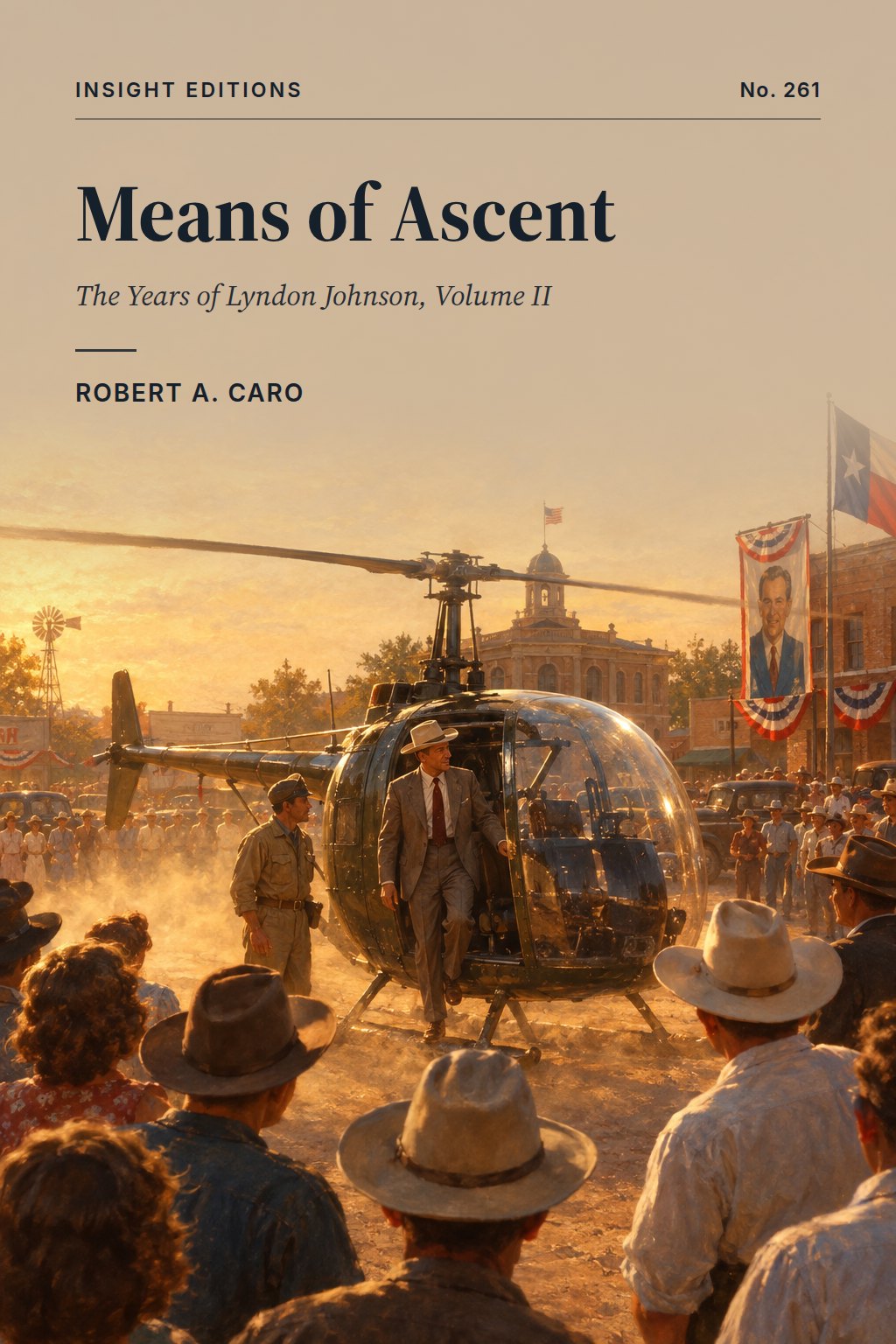
Johnson reached national power by means that would not bear scrutiny. Caro argues that the 1948 Senate race, first bought and then stolen, marked the shift from the old personal politics to the new politics of money and media, and that Johnson's later achievements rest on it.
Texas and Washington, July 1941 to January 1949. The book covers Johnson's 1941 defeat, his six months in the Navy, the KTBC fortune and his marriage, the life of Coke Stevenson, and the 1948 primary, runoff and court fight.
87 votes out of 988,295 decided the runoff; $17,500 bought KTBC, which took in $272,500 in 1946; one mission as an observer (by Caro's count, thirteen minutes in action) earned a Silver Star Johnson wore for life; 254 of 254 counties carried by Stevenson in 1944.
Readers who want to see, step by step, how a regulator, an election and a court can be captured, and how money and repetition replaced reputation in American politics.
The Book on One Page
Two threads, one shown. Caro opens with the "We Shall Overcome" speech of March 1965 and the Voting Rights Act, then sets beside them Vietnam and the Credibility Gap. Both threads run through Johnson's life, but in these seven years only the dark one shows, and the volume's subject is means against ends.
Defeat that could not be borne. In 1941 Johnson lost a Senate seat to Pappy O'Daniel by letting his bought border counties report early. Caro traces his horror of losing to his father's ruin and the town's verdict that Sam Johnson had "no sense." For the rest of his life Johnson needed to be seen as the man nobody outsmarts.
War as politics. He spent five months touring shipyards and posing for Hollywood portraits, went to the Pacific only when his political future required "danger zone" credentials, flew one mission on June 9, 1942, and then built a legend of many missions that he came to believe completely. Lady Bird, running his office alone in 1942, discovered her own competence, and he shut it away when he came home.
The fortune. Blocked by House seniority ("Too slow"), Johnson bought the bankrupt station KTBC in his wife's name. An FCC he had quietly helped save in 1943 approved the sale in 24 days and then gave the station a better frequency, round-the-clock hours and wider reach. Advertisers seeking federal favors filled its schedule, so they were buying influence, and Johnson was selling. He picked staff for subservience, not ability.
The opponent. Coke Stevenson had twelve races and no defeats. He was a self-taught rancher who campaigned with handshakes on courthouse squares, and his legend, Caro argues, was true. That made 1948 a natural experiment, because only one side used polling, saturation radio and paid persuaders.
Buying and lying. With Brown & Root money behind him, Johnson bought the bloc vote of the Valley and San Antonio's West Side and flew the "Flying Windmill" helicopter from town to town. He also invented a "secret deal" between Stevenson and labor and repeated it until voters believed it, using Stevenson's pride and silence against him. Stevenson's answer was true, but it went unheard because he could not pay to broadcast it.
Stealing, then keeping. Johnson was still 854 behind after election night. Late "found" votes in the Valley, ending with Box 13 in Alice, made him the winner by 87. He won the state Executive Committee vote 29 to 28, and Abe Fortas's plan to lose fast in the appeals court let Hugo Black halt the federal inquiry minutes after the ballot boxes began to be opened. Caro's verdict is that Johnson did not win by 87 stolen votes but by many thousands, and that only his side had both the money to drown out the truth and a boss able to keep counting after everyone else had reported.
The legend and the cost. Luis Salas confessed in 1977. Johnson had already turned the theft into a boast ("Landslide Lyndon") to show he was nobody's fool, and the story followed him to the presidency. Johnson took a back-row Senate seat and was Majority Leader within six years.
| Ch | Title | One-line payload |
|---|---|---|
| Intro | Ends and Means | Selma and Vietnam as the two threads of Johnson's life; this volume shows only the dark one and asks whether ends can redeem means. |
| 1 | Going Back | One careless mistake loses the 1941 Senate race; his father's ruin explains why defeat was unbearable. |
| 2 | All Quiet on the Western Front | Five months of shipyards, hotels and portraits; political danger, not duty, sends him toward combat. |
| 3 | In the Pacific | One observer's mission on June 9, 1942, a Silver Star, and a legend he came to believe. |
| 4 | Lady Bird | Running his office in 1942 she found her competence and confidence; he shut both away on his return. |
| 5 | Marking Time | No wartime post, no money monopoly, no seniority: Johnson turns to making money. |
| 6 | Buying and Selling | KTBC bought for $17,500, transformed by the FCC, fed by advertisers buying influence; loyalty means subservience. |
| 7 | One of a Crowd | Rich but powerless, frozen out by Truman, seven bills in eleven years; "too slow," he stakes everything on 1948. |
| 8 | The Story of Coke Stevenson | The self-made rancher and Governor, twelve races without a defeat, whose legend Caro calls true. |
| 9 | Head Start | Bought bloc votes give Johnson about 25,000 votes before the campaign starts; polling and radio are planned. |
| 10 | "Will!" | A kidney stone, a near-withdrawal and the Mayo Clinic; still 64 to 28 behind, and his House seat gone. |
| 11 | The Flying Windmill | The helicopter campaign and the "secret deal" lie; Stevenson leads the first primary 40 to 34. |
| 12 | All or Nothing | The Washington press-conference trap, unlimited cash, repetition and Pappy's Speech drown out the truth. |
| 13 | The Stealing | Bloc purchases, then late "found" votes; Box 13 turns an 854-vote deficit into an 87-vote win. |
| 14 | Lists of Names | Stevenson and Hamer see the forged poll list; delay in Alice, haste in Fort Worth; the 29 to 28 committee vote. |
| 15 | Qualities of Leadership | Davidson's federal inquiry, Fortas's lose-fast appeal, and Black's stay arriving as the boxes are opened. |
| 16 | The Making of a Legend | Salas confesses; "many thousands" of votes stolen; Johnson's boasting builds the national story. |
| 17 | A Love Story | Stevenson's happy last 27 years; his was the last campaign of its kind in Texas. |
| 18 | Three Rings | Sworn in on January 3, 1949 in the back row; Majority Leader by 1955. |
Introduction
Caro opens with Lyndon Johnson at his noblest, the "We Shall Overcome" speech of March 15, 1965, then sets beside it the darkest strand of his presidency: Vietnam, systematic lying and the Credibility Gap. Both threads run through Johnson's whole life, but this volume covers seven years (1941–1948) in which only the dark one shows. Its three subjects, the birth of the Johnson fortune, his wartime Navy service and the stolen 1948 Senate election, lead to the book's governing question: whether noble ends can be separated from the means that made them possible.
The bright thread: Selma and the voting-rights speech
Caro traces "We Shall Overcome" from a church hymn ("I do not yield") to a 1945 strike by black women tobacco workers in South Carolina, who added "We will overcome"; through a labor folk school in Tennessee, where "will" became "shall" and a sheriffs' raid produced "We are not afraid"; then to SNCC, the 1960 lunch-counter sit-ins, the March on Washington (August 28, 1963), the Birmingham church-bombing funeral and Freedom Summer, when 37 black churches in Mississippi were bombed or burned. By March 1965 it was the anthem of a movement that distrusted the President.
- Selma. Bloody Sunday (March 7) on the Edmund Pettus Bridge was followed by the killing of Rev. James J. Reeb; Jimmie Lee Jackson had been shot on February 18.
- The vote denied. In Selma 9,300 of 14,000 whites were registered but only 325 of 15,000 blacks, ninety-five years after the Fifteenth Amendment.
- The long record. As a Congressman (1937–1948) Johnson voted against every civil rights bill, anti-lynching included; in 1948 he called Truman's program "an effort to set up a police state"; his Senate maiden speech defended the filibuster and won praise from Richard Russell; his 1957 bill was gutted by compromise.
- Inaction. Johnson had not federalized the Alabama National Guard; 15,000 protesters rallied in Lafayette Park chanting "LBJ, just you wait / See what happens in '68."
Riding to the Capitol, Johnson never looked up from his speech, but aide Horace Busby saw his face as the pickets sang: "He heard." The speech demanded "no delay, no hesitation and no compromise," then adopted the movement's own words: "And we shall overcome." In Selma, Martin Luther King wept for the first time his aides had seen. When the motorcade returned, the pickets were gone. Leaving the chamber, Johnson told Emanuel Celler to start Judiciary hearings that week, with night sessions; the Voting Rights Act of 1965 passed with its key provisions intact, and federal troops guarded the Selma–Montgomery march.
Caro's verdict is unqualified: Lincoln struck off the chains, but Johnson "led them into voting booths." Add Medicare and Medicaid, sixty education laws and the War on Poverty (often ill-conceived, a "frenzy of legislation"), and Johnson used presidential power "for purposes as noble as any in American history."
The dark thread: Vietnam and the Credibility Gap
In April 1965 the protesters returned, singing "We shall live in peace." Having promised in 1964 not to send "American boys nine or ten thousand miles away," Johnson launched Operation Rolling Thunder, choosing many targets himself, and committed 40,000 troops to ground combat while forbidding any mention of the decision to the press.
- 16,000 advisers in Vietnam when Johnson took office.
- 175,000 troops by July 1965; 385,000 by December 1966; Caro gives 549,000 when he left.
- 58,000 American dead; Caro counts 288,000 wounded.
- The memorial wall runs 500 feet.
The lies spread beyond Vietnam. To justify the Dominican Republic intervention he claimed the ambassador warned "American blood will run in the streets" and that 1,500 people had been murdered; neither was true. He said his great-grandfather "died at the Alamo." Troops were raised by administrative draft quotas and costs buried in the Pentagon budget to avoid congressional debate. Soldiers wore buttons reading "Ambushed at Credibility Gap," and by 1968 Johnson could appear without pickets only at military bases. Tom Wicker (1983) judged that "the lowering of the presidency, not the Great Society," was his most obvious legacy. Caro's claim is that the fabric of trust between Americans and their President was whole on the day Johnson took office and in shreds when he left, destroyed by lies "beyond permissible political license."
Two details need correcting. Caro dates the hymn's arrival at SNCC's founding conference to 1959; SNCC was founded in Raleigh in April 1960. His 549,000 is the authorized ceiling of 549,500, never reached; about 536,000 troops were in Vietnam at the end of 1968, and the actual peak (543,400) came in April 1969, under Nixon.
The volume: seven years in the wilderness
Earlier, the threads ran together: the Cotulla teacher who bought bats and balls for Mexican children, the Congressman who "brought the lights" to the Hill Country. Here, from July 1941 to 1948, the bright thread vanishes. Johnson lost his toehold on national power and, with Roosevelt's death, his patron; he seemed fated to be one of 435 House members, neglected legislation, launched no new district programs and nearly quit for business. Power he could not enlarge meant nothing to him.
- The fortune. From under $1,000 in the bank he reached a claimed million, from a single radio station in an industry regulated by the Federal Communications Commission; by 1963 family assets were perhaps $20 million. Caro sets out to demolish four myths: no FCC favoritism; the fortune was Lady Bird's from her inheritance; Johnson took no part in the business; no one was hurt.
- The war. Six months in the Navy, neither cowardice nor heroism but a study in his contradictions.
- 1948. Almost a million votes, won by 87. Caro's claim: Johnson stole "many thousands" of votes, and Abe Fortas' legal skill halted a federal inquiry. His evidence includes a manuscript from the man who did the stealing.
The four myths are a governance pattern: an asset whose value depends on regulatory discretion, held in a spouse's name, with the official disclaiming any role. Caro's method, tracing who benefited and who was hurt, is the right test for any conflict-of-interest review.
Old politics against new; means against ends
His opponent, Coke Stevenson, held the governorship longer than anyone before him and is the only candidate for Governor or Senator to carry all 254 counties; in 1944 he beat eight opponents with 84 percent while barely campaigning.
| Johnson | Stevenson | |
|---|---|---|
| Style | Polling, ad firms, PR men, radio | Courthouse-lawn speeches |
| Novelty | Campaign helicopter | Last campaign of its kind in Texas |
| Creed | Victory justifies any means | Jeffersonian self-reliance |
Because only one side used the new techniques, Caro treats 1948 as a natural experiment showing their "destructive effect on the concept of free choice by an informed electorate."
Caro's heroic Stevenson is the most disputed part of this volume. Garry Wills (New York Review of Books, April 26, 1990) found Stevenson "as unremittingly whitewashed here as Johnson is tarred." Robert Dallek (Lone Star Rising, 1991) drew a far less admirable Stevenson, and in 1991 attacked Caro's "terrible hyperbole, terrible bias." The contrast is partly Caro's construction.
Johnson's noble ends (civil rights, Medicare) were impossible without the ignoble means of 1948. Caro calls the relationship between means and ends the most important question his life raises.
Going Back
On June 28, 1941, Johnson, thirty-two, seemed to have won a Senate seat; by the next day he had lost it to W. Lee ("Pappy") O'Daniel through his own one careless mistake. Caro uses the return to Washington to explain why defeat was unbearable for him: a hereditary drive, a humiliated youth, and a lifelong need to be seen as the man nobody outsmarts. Yet he came back still at the center of a New Deal circle, with Roosevelt, Brown & Root money and a second run in 1942 all lined up, until Pearl Harbor.
The one mistake
Johnson's rise had been rapid: "wonder kid" of Texas politics at 21, "Boss of the Little Congress" at 23, the youngest of 48 National Youth Administration state directors at 26, Congressman at 28, and in 1940 the reviver of the Democratic Congressional Campaign Committee with Texas oil and contractor money only he could reach. When Senator Morris Sheppard died in April 1941, Roosevelt let him announce from the White House steps. His credo was "If you do everything, you'll win." On Election Day, though, he let the South Texas border bosses he had bought report their totals early, breaking the rule that you report your controlled precincts last so the opponent cannot see the number to beat. O'Daniel's men then found the votes they needed.
Why losing was so hard
Caro offers three explanations. First, the "Bunton strain" in Johnson's mother's family: tall, with jutting nose and jaw, glaring dark eyes, fierce pride and an early pull toward politics. Second, his father Sam Ealy Johnson, an honest Populist legislator ("straight as a shingle"; to Wright Patman, "the best man I ever knew"), was ruined when Lyndon was thirteen by overpaying to buy back the family ranch. The family became the town's laughingstock and a neighbor's joke stuck: Sam was smart "but he's got no sense." Third, Johnson reacted by making himself into the opposite: practical, cynical, scornful of ideals.
The pattern was public. He courted the richest man's daughter in high school and in college, and the college yearbook joked that he meant to marry for money. He stole elections at college and in the Little Congress, where he stuffed and miscounted ballots, and let everyone know through winks. A classmate: "if something wasn't straight, it was Lyndon Johnson who had done it." In 1941 the man who stole elections had one stolen from him, as if he too, like his father, had "no sense."
Still Roosevelt's man
Roosevelt had dropped W. D. McFarlane after his defeat, but not Johnson. Johnson sent him a "water-carrier" note; Roosevelt scrawled, "I want to see Lyndon," and joked that Texans had not learned to "sit on the ballot boxes." Tommy Corcoran arranged a national speech at the Young Democrats convention and promised the same support in 1942.
- Abe Fortas: 30, Yale Law star brought to the SEC by Douglas; later Johnson's lawyer.
- James H. Rowe, Jr.: 32, White House aide; said of Johnson's centralized 1940 fund-raising, "Nobody had ever done this before."
- Alvin J. Wirtz: Undersecretary of the Interior from 1940; genial, secretive, ruthless; Johnson's chief adviser.
- Virginia and Clifford Durr: Alabama liberals who argued with him about civil rights.
- Harold Ickes, Hugo Black, William O. Douglas: the circle's senior figures.
The circle was bound by public power and the fight over the Public Utilities Holding Company Act of 1935. Johnson was its center because he supplied what executive-branch men lacked: access to Speaker Sam Rayburn, inside knowledge of the House, campaign cash, and unmatched skill at "counting" votes ("He was the very best at counting," Fortas said). He even got Corcoran on retainer to Brown & Root.
Johnson was liberal to liberals and conservative to conservatives. He told Virginia Durr "we haven't got the votes," cited Maury Maverick as the man who "got too far ahead of his people," and let lobbyist Dale Miller assure conservatives he was "much, much more liberal" in appearance than reality. Helen Gahagan Douglas called him "one of the most close-mouthed men I ever knew."
Money in place, Rayburn cool
Herman Brown, made rich by federal contracts, had poured in hundreds of thousands of dollars, by some later IRS agents' account fraudulently, and pledged as much for 1942. Rayburn, who had nursed Johnson like a son, stayed cold after Johnson's 1939 betrayal: during the Roosevelt–Garner feud Johnson had led Roosevelt to think Rayburn a secret enemy of the New Deal. Johnson was still shut out of the "Board of Education" ("I can get into the White House. Why can't I get into that room?"), and Rayburn favored Gerald Mann. But Roosevelt refused to see Mann, Patman and James V. Allred stood aside, and by October 1941 Johnson was campaigning in the Brown & Root plane. Then came Pearl Harbor.
All Quiet on the Western Front
Johnson's 1941 campaign rested on a pledge to fight "in the trenches, in the mud and blood" if war came. Caro shows that for five months after Pearl Harbor he used his Navy commission for a desk-and-hotel tour of West Coast shipyards, lobbied for a big Washington post (even an Admiral's rank), and plotted a Senate run, until political danger, not military duty, pushed him toward a war zone in May 1942.
The pledge and the commission
The promise to tear up his draft card and "never vote for war and then hide behind a Senate seat" was mailed on postcards to hundreds of thousands of Texans. Hill Country acquaintances remembered his physical cowardice, and Col. Alfred Petsch of the Fredericksburg Standard said in October 1941 that it was time to redeem the pledge. Johnson was already a Lieutenant Commander in the Naval Reserve. On December 8, 1941, he and fellow Naval Affairs member Warren Magnuson had Admiral Chester Nimitz put them on active duty.
The two men then went separate ways. Magnuson, with help from Chairman Carl Vinson, was on a carrier within a month and spent five months under Japanese attack off the Solomons. Johnson went to the White House to ask to head a new Civilian Youth Administration, then to his ally and 1941 donor Undersecretary James V. Forrestal, whose note read: "Lyndon, how do you want these orders to read?" Johnson wrote his own assignment: inspecting shipyard training and liaison with New Zealand from San Francisco. He went west with Lady Bird and aide John Connally, booking the best hotels.
The salute. An Admiral rebuked Johnson for failing to salute him. Used to seeing Vinson treat Admirals "as if they were cabin boys," Johnson could not bear taking orders. As a boy he would literally take his baseball home if not allowed to pitch. Within a week he left the liaison post, lobbied Roosevelt for high office, failed, and got Columbia's Professor J. W. Barker to send him on a second shipyard tour (January 29, 1942).
Ten weeks on the West Coast
While Wake, Singapore and Bataan fell, Johnson and Connally toured shipyards from San Diego to Seattle. "We had a lot of fun," Connally says: drunken wrestling on trains and Paramount parties arranged by lawyer Edwin Weisl. A Hollywood photographer taught Johnson his best poses, and a voice coach worked on his speaking.

Alice Glass, his mistress of three years and now wife of his patron, publisher Charles Marsh, visited and came away "just disgusted." She offered to write a chapter on "his military career in Los Angeles, with photographs, letters from voice teachers." Marsh's hotel "due bills" sometimes paid the bills.
His superior could not find him. "Where is that man?" Barker asked Johnson's secretary on February 15. Meanwhile Johnson ran his district by mail and plotted to be "drafted" for the Senate despite his promise to back James V. Allred, which Roosevelt wanted kept.
What Johnson wanted was command, not combat. Alvin Wirtz proposed to Roosevelt's aide that he be made an Admiral with a Navy role like William S. Knudsen's over Army production. Knudsen had run General Motors; Johnson had run the Texas NYA. "He wanted something big in Washington, really big," Corcoran said.
Cornered into the Pacific
Advisers saw the danger. Marsh wrote: "Get your ass out of this country at once to where there is danger." Wirtz warned against a White House post "before you have some more active service." On March 13 an O'Daniel man, O. P. Lockhart, demanded he resign or return to Congress. Aide O. J. Weber warned that "you're going to get caught no matter which way you jump."
| Congressman | War service |
|---|---|
| Warren Magnuson | Carrier under fire off the Solomons |
| Melvin Maas | Marines, South Pacific; Silver Star, Purple Heart |
| Eugene Worley | Navy, South Pacific |
| James Van Zandt | Destroyer, North Atlantic convoys |
| Frank Osmers | Enlisted as a private; later Okinawa, Philippines |
| Lyndon Johnson | West Coast shipyards and hotels |
A White House aide, Jonathan Daniels, recorded the motive plainly: Johnson "wants for the sake of political future to get into danger zone." With a recall of congressmen under discussion and the May 31 filing deadline near, Johnson saw Roosevelt on April 26. Roosevelt again refused to back a Senate run but, prompted by Forrestal, put him on a three-man survey team to the Southwest Pacific. On May 1 Johnson signed filings for both Senate and House, left Connally and Wirtz to choose, wrote a will, and on May 7 flew west. Telegrams followed: the White House told him to rule out the Senate, and Alice reported that only Charles favored running. Connally filed him for re-election. "That's fine," Johnson said.

In the Pacific
Lyndon Johnson's entire combat record in World War II was one bombing mission, flown as an observer, on June 9, 1942: by Caro's count, thirteen minutes in action. Caro draws two lessons from it. A man who had always been a physical coward showed real courage when his ambition demanded it; he then inflated that single flight into a legend of many missions and a medal he had promised to refuse, and came to believe the legend completely.
Into the combat zone
In Melbourne, Douglas MacArthur gave the observers, Lieutenant Commander Johnson and Lieutenant Colonels Samuel Anderson and Francis R. Stevens, a high-ranking escort under Brigadier General William F. Marquat, a courtesy to a Congressman close to Roosevelt. The war was going badly: the Lexington was lost in the Coral Sea, and Australia feared invasion.
On June 6 Johnson reached Garbutt Field, Townsville, base of the 22nd Bomb Group: twelve battered B-26 Marauders and crews in torn uniforms and bloodstained bandages. Raids on the Japanese base at Lae meant a shark-filled sea, a refuelling stop at Seven-Mile Strip, the 10,000-foot Owen Stanley Range, flak and Zeroes. Two weeks earlier five of six B-25s raiding Lae had been shot down; one estimate puts typical losses at 15–25 percent per raid.
Caro sets this against Johnson's past. As a boy he dodged fistfights; at college, threatened, he would fall back on a bed and windmill his feet, yelling "If you hit me, I'll kick you!" A classmate called him "an absolute physical coward." But his other trait was effort without limit in the service of ambition: to Johnson, doing "everything" meant anything necessary. Recall was imminent; this was his only chance to see combat. When Marquat said a Navy observer had no reason to fly the June 9 mission, Johnson said he was going too.

At Seven-Mile, Johnson took a seat on the Wabash Cannonball, stepped off to urinate, and returned to find Stevens in it. He moved to the Heckling Hare (pilot Lt. Walter H. Greer), charmed the crew, and was warned by tail-gunner Harry Baren: "This ain't no milk run." A generator failure forced the Hare to turn back. In Caro's account Zeroes then attacked it, and Johnson watched from the window and the navigator's dome, "cool as a cucumber," laughing at a gunner who admitted fear. The Wabash Cannonball was shot down; Stevens and everyone aboard died.
Medal, fever, recall
On June 18 MacArthur, irritated that a Navy observer had flown, gave Stevens a posthumous Distinguished Service Cross and Johnson and Anderson the Silver Star, the Army's third-highest decoration, telling them to collect ribbons from his outer office because the citations "haven't been written yet." Johnson then fell seriously ill (a fever of 103.6 in Suva, Fiji), was treated at Pearl Harbor until July 7, and came home 25 pounds lighter. On July 9 Roosevelt ordered congressmen in uniform back to Congress. Of eight serving, four resigned their seats to stay in uniform; Johnson resigned from the Navy.
The contradictions of his service
Caro's verdict is double. Johnson had promised in 1941 to fight "in the mud and blood," yet had taken a commission partly to avoid the draft, idled five months in a "safe, warm naval berth," and flown 20,000 miles for one day of combat. Yet for that one day, Caro concludes, he was "not a politician but a warrior": ambition governed his war, but in its service he did whatever he had to do.
How the story grew
Within days he was briefing the AP, UP, INS and Time, with Edwin Weisl working the Hearst columnists. Then the details inflated.
| Fact | Johnson's later version |
|---|---|
| Pneumonia | Dengue fever |
| Lost 25 lb | 35, 38, then 40 lb |
| One mission | "Missions over enemy territory" (1944) |
| 20,000 miles | 50,000 to 70,000 miles |
| One Zero downed | "I saw fourteen of 'em go down in flames" |
| Generator failure | Engine "knocked out" by Zeroes |
| Wore a parachute | Gave the only one to a friend |
| No nickname | "Raider Johnson" |
He kept embellishing even after it became a joke. At endless screenings of his home movies, Harold H. Young wanted to shout "Oh, bullshit, Lyndon," and Ben Cohen asked him to name the men not from Texas. As President, in October 1966, he told reporters the observers had talked to "10,000 men"; in December 1967 he told Ronnie Dugger the fight was "like shooting fish out of a barrel." At college he had been nicknamed "Bull" Johnson. Caro adds a subtler cause of disbelief: needing to seem shrewd and cynical, Johnson told the same listeners he had gone only "for the sake of political future."
The Silver Star and self-belief
At first Johnson told reporter Marshall McNeil he would never wear the medal ("He got it for a flight, not for a fight," McNeil said) and had a letter of refusal typed. No one else on the Hare was decorated, not Greer, not Baren. The letter went unsigned; Johnson bought the medal in an Army-Navy store, had it pinned on him repeatedly in Texas, and wore the ribbon for life, tugging his lapel during speeches to draw the eye. To Joe M. Kilgore, who earned his Silver Star over 35 missions in Europe, Johnson "bitched and bitched because he only got the Silver Star."
Kilgore's conclusion, echoed by George Brown, John Connally and Edward Clark: Johnson could "convince himself of anything, even something that wasn't true." Caro calls this capacity the single most significant implication of Johnson's war service for history.
Caro's account of the attack on the Heckling Hare rests largely on Martin Caidin and Edward Hymoff's The Mission (1964). Barrett Tillman and Henry Sakaida (Naval History, April 2001) argue the Hare aborted about 30 minutes out and was never engaged: Johnson's own diary mentions only the generator, the 22nd Group's action report lists no damage to the Hare, and navigator Billy Boothe and gunner Bob Marshall later said it never came under fire. If they are right, even Caro's thirteen minutes shrink to none.
Lady Bird
Claudia Alta ("Lady Bird") Taylor Johnson was someone nobody paid attention to, first because of a crippling shyness, then because of the way her husband treated her. In 1942, running his congressional office while he was away at war, she discovered that she could make powerful men listen and could solve problems in her own way. When he came home, he shut that ability away again.
The girl nobody noticed
Her mother died when she was five; her father, a loud store-and-gin owner with 18,000 acres of cotton land in Karnack, East Texas, shipped her at six, a name tag round her neck, to a spinster aunt, Aunt Effie. She read alone (Ben-Hur at eight), finished high school at fifteen, and was so frightened of speaking that she prayed for smallpox rather than give a graduation speech; she finished third. At the University of Texas she took a second degree in journalism and forced herself to question speakers at press conferences, yet she wore drab, oversized dresses despite an unlimited charge account at Neiman-Marcus. In September 1934 she met Lyndon Johnson through her friend Eugenia Boehringer; he proposed on their first date and married her that November.
"He treated her like the hired help"
- Household servant. She brought his coffee and newspaper to bed, laid out his clothes, filled his pen and lighter, and shined his shoes, and he reminded her of these duties loudly in front of others.
- Unequal travel. He flew on the Brown & Root company plane; she drove the 1,600 miles to Texas with a car full of household boxes.
- Public humiliation. "Get me another piece of pie!" he shouted across a Texas State Society dinner; Congressman Wingate Lucas recalls that "all the people from Texas felt very sorry for Lady Bird."
- The Nellie contrast. After 1940 he held up the beauty Nellie Connally: "Why can't you look more like Nellie?"
- Longlea. From 1938 he spent weekends with Alice Glass, often leaving his wife at home; Charles Marsh could not remember her name and called her "Lyndon's wife."
Because he showed her no respect, others gave her opinions none either: when she spoke, Nellie says, "nobody paid any attention to her."
Hints of something more
There were signs. Old beaux found she quietly set the agenda and "would not marry a man who did not have the potentiality of becoming somebody." Escorting constituents, she read deeply on Mount Vernon, Monticello and the battlefields, carried a stenographer's notebook for forty years, and learned that "CONSTITUENTS was spelled with capital letters." At Longlea she read War and Peace and checked Mein Kampf out of the library when Marsh cited it. Under her husband's orders she said only "Yes, Lyndon," with an unshakable dignity. Yet in politics she had no role: she learned of his 1941 Senate race after the press did, and her one stump effort ("Every single vote counts") became an Austin joke that, forty years on, still made her blush in front of Caro. She had had three miscarriages and an unsuccessful operation in September 1941.
Running Suite 1320
Johnson did not even tell the staff she was in charge, and asked them to report on her. She began as an apprentice typist and kept attending business school. Then she changed course: she made Weber retype letters with small misspellings, quit business school, and dealt with the agencies herself. Dreading the call, she "always picked it up." She went to see Harold Ickes about a CCC camp relocation, and his office called back the same day to say it was fixed. Johnson's letters turned from novice instructions to "Your letters are splendid," and he urged 2,000 personal notes at 25 a day. His March 1 letter settled who was in charge.
Through the weeks when he lay ill in Fiji she ran everything: a Palestine estate lawyer via the British Embassy, missing sons, OCS applications, War Production Board approvals, and Austin's Air Force base. Austin lawyer Edward A. Clark, who had dreaded relying on a woman, said "she gave wonderful service."
- Lyndon's method: the lash, the shouted order, aimed at a person's most sensitive point.
- Lady Bird's method: "real nice about it, and real, real earnest, courteous and persistent"; she never raised her voice and thanked anyone who brought her a pencil.
In running the office she gained something she had never had, confidence: she found she could "make my own living," and decades later burst out that 1942 "was really quite a great year!"
Shut away again
"I just don't think it was allowed out," said Nellie Connally, and after his return it was not. At an early strategy session he dismissed her: "We'll see you later, Bird." When Austin joked she might keep the seat (the Goldthwaite Eagle printed a letter nominating her), he said he talked his problems over with her, then added that he also discussed them with his Black maid, using a racial slur. The affair with Alice resumed. Only over a house did she rebel: when he stonewalled her about 4921 30th Place, she screamed, "I want that house!" It was bought for $18,000, about $10,000 from Aunt Effie, with a $21,000 inheritance from Uncle Claude Patillo to come.

Caro's "drab little woman" leans heavily on hostile Longlea witnesses (Alice Glass's sister and friend), and he notes that Mrs. Johnson withheld most of her wartime letters. Betty Boyd Caroli (Lady Bird and Lyndon, 2015) and Julia Sweig (Lady Bird Johnson: Hiding in Plain Sight, 2021) portray a more knowing, active political and business partner from early in the marriage.
Marking Time
Back from the Pacific, Johnson found every road to power blocked. Roosevelt would not give him a high wartime post, a rival fund-raiser took away his money lever, and the seniority system left him powerless in the House, where he had almost never spoken or legislated. So he turned his energies elsewhere: to making money.
In October 1942 Johnson planted rumors with Walter Winchell and Drew Pearson that he would replace Frank Knox as Secretary of the Navy, then leaked a "secret government mission" to London. Neither came. After that, Weber said, he regarded the war "as an interference with his agenda" and tried to keep aides out of it: O. J. Weber drank carrot juice to pass an eye test, John Connally pushed until he reached the carrier Essex, and Charles Herring, told "You're crazy!", served anyway.

His 1940 power had come from channelling Texas oil and contractor money through the Democratic Congressional Campaign Committee. By 1942 Edwin W. Pauley, a California oilman and the party treasurer, could reach the same donors, and Chairman Edward J. Flynn shut Johnson out. On October 15, 1942, Pa Watson kept him from Roosevelt.
A broker's power lasts only while he is the sole channel. Once Pauley could reach the same Texas money, Johnson's monopoly, and his use, vanished. In 1944 he sat watching Texas hand Pauley a $50,000 check.
In the House, Carl Vinson ran Naval Affairs "like a dictator," calling juniors "ensign"; four men stood between Johnson and the gavel, and Vinson stayed until 1965. In six years Johnson had introduced one national bill (a job for himself), made two real speeches, and taken no stand anyone could pin down.
- 1 national bill in six years: the NYA-CCC merger.
- 2 real House speeches: a 1937 tribute and a 1941 draft-extension speech.
- 0 floor participation in 1937, 1938, 1939, 1942, 1943 or 1944.
His 1943 bill to draft absentee war workers went through Naval Affairs, bypassing Labor Committee chair Mary T. Norton, and died in Rules. He gave no further House speech for the rest of the war.
Buying and Selling
With the road to the Senate closed, Johnson turned his political skills to making money, and Caro presents his first business as a case study in converting public influence into private wealth. A bankrupt Austin radio station, KTBC, was bought in Lady Bird's name for $17,500 in 1943. The FCC, which had strangled it for years, transformed it within months, and businessmen seeking federal favors filled its advertising schedule. Johnson ran the station as he ran his office, and the staff he kept were chosen for one quality above all: submission.
Money deferred, then grabbed
Before the war Johnson wanted money passionately but would not let it block his path. The fear behind the wanting was his father's fate: six terms in the Legislature, then death as a penniless state bus inspector. He never forgot the Capitol elevator operator who told him he had once been a congressman.
- Small takings. In 1939 Charles Marsh sold him a nineteen-acre Austin tract for $12,000. In 1940 Johnson begged a businessman, from his curb at dawn, for a "finder's fee" for a mere social introduction.
- The big refusal. At the Greenbrier in autumn 1940 Marsh offered him a share of his partnership with oilman Sid Richardson, no money down, worth at least $750,000. Johnson declined: being an oilman "would kill me politically." Since oil could not hurt him in his district or in a Texas Senate race, George Brown and Marsh realized there was only one office he could mean. Money and power: he wanted both, but power far more.
- Tastes beyond his $10,000 salary. He bought $195 custom suits several at a time and monogrammed shirts by the box, while Lady Bird drove the dishes to Texas to save buying a second set.
With the path closed, the deferral ended. Inexperienced in business, Johnson did not need business skill, because the basis of his enterprise was politics.
A station the government had strangled
Radio was the business in which government mattered most: the Federal Communications Commission granted and renewed licenses and controlled every aspect of operation. KTBC showed it.
- Born hobbled. Owners A. W. Walker (a UT law professor), Robert A. Stuart and Robert B. Anderson (later Eisenhower's Treasury Secretary) waited nineteen months and six hearings for a construction permit (granted July 1937). They got a shared frequency, 1120 (later 1150), daytime only: a "sundowner" on a crowded end of the dial, drowned out by San Antonio's WOAI (NBC) and KTSA (CBS). No network would affiliate.
- Broke. Started on $27,000, all spent. In 1942 revenues were $26,795 against expenses of $33,026; debts topped $19,000; Walker's $5,000 in loans kept it alive.
- Unable even to sell. In December 1939 oilman-publisher J. M. West took an option at $50,000. The FCC responded by revoking the license over manager James G. Ulmer's alleged "hidden interest," took fifteen months to concede the point, then froze West's purchase under Order 79 (a proposed ban on newspaper owners). West died in August 1941, leaving the option to his sons and E. G. Kingsbery. Walker's plea to Chairman James Fly got a curt refusal.
The owners were trapped: they could neither operate at a profit nor sell. Ulmer, whose own $750,000 sale to West hinged on KTBC, made what Caro calls "a fatal misstep" in 1942. He retained Alvin Wirtz, agreed a $10,000 retainer over dinner at the Driskill, and then waited all day in an office whose wall bore an inscribed photograph of Lyndon Johnson. Wirtz had left for Washington. Ulmer never heard from him again.
The purchase
What the owners heard from instead was the man in the photograph.
- Kingsbery. Johnson had given his son a Naval Academy appointment in 1941. Summoned before Christmas 1942, Kingsbery brought a quart of cream; Johnson asked for the option instead ("I have no means of making a living"). Kingsbery agreed to recommend it: "then we'll be even."
- The Wests. Brown refused to pose as buyer to hide a "liberal" purchaser, so Johnson met the brothers in Suite 8-F of Houston's Lamar Hotel and in an hour had them liking him. Johnson later invented a Christmas Day ranch visit, Caro notes, to keep 8-F, proof of the Brown link, out of the story.
- The money. Lady Bird, using her inheritance, sent Wirtz $17,500 in escrow and put $7,500 against debts, leaving perhaps $938 in the bank plus $6,000 in bonds. Application filed January 23, 1943; approved February 16. The Wests had sought FCC consent for three years; Mrs. Lyndon Johnson obtained it in twenty-four days.
Why the FCC bent
Johnson insisted all his life the station was "owned by Mrs. Johnson" and that he was "unfamiliar with it." Lawyer Leonard Marks and spokesman George Reedy repeated this; Life and the Wall Street Journal found no record of intervention, despite pioneering digging by Louis Kohlmeier and others.
Johnson's influence was small but precisely placed. Commissioner Clifford Durr and his aide W. Ervin "Red" James were social intimates. Tommy Corcoran had placed Fly and former counsel William Dempsey; the agency was "Corcoranized." And Johnson was "Sam Rayburn's boy."
1943 was the year of the FCC's maximum vulnerability. After Fly moved against a station that had paid Rep. Eugene Cox a $2,500 "legal fee," Cox called the FCC "the nastiest nest of rats" and was made chairman of a House committee investigating it. An appropriations amendment would have abolished the agency. In that very month Johnson, never before interested, became its secret champion through late-night coded calls to James (Rayburn was "the bald-headed fellow"). Durr called him "a spotter, telling us where to put the next shell." He brought in Rayburn, who killed Cox's plan to expose Fly's alleged affair ("There ain't gonna be no sex!"), forced Cox off the committee, and on February 17, 1943 defeated the abolition amendment with a rare speech from the well; the FCC survived with a 25% budget cut.
One side heard
Durr and James maintained Johnson never pressed them; Durr said Lady Bird simply asked his advice and "nobody else was in the picture." Caro dismantles both claims.
- Direct pressure. FCC engineer James Barr took a call from Congressman Johnson, who "wouldn't take no for an answer" and was on first-name terms with Red James. Corcoran said he helped "all up and down the line": "You don't have to spell things out for them."
- Rivals pushed aside. Lumberman William Drake (a future mayor) made an offer; Johnson "reached out and got it from under him." Former Secretary of State William J. Lawson, an O'Daniel strategist whom the FCC had quickly licensed in Brownwood, sent an inquiry and got a form letter. FCC contacts explained that "Congressman Johnson was in to see us" and had portrayed Lawson as "financially unstable."
Caro's frame is judicial. A regulatory commission acts as a judge, and an ex parte proceeding diminishes justice. The Johnson side got personal meetings with a commissioner and his top aide; the other side got "a form letter [not] even a dictated letter."
| Old owners (1935–1942) | Mrs. Johnson (1943–1945) | |
|---|---|---|
| Permit / sale | 19 months, six hearings | Sale approved in 24 days |
| Transfer bid | License revoked; 3 years, no ruling | No rival heard |
| Hours, frequency | Daytime only, 1150 | 24 hours at 590, in 25 days |
| Network | None possible | CBS affiliate |
| Reach | Austin only | 38, then 63 counties |
A different station at the same price
In June 1943 Lady Bird applied for 24-hour operation at 590, the uncluttered end of the dial, reaching 38 central Texas counties (sixty-three after the 1945 jump from 1,000 to 5,000 watts). Approval took under four weeks. The Omaha station dominant on 590 was an adversary, yet James told Lady Bird in advance that FCC counsel saw no problem: "Why don't you apply for it?" Ulmer complained Johnson "stole" frequency work he had done; Elliott Roosevelt said Johnson "had the skids greased with the commission."
Johnson may have known in advance. In April he told prospective manager Harfield Weedin the change was "all set... I have it in the works right now." Weedin: "I don't feel he would have bought it if he didn't know."
The station Lady Bird bought, a daytime signal at 1150, ceased to exist within months; only the call letters survived. Caro's point is that advance knowledge was itself the asset: had others known the FCC would transform KTBC, there would have been other bidders, and the owners would not have had to sell cheap.
Selling airtime, selling influence
Legend credits Lady Bird's scrubbing and bookkeeping with the turnaround. Johnson meanwhile saw William S. Paley of CBS ("This is life and death to us"). Paley and Frank Stanton told a folksy tale of a Texan in boots who got an affiliation because a map showed room. But CBS was then fighting the FCC in Congress, and Austin's other station, KNOW, had been refused a CBS affiliation repeatedly because KTSA already covered Austin.
Channels that steered advertisers to KTBC
- Campaign backers: Herman Brown sent Gus Wortham's American General Insurance (fifteen minutes nightly; "We twisted his arm"); Ed Weisl Sr. sent the Interstate Theater chain.
- Ed Clark of Looney & Clark, who "bought a ticket on" politicians: H.E.B.'s Howard Butt, General Electric's "World News Today," Gulf Oil ("This wasn't a Sunday-school proposition. This was business.").
- Wirtz's clients: Humble Oil picked KTBC for its CBS football broadcasts.
- Federal contract seekers: firms wanting Army, Navy or base business.
The returns were concrete. Johnson got the OPA to give Butt 150,000 extra cases of Rio Grande grapefruit in 1944. The Jaques Power Saw Company, doing little Austin business, ran a six-day half-hour show; in 1948 Johnson and Walter Jenkins pressed RFC vice chairman Harley Hise for its $1,250,000 loan. "Everybody knew," said one businessman, that advertising on the station was the way to Johnson's help. Although they were ostensibly buying airtime, what they were really buying was political influence; they were buying, and Lyndon Johnson was selling.
Caro grants Lady Bird real skill (Marks: she read a balance sheet "the way a truck driver reads a road map"), but she did not negotiate with Kingsbery or the Wests, call Barr, see Paley, or secure the grapefruit. Johnson's sales letters to manager Willard Deason, listing merchants to "sew up," refute the man who was "unfamiliar" with KTBC. And under Texas community property law, a spouse owns none of property bought with the other's inheritance but half of its income.
- $2,600/month: ad income under the old owners; $5,645 by December 1943.
- $13,500 / $15,300 / $22,700: average monthly income in 1944, 1945, 1946.
- $272,500: 1946 revenue from a station bought for $17,500.
- $21,500: Lady Bird's salary by 1948; one 1947 withdrawal apparently $80,000.
- $439,000: assets at December 31, 1951, before television.
- 1948: the year Johnson started telling friends he was a millionaire.
Loyalty means subservience
Johnson recruited for KTBC as for his office: promises first, then the change.
- Weedin, a 27-year-old Dallas program director, was promised full-time hours, unlimited funds, 10% of profits and carte blanche. His fourteen-hour days made KTBC profitable ($18 in August 1943, thousands by autumn). No contract came ("he could never decide if the ten percent was before or after taxes"); once money flowed, Johnson "really took over." Drafted in February 1944, he asked for about $5,000, his share of roughly $50,000; Johnson gave $1,000, final.
- The staff earned less and worked longer than elsewhere (Ann Durrum Robinson: fourteen hours a day for about $35 a week), were scolded like "recalcitrant children" for attending a union meeting, and saw him treat Lady Bird "as though she were a serving girl." Robinson's "Three E's": ensnare, enthrall, enslave. In private Johnson defined loyalty: someone "who will kiss my ass in Macy's window."
- John Hicks, earning $75 a week, was offered a $10,000 "loan" in March 1944 for a Cadillac, an apartment, a fur coat for his wife and Rotary membership, with "total loyalty" demanded in return. He and Regina talked all night and refused: "This man is buying something." Johnson said "You are crazy" and never spoke to him again.
- Jack Gwyn quit after Johnson praised John Connally for being willing to come shine his shoes at midnight.
Choosing a general manager in 1945, Johnson listed each finalist's assets and liabilities and underlined one word three or four times: loyalty. The name was Jesse Kellam, a once-fearsome fullback who owed Johnson every job since 1933 and now had no contract. Eight years older, he called Johnson "Mr. Johnson," wept at his desk after closed-door sessions, sat in the dark waiting for the phone, and once chased a diverted plane from Austin to Waco.
CBS executives thought Kellam "knew nothing about radio." Caro's answer is the pattern of a career: Latimer over the abler Luther Jones, and the obedient over the able, with John Connally and Horace Busby as rare exceptions. What Johnson called loyalty was the capacity for subservience. Nearly all the original KTBC staff left and were replaced by people who gave it.
Much of Caro's KTBC case rests on interviews given four decades later by men who left Johnson unhappily (Weedin, Hicks, Gwyn, Lawson); the documentary core (dates, revenues, Clark's letters) is firmer than the motive claims. Caro also gives Lady Bird's management little causal weight, though his own witnesses (Marks, Jenkins, Clark) praise it. Two slips: the Omaha station on 590 was WOW (Caro also calls it "KWOW"), and Kellam, born August 24, 1900, was 44 or 45, not 43, in 1945.
One of a Crowd
Rich now, Johnson was miserable, because money could not give him the face-to-face acknowledgment of power he craved. Between 1945 and 1947 he lost his White House access, slid down the House seniority ladder, drew real opposition at home, and sank into depression and illness. Convinced he would die at sixty, he decided to stake his House seat on one last Senate race in 1948, only to learn that Coke Stevenson would run.
Why business could not satisfy him
What Johnson wanted most was power in its most naked form: to bend others to his will and have them acknowledge it. Selling airtime inverted that relation; trading favors with advertisers was receiving, not conferring. George Brown: "you don't order around people you're trying to sell something to." Ed Clark was blunter: "He wanted people to kiss his ass. He didn't want to have to kiss people's asses."
Politics offered no opening. Pappy O'Daniel held one Senate seat until 1948; Tom Connally, Foreign Relations chairman and author of the oil depletion allowance, held the other. The governorship was a detour ("Here's where the power is," he later told Connally), and appointive office was out: "You have to be your own man." Alone with Welly Hopkins he snarled, "By God, I'll be President someday!"
Frozen out by Truman
Roosevelt's death on April 12, 1945 ended his insider aura. Johnson performed his grief for William S. White of the New York Times, cigarette holder clamped in a Rooseveltian jaw: FDR "was just like a Daddy to me." He claimed to have been in Rayburn's Board of Education when the call came; parliamentarian Lewis Deschler said he arrived after Rayburn left.
Harry Truman had watched Johnson "play" Rayburn in the Board of Education and so recognized the act. Rep. Richard Bolling: "he knew exactly what Lyndon was doing. And so it didn't work." Margaret Truman said her father "never quite trusted him." James Rowe offered a simpler cause: "You've got to have a reason to see a President," and Johnson's fund-raising and Texas roles had passed to others.
- Allies gone. Tom Clark became Attorney General (Johnson's one bright spot), but Harold Ickes resigned in 1946 over the Pauley affair, and Truman had Tommy Corcoran's phone tapped.
- Courtship that misfired. Turkeys, signed photographs, and a book donated in memory of Truman's mother to a Grandview library that, Truman replied, did not exist.
- The rightward turn. To win Texas conservatives, Johnson in 1947 called Truman's civil rights program "a farce and a sham," voted for Taft-Hartley and to override the veto, and told the AP's Tex Easley that "New Dealer" was "a misnomer."
- The one summons. In 1948 Truman called him in after he released a letter to the press first. Johnson bought shirts and a dozen "presidential" ties and refolded his handkerchief all evening, only to be told: "Lyndon, I don't like to read my mail in the newspapers."
Losing ground in the House
Rayburn put him on the Joint Committee on Atomic Energy and the Select Committee on Postwar Military Policy, but pushing for prominence there only bred resentment. Seniority ruled, and in 1946 it turned against him. Only Drewry and Carl Vinson stood between him and the Naval Affairs chair until the July 1946 reorganization merged Naval and Military Affairs into Armed Services: two Democrats ahead of him became eight. In November the GOP won the House for the first time since 1930.

- 7: bills Johnson introduced in more than eleven years in the House, the fewest of any contemporary; Eugene Keogh introduced 169.
- 0: Johnson bills of national effect enacted; his only 2 laws touched his district alone.
- 10: speeches in eleven years; no Record insertions at all in 1944, 1945, 1947.
- 9: House colleagues who moved up to the Senate while he stayed, Warren Magnuson among them.
- 7 of 10: House "Johnsons" who outranked him.
Without power, his methods backfired. "Johnson kept asking for favors," said James Van Zandt, "and he simply didn't have that many to give." Members ignored him in the dining room and shrugged off his hand on their lapels; one knocked it away. George Smathers, two years in the House, had never heard of him. Helen Gahagan Douglas saw him vote and lope out, or slump "the picture of boredom." In committee photographs he stood among the junior members, "one of a crowd."
In 1947 Johnson tried "to take me to the Johnson School," says Armed Services aide Bryce Harlow, humiliating him twice before the subcommittee. Harlow, who had a family publishing firm to return to, resigned. Vinson marched him to the Speaker's Lobby, summoned Johnson off the floor and said: "you're going to tell him you're not going to do that any more." Johnson did. He had been made to humble himself before a staff assistant.
Socially, too, the circle shifted: Abe Fortas's new firm with Thurman Arnold and Paul Porter made him a power ("Lyndon Johnson was nowhere compared to Abe Fortas"), and some guests came to Johnson's parties for Rayburn. In Austin, a District Attorney had his name scraped off a borrowed courthouse door.
The first charge of getting rich in office
In 1946 attorney Hardy Hollers, with no organization, ran "a crusade against corruption," tying Johnson to Brown & Root ("an errand boy for war-rich contractors") and demanding he explain KTBC's license and his "mushrooming personal fortune." Johnson won 42,980 votes (68%) to Hollers's 17,782 and 2,468 for Charles E. King, but one voter in three had rejected the man who electrified the district. Lady Bird called it "a watershed": "We ceased to be the young shining knight." Asked why he was not more loved, Clark answered: "You got rich in office." Johnson walked out without a word.
"Too slow"
His father died at sixty, his uncle George at fifty-seven, and his uncle Tom had two heart attacks in 1946–1947. Johnson believed he would not live past sixty: "It's a lead-pipe cinch." Rayburn, elected at thirty, needed twenty-five years to become Majority Leader and was Speaker only at fifty-eight. The House path, with its silence and obeisance, was not too narrow for Johnson; it was too long, and he might not escape the seniority trap before he died.
Too slow. Too slow.
— Lyndon Johnson, on a career in the House
The daughters, Lynda Bird (March 19, 1944) and Lucy Baines (July 2, 1947), after a near-fatal tubal pregnancy in 1945, were given his initials by design: "FDR, LBJ... What I want is for them to start thinking of me in terms of initials." He brooded and stared out windows, signed mail with a bleeding eczema-raw hand, smoked three packs a day, and was hospitalized three times in 1946 (aides called the first "nervous exhaustion").
The decision was forced. A 1948 Senate run meant surrendering his House seat; he was little known statewide and lacked Roosevelt's backing. But power was the one thing he could not do without, so he told the Browns, Wirtz and Clark he would run, and quit politics if he lost. O'Daniel, discredited, was withdrawing. Then, on New Year's Day 1948, Stevenson, "by far the most popular Governor in the history of Texas," announced.

Caro's portrait of these years leans on the Johnson camp's later testimony (Busby, Jenkins, Sam Houston Johnson) about private despair, and the bill count is a narrow yardstick for a congressman who worked mainly through appropriations and agencies. His closing build-up of Stevenson as a "legend" begins the volume's most disputed portrait, which many reviewers judged too admiring of a conventional conservative.
The Story of Coke Stevenson
Caro stops the Johnson narrative to build the man Johnson will have to beat in 1948: Coke Robert Stevenson, a self-taught Hill Country rancher whose life was the raw material of the Western legend. The chapter's argument is that the legend was true, and that Texans knew it. Stevenson won every one of his twelve races by refusing nearly every technique of modern politics, and by 1946 he was "Mr. Texas," the most popular Governor in the state's history.
The boy by the campfire (1888–1914)
Born in 1888, the eldest of eight children of an itinerant schoolteacher, Stevenson had twenty-two months of formal schooling in his life. He worked from age ten for a dollar a week, was a cowhand at twelve, and from the start saved something out of every pay. His one ambition was a ranch.

- The freight line. At sixteen he bought a wagon and six horses and hauled freight over the seventy miles between Brady and Junction, fording seven dangerous streams that older men refused to attempt; he kept a weekly schedule, once sat stuck in a mudhole eleven days, and earned $40 a month.
- Self-education. Each night he lay by the campfire studying correspondence-school bookkeeping, which Caro makes the chapter's governing image.
- The bank. Applying to a new Junction bank, he was offered the janitor's job at half his freight income ("since no Negroes were in the town"); he swallowed the insult, became bookkeeper, then cashier at twenty.
- Law and land. He read law for almost five years in a local attorney's office at night, passed the bar in September 1913, and in 1914 bought 520 acres at the falls of the South Llano for $8 an acre.
Office as a job to finish
Caro's pattern: Stevenson never sought office; he took it to finish "a particular job" and then quit.
- County attorney (1914). Asked to break a rustling ring led by the son of Kimble County's leading family, he lay out in the hills with Ranger Frank Hamer, convicted the young man, and answered months of criticism with total silence.
- County Judge (1918). After he had quietly organized volunteers to rebuild the washed-out Sonora trail, Junction's elders drafted him to spend a $150,000 road bond issue in a county larger than Rhode Island with 200 cars and not a foot of paved road. His conditions: no campaigning and no second term. He persuaded owners to donate the right-of-way, talked rival Kerr County into a joint road, and taught himself engineering by testing cardboard Model T wheels on curved surfaces to set the dips at stream crossings. The Junction–Kerrville road, the first improved highway between San Antonio and El Paso, was still in use twenty years later.
He then refused a run for Congress and went back to law. A single Junction court docket lists him as defense counsel in 27 of 32 cases; Judge A. B. Martin called him "the best all-round lawyer" he had seen. He would never defend a rustler or a client he thought guilty. He became president of a new First National Bank of Junction while still serving as attorney to its rival, and poured everything into land: more than 6,000 acres by 1928. He built a fortress-like concrete-and-stone house with his own hands over ten years, with a wing for books he read at four or five every morning, and no telephone and no bridge over the river.

The Constitution man in Austin
Two forces pulled him back: his wife, Fay Wright Stevenson, who believed he "should serve the people," and his reading. He took the U.S. And Texas constitutions as literally as his Bible. The 1876 Texas Constitution, written by ex-Confederates after Reconstruction, was in historian T. R. Fehrenbach's phrase "an anti-government instrument": biennial legislatures and one of America's weakest governors. Caro's point is that its character was his: thrift, hatred of debt, limited government, all confirmed by a life in which he had got everything by his own effort.
Elected to the Legislature in 1928 to block a free-spending Kerrville candidate, he arrived in the Austin of "beefsteak, bourbon and blondes" and stood apart. A lobbyist: "No one would have dared to offer Coke Stevenson a dime." He hated politics and loved government. Behind the poker face was a deadpan humor that became Austin lore: asked by a rancher to put down an old horse, he shot it in front of a hunting party and told the startled lobbyist he had always wondered how it felt to shoot a horse; "Now I'm wondering what it would feel like to shoot a man." He mastered budgets and agency memoranda that other legislators never read.
- State Auditor. Finding no audit of state spending, he wrote and passed the bill creating the office, plus modern bookkeeping laws, "to get the people out of debt."
- Highway bonds. He fought Governor Ross Sterling's $300 million+ highway bond amendment with a pay-as-you-go plan; the highway lobby pushed the vote to 99 of the 100 needed, and no further.
- Prisons. He slept in cells across Texas and the Northeast, then proposed reforms at a fraction of the Governor's cost.
Made Speaker in 1933, he practiced "loose herding," gaveled with his pipe stem, and refused to arm-twist ("As long as they're not voting, they're not passing any laws"). When Governor James Allred's New Deal backers tried to push him out in 1935, he ran again; Fay handed red roses at the chamber door, and he won 80 to 68, the first Speaker in Texas history to succeed himself.
Campaigning without politics
In 1938 he ran for Lieutenant Governor to stop a unicameral-legislature plan. That was the year of W. Lee "Pappy" O'Daniel, the flour salesman who campaigned with the Hillbilly Boys. Stevenson refused a band ("I've got a record, and if that ain't good enough, well, that's all I've got"), a platform (it was "like a Mother Hubbard dress: it covered everything and touched nothing"), promises, a loudspeaker, even a sign on his dusty Plymouth. He simply walked into Courthouse Squares, introduced himself, and listened. He finished 46,000 behind Pierce Brooks in the first primary and 46,000 ahead in the runoff; in 1940 he polled 797,000 to his opponents' 273,000, 100,000 more than O'Daniel.
At O'Daniel's carnival inauguration in January 1939, amid fiddlers and a chorus of ten thousand schoolchildren, Stevenson gave a laboriously drafted speech on the two constitutions: "Let us cherish the old." As Lieutenant Governor he kept a paralyzed government afloat under the inept O'Daniel, who vetoed serious programs, paid state workers in discounted warrants and ran up a $34 million deficit. Critics said he had no "radio sex appeal"; one Senator complained that he "insists on talking to a man's intellect, not his prejudices." When O'Daniel went to the Senate in 1941 (helped by brewery lobbyists "out-stealing" Johnson), Stevenson became Governor. Fay, dying of cancer, was carried to the inauguration and died five months later.
I've got a record, and if that ain't good enough, well, that's all I've got.
— Coke Stevenson, refusing a campaign band, 1938
Governor, 1941–1947: strengths and limits
Caro gives a balanced ledger: a frontier philosophy that worked on familiar problems and failed on unfamiliar ones.
| Strengths | Limits |
|---|---|
| $34m deficit turned into a $35m surplus | Accepted Southern racial stereotypes; would not intervene in the Beaumont riots or investigate a Texarkana lynching |
| Education spending rank rose from 38th to 24th | Let Herman Brown and Alvin Wirtz's anti-union bills become law unsigned |
| Old-age pensions tripled | Stayed out of the Homer Rainey firing; did not grasp academic freedom |
| Good Neighbor Commission against discrimination toward Mexicans | Proposed no legislative programs, leaving a vacuum for oil, gas, sulphur and Brown & Root |
| Governed by blue pencil and private conferences; special sessions ceased | Narrow vision bred by a hard land and solitary reading |
His answer to the "no program" charge: "I had a program. It was economy." Even liberals conceded he was "as liberal as the people."
Mr. Texas
Reporters discovered his story and told it as epic: the "Horatio Alger of the Llano," janitor-to-bank-president, "Coffee-Coolin' Coke" with the battered coffee pot, the ranch without a telephone. Caro explains its force: in 1941 the frontier was barely fifty years gone, and Texans saw in him their own history of independence, land and distrust of Washington. Caro's claim, through nephew Bob Murphey, is that the most important thing about the Stevenson image was that it was true, and that voters saw it was true.
- 68.5% in the 1942 primary, a record for a contested Democratic gubernatorial primary, against an O'Daniel-backed rival with "one of the hottest bands."
- 85% in 1944, against eight opponents led by Attorney General Gerald Mann, to whose attacks he never replied.
- 254 of 254 counties carried in 1944.
- 12 races, 0 defeats: County Judge once, legislator five times, Speaker twice, Lieutenant Governor twice, Governor twice.
- Only man to hold Speaker, Lieutenant Governor and Governor.
He refused a third term as a breach of an "unwritten article" of the Constitution and went home in January 1947. But Fay was gone, his son stayed in Austin, and the mail sacks pleading with him to run for the Senate grew heavier each week. Murphey moved in on Labor Day 1947 and found the legend accurate: four a.m. Reading, bathing naked in the freezing river, beans for dinner, a fifty-nine-year-old who could "work him to death."
Caro's Stevenson is the most disputed portrait in the volume. Garry Wills (New York Review of Books, April 26, 1990) called it idealized and argued Stevenson likely benefited from forged votes in Duval in his own gubernatorial races; Caro replied in the New York Times Book Review (1991) that older politicians who knew Stevenson denied it. Robert Dallek, on PBS's American Experience (1991), quoted Stevenson privately saying Black Texans "sometimes do things which provoke whites to such violence" after the Texarkana lynching, harsher than Caro's "accepted stereotypes." Official lists date the swearing-in to August 4, 1941, not Caro's August 2. His record tenure was first passed by Allan Shivers (1949 to 1957); Rick Perry (2000 to 2015) now holds it.
Head Start
Against a candidate whom a February Belden Poll showed beating Johnson, George Peddy and every minor rival combined, Johnson's one advantage was money. Caro shows two uses of it: the old one, buying the controlled "bloc vote" of San Antonio and the Rio Grande Valley, which gave Johnson a 25,000-vote head start before a ballot was cast; and a new one, saturation polling and radio, that would remake Texas campaigning.
The press assumed Stevenson would win; the only question was whether conservative splinter candidates, chiefly Houston's Peddy (130,000 votes in a 1922 Senate race), would force a runoff after the July 24 primary. A statewide campaign traditionally cost $75,000–$100,000. Johnson thought on another scale, and Herman Brown renewed in 1947 his pledge to fund a second Senate race with "as much as was needed."
How the bloc vote was made
San Antonio's West Side slum (about 60,000 people) held some 10,000 purchasable votes. Johnson had bought there before: in 1934, for Maury Maverick, he peeled off $5 a vote from a table in the Plaza Hotel; in 1941 he bought wholesale through local leaders. Opposition judges could be paid $10–$50 to leave, after which non-voters' names were added. In the Valley, Mexican-American voters, largely illiterate and bound by the patrón tradition (the King Ranch alone employed 700 vaqueros), were delivered by bosses with pistoleros.
Caro's catalogue of Valley vote-delivery methods:
- Bought poll taxes, receipts held in the patrón's safe.
- Armed escorts, "deputies" marching voters to the polls.
- Pre-marked ballots, or guards inside the booth.
- Tents with sample ballots or knotted strings to mark by.
- Numbered poll lists revealing each vote.
- Writing in receipt numbers and casting votes for absent voters.
- Voting the dead (over-60s paid no poll tax and were rarely purged).
- Voters trucked from Mexico: Dolores had about 100 citizens and up to 400 votes.
The Valley's 20,000–25,000 controlled votes, deliverable up to ten to one, plus the West Side, gave a favored candidate a plurality of perhaps 25,000. The rule, per the region's best history: candidates with "the most money to spend usually carry these machine counties."
The Duke of Duval
George B. Parr, son of Archie Parr (who had ruled Duval County since 1912), worked from a San Diego office built "to withstand a siege." Caro rejects the Robin Hood version told by John Connally and later journalists.
- Graft. He held the county's only beer license; altered oil leases; took kickbacks such as $25,000 in 1932; pled guilty to tax evasion and served nine months in 1936.
- Public money. The Commissioners Court paid him $500,000 in 1945 to buy the 57,000-acre Dobie Ranch, then $172,000 more.
- Contrast. He reported $406,000 income in 1944 while county workers earned 40 cents an hour.
His allies ran Zapata, Webb, La Salle and Starr counties. In Jim Wells County, where reformers contested 12 of 13 precincts, Box 13 belonged to Luis Salas, who counted the ballots and gave Parr's candidates 80 percent "regardless."

Why Parr switched
In 1941 Wirtz bargained for the Valley and Johnson phoned Parr himself: Parr's counties went from 95% for O'Daniel in 1940 to over 90% for Johnson. Stevenson had won the Valley without paying, because he could not lose. Then in 1944 he refused Parr's man Jimmy Kazen as Laredo District Attorney after an air base commander complained of rampant prostitution: "politics be damned." Johnson cultivated Parr, and a presidential pardon for Parr's tax conviction came on February 20, 1946, with Johnson taking credit. Wirtz sealed the 1948 deal. Parr told Salas: "Be sure we elect Johnson."
The new politics
Johnson planned 30–40 polls (statewide polls cost about $6,000) from two or three firms each week, measuring depth of support and which issues "touched." He planned produced radio shows several times a day, at $5,000–$8,000 per statewide broadcast. Connally saw that money, magnified by media, could beat popularity: Stevenson "didn't know how to raise money" and would not grasp the new politics "until it was too late."
Old way vs. New way. Stevenson's courthouse handshakes earned "one-day play." Johnson's polling found the message and radio repeated it: money → polling → repetition → voters. Connally: "the dawn of a whole new era in politics."
“Will!”
The 1948 campaign opened with Johnson nearly destroyed by a kidney stone, and Caro uses the crisis to show a lifelong pattern: illness at every great crisis, fought with a will that kept him smiling in public through pain doctors rank among the worst a person can feel. He came within one aide's quick thinking of withdrawing from the race, lost almost two weeks, and emerged no closer to Stevenson.
Campaigning on morphine
The pattern was old. In 1937 Johnson had campaigned for days with stomach cramps until, two days before the election, his appendix was found near rupture. Now, entering the race on May 12, 1948, he had a stone that would not pass. Doctors warned that without removal he risked permanent kidney damage, but surgery meant six weeks' recovery with the primary nine weeks off. Johnson refused: "I'll pass it, I'll pass it."
- Wooldridge Park, May 22. Speechwriter Paul Bolton found him at home "mother naked," full of painkillers and ranting; an hour later he ran onstage, flung his Stetson into the crowd, and looked like "a triumphant warrior." His physician, Dr. William Morgan, could not see "how in the world" he functioned.
- The message. Broadcast on a 20-station network, the speech ran on "Peace, Preparedness and Progress", warning of the "blood-red tide of Communism" while opposing Truman's FEPC, poll-tax repeal and an anti-lynching law.
- The Panhandle. For three days he drove hundreds of miles, shook every hand from 6 a.m. To 11 p.m., cut no speech, soaked six or seven shirts a day, and stopped eating, doubling over only in private. Aide Warren Woodward, 25, was ordered to tell headquarters he was fine.
The night on the Pullman and the near-withdrawal
On the train to Dallas, where Air Force Secretary Stuart Symington was to let him announce that Sheppard Air Force Base at Wichita Falls would stay open, Johnson alternated between fever and chills, ordering the window opened, then making Woodward climb into the berth to warm him. At the Baker Hotel he still refused a doctor. When Symington and General Robert J. Smith arrived, Johnson "sprang out" beaming and did the business; Woodward's verdict was one word: "Will!" Only after Symington asked about his health did urologist Dr. R. E. Van Duzen get to examine him and send him to hospital, temperature over 104 degrees, under orders of total secrecy.
When John Connally told the press, Johnson dictated a statement withdrawing from the race and ordered it read to the Dallas papers at once. Woodward, sensing the decision came from fever, said the one thing that could stop it: "Why don't you wait until Mrs. Johnson gets here." He then ordered the hospital to block all calls and visitors. Lady Bird arrived, "took over very completely," and the idea faded. Within hours Johnson was berating Woodward for forgetting the salt and pepper.
Don't leave me when I need you.
— Lyndon Johnson to Warren Woodward, Dallas, 1948
Caro treats the scenes as character evidence: the dependence ("You don't work for her, you work for me"), the bullying of the one person who stayed, and the control kept even in delirium.
Mayo and the cost
Aviator Jacqueline Cochran offered to fly him to the Mayo Clinic in her Lockheed Electra, where Dr. Gershom Thompson removed stones by cystoscope instead of surgery. Johnson balked at a slight to Texas doctors; Lady Bird decided otherwise. At Mayo the stone sat too high for safe manipulation, and infection was nearing a life-threatening stage. For three days he bounced, jumped and rode bumpy roads to dislodge it, while working three telephones (one report says 64 calls in a day) assuring supporters he was gaining on "Ol' Coke."
- May 12 Johnson formally enters the race.
- May 16 Belden Poll: Stevenson 64%, Johnson 28%.
- May 22 Wooldridge Park kickoff, in agony.
- May 23–25 Panhandle tour with fever.
- May 26 Dallas: Symington meeting, hospital, withdrawal averted.
- May 30 Mayo doctors extract the stone by cystoscope, barely.
- June 1 Stevenson's first radio speech rebukes the "apostles of fear."
The stone was extracted on May 30; reportedly none so high had been removed that way at Mayo. But seven weeks remained and nothing had moved: private polls matched the 64–28 split, and Stevenson, shaking hands town to town with nephew Bob Murphey, was invisible to the press yet effective. On June 1 Johnson heard him on the radio: "We can be vigilant without being frightened." Johnson snarled at Woodward over the unsent withdrawal ("I won't forget"); Lady Bird said only, "He was depressed, and it was bad."
The filing deadline for his House seat had passed: it was the Senate or nothing. "I just could not bear," Johnson said, "the thought of losing everything." Caro's final line: he was losing everything.
The Flying Windmill
Back from the Mayo Clinic and far behind, Lyndon Johnson changed both his strategy and his vehicle in June 1948: he set out to destroy Coke Stevenson's reputation, and he campaigned from a helicopter, the "Flying Windmill." Caro shows the helicopter remaking the mechanics of Texas campaigning while a manufactured "secret deal" charge on Taft-Hartley turned Stevenson's pride against him. Yet on July 24 the first primary gave Johnson only 34 percent to Stevenson's 40, even with George Parr's machine votes, and Caro closes by suggesting that Stevenson's old-fashioned faith in his record had been right.
A New Strategy: Destroy the Reputation
Johnson's first speech after returning to Texas came over a statewide radio hookup from a Houston studio, not the customary rally in Hermann Park, because his advisers thought no crowd could be drawn; Warren Woodward had to "work like a dog" to get fifty people into the studio, one of them his own mother. The speech broke the campaign's rule against attacking a man Texans all but revered. Stevenson had opposed a Truman plan for federal aid to teachers' salaries for fear of federal control; Johnson used that to insinuate that Stevenson opposed federal aid to 500,000 veterans, which was totally false: Stevenson supported such aid and had proposed increasing it. The epithets were new too: "Mr. Calculator," "Mr. Do-Nothinger," "Mr. Straddler."
- Advisers were appalled. Claude C. Wild, the honorary campaign manager, promised local managers it would not recur; within a week Johnson was attacking Stevenson's courage.
- The pardons charge. Allies claimed Stevenson had issued a record number of pardons, playing on folk memory of Jim Ferguson's pardon sales. Prison officials explained that the figure lumped in two- and three-day passes for convicts attending family funerals, and the issue died.
- The Magnolia lease. Johnson circulated charges of corruption in oil leases on Stevenson's land. Stevenson refused to defend his honesty in public ("my private life is an open book"), but when Johnson ally Stuart Long heckled him at the Austin press dinner, his quiet off-the-record answer left Long whispering, "I guess I was sure wrong about that."
Caro's summary is blunt: Stevenson's strongest point was his reputation, and Johnson had decided his only hope was to destroy it.
The Flying Windmill
Woodward, an Air Force veteran, had proposed a helicopter months earlier, and a Bell Helicopter demonstration in Washington convinced Johnson that its mere arrival would be an event in towns that no other attraction (except Pappy O'Daniel's hillbilly band) had ever filled. He had then shelved it as too risky: a range of about 150 miles, ninety-octane fuel that had to come by truck in fifty-gallon drums, breakdowns in remote places, and the nightmare headline "CANDIDATE'S HELICOPTER KILLS FARMER." Now he was losing everything, and he took the gamble. On June 10 a blue-and-white Sikorsky S-51, sixty feet long, flown by James E. Chudars with mechanic Harry Nachlin, left Bridgeport, Connecticut. On the test flight Johnson ignored the controls and watched whether faces on the ground lifted. They did.
The press first jeered ("JOHNSON TO GIVE 'EM PIE FROM THE SKY"), and Johnson defused the cost issue by claiming the craft was donated by "107 Dallas war veterans." Caro's comment is that a revolutionary innovation is not always recognized at once as the stroke of genius it is. On June 15 Johnson learned the technique in a single day: a remote baseball diamond at Terrell drew few people, a lot by the Canton courthouse did better, and at Lindale he had Chudars circle the town, then hover over the landing field so people could run to it. By Thursday the Associated Press had named it "The Johnson City Windmill," the streets of Paris (population 24,000) were jammed, and mayors across Texas were calling headquarters to plead for a visit.
The routine that followed was a production:
- Saturation advance. Weekly papers carried articles (often staff-written), mail brought reprints and postcards, advance men phoned every name in the local directory, schools let children out, and Johnson demanded a poster on every light pole.
- Sound and spectacle. Leapfrogging sound trucks, a hillbilly band, KTBC announcer Joe Phipps narrating from the air, Humble Oil fuel trucks (Humble's counsel was Alvin Wirtz), and a KTBC radio engineer.
- The landing. A roar, a dust storm, then what reporter Margaret Mayer called "the silence of awe," broken when a long arm flung a gray Stetson into the crowd and Johnson stepped out. Phipps worked the crowd afterward ("He got them lights. He got them roads.") while men kicked the helicopter's tires.
- Targets of opportunity. Between towns Johnson landed beside track crews and field hands (East Texas cotton-choppers fled in terror), swooped on farmhouses until chickens went "berserk," and hovered over hamlets greeting residents by name: "Hello, there, Mr. Sam Price." The pilot's rule: land "wherever we saw more than two people and a big dog."
Coverage and crowds then fed each other. Time ran "Hello, Down There"; even the pro-Stevenson Dallas News called it "the campaign of the Flying Windmill." On June 30, Bangs (population 756) turned out more than 700, "the smallest crowd of the morning." No candidate but O'Daniel had drawn such crowds, and O'Daniel had never lost. A rain-soaked day circling Stonewall, Johnson City, Fredericksburg and San Marcos, scenes of his youthful humiliations, ended with Johnson telling Congressman John Lyle: "That thing sure gets a lot of votes."
- 150 miles: approximate fuel range of the early helicopters, forcing several refuelings a day.
- 60 ft / 3 × 24 ft blades: the Sikorsky S-51; it cruised at about 90 mph.
- 8–9 towns a day by late June, plus morning and evening radio talks.
- 756: population of Bangs; 700+ came to see the helicopter.
- 2,500 of 7,500: Coleman's turnout.
- 31 stump speeches and 50 unscheduled stops in the two days after July 4.
- 24 public appearances in one day ("Sunup to sundown").
The "Secret Deal"
The second source of Johnson's elation was Stevenson's one grave mistake. The Texas AFL, meeting in Fort Worth, endorsed him, and he did not repudiate it. Caro calls this one of the great ironies of Texas politics: the unions acted not from affection for Stevenson, who had tacitly backed the anti-labor Manford bills, but from revenge on Johnson, who had courted them as a "100 Per Cent" New Dealer and then backed Taft-Hartley and allied with Herman Brown. In a state whose press ran 295 editorials in four months of 1948 calling strikes a Communist plot, labor support could only hurt. Stevenson sat silent for ten minutes and then said it would do him "less harm to accept it than to fight it"; aides Bob Murphey and Ernest Boyett thought he also wanted to "rub it in to Lyndon."
Johnson had found the chink. He called it a "secret deal" cut in a "smoke-filled hotel room." When AFL leader Wallace Reilley had 600 delegates brand the charge "a deliberate lie," the headline ("INFURIATED AFL DELEGATES VOTE TO GET JOHNSON") only helped him. He then sharpened it: the deal, he said, was a pledge to repeal Taft-Hartley, and Stevenson was "a yearling with the labor boss brand on his hip."
- The charge was false. Stevenson favored Taft-Hartley, on his long-held principle that government should regulate any institution that became a monopoly, which he believed organized labor had. Speechwriter Paul Bolton: "We knew it wasn't true, and I almost felt ashamed."
- The real secret deal was Johnson's. As in 1941, Northern labor cash came via Tommy Corcoran and Jim Rowe, or by hand with Welly Hopkins, chief counsel of John L. Lewis' United Mine Workers. Hopkins carried back Stevenson recordings edited to make him sound more conservative, which raised still more liberal money to beat this "Neanderthal," and he stayed away from headquarters while Johnson denounced Lewis.
- Stevenson's single answer. On July 3 he told the Abilene Reporter-News the Act was "all right as far as it is needed to keep down a monopoly," refused to clarify, and never repeated it before the primary.
The deeper cause, Caro argues, was Johnson's genius at "reading" men. Stevenson had never answered a personal attack, so Johnson made the Taft-Hartley demand personal and insulting; editor Ed Leach of the Longview Morning Journal "demanded" that Stevenson "break a precedent by stating your position on anything." Pride then forbade an answer, and his silence let newspapers report that he had never stated a position. His method had always worked because his image was so close to the truth that charges found no cracks. But Johnson's campaign was new in Texas: the same phrases, day after day, on radio exploited fully for the first time, in weeklies, dailies and mailings. Dignity and pride, Caro concludes, were luxuries no opponent of Lyndon Johnson could afford, and for the first time voters began to wonder whether false charges against Stevenson might be true. Even the Dallas conservatives' columnist Lynn Landrum now asked Stevenson to explain himself.
Caro's account of how Johnson broke an unbreakable reputation:
- Find an issue that "touches," true or untrue, and hammer it until people believe it.
- Read the opponent's weakness (here, Stevenson's pride in his honesty).
- Couch the attack personally, in language the proud man will never dignify with a reply.
- Cite the silence as proof that he has something to hide.
- Saturate every channel (radio, dailies, weeklies, mail) so the charge is everywhere.
The June 20 Belden Poll showed Stevenson's lead cut from 64–28 to 47–37, with George Peddy at 12. Johnson's veteran advisers knew the drop was partly illusory: Peddy's conservatives would return to Stevenson in a runoff.
Euphoria, and Its Costs
Johnson's mood swung from despair to an intensity that came close to hysteria. Up before Woody woke him at five, out the door for a 6:45 a.m. Broadcast "like a general," he was now reaching people "at the forks of the creek" all across the state. He sold his war record: Woody moved the Silver Star bar to each day's jacket ("General MacArthur gave it to me"); introducers were preferably amputee veterans (in Spur, Dr. Brannen was made to introduce Jake Vernell, who had lost a leg, so that Vernell could introduce Johnson); he claimed he had been "in the jungles of New Guinea" during the 1942 election; and he told of packing the "smelly socks" of his dead roommate, "Francis Stevens," a B-17 colonel, for his mother. "It's either your boys' lives or tax rebates for millionaires," he said, and the mothers of the dead wept.
Late in June his attacks turned theatrical. Playing reporter and Stevenson, he jutted his jaw, rocked on his heels, paused, and answered everything "Ah believe in constitutional government," soon adding a corncob pipe borrowed from the crowd. Horace Busby reported: "The Congressman has gone berserk," and added that the satire was going over fine.
- Out of control in public. He yanked voters past him so hard that Busby and Woody stood ready to catch "little old ladies"; he shouted "Tell 'em about me, Joe!" at his own announcer; he raced a freight train; over Port Arthur he shouted through a megaphone while showering leaflets, and whipped his Stetson on the helicopter's flank like a bronco. To Busby's objection that field hands would not vote: "Son, they're people!"
- The staff's ordeal. Advance man Sam Plyler drove "wide open"; disabled cars were abandoned like dead horses. Secretary Dorothy Nichols remembered "three hours of sleep"; she, Mary Rather and Dorothy Plyler rotated one week in three. "He was doing it all the time."
- Every call returned. After receptions for the "FC's" (Fat Cats), Johnson worked the call lists until one or two a.m. Ed Clark, asked if 1937 was the hardest Johnson ever worked: "Oh no. In 1948, he worked harder."
There was one unexplained pause: grounded by high winds at Waco, Johnson insisted, over his aides' protests, on a long visit in Marlin to the mother of Alice Glass.
Euphoria made him abusive. No one dared bring him bad news, and Stevenson barely campaigned (his July 16 radio talk was his third speech in three months; one story mocked "five towns and 95 handshakes"). Johnson screamed at advance men before club members; froze a Robstown school delegation by asking aide Cliff Carter whether they would "join the Can't Do It Club"; berated waiters and clerks; undressed before lingering supporters' wives in Corsicana. With the press he alternated flattery with cruelty, taunting the AP's Dave Cheavens about his "little fat legs." He got away with it because he had cultivated publishers: unfriendly reporters were transferred or fired, and William P. Hobby's Houston Post assigned Johnson's own district manager, Frank Oltorf, to cover him. When Felix McKnight of the Dallas News demanded an apology for his obscenities to Mary Rather, Johnson did not notice. He led crowds in chanting "Ain't gonna be no runoff," and Ed Clark realized with shock that Johnson believed it.
Stamford, and the Last Three Weeks
Over the Fourth of July weekend came the Texas Cowboy Reunion at Stamford, founded in 1930 to preserve the "true cowboy" and attended in 1948 by more than 25,000 people. Johnson's broadcast that morning sneered at "pipe-puffing old men," and his sound truck taunted, "Coke, if you've never seen a helicopter, here's your chance."
Stamford, July 1948. Asked for a press conference, Stevenson said, "I'm not here for politics. I'm here to be with my friends." He led the parade alone on a Palomino, Pal, after Bill Swenson of the SMS ranch reined back. The route rang with "Hello, Coke," and men young and old touched fingers to their hat brims in a cowboy's salute; parents lifted children to see "Mr. Texas." In the grandstand, five other officials got polite applause; "Our beloved former Governor" brought rebel yells, thrown hats and galloping riders. Johnson, at Aspermont 27 miles away, heard the reports, pleaded a missed fuel truck and flew to Abilene instead.
Driving home, Stevenson told his nephew that "that kind of people" would not be seen again; Murphey thought, "Uncle Coke, we won't ever see your kind again, either." In Abilene Johnson's private poll and an advance look at the new Belden Poll were waiting. After a month of helicopter excitement and an unprecedented flood of advertising, he had gained one point.
| Poll / result | Stevenson | Johnson | Peddy | Notes |
|---|---|---|---|---|
| Belden, May | 64% | 28% | 3% | Before the helicopter |
| Belden, June 20 | 47% | 37% | 12% | 23% of all voters undecided |
| Belden, early July | 47% | 38% | 10% | Undecided down to 18% |
| Belden, Primary Day | behind | ahead | n/a | Among "most likely" voters; proved wrong |
| Primary, July 24 | 477,077 (40%) | 405,617 (34%) | 237,195 (20%) | Minor candidates 83,000 (7%) |
With Stevenson at 47 and 18 percent undecided, a first-primary majority was within his reach; Johnson might have only three weeks left. The euphoria was replaced by desperation.
The S-51 went home for overhaul, replaced through Stuart Symington by a Bell 47-D, a Plexiglas bubble five feet each way with a 178-horsepower engine, flown by 32-year-old test pilot Joe Mashman. Overloaded by a 100-pound amplifier, leaflets and a very large passenger, it often could not climb out of tight town-center sites, so the doors came off and then Johnson walked. He turned even that to use: he told crowds his pilot must attempt a dangerous solo takeoff over high-tension wires, kept them through the speech, then led them in prayer for "brave" Joe. But Johnson now knew the limit. The helicopter could lure voters out and even hold them to listen; it could not persuade them to choose him over Coke Stevenson, and only Johnson himself could do that.
In one of the century's hottest, driest summers, he campaigned harder still, speaking in the shade of a single eight-inch rotor blade.
- "I'm a country boy, too." In a soaked shirt and baggy seersucker he told of chopping cotton, his mother's "sad irons," and the REA fight: lights for 20,000 farm homes and "not one" delinquent bill. He promised blacktop roads, a $50 monthly pension, $400 more for teachers.
- Fear. "Houston or Galveston could easily be the next Pearl Harbor"; another nation would have the bomb by 1951; germ warfare was coming. A seventy-group Air Force? "I wish it were a hundred and seventy." On Berlin: "One inch!"
- Two faces. "Sheep-herders' wages" to farmers; to the Petroleum Club a promise to raise the oil depletion allowance from 27.5 to 30 percent. Pro-labor in labor districts, anti-labor elsewhere.
- The air-conditioned window. At Weatherford on July 17, in 106 degrees, he pointed at clerks behind an air-conditioned courthouse window: "There's Coke up there." Stevenson had left town hours earlier. Thereafter Stevenson campaigned in "air-conditioned" clubs while Johnson stood in the sun with "the real bosses of this state," and crowds answered "A-men, Lyndon!"
- Harsher words. "Big-bellied, pipe-smoking old man" (he made Stevenson 61; he was 60), "appeaser," "umbrella man," "stooge."
- The handshake. Using "favorable" cards he greeted old acquaintances by name, had Woody note every disability claim, kissed farm women who backed away, and closed with "Will you give me your helping hand?" His eczema-cracked hands bled; once a farmer's grip dropped him to one knee with a yelp, and he rose smiling. He even sought out the skeptical domino players.
A district chairman wrote that the staff was "driving him to death," but only Johnson drove Johnson; he slept upright in the bubble while Mashman impersonated him over the loudspeaker. To Mashman, as to Chudars, the helicopter was to Johnson "only a means to an end," and safety did not count: landings in near-darkness, a B. F. Goodrich station roof at Rosenberg shored up with beams hauled by mule teams ("that's my can-do boy"), flights five feet off the ground under thunderstorms and high-tension wires. At Marshall on July 14 the craft "settled with power," dropping about 25 feet and bouncing over a parked car. Johnson asked one mild question and never mentioned it again; Mashman realized he had hardly noticed.
On Primary Day, George Parr told his enforcer "Indio" Salas: "Be sure we elect Johnson." At Box 13 in Alice, Salas sat reform poll-watchers Ike Poole and Jimmy Holmgreen in a corner, called Stevenson ballots for Johnson, had Holmgreen jailed by Deputy Stokes Micenheimer, and ignored a writ ordering him to let them see. The returns from the South Texas bloc:
- Jim Wells County: Johnson 1,881 to 1,357, mostly from Box 13.
- Duval: Johnson 3,707 (98 percent), Stevenson 66, Peddy 20; across Parr's six counties, 90 percent and a plurality near 7,000.
- Webb (Judge Raymond): 90 percent, a plurality near 6,000; Corpus Christi's segregated wards added 4,000, for the expected 25,000 overall.
Even so Johnson polled only 34 percent and lost by 71,000 votes. Stevenson would have won outright had the Dallas News not told conservatives on the eve of the vote that they could safely choose Peddy. Peddy's fourteen East Texas counties looked certain to go to Stevenson in the August 28 runoff; manager Morris Roberts predicted "ninety percent" of Peddy's vote. Johnson's aides used one word: "Hopeless." Stevenson's comment: "I think Johnson has pulled his weight." Caro's closing suggestion is that the "secret deal" charge had failed because voters knew Stevenson's record, so his defiance of conventional wisdom had been vindicated, at least for now.
Johnson's war stories were worse than "somewhat exaggerated." He flew one mission, as an observer, on June 9, 1942; Lt. Col. Francis Stevens died aboard the B-26 "Wabash Cannonball," not a B-17, and a 2001 Naval History account says Johnson's own plane turned back with generator trouble. Bombing Japanese islands from B-29s was impossible: B-29s did not fly combat until 1944. Caro's Stevenson is contested. Garry Wills (1990) found him "unremittingly whitewashed"; on the Rainey dismissal at the University of Texas, Caro says only that Stevenson "did not adequately grasp" academic freedom. One slip: Caro dates the Marlin detour, helicopter grounded, to June 2, but by his own account the helicopter reached Texas only on June 13.
All or Nothing
With one month to erase a 70,000-vote deficit, Johnson converted unlimited money into repetition: a single trapped press conference became a statewide conviction that Coke Stevenson, the most anti-labor man in Texas, had made a secret deal with union bosses. Caro's subject here is the arrival of the new politics (media politics, money politics), and why an opponent without money could not even make the truth heard.
The trap in Washington
Johnson even changed his manners for August. Horace Busby, now his sole travelling aide, found the candidate who had raged at staff in public suddenly courteous to desk clerks, tipping a bellboy $5 and bringing Busby coffee at dawn. The discipline served one goal.
On July 26 both candidates went to Washington, Johnson for Truman's special session of the "do-nothing" Eightieth Congress. Johnson flew; Stevenson, who distrusted planes, took the train and arrived two days later into a prepared ambush. Johnson had learned the lever of Stevenson's pride: ask him a hostile question, and when he refuses to answer, accuse him of "dodging." He briefed friendly reporters that Stevenson was a pardon-selling "caveman" with a "secret deal" with labor.
- The questioners. Leslie Carpenter (pro-Johnson Dallas Times-Herald) asked five times whether Taft-Hartley was "a good or a bad law"; Jack Anderson, Drew Pearson's legman, and Marshall McNeil joined in. Stevenson called it "a loaded question" and said he could not repeat his statement "away from my notes."
- The objectors. Bascom Timmons called one question "unethical"; Sarah McClendon said, "It was one of the lousiest things I ever saw."
- The aftermath. Carpenter's lead said Stevenson "dodged a direct question, asked five times." Carpenter then dictated follow-up questions to Johnson ("Good luck and God bless you"), and McNeil wrote Johnson's own Taft-Hartley speech, a position no less equivocal than Stevenson's, though no reporter said so.
"In too deep": the money
The press conference mattered because of money and what it could buy. The Johnson backers could not quit. Alvin Wirtz snarled at an aide who suggested withdrawal: "There are too many people out on a limb now." Ed Clark feared indictment and reprisal from a vengeful Austin; George Brown feared for Brown & Root's state road contracts and its exposure to the ICC (Hughes trucking) and FPC (the Big and Little Inch pipelines). Clark's verdict: "That was the acid test. That was it! All or nothing." So "whatever he needed was available to him."
- $50,000 in hundred-dollar bills: one night's Houston cash run by John Connally, left in a grocery sack at the Longhorn Café and found untouched.
- $40,000: another Houston run, lost for days, found in Connally's shirt drawer.
- 50–100 paid "travelers" in the runoff, at $25–$50 a day plus expenses.
- 340,000 rural mailboxes received the fake weekly Johnson Journal.
- 60 dailies and 488 weeklies carried reprinted "DODGING" ads.
Charles Herring said the $50,000 "didn't touch" the true total; Connally's only answer was, "I handled inordinate amounts of cash."
Repetition: how the lie was sold
Speechwriter Paul Bolton gave the formula: "You knew it was a damned lie [but] you just repeated it… Repetition, that was the thing." The press conference story went out as advertisements, glossy brochures, penny postcards, Pearson's reprinted column, phone banks, paid stump speakers and a twenty-station rebroadcast of an East Texas publisher's speech. Underneath ran the whispers: "missionaries" or "walking delegates", local men paid "walking money" to drift from beer joint to courthouse with a party line ("he said it to a lot of people in Austin…"), backed by employees of the REA co-ops, the Soil Conservation Service and the LCRA.
Johnson's great danger was that Stevenson would simply say he favored the Act, so he pre-poisoned any answer. He taunted Stevenson to "lift either his left leg or his right leg off the rail," and predicted that he would endorse Taft-Hartley only because his "true" views were costing votes, like "a freshly branded West Texas steer who tries to rub his brand off." Any later statement would look like proof of opportunism. For two weeks Stevenson said nothing, and Bolton watched Johnson's poll numbers rise.
The doubt reached even Stevenson's oldest friends. Scott Schreiner phoned to ask where he stood; Stevenson told him, "I'm not going to vote to repeal it," but would not say so publicly: "I'm not getting into a cuss fight with Lyndon." Dallas businessmen, the right-to-work movement's "de facto headquarters", turned on a suspected betrayer harder than on an open enemy, and Stevenson's contributions arrived "a zero short."
When Stevenson finally wrote on August 11 to Sam Braswell Jr. of the Kerrville Times that Taft-Hartley's curb on "labor monopoly" was "a good thing for the country," Johnson planted doubts about the letter's authenticity, then answered with six fifteen-minute talks on 30-station networks over August 13–14 calling it "noncommittal." The Dallas News called the deal charge "utterly unfounded." Turning the truth on its head, Johnson persuaded a state that Stevenson's view was the precise opposite of what it really was. Meanwhile four railroad union presidents endorsed Johnson, the state CIO's Jeff Hickman said both men thought it "a good law," and union money from David Dubinsky and Northeastern locals flowed south to the "anti-union" candidate; few voters heard any of it.
The price: Pappy's Speech
Johnson had always kept a little distance from the Texas reactionaries, partly to stay "liberal at heart" for Corcoran and Rowe. Now they set a price. Robert Clark, brother of Attorney General Tom Clark, offered the 12:30 p.m. Slot on the Texas Quality Network, "the great prize in Texas politics," which W. Lee O'Daniel had made sacred, if Johnson would deliver "Pappy's Speech", drumming "Communist labor leader racketeers," daily, written by O'Daniel's old writers. In 1941 Johnson had sent a recording of that very speech to Washington to prove O'Daniel a Neanderthal.
Amarillo, early August. Busby found Johnson pacing over the script ("goons," "pineapples"), saying, "Sometimes politics asks too much" and promising to call Clark off. Then came "the rationalizing" (Stevenson was an isolationist; the unions were selling out workers) and the clincher: refuse, and later a union receptionist will say "Lyndon who?" He "worked himself up," pushed his hat back, and read the lines with feeling. That night Clark's circle called: "You can count on us."
The approval of the conservative upper echelons "turned money that would have gone to Stevenson." Johnson also escalated to Red-baiting: Stevenson as the "silent man Friday" of John L. Lewis, Petrillo and Harry Bridges, and the Johnson Journal headline "COMMUNISTS FAVOR COKE." Rural purchases followed in East Texas: subcontractors, small-town banks, the REA, and offers of $1,000 to Stevenson's local leaders. "My God! They're stealing East Texas!" said Ernest Boyett. Ralph Yarborough summed it up: "You can create a new structure fast if you have unlimited money."
Too late, and unheard
Stevenson's organization, by contrast, was coasting: lead men left to hunt in Canada, and Kinney and Hansford counties (a 400-vote first-primary plurality) held no runoff at all. Only after a farmer handed him the Johnson Journal and twenty-five Peddy men at Center warned "this thing is a lot closer than you think" did he attack. At Center and Conroe he asked whether Johnson had introduced "a single bill" for the average citizen in eleven and a half years, contrasting his own record (pensions tripled, thousands of miles of farm roads), and on August 19 asked who was paying for "the most expensive political campaign in the history of Texas."
| Channel, last two weeks | Johnson | Stevenson |
|---|---|---|
| Radio | Three daily slots statewide (7:40, 12:30, 7:30) plus transcriptions | Heard 3–4 times per area; stations cut for nonpayment |
| Newspaper ads | Overwhelming, dailies and weeklies | "Pathetically small" |
| Direct mail | Daily letters, postcards, Journal | Few if any |
| Word of mouth | Paid travelers statewide | None organized |
Johnson also echoed Stevenson's lines, sometimes the same day ("no recent convert to the fight against Communism"; "spending money like water"), and turned Stevenson's accurate Henry Wallace charge back on him. Stevenson's aides believed their Driskill Hotel phones were tapped; Connally denied tapping but allowed that operators listened and "we may have had somebody in his headquarters." Connally's verdict: "So Coke makes a speech, so what?"
His charge that Johnson was trying to buy the election was drowned out by Johnson's huge expenditures.
Lady Bird's ordeal
Johnson also spent his "most reluctant weapon." Terrified of speaking and of small planes, Lady Bird Johnson was ordered ("She'll fly") onto airsick hops to clubwomen's coffees, starting in Corpus Christi on August 2; Clark judged "She made votes everywhere she went." On August 27, en route to the closing San Antonio rally of 14,000, her car rolled twice into a ditch; she borrowed a dress, greeted 200 women at Seguin, gave her first speech statewide, then drove back to Austin to campaign on Election Day.

Caro's account of this month leans on Stevenson loyalists (Boyett, Murphey) and on Johnson aides' recollections forty years on (Busby's Amarillo scene has a single witness). Garry Wills, reviewing the book in the New York Review of Books (1990), found its Stevenson "unremittingly whitewashed": Caro's dignified, principled Stevenson is the most disputed figure in the volume, and his refusal to answer reads here as nobility rather than political misjudgment.
The Stealing
Private polls told the men in the Brown Building that Johnson had stopped gaining a week before the August 28, 1948 runoff: he would come close and lose. So they bought bloc votes on San Antonio's West Side and in the Rio Grande Valley, and when even that left him 854 votes behind, the Valley kept "finding" votes until Box 13 made him the winner by 87.
Buying the blocs
The young aides at the Hancock House believed the crowds; Wirtz, Ed Clark, Everett Looney and the Browns believed their polls. The Belden Poll of August 21 had Stevenson ahead 48 to 41. "Campaigning was no good any more," Clark says. "We needed blocs." Couriers flew in unmarked Brown & Root planes to private airstrips; Clark saw only Judge Raymond of Webb County, who "controlled the election process." George Parr, the Duke of Duval, was left to Wirtz; Parr told Luis Salas, "Spend all the money necessary, but we have to have Johnson elected."
In San Antonio, which Stevenson had carried by 11,000 in the first primary, Johnson added to Dan Quill's machine the muscle of Sheriff Owen Kilday, whose deputies were paid $250–$500 each to haul voters, and Valmo Bellinger's Black organization. Connally "wouldn't be surprised" at $50,000. On Election Day Johnson "rode the polls" on the West Side himself, Street Commissioner Jimmy Knight trailing him with $1,000 in one-dollar bills, because "the price goes down immediately if somebody else but the candidate gives it." In Precinct 13 of Jim Wells County, Salas seated reform poll-watchers too far away to see: "If they were not for our party, I make them for our party."

Election night
San Antonio's machine count came in last: Johnson 15,610, Stevenson 15,511, roughly 8,000–10,000 votes "changed over." Then the Valley reported.
| Area | Johnson | Stevenson | Note |
|---|---|---|---|
| Duval (Parr) | 4,195 → 4,622 | 38 → 40 | 99% of vote |
| Starr (Parr) | 2,908 → 3,038 | 166 → 170 | |
| Webb (Raymond) | 5,554 | 1,179 | 82% |
| Jim Wells | 1,788 | 769 | Box 13: 765–60 |
| Brooks | 408 | 0 | |
| Parr's six counties | 10,323 | 1,329 | 93% on Election Day |
Without that plurality, Caro concludes, Johnson would have trailed by a substantial margin; Stevenson's three most lopsided counties gave him a plurality of just 977. How many of the 35,000 were bought "cannot, after forty years, be determined," but Caro judges it "tens of thousands." Even so, at 1:30 a.m. Stevenson led by 854.
The finding of votes
Johnson had tried to buy a state and, although he had paid the highest price in Texas history, he had failed; so now he was trying to steal it. From his Dillman Street den, phone in hand, he reassured local leaders while others asked them to "re-check" and "find" votes; Clark says the candidate himself made no such request, lest he "be asked if he had called." Kilday's deputy noted San Antonio's machines were already certified; San Marcos refused. Duval answered.
- Sun. Aug 29 Duval reports an "uncounted" precinct: 425 Johnson, 2 Stevenson; with suspicious Houston revisions, Johnson briefly leads.
- Mon. Aug 30 Corrections favor Stevenson: ahead by 119.
- Tue. Aug 31 Eastland County transposition reversed; at the 72-hour deadline Stevenson leads by 349. The Election Bureau had never missed a winner in 32 years.
- Thu. Sep 2 "STEVENSON HOLDS FINAL VOTE LEAD": 351.
- Fri. Sep 3 Dimmit, Cameron and Zapata add 126 Johnson votes; lead 157. Jim Wells certifies Box 13 at 965, not 765, a "7" looped into a "9". Final: Johnson 494,191, Stevenson 494,104.
- 4,662 votes cast in Duval against 4,679 poll-tax receipts: a 99.6% turnout.
- 7,660 to 210: Parr's Duval and Starr combined.
- 87 votes out of 988,295: under one hundredth of one percent.
Caro concedes that Stevenson's own men were "re-counting" too, holding back boxes, and that Parr had backed Stevenson in earlier races. Garry Wills (New York Review of Books, 1990) argued that Stevenson's own lopsided Duval wins undercut the thesis that Johnson "stole on a whole new scale": without the theft, Stevenson "would have won by just as artificial a majority." Caro's answer lies in the numbers: only the Valley could report late, in any amount needed. Salas first described the Box 13 fraud publicly to the AP's James Mangan in 1977.
Lists of Names
Having won by 87 votes, Johnson now had to keep the election won against a man who believed it had been stolen and set out to prove it. Caro shows Coke Stevenson collecting the evidence of Box 13 in Alice, and Johnson defeating that evidence without ever answering it: by delay in Alice, haste in Fort Worth, a deal with Truman's Loyalists, and an all-night hunt for votes that ended 29 to 28 in the party's Executive Committee.
"Normal Texas politics"? Caro's three differences
Stevenson struck first, charging that the late Valley "gains" came from counties "dominated by a single man." Johnson's reply came too fast. He said he had known the corrected figures since Saturday night, August 28; the Dallas News pointed out that Duval's last box (425 to 2 for Johnson) had not even been counted until Sunday. In a radio broadcast two days later he shifted the date to Tuesday, August 31, then went on the offensive: Duval had voted this way for years, Stevenson had accepted its vote four times, and "Lyndon Johnson did not buy anybody's vote."
That contention, repeated for decades by Mary Rather, Walter Jenkins and Charles Herring, is the one Caro tests against every senatorial and gubernatorial election since 1932 (fourteen of them). His finding is that it is not correct, for three reasons:
- Timing. Late amendments were common, but not this late. In 1941 the decisive "corrected" returns came on Monday, and even that shocked people; in 1948 they came on Friday, six days after the election.
- Degree. Late corrections in 1941 were plausible: in Shelby County O'Daniel's share moved from 34 to 38 percent, gaining 162 votes quietly. Nothing anywhere resembled Duval's 4,622 to 40.
- A single man who counted. The decisive votes were directed by one boss who did not have to "vote 'em" but only to "count 'em", writing new numbers on a tally sheet after every other county had reported.
The difference was structural. Bloc votes reported on Election Night are one thing; a boss who can keep counting after everyone else has reported can decide any close statewide race. Never before 1948 had the Valley done so. "Never. Never before 1948," says John Connally.
More than a score of old politicians, Stevenson intimates Ernest Boyett and Bob Murphey, and Johnson's own surviving high command, Connally, Ed Clark and George R. Brown, all reject Johnson's contention. Clark adds that Stevenson's camp could not have stolen on a large scale: "They didn't know how." Edgar Shelton had warned in 1946 that a dishonest candidate with the Valley bosses behind him could steal a close race, and judged it "has probably not yet happened." In 1941 George Parr himself had refused Johnson exactly this favor: "I've been to the federal penitentiary, and I'm not going back for you." Texas political ethics were so elastic that they were hard to break, Caro concludes, but Lyndon Johnson had broken them.
Stevenson and Hamer go to Alice
Stevenson was driven by the Code of the West (when someone steals from you, you get it back) and a belief in democracy and the law "almost like religion to him." In Duval, Pete Tijerina's investigators found certified voters whose commissioner had voted their poll tax receipts for them; no notary would act, and deputies with a submachine gun gave them thirty minutes to leave.
In Alice, Callan Graham (a protégé from Junction) and two ex-FBI agents, Kellis Dibrell and James Gardner, asked to see the poll list. Tom Donald, Democratic committee secretary and cashier at Parr's Texas State Bank, conceded the law gave any citizen that right but said the lists were in the vault and he would not open it. Reform committeemen B. M. Brownlee and Harry Lee Adams had glimpsed the documents: at voter No. 842, about 200 names from the end, the ink changed from black to blue.
The walk to the bank. Stevenson brought Frank Hamer, the Ranger who ended Bonnie and Clyde, wounded seventeen times, credited with killing fifty-three men, then 64. Hamer told the lawyers to remove their jackets to show they were unarmed and removed his own to show he was not. The two legends walked 200 yards past Parr's pistoleros, who parted; Hamer held the bank doorway, hand above his gun, until they left. Inside, Stevenson cited federal law, and Donald showed the lists for a few moments before snatching them back.
Those moments were enough. Dibrell and Gardner memorized and wrote down what they saw:
- Same ink, same hand. The last 201 names (200 for Johnson, one for Stevenson) were in one ink and one handwriting, unlike everything before.
- Alphabetical order. The names ran A to Z from 842 to about 915, then started again at A, as if the writer had run through the alphabet too fast.
- Voter 841. They took the last black-ink name: Eugenio Soliz, who swore he voted at about 6:40 p.m. and no one came after him.
- The loop. Gardner saw that the certified 965 for Johnson had been a 765: "an additional loop [had been] added to the 7."
The listed "voters" they found said they had not voted at all. Hector Cerda had spent the day in Pharr, 109 miles away. Three others had been dead for some years. (Caro's footnote: tallies say 200 or 201 through hurried arithmetic.)
Johnson's counter-moves: the deal and the countercharges
Stevenson moved at two levels. The reformed Jim Wells County committee (ten of seventeen members) declared it had evidence of "fraud and irregularities" and planned a new certification, either restoring the Election Night count or throwing out the precinct (965 Johnson votes, 61 Stevenson). At state level, the party's 62-member Executive Committee would report to the convention opening Monday, September 13 in Fort Worth. Headlines turned to a new word: "FRAUD." Time called George Parr, "the Duke of Duval," a "king-maker."
Johnson's first answer was national politics. Truman, trailing Dewey and facing Thurmond's States Rights revolt, needed his Loyalists to unseat conservative delegations from Harris, Dallas and Tarrant. Johnson offered them his Austin, San Antonio and Valley delegates. His one price, says Loyalist leader Robert Eckhardt, was "not to permit the opening of Box 13." "Connally and I connived on that."
His second answer was publicity: he claimed Stevenson was the thief. Caro checks each charge.
| Johnson's charge | What the record shows |
|---|---|
| Dallas "counted me out of 2,000 votes" | A clerk's typed 9 for a 7 gave Johnson 2,000 extra; corrected and certified without protest on Sept. 4 |
| Stevenson's 30,000 "bloc" lead in three cities | 173,627 votes (100,479 to 73,148) split along normal class lines |
| River Oaks Box, Houston, 8 in 10 for Stevenson | Houston's richest enclave; always voted conservative; no one alleged illegality |
| Vote-switching in Brown County | The fight was over a County Judge race, not the Senate |
| Kenedy County bloc | Real, but only 52 votes (King Ranch land) |
Delay in Alice, haste in Fort Worth
From here a fixed pattern held: Stevenson trying to open the records, Johnson trying to keep them closed. Alvin Wirtz, thinking "three steps ahead," saw that the county committee must not meet before Monday. Parr's judge, Lorenz Broeter, was holding court in Starr County, so Johnson signed an affidavit accusing Stevenson, Hamer and the committee of a "conspiracy", and Everett Looney took it to Austin judge Roy Archer, who issued a temporary restraining order without a hearing. Lawyers found no precedent for it. Broeter set his hearing for Monday morning, the same hour the state canvass began.
On Monday the two actions ran side by side. In Fort Worth, Wirtz pushed the alphabetical canvass along, then argued the restraining order forbade even discussing Jim Wells. In Alice, Dudley Tarleton read statutes and decisions through a two-hour lunch recess while George Parr sat at Johnson's counsel table. At 2:30 Stevenson's lawyer Wilbur Matthews conceded the case was moot; Broeter continued the injunction. But the plan cracked: General Albert Sidney Johnson moved to certify 251 counties and refer Jim Wells to the full committee, and chairman W. B. Simmons broke a 3–3 tie for it. Without Jim Wells, Stevenson was the nominee.
The longest night and the 29–28 vote
Johnson's count of the committee showed him behind; Connally and Clark, enemies on most things, use the same words. Brown says Johnson was "wild"; then he worked the phones. Clark and Secretary of State Ben Ramsey worked East Texas members all night. Herman Brown, who had "never worked a convention in his life," called in every chit with judges, commissioners, subcontractors and legislators he had paid, warning there might be no more contracts; his plane collected three absent members. When Johnson aide Jerome Sneed collapsed in the lobby, Wirtz knelt beside him and got his proxy signed.
Before the committee, Clint Small asked whether "Precinct 13 in Jim Wells County is to elect a United States Senator" and read the affidavits. John Cofer, Charles Francis of Brown & Root and Parr's lawyer Ed Lloyd argued the committee could only count ("by the Holy Writ, you can count!"), called the affidavits the work of Hamer's "goon squads," and sneered at evidence "obtained from Mexicans." Voting began at 9:48 p.m. Stevenson led 21 to 10 after 31 votes; then it tied at 28–28, and the last vote made it 29–28 for Johnson. Mrs. Seth Dorbrandt withdrew her aye to force a tie into the courts; Connally found Charlie C. Gibson hiding in a bathroom and sent him in shouting "Aye!" Johnson told chairman Robert Calvert: "Announce the results now, Bob, before someone else changes his mind."
The convention was anticlimax. The Loyalist bargain was paid, the States Righters walked out with the furniture, and the canvassing committee, "a merry Johnson party," tabled the fraud report with a quip: "Let's put it under the table." Johnson declared, "We love our friends; we forgive our enemies," and flew to the coast. But the fight had not ended.
Accounts of the deciding vote differ. Caro's Gibson-in-the-bathroom scene rests on Connally's recollection; other summaries of the episode credit Temple publisher Frank W. Mayborn, brought back from out of state at Connally's urging, with the last vote for Johnson. Caro's three-difference argument leans heavily on interviews given four decades later. A small slip: the Fort Worth convention hall was the Will Rogers Auditorium, not Caro's "Will Roberts."
Qualities of Leadership
Told that the law offered no remedy for a stolen election, Coke Stevenson went to federal court, and for one week Johnson faced the real prospect of losing the nomination and his reputation with it. Caro uses the crisis to catalogue Johnson's qualities of leadership, real and formidable, exercised in a cause that "would not bear scrutiny." The decisive move was Abe Fortas' counterintuitive plan to lose fast in the Court of Appeals so that Justice Hugo Black could stop the investigation, which he did with minutes to spare.
To federal court
Stevenson felt Johnson had used "the law in its littleness" to defeat its spirit: the Parr court's injunction had stopped the county committee, Johnson's lawyers had told the Executive Committee that investigating was "contrary to law," and Charles Francis had invited him to "have your day in court" knowing no state court could act in time. "It was like Lyndon was laughing at Coke," says Callan Graham; Johnson's side never denied the facts, only that they mattered. Former Governor Dan Moody proposed a suit under the federal civil rights statute: in a primary for federal office, Stevenson had been denied the right to an honest count. Josh Groce drafted the petition overnight; Connie Renfro drove East Texas until dawn to find Judge T. Whitfield Davidson at his sister's ranch. Holding court at a kitchen table, Davidson signed a restraining order at 6:25 a.m., keeping the Democratic line blank until a hearing on September 21.
At that hearing Moody broadened the charge to Zapata and Duval ("testimony that will affect thousands of votes") and announced witnesses waiting down the hall. Johnson's lawyer John Crooker argued only jurisdiction: elections belonged to the sovereign states. Moody answered that Texas offered "no remedy" and "I decline to believe that the courts of the United States are impotent to detect fraud." Davidson then suggested, off the record, putting both names on the November ballot and letting the people decide. Stevenson accepted at once.
The leader in the conference room
Johnson's ten lawyers, among them James Allred, Alvin Wirtz, Crooker, Cofer, Tarleton and Looney, unanimously advised acceptance: Davidson would likely take jurisdiction, the witnesses might talk, and in a general election the conservative vote would split between Stevenson and the Republican. Luther E. Jones, who had once shared a bedroom with Johnson in Washington, watched him "hit the goddamned ceiling": "I won it fair and square, and you want me to trade it away!" He ended discussion with "I instruct all of you to proceed accordingly" and walked out.
Caro's inventory of Johnson in the September crisis.
- Grabbing advantage. Fierceness in seizing an advantage (here, the party certification) and refusing to share it.
- Moral blindness. An utter inability to see that he might have violated accepted standards or could be punished.
- Responsibility for his own fate. Never tied to Roosevelt, Rayburn or Herman Brown; certainly not to lawyers.
- Decisiveness. Slow to study, fast to decide when time ran out.
- Force of personality. Dominance over ten famous men in their own field.
- Clear thinking under pressure. Seeing what a tangled crisis required.
- Using men as tools. Reaching "unerringly for the right tool."
- Toughness of mind. Self-pity and hysteria falling away under pressure.
Lyndon Johnson might be leading men in a battle whose aims and methods would not bear scrutiny, Caro writes, but he would lead.
The witnesses, and Davidson's ruling
Cofer pleaded with a shaking voice for "that little woman" and warned Stevenson's men "would rather have a Republican elected." Moody's retort: it was Johnson who first went to court to stop the Jim Wells inquiry, and "the man who is right has nothing to fear." On September 22 thirteen witnesses testified. Adams and Brownlee described the hidden poll list and the ink change at No. 842; Groce noted the names ran alphabetically. Over objections, James Gardner described the loop that turned a 7 into a 9. Alleged voters denied voting: Hector Cerda (No. 920, in Pharr that day), Louis Salinas (911), Juan R. Martinez (891), Olivera Herrerra (881), and Enriqueta Acero (842, the first name after Soliz). Allred produced a recanting Soliz affidavit claiming fear of "three very well dressed Americans"; Gardner described typing the original in a car in the rain with a notary present, and Allred dropped it. Surprise witness Charles Wesley Price had heard Luis Salas report the original count at the Alice News; the hearsay objection was sustained, but the threat was plain. Zapata witnesses (669 to 71) said votes had been added there too.
Davidson's ruling went to equity. Johnson had offered "not one word of evidence" and had used a state injunction to stop anyone getting it; concealing the lists "throws such a cloud on the fairness of the election." His principle: "there must never arise a wrong for which there is not a tribunal wherein there is a remedy," and in fraud cases, "throw open the doors and let the light in." He appointed Masters in Chancery with subpoena power for Jim Wells, Duval and Zapata, reports due October 2, a day before the October 3 ballot deadline. When Johnson's counsel demanded other counties be probed, Davidson offered Masters for any they named; Allred declined. Headlines flipped to "JOHNSON LOSES."
Johnson's trap, and Fortas' way out
That night Johnson's position looked hopeless. A write-in would split a shrunken Democratic vote; the Fifth Circuit did not sit until October 4; a statewide recount could not finish in time and might expose more of his votes than Stevenson's. Worse, the boxes would now be opened. In Duval, 4,679 eligible, 4,662 voted, 4,622 for Johnson. His House seat had already gone to Homer Thornberry, and the Fort Worth Star-Telegram warned the Senate might refuse to seat him. The famous lawyers drafted rival appeals and reminisced. Johnson asked Wirtz one question: "Where's Abe?" Stanley Marcus found Fortas in Dallas.

Fortas' plan threw away every chance but one. A win before the full Circuit Court would come too late; a strong plea to a sympathetic single judge would be "taken under advisement" past the deadline. So: ask a single circuit judge only for a stay on jurisdiction, argue it "in a summary way," choose a judge likely to refuse, lose quickly, and carry the loss to Hugo Black, the Justice supervising the Fifth Circuit. "What that mostly required was courage," Fortas said; "you lose everything" if Black declined. The lawyers sat silent. Johnson said: "Let's do what Abe says."
It worked as forecast. Tommy Corcoran's researchers picked Judge Joseph C. Hutcheson, who had once held a stay needed three judges; after a four-hour hearing on Friday, September 24 and five hours' advisement, he refused. Black agreed to hear the application on Tuesday, September 28.
The race between the gavels
Truman's train collected a shaking, unshaven Johnson in San Antonio (Jonathan Daniels: "a great man or just another Texan"), and on Monday the President urged crowds to "send Lyndon Johnson to the Senate." The same day the Masters, William Robert Smith and J. M. Burnett, opened hearings in Alice and San Diego.
- Mon Sept 27 Subpoenas served; Tom Donald gone to Mexico; only 8 of 50+ Duval officials found. Salas says his and Donald's copies of the lists were stolen from his car outside a bar. Smith impounds 20 ballot boxes.
- Tue Sept 28 Salas stalls identifying boxes; Black hears argument from 9:30 (an hour ahead of Alice); one opened box holds Salas-signed ballots but no poll list. Black grants a stay, to be signed next day.
- Wed Sept 29 Smith opens box after box; at 1:50 p.m., lifting the lid of the third of the last nine, the phone rings: Black has signed. Hearing closed.
The hearings showed a land outside the law at work. Salas, swaggering, denied telling reporter Cliff DuBose any count on Election Night and left the stand to shouts of "Viva, Indio!" When Smith ordered the boxes impounded, Tarleton invoked "the evil days of Reconstruction" and the "sanctity" of state ballot boxes; Smith opened them anyway, using pliers on baling-wire seals and a locksmith on nine missing keys. Told a box was not Precinct 13's, he replied dryly: "That witness testified to a lot of other things, too."
Delay had won again. Duval judge Ernesto Benavides could not explain how his returns were counted when two copies sat in a locked box; Zapata's Precinct 3 envelope (45 late votes) vanished from Judge Manuel Bravo's cabinet. Over the lunch recess on Tuesday Salas told Ed Lloyd, "This investigation going bad for us," and threatened to tell the truth if his clerks were called; Lloyd begged, "Hold your horses." Black ruled that federal supervision of a state election contest would be "a drastic break with the past," pointing Stevenson to the Senate and to criminal prosecution. On October 5 the Supreme Court declined to review the stay; on January 31, 1949 it refused a trial on the merits. Seven boxes were never opened, the witnesses were never heard, and proof that the decisive votes were never cast would never be obtained. Attorney General Tom Clark's FBI inquiry "disappeared without a trace," a Senate review was pro forma, and Johnson beat Jack Porter in November.
The jurisdictional case had real force. Caro frames it as legalism defeating justice, yet Black, a New Deal liberal, accepted it, Fortas thought it would win before any full court, and the full Supreme Court let the stay stand. Salas' lunch-recess words come from his own later recollection; in 1977 he told AP reporter James Mangan that, on Parr's orders, about 200 votes were added to Box 13, which supports Caro's account of the theft.
Control of the records, and of the clock, decides contested outcomes. Johnson never refuted the evidence; he kept it unseen until a deadline made it moot. Any oversight regime, from election audits to model-risk reviews, needs independent custody of evidence and remedies that cannot be outrun by procedural delay.
The Making of a Legend
The 1948 election did not stay in Texas. Caro traces how "Box 13" and "Landslide Lyndon" followed Johnson onto the national stage, how the precinct's election judge, Luis "Indio" Salas, finally confessed, and how the Federal Master who heard the case reached the same verdict in words never printed. His sharpest point: Johnson made the legend himself, boasting of the theft because he could not bear to resemble his idealistic, ruined father.
A story that would not die
In 1952 Sam Smithwick, a Parr deputy serving life for killing an Alice radio commentator in 1949, wrote Coke Stevenson offering to produce the missing Box 13. Before Stevenson reached Huntsville, Smithwick was found hanged in his cell. Caro is explicit that no evidence ever linked Johnson to the death, yet Johnson had to blame "disgruntled, disappointed people."
When Johnson became Democratic whip in 1951, Collier's and the Saturday Evening Post retold the 87 votes; in 1964 U.S. News & World Report made "THE STORY OF 87 VOTES THAT MADE HISTORY" its cover. Tom Wicker (1983) traced the distrust of Johnson partly to the Duval votes. Washington has the cherry tree; Johnson has Box 13, which is not apocryphal.
Salas confesses
In 1977 Salas told the Associated Press that he had lied under oath: "Johnson did not win that election. It was stolen for him."
- The request. Three days after the vote, in George Parr's San Diego office, Johnson allegedly said: "If I can get two hundred more votes, I've got it won."
- The addition. Salas would certify but not write; that night, in Alice's Adams Building, two deputies copied names from the poll-tax list.
- The giveaway. He warned Parr that adding names in alphabetical order, in one hand, was "stupid." Parr "would not listen."
- The base fraud. On Election Day he had "called out" Stevenson ballots as Johnson's.
The LBJ Library answered with public relations: Director Harry Middleton said Johnson would not have been so "dumb." Walter Jenkins, Mary Rather and Charles Herring swore, from memory alone, that Johnson never left Austin, though a Brown & Root plane could have covered 200 miles in hours. Fixing on that one unconfirmed point hid the fact that Salas was confirming sworn 1948 testimony.
In March 1986 Caro found Salas, 84, in a Houston trailer, holding a 1979 manuscript titled "Box 13." It names the men who added the votes, deputies Willie Mancha and Ignacio "Nachito" Escobar; explains the total of 202 (Nachito tossed Stevenson two as a pilón, a gift); and admits Salas first reported 765. Parr's death freed him from his oath, and Stevenson's look of "despair" haunted him. "Everyone is dead except me, Robert."
What the record shows
William R. Smith, the Federal Master for Precinct 13, told a 1983 Library oral history: "I think Lyndon was put in the United States Senate with a stolen election." His decisive fact: the Johnson side never produced the poll list that would have refuted Stevenson. Not 87 votes and not 200 "changed history," Caro concludes, but many thousands, and no one seriously claims Johnson knew nothing of them.
| Place | Johnson votes | Caro's assessment |
|---|---|---|
| Jim Wells, Duval, Zapata | 7,279 | High share never cast or switched |
| Starr | 3,038 | Same conditions |
| Parr's Corpus Christi boxes | 3,000 | Never investigated |
| Webb (Laredo) | 5,544 | No insider calls them "level" |
| San Antonio West Side | ~10,000 switched | Boasted of by his deputies |
The pattern and the boast
1948 fits a sequence: a secret organization that stole campus elections at San Marcos, a stuffed Little Congress ballot box, thousands of stolen votes in 1941. Caro's verdict: Johnson would do whatever was necessary to win, and even by 1940s Texas standards his methods were amoral.
Once seated, he turned from defensiveness to boasting: the joke about little Manuel, whose dead father "came to town last Saturday to vote for Lyndon Johnson"; a Parr telephone imitation; the nickname "Landslide Lyndon," which he used himself before he came to hate it.
The motive was his father, whose honesty ended in ruin and the road gang. "It was most important to Lyndon not to be like Daddy." Alvin Wirtz feared the lawsuit would "black mark" Johnson; in Caro's words, "Lyndon Johnson had black-marked himself."
By 1964 he credited his margin to Lady Bird's telephoning. Yet in 1967 he showed hostile journalist Ronnie Dugger, "beaming," a photograph of five allies with the Precinct 13 box, taken, Salas said, before the polls closed. Even the presidency had not eased the insecurities of his youth.

Caro leans on Salas, a confessed perjurer, and concedes Johnson's presence in Parr's office is unproven. Robert Dallek (Lone Star Rising, 1991) drew a far less admirable Stevenson and in 1991 charged Caro with "terrible hyperbole, terrible bias." Garry Wills, in the New York Review of Books (1990), called Caro "a mythmaker" and his Stevenson "unremittingly whitewashed."
A Love Story
Caro closes Stevenson's story with the twenty-seven years he lived after 1948. Johnson's campaign had ended the old courthouse-square politics; Stevenson went home to Junction, married, raised a daughter and found the happiness the Senate would not have given him.
The 1948 race taught Texas that radio, not the circuit of small towns, reached a state that was emptying into cities. "Coke's campaign was the last campaign of that kind ever waged in Texas," said Johnson aide Horace Busby, who added a confession.
He wasn't as bad as we cut him up to be.
— Horace Busby
Back to the ranch
Stevenson expanded his ranch to over 15,000 acres, driving 120 fence posts himself, and practiced law in Junction for fees he could "write on a blackboard." Conservatives offered to finance a 1952 Senate run; he refused to be "junior Senator to Lyndon Johnson."
In 1951 Marguerite "Teeney" King, a Baylor-educated war widow and the first woman elected to office in Kimble County, became county clerk. They married quietly on January 16, 1954; daughter Jane was born on their second anniversary. Stevenson gave her history: Parkman read aloud on the Oregon Trail, the routes of Lewis and Clark, Mount Vernon, Civil War battlefields, Austin's Capitol. For her he even installed a telephone.

The lucky loser
He never saw Johnson again, calling him only "skillful" and voting Goldwater in 1964. Into his seventies he hunted elk, built ninety miles of ranch roads and taught himself cantilevered construction. At 81, standing in a rowboat on the South Llano, he threw his arms wide at newly uncovered springs. Columnist Frank X. Tolbert wondered "if he wasn't lucky to lose." His nephew Bob Murphey believed losing the Senate race and marrying Teeney "was the best thing that could have happened to him." He died in 1975, aged 87.
This chapter is the purest example of the Stevenson portrait critics attacked. Garry Wills, in the New York Review of Books, found Caro's Stevenson "unremittingly whitewashed": here the witnesses are wife, nephew and friends, and his governorship appears only in his own proud summary (a $35 million surplus, tripled pensions). Caro has teenage Jane (born 1956) visiting "every one of the forty-eight states," though there were fifty by then; he presumably means the contiguous states.
Three Rings
A brief coda sets the stage for the next volume. Johnson entered a Senate built entirely on seniority and, within six years, had broken the power of its barons to become the most powerful Majority Leader in history.
At 12:10 p.m. On January 3, 1949, Johnson was sworn in alongside Burnet Maybank, Robert Kerr and Estes Kefauver, then took a seat in the last row of the Democratic side. Asked by Margaret Mayer of the Austin American-Statesman whether it had all been worth it, he nodded and winked, then rang the elevator bell three times, the signal that a Senator was waiting.

The Senate he entered
Power lay with the "Club" or "Inner Circle": committee chairmen, ranking members and four party leaders, two floor leaders and two whips, who held only what the barons allowed.
- Seniority alone. A vacant chairmanship went to the majority member longest on the committee, and he kept it for life; "nothing, not even senility," could change that.
- Long tenure. Six of fourteen chairmen were in their fourth or fifth terms, serving 25 years or more.
- No shortcut. Neither energy nor ability could get around the rule; leadership seemed to require years of waiting.
- 1949 Sworn in; seated in the back row.
- 1951 Democratic whip, quickly giving the post new weight.
- 1953 Minority Leader, the youngest floor leader in Senate history.
- 1955 Majority Leader, the barons' power broken.
In four years Johnson moved from the back row to the Leader's front-row, center-aisle seat, ahead of men who had served as many terms as he had years. Within weeks of becoming Leader he began concentrating the barons' prerogatives in his own hands.
Master Takeaways
- Ends were bought with means. Caro holds that the Voting Rights Act and Medicare could not have happened without the Senate seat Johnson won in 1948 through bought and stolen votes. Admiring the first means reckoning with the second.
- Regulatory favor is a hidden asset. KTBC sold for $17,500 because no outside bidder knew the FCC would transform it. Mrs. Johnson won approval in 24 days, while the previous buyers had waited three years without a ruling.
- Repetition beats truth when only one side can pay. The "secret deal" charge was false and Stevenson's denial was true. Unlimited money put the lie everywhere and left the denial unheard.
- Pride can be used against its owner. Johnson saw that Stevenson never answered personal attacks, so he framed every question as an insult and then pointed to the silence as proof of something hidden.
- Whoever controls the evidence and the clock decides the contest. Johnson never refuted the Box 13 poll list. He kept it locked away until Justice Black's stay made the question moot.
- The decisive fraud was late counting. Bloc votes reported on election night were normal Texas politics. A boss who could keep counting after every other county had reported could decide any close statewide race.
- A broker keeps his power only while he is the only channel. Johnson's 1940 power rested on access to Texas oil and contractor money. Once Edwin Pauley could reach the same donors, his use disappeared.
- Seniority is a clock, and the clock was too slow for Johnson. He was convinced he would die at sixty and saw that Rayburn needed twenty-five years to become Majority Leader. The House path was not too narrow for him; it was too long.
- Ambition can produce courage. A boy who had dodged every fistfight insisted on flying a mission over Lae because his political future needed it. On that one day, Caro says, he was "a warrior."
- Repeated stories become memories. Johnson stretched one flight into many missions, a generator failure into an engine shot out, and one Zero into fourteen. Caro calls his capacity to believe his own inventions the most significant finding of his war service.
- Advertising bought access. Firms seeking OPA quotas, RFC loans and military contracts bought airtime on KTBC. "Everybody knew" that advertising there was the way to get Johnson's help.
- A spouse's name is a weak shield. KTBC was "owned by Mrs. Johnson," yet Johnson negotiated the purchase, lobbied the FCC and sold advertising himself, and Texas community property law gave him half of its income.
- What Johnson called loyalty was subservience. He hired people with promises and then changed the terms, and he picked managers like Jesse Kellam for obedience over ability. Nearly all of the original KTBC staff left.
- Media magnifies money. The new campaign ran money into polling, polling into a message, and the message into constant repetition. Stevenson's handshakes earned "one-day play," while Johnson's message ran on thirty-station networks.
- Spectacle draws crowds but does not win votes. The helicopter filled town squares, yet after a month of it Johnson had gained one point. Only the candidate could persuade, as Johnson himself recognized.
- Backers in too deep will fund anything. Wirtz, Ed Clark and the Browns feared indictment, reprisal and lost state contracts. For them 1948 was "all or nothing," so "whatever he needed was available."
- Losing quickly can be the winning move. Fortas asked a judge likely to refuse for a weak stay and lost within hours. That cleared the way to Hugo Black, the one forum that could act before the ballot deadline.
- Johnson's leadership was real, and so was its cost. Caro credits his decisiveness, force of personality and clear thinking under pressure, all spent on a battle "whose aims and methods would not bear scrutiny."
- The boast built the legend. Johnson needed to look shrewd and nothing like his idealistic father, so he joked about "Landslide Lyndon" and showed off a photo of the Box 13 crew. The story fed the presidential credibility gap.
- The 1948 race ended the old politics. Horace Busby judged Stevenson's courthouse-square campaign "the last campaign of that kind ever waged in Texas."
- Losing can be lucky. Stevenson refused to become "junior Senator to Lyndon Johnson," married, raised a daughter, and spent twenty-seven contented years on the South Llano.
Frameworks & mental models
| Name | What it says | Use it when |
|---|---|---|
| Report controlled precincts last | Hold back bought or controlled returns until the opponent's total is known. | Reading any contest where some results can be timed. |
| The sole channel | A broker has use only while no one else can reach the same source. | Judging how long an intermediary's power will last. |
| Influence placed at the point of need | A small favor given to an agency at its most vulnerable buys a large return. | Spotting capture of a regulator under political attack. |
| Advance knowledge as asset | If you know a ruling is coming, you can buy cheaply from those who do not. | Testing whether a deal's price reflects inside information. |
| Ex parte asymmetry | One side gets meetings with commissioners while the other gets form letters. | Auditing whether a quasi-judicial process heard both sides. |
| Promises, then the change | Recruit with generous offers, then withdraw them once the person depends on you. | Reading employment relationships with no contract. |
| Bloc-vote delivery | Bought poll taxes, armed escorts, marked ballots, numbered lists, dead voters, voters trucked in from Mexico. | Assessing how controlled votes are produced and hidden. |
| The pride trap | Find an issue that touches, insult the opponent, cite his silence, saturate every channel. | Anticipating attacks on an opponent who stands on his record. |
| Repetition | "You knew it was a damned lie [but] you just repeated it" (Paul Bolton). | Explaining why false claims outrun true answers. |
| Pre-poisoning the answer | Predict that the opponent's eventual denial will be opportunism ("rub his brand off"). | Seeing why a late, true denial fails. |
| Caro's three tests of a stolen count | Timing (six days late), degree (4,622 to 40), and a single man counting. | Separating routine corrections from fraud. |
| Delay at the evidence, haste at the decision | Stall the inquiry where the proof sits while rushing the certification. | Any contest with two clocks running. |
| Lose fast to reach the right forum | Give up the slow route and take a quick loss that unlocks the one tribunal that matters. | Litigation or escalation against a hard deadline. |
| Caro's inventory of leadership | Grabbing advantage, moral blindness, owning his fate, decisiveness, force, clarity, using men as tools, toughness. | Assessing a leader's capability separately from his purposes. |
The most disputed part of the book is Caro's Stevenson. Garry Wills (New York Review of Books, April 26, 1990) found him "unremittingly whitewashed," called Caro "a mythmaker," and argued that Stevenson had probably benefited from forged Duval votes in his own races. Caro replied in the New York Times Book Review in 1991. Robert Dallek (Lone Star Rising, 1991) portrayed a far less admirable Stevenson and accused Caro of "terrible hyperbole, terrible bias." On the war, Caro relies on Caidin and Hymoff's The Mission (1964). Barrett Tillman and Henry Sakaida (Naval History, April 2001) argue that the Heckling Hare turned back and was never engaged. Betty Boyd Caroli (2015) and Julia Sweig (2021) present a far more active Lady Bird. Much of the evidence comes from interviews given forty years later and from Luis Salas, who admitted lying under oath. Accounts of who cast the deciding 29–28 vote differ (Gibson or Mayborn). Black's jurisdictional ruling had real legal force, and Caro concedes that Stevenson's men were "re-counting" too.
Who's who
| Person | Role | Why they matter |
|---|---|---|
| Hugo Black | Supreme Court Justice supervising the Fifth Circuit | His stay of September 29, 1948 halted the federal inquiry into Box 13. |
| Paul Bolton | Johnson speechwriter | Stated the method plainly: "Repetition, that was the thing." |
| George R. Brown | Brown & Root partner | Feared losing state contracts if Johnson lost; later rejected Johnson's claim that the 1948 count was normal Texas politics. |
| Herman Brown | Brown & Root co-founder | Funded both Senate races with "as much as was needed" and called in every chit for the 29–28 vote. |
| Horace Busby | Johnson aide | Witness to the Amarillo scene; "He wasn't as bad as we cut him up to be." |
| Ed Clark | Austin lawyer and fixer | Steered advertisers to KTBC, bought bloc votes, and called 1948 "all or nothing." |
| John Connally | Johnson's chief aide | Carried the cash, filed the papers, and found the deciding vote. |
| Tommy Corcoran | New Deal fixer | "Corcoranized" the FCC, channelled Northern labor money, and picked the judge for the lose-fast appeal. |
| T. Whitfield Davidson | Federal district judge | Ordered Masters to "let the light in" on Jim Wells, Duval and Zapata. |
| Clifford Durr | FCC commissioner | A social intimate whose office gave the Johnsons a hearing that rival bidders never got. |
| Abe Fortas | Washington lawyer | Devised the lose-fast route to Justice Black; Johnson later put him on the Supreme Court. |
| Frank Hamer | Texas Ranger | Escorted Stevenson into Parr's bank to see the poll list. |
| Lady Bird Johnson | Johnson's wife | Ran his office in 1942 and was the nominal owner of KTBC; campaigned through her fear in 1948. |
| Lyndon B. Johnson | Congressman, then Senator-elect | The subject: a man who would do "whatever was necessary to win." |
| Jesse Kellam | KTBC general manager | Picked for loyalty, which Caro reads as the capacity for subservience. |
| Charles Marsh | Austin publisher and patron | Offered Johnson an oil share worth $750,000; told him to get "to where there is danger." |
| Dan Moody | Former Governor, Stevenson's counsel | Took the case to federal court under the civil rights statute. |
| Bob Murphey | Stevenson's nephew | Lived with Stevenson and vouched that the legend was true. |
| W. Lee "Pappy" O'Daniel | Governor, then Senator | Beat Johnson in 1941; the "Pappy's Speech" against labor was named for him. |
| George B. Parr | "Duke of Duval," Valley boss | Delivered the bloc vote and the late votes, after a presidential pardon Johnson took credit for. |
| Sam Rayburn | Speaker of the House | Johnson's estranged patron; saved the FCC in 1943 at Johnson's urging. |
| Franklin D. Roosevelt | President | Johnson's patron; his death in 1945 ended Johnson's insider access. |
| Luis Salas | Box 13 election judge | Confessed in 1977 and showed Caro his "Box 13" manuscript in 1986. |
| William R. Smith | Federal Master for Precinct 13 | Concluded that Johnson was put in the Senate "with a stolen election." |
| Francis R. Stevens | Army observer | Took Johnson's seat on the Wabash Cannonball and died when it was shot down. |
| Coke Stevenson | Governor of Texas, 1941–1947 | Johnson's opponent: twelve races without a defeat, beaten by the new politics and Box 13. |
| Harry Truman | President | Distrusted Johnson, yet backed him in 1948 after Johnson struck a deal with Truman's Loyalists. |
| Alvin Wirtz | Lawyer, Johnson's chief adviser | Sealed the Parr deal, won the restraining order, and pushed the canvass through. |
| Warren Woodward | Johnson aide | Prevented Johnson from withdrawing from the race in Dallas. |
Connect it
- Regulators are captured through their staff. KTBC was won through a commissioner's aide and staff engineers, not formal votes. Conflict-of-interest reviews in banks and supervisors should trace who benefited and who was hurt, including assets held in a spouse's name.
- Keep custody of evidence independent. Box 13 was never disproved; it was kept locked away until a deadline passed. AI and model-risk audit regimes need logs and validation evidence held outside the control of the team under review, with remedies that delay cannot defeat.
- Distrust the last entry. The Valley's power came from reporting after everyone else. In finance, late manual adjustments after period close are a classic fraud signal. The same goes for overrides added after a model is validated.
- Loyalty cultures stop bad news reaching the top. Johnson's staff dared not tell him bad news, and he kept the obedient over the able. A governance framework needs a challenge function whose people do not owe their jobs to the person they challenge.
- Saturation erodes informed choice. Caro treats 1948 as a test of one-sided media saturation; cheap AI-generated persuasion makes that imbalance easier to produce.
About this book
Means of Ascent: The Years of Lyndon Johnson, Volume II by Robert A. Caro, 1990. This is a chapter-by-chapter study of the book, with summaries, maps, tables and diagrams; short quotations keep their page references. It is shared free for personal study, is not for sale, and is not endorsed by the author or publisher. Please read and buy the original.
Insight Editions · rajeshrmahapatra.com/insight-editions