Insight Editions · No. 142
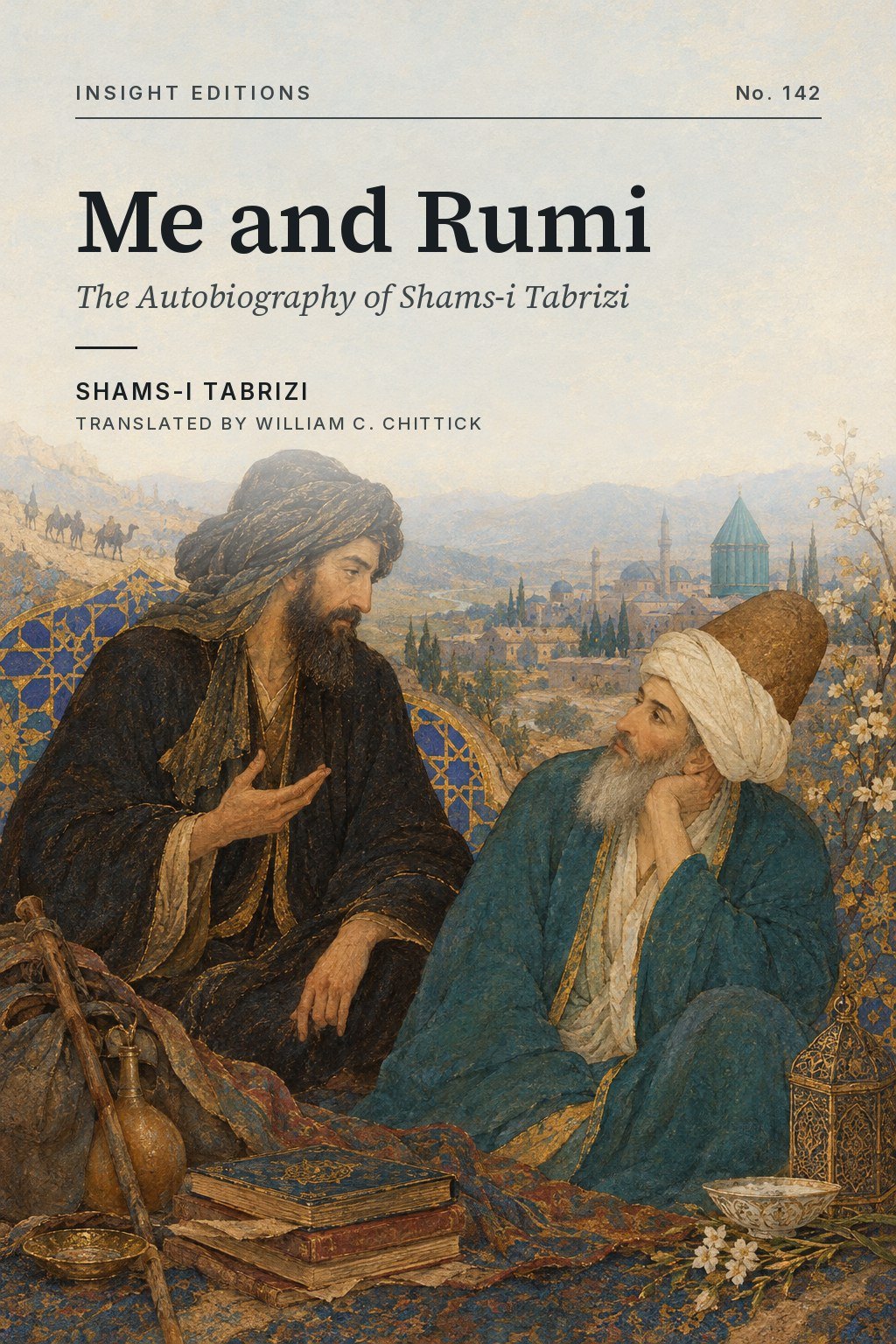
Me and Rumi
The Autobiography of Shams-i Tabrizi
Shams-i Tabrizi · Translated by William C. Chittick
Shams-i Tabrizi recounts his teachings, travels, spiritual formation, and relationship with Jalal al-Din Rumi through sayings from the Maqalat.
A study guide to Me and Rumi by Shams-i Tabrizi, translated by William C. Chittick. Shared free for personal reading; not for sale and not endorsed by the authors or publishers. Please read and buy the original.
About the Book
Me and Rumi is William C. Chittick's annotated translation of about two thirds of the Maqalat, the Discourses of Shams-i Tabrizi, the wandering dervish whose arrival in Konya on October 11, 1244 turned the scholar Jalal ad-Din Rumi into a poet. For centuries Shams was known only through Rumi and the hagiographers. This book lets him speak in his own voice: proud, funny, coarse, learned, tender and severe, often on the same page.
Chittick arranges the scattered notes taken down by Rumi's circle into a loose autobiography in three parts. Part 1, My Years Without Mawlana, gathers what Shams says of his childhood, teaching, travels and teachers. Part 2, My Path to God, groups his teachings: on study and philosophy, following Muhammad, the religion of old women, the shaykh's guidance, caprice, the companion of the heart, the saints and scripture. Part 3, My Time with Mawlana, gives the encounter, Shams's praise of Rumi, his instructions to the circle, his answers to critics, his harshness with friends and his return from Aleppo. Some seventy pages of notes and a combined index and glossary follow, and the notes carry much of Chittick's commentary, including many parallels in Rumi's own poetry.
In one sentence: Chittick presents Shams as a learned and demanding teacher, not the illiterate wild man of legend, for whom the whole point of religion was to move from imitation to realization, and for whom one true friendship, with Rumi, was the goal for which the world was made.
Chapter maps
| Edition part | Book section | Passages | What it covers |
|---|---|---|---|
| 1 | Foreword, Introduction | pp. ix-xxv | Legend of Shams; the Maqalat and its editions; Shams's learning; Shaykh Muhammad and Ibn Arabi; the translation |
| 2 | Part 1: My Years Without Mawlana | 1.1-1.55 (pp. 1-36) | Childhood, teaching children, travels, teachers, Shaykh Muhammad, Awhad ad-Din |
| 3 | Part 2: Study, Philosophy, Following, Old Women, the Shaykh | 2.1-2.151 (pp. 37-115) | Profit and loss of study; philosophy; following Muhammad; the religion of old women; the guidance of the shaykh |
| 4 | Part 2: Caprice, the Heart, Saints, Scripture | 2.152-2.254 (pp. 116-176) | Avoiding caprice; the companion of the heart; the saints; Shams's interpretations of scripture |
| 5 | Part 3: Encounter, Mastery, Mawlana, Companionship | 3.1-3.94 (pp. 177-229) | Dream of one saint; merchant and diver; praise of Rumi; moon and sun |
| 6 | Part 3: Instructions, Critics, Harshness, Aleppo | 3.95-3.223 (pp. 230-306) | Rules for the circle; the charge of worldliness; severity and gentleness; separation that cooks |
| 7 | Notes on the text | all | Every slip found, with printed page |
| 8 | Synthesis | all | Takeaways, frameworks, closer look, Who's Who, connections |
| 9 | Glossary | all | Terms as Chittick renders them |
2.68 and 3.17: "Meaning is God", Shams's shortest theology.
3.62: the first words to Mawlana, on Abu Yazid and following the Prophet.
3.181: why pure gentleness is a defect.
3.220: separation cooks and polishes.
1. Foreword and Translator's Introduction
Annemarie Schimmel's short foreword and William Chittick's introduction (pp.ix-xxv) set the stage: who Shams was in legend, what the Discourses are, why the text is so hard, and how the book is arranged.
- Shams is famous only through Rumi; this book lets him speak for himself for the first time in a European language.
- The Persian text, the Maqalat or Discourses, is a set of notes taken by Rumi's circle, never edited into final form.
- The Shams of the Discourses is learned, not the unlettered wild man of later legend.
- Whether "Shaykh Muhammad" in Damascus is Ibn Arabi cannot, in Chittick's view, be decided from the evidence.
- The translation is literal and arranged in three parts: life before Rumi, teachings, and the time in Konya.
Schimmel's foreword
Schimmel notes that Rumi has become one of the best-selling poets in North America, and that almost every collection of his poems tells the story of Shams: a sober scholar meets a wandering mystic, turns to music, dance and poetry, and after the mystic vanishes is transformed by longing into a great poet. Very little is known about the historical Shams. The Discourses change this. Chittick has translated about two-thirds of them, and the result, she writes, is "an exciting and readable book that brings Shams to life." Shams appears "as raucous and sober, outspoken and subtle, harsh and gentle, learned and irreverent, and above all as an embodiment of the living presence of God."
The legend in outline
Chittick begins with a puzzle. Why should a successful and conventional scholar suddenly throw away the approval of his community to keep company with someone who looked like one of the riffraff? Everyone from Rumi's son onward has tried to explain it. "What we have not heard is Shams's own version of the story. This book fills that gap."
The facts the book gives are few. Rumi was born in Balkh in 1207. His father Baha Walad, a preacher and shaykh in both the outward and the inward sciences, moved the family west ahead of the Mongols and settled in Anatolia. By Baha Walad's death in 1231 Rumi was teaching and preaching in Konya. He was addressed as Mawlana, "our master", and the title in time came to mean him alone.
| Date | Event |
|---|---|
| 1131 | Death of the poet Sana'i of Ghazna, the most quoted poet in the Discourses |
| 1207 | Rumi born in Balkh |
| 1209 | Death of Fakhr ad-Din Razi |
| 1231 | Death of Baha Walad; Rumi teaching in Konya |
| 1240 | Death of Ibn Arabi in Damascus |
| October 11, 1244 | Shams arrives in Konya, said to be sixty; Rumi is thirty-seven |
| about two years later | Shams leaves for Damascus; Sultan Walad finds him in Aleppo and brings him back |
| 1247 | Shams vanishes |
| 1273 | Date of death claimed by those who place his tomb in Khuy |
On October 11, 1244, Shams arrived in Konya. Meeting Rumi in the market, he asked about the great Sufi Abu Yazid Bastami, who had cried "Glory be to me! There is none in my cloak but God!", while the Prophet simply called himself God's servant. Rumi went into a "state". "For Mawlana it was love at first sight." He neglected his teaching for sama, listening to music and poetry and dancing. His disciples were shocked. After two years Shams left; Rumi sent Sultan Walad after him, and he came back for a few months. Then in 1247 he vanished, and in the years of loss that followed Rumi became one of the greatest poets of Persian.
The scale of that poetry matters for the book. Rumi's longest work is not the Mathnawi, six books and 25,000 couplets, but the 40,000-verse Diwan-i Shams-i Tabrizi, whose short love poems are often signed with Shams's name: almost one-third of its 3,200 ghazals. In the Diwan, Shams is "the actual, living embodiment of the true beloved, who is God himself."
Why did Shams leave?
A late report says jealous disciples murdered him with the help of Rumi's son Ala' ad-Din. Chittick follows Franklin Lewis in finding the evidence far too thin. Shams's own words suggest another motive: he treated separation from the beloved as a means of ripening. He says he went to Aleppo because Rumi needed to be "cooked" by separation (3.220), and that after his return "One day of this companionship is equal to a year of that [earlier] companionship" (3.223). A line often attributed to Rumi sums up the sequence:
Perhaps, Chittick suggests, Shams left because Rumi was now cooked and needed to be burned. Rumi was then forty, the traditional age of maturity, and Shams often notes that the Prophet began to speak only at forty, unlike Jesus who spoke in the cradle. He also says the greatest saints stay hidden, and he marvels that he and Rumi are so visible: "The saints didn't use to be obvious" (3.93).
Why the hostility?
Jealousy is the usual answer. Chittick thinks the texts point more to Shams's teaching style. He told people what he thought of them, in biting language, and he says he is holding back the worst: "If I were to speak the truth, all of you in this madrasah would aim for my life, but you would not be able to do anything. The harm of it would turn back on you. If you want, try" (3.70).
A learned Shams
Later stories make Shams a genius contemptuous of book learning. The Discourses show otherwise. He knew the Koran by heart, earned his living as a teacher, had studied jurisprudence, attended scholars' sessions and had a fondness for philosophy even while mocking its practitioners. What he scorned was learning used to make a living rather than to find God. The goal is realization (tahqiq), seeing things as they are for oneself; imitation (taqlid) is a needed first step but "learning is a crutch" until one sees God face-to-face.
Shihab and Shaykh Muhammad
Two acquaintances besides Rumi appear most often. Shihab Hariwa, also called Shihab Nishaburi, is most likely Shihab ad-Din Nishaburi, an outstanding student of Fakhr ad-Din Razi. Shams calls him a "philosopher", likes him and criticizes him. The second is Shaykh Muhammad, whom one passage names "Ibn Arabi in Damascus."
| Position | Who holds it | Chittick's comment | |
|---|---|---|---|
| Shaykh Muhammad is Ibn Arabi | Movahhed (editor), Omid Safi | Movahhed "very much wants" this; it would raise the texts' importance | Probably, with hesitation |
| Franklin Lewis, who would "like to believe" it | Undecided | Chittick | Many Shaykh Muhammads lived in 1230s Damascus; some quoted sayings fit Ibn Arabi, others do not; Shams says the greatest saints stay hidden |
Chittick notes that the identification would suit the early Mevlevi distaste for Ibn Arabi, since Shams says that next to Mawlana, Shaykh Muhammad was a pebble beside a pearl (1.53).
The text and the translation
The Discourses were not written by Shams. Members of Rumi's circle took notes, often but not always with Rumi present, and the notes were never edited. The six oldest manuscripts give two versions: a longer one of raw notes and a shorter, partly edited one, the oldest copy of which is almost certainly in Sultan Walad's hand. Movahhed's edition (1977 and 1990) fills about 550 pages, and he admits his order of passages is largely arbitrary.
Shams's Persian is colloquial; grammar may be unclear or wrong; context is often missing; ellipses abound; and it is often unclear who is speaking to whom. Chittick keeps the pronouns as given, shortens paragraphs to show that the sentences are like headings of an outline, and translates idioms literally when their meaning is unclear. He took about two-thirds of the text, dropping passages with serious textual problems. He put the teachings before the Konya material because the latter is clarified by the former. The poems are rarely Shams's own: many are floating quatrains, and most of those with known authors are by Sana'i.
Chittick tells how Badi'uzzaman Foruzanfar, his teacher in Tehran around 1968, told him the Discourses were not a job for a graduate student, and how Camille and Kabir Helminski set him to work on it in 2001. He states his aim simply: the Shams who speaks here "is an astonishing character. He deserves to be read by everyone who appreciates Rumi or has a taste for Sufism."
- If the text is a set of notes by listeners, how far can any sentence be called Shams's own words?
- Chittick calls the Discourses an "autobiography". What does that framing add, and what does it risk?
- Why does it matter to some readers whether Shaykh Muhammad was Ibn Arabi?
2. My Years Without Mawlana
Part One of the book (pp.1-36, passages 1.1-1.55) gathers what Shams says about his life before Konya: a strange childhood, a harsh career as a teacher of children, years of wandering, and the scholars and shaykhs he met, above all Shihab Hariwa and Shaykh Muhammad in Damascus.
- From childhood Shams felt himself a stranger, a duckling raised by a hen, drawn to an ocean his family could not enter.
- As a teacher he used severity on purpose, believing it binds a person more deeply than gentleness.
- He hid his rank, chose caravanserais over khanaqahs and madrasahs, and fled whenever he was recognized.
- He tested the leading minds of Damascus and found the philosopher Shihab brilliant but closed to what intellect cannot reach.
- Shaykh Muhammad was "a mountain", yet he lacked "following" of the Prophet, and next to Rumi he was a pebble beside a pearl.
Before this world
The opening passages place Shams's story before birth. The spirits once lived in a "togetherness" with God. Told that they would become the progeny of a vicegerent of water and clay, they feared being scattered; God promised to gather them together even "In your very clothing and veil" (1.1). Shams is clear that this togetherness is not the companionship of tavern-goers but "this togetherness is with God." Coming down into the world was like seeing a city from far off: "The flavor of the bait overcame the suffering of the trap. Otherwise, existence would have been impossible" (1.2).
He says he came into this world "to look around" and heard speech without letters, which called the letters "toys" and told him he had wanted a house in water and clay (1.3).
A duck's egg under a hen
The central image of the childhood passages is the duckling. His father could not understand him: not mad, not badly brought up, yet not like anyone. Shams answers:
His father's reply is dry: "If you are like this with friends, how do you act with enemies?" Shams's judgment of him is gentle but final. He was a good man who wept easily, "But, he was not a lover. A good man is one thing, a lover something else" (1.5). Chittick's note points to Rumi's own story of ducklings raised by a hen in the Mathnawi.
Other childhood marks follow. A madman who spoke of unseen things threatened his father and blessed the boy (1.7). Shams never lost at dice "not out of trying, but by nature", and went wherever there was preaching. As a child he refused food for days, lifted by love; at thirty or forty days without appetite "the Companion with His hot state seized me in the sama" and spun him "like a little bird" (1.9). When people asked if he needed clothes or money, he replied that he wished they would take even his clothes "and then give me over to me" (1.8). He felt "a stranger in my own town", afraid of a father who spoke only gently (1.10). The section ends with his father's death in a vision of light, the house and town circling around him (1.11).
The schoolmaster
Shams earned his living teaching children the Koran, and he tells these stories with relish. He would ask a father why he had brought his son. If the answer was that the boy played in the streets, Shams beat the boy and sent both away. Only if the father said "The command is yours, strike and kill as you want" would he take the child (1.14). He taught a boy the whole Koran in three months in Erzerum, asked two hundred dirhems, and received five hundred (1.14-15).
The longest story (1.16) is of a cheerful, cheeky boy whom Shams beat with a soaked stick until the skin came off his feet. After a month at home the boy returned of his own accord and told his mother: "He is my God", and added: "I will not separate myself from him until death." The neighbours, who had suffered from him, prayed for the teacher.
| Gentleness | Severity |
|---|---|
| Wins a five-year-old child at once | Shown first to those Shams likes |
| Makes the pupil belong to you on the surface | Makes him belong "completely", skin and flesh |
| Leaves fear of perishing in place | Once the pupil sees good fortune behind affliction, he "becomes bold and does not fear that he may perish" |
He states his rule to a gentleman in Erzincan who complained of being kept behind a veil: "My rule is that whenever I like someone, from the beginning I show him only severity so that I may belong to him completely" (1.18). The modern reader will find the beatings hard to read; the book presents them without comment, and Shams presents them as kindness. A tender counterpart is the boy who clung to him all day, recited a quatrain of the lover at the beloved's door, and died at eighteen (1.13).
Passage 1.17 is the frankest in this part. Shams says his appetite was so dead that a beautiful pupil's embrace earned only a slap. Then in a dream he heard the hadith "Surely your soul has a right against you, give it its right!", and he spent a night with a woman at the city gate called "Beautiful Faces", "at God's instruction and pleading." Chittick's note gives the hadith's fuller form, in which the Prophet rebukes a man who had given up women, and adds that Ibn Arabi said he had no interest in women for eighteen years on the path until God made him love them.
On the road
The travel passages show Shams avoiding honour. Made leader of a band of hungry Sufis, he held them back from a melon-grower's offer until the man promised to give dervishes what he ate himself, not the parings (1.18). Once recognized, he left his companions; he looked for work as a labourer and was refused because he was weak.
He explains why he stayed in caravanserais:
He lived in a cubicle where drunkards relieved themselves by the door, swept it each morning without a word, and stopped buying from a soup seller who began giving him the best part (1.21). During Ramadan he led a caravanserai in prayer while a rich silk merchant fed others and not him (1.22). Chittick notes that passages 19-22 may belong to Shams's later stay in Aleppo, since one mentions the road to Homs.
Two sayings from this section recur later in the book. To a man complaining that his property was plundered he told the tale of the grocer whose slave watched him skim a finger of honey from each pot until a whole bag burst: "you take it finger by finger, and it goes bag by bag" (1.23). And in a session on the history of chivalry he would say nothing until a silent dervish moved him to speak of Adam: "The child of Adam must slip once in his life" (1.24). The note reminds readers that in Islam Adam is the first prophet, and his "slip" was eating from the tree.
Teachers, judges and a drinking scholar
Shams left Judge Shams ad-Din Khunji because the judge would not teach him, saying "I see a very noble pearl. I cannot put an engraving on this pearl" (1.26). Chittick's note explains a textual problem here: the printed text reads Khu'i, a known Damascus scholar who died in 1239-40, but the editor argues for Khunji, an unknown teacher, and the manuscripts cannot settle it.
Passage 1.27 is a long reflection on law and necessity. A noble scholar who drank from habit said he would fall ill if he stopped; Shams holds that the Law permits wine in necessity. But he separates this from a man named Rashid who mocked prayer. Of himself he says: "on the day that I miss the prayer, I suffer, and I am unhappy until night." The passage closes with a couplet that sums up his view of law and inner reality:
Other teachers are briefly drawn. Judge Shams ad-Din Khu'i of Damascus preferred a debater with experience to a memorizer (1.29), and told an unusual hadith of hypocrites left lamenting in an empty hell (1.30). Shams adds that one must strive against hidden hypocrisy, and reads "The believer is the mirror of the believer" as meaning either that God mirrors the servant or the servant mirrors God. To a man weeping because the Tatars had killed his learned brother he said "This world is the prison of the believer": why mourn a prisoner's escape (1.31)?
Shihab Hariwa, the lovely unbeliever
Shihab Hariwa of Damascus is the philosopher of Part One. He was accepted by all the logicians, had been "thoroughly melted by ascetic discipline", ate almost nothing and gave credit to no one, not even Avicenna, yet he found Shams congenial: "You, come, because with you my heart is at ease" (1.40).
| Shihab's position (as Shams reports it) | Shams's reply | |
|---|---|---|
| God is necessary by His Essence and does not act by free choice (1.35) | "I don't want that God. I want a God who acts by free choice." | The philosopher is the knower of everything (1.36) |
| Shams erased it and wrote "The philosopher is the knower of many things." | Resurrection is of spirits only; he denied the splitting of the moon (1.36-37) | The resurrection is of bodies; the philosopher is "reading his own page" |
| God knows universals, not particulars (1.45) | A whole includes its parts; a garden without trees is only an enclosure | The angels' jealousy made the prophets turn to people (1.40-41) |
Shams does not despise intellect. "Intellect is God's proof, but when you don't employ it correctly, it comes up with contradictions" (1.41). He gives a homely image: two people agree on two times two but disagree on seventeen times seventeen; a hundred people in sunlight agree on a drummer dancing toward them, but on a cloudy night one hears an army and another a circumcision party. Laziness in thinking is "like holding a mirror crookedly."
Shams's verdict is affectionate. "Shihab was a lovely unbeliever" (1.43); when others called him an unbeliever, Shams said that before the sun Shihab is an unbeliever, but in the sun's service "he becomes the full moon and becomes perfect" (1.44). Once Shams spoke of an alif drawn on the Tablet and Shihab fled: "I can't tolerate looking at your face" (1.45). His death, as Shaykh Muhammad foresaw it in a dream, is told in 1.46: he was found slumped over his books, smiling.
Shaykh Muhammad, the mountain
Shaykh Muhammad appears as a great man with one fault. He laughed at the philosophers' phrase "Necessary in existence by His Essence" (1.43). He held that studied knowledge is better than knowledge gained without study, which Shams answered with the image of a child who strikes the target without aiming (1.47). Shams often caught him in mistakes, and he would answer "Child, you strike a hard whip" (1.48). He said "The plain of speech is very spacious"; Shams answered that "The plain of speech is very narrow" and "the plain of meaning is spacious" (1.49).
Shams's final word ties the Damascus years to Konya: "I took much benefit from him, but not as much as from you. What is from you is not like what is from him. How different a pearl from a pebble!" (1.53). Shaykh Muhammad hoped for a companionship with Shams that was not granted; Shams hoped the same between himself and Rumi (1.53 bis).
The part closes with Awhad ad-Din, who took Shams to sama and asked to be his companion. Shams set a test: drink openly before your disciples, or pass goblets round where they gather for sama. Awhad could not. "Then being my companion is not your work. You must sell your disciples and the whole world for a goblet" (1.55).
- Shams tests both Shaykh Muhammad and Awhad ad-Din by asking them to give up reputation. What is he testing for?
- Is severity a teaching method, a temperament, or both, in these passages?
- How does the clear-day and cloudy-night image square with Shams's attacks on philosophers?
3. My Path to God (I): Study, Philosophy, Following
Part Two of the book, Shams's teachings, is the longest (pp.37-174). This first half covers its opening four sections and the start of the fifth: the profit and loss of study, philosophy, following Muhammad, the "religion of old women", and the guidance of the shaykh (passages 2.1-2.151).
- Intellect takes you to the threshold but not into the house; studied knowledge is a pot, not the water.
- Imitation (taqlid) must give way to realization (tahqiq): "Where's your own?" is Shams's constant question.
- Philosophers are clever but trade punches with the prophets; the master of a miracle is more of a philosopher than they.
- Following Muhammad in form and meaning is the highest path; the ecstatic sayings of Abu Yazid and Hallaj fall short of it.
- The disciple must die into the shaykh, as a swimmer must go limp for the ocean to carry him.
The profit and loss of study
Intellect at the threshold
The section opens with intellect as a guide. This world is a treasure and a serpent; those who put "the shaykh that is intellect in front" find that the serpent becomes "a bridge", its poison sugar and its thorns roses (2.1). Yet intellect's reach is limited:
Intellect is "a master archer" who can draw the string to the ear, but the this-worldly intellect draws it only to the mouth, and an arrow loosed from the mouth wounds nothing: "words that come from the mouth are nothing", unless "they come from action and practice" (2.3). "Intellect's legs are weak"; it reaches the door of the house "But it doesn't have the pluck to go into the harem" (2.8).
The alif
A second image that recurs is the letter alif, the first letter, a single upright stroke. "Of all the secrets, no more than an alif fell out. Everything else they said was to explain the alif. And of course the alif was not understood" (2.12). The other letters are commentary: ba bows at alif's feet with a single dot of love, ta has two dots to overthrow this world and the next (2.14). The Koran itself came as explanation for those who did not grasp the alif (2.10). Shams quotes a quatrain he will use again: "O you who died trying to undo knots!"
Learning as a pot
Man was created to know where he came from and where he will return; the sciences, "the best occupation of the folk of this world", keep him from that purpose (2.13). "Know that studying is also a great veil"; the scholar finds he was "kept busy with licking the pot", and "words and sounds are the pot" (2.16). Sana'i on his deathbed murmured that there is no meaning in speech and no speech in meaning (2.17). "Whoever is more learned is further from the goal" (2.19), as in the tale of the treasure-seeker told to loose an arrow from a dome: the archers who shot furthest were most deprived, for the treasure lay at his feet.
The questions study should serve are simple:
The rope of knowledge "is for people to come out of the well, not for them to go from this well into that well" (2.26). Fakhr-i Razi wrote a thousand folios of Koran commentary, some say five hundred, yet "A hundred thousand Fakhr-i Razis couldn't reach the dust of the road of Abu Yazid" (2.23). Debate about the road is not travel: Chittick notes that the speaker here is Sultan Walad, who did make the trip to Aleppo, and that Aksaray, the first city on the road from Konya, stands for the goal of the path.
Shams does not dismiss learning outright. He was himself a jurist and read the legal manual Tanbih many times (2.6). He even prefers jurists to most dervishes: "At least the jurists have taken trouble. The others simply brag about being dervishes" (2.5). And he valued digestion over quantity. Had he studied the outward sciences, he would never have begun a new lesson before mastering the last: "If someone digests a problem as is due to it, that is better than reading a thousand problems that stay raw" (2.29).
Imitation and realization
From 2.31 to 2.41, Chittick's note explains, Shams contrasts two kinds of knowledge: imitation, knowing by hearsay, and verification or realization, knowing face to face. His challenge to a shaykh who quoted others: "Where's your own? Come on, answer!" (2.31). Words such as gnosis and dervishhood are now used by anyone, "but the only thing they know is what they've heard" (2.32).
| Imitation (taqlid) | Realization (tahqiq) | |
|---|---|---|
| Knowing by hearsay, transmission, tales, poems | Knowing face to face, by tasting | "Imitation is always changing" , hot one hour, cold the next (2.37) |
| Continuous, not cut off (2.39) | Source of "Every corruption that has appeared in the world" (2.37) | Makes one ask, "No, I will see for myself" (2.32) |
| Still better than self-made paths: the blind man with a hand on a seeing man's back reaches Aksaray (2.67) | "He who is more of a verifier is more of an imitator" (2.40): he imitates higher things, up to God | If you must imitate, "then imitate the Koran" (2.38) |
Two stories carry the point with humour. Seven Sufis asked a host for food enough; six ate until they fell dead, and the seventh said that since he still breathed, it was not enough. "A satiating, adequate answer is one that leaves your insides with none of the agitation of question and answer" (2.24). In the other, a Jew, a Christian and a Muslim agree that whoever has the best dream will eat the halva; the Muslim, deprived by the others, rises at night and eats it, claiming Muhammad told him to (2.28).
The longest story of this section (2.42) is of Hamadan. One week a preacher who "declares similarity" (tashbih) frightens the town into believing God sits on the Throne with feet hanging down; the next week a stranger who "declares incomparability" (tanzih) frightens them with the opposite. A man comes home in despair and his wife resolves it: "Whether He is on the Throne or has no Throne, whether He is in a place or has no place, wherever He may be, long may He live! May His good fortune last!" Shams's moral: "You must occupy yourself with being a dervish and think about being a dervish." Chittick adds that Ibn Arabi may have been the first to pair tashbih and tanzih as complementary sides of tawhid.
Philosophy
The section on philosophy ranks the sciences: purity rituals and the branches of law are easiest, then legal principles, then theology, then philosophy and metaphysics. Philosophers "trade punches with the prophets" (2.43). Plato's claim that prophets would be unnecessary if all were like him is "rubbish"; one who can turn dirt to gold without any treatment deserves to be followed. "the master of the charismatic act is more of a philosopher than they", and miracles outrank charismatic acts.
Shams still borrows from the philosophers when it suits him. Passage 2.54 retells their account of the punishment of the grave in terms of meaning: the spirit grown used to the body suffers at death; the one grown used to the other world is not dying but "transferred", like moving from a dark narrow room into a house with gardens. This becomes a mirror for choice: "whenever you hesitate between any two works, look into this mirror. Which of these two works is more appropriate for death?"
Following Muhammad
Substance and salt
The prophets do not give news to those who lack it, but awaken what is already there: to the one who has it he said that "You also have it." Ascetic discipline without that substance is like food without salt (2.56). When there is no substance, "what can they put on the road?" (2.57). The prophets make one another known, and when asked who will make the Seal of the Prophets known, Muhammad says: "He who knows his soul knows his Lord", meaning, Shams says, he who knows my soul knows my Lord (2.58-59).
Muhammad's place is unique. What other prophets gained in a thousand years he passed through quickly; Jesus spoke in infancy "not by his own choice", but "Although Muhammad spoke late and after forty, his words were more perfect" (2.61). Shams says something that may surprise: "I do not revere the Koran because God spoke it. I revere it because it came out of Muhammad's mouth" (2.62). And yet: "It is God who is God. Whatever is created is not God", whether Muhammad or another (2.65). He would not trade the least report from Muhammad for "a hundred thousand treatises by Qushayri" and the others (2.63).
Form and meaning
"Following" has a form and a meaning. Shams's model is the Prophet complaining that "The surah Hud has whitened my hair", a complaint that shows how heavy the commandments were, though he never abandoned them (2.68). He also records "Meaning is God", which Chittick shows is the saying Rumi quotes in the Mathnawi from "the shaykh of the religion", a puzzle solved only by the publication of the Discourses (2.68 and note).
| The Prophet | Abu Yazid and Hallaj |
|---|---|
| "Glory be to You! We have not worshipped You as You should be worshipped!" | "Glory be to me! How magnificent is my status!" (2.80) |
| Sober, "on the other side of drunkenness" (2.85) | Drunk; "One cannot follow the sober in drunkenness" |
| Saw that all is He, and pulled down a mask "so that I won't be like Hallaj" (2.84) | "I am the Real": the beauty of the spirit had not yet fully shown itself to Hallaj (2.93) |
| Prayed out of love until his feet swelled (2.78) | Abu Yazid kept the form (would not eat melon) but ruined its reality and meaning (2.80) |
The vs table is Shams's sharpest point in this section. He is not against ecstasy. Abu Yazid "will not be taken to account for it, because he had become selfless" (2.82). But "If anyone supposes that his state was stronger than that of Muhammad, he is very stupid and ignorant" (2.80). "I have often raised objections to the words of the great ones, but I have never objected to the words of Muhammad" (2.92).
Form still matters
Some say that once the heart is present the prayer's form is not needed. Shams answers with a dilemma: did the Messenger reach this perfection or not? If not, they deserve death; if he did, "then why don't you follow" him (2.73)? Between an undoubted saint who drops the outward form and Rashid ad-Din, whose sanctity is not manifest but who keeps the form, Shams "will take after Rashid ad-Din and not even greet the other one." When he and Mawlana miss a prayer while occupied, "we are not satisfied with that and we make up alone for what we missed" (2.77). The road to the king is by the door, which is obedience, because the walls are very high (2.77).
Yet the inner meaning of worship is what counts. The Prophet's own worship was "immersion in self" (2.70); the five prayers and the fast were given so that those without that immersion "would not be deprived". Prescribed worship is better than self-chosen worship, says the Sought Object to the seeker: "Your putting up with a little bit of prescription is a thousand, thousand times better for you than worshiping without prescription" (2.71). Chittick notes Ibn Arabi says the same.
Predestination and free choice
Shams criticizes the gnostics who "all fell into predestination" (2.88). God calls you "freely-choosing", he says: "Why do you call yourself predestined?" Commands, prohibitions, promises, threats and messengers all demand free choice. True walayat, sanctity or rule, is rule over oneself:
People, he adds, "are predestinarians on their Companion's side, but free-willers on their own side" (2.87). A shopkeeper who said God had not made bread a dervish's ration was told: "God had made it his ration, but you prevented it" (2.90).
The religion of old women
One veil
Shams cuts through the elaborate maps of the path. Teachers speak of seven hundred veils of light and seven hundred of darkness and drive seekers to despair. "All the veils are one veil. Other than that one, there is no veil. That veil is this existence" (2.101). "God-worship is to let go of self-worship" (2.98). To someone who said God is one, Shams answered, in effect, what is it to you? "You are a hundred thousand dustmotes, each dustmote taken by a caprice"; become one yourself (2.99-100).
Increase, and the citadel
Two short passages show how Shams reads ordinary religious words. A leader told him that a weak memory comes from sin, which Shams reads as "abandon existence"; memory is found by abandoning memory (2.96). The Koran's call to seek God's bounty means seeking increase: "Do not be satisfied with being a jurist." One should ask for increase: an increase over being a Sufi, over being a gnostic, over heaven itself.
The citadel parable (2.103) explains why the same act can be right at one stage and wrong at another. While the citadel of the self belongs to a rebel, destroying it is service; once the king has entered, destroying it is treason and building it up is obedience. A quatrain sums up the reversal: "Until faith becomes unbelief and unbelief faith no servant of God will become a true Muslim." The takbir works the same way: "God is greater" means greater than anything you have conceived, "Even if it is the conception of the prophets" (2.104-105).
Shams also mocks a Sufi quatrain that makes Ahmad (Muhammad) into Ahad (the One) by removing the letter m, and another that turns bism Allah into jism Allah, "the body of God": "What tasteless words! What insipid speech! Learn from that little old woman" (2.109). Chittick's note suggests the quatrain may lie behind a famous line of Shabistari's Gulshan-i raz.
"O You, all You!"
The section's title comes from a hadith: "You should hold to the religion of old women" (2.106). The old woman says, "O You! Oh, all is You!", and since she said "all", she includes herself. This, Shams says, is better than saying "I am the Real". Chittick's note gives the common explanation: an old woman asked if she believed in God replied that a spinning wheel cannot turn without a hand. Ghazali applied it to disciples misled by visions. Shams pushes it further: "Fakhr-i Razi and a hundred like him should be proud to lift the corner of the face-covering of that needy, truthful woman so as to take blessing" (2.108).
Her strength is need. "He who has no needs loves need"; bringing the spirit as a gift to God is "brought cumin to Kerman" (2.110), like coals to Newcastle, as the note says. This gives the book its epigraph:
Chittick's note calls this mutuality of seeker and sought a key to Shams's remarks about his own relation with God.
Love that sees
A disciple objected that a lover's testimony is worthless, since "Your love for a thing makes you blind and deaf." Shams replies: "All lovers are not such that they see the bad as good. There are lovers who see everything just as that thing is, because they see it with the light of the Real" (2.114). Abraham's words, "I love not those that set", are the mark of such love (2.113). The story of Mahmud, Ayaz and the pearl (2.119) shows it in action. The king orders courtier after courtier to break a priceless pearl; each refuses, flattering the pearl and the king, and is rewarded. Ayaz, the beloved slave, breaks it at once: "Is the king's command more valuable, or the pearl?"
Tears and the heavy sleeper
Outward purity is not enough. "a dustmote of inner filth does what a hundred thousand outer filths cannot do", and only tears can wash it, and only "the water of the eyes that comes forth from sincerity" (2.120). The heavy sleeper who will not wake when poked, struck and pulled by the beard is still asleep when the enemy has cut half his throat.
The lighter tales of this section have the same edge. A wrestler who had never won once threw a man by accident and insisted on killing him: "Should I throw down someone once in my whole life, and then not kill him?" (2.121). Shams uses it to price need: "When man comes by way of need, his price will never appear." The Khwarazmshah, told bread now cost two drams of gold, thought it cheap; he would have been frightened only if told it cost his whole kingdom (2.137). So an attribute or station that terrifies most people is easy for one person, as the trust refused by the heavens and the earth was borne by man, for "there is someone behind us who pulls it."
The guidance of the shaykh
The servant is the Book
"By the Book of God he does not mean this bound volume. He means the man who is the leader. It is he who is the Book of God"(2.127). Shams tells of a judge of Baghdad who knew the written Koran, plotted against the caliph, and was inwardly
"a Jew and a dog"(the harsh words are the book's). Hence:
"He who follows the blackness [of the ink] has gone astray."The servant of God is hidden among pretenders as the Night of Qadr among nights,
"because of his extreme manifestness", as the sun is hidden from the bat.
Dying into the shaykh
"What is the shaykh? Being. What is the disciple? Nonbeing"(2.130). The swimmer image follows:
When the drowned man's head goes under, some say he is dead and others that he has come to life: "Both speak the truth. That borrowed life has gone, and the abiding, subsistent life has come" (2.132). Satisfaction with God's decree is not enough; one must be satisfied with everything the helper does, since "God has connected this to a cause" (2.129).
Moses and Khizr
Passage 2.133 retells the Koranic story of Moses and Khizr. Moses, the prophet who gave rulings, set out to find one who knew more, ready to travel forty or eighty thousand years. Khizr had knowledge "such that it could not be gained in any madrasah or khanaqah, nor from a teacher, a book, or by means of any created thing." Shams notices Moses' need: "Look at the need of God's speaking-companion, who had already arrived at the Real!" When Khizr finally parts from him, he claps and dances: "Speak quickly, leave me alone, deliver me!" The lesson: "Happy the one who finds a servant [of God], keeps the story of Moses and Khizr before his heart, and makes him his own imam!" Chittick's note says Sufi texts often read the story as a warning to the disciple not to question the shaykh. Shams also says "were I to find a sought one, I would do the same", which looks ahead to his search that ended in Rumi.
Other stories make the same point. Ten Sufis bound Christian sashes around their waists for the sake of one companion in love with a Christian youth; the youth, moved by such unity, tore off his own sash (2.135). A judge told a plaintiff with ten Sufi witnesses that "these ten are all one witness" (2.136). Of the birds who flew to the Simurgh, only two crossed the seven oceans, and at the sight of it two drops of blood fell from its beak and they died (2.140).
Variegation and the community of Muhammad
Shams uses the Sufi term variegation (talwin) for states that come and go. "In you, Pharaoh has stuck up his head. Moses comes and drives him away. Again Pharaoh comes, and Moses goes. This is proof of variegation" (2.141). The aim is to stand firm, so that the angel of death becomes for them "the angel of life". Variegation in eating and worship is not the same for prophets and saints: in both states they "were nurturing the spirit, not the soul" (2.139).
Moses' request to see God (7:143) is read in the same key. Knowing that vision belongs to the Muhammadans, Moses was really asking, "O God, make me one of the community of Muhammad!" Khizr asks the same. "Muhammad has a light that overcomes all lights" (2.145).
Forty days, sama and the dance
A Companion who worshipped for forty days hoping for wisdom to flow from his tongue got nothing, because the hadith says "devotes himself purely": he had worshipped "out of craving" (2.143). Forty days helps only one already prepared (2.144).
The last passages of this half defend sama. When told he had given scholars a bad name, Shams answered that one reaches God by dancing too: "Two strides and he arrived" (2.146). "The dance of the men of God is subtle and weightless", inside like a hundred thousand mountains, outside like straw (2.147). A sama would not take hold until strangers' shoes were put outside (2.148). A dervish forbidden sama died of a knot in his chest that turned into a stone like agate, which melted on the finger of the man who had forbidden it (2.150). In a sama with his shaykh, Shams saw a sun rise from his own breast and saw his veins and bones by its light (2.151).
- Shams attacks imitation yet praises the sincere imitator and the old woman. How do these fit together?
- Why does Shams rank following Muhammad above Abu Yazid's ecstasy, when both are forms of love?
- Is the disciple's "death" into the shaykh a healthy model of teaching, or a dangerous one?
4. My Path to God (II): Caprice, the Heart, Saints, Scripture
The second half of Part Two (passages 2.152-2.254) moves from the struggle against caprice to the heart as God's dwelling, then to stories of the saints, and ends with Shams's readings of the Koran and Hadith.
- Caprice (hawa) is not gold or women but self-will, and its drunkenness is the first of four levels of drunkenness that end in sobriety.
- Mawlana is "drunk in love" but not sober in love; Shams claims to be both.
- The heart that embraces God is the broken heart, not a piece of flesh; the whole universe is a set of sheaths around the human being.
- Saints keep themselves hidden; the stories of Uways, Abu Yazid, Junayd and Ahmad Ghazali show what hiding and testing look like.
- Scripture has many layers; exegesis that stops at the outward sense is "the exegesis of the speaker's state, not the exegesis of the Koran."
Avoiding caprice
What caprice is
"Islam and faith are opposition to caprice. Unbelief is conformity with caprice"(2.152). The protected non-Muslim who pays the tribute at least knows what he is; the false believer
"wants neither to pay the tribute nor to abandon caprice". He says he is a falcon;
"He's a crow."And Shams is precise about the term:
"by 'caprice' I do not mean gold, women, and this world"(2.156). Monks can be full of it. It is the drunkenness of self-will that may even keep a person away from the world, for fear of losing that drunkenness.
Living by one's own opinion has its price: "Whoever lives as he sees fit will not die as he sees fit" (2.153). The aimless bee that kept landing on the butcher's meat lost its head; the honey bee, which sits where it is commanded, produces healing.
Four drunkennesses
Passage 2.154 gives a ladder. First is the drunkenness of caprice, from which "Only a fast-going traveler" escapes. Second is the drunkenness of the spiritual world: the person has not yet seen the spirit but despises the shaykhs and even the prophets and is ashamed to quote the Koran and Hadith. Passing beyond it is very hard, unless "God's unique one" is sent to him. Third is the drunkenness of God's road, "linked with stillness"; fourth is drunkenness in God, which is perfection. "After that is sobriety."
Shams places himself and Rumi on this ladder. There are three kinds of forgetfulness: this world makes you forget the next, the next can make you forget yourself, and love of God makes you forget both. "This is the level of Mawlana" (2.155). But:
The sober one, not the drunk, is fit to guide. The ripening grape is the image: kept between cloud and sun until sweet, after which "they're nurtured even under snow". In the one who reaches sobriety "his gentleness takes precedence over his severity", while in the merely drunk the two are equal (2.157). The same passage gives a short and important distinction: the Prophet had revelation from Gabriel and in the heart; "The saint has only the latter."
The disciple in the dark
When a veil falls between disciple and shaykh, that is night: "The more darkness increases and the more the shaykh becomes disliked by you, the more you must strive in his service" (2.160). The soul in such darkness "starts to make interpretations"; Chittick explains that it explains away rather than explains, to escape obligation. Against that, Shams quotes: "Most of the folk of the Garden are fools", and he adds that the majority of hell are "these clever people, these philosophers". The Garden is ringed by brambles whose scent makes them sweet; hell by roses whose scent makes them foul.
The remedy for quarrel is peace. "The stuff of war is caprice" (2.161). Shams quotes the Prophet's "lawful sorcery" that enslaves free men without money: "Gentle acts and soft words." And on gossip: if someone tells you a friend envies you, "know that the envious one is the speaker" (2.167). To Surmari who asked "Who is Iblis?", Shams answered: "You", for Shams was then immersed in Idris (2.167).
| Envy that takes to paradise | Envy that takes to hell |
|---|---|
| Warms people on the path of good: "Why should I be less than he in virtue?" | Wants the other denied and held back |
| Shams says Mawlana and his wife Kirra have it, and "All day, my words are for the sake of this envy." | Fed by tale-bearers who make others "the pretext" |
Other sayings of this section are sharp. For the worshipper of this world, "one copper is the kiblah" (2.168). Galen said he would rather gaze on the world from a mule's belly than die (2.170). Among the blood-letters of the bazaar Shams thought: a sun has risen, "And all these people are in darkness" (2.171). "Nothing kills the soul that commands to evil like seeing the beauty of the heart" (2.172).
The companion of the heart
The broken heart
The section's key text is a divine saying Shams quotes often: "Neither My heaven nor My earth embraces Me, but the heart of my believing servant does embrace Me" (2.173). Anyone who says the heart is the piece of flesh "is more of an unbeliever and worse than a Christian". Which heart, then? "When you say 'companion of the heart,' say those whose hearts are broken" (2.176), for God says "I am with those whose hearts are broken for Me." In a wrestling match, God is with the one who is thrown (2.177).
The spacious heart is recognizable. If someone's words open your heart and make you forget the world, "Such a person is an angel and a paradise-being"; if his talk makes you cold, "he is a satan and a hell-being" (2.174). The dervish takes the world as an ocean: "How can it harm a duck?" (2.181). When someone came trembling with news that the Tatars had come, Shams said: "You've been claiming to be a duck for some time now. You tremble like this because of a storm?" (2.182).
When poverty is complete
The Sufi saying "When poverty is complete, he is God" draws a firm correction:
Otherwise, Shams asks, what is the difference between you and the Christian who calls Jesus God? "After all, Jesus was subtler than Hallaj, Abu Yazid, or others." And even then one arrives not at God but at "the path of God". Speech belongs to separation, not union: "in union there is no room for talk", as bride and groom fall silent at the moment of union (2.185).
Sheaths and the microcosm
: Throne, Footstool, heavens, earth, body, animal spirit, holy spirit,
"sheath within sheath, veil within veil, up to the point where there is gnosis", and even the gnostic is a sheath relative to the Beloved (2.194).
"You will see them all in yourself", Moses, Jesus, Abraham, Noah and the rest, even the Antichrist (2.195).
"The Tatars are in you"(2.198). In the philosophers' view man is the microcosm;
"In the view of the prophets, the microcosm is this, and the macrocosm is man"(2.197).
Recognizing the saints, Shams adds, is "more difficult than recognizing the Real" (2.190), because a carving proves a carver but the saints look like everyone else. The Prophet longed for his "brothers", not his Companions nor the past prophets but "dear servants who will come forth after me" (2.191). Shams says there are more secrets in the Hadith than in the Koran, because the Koran is a public watchman (2.192-193).
Passage 2.187 records a short exchange about Sana'i. Shams criticizes the poet as one who "spoke frigidly and had no news of the heart", and recalls the report that at the end of his life Sana'i asked for the Christian sash, then recited the Shahadah. Chittick's note explains the sash from Attar's account of Abu Yazid, who put on a sash each time he returned from nearness to God, and broke it at death as one newly entering Islam.
Faith that laughs at doubt
Khayyam wrote that whoever reaches the secret of love is bewildered. Shams's reply: "every speaker describes his own state." Khayyam was perplexed, so he blamed the spheres, the days, luck and God (2.188). "The believer is not perplexed." Shams then gives one of his most confident statements:
It is as if, at full morning, men came leaning on canes and moaning that the sun had not risen; a hundred thousand such voices would only make you laugh. He is just as open about knowledge from outside his own camp. Asked about astronomy, he says that whatever is intelligible from the stars must be accepted: "I'm a Shafi'i. I find something in the school of Abu Hanifa through which my work goes forward and which is good. If I don't accept it, that's being obstinate" (2.189). The gnostic sees the stations of everyone and laughs, grateful not to be held in any of them; and there is someone who sees this gnostic, "But no one sees this one except God."
A meditation on joy and grief
Passage 2.199 is one of the most lyrical in the book. Asked to sit heads on knees and watch, one disciple sees up to the Throne, another beyond it into the Void, another the cosmic Cow and Fish beneath the earth. The last sees only his incapacity: "Yes, I'm hanging, but suddenly I'm hanging in the trap of the Beloved." Several love poems follow, ending "in the book of my life there's only one page left." Then a meditation on opposites: "Joy is the messenger of grief, and expansion is the messenger of contraction." Every flower of delight rots within the hour. The advice is to "Take all these colors far from your eyes, so that you may see another wonder", a world from the He beyond happiness and unhappiness.
The saints
Uways and the mark of Muhammad
Uways Qarani never met the Prophet, kept back by caring for his mother on the Prophet's instruction. When he came to Medina after the Prophet's death, the Companions scolded him. He asked them what Muhammad's mark was. They described his height, face and colour, then his humility and generosity, then his knowledge and miracles. Uways was asking none of these. When he opened his mouth to tell them, "seventeen of them fell down on their faces unconscious, without his having spoken" (2.202). "Reports are not like seeing face-to-face."
Abu Yazid tested
Shams tells four stories of Abu Yazid, all tests of pride. A dervish of Basra had him circle him seven times and hand over his travel money: God has never entered the Kaaba since it was built, "and from the moment they built this house, He's never left" (2.203). On the road a man read his thought before he could ask to walk with him (2.204). He sold seventy hajjes for a drink of water for a dog, felt pleased with himself, and the dog turned away until he repented (2.205). He wanted a sash, like Sana'i, to see its secret (2.206). Shams concludes that he is not counted among the complete saints, but tells the story of his prophecy of Abu'l-Hasan Kharaqani, born a hundred and fifty years later (2.207).
| Saint | Story (passage) | Point |
|---|---|---|
| Uways Qarani | The mark of Muhammad (2.202) | Reports are not seeing |
| Abu Yazid | Seventy hajjes for a dog's drink (2.205) | Even good deeds feed pride |
| Abu Yazid | Skulls in the graveyard (2.208) | Three kinds of listening |
| Junayd | Children praise his night vigils (2.209) | Others' belief can shape us |
| Junayd and Ahmad the Heretic | Searches sixty days for "Ahmad the Sincere" (2.210) | Over-interpretation blocks the goal |
| Ahmad Ghazali | "I am unlettered" (2.211); the brazier (2.212-214) | Hidden sanctity, testing the disciple |
The skulls story is a neat parable of reception. Some skulls had no ear holes: they heard nothing. Some had a hole from ear to ear: in one ear and out the other. Some had a way "from the ear to the throat": they "accepted it" (2.208).
The Junayd story turns on interpretation. Sent in a vision to "Ahmad the Heretic", Junayd thought it rude to ask for a heretic and asked for "Ahmad the Sincere" instead. "His misfortune was that he had been spoken to without [the need for] interpretation, but he was asking with an interpretation" (2.210). Only when he asked plainly did he find the man, who spun in sama until the spirits warned that the wheel's spokes would break.
Ahmad Ghazali and the lovely boy
The longest saint stories concern Ahmad Ghazali, brother of the famous Muhammad Ghazali. Shams says Ahmad had not studied the outward sciences. When Muhammad sent him his books Dhakhira and Lubab to test him, Ahmad smiled, said "I am unlettered", distinguished the unlettered from the unlearned, and dictated a quatrain asking what use such books were (2.211). Chittick's note is unusually direct: there is no historical basis for picturing Ahmad as unacquainted with the Islamic sciences; he himself wrote books named Dhakhira and Lubab, and if the quatrain is his, he was speaking of his own books.
In Tabriz, Ahmad's attachment to a beautiful boy scandalized the town. The Atabeg spied on him in the bathhouse, lying with a leg beside the boy over a brazier. Ahmad shouted "You little Turk, look carefully!" and put his other foot into the fire (2.212). A learned disciple carried his saddle-cloth, believing and doubting by turns, "one moment a Muslim, the next an unbeliever", until the Prophet in a dream rebuked him: "You have denied my friend", and left raisins that turned up missing from the shaykh's plate (2.214). Shams insists "If they had taken him apart piece by piece, they wouldn't have found an iota of appetite."
My interpretations of scripture
The whole and the parts
"Above the Koran there's nothing", but the Koran voiced for the common people has one taste and the one voiced for the elect another (2.215). Rhymed prose, poetry and plain prose are each a part;
"The Speech of God is the whole. Grab on to the whole, so that all the parts may be yours"(2.216). The Koran has seven inward senses, and the elect know
"seven and a hundred thousand"(2.217). A reciter in Baghdad charged a dinar for ten verses only to test the student, and returned all the gold:
"Our gold is the Koran"(2.218).
Against outward exegesis
Shams mocks commentators who gloss "Our signs in the horizons and in themselves" (41:53) as winter and summer, illness and health: "A fine exegesis! For travellers on the path "each verse is like a message and a love-letter." His rule:
Asked for his own exegesis, he answered with the calligrapher who wrote three scripts: one only he could read, one both he and others could read, and one neither could read. "That's me when I talk. I don't understand, nor does anyone else" (2.223). He cornered the theologian Asad on "He is with you wherever you are" (57:4): if God is with the servant "through knowledge", and knowledge is not separate from the Essence, what has been explained? "The people say that this is what a 'theologian' is" (2.224).
| Verse | Outward reading (as Shams reports it) | Shams's reading |
|---|---|---|
| The All-merciful sat upon the Throne (20:5) | "Sat" means gained authority; Ash'ari: believe without asking how | "That Throne is the heart of Muhammad" (2.226) |
| Taha (20:1) | A name of Muhammad, "O man", or "tread the ground" | God tells the Prophet, standing till his feet swelled, not to suffer (2.225) |
| He found thee astray and guided thee (93:7) | God found him lost and showed him the road | "Muhammad found himself astray" (2.235) |
| You will not see Me; look at the mountain (7:143) | A refusal of vision | "That mountain is Moses' own essence"; Moses was already drowned in seeing (2.249) |
| Satan flows in Adam's children like blood | Satan as a Turkoman in a tall hat | Satan is a meaning, like the heat that made Moses strike the Egyptian (2.251) |
Other readings
Several shorter readings show the same method. The untouched houris of 55:72-74 are "the world of God", and the wines of paradise reach each person in this world in the measure of his level (2.234). The verse on those who struggle in Us (29:69) should be read in reverse: those who struggled without guidance were then shown the road and struggled with it (2.236). (46:9) drew mockery, the opening verse of surah 48 answered it: the Prophet did not know "in which robe of honor the King will dress me", which stresses the greatness of the gift, not ignorance (2.237).
Buhlul threw a stone at a Koran-reciter because "he was lying"; asked how a voice can lie, he compared it to provincial agents who read the caliph's summons every day and never come (2.238). The Prophet's warning not to prefer him over Jonah, who had his ascension in the belly of the fish, means that the encounter with God does not depend on location (2.239). The saying "I have a moment with God in which neither proximate angel nor sent prophet embraces me" is "an invitation", not a description of the Prophet's state, since a state leaves no room for "I have", "with" and "moment" (2.240-241).
Two stories of the Prophet close the cycle. A cobbler who made him fine shoes boasted he could make better; "So, for whom are you keeping the better pair?" (2.243). And a seeker who struggled for years found what he sought one night in a graveyard with his head on a brick, and carried the brick everywhere after: "In the grave also this will be my pillow" (2.245). Shams sets this beside the Prophet's words to Abu Bakr, whom he would not even let go on raids: "Save yourself for us, O Siddiq!" "The good deeds of the pious are the ugly deeds of the proximate."
Muhammad and the One
The Throne passages carry one of the book's strongest lines: "You'll find the One in Muhammad, but you won't find Muhammad in the One" (2.227). Those who leave following for claims of identity with God are "Oners"; "we're Muhammadans." Chittick's note compares the word to the later polemical use of "unity of existence" against those like Ibn Arabi. Someone wanted to fly over the Kaaba, then said "No, following is better."
On "I am only a mortal like you" (18:110), Shams gives an occasion: Ali fasted with the Prophet for ten days and grew weak, and the Prophet said he was not like them, for "I stay the night with my Lord" who feeds him and gives him drink; the verse then told him to say he was a mortal, but added "It is revealed to me" (2.220-221). "I am the Real is extremely disgraceful. Glory be to me is a bit more hidden" (2.221).
"Visit at intervals" (2.244) gets a reading that Shams claims as his own secret: a Companion who once put the Prophet's sandals on his eyes now straightened them on his feet, and the Prophet meant: see me fresh each time, "for in no way have I become old. Don't become old yourself." The same passage holds the sarcastic remark, which Rumi also quotes, about a man who proved God's existence: the angels praise him all night, "you have set God's existence aright!" Chittick quotes Rumi's version, in which Shams says God needs no proof; establish yourself before Him instead.
Iblis and the dervish's speech
Iblis's meaning preceded his form, as human spirits preceded their bodies at the covenant of Alast (2.249). Iblis enters the veins, "but he does not enter into the speech of the dervish", because the dervish is annihilated. The image is a bagpipe made of goatskin: the sound is the piper's, "not the sound of the goat". So "the one who speaks from the perfect dervish is God." Adam said only "we have wronged ourselves"; Iblis said "I am better than he", an excuse "worse than the sin" (2.252).
The part ends with two Companions. Asked how he would rule as caliph, Umar said he would be just and would punish even his own son; Abu Bakr said he would keep the curtain down and pretend not to see (2.253). "A severe and hot-headed man is needed" to bring a community to worthiness. And from the lash of Umar's whip, Shams reports, "the earth used to give back milk" (2.254).
- Why does Shams treat sobriety after drunkenness as higher than drunkenness in God?
- Shams criticizes "Oners" yet says the dervish's speech is God's. Where does he draw the line?
- What do the Ahmad Ghazali stories suggest about how Shams wanted his own conduct in Konya to be read?
5. Part 3a: Meeting Mawlana
Part 3 of Chittick's arrangement gathers what Shams says about his time in Konya. The first half, covered here (passages 3.1 to 3.94), runs through four sections: the encounter, Shams's own spiritual mastery, Mawlana's exalted station, and the companionship of the two men. It is the emotional centre of the book. Shams moves between praise of Rumi so high that it embarrasses the reader and plain statements that Rumi still has far to go.
2. The roles of seeker and sought keep swapping. Shams is the merchant, Rumi the diver, and the pearl lies between them (3.7).
3. Friendship for the sake of God is the purpose of creation: "The goal of the existence of the world is for two friends to meet" (3.15).
4. Shams claims an alchemy that turns copper to gold by presence alone, and refuses to hide his ugliness from Rumi (3.22, 3.23).
5. He ranks Rumi's learning far above his own, yet treats him as moonlight to his sun (3.61, 3.78).
6. The companionship is open, public and, by Shams's own account, unusual among saints (3.93).
5.1 The encounter (3.1 to 3.28)
The section opens with a prayer. Shams asked God to make him the companion of His saints, and a dream answered: "I will make you the companion of one saint." When he asked where, the next night he was told: "He’s in Anatolia." (3.1). The passage sets the tone for everything that follows. Shams presents the meeting with Rumi as an answer, not a chance encounter.
The seeker and the sought. Passages 3.2 to 3.6 play with the Sufi pair of the seeker (talib) and the sought (matlub). Chittick notes that this pairing is a common theme in Sufism and in Rumi's poetry (n3.4). Shams refuses to settle who is which. Sometimes he is sought, sometimes seeking. In one compressed line the waiting is measured in years: "After forty years, the sought! The one sought for sixteen years gazes upon the face of the friend" (3.6).
The image matters because it reverses what readers expect. Shams is usually cast as the one who brought Rumi the pearl. Here Rumi is the diver, the one who brings up the treasure, and Shams is the trader who knows its worth. Others ask whether they too will find the way to the pearl. Shams's answer in the passage is that they must come in need, and Chittick glosses this as showing need by "the tongue of your state", not words (n3.7).
An old memory. Shams remembers Rumi from long before Konya: "I remember Mawlana sixteen years ago." Rumi was then saying that creatures are like grapes: they have number in form, but squeezed in a pot no number is left (3.11). The memory is short, but it places an earlier contact well before the 1244 arrival recorded in the introduction, and it shows Shams agreeing with a young Rumi on the unity behind forms.
Friendship as the goal of creation. The most quoted line of the section is plain: "The goal of the existence of the world is for two friends to meet" and look upon each other for the sake of God, far from caprice (3.15). Two things are worth noting. First, the friendship is said to be the point of the world, not a by-product of spiritual practice. Second, the qualifier "for the sake of God" keeps it from being mere affection. This is the hinge on which the whole Shams and Rumi story turns, and Shams states it in a single sentence.
He follows with a theological jab: "Meaning is God" (3.17), repeating a statement he made in 2.68 and which Chittick says Rumi also cites (n2.68). The dead God of the formalists is contrasted with a living one: "I have a living God", he says, and asks what he would do with a dead one.
Ugliness shown on purpose. Passage 3.22 is one of the most revealing in the book. "Mawlana saw my beauty, but he did not see my ugliness. This time I will not be hypocritical. I will be ugly so that he may see all of" him, fineness and ugliness alike. The return visit is planned as a test. A friendship that only sees beauty is, for Shams, a form of hypocrisy, and he means to break it.
The encounter section closes with Shams's promise that the words will reach their proper hearer, even after a thousand years (3.28). The theme of delayed reception returns throughout Part 3: Shams speaks for the one who can hear, and he is willing to wait.
5.2 My spiritual mastery (3.29 to 3.54)
In this section Shams describes himself. The tone is boastful, and he knows it. He contrasts Rumi's way with his own. Rumi speaks freely and without concern for benefit; Shams trains people and so must watch what he says (3.29). He describes the plain of speech as wide, the same phrase he criticized Shaykh Muhammad for using in 1.49, a contradiction Chittick points out himself (n3.33).
Confidence in debate. "If everyone in the inhabited quarter was on one side and" Shams on the other, he says, he would answer every one of their difficulties. He would never flee from speaking, never twist the words, never "jump from branch to branch." (3.32). This is the language of a scholar defending his competence, a side of Shams that the popular image of a wild dervish hides.
Not writing. In 3.30 he gives a reason for leaving no book: "I never had the custom of writing. Since I never write anything down, the words stay with me. At every instant they show me another face." The explanation is useful for reading the whole Discourses. What we have are notes taken by others, and Shams thought of his speech as alive and changing, not fixed in text.
Shams's reading (3.37 to 3.38): it is the only saying of the Prophet he admits to twisting. He does not see any prison. He makes much of the wording: the hadith says "believer", not "servants".
His conclusion: "Me, I’ve made the prison a garden for myself. If my prison is a garden, just think what my garden must be!" (3.38)
Rumi's echo: Chittick quotes Rumi's lines, "For you it’s a prison, for me a garden" (n3.38, citing M II 3552-53).
One color. Passage 3.24 gives a political dream in two sentences. "I’m all one color* on the inside." If that became manifest and he had ruling power, "the whole world would be one color. There would be no more swords, no more severity." But it is not God's wont that the world should be so. Chittick points to Rumi's use of the same image (n3.24). The passage matters for the later defence of severity: Shams presents his harshness as what the world as it is requires, not as what he is inside.
Knowledge and practice. A short line in 3.35 is easy to miss: "Knowledge is seldom accompanied by practice.*" Here, he adds, both exist, and that is strange. Chittick's note explains the background: the Prophet, the shaykhs and the learned always held that knowledge demands practice, citing the saying that knowledge without practice is a tree without fruit (n3.35). Shams is claiming the rare combination for himself and, by implication, for Rumi.
The heart wider than the heavens. "The heart is greater,* more spacious, more subtle, and brighter than the heaven and the circling spheres, so why do you constrict it with thoughts and whispering doubts?" (3.39). Like a caterpillar, he says, people weave a web of thoughts around themselves. The image carries on the prison and garden theme: the prison is not the world but the cocoon of anxious thinking.
The section also includes Shams's reading of the Prophet's sleep. The printed text has "did not sleep" and a footnote gives "slept"; Chittick prefers the latter in light of the hadith "My eyes sleep, but my heart does not sleep" (n3.44).
The wine-thrower and the doorman. Two anecdotes close the section. In 3.49 Shams describes a gathering where everyone was drinking and the saki left everyone helpless, until one fellow made even the saki helpless. In 3.52 he turns to his own manner of speech:
The doorman is Shams's own severity. Whoever wants the inner talk must get past the harshness at the gate, and the master of the house will not dismiss the gatekeeper. The image explains much of the anger recorded later in Part 3.
5.3 Mawlana's exalted station (3.55 to 3.64)
This short section contains Shams's highest praise of Rumi. It is striking because it comes from someone who praised almost no one.
Learning beyond measure. "What is distasteful here is that", Shams says, if he were young again and strove for a hundred years, he "couldn’t gain one-tenth of his knowledge and excellence. But he pretends not to know that." (3.61). Rumi's humility before Shams is treated as a pretence, gracious but not quite true.
The first words. Passage 3.62 gives Shams's own account of the first meeting:
The note matters for anyone comparing the Discourses with the hagiographies: the first-hand version differs from the famous later one.
Rumi as preacher. Shams compares Rumi's preaching with that of Mansur Hafada, a famous preacher: "Sometimes in Mawlana’s preaching subtleties appear that would not have been found in the preaching of Mansur Hafada, with all his charisma." (3.64). The book's index gives Mansur Hafada's death as 1175.
| Passage | What Shams says of Rumi | What it implies |
|---|---|---|
| 3.7 | The diver who brings up the pearl | Rumi holds the treasure; Shams knows its value |
| 3.11 | Spoke of creatures as squeezed grapes sixteen years ago | Shared view of unity before they met in Konya |
| 3.16, 3.21 | Stagnant water set flowing; the vat of wine opened for him | Rumi is the occasion of Shams's own speech |
| 3.61 | Shams could not reach one-tenth of his knowledge | Learning is not what Rumi lacks |
| 3.62 | Understood the first words completely | Rumi's readiness was already there |
| 3.64 | Preaching finer than Mansur Hafada's | Rumi already excels in the public role |
| 3.78 | Moonlight, where Shams is the sun | Rumi is the visible, bearable form of the same light |
5.4 Our companionship (3.65 to 3.94)
The longest section of Part 3a treats the friendship itself. Its theme is honesty. Shams admits that he speaks with half hypocrisy to avoid trouble: "I said that these words are half hypocrisy." If he spoke the whole truth, everyone in the madrasah would turn against him, "But you would not be able to do anything." (3.70). With Rumi alone he wants no hypocrisy at all.
Moon and sun. "Mawlana is moonlight. Eyes do not reach the sunlight of my existence, but they do reach the moon." (3.78). Chittick notes that throughout this passage the Persian word for sun, aftab, is the equivalent of the Arabic shams (n3.36, n3.42). The image is not simply a ranking. The moon is how people can bear the sun's light. Rumi's role, in Shams's view, is to make visible what would otherwise blind.
Two ways to serve walnuts. In one host's garden, the guest is told to crack his own walnuts and ends with black hands and sleeves; another host serves them ready (around 3.80). The parable sets two ways of teaching side by side: one makes the student work through the husks, the other gives the kernel. Shams does not label either host as himself; the reader is left to place him.
The needle-maker. Passages 3.81 and 3.82 attack hearers who praise "virgin words" without being able to use them. Shams tells of a needle-maker who had an impotent friend; people were deceived by the friend's beard and mustache. The coarse story makes a fine point: appearance of capacity is not capacity.
Those who are the verse. "There are people who recite the Footstool Verse* over the ill, and there are people who are the Footstool Verse.*" (3.88). Chittick reads this as meaning that some saints embody the Koran through their very existence (n3.88). The same passage gives a key to Shams's manner: when he is inviting people there is both severity and gentleness, but when he is alone it is all gentleness. The harshness is for the work of inviting; the inner state is otherwise.
Majnun's gaze. Passage 3.91 returns to the story of Harun ar-Rashid and Layla. When the caliph could not see what Majnun saw in her, the answer comes: "Look upon me with the gaze of Majnun." Shams draws the moral: "The flaw is that people don’t look at God with the gaze of love. They look at Him with the gaze of knowledge". Chittick notes that Rumi tells the same anecdote in the Masnavi (n3.91, citing M I 407-8).
The section ends with a travel plan. "We should travel together to Mosul", Shams proposes, and then to Tabriz, where Rumi could preach from a known pulpit, and on to Baghdad and Damascus (3.94). Nothing in the book says the journey happened. It reads as a wish for a shared life away from Konya's scrutiny.
| Theme | Passages | Image used |
|---|---|---|
| Answered prayer | 3.1 | Dream of "one saint" in Anatolia |
| Mutual seeking | 3.2 to 3.7 | Seeker and sought; merchant and diver |
| Purpose of creation | 3.15 | Two friends meeting for God |
| Transformation by presence | 3.23 | Alchemy that need not touch copper |
| Living speech | 3.30 | Words that show another face each instant |
| Severity at the gate | 3.52 | The fearless doorman Turk |
| Bearable light | 3.78 | Sun and moon |
| Seeing with love | 3.91 | The gaze of Majnun |
- Shams says Rumi far surpasses him in learning, yet casts himself as the sun. What, on his account, does Rumi lack?
- Why does Shams plan to show Rumi his ugliness (3.22)? What kind of friendship does that assume?
- His explanation for not writing (3.30) bears on how the Discourses should be read. How far should readers trust notes taken by others?
- Compare the doorman (3.52) with the alchemy that needs no contact (3.23). Is Shams a gatekeeper, a catalyst, or both?
6. Part 3b: Instructions, Critics, Harshness, Return
The second half of Part 3 (passages 3.95 to 3.223) turns from the friendship to the people around it. Shams instructs Rumi's circle, answers his critics, defends his harshness with friends, and finally explains why he came back from Aleppo. These pages contain the book's sharpest language and some of its funniest stories. They also show most clearly the tension that Chittick's introduction describes: a man who loved one friend completely and treated almost everyone else as a test.
2. Shams's words are to be practised, not repeated: "My words are not to be repeated. They should be put into practice." (3.112).
3. Critics accuse him of loving the world and of coming from the wrong city; he answers that love sees no defects and that the true homeland is not on any map (3.154, 3.157).
4. Perfection requires both severity and gentleness, each in its place. Pure gentleness is a defect (3.181).
5. Cruelty toward friends is presented as a form of care: "It’s cruelty that does the work." (3.187).
6. Shams came back from Aleppo for Rumi alone, and he holds that separation cooks and polishes (3.216, 3.220).
6.1 My instructions to the circle (3.95 to 3.153)
Speak or listen. The section opens with a house rule. When someone comes, Shams asks whether he will speak or listen. If he speaks, Shams will listen for three days and nights; if he listens, Shams talks. What he will not tolerate is being interrupted (3.95). The anecdote of the barber follows: asked to pick out the white hairs, the barber cut off the whole beard and handed it over, saying "You pick them out" (3.96). Chittick notes Rumi's moral from the same story: the lover has no patience for discussion and debate (n3.96).
Need as capital. That a person's capital is need (3.97) is the governing idea of the section. An Anatolian newcomer who comes in need will benefit more than the shaykhs, who are full of themselves: "The passing days have blown away their capital, which is need." (3.100). The theme returns in the advice to wear the cloak and "Let them buy you like a new Armenian slave." (3.101).
Ibrahim Adham. Passages 3.102 and 3.103 give the long story of the king of Balkh. Unable to sleep, he hears footsteps on the palace roof and asks who is there. The answer is that they are looking for lost camels. He calls them mad. "You look for God on the throne of the kingdom? Is that where you look for God?" (3.103). After that no one saw him. Shams pairs him with Rumi: Ibrahim Adham the king of a city, and "Mawlana, the seeker on the road of the Real." (3.102).
The Christian friend. Asked to stay with Muslims rather than visit a Christian, Shams refuses: "No, he’s a Muslim in his secret heart, because he has submitted." (3.104). The theme of inner and outer belief recurs. "In my view, no one can become a Muslim just once." One becomes a Muslim, then an unbeliever, then a Muslim again, until perfect (3.107). "I like unbelievers, because they don’t claim friendship." (3.119).
Use the story. "The point of a story is for it to set you to the work, not its outward sense" (3.111).
Listen to the public words. "I voice most of the secrets in the public words." (3.115).
Do the command. Treat a shaykh's command like a walnut: it will give fruit if not turned away from (3.123).
Keep the friend covered. Friendship is to cover a sleeping friend whom someone has exposed, not to join the laughter (3.117).
Mawlana's place in the circle. "Mawlana doesn’t let me do my work. I’ve got one friend in the whole world." The others hear anything at all only because of Rumi's presence (3.115). Shams wants praise of Rumi to take a practical form: do whatever puts him at ease, for "whatever troubles me troubles the heart of Mawlana." (3.125). And in 3.127: "Shaykh Ibrahim knows our oneness. When I say something, it’s as if Mawlana said it."
Compassion compared. Passage 3.133 sets the two men side by side. Rumi says he is more compassionate. When someone falls into water or fire, Rumi gazes; Shams also gazes, "but I grab him by the tail". The talks are the grabbing. It is one of the clearest statements in the book of how Shams saw his role.
Disbelief that seasons faith. Passage 3.106 pushes the paradox further. "Every Muslim must have disbelief, and every disbeliever should be a Muslim." The flavour, Shams says, is in disbelief: "You'll find the road of Islam from the disbeliever." The point is not to praise unbelief but to attack a faith that has settled into habit. In the same passage he denies that anyone gets an "opening" from him on demand: "Anyone who seeks opening from me is an infidel."
Cats and mice. "Most of these shaykhs have been the highwaymen of Muhammad’s religion." God has cats among His servants who clear away the mice; a hundred thousand mice could not face one cat, because "The cat is togetherness itself." (3.129). The fable is aimed at the shaykhs of the day, and it gives Shams's view of what a real master is: not one more voice in the crowd but a presence that breaks the crowd's false unity.
Hashish and the companions. Shams condemns the companions who warm themselves with hashish. To the objection that the Koran forbids wine but not hashish, he answers that verses came down on occasions, and that had the Companions eaten it, the Prophet would have commanded their death (3.135). The note on 3.143 shows the same concern in his advice to Rumi's son: Chittick explains that "weed" means hashish, citing Aflaki (n3.143).
Advice to Baha ad-Din. Chittick identifies Baha ad-Din as Rumi's son Sultan Walad, and the two-month road as his journey to bring Shams back from Aleppo (n3.143). The advice is three things: do not lie, do not eat the weed, mix little with the companions (3.143). The same passage holds the story of God telling Moses He would come to dinner, then coming as the dervish whom Moses made fetch water before giving bread.
| Story | Passage | Lesson Shams draws |
|---|---|---|
| The barber and the beard | 3.96 | The lover has no time for picking over questions |
| The Indian sword and stone | 3.98 | Debate is the wrong test for a dervish's words |
| Ibrahim Adham and the camels on the roof | 3.103 | God is not found on the throne of kingdom |
| The dawn drum in daylight | 3.105 | The speaker talks for God, whoever listens |
| Abu Yazid and the unveiled woman | 3.114 | True words are not yours unless they are your state |
| Moses and the hungry God | 3.143 | God comes as the needy one at the door |
| The camel and the mule | 3.145, 3.146 | Look at the end of the path and at your feet |
| The traveller with gold | 3.147 | Fear talk for the worldly, love talk for Mawlana |
Love across religion. Passage 3.140 tells of a Muslim who falls in love with a Christian youth and converts for him, and of an unbeliever who becomes Muslim for love of a young Muslim. Shams then turns the story into an allegory: this world possesses beauty and is an unbeliever; when it saw God's servant it fell in love, "It became a Muslim, it became the afterworld." The same passage explains why God swore by the blaming soul rather than the soul at peace: He kept the higher one hidden "because of its utmost exaltedness."
Companion of the heart. "If one dirhem of your property goes to a companion of the heart,* that is better than a thousand dirhems that goes to a companion of the soul." (3.149). Chittick explains the pair: the companion of the heart lives in awareness of God, the companion of the soul has not passed beyond the lower stages of the ego (n3.149).
Cooked, not cooking. "What would I do with something you have cooked? You must be cooked." (3.151). The disciple objects that the ulama disagree because allusions are unclear. Shams answers that disagreement is in the one who sees it: "If Abu Hanifa saw Shafi’i, he would take him by the head and kiss his eyes." The section ends on the root and the branch: seize the root, and the branches will fall at your feet (3.153).
6.2 My critics (3.154 to 3.178)
The man from Tabriz. A critic sneers that the earth of Khorasan should not follow the earth of Tabriz (3.154). Shams turns the hadith "Love of the homeland is part of faith" against him. Mecca belongs to this world, faith does not: "That “homeland” is the Presence of God, which is beloved and sought by the believer."
Detached or worldly? The most serious charge is that Rumi is detached from the world while Shams is not (3.157, 3.165). Rumi's own answer is reported first: you see wants in Shams because you do not love him. "The eye of satisfaction is dull to every defect, the eye of displeasure brings out every ugliness." Shams then adds his own: he wants nothing at all, only the need of the needy (3.157). In 3.163 he states that an important man in the city would send him as much gold as the richest of them, if he asked. And in 3.165 the threat is plain: "Were it not for those few dirhems, I would leave this place naked and barefoot."
Rumi's answer: love does not see defects; seeing defects means love has decreased (3.157).
Shams's answer: he wants only need, in form and meaning; gifts are accepted only in following the Prophet (3.157, 3.164).
His counter-charge: "All of you are sinners." (3.165).
Women. Passages 3.160 to 3.162 contain Shams's statements on women: the soul has the nature of a woman; consult women and do the opposite; "A woman will never be a shaykh." (3.161). They are part of the record and the synthesis returns to them under the closer look.
The breath of Jesus. One of the book's best stories (3.168). A shaykh in seclusion in Baghdad is told three times that he has been given the breath of Jesus. He goes out on the New Year's festival, blows on sugar birds and they fly. Crowds pursue him. Told to make them go, he breaks wind, and they leave in disgust. One man stays. He did not come because of the first wind, he says, and he will not go because of the last. The story makes the test of the disciple a matter of humour and of need.
Dogs barking at the king. A king on an Arabian stallion passes a village of barking dogs. The barking helps him go faster. Out of mercy he slows, "so as not arrive sooner." (3.170). Critics, in this reading, speed the saint on.
Fraternity with Muhammad. Passage 3.175 is theologically daring. "In short, I seek to be with Muhammad only in fraternity." And: "The station of He is the Real is far above that of I am the Real." Shams also asks why Rumi chewed up his words to soothe critics: "You've affirmed the bad talk about me!"
The closed door. In 3.176 Rumi persuades the companions to apologize. They come to the door and are not let in, and their sympathy evaporates. Shams explains: "This is not a pigsty, such that any time someone wants, he can come in". He compares the story of Ahmad Ghazali's brother, who would not let him into the khanaqah.
6.3 My harshness with friends (3.179 to 3.215)
Severity and gentleness. Shams opens with God's gentleness toward him and his own mixed nature: in himself, he says, there is sometimes gentleness and sometimes severity, and he becomes bored with gentleness (3.179). Then the central argument:
A friend had described Shams with both attributes, and a critic said everyone has both. Shams rages at the critic: "You idiot! Those were my words. Why do you interpret them?" (3.180). The same passage gives the three kinds of sama: forbidden, allowable and incumbent.
Cruelty as method. "Whenever I love someone, I bring forth cruelty. If he accepts that, I belong to him like a morsel." (3.187). The passage continues with how he would raise a child, slapping him for asking for an almond, and ends by turning on himself: "Teach courtesy to your own soul, don’t kill the child!" (3.188). In 3.202 he repeats the rule: whenever he loves someone, he acts cruelly toward him, and for a tiny slip gives a hundred thousand retributions.
Cruelty from friends. The Hallaj story (3.190) turns the argument. At his execution the crowd threw stones and he was silent. His friends, forced to throw, threw flowers, and he lamented: "Don’t you know that cruelty from friends is hard?"
Testing. "If I do not test him, he will not know who he is." (3.200). A would-be disciple who claimed their souls were one dried up when asked for money to find Shams a wife (3.201). The theme of the tested friend joins the theme of the mirror.
Three minds. "After all, minds are of three sorts." One is always the house of the devil, one is shared by devil and angel in turn, and one is specific to the angel, where the devil never enters (3.184). Shams places his own heart in the third: "The devil has never come into this heart." This is why, he says, his passing by without a greeting is not meant to torment.
Abraham and Nimrod. In 3.186 the friendship of God is itself a test. Abraham asks why a test is needed when the precedence of mercy over wrath is already known; the answer is that there has to be the transaction. "Yes, friends will have many tests." Shams's harshness with his own friends is placed in this line.
Ramadan piety. Shams mocks the idea that God watches more closely in some months: "I mean, as long as God is, He sees." (3.208). Those who sin freely after Ramadan say with the tongue of their state that God has gone and will not look until next year. Chittick notes that preachers often talk as if abstaining from sin belonged to that month alone (n3.208).
Long stories. The section includes several of the book's longest tales. The grammarian who would not take a hand from anyone with bad vocalization and spent the night in the muck (3.211). The mouse leading the camel to the river, "from knee to knee" (3.212). And the long story of Sultan Mahmud, the stingy miller and the courteous Turkish boy (3.215), which ends with the miller fed by hunger into generosity. Each makes the same point from a new side: those who flee cruelty stay in the filth, and harsh treatment from a true king is no cause for fear. As Shams puts it: "You should fear kings when they treat you with respect!" (3.213).
| Shams's claim | Passage | The image or story |
|---|---|---|
| Harshness clears the inside | 3.195 | Roughness let out so it will not grow |
| Testing reveals the self | 3.200, 3.201 | The disciple asked for money |
| Cruelty from friends hurts most | 3.190 | Hallaj and the flowers |
| Flight from cruelty keeps you in the muck | 3.211 | The grammarian in the lane |
| Know your size | 3.212 | The mouse and the camel |
| Soft words can be the danger | 3.213 | Fear kings when they show respect |
| Severity ends in kindness | 3.215 | Sultan Mahmud and the miller |
6.4 My return from Aleppo (3.216 to 3.223)
The last section is short and personal. Shams says he has never seen a shaykh since leaving his city, and has not found his own shaykh. "But I did find Mawlana with this attribute. The fact that I returned from Aleppo to his companionship was built on this attribute." (3.216). If his father had risen from the grave and come to see him, he says, he would not have left Aleppo for that. He came back only for Rumi.
Aleppo and Damascus. Shams praises Aleppo, its houses and battlements, and remembers wishing Rumi were there (3.218). He tells Rumi: "Going to Damascus was not your work, it was mine." And when Rumi says he seeks God in Shams, Shams corrects him: "I am not seeking for God in him, I am seeking for him in God." (3.219).
The Part ends on Sultan Walad. "When you came to Aleppo,* did you see any change in my color?" Chittick notes that the addressee is presumably Sultan Walad (n3.223). Shams admits that the time was unpleasant: "I preferred Mawlana."
Chittick's notes on this part supply family context from the later biographers. Sipahsalar's account of Ala ad-Din, Rumi's second son, and his supposed infatuation with Kimiya, Shams's young wife, is reported in n3.196 as a source report, not as a fact the Discourses establish.
- Shams says his words are not to be repeated (3.112), yet they survive because others wrote them down. What follows for how the book should be read?
- Is the argument that pure gentleness is a defect (3.181) convincing? Where does it stop being a defence of the speaker's temper?
- The statements on women (3.160 to 3.162) sit beside praise of a Christian friend and of unbelievers. How should a modern reader weigh them?
- Shams says separation cooks (3.220). Is his leaving best understood as teaching, as flight, or as both?
7. Notes on the Text
Only slips evident from the book itself are listed: a missing or doubled word, a plain typographical error, an impossible reference. Because the book is a scan, every item was checked against the page image; apparent errors that turned out to be scanning faults are not listed. Page numbers are printed pages; n. marks a note.
| Page | Passage | As printed | Comment |
|---|---|---|---|
| 6 | 1.9 | but conceal it my sleeve | "in" missing |
| 34 | 1.54 | he struck his forehand with his hand | "forehead" meant |
| 47 | 2.22 | it is has two horns | Verb doubled |
| 119 | 2.157 | there is a another sobriety | Article doubled |
| 138 | 2.199 | you'll along with thorns / you'll along with the gallows | "get" missing in both lines; the matching lines have "get along" |
| 148 | 2.212 | something that no else saw | "one" missing |
| 157 | 2.224 | How do explain the meaning | "you" missing |
| 168 | 2.246 | spoke suitable worlds | "words" meant |
| 242 | 3.118 | and it as if they had been fasting | "was" missing |
| 255 | 3.141 | another bald men | Plural for singular |
| 273 | 3.170 | so as not arrive sooner | "to" missing |
| 320 | n2.87 | (M I 638-38) | Impossible verse range |
| 324 | n2.127 | Your love for a things makes you blind and deaf | The same hadith reads "a thing" in 3.157 |
| 335 | n2.252 | the word's of Iblis | Stray apostrophe |
| 336 | n3.13 | That this a commentary on Koran 93:7 | "is" missing |
Needing outside knowledge. Shams's reference to a "surah of Jonah" at 2.68 cannot be judged from the book alone and is not listed.
Scanning faults. Readings such as "folowed" (1.16), "alowed" (3.30), "quafting" (3.49) and "lic" (3.143) appeared in the machine-read text but the page images print the words correctly.
Scan duplication. Printed pages 134 to 139 occur twice in the scan; this is a fault of the copy, not of the book.
8. Synthesis
What the Discourses add up to, how Shams's teachings fit together, where the reader should be cautious, and what a working reader can carry into other fields.
Twenty takeaways
- Shams was learned. He studied jurisprudence, knew the Koran and Hadith closely, and taught children; the unlettered dervish of legend is not the man of the Discourses (Introduction, Part 1).
- The text is notes, not a book. Rumi's circle wrote down what Shams said; he himself never wrote and said his words showed a new face at every instant (3.30).
- Imitation versus realization. The central contrast of Part 2 is between taking religion on authority and finding it for oneself. Following Muhammad means the second.
- Following is the test of sanctity. Even Abu Yazid is judged by whether he followed the Prophet; the first words to Rumi turn on exactly this (3.62).
- Learning is a crutch. In Chittick's summary, those who would see God face to face must reach the point where they can throw the crutch away; the philosophers' reasoning cannot reach what following reaches (Introduction; Part 2, Philosophy).
- The sincere imitator beats the clever scholar. The religion of old women, simple and sincere, is safer than learning without need (Part 2).
- Need is capital. Every instruction to the circle turns on it: those who come in need benefit, those full of themselves do not (3.97, 3.100).
- Caprice is the enemy. The ego's wishing, not the world as such, is what blocks the path (Part 2, Avoiding Caprice).
- The companion of the heart. A true friend for God is worth more than any practice; companionship can kill, but that killing gives a thousand lives (Part 2).
- Friendship is the goal of creation. Two friends meeting for the sake of God is what the world was made for (3.15).
- Seeker and sought swap places. Shams and Rumi are each the other's seeker; the pearl lies between them (3.2 to 3.7).
- Transformation is by presence. Shams's alchemy works without touching the copper (3.23).
- Meaning is God. His shortest theology, stated twice (2.68, 3.17).
- Words are to be practised, not repeated. Repeating his sayings out of context does harm (3.112).
- The public words hold the secrets. Shams hides his deepest points in jokes and plain talk (3.115).
- Perfection unites severity and gentleness. Pure gentleness is a defect; each attribute must be in its place (3.181).
- Cruelty is a teaching method. Shams is harshest with those he loves, and says so (3.187, 3.202).
- Tests reveal the self. Claims of devotion are checked by small demands, usually money (3.200, 3.201).
- Separation cooks. Leaving Rumi was itself teaching; after the return one day of companionship equalled a year (3.220, 3.223).
- Shams came back for one man. Nothing else would have brought him from Aleppo (3.216).
The book in five paragraphs
Chittick's introduction sets out the puzzle. Rumi, a respected scholar, threw away his reputation for a stranger, and for seven centuries the story was told by others. The Discourses let Shams answer for himself. What emerges is not a wild man but a trained jurist and teacher with a short temper and a gift for stories.
Part 1 shows where he came from. As a child he hid in his sleeve the food he was given, too seized by love to eat, and his father could not understand him. He taught children, travelled, and met shaykhs whom he mostly found wanting. The one great exception, Shaykh Muhammad in Damascus, whom the introduction discusses in connection with Ibn Arabi, earns both praise and criticism, and Shams tells him that a pebble is not a pearl.
Part 2 gives the teaching. Study is profitable only if it serves realization. Philosophy, however clever, cannot replace following the Prophet. The old woman's simple faith is better than learned imitation. The shaykh is needed, caprice must be avoided, the companion of the heart is the real treasure, the saints are hidden, and scripture has meanings the commentators miss.
Part 3 tells the friendship. Shams prays for one saint and finds Rumi. He praises Rumi's learning beyond his own and calls him moonlight to his sun. He lays down rules for the circle, answers critics who call him worldly, and defends his harshness as the severity that perfection needs. He leaves, is brought back from Aleppo, and says that separation cooked Rumi.
Across all three parts runs one idea. Religion is not information to be learned or customs to be copied; it is a transformation to be undergone, and the fastest way to undergo it is companionship with someone who has already been transformed. Everything else, the tests, the jokes, the insults, serves that.
Five passages to remember
3.7 "Today, the diver is Mawlana, I’m the merchant, and the pearl is between the two of us."
3.78 "Mawlana is moonlight. Eyes do not reach the sunlight of my existence, but they do reach the moon."
3.181 "He who is all gentleness is defective."
3.219 "I am not seeking for God in him, I am seeking for him in God."
What the book does not claim
Chittick does not claim to have solved the mystery of Shams. He offers the Discourses as Shams's side of the story, not as a final account. He does not claim that Shaykh Muhammad is Ibn Arabi; he sets out the evidence and leaves it open. He does not claim the arrangement is Shams's own; it is his editorial ordering of scattered notes. He does not translate the whole Maqalat; the foreword speaks of about two thirds. And he does not adopt the later biographers' stories, such as the "murder" of Shams or the friction with Ala ad-Din, as facts; in the notes he reports them as what Sipahsalar, Aflaki and others say (n3.196).
How the teachings depend on one another
The teachings form a chain. Everything begins with the contrast between imitation and realization: knowledge taken on authority against knowledge found within. Realization is reached by following the Prophet, and following is not a set of rules but a way of being that the saints embody. To follow in this sense one must be emptied of caprice, which means coming in need, the only capital that counts. Need cannot be manufactured alone; it is drawn out by a companion of the heart, a friend for God who acts as a mirror. That friend must use both gentleness and severity, each in its place, because the soul hides from gentleness and breaks under severity alone. Tests and separations are the tools: they show the disciple what he is, and they cook him. At the end of the chain stands the friendship that Shams says is the purpose of creation. Each link depends on the one before it, and Shams's harshness, which offended his critics, is in his own account simply the fifth link at work.
| Link | Teaching | Key passages |
|---|---|---|
| 1 | Realization, not imitation | Part 2; 3.32 |
| 2 | Following Muhammad | Part 2; 3.62, 3.175 |
| 3 | Emptying caprice; need as capital | Part 2; 3.97, 3.100 |
| 4 | The companion as mirror | 3.204, 3.205 |
| 5 | Severity and gentleness in place | 3.181, 3.187 |
| 6 | Tests and separation that cook | 3.200, 3.220 |
| 7 | Friendship as the goal of the world | 3.15, 3.93 |
Shams's humour
Readers who come to Shams from the legends expect fire and are surprised by jokes. He says himself that jokes carry secrets: there are great secrets that jealousy makes him put inside a joke (3.115). The grammarian who would not be rescued by anyone with bad vocalization (3.211), the miller who shook an empty flour skin in the sultan's face (3.215), the youth who wanted the donkey, the cow and the garden all at once (3.142), the shaykh who got rid of his admirers by breaking wind (3.168): each is funny first and pointed second. The humour is part of the method. It lowers the hearer's guard, and the point arrives before the objection.
Shams in Rumi's poetry
One of the quiet strengths of Chittick's notes is how often they trace a saying of Shams into a line of Rumi. The notes do not argue that every echo is a borrowing, but taken together they show how much of the Mathnawi and the Diwan grew from these conversations. A few examples, all from the book's notes:
| Shams | Rumi, as quoted in the notes |
|---|---|
| "I’ve made the prison a garden" (3.38) | "For you it’s a prison, for me a garden" (n3.38, M II 3552-53) |
| The stone was even more Indian (3.98) | "Love is soul, but love for you is more soul." (n3.98, D # 1159) |
| Sparkling water seeks a thirsty man (3.160) | "The water too laments, “Where is the drinker?”" (n3.160, M III 4398-99) |
| Moses more Pharaoh than Pharaoh (3.98) | A deceiver devoured by one more Pharaoh than he (n3.98, M III 964-65) |
| Cheese is the food of a leopard (3.144) | "I’m not a base leopard that I should eat cheese" (n3.144) |
| Return from Aleppo; Damascus (3.217) | "I am in love and dizzy and crazy for Damascus" (n3.217, D # 1493) |
The Damascus ghazal is the most moving of these. Chittick reports Aflaki's account that Rumi composed it on the way to Damascus when he went looking for Shams after his second disappearance, and quotes its last line: "If my master Shams al-Haqq ofTabriz is there, I will be lord of Damascus" (n3.217; the joined "ofTabriz" is in the printed line). Read beside Shams's own remark that he would have gone to Damascus for its mosque but came back from Aleppo only for Rumi (3.217), the poem shows the friendship from the other side.
The notes also record a story that Rumi tells and draws a moral from. Shams tells of the barber who cut off the whole beard (3.96), and Chittick gives Rumi's moral: the picking out is questions and answers, and the suffering of religion has no head for that (n3.96). That line could stand as a motto for Part 3. Shams had no patience for debate with the circle, and Rumi, after him, made the same impatience into poetry.
For the reader, the lesson is practical. The Discourses are not only a source for Shams; they are a commentary on Rumi written before Rumi's great works existed. Many of the images that readers love in Rumi, the mirror, the cooked and the raw, the prison and the garden, the water that seeks the thirsty, are already here in rougher form, spoken across a room in Konya.
Frameworks table
| Framework | Where | Elements | Use |
|---|---|---|---|
| Imitation and realization | Introduction, Part 2 | taqlid against tahqiq | Tests any claim to religious knowledge |
| Seeker and sought | 3.2 to 3.7 | talib, matlub; roles reverse | Describes mutual friendship for God |
| Raw, cooked, burned | Introduction; 3.151, 3.220 | stages of ripening | Explains why separation is teaching |
| Severity and gentleness | 3.179 to 3.181 | each in its place | Defends harshness; defines perfection |
| Three minds | 3.184 | house of the devil; of both; of the angel only | Sorts states of the heart |
| Three kinds of sama | 3.180 | forbidden, allowable, incumbent | Judges music by the listener's state |
| Three folk | 3.202 | of this world, of the afterworld, of the Real | Ranks Shibli and Mawlana |
| Root and branch | 3.153 | seize the root; branches follow | Sets priorities in seeking |
| Disciple, companion, great one | 3.108 | three ways of coming to a teacher | Asks the visitor to know his place |
| The mirror | 3.204 to 3.205 | the friend shows the fault | Explains why true friends seem harsh |
A closer look
Whose voice? The Discourses are notes by others. Shams himself warns that repeating his words distorts them (3.112). Chittick's arrangement into an autobiography is his own; the passages were scattered in the manuscripts, and the order in which we read them is the translator's choice.
Self-praise. Shams praises himself constantly, and he admits it is boasting. He says the most manly of men hope to put pots of water at his door (3.189). A reader may admire the candour and still ask how much of the self-portrait to accept.
Harshness. The defence of cruelty as love (3.187, 3.202) is coherent within its own terms, but it also excuses anything the teacher does. The child-rearing passage, with its slaps for asking for an almond (3.188), will trouble modern readers. To his credit, Shams ends that passage by telling the adult to discipline his own soul and not to kill the child.
Women. Shams says a woman will never be a shaykh and should stay with her spindle (3.161, 3.162), and that the soul has the nature of a woman (3.160). These statements sit badly beside his openness to Christians and unbelievers, and beside his story of the woman who silenced Abu Yazid from the floor (3.114).
Coarseness. Several passages are obscene by any standard (3.189, 3.197). Chittick notes that translators of Rumi tend toward prudery with such passages and gives Arberry's and Thackston's milder renderings of one curse (n3.197).
The Ibn Arabi question. The introduction raises whether Shaykh Muhammad is Ibn Arabi and leaves it open. The index entry repeats "Possibly", and the note on 3.45 adds that Ibn Arabi, born in 1165, was Shaykh Muhammad's contemporary.
Strengths. The translation is literal and the notes are generous, especially in tracing Shams's influence on Rumi's own lines. The arrangement makes an almost unreadable text readable. The humour survives translation.
Who's Who
Dates are given only where the book prints them (introduction, notes or index).
| Person | Dates in the book | Role |
|---|---|---|
| Shams ad-Din Tabrizi | arrived Konya Oct. 11, 1244, said to be sixty; vanished 1247; some say died 1273 | The speaker; wandering dervish and teacher |
| Jalal ad-Din Rumi (Mawlana) | born 1207 in Balkh; thirty-seven in 1244 | Scholar and preacher of Konya; Shams's friend |
| Baha Walad | died 1231 | Rumi's father, preacher and shaykh |
| Sultan Walad (Baha ad-Din) | none given | Rumi's son; brought Shams back from Aleppo |
| Ala ad-Din | none given | Rumi's second son; the later biographers report friction with Shams |
| Kimiya | none given | Shams's wife (index; n3.196) |
| Shaykh Muhammad | none given | Shaykh in Damascus; possibly Ibn Arabi |
| Ibn Arabi | born 1165; died 1240 in Damascus | Great Sufi theorist |
| Awhad ad-Din Kirmani | died 1238 | Companion of Ibn Arabi; tested by Shams (1.55) |
| Salah ad-Din Zarkub | died 1258 | Later companion of Rumi |
| Shams ad-Din Khu'i | died 1239 or 1240 | Scholar mentioned in Part 1 |
| Fakhr ad-Din Razi | died 1209 | Theologian Shams criticizes |
| Athir ad-Din Abhari | died 1264 | Student of Fakhr-i Razi (2.84) |
| Avicenna (Ibn Sina) | died 1037 | "The greatest of the Muslim philosophers" (index) |
| Muhammad Ghazali | died 1111 | Theologian and Sufi |
| Ahmad Ghazali | died 1123 | Sufi, younger brother of Muhammad |
| Ayn al-Qudat Hamadani | died 1131 | Sufi (2.79) |
| Sana'i | died 1131 | Poet, the most quoted in the Discourses |
| Attar | died 1221 | Poet |
| Nizami | died 1217 | Persian poet (3.144) |
| Khayyam | died between 1112 and 1136 | Poet and scholar |
| Hallaj | died 922 | Executed Sufi; "I am the Real" |
| Junayd | died 910 | Early Sufi master |
| Ibrahim Adham | died 776 or 790 | King of Balkh who renounced his throne (3.102, 3.103) |
| Rabi'a | died 801 | Woman saint (2.92) |
| Uways Qarani | died 657 | Companion who never met the Prophet (2.202) |
| Ayaz | died 1057 | Favourite of Sultan Mahmud |
| Mansur Hafada | died 1175 | Shafi'i jurist and preacher (3.64) |
| Abu Najib Suhrawardi | died 1168 | Sufi shaykh (n3.45) |
| Qushayri | died 1072 | Author of a Sufi handbook |
| Ash'ari | died 935 | Eponym of the Ash'arites (2.225) |
| Ibn Jubayr | died 1217 | Travel writer quoted on Damascus (n3.217) |
| Foruzanfar | died 1970 | Modern editor of Rumi |
| Mohammad-Ali Movahhed | editions 1977 and 1990 | Editor of the Maqalat |
| Annemarie Schimmel | none given | Author of the foreword |
Ten questions for discussion
- Is Chittick right that the learned Shams of the Discourses replaces the wild man of legend, or do both appear in the text?
- What exactly does Shams mean by "following" Muhammad, and why does he judge Abu Yazid by it?
- Can friendship really be the goal of creation (3.15)? What would that imply about solitary devotion?
- How does Shams reconcile his scorn for philosophy with his own skill in argument?
- Is need (3.97) a spiritual idea, a psychological one, or both?
- Where does severity in its place end and simple bad temper begin?
- Why does Shams insist that his words not be repeated, and what does that say about this book?
- How should a modern reader treat his statements on women?
- Was the departure for Aleppo teaching, flight or both?
- Which of Shams's stories would you retell, and to make what point?
9. Glossary
Terms as the book uses them, with Chittick's English renderings, drawn from his notes and his Index and Glossary of Names and Terms. Transliteration is simplified.
| Term | Chittick's rendering and sense |
|---|---|
| adab | Courtesy; right conduct toward God, the shaykh and others |
| aftab | Sun (Persian), the equivalent of Arabic shams; Shams plays on it (n3.36) |
| 'aql | Intellect; praised as the opposite of caprice, but can also mean dry rationality empty of love |
| baqa / fana | Subsistence / annihilation; passing away from self and subsisting in God |
| darwish, faqir | Dervish, fakir; one who seeks poverty, the station of need before God |
| dil, qalb | Heart; the centre of human awareness and selfhood |
| hal | State; a passing condition sent by God |
| haqq | The Real; a Koranic name of God that also means truth, rightness and worthiness |
| hawa | Caprice; the whims of the soul, the inner wind that blows the self this way and that |
| jafa / wafa | Cruelty / kindliness; the lover's harshness and faithfulness |
| khanaqah | Sufi lodge |
| khirqa | Cloak; the Sufi robe given by a shaykh to a disciple |
| lutf / qahr | Gentleness / severity; divine attributes that must each be in their place |
| ma'na | Meaning; the inner reality behind form; "Meaning is God" |
| madrasa | Madrasah; school of the religious sciences, where Rumi taught |
| Maqalat | The Discourses of Shams, notes taken by Rumi's circle |
| mani | Egoism, literally "I-ness"; living in caprice |
| mutaba'a | Following; taking the Prophet Muhammad as one's guide on the path to God |
| nafs | Soul or ego; the soul that commands to evil, the blaming soul, the soul at peace |
| niyaz | Need; awareness of one's nothingness before God; overlaps with love, poverty, thirst and hunger |
| pukhta | Cooked; matured by the fire of love, as against raw |
| sama | Listening to music and poetry, often with dancing; forbidden, allowable or incumbent by the listener's state |
| surat | Form; the outward aspect, contrasted with meaning |
| tahqiq | Verification, realization; knowing the realities for oneself by finding them in one's own being |
| tajalli | Self-disclosure of God |
| talib / matlub | Seeker / sought; the two roles that Shams and Rumi exchange |
| taqlid | Imitation; taking knowledge on another's authority |
| talwin | Variegation; being overcome by state after state without fixity |
| wali, walaya | Saint, sanctity; the friend of God |
| Mawlana | "Our master"; Rumi's title, the source of the name Mawlawi (Mevlevi) |
About this book
Me and Rumi: The Autobiography of Shams-i Tabrizi by Shams-i Tabrizi, 2004. This is a chapter-by-chapter study of the book, with summaries, maps, tables and diagrams; short quotations keep their page references. It is shared free for personal study, is not for sale, and is not endorsed by the author or publisher. Please read and buy the original.
Insight Editions · rajeshrmahapatra.com/insight-editions