Insight Editions · No. 368
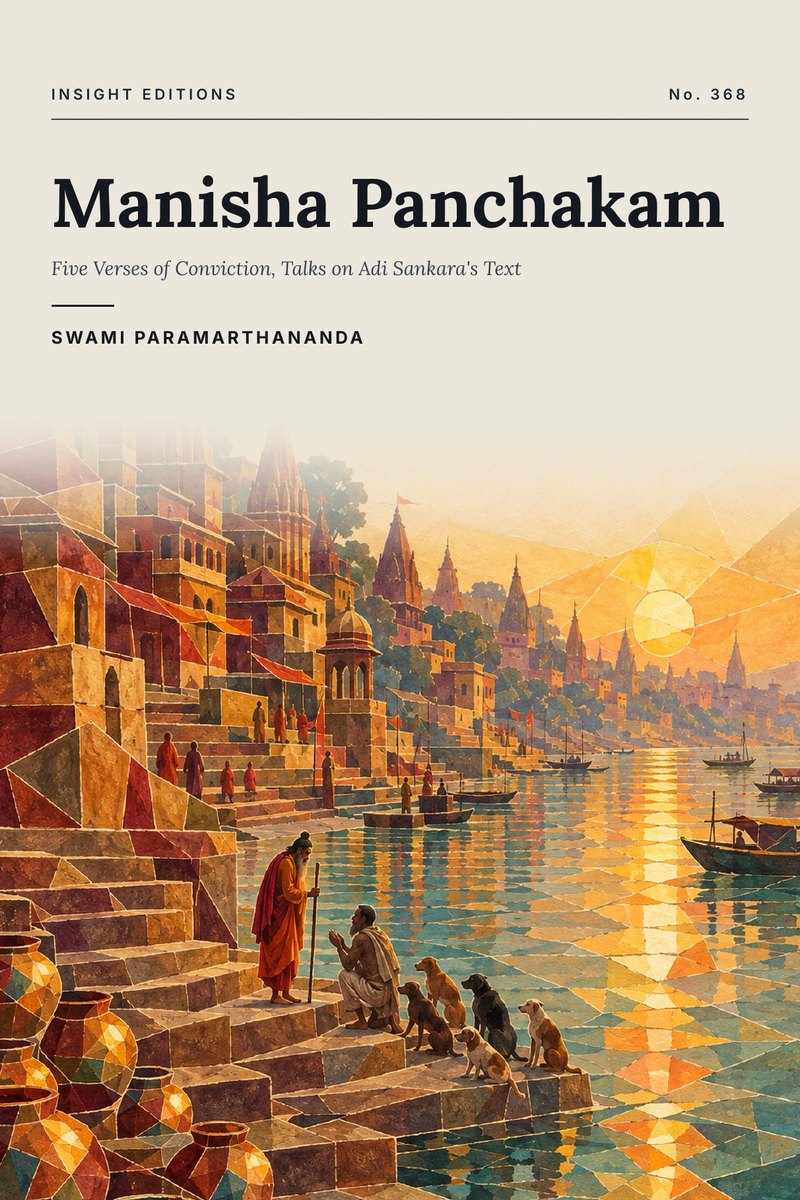
Manisha Panchakam
Five Verses of Conviction, Talks on Adi Sankara's Text
Swami Paramarthananda
Swami Paramarthananda's five talks on Sankara's Manisha Panchakam: the chandala's challenge at Kasi, the five verses that answer it, and how each one condenses a Mahavakya of the Vedas. Verse by verse, with diagrams of the teaching, the sadhana ladder and the karma map.
A study guide to Manisha Panchakam, talks by Swami Paramarthananda on the text of Adi Sankara (transcribed by the Swami Paramarthananda Bangalore Study Group; Arsha Avinash Foundation). Shared free for personal reading; not for sale and not endorsed by the teacher or publishers. Please read the original.
CORE CLAIM
Wisdom and character alone make a person adorable. Whoever knows "I am the one consciousness, and the world is my projection" is Sankara's guru, whether chandala or brahmana.
SCOPE
All five talks by Swami Paramarthananda: the occasion at Kasi, the chandala's two verses, and the five verses of the Panchakam, each read as one of the four Mahavakyas.
KEY FIGURES
Adi Sankara; Lord Siva disguised as a chandala, with Gauri; the four Mahavakyas of the Rig, Yajur, Sama and Atharva Vedas.
BEST FOR
Students starting Advaita Vedanta who want the whole teaching in seven short verses, and readers interested in its argument against birth-based superiority.
The Book on One Page
Manisha Panchakam means "five verses of firm conviction". Each verse ends with esha manisha mama, "this is my conviction". Swami Paramarthananda's five talks read it as a complete course in Vedanta: what consciousness is, how the world relates to it, how one prepares, and what freedom looks like.
The setting. At Kasi, Sankara tells a chandala, an outcaste, "gaccha, gaccha", get out of my way. The man is Siva, who asks which "you" should move, body or consciousness. Sankara wakes from his lapse and answers in five verses.
The conviction. Birth and caste can give advantages, but only sattva guna and Vedantic wisdom make a person adorable. The wisdom in question is jivatma paramatma aikya jnanam, knowledge that the individual self and the universal self are one.
The method. A Mahavakya is any statement revealing that oneness. Commentators link verses 1 to 4 to one Mahavakya from each Veda, and verse 5 is the phala sruti, the result.
| Ch | Title | One-line payload |
|---|---|---|
| 1 | Introduction | Worth lies in wisdom; four Mahavakyas map onto the verses |
| 2 | The Chandala's Challenge | No difference in bodies, no plurality in consciousness |
| 3 | Verse 1: Prajnanam Brahma | One witness consciousness in all states and all beings |
| 4 | Verse 2: Aham Brahmasmi | I am real; the world is my dependent projection |
| 5 | Verse 3: The Ladder of Sadhana | Karma yoga, upasana, jnana yoga; the fate of karma |
| 6 | Verse 4: Ayam Atma Brahma | The illumined mind seems to hide the illuminator |
| 7 | Verse 5: The Ocean of Ananda | The wise are ananda itself; Indra bows to them |
Introduction: The Conviction and Its Occasion
Talk 1 explains the title, states the conviction and tells the story. The work has seven verses: two framing verses not by Sankara, and his five.
Manisha joins manasa and isha: the mind's function, nischaya jnanam, settled knowledge.
The conviction is that human superiority does not depend on birth, caste or occupation. Birth gives advantages, "but advantages are not everything." What counts is sattva guna: the sadhana chatushtaya sampatti (fourfold qualification) and the virtues of amanitvam listed in the Gita. When those virtues are "capped by wisdom", the person is worth cherishing. A brahmana is a brahmana in the true sense only through wisdom and character.
The text's social message, equality, rests on its metaphysics. If the self in every body is the same consciousness, no body can claim a superior self.
The story is from the Sankara Vijayam biographies. Walking from the Ganga to the temple at Kasi, Sankara meets Siva as a chandala, a prakrta purusha governed by impulse, forgets his wisdom "for a moment" and says "go away". Paramarthananda calls this lapse "the complaint of every Vedantic student": we understand, then forget.
Framing verses A and B set the scene: Siva comes with Gauri in an outcaste's dress, Sankara says "gaccha gaccha", and Siva replies. Paramarthananda calls them the oil and wick for the five-verse lamp.
The four Mahavakyas, one per Veda
- Prajnanam Brahma. "Consciousness is Brahman", Aitareya Upanishad 3.3, Rig Veda; a lakshana vakya (defining statement).
- Aham Brahmasmi. "I am Brahman", Brihadaranyaka 1.4.10, Sukla Yajur Veda; an anubhava vakya (statement of realisation).
- Tat Tvam Asi. "You are That", Chandogya 6.8.7, Sama Veda; the upadesa vakya (teaching statement).
- Ayam Atma Brahma. "This Self is Brahman", Mandukya 2, Atharva Veda; the abhyasa vakya (statement for practice).
The Sankara Vijayam accounts are hagiographies written centuries after Sankara, and the two framing verses are later additions. The guide treats the episode as a teaching frame, which is how Paramarthananda uses it too.
The Chandala's Challenge: Two Questions, No Good Answer
In two verses Siva, as the chandala, takes apart the command "go away". Whatever Sankara means by "you", the separation he asks for is impossible. Paramarthananda calls these verses the chandala's own.
The two questions
Siva calls Sankara dvijavara, "best of the twice-born". A dvija is born again through Vedic initiation: the first birth gives a life run by raga dvesha (likes and dislikes), the second a life run by right and wrong. The first is prakrta, the second samskrta. The title hints that Sankara is wise but still carries brahmana abhimana, pride of caste.
Body or consciousness?
- If "you" means the body. Every body is annamaya, made of food: the same five elements (or chemicals), the same impurity, disease, old age and smell. One body cannot be purer than another. Even relatives do not keep the body after death, as Bhaja Govindam says.
- If "you" means consciousness. There is only one chaitanyam. You cannot move consciousness away from itself.
The two examples
Verse 2 supplies the proof with two images. The sun, "jewel of the sky", is reflected in the Ganga and in a dirty pool in the chandala's street; it gains no sanctity from the first and loses none in the second. Space in a gold pot and space in a clay pot is the same space. So the indwelling self, sat chit ananda, is a waveless ocean with no gradation, and seeing "brahmana" and "dog-eater" as different selves is mahan vibheda bhramah, a great delusion.
The self is pratyag vastu (inner reality), avabodha (consciousness), sahaja ananda (natural fullness): an ocean nistaranga, without waves, meaning without division.
| Example | Medium varies | What stays the same |
|---|---|---|
| Sunlight | Ganga water or a slum puddle | One unpolluted light |
| Space | Gold pot or clay pot | One undivided space |
| Consciousness | Brahmana or chandala body | One self, no gradation |
Hearing this, Sankara "knew this person is not an ordinary person". The Panchakam proper begins only now, as his reply.
Verse 1: Prajnanam Brahma, the One Witness
The first verse condenses the Rig Veda's Prajnanam Brahma. Consciousness shines in waking, dream and sleep, pervades every body from Brahmaji to the ant, and witnesses the whole world. "That I am, not the seen."
The verse: the samvit that shines in jagrat, svapna, sushupti, strung through all bodies, the jagat sakshi: sa eva aham, I am that, not any drishya vastu, anything seen. Whoever has this drdha prajna is Sankara's guru.
Three stages of learning
- Prajnanam. Consciousness is not a part, product or property of the body. It is an independent entity that pervades and enlivens the body, is not limited by it, and survives its death; it just cannot transact without a reflecting medium.
- Chaitanyam sarvagatam. The same consciousness enlivens all beings.
- Chaitanyam satyam. Consciousness alone is real; matter is mithya. Only here does Advaita siddhi take place.
Verse 1 covers stages one and two. Lesson 1: consciousness is evident in all three states. Even in deep sleep, "you cannot talk about nothingness without witnessing nothingness." We do not need to work for the experience of the self, which is ever experienced; we need to work for understanding it.
Lesson 2: the consciousness in this body is in every body. As witness of the microcosm it is called jivatma; as witness of the macrocosm, paramatma. It is one. Hence the Mahavakya sa eva aham, and its corollary: "I am ever the seer, never the seen." World, mind and every thought fall on the seen side.
Talk 3 adds the key image. Sunlight is intimate with the hand but not of the hand, and it extends beyond it, unseen only because nothing reflects it. "Non-manifestation should not be mistaken for non-existence." Plurality of consciousness is "an error born out of our experience", which Vedanta corrects.
Two tasks follow: own consciousness as "I", and disown what you are not. Disowning is harder because deha abhimana is a habit of many births. The rule: drk chetanah, drishyam jadam. The seer is conscious, the seen is inert. Body and mind only appear sentient by borrowed consciousness, as the moon shines by borrowed sunlight.
Paramarthananda notes that this stage still leaves a duality of consciousness and matter, which is Samkhya, not Vedanta. The verse is incomplete on purpose; verse 2 finishes the job.
Verse 2: Aham Brahmasmi, the World as My Projection
Verse 2 carries the Yajur Veda's Aham Brahmasmi. "I am Brahman; this whole universe is consciousness spread out; all of it is imagined by me through the three-guna avidya." It turns the consciousness-matter pair into one reality.
Three views of consciousness and matter
- Materialism. Matter is ultimate; consciousness is a temporary property of brain or cell.
- Samkhya. Matter and consciousness are two independent realities.
- Advaita. Consciousness is fundamental; matter is an incidental manifestation with no independent existence.
Cause and effect
The Upanishads teach this through karana karya sambandha: consciousness is the cause, the world the effect. The Taittiriya derives the five elements and everything made from them, including the mind, from consciousness. No effect exists apart from its cause: no furniture apart from wood, no ornament apart from gold, no pot apart from clay. The furniture's weight is the wood's weight. So the products are nama rupa, name and form: useful for transaction but not a second substance.
"Mithya is useful but is non-substantial." Brahman itself is avyavaharyam, unavailable for transaction, so everything usable is mithya. "Don't believe that, since it is useful, it is real."
The final lesson is aham satyam, jagat mithya: I am independent, the world depends on me. "The sense of dependence is the problem."
The dream model
In a dream I create everything, then enter it as one body and become a frightened creature. A dream guru must wake me. Vedanta says this world is "another extended dream". Maya is our creative power, as nidra creates the dream. Deha abhimana blocks "owning up" to Isvara status. One difference: on waking from a dream the dream vanishes, but after knowledge this world continues until videha mukti. The jivan mukta is like someone who goes on dreaming after waking and is no longer afraid.
Chinmatra vistaritam: the world is pure consciousness projected, as a dream thought becomes a dream tiger. Trigunaya avidya is maya's three faculties: sattva (knowing), rajas (acting), tamas (inertia). The self is sukhatara, nitya, para, nirmala: blissful, eternal, absolute, pure. "This is not a matter of belief; it is a matter of understanding."
Verse 3: The Ladder of Sadhana and the Fate of Karma
The teaching is complete after two verses, so verse 3 maps the whole range of sadhana, hinting at Tat Tvam Asi through "the guru's words". It is a single sentence covering preparation, knowledge and the knower's karma.
| Veda section | Sadhana | Designed ashrama | Two stages |
|---|---|---|---|
| Karma kanda | Karma yoga | Grihastha | Kamya-dominant, then nishkama-dominant |
| Upasana kanda | Upasana yoga | Vanaprastha | Eka-rupa, then visvarupa upasana |
| Jnana kanda | Jnana yoga | Sannyasa | Sravana, manana, nididhyasana |
Brahmacharya is for studying the three; the other ashramas practise them, a "one point program, moksha".
Karma yoga. It starts kamya-dominant. We are busy with desires; "even if we utter mantras we do not know the meaning; if we know the meaning we do not know the value; if we know the value we do not have the time." Yet desire-driven work becomes yoga if every result is taken as Isvara prasada. The mind purifies, our share of the pancha maha yajna rises, and the stage becomes nishkama-dominant.
Upasana yoga. From one ishta devata to the visvarupa, it gives expansion, tranquillity and samadhi shatka sampatti.
Jnana yoga. Vairagya comes from repeatedly seeing "I own nothing; everything is lent by the Lord." Anyone who sees this is an inner sannyasi "even amidst a family of 100 people". Then sravana (systematic study under a competent guru), manana (removing intellectual doubts) and nididhyasana (viparita bhavana nivritti, removing habitual emotional obstacles such as jealousy, anger or inferiority).
Agami does not accrue because "wherever an ego is absent, punya papam will not come"; a cow gets no merit for milk used in worship. Prarabdha runs its course, giving pleasant and painful experience to body and mind, but not to the knower, who has disowned them: "biological pain may be there, but no psychological worry." When it ends, the body falls and the jivan mukta becomes videha mukta.
Line by line
- Line 1, nischitya. The conviction "the whole world is constantly perishing" (nitya anitya vastu viveka) is karma yoga's fruit. "The stronger this conviction, the stronger I will lean on God."
- Line 2, nirvyaja santatmana. An honest, uncrooked, tranquil mind: upasana's fruit. Then constant enquiry into the eternal Brahman with guror vacha, which implies the guru saying "you are That".
- Lines 3 and 4. Sanchita burned in the samvinmaya pavaka, agami avoided, the body surrendered to prarabdha.
Verse 4: Ayam Atma Brahma, the Illuminator Behind the Clouds
Verse 4 gives the Atharva Veda's Ayam Atma Brahma: this self, intimately evident, is Brahman. Mind, senses and objects shine by borrowed light, yet the things lit up seem to hide the light.
Ayam, "this", means self-evident, needing no effort; sphurti is one of many synonyms for consciousness. Yad bhasa bhanti: by its light the hrdaya (mind), aksha (senses), deha and vishaya (objects) appear sentient, though svatah achetanah, insentient by themselves. If the body had its own consciousness it could never lose it. A mirror lit by the sun can light other objects.
The same light is in animals, humans and gods, sphuta grhyate antah, clearly grasped within as witness of thoughts and their absence.
The cloud and the sun
On a cloudy day the sun seems hidden. Yet we know there are clouds only because the sun lights them. "The very clouds which are illumined by the sun cover the very sun, ungratefully." The koshas cover the self the same way, which is why they are called sheaths.
They cover only as though, for two reasons. First, talk of a cover already depends on consciousness. Second, the all-pervading cannot be covered, just as the sun is thousands of times larger than any cloud.
"We are so occupied with the illumined that we lose sight of the illuminator." The mind holds thoughts of fear, anger, jealousy and happiness, and also consciousness, which we never claim because the thoughts keep us busy. Even blankness in meditation is known by that light. The yogi reverses this: sada bhavayan, he always dwells on consciousness, hands the koshas to prarabdha, and is nirvrta manasa, a contented, unfrightened mind. "He enjoys the movie but is not frightened by the movie."
The movie image fits: the characters "cover" the screen only as though. Remove attention from them, and the screen was there all along.
Verse 5: The Ocean of Ananda, and the Result
The last verse is the phala sruti. Indra and the gods live on a drop of a drop of Brahmananda. The sage owns the whole ocean in a quiet mind, is "Brahman itself, not a knower of Brahman", and his feet are worshipped by Indra.
Original and reflected ananda
- Bimbananda. Brahmananda, the original fullness, is the self. It is never an object of experience, because "the subject can never be objectified".
- Pratibimbananda. Joy reflected in the mind, graded by the mind's quality. Indra enjoys only lesha lesha, a fraction of a fraction.
The ignorant chase reflected joy. The muni owns up Brahmananda in a mind nitaram prasanta, wholly undisturbed, through sastra upadesa; his mind has "fallen into" the ocean. From the world's angle he is a brahmavid; for himself he is neither knower nor ignorant but Brahman, because "knower" still identifies with the mind.
The gulab jamun test
Is the knower for pleasure or against it? Neither. Given a fine gulab jamun, he enjoys it, remembering it is reflected ananda that will pass. When it goes, he does not say ananda is gone. When a mirror breaks, nobody weeps that their face is gone. "For a Jnani every vishayananda is a bonus... This is called moksha."
The result is stated three ways: the knower becomes adorable, "as good as Isvara", and is ananda. Sankara closes the loop with the chandala: whoever has this is adorable to him too. "I will never say gaccha gaccha." Iti nunam manisha mama.
Master Takeaways
- Worth lies in wisdom and character, not birth, caste or occupation; advantages are not greatness.
- Consciousness is one. Sun in the Ganga and in a puddle, space in gold and clay pots: no gradation.
- Consciousness is real; the world is mithya, as furniture is wood under a name and form.
- Karma yoga, upasana and jnana yoga form one ladder, matched to the four ashramas.
- The illumined seems to hide the illuminator, as clouds seem to hide the sun.
- The knower is ananda, so reflected joys are bonuses, never needs.
- Consciousness needs no effort to experience; it needs teaching to understand.
- Own consciousness as "I" and disown the seen; disowning is harder, because deha abhimana is an old habit.
- Drk chetanah, drishyam jadam: the seer is conscious, everything seen is inert.
- Dependence is the problem; knowing "I am independent, the world depends on me" is the answer.
- The world is an extended dream, created by maya as dream is created by nidra.
- Desire-driven work becomes yoga when results are taken as Isvara prasada.
- Sanchita burns, agami does not accrue, prarabdha is endured by body and mind only.
- Real sannyasa is the steady seeing "I own nothing", available even to a householder.
| Framework | What it says | Use it when |
|---|---|---|
| Four Mahavakyas | One oneness-statement per Veda | Seeing the Vedas as uniform in teaching |
| Three stages | Independent, all-pervading, alone real | Checking how far an argument has gone |
| Karana-karya | No effect apart from cause | Explaining mithya |
| Three sadhanas | Karma, upasana, jnana yoga | Placing yourself on the path |
| Three karmas | Sanchita, agami, prarabdha | Asking what knowledge changes |
| Bimba, pratibimba | Original versus reflected ananda | Relating to pleasure |
On the whole book
The text is a transcription of oral talks that Paramarthananda did not verify, so word glosses are loose and some Sanskrit is misspelt in the source. Its egalitarian reading is Paramarthananda's and the tradition's. Historians debate how far classical Advaita applied the point socially, since Sankara's own commentaries keep caste rules for ritual study. The claim that the world "continues after knowledge" relies on prarabdha, which other schools question.
Connect it
- Leadership. The text's test of worth, character plus understanding over credentials, is a usable hiring and promotion rule.
About This Edition
This Insight Edition is an independent study guide to Manisha Panchakam, five talks by Swami Paramarthananda on the text attributed to Adi Sankara, transcribed by the Swami Paramarthananda Bangalore Study Group and published by the Arsha Avinash Foundation, Coimbatore. It summarises and explains the talks verse by verse, with diagrams, tables and critical notes. Short quotations are used for discussion. It is not a substitute for the original, which is available from the Arsha Avinash Foundation.