Insight Editions · No. 388
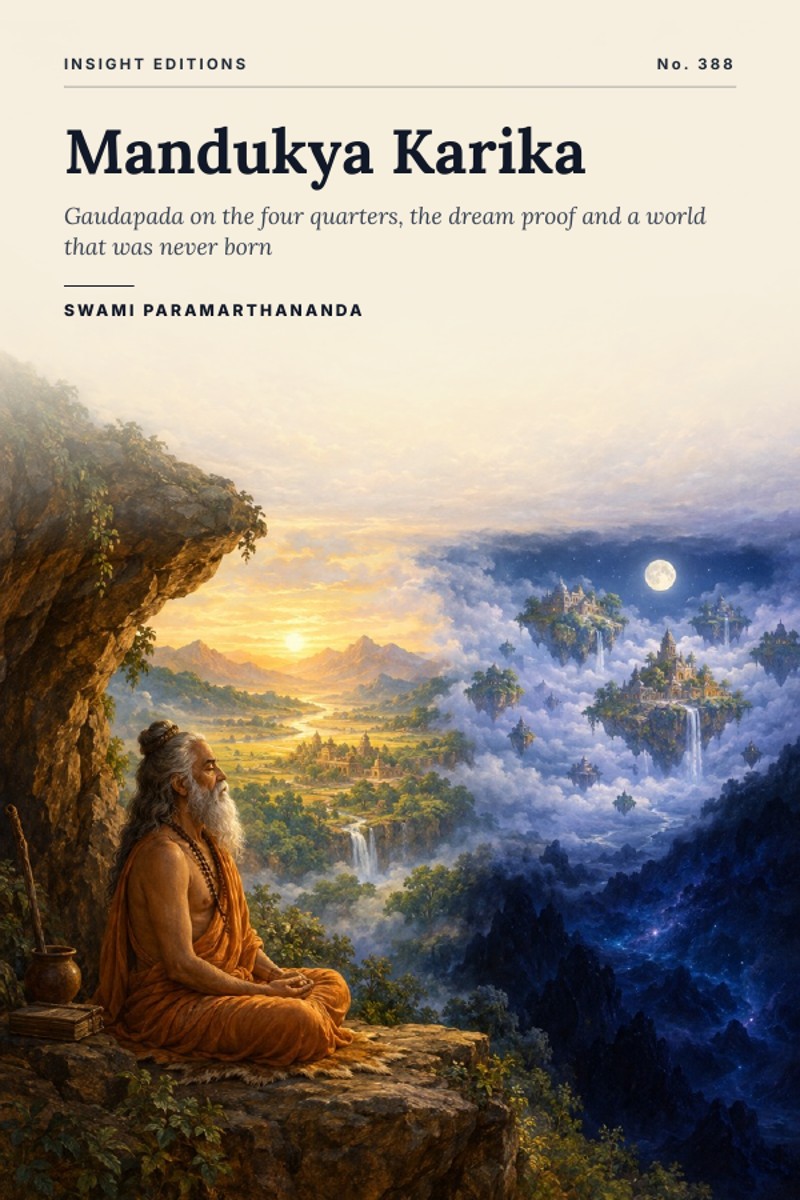
Mandukya Karika
Gaudapada on the four quarters, the dream proof and a world that was never born
Swami Paramarthananda
A complete study edition of Swami Paramarthananda's seventy-two lectures on the Mandukya Upanishad with Gaudapada's Karika: the four quarters and Turiya, Omkara and silence, the dream proof of mithya, ajati vada, five rival theories refuted, and the firebrand.
A study guide to Swami Paramarthananda's talks on the Mandukya Upanishad with Karika (transcribed by Sri S. Chandrasekaran, Arsha Avinash Foundation). Shared free for personal reading; not for sale and not endorsed by the author or publishers. Please read and study the original.
CORE CLAIM
I, the witness of waking, dream and sleep, am the only reality; the world in all three states is an appearance that borrows its existence from me and was never actually born.
SCOPE
Seventy-two lectures on the twelve mantras of the Mandukya Upanishad and the 215 karikas of Gaudapada in four chapters, with a summary class at the end of each chapter.
KEY FIGURES
Gaudapada, author of the karikas; Shankara, his commentator; the four quarters Vishva, Taijasa, Prajna, Turiya; rival schools Nyaya, Sankhya, Vishishtadvaita, karma theorists, Buddhists. Teacher: Swami Paramarthananda.
BEST FOR
Students ready for the most uncompromising text of Advaita: the dream argument, ajati vada (non-origination) and the firebrand image.
The Book on One Page
The Mandukya is the shortest Upanishad, twelve mantras. Gaudapada's karikas turn it into a complete course: scripture, then argument, then refutation of every rival.
The text moves in four chapters. Agama prakarana gives the Upanishad and 29 karikas: the self has four quarters, three of them states and the fourth, Turiya, the self free of all states. Vaitathya prakarana (38 verses) proves that the waking world is mithya by comparing it to dream. Advaita prakarana (48 verses) shows that the non-dual cannot become many, so nothing was ever created. Alatashanti prakarana (100 verses) refutes every theory of creation and gives the image of the firebrand whose patterns appear but do not exist. The first three chapters are sravana; the fourth is manana, answering rivals.
| Ch | Title | One-line payload |
|---|---|---|
| 1 | Two Sections of the Veda | Three defects of all results |
| 2 | Only the Upanishad Can Show Me | Scripture and a teacher |
| 3 | Three Quarters | Waker, dreamer, sleeper |
| 4 | Turiya | Mantra 7 and the red crystal |
| 5 | Omkara and Silence | A, U, M and the silence that is Brahman |
| 6 | Ignorance and Misconception | Why the sleeper does not suffer |
| 7 | The Dream Proof | Dream and waking compared |
| 8 | Four False Tests of Reality | Utility, externality, continuity, clarity |
| 9 | One Truth, Many Mistakes | Difference is mithya |
| 10 | Space in the Pot | Advaita cannot become many |
| 11 | What Scripture Means by Creation | Provisional creation |
| 12 | Detaching From the Mind | Amanibhava and asparsha yoga |
| 13 | Five Theories Refuted | Nyaya, Sankhya, Brahma-parinama, karma, Buddhist |
| 14 | The Firebrand | Appearance with borrowed existence |
| 15 | Stop Asking Why | Cause-hunting as samsara; sadhana and conclusion |
Two Sections of the Veda
The first two lectures place the Mandukya in the whole Veda: a seeker moves from the ritual section to the knowledge section after finding a flaw in every result.
Sruti and smriti
The Veda is the primary scripture, sruti, "heard wisdom", received by rishis in meditation and passed down orally (karna parampara). Later texts based on it, the puranas and epics, are smriti. Much of the Veda is lost: of 1,180 branches, fewer than a hundred survive.
Beginning and end
Every Veda has a karma section (Veda purva), which gives benefit by doing, and a knowledge section (Vedanta), which gives benefit by knowing. "Without religious life, spirituality will not work. Without spirituality, religious life is incomplete."
| Karma section | Three kinds |
|---|---|
| Actions | Physical (puja, pilgrimage), verbal (japa, chanting), mental (upasana) |
| Results | Artha (security), kama (pleasure), dharma (punya for future lives) |
| Defects | Mixed with pain, never satisfying, create dependence |
Discovering the three defects for oneself is vairagya. The seeker then asks for a defect-free goal. Vedanta says it exists, and adds the shock: tat tvam asi, you are that.
Two conclusions in conflict
Long experience says "I am a miserable jiva". The Veda says "you are Brahman". Neither can be dropped easily, so the seeker begins atma vichara, self-enquiry, to find which is true.
The instinct of every being, animals included, is independence. Yet worldly results take us "from dependence to greater dependence". Modern life only multiplies this.
Only the Upanishad Can Show Me
What instrument can study the one who studies? The second introductory lecture eliminates five means of knowledge and arrives at the Upanishad, studied with a teacher.
Six means of knowledge
| Pramana | Why it fails for the self |
|---|---|
| Pratyaksha (perception) | Senses reveal objects, not the subject |
| Anumana, arthapatti, upamana | Built on sensory data |
| Anupalabdhi (non-perception) | Reveals absence; the self is present |
| Worldly words | Based on perception and inference |
| Ritual Veda | Deals with deities and worlds, all objects |
| Upanishad | Turns me toward myself, like a mirror |
A mirror, not a lens
Convex and concave lenses show objects outside. A mirror shows me. The Upanishad is a unique mirror: it does not even talk about body and mind, but about the one aware of them.
Why a teacher
Every word we know describes anatma, which has five features: it is an object, material, has attributes, changes, and comes and goes. The Upanishad must use this vocabulary for the opposite. Self-study leads to "I know Brahman but have not experienced it", which objectifies Brahman. The one who says he must experience Brahman happens to be Brahman.
Three stages
- I am eternal, all-pervading consciousness.
- I am the only source of permanent peace, security and happiness.
- By my presence I give life to the body and through it experience the universe.
- I am never affected by any event in the world or in body and mind.
- Forgetting my nature makes life a burden; remembering it makes life a blessing.
- Two languages. Use the triangular format (jiva, world, God) in transactions; use the binary format (I am satya, the world is mithya) in private thinking.
- Habits go slowly. Like saying "Chennai" after years of "Madras", the old self-image needs time and attention.
Three Quarters
Mantras 1 to 6. The Upanishad introduces two enquiries and then divides the self into four "quarters", based on one principle: the observer is independent; the observed depends on it.
Two enquiries
Mantra 1 introduces Omkara vichara, enquiry through the syllable Om. Mantra 2 introduces atma vichara, enquiry into the self, with "ayam atma brahma". Mantras 3 to 7 do the atma vichara; 8 to 12 the Omkara vichara.
The governing principle
The experiencer exists independently; the experienced proves its existence only through the experiencer. So atma, the observer, is satya; anatma, everything observed including body and mind, is mithya.
| State | Anatma experienced | Micro name | Macro name | Mantra |
|---|---|---|---|---|
| Waking | Gross body, gross universe | Vishva | Virat | 3 |
| Dream | Subtle body, subtle universe | Taijasa | Hiranyagarbha | 4 |
| Deep sleep | Causal body and universe, dormant | Prajna | Ishvara | 5, 6 |
Ishvara in mantra 6
Mantra 6 defines Ishvara as both intelligent cause (sarveshvara, sarvajna) and material cause of everything ("yoni sarvasya prabhavapyayau"), the origin and dissolution of beings.
The method rests on treating deep sleep as a state that is experienced (as blankness) by a witness. A critic can say sleep is simply absence of experience, not experience of absence. The teacher's reply, that one remembers "I slept well, I knew nothing", is the traditional answer; whether such memory proves a witness is still argued.
Turiya
Mantra 7, the most important in the Upanishad, defines the fourth: not inwardly conscious, not outwardly conscious, peaceful, auspicious, non-dual. "That is the atma; that is to be known."
How to "become" Turiya
Turiya is the self dissociated from the three states. That cannot be done experientially, because I am always in one of the three, even in coma. It cannot be done physically, because the self is all-pervasive. Gaudapada points to a third kind of dissociation, unique to Vedanta: by knowledge.
A clear crystal near a red flower looks red. How to remove the red without removing the flower? By knowing the crystal never had the colour. It may keep looking red; its clarity is untouched. "This freedom is freedom through knowledge."
Two words that matter
| Word | Meaning | Implication |
|---|---|---|
| Prapanchopashamam | Free from the world | The world of the three pairs is absent in Turiya factually, not experientially |
| Advaitam | Without a second | The world is mithya, "as good as not there" |
I am Turiya appearing as Vishva, Taijasa and Prajna; knowing this is enough to "become" Turiya.
Why only Turiya is free
As Vishva and Taijasa I am a doer and experiencer. Sanchita waits, prarabdha is exhausted, agami accumulates, another birth follows. "As Vishva and Taijasa, no freedom is possible." Only as Turiya can I claim I am always free.
- Do not wait for the world to vanish. Like the blue sky after you know space has no colour, the world keeps appearing.
- Change the claim, not the state. Turiya is not a fourth state to reach.
Omkara and Silence
Mantras 8 to 12 equate the syllable Om with the self. Each of the three sounds stands for a quarter; the silence after them is the fourth.
Four matras
| Matra | Equated with | Two common features |
|---|---|---|
| A | Virat, Vishva | Pervasiveness and primacy (first sound) |
| U | Hiranyagarbha, Taijasa | Superiority and middleness |
| M | Ishvara, Prajna | Like a measure; the ground of dissolution |
| Silence (amatra) | Turiya | Revealed by consciousness |
Symbol and identity
The Upanishad adds three meditations as a side topic: on Virat as A, Hiranyagarbha as U, Ishvara as M. But there is a difference: A, U and M represent the three quarters; silence does not represent Brahman, silence is Brahman. In silence there is not nothing: consciousness is there, revealing the silence.
Omkara dhyanam (karikas 24 to 29)
Gaudapada makes the twelfth mantra a form of nididhyasana, only after full sravana and manana.
"How can I see the witness consciousness? I cannot, because I am it." The meditation is a reminder, practised "until I cannot forget". That stability is jivanmukti.
Ignorance and Misconception
Gaudapada's first-chapter karikas analyse creation and compare the four quarters. Why do waker and dreamer suffer and the sleeper does not?
Two problems, not one
| Quarter | Ignorance (karana) | Misconception (karya) | Samsara |
|---|---|---|---|
| Vishva (waker) | Yes | Yes | Yes |
| Taijasa (dreamer) | Yes | Yes | Yes |
| Prajna (sleeper) | Yes | No | No |
| Turiya | No | No | Never |
Ignorance has four names: ajnana, agrahana, nidra, karana. Misconception has four: ahankara, anyathagrahana, svapna, karya. Ignorance followed by mistake is the problem; knowledge removes both. Every jnani is Turiya; every ajnani is Vishva, Taijasa or Prajna.
Why was the world created?
Accept creation and the questions multiply: why did God create, how, when, for what purpose? No answer satisfies: "out of will", "for play". Gaudapada's response: the questions arise because we think the world was created at a time. It never was.
Existent and non-existent
An existent thing cannot be created, because it already is. A non-existent thing cannot be created, because it is not. The world is always with Brahman: in potential form it is maya, in active form the world. And because it is mithya, it cannot contaminate Brahman, as the movie never wets the screen.
- Sleep teaches. Without misconception there is no suffering, even with ignorance.
- Drop the "when" question. It presupposes a creation that never happened.
The Dream Proof
Chapter 2 of the karikas, Vaitathya prakarana, unpacks one word of mantra 7, prapanchopashamam. Its single method: show the dream is mithya, then show the waking world has the same status.
The dream is mithya (verses 1 to 3)
Any object needs space and time in sufficient quantity. "An elephant in a suitcase" is a false statement. The dream's mountains and stars appear inside my head: insufficient space (uchita desha abhava). Days of dream events pass in minutes: insufficient time (uchita kala abhava).
The waking world is mithya too (verses 4 to 18)
That reason does not work for waking. Gaudapada gives another, in the "very powerful" verse 6:
| Shankara's reason | Gaudapada's reason | |
|---|---|---|
| Argument | The waking world is experienced, like dream | The waking world comes and goes, like dream |
| Teacher's view | Harder to accept | Easier to accept |
The waking world disappears when I dream; the dream world disappears when I wake. Each world appears in its own state and disappears in the other, so both have equal status.
Who projects the waking world?
I know I am the projector, sustainer and experiencer (PSE) of my dream. Gaudapada's "unbelievable" answer in verse 12: I alone, as atma, am PSE of the waking world too, using maya shakti as I use nidra shakti in dream.
Tell a dreamer in his dream that he is projecting it and he will refuse; he accepts only after waking. "For a dreamer, the dream is not a dream in dream." Our refusal to accept the waking world as projection proves nothing.
Four False Tests of Reality
Objectors try to keep the waking world real and the dream unreal. Gaudapada examines four proposed criteria and rejects each with one move: judge each world from its own state.
| Proposed test | Claim | Gaudapada's reply |
|---|---|---|
| Utility | Waking water quenches thirst | Dream water quenches dream thirst; each is useless in the other state |
| Externality | Waking world is outside | In dream, the dream world is experienced as outside |
| Continuity | Waking continues day after day | In dream, the dream feels continuous |
| Clarity | Dream is vague | Vague only from waking; in dream it is vivid |
The single error
"We look at the waking world as the waker and the dream world also as the waker." Judged from its own standpoint, each world is real in its state and absent in the other. So the only valid test is: whatever comes and goes is mithya; only what never comes and goes can be satya.
Time and space too
Waking time and space come; I am there. They go; I am there. Dream time and space come and go; I am there. "Even time and space appear and disappear in me", the witness.
Why the mistake hurts
Mithya taken as satya is unstable ground. We seek security from name, fame, power, position and relationships, all of which change. Like the rope-snake, mithya mistaken for satya causes real fear.
The argument shows waking and dream are symmetric from inside. It does not show that waking is not more coherent across people: others confirm my waking world in ways dream figures cannot outside the dream. Gaudapada's reply would be that dream characters confirm the dream too. The symmetry is strong; it rests on denying that intersubjective agreement adds any reality.
One Truth, Many Mistakes
Verses 19 to 38 list the errors made when the self is missed, show that difference itself is mithya, and close with sadhana and its fruit.
Truth is one, confusions many (19 to 29)
When I miss myself as the one truth, I mistake some object for the truth: matter for science, prakriti for Sankhya, atoms for Nyaya-Vaisheshika, deities in distant worlds for religions. Gaudapada gives a long list.
The positive note of verse 29: anatma is mithya, but it is pervaded by atma, as the snake's "is-ness" comes from the rope. So prayer to any deity blesses, and dvaita bhakti leads to advaita. "So do not criticise dvaita bhakti."
Difference is mithya (30 to 34)
| Pair | Same? | Different? |
|---|---|---|
| Clay and pot | No: clay alone cannot hold water | No: you cannot give away one and keep the other |
| Atma and anatma | Experienced as different | Not logically provable |
| Advaita and dvaita | Substratum and appearance | Not two things from the absolute view |
Differences are experienced but not explainable; so dvaita is mithya.
Respect ETU, do not lean on it
Mithya has ETU: experience, transactions, utility. A jnani respects all three but knows mithya is unpredictable, uncontrollable, unsustainable. Holding on to it is like "a drowning man holding a floating straw". Until Brahman is known, depend on Ishvara.
Sadhana and fruit (35 to 38)
- Karma yoga. "Vita raga bhaya krodhaih": free from attachment, fear, anger.
- Upasana yoga. "Munibhih": meditators.
- Sravana and manana. "Vedaparagaih": thorough study.
- Two nididhyasanas. Regular time dwelling on the teaching, and alertness during transactions.
- Watch the movie, see the screen. Outside, atma is changeless existence; inside, changeless consciousness.
Space in the Pot
Chapter 3, Advaita prakarana, explains the word advaitam: that which cannot become many, by division or by multiplication. Hence ajati vada, the doctrine of non-origination.
Begin with dvaita (verses 1 and 2)
No seeker starts with advaita. Dvaita bhakti, as karma (worshipper and worshipped) and upasana (meditator and meditated), is the stepping stone. "You can postpone advaita jnanam, but you can never avoid it." Those who refuse to go beyond are called kripana, to be sympathised with.
Two examples (verses 3 to 10)
| Example | What it negates | How |
|---|---|---|
| Pot space | Birth of the jiva | Space seems divided, born, moving with pots; it is one and unchanged |
| Dream | Birth of the world | The dream world seems created and real; on waking, nothing was made |
Jivatma and paramatma
Enclosed consciousness in each body is called jivatma; all-pervading consciousness paramatma, like pot space and total space. Jivatma is seemingly born but really never born; there is only one undivided consciousness.
Four assertions about the world
- Existence of the world is negated.
- Origination of the world is negated.
- Appearance and experience are accepted, as in dream.
- Maya (self-ignorance) explains the appearance.
- Use dvaita, then graduate. Worship is the means; non-dual knowledge is the end.
What Scripture Means by Creation
Verses 11 to 30. If nothing is born, why do the Upanishads describe creation at length? Gaudapada's answer: read them to the end.
The problem
The Mundaka (2.1.3) and Taittiriya (2.1.2) describe space, air, fire, water and earth born from Brahman. Gaudapada negates creation. Is he contradicting scripture?
Really born or seemingly born?
The Upanishads say the world came from Brahman but do not say whether it was really or seemingly born. Study them completely: at the end they negate plurality. "There is no plurality here" (Katha 2.1.11). "Earth and water do not belong to me" (Kaivalya 22).
| Stage | Upanishad says | Purpose |
|---|---|---|
| Adhyaropa | Brahman creates the world | Meets the student where he is |
| Apavada | There is no plurality | Withdraws the provisional teaching |
| Mahavakya | Tat tvam asi | Jivatma is paramatma, never born from it |
Conditional reality
The dream is real under one condition: while dreaming. The waking world is real under one condition: "as long as you manage to keep awake". Both borrow existence from me. I lend existence to dream by entering it, to waking by entering it, and withdraw it from both in sleep.
This self is never born and never dies. It is unborn, eternal, changeless and ever new.
Bhagavad Gita 2.20No first birth
"Never think, 'I am born, I am growing old, I will take next birth.' There is no first birth. Where is the question of next birth?" The more one tries to remove a bondage that is not there, "the greater will be the failure".
Detaching From the Mind
Verses 31 to 48. The student accepts that the world is mithya but forgets that "world" includes the mind. Gaudapada calls the cure amanibhava, and the whole path asparsha yoga.
The mind is part of the world
The mind is an object, material, has attributes, changes and disappears in sleep. So it is mithya. If I judge myself by the mind's state I will "always feel I am not progressing".
| Order | Anatma |
|---|---|
| 1 | Possessions |
| 2 | Profession |
| 3 | Relationships |
| 4 | Body |
| 5 | Mind: the hardest |
I am neither the mind nor its owner; the atma is asanga and owns nothing. The mind is a temporary instrument, kept fit for transactions. Detachment comes only by knowledge: the mind, like a pot, is name and form on Brahman.
Asparsha yoga
Gaudapada names self-knowledge asparsha yoga, "the yoga of no contact", by which I cut off every relationship I hold on to. Verse 39 says even yogis find it hard to see and fear it, mistaking fearlessness for loss. Chapter 4 opens by calling it "beneficial to all, free from dispute".
Four obstacles in nididhyasana (40 to 47)
| Obstacle | What happens |
|---|---|
| Laya | Dozing off |
| Vikshepa | Wandering mind |
| Kashaya | Stagnation from subconscious problems |
| Rasasvada | Attachment to the calm of meditation |
Rasasvada is a sharp point: Gaudapada warns that peaceful states are themselves a trap. This sits in tension with traditions, including some readings of Yoga, that treat such states as the goal. The teacher's reading is consistent: if the self is not an experience, no experience, however calm, can be it.
The final verse (48)
"No jiva is born. This has no cause. This is the absolute truth in which nothing is born."
Five Theories Refuted
Chapter 4, Alatashanti prakarana, the longest at 100 verses, is manana: answering every school that claims the world originated. Verses 1 to 27 take up five.
| Theory | School | Claim | Refutation |
|---|---|---|---|
| Asat karya vada | Nyaya-Vaisheshika | A non-existent effect is produced | Each effect needs its own cause, so it existed potentially |
| Sat karya vada | Sankhya, Yoga | Eternal prakriti evolves | Eternal and changing cannot coexist |
| Brahma karya vada | Vishishtadvaita, others | Brahman becomes the world | Same: eternal Brahman cannot transform |
| Karma karya vada | Karma theorists | Karma creates bodies, beginninglessly | Beginningless samsara cannot end; a moksha that begins will end |
| Prapancha astitva vada | Hinayana Buddhists | We experience it, so it exists | Experience is not proof; dream is experienced too |
Mahayana's tool
Gaudapada uses the Mahayana argument against the Hinayana: experience does not prove reality. The dream is clearly experienced and is still an appearance.
ETU accepted
The world's appearance is never refuted. Its ETU is granted. ETU does not prove existence or origination; both waking and dream have ETU and only appear.
- Karma theory is temporary. It is accepted in the karma yoga stage and dropped later.
The Firebrand
Verses 28 to 71. If the Veda cannot err, why does it teach creation? And if the world does not exist, why do we say "the wall is"? The firebrand answers both.
Provisional acceptance
The Veda provisionally accepts creation for students with two difficulties: intellectual (the world looks solid) and emotional (every jiva wants external security). During karma yoga and upasana dvaita and Ishvara are accepted. Later the Veda negates them: "Neti neti" (Brihadaranyaka 2.3.6). If creation were real, the Veda could not negate it.
Borrowed existence
The moon has no light of its own, yet we speak of moonlight. The world has no existence of its own, yet we say "the wall is". The world's existence is borrowed from me, the observer, as the dream borrows from the waker.
The alata
A burning stick waved in a dark room makes circles and lines. The fire tip is one; the patterns do not exist apart from it, yet they appear. When the stick stops, the patterns cease: alata shanti, the stilling of the firebrand, gives the chapter its name.
| Example | What it shows | Chapter |
|---|---|---|
| Dream | Mithya world appears to a real experiencer | 2 and 4 |
| Pot space | Jiva seemingly born | 3 |
| Firebrand | Appearance with borrowed existence | 4 |
| Moonlight | Existence is lent | 4 |
The dream body
Verse 36: in dream I first project a body for my use, different from the one lying in bed. "Just as the body in dream is unreal, so is every object of consciousness."
Stop Asking Why
Verses 72 to 100 give Gaudapada's unique diagnosis of samsara, a reminder of the three states, the sadhanas, and a conclusion that accepts experience and denies only its independent reality.
Hetu-phala-avesha (72 to 86)
Accept origination and the question "why" cannot be escaped. Why this world, why this suffering, why does an omnipotent, compassionate God allow it? Samsara is obsession with the question why; moksha is to stop asking it. At deeper levels even science cannot find causes: quantum mechanics, cosmology, the origin of life.
Three states again (87 to 89)
I am waker, dreamer, sleeper by association, Turiya by dissociation, and dissociation is only by knowledge: "aham asanga asmi". Space does not get wet with water or dirty with smoke.
Three sadhanas (verse 90)
| Term | Meaning | Means |
|---|---|---|
| Heyam | To be given up | Desire, anger, pride, jealousy (asuri sampat) |
| Apyam | To be nourished | Virtues of daivi sampat |
| Pakyam | To be "roasted" | Raga and dvesha, made non-binding by karma yoga |
| Jneyam | To be known | Turiya |
Conclusion (91 to 100)
- Already here. Peace, happiness and fearlessness are my nature; they cannot be got from outside.
- Dvaita reality is samsara. Dvaita experience is not; it cannot and need not be avoided.
- Enjoy the movie. Buy the ticket, even shed tears, knowing only the white screen is there.
Scholars have long debated Buddhist influence on chapter 4, which uses Mahayana terms and arguments. The teacher answers that Gaudapada opens and closes with prayer to Ishvara, is an astika, and says explicitly that this teaching is not the Buddha's but the older Upanishadic one. The shared vocabulary remains; readers can weigh both.
Master Takeaways and Frameworks
Gaudapada's karikas carry the Mandukya to its logical end. These are the points worth keeping.
Master takeaways
- I am Turiya, appearing as waker, dreamer and sleeper and never limited by them.
- Whatever comes and goes is mithya; the waking world comes and goes like dream.
- Nothing was ever born: advaita cannot become many by division or multiplication.
- The world borrows existence from me, like the dream from the waker and moonlight from the sun.
- Experience, transactions and utility are kept; only the world's independent reality is negated.
- Samsara is the obsession with why; stop hunting causes for an appearance.
- The observer is independent; the observed depends on it.
- Turiya is reached by knowledge, not by a fourth state.
- The red crystal keeps looking red; its clarity was never touched.
- Silence is Brahman; A, U and M only represent.
- Ignorance plus misconception makes samsara; sleep has only ignorance.
- An existent thing cannot be created, nor a non-existent one.
- Insufficient space and time show the dream is mithya.
- Utility, externality, continuity and clarity fail as tests of reality.
- I am PSE of the waking world as of the dream.
- Difference is experienced but not provable.
- Dvaita bhakti is a stepping stone; postpone advaita, never avoid it.
- The mind is part of the world; I am neither the mind nor its owner.
- Rasasvada, attachment to calm, is an obstacle.
- Each theory of origination fails: asat, sat, Brahma-parinama, karma, experience-as-proof.
- The Veda teaches creation provisionally and withdraws it.
- The firebrand's patterns appear without existing.
Frameworks
| Name | What it says | Use it when |
|---|---|---|
| Four quarters | Vishva, Taijasa, Prajna, Turiya | Locating "I" in any state |
| Four matras | A, U, M, silence | Omkara meditation |
| Ignorance and misconception | Karana and karya | Diagnosing suffering |
| Dream proof | Comes and goes, so mithya | Testing a claim of reality |
| PSE | Projector, sustainer, experiencer | Owning the world as appearance |
| ETU | Experience, transactions, utility | Respecting mithya without leaning on it |
| Four assertions | No existence, no origination, appearance, maya | Defining mithya |
| Adhyaropa and apavada | Provisional teaching, then negation | Reading creation texts |
| Five theories | Asat, sat, Brahma, karma, Buddhist | Answering rival schools |
| Heyam, apyam, pakyam, jneyam | Give up, nourish, roast, know | Planning sadhana |
Ajati vada is the strongest position in Advaita: not even an apparent creation is granted the status of an event. It solves the problem of why God creates by removing creation. The cost is that ethics, history and the teacher's own words must all live in conditional reality. The teacher handles this by always keeping the triangular format for transactions; a reader who wants creation to matter in its own right will find this answer thin.
Connect it
- AI. The dream proof is a sharp form of the simulation question: from inside, no test of utility, clarity or continuity can tell a generated world from a "real" one. Gaudapada's move is to stop asking which world is real and identify with the observer common to all.
- Enterprise architecture. Pot space and total space is a clean picture of containers over one shared runtime: the instance seems born, moved and destroyed while the underlying resource never changes.
About This Edition
This is an independent study guide to Swami Paramarthananda's seventy-two lectures on the Mandukya Upanishad with Gaudapada's Karika, transcribed by Sri S. Chandrasekaran and published by Arsha Avinash Foundation.
The edition condenses the lectures into chapter-wise summaries, tables and diagrams for personal revision, drawing especially on the introductory and summary classes. It follows the teacher's structure and examples in its own words and does not reproduce the transcripts, which have not been verified by Swami Paramarthananda. For the full teaching, please study the original talks with the Sanskrit text.