Insight Editions · No. 393
Mandukya Bhashyam
Shankara on Turiya by negation, a world that is not a product, and a Brahman that is not a cause
Swami Paramarthananda
A complete study edition of Swami Paramarthananda's lectures on Shankara's commentary on the Mandukya Upanishad and Gaudapada's Karika: Om as everything, why micro equals macro, Turiya by negation, two inferences for mithya, advaita as akaranam, sleep versus knowledge, and the refutation of every theory of origin.
A study guide to Swami Paramarthananda's talks on the Mandukya Upanishad and Karika with Shankara Bhashyam (transcribed by Sri A. Venkatesan, Arsha Avinash Foundation). Shared free for personal reading; not for sale and not endorsed by the author or publishers. Please read and study the original.
CORE CLAIM
Shankara's commentary turns the Mandukya and Gaudapada's Karika into a rigorous proof: the self is neither cause nor effect but the substratum on which waker, dreamer, sleeper and the whole world appear, and knowing this is liberation.
SCOPE
About two hundred lectures (2016 to 2021) reading Shankara's bhashya line by line on the twelve mantras and all 215 karikas, from the invocation verses to the last verse of chapter 4.
KEY FIGURES
Shankara, Gaudapada (Shankara's teacher's teacher), the four padas: Vishva, Taijasa, Prajna, Turiya; rival schools Sankhya, Yoga, Nyaya-Vaisheshika, Vishishtadvaita, Shunyavada, Yogachara. Teacher: Swami Paramarthananda.
BEST FOR
Students who have studied the Mandukya Karika once and now want Shankara's arguments: why micro is equated with macro, why Turiya is not a "fourth", why negation can reveal, and why advaita means akaranam.
The Book on One Page
The Mandukya Karika class studies two texts. The bhashya class studies three: the Upanishad, Gaudapada's Karika, and Shankara's prose commentary on both.
Shankara follows the Karika's four chapters, but at each step he asks a technical question and settles it. In chapter 1 he explains how Om can be "everything", why the Upanishad equates individual with total, and how Turiya can be taught only by negation. In chapter 2 he frames Gaudapada's dream argument as two formal inferences and defends total negation against the nihilist. In chapter 3 he reads advaitam as akaranam, "not a cause", and refutes every school that counts many selves. In chapter 4 he shows that every theory of origination ends in samsara, and that the world is adhyasa, appearance, not product.
Brahman is not karanam but adhishthanam; its relation to the world is substratum and appearance, not cause and effect.
| Ch | Title | One-line payload |
|---|---|---|
| 1 | Three Texts, One Teaching | Prakarana, purpose, invocation |
| 2 | Om Is Everything | Name and named; desk and wood |
| 3 | Ayam Atma Brahma | One consciousness, four quarters |
| 4 | Individual Equals Total | Why Vishva is equated with Virat |
| 5 | Dream and Sleep | Who chooses the dream; Prajna |
| 6 | Three Quarters While Awake | Recognition and the silent mind |
| 7 | Creation as Nature | Mithya karya vada |
| 8 | Turiya by Negation | Not a fourth, not nothing |
| 9 | Om, Matras and Silence | Symbols, resolution, no travel |
| 10 | Two Inferences | Objectness and impermanence |
| 11 | No Bondage, No Seeker | Verse 2.32 and the nihilist |
| 12 | Advaita Means Not a Cause | Many-self schools refuted |
| 13 | Sleep Versus Knowledge | State and substance |
| 14 | Every Theory of Origin Fails | Jati vada is misery |
| 15 | The Seeming Knower | Firebrand, co-projection, claim |
Three Texts, One Teaching
The opening lectures place the Karika as a prakarana, supply the purpose Gaudapada left unstated, and read Shankara's two invocation verses.
Upanishad, Karika, Bhashya
The Upanishad has 12 mantras in the Atharva Veda. Gaudapada's Karika has 215 verses in four chapters: Agama (12 mantras plus 29 verses), Vaitathya (38), Advaita (48) and Alatashanti (100). Shankara commented on all of it. The teacher had taught the Karika before without the bhashya; this course reads the commentary line by line.
What a prakarana is
| Kind of text | Scope | Function |
|---|---|---|
| Shastra (the Upanishads) | The whole teaching | Gives knowledge |
| Prakarana | One part of the shastra | Clarifies and removes doubt |
The Karika is a prakarana: it serves the shastra, so it shares the shastra's purpose and Gaudapada did not state one. Shankara, as commentator, supplies the anubandha chatushtaya.
| Component | Shankara's answer |
|---|---|
| Benefit | Moksha: abiding in one's own nature, as a patient who loses a disease abides in health |
| Subject | Advaita atma, one's real nature |
| Chapter 1 | Om analysis as a means of recognising the self |
| Chapter 2 | The status of the world: neither absent nor present, so mithya |
The invocation
Shankara's second verse prays to Turiya: may that which, as Vishva, enjoyed the gross objects born of merit and demerit, as Taijasa the subtle ones, and as Prajna withdrew them all, protect us. Turiya cannot be worshipped, so the teacher reads it as Turiya in the form of Ishvara.
Even the opening prayer contains the whole teaching: one Turiya plays waker, dreamer and sleeper, and remains free of all three.
Om Is Everything
Mantra 1 says "All this is Om". A one-syllable word cannot be the universe, so Shankara stops to justify the claim before he comments on a single mantra.
The argument
Shankara takes for granted what other Upanishads teach: Brahman is the substratum on which the world is superimposed. Then he adds a step unique to the Mandukya.
For the word wood there is an object. For the word desk there is no object apart from the wood. A product is a name. So the world, as product, exists as words, and all words are contained in Om.
"All" restricted and unrestricted
When someone at a function says "all of you come, lunch is ready", "all" means the invited guests. Shankara takes the Upanishad's "all" without restriction: whatever is within time and beyond it.
Name and named
| Om | Brahman | |
|---|---|---|
| Role | Abhidhana, the name | Abhidheya, the named |
| Mantra 1 | "All this is Om" | |
| Mantra 2 | "All this is Brahman" |
In the vision of the Upanishad, name and named are identical, so analysing either one reaches the same truth. This is why there are two enquiries, Omkara vichara and atma vichara.
Ayam Atma Brahma
Mantra 2 says Brahman is "this self". Shankara reads a gesture into the word "this", and then shows how the four quarters will be taught.
A gesture to the heart
"Ayam" means "this", the intimately available. Shankara says the teacher points to his own heart while saying it. Brahman is not remote; it is available as the subject. So the consciousness called atma and the consciousness called Brahman are one, and hereafter there is only Brahman.
Four quarters, one method
| Quarters | Description | Method |
|---|---|---|
| 1 to 3 | Consciousness with gross, subtle and causal universe (saprapancham) | Adhyaropa, provisional acceptance |
| 4 | Consciousness free of the universe (nishprapancham) | Apavada, negation |
The contradiction is the teaching
How can one consciousness be with the universe and without it? Logically it cannot. The Upanishad uses the contradiction deliberately to convey what cannot be conveyed directly. The teacher links this to Gita 9.4 and 9.5: "all beings are in me", followed at once by "beings are not in me".
- Read creation as provisional. Each time a text accepts the world, expect it to be negated later.
- Do not search far. "This" points at the one reading the text.
Individual Equals Total
Mantras 3 and 4 equate the waker with Virat and the dreamer with Hiranyagarbha. Shankara raises the obvious objection: the individual is limited, the total is limitless.
The objection
Vishva is finite, Virat is infinite; one has limitations, the other has virtues. Spiritual sadhana is done only because they are not equal. How can the Upanishad equate them?
Two answers
| Answer | Reasoning |
|---|---|
| The goal justifies it | Vishva and Virat are stepping stones to Turiya. At the level of consciousness there is no division, so the final equation holds |
| The alternative is worse | Keep the micro-macro difference and the student will conclude that each body has its own consciousness: as many selves as bodies, the pluralistic error |
Equating micro and macro at the level of bodies is a deliberate compromise. Shankara accepts a small inaccuracy early to prevent a large error later.
Vaishvanara, two derivations
The waker is called Vaishvanara. Shankara gives two derivations: - Leader of all. Ishvara leads all beings to their destinations, higher or lower worlds, through karma. - In the form of all. Ishvara is every being.
The waker also has 19 mouths: five senses, five organs of action, five pranas and four functions of the inner organ.
Dream as projection
In waking the senses turn outward and impressions are recorded. In dream the senses stop and the mind, like a painted canvas or an exposed film, projects them. The mind can store impressions of all past lives.
Dream and Sleep
Mantras 4 to 6. Who chooses tonight's dream? And who is the sleeper? Shankara gives two readings of the key words.
Who decides the dream
Neither I nor Ishvara choose it at will. Ishvara acts according to karma, so ultimately karma decides. Karma can be exhausted in dream; fresh karma can be acquired only in waking.
Two meanings of "sleeper"
| Reading | "Supta" means | Result |
|---|---|---|
| Conventional | The dreamless sleeper | "No desire, no dream" excludes the dreamer |
| Vedantic | The ignorant one, in any state | Self-ignorance is common to waker, dreamer and sleeper |
Prajna enjoys bliss
In sleep there is no clear subject-object division. Shankara calls the sleeper anandabhuk, "enjoyer of bliss", because on waking one says "I slept happily", and what was not experienced cannot be recalled. It is figurative: the absolute bliss is Turiya alone.
The corridor
Shankara reads "chetomukha" in two ways. One: sleep is the doorway through which one passes between waking and dream cognitions. The other: Prajna is the "mouth" towards the cognitions of the other two states.
The proof that sleep is experienced rests on the memory "I slept well". Philosophers outside the tradition argue this may be an inference from feeling rested, not a memory. Shankara treats memory as proof of prior experience; whether the step holds for sleep is still debated.
Three Quarters While Awake
Gaudapada's second karika says all three quarters can be found in the waking state. Shankara proves they are one by recognition, and then opens a long technical debate.
Recognition proves identity
| Cognition | Perception | Memory |
|---|---|---|
| Pratyaksha | Yes | No |
| Smriti | No | Yes |
| Pratyabhijna (recognition) | Yes | Yes |
"The one who woke is the one who dreamt and slept." Only one consciousness could recognise itself across the three. So the three quarters are one, with three costumes.
Three seats in waking
| Quarter | Seat in waking | When |
|---|---|---|
| Vishva | The right eye | Experiencing the external world |
| Taijasa | The mind | Eyes closed, visualising remembered objects |
| Prajna | The heart | Inner silence: no outer and no inner world |
In a moment of mental silence, in meditation or in a peaceful place, I am Prajna while awake.
Is Prajna "prana"?
Shankara says Prajna is called prana in scripture. The objector protests: prana is a divided product, so how can it be equated with Prajna? Shankara's stronger answer quotes the Chandogya: in sleep the self merges into "sat", like a bird that flies everywhere and returns to its roost. That sat must be Brahman with the seed of maya; otherwise the sleeper would be liberated and never wake.
- Notice silence. Moments of quiet show Prajna; the knower of that quiet is Turiya.
- Read "sat" carefully. In sleep one merges into sat with maya, which is why one returns.
Creation as Nature
Karikas 6 to 9 on mantra 6. Ishvara is cause of everything, so Gaudapada surveys theories of why God creates, and Shankara refines the Karika's view of causation.
Only the potential originates
From a mango seed comes a mango tree, never from a coconut seed, because the tree is potentially present in its seed. Every product exists before it appears. This resembles Sankhya's sat karya vada, which Advaita does not fully accept.
Shankara's amendment
| Sat karya vada (Sankhya) | Mithya karya vada (Advaita) | |
|---|---|---|
| Product before origin | Potentially existent | Potentially and seemingly existent |
| Its existence | Its own | Borrowed from Brahman |
| Status | Real | As good as non-existent |
Why does God create?
For enjoyment? For play? "What desire can one have who has all desires fulfilled?" Gaudapada concludes: creation is the nature of the Lord (devasya svabhava). The world was never produced at a time; it exists always, potentially as maya, actively as the world.
"It is his nature" ends the question but does not answer it. The teacher accepts this, because for Vedanta creation is adhyaropa, provisional: there is "no tatparya in creation". A student who wants creation explained, rather than dissolved, will not be satisfied.
Turiya by Negation
Mantra 7 receives eight lectures. Shankara explains why Turiya can only be negatively described, why that does not make it nothing, and how the negation must be read.
Why not positive words?
Words work through genus, action, quality or relation. Turiya has none of these, so the conditions for positive revelation are absent. The Upanishad negates instead.
Three objections
| Objection | Shankara's reply |
|---|---|
| Then Turiya is shunya, nothing | No: it is the substratum of Vishva, Taijasa and Prajna, which are mithya; a substratum cannot be nothing |
| Knowing it adds no value, since it is beyond transaction | Every Upanishad aims at it: tat tvam asi, ayam atma brahma |
| Negation cannot reveal | It reveals by helping me claim "I am Turiya" |
Not a fourth
"Not inwardly conscious, not outwardly conscious" negates Taijasa and Vishva. But the negation is not total. Throwing out waker, dreamer and sleeper entirely throws out the baby with the bath water; Turiya is the consciousness within all three. Remove the attributes and retain the consciousness.
Prajnana-ghana
"Not a mass of cognition" negates Prajna. Here prajnana means vritti jnana, specific cognitions of waking and dream, and ghana means all of them lumped together, undifferentiated, as in sleep. It does not mean pure consciousness.
Master and capable
Gaudapada calls Turiya ishana, the master, because the other three depend on it and it depends on nothing. Shankara adds a meaning for prabhu: Turiya is free from samsara and able to free others, by knowledge.
Om, Matras and Silence
Mantras 8 to 12 and karikas 19 to 29. Shankara explains how the matras serve as supports for meditation, and what happens at death to one who knows the silence.
The support is the whole Om
For meditation on Hiranyagarbha, one does not chant "u" alone. The support (alambana) is Om with "u" prominent. Likewise for Virat and Ishvara.
Two uses of the meditation
| Use | Who | What it does |
|---|---|---|
| Independent upasana | Madhyama adhikari | Prepares the mind |
| Part of nididhyasana | After sravana and manana | Each matra resolves into the next, and M into Turiya |
No travel for the knower of silence
For meditators on the first three matras there is travel after death: merger into Virat, Hiranyagarbha or Ishvara, and even merger in Ishvara lasts only for the current creation. For the knower of amatra, "gati na vidyate": there is no travel. The fourth matra is not outside the three; remove what can be negated from them and the un-negatable remains.
Gaudapada "cannot resist" mentioning the amatra before the Upanishad reaches it. The teacher's point: the silence is inside every chanting of Om.
Two Inferences
Chapter 2. The world's unreality is already revealed by the Upanishad in "prapanchopashamam" and "advaitam". Gaudapada reinforces it with inference, and Shankara states the inferences formally.
Scripture first, logic second
The mithyatva of the waking world is shruti siddham, established by scripture. Gaudapada does not freshly reveal it; he supports it with yukti. Logic needs an example, so he first proves the dream is mithya, then uses it.
| Thesis | Reason | Example | Rule | |
|---|---|---|---|---|
| 1 | Waking world is mithya | Drishyatvat: it is an object of experience | Dream world | Whatever is an object is mithya |
| 2 | Waking world is mithya | Adyantavatvat: it has beginning and end | Dream world | Whatever begins and ends is mithya |
Differences admitted
The teacher stresses that Vedanta does not say waking and dream are alike in every respect.
| Dream world | Waking world | |
|---|---|---|
| Projector | Individual mind (jiva srishti) | Ishvara (Ishvara srishti) |
| Order of reality | Pratibhasika | Vyavaharika |
| Existence | Subjective | Objective, shared |
| Common feature | No independent existence | No independent existence |
Why a jiva is needed
"Jivam kalpayate purvam": the jiva is projected first. Ishvara is the general cause of bodies, but karma is the specific cause of why one body is healthy and another is born ill. Ishvara, being a jnani, generates no punya or papa; the jiva supplies the blueprint.
- Respect the two orders. Treat the waking world as vyavaharika: binding for transactions, not ultimate.
No Bondage, No Seeker
Karika 2.32 is the summary verse of chapter 2 and gets five lectures: "No dissolution, no origination, none bound, no seeker, no one desiring freedom, no one freed: this is the highest truth."
Total negation
The verse only negates. It follows the Veda's own method: "neti neti", and the Akshara Brahmana of the Brihadaranyaka, which negates 23 items: not gross, not subtle, not short, not long.
The nihilist's objection
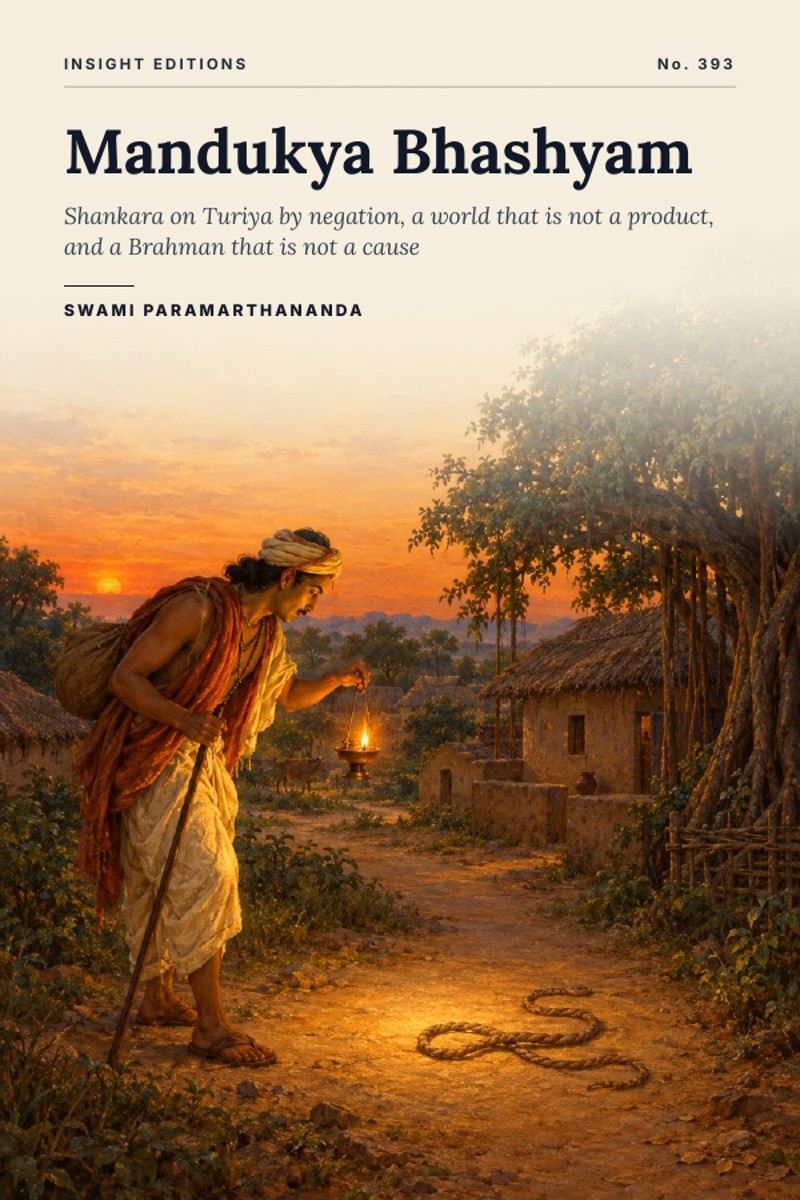
The Shunyavadi says: if everything is negated, the truth is emptiness. And another objector adds: a means of knowledge removes a superimposition only by revealing the substratum, as perception removes the snake by revealing the rope. The shruti negates without revealing the self; the self is beyond every pramana. So how can it negate?
| Rope and snake | Self and world | |
|---|---|---|
| Substratum | Unknown, must be shown | Self-evident, always present as "I am" |
| What the means of knowledge does | Reveals rope, removes snake | Removes superimposed attributes only |
| Rule | "Siddham tu nivartakatvat": it is established because it removes |
Shruti need not reveal the self as an object; it only has to remove what is superimposed on what is already evident.
One atma, both worlds
The central message of the chapter: "dvaitam vitatham, ekah atma eva paramarthatah san". Earlier one spoke of the jivatma projecting dreams and paramatma projecting the waking world. Now one atma projects both, waking directly and dream through the individual mind: the move from triangular to binary.
Advaita Means Not a Cause
Chapter 3. Gaudapada gives advaitam a special sense: that which never becomes two, by division or by multiplication. So Brahman is akaranam, not a cause, and Shankara takes the chance to refute every school that counts many selves.
Turiya is neither cause nor effect
| Pada | Status |
|---|---|
| Vishva, Taijasa (Virat, Hiranyagarbha) | Karya, effect |
| Prajna (Ishvara) | Karana, cause |
| Turiya | Karya-karana-vilakshana, neither |
Why Brahman cannot be a cause
"Wherever there is causality, there is change." An intelligent cause changes by acting; a material cause changes by transforming. Brahman is changeless, partless, subtle, all-pervading, so it cannot be a cause. Each adjective is a reason (hetu-garbha visheshana).
Many selves refuted
Sankhya, Yoga, Nyaya and Vaisheshika accept the Veda yet hold many atmas, based on experience: I feel distinct, a doer, happy or unhappy. Shankara answers that transference explains it.
Space has no colour, yet the sky looks blue. Individuality, doership and difference belong to the body-mind-sense complex and are transferred to the atma, which has none of them.
Scripture's proof
Every mahavakya says jivatma is paramatma. Any relation, including cause and effect, needs two. If they are one, the jiva cannot be born from Brahman. The decisive text: "ajayamano bahudha vijayate", unborn, it is born in many ways: really unborn, seemingly born.
Karma section versus knowledge section
The objector: the karma kanda is far larger and assumes difference everywhere. Why prefer the smaller jnana kanda? Answer: karma and upasana are taught for the slow and middling (manda, madhyama); the oneness teaching is for the best, given by a compassionate Veda so that those on the right path may reach it.
Reading creation passages as provisional relies on six clues for finding a text's central meaning, including upapatti, logical coherence. The teacher uses logic to decide which scripture is final. Critics within Vedanta, such as Vishishtadvaitins, use the same clues to reach the opposite conclusion.
Sleep Versus Knowledge
Karikas 31 to 48. Mind and world depend on each other; both vanish in sleep and both are negated by knowledge. So why not just sleep?
Mind and world
| Verse | Direction |
|---|---|
| 31 | When the mind is absent, as in sleep, duality is not perceived |
| 32 | When the perceived is absent, there is no perceiving mind |
The tempting shortcut
Sleep removes division. Knowledge removes division. "Sleep being easier, why go for knowledge?" and skip the class.
| Sleep (sushupti) | Knowledge (jnana) | |
|---|---|---|
| Arrives at | Non-dual state (avastha) | Non-dual substance (vastu) |
| Duration | Temporary, replaced by waking and dream | Permanent |
| Mind | Goes into seed form | Does not go dormant |
| Duality | Absent | Experienced and transacted, yet never disturbing |
The jnani's advaita is not the absence of duality but advaita in spite of experiencing duality.
Pravilapana
When one wakes from a dream, the dream's knower-known-knowing triad resolves physically. When the jnani "wakes" to Turiya, the waking triad resolves in understanding: the certainty that it is mithya. This certainty is pravilapana.
Practice after study
Gaudapada calls the practice manonigraha, mental discipline. It should be gained before study through upasana and ashtanga yoga. The teacher's advice: after long sravana and manana, going back to dvaita upasana is a retrograde step; better meditate on advaita itself.
Every Theory of Origin Fails
Chapter 4 is mananam: Advaita alone is right, not one of several right views. Every school that accepts a real creation is "jati vada" and must be answered.
Why it matters
Gaudapada promised at the start of chapter 3 to teach akarpanya, the end of misery. "Wherever there is jati vada, there is karpanya", samsara; wherever there is ajati vada, there is moksha.
| School | What originates | Problem |
|---|---|---|
| Sankhya, Yoga | World from prakriti (sat karya) | Beginningless prakriti contradicts experience; a prakriti with a beginning is not the first cause |
| Nyaya-Vaisheshika | A non-existent product (asat karya) | Understood as refuted with Sankhya |
| Vaidika srishti | Bodies from karma, karma from bodies | No first cause; beginningless samsara cannot end |
| Hinayana (Sautrantika, Vaibhashika) | World as aggregate (sanghata) | Experience is not proof |
| Yogachara | Momentary consciousness itself | Consciousness cannot originate |
What about maya?
Can maya be the beginningless cause? "We do not mind accepting maya as the cause, but maya is mithya, so a creation born of it is mithya." Ajati vada negates only a real creation.
Adhyasa replaces srishti
If nothing originated, what is experienced? The world is adhyasa, appearance. The teacher notes: this is why Shankara's Brahma Sutra commentary begins with adhyasa.
- Do not deny experience. The Advaitin is teaching students: he experiences them too. Only the status of the world is questioned.
The Seeming Knower
The later karikas of chapter 4 bring the firebrand, the co-projection of mind and world, and Shankara's last subtleties: the self is not even, strictly, a knower.
The firebrand
Brahman is like the glowing tip of a moving stick; the world is the pattern. Patterns do not exist as a separate entity, so there are not two things, and so no cause-effect relation.
Mind and world projected together
Karika 67 consolidates the dream-waking comparison: whenever a world is projected, the experiencing mind is projected with it. Pot-thought and pot, cloth-thought and cloth, both projected by one consciousness through avidya.
Two standpoints on permanence
| Standpoint | World | Brahman |
|---|---|---|
| Adhishthana drishti | Anitya, impermanent | Nitya, eternal |
| Paramarthika drishti | Neither word applies | Neither word applies |
Known by claiming
Atma "should be known like space". But to be known means to be an object. So knowability too is empirical. Knowing the atma is claiming the already available atma: "I am".
A figurative knower
Atma is not even affected by avidya, which veils only the pramata, the knower-mind. Scripture calls atma "the seer unseen" because it lends knowerhood to the mind. Really it cannot be a knower: there is no second thing to know.
The chapter's first verse salutes Narayana, who also has the knowledge of oneness. The difference: a jiva says "I, the jivatma, am one with paramatma". Narayana says "I, the paramatma, am one with the jiva."
The teacher defends Gaudapada against the charge of being a crypto-Buddhist: he salutes Narayana and the Veda at both ends of chapter 4. Shankara's commentary also uses Yogachara arguments against Hinayana, then turns on Yogachara itself. The borrowing is real; the conclusion, a non-momentary witness, is not Buddhist.
Master Takeaways and Frameworks
Shankara's bhashya gives the Mandukya teaching its proofs. These are the points to keep.
Master takeaways
- Brahman is not a cause but a substratum; the world is appearance, not product.
- Turiya is not a fourth: it is the consciousness within waker, dreamer and sleeper.
- Negation reveals by removing what is superimposed on the self-evident "I am".
- Equating micro and macro is a deliberate compromise to prevent the error of many selves.
- The jnani's advaita holds in spite of experiencing duality; sleep gives only a non-dual state.
- Every theory of real origin ends in samsara; ajati vada alone ends misery.
- Om is everything because products are names and Om contains all sounds.
- "Ayam" points to the heart: Brahman is the subject.
- Karma decides the dream; fresh karma is earned only awake.
- Recognition proves the three quarters are one.
- In inner silence one is Prajna while awake.
- Sleep merges into sat with maya, which is why one wakes.
- Mithya karya vada: the product exists before, seemingly, with borrowed existence.
- Creation is the Lord's nature, accepted provisionally.
- Prajnana-ghana is cognitions lumped together, not pure consciousness.
- Knowers of the silence do not travel after death.
- The world is mithya because it is an object and because it begins and ends.
- Waking and dream differ in order of reality but share dependent existence.
- Causality requires change; Brahman does not change.
- Individuality is transferred to the self, like blue to the sky.
- Maya as cause is acceptable because maya is mithya.
- The self is a figurative knower; there is nothing second to know.
Frameworks
| Name | What it says | Use it when |
|---|---|---|
| Shastra and prakarana | Gives knowledge vs clarifies | Placing a text |
| Abhidhana and abhidheya | Name and named are one | Reading Om as Brahman |
| Adhyaropa and apavada | Accept, then negate | Reading the four quarters and creation |
| Pratyabhijna | Perception plus memory | Proving one self across states |
| Mithya karya vada | Seeming, borrowed existence | Explaining causation |
| Two anumanas | Objectness, impermanence | Arguing the world is mithya |
| Two orders of reality | Pratibhasika, vyavaharika | Comparing dream and waking |
| Siddham tu nivartakatvat | Removal is enough | Answering "how can negation reveal?" |
| Avastha and vastu | State vs substance | Comparing sleep and knowledge |
| Jati and ajati vada | Origination vs non-origination | Testing a philosophy |
The bhashya's method is one standard applied without exception: whatever is an object, changes or begins is mithya. Its strength is consistency; every school is tested against the same rules. Its cost is that the teaching's own scripture, teacher and student must also fall under mithya. Shankara accepts this openly: they are valid in the empirical order and dropped at the end, like the boat after crossing.
Connect it
- AI. The two-inference structure (thesis, reason, example, rule) is a clean argument template; it maps directly onto how a reasoning system should state claims so they can be checked.
- Enterprise architecture. Substratum and appearance versus cause and effect is the difference between a platform and a pipeline: many views render on one data layer without that layer being transformed.
About This Edition
This is an independent study guide to Swami Paramarthananda's lectures on the Mandukya Upanishad and Karika with Shankara's bhashya (2016 to 2021), transcribed by Sri A. Venkatesan and published by Arsha Avinash Foundation.
The edition condenses the lectures into chapter-wise summaries, tables and diagrams for personal revision, drawing on the recaps at the start of each class and the key discussions. It follows the teacher's structure and examples in its own words and does not reproduce the transcripts, which have not been verified by Swami Paramarthananda. For the full teaching, please study the original talks with the Sanskrit text.