Insight Editions · No. 472
Mahanirvana Tantra
Tantra of the Great Liberation
Sir John Woodroffe (Arthur Avalon)
Arthur Avalon's translation of the Mahanirvana Tantra with his long Introduction: Brahman and Adya Kali, the Brahma-mantra, the five elements and circle worship, castes and stages of life, sacraments, ancestor rites, crime, inheritance, temples and images, and the four Avadhutas. Every list in full, with critical notes.
A study guide to Tantra of the Great Liberation (Mahanirvana Tantra, 1913), translated with introduction and commentary by Arthur Avalon (Sir John Woodroffe), first published by Luzac and Co., London. Shared free for personal reading; not for sale and not endorsed by the publishers. Please read and buy the original.
CORE CLAIM
Siva answers Parvati: how can people of the Kali age be freed? Through worship of Brahman with the Brahma-mantra and of Adya Kali, the same Brahman as Mother, with the five elements used only purified and in measure, inside an ordered householder life, and finally through knowledge that one is Brahman, beyond all rites.
SCOPE
Woodroffe's Introduction and all fourteen chapters: mantras, purification, cakra, hymns and kavaca, castes and asramas, samskaras and marriage, sraddha and the sati ban, crime, expiation and inheritance, Vastu, planets, temples and image installation, the fixed linga and four Avadhutas, plus a synthesis and glossary: about 53,000 words.
KEY FIGURES
Sadasiva and Adya (Parvati), Sir John Woodroffe (Arthur Avalon), the commentator Hariharananda Bharati, and the scholar J. D. M. Derrett, whose late-date thesis frames the critical notes.
BEST FOR
Readers who want the most quoted Tantra in English laid out in full: what each rite requires, what the law chapters actually say, and where the text reads as an 18th or 19th century reform voice rather than an ancient one.
How to Use This Edition
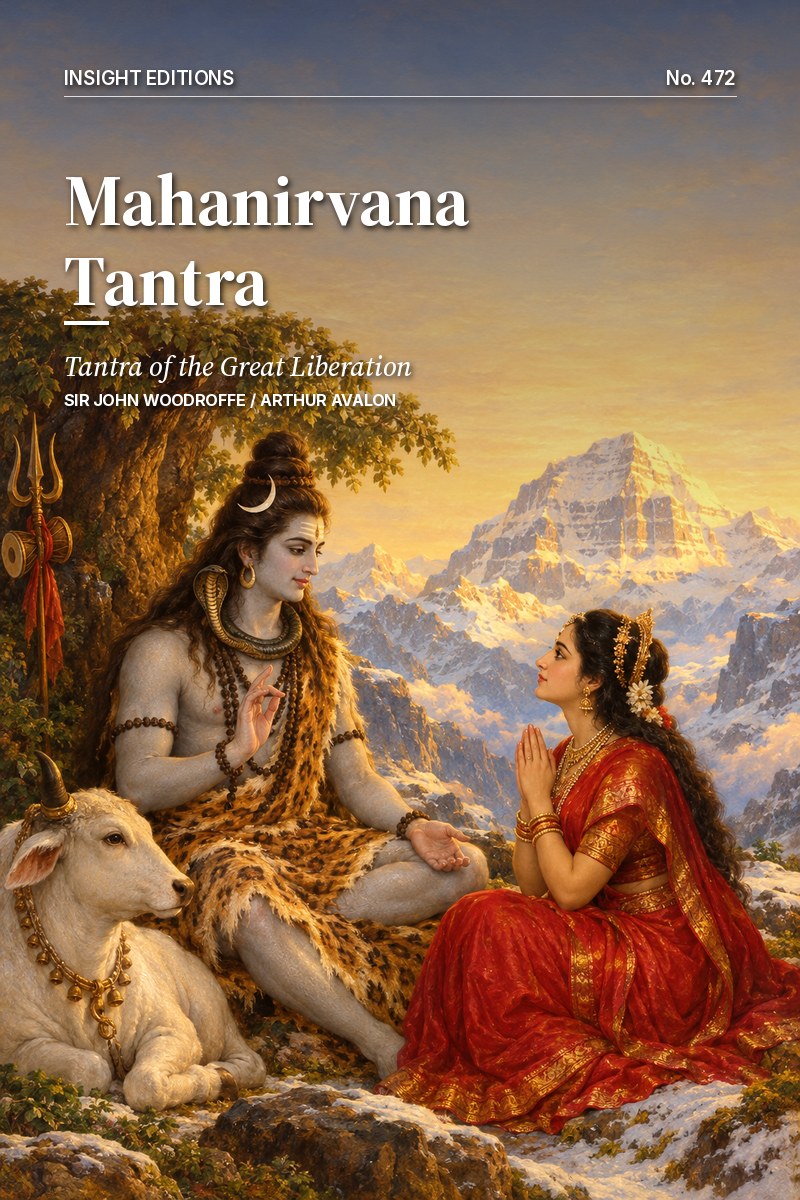
Mahanirvana Tantra (Tantra of the Great Liberation) is the Tantra that Arthur Avalon (Sir John Woodroffe) chose as "the first published in Europe of any Indian Tantra" (1913). It is a dialogue on Mount Kailasa in which Sadasiva answers Parvati's questions about how men of the Kali Age can be saved: the worship of the Supreme Brahman, the worship of Adya Kali, the Kaula rites with the five elements (pancatattva), the ten sacraments, duties of castes and stages of life, civil and criminal law, funeral rites, and the consecration of images, tanks and trees. Woodroffe adds a long Introduction that explains the terms the Tantra takes for granted.
This edition follows the book's order. For each part it gives:
- The question and the setting: what Parvati asks and why.
- The teaching: grouped by theme, with every list in full: mantras, rites, sacraments, duties, laws, penalties.
- Woodroffe's notes where they make the text clear.
- Insight, model and critical-lens boxes.
Long verse passages are paraphrased, not quoted.
The Shape of the Book
| Part | Contents |
|---|---|
| Preface | Why this Tantra; editions; the lost second half |
| Introduction | Kailasa; Siva and Sakti; the gunas; worlds and beings; caste and asrama; macrocosm and microcosm; the four ages and their scriptures; body, sheaths, nadis, cakras; Kundalini-yoga; guru, initiation and sadhana; bhava and acara; pancatattva; mantra, yantra, mudra, nyasa; worship |
| Chapters 1 to 4 | Parvati's questions; the Kali Age; worship of Brahman; introduction of Sakti worship |
| Chapters 5 to 7 | Mantra, purification, the pancatattva; nyasa and puja; the hymn and amulet of Adya Kali |
| Chapters 8 to 10 | Duties of castes and asramas; the ten sacraments; sraddha and funeral rites; the avadhuta |
| Chapters 11 and 12 | Penances; civil and criminal law; dharma of the householder |
| Chapters 13 and 14 | Installation of images; consecration of tanks, trees and houses; the Siva-linga; the final teaching |
Preface: Why This Tantra
The Tantras are the scripture of the Kali Age, and so "the voluminous source of present and practical orthodox Hinduism." Whatever their origin, they are a development of the Vedic karmakanda for that age. Siva says the Kaula doctrine is given for "men of the Kali age, bereft of energy and dependent for existence on the food they eat" (IX.12). To understand ritual, yoga and sadhana, one must look to the Tantra.
Why least understood: its subject is hard, and the key to its terms rests with the initiate.
Why this one first:
- An earlier Calcutta English version (about twelve years before) was "inaccurate" and "imperfect," with an Introduction showing "insufficient knowledge."
- The text is well known and esteemed, more by "reformed" Hindus than by some Tantrikas.
Two misreadings Woodroffe corrects:
| Group | Their view | Woodroffe's reply |
|---|---|---|
| Reformers | Admire its worship of the Supreme Brahman; think it rejects orthodox ritual | "Nothing can be more mistaken." Brahmajnana makes ritual unnecessary only once attained, and it is attained by sadhana, not by Vedantic discussion or mere prayer "after the manner of Protestant systems." The Catholic Church, with its ritual, is "strikingly analogous" to the Hindu system |
| Some Tantrikas | Find it "unnecessarily timid" | Its design is to conserve Tantric principles while preventing abuse. Parvati (I.67): "I fear that even that which Thou hast ordained for the good of men will, through them, turn out for evil." |
A telling fact: the Tantra's commentator Hariharananda Bharati was guru of Raja Ram Mohun Roy, the famous reformer.
Editions and the Lost Second Half
Group: assigned to the sixty-four Tantras of the Rathakranta.
Printed editions:
- Adi Brahmo Samaj, 1876 (Saka 1798), in Bengali script, with Hariharananda's notes, edited by Anandacandra Vidyavagisa, from three manuscripts (the Samaj's, Durgadasa Chaudhuri's, and Ram Mohun Roy's).
- Sri Krsna Gopala Bhakta, 1888: the edition Woodroffe translated, with notes by Jaganmohana Tarkalankara ("Vrddha"); a new edition by his son Jnanendranatha Tantraratna was in progress.
- Later: Bengali translations (including Prasanna Kumara Sastri), Jivananda Vidyasagara's Devanagari edition, and the Venkatesvara Press Hindi edition.
The second part is not lost. Woodroffe found a complete manuscript with a Nepalese pandit, the second part "over double" the first. The pandit would allow a copy only if the satkarma mantras (the six magical rites) were not published: since siddhi in them needs no virtue, the wicked could harm others, a crime punishable in Nepal by the civil power. Woodroffe argued that mantra without prayoga (method learned only from a guru) is useless, but would not publish a mutilated text, so only the first part is given.
The lesson he draws: those who call Tantra "nothing but black magic" are wrong. Some practices "exist for delusion," and the higher Tantrika's attitude is shown by the pandit's refusal.
His own commentary: Hariharananda's notes assume too much knowledge, so Woodroffe writes his own notes and Introduction, an "extended note," not exhaustive. He points to works in preparation: Principles of Tantra, Exposition of the Secret Worship, Description of the Six Centres.
Closing advice: no one will understand the Sastra "who starts his inquiry with a mind burdened with the current prejudices against it." Westerners "must learn to see through the Indian eye of knowledge."
A reforming Tantra. The Mahanirvana sits between two camps. It keeps the Kaula framework (Sakti worship, the five elements, the cakra) but surrounds it with limits, substitutes and household rules, and it gives pride of place to worship of the formless Brahman. That double character explains why Brahmo reformers printed it first and why stricter Tantrikas found it timid. Reading it well means keeping both sides in view.
Date and status. Woodroffe treats the text as a traditional Tantra. Later scholars (notably J. Duncan M. Derrett) argued it is a late composition, perhaps of the late 18th century, whose legal chapters show contact with British-era ideas, and some have linked it to Hariharananda's own circle. Woodroffe did not address this. Readers should treat its age and authority as open questions, while still valuing it as a coherent statement of reformed Kaula thought.
Key terms: Mahanirvana, Kailasa, Sadasiva, Parvati, Kali Yuga, Kaula, karmakanda, sadhana, Brahmajnana, Rathakranta, Hariharananda Bharati, Ram Mohun Roy, Adi Brahmo Samaj, Jaganmohana Tarkalankara, satkarma, siddhi, prayoga, pancatattva.
Reflect: The Nepalese pandit refused to publish mantras that work without virtue. Where else does knowledge need to be withheld because power does not depend on character?
Introduction I: Kailasa, Siva-Sakti and the Gunas
Woodroffe's Introduction opens with the scene of revelation, then sets out the metaphysics the Tantra presupposes: Brahman with and without Prakrti, the emanation of Nada and Bindu, the septenary of Sivas, Sakti as maya and mula-prakrti, the three forms of the Devi, and a careful account of the three gunas as the key to sadhana.
Mount Kailasa
The setting: the Himalaya, "Abode of Snow," the holy land of Aryan tradition.
- Caves at Bhimudiyar where the Pandavas and Draupadi rested; the Asoka grove where Rama and Sita stayed, where the Kosi meets the Sita.
- The ksetra of Siva, birthplace of Parvati, source of Ganga.
- Pilgrim shrines: Gangotri, Kedarnath, Badrinath; further north at Kangri, the circuit (parikrama) of Kailasa (Kang Rinpoche), north-west of Manasarovar (Mapham Yum-tso).
- Siva's paradise: lasting sunshine and cool shade, Mandara garlands, celestial singers. It is Gana Parvata, thronged with devayonis.
- Beyond is Mount Meru, centre of the world-lotus, hung with stars like Malati flowers.
- Praise: who thinks of Himacala, even unseen, is greater than one who performs all worship in Kasi; sins dry up at its sight like dew in the sun.
The inner Kailasa: Siva dwells wherever worshippers versed in Kulatattva abide; his mount is the sahasrara in every jiva, hence Sivasthana.
How Siva teaches: through Yamala, Damara, Siva Sutra, and Tantras as dialogues of Siva and Devi (as Parvati). Gayatri Tantra: Ganesa first preached the Tantra to the devayonis on Kailasa, having received it from Siva.
Brahman With and Without Prakrti
Parabrahman transcends turiya and all states: nishkala (without Prakrti) and nirguna. As the inner self and knowing subject it is never an object; it is known only by realizing the Self (atmajnana): "Spirit can alone know Spirit." Hence it was called Tat ("That") and Tat Sat ("That which is").
| Term | Meaning |
|---|---|
| Kala | Prakrti |
| Niskala Brahman | Tat thought of as without Prakrti |
| Sakala Brahman | With Prakrti, hence saguna, Prakrti being the three gunas |
| Sakti | Potentially present even in the niskala state; in fact one with Brahman and eternal (anadi) |
Sarada Tilaka: she pervades the universe as oil the sesame seed. She is Cit-rupini and Ananda-rupini, both nirguna and saguna.
Creation: "In the beginning there was the One. It willed and became many": "May I be many" (bahu syam). Manifested, it is apara (lower) Brahman, worshipped with attributes, embodied in all Devas, demons, the worshipper himself, and the universe.
Nada, Bindu and the Kamakala
The emanation sequence (Sarada): from saccidananda Paramesvara with Prakrti came Sakti; from Sakti, Nada; from Nada, Bindu.
- The subtle body called Kamakala is the root (mula) of mantra; hence the Devi is mula-mantratmika.
- Three Bindus: Siva-maya, Sakti-maya, Siva-Sakti-maya.
The Para-bindu:
| Feature | Description |
|---|---|
| Shape | A circle: centre brahmapada (Prakrti-Purusa), circumference encircling maya |
| Seat | On the crescent of nirvana-kala (17th digit), within ama-kala (16th digit) of the moon-circle, above the sun-circle, the guru and hamsah, in the sahasrara pericarp |
| Nearby | The fiery Bodhini (Nibodhika) |
| Triangle | All within the lightning-like inverted triangle "A-Ka-Tha", formed of 48 letters (16 each from A, Ka, Tha), with ha, la, ksa inside; encircled by the moon-mandala |
| Image | A grain of gram (canaka): under one sheath, a seed split in two: Siva-Sakti |
| Name | Sabda-Brahman, apara Brahman |
Creation proper: polarization in Parasaktimaya; the Devi becomes Unmukhi (face turned to Siva); the shell of maya bursts; Siva and Sakti ("Ham" and "Sah") divide. Sarada: the division is Bindu (Siva, of Nada's nature), Bija (Sakti), Nada (their relation). Before the burst, an indistinct sound (avyaktarava) arose: first and last state of Nada.
Nada's three states (Raghava Bhatta):
| Guna dominant | State | Name |
|---|---|---|
| Tamas | Indistinct sound (dhvani) | Nibodhika / Bodhini |
| Rajas | Sound with something like a combined arrangement of letters | Nada |
| Sattva | Fully formed | Bindu |
Fire, moon, sun:
| Power | Symbol | Why |
|---|---|---|
| Jnana | Fire | Burns up all action: once cause and effect are known, action ceases (linked to tamas) |
| Iccha (will) | Moon | Holds ama-kala, nectar that neither waxes nor wanes; will precedes creation |
| Kriya | Sun | Makes all things visible; no realization without striving |
From the Para-bindu issue:
- Raudri, Rudra and Sakti: fire, jnana.
- Vama, Visnu and Sakti: sun, kriya.
- Jyestha, Brahma and Sakti: moon, iccha.
Vamakesvara Tantra: Tripura is threefold as Brahma, Visnu, Isa; as will when Brahman would create, wisdom when she says "Let this be thus," action when he acts.
The Septenary of Sivas
Parasiva appears as:
- Sambhu, associate of time (kala-bandhu).
- Sadasiva, who pervades and manifests all.
- Isana.
- Rudra (tamas).
- Visnu (sattva).
- Brahma (rajas).
Each with his Sakti, "without whom they avail nothing." The last three with Isana and Sadasiva are the five Mahapretas, bija "Hsauh." Four form the supports and the fifth the seat of the bed where the Devi unites with Paramasiva, in a room of cintamani stone, on a jewelled island of kadamba trees in the ocean of nectar.
Siva's names (Sambhu, Sadasiva, Sankara, Mahesvara) mark states in the descent of the One; Siva Purana ch. 69 and Anusasana Parvan ch. 17 give 1,008 names.
Sakti as Maya and Mula-prakrti
Sakti is:
- Maya: by which Brahman makes itself appear other than it is.
- Mula-prakrti: the unmanifest (avyakta) state of the universe of name and form, equipoise of the three gunas.
The three gunas as Nature:
| Guna | Function | Nature as |
|---|---|---|
| Sattva | Manifests | Revelation of spirit |
| Rajas | Acts | Passage of descent or ascent |
| Tamas | Veils, produces inertia | Dense veil of spirit |
The Devi is guna-nidhi, "treasure-house of guna." Mula-prakrti is the womb into which Brahman casts seed; rajas stirs, equilibrium breaks, and the gunas evolve under the light of Siva (cit). In man the dual principle is the Svayambhu-linga in the muladhara and Kundalini coiled around it.
Kundalini: Sabda-Brahman in the body, in all breathing beings (prani), appearing as letters in prose and verse. Kundala = coiled. She is jiva-sakti manifesting as prana, sleeping in the muladhara with three and a half coils, matching three and a half bindus (Kubjika Tantra). "When after closing the ears the sound of Her hissing is not heard, death approaches."
Creations (in order):
- Avyakta (first).
- Mahat, gunas distinct (second).
- Ahamkara (third), threefold: vaikarika (sattvic), taijasa (rajasic), bhutadi (tamasic).
- From bhutadi: the tanmatras of ether, air, fire, water, earth, with sound, touch, sight, taste, smell, and colours transparent, syama, red, white, yellow.
- From the three ahamkaras: the indriyas and the Devas Dik, Vata, Arka, Pracetas, Vahni, Indra, Upendra, Mitra, the Asvins.
The vaikarika, taijasa and bhutadi are the 4th to 6th (prakrta) creations. Their products are the vaikrta creation: plants (upward life current), animals (horizontal), bhutas and pretas (downward). The two together form the kaumara creation.
The Devi
Titles and roles:
- Maya (source of samsara's maya); as its lord, Mahamaya.
- Avidya (she binds) and vidya (she frees).
- Adya Sakti (before creation).
- Vacaka-sakti (cit in Prakrti) and vacya-sakti (cit itself).
- Sri-mata: Creatrix and Nourisher. Kali in Yogini Tantra: "I am Saccidananda, Brahman itself."
- Ambika, from the sacrificial hearth of cit; Lalita, "She who plays", whose fish-like eyes open and close with the rise and fall of worlds.
Three forms of the Mother:
| Form | Description |
|---|---|
| Para (supreme) | "None know" (Visnu Yamala) |
| Suksma (subtle) | Mantra |
| Sthula (gross) | With hands and feet, for minds that cannot rest on the formless |
She has male and female forms, but is chiefly contemplated as female, since "female beings are parts of Her." She appears as Sarasvati, Laksmi, Gayatri, Durga, Tripurasundari, Annapurna, and as spouse of Siva Sati, Uma, Parvati, Gauri.
The ten Mahavidyas, shown by Sati to Siva before Daksa's sacrifice:
Kali, Bagala, Chinnamasta, Bhuvanesvari, Matangi, Sodasi, Dhumavati, Tripurasundari, Tara, Bhairavi.
The 51 pithas: Sati gave up her life at Daksa's sacrifice in shame at her father's insult to Siva. Siva bore her body, distraught; to save the world, Visnu cut it with his discus into 51 pieces; where they fell are the 51 maha-pitha-sthanas, where she is worshipped with her Bhairava.
In the body (pindanda) she is Kundalini; in the cosmos (brahmanda), her many forms: "one moon reflected in countless waters." Devi Bhagavata: one who worships Devas other than as her manifestations is "like a man with a clear lamp in his hands who yet falls into a waterless and terrible well."
Highest worship: after external and inner worship with support (sadhara) comes niradhara: Pure Intelligence worshipped as the very Self, the Witness.
The Gunas in Detail
Guna is substance, not "quality." Sattva, rajas and tamas are Prakrti's very substance; all Nature is trigunatmaka.
Mechanics:
- Sattva reveals; rajas activates; tamas suppresses.
- Rajas is dynamic; sattva and tamas are static, acting only when stirred by rajas.
- They work by mutual suppression.
The scale of beings:
| Class | Sattva | Rajas | Tamas |
|---|---|---|---|
| Devas (and the divya) | Predominant | Much reduced | Much reduced |
| Humans | Considerably active | Great independent activity | Less reduced than in Devas, far more than in animals |
| Animals | Considerably less | Less than in man | Less than in plants |
| Plants | Little | Less | More |
| Inorganic | Suppressed | Makes tamas active | Dominant |
The "upward" movement from tamas to sattva is the spiritual progress of the jivatma.
Human temperaments (bhava): sattvic = divyabhava, rajasic = virabhava, tamasic = pasu.
Meanings of sattva: from sat, the eternally existent, which is also cit and ananda. Secondarily "good", because productive of good. Primarily "that which reveals": the shining forth of spirit from under the veil. A pregnant woman is antahsattva, "with sattva within."
Nature's three aspects:
| Aspect | Guna | Moral form |
|---|---|---|
| Mirror of spirit | Sattva | Light, happiness |
| Veil of spirit | Tamas | Ignorance, sloth |
| Bridge (descent or ascent) | Rajas | Activity, passion |
"Sattva is the light of Nature, as tamas is its shade. Rajas is a blended tint oscillating between."
Rebirth and the gunas: the subtle body (lingasarira) (buddhi, ahamkara, manas, ten senses) builds gross bodies suited to its state. Under prarabdha karma, buddhi becomes tamasic (inanimate bodies), rajasic (active, passionate bodies) or sattvic (man to Deva).
Feelings:
| Active guna | Feeling | Suppressed |
|---|---|---|
| Sattva | Happiness | Sorrow, delusion |
| Rajas | Sorrow | Happiness, delusion |
| Tamas | Delusion | Happiness, sorrow (as in inorganic things) |
Even righteous happiness is a vikara (modification). The jivatma's true state is ananda from pure Self-knowledge, indifferent to happiness and sorrow.
Why human birth matters: sattva in buddhi gives discrimination, hence ideas of pleasure and pain, right and wrong, transient and lasting. Plants and animals lack this; man has it, though in degrees set by prarabdha karma. However bad one's karma, there is enough discrimination to improve, if properly aroused and aided.
Hence the guru: a good guru marks out the path and infuses his own tejas. Sadhana must fit the disciple; the wrong sadhana harms. So "it is better to follow one's own dharma than that, however exalted, of another."
Gunas as a ladder. Woodroffe's account turns an abstract cosmology into a practical rule. Every being sits somewhere on a scale from veiled (tamas) to revealing (sattva), with rajas as the force that moves things either way. Sadhana is simply the use of rajas to raise sattva. That one idea explains why the Tantra grades disciples into pasu, vira and divya, and why it insists the method must match the person.
Hierarchy built in. The guna scale places inorganic matter, plants, animals, humans and Devas on one ladder of spiritual worth, and links one's place to past karma. It is a coherent system, but it also gives a cosmic justification for ranking people by "temperament." The Introduction's later claim that Tantra is open to all castes and women sits in tension with this graded view.
Key terms: Kailasa, Kang Rinpoche, Manasarovar, devayoni, Meru, Kulatattva, Sivasthana, Yamala, Damara, Tat Sat, niskala, sakala, nirguna, saguna, apara Brahman, Nada, Bindu, Kamakala, mula-mantratmika, Para-bindu, brahmapada, nirvana-kala, ama-kala, A-Ka-Tha, Unmukhi, Nibodhika, iccha, jnana, kriya, Raudri, Vama, Jyestha, Tripura, Sambhu, Mahapreta, Hsauh, cintamani, maya, mula-prakrti, guna-nidhi, Kundalini, mahat, ahamkara, vaikarika, taijasa, bhutadi, tanmatra, vaikrta, kaumara, vacaka-sakti, vacya-sakti, Sri-mata, Ambika, Lalita, para, suksma, sthula, Mahavidya, pitha, pindanda, brahmanda, sadhara, niradhara, trigunatmaka, divyabhava, virabhava, pasu, antahsattva, lingasarira, prarabdha, vikara, tejas.
Reflect: Woodroffe says sadhana must fit the disciple or it harms. Have you ever adopted a practice that suited someone else better than you?
Introduction II: Worlds, Beings, Society and the Ages
The second part of the Introduction maps the cosmos the Tantra assumes: the fourteen worlds, the hierarchy of beings from Devas to Pitrs and Rsis, the castes and stages of life as the Tantra modifies them, the correspondence of body and cosmos, the four ages, and why each age has its own scripture, ending with the Tantra as the Veda for the Kali Age.
The Fourteen Worlds
Knowledge of the worlds comes (says a sutra) by meditating on the solar nadi, susumna, in the spine. Six upper worlds are threaded on it; the seventh and highest overhangs it in the sahasrara.
Upper worlds, from highest:
| World | Place or inhabitants |
|---|---|
| Satyaloka | Highest |
| Tapoloka | Higher celestial intelligences |
| Janarloka | Higher celestial intelligences |
| Maharloka | "Mixed" character |
| Svarloka | "From the sun to the pole star (dhruva)": heaven, "that which delights the mind"; abode of Devas and the blest |
| Bhuvarloka | Atmosphere (antariksa), "from the earth to the sun": Siddhas and other devayonis |
| Bhurloka | Earth, with continents, mountains, rivers, oceans |
Bhuh, Bhuvah and Svah are the region of the consequences of work, transitory: when the jiva has received his reward he is reborn on earth. "It is not good action, but the knowledge of the atma which procures Liberation."
Below the earth:
- The hells, beginning with Avici: popularly 34, or "as many as there are offences"; six great hells. Hinduism knows no eternal hell: "nothing is eternal but the Brahman." From hell the jiva is reborn to make its future.
- Seven nether worlds: Sutala, Vi-tala, Talatala, Mahatala, Rasatala, Atala, Patala, home of jewelled Naga divinities and the fascinating daughters of Daityas and Danavas.
- Below Patala: Sesa or Ananta, Visnu's tamasic form, bearing the world as a diadem, with his Sakti Varuni.
Beings of the Worlds
One Light, many veilings. A flame in clear glass loses little; behind paper it is dimmer; behind metal it seems gone, yet burns as brightly. All veiling forms are maya, yet true for those within the mayik world.
Deva and Devi:
- Deva ("shining one"): high manifestations of Brahman such as the seven Sivas and the trimurti; also lofty intelligences between Isvara and man. The Brahmana is "earth-deva" (bhudeva).
- Devi: the Supreme Mother and her forms Kali, Sarasvati, Laksmi, Gauri, Gayatri, Sandhya.
- Currents of pravrtti (outgoing) and nivrtti (returning) run through all.
All worship reaches Brahman. Deva, jiva and inert matter (jada) are one Brahman appearing other through upadhis set by avidya. Mahanirvana: "As all streams flow to the ocean, so the worship given to any Deva is received by the Brahman." The sun is the mayik vesture of Her "clothed with the sun."
Classes of Devas:
| Class | Example |
|---|---|
| Unborn (ajata) | Never human |
| Evolved from humanity (sadhya) | King Nahusa, who became Indra |
Opponents: Asura, Danava, Daitya, Raksasa, the tamasic element.
All Devas are subject to time and karma: "Salutation to Karma, over which not even Vidhi (Brahma) prevails." "God" and "angel" are misleading translations of Deva.
Pitrs ("Fathers"): either a separate creation or the lunar ancestry. From Brahma, "Grandfather" (Pitamaha), came Marici, Atri and others, his mind-born sons, and classes of Pitrs: Agnisvattas, Saumyas, Havismantas, Usmapas and others, 31 in all (Markandeya Purana). Tarpana is offered daily; the term also covers human ancestors to the seventh generation, given pinda and water with "svadha" in sraddha.
Rsis (seers): they "see" all mantras and make the sastras.
| Group | Members |
|---|---|
| Saptarsi, first manvantara | Marici, Atri, Angiras, Pulaha, Kratu, Pulastya, Vasistha |
| Saptarsi, present manvantara | Kasyapa, Atri, Vasistha, Visvamitra, Gautama, Jamadagni, Bharadvaja |
Vyasa taught: Rgveda to Paila, Yajurveda to Vaisampayana, Samaveda to Jaimini, Atharvaveda to Sumantu, Itihasa and Purana to Suta.
Classes of Rsi:
| Class | Description |
|---|---|
| Brahmarsi | Born of Brahma's mind |
| Devarsi | Lower rank |
| Rajarsi | Kings become seers: Janaka, Rtuparna |
| Srutarsi | Makers of sastras: Susruta |
| Kandarsi | Of the karmakanda: Jaimini |
Muni: named from manana, independent thought. The three steps:
- Sravana: listening.
- Manana: thinking, discussing, testing what is heard, "as opposed to the mere acceptance on trust."
- Nididhyasana: profound meditation on the conclusions.
Mahabharata: "The Vedas differ, and so do the Smrtis. No one is a muni who has no independent opinion of his own."
Jiva: the embodied atma with egoism, thinking it directs the puryastaka:
- Five organs of action.
- Five organs of perception.
- Fourfold antahkarana: manas, buddhi, ahamkara, citta.
- Five pranas.
- Five elements.
- Kama (desire).
- Karma.
- Avidya.
When these false notions are destroyed, the jiva attains nirvana and no jiva remains as such.
Caste (Varna)
The four varnas, said to spring from Brahma's mouth, arm, thigh, foot:
| Varna | Role |
|---|---|
| Brahmana | Priesthood, teaching |
| Ksattriya | Warrior |
| Vaisya | Merchant |
| Sudra | Servile |
The first three become twice-born (dvija) at upanayana (sacred thread). By birth one is sudra; by samskara, dvija; by Vedic study, vipra; by knowledge of Brahman, a Brahmana.
The Tantra's additions:
- A fifth, mixed class (samanya) from intermixture.
- Tantric worship is "largely free of Vedic exclusiveness, whether based on caste, sex, or otherwise." Gautamiya Tantra: "The Tantra is for all men, of whatever caste, and for all women."
Stages of Life (Asrama)
The four asramas (for a Brahmana):
- Brahmacari: chaste student.
- Grhastha: married householder.
- Vanaprastha: forest recluse.
- Bhiksu: mendicant, one meal a day, meditating on the Supreme.
Ksattriyas have the first three; Vaisyas the first two; Sudras only grhastha.
The Tantra's rule: in the Kali Age only two asramas: grhastha and bhiksuka or avadhuta, open to all castes. People of this age lack the capacity for the other two.
Kinds of avadhuta (as commonly said now):
| Class | Stage 1 (imperfect, apurna) | Stage 2 (parivrajaka) | Stage 3 (perfect) |
|---|---|---|---|
| Saivavadhuta | Ascetic yet householder, "like Siva" | Has left the world; puja, japa, pilgrimage to tirthas and pithas; may do sadhana with a sakti | Only a kaupina (loincloth); renounces all rites; may practise some yoga; may meet a woman's request |
| Brahmavadhuta | Householder, restricted to his own wife (sviyasakti), no Saiva sakti | Ordinarily no contact with women, but may practise yoga with a sakti under the guru | Hamsavadhuta: must never touch a woman or metals; no rites or observances |
Macrocosm and Microcosm
Levels: a Mahabrahmanda (grand cosmos) and many Brhatbrahmandas (macrocosms) evolved from it. Nirvana Tantra: all in the first is in the second.
"As above, so below": Visvasara Tantra: "What is here is elsewhere; what is not here is nowhere."
Correspondences:
| Cosmos | Body |
|---|---|
| Meru | Spinal column |
| Satyaloka | Sahasrara |
| Tapah, Janah, Mahah, Svah, Bhuvah, Bhuh | Ajna, Visuddha, Anahata, Manipura, Svadhisthana, Muladhara |
| Nether worlds | Below muladhara, joints, sides, anus, genitals |
| Kula-parvatas (mountain ranges) | Bones near the spine |
| Rivers | Nadis |
| Seven islands | Seven dhatus |
| Oceans | Sweat, tears and the like |
| Fire | In muladhara, susumna, navel |
| Pravahana and other winds | Ten vayus |
| Akasa | Same akasa |
| Cosmic soul (Hiranyagarbha) | The witness within (purusa) |
The Four Ages
Time scale:
- Kalpa (day of Brahma) = 14 manvantaras, each of 71 maha-yugas; a maha-yuga = 4,320,000 human years, made of four yugas.
- One Deva year = 360 human years.
- After a kalpa, a night of pralaya of equal length; the Lord sleeps in yoga-nidra on Sesa.
Woodroffe on progress: "official science" teaches man rose from an imperfect state; this conflicts with the traditions of Jews, Babylonians, Egyptians, Hindus, Greeks, Romans, Christians of an innocent, happy first age and a fall. Eden is "the emblem of the paradisiacal body of man."
| Yuga | Dharma | Divine / human years | Life seated in | Lifespan | Stature | Chief pilgrimage | Avataras |
|---|---|---|---|---|---|---|---|
| Satya (Krta) | Full; no sin | 4,800 / 1,728,000 | Marrow | A lakh; die at will | 21 cubits | Matsya, Kurma, Varaha, Nrsimha, Vamana | |
| Treta | 3/4 | 3,600 / 1,296,000 | Bone | 10,000 | 14 cubits | Naimisaranya | Parasurama, Rama |
| Dvapara | 1/2 | 2,400 / 864,000 | Blood | 1,000 | 7 cubits | Kuruksetra | Balarama (or Krsna) |
| Kali | 1/4 | 1,200 / 432,000 | Food | 120 or 100 | 3.5 cubits | Ganga | Buddha; Kalki to come |
Notes on the ages:
- Satya: giants able to bear long brahmacarya and tapas.
- Treta: men still devoted to piety, charity, penance, sacrifice, pilgrimage.
- Dvapara: restless, eager for knowledge yet deceitful; more weakness and disease.
- In the 1,000-year sandhya between Dvapara and Kali the Tantra was revealed, and will be at the dawn of every Kali Age.
- Kali: said by some to begin 3120 BCE at Visnu's return to heaven after his eighth incarnation; marked by vice, weakness, disease, decline.
- Kalki (Kalki Purana): blue as a rain cloud, sword in hand, on a white horse swift as wind, destroyer of the Kali race, restorer of dharma. Jayadeva's ode hails him drawing his scimitar "like a blazing comet."
Scriptures of the Ages
Classes of sastra:
- Sruti: the four Vedas (Rk, Yajus, Sama, Atharva) and Upanisads, expounded in Vedanta.
- Smrti: Manu's Dharmasastra and other works on family and social duty, for pravrtti dharma (as the Upanisads give nivrtti dharma).
- Puranas: once four lakhs (Brahmavaivarta); eighteen now principal.
- Tantra.
The Veda is the root (mula-sastra); all others rest on it. Tantra is called a fifth Veda. Kulluka Bhatta (Manu's commentator): "Sruti is of two kinds, Vaidik and Tantrik."
Kularnava's rule:
| Age | Scripture to follow |
|---|---|
| Satya | Sruti |
| Treta | Smrti |
| Dvapara | Purana |
| Kali | Tantra, for all orthodox worshippers |
Why: men no longer have the capacity, longevity and moral strength for the Vedic karmakanda; Tantra gives its own sadhana for the same final end.
Relations claimed:
- Tantra is to Veda as Paramatma to jivatma: the very core of the Veda.
- Kaulacara is the inner life of the "gross body" called vedacara; each acara up to kaulacara is a subtler sheath.
Scripture fitted to capacity. The Tantra does not claim the Veda is wrong; it claims the Veda's method no longer fits the people of this age. That is the same logic as the guna ladder applied to history: as human strength declines, the means are adjusted while the goal stays fixed. It is a powerful argument because it lets a new scripture claim continuity rather than rupture.
Decline and its uses. The four-age scheme, with giants of 21 cubits and lifespans of a lakh of years, is myth, and Woodroffe's appeal against "official science" relies on parallel myths rather than evidence. The idea of inevitable decline also works rhetorically for any new teaching: it explains why older rules may be set aside. The caste and asrama passages, meanwhile, show the Tantra loosening Vedic barriers while still keeping the varna frame.
Key terms: Satyaloka, Tapoloka, Janarloka, Maharloka, Svarloka, Bhuvarloka, Bhurloka, antariksa, dhruva, Avici, Sutala, Vi-tala, Talatala, Mahatala, Rasatala, Atala, Patala, Sesa, Ananta, Varuni, bhudeva, pravrtti, nivrtti, upadhi, jada, ajata, sadhya, Nahusa, Pitr, Pitamaha, Agnisvatta, tarpana, pinda, svadha, sraddha, saptarsi, manvantara, Brahmarsi, Devarsi, Rajarsi, Srutarsi, Kandarsi, muni, sravana, manana, nididhyasana, puryastaka, antahkarana, varna, dvija, upanayana, vipra, samanya, asrama, brahmacari, grhastha, vanaprastha, bhiksu, avadhuta, parivrajaka, kaupina, sviyasakti, Hamsavadhuta, Mahabrahmanda, dhatu, Hiranyagarbha, kalpa, maha-yuga, yoga-nidra, sandhya, Kalki, sruti, smrti, Kulluka Bhatta, Kularnava, vedacara, kaulacara.
Reflect: The muni must hold "an independent opinion of his own." How do you balance trust in a tradition with testing it for yourself?
Introduction III: Upper Centres, Temperaments, Guru and the Ladder of Acara
This part completes the map of the centres above the throat, then turns to the three temperaments (bhava), the guru, initiation and its eight consecrations, sadhana, the grades of worship, and the seven or nine acaras through which a worshipper climbs to Kaulacara.
The Upper Centres
Lalana (or Kala-cakra), a concealed centre at the root of the palate: a red lotus of twelve petals bearing these vrttis:
| Vrtti | Meaning |
|---|---|
| Sraddha | Faith |
| Santosa | Contentment |
| Aparadha | Sense of error |
| Dama | Self-command |
| Mana | Anger |
| Sneha | Affection |
| Soka | Sorrow |
| Kheda | Dejection |
| Suddhata | Purity |
| Arati | Detachment |
| Sambhrama | Agitation |
| Urmi | Appetite, desire |
Ajna, also parama-kula and mukta-triveni, since ida, pingala and susumna part here:
- Two petals between the eyebrows, bearing the red letters ham and ksam.
- No gross tattva; the subtle tattva mind is here.
- In the pericarp, the hidden bija Om; the three gunas.
- In the triangle, the lustrous linga shaped like the pranava, called Itara.
- Para-Siva as hamsa, with his Sakti Siddha-Kali.
- Brahma, Visnu, Mahesvara at the three corners.
- White Hakini, six heads, four hands, holding jnana-mudra, skull, drum (damaru), rosary.
Manas-cakra, secret, above ajna: six petals for hearing, touch, sight, smell, taste and sleep, or their absence.
Soma-cakra, above that: sixteen petals, the sixteen kalas:
- Krpa: mercy.
- Mrduta: gentleness.
- Dhairya: composure.
- Vairagya: dispassion.
- Dhrti: constancy.
- Sampat: prosperity.
- Hasya: cheerfulness.
- Romanca: rapture.
- Vinaya: humility.
- Dhyana: meditation.
- Susthirata: restfulness.
- Gambhirya: gravity.
- Udyama: effort.
- Aksobha: freedom from agitation.
- Audarya: magnanimity.
- Ekagrata: concentration.
Ascending from Soma-cakra:
- "The house without support" (niralamba-puri), where yogis see the radiant Isvara.
- The pranava, shining like a flame.
- The white crescent Nada, then the point Bindu.
- A white twelve-petalled lotus, head upward, with the ocean of nectar (sudha-sagara), the island of gems (mani-dvipa), the altar of gems (mani-pitha), the lightning lines A-KA-THA, and Nada and Bindu.
- On these, the Paramahamsa, itself the altar for the guru's feet. Here the Guru of all is meditated.
The Hamsa's body:
| Part | Meaning |
|---|---|
| Body | Jnana-maya, made of knowledge |
| Wings | Agama and Nigama |
| Feet | Siva and Sakti |
| Beak | Pranava |
| Eyes and throat | Kama-kala |
Near the thousand-petalled lotus:
- Ama-kala, the moon's sixteenth digit: pure red, fine as a lotus fibre, hanging downward, holding lunar nectar.
- Within it, nirvana-kala: a crescent bright as the sun, finer than a thousandth of a hair, the Istadevata of all.
- Near it, parama-nirvana-sakti: infinitely subtle, creatrix of tattvajnana.
- Above, Bindu and Visarga-sakti, root and abode of all bliss.
Sahasrara: a thousand-petalled lotus of all colours hanging head downward from the brahmarandhra.
- Brahma-loka, the first cause of the six causes below; the great Sun, cosmic and individual.
- Here dwell Parama-Siva and Adya-Sakti. The power is vacaka-sakti, saguna-brahman, holding gunas, powers and planes in potency.
- Parama-Siva is the Great Ether (paramakasa), Paramatma, "the Sun of the darkness of ignorance."
- All letters in every petal; all in the lower cakras and the cosmos is here in unmanifest state (avyakta-bhava).
One place, many names:
| School | Name |
|---|---|
| Saivas | Sivasthana |
| Vaisnavas | Parama-purusa |
| Saktas | Devi-sthana |
| Sankhya | Prakrti-purusa-sthana |
| Others | Hari-hara-sthana, Sakti-sthana, Parama-Brahma, Paramahamsa, Parama-jyotih, Kula-sthana, Parama-Siva-Akula |
"Whatever the name, all speak of the same."
The Three Temperaments
Three bhavas, based on the play of the gunas in the jiva:
| Bhava | Guna play | Description |
|---|---|---|
| Pasu ("animal") | Rajas working on tamas: error (bhranti), drowsiness (tandra), sloth (alasya) | Not necessarily a bad man; may outshine a vira who abuses greater freedom |
| Vira ("heroic") | Rajas working largely on sattva, still partly independently | Several classes |
| Divya ("divine") | Rajas working on sattva to its confirmed predominance | Several degrees, up to full deva-nature |
Gnostic parallel: men as material, psychical, spiritual.
The pasu as bound: from the root pas, "to bind." Kularnava's eight bonds (pasa):
- Daya: pity.
- Moha: delusion.
- Bhaya: fear.
- Lajja: shame.
- Ghrna: disgust.
- Kula: family.
- Sila: custom.
- Varna: caste.
Some count sixty-two afflictions, only elaborations.
Three kinds of bound being, by three impurities (mala):
| Mala | Meaning |
|---|---|
| Anava | Want of, or false, self-knowledge |
| Mayiya | Maya's division of one self into many |
| Karma | Action and its fruit |
| Class | Bound by |
|---|---|
| Sakala | All three |
| Pralayakala | Anava and karma |
| Vijnana-kevala | Anava only |
Free of anava too, one "becomes Siva Himself." The Devi bears the pasa and causes it, yet is pasupasa-vimocini, liberatrix of the pasu.
Outer marks of the pasu (Kubjika Tantra):
- Does not touch a yantra nor do japa at night.
- Doubts sacrifice and Tantra; thinks a mantra is mere letters.
- Lacks faith in the guru; thinks the image a block of stone.
- Distinguishes Deva from Deva; worships without flesh and fish.
- Always bathing "owing to his ignorance"; speaks ill of others.
Nitya Tantra adds: does not worship at night, evening, or late day; avoids sex except on the fifth day after the courses; eats no meat even on the five auspicious days. In short, those under Vedacara, Vaisnavacara and Saivacara, "bound by the Vaidik rules which govern all pasus."
Marks of the divya (Kubjika Tantra):
- Daily ablution and sandhya, clean cloth, the tripundra in ash or red sandal, rudraksa ornaments; japa and arcana.
- Daily charity; strong faith in Veda, sastra, guru and Deva; worships Pitrs and Devas.
- Great knowledge of mantra; eats only what the guru offers.
- Avoids cruelty; regards friend and foe as one; speaks truth; avoids those who decry the Devata.
- Worships thrice daily, meditates on the guru daily, worships Paramesvari as a Bhairava.
- Bows at the feet of women, regarding them as guru.
- Worships at night, does japa with a mouthful of pan, bows to the kula tree.
- Sees the cosmos pervaded by stri (sakti); "Siva is in all men."
Ranking (Nitya Tantra): divya best, vira next, pasu lowest; divya-bhava must be awakened through vira-bhava.
Picchila Tantra: the vira differs from the divya by being "uddhata", probably excitable, from more independent rajas.
The bhava fixes the sadhana: vira and divya forms are strictly forbidden to the pasu.
Bhava in the Kali Age:
- The Mahanirvana says divya and pasu dispositions are scarcely found now. The commentator reads pasu here in a good sense: one who, though tamasic, obeys nature as animals do.
- His argument: no one now fully performs Vedic, Vaisnava and Saiva rites, without which Vedic and Pauranic mantras and yajnas fail; no one keeps brahmacarya or vanaprastha; men drink and are fallen. So there is no pure pasu, and Siva has proclaimed the Agama: "Now, there is no other way."
- This does not make all competent for viracara.
- Against this, the Pranatosini cites a verse said to be from this Tantra: in Kali "there is no divya or vira-bhava; only by pasu-bhava can men obtain mantra-siddhi." The question is disputed.
Guru and Disciple
One Guru in reality: the human guru manifests Adinatha Mahakala of Kailasa, who speaks through him when the mantra is given.
The chain (Mundamala Tantra):
- Guru is the root of diksa.
- Diksa is the root of mantra.
- Mantra is the root of Devata.
- Devata is the root of siddhi.
So the guru is a grandfather to the Istadevata.
Manu: of the giver of birth and the giver of the Veda, the giver of sacred knowledge is the more venerable father.
Status and burden:
- No difference between guru, mantra and Deva; guru is father, mother and Brahman.
- "Guru can save from the wrath of Siva, but none can save from the wrath of the Guru."
- The disciple's sins recoil on the guru.
Three lines worshipped: divya (heavenly), siddha, manava (human).
Four gurus of the kula:
- Guru.
- Parama-guru.
- Parapara-guru.
- Paramesthi-guru.
Each is guru of the one before.
Women may be gurus and initiate, if qualified.
Testing: Sara-sangraha: test a disciple for a year.
| Accept | Reject |
|---|---|
| Good birth | Lewd (kamuka) |
| Purity of soul (suddhatma) | Adulterous |
| Capacity for enjoyment with desire for liberation (purusartha-parayana) | Ever sinning |
| Ignorant, slothful, irreligious |
The perfect sadhaka: pure-minded, senses controlled (jitendriya), doing good to all, free of dualism, living in the supreme unity.
When the relation ends: the relation lasts until Sakti is fully passed from the guru's body to the disciple's. At siddhi both pass beyond the dualism.
Initiation (Diksa)
Diksa is the giving of mantra.
Preparation:
- The guru first establishes in his own body the prana-sakti of the Supreme Guru of the thousand-petalled lotus. His body becomes a yantra, as an image is.
- The day before, the candidate sits on kusa grass; the guru whispers a "sleep mantra" (supta-mantra) and ties his crown lock.
- The disciple, fasting and continent, repeats it thrice, prostrates, and retires.
Initiation gives knowledge and destroys sin. "As one lamp is lit at the flame of another," the divine sakti of mantra passes from guru to disciple. Without diksa, japa and puja are useless.
Restrictions and exceptions:
- Some mantras are said to be barred to sudras and women.
- Yet the Kalika Purana allows the sudra the pranava with a particular tone, at the beginning or end of a mantra, not at both like the dvija.
- The mantra must suit the person (anukula); this is checked by the kula-cakra, the zodiacal rasicakra and other cakras in Tantrasara.
- Initiation by a woman is efficacious; by a mother, eightfold so.
The Eight Consecrations (Abhiseka)
- Saktabhiseka: on entering sadhana; the guru reveals the first mysteries of sakti-tattva; the disciple is cleansed of evil proclivities and gains new sakti.
- Purnabhiseka: beyond daksinacara, after purascarana; real sadhana begins; asana, yama etc. strengthen resolve (pratijna).
- Krama-diksabhiseka: a difficult stage in which Vasistha is said to have been entangled and Visvamitra gained brahma-jnana and so became a Brahmana; the sacred thread is worn round the neck like a garland.
- Samrajyabhiseka: after ordeals (pariksa).
- Maha-samrajyabhiseka.
- Yoga-diksabhiseka: the hardest stage; having done panchanga-purascarana, living with the guru, he does the last five limbs of the eightfold yoga.
- Purna-diksabhiseka.
- Mahapurna-diksabhiseka (viraja-grahana): on perfection he performs his own sraddha and offers his sacred thread and crown lock as the final oblation (purnahuti).
The guru relation ceases; he rises alone to "So'ham, I am He", jivanmukta, a paramahamsa.
Sadhana
Sadhana is whatever produces siddhi: training of body and psychic faculties, measured by progress toward realizing the atma.
Means: puja (outer or mental), sastric learning, tapas, pancatattva, mantra.
Ends differ: sadhana for brahma-jnana means:
- Inner control (sama) of buddhi, manas, ahamkara.
- Outer control (dama) of the ten senses.
- Discrimination of transitory and eternal.
- Renouncing both world and heaven (svarga).
This is unlike that for "the lower magic."
Four grades of sadhaka (man) or sadhika (woman):
- Mrdu.
- Madhya.
- Adhimatraka.
- Adhimatrama: fit (adhikari) for all yoga.
Three Kaulas:
| Kaula | Practice |
|---|---|
| Prakrta (common) | Viracara, ritual and pancatattva |
| Madhyama-kaulika | Same sadhana, mind turned to meditation, knowledge, samadhi |
| Kaulikottama | Beyond ritual; meditates on the Universal Self |
Grades of Worship
Four bhavas of worship, highest first:
- Brahma-bhava: jivatma and paramatma are one; only Brahman exists.
- Dhyana-bhava: constant yogic meditation on the Devata in the heart.
- Japa and stava: mantra repetition, hymns, prayer.
- Puja-bhava: external worship, from the duality of worshipper and worshipped, servant and Lord.
For one who knows all is Brahman, there is "neither worshipper nor worshipped," no yoga, puja, dharana, dhyana, stava, japa or vrata.
Image worship: worship is of an image (pratima) or a yantra.
- Worship the mental image first.
- Prana-pratistha: pass the tejas of the Brahman within to the image, from which bursts the lustre of Her "whose substance is consciousness" (caitanya-mayi).
She is in stone or metal but veiled and seemingly inert; the mantra arouses consciousness.
Kinds of rite (karma):
| Kind | Nature | Examples |
|---|---|---|
| Nitya | Daily, obligatory, done because ordained | Sandhya (Tantric form for sudras); daily puja of Ista- and Kula-Devata; for Brahmanas, pancamahayajna |
| Naimittika | Occasional, voluntary; kamya when for a goal | Yajna, tapas, vrata for an object |
Sudra and woman:
- Under Vedic rules, the sudra may not do Vedic rites, read the Vedas, or recite Vedic mantras; he has Ista-Devata and Bana-linga worship with Tantric and Pauranic mantras and vratas of penance and charity.
- The Tantra makes no caste distinctions in worship: all may read Tantras, do Tantric sandhya, recite the Tantric Gayatri.
- Even the candala may sit in the cakra, where all eat and drink together and are deemed greater than Brahmanas; caste resumes when the circle breaks up.
- Women, excluded by present Vedic practice (though Sankha allows a wife, with her husband's consent, fasts, vows, homa), may under Tantra receive and give mantra, as guru. The Devi is guru of all sastras, and every woman is Her earthly representative.
The Acaras
Seven, or nine (Kularnava), lowest first. They are not sects but stages, passed over many births.
| Acara | Path | Character |
|---|---|---|
| Vedacara | Kriya-marga (action) | "Gross body" holding all others; external ritual to strengthen dharma |
| Vaisnavacara | Bhakti-marga | From blind faith to devotion to Brahman's protecting energy |
| Saivacara | Jnana-marga begins | Ksattriya stage: striving and power added to love; faith, bhakti, inner resolve (antar-laksa) |
| Daksinacara | "Favourable," not "right-hand"; dhyana of the threefold sakti (kriya, iccha, jnana); Gayatri, Daksina Kalika, Adya Sakti; ends with purnabhiseka | |
| Vamacara | Nivrtti (return) begins | Not "left-hand" but worship where woman (vama) enters, lata-sadhana; entry by initiation |
| Siddhantacara | Attached to nothing, hates nothing, ashamed of nothing | |
| (Aghoracara) | Some count it | |
| (Yogacara) | Movements of the vayus; inner core of vedacara; yoga-diksa qualifies | |
| Kaulacara | Highest | Brahmajnana; constant nirvikalpa samadhi; jivanmukta paramahamsa |
Some group the first four as Daksinacara and the last three as Vamacara: "men are born into Daksinacara but received by initiation into Vamacara."
The turn at Vamacara:
- Up to the fourth stage the sadhaka follows pravrtti-marga, the outgoing path, "curbed by dharma."
- Now he destroys pravrtti directly, with the guru's help, using its force against itself.
- "Passion, which has hitherto run downwards and outwards to waste, is directed inwards and upwards, and transformed to power."
- Not only eating, drinking and sex are mastered; the eight bonds must be cut.
- Krsna stealing the Gopis' clothes: eight Gopis, eight bonds; the clothes are the errors that mislead the jiva; freed, he reaches sivatva.
Beyond: like Siva, a dweller in the cremation ground (smasana); learns the vayus of the microcosm (ksudra-brahmanda) that govern the vrttis, and the truths of the macrocosm.
Kaula-dharma is "the heart of all sects." The verse often used to charge the Kaula with hypocrisy: at heart Sakta, outwardly Saiva, in gatherings Vaisnava, wandering in many forms. Read rightly: the form "is nothing and everything"; it cannot narrow his inner life, and knowledge fills its limits with universal meaning.
Visvasara Tantra on the Kaula: no rule of time or place; unaffected by moon or stars; sometimes keeping social rules (sista), sometimes seeming fallen (bhrasta), sometimes like a ghost; no difference between mud and sandal paste, son and enemy, home and cremation ground.
At the summit: after mahapurna-diksa he does his own funeral rite, dead to samsara; his heart is the cremation ground where passions are burnt and the Great Mother dwells.
One can start anywhere: "the weaving of the spiritual garment" resumes where death broke it off. Niruttara: knowledge of Sakti comes after many births; Mahanirvana: merit of past births inclines the mind to Kaulacara.
Using the current against itself. The Vamacara turn is the key move of this Tantra's psychology. Desire is treated as energy that flows outward by default; instead of damming it, the practitioner reverses its direction under guidance until it consumes the bond that produced it. The eight bonds show that the target is wider than appetite: it includes shame, disgust, family, custom and caste, the social habits that hold the self in place.
Who decides who is ready? The scheme makes the guru the gatekeeper of every stage, says the guru's wrath is worse than Siva's, and lists pity and shame among bonds to be cut. Read sympathetically, these are inner attachments. Read in practice, they can strip a disciple of the very checks that protect against abuse. The text's own answer is the year of testing on both sides and the stated qualities of a true guru; a modern reader should take that test seriously.
Key terms: Lalana, Kala-cakra, ajna, mukta-triveni, Itara linga, Siddha-Kali, Hakini, manas-cakra, Soma-cakra, kala, niralamba-puri, sudha-sagara, mani-dvipa, mani-pitha, Paramahamsa, Agama, Nigama, Kama-kala, ama-kala, nirvana-kala, brahmarandhra, vacaka-sakti, paramakasa, avyakta-bhava, bhava, pasu, vira, divya, pasa, mala, anava, sakala, pralayakala, vijnana-kevala, uddhata, Pranatosini, Adinatha, diksa, supta-mantra, abhiseka, purascarana, purnahuti, So'ham, jivanmukta, sadhana, sama, dama, adhikari, Kaulikottama, brahma-bhava, pratima, prana-pratistha, nitya, naimittika, kamya, candala, acara, Daksinacara, Vamacara, lata-sadhana, Siddhantacara, Kaulacara, smasana.
Reflect: The Tantra lists shame and disgust as bonds. Which of your own habits of shame protect you, and which only confine you?
Introduction IV: Mantra, Yantra and the Daily Rites
This part explains the tools of Tantric worship: mantra and the Gayatri, yantra, mudra, then the round of sandhya, puja, yajna, vrata, tapas, japa, the samskaras, purascarana, bhuta-suddhi and nyasa. The governing idea is stated near the end: "transformation of thought is transformation of being."
Mantra
Sabda (sound) is of the Brahman and the cause of the cosmos, the manifestation of Cit-sakti. Visvasara Tantra: the Parabrahman as Sabda-brahman, whose substance is all mantra, exists in the body of the jivatma.
Two forms of sound:
| Form | Nature |
|---|---|
| Dhvani (unlettered) | Subtle, the jiva's life-giving sakti; also called nada, prana (Prapancasara) |
| Varna (lettered) | Produced by dhvani |
Sound and ether: sabda is the guna of akasa, manifesting in it, not produced by it. As air moves sound in outer space, prana-vayu moves it in the body through breath. It first appears in muladhara as a sweet murmuring dhvani "like the humming of a black bee."
Four levels of speech:
- Para: extremely subtle, in muladhara.
- Pasyanti: less subtle, at the heart.
- Madhyama: grosser, joined with buddhi.
- Vaikhari: fully gross, from the mouth.
Substance of mantra: as Kula-Kundalini is the Paramatma, the substance of all mantra is cit; letters (aksara) are "the yantra of the Aksara, the imperishable Brahman." This is realized only when the sadhaka's sakti unites with mantra-sakti.
Mantra and Devata:
- The gross form of Kundalini, appearing as different Devatas, presides over all mantras; the subtle form is the aim.
- When mantra-sakti is awakened, the presiding Devata appears; at full mantra-siddhi, the Devata as saccidananda is revealed.
- "Perfect Sakti does not appear in any but a whole mantra." A word or letter of it is not a mantra.
Textual home: Veda, Purana and Tantra; Tantra is the mantra-sastra. The embodied sastra:
| Sastra | Part |
|---|---|
| Tantra | Paramatma |
| Vedas | Jivatma |
| Darsanas | Senses |
| Puranas | Body |
| Smrtis | Limbs |
Mantra is not prayer. Prayer uses any words and bears its meaning on its face. Mantra uses "the eternal and determined sounds of Sastra." Bija mantras such as Aim, Klim, Hrim mean nothing in ordinary language; to the initiate they are the svarupa of the Devata. "They go to Hell who think the Guru but a stone, and the mantra but letters."
Etymology: man- from manana (thinking), -tra from trana (liberation); mantra calls forth (amantrana) the four aims. "Whilst mere prayer often ends in nothing but physical sound, mantra is a potent compelling force."
Why the diksa-mantra is strongest: in puja, hymn, homa, meditation only the sadhaka's sadhana-sakti works; with mantra it works with mantra-sakti, "which has the revelation and force of fire."
The plant image:
| Part | Rite |
|---|---|
| Seed | Diksa bija, sown in the heart |
| Stem and branches | Sandhya, nyasa, puja |
| Leaves and flowers | Stuti, prayer, vandana |
| Fruit | Kavaca (armour mantra) |
Gender of mantras:
- Solar (saura) = masculine; lunar (saumya) = feminine; also neuter.
- Masculine and neuter are "mantra"; feminine is "vidya."
- Neuter, such as Pauranic mantras ending in namah, lack force.
- Masculine endings: Hum, Phat; feminine: Tham, Svaha.
Names by length (Nitya Tantra):
| Syllables | Name |
|---|---|
| 1 | Pinda |
| 3 | Kartari |
| 4 to 9 | Bija |
| 10 to 20 | Mantra |
| Over 20 | Mala |
Bija usually means monosyllables: Hrim, Srim, Krim, Hum, Aim, Phat. Each Devata has a bija; the primary mantra is the mula-mantra, and mula also means the Devata's subtle body, Kama-kala.
Without knowing its meaning, a mantra "sleeps." Preliminary rites:
- Mukha-sodhana: purifying the mouth.
- Jihva-sodhana: purifying the tongue.
- Asauca-bhanga: purifying the mantra.
- Kulluka, nirvana, setu.
- Nidra-bhanga: awakening the mantra.
- Mantra-caitanya: giving it life.
- Mantrartha-bhavana: forming the mental image.
There are also ten samskaras of the mantra. Examples: dipani is seven japa of the bija preceded and followed by one; with Hrim instead of Om, it is prana-yoga; yoni-mudra moves meditation from the guru in the head and Istadevata in the heart down to muladhara and back, with ten japa of the yoni bija.
Mantra as Devata: the worshipper awakens it by cit-sakti, "putting away all thought of the letter," piercing the six cakras.
| Sakti | Role |
|---|---|
| Vacaka-sakti | Means: the saguna Mother, presiding Devata of the Gayatri, opens the door |
| Vacya-sakti | Object: the nirguna One |
Both are one, but the jiva must meditate on the gross before he can realize the subtle.
The rhythm of mantra steadies the "unsteady vibrations of the sheaths" and from it arises the Devata's form.
Four classes, set by cakra calculations:
| Class | Relation |
|---|---|
| Siddha | Friend |
| Sadhya | Server |
| Susiddha | Supporter |
| Ari | Destroyer |
The Gayatri
The most sacred Vedic mantra, "the Veda in seed." Rendered: Om, let us contemplate the wondrous spirit of the Divine Creator (Savitr) of earth, atmosphere and heaven; may He direct our minds (toward dharma, artha, kama and moksa).
Word by word (Yogi Yajnavalkya's Gayatri-vyakarana):
| Word | Meaning |
|---|---|
| Tat | That (with yat, which, understood) |
| Savituh | Of Savitr, from su, "to bring forth": Bringer-forth of all. Bhavisya Purana: Surya, the visible Devata, Eye of the world; time, planets, Vasus, Rudras are parts of him |
| Bhargah | The Aditya-devata in the solar sphere, to the sun as atma to body; also in the heart's ether as "the Smokeless Fire." From bhrj, "ripen, destroy, reveal, shine" (he will destroy all as kalagni); or bha (dividing), ra (colour), ga (going and returning) |
| Devasya | Of the radiant, playful (lilamaya) one, in play of creation, existence, destruction; lila is maya |
| Varenyam | Adorable; adored to escape the three pains (adhyatmika, adhidaivika, adhibhautika) |
| Dhimahi | Let us meditate (from dhyai) |
| Pracodayat | May He direct our buddhi-vrttis along the four aims |
Brahmana-sarvasva: "The Bhargah is the Atma of all that exists."
Exclusion and the Tantric answer:
- The Vedic Gayatri is for the twice-born only, forbidden to sudras and all women.
- The Tantra has its own. Chapter III gives the Brahma-gayatri: may we know the supreme Lord, contemplate the supreme essence, and may that Brahman direct us.
Yantra
Yantra: "an instrument"; in worship, what fixes the mind on its object. Yogini Tantra: the Devi is worshipped in image, mandala or yantra.
- The siddha-yogi's inner worship begins with yantra, the sign (sanketa) of brahma-vijnana, as mantra is the sign of the Devata.
- Also said to come from niyantrana, "subduing" lust, anger and other sins.
- Drawn or engraved on metal, paper or other material; designs vary with the object of worship.
Woodroffe's silver Gayatri yantra (on the book's cover):
| Part | Inscription |
|---|---|
| Central triangle | "Sri Sri Gayatri, grant me success"; Hrim and Hrah at the corners |
| Intersections of ovoid circles | Hrim |
| Circular band | Tha, standing for Svaha |
| Eight petals | Hrim, Im, Hrah |
| Outer band | All the matrka, a to ksa |
| Enclosure | Bhupura, sealing it from the outer world |
The yantra is a mnemonic chart of the Devata's mantras.
Installing the Devata:
- Meditate on the Devata and arouse it in oneself.
- Pass that presence to the yantra.
- Invoke by mantra, then infuse prana by prana-pratistha with mantra and mudra.
The yantra is then "instinct with its aroused presence." Mantra is Devata, and yantra is mantra, being the body of the Devata who is mantra.
Mudra
From mud, "to please": it pleases the Devas. 108, of which 55 are common.
Two senses: hand gestures in worship and body positions in yoga.
Examples:
- Matsya mudra: right hand on the back of the left, thumbs spread like fins, when offering arghya, so the conch's water is seen as an ocean with its creatures.
- Yoni mudra: a triangle of thumbs, first and little fingers, to invite the Devi to her pitha.
"The outward expression of inner resolve which it at the same time intensifies."
Uses: arcana, japa, dhyana, kamya rites, pratistha, bathing, welcome (avahana), food offering (naivedya), dismissal (visarjana). Gheranda Samhita: yoga mudras grant siddhi and stability, firmness and cure of disease.
Sandhya
Vedic sandhya: thrice daily (morning, noon, evening) for the twice-born.
Before the morning sandhya:
- Invoke the trimurti, sun, moon, planets; salute the guru.
- Recite: "I am a Deva. I am indeed the sorrowless Brahman... eternally free... existence, intelligence and Bliss."
- Offer the day's actions, confess frailty, pray to do right.
- Touch earth with the right foot: "Om, O Earth, salutation to Thee, Guru of all that is good."
- Acamana, clean teeth, bathe with mantra, tilaka, tarpana to Devas, Rsis, Pitrs.
The sandhya itself:
- Acamana: sipping water.
- Marjana-snana: sprinkling the body.
- Pranayama.
- Aghamarsana: expelling "the person of sin."
- Prayer to the sun.
- Silent japa of the Gayatri (the canon): avahana, rsi-nyasa and sadanga-nyasa, meditation on the Devi as Brahmani at morning, Vaisnavi at noon, Rudrani at evening, counted japa, visarjana.
Tantriki-sandhya is open to all: simpler, different mantras, Tantric bijas.
Puja
Daily worship of the Istadevata, preceded by worship of the Pancadevata:
- Aditya (the Sun).
- Ganesa.
- Devi.
- Siva.
- Visnu (Narayana).
Then the Kula-devata, usually the same as the Istadevata. Kamya puja and vrata start with sankalpa, a statement of resolve and purpose.
The sixteen upacaras:
- Asana: seat.
- Svagata: welcome.
- Padya: water for the feet.
- Arghya: rice, flowers, sandal, durva grass.
- Acamana: sipping water (offered twice, counted as 5 and 6).
- Madhuparka: honey, ghee, milk, curd.
- Snana: bath water.
- Vasana: cloth.
- Abharana: jewels.
- Gandha: scent and sandal.
- Puspa: flowers.
- Dhupa: incense.
- Dipa: light.
- Naivedya: food.
- Vandana or namaskara: prayer.
Varying articles: tulasi for Visnu, bilva for Siva.
Order of rite:
- Purify the seat; salute adhara-sakti; purify water and flowers.
- Drive off obstructive spirits (bhutapasarpana); fence the ten quarters by striking the earth thrice with the left foot saying "phat" and snapping fingers twice round the head.
- Pranayama, bhuta-suddhi, nyasa.
- Dhyana, upacaras, japa, prayer and pranama.
Siva's eight forms (asta-murti-puja):
| Form | Element |
|---|---|
| Sarva | Earth |
| Bhava | Water |
| Rudra | Fire |
| Ugra | Air |
| Bhima | Ether |
| Pasupati | Sacrificer (yajamana) |
| Isana | Sun |
| Mahadeva | Moon |
Yajna
From yaj, "worship"; kept untranslated as wider than "sacrifice."
The five great yajnas (daily for Brahmanas):
- Homa (Deva-yajna), with Vaisvadeva offering.
- Bhuta-yajna (bali): to Devas, spirits, animals.
- Pitr-yajna (tarpana).
- Brahma-yajna: Vedic study.
- Manusya-yajna: hospitality to guests.
These set right relations with Devas, Pitrs, spirits, men and the organic world.
Homa:
- Prepare the fire-pit (kunda); bring fire from a Brahmana's house.
- Make it conscious: "Vam vahni-caitanyaya namah."
- Meditate on ida, pingala, susumna and Agni.
- Offer to the Istadevata in fire.
- Pour ghee with a wooden spoon, mantras from Om to Svaha.
Kinds: daily nitya-vaisvadeva-homa; occasional (upanayana, marriage, vrata); prayascitta, srstikrt, janu, dhara and others.
Other classifications: Manu's four (deva, bhauta, nr, pitr); japa-yajna, dhyana-yajna; sattvika, rajasika, tamasika.
Vrata
Voluntary (naimittika) karma that causes merit (punya).
Examples:
- Janmastami (Krsna's birth), Sivaratri.
- Sat-pancami, Durvastami, Tala-navami, Ananta-caturdasi for Laksmi, Narayana, Ananta.
- Savitri vrata (women only); Karttikeya puja (men only).
- Durga-puja, the great vrata, once begun, must always continue.
- Bengali vratas without sastric authority: Madhu-sankranti, Jala-sankranti.
Common features: restraint (samyama): continence, havisyanna, fasting, bathing, no flesh or fish; niyama (vow); worship of Sun, planets, Kula-devata; all beings invoked by "Suryah somo yamah kalah." In Vedic vrata sankalpa in the morning, done before midday.
Tapas
Austerities such as the four-month fast (caturmasya) and sitting between five fires, but more widely of three kinds:
| Kind | Content |
|---|---|
| Sarira (bodily) | Worship; reverence for guru, Brahmanas, the wise; cleanliness, continence, simplicity, ahimsa |
| Vacika (speech) | Truthful, kind, gentle speech; Vedic study |
| Manasa (mental) | Self-restraint, purity, silence, tranquillity |
Each is sattvika (with faith, without regard to fruit), rajasika (for fruit, pride, honour), or tamasika (in ignorance or to harm, as malevolent sat-karma (abhicara)).
Japa
"Repeated utterance of mantra according to rule." Tantrasara's three kinds:
| Kind | Method | Rank |
|---|---|---|
| Vacika | Audible | Lowest |
| Upamsu | Lips move, at most a whisper | Middle |
| Manasa | Mental, fixed on meaning | Highest |
Why: audible utterance distracts attention toward words and pronunciation.
Conditions: cleanliness, hair, silk garments, seat, state of mind. Count matters: 108 is excellent, by mala (rosary) or kara-japa (thumb on finger joints).
Samskaras
Ten sacraments (nine for sudras):
- Jiva-seka (garbhadhana-rtu-samskara): after menstruation; daytime rite on the fifth day qualifies for conception that night; rtu-samskara on the first day (Chapter IX).
- Pumsavana: on signs of conception.
- Simantonnayana: fourth, sixth or eighth month.
- Jata-karma: at birth.
- Nama-karana: naming.
- Niskramana: fourth month, the child first shown the sun.
- Annaprasana: fifth to eighth month, first rice.
- Cuda-karana: tonsure.
- Upanayana: sacred thread (twice-born only), rebirth into spiritual life.
- Udvaha: marriage, ensuring continued human life, condition of progress.
Three prenatal stages matched to the three prenatal rites:
| Stage | Development |
|---|---|
| 1 | Fertilization to "critical period"; then the jivatma enters |
| 2 | To viability: fixing jiva to body |
| 3 | Viability to full term |
Woodroffe's comparison: modern medicine seeks the same ends physically; the samskaras use "super-physical" methods, like Catholic sacraments.
Purascarana
Repeating a mantra a great many times under set conditions.
Rules cover: time, place, the mandapa and altar.
Food: havisyanna, or milk, fruit, Indian vegetables, alms; nothing that stirs passion.
Order:
- Purify: continence, bathing, japa of the Savitri 5,008, 3,008 or 1,008 times, feeding Brahmanas.
- Three days before: worship Ganesa and Ksetrapala; eat pancagavya (five cow products); invoke sun, moon, Devas.
- Sankalpa.
- Place the jar (ghata, kalasa) on a mandala, with five or nine gems, painted red, covered with leaves.
- Tie the crown lock, take asana, do nyasa and meditation.
- Say the Kulluka, awaken the mantra (caitanya), and recite the vowed number.
Bhuta-suddhi
Purifying the body's elements (Chapter V, verse 93 onward), preliminary to worship (Mantra-mahodadhi). It is involution in thought.
Elements and senses:
| Element | Sense |
|---|---|
| Earth | Smell |
| Water | Taste |
| Fire | Sight |
| Air | Touch |
| Ether | Sound |
Order of dissolution:
- Kundalini roused, led to svadhisthana.
- Earth into water, water into fire, fire into air, air into ether, each with its tanmatra and sense organ.
- Ether with sound into ahamkara, then into Mahat, then into Prakrti.
- Prakrti thought of as Brahman, already one with it.
- The black Purusa, image of all sin, purified by mantra with kumbhaka and recaka.
- A new celestial (deva) body is imagined, strengthened by a "celestial gaze."
Nyasa
"Placing": fingertips and right palm on parts of the body with mantras.
Jiva-nyasa: after bhuta-suddhi, infuse the new body with the Devi's life.
- Hand on heart, say "So'ham", identifying with the Devi.
- Place the eight Kulakundalini with the bija string Am, Krim, Krim, Yam, Ram, Lam, Vam, Sam, Sam, Sam, Haum, Hamsah, saying in turn that Adya Kalika's pranas, embodied spirit, senses, then speech, mind, sight, hearing, smell and pranas abide here.
He becomes devata-maya.
Matrka-nyasa: the matrka are the fifty letters, mothers of the world. "Sabda-brahman, the Word, is the Creator of the worlds of name and form." The Devata's body is the fifty letters, built in the sadhaka himself.
Inner placement (antar-matrka-nyasa), each letter with namah:
| Cakra | Letters |
|---|---|
| Ajna | Ham, Ksam |
| Visuddha | The vowels |
| Anahata | Kam to Tham |
| Manipura | Dam to Pham |
| Svadhisthana | Bam to Lam |
| Muladhara | Vam, Sam, Sam, Sam |
Outer placement (bahya-matrka-nyasa):
- Vowels: forehead, face, eyes, ears, nostrils, cheeks, lips, teeth, head, hollow of the mouth.
- Consonants ka to va: arms, joints and fingers, legs, sides, back, navel, belly, heart, shoulders, kakuda.
- Sibilants and ha, ksa: from the heart to palms, feet, belly, mouth.
- Each with Om before, namah after.
Four kinds (Tantrasara): kevala (without bindu), bindu-samyukta, samsarga (with visarga), sobhya (both).
Rsi-nyasa, for the four aims:
| Place | Salutation to |
|---|---|
| Head | Rsi Brahma |
| Mouth | Metre Gayatri |
| Heart | Devi Sarasvati |
| Hidden part | Bija (consonants) |
| Feet | Sakti (vowels) |
| Whole body | Kilaka (visarga) |
The Adya form (Chapter V, verse 123): Brahma and the Brahmarsis; Gayatri and other metres; Kali; bija Krim; sakti Hrim; kilaka Srim.
Sadanga-nyasa:
| Group | Formula |
|---|---|
| a, ka-varga, a | "hrdayaya namah" (heart) |
| i, ca-varga, i | "sirase svaha" (head) |
| u, hard ta-varga, u | "sikhayai vasat" (crown lock) |
| e, soft ta-varga, ai | "kavacaya hum" (armour) |
| o, pa-varga, au | "netra-trayaya vausat" (three eyes) |
| am, ya to ksa, ah | "karatala-prsthabhyam astraya phat" (palms) |
On the body: hrdayadi; on the fingers: angusthadi, i.e. kara-nyasa (thumbs, index "threatening" fingers, middle, ring, little, palms). These "stimulate the nerve centres."
Pitha-nyasa: pithas such as Kamarupa (Yogini-hrdaya) set in place of the matrka.
Purpose of nyasa:
- Like wearing jewels: bijas placed on the body; vyapaka-nyasa spreads the presence throughout.
- Distributes the body's saktis to avoid "discord and distraction."
- With asana, gives citta-suddhi.
"Das Denken ist das Mass der Dinge." "Transformation of thought is transformation of being." This is "the rational basis of all this Tantrik sadhana."
Body as rewritten text. Bhuta-suddhi and nyasa form a two-step programme. First the worshipper imaginatively dissolves the body back into its causes, element by element. Then he rebuilds it out of letters, placing the alphabet that is the Devata's body onto his own limbs. Since the letters are held to be the substance of the cosmos, the result is a body rewritten as divine speech, and the ritual has a clear psychological logic: rehearsed identity shapes felt identity.
Magic and medicine. Woodroffe frames samskaras as "super-physical" counterparts to modern medicine and explains nyasa as nerve stimulation. Both are apologetic moves that borrow the authority of science without evidence. The listing of four mantra classes "determined by calculation," and of malevolent abhicara, also shows the practical, sometimes coercive side of mantra that the high philosophy can obscure.
Key terms: sabda, Sabda-brahman, dhvani, varna, para, pasyanti, madhyama, vaikhari, aksara, mantra-sakti, mantra-siddhi, manana, trana, amantrana, kavaca, saura, saumya, vidya, pinda, kartari, bija, mala, mula-mantra, nidra-bhanga, mantra-caitanya, dipani, vacaka-sakti, vacya-sakti, siddha, sadhya, susiddha, ari, Gayatri, Savitr, Bhargah, kalagni, lila, tapa-traya, Brahma-gayatri, yantra, sanketa, niyantrana, bhupura, matrka, mudra, arghya, avahana, naivedya, visarjana, sandhya, aghamarsana, Pancadevata, Kula-devata, sankalpa, upacara, adhara-sakti, bhutapasarpana, asta-murti, yajna, pancamahayajna, homa, kunda, vrata, punya, samyama, havisyanna, tapas, abhicara, japa, upamsu, kara-japa, samskara, garbhadhana, upanayana, udvaha, purascarana, pancagavya, ghata, bhuta-suddhi, tanmatra, nyasa, jiva-nyasa, devata-maya, matrka-nyasa, rsi-nyasa, kilaka, sadanga-nyasa, kara-nyasa, pitha-nyasa, vyapaka-nyasa, citta-suddhi.
Reflect: The text separates prayer (your own words) from mantra (fixed sound). Which kind of repetition shapes you more: words you choose, or words you inherit?
Introduction V: The Five Elements, Yoga, Karma and the Four Aims
The last part of the Introduction treats the most disputed topic, the pancatattva, then the circle worship (cakra), the eightfold yoga with its hatha supports, the piercing of the six centres, and the moral frame: sin and merit, karma, the four aims of life, and siddhi.
The Pancatattva
Three temperaments act on three animal functions: eating and drinking (which maintain annamaya-kosa) and sex (which reproduces it).
The five elements ("five M's"):
| Element | Literal | Esoteric name |
|---|---|---|
| Madya | Wine | Karanavari, tirtha-vari |
| Mamsa | Meat | |
| Matsya | Fish | |
| Mudra | Parched grain (not the gesture) | |
| Maithuna | Coition | Lata-sadhana (with a sakti) |
Also called kuladravya, kulatattva. Meanings differ in tamasika (pasvacara), rajasika (viracara), divya (sattvika) sadhana.
Rules for use:
- All are purified (sodhana) and consecrated; the first four consumed, then lata-sadhana or its symbol.
- No indiscriminate use: only after purification, in worship, by Tantric ritual.
- All excess forbidden. Syama-rahasya: intemperance leads to hell; Chapter V condemns it.
- The true vira: not the strong, great eater and drinker or sexually potent, but "he who has controlled his senses, is a truth-seeker, ever engaged in worship, and has sacrificed lust and all other passions."
For the pasu: strict Vedic rule.
- Wine: under three curses (Brahma, Kaca, Krsna): "not to be drunk, given or taken." Drinking for pleasure is a sin needing prayascitta; Visnu Purana puts it in the same hell as killing a Brahmana.
- Flesh and fish: higher castes outside Bengal under Smarta discipline eat neither; in Bengal most eat fish, and men eat male goats first offered to the Deity.
- Maithuna outside one's own wife is condemned, including the eightfold maithuna:
- Smarana: thinking of it.
- Kirtana: talking of it.
- Keli: play with women.
- Preksana: looking at women.
- Guhya-bhasana: private talk.
- Sankalpa: wish.
- Adhyavasaya: resolve.
- Kriya-nispatti: the act.
- Even with one's own wife, continence: Vedic rule allows union once a month, on the fifth day after the menses. Hence the Nitya Tantra's mark of the pasu.
Woman in Vedic teaching too: not an object of enjoyment but a house-goddess (grhadevata). Sruti: union of man and wife is a homa, she both hearth and flame. Tantric mantra of Siva-Sakti yoga: sense-functions offered by the path of susumna into the fire of spirit, "with the ghee of merit and demerit." The householder should worship with his wife; brahmacarya governs the grhastha too.
The one exception: for sadhana, for those fit (adhikari) for viracara. It is held not to oppose the Veda, which forbids wine for pleasure but prescribes yajna with wine.
Substitutes for the pasu:
| Element | Substitute |
|---|---|
| Wine | Milk (Brahmana), ghee (Ksattriya), honey (Vaisya), rice liquor (Sudra) |
| Meat | Salt, ginger, sesame, wheat, mash beans, garlic |
| Fish | White brinjal, red radish, masur, red sesame, paniphala |
| Mudra | Paddy, rice, wheat, gram |
| Maithuna | Flowers offered with kacchapa mudra, or union with one's own wife |
Nitya Tantra: the pasu must not worship the Devi in late day, evening or night, since such worship implies maithuna.
The vira's use: begins with the rajasika pancatattva to destroy the tendencies they stand for. This Tantra says Sakti worship without them is "evil magic."
Jaganmohana Tarkalankara's commentary, in summary:
- Wine, women, fish, meat and mudra are what most cause a man's fall.
- Siva uses these very poisons against the poison: "poison is the antidote for poison."
- The physician must be experienced: a mistake and "the patient is like to die."
- Kulacara is like walking a sword's edge or holding a wild tiger.
- A secret argument exists, for initiates only.
- An initiate who sees a woman worships her as mother or Istadevata.
- Visnu Purana: feeding desire is ghee on fire; yet a true guru knows how the poison kills the poison of samsara.
Woodroffe's gloss: the goal is brahma-sayujya; without it, "nothing is attained"; ritual by one whose senses are not mastered is "as useless as magic" that harms others. The "secret argument" is that passions turned inward lift the particular to the universal. Abuses come from lack of a guru: when patient, disease and physician are all on the wrong side, nothing can save him.
Limits in this Tantra (current version):
- When Kali is in full strength, householders with worldly minds take "the three sweets" (madhuratraya) instead of wine; the virtuous with minds on Brahman may take five cups.
- Men of this age, weak and lustful, do not see woman as the Deity's image; so maithuna only with sviyasakti, one's own wife; union with an unmarried woman in Brahma or Saiva form is forbidden.
- With parakiya or sadharani saktis, instead of maithuna, meditation on the Devi's lotus feet with japa.
- Commentator: this bars only men of weak intellect ruled by lust; for the true vira or siddha there is no prohibition.
- Woodroffe: the Tantra is "a protest against the misuse" after relaxed rules.
Cosmic meaning of the offering:
| Element | Signifies |
|---|---|
| Wine | The power producing all fiery elements |
| Meat and fish | All land and water animals |
| Mudra | All plant life |
| Maithuna | Iccha, kriya and jnana sakti of Prakrti, with the bliss of creation |
"To the Mother is thus offered the restless life of Her universe."
The sattvika (divya) meanings:
| Element | Kaivalya | Agamasara |
|---|---|---|
| Wine | Intoxicating knowledge of the Parabrahman that makes one senseless to the outer world | Lunar nectar (somadhara) dropping from the brahmarandhra |
| Meat | Consigning all acts to "Me" (mam) | The tongue (ma), whose part is speech: controlling speech |
| Fish | Sattvika sympathy with all beings' pleasure and pain | The two fish in ida and pingala, "eaten" by kumbhaka |
| Mudra | Relinquishing all evil association | Awakening knowledge in sahasrara, where atma, like mercury, bright as ten million suns, cool as ten million moons, unites with Kundalini |
| Maithuna | Union of Kundalini with Siva in the body (Yogini Tantra: best for those who have mastered passion) | Ra in the kunda, Ma as bindu in the mahayoni; M on the Hamsa as A unites with R: brahmajnana, and the sadhaka is atmarama |
Yamala: from the union of Siva and Sakti arises "the Supreme Bliss."
Cakra Worship
Pancatattva worship takes place in a cakra (circle) of sadhakas and saktis (Bhairavas and Bhairavis).
- Men and women sit alternately, sakti on the sadhaka's left.
- The lord of the circle (cakresvara) sits with his Sakti in the centre, by the wine-jar.
- All eat, drink and worship together, no caste distinction.
- No pasu may be admitted.
- Kinds: Vira, Raja, Deva, Maha cakras.
- Chapter VI treats the pancatattva; Chapter VIII the Bhairavi and Tattva (Divya) cakras, the latter for Brahma-mantra worshippers.
Yoga
From yuj, "to join." In grammar sandhi, in logic avayava-sakti; commonly union of jivatma and Paramatma and its practices.
Natural and realized union: all beings are already in natural yoga, since they exist only by identity. Woodroffe quotes a Latin mystical theologian: God is in all by essence, presence and power, a general union; the mystic's union is "supernatural, actual and fruitful." Yoga in the technical sense is realizing the identity by destroying the false look of separation.
Key sayings:
- "No bond equal to maya, no force greater to destroy it than yoga."
- "No better friend than knowledge (jnana), no worse enemy than egoism (ahamkara)."
- Body and action cycle like a water-wheel (ghatiyantra).
Two main divisions:
| Division | Note |
|---|---|
| Hatha (ghatastha) yoga | "The means whereby rajayoga is attained" (Gheranda Samhita); often confused with self-mortification; not every process is needed |
| Samadhi yoga | Rajayoga is one form |
Higher union: lata-sadhana in viracara is forbidden to pasus; the higher union is Kundalini rising to Bindu in sahasrara.
The eight limbs:
| No. | Limb | Content |
|---|---|---|
| 1 | Yama | Continence, ahimsa, kindness, forgiveness, good without reward, no covetousness, temperance, purity |
| 2 | Niyama | Observances, charity, austerity, study, Isvara-pranidhana |
| 3 | Asana | Posture |
| 4 | Pranayama | Breath regulation |
| 5 | Pratyahara | Withdrawal of senses |
| 6 | Dharana | Fixing the mind |
| 7 | Dhyana | Continuous contemplation |
| 8 | Samadhi | Savikalpa, perfected as nirvikalpa, no trace of subject and object |
The first five are exterior (bahiranga); the last three interior.
"Aham Brahmasmi" does not produce liberation; it is liberation.
Many descriptions, one end: Kundalini with Paramasiva, jivatma with Paramatma, suppression of citta-vrtti, moon and sun (ida and pingala), prana and apana, Nada and Bindu.
Seven qualities from seven practices:
| Quality | Practice |
|---|---|
| Sodhana (cleansing) | Satkarma |
| Drdhata (firmness) | Asana |
| Sthirata (fortitude) | Mudra |
| Dhairya (steadiness) | Pratyahara |
| Laghava (lightness) | Pranayama |
| Pratyaksa (realization) | Dhyana |
| Nirliptatva (detachment) | Samadhi |
The Six Cleansings (Satkarma)
- Dhauti (washing), fourfold:
- Antar-dhauti: vatasara (air in and out of the belly), varisara (water through the body and out), vahnisara (navel knot pressed to the spine), bahiskrta (belly filled with air by kakini mudra, held half a yama, sent down).
- Danta-dhauti: teeth roots, tongue, ears, "hollow of the forehead."
- Hrd-dhauti: removes phlegm and bile by stick, cloth, or vomiting.
- Mula-dhauti: cleansing the anus with finger and water or a turmeric stalk.
- Vasti: dry or watery; seated in water to the navel in utkatasana, using asvini mudra.
- Neti: nostrils cleansed with string.
- Lauliki: whirling the belly.
- Trataka: unblinking gaze at a tiny object until tears come; gives "celestial vision" (divya drsti).
- Kapalabhati: removing phlegm by vatakrama (breath), vyutkrama (water in by nose, out by mouth), sitkrama (the reverse).
Asana, Mudra, Pratyahara
Asana:
- "As many as living beings": 8,400,000; 1,600 excellent; 32 auspicious for men.
- Common: muktapadmasana (ordinary worship seat) and baddhapadmasana.
- Patanjali gives only conditions, leaving details to each person.
- Tantric seats: mundasana (skulls), citasana (pyre), savasana (corpse), for conquest of fear and indifference, in lonely mountains, empty houses, riversides, cremation grounds. The inner cremation ground is where the desire-body burns in knowledge's fire.
Mudra (hatha): health-giving, said to destroy disease and death, protect from fire, water, air.
- Yoni mudra: in siddhasana, stop ears, eyes, nostrils and mouth with the fingers; draw prana by kakini mudra, unite with apana; meditate on the six cakras; rouse Kundalini by "Hum Hamsah"; raise her to sahasrara; feel union with Siva and become Bliss and Brahman.
- Asvini mudra: contracting and expanding the anus for cleansing, or restraining apana in cakra-piercing.
- Sakti-calana: asvini repeated until vayu shows in susumna, with union of prana and apana in siddhasana.
Pratyahara: restraining the senses, mind under the atma; destroys the six sins.
Pranayama
Ajapa Gayatri: all beings breathe out with "Ham" and in with "Sah" 21,600 times a day.
Breath distance (finger-breadths):
| Activity | Distance |
|---|---|
| Normal | 12 |
| Singing | 16 |
| Eating | 20 |
| Walking | 24 |
| Sleeping | 30 |
| Coition | 36 |
| Violent exercise, maximum | 96 |
Shorter breath prolongs life; longer shortens it.
Phases: puraka (in), recaka (out), kumbhaka (holding).
Eight kumbhakas (Gheranda Samhita):
- Sahita.
- Suryabheda.
- Ujjayi.
- Sitali.
- Bhastrika.
- Bhramari.
- Murccha.
- Kevali.
Effects: awakens sakti, frees from disease, gives detachment and bliss.
| Grade | Measure | Sign |
|---|---|---|
| Uttama | 20 | (best) |
| Madhyama | 16 | Spinal tremor |
| Adhama | 12 | Sweat |
Nadi-suddhi, samanu (with bija) or nirmanu. With bija:
- In padmasana, do guru-nyasa; on "yam", inhale by ida 16, hold 64, exhale by pingala 32.
- Raise fire from manipura, unite with earth; inhale by pingala with fire bija 16, hold 64, exhale by ida 32.
- Gaze at the nose-tip, meditate on lunar brilliance; inhale by ida with "tham" 16; hold with "vam" 64; feel flooded by nectar; exhale by pingala with "lam" 32, strengthened.
Conditions:
- Seat: kusa grass or deerskin, facing east or north.
- Place: not too distant, not unprotected like a forest, not a crowded city.
- Food: pure, vegetarian, not too hot, cold, pungent, sour, salt or bitter; no fasting or one meal a day; no more than one yama (three hours) without food; stomach half full.
- Avoid long walks, violent exercise, and for beginners sex.
- Begin in spring or autumn.
Sahita with bija (sagarbha):
- Meditate on Brahma, rajasic, red, letter A; inhale by ida, 6 matras.
- Uddiyana-bandha; meditate on Hari, sattvic, black, letter U; hold with 64 japa.
- Meditate on Siva, tamasic, white, letter M; exhale by pingala with 32.
- Repeat in reverse.
Dhyana and Samadhi
Three kinds of dhyana:
| Kind | Practice |
|---|---|
| Sthula (gross) | The Devata's form in the heart: an ocean of nectar, an island of gems with shores of powdered gems, a kadamba forest in yellow bloom, ringed with malati, campaka, parijata; in it the Kalpa tree, four branches the four Vedas, bees humming, koels courting; beneath, a jewelled mandapa and bed, with the Istadevata in the form the guru directs |
| Jyotih | Infusing tejas into the form; the jivatma as a tapering candle flame in muladhara, or the pranava-flame between the brows |
| Suksma (subtle) | Kundalini, roused, with sambhavi mudra; gives atma-saksatkara |
Samadhi: as process, intense concentration free of sankalpa, attachment and "mineness" (mamata); as result, union of jiva and Paramatma.
Six samadhi yogas (Gheranda Samhita):
- Dhyana-yoga: by sambhavi mudra; atma realized and resolved into Mahakasa.
- Nada-yoga: by khecari mudra: frenum cut, tongue lengthened to the brows, then turned back into the mouth.
- Rasananda-yoga: by kumbhaka; ears closed, hearing nada from cricket's chirp to kettledrum, then the anahata sound and a light with the manas that dissolves in Visnu.
- Layasiddhi-yoga: by yoni mudra; as Sakti, union with Siva as Purusa in srngara-rasa.
- Bhakti-yoga: devotion to the Istadevata until tears of bliss bring ecstasy.
- Raja-yoga: by manomurccha kumbhaka, manas fixed between the brows, united with atma.
Piercing the Six Centres (Satcakra-bheda)
Details only from a guru. Outline:
- The jivatma in the subtle body (five pranas, manas-ahamkara-buddhi, ten organs) is united with Kulakundalini.
- Kandarpa (Kama) vayu in muladhara, a form of apana, is turned leftward; the fire round Kundalini is kindled.
- By "Hum" and that heat, Kundalini wakes. Coiled three and a half times round Svayambhu-linga, closing brahma-dvara, she enters that door and rises with the jivatma.
The ascent:
| Centre | What is dissolved into Kundalini | Note |
|---|---|---|
| Muladhara | Brahma, Savitri, Dakini, Devas, bija, vrttis; earth becomes "Lam" | Lotus, which turned up on waking, closes and hangs down as she leaves |
| Svadhisthana | Mahavisnu, Mahalaksmi, Sarasvati, Rakini, Matrkas, Vaikuntha, Goloka; "Lam" into water, water as "Vam" | Lotus opens upward |
| Manipura | All in it; "Vam" into fire, as "Ram" | Brahma-granthi: pain, disorder, even disease; hence other yogas work directly on higher centres |
| Anahata | All in it; "Ram" into air, as "Yam" | Visnu-granthi |
| Visuddha | Ardhanarisvara, Sakini, sixteen vowels, mantras; "Yam" into ether, as "Ham" | Abode of Bharati |
| Lalana, then Ajna | Parama-Siva, Siddha-Kali, gunas; "Ham" into manas-cakra, mind into Kundalini | Rudra-granthi |
| Above | Niralamba-puri, pranava, nada | She unites of her own motion with Parama-Siva |
Having absorbed the twenty-four tattvas, she becomes one with Parama-Siva: "the maithuna of the sattvika pancatattva." Nectar floods the body; the sadhaka is "immersed in ineffable bliss."
Burning the man of sin and making a new body:
- "Yam" in the left nostril; inhale 16, hold 64, picturing the black papa-purusa in the left abdomen dried up; exhale 32.
- Red "Ram" in manipura; inhale 16, hold 16, the papa-purusa burnt to ashes; exhale 32.
- White "Tham" (moon); inhale 16, hold 64, exhale 32, a new celestial body forming from nectar of the letters.
- "Vam" continues it; "Lam" completes and strengthens it.
- "So'ham" leads the jivatma into the heart.
Return: Kundalini goes back the way she came, restoring all she absorbed to each cakra, until muladhara is as before.
Guru's limit: instruction goes to ajna; beyond, the sadhaka reaches brahmasthana unaided. The seventh amnaya is "not expressed."
Sin and Merit
Christian frame contrasted: sin as violation of God's personal will, original sin as "defect of original righteousness" and "concupiscence" (Aquinas), "the law in the members" (Paul).
Hindu frame:
- Papa and punya are against or with Isvara's will as shown in the cosmic process at that time.
- Relative to the path: individuality is right on pravrtti, wrong on nivrtti.
- Not juristic: "morality is the true nature of a being," wrong its destruction.
- Wider than humanity: Yoga Vasistha: a creeper gained merit by growing in a muni's dwelling.
Definitions:
- Sin: "duhkha-janakam papam," what causes pain in past, present or future births. The consequence is part of the act, its future part.
- Merit: "sukha-janakam punyam," what causes happiness, here, later, or in svarga.
Six chief sins:
- Kama: lust.
- Krodha: anger.
- Lobha: covetousness.
- Moha: delusion.
- Mada: pride.
- Matsarya: envy.
"All wrong is at base self-seeking." Merit's fruit is transitory; Sruti: liberation comes "by renunciation," not acts, pindas or wealth. For the freed, neither vice nor virtue exists.
Karma
Action, cause and effect, one whole. Iccha, jnana and kriya sakti appear as desire, knowledge and action. Brhadaranyaka: "As is his desire, so is his thought... so is his action... so is his attainment." "Not punishment and reward, but consequence."
Three kinds:
| Kind | Meaning |
|---|---|
| Sancita | Accumulated, unexhausted; shapes future births as samskara or vasana |
| Prarabdha | Ripe part, worked out now, unavoidable |
| Vartamana / agami | New karma being made |
Even Devas are subject to karma; by karma a jiva may become an Indra.
Karma is adrsta, invisible; good and bad together are karma-mala. Action for fruit never frees; liberation is the work of Siva-Sakti, by brahmajnana.
Tantric use: sadhana and acara depend on karma; sancita shapes temperament; the Tantra moulds method to temperament, so vira forms are barred to pasus, and the guru fixes adhikara.
The Four Aims
All seek happiness; Brahman is bliss itself ("raso vai sah").
Two paths:
| Path | Seeks |
|---|---|
| Pravrtti | Bhukti (worldly enjoyment) or svarga |
| Nivrtti | Mukti, union with the source |
Rhythm: the divine breath goes out from spirit to matter and back. Devi as Maya evolves the world; as Mahamaya recalls it. Both bhukti and mukti are Her gifts; of Visnu and Siva mukti only, of Devi both.
"One cannot renounce until one has enjoyed." The noose of desire is in Devi's hand, and She is also the light that shows its futility.
Desire with a bridle: mind the charioteer, senses the horses. The Tantras take no exception to not letting them bolt. Hence the trivarga on pravrtti:
| Aim | Meaning |
|---|---|
| Dharma | "What is held fast": law, custom, religion, duty, morality; the eternal (sanatana) principles that hold the universe together; its mark is acara (good conduct), "the root of all tapas"; based on sruti presented in Smrti, Purana, Tantra. Devi Bhagavata: in Kali Visnu as Vyasa divides the Veda for short-lived men of small intelligence |
| Kama | Desire for wealth, success, family, position, including great and noble aims; must be lawful |
| Artha | Means: food, money, house, land, and means for worship and helping others; lawfully sought |
"Dharma, artha and kama should be served equally; he who clings to one alone is despicable."
Moksa: the truly ultimate end, since the others are "haunted by the fear of Death the Ender."
- Avoid "salvation": Christian salvation is forgiveness of sins mediated by Christ; mukti is loosening from samsara and union of jivatma with Paramatma.
- Only atmajnana frees, though it presupposes dharma and freedom from sin. Conduct alone cannot reach Kaivalya, since all conduct makes karma.
Degrees of mukti (four padas, results of action, transitory):
- Salokya: same world as the Deva.
- Samipya: nearness.
- Sarupya: same form and powers.
- Sayujya: oneness with the Deva worshipped.
Mahanirvana or Kaivalya, the real moksa, comes from jnana: unconditioned, permanent; Yoga Sutra: the modifications of consciousness are extinct and it rests in its own nature.
Jivanmukti: liberation while living (Dattatreya's Jivanmukti-gita). The soul is never really bound, but means remove the illusion. Nityanita: the enlightened Kaula sees no difference between mud and sandal, friend and foe, house and cremation ground.
Siddhi
"Success": accomplishment of any kind; a siddha is also one spiritually perfected.
The eight siddhis:
- Anima: becoming small.
- Mahima: becoming great.
- Laghima: lightness.
- Garima: heaviness.
- Prapti: reaching anything.
- Prakamya: fulfilment of will.
- Isitva: lordship.
- Vasitva: control.
Brahmavaivarta Purana (ch. 39) lists eighteen; minor ones include nakhadarpana, "nail-gazing."
These are "lesser siddhis." The great siddhi is mahanirvana, union with the Paramatma, "the supreme object to be attained through human birth."
Three readings of one ritual. The pancatattva is given at three levels at once: literal substances for the qualified vira, substitutes for the pasu, and purely inner yogic meanings for the divya. This lets a single text address different readers without contradiction, and it lets defenders shift between levels when challenged. Keep the three layers apart when you read the chapters on the five elements.
Defending the disputed rite. Woodroffe's long treatment works hard to show the pancatattva as disciplined medicine rather than licence, leaning on the commentator's "poison against poison." That case rests on an ideal guru and a rare competent disciple, the very conditions the Tantra itself says are scarce in this age. The current text's restrictions to one's own wife and to substitutes can be read, as Woodroffe does, as reform against abuse; they also show that abuse was common enough to need legislating.
Key terms: pancatattva, pancamakara, madya, mamsa, matsya, mudra, maithuna, karanavari, lata-sadhana, kuladravya, sodhana, vira, prayascitta, Smarta, grhadevata, adhikari, madhuratraya, sviyasakti, parakiya, sadharani, Jaganmohana Tarkalankara, brahma-sayujya, somadhara, atmarama, cakra, cakresvara, Bhairava, Bhairavi, hatha, ghatastha, rajayoga, yama, niyama, asana, pranayama, pratyahara, dharana, dhyana, samadhi, savikalpa, nirvikalpa, satkarma, dhauti, vasti, neti, lauliki, trataka, kapalabhati, savasana, asvini, sakti-calana, ajapa Gayatri, puraka, recaka, kumbhaka, nadi-suddhi, uddiyana, sambhavi, khecari, satcakra-bheda, brahma-granthi, visnu-granthi, rudra-granthi, papa-purusa, amnaya, papa, punya, sancita, prarabdha, agami, adrsta, karma-mala, bhukti, mukti, trivarga, dharma, artha, kama, moksa, salokya, samipya, sarupya, sayujya, Kaivalya, jivanmukti, siddhi, anima.
Reflect: "One cannot renounce until one has enjoyed." Is that wisdom about desire, or a convenient excuse for it? Where in your life does it hold true?
Chapters 1 and 2: The Goddess Asks, Siva Answers
The text proper opens on Kailasa. Parvati (Adya) asks Sadasiva how people of the Kali Age can be freed. Chapter 1 is her question and diagnosis; Chapter 2 is his first answer: only the Agama works now, and its highest form is worship of the one Brahman. Each chapter is called a "Joyful Message" (ullasa).
Chapter 1: Questions on the Liberation of Beings
The setting (1 to 10): the jewelled summit of the Lord of Mountains, with trees, creepers, birdsong, flowers of every season, cool scented breezes, Apsaras singing in groves, kokilas "maddened with passion," Spring ever present, peopled by Siddhas, Caranas, Gandharvas, Ganapatyas.
Siva described:
- Silent Deva, Lord of moving and unmoving, ocean of mercy, pure sattva.
- White as camphor and jasmine; clothed in space; Lord of the poor, Master of yogis.
- Matted hair wet with Ganga's spray; ashes his only ornament; garland of snakes and skulls.
- Three-eyed, trident in one hand, blessing with the other; easily pleased.
- Substance of unconditioned knowledge; giver of eternal freedom; fearless, changeless, stainless.
Opening exchange (11 to 16):
- Parvati: she is ever dependent and obedient; who but He can solve her doubts?
- Sadasiva: he will tell her even what is not spoken before Ganesa and Skanda. "Thou, O Devi, art My very Self. There is no difference between Me and Thee." Why ask like one who knows nothing?
Adya's history of revelation (18 to 36):
| Age | Scripture | Condition |
|---|---|---|
| Krta (Satya) | Four Vedas, through Brahma | Yoga and yajna; study, dhyana, tapas, sense conquest, mercy, charity; men like Devas, going to the abode of the Devas |
| Treta | Smrti, explaining the Vedas | Dharma in disorder; Vedic rites too troublesome and costly; men neither able to perform nor willing to abandon them |
| Dvapara | Samhitas and other lore | Smrti duties abandoned; half of dharma lost; ills of mind and body |
| Kali | (to be asked) | Dharma destroyed |
The Krta Age in detail:
- Kings kept engagements, protected people, regarded their subjects' wives as mothers and children as their own.
- People saw a neighbour's property "as mere lumps of clay."
- No liars, thieves, malicious, gluttonous or lustful; all good of heart.
- Plentiful grain, timely rain, abundant milk, laden trees.
- No untimely death, famine or sickness; women chaste; each caste kept its dharma and gained liberation.
Adya's portrait of the Kali Age (37 to 50):
- Vedas powerless, Smrtis forgotten, many Puranas to be lost.
- People: averse to rites, unrestrained, proud, sinful, lustful, gluttonous, cruel, harsh, deceitful, short-lived, poor, sick, ugly, feeble, cowardly, quarrelsome, shameless, seducing others' wives.
- Vipras: live like sudras, neglect their own sandhya yet officiate for the low, sell their daughters, barter even their wives, do japa and puja "to dupe the people." "The only sign that they are Brahmanas will be the thread they wear."
What the Tantras already offer (50 to 53): Agamas and Nigamas giving both enjoyment and liberation, with:
- Mantras, yantras, sadhana of Devis and Devas.
- Nyasas: srsti, sthiti, samhara.
- Postures: "tied" and "loosened" lotus.
- The pasu, vira and divya classes, and the Devata who grants success in each mantra.
- Rites with woman, with skulls, a corpse, or seated on a pyre.
The dilemma (54 to 69):
- Both pasu-bhava and divya-bhava are forbidden for this age. If pasu-bhava cannot exist, how can divya-bhava?
- The pasu must gather leaves, flowers, fruit and water himself, not look at a sudra or think of a woman.
- The divya is "all but a Deva," pure, equal to opposites, detached, forgiving. How can restless, sleepy, slothful men reach that?
- That leaves vira-sadhana with the pancatattva: wine, meat, fish, parched grain, sexual union.
- But Kali men, greedy, lustful, gluttonous, will neglect sadhana:
- Drink for pleasure and lose all sense of right and wrong.
- Violate others' wives; some in "indiscriminating rage of lust" go with any woman.
- Sicken from excess; die falling into lakes, pits, forests, from hills or roofs.
- Some mute as corpses, some endlessly chattering, quarrelling with kin and elders.
- "I fear, O Lord! that even that which Thou hast ordained for the good of men will through them turn out for evil" (verse 67, cited by Woodroffe).
- Who now will practise yoga, nyasa, hymns, yantra or purascarana?
The request (70 to 74): how, without great pains, can men gain:
- Longevity, health, energy, strength, courage, learning, intelligence, happiness.
- Purity of heart; obedience to parents; devotion to their own wives, not seeking others'.
- Care for neighbours; reverence for Devas and gurus; cherishing of children and kin.
- Knowledge of and meditation on Brahman.
And what each caste and stage of life should and should not do.
The problem statement. Chapter 1 sets up a clean dilemma. Two of the three paths (pasu and divya) are closed for this age, and the third (vira, with the five elements) is open but dangerous because people will abuse it. Everything after this is the Tantra's attempt to answer: a path that needs no great hardship, does not depend on rare purity, and cannot easily be abused. That is why the next chapter turns, surprisingly, to the formless Brahman.
Chapter 2: Introduction to the Worship of Brahman
Siva's praise (2 to 6): no one has asked so auspicious a question; Adya knows past, present and future. He affirms: men of every caste, unable to tell pure from impure, will not gain purity or success by Vedic, Samhita or Smrti ritual.
The exclusive claim (7 to 13):
- "Verily, verily, and yet again verily... in this Age there is no way to liberation but that proclaimed by the Agama."
- He foretold it in the Vedas, Smrtis and Puranas.
- "There is no Lord but I."
- Those averse to his doctrine are unbelievers and sinners, equal to killers of a Brahmana, a woman, or a parent; their worship is fruitless and they go to hell.
Why other mantras fail (14 to 20):
- Tantric mantras are efficacious and give immediate fruit in this age.
- Vedic mantras are "as powerless as snakes whose fangs are drawn."
- Other mantras have no more power than the senses of a picture on a wall; using them is like lying with a barren woman: "the labour is lost."
- Seeking liberation elsewhere is like a thirsty fool digging a well on the bank of the Ganga (Jahnavi), or having nectar at home and craving the akanda plant's poison.
Secrecy explained (21 to 26):
- All the Tantras came from his mouth, for Siddhas and Sadhakas.
- Because of many pasus and varied qualifications, the Kulacara dharma was kept secret.
- Parts were revealed to incline minds to it, naming Bhairava, Vetala, Vatuka, Nayika, and Saktas, Saivas, Vaisnavas, Sauras, Ganapatyas, with mantras and yantras that demand great effort but give results.
- Earlier answers fitted each questioner; hers is for all that breathes.
This Tantra's rank (27 to 32): he will give "the essence of essences," distilled from Vedas, Agamas and Tantras:
| As | Is to |
|---|---|
| Tantra-learned men | Other men |
| Ganga | Other rivers |
| Siva | Other Devas |
| The Mahanirvana Tantra | All other Agamas |
"Of what avail are the Vedas, Puranas or Sastras" to one who knows this Tantra, "Lord of all Siddhi"?
The Brahman described (33 to 45):
- Doing good to the universe pleases its Lord, its soul.
- One, ever-existent, Truth, without a second, ever-full, self-manifest, eternal Intelligence and Bliss.
- Changeless, self-existent, serene, beyond attributes; witness of all, soul of all.
- Without senses, yet illuminating all senses.
- Cause of the three worlds yet beyond them and beyond mind; knows all, known by none.
- His creative energy is Brahma; by his will Visnu protects and Siva destroys; Indra and the guardians rule under him; Adya is his supreme Prakrti.
- "Through fear of Him the Wind blows, the Sun gives heat", clouds rain, trees flower.
- He destroys Time at the dissolution; even Fear and Death fear him. In Vedanta he is "Yat Tat."
All worship reaches him (46 to 51):
- All Devas and Devis, "from Brahma to a blade of grass," are his forms.
- Water poured at the root feeds every branch and leaf; so worshipping him satisfies all the Deathless Ones.
- As all rivers go to the ocean, all worship reaches him; whatever a Deva gives comes from him.
The ease of this path (52 to 54):
- None but him to meditate on, pray to, worship for liberation.
- No need to fast, torture the body, follow rules and customs, make large offerings, or heed time, nyasa or mudra.
Exclusivism inside inclusivism. Chapter 2 holds two claims side by side. All worship of any Deva reaches the one Brahman, yet anyone who follows a doctrine other than this one is equal to a Brahmana-killer and goes to hell. The first is generous, the second polemical, and both serve to establish one text's authority over "all other Agamas." The ease promised in verses 53 and 54 (no fasting, no rules, no nyasa) also sits oddly with the dense ritual of later chapters; it applies chiefly to Brahman worship, which Chapter 3 now teaches.
Key terms: Kailasa, Adya, Sadasiva, ullasa, Apsara, kokila, Siddha, Carana, Gandharva, Krta, Treta, Dvapara, Kali, Samhita, vipra, Agama, Nigama, srsti, sthiti, samhara, pasu-bhava, divya-bhava, vira-sadhana, pancatattva, purascarana, Jahnavi, akanda, Kulacara, Bhairava, Vetala, Vatuka, Nayika, Saura, Ganapatya, Yat Tat, Prakrti, Kulesani.
Reflect: Parvati fears that a good teaching will "turn out for evil" through those who use it. What safeguards would you build into a powerful practice before sharing it?
Chapter 3: Worship of the Supreme Brahman
Siva now gives the first concrete sadhana: worship of the formless Brahman by a seven-syllable mantra. Everything about it is easy: no calendar, no checks, no fasting, no caste. The chapter also gives its nyasa, pranayama, meditation, mental and outer offerings, a five-verse hymn, an armour mantra, a Brahma-Gayatri, rules for consecrated food, and the rite of initiation.
Two Ways of Knowing Brahman
Devi asks (1 to 4) how to serve the Supreme Soul, with observances, mantra and meditation. Siva promises "the most secret and supreme Truth" (5).
| Way | Brahman as | Known by |
|---|---|---|
| Real self (svarupa) | Changeless, existent only, beyond mind and speech, the Truth shining amid the illusion of three worlds | Samadhi-yoga, by those equal to all, beyond contraries, free of doubt |
| External signs (tatastha) | That from which the universe springs, in which it exists, into which it returns | Sadhana, which is enjoined for these |
The Brahma-mantra
"Om Saccidekam Brahma" (12): Om, the One, Existence-Intelligence, Brahman.
- Seven syllables with Om; six without (13).
- "Most excellent of all mantras", giving dharma, artha, kama and moksa at once (14).
What it does not need (14 to 15):
- No check whether it is efficacious, friendly or hostile.
- No reckoning of moon, stars or zodiac at initiation.
- No test of suitability.
- No ten samskaras of the mantra.
Praise of the initiate (16 to 31):
- One who gets a good guru through past merit finds life fruitful; holds the four aims in his hands.
- He is as one who has bathed at all tirthas, done all yajnas, learnt all sastras.
- His parents and family are blessed; the Pitrs sing with the Devas: one of our race has the Brahma-mantra; what need now of pinda at Gaya, sraddha, tarpana or pilgrimage?
- No other observance is needed (23); at initiation he is "filled with Brahman" (24).
- Planets and spirits flee him: Vetala, Cetaka, Pisaca, Guhyaka, Bhuta, Matrka, Dakini, like elephants from a lion, perishing like moths in a flame; he is "another Sun" (25 to 27).
- No sin touches him; those who harm him harm themselves, being one with him in essence (28 to 29).
The condition (31): without knowing its meaning and awakening, the mantra is fruitless even after ten million silent repetitions.
Meaning (32 to 34):
| Part | Meaning |
|---|---|
| A | Protector |
| U | Destroyer |
| M | Creator |
| Sat | Ever-existent |
| Cit | Intelligence |
| Ekam | One without a second |
| Brahma | "Exists everywhere" |
Awakening (caitanya) is knowing Him who pervades the mantra (35). Presiding Devata: the formless, passionless, ineffable Brahman (36).
Variants (37 to 38):
- With the bija of Sarasvati, Maya or Kamala in place of Om: learning, siddhi, prosperity.
- Om may be prefixed, omitted, or placed before each word or every two words.
Particulars (39): Rsi Sadasiva, metre Anustubh, Devata the attributeless Supreme Brahman, use: the four aims.
Nyasa and Pranayama
Kara-nyasa (41 to 42):
| Word | Finger | Ending |
|---|---|---|
| Om | Thumb | Namah |
| Sat | Index ("threatening") | Svaha |
| Cit | Middle | Vasat |
| Ekam | Ring ("nameless") | Hum |
| Brahma | Little | Vausat |
| Whole mantra | Palm and back | Phat |
Anga-nyasa likewise, from heart to hands (43).
Pranayama with Om or the mula-mantra (44 to 48):
- Close the left nostril with the ring finger; inhale right, japa 8.
- Close the right with the thumb and the mouth; hold, japa 32.
- Exhale gently right, japa 16.
- Repeat with the left, then again with the right.
Meditation and Offerings
Dhyana (50): in the heart lotus, the Divine Intelligence, without distinction, known by Hari, Hara and Vidhi, approached by yogis, destroyer of fear of birth and death, root of the three worlds.
Mental worship (51 to 52):
| Upacara | Offered as |
|---|---|
| Perfume | Essence of Earth |
| Flowers | Ether |
| Incense | Essence of Air |
| Light | Lustre of the universe |
| Food | Essence of the Waters |
Outer worship (53 to 57):
- Repeat the mantra mentally; offer its fruit to Brahman.
- With closed eyes, offer whatever is at hand: perfume, flowers, cloth, jewels, food, drink.
- Purify them with the verse that the vessel, the ghee, the fire and the offerer are all Brahman, and he whose mind is fixed on Brahman reaches Brahman (the Gita's "brahmarpanam" idea).
- Open the eyes, do japa, offer it, recite the hymn and kavaca.
The five-jewelled hymn (pancaratna stotra) (59 to 64), in summary:
- Salutation to the eternal refuge, pure Intelligence in the universe, the One who grants liberation, the great, all-pervading, attributeless.
- He alone is refuge, cause, creator, preserver, destroyer; "neither this nor that."
- "Dread of the dreadful, terror of the terrible"; purifier of purifiers; protector of protectors.
- In whom all things are, unmanifest in all, beyond the senses yet the truth; "save us from harm."
- Him alone we meditate, worship and bow to; the vessel of safety in the ocean of being.
Recited pure in mind and body, it unites with Brahman (64). Say it daily at evening, especially on Monday (the Moon's day), and explain it to believing kin (65).
The world-blessing kavaca (jagan-mangala) (67 to 72):
| Part | Protector |
|---|---|
| Head | Supreme Soul |
| Heart | Supreme Lord |
| Throat | Protector of the world |
| Face | All-pervading, all-seeing Lord |
| Hands | Soul of the universe |
| Feet | He who is Intelligence |
| Whole body | Eternal Supreme Brahman |
- Rsi Sadasiva, Anustubh, Devata the Supreme Brahman, use the four aims.
- Reciting it gives immediate oneness with Brahman (70).
- Written on birch-bark in a golden ball, worn at neck or right arm: all powers (71).
- Give it only to a devoted, intelligent disciple (72).
Closing salutation (74): to the Supreme Brahman, Supreme Soul, the one beyond qualities, the Ever-existent.
The one essential (75): worship by body, mind or word, but "the one thing needful is purity of disposition."
Rules of Freedom
No invocation or dismissal; any time, any place (77). Bathed or not, fasting or fed: only a pure heart matters (78).
Consecrated food (prasada) (79 to 95):
- What is offered with the Brahma-mantra becomes purifying (79).
- Low-caste touch pollutes Ganga water and the Salagrama, but not what is consecrated to Brahman (80).
- Eat anything consecrated, cooked or raw, with one's people; no rule of caste or time; take another's leavings, pure or impure (81 to 82).
- Eat without scruple or inquiry, even if brought by a candala or taken from a dog's mouth (83 to 84).
- Once eaten, it frees "the greatest of sinners" (86); merit of bathing at 35 million tirthas (87); ten million times the Horse-sacrifice (88).
- A candala who eats it is at once one with Brahman (90).
- Vedanta-learned Brahmanas should eat food from low castes if consecrated (91).
- Better a hundred sins or killing a Brahmana than despising it (93); those who reject it drag their ancestors down and go to the hell of blind darkness until dissolution (94 to 95).
Beyond merit and demerit (96 to 98):
- Even meritless acts become meritorious; merit accrues in sleep; acts done by desire are rightful.
- No need of Vedic or even Tantric practice; whatever the wise believer does by desire is lawful.
- Faults or omissions are no obstacle.
But the character it produces (99 to 104):
- Truthful, passions conquered, devoted to others' good, indifferent to all things, free of envy and arrogance, merciful.
- Serves his parents, listens to divine things, meditates on Brahman, ever aware of Brahman's nearness.
- "Will not lie or think to harm, and will shun others' wives."
- Say "Tat Sat" before all rites, and "I dedicate this to Brahman" before eating or drinking.
- "For the knower of Brahman, duty consists in action for the well-being of fellow-men. This is the eternal Dharma."
Sandhya, Gayatri and Purascarana
Sandhya (105 to 108): anywhere, in any posture, morning, noon and evening: meditate, Gayatri japa 108, offer, bow.
Brahma-Gayatri (109 to 111): "Paramesvaraya vidmahe, paratattvaya dhimahi, tanno Brahma pracodayat": may we know the Supreme Lord; let us contemplate the Supreme Essence; may that Brahman direct us.
Use the Brahma-mantra with everything: worship, sacrifice, bathing, drinking, eating (112).
Morning rite (113): rise at the middle of the last watch of night, bow to the initiating guru, recite the mantra, meditate, bow.
Purascarana (114 to 117):
| Act | Count |
|---|---|
| Japa | 32,000 |
| Oblations (homa) | 3,200 |
| Water offerings (tarpana) | 320 |
| Purification (abhiseka) | 32 |
| Feeding Brahmanas | 4 |
No food rules, no auspicious time or place; fasting or fed, bathed or not.
What is unnecessary (118 to 121): hymn, kavaca, nyasa, mudra, setu, worship of Ganesa "as the Thief"; no sankalpa except the mind's inclination. Omissions harm nothing, and the mantra itself repairs them. "The worshipper of Brahman sees Brahman in everything."
Why this way (122 to 128): in this terrible age devoid of tapas, other Tantras' methods exceed feeble men who are short-lived, unenterprising, dependent on food, covetous, restless even in yoga, impatient of austerity. "There is no other way." Rules of time are "but servants" here; only the worshipper's desire rules.
Initiation
Supplication (129 to 131): find a guru who knows Brahman, peaceful and placid; clasp his feet: "O merciful one, Lord of the distressed, I have come for protection; cast the shadow of thy lotus feet over my head." Stand silent with folded hands.
The rite (132 to 137):
- The guru examines the disciple's signs and qualities, calls him kindly.
- Sits facing east or north, disciple on his left, gazes tenderly.
- Does rsi-nyasa, hand on the disciple's head, japa 108 for his siddhi.
- Whispers the mantra seven times: right ear for a Brahmana, left ear for others.
- No puja; sankalpa only mental.
- Raises the disciple, "now become his son," saying: rise, you are liberated; be devoted to Brahman; conquer passions; be truthful, strong and healthy.
The disciple offers himself, money or a fruit as he can, and "may roam the world like a Deva" (139). Only the guru's merciful mood is needed (141).
Who may receive (142): worshippers of Sakti, Siva, Surya, Visnu, Ganesa, Veda-learned Brahmanas and all castes.
Lineage (143 to 145): by this mantra Siva became Deva of Devas, conquered Death, became world-guru. Siva to Brahma, to Brahmarsis, to Devas, to Devarsis, to sages, to royal Rsis.
No restrictions (146 to 149): a guru may give his own mantra; father to sons, brother to brothers, husband to wife, maternal uncle to nephews, maternal grandfather to grandsons. Whoever hears it from one who knows Brahman is purified, beyond virtue and sin.
Status of initiates (150 to 154):
- Householders of any caste with it are the greatest of their class.
- Brahmanas become like those who have conquered their passions; lower castes equal Brahmanas.
- Slighting them is like killing a Brahmana, with hell "as long as the Sun and Stars endure."
- Reviling them is ten million times worse than killing a woman or causing abortion.
- Siva adds: worship of the Devi frees from sin just as this mantra does (154), a bridge to the next chapter.
A minimum viable practice. Chapter 3 strips worship to the core: one short mantra whose meaning must be understood, a simple meditation, mental offerings, food shared without caste, and an initiation that any relative can give. The test of success is moral rather than ritual: truthfulness, care for parents, fidelity, work for others' good. It is the clearest example of the reformist voice that makes scholars suspect this Tantra's origin in a modernizing milieu.
Freedom and its edges. The chapter says whatever the knower does "by desire" is lawful and that faults are no obstacle, which on its own reads as licence. It is checked by the stated character of the initiate, yet the text offers no external test. Its threats are also extreme: rejecting consecrated food is worse than killing a Brahmana. Such hyperbole is typical of sectarian praise, and should not be read as a literal moral ranking.
Key terms: svarupa, tatastha, samadhi-yoga, Brahma-mantra, Saccidekam, mantra caitanya, Anustubh, kara-nyasa, anga-nyasa, mula-mantra, dhyana, manasa-puja, pancaratna stotra, kavaca, jagan-mangala, bhurja, prasada, Salagrama, candala, Tat Sat, Brahma-Gayatri, purascarana, tarpana, setu, sankalpa, rsi-nyasa, Brahmarsi, Devarsi, Rajarsi.
Reflect: The chapter measures success by conduct (truthfulness, care for parents, fidelity) instead of ritual. If your practice were judged only by its effect on your conduct, how would it score?
Chapter 4: Introducing the Worship of the Supreme Prakrti
Having taught Brahman worship, Siva now turns to worship of the Devi herself, which gives the same fruit. The chapter explains who she is, praises Kaula doctrine above all, lists the signs of the strong Kali Age, and makes truth the one virtue that survives the age, which is why Kaula practice must now be open. It ends by demanding all life-rites be done by this Tantra's rules.
The Request
Devi (2 to 7) bathes "in the nectar" of his words. He said union with Brahman comes also by worship of Her; she asks its rites, means, mantra, meditation and mode, from "the great Physician of earthly ills."
Who the Devi Is
Siva's answer (9 to 17):
- She is the only Para Prakrti of Brahman; the whole universe springs from Her, from Mahat to an atom.
- Origin even of the gods; knows the world, known by none.
- She is all the forms: Kali, Tarini, Durga, Sodasi, Bhuvanesvari, Dhumavati, Bagala, Bhairavi, Chinnamasta, Annapurna, Vagdevi, Kamalalaya; embodiment of all Saktis and Devas.
- Subtle and gross, manifest and veiled, formless yet with form.
- Takes forms to fulfil worshippers' desire, help the world, destroy Danavas: four, two, six or eight arms, with weapons.
Bhava in this age (18 to 19): mantras and yantras for her forms are in other Tantras. "In this Kali Age there is no Pasu-bhava; Divya-bhava is difficult of attainment, but Vira-sadhana yields visible fruit." (This is the line that the Introduction notes is disputed in other citations.)
Kaula worship alone succeeds (20 to 24): it gives brahma-jnana, liberation in life, and release from all rites. To human knowledge the world is pure and impure; after brahma-jnana, no distinction. If She is pleased, all are pleased.
Kali Who Devours Time
Cosmology (25 to 34):
- Before the beginning she existed as Darkness beyond speech and mind.
- By the creative desire of Brahman, the universe from Mahat to gross elements was created by Her; Brahman is only the instrumental cause.
- Brahman: ever-existent, changeless, pure Intelligence, unattached yet enveloping all; acts not, enjoys not, moves not, nor is motionless.
- She, the Supreme Yogini, creates, protects and destroys at his mere desire.
The names explained:
| Name | Reason |
|---|---|
| Mahakala | Kala (Time) devours all at dissolution; Mahakala is her image |
| Adya Kalika | She devours Mahakala himself |
| Kali | She devours Kala |
| Adya Kali | She is the origin and devourer of all |
After dissolution she resumes her own dark, formless form, alone, ineffable. So whatever fruit the Brahma-mantra gives, her worship gives (35).
Praise of the Kaula Path
Fitting worship to people (36 to 38): secret worship differs by place, time and capacity; each gains the fruit of what he is entitled to. Merit of many births inclines the mind to Kaula doctrine; purified by it, one "becomes Siva."
Enjoyment and yoga (39): where there is enjoyment, no yoga; where yoga, no enjoyment; "but the Kaula enjoys both."
Claims (40 to 46):
- Honouring one Kula-knower worships all Devas and Devis.
- Merit ten million times greater than giving away the world and its gold.
- A candala who knows Kaula doctrine excels a Brahmana; a Brahmana without it is beneath a candala.
- No dharma is higher than the Kaula.
- Kept hidden because of the many pasus; revealed as Kali advances. When Kali is in full strength there will be no pasus, and all will be Kaulas.
Signs of the Strong Kali Age
"Then know that the Kali Age has become strong" (47 to 55), when:
- Vedic and Pauranic initiations cease.
- Virtue and vice are no longer judged by Vedic rules.
- The Heavenly Stream (Ganga) is broken in places and diverted elsewhere.
- Kings of the Mleccha race become excessively covetous.
- Women become hard to control, heartless, quarrelsome, and slander their husbands.
- Men become subject to women and slaves of lust, oppressing friends and gurus.
- Earth's fertility fails, scanty rain, meagre fruit.
- Brothers, kin and friends strike one another for a trifle.
- Open eating of flesh and drinking go unpunished, and secret drinking prevails.
Wine permitted (56): as in the three earlier ages, so in Kali, according to Kaula dharma.
Whom Kali Cannot Harm
"The Kali Age cannot harm" (57 to 67):
- Those purified by truth, masters of passion and senses, open, without deceit, compassionate, following Kaula doctrine.
- Those devoted to their guru, their mother's feet, and their own wives.
- Those vowed to truth, faithful to Kaula rites.
- Those who give purified elements of worship to a truthful Kaula yogi.
- Those free of malice, envy, arrogance, hatred.
- Those who keep company with, live with, or serve Kaulas.
- Kaulas firm within, whatever they seem outwardly.
- Those who bathe, give, do penance, pilgrimage, devotions and tarpana by Kaula ritual.
- Those who do the ten samskaras and ancestral rites the Kaula way.
- Those who respect Kaula-tattva, Kaula-dravya, Kaula-yogi.
"The Kali Age is but the slave" of the candid, without crookedness, devoted to others' good.
One merit of Kali (68 to 69): for a firm Kaula, mere intention brings the result; in other ages will produced both merit and demerit, but now intention earns merit only.
Kali's slaves (70 to 71): those ignorant of Kulacara, untruthful, persecutors, without faith in it, lusting after others' wives, hating Kaulas.
Truth Above All
The core teaching (73 to 80):
- In Kali, piety weakens and "Truth alone remains."
- "There is no Dharma higher than Truth, no sin greater than falsehood."
- Worship, japa and tapas without truth are "seed sown in salt earth."
- Truth is the appearance of Brahman, the best tapas, the root of every act.
The consequence: openness.
- "Truth is divorced from concealment. There is no concealment without untruth."
- So the Kaula should practise "truthfully and without concealment," openly.
- What other Tantras said about secrecy being blameless does not apply when Kali is strong.
Dharma's quarters (81 to 83): four in Satya, three in Treta, two in Dvapara, one in Kali. Truth stays strong though tapas and charity weaken; "if Truth goes Virtue goes." If Kaula dharma, the only recourse, is itself untruthful, how can there be liberation?
All Rites by This Tantra
To be done by the Agama (84 to 90), by caste and stage of life:
- Initiation, worship, mantra recitation, homa, japa, private devotions.
- Marriage, conception rite, rites in the fourth, sixth or eighth month, birth, naming, tonsure.
- Cremation and after-death rites; sraddha at tirthas; dedicating a bull.
- The autumn festival; setting out on a journey; first entry into a house; new clothes or jewels.
- Dedicating tanks, wells, lakes; lunar-phase rites; building and consecrating houses; installing Devas.
- All daily, monthly, seasonal, yearly, regular and occasional observances, and deciding what to do and avoid.
Penalties for other ways (91 to 104):
| Act by other rites | Result |
|---|---|
| Any observance | Disqualified; "a worm in dung"; the contrary of what is desired |
| Unapproved initiation | Destroys the disciple's life; worship like oblations on ashes; the Deva grows hostile |
| Vrata or marriage | Hell "as long as Sun and Moon endure"; vrata = sin of killing a Brahmana |
| Sacred thread | Degraded, "lower than a candala" |
| Marriage | Wife despised; husband daily guilty of going with a prostitute; Devata and Pitrs refuse his offerings "as dung and pus"; children "bastards," barred from rites |
| Image consecration | The Deva never comes |
| Sraddha | Fruitless; he goes to hell with his Pitrs; water like blood, pinda like dung |
"All that is done in disregard of the precepts of Sambhu is fruitless"; past merit is destroyed (103 to 104).
Closing (105 to 106): doing daily and occasional duties his way is itself worship of Her. Next: the mantras and yantras, "medicine for the ills of the Kali Age."
Truth as the reason for openness. The chapter's most distinctive argument links an ethical claim to a practical rule. Because truth is the only virtue left in this age, and because concealment always involves some untruth, the secret Kaula rites must now be done in the open. It reverses the older Tantric norm of secrecy and fits the text's broader programme of making a once-hidden path public and socially respectable.
Dating clues and harsh sanctions. The signs of the strong Kali Age include "kings of the Mleccha race" (foreign rulers) and a Ganga "broken and diverted," details that scholars such as J. D. M. Derrett used to argue for a late date, close to British rule in Bengal. The penalties for using any other marriage or initiation rite, such as calling the children bastards, are also striking. They make sense as a bid to replace Smarta household law wholesale. They are not the gentle universalism of Chapter 2.
Key terms: Para Prakrti, Mahat, Tarini, Sodasi, Bhuvanesvari, Dhumavati, Bagala, Chinnamasta, Annapurna, Vagdevi, Kamalalaya, Danava, Kaulika, brahma-jnana, Supreme Yogini, Mahakala, Kala, Adya Kalika, Adya Kali, Kula, Mleccha, Kaula-tattva, Kaula-dravya, Kaula-yogi, Kulacara, sraddha, vrata.
Reflect: "There is no concealment without untruth." Do you agree? Can privacy be kept without any falsehood?
Chapter 5: Mantras, the Jar and the Purification of the Elements
This long chapter starts the actual Kaula worship of Adya Kali. It gives the coded formation of her mantras, declares the five elements essential, walks through the morning rites and Tantric sandhya, then the entry to the place of worship, bhuta-suddhi and the nyasas, the dhyana of Adya Kali with mental worship, the special offering, the main yantra, the jar (kalasa), and the consecration of wine, meat, fish and grain.
A Secret Made Easy
Siva's preface (1 to 9):
- Adya is "all Power": by Her power the Trinity creates, preserves, destroys.
- Her forms are endless; other Kula Tantras and Agamas describe their sadhana and arcana, but "nowhere else is this very secret Sadhana revealed."
- It relieves all suffering, wards off all danger, pleases Her, and reaches Her most swiftly.
- For short-lived Kali men unfit for effort, it is "the greatest wealth."
- No multiplicity of nyasa, no fasting or self-restraint: "simple and pleasurable, yet yields great fruit."
Formation of the Mantras (Mantroddhara)
Coded construction (10 to 13): letters are named by code words (such as Pranesa on Taijasa with Bherunda and Bindu). Decoded, the three bijas are Hrim, Srim, Krim. Add "Paramesvari" in the vocative and "Svaha" (Vahni-kanta, Fire's wife): the ten-letter Vidya, which "contains in itself all mantras."
The twelve mantras derived (14 to 18):
| Form | How made |
|---|---|
| Single bijas | Japa of each or all three first bijas, for wealth and desires |
| Ten-letter Vidya | Three bijas + Paramesvari + Svaha |
| Seven-letter | Omit the three bijas |
| Three eight-letter | Prefix Kama (Klim), Vagbhava (Aim) or Tara bija to the seven |
| Sodasi (sixteen) | Ten-letter + "Kalike" + three bijas + Svaha, "concealed in all the Tantras" |
| Two seventeen-letter | Prefix the Vadhu bija or Om to Sodasi |
Countless mantras exist; all are Hers as Adya Prakrti; there is one sadhana for all (18 to 20).
The Five Elements Required
Without Kulacara the Sakti-mantra is powerless (21). The five elements: wine, meat, fish, parched grain, union of man and woman (22).
Without them (23 to 24):
- Sakti worship is "but the practice of evil magic."
- Siddhi is never attained; obstacles at every step.
- "As seed sown on barren rocks."
Morning Rites
Rising (25 to 29): in the second half of the last watch of night, sit up, shake off drowsiness, and meditate on the guru:
- Two-eyed, two-armed, in the white lotus of the head.
- White clothes, white garland, sandal paste.
- Hands: fear-dispelling and boon-giving gestures.
- Calm, "the image of mercy"; on his left his Sakti with a lotus embraces him.
Then mental worship and japa of the Vagbhava bija (Aim).
Offering japa (30 to 35):
- Place the japa in the guru's right palm; bow with a verse to the Sadguru who destroys worldly bonds, gives wisdom with enjoyment and liberation, reveals Kula-dharma, "image in human form of the Supreme Brahman."
- Meditate on the Istadevata, worship mentally, japa of the mula-mantra.
- Place it in the Devi's left palm; bow to Adya Kalika, one with and supporter of the universe, creatrix and destroyer.
Bathing (36 to 42):
- Leave the house left foot first; relieve himself, clean teeth.
- Rinse mouth, enter water to the navel, one immersion, rub and rinse.
- Sip water thrice: "Atma-tattvaya svaha," "Vidya-tattvaya svaha," "Siva-tattvaya svaha"; rinse the upper lip twice.
- Draw the Kula-yantra on the water with the mantra in its centre, japa 12.
- Meditate on the water as Fire, offer it thrice to the sun, sprinkle the head thrice, close the seven head openings.
- Three immersions; dry; two clean cloths.
- Tie hair with the Gayatri; tilaka and tripundra with a bindu in earth or ash.
Tantric Sandhya
Do both Vedic and Tantric sandhya, in that order (43).
Steps (45 to 54):
- Invoke the rivers: Ganga, Yamuna, Godavari, Sarasvati, Narmada, Sindhu, Kaveri.
- Ankusa mudra, japa 12.
- Throw drops thrice on the ground with middle and ring fingers joined.
- Sprinkle the head seven times.
- Water in left palm covered by right; bijas of Isana, Vayu, Varuna, Vahni, Indra four times; move to right palm.
- See the water as Fire; draw it in by ida, expel by pingala, washing inner impurity.
- Dash it thrice against an imagined adamant; Astra mantra; wash hands.
- Offer water to the Sun, "Om Hrim Hamsa," to the hot, shining Sun.
The three Gayatris (55 to 60):
| Time | Form | Description |
|---|---|---|
| Morning | Brahmi | Ruddy maiden, pure smile, two hands with gourd of holy water, crystal beads, black antelope skin, on a swan |
| Midday | Vaisnavi | Golden, youthful, in the solar disc, four hands with conch, discus, mace, lotus, on Garuda, wild-flower garland |
| Evening | (Rudrani) | White, white robes, old, three-eyed, on a bull, noose, trident, lance, skull |
Japa of the Gayatri 10 or 100 times after three handfuls of water (61).
Kali Gayatri (63): "Adyayai vidmahe, Paramesvaryai dhimahi, tannah Kali pracodayat." Destroys great sins; thrice daily = full sandhya (64).
Tarpana (64 to 65): Om + name in the accusative + "tarpayami namah" for Devas, Rsis, Pitrs. For Sakti: Maya bija (Hrim) for Om, and Svaha for namah.
Arghya to Adya (66 to 68): mula-mantra, then offering to the Supreme Devi who dwells in all things, whose image all things are, with attendants and arms, above the highest, Adya Kalika: Svaha. Japa, placed in her left hand.
Entering the Place of Worship
Approach (69 to 70): bow to the water, carry what is needed, meditate and sing hymns on the way, wash hands and feet, then make the samanyarghya (common offering) at the door.
Samanyarghya (71 to 74):
- Draw a triangle, circle around it, square around that.
- Worship Adhara-sakti; place the vessel.
- Wash with the Weapon mantra (Phat); fill with the Heart mantra (Namah).
- Add flowers and perfume; invoke the rivers.
- Worship Fire, Sun, Moon in the water; say Hrim.
- Dhenu and Yoni mudras.
Door deities (74 to 75): Ganesa, Ksetrapala, Vatuka, Yogini, Ganga, Yamuna, Laksmi, Vani.
Entry and clearing (76 to 80):
- Touch the left doorframe lightly, enter left foot first, meditating on the Devi's feet.
- Worship the site-deity and Brahma in the south-west; sprinkle with common offering.
- Remove celestial obstacles by steady gaze; atmospheric ones by the Weapon mantra; earthly ones by striking the ground thrice with the heel.
- Fill the room with sandal, aloe, musk, camphor incense.
- Mark a rectangle for the seat, triangle within, worship Kamarupa.
The seat (81): spread a mat, worship Adhara-sakti of the lotus seat with "Klim." Sit in "tied heroic" posture (vira-asana), facing east or north.
Vijaya (Hemp)
Consecration of vijaya (82 to 85): a mantra beginning "Om Hrim" calls it ambrosia from ambrosia, asking it to shower ambrosia, bring Kalika under control, give siddhi. Mula-mantra seven times; Dhenu, Yoni, Avahani mudras.
Offering and drinking (86 to 88):
- Offer thrice to the guru in sahasrara with sanketa mudra.
- Thrice to the Devi in the heart.
- Oblation into the mouth of Kundali with a prayer to Sarasvati (Aim): inspire me, remain on the tip of my tongue.
- After drinking, bow: to the guru with palms by the left ear, to Ganesa by the right ear, to Adya at the forehead centre.
Protecting the Circle
Arrangement (89 to 92):
- Worship articles on the right; scented water and Kula articles on the left.
- Sprinkle all with common offering; enclose in a circle of water; then a wall of fire by the Vahni bija (Ram).
- Rub a sandal-dipped flower between the palms with "Phat," throw it away.
- Fence the quarters: two fingers tap the left palm thrice, louder each time, then snap fingers with the Weapon mantra.
Bhuta-suddhi
Dissolution (93 to 97):
- Hands in lap, palms up; mind on muladhara; rouse Kundalini with "Hum."
- Lead Her with earth by the Hamsa mantra to svadhisthana.
- Earth with smell and the nose into water; water with taste and the tongue into fire; fire with form and sight into air; air with touch into ether.
- Ether and sound into the Self (ahamkara), Self into Mahat, Mahat into Prakrti, Prakrti into Brahman.
The man of sin (98 to 99): in the left abdomen, thumb-sized, angry, black, red beard and eyes, sword and shield, head ever bowed, "the very image of all sins."
Destroying and rebuilding (100 to 105):
| Step | Bija and place | Breath | Effect |
|---|---|---|---|
| 1 | Purple Vayu bija (Yam), left nostril | Inhale 16 | Dries the sinful body |
| 2 | Red Agni bija (Ram), navel | 64 kumbhakas | Burns it with all sinful inclinations |
| 3 | White Varuna bija (Vam), forehead | 32 exhalations | Bathes the ash in nectar; a Deva body arises |
| 4 | Yellow Earth bija (Lam), muladhara | Unwinking gaze | Strengthens the new body |
| 5 | Hand on heart: "Am Hrim Krom Hamsah So'ham" | Infuses the Devi's life |
The Nyasas
Matrka-nyasa (106 to 108): Rsi Brahma, metre Gayatri, Devata Matrka; consonants are seed, vowels sakti, visarga the end. In lipi-nyasa, each letter is said as it is placed. Then rsi-, kara- and anga-nyasa.
Sadanga letters (109 to 110): ka-varga between a and a, ca-varga between i and i, ta-varga (cerebral) between u and u, ta-varga (dental) between e and ai, pa-varga between o and au, ya to ksa between bindu and visarga.
Dhyana of Sarasvati (Matrka) (112): three-eyed, white halo, face, hands, feet, waist and breast made of the fifty letters, crescent moon on the brow, one hand in jnana-mudra, others holding rudraksa rosary, nectar jar, and book of learning.
Inner and outer placement (113 to 118): letters in the six cakras (ha, ksa in ajna; vowels in visuddha; ka to tha in anahata; da to pha in manipura; ba to la in svadhisthana; va to sa in muladhara), then on forehead, face, eyes, ears, nose, cheeks, lips, teeth, head, mouth, back, hump, navel, belly, heart, shoulders, arm and leg joints and ends, and from the heart outward.
Pranayama (119 to 121): inhale left with Hrim 16; hold with both nostrils closed (little, ring finger, thumb) 64; exhale right 32; thrice alternately.
Rsi-nyasa (122 to 123): Rsis Brahma and Brahmarsis; metres Gayatri and others; Devata Adya Kali; bija the Adya bija (Krim), sakti Hrim, kilaka the Kamala bija (Srim); placed on head, mouth, heart, anus, feet, whole body.
Vyapaka-nyasa (124): pass both hands over the body three or seven times, feet to head and back, with the mula-mantra.
Sadanga (125 to 128): the first bija with the six long vowels (or the mula-mantra) to thumbs, index, middle, ring, little fingers, palms, with Namah, Svaha, Vasat, Hum, Vausat, Phat; then heart, head, crown lock, upper arms, three eyes, palms.
Pitha-nyasa (129 to 135):
- In the heart lotus: Adhara-sakti, the tortoise, Sesa, Earth, the ocean of nectar, the Gem Island, the Parijata tree, the wish-fulfilling jewel chamber, the jewelled altar, the lotus seat.
- Shoulders and hips: Dharma, Jnana, Aisvarya, Vairagya; their opposites on mouth, left side, navel, right side.
- In the heart: Ananda-kanda, Sun, Moon, Fire, the three gunas, filaments and pericarp.
- On the petals, eight Pitha-nayikas: Mangala, Vijaya, Bhadra, Jayanti, Aparajita, Nandini, Narasimhi, Vaisnavi.
- At the petal tips, eight Bhairavas: Asitanga, Canda, Kapali, Krodha, Bhisana, Unmatta, Ruru, Samhari.
Meditation on Adya Kali
Two kinds (136 to 139): formless: ineffable, "neither this nor that," reached only by yogis through penance; with form, so the mind learns concentration, desires are met, and the power for subtle meditation is roused. Hold two flowers in kacchapa mudra at the heart.
Dhyana of Adya Kalika (141):
- Colour of the dark rain-cloud; moon on the forehead; three-eyed.
- Crimson robes; two hands: fear-dispelling and boon-giving.
- Seated on a full red lotus, face radiant.
- Watching Mahakala dance before Her, drunk on madhuka-flower wine.
Mental worship (142 to 146):
| Upacara | Offered as |
|---|---|
| Seat | The heart lotus |
| Foot-water, mouth-rinse, bath | Nectar from sahasrara |
| Arghya | The mind |
| Raiment | Essence of ether |
| Perfume | Essence of scent |
| Flowers | His own heart |
| Incense | The breath of life |
| Light | Essence of fire |
| Food | The ocean of nectar |
| Bell | The sound in anahata |
| Fan and fly-whisk | Essence of air |
| Dance | The senses' functions and the mind's restlessness |
The fifteen flowers (qualities) (147 to 149):
- Amaya: freedom from deceit.
- Anahankara: from egoism.
- Araga: from attachment.
- Amada: from pride.
- Amoha: from delusion.
- Adambha: from hypocrisy.
- Advesa: from hatred.
- Aksobha: from agitation.
- Amatsarya: from envy.
- Alobha: from greed.
- Ahimsa: non-harm.
- Indriya-nigraha: sense control.
- Daya: compassion.
- Ksama: forgiveness.
- Jnana: knowledge.
Mental food offerings (150 to 151): an ocean of ambrosia, a mountain of meat and fried fish, a heap of parched grain, sweet milk-rice with ghee, Kula nectar, the Kula flower, and the water used to wash the Sakti. Then sacrifice lust and anger and do japa.
The rosary of letters (152 to 156):
- Beads: the letters of the alphabet; thread: Kundalini.
- Anuloma: a to la, each with bindu, then the mula-mantra.
- Viloma: la back to a.
- Ksa is the Meru (head bead).
- Add the last letters of the eight groups to make 108.
- Offer it: to Adya Kali, innermost soul and light: accept this japa of my heart.
Mental prostration with eight limbs, then outer worship (157).
The Special Offering (Visesarghya)
At its mere sight, Yoginis, Bhairavas, Brahma and the gods dance and grant siddhi (159).
Steps (160 to 170):
- In front and to the left, draw with common-offering water a triangle with Hrim, a circle, a square; worship Adhara-sakti with Hrim.
- Place the stand; worship the circle of Fire with ten parts (Mam).
- Wash the vessel with Phat, set it with Namah; worship the circle of the Sun with twelve parts (Am).
- Fill it three parts wine, one part water, with the mula-mantra; add scent and flower; worship the Moon with sixteen digits (Um).
- Before it: bael leaves in red sandal, durva, flowers, sun-dried rice.
- Invoke the rivers by ankusa mudra; meditate, worship, japa 12.
- Dhenu and Yoni mudras, incense and light.
- Pour a little into a side vessel; sprinkle self and offerings. Do not move the vessel until worship ends.
The Principal Yantra
Design (172 to 173):
- Triangle with Hrim inside.
- Two concentric circles.
- Sixteen filaments in pairs between them.
- Eight lotus petals outside.
- Bhupura of straight lines with four gates.
Materials (174 to 176): drawn with a gold needle or bael thorn on gold, silver or copper, smeared with Svayambhu, Kunda or Gola flowers, or sandal, aloe, kunkuma, red sandal; or carved on crystal, coral, lapis lazuli.
Benefits (177 to 178): kept in the house after consecration, it destroys ghosts, planetary fears, diseases; the worshipper with children and grandchildren gains happiness, dominion, generosity, fame.
Use (179): set on a jewelled altar, worship the pitha deities, adore the Devi in the pericarp.
The Jar (Kalasa)
Name (181): Visvakarma made it from parts of each Devata (kala).
Measurements (182):
| Part | Finger-breadths |
|---|---|
| Circumference at widest | 36 |
| Height | 16 |
| Neck | 4 |
| Mouth | 6 |
| Base | 5 |
Materials and fruits (183 to 184):
| Material | Gives |
|---|---|
| Gold | Enjoyment |
| Silver | Liberation |
| Copper | Pleasure of mind |
| Bell-metal | Nourishment |
| Crystal | Vasikarana (subjugation) |
| Stone | Stambhana (paralysing) |
| Clay | All purposes |
No holes or cracks, no miserliness; always clean and pleasing.
Placing (185 to 191):
- On his left, draw a hexagon with a central point, a circle, a square, in vermilion, Kula-puspa or red sandal; worship the Devi of the support (Hrim).
- Wash the stand (Namah) and the jar (Phat); set them.
- Fill the jar with wine, saying the mula-mantra and the letters with bindu in reverse order.
- Worship Fire, Sun and Moon in stand, jar and wine.
- Decorate with vermilion, red sandal, crimson garland.
Pancikarana (192):
- Strike the jar with kusa, "Phat."
- Veil it by avagunthana mudra, "Hum."
- "Hrim," and gaze unwinking.
- Sprinkle, "Namah."
- Smell it thrice with the mula-mantra.
Purifying the Wine
Removing the curses (193 to 199):
- Red flowers into the jar; ask Devi Sudha (Nectar), by the one Brahman, gross and subtle, to destroy the sin of Brahmana-killing attached by the death of Kaca.
- As nectar born in the ocean's churning and dwelling in the sun's region, be freed from Sukra's curse.
- As the pranava is one with Brahman's bliss, may that truth destroy the sin.
- Recite the Rgvedic hamsa verse ("hamsah sucisat..."): the Supreme Hamsa dwells in heaven, atmosphere, earth, fire, guest, household fire, human consciousness, truth, ether, water, rays of light, the eastern hill; the great Aditya, Truth, unbound, the Great Consciousness, Brahman.
- Varuna bija with long vowels, seven times: Brahma's curse removed.
- Ankusa bija with long vowels, Sri and Maya bijas: Krsna's curse removed, "pour nectar again and again."
Bhairava and Bhairavi (200 to 203):
- Ananda-Bhairava: "Ha-sa-ksa-ma-la-va-ra-yum," Vasat.
- Ananda-Bhairavi (Sura Devi): the same reversed, "Sa-ha-ksa-ma-la-va-ra-yim," Vausat.
- Meditate on their union in the wine, filled with its ambrosia; japa 12.
Treat the wine as the Devata (204): handfuls of flowers, lights, incense, bell. Purify wine this way in all rites: puja, vrata, homa, marriage, festivals (205).
Meat, Fish and Grain
Meat (206 to 208):
- On a triangle, sprinkle with Phat; charge thrice with Air and Fire bijas.
- Veil it (kavaca), guard it (Phat); Varuna bija and Dhenu mudra make it nectar.
- Prayer: may the Devi dwelling in the breasts of Visnu and Sankara purify it and give a place at Visnu's foot.
Fish (209 to 210): the Tryambaka verse: we worship the Three-eyed Father, nourishing and fragrant; as the urvaruka fruit falls from its stalk, may he free us from karma's bond until union with the Supreme.
Parched grain (211 to 212): the Rgvedic Visnu verse: as the sky's eye is plain to all, the wise see Visnu's highest foot; the wakeful and prayerful see it.
The shortcut (213 to 216): all tattvas may be consecrated by the mula-mantra alone: "To him who has belief in the root, of what use are the branches and leaves?" When short of time, sanctify all by the mula-mantra; "there is no sin or shortcoming."
Sacralizing the dangerous. Notice the order of operations for wine. Before it is drunk it is purified of three mythic curses, identified with nectar from the ocean's churning, addressed with Vedic verses, inhabited by Bhairava and Bhairavi in union, and finally worshipped as the Devata. The substance is surrounded by so many layers of meaning that, in principle, the act of drinking becomes worship rather than appetite. This is the "poison against poison" logic from the Introduction made concrete.
Easy and elaborate at once. The chapter opens by promising a sadhana with "no multiplicity of nyasa" and then lays out perhaps a hundred ritual steps. It closes by saying the mula-mantra alone suffices. That tension recurs throughout the Tantra: an ideal of simplicity sits alongside a full ritual manual, and the reader is left to decide which governs. The fruits promised for crystal and stone jars, subjugation and paralysis, also show the magical uses the text does not disown.
Key terms: Mantroddhara, Vidya, Hrim, Srim, Krim, Vagbhava, Kama bija, Sodasi, Kulacara, Sadguru, Atma-tattva, Vidya-tattva, Siva-tattva, Kula-yantra, tripundra, ankusa mudra, Astra mantra, Brahmi, Vaisnavi, Kali Gayatri, tarpana, arghya, samanyarghya, Adhara-sakti, Dhenu mudra, Yoni mudra, Ksetrapala, Vatuka, Kamarupa, vira-asana, vijaya, sanketa mudra, Vahni bija, bhuta-suddhi, Hamsa mantra, papa-purusa, matrka-nyasa, lipi-nyasa, kilaka, vyapaka-nyasa, pitha-nyasa, Pitha-nayika, Bhairava, kacchapa mudra, Mahakala, madhuka, anuloma, viloma, Meru, visesarghya, bhupura, kalasa, Visvakarma, vasikarana, stambhana, pancikarana, avagunthana, Sudha, Kaca, Sukra, Ananda-Bhairava, Ananda-Bhairavi, Tryambaka, urvaruka.
Reflect: The fifteen "flowers" offered to the Devi are inner qualities such as freedom from envy and greed. Which of those fifteen would be hardest for you to offer today?
Chapter 6: The Sacred Cup, Worship, Sacrifice, Homa and the Shared Meal
Chapter 6 completes the Kaula puja of Adya Kali. It grades the five elements, sets the wife as the fifth element in this age, consecrates the Sripatra (sacred cup), arranges nine cups, offers to the guru lineage and attendant beings, installs the Devi in the yantra, gives the sixteen offerings, animal sacrifice, homa, japa, self-offering, dismissal, and ends with the shared meal and its drinking limits.
Grades of the Elements
Devi asks for more on the pancatattva (1).
| Element | Kinds | Notes |
|---|---|---|
| Wine | Best: from molasses, rice, madhuka flower; also palmyra, date and others | All equally fit; however made, whoever brings it, purified it gives all siddhi; no caste distinction in drinking it |
| Meat | Of water, land and sky animals | From anywhere, killed by anyone, it pleases the Devas; offer what the worshipper himself likes; only male animals may be sacrificed, never female (Sambhu's command) |
| Fish | Best: sala, pathina, rohita; boneless: middle; bony: inferior, but may be offered well fried | |
| Parched grain | Best: sali rice white as moonlight, barley or wheat fried in ghee; middle: fried paddy; others inferior |
Suddhi (11 to 13): meat, fish, grain, fruit, roots offered with wine are "suddhi." Wine, puja or tarpana without suddhi is fruitless; drinking wine without suddhi is "like swallowing poison": ever ailing, short life.
The fifth element in this age (14 to 15): "when the weakness of the Kali Age becomes great, one's own Sakti or wife should alone be known as the fifth Tattva. This is devoid of all defects." For Svayambhu and other "flowers" (menstrual substances), red sandal paste is the substitute.
Unpurified offerings (16): anyone who offers tattvas, flowers, leaves or fruit unpurified "goes to hell."
Consecrating the Sripatra
The Sakti (17 to 20):
- Place the Sripatra with one's own virtuous Sakti.
- Sprinkle her with purified wine or common-offering water: "Aim Klim Sauh, salutation to Tripura; purify this Sakti, make her my Sakti; Svaha."
- If uninitiated, whisper the Maya bija (Hrim) in her ear.
- Other Saktis present "should be worshipped and not enjoyed."
The mandala (21 to 23): between self and yantra: triangle with Hrim, circle, hexagon, square.
- Corners of the square: the four pithas Purnasaila, Uddiyana, Jalandhara, Kamarupa, each with its initial as bija and Namah.
- Six corners of the hexagon: the six limbs.
- Triangle with the mula-mantra; stand's Sakti with Hrim.
Fire, Sun and Moon in the cup (24 to 34):
| Region | Where | Parts |
|---|---|---|
| Fire (Vahni), "Mam" | Stand | Ten: Dhumra, Arcih, Jvalini, Suksma, Jvalini, Visphulingini, Susri, Surupa, Kapila, Havya-kavya-vaha |
| Sun, "Am" | Cup, purified by Phat | Twelve, with bijas ka-bha to tha-da: Tapini, Tapini, Dhumra, Marici, Jvalini, Ruci, Sudhumra, Bhogada, Visva, Bodhini, Dharini, Ksama |
| Moon, "Um" | Wine (three-quarters from the jar, letters in reverse) and water (one quarter from the special offering) | Sixteen digits, each with a vowel: Amrta, Pranada, Pusa, Tusti, Pusti, Rati, Dhrti, Sasini, Candrika, Kanti, Jyotsna, Sri, Priti, Angada, Purna, Purnamrta |
Further steps (35 to 37):
- Add durva, sun-dried rice, red flowers, varvara leaf, aparajita flower with Hrim; invoke the sacred waters.
- Veil (avagunthana), armour bija, guard with Weapon bija, nectar by Dhenu mudra, cover by Matsya mudra.
- Mula-mantra 10; invoke the Istadevata, flowers in joined palms.
Five charging verses (38 to 42), in summary:
- O Kula-rupini, infuse the thrill of unbroken bliss into this wine.
- Thou who art nectar and pure knowledge, place Brahmananda in it.
- Unite this arghya with That, and as kulamrta blossom in me.
- Bring into this cup the essence of all that is in the world, of every taste.
- May this cup of self, filled with nectar of self, be sacrificed in the fire of the Supreme Self.
Close (43 to 44): think of Sadasiva and Bhagavati in union in it; wave lights and incense. Without this purification, the worship is sinful and fruitless.
The Nine Cups
Between the jar and the Sripatra (45 to 47):
- Sripatra itself.
- Guru's cup.
- Cup of enjoyment (bhoga).
- Sakti's cup.
- Yogini's cup.
- Vira's cup.
- Cup of sacrifice (bali).
- Cup for foot-washing (padya).
- Cup for mouth-rinsing (acamana).
Fill three-quarters with wine; add a pea-sized piece of suddhi.
Tarpana (48 to 53):
- Hold the cup with left thumb and ring finger, suddhi in the right, tattva mudra.
- From the Sripatra: to Ananda-Bhairava and Ananda-Bhairavi.
- Guru's cup: to one's own guru with his wife in sahasrara, then Parama-, Parapara- and Paramesthi-guru, each with Aim.
- Bhoga cup: Adya Kali in the heart lotus, thrice, with her bija and Svaha.
- Sakti cup: her limb-deities and avarana-devatas.
- Yogini cup: Adya Kalika with all weapons and followers.
Offerings to Attendant Beings
On a rectangle to the left, with food, wine, meat (54 to 59):
| Direction | Recipient | Mantra form |
|---|---|---|
| East | Vatuka | Vak, Maya, Kamala bijas + "Vam, salutation to Vatuka" |
| South | Yoginis | "Yam, to the Yoginis, Svaha" |
| West | Ksetrapala | Ksa with six long vowels and bindu + "to Ksetrapala namah" |
| North | Ganapati | Ga with six long vowels + "to Ganesa, Svaha" |
| Centre | All Bhutas | "Hrim Srim, to all obstacle-makers, to all beings, Hum Phat Svaha" |
To Siva (61 to 62): "Om, O Siva, image of the final conflagration, accept this sacrifice and reveal to me my good and evil destiny"; "This is Thy bali; to Siva, Namah."
Installing the Devi
From heart to yantra (63 to 66):
- Kacchapa mudra; take a flower scented with sandal, aloe, musk.
- Meditate on Adya in the heart lotus.
- Lead Her by susumna, "the highway of Brahman," to sahasrara, make Her joyful.
- Bring Her out through the nostrils onto the flower, "as one light to another."
- Place the flower on the yantra.
Invocation (67 to 69): O Queen of the Devas, easily won by devotion, stay with all Thy following while I worship. Then with Krim: come here, stay here, place Thyself here, be detained here, accept my worship.
Prana-pratistha (70 to 75): "Am Hrim Krom Srim Svaha": may her five pranas be here; her jiva is placed here; all senses; speech, mind, sight, smell, hearing, touch and pranas of Adya Kali; may they stay happily for ever. Thrice, with lelihana mudra.
Greeting (76): "O Adya Kali, hast Thou had a good journey? May Thou be seated."
Sakalikarana (77): sprinkle thrice with special-offering water; nyasa of her six limbs.
The Sixteen Offerings
List (78 to 79):
- Padya: foot-water.
- Arghya.
- Acamana: mouth-rinse.
- Snana: bath.
- Vastra: garments.
- Bhusana: jewels.
- Gandha: perfume.
- Puspa: flowers.
- Dhupa: incense.
- Dipa: lights.
- Naivedya: food.
- Mouth-water after food.
- Amrta: nectar (wine).
- Tambula: pan.
- Tarpana water.
- Namaskara: obeisance.
Endings by offering (80 to 83):
| Offering | Placed at | Ending |
|---|---|---|
| Padya | Feet | Namah |
| Arghya | Head | Svaha |
| Acamana, madhuparka | Mouth | Svadha (second rinse "Vam Svadha") |
| Bath, cloth, jewels | All the body | Svaha |
| Scent (middle and ring fingers) | Heart | Namah |
| Flowers | Vausat |
Incense and light (84 to 86): sprinkle and offer; worship the bell ("O Mother, who makes the sound proclaiming Thy triumph"), ring it with the left hand, wave incense to her nostrils, then the light ten times before her eyes.
Wine and suddhi (87 to 88): to the yantra's centre: O Thou who ended a crore of kalpas, take this wine and suddhi and grant me endless liberation.
Food (89 to 94):
- Plate on a drawn figure; sprinkle (Phat), veil (Hum), guard (Phat), "Vam", Dhenu mudra: food of immortality.
- Mula-mantra seven times; offer with water from the cup: "This cooked food I offer to Adya Kali"; "O Siva, partake."
- Feed her with the five prana mudras: prana, apana, samana, vyana, udana.
- Naivedya mudra (a full lotus) with the left hand.
- Offer the jar of wine for Her to drink, then mouth-water, then three oblations from the Sripatra.
Five handfuls of flowers (95): head, heart, muladhara, feet, whole body.
The Surrounding Deities
Order (96 to 103):
- Pray to worship her attendants.
- Six limbs at the four corners, front and back.
- The guru line; the four Kula-gurus with three tarpanas each.
- Eight Mother Nayikas on the petals: Mangala, Vijaya, Bhadra, Jayanti, Aparajita, Nandini, Narasimhi, Kaumari.
- Eight Bhairavas at the petal tips: Asitanga, Ruru, Canda, Krodhonmatta, Bhayankara, Kapali, Bhisana, Samhara.
- Indra and the Dikpalas in the bhupura; their weapons outside; tarpana.
Animal Sacrifice
Approved beasts (105 to 106): called "ten"; named are deer, goat, sheep, buffalo, hog, porcupine, hare, iguana, rhinoceros; others if desired.
Rite (107 to 118):
- Choose a beast with good signs; sprinkle with special offering; Dhenu mudra makes it nectar.
- Worship it: "Namah to the goat", with perfume, flowers, vermilion, food, water.
- Whisper the Pasu-gayatri in its ear, which "severs the bond of its life as a beast": "Pasupasaya vidmahe, visvakarmane dhimahi, tanno jivah pracodayat" (let us know the bonds of beast-life, meditate on the Maker of all; may He free the life).
- Worship the knife with "Hum": Sarasvati and Brahma at the tip, Laksmi and Narayana at the middle, Uma and Mahesvara at the handle.
- Dedicate the beast with the great word.
- Place it on the ground; sever the head with one stroke, mind on the Devi. By the worshipper, a brother, nephew, friend or kinsman, "never by an enemy."
- Warm blood to the Vatukas; the head with a lamp on it to the Devi.
"If it be not observed, the Devata is never pleased" (118).
Homa
The sthandila (120 to 123):
- On the right, a sand square of one cubit.
- Gaze with the mula-mantra; stroke with kusa and sprinkle with the Weapon bija; veil with the Kurcca bija (Hum); salute the Devi's sthandila.
- Three east-west and three south-north lines, each a pradesa long. Worship Mukunda, Isa, Purandara on the first set; Brahma, Vaivasvata, Indu on the second.
The fire yantra (124 to 130):
- Triangle with "Hsauh", hexagon, circle, eight-petalled lotus, bhupura with four gates.
- In the pericarp: Adhara-sakti and others.
- Corners (Agni, Isana, Vayu, Nairrta): Dharma, Jnana, Vairagya, Aisvarya; their negations in east, north, west, south; Ananta and Padma at centre.
- Sun (12) and Moon (16); on the filaments from the east: Pita, Sveta, Aruna, Krsna, Dhumra, Tivra, Sphulingini, Rucira; Jvalini at centre.
- Seat of Fire: "Ram."
- Meditate on Sarasvati, just bathed, blue-lotus eyed, embraced by Vagisvara on the fire's seat.
Bringing the fire (131 to 139):
- Bring fire, gaze, invoke Vahni with Phat.
- Worship the Yoga-pitha of Fire; on four sides Vama, Jyestha, Raudri, Ambika.
- Meditate on Vagisvari as the mula-devata.
- Light with "Ram"; set aside the Raksasas' share ("Hum Phat, to the eaters of raw flesh, Svaha").
- Weapon mantra, veil (Hum), Dhenu mudra.
- Wave fire thrice over the sthandila right to left; kneeling, meditating on fire as Siva's seed, place it in the nearest part of the yoni yantra.
- Worship the image of Fire (Hrim) and the Spirit of Fire (Ram).
Kindling and adoration (140 to 149):
- Kindling: "Om, yellow Spirit of Fire, all-knowing, destroy, burn, ripen, command: Svaha."
- Adoration: the golden, pure, blazing fire, author of the Veda, eater of oblations, facing every quarter.
- Spread kusa; name Fire after one's Istadevata.
- "Om, Red-eyed Vaisvanara, origin of the Veda, come, accomplish all my works: Svaha."
- Worship the seven tongues (Hiranya and others), six limbs ("of a thousand rays... to the heart"), eight forms (Jataveda and others), eight Saktis (Brahmi and others), eight Nidhis (Padma and others), ten Dikpalas, their weapons.
Ghee oblations (150 to 157):
| Ghee from | Meditate on | Offered to | Mantra |
|---|---|---|---|
| Right side | Pingala | Fire's right eye | "Om to Agni Svaha" |
| Left side | Ida | Left eye | "Om to Soma Svaha" |
| Middle | Susumna | Forehead | "Om to Agni and Soma Svaha" |
| Right again | Mouth | "Om to Agni Svistakrt Svaha" |
Then the vyahrtis with Om and Svaha, and three oblations to Vaisvanara. (Two kusa blades a span long lie in the ghee.)
Main oblations (158 to 163):
- Invoke the Istadevata and pitha-devatas into fire.
- 25 oblations with the mula-mantra, then 11 to the anga-devatas, contemplating one's soul as one with Fire and the Devi.
- For desires: ghee, sesame, honey, flowers, bael leaves, at least eight times.
- Full ladle (purnahuti) with fruits and leaves.
- Samhara mudra: move the Devi from fire to heart; "Pardon me"; dismiss Fire; give gifts.
- Put the remnant between the eyebrows.
Japa
Unity (166 to 168): "the Devata, the Guru and the Mantra should be considered as one." Letters are the Devata; the Devata is in the guru's form. Meditate on the guru in the head, the Devi in the heart, the mantra as tejas on the tongue, oneself united with all three.
Preparation (169 to 170): Om before and after the mula-mantra, seven times; then with matrka letters; Hrim 10 over the head, Om 10 over the mouth, Hrim 7 in the heart; pranayama.
Rosary (171 to 173): coral or other beads; "O rosary, image of all Saktis, store of the four aims, grant me success"; three tarpanas with wine. Japa 1,008 or at least 108.
Offering (174 to 176): with pranayama, place the fruit of japa, "whose form is tejas," in the Devi's left hand; bow to the ground: O Great Queen who guards the most secret, accept my recitation. Recite hymn and kavaca.
Self-offering and Dismissal
Circumambulate (177 to 179) keeping Her on the right, and offer vilomarghya:
- All done in life, mind, body, action, waking, dream or deep sleep, by word or deed, hands, feet, belly or organ of generation, remembered or spoken: offered to Brahman.
- "I and all that is mine I lay at the lotus feet of Adya Kali." "Om Tat Sat."
Dismissal (182 to 185):
- "O Primordial Kalika, I have worshipped Thee with all my powers and devotion; forgive me." Bid her go.
- Samhara mudra: take a flower, smell it, place it on the heart.
- Triangle in the north-east: worship Nirmalya-vasini with Hrim.
- Distribute naivedya to Brahma, Visnu, Siva and all Devas; then eat.
The Shared Meal
Arrangement (186 to 190):
- The Sakti sits on a separate seat to his left, or on the same seat.
- Cups: holding 3 to 5 tolas, of gold, silver, crystal or coconut shell, on the right of the food plate.
- Served by himself or nephews among the worshippers, by seniority.
- Eat and drink with all present.
Drinking (191 to 197):
- Eat some food first, "to make a bed" for the wine.
- Each takes his cup, meditates on Kula-Kundalini, who is Cit, from muladhara to tongue-tip, asks the others' leave, and offers it to Kundali's mouth.
- "When the Sakti is of the household, the smelling of the wine is the equivalent of drinking it."
- Householders may drink five cups only.
- Excessive drinking blocks success.
- Drink "until the sight or the mind is not affected. To drink beyond that is bestial."
- How can a sinner made foolish by drink, despising Sakti worshippers, say "I worship Adya Kalika"?
No caste in her food (198): as touch cannot affect food offered to Brahman, no caste distinction in food offered to Her.
After eating (199 to 200): do not wash hands; wipe them with a cloth or a little water. A nirmalya flower on the head, tilaka from the remnant between the brows, and "the intelligent worshipper may roam the earth like a Deva."
The cup as cosmos. The Sripatra layers fire (the stand), sun (the vessel) and moon (the liquid), the same triad as the three nadis and as the three regions of the cakras. Filling the cup is a small map of the subtle body and the universe; drinking it is offered to Kundalini at the tongue. The repeated rule to stop before the mind is affected is the practical boundary of that symbolism.
Blood, wives and limits. Two features need plain naming. The chapter prescribes the killing of animals as essential ("otherwise the Devata is never pleased"), a practice many Hindus reject and some Indian states restrict. It also speaks of the Sakti chiefly as an instrument of the male worshipper's rite, even while it restricts the fifth element to one's own wife. The drinking limit is real moderation by the standards of its time, but it sits inside a ritual that assumes male agency throughout.
Key terms: suddhi, sala, rohita, sali, Svayambhu-puspa, Sripatra, Tripura, Purnasaila, Uddiyana, Jalandhara, Kamarupa, Vahni kala, Surya kala, Candra kala, Amrta, Purnamrta, aparajita, avagunthana, Matsya mudra, Kula-rupini, kulamrta, Brahmananda, tattva mudra, avarana-devata, Vatuka, Yogini, Ksetrapala, Ganapati, bali, kacchapa mudra, prana-pratistha, lelihana mudra, sakalikarana, upacara, madhuparka, svadha, tambula, prana mudras, naivedya mudra, Nayika, Dikpala, Pasu-gayatri, sthandila, pradesa, Hsauh, Vagisvara, Vagisvari, Raksasa, Vaisvanara, Jataveda, Nidhi, Svistakrt, vyahrti, purnahuti, samhara mudra, mala, vilomarghya, Nirmalya-vasini, tola, Kula-Kundalini.
Reflect: "Drink until the sight or the mind is not affected; beyond that is bestial." Where would you draw a comparable line in your own pleasures, and who would hold you to it?
Chapter 7: Hymn, Kavaca, Short Worship and the Meaning of Kula
Chapter 7 gives the hundred-name hymn of Adya Kali, the protective kavaca "Conqueror of the Three Worlds," purascarana and its short forms, and closes with a philosophical definition of Kula, Kulacara and the five elements.
Devi's Request
Parvati, pleased with all that has been taught (mantra, morning rites, bath, sandhya, purifying bhang, nyasa, puja, sacrifice, homa, cakra, holy food), asks for the hymn and the kavaca, which had only been glimpsed (1 to 7). "My mind, immersed in the ocean of the nectar of Thy word, has no desire to rise therefrom."
The Hundred Names (Adya-Kali-Svarupa)
Fruits claimed (8 to 10): lordship of all siddhis, ends ill fortune, prevents untimely death, removes calamity; "by the grace of this hymn I am Tripurari."
Frame (11): Rsi Sadasiva, metre Anustubh, devata Adya Kalika, use: the four aims.
The names all begin with "Ka" and are "identical with the image of Kali" (32 to 33). Grouped by theme:
| Theme | Sample names |
|---|---|
| Bija openings | Hrim, Destroyer of Time; Srim, Terrific; Krim, Beneficent |
| Cosmic power | Devourer of Him who devours, Mother of Time, bright as the fires of dissolution |
| Mercy | Ocean of compassion, Vessel of mercy, attainable alone by Thy mercy |
| Colour and form | Fire, tawny, black, dark as cloud-banks, bearing the crescent moon |
| Desire and freedom | Image of desire, yet liberator from desire's bonds |
| Virgins (kumari) | Pleased by worship and feasting of virgins; Image of the virgin |
| Kadamba forest | Wanders, dwells, wears garlands there |
| Voice and youth | Youthful, soft low voice, sweet as the cakravaka; drinks kadambari wine |
| Skull and bone | Skull cup, garland of bones |
| Lotus | Seated in, pleased by, abiding in the lotus; swaying gait of a hamsa |
| Kamarupa | Abode at Kamarupa, plays at Kama-pitha, creeper granting every wish |
| Purified wine | Pleased with, immersed in its ocean; protects wine-vow keepers |
| Musk and camphor | Tilaka of musk; bathed in an ocean of camphor |
| Hum and Kula | Pleased by Hum, threatens with Hum; embodiment and revealer of Kulacara |
| Kasi | Queen of Kasi, beloved of its Lord |
| Ornament | Toe-ring and girdle bells; moonbeam on the golden mountain |
| Final bijas | Klim (Kama bija); by Krim Hrim Srim, destroyer of death's fear |
Fruits of recitation (34 to 51):
- Quick mantra-siddhi; Kali is pleased.
- Intelligence, wealth, fame, generosity, compassion; happy life with children and grandchildren.
- On a new-moon night falling on Tuesday, worship with the five makaras and recite: nothing in the three worlds is beyond him.
- Learning like Brhaspati, wealth like Kubera, depth of the ocean, strength of the wind, brilliance of the sun, softness of the moon, beauty of Kama.
- Protection in: battle, royal favour, wagers, disputes, robbers, burning villages, lions, tigers, forests, deserts, prison, kings and bad planets, fever, long illness, children's planetary illness, bad dreams, deep water, storm-tossed ships.
- Expounds all scriptures; leader in caste matters; Vani in his mouth, Kamala in his home.
- "The eight siddhis he looks upon as but mere bits of grass."
Purascarana (52 to 54): 108 recitations. Reading, hearing, or causing either frees from sin and leads to union with Brahman.
The Kavaca: Trailokya-vijaya
Frame (56 to 57): Rsi Siva, Anustubh, devata Adya Kali, bija: Maya (Hrim), sakti: Kama bija (Klim), kilaka: Krim.
Protection by body part (58 to 64):
| Part | Protector |
|---|---|
| Head | Adya (Hrim) |
| Face | Kali (Srim) |
| Heart | Supreme Sakti (Krim) |
| Throat | Supreme of the Supreme |
| Eyes | Jagaddhatri |
| Ears | Sankari |
| Smell | Mahamaya |
| Taste | Sarvamangala |
| Teeth | Kaumari |
| Cheeks | Kamalalaya |
| Lips | Ksama |
| Chin | Caruhasini |
| Neck | Kulesani |
| Nape | Krpamayi |
| Arms | Bahuda |
| Hands | Kaivalyadayini |
| Shoulders | Kapardini |
| Back | Trailokyatarini |
| Sides | Aparna |
| Hips | Kamathasana |
| Navel | Visalaksi |
| Generative organ | Prabhavati |
| Thighs | Kalyani |
| Feet | Parvati |
| Pranas (life-breaths) | Jayadurga |
| Whole body | Sarvasiddhida |
| Anything unnamed | The eternal Primeval Kali |
Fruits (66 to 74):
- Desires fulfilled, quick mantra-siddhi, lesser siddhis become his slaves.
- Son for the childless, wealth, learning.
- Purascarana: 1,000 repetitions.
- As amulet: write on birch bark with sandal, aloe, musk, saffron or red sandal, encase in a golden ball, wear on the right arm, neck, crown lock or waist. Then Adya Kali "becomes devoted to its wearer."
- Fearless, eloquent, healthy, long-lived, learned, kings under control, "pleasure and emancipation in the hollow of his hand."
- For those tainted by the Kali Age, the best mantra for liberation.
Purascarana and Its Short Forms
Rule (76 to 78): same as for the Brahma-mantra (Chapter 3). Those unable may shorten japa, puja, homa and purascarana: "better to observe these rites on a small scale than not at all."
Short worship (79 to 81):
- Rinse the mouth with the mula-mantra.
- Rsi-nyasa.
- Purify the palms; kara-nyasa and anga-nyasa.
- Vyapaka nyasa (hands over the whole body).
- Pranayama.
- Meditate, worship, inward japa.
In place of homa and other rites, recite four times the number prescribed.
Alternative purascaranas (82 to 85):
| Form | Requirement |
|---|---|
| Dark fourteenth on Tuesday or Saturday | Worship Jaganmayi with the five elements, 10,000 japa at midnight, feast believers in Brahman |
| Tuesday to Tuesday | 1,000 inward japa daily: 8,000 total equals purascarana |
Why Kali's Mantra Is Easy
Efficacy (85 to 88): in all ages, above all the Kali Age, Kali's mantras give complete success. "When the Kali Age is in full sway, then the form of Kali Herself is for the benefit of the world." No need to test the mantra as siddha, susiddha, friendly or hostile; japa with or without rules (niyama, aniyama) pleases her.
No hardship (89 to 94):
- By her grace a mortal knows the divine essence and is liberated while living.
- "There is no need here for over-exertion or endurance or penances. The religious exercises of the worshippers of Adya Kali are pleasant."
- Purity of heart gives all. Until the heart is pure, practise the rites with Kula devotion.
- Rites purify the heart; in the pure heart knowledge of Brahman grows; then "there is neither that which should, nor that which should not, be done."
- Mantra from the guru's mouth, as with the Brahma-mantra.
What Kula Is
Parvati asks (95): What is Kula? What is Kulacara? What are the marks of the five elements?
Definitions (97 to 98):
- Kula: jiva, prakrti, space (dik), time, ether, earth, water, fire, air.
- Kulacara: "the realization that all this is one with Brahman," which yields the four aims.
Who is drawn to it (99 to 102): those whose sins were washed by merit of many births (penance, alms, worship). Grasping Kaula worship purifies the intellect and turns the mind to Kali's feet. The firm Kaula, initiated by a good guru, enjoys blessings here and liberation at death.
The five elements by their marks and their gross element (103 to 110):
| Tattva | Mark | Element |
|---|---|---|
| First (wine) | "Great medicine for humanity," helps forget deep sorrow, causes joy; unpurified it stupefies, breeds quarrels and disease: reject it | Fire |
| Second (meat) | Village, air or forest animals, nourishing, increasing intelligence, energy, strength | Air |
| Third (fish) | Water animals, pleasant, tasty, increasing generative power | Water |
| Fourth (grain) | Easily obtained, grown in earth, root of the life of the three worlds | Earth |
| Fifth (union) | Cause of intense pleasure to all, origin of all creatures, root of the beginningless, endless world | Ether, "the support of the Universe" |
"He who knows Kula, the five Kula-tattvas, and Kula worship, is liberated whilst yet living" (111).
Ritual as ladder, then dropped. The chapter states a clear sequence: rites purify the heart, the pure heart grows knowledge of Brahman, and knowledge ends the very distinction between duty and non-duty. Kulacara is finally defined as a realization, the oneness of jiva, nature and elements with Brahman, so the outer five elements are read as the five gross elements of the cosmos.
Promises and amulets. The hymn and kavaca promise sons, riches, control over kings and immunity from fever and shipwreck. Such phala-sruti passages are a stock genre meant to encourage recitation, not tested claims, and they sit uneasily beside the chapter's own teaching that liberation comes from inner purity. The reading of wine and union as cosmic elements is also partly an apologetic move that lets a text praise practices it elsewhere regulates closely.
Key terms: stotra, kavaca, Adya-Kali-Svarupa, Tripurari, Anustubh, kumari, kadamba, cakravaka, kadambari, hamsa, Kamarupa, Kama-pitha, Kulacara, Kaulika, Kasi, Klim, Brhaspati, Kubera, Vani, Kamala, Anima, Trailokya-vijaya, kilaka, Jagaddhatri, Jayadurga, birch bark, purascarana, rsi-nyasa, vyapaka nyasa, Jaganmayi, siddha, susiddha, niyama, aniyama, jivanmukta, Kula, Kula-tattva.
Reflect: The chapter says rites are needed only "so long as the heart is not purified." What practice in your life is a ladder you expect to set down one day, and how would you know the time had come?
Chapter 8: Castes, Stages of Life, the Two Circles and Renunciation
Chapter 8 is the social code of the tantra. It sets five castes and two stages of life for the Kali Age, gives a long ethics of the householder, duties of women and the four castes, rules of sale, loans and service, describes the Bhairavi-cakra and Tattva-cakra where caste is suspended, and closes with the Kula ascetic's initiation, including his own funeral rites and the burning of thread and crown-lock.
Castes and Stages in the Kali Age
The new scheme (4 to 13):
| Item | Earlier ages | Kali Age |
|---|---|---|
| Castes | Four | Five: Brahmana, Ksatriya, Vaisya, Sudra and Samanya (the general or mixed class) |
| Stages (asramas) | Four | Two: Grhastha (householder) and Bhiksuka (mendicant) |
| Brahmacarya, Vanaprastha | Observed | None |
| Guide for the householder | Veda | The Agamas: "he will never attain success by other ways" |
| The staff (danda) of the sannyasin | Permitted | Not permitted, being Vedic |
| Renunciation | Vedic sannyasa | Life of an Avadhuta by Saiva rites |
| Right to each stage | Varies | Vipras and all castes equal |
Reason (7): Kali-born men are unused to penance, unlearned in the Veda, short-lived, incapable of strenuous effort.
Order of life (14 to 16):
- "A man becomes a householder the moment he is born"; other stages come by samskara.
- Renounce only when freed from worldly desire by knowledge of the Real.
- Childhood: knowledge. Youth: wealth and wife. Middle age: religion. Old age: retirement.
Who must not renounce (17 to 19):
- One with an old father or mother, a devoted chaste wife, or young helpless children.
- Leaving parents, infants, wife, agnates and cognates is "a great sin."
- Becoming a mendicant without first providing for parents and kin carries the sins of killing father, mother, a woman and a Brahmana.
The Householder's Duties
Foundation (23 to 24): devoted to contemplation and knowledge of Brahman, consigning every act to Brahman; no untruth or deceit; worship of Devas and guests.
Parents (25 to 34):
- Regard father and mother as "two visible incarnate deities."
- If they are pleased, Parvati and the Supreme are pleased: Thou art Mother of the worlds, Brahman is the Father.
- Give seats, beds, clothes, drink, food; speak gently; obey.
- No arrogance, mockery, threats or angry words before them; rise and bow; sit only with leave.
- He who, proud of learning or wealth, slights his parents "goes to a terrible Hell."
- "Even if the life-breath were to reach his throat," do not eat before feeding mother, father, son, wife, guest and brother.
- Filling one's belly while elders and equals go without brings contempt here and hell hereafter.
Family and kin (35 to 38): cherish wife, educate children, support kinsmen and friends: "the supreme eternal duty." The body is nourished by the mother, originates from the father, kinsmen teach out of love; forsaking them is vile; bear a hundred pains for them.
Wife (39 to 44):
- "Never punish his wife, but cherish her like a mother."
- If virtuous and devoted, never forsake her even in the greatest misfortune.
- While she lives, never touch another woman with wicked intent.
- Do not stay, sleep or lie near another's wife in private; no improper speech or braggart boldness before them.
- Satisfy her with riches, clothes, love, respect, pleasing words; do nothing displeasing to her.
- Do not send her to festivals, crowds, pilgrimages or others' houses unless attended by a son or household member.
- A man with a faithful, happy wife has "performed all Dharma."
Children (45 to 47):
| Age | Treatment |
|---|---|
| To 4 | Fondle and nurture |
| 4 to 16 | Teach learning and duty |
| 16 to 20 | Engage in household duties |
| After 20 | Treat as equals with affection |
| Daughter | Cherish and educate with great care, then give to a wise husband with money and jewels |
Wider circle (48 to 50): brothers, sisters, their children, kin, friends, servants; fellow-worshippers, fellow-villagers, guests and ascetics. A wealthy householder who fails is "a beast, a sinner."
Personal conduct (51 to 62):
- Not addicted to sleep, idling, body-care, hairdressing, food, drink or clothes.
- Moderate in food, sleep, speech and sex; sincere, humble, pure, active, persevering.
- Chivalrous to foes; modest before friends, relatives, elders; neither honour the blameworthy nor slight the worthy.
- Trust only after observing nature, conduct and friendship.
- Fear even a small enemy; reveal one's power only at the right time; never leave duty.
- Do not speak of one's own fame, of secrets, or of good done to others.
- No quarrels for low motives, when defeat is certain, or with superiors or inferiors.
- Earn knowledge, wealth, fame, merit; avoid vice, bad company, falsehood, treachery.
- Act according to circumstance, condition and season.
- Acquire and protect what is needed; moderate speech and laughter before elders.
- Senses controlled, cheerful, firm, attentive, far-sighted.
- Speech: truthful, mild, agreeable, salutary, no self-praise, no disparagement.
Who "conquers the three worlds" (63 to 69):
- Builder of tanks, planter of trees, maker of rest-houses and bridges.
- The joy of his parents, loved by friends, praised by men.
- Aiming at truth, giving to the poor, master of lust and anger.
- Not coveting others' wives or goods, free of deceit and envy.
- Unafraid in needed war, dying in a sacred cause.
- Free of doubt, faithful to Siva's ordinances.
- Equal-eyed to friend and foe.
Purity, Sandhya, Holy Days
Two kinds of purity (70 to 75):
- Internal: dedication of oneself to Brahman.
- External: cleansing the body with water, ashes or anything else that cleans.
- Ganga, any river, tank, pond, well or pool purify equally; so do sacrificial ashes, clean earth, antelope skin, grass.
- "Whatever purifies the mind, that the householder may do."
- External cleansing after sleep, intercourse, urination, defecation, meals, touching dirt.
Sandhya (76 to 81):
- Vaidika or Tantrika, thrice daily: sunrise, noon, sunset.
- Brahma-mantra worshippers: japa of Gayatri realizing Gayatri and Brahman as one.
- Others (Vaidika): worship and oblation to the Sun and Gayatri japa.
- Count: 1,008, 108 or 10.
- Sudras and Samanyas may use any Agamic rite.
Devi's objection and Siva's answer (82 to 90):
- Q: You said only Tantric rites fit the full Kali Age; why bind Vipras to Vedic sandhya?
- A: The Brahma-Savitri (Gayatri), though Vedic, is also Tantric. Only the twice-born have the Gayatri.
- Brahmanas prefix Tara (Om), Ksatriyas the Kamala bija (Srim), Vaisyas the Vagbhava bija (Aim).
- Vedic sandhya is kept "that a distinction may be drawn between the twice-born and the Sudras."
- Yet success comes by Sambhu's ordinances alone: "true, and very true."
- If the hour has passed, those seeking freedom say "Om, the Ever-existent Brahman."
Household (91 to 93): seat, clothes, vessels, bed, vehicles, house as clean as possible; never idle; in holy places, holy days and eclipses, do inward japa and give alms.
Alms over fasting (94 to 95): in the Kali Age life depends on food, so fasting is not recommended; alms to the poor who are devoted to good acts replace it.
Holy days (96 to 97): first days of month, year and fortnight; 14th of either fortnight; 8th of the bright fortnight; 11th of either fortnight; new moon; one's birthday; father's death anniversary; festivals.
Holy places (98 to 99): Ganga and great rivers, the guru's house, temples. For one who neglects Veda, parents and wife to go on pilgrimage, "such holy places are changed to hell."
Duties of Women
As the text states (100 to 107):
- No pilgrimage, fasting or other devotions needed beyond service of the husband.
- "For a woman her husband is a place of pilgrimage," her penance, alms, vow and teacher.
- Please him by word and deed; please his relatives and friends.
- No hard looks or words; not even a displeasing thought.
- Pleasing him by body, mind and word, she reaches Brahman's abode.
- Do not look at other men's faces, converse with them, or uncover before them.
- "In childhood under her parents, in youth her husband, in old age her husband's kin. She should never be independent."
- A father must not marry off a daughter who does not know her duties to a husband.
Food
Forbidden (108): human flesh; animals resembling humans; cow, "serviceable in various ways"; carnivores; tasteless meat.
Permitted (109): fruits, roots, all that grows in the ground, village or jungle.
Callings of the Castes
Livelihood (110 to 113):
| Caste | Proper work | If unable |
|---|---|---|
| Brahmana | Teaching, sacrifice | Ksatriya or Vaisya work |
| Rajanya (Ksatriya) | Fighting, ruling | Vaisya or Sudra work |
| Vaisya | Trade (and agriculture) | Sudra work, without blame |
| Sudra | Service | |
| Samanya | Any work except what is reserved for Brahmanas |
The Brahmana (114 to 116): free of hate and attachment, self-controlled, truthful, free of envy and guile; well-wisher of all; teaches good pupils as his own sons; avoids falsehood, slander, vice, arrogance, low company and offensive speech.
The king (117 to 132):
- Avoid war where peace is possible; "peace with honour is excellent"; but for the Rajanya, death or victory.
- Do not covet subjects' wealth or levy excessive taxes; keep promises; protect subjects as children.
- Take ministers' advice in government, war and treaties.
- Fight by dharma; reward and punish by the sastras; make the best treaty his power allows.
- Use stratagem in war and treaty: "victory, peace and prosperity follow stratagem."
- Avoid the low, favour the learned; calm, judicious, moderate in spending.
- Maintain forts, master arms, know the army's mood, train soldiers in tactics.
- Do not kill the stunned, the disarmed, fugitives, captives, or enemies' wives and children.
- Share spoils among soldiers by merit.
- Know each warrior's character; never put a large army under one officer.
- Trust no single person; no single administrator; no familiarity with inferiors.
- Learned but not garrulous, eager to learn, honoured but not arrogant.
- Watch subjects, kin and servants himself or by spies.
- Honour or degrade no one in passion.
- Protect soldiers, commanders, ministers, wife, children, servants; punish the guilty by desert.
- Protect like a father the insane, incapable, children, orphans, the old and infirm.
The Vaisya (133 to 134): agriculture and trade maintain the body of man; avoid negligence, vice, laziness, untruth and deceit in them.
Sale, Loans and Service
Rules of sale (135 to 140):
| Case | Rule |
|---|---|
| Agreement on object and price, promises exchanged | Sale complete |
| Seller insane, senseless, minor, captive or gravely ill | Sale or gift invalid |
| Goods unseen | Concluded by description; set aside if different |
| Elephant, camel, horse | Sold by description; set aside if a hidden defect appears within one year, not after |
| Human body | "Receptacle of the four aims": may never be bought; such sale is invalid by Siva's command |
Interest (141): grain loans (barley, wheat, paddy): one quarter per year; metals: one eighth.
Contracts (142): in money, farming, trade and all dealings, carry out undertakings.
The servant (143 to 150):
- Skilful, clean, wakeful, careful, alert, self-controlled.
- Regard the master "as if he were Visnu Himself", his wife as one's mother; respect his kin.
- His friends and enemies are one's own; always in attendance.
- Conceal his dishonour, family quarrels, secrets.
- Do not covet his wealth; no bad words or play before him.
- Do not lust after, lie with or play with the maidservants.
- Do not use his bed, seat, vehicles, clothes, vessels, shoes, jewels or weapons.
- If guilty, beg forgiveness; never claim equality.
Marriage and Commensality
The rule (151 to 152):
- Outside the circles: marry within caste by the Brahma form; eat with one's own caste.
- Inside the Bhairavi-cakra or Tattva-cakra: marriage by the Saiva form, and no caste distinction in eating and drinking.
The Bhairavi-cakra
No fixed time (154 to 156): may be formed at any time; the Devi quickly grants the prayers of those who worship in it.
Rite (157 to 170):
- The Kulacarya spreads a fine mat in a beautiful place, purifies it with the Kama and Astra bijas, and sits.
- Draws a square with a triangle in vermilion, red sandal or water.
- A painted jar, smeared with curd and sun-dried rice, vermilion mark, branch, leaves, fruit; filled with perfumed water with Om; placed on the mandala; lights and incense.
- Worship the jar with two fragrant flowers; meditate on the Istadevata in it; short ritual.
- No cups for the Guru and the rest.
- Place chosen elements before him; purify with the Weapon mantra; gaze steadily.
- Scent and flowers in the wine jar; meditate on Ananda-Bhairava and Ananda-Bhairavi in it.
Dhyanas (165 to 168):
| Deity | Image |
|---|---|
| Ananda-Bhairavi | First bloom of youth, rosy as the rising sun, smiling lotus face, jewelled, in coloured robes, delighting in dance and song, hands granting boons and dispelling fear |
| Ananda-Bhairava | White as camphor, large lotus eyes, celestial robes and jewels, cup of nectar in left hand, ball of suddhi in right |
Think of them united in the jar; worship with Om...Namah; sanctify the wine with the Pasadi-trika bija 108 times.
Substitutes for the weak (171 to 176):
- Householders absorbed in domestic desire: the three sweets (milk, sugar, honey) in place of wine, offered as its image.
- Since Kali-born men, "distracted by lust," do not see the Sakti as the image of the Deity, in place of union: meditation on the Devi's feet and inward japa of the Istamantra.
- Consecrate available elements with 100 repetitions each; with closed eyes see them as suffused with Brahman; offer to Kali; eat and drink.
"The essence of essences, not revealed in the other Tantras" (177).
Rules within the circle (178 to 199):
- Worshippers must be wedded to their Sakti by Saiva law; a Vira who enjoys a Sakti without marriage commits adultery.
- Members while in the circle are "like the best of the twice-born"; once it breaks, they return to their castes.
- No caste distinction, no impurity of food; "the heroic worshippers are My image."
- No rule of time, place or fitness; articles from anyone are usable.
- Food from afar, cooked or raw, from Vira or Pasu, is pure once inside.
- Even from a Mleccha, Candala, Kirata or Huna, food is pure once in a Vira's hand.
- Dangers flee; Pisacas, Guhyakas, Yaksas, Vetalas depart in fear.
- All holy places, Indra and the Immortals come into it; it is holier than all tirthas.
- Seeing it frees Kali-tainted men from the bonds of Pasu life.
- In the full Kali Age, do not conceal the circle; practise Kula rites everywhere.
- Avoid caste distinction, frivolous talk, levity, garrulity, spitting, breaking wind.
- Exclude: the cruel, mischievous, Pasus, sinners, atheists, blasphemers and slanderers of Kula scripture.
- A Vira who admits a Pasu from affection or fear falls and goes to hell.
- All who take refuge in Kula Dharma, of any of the five castes, should be honoured as Devas.
- Making caste distinctions in the circle from pride: "a terrible hell," even after mastering Vedanta.
- Outside the circle, each follows his own caste and stage.
Fruits (199 to 203):
| Practice | Fruit |
|---|---|
| One japa in the circle | Equals 100 purascaranas and savasana, mundasana, citasana (corpse, skull and pyre seats) |
| Forming it once | Frees from all sins |
| Six months | Becomes a king |
| One year | Conquers death |
| Daily | Nirvana |
"There is only the Kula-dharma, and no other"; in the Kali Age even a Kaula earns hell by concealing it.
The Tattva-cakra
"King of all circles," the celestial circle (205 to 211):
- Only knowers of Brahman: devoted, pure, tranquil, for the good of all, unaffected by the world, seeing no difference, merciful, true to vows.
- Those who see the moving and unmoving as one with Brahman.
- No wine jar, no long ritual; formed anywhere in devotion to Brahman.
- Leader: a worshipper of the Brahma-mantra.
Rite (212 to 217):
- Clean, pleasant place; pure seats with fine carpets.
- Leader sits with the Brahman-worshippers; elements brought before him.
- Mantra 100 times, from Tara (Om) to Prana bija.
- Over the elements: "The act of offering is Brahman. The offering is Brahman. The fire is Brahman. The offerer is Brahman. By one absorbed in Brahman, unity with Brahman is attained."
- Recite this seven or three times to purify.
- Offer with the Brahma-mantra to the Supreme Soul; all partake together.
No caste, place, time or cup rule (218 to 220); those who make distinctions of birth "go upon the downward path."
The Kula Ascetic
Who may renounce (222 to 226):
- Avadhuta life is the Kali Age's sannyasa.
- Only after knowledge of Brahman and loss of worldly concern.
- Abandoning old parents, infants, devoted wife or dependents: hell.
- All five castes are equally entitled.
- First complete all household duties and satisfy dependents.
Leaving home (227 to 231):
- Call kin, friends, neighbours and villagers; lovingly ask their permission.
- Bow to the Istadevata; walk round the village; leave without attachment.
- Approach a Kula ascetic and say: "All my life has been spent in household duties; be gracious to me in this adoption of the ascetic life."
- The guru checks that duties are done and the disciple is meek and discerning, then initiates.
Release from the three debts (232 to 240):
- Bath and daily prayer; worship Devas, Rsis, Pitrs.
| Debt to | Who | Seat direction |
|---|---|---|
| Devas | Brahma, Visnu, Rudra and followers | East |
| Rsis | Sanaka and others, Devarsis, Brahmarsis | East |
| Paternal line | Father, grandfather, great-grandfather | South |
| Maternal line | Mother, maternal grandfather and grandmother and their ascending lines | West |
- Two seats on each side; invoke, worship, give pindas to each.
- Prayer: "O Fathers, Mothers, Devas, Rsis, be satisfied; absolve me, about to renounce, from all debts."
His own funeral rites (240 to 245):
- Father, grandfather and great-grandfather "are one soul"; offering the individual to the Supreme Soul, he performs his own sraddha.
- Face north; kusa tips east, south, west, and north for himself.
- Then the Mrtyunjaya mantra 100 times: "Hrim, we worship the Three-eyed, fragrant, increaser; as the cucumber from its stalk, may I be freed from death unto immortality."
The homa of the tattvas (246 to 255):
- Guru draws the deity's figure on the altar, places the jar, worships, meditates on the Supreme, sets fire.
- Oblations per sankalpa; disciple performs full homa.
- First the vyahrtis, then the five pranas: prana, apana, samana, udana, vyana.
- Tattva-homa, to destroy the false belief that the body, gross or subtle, is the Atma:
| Group | Items |
|---|---|
| Elements | Earth, water, fire, air, ether |
| Sense objects | Scent, taste, sight, touch, sound |
| Organs of action | Speech, hands, feet, anus, generative organ |
| Organs of sense | Ears, skin, eyes, tongue, nose |
| Inner instrument | Manas, buddhi, ahamkara, citta |
| Then | All functions of senses and life |
- "May they be purified. May I be like the universal Caitanya united with Hrim, like the Light beyond rajas, free of the taint of ignorance."
- Having offered the twenty-four tattvas, he regards his body as dead.
Thread and crown-lock (256 to 263):
- Remove the sacred thread with "Aim Klim Hamsa"; three vyahrtis and Svaha; steep in ghee, throw in fire.
- Cut the crown-lock with the Kama bija; place in ghee: "O Crown-lock, daughter of Brahman, ascetic in the form of hair, I place thee in the Purifier; depart, I bow to thee."
- Offer it with Kama, Maya, Kurca and Astra bijas, Svaha.
- The Pitrs, Devas, Devarsis and all acts of the stages "reside in that lock."
- Renouncing both, he "becomes one with Brahman."
- Twice-born renounce lock and thread; Sudras and Samanyas the lock only.
Mahavakya (264 to 267):
- The disciple prostrates; the guru raises him and says in his right ear: "O wise one, thou art That. Think, I am He and He is I. Free of attachment and self-sense, go as thy nature moves thee."
- The guru removes jar and fire, then bows to the disciple as his own self: "O Thou whose form is this Universe, I bow to Thee and to myself. Thou art That and That is Thou."
Brahma-mantra worshippers (268 to 269) cut the lock with their own mantra; for the knowers, no sacrifice, sraddha or ritual is needed: "acting as they please, they are never guilty of any fault."
The ascetic's life (270 to 283):
- Beyond all opposites, desireless, tranquil; roams the earth "the visible image of Brahman."
- Sees all, "from Brahma to a blade of grass," as the Existent; forgets his name and form.
- Homeless, merciful, fearless, unattached, owning nothing, egoless.
- Free of prohibitions; does not seek what he lacks or guard what he has.
- Equal in joy and sorrow, cold and heat, honour and disgrace, friend and foe.
- Harms no being; devoted to the good of all; free of anger and fear.
- Takes what comes without effort; beyond the three gunas; hoards nothing.
- As the unreal world rests on Truth, so the body on the soul; the soul is the witness, detached from the senses.
- Accepts no metal; avoids slander, untruth, jealousy, play with women, all emission of seed.
- Sees worms, men and Devas equally.
- Eats anywhere, any time, from any vessel, from Vipra or Candala alike.
- Studies the scriptures of the Self.
Death (284): never cremated; worshipped with scents and flowers, then buried or sunk in water.
Ritual for the unready (285 to 288): those still seeking enjoyment are drawn to action, meditation, worship, japa; for them Siva devised rites and "many names and forms" to purify the heart. "Without knowledge of Brahman and the abandonment of all ritual worship, man cannot attain emancipation."
Honouring the ascetic (289 to 290): the householder should see him as "the visible Narayana in the form of man." His mere sight frees from sin and equals pilgrimage, alms, vows, penance and sacrifice.
Two zones of law. The chapter runs society on a toggle. Outside the circle, caste, Brahma-form marriage and caste dining hold. Inside the Bhairavi- or Tattva-cakra, all are equal, all food is pure, and making caste distinctions sends one to hell. The renouncer then leaves both zones altogether by burning thread and lock. Equality is real, but bounded in space and time.
A reformist code with fixed hierarchies. Several rules are humane for any era: no beating of wives, care of old parents before renunciation, education of daughters, no killing of the fallen in war, the ban on selling human beings. Yet women are told they "should never be independent," the twice-born keep the Gayatri to mark themselves off from Sudras, and the servant is to see his master as Visnu. J. D. M. Derrett read such passages, along with the commercial and legal rules, as signs of a late, possibly eighteenth-century composition responding to colonial-era law; Woodroffe treated the text as old. Either way, the code mixes reform and inherited hierarchy and should not be idealized.
Key terms: varna, asrama, Samanya, Grhastha, Bhiksuka, Avadhuta, danda, samskara, agnate, cognate, sandhya, Brahma-Savitri, Tara, Kamala bija, Vagbhava bija, tirtha, Rajanya, Brahma marriage, Saiva marriage, Bhairavi-cakra, Tattva-cakra, Kulacarya, Ananda-Bhairava, Ananda-Bhairavi, Pasadi-trika bija, three sweets, Vira, Pasu, Mleccha, Candala, Kirata, Huna, Pisaca, Guhyaka, Yaksa, Vetala, savasana, mundasana, citasana, three debts, Devarsi, Brahmarsi, pinda, sraddha, Mrtyunjaya, urvaruka, tattva-homa, sikha, yajnopavita, Caitanya, mahavakya, Narayana.
Reflect: The circle makes everyone equal for its duration, then lets caste return. Which spaces in your life suspend ordinary rank for a while, and does that suspension change anything once you step back out?
Chapter 9: The Ten Samskaras
Chapter 9 sets out the ten purificatory rites (samskaras) for the Kali Age: the base fire rite Kusandika, caru cooking, then season rite, conception, pumsavana, simantonnayana, birth, naming, first outing, first rice, tonsure, sacred thread and marriage. It ends with Saiva marriage in the circle and the inheritance rules that follow from it.
Why Samskaras
Purpose (1 to 3): without them the body is not purified, and the unpurified may not perform rites for Devas and Pitrs. All castes should do those ordained for them.
The ten (4 to 5):
- Conception (garbhadhana).
- Pregnancy (pumsavana).
- Pregnancy (simantonnayana).
- Birth (jatakarma).
- Naming (namakarana).
- First view of the sun (niskramana).
- First rice (annaprasana).
- Tonsure (cudakarana).
- Investiture with the thread (upanayana).
- Marriage (vivaha).
Sudras and mixed castes have no thread, so nine; the twice-born ten.
Mantras by age (9 to 12):
- Satya, Treta, Dvapara: mantras preceded by Om.
- Kali Age: the same mantras preceded by the Maya bija (Hrim).
- All mantras of Nigama, Agama, Tantra, Samhita and Veda were spoken by Siva; their use varies by age.
- For men "bereft of energy and dependent for existence on the food they eat," the Kula doctrine is given.
Kusandika: The Base Fire Rite
"Precedes all auspicious ceremonies" (14).
Preparing the fire (15 to 24):
- Clean spot free of husks and charcoal; a square of one cubit.
- Three west-to-east lines; sprinkle with the Kurca bija.
- Bring fire with the Vahni bija; set it beside the square with the Vagbhava bija.
- Take a burning stick and set it aside for the Raksasas: "Hrim, salutation to the raw-meat eaters, Svaha."
- Lift the fire with both hands onto the three lines, Hrim before the vyahrtis.
- Feed it with grass and wood; two ghee-smeared sticks as oblation.
- Name the fire for the rite; meditate.
Dhyana of Agni (21): ruddy like the young sun, seven tongues, two heads crowned with matted hair, seated on a goat, weapon: the Sakti spear.
Invocation (23): "Hrim, come, Carrier of oblations to all the Immortals, with the Rsis and Thy followers, and protect the sacrifice." "O Fire, this is Thy seat."
Seven tongues (25): Kali, Karali, Manojava, Sulohita, Sudhumravarna, Sphulingini, Visvanirupini.
Sprinkling and kusa (26 to 28):
- Sprinkle the sides thrice, east to north, then south to north, then the articles.
- Spread kusa on the sides from east to north: north blades point north, the rest point east.
The Brahma priest (29 to 35):
- Go to Brahma's seat, fire on the right; lift one kusa with left thumb and little finger, throw it south of the fire: "Hrim, destroy the abode of the enemy."
- "O Brahman, Lord of Sacrifices, be seated here." "I sit," facing north.
- Worship him; "Protect the sacrifice, O Brhaspati, protect me, O Witness of all acts." "I protect."
- If no person acts as Brahma, make a darbha-grass figure of a Vipra and speak for it.
- "Remain here till the sacrifice is done."
Vessels (36 to 39): sprinkle between north-east of fire and Brahma's seat, sprinkle the fire, return; darbha on the north; place the sprinkling vessel, ghee pot, fuel, kusa, ladle and spoon; purify with water and a "celestial gaze" with "Hram Hrim Hrum."
Dhara homa (40 to 45):
| Oblation | Direction | Mantra |
|---|---|---|
| Three to Visnu | "Hrim to Visnu, Svaha" (right knee down) | |
| Prajapati | Ghee streaked Agni corner to Vayu corner | |
| Indra | Nairrta corner to Isana corner | |
| Agni | North | "Hrim, salutation to Agni" |
| Soma | South | "Hrim, salutation to Soma" |
| Agni and Soma | Middle | "Hrim, salutation to both" |
Name both the deity and the thing offered at every offering.
Svistakrt and vyahrti homa (46 to 53):
- No prayascitta homa in the Kali Age; its aim is met by svistakrt and vyahrti homas.
- Svistakrt (mind on Brahma): "Deva of Devas, make faultless any shortcoming, anything done needlessly, by negligence or mistake."
- To Fire: "Purifier of all, Lord, Witness of all rites, fulfil my desires."
- Vyahrti homa: "Hrim Bhuh Svaha," "Hrim Bhuvah Svaha," "Hrim Svah Svaha," then all three together.
Purnahuti (54 to 56): priest and patron together (or patron alone): "Lord of Sacrifice, may this sacrifice be complete; may all its Devatas be pleased." Standing, with fruit and pan leaves.
Santi-karma (57 to 62):
- Sprinkle the heads of those present with kusa: "May water be friendly, a medicine, a preserver; water is Narayana Himself."
- Drops on the ground: "To those hostile to me and to whom we are hostile, may water be their enemy and engulf them."
- Drops in the north-east; put away the kusa.
- Pray to Fire for understanding, knowledge, strength, intelligence, wisdom, faith, fame, fortune, health, energy, long life.
Dismissal (63 to 70):
- "Sacrifice, go to the Lord of Sacrifice; Fire, go to the Sacrifice; Lord, go to Thine own place."
- "Fire, forgive me"; move it south by curd oblations on its north.
- Gift and farewell to Brahma.
- Ash from the ladle on the foreheads of priest and patron: "Hrim Klim, bring peace and prosperity"; by Indra, Agni, Maruts, Brahma, Vasus, Rudras, Prajapati.
- Flower on one's head; gifts by the patron.
Caru-karma
For families that cook caru traditionally (71 to 84):
- Pot of copper or clay, checked for holes; a pradesa-long kusa blade in it.
- Consecrate as in Kusandika.
- For each deity: name in the dative, "to please Thee, I take, I place in the pot, I add water"; four handfuls of rice each.
- Add milk and sugar; cook well on the consecrated fire.
- When soft, dip in a ghee-filled ladle; set on kusa north of the fire; ghee thrice; cover with kusa.
- Janu homa with a little caru; dhara homa; principal oblations; svistakrt; expiatory homa.
Preliminaries for Every Samskara
Each rite opens with (86 to 93):
- Worship the five deities: Brahma, Durga, Ganesa, the Grahas, the Dikpalas, in jars east of the square.
- Sixteen Matrkas: Gauri, Padma, Saci, Medha, Savitri, Vijaya, Jaya, Devasena, Svadha, Svaha, Santi, Pusti, Dhrti, Ksama, one's tutelary Devata, the family Devata.
- Invocation: "May the Mothers who give joy to the Devas come on their carriers, benign and full of power, and bring success to weddings, vows and sacrifices."
- Vasudhara: five or seven vermilion and sandal marks on the wall at navel height, within a pradesa; a stream of ghee from each with Klim Hrim Srim; worship Vasu.
- Vrddhi sraddha (for ancestors) where prescribed.
Season Rite (Rtu-samskara)
Fire and caru (94): caru "Prajapatya," fire "Vayu."
Oblations (95 to 105):
| To | Mantra sense |
|---|---|
| Prajapati (3) | "Hrim, salutation to Prajapati, Svaha" |
| Sun, Visnu, Prajapati | "May Visnu grant power to conceive, Tvasta form, Prajapati sprinkle, Dhata the power to bear" |
| Sinivali, Sarasvati, the Asvins | "May they support thy womb" |
| Surya and Visnu | "Klim Strim Hrim Srim Hum, grant conception to her who desires a son" |
| Visnu | "As the wide earth carries a full womb, carry ten months to delivery" |
| Supreme Visnu | "Put into this woman an excellent son" |
Close: husband touches her head with a string of bijas; with married women who have sons around, places both hands on her head, meditates on Visnu, Durga, Vidhi, Surya, and puts three fruits in her lap; svistakrt and expiation. Alternative: evening worship of Gauri and Sankara and offerings to the Sun.
Conception (Garbhadhana)
When (108): the same night or any even-dated night after.
Outline (108 to 116):
- Enter the room together; meditating on Prajapati, touch her: "Hrim, O Bed, be propitious for good offspring."
- Sit on the bed facing east or north; embrace her with the left arm, right hand on her head.
- Japa over parts of her body:
| Place | Bija | Count |
|---|---|---|
| Head | Kama (Klim) | 100 |
| Chin | Vagbhava (Aim) | 100 |
| Throat | Rama (Srim) | 20 |
| Each breast | Rama | 100 |
| Heart | Maya (Hrim) | 10 |
| Navel | Maya | 25 |
| Her organ, and his own | Kama and Vagbhava together | 108 each |
- Union "with the object of begetting a child."
- At emission, meditate on Brahma; the text locates it in "the Raktika nadi in the Citkunda" below the navel.
- Mantra: "As Earth is pregnant with Fire, Heaven with Indra, the quarters with Air, so do thou become pregnant."
Pumsavana
Third month (117 to 128):
- Five Devas, Matrkas, Vasudhara, Vrddhi sraddha, rites to dhara homa.
- Caru "Prajapatya," fire "Candra."
- One barley grain and two masa beans in cow-curd; she drinks three mouthfuls, asked thrice "What art thou drinking?" and answers "Hrim, that which will cause me to bear a son."
- Women with living husbands and children lead her; seated on his left.
- Caru homa with Maya and Kurca bijas: "Destroy all Bhutas, Pretas, Pisacas and Vetalas hostile to conception, to the child in the womb and the young; protect the womb." Twelve oblations, mind on Fire as Raksoghna, Rudra, Prajapati.
- Five to Candra; touching her heart, Hrim Srim 100 times inwardly; svistakrt and prayascitta.
Pancamrta in the fifth month (128 to 130): sugar, honey, milk, ghee, curd in equal parts, "needful for purification of the body"; Aim Klim Srim Hrim Hum Lam five times over each; she eats it.
Simantonnayana
Sixth or eighth month, or any time before birth (131 to 138):
- Rites to dhara homa; sit with the wife.
- Three oblations: "To Visnu, to the Effulgent One, to Brahma, Svaha."
- Seven to Soma, the fire named Siva.
- Five each to the Asvins, Vasava, Visnu, Siva, Durga, Prajapati.
- With a gold comb, part and tie her hair in a chignon, mind on Siva, Visnu, Brahma, Maya bija: "Auspicious wife, in the tenth month, by Visvakarma's grace, be safely delivered of a good child; may this comb give thee strength and prosperity."
- Svistakrt and close.
Birth (Jatakarma)
At once after a son's birth (139 to 146):
- Look on his face; give him a piece of gold.
- Dhara homa in another room; five oblations: Agni, Indra, Prajapati, Visvadevas, Brahma.
- Honey and ghee in a bell-metal cup, Vagbhava 100 times, fed with the right ring finger: "Child, may thy life, strength and intelligence ever increase."
- Give a secret name, used at the thread ceremony.
- Expiatory rites; then the midwife "with firmness" cuts the cord.
- Impurity begins only after the cord is cut, so all rites for Devas and Pitrs come before it.
- For a daughter: the same acts without mantras.
Naming (Namakarana)
Sixth or eighth month (146 to 156):
- Mother bathes him, dresses him in two fine cloths, places him by the father facing east.
- Father sprinkles his head with water on kusa and gold: "May Jahnavi, Yamuna, Reva, Sarasvati, Narmada, Varada, Kunti, the oceans, tanks and lakes bathe thee for dharma, kama and artha."
- Three water mantras: water is the Pranava, gives food in this world and sight of the Supreme, wishes like a mother's.
- Rites to dhara homa; five oblations: Agni, Vasava, Prajapati, Visvadevas, and fire as Parthiva.
- With the child in his lap, whisper thrice in the right ear a short, easily spoken, auspicious name; tell the Brahmanas; svistakrt.
Daughters (157): no niskramana, no vrddhi sraddha; naming, first rice, tonsure without mantra.
First Outing (Niskramana)
Fourth or sixth month (158 to 164):
- Bathe, worship Ganesa; bathe and adorn the son.
- "May Brahma, Visnu, Siva, Durga, Ganesa, Bhaskara, Indra, Vayu, Kubera, Varuna, Agni, Brhaspati protect this child as he goes forth."
- Carry him out with singing, music and rejoicing kin.
- Show him the Sun: "Om, yonder is the Eye of Heaven, brighter than Sukra, kind to the Devas; may we see him a hundred years, live a hundred years."
- Home; offer to the Sun; feast the kin.
First Rice (Annaprasana)
Sixth or eighth month, by father or father's brother (165 to 171):
- Rites to dhara homa; fire named Suci.
- Five oblations: Agni, Vasava, Prajapati, Visvadevas, Brahma; five to the Devi Annada.
- Adorned son in the lap; payasa (rice in milk) five times with the five prana-oblation mantras; then a little rice and curry.
- Conches, horns and music; expiatory rite.
Tonsure (Cudakarana)
Third or fifth year by family custom (172 to 183):
- Rites to dhara homa; fire named Satya.
- North of the fire: clay platter with cow-dung, sesame, wheat; lukewarm water; a sharp razor.
- Boy on mother's lap, mother on father's left.
- Varuna bija 10 times over the water; wet the hair; tie a knot with two kusa blades (Maya bija).
- Maya and Laksmi bijas thrice; cut the knot with a steel razor; into the mother's hands, then onto the cow-dung.
- "Barber, proceed at thine ease with the shaving, Svaha"; three oblations to Prajapati.
- Bathe and adorn the boy; svistakrt and purnahuti.
- "Hrim, child, may the all-present Creator grant thee well-being": pierce his ears with gold or silver needles.
- Water mantra, santi-karma, gifts.
Caste and gender (184 to 185): garbhadhana to cudakarana are common to all castes, without mantras for Sudras and Samanyas; for daughters of all castes, without mantras and without niskramana.
Sacred Thread (Upanayana)
Age (187): eighth year from conception or birth; not after sixteen, or "disqualified for all rites."
Preliminaries (188 to 191): five Devas, Matrkas, Vasudhara, vrddhi sraddha, Kusandika to dhara homa; feed the boy a little; shave all but the crown-lock; bathe, jewels, silk; to the chaya-mandapa; fire named Samudbhava; seat on the left.
The brahmacarin's dress (192 to 197):
| Step | Guru | Boy |
|---|---|---|
| Vow | "Dost thou adopt brahmacarya?" | "I do adopt it." |
| Cloth | Two pieces of ochre (kasaya) | Puts them on |
| Girdle | Three-stranded munja or kusa, knotted, given in silence | "Hrim, may this girdle prove propitious"; sits silent |
| Thread | Of black-buck skin: "Brhaspati wore it of old; wear this white thread for long life, strength and courage" | |
| Staff | Bamboo, or khadira, palasa or ksira branch |
Water and sun (198 to 199): water mantra with Hrim before and after, sprinkle, fill his palms; he offers to Surya; "Yonder is the Sun."
Bond with the guru (200 to 205):
- "Place thy mind on my observances; I give thee my disposition; follow with undivided mind."
- Touching the heart: "What is thy name?" "... Sarma, I bow to thee."
- "Whose brahmacarin art thou?" "Thine."
- "Thou art the brahmacarin of Indra; Fire is thy guru."
- "I give thee to Prajapati, Savitr, Varuna, Prthivi, the Visvadevas and all the Devas."
- Boy circles fire and guru, keeping them on the right.
Oblations (206 to 209): with the boy touching him, five to Prajapati, Sukra, Visnu, Brahma, Siva, each "Hrim ... Svaha" (the rule wherever no mantra is given); then Durga, Mahalaksmi, Sundari, Bhuvanesvari, Indra and the other nine Dikpalas, Bhaskara and the eight planets.
The request (210 to 211): covered with a cloth, asked "Which asrama dost thou desire?", the boy holds the guru's feet: "First instruct me in Divine Knowledge, and then in that of the householder."
The Gayatri given (212 to 220):
- Whisper thrice in the right ear: Om, the three vyahrtis, the Savitri.
- Rsi Sadasiva, metre Tristubh (as the text says), deity Savitr, aim liberation.
- "Om, let us contemplate the wonderful Spirit of the Divine Creator. May He direct our understanding. Om."
- Meaning: Om (A, U, M) is the Paresa, protector, destroyer, creator, above Prakrti; the vyahrtis express the all-pervading Brahman of the three worlds and qualities; the Savitri names the eternal Truth, the lustrous energy, whose form is the world; may Bharga, witness and lord of all, direct mind, intellect and senses to the four aims.
Into the householder stage (221 to 230):
- "Discard the brahmacarin's dress; honour Devas and Pitrs by Sambhu's way."
- Body sanctified by divine instruction; now a householder.
- He gives the guru the ochre cloth, skin thread, girdle, staff, begging-bowl and alms.
- Puts on two threads, two fine cloths, jewels, shoes, umbrella, garland, perfume.
- "Conquer the senses, be truthful, devoted to divine knowledge and the Vedas, and do a householder's duties by the Dharmasastras."
- Three oblations: "Hrim, Earth, Firmament, Heaven, Om"; svistakrt, purnahuti.
Who performs (231): jivaseka (conception) to upanayana: the father alone; marriage: father or bridegroom.
Brahma Marriage
Preliminaries (232 to 234): bath, daily duties, five Devas, Matrkas, Vasudhara, vrddhi sraddha. At night, with music, the bridegroom to the chaya-mandapa; he faces east, the giver west; "Svasti," "Rddhi."
Honouring the groom (235 to 240):
- Ask his welfare and leave to honour him.
- Water for feet, arghya at the head, mouth-rinse at the mouth; scents, garlands, two cloths, ornaments, gems, a sacred thread.
- Madhuparka: curd, ghee, honey in a bell-metal cup; groom holds it in the left hand, dips right thumb and ring finger, smells it five times with the Pranahuti mantra, sets it to his north; rinses.
The declaration (241 to 245): holding durva and aksata, touch his right knee; meditate on Visnu, "Tat Sat"; state month, fortnight, tithi; gotra and pravara of groom's line (great-grandfather to father), then the bride's: "I honour thee to give her to thee in Brahma marriage." "I am honoured." "Perform the rites." "To the best of my knowledge."
Giving the bride (246 to 256):
- Bride, adorned and veiled, placed before him.
- More gifts; join their right hands; five gems or a fruit and pan leaf in them.
- Formal statement of names and lineages in the proper cases: "honoured, adorned, clothed, Prajapati-devataka, to thee I give." "Svasti."
- "In dharma, artha and kama be with thy wife." "So I shall."
- Praise of Kama: "It is Kama who gives and Kama who accepts... Prompted by Kama I take thee. May both our desires be fulfilled."
- "By Prajapati's grace may your desires be accomplished; perform religious observances together."
- Covered with one cloth, with music and conches, they take their first auspicious look at each other.
- Gold and jewels to the son-in-law.
The marriage fire (257 to 264):
- That night or next day, Kusandika; fire named Yojaka, caru Prajapatya.
- Five oblations to Siva, Durga, Brahma, Visnu, Indra (the Thunder-bearer).
- Taking her hands: "I take thy hands, fortunate one; be devoted to the guru and Devatas and do thy household duties."
- She offers four oblations to Prajapati with ghee from him and fried paddy from her brother.
- They circle the fire; three oblations each to Durga and Siva, Rama and Visnu, Brahmi and Brahma.
- Without mantra she steps on a stone and takes seven steps.
- At night, with the women, they gaze at Dhruva (the pole star) and Arundhati.
- Svistakrt and purnahuti.
Rules (265 to 268):
| Rule | Detail |
|---|---|
| Brahma marriage | Same caste, not the same gotra, not a sapinda |
| Brahma wife | "Mistress of the house"; no further Brahma marriage without her permission |
| Inheritance | If the Brahma wife's children or descendants live, the Saiva wife's children do not inherit |
| Saiva wife and children | Entitled to food and clothing from the heir, in proportion to the estate |
Saiva Marriage
Two kinds (269): one ends with the cakra, one is lifelong.
Rite (270 to 277):
- At the forming of the cakra, the Vira, among friends, kin and fellow-worshippers, marries by mutual consent.
- Asks the assembled Bhairavis and Viras: "Approve our marriage in the Saiva form."
- With their leave, bows to Kalika, seven-syllable Kalika mantra 108 times.
- "Dost thou love me as thy husband with a guileless heart?"
- She honours him with scents, flowers, coloured rice, places her hands on his.
- The Lord of the cakra sprinkles them; all say "It is well."
- "May Rajarajesvari, Kali, Tarini, Bhuvanesvari, Bagala, Kamala, Nitya, Bhairavi ever protect you both." Twelve sprinklings with wine or arghya water.
- They bow; he gives them the Vagbhava and Rama bijas.
Rules (278 to 282):
- No restriction of caste or age; any woman not a sapinda and not already married.
- A cakra-term wife of a Vira who desires offspring is released at the dissolution only after her menses appear.
- Children: anuloma (higher-caste husband) take the mother's caste; viloma (lower-caste husband) are Samanya.
- These mixed castes, at their fathers' sraddha, feast and give food only to Kaulas.
Rationale (283 to 284): "Eating and sexual union are desired by, and natural to, men, and their use is regulated for their benefit in the ordinances of Siva." Following them yields the four aims.
One fire, many names. Every rite reuses the Kusandika frame: square, fire, Brahma priest, dhara homa, the special oblations, svistakrt, purnahuti, peace-sprinkling and dismissal. Only the fire's name (Vayu, Candra, Samudbhava, Satya, Suci, Yojaka) and the central act change. Learning the frame once makes the whole chapter readable as a set of variations.
Sons, sudras and contract wives. The rites aim openly at sons; daughters get the same acts without mantras and skip the first outing. Sudras and Samanyas receive the ceremonies without mantras too. Saiva marriage across caste and age is presented as liberal, yet the temporary form, the menstruation check and the exclusion of Saiva children from inheritance protect the property and lineage of the male Vira and the Brahma wife's line. Derrett argued that the inheritance and contract rules fit a late composition shaped by legal debates of the colonial period.
Key terms: samskara, garbhadhana, pumsavana, simantonnayana, jatakarma, namakarana, niskramana, annaprasana, cudakarana, upanayana, vivaha, Kusandika, Raksasa, Brahma priest, darbha, dhara homa, svistakrt, prayascitta, vyahrti, purnahuti, santi-karma, caru, janu homa, Matrka, Vasudhara, vrddhi sraddha, Rtu-samskara, Prajapatya, Sinivali, Asvins, pancamrta, Raksoghna, Annada, payasa, kasaya, munja, khadira, palasa, Samudbhava, Savitri, Bharga, madhuparka, gotra, pravara, tithi, Yojaka, Dhruva, Arundhati, sapinda, Saiva marriage, anuloma, viloma.
Reflect: "Eating and sexual union are natural to men, and their use is regulated for their benefit." Which natural desire in your own life benefits from a ritual or rule around it, and which rule do you keep only out of habit?
Chapter 10: Ancestral Rites, Death and the Full Initiation
Chapter 10 covers when Kusandika and Vrddhi sraddha are needed, the full Vrddhi (Abhyudayika) sraddha with kusa-grass Brahmanas, Parvana, Ekoddista and Preta sraddhas, periods of impurity, funeral rules including a ban on sati, the honour due to Kaulas, and Purnabhiseka, the full Kaula initiation, with its great sprinkling mantra.
When the Preliminary Rites Apply
Consecrations (6 to 10):
- Tanks, wells, ponds, images, houses, gardens, vratas: five Devas, celestial Mothers, Vasudhara, Vrddhi sraddha and Kusandika.
- Rites done by women alone: no Vrddhi sraddha; a gift of food for Devas and Pitrs instead; worship, Vasudhara and Kusandika through priests.
- If a man cannot act himself, best substitutes: son, son's son, daughter's son, agnates, sister's son, son-in-law, priest.
Vrddhi Sraddha
Opening (12 to 16):
- After daily duties, worship Ganga, Visnu (Lord of Sacrifice), the house deity, and the King.
- With Om, make nine, seven, five or three Brahmanas of darbha grass: knotless tips, twisted right to left two and a half times.
- Count: six in Vrddhi and Parvana sraddha; one in Ekoddista.
- Place them together facing north; bathe them: "May the Divinity of water, like the Maya bija, be propitious for our desire, in what we drink, ever for our good."
- Worship with scent and flowers.
Seating (19 to 24):
| Place | Grass Brahmanas | Represent |
|---|---|---|
| West (two vessels) | Two, facing east | Visvadevas |
| South, left pair | Two, facing north | Paternal ancestors |
| South, right pair | Two, facing north | Maternal ancestors |
Vessels hold kusa, sesame and tulasi. In Abhyudayika sraddha name the Nandimukha fathers and Nandimukhi mothers, maternal ancestors in male and female lines. Face north for Devas, south for the pinda rites; do Devas first; any deviation and the sraddha fails.
The words of entreaty (anujna-vakya) (25 to 30): state month, fortnight, tithi, occasion, "for the prosperous result of the ceremony"; names and gotras of three fathers, three mothers, three maternal grandfathers, three maternal grandmothers; "I perform the sraddha of the Visvadevas in the image of two kusa Brahmanas." For the ancestors, the same with changes and without the Visvadevas.
Sequence (31 to 43):
- Brahma-vidya Gayatri ten times.
- Thrice: "I salute the Divinities, the Fathers and Mothers, the great Yogis; I salute Pusti and Svaha; may such occasions come again and again."
- Wash the articles with "Vam Hum Phat."
- Vessel in the Agni corner with tulasi and barley: "Water, nectar that kills the Raksasas, protect this sacrifice."
- Water to Devas, then to the Vipras; kusa seats.
- Invoke Visvadevas, fathers, mothers, maternal grandfathers, maternal grandmothers.
- Worship Visvadevas first, then the twelve ancestors with padya, arghya, acamana, incense, lights, cloths.
- Ask the Devas' leave to spread the leaves.
- Draw squares (Maya bija): one for the Devas, two each for paternal and maternal sides; sprinkle with the Varuna bija; spread leaves; give water, food, rice.
- Honey and barley; sprinkle with "Hram Hrum Phat"; dedicate the food by name to each group.
- Gayatri 10, "I salute" 3; ask the Brahmana's direction for remnants and pindas.
Pindas (44 to 51):
- Twelve pindas the size of bael fruits from the remnants, plus one more.
- Kusa and barley in the Nairrta corner; the extra pinda for the forgotten: "Such of my family as have none to offer pindas, with neither son nor wife surviving, who were burnt or killed by tigers or beasts, kinsmen without kin, my kin of former births: may they all have imperishable satisfaction."
- Wash hands, Gayatri, "I salute" thrice.
- Squares in pairs before the remnant vessels, paternal first; sprinkle, kusa, Vayu bija.
- Three pindas in each square: top, bottom, middle; name and invite each ancestor; give with honey and barley, ending "Svadha."
After the pindas (52 to 62):
- Lepa-bhoji ancestors (who eat the residue): scatter what is left on the hand: "Om, may the Lepa-bhoji Ancestors be pleased." Omitted in Ekoddista.
- Gayatri 10, "I salute" 3; worship the pindas.
- Incense and lamp; with closed eyes see the Pitrs in celestial form eating their own pindas; bow: "My father is my highest Dharma, my highest Tapas, my Heaven; when my father is satisfied, the whole Universe is satisfied."
- Blessing: "Merciful Pitrs, may my knowledge, progeny and kin increase, my benefactors prosper, food abound; may many beg of me and I of none."
- Remove the Devas, grass Brahmanas and pindas, Devas first; gifts to all three.
- Gayatri 10, "I salute" 5; look at fire and sun; "Is the sraddha complete?" "It is completed according to the injunctions."
- Om ten times for errors; "May the sraddha rite be faultless"; food and drink to the officiating Brahmana.
- No Vipra: give to cows and goats, or into water.
Other Sraddhas
| Kind | When | Differences |
|---|---|---|
| Vrddhi | All obligatory samskaras | As above |
| Parvana | Any parvan; consecrating images; leaving for or returning from pilgrimage | No "Nandimukha"; "Salutation to Svadha" for "to Pusti" |
| Ekoddista | For one person | No Visvadevas; entreaty to one ancestor; rice and pinda facing south; sesame for barley; no Lepa-bhoji offering |
| Preta | Day after impurity ends | No worship of Ganga and the rest; deceased named "Preta"; fish and meat added to the pinda |
Living ancestors (67 to 69):
- If one of the three is alive, offer to the next higher one.
- If father, grandfather and great-grandfather all live, no sraddha: "if they are pleased, the object is attained."
- With the father alive, one may do only mother's, wife's and Nandimukha sraddha.
Impurity
Periods (75 to 78):
| Case | Period |
|---|---|
| Miscarriage; child dying at birth; birth or child's death | By family custom |
| Brahmana | 10 days |
| Ksatriya | 12 days |
| Vaisya | 15 days |
| Sudra and Samanya | 30 days |
| Agnate who is not a sapinda | 3 days |
| Sapinda death learned after the period | 3 days |
During impurity, no rite for Devas or Pitrs, except Kula worship and rites already begun.
Death and Cremation
Rules (79 to 83):
- Burn those over five years old at the burning ground.
- "A wife should not be burnt with her dead husband." "Every woman is Thy image"; "that woman who in her delusion ascends the funeral pyre of her lord shall go to hell."
- Brahman-worshippers: buried, put in running water, or burnt, as they directed.
- A happy death: in a holy place or tirtha, near the Devi, or near Kaulikas.
- He who dies meditating on the one Truth, forgetful of the three worlds, reaches his own Essential Being.
The cremation (84 to 87):
- Wash the body, smear with ghee, place on the pyre facing north.
- Address him by name, gotra and as Preta.
- Put a pinda at the mouth (boiled or raw rice, barley or wheat, the size of an emblic myrobalan).
- Light the pyre at the mouth, Vahni bija inwardly.
- Right to perform: eldest son, then others by seniority.
After impurity (88 to 94):
- Bathe; give gold and sesame for the Preta's release.
- Son gives cattle, land, clothes, carriages, metal vessels, food, scents, garlands, fruit, water, a fine bed, and whatever the dead liked.
- Brand a bull with a trident, adorn it, set it free.
- Preta sraddha; feed Brahmanas, knowing Kaulas, and the hungry.
- One who cannot give should do what he can and feed the hungry.
- This first (Adya) or Ekoddista sraddha frees from Preta state; then food yearly on the death tithi.
The Kaula Above Rites
Substitute for all (95 to 96): "There is no necessity for a multitude of injunctions." Honouring a single Kaulika at the ceremony fulfils every samskara in place of homa, japa and sraddha.
Timing (97 to 100):
- Auspicious rites from the 4th of the bright fortnight to the 5th of the dark.
- Necessary rites may be done on bad days if the guru, a ritvij or a Kaulika directs.
- Before building or entering a house, travelling, wearing new jewels: worship Adya with the five elements, or briefly meditate, recite, bow, and go.
Festivals (101 to 103): Autumn Festival (Durga Puja) and others by their own sastras; sacrifice and homa as for Adya Kali; close by honouring Kaulikas. First worship Ganga, Visnu, Siva, Surya, Brahma, then the main deity.
Praise of the Kaula (104 to 108):
- "The Kaulika is the most excellent Dharma, Deva, and pilgrimage."
- The three and a half crore tirthas and all Devas from Brahma down live in his body.
- The land where he lives is holy, "coveted even by the Devas."
- The fully initiated sadhaka "is Siva Himself, to whom there is nothing either holy or sinful."
- He moves in human form for the world's salvation and instruction.
Purnabhiseka: The Full Initiation
Open now (110 to 112): secret in the three earlier ages; in the Kali Age, be initiated openly, by night or day. "By the mere drinking of wine, without initiation, a man does not become a Kaula." Only after full initiation is one Lord of the Kula cakra.
The Day Before: Ganapati
Officiant (113 to 114): the guru, or if not qualified, a duly initiated Kaula.
Mantra frame (115 to 117): bija "Gam"; Rsi Ganaka, metre Nicrt, deity Lord of Obstacles; six-limb nyasa with the six long vowels; pranayama.
Dhyana (118): vermilion, three eyes, large belly, holding conch, noose, goad and the boon sign; trunk holding a jar of wine; young moon on the brow; elephant-king's head; cheeks bathed in wine; adorned with the coils of the serpent-king; red clothes, scented ointments.
Worship (119 to 125):
- Mental offerings; the nine seat powers: Tivra, Jvalini, Nanda, Bhogada, Kamarupini, Ugra, Tejasvati, Satya (from the east) and Vighnavinasini (centre); then the lotus seat.
- Offerings of the five elements.
- On his four sides, twelve names: Ganesa, Gananayaka, Gananatha, Ganakrida, Ekadanta, Raktatunda, Lambodara, Gajanana, Mahodara, Vikata, Dhumrabha, Vighnanasana.
- Eight Saktis (Brahmi and others), ten Dikpalas and weapons; dismiss Vighnaraja.
- Feast knowing Kaulas with the five elements.
The Day of Initiation
Disciple's preparation (126 to 133):
- Bath and duties; give sesame and gold for sins from birth, and food (bhojya) for the Kaulas.
- Arghya to Surya; worship Brahma, Visnu, Siva, the nine planets, the sixteen Mothers; Vasudhara; Vrddhi sraddha.
- Prayer to the guru: "Save me, Lord, Sun of the Kaulas; shade my head with thy lotus foot; grant leave for this Purnabhiseka."
- Guru: "By leave of Siva-Sakti be fully initiated; attain thy desire by Siva's command."
- Sankalpa for removal of obstacles, long life, prosperity, strength, health.
- Honour the guru with clothes, jewels, wine (karana) and suddhi.
The room (134 to 138):
- Earth altar four fingers high, one and a half cubits square.
- Walls painted with red earth; pictures, flags, fruit, leaves, strings of little bells; a canopy.
- Rows of ghee lamps; camphor, incense sticks, incense; fans, fly-whisks, peacock feathers, mirrors.
- Sarvatobhadra mandala in rice powder of yellow, red, black, white and dark blue.
The jar (kalasa) (139 to 147):
- Preliminary and mental worship; purify the five elements.
- Jar of gold, silver, copper or clay, set with the Brahma bija, washed with the Weapon mantra, smeared with curd and aksata, vermilion mark with "Srim."
- Letters with bindu from Ksa to A thrice; mula-mantra.
- Fill with wine, tirtha water, or pure water; nine gems or gold inside.
- Leafy branches of jack, fig, asvattha, vakula and mango at the mouth (Vagbhava bija).
- Platter of gold, silver, copper or clay on them (Rama and Maya bijas).
- Two cloths round the neck: red for Sakti, white for Siva and Visnu.
- Fix it with "Stham Sthim Hrim Srim"; put in the five elements.
Nine cups (147 to 150):
| Cup | Material |
|---|---|
| Sakti cup | Silver |
| Guru cup | Gold |
| Sripatra | Human skull |
| Others | Copper |
| Never | Stone, wood, iron |
Otherwise according to means. Libations to the four gurus and the Devi; worship the nectar-filled jar.
Worship (151 to 153): lights, incense, bali to all beings, pitha deities, six-limb nyasa, pranayama; invoke and worship the Devi "without niggardliness"; rites through homa; honour the Kumaris and Saktas with flowers, sandal, clothes.
Assent of the circle (154 to 155):
- Guru: "O Kaulas, vowed to Kula worship, be kind to my disciple and permit his Purnabhiseka."
- Reply: "By the grace of Mahamaya and the majesty of the Supreme Soul, may thy disciple be perfect and devoted to the Supreme Essence."
Moving the jar (156 to 159): disciple worships the Devi in the jar; guru, with Klim Hrim Srim, moves it: "Rise, Brahma-kalasa, Devata granting all success; may my disciple, bathed with thy water and leaves, be devoted to Brahman." Disciple faces north. Mantra: Rsi Sadasiva, deity Adya, bija Om.
The Great Sprinkling
"May they sprinkle thee" (160 to 175), group by group:
| Group | Names |
|---|---|
| Teachers and Trinity | The Gurus; Brahma, Visnu, Mahesvara |
| Mothers | Durga, Laksmi, Bhavani |
| Goddesses I | Sodasi, Tarini, Nitya, Svaha, Mahisamardini |
| Goddesses II | Jayadurga, Visalaksi, Brahmani, Sarasvati |
| Goddesses III | Bagala, Varada, Siva |
| Saktis | Narasimhi, Varahi, Vaisnavi, Vanamalini, Indrani, Varuni, Raudri |
| Virtues | Bhairavi, Bhadrakali, Tusti, Pusti, Uma, Ksama, Sraddha, Kanti, Daya, Santi |
| Great forms | Mahakali, Mahalaksmi, Mahanilasarasvati, Ugracanda, Pracanda |
| Avataras | Matsya, Kurma, Varaha, Nrsimha, Vamana, Rama, Bhrgu-Rama |
| Bhairavas | Asitanga, Ruru, Canda, Krodhonmatta, Bhayankara, Kapali, Bhisana |
| Fierce Saktis | Kali, Kapalini, Kulla, Kurukulla, Virodhini, Vipracitta, Mahogra |
| Eight Dikpalas | Indra, Agni, Samana (Yama), Raksas (Nirrti), Varuna, Pavana, Dhanada (Kubera), Mahesana |
| Planets | Ravi, Soma, Mangala, Budha, Jiva, Sita, Sani, Rahu, Ketu, with satellites |
| Time | Stars, karanas, yogas, weekdays, the two fortnights, days, seasons, months, the year |
| Seven oceans | Salt, sweet, wine, ghee, curd, milk, fresh water |
| Rivers | Ganga, Yamuna, Reva, Candrabhaga, Sarasvati, Sarayu, Gandaki, Kunti, Svetaganga, Kausiki |
| Nature | Great Nagas from Ananta, birds from Garuda, trees from the Kalpa tree, the great mountains |
| All beings | Kind beings of Patala, earth and air |
Removals (176 to 180):
- Ill luck, bad name, illness, melancholy, sorrow, by Purnabhiseka and the glory of Brahman.
- Alaksmi, Kalakarni, Dakinis, Yoginis, driven off by the Kali bija.
- Bhutas, Pretas, Pisacas, evil planets, by the Rama bija.
- Harm from magic and enemies' spells; sins of mind, word and body; adversity.
- May prosperity stay and desires be fulfilled.
After sprinkling (181 to 191):
- Twenty-one mantras in all; if the mantra was first received from a Pasu, the guru gives it again.
- New name ending in "Anandanatha," announced to the Saktas.
- Disciple worships his Istadevata in the guru's yantra; honours the guru with the five elements.
- Daksina: cows, land, gold, clothes, drink, jewels; honour the Kaulas, "embodiments of Siva."
- At the guru's feet: "Lord of the world, my Lord, Ocean of Mercy, fulfil my desire with the gift of the excellent nectar."
- Guru asks the Kaulas' leave; they answer: "Lord of the cakra, Sun of the Kaula lotus, give him the Kaula nectar."
- Guru gives the cup and suddhi.
- Meditating on the Devi, places tilaka of sacrificial ash on the disciple and the Kaulas.
- Distributes the tattvas; all eat and drink by the cakra rules.
"By this one attains divine knowledge and becomes Siva Himself" (192).
Five Lengths
| Nights | Mandala | Jars |
|---|---|---|
| 9 | Sarvatobhadra | 9 |
| 7 | Navanabha | 9 |
| 5 | Pancabja | 5 |
| 3 | Eight-petalled lotus | 1 |
| 1 | Eight-petalled lotus | 1 |
Anga- and avarana-devatas are worshipped on the filaments and parts of the lotuses.
Rank of the Kaula Guru
Purity and guru choice (198 to 204):
- Fully initiated Kaulas purify things by looking, touching, smelling.
- Saktas, Vaisnavas, Saivas, Sauras and Ganapatyas should all honour the Kaula sadhu.
- Like guru for like disciple, "but a Kaula is excellent as Guru in the case of all."
- Worshipping Kaulas with the five elements saves one's ancestors.
- Mantra from a Pasu: a Pasu; from a Vira: a Vira; from a Kaula: knows Brahman.
- A Vira by Sakta initiation may purify the tattvas only for his own Istadevata; never Cakresvara.
Great sinners (205 to 208): killer of a Vira, drinker of unconsecrated wine, seducer of a Vira's wife, thief of a Vira's property, and their associate as the fifth. Those who disparage the Kula way go down the vile path; the Rudra-dakinis and Rudra-bhairavis "dance in joy" at chewing the flesh of haters of wine and Kaulas.
Beyond practice (209 to 212): for a Kaula devoted to Brahman, practising or omitting the many rites is indifferent. One Supreme Brahman pervades all; even desire-led worshippers of many Devas reach Him. "He who sees everything in Brahman, and Brahman everywhere, is an excellent Kaula, liberated while yet living."
The forgotten dead. Amid lineage lists, one extra pinda is set aside for everyone with no one left to feed them: the childless, those killed by fire or beasts, kin without kin, kin of former births. It is a compact ritual statement that memory should reach past one's own line. The same chapter's sati ban rests on a parallel claim: every woman is the Goddess's image.
Anti-sati and anti-critic. The prohibition of sati is striking, and Derrett and others noted how closely it tracks early nineteenth-century Bengal reform debates, one strand of the late-date argument. The same chapter threatens critics of the Kaula path with being eaten by dakinis and ranks a Kaula guru above all others. Readers can value the humane rule without accepting the sectarian claims set beside it.
Key terms: Vrddhi sraddha, Abhyudayika, Parvana, Ekoddista, Preta sraddha, darbha Brahmana, Visvadevas, Nandimukha, anujna-vakya, Brahma-vidya Gayatri, Pusti, pinda, Lepa-bhoji, Svadha, asauca, sapinda, sati, Preta, vrsotsarga, Kaulika, ritvij, Autumnal Festival, tirtha, Purnabhiseka, Ganapati, Nicrt, Vighnaraja, karana, Sarvatobhadra, kalasa, asvattha, vakula, Sripatra, Kumari, Brahma-kalasa, Alaksmi, Kalakarni, Dakini, Anandanatha, daksina, Cakresvara, Navanabha, Pancabja, Saura, Ganapatya, Rudra-dakini, jivanmukta.
Reflect: The sraddha sets aside a pinda for those with no one to remember them. Who in your own family or community has no one left to keep their memory, and what small act could stand in for that pinda?
Chapter 11: Punishment and Expiation
Chapter 11 is a penal and penitential code. It sorts sins against others (punished by the king) from sins against oneself (cleansed by expiation), sets graded penalties for sexual, violent, property and speech offences, rules on evidence and oaths, regulates drink, lists food and killing penances, and ends with purifying places and people.
Siva's Praise of the Devi
Devi's question (3 to 4): Kali-born men, "blinded by anger and lust," atheists, sense-bound, will not follow the way; how will they be saved?
Siva's reply opens with a hymn (5 to 11): Durga who frees from birth; Primordial, beyond the highest, support of moving and unmoving; Earth, Water, Fire, Air, Void, consciousness, mahat-tattva; life, self-knowledge, the Supreme; senses, mind, intellect, motion and existence of the universe; Vedas, Pranava, Smrtis, Samhitas, Nigamas, Agamas, Tantras; Mahakali, Mahalaksmi, Mahanilasarasvati, Mahodari, Mahamaya, Maharaudri, Mahesvari. "There is nothing which Thou knowest not."
Two Kinds of Sin
Framework (14 to 17):
- Sin is doing the forbidden and omitting the enjoined; it brings pain, sorrow, disease.
- Two kinds: sin harming only oneself, and sin harming others.
- Harm to others is cleared by the king's punishment; other sins by expiation and samadhi.
- Those cleared by neither go to hell and are despised here and hereafter.
The King as Judge
Principles (18 to 28):
- A king who departs from these rules goes downward.
- Servants, sons, mendicants, friends and foes are treated alike.
- A king who sins, or wrongs the innocent, fasts and appeases them with gifts.
- If guilty of a capital sin, he abdicates and goes to the forest for penance.
- No heavy punishment for light offences without cause, nor light for grave.
- For deterrence, or for an offender fearless of crime, punish heavily even a light offence.
- For a first offender who is ashamed, or a respectable man fearful of crime, punish lightly even a grave one.
- A Kaula or Brahmana guilty of a slight offence is punished by rebuke.
- A king who rewards and punishes without consulting ministers is a great sinner.
- Son must not leave parents, subjects their king, wife her husband, "even though they are greatly guilty."
- Subjects must protect the kingdom, property and life of a just king.
Great Sinners
Named (29 to 30): those who knowingly go with mother, daughter or sister; killers of their Mahagurus; apostates from the Kula faith; breakers of trust.
Sexual Offences
Penalties (31 to 46):
| Offence | Man | Woman (if willing) |
|---|---|---|
| With mother, sister, daughter | Death | Death |
| With father's or mother's sister, daughter-in-law, wife's mother, guru's wife, grandfathers' wives, uncles' wives or daughters, brother's wife or daughter, sister's daughter, master's wife or daughter, an unmarried girl | Castration | Nose cut, expelled from the house |
| With a sapinda's wife or daughter, or the wife of one who trusted him | All property taken, head shaved | |
| Mistaken marriage to any of these | Dissolve at once | |
| Another's wife of equal or lower caste | Fine, one month on grain | |
| Non-Brahmana with a known Brahmana woman; anyone with a Vira's wife | Castration | Disfigured and banished |
| Wife of a higher caste | Heavy fine, three months on grain | As above |
| Public women; cows or other animals | Three nights on grain | |
| Unnatural intercourse with a woman | Death | |
| Rape, even of a Candala's wife | Death, "never pardoned" |
Wives (41 to 46):
- A wife who is raped is separated from but maintained by her husband.
- A Brahma- or Saiva-married wife who goes with another even once, willingly or not, "should in all cases be renounced."
- Only a Brahma- or Saiva-married woman is one's wife; all others are others' wives.
Lesser acts (47 to 50), fasts in days:
| Act toward another's wife | Fast |
|---|---|
| Lustful look | 1 |
| Accosting in private | 2 |
| Touching | 4 |
| Embracing | 8 |
- The same for a woman acting so.
- Offensive speech to a woman, or viewing and mocking her private parts: 2 days.
- Showing one's naked body, or stripping another: 2 days.
Proof and the husband (51 to 54):
- Proven adultery: king punishes both.
- Strong belief without proof: separate, but maintain her if she stays under his control.
- A husband who kills wife and lover caught in the act is not put to death.
- A wife must not go where, or speak with whom, her husband forbids.
Widows, Guardians and Maintenance
Widows (55 to 57):
- Inherits her husband's property if she lives under his relatives' control keeping widow's customs, or with her father's relatives if there are none.
- Rules: eat once a day; only food cooked by the husband's agnates; no sex, meat, jewels, soft beds, coloured clothes, perfumed ointments, village gossip; spend time in worship and vratas.
Guardian of an orphan (58): if no father, mother or paternal grandfather, the mother's relatives are best.
Three sets of relatives (59 to 61):
| Side | Members |
|---|---|
| Mother's | Mother's mother, mother's father, mother's brother, his son, mother's father's brother |
| Father's | Father's mother, father, brother, father's brother's and sister's sons, father's father's brother |
| Husband's | Husband's mother, father, brother, his brother's and sister's sons, husband's father's brothers |
Duty to support (62 to 63): the king compels a man to feed and clothe, by his means, father, mother, paternal grandparents, a wife whose son cannot support her, and poor sonless maternal grandparents.
Wives and Marriage
Husband's penances (64 to 65):
| Act | Fast |
|---|---|
| Rude words to his wife | 1 day |
| Beating her | 3 days |
| Drawing her blood | 7 days |
| Calling her mother, sister or daughter in anger or folly | 7 days |
Remarriage (66 to 67): a girl married to an impotent man is remarried by the king, even if found out later; a girl widowed before consummation should be remarried. "This is the command of Siva."
Legitimacy (68): a child born within six months of marriage, or more than a year after the husband's death, is not legitimate, nor is the woman a wife.
Abortion (69 to 70): before five months: heavy punishment for her and her helper; after five months: guilty of killing a human being.
Violence
Rules (71 to 81):
| Case | Ruling |
|---|---|
| Wilful murder | Death |
| Killing in ignorance, passion or by mistake | Loss of property or a severe beating |
| Attempting suicide, alone or with help | As killing in ignorance |
| Killing in a duel or in self-defence | No offence |
| Maiming or beating | The same done to the offender |
| Throwing at, raising a hand to, or striking a Vipra or one to be honoured | Fine; for a second offence, burning of the hand |
| Victim dies more than six months after the wound | Punished for assault, not death |
| King kills subverters, usurpers, servants aiding enemies, men stirring troops, rebels, armed highwaymen | No sin |
| Killing on a master's order | "It is the master's killing" |
| Death caused by a careless man's beast or weapon | Fine or bodily punishment |
Other Crimes
Punished or banished (82 to 91):
- Disobeying the king, arrogant speech before him, decrying the Kula faith: punished.
- Misappropriating trust property, malice, cheating, sowing ill-feeling or quarrels: banished.
- Selling sons and daughters in marriage for money; giving daughters to impotent men: banished.
- Spreading baseless slander: punished by the offence and made to pay the victim compensation.
Theft (87 to 89):
| Stolen | Penalty |
|---|---|
| Gems, pearls, gold, metals | Hand or whole arm cut off, by value |
| Buffaloes, horses, cattle, jewels, infants | As thieves |
| Food and small things | One week or a fortnight on grain |
No expiation (90): "the traitor and the ingrate can never attain liberation" by sacrifice, vow, penance or charity.
Evidence and Oaths
Witnesses (91 to 97):
- False witnesses and partial arbitrators: severe punishment and exile.
- Six, four or three witnesses suffice; two of known piety are enough.
- Contradictions on place, time or details: reject.
- Blind and deaf can testify; signs and writing of the dumb and deaf-dumb count.
- "Documentary evidence is the best," as it endures.
- Forging a document: double a false witness's punishment.
- The sworn word of a careful, unerring man outweighs many witnesses.
Truth (98 to 99): "as all virtues find their support in Truth, so do all vices in untruth"; chastising liars is blameless.
Oaths (100 to 103):
- Saying "I tell the truth" while touching a Kaula, the guru, a Brahmana, Ganga water, a Devata's image, a Kula book, Kulamrta, or offerings is an oath; lying after it: hell for a kalpa.
- Keep oaths to do or not do any sinless act.
- Breaking an oath: a fortnight's fast; by mistake: twelve days on grain.
Even Kula-dharma (104) not followed in truth and by rule leads to sin.
Wine: Praise and Control
Praise (105 to 109): "Wine is Tara Herself in liquid form", saviour, mother of enjoyment and liberation, destroys danger, disease and sin, grants success, increases knowledge and intellect, worshipped by the liberated, seekers, adepts, kings and Devas. Those who drink with mind controlled and by rule "are as it were Immortals on earth." By any one tattva taken rightly one becomes like Siva.
Danger (110 to 112): drinking the Devi Varuni against the rules destroys intellect, life, fame, wealth; excess destroys the understanding that serves the four aims; harm follows at every step.
Measure (114 to 115): effect varies by the wine, temperament, place and time; excess is judged "not from the quantity drunk, but from the result": slurred speech, unsteady hands, feet and sight.
Penalties (113, 116 to 124):
| Offender | Penalty |
|---|---|
| Over-addicted to wine or drugs | Bodily and money punishment by king or cakra lord |
| Uncontrolled, drink-crazed, neglectful of Devas and gurus, fearsome, sinful | Tongue burnt, money confiscated, corporal punishment |
| Unsteady, bewildered, maddened | Severe chastisement and fine |
| Drunk, foul-mouthed, shameless | Fine |
| Kaula who drinks to excess | Treated as a Pasu even if initiated a hundred times; expelled by the Kaulas and punished by the king |
| Drunk twice-born who makes his Brahmi wife drink | Both five days on grain |
| Unsanctified wine | 3-day fast |
| Unsanctified meat | 2 days |
| Unsanctified fish or parched grain | 1 day |
| Fifth tattva outside the rites | King's punishment |
Food Offences
Penances (125 to 132):
| Food | Penance |
|---|---|
| Human flesh or beef, knowingly | Fortnight's fast |
| Human-like animals or carnivores | 3 days |
| Cooked by Mlecchas, Candalas, Pasus hostile to Kula | Fortnight |
| Their leavings, knowingly | One month; unknowingly: a fortnight |
| Cooked by a lower caste | 3 days |
| Their food placed in the cakra or in a Vira's hand | No sin |
| Forbidden food in scarcity, famine, danger, at risk of life | No sin |
| Eaten on an elephant's back, a stone, or wood needing several men to carry, or where nothing improper is seen | No fault |
Killing Animals
Rules (133 to 143):
- Forbidden-meat animals and diseased animals must not be killed even for sacrifice.
- Bull killed knowingly: Krcchra-vrata; unknowingly: half.
- Until done: no shaving, nail-paring or clean clothes.
- Month of fasting, month on grain, month on begged food.
- Then shave and feast Kaulas, agnates and bandhavas.
| Animal | Penance |
|---|---|
| Cow or bull by carelessness | Fast: Brahmana 8 days; Ksatriya 6; Vaisya 4; others 2 |
| Elephant, camel, buffalo, horse (wilful) | 3-day fast |
| Deer, sheep, goat, cat | A day and night |
| Peacock, parrot, gander | Fast till sunset |
| Other boned animal | Vegetable food for a night |
| Boneless animal | Repentance |
- Kings may hunt beasts, fish and egg-born creatures without blame: "an immemorial practice."
- "Killing should always be avoided, except for sacrifice to a Deva"; killing by rule is no sin.
Ritual and Speech Faults
Penances (144 to 153):
- Failing to finish a vow; stepping over worship remnants; touching an image while impure: recite the Gayatri.
- Maha-gurus: father, mother, the giver of Brahman; speaking ill of them: 5-day fast.
- Speaking ill of others worthy of respect, Kaulas, Vipras: 2 and a half days.
- Travel for wealth anywhere, but avoid lands and sastras that ban Kaula rites; going there willingly: fall from status, cleansed by Purnabhiseka.
- A fast = no food for eight yamas from sunrise; a handful of water or "eating the air" to save life does not break it.
- The old or sick who cannot fast: feed twelve Brahmanas per fast.
- Slander, self-praise, bad habits, improper speech or action: repentance.
- All other sins, known or unknown: the Devi's Gayatri and feeding Kaulas.
Scope (154): for men, women and the sexless; for women, the husband is the Mahaguru.
Purifying People and Places
Cases (155 to 168):
| Case | Remedy |
|---|---|
| Gravely or chronically ill | Give gold to regain rite fitness |
| House defiled by unnatural death or lightning | 100 vyahrti homas |
| Boned carcass in a lake, tank or well | Remove at once; pour in 21 jars of water charged with the Purnabhiseka mantra |
| Small, stinking water | Drain, remove loose mud, then pour as above |
| Water deep enough to drown an elephant | Remove 100 jars, then pour consecrated water |
| Using unpurified water | Baths and rites fruitless; a day's fast and pancamrta |
| Seeing a rich beggar, a warrior who shuns battle, a Kula detractor, a family lady who drinks, a traitor, or a learned sinner | Look at the Sun, say Visnu's name, bathe in one's clothes |
| Twice-born selling donkeys, fowl or swine, or in low work | Tri-dina vrata: day 1 fast, day 2 grain, day 3 water only |
| Entering a closed room uninvited; telling secrets | 5-day fast |
| Not rising, from pride, for one worthy of veneration or for the Kula scriptures | 1-day fast |
On interpretation (169): "the meanings of the words used are plain; those who put far-fetched meanings upon them go the downward path."
Measure by effect, not dose. The chapter's test for drunkenness is functional: slurred speech and unsteady hands, feet and eyes, because the same amount affects people differently by wine, temperament, place and time. It also scales punishment by intent, shame and deterrence rather than by the act alone. Both moves judge the person in context.
Mercy beside mutilation. Some rulings are notably humane for their setting: remarriage of child widows and wives of impotent men, fasting penances for husbands who insult or beat their wives, death for rape regardless of caste, acceptance of testimony from the blind and the deaf-mute, and a preference for written evidence. Others are harsh by any modern standard: castration, nose-cutting, burning of hands and tongues, mandatory renunciation of a raped wife, and leniency for a husband who kills an adulterous wife. Caste also shapes penalties throughout. Scholars who argue for a late date point to the document-based evidence rules and the widow and remarriage clauses as echoes of colonial-era debates.
Key terms: prayascitta, danda, samadhi, mahat-tattva, Mahaguru, sapinda, Brahma marriage, Saiva marriage, agnate, bandhava, Vipra, Kulamrta, kalpa, Varuni, Tara, Pasu, Mleccha, Candala, Krcchra-vrata, yama, Tri-dina vrata, vyahrti homa, Purnabhiseka, pancamrta, Gayatri.
Reflect: The text judges drunkenness by its effects, not the number of cups. Where in your own life would a test by results, rather than by rules about quantity, give a fairer answer?
Chapter 12: Inheritance, Property and Civil Law
Chapter 12 calls itself the eternal and immutable Dharma, but it is a civil code: order of inheritance, women's property, Saiva-marriage heirs, kin degrees, impurity for heirs, adoption, disqualification, missing persons, gifts and religious trusts, self-acquired wealth, finds, pre-emption, reclaimed land, water rights, mortgage, deposit and agency.
Why Law
Purpose (1 to 5): without the king's rules men would quarrel even with friends, kin and superiors, kill for wealth, sin through malice and theft. As the king punishes the wicked, he also divides inheritance by relationship.
Principles of Succession
Three rules (6 to 8):
- Relation by birth outranks relation by marriage.
- Descendants outrank ascendants; within each, males outrank females.
- The nearer relation takes before the more remote.
In practice (9 to 22):
| Survivors | Heir |
|---|---|
| Son, grandson, daughters, father, wife and others | Son takes all |
| Several sons | Equal shares; a kingdom to the eldest, by family custom |
| Grandson, wife, father | Grandson (a descendant) |
| Childless; father, brother, grandfather | Father (closest blood) |
| Daughters and son's sons | Son's sons, "because man is prior" |
| Grandfather's estate, son dead | To the grandson through the son: "the father's self is in the image of the son" |
Debts and partition (11 to 18):
- Paternal debt payable from paternal property: do not divide it; if divided, the king takes it back and pays the debt.
- "As men go to hell by their own sins, so they are bound by their own debts"; others are not.
- Shares of common property follow entitlement; partition is complete when co-sharers agree; otherwise the king divides impartially.
- Indivisible property: divide its value or profits.
- A proven claimant after partition: divide again.
- Reopening an agreed partition: punished by the king.
The Wife and Women's Property
Widow (23 to 29):
- The Brahmi (Brahma-married) wife is superior; a sonless man's estate goes to her, "who is half his body."
- She may not sell or give it away, except her own property.
- Stridhana: gifts from fathers and fathers-in-law approved by Dharma, and what she earns by her own effort. At her death it goes to the husband and his heirs.
- She inherits only if faithful and living under her husband's relations, or her father's relations if there are none.
- A woman "even likely to go astray" gets only maintenance.
- Several pious widows share equally.
Reversion through the husband (30 to 34):
- When an inheriting widow dies leaving daughters, the estate passes back through the husband to the daughter.
- A son's widow who holds the estate: at her death it goes back through the husband to the father-in-law's daughter.
- Estate to the mother while the paternal grandfather lives: at her death, to the father-in-law through son and husband.
- Estate ascends to the widowed mother as to the father.
- Stepmother does not inherit while the mother lives; after the mother, it goes to her through the father.
Limits (42 to 43): a childless woman's stridhana goes to her husband; what she inherited goes back to its source line. She may use inherited property for her upkeep and its income for religious merit, but not sell or give it.
Ascent and Collateral Lines
When there is no descent, property ascends by the same path it would descend (35). Cases:
| Survivors | Heir | Reason |
|---|---|---|
| Daughter and father's brother | Daughter; if she dies childless, the father's brother | |
| Stepbrother and uterine sister | Stepbrother | Male line |
| Uterine sister and stepbrother's sons | Stepbrother's sons | |
| Uterine and stepbrothers | Equal shares | Both through the father |
| Daughters living | Their sons wait until the daughters die | |
| No sons | Daughters share, after setting aside an unmarried daughter's marriage costs | |
| Grandfather's daughter-in-law or father's stepmother living | To the grandfather, then through his son to his daughter-in-law | |
| Grandfather, father's brother, brother | Brother | Descendant claim |
| Grandfather, brother, uncle | Brother (through the father) | Nearer degree |
| Daughter's son and father | Daughter's son | Property first descends |
| Father and mother | Father | Male claim |
| Mother's brother and father's sapindas | Father's sapindas; mother's brother excluded despite nearness | Paternal line |
Representation (51 to 55):
- A son of a dead son takes his father's share with the uncles.
- A well-conducted granddaughter with no brother, parents dead, takes with her father's brothers.
- Grandfather leaves wife, daughter, granddaughter: the granddaughter inherits, through her father.
- In descent the male descendant, in ascent the male ascendant, is preferred.
- With daughter-in-law, granddaughter and daughter alive, the father cannot take.
Maternal line (56 to 57): if no one in the father's family can inherit, to the mother's father's family, then ascending and descending through the maternal uncle and his sons.
Heirs of Saiva Marriage
Rules (58 to 62):
- If the Brahma-marriage line or sapindas of father or mother exist, Saiva children do not inherit.
- Saiva wife and children get food and clothing from the heir, in proportion to the estate.
- A well-conducted Saiva wife is maintained by her Saiva husband alone and has no claim on her father's property.
- So a father who gives a well-born daughter in Saiva marriage "by reason of anger or covetousness will be despised."
- With no Saiva issue: the sodaka, the guru, and the king take the estate.
Degrees of Kin
| Degree | Class |
|---|---|
| Within the seventh | Sapinda |
| Seventh to the fourteenth | Sodaka |
| Beyond | Gotraja only |
Further (64 to 66):
- Divided property wilfully remixed is divided afresh.
- Heirs take the share the deceased had, partitioned or not.
- Heirs must offer pindas to the deceased for life, except a son of Saiva marriage.
Impurity of Heirs
Rules (67 to 75):
- Heirship brings three nights of impurity, as birth-kinship brings its own.
- Count from the day the news is heard to the end of the period, for full (purna) and partial (khanda) asauca.
- News after the period: no khanda asauca; purna asauca only three days; after a year, none.
- News of a parent's or husband's death after a year: son or widow observes three nights.
- Overlapping periods: end with the longer (guru) one; the longer period is the greater.
- A new period on the last day of the old: ends with the old, unless a full period is needed, then extend two days.
- Unmarried daughter observes her father's family periods; once married, three days for her parents.
- On marriage a wife takes her husband's gotra; an adopted son takes the adopter's.
Adoption
Rules (76 to 79):
- With the consent of father and mother.
- At adoption, the boy performs samskaras with his kin, stating his own gotra and name.
- Same rights as a natural son to property of the adoptive parents and to offer them pindas.
- Same caste, under five years; over five is ineligible.
- A brother adopting his brother's son becomes the father; the natural father becomes uncle.
Heir's duty (80): follow the Dharma of the one inherited from, family custom, and please the kinsmen.
Disqualification
No impurity observed and no inheritance (81 to 82): kanina (born to an unmarried woman), golaka (born of a widow), kunda (born of adultery while the husband lives), great sinners; also those castrated or nose-cut as punishment.
Barred from inheriting (102 to 104):
- One who even raises a hand against mother, father, guru, or paternal or maternal grandfather.
- A killer from his victim; the other heirs take.
- Eunuchs and the crippled: food and clothing for life, no inheritance.
Missing Persons
Twelve years (83 to 87):
- The king protects the family and property of one who vanished without trace for twelve years.
- Then make a kusa image and cremate it; children observe three days' impurity and free him from Preta state.
- The king divides the property in order, starting with the son, or incurs sin.
- The king protects the unprotected, powerless and distressed.
- If the man returns after twelve years, he recovers wife, children and property.
Gifts and Self-acquired Property
Rules (88 to 101):
| Property | Can he give it away? |
|---|---|
| Ancestral immovable | Not without the heirs' consent |
| Ancestral movable | Yes |
| Self-acquired, movable or immovable | Yes, even with son, wife, daughter, daughter's son, parents, brother or sister living |
- Gifts or dedications to religious ends cannot be undone by sons.
- The giver manages dedicated property but cannot take it back, "because the ownership of such property is Dharma"; he or his agent uses it or its income for that purpose.
- Half of self-acquired property given from affection, to anyone or to one heir: heirs cannot annul it.
- A brother earning with paternal capital: others share the capital, profits are his.
- A brother recovering lost ancestral property takes two shares; the rest share one.
- The argument: if all is paternal because the body comes from the father, nothing would be self-acquired; so "whatever money is earned by one's own individual labour" belongs to the earner alone.
Finds, Land and Water
Found property (105 to 106): another's: restore to the owner; ownerless thing or beast: the finder keeps it and gives the king a tenth.
Pre-emption (107 to 112):
- If a near relative can buy immovable property, the owner may not sell to another.
- Agnates and caste-fellows first, then friends, but the seller's wish prevails.
- A neighbour paying the fixed price has first right; only if he cannot pay and consents may it go elsewhere.
- Sold without his knowledge: he may take it by paying the price when he hears, unless the buyer has made a garden, built a house, or pulled one down.
Reclaimed land (113 to 114): land risen from water, in mid-forest or hard to reach may be cultivated freely; if much labour was needed, a tenth of the profit to the king as "Lord of the soil", the rest to the reclaimer.
Neighbours and water (115 to 117):
- No tanks, wells, trees or houses where they will injure others.
- All may drink from tanks and wells dedicated to Devas and from rivers; only neighbours may draw water out in bulk, and not even they if it would cause a water famine.
Mortgage, Deposit, Agency
Rules (118 to 128):
| Case | Rule |
|---|---|
| Mortgage or sale of undivided or undetermined property without co-sharers' consent | Invalid |
| Mortgaged or deposited goods destroyed wilfully or by negligence | Holder restores the value |
| Deposited animal or thing used with consent | User bears food and upkeep |
| Property let for profit without fixed term or fixed return | Invalid |
| Joint property after the father's death | Not used for profit without all co-sharers' consent |
| Sale at improper prices | King may set aside |
| Daughter's Brahma marriage | Only once, as a body is born once and property given once |
| Only son, only wife, only daughter | Do not give the son in adoption, nor the wife or daughter in Saiva marriage |
| Acts of an agent in rites, trade and courts | Count as the principal's |
| The agent | Not punished for the principal's guilt |
| Undertakings in money, farming, trade, all dealings | Perform them if in accord with Dharma |
Close (129): "The Lord protects this universe. Whoever wish to destroy it will be themselves destroyed... Therefore should one act for the good of the world."
Three tests run the whole table. Birth over marriage, descent over ascent, male over female, and then nearness. When descent fails, property climbs the same ladder it would have come down. Almost every case in the chapter is these rules applied in order; the hard cases show where the male-line rule beats nearness, as with the excluded maternal uncle.
A legal text in a tantra. The chapter reads like a Dayabhaga-style manual of Bengal law, with self-acquired property, pre-emption by neighbours, twelve-year presumption of death and religious trusts. That precision is a main reason Derrett dated the work to the late eighteenth century, possibly composed with an eye to courts of the time; others hold it is earlier. Its fairness is also bounded: women inherit only if "faithful" and controlled by kin, Saiva wives and children are kept to maintenance, and the disabled are excluded from inheritance.
Key terms: daya, sapinda, sodaka, gotraja, Brahmi wife, stridhana, Saiva wife, partition, representation, asauca, purna asauca, khanda asauca, guru asauca, gotra, adoption, kanina, golaka, kunda, Preta, self-acquired property, ancestral property, dedication, pre-emption, reclamation, mortgage, deposit, agent.
Reflect: The text argues that if everything counted as paternal because the body comes from the father, nothing would be one's own. What do you consider truly self-made in your life, and what do you owe to those who came before?
Chapter 13: Images, Gifts, Vastu, Planets and Installation
Chapter 13 explains why the formless Kali is given a form, rates the merit of images, temples and public works, gives the Vastu rite, the planetary yantra with its dhyanas and mantras, consecration mantras for tanks, houses, gardens, bridges and causeways, the dedication of wells, tanks, houses and temples, the offering mantras of the sixteen upacaras, and ends with the full installation (pratistha) of Adya Kali's image.
Why the Formless Has Form
Devi's doubt (2 to 3): Mahakali is the Great Cause, Primordial Energy, subtler than the subtlest; only Prakrti's works have form; how can She?
Siva's answer (4 to 13): the image is formed "according to Her qualities and actions" to meet worshippers' needs.
| Feature | Meaning |
|---|---|
| Black colour | As white, yellow and all colours vanish in black, all beings enter Kali; so the attributeless Kalasakti is shown black |
| Moon on the forehead | She is eternal, inexhaustible, "nectar itself" |
| Three eyes | Moon, Sun and Fire survey the time-born universe |
| Blood as apparel, fierce teeth | She devours and chews all existence at dissolution |
| Hands of fearlessness and boon | She protects beings and guides them in duty |
| Seated on a red lotus | She encompasses the universe, product of rajas |
| Gazing at Kala, drunk with wine, playing with the universe | Her substance is intelligence; She witnesses all |
"For the benefit of such worshippers as are of weak intelligence, the different shapes are formed."
Merit of Gifts
Two kinds of worshippers (20): those who act for fruits and those who do not; the latter attain liberation. This section is for the former.
Images (21 to 22): consecrating a Deva's image takes one to that Deva's world.
| Material | Stay |
|---|---|
| Clay | 10,000 kalpas |
| Wood | 10 times that |
| Stone | 10 times wood |
| Metal | 10 times stone |
Temples (23 to 25):
| Temple | Stay in the Devas' world |
|---|---|
| Thatch and timber | 1,000 crore years |
| Brick | 100 times |
| Stone | 10,000 times brick |
Public works (26 to 28):
- Bridge or causeway: never sees Yama's world; joy among the Suras.
- Trees and gardens: celestial houses among Kalpa trees.
- Ponds for all beings: free of sin, a hundred years in Brahma's world for each drop.
Vahanas (divine mounts) (29 to 35): merit rises tenfold from clay to wood to stone to metal (brass, bell-metal, copper).
| Temple | Mount | Form |
|---|---|---|
| Devi | Great lion | Sharp teeth, fierce mouth, mane on neck and shoulders, claws hard as thunderbolts |
| Sankara | Bull | Horned, white, four black hoofs, large hump, black tail-tip, black shoulder |
| Kesava (Visnu) | Garuda | Winged, bird thighs, man's face with long nose, seated on his haunches, palms joined |
Flags (36 to 38): please the Devas a hundred years; staff 32 cubits, strong, straight, wrapped in red cloth, a cakra on top; flag of fine cloth, bearing the deity's mount, broad at the staff, narrow at the end.
Other gifts (39 to 40): clothes, jewels, beds, carriages, cups and plates, pan plates, spittoons, gems, pearls, coral: reach that Deva's world and receive a crore times the gift.
But (41): reward-seeking worship gives a reward "as destructible as a kingdom acquired in a dream"; those who act without hope of reward attain nirvana.
Vastu Worship
Need (42 to 45): for any reservoir, house, garden, bridge, causeway, image or tree, worship the Vastu spirit; otherwise the Vastu-Daitya and his followers trouble one. His twelve followers: Kapilasya, Pingakesa, Bhisana, Raktalocana, Kotararaksa, Lambakarna, Dirghajangha, Mahodara, Asvatunda, Kakakantha, Vajrabahu, Vratantaka.
The mandala (46 to 58):
- On a washed altar, draw a one-cubit square: Vayu to Isana, Isana to Agni, Agni to Nairrta, Nairrta to Vayu.
- Two diagonals make four "fish-tail" parts.
- East-west and north-south lines through the centre.
- Four diagonals joining the corners of the inner squares.
- Sixteen rooms in five colours.
- Central four rooms: a four-petalled lotus, pericarp yellow and red, filaments red, petals white or yellow.
- The other twelve rooms in white, black, yellow and red, from Sambhu's (north-east) corner; fill rightward, worship leftward.
- Vastu in the lotus; the twelve daityas in the twelve rooms from Isana.
- Kusandika fire; oblations; close the Vastu-yajna.
Dhyana of Vastupati (63 to 66): four arms, huge body, matted hair, three eyes, fierce; garlands and earrings, big belly, long ears, hairy body, yellow clothes; mace, trident, axe, khatvanga; red as the rising sun, death to enemies; in padmasana on a tortoise; surrounded by Kapilasya and the rest with swords and shields.
Use in crisis (67 to 72): plague, epidemic, public calamity, danger to children, wild beasts, Raksasas: meditate, worship, offer sesame, ghee, payasa. Worship the planets, ten Dikpalas, Brahma, Visnu, Rudra, Vani, Laksmi, the Mothers, Ganesa, the Vasus. Without satisfying the Pitrs all is fruitless, so Abhyudayika sraddha is done.
The Planetary Yantra
Drawing (74 to 80):
- Three triangles, a circle, eight petals touching it, a bhupura with four gates.
- Outside the bhupura, two circles a pradesa across: east to north-east, and west to south-west.
- Nine corners in the nine planets' colours; inner triangle sides white and yellow, base black; petals in the Dikpalas' colours; bhupura walls white, red, black; outer circles red and white.
Placement and colours (82 to 86):
| Place | Planet | Colour |
|---|---|---|
| Inner triangle (with Aruna and Sikha at the side angles) | Sun | Red |
| Above the Sun, east | Moon, with the stars around | White |
| Agni corner | Mangala (Mars) | Tawny |
| South | Budha (Mercury) | Pale yellow-white |
| Nairrta corner | Brhaspati (Jupiter) | Yellow |
| West | Sukra (Venus) | White |
| Vayu corner | Sani (Saturn) | Black |
| North | Rahu | Variegated |
| Isana corner | Ketu | Variegated |
Planet dhyanas (86 to 88):
- Sun: four hands, two lotuses, fearlessness and boon.
- Moon: nectar in one hand, the other giving.
- Mangala: slightly bent, with a staff.
- Budha: a boy with locks playing on his forehead.
- Brhaspati (Guru): sacred thread, book and rudraksa rosary.
- Sukra (guru of the Daityas): blind in one eye.
- Sani: lame.
- Rahu: a head without trunk; Ketu: a trunk without head; "both deformed and wicked."
Dikpala dhyanas (89 to 95):
| Dikpala | Form |
|---|---|
| Indra | Thousand-eyed, yellow, yellow silk, thunderbolt, on Airavata |
| Agni | Red, on a goat, the Sakti spear |
| Yama | Black, staff, on a buffalo |
| Nirrti | Dark green, sword, on a horse |
| Varuna | White, on a crocodile, noose |
| Vayu | Black radiance, on a deer, goad |
| Kubera | Gold, on a jewelled lion seat, noose and goad, Yaksas singing |
| Isana | On a bull, trident and boon, tiger skin, radiant as the full moon |
Outer circles and gates (96 to 101):
- Brahma in the upper circle: red-lotus colour, four hands and faces, on a swan, fearlessness and boon, garland and book.
- Visnu in the lower (named Ananta in the dhyana): white as snow, kunda flower or moon, a thousand hands and faces.
| Gate | Guardians |
|---|---|
| East | Ugra, Bhima, Pracanda, Isa |
| South | Jayanta, Ksetrapala, Nakulesa, Brhacchiras |
| West | Vrka, Asva, Ananda, Durjaya |
| North | Trisiras, Purajit, Bhimanada, Mahodara |
Mantras (103 to 115):
| Deity | Mantra (as given) |
|---|---|
| Vastu | Ksa on Ra (fire) with the long vowels and nada-bindu: six syllables |
| Surya | Om Hrim, tigma-rasme, arogya-daya (dative), Svaha: to the sharp-rayed giver of health |
| Soma | Klim Hrim Aim, amrta-kara, amrtam plavaya plavaya Svaha: maker of nectar, pour nectar |
| Mangala | Aim Hram Hrim, sarva-dustan nasaya nasaya Svaha: destroy all the wicked |
| Budha | Hram Srim, Saumya, sarvan kaman puraya Svaha: fulfil all desires |
| Brhaspati | Om Aim Om, abhistam yaccha yaccha Svaha: grant what is wished |
| Sukra | Sam Sim Sum Saim Saum Sah |
| Sani | Hram Hram Hrim Hrim, sarva-satrun vidravaya vidravaya, Martanda-sunave namah: rout all enemies, to the Sun's son |
| Rahu | Ram Hraum Bhraum Hrim, Soma-satro satrun vidhvamsaya vidhvamsaya, Rahave namah: Moon's enemy, destroy enemies |
| Ketu | Krum Hrum Kraim, to Ketu |
| Ten Dikpalas, Indra to Ananta | Lam, Ram, Mrim, Strum, Vam, Yam, Ksam, Haum, Vrim, Am |
| Other attendants | Their names (the rule wherever no mantra is given) |
Do not add Namah to mantras ending in Namah, nor Svaha to those ending in Svaha.
Gifts and homa (116 to 121):
- Flowers, clothes, jewels in each planet's own colour, or they are not pleased.
- Kusandika fire; homa with many-coloured flowers or sacred fuel.
- Fire's names: Varada for peace, fortune, nourishment, prosperity; Lohitaksa for consecration; Satruha for destructive rites.
- Planet sacrifice serves santi, pusti and krura (fierce) rites.
- Several rites on one day: Deva worship, sraddha and fire consecration once only.
Sanctifying Gifts
Rule (122 to 125): never give reservoirs, houses, gardens, bridges, causeways, mounts, vehicles, clothes, jewels, cups or plates to a Deva unsanctified. Make a sankalpa. Full merit: sanctify, worship, name the gift, then name the recipient.
Consecration mantras, each preceded by the Brahma-vidya (126 to 134):
| Object | Mantra sense |
|---|---|
| Reservoir | "Giver of life to all, ruled by Varuna, may this consecration satisfy all beings of water, land and air" |
| House of timber and grass | "Favourite of Brahma, I consecrate thee with water; be ever the cause of pleasure" ("of bricks" for brick houses) |
| Garden (and tree) | "Pleasant with fruits, leaves, branches and shade, I sprinkle thee with sacred water; grant my wishes" |
| Bridge | "Like the bridge across the Ocean of Existence, welcome to the wayfarer, grant me the fitting reward" |
| Causeway | "As thou helpest people from place to place, help me on my way to Heaven" |
| Anything else | Om, Varuna bija and Astra |
Mounts (135 to 136): bathe those that can be bathed with the Brahma-gayatri, others with arghya water on kusa tips; prana-pratistha, name, worship, adorn, give to the Devata.
Presiding deities (137): reservoir: Varuna; house: Brahma; garden, bridge, causeway: Visnu.
Order of the Rites
Vastu-yaga (142 to 152):
- Regulated diet the day before; bath at dawn; daily duties; worship guru and Narayana.
- Sankalpa; worship Ganesa.
- Ganapati dhyana: bandhuka-red, three eyes, elephant head, snake-king thread, conch, discus, sword and lotus, young moon, sun-bright, jewelled, on a red lotus.
- Brahma, Vani, Visnu, Laksmi, Siva, Durga, the planets, sixteen Mothers, Vasus in the Vasudhara; Vrddhi sraddha.
- Draw the Vastu mandala; worship Vastu-daitya and followers.
- Sthandila, fire, dhara homa, Vastu homa; oblations to all worshipped.
- Planet sacrifice in the same order, but planets as principal deities, Vastu worshipped right after sankalpa.
Well or tank (154 to 165):
- Sankalpa; Vastu in a mandala, jar or salagrama.
- Ganapati, Brahma, Vani, Hari, Rama, Siva, Durga, planets, Dikpatis, Matrkas, eight Vasus; rites for the Pitrs.
- Varuna, the chief deity, worshipped with special care; Varuna homa; purnahuti.
- Sprinkle the well, adorned with flags, garlands, scents, vermilion.
- Give it for all beings: "Be pleased, all beings of air, earth and water; I have given this water to all; may all be satisfied bathing, drinking, plunging. Should anyone by misfortune come to harm in it, may I not be guilty."
- Gifts, santi, feed Brahmanas, Kaulas and the hungry poor.
Large tanks (tadaga, dirghika, sagara) (166 to 177):
- A naga-pillar and metal aquatic animals: two gold fish, two gold frogs, two silver crocodiles, a copper and a brass tortoise.
- The eight Naga guardians of water: Ananta, Vasuki, Padma, Mahapadma, Taksaka, Kulira, Karkata, Sankha.
- Write the names on asvattha leaves; Om and Gayatri; put in a jar; with Sun and Moon as witness, mix and draw; the Naga drawn guards the water.
- Straight wooden pillar, oil and turmeric, bathed with vyahrtis and Om; worship the Naga with the Saktis Hri, Sri, Ksama, Santi: "O Naga, couch of Visnu, ornament of Siva, dwell in this pillar and guard my water."
- Set the pillar in the middle; circle the tank clockwise.
- If already set, worship the Naga in a jar and pour its water into the tank.
House (178 to 183): Vastu to Vasus, Pitr rites, Prajapati worship and Prajapatya homa; sprinkle, incense; facing Isana: "O House, Prajapati is thy lord; adorned, be ever pleasant for our happy residence" ("their" if for another); gifts, santi, feed Vipras, Kulinas and the poor.
Temple Dedication
Bringing the Deva (184 to 189):
- Consecrate the house as above.
- With conches and music: "Rise, Lord of Devas, granting votaries' desires; come, make my life blessed, Ocean of Mercy."
- Place Him at the door, the mount before Him.
- Trident or discus on the roof; flag-staff in the Isana corner.
- Awnings, bells, garlands, mango leaves; cover with celestial cloth.
- Deva faces north.
The eight baths (190 to 201), each with Aim Hrim Srim and the mula-mantra plus:
| Bath | Prayer |
|---|---|
| Milk | "Cherish me like a mother" |
| Curd | "Remove the heat of this mundane existence" (also Om and Savitri from here on as noted) |
| Honey | "Make me joyful" |
| Ghee (Om and Savitri) | "Dear to the Devas, longevity, seed and courage; keep me free from disease" |
| Sugar water (vyahrti, Gayatri) | "Grant my desire" |
| Coconut water (Gayatri, Varuna mantra) | "Made by Vidhi, divine, cooling, not of the world; I bow to Thee" |
| Sugar-cane juice | Gayatri and mula-mantra |
| Scented water (Kama bija, Om, Savitri) | "Camphor, aloe, saffron, musk, sandal; grant enjoyment and salvation" |
- Then bring Him inside to His seat.
- If the image cannot be bathed, bathe the yantra, mantra or salagrama.
- If unable, eight, seven or five jars of pure water.
- Jar size as in cakra worship.
Sets of offerings (203 to 206):
| Set | Items |
|---|---|
| Sixteen | Seat, welcome, foot-water, arghya, mouth-water, madhuparka, sipping water, bath, clothes, jewels, scent, flowers, incense, light, food, praise |
| Ten (dasopacara) | Padya, arghya, acamana, madhuparka, acamya, gandha, puspa, dhupa, dipa, naivedya |
| Five (pancopacara) | Gandha, puspa, dhupa, dipa, naivedya |
Dedicating each (207 to 209): sprinkle with offering water and the Weapon mantra, worship with scent and flowers naming each; with the mantra, the mula-mantra and the Deva's name in the dative, say the words of gift.
Offering mantras (212 to 237):
| Offering | Prayer sense |
|---|---|
| Seat | "Dweller within and innermost of all beings, I offer this seat" |
| Welcome | "Thou whom even Devas seek, Thy visit came easily to me; today my life's aim and my tapas bear fruit" |
| Padya | "The touch of Thy foot-washings purifies three worlds" |
| Anandarghya | "To Him by whose grace supreme bliss is won, Soul of all" |
| Acamaniya (water with nutmeg, cloves, kakkola) | "Thy touch purifies this impure world; for Thy lotus mouth" |
| Madhuparka | "To end the three afflictions, for unbroken bliss" |
| Second rinse | "What touched Thy mouth makes the impure pure" |
| Bath | "Whose splendour enfolds the world, from whom it was born, its support" |
| Two cloths | "Unclothed as Thou art, Thou hidest Thy glory by maya" |
| Jewels | "Ornament of the Universe, sole cause of its beauty, for Thy illusion-image" |
| Scent | "Who by the subtle element of smell made the earth of all scents" |
| Flowers | "Beautiful flowers and sweet scents prepared by Devas" |
| Incense | "Sap of trees, divine, fit to be inhaled by all" |
| Light | "Strong flame, removes all darkness, brightness itself" |
| Food | "Delicious, of many kinds, offered in devotion" |
| Drinking water | "Clear, scented with camphor, satisfying all" |
| Pan | Camphor, catechu, cloves, cardamom; then acamaniya and a bow |
- Acamaniya after bath, clothes and food; after others, water once.
- With vessels, name gift and vessel together or separately.
Praising and giving the temple (239 to 251):
- Three double handfuls of flowers; sprinkle temple and awnings.
- "Temple, adored by all, giver of virtue and fame, be like Sumeru as the Deva's resting-place. Thou art Kailasa, Vaikuntha, Brahma's abode... the equal of the Mother of the Devas; all holy places are in thee."
- Worship it thrice; give it stating the desire: "To Thee whose abode is the universe I dedicate this temple; abide here."
- Gifts; with music, place the Deva on the altar.
- Touch His feet, mula-mantra, "Stham Sthim, be Thou steady; this temple is made by me for Thee."
- To the temple: be pleasant for the Deva; help fourteen generations before and after, and my family, to dwell with the Devas; may I gain the fruit of all yajnas and pilgrimages; "may my line continue so long as this world, these mountains, the Sun and Moon endure."
Mounts given (252 to 262):
- Mirrors, other articles and the flag.
- To Siva a bull: "Large, sharp-horned, slayer of foes, worshipped by the Thirty as bearer of the Lord; in thy hoofs all shrines, in thy hair the Vedic mantras, at thy teeth-tips Nigamas, Agamas, Tantras; give me a place in Kailasa."
- To the Devi a lion: "Thou showed great strength in the wars of Suras and Asuras, gave victory to the Devas; favourite of the Devi, of Brahma, Visnu and Siva; destroy my enemies."
- To Visnu Garuda: "Best of birds, beloved of Laksmi's husband, beak like adamant, sharp talons, golden wings; as Thou standest by Visnu with folded palms, help me be there."
Close (263 to 267): an extra gift for the Deva's acceptance, and the merit offered to Him; circle the temple with dance, song, music, friends and kin; bow; feed the twice-born. Same for garden, bridge, causeway, tree, but worship Visnu. Never dedicate to a Deva whose image is not consecrated.
Installing Adya Kali
Morning (269 to 271): bathe, face north, sankalpa, Vastu worship; planets, Dikpalas, Ganesa and others; Pitr sraddha; with devout Vipras, bring the image to the temple or another place.
Bathing the image (272 to 283):
- Water.
- Sandy earth.
- Mud dug up by a boar's or elephant's tusk.
- Mud from the door of a vesya (courtesan).
- Mud from the lake of Pradyumna.
- The five kasayas (decoctions of vatyala, badari, jambu, vakula, salmali).
- The five flowers: karavira, jati, campaka, lotus, patali.
- Three leaves: varvara, tulasi, bilva.
- Scented oil (no water added to oil or the five nectars).
- With vyahrti, Om, Gayatri and mula-mantra: "I bathe thee with the water of these articles."
- Eight jars of milk and the rest.
- Rub with white wheat flour, sesame cake or sali rice powder.
- Eight jars of holy water; dry with fine cloth; bring to the place of worship.
If unable: 25 jars of pure water. Worship her at each bath.
Address to the image (284 to 286): padya, arghya and the rest; "O Image, handiwork of Visvakarma, abode of the Devi, fulfiller of desire, I bow to thee. If there be any defect from the maker's want of skill, make it good."
Nyasas on the image (287 to 298):
- Silent, hand on its head, mula-mantra 108; anga-nyasa; six-limb nyasa with the six long vowels.
- Letter groups with Om, Hrim, Srim, bindu and Namah:
| Group | Place |
|---|---|
| Vowels | Mouth |
| Ka-varga | Throat |
| Ca-varga | Belly |
| Ta-varga (cerebral) | Right arm |
| Ta-varga (dental) | Left arm |
| Pa-varga | Right thigh |
| Ya-varga | Left thigh |
| Sa-varga | Head |
- Tattva-nyasa:
| Tattva | Place |
|---|---|
| Prthivi (earth) | Feet |
| Toya (water) | Linga |
| Tejas (fire) | Navel |
| Vayu (air) | Heart lotus |
| Gagana (ether) | Mouth |
| Rupa (form) | Eyes |
| Gandha (smell) | Nostrils |
| Sabda (sound) | Ears |
| Rasa (taste) | Tongue |
| Sparsa (touch) | Skin |
| Manas | Between the brows |
| Siva, Jnana, Para tattvas | Thousand-petalled lotus |
| Jiva and Prakrti tattvas | Heart |
| Mahat and Ahamkara | Whole body |
- Each with Om, Hrim, Srim, dative, Namah.
- Matrka-nyasa with the mula-mantra framed by each letter.
Life and samskaras (299 to 307):
- "Though Thy radiance embraces all sacrifices and Thy body all beings, this is the image made of Thee. I place Thee here."
- Meditate, invoke, prana-pratistha, worship (temple mantras with gender changed).
- Invoke the Devi into the consecrated fire; perform six samskaras for her: jatakarma, namakarana, niskramana, annaprasana, cudakarana, upanayana.
- For each: Om, vyahrtis, Gayatri, mula-mantra, "thine ... I perform, Svaha", five oblations.
- 100 oblations with the mula-mantra and her new name, remnants over her head.
- Prayascitta; feed sadhakas, Vipras, the poor and helpless.
Short form (308): seven jars of water, worship as able, repeat her name.
Same for (309 to 310): Durga and the other Vidyas, Mahesa and other Devatas, and movable Siva-lingas.
Image as teaching aid. The chapter opens by saying form is a concession "for worshippers of weak intelligence," then spends three hundred verses on how to make, bathe and enliven that form. The two fit if the image is read as a lesson: black because all colours end in her, three eyes for sun, moon and fire, a lotus seat for the universe of rajas. Installing it even gives the image samskaras like a child, so the worshipper treats it as a living presence.
Merit by the brick. Merit here is priced by material, tenfold for wood over clay, and so on up to stone temples worth vast ages in heaven, a scheme that favours the wealthy patron. The text itself undercuts this by calling such rewards "a kingdom acquired in a dream" next to action without desire. The planetary portraits also cast Rahu and Ketu as "deformed and wicked," and the use of mud from a courtesan's door, a widespread Durga Puja custom, reflects ritual ideas about women that the text does not explain.
Key terms: Kalasakti, rajas, vahana, Garuda, kalpa, Kalpa tree, Vastu-Daitya, Vastupurusa, khatvanga, padmasana, Graha-yantra, Aruna, Sikha, Airavata, Nirrti, Yaksa, Ananta, Brhacchiras, nada-bindu, Martanda, Varada, Lohitaksa, Satruha, santi, pusti, krura, sankalpa, Brahma-vidya, salagrama, Naga-stambha, tadaga, dirghika, sagara, Vasuki, Taksaka, Prajapatya homa, upacara, dasopacara, pancopacara, Anandarghya, kakkola, Sumeru, Kailasa, Vaikuntha, pratistha, vesya, Pradyumna, pancakasaya, varga, tattva-nyasa, matrka-nyasa, prana-pratistha.
Reflect: The worshipper asks the image to "make good any defect from the maker's want of skill." Where in your own work do you rely on something larger than your skill to complete what you could only begin?
Chapter 14: The Fixed Linga, Knowledge and the Four Avadhutas
The last chapter moves from the most physical rite in the book, setting an immovable Siva-linga in the earth, to the most radical statement of non-dual knowledge, where all images, rites and vows fall away. It then defines the four classes of Avadhuta, praises the Kaula path as open to every human being, and closes with the Tantra's praise of itself.
The Glory of the Fixed Linga
Devi's question (1 to 4): a movable linga's installation was taught; what of an immovable one?
Merit (5 to 7): purifies from all great sins, leads to the Supreme Abode, and gives ten million times the merit of:
- giving away the world and all its gold
- ten thousand horse-sacrifices
- digging a tank in a waterless country
- making the poor and the sick happy
Siva-ksetra (8 to 19):
- Brahma, Visnu, Indra and all Devas dwell where the linga is; 35 million places of pilgrimage abide near it.
- The land within 100 cubits is Siva's field, more excellent than the most excellent tirtha.
- Living there even a little while purges sin and leads to Sankara's heaven.
- Every act there is multiplied: sins done elsewhere are removed there, but sins done there cling "with the strength of a thunderbolt."
- Purascarana, japa, charity, sraddha, tarpana there bear eternal merit.
- One japa near Siva equals a hundred purascaranas at eclipse.
- One pinda there equals ten million pindas at Gaya, the Ganges and Prayaga; even great sinners reach the highest abode if sraddha is done there.
- The fourteen worlds abide where the Lord in linga form is with Durga.
Anadi-linga (20): the self-born, beginningless linga is beyond words.
No untouchability (21 to 22): at the Mahapithas the touch of an untouchable defiles, but not in worship of Hara's linga; as in the cakra, there are no prohibitions in Siva's shrine.
Gauri-patta (24): worship the linga with or without the yoni-base.
Adhivasa, the Evening Before
Merit (25): ten thousand horse-sacrifices.
The twenty articles (26 to 27):
| Earth | Scent | Pebble | Paddy |
| Durva grass | Flower | Fruit | Curd |
| Ghee | Svastika | Vermilion | Conch |
| Kajjala (lampblack) | Rocana | White mustard | Silver |
| Gold | Copper | Lights | Mirror |
Method (28 to 31):
- With each, Maya bija (Hrim) and Brahma-gayatri, then "with this, of this one, may the auspicious adhivasa be."
- Touch the forehead of the deity with each article.
- Raise the prasasti-patra (tray) and touch the forehead three times.
- Bathe with milk and the rest as in temple dedication.
- Dry with cloth, seat it, worship Ganesa and others.
Siva dhyana (32 to 38), after kara-nyasa, anga-nyasa and pranayama with Om:
- Tranquil, radiance of ten million moons.
- Tiger-skin, serpent thread and ornaments, body covered with ash.
- Five faces: reddish-black, yellow, rose, white, red, three eyes each.
- Matted hair, Ganga on His head, crescent moon on the forehead.
- Ten arms: left: skull, fire, noose, Pinaka bow, axe; right: trident, thunderbolt, arrow, boon.
- Eyes half-closed in bliss, white as snow, kunda flower and moon, seated on the bull.
- Siddhas, Gandharvas and Apsaras sing night and day; husband of Uma, protector of devotees.
Siva's mula-mantra (41): Hrim Om Haum.
Gauri-patta and the Devi (42 to 47):
- Clothe and garland Sankara, lay Him on a fine couch; consecrate the Gauri-patta.
- Nyasa and pranayama with Hrim.
- Devi dhyana: splendour of a thousand rising suns; eyes of fire, sun and moon; smiling lotus face with golden pearl earrings; boon and fearlessness, discus and lotus; saffron clothes.
- Worship the ten Dikpalas and the bull.
- Bhagavati's mantra: Hrim Srim Hum Svaha.
Bali (48 to 51): masa beans, rice, curd, sugar in the Isana corner, purified with the Varuna bija: "Devas, Siddhas, Gandharvas, Uragas, Raksasas, Pisacas, Mothers, Yaksas, Bhutas, Pitrs, Rsis, take this offering quietly and stay around Mahadeva and Girija."
Then (52): japa of the Devi's mantra, a festival of song and music.
The Day of Installation
Preliminaries (53 to 57):
- Daily duties, vow, worship the Five Devas.
- The Mothers, Vasudhara, Vrddhi sraddha.
- Siva's door-keepers: Nandi, Mahabala, Kisavadana, Gananayaka, armed with weapons.
- Bring linga and Gauri-patta (Tarini) to a Sarvatobhadra mandala or fine seat.
- Bathe Sambhu with eight jars, mantra "Tryambaka"; sixteen upacaras; the Devi likewise with her mula-mantra.
Invitation (59 to 63): "Come, Bhagavan, Sambhu, wielder of the Pinaka... come to this temple with Bhagavati"; "Mother, Mahamaya, beloved of Hara, be pleased with Sambhu, grant all prosperity"; "Rise, Queen of Devas, abide happily here with Thy followers."
Fixing (64 to 69):
- Carry both three times clockwise round the temple with joyful sounds; bring them in.
- With the mula-mantra, set one third of the linga in a hollow of stone or masonry: "Mahadeva, remain here so long as Moon and Sun, Earth and Oceans endure."
- Lay the Gauri-patta on the linga, tapering end north, so the linga enters it: "Be still, Jagaddhatri, cause of creation, existence, destruction; abide while Sun and Moon endure."
Invocation (70 to 72), touching the linga: "I invoke the three-eyed, decayless Isana, round whose lion seat are tigers, Bhutas, Pisacas, Gandharvas, Siddhas, Caranas, Yaksas, Nagas, Vetalas, Lokapalas, Maharsis, Mothers, Gananathas, Visnu, Brahma, Brhaspati and all beings of earth and air; come into this yantra, Brahma's handiwork, for the prosperity, happiness and heaven of all."
Giving life (73 to 76):
- Bathe, meditate, mental worship; special arghya; worship the Ganadevatas; flowers on the linga.
- Prana-pratistha mantra: Sakti bija between Pasa (Am) and Ankusa (Krom), the letters Ya to Sa with nasal point, then "Haum Hamsah."
- Smear with sandal, aguru, saffron; jatakarma, namakarana and the other rites; sixteen upacaras.
The eight forms of Siva (77 to 80), worshipped from east to north-east, with Om first and Namah last:
| Name | Element |
|---|---|
| Sarva | Earth |
| Bhava | Water |
| Rudra | Fire |
| Ugra | Wind |
| Bhima | Ether |
| Pasupati | The sacrificer (yajamana) |
| Mahadeva | The Moon, source of nectar |
| Isana | The Sun |
Gifts and prayer (81 to 86): Dikpalas and the eight Mothers (Brahmi and the rest); give the bull, awning, houses; "Ocean of Mercy, abide in this room while the Earth and its oceans, Moon and Sun endure... should any living being die here, may I, Dhurjati, be kept from that sin." Circle clockwise, bow, go home.
Next morning (87 to 93):
- Bathe Candrasekhara with consecrated pancamrta and 100 jars of scented water.
- "Husband of Uma, rectify any irregularity, omission or want of devotion; may my fame endure while Moon, Sun, Earth and Oceans endure." Bow to three-eyed Rudra, wielder of the Pinaka.
- Gifts; feast Kaulika dvijas; food, drink and clothes to the poor.
- Worship daily; the fixed linga must never be moved.
Lapses and Damaged Images
Missed worship (97 to 99):
| Gap | Remedy |
|---|---|
| 1 day | Worship twice |
| 2 days | Four times |
| 3 days | Eight times |
| Over 3 days, up to 6 months | Bathe with eight jars, then worship |
| Over 6 months | Consecrate afresh |
Unfit images (100 to 101): broken, holed, missing a limb, touched by a leper, fallen on unholy ground. Broken, holed or limbless: consign to water. Made impure by touch: reconsecrate.
Exempt (102): Mahapithas and Anadi-lingas are free of all defects.
Action Binds, Knowledge Frees
Why rites were taught (103 to 106): for those who act for fruits; no one can live half a moment without action; "drawn by the whirlwind of action," born, living and dying its slaves; rites guide "the intellectually weak" and restrain them from evil.
Bondage (107 to 111):
- Evil acts bring pain; good acts done for fruit bring heaven and return.
- No liberation in a hundred kalpas until action, good or evil, is destroyed.
- "As a man is bound, be it by a gold or iron chain", so by good or evil karma.
- Without real knowledge, a hundred austerities do not free.
Knowledge (112 to 117):
- It arises from duty without desire for fruit and constant meditation on Brahman.
- All from Brahma to a blade of grass is Maya; Brahman alone is real.
- Freedom comes to one who renounces name and form.
- "Liberation does not come from japa, homa, or a hundred fasts; man becomes liberated by the knowledge that he himself is Brahman."
- The Atma is witness, Truth, all-pervading, one, beyond self and not-self, in the body yet not of it.
- Name-form imaginings are a child's play.
Against image and austerity (118 to 121):
- If a mind-made image freed, men would be kings by dream kingdoms.
- Those who think Isvara is only in clay, stone, metal or wood trouble themselves with tapas.
- Starving thin or feasting fat frees no one without knowledge.
- If living on air, leaves, grain or water freed, then snakes, cattle, birds and fish would be free.
Grades of worship (122 to 123):
| Grade | State |
|---|---|
| Highest | Brahma-sadbhava, abiding in Brahman |
| Middle | Dhyana, meditation |
| Lower | Stuti and japa, praise and repetition |
| Lowest | External worship |
"Yoga is the union of jiva and Supreme Soul; puja the union of worshipper and worshipped; for one who sees all as Brahman there is neither yoga nor puja."
The knower (124 to 131): japa, yajna, tapas, niyama, vrata, puja, dhyana, dharana are of no use; no sin, virtue, heaven or rebirth; "none to meditate upon, nor one who meditates"; the detached soul is ever free; the Spirit is like space inside and outside all things, without birth, youth or age; the body is born and decays.
Four similes (132 to 134):
| Image | Point |
|---|---|
| One sun in many water platters | One soul appears as many bodies |
| Moon in disturbed water | The mind is disturbed, not the soul |
| Space in a jar | Unchanged when the jar breaks, as soul when the body dies |
| Gold and iron chains (110) | Good karma binds as surely as bad |
Liberation in life (135 to 139): the knower is jivanmukta; "neither by acts, nor offspring, nor wealth" but by the Spirit; the Spirit is dearest; by the unity of spirits people become dear to one another; knowledge, known and knower are one Spirit.
The Four Avadhutas
Devi's question (141 to 142): householder and mendicant were taught; what are four Avadhutas?
| Class | Who | Life |
|---|---|---|
| 1. Brahma Avadhuta | Any caste worshipping the Brahma-mantra | Yati even as a householder |
| 2. Saiva Avadhuta | Consecrated by Purnabhiseka | Kaula rites per the Agamas |
| 3. Parivrat (imperfect) | Avadhuta samskara, knowledge incomplete | Lives as householder |
| 4. Hamsa (Paramahamsa) | Perfect | Wanders, no caste-mark, no duties |
Rules for the first two (145 to 148): duties by Siva's way; no forbidden food or drink unless offered to Brahman or in the cakra; bathing, evening meal, drinking, gifts and marital union by the Agamas.
The Parivrat (150 to 153): keeps his caste-mark and Kaula rites; cultivates knowledge; repeats "Om Tat Sat," meditates on "Sah aham" (He am I); "as detached as water on the lotus leaf."
Om Tat Sat (154 to 165):
- Any undertaking begun with it succeeds; japa, homa, pratistha, samskaras with it are faultless.
- "What use is there of the various other mantras?" All rites may end with it.
- Easy, short, gives full success.
- Written in a house or on the body, it makes them holy.
- Above "the essence of essences" of Nigamas, Agamas and Tantras.
- It "pierced the palate, skull and crown-lock of Brahma, Visnu and Siva" to appear.
- Sanctifies the four kinds of food.
- "A king among Kaulas" sees the Great Being everywhere, repeats it, acts as he wishes, pure in heart.
- Japa makes a siddha; its meaning frees; both together make one Brahman in visible form.
- "Three-footed," cause of all causes; its sadhaka conquers death.
The Saiva renouncer (166): loses the right to worship Devas, offer sraddha to Pitrs or honour Rsis.
The Hamsa (167 to 171): the other three practise yoga and enjoyment and are "like unto Siva"; the Hamsa avoids women and metals; moves free, enjoying past merit; removes caste-marks, drops household duties, wanders "without aim or striving"; pleased, free of sorrow and delusion, homeless, forgiving, fearless, harmless; no offerings, no dhyana or dharana, beyond opposites.
Praise of the Kaulas
Holy persons (172 to 178):
- The four Kula-yogis are images of Siva.
- Seeing, touching, speaking with or pleasing them gives the fruit of all pilgrimages; all shrines abide in a Kula-sannyasi's body.
- Worshipping them with kula-dravya gives the fruit of all sacrifices.
- Their touch makes impure pure, untouchable touchable, forbidden food fit; it purifies Kiratas, Pulindas, Yavanas, the sinful and the fierce.
Open to all (179 to 189):
| Simile or rule | Verse |
|---|---|
| Even a man of inferior caste becomes a Kaula | 179 |
| All footprints vanish in the elephant's | 180 |
| Kaulas purify Candalas by their presence | 181 |
| Waters entering the Ganga become Ganga | 182 |
| Water in the sea loses separateness | 183 |
| All two-footed beings, Vipra to lowest, are fit | 184 |
| Refusers lose all dharma | 185 |
| A Kaula who deceives seekers goes to Raurava hell | 186 |
| Refusing to initiate a Candala, a Yavana, or a woman out of disrespect leads down | 187 |
| Initiating one person: ten million times a hundred abhisekas and purascaranas | 188 |
| All castes and creeds, as Kaulas, are freed | 189 |
The bridge (190 to 193): Kaulas honour one another with love; Kula-dharma is "the only bridge" across existence; it cuts doubt, destroys sin and karma; the best Kaulikas invite others in mercy.
The Tantra Praises Itself
Claims (194 to 211):
- This is "the first portion," containing the conclusions of all dharmas.
- Hearing it daily, or having it heard, frees from sin and gives nirvana.
- "King among Tantras": like Himalaya among mountains, Moon among stars, Sun among lights.
- Knowing it, pilgrimage, japa, yajna and sadhana are needless; Vedas, Puranas, Smrtis, Samhitas are of no further use.
- Dear to Siva as His Brahmi Sakti.
- In a house holding it, "there will never be a Pasu."
- Other Tantras treat one subject; this one all.
- A second part describes the nether, earthly and heavenly worlds; with it one knows past, present and future.
- Other Tantras are not worth a sixteenth of it.
The ladder that kicks itself away. Thirteen chapters build rites. Chapter 14 builds the grandest one, then says external worship is the lowest grade and the knower needs none of it. Read as a ladder, the rites serve "those who act for fruits," and the gold chain and iron chain verses tell even the pious that good karma binds. The same seeker climbs from puja to japa to dhyana to abiding as Brahman, and the four Avadhutas mark the rungs.
Universalism and self-praise. The open door to Candalas, Yavanas and women, and the rule against untouchability at the linga, read as an inclusive, reforming voice, and scholars following Derrett link it to Bengal's 18th and 19th century encounter with Brahmo and colonial ideas. The Hamsa avoids women and metals, and claims that hearing the book replaces the Vedas follow a common Tantric pattern of self-praise. Its own "second part" has never been found, which feeds the late-date argument.
Key terms: acala-linga, cala-linga, Siva-ksetra, tirtha, pinda, Gaya, Prayaga, Anadi-linga, Mahapitha, Gauri-patta, adhivasa, rocana, kajjala, prasasti-patra, Pinaka, Girija, Nandi, Sarvatobhadra mandala, Tryambaka, Jagaddhatri, Ganadevata, prana-pratistha, astamurti, Sarva, Bhava, Pasupati, Dhurjati, Candrasekhara, pancamrta, Brahma-sadbhava, jivanmukta, Avadhuta, Parivrat, Hamsa, Paramahamsa, Om Tat Sat, Sah aham, kula-dravya, Kirata, Pulinda, Yavana, Candala, Raurava, Pasu.
Reflect: The text binds good deeds with a golden chain and bad with an iron one. Which of your good habits might be a golden chain, and what would doing it without wanting its fruit look like?
Synthesis and Glossary
## The Shape of the Book
The Mahanirvana Tantra is a dialogue between Siva (Sadasiva) and Parvati (Adya), set on Kailasa, prompted by one question: how can people of the Kali age, weak, short-lived and unable to keep Vedic rules, be freed? Its answer moves in four movements:
| Movement | Chapters | Content |
|---|---|---|
| Brahman worship | 1 to 3 | The Kali age, the failure of older rites, the Brahma-mantra "Om Saccidekam Brahma," worship of the formless |
| Worship of Adya Kali | 4 to 7 | Her nature, mantras, purification, the five elements, cakra, hymns and kavaca |
| The ordered society | 8 to 12 | Castes and asramas, samskaras, sraddha, consecration, crime, expiation, inheritance |
| Images and release | 13 to 14 | Temples, wells, images, the linga, then knowledge beyond all rites and the four Avadhutas |
Five Threads
1. Brahman and Sakti as one. Brahman is formless Being-Consciousness-Bliss; Adya is that same power seen as Mother. The book places the Brahma-mantra and the Kali mantra side by side, so non-dual Vedanta and Sakta worship share one roof.
2. Rites for the age. Vedic rites are said to be useless in Kali; Tantric rites (Agama) replace them. The Brahma-mantra needs no purascarana, no time or place rules: a simplified religion for householders.
3. The five elements under control. Wine, meat, fish, grain and union are allowed only purified and offered, in measure: householders may drink five cups only, and excess is condemned. In the full Kali age, substitutes are given: the three sweets (milk, sugar, honey) for wine, and meditation on the Devi's lotus feet with japa in place of union with any but one's own consecrated sakti.
4. A legal code with a Tantric face. Chapters 8 to 12 read like a Dharmasastra: two asramas for Kali (householder and Avadhuta), duties to parents, wife and children, Brahma and Saiva marriage, a sati ban, punishments, expiations, inheritance. A strong ruler enforces it.
5. Knowledge above all. The last chapter ranks external worship lowest, says good karma binds like a golden chain, and holds that liberation comes only from knowing oneself as Brahman. Om Tat Sat becomes the single mantra that can end all rites.
Where the Book Stands
Woodroffe's view (1913): an authentic Tantra, exceptionally ethical, rational and reformist, proof that Tantra is a serious philosophy, not a cult of excess.
Later scholarship:
- J. Duncan M. Derrett (1970s) argued it is a late work, probably 18th century Bengal, perhaps shaped by circles near Hariharananda and Ram Mohan Roy.
- Its universal invitation to all castes and women, its sati ban, its civil law, and its "missing second part" fit that argument.
- Many traditional Sakta teachers still use it, and it remains the most quoted Tantra in English.
Both readings can be held: it may be late, and it is still an important witness to how Bengal Tantra described itself at the threshold of the modern world.
One house, four rooms. The book can be read as a house. The ground floor is law and family life, for everyone. The shrine room holds Adya Kali and the five elements, for the initiated. An upper room holds the formless Brahma-mantra, for anyone who can sit still. The roof is open sky: the Hamsa who needs no room at all. The same person may live in each room in turn.
Reading Woodroffe on this text. Woodroffe used this Tantra as his main proof that Tantra was respectable. If the text is a reformist product of his own century, his picture of "Tantra" as a whole leans on its least typical member. Read it beside older texts such as the Kularnava or the Tantraraja before drawing wide conclusions, and keep its caste and gender rules and its harsh penalties in view when weighing its praise of universal access.
Glossary
| Term | Meaning |
|---|---|
| Abhiseka | Consecration by sprinkling; Purnabhiseka is the full Kaula form |
| Adhivasa | Preparatory rite the evening before an installation |
| Adya | The Primordial Sakti, Kali |
| Agama | Revealed Tantric scripture |
| Anga-nyasa | Placing mantra syllables on parts of the body |
| Arghya | Water offered as a mark of honour |
| Asrama | Stage of life; in Kali only householder and Avadhuta |
| Avadhuta | One who has "shaken off" worldly ties; four classes |
| Bali | Offering, including animal sacrifice |
| Bhairavi-cakra | Circle worship of the initiated |
| Bija | Seed syllable such as Hrim, Srim, Krim |
| Brahma-mantra | "Om Saccidekam Brahma" |
| Cakra | Circle of worshippers, or a body centre |
| Caru | Rice boiled for homa |
| Dasopacara | Worship with ten offerings |
| Dhyana | Meditative image of a deity |
| Dikpala | Guardian of a direction |
| Gauri-patta | The yoni-base of a linga |
| Graha | Planet |
| Homa | Fire offering |
| Japa | Repetition of a mantra |
| Kali-yuga | The present dark age |
| Kaula | Follower of Kula-dharma |
| Kavaca | Protective "armour" mantra |
| Kula | The Sakti-clan; Kula-dravya, its sacramental substances |
| Kusandika | Preparation and consecration of the sacred fire |
| Linga | Sign or form of Siva; acala (fixed), cala (movable) |
| Mahapitha | A great seat of the Devi |
| Mandala | Ritual diagram |
| Matrka-nyasa | Placing the alphabet's letters on the body |
| Mula-mantra | Root mantra of a deity |
| Nyasa | Ritual placing by touch |
| Om Tat Sat | Three-footed Brahma-mantra of the last chapter |
| Pancatattva | Five elements: wine, meat, fish, grain, union |
| Pancopacara | Worship with five offerings |
| Pasu | One bound, the lowest temperament |
| Pinda | Rice ball offered to ancestors |
| Pitr | Ancestor |
| Prana-pratistha | Placing life-breath in an image |
| Prayascitta | Expiation |
| Purascarana | Preliminary course of japa that empowers a mantra |
| Puja | Worship |
| Samskara | Life-cycle sacrament |
| Sankalpa | Formal resolve before a rite |
| Sraddha | Rite for ancestors: Vrddhi, Parvana, Ekoddista, Preta |
| Sripatra | Chief cup of the cakra |
| Tantra | A scripture of Siva and Sakti; this one "king among Tantras" |
| Tattva-cakra | Highest circle, of knowers of Brahman |
| Upacara | Item of service in worship; sixteen in full |
| Vahana | Mount of a deity: lion, bull, Garuda |
| Vastu | Spirit of a building site |
| Vira | The heroic temperament |
| Yantra | Diagram as the deity's body |
Key terms: Mahanirvana, Sadasiva, Adya, Kali-yuga, Brahma-mantra, pancatattva, Avadhuta, Kula-dharma, Dharmasastra, Om Tat Sat, Derrett, late-date thesis.
Reflect: The book offers a ground floor of law, a shrine of ritual, a room of silent Brahman, and an open roof. Which room do you live in most, and which one do you avoid?