Insight Editions · No. 299
King, Warrior, Magician, Lover
Rediscovering the Archetypes of the Mature Masculine
Robert Moore & Douglas Gillette
Robert Moore and Douglas Gillette map four archetypes of mature masculinity, each with its active and passive shadow, and show how boy psychology can grow into a man who blesses, protects, knows and loves.
A study guide to King, Warrior, Magician, Lover by Robert Moore & Douglas Gillette. Shared free for personal reading; not for sale and not endorsed by the authors or publishers. Please read and buy the original.
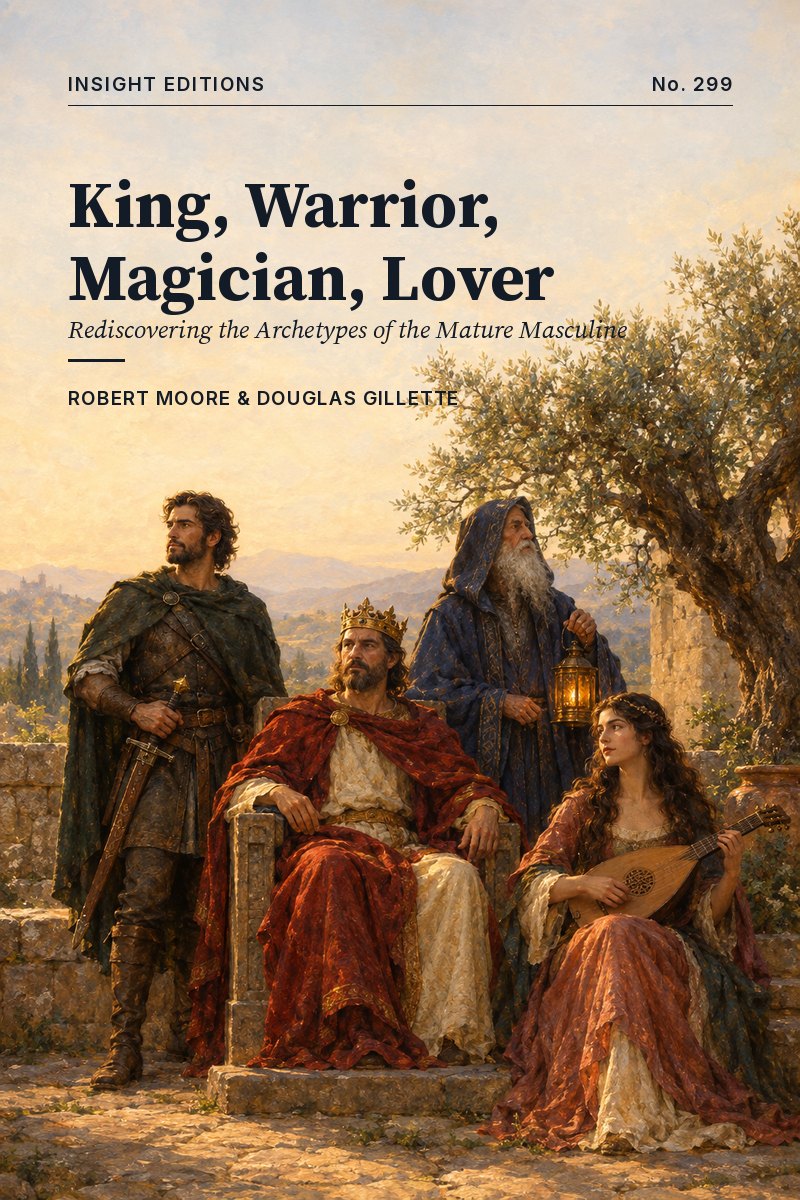
Illustrated Insight Edition. Original chapter structure preserved, with successive source-chapter audits incorporated; whole-book certification ongoing.
At a Glance
| Core claim | Scope | Key figures | Best for |
|---|---|---|---|
| Adult strength needs four balanced psychological capacities. | Initiation, four youthful forms, eight shadow poles, four adult archetypes, and their practices. | Moore and Gillette; C. G. Jung; Robert Bly; Victor Turner; Mircea Eliade. | Self-reflection, mentoring, leadership, relationships, and the ethics of power. |
Overview: The Book on One Page
King, Warrior, Magician, Lover distinguishes mature, generative masculinity from outward displays of control. Moore and Gillette contend that contemporary society often leaves men in Boy psychology, partly because ceremonial transitions lack sustained mentorship and inner change. They interpret controlling patriarchy as a form of male immaturity rather than the fulfilled expression of masculine power. The book uses Jungian archetypes, myths, dreams, religious symbolism, and anecdotes from psychotherapy as its interpretive method. These provide a picture of the self, not a clinically validated instrument for diagnosing people.
The developmental sequence begins with four youthful capacities. The Divine Child offers fresh beginnings, the Precocious Child brings curiosity, the Oedipal Child brings relatedness, and the Hero offers courage and independence. Each capacity can become distorted through two opposed shadow styles, such as demanding grandiosity or passive helplessness. Healthy adulthood does not destroy these earlier gifts; it reorganizes and exceeds them. In the authors' symbolic mapping, Divine Child becomes King, Precocious Child becomes Magician, Oedipal Child becomes Lover, and Hero becomes Warrior.
The King creates order and blesses potential in other people; the Warrior acts with discipline on worthy commitments; the Magician knows how processes work and handles power with appropriate containment; the Lover feels, bonds, notices beauty, and makes life worth protecting. Their shadows are not separate personalities to blame, but ways in which an ordinary human capacity becomes excessive, defensive, or inaccessible. The Tyrant and Weakling, Sadist and Masochist, Detached Manipulator and Denying Innocent, and Addicted and Impotent Lover describe contrasting failures of integration.
The model's value depends on its four-way correction. Care without boundaries can consume a person; boundaries without love can harden into brutality. Knowledge without conscience becomes manipulation, while authority without curiosity becomes brittle. Courage divorced from discernment is hazardous, and a beautiful vision without action has limited public effect. Moore and Gillette's image of a well-chaired inner board meeting captures the practical task: listen to competing motives, recognize what each can offer, and make one accountable decision.
The conclusion supplies a modest psychological toolkit: self-appraisal, written dialogue with conflicting inner attitudes, invocation of images embodying a desired virtue, admiration of real mentors, and behaving as if one already possesses the capacity one seeks to strengthen. Some of the book's historical, clinical, gender, and metaphysical generalizations are contestable. Its most useful insight survives these limits: judge the exercise of power by whether it makes people and communities more able to thrive.
Complete original chapter map
| Ch. | Source heading | Main payload |
|---|---|---|
| Preface | Preface | The model's Chicago lecture origins, two internal oppositions, and exploratory scope. |
| Introduction | Introduction | Absence of mature models, failed initiation, patriarchy and the four energies. |
| 1 | The Crisis in Masculine Ritual Process | Ritual elder, sacred space, symbolic death, pseudo-initiation. |
| 2 | Masculine Potentials | Jungian collective unconscious, inner patterns, external caregivers. |
| 3 | Boy Psychology | Four youthful archetypes; active and passive shadow poles; Hero's limits. |
| 4 | Man Psychology | Four overlapping adult capacities, individual responsibility, inner boardroom. |
| 5 | The King | Order, fertility, blessing, stewardship, Tyrant/Weakling shadows. |
| 6 | The Warrior | Purpose, strategy, discipline, action, Sadist/Masochist shadows. |
| 7 | The Magician | Knowledge, technology, initiation, containment, two intellectual shadows. |
| 8 | The Lover | Eros, beauty, empathy, creativity, addiction and numbness. |
| Conclusion | Accessing the Archetypal Powers of the Mature Masculine | Critical appraisal; dialogue; invocation; admiration; acting “as if.” |
Preface: Why These Four Archetypes?
Moore and Gillette begin by distinguishing the historical origin of their four-part model from the much older myths and symbols they use to discuss it. King, Warrior, Magician, and Lover had become familiar terms in men's groups by the time of publication, but the authors do not present the fourfold arrangement as an ancient universally agreed classification. They trace its formulation to lectures at the C. G. Jung Institute of Chicago, subsequently circulated as audiotapes and influential in the men's movement. The model is their proposed development of Jung's archetypal Self, not a taxonomy directly delivered by an archaeological inscription or universally recognized clinical test.
Their larger theoretical claim concerns the double quaternio, the symbolic arrangement of the psyche into four fundamental configurations and their relationships. The four quarters should not be mistaken for four isolated compartments. The authors specifically identify two relationships of tension and mutual correction: King (or Queen) with Magician, and Lover with Warrior. Ordering power must meet discriminating knowledge; relatedness and passion must meet discipline, resolve, and a capacity to set boundaries. These dialectics prepare the whole book's argument that maturity comes from the dynamic balance of capacities, not from turning one of them into an absolute ruler of the personality.
INTRODUCTIONThe Problem of Uninitiated Power
The starting question comes from a young man's response to Robert Bly during a televised conversation with Bill Moyers: where are the men who have passed through a real process of initiation and can exercise power responsibly? Moore and Gillette answer by separating two things often confused in arguments about masculinity: power that dominates and power that sustains life. They do not ask men to become more aggressive. They ask why so few men have learned to carry their strength without making others smaller.
The authors locate the crisis partly within the family. An absent or emotionally unavailable father, in their account, deprives sons and daughters of an adult relationship through which they can learn dependable authority, affection, and personal boundaries. But parental absence alone cannot explain the problem. They isolate two further conditions: the disappearance of meaningful rites that carry boys into adulthood, and the institutional habits of patriarchy. The two are related because institutions often reward masculine display while failing to cultivate psychological maturity.
Ritual loss and its consequences
Anthropologists Arnold van Gennep and Victor Turner supply the authors' vocabulary for transition. A rite of passage is meant to mark a change in social standing and in inward self-understanding. Moore and Gillette contend that much of modern Western life offers ceremonies, credentials, and tests of endurance without the inner transformation that older rites sought. They call these substitutes pseudo-initiations. They also connect the loss of transformative ritual to historical criticism of sacred ceremony during the Protestant Reformation and the Enlightenment, although this sweeping account is best treated as their interpretation rather than an established single cause.
When initiation fails, the authors say, Boy psychology is allowed to govern adult decisions. The result can be aggressive control, frightened passivity, or movement between the two. The same adult may intimidate a subordinate in the morning and feel helpless before a stronger authority in the afternoon. The oscillation matters: oppression and apparent weakness can emerge from the same immature organization of personality, rather than representing stable opposites.
Their distinction between patriarchy and mature masculinity
The book accepts that patriarchal systems have injured women and suppressed qualities labeled feminine. Its more controversial claim is that patriarchy likewise obstructs mature manhood. Moore and Gillette describe the patriarchal male as afraid of developed power in others: he may seek to control women, yet also resent capable sons, colleagues, and male subordinates. A supervisor who undermines an excellent employee is a recurring illustration. The problem, in their model, is not too much securely grounded masculine power but power trapped in immature fear, envy, and domination.
This lets the authors challenge both patriarchal conduct and forms of critique that regard all masculine power as abusive. Their proposed alternative is generative strength: influence that helps other people become more able, confident, and creative. The authors repeatedly distinguish the calm, centered adult from a person who performs power through rage, humiliation, possessiveness, or intimidation.
Where mature power comes from
Drawing on Jungian depth psychology, clinical experience, dreams, mythology, prayer, meditation, and active imagination, the authors propose that humans possess deep psychological possibilities that can be approached even without ideal parents or an uninterrupted initiation tradition. They name the organizing qualities of mature masculinity King, Warrior, Magician, and Lover. These are not four personality types from which a man chooses one. They are capacities that must enter into a balanced, mutually correcting relationship.
Their reversal of a familiar therapeutic diagnosis
The introduction also presents a specific and contestable clinical claim. The authors believe that some men arriving for psychotherapy had been told they principally lacked sufficient connection with an inner feminine, whereas Moore and Gillette understood those clients as sometimes already feeling overwhelmed by qualities interpreted as feminine and deprived of access to their own constructive masculine assertiveness, authority, and steadiness. They argue that patriarchal restrictions and some forms of anti-masculine criticism could together deepen this problem. Their proposed answer is more mature masculine power, not more permission to dominate: men should learn to hold energy calmly so it no longer needs to appear as coercion. This is an argument from the authors' practice and interpretive school, not a general clinical finding about men or women.
The introduction does not claim that mature men were universally common in any earlier century. Indeed, it entertains the possibility that full psychological maturity has always been rare. This is an important constraint on its apparent nostalgia for older societies: the authors' desired manhood is a developmental ideal, not simply a return to an earlier political order. They also identify a social consequence. At a time of violence and possible global catastrophe, maturity in both men and women has value beyond individual well-being.
CHAPTER 1The Crisis in Masculine Ritual Process
Moore and Gillette begin with the man who cannot keep his life together. His habits, desires, values, and relationships feel fragmented, as though separate portions of the personality were pursuing their own agendas. The chapter offers a specific diagnosis: he may never have been helped to cross from the energies of boyhood into the responsibilities of adult manhood. To use the authors' terms, the problem is not simply ignorance of social rules. It is a failure to encounter and integrate a deeper masculine center.
A sacred threshold rather than an ordinary birthday
The authors turn first to the cave paintings of Ice Age Europe. The animals painted across dark rock, together with the hands of ancient artists and hunters, evoke for them an encounter with powers beyond everyday life. They suggest that such cave sanctuaries helped conduct young people toward spiritual responsibility and communal adulthood. The significance of the example lies in the imagined setting apart of a place and time: the child leaves the familiar world and encounters something demanding a different identity.
They connect the example to studies of initiatory practices by Mircea Eliade and Victor Turner, including rites in parts of Africa, South America, the Pacific, and among Indigenous peoples of North America. The chapter's central contrast is between a rite that is contained, interpreted, and supervised and an ordeal that merely inflicts fear. The first may transform a person's relation to life. The second may leave the same childish ego intact, or strengthen its appetite for domination.
The Emerald Forest: a compressed model of initiation
A substantial example comes from the film The Emerald Forest. Tomme, a white boy being raised by a Brazilian Indigenous community, begins showing sexual interest in a girl. The chief recognizes this not simply as attraction but as a signal that Tomme has reached a threshold. Before the community and its elders, he pronounces that Tomme must undergo a symbolic death. The chief's wife, speaking from the position of the concerned mother, protests, yet the men proceed.
The boy is subjected to an alarming nighttime ordeal in the forest, including contact with biting ants. At dawn the men recover him, wash him in the river, and announce that his boyhood has ended. A subsequent visionary episode involving an eagle opens a wider perception of the world. He is then permitted adult marriage and responsibilities and later advances from warrior to chief. In the authors' reading, the sequence is separation, ordeal, cleansing, vision, and recognized adult membership. The ordeal has meaning because elders guide the transition and the community knows what follows it.
A useful distinction emerges here between inner adulthood and external permission. Marriage, a uniform, an office, or a certificate might publicly label someone an adult. But the authors maintain that true initiation changes how a person handles authority, suffering, responsibility, desire, and fear. In their view, an outer ceremony is inadequate if it produces no new organizing relationship to the self.
Why some modern passages are pseudo-initiations
Moore and Gillette identify military boot camp, street gangs, and prison gangs as modern sites that can resemble initiation without necessarily producing maturity. Their examples are not equivalent in moral or institutional purpose. They appear together because each may have a formal entry threshold, coded behavior, hierarchy, ordeal, and an identity conferred by a group. The authors allow that military training may sometimes differ favorably, but they doubt that humiliation and forced conformity alone are reliable instruments of psychological growth.
The decisive test is the character formed. Gang initiation can teach obedience to peers, willingness to injure another person, drug use, and a relentless contest for standing. Such practices may harden a boy into an adolescent style of dominance, but they do not cultivate the compassion and creative responsibility the authors associate with an adult. Prison hierarchies can reproduce the same dynamic. What appears to be a masculine social code may therefore preserve the very immaturity a genuine initiation should move beyond.
The authors put the moral contrast sharply: Boy psychology is prone to wounding, whether directed outward in control and aggression or inward in self-sabotage and despair. Man psychology is supposed to become nurturing and generative. The distinction does not mean an adult never uses force or experiences anger. It means his energy is organized in the service of something larger than reflexive self-assertion.
The psychological meaning of death
The transformation requires what the chapter calls a death of the boy ego. This does not refer to literal death or a recommended injury. It means that a familiar arrangement of motives, fantasies, rights, and dependencies must lose its claim to rule the whole personality. In the old arrangement, the child tries to make reality revolve around his needs or responds to power by hiding from it. A passage to adulthood therefore involves relinquishing the fantasy that one's wishes and status are the ultimate measure of the world.
A false initiation may constrain some behaviors but rebuild the same ego on a larger stage. A person may stop disobeying his parents only to begin abusing peers, boasting of toughness, and enforcing conformity in a group of equally immature men. His behavior is socially different but psychologically continuous. By contrast, genuine initiation is said to reorganize the ego around a deeper center of meaning and responsibility, enabling calm, compassion, clear judgment, and creative action.
Sacred space and the elder
The chapter specifies two supports that make change more than raw psychological exposure. The first is sacred space, an environment separated from ordinary distraction and marked as appropriate for transformation. The examples range from a hut or cave to wilderness, a ceremonial circle, or a room within a temple. In the cultures as described by the authors, this setting may remove initiates from family dependence and expose them to stories, symbols, discipline, and communal responsibilities previously withheld from them.
The original text also claims that some traditional initiations separated boys from women and the household during the ordeal. The authors take that separation to represent the departure from childhood dependency, while making the adult's eventual return to relationships and responsibilities essential. The exclusivity and the implied equation of femininity with dependency are culturally specific assumptions; their proposed psychological mechanism does not establish that exclusion of women is necessary for healthy development.
The second is the ritual elder. The chief in The Emerald Forest stands for a guide who has passed through the stage himself, knows the community's inherited meaning system, and can be trusted with a vulnerable person. In the authors' account the elder does more than command obedience. He helps the candidate understand the experience and gives recognition, containment, and direction to powerful feelings that might otherwise become panic or self-aggrandizement.
These requirements explain why creating a private ordeal or assembling peers with a shared code is not enough. A gang can imitate sacred space and invent a hierarchy, yet lack anyone capable of modeling compassionate, restrained, integrated manhood. Without adequate elders, the rites can reinforce Boy psychology while claiming to have cured it.
The father's absence as an inner search
The end of the chapter returns to the everyday consequences of insufficient models. Men may feel anxious, unrecognized, impotent, ashamed of their strength, or unable to keep creativity alive. They can interpret hostility from employers or partners as personal failure without recognizing that they are searching for an affirming relationship to authority. Many continue seeking the good father they never knew, hoping a supervisor, institution, or partner will at last confer the blessing and guidance that were missing.
The chapter's hopeful turn is Jungian. External fathers and initiatory structures may be deficient, but the authors believe the psyche still holds latent capacities for adult integration. The next chapter examines this claim, shifting from the absence of social models to the possibility of inward ones.
A practical reading of the argument
The chapter suggests a nonviolent way of asking whether a demanding life transition has truly helped. Was there an intelligible purpose, rather than a test of obedience for its own sake? Was there a competent and accountable mentor, rather than merely the loudest person in the group? Did the person emerge better able to care for others, hold boundaries, ask for help, and accept limits? These questions preserve the author's distinction between displaying manhood and developing mature human capacities without attempting to reenact historical ordeals.
CHAPTER 2Masculine Potentials
The first chapter diagnoses a shortage of reliable guides. This one supplies the authors' reason for hope. Even when men have experienced absent or immature fathers, poor initiation, or negative authority figures, Moore and Gillette argue that the psyche contains patterns of mature possibility not reducible to what a person has already received from other people. Their key concept is the archetype, understood within Jungian thought as a deep organizing pattern that can shape perception, behavior, imagination, and relationships.
The collective unconscious as a proposed inheritance
Carl Jung's collective unconscious is described as the layer of mental life beneath personal biography that is shared across human beings. Its contents are said to include primordial images, relational expectations, and recurring energy patterns. These are different from a conscious lesson learned from a parent or teacher. For the authors, an archetype works more like a predisposition toward a kind of human experience. The account links these patterns to instinct and proposes that some might be carried across generations.
The chapter calls archetypes blueprints or forms of psychological hard wiring. A blueprint is not a finished house, however. It creates a structure of possibility; whether that possibility becomes usable depends on development and experience. This matters because the actual father can fail, yet the ideal of reliable fatherly care may remain an object of longing. The book treats the mismatch between inner expectation and outer relationship as one source of psychological suffering.
The duckling and the caretaker
The authors use the familiar example of imprinting in ducklings. Soon after hatching, a duckling may attach itself to the first suitable moving figure it encounters. That object is not guaranteed to be its biological mother or even a duck. The example separates a built-in readiness to form an attachment from the specific creature that receives the attachment. The authors then draw an analogy to human expectations of mother, father, and other relations.
Their inference is that people often load real parents with an idealized, archetypal significance the actual adults cannot fully carry. The child hopes the parent will embody the perfect caretaker and later may experience profound anger or disappointment when the adult proves finite and fallible. In this model, the constructive task is to distinguish a real person, with limits, from an inner ideal, without suppressing the ideal's positive influence.
The reference to D. W. Winnicott's 'good enough' parenting adds an important qualification. A parent does not need to be godlike. The child's developing personality needs sufficiently dependable care to integrate its expectations with the limits of reality. Consistently hostile, neglectful, or confusing relationships may instead leave the child caught between an urgent inner demand and disappointing outer experience. The authors identify this mismatch as a route toward distorted or shadow-like manifestations of the archetype.
Dreams, myths, and recurrence
The evidence Moore and Gillette favor is clinical observation and cross-cultural comparison. Dreams and waking fantasies repeatedly show figures that resemble familiar mythical characters. They cite the dying and returning divine youth, found in diverse religious narratives and appearing, they say, in dreams of patients with no formal training in those traditions. Their proposed explanation is not that every dreamer has read the same story. It is that the mind generates recurring patterns because it carries some common organizing capacities.
Moore and Gillette give a particularly broad set of examples for the dying-and-returning young god: they refer to Christian, Persian Muslim, ancient Sumerian, and Native American narratives as well as dreams reported in clinical settings. The breadth of the comparison is part of their argument for recurring symbols; it also leaves open the substantial question of how much these different stories actually mean the same thing in their own religious settings.
The chapter associates this proposal with artistic and religious inspiration. Poets, painters, and prophets give vivid images to experiences that are difficult to formulate conceptually. Archetypes are therefore presented as image-producing tendencies, not merely a catalog of character traits. For Moore and Gillette, examining myths can expose the shape of a human possibility, while working with dreams can reveal how that possibility is functioning in a particular person.
Masculine and feminine patterns
The authors say these recurring patterns include what Jungians have called masculine and feminine forms. Their model is not simply that only men possess masculine patterns or only women possess feminine patterns. They discuss Jung's terms Anima, the inward feminine dimension traditionally described in a man, and Animus, the inward masculine dimension traditionally described in a woman. The intended point is that people are psychologically wider than any one social gender role, and human interaction draws on many inward capacities.
The model must still be understood within its historical vocabulary. The terms Anima and Animus carry assumptions about gender that are not universal descriptions of contemporary psychology. Their value within this book is as a symbolic language for exploring unacknowledged dimensions of personality, rather than as an exhaustive classification of human identity.
What this chapter prepares us to recognize
The practical implication is that a person's previous experience does not exhaust the possibilities for development. The ideal of firm but benevolent authority may survive a bad father; curiosity may survive school humiliation; tenderness may survive rejection. Later chapters will give these possibilities more definite names. The task is to differentiate the ideal from the disappointing person, identify how it appears in dreams and relationships, and make its constructive qualities available to conscious action.
The authors also acknowledge that archetypal psychology remains provisional. They describe a field whose ideas are being revised as clinicians and researchers attempt to understand mental patterns. Although their prose sometimes states universality with confidence, this concession matters: the book offers an exploratory model meant to help readers work with their experience, rather than a completed science of masculinity.
CHAPTER 3Boy Psychology
Moore and Gillette's longest foundational chapter explains why adult appearance is not the same as adult psychological organization. A difficult manager, predatory public figure, contemptuous coach, absent father, careerist junior executive, submissive employee, and self-righteous minister seem to have little in common. The authors place them on a single continuum: each may be using an immature pattern of power while occupying an adult position. Some intimidate, some withdraw, and some alternate between the two. Their principal diagnostic distinction is between a secure capacity to act and a compensatory display that masks a wounded or frightened self.
This is not an attack on everything childlike. Moore and Gillette explicitly preserve the play, wonder, delight, curiosity, openness, and energy that the young personality contributes to life. Their criticism concerns the wrong relationship to these energies: childhood patterns become harmful when they insist on governing adult commitments, responsibility, intimacy, or authority. A man can retain lively boyish creativity while no longer expecting others to organize their lives around his immediate wishes.
The complete triangular structure: one capacity, two shadow poles
The key to the chapter is the triune model. Every boyhood and mature archetype is represented as a triangle. The archetype in its fullness stands at the apex; beneath it are two distorted expressions, called the active and passive shadow poles. Neither pole is a healthy alternative to the other. Domination and helplessness, for instance, may be two ways of seeking control without developing steady self-command. The personality can swing between them like a magnet changing polarity, especially under fatigue, humiliation, fear, or frustrated entitlement.
The authors distinguish developmental emergence from a rigid sequence of ages. First comes the Divine Child, the pattern of youthful specialness and renewal. The Precocious Child, associated with curiosity, and the Oedipal Child, associated with emotional union and eros, develop next. The Hero crowns boyhood by testing capacity and seeking independence. These influences mingle throughout growth rather than appearing in neat, exclusive stages.
Their transitions into adulthood are equally precise: Divine Child → King; Precocious Child → Magician; Oedipal Child → Lover; Hero → Warrior. The adult does not burn down his childhood. The capacities are transformed and incorporated into larger structures. The book therefore depicts four triangular patterns as the faces of a pyramid and the adult structure as a larger pyramid embracing the boyhood pyramid. The source's original Figures 1–3, on pages 38–42, illustrate the threefold archetype, the four-part boy and man structure, and their layered relation. The redrawn diagrams below retain those relationships and every named pole.


The writers tentatively extend the geometry to their view of feminine psychology: two pyramidal structures, joined base to base, would make an octahedron representing a more comprehensive Jungian Self. They present this as a theoretical image related to Jung's double quaternio, not as an experimentally identified anatomical structure. The significant claim is continuity through development: progress does not make the earlier energies vanish; it gives them a new place under more mature direction.
The chapter opens with a deliberately mixed register of failed adulthood. Moore and Gillette include a drug dealer, an evasive political leader, a man who abuses his wife, a chronically irritable boss, an overconfident young executive, an unfaithful husband, a compliant company subordinate, an indifferent graduate adviser, a self-righteous minister, a gang member, an absent father, a coach who belittles athletes, and a therapist who suppresses a client's originality. Their point is not that these behaviors have equal moral weight. It is that coercion, abandonment, performative status, conformity, and envy can all be organized by immature forms of power even when the person holds an adult role. The charge is a psychological interpretation; responsibility for each action still depends on the actual act and its effects.
The Divine Child: specialness, beginning, and vulnerable new life
The Divine Child is the first of the four youthful forms. It begins with a paradox. In religious stories a miraculous infant is the center of everything, adored and surrounded by symbols of destiny, but is also physically defenseless. The infancy of Jesus is the first illustration: a star, visiting shepherds and sages, reverent animals, and an atmosphere of cosmic attention surround a baby who nevertheless must escape Herod's threat by flight to Egypt. Other sacred-child narratives, presented as parallels rather than identical histories, include Zoroaster, Moses, Sargon of Akkad, the infant Buddha, Krishna, and Dionysus. For Moore and Gillette, the recurring combination is extraordinary promise requiring protection.
The Moses narrative is particularly clear. A future liberator is exposed to mortal danger by a ruler's decree and placed in a basket on the Nile; the writers compare it with the older account of Sargon's threatened infancy. These details matter because new powers emerge without the strength to preserve themselves. The religious motif is also read psychologically: in therapy, a man recovering creativity or affection may dream of a joyful child, imagine becoming a parent, or discover interests he has long suppressed. An internal voice can then immediately condemn the possibility of growth. To take the child to Egypt becomes a metaphor for giving fragile beginnings enough privacy and safety to survive discouragement.
Another form of the Divine Child is the reconciling musician. In the myth of Orpheus, music gathers predators and prey into one peaceful circle. That ability to hold opposites together anticipates the King's ordering and reconciling function. The authors add a client's recollection from around age five or six: the child stood beside a great oak tree, invented a tender, sorrowful song, and watched birds gather in its branches. In the man's later interpretation, the tree became a Tree of Life and the birds reflected back his yearning for beauty and belonging. The case is important as a description of experience; it does not establish that singing supernaturally summoned birds.
Why psychological schools disagree about the child
Sigmund Freud interpreted infantile energy in terms of the id, powerful instinctual wishes without adult moral regulation. Alfred Adler emphasized the drive for superiority that can conceal inferiority and weakness. Heinz Kohut's self psychology described a grandiose self-organization whose limitless demands may overwhelm ordinary relationships. The book then contrasts this pathology-focused language with the Jungian archetypal Self, whose symbols can carry renewal, delight, and creative strength. Moore and Gillette try to reconcile the perspectives: the critics often see the child's inflated shadow, while Jungians value its integrated promise.
An essential distinction follows: the ego, the ordinary center of conscious decisions, is not identical with the Self, the wider ordering totality of personality as understood by Jungians. To be in contact with the Divine Child is to recognize creative potential. To identify as the Divine Child is to expect the world to treat the ego as a god. The authors do not advocate extinguishing grand ambition. They want a person to retain large, productive aspiration without abandoning humility, labor, or responsibility.
Active shadow: the High Chair Tyrant
The High Chair Tyrant captures inflated need in a deliberately comic but uncomfortable picture: a small child bellows from a high chair and demands attention, yet rejects food or affection because it is offered at the wrong temperature, at the wrong moment, or in the wrong form. The child becomes so devoted to limitless demands that he refuses the nourishment he truly needs. This is the Tyrant's paradox: an attempt at absolute control destroys the conditions of care. The authors connect it to hubris, perfectionism, grandiosity, and unyielding entitlement.
The pattern can persist in apparently accomplished adults. A CEO keeps the privileges of office but avoids service to the organization; an executive demands yes-men and refuses relevant warnings; a school principal cannot tolerate corrective comments; a political leader cannot accept expert advice. The Tyrant may also turn inward. A merciless internal perfectionist orders impossible achievement, then humiliates the person for failing. The book speculates that relentless inner demands can end in breakdown or illness; these are clinical illustrations, not established medical predictions.
Several stories illustrate the consequence of inflation followed by collapse. Icarus disregards his father's warning, flies too close to the sun, and loses the wax holding his wings together. The authors invoke Louis XVI, Caligula, Stalin, and Hitler as images of arrogant or destructive power, and describe a chief executive so determined to preserve superiority that he would rather ruin the company than moderate his self-importance. These disparate examples are used symbolically, not as equivalent historical diagnoses. The Tyrant's recurring logic is that all benefits should flow to him while the work and limits of life belong to someone else.
Passive shadow: the Weakling Prince
The other pole, the Weakling Prince, may look like the opposite of tyranny. The boy is easily defeated by ordinary tasks, has little initiative, avoids peers, complains about every difficulty, and appears to need incessant protection. Yet the family may orient every decision around his comfort; apparently frail passivity becomes another route to privileged centrality. Moore and Gillette describe a boy whose siblings are blamed because he successfully presents himself as permanently persecuted. His occasional cutting sarcasm and anger disclose an unacknowledged demand to control others.
The authors' point is not that genuine illness, disability, fear, or dependence is deceitful. The category refers to a particular psychological pattern of entitlement enacted through helplessness. It is difficult to recognize precisely because it lacks the Tyrant's loudness. In the model, a person can move from sulking resignation to a sudden furious tantrum, or from grandstanding to depressed inactivity. Both poles belong to one unstable system, so suppressing the more embarrassing pole does not by itself create maturity.
Reconnecting without surrendering control
The authors advise acknowledging, admiring, and protecting the Divine Child without becoming possessed by it. An artist, teacher, organizer, or administrator needs this fresh energy to imagine worthwhile possibilities, and a leader without it may become numb, joyless, and hostile to talent. They criticize therapists or institutions that mistake every aspiration toward excellence for pathology. They also warn against confusing being capable of greatness with already being entitled to honor for accomplishments not yet made.
They invoke the Roman genius, a guardian spirit celebrated at a person's birthday, to suggest that skill and inspiration exceed the ego's personal credit. Their diagnostic questions are intentionally searching: How do my tyranny and my helplessness appear? Under what conditions do I regress into them? How am I honoring or suppressing my ability to create? The practical aim is neither self-worship nor self-erasure but the freedom to take a promising impulse seriously and bring it into responsible action.
The Precocious Child: curiosity and the beginnings of knowledge
The Precocious Child forms the youthful root of the mature Magician. An Egyptian image of the youthful Imhotep, reading a scroll with concentration and dignity, represents the archetype for Moore and Gillette. This child asks why and how things happen, learns eagerly, reads independently, experiments, notices relationships among apparently disconnected facts, and shares discoveries. Gifts in art, music, athletics, and other domains may appear alongside academic ability. The important capacity is animated curiosity, not a narrow intelligence test.
The positive form combines reflection with generous communication. The child may spend long periods thinking alone, then enthusiastically explain a discovery or help classmates understand a difficult subject. He wants to know what motivates other people as well as how the physical world operates. Such insight can make him a confidant for friends. In adulthood, the living residue of this pattern keeps a person investigating reality, recognising uncertainty, and learning instead of relying solely on accumulated prestige.
Active shadow: the Know-It-All Trickster
The Know-It-All Trickster has intellectual energy but uses it to humiliate, deceive, and rank. The boy raises his hand to demonstrate classmates' inferiority rather than enrich a discussion. An adult lectures when conversation is wanted, advertises superior knowledge, dismisses colleagues who disagree, and may exaggerate expertise. The authors' camp story depicts an English boy from a privileged diplomatic family who boasts to American children about his travels, belittles them as provincials, and attracts anger without gaining friendship. In an extreme clinical anecdote a boy even imagines himself the returned Christ while wondering why nobody accepts the claim.
More destructive forms manipulate trust. A Trickster promises paradise and serves disaster; a practical joker makes companions into targets; a salesman cheats the buyer while being cheated by management. The authors identify a figure who tears down legitimate achievement while refusing the responsibility of building anything better. By humiliating worthy people, he can pretend he does not envy what they have earned. A person governed by this impulse may appear fearless toward authority, yet repeatedly creates the conditions for punishment and exclusion.
The book also insists that the Trickster has a valuable corrective function. A medieval court fool could puncture the king's inflated self-regard when everyone else flattered him. The stories of Job and the Garden of Eden are interpreted provocatively: the adversary or serpent exposes tensions hidden beneath accounts of complete goodness and obedience. The young gang members' comic defense before Officer Krupke in West Side Story likewise exposes social hypocrisy even while excusing their own wrongdoing. The distinction is between truth-telling that humbles false claims and contempt that tears down truth and talent alike.
Everyday examples make the mechanism less grandiose. A speaker, secretly delighted by the brilliance of his forthcoming lecture, finds the printer broken. A guest plans a theatrically late arrival to advertise importance and discovers the keys locked inside the car. The authors read these mishaps as the Trickster puncturing self-importance, although their causal interpretations should be understood symbolically: an accidental malfunction need not be caused by an unconscious agency. In another case, a graduate student continually mocked professors and administrators, alienated precisely the supporters his political project required, and only later recognized that his jokes had isolated him. The Jacob–Esau birthright episode, where a younger brother acquires senior rights through manipulation, illustrates entitlement to what one has not earned.
Moore and Gillette connect the destructive Trickster to unrecognized envy, particularly where children have been belittled by caregivers or older siblings. When someone cannot appreciate his own gifts, he may become unable to admire another's. The intended remedy is to claim realistic specialness and creative effort, not to turn envy into an even more inflated assertion of status.
Passive shadow: the Dummy
The Dummy conceals the same imbalanced relation to knowledge from the opposite side. The boy seems incurious, slow to learn, unable to follow a joke, clumsy in games, naive about ordinary facts, or disengaged from the classroom. Moore and Gillette hypothesize that some instances of apparent incompetence conceal a refusal to risk exposing cherished superiority to the tests of real life. Being seen as the hopeless pupil protects the fantasy that one might be brilliant if one ever really tried. A hidden Know-It-All and a visible Dummy may therefore be joined in one personality.
The claim requires restraint. Learning disabilities, neurological differences, lack of opportunity, poor teaching, and actual difficulty are not signs of secret arrogance. The authors present a symbolic explanation for one kind of self-limiting performance, not a valid way to diagnose every child who struggles in school. The constructive objective is a third path: admit what one does not know, practice, accept correction, and retain the pleasure of discovery.
The Oedipal Child: connection, eros, and the Great Mother
The Oedipal Child, whose mature continuation is the Lover, concerns the urge for affection, pleasure, connectedness, sensitivity, and spiritual communion. The positive boy is warm and responsive, moved by beauty and tenderness, and capable of wonder at a world to which he belongs. His original experience of attachment to a mother or principal caregiver becomes, in the authors' Jungian language, a symbol for the Great Mother, a divine or archetypal source of inexhaustible nurture beyond any single person.
This distinction between the mortal mother and the archetypal Mother is decisive. No actual parent or partner can provide infinite love, perfect beauty, constant emotional attunement, and unending fulfillment. One client repeatedly argued with his mother and, in a revealing slip, exclaimed a hybrid phrase combining an invocation of God with “Mother.” The unintended combination made both of them laugh and allowed him to recognize that he had been placing godlike demands upon an ordinary person. The authors report that his relationships with his mother and girlfriend improved when he learned to direct his spiritual yearning toward a dimension larger than either woman. The psychological point is relief from an impossible burden of idealization.
Active shadow: the Mama's Boy
In the chapter's terminology, the Mama's Boy is not simply a child who loves his mother. He tries to possess, replace, or remain fused with the idealized maternal figure. Freud's Oedipus complex gives the label its history. The writers recount Oedipus, whose abandonment at birth, rescue, unwitting killing of his father, and marriage to his mother become a symbol of disastrous ignorance and inflated entitlement. They read the tragedy as the boy's attempt to occupy a divine parental position. Adonis, loved by the goddess Aphrodite and killed by a wild boar, adds the motif of a mortal attempting a union that cannot be contained within ordinary life.
In adult relationships the Mama's Boy may search endlessly for the perfect goddess in one partner after another. The Don Juan pattern is serial pursuit, not durable mutuality. Moore and Gillette also discuss solitary sexual fixation, pornography, and compulsive fantasy as possible substitutes for the vulnerability of an actual relationship. Their specific linking of these activities to an archetypal complex is an interpretive claim; the behavior itself does not diagnose a person. What unifies their examples is the wish for boundless gratification without accepting the other person's separateness or the work of intimacy.
Passive shadow: the Dreamer
The Dreamer withdraws almost completely into imagined connection. Whereas the Mama's Boy pursues the perfect beloved, the Dreamer may reject actual contact and cultivate private, wistful worlds. The chapter pictures a lonely child sitting apart while peers play, absorbed in idealized or melancholy possibilities yet achieving little in practical life. His spiritual imagination is not the problem. The problem is its replacement of reciprocal relationships, ordinary action, and commitments that test a fantasy.
The authors suggest that this form sometimes conceals the active pole's grandiose disappointment. Unable to unite with an impossible ideal, the boy retreats and denies that ordinary relationships are worth seeking. The contrast between the two Oedipal shadows is therefore compulsive pursuit versus melancholy withdrawal, both failing to accept the real other. Integrated eros remains passionate but can love finite people rather than make them responsible for an infinite longing.
The Hero: the last and highest stage of boyhood
The Hero is the advanced boyhood energy that prepares the person to become a Warrior. It enables separation, adventurous initiative, the discovery of competence, and the courage to challenge overwhelming obstacles. Moore and Gillette resist the modern habit of describing heroism as the completed ideal. The Hero is necessary but temporary: he needs to test the edge of his ability, yet his identity is still bound to extraordinary achievement and victory. A mature Warrior, by contrast, acts with discipline, proportion, and service to a cause larger than himself.
The authors' developmental explanation is that the Hero helps the growing person become distinct from an engulfing parental or unconscious world. He takes risks, ventures outside the familiar circle, discovers a capacity to resist pressure, and begins to choose his own course. Dreams of impossible battles and dragons can express this stage. Yet a permanent Hero has difficulty with what follows conquest: negotiating ordinary life, remaining faithful, compromising, and loving the person he once fought to win. Traditional romances tell how the hero saves the princess but often stop before the marriage; the story form itself reveals the limit of a personality organized only around victory.
Active shadow: the Grandstander Bully
The Grandstander Bully demands attention and claims the center of every activity as a birthright. His tactics range from boasting and contempt to intimidation and physical aggression when someone questions his superiority. The authors emphasize the connection between outward display and underlying insecurity: a challenge is felt as an existential attack because status is being used to avoid contact with personal limits. The grandstander may be a flashy corporate newcomer, salesperson, political militant, speculator, or officer who turns other people's safety into fuel for his own reputation.
The Vietnam-era officer who orders gratuitous risks for promotion is one illustration; the book notes that some such officers were killed by their own soldiers in a practice called fragging. Its more extended popular example is the young fighter pilot in Top Gun, played by Tom Cruise. The pilot is talented and brave but reckless, ignores team discipline, exposes his flying partner to danger, and needs to win every contest. In the authors' telling, the death of a colleague, grief, and defeat in competition by the disciplined Iceman confront him with limits. The example is intended to contrast achievement as personal theater with competence accountable to other people.
A manager in another anecdote tells promising young executives that their talent is real but does not yet equal their opinion of themselves. This is the exact difficulty: the Hero's ability is genuine, so dismissing it outright would also be a mistake; his calculation of invulnerability is false. The authors add General George S. Patton as a gifted commander whose competitiveness, risk appetite, and public remarks, in their judgment, impeded the use of his talents. That historical assessment should be read as the book's illustrative interpretation, not as the only explanation of Allied command decisions.
The heroic shadow also appears at the level of culture. Moore and Gillette criticize talk of conquering nature, the environmental harm of treating limits as irrelevant, and an approach to medicine that can imply mortality itself will eventually be abolished. All three share the assumption that limits are humiliating obstacles rather than facts requiring judgment. The authors are not against medicine or invention. Their point is that denial of human finitude can turn technical power into a form of psychological inflation.
Passive shadow: the Coward
The Coward fails to protect his values or legitimate boundaries. He avoids confrontation, yields to pressure, and allows himself to be bullied emotionally and intellectually. The book describes someone who rationalizes every retreat as virtuous restraint while inwardly feeling ashamed and powerless. When accumulated humiliation becomes unbearable, the hidden Grandstander may erupt in a disproportionate attack. Again the model does not treat apparent passivity as a separate defect: it identifies a pair of extremes that can trade places when the situation changes.
Prudently walking away from a dangerous fight is not itself cowardice; neither is trauma-related fear. The more precise issue is surrendering agency where responsible action is possible, then compensating through fantasy or sudden aggression. The mature alternative is courage governed by good judgment: the ability to withstand discomfort or take necessary action without needing to prove immortality.
Why the Hero must eventually die
Despite its warnings, the chapter ends with a strong defense of heroic vitality in both men and women. The authors believe people who make daring efforts are often mocked by institutions and peers frightened of excellence. Society may need the Hero's energy to oppose collective drift, moral cowardice, and resignation. The answer is not to extinguish heroism but to prevent it from becoming an adult's final identity.
Religious and mythic endings give their final analogy. Jesus' resurrection and ascension, Oedipus at Colonus, and Elijah's fiery ascent are invoked as variations on the hero's transformation beyond the ordinary form of youthful struggle. Psychological hero-death means discovering that some opponents are too powerful, some projects fail, one's own motives are mixed, and death is inescapable. The former conqueror may finally recognize his inability to care for the person he conquered or the harm his revolution has inflicted. The decisive encounter is with the limits and shadow of the self.
Moore and Gillette define true humility through two linked acts: knowing one's limitations and obtaining necessary help. This is the gateway to the mature Warrior. The boy who never faces resistance becomes either a tyrannical showman or a defeated spectator. The boy who uses courage, reaches his boundary, and can accept guidance enters the possibility of manhood. The Hero does his greatest work when his achievement prepares him to stop organizing life around his own heroism.
The authors give the Hero's cultural argument an unusually strong public dimension. They believe that competence and public courage are sometimes attacked through envy, and they explicitly call for heroic effort from women as well as men against a wider climate of resignation. Yet this is not the final goal. The brave person still has to discover the difference between testing a limit, which may be necessary, and denying limits, which can endanger companions and damage the world. The same chapter thus defends the Hero's energy while requiring the Hero's sovereignty over adulthood to end.
An integrated reading of the four youthful gifts
The four positive boyhood forms can be expressed as a sequence without imagining they must occur at fixed ages. Divine Child discovers that life is worth beginning and protecting. Precocious Child asks how that world works and what can be learned. Oedipal Child discovers that life is deeply felt and shared. Hero tests whether the person can act independently in it. The corresponding dangers are entitlement or helplessness, contempt or feigned ignorance, fusion or isolation, and recklessness or surrender. Every danger preserves a distorted trace of something worth cultivating.
The practical test of the chapter is therefore behavioral. When a new idea arises, do I nourish it and work, or insist on admiration before labor? When I know more than another person, do I teach and inquire, or score points? When I feel love, do I recognize another's freedom, or make that person answer for my unmet infinity? When faced with danger, do I judge and act, or alternate between display and collapse? The purpose of the typology is reflective discrimination, not labeling real people as fixed archetypal personalities.
CHAPTER 4Man Psychology
The preceding chapter mapped the many ways the energies of boyhood can mature or become trapped in shadows. Chapter 4 asks how a person actually makes the transition. Moore and Gillette begin with a construction metaphor drawn from the ancient Maya: new pyramids were sometimes erected over existing structures. Rather than erasing the older foundation, builders incorporated it into a higher and broader construction. Likewise, mature masculinity grows over the living structures of boyhood. Their creative potential remains available; what changes is the shape of the whole personality and who directs its decisions.
The authors present maturation as difficult, deliberate work, not as something that happens automatically with age or social recognition. Early patterns exert a downward pull; the person may repeatedly revert to familiar strategies of domination, rescue-seeking, superior knowledge, imagined love, or heroic performance. The metaphor of building a pyramid brick by brick captures the repetitive, disciplined side of psychological growth. A mature structure must carry older energy without being ruled by its immature expression.
The four mature capacities form one balanced life
King, Warrior, Magician, and Lover are distinct but overlapping capacities. None is sufficient alone. The King organizes, reconciles, and confers blessing. The Warrior sets boundaries, acts, and persists in disciplined service. The Magician observes, understands patterns, and deploys knowledge responsibly. The Lover feels and connects, keeping bodily life, beauty, affection, and creativity alive. Moore and Gillette state that a well-developed King will also be Warrior, Magician, and Lover, and the same reciprocity applies when another capacity leads.
The adolescent energies remain foundations. The Divine Child contributes enchantment and new life; with the Oedipal Child, it also contributes vitality, attachment, sensitivity, and spirituality. The Precocious Child supplies discrimination, helping the growing ego distinguish itself from the forces that move it. The Hero finally establishes a sense of separateness by confronting difficulty. The four mature energies do not descend from four mutually isolated childhood boxes. They emerge from a shared developmental system in which each early pattern interacts with the others.
The magnet and iron filings: seeing patterns without seeing their source
The chapter compares an archetype to a magnetic field. Spread iron filings over paper above a magnet and the filings arrange themselves into recognizable lines. One can see the resulting pattern but not the field as a visible object. Moore and Gillette use this to explain why archetypes are inferred from their supposed expressions in dreams, art, music, myth, religion, scientific discovery, emotional habits, and social relationships. The same recurring organization can appear across media while the inferred source remains hidden.
The analogy has a limited evidential reach: the magnet can be tested independently, while an archetypal field is a psychological interpretation of observed regularities. Within the authors' model, however, the lesson is valuable. Do not mistake an image for the whole capacity or one behavior for the whole personality. A man may make a tyrannical decision without being reducible to a Tyrant, and a symbol in a dream may take different meanings depending on the rest of his life. Understanding a pattern is the beginning of gaining freedom in relation to it.
Techniques for encountering the inner patterns
The authors name several approaches, and the list is broader than any single school of therapy: dream analysis, revisiting and imaginatively revising a dream, Jungian active imagination, psychotherapy, meditation on positive archetypal images, prayer, guided ritual with a trustworthy elder, and other sustained spiritual disciplines. The distinctive aim is to notice the energies and assumptions that drive behavior, differentiate the conscious ego from them, and invite healthier forms of action. The methods belong to the book's Jungian and spiritual vocabulary; they are not guaranteed clinical treatments or interchangeable practices.
Active imagination deserves special care because it prepares the chapter's central illustration. Rather than merely suppressing an uncomfortable impulse, the person represents it imaginatively, listens for its concerns, challenges its errors, and brings it into a wider conversation. The ego neither obeys the first inner voice nor denies that the voice is part of the psyche. In contemporary practical language, the process attempts to turn automatic identification into reflective response.
Jean Shinoda Bolen's inner boardroom
The authors credit Jean Shinoda Bolen with a compact metaphor for psychological balance: a well-chaired board meeting. Each officer is invited to explain a position honestly. A capable chair does not silence an awkward or disagreeable member merely because the member creates discomfort. Brilliant ideas may come from unlikely quarters, and the habitually negative member may occasionally notice something everyone else has missed. But after listening, comparing reasons, and considering consequences, the chair must call for a decision. If the board is divided, the chair may have to cast the deciding vote.
The board members represent competing archetypal perspectives; the chair represents the conscious ego acting for the whole person. The King might ask whether a decision protects the community and preserves legitimate order. The Warrior may point to a necessary boundary, deadline, or risk. The Magician may identify missing evidence or an unseen causal relation. The Lover may insist that a technically elegant plan would hurt people or impoverish life. Even a complaining or destructive impulse may carry useful information, but it does not automatically deserve the final vote.
This image also cautions against letting one appealing archetypal energy dominate. The Warrior without Magician may fight the wrong problem. The Magician without Lover may treat people as instruments. The Lover without Warrior may lack protective boundaries. A person who insists on being the King without listening may be experiencing the Tyrant shadow rather than the ordering fullness of kingship. The board must therefore remain both plural and coordinated.
The responsibility paradox: circumstances versus present agency
Moore and Gillette acknowledge that trauma, deprivation, hostile surroundings, and immature parenting can bend development before a child has meaningful choice. They also doubt that mature manhood has ever been common everywhere. These two qualifications resist the fantasy that psychological development is simply a moral achievement available equally to all. Environments matter; some people inherit serious obstacles that others never face.
Yet the writers offer a demanding principle: the adult must assume responsibility for working with developmental damage he did not cause. A child is not culpable for neglect, humiliation, or abuse. The adult who suffers the consequences still has an interest in learning his patterns and seeking help instead of organizing his life exclusively around accusations against the past. The authors recall the comic self-justifications of the young delinquents in West Side Story: social history explains some of their behavior, but explanation alone does not create a different future.
Individuation when public initiation is missing
The chapter returns to the cultural argument from the introduction. In societies with strong communal ritual, institutions and elders once claimed responsibility for significant transitions. In the individualistic West, Moore and Gillette believe that much of this work must now be undertaken consciously and personally. They use Jung's term individuation for the difficult process of becoming a distinct, more internally integrated human being. Individual work need not mean isolation: therapy, companionship, teachers, reflection, and reliable communities can all help. The point is that no social title can substitute automatically for a more differentiated inner life.
The chapter concludes by directing attention to the specific capacities that follow in Part II. King, Warrior, Magician, and Lover are presented as available psychological resources, not as four commands to impersonate theatrical masculinity. The working task is to notice which capacity a situation calls for, which shadow may be distorting it, and which complementary perspectives are being ignored. Maturity is the ability to consult powerful inner impulses without surrendering judgment to any single one of them.
CHAPTER 5The King
The King is the book's organizing image of mature authority, the capacity to establish right order, support new life, and offer recognition without demanding worship. Moore and Gillette place it first among the four adult archetypes because it ideally contains and balances the Warrior's force, the Magician's insight, and the Lover's relatedness. Yet they say this central capacity is often the last to develop: becoming powerful is easier than becoming an authority who can be trusted with other people's growth.
The King as a center, not a personality costume
The adult King continues something begun by the Divine Child, but reverses the child's claim on the world. The child experiences life as revolving around him and must receive care before he can give it. The mature King is still an organizing center, yet understands himself as a servant of order and generativity. This is the book's difference between a person who must be admired and one whose presence makes others more secure and capable.
The authors connect this center with several large symbolic figures: the primordial human or Anthropos, the biblical Adam, the Hindu Atman, the imago Dei of Jewish and Christian theology, and Freud's primordial father. They treat these as analogies for the psychic center, not identical theological doctrines. Fatherhood is one recognizable expression of King energy, but the authors make the King more comprehensive than the father role. A father can support or frustrate the King's development; a person without children can still exercise its functions.
Sacred monarchy provides the historical image. In the authors' reading, the king's biological personality mattered less than the office of kingship through which society imagined a continuing bond between cosmic order and its own well-being. The formula announcing a new ruler immediately after a ruler's death represents that distinction: the individual passes, while the organizing office continues. James George Frazer's accounts of ritual kingship are enlisted to explain traditions in which a declining ruler could be removed, even killed, to allow a new bearer of fertility and legitimacy to emerge. Moore and Gillette connect this death and renewal pattern with Christ as the resurrected sacred king; the analogy belongs to their comparative-mythological reading rather than an uncontested account of Christian origins.

The dangerous implication is psychological. A person can begin as a temporary steward of an office and gradually believe that the office's dignity proves his personal divinity. If the King becomes fused with the ego, succession, criticism, illness, and age become intolerable assaults rather than ordinary human limits. The book will return to this confusion under the name usurpation.
The opening analogy is sharper than a simple idealization of rulers. The King should have the wisdom associated with Solomon while refusing the infant's demand that the universe exist for his comfort. The authors say that this capacity may come fully online last, although it stands first in organizing importance. It combines the other three powers without erasing them: Warrior supplies decisive defense, Magician supplies discriminating insight, and Lover supplies delight in life. If any of those powers is severed from the center, authority becomes narrower and less dependable.
The dream of the Chinese emperor: the Hero meets a larger order
A young man approaching adulthood dreams that he is an armed mercenary in ancient China. He has enriched himself by disturbing the empire and injuring people, and imperial soldiers pursue him through a forest. Trying to escape, he descends through a cave into a long underground passage. At its far end stands a green garden illuminated by blue light; there, surrounded by neither pompous threats nor self-display, is the emperor in red and gold.
The escape routes have closed. The mercenary kneels, expecting the consequences of his acts, and senses that the emperor understands the whole range of human experience: success and deprivation, intimacy and betrayal, war and suffering, joy and failure. The emperor compassionately tells him that his present life must end. In the dream, the outlaw accepts the sentence with peace because the judgment comes from experienced authority rather than the spite of a rival.
The emperor has experienced what the mercenary still imagines can be conquered by force. His compassion arises from knowing human limits, not from permissiveness, and his judgment is final without being revengeful. Moore and Gillette therefore read the dream as a personal version of the previous chapter's initiation: the Hero bows before the King, accepts the end of self-serving adventure, and becomes capable of a more generous role. The mature capacity has appeared as a possibility, although the dreamer may need years to embody it in conduct.
John Weir Perry: restoring a center in disturbed experience
The psychotherapist John W. Perry, especially his book Roots of Renewal in Myth and Madness, supplies a clinical parallel. Moore and Gillette describe Perry's attention to royal imagery appearing in the dreams, drawings, and visions of people enduring severe psychological disturbance. They mention a patient who repeatedly drew classical columns and associated the pattern with a white king, another vision of a Queen of the Sea united with a Great King, and a vision in which the pope appears as a saving figure.
Perry connected these images to older myths in which a sacred ruler defeats chaos and takes a central throne. For him, the figure could function as an image of reorganization: experiences previously scattered, terrifying, or disconnected might be pictured as belonging to a stable whole. The authors report that some patients became calmer and better integrated as such images emerged. Their inference is explicitly symbolic and clinical; similar imagery is not proof that psychosis has one mechanism or that interpretation of royal dreams by itself treats schizophrenia.
The shared lesson of the mercenary's dream and Perry's cases is that genuine authority does not begin in frantic control of the outside world. It begins when there is a center that can hold conflict, acknowledge difference, establish boundaries, and give competing impulses a common orientation. The King is thus the chapter's counterpart to the well-chaired inner boardroom in Chapter 4.
The King's two fundamental functions
Moore and Gillette name two closely dependent operations. Ordering converts confusion into a world with intelligible centers, boundaries, laws, and mutual obligations. Fertility and blessing make that ordered world worth inhabiting: they protect physical life, encourage work and imagination, and visibly acknowledge other people's gifts. Order without blessing becomes sterile coercion; blessing without order cannot reliably shelter new life.
Function one: the center creates a comprehensible world
In the mythic geography assembled by the authors, the world begins as an unordered expanse and emerges around a sacred center. Ancient Egypt supplies the image of the Primeval Hill rising from the primordial waters through the creating speech of Ptah. The Hebrew creation narrative likewise links word and world. Their psychological parallel is that naming, distinguishing, and declaring obligations give people a more stable reality: language helps draw lines where experience previously felt featureless.
From the center, a world spreads into four quarters. Sargon of Akkad used the image of ruling the four directions; ancient Egyptian pyramids faced the compass points; maps, ritual designs, and ceremonial buildings could reproduce a center and its radiating order. The authors compare Mediterranean and Asian symbolic geographies with Black Elk's account, recorded by John G. Neihardt, of a great circle crossed by red and black roads, with a sacred mountain at their intersection. Mount Sinai, Jerusalem, Olympus, Rome, Hierapolis, and Tenochtitlan appear as other examples of centers around which communities imagined meaningful space.
The comparison is morphological: cultures repeatedly used centers, circles, quarters, and vertical connections as symbolic ordering devices. It does not mean their religious systems were identical. Moore and Gillette also invoke Carl Jung's mandalas, concentric or quadrated images in paintings and dreams, as evidence in his therapeutic system of a psyche seeking a calmer arrangement. Mandalas are treated as images of centeredness, not machines that guarantee recovery or evidence of a single universal religious history.
The king's public work translated an imagined cosmic order into human institutions. Laws, customs, shared obligations, ritual boundaries, palace layouts, and the allocation of responsibilities were meant to embody what a society saw as legitimate order. An effective leader starts by clarifying what belongs where, whose needs are protected, and what no one may violate. A leader who merely raises his voice cannot create order if he himself is driven by panic and grievance.
The comparative inventory also includes specific accounts of divine kingship overcoming chaos: Marduk defeats Tiamat, Baal confronts Yamm and Mot, and the authors connect Hebrew enthronement imagery with Behemoth and Tehom. These are different traditions with different theologies, not interchangeable historical incidents. Their place in the book is to show how a community can picture legitimate authority as defending the boundary between an inhabitable order and forces that threaten to dissolve it. In ordinary terms, this is the work of making reliable rules and then being willing to defend them, not an invitation to declare outsiders demonic.
Hammurabi, Shamash, Moses, and the transmission of law
One emblem is the law stele of Hammurabi, shown in the book through the Oriental Institute's reproduction. The upper scene pictures a royal recipient facing the solar deity Shamash; below are written laws. The authors read the monument as a statement that the ruler does not simply invent arbitrary preferences: he receives a standard that should constrain his own conduct. They compare it to Moses receiving instruction at Sinai. In both cases, a human intermediary stands between what the society treats as sacred order and its immediate daily conflicts.
For the Egyptian tradition, such alignment is figured in Ma'at, associated with proper order and justice; for other traditions the authors invoke the Logos, the biblical figure of Wisdom, Hindu dharma, and Chinese Tao. These analogies help articulate a single demand on authority: a person who announces rules must live by rules greater than his appetite. The book does not equate the doctrinal content of these traditions, and the historical claims should be distinguished from its Jungian synthesis.
The practical sequence is important. The king first submits himself to right order, then applies it to his kingdom. A leader who wants strict rules for employees but exempts himself from them has broken the sequence. A father who demands composure while terrorizing his family undermines the very order he claims to defend. Where the ruler's character is unstable, law risks becoming an extension of favoritism rather than an agreement people can trust.
Nefer-rohu and the Mandate of Heaven: when the center fails
Moore and Gillette turn to the Egyptian prophetic text associated with Nefer-rohu, in which illegitimate rule is pictured through environmental and social disorder. The river no longer nourishes the land; cultivation, wildlife, trade, and ordinary security deteriorate; enemies gather at the margins; neighbors and relatives lose confidence in one another. A coming ruler, Ameni, is described as reuniting the country, defending its boundaries, and restoring justice. The authors use this as a mythic depiction of the health of the country tracking the legitimacy of the ruler.
The same moral geometry appears in their summary of the Chinese Mandate of Heaven. Authority is conditional on living in accord with a larger order. A failing dynasty can lose its claim to govern, and succession becomes a restoration rather than merely a crime against the old ruler. The contrast gives the King a distinctive limitation: power is held on behalf of a community, and no incumbent can own it permanently.
The King also has to protect the boundary between established order and dangers outside it. The mythic examples include Marduk's battle against the chaos figure Tiamat, Baal's struggles with Yamm and Mot, and Hebrew sacred stories of divine victory over threatening waters and monsters. The authors' point is not that every conflict is good. It is that even a center devoted to peace needs a Warrior capacity to stop predation and defend conditions for life. The same principle is applied to a troubled family: where adult authority is absent or unpredictable, children may live in a continual struggle for power and safety.
Function two: fertility means producing conditions for life
The second operation broadens the idea of kingship from commanding to making things grow. In the authors' comparative reading, ancient peoples linked a ruler's vigor to rain, crops, livestock, offspring, commercial circulation, and public well-being. They note that myths often personified Earth as Mother while later monarchies emphasized a masculine source of fertility, even though the agricultural and biological image of new life often required a union of masculine and feminine.
Myths of divine fathers provide examples. The Egyptian Amun-Ra and Greek Zeus are presented as gods of many descendants, while the Canaanite Baal creates habitable abundance by organizing wild waters into nourishing rain and streams. The Egyptian Hymn to Aten becomes a particularly lyrical model: a solar creator orders water, crops, birds, and animals so each can flourish, while making different peoples and lands capable of their own forms of prosperity. The King blesses more than one favored family; he makes space for many kinds of life.
The biblical patriarchs Abraham, Isaac, and Jacob, together with stories of David, supply another strand in the book. Divine promises of posterity are joined to an expectation of continuing generativity; the authors discuss multiple wives and concubines within the social world of the sources. They then describe the symbolic marriage of the king to the land, often expressed through a primary queen. The royal pair occupies the center, and the desired bounty of that union radiates outward through agriculture, family life, and prosperity. A sick or impotent monarch could accordingly be imagined as bringing infertility to the country.
These traditions contain both an image of responsible stewardship and a danger of possessive entitlement. The historical claim that all life depends on a ruler's body is a feature of the ancient symbolic worldview, not a causal law. Its psychological use is more defensible: an authority figure who protects health, relationships, education, and work makes others more likely to thrive. The physical sexual power associated with kingship should not be confused with moral worth or the entitlement to other people's bodies.
Moore and Gillette's treatment of the Hymn to Aten supplies a particularly concrete image of life-giving order. Aten gives Egypt its Nile, while providing a Nile in the sky for peoples outside Egypt. Birds rise from reeds; cattle and calves flourish; different languages and populations receive the conditions appropriate to their lives. The detail matters because the sacred ruler's prosperity is imagined as distributed abundance, not the private fertility of a privileged household. The supposed link between royal vigor and rainfall belongs to the story's religious worldview; the practicable point concerns whether those governed have room and resources to grow.
Blessing: seeing another person accurately
For Moore and Gillette, the deepest generative act may be neither conquest nor reproduction but blessing. They use the image of the pharaoh Akhenaten, pictured in a royal balcony beneath the rays of Aten, giving golden rewards to trusted servants. The essential event is that a competent person is noticed, named, valued, and entrusted with meaningful responsibility. Gold dramatizes tangible recognition, yet the inward effect is the conviction that the person's work is real and appreciated.
The good King holds audience to look at his people, not simply to make them look at him. This distinction is psychological as well as political. Tyrannical figures demand an audience that supplies admiration and confirmation; generative leaders search for capacity in others and respond to it. The authors say that many younger men long for this kind of recognition from an elder, father, teacher, or supervisor, and that a credible blessing can bring scattered confidence into focus.
Their language about physical changes following praise is presented briefly without the studies required for independent evaluation. But their substantive observation is concrete: repeated contempt corrodes initiative, while specific recognition of actual work can strengthen a person's willingness to take responsibility. Blessing is not flattery, indulgence, or automatic agreement. It requires accurately seeing the real achievement and sometimes giving the person further work commensurate with it.
What the King looks like without a crown
Moore and Gillette move from sacred myth to ordinary tests of character. A parent makes financial and psychological provision for a family, encourages a spouse's professional education, or takes time to hear a child's musical performance. A supervisor faces insubordination without humiliation or a reflexive firing. A factory foreman supports employees working through substance dependence, seeking responsible recovery rather than an opportunity to display superior power.
The same energy is present in a difficult meeting when one person stays calm while others lose proportion, makes a thoughtful decision, and leaves room for different voices. The benevolent King encourages achievement and rewards creativity, but is capable of saying no and defending limits. The authors emphasize stewardship beyond family and workplace, extending to the condition of animals, land, and the wider natural world. They describe the King as the shepherd and gardener of the people and the surrounding life system.
A useful test is whether someone leaves an interaction more able to act. The King can acknowledge vulnerability without making it a source of shame; can recognize excellence without becoming jealous; can name a breach without turning discipline into vengeance; and can create stability without smothering growth. The authors favor more warranted praise and less reflexive punishment, not the absence of standards.
Several miniature scenes specify how blessing differs from applause. A man supports his wife when she decides to return to school to become a lawyer; a father leaves work to attend his son's piano recital; an assembly-line foreman supports workers recovering from alcohol and drug dependence; and a supervisor challenges rebellious staff without firing them to demonstrate dominance. These are not interchangeable gestures. Each requires the adult to recognize particular people and capacities, sometimes with material sacrifice, and to choose an intervention proportionate to their needs. The same standard extends to stewardship of the natural environment, which the chapter treats as part of the King's domain.
The Shadow King: Tyrant and Weakling
Every mature archetype has two shadows, and the King's are Tyrant and Weakling. The active pole over-identifies the ego with the power of kingship, demanding control, reverence, and the destruction of threats. The passive pole imagines that the self has no authority of its own and must receive meaning and permission from another person's power. Though they look opposite, both turn on an unstable relationship to the same imagined center. The Tyrant fears becoming a Weakling; the Weakling may erupt into Tyranny when power arrives.
The biblical Herod serves as a clear picture of an incumbent who believes the new life represented by the infant Jesus threatens his claim to rule. Rather than delighting in the next generation, he seeks to destroy it. Saul likewise grows frightened of the younger David after the prophet Samuel declares that Saul's kingship is ending. In the book's interpretation, the tragedy occurs when a mortal ruler forgets that he is not the archetype itself. Caligula pushes the confusion further by claiming divine status during his lifetime, turning authority into extravagant humiliation and abuse. The authors point to Robert Graves's I, Claudius as a modern narrative representation.
The Tyrant attacks what the King would bless: newness, independence, talent, vitality, and beauty. An authoritarian father may sneer at a child's hopes, fail to notice a drawing or school achievement, react to good news with boredom, and escalate from belittling to physical abuse. The chapter also describes a disturbing clinical account of sexual exploitation by a stepfather who used a household's financial dependence to abuse a young girl while other adults failed to protect her. The incident demonstrates the conversion of protective authority into predation. The fact that the perpetrator controls resources makes the abuse more coercive, not legitimate.
Another canonical story is David and Bathsheba. In Moore and Gillette's reading, David confuses the spiritual responsibility of kingship with unrestricted personal possession. He takes Bathsheba, who is married to Uriah, and then arranges for Uriah's death. Nathan the prophet confronts the king with his wrongdoing; David's willingness to hear the indictment and repent matters because it shows that even a ruler may submit to an authority higher than himself. The story exposes the point at which office becomes entitlement and the possibility of recovery through accountability.

The corporate Tyrant makes comparable errors without a crown. A job interviewer gives a speech about his own accomplishments but never learns about the candidate. A manager climbs by discrediting colleagues and resents capable reports. A CEO sacrifices long-serving employees and the continuing value of an enterprise for a profitable personal exit. These examples distinguish holding an influential title from protecting an institution. It is possible to win a competition for office while failing the obligations that made the office legitimate.
A clinical case makes the Shadow King's abuse more than an abstract personality label. Moore and Gillette describe a woman who sought counseling because of problems in her marriage and disclosed sexual coercion by an adult who had entered her household during adolescence. He exploited the family's financial insecurity, escalating intrusions into her bodily safety while her mother failed to protect her. The case exposes authority used as predation and the additional harm of a caregiver's failure to intervene. The child's dependence did not give the abuser any legitimate claim; describing this as the Tyrant's behavior is an interpretation of abuse, not a substitute for naming abuse or assigning responsibility to the adult perpetrator.
The Weakling concealed behind the Tyrant
The authors argue that Tyrannical rage often conceals fear of humiliation, worthlessness, or impotence. Such a person depends compulsively on being admired and reacts to correction as if the whole self has been invalidated. Instead of mirroring others, he demands to be mirrored. His public aggression becomes an anxious defense against the private sense that, without acclaim and control, he is nothing.
The book returns to General George S. Patton and a scene dramatized in the film Patton. The general moves among wounded soldiers, awarding medals and recognition, then encounters a man suffering from combat-related psychological distress. Rather than blessing this vulnerable soldier, he labels the distress cowardice and assaults him. Moore and Gillette interpret this as an encounter with Patton's disowned Weakling projected onto someone less powerful. The contrast is particularly sharp because praise and punishment happen within the same visit, revealing how narrow a leader's capacity for recognition may become.
A second case follows a minister facing a hostile faction within his congregation. A dissident leader expresses paranoid suspicions, while followers bombard the pastor with threats and public accusations. The minister initially seeks to defend his work; over time he becomes controlling, secretly manipulates governance, and suffers frightening dreams of weakness. Opposition and authority become locked into reciprocal fear and escalation. The authors' lesson is not that leaders should surrender to abuse, but that fear can make their response imitate the hostile tactics it was meant to resist.
How the shadows can be formed in the authors' developmental model
Moore and Gillette offer two contrasting childhood histories. In one, adults overindulge the child's sense of central importance while failing to help him recognize that other people have independent needs. The child's entitlement simply grows older, and authority in later life gives it more reach. In the other, caretakers attack or shame the child's legitimate specialness until confidence is driven out of ordinary awareness. He may survive by appearing meek, then unexpectedly express unchecked grandiosity when promotion, inheritance, or crisis grants power.
The authors do not want children humiliated out of their creativity. Their ideal is affirmation plus limitation: protect a child's delight and ambition while teaching that human beings cannot be worshipped, obeyed without question, or freed from consequences. This developmental story is illustrative, not an empirically established explanation for any particular personality disorder.
Accessing the King without pretending to be the King
The chapter's central practice is disidentification. The conscious ego must avoid saying, implicitly, I am the sovereign source of order, while also resisting the despairing belief that all usable authority belongs to someone else. Moore and Gillette use the image of a planet in orbit around a star. The star is the larger source of energy; a planet receives power at the right distance. Too close, it is consumed by heat; too detached, it lacks the conditions for life. Similarly, leadership requires both access to strength and distance from the fantasy of omnipotence.
They call the first failure usurpation syndrome: the ego takes the archetypal throne for itself, treats an institution or family as private property, and refuses to be accountable to a higher duty. The opposite is abdication syndrome: the person gives up his share of responsibility, places his own capacities entirely in a spouse, employer, political strongman, or charismatic leader, and waits for permission to exist. Both replace genuine development with an unhealthy relationship to authority. One worships the self; the other worships someone else.
The authors illustrate mass abdication through the Battle of Otumba, after Hernán Cortés and his force escaped Tenochtitlan and encountered a much larger opposing army. In their telling, the Mexica force broke after Cortés reached and killed a commanding figure. They interpret the retreat as the soldiers' overinvestment of authority in one leader: once he died, their confidence collapsed. The story should not be treated as a complete military explanation. Its proposed psychological point is that a group whose sense of agency is concentrated in one person may become dangerously brittle.
The same caution extends to political or religious surrender of judgment: the book names Nazi leadership and Jonestown as examples of catastrophic dependence on external power. At the personal level, one can be so frightened of a boss's mood that one's professional initiative disappears, or so dependent on approval at home that no independent decision seems possible. The response is neither isolation nor rebellion for its own sake. It is to recover enough inner steadiness to cooperate, refuse, or act for principled reasons.
An accessible practice is to separate role, responsibility, and identity. A role may grant the authority to decide a budget or provide care, but it cannot make its bearer infallible. A responsibility can be tested against the well-being of people served, not against how impressive the office-holder feels. Identity must remain larger than office, able to receive correction and recognize an eventual successor.
When the King is accessed appropriately, Moore and Gillette expect less anxiety and more centeredness, calm speech, realistic self-appraisal, the ability to bless others, and service beyond immediate personal gain. Their account ends by linking love of an ordering ideal with love of one's neighbor. The outward sign of authentic kingship is therefore not ceremony or triumph: it is the growth of a more just, stable, life-supporting world.
| King mechanism | Healthy form | Shadow distortion |
|---|---|---|
| Authority | Office serves a shared good | Office becomes personal property |
| Ordering | Clear, fair and durable norms | Arbitrary control or paralysis |
| Fertility | People and resources flourish | Exploitation or helpless dependence |
| Blessing | Specific recognition and opportunity | Approval demanded, praise withheld |
| Succession | New talent receives room to lead | Successors attacked as rivals |
Chapter 5 synthesis: authority measured by its effects
The King is easiest to recognize by what happens to other people nearby. Do they become clearer about their obligations, less afraid to speak, more creative, and better protected from arbitrary harm? Does the center remain stable when it is criticized? Are promising successors invited forward, rather than treated as threats? These tests gather the chapter's myths, dreams, and clinical scenes into a standard of generative stewardship. The King is not a license to rule others. It is the obligation to keep power accountable to life.
CHAPTER 6The Warrior
The Warrior is not Moore and Gillette's name for anger, bullying, or pleasure in conflict. It is the mature capacity for disciplined, decisive, strategically intelligent action on behalf of something more important than immediate self-gratification. Because war and aggression have caused enormous suffering, this archetype is the easiest to misread; the chapter insists that the real problem is destructive Warrior energy, not every form of courage, boundary-setting, or determined service.
Why the Warrior is feared and why the authors refuse to suppress it
The chapter opens amid late-twentieth-century unease about violence. The authors point to the scale of modern wars, opposition to aggressive masculine behavior, and attempts within some churches to retire military metaphors from worship. They also acknowledge that women have suffered directly from violent expressions of masculine power. Their question is whether refusing to speak about aggression makes people less aggressive, or merely leaves them less capable of recognizing it when it returns in another form.
Their Jungian answer is that an ignored capacity can operate unconsciously. Efforts to banish the Warrior from inner life may, in their view, leave repressed aggression able to emerge through resentment, passive hostility, abuse, and explosive episodes. They liken it to pressure accumulating beneath an inactive volcano. This is an interpretive psychological metaphor, not evidence that every person has a fixed warrior instinct or that expressing aggression is invariably safer than regulating it.
The authors cite Jane Goodall's long observations of chimpanzees: an early public image of relatively peaceful animals gave way to reports of intergroup killing, infanticide, theft, and other violence. They also refer to Robert Ardrey's African Genesis and The Territorial Imperative to support the proposed deep history of territorial and aggressive behavior. The chapter uses these arguments to suggest that tendencies toward violent conflict cannot be explained only by individual parenting. At the same time, it acknowledges the influence of destructive childhood experience, drawing on Alice Miller's phrase poisonous pedagogy for humiliating or abusive treatment that may intensify adult rage.
The book uses cultural fascinations as another sign that the warrior image remains active: executives playing outdoor paintball war games, youth gangs adopting paramilitary codes, survivalist fantasies, and the popularity of Rambo, Arnold Schwarzenegger, Apocalypse Now, Platoon, and Full Metal Jacket. These examples do not show that every viewer wants to fight; they show the persistence of images involving danger, weapons, discipline, tactical mastery, and moral testing. Moore and Gillette believe a culture has to interpret those attractions rather than pretend they do not exist.
The source calls the Warrior a predominantly masculine pattern, but it expressly acknowledges feminine Warrior myths and traditions. That qualification matters when reading its language about biological inheritance: Moore and Gillette propose an archetypal vocabulary for the development of men, not a demonstration that courage, aggression, or tactical intelligence belong exclusively to men. Their references to chimpanzee violence, territoriality, and inherited dispositions similarly belong to their explanatory proposal rather than a proof that the same behaviors must occur in every individual.
The historical gallery: defense, expansion, and transmission
To explain why Warrior energy can serve a constructive purpose, the authors offer a broad series of historical examples. In their account, ancient Egypt enjoyed protection through geography until the Hyksos entered the Nile delta with horses and chariots. Egyptian rulers later adapted militarily, expelled their conquerors, and pushed into surrounding territories. Thutmose III and Ramesses II stand for the combined King-Warrior who protects a civilization and carries its beliefs and institutions beyond its original boundaries.
The authors extend the pattern to Mesopotamian states, the Indian kshatriya, the Persian rulers associated with the spread of Zoroastrian religious ideas, Hebrew tradition under warrior-kings such as David, and Roman defenders of Mediterranean culture, including Marcus Aurelius. They depict war-making in these cases as a vehicle by which cultural practices, ethical language, or religious systems traveled. A careful reader should separate the historical fact of transmission from the book's affirmative emphasis: conquest can also destroy communities, exploit conquered populations, and silence alternatives. Military success does not establish moral merit.
The discussion invokes Sparta's resistance at Thermopylae, Indigenous North American warriors resisting colonization, the Japanese samurai, and twentieth-century commanders such as Patton and Douglas MacArthur. The varied examples are meant to show endurance, loyalty, readiness to face death, and willingness to protect a people. The account of Thermopylae overstates the military outcome by suggesting the Spartans defeated the Persian invasion there; the Persians actually won the battle after a famous delaying defense. The episode can still illustrate courage without changing the result.
The samurai example becomes particularly important because it connects fighting skill to a disciplined way of life. The point is not that premodern warrior cultures were uniformly ethical or admirable, but that they often held training, bodily restraint, alertness, and acceptance of mortality to be inseparable from martial competence. The rest of the chapter builds its positive Warrior out of these traits and then shows how they can become frightening when not governed by a moral center.
The Warrior in fullness: a disciplined way of being
The authors call the warrior's mature path a do, borrowing a Japanese term for a way or discipline, and compare it with dharma, Ma'at, and Tao as images of ordered conduct. This is more than acquiring the ability to strike. It means organizing attention, skill, endurance, desire, and judgment so that action becomes reliable under pressure. The Warrior does not have to be a soldier; an artist, parent, teacher, advocate, scientist, or manager may need the same capacity to face difficult work without fleeing it.
The first quality is appropriate aggression, meaning the ability to move toward a legitimate task rather than wait passively for circumstances to improve. The authors describe this as an offensive rather than purely defensive stance. In their source context they cite the samurai ideal of going forward and Patton's fierce opening speech in the film named for him. The transferable point is willingness to initiate effort at the right time, not an obligation to attack regardless of consequences. Action is mature only if it is proportionate to a justified objective.
The Warrior's second quality is alert discernment. He is awake to present circumstances, able to concentrate, and unwilling to substitute fantasy for assessment. The authors borrow the term mindfulness from samurai descriptions and the image of a hunter from Indigenous traditions. Don Juan, the teacher-character in Carlos Castaneda's books, serves as one illustration of someone who supposedly knows both his aim and the means available. The authors' own distinction between mature Warrior and youthful Hero is clearest here: the Hero insists that he can win because his courage must be enough; the Warrior counts resources, timing, terrain, limitations, and alternatives.
Strategy is not the same as frontal collision
The book repeatedly qualifies the slogan of moving forward. The mature Warrior can change direction tactically without abandoning his commitment. A frontal assault may be foolish when strength is unequal; a retreat, delay, diversion, alliance, or more carefully chosen confrontation may serve the objective better. It is the commitment that remains steady, not the surface appearance of courage.
Moore and Gillette cite the guerrilla methods associated with the American Revolution, Chinese and Vietnamese revolutionary forces, Ho Chi Minh, and resistance to the Soviet military campaign in Afghanistan. Their common illustration is that smaller groups may exploit mobility and local knowledge against larger but less flexible forces. They also recall David's early avoidance of direct battle with Saul, his temporary refuge with the Philistines, and his later ability to act from a better position. The book is interested in adaptive action, not a technical manual for warfare.
The chapter's small example from fencing makes the same point without armies. A student learns to read balance and openings, respond swiftly, and correct movement through repetition. He later notices that he can recognize the structure of a lecture, identify an unsupported claim, and respond with more confidence in academic discussion. The claimed transfer is not that fencing automatically improves reasoning, but that disciplined attention and quick discrimination can become habits useful outside their original activity.
Mortality as the source of urgency
Awareness of death is the third major foundation of Warrior energy. The authors describe samurai traditions that counsel a fighter to consider himself already dead and Castaneda's image of death as a constant companion. This perspective is supposed to reduce vanity, procrastination, and the endless search for reassurance. If time is limited, ordinary choices become more significant. A person need not waste years waiting to be unafraid before beginning something important.
This is also where the authors distinguish action from overthinking. Thought is necessary for strategy; but after a reasonable assessment, indefinite analysis can become a disguise for hesitation. The Warrior seeks to make good decisions through prior preparation and then commit when the moment arrives. The model is the well-trained professional whose behavior under pressure reflects habits rehearsed long before the crisis, not a person who moves recklessly on every impulse.
A serious qualification follows. Mortality awareness should strengthen care for finite life, not foster needless exposure to danger. Courage can include refusing an unnecessary confrontation, seeking medical treatment, leaving a harmful environment, or admitting that a goal is unreachable under present conditions. In the authors' terms, those acts may be more Warrior-like than romantic defiance.
Skill, economy, bodily training, and self-command
The mature Warrior practices skill and accuracy, psychological as well as physical. He controls attention, posture, speech, and choice so that effort serves a purpose with minimal waste. The authors use military training, the Marine Corps, and **Yul Brynner's restrained gunslinger in *The Magnificent Seven*** as images of preparedness. The gunslinger acts economically, says little, knows his tools, and does not perform violence for an audience. This is meant to contrast with the Hero who takes needless risks to demonstrate his own importance.
Discipline also means willingness to bear necessary discomfort. Moore and Gillette mention a hunter waiting patiently in the cold, a triathlete developing endurance, a medical student persisting through difficult training, an executive under criticism, and a husband struggling to resolve marital problems. Each situation calls for patience, sustained concentration, and the capacity to continue despite short-term inconvenience. Endurance, however, is not unlimited permission to neglect sleep, health, or relationships; that confusion eventually feeds the shadow.
The Warrior is especially concerned with the relationship between mind and body. Trained movement may become so familiar that a person no longer has to decide every small step. The authors also associate Warrior energy with a positive outlook, responsibility for one's own conduct, steadiness under difficulty, and a refusal to quit solely because a task is uncomfortable. Their martial examples are not clinical evidence of a single underlying masculine trait; they illustrate a practical combination of preparedness and restraint.
A commitment greater than one's own ego
A defining difference between the Warrior and the Hero is transpersonal loyalty. The adolescent Hero often tries to prove himself, win applause, or defeat a rival in the drama of his own importance. The Warrior organizes himself around a cause, vocation, community, tradition, or ethical demand that has meaning even when nobody is watching. This allegiance can give sacrifices a coherent purpose and diminish petty disputes that otherwise absorb attention.
The story of Lancelot, Arthur, and Guinevere explores the strain between personal attachment and duty. Lancelot's allegiance to chivalric ideals belongs to the Warrior, while his love for Guinevere undermines the political and moral order he intended to serve. The tale is not presented as a simple endorsement of suppressing love. It shows that conflicting loyalties can fracture even great abilities, and that a person must understand the competing commitments rather than assume passion or duty can alone settle every case.
The chapter includes a memorable story of a samurai sworn to avenge his lord. After tracking down the murderer through considerable hardship, the samurai is about to strike when the man spits in his face. Suddenly anger enters the encounter. The samurai stops, returns his weapon to its sheath, and leaves, recognizing that killing now would satisfy a personal insult, not the earlier duty. The tale dramatizes a central ethical distinction: acting on principle is different from using a principle as camouflage for revenge.
The ascetic and spiritual Warrior
Moore and Gillette describe the Warrior as capable of ascetic discipline, restraint of comfort and appetite for the sake of a higher goal. They compare it with the temptations of Jesus in the wilderness and the Buddha's resistance to distraction beneath the Bodhi tree. Both become images of a human being who remains loyal to a spiritual task rather than following every craving or fearful impulse.
Their religious comparisons continue with Muhammad, Islamic struggles framed in the book through jihad, and the Christian Jesuits carrying religious commitments into arduous circumstances. The useful category is steadfast service, though the book's use of military language must not be taken as a comprehensive account of Islam, Christianity, or Buddhist practice. Religious sacrifice is not equivalent to armed violence, and each tradition gives ethical qualifications to struggle and restraint.
The psychological result of transpersonal commitment is a certain distance from immediate gratification. One can tolerate boredom, resist a demand for praise, and keep faith with an obligation despite changing emotions. Yet the chapter also admits that devotion to a cause can become so absolute that other people cease to matter as full human beings. The pure Warrior requires the balancing presence of the other archetypes.
Emotional distance: clarity without emotional deadness
The Warrior needs a temporary capacity for detachment. Moore and Gillette cite Don Juan's advice to touch the world sparingly, and a samurai exercise that changes the inner statement from complete identification with fear to observing someone experiencing fear. The practical aim is to establish enough distance to ask what action will help. Feelings remain data, but they do not automatically determine the decision.
This stance supports clear assessment during conflict. A negotiator can notice anger without delivering an insult; a clinician can recognize personal alarm while following a practiced emergency procedure; a manager can hear criticism without instantly retaliating. The authors compare the need for psychological distance with a fighter needing room to move and see. In modern language, this is a kind of cognitive separation from urgent emotion, not a demand to be incapable of tenderness.
The ability to act dispassionately is also a danger. Someone who experiences only the efficiency of a task and none of its human consequences can carry out cruelty with the same competent movements he uses for a justified task. The chapter's insistence that the Warrior must be connected to the Lover is therefore more than decorative: it is a safeguard against making instruments out of people.
Productive destruction and the other three capacities
The positive Warrior can be a destroyer of obsolete or unjust arrangements. The authors name corruption, oppression, coercive political systems, dysfunctional corporate hierarchies, harmful jobs, and untenable relationships. Their point is that ending a structure need not be hatred of life; sometimes something must stop so that more humane activity can begin. But an end is justified only by the possibility of better conditions, not by satisfaction in ruin itself.
They use Mikhail Gorbachev as an example, contemporary to the book, of Warrior energy working alongside King energy: seeking to reform institutions while preserving a governable center. The Warrior's bond with the Magician produces mastery of information, technique, and tools. Its bond with the Lover restores compassion, appreciation, aesthetic life, and tenderness toward human vulnerability. The four energies do not cancel one another; each repairs a blind spot left by another.
The authors present battlefield scenes as signs of this tension. They recall troops administering care to wounded people after combat and a fictional scene in Full Metal Jacket where an American soldier decides whether to end the suffering of a severely wounded enemy sniper. The film presents a terrible dilemma, not a general rule for action. The chapter's interpretive point is the difference between responding to a person's suffering and taking pleasure in punishing an enemy. Real-world care of wounded combatants is governed by professional ethics and law, not by filmic improvisation.

The association with the Lover also helps account for the creativity of historical people known primarily for more forceful roles. The authors mention Marcus Aurelius as philosopher, Winston Churchill as painter, Yukio Mishima as writer, and Patton as a poet. Such examples illustrate that discipline and decisive action need not exclude imagination, beauty, or private emotional experience. They are not offered as moral endorsements of everything those individuals did.
When devotion to work consumes human relationships
Even the Warrior in his constructive form can be emotionally remote. The book notes familiar military patterns: prolonged separations, devotion to mission over family, and the dehumanizing sexual attitudes that can accompany all-male martial environments. It references military prostitution and the history of sexual violence against conquered people as examples of the need for ethical boundaries and relatedness. Neither practice follows necessarily from courage; both show how martial status can be misused when other human beings are reduced to objects.
The authors use the film The Right Stuff, including the depicted distance between astronaut Gordon Cooper and his wife Trudy, to make a broader point about vocations. Doctors, ministers, lawyers, politicians, sales professionals, and executives may be so dedicated to difficult work that family members experience abandonment. Admiring subordinates or colleagues may then become sources of emotionally easier intimacy, leading in some cases to affairs or exploitation of workplace power. The practical distinction is between service that sustains a life and service used to avoid a life.
The source makes an additional distinction between a disciplined response to threat and a frenzy arising from fear. Its references to atrocities in Vietnam and to troops who harmed civilians are meant to demonstrate how a frightened group can mistake uncontrolled force for military competence. The authors also discuss institutions that reward harshness and the leader who treats humiliating a recruit as an initiation. The causal explanation remains the authors' Jungian one; ethical responsibility does not vanish because the person acted under stress.
The Shadow Warrior: the Sadist
The Warrior's active shadow is the Sadist, a person who turns discipline and emotional distance into domination, relentless judgment, humiliation, or the enjoyment of another's pain. The film The Great Santini supplies the chapter's domestic portrait. Robert Duvall's Marine pilot runs his household like a barracks: family members are expected to obey orders and endure cutting remarks rather than be loved as people. The drama culminates in physical violence and resistance from the family. The same habits that may help a pilot perform under pressure destroy the trust his children and wife need at home.
The authors divide sadistic conduct into cruelty without passion and cruelty driven by rage. For the first, they repeat an account of Nazi SS training in which recruits are said to have cared for animals and then been ordered to kill them without visible feeling. They contrast this emotionally flat image of conditioned violence with Darth Vader, the fictional armored enforcer who acts with chilling efficiency. The reported training story is not independently documented in the study text and should not be generalized as a proven universal SS training practice. What matters to the archetypal model is the risk of technical mastery severed from humane judgment.
Passionate cruelty is the opposite surface expression. Moore and Gillette use mythic examples of destructive divinity, including Shiva's cosmic dance and episodes in the Hebrew Bible depicting destructive divine judgment, to describe overwhelming wrath. They then discuss combat panic and atrocity through incidents shown in Apocalypse Now and Platoon, alongside the historical My Lai massacre in Vietnam. Their argument is that terror and anger can turn a person's aggression against innocent people and leave participants to confront what they have done. Such events require legal and moral accountability; describing them as a shadow archetype is interpretation, not exculpation.
The chapter also mentions violent humiliations in basic training and an alleged wartime atrocity involving Turkish soldiers and pregnant women. The second is described by the authors as a specific example but no independently checked documentation accompanies it here. Its evidential status should therefore remain a source claim, not a verified case. Both illustrations are used to demonstrate how an institution devoted to discipline may become a setting in which authority is exercised as licensed sadism.

Sadism as hatred of one's own vulnerability
A recurring theme is the Sadist's intolerance of weakness. The man who humiliates an anxious recruit, shames a child, or assaults a traumatized soldier may be attacking a vulnerability he cannot face in himself. The chapter connects this to the earlier Grandstander Bully and to fear of dependency and emotional relatedness. The individual tries to make himself invulnerable by punishing vulnerability wherever he sees it.
That pattern also appears in the office. A superior can demand unreasonable hours, publicly belittle colleagues, punish employees who need assistance, or tell himself that people are valuable only when performing flawlessly. Such behavior may masquerade as high standards. But the authors distinguish a demanding task that creates competence from a leader's use of human beings as instruments of his private anxiety. Cruelty is not evidence of seriousness.
The compulsive workaholic: violence turned inward
The Sadist need not injure others openly. Moore and Gillette describe the compulsive personality, a person who pursues performance with such merciless intensity that the object of aggression is often his own body and mind. The workaholic can produce extraordinary results and withstand extraordinary discomfort, but may live from fear that personal worth depends on never stopping. Without rest, ordinary disappointment becomes an accusation of failure. Eventually exhaustion, bitterness, and loss of relationship may replace competence.
The authors name ministers, social workers, therapists, physicians, lawyers, managers, activists, teachers, and salespeople as vulnerable when they believe the work can never be enough. They also warn that revolutionaries sometimes become the new tyrants after deposing old ones. Their proverb-like observation is that sustained hatred can cause an opponent's methods to become one's own. Without a larger conception of care, an apparently righteous struggle can reproduce the injury it aimed to cure.
One extended clinical story follows a top-performing car salesperson. Month after month he competes to lead his dealership and region, pushing himself beyond fatigue. Then work becomes frightening, sleep deteriorates, tears arrive unpredictably, and the showroom starts to feel unreal. He seeks hospital treatment, and his marriage deteriorates amid years of neglect. Therapy helps him connect the breakdown with his compulsive need to prove himself. The scene is meant to show how continuous outward success can coexist with progressive inward collapse.
The Masochist: the passive Warrior shadow
Beneath compulsive attacking can lie the Masochist, the passive pole of the same shadow. This is not a sexual diagnosis; the authors use it for a person who experiences himself as too powerless to set boundaries, grants others permission to overrun his limits, and confuses endurance with virtue. A worker stays in an abusive arrangement, a friend accepts repeated humiliation, a student is unable to begin a manageable assignment, or a person remains in a destructive relationship long after recognizing its effects.
The Masochist projects the ability to act onto another person. He may see everyone else as powerful, aggressive, or entitled to direct his life, while he must simply take whatever happens. Yet the shadow system is bipolar. A man who cannot defend a boundary may eventually explode with disproportionate anger after prolonged resentment. Conversely, someone performing aggressive dominance may secretly believe that he deserves mistreatment and must work ever harder to be worthy of regard.
The source's practical cases include a person unable to call prospective customers, a politician who dodges difficult public positions, and an employee who repeatedly turns away from asking for a justified raise. These are not necessarily signs of one psychological disorder. They illustrate the difference between having a legitimate objective and being able to act on it. The Warrior's developmental work is to make worthwhile action possible without needing rage as fuel.
Accessing the Warrior in ordinary life
The authors conclude with a behavioral test. A properly integrated Warrior is energetic, brave, tenacious, and reliable, but does not treat relationships as collateral damage. A student starts the paper and completes the assignment rather than waiting for confidence to appear. A salesperson makes the first calls in a new territory. A citizen faces a difficult issue directly. An employee asks for fair compensation with evidence and composure. A partner names a harmful pattern and seeks change without cruelty or self-erasure.
The decisive challenge is to distinguish necessary effort from self-punishment. One can persevere at a demanding vocation while preserving sleep, health, family responsibilities, and the right to stop a futile course. The Warrior needs the King's responsible stewardship, the Magician's truthful evaluation of circumstances, and the Lover's recognition that people matter beyond their performance. The strongest action is not necessarily the loudest or most dangerous; it is the one proportionate to the task and ethically defensible after passion has passed.
| Warrior element | Healthy capacity | Distortion to watch |
|---|---|---|
| Aggression | Start difficult, justified work | Needless conflict or avoidance |
| Discernment | Observe, plan and adapt | Blind heroics or frozen hesitation |
| Discipline | Train; pace effort; recover | Cruel perfectionism and burnout |
| Commitment | Serve a worthy aim | Fanaticism or surrender of judgment |
| Detachment | Respond rather than react | Emotional withdrawal or brutality |
| Boundaries | Say no without revenge | Sadistic control or passive endurance |
Chapter 6 synthesis: strength that can answer for itself
Moore and Gillette's final image is of a man whose courage is purposeful, whose discipline is trained, whose judgment is clear, and whose loyalty reaches beyond himself. The Shadow Warrior instead chases enemies, punishes weakness, or passively submits until anger erupts. What separates them is not possession of a weapon, a uniform, or a heroic story. It is whether a person can take effective action and still remain accountable to the well-being of others and the conditions of his own life.
CHAPTER 7The Magician
The Magician is the mature masculine capacity for specialized knowledge, reflective awareness, and the competent handling of power. He discovers what is hidden, learns a disciplined method for working with it, and initiates others without exposing them to forces they cannot yet understand or manage. In Moore and Gillette's account, scientific laboratories, professional training, ancient ritual chambers, and psychotherapy rooms share this structure. The crucial difference between the Magician and his shadow is whether knowledge enlarges other people's freedom and well-being or turns them into objects of manipulation.
Two kinds of flight in The Right Stuff
The chapter begins in a scene from The Right Stuff. Astronaut Gordon “Gordo” Cooper arrives at a tracking station in the Australian interior during John Glenn's orbital flight. Cooper thinks of himself as a man who travels among the stars, but a young Aboriginal man points to an elderly ritual specialist who, in another sense, travels there too. The juxtaposition is deliberate. Spaceflight represents highly technical command of physical forces; the elder represents a traditional art of attending to otherwise hidden relationships between earthly and celestial life.
During Glenn's difficult reentry, the community in the film raises sparks from a fire and uses bullroarers in a rite represented by the film's editing as sympathetic support for the astronaut. Moore and Gillette do not need these two forms of flight to be scientifically equivalent. The scene establishes their symbolic claim: behind modern engineering and older ceremonial knowledge lies the Magician's common impulse to understand invisible processes and influence outcomes through skill. The technical astronaut and ritual elder are dramatically linked by disciplined knowledge.
The authors extend the roster of Magician figures across professions and stories: shamans, healers, sorcerers, physicians, scientists, inventors, lawyers, technicians, electricians, financiers, priests, analysts, and other specialists. Merlin creates conditions for Arthur's just kingdom through counsel and command of hidden arts; Obi-Wan Kenobi understands the Force and directs a younger hero's training. A modern engineer's calculations and an older healer's ritual are different in testability and authority, yet both illustrate the narrative role of a trained interpreter who knows what the novice does not.
The two functions: knowing and technology
The source names two basic functions: the knower, who sees beneath appearances, and the master of technology, who can use knowledge to direct and regulate forces. Technology here is broad: a procedure for electrical repair, a diagnostic technique, a legal rule, a method of keeping time, the correct use of medicinal substances, or a psychological practice that modulates overwhelming emotion. The Magician understands a process well enough to act within its constraints rather than merely wishing for a result.
These functions require initiation, because genuine competence cannot simply be claimed. The person learning high-voltage work, advanced medicine, securities markets, psychoanalysis, engineering, or spiritual guidance gives up time, money, and ease to pass through demanding instruction. Apprentices make errors, confront dangerous ignorance, and gradually learn why rules that once seemed arbitrary protect both practitioner and public. The novice may fail. An ordeal tests whether knowledge has become embodied judgment, not merely whether a credential has been collected.
The Magician is also a ritual elder: having undergone training, he can shape another person's passage. A trustworthy elder does not try to remain indispensable. He knows the appropriate sequence, provides a bounded learning environment, detects a student's readiness, and transfers both knowledge and responsibility. There is a decisive ethical asymmetry: an expert can more easily harm a beginner than the beginner can harm the expert. For that reason, sharing authority responsibly belongs within the definition of competence.
The old specialist: astronomy, healing, law, and the human mind
In the authors' speculative account of very early societies, a single chief may once have represented King, Warrior, Magician, and Lover together. In known societies, the functions are differentiated: the leader decides for the community, warriors defend it, and ritual or technical specialists hold restricted knowledge. The Magician reads seasonal cycles and stars, knows when animals arrive and when crops should be planted, interprets signs of weather, prepares remedies and poisons, hears confessions, and understands the emotional dynamics that cause people to obey, deceive, fear, or trust. He can therefore diagnose causes invisible to the ordinary observer.
Such knowledge also makes coercion possible. Someone who understands a frightened person's motives can care for that person, or can deliberately press the fear. The ability to bless and heal has its symmetrical temptation to curse and hurt. The old healer's very public usefulness and his ability to obscure his methods explain why competence and power stay so closely linked throughout this chapter.
The authors credit the learned advisers and priestly specialists of Mesopotamia and Egypt with foundational developments in writing, mathematics, law, engineering, medicine, and astronomy. They make Imhotep, associated with the Step Pyramid of Djoser, a model of the inventive technician whose insight changes what a culture can build. These are broad historical claims serving a symbolic argument, not a demonstration that all innovations can be assigned to a single caste of magicians. Their substantive point is that the specialist's work extends the capacities of a society beyond the limits of unaided perception.
The counselor who can contradict a king
A skilled Magician can detect self-deception in powerful people. He is the skeptical counselor who notices what an excited leader cannot, the analyst who finds the motive beneath the story, and the court adviser who refuses to mistake authority for truth. In the authors' phrase, his perceptiveness is a kind of deception detector; it can expose cruelty hidden beneath pious justifications and warn against decisions driven by rage.
Nathan's confrontation with King David supplies the chapter's exemplary scene. After David arranges for Uriah's death so that he can take Bathsheba, the prophet does not simply insult the ruler. He tells of a wealthy man who steals a poor man's only lamb to feed a visitor, even though the rich man has many animals of his own. David condemns the injustice. Nathan then identifies the king himself as the wrongdoer. The moral sequence matters: Nathan gets David to pronounce a judgment before revealing its real object. The counselor knows how to reach a conscience that direct accusation might leave defended. In the biblical telling, David recognizes his guilt.
Merlin's relationship with Arthur, especially in T. H. White's *The Once and Future King***, works similarly. Merlin is neither servant who flatters nor rival who usurps. He gives Arthur perspectives and education that make his power less reckless. The King supplies legitimate direction; the Magician supplies **discernment about means, consequences, and hidden motives. Where one archetype is missing, rule can become impulsive or expertise can become politically sterile.
Gnosis, alchemy, and the ancestry of modern science
Moore and Gillette next connect the Magician with the desire for gnosis, a Greek term they interpret as deep spiritual and psychological knowing. They describe ancient and early Christian Gnostic currents as practices of discovering concealed motives, confronting internal delusions, and returning to an organizing spiritual center. Their history of Gnosticism is compressed, and the movement contained diverse schools; the study point is the archetype's dedication to self-knowledge that cannot be acquired by public appearance alone.
They see a later expression in alchemy. One familiar ambition of the alchemist was converting base matter into gold, but Jungian readers also understand alchemical processes as metaphors for the transformation of the practitioner. The furnace, sealed vessel, dissolution, and recombination can describe the painful discovery and reorganization of previously unconscious material. The authors argue that alchemy contributed to later chemical and physical sciences while also preserving a symbolic discipline of the self. These are two distinguishable claims: historical transmission of experimental methods and psychological interpretation of alchemical symbols.
Modern science reproduces the Magician's dual structure. Theoretical science formulates principles and explanatory relationships, while applied science uses those principles to construct methods and instruments. A trained scientist must often work through evidence that contradicts immediate perception; a trained technician must know what happens when those principles meet actual materials, machines, bodies, and institutions. Moore and Gillette call modern technological society an age of the Magician, but suggest that its spiritual and interpersonal forms of initiation have not kept pace with professional specialization.
The paradox is sharp. Society can certify someone to operate a dangerous machine, administer a medication, or conduct a complex financial transaction while doing relatively little to prepare that person to handle envy, status, shame, intimacy, or authority. The shortage is not intelligence; it is disciplined self-knowledge joined to ethical responsibility.
The source gives its historical account of Gnostic initiation a sharper edge than a generic description of self-knowledge. It says that the seeker must confront previously unrecognized motives and misleading inner images, that this can be difficult and painful, and that Gnostic currents were eventually suppressed by an increasingly orthodox Christian establishment. Moore and Gillette then link the survival of an initiatory impulse to medieval alchemy, understood both as an antecedent to material experimentation and as a symbolic discipline of self-change. Their chronology and description of a single persecuted movement are broad strokes, not a substitute for the diverse history of Gnostic communities.
Subatomic physics, depth psychology, and their limits as analogies
The chapter's most expansive comparison connects modern quantum physics and depth psychology. Physics investigates particles, fields, wave-like behavior, uncertainty, and a world unlike ordinary solid objects. Depth psychology investigates dreams, images, patterns of emotion, and processes hidden from waking awareness. The authors compare Jung's collective unconscious with a generative field from which familiar psychological phenomena emerge, and draw a further analogy with the Gnostic notion of the pleroma. They recall Jung's provocative claim that he did not merely believe in God but knew.
The important distinction is between analogy and equivalence. Contemporary physics does not establish Jung's theory of archetypes, nor does a dream demonstrate a quantum mechanism in the brain. Particles and emotions are investigated with different methods, observations, and standards of inference. Moore and Gillette's point is phenomenological: surface appearances do not exhaust reality, and inquiry requires both intellectual humility and disciplined methods for entering domains that initially resist common sense. Their speculation about time-reversal, hidden dimensions, and unobservable fields should be read as an illustration of scientific uncertainty, not as a settled account of a spiritual universe.
In both disciplines the novice can be dazzled by technical vocabulary and imagery. The mature Magician can distinguish what the model predicts, what the evidence supports, what remains unresolved, and what is only a useful image. That precision strengthens rather than diminishes the imaginative significance of the comparison.
One named link in this comparison is Max Planck, whom the authors place beside Jung as they discuss discoveries that unsettled familiar assumptions about matter and the mind. Their analogy between hidden physical processes, the collective unconscious, and the Gnostic pleroma depends on a resemblance in explanatory structure: a visible outcome emerges from something ordinarily unseen. It does not identify psychological archetypes as particles, establish time-reversal as a mystical fact, or supply experimental evidence for occult influence. The book's questions about other dimensions and the origin of the universe remain questions within its narrative.
Containment: why great power requires an adequate vessel
A recurring metaphor is electric power. Raw voltage can illuminate a city only when transformers, insulation, switching systems, and protective procedures let people use it safely. Similarly, the Magician must contain, regulate, and channel forces that otherwise overwhelm a person or group. The key concept is not suppression. It is maintaining a structure through which intensity can become useful.
The writers use sacred space in this functional sense. A place protected by prescribed boundaries, rules, shared expectations, and trained leadership can make experiences manageable that would be chaotic outside it. They compare ceremonial circles and sanctuaries to the shields around reactors. Their purpose in the comparison is not to argue that rituals conduct measurable electrical current. Ritual form is a psychological and cultural way of creating attention, limitation, safety, and ordered passage.
The Ark of the Covenant becomes a vivid biblical case. When David's party transports the Ark toward Jerusalem, the cart stumbles and a man reaches to steady the sacred object; he dies after touching what he has no permission to touch. The authors interpret the episode as a parable of the difference between goodwill and training. The authorized ritual specialists know the rules for approaching the divine presence. In the symbolic frame, innocent intentions do not replace safe containment. The episode is a theological story, not evidence that the Ark behaved like a reactor.
The film Raiders of the Lost Ark offers a cinematic variant. The Nazis find the Ark and invoke its power but cannot regulate what follows. More literally, in Disney's *Fantasia***, the sorcerer's apprentice animates cleaning equipment to escape physical labor. He can start the process, but cannot stop its multiplication; the workshop floods until the master returns. These stories make one practical warning concrete: **knowing how to turn a system on is not the same as knowing how to supervise, limit, or shut it down.
The authors invoke the Chernobyl nuclear disaster as a modern catastrophe of inadequate containment. They also discuss psychotherapy, in which premature interpretation or highly charged group exercises can release fear, rage, or memories that neither therapist nor participants can absorb. Encounter groups of the 1960s and 1970s become cautionary examples. Even mass concerts can mobilize intense communal emotion faster than performers or organizers can protect participants. Some of these accounts are generalizations rather than demonstrated causal histories; their shared principle is that power without responsibility for its aftereffects is incomplete competence.

The source also describes modern ritual-magical practitioners who hold ordinary jobs while pursuing ceremonies and specialized symbolic study outside working hours. Their circles, invocations, ritual words, and wands are presented as counterparts to the ancient magician's methods for marking a protected space and directing forces. Moore and Gillette treat the separation of sacred space from ordinary experience as a recurring psychological and religious design. Whether any of these rites exert the claimed supernatural power is a distinct question, and the comparison with a physical reactor or electrical transformer is a metaphor, not an instruction about either system.
The observing Ego: neither possession nor detachment from life
The positive Magician is above all awareness and insight, especially the capacity the authors call the observing Ego. The Ego receives information from outside and inside, watches competing impulses, names a developing situation, and chooses what to do. In Jungian language it can maintain an Ego–Self axis: the conscious person remains related to deeper capacities without pretending to be identical with them. An Ego inflated by a single archetype becomes captive to that archetype. An observing Ego can notice the impulse and decide how it should be expressed.
Moore and Gillette picture a worker at a hydroelectric dam. She or he watches gauges and the changing pressures, understands the dangers on both sides of the dam, and opens a sluice only when doing so is appropriate. The analogy clarifies what emotional intelligence means in this system. The goal is not never to experience anger, grief, desire, enthusiasm, or fear. It is to know what is being felt and why, so that emotion can enter action without taking over the machinery of choice.
Reflection does not belong solely to the formally educated. The nurse deciding what to tell a family, the plumber tracing a dangerous fault, the lawyer explaining a contract, the mechanic reading an engine, and the manager choosing between qualified people all employ a Magician function when they deliberate carefully. The authors specifically include promotion decisions with political consequences, a parent's response to a child's school difficulties, architectural design that satisfies client wishes and building rules, psychoanalytic timing, and a household budget under financial pressure. Each case has hidden constraints; each requires trained thoughtfulness instead of impulsive reaction.
The authors also distinguish introversion from timidity. Introversion in their sense means an ability to withdraw temporarily from immediate pressures and contact a quieter internal standpoint. That standpoint makes thought more stable rather than less engaged. The Magician can pause amid a storm without surrendering to the storm. Yet the Magician by himself may only watch; he needs the Warrior to take action.
Slow motion on an icy hill
A middle-aged man reports driving downhill toward a stationary car when his tires slide on ice. Panic first takes hold, and the collision appears inevitable. Then his experience changes: events seem to slow, he notices more than he thought possible, and an internal instruction emerges to release the locked brakes, steer for an angle that reduces the impact, and use the snowbank. He follows the sequence and avoids a worse crash.
Moore and Gillette interpret this as sudden access to the Magician's detached knowledge of forces and consequences. A modern reader need not believe an independent inner entity seized control. The case is a description of what happens when attention, previously learned skill, and rapid situational judgment become available under pressure. The person does not make the road safe; he responds as intelligently as circumstances allow.
The chapter then turns to deliberately entering an inner protected space. Music, a walk, a hobby, solitude, prayer, meditation, a repeatable preparation ritual, or careful reflection may make it easier to think clearly. These are not magical guarantees of insight. They are methods for reducing competing demands on attention and inviting a measured response. The authors describe the traditional shaman as the fullest human carrier of this function because he is expected not merely to understand hidden causes but to restore a person's or community's wholeness.
The active shadow: the Detached Manipulator
The dark side of knowledge is knowledge as an instrument of domination. Moore and Gillette call the active pole of the Magician's shadow the Detached Manipulator. Its central technique is withholding, filtering, or arranging information so that the other person cannot make an informed choice. Instead of an expert helping a student become competent, the master keeps the student weak. Instead of a doctor explaining uncertainty and treatment options, the specialist cultivates mysterious authority. Instead of a political adviser identifying what is true, the propagandist manufactures an appearance.
The writers describe the global environmental consequences of unrestrained industrial technique, toxic waste, threatened forests and ecosystems, weapons of mass destruction, and technologies employed in Nazi persecution and genocide as examples of technical mastery without mature regard for life. They also name managed political spectacles, propaganda, and censored information. These are different moral and historical phenomena, but the shared archetypal problem is capability detached from the people affected by its use.
The shadow appears at smaller scales as well. The authors describe graduate professors who humiliate promising students instead of guiding them; physicians, including oncology specialists, who withhold information needed for a patient's decisions; lawyers whose specialized language and fee structures leave clients dependent; and therapists who preserve their authority by keeping clients in the dark. Medicine, law, and psychotherapy all legitimately contain specialized knowledge, and complexity is not itself abuse. The problem arises when asymmetry of knowledge is deliberately made into asymmetry of dignity.
In advertising, an expert may use images, status anxiety, and emotional vulnerability to induce purchases that have little to do with buyers' needs. In political life the same mechanism can manipulate a population. What makes these actions shadow functions is their instrumental treatment of other minds. An effective expert can explain why something is recommended, what its risks are, and what would falsify the recommendation. The Manipulator resists that scrutiny.

The opening catalogue of the Shadow Magician's failures is also historically specific. Written amid concern about toxic dumping, nuclear weapons, ozone depletion, vanishing species, and the destruction of forests, it treats the misuse of industrial technique as a warning that scientific capacity can outgrow the institutions charged with governing it. The authors even connect deforestation with fears about the earth's oxygen supply. The broad ecological worry is intelligible, but specific causal claims in that passage require independent scientific evaluation. Preserving that distinction keeps the historical warning without turning every 1990-era formulation into accepted fact.
The Manipulator's private cost: watching life instead of living
Moore and Gillette broaden the active shadow beyond exploitation. A man can also harm himself through excessive detachment. He thinks through every possibility, catalogues objections, and refuses to decide. He may be accomplished at analyzing a relationship but incapable of participating in it; he knows the structure of a profession but cannot endure the risk of doing the work. Intellectual superiority becomes a shelter against fear of commitment, rejection, and embodied experience.
The chapter recalls a Twilight Zone story about an antisocial man who loves books and feels above other people. After a catastrophe leaves him alone, he rejoices at the chance to read without interruption. He then breaks his eyeglasses, making the library's abundance useless to him. The point is not that scholarship causes loneliness. It is that knowledge sought to escape shared human life may, in the end, be unable to provide the life it displaced. The isolated expert has lost not only community but also the ordinary supports of his own vocation.
The passive shadow: the Denying “Innocent” One
The passive pole is the Denying “Innocent” One, descended in the authors' developmental scheme from the Precocious Child's Dummy. This person desires the title, importance, or protection given to specialized expertise but rejects the effort and accountability required to hold it. He pretends not to know his motives, avoids the obligations of teaching or service, and may quietly obstruct people who take the risk of meaningful action. His professed innocence disguises envy, covert aggression, and an appetite for unearned status.
This pole must be distinguished from the youthful Trickster. The Trickster can puncture inflation and expose hypocrisy, sometimes usefully. The Denying “Innocent” One instead obscures reality to protect his own position. When challenged, he may display bafflement, tears, or exaggerated injury; the challenger is left wondering whether he imagined the obstruction. At its worst, this dynamic causes others to mistrust reasonable observations because the manipulator denies ever having acted. The authors describe the two shadow poles as linked: beneath conspicuous passivity may sit a hidden capacity to control.
It is important not to turn this image into a diagnosis of every quiet, uncertain, emotionally expressive, or conflict-avoidant person. The archetypal label concerns a recurring pattern of withholding responsibility coupled with covert interference, not a temperament or a clinical category. Sometimes a person genuinely lacks information or feels unsafe and needs patient support, not confrontation.
Accessing the Magician: observe emotion, then transform its use
The chapter closes with two therapeutic examples. The first uses a practice the authors associate with Eugene Gendlin's focusing. A person noticing intense anger, envy, fear, or grief imagines sitting in an observation chair. Instead of acting on an emotion or denying it, the person pictures each feeling as something that can be placed in the room, noticed carefully, described, and allowed to change. The feeling is still present; the observing person is no longer swallowed by it. The authors' description is their particular exercise and should not be assumed to exhaust Gendlin's wider therapeutic method.
The key move is separating identity from experience. One can acknowledge anger is present without concluding I must obey anger; acknowledge I feel afraid without concluding I have no choices. Reflective distance creates an interval for judgment. The purpose is not to make emotion disappear by force but to convert its information and energy into a decision.
The second example concerns a young man traumatized by an alcoholic household and sexual abuse, who repeatedly dreams of a destructive tornado. In therapy he comes to associate its force with childhood rage that has never been safely expressed. Because he is an artist, the therapist suggests drawing the storm, then drawing it inside a protective container, and finally connecting the contained energy to transformers and power lines that light houses, streets, and factories. The imagery allows the man to imagine anger as a force that can contribute to present life rather than destroy it.
In the authors' account, he begins to act on a long-standing wish to work in children's theater, finds opportunities, and experiences new vitality. This is a personal therapeutic narrative, not a controlled demonstration that a drawing causes employment or resolves complex trauma. The practical lesson is that symbolic work can sometimes help someone imagine new choices, while safety, consent, and skilled clinical care remain indispensable.
| Magician dimension | Constructive expression | Shadow distortion |
|---|---|---|
| Knowledge | Evidence, diagnosis, explanation | Mystification, deception, secrecy for status |
| Technology | Competent, safe intervention | Power started without safeguards |
| Initiation | Graduated teaching and responsibility | Permanent dependence on the expert |
| Detachment | Observation before action | Cold manipulation or endless indecision |
| Introspection | Know one's motives and limits | Feigned innocence; denial of hidden motives |
| Containment | Protect people while using intensity | Repression, explosion, or careless exposure |
In the authors' account of the observation-chair exercise, each strong feeling is pictured in the middle of an imagined room, one at a time. The observer attends to its shape, color, movement, and emotional tone without insulting it or identifying wholly with it. After the initial intensity subsides, the person imagines releasing the pictured feeling and considering how its energy might serve a useful choice. This is the particular exercise the book associates with Eugene Gendlin's focusing, not a full presentation of the Focusing method; it should not be made into a demand to repress emotions or substitute for trauma-informed support.
Chapter 7 synthesis: wisdom that can be entrusted
The Magician's work is discerning the unseen, learning accurate methods, and making power useful without being captured by it. The shadow fails in two ways: it turns specialized knowledge into domination, or it claims expertise while avoiding the effort of competence and service. The authors' final measure is explicitly relational. The mature Magician is not a detached genius who never needs anyone. He combines the King's wish to cultivate others, the Warrior's willingness to act, and the Lover's empathy and delight in living. What begins as insight ends as responsible participation in the world.
CHAPTER 8The Lover
The Lover gives the mature masculine psyche its sensual vividness, emotional relatedness, delight, longing, imagination, and capacity to find meaning in the world. Without him the King can become merely administrative, the Warrior merely coercive, and the Magician merely technical. Yet the same openness that makes love, art, intimacy, and empathy possible can overwhelm a person without boundaries. Moore and Gillette's final archetype therefore brings the whole argument into focus: a mature person must be deeply connected to life while remaining sufficiently differentiated to choose how to live it.
The sacred body and the larger meaning of eros
The opening example takes the reader to the Elephanta Caves near Mumbai, whose sculptural setting the authors use to evoke the religious meaning of Shiva's phallic symbolism. They place it beside the enormous phallus attributed to the Greek Priapus, the Egyptian djed pillar associated with Osiris, and Japanese fertility ceremonies employing phallic emblems. To them such images concern more than reproduction. They depict spirit becoming physically present, an extraordinary concentration of what ancient communities interpreted as generative force. Sexual imagery becomes one symbolic language for the wider fact that life continually produces life.
This is where the Lover differs from a narrow idea of sexual activity. The Greeks distinguished agape, caring or self-giving love, from eros, often understood as desire but also as a movement toward union and relationship. The authors add the Latin amor, the comprehensive union of one person's body and soul with another. They invoke libido in Jungian usage as a generalized vital investment, rather than simply a genital appetite. These terms overlap and have long, contested histories, but they allow Moore and Gillette to treat love as a spectrum of related capacities, from desire and bodily warmth to aesthetic awareness, empathy, and spiritual longing.
The Lover is said to animate basic hungers for food, sexual contact, safety, well-being, reproduction, pleasure, creativity, adaptation, and meaning. He is also linked to the psychological function of sensation: attention to color, movement, texture, sounds, odors, tastes, and subtleties of inner experience. A person must sense changes in the environment to survive. For the authors, this ancient capacity can mature into a refined willingness to be touched by everything life offers, including beauty, grief, and uncertainty.
The Lover in fullness: play, physical presence, and sympathy
Healthy Lover energy expresses itself in play, display, and ease in the body. The person can enjoy the senses without assuming that pleasure is shameful. He is interested in his surroundings, receptive rather than merely controlling, and able to take another being's perspective. What he notices is often too fine-grained for someone focused solely on efficiency or classification. In ordinary life this means looking at the exact colors of the evening sky, hearing the weight of a particular word, or noticing the sadness a friend has not yet said aloud.
The source's first clinical scene features a boy whose parents think him strange because he spends extended periods alone in the woods. He watches ants cross the earth and imagines their scale: pebbles become boulders; grass becomes a giant forest. He tries to sense the lives of moss and lichen as well. The authors understand this as a young person's exceptional empathic and aesthetic imagination, not simply an abnormal withdrawal from social life. The boy imagines himself from the standpoint of another living thing. This can be a literary and emotional achievement even without evidence that he literally perceives an ant's consciousness.
The authors move from this case to a bold speculation about a universal field of feeling. Jung's collective unconscious already proposes unconscious patterns common to humanity; they wonder whether a much wider collective dimension could embrace animals, plants, and perhaps all life. They invoke Obi-Wan's sensitivity to disturbances in the Force as an accessible fictional image and Eastern descriptions of individual beings as waves on a single sea. The claim of a biological or metaphysical universal consciousness remains conjectural. What is clear in the book's ethical vocabulary is that the Lover resists treating another living thing as insignificant.
With heightened sensitivity comes passion. The person feels deeply moved by music, affection, danger, pain, landscapes, and the emotional states of others. Moore and Gillette emphasize touch in both senses: a wish for physical closeness and a readiness to be emotionally affected. They also stress a psychological difficulty: the Lover, experienced by himself, recognizes few natural stopping points. Every sound, face, sensation, and hidden connection may invite another experience. This boundlessness is his beauty and his potential undoing.
The forest boy's second account gives the previous scene an unexpected development. At a YMCA summer camp, the group followed forest paths late at night to watch performances of Native American songs and dances. On some of those walks, he felt an almost overpowering wish to open his arms and fly through the darkness, as if trees could pass through a nonphysical body without harming him. The source presents this longing as an early mystical experience, a desire to become one with the threatening and protective night. It is not a report of literal flight or an ethnographic claim about the ceremonies. Its importance lies in the continuity between close attention to ants and moss and a feeling that the boundaries of an individual body might temporarily loosen. The same person could experience minute physical detail and a longing for an immeasurable whole.
Moore and Gillette draw that example toward a distinction between empathy and fusion. The boy's attention to another form of life may cultivate care; his desire for complete union cannot be fulfilled in the same way that observing an ant can. This is precisely the Lover's promise and predicament. A person can be shaped by awe without treating every powerful feeling as an instruction to abandon ordinary boundaries. The mature archetype keeps wonder and discrimination together.
Aesthetic intelligence: perceiving what the efficient mind overlooks
The Lover sees life as art. He perceives meaningful patterns not through a formula but through felt differences. The authors credit traditional Kalahari desert-dwellers with noticing extremely fine variations of light, color, and landforms that an outsider might register as a uniform brown. This is their illustration of perception developed through sustained presence, practical familiarity, and emotional investment in a place. It does not mean those communities share one uniform psychology; rather, it shows how attention changes what a world seems to contain.
Aesthetic intelligence extends to words, music, and technical thought. The person hears subtle phonetic rhythms while learning a language, enjoys the timbre of instruments, responds physically to a symphony, or experiences poetry as sound and image before extracting its proposition. Moore and Gillette mention the sitar, orchestral music, Arab percussion, writers' sensory rituals, and the use of musical experience to enter creative work. They also cite Alfred North Whitehead, whose philosophy combines rigorous abstraction with a sensitive account of experience, and an advanced mathematician who reports feeling what four-dimensional geometry is like. These are examples of disciplined intelligence enlivened by sensory imagination, not arguments against logical reasoning.
In professional life, sensitivity to tone can make someone unusually perceptive about colleagues. A manager detects hesitation before an employee can name it; a teacher notices the frustration behind a student's silence; a designer sees how a space makes its occupants feel. The danger is overinterpretation: a strong intuition about another person's emotions is still an inference, not privileged access to their thoughts. The mature Lover can be curious and compassionate without insisting that his impression is infallible.
The examples of sensory pleasure are unusually specific. A man may delight in the smell of an opened cigar humidor, recognize the changing sound of a sitar or an Arab clay drum, or discover that the cadence of words alters the movement of thought. The source reports that some writers described smoking as a way of settling into the sensations of the act of writing. That is their account of a ritual, not a recommendation to smoke. What matters psychologically is the experience of taking the world in through sound, touch, smell, rhythm, and bodily response, rather than treating sensation as a disposable layer surrounding an abstract idea.
This attentiveness can also sharpen the recognition of suffering. The book pairs the Lover's joyful responsiveness with Jesus grieving over Jerusalem, Paul's hymn about love's endurance, and medieval songs about the pain that accompanies desire. For the authors, compassion is costly: someone receptive to another's joy may also find it hard to turn away from grief. The classical opposition they later call amor and Roma, passion and social duty, makes this point at a cultural level. The answer cannot be to remove duty or extinguish feeling. An adult needs enough form to stay present to pain without losing the ability to act.
The mystical impulse and its pain
The authors regard the Lover as a principal source of mystical spirituality, the desire to experience unity with something larger than a separate, finite self. The boy from the forest describes nighttime walks at camp in which the darkness and trees feel so full of mystery that he wants to spread his arms and merge with the whole scene. Moore and Gillette hear in this an early version of a mystic's longing to dissolve the ordinary separation between self and world.
The Lover's receptivity is not only pleasant. To feel another person's joy is also to risk feeling their suffering. The book draws on the image of Jesus grieving over Jerusalem, biblical descriptions of suffering and compassion, and Paul's account of love's endurance. The troubadours, in another tradition, made the pain of devotion central to their songs. Lover energy does not promise constant happiness. It creates a more porous relationship to existence, through which delight and sorrow may enter together. The mature Lover can bear the discovery that what is precious is vulnerable.
The authors contrast this openness with institutions devoted to law, order, discipline, or detached contemplation. They borrow Joseph Campbell's “amor” and “Roma” as figures for the tension between spontaneous passion and structured duty. The metaphor applies within a single person. A Lover may experience a rule as deadening, while a King or Warrior sees it as necessary for others' safety. Both can be right about different aspects of the same decision. The central task is not to abolish rules or suppress passion but to determine which limits protect life and which merely defend convention.
Religious history as a contested struggle over embodiment
Moore and Gillette offer a sweeping reading of religious traditions. They see Christianity, Judaism, and Islam as placing relatively high weight on duty, moral prohibition, and disciplined separation from certain sensuous pleasures; they interpret much of Hindu visual and devotional religion as more willing to treat erotic, bodily, and aesthetic experience as an appearance of the divine. This is an interpretive comparison rather than a complete history. Each tradition contains ascetic and celebratory currents, disagreements, reforms, and richly varied practices.
In their account, early Christian distrust of sexuality and public spectacles contributed to attempts to suppress performances, explicit art, occult practice, and some popular celebrations. They refer to the persecution of people accused of witchcraft and interpret it in part as hostility toward forms of embodied spirituality. Some historical claims are overgeneralized and several causal chains would require specialist evidence. Their psychological point is that an energy pushed out of public religious identity does not vanish; it may return through mystical language, music, iconography, theology, and private devotion.
The Song of Songs is their major counterexample to an entirely anti-erotic Bible. Its sensual poems celebrate desire and bodily beauty, though many interpreters have read them allegorically as a relationship between God and a community of believers. The authors also read devotion to Jesus in certain hymns, the intimacy of Trinitarian theology, and the Incarnation as signs of an irrepressible Lover within Christian imagination. The logic is not that theology is secretly reducible to sex. Rather, religious language repeatedly turns to longing, touch, tenderness, birth, union, and nourishment because these experiences powerfully express relationship.
They are sharply critical of gender hierarchy in traditions that position women as sources of distraction or impurity, referring to an older Jewish morning benediction and to restrictions on women in some Muslim communities. They also cite idealized descriptions of paradise and houris as evidence that sensual promise persists even in ascetic settings. These observations cannot justify treating all Jews, Muslims, or Christians as members of one psychological type. They should be attributed to the authors' account of certain institutions and doctrinal interpretations, with attention to the enormous diversity of each tradition.
For Hindu traditions, they point to Shiva and Parvati, the multiplicity of divine forms, bodily devotion, erotic sculpture, and temples such as Konark. They understand this imagery as a celebration of divine creativity within the world rather than an instruction to reject physical life. Even here, the authors' contrast is selective: Hindu communities also include strong forms of renunciation, discipline, sexual ethics, and nondual contemplation. The enduring lesson is that religious symbols can either affirm or devalue the senses, and most large traditions have done both.
The accountant's Indian dream: recovering a neglected dimension
The book next presents a man in his early thirties who works as an accountant and feels emotionally lifeless. His career is orderly, but his days have become a long succession of calculations and procedural obligations. In therapy he dreams of walking through a poor Indian neighborhood filled with extreme contrasts: vivid fabrics and colors, powerful smells, squalor, and attraction. He enters a shabby apartment and encounters a woman with whom he experiences intense intimacy. On waking he reports joy, excitement, and a sudden sense that something spiritually meaningful can occur in bodily experience.
The authors take this dream as the return of the repressed Lover to a psyche dominated by categorization and restraint. The dream does not recommend romanticizing deprivation or treating people in poverty as symbols for someone else's psychological growth. Its narrative function is to break the man's habitual division between thought and sensation, respectability and desire, spiritual value and lived material experience. He begins to rediscover pleasure, intimacy, and the possibility that his personal life can be more than dutiful performance.

Artists, psychics, craftspeople, and connoisseurs
Two idealized figures bring out the Lover most clearly in Moore and Gillette's scheme: the artist and the psychic or intuitive person. The painter, musician, sculptor, poet, or writer feels forms with unusual intensity. The source names Gauguin, the Impressionists, Goya, Henry Moore, Mahler, the jazz ensemble Hiroshima, and poet Wallace Stevens as examples of artistry rooted in sensual perception. The authors link great creativity with proximity to the unconscious, while acknowledging that such lives may include unstable relationships and substance misuse. Those difficulties are neither necessary for art nor proof of artistic depth.
The figure of the psychic is more contentious. The authors describe people who report receiving unusual impressions, images, sensations, or premonitions, and mention card reading, palm reading, and similar practices. They regard these as manifestations of a highly receptive psyche. Their accounts of paranormal insight are claims from the source, not verified evidence that someone can see the future. A grounded interpretation of Lover energy is that some people notice subtle social and environmental cues, integrate them rapidly, and experience the result as a hunch. A useful intuition deserves attention, but also checking.
The Lover also appears in less exalted vocations. A farmer knows soil through sustained sensory contact; a software designer has an aesthetic response to elegant interaction; a house painter delights in color; a trader notices emotional shifts in a market; a minister uses stories that move listeners. The authors speak of connoisseurs of coffee, wine, chocolate, tobacco, old coins, antiques, cars, and steam locomotives. One collector turns a beautiful object in his hands to appreciate its material, history, form, and imperfections. The point is not the prestige or cost of the object. Love creates patient attention to concrete things.
There is an ordinary version available to almost anyone: taking a moment to be without the compulsion to produce. A person may enjoy a song, a meal, an evening conversation, or the sound of rain with no practical purpose. The Lover keeps usefulness from consuming every possible human value.
Falling in love, fidelity, and the forms relationships take
Intimate love is the setting in which many adults most clearly encounter the Lover. In the intensity of falling in love, another person appears unusually vivid and the world seems transformed. The authors emphasize both enchantment and vulnerability: desire can amplify beauty, but it also exposes a person to uncertainty, rejection, impermanence, and grief. A mature relationship requires seeing a whole person who is not simply a projection of one's deepest hunger.
They then compare monogamy, polygamy, serial partnerships, and promiscuity, linking exclusive, enduring union with the Latin amor while observing that Lover energy occurs under multiple social arrangements. They cite Osiris and Isis, Baal and Anath, Shiva and Parvati, and Yahweh and Israel as mythic or theological images of devoted pairing. For multiple attachments they mention Krishna and the gopis, Zeus's many relationships, and harems associated with Ramses II, David, Solomon, and royal households in Asia. Some of these examples reflect unequal gender arrangements and cannot be treated as ethical equivalents of consensual adult partnerships.
The authors' underlying distinction is more useful than any numerical rule: connection versus compulsion. A relationship can take diverse forms while still demanding honesty, care, boundaries, consent, and accountability. Conversely, a conventionally respectable relationship can be empty or coercive. The Lover in fullness cares about another being as a subject with independent needs, not merely as a source of one's own sensations.
The many relationship forms in the source should not be collapsed into a rule that monogamy equals maturity and every other arrangement equals addiction. The writers describe mythic pairs such as Osiris and Isis, as well as Krishna's relationships with the gopis and the complicated royal households of ancient history, as manifestations of one underlying power expressed through distinct structures. Their later criticism concerns the compulsive flight from one supposedly perfect object to the next, rather than an empirically established measure of health based on the number of partners. This distinction matters because neither fidelity nor novelty alone tells us whether someone is responsible, respectful, and capable of loving a person as a person.
The active shadow: the Addicted Lover
The active shadow is the Addicted Lover, a person swallowed by the very sensations and relationships that could otherwise enrich life. His defining experience is lostness. He becomes absorbed in a passing sound, an emotional quarrel, a beautiful body, a musical phrase, the image of a future trip, or an object for sale. He cannot disengage long enough to assess cost and consequence. At the extreme, his responsiveness becomes a flood that sweeps away attention, employment, family responsibility, and judgment.
Moore and Gillette provide many deliberately different examples. One extremely sensitive prospective composer cannot tolerate ordinary light and noise and fills his apartment with reminders of every duty, only to chase them desperately without restoring order. A gifted Hebrew student is so absorbed in the sensory beauty of letters and words that he loses the detachment required to memorize and advance; his performance collapses. A vintage-car enthusiast keeps acquiring vehicles until debt forces him to sell them. An artist spends money needed for his children's food on supplies, allowing a compelling creative project to endanger his family. A smoker, despite medical warnings and a wish to live, cannot release the bodily satisfaction of tobacco. The compulsions differ; in the authors' model each places immediate felt intensity above the whole pattern of a life.
The writers also cite Vincent van Gogh as an image of overwhelming responsiveness to beauty and movement, and refer to theologian Reinhold Niebuhr's criticism of unbounded sensuality. Their discussion of the Hindu term maya portrays a world of appearances that continually seduces desire from one finite object to another. These are interpretive associations, not clinical diagnoses or exhaustive accounts of Hindu philosophy. The conceptual point is the same: when desire dictates all behavior, the desiring person becomes less free.
The original chapter develops lostness through a series of sharply different lives. One gifted would-be composer is so disturbed by stray light and noise that he cannot maintain a workable daily routine. Tunes seem to sound continuously in his mind, and he covers mirrors, furniture, and door frames with hundreds of reminders, only to become captive to the reminders themselves. Another man studies Hebrew with extraordinary delight in its letters and sounds. He begins as an excellent student, but his fascination becomes so absorbing that he loses the distance needed to memorize and learn. His performance collapses. In each case, the ability to experience intensely has ceased to support the larger activity it initially animated.
The same pattern appears in decisions with unmistakable material consequences. A man collects vintage cars beyond his means until he is bankrupt and must sell them. An artist spends money needed for infant formula on drawing materials, damaging a family he genuinely loves. A heavy smoker, warned of serious health consequences, cannot stop despite wanting to live; the authors describe his eventual death. These are not equivalent problems or interchangeable clinical diagnoses. The common archetypal description is that a cherished sensation or pursuit has outranked safety, financial reality, family care, and life itself. A study edition needs the specific costs, because the word addiction otherwise risks sounding like mere enthusiasm.
The examples also prevent a simple equation between the Addicted Lover and sex. Music, scholarship, collections, creative work, romance, eating, drinking, and intoxication can each become fields in which someone loses the power to choose. Reinhold Niebuhr's account of sensuality and the book's interpretation of maya supply the authors' theological parallels: a person mistakes compelling appearances for ultimate satisfaction and becomes less free with each attempted escape. These philosophical comparisons illuminate the narrative as metaphors; they are not evidence that every absorbing hobby or sensory pleasure is pathological.
Don Juan, the fragments of perfection, and the endless quest
The source's most sustained image is Don Juan: the lover who moves from one partner to the next, each time expecting the fulfillment the previous relationship seemed to promise and then could not deliver. The figure stands beside fictional wanderers and adventurers such as James Bond and Indiana Jones, whose endless movement can be interpreted as a flight from ordinary finitude. The man is not seeking another finite experience so much as an experience that will somehow end the need to seek.
For Moore and Gillette, this is a mistake about wholeness. The Addict sees the world as a dazzling collection of fragments and hopes that one more fragment will finally contain everything. The authors discuss pornographic collecting as an illustration of reducing women to isolated bodily parts. The psychological difficulty is not looking at an image in itself; it is treating a person as a series of interchangeable objects and becoming incapable of relating to a complete, independent human being. The authors compare this fixation on fragments to religious idolatry, where limited things are invested with expectations properly associated with an unlimited reality.
The pursuit can be self-defeating. Every relationship or pleasure has ordinary boundaries: fatigue, disagreement, cost, change, mortality. If the seeker interprets these limits as proof he has chosen the wrong object, he may abandon the relationship or vocation precisely when genuine commitment could begin. The Lover's great gift, attachment, is lost in the search for a form of attachment that will never require patience.

The restlessness has its own dramatic popular images. The authors evoke the solitary cowboy riding toward another sunset, the serial adventures of James Bond and Indiana Jones, and Don Juan's repeated conquests. In their telling, such figures keep moving because ordinary affection eventually reveals an ordinary person's limits: fatigue, disagreement, age, or unfulfilled expectations. An enchanted fragment can be pursued indefinitely, but it cannot deliver the permanent high the seeker unconsciously demands. The obstacle is not that experience fails to be beautiful. It is that finite experience cannot be made infinite by accumulation.
The chapter's particularly uncomfortable example of collections of isolated body-part photographs belongs here. Moore and Gillette interpret the fragmentation as the reduction of a whole woman into replaceable visual pieces; the more images the collector amasses, the less he may be able to meet an actual person whose body, feelings, limitations, and choices belong together. They call this an idolatry of fragments. That phrase identifies a failure of relationship and respect, not a blanket diagnosis of people who possess sexual images. It also exposes the broader mechanism of the shadow: mistaking an object of appetite for an adequate substitute for another's independent personhood.
The tidal wave, the Mother, and the lost boundary
One man's recurring dream shows an immense wave rising from Lake Michigan and threatening to engulf the skyscrapers of Chicago. His sleep is crowded with dreams, and he feels overwhelmed in waking life as well. The authors interpret the wave as an image of unconscious emotional power that has become greater than his Ego can regulate. Their Jungian vocabulary links the sea to an engulfing Great Mother and to the earlier Mama's Boy shadow, from which they believe the Addicted Lover develops.
A contemporary reader can distinguish the symbol's usefulness from its gender essentialism. The dream presents a person who feels inundated and lacks a workable boundary; that interpretation does not require identifying all unconscious life with women or assigning emotional dependence to an actual mother. In the authors' model, however, the developmental task is to recover an earlier Hero's capacity for separation, then the King's ordering, the Warrior's ability to detach and act, and the Magician's reflective distance. The Lover needs a shoreline if he is to enjoy the sea without drowning in it.
The book invokes Yukio Mishima, especially a film image of a young man obsessed with a beautiful Golden Temple, whose splendor he eventually attempts to destroy to escape its hold. It uses this image to describe the desperate impulse to annihilate whatever fascinates and imprisons the self. The authors also speculate that coercive sexual practices or violence toward women can grow from terror of engulfment. Such acts remain abuse and violence requiring accountability, whatever meanings an interpretive theory may propose. Psychological metaphor must not replace the safety, autonomy, and rights of those harmed.
The passive shadow: the Impotent Lover
The other pole is the Impotent Lover, marked by emotional flatness, disconnection, boredom, listlessness, and loss of appetite for life. The person may perform his daily duties but experience little pleasure or meaning in them. He can feel removed from family, colleagues, friends, and his own body. Instead of being carried away by too many sensations, he seems unable to register them at all.
Moore and Gillette link this pattern to depression, sometimes severe, and to forms of dissociative experience in which someone describes life as unreal or speaks about personal emotions as if observing a stranger. They recount therapy clients whose faces suggest powerful feeling but who cannot identify what they feel. They propose that numbness can act as a shield against emotion that seems too threatening to encounter. This is a useful psychological hypothesis in some circumstances, but depression, dissociation, and sexual dysfunction are distinct clinical concerns with multiple causes. They must not be reduced to archetypal failure.
The authors also consider older adults who experience illness, isolation, loss of meaningful roles, or practical difficulty caring for themselves. As energy and belonging diminish, people may stop preparing meals or pursuing daily pleasures. In the book's imagery, life needs something genuinely worth anticipating. The authors then discuss sexual inactivity and reduced desire as possible manifestations of the Impotent Lover, alongside stress, conflict, fatigue, a pressured relationship, and preoccupation with work. Sexual desire varies normally across persons and stages of life; a person's worth or psychological maturity cannot be inferred from frequency of sex or erectile function.
The shadow is bipolar. Someone emotionally numb may suddenly seek extreme sensation to escape that numbness, just as someone exhausted by compulsive pursuit may shut down and feel nothing. The shift between the two poles does not prove one latent disease. It illustrates how rigid overinvolvement and rigid withdrawal can alternate when a person lacks a flexible relationship with emotion.
Two details deepen the passive pole beyond general sadness. A person may become unable to name a feeling even when voice and posture show that something emotionally important is happening. The source describes a more severe disturbance in which someone speaks of himself in the third person or feels that his life is a film observed at a distance. The authors place these experiences under the Impotent Lover's shadow. Clinical language must distinguish low mood, emotional numbing, dissociation, and depression, rather than infer one cause or treatment from the image of an archetype.
They also describe older men who lose contact with others, useful activity, and ordinary sources of delight, eventually struggling even to prepare meals. Physical illness and social isolation are part of that scene, not incidental details. The warning is that the loss of purpose can reinforce the loss of daily care. Finally, the authors consider people who have little sexual desire because of stress, unresolved conflict, a demanding relationship, or excessive investment in work. A period of withdrawal may be followed by a sudden pursuit of sensational escape. The alternation between numbness and excess is central to their two-pole shadow model, but sexuality and mental health require explanations sensitive to individual circumstance, not one symbolic formula.
Accessing the Lover without surrendering the whole personality
The healthy Lover makes people enthusiastic, compassionate, imaginative, affectionate, receptive, and meaning-oriented. He generates longing for a better world and sensitivity to what hurts in the present one. The King, Warrior, and Magician can work together efficiently without him, but their efficiency may become empty or cruel. The King needs him to care about the people being governed; the Warrior needs him to remember the humanity of anyone affected by force; the Magician needs him to remember the lives behind facts and models.
The exchange is reciprocal. The Lover needs the King's structure so that joy can flourish across a sustained life rather than burn through every obligation. He needs the Warrior's decisive action to end destructive patterns and defend legitimate limits. He needs the Magician's perspective to notice when a feeling is only one piece of reality, not the whole. Healthy integration means the person can be strongly moved and still say no; can deeply love and still recognize another's separateness; can work skillfully without losing the purpose of work.
The practical implications are deliberately ordinary. Make room for sensory attention, creativity, companionship, and activities valued for their own sake. Notice when a taste, hobby, relationship, or pursuit has changed from free enjoyment into compulsion. When life feels empty, attend to health, support, meaningful tasks, and relationships, instead of pretending that willpower alone can restore feeling. When passion feels overwhelming, gain perspective, seek trusted support, and choose boundaries that preserve both care and responsibility.
| Dimension | Lover in fullness | Failure of balance |
|---|---|---|
| Sensory life | Attentive pleasure and embodiment | Compulsive overstimulation or numbness |
| Relationship | Empathy, reciprocity, consent | Using others or withdrawing from them |
| Creativity | Play, art, discovery | Art displaces health and obligations |
| Intuition | Noticing subtle signals; checking them | Unexamined certainty or disconnection |
| Spirituality | Meaning, awe, interdependence | Demand for permanent ecstasy |
| Boundaries | Open feeling with thoughtful choice | Engulfment or emotional isolation |
Chapter 8 synthesis: the heart of a mature life
Moore and Gillette finish their tour of archetypes by claiming that many men do not suffer from too much genuine passion but from having learned to mistrust their capacity to feel. The remedy is not indiscriminate indulgence. It is to welcome the Lover back into a personality capable of honoring experience without being ruled by it. A wise King, capable Warrior, and observant Magician cannot by themselves produce a flourishing life; they need something and someone to love. Conversely, love matures when feeling is sustained by order, action, and discernment. The four powers are complete only in relationship with one another.
CONCLUSIONAccessing the Archetypal Powers of the Mature Masculine
Moore and Gillette end their study where they began, with the unfinished passage from boyhood into responsible adult life. Naming the King, Warrior, Magician, and Lover has little value if it merely gives a man four flattering identities. The model matters when it helps him notice the precise occasions on which his conduct is inflated, frightened, evasive, controlling, or dissociated, and then choose a more generous use of the same energy. The conclusion moves from diagnosis to three practical disciplines: active imagination dialogue, invocation, and acting as if. It also places admiration of admirable people between the last two.
The global crisis and the island of boys
The opening example is William Golding's *Lord of the Flies***, the novel of schoolboys stranded together and unable to create a durable humane order. The authors regard the story as an image of a much larger predicament. They wonder whether mature masculine and feminine capacities have ever truly ruled public life. What passes for patriarchy may be better understood, in their proposed language, as **“puerarchy,” rule by boys: rivalry, domination, narcissism, fear, and aggression surviving behind adult offices and institutions. They do not assert that earlier societies were free of these defects. Their narrower historical claim is that some societies once possessed recognized ritual systems that could, at least sometimes, connect people with stronger images of responsibility.
In the authors' reading, earlier civilizations had four social ways of making mature power visible. Sacred kings could carry a community's image of legitimate order, even where the human monarch himself failed; warriors created the capacity for defense, disciplined courage, and collective action, as well as conquest and cruelty; magicians, priests, specialists, and advisers preserved techniques for handling uncertainty; seers, poets, and artists kept the Lover's emotional and imaginative sensitivity alive. Each public role also had a shadow. The disappearance of these symbolic structures, the writers believe, has left a person largely responsible for finding the corresponding capacities within himself.
The historical argument is deliberately large, sometimes more speculative than demonstrable. The authors imagine humanity approaching an initiation on a planetary scale, moving from fragmented tribal identification toward a more universal consciousness. Yet the old ceremonial pathways seem least available at the very moment that technology, organized violence, and environmental problems demand restraint. They therefore ask men to become individually more mature not as a private vanity, but to make them better stewards, colleagues, partners, leaders, and citizens. The King's concern for the whole, the Warrior's capacity to act, the Magician's informed technique, and the Lover's human attachment are offered as complementary resources for this task.
First movement: critical self-appraisal without self-humiliation
The authors return to an important distinction from the Hero chapter: humility does not mean humiliation. It means knowing one's limits and obtaining the assistance those limits require. It does not mean accepting abuse or becoming smaller than one is. They discourage the comforting question of whether any shadow patterns exist in one's life. Instead, they ask how they appear, because any adult can recognize some mix of controlling, withdrawing, showing off, manipulating, compulsively pursuing, or becoming numb. The point is to discover an observable pattern early enough to choose differently.
A man might notice that his King collapses when he must give criticism, that his Warrior appears only as angry impatience, that his Magician withholds useful knowledge, or that his Lover becomes endlessly absorbed in pleasures that displace relationships. Others may have the opposite configuration. This is not a diagnostic questionnaire and the book offers no validated numerical scale. Its practical demand is a specific inventory of recurring incidents, their effects on other people, and the responsibilities that have been avoided. As the conclusion proceeds, the authors repeatedly insist that the conscious Ego should remain the deciding authority instead of surrendering command to an inner mood or role.
Technique one: active imagination dialogue
Active imagination is a deliberately structured conversation with the different attitudes, images, and emotional tendencies a person notices in himself. Moore and Gillette follow a Jungian idea: what seems like an impulsive change of behavior may be an autonomous complex, a partially independent cluster of memories, feelings, fears, and defenses that takes over the person's usual intention. The man who plans to speak calmly at an executive meeting may find himself trying to shout down opponents. Another who plans to confront a repair shop may suddenly become conciliatory when a clerk offers sympathy. In both scenes the planned performance yields to an unplanned response. The authors recall Paul's observation in the Christian scriptures about repeatedly doing what he does not intend, because conflicted agency is older than formal psychology.
The proposed practice is modest in outward form. A person names an inner attitude, writes an opening question from the perspective of his conscious Ego, and then allows the counter-position to respond in writing. He records the exchange without prematurely polishing the other side's answers. Instead of ending the meeting by declaring one faction evil, he asks what that part of himself is trying to protect, obtain, or protest. The goal is not credulous belief that a supernatural person has spoken. It is to place competing emotions into words, make them more understandable, and reach a workable agreement. Where several tendencies disagree, the exercise becomes the board meeting already introduced in Chapter 4: each perspective is heard; none is entitled to control the whole person.
The technique's starting point is not an elaborate trance but a familiar failure of self-command. Before a high-level meeting, a man prepares to present his position quietly; under pressure he begins shouting. Before confronting a repair shop, another rehearses anger, then reacts warmly when the clerk sounds concerned. The authors use these reversals to explain what Jungians call an autonomous complex, an attitude that seems to take initiative without the Ego's permission. They caution that a written exchange may at first yield no answer. A person can try recording both sides, but should not force a frightening or disorganizing conversation. Where several incompatible responses emerge, a multi-person board meeting is a more accurate model than a duel between only two voices.
The hostile Trickster who was also an ignored life
Their first extended example concerns a man repeatedly creating trouble in his workplace. He mocks management's mistakes in front of colleagues, arrives late, feels restless in meetings, and cannot suppress contempt even when direct confrontation threatens his position. He has plenty of genuine observations about incompetence, but his methods sabotage his credibility and income. His written conversation begins with an inner Trickster who mocks and insults him, admits wanting him fired, and seems to take pleasure in his discomfort. At first the Ego attempts to reason with a hostile voice that offers little except contempt.
As the exchange continues, the attack acquires a meaning the man had not expected. The Trickster charges him with suppressing anger, pleasure, and spontaneous feeling, and with adopting a superior manner that conceals a lifeless existence. The Ego acknowledges having ignored important desires, while refusing to let the Trickster destroy their shared livelihood. The two finally bargain: the man will attend to neglected leisure, emotional expression, and intimacy, and the mocking impulses will no longer dominate his workplace conduct. The Trickster has used a destructive method to demand that disowned vitality receive attention.
The lesson is not that a person must obey every inner demand, or that workplace criticism should be avoided. The decisive distinction is between recognizing legitimate feelings and letting those feelings choose the place, form, and consequences of expression. The person can confront bad leadership more effectively when he is no longer compelled to humiliate everyone around him. What begins as an inner persecutor may, the authors suggest, become a less antagonistic source of energy when its concerns are acknowledged and its reach is limited. Their statement that every such figure deserves to be heard is best understood as an argument for listening, not for surrendering judgment.
The workplace dialogue matters because it ends in a negotiation, not in the Trickster's defeat. The inner critic initially wants the man dismissed and mocks his attempt at authority. Later it complains that he has buried pleasure, anger, clothes he would enjoy wearing, and even his wish to take a vacation. The Ego offers to attend to these neglected needs, including a real break from work, but refuses to allow hostile outbursts that could destroy the income needed for both work and pleasure. The Trickster accepts a bargain. The scene makes the method less sentimental: suppressed desires are listened to, while the conscious person's obligations remain in force. The figure becomes a friend in the story only when its grievances can be heard without granting it a license to sabotage the man's life.
The Hero and the Lover disagree about Gail
In the second case the Ego mediates between two recognizable claims concerning a woman named Gail. She is considering a trip to Brazil instead of visiting her partner in Chicago. The man's Hero wants a hard ultimatum, reading her choice as selfish rejection and feeling threatened by her independence. His Lover wants to give her unconditional emotional freedom, fearing that any demand will crush a relationship valued for its spontaneous joy. In the written dialogue the Hero treats acceptance as weakness, while the Lover treats limits as domination.
The Ego discovers that both are identifying a real issue, but each has carried its point beyond what a relationship can sustain. There is a difference between caring for someone freely and agreeing to every possible arrangement. The man can say what he will and will not live with while refusing to coerce Gail or punish her for having desires of her own. The authors report that this more measured exchange helps him express limits without dissolving his affection; Gail abandons the trip, and the relationship continues. This is a single narrated outcome, not evidence that partners ought to surrender travel plans when someone objects. The useful mechanism is the integration of self-respect, disclosure, listening, and freely negotiated boundaries.
The authors also give a clear safety qualification. If a writing exercise elicits an extremely hostile or frightening inner persecutor, the person should stop and consult a competent therapist instead of forcing the exercise forward. For people who feel overwhelmed, dissociated, or unsafe, this caution matters more than completing a symbolic ritual. A contemporary reading should treat active imagination as an optional reflective practice, not a substitute for psychological treatment or a procedure that must be completed regardless of distress.
Technique two: invocation and the images that train attention
Invocation, in this model, is the purposeful selection of an image that calls up a quality the person wants to cultivate. Many thoughts and pictures arrive unbidden. The authors' premise is that one can sometimes influence mood and action by attending repeatedly to a chosen representation. A man trying to recover the King might study an image of an emperor seated on a throne. Rather than announcing himself the emperor, he imaginatively approaches the throne as an adviser or servant, notices its association with calm judgment, and asks for help organizing his own responsibilities. The point is the paradox of approaching an ideal without identifying one's Ego with it.
Their suggested sequence is a quiet place, a short period of relaxation, a chosen visual or verbal image, and a period of focused reflection. They do not require lengthy breathing routines. The person may use paintings, stills from films, ritual objects, prayers, or mentally retained symbols. In their analogy with Greek Orthodox icons and Catholic statues, the visible form provides a focus for prayer or inward orientation rather than functioning as a mechanical source of power. A person can call on King-like benevolence before making a decision, Warrior-like steadiness before a hard task, Magician-like attentiveness before teaching, or Lover-like appreciation before meeting someone with openness.
The conclusion illustrates invocation through the story of a man who felt estranged from his erotic life. His therapist suggested reading the classical myth of Eros and Psyche and imaginatively calling upon Eros. On a later cruise, he unexpectedly met a woman who found him strikingly attractive. They began a sexual relationship, remained in contact, married, and expected a child; he attributed his changed prospects to his invocation practice. The authors regard the account as evidence that new emotional availability can alter interpersonal encounters. But the narrative cannot establish supernatural causation or promise that imagery will reliably produce romance. A sensible interpretation is that the man may have begun acting and relating differently, and that this changed what became possible.
A more restrained example concerns an employee who feels diminished by antagonistic colleagues. He keeps a small crystal pyramid on his desk and, during brief pauses, imagines a pyramidal structure inside his chest resisting waves of criticism. The image helps him remain composed while the external circumstances stay unpleasant; eventually he seeks another workplace. The example is important because it does not claim that inner focus changed the other people. It changed the manner in which he endured and assessed a difficult situation. The pyramid retains its symbolic connection to the book's layered representation of the Self, without needing to be treated as a physical protective device.
Admiring real men rather than idealizing perfect men
Admiration serves a related purpose. Moore and Gillette argue that men need contact with older men and with the lives of men worth respecting. Where direct mentorship is unavailable, biography, history, and recorded speech can offer a gallery of strengths to study. The mentor need not be perfect; complete perfection is not the human goal. The man instead identifies a specific capacity he lacks, notices someone who has expressed it well, and studies how that person thought or acted under conditions of danger, temptation, responsibility, or uncertainty.
Their historical examples are deliberately varied. For Warrior they mention Ramesses II, a Zulu leader resisting nineteenth-century British forces, and George S. Patton. For King they offer Abraham Lincoln and Ho Chi Minh. For Lover they name Leo Buscaglia. These names are invitations to reflect on courage, stewardship, or affectionate expression, not blanket endorsements of every action those figures took. Indeed, military and political leaders often displayed the shadows of the very archetypes whose virtues interest the authors. The study practice becomes more reliable when one can admire courage without admiring cruelty and admire authority without approving domination.
The authors place unusual weight on the inner image collection a person maintains. Their claim is that images and wishes influence attention and conduct, and that changing what one rehearses inwardly can sometimes change what one achieves outwardly. They connect this to popular ideas about positive thinking, while their own strongest examples demonstrate something more modest: the selection of constructive models can help a person endure adversity and recognize opportunities for better action. The useful distinction is between deliberate emulation of a behavior and the assumption that desire alone changes the world.
Technique three: acting “as if”
The final named method comes from stagecraft and method acting. An actor cannot always wait to feel regal, loving, purposeful, or wise before performing a role. The actor chooses posture, speech, attention, and action as if the part were already his. Sometimes those actions then make the corresponding feeling more accessible. Moore and Gillette extend the observation from theatre to ordinary moral life. If one lacks an internal experience of a desired capacity, one can begin with small competent conduct rather than postponing all action until inspiration arrives.
For the King, this might mean pausing before responding to a conflict, hearing the competing interests, and making a decision that preserves the whole group's legitimate needs. For the Lover, the book suggests looking carefully at a sunset even when it initially seems uninteresting: notice the shifts between orange, red, blue, and purple, and practice receiving its beauty. Appreciation, on this view, can be cultivated through attention rather than merely awaited as a spontaneous feeling.
The Warrior example is practical and unheroic. Get up from the television, take a vigorous walk, begin a fitness class or a martial art, and address the unpaid bills that have been avoided. The exercise is not to become aggressive, but to build willingness to begin and follow through. For the Magician, listen carefully when someone requests help, put aside the wish to impress, ask what the person is actually facing, and offer the best of one's knowledge without pretending to know more than one does. Moore and Gillette believe that people often possess far more experience and good judgment than they recognize, but that wisdom needs enacted attentiveness to become useful.
The final moral: responsibility without the war of the sexes
The closing pages contain one of the book's most polemical claims. Having asked men to own the effects of immature masculinity, Moore and Gillette also reject the proposition that men alone are responsible for human cruelty. They observe that childish grandiosity, tyranny, dependency, and manipulation can appear in women as well as men. Their specific rhetoric about attacks upon the male sex belongs to the gender debates of the book's historical setting. The broader principle can be understood without accepting every generalization: responsibility for harmful conduct is not distributed by sex alone, and freeing one group from accountability does not liberate another.
The authors insist that people should not apologize for their sex as such, but should take responsibility for how they embody power, relatedness, discernment, and resolve. A person's real adversary is not the opposite sex, but the inflated and fragmented Ego that seeks control to conceal fear. They also warn that deep transformation takes time, effort, practice, and repeated self-correction. Inner resources may become more accessible as one establishes a respectful relationship to them, but no final mystical completion cancels the ordinary work of making amends and changing habits.
The closing references return to the book's mythic scale. Joseph Campbell's *The Inner Reaches of Outer Space*** prompts a call for initiation commensurate with a connected world. The **Chinese Emperor of an earlier dream again symbolizes a compassionate authority before which adolescent self-importance can yield. Scylla and Charybdis image the danger of steering between grandiosity and tribal arrogance. The alternative to Golding's island is a community of adults who are strong enough to share power, brave enough to face their limitations, technically able enough to understand consequences, and receptive enough to care about lives beyond their own.
The original closing image is larger than a program for individual self-improvement. Moore and Gillette return to Joseph Campbell's call for a planetary initiation and reinterpret it as a disciplined journey into inner life. Their closing navigational image is Scylla and Charybdis, hazards on either side of the passage: unrestrained personal grandiosity on one side and defensive tribal arrogance on the other. The mature powers are valuable, in this final account, precisely because they can help a person steer between those dangers without abandoning either initiative or human solidarity. The authors do not promise that a world governed by these images will become peaceful automatically. They argue that the decision to accept limits, responsibility, and connectedness is a necessary beginning.
The practical examples of acting as if have a particular order in the source. One begins with the Lover's sunset, then moves to the Warrior's walk or overdue bills and the Magician's thoughtful listening. The King-focused experiment in the editorial matrix is a further application of the method, not a separate case supplied by the original Conclusion. This distinction keeps the study edition useful without giving an editor's exercise the status of a reported source episode.
Conclusion in practice: one week of observable choices
The four capacities provide a compact exercise for ordinary life. Identify a specific recurring difficulty, such as disproportionate anger, chronic indecision, evasive expertise, or isolating pleasure. Describe the event in behavioral terms; write down its cost to yourself and others. Try a brief, safe dialogue between the need that arose and the value it disturbed. Select one image or actual model of the desired capacity, and finish by doing one small corresponding action. Review the result after a week. Did the action protect others, preserve dignity, improve knowledge, or deepen a relationship? Or did the old shadow simply acquire a grander name?
| Recurring difficulty | Useful capacity | One observable experiment |
|---|---|---|
| Threatened by another's success | King | Recognize the achievement and create room for it to grow. |
| Deferring a difficult task | Warrior | Start a bounded task and finish the agreed first step. |
| Using knowledge to impress | Magician | Ask what help is needed before offering an explanation. |
| Emotionally absent or overabsorbed | Lover | Give full attention with a clear start and stopping point. |
This practical matrix is an editorial application of Moore and Gillette's claims, not a standardized measure or promise of specific outcomes. Its ethical test is whether an activity makes a person more responsible, more connected, and less harmful.
Synthesis: Master Takeaways
- Distinguish authority from domination. Mature King energy orders a shared world and supports other people's excellence instead of requiring their submission.
- Use courage in the service of a worthwhile aim. The Warrior is most developed when he acts decisively without worshiping conflict, humiliation, or unnecessary risk.
- Make knowledge accountable. The Magician's strength is informed technique coupled to containment, truthfulness, and willingness to transmit skill.
- Protect the capacity to feel. The Lover gives significance to embodied perception, art, relationship, compassion, and spiritual awe.
- Balance all four rather than choose one. Each capacity can correct another's excess, and none can supply an entire mature personality by itself.
- Do not confuse shadow behavior with genuine strength. Tyranny, bullying, secret manipulation, and compulsive pursuit may all conceal insecurity or lack of limits.
- Youthful capacities remain sources of energy. The Divine Child's creative newness, Precocious Child's curiosity, Oedipal Child's affection, and Hero's courage continue under adult stewardship.
- Development is an integration problem. The source's triangular model represents mature use above active and passive distortions, rather than a permanent war to destroy one side of the self.
- Notice shadow polarity. A person may alternate between commanding and collapsing, aggression and compliance, superiority and withdrawal, absorption and numbness.
- Ritual only helps where genuine care and interpretation accompany it. Fear, humiliation, injury, or secrecy by themselves do not make a person mature.
- A trustworthy elder is accountable to the initiate. The guide's purpose is to help the younger person become a capable adult, not to retain dependence.
- The Hero meets a limit that cannot be conquered. Acknowledging mortality, weakness, error, and the need for assistance prepares courage to become disciplined strength.
- Blessing is concrete recognition. The King sees another person's real abilities and gives opportunities to develop them, rather than offering empty praise.
- Fertility means enabling life beyond oneself. The benevolent leader leaves a community, workplace, or family more capable of thriving.
- Warrior detachment should preserve compassion. Distance from a panicked emotion creates room for action but does not justify cruelty.
- Strategy includes proportion and stopping. Knowing when to refrain, retreat, negotiate, or recover belongs to competence just as much as forceful execution.
- The Magician needs a vessel. Powerful information, intense emotion, and technical capability require procedures, training, and ethical safeguards.
- Knowledge hoarding is a shadow use of expertise. An expert who makes others chronically dependent can preserve status while weakening the group.
- Delight is not the same as compulsive consumption. Lover energy becomes distorted when pleasure displaces freedom, boundaries, commitments, or the humanity of other people.
- Emotional numbness is also a loss of Lover energy. Recovering ordinary sensory appreciation and honest connection may matter more than seeking extraordinary intensity.
- Invite all internal perspectives without surrendering judgment. The Ego's board-chair role is to hear anger, fear, desire, and thought before deciding what conduct is responsible.
- Humility is knowing limits and asking for help. It should not be used to rationalize abuse or to shame people for having needs.
- Symbolic imagery can direct attention. Invocation is best understood as reflective rehearsal, not a guarantee that the external world will obey one's wishes.
- Admire specific virtues, not whole personalities indiscriminately. A historical leader can demonstrate courage while also committing actions that should not be emulated.
- Act first where feeling is absent. Deliberate care, attention, exercise, listening, and orderly decisions may help foster the corresponding capacities over time.
- The book's metaphysical claims and clinical suggestions require discrimination. Jungian archetypal explanations can support reflection without becoming established causal laws.
- Shared adulthood is an ethical and civic project. The endpoint is not masculine prestige but better relationships, institutions, and collective stewardship.
Frameworks and Mental Models
| Framework | What it says | Use it when |
|---|---|---|
| Four mature archetypes | King, Warrior, Magician, Lover supply order, action, knowledge, and feeling. | Reviewing the balance of one decision or life role. |
| Four youthful energies | Divine Child, Precocious Child, Oedipal Child, Hero offer newness, curiosity, relation, courage. | Recognizing a useful youthful gift beneath an adult difficulty. |
| Triune configuration | Each capacity has a fuller expression and two opposed shadow poles. | Distinguishing excess from absence instead of moralizing a trait. |
| Pyramid over pyramid | Adult development builds on youthful energy rather than simply eliminating it. | Recovering playfulness, wonder, and bravery without becoming irresponsible. |
| King's double function | Organize just order; foster fertility, affirmation, and succession. | Leadership, governance, parenting, and mentoring. |
| Warrior discipline | Choose a worthy aim, evaluate risks, prepare, act, and stop proportionately. | Difficult tasks, conflict, boundaries, emergencies. |
| Magician's containment | Know, handle, and transmit powerful processes through safeguards. | High-stakes advice, technical design, teaching, emotional regulation. |
| Lover's bounded receptivity | Feel and participate without losing the ability to choose or honor obligations. | Intimacy, art, enthusiasm, recovery from dull routine. |
| Inner boardroom | Hear competing internal tendencies; keep final authority with the whole responsible person. | Decisions involving competing values or emotional reactions. |
| Active imagination dialogue | Write or imagine competing perspectives to identify needs and agree on behavior. | Safe self-reflection; stop if distress or hostility escalates. |
| Invocation and admiration | Choose images and real models to make desired virtues more available. | Building a deliberate internal reference for a specific capacity. |
| Acting “as if” | Practice responsible behavior even before a corresponding feeling arrives. | Beginning concrete, manageable changes in habits. |
Who's Who and the Sources of the Model
| Person | Relation to this book |
|---|---|
| Robert Moore and Douglas Gillette | Co-authors; organize the Jungian model into four adult masculine patterns. |
| C. G. Jung | Collective unconscious, archetypes, active imagination, individuation. |
| Robert Bly | Men's movement poet and discussion of male initiation. |
| Arnold van Gennep and Victor Turner | Anthropological vocabulary for rites of passage and liminality. |
| Mircea Eliade | Sacred space, initiation, and comparative religion. |
| Jean Shinoda Bolen | Inner boardroom metaphor of plural psychic perspectives. |
| John Weir Perry | Investigated the significance of royal images in disturbed experience. |
| Joseph Campbell | Heroic transformation and responsibility within a larger human story. |
Connect It
- Organizational leadership: King energy illuminates succession, fair decisions, delegation, and recognition. A leader's authority becomes a public service rather than a personal possession.
- Engineering and enterprise design: Magician energy maps to bounded expertise, careful experimentation, observability, change control, and teaching rather than secrecy or technical theater.
- Decision-making in regulated environments: Warrior energy supports disciplined action under constraints; the Lover reminds leaders that every operational choice affects identifiable people.
- Personal practice: The four-way board meeting turns an impulsive moment into an opportunity to ask what is true, what is right, what requires action, and whom the outcome will affect.
About this book
King, Warrior, Magician, Lover: Rediscovering the Archetypes of the Mature Masculine by Robert Moore & Douglas Gillette, 1990. This is a chapter-by-chapter study of the book, with summaries, maps, tables and diagrams; short quotations keep their page references. It is shared free for personal study, is not for sale, and is not endorsed by the author or publisher. Please read and buy the original.
Insight Editions · rajeshrmahapatra.com/insight-editions