Insight Editions · No. 380
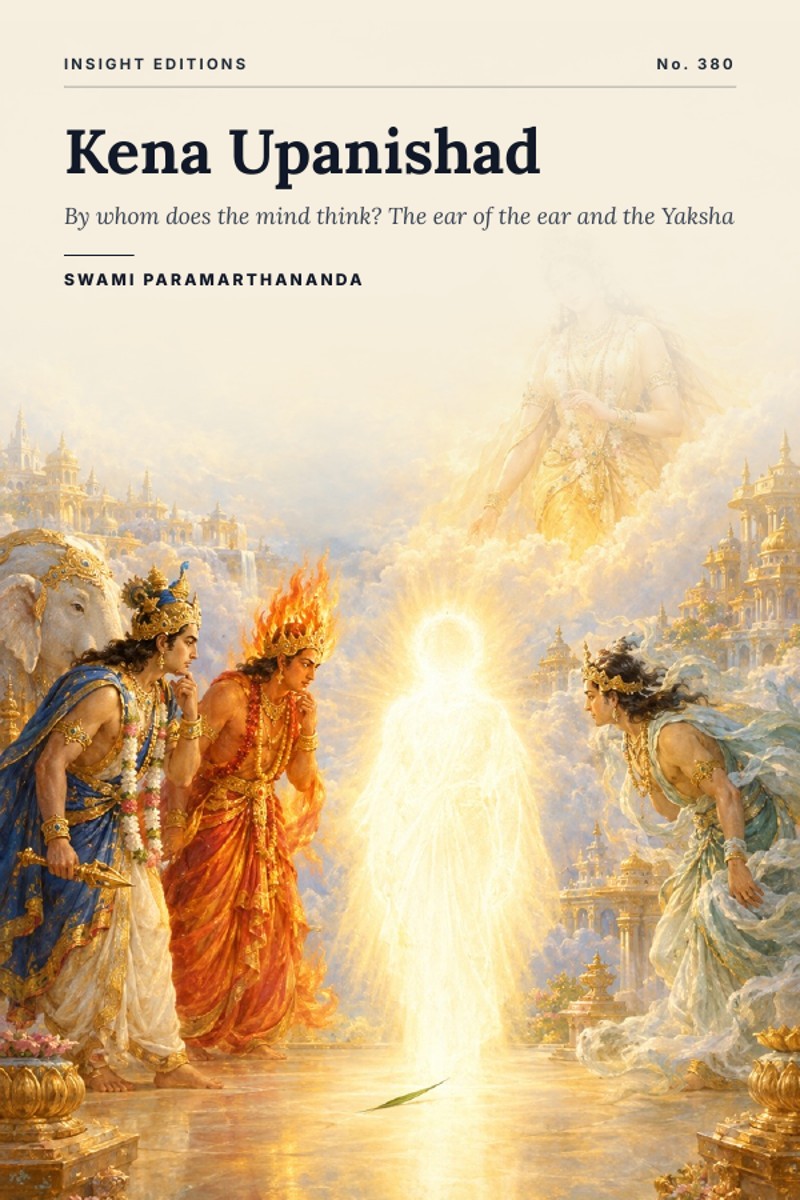
Kena Upanishad
By whom does the mind think? The ear of the ear and the Yaksha
Swami Paramarthananda
A complete study edition of Swami Paramarthananda's sixteen classes on the Kena Upanishad: the ear of the ear, the five features of consciousness, the self beyond known and unknown, the disciple's test, the Yaksha story, and the disciplines that keep knowledge.
A study guide to Swami Paramarthananda's talks on the Kena Upanishad (Arsha Avinash Foundation class notes). Shared free for personal reading; not for sale and not endorsed by the author or publishers. Please read and study the original.
CORE CLAIM
You are the consciousness that makes body and mind sentient. It is neither known nor unknown; it is the knower, recognised in every experience, and that recognition is Brahman-knowledge.
SCOPE
Sixteen classes on the 35 mantras of the Kena Upanishad of the Sama Veda, in four chapters, ending with a summary class.
KEY FIGURES
An unnamed guru and disciple; the gods Agni, Vayu and Indra; the mysterious Yaksha; Uma Haimavati, who teaches Indra. Teacher: Swami Paramarthananda.
BEST FOR
Readers who want the clearest short statement of the self as consciousness, with a story and a set of practices to make it stick.
The Book on One Page
The Kena takes its name from its first word, "kena", "by whom?". By whom does the mind think, the eye see, the tongue speak? The whole Upanishad answers that one question.
Swami Paramarthananda divides the Kena into teaching, test, story and practice. Chapter 1 gives atma vidya: the self is consciousness, the "ear of the ear", beyond the known and the unknown. Chapter 2 is a "monthly test" in which the disciple shows he has understood, and the teacher defines knowledge as recognising consciousness in every cognition. Chapter 3 dramatises the teaching with the story of the Yaksha. Chapter 4 gives the disciplines (meditation, karma yoga and truthfulness) needed to receive and retain the knowledge.
Consciousness is not a part, product or property of the body; it pervades and enlivens the body and survives it.
| Ch | Title | One-line payload |
|---|---|---|
| 1 | By Whom? | Place, structure and the student's question |
| 2 | The Ear of the Ear | Consciousness is distinct from, pervades and enlivens the senses |
| 3 | Five Features of Consciousness | The teacher's standard formula |
| 4 | Neither Known Nor Unknown | Why the self cannot be objectified, yet is evident |
| 5 | Not What You Worship | "That alone is Brahman", five times |
| 6 | The Monthly Test | The disciple's answer: I neither know nor do not know |
| 7 | Known in Every Cognition | Pratibodha viditam: the key mantra |
| 8 | Here, or a Great Loss | Human birth as the rare chance |
| 9 | The Yaksha and the Arrogant Gods | Agni, Vayu and Indra fail before a blade of grass |
| 10 | Uma and Six Messages | What the story teaches |
| 11 | Four Meditations | Lightning, blinking, thought, the Adorable |
| 12 | The Supports and the Vault | Tapas, dama, karma and satyam; the fruit |
By Whom?
The Kena belongs to the Sama Veda, like the Chandogya. It has 35 mantras in four chapters, and opens with a student's question.
Dialogue without names
Unlike the Mundaka (Shaunaka asks Angiras), the Kena names neither guru nor disciple. Still it is a dialogue, as most Upanishads are, to show that this knowledge must be received from a teacher. The teacher jokes: "X guru, Y shishya."
The question
"Kenesitam patati preshitam manah? By whom willed and directed does the mind go to its objects? By whom directed does the first breath move? By whom willed do people speak? What deva directs eye and ear?"
The teacher unpacks the logic behind the question: - The body-mind-sense complex is matter. - Matter has no sentiency of its own and cannot produce it ("otherwise we would have produced consciousness in a lab long ago"). - Yet I am sentient. - So a non-material principle must be present, making matter sentient.
A new fan in the shop does not turn. A fan at home does, so we infer electricity. A body is matter yet sentient, so we infer a non-material principle. The teacher adds: "Do not try passing electricity through a person; it will make the sentient insentient."
| Chapter | Mantras | Function |
|---|---|---|
| 1 | 9 | Main teaching, atma vidya |
| 2 | 5 | Test and definition of knowledge |
| 3 | 12 | Story of the Yaksha |
| 4 | 9 | Disciplines and result |
- Ask the question yourself. By what am I aware right now?
- Note the inference. Sentient matter points to something not matter.
The Ear of the Ear
Mantra 1.2 is the teacher's reply: "It is the ear of the ear, the mind of the mind, the speech of speech, the breath of breath, the eye of the eye."
Three ideas in one definition
"Shrotrasya shrotram manaso mano yad vaco ha vacam sa u pranasya pranah." The definition is indirect, because consciousness is not a tangible thing in a corner of the body. It is inherent, like butter in milk or oil in the seed, but not physically extractable.
Is, not has
We do not say the atma has consciousness; we say the atma is consciousness. The question asked for "what deva"; the answer is the self, of the nature of awareness.
The wise are freed
"Giving up identification with the senses, the wise, departing from this world, become immortal." The teacher reads "departing" as dropping the body-identification, not physical death alone.
Matter does not have sentiency; matter cannot produce sentiency.
Swami Paramarthananda- Use the formula on any faculty. Seeing, hearing, thinking: each is lit by something not itself.
Five Features of Consciousness
The teacher converts the "ear of the ear" into his standard five-point formula, which recurs throughout his teaching.
| # | Feature | Plain meaning |
|---|---|---|
| 1 | Not a part, product or property of body-mind | Not generated by the brain |
| 2 | An independent principle | Exists in its own right |
| 3 | Pervades and enlivens the body-mind | Like light on the hand |
| 4 | Not limited by the body; survives its death | Beyond space and time (desha kala atita) |
| 5 | Surviving consciousness is not available for transactions | No medium to access it |
Why feature 5 matters
Feature 4 says consciousness survives; feature 5 explains why we do not see it afterwards. Without a body-mind, there is no medium for it to be recognised, as light filling a hall is not noticed unless something reflects it.
Hold up a hand: you see light on it. Remove the hand: you no longer see the light, but the light is still there. Claiming requires a medium; existing does not. I need a body to say "I am"; I do not need a body to be.
- Memorise the five. They condense chapter 1 into a single page.
- Practise excluding. Not the body, not the senses, not the mind; what remains is you.
Neither Known Nor Unknown
Mantras 1.3 and 1.4: "There the eye does not go, nor speech, nor mind. We do not know, we do not understand, how one could teach it. It is other than the known, and beyond the unknown."
The warning
The guru warns: consciousness is not one of the things in creation. All instruments, including telescopes and microscopes, are made of matter and designed to objectify matter. "Gunas move among gunas"; senses move among their objects. Consciousness is not material, so no instrument reaches it.
The hope
When the disciple is crushed, the teacher offers a method handed down in the tradition from God: "Anyad eva tad viditat, atho aviditad adhi." It is other than the known and beyond the unknown.
| Category | Example | Is the self here? |
|---|---|---|
| Known | The wall I see | No: it would be an object |
| Unknown | The far side of the moon | No: it would be a future object |
| Non-existent | A hare's horn | No: it makes the body sentient |
| The knower | "I" | Yes |
The answer to the quiz
If the self is neither knowable nor non-existent, what is it? It is the very knower, "I", ever evident. All our effort to know is turning unknown into known; here that effort cannot work, and is not needed.
Noun and adjective
Including body and mind, "I am a conscious being": consciousness becomes an adjective. Excluding them, "I am consciousness": it is the noun.
- Stop trying to know it as an object. The search itself is the obstacle.
- Shift the grammar. From "I am conscious" to "I am consciousness".
Not What You Worship
Mantras 1.5 to 1.9 repeat one refrain five times: "That alone is Brahman, know that; not this which people worship here."
The five refrains
- What speech cannot express, but by which speech is expressed.
- What the mind cannot think, but by which the mind thinks.
- What the eye cannot see, but by which the eyes see.
- What the ear cannot hear, but by which the ear hears.
- What breath does not animate, but by which breath is animated.
"Tad eva brahma tvam viddhi, nedam yad idam upasate."
From atma to Brahman
The first chapter moves from deva (the self) to Brahman. The teacher draws the consequence: I am not a small self in a body; I am Brahman, the cause of creation, sustenance and dissolution. "I am not a human being in the world; I am a spiritual being in whom the world is."
"Not what you worship"
Ishvara as an object of worship is not the final truth. The teacher clarifies: worship is not wrong; it belongs to preparation. Brahman is the worshipper's own self.
You are not a human being looking for spiritual experience; you are a spiritual being temporarily having a human experience.
A saying the teacher loves to quote"Not what people worship" can read as dismissing devotion. The teacher's own framing is softer: worship is essential preparation (chapter 4 prescribes it). The refrain is about what is ultimately real, not about whether to pray. Readers new to Vedanta can misread the line as anti-devotional.
The Monthly Test
Chapter 2 opens with the guru testing the disciple: "If you think 'I know it well', you know very little."
The trap
The teacher has done his best. Now he asks: do you know the atma? Either answer is a trap: - "I know it." Then it has become an object. - "I do not know it." Then it is an object knowable later.
The brilliant answer
"Naham manye suvedeti no na vedeti veda ca." "I do not think I know it well; nor do I think I do not know it. And I know." The student understands the atma as the knower "I", ever available as "I am".
| Statement | Why it is right |
|---|---|
| "I do not think I know it" | The self is not a known object |
| "Nor do I think I do not know" | It is not unknown either |
| "And I know" | I claim it as myself |
| "Whoever among us understands this, knows" | The test is passed by understanding the statement |
Lakshyartha, not vacyartha
The "I" claimed is the implied meaning (lakshyartha), the consciousness component, not the literal meaning (vacyartha) that includes the body. "You cannot physically pluck consciousness from the body, as you cannot scratch light off the hand." The separation is intellectual.
Mantra 2.3
"It is known to one who thinks it is not known; one who thinks it is known does not know. It is unknown to those who know, and known to those who do not claim to know."
- Hold the paradox exactly. Not known, not unknown, and I know: three clauses, one recognition.
Known in Every Cognition
Mantra 2.4 is, for the teacher, the most important in the Kena: "Pratibodha viditam matam amritatvam hi vindate."
The definition of Brahman-knowledge
Brahma jnanam is the revised understanding of the consciousness available in every experience. No special experience is needed; Brahman is intimately available all the time.
Two parts of every experience
Every experience is a mixture: a thought and awareness, like the hand and the light. The teacher's chain of reasoning: thought is material, because the mind is material, because it is made of subtle elements, which come from prakriti, which is matter.
| Experience | Thought (changes) | Consciousness (does not change) |
|---|---|---|
| Wall | Wall-thought | Same awareness |
| Pillar | Pillar-thought | Same awareness |
| Student | Student-thought | Same awareness |
| Recognition | Material, many, changing | Non-material, one, changeless = Brahman |
"In the thought, not of the thought"
The revision is precise: consciousness is in every thought but does not belong to the thought. This is the five features assimilated.
The fruit
"By the self one gains strength; by knowledge, immortality."
Swami Dayananda's joke: if I ask for a donation, you must consult the finance department at home. If I ask "Do you exist?", do not say "I will consult and tell." You are aware of your existence all the time; that awareness is Brahman.
- Do not wait for an experience. Look at what is common to all experiences.
- Notice the constant. Thoughts change in the hall; awareness does not.
Here, or a Great Loss
Mantra 2.5 closes the teaching: "If one knows it here, there is truth; if one does not know it here, there is great loss."
Only humans can claim
Animals are atma too, and have minds, but their minds are not fit to claim "aham brahmasmi". "The proof: no animal attends class asking 'who am I?'" Swami Dayananda: animals have only peripheral, instinctive self-awareness; humans have a deeper self-awareness, deep enough to create self-misconception.
Self-degradation is samsara
Even the winner of a beauty pageant opens her mouth in disbelief: everyone accepts she is first except herself. Self-degradation is samsara; self-upgradation is moksha. "The first two letters of Upanishad are U and P: upgradation."
Two fears
Fear of death and fear of rebirth are samsara. When young, the body is an asset; when old, a liability, and people pray that this be the last body. Knowledge removes both fears.
- 2 fears ended: mortality and rebirth.
- 1 birth fit for the knowledge: the human.
- 0 special experiences needed.
- Never look down on yourself. The body needs repair until it is beyond repair; you do not.
- Use this life. "Here" means now, in this body.
The Yaksha and the Arrogant Gods
Chapter 3 tells a story. The gods win a victory over the asuras, take the credit, and Brahman appears before them in a form they cannot recognise.
The story
After the victory, the gods become arrogant. Brahman, nirguna, uses maya to appear as a saguna Yaksha, a brilliant being. The gods cannot identify it, which already humbles them.
| God | Claimed power | Test | Result |
|---|---|---|---|
| Agni | "I can burn anything" | Burn a blade of grass | Fails, returns |
| Vayu | "I can blow away anything" | Lift a blade of grass | Fails, returns |
| Indra | Leader of the gods | Approaches | The Yaksha vanishes |
Indra's difference
Indra is the most humiliated, yet, because of his sattva, he sees that the lesson is aimed at his ego. Agni and Vayu only return. Indra stays and prays. His desire to know (brahma jijnasa) is the most intense, and God sends a teacher: Uma Haimavati, representing guru and shastra. She tells him the Yaksha was Brahman, and that the victory was Brahman's.
The story suits a reader who already accepts that powers belong to Brahman. As an argument, it proves nothing; as a teaching device, it works by dramatising ego and grace. The teacher treats it as six messages and an aid to meditation, not as history.
Uma and Six Messages
The teacher draws six lessons from the Yaksha story.
| # | Message | Meaning |
|---|---|---|
| 1 | Brahmanah astitvam | Brahman exists, and lends every power: burning, lifting |
| 2 | Durvijneyatvam | Brahman is hard to know without scripture; science cannot discover it |
| 3 | Jnana yogyata apeksha | Knowledge needs qualifications, first humility |
| 4 | Guru apeksha | No knowledge without a teacher |
| 5 | Yasha prapakatvam | Knowledge brings fame (Indra, Agni, Vayu became foremost) |
| 6 | Upasana abhyasa | The story can be used for meditations |
Humility first
"To surrender before a guru, I must be humble. The more arrogant I am, the harder it is to bow." The teacher links this to amanitvam and adambhitvam, the first values of Gita chapter 13, and suggests correlating each Upanishad with the Gita as homework.
The teacher is grace
Indra did not find Uma; she appeared in response to his prayer. The teacher's point: the teacher comes through Ishvara's grace.
Even material knowledge needs a teacher; spiritual knowledge needs one all the more.
- Audit your humility. Where do I resist learning?
- Pray for a teacher, as Indra did, instead of returning like Agni and Vayu.
Four Meditations
Chapter 4 begins the disciplines. Brahman is the subtlest thing; grasping it is hard, and claiming it as "I am" is harder. The mind must be prepared.
Why preparation
Because of strong identification with the body, we feel located and limited. Ahankara, mamakara, raga and dvesha must become weaker, or we will say "Brahman is wonderful; I am miserable." Spirituality can never be separated from morality, according to the Veda.
| Meditation | Image | Why it fits | Level |
|---|---|---|---|
| Lightning | Brahman as the flash | Like the Yaksha, it appears and vanishes | Cosmic (adhidaiva) |
| Blinking | Opening the eye flashes consciousness on the world | Eyes closed, world absent; open, present | Cosmic |
| Thought | Each thought is a flash revealing its object | Any thought can be seen as the Lord | Individual (adhyatma) |
| The Adorable (tadvanam) | Brahman as adored by all | Gods and humans worship it | Attribute meditation |
Vedic and puranic
The teacher notes that Vedic meditations are abstract and no longer practised in a living tradition; puranic meditations (for example on Narasimha, who appeared briefly and disappeared) have replaced them. "One upasana or the other must be practised for mental refinement." Their purpose is neither knowledge nor moksha, only preparation.
During meditation the son comes to mind: "the son is Bhagavan, even if you doubt it." The daughter, the in-law: each thought is a flash of the Lord.
- Try the blink. Open your eyes slowly and notice consciousness "spreading" over the room.
- Pick one practice and keep it. Any regular upasana will do.
The Supports and the Vault
The final mantras name the foundations of the knowledge and its result: "Tapas, self-control and karma are its supports; the Vedas are its limbs; truth is its abode."
The supports
- Tapas. Austerity and discipline.
- Dama. Control of the senses.
- Karma. Especially karma yoga as pancha maha yajna: serving gods, ancestors, humans, other beings and the elements.
Why karma yoga
In ordinary karma, I serve only the family: "utterly selfish". In karma yoga I serve the family and all the infrastructure that supports me. Ahankara and mamakara cannot be diluted without karma yoga.
Satyam, the vault
Truth is the abode: the safe-deposit vault where knowledge is kept. Satyam includes integrity, honesty, uprightness, transparency. Without it, knowledge "will perhaps come, but will not stay". The Mundaka echo: "satyam eva jayate".
The fruit
"One who knows this, destroying sin, is established in the infinite heavenly world." The teacher's reading: jivanmukti while living, when life becomes an asset, and videhamukti after the body falls.
| Discipline | Level | Function |
|---|---|---|
| Upasana | Intellectual | Subtle mind, focus |
| Karma yoga | Moral | Dilutes ego and possessiveness |
| Satyam | Moral | Retains knowledge |
| Tapas, dama | Both | Self-mastery |
- Guard truthfulness. It is the condition for keeping what you learn.
- Widen your service. Move from family-only karma to pancha maha yajna.
Master Takeaways and Frameworks
The Kena moves from a question to a recognition, then makes it vivid and gives practices to keep it. These are the points to keep.
Master takeaways
- You are consciousness, which makes the body-mind sentient.
- Consciousness is not a part, product or property of the body; it pervades, enlivens and survives it.
- The self is neither known nor unknown; it is the knower.
- Brahman-knowledge is recognising consciousness in every experience, not a special experience.
- Self-degradation is samsara; self-upgradation is moksha.
- Truthfulness is the vault in which knowledge is kept.
- Matter cannot produce sentiency; a non-material principle is present.
- The atma is consciousness, not something that has it.
- Claiming needs a medium; existing does not: light on the hand.
- No instrument can objectify consciousness: instruments see only matter.
- "I am conscious" uses an adjective; "I am consciousness" uses the noun.
- What is worshipped as an object is not the final Brahman; Brahman is the worshipper's self.
- "I neither know nor do not know, and I know" is the right answer.
- Claim the implied "I", not the literal "I".
- Human birth is the rare chance; animals cannot ask "who am I?".
- Arrogance blocks knowledge; humility and prayer bring a teacher.
- All power belongs to Brahman, as the blade of grass showed.
- Spirituality cannot be separated from morality.
- Karma yoga dilutes ego; upasana refines the mind.
- The result is jivanmukti here and videhamukti later.
Frameworks
| Name | What it says | Use it when |
|---|---|---|
| Ear of the ear | Consciousness is distinct from, pervades and enlivens each faculty | Explaining what the self is |
| Five features | Not product; independent; pervades; survives; not accessible after death | Revising the core teaching |
| Known, unknown, non-existent, knower | The self falls only in the last | Answering "how do I know the self?" |
| Lakshyartha and vacyartha | Implied "I" vs literal "I" | Claiming "I am Brahman" correctly |
| Pratibodha viditam | Thought changes, awareness does not | Daily contemplation |
| Six messages of the story | Existence, difficulty, qualification, guru, fame, meditation | Teaching the Yaksha story |
| Four meditations | Lightning, blinking, thought, the Adorable | Choosing an upasana |
| Supports and vault | Tapas, dama, karma; satyam keeps knowledge | Building a sadhana |
The Kena's argument rests on the premise that matter cannot produce consciousness. The teacher states it as obvious ("we would have made it in a lab"), and the Upanishad never argues it. Many contemporary philosophers and scientists hold the opposite. The Kena's real strength is not the premise but the phenomenology: that awareness is present and unchanged across every experience. That observation can be tested by any reader; the metaphysical conclusion asks for more.
Connect it
- AI. The Kena's distinction between a changing thought and the unchanging awareness that lights it is the cleanest traditional statement of why processing, however sophisticated, is not the same as being aware. A model may produce thoughts; on the Kena's view, it does not thereby become the knower.
- Enterprise architecture. The fan and electricity example is a reminder that a system's behaviour may depend on a platform layer that never shows up in any component diagram.
About This Edition
This is an independent study guide to Swami Paramarthananda's classes on the Kena Upanishad, published as class notes by Arsha Avinash Foundation.
The edition condenses sixteen classes into chapter-wise summaries, tables and diagrams for personal revision. It follows the teacher's structure and examples in its own words and does not reproduce the transcription, which notes that Swami Paramarthananda has not verified it. For the full teaching and the Sanskrit text, please study the original talks.