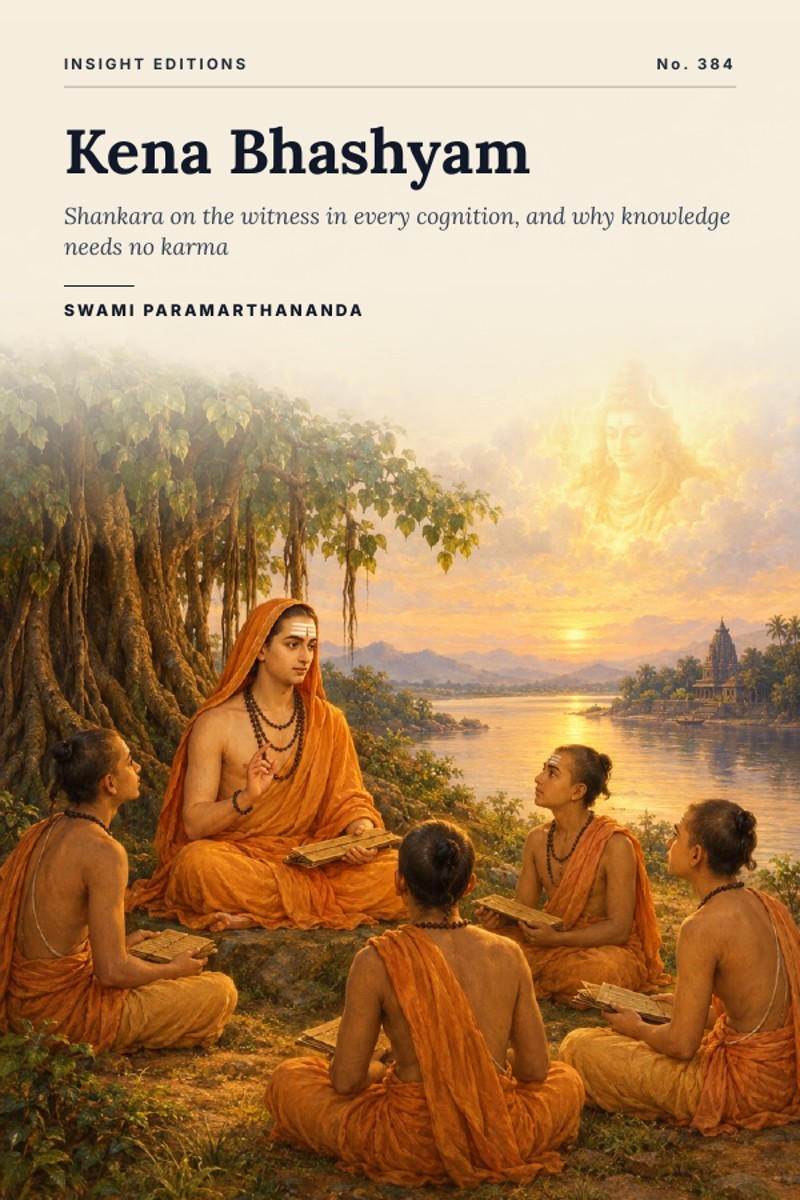
Insight Editions · No. 384
Kena Upanishad Bhashyam
Shankara on the witness in every cognition, and why knowledge needs no karma
Swami Paramarthananda
A complete study edition of Swami Paramarthananda's sixty lectures on Shankara's Kena Upanishad pada bhashya: the self as accomplished fact, triangular and binary formats, literal and implied I, three rival theories of consciousness, pratibodha viditam, and the refutation of combining knowledge with karma.
A study guide to Swami Paramarthananda's lectures on Shankara's Kena Upanishad Bhashyam (class notes). Shared free for personal reading; not for sale and not endorsed by the author or publishers. Please read and study the original.
CORE CLAIM
Consciousness is known in every cognition as its unchanging witness, never as an object. Shankara defends this reading of the Kena against three rival schools and shows that knowledge alone, without ritual, gives freedom.
SCOPE
Sixty lectures in six volumes on Shankara's pada bhashya of the Kena Upanishad, from the introductory commentary to the final question on combining knowledge and karma.
KEY FIGURES
Shankara; rivals Bhartriprapancha, Kanada (Vaisheshika) and the Yogachara Buddhist; Agni, Vayu, Indra, Uma; Indra and Virochana from the Chandogya. Teacher: Swami Paramarthananda.
BEST FOR
Students who know the Kena text and want the technical Vedanta behind it: witness and knower, implied and literal "I", and why direct experience of Brahman is a misconception.
The Book on One Page
The Kena is so important that Shankara wrote two commentaries on it. Swami Paramarthananda teaches the word-by-word one (pada bhashya) in sixty lectures, using it to unfold most of Vedanta.
The commentary has three movements. First, an introduction places the Kena as the ninth chapter of the Talavakara Brahmana of the Sama Veda, after eight chapters of ritual and meditation, and argues that it addresses a different student with a different subject. Second, the teaching chapters (1 and 2) define the self as the ear of the ear and culminate in pratibodha viditam, which Shankara uses to refute three rival theories of consciousness. Third, the story and practice chapters (3 and 4) end with a direct question: are knowledge and karma to be combined? Shankara's answer: never.
Move from the triangular format of seeker, world and God to the binary format of substratum and appearance.
| Ch | Title | One-line payload |
|---|---|---|
| 1 | The Ninth Chapter | Where the Kena sits and who it is for |
| 2 | Accomplished, Not Achieved | The self as siddha vastu, not a goal of action |
| 3 | The Passive Activator | Kenesitam: what moves the mind |
| 4 | Why the Senses Are Inert | Six marks of matter; fire does not burn itself |
| 5 | Two Formats | Triangular vs binary; no direct experience of Brahman |
| 6 | Literal and Implied I | Lakshyartha, Prajapati's 101 years, Indra and Virochana |
| 7 | Five Times "Know That" | The Kena's great sentence and the moon that reveals the sun |
| 8 | Little Brahman, Great Brahman | Chapter 2 opens: the conditioned and the unconditioned |
| 9 | Three Rival Theories | Bhartriprapancha, Kanada, Yogachara |
| 10 | In Every Cognition | Shankara's reading of pratibodha and others rejected |
| 11 | Strength From the Self | Atmana vindate viryam; only in human birth |
| 12 | Story and Meditations | Agni, Vayu, Indra, Uma; four upasanas |
| 13 | Knowledge Without Karma | The final question and three contradictions |
The Ninth Chapter
The Kena is also called the Talavakara Upanishad, after the sage of the Sama Veda branch, a disciple of Jaimini. It is the ninth chapter of a nine-chapter Brahmana.
Two commentaries
Shankara wrote a pada bhashya (word by word) and a vakya bhashya (sentence by sentence). The teacher notes that the vakya bhashya is not in Shankara's usual style. The Gorakhpur edition prints the pada bhashya on top and the vakya below. Advice: do the text first with a teacher; the commentary is optional and adds depth.
What came before
Shankara summarises the first eight chapters of the Talavakara Brahmana:
| Topic | Kind | Example |
|---|---|---|
| Karma | Rituals | Exhaustively covered |
| Independent upasana | Not part of ritual | Prana upasana, meditation on Hiranyagarbha as total prana |
| Ritual-limb upasana | Part of ritual | Meditations on Sama chants (Gayatra Sama), lineage of teachers |
Three destinations
Shankara lists what happens to people according to how they live:
| Lifestyle | Path | Destination |
|---|---|---|
| Karma with upasana, with desire | Shukla gati, northern path | Brahma loka, possible krama mukti |
| Karma without upasana, with desire | Krishna gati, southern path | Svarga, then return |
| Neither, instinct-driven, prohibited acts | Adho gati | "Be born and die": insects, plants |
The teacher's gloss: those living by raga and dvesha without scriptural filter take short, fast cycles of birth and death, "like mushrooms".
Karma and upasana done without selfish desire, for chitta shuddhi, become karma yoga. The only change is the sankalpa before the act. Its sign is vairagya: dispassion, not hatred.
Accomplished, Not Achieved
The introductory commentary argues that the Kena addresses a minority: those no longer running after the five anatmas, and seeking the self.
Sadhana, sadhya, siddha
Everything in the karma kanda is means (sadhana) or end (sadhya): dharma, artha, kama. The self is neither. It is a siddha vastu, an already accomplished fact. I do not attain the atma; I realise I am the ever-present atma.
| Karma kanda | Jnana kanda | |
|---|---|---|
| Subject | Sadhana and sadhya | Siddha vastu |
| Student | Seeker, achiever | One who wants to stop being a seeker |
| Mind | Extrovert | Introvert, dispassionate |
| Result | Punya, worlds | Moksha |
Dropping seekerhood
"The adhikari wants to drop sadhakatvam." Moksha is the end of being a seeker, not success as one. The teacher contrasts this with the Vishishtadvaita view that the two branches form one shastra; for the Advaitin they are two, with different subject, student and result.
How do I know I am ready?
- Relevance. I see Vedanta as relevant to my problems, not a mere theory.
- Early interest. Interest at a young age is from past-life karma yoga (Gita 6.43).
- No obsession. Care and love for family, but they do not sit in the mind during class.
Water acquires heat and loses it. Fire never acquires heat; heat is its nature. My nature as existence, consciousness and fullness is like fire's heat: it cannot be gained or lost.
The Passive Activator
Mantra 1.1 asks by whom the mind is "ishitam, preshitam", willed and directed. Shankara reads the question carefully, then the answer.
Two activators
| Kind | What it is | How it acts |
|---|---|---|
| Active activator | Vasanas, desire, will (anatma) | Pushes the organs |
| Passive activator | Atma, consciousness | By mere presence (sannidhi matrena) |
The mind must first be made sentient before vasanas can push it. The simple answer (from the karma kanda) is "prana shakti". The deep answer is consciousness.
Ishvara through vasanas
The teacher links this to the Gita: "It is desire, it is anger, born of rajas" (3.37), and "the Lord dwells in the hearts of all beings, causing them to revolve as if mounted on a machine" (18.61). Ishvara activates beings through their own vasanas.
Knowledge depends on the object
Shankara's rule: action is purusha-tantra, dependent on the person's will; knowledge is vastu-tantra, dependent on the object. You can choose to act; you cannot choose what you will see when the eyes are open.
- Separate presence from push. Consciousness does nothing and lets everything happen.
- Use pranayama. Desire and prana are linked; regulating breath steadies the mind.
Why the Senses Are Inert
Mantra 1.2 calls the self "the ear of the ear". Shankara's commentary asks why the ear needs an ear at all.
Six marks of matter
The teacher lists six reasons the sense organs, mind and prana are inert:
| Mark | Meaning |
|---|---|
| Drishyatvam | It is an object of experience |
| Bhautikatvam | Made of the elements |
| Sagunatvam | Has attributes |
| Savikaratvam | Changes |
| Agamapayitvam | Comes and goes |
| Savayavatvam | Has parts, an assemblage |
In the body, not of the body
The atma is in the body but not of it. It is interior to the three bodies, the three states and the five sheaths. In sleep, without the mind's lit functioning, the ear does not reveal sound; the radiance of consciousness is required for prana, mind and organs to work.
Fire does not burn itself
Shankara's analogy: fire burns and illumines others but does not need to burn or light itself. There is no time when fire exists and does not shine. The self is self-effulgent: it appears with body, mind and world, and exists without them.
Neither taken up nor given up
Every object in creation can be taken up or given up (upadeya, heya). Brahman, the subject, can be neither: it is what does the taking and giving.
The six marks show that the senses are objects; they do not by themselves show that the subject is non-material. That step depends on the premise that what knows cannot be among what is known. Shankara regards this as self-evident; a materialist would contest it.
Two Formats
Mantra 1.3: "There the eye does not go, nor speech, nor mind." The teacher uses Shankara's commentary to reframe what "realisation" means.
Subject, object, or both?
| Possibility | Verdict | Why |
|---|---|---|
| Brahman is an object | No | It is unknowable, unseeable, unthinkable |
| Brahman is both subject and object | No | It has no parts; one part cannot see another. The eye never sees itself; the nail-tip touches all but itself |
| Brahman is the subject | Yes | The ultimate experiencer in every experience |
Revised mindset, not revised experience
If Brahman is always the subject, no work is needed to experience it. What is needed is a revised conclusion. Eyes open, I see forms; eyes closed, I see thoughts; experience does not change. What changes is the mindset.
| Triangular format | Binary format | |
|---|---|---|
| Elements | Jiva, world, God | Substratum (adhishthana) and appearance (adhyasa) |
| I am | Seeker with a mind | Nitya mukta, witness, without the mind |
| Goal | Future moksha | Moksha as my nature |
| Method | Experience | Revised conclusion |
Direct experience of Brahman as an object does not exist; aparoksha jnanam is a cognitive matter, not an experiential one.
Niagara Falls
Knowing Niagara and experiencing it differ. For external objects, experience matters. For the self, there is nothing to experience as other; knowledge is the whole thing.
Pramata and sakshi
One consciousness, two names. With the mind included: pramata, the knower, waker, dreamer, sleeper. With the mind excluded: sakshi, the witness. "Knower number 1 cannot know knower number 2."
- Stop chasing a special state. No mystical event will add anything.
- Practise the binary. In every situation: what is appearing, and on what?
Literal and Implied I
To claim "I am Brahman" correctly, one must know which "I" is meant. Shankara and the teacher use a story from the Chandogya to show what goes wrong.
Three components of the waker
| Component | Name | Status |
|---|---|---|
| Reflecting medium | Gross body, mind | Mithya |
| Reflected consciousness | Chidabhasa | Mithya |
| Original consciousness | Chit | Satya |
All three together form the literal meaning (vacyartha) of "I". The original consciousness alone is the implied meaning (lakshyartha).
Prajapati's school
Prajapati teaches the self. Indra (king of gods) and Virochana (king of asuras) both study for 32 years.
| Virochana | Indra | |
|---|---|---|
| Error type | Viparita pratipatti, misunderstanding | Apratipatti, incomplete understanding |
| Conclusion | "I am the body" | Keeps questioning |
| Outcome | Founds a body-is-self school | Stays 101 years: 32 + 32 + 32 + 5 |
| Learned | Literal "I" | Waker, dreamer, sleeper are not me; Turiya I am |
Prajapati spoke of the implied meaning each time; the students took the literal. Virochana's error is driven by the four faults: ahankara, mamakara, raga, dvesha.
- Check your "I". When I say "I am Brahman", am I including the body?
- Expect to need time. Even Indra needed four rounds.
Five Times "Know That"
Mantras 1.4 to 1.8 repeat: "That alone know as Brahman, not this which people worship here." The teacher calls them the Kena's great sentence and among the best verses in the Upanishads.
The structure
Each mantra takes one faculty: speech (1.4), mind (1.5), eye (1.6), ear (1.7), prana (1.8). Each says: what that faculty cannot reveal, but by which it reveals, is Brahman.
How it is a mahavakya
- "That" (Brahman) refers to the implied meaning of Paramatma.
- "You" (tvam) refers to the implied meaning of the jiva.
- The deity worshipped is brought down to the vyavaharika level.
- The jiva is raised to the level of sakshi, Turiya.
Why words cannot reveal the self
Words are inert; atma is sentient. Inert cannot reveal sentient; only the sentient reveals the inert. The power of speech belongs to the light of consciousness behind the tongue. Even in dream, speech in thought form happens by that light.
The moon reveals the sun
Moonlight depends on sunlight yet proves the sun exists. Likewise chidabhasa, reflected consciousness in the mind, shows that original consciousness exists. The thinking faculty is itself proof of the atma.
A doctor should not look for consciousness in thoughts or by reducing thoughts. "The very power by which the mind-instrument works is consciousness." It is claimed, not found.
Treating the deity of worship as "brought down" to the vyavaharika level can trouble devotees. Shankara's framework makes devotion valid but not final; the teacher keeps devotion as preparation. Readers from bhakti traditions will see this as the central disagreement with Advaita.
Little Brahman, Great Brahman
Chapter 2 begins: "If you think 'I know it well', you know only very little of Brahman's form."
Two versions
| Vyavaharika Brahman | Paramarthika Brahman | |
|---|---|---|
| Size | Alpam, daharam (small) | Infinite |
| Condition | With upadhi (sopadhika) | Without upadhi (nirupadhika) |
| Known as | Object of meditation, deity, self-in-body | The self that is never an object |
Whoever thinks "I know Brahman well" has made it an object, and so knows only the little Brahman.
No need to transcend the mind
The teacher draws a corollary from the Yogachara debate (chapter 9): pure consciousness cannot know itself; it has no parts. The mind is required to say "aham brahmasmi". Do not try to transcend the mind for self-realisation; use it to claim.
Two "I"s used by the knower
The knower uses two "I"s by context: the sakshi "I" (in the "green room") and the ahankara "I" with body and mind, for transactions.
- Beware of "I know it well". Confidence about an object is not knowledge of the subject.
- Use the mind. Samadhi only excludes anatma; understanding falsifies it.
Three Rival Theories
Mantra 2.4 is the centre of the Kena. Before giving his reading, Shankara examines how three schools understand consciousness.
| School | Claim | Shankara's objection |
|---|---|---|
| Bhartriprapancha | Knowing is an action of the atma; atma is beyond the senses, so it must be inferred | An acting atma changes, has parts, becomes a doer, earns merit and sin: a samsari |
| Kanada (Vaisheshika) | Atma is an inert substance; consciousness is an attribute generated when atma and mind join, like blue paint on a pot | Two partless substances (all-pervading atma, atomic mind) cannot join; the Brihadaranyaka says Brahman is consciousness by nature |
| Yogachara | Consciousness is self-cognised (sva-samvedya) in a series of moments | Subject and object cannot be identical; pure consciousness has no parts; a perception lasts a moment, so this makes consciousness momentary |
Why parts matter
Two things combine only if they have parts. Body and cloth touch at points. Body and space have no such contact; you cannot catch space and take it home. Atma is asanga, unattached (Gita 13; Brihadaranyaka 3.9.26).
Adhyasa as the only link
How then is atma related to waker and world? By superimposition: a lower order of reality on a higher. Mirage water on sand; the sand never gets wet. The waker relates to the dream world the same way.
The Buddhist point on permanence
Against the Buddhist view that there is no permanent atma, the teacher cites the Brihadaranyaka: "there is no cessation of the knower's knowing, for it is immortal" (4.3.30). In sleep we do not know, not for lack of consciousness, but for lack of a second thing.
The rivals appear only through Shankara's summary. Vaisheshika and Yogachara texts give fuller defences than the notes show. The refutations rely on Advaita premises (partlessness, scriptural authority); readers should treat this chapter as Shankara's case, not a neutral comparison.
In Every Cognition
"Pratibodha viditam matam": it is known in and through every cognition. The teacher calls lecture 38, on this phrase, the best of the Kena.
Shankara's reading
Pratibodha means any cognition (vritti jnanam): perception, memory, knowledge. In every one, consciousness is present as the non-variable factor.
| Vritti jnanam | Svarupa jnanam | |
|---|---|---|
| Structure | Knower, known, knowing (triputi) | No triputi |
| Changes? | Yes, with each object | Never |
| Example | Pot-knowledge | Pot-knowledge minus pot-thought |
| Status | Mithya | Brahman |
Pot-knowledge minus the pot-thought equals Brahman. Like gold in chain, bangle and ring, consciousness is in form, colour and taste cognitions.
Other interpretations rejected
- "Intuitive knowledge." Knowledge arising without any means of knowledge. Rejected: liberation must come from scripture as pramana.
- "The final cognition." A flash at the moment of videha mukti, burning all karma. Rejected: Brahman is available all the time, not in a fourth state, Turiya as event, or samadhi.
Thoughtless consciousness
When thoughts resolve, consciousness continues as avyavaharya chaitanyam, thoughtless and unavailable for transaction. In sleep, the Upanishad notes two cognitions on waking: "I knew nothing" and "I slept well". Both point to consciousness present without a knower.
- Subtract, do not add. Take any experience and set aside its content.
- Do not wait for the last thought. It is available in this one.
Strength From the Self
The rest of mantra 2.4: "By the self one gains strength; by knowledge, immortality." Then 2.5: "Here, or a great loss."
Why immortality needs knowing, not reaching
If Brahman were an object reached, the result would be a result of action (one of the four: produced, reached, modified, purified) and so impermanent. Only when Brahman is known as myself can immortality be claimed. God-realisation is self-realisation.
Then why Vedanta at all?
If immortality is my nature, it is siddha, already accomplished. It becomes a goal only during ignorance, when I hold "I am mortal". Vedanta removes that misconception.
Atmana vindate viryam
Where does the seeker get strength to overcome time and death? From the self. A weak mind cannot hold the result; atma-nishtha gives the strength.
| Format | Dependence |
|---|---|
| Triangular | On world and God |
| Binary | On the self |
Only in human birth
Mantra 2.5: knowledge, freedom and immortality are possible only as human. If not known here, "mahati vinashtih", a great loss.
- Shift dependence inward. Strength for life's blows comes from claiming the self.
- Treat this birth as the window. Postponement has a cost.
Story and Meditations
Chapter 3 tells of the Yaksha; chapter 4 draws meditations from it. Shankara treats both as serving knowledge.
What the story shows
- Brahman exists. The Yaksha proves it.
- Brahma vidya is glorious. Stuti, praise.
- Brahman is hard to know by senses, mind or words.
- Doership is a misconception. "We won the war" is the gods' false claim; all burning and lifting power is borrowed.
- Nirguna becomes saguna. Chapters 1 and 2 teach nirguna Brahman; chapters 3 and 4 present it as Ishvara. Both are one; Brahman is never without maya, but maya is understood as mithya.
The three gods
| God | Definition the teacher gives | Lesson |
|---|---|---|
| Agni | "Agragami", leader in front; Jataveda, all-knowing | Burning power is borrowed |
| Vayu | "Matarishva", moves in space; carries smells | Lifting power is borrowed |
| Indra | Deity of the hand, strength | Sattva: learns instantly, does not leave |
Uma represents shruti pramana. Her brilliance stands for self-knowledge, which once lit does not fade.
Four meditations
| Meditation | Kind | Image |
|---|---|---|
| Lightning | Adhidaiva | Brahman's light, flashing and vanishing |
| Blinking | Adhidaiva | Eye opening floods the world with light |
| Thought | Adhyatma | Each thought reflects consciousness |
| Tadvanam | Guna vishishta | Brahman as adorable to all, since it is the essence in all |
Dakshinamurti Stotram verse 4: a lamp in a pot with many holes shines out through each hole. Consciousness shines through eyes and senses; "I know" is its light, and the world shines after it.
Knowledge Without Karma
Chapter 4 verse 7 has the student ask for more teaching; verses 8 and 9 answer. Shankara uses this to refute jnana-karma samuccaya, the combination of knowledge and ritual.
Knowledge alone liberates
Rope-knowledge alone removes snake-fear, all at once, not part by part. The mithya three states cannot disturb the satya Brahman, as the snake never wets or bites the rope.
Two stages: the lamp
| Stage | Needs | Example |
|---|---|---|
| Producing knowledge | Karma yoga, upasana, japa, pilgrimage, sravana, manana | Wick, oil, container to light the lamp |
| Result of knowledge | Nothing | A lit lamp removes darkness by itself |
Three contradictions
| Karma | Jnanam | |
|---|---|---|
| Nature (svarupa) | Promotes duality: needs doer, object, instrument | Negates duality |
| Object (vishaya) | Limitless objects | Only Brahman; triputi negated |
| Result (phala) | Sadhya, to be produced | Siddha, already so |
Karma cannot be complementary (shesha) or supportive (sahakari) to knowledge, like a second hand or second person pushing a car. The knower's action is karma-abhasa, apparent action: "I do nothing at all, thinks the knower, while seeing, hearing, touching" (Gita 5.8).
The sign of a prepared mind
"I understand Vedanta; I can claim I am atma; I have confidence." With a prepared mind, "knowledge will take place whether you like it or not." Truthfulness and all yajnas exist for chitta shuddhi.
The refutation of combination presumes that knowledge is instantaneous and complete once it arises. Many practitioners report knowledge that is clear in class and fragile in life. The teacher answers with nididhyasana as "reinforcing knowledge, not upasana". Whether that reinforcement differs in kind from practice is the open question that later Advaita debates.
Master Takeaways and Frameworks
Shankara's Kena commentary is a full course in Advaita epistemology. These are the points to keep.
Master takeaways
- Consciousness is known in every cognition as its unchanging witness.
- Direct experience of Brahman as an object does not exist; realisation is a revised conclusion.
- Move from the triangular format to the binary format of substratum and appearance.
- Knowledge and karma cannot be combined: they differ in nature, object and result.
- The self is a siddha vastu, already accomplished, never a goal of action.
- Claim the implied "I", original consciousness, not body plus reflection.
- The Kena follows eight chapters of ritual and addresses a different student.
- Three destinations: northern path, southern path, and quick cycles of low birth.
- The atma is a passive activator, acting by presence.
- Knowledge is vastu-tantra: it depends on the object, not on will.
- Six marks of matter show senses and mind are inert.
- Fire does not burn itself: the self is self-effulgent.
- Pramata and sakshi are one consciousness, with and without the mind.
- Indra needed 101 years; Virochana took the literal "I" and left.
- The moon reveals the sun: chidabhasa proves chit.
- "I know it well" means little Brahman.
- Do not transcend the mind; use it to claim.
- Bhartriprapancha, Kanada and Yogachara each make consciousness changing, produced or momentary.
- Pot-knowledge minus pot-thought is Brahman.
- The lit lamp needs nothing to remove darkness.
Frameworks
| Name | What it says | Use it when |
|---|---|---|
| Three gatis | Shukla, krishna, adho by lifestyle | Explaining karma's results |
| Sadhana, sadhya, siddha | Means, end, already accomplished | Testing whether a goal is reachable by action |
| Passive and active activators | Presence vs push | Reading Kenesitam |
| Six marks of anatma | Object, elemental, attributed, changing, transient, composite | Classifying anything |
| Triangular vs binary | Jiva-world-God vs adhishthana-adhyasa | Reframing liberation |
| Vacyartha and lakshyartha | Literal vs implied "I" | Claiming aham brahmasmi |
| Three rivals | Action, attribute, momentary self-cognition | Comparing theories of consciousness |
| Vritti and svarupa jnanam | Changing vs changeless knowledge | Contemplating pratibodha |
| Lamp in two stages | Effort to light, none to shine | Placing practices before and after knowledge |
| Three contradictions | Nature, object, result | Refuting combination |
The teacher's strongest claim, that no experience of Brahman is needed or possible, is a deliberate correction of popular spirituality, which equates realisation with special states. It clarifies a great deal and protects students from chasing samadhi. The cost is that the line between "revised conclusion" and ordinary belief must be drawn by the student; the commentary's answer is that the conclusion rests on scripture as a means of knowledge, which only a reader within the tradition will accept.
Connect it
- AI. The three rival theories map neatly onto modern debates: consciousness as process (Bhartriprapancha), as emergent property (Kanada), as self-representing moments (Yogachara). Shankara's view, that it is none of these but the witness of all processes, is a distinctive fourth option.
- Enterprise architecture. Vastu-tantra versus purusha-tantra is the difference between observing a system's state and changing it: a good architecture keeps the read path free of side effects.
About This Edition
This is an independent study guide to Swami Paramarthananda's sixty lectures on Shankara's Kena Upanishad pada bhashya, from the six-volume class notes and their highlights.
The edition condenses the lectures into chapter-wise summaries, tables and diagrams for personal revision. It follows the teacher's structure and examples in its own words and does not reproduce the notes, which have not been verified by Swami Paramarthananda. For the commentary itself, please study the original talks with the Sanskrit text.