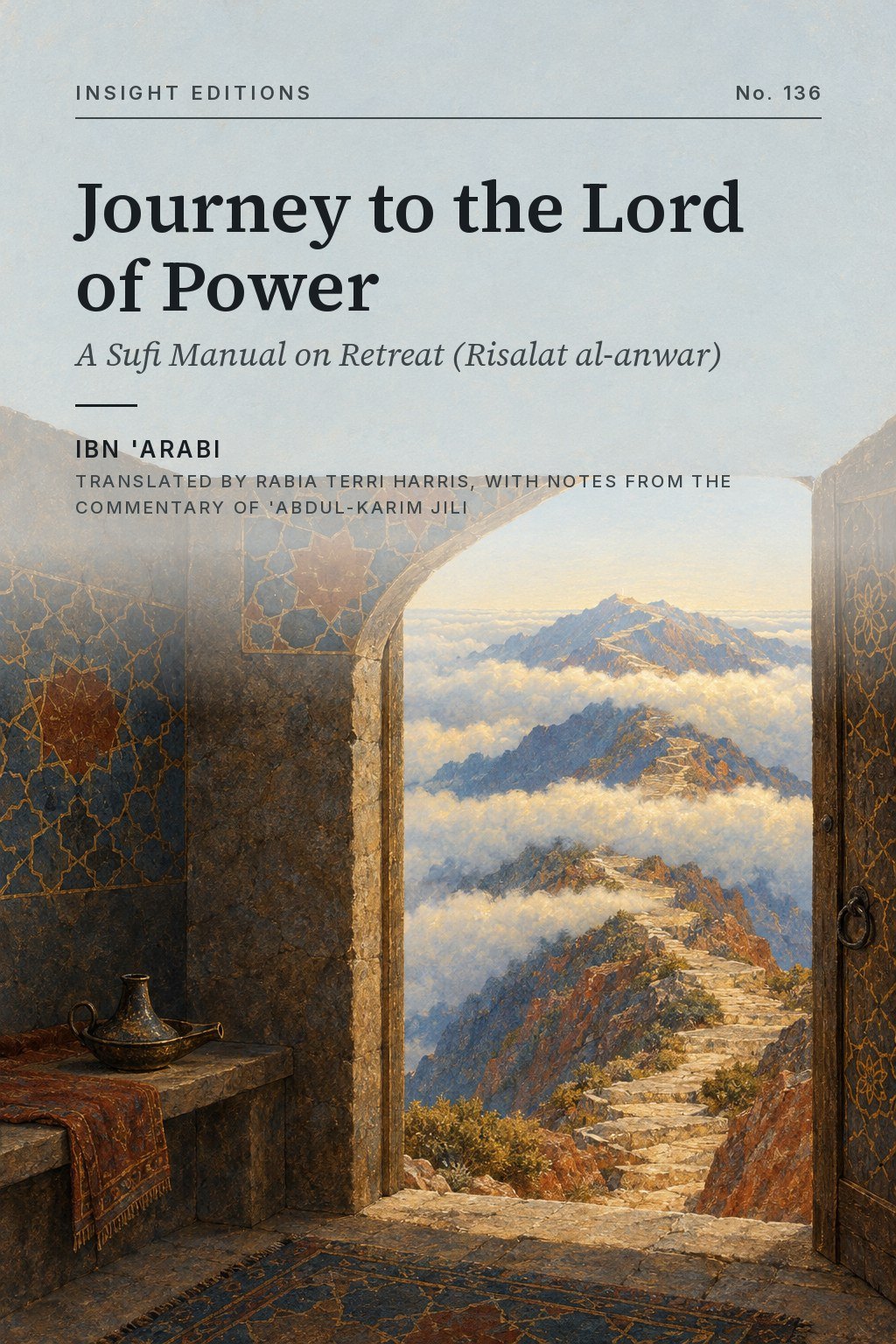
Insight Editions · No. 136
Journey to the Lord of Power
A Sufi Manual on Retreat (Risalat al-anwar)
Ibn 'Arabi · Translated by Rabia Terri Harris, with notes from the commentary of 'Abdul-Karim Jili
Ibn 'Arabi's retreat manual explains the seeker's disciplined practice, spiritual ascent through the worlds, refusal of visionary gifts, and return to guide creation.
A study guide to Journey to the Lord of Power by Ibn 'Arabi, translated by Rabia Terri Harris, with notes from the commentary of 'Abdul-Karim Jili. Shared free for personal reading; not for sale and not endorsed by the authors or publishers. Please read and buy the original.
About the Book
Journey to the Lord of Power is Rabia Terri Harris's English translation of Ibn 'Arabi's short retreat manual Risalat al-anwar (Epistle of Lights), with notes drawn from the commentary of 'Abdul-Karim Jili. The Inner Traditions volume (1981, 1989) also carries a translator's preface, an introduction by Shaykh Muzaffer Ozak, a life sketch by Tosun Bayrak, calligraphy plates of Divine Names, and a glossary.
In one sentence: Ibn 'Arabi answers a friend's question on how one journeys to the Lord, arrives, and returns: only this world is the place of works; Law, a shaykh and disciplined character come first; the seeker in retreat repeats "Allah" and must refuse every wonder offered, because staying with the gift means losing the Giver; the ascent climbs through kingdoms and worlds to the Throne, the Pen and the Cloud; the highest seekers are not absorbed but sent back to guide creation; and, as Jili adds, the journey to God ends while the journey in God never does.
Argument Map
Figure 1. The argument of the treatise as a single line from premise to return.
Chapter Map
Figure 2. Reading order of this guide.
What This Book Is For
The Inner Traditions volume is a short book with a long title. Its core is a retreat manual: how to sit, what to refuse, what will appear, and why coming back matters more than staying lost in vision. Around that core, Harris explains why the text needs Law and a teacher; Ozak shows how a living tariqa remembers the Shaykh; Bayrak places the first ascent before age twenty and the book about twenty years later. Jili's notes, excerpted by Harris, are not a second treatise but a metaphysical keyring for the first.
- Ibn 'Arabi speaks as a master answering a friend: sequence, tests, covenants, return.
- Jili speaks as a commentator: homelands, renewed creation, drinks, Pen and Cloud, to God / in God.
- Harris / Ozak / Bayrak speak as frame: history of the text, stories of the Shaykh, sketch of the life.
Part I. The Frame
Three short pieces set the stage before the treatise itself. The translator places the epistle in Ibn 'Arabi's work and in Islamic practice. Shaykh Muzaffer Ozak gives a teacher's portrait through six stories. Tosun Bayrak sketches the life from Murcia to Damascus, with three meetings with Khidr and a dream of the qutb.
Chapter 1. Preface: The Text and Its Purpose
The work. The full Arabic title is Risalat al-anwar fima yumnah sahib al-khalwa min al-asrar: the Epistle of Lights concerning the secrets granted to the companion of retreat. It was edited in Konya in 1204 or 1205. Some seventy manuscripts survive. It was printed in Cairo (1914) and Hyderabad (1948). It has no critical edition, and this Harris volume is its first English version [1]. Jili's commentary, al-Isfar 'an risalat al-anwar, was printed in Damascus in 1929 [2]. The preface gives Jili's dates as 1365 to 1408, and later says he "died between 1408 and 1417" [2, 4]; both wordings are reported as printed.
Figure 4. The text's history as the preface gives it [1].
The addressee. Ibn 'Arabi wrote for an unnamed friend who was already a saint and master. That matters for practice: khalwa is to be entered only by order of a shaykh, or by one who is master of himself, and only after the Sacred Law is in place. Every stage of the ascent is also a temptation [2 to 3]. The book is advanced instruction, not a beginner's handbook.
Precedent. The model is the Prophet's retreat in the cave of Hira and his Night Journey, of which he said "I was taken." The preface recalls the Abu Jahl story around that claim [3]. Saints, unlike the Prophet, must earn their ascent through perfection in the inner and outer arts of Islam [3 to 4]. Revelation corresponds to knowledge: the ascent is a "transference from knowledge ('ilm) to vision ('ayn); and the form is one" [4]. The preface closes with the hadith qudsi of the nawafil (supererogatory works), by which God becomes the hearing and sight of His servant [5], and with the rank of the awliya'.
Figure 5. The precedent the preface gives for the retreat [3 to 4].
Chapter 2. Introduction: A Teacher's Portrait
Ozak calls the treatise a guide for seekers and notes that Ibn 'Arabi wrote more than five hundred books, among them the Futuhat and the Fusus. His enemies were "like bats blinded by light"; even admirers who named him al-shaykh al-akbar (the Greatest Shaykh) did not understand him, yet he would intercede for them [7 to 8].
| Story | What happens | Point the introduction draws |
|---|---|---|
| The church | An opponent's wife sends him "to the church"; he goes, objects to the priest about "son of God"; a picture of Jesus speaks; the congregation accepts Islam; he thanks the man who insulted him [8 to 10] | Insult becomes a door of guidance |
| Damascus speech | "The god which you worship is under my feet"; he is jailed; by one tradition martyred; Abul-Hassan saves him, reading the words as intoxication [10] | Words hid a treasure of gold under his feet |
| The tomb | "When S enters SH, the tomb of Muhyiddin will be discovered"; Sultan Selim conquers Damascus in 1516, learns the prophecy from Zembilli Ali Efendi, finds gold and the tomb, builds a shrine at Salihiyya on Qasiyun [10 to 11] | Prophecy fulfilled as the introduction tells it |
| Fakhruddin al-Razi | Muhibbuddin al-Tabari's mother's dream: al-Razi struck dumb in the pulpit after scorning a man in pilgrim shroud who was Ibn 'Arabi; forgiven, knowledge returned [11 to 12] | Pride before a saint is punished |
| Ibrahim Haleri | Imam of the Fatih Mosque stamps his foot; a nail; the wound never healed though the floor was stone [12 to 13] | Contempt leaves a lasting mark |
| Jewish boy | A boy calls him father, recites Koran and hadith; the Jews accept Islam [13] | Recognition across communities |
| The school | A teacher calls him a heretic (zindiq) in class and the greatest saint at home: "At the school we are among men of orthodoxy ... here we are among men of love" [14] | Two registers of speech |
Figure 6. The introduction's stories arranged around one portrait [8 to 14].
The church story in fuller outline. An opponent falls ill. His wife, blaming Ibn 'Arabi, sends him "to the church." He goes. He objects to the priest about calling Jesus "son of God." A picture of Jesus speaks. The congregation accepts Islam. He thanks the man who insulted him [8 to 10]. Ozak's point is that insult became a door of guidance, and that the Shaykh answered hostility with presence rather than retreat from the public square.
Damascus, jail and the tomb. The speech "the god which you worship is under my feet" led to jail. One tradition has him martyred; Abul-Hassan saves him by reading the words as intoxication, not blasphemy. The tomb was destroyed. The prophecy "When S enters SH, the tomb of Muhyiddin will be discovered" is fulfilled, as the introduction tells it, when Sultan Selim conquers Damascus in 1516, learns the prophecy from Zembilli Ali Efendi, finds gold treasure and the tomb, and builds a shrine at Salihiyya on Qasiyun [10 to 11]. The A closer look keeps the printed naming "Selim II, the ninth Ottoman sultan" without inventing a correction.
Four more stories as a pattern. Fakhruddin al-Razi is struck dumb in the pulpit after scorning a man in pilgrim shroud (Ibn 'Arabi), then forgiven and knowledge returns [11 to 12]. Ibrahim Haleri stamps his foot; a nail; the wound never heals though the floor is stone [12 to 13]. A Jewish boy calls him father, recites Koran and hadith; the Jews accept Islam [13]. A teacher calls him zindiq at school and the greatest saint at home: "At the school we are among men of orthodoxy ... here we are among men of love" [14]. Taken together, the stories teach misreading, forgiveness, lasting marks of contempt, recognition across communities, and two registers of speech.
Figure 7. Ozak's stories as a pattern of misreading and mercy [8 to 14].
Titles and early witnesses in the life sketch. Full name: Abu-Bakr Muhammad ibn 'Ali ... al-Hatimi al-Ta'i al-Andalusi. Titles include al-shaykh al-akbar and khatim al-awliya' al-Muhammadi. Ibn Jawziya is cited on alchemy and the Greatest Name; Sa'duddin Hamawi calls him an "ocean of knowledge which has no shores" [16]. Birth: Murcia, 17 Ramadan 560 / July 28, 1165 [16]. Father 'Ali ibn Muhammad asked 'Abdul-Qadir Jilani for a son; Jilani, destined to have none of his own in that telling, gave his destined son back to back with warmth; the child was named Muhyiddin [15 to 16].
Travels after the early ascent. At thirty-six (1201) in Mecca he knows every qutb till Judgment and hides it from compassion. Egypt, Iraq, Damascus, Konya follow. He married Sadruddin Qunyawi's mother. The book was edited in Konya three years after the Pilgrimage and is "probably" addressed to Qunyawi [18]. From 1223 in Damascus; death believed 1240 [18]. The edition keeps "probably" and "believed" as printed hedges, not as certainties invented later.
Chapter 3. Glimpses of the Life
Birth and name. His father 'Ali ibn Muhammad asked 'Abdul-Qadir Jilani for a son; none was destined for him, so Jilani gave his own destined son, back to back, with warmth, and named him Muhyiddin [15 to 16]. Full name: Abu-Bakr Muhammad ibn 'Ali ... al-Hatimi al-Ta'i al-Andalusi. Titles include al-shaykh al-akbar and khatim al-awliya' al-Muhammadi. Ibn Jawziya is cited for alchemy and the Greatest Name; Sa'duddin Hamawi calls him an "ocean of knowledge which has no shores" [16]. Born Murcia, 17 Ramadan 560 / July 28, 1165 [16].
Formation. Taught by women saints Yasmin of Marchena and Fatima of Cordoba; at age eight to Seville; teachers Abu-Muhammad and Ibn Bashkuwal. At nineteen he met Ibn Rushd; the account has him say he "entered into spiritual retreat ignorant and left it as I had" [17]. First khalwa ascent before twenty; this book about twenty years later [17 to 18].
Travels and the book. In 1201, at thirty-six, he reached Mecca, where he knew every qutb until the Judgment and hid it from compassion. Egypt, Iraq, Damascus, Konya; married the mother of Sadruddin Qunyawi; edited this book in Konya three years after the Pilgrimage, "probably" addressed to Qunyawi [18]. Settled Damascus 1223; believed to have died 1240 [18].
Figure 8. The life in Bayrak's sketch [16 to 18].
Figure 9. Early ascent and later manual, as Bayrak relates them [17 to 18].
Figure 10. The three meetings with Khidr told in the sketch [18 to 20].
| Person in the frame | Role | Pages |
|---|---|---|
| 'Abdul-Qadir Jilani (1077 to 1166) | Gave the destined son; "My foot is on the neck of every saint" | 15, 112 |
| Yasmin of Marchena; Fatima of Cordoba | Women saints who taught him | 17 |
| Ibn Rushd (1126 to 1198) | Met him at nineteen; retreat saying | 17, 109 |
| Sadruddin Qunyawi | Disciple; mother married Ibn 'Arabi; probable addressee | 18 |
| Khidr | Three meetings | 18 to 20 |
| Muhibbuddin al-Tabari (1218 to 1295) | Mother's dream of al-Razi | 11, 112 |
Part II. The Treatise: Setting Out
Ibn 'Arabi answers his friend in four movements: the journey, arrival and standing, what God says on "the carpet of His vision", and the return. This part covers the premise, the six homelands (mawatin), the counsel against hastening fana', the preparation for retreat, the two covenants, and the lower stages of the ascent through sensory tests, drinks and the kingdoms.
Chapter 4. Premise and Place
One Reality. "There is nothing in existence except God Most High, His attributes, and His actions." Were He veiled from the world for the blink of an eye, it would vanish; His manifestation is so intense that "we call His manifestation a veil" [25 to 26]. The friend's question sets the plan: journey to the Lord, arrive and stand, hear what He says on the carpet of vision, return through Him from Him to creation "without separation." Absorption is "a station less than the station of return" [26].
Figure 11. The three phases the friend asked about [25 to 26].
Many paths, one Way. Paths are many; the Way of Truth is single. Its aspects vary with the seeker's constitution, motivation, spiritual nature, aspiration and relation to the goal [26].
Figure 12. What makes the aspects of the Way differ [26].
Figure 13. The six homelands in their order [27].
| Homeland | What the treatise says | Practical force |
|---|---|---|
| 1. "Am I not your Lord?" | Pre-existence of the covenant; physical existence has removed us from it | Memory of lordship precedes this life |
| 2. This world | Place of responsibility, trial and works | Only homeland where obligation (taklif) runs |
| 3. Interval | Traveled after lesser and greater deaths | Barzakh between states |
| 4. Resurrection | On the awakening earth; return to original condition | Reckoning, not obligation |
| 5. Garden and Fire | The two abodes | Reward and requital |
| 6. Sand Dune | Outside the Garden; site of the vision | Vision of God (Jili: hill of white musk) |
Why this world. Humans are always travelers; journey means toil; waters are variously flavored; the companion is for a night [27 to 28]. Ibn 'Arabi warns those who would hasten contemplation and fana' outside its proper homeland: the masters scorn it, for "the world is the King's prison, not His house", and the time of fana' is an abandonment of a higher station [28]. Revelation is the form of knowledge: 'ilm becomes 'ayn [28 to 29]. Better to labor outwardly while receiving inwardly, since "subtle nature is resurrected in the form of its knowledge, and the bodies ... in the form of their works" [29].
Chapter 5. Preparation for Retreat
First duty. Knowledge enough for ablution, prayer, fasting and reverence, and no more [30]. Then the five doors: knowledge, work, moral heedfulness (wara'), asceticism, trust. The first degree of trust shows in four miracles: crossing the earth, walking on water, traversing air, being fed by the universe [30].
| Step | Content | Page |
|---|---|---|
| Knowledge | Enough for ablution, prayer, fasting and reverence, no more | 30 |
| Five doors | Knowledge, work, moral heedfulness (wara'), asceticism, trust | 30 |
| Self-knowledge | Know your station and whether imagination rules you; if it does, enter only by the hand of a discriminating shaykh | 30 |
| Discipline (riyada) | Train character, abandon heedlessness, endure indignities | 30 |
| Retreat practice | Shut the door; repeat "Allah, Allah"; nourishing food without animal fat; neither satiety nor excess hunger | 31 |
Figure 14. Order of preparation before retreat [30 to 31].
Telling influences apart. An angelic influence brings coolness and bliss, no pain and no change of form, and leaves knowledge behind. A demonic one brings disorientation, pain, bewilderment and mental disorder [32].
Figure 15. How the treatise tells influences apart [32].
Figure 16. The two covenants and the answer each requires [32].
Trust's first degree. The treatise names four signs that trust has taken root: crossing the earth, walking on water, traversing the air, and being fed by the universe [30]. These are not goals of the retreat; they are marks that may appear when trust is real. Stopping for them would break the second covenant.
Figure 17. Four signs of trust's first degree, not goals [30].
Companion for a night. Humans are always travelers; the companion of the road is for a night; waters are variously flavored [27 to 28]. The counsel is against treating any station as a permanent home before the Sand Dune's vision and the return. Attachment to mineral, vegetal or animal secrets is exile dressed as intimacy.
Figure 18. Attachment test across the kingdoms [36 to 39; 32].
Chapter 6. The Lower Ascent: Tests, Drinks, Kingdoms
Sensory unveiling. The first test is seeing through walls. Keep secrets, act by the Name al-Sattar (the Veiler), and counsel privately [35]. To tell sensory from imaginal sight, close your eyes: if the vision persists, it is imagination [35].
Figure 19. The tests of the lower ascent in sequence [35 to 39].
Meanings in forms. Abstract ideas appear in sensory forms whose meaning only prophets know [35 to 36]. Keep up dhikr until the Remembered manifests. Contemplation differs from sleep: one leaves bliss, the other remorse [36].
| Drink offered | Treatise counsel | Jili's signification (preview, n11) |
|---|---|---|
| Water | Choose first | Absolute knowledge |
| Milk | If no water; combine with water if both | Pure original religion; Prophet's choice at ascension |
| Honey | Drink it | Permissible philosophical knowledge |
| Wine | Only with rainwater | Knowledge of states |
| Rainwater | The safe mixer for wine | God-granted knowledge |
| Rivers / springs | Do not mix with wine | Natural knowledge |
| Well-water | (Jili mixing rules) | Intellectual knowledge |
Figure 20. Drinks as a decision tree in the lower ascent [35 to 36; n11].
Degrees of the kingdom. Mineral (secrets of stones; if enamored, trapped and exiled), vegetal, animal. Diets: mineral needs heat and moisture; vegetal needs balance [36 to 39].
| Kingdom | Revealed | Danger | Diet note |
|---|---|---|---|
| Mineral | Secrets of stones | Being enamored traps and exiles you | Heat and moisture |
| Vegetal | Secrets of plants | Same attachment exile | Balance |
| Animal | Secrets of creatures | Same | (as given) |
The soundness test. If all the worlds recite your own dhikr, the vision is imaginal; if each recites its own variety, it is sound [36 to 39]. Then come the dissolution of nature and contraction (qabd), the infusion of life force, the terrors of the "surface signs", transformations dense and subtle, scattering sparks of light, the ascendant stars (tawali'), and the form of the universal order [39 to 40]. Adab of entering, standing and leaving applies. Of the Manifest and the Hidden: "The essence is one. Nothing has passed away." And: "all the ways are circles. There is no straight line." [40]
Figure 21. After the kingdoms: dissolution to universal order [39 to 40].
Diet and the sealed door. Inside retreat the diet is nourishing without animal fat; neither satiation nor excess hunger. Dryness produces corrupt imaginings [31]. Jili later notes that fat strengthens animality (n7). Visitors who seek leadership are a danger: "destruction is closer than the shoelace" [31]. The door is shut; dhikr is the work; the Greatest Name "Allah, Allah" is named as highest [31].
Figure 22. Diet and door discipline before the ascent tests [31; n7].
Contemplation versus sleep. After the drinks and before the kingdoms fully open, the treatise distinguishes contemplation from sleep by their aftertaste: bliss versus remorse [36]. Dhikr continues until the Remembered manifests. The counsel is not to confuse a pleasant state with arrival, nor a heavy state with failure, but to read what the state leaves behind, as the angelic and demonic test already taught.
Dissolution, life-force and circles. After the kingdoms comes ascent by dissolution of nature and contraction (qabd) [36 to 39]. Then infusion of life-force; "surface signs" and terrors; transformations between dense and subtle; light of scattering sparks; ascendant stars and the form of universal order; the adab of entering, standing and leaving. Manifest and Hidden meet in the line: "The essence is one. Nothing has passed away." Divine knowledge is received; the heart is protected. "All the ways are circles. There is no straight line." [39 to 40]
Figure 23. From dissolution to the circle of ways [36 to 40].
Part III. The Treatise: Ascent and Return
The second half climbs through the subtle worlds to the Throne, the Pen and their Mover, describes effacement and affirmation, and then turns to the real subject: who comes back, how they call others, how saints stand to prophets, and how the returned sage conducts the Moment.
Chapter 7. The Higher Worlds
Figure 24. The ladder of the retreat as the treatise orders it [35 to 48]. The return passes back through every form.
Formation and the heart. After the speculative sciences, the difference between supposition and knowledge, and the "birth of possibilities" between spirits and the physical world, comes infusion of the Divine Mystery [43]. Then the world of adornment and beauty: "from this level comes the sustenance of poets, while from the one before comes the sustenance of preachers" [43]. At the degrees of the qutb the seeker hears: "All that you witnessed before is from the world of the left hand ... this is the place of the heart." Here are wisdoms, power of symbols, authority over veil and unveiling [43].
| World / station | What appears | Page |
|---|---|---|
| Speculative sciences | Supposition vs knowledge; birth of possibilities | 43 |
| Divine Mystery | Infusion | 43 |
| Formation / adornment | Poets' sustenance; preachers from the level before | 43 |
| Qutb degrees | Left hand behind; place of the heart | 43 |
| Fever, rage, zeal | Foundation of apparent difference and discord | 44 |
| Jealousy | True schools adorned; every station greets and loves you | 44 |
| Dignity, serenity | The ruse (makr); enigmas | 44 |
| Bewilderment | Helplessness; treasuries of works; "the highest heaven" | 44 |
| Gardens; narrow path | Degrees of Gardens; brink of Hell | 44, 47 |
| Absorbed spirits | Drunken sanctuary; light where you see only yourself | 47 |
Figure 25. Subtle worlds between kingdoms and Throne [43 to 47].
Original forms. The original forms of the sons of Adam appear; veils lift and descend; your form among them shows your moment [47].
The summit. At the Throne of Mercy (sarir al-rahmaniyya), search yourself: your destination, your limit, which Divine Name is your Lord, and "the form of your uniqueness" [47]. Then the Pen, the First Intellect, and the angel al-Nuni; then its Mover, "the right hand of the Truth" [47 to 48]. The seeker is eradicated, withdrawn, effaced, crushed and obliterated; then affirmed, made present, made to remain, gathered and assigned, and dressed in robes of honor [48]. Return through all forms to the senses, or hold fast where absent. "The destination of every seeker depends upon the road which he traveled." [48]
Figure 26. The top of the ladder in the treatise's order [47 to 48].
Figure 27. The two sides of the summit, term by term [47 to 48].
Worlds of zeal, jealousy and dignity. After the heart's place come the world of fever, rage and zeal; then the foundation of apparent difference and discord [44]. Then the world of jealousy, where true schools and revealed traditions are adorned, and every station greets and loves you [44]. Then dignity, serenity and firmness, with the divine ruse (makr) and enigmas [44]. Then bewilderment, helplessness, inability, and the treasuries of works: "the highest heaven" [44]. Gardens' degrees follow; the narrow path and the brink of Hell [44, 47]. The sanctuary of spirits absorbed and drunken opens the lamp-light already warned [47]. Original forms of the sons of Adam appear; veils lift and descend; your form among them shows your moment [47].
Figure 28. Subtle worlds of zeal through the lamp [44 to 47].
Conduct after return, expanded. Wonders should come "ordinarily" [60]. The returned one does not advertise states. Himma without preparation is a disease; the worshipper content with duties and Paradise is "companion of water and the prayer niche" [63]. The attainer meets astonishment at the raising of veils; the Apparent One is "one in essence, infinite in aspects"; "the knower is thirsty continually forever" [64]. These lines close the treatise's practical arc: return, ordinary wonders, the Moment, and an unending thirst that Jili will name as the journey in God.
Chapter 8. Those Who Stop and Those Sent Back
One entrusted with a prophet's Word becomes its inheritor, "of Moses or Abraham or Enoch"; the Perfected One holds all the Words, that of Muhammad [48, 51].
| Type | Description | Rank |
|---|---|---|
| Absorbed (mustahlikun) | Remain in contemplation, like Abu-'Iqal | Lower (waqif who stops) |
| Sent back (mardudun) | Returned to creation | Higher, if stations are comparable [51] |
| Gnostic ('arif) | Returns to himself / perfects himself | Answers to the Creator |
| Knower ('alim) | Sent to creation with guidance | Inheritor of the prophets [51 to 52] |
| Sufis | Inheritors of Moses, Jesus and others; adepts of states | |
| Malamiyya | Inheritors of Muhammad; "adepts of permanence and realities" [52] | Highest |
Figure 29. Absorbed and sent back, as the treatise ranks them [51].
Doors of calling. Summoners call from fana' in servitude ('ubudiyya, citing 19:9), from lowliness and need, from the Merciful nature, from the Vanquishing nature, and from the Divine nature, "the fourth door and the most sublime" [52, 55]. The text lists five calls and names the Divine the fourth; the A closer look keeps that wording as printed.
Figure 30. The doors from which summoners call [52, 55].
Word and inheritance. Being entrusted with a Word makes one an inheritor of that prophet. The Perfected One holds all the Words and is of Muhammad [48, 51]. Translator footnotes mark this as the hinge between particular inheritance (Moses, Abraham, Enoch, Jesus) and Muhammadan completeness. The Malamiyya are named as the Muhammadan heirs: adepts of permanence and realities, not only of states [52].
Figure 31. Inheritance of Words and Muhammadan completeness [48, 51 to 52].
Figure 32.
Stations and the road. "Your destination follows from your road" [48]. The treatise's sequence is not optional scenery. Whoever enamors himself of a lower kingdom, or of the poets' world, or of the lamp-light where he sees only himself, has already chosen a destination short of the Cloud and short of the return. The five losses of effacement and the five gains of affirmation are the hinge after which return or absorption becomes the decisive difference.
Figure 33. Road, destination, and the fork after affirmation [48, 51].
Chapter 9. Saints and Prophets
Prophets and saints share three things: knowledge without acquired learning, action by himma, and seeing the world of images in sensory form; they differ in mode of address [55]. Prophets ascend through the fundamental light, saints through what that light grants: "Superiority is not found in the station of realization, but in its aspect" [55]. Every saint receives through the prophet whose Way he follows; when a saint says "God said to me", it is the spiritual nature of his prophet. A saint near death who heeds Moses or Jesus is not becoming Jew or Christian; the qutb belongs to the heart of Muhammad; men of the heart of Jesus include "the first shaykh whom you met" [56]. Muhammad gave all prophets their stations in the World of Spirits. "The knowers of this community are like the prophets of Israel" [56]. Witnesses: 22:78; 16:89. Devote himma to the entire legacy of Muhammad [56, 59].
Figure 34. What prophets and saints share; they differ in mode of address [55].
Figure 35. Prophet and saint: shared gifts, different aspect [55 to 56; n34 to n36].
Chapter 10. Conduct After Return
The perfect sage treats each condition as it requires: after his ascension no mark appeared on Muhammad, while Moses veiled himself [59]. Divine wisdom works inside the customary order, so "events beyond the ordinary will accompany him ordinarily." Remember influences for teaching; shaykhs who neglect this are eliminated as teachers [60]. Prayer: "My Lord, increase me in knowledge while the heavenly sphere turns by Your breath" [60].
Figure 36. Two modes of conduct after return [59].
The Moment (waqt). Breaths outrank hours, hours outrank days. Whoever heeds his breaths has the Moment and has everything; whoever has no Moment has no lifetime and loses the afterlife [60, 63]. The door of the invisible is not opened while the heart craves; contemplation does not come while the heart glances at anything [63].
Figure 37. The Moment as the unit of life [60, 63].
| Seeker | Himma | Outcome |
|---|---|---|
| Worshipper | Duties and Paradise | "Companion of water and the prayer niche" |
| Aspirant without preparation | Beyond worship | Like the diseased |
| Prepared aspirant | Beyond worship, ready | Opening [63] |
Figure 38. Bounded road to God, unbounded life in God, and the return (treatise + Jili n30, n43).
Part IV. Jili's Commentary
The translator draws forty-three notes from 'Abdul-Karim Jili's commentary al-Isfar 'an risalat al-anwar. They turn the treatise's practical steps into metaphysics: absorption and subsistence, renewed creation, the six homelands expanded, the ban on hastening fana', the drinks keys, the Pen and the Cloud, mahw and ghayba, return versus absorption, and the claim that the journey to God ends while the journey in God never does. Notes are cited as n1 to n43 with printed pages.
Chapter 11. Time, Homelands and Renewed Creation
Absorption and subsistence. Absorption (istihlak) is fana' without the multiplicity of manifestations; experiencing multiplicity is baqa' after fana', the cause of manifestation, "the beloved knowledge for the sake of which He created the world" (n1, 69).
Figure 39. Jili on absorption and subsistence (n1, 69).
Renewed creation (khalq jadid). The world vanishes each moment by the victory of Unity and is produced again by essential love; Manifest and Hidden alternate. Time is an imaginary prolongation measured by motion; since moments are infinite, so are homelands; like follows like (White to White) (n2, 70 to 71). Hadiths frame the discipline: leaving what does not concern him; "Time is a cutting sword"; "The Sufi is the son of his moment"; "The present does not return" (69 to 70). Homelands must be respected: what escapes accomplishment in its homeland is never accomplished (n2, 69 to 70).
Figure 40. Renewed creation in Jili's note (n2, 70 to 71).
| Homeland | Jili's gloss (n3, 72 to 77) |
|---|---|
| "Am I not your Lord?" | Each person an atom among spirits (7:172); Ibn 'Arabi's verse: "I bore witness to you as King before our existence" |
| This world | From the concave of the Sphere of Mansions to the earth's surface; only site of obligation (taklif) |
| Barzakh | Line between sun and shade; two seas (55:20); imagination, "not existent or nonexistent"; the intuitive sees awake what the sleeper sees |
| Resurrection | On the "awakening earth", stretched like a skin from 21 parts to 99; hafira = return as one came; reckoning, not obligation |
| Garden and Fire | Each in its place |
| Sand Dune | Hill of white musk; vision of God; in the Garden of Eden (cf. 73:14) |
Figure 41. Six homelands as Jili expands them (n3, 72 to 77).
Chapter 12. Retreat, Drinks and Signs
The root of khalwa in the Law is the hadith qudsi "Whoever remembers Me in himself..."; the word comes from al-khala', the void in which the world existed (n6, 80 to 81). Fat strengthens animality (n7). The Prophet's pains at Gabriel's coming, brow perspiring (n8). Influx from abstract essences arriving at the world of images brings no change of form (n9). God and the devil are never in the same company (n10, 81).
| Drink | Knowledge it signifies (n11, 82 to 83) | Mixing note |
|---|---|---|
| Water | Absolute knowledge | Choose first |
| Milk | Pure original religion / knowledge of sacred Ways; Prophet's choice at ascension | Combine with water if both offered |
| Honey | Permissible philosophical knowledge; systems of philosophers and "deviated priesthoods" | Drink it |
| Wine | Knowledge of states | Only with rainwater; not with rivers, springs or (alone) wells |
| Rainwater | God-granted knowledge | Safe mixer for wine; also for wells |
| Rivers / springs | Natural knowledge | Do not mix with wine |
| Well-water | Intellectual knowledge | Mix with rainwater or milk; not with honey or wine alone |
Figure 42. Jili's drink keys and mixing discipline (n11, 82 to 83).
Dissolution and life force. Dissolution is only relative to the seeker's consciousness; contraction as essence vanishes (n12). Life force works like Jesus's birds of clay (5:110; 3:49): one life, effects according to structure (n13, 83 to 84). On the "surface signs" Jili says plainly: "I do not know the meaning"; Ibn 'Arabi on lawa'ih = elevation from state to state, essential lights; no return to a left state (n14, 84). States are stages, not special graces; praiseworthy only when they increase knowledge (85).
Chapter 13. The Upper Worlds Explained
Lights and order. Ascendant stars (tawali') are lights of tawhid in gnostics' hearts that extinguish lights of speculative proofs (not prophetic) and of intuition (n15, 85). Universal order = God appearing in the form of Creation; existence = haqq + khalq (n16). Few know the difference between supposition and knowledge; birth of possibilities is like Jesus between Mary and Gabriel, or the soul between spirit and body (n17, 86). Divine Mystery = unity of Essence in Names, Intellect in spirits, Throne in bodies; "the essence of mercy"; in king and ant; "say: There is no misfortune" (n18, 86 to 87).
Tests and the lamp. Greetings of stations are a test: the enamored are driven from the door; those who persevere gain command over all (n19, 87). Bewilderment: light of huwiyya; gazing bequeaths life (n20, 87 to 88). "Sway like a lamp": greatest courage needed; do not be bound by its bliss (n21, 88). Adam's form altered at disobedience; veil from al-Sattar descended; repentance lifted it (n22, 88). Special praise: "Exalted is He Who reveals the beautiful and conceals the ugly" (n23, 89).
Pen, Cloud, eradication. First Intellect = Pen writing on Tablet/Soul/Throne; inversion of pen in writing; in 'Uqlat al-mustawfiz no mediator; al-Nuni = Intellect's comprehensiveness, not a separate angel (n24, 89 to 90). Mover = right hand = attributes of Beauty; then Enraptured Angels from the Cloud. The Cloud (hadith: "Where was your Lord ... In a cloud") = seat of the name Lord as the Throne is of the Merciful; first of things; from earth to Cloud only Names of actions; then Breath of the Merciful, then Names of Transcendence, knowledge of negation (n25, 90 to 91).
Figure 43. Cloud, Breath and Pen in Jili's ascent (n24 to n25, 89 to 91).
Mahw, ghayba, ithbat. Eradication (mahw) removes habitual characteristics; "God eradicates and establishes" (13:39); like abrogation; determination eliminated, essential form ('ayn) remains (n26, 92). Absence (ghayba): gnostics with truth from truth; others with truth from creation; greatest knowers "with Creation from Creation" (n27, 92 to 93). Crushed = disappearance of structure under Essential Oneness (n28, 93). Affirmation (ithbat) = predestined order; seeking repeal of habit violates adab; "the constant disruption of habit is a habit"; friend affirms what Friend affirms; disputer is no friend (n29, 94 to 95).
Figure 44. Eradication and affirmation in Jili (n26, n29).
Chapter 14. Return, Sainthood and the Endless Journey
The one who stops (waqif) has "half of perfection, going with no coming"; the returner has "the perfection of perfection." Ends are relative to predispositions; no absolute finality. Abu-'Iqal al-Maghribi; Abu-Yazid Bistami given the robe: "Go out to My creation in My form, and whoever sees you, sees Me." "A person dies as he lived, and is resurrected as he died" (n30, 95).
Figure 45. Jili's ranking of the absorbed and the returner (n30, 95).
| Note | Claim |
|---|---|
| n31 | Sufis = adepts of states; masters = adepts of stations |
| n32 | 'Ubudiyya = essence of poverty (possibility); fana' in it = no contemplation from lordship |
| n33 | Divine door encompasses all Names |
| n34 | Saint addresses followers from behind veil of his prophet; prophet addresses without veil |
| n35 | Follower never attains station of the followed; sainthood = following |
| n36 | Prophethood cannot be earned; sainthood earned through works of Sacred Law, "not those of thinking" |
| n37 | Muhammad prophet "while Adam was between water and clay"; his spirit = First Intellect; Hidden/Manifest; "the black and the red" |
| n38 | Khidr a prophet (per shaykh) who followed the Messenger; Jesus descends, rules by our Law, "Seal of the General Sainthood" |
| n39 | Sphere revolves through breaths of the world |
| n40 | Moment = state in time, existent between two nonexistents; mourning past or future = distance |
| n41 | Craving (shahwa) natural; imagination corporealizes and stops; will vs craving |
| n42 | Himma and more = external worship |
Figure 46. Closing chain of Jili's notes (n30 to n43).
Note 5 (Messiah) and the continuum of absence. Jili's notes treat the Messiah among prophetic models and distinguish degrees of ghayba: from brief absence to the long absorption of Abu-'Iqal. The edition keeps the note's claim that absence is presence elsewhere, not annihilation of existence. Degrees of ghayba (n27) sit beside mahw/ithbat and mahq: erasure of habits, affirmation of what God ordains, obliteration, and "obliteration of obliteration" appearing as ordinary creature.
Figure 47. Absence degrees and obliteration sequence (n5, n27; glossary).
Renewed creation and the Moment. Khalq jadid (renewed creation each instant by essential love) is the metaphysical ground of the Moment. If existence is remade each breath, then mourning the past or occupying the future is distance from the only place works can run. The son of the Moment is not a slogan; it is the practical face of renewed creation (n40; [60, 63]).
Figure 48. Khalq jadid and the Moment (n40; [60, 63]).
Sufis of states and masters of stations. Jili distinguishes Sufis as adepts of states from masters as adepts of stations (n31). Servanthood ('ubudiyya) is the essence of poverty (possibility); fana' in it means no contemplation from lordship (n32, 96). The Divine door encompasses all Names (n33). A saint addresses followers from behind the veil of his prophet; a prophet addresses those before him without veil (n34). A follower never attains the station of the followed; sainthood is following (n35, 96). Prophethood cannot be earned; sainthood is earned through works of the Sacred Law, "not those of thinking" (n36, 97).
Figure 49. Prophet and saint as Jili distinguishes them (n34 to n36).
Muhammad, Khidr and Jesus in the notes. Muhammad is prophet "while Adam was between water and clay"; his spirit is the First Intellect; Hidden and Manifest; "the black and the red" (n37, 97 to 98). Khidr is a prophet (per the shaykh) who followed the Messenger. Jesus descends, rules by our Law, and is "Seal of the General Sainthood" (n38, 98 to 99). The sphere revolves through the breaths of the world (n39, 99).
Craving, himma and will. Craving (shahwa) is natural; inclination to abstract meanings without natural drive can be fine; imagination corporealizes and stops; will differs from craving (n41, 100 to 101). Himma and more belong to external worship (n42). Will dissolved in God's will (76:30; 9:118; 5:54; 11:56) is the ground of the endless journey in God (n43).
Synthesis
A revision map of the book: takeaways, frameworks, closer look, Who's Who, and connections that stay inside the treatise's own spiritual and practice distinctions. No modern analogies outside the book.
The Argument in Brief
The frame places a short retreat manual written for a friend already qualified, edited in Konya, and read through Ozak's stories and Bayrak's life sketch. The treatise answers four questions: journey, arrival, what is said on the carpet of vision, return without separation. It locates works in this world alone, forbids hastening fana', demands Law, shaykh and character before retreat, and climbs through tests, drinks, kingdoms and subtle worlds to the Throne, Pen and Cloud, where the self is effaced then affirmed. The return outranks absorption; saints inherit through prophets; the Moment is the breath. Jili adds renewed creation, the six homelands expanded, drink keys, mahw/ithbat, and the endless journey in God.
Figure 50. Synthesis map of the parts.
Twenty-eight Takeaways
- Nothing exists but God, His attributes and His actions [25].
- The journey has three phases: to Him, in His presence, and back to creation [26].
- Absorption ranks below return [26; n1].
- This world is the only homeland of works and obligation [27; n3].
- Do not hasten fana': "the world is the King's prison, not His house" [28].
- Revelation is knowledge turned into vision; "the form is one" [4, 29].
- You belong to whatever rules your heart [29].
- Prepare with basic knowledge, five doors and discipline before retreat [30].
- If imagination rules you, retreat only under a discriminating shaykh [30].
- A visitor seeks leadership; destruction is "closer than the shoelace" [31].
- Angelic influence leaves coolness and knowledge; demonic leaves pain and confusion [32].
- Nothing is like God; answer any form claiming divinity [32].
- Stop for nothing offered: "If you stay with what is offered, He will escape you" [32].
- Close your eyes to test a vision; if it persists, it is imaginal [35].
- Choose water, else milk; wine only with rainwater [35 to 36; n11].
- If worlds recite your dhikr, the vision is imaginal; their own varieties are sound [36 to 39].
- Each station greets you as a test [44; n19].
- At the lamp-light where you see only yourself, do not stop (n21).
- Your destination follows from your road [48].
- Effacement is followed by affirmation and robes of honor [48].
- The sent back outrank the absorbed, other things equal [51; n30].
- Malamiyya, heirs of Muhammad, are adepts of permanence and realities [52].
- Saints inherit through a prophet; superiority lies in aspect, not realization [55 to 56].
- After return, wonders should come "ordinarily" [60].
- The breath is the unit of life; no Moment, no lifetime [60, 63].
- Himma without preparation is a disease [63].
- The knower is "thirsty continually forever" [64; n43].
- Journey to God is limited; journey in God is infinite (n43).
Frameworks at a Glance
| Framework | Elements | Source |
|---|---|---|
| Six homelands | Covenant, world, barzakh, Resurrection, Garden and Fire, Dune | 27; n3 |
| Five doors (preparation) | Knowledge, work, wara', asceticism, trust | 30 |
| Influence test | Angelic vs demonic signs | 32 |
| Two covenants | Incomparability; single himma | 32 |
| Drinks allegory | Water, milk, honey, wine, rain, rivers, wells | 35 to 36; n11 |
| Kingdoms | Mineral, vegetal, animal | 36 to 39 |
| Ladder | Kingdoms, subtle worlds, Throne, Pen, Mover, Cloud | 35 to 48; n25 |
| Effacement and affirmation | Five losses, five gains | 48 |
| Return typology | Absorbed, sent back; gnostic, knower; Sufis, Malamiyya | 51 to 52 |
| Doors of calling | Servitude, need, Merciful, Vanquishing, Divine | 52, 55 |
| Prophet / saint | Shared three; differ in aspect and address | 55 to 56 |
| Moment | Breath as unit; son of the Moment | 60, 63; n40 |
| To God / in God | Limited crossing; infinite traveling | n43; glossary |
Figure 51. Frameworks chained from place to endlessness.
A closer look
- The preface gives Jili's dates as 1365 to 1408 [2] but later says he "died between 1408 and 1417" [4].
- Five doors of calling are listed, yet the Divine one is called "the fourth door" [52, 55]; the page image confirms the wording.
- The conqueror of Damascus in 1516 is named Selim II, "the ninth Ottoman sultan" [10]; Sura al-Qalam is called the Seventieth Sura [90, 114]. Both are reported as printed.
- Jili confesses he does not know what the "surface signs" mean [84], and the translator calls related phrasing obscure [110].
- The life story leans on miracle accounts and dreams given without sources [8 to 21], and the addressee is only "probably" Qunyawi [18].
- The ladder is described from above; a reader without a shaykh cannot verify a step, which the book itself presents as the reason a shaykh is required [30].
Strengths. The treatise is short, sequenced and unusually practical for an Akbarian text: covenants, tests, drinks, return typology. Jili's notes supply metaphysics without replacing the manual. Harris's English is the first; the frame pieces situate the friend, the Law and the living teacher.
Limits. Miracle stories in Ozak and Bayrak are presented without critical apparatus. Calligraphy plates interrupt the treatise in the print layout. Several editorial flags (Selim, Pen sura, door count, Jili dates) remain unresolved inside the book itself. The edition does not invent fixes.
Who's Who
| Person | Role in the book |
|---|---|
| Ibn 'Arabi | Author; born Murcia 560/1165, died Damascus, believed 1240 [16, 18] |
| 'Abdul-Karim Jili | Commentator; dates given as 1365 to 1408 [2], or died 1408 to 1417 [4] |
| Rabia Terri Harris | Translator, preface |
| Muzaffer Ozak | Author of the introduction |
| Tosun Bayrak | Author of the life; commentary on the plates |
| 'Abdul-Qadir Jilani | Saint who gave Ibn 'Arabi to his father (1077 to 1166) [15, 112] |
| Sadruddin Qunyawi | Disciple; Ibn 'Arabi married his mother; probable addressee [18] |
| Ibn Rushd | Philosopher who met him at nineteen (1126 to 1198) [17, 109] |
| Khidr | Met three times [18 to 20] |
| Abu-'Iqal al-Maghribi | Example of the absorbed; Mecca four years without food [51, 105] |
| Abu-Yazid Bistami | Sufi sent out "in My form" (d. 848 or 874) [95, 105] |
| Fakhruddin al-Razi | Struck dumb for scorn [11 to 12] |
| Muhibbuddin al-Tabari | Mecca jurist whose mother's dream is told (1218 to 1295) [11, 112] |
| Yasmin of Marchena; Fatima of Cordoba | Women saints who taught him [17] |
| Abul-Hassan al-'Uryani | Letter: "Turn toward me with your heart" [20] |
Applying It (inside the book's own distinctions)
- Refuse early dazzle: sensory unveiling, kingdoms, poets' world, lamp-light are tests, not goals.
- Prefer being sent back: mardudun over mustahlikun when stations are comparable.
- Keep editorial flags visible: Selim naming, Pen sura number, door count, Jili dates, surface signs.
- Do not invent a shaykh from a book: the treatise itself says imagination-ruled seekers need a discriminating hand [30].
Sequence Checklist (treatise order)
Figure 52. Twelve-step checklist across the book.
Figure 53. Revision hub for study.
Practice Distinctions (quick card)
| Distinction | Prefer | Refuse |
|---|---|---|
| Entry | Shaykh's order or mastery of self; Law in place | Whim; imagination-ruled solo retreat |
| Influence | Coolness, knowledge, stable form | Pain, confusion, form-change |
| Vision test | Closes eyes and vanishes if sensory; worlds' own dhikr | Persists with eyes closed as if sensory; worlds recite your dhikr |
| Drinks | Water; else milk; wine only with rain | Wine alone; honey as final goal |
| Kingdoms | Pass through; learn; keep covenants | Enamor; exile; stop |
| Lamp-light | Courage to pass | Bliss of seeing only yourself |
| After Cloud | Effacement then affirmation; robes; return | Absorption without service |
| Rank | Mardudun; Malamiyya permanence | Mustahlikun when stations comparable |
| Time | Breath; son of the Moment | Mourning past; occupying future |
| Journey | In God after arrival; endless thirst | Stopping at arrival as final |
Glossary
Terms of art as the Harris glossary and the parts use them. Arabic kept with English glosses. Editorial flags on al-Qalam's sura number and related items stay as printed.
| Term | Meaning in the book |
|---|---|
| adab | Spiritual courtesy; right conduct of the Way; violated by hastening fana' or seeking repeal of habit |
| 'alim | Knower sent to teach; "The knowers are the inheritors of the prophets" |
| 'arif | Gnostic; responsibility only to the Creator; returns to himself |
| baqa' | Subsistence; beginning of traveling in God (after fana' ends traveling to God) |
| barzakh | Interval between degrees of existence; sun/shade line; imagination "not existent or nonexistent" |
| dhikr | Remembrance through invoking the Names; highest: "Allah, Allah" |
| fana' | Annihilation; end of traveling to God |
| ghayba | Absence from the world, presence elsewhere; degrees per n27 |
| hadra | Presence; five levels (hadarat) |
| himma | Spiritual will, concentrated intention; fix on Him alone |
| 'ilm / 'ayn / haqq al-yaqin | Hearing of fire, seeing it, being fire |
| istihlak | Absorption in the Presence; fana' without multiplicity |
| khalq jadid | Renewed creation each instant by essential love |
| khalwa | Retreat; from al-khala', the void; "I locked up the dogs of my nafs" |
| lawa'ih | Surface signs / essential lights; Jili: meaning unknown; translator: obscure |
| mahw / ithbat | Erasure of habits; affirmation of what God ordains |
| mahq | Obliteration; with "obliteration of obliteration," appearing as ordinary creature |
| Term | Meaning in the book |
|---|---|
| makr | Divine ruse: blessings despite infringement; enigmas at dignity's station |
| Malamiyya | People of blame; highest grade; heirs of Muhammad; adepts of permanence |
| mardudun | Those sent back to creation; superior "all else being equal" |
| mawatin | Six homelands of created experience |
| mustahlikun | Those lost in contemplation of Unity |
| nafs | Self, ego, desires; dogs locked in khalwa saying |
| qabd / bast | Contraction and expansion: fear and hope of now |
| al-Qalam | The Pen; First Intellect; book calls it title of the Seventieth Sura (flag: commonly 68) |
| qutb | Axis; highest station of saints; belongs to heart of Muhammad |
| riyada | Training of character; endure indignities |
| sarir al-rahmaniyya | Throne of Mercy; Guarded Tablet |
| taklif | Obligation; constituting principle of this world alone |
| tawali' | Ascendant stars; lights of tawhid extinguishing speculative proofs |
| 'ubudiyya | Servanthood; essence of poverty/possibility |
| waqif | One who stops at the goal; half of perfection |
| waqt / watan | The Moment; homeland (same root as mawatin) |
Figure 54. Glossary hinge: to God and in God (n43; baqa'/fana' entries).
Crosswalk: term to part
| Cluster | Terms | Where |
|---|---|---|
| Place | mawatin, watan, barzakh, taklif | Treatise A; Jili n3 |
| Retreat | khalwa, dhikr, riyada, adab, nafs | Frame; Treatise A |
| Tests | makr, lawa'ih, tawali' | Treatise A; Jili |
| Drinks / kingdoms | water, milk, honey, wine, rain | Treatise A; Jili n11 |
| Ascent | qutb, sarir, al-Qalam, Cloud | Treatise B; Jili n24 to n25 |
| Effacement | fana', baqa', mahw, ithbat, mahq, ghayba, istihlak | Treatise B; Jili; glossary |
| Return | mardudun, mustahlikun, Malamiyya, 'arif, 'alim | Treatise B; Jili n30 |
| Time | waqt, himma, khalq jadid, 'ubudiyya | Treatise B; Jili n40, n43 |
| Journey | to God / in God, waqif | Jili n43; Synthesis |
Figure 55. Glossary crosswalk from place to endless journey.
Reading order for terms
Open mawatin, taklif and barzakh before the treatise's counsel against hastening fana'. Open khalwa, riyada, adab and nafs before the sealed-door rules. Open makr, lawa'ih and tawali' when the lower ascent feels merely scenic. Open fana', baqa', mahw, ithbat, mahq, ghayba and istihlak at the Cloud and return fork. Open mardudun, mustahlikun, Malamiyya, 'arif and 'alim when ranking those who come back. Open waqt, himma, khalq jadid and the to-God / in-God hinge when the treatise closes on thirst.
About this book
Journey to the Lord of Power: A Sufi Manual on Retreat (Risalat al-anwar) by Ibn 'Arabi, 1981. This is a chapter-by-chapter study of the book, with summaries, maps, tables and diagrams; short quotations keep their page references. It is shared free for personal study, is not for sale, and is not endorsed by the author or publisher. Please read and buy the original.
Insight Editions · rajeshrmahapatra.com/insight-editions