Insight Editions · No. 398
Jayanteya Gita
Talks on the Nava Yogī Saṁvāda of the Bhāgavata Purāṇa
Swami Paramarthananda
Insight Edition of Swami Paramarthananda's 40 classes on the Jayanteya Gita (Bhagavata Purana 11.2-11.5): the nine sages on bhakti, maya, Brahman, karma yoga, avatars and worship in the four ages.
A study guide to the Jayanteya Gita classes of Swami Paramarthananda (Arsha Avinash Foundation, transcribed by A. Venkatesan, edited by Swamini Svatmabodhananda; not verified by Swamiji). Shared free for personal reading; not for sale and not endorsed by the author or publishers.
CORE CLAIM
Purity of mind can be reached by many means (ritual, worship, meditation, chanting), but knowledge and liberation come only through systematic study under a teacher.
SCOPE
All 185 verses of Bhāgavata Purāṇa 11.2–11.5 followed through 40 classes: the nested frame, nine sages on bhakti, māyā, Brahman, karma yoga, avatāras, religious materialism and worship in the four ages.
KEY FIGURES
The nine sages and King Nimi, with Nārada, Vasudeva and Devakī; Swami Paramarthananda as teacher, quoting Swami Dayananda and Śaṅkara.
BEST FOR
Students of Vedānta who want to see how a bhakti text fits into Advaita, and devotees who want to know what chanting and worship can and cannot do.
The Book on One Page
The Jāyanteya Gītā is the name tradition gives to Book 11, chapters 2 to 5 of the Bhāgavata Purāṇa: 185 verses in which nine wandering sages, the sons of Ṛṣabha and Jayantī, answer nine questions from King Nimi of Mithilā. Swami Paramarthananda's 40 classes read it verse by verse as a complete course in Vedānta, from karma yoga to the knowledge "I am Brahman".
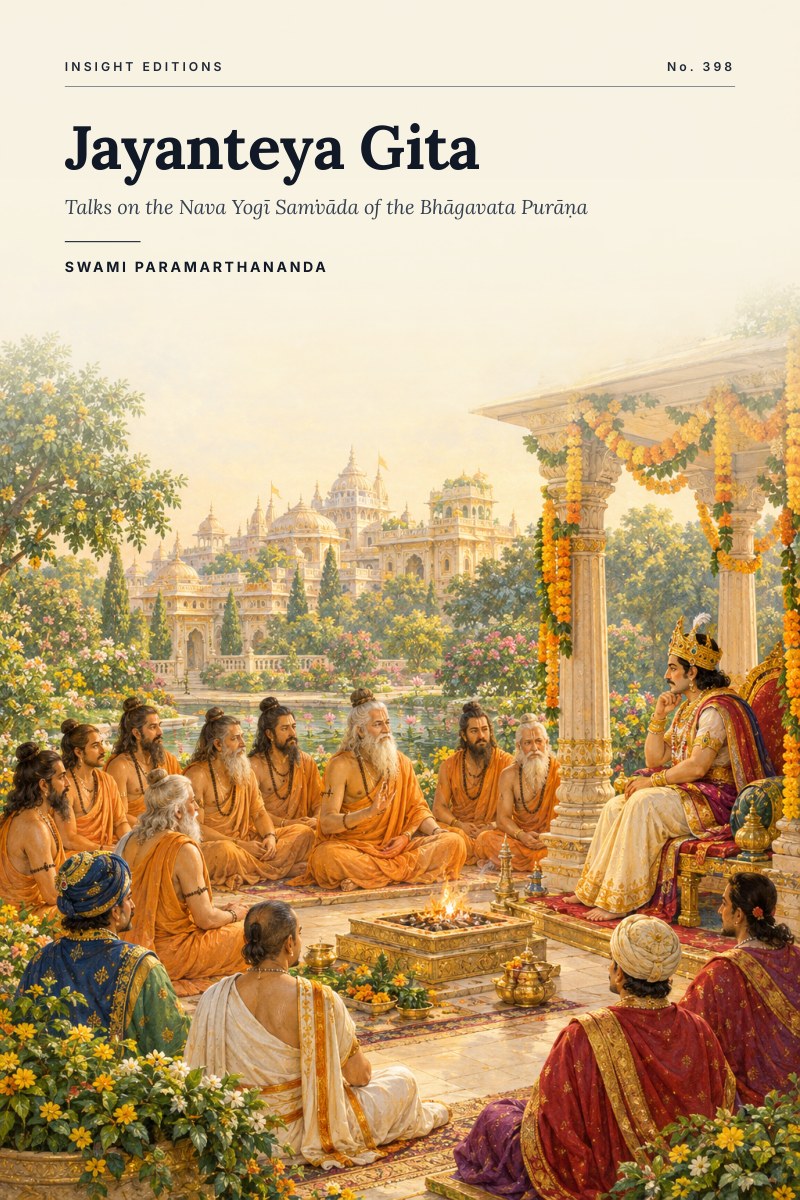
The text is set three dialogues deep. Śuka tells Parīkṣit how Nārada visited Vasudeva, Kṛṣṇa's father, who asked for liberation. Nārada replies with an old story: the nine sages arriving at Nimi's sacrifice, which was suspended so the teaching could be given, "as the war was suspended in the Gītā". Paramarthananda compares it to walking through three temple walls to reach the deity and back out again.
The first three sages lay the base. Kavi gives the essence of karma yoga, "whatever I do, I offer to Nārāyaṇa", then says that duality is the cause of fear and the world is a dream seen from a higher waking. Hari describes three grades of devotee: the highest sees the Lord in everyone, the middling has love for God, friendship for devotees, compassion for the worldly and indifference to the hostile, and the lowest worships only the image. Antarikṣa explains māyā, which projects the cosmos and conceals the self, so the jīva falls from creator to creature.
Prabuddha gives the way across: see the three defects of every worldly gain, go to a teacher, and cultivate thirty-five virtues. Pippalāyana's six verses are the philosophical centre: Brahman is never an object of knowledge because it is the knower, existence outside and consciousness inside, the witness of the three states.
The later sages return to practice. Āvirhotra explains the Veda's sugar-coated pill: worldly rewards are promised to bring people to ritual, but ritual's real fruit is purity, and purity creates the hunger for knowledge. Drumila lists the avatāras, beginning with the most unusual one, the universe itself. Camasa criticises the religious materialist who uses God for money and pleasure. Karabhājana describes the Lord's form and worship in each age, ending with chanting the name in the Kali age.
Paramarthananda's single most repeated point is a distinction: purity of mind can be reached by many means, while knowledge and liberation are reached by one means only, systematic study under a teacher. So every bhakti section is honoured and then placed: it prepares the student and does not finish the work. Against the "nāma siddhānta" school, he insists that chanting cannot reveal even a flight time.
The frame then closes. The sages vanish, Nimi practises and is freed, and Nārada gives Vasudeva and Devakī the hardest advice in the text: stop regarding Kṛṣṇa as your son, because he is the formless Lord in a human appearance. Paramarthananda fills each class with Śaṅkara, the Gītā, the Upaniṣads and his own guru Swami Dayananda, along with Chennai jokes and checkable tests for progress.
| Ch | Title | Payload |
|---|---|---|
| 1 | Three Dialogues and a Welcome for the Sage | Place in the Veda and Bhāgavata; nested frame |
| 2 | Asking for the Right Thing, and Meeting the Nine | Vasudeva asks for mokṣa; lineage of the nine |
| 3 | The Sages Arrive, the King Asks, Kavi Begins | Two visions of the world; nine topics |
| 4 | Offer Everything, See Through Duality, Climb the Ladder | "Kāyena vācā"; duality as fear; world as dream |
| 5 | Advaita Bhakti, and Three Grades of Devotee | Study as the missing step; Hari's grades |
| 6 | The Dearest Devotee, and the Question of Māyā | Roasted ego; no ownership |
| 7 | How the Jīva Falls, and How the World Folds | Creator to creature; dissolution |
| 8 | Māyā's Glory, and the Way Across Begins | Māyā borrows existence; three defects |
| 9 | The Thirty-Five Virtues, Part One | Teacher, attitude, first virtues |
| 10 | User, Not Owner; and the Ecstatic Devotee | Service, company, less worldly talk |
| 11 | Brahman: Never an Object, Always the Subject | Pippalāyana's mahāvākya verses |
| 12 | The Veda's Sugar-Coated Pill | Route map; Āvirhotra on hidden purpose |
| 13 | Daily Worship, and the First Avatāra | Āgamic pūjā; the universe as avatāra |
| 14 | Three Roles, and the Sage Who Could Not Be Tempted | Trimūrti; Nara-Nārāyaṇa and Indra |
| 15 | The Roll of Avatāras, and the Question of Non-Believers | Reading the stories; Camasa begins |
| 16 | Religious Materialism | Two groups who miss the goal |
| 17 | Taper Off, Grow Out | Tapering dose; dāna to śānti |
| 18 | Four Ages, Four Ways to Worship | Forms change, so none is intrinsic |
| 19 | The Name Purifies, Only Knowledge Frees | Kali praised; nāma siddhānta answered |
| 20 | Coming Out of the Temple | Exit of the frame; sage-by-sage summary |
Three Dialogues and a Welcome for the Sage
Swami Paramarthananda places the Jāyanteya Gītā inside the fourteen branches of Vedic learning, inside the Bhāgavata Purāṇa, and inside a set of dialogues nested three deep. The opening verses then do something unusual for a philosophical text: they spend seven verses on hospitality, because the arrival of a sage, Vasudeva says, is already the blessing.
Where the text sits
Tradition counts fourteen branches of learning (caturdaśa vidyāsthānāni): the four Vedas, the six auxiliary sciences (phonetics, ritual, grammar, etymology, metre, astronomy), Mīmāṁsā, Nyāya, the Purāṇas and the Dharma Śāstras. Everything after the Vedas exists only to clarify, comment on and elaborate them, and the Purāṇas are the largest branch because each runs to thousands of verses. Paramarthananda insists they carry Vedic content alone, Vedānta included.
The Bhāgavatam has about 18,000 verses in 12 skandhas. The tenth holds the Kṛṣṇa stories, which people love because "no thinking is required". The eleventh is almost entirely Vedānta: of its 31 chapters, 28 are two gītās.
| Text | Bhāgavatam location | Size | Teachers |
|---|---|---|---|
| Jāyanteya Gītā | Skandha 11, chapters 2 to 5 | 4 chapters, 185 verses | Nine sages |
| Uddhava Gītā | Skandha 11, chapters 6 onwards | 24 chapters | Kṛṣṇa |
| Bhagavad Gītā (for comparison) | Mahābhārata | 18 chapters, 700 verses | Kṛṣṇa |
A dialogue inside a dialogue inside a dialogue
Purāṇas like to nest conversations, and "by the time you come to the third dialogue, you won't know which one is the original". Paramarthananda maps them at the start so the reader never loses track.
- Śuka and Parīkṣit. The king, cursed to die in seven days, hears the whole Bhāgavatam, which is why the "saptāha" reading still runs seven days.
- Nārada and Vasudeva. Śuka introduces Nārada visiting Dvārakā, where Kṛṣṇa's father Vasudeva questions him.
- Nimi and the nine yogīs. Nārada in turn narrates how King Nimi questioned nine sages, the sons of Ṛṣabhadeva and Jayantī. As Kuntī's son is Kaunteya, Jayantī's sons are Jāyanteyas, hence the title.
Here the arrangement is reversed: nine gurus and one śiṣya. The text has two names, Nimi-navayogī-saṁvāda and Jāyanteya Gītā, as the Blue Mountain express and the Nilgiri express are the same train. Any philosophical dialogue in the tradition can be called a gītā; there are more than twenty.
Verses 1 to 3: Nārada at Dvārakā
Śuka addresses Parīkṣit as Kurūdvaha, "upholder of the Kuru line". Nārada, under a curse never to stay long in one place, still visits Dvārakā again and again, because it is ruled by Govinda and he is a lover of Kṛṣṇa's worship. Away from Dvārakā he meditates; in Dvārakā he does not need to, the Lord is in front of him.
Verse 2 gives the reason any sensible person turns to God. The world has variety, beauty and novelty, "2G, 3G, 4G, I am not talking about scams", but one intrinsic flaw: everything is perishable and we do not know when. Parīkṣit was lucky, Paramarthananda says, because he knew he had six safe days; we do not. A sensible person, sarvato mṛtyuḥ, threatened from every side, holds on to something stable.
World dependence, then God dependence, then self-dependence. Leaning on the world is the worst form of saṁsāra. Leaning on Īśvara in any chosen form removes most of it, "80%, not 100%". Enquiry then shows God is not an object outside but the very self, and God dependence becomes self-dependence, which is independence.
Even the gods are insecure. Indra sends Rambhā, Ūrvaśī and Menakā to disturb anyone doing tapas, because a successful ascetic qualifies for his post. The Taittirīya says the wind blows and the sun rises out of fear of Brahman. So the Lord is worshipped by the best of the gods too.
Verse 3: Vasudeva, at home in Kṛṣṇa's palace, receives Nārada as every householder should, with pāda-pūjā and a seat, and then opens a conversation. Nārada is a brahma-jñānī, having learned bhūmā vidyā from Sanatkumāra in the seventh chapter of the Chāndogya Upaniṣad.
Hospitality rules do not transfer cleanly. The text praises receiving any unannounced guest as God. Paramarthananda says frankly that in a busy age, arriving uninvited "is a form of hiṁsā", and advises asking for time first. The verse records an ideal of its period; the teacher's own gloss shows it should be read as a value (honour the guest) rather than as a rule about turning up at the door.
Verses 4 to 6: why a sage's visit is a blessing
Vasudeva's first words: "Your visit does not disturb us, it blesses us." Sages visit others not to get something but to give. He offers two examples of visits that are always welcome to kṛpaṇas, people constantly troubled by one problem or another:
- Parents. They are unconditional well-wishers, so their arrival (yātrā here means coming, not going away) is auspicious.
- Devotees of the Lord. Called uttama-śloka-vartmā, "followers of the one of highest glory". Śloka here means fame, not verse; all glory belongs to the Lord, as the tenth chapter of the Bhagavad Gītā says.
Verse 5 ranks sages above the gods. The activities of the devatās, who preside over nature and over our sense organs, bring sometimes pleasure and sometimes pain. The activities of sages bring only good. Verse 6 supplies the reason: the gods are karma-sacivāḥ, "ministers of karma". They give exactly what a person's karma and prayer deserve, like a shadow that matches the body, neither more nor less. Sages are dīna-vatsalāḥ, compassionate to the afflicted, and help without reason or return.
The sage is defined as acyutātmā, and Paramarthananda gives both readings. In bhakti, ātmā means the mind, and the sage is one whose mind is always on the Lord (Gītā 9.34). In Vedānta, ātmā means the self, and the sage is one for whom the Lord is identical with the self. Both are valid.
When there is the sight of a great one, enough of all religious rules. What use is a palm-leaf fan when the breeze from the Malaya hills has arrived?
A traditional verse quoted by ParamarthanandaVerse 7: the question
Your visit is enough, Vasudeva says, yet I want to learn. He asks about bhāgavata dharmas, the way of life of those who belong to the Lord, which on hearing with śraddhā frees a mortal from fear on every side.
Paramarthananda draws out two definitions. Śaṅkara defines saṁsāra as "I belong to them and they belong to me". A devotee keeps that relationship only with the Lord, and sees family as given "not for ownership but for service". And the Purāṇa defines saṁsāra as sarvato bhayam, fear from all directions: financial, physical, emotional, the fear that starts with a child clutching its mother and returns after sixty.
What the Purāṇas call bhāgavata dharma is the same as karma yoga, upāsana yoga and jñāna yoga in the Upaniṣads; only the language is different.
Verse 8 begins: Vasudeva's confession
Vasudeva admits that long ago he worshipped the Lord, the giver of liberation, and asked only for a son. Even having Kṛṣṇa as a son did not make him free: the Upaniṣad says only knowing the Lord liberates, and asuras who met the Lord face to face asked for power. Māyā is mohinī: she makes everything except mokṣa look attractive (Gītā 7.14).
Asking for the Right Thing, and Meeting the Nine
Vasudeva, who once asked the Lord for a son, now asks Nārada for liberation through teaching. Nārada is delighted, praises the bhāgavata dharmas, and instead of teaching directly opens a third dialogue: the ancient conversation of King Nimi with the nine sons of Ṛṣabhadeva, whose lineage and names close the section.
Having God around is not enough
Paramarthananda draws the lesson of Verse 8 sharply. Vasudeva has the Lord himself as his son and is still not free. Having God near you guarantees nothing; it helps only when God is approached as a guru. Kṛṣṇa could not free Arjuna while he was a friend and charioteer. Only when Arjuna said "I am your disciple, teach me" did the teaching begin.
You may reach the world of Brahmā, see the world of Viṣṇu, even rule the world of Śiva for a while. So what, if you have not realised your own self?
Śaṅkara, Anātma-śrī-vigarhaṇa, paraphrased by ParamarthanandaWhat liberation needs is guru, śāstra and jñāna. The Lord may send a guru or become one; liberation does not need any higher world, and can be gained here.
Verse 9: "teach us"
Vasudeva uses Arjuna's own word: śādhi, teach. Knowledge cannot be "transferred electronically", nor by a touch on the head; it comes only through consistent and systematic teaching, which is why Paramarthananda defines jñāna yoga as a spiritual education programme.
Vasudeva describes saṁsāra in two phrases: vicitra-vyasana, a variety of problems, and viśvato bhaya, fear from every side. The problems come from three directions.
| Source | Sanskrit | Paramarthananda's example |
|---|---|---|
| Own body and mind | Ādhyātmika | Illness, worry |
| Other beings | Ādhibhautika | A neighbour's dogs barking through his class recordings |
| Natural forces | Ādhidaivika | Rain, thunder, floods |
Every problem first creates fear, and we are "very creative" in imagining how it will develop.
Verses 10 to 13: Nārada's delight
Śuka, reporting like Sañjaya in the Bhagavad Gītā, tells Parīkṣit that Nārada was pleased. Vasudeva is called dhīmān, intelligent, because he chose śreyas (the good) over preyas (the pleasant), as Naciketas did in the Kaṭha Upaniṣad. A jñānī loves to talk about Vedānta because it is about the self as ānanda, so a sincere question is, in a Tamil phrase, "the fruit falling into the milk".
A maturity test you can run at home. Notice what your mind asks for when you bow before God. If family issues arrive with every namaskāra and mokṣa never does, that is ordinary. If the mind spontaneously asks for mokṣa, Paramarthananda says, it shows a high level of maturity. Nobody else needs to know; just watch and note.
Liberation by knowledge of Īśvara or of the self? Both, because Īśvara is first presented as other than me, for beginners, and ultimately revealed as the self.
Verse 11 gives the key translation of the whole text. Upaniṣads speak of mumukṣus and their sādhanas; the Purāṇa speaks of bhāgavatas and bhāgavata dharmas. Paramarthananda asks students to convert automatically, "as you convert dollars into rupees":
Singing bhajans does not make one a bhāgavata; following the three yogas does. And these disciplines are win-win: the five daily yajñas purify the doer and benefit the world.
Verse 12 lists the ways the bhāgavata dharma blesses even those who do not yet follow it. It purifies at once (sadyaḥ), even someone hostile to the whole world:
- Heard. Listening to it from a teacher.
- Read. Reading it again and again oneself.
- Reflected on. Dwelling on it in the mind.
- Respected. Accepting it as valid instead of dismissing it as obsolete.
- Encouraged. Supporting others who follow it.
These purify but do not liberate; following the path liberates. Paramarthananda links the promise to Gītā 9.30: even a person of the worst conduct who turns to the Lord "should be considered a sādhu".
In Verse 13 Nārada thanks Vasudeva for reminding him of Bhagavān Nārāyaṇa. Bhaga means six excellences in full measure: lordship, valour, glory, wealth, knowledge and detachment, the last born of knowledge. Nārāyaṇa is the abode of all living beings, "not only up there", since the Lord dwells in every heart (Gītā 18.61).
Six excellences of Bhagavān: aiśvarya (lordship), vīrya (valour), yaśas (glory), śrī (wealth), jñāna (knowledge), vairāgya (detachment). Lakṣmī is with the Lord, but he is not attached to her.
Verses 14 to 21: the lineage of the nine
Nārada now says he will not answer directly but quote an ancient dialogue handed down by sages, between the Ārṣabhas (sons of Ṛṣabha) and Videha. Videha and Janaka are family titles of a whole dynasty, Sītā's father included; here Videha means King Nimi, its founder, whose story is in the ninth skandha.
Ṛṣabhadeva came to teach mokṣa dharma; later the Bhāgavatam makes him the indirect founder of the Jaina tradition. His hundred sons were all learned in the Veda, and Nārada accounts for every one:
| Sons | Number | What they became |
|---|---|---|
| Bharata (Jaḍa Bharata) | 1 | The eldest; ruled, renounced, became a jñānī in his third birth; India is named Bhārata after him |
| Rulers of the nine islands | 9 | Kings of the regions around Bhāratavarṣa |
| Ritual teachers | 81 | Authors of methods of worship |
| The nine yogīs | 9 | Renunciate teachers of self-knowledge |
Bharata's story is a warning Paramarthananda tells with relish. He went to the forest for tapas, raised an orphaned fawn, and "the deer became dear": śravaṇa, classes and mokṣa were forgotten, he died thinking of the deer and was born a deer.
The arithmetic of purāṇic genealogy. A hundred sons, nine floating continents, manvantaras of 71 caturyugas: Paramarthananda reports these without defending them ("don't ask how") and says geography was different then. The genealogy's purpose is to establish the teachers' credentials, and a reader can take that point without accepting the chronology. Treating such material as history invites disbelief in the teaching it carries.
Verse 20 describes the nine. They were munis and ācāryas of the highest truth, śramaṇas (people of committed effort, a word later reserved for Jaina monks), and vātaraśanas, "clothed by the wind", avadhūta renunciates who took PORT reduction to the extreme. Above all they were experts in self-knowledge, śrotriya and brahma-niṣṭha. Verse 21 names them, and each will teach Nimi in turn:
| No. | Sage | No. | Sage |
|---|---|---|---|
| 1 | Kavi | 6 | Āvirhotra |
| 2 | Hari | 7 | Drumila |
| 3 | Antarikṣa | 8 | Camasa |
| 4 | Prabuddha | 9 | Karabhājana |
| 5 | Pippalāyana |
Verse 22 introduced: two ways to see the world
Paramarthananda calls Verse 22 rare: no single verse of the Bhagavad Gītā holds both stages of vision it contains.
- Junior stage. In karma and upāsana yoga, see the world as viśvarūpa Īśvara: effect cannot be separate from cause, so everything is the Lord. Nothing is mine, so no attachment; everything is the Lord, so no hatred.
- Senior stage. In Vedānta, the cause is revealed as the self. The world is an appearance with borrowed existence, mithyā. Nobody is attached to a fake 1,000-rupee note or afraid of a paper tiger.
Both visions end rāga and dveṣa, the foundation of saṁsāra, and the nine sages had both.
The Sages Arrive, the King Asks, Kavi Begins
The nine yogīs see the world in two ways at once, as the Lord and as mithyā, and wander freely through every world. They walk into King Nimi's great sacrifice, the whole assembly rises, and Nimi, after worship, asks for the ultimate good. The first sage, Kavi, opens the teaching: devotion to the Lord is the one shelter from fear, and the Lord's disciplines form a road on which no one falls.
Verse 22: one verse, two visions
At the karma yoga level the seeker sees the universe, visible (sat, mūrta) and invisible (asat, amūrta), as the form of the Lord, since the effect is never apart from its cause. Every experience then comes from Īśvara and can be received only one way: as prasāda.
Prasāda means equanimity. The word comes from pra + sad, "to calm down". Devotees accept temple prasāda without complaint whether it is pāyasam, sacred mud or, as Swami Dayananda joked about one famous vaḍai, something that stays the same "both outside and inside your stomach for years". A karma yogī extends that attitude to every experience of life.
At the jñāna yoga level the world is split into changing nāma-rūpa and changeless existence, and the existence is claimed as "I, consciousness". Then a "disturbing" question follows: where is Īśvara? If Īśvara means name and form, it joins the world and is mithyā. If Īśvara means consciousness, it is not other than me. So only two remain: I, satyam, and the world, mithyā.
Both visions give the same instruction: drop rāga and dveṣa. Paramarthananda's chain shows why it matters: rāga-dveṣa leads to no sleep, which leads to emotional disturbance, which leads to emotional slavery, which is saṁsāra. The sages used whichever vision suited the student in front of them, then wandered with no PORT: no possessions, obligations, relationships or transactions.
Verses 23 to 27: the arrival at the sacrifice
Verse 23 gives the nine a kind of "diplomatic visa": they move unobstructed through the worlds of gods, siddhas, gandharvas, nāgas and more, wherever they please. No king could hold them with an air-conditioned palace "with 24-hour power and water supply". Paramarthananda contrasts this with students who must have the same seat every week: "the mind has a very sticky gum".
Verse 24 sets the scene. Great sacrifices were also seminars, where scholars debated both ritual and Vedānta, as at Janaka's assembly in the Bṛhadāraṇyaka where Yājñavalkya won a thousand gold-horned cows. Nimi's satra in Ajanābha (India's earlier name) was run by learned priests, and the nine arrived by chance.
They shone "like the sun", by brahmavarcas, their natural glow, "not by applying Fair and Lovely". The king, the priests of all four Vedas, and even the fire-deities rose to greet them (Verse 25). They were jñānī bhaktas, the fourth and highest of the Gītā's four devotees. Nimi seated them and worshipped each one fittingly (Verse 26), then bowed and asked (Verse 27). He compares them to the Sanaka sages, Brahmā's mind-born sons who began the monastic line of jñānīs, as the Prajāpatis began the householder line.
Three intrinsic defects of every worldly goal. The nine take the Lord as their only goal (nārāyaṇa-parāyaṇa) because every other goal is: - Mixed with pain. Duḥkha-miśritatva. - Never satisfying. Atṛptikaratva: it feeds more greed. - Binding. Bandhakatva: we become dependent on it.
Verses 28 to 31: Nimi's request
Nimi calls them attendants of the Lord (pārṣadas). Worldly people introduce themselves by the people who belong to them; jñānī bhaktas belong to the Lord alone. Madhu, the demon the Lord destroyed, also stands for the ahaṅkāra we love "like honey". The Lord runs a "guru agency" and sends such people out to cure the world's most basic impurity, ignorance.
Verse 29 echoes Vivekacūḍāmaṇi's three rare things.
| Rare thing | Sanskrit | Why it is rare |
|---|---|---|
| Human birth | Manuṣyatva | "We could have been a mosquito hit by the bat" |
| Desire for liberation | Mumukṣutva | Every advertisement pulls the other way |
| Refuge in a great soul | Mahāpuruṣa-saṁśraya | Life is a maze; without a guide we are "blindfolded in the Amazon" |
Normally the student seeks the guru; here the gurus came to Nimi. A satsaṅga of half a moment is a human being's greatest treasure (Verse 30), so Nimi skips small talk and asks for ātyantika kṣema, the final well-being from which there is no return: mokṣa, the śreyas of the Kaṭha Upaniṣad.
He asks (Verse 31) for the bhāgavata dharmas by which the Lord, pleased, "gives himself" to the one who surrenders. Paramarthananda reads this carefully. Whatever is gained one day is lost one day, so "getting God" must mean discovering that the Lord was never away; the distance is notional, caused by ignorance, and dropped by the knowledge "I am Brahman".
Purāṇic Vedānta needs a key. Paramarthananda says plainly that the Bhāgavatam's Vedānta can only be extracted by someone who has already studied the Gītā and the Upaniṣads. Read alone, "bhāgavata dharma" sounds like chanting and ritual, and "God gives himself" sounds like a meeting. This is honest, but it also means the text is not self-sufficient; the commentary does real interpretive work, and a reader should know that the Advaita reading is being brought to the Purāṇa as much as found in it.
Verse 32: the nine topics
Nārada reports that the sages, returning Nimi's respect, began to teach before the king, the assembly and the priests. Śrīdhara Svāmī, the best-known Advaitic commentator on the Bhāgavatam, sums up the nine answers in two verses of his own:
| Sage | Topic |
|---|---|
| Kavi | Bhāgavata dharma, the disciplines |
| Hari | Marks of a devotee |
| Antarikṣa | Māyā |
| Prabuddha | Crossing māyā |
| Pippalāyana | Brahman |
| Āvirhotra | Karma yoga |
| Drumila | Avatāras of the Lord |
| Camasa | The fate of non-devotees |
| Karabhājana | Worship in the four yugas |
Verses 33 to 35: Kavi on the shelter from fear
Kavi teaches in Verses 33 to 43. The most intense expression of saṁsāra is insecurity, which grows with our power to imagine improbable problems. Prārabdha drops "bombs" all through life, so the shelter must be used all through life: constant worship of the feet of Acyuta, the "unfailing" one, unlike any human helper who may be busy on the day you need him.
The saṁsārī is udvigna-buddhi, one whose mind is disturbed most of the time; the cause varies, the disturbance does not. Its opposite is the anudvigna-manas of Gītā 2.56, measured by FIR reduction. Kavi refuses to let us blame family: the cause is identification with the unreal (asad-ātma-bhāva), the three bodies taken as "I" and "mine", which breeds the urge to control people we cannot control. Paramarthananda's advice is titikṣā: grow a skin like the buffalo standing calm in honking traffic.
Verse 34 defines bhāgavata dharma: the means taught by the Lord for gaining the self, by which even the ignorant reach the goal smoothly. Paramarthananda notices that the word "Bhagavān" has quietly become "ātmā": the Lord is gained without travel, as one's own self. The three yogas are not alternatives for different temperaments; every seeker needs karma, upāsana and jñāna together.
Verse 35: on this road one never strays, and "even running with eyes closed" one does not slip or fall, provided one follows the user's manual. Plug an American appliance into an Indian socket without reading it and "out it goes". The Veda is that manual, and following it is what the old name vaidika means.
Offer Everything, See Through Duality, Climb the Ladder
Kavi's teaching moves from instruction to substance. Verse 36 is the essence of karma yoga, the familiar "kāyena vācā". Verses 37 and 38 are, Paramarthananda says, the essence of the Upaniṣads: duality breeds fear, and duality is a dream. Verses 39 to 42 then lay out a three-step ladder of devotion, from ecstatic chanting to seeing the Lord everywhere to knowing him.
Follow the prescription
Kavi's road is safe only if the instructions are followed. Paramarthananda compares the guru to a doctor, bhava-roga-vaidya, the physician of saṁsāra. Some instructions have a visible logic, some do not; follow them until their point becomes clear. If a "medicine" has side effects, change it in consultation, never by self-medication, which "can prove dangerous or even fatal".
Verse 36: the essence of karma yoga
Whatever one does with body, speech, mind, senses, intellect, self, or by the force of one's nature, all of it one should offer to Nārāyaṇa, the supreme.
Verse 1.36, KaviMany people chant this verse daily without knowing its source. Kavi gives it in the third person, as an instruction; in practice we convert it to the first person, "karomi… samarpayāmi". Paramarthananda draws out its parts:
- Any action. Not only ritual: cleaning the table counts. Worldly or Vedic, it can be offered.
- Every instrument. Body, speech, the other senses, intellect, memory and ego, and even what we do from svabhāva, habit.
- Offering in advance. Before acting, say: I want success, but I will accept whatever the law of karma brings, and I can face it with your support.
A test for real offering. If you have truly offered an action, anxiety about the result drops quickly, even when neighbours volunteer frightening opinions about your pilgrimage. If anxiety runs in parallel with the offering, the offering was lip service. The big decisions, a house, a child's marriage ("one marriage has two doors"), are where the offering matters most.
Bhāgavata dharma is not mere pūjā or nāma-saṅkīrtana; it is dedicating every action of every moment.
Verse 37: duality is the cause of fear
Kavi now states the destination: advaita, because even the duality of devotee and deity is still within saṁsāra. The verse echoes the Bṛhadāraṇyaka (1.4.2): "From a second, fear arises." Any second thing slowly becomes an object of attachment or aversion, and both produce fear: of losing what we love, of meeting what we dislike.
Then Kavi traces how a person falls, and Paramarthananda reads the verse backwards as a ladder.
- Turning away. Pradakṣiṇa shows the opposite: move as much as you like, but keep the Lord at your right hand at the same distance.
- Māyā takes over. One becomes more materialistic, "shop till I drop".
- Viparyaya. Body-centredness: "take care of the body, don't pamper it"; the sacred ash reminds us it will become three handfuls of ash.
- Abhiniveśa. The world, which belongs in external time and space, moves into the mind. Sit for japa and everyone except the Lord comes to say hello, and some never leave.
- Fear. What will happen to them, and then what will happen to me?
The remedy is at the top: never turn away from the Lord. Start and end the day with him, as the morning prayers to every deity do. This is the triangular format of a beginner, and Paramarthananda stresses he is speaking of beginners here.
Faith comes from parents; knowledge from the guru. The guru converts faith into knowledge, but faith must be there first, and it forms early. So parents should be demonstratively religious: pūjā, festivals, chanting, an atmosphere children absorb without understanding. Devotion starts physical, becomes emotional, then intellectual. Kavi's ideal seeker is guru-devatātmā: one who loves guru and chosen deity as his own self.
Verse 38: the world as a dream
Duality frightens only while we give it reality. Kavi says what Gauḍapāda says: duality does not exist, yet appears, to one who keeps thinking of it, through his own thought, like a night dream or a daydream.
The obvious objection is ETU: the world is experienceable, transactable, useful. So is a dream. Dream hunger is satisfied only by dream food. The world, like the moon's light, has borrowed existence, lent by "I", and "I" here means consciousness, not body or mind, which are themselves part of the world ("don't get a knock on your head").
So the problem is the mind, not the world. The wise one should discipline (not stop) a mind that is always busy with karma-saṅkalpa and vikalpa: "I should do this", "should I do that?" We cannot sit for a two-minute red light without a mobile game. Spirituality starts when you start giving an interview to yourself. Then fearlessness follows.
Verses 39 to 42: the three levels of devotion
Different yugas emphasise different purifying practices: meditation in kṛta, ritual in tretā, image worship in dvāpara and chanting the Lord's names in kali. All purify the mind; none of them gives knowledge. Knowledge needs the Gītā's 4.34: approach a teacher with service and questions. That programme is the same in every yuga.
| Level | Form of the Lord | Practice | Philosophy |
|---|---|---|---|
| 1 | Eka-rūpa: one personal form | Hear the avatāra stories, sing his names, dance without shame (39–40) | Dvaita |
| 2 | Viśva-rūpa: the whole universe | Bow to space, air, fire, water, earth, stars, beings, trees, rivers, as his body (41) | Viśiṣṭādvaita |
| 3 | Arūpa: formless | Love grows into vairāgya and the wish to know (42) | Advaita |
Level one (Verses 39 and 40). Hear the Lord's births and deeds, sing his names set to music as Tyāgarāja did, and do it vilajja, without self-consciousness. "If you cannot sing alone, join the group; then your voice won't be heard and everyone is safe." Group chanting keeps you awake where solitary chanting brings sleep. The bond with the Lord as a person grows real until the devotee laughs, weeps, shouts and dances like one possessed, lokabāhya, out of this world. It makes one asaṅga: duties continue, but emotional support comes from the Lord, not family.
The highest form of level one is also its trap. Paramarthananda calls ecstatic chanting "LKG, maximum UKG" and says most practitioners stay stuck there. He is also clear that an avatāra is a form within māyā, subject to coming and going, and that confining one's deity to one temple leads to fanaticism. This is a strong claim against a large and sincere devotional culture; it follows directly from Advaita's ranking of form below the formless, and readers from bhakti traditions that hold the personal form as final will not accept the ranking.
Level two (Verse 41). See the five elements, the luminaries, all beings, the directions, the trees, rivers and oceans as the body of Hari, and bow to them, mentally ("already there is a knee problem"). The daily pūjā already says this when it offers sandal "to the Lord as earth". The key word is ananya: do not except yourself. As body-mind I am a part of the cosmic body; at the level of consciousness there are no parts, so "I am not part of Īśvara; I am Īśvara". Here Kavi means only the first.
Level three (Verse 42). Devotion, experience of the Lord and detachment grow together, like the three effects of eating: satisfaction, nourishment and the end of hunger, increasing with each mouthful. Love for the Lord eats up attachment to the world; one stops leaning on others for emotional support, as a household with its own clean well stops depending on the corporation's water. Love for someone makes you want to know more about them, so jijñāsu bhakti appears, and with it love of śāstra study. "From nāma-saṅkīrtana to the Bhagavad Gītā class": the chanting may continue, but the classes must begin.
Advaita Bhakti, and Three Grades of Devotee
Paramarthananda fills the gap the Bhāgavatam leaves between seeing the Lord in one form and seeing him everywhere: scriptural study. Kavi then closes his teaching with the peace that comes "directly", and Nimi asks the second question: what is a perfected devotee like? The second sage, Hari, answers with three grades of devotee and a portrait of the highest.
The missing step: study
Moving from eka-rūpa to viśva-rūpa devotion needs the reasoning Kṛṣṇa gives in Gītā chapters 7, 9, 10 and 11, and "these steps are not given in the Bhāgavatam". The Lord, as cause, has two natures:
When I say "the wall is", the "is" belongs to parā prakṛti; when I say "I am aware of the wall", the wall is aparā prakṛti and the awareness is parā prakṛti. So wherever I look there is only the Lord. But this needs "consistent and systematic study for a length of time under a competent ācārya", and Paramarthananda complains that the Bhāgavatam never highlights it. Both the bhajan groups and "the bhojan groups" miss it.
Verse 42 completed: advaita bhakti
Through study and mahāvākya vicāra comes pareśānubhava: not an experience of an object, but direct knowledge that the changeless sat-cit is "I", the experiencer, present "here and elsewhere".
Many think advaita bhakti is a contradiction, since love needs two. Paramarthananda defines it precisely: being able to say, without reservation, "the whole universe is the Lord's glory" and then, at once, "the whole universe is my glory". The Kaivalya Upaniṣad says it: "Everything was born in me, rests in me." A dvaita devotee can say only the first.
Devotion, knowledge and detachment grow together (eka-kāla), like the three effects of a good meal:
| Effect of eating | Spiritual counterpart |
|---|---|
| Tuṣṭi: satisfaction, the joy of taste | Bhakti: joy |
| Puṣṭi: nourishment, strength | Jñāna: the strength to "stand on my own emotional feet" |
| Kṣud-apāya: the end of hunger pangs | Vairāgya: the end of attachment's anxiety |
And anughāsam, "with every mouthful": the benefits come along the way, not at the 95th year. The anxiety when someone is an hour late, and the scolding when they arrive ("why couldn't you SMS?"), is directly proportional to attachment; vairāgya removes it.
No one skips a level. Everyone starts with dvaita devotion to a chosen deity and must come to advaita devotion, because only the third liberates. Kṛṣṇa, Śiva and Devī devotees diverge at level one and converge at level two: there is only one "total", whatever name it is given.
Verse 43: Kavi's conclusion
Worshipping the Lord's feet regularly, with niṣkāma devotion (sakāma devotion gives artha and kāma and keeps one in saṁsāra), the devotee gains devotion, detachment and bhagavat-prabodha, knowledge of the Lord (the same as pareśānubhava, "Blue Mountain or Nilgiri Express"). Then he attains supreme peace, directly.
Ask anyone how they are and the answer is "fine"; stay a moment longer and you will hear the Rāmāyaṇa and Mahābhārata. That is peace tied to anātmā, which fluctuates because anātmā fluctuates. The jñānī's peace rests on two things that do not fluctuate: the self, and knowledge of it. Two plus two is four whether you are calm or upset. Sākṣāt means a "hotline": peace from within, not from conditions.
Verses 40 to 43 hold all three levels of devotion in one place, something even the Bhagavad Gītā does not do explicitly (chapter 12 comes closest, "but you have to do some work on that").
Verse 44: Nimi's second question
Nimi now asks about the bhāgavata, the one who has completed the disciplines: the Gītā's sthita-prajña (2.54–72), parā-bhakta (12.13–20) and guṇātīta (14.22–27). What is his nature, how does he live and speak, does he go to Rishikesh or stay in the city, does he talk only of Brahman or of politics too, and which traits make him dear to the Lord? He addresses all nine, like a quiz question to a team, and Hari steps forward (Verses 45 to 55).
Verses 45 to 47: three grades of devotee
The highest (Verse 45). He sees his own essential nature and the Lord's in all beings, and all beings in the Lord and in himself. "The world is in me: what courage it needs!" Paramarthananda separates this from arrogance: arrogance claims what is not yours; wisdom drops a misconception and claims what is. Refusing to say "I am a human being" and saying "I am a monkey" would not be humility.
The middle (Verse 46). Still in duality, but seeing the universe as the Lord, so hatred is impossible: hating anyone would mean hating the Lord. He responds to four kinds of people in four ways.
| Toward | Response | Paramarthananda's gloss |
|---|---|---|
| Īśvara | Prema: love | Admiration mixed with reverence for his glory |
| Devotees | Maitrī: friendship | Shared wavelength, as in Gītā 10.9 |
| The childish (bāliśa) | Kṛpā: compassion | Earn five days, enjoy two; pray for them, never mock |
| The hostile | Upekṣā: neutrality | Keep a distance so your presence does not disturb them; include them in prayer |
Avoid the holier-than-thou attitude. "We are all Gītā students, we have finished Māṇḍūkya." The Muṇḍaka calls those lost in money and pleasure "children", but the correct response is sympathy and prayer, never judgement. And toward critics, distance without counter-hatred: "very tough, but that is called bhakti".
The lowest (Verse 47). The prākṛta or raw devotee worships the Lord only in the image, with real faith, and treats everyone else roughly: the assistant who brought the wrong pūjā items, fellow devotees pushed aside at the dīpārādhana, the driver. Crowded temples give many people vairāgya, "because of the behaviour of the people". In Vaiṣṇava theology the image is an actual descent (arcāvatāra); the fault is not reverence for the image but separating the world from God.
A behavioural test, not a doctrinal one. Hari's grading rests on conduct: how one treats people outside the shrine. Paramarthananda's image, "imagine Bhagavān's CCTV records even your words", makes it practical. The weakness is that the grades also encode a doctrinal ranking (dvaita lowest, advaita highest) which the teacher presents as settled. A devotee can be kind to everyone without accepting Advaita, and a student of Advaita can still push at the dīpārādhana; behaviour and philosophy do not line up as neatly as the scheme suggests.
Verse 48: the highest devotee among sense objects
Returning to the main topic after the "aside" of Verses 46 and 47, Hari describes the uttama bhāgavata in daily life. He takes in objects through the senses, pleasant and provoking alike, and neither hates nor exults, seeing it all as Viṣṇu's māyā.
- No hatred. Others behave from their own background, rāga-dveṣa and values, as I do from mine; and the same Lord is behind them.
- Enjoyment without loss of self. Nice music and food can be enjoyed; all joy is Brahman's ānanda, reflected through an object. The danger is being carried away, which breeds the irrational wish to keep what cannot be kept.
- Welcome what comes, do not stop what goes. Pleasures arrive by prārabdha puṇya and leave when it is spent (Gītā 2.14).
The reflected joy (pratibimba ānanda) is within māyā; the original (bimba ānanda) is never experienced as an object but claimed: "I am that". So when a pleasure leaves, the jñānī consoles himself: "only the Xerox copy has gone; the master copy is with me."
The Dearest Devotee, and the Question of Māyā
Hari completes his portrait of the uttama bhāgavata: a person untouched by the ups and downs of the five sheaths, with a "roasted" ego and no sense of ownership. With that the first chapter ends. Nimi then asks about māyā, and the third sage, Antarikṣa, begins a fourteen-verse account of how consciousness comes to forget itself.
Higher includes lower
Before continuing, Paramarthananda corrects a likely misreading. Rising to a higher level of devotion does not cancel the lower: a B.A. does not exclude an M.A., but an M.A. includes the B.A. The advaita devotee can still enjoy worship of a chosen deity, "but with awareness" of the nature of God, world and self.
He also distinguishes two ways of diluting attachment and aversion:
- Seeing the Lord everywhere (viśvarūpa). Everything belongs to Īśvara, so I can own nothing; everything is part of God, so I can hate no one. "I use everything and own nothing."
- Seeing everything as mithyā (advaita). Who stays attached to a counterfeit thousand-rupee note or a fake diamond? This is the sense of Verse 48's "seeing it as Viṣṇu's māyā".
Verse 49: no transference
The five sheaths go through their natural "saṁsāra dharmas", and the devotee is not deluded by them:
| Sheath | Its natural trouble |
|---|---|
| Body (annamaya) | Birth and death |
| Prāṇa and senses (prāṇamaya) | Hunger and thirst |
| Mind (manomaya) | Fear and anxiety, which "only increases as we grow old" |
| Intellect (vijñānamaya) | Tarṣa: the restless "why?" of the questioning mind |
The bliss sheath is left out because "in it we are asleep; it doesn't give us problems". The jñānī's mokṣa does not rise and fall with his health: "yesterday half mokṣa, today a backache, now quarter mokṣa" is the error Paramarthananda calls transference, like weeping when the heroine weeps. The remedy is hareḥ smṛti, unbroken remembrance of the teaching, which is jñāna niṣṭhā (Gītā 2.72).
Verses 50 to 52: managing ego and ownership
Verse 50: vāsanā, desire, action. The basic un-Vedāntic vāsanā is that peace, security and happiness come from outside. From it come desire (kāma) and the running after objects (karma), rising "like an endless fountain". Even in the jñānī they rise; the difference is that they are managed in the mind and not allowed to swallow him. His one "bank" is Vāsudeva, which Paramarthananda reads as sat (vāsu: that in which all dwell) plus cit (deva: the self-luminous).
Verse 51: the roasted ego. The jñānī keeps a functional ego. Asked where he is going, he says "to Śaṅkarālayam", not "to the witness of three states". But it is roasted in the fire of knowledge, like a roasted seed: tasty, usable, unable to sprout. He takes no pride in birth, profession, varṇa, āśrama or jāti, and so is dearest to Hari, the Gītā's "the jñānī is my very self" (7.18).
Verse 52: no "mine and theirs". He takes his own chappals home after class; the division is real for transactions. Inside, he knows he is a user, not an owner. God can take anything "without advance notice, even without an SMS", and the right response is "a thank-you note, not a tug of war". Administrative divisions of a country are useful; once "state abhimāna" hardens, you get the Kaveri dispute.
Use everything, own nothing. The tenant who refuses to vacate and claims to be owner is the image for ordinary possessiveness. "Don't try that with God." Samatva, the same attitude toward all, is measured by its result: the more you divide, the less your peace.
Verses 53 to 55: three poetic verses
- Verse 53. His remembrance of the Lord's feet does not slip even for half an instant, not even in exchange for the wealth of the three worlds. For the jñānī the "feet" are the turīya, the fourth quarter of the Māṇḍūkya.
- Verse 54. The Lord's toes are branches and the toenails ten moons; their moonlight cools the heart's heat as the full moon ends a summer day's burn. "How can saṁsāra's misery rise again?"
- Verse 55. The devotee has tied the Lord's feet to his heart with the rope of love, so tight that the Lord, wanting to run off, finds his legs stuck. This is the Lord who destroys "a sackful of sins" if called even once in distress, as by Draupadī or Gajendra.
Turn traits into practice. Śaṅkara says the natural marks of the jñānī are disciplines for the seeker. If the aim is only to "complete more texts", Paramarthananda has "nothing to comment". If the aim is transformation, use autosuggestion in the morning and introspection at night, and judge yourself by sincerity of effort, not degree of success, which depends on factors outside your control.
Chapter 2 opens: four topics
The second chapter (55 verses) gives four sages four subjects: māyā (Antarikṣa), crossing māyā (Prabuddha), Brahman (Pippalāyana) and karma (Āvirhotra). Paramarthananda warns against blindly condemning māyā: sattva, the very ground of knowledge, belongs to it. Paurāṇikas speak of vidyā-māyā (the bright side) and avidyā-māyā (the dark side); use the first to get past the second. Kṛṣṇa calls māyā "hard to cross" (7.14): extremely difficult, not impossible.
Verse 1. Nimi wants to know the māyā of the supreme Viṣṇu, the power that deludes even the wise. Power never exists apart from its bearer: "if my speaking power could exist separately I would stay home and send it to class, and you would send your hearing power". So māyā always belongs to Brahman. And "even the wise" means no complacency after study: like immunity against infection, the moment one is off guard māyā "catches you by the tuft".
Verse 2. Nimi is not satisfied. Scorched by saṁsāra (from profession, possessions, family, body and mind), he finds their words a balm, "an Ayurvedic massage" with the nectar of talk about the Lord in both forms.
Verses 3 and 4: Antarikṣa's plot
Paramarthananda first sketches the whole argument of Verses 3 to 16 before going verse by verse:
The projecting power creates the world; the concealing power perpetuates it. Concealment never affects the Lord; it begins only once the enclosed jīva exists. Then aham becomes ahaṅkāra, with the "kāra" that brings tears. Doer, enjoyer and knower each have endless lists: even the knower complains that "the class I missed was the best class".
Verse 3. The primal cause (ādya), the "ātmā" of beings in the sense of their material cause (as gold is the ātmā of ornaments), created higher and lower bodies from the five elements, for the arrival of the jīva, his own portion (Gītā 15.7). A multi-crore house is irrelevant until someone moves in.
Verse 4. Entering the bodies, he divides himself "one way, ten ways" into countless jīvas, as a dreamer populates a dream "without sending invitations", and pursues the guṇas, the objects. Entry is not a second event: space does not wait until 8.01 to enter a pot made at 8.00. Then the toy struggle starts, as with a baby who holds each toy for 27 seconds. "The child wanted biscuits; we want gold biscuits."
How much does the creation story claim? Antarikṣa's narrative (create, enter, forget, cycle) is told as sequence, and Paramarthananda openly says the sequence exists only in teaching: body and enclosed consciousness arise together. That is honest, but it means the story is a teaching device, not an account of events, and the reader should not press it for history. The harder point is left implicit: why the concealing power "activates" at all once a jīva appears. The text answers with māyā itself, which describes the problem without explaining it.
How the Jīva Falls, and How the World Folds
Antarikṣa's account moves through all three phases of māyā's work. Verses 5 to 7 explain how the jīva, once inside a body, falls from creator to creature and is tossed by karma until the cosmic dissolution. Verses 8 to 14 describe that dissolution: a hundred years of drought, a hundred of rain, and then the elements folding back into one another in reverse order.
Why the Lord creates at all
If Īśvara is never ignorant, why create? Paramarthananda answers: for the jīvas. The jīva is as beginningless as Īśvara. In dissolution it loses gross and subtle bodies, but its causal body, carrying its stored karma, lies dormant in Īśvara. Infinite causal bodies need a field in which to exhaust merit and demerit and, above all, to come to Vedānta and be released. So the Lord never creates causal bodies; he creates gross and subtle ones, and consciousness is "enclosed" in each, along with the reflected consciousness (cidābhāsa) formed in the mind.
Then the disadvantage: concealment works on the jīva. The original consciousness "is available for the original consciousness, no price required", yet I claim the enclosure, "overweight, underweight, long hair, short hair, no hair", and run after beauty parlours.
The dream is the model for entry. With sleep, a "mini māyā", I project a dream world and enter it as the dream body, and at once forget that I am lying in an air-conditioned room with flasks of juice. "For a dreamer, dream is not dream in dream." As the dreamer forgets the waker, the waker forgets the "super-waker", the paramātmā.
Verses 5 to 7: creator to creature
Verse 5. The jīva is called prabhu, master of the body, because he bought it "in the currency called karma" and runs it. He experiences objects through senses lit by borrowed light, as the moon shines with the sun's light. Experience is not the problem: "when there is good music, why can't you hear?" The problem is that he takes the created body to be himself. The fall is from creator to creature, which is why we ask for "creature comforts". Attachment to the gross body brings worry about this life, and attachment to the subtle body brings worry about the next.
Verse 6. By now he is called only dehabhṛt, one who drags a body around. Driven by vāsanās (one person goes to a film, another to a discourse, another to a party), he acts through the organs of action and reaps pleasure and pain. Paramarthananda states the rule precisely: vāsanā binds the doer; the result binds the enjoyer. Pursuing pleasure and avoiding pain lasts a lifetime and widens from me to spouse to children to grandchildren: "net result, no time for the Nava Yogī Saṁvāda."
Verse 7. Tossed "like a tennis ball" from one child's home to the other's, the person discovers he has no freedom, which even a dog or a bird wants. Paramarthananda gives the sequence a mnemonic:
When one bundle of prārabdha is exhausted, the body falls and the next bundle chooses its body: a century as a human, three as a turtle, a few hours as a mosquito. Sleep is a short break, death a longer one, and dissolution the longest, a thousand caturyugas, "but it is also only a break". The key word is avaśaḥ, helplessly.
The body is always helpless; the knower need not be. Even an avatāra's body is helpless: one Mantharā could send Rāma from the palace to the forest, and Rāma consoles everyone by speaking of fate. The jñānī does not transfer the body's helplessness to himself. His freedom is in spite of the body's condition, not because of it (Gītā 3.27 and 3.28). Outer, body-based freedom "nobody has".
Free will belongs to every jīva, but operates only in a human body. In an animal birth it is not destroyed, only inactive. This is why Vedic rites begin their declaration of intent with "through beginningless ignorance and vāsanā".
The engine: ignorance, desire, action
Paramarthananda's summary of how māyā sustains the world: from ignorance comes the sense of incompleteness, and from that desire. Trying to perfect the ego is "decorating a broomstick". Kāma is like a comma, "there is no full stop". When desire becomes greed, dharmic action turns adharmic, and merit and demerit bring rebirth. Karma is the oil with which we keep refilling the lamp of the universe.
Verses 8 to 11: the cosmic dissolution
Verse 8. At the appointed time, beginningless and endless Time draws the manifest world of substances and attributes back into the unmanifest. Time keeps ticking in unmanifest form during dissolution, or the next creation could never come, just as one wakes from sleep on time. Time never ends; in mokṣa it is only known to be mithyā. Nothing is destroyed, only folded, like a child's plasticine pressed back into a lump. Dissolution is gradual, "like going to sleep".
Verses 9 to 11. The elements that sustain life become its destroyers:
| Phase | Duration | What happens |
|---|---|---|
| Drought | 100 years | The sun's heat scorches the three worlds |
| Fire | 100 years | The fire of Saṅkarṣaṇa's thousand heads rises from Pātāla, fanned by wind (symbolic, "don't imagine a serpent lying there") |
| Deluge | 100 years | The clouds of dissolution pour rain "as thick as an elephant's trunk"; the cosmos sinks into water |
Paramarthananda places this beside modern cosmology's red giants and white dwarfs: "when scientists say some time, they mean billions of years, so we are safe."
Verse 11 (second). When the cosmos dissolves, Virāṭ, the consciousness identified with it, leaves it and merges into the subtle and then the unmanifest, "like a flame without fuel". The flame is not destroyed; formless fire only loses a form. Striking a match does not produce fire, it gives formless fire a shape.
Verses 12 to 14: the reverse order
To read these verses one needs the Sāṅkhya order of creation, which Vedānta borrows here as it borrows non-essentials from Mīmāṁsā, Nyāya and Yoga:
Creation adds one quality at each step, "the cosmic cook adding one dish": space has sound; air adds touch; fire adds form; water adds taste; earth adds smell. Dissolution subtracts each element's distinctive quality (viśeṣa guṇa):
| Element | Quality removed | Removed by | Dissolves into |
|---|---|---|---|
| Earth | Smell | Air (as airing a locked room clears its smell) | Water |
| Water | Taste | Fire | Fire |
| Fire | Form (brightness) | The darkness of dissolution | Air |
| Air | Touch | Space | Space |
| Space | Sound | (next verse) | Tāmasa ahaṅkāra |
Space too is matter and must dissolve, which, Paramarthananda notes, classical physics treated as eternal until recently.
The cosmology is borrowed, and the teacher says so. Paramarthananda openly flags that this order is Sāṅkhya's, not the Upaniṣadic order of Tattva Bodha, and that, unlike Vedānta, Sāṅkhya derives all ten senses from rajas. The point of Antarikṣa's account is that nothing is destroyed, only folded, and only consciousness stays, and that point stands apart from the details. The weaker moves are the appeals to science: the NASA "Om in space" message and the comparison with stellar death add colour but no support, and he himself treats the first as hearsay.
Māyā's Glory, and the Way Across Begins
Antarikṣa finishes the dissolution and states the thesis of his whole section: māyā does everything, but borrows its very existence from Brahman. Nimi then asks how the unrefined can cross it. The fourth sage, Prabuddha ("the awakened"), starts with the householder: the pursuit of wealth and pleasure gives the reverse of what it promises, even in heaven, so one must go to a qualified teacher.
Two causes of one world
Sometimes Brahman is called the cause of the world and sometimes māyā. Both are correct. Māyā is the pariṇāmi (transforming) cause, which actually becomes the world. Brahman is the vivarta cause, which appears as the world without changing, by lending existence and consciousness through mere presence (Gītā 9.10, "with me as overseer, prakṛti produces"). "That is why the Indian President is in keeping with Vedānta: he is only called a rubber stamp." Dissolution is not the end of karma, only a gap between one bundle of karma and the next.
Verse 15: everything into the cosmic ego
Space has no further element to remove its quality, so Time removes sound, and space dissolves into its own source. The rest follows the Sāṅkhya chart:
| What dissolves | Into | Why there |
|---|---|---|
| Five subtle elements | Tāmasa ahaṅkāra | Their source |
| Ten senses (and buddhi, by assignment) | Rājasa ahaṅkāra | Their source |
| Mind, with the presiding deities (vaikārika) | Sāttvika ahaṅkāra | Their source |
| Cosmic ahaṅkāra, "everything bunched in a sack" | Mahat (Vedānta's Hiraṇyagarbha) | One step up |
| Mahat | Prakṛti, the unmanifest | Prakṛti remains, as the seed of the next creation (Gītā 8.18) |
If Śiva is united with Śakti, he is able to create; if not, the god cannot even stir.
Saundarya Laharī 1, quoted by ParamarthanandaVerse 16: who is superior?
"This is the Lord's māyā, cause of creation, sustenance and end, three-coloured; I have described it. What more do you wish to hear?"
Paramarthananda raises a question the text does not ask. If Brahman needs māyā to create and māyā needs Brahman to exist, why call one higher (parā) and the other lower (aparā)? "All the feminist people will argue." His answer: in every transaction, creation and blessing alike, they are mutually dependent, like parents. The difference is in one place only: Brahman has existence, consciousness and fullness of its own; māyā's very "is" is borrowed. So Brahman is satya and māyā is mithyā.
This, he says, is the line between Advaita and the Śaiva, Viśiṣṭādvaita and Dvaita systems, which also speak of Śiva and Śakti or Viṣṇu and Śrī but give both independent reality.
The "three colours" are the guṇas: white for sattva, red for rajas, black for tamas. He adds a sharp aside: this ranks no colour above another. Kṛṣṇa was dark, Pārvatī is Kālī, and "fair bride wanted" has no backing in Vedānta. The Lord needs tamas to dissolve the world.
Verse 17: how do the gross cross?
Nimi asks how those of unrefined mind (akṛtātmā), the "gross-minded", can easily cross the Lord's māyā, which is hard to cross (Gītā 7.14). One commentator reads "gross-minded" precisely: those whose sense of "I" is in the gross body, obsessed with shape, skin and hair. Strong "I" brings strong "mine", and both bring strong attachment and aversion.
Antarikṣa's "quota is over", and in a "beautiful relay" Prabuddha takes over (Verses 18 to 33).
Verse 18: the reversed result
Prabuddha addresses householders: couples who together undertake religious and secular work to remove sorrow and gain happiness. Watch, he says, how the result comes out reversed (pāka-viparyāsa). The bhajan calls Gaṇeśa "giver of happiness, remover of sorrow"; for the householder life becomes "remover of happiness, giver of sorrow". "Previously I had only my sorrow; now I have the sorrow of all those I carefully gathered."
The āśrama scheme intends something else: student life to learn the goal, householder life for karma yoga, forest life for upāsanā, sannyāsa for jñāna. The householder should pursue wealth and pleasure dharmically and discover their limits early. "If you understand them at 87, what is there to start?" Sour-grapes renunciation does not work; the limits must be seen through experience (Muṇḍaka 1.2.12).
Karma yoga is a change of aim, not of activity. "World-changing activity is karma; self-improving activity is karma yoga." Paramarthananda's example: mothers invite the swami home to advise their daughters, and "no one asks for advice for herself". The same pūjā once done for admissions and promotions is continued, with a new prayer: "for the sake of vairāgya, give me alms, Pārvatī." "Adversity introduces a man to himself."
Verses 19 and 20: the three defects, here and in heaven
Verse 19. Wealth, hard to win, brings constant stress: investing it, guarding it, and watching heirs fall out ("is it paṇam or pāśam, money or bondage?"). It is "the death of oneself", spiritually, since guarding it leaves no time for anything else (Bhaja Govindam 29: the rich fear even their sons). What it buys, a palatial house, children, friends, pets ("I can't come to class, there's a dog at home"), is fleeting. "What joy is there in these?"
Verse 20. Heaven is no different: made by karma, so perishable, and graded, because some performed a seven-day rite and some a seven-year one. There are equals, so there is competition; superiors, so there is jealousy (Indra has Airāvata, "like a Ferrari"); and an end. "Like local princes." Attachment and anger are not caused by environment, or a better environment would have cured them.
| Defect (doṣa-traya) | In wealth and family | In heaven |
|---|---|---|
| Mixed with pain | Constant stress of keeping and guarding | Competition with equals, jealousy of superiors |
| Never satisfying | Every acquisition opens another want | Higher rank always visible above |
| Binding | No time for spiritual life | Return to earth when merit is spent |
Verse 21: go to a teacher
So the seeker should go to a guru, with two kinds of preparation, like seeing one's own face:
- Eyes: a refined mind. The guru cannot do "proxy karma yoga"; the student must refine himself. "What can a mirror do for one without eyes?"
- Mirror: the teaching. Attend classes.
The guru must be expert in the śabda brahman (the scriptures) and established in the supreme Brahman, the same two marks as the Muṇḍaka's śrotriya and brahma-niṣṭha. Being a jñānī is not enough; teaching requires the skill of transfer, since Brahman cannot be handed out "like tīrtha-prasāda", and words turn back from it. The methods (adhyāropa-apavāda, the three states, seer and seen, the five sheaths) make up the sampradāya, and must be received from one's own teacher.
Lineage as a filter, and its limits. Paramarthananda's warning against "guru-less gurus" (go to them for blessings, never for teaching) is practical: a method of communication is learned, not invented. It is also a claim that protects his own tradition, and it gives no test for the teacher who has a lineage but no clarity. The text's own third mark helps here: the teacher should be an embodiment of peace (upaśama-āśraya), "at ease with himself". That is a test the student can apply directly, lineage or not.
Verse 22: learn the disciplines from the guru
From the guru, regarded as one's self and deity, the seeker learns the bhāgavata dharmas, with sincere service, by which Hari, who gives himself, is pleased. Kavi had already taught knowledge. Prabuddha now gives the health parameters of the mind, like a lipid profile with normal ranges in the margin: 20 virtues in Gītā 13, 26 in Gītā 16, and here 35.
Two cautions come with them. Use them only on yourself, never to rate other students. And assess without guilt or an inferiority complex, both of which block growth (Gītā 9.30: even the worst-conduct devotee "should be considered good").
The Thirty-Five Virtues, Part One
Prabuddha begins his list of thirty-five disciplines, the Bhāgavatam's counterpart to the Gītā's twenty "knowledge" virtues and twenty-six "divine qualities". Paramarthananda gives each one a working definition. Several are sharper than the usual readings: tolerance is not putting up with exploitation, silence is not refusing to speak, and satya is not saying every true thing.
Only the concealing power needs crossing
Paramarthananda reframes the question. Māyā's projecting power gives the world its "beauty, variety and novelty" and does no harm. Only the concealing power binds. "We don't want to wipe out the creation." A film enjoyed as a film is a pleasure, which is why people buy tickets on the black market; it binds only when it is taken as real.
Ignorance is also the one thing with no natural death. The body dies, and even sun, moon and stars die in time; in dissolution body, mind, world and time all go. "Don't say 'ajñāna will go'. Up to this only will go." It ends only through knowledge, from guru and śāstra, and that seed needs prepared soil: "if the head is good clay, what can be done?"
Verse 22: the disciple's attitude
The ideal disciple is gurv-ātma-daivata: for him the guru is his own self and his god. Paramarthananda condenses it: "He loves the guru like himself, and reveres the guru like God." Self-love is the only unconditional love; others' love fades "as long as you give me joy". He serves the teacher wholeheartedly (amāyayā), and Hari, who is the Self and gives himself (ātmā, ātmada), is pleased. Hari "puts him on the most-favoured list" and gives him extra measure of the fourfold qualification. Śikṣā means learning; "punishment" is only an extended sense.
Verses 23 to 26: the first twenty-five virtues
| Verse | Virtue | Paramarthananda's working definition |
|---|---|---|
| 23 | Detachment from all | Loosen the hold on the impermanent; gradual, born of understanding, never forced |
| 23 | Company of the wise | The one exception to detachment |
| 23 | Compassion | Toward those less fortunate |
| 23 | Friendship | Toward equals |
| 23 | Humility | Toward those more gifted, "instead of jealousy" |
| 24 | Śauca, purity | Place, body, food, speech, mind |
| 24 | Tapas | (Śrīdhara) doing one's own duty without negligence |
| 24 | Titikṣā, tolerance | Avoiding impulsive reaction (see below) |
| 24 | Mauna, silence | Avoiding unnecessary talk |
| 24 | Svādhyāya | Chanting the scriptures, even before knowing the meaning |
| 24 | Ārjava | Thought, word and deed in one line; above all, punctuality |
| 24 | Brahmacarya | Sexual morality as defined for one's āśrama |
| 24 | Ahiṁsā | No deliberate harm; if violence is unavoidable, atonement |
| 24 | Equanimity in opposites | Karma yoga in one word |
| 25 | Seeing the Lord as the Self everywhere | Jñāna yoga, in three stages |
| 25 | Kaivalya | Learning to be alone |
| 25 | Aniketa, "houseless" | For householders: no possessiveness about the house |
| 25 | Simple clothing | Clean, plain; "don't bark at the garments" |
| 25 | Contentment | With whatever is gained dharmically |
| 26 | Śraddhā | Faith in the scriptures as a valid means of knowledge |
| 26 | Not condemning others | No public criticism of other scriptures |
| 26 | Discipline of mind, speech and body | The three staffs of the tridaṇḍī |
| 26 | Satya | Avoiding untruth |
| 26 | Śama | Mastery of mind |
| 26 | Dama | Mastery of the senses, inside the "Lakṣmaṇa rekha" of dharma |
Four definitions worth keeping
Tolerance is not being a doormat. The common complaint is that tolerance gets you exploited. Paramarthananda answers that it means only avoiding impulsive reaction, the "instantaneous, thoughtless response". Having avoided it, deliberate: some situations need action, some inaction. In choiceless situations, like old age, the action is directed at the mind: go through it "without grumbling, without cursing myself, without questioning God's sense of justice". "Manamē, paḍu: mind, you have to go through this."
Equanimity is measured, not absolute. "Absolute harmony is found only in the graveyard." The goal is reduction in three things:
The method is what Western psychology calls emotional intelligence: understand the emotion, its cause and its consequence, then replace it with a healthy one.
Satya is avoiding untruth. "You are an old man" may be true; calling a blind person blind hurts. Speak the truth or stay silent; never speak what is false. Silence, likewise: "when it is not necessary to talk, it is necessary not to talk."
Kaivalya is facing yourself. Left alone, the mind opens "like Pandora's box", and we escape to sleep, television or gossip. "Fear of oneself is saṁsāra." Negatives, like old film, are developed in a darkroom; the darkroom of an ignorant mind can be lit only by self-knowledge. So, now and then, stay home alone and see what comes up.
Values and vicāra are the two wings. Verse 25 slips jñāna yoga into the list of virtues: negate everything experienced to reach the witness; see it is the same consciousness in all bodies; see it between the bodies too. "Values minus vicāra will not work; vicāra minus values also will not work." And this seeing needs the śāstra's backing (anvīkṣā), not intellect alone.
Verse 26: faith with three coordinates
Śraddhā is not blind acceptance. If a scriptural statement contradicts reason and experience, neither swallow it ("unintelligent") nor reject the text ("lack of faith"). Reinterpret it in light of the whole, keeping three coordinates, "like x, y and z axes": śruti, yukti, anubhava.
The companion virtue is non-condemnation: never criticise another religion's scripture in public or in front of its followers. But in manana, for one's own clarity, critical examination is required. Is an eternal heaven, located somewhere in space, possible? Anything in time and space is finite, "even Vaikuṇṭha or Kailāsa, as a place". Brahma Sūtra 2.2 does exactly this examination, and Śaṅkara is praised as the critic of 72 systems.
A two-level rule on criticism. The distinction between public tolerance and private critique is workable and honest about what Advaita actually believes about other systems. It also has a cost the text does not name: the "private" verdicts (eternal heaven is impossible, all difference resolves into non-difference) are still verdicts, and they are taught openly in classes like this one. The rule protects civility, not neutrality. A reader from another tradition will notice that Advaita reserves the role of final judge for itself.
Verses 27 and 28: devotion and offering
Verse 27. "Spiritual life without religious life we don't accept at all." Even Śaṅkarācāryas, who have transcended worship, keep temples in their āśramas. Devotion must grow in two directions: from one form to the universal form, and from prayer for gain to prayer without desire. The means:
- Śravaṇa. Here it means hearing the Lord's births, deeds and glories in Purāṇic stories, "a mall of iṣṭa-devatās", not Vedānta.
- Kīrtana. Sharing them, but only with the interested. Do not become an "MSM", a moving saw mill.
- Dhyāna. Meditation on the chosen form.
- All action for the Lord. Eating is an offering to the digestive fire, the Lord as Vaiśvānara (Gītā 15.14); bathing is his abhiṣeka.
"Without saguṇa bhakti, nirguṇa jñāna is impossible; without nirguṇa jñāna, saguṇa bhakti is incomplete."
Verse 28. Not only actions but possessions: rites, gifts, austerities, japa, daily observances, and "wife, sons, house, life itself", offered to the Supreme. This is the source of the bhajan line "tan man sab kuch terā". One need not specify the request; "for the Lord's pleasure" refines the mind by itself. If you want a specific prayer, use "may all be happy": "your family is included; you are not extra-cosmic."
Karma yoga has two attitudes. Verse 27's offering everything to the Lord (īśvarārpaṇa) and Verse 24's receiving everything as prasāda (equanimity in opposites) together make karma yoga: dedicate the action, accept the result.
User, Not Owner; and the Ecstatic Devotee
Prabuddha's list ends with offering everything, service and good company, and a rule Paramarthananda considers unique to this text: cut down worldly conversation. He then describes the ecstatic devotee who weeps, laughs and dances, and warns that this is a stage, not a goal. Prabuddha concludes, and the fifth sage, Pippalāyana, opens the hardest topic, the attributeless Brahman, with a single "mahāvākya verse".
Verse 28 again: the trespasser
The whole of Verse 28 is one value: dilution of "I" and "mine". The Lord, as material cause, is the only owner; by karma a few things are with us temporarily, for a period karma decides. Ownership brings the wish to control, and "a crack in the wall is a crack in the self". We control neither the house nor the family members nor our own body, and trying to control what cannot be controlled is saṁsāra.
"Trespassers will be prosecuted." The Lord has put up the sign over the whole creation. Anyone with "I" and "mine" is using another's property as his own, and the prosecution arrives as anxiety, worry, fear, regret, hatred, bitterness and disappointment. Paramarthananda's two-part slogan: I am a user, not an owner. I am a contributor, not a controller.
Logically the offering should be made once: after handing over, you are no longer the owner "unless you have taken it back". We repeat the prayer because the handing over is "only lip service or partial". The full prostration is the bodily form of this mental offering.
Verses 29 to 31: service, company, conversation
Verse 29: two values. First, service to all, mobile and immobile ("thank God plants do not walk; the roads are crowded already"), and, on a wider reading, even rivers and mountains, served as the universal form of the Lord (Ramaṇa's Upadeśa Sāra 5). Second, graded company: friendship with devotees, and reverence for great souls, with whom one should talk less and listen more. "God gave one mouth and two ears."
Verse 30: what devotees talk about. When devotees meet, let the talk be of the Lord's glory, dharma and mokṣa. This is the guidance Paramarthananda calls "very, very important" and "not explicit in the Bhagavad Gītā":
The practical rule: of five meetings a month, let three or four be for non-worldly matters; within a meeting, limit worldly talk to a quarter, then "learn to cut off". To vent worries, "don't talk to human beings; go to the pūjā room". Keep a diary if needed and "trim it". Dayananda Swami called gossip, about others or one's own family, a worse obstacle than many. Talking about prārabdha does not change it; it only re-opens the wound.
Verse 31. Remember and remind one another of Hari, remover of sackfuls of sin. "Through remembrance of Śrī Rāma alone, sins of thought, word and deed are removed; no doubt." The verse adds "no doubt" because we would say, "Are you kidding?" Shallow devotion deepens by practice, as attachment to people grows by association, until the body thrills. With people, deeper love becomes attachment and sorrow; with the Lord it leads to mokṣa. "We call it devotion; we change the word."
Verse 32: the ecstatic devotee
The devotees, "no longer of this world" (alaukika), sometimes weep thinking of Acyuta, sometimes laugh, rejoice, speak to the unseen, dance, sing, act out his deeds, and at last, reaching him, fall silent in fulfilment.
Paramarthananda places this precisely. Vedānta treats devotion to a chosen form briefly, as pūjā and meditation, a step toward the universal and then the formless. The bhakti darśanas (āgamic schools) expand that first stage into an entire life of relationship: morning enquiries to Kṛṣṇa ("did the mosquitoes bite?"), food offered first, conversation through the day, prema bhakti. Society may call such a person an extraordinary devotee or a "mental bhakta"; he, in turn, pities them. "For the bhakta it is not hallucination; it is very real."
| Stage | Form of the Lord | Vedānta's treatment |
|---|---|---|
| Eka-rūpa | A person: Viṣṇu in Vaikuṇṭha, Śiva in Kailāsa, "each with a wife and a vehicle" | Brief: pūjā and dhyāna; bhakti schools elaborate it |
| Viśva-rūpa | Every form: "all your eyes are the Lord's eyes" | Change the word and the attitude: "world" becomes "universal Lord" |
| A-rūpa | Attributeless Brahman, "the toughest, and compulsory" | Śravaṇa, manana, nididhyāsana with a guru |
Allowed, with a statutory warning. Paramarthananda respects ecstatic devotion (Tyāgarāja, the devotees rolling in Vṛndāvan's sand) and even recommends the Hare Kṛṣṇa dance over rock music as a way to "vent stress". But he says plainly that magnifying the first stage often stops people there, and that this is still dvaita. Two points deserve noticing. The text itself treats the ecstatic devotee as complete ("having reached him, they fall silent, fulfilled"), so the warning is Paramarthananda's addition, not the verse's. And his hierarchy assumes what an ecstatic tradition would deny: that the formless is higher than the personal. The reader is getting Advaita's reading of a bhakti text, honestly labelled as such.
Verse 33: Prabuddha's conclusion
Practising these disciplines, with devotion born of them, devoted to Nārāyaṇa as the supreme goal, one crosses the hard-to-cross māyā straight away (añjas).
The key turn is in the means and the end. In early devotion "we don't say, Lord, I want you; we say, by your grace, I want a child, a spouse, a house". God is the means and the world the end: "through the eternal we want to attain the impermanent." The discovery of mature devotion reverses this: the world is the means and the Lord the end. That is "nārāyaṇa-para", and the guru then takes the seeker on to the formless.
Crossing māyā is a silent intellectual affair. Paramarthananda cites Dayananda Swami: knowledge takes place in the intellect, without sound, with no change of experience and no mystic event. "It is a clean cognitive affair." Television serials add drums and beads of sweat to dramatise simple information; scriptural images of crossing an ocean do the same.
Verse 34: Nimi's fifth question
Nimi asks about the nature of the Brahman called Nārāyaṇa, the supreme Self, addressing all the sages as "the best of Brahman-knowers". You do not ask an auto driver about nirguṇa Brahman. (A grammar aside: "-tama" here is the superlative suffix, as in "-est", not tamas; "you are all tamasic" would be a poor compliment.)
Verse 35: Pippalāyana's mahāvākya verse
Pippalāyana keeps the toughest subject to six verses (35 to 40). The first states all three parts of a mahāvākya:
- The cause. Brahman, with māyā, is the cause of the world, as the sleeper with sleep's power is cause of the dream. Unlike every empirical cause, it is without a cause. As cause it is one, essence, eternal and satya, meaning having existence of its own. When we say "the wall is", the "is-ness" does not belong to the wall.
- The witness. In me it appears as "am-ness": waking, dream and sleep vary; "I am" does not. Even in sleep it lights up both the ignorance ("I knew nothing") and the bliss ("I slept well"). "Bahiḥ ca", "and outside them", covers coma and samādhi.
- The life-giver. Body, senses, prāṇa and mind are all products of the elements and inert by themselves; they "start functioning, or rather start creating problems" only when enlivened, as a microphone works only with electricity.
"The existence outside and the consciousness inside": that is nirguṇa Brahman, to be known as "I am Brahman".
Brahman: Never an Object, Always the Subject
Pippalāyana's six verses are the philosophical centre of the Jāyanteya Gītā. Brahman is beyond every means of knowledge, because it is the knower. The scripture reveals it only indirectly, by negating everything else. The world is Brahman appearing through māyā. Consciousness is free of the six changes, one light seen through many holes, and it persists even in deep sleep.
Why God is first given in compromised forms
Scripture introduces God through two compromised definitions, a chosen form and then the universal form, because the real nature needs long preparation. "In fact the majority of humanity never comes to the real God." Darśana of the chosen deity is genuinely possible; Śaṅkara says so. But anything experienced is mithyā (Kena: "not this which people worship"). This is not to be told to beginners: "do not unsettle the minds of the ignorant" (Gītā 3.26).
Paramarthananda is frank about his own practice. Tradition gave this teaching only to sannyāsins, as proof that "I" and "mine" in the family had gone; "we are diluting it and making it freely available". A householder too can gain it, "if he does not have aham-mama in the family. I appear to be too cruel."
Verse 36: no means of knowledge reaches it
Every means of knowledge (pramāṇa) reveals its own kind of object (prameya): eyes, colour; ears, sound. Then "a bombshell": Brahman is aprameya, revealed by none. Mind, speech, intellect, prāṇa and senses do not reach it, as sparks cannot light the fire they come from. So "whatever people experience in meditation", colours or ringing sounds, "has nothing to do with Brahman".
Then why study the scriptures, which are themselves a means of knowledge?
The scripture says Brahman exists, and is never an object. "What exists and is never an object? The Kaun Banega Crorepati question." Only the subject. The eyes see everything but themselves, and every perception is proof of the unperceived seer.
Arthokta, said by implication. Parents who keep praising one child in front of a visitor tell the other child "you are a dunce" without saying a word. The Upaniṣad does the same: negate means and objects, and the knower is revealed without being named. When all negatables are negated, the unnegatable negater remains; negating the subject would need another subject. The bottom line: "Brahman is not to be known as an object, but claimed as myself."
Verse 37: Brahman appears as everything
Here the theme is brahma satyam, jagan mithyā. Following Bṛhadāraṇyaka 1.6.1, the world is name, form and function: a bangle's name and form come with its function of decorating the wrist, and gold as a biscuit cannot be worn. No "substance" called world exists; the substance is Brahman.
Before creation, names and forms existed potentially, since the non-existent cannot originate; the lump of clay holds every shape, "which is why you first roll the dough into a sphere". That unmanifest store of all names, forms and functions is māyā, with three guṇas: sattva as knowing, rajas as doing, tamas as resting. "Know, do, rest, or some people: rest, rest, rest." Sleep is necessary; "it should not come in the wrong place".
From māyā, by the Sāṅkhya order, come the cosmic principles, the cosmic ego and the many jīvas, then the triad of each sense:
| Aspect | Example: eye | Example: ear |
|---|---|---|
| Adhyātma (the organ) | Eye | Ear |
| Adhibhūta (its field) | World of colour | World of sound |
| Adhidaiva (presiding deity) | Sun | The directions |
Once this triangle exists, transactions begin, and with them pleasure and pain: "He spoke like that, he did not respect me." Paramarthananda tells how Swami Chinmayananda advised a man whose wife scolded too much to switch off his hearing aid: "all scolding is only disturbance in the sky." Through all of it, "Brahman alone shines", as effect, cause and beyond both.
Verse 38: the changeless witness
The self is not born, does not die, grow or decay (Kaṭha, Gītā 2.20). It is the contemporary witness of all that comes and goes: waking, dream and sleep, and even the time and space of each. It is pure consciousness only (upalabdhi-mātra), everywhere and always.
An experience is consciousness plus a thought: pot thought, pot experience; fan thought, fan experience. Neither alone is an experience, and the variety belongs to the thoughts.
The lighthouse. Paramarthananda once thought a lighthouse had three lamps rotating. A book corrected him: one stationary lamp, inside a rotating shield with three holes. Plurality and motion belong to the holes. In the same way, consciousness is neither many nor moving; thoughts are many and move. "Nānā-chidra-ghaṭodara-sthita-mahādīpa", the lamp in a many-holed pot (Dakṣiṇāmūrti Stotra).
Verse 39: one prāṇa, one consciousness, and deep sleep
One prāṇa in all bodies. Nobility and baseness belong to the other organs, never to prāṇa, which is equally pure in a cockroach or a sage; "respect life wherever it is". Prāṇa follows the jīva into every body, of all four kinds:
| Class | Meaning | Text's word |
|---|---|---|
| Aṇḍaja | Egg-born, "twice-born" like birds | Aṇḍeṣu |
| Jarāyuja | Womb-born, like us, "I hope" | Peśiṣu |
| Udbhijja | Sprouting from the ground | Taruṣu |
| Svedaja | Moisture-born: bacteria, fungus, hence airtight containers | Aviniściteṣu |
Consciousness persists in sleep. When the senses subside and even the "I" thought is dissolved, the changeless one remains, without the mind, and "our recollection" is the proof. "How do you know nothing was there? I was aware of nothing." To report an empty hall, you must have been in the hall.
Presence and absence both need a witness. If the witness were absent, neither the presence nor the absence of anything could be established. In deep sleep, "nothing was there other than the witness", and that witness continues after death too (Gītā 2.20). So why talk about consciousness when Nimi asked about Nārāyaṇa? Because Nārāyaṇa is consciousness; conch, discus and mace "appear and disappear".
Verse 40: purity creates the hunger
When intense devotion to the lotus-naveled Lord's feet burns away the mind's impurities, born of guṇas and karma, the self is seen in the purified mind as directly as a clear eye sees sunlight.
Paramarthananda draws out an uncomfortable implication: satisfaction with a lesser God is itself a sign of impurity. "Impurities give false satisfaction." Purity brings the realisation that nothing finite or changing can be ultimate, and with it a new hunger for the truth. The way is prayer at each step: for the hunger, and then for the teacher who will feed it. The Lord "has a guru agency" with offices everywhere.
"Satisfaction with saguṇa is impurity" is a hard claim. It follows from the Advaita ranking, but it makes the verse into a diagnosis of every devotee who does not want the formless, and a dualist devotee could turn it around exactly. Paramarthananda softens it in practice: "we don't want to thrust nirguṇa on you; hold on as long as you want." His own bridging rule is fairer than the diagnosis: without saguṇa bhakti nirguṇa jñāna is impossible; without nirguṇa jñāna saguṇa bhakti is incomplete. The appeal to deep sleep has a known gap as well. "I remember that I knew nothing" may be an inference after waking rather than a memory, and Advaita's opponents argued exactly this. The verse asserts recollection; it does not argue for it.
The Veda's Sugar-Coated Pill
Pippalāyana closes with the route map from worship to freedom. Nimi, feeling that the formless is "several feet above his head", asks for karma yoga. The sixth sage, Āvirhotra, reveals what Paramarthananda calls a "secret message": the Veda advertises wealth, pleasure and heaven, but its real aim is detachment and the desire for freedom. Worldly results of ritual are a lure; the inner result is the only guaranteed one.
Verse 40 completed: the route map
Effort plus grace equals liberation (prayatna + prasāda = mokṣa). The turning point is in what one asks for. "If the Lord asks after pūjā, 'what do you want?', we will list everything other than the Lord." Mature devotion answers "you, and you only", since every finite thing is included in the infinite. Such devotion washes away impurities born of character (a short temper "acquires impurities very fast") and of action.
The mind then needs only two conditions to absorb the teaching "like blotting paper": it must be calm and un-preoccupied. Sunlight fills the road, but someone preoccupied with people and objects misses it.
Verse 41: the measurable mind
Nimi asks for the karma yoga by which a person is refined (saṁskṛta), quickly sheds karma and reaches supreme actionlessness. Paramarthananda gives his own test of refinement, and insists the seeker write a monthly progress report, on himself only:
| Decrease: FIR | Increase: CCC |
|---|---|
| Frequency of emotional disturbance: how often per day am I upset by behaviour I cannot control? | Calm: an un-preoccupied, mindful mind; "otherwise I search for everything in the wrong places" |
| Intensity: how deeply disturbed? | Cheerful: "people love to be around me" rather than taking another route |
| Recovery: how long to bounce back? | Confident: ready for whatever prārabdha unfolds |
"Swamiji, nothing to report." The answer: there must be progress, and others should notice it too.
Transcending karma happens at two levels. First, outward activity decreases and study increases (vividiṣā sannyāsa). Second, by knowledge one claims "I am not the doer or the enjoyer" and is free even while the body acts (Gītā 5.8, "I do nothing at all"). That is naiṣkarmya siddhi, the subject of Sureśvara's text and Gītā 18.49.
Verse 42: why the Sanakas stayed silent
Nimi adds a twist. As a boy, in his father Ikṣvāku's presence, he asked the four Sanakas, Brahmā's mind-born sons, the same question, and they gave no reply. Why? (A Purāṇic aside: Brahmā created them to propagate the species, but all four became sannyāsins. "The disobedience started there itself.")
Verse 43: the Veda's hidden purpose
The Veda's language of prescribed action, prohibited action and omission (karma, akarma, vikarma) is not worldly; no physics or economics book teaches how to be human. It comes from the Lord, which is an advantage (valid for all time) and a difficulty (no "god.com" for queries). So we need Mīmāṁsā as a key, and even scholars are deluded.
The difficulty, Paramarthananda explains, is that people want preyas (the pleasant) and not śreyas (the good), "like children running after junk food". So the Veda advertises dharma, artha and kāma in large letters. The real result, detachment and the desire for mokṣa, is in the small print, which works the opposite way from "a TV for one rupee and ₹1,000 a month for the rest of your life".
The sugar-coated pill. A mother tells the child "I am giving you a sweet". The statement is true; the hidden purpose is the medicine. Taking a child to the temple for the laddu-prasāda works the same way. "It doesn't come under cheating, because it is done with good intention." The whole ritual section is a sugar-coated pill for vairāgya and mumukṣutva, and it should have worked by retirement. "Otherwise in the 95th year he will be roaming in the local mall."
Compulsory daily duties work like paying tax or wearing a helmet: no reward for doing them, a penalty (pratyavāya) for omitting them, and the benefit really ours. Two errors follow: one group rejects ritual outright, and another enters it and "doesn't know how to come out", claiming that karma, pūjā or chanting alone gives mokṣa. Kaivalya 3 is plain: "not by action, progeny or wealth." Chanting gives purity; then one must come to knowledge.
Verses 44 and 45: enter and grow out
Verse 44. Ritual is done in order to drop ritual later, as medicine is taken in order to stop taking it. "You can't say the cough syrup is so sweet, I'll continue." Even classes can become an addiction. Enter the LKG, learn, grow out; the same holds for the grandchildren: "before Yama pulls you out screaming, be prepared."
Verse 45. One who, ignorant and without sense-control, does not follow the Veda goes "from death to death". The religious frame balances material pursuit, at least 20% of the day at the start, with the proportion tilting over time. Paramarthananda notes the family that never shares a room even for a minute, and the television left running for no one. Omission brings two harms, like not eating right and then eating wrong: the sin of omission and the sin of whatever fills the gap.
Verse 46: the guaranteed result
Doing what the Veda enjoins, without attachment and offered to the Lord, one reaches the perfection of actionlessness. "The promised results are only to attract" (rocanārthā phala-śruti). This is why devotees still have problems: "in fact you will find only devotees face problems". Pūjā never guaranteed freedom from them. Like a game of tennis, ritual has an uncertain result (who wins) and a certain one (twenty kilos overweight, you have run for three hours). "This is the secret. Don't tell outside, or people will not do pūjā."
Expressing gratitude is a duty; expecting it is not. "Never say people are ungrateful; that means I am expecting."
Begin and end the day with the Lord. Paramarthananda's "minimum instructions": rise by sunrise to receive the "visible Īśvara"; do pūjā before opening phone, laptop or newspaper, since worldly news starts the day in rajas; and at night, in bed, recite "kara-caraṇa-kṛtaṁ vā", which takes 25 seconds.
Verse 47: the Āgamic path
Whoever wants to cut the knot of the heart quickly should also worship Keśava by the method of the Tantras (Āgamas): Vaiṣṇava, Śaiva and Śākta manuals of deity worship. As Vedic fire rituals like agnihotra faded through the yugas, Āgamic worship took their place: at home with a śālagrāma or liṅga, or in the temple, where even witnessing the worship purifies. Āvirhotra will now teach this Āgama karma yoga.
A noble lie, or a teaching method? Paramarthananda openly calls the Veda's method one of advertising one result while intending another, and defends it with the mother and the medicine. The defence works for children. For adults it raises a question he does not take up: whether a scripture that promises results it does not guarantee earns trust, or spends it. His own candour ("pūjā never guarantees freedom from problems") is the better answer. Once the small print is read aloud, the practice can be chosen for its real benefit, and the sugar coating is no longer needed.
Daily Worship, and the First Avatāra
Āvirhotra finishes with a step-by-step Āgamic pūjā, which Paramarthananda reads as a training in discipline, order and attention. The worship ends with the devotee imagining himself one with the deity. Nimi then asks about avatāras. The seventh sage, Drumila, begins with a teaching Paramarthananda says "you will find nowhere else": the first avatāra of the Lord is the universe itself.
Vedic and Āgamic: two kinds of worship
The Vedas give fire rituals in temporary sheds that are pulled down once the yāga is over. Temples, installed deities and annual festivals come from the Āgamas, which are human-authored (smṛti). Śaṅkara accepts the Āgamas' worship but not their philosophy: in the Brahma Sūtra commentary he finds every Āgamic system dualist, and "none of them has the courage to bring jīva-īśvara aikyam". The rule is to purify the mind by any method, including Śrī Vidyā, and then come to the Upaniṣads.
Initiation is required even for pūjā (Verse 48). Books such as the Ramakrishna Mission's manual explain the method, but one should still be initiated by someone who performs it, householder or monk. Methods differ from book to book and region to region; follow your own teacher's, and worship whatever form you are drawn to: śālagrāma, picture or idol.
Verses 49 to 53: the sequence of pūjā
- Prāṇāyāma is a cage. Upadeśa Sāra 12: breath restraint holds the mind as a net holds a bird. Paramarthananda notes that usually "they hold the nose for a second and touch the ear"; done properly, it calms the mind and purifies the nāḍīs (the Praśna counts 72 crore, 72 lakh, 10,201).
- Nyāsa is a bodyguard. Here "sannyāsa" does not mean renunciation but the thorough placing of deities on heart, head and fingers. A mantra fence (dig-bandha) is set up before the pūjā and taken down afterwards.
- Prepare in silence. "This person does pūjā means the entire household has to run around": that is the wrong way. Everything should be at hand before you start. "It is a sight to watch, the orderliness of a good priest."
- Treat the Lord as a guest. Water for the feet, the hands and the mouth, then food: the same courtesies one gives a visitor who has walked. In daily practice rice grains stand in for the cloth and the ornaments.
- Each offering is an element. "Laṁ pṛthivyātmane gandhaṁ": the sandal paste is offered to the Lord as earth, incense as air, the lamp as fire, flowers as space, water as water. Worship of one form must prepare the mind to see the cosmic form.
Concentration is the hidden gain. After a month "the mouth will chant, the hand will do, and the mind will wander". Doing it with the mind behind it builds the samādhāna that Vedānta study needs, and study is itself a jñāna-yajña in which "the most important material is the brain".
| Element of pūjā | Outer act | Inner training |
|---|---|---|
| Early bath, fixed time | Physical discipline | Commitment that holds "come what may" |
| Preparation | Materials ready and clean | Excellence and orderliness |
| Prāṇāyāma, nyāsa | Withdrawing from the world | Calm, un-preoccupied mind |
| Element mantras | Offerings as earth, fire, space | Seeing the Lord as the whole cosmos |
| Closing meditation | Bheda, then abheda bhāvanā | Preparation for non-dual knowledge |
Verse 54: meditation of non-difference
Physical worship must end in a few minutes of upāsanā; "then alone you will know whether the mind is obedient". First comes meditation on difference (I meditate on the deity), then meditation on non-difference: "ātmānaṁ tan-mayaṁ dhyāyan", seeing oneself as one with Hari. It is imagination, not yet knowledge, and the same thing is built into the sandhyā and into the Lalitā dhyāna verse ("aham ity eva vibhāvaye bhavānīm"). After worship, the flowers go on one's head, and the deity is "sent back to its own abode". Śrīdhara explains the abode as the worshipper's heart: "otherwise you have to do abhiṣeka on yourself." The deity returns to the heart and the idol to its box.
Paramarthananda also explains how the idol gets its life. A sculptor walks over unconsecrated images in his studio; the stone becomes a deity only when I invoke it ("āvāhito bhava"). The pūjā is like opening a bank account: each day's worship is a deposit, and a prostration in a crisis "encashes what I have deposited".
Verse 55: fire, sun, water, guest, heart
The Lord can be worshipped in fire, the sun, water, a guest, and the heart. The guest is the hard one. "A guest is defined as a person without an appointment," and we greet him with anger, not reverence, "therefore only we should never go as a guest." The heart, as in the Śiva Mānasa Pūjā, is the highest place, and the Lord worshipped there is one's own self. The result is liberation "before long", meaning through purity, a guru and knowledge.
Chapter 3, Verse 1: Nimi asks about avatāras
What deeds has Hari done, does he do and will he do (kartā, future tense) through births taken at will? The key word is sva-cchanda, "by his own will".
A jñānī is not an avatāra. He is a jīva who was born ignorant and became free; an avatāra was never ignorant. The purpose of an avatāra is to protect dharma (Gītā 4.8), and it needs a collective petition: "in all the Purāṇic stories, before the avatāra comes, devotees join together and pray". The Lord's māyā is like juice kept ready in the refrigerator: he can take any form at once, even for one devotee's private vision.
Vision is real but not liberating. Vedānta does not deny avatāras or a direct vision of one's chosen deity. It adds one note: any such vision is an object, so it is seen, elemental, has attributes and changes ("āyā Rām, gayā Rām"). Kena 1.5: "not this which people worship." Avatāra stories feed pūjā and meditation, which give fitness for knowledge. "Then what should you do? Attend the Monday class."
Verses 2 to 4: the universe as the first avatāra
Verse 2. Drumila echoes Gītā 10: someone might count the dust of the earth over many births, but not the glories of the Lord. The popular list of ten (fish, tortoise, boar, man-lion, dwarf, the three Rāmas, Kṛṣṇa, Kalki) will be greatly enlarged.
Verse 3. From himself, Nārāyaṇa creates the five elements, builds the cosmic body (virāṭ) and enters it as reflected consciousness. That entry makes the universe a cosmos and not a chaos, and gives him the name Puruṣa, "he who fills everything", as in the Puruṣa Sūkta: "all the eyes of all people belong to the Lord". Viṣṇu Sahasranāma's first name is viśvam.
For Tirupati darśana, four to five hours of queue. For Sabarimala, two days. For viśvarūpa darśana no queue is required. Open the eyes, you have viśvarūpa. Keeping butter in hand, people go searching for ghee.
Swami Paramarthananda, on 3.3Thyāgarāja is said to have chanted Rāma's name 96 crore times for a vision. Seeing the cosmic form takes one sādhana only: a change of attitude, so that whatever is experienced, painful or pleasant, is sacred. The first avatāra is the only one available in every yuga.
Verse 4. The three worlds are his body. Every sense organ in every being draws on a devatā, the total power of that sense (the sun for sight, the directions for hearing), "like a pipeline from the government". When prārabdha withholds a devatā's grace, that organ fails in that life. Knowledge in us belongs to his knowledge as pot-space belongs to space: "we are only acquiring the existing knowledge." Through the three guṇas the one Lord takes three roles, creation (rajas, Brahmā), preservation (sattva, Viṣṇu) and dissolution (tamas, Śiva), which the next verse develops.
A dangerous aside. The account of sense organs in Verse 4 has Paramarthananda calling it "an aside note", but it attributes blindness, lameness and "mental retardation" to a devatā withholding grace because of past sin. The framework is consistent within karma theory. As said to a hall that likely includes disabled people and their families, though, it turns a medical condition into a moral verdict, which the Gītā's stress on equal vision (5.18) does not require. The cosmic-body teaching survives perfectly well without it.
Three Roles, and the Sage Who Could Not Be Tempted
Drumila moves from the cosmic body to the Trimūrti, three roles of one Lord, and then gives the only extended story in the Jayanteya Gītā. Indra sends Kāma and the apsarases to break the sage Nara-Nārāyaṇa's austerity in Badari. The sage is neither tempted nor angry; he smiles and creates women more beautiful than his tempters. Paramarthananda reads it as a lesson in mastering desire and anger, and in the obstacles every seeker meets.
Verse 5: born, is, gone
Swami Dayananda's phrase is the key to the Trimūrti: everything is "born, is, gone". Every change is the death of one state and the birth of the next, "every cell, every second". The one First Maker wields the three guṇas of his māyā and so takes three names.
| Role | Guṇa used | Name | Function in the verse |
|---|---|---|---|
| Creation | Rajas | Brahmā, "of a hundred resolves" | Evolution of the elements, according to karma |
| Preservation | Sattva | Viṣṇu, lord of sacrifice, dam of dharma | Witness of every action, then giver of its fruit |
| Dissolution | Tamas | Rudra, "who makes people cry" | Clearing away the old to make room for the new |
Using a guṇa is not being ruled by it: Śiva wields tamas but is not tāmasic. All three are beyond the guṇas and "work as a team without any problem. Only the devotees quarrel."
Sṛṣṭi vs Darwin. Paramarthananda draws a contrast. Vedānta also speaks of evolution, but with two additions: an intelligent cause presides over it, and the law of karma governs it, not chance. "Include Īśvara and karma, it becomes sṛṣṭi. Exclude them, it becomes Darwin's theory." He adds a distinction: general laws like gravity are the same for everyone, while specific laws of karma decide which body each jīva gets. Maintaining laws is harder than making them, "like traffic rules", which is Viṣṇu's job.
Verse 6: the teacher of actionlessness
Nara-Nārāyaṇa, born of Dharma and Mūrti (Dakṣa's daughter), taught naiṣkarmya while continuing to act according to his station (Gītā 3.20). He still lives at Badari, where pilgrims are shown the twin Nara and Nārāyaṇa peaks. Paramarthananda gives the full chain of how actionlessness is reached:
"Kartṛtva-nivṛtti eva naiṣkarmyam": actionlessness means dropping doership, not stopping action, "which is not possible also".
Verses 7 to 9: Indra's fear
Indra sees the long austerity and fears a coup: this sage will gain enough merit to take his throne "in the next election". Paramarthananda notes the irony: "we think Indra is enjoying, but he is insecure all the time." Kāma goes with his team, the apsarases, the spring and the gentle breeze, and they aim the arrows of their glances at a sage whose greatness they do not know.
They dance until they are exhausted. The sage opens his eyes and they tremble, expecting a curse ("all the apsarases will become donkeys of Badrinath", Paramarthananda imagines). Instead:
Do not be afraid, O Madana, O Wind, O celestial women. Accept our hospitality, and do not leave this hermitage empty.
Nara-Nārāyaṇa, Verse 8He knows they are only messengers, and "you can never harm a messenger". He smiles to show he is not angry, and he is not surprised, because "good things meet many obstacles" (śreyāṁsi bahu-vighnāni). Ashamed, the devas bow: such a response is no wonder in one at whose feet sages who revel in the self come to learn. Hence the Lord's name Kāmeśvara, master of desire and not its slave.
Verse 10: why the gods obstruct
The devas then explain their own conduct, and Paramarthananda draws the practical lesson. Gods favour humans who stay in the ritual section and keep paying their quota ("agnaye svāhā, indrāya svāhā"). A seeker who aims at mokṣa will transcend ritual, and the gods lose their offerings, so they put obstacles in his way.
- The visitor at class time. "Exactly at the time a visitor will come; the car will not start. At those moments remember the devas are busy."
- The way through. If the Lord becomes the protector, the seeker steps on the head of every obstacle. The protector has to be asked, though: every śānti-pāṭha ("saha nāv avatu", "oṁ śāntiḥ" three times) is an application to the Lord to keep study unobstructed.
Verse 11: the ocean and the hoofprint
The verse's image is one of the most striking in the text. Some rare seekers cross oceans of hunger, weather and desire, and then drown in a cow's hoofprint full of rainwater: useless, harmful anger. Their curses waste "decades and centuries of tapas", and they must start again. Anger also does not work for long: "after some time people get used to it."
Arrival is not progress (Gītā 5.22). "The arrival of kāma and krodha nobody can stop; they are the intrinsic nature of the mind. Their progress can be stopped." The moment they arrive one can notice them and choose between feeding them and counter-thought (pratipakṣa-bhāvanā). Whoever can withstand that surge before the body falls "alone is a happy person". The gurukula's plain food was a test of the same thing: a student who left over "no salt in the dosai" did not have a burning desire for freedom.
Verses 12 to 16: the sage's reply
By mere resolve the sage produces a group of women "more beautiful than the celestials", each like Lakṣmī, fragrant by nature, waiting on him (Paramarthananda: "if they were Miss Universe, these were Miss Triloka"). The tempters are themselves enchanted. Smiling, the sage offers them one to take back to heaven, since he can supply any number. She is Urvaśī, said elsewhere to be born from his thigh (ūru).
The devas say "Oṁ", meaning "OK, not Praśna Upaniṣad oṁkāra", and go back with Urvaśī in front. Paramarthananda imagines why: to soften Indra's reaction to a failed mission. In Amarāvatī they report Nārāyaṇa's power, and Indra, far from being angry, sits "glued to his seat", astonished.
The sage's victory is that he needs nothing and holds no grudge.
The story's frame. As told, the episode treats women as instruments: weapons sent by Indra, then a gift handed back to him. Paramarthananda's jokes (Miss Triloka, export and import) play along. The point he draws, that desire and anger can be mastered, does not depend on the gendered frame, and seekers of any gender face the same Verse 11 obstacles. There is also a theological tension the text glosses over: the gods are made into deliberate obstructers of liberation, protecting their quota. That fits Bṛhadāraṇyaka 1.4.10 ("the gods do not like humans to know this"), but it sits oddly beside the idea of devatās as the Lord's own powers in Verse 4.
The Roll of Avatāras, and the Question of Non-Believers
Drumila runs through the remaining avatāras in seven dense verses, from the swan who taught Brahmā to Kalki at the end of the age. Paramarthananda gives a rule for reading them: "where stories are to be enjoyed, enjoy; when Vedānta comes, understand." The fourth and last chapter opens with Nimi's sharpest question: what becomes of those who do not worship, and of those who worship only for worldly gain? The eighth sage, Camasa, answers through the varṇa-āśrama design of Vedic society.
Verses 17 to 23: the roll call
- Haṁsa (17). The swan who teaches Brahmā and the Sanakas in the Haṁsa Gītā, chapter 8 of the Uddhava Gītā that follows this text, "almost a condensed Māṇḍūkya". (Haṁsa is also a title of a sannyāsin.)
- Partial avatāras (17). Dattātreya, Sanatkumāra (Skanda in Chāndogya 7) and Ṛṣabha, who taught his hundred sons before leaving the throne. Drumila calls him "the Lord, our father": the nine sages are Ṛṣabha's sons by Jayantī, which is where the name Jayanteya comes from.
- Hayagrīva (17). The horse-faced form who killed Madhu and recovered the stolen Vedas; Vaiṣṇavas honour him as Smārtas honour Dakṣiṇāmūrti. "There is always a threat to the Veda, in every yuga."
- Matsya, Varāha, Kūrma (18). The fish saves Manu, the earth and the plants from the flood; the boar lifts the earth on its tusks ("the ball is not a football"); the tortoise holds up Mount Mandara on its shell during the churning.
- Gajendra (18). The elephant caught by a crocodile is saved not because he was in distress but because he surrendered.
- Rescues without names (19). The thumb-sized Vālakhilya sages, 60,000 of them, fall into a puddle that is an ocean to them; Indra sinks into darkness after killing Vṛtra, a brahmin turned asura.
- Narasiṁha, Vāmana (19–20). Hiraṇyakaśipu is destroyed and the captive celestial women freed. Vāmana takes back the earth from Bali by begging, not fighting: "bully the weak, parley with the strong". Between the great avatāras the Lord keeps settling "LOC skirmishes" between devas and asuras. The Lord sides with dharma, not with people: "deva" means dharmic, "asura" adharmic.
- Paraśurāma, Rāma (21). Paraśurāma rids the earth of kṣatriyas twenty-one times in revenge for his father: "follow the Lord, but do not follow Paraśurāma in anger." Rāma bridges the sea and kills Rāvaṇa; his fame wipes away the mind's impurities.
- Kṛṣṇa, Buddha, Kalki (22). Kṛṣṇa "will be born" to relieve the earth of adharmic people. The Buddha confuses ritualists unfit for ritual. Kalki destroys rulers who are "śūdra" in the sense of living by likes and dislikes, not dharma.
A dating clue in the tenses. Earlier avatāras are in the past tense; Rāma "is victorious" (jayati) in the present, and Kṛṣṇa "will be born". The commentators conclude that this dialogue between Nimi and the sages is set during Rāma's time, before Kṛṣṇa's. Within the Bhāgavata frame, Nārada is retelling it to Vasudeva, Kṛṣṇa's father.
Verse 23. "Such births and deeds of the Lord of the world are countless." Drumila has given samples only. "If I tell all, we have to chant pūrṇam adaḥ."
The worship of the heart
Before Chapter 4, Paramarthananda finally gives the verse that opens some editions of the Śiva Mānasa Pūjā:
I worship the ātma-liṅga, pure as crystal, seated in the heart-lotus in the city of māyā, with the bath of pure thoughts drawn from the river of faith, and daily with the flowers of samādhi, so as not to be born again.
Prelude to the Śiva Mānasa Pūjā| Outer pūjā | Inner equivalent in the verse |
|---|---|
| The liṅga | Consciousness itself, pure as crystal |
| The holy town (Māyāpurī, Haridwar) | The body, a "city" made of māyā (Gītā 5.13, Kaṭha 5.1) |
| Water from the river | Pure thoughts, drawn from faith in scripture; thought always touches consciousness |
| Garden flowers | Undistracted meditation |
| The saṅkalpa | Not for distress or gain but for mokṣa (apunar-bhava) |
This is para-pūjā, also called abheda, inner, advaita or nididhyāsana pūjā, "the highest pūjā".
Chapter 4, Verse 1: Nimi's last questions
Two sages are left, Camasa and Karabhājana, for the 52 verses of Chapter 4. Nimi asks three things: what is the fate of non-believers; what is the fate of "religious materialists", the distressed and gain-seeking devotees of Gītā 7.16; and how to worship for spiritual ends. The first answer is anchored in Gītā 16.21: desire, anger and greed are the three gates to hell.
Paramarthananda's own counsel here is about security. "If anybody asks who is your support, never name the spouse, never name the LIC: the building itself catches fire." Every worldly relationship is temporary; only the bond with Īśvara is lasting (Gītā 9.22), and it should be renewed on waking and before sleep.
Verses 2 and 3: Camasa and the Vedic design
Camasa (named after a wooden sacrificial ladle) restates the Puruṣa Sūkta. The four varṇas come from the Lord's mouth, arms, thighs and feet, by guṇa, and the four āśramas run alongside them.
The aim is that worldly desire, which dominates the first half of life, should give way to one desire, for mokṣa. A materialist society designs life "for earning and spending, and now spending and then earning, paying EMI, BMI, some MI", with the result that there is "no time for the Gītā" until old age, when "we have become good for nothing".
Verse 3. Those who do not worship the Lord, the cause of the world and of themselves, and who also ridicule him, fall from their station. Paramarthananda draws distinctions here:
- The neutral non-believer. "You go your way, I go mine" is not condemned.
- The scoffer. Ridiculing others' practice is worse: "even our constitution gives freedom of faith."
- The good atheist. One who lives by common-sense values ("what I don't want done to me I won't do to others") receives the Lord's special consideration and will be helped toward the scriptures.
The fall is like losing in tennis "after advantage": born into the tradition through past merit, one throws the point away.
Verse 4: those who deserve sympathy
Some are far from the Lord's stories and far from hearing his praise, and camasa says they deserve compassion, not hatred. Paramarthananda recalls a lawyer in Shimoga who hosted him for a whole talk series, drove him to each evening lecture and collected him punctually, but never attended: "I want to discover the truth by myself." The verse also names "women and śūdras", "a sensitive topic", which he defers to the next class.
The Buddha as deceiver. Paramarthananda presents the traditional reading plainly: the Buddha-avatāra exists to confuse the half-learned, he "is not respected traditionally", and Buddhism is a case of "confuse and convert", likened to today's conversions. That is one Purāṇic stance, but it is not the only Hindu one. Jayadeva's Gītagovinda, for example, praises the Buddha for compassion toward animals. Reading a 2,500-year-old philosophical tradition through present-day worries about conversion makes the passage a polemic. The same goes for using Kalki's "śūdra rulers" to comment on current politics ("sariyādāne irukku", "that seems right"). Paramarthananda's own guṇa-based definition of varṇa is the better guide to these verses.
Religious Materialism
Camasa divides those who miss the goal into two groups. Some never come to scripture at all, and they deserve sympathy. Others come to the Veda but use it for more money and pleasure. Paramarthananda calls this group "religious materialists: saṁsārīs with vibhūti, sandal paste and kuṅkum". Around these verses he sets out what he calls "the whole Hindu philosophy of life": artha and kāma are allowed so that they can be restrained, and restrained so that they can be outgrown.
Verse 4 completed: a "strī" or "śūdra" mind
Paramarthananda reads the verse's "women and śūdras" by guṇa, not by birth or gender, as in his Gītā 9.32 commentary. He cites "by birth all are śūdras; by rites one is twice-born; by Vedic study a vipra; by knowing Brahman a brāhmaṇa."
- "Śūdra" mind. Living for artha and kāma, by likes and dislikes. "Pursuit of artha-kāma makes us only a good animal. Success in it only proves that I am a successful animal." Human life begins when dharma and mokṣa matter.
- "Strī" mind. Emotional attachment so strong that the intellect is suppressed, usually an obsession with children and grandchildren. "Even a puruṣa becomes a strī if obsessed with family." With the japa-mālā in the hand, the name on the tongue and the grandchildren in the mind, "what kind of japa is it?"
The distinction he keeps is between responsibility and obsession: one must provide for the family, but grow out of it mentally, "handing over the family to the Lord".
Verses 5 and 6: inside the Vedic fold, still lost
Brahmins, kṣatriyas and vaiśyas have come near the Lord's feet through upanayana, the second birth whose mother is the Gāyatrī and father the teacher. Accepting the thread means accepting the rules of the śāstra over one's likes, "like a health-conscious man who remembers the cholesterol and puts the dish down". Yet many get stuck in the ritual section, "like going to the temple and looking at the butter in the Lord's hand and the diamond garlands instead of the Lord". Ritual is secondary school: "SSLC means secondary school leaving certificate, not living certificate."
Camasa's terms for such people are unskilled in karma, arrogant, foolish, thinking themselves learned (Muṇḍaka 1.2.8). The worst problem is not ignorance but ignorance of one's ignorance, since then one never goes to learn. They quote only the sweet parts of the Veda (heaven, amṛta, "no power cuts, no water problem"), the "flowery words" of Gītā 2.42, and forget "by karma the creature is bound", which is "selective amnesia".
Verses 7 and 8: religion that feeds desire
| Camasa's description | Paramarthananda's modern reading |
|---|---|
| Rajasic, of terrible resolves | Empire-building; mafia "finishing off" honest officers; rituals and black magic against rivals, as Indrajit attempted at Nikumbhilā |
| Lustful; anger like a snake's hood | Charging at others the moment they are crossed |
| Pompous and proud | "Who did the kumbhābhiṣeka? Look at the marble plaque: my name is there", against the Gītā's first value, amānitva (13.7) |
| Mocking the Lord's devotees | Sāttvic devotees, too honest to get rich, wait at the back of the temple like Kucela, while donors get the priest |
Verse 8. They enter household life without knowing its purpose. The word āśrama means a place of spiritual effort; marriage is "sahadharmacāriṇī-saṁyoga", partnership for dharma ("no artha or kāma is mentioned"). Instead, "each worships the other": the husband meditates on the wife and the wife on the husband, where together they should meditate on the Lord. Their conversation is about film stars and three-bedroom houses. They perform rituals for show: no food is given away, the rules are skipped ("look at the watch: skip these two items"), the priest is underpaid, and the money goes on "videography to show others". They kill animals for their own pleasure, unaware of the harm.
The Hindu philosophy of life
Artha and kāma are not real goals; the Veda accepts them "temporarily, as a compromise". Two reasons are given. First, by the Mīmāṁsā rule, scripture teaches only what is new, and "even animals seek security and comfort". Second, external pursuit never fulfils: "any amount you possess, real security never comes", and desire grows "like fire fed with ghee" (Manu 2.94). Rejecting them at the outset would only make people reject the Veda, so it puts a rope on one leg. Householder life is "not the final āśrama": even those who stay at home must mentally grow out of dependence and indulgence.
Snakes and ladders. Through countless ladders one reaches square 94: a human birth within the Vedic tradition. One throw of six, "ahaṁ brahmāsmi", wins the game. But there are three snakes at 95, 97 and 99: dharma, artha and kāma pursued as ends. Many land on one, slide to 26, hit another and fall to 1: "back to donkey janma."
Verses 9 and 10: advantages that blind
Verse 9. They have everything: wealth, power ("even judges can be bought"), good family, learning, generosity, looks, strength, and ritual. All of it turns into arrogance, so that they are "intellectually blind" and insult the true devotees. Rāvaṇa is the model: learned in the Vedas, ruler of a glittering Laṅkā that first astonished Hanumān, and destroyed by one adharma. The other example is Thyāgarāja. Too poor to refuse a royal summons sensibly, he refused anyway: "is wealth greater happiness" ("nidhi cāla sukhamā") than the Lord? His materialist brother, unable to compose, threw his Rāma idol into the river. "Sometimes your own family will ridicule your Gītā classes."
Verse 10. They never hear the Lord as the Veda sings him: the self dwelling in every embodied being, like space in every enclosure, and the dearest object of all because it is ānanda. Paramarthananda calls this a mahāvākya verse, "ātmānam īśvaram". So they treat drivers, cooks and accountants "like dirt" while keeping a pūjā room where a hired priest worships, and they cannot answer critics who say Hindus worship "stone, tree and snake". "We don't have many of anything. Only one truth appears as many." Their conversation is the Sensex.
The test of real religion (4.10). The temple is not the test; how you treat your assistants is. "Don't wound him too much. That irreverence is directed not at the assistant but at God." Reverence for every living being, and ahiṁsā "physically, mentally and especially verbally", follow from the Lord dwelling in all.
Verse 11: restraint, not prescription
Sex, meat and alcohol are natural tendencies, and the Veda does not need to enjoin them. What it does is limit them: sex within marriage, meat only as part of certain sacrifices, liquor only within certain rites on certain days. "The aim is not making a person consume meat. The aim is to restrain him from consuming it in any other context." Then: "why can't you give up that also?" Abstaining is the goal (nivṛttir iṣṭā), which the next class develops.
Rescuing words that still wound. Reading "strī" as "a family-obsessed mind" and "śūdra" as "a desire-driven mind" is a charitable and consistent gloss, and it makes the verse useful to any listener. But it keeps a gender word and a caste word as the names of spiritual defects. Any woman or Dalit in the hall still hears herself or himself named as the example of a fault. The gloss also does not settle what the Bhāgavata's authors meant: the Purāṇas, as they stand, often restrict Vedic study by birth and gender. Paramarthananda's guṇa reading is the better ethics; it would carry more conviction if he said openly that it reforms the text and does not just report it.
Taper Off, Grow Out
Camasa completes his account of the "religious materialist". Paramarthananda reads the Veda's rules on sex, meat and liquor as a tapering dose, like steroids reduced week by week. He presents the right use of wealth as one line: charity, dharma, knowledge, peace. Camasa's closing verses on forced loss at death prompt Nimi's final question: how should the Lord be worshipped in each age? The ninth sage, Karabhājana, "he whose hands are his bowl", begins.
Verses 11 and 13: the tapering dose
"If you take three, for a week take two, then one. Stop suddenly and there are withdrawal symptoms." Household life is that schedule, not a destination: "brahmacaryād eva pravrajet": whoever has no worldly desire may renounce straight from student life.
| Urge | Vedic restriction (4.11, 4.13) | Aim |
|---|---|---|
| Sexual union | Within marriage only; "for progeny, not pleasure" | Brahmacarya, gradual for the householder, absolute for the monk |
| Meat | Only as an offering in certain sacrifices (ālambhana, "not hiṁsā") | No killing for food |
| Liquor | The offered surā is to be smelled, not drunk | Abstinence |
Those who "do not know this pure svadharma" turn life upside down: "earn five days, spend two" has become "spend on loan, then work to repay". The Vedic rule is plain: live within your means; never borrow to spend.
Verse 12: what wealth is for
"Wealth has dharma as its one fruit." From dharma (the five daily offerings) comes knowledge with realization, then peace. Paramarthananda condenses it as "dānaṁ, dharmaḥ, jñānaṁ, śāntiḥ: this is our journey". He cites Śaṅkara's Taittirīya commentary on the āvahantī homa ("bring me prosperity"), asking why a knowledge text includes a ritual for money. The answer: money is for charity, and charity purifies. The bigger one's earnings, the bigger one's giving: "by taking, material growth; by giving, spiritual growth." The Gītā "is called gītā because by the end you become tyāgī".
Charity also brings two things knowledge needs: the desire for it and the opportunity. "A father might be a great Vedāntin and the son spiritual in a different way" means the opportunity is there without the desire.
Parokṣa and aparokṣa (4.12). Jñāna here is indirect knowledge: "Brahman is", the cause of the world, existence-consciousness-infinity. Vijñāna is direct: "Brahman am I", the witness, never an object. Only the second liberates, but "without parokṣa, aparokṣa is impossible; without aparokṣa, parokṣa is incomplete". Śānti, total fulfilment, follows at once, and that is jīvan-mukti.
The materialist instead spends on jewellery for a body whose death is unstoppable. Dayananda Swami was asked whether kāyakalpa treatment could make the body last for ever: "Even the authors of those books are not around."
Verses 14 and 15: stiff, and attached to a corpse
The gurukula used to teach both skills and the purpose of life: "enter society to contribute, purify, withdraw, and give the body back to God with a note of thanks". Modern education teaches only artha and kāma. The remedy is satsaṅga, the village upanyāsa, but the arrogant are stiff (stabdha): "not bending, like a spondylitis collar", and say "let them come to me".
They harm animals without a second thought, and in the next birth "the chair and the table will be reversed". Manu 5.55 gives the folk etymology: māṁ sa ("me he" will eat), hence māṁsa.
They hate the Lord in other bodies and in their own (Gītā 18.61), and are attached to this corpse-to-be, "limb by limb, tooth by tooth, eyebrow by eyebrow". "Namaste" is a namaskāra not to the body or mind "doing regular akramam" but to the Lord behind them. The body is to be cared for, not pampered.
Verses 16 and 17: spiritual suicide
The middle group has got past atheism but not reached freedom, which makes them "like a drowning man who gets a boat and does not know how to use it, holds on to the boat and dies". That is more tragic than drowning without one. They are traivargika (committed to the first three goals, even dharma used to earn future pleasure) and akṣaṇika, "without one moment" for spiritual study: "24×7 with three mobile phones". Bhaja Govindam 7: the child is busy with play, the youth with youth, the old with worry, "and no one with Brahman".
They are ātma-han, self-slayers (Īśa 3): they close their own route to mokṣa. "Put the akṣatā on your own head. Don't complain" (Gītā 6.5: you are your own friend and your own enemy).
Verse 17 uses "ajñāna" to mean karma. Śaṅkara gives two reasons: all action arises from ignorance (the notion "I am a doer"), and action perpetuates ignorance, since no action produces knowledge. These people take action for wisdom and end "tired, then retired", with plans destroyed by time and work never finished, "at 29, at 30, at 40, always unfinished agenda".
Verse 18: two ways to lose everything
House, children, friends and wealth, gathered with toil, are taken from them against their will, "even the ring; the others will carefully remove it. They love us, but they love the gold also." Paramarthananda uses Bhartṛhari's Vairāgya Śataka 12:
However long they stay, objects must go. In separation, what is the difference? When they leave of their own accord, they bring the mind unequalled anguish. Given up by oneself, they give endless peace.
Bhartṛhari, Vairāgya Śataka 12The event is the same; renunciation from maturity gives joy, loss from prārabdha gives pain. Bhartṛhari's last verse returns the body to the five elements "with a thank-you note". Those turned away from Vāsudeva enter darkness. "Why attend classes now? You are too young" means waiting until one is too old for anything, then "sleeping in the Vedānta class".
Verses 19 to 21: how to worship in each age
Camasa's verses act like the cremation-ground detachment that follows a sudden death. Bhaja Govindam, also called Moha Mudgara ("the hammer for delusion"), does the same in thirty verses. So Nimi asks: in which age, of what colour, what form, by what name and by what method is the Lord worshipped? Paramarthananda first recalls the three levels of God: a chosen form (ekarūpa), the cosmic form (viśvarūpa: "service to the world is also worship", Upadeśa Sāra 5), and finally the formless Brahman.
Karabhājana's name describes an avadhūta monk who keeps no bowl, not even a disposable cup "lest attachment come", but uses his joined hands, "a vessel that can be assembled and dismantled". He says the Lord is worshipped in four ages with four colours, names, forms and methods. In the Kṛta age he is white, four-armed, with matted hair, bark cloth, black-deer skin, sacred thread, rosary, staff and water-pot: an ascetic Viṣṇu, details for the next class.
Is the Veda's ritual a tapering dose? Reading animal sacrifice and surā as concessions for the addicted, allowed only to be reduced, is a powerful teaching device and is anchored in this verse ("nivṛttir iṣṭā"). As history, it is apologetic. In the Brāhmaṇas, the animal sacrifice and the soma rites sit at the centre of the śrauta system, not at its edge; they are presented as cosmic duties, not cures for appetite. The Bhāgavata, a Vaiṣṇava text much later than the Brāhmaṇas, is itself reinterpreting its Vedic inheritance in a non-violent direction. Paramarthananda's reading is that reinterpretation carried one step further, and it is better presented as an ethical development than as the Veda's intention all along. Likewise "for progeny, not pleasure" is a strict line that few householders in the hall are likely to treat as a rule.
Four Ages, Four Ways to Worship
Karabhājana answers Nimi's four-part question for each age: the Lord's colour, form, mode of worship and names. Worship shifts from meditation in the Kṛta age to fire ritual in the Tretā, temple and royal worship in the Dvāpara, and chanting the name in the Kali. Paramarthananda draws the theology from the list: because the Lord's features change from age to age, none of them is his own.
Why learn worship for other ages?
"We are in Kali yuga. Why learn this verse?" The answer is a Vedāntic method: forms are superimposed (adhyāropa) so they can later be negated (apavāda). If one feature were intrinsic, every age would show it. That the colour runs white, red, dark and black shows them all to be incidental.
The second frame is the three stages of God, given again more fully:
Both of the first two keep God an object, remote or intimate. Kena 1.5, "the worshipped God is not the real one", "I should not say that during Navarātri; within the four walls I say it". The beginning is still faith and physical worship. "Sit for mānasa pūjā now and the pūjā will become sincere worry." So, "never look down on rituals": "being in college, I cannot condemn LKG."
The four ages at a glance
| Age | Colour | Form (ākāra) | Worship (vidhi) | Who worships |
|---|---|---|---|---|
| Kṛta (21–23) | White | Brahmacārin: matted hair, bark cloth, deer skin, thread, rosary, staff, water-pot | Meditation (tapas), with śama and dama; mental worship | The calm, without enmity, friends to all |
| Tretā (24–26) | Red | Golden hair, triple girdle, the Veda embodied, holding the sacrificial ladles | Vedic fire ritual (trayī vidyā) | Dharmic students of the Veda |
| Dvāpara (27–31) | Dark (śyāma) | Yellow silk, his own weapons, Śrīvatsa mark: as a great king | Veda and Tantra: temple and image worship | Seekers of knowledge (jijñāsu) |
| Kali (32) | Black, yet radiant | With limbs, ornaments, weapons and attendants | Saṅkīrtana, chanting the name | "The intelligent" (sumedhasaḥ) |
Paramarthananda's comment on the progression is that worship moves from mind to body: Kṛta people could offer the whole sixteen-step pūjā mentally ("no need to go to Grand Sweets for the naivedya"), but by the Tretā "the body has come into the picture".
Kṛta: relaxed, without enmity
Verse 22 describes people who were śānta (relaxed, without the "stress, tension, depression" of magazines), without hostility and well-wishers of all. Relationships were "well lubricated", like a door that closes quietly. "In Kali yuga any interaction increases tension. Ask 'where are you going?' and the other person flares up." Dharma śāstra lists anāyāsa, general ease, as a virtue of the self. A word given was kept "without a signature and pro-note".
The Kṛta names (23) include Haṁsa (destroyer of ignorance), Suparṇa (whose movement is unobstructed: "when he rushes to his devotees, he doesn't get stuck in traffic"), Dharma (the sustainer), Yogeśvara (Gītā 18.78), Puruṣa (both "the indweller of the city of the body" and "the one who fills all"), and Avyakta (beyond the senses).
Tretā: the Lord as sacrifice
The Tretā Lord carries sruk and sruva, wooden ladles of prescribed trees ("you cannot take a ladle from the kitchen"). His names include Viṣṇu, the all-pervading: "if he is all-pervading he is here also", Pṛśnigarbha (son of Pṛśni, Devakī in an earlier life), Urukrama (of the long stride, Trivikrama), and Vṛṣākapi, "showerer of desires and shaker-off of troubles", which Paramarthananda warns must not be reversed.
Earn, give, know, be free (4.25). The Vedic road map: "Earning and enjoying is the life of a consumer. Earning and giving is the life of a contributor." Dayananda Swami's question for the end of each day was not "how much did I gain?" but "how much did I give?" Giving should rise from 1% toward matching what one earns, and become complete in sannyāsa. The Taittirīya convocation sums it up: "speak the truth, practise dharma, do not neglect study."
Dvāpara: the Lord as emperor
The Lord is worshipped with royal insignia, "go to Tirupati and see how many ornaments". Tantra here means the Āgamas, ranked as smṛti and "one notch below the Veda", which are concerned with images and temples, not fire. Advaita accepts both as karma yoga for the fourfold qualification. "Now people even do a Bhagavad Gītā homa. The Gītā is for vicāra, but they do it as homa also."
Two Dvāpara prayers are given:
- Verse 29. Vāsudeva, Saṅkarṣaṇa, Pradyumna, Aniruddha: the four vyūhas of the Pāñcarātra (Kṛṣṇa, Balarāma, son, grandson), then "to you, the Lord" in the singular, "four expressions of one God".
- Verse 30. To Nārāyaṇa the sage, Puruṣa, the Lord of the universe (efficient cause, parokṣa), the universe itself (material cause, pratyakṣa), and finally "the self of all beings" (aparokṣa). "The observed is the mithyā version; the observer is the real one."
Kali: chanting the name
As rituals fade, saṅkīrtana dominates: Mīrā, the Maharashtra saints, Thyāgarāja, and now "Bhajan Samrat" competitions on television. The Kalisantaraṇa Upaniṣad gives the "mahāmantra", "Hare Rāma Hare Rāma... Hare Kṛṣṇa Hare Kṛṣṇa". (Kali also means quarrel: "wherever you look, only quarrel.")
In Kali, for those with impure minds, living on wealth earned by sin, and without the prescribed daily rites, the only way is singing of Govinda.
Traditional verse cited by ParamarthanandaThe daily rites were the "bath" for the day's sins; the Kali person "renounces the daily rites; everyone is a sannyāsin of those", which is "like working outside and never taking a bath". The remedy is convert worry time into japa time, and chant together once a week as a family instead of a serial, "and as an incentive, prasāda".
Verse 33: the lotus feet
Two of these get Paramarthananda's longest comments. Paribhava-ghna: humiliation, by a boss, children, a daughter-in-law who "does not consult me", even a disciple, "creates a deep scar", and the Lord removes that pain. Tīrthāspada: a river, place or person is holy by association with the Lord, and that holiness is borrowed. His is intrinsic, "the ear of the ear" (Kena 1.2). As for "praised by Śiva and Brahmā", "Vaiṣṇavas will be mahā happy. Read the Devī Bhāgavatam in Navarātri and all three are at Ammā's feet. Depending on the season and the scripture we will worship."
No form is final, which is why every form is welcome.
The golden-age story. The four-yuga scheme presents steady decline: calm and kept promises in the Kṛta age, rage at a simple question in the Kali. It is a teaching story, and Paramarthananda uses it lightly. Taken as history, it idealises a past that never existed in the record and makes the present seem uniquely corrupt, which can feed despair or nostalgia instead of effort. His own frame is more useful: worship forms change because minds and circumstances change, and every form is a provisional step toward the formless. The Kalisantaraṇa is one of the later "minor" Upaniṣads, not among the ten Śaṅkara commented on, so citing it beside them gives the mahāmantra more scriptural weight than it has.
The Name Purifies, Only Knowledge Frees
Karabhājana ends with two hymns to the Lord's feet, a surprising praise of the Kali age, a blessing on the rivers of the South, and a portrait of the jñānī who owes nothing to anyone. Paramarthananda spends most of these classes on one argument with the "nāma siddhānta" school: chanting the name gives purity of mind; it cannot give knowledge or liberation. The frame story then returns: Nimi honours the nine sages.
Verses 33 and 34: the lotus feet
Paramarthananda finishes Verse 33's epithets:
- Śaraṇya, the only refuge. "In saṁsāra everyone is straw; don't hold on to anyone. Never name a family member, never name the LIC." Śaṅkara's Karāvalamba Stotra calls Lakṣmī-Nṛsiṁha "the hand to hold": "the best walking stick or walker".
- Bhṛtyārti-ha, remover of the servant's pain. Even devotees who come in distress or for gain are welcome, praying in dualist mode ("dāso'ham, I am his servant"). The jñānī's mode is "so'ham, I am He".
- Bhavābdhi-pota, the boat across saṁsāra. In the Gītā Dhyāna verses Keśava is the boatman (kaivartaka); here he is the boat, "then the guru is the boatman".
Verse 34 is for Rāma. He gave up a kingdom "sought by the gods", already promised to him, for his father's word ("if someone promises a hundred rupees and takes it back we are upset"). He went to the forest, and chased the illusory deer his wife wanted, "knowing it was rolled gold". All of this was done for the sake of devotees.
Verse 35. Each age worships by its own names and forms, and so "the Lord has no name and form of his own" (Māṇḍūkya Kārikā). "During Navarātri we change the alaṅkāra each day," which shows the same thing.
Verses 36 to 38: why Kali is the best age
"If the Lord asks which age you want to be born in, what will you say?" The verdict of the wise "who know the virtues and extract the essence" is the Kali age, because saṅkīrtana alone gives every human goal.
| Sādhana | Requirements | Mistakes |
|---|---|---|
| Vedic fire ritual | Prescribed bricks, many priests, exact procedure | "Along with svāhā, the phalam also will be svāhā" |
| Āgamic arcanā | Right mantras, flowers per deity, rules for plucking tulasī | Many vidhis and niṣedhas to break |
| Nāma saṅkīrtana | Only the mouth, "which we are anyway over-using" | Nothing; no priest, no cost, "even government will not tax" |
Chanting also asks no credentials: "the first question for ritual is what varṇa, āśrama, Veda, gotra, sūtra" and none applies here. In a group, "you try to meditate at midnight on Śivarātri and you sleep sitting"; singing and dancing together, "next day you are tired, but you enjoy". Japa is one name repeated, individual, and best mental; kīrtana is many names, spoken aloud, usually in a group. People of the other ages pray to be born in Kali (Verse 38), "so next time you hit your head saying 'this Kali yuga', remember this verse."
The argument with the nāma siddhānta
The verses say that by chanting one gains "every goal" (36) and "supreme peace, saṁsāra destroyed" (37). The bhajan schools read that literally. Paramarthananda says this is wrong on three grounds: scripture, reason and experience.
The flight test. "Suppose you want to know which flight goes to Delhi, and at what time. Go to the pūjā room and chant Hare Rāma for an hour. It will give you citta-śuddhi, but you will never know." Knowledge comes only through a means of knowledge (pramāṇa). The organs of action are not one; action is not one; the fruit of action is not one. Chanting is an action. "God has given us some grey matter. Use it."
Śvetāśvatara 6.20 sets the alternative: liberation without knowledge will come on the day one can roll up the sky like a deer skin. So Verse 37 must be construed carefully: through chanting one gains fitness, desire and opportunity, and through them, guru and study, peace. "One day mokṣa will fall from the ceiling" is the other reading. (Grammar too: "naśyati" goes with saṁsṛti, saṁsāra perishes, not with śānti.)
His rule is Śaṅkara's: śruti, yukti, anubhava. The Bhāgavata is not śruti, so it is accepted fully where it agrees with śruti, and even a Vedic sentence is read in keeping with reason. "If an elderly guru with a big white beard says water boils at 50°C, your head may nod but not your intellect." He is not opposing saṅkīrtana itself, only the claim that it is sufficient: "nāma saṅkīrtana plus Vedānta is fantastic." What he objects to is a school that "neither comes to the class nor lets others come".
Verses 39 and 40: the rivers of the South
Devotees will be found here and there, but in abundance in Draviḍa (the whole South, "Andhra, Karnataka, Maharashtra, Kerala"), along the Tāmraparṇī, Kṛtamālā, Payasvinī, Kāverī and the west-flowing Mahānadī. Those who drink their waters are mostly pure-minded devotees of Vāsudeva, "mostly: atheists also come from South India". Paramarthananda notes that Śaṅkara, Rāmānuja and Madhva were southerners, jokes that the Adyar and the Cooum are omitted "perhaps because of pollution", and that the Pālār, "river of milk", "has only sand".
Verses 41 and 42: the jñānī owes nothing
Free of the five debts (4.41). One who takes refuge in Mukunda with his whole being, giving up all division (kartam, "cutting", from kṛt) "is no servant and no debtor to gods, sages, beings, men or ancestors". The five daily offerings are debts of the doer, and the jñānī is no longer a doer (Gītā 3.17–18). Śaṅkara on Gītā 18.66 reads total surrender as surrender without jīva-Īśvara difference. "He is not even dāsa of God. He is not dāso'ham; he is so'ham."
Verse 42. If the jñānī stays a householder, he performs his duties for the good of the world (Gītā 3.20). If, like Yājñavalkya before Maitreyī (Bṛhadāraṇyaka 2.4, 4.5), he takes vidvat-sannyāsa and drops even the sacred thread for meditation, he incurs no sin. Should any wrong somehow arise, Hari in his heart shakes it off: "the Lord becomes the jñānī's sweeper, with a special broomstick." Gītā 7.18 settles the question of whom the Lord loves more: "the jñānī is my very self." Sañcita is burnt, āgāmi does not stick ("like water on a lotus leaf", Tattva Bodha), and prārabdha runs out at the body's level. "If anybody asks a jñānī, 'are you exhausting your prārabdha?', he will answer: where is prārabdha for me?"
Verse 43: the frame closes
"Are you awake? Navayogī means nine only." Nārada now speaks to Vasudeva (not Vāsudeva, Kṛṣṇa, but his father). Having heard the bhāgavata dharmas, Nimi, king of Mithilā, with his priests (the sacrifice was about to start when the sages arrived), joyfully worships the sons of Jayantī. Paramarthananda explains the two names: Ārṣabha from the father Ṛṣabha, Jāyanteya from the mother, "therefore the text is called Jāyanteya Gītā; the mother is given importance". He adds a correction: the word is "ārṣa vidyā", as in Dayananda Swami's gurukulam, "not arṣa".
Reading against the letter. Paramarthananda's case against the nāma siddhānta is strong on reason, but it requires reading Verses 36–37 against their plain wording: "every goal is gained by saṅkīrtana alone" and "supreme peace, saṁsāra destroyed". He states his method openly (a smṛti that disagrees with śruti and reason is to be construed), and he applies it consistently. A reader should still see that the Bhāgavata's own position is closer to the bhajan schools than to Śaṅkara here, since it presents bhakti as sufficient throughout. The jñāna reading is a Śaṅkara-school harmonisation. It is defensible, but it is not a neutral report of what the text says.
Coming Out of the Temple
The last ten verses walk back out through the three nested dialogues: the sages vanish, Nimi attains liberation, Nārada tells Vasudeva and Devakī to stop treating Kṛṣṇa as their son, and the phala-śruti promises oneness with Brahman to one who retains the teaching. The final class then summarises the text sage by sage: nine teachers, 185 verses, one route from karma yoga to advaita.
Three prākāras
Paramarthananda's image for the structure: "Like entering a big temple, you cross three prākāras to reach the deity. For darśana we go inwards; after darśana we come outwards." The central teaching runs from 1.33 to 4.42, and Verses 43–52 are the exit.
The setting is borrowed from the Gītā pattern: "There the war was suspended and teaching was given. Here the yāga is suspended and teaching is given." The priests listened too and joined the worship.
Knowledge and powers
The sages vanish by their own will "while everyone watched" (44), so the text calls them siddhas. "If only we had that power we could come to class without one-way traffic and flooded roads. The only siddhi we have is to eat the Dīpāvalī bhakṣaṇam."
| With powers (siddhi) | Without powers | |
|---|---|---|
| With knowledge | The nine sages, Śaṅkara: "rarest of the rare". Freed by knowledge, not by powers | "Powerless wise people": freed |
| Without knowledge | Indrajit and the purāṇic rākṣasas: not freed | The common case: not freed |
Liberation follows the knowledge column alone. "Never think all jñānīs will have powers."
Nimi, for his part, "understood that Vedānta is not for mere learning and not for writing notes". He practised karma, upāsanā and jñāna yoga and reached the highest goal: "don't say Everest peak."
Nārada to Vasudeva: the currency conversion
Verse 45. "You too, following these bhāgavata dharmas with śraddhā and without attachment, will reach the highest." "When you hear 15 dollars, you multiply by 65. When you hear bhāgavata dharma, convert it into our language: karma yoga + upāsanā + śravaṇa, manana, nididhyāsana under an ācārya."
The attachment-oscope. Detachment is the special discipline of the householder, around whom family members revolve "like the nine planets, including the tenth planet, the son-in-law". The test: "The indication of attachment is anxiety and worry. The lesser the worry about family members, the lesser the attachment. Only you know; by seeing your head I will not know." Serve the family, do your duty, and surrender them to the Lord.
Verses 46–47. Vasudeva and Devakī are the most fortunate couple, their fame "borrowed" from their son's. "Others must invite the Lord into an image; you need not." Seeing, embracing, talking with, putting to bed and feeding Kṛṣṇa was vātsalya bhakti (devotion as to one's child) practised without effort, and it purified their minds.
Verse 48: devotion through hatred
Śiśupāla, Pauṇḍraka and Śālva hated Kṛṣṇa and watched his every move, "with CCTV and spy satellites", thinking of him while sitting and lying down until his form was imprinted on their minds. They attained sārūpya, likeness of form. If hostile absorption (virodha bhakti) does this, "what to talk of loving devotion?", which is the a fortiori argument (kaimutika nyāya).
Verses 49–50: drop the parent's view
Nārada now gives the hardest instruction: "Do not regard Kṛṣṇa as your son." He is the Self of all, the supreme and changeless, his glory hidden by a human appearance created by māyā (Gītā 9.4, 9.11). "Even after the son's sixtieth birthday they call him child." The avatāra's body is not like ours:
His deeds spread his glory (yaśas), and meditating on that glory purifies the mind. That is why the tenth book of the Bhāgavata is so popular, why Gītā chapter 10 exists, and why Dīpāvalī recalls Narakāsura: "all our festivals are to remind us of the Lord's glory."
Verse 51. Vasudeva and Devakī were astonished, "who will like to do that?", yet out of faith in Nārada they dropped their delusion. "If they were over-attached they would have brought a stick: 'Nārada, first vacate this place.'"
Verse 52. One who receives and retains this sacred account sheds all impurity, first likes and dislikes and then, through Vedānta, the ultimate impurity, ignorance, and becomes fit for oneness with Brahman.
The summary class: nine sages, one route
| Sage | Verses (BhP 11) | Subject | Key verses |
|---|---|---|---|
| Kavi | 2.33–43 | Bhāgavata dharma: karma yoga ("kāyena vācā..."), the universe as God's body, waking as "dream no. 2" | 36, 37, 38, 41, 43 |
| Hari | 2.45–55 | Marks of a devotee: superior, middling (prema, maitrī, kṛpā, upekṣā), inferior ("only the mūrti") | 45–49 |
| Antarikṣa | 3.3–16 | Māyā's projecting and concealing powers, ahaṅkāra to saṁsāra | 5, 6, 7, 16 |
| Prabuddha | 3.18–33 | Crossing māyā: three defects of worldly gain, a guru, 35 virtues | 23–31 |
| Pippalāyana | 3.35–40 | Brahman: sat outside, cit inside, known only as "I, the witness" | 35, 36, 38 |
| Āvirhotra | 3.43–55 | Karma yoga: the sugar-coated pill, karma to drop karma | 44–47 |
| Drumila | 4.2–23 | Avatāras: the universe first, then Trimūrti, Nara-Nārāyaṇa, the daśāvatāra | Stories |
| Camasa | 5.2–18 | Fate of non-devotees: atheists and religious materialists | 10–13 |
| Karabhājana | 5.20–42 | Worship by age: dhyāna, yajña, arcanā, kīrtana | Descriptions |
The inferior devotee in Hari's scheme is the summary's most pointed image: "He gets up early, does pañcāyatana pūjā and rudrābhiṣeka, but does not know how to treat his own car driver." The defects of worldly gain get a Malayalam proverb: "too sweet to spit out, too bitter to swallow", which is how every relationship works.
The one sentence of the whole text. All four age-wise methods "can only refine the mind. None of them can give jñāna; none of them can give mokṣa. For knowledge and liberation everyone has to go to a guru, in Kṛta, Tretā, Dvāpara and Kali alike, for consistent and systematic study of the scriptures over a length of time."
A summary that settles the question. Paramarthananda's yogī-by-yogī recap is clear and useful, but it presents the Jāyanteya Gītā as a graded Advaita curriculum in which every bhakti section is propaedeutic to jñāna. That is his tradition's reading. In the Bhāgavata itself, the frame ends with Vasudeva and Devakī's devotion, and the four muktis of Verse 48 (sālokya to sāyujya) belong to a Vaiṣṇava soteriology that Gauḍīya and Śrīvaiṣṇava readers take as final, not preliminary. His "drop the parent's view" reading of Verse 49 is defensible from the text; his claim that the bhakti verses only purify is a commentator's decision about it.
What to Keep from the Jāyanteya Gītā
Forty classes on 185 verses come down to a short list a reader can carry: the takeaways, the frameworks Paramarthananda uses repeatedly, an honest critique, and the people involved.
Master Takeaways
- Purify by many means, know by one. Purity of mind is reachable by ritual, worship, meditation or chanting; knowledge and liberation only through systematic study under a teacher.
- Offer every action. Kavi's "kāyena vācā" is the whole of karma yoga: dedicate the action and accept the result as prasāda without grumbling.
- Duality is the source of fear. As long as there is a second thing, there is something to fear; the remedy is knowledge, not more security.
- Waking is dream number two. The world is real at its own level, as the dream is, and is seen through only in the waking of advaita knowledge.
- Grade devotion by how you treat people. Worship of the image alone, with rudeness to one's driver, is the lowest devotion; seeing the Lord in everyone is the highest.
- Love, friendship, compassion, indifference. The middling devotee's four attitudes towards God, devotees, the worldly and the hostile are a usable social ethic.
- Māyā projects and conceals. Only the concealing power is the problem; the projected world can stay.
- Every worldly gain has three defects. It is mixed with pain, never satisfies, and binds.
- Go to a teacher. The maze of saṁsāra is not crossed alone, and the teacher must teach the tradition, not a private philosophy.
- Be a user, not an owner. The thirty-five virtues reduce to holding everything as a trust.
- Cut worldly conversation. One of Prabuddha's least common disciplines, and one of the most practical.
- Brahman is never an object. It is the knower; the scripture points to it indirectly, and it is claimed as "I, the witness".
- Ritual is a sugar-coated pill. The promised rewards attract; the real benefit is purity, and purity creates the hunger for knowledge.
- The universe is the first avatāra. God's most available form is the world itself, worshipped by reverence for all things.
- Three roles, one Lord. Brahmā, Viṣṇu and Śiva are functions, not rival gods.
- Religious materialism misses the goal. Using the Veda only for money and pleasure wastes a human birth.
- The Veda tapers the dose. Its rules on pleasures are designed to reduce indulgence step by step, not to license it.
- Changing forms prove formlessness. Because the Lord's colour, form and names change with every age, none is his own.
- God matures from remote to intimate to "I". Parokṣa, pratyakṣa, aparokṣa: the first two are steps, and rituals are never to be looked down on.
- Convert worry time into japa time. Chanting is cheap, open to all and good for the mind, and it still has to lead to study.
- The jñānī owes nothing. The five debts belong to the doer; the knower acts, if at all, for the good of the world.
- Knowledge frees, powers do not. A sage without siddhis is freed, and a demon with them is not.
- Attachment shows up as worry. The amount of anxiety about family members is the measure of attachment.
- Drop the parent's view. Even devotion to the Lord as one's own child is finally to be transcended.
Frameworks
| Name | What it says | Use it when |
|---|---|---|
| Eka- vs aneka-sādhana-sādhya | Some goals have one means, some many | Deciding whether a practice can deliver a result |
| Three grades of devotee | Uttama sees the Lord in all; madhyama has four attitudes; prākṛta worships the image only | Checking your own devotion against conduct |
| Prema, maitrī, kṛpā, upekṣā | Love for God, friendship for devotees, compassion for the worldly, indifference to the hostile | Handling mixed company without arrogance |
| Projecting and concealing powers | Māyā creates the world and hides the self | Locating what exactly needs to be crossed |
| Three defects | Pain-mixed, unsatisfying, binding | Assessing any worldly goal |
| Sugar-coated pill | Promised rewards lead to the real benefit, purity | Explaining why scriptures promise worldly results |
| Tapering dose | Rules reduce indulgence gradually | Reading Vedic permissions on pleasure |
| Parokṣa / pratyakṣa / aparokṣa | God beyond, God as the world, God as "I" | Placing a practice on the path |
| Triangular vs binary | I, God, world versus I, the subject and the world, the object | Telling dāso'ham devotion from so'ham devotion |
| Four ages of worship | Dhyāna, yajña, arcanā, kīrtana | Choosing a method suited to the time |
| Śruti, yukti, anubhava | Scripture read in agreement with reason and experience | Interpreting a surprising verse |
| Knowledge and powers | Four combinations; only knowledge frees | Evaluating claims about "realised" figures with powers |
| Attachment-oscope | Worry indicates attachment | Measuring detachment honestly |
| FIR reduction | Less frequency, intensity and recovery time of disturbance | Measuring progress here and now |
A Vaiṣṇava text read through an Advaita lens. Paramarthananda's reading is consistent and well argued, and he is open about his method. Still, the Jāyanteya Gītā is part of a bhakti purāṇa, and much of it (the ecstatic devotee, sārūpya mukti, chanting as the way for Kali, the praise of devotees who "drink the southern rivers") reads more naturally as bhakti sufficient on its own. The commentary turns each of these into a preparation for jñāna. A reader gets a coherent Advaita course, but not a neutral account of what the Bhāgavata teaches, and Gauḍīya, Śrīvaiṣṇava and Mādhva readers would disagree at almost every major verse. The source is also an unedited transcription of classes, so some verse references and Sanskrit forms are approximate.
Who's who
| Name | Role |
|---|---|
| Kavi, Hari, Antarikṣa | First three sages: bhāgavata dharma, marks of a devotee, māyā |
| Prabuddha, Pippalāyana, Āvirhotra | Crossing māyā, the nature of Brahman, karma yoga |
| Drumila, Camasa, Karabhājana | Avatāras, the lot of non-devotees, worship in the four ages |
| Ṛṣabha and Jayantī | Parents of the nine; "Jāyanteya" honours the mother |
| King Nimi | Ruler of Mithilā, questioner, liberated at the end |
| Nārada | Narrates the Nimi story to Vasudeva |
| Vasudeva and Devakī | Kṛṣṇa's parents, told to drop their parental view |
| Śuka and Parīkṣit | The outermost dialogue of the Bhāgavata |
| Swami Paramarthananda | Teacher whose 40 classes this edition follows |
| Swami Dayananda | His guru, quoted throughout |
| Śaṅkara | Commentator whose method governs every reading |